SB 1245: Sale of gasoline: petroleum: branded and unbranded: report.
- Session Year: 2025-2026
- House: Senate
- Latest Version Date: 2026-06-15
Current Status:
In Progress
(2026-08-13: August 13 hearing: Held in committee and under submission.)
Introduced
In Committee
Awaiting First Chamber Vote
Passed First Chamber
In Committee
Awaiting Second Chamber Vote
Passed Second Chamber
Enacted
Existing law requires the State Energy Resources Conservation and Development Commission, on or before January 1, 2024, and every 3 years thereafter, to submit an assessment to the Governor and the Legislature that, among other things, identifies methods to ensure a reliable supply of affordable and safe transportation fuels in California and evaluates the price of transportation fuels, including branded and unbranded retail prices, alternate formulations of gasoline with lower carbon impact, and other products suitable for production from refineries in California, as provided.
Existing law authorizes the State Air Resources Board (state board) to grant variances from gasoline specifications adopted by the state board and to impose fees and conditions in granting a variance.
Existing law requires the commission, in the first assessment after January 1, 2026, to evaluate the cost and supply impacts of allowing the sale of gasoline with alternative specifications to support a reliable and affordable supply of transportation fuels in California. If the evaluation finds that allowing the sale of gasoline with alternative specifications is likely to support a reliable and affordable supply of transportation fuels in California, existing law requires the commission, in coordination with the state board, to recommend a strategy to facilitate the sale of gasoline with those alternative specifications that, at a minimum, considers, among other things, the use of a fee, as provided, associated with the sale of gasoline with those alternative specifications to mitigate for any increase in emissions.
This bill would require the commission to submit that assessment on or before July 1, rather than January 1, of the applicable year. The bill would require the commission to implement, rather than recommend, that strategy and would require the strategy to consider the use of fees and conditions, rather than fees alone, developed for the purposes described above.
Existing law establishes the Division of Petroleum Market Oversight in the State Energy Resources Conservation and Development Commission commission to, among other things, provide independent oversight and analysis of the transportation fuels market for the protection of consumers by identifying market design flaws, market power abuses, and any other manner by which market participants act to harm competition or act contrary to the best interests of the consumers in the state. Existing law requires the division to report its findings and recommendations to improve market performance, at least annually, to the Legislature, the Governor, the commission, the Attorney General, and the California Department of Tax and Fee Administration.
This bill would make the annual report due on or before July 1 of each year. year, and would require the report due on or before July 1, 2027, to analyze the price differential between branded and unbranded gasoline sold in California and the market barriers to competition in the gasoline imports market, as provided.
Existing law establishes the Division of Petroleum Market Oversight in the State Energy Resources Conservation and Development Commission to, among other things, provide independent oversight and analysis of the transportation fuels market for the protection of consumers by identifying market design flaws, market power abuses, and any other manner by which market participants act to harm competition or act contrary to the best interests of the consumers in the state. Existing law requires the division to report its findings and recommendations to improve market performance, at least annually, to the Legislature, the Governor, the commission, the Attorney General, and the California Department of Tax and Fee Administration.
This bill would make the annual report due on or before July 1 of each year.
Existing law, the Accelerating Renewable Energy Delivery Act, declares that the Public Utilities Commission, the State Energy Resources Conservation and Development Commission, and the State Air Resources Board have jointly estimated that the states installed electric generation may need a threefold increase in capacity to meet state carbon-free electricity policy targets. The act further declares that it is the policy of the state that planning for new transmission facilities consider specified goals, including increasing systemwide reliability and cost efficiency and eliminating transmission constraints that prevent electrical generation resources from delivering to the wider electrical grid, as provided.This bill would express the intent of the Legislature to enact subsequent legislation to address cost containment, affordability, and the continued integration of renewable energy resources into the electrical transmission and distribution grid.Existing law, the Accelerating Renewable Energy Delivery Act, declares that the Public Utilities Commission, the State Energy Resources Conservation and Development Commission, and the State Air Resources Board have jointly estimated that the states installed electric generation may need a threefold increase in capacity to meet state carbon-free electricity policy targets. The act further declares that it is the policy of the state that planning for new transmission facilities consider specified goals, including increasing systemwide reliability and cost efficiency and eliminating transmission constraints that prevent electrical generation resources from delivering to the wider electrical grid, as provided.
This bill would express the intent of the Legislature to enact subsequent legislation to address cost containment, affordability, and the continued integration of renewable energy resources into the electrical transmission and distribution grid.
(a)(1)Notwithstanding Section 10231.5 of the Government Code, on or before January July 1, 2024, and every three years thereafter, the commission shall submit an assessment to the Legislature, in accordance with Section 9795 of the Government Code, and to the Governor that does all of the following:
(A)Identifies methods to ensure a reliable supply of affordable and safe transportation fuels in California. The assessment shall include estimates for the level of transportation fuels at the state level, and, to the extent feasible, at regional and local levels, and individual refineries if relevant, that should be held in reserve by refiners to prevent gasoline price spikes. The assessment shall consider all factors causing price fluctuations in retail gasoline prices when recommending adequate reserve levels. The commission shall consider all relevant evidence from any reasonably available source, including, but not limited to, information about imports, by amount, source, if known, and data received by the commission pursuant to existing laws, economic and business experts, and information from any local, state, and federal agencies. The commission shall transmit to the Legislature, in accordance with Section 9795 of the Government Code, any proposals it deems appropriate for mandatory reserve levels and the terms of a program to implement reserve levels.
(B)Evaluates the price of transportation fuels, including branded and unbranded retail prices, alternate formulations of gasoline with lower carbon impact, and other products suitable for production from refineries in California. This evaluation shall consider the market demand for these products at 3-, 7-, 10-, and 20-year intervals from the date of the assessment and shall rely on the most recent transportation forecasting and assessment activities conducted pursuant to Section 25304. This evaluation shall include both of the following:
(i)An examination of whether branded fuel additives have any impact, and, if so, how much, on fuel efficiency and vehicle emissions.
(ii)An assessment of the presence and availability of retail outlets, including monitoring changes in availability of retail outlets that contribute to increasing retail prices in local and regional areas.
(C)Considers different levels of supply conditions and assesses the impact of potential refinery closures in California.
(D)Includes an analysis of the impacts on production of refinery planned maintenance, unplanned maintenance, and turnaround. The assessment shall evaluate ways to manage necessary maintenance among the various facilities that would protect the health and safety of employees and the public, and minimize the impact of maintenance-related production losses. Notwithstanding any other law, the Department of Industrial Relations and Division of Occupational Safety and Health shall disclose to the commission, upon request, any information the department and division have received under Section 7872 of the Labor Code to ensure all aspects of refinery safety are incorporated into the assessment. All information designated confidential shall be treated as confidential by the commission.
(E)Evaluates the utility and feasibility of alternative methods to maintain adequate supplies of transportation fuels, including delivery alternatives for fuel and components of refined fuel, such as delivery by rail, a publicly maintained strategic fuel reserve, and other solutions beyond the activities of refineries and petroleum market participants.
(F)Proposes solutions to mitigate any impacts described in the assessment. The solutions shall include an assessment of the employment impacts and the cost and cost-effectiveness of any proposal, including cost impacts to all impacted sectors, both public and private. The assessment shall include recommendations and alternatives.
(G)Beginning with the first assessment submitted after the effective date of this subparagraph, January 13, 2025, evaluates Californias future petroleum product and crude oil import needs and identifies steps that can be taken to ensure that marine infrastructure and port facilities will be adequate to accommodate the efficient movement of petroleum products to meet those needs. In preparing the evaluation pursuant to this subparagraph, the commission shall consult with the ports in California at which petroleum and refined transportation fuels are imported, tanker terminal operators at California ports, the State Lands Commission, the California Coastal Commission, and the San Francisco Bay Conservation and Development Commission and evaluate ways to maximize the use of existing infrastructure and minimize cumulative pollution burdens.
(H)Beginning with the first assessment submitted after the effective date of this subparagraph, January 13, 2025, evaluates the effects of state regulations on supplies of transportation fuels that the commission identifies may be causing supply constraints, or for which the commission believes alternative compliance pathways should be considered by state agencies to mitigate potential impacts on supply.
(I)In the first assessment submitted after the effective date of this subparagraph, evaluate January 1, 2026, evaluates the cost and supply impacts of allowing the sale of gasoline with alternative specifications from those in Subarticle 2 (commencing with Section 2260) of Article 1 of Chapter 5 of Division 3 of Title 13 of the California Code of Regulations to support a reliable and affordable supply of transportation fuels in California. If the evaluation finds that allowing the sale of gasoline with alternative specifications is likely to support a reliable and affordable supply of transportation fuels in California, the commission, in coordination with the State Air Resources Board, shall recommend implement a strategy to facilitate the sale of gasoline with those alternative specifications that, at a minimum, considers (i) a trigger mechanism for when the gasoline with those alternative specifications may be sold based on the conditions of the transportation fuels market, (ii) the existing variance process in Section 43013.2 of the Health and Safety code, Code, and (iii) the use of a fee fees and conditions established pursuant to Section 43013.2 of the Health and Safety Code associated with the sale of gasoline with those alternative specifications to mitigate for any increase in emissions.
(J)(i)In the first assessment submitted after the effective date of this subparagraph, evaluate January 1, 2026, evaluates the development of a westwide gasoline specification that could be used in a western region to include California and areas outside of the state as an alternative to the California-specific specification established under Subarticle 2 (commencing with Section 2260) of Article 1 of Chapter 5 of Division 3 of Title 13 of the California Code of Regulations to stabilize the petroleum market and petroleum prices in the western region, including California. The commission, in coordination with the State Air Resources Board, shall conduct outreach to the western states, including the States of Arizona, Nevada, Oregon, and Washington, in furtherance of this evaluation.
(ii)The evaluation pursuant to this subparagraph shall assess the costs and benefits of each alternative specification, including economic impacts to the state and to consumers, labor impacts, public health impacts, and environmental impacts. In making this evaluation, the commission shall take into consideration the impacts of the states electrification efforts and the requirements of the federal Clean Air Act (42 U.S.C. Sec. 7661 et seq.). The evaluation shall identify and recommend the alternative specification that would minimize the costs and maximize the benefits to the state.
(2)The first assessment shall include the evaluation of oil and gas extraction and refining that the State Air Resources Board outlined in the most recent update to the scoping plan prepared pursuant to Section 38561 of the Health and Safety Code.
(b)The assessment shall be separate from the report submitted pursuant to Section 25302 and shall be developed in a public process. The assessment shall be available to the public within the proceeding docket and shall be approved by a vote of the commission at its business meeting.
(c)The commission may enter into contracts to perform the assessment required by subdivision (a) and the contracts shall not require the review, consent, or approval of the Department of General Services or any other state department or agency and do not need to comply with requirements under the State Contracting Manual or the Public Contract Code.
(d)The Division of Petroleum Market Oversight shall provide input to and otherwise support other divisions of the commission in preparation of the assessment required by subdivision (a).
(e)The Independent Consumer Fuels Advisory Committee established pursuant to Section 25373 shall provide input to the commission in preparation of the assessment required by subdivision (a).
SECTION 1.SEC. 2.Section 25372.2 of the Public Resources Code is amended to read:25372.2.(a)The division shall do all of the following:
(1)Provide independent oversight and analysis of the transportation fuels markets for the protection of consumers by identifying market design flaws, market power abuses, and any other manner by which market participants act to harm competition or act contrary to the best interests of consumers in the state.
(2)Provide guidance and recommendations to the commission relating to the development of the assessment required by Section 25371 and the Transportation Fuels Transition Plan described in Section 25371.3.
(3)Provide guidance and recommendations to members of the commission, other divisions of the commission, and the California Department of Tax and Fee Administration relating to the reports described in Section 25355.7.
(4)Provide guidance and recommendations to the Governor, members of the commission, and other divisions of the commission on any other issues related to transportation fuels pricing and transportation decarbonization in California.
(5)Report its findings and recommendations to improve market performance at least annually, on or before July 1, to the Legislature, in accordance with Section 9795 of the Government Code, the Governor, the commission, the Attorney General, and the California Department of Tax and Fee Administration.
(6)(A)The report due on or before July 1, 2027, pursuant to paragraph (5) shall analyze both of the following:
(i)The price differential between branded and unbranded gasoline sold in California, including, but not limited to, all of the following:
(I)An analysis of average and regional price differentials between branded and unbranded gasoline at the wholesale and retail levels.
(II)Historical trends in branded and unbranded price differentials over a period of not fewer than five years, if the data is available.
(III)An assessment of the extent to which the observed price differentials are attributable to branding, contractual arrangements, fuel specifications, or other legitimate market factors.
(IV)An evaluation of whether the price differentials appear to be consistent with competitive market conditions.
(V)Identification of any data gaps or limitations that affect the analysis in this clause.
(VI)A discussion of potential policy solutions, including open supply and divorcement.
(ii)The market barriers to competition in the gasoline imports market, including, but not limited to, both of the following:
(I)The potential capacity or access barriers to competition in the gasoline imports market.
(II)A discussion of potential policy solutions, including additional data and transparency measures.
(B)The reporting requirement imposed pursuant to this paragraph is inoperative on January 1, 2030, pursuant to Section 10231.5 of the Government Code.
(b)(1)The division may subpoena witnesses, compel their attendance and testimony, administer oaths and affirmations, take evidence, and require by subpoena the production of any books, papers, records, or other items material to the performance of the divisions duties or exercise of its powers, including, but not limited to, current and historical pricing and sales data and contracts with other petroleum industry participants.
(2)With respect to the division, the director of the division is the head of a department for purposes of, and the division may undertake investigations in the manner described in, Article 2 (commencing with Section 11180) of Chapter 2 of Part 1 of Division 3 of Title 2 of the Government Code.
(c)The division may confidentially refer potential violations of law to the Attorney General at any time.
(a)The division shall do all of the following:
(1)Provide independent oversight and analysis of the transportation fuels markets for the protection of consumers by identifying market design flaws, market power abuses, and any other manner by which market participants act to harm competition or act contrary to the best interests of consumers in the state.
(2)Provide guidance and recommendations to the commission relating to the development of the assessment required by Section 25371 and the Transportation Fuels Transition Plan described in Section 25371.3.
(3)Provide guidance and recommendations to members of the commission, other divisions of the commission, and the California Department of Tax and Fee Administration relating to the reports described in Section 25355.7.
(4)Provide guidance and recommendations to the Governor, members of the commission, and other divisions of the commission on any other issues related to transportation fuels pricing and transportation decarbonization in California.
(5)Report its findings and recommendations to improve market performance at least annually annually, on or before July 1, to the Legislature, in accordance with Section 9795 of the Government Code, the Governor, the commission, the Attorney General, and the California Department of Tax and Fee Administration.
(b)(1)The division may subpoena witnesses, compel their attendance and testimony, administer oaths and affirmations, take evidence, and require by subpoena the production of any books, papers, records, or other items material to the performance of the divisions duties or exercise of its powers, including, but not limited to, current and historical pricing and sales data and contracts with other petroleum industry participants.
(2)With respect to the division, the director of the division is the head of a department for purposes of, and the division may undertake investigations in the manner described in, Article 2 (commencing with Section 11180) of Chapter 2 of Part 1 of Division 3 of Title 2 of the Government Code.
(c)The division may confidentially refer potential violations of law to the Attorney General at any time.
SECTION 1.It is the intent of the Legislature to enact subsequent legislation that would, if enacted, address cost containment, affordability, and the continued integration of renewable energy resources into the electrical transmission and distribution grid.It is the intent of the Legislature to enact subsequent legislation that would, if enacted, address cost containment, affordability, and the continued integration of renewable energy resources into the electrical transmission and distribution grid.
|
Date
|
Status
|
|---|---|
| Aug 13, 2026 | August 13 hearing: Held in committee and under submission. |
| Aug 5, 2026 | August 5 set for first hearing. Placed on suspense file. |
| Jun 25, 2026 | From committee: Do pass and re-refer to Com. on APPR. (Ayes 11. Noes 4.) (June 24). Re-referred to Com. on APPR. |
| Jun 15, 2026 | From committee with author's amendments. Read second time and amended. Re-referred to Com. on U. & E. |
| Jun 10, 2026 | June 10 set for first hearing canceled at the request of author. |
| May 18, 2026 | Referred to Com. on U. & E. |
| Apr 30, 2026 | In Assembly. Read first time. Held at Desk. |
| Apr 30, 2026 | Read third time. Passed. (Ayes 36. Noes 0.) Ordered to the Assembly. |
| Apr 30, 2026 | Read third time. Passed. (Ayes 36. Noes 0. Page 4114.) Ordered to the Assembly. |
| Apr 28, 2026 | Read second time. Ordered to consent calendar. |
| Apr 27, 2026 | From committee: Be ordered to second reading pursuant to Senate Rule 28.8 and ordered to consent calendar. |
| Apr 17, 2026 | Set for hearing April 27. |
| Apr 14, 2026 | From committee: Do pass and re-refer to Com. on APPR. with recommendation: To consent calendar. (Ayes 17. Noes 0.) (April 13). Re-referred to Com. on APPR. |
| Apr 14, 2026 | From committee: Do pass and re-refer to Com. on APPR. with recommendation: To consent calendar. (Ayes 17. Noes 0. Page 3842.) (April 13). Re-referred to Com. on APPR. |
| Apr 9, 2026 | Set for hearing April 13. |
| Apr 8, 2026 | Re-referred to Com. on E., U & C. |
| Mar 25, 2026 | From committee with author's amendments. Read second time and amended. Re-referred to Com. on RLS. |
| Mar 4, 2026 | Referred to Com. on RLS. |
| Feb 20, 2026 | From printer. May be acted upon on or after March 22. |
| Feb 19, 2026 | Introduced. Read first time. To Com. on RLS. for assignment. To print. |
|
Date
|
Description
|
Location
|
Votes
|
|
|---|---|---|---|---|
| Jun 24, 2026 | Do pass and be re-referred to the Committee on [Appropriations] | Assembly Standing Committee on Utilities and Energy |
Passed |
|
| Apr 30, 2026 | Consent Calendar 2nd SB1245 Stern | Senate Floor |
Passed |
|
| Apr 13, 2026 | Do pass, but first be re-referred to the Committee on [Appropriations] with the recommendation: To Consent Calendar | Senate Standing Committee on Energy, Utilities and Communications |
Passed |
This list shows positions taken on this bill by organizations on the date displayed, which is linked to the original source.
Positions by individuals are not included.
|
Organization
|
Position
|
Date
|
|---|---|---|
| California Fuels And Convenience Alliance | ** Against | |
| Division of Petroleum Market Oversight | ** Support | |
| Environmental Defense Fund | ** Support | |
| NextGen California | ** Support | |
| Union Of Concerned Scientists | ** Support | |
| Western States Petroleum Association | ** Against |
Date of Hearing: August 5, 2026
ASSEMBLY COMMITTEE ON APPROPRIATIONS
Buffy Wicks, Chair
SBPCA Bill Id:SB 1245
Author:(Stern) – As Amended Ver:June 15, 2026
Policy Committee: | Utilities and Energy | Vote: | 11 - 4 |
|
| ||
|
|
Urgency: No State Mandated Local Program: No Reimbursable: No
SUMMARY:
This bill makes several changes to laws governing the California Energy Commission’s (CEC) triennial transportation fuels assessment and annual market oversight report produced by the Division of Petroleum Market Oversight (DPMO) within the CEC.
Specifically, this bill:
- Makes the statutorily required CEC report due to the Legislature on July 1 of every third year, instead of on January 1 of every third year, and similarly makes the statutorily required DPMO annual petroleum market oversight report due to the Legislature by July 1 of each year.
- Removes the requirement in existing law that the CEC recommend an alternative gasoline specifications strategy and, instead, requires the CEC to implement the strategy.
- Requires the 2027 DPMO report to analyze, among other things, the price differential between branded versus unbranded gasoline sold in California and import market competition barriers.
FISCAL EFFECT:
- This bill creates significant new administrative and analytical workload of the CEC and the Air Resources Board.
The CEC did not itemize specific cost drivers resulting from the need to implement a strategy to facilitate the sale of gasoline with alternative fuel specifications but generally estimates the effort to require resources in the hundreds of thousands of dollars (Energy Resources Programs Account). The CEC has projected a structural deficit in ERPA, its main funding source.
The ARB describes alternative fuels specifications as based upon (a) the CEC triennial transportation fuels assessment and (b) ARB’s emissions testing and modeling work. The ARB estimates one-time costs of $624,000 (Air Pollution Control Fund) for the full-time work of two air pollution specialists ($252,000 and $225,000) and part-time work of an administrative analyst ($62,000), an attorney ($43,000) and an IT specialist ($40,000) to identify alternative fuel specifications. Much of the work ARB attributes to this bill is for activities to “support adoption of new fuel specifications” and related ARB rulemakings which, presumably, is what ARB understands to be necessary to “implement” a strategy to facilitate the sale of gasoline with alternative fuel specifications.
- The CEC reports that the DPMO will need significant new resources in the form of a one-time external contract of approximately $200,000 to allow it to conduct the analysis this bill requires DPMO to include in its 2027 report.
COMMENTS:
- Purpose. The author intends this bill to allow the state to successfully manage a transition away from using petroleum. According to the author:
California's challenge is no longer simply reducing petroleum demand—it is managing the transition responsibly. As the state moves through the mid-transition period, refinery capacity, fuel imports, market concentration, and fuel specifications will increasingly determine whether consumers experience affordability and reliability or volatility and disruption….Ultimately, SB 1245 is about ensuring that California's energy transition remains affordable, reliable, transparent, and consumer-focused while preserving the state's long-term climate and energy security goals.
- Background. The retail price of gasoline in California is regularly more expensive than it is in other states. Some of the reasons for this price differential are well understood, others more mysterious.
Finding a Way Off Fuel Island. As many, many others have said, California is a fuel island. Not an actual island, but like an island: the state’s unique fuel blend (the California Reformulated Blendstock for Oxygenate Blending, or CARBOB), the scarcity of out-of-state refiners that are capable of producing CARBOB, limited rail capacity and pipelines that flow out of, but not into, the state. Add to this a limited, and shrinking, number of in-state petroleum refiners. These factors, together, isolate California from large volumes of readily available gasoline imports. They also make California susceptible to gasoline price spikes when, for example, an in-state refinery outage suddenly reduces the supply of CARBOB.
Following just such price spikes in the latter half of 2022, the Legislature took a number of actions to increase monitoring of the petroleum and gasoline markets, empower regulatory enforcement and plan for ways to reduce California fuel supply constraints. Specifically, the Legislature, among other actions, created the DPMO as an office within the CEC to provide independent oversight and analysis of the transportation fuels market for the protection of consumers by identifying market design flaws, market power abuses, and any other manner by which market participants act to harm competition or act contrary to the best interests of consumers. Among DPMO’s statutory responsibilities is to report its findings and recommendations to improve market performance at least annually to the Legislature, the Governor, the CEC, the Attorney General and the California Department of Tax and Fee Administration.
Subsequently, in 2025, the Legislature modified an existing requirement that the CEC issue a triennial transportation fuels assessment to the Legislature so that, among other things, the CEC, in its 2027 assessment, is to evaluate the cost and supply impacts of allowing the sale in California of gasoline with specifications alternative to CARBOB and work with the ARB to recommend a strategy to facilitate the sale of such gasoline. The Legislation conditioned the CEC’s need to recommend such a strategy upon the evaluation finding that allowing sale of alternative gasoline blends is likely to support a reliable and affordable supply of transportation fuel in California.
This bill modifies the dates by which CEC’s assessment is due and, more significantly, requires the CEC to implement the alternative fuels strategy, rather than simply recommend it, provided the evaluation makes the findings described in the prior paragraph.
Unbranded Gasoline Tends to be Cheaper. The CEC and others monitor the retail price of gasoline in California and compare that price to prices in other states, as well as the different prices charged by California’s “branded” gas stations—that is, gas stations, such as Chevron and Sinclair, operating under the same brand as the refiner—and “unbranded” gas stations, such as Rotten Robbie. The CEC has long established that gasoline sold at unbranded stations tends to be cheaper than that sold at branded stations. More recently, the director of the DPMO has criticized the higher prices charged by branded stations since the beginning of the war with Iran, publicly stating “While our price increases are consistent with the rest of the country, we are seeing inflated prices for branded gasoline.” And DPMO “encourages Californians to shop around and compare prices between name-brand and unbranded (or generic) gasoline,” noting that “all gasoline sold in California must meet the state’s high standards for emissions control and engine performance.”
This bill directs the 2027 DPMO annual report to analyze (a) the price differential between branded and unbranded gasoline sold in California and (b) market barriers to competition in the gasoline imports market, including a discussion of potential policy solutions.
- Support and Opposition. This bill is supported by the Environmental Defense Fund, NextGen California and the Union of Concerned Scientists, who together assert the bill “will lower the cost of gasoline and help stabilize gasoline supply during emergencies while protecting air quality” and “provide the state with key information it needs to fix the state’s broken gasoline market,” which will “reduce prices at the pump as the state manages the mid transition away from fossil fuels.”
The bill is opposed by the Western States Petroleum Association, which describes California as being “in a fuel supply crisis of its own making.” The association sums up its objections by stating:
At a fundamental level, SB 1245 makes California’s fuel supply problem worse. It increases uncertainty for refiners, discourages investment in in-state production, and advances policy ideas that do nothing to improve fuel affordability or reliability. At a time when the state should be doing everything it can to preserve remaining capacity, SB 1245 sends the opposite message: that California remains committed to policies that make continued operation here less viable.
The bill is also opposed by the California Fuels and Convenience Alliance, which represents many unbranded gas stations. The alliance objects, primarily, though not only, to the bill’s direction to the DPMO to consider “divorcement” as a possible policy solution to retail gasoline price differentials. According to the association:
Divorcement, which would prohibit oil companies from owning or operating retail fuel outlets, would produce market instability, reduce investment in retail fuel infrastructure, and harm the independent dealers and small business owners who are the backbone of California's retail fuel sector. Directing a state agency to formally study and elevate divorcement as a policy option lends unwarranted credibility to a policy that would harm thousands of small businesses and their employees across California without delivering meaningful benefits to consumers.
Analysis Prepared by: Jay Dickenson / APPR. / (916) 319-2081
Date of Hearing: June 24, 2026
ASSEMBLY COMMITTEE ON UTILITIES AND ENERGY
Cottie Petrie-Norris, Chair
SBPCA Bill Id:SB 1245
Author:(Stern) – As Amended Ver:June 15, 2026
SENATE VOTE: 36-0
SUBJECT: Sale of gasoline: petroleum: branded and unbranded: report
SUMMARY: Shifts the California Energy Commission’s (CEC) triennial transportation fuels assessment from January 1 to July 1 and specifies the Division of Petroleum Market Oversight’s (DPMO) annual market oversight report deadlines shall be submitted annually by July 1; directs the CEC to implement – not just recommend – its alternative gasoline specifications strategy considering both fees and conditions; and requires the 2027 DPMO report to analyze the branded versus unbranded price differential and import market competition barriers, among other considerations.
EXISTING LAW:
- Establishes the State Energy Resources Conservation and Development Commission, also known as the CEC, consisting of five members appointed by the Governor, and specifies the duties of the CEC. Requires the CEC to assess trends in energy consumption and analyze the social, economic, and environmental consequences of these trends. (Public Resources Code § 25200 et seq.)
- Establishes the Petroleum Industry Information Reporting Act of 1980 (PIIRA), which requires oil refiners and marketers to submit specified data to the CEC and requires the CEC to analyze these data to identify trends in demand and supply for petroleum, including factors influencing gasoline price changes; and also requires retail transportation fueling stations to report specified information about their sales of gasoline, diesel, and other fuels to the CEC. (Public Resources Code § 25350 et. seq.)
- Establishes DPMO within the CEC to provide independent oversight and analysis of the transportation fuels market for the protection of consumers by identifying market design flaws, market power abuses, and any other manner by which market participants act to harm competition or act contrary to the best interests of the consumers in the state. (Public Resources Code § 25372 et seq.)
- Establishes the ICFAC consisting of six members appointed by the Governor and one member each appointed by the Assembly Speaker and the Senate Committee on Rules. The ICFAC is charged with providing input to the CEC on the development of the triennial transportation fuels assessment and the effects of refiners’ inventories of fuel and feedstocks and blending components on the price of transportation fuels. (Public Resources Code §§ 25373, 25354.4, 25371)
- Requires the CEC to submit an analysis every three years assessing the transportation fuels market in California, known as the Transportation Fuels Assessment (TFA). (Public Resources Code §§ 25371-25371.3).
- Requires the CEC in the July 2027 TFA to evaluate the cost and supply impacts of allowing the sale of gasoline with alternative specifications in California. Directs the CEC, in coordination with CARB, to recommend a strategy to facilitate the sale of gasoline with those alternative specifications if the evaluation finds that allowing for its sale is likely to support a reliable and affordable supply of transportation fuel in California. The strategy shall consider i) a trigger, based on market conditions, for when the alternative spec gasoline may be sold; ii) the existing variance process; iii) the use of a variance fee applied to the sale of the alternative spec gasoline to mitigate for any increase in emissions. (Public Resources Code § 25371 (a)(1)(I))
- Requires the CEC and CARB, by December 31, 2024, to prepare a Transportation Fuels Transition Plan that includes a discussion of how to ensure that the supply of petroleum and alternative transportation fuels is affordable, reliable, equitable, and adequate to meet the demand for transportation fuels. Requires the report to be prepared in consultation with the state’s fuel producers and refiners and a multistakeholder, multiagency workgroup, including CalEPA and CRNA, convened by the CEC and CARB to identify mechanisms to plan for and monitor progress toward the state’s reliable, safe, equitable, and affordable transition away from petroleum fuels in line with declining instate petroleum demand. (Public Resources Code § 25371.3)
- Establishes the California Air Resources Board (CARB) as the air pollution control agency in California and requires CARB, among other things, to control emissions from a wide array of mobile sources. (Health and Safety Code § 39500)
- Requires CARB to adopt and implement technologically feasible emission standards for new motor vehicles to, among other things, ensure compliance with state and federal air quality laws, and prohibit vehicles that do not comply with those emissions standards from being certified for use in the state. (Health and Safety Code § 43100)
- Requires CARB to adopt motor vehicle fuel specification requirements for the control of air contaminants and air pollution where it is necessary, cost effective, and technologically feasible. (Health and Safety Code § 43013)
- Authorizes CARB to grant variances from motor vehicle gasoline fuel specifications and requires a fee be assessed for fuel that would not meet specifications. (Health and Safety Code § 43013)
- Requires CARB to achieve maximum feasible emissions reduction from vehicles, including specified reduction in nitrous oxide (NOx), particulates, carbon monoxide, and other types of air pollution from vehicles. (Health and Safety Code § 43018)
FISCAL EFFECT: Unknown. This bill was recently substantially amended. The prior version was determined by the Senate Committee on Appropriations to not have a significant fiscal impact, sending the bill to the Senate Floor pursuant to Senate Rule 28.8.
BACKGROUND:
How California's Fuel Market Differs from the Rest of the Nation – California's fuel market operates with underlying conditions that distinguish it from most other states. As outlined in past background papers from this committee,[1] the state can imprecisely be considered a fuel island. There are no pipeline inflows of finished gasoline; the pipelines connecting California to Arizona and Nevada move product outward, not in; and rail has not emerged as a viable alternative at any significant scale. The only practical avenue for outside supply is marine imports, which take three to six weeks to arrive from facilities capable of producing California-specification fuel.[2] That specification – California Reformulated Blendstock for Oxygenate Blending, or CARBOB – is unique among the states. This poses the second underlying constraint: gasoline meeting the standards of any neighboring state cannot substitute for California supply, and out-of-state CARBOB production is limited to a small number of refineries worldwide.[3] The third constraint is market structure. Petroleum refining is a high fixed-cost industry with significant barriers to entry. California's in-state refining has historically been concentrated among a small number of large producers. As the 2024 Transportation Fuels Assessment (TFA) noted, "the risk of market power appears to be more pronounced than in other states."[4]
In October 2024, Phillips 66 announced a planned closure of its Wilmington refinery by year’s end 2025.[5] And in April 2025, Valero announced the planned closure of its Benicia refinery by April 2026.[6] These conversions and closures are not unique to the state, as nationally consolidation and closures are occurring.[7] However, the immediate impact in California is the real potential for significant supply constraints and likely price increases. As of May 2026, seven refineries produce CARBOB in California, making an already concentrated market more so. To the committee’s knowledge, infrastructure has not kept pace with these closures: dock facilities likely need upgrades; storage capacity may be lacking; and there is no known plan to build either at the needed scale. Little concerted planning has been undertaken to expand California's import capacity, and local governments have been reluctant to embrace the transition – unsurprisingly, given the tax revenue and jobs that terminal operations do not adequately cover compared to what the refinery provided.[8]
The TFA – These pinch points highlight the difficulty state agencies, local communities, the industry, and its workforce face in developing solutions that 1) help smooth the decarbonization transition; 2) protect consumers and keep costs low; 3) maintain the workforce; and 4) ensure the health and safety of both the workforce and the public. One of the requirements under SBX1-2 (Skinner, Chapter 1, Statutes of 2023) was a report – the Transportation Fuels Assessment (TFA) – that the CEC must submit every three years to identify methods to ensure a reliable supply of affordable and safe transportation fuels in California. The TFA shall evaluate the price of transportation fuels and consider market demand at regular intervals out to 20 years. It shall also include an analysis of refinery maintenance operations and evaluate ways to manage necessary maintenance among the various facilities.[9]
In August 2024, the CEC submitted its first TFA.[10] The final chapter, “Policy Options to Mitigate Price Spikes,” offered a discussion of potential ideas to help stabilize, or mitigate impacts to, California’s fuel market. The ideas ranged from targeting supply or demand to ideas that would be substantially more difficult to implement. These include media alerts of potential fuel shortages to move consumers to conserve; setting up a strategic reserve; or state ownership of a Jones Act tanker[11] to provide “stand-by” support to move fuel between domestic ports.[12] The TFA also included an idea to “create a fee-based non-CARBOB allowance program that can be activated during a price spike or in response to a reasonable expectation of one. Revenue from fees would be used for air quality improvement strategies in non-attainment regions or other EJ communities.”[13]
While some of these proposals may have seemed outside the realm of possibilities in 2024, the global shocks to the petroleum market that have occurred since the Iranian closure of the Strait of Hormuz may push many options on the table for consideration in mitigating potential petroleum price volatility. The federal government, for instance, has released an historic 172 million barrels of oil from the Strategic Petroleum Reserve,[14] announced a limited waiver of the Jones Act to allow foreign-flag vessels to flow freely between U.S. ports,[15] and the federal Environmental Protection Agency has issued a temporary emergency fuel waiver to allow nationwide sales of E15 (15% ethanol blended gasoline).[16]
Under SB 327 (Grayson, Chapter 118, Statutes of 2025) a more detailed analysis was mandated for the 2027 TFA: an evaluation of the impacts and potential implementation pathway for selling alternative specification fuel in California. For the July 2027 TFA the CEC must evaluate the cost and supply impacts of allowing the sale of gasoline with alternative specifications in California, and work in coordination with CARB to recommend a strategy to facilitate the sale of gasoline with those alternative specifications if the evaluation finds that allowing for its sale is likely to support a reliable and affordable supply of transportation fuel in California. The strategy must consider 1) a trigger, based on market conditions, for when the alternative specification gasoline may be sold; 2) the existing variance process; and 3) the use of a variance fee applied to the sale of the alternative specification gasoline to mitigate for any increase in emissions.
California’s Specialized Gasoline – CARB has implemented a series of regulations over the past decades resulting in the specific, reformulated blend of gasoline that gas stations in California sell today: CARBOB. These requirements reduced or eliminated components of fuels that posed a public health risk, and that could be removed while complying with the statutory mandate that CARB’s regulations optimize for feasibility and cost-effectiveness. Each new specification also incrementally reduced emissions of smog, toxic air contaminants, and other air pollutants. While neighboring states, including Arizona, may require their own specifications, they are distinct from California’s fuel specifications.
The Variance Process – In 1995, the Western States Petroleum Association (WSPA) sponsored a bill directing CARB to adopt regulations that allow for variances from state-imposed motor vehicle fuel specifications. A variance is a temporary exemption the CARB Executive Officer grants, allowing deviation from certain fuel specification regulations when compliance is not possible due to circumstances beyond the applicant's control. CARB only grants a variance when the individual company is seeking relief from a regulation due to a specific hardship it is experiencing. CARB only grants variances to the applying entity and are not generally broad or applicable to all regulated entities.
An entity pays a variance application fee of $6,700 to CARB. In addition, CARB levies a fee of $0.15 on the applicant for each gallon of gasoline sold or released for sale under a variance during the term of the variance to offset the deleterious air quality effects of the non-CARBOB fuel. CARB only grants a variance for the minimum amount of time necessary for the applicant to attain compliance with applicable regulations. CARB does not grant variances of more than 120 days except for variances related to physical catastrophes. CARB may extend a variance for up to 90 additional days if the applicant demonstrates that the original justification for granting the variance continues to exist.
COMMENTS:
- Author’s Statement. According to the author, “California's challenge is no longer simply reducing petroleum demand—it is managing the transition responsibly. As the state moves through the mid-transition period, refinery capacity, fuel imports, market concentration, and fuel specifications will increasingly determine whether consumers experience affordability and reliability or volatility and disruption. Last year, Senate Bill 237 directed agencies to assess the cost and supply impacts of allowing the sale of gasoline with alternative specifications to support a reliable and affordable supply of transportation fuels in California. This year, SB 1245 will empower the state to implement a strategy to facilitate the sale of gasoline with those alternative specifications and use fees and conditions to mitigate any changes in air pollution. This bill will also empower the Division of Petroleum Market Oversight to play a critical role in this effort by providing independent analysis of fuel markets and identifying supply constraints and structural weaknesses that may harm consumers. Ultimately, SB 1245 is about ensuring that California's energy transition remains affordable, reliable, transparent, and consumer-focused while preserving the state's long-term climate and energy security goals.”
- Purpose of bill. This bill seeks to adjust accountability and transparency timelines for California's transportation fuels oversight by shifting the triennial TFA from January 1 to July 1, and the Division of Petroleum Market Oversight's annual report to July 1. The bill additionally requires DPMO's 2027 report to specifically investigate why branded gasoline costs more than unbranded and what's limiting competition in fuel imports.
The bill also enables the CEC to adopt a strategy to facilitate the sale of non-CARBOB gasoline. Existing law requires the CEC, in coordination with CARB, to recommend such a strategy; this bill enables them to implement one if the CEC finds that allowing the sale of non-CARBOB gasoline supports a reliable and affordable fuel supply. This provision seems the most consequential in the bill. While not requiring the CEC to adopt a strategy for allowing the sale of non-CARBOB gasoline in California, the bill likewise does not require any further Legislative intervention should the agencies determine it is prudent to do so.
The author frames the bill as a response to California's shifting challenge: managing an energy transition already underway. Building on SB 237's directive to study alternative gasoline specifications, this bill pushes the state from analysis to action by requiring implementation of that strategy, with fees and conditions to offset any emissions impact. It also expands DPMO's role in flagging market weaknesses that could hurt consumers. The author's broader goal is to ensure an energy transition that stays affordable and reliable for consumers without sacrificing the state's climate commitments.
- It’s time we talked about CARBOB. SB 1245 directs the CEC, in coordination with CARB, to move from recommending to implementing a strategy that facilitates the sale of gasoline with alternative specifications. Over the three decades since CARBOB's underlying specifications were set, the technical basis for the standard itself has shifted in ways that bear directly on what this bill is now asking the CEC and CARB to implement. CARB's Predictive Model still regulates the same eight fuel properties (RVP, T50, T90, aromatics, olefins, oxygen, sulfur, benzene) it was built around when CARBOB was finalized in 2003, using vehicle data largely from the 1980s through early 2000s.[17]
Since then, two independent developments have narrowed the gap between CARBOB-grade fuel and conventional gasoline to the point that the original rationale for CARBOB is no longer as meaningful: nationwide rules already cut sulfur in all gasoline to the same low level as CARBOB and matched CARBOB’s benzene limit, while the near-universal switch to 10% ethanol blends pulled regular gasoline's aromatic and olefin content closer to CARBOB.[18] Layered on top of that, vehicle technology has moved even further. Federal standards have reduced exhaust and evaporative emissions by one to two orders of magnitude relative to the vehicles the original fuel-effects models were calibrated on, and the federal test programs have found mostly “statistically insignificant” emissions effects from the very properties CARBOB still controls.[19] In other words, the case for CARBOB's specific stringency was built on a vehicle fleet and a regulatory baseline that have both since changed underneath it.
This shift matters for SB 1245 because the bill is not asking for another round of study. It requires the CEC to implement a strategy for alternative gasoline specifications, with fees and conditions to manage any emissions risk. The technical research suggests that emissions risk is now smaller and better characterized than it was when CARBOB was designed.
That technical case for relaxation rests heavily on modern vehicles, though, and California's fleet is not uniformly modern. A recent study by the Union of Concerned Scientists (UCS)[20] found that while pre-2004 gasoline cars and trucks make up just 10% of vehicle miles traveled statewide, they account for 69% of NOx, 56% of VOC, 43% of PM2.5, and 49% of toxics emissions from the passenger fleet[21] — meaning the pollution risk from loosening CARBOB falls disproportionately on a shrinking population of older cars rather than the modern fleet the obsolescence argument is built on. This is exactly why the fee consideration of the implementation strategy in existing law matters: the UCS study models a 25 cent per gallon mitigation fee funding a Clean Cars 4 All-style replacement of 500,000 pre-2004 vehicles (90% with EVs), and finds the resulting emissions reductions outweigh the pollution increase from allowing non-CARBOB gasoline statewide.[22] In other words, the fee isn't just an emissions offset on paper. It targets the actual remaining source of fuel-sensitivity in the fleet, turning fuel flexibility into a net pollution reduction rather than a tradeoff.
- What are the market expectations with non-CARBOB sales? As often noted by the petroleum industry, California refiners have spent a significant amount of money upgrading facilities to produce CARBOB gasoline, a cleaner-burning reformulated fuel required only in California. If the state relaxes those standards and allows cheaper out-of-state fuel to enter the market, even temporarily, those investments could be effectively stranded.
However, as noted above, the state adopted CARBOB in the late 1990s. Many investments made 30 years ago to comply with these standards should already be substantially or completely depreciated, meaning the original capital costs for CARBOB-compliance have likely been recovered through three decades of operations and pricing. While compliance with CARBOB-specifications is not a one-time investment – ongoing capital expenditures to maintain and upgrade equipment are necessary – it may be the case that the industry’s argument is not to protect refiners from their sunk costs but rather to protect refiners’ ongoing market position.
In other words, the concern seems to be market stability: abrupt relaxation of standards could disrupt refinery economics in ways that accelerate disorderly exit from the California market. California refiners have historically realized a disproportionate share of their annual margins during periods of supply constraint, when reduced competition and elevated prices allow them to recover costs across their operations. Nothing would prevent California refineries from switching to making non-CARBOB; in fact, a certain percentage of refined fuel made daily in California is non-CARBOB. However, this bill would expose in-state refiners to more domestic and international competition by allowing those non-CARBOB-attenuated refineries to bring in their finished product and sell it (granted, likely with a fee applied) within California.
Existing law seeks to address some of these market stability concerns by constraining the CEC’s non-CARBOB implementation to only if 1) the CEC evaluates and finds that allowing the sale of non-CARBOB gasoline supports a reliable and affordable supply of fuels and 2) the CEC’s strategy considers, at a minimum: a) a trigger for when non-CARBOB may be sold; b) the existing CARB variance process; and c) the application of fees and conditions associated with the sale of non-CARBOB gasoline.
- Don’t forget about consumers. While the petroleum sector is quick to acknowledge the market disruption and fiscal uncertainty this bill may cause in-state refining majors, it is important to note that the very point of their concern stems from the introduction of additional fuel supply into the market. Traditional economics dictates this action should drive down costs to consumers, a policy goal of many on this committee. Periods of high gasoline prices and supply disruptions hit lower-income Californians disproportionately. A temporary non-CARBOB import pathway, as potentially provided by this bill, could provide a direct and relatively fast-acting mechanism to relieve the burden of expensive gasoline during supply shortages. Whether the tradeoff is worthwhile between what is good for the consumer or what may impact in-state refining depends heavily on how the CEC sets the trigger and associated non-CARBOB fee; something that is not detailed in this bill.
- Additional considerations: the DPMO report. This bill is opposed by the California Fuels and Convenience Alliance (CFCA), who object to the provisions directing DPMO to study and discuss branded and unbranded gasoline price differentials, and specifically the inclusion of consideration of divorcement. Divorcement, which would prohibit oil companies from owning or operating retail fuel outlets, is not the prime objective of DPMO’s report but part of the “discussion of potential policy solutions.” However, the CFCA notes “little evidence” that divorcement would help lower fuel costs. If research exists suggesting divorcement is not a productive exercise for DPMO, CFCA may wish to provide it to the author for further consideration. Moreover, CFCA raises concern that the scope of the DPMO report is such that many different gasoline stations would be subpoenaed for data on their pricing, going back for more than five years. This could be particularly difficult and costly to comply with for the smaller retailers, which make up the majority of California’s gas station sector.
- Related Legislation.
AB 2672 (Hart) requires the CEC to adopt regulations identifying the specific conditions under which gasoline sellers are obligated to seek and use a waiver to sell gasoline not meeting California’s motor vehicle fuel specifications. Status: pending action in this committee.
SB 1259 (Blakespear) requires oil refiners, no later than December 31, 2028, to submit to the State Water Resources Control Board a draft retirement plan setting forth information concerning decommissioning and site remediation for every refinery it owns, operates, or controls. Status: set for hearing in this committee on July 1, 2026.
SB 1337 (Richardson) establishes an Interagency Working Group on Transportation Fuels Transition Strategy led by the California Energy Commission (CEC) with membership from other state agencies and local entities to address transportation fuels policy and coordination. Status: set for hearing in this committee on June 24, 2026.
- Prior Legislation.
AB 406 (Bennett) an earlier version required the CEC to propose recommendations to implement solutions for mitigating impacts to the transportation fuels market outlined in the CEC’s TFA, and required CARB, the California Geologic Energy Management Division (CalGEM), or other relevant state agencies to provide to the CEC any information the CEC deems necessary for preparing the TFA. Status: amended to an unrelated topic; Schiavo, Chapter 148, Statutes of 2025.
SB 237 (Grayson), among its provisions, required the CEC to submit an assessment to the Legislature and the Governor that evaluates the recommendations and strategies put forward by Commissioner Gunda in the letter dated June 27, 2025. This Draft 237 Assessment was submitted to the Legislature on May 1, 2026. Status: Chapter 118, Statutes of 2025.
AB X2-1 (Hart) made changes to, and expanded on, SBX1-2 related to transportation fuels, including changes to the Independent Consumer Fuels Advisory Committee. Status: Chapter 1, Statutes of 2023-24 Second Extraordinary Session.
SB X1-2 (Skinner) proposed several policies to address gasoline supply and pricing, including authorizing the CEC to establish a maximum gross gasoline refining margin and penalty on gasoline sold by refiners in the state. The bill also established a new independent division at the CEC, the DPMO, to provide independent oversight and analysis of the transportation fuels markets and established the ICFAC at the CEC. Status: Chapter 1, Statutes of 2023-24 First Extraordinary Session.
SB 709 (Maddy) required CARB to promulgate regulations that allow for variances from state-imposed motor vehicle fuel specifications. Status: Chapter 675, Statutes of 1995.
REGISTERED SUPPORT / OPPOSITION:
Support
Environmental Defense Fund
Nextgen California
Union of Concerned Scientists
Oppose Unless Amended
California Fuels and Convenience Alliance
Analysis Prepared by: Laura Shybut / U. & E. / (916) 319-2083
Among others, see May 5, 2026 hearing, “Fueling Uncertainty: Assessing California’s Petroleum Supply Resilience and Strategic Planning,” https://autl.assembly.ca.gov/system/files/2026-05/05.05.2026_petroleum-background.pdf and May 28, 2025 hearing, “Outlook for California’s Transportation Fuels Sector,” https://autl.assembly.ca.gov/system/files/2025-05/05.28_petroleum-oversight-hearing-background.pdf ↑
Pg. 15, Gee and Berliner and Wong. 2024 TFA, Ibid. ↑
Pg. 10 and 15, Gee and Berliner and Wong. 2024 TFA, Ibid. ↑
Pg. 7, Gee and Berliner and Wong. 2024 TFA, Ibid. ↑
Philips 66 news release; “Phillips 66 provides notice of its plan to cease operations at Los Angeles-area refinery;” October 16, 2024; https://investor.phillips66.com/financial-information/news-releases/news-release-details/2024/Phillips-66-provides-notice-of-its-plan-to-cease-operations-at-Los-Angeles-area-refinery/default.aspx. ↑
Matthew Green; “Potential Valero Refinery Closure Leaves Benicia, State Officials Scrambling for Alternatives;” KQED; April 26, 2025; https://www.kqed.org/news/12037668/potential-valero-refinery-closure-leaves-benicia-state-officials-scrambling-to-pick-up-pieces ↑
Such as LyondellBasell in Texas, Phillips 66 Alliance Refinery in Louisiana, and PBF Energy refinery in Paulsboro, New Jersey. ↑
Julie Small, KQED, Ibid. ↑
Public Resources Code §§ 25371-25371.1 ↑
CEC, Transportation Fuels Assessment, August 2024; CEC-200-2024-003-CMF. https://efiling.energy.ca.gov/GetDocument.aspx?tn=258521&DocumentContentId=94552 ↑
The Jones Act requires that any cargo traveling by sea between two U.S. ports must be built in the U.S. and be crewed by mostly U.S. citizens. ↑
See the tables on pgs. 57-76 of the Transportation Fuels Assessment for the exhaustive list of ideas; CEC, Transportation Fuels Assessment, August 2024; CEC-200-2024-003-CMF. https://efiling.energy.ca.gov/GetDocument.aspx?tn=258521&DocumentContentId=94552 ↑
CEC’s TFA, pg. 65; Ibid. ↑
US Department of Energy, March 11, 2026, https://www.energy.gov/articles/united-states-release-172-million-barrels-oil-strategic-petroleum-reserve ↑
Megan Cerullo, “Trump Waives Jones Act for 60 days in effort to ease energy prices,” March 18, 2026, CBS News, https://www.cbsnews.com/news/jones-act-trump-waiver-60-days-iran-war/ ↑
EPA Press Release, March 25, 2026, https://www.epa.gov/newsreleases/epa-fortifies-domestic-fuel-supply-provides-americans-relief-pump-approving-nationwide ↑
Memorandum from Paul Machiele, “Revisiting Reformulated Gasoline Standards,” Fuel Policy Advisors, June 25, 2025. ↑
Ibid. ↑
Ibid. ↑
Klein and Martin, “Fuel flexibility + cleaner cars,” Working Paper, March 2026;
https://files.ucs.org/2026/fuel-flexibility-mitigation.pdf ↑
pg. 9-10, Ibid. ↑
Pg. 7,10, Ibid. ↑
SENATE RULES COMMITTEE Office of Senate Floor Analyses (916) 651-4171 | SB 1245 |
CONSENT
Bill No: SB 1245
Author: Stern (D)
Amended: 3/25/26
Vote: 21
SENATE ENERGY, U. & C. COMMITTEE: 17-0, 4/13/26
AYES: Allen, Ochoa Bogh, Archuleta, Arreguín, Becker, Caballero, Dahle, Gonzalez, Grove, Hurtado, McNerney, Reyes, Richardson, Rubio, Stern, Strickland, Wahab
SENATE APPROPRIATIONS COMMITTEE: Senate Rule 28.8
SUBJECT: Petroleum: report
SOURCE: Author
DIGEST:
This bill makes an annual report due on or before July 1 each year.
ANALYSIS:
Existing law:
- Establishes the State Energy Resources Conservation and Development Commission, also known as the California Energy Commission (CEC), consisting of five members appointed by the Governor, and specifies the duties of the CEC. Requires the CEC to assess trends in energy consumption and analyze the social, economic, and environmental consequences of these trends. (Public Resources Code §25200 et seq.)
- Establishes the Petroleum Industry Information Reporting Act of 1980 (PIIRA). (Public Resources Code §25350 et seq.)
- Establishes the Division of Petroleum Market Oversight (DPMO) within the CEC to provide independent oversight and analysis of the transportation fuels market for the protection of consumers by identifying market design flaws, market power abuses, and any other manner by which market participants act to harm competition or act contrary to the best interests of the consumers in the state. (Public Resources Code §25372 et seq.)
- Requires DPMO to report its findings and recommendations to improve market performance, at least annually, to the Legislature, the Governor, the CEC, the Attorney General, and the California Department of Tax and Fee Administration. (Public Resources Code §25372.2)
- Requires the director of DPMO, when requested, to appear before the appropriate policy committees of the Legislature to provide an update on the DPMO’s performance as compared to its objectives, the status of competition in the transportation fuels markets, and other information the committees’ request. (Public Resources Code §25372.3)
This bill makes the annual report of the DPMO to the Legislature due on or before July 1 of each year.
Background
Petroleum fuels market. The state’s petroleum fuels market is experiencing incredible market and policy shifts. California’s policies to support clean air and tackle climate change are accelerating the adoption of fuel-efficient conventional vehicles and zero-emission vehicles which is leading to a decline in demand for petroleum-based fuels. Global market conditions, including the recent war in Iran, affect the availability and price for petroleum-based fuels. Many refineries across the globe, including in California, have shuttered operations. For the state, the recent closures of a declining number of refineries from several dozen 40 years ago, to less than 10 today, has raised concerns about the continued availability of refined fuels, including gasoline. These unexpected disruptions come on the heels of two years (2023 and 2024) with Governor Newsom calling for two separate Special Sessions to address petroleum fuel prices and supply of California’s isolated fuels market due to a specially formulated gasoline blend needed to serve the light-duty vehicle market to meet the state’s air quality standards.
Extraordinary session and passage of legislation. In late 2022, in response to price spikes in the retail price of gasoline, Governor Newsom called the Legislature into an extraordinary session to consider ways to address gasoline price spikes. The Legislature, in turn, approved SBX1-2 (Skinner), which among its many provisions, included authorizing a maximum gross gasoline refining margin cap and penalty, and also required petroleum refiners to notify the CEC of any planned, unplanned or turnaround scheduled maintenance. SBX1-2 also directed the CEC, in consultation with the Labor and Workforce Development Agency and labor and industry stakeholders, to consider ways to manage necessary refinery turnarounds and maintenance that would protect the health and safety of employees and the public and authorized the CEC to regulate the timing of turnaround and maintenance. The bill also established the DPMO.
Comments
DPMO. The DPMO, housed within the CEC, is an independent watchdog agency overseeing the oil and gasoline industry – touted as the nation’s first. As an independent division of the CEC, DPMO is responsible for oversight, investigations, economic analysis, and policy recommendations regarding the transportation fuels market. DPMO also provides input into the CEC’s required every three years Fuels Assessment and the long-awaited CEC and California Air Resources Board authored Fuels Transition Plan required by December 31, 2024 in the special session statutes. DPMO is also required to provide annual findings and recommendations to improve market performance. DPMO issued its first annual report in October 2025 for the year 2024 and has also provided letters and advisory bulletins beginning in 2023 and as recently as earlier this year in response to price increases due to the war in Iran. This bill would require the DPMO to submit the annual report to the Legislature by July 1 of each year as the current statute does not specify a date by when to submit the report.
Related/Prior Legislation
SB 1259 (Blakespear) of 2026, includes provisions concerning required reporting of decommissioning and site mitigation for refineries. The bill is pending in the Senate Appropriations Committee.
SB 1337 (Richardson) of 2026, establishes an interagency working group to advise on transportation fuels transition strategy. The bill is pending in the Senate Appropriations Committee.
SB 237 (Grayson, Chapter 118, Statutes of 2025), among its provisions, required the CEC to submit an assessment to the Legislature and the Governor that evaluates the recommendations and strategies put forward by CEC Commissioner Gunda in the letter dated June 27, 2025.
ABX2-1 (Hart, Chapter 1, Statutes of 2023-2024 Second Extraordinary Session) made changes to, and expanded on, SBX1-2 related to transportation fuels, including changes to the Independent Consumer Fuels Advisory Committee.
SBX1-2 (Skinner, Chapter 1, Statutes of the 2023-2024 First Extraordinary Session) proposed several policies to address gasoline supply and pricing, including authorizing the CEC to establish a maximum gross gasoline refining margin and penalty on gasoline sold by refiners in the state. The bill also established a new independent division at the CEC, the DPMO, to provide independent oversight and analysis of the transportation fuels markets.
FISCAL EFFECT: Appropriation: No Fiscal Com.: Yes Local: No
SUPPORT: (Verified 4/27/26)
None received
OPPOSITION: (Verified 4/27/26)
None received
ARGUMENTS IN SUPPORT: According to the author:
The Division of Petroleum Market Oversight provides independent analysis of the fuels market and identifies potential market manipulation, supply constraints, and structural issues within the gasoline and petroleum markets. Their independent reporting provides the Legislature and other agencies within the state with key insights into how to best support consumers, especially important during times of supply vulnerabilities caused by federal actions or transitions occurring due to global market forces. This bill will ensure that the Division submit their annual report to the Legislature by July 1 of each year, providing the Legislature with an opportunity to integrate recommendations into policymaking.
Prepared by: Nidia Bautista / E., U. & C. / (916) 651-4107
4/28/26 16:33:38
**** END ****
SENATE COMMITTEE ON ENERGY, UTILITIES AND COMMUNICATIONS
Senator Benjamin Allen, Chair
2025 - 2026 Regular
Bill No: Hearing Date: 4/13/2026
Author: | |||
Version: | Amended | ||
Urgency: | Fiscal: | ||
Consultant: | |||
SUBJECT:
DIGEST: This bill makes an annual report due on or before July 1 each year.
ANALYSIS:
Existing law:
- Establishes the State Energy Resources Conservation and Development Commission, also known as the California Energy Commission (CEC), consisting of five members appointed by the Governor, and specifies the duties of the CEC. Requires the CEC to assess trends in energy consumption and analyze the social, economic, and environmental consequences of these trends. (Public Resources Code §25200 et seq.)
- Establishes the Petroleum Industry Information Reporting Act of 1980 (PIIRA). (Public Resources Code §25350 et seq.)
- Establishes the Division of Petroleum Market Oversight (DPMO) within the CEC to provide independent oversight and analysis of the transportation fuels market for the protection of consumers by identifying market design flaws, market power abuses, and any other manner by which market participants act to harm competition or act contrary to the best interests of the consumers in the state. (Public Resources Code §25372 et seq.)
- Requires DPMO to report its findings and recommendations to improve market performance, at least annually, to the Legislature, the Governor, the CEC, the Attorney General, and the California Department of Tax and Fee Administration. (Public Resources Code §25372.2)
- Requires the director of DPMO, when requested, to appear before the appropriate policy committees of the Legislature to provide an update on the division’s performance as compared to its objectives, the status of competition in the transportation fuels markets, and other information the committees’ request. (Public Resources Code §25372.3)
This bill makes the annual report to the Legislature due on or before July 1 of each year.
Background
Petroleum fuels market. The state’s petroleum fuels market is experiencing incredible market and policy shifts. California’s policies to support clean air and tackle climate change are accelerating the adoption of fuel-efficient conventional vehicles and zero-emission vehicles which is leading to a decline in demand for petroleum-based fuels. Global market conditions, including the recent war in Iran, affect the availability and price for petroleum-based fuels. Many refineries across the globe, including in California, have shuttered operations. For the state, the recent closures of a declining number of refineries from several dozen forty years ago, to less than 10 today, has raised concerns about the continued availability of refined fuels, including gasoline. These unexpected disruptions come on the heels of two years with two Special Sessions to address petroleum fuel prices and supply as California’s isolated fuels market due a specially formulated gasoline blend needed to serve the light-duty vehicle market to meet the state’s air quality standards.
Extraordinary session and passage of legislation. In late 2022, in response to spikes in the retail price of gasoline, Governor Newsom called the Legislature into an extraordinary session to consider ways to address gasoline price spikes. The Legislature, in turn, approved SBX1-2 (Skinner), which among its many provisions, including authorizing a maximum gross gasoline refining margin cap and penalty, also required petroleum refiners to notify the CEC of any planned, unplanned or turnaround scheduled maintenance. SBX1-2 also directed the CEC, in consultation with the Labor and Workforce Development Agency and labor and industry stakeholders, to consider ways to manage necessary refinery turnarounds and maintenance that would protect the health and safety of employees and the public and authorized the CEC to regulate the timing of turnaround and maintenance. The bill also established the DPMO.
Comments
DPMO. The DPMO, housed within the CEC, is an independent watchdog agency overseeing the oil and gasoline industry – touted as the nation’s first. As an independent division of the CEC, DPMO is responsible for oversight, investigations, economic analysis, and policy recommendations regarding the transportation fuels market. DPMO also provides input into the Fuels Assessment and the long-awaited CEC and California Air Resources Board (CARB) authored Fuels Transition Plan required by the special session statutes. DPMO is also required to provide annual findings and recommendations to improve market performance. DPMO issued its first annual report in October 2025 for the year 2024 and has also provided letters and advisory bulletins beginning in 2023 through earlier this year. This bill would require the DPMO to submit the annual report by July 1 of each year as the current statute does not specify a date by when to submit the report.
Prior/Related Legislation
SB 1259 (Blakespear) of 2026, includes provisions concerning required reporting of decommissioning and site mitigation for refineries. The bill is pending in this committee.
SB 1337 (Richardson) of 2026, establishes an interagency working group to advise on transportation fuels transition strategy. The bill is pending in the Senate Appropriations Committee.
SB 237 (Grayson, Chapter 118, Statutes of 2025), among its provisions, required the CEC to submit an assessment to the Legislature and the Governor that evaluates the recommendations and strategies put forward by CEC Commissioner Gunda in the letter dated June 27, 2025.
AB X2-1 (Hart, Chapter 1, Statutes of 2023-2024 Second Extraordinary Session) made changes to, and expanded on, SBX1-2 related to transportation fuels, including changes to the Independent Consumer Fuels Advisory Committee.
SB X1-2 (Skinner, Chapter 1, Statutes of the 2023-2024 First Extraordinary Session) proposed several policies to address gasoline supply and pricing, including authorizing the CEC to establish a maximum gross gasoline refining margin and penalty on gasoline sold by refiners in the state. The bill also established a new independent division at the CEC, the DPMO, to provide independent oversight and analysis of the transportation fuels markets.
FISCAL EFFECT: Appropriation: Fiscal Com.: Local:
SUPPORT:
None received
OPPOSITION:
None received
ARGUMENTS IN SUPPORT: According to the author:
The Division of Petroleum Market Oversight provides independent analysis of the fuels market and identifies potential market manipulation, supply constraints, and structural issues within the gasoline and petroleum markets. Their independent reporting provides the Legislature and other agencies within the state with key insights into how to best support consumers, especially important during times of supply vulnerabilities caused by federal actions or transitions occurring due to global market forces. This bill will ensure that the Division submit their annual report to the Legislature by July 1 of each year, providing the Legislature with an opportunity to integrate recommendations into policymaking.
-- END --
Discussed in Hearing
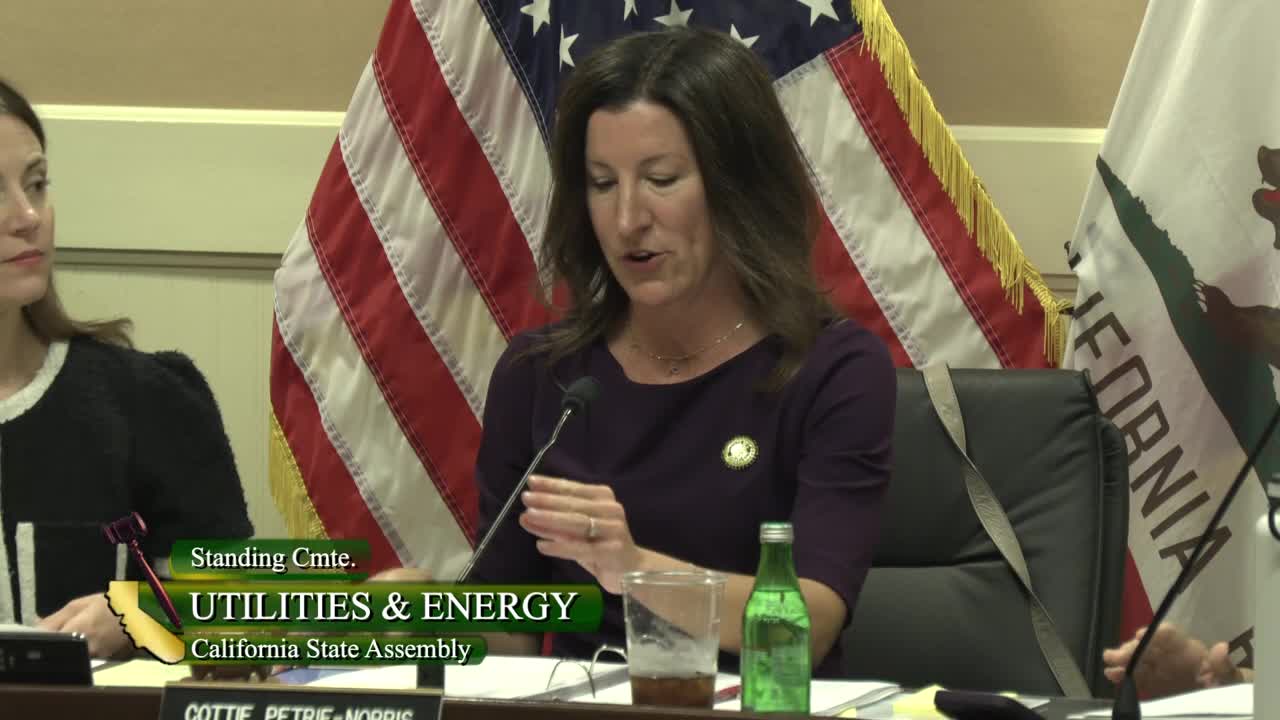 42MIN
Assembly Standing Committee on Utilities and Energy
Bill Author

Bill Co-Author(s):