SB 1344: Civil actions: housing development projects.
- Session Year: 2025-2026
- House: Senate
- Latest Version Date: 2026-09-29
Current Status:
Passed
(2026-09-29: Chaptered by Secretary of State. Chapter 811, Statutes of 2026.)
Introduced
In Committee
Awaiting First Chamber Vote
Passed First Chamber
In Committee
Awaiting Second Chamber Vote
Passed Second Chamber
Enacted
What does this bill do?
This bill extends a procedure like an anti‑SLAPP motion to lawsuits that challenge approval or permitting of “priority care development” projects — supportive housing and other housing tied to behavioral health services — allowing project backers or agencies to ask the court to strike the plaintiff’s pleading and making those orders appealable. It also expands an existing rule that can require plaintiffs to post a security bond when their suit would delay such projects, increasing the maximum plaintiff liability from $500,000 to $1,000,000 (adjusted for inflation).
The summary is provided by generative AI which can make mistakes. For original language, please view the details in the table below.
Existing law provides that in a civil action brought by a plaintiff to challenge a housing development project that meets or exceeds the requirements for low- or moderate-income housing, a defendant may seek an order requiring the plaintiff to furnish an undertaking as security for costs and damages that may be incurred by the defendant if the bringing of the action would result in preventing or delaying the project, as specified. Existing law limits the liability of the plaintiff who must furnish the undertaking to $500,000. Existing law also permits a defendant in a civil action challenging the approval or permitting of a priority housing development project, as defined, to bring a special motion to strike the pleading. Existing law requires the court to deny the motion to strike if the court determines, based on the pleadings, affidavits, and administrative record if applicable, that the plaintiff has established a probability of prevailing on the claim.
This bill would increase the above-referenced liability limit to $1,000,000. The bill would also generally apply the above provisions to priority care developments, as defined, that provide supportive housing or other housing assistance in connection with behavioral health services and other specified purposes.
This bill would incorporate additional changes to Section 529.2 of the Code of Civil Procedure proposed by SB 916 to be operative only if this bill and SB 916 are enacted and this bill is enacted last.
Existing law provides that in a civil action brought by a plaintiff to challenge a housing development project that meets or exceeds the requirements for low- or moderate-income housing, a defendant may seek an order requiring the plaintiff to furnish an undertaking as security for costs and damages that may be incurred by the defendant if the bringing of the action would result in preventing or delaying the project, as specified. Existing law limits the liability of the plaintiff who must furnish the undertaking to $500,000. Existing law also permits a defendant in a civil action challenging the approval or permitting of a priority housing development project, as defined, to bring a special motion to strike the pleading. Existing law requires the court to deny the motion to strike if the court determines, based on the pleadings, affidavits, and administrative record if applicable, that the plaintiff has established a probability of prevailing on the claim.
This bill would increase the above-referenced liability limit to $1,000,000. The bill would also generally apply the above provisions to priority care developments, as defined, that provide supportive housing or other housing assistance in connection with behavioral health services and other specified purposes.
This bill would make a nonsubstantive change to that provision.Existing law provides that in a civil action brought by a plaintiff to challenge a housing development project that meets or exceeds the requirements for low- or moderate-income housing, a defendant may seek an order requiring the plaintiff to furnish an undertaking as security for costs and damages that may be incurred by the defendant if the bringing of the action would result in preventing or delaying the project, as specified.
This bill would make a nonsubstantive change to that provision.
(a)The Legislature finds and declares all of the following:
(1)The state faces an availability and affordability housing crisis, largely due to a severe housing shortage. Solving the housing crisis therefore requires a multifaceted, statewide approach that includes encouraging an increase in the overall housing supply, encouraging the development of housing that is affordable to households at all income levels, and removing barriers to housing production.
(2)The limited availability of community-based care facilities to support rehabilitation and recovery contributes to the growing crisis of homelessness and incarceration among those living with a mental health disorder. Research in 2021 indicates that the state has a shortage of over 2,700 subacute and nearly 3,000 community residential beds. This shortage has caused significant increases in emergency department visits for mental health treatment at a very high cost.
(3)The continuum of care for all Californians, especially the most vulnerable, must include immediate access to temporary and permanent supportive housing or other housing assistance provided in connection with behavioral health services, including temporary shelter and permanent housing for people experiencing, or at the risk of experiencing, homelessness.
(4)In response to the states housing shortage, and in order to expedite the resolution of actions challenging priority housing developments, the Legislature has enacted laws authorizing a defendant, respondent, or real party in interest to bring a special motion to strike the plaintiffs pleading in such an action. A similar law for actions challenging priority care development projects will strengthen Californias investment in improving its continuum of care statewide and ameliorate the shortage of such infrastructure.
(b)(1)(A)In all civil actions brought by any petitioner to challenge the approval or permitting of a priority care development project, including actions brought pursuant to Section 21167 of the Public Resources Code, a respondent may bring a special motion to strike the whole or any part of a pleading. The court shall deny the motion to strike if it determines that the petitioner has established that there is a probability that the petitioner will prevail on the claim.
(B)The court shall make its determination on the special motion to strike based on the pleadings, and supporting and opposing affidavits stating the facts upon which the liability or defense is based. Affidavits submitted with the pleadings may include a request for judicial notice of facts and documents relevant to the courts determination.
(C)(i)If the court is unable to determine whether the petitioner has established a probability that the petitioner will prevail on the claim without reviewing the administrative record in an action in which the administrative record is required, the court shall make its determination on the special motion to strike based on the documents specified in subparagraph (B) and the administrative record, once prepared.
(ii)If the court determines that an administrative record is required for its decision, the moving party may, notwithstanding the 60-day filing requirement pursuant to paragraph (3) and without appealing an order denying a special motion to strike pursuant to paragraph (6), file the special motion to strike within 60 days of the service of the administrative record or, in the courts discretion, at any later time it deems proper.
(D)If the court determines that the petitioner has established a probability that the petitioner will prevail on the claim, neither that determination nor the fact of that determination shall be admissible in evidence at any later stage of the case, or in any subsequent action, and no burden of proof or degree of proof otherwise applicable shall be affected by that determination in any later stage of the case or in any subsequent proceeding.
(2)In any action subject to paragraph (1), a prevailing respondent on a special motion to strike shall be entitled to recover that respondents attorneys fees and costs. If the court finds that a special motion to strike is frivolous or is solely intended to cause unnecessary delay, the court shall award costs and reasonable attorneys fees to a petitioner prevailing on the motion, pursuant to Section 128.5.
(3)The special motion may be filed within 60 days of the service of the petition or, in the courts discretion, at any later time upon terms it deems proper.
(4)All discovery proceedings in the action shall be stayed upon the filing of a notice of motion made pursuant to this section. The stay of discovery shall remain in effect until notice of entry of the order ruling on the motion. The court, on noticed motion and for good cause shown, may order that specified discovery be conducted notwithstanding this subdivision.
(5)For purposes of this section, petition includes cross-petition, complaint, and cross-complaint, petitioner includes plaintiff and cross-complainant, and respondent includes cross-respondent, defendant, cross-defendant, and real party in interest.
(6)An order granting or denying a special motion to strike is appealable under Section 904.1.
(c)(1)Priority care development means any projects funded, in whole or in part, pursuant to Sections 5892 or 5965.04, or subdivision (c) of Section 18999.97, of the Welfare and Institutions Code.
(2)Priority care development does not include a detention facility as defined in subdivision (a) of Section 9500 of the Penal Code.
SEC. 2.Section 529.2 of the Code of Civil Procedure is amended to read:529.2.(a)This section applies to all civil actions, including, but not limited to, actions brought pursuant to Section 21167 of the Public Resources Code, brought by any plaintiff to challenge a housing project that is either of the following:
(1)A development project, as defined by Section 65928 of the Government Code, and which meets or exceeds the requirements for low- or moderate-income housing as set forth in Section 65915 of the Government Code.
(2)A priority care development as defined by Section 425.21.
(b)For actions described in subdivision (a), a defendant may, if the bringing of the action or the seeking by the plaintiff of particular relief including, but not limited to, injunctions, has the effect of preventing or delaying the project from being carried out, apply to the court by noticed motion for an order requiring the plaintiff to furnish an undertaking as security for costs and any damages or economic hardships that may be incurred by the defendant by the conclusion of the action or proceeding as the result of a delay in carrying out the development project. The motion shall be made on the grounds that the action is without merit and that the action was brought in bad faith, vexatiously, for the purpose of delay, or to thwart the low- or moderate-income nature of the housing development project or the suitability of the priority care development to serve the intended population.
(c)(1)In responding to a motion for undertaking, the plaintiff may seek to limit the amount of the undertaking by presenting admissible evidence that filing an undertaking will cause it, and in cases where the plaintiff is an unincorporated association, its members, to suffer undue economic hardship. If the court, after hearing, determines that the grounds for the motion have been established, the court shall order that the plaintiff file the undertaking in an amount specified in the courts order, taking into consideration any admitted evidence of plaintiffs economic hardship and avoiding causing the plaintiff to suffer undue economic hardship, as security for costs and damages or economic hardships of the defendant. The liability of the plaintiff pursuant to this section for the costs and damages of the defendant shall not exceed one million dollars ($1,000,000). If the court concludes, based on all of the admissible evidence presented, that a bond in any amount would cause the plaintiff undue economic hardship, the court is authorized in its discretion to decline to impose a bond.
(2)The amount specified in this subdivision shall adjust annually for inflation, beginning on January 1, 2028, based on the change in the annual California Consumer Price Index for All Urban Consumers, published by the Department of Industrial Relations, for the most recent one-year period ending on December 31 preceding each adjustment, with each adjusted amount rounded to the nearest twenty-five dollars ($25).
(d)If at any time after the plaintiff has filed an undertaking the development plan is changed by the developer in bad faith so that it fails to meet or exceed the requirements for low- or moderate-income housing as set forth in Section 65915 of the Government Code, or it fails to meet the definition of a priority care development set forth in Section 425.21, the developer shall be liable to the plaintiff for the cost of obtaining the undertaking.
(e)For purposes of this section, plaintiff includes petitioner, cross-petitioner, and cross-plaintiff, and defendant includes respondent, cross-respondent, cross-defendant, and real party in interest.
SEC. 2.5.Section 529.2 of the Code of Civil Procedure is amended to read:529.2.(a)This section applies to all civil actions, including, but not limited to, actions brought pursuant to Section 21167 of the Public Resources Code, brought by any plaintiff to challenge a housing project that is any of the following:
(1)A development project, as defined by Section 65928 of the Government Code, and which meets or exceeds the requirements for low- or moderate-income housing as set forth in Section 65915 of the Government Code.
(2)A priority care development as defined by Section 425.21.
(3)A student housing project as defined in subdivision (f).
(b)For actions described in subdivision (a), a defendant may, if the bringing of the action or the seeking by the plaintiff of particular relief including, but not limited to, injunctions, has the effect of preventing or delaying the project from being carried out, apply to the court by noticed motion for an order requiring the plaintiff to furnish an undertaking as security for costs and any damages or economic hardships that may be incurred by the defendant by the conclusion of the action or proceeding as the result of a delay in carrying out the development project. The motion shall be made on the grounds that the action is without merit and that the action was brought in bad faith, vexatiously, for the purpose of delay, or to thwart the student housing or low- or moderate-income nature of the housing development project, or the suitability of the priority care development to serve the intended population.
(c)(1)In responding to a motion for undertaking, the plaintiff may seek to limit the amount of the undertaking by presenting admissible evidence that filing an undertaking will cause it, and in cases where the plaintiff is an unincorporated association, its members, to suffer undue economic hardship. If the court, after hearing, determines that the grounds for the motion have been established, the court shall order that the plaintiff file the undertaking in an amount specified in the courts order, taking into consideration any admitted evidence of plaintiffs economic hardship and avoiding causing the plaintiff to suffer undue economic hardship, as security for costs and damages or economic hardships of the defendant. The liability of the plaintiff pursuant to this section for the costs and damages of the defendant shall not exceed one million dollars ($1,000,000). If the court concludes, based on all of the admissible evidence presented, that a bond in any amount would cause the plaintiff undue economic hardship, the court is authorized in its discretion to decline to impose a bond.
(2)The amount specified in this subdivision shall adjust annually for inflation, beginning on January 1, 2028, based on the change in the annual California Consumer Price Index for All Urban Consumers, published by the Department of Industrial Relations, for the most recent one-year period ending on December 31 preceding each adjustment, with each adjusted amount rounded to the nearest twenty-five dollars ($25).
(d)If at any time after the plaintiff has filed an undertaking the development plan is changed by the developer in bad faith so that it fails to meet or exceed the requirements for low- or moderate-income housing as set forth in Section 65915 of the Government Code, or it fails to meet the definition of a priority care development set forth in Section 425.21, or it fails to meet the definition of student housing project in subdivision (f), the developer shall be liable to the plaintiff for the cost of obtaining the undertaking.
(e)For purposes of this section, plaintiff includes petitioner, cross-petitioner, and cross-plaintiff, and defendant includes respondent, cross-respondent, cross-defendant, and real party in interest.
(f)For purposes of this section, student housing project means one or more housing facilities to be occupied by students of one or more campuses and owned by a public university, including dining, academic, and student support service spaces, and other necessary and usual attendant and related facilities and equipment.
SEC. 3.Section 904.1 of the Code of Civil Procedure is amended to read:904.1.(a)An appeal, other than in a limited civil case, is to the court of appeal. An appeal, other than in a limited civil case, may be taken from any of the following:
(1)From a judgment, except an interlocutory judgment, other than as provided in paragraphs (8), (9), and (11), or a judgment of contempt that is made final and conclusive by Section 1222.
(2)From an order made after a judgment made appealable by paragraph (1).
(3)From an order granting a motion to quash service of summons or granting a motion to stay the action on the ground of inconvenient forum, or from a written order of dismissal under Section 581d following an order granting a motion to dismiss the action on the ground of inconvenient forum.
(4)From an order granting a new trial or denying a motion for judgment notwithstanding the verdict.
(5)From an order discharging or refusing to discharge an attachment or granting a right to attach order.
(6)From an order granting or dissolving an injunction, or refusing to grant or dissolve an injunction.
(7)From an order appointing a receiver.
(8)From an interlocutory judgment, order, or decree, made or entered in an action to redeem real or personal property from a mortgage thereof, or a lien thereon, determining the right to redeem and directing an accounting.
(9)From an interlocutory judgment in an action for partition determining the rights and interests of the respective parties and directing partition to be made.
(10)From an order made appealable by the Probate Code or the Family Code.
(11)From an interlocutory judgment directing payment of monetary sanctions by a party or an attorney for a party if the amount exceeds five thousand dollars ($5,000).
(12)From an order directing payment of monetary sanctions by a party or an attorney for a party if the amount exceeds five thousand dollars ($5,000).
(13)From an order granting or denying a special motion to strike under Sections 425.16, 425.19, and 425.21.
(14)From a final order or judgment in a bifurcated proceeding regarding child custody or visitation rights.
(b)Sanction orders or judgments of five thousand dollars ($5,000) or less against a party or an attorney for a party may be reviewed on an appeal by that party after entry of final judgment in the main action, or, at the discretion of the court of appeal, may be reviewed upon petition for an extraordinary writ.
SEC. 4.Section 2.5 of this bill incorporates amendments to Section 529.2 of the Code of Civil Procedure proposed by both this bill and SB 916. That section of this bill shall only become operative if (1) both bills are enacted and become effective on or before January 1, 2027, (2) each bill amends Section 529.2 of the Code of Civil Procedure, and (3) this bill is enacted after SB 916, in which case Section 2 of this bill shall not become operative.
(a)The Legislature finds and declares all of the following:
(1)The state faces an availability and affordability housing crisis, largely due to a severe housing shortage. Solving the housing crisis therefore requires a multifaceted, statewide approach that includes encouraging an increase in the overall housing supply, encouraging the development of housing that is affordable to households at all income levels, and removing barriers to housing production.
(2)The limited availability of community-based care facilities to support rehabilitation and recovery contributes to the growing crisis of homelessness and incarceration among those living with a mental health disorder. Research in 2021 indicates that the state has a shortage of over 2,700 subacute and nearly 3,000 community residential beds. This shortage has caused significant increases in emergency department visits for mental health treatment at a very high cost.
(3)The continuum of care for all Californians, especially the most vulnerable, must include immediate access to temporary and permanent supportive housing or other housing assistance provided in connection with behavioral health services, including temporary shelter and permanent housing for people experiencing, or at the risk of experiencing, homelessness.
(4)In response to the states housing shortage, and in order to expedite the resolution of actions challenging priority housing developments, the Legislature has enacted laws authorizing a defendant, respondent, or real party in interest to bring a special motion to strike the plaintiffs pleading in such an action. A similar law for actions challenging priority care development projects will strengthen Californias investment in improving its continuum of care statewide and ameliorate the shortage of such infrastructure.
(b)(1)(A)In all civil actions brought by any petitioner to challenge the approval or permitting of a priority care development project, including actions brought pursuant to Section 21167 of the Public Resources Code, a respondent may bring a special motion to strike the whole or any part of a pleading. The court shall deny the motion to strike if it determines that the petitioner has established that there is a probability that the petitioner will prevail on the claim.
(B)The court shall make its determination on the special motion to strike based on the pleadings, and supporting and opposing affidavits stating the facts upon which the liability or defense is based. Affidavits submitted with the pleadings may include a request for judicial notice of facts and documents relevant to the courts determination.
(C)(i)If the court is unable to determine whether the petitioner has established a probability that the petitioner will prevail on the claim without reviewing the administrative record in an action in which the administrative record is required, the court shall make its determination on the special motion to strike based on the documents specified in subparagraph (B) and the administrative record, once prepared.
(ii)If the court determines that an administrative record is required for its decision, the moving party may, notwithstanding the 60-day filing requirement pursuant to paragraph (3) and without appealing an order denying a special motion to strike pursuant to paragraph (6), file the special motion to strike within 60 days of the service of the administrative record or, in the courts discretion, at any later time it deems proper.
(D)If the court determines that the petitioner has established a probability that the petitioner will prevail on the claim, neither that determination nor the fact of that determination shall be admissible in evidence at any later stage of the case, or in any subsequent action, and no burden of proof or degree of proof otherwise applicable shall be affected by that determination in any later stage of the case or in any subsequent proceeding.
(2)In any action subject to paragraph (1), a prevailing respondent on a special motion to strike shall be entitled to recover that respondents attorneys fees and costs. If the court finds that a special motion to strike is frivolous or is solely intended to cause unnecessary delay, the court shall award costs and reasonable attorneys fees to a petitioner prevailing on the motion, pursuant to Section 128.5.
(3)The special motion may be filed within 60 days of the service of the petition or, in the courts discretion, at any later time upon terms it deems proper.
(4)All discovery proceedings in the action shall be stayed upon the filing of a notice of motion made pursuant to this section. The stay of discovery shall remain in effect until notice of entry of the order ruling on the motion. The court, on noticed motion and for good cause shown, may order that specified discovery be conducted notwithstanding this subdivision.
(5)For purposes of this section, petition includes cross-petition, complaint, and cross-complaint, petitioner includes plaintiff and cross-complainant, and respondent includes cross-respondent, defendant, cross-defendant, and real party in interest.
(6)An order granting or denying a special motion to strike is appealable under Section 904.1.
(c)(1)Priority care development means any projects funded, in whole or in part, pursuant to Sections 5892 or 5965.04, or subdivision (c) of Section 18999.97, of the Welfare and Institutions Code.
(2)Priority care development does not include a detention facility as defined in subdivision (a) of Section 9500 of the Penal Code.
SEC. 2.Section 529.2 of the Code of Civil Procedure is amended to read:529.2.(a)This section applies to all civil actions, including, but not limited to, actions brought pursuant to Section 21167 of the Public Resources Code, brought by any plaintiff to challenge a housing project that is either of the following:
(1)A development project, as defined by Section 65928 of the Government Code, and which meets or exceeds the requirements for low- or moderate-income housing as set forth in Section 65915 of the Government Code.
(2)A priority care development as defined by Section 425.21.
(b)For actions described in subdivision (a), a defendant may, if the bringing of the action or the seeking by the plaintiff of particular relief including, but not limited to, injunctions, has the effect of preventing or delaying the project from being carried out, apply to the court by noticed motion for an order requiring the plaintiff to furnish an undertaking as security for costs and any damages or economic hardships that may be incurred by the defendant by the conclusion of the action or proceeding as the result of a delay in carrying out the development project. The motion shall be made on the grounds that the action is without merit and that the action was brought in bad faith, vexatiously, for the purpose of delay, or to thwart the low- or moderate-income nature of the housing development project or the suitability of the priority care development to serve the intended population.
(c)(1)In responding to a motion for undertaking, the plaintiff may seek to limit the amount of the undertaking by presenting admissible evidence that filing an undertaking will cause it, and in cases where the plaintiff is an unincorporated association, its members, to suffer undue economic hardship. If the court, after hearing, determines that the grounds for the motion have been established, the court shall order that the plaintiff file the undertaking in an amount specified in the courts order, taking into consideration any admitted evidence of plaintiffs economic hardship and avoiding causing the plaintiff to suffer undue economic hardship, as security for costs and damages or economic hardships of the defendant. The liability of the plaintiff pursuant to this section for the costs and damages of the defendant shall not exceed one million dollars ($1,000,000). If the court concludes, based on all of the admissible evidence presented, that a bond in any amount would cause the plaintiff undue economic hardship, the court is authorized in its discretion to decline to impose a bond.
(2)The amount specified in this subdivision shall adjust annually for inflation, beginning on January 1, 2028, based on the change in the annual California Consumer Price Index for All Urban Consumers, published by the Department of Industrial Relations, for the most recent one-year period ending on December 31 preceding each adjustment, with each adjusted amount rounded to the nearest twenty-five dollars ($25).
(d)If at any time after the plaintiff has filed an undertaking the development plan is changed by the developer in bad faith so that it fails to meet or exceed the requirements for low- or moderate-income housing as set forth in Section 65915 of the Government Code, or it fails to meet the definition of a priority care development set forth in Section 425.21, the developer shall be liable to the plaintiff for the cost of obtaining the undertaking.
(e)For purposes of this section, plaintiff includes petitioner, cross-petitioner, and cross-plaintiff, and defendant includes respondent, cross-respondent, cross-defendant, and real party in interest.
SEC. 2.5.Section 529.2 of the Code of Civil Procedure is amended to read:529.2.(a)In This section applies to all civil actions, including, but not limited to, actions brought pursuant to Section 21167 of the Public Resources Code, brought by any plaintiff to challenge a housing project that is a any of the following:
(1)A development project, as defined by Section 65928 of the Government Code, and which meets or exceeds the requirements for low- or moderate-income housing as set forth in Section 65915 of the Government Code, a Code.
(2)A priority care development as defined by Section 425.21.
(3)A student housing project as defined in subdivision (f).
(b)For actions described in subdivision (a), a defendant may, if the bringing of the action or the seeking by the plaintiff of particular relief including, but not limited to, injunctions, has the effect of preventing or delaying the project from being carried out, apply to the court by noticed motion for an order requiring the plaintiff to furnish an undertaking as security for costs and any damages or economic hardships that may be incurred by the defendant by the conclusion of the action or proceeding as the result of a delay in carrying out the development project. The motion shall be made on the grounds that the action is without merit and that the action was brought in bad faith, vexatiously, for the purpose of delay, or to thwart the student housing or low- or moderate-income nature of the housing development project. project, or the suitability of the priority care development to serve the intended population.
(b)(c)(1)In responding to a motion for undertaking, the plaintiff may seek to limit the amount of the undertaking by presenting admissible evidence that filing an undertaking will cause it, and in cases where the plaintiff is an unincorporated association, its members, to suffer undue economic hardship. If the court, after hearing, determines that the grounds for the motion have been established, the court shall order that the plaintiff file the undertaking in an amount specified in the courts order, taking into consideration any admitted evidence of plaintiffs economic hardship and avoiding causing the plaintiff to suffer undue economic hardship, as security for costs and damages or economic hardships of the defendant. The liability of the plaintiff pursuant to this section for the costs and damages of the defendant shall not exceed five hundred thousand dollars ($500,000). one million dollars ($1,000,000). If the court concludes, based on all of the admissible evidence presented, that a bond in any amount would cause the plaintiff undue economic hardship, the court is authorized in its discretion to decline to impose a bond.
(2)The amount specified in this subdivision shall adjust annually for inflation, beginning on January 1, 2028, based on the change in the annual California Consumer Price Index for All Urban Consumers, published by the Department of Industrial Relations, for the most recent one-year period ending on December 31 preceding each adjustment, with each adjusted amount rounded to the nearest twenty-five dollars ($25).
(c)(d)If at any time after the plaintiff has filed an undertaking the housing development plan is changed by the developer in bad faith so that it fails to meet or exceed the requirements for low- or moderate-income housing as set forth in Section 65915 of the Government Code, or it fails to meet the definition of a priority care development set forth in Section 425.21, or it fails to meet the definition of student housing project in subdivision (f), the developer shall be liable to the plaintiff for the cost of obtaining the undertaking.
(e)For purposes of this section, plaintiff includes petitioner, cross-petitioner, and cross-plaintiff, and defendant includes respondent, cross-respondent, cross-defendant, and real party in interest.
(f)For purposes of this section, student housing project means one or more housing facilities to be occupied by students of one or more campuses and owned by a public university, including dining, academic, and student support service spaces, and other necessary and usual attendant and related facilities and equipment.
SEC. 3.SEC. 3.Section 904.1 of the Code of Civil Procedure is amended to read:904.1.(a)An appeal, other than in a limited civil case, is to the court of appeal. An appeal, other than in a limited civil case, may be taken from any of the following:
(1)From a judgment, except an interlocutory judgment, other than as provided in paragraphs (8), (9), and (11), or a judgment of contempt that is made final and conclusive by Section 1222.
(2)From an order made after a judgment made appealable by paragraph (1).
(3)From an order granting a motion to quash service of summons or granting a motion to stay the action on the ground of inconvenient forum, or from a written order of dismissal under Section 581d following an order granting a motion to dismiss the action on the ground of inconvenient forum.
(4)From an order granting a new trial or denying a motion for judgment notwithstanding the verdict.
(5)From an order discharging or refusing to discharge an attachment or granting a right to attach order.
(6)From an order granting or dissolving an injunction, or refusing to grant or dissolve an injunction.
(7)From an order appointing a receiver.
(8)From an interlocutory judgment, order, or decree, made or entered in an action to redeem real or personal property from a mortgage thereof, or a lien thereon, determining the right to redeem and directing an accounting.
(9)From an interlocutory judgment in an action for partition determining the rights and interests of the respective parties and directing partition to be made.
(10)From an order made appealable by the Probate Code or the Family Code.
(11)From an interlocutory judgment directing payment of monetary sanctions by a party or an attorney for a party if the amount exceeds five thousand dollars ($5,000).
(12)From an order directing payment of monetary sanctions by a party or an attorney for a party if the amount exceeds five thousand dollars ($5,000).
(13)From an order granting or denying a special motion to strike under Sections 425.16, 425.19, and 425.21.
(14)From a final order or judgment in a bifurcated proceeding regarding child custody or visitation rights.
(b)Sanction orders or judgments of five thousand dollars ($5,000) or less against a party or an attorney for a party may be reviewed on an appeal by that party after entry of final judgment in the main action, or, at the discretion of the court of appeal, may be reviewed upon petition for an extraordinary writ.
SEC. 4.Section 2.5 of this bill incorporates amendments to Section 529.2 of the Code of Civil Procedure proposed by both this bill and SB 916. That section of this bill shall only become operative if (1) both bills are enacted and become effective on or before January 1, 2027, (2) each bill amends Section 529.2 of the Code of Civil Procedure, and (3) this bill is enacted after SB 916, in which case Section 2 of this bill shall not become operative.
(a)The Legislature finds and declares all of the following:
(1)The state faces an availability and affordability housing crisis, largely due to a severe housing shortage. Solving the housing crisis therefore requires a multifaceted, statewide approach that includes encouraging an increase in the overall housing supply, encouraging the development of housing that is affordable to households at all income levels, and removing barriers to housing production.
(2)The limited availability of community-based care facilities to support rehabilitation and recovery contributes to the growing crisis of homelessness and incarceration among those living with a mental health disorder. Research in 2021 indicates that the state has a shortage of over 2,700 subacute and nearly 3,000 community residential beds. This shortage has caused significant increases in emergency department visits for mental health treatment at a very high cost.
(3)The continuum of care for all Californians, especially the most vulnerable, must include immediate access to temporary and permanent supportive housing or other housing assistance provided in connection with behavioral health services, including temporary shelter and permanent housing for people experiencing, or at the risk of experiencing, homelessness.
(4)In response to the states housing shortage, and in order to expedite the resolution of actions challenging priority housing developments, the Legislature has enacted laws authorizing a defendant defendant, respondent, or real party in interest to bring a special motion to strike the plaintiffs pleading in such an action. A similar law for actions challenging priority care development projects will strengthen Californias investment in improving its continuum of care statewide and ameliorate the shortage of such infrastructure.
(b)(1)(A)In all civil actions brought by any petitioner to challenge the approval or permitting of a priority care development project, including actions brought pursuant to Section 21167 of the Public Resources Code, a respondent may bring a special motion to strike the whole or any part of a pleading. The court shall deny the motion to strike if it determines that the petitioner has established that there is a probability that the petitioner will prevail on the claim.
(B)The court shall make its determination on the special motion to strike based on the pleadings, and supporting and opposing affidavits stating the facts upon which the liability or defense is based. Affidavits submitted with the pleadings may include a request for judicial notice of facts and documents relevant to the courts determination.
(C)(i)If the court is unable to determine whether the petitioner has established a probability that the petitioner will prevail on the claim without reviewing the administrative record in an action in which the administrative record is required, the court shall make its determination on the special motion to strike based on the documents specified in subparagraph (B) and the administrative record, once prepared.
(ii)If the court determines that an administrative record is required for its decision, the moving party may, notwithstanding the 60-day filing requirement pursuant to paragraph (3) and without appealing an order denying a special motion to strike pursuant to paragraph (6), file the special motion to strike within 60 days of the service of the administrative record or, in the courts discretion, at any later time it deems proper.
(D)If the court determines that the petitioner has established a probability that the petitioner will prevail on the claim, neither that determination nor the fact of that determination shall be admissible in evidence at any later stage of the case, or in any subsequent action, and no burden of proof or degree of proof otherwise applicable shall be affected by that determination in any later stage of the case or in any subsequent proceeding.
(2)In any action subject to paragraph (1), a prevailing respondent on a special motion to strike shall be entitled to recover that respondents attorneys fees and costs. If the court finds that a special motion to strike is frivolous or is solely intended to cause unnecessary delay, the court shall award costs and reasonable attorneys fees to a petitioner prevailing on the motion, pursuant to Section 128.5.
(3)The special motion shall may be filed within 60 days of the service of the petition, unless the court permits, at petition or, in the courts discretion, filing at any later time upon terms it deems proper. The motion shall be scheduled by the clerk of the court for a hearing not more than 30 days after the service of the motion unless the docket conditions of the court require a later hearing.
(4)All discovery proceedings in the action shall be stayed upon the filing of a notice of motion made pursuant to this section. The stay of discovery shall remain in effect until notice of entry of the order ruling on the motion. The court, on noticed motion and for good cause shown, may order that specified discovery be conducted notwithstanding this subdivision.
(5)For purposes of this section, petition includes cross-petition, complaint, and cross-complaint, petitioner includes plaintiff and cross-complainant, and respondent includes cross-respondent, defendant, cross-defendant, and real party in interest.
(6)An order granting or denying a special motion to strike is appealable under Section 904.1.
(c)(1)Priority care development means any projects funded, in whole or in part, pursuant to Sections 5892 or 5965.04, or subdivision (c) of Section 18999.97, of the Welfare and Institutions Code.
(2)Priority care development does not include a detention facility as defined in subdivision (a) of Section 9500 of the Penal Code.
SEC. 2.Section 529.2 of the Code of Civil Procedure is amended to read:529.2.(a)This section applies to all civil actions, including, but not limited to, actions brought pursuant to Section 21167 of the Public Resources Code, brought by any plaintiff to challenge a housing project that is either of the following:
(1)A development project, as defined by Section 65928 of the Government Code, and which meets or exceeds the requirements for low- or moderate-income housing as set forth in Section 65915 of the Government Code.
(2)A priority care development as defined by Section 425.21.
(b)For actions described in subdivision (a), a defendant may, if the bringing of the action or the seeking by the plaintiff of particular relief including, but not limited to, injunctions, has the effect of preventing or delaying the project from being carried out, apply to the court by noticed motion for an order requiring the plaintiff to furnish an undertaking as security for costs and any damages or economic hardships that may be incurred by the defendant by the conclusion of the action or proceeding as the result of a delay in carrying out the development project. The motion shall be made on the grounds that the action is without merit and that the action was brought in bad faith, vexatiously, for the purpose of delay, or to thwart the low- or moderate-income nature of the housing development project or the suitability of the priority care development to serve the intended population.
(c)(1)In responding to a motion for undertaking, the plaintiff may seek to limit the amount of the undertaking by presenting admissible evidence that filing an undertaking will cause it, and in cases where the plaintiff is an unincorporated association, its members, to suffer undue economic hardship. If the court, after hearing, determines that the grounds for the motion have been established, the court shall order that the plaintiff file the undertaking in an amount specified in the courts order, taking into consideration any admitted evidence of plaintiffs economic hardship and avoiding causing the plaintiff to suffer undue economic hardship, as security for costs and damages or economic hardships of the defendant. The liability of the plaintiff pursuant to this section for the costs and damages of the defendant shall not exceed one million dollars ($1,000,000). If the court concludes, based on all of the admissible evidence presented, that a bond in any amount would cause the plaintiff undue economic hardship, the court is authorized in its discretion to decline to impose a bond.
(2)The amount specified in this subdivision shall adjust annually for inflation, beginning on January 1, 2028, based on the change in the annual California Consumer Price Index for All Urban Consumers, published by the Department of Industrial Relations, for the most recent one-year period ending on December 31 preceding each adjustment, with each adjusted amount rounded to the nearest twenty-five dollars ($25).
(d)If at any time after the plaintiff has filed an undertaking the development plan is changed by the developer in bad faith so that it fails to meet or exceed the requirements for low- or moderate-income housing as set forth in Section 65915 of the Government Code, or it fails to meet the definition of a priority care development set forth in Section 425.21, the developer shall be liable to the plaintiff for the cost of obtaining the undertaking.
(e)For purposes of this section, plaintiff includes petitioner, cross-petitioner, and cross-plaintiff, and defendant includes respondent, cross-respondent, cross-defendant, and real party in interest.
SEC. 3.Section 904.1 of the Code of Civil Procedure is amended to read:904.1.(a)An appeal, other than in a limited civil case, is to the court of appeal. An appeal, other than in a limited civil case, may be taken from any of the following:
(1)From a judgment, except an interlocutory judgment, other than as provided in paragraphs (8), (9), and (11), or a judgment of contempt that is made final and conclusive by Section 1222.
(2)From an order made after a judgment made appealable by paragraph (1).
(3)From an order granting a motion to quash service of summons or granting a motion to stay the action on the ground of inconvenient forum, or from a written order of dismissal under Section 581d following an order granting a motion to dismiss the action on the ground of inconvenient forum.
(4)From an order granting a new trial or denying a motion for judgment notwithstanding the verdict.
(5)From an order discharging or refusing to discharge an attachment or granting a right to attach order.
(6)From an order granting or dissolving an injunction, or refusing to grant or dissolve an injunction.
(7)From an order appointing a receiver.
(8)From an interlocutory judgment, order, or decree, made or entered in an action to redeem real or personal property from a mortgage thereof, or a lien thereon, determining the right to redeem and directing an accounting.
(9)From an interlocutory judgment in an action for partition determining the rights and interests of the respective parties and directing partition to be made.
(10)From an order made appealable by the Probate Code or the Family Code.
(11)From an interlocutory judgment directing payment of monetary sanctions by a party or an attorney for a party if the amount exceeds five thousand dollars ($5,000).
(12)From an order directing payment of monetary sanctions by a party or an attorney for a party if the amount exceeds five thousand dollars ($5,000).
(13)From an order granting or denying a special motion to strike under Sections 425.16, 425.19, and 425.21.
(14)From a final order or judgment in a bifurcated proceeding regarding child custody or visitation rights.
(b)Sanction orders or judgments of five thousand dollars ($5,000) or less against a party or an attorney for a party may be reviewed on an appeal by that party after entry of final judgment in the main action, or, at the discretion of the court of appeal, may be reviewed upon petition for an extraordinary writ.
(a)The Legislature finds and declares all of the following:
(1)The state faces an availability and affordability housing crisis, largely due to a severe housing shortage. Solving the housing crisis therefore requires a multifaceted, statewide approach that includes encouraging an increase in the overall housing supply, encouraging the development of housing that is affordable to households at all income levels, and removing barriers to housing production.
(2)The limited availability of community-based care facilities to support rehabilitation and recovery contributes to the growing crisis of homelessness and incarceration among those living with a mental health disorder. Research indicates that the state has a shortage of over 2,700 subacute and nearly 3,000 community residential beds. This shortage has caused significant increases in emergency department visits for mental health treatment at a very high cost.
(3)The continuum of care for all Californians, especially the most vulnerable, must include immediate access to temporary and permanent supportive housing or other housing assistance provided in connection with behavioral health services, including temporary shelter and permanent housing for people experiencing, or at the risk of experiencing, homelessness.
(4)In response to the states housing shortage, and in order to expedite the resolution of actions challenging priority housing developments, the Legislature has enacted laws authorizing a defendant to bring a special motion to strike the plaintiffs pleading in such an action. A similar law for actions challenging priority care development projects will strengthen Californias investment in improving its continuum of care statewide and ameliorate the shortage of such infrastructure.
(b)(1)(A)In all civil actions brought by any petitioner to challenge the approval or permitting of a priority care development project, including actions brought pursuant to Section 21167 of the Public Resources Code, a respondent may bring a special motion to strike the whole or any part of a pleading. The court shall deny the motion to strike if it determines that the petitioner has established that there is a probability that the petitioner will prevail on the claim.
(B)The court shall make its determination on the special motion to strike based on the pleadings, and supporting and opposing affidavits stating the facts upon which the liability or defense is based. Affidavits submitted with the pleadings may include a request for judicial notice of facts and documents relevant to the courts determination.
(C)(i)If the court is unable to determine whether the petitioner has established a probability that the petitioner will prevail on the claim without reviewing the administrative record in an action in which the administrative record is required, the court shall make its determination on the special motion to strike based on the documents specified in subparagraph (B) and the administrative record, once prepared.
(ii)If the court determines that an administrative record is required for its decision, the moving party may, notwithstanding the 60-day filing requirement pursuant to paragraph (3) and without appealing an order denying a special motion to strike pursuant to paragraph (6), file the special motion to strike within 60 days of the service of the administrative record or, in the courts discretion, at any later time it deems proper.
(D)If the court determines that the petitioner has established a probability that the petitioner will prevail on the claim, neither that determination nor the fact of that determination shall be admissible in evidence at any later stage of the case, or in any subsequent action, and no burden of proof or degree of proof otherwise applicable shall be affected by that determination in any later stage of the case or in any subsequent proceeding.
(2)In any action subject to paragraph (1), a prevailing respondent on a special motion to strike shall be entitled to recover that respondents attorneys fees and costs. If the court finds that a special motion to strike is frivolous or is solely intended to cause unnecessary delay, the court shall award costs and reasonable attorneys fees to a petitioner prevailing on the motion, pursuant to Section 128.5.
(3)The special motion shall be filed within 60 days of the service of the petition, unless the court permits, at the courts discretion, filing at any later time upon terms it deems proper. The motion shall be scheduled by the clerk of the court for a hearing not more than 30 days after the service of the motion unless the docket conditions of the court require a later hearing.
(4)All discovery proceedings in the action shall be stayed upon the filing of a notice of motion made pursuant to this section. The stay of discovery shall remain in effect until notice of entry of the order ruling on the motion. The court, on noticed motion and for good cause shown, may order that specified discovery be conducted notwithstanding this subdivision.
(5)For purposes of this section, petition includes cross-petition, complaint, and cross-complaint, petitioner includes plaintiff and cross-complainant, and respondent includes cross-respondent, defendant, cross-defendant, and real party in interest.
(6)An order granting or denying a special motion to strike is appealable under Section 904.1.
(c)(1)Priority care development means any projects funded, in whole or in part, pursuant to Sections 5892 or 5965.04, or subdivision (c) of Section 18999.97, of the Welfare and Institutions Code.
(2)Priority care development does not include a detention facility as defined in subdivision (a) of Section 9500 of the Penal Code.
SECTION 1.SEC. 2.Section 529.2 of the Code of Civil Procedure is amended to read:529.2.(a)In This section applies to all civil actions, including, but not limited to, actions brought pursuant to Section 21167 of the Public Resources Code, brought by any plaintiff to challenge a housing project that is a either of the following:
(1)A development project, as defined by Section 65928 of the Government Code, and which meets or exceeds the requirements for low- or moderate-income housing as set forth in Section 65915 of the Government Code, a Code.
(2)A priority care development as defined by Section 425.21.
(b)For actions described in subdivision (a), a defendant may, if the bringing of the action or the seeking by the plaintiff of particular relief including, but not limited to, injunctions, has the effect of preventing or delaying the project from being carried out, apply to the court by noticed motion for an order requiring the plaintiff to furnish an undertaking as security for costs and any damages or economic hardships that may be incurred by the defendant by the conclusion of the action or proceeding as the result of a delay in carrying out the development project. The motion shall be made on the grounds that the action is without merit and that the action was brought in bad faith, vexatiously, for the purpose of delay, or to thwart the low- or moderate-income nature of the housing development project. project or the suitability of the priority care development to serve the intended population.
(b)(c)(1)In responding to a motion for undertaking, the plaintiff may seek to limit the amount of the undertaking by presenting admissible evidence that filing an undertaking will cause it, and in cases where the plaintiff is an unincorporated association, its members, to suffer undue economic hardship. If the court, after hearing, determines that the grounds for the motion have been established, the court shall order that the plaintiff file the undertaking in an amount specified in the courts order, taking into consideration any admitted evidence of plaintiffs economic hardship and avoiding causing the plaintiff to suffer undue economic hardship, as security for costs and damages or economic hardships of the defendant. The liability of the plaintiff pursuant to this section for the costs and damages of the defendant shall not exceed five hundred thousand dollars ($500,000). one million dollars ($1,000,000). If the court concludes, based on all of the admissible evidence presented, that a bond in any amount would cause the plaintiff undue economic hardship, the court is authorized in its discretion to decline to impose a bond.
(2)The amount specified in this subdivision shall adjust annually for inflation, beginning on January 1, 2028, based on the change in the annual California Consumer Price Index for All Urban Consumers, published by the Department of Industrial Relations, for the most recent one-year period ending on December 31 preceding each adjustment, with each adjusted amount rounded to the nearest twenty-five dollars ($25).
(c)(d)If at any time after the plaintiff has filed an undertaking the housing development plan is changed by the developer in bad faith so that it fails to meet or exceed the requirements for low- or moderate-income housing as set forth in Section 65915 of the Government Code, or it fails to meet the definition of a priority care development set forth in Section 425.21, the developer shall be liable to the plaintiff for the cost of obtaining the undertaking.
(e)For purposes of this section, plaintiff includes petitioner, cross-petitioner, and cross-plaintiff, and defendant includes respondent, cross-respondent, cross-defendant, and real party in interest.
SEC. 3.Section 904.1 of the Code of Civil Procedure is amended to read:904.1.(a)An appeal, other than in a limited civil case, is to the court of appeal. An appeal, other than in a limited civil case, may be taken from any of the following:
(1)From a judgment, except an interlocutory judgment, other than as provided in paragraphs (8), (9), and (11), or a judgment of contempt that is made final and conclusive by Section 1222.
(2)From an order made after a judgment made appealable by paragraph (1).
(3)From an order granting a motion to quash service of summons or granting a motion to stay the action on the ground of inconvenient forum, or from a written order of dismissal under Section 581d following an order granting a motion to dismiss the action on the ground of inconvenient forum.
(4)From an order granting a new trial or denying a motion for judgment notwithstanding the verdict.
(5)From an order discharging or refusing to discharge an attachment or granting a right to attach order.
(6)From an order granting or dissolving an injunction, or refusing to grant or dissolve an injunction.
(7)From an order appointing a receiver.
(8)From an interlocutory judgment, order, or decree, made or entered in an action to redeem real or personal property from a mortgage thereof, or a lien thereon, determining the right to redeem and directing an accounting.
(9)From an interlocutory judgment in an action for partition determining the rights and interests of the respective parties and directing partition to be made.
(10)From an order made appealable by the Probate Code or the Family Code.
(11)From an interlocutory judgment directing payment of monetary sanctions by a party or an attorney for a party if the amount exceeds five thousand dollars ($5,000).
(12)From an order directing payment of monetary sanctions by a party or an attorney for a party if the amount exceeds five thousand dollars ($5,000).
(13)From an order granting or denying a special motion to strike under Sections 425.16 and 425.19. 425.16, 425.19, and 425.21.
(14)From a final order or judgment in a bifurcated proceeding regarding child custody or visitation rights.
(b)Sanction orders or judgments of five thousand dollars ($5,000) or less against a party or an attorney for a party may be reviewed on an appeal by that party after entry of final judgment in the main action, or, at the discretion of the court of appeal, may be reviewed upon petition for an extraordinary writ.
(a)In all civil actions, including, but not limited to, actions brought pursuant to Section 21167 of the Public Resources Code, brought by any plaintiff to challenge a housing project which that is a development project, as defined by Section 65928 of the Government Code, and which meets or exceeds the requirements for low- or moderate-income housing as set forth in Section 65915 of the Government Code, a defendant may, if the bringing of the action or the seeking by the plaintiff of particular relief including, but not limited to, injunctions, has the effect of preventing or delaying the project from being carried out, apply to the court by noticed motion for an order requiring the plaintiff to furnish an undertaking as security for costs and any damages that may be incurred by the defendant by the conclusion of the action or proceeding as the result of a delay in carrying out the development project. The motion shall be made on the grounds that the action is without merit and that the action was brought in bad faith, vexatiously, for the purpose of delay, or to thwart the low- or moderate-income nature of the housing development project.
(b)In responding to a motion for undertaking, the plaintiff may seek to limit the amount of the undertaking by presenting admissible evidence that filing an undertaking will cause it, and in cases where the plaintiff is an unincorporated association, its members, to suffer undue economic hardship. If the court, after hearing, determines that the grounds for the motion have been established, the court shall order that the plaintiff file the undertaking in an amount specified in the courts order, taking into consideration any admitted evidence of plaintiffs economic hardship and avoiding causing the plaintiff to suffer undue economic hardship, as security for costs and damages of the defendant. The liability of the plaintiff pursuant to this section for the costs and damages of the defendant shall not exceed five hundred thousand dollars ($500,000). If the court concludes, based on all of the admissible evidence presented, that a bond in any amount would cause the plaintiff undue economic hardship, the court is authorized in its discretion to decline to impose a bond.
(c)If at any time after the plaintiff has filed an undertaking the housing development plan is changed by the developer in bad faith so that it fails to meet or exceed the requirements for low- or moderate-income housing as set forth in Section 65915 of the Government Code, the developer shall be liable to the plaintiff for the cost of obtaining the undertaking.
|
Date
|
Status
|
|---|---|
| Sep 29, 2026 | Chaptered by Secretary of State. Chapter 811, Statutes of 2026. |
| Sep 29, 2026 | Approved by the Governor. |
| Sep 3, 2026 | Enrolled and presented to the Governor at 3 p.m. |
| Aug 27, 2026 | Assembly amendments concurred in. (Ayes 31. Noes 5. Page 6027.) Ordered to engrossing and enrolling. |
| Aug 27, 2026 | Assembly amendments concurred in. (Ayes 30. Noes 5.) Ordered to engrossing and enrolling. |
| Aug 26, 2026 | In Senate. Concurrence in Assembly amendments pending. |
| Aug 26, 2026 | Read third time. Passed. (Ayes 61. Noes 9. Page 6617.) Ordered to the Senate. |
| Aug 26, 2026 | Read third time. Passed. Ordered to the Senate. |
| Aug 18, 2026 | Read third time and amended. |
| Aug 18, 2026 | Ordered to third reading. |
| Aug 17, 2026 | Ordered to third reading. |
| Aug 17, 2026 | Action rescinded whereby bill was read third time, passed, and ordered to Senate. |
| Aug 3, 2026 | In Assembly. Held at Desk. |
| Aug 3, 2026 | Ordered to the Assembly. |
| Jun 30, 2026 | In Senate. Concurrence in Assembly amendments pending. |
| Jun 29, 2026 | Read third time. Passed. (Ayes 57. Noes 9. Page 5915.) Ordered to the Senate. |
| Jun 29, 2026 | Read third time. Passed. Ordered to the Senate. |
| Jun 10, 2026 | Read second time. Ordered to third reading. |
| Jun 9, 2026 | From committee: Do pass. (Ayes 9. Noes 2.) (June 9). |
| Jun 3, 2026 | From committee with author's amendments. Read second time and amended. Re-referred to Com. on JUD. |
| May 26, 2026 | Referred to Com. on JUD. |
| May 20, 2026 | In Assembly. Read first time. Held at Desk. |
| May 19, 2026 | Read third time. Passed. (Ayes 30. Noes 7.) Ordered to the Assembly. |
| May 19, 2026 | Read third time. Passed. (Ayes 30. Noes 7. Page 4337.) Ordered to the Assembly. |
| May 5, 2026 | Read second time. Ordered to third reading. |
| May 4, 2026 | From committee: Be ordered to second reading pursuant to Senate Rule 28.8. |
| Apr 24, 2026 | Set for hearing May 4. |
| Apr 22, 2026 | From committee: Do pass and re-refer to Com. on APPR. (Ayes 12. Noes 0.) (April 21). Re-referred to Com. on APPR. |
| Apr 22, 2026 | From committee: Do pass and re-refer to Com. on APPR. (Ayes 12. Noes 0. Page 3980.) (April 21). Re-referred to Com. on APPR. |
| Apr 9, 2026 | Set for hearing April 21. |
| Apr 8, 2026 | Re-referred to Coms. on JUD. and APPR. |
| Mar 25, 2026 | From committee with author's amendments. Read second time and amended. Re-referred to Com. on RLS. |
| Mar 4, 2026 | Referred to Com. on RLS. |
| Feb 23, 2026 | Read first time. |
| Feb 23, 2026 | From printer. May be acted upon on or after March 23. |
| Feb 20, 2026 | Introduced. To Com. on RLS. for assignment. To print. |
|
Date
|
Description
|
Location
|
Votes
|
|
|---|---|---|---|---|
| Aug 27, 2026 | Unfinished Business SB1344 Cabaldon et al. Concurrence | Senate Floor |
Passed |
|
| Aug 26, 2026 | SB 1344 Cabaldon Senate Third Reading By Haney | Assembly Floor |
Passed |
|
| Jun 29, 2026 | SB 1344 Cabaldon Senate Third Reading By Haney | Assembly Floor |
Passed |
|
| Jun 9, 2026 | Do pass. | Assembly Standing Committee on Judiciary |
Passed |
|
| May 19, 2026 | Senate 3rd Reading SB1344 Cabaldon et al. | Senate Floor |
Passed |
|
| Apr 21, 2026 | Do pass, but first be re-referred to the Committee on [Appropriations] | Senate Standing Committee on Judiciary |
Passed |
This list shows positions taken on this bill by organizations on the date displayed, which is linked to the original source.
Positions by individuals are not included.
|
Organization
|
Position
|
Date
|
|---|---|---|
| Abundant Housing Los Angeles | ** Support | |
| Attorney General Rob Bonta | ** Support | |
| California Housing Consortium | ** Support | |
| California YIMBY | ** Support | |
| Eden Housing | ** Support | |
| Housing Action Coalition | ** Support | |
| Mayor Todd Gloria, City of San Diego | ** Support | |
| SPUR | ** Support | |
| Student Homes Coalition | ** Support |
SENATE RULES COMMITTEE Office of Senate Floor Analyses (916) 651-4171 | SB 1344 |
UNFINISHED BUSINESS
Bill No: SB 1344
Author: Cabaldon (D), et al.
Amended: 8/18/26
Vote: 21
SENATE JUDICIARY COMMITTEE: 12-0, 4/21/26
AYES: Umberg, Niello, Allen, Ashby, Caballero, Durazo, Laird, Reyes, Stern, Wahab, Weber Pierson, Wiener
NO VOTE RECORDED: Valladares
SENATE APPROPRIATIONS COMMITTEE: Senate Rule 28.8
SENATE FLOOR: 30-7, 5/19/26
AYES: Allen, Archuleta, Arreguín, Ashby, Becker, Blakespear, Cabaldon, Caballero, Cervantes, Cortese, Dahle, Durazo, Gonzalez, Grayson, Laird, Limón, McGuire, McNerney, Menjivar, Padilla, Pérez, Reyes, Richardson, Rubio, Smallwood-Cuevas, Stern, Umberg, Wahab, Weber Pierson, Wiener
NOES: Alvarado-Gil, Grove, Hurtado, Ochoa Bogh, Seyarto, Strickland, Valladares
NO VOTE RECORDED: Choi, Jones, Niello
ASSEMBLY FLOOR: Passed, 8/26/26
SUBJECT: Civil actions: housing development projects
SOURCE: Author
DIGEST:
This bill provides a mechanism for a defendant in a civil action, including under the California Environmental Quality Act (CEQA), challenging a project that is a priority care development project, as defined, to seek an order requiring the plaintiff to furnish an undertaking as security for costs and damages that may be incurred by the defendant if the bringing of the action by the plaintiff would result in preventing or delaying the project, and raises the amount the undertaking can be to no more than $1,000,0000. This bill also creates a special motion to strike a challenge to the approval or permitting of a priority care development project modeled after California’s anti-Strategic Lawsuit against Public Participation (anti-SLAPP) statute.
Assembly Amendments
remove the requirement that a motion is to be scheduled by the clerk of the court for a hearing not more than 30 days after the service of the motion, authorizes the special motion to be filed within 60 days of service instead of requiring it to be filed, and a makes chaptering out amendments.
ANALYSIS:
Existing law:
- Requires lead agencies with the principal responsibility for carrying out or approving a proposed discretionary project to prepare a negative declaration, mitigated declaration, or environmental impact report (EIR) for this action, unless the project is exempt from CEQA (CEQA includes various statutory exemptions, as well as categorical exemptions in the CEQA Guidelines). (Public Resources (Pub. Res.) Code § 21100 et seq.)
- Sets requirements relating to the preparation, review, comment, approval and certification of environmental documents, as well as procedures relating to an action or proceeding to attack, review, set aside, void, or annul various actions of a public agency on the grounds of noncompliance with CEQA. (Pub. Res. Code § 21165 et seq.)
- Authorizes judicial review of CEQA actions taken by public agencies, following the agency’s decision to carry out or approve the project, and specifies certain time periods in which an action must be instituted depending on the type of claim alleged. (Pub. Res. Code § 21167.)
- Requires the superior court and court of appeal to provide lawsuits related CEQA preference over all other civil actions therein, in the matter of setting the same for hearing or trial, and in hearing the same, to the end that the action or proceeding is to be quickly heard and determined. (Pub. Res. Code § 21167.1(a).)
- Provides that in all civil actions, including those brought by any plaintiff to challenge a housing development project which is a development project which meets or exceeds the requirements for low- or moderate-income housing, a defendant may apply to the court by noticed motion for an order requiring the plaintiff to furnish an undertaking as security for costs and any damages that may be incurred by the defendant by the conclusion of the action or proceeding as the result of a delay in carrying out the development project if the bringing of the action has the effect of preventing or delaying the project from being carried out. (Code of Civil Procedure (Code Civ. Proc.) § 529.9(a).)
- Provides that a defendant seeking a security must make a motion for that security on the grounds that the action is without merit and was brought in bad faith, vexatiously, for the purpose of delay, or to thwart the low- or moderate-income nature of the housing development project. (Ibid.)
- Authorizes the plaintiff, in response to a motion for an undertaking, to seek to limit the amount of the undertaking by presenting admissible evidence that filing an undertaking will cause it, and in cases where the plaintiff is an unincorporated association, its members, to suffer undue economic hardship. (Id at subd. (b).)
- Requires the court, if the court determines after a hearing that the grounds for the motion have been established, to order the plaintiff to file the undertaking in an amount specified in the court’s order, taking into consideration any admitted evidence of plaintiff’s economic hardship and avoiding to cause the plaintiff to suffer undue economic hardship, as security for costs and damages of the defendant.
- The liability of the plaintiff for the costs and damages of the defendant is not to exceed $500,000.
- If the court concludes, based on all of the admissible evidence presented, that a bond in any amount would cause the plaintiff undue economic hardship, the court is authorized in its discretion to decline to impose a bond.
- If at any time after the plaintiff has filed an undertaking the housing development plan is changed by the developer in bad faith so that it fails to meet or exceed the requirements for low- or moderate-income housing, the developer is liable to the plaintiff for the cost of obtaining the undertaking. (Ibid.)
- Establishes anti-SLAPP procedures, including for all civil actions brought to challenge a priority housing development project. (Code Civ. Proc. § 425.19(b).)
- A “priority housing development” means a development in which 100 percent of the units, exclusive of any manager’s unit or units, will be reserved for lower income households, as defined in Section 50079.5 of the Health and Safety Code, for at least 55 years. (Code Civ. Proc. § 425.19(c).)
- Entitles a prevailing defendant, with certain exceptions, to attorney’s fees and costs; likewise for a prevailing plaintiff, provided the court finds the motion was frivolous or solely intended to cause unnecessary delay pursuant to Section 128.5 of the Code of Civil Procedure. (Code Civ. Proc. § 425.19(b)(2).)
- Stays discovery proceedings upon filing of notice of a SLAPP motion. (Code Civ. Proc. § 425.19(b)(5).)
- Provides that these provisions do not apply any enforcement action brought in the name of the people of the State of California by the Attorney General, district attorney, or city attorney, acting as a public prosecutor.
This bill:
- Defines “priority care development” to mean any projects funded, in whole or in part, pursuant to Sections 5892 (Mental Health Services Fund) or 5965.04 (Behavioral Health Infrastructure Bond Act of 2024), or subdivision (c) of Section 18999.97 (grants under the Community Care Expansion Program), of the Welfare Institutions Code. A “priority care development” does not include a “detention facility” as defined in subdivision (a) of Section 9500 of the Penal Code.
- Establishes an anti-SLAPP motion statute similar to the one for a priority housing development, described in 5) above.
- Authorizes a defendant in a civil action, including under CEQA, challenging a project that is a priority care development project, as defined, to seek an order requiring the plaintiff to furnish an undertaking as security for costs and damages that may be incurred by the defendant if the bringing of the action by the plaintiff would result in preventing or delaying the project
- Raises the maximum of the undertaking to $1,000,0000. This amount is to be adjusted annually for inflation, beginning on January 1, 2028, based on the change in the annual California Consumer Price Index for All Urban Consumers, published by the Department of Industrial Relations, for the most recent one-year period ending on December 31 preceding each adjustment, with each adjusted amount rounded to the nearest $25.
FISCAL EFFECT: Appropriation: No Fiscal Com.: No Local: No
Comments
This bill is intended to apply to “priority care developments,” which are projects funded in whole or in part through the Community Care Expansion program, the Behavioral Health Services Act, and the Behavioral Health Infrastructure Bond Act, including Homekey+.
California’s anti-SLAPP statute provides that a cause of action against a person arising from any act of that person in furtherance of the person’s right of petition or free speech under the United States Constitution or the California Constitution in connection with a public issue shall be subject to a special motion to strike. (Civ. Proc. Code § 425.16.) The Legislature asserted that the law was justified because “it is in the public interest to encourage continued participation in matters of public significance, and that this participation should not be chilled through abuse of the judicial process.”
In 1992, Code of Civil Procedure section 425.16 was added by SB 1264 (Lockyer, Chapter 726, Statutes of 1992) to provide a “special motion to strike” for use by defendants in SLAPP suits to obtain an early judicial ruling and termination of a meritless claim arising from a person’s exercise of their constitutional rights of petition and free speech in connection with a public issue. In passing the anti-SLAPP law, the Legislature found “that there has been a disturbing increase in lawsuits brought primarily to chill the valid exercise of the constitutional rights of freedom of speech and petition for the redress of grievances.” (Code Civ. Proc. § 425.16(a).)
In 2023, the Legislature enacted SB 439 (Skinner, Chapter 779, Statutes of 2023) and created a special motion to strike that is nearly identical to the anti-SLAPP statute with regard to challenges to certain housing developments. SB 439 allows for this motion to strike to be filed in a case that challenges the approval or permitting of a “priority housing development” project, explicitly including actions brought pursuant to CEQA. The procedures and guidelines mirror those in Section 425.16. As such, the court is required to deny the motion if it determines that the plaintiff has established that there is a probability that the plaintiff will prevail on the claim. This bill applies only to developments in which 100 percent of the units, excluding manager’s units, are reserved for lower income households for at least 55 years. “Lower income households” means persons and families whose income does not exceed the qualifying limits for lower income families as established and amended from time to time pursuant to Section 8 of the United States Housing Act of 1937. This includes very low income households and extremely low income households. (Health & Saf. Code § 50079.5.)
This bill seeks to establish a motion to strike that is nearly identical to SB 439 with regard to challenges to of a priority care development project. The biggest deviation under this bill from SB 439, is that SB 439 does not apply in an enforcement action brought in the name of the people of the State of California by the Attorney General, district attorney, or city attorney, acting as a public prosecutor. This bill would apply in such an action.
SB 393 (Glazer, Chapter 285, Statutes of 2024) amended an existing provision of law (Code of Civ. Proc. § 529.2) that provided a mechanism for a defendant in a civil action challenging a housing project which is a development project that meets or exceeds the requirements for low- or moderate-income housing to seek an order requiring the plaintiff to furnish an undertaking as security for costs and damages that may be incurred by the defendant if the bringing of the action by the plaintiff would result in preventing or delaying the project. Prior to the enactment of SB 393, the defendant had the burden of making a showing that the posting of the undertaking would not place an undue hardship on the plaintiff. SB 393 shifted the burden to the plaintiff to demonstrate that posting a bond would place an undue economic hardship on the plaintiff, arguing that the plaintiff is the one who has the information to make such a showing and therefore it was more appropriate to place that burden on the plaintiff. The liability for the plaintiff cannot exceed $500,000.
This bill seeks to enact a similar mechanism for a defendant in a civil action, including an action under CEQA, challenging a priority care development. This bill allows such a defendant to seek an order requiring the plaintiff to furnish an undertaking as security for costs and damages that may be incurred by the defendant if the bringing of the action by the plaintiff would result in preventing or delaying the project.
The bill also raises the amount of liability that the court can set for the undertaking to not exceed $1,000,0000 from the existing maximum of $500,000. The bill provides that this amount is to be adjusted annually for inflation, beginning on January 1, 2028, based on the change in the annual California Consumer Price Index for All Urban Consumers, published by the Department of Industrial Relations, for the most recent one-year period ending on December 31 preceding each adjustment, with each adjusted amount rounded to the nearest $25. Lastly, the bill provides that a “plaintiff” includes a ”petitioner,” “cross-petitioner,” and “cross-plaintiff,” and “defendant” includes “respondent,” “cross-respondent,” “cross-defendant,” and “real party in interest.”
FISCAL EFFECT: Appropriation: No Fiscal Com.: No Local: No
SUPPORT: (Verified 6/29/26)
Attorney General Rob Bonta (Source)
Mayor Todd Gloria, City of San Diego
Abundant Housing Los Angeles
California Housing Consortium
California YIMBY
Eden Housing
SPUR
OPPOSITION: (Verified 6/29/26)
None received
ARGUMENTS IN SUPPORT: The author writes:
As of the most recent point-in-time count in 2025, approximately 187,000 Californians were experiencing homelessness on any given night. Local governments across the state are doing the right thing, approving permits for emergency shelters, interim housing, and supportive housing for people experiencing homelessness, as well as residential facilities for unhoused individuals seeking treatment for behavioral health issues or substance use disorder. Those efforts are regularly met with frivolous lawsuits from groups whose only goal is delay.
The Legislature has already passed laws to protect affordable housing projects from these kinds of lawsuits, allowing courts to quickly dispose of meritless challenges and requiring plaintiffs to post financial security when their lawsuit lacks merit and is brought in bad faith or to delay or thwart construction. SB 1344 applies that policy to housing projects that are funded through the Community Care Expansion program, the Behavioral Health Services Act, and the Behavioral Health Infrastructure Bond Act, including Homekey+. This bill extends both tools to these priority care developments and doubles the liability cap on the bond requirement, which has not been updated since 1981, from $500,000 to $1,000,000, indexed to inflation going forward.
SB 1344 would help protect local governments that are doing their part to address homelessness, ensure these important projects are not unnecessarily delayed or blocked through abuse of the judicial system, and protect the public’s investment in infrastructure to bring every Californian inside.
The Attorney General, Rob Bonta, source of the bill, writes:
[…] California supports local efforts to address homelessness through funding programs and by supporting local planning efforts. Unfortunately, local governments that are following the law and attempting to do the right thing by approving permits for shelters, care facilities, and supportive housing are regularly met with meritless lawsuits from NIMBY groups endeavoring to block projects.
The California State Legislature has created two procedural tools to protect local governments from meritless challenges to affordable housing projects – the motion to strike under SB 439 (Skinner, 2023) and the bond requirement strengthened by SB 393 (Glazer, 2024). Unfortunately, these provisions do not protect local governments from meritless lawsuits challenging the approval of other projects that are essential to tackling California’s intertwined housing and homelessness crisis, and delay can interfere with public funding windows and jeopardize projects.
SB 1344 would expand these procedural tools to also apply to projects funded by the Community Care Expansion Program (CCE), the Behavioral Health Services Act, and the Behavioral Health Infrastructure Bond Act, including Homekey+. These programs fund interim housing for people experiencing homelessness or at risk of homelessness, adult and senior care facilities that serve elderly adults and people with disabilities who are experiencing or at risk of homelessness, and other residential care facilities, including more than $1 billion in housing investments for veterans who have behavioral health challenges. […]
Prepared by: Amanda Mattson / JUD. / (916) 651-4113
8/26/26 15:42:02
**** END ****
SENATE THIRD READING
STR Bill Id:SB 1344
Author:(Cabaldon)
As Amended Ver:August 18, 2026
Majority vote
SUMMARY
Increases the amount of a bond that must be obtained by a potentially vexatious litigant in California Environmental Quality Act cases involving affordable housing developments from $500,000 to $1,000,000 and authorizes priority care developments to avail themselves of the bond provisions when a project is challenged under the Act.
Major Provisions
- Provides that if a low- or moderate-income housing development or a priority care development is challenged pursuant to the California Environmental Quality Act a defendant may apply to the court, by noticed motion, for an order requiring the plaintiff to furnish an undertaking as security for costs and any damages or economic hardships that may be incurred by the defendant by the conclusion of the action or proceeding as the result of a delay in carrying out the development project if the defendant can prove the action was brought in bad faith, vexatiously, for the purpose of delay, or to thwart the project.
- Increases the amount of a bond that a plaintiff may be required to furnish if a judge approves a motion pursuant to 1) from $500,000 to $1,000,000.
- Clarifies that for the purpose of 1) "plaintiff" includes "petitioner," "cross-petitioner," and "cross-plaintiff," and "defendant" includes "respondent," "cross-respondent," "cross-defendant," and "real party in interest."
- Clarifies which types of development projects for which a special motion to strike the whole or any part of a pleading is appealable to the Court of Appeal.
- Provides that in all civil actions brought by any petitioner to challenge the approval or permitting of a priority care development project, including actions brought pursuant to the California Environmental Quality Act, a respondent may bring a special motion to strike the whole or any part of a pleading, which is to be denied if the court determines that the petitioner has established that there is a probability that the petitioner will prevail on the claim.
- Requires a court determining whether to grant a special motion to strike filed pursuant to 5) to make the determination based on the pleadings, and supporting and opposing affidavits stating the facts upon which the liability or defense is based, as specified.
- Defines a "priority care development" as a project funded by specified funds intended to support to Community Care Expansion, the Behavioral Health Services Act, and Behavior Health Infrastructure Bond Act funded projects, including Homekey+.
- Adopts provisions to avoid a chaptering conflict with SB 916.
COMMENTS
The California Environmental Quality Act (CEQA), and the threat of litigation to enforce the Act, are frequently held up as some of the largest driving factors of California's persistent homelessness crisis. Although the actual rate of CEQA litigation is relatively small when compared to the totality of development across the state, in 2024, the Legislature recognized that a small handful of vexatious litigants generated a large portion of the actual cases filed under CEQA. Accordingly, the Legislature modernized the financial assurances statutes that protect affordable housing projects by adopting SB 393 (Glazer) Chapter 285, Statutes of 2024. SB 393 shifted the burden of proving that a vexatious plaintiff could not afford to put up a litigation bond from the defendant to the plaintiff. This bill adds "priority care development" projects to the list of projects eligible for the imposition of a CEQA litigation bond on a plaintiff and increases the maximum amount of the bond to $1,000,000. The bill also permits a special motion to strike to be filed for CEQA challenges to priority care development projects.
The CEQA process and potential court challenges. At its core, CEQA seeks to ensure that public agencies do not approve projects without considering the negative impacts a project may inflict on the environment. Although CEQA is too often, and incorrectly, viewed as a tool to skew outcomes in a manner that favors environmentalists and deters development, in reality, "CEQA operates, not by dictating proenvironmental outcomes, but rather by mandating that 'decision makers and the public' study the likely environmental effects of contemplated government actions and thus make fully informed decisions regarding those actions." (Citizens Coalition Los Angeles v. City of Los Angeles (2018) 26 Cal.App.5th 561, 577.) Thus, the primary objective of the environmental review required by CEQA is to steer agency decision makers into approving projects in a manner that utilizes feasible alternatives and mitigation measures to lessen the project’s impact on the environment. The consideration of the impacts of a project is to be analyzed in the agency's environmental impact report. The failure to properly consider a project's impacts is what typically results in litigation.
The process of finalizing an environmental impact report requires several steps. First the local lead agency must determine if a project qualifies for one of the many exemptions to CEQA provided in statute and the Office of Planning and Research's regulations, more commonly known as the CEQA Guidelines. If no exemption exists, the lead agency must then begin to initially study the project in order to determine the scope of the project and associated environmental review. At this point if the agency believes no environmental impacts exist they may opt to file a negative declaration stating as much and proceed to approve the project. Once the scope of the project and review is properly determined, the environmental review is conducted and a draft environmental impact report is submitted for public comment. A lead agency must respond to all written comments on the environmental impact report received during the public comment period, and revise the environmental impact report as necessary. The responses to comments should explain why the comments are rejected or if the comment resulted in the adoption of a mitigation measure. Once the public review is completed the agency can certify the final environmental impact report.
Once a final environmental impact report is certified, and a project is subsequently approved, any litigation over the environmental review of the project can begin. Courts require an environmental impact report to make a good faith effort at fully disclosing the impacts of the project, provide a detailed set of information about project impacts and serve as the foundation for agency review. The court must review the environmental impact report in two ways. First a court must determine if the environmental impact report was prepared in a procedurally sufficient manner, as described above, and contains the proper content as required by law. Secondly, the court must determine the substantive aspect of its review and determine whether the conclusions and decisions made by the lead agency are based on substantial evidence in the record. (Vineyard Area Citizens v. City of Rancho Cordova (2007) 40 Cal.4th 412.)
Existing laws seek to deter vexatious litigants from clogging the justice system with frivolous lawsuits. Despite anecdotal complaints that California's laws generate significant numbers of "frivolous lawsuits," in practice California maintains a relatively strong set of laws to deter plaintiffs from repeatedly pursuing frivolous litigation. Under existing law, a party is deemed a "vexatious litigant" if they have lost, or failed to make significant progress in, litigating five claims or attempts to relitigate a final judgment against the same defendant over a seven-year period. Once a party is deemed to be a vexatious litigant, they are required to post a security bond at the commencement of litigation to cover all costs and damages incurred by the person who is sued by a vexatious litigant to ensure that if the litigant fails (again) to prove their case, the defendant will not be harmed. Additionally, should the vexatious litigant fail to adhere to specific orders issued by the court, including orders dictating how the litigant may file cases, the litigant can face significant court sanctions.
However, in the CEQA context, simply recovering legal costs and damages may be insufficient, especially if the litigation causes an affordable housing project to be abandoned completely. Accordingly, existing Code of Civil Procedure Section 529.2 permits a judge to impose a security on a plaintiff, at the request of a defendant, if the defendant can show the action is meritless and brought in bad faith, vexatiously, for the purpose of delay, or to thwart a low- or moderate-income housing development project. Existing law also prohibits the imposition of a financial security if doing so would be financially harmful to the plaintiff. By limiting these provisions to low and moderate-income projects, the existing law also targets those projects most desperately in need of construction, and most likely to be attacked by affluent neighbors.
This process, as it relates to the showing of financial hardship, requires the plaintiff to demonstrate that they will suffer undue economic hardship by posting the bond. This new process reflects the revisions adopted by SB 393 to put more onus on those challenging affordable housing developments to ensure that their claims were meritorious and not simply delay tactics.
This bill adds priority care developments to the CEQA vexatious litigant process and permits special motions to strike for challenges to these developments. The bill seeks to advance three primary objectives to protect priority care development projects, which the bill generally defines as projects funded by the Community Care Expansion program, the Behavioral Health Services Act, and Behavior Health Infrastructure Bond Act funded projects, including Homekey+. First, the bill authorizes defendants in legal challenges to these projects to avail themselves of the above-discussed CEQA bonding statute for vexatious litigants. Secondly, recognizing the growing cost of construction in California, the bill increases the maximum bond amount that may be imposed on a plaintiff from $500,000 to $1,000,000. Finally, the bill adopts an anti-SLAPP-like special motion to strike process for challenges to priority care developments and clarifies that appeals of these special motions to strike may immediately proceed to the Court of Appeal.
According to the Author
As of the most recent point-in-time count in 2025, approximately 187,000 Californians were experiencing homelessness on any given night. Local governments across the state are doing the right thing, approving permits for emergency shelters, interim housing, and supportive housing for people experiencing homelessness, as well as residential facilities for unhoused individuals seeking treatment for behavioral health issues or substance use disorder. Those efforts are regularly met with frivolous lawsuits from groups whose only goal is delay.
The Legislature has already passed laws to protect affordable housing projects from these kinds of lawsuits, allowing courts to quickly dispose of meritless challenges and requiring plaintiffs to post financial security when their lawsuit lacks merit and is brought in bad faith or to delay or thwart construction. SB 1344 applies that policy to housing projects that are funded through the Community Care Expansion program, the Behavioral Health Services Act, and the Behavioral Health Infrastructure Bond Act, including Homekey+. This bill extends both tools to these priority care developments and doubles the liability cap on the bond requirement, which has not been updated since 1981, from $500,000 to $1,000,000, indexed to inflation going forward.
SB 1344 would help protect local governments that are doing their part to address homelessness, ensure these important projects are not unnecessarily delayed or blocked through abuse of the judicial system, and protect the public’s investment in infrastructure to bring every Californian inside.
Arguments in Support
This bill is sponsored by Attorney General Rob Bonta and is supported by several pro-development and pro-housing organizations. In support of the bill the Attorney General writes:
California supports local efforts to address homelessness through funding programs and by supporting local planning efforts. Unfortunately, local governments that are following the law and attempting to do the right thing by approving permits for shelters, care facilities, and supportive housing are regularly met with meritless lawsuits from NIMBY groups endeavoring to block projects.
The California State Legislature has created two procedural tools to protect local governments from meritless challenges to affordable housing projects – the motion to strike under SB 439 (Skinner) [Chapter 779, Statutes of] 2023) and the bond requirement strengthened by SB 393 (Glazer, 2024).
Unfortunately, these provisions do not protect local governments from meritless lawsuits challenging the approval of other projects that are essential to tackling California's intertwined housing and homelessness crisis, and delay can interfere with public funding windows and jeopardize projects.
SB 1344 would expand these procedural tools to also apply to projects funded by the Community Care Expansion Program (CCE), the Behavioral Health Services Act, and the Behavioral Health Infrastructure Bond Act, including Homekey+. These programs fund interim housing for people experiencing homelessness or at risk of homelessness, adult and senior care facilities that serve elderly adults and people with disabilities who are experiencing or at risk of homelessness, and other residential care facilities, including more than $1 billion in housing investments for veterans who have behavioral health challenges.
Arguments in Opposition
None on file
FISCAL COMMENTS
None
VOTES
SENATE FLOOR: 30-7-3
YES: Allen, Archuleta, Arreguín, Ashby, Becker, Blakespear, Cabaldon, Caballero, Cervantes, Cortese, Dahle, Durazo, Gonzalez, Grayson, Laird, Limón, McGuire, McNerney, Menjivar, Padilla, Pérez, Reyes, Richardson, Rubio, Smallwood-Cuevas, Stern, Umberg, Wahab, Weber Pierson, Wiener
NO: Alvarado-Gil, Grove, Hurtado, Ochoa Bogh, Seyarto, Strickland, Valladares
ABS, ABST OR NV: Choi, Jones, Niello
ASM JUDICIARY: 9-2-1
YES: Kalra, Bauer-Kahan, Bryan, Connolly, Harabedian, Pacheco, Papan, Stefani, Zbur
NO: Macedo, Sanchez
ABS, ABST OR NV: Dixon
ASSEMBLY FLOOR: 57-9-13
YES: Addis, Aguiar-Curry, Ahrens, Alanis, Alvarez, Arambula, Ávila Farías, Bauer-Kahan, Bennett, Berman, Bonta, Bryan, Calderon, Caloza, Carrillo, Connolly, Elhawary, Fong, Gabriel, Garcia, Gipson, Mark González, Haney, Harabedian, Hart, Irwin, Jackson, Kalra, Krell, Lee, Lowenthal, McKinnor, Nguyen, Pacheco, Papan, Patel, Pellerin, Quirk-Silva, Ramos, Ransom, Celeste Rodriguez, Michelle Rodriguez, Rogers, Blanca Rubio, Schiavo, Schultz, Sharp-Collins, Solache, Soria, Stefani, Valencia, Wallis, Ward, Wicks, Wilson, Zbur, Rivas
NO: Davies, DeMaio, Dixon, Ellis, Hadwick, Johnson, Macedo, Patterson, Sanchez
ABS, ABST OR NV: Bains, Boerner, Castillo, Chen, Flora, Jeff Gonzalez, Hoover, Lackey, Muratsuchi, Ortega, Petrie-Norris, Ta, Tangipa
UPDATED
VERSION: August 18, 2026
CONSULTANT: Nicholas Liedtke / JUD. / (916) 319-2334 FN: 0003718
SENATE RULES COMMITTEE Office of Senate Floor Analyses (916) 651-4171 | SB 1344 |
UNFINISHED BUSINESS
Bill No: SB 1344
Author: Cabaldon (D), et al.
Amended: 6/3/26
Vote: 21
SENATE JUDICIARY COMMITTEE: 12-0, 4/21/26
AYES: Umberg, Niello, Allen, Ashby, Caballero, Durazo, Laird, Reyes, Stern, Wahab, Weber Pierson, Wiener
NO VOTE RECORDED: Valladares
SENATE APPROPRIATIONS COMMITTEE: Senate Rule 28.8
SENATE FLOOR: 30-7, 5/19/26
AYES: Allen, Archuleta, Arreguín, Ashby, Becker, Blakespear, Cabaldon, Caballero, Cervantes, Cortese, Dahle, Durazo, Gonzalez, Grayson, Laird, Limón, McGuire, McNerney, Menjivar, Padilla, Pérez, Reyes, Richardson, Rubio, Smallwood-Cuevas, Stern, Umberg, Wahab, Weber Pierson, Wiener
NOES: Alvarado-Gil, Grove, Hurtado, Ochoa Bogh, Seyarto, Strickland, Valladares
NO VOTE RECORDED: Choi, Jones, Niello
ASSEMBLY FLOOR: 57-9, 6/29/26 - See last page for vote
SUBJECT: Civil actions: housing development projects
SOURCE: Attorney General Rob Bonta
DIGEST:
This bill 1) provides a mechanism for a defendant in a civil action, including under the California Environmental Quality Act (CEQA), challenging a project that is a priority care development project, as defined, to seek an order requiring the plaintiff to furnish an undertaking as security for costs and damages that may be incurred by the defendant if the bringing of the action by the plaintiff would result in preventing or delaying the project, and raises the amount the undertaking can be to no more than $1,000,0000; and 2) creates a special motion to strike a challenge to the approval or permitting of a priority care development project modeled after California’s anti-Strategic Lawsuit against Public Participation (anti-SLAPP) statute.
Assembly Amendments
remove the requirement that a motion is to be scheduled by the clerk of the court for a hearing not more than 30 days after the service of the motion, and authorizes the special motion to be filed within 60 days of service instead of requiring it to be filed.
ANALYSIS:
Existing law:
- Requires lead agencies with the principal responsibility for carrying out or approving a proposed discretionary project to prepare a negative declaration, mitigated declaration, or environmental impact report (EIR) for this action, unless the project is exempt from CEQA (CEQA includes various statutory exemptions, as well as categorical exemptions in the CEQA Guidelines). (Public (Pub.) Resources (Res.) Code § 21100 et seq.)
- Sets requirements relating to the preparation, review, comment, approval and certification of environmental documents, as well as procedures relating to an action or proceeding to attack, review, set aside, void, or annul various actions of a public agency on the grounds of noncompliance with CEQA. (Pub. Res. Code § 21165 et seq.)
- Authorizes judicial review of CEQA actions taken by public agencies, following the agency’s decision to carry out or approve the project, and specifies certain time periods in which an action must be instituted depending on the type of claim alleged. (Pub. Res. Code § 21167.)
- Requires the superior court and court of appeal to provide lawsuits related CEQA preference over all other civil actions therein, in the matter of setting the same for hearing or trial, and in hearing the same, to the end that the action or proceeding is to be quickly heard and determined. (Pub. Res. Code § 21167.1(a).)
- Provides that in all civil actions, including those brought by any plaintiff to challenge a housing development project which is a development project which meets or exceeds the requirements for low- or moderate-income housing, a defendant may apply to the court by noticed motion for an order requiring the plaintiff to furnish an undertaking as security for costs and any damages that may be incurred by the defendant by the conclusion of the action or proceeding as the result of a delay in carrying out the development project if the bringing of the action has the effect of preventing or delaying the project from being carried out. (Code of Civil Procedure § 529.9(a).)
- Provides that a defendant seeking a security must make a motion for that security on the grounds that the action is without merit and was brought in bad faith, vexatiously, for the purpose of delay, or to thwart the low- or moderate-income nature of the housing development project. (Ibid.)
- Authorizes the plaintiff, in response to a motion for an undertaking, to seek to limit the amount of the undertaking by presenting admissible evidence that filing an undertaking will cause it, and in cases where the plaintiff is an unincorporated association, its members, to suffer undue economic hardship. (Id at subd. (b).)
- Requires the court, if the court determines after a hearing that the grounds for the motion have been established, to order the plaintiff to file the undertaking in an amount specified in the court’s order, taking into consideration any admitted evidence of plaintiff’s economic hardship and avoiding to cause the plaintiff to suffer undue economic hardship, as security for costs and damages of the defendant.
- The liability of the plaintiff for the costs and damages of the defendant is not to exceed $500,000.
- If the court concludes, based on all of the admissible evidence presented, that a bond in any amount would cause the plaintiff undue economic hardship, the court is authorized in its discretion to decline to impose a bond.
- If at any time after the plaintiff has filed an undertaking the housing development plan is changed by the developer in bad faith so that it fails to meet or exceed the requirements for low- or moderate-income housing, the developer is liable to the plaintiff for the cost of obtaining the undertaking. (Ibid.)
- Establishes anti-SLAPP procedures, including for all civil actions brought to challenge a priority housing development project. (Code Civ. Proc. § 425.19(b).)
- A “priority housing development” means a development in which 100 percent of the units, exclusive of any manager’s unit or units, will be reserved for lower income households, as defined in Section 50079.5 of the Health and Safety Code, for at least 55 years. (Code Civ. Proc. § 425.19(c).)
- Entitles a prevailing defendant, with certain exceptions, to attorney’s fees and costs; likewise for a prevailing plaintiff, provided the court finds the motion was frivolous or solely intended to cause unnecessary delay pursuant to Section 128.5 of the Code of Civil Procedure. (Code Civ. Proc. § 425.19(b)(2).)
- Stays discovery proceedings upon filing of notice of a SLAPP motion. (Code Civ. Proc. § 425.19(b)(5).)
- Provides that these provisions do not apply any enforcement action brought in the name of the people of the State of California by the Attorney General, district attorney, or city attorney, acting as a public prosecutor.
This bill:
- Defines “priority care development” to mean any projects funded, in whole or in part, pursuant to Sections 5892 (Mental Health Services Fund) or 5965.04 (Behavioral Health Infrastructure Bond Act of 2024), or subdivision (c) of Section 18999.97 (grants under the Community Care Expansion Program), of the Welfare Institutions Code. A “priority care development” does not include a “detention facility” as defined in subdivision (a) of Section 9500 of the Penal Code.
- Establishes an anti-SLAPP motion statute similar to the one for a priority housing development, described in 5) above.
- Authorizes a defendant in a civil action, including under CEQA, challenging a project that is a priority care development project, as defined, to seek an order requiring the plaintiff to furnish an undertaking as security for costs and damages that may be incurred by the defendant if the bringing of the action by the plaintiff would result in preventing or delaying the project
- Raises the maximum of the undertaking to $1,000,0000. This amount is to be adjusted annually for inflation, beginning on January 1, 2028, based on the change in the annual California Consumer Price Index for All Urban Consumers, published by the Department of Industrial Relations, for the most recent one-year period ending on December 31 preceding each adjustment, with each adjusted amount rounded to the nearest $25.
Comments
This bill is intended to apply to “priority care developments,” which are projects funded in whole or in part through the Community Care Expansion program, the Behavioral Health Services Act, and the Behavioral Health Infrastructure Bond Act, including Homekey+.
California’s anti-SLAPP statute provides that a cause of action against a person arising from any act of that person in furtherance of the person’s right of petition or free speech under the United States Constitution or the California Constitution in connection with a public issue shall be subject to a special motion to strike. (Civ. Proc. Code § 425.16.) The Legislature asserted that the law was justified because “it is in the public interest to encourage continued participation in matters of public significance, and that this participation should not be chilled through abuse of the judicial process.”
In 1992, Code of Civil Procedure section 425.16 was added by SB 1264 (Lockyer, Chapter 726, Statutes of 1992) to provide a “special motion to strike” for use by defendants in SLAPP suits to obtain an early judicial ruling and termination of a meritless claim arising from a person’s exercise of their constitutional rights of petition and free speech in connection with a public issue. In passing the anti-SLAPP law, the Legislature found “that there has been a disturbing increase in lawsuits brought primarily to chill the valid exercise of the constitutional rights of freedom of speech and petition for the redress of grievances.” (Code Civ. Proc. § 425.16(a).)
In 2023, the Legislature enacted SB 439 (Skinner, Chapter 779, Statutes of 2023) and created a special motion to strike that is nearly identical to the anti-SLAPP statute with regard to challenges to certain housing developments. SB 439 allows for this motion to strike to be filed in a case that challenges the approval or permitting of a “priority housing development” project, explicitly including actions brought pursuant to CEQA. The procedures and guidelines mirror those in Section 425.16. As such, the court is required to deny the motion if it determines that the plaintiff has established that there is a probability that the plaintiff will prevail on the claim. This bill applies only to developments in which 100 percent of the units, excluding manager’s units, are reserved for lower income households for at least 55 years. “Lower income households” means persons and families whose income does not exceed the qualifying limits for lower income families as established and amended from time to time pursuant to Section 8 of the United States Housing Act of 1937. This includes very low income households and extremely low income households. (Health & Saf. Code § 50079.5.)
This bill seeks to establish a motion to strike that is nearly identical to SB 439 with regard to challenges to of a priority care development project. The biggest deviation under this bill from SB 439, is that SB 439 does not apply in an enforcement action brought in the name of the people of the State of California by the Attorney General, district attorney, or city attorney, acting as a public prosecutor. This bill would apply in such an action.
SB 393 (Glazer, Chapter 285, Statutes of 2024) amended an existing provision of law (Code of Civ. Proc. § 529.2) that provided a mechanism for a defendant in a civil action challenging a housing project which is a development project that meets or exceeds the requirements for low- or moderate-income housing to seek an order requiring the plaintiff to furnish an undertaking as security for costs and damages that may be incurred by the defendant if the bringing of the action by the plaintiff would result in preventing or delaying the project. Prior to the enactment of SB 393, the defendant had the burden of making a showing that the posting of the undertaking would not place an undue hardship on the plaintiff. SB 393 shifted the burden to the plaintiff to demonstrate that posting a bond would place an undue economic hardship on the plaintiff, arguing that the plaintiff is the one who has the information to make such a showing and therefore it was more appropriate to place that burden on the plaintiff. The liability for the plaintiff cannot exceed $500,000.
This bill seeks to enact a similar mechanism for a defendant in a civil action, including an action under CEQA, challenging a priority care development. This bill allows such a defendant to seek an order requiring the plaintiff to furnish an undertaking as security for costs and damages that may be incurred by the defendant if the bringing of the action by the plaintiff would result in preventing or delaying the project.
The bill also raises the amount of liability that the court can set for the undertaking to not exceed $1,000,0000 from the existing maximum of $500,000. The bill provides that this amount is to be adjusted annually for inflation, beginning on January 1, 2028, based on the change in the annual California Consumer Price Index for All Urban Consumers, published by the Department of Industrial Relations, for the most recent one-year period ending on December 31 preceding each adjustment, with each adjusted amount rounded to the nearest $25. Lastly, the bill provides that a “plaintiff” includes a ”petitioner,” “cross-petitioner,” and “cross-plaintiff,” and “defendant” includes “respondent,” “cross-respondent,” “cross-defendant,” and “real party in interest.”
FISCAL EFFECT: Appropriation: No Fiscal Com.: No Local: No
SUPPORT: (Verified 6/29/26)
Attorney General Rob Bonta (Source)
Mayor Todd Gloria, City of San Diego
Abundant Housing Los Angeles
California Housing Consortium
California YIMBY
Eden Housing
SPUR
OPPOSITION: (Verified 6/29/26)
None received
ARGUMENTS IN SUPPORT: The author writes:
As of the most recent point-in-time count in 2025, approximately 187,000 Californians were experiencing homelessness on any given night. Local governments across the state are doing the right thing, approving permits for emergency shelters, interim housing, and supportive housing for people experiencing homelessness, as well as residential facilities for unhoused individuals seeking treatment for behavioral health issues or substance use disorder. Those efforts are regularly met with frivolous lawsuits from groups whose only goal is delay.
The Legislature has already passed laws to protect affordable housing projects from these kinds of lawsuits, allowing courts to quickly dispose of meritless challenges and requiring plaintiffs to post financial security when their lawsuit lacks merit and is brought in bad faith or to delay or thwart construction. SB 1344 applies that policy to housing projects that are funded through the Community Care Expansion program, the Behavioral Health Services Act, and the Behavioral Health Infrastructure Bond Act, including Homekey+. This bill extends both tools to these priority care developments and doubles the liability cap on the bond requirement, which has not been updated since 1981, from $500,000 to $1,000,000, indexed to inflation going forward.
SB 1344 would help protect local governments that are doing their part to address homelessness, ensure these important projects are not unnecessarily delayed or blocked through abuse of the judicial system, and protect the public’s investment in infrastructure to bring every Californian inside.
The Attorney General, Rob Bonta, source of the bill, writes:
[…] California supports local efforts to address homelessness through funding programs and by supporting local planning efforts. Unfortunately, local governments that are following the law and attempting to do the right thing by approving permits for shelters, care facilities, and supportive housing are regularly met with meritless lawsuits from NIMBY groups endeavoring to block projects.
The California State Legislature has created two procedural tools to protect local governments from meritless challenges to affordable housing projects – the motion to strike under SB 439 (Skinner, 2023) and the bond requirement strengthened by SB 393 (Glazer, 2024). Unfortunately, these provisions do not protect local governments from meritless lawsuits challenging the approval of other projects that are essential to tackling California’s intertwined housing and homelessness crisis, and delay can interfere with public funding windows and jeopardize projects.
SB 1344 would expand these procedural tools to also apply to projects funded by the Community Care Expansion Program (CCE), the Behavioral Health Services Act, and the Behavioral Health Infrastructure Bond Act, including Homekey+. These programs fund interim housing for people experiencing homelessness or at risk of homelessness, adult and senior care facilities that serve elderly adults and people with disabilities who are experiencing or at risk of homelessness, and other residential care facilities, including more than $1 billion in housing investments for veterans who have behavioral health challenges. […]
ASSEMBLY FLOOR: 57-9, 6/29/26
AYES: Addis, Aguiar-Curry, Ahrens, Alanis, Alvarez, Arambula, Ávila Farías, Bauer-Kahan, Bennett, Berman, Bonta, Bryan, Calderon, Caloza, Carrillo, Connolly, Elhawary, Fong, Gabriel, Garcia, Gipson, Mark González, Haney, Harabedian, Hart, Irwin, Jackson, Kalra, Krell, Lee, Lowenthal, McKinnor, Nguyen, Pacheco, Papan, Patel, Pellerin, Quirk-Silva, Ramos, Ransom, Celeste Rodriguez, Michelle Rodriguez, Rogers, Blanca Rubio, Schiavo, Schultz, Sharp-Collins, Solache, Soria, Stefani, Valencia, Wallis, Ward, Wicks, Wilson, Zbur, Rivas
NOES: Davies, DeMaio, Dixon, Ellis, Hadwick, Johnson, Macedo, Patterson, Sanchez
NO VOTE RECORDED: Bains, Boerner, Castillo, Chen, Flora, Jeff Gonzalez, Hoover, Lackey, Muratsuchi, Ortega, Petrie-Norris, Ta, Tangipa
Prepared by: Amanda Mattson / JUD. / (916) 651-4113
7/1/26 16:55:32
**** END ****
SENATE THIRD READING
STR Bill Id:SB 1344
Author:(Cabaldon)
As Amended Ver:June 3, 2026
Majority vote
SUMMARY
Increases the amount of a bond that must be obtained by a potentially vexatious litigant in California Environmental Quality Act cases involving affordable housing developments from $500,000 to $1,000,000 and authorizes priority care developments to avail themselves of the bond provisions when a project is challenged under the Act.
Major Provisions
- Provides that if a low- or moderate-income housing development or a priority care development is challenged pursuant to the California Environmental Quality Act a defendant may apply to the court, by noticed motion, for an order requiring the plaintiff to furnish an undertaking as security for costs and any damages or economic hardships that may be incurred by the defendant by the conclusion of the action or proceeding as the result of a delay in carrying out the development project if the defendant can prove the action was brought in bad faith, vexatiously, for the purpose of delay, or to thwart the project.
- Increases the amount of a bond that a plaintiff may be required to furnish if a judge approves a motion pursuant to 1) from $500,000 to $1,000,000.
- Clarifies that for the purpose of 1) "plaintiff" includes "petitioner," "cross-petitioner," and "cross-plaintiff," and "defendant" includes "respondent," "cross-respondent," "cross-defendant," and "real party in interest."
- Clarifies which types of development projects for which a special motion to strike the whole or any part of a pleading is appealable to the Court of Appeal.
- Provides that in all civil actions brought by any petitioner to challenge the approval or permitting of a priority care development project, including actions brought pursuant to the California Environmental Quality Act, a respondent may bring a special motion to strike the whole or any part of a pleading, which is to be denied if the court determines that the petitioner has established that there is a probability that the petitioner will prevail on the claim.
- Requires a court determining whether to grant a special motion to strike filed pursuant to 5) to make the determination based on the pleadings, and supporting and opposing affidavits stating the facts upon which the liability or defense is based, as specified.
- Defines a "priority care development" as a project funded by specified funds intended to support to Community Care Expansion, the Behavioral Health Services Act, and Behavior Health Infrastructure Bond Act funded projects, including Homekey+.
COMMENTS
The California Environmental Quality Act (CEQA), and the threat of litigation to enforce the Act, are frequently held up as some of the largest driving factors of California's persistent homelessness crisis. Although the actual rate of CEQA litigation is relatively small when compared to the totality of development across the state, in 2024, the Legislature recognized that a small handful of vexatious litigants generated a large portion of the actual cases filed under CEQA. Accordingly, the Legislature modernized the financial assurances statutes that protect affordable housing projects by adopting SB 393 (Glazer) Chapter 285, Statutes of 2024. SB 393 shifted the burden of proving that a vexatious plaintiff could not afford to put up a litigation bond from the defendant to the plaintiff. This bill adds "priority care development" projects to the list of projects eligible for the imposition of a CEQA litigation bond on a plaintiff and increases the maximum amount of the bond to $1,000,000. The bill also permits a special motion to strike to be filed for CEQA challenges to priority care development projects.
The CEQA process and potential court challenges. At its core, CEQA seeks to ensure that public agencies do not approve projects without considering the negative impacts a project may inflict on the environment. Although CEQA is too often, and incorrectly, viewed as a tool to skew outcomes in a manner that favors environmentalists and deters development, in reality, "CEQA operates, not by dictating proenvironmental outcomes, but rather by mandating that 'decision makers and the public' study the likely environmental effects of contemplated government actions and thus make fully informed decisions regarding those actions." (Citizens Coalition Los Angeles v. City of Los Angeles (2018) 26 Cal.App.5th 561, 577.) Thus, the primary objective of the environmental review required by CEQA is to steer agency decision makers into approving projects in a manner that utilizes feasible alternatives and mitigation measures to lessen the project’s impact on the environment. The consideration of the impacts of a project is to be analyzed in the agency's environmental impact report. The failure to properly consider a project's impacts is what typically results in litigation.
The process of finalizing an environmental impact report requires several steps. First the local lead agency must determine if a project qualifies for one of the many exemptions to CEQA provided in statute and the Office of Planning and Research's regulations, more commonly known as the CEQA Guidelines. If no exemption exists, the lead agency must then begin to initially study the project in order to determine the scope of the project and associated environmental review. At this point if the agency believes no environmental impacts exist they may opt to file a negative declaration stating as much and proceed to approve the project. Once the scope of the project and review is properly determined, the environmental review is conducted and a draft environmental impact report is submitted for public comment. A lead agency must respond to all written comments on the environmental impact report received during the public comment period, and revise the environmental impact report as necessary. The responses to comments should explain why the comments are rejected or if the comment resulted in the adoption of a mitigation measure. Once the public review is completed the agency can certify the final environmental impact report.
Once a final environmental impact report is certified, and a project is subsequently approved, any litigation over the environmental review of the project can begin. Courts require an environmental impact report to make a good faith effort at fully disclosing the impacts of the project, provide a detailed set of information about project impacts and serve as the foundation for agency review. The court must review the environmental impact report in two ways. First a court must determine if the environmental impact report was prepared in a procedurally sufficient manner, as described above, and contains the proper content as required by law. Secondly, the court must determine the substantive aspect of its review and determine whether the conclusions and decisions made by the lead agency are based on substantial evidence in the record. (Vineyard Area Citizens v. City of Rancho Cordova (2007) 40 Cal.4th 412.)
Existing laws seek to deter vexatious litigants from clogging the justice system with frivolous lawsuits. Despite anecdotal complaints that California's laws generate significant numbers of "frivolous lawsuits," in practice California maintains a relatively strong set of laws to deter plaintiffs from repeatedly pursuing frivolous litigation. Under existing law, a party is deemed a "vexatious litigant" if they have lost, or failed to make significant progress in, litigating five claims or attempts to relitigate a final judgment against the same defendant over a seven-year period. Once a party is deemed to be a vexatious litigant, they are required to post a security bond at the commencement of litigation to cover all costs and damages incurred by the person who is sued by a vexatious litigant to ensure that if the litigant fails (again) to prove their case, the defendant will not be harmed. Additionally, should the vexatious litigant fail to adhere to specific orders issued by the court, including orders dictating how the litigant may file cases, the litigant can face significant court sanctions.
However, in the CEQA context, simply recovering legal costs and damages may be insufficient, especially if the litigation causes an affordable housing project to be abandoned completely. Accordingly, existing Code of Civil Procedure Section 529.2 permits a judge to impose a security on a plaintiff, at the request of a defendant, if the defendant can show the action is meritless and brought in bad faith, vexatiously, for the purpose of delay, or to thwart a low- or moderate-income housing development project. Existing law also prohibits the imposition of a financial security if doing so would be financially harmful to the plaintiff. By limiting these provisions to low and moderate-income projects, the existing law also targets those projects most desperately in need of construction, and most likely to be attacked by affluent neighbors.
This process, as it relates to the showing of financial hardship, requires the plaintiff to demonstrate that they will suffer undue economic hardship by posting the bond. This new process reflects the revisions adopted by SB 393 to put more onus on those challenging affordable housing developments to ensure that their claims were meritorious and not simply delay tactics.
This bill adds priority care developments to the CEQA vexatious litigant process and permits special motions to strike for challenges to these developments. The bill seeks to advance three primary objectives to protect priority care development projects, which the bill generally defines as projects funded by the Community Care Expansion program, the Behavioral Health Services Act, and Behavior Health Infrastructure Bond Act funded projects, including Homekey+. First, the bill authorizes defendants in legal challenges to these projects to avail themselves of the above-discussed CEQA bonding statute for vexatious litigants. Secondly, recognizing the growing cost of construction in California, the bill increases the maximum bond amount that may be imposed on a plaintiff from $500,000 to $1,000,000. Finally, the bill adopts an anti-SLAPP-like special motion to strike process for challenges to priority care developments and clarifies that appeals of these special motions to strike may immediately proceed to the Court of Appeal.
According to the Author
As of the most recent point-in-time count in 2025, approximately 187,000 Californians were experiencing homelessness on any given night. Local governments across the state are doing the right thing, approving permits for emergency shelters, interim housing, and supportive housing for people experiencing homelessness, as well as residential facilities for unhoused individuals seeking treatment for behavioral health issues or substance use disorder. Those efforts are regularly met with frivolous lawsuits from groups whose only goal is delay.
The Legislature has already passed laws to protect affordable housing projects from these kinds of lawsuits, allowing courts to quickly dispose of meritless challenges and requiring plaintiffs to post financial security when their lawsuit lacks merit and is brought in bad faith or to delay or thwart construction. SB 1344 applies that policy to housing projects that are funded through the Community Care Expansion program, the Behavioral Health Services Act, and the Behavioral Health Infrastructure Bond Act, including Homekey+. This bill extends both tools to these priority care developments and doubles the liability cap on the bond requirement, which has not been updated since 1981, from $500,000 to $1,000,000, indexed to inflation going forward.
SB 1344 would help protect local governments that are doing their part to address homelessness, ensure these important projects are not unnecessarily delayed or blocked through abuse of the judicial system, and protect the public’s investment in infrastructure to bring every Californian inside.
Arguments in Support
This bill is sponsored by Attorney General Rob Bonta and is supported by several pro-development and pro-housing organizations. In support of the bill the Attorney General writes:
California supports local efforts to address homelessness through funding programs and by supporting local planning efforts. Unfortunately, local governments that are following the law and attempting to do the right thing by approving permits for shelters, care facilities, and supportive housing are regularly met with meritless lawsuits from NIMBY groups endeavoring to block projects.
The California State Legislature has created two procedural tools to protect local governments from meritless challenges to affordable housing projects – the motion to strike under SB 439 (Skinner) [Chapter 779, Statutes of] 2023) and the bond requirement strengthened by SB 393 (Glazer, 2024).
Unfortunately, these provisions do not protect local governments from meritless lawsuits challenging the approval of other projects that are essential to tackling California's intertwined housing and homelessness crisis, and delay can interfere with public funding windows and jeopardize projects.
SB 1344 would expand these procedural tools to also apply to projects funded by the Community Care Expansion Program (CCE), the Behavioral Health Services Act, and the Behavioral Health Infrastructure Bond Act, including Homekey+. These programs fund interim housing for people experiencing homelessness or at risk of homelessness, adult and senior care facilities that serve elderly adults and people with disabilities who are experiencing or at risk of homelessness, and other residential care facilities, including more than $1 billion in housing investments for veterans who have behavioral health challenges.
Arguments in Opposition
None on file
FISCAL COMMENTS
None
VOTES
SENATE FLOOR: 30-7-3
YES: Allen, Archuleta, Arreguín, Ashby, Becker, Blakespear, Cabaldon, Caballero, Cervantes, Cortese, Dahle, Durazo, Gonzalez, Grayson, Laird, Limón, McGuire, McNerney, Menjivar, Padilla, Pérez, Reyes, Richardson, Rubio, Smallwood-Cuevas, Stern, Umberg, Wahab, Weber Pierson, Wiener
NO: Alvarado-Gil, Grove, Hurtado, Ochoa Bogh, Seyarto, Strickland, Valladares
ABS, ABST OR NV: Choi, Jones, Niello
ASM JUDICIARY: 9-2-1
YES: Kalra, Bauer-Kahan, Bryan, Connolly, Harabedian, Pacheco, Papan, Stefani, Zbur
NO: Macedo, Sanchez
ABS, ABST OR NV: Dixon
UPDATED
VERSION: June 3, 2026
CONSULTANT: Nicholas Liedtke / JUD. / (916) 319-2334 FN: 0003153
Date of Hearing: June 9, 2026
ASSEMBLY COMMITTEE ON JUDICIARY
Ash Kalra, Chair
SBPCA Bill Id:SB 1344
Author:(Cabaldon) – As Amended Ver:June 3, 2026
SENATE VOTE: 30-7
SUBJECT: Civil actions: housing development projects
SYNOPSIS
The California Environmental Quality Act has long been accused of being the main roadblock to developing more affordable housing and other necessary facilities to help combat homelessness in California. Notwithstanding these contentions, in reality the rate of actual litigation under the California Environmental Quality Act remains relatively low when compared to the total amount of projects subject to environmental review in the state. Despite the relatively low rate of litigation involving the California Environmental Quality Act, in some parts of the state, residents dedicated to stopping development are repeatedly suing virtually every project approved by their local jurisdiction under the California Environmental Quality Act. Seeking to deter these meritless and vexatious cases, in 2024, the Legislature adopted SB 393 (Glazer) Chap. 285, Stats. 2024, which significantly strengthened the existing law that required vexatious litigants in California Environmental Quality Act litigation to obtain a litigation bond in order to proceed with their case.
This measure seeks to build on SB 393 and ensure that other critical developments to assist in combatting homelessness can avail themselves of the vexatious litigant statute. First, this bill permits priority care developments to avail themselves of the statute imposing bonds on vexatious litigants in California Environmental Quality Act cases. The bill also increases the maximum dollar amount of the bond from $500,000 to $1,000,000. Finally, the bill adopts a special motion to strike process, largely modeled after anti-SLAPP procedures, for cases challenging priority care developments.
This bill is sponsored by Attorney General Rob Bonta and is supported by an array of pro-housing development organizations. The groups note that the existing bonding statute for California Environmental Quality Act challenges is narrow and leaves too many types of developments unprotected from vexatious litigants. This bill has no known opposition.
SUMMARY: Increases the amount of a bond that must be obtained by a potentially vexatious litigant in California Environmental Quality Act cases involving affordable housing developments from $500,000 to $1,000,000 and authorizes priority care developments to avail themselves of the bond provisions when a project is challenged under the Act. Specifically, this bill:
- Provides that if a low- or moderate-income housing development or a priority care development is challenged pursuant to the California Environmental Quality Act a defendant may apply to the court, by noticed motion, for an order requiring the plaintiff to furnish an undertaking as security for costs and any damages or economic hardships that may be incurred by the defendant by the conclusion of the action or proceeding as the result of a delay in carrying out the development project if the defendant can prove the action was brought in bad faith, vexatiously, for the purpose of delay, or to thwart the project.
- Increases the amount of a bond that a plaintiff may be required to furnish if a judge approves a motion pursuant to 1) from $500,000 to $1,000,000.
- Clarifies that for the purpose of 1) “plaintiff” includes “petitioner,” “cross-petitioner,” and “cross-plaintiff,” and “defendant” includes “respondent,” “cross-respondent,” “cross-defendant,” and “real party in interest.”
- Clarifies which types of development projects for which a special motion to strike the whole or any part of a pleading is appealable to the Court of Appeal.
- Provides that in all civil actions brought by any petitioner to challenge the approval or permitting of a priority care development project, including actions brought pursuant to the California Environmental Quality Act, a respondent may bring a special motion to strike the whole or any part of a pleading, which is to be denied if the court determines that the petitioner has established that there is a probability that the petitioner will prevail on the claim.
- Requires a court determining whether to grant a special motion to strike filed pursuant to 5) to make the determination based on the pleadings, and supporting and opposing affidavits stating the facts upon which the liability or defense is based, as specified.
- Defines a “priority care development” as a project funded by specified funds intended to support to Community Care Expansion, the Behavioral Health Services Act, and Behavior Health Infrastructure Bond Act funded projects, including Homekey+.
EXISTING LAW:
- Establishes the California Environmental Quality Act that, generally, requires a public agency to prepare, or cause to be prepared, and to certify the completion of, an environmental impact report on a project that it proposes to carry out or approve that may have a significant effect on the environment or to adopt a negative declaration if it finds that the project will not have significant effects. (Public Resources Code Section 21100 et seq.)
- Defines a “project” for the purpose of the California Environmental Quality Act as an activity that may cause either a direct physical change in the environment, or a reasonably foreseeable indirect physical change in the environment, and includes any of the following:
- An activity directly undertaken by any public agency;
- An activity undertaken by a person which is supported, in whole or in part, through contracts, grants, subsidies, loans, or other forms of assistance from one or more public agencies; or
- An activity that involves the issuance to a person of a lease, permit, license, certificate, or other entitlement for use by one or more public agencies. (Public Resources Code Section 21065.)
- Provides that an action or proceeding to attack, review, set aside, void, or annul the acts or decisions of a public agency on the grounds of noncompliance with the California Environmental Quality Act may be commenced when it is alleged that:
- A public agency is carrying out or has approved a project that may have a significant effect on the environment without having determined whether the project may have a significant effect on the environment;
- A public agency has improperly determined whether a project may have a significant effect on the environment;
- An environmental impact report prepared by, or caused to be prepared by, a public agency does not comply with the California Environmental Quality Act;
- A public agency has improperly determined that a project is not subject to the California Environmental Quality Act; or
- Any other act or omission of a public agency does not comply with the California Environmental Quality Act. (Public Resources Code Section 21167.)
- Requires the superior court and court of appeal to provide lawsuits related to the California Environmental Quality Act preference over all other civil actions therein, in the matter of setting the same for hearing or trial, and in hearing the same, to the end that the action or proceeding to be quickly heard and determined. (Public Resources Code Section 21167.1 (a).)
- Requires counties with a population of over 200,000 to designate one or more judges to develop expertise concerning the California Environmental Quality Act and related land-use and environmental matters, and then assign such matters to that judge or those judges. (Public Resources Code Section 21167.1 (b).)
- Provides that the California Environmental Quality Act does not apply to urban infill projects, as specified. (Public Resources Code Section 15332.)
- Provides that in civil actions, including those brought by any plaintiff to challenge a housing development project which is a development project which meets or exceeds the requirements for low- or moderate-income housing a defendant may, if the bringing of the action or the seeking by the plaintiff of particular relief including, but not limited to, injunctions, has the effect of preventing or delaying the project from being carried out, apply to the court by noticed motion for an order requiring the plaintiff to furnish an undertaking as security for costs and any damages that may be incurred by the defendant by the conclusion of the action or proceeding as the result of a delay in carrying out the development project. (Code of Civil Procedure Section 529.9 (a).)
- Requires a defendant seeking a security to demonstrate that the action was brought without merit and that the action was brought in bad faith, vexatiously, for the purpose of delay, or to thwart the low- or moderate-income nature of the housing development project. (Ibid.)
- Requires a plaintiff seeking to contest the imposition of a financial security, as specified in 7), to demonstrate that the plaintiff will suffer undue economic hardship by filing the financial undertaking. (Code of Civil Procedure Section 529.9 (b).)
- Permits in any litigation pending in any court of this state, at any time until final judgment is entered, a defendant to move the court, upon notice and hearing, for an order requiring the plaintiff to furnish security. Requires that the motion for an order requiring the plaintiff to furnish security must be based upon the ground, and supported by a showing, that the plaintiff is a vexatious litigant and that there is not a reasonable probability that they will prevail in the litigation against the moving defendant. (Code of Civil Procedure Section 391.1.)
- Defines a “vexatious litigant” as a person who does any of the following:
- In the immediately preceding seven-year period has commenced, prosecuted, or maintained in propria persona at least five litigations, other than in a small claims court that have been finally determined adversely to the person or unjustifiably permitted to remain pending at least two years without having been brought to trial or hearing;
- After a litigation has been finally determined against the person, repeatedly relitigates or attempts to relitigate, in propria persona, either the validity of the determination against the same defendant or defendants as to whom the litigation was finally determined or the cause of action, claim, controversy, or any of the issues of fact or law, determined or concluded by the final determination against the same defendant or defendants as to whom the litigation was finally determined;
- In any litigation while acting in propria persona, repeatedly files unmeritorious motions, pleadings, or other papers, conducts unnecessary discovery, or engages in other tactics that are frivolous or solely intended to cause unnecessary delay; or
- Has previously been declared to be a vexatious litigant by any state or federal court of record in any action or proceeding based upon the same or substantially similar facts, transaction, or occurrence. (Code of Civil Procedure Section 391 (b).)
- Provides that in all civil actions brought by any plaintiff to challenge the approval or permitting of a priority housing development project, including, but not limited to, actions brought pursuant to the California Environmental Quality Act, a defendant may bring a special motion to strike the whole or any part of a pleading. (Code of Civil Procedure Section 425.19.)
- Provides that a cause of action against a person arising from any act of that person in furtherance of the person’s right of petition or free speech under the United States Constitution or the California Constitution in connection with a public issue shall be subject to a special motion to strike. (Code of Civil Procedure Section 425.16.)
FISCAL EFFECT: As currently in print this bill is keyed non-fiscal.
COMMENTS: The California Environmental Quality Act (CEQA), and the threat of litigation to enforce the Act, are frequently held up as some of the largest driving factors of California’s persistent homelessness crisis. Although the actual rate of CEQA litigation is relatively small when compared to the totality of development across the state, in 2024, the Legislature recognized that a small handful of vexatious litigants generated a large portion of the actual cases filed under CEQA. Accordingly, the Legislature modernized the financial assurances statutes that protect affordable housing projects by adopting SB 393 (Glazer) Chap. 285, Stats. 2024. SB 393 shifted the burden of proving that a vexatious plaintiff could not afford to put up a litigation bond from the defendant to the plaintiff. This bill would add “priority care development” projects to the list of projects eligible for the imposition of a CEQA litigation bond on a plaintiff and increase the maximum amount of the bond to $1,000,000. The bill also permits a special motion to strike to be filed for CEQA challenges to priority care development projects. In support of the bill the author states:
As of the most recent point-in-time count in 2025, approximately 187,000 Californians were experiencing homelessness on any given night. Local governments across the state are doing the right thing, approving permits for emergency shelters, interim housing, and supportive housing for people experiencing homelessness, as well as residential facilities for unhoused individuals seeking treatment for behavioral health issues or substance use disorder. Those efforts are regularly met with frivolous lawsuits from groups whose only goal is delay.
The Legislature has already passed laws to protect affordable housing projects from these kinds of lawsuits, allowing courts to quickly dispose of meritless challenges and requiring plaintiffs to post financial security when their lawsuit lacks merit and is brought in bad faith or to delay or thwart construction. SB 1344 applies that policy to housing projects that are funded through the Community Care Expansion program, the Behavioral Health Services Act, and the Behavioral Health Infrastructure Bond Act, including Homekey+. This bill extends both tools to these priority care developments and doubles the liability cap on the bond requirement, which has not been updated since 1981, from $500,000 to $1,000,000, indexed to inflation going forward.
SB 1344 would help protect local governments that are doing their part to address homelessness, ensure these important projects are not unnecessarily delayed or blocked through abuse of the judicial system, and protect the public’s investment in infrastructure to bring every Californian inside.
The CEQA process and potential court challenges. At its core, CEQA seeks to ensure that public agencies do not approve projects without considering the negative impacts a project may inflict on the environment. Although CEQA is too often, and incorrectly, viewed as a tool to skew outcomes in a manner that favors environmentalists and deters development, in reality, “CEQA operates, not by dictating proenvironmental outcomes, but rather by mandating that ‘decision makers and the public’ study the likely environmental effects of contemplated government actions and thus make fully informed decisions regarding those actions.” (Citizens Coalition Los Angeles v. City of Los Angeles (2018) 26 Cal.App.5th 561, 577.) Thus, the primary objective of the environmental review required by CEQA is to steer agency decision makers into approving projects in a manner that utilizes feasible alternatives and mitigation measures to lessen the project’s impact on the environment. The consideration of the impacts of a project is to be analyzed in the agency’s environmental impact report. The failure to properly consider a project’s impacts is what typically results in litigation.
The process of finalizing an environmental impact report requires several steps. First the local lead agency must determine if a project qualifies for one of the many exemptions to CEQA provided in statute and the Office of Planning and Research’s regulations, more commonly known as the CEQA Guidelines. If no exemption exists, the lead agency must then begin to initially study the project in order to determine the scope of the project and associated environmental review. At this point if the agency believes no environmental impacts exist they may opt to file a negative declaration stating as much and proceed to approve the project. Once the scope of the project and review is properly determined, the environmental review is conducted and a draft environmental impact report is submitted for public comment. A lead agency must respond to all written comments on the environmental impact report received during the public comment period, and revise the environmental impact report as necessary. The responses to comments should explain why the comments are rejected or if the comment resulted in the adoption of a mitigation measure. Once the public review is completed the agency can certify the final environmental impact report.
Once a final environmental impact report is certified, and a project is subsequently approved, any litigation over the environmental review of the project can begin. Courts require an environmental impact report to make a good faith effort at fully disclosing the impacts of the project, provide a detailed set of information about project impacts and serve as the foundation for agency review. The court must review the environmental impact report in two ways. First a court must determine if the environmental impact report was prepared in a procedurally sufficient manner, as described above, and contains the proper content as required by law. Secondly, the court must determine the substantive aspect of its review and determine whether the conclusions and decisions made by the lead agency are based on substantial evidence in the record. (Vineyard Area Citizens v. City of Rancho Cordova (2007) 40 Cal.4th 412.)
Existing laws seek to deter vexatious litigants from clogging the justice system with frivolous lawsuits. Despite anecdotal complaints that California’s laws generate significant numbers of “frivolous lawsuits,” in practice California maintains a relatively strong set of laws to deter plaintiffs from repeatedly pursuing frivolous litigation. Under existing law, a party is deemed a “vexatious litigant” if they have lost, or failed to make significant progress in, litigating five claims or attempts to relitigate a final judgment against the same defendant over a seven-year period. Once a party is deemed to be a vexatious litigant, they are required to post a security bond at the commencement of litigation to cover all costs and damages incurred by the person who is sued by a vexatious litigant to ensure that if the litigant fails (again) to prove their case, the defendant will not be harmed. Additionally, should the vexatious litigant fail to adhere to specific orders issued by the court, including orders dictating how the litigant may file cases, the litigant can face significant court sanctions.
However, in the CEQA context, simply recovering legal costs and damages may be insufficient, especially if the litigation causes an affordable housing project to be abandoned completely. Accordingly, existing Code of Civil Procedure Section 529.2 permits a judge to impose a security on a plaintiff, at the request of a defendant, if the defendant can show the action is meritless and brought in bad faith, vexatiously, for the purpose of delay, or to thwart a low- or moderate-income housing development project. Existing law also prohibits the imposition of a financial security if doing so would be financially harmful to the plaintiff. By limiting these provisions to low and moderate-income projects, the existing law also targets those projects most desperately in need of construction, and most likely to be attacked by affluent neighbors.
This process, as it relates to the showing of financial hardship, requires the plaintiff to demonstrate that they will suffer undue economic hardship by posting the bond. This new process reflects the revisions adopted by SB 393 to put more onus on those challenging affordable housing developments to ensure that their claims were meritorious and not simply delay tactics.
This bill would add priority care developments to the CEQA vexatious litigant process and permit special motions to strike for challenges to these developments. The bill seeks to advance three primary objectives to protect priority care development projects, which the bill generally defines as projects funded by the Community Care Expansion program, the Behavioral Health Services Act, and Behavior Health Infrastructure Bond Act funded projects, including Homekey+. First, the bill authorizes defendants in legal challenges to these projects to avail themselves of the above-discussed CEQA bonding statute for vexatious litigants. Secondly, recognizing the growing cost of construction in California, the bill increases the maximum bond amount that may be imposed on a plaintiff from $500,000 to $1,000,000. Finally, the bill adopts an anti-SLAPP-like special motion to strike process for challenges to priority care developments and clarifies that appeals of these special motions to strike may immediately proceed to the Court of Appeal.
California’s anti-SLAPP statute seems to be an appropriate model for the motion to strike procedures provided in this bill. California’s anti-SLAPP statute recognizes that a cause of action against a person arising from any act of that person in furtherance of the person’s right of petition or free speech may be impermissible and filed in bad faith. Accordingly, should a person believe that a lawsuit was brought in an attempt to limit their speech, the existing law authorizes a special motion to strike the pleading to be sought in order to obtain an expedited judicial ruling and termination of a meritless claim arising from a person’s exercise of their constitutional rights of petition and free speech in connection with a public issue. This special motion to strike must be brought within 60 days of service of complaint, and if granted by a judge, can result in an award of attorney fees and costs, stays discovery proceedings, and must be heard within 30 days if the court’s docket permits.
Recognizing that the anti-SLAPP provisions worked fairly well in the speech context they have been adopted for cases involving meritless challenges to housing development. (Code of Civil Procedure Section 425.19.) This bill would adopt similar procedures, including the above described timelines and remedies, for challenges to priority care developments.
ARGUMENTS IN SUPPORT: This bill is sponsored by Attorney General Rob Bonta and is supported by several pro-development and pro-housing organizations. In support of the bill the Attorney General writes:
California supports local efforts to address homelessness through funding programs and by supporting local planning efforts. Unfortunately, local governments that are following the law and attempting to do the right thing by approving permits for shelters, care facilities, and supportive housing are regularly met with meritless lawsuits from NIMBY groups endeavoring to block projects.
The California State Legislature has created two procedural tools to protect local governments from meritless challenges to affordable housing projects – the motion to strike under SB 439 (Skinner, 2023) and the bond requirement strengthened by SB 393 (Glazer, 2024).
Unfortunately, these provisions do not protect local governments from meritless lawsuits challenging the approval of other projects that are essential to tackling California’s intertwined housing and homelessness crisis, and delay can interfere with public funding windows and jeopardize projects.
SB 1344 would expand these procedural tools to also apply to projects funded by the Community Care Expansion Program (CCE), the Behavioral Health Services Act, and the Behavioral Health Infrastructure Bond Act, including Homekey+. These programs fund interim housing for people experiencing homelessness or at risk of homelessness, adult and senior care facilities that serve elderly adults and people with disabilities who are experiencing or at risk of homelessness, and other residential care facilities, including more than $1 billion in housing investments for veterans who have behavioral health challenges.
REGISTERED SUPPORT / OPPOSITION:
Support
Attorney General Rob Bonta (sponsor)
Abundant Housing Los Angeles
California Housing Consortium
California YIMBY
Eden Housing
Housing Action Coalition
Mayor Todd Gloria, City of San Diego
SPUR
Student Homes Coalition
Opposition
None on file
Analysis Prepared by: Nicholas Liedtke / JUD. / (916) 319-2334
SENATE RULES COMMITTEE Office of Senate Floor Analyses (916) 651-4171 | SB 1344 |
THIRD READING
Bill No: SB 1344
Author: Cabaldon (D), et al.
Amended: 3/25/26
Vote: 21
SENATE JUDICIARY COMMITTEE: 12-0, 4/21/26
AYES: Umberg, Niello, Allen, Ashby, Caballero, Durazo, Laird, Reyes, Stern, Wahab, Weber Pierson, Wiener
NO VOTE RECORDED: Valladares
SENATE APPROPRIATIONS COMMITTEE: Senate Rule 28.8
SUBJECT: Civil actions: housing development projects
SOURCE: Attorney General Rob Bonta
DIGEST:
This bill provides a mechanism for a defendant in a civil action, including under the California Environmental Quality Act (CEQA), challenging a project that is a priority care development project, as defined, to seek an order requiring the plaintiff to furnish an undertaking as security for costs and damages that may be incurred by the defendant if the bringing of the action by the plaintiff would result in preventing or delaying the project, and raises the amount the undertaking can be to no more than $1,000,0000. This bill also creates a special motion to strike a challenge to the approval or permitting of a priority care development project modeled after California’s anti-Strategic Lawsuit against Public Participation (anti-SLAPP) statute.
ANALYSIS:
Existing law:
- Requires lead agencies with the principal responsibility for carrying out or approving a proposed discretionary project to prepare a negative declaration, mitigated declaration, or environmental impact report (EIR) for this action, unless the project is exempt from CEQA (CEQA includes various statutory exemptions, as well as categorical exemptions in the CEQA Guidelines). (Public Resources Code § 21100 et seq.)
- Sets requirements relating to the preparation, review, comment, approval and certification of environmental documents, as well as procedures relating to an action or proceeding to attack, review, set aside, void, or annul various actions of a public agency on the grounds of noncompliance with CEQA. (Pub. Res. Code § 21165 et seq.)
- Authorizes judicial review of CEQA actions taken by public agencies, following the agency’s decision to carry out or approve the project, and specifies certain time periods in which an action must be instituted depending on the type of claim alleged. (Pub. Res. Code § 21167.)
- Requires the superior court and court of appeal to provide lawsuits related CEQA preference over all other civil actions therein, in the matter of setting the same for hearing or trial, and in hearing the same, to the end that the action or proceeding is to be quickly heard and determined. (Pub. Res. Code § 21167.1(a).)
- Provides that in all civil actions, including those brought by any plaintiff to challenge a housing development project which is a development project which meets or exceeds the requirements for low- or moderate-income housing, a defendant may apply to the court by noticed motion for an order requiring the plaintiff to furnish an undertaking as security for costs and any damages that may be incurred by the defendant by the conclusion of the action or proceeding as the result of a delay in carrying out the development project if the bringing of the action has the effect of preventing or delaying the project from being carried out. (Code of Civil Procedure § 529.9(a).)
- Provides that a defendant seeking a security must make a motion for that security on the grounds that the action is without merit and was brought in bad faith, vexatiously, for the purpose of delay, or to thwart the low- or moderate-income nature of the housing development project. (Ibid.)
- Authorizes the plaintiff, in response to a motion for an undertaking, to seek to limit the amount of the undertaking by presenting admissible evidence that filing an undertaking will cause it, and in cases where the plaintiff is an unincorporated association, its members, to suffer undue economic hardship. (Id at subd. (b).)
- Requires the court, if the court determines after a hearing that the grounds for the motion have been established, to order the plaintiff to file the undertaking in an amount specified in the court’s order, taking into consideration any admitted evidence of plaintiff’s economic hardship and avoiding to cause the plaintiff to suffer undue economic hardship, as security for costs and damages of the defendant.
- The liability of the plaintiff for the costs and damages of the defendant is not to exceed $500,000.
- If the court concludes, based on all of the admissible evidence presented, that a bond in any amount would cause the plaintiff undue economic hardship, the court is authorized in its discretion to decline to impose a bond.
- If at any time after the plaintiff has filed an undertaking the housing development plan is changed by the developer in bad faith so that it fails to meet or exceed the requirements for low- or moderate-income housing, the developer is liable to the plaintiff for the cost of obtaining the undertaking. (Ibid.)
- Provides that in all civil actions, including actions brought pursuant to Section 21167 of the Public Resources Code, brought by any plaintiff to challenge the approval or permitting of a “priority housing development” project, a defendant may bring a special motion to strike the whole or any part of a pleading.
- Establishes anti-SLAPP procedures, including for all civil actions brought to challenge a priority housing development project. (Code Civ. Proc. § 425.19(b).)
- A “priority housing development” means a development in which 100 percent of the units, exclusive of any manager’s unit or units, will be reserved for lower income households, as defined in Section 50079.5 of the Health and Safety Code, for at least 55 years. (Code Civ. Proc. § 425.19(c).)
- Entitles a prevailing defendant, with certain exceptions, to attorney’s fees and costs; likewise for a prevailing plaintiff, provided the court finds the motion was frivolous or solely intended to cause unnecessary delay pursuant to Section 128.5 of the Code of Civil Procedure. (Code Civ. Proc. § 425.19(b)(2).)
- Stays discovery proceedings upon filing of notice of a SLAPP motion. (Code Civ. Proc. § 425.19(b)(5).)
- Provides that these provisions do not apply any enforcement action brought in the name of the people of the State of California by the Attorney General, district attorney, or city attorney, acting as a public prosecutor.
This bill:
- Defines “priority care development” to mean any projects funded, in whole or in part, pursuant to Sections 5892 (Mental Health Services Fund) or 5965.04 (Behavioral Health Infrastructure Bond Act of 2024), or subdivision (c) of Section 18999.97 (grants under the Community Care Expansion Program), of the Welfare Institutions Code. A “priority care development” does not include a “detention facility” as defined in subdivision (a) of Section 9500 of the Penal Code.
- Establishes an anti-SLAPP motion statute similar to the one for a priority housing development, described in 5) above.
- Authorizes a defendant in a civil action, including under CEQA, challenging a project that is a priority care development project, as defined, to seek an order requiring the plaintiff to furnish an undertaking as security for costs and damages that may be incurred by the defendant if the bringing of the action by the plaintiff would result in preventing or delaying the project
- Raises the maximum of the undertaking to $1,000,0000. This amount is to be adjusted annually for inflation, beginning on January 1, 2028, based on the change in the annual California Consumer Price Index for All Urban Consumers, published by the Department of Industrial Relations, for the most recent one-year period ending on December 31 preceding each adjustment, with each adjusted amount rounded to the nearest $25.
Comments
This bill is intended to apply to “priority care developments,” which are projects funded in whole or in part through the Community Care Expansion program, the Behavioral Health Services Act, and the Behavioral Health Infrastructure Bond Act, including Homekey+.
California’s anti-SLAPP statute provides that a cause of action against a person arising from any act of that person in furtherance of the person’s right of petition or free speech under the United States Constitution or the California Constitution in connection with a public issue shall be subject to a special motion to strike. (Civ. Proc. Code § 425.16.) The Legislature asserted that the law was justified because “it is in the public interest to encourage continued participation in matters of public significance, and that this participation should not be chilled through abuse of the judicial process.”
In 1992, Code of Civil Procedure section 425.16 was added by SB 1264 (Lockyer, Chapter 726, Statutes of 1992) to provide a “special motion to strike” for use by defendants in SLAPP suits to obtain an early judicial ruling and termination of a meritless claim arising from a person’s exercise of their constitutional rights of petition and free speech in connection with a public issue. In passing the anti-SLAPP law, the Legislature found “that there has been a disturbing increase in lawsuits brought primarily to chill the valid exercise of the constitutional rights of freedom of speech and petition for the redress of grievances.” (Code Civ. Proc. § 425.16(a).)
In 2023, the Legislature enacted SB 439 (Skinner, Chapter 779, Statutes of 2023) and created a special motion to strike that is nearly identical to the anti-SLAPP statute with regard to challenges to certain housing developments. SB 439 allows for this motion to strike to be filed in a case that challenges the approval or permitting of a “priority housing development” project, explicitly including actions brought pursuant to CEQA. The procedures and guidelines mirror those in Section 425.16. As such, the court is required to deny the motion if it determines that the plaintiff has established that there is a probability that the plaintiff will prevail on the claim. This bill applies only to developments in which 100 percent of the units, excluding manager’s units, are reserved for lower income households for at least 55 years. “Lower income households” means persons and families whose income does not exceed the qualifying limits for lower income families as established and amended from time to time pursuant to Section 8 of the United States Housing Act of 1937. This includes very low income households and extremely low income households. (Health & Saf. Code § 50079.5.)
This bill seeks to establish a motion to strike that is nearly identical to SB 439 with regard to challenges to of a priority care development project. The biggest deviation under this bill from SB 439, is that SB 439 does not apply in an enforcement action brought in the name of the people of the State of California by the Attorney General, district attorney, or city attorney, acting as a public prosecutor. This bill would apply in such an action.
SB 393 (Glazer, Chapter 285, Statutes of 2024) amended an existing provision of law (Code of Civ. Proc. § 529.2) that provided a mechanism for a defendant in a civil action challenging a housing project which is a development project that meets or exceeds the requirements for low- or moderate-income housing to seek an order requiring the plaintiff to furnish an undertaking as security for costs and damages that may be incurred by the defendant if the bringing of the action by the plaintiff would result in preventing or delaying the project. Prior to the enactment of SB 393, the defendant had the burden of making a showing that the posting of the undertaking would not place an undue hardship on the plaintiff. SB 393 shifted the burden to the plaintiff to demonstrate that posting a bond would place an undue economic hardship on the plaintiff, arguing that the plaintiff is the one who has the information to make such a showing and therefore it was more appropriate to place that burden on the plaintiff. The liability for the plaintiff cannot exceed $500,000.
This bill seeks to enact a similar mechanism for a defendant in a civil action, including an action under CEQA, challenging a priority care development. This bill allows such a defendant to seek an order requiring the plaintiff to furnish an undertaking as security for costs and damages that may be incurred by the defendant if the bringing of the action by the plaintiff would result in preventing or delaying the project.
The bill also raises the amount of liability that the court can set for the undertaking to not exceed $1,000,0000 from the existing maximum of $500,000. The bill provides that this amount is to be adjusted annually for inflation, beginning on January 1, 2028, based on the change in the annual California Consumer Price Index for All Urban Consumers, published by the Department of Industrial Relations, for the most recent one-year period ending on December 31 preceding each adjustment, with each adjusted amount rounded to the nearest $25. Lastly, the bill provides that a “plaintiff” includes a ”petitioner,” “cross-petitioner,” and “cross-plaintiff,” and “defendant” includes “respondent,” “cross-respondent,” “cross-defendant,” and “real party in interest.”
FISCAL EFFECT: Appropriation: No Fiscal Com.: No Local: No
SUPPORT: (Verified 5/4/26)
Attorney General Rob Bonta (Source)
California Housing Consortium
California YIMBY
Eden Housing
OPPOSITION: (Verified 5/4/26)
None received
ARGUMENTS IN SUPPORT: The author writes:
As of the most recent point-in-time count in 2025, approximately 187,000 Californians were experiencing homelessness on any given night. Local governments across the state are doing the right thing, approving permits for emergency shelters, interim housing, and supportive housing for people experiencing homelessness, as well as residential facilities for unhoused individuals seeking treatment for behavioral health issues or substance use disorder. Those efforts are regularly met with frivolous lawsuits from groups whose only goal is delay.
The Legislature has already passed laws to protect affordable housing projects from these kinds of lawsuits, allowing courts to quickly dispose of meritless challenges and requiring plaintiffs to post financial security when their lawsuit lacks merit and is brought in bad faith or to delay or thwart construction. SB 1344 applies that policy to housing projects that are funded through the Community Care Expansion program, the Behavioral Health Services Act, and the Behavioral Health Infrastructure Bond Act, including Homekey+. This bill extends both tools to these priority care developments and doubles the liability cap on the bond requirement, which has not been updated since 1981, from $500,000 to $1,000,000, indexed to inflation going forward.
SB 1344 would help protect local governments that are doing their part to address homelessness, ensure these important projects are not unnecessarily delayed or blocked through abuse of the judicial system, and protect the public’s investment in infrastructure to bring every Californian inside.
The Attorney General, Rob Bonta, source of the bill, writes:
[…] California supports local efforts to address homelessness through funding programs and by supporting local planning efforts. Unfortunately, local governments that are following the law and attempting to do the right thing by approving permits for shelters, care facilities, and supportive housing are regularly met with meritless lawsuits from NIMBY groups endeavoring to block projects.
The California State Legislature has created two procedural tools to protect local governments from meritless challenges to affordable housing projects – the motion to strike under SB 439 (Skinner, 2023) and the bond requirement strengthened by SB 393 (Glazer, 2024). Unfortunately, these provisions do not protect local governments from meritless lawsuits challenging the approval of other projects that are essential to tackling California’s intertwined housing and homelessness crisis, and delay can interfere with public funding windows and jeopardize projects.
SB 1344 would expand these procedural tools to also apply to projects funded by the Community Care Expansion Program (CCE), the Behavioral Health Services Act, and the Behavioral Health Infrastructure Bond Act, including Homekey+. These programs fund interim housing for people experiencing homelessness or at risk of homelessness, adult and senior care facilities that serve elderly adults and people with disabilities who are experiencing or at risk of homelessness, and other residential care facilities, including more than $1 billion in housing investments for veterans who have behavioral health challenges. […]
Prepared by: Amanda Mattson / JUD. / (916) 651-4113
5/5/26 15:55:47
**** END ****
Senator Thomas Umberg, Chair
2025-2026 Regular Session
Bill No: SB 1344 (Author:Cabaldon)
Version: March 25, 2026
Hearing Date: April 21, 2026
Fiscal: No
Urgency: No
Consultant: AM
SUBJECT
Civil actions: housing development projects
DIGEST
This bill provides a mechanism for a defendant in a civil action, including under the California Environmental Quality Act (CEQA), challenging a project that is a priority care development project, as defined, to seek an order requiring the plaintiff to furnish an undertaking as security for costs and damages that may be incurred by the defendant if the bringing of the action by the plaintiff would result in preventing or delaying the project, and raises the amount the undertaking can be to no more than $1,000,0000. This bill also creates a special motion to strike a challenge to the approval or permitting of a priority care development project modeled after California’s anti-Strategic Lawsuit against Public Participation (anti-SLApP) statute.
EXECUTIVE SUMMARY
Existing law provides certain mechanisms to protect and encourage the construction of low-income housing. One mechanism is an anti-SLAPP statute for priority development housing developments, which allows a court to strike a pleading in whole or in part based on a finding by the court that the plaintiff does not have a probability of prevailing on the claim. Unlike the existing mechanism, this bill would allow an anti-SLAPP suit to be brought in an enforcement action brought in the name of the people of the State of California by the Attorney General, district attorney, or city attorney, acting as a public prosecutor. Another mechanism allows a defendant to ask the court to require a plaintiff to post an undertaking, not to exceed $500,0000, as security for costs and damages that could result in preventing or delaying the project. This bill seeks to expand these existing mechanisms to also apply to projects that are funded in whole or in part through the Community Care Expansion program, the Behavioral Health Services Act, and the Behavioral Health Infrastructure Bond Act, including Homekey+. The bill also raises the maximum amount for the undertaking under existing law to $1,000,000.
This bill is sponsored by Attorney General, Rob Bonta. The bill is supported by the California Housing Consortium and California YIMBY. There is no known opposition. Should this bill pass out of this Committee, it will be referred to the Senate Appropriations Committee.
PROPOSED CHANGES TO THE LAW
Existing law:
- Requires lead agencies with the principal responsibility for carrying out or approving a proposed discretionary project to prepare a negative declaration, mitigated declaration, or environmental impact report (EIR) for this action, unless the project is exempt from CEQA (CEQA includes various statutory exemptions, as well as categorical exemptions in the CEQA Guidelines). (Pub. Res. Code § 21100 et seq.)
- Sets requirements relating to the preparation, review, comment, approval and certification of environmental documents, as well as procedures relating to an action or proceeding to attack, review, set aside, void, or annul various actions of a public agency on the grounds of noncompliance with CEQA. (Pub. Res. Code § 21165 et seq.)
- Authorizes judicial review of CEQA actions taken by public agencies, following the agency’s decision to carry out or approve the project, and specifies certain time periods in which an action must be instituted depending on the type of claim alleged. (Pub. Res. Code § 21167.)
- Requires the superior court and court of appeal to provide lawsuits related CEQA preference over all other civil actions therein, in the matter of setting the same for hearing or trial, and in hearing the same, to the end that the action or proceeding is to be quickly heard and determined. (Pub. Res. Code § 21167.1(a).)
- Provides that in all civil actions, including those brought by any plaintiff to challenge a housing development project which is a development project which meets or exceeds the requirements for low- or moderate-income housing, a defendant may apply to the court by noticed motion for an order requiring the plaintiff to furnish an undertaking as security for costs and any damages that may be incurred by the defendant by the conclusion of the action or proceeding as the result of a delay in carrying out the development project if the bringing of the action has the effect of preventing or delaying the project from being carried out. (Code of Civ. Proc. § 529.9(a).)
- Provides that a defendant seeking a security must make a motion for that security on the grounds that the action is without merit and was brought in bad faith, vexatiously, for the purpose of delay, or to thwart the low- or moderate-income nature of the housing development project. (Ibid.)
- Authorizes the plaintiff, in response to a motion for an undertaking, to seek to limit the amount of the undertaking by presenting admissible evidence that filing an undertaking will cause it, and in cases where the plaintiff is an unincorporated association, its members, to suffer undue economic hardship. (Id at subd. (b).)
- Requires the court, if the court determines after a hearing that the grounds for the motion have been established, to order the plaintiff to file the undertaking in an amount specified in the court’s order, taking into consideration any admitted evidence of plaintiff’s economic hardship and avoiding to cause the plaintiff to suffer undue economic hardship, as security for costs and damages of the defendant.
- The liability of the plaintiff for the costs and damages of the defendant is not to exceed $500,000.
- If the court concludes, based on all of the admissible evidence presented, that a bond in any amount would cause the plaintiff undue economic hardship, the court is authorized in its discretion to decline to impose a bond.
- If at any time after the plaintiff has filed an undertaking the housing development plan is changed by the developer in bad faith so that it fails to meet or exceed the requirements for low- or moderate-income housing, the developer is liable to the plaintiff for the cost of obtaining the undertaking. (Ibid.)
- Provides that in all civil actions, including actions brought pursuant to Section 21167 of the Public Resources Code, brought by any plaintiff to challenge the approval or permitting of a “priority housing development” project, a defendant may bring a special motion to strike the whole or any part of a pleading.
- Establishes anti-SLAPP procedures, including for all civil actions brought to challenge a priority housing development project. (Code Civ. Proc. § 425.19(b).)
- A “priority housing development” means a development in which 100 percent of the units, exclusive of any manager’s unit or units, will be reserved for lower income households, as defined in Section 50079.5 of the Health and Safety Code, for at least 55 years. (Code Civ. Proc. § 425.19(c).)
- Entitles a prevailing defendant, with certain exceptions, to attorney’s fees and costs; likewise for a prevailing plaintiff, provided the court finds the motion was frivolous or solely intended to cause unnecessary delay pursuant to Section 128.5 of the Code of Civil Procedure. (Code Civ. Proc. § 425.19(b)(2).)
- Stays discovery proceedings upon filing of notice of a SLAPP motion. (Code Civ. Proc. § 425.19(b)(5).)
- Provides that these provisions do not apply any enforcement action brought in the name of the people of the State of California by the Attorney General, district attorney, or city attorney, acting as a public prosecutor.
This bill:
- Defines “priority care development” to mean any projects funded, in whole or in part, pursuant to Sections 5892 (Mental Health Services Fund) or 5965.04 (Behavioral Health Infrastructure Bond Act of 2024), or subdivision (c) of Section 18999.97 (grants under the Community Care Expansion Program), of the Welfare Institutions Code. A “priority care development” does not include a “detention facility” as defined in subdivision (a) of Section 9500 of the Penal Code.
- Establishes an anti-SLAPP motion statute similar to the one for a priority housing development, described in 5) above.
- Authorizes a defendant in a civil action, including under CEQA, challenging a project that is a priority care development project, as defined, to seek an order requiring the plaintiff to furnish an undertaking as security for costs and damages that may be incurred by the defendant if the bringing of the action by the plaintiff would result in preventing or delaying the project
- Raises the maximum of the undertaking to $1,000,0000. This amount is to be adjusted annually for inflation, beginning on January 1, 2028, based on the change in the annual California Consumer Price Index for All Urban Consumers, published by the Department of Industrial Relations, for the most recent one-year period ending on December 31 preceding each adjustment, with each adjusted amount rounded to the nearest $25.
COMMENTS
- Stated need for the bill
The author writes:
As of the most recent point-in-time count in 2025, approximately 187,000 Californians were experiencing homelessness on any given night. Local governments across the state are doing the right thing, approving permits for emergency shelters, interim housing, and supportive housing for people experiencing homelessness, as well as residential facilities for unhoused individuals seeking treatment for behavioral health issues or substance use disorder. Those efforts are regularly met with frivolous lawsuits from groups whose only goal is delay.
The Legislature has already passed laws to protect affordable housing projects from these kinds of lawsuits, allowing courts to quickly dispose of meritless challenges and requiring plaintiffs to post financial security when their lawsuit lacks merit and is brought in bad faith or to delay or thwart construction. SB 1344 applies that policy to housing projects that are funded through the Community Care Expansion program, the Behavioral Health Services Act, and the Behavioral Health Infrastructure Bond Act, including Homekey+. This bill extends both tools to these priority care developments and doubles the liability cap on the bond requirement, which has not been updated since 1981, from $500,000 to $1,000,000, indexed to inflation going forward.
SB 1344 would help protect local governments that are doing their part to address homelessness, ensure these important projects are not unnecessarily delayed or blocked through abuse of the judicial system, and protect the public’s investment in infrastructure to bring every Californian inside.
The Attorney General, Rob Bonta, sponsor of the bill, writes:
[…] California supports local efforts to address homelessness through funding programs and by supporting local planning efforts. Unfortunately, local governments that are following the law and attempting to do the right thing by approving permits for shelters, care facilities, and supportive housing are regularly met with meritless lawsuits from NIMBY groups endeavoring to block projects.
The California State Legislature has created two procedural tools to protect local governments from meritless challenges to affordable housing projects – the motion to strike under SB 439 (Skinner, 2023) and the bond requirement strengthened by SB 393 (Glazer, 2024). Unfortunately, these provisions do not protect local governments from meritless lawsuits challenging the approval of other projects that are essential to tackling California’s intertwined housing and homelessness crisis, and delay can interfere with public funding windows and jeopardize projects.
SB 1344 would expand these procedural tools to also apply to projects funded by the Community Care Expansion Program (CCE), the Behavioral Health Services Act, and the Behavioral Health Infrastructure Bond Act, including Homekey+. These programs fund interim housing for people experiencing homelessness or at risk of homelessness, adult and senior care facilities that serve elderly adults and people with disabilities who are experiencing or at risk of homelessness, and other residential care facilities, including more than $1 billion in housing investments for veterans who have behavioral health challenges. […]
- Priority care developments
This bill is intended to apply to “priority care developments,” which are projects funded in whole or in part through the Community Care Expansion program, the Behavioral Health Services Act, and the Behavioral Health Infrastructure Bond Act, including Homekey+. According to the Department of Social Services, the Community Care Expansion program “funds the acquisition, construction, and/or rehabilitation of adult and senior care facilities that serve applicants and recipients of Supplemental Security Income/State Supplementary Payment (SSI/SSP) or Cash Assistance Program for Immigrants (CAPI), who are at risk of or experiencing homelessness. Funds are also available to preserve residential care settings, including through operating subsidies for existing licensed adult and senior care facilities currently serving SSI/SSP or CAPI recipients.”[1] The Behavioral Health Services Act modernized the Mental Health Services Act and was passed by voters in 2004. According to the Department of Health Care Services (DHCS), “30 percent of each county's funding allocation [under the act] must be used for housing interventions for Californians with the most significant behavioral health needs who are homeless or at risk of homelessness. Half of that amount is prioritized for those experiencing chronic homelessness.”[2] DHCS administers the Behavioral Health Infrastructure Bond Act (BHIBA), which is a $6.38 billion general obligation bond to develop behavioral health treatment facilities and supportive housing for individuals experiencing mental health and substance use disorders.[3] BHIBA includes funding for Homekey+, which expands access to the Homekey Program to support the development of permanent supportive housing for veterans and individuals at risk of or experiencing homelessness and with mental health or substance use challenges. “Homekey+ will be modeled on HCD’s successful Homekey
program, which emphasizes the acquisition and rehabilitation of existing buildings, or other project types including new construction, that can be quickly converted or constructed for permanent affordable housing, generally within 12 months of award.”[4]
- Undertaking in actions challenging a priority care development
- SB 393 (Glazer, Ch. 285, Stats. 2024
SB 393 (Glazer, Ch. 285, Stats. 2024) amended an existing provision of law (Code of Civ. Proc. § 529.2) that provided a mechanism for a defendant in a civil action challenging a housing project which is a development project that meets or exceeds the requirements for low- or moderate-income housing to seek an order requiring the plaintiff to furnish an undertaking as security for costs and damages that may be incurred by the defendant if the bringing of the action by the plaintiff would result in preventing or delaying the project. Prior to the enactment of SB 393, the defendant had the burden of making a showing that the posting of the undertaking would not place an undue hardship on the plaintiff. SB 393 shifted the burden to the plaintiff to demonstrate that posting a bond would place an undue economic hardship on the plaintiff, arguing that the plaintiff is the one who has the information to make such a showing and therefore it was more appropriate to place that burden on the plaintiff. The liability for the plaintiff cannot exceed $500,000.
This bill seeks to enact a similar mechanism for a defendant in a civil action, including an action under CEQA, challenging a priority care development. This bill allows such a defendant to seek an order requiring the plaintiff to furnish an undertaking as security for costs and damages that may be incurred by the defendant if the bringing of the action by the plaintiff would result in preventing or delaying the project.
The bill also raises the amount of liability that the court can set for the undertaking to not exceed $1,000,0000 from the existing maximum of $500,000. The bill provides that this amount is to be adjusted annually for inflation, beginning on January 1, 2028, based on the change in the annual California Consumer Price Index for All Urban Consumers, published by the Department of Industrial Relations, for the most recent one-year period ending on December 31 preceding each adjustment, with each adjusted amount rounded to the nearest $25. Lastly, the bill provides that a “plaintiff” includes a ”petitioner,” “cross-petitioner,” and “cross-plaintiff,” and “defendant” includes “respondent,” “cross-respondent,” “cross-defendant,” and “real party in interest.”
- First Amendment considerations
In a recent U.S. Supreme Court Case, Americans for Prosperity Foundation v. Bonta ((2021) 141 S.Ct. 2373.), the Court held that the California Attorney General (AG) requirement that charities disclose their Schedule B to Form 990 when registering with the state facially violated the First Amendment. Schedule B requires non-profit organizations to disclose the names and addresses of donors who have contributed more than $5,000 in a particular tax year or, in certain cases, more than 2% of an organization’s total contributions and is filed with the federal government. The Court held that the standard of review to be applied in compelled disclosure situations is an exacting scrutiny standard, and wrote that under this standard there must be a “’substantial relation between the disclosure requirement and a sufficiently important governmental interest,’ and that the disclosure requirement be narrowly tailored to the interest it promotes.” (Id. at 2383-85; internal quotation marks omitted.) The court also stated that a law may be facially challenged and invalidated “as overbroad if a substantial number of its applications are unconstitutional.” (Id. at 2387.)
The Court found that preventing fraud by charities was a substantial governmental interest, stating that there was “no doubt that California has an important interest in preventing wrongdoing by charitable organizations.”(Id. at 2387.) However, the court found that the disclosure requirement was not narrowly tailored, pointing to the fact that the District Court found no concrete example of pre-investigation collection advancing the AG’s enforcement efforts. (Id. at 2386.) The Court noted that there were other methods available to the AG to collect such information, such as a subpoena or audit letter. (Ibid.) The AG argued to the Court that the disclosure requirement did not result in any widespread chilling of association rights, that the disclosures were confidential, and that there were no burdens placed on the donors because tax-exempt charities already provide their Schedule B form to the Internal Revenue Service. (Id. at 2387-88.) The Court found these arguments unpersuasive. The Court concluded that the protections of the First Amendment as it relates to freedom of association “are triggered not only by actual restrictions” on a person’s ability to join with other people to further a shared goal but also when there is a risk of a chilling effect on association. (Id. at 2389.)
A California appellate court recently applied the holding in Americans for Prosperity Foundation to a discovery request by the Public Utility Commission’s (PUC) Public Advocate’s Office (PAO) on Southern California Gas Company (SCG) related to whether the political activities of SCG are funded by SCG’s shareholders, which is permissible, or ratepayers, which is not permissible under existing law. The court held that the discovery request violated the First Amendment as applied to SCG because it infringed upon their freedom of association rights. (Southern California Gas Company v. Public Utilities Commission (2023) 87 Cal.App5th 324.) The court applied the exacting scrutiny standard as laid out under American for Prosperity Foundation and stated that a party objecting to a discovery request based on First Amendment rights has to make a prima facie showing that the enforcement of the request will result in harassment, membership withdrawal, or discouragement of new members or other consequences that objectively indicate an impact on or “chilling” of the members’ association rights. (Id. at 342-43.) If the petitioner can make the prima facie showing the burden shifts to the government to demonstrate that the disclosure serves a compelling government interest and is the least restrictive means of obtaining the requested information. (Id. at 343.)
The court stated that “a governmental entity seeking discovery must show that the information sought is highly relevant to the claims or defenses in the proceeding at hand” and that the information is essential to perform its duties. (Id. at 344-45.) Here, much like in the American for Prosperity Foundation case, the information to be disclosed would remain confidential but this was found unpersuasive by the court. They noted confidentiality was irrelevant to the matter because the evidence provided by SCG “demonstrates that the disclosure to the PAO itself would chill third parties from associating with the utility.” (Id. at 344.) SCG made this demonstration by providing evidence that disclosure would have a chilling effect on the ability of SCG to engage in activities that are lawful, and submitted declarations from organizations stating that the disclosure required by PAO would dissuade them from communicating or contracting with SCG.
As this Committee also noted in its analysis of SB 393, it is unclear if this bill implicates the First Amendment as addressed in the cases above. It could be argued that this statute is not a compelled disclosure situation as a plaintiff is not required to provide evidence of their financials, but is merely authorized to provide that information to challenge a motion seeking an undertaking. Additionally, it could be argued that preventing frivolous litigation and stopping undue delay in the construction of priority care developments is an important state interest and that the provision is narrowly tailored. However, requiring the financials of members of an unincorporated association to be disclosed in order to challenge an undertaking may pose a risk of having a chilling effect on associations in a way that the cases above find violate the First Amendment.
- Anti-SLAPP motions
California’s anti-SLAPP statute provides that a cause of action against a person arising from any act of that person in furtherance of the person’s right of petition or free speech under the United States Constitution or the California Constitution in connection with a public issue shall be subject to a special motion to strike. (Civ. Proc. Code § 425.16.) The Legislature asserted that the law was justified because “it is in the public interest to encourage continued participation in matters of public significance, and that this participation should not be chilled through abuse of the judicial process.”
The seminal article entitled Strategic Lawsuits Against Public Participation defined SLAPP suits as “civil lawsuits … that are aimed at preventing citizens from exercising their political rights or punishing those who have done so.” While SLAPP suits “masquerade as ordinary lawsuits” such as defamation and interference with a prospective economic advantage, they are generally meritless suits brought primarily to chill the exercise of free speech or petition rights by the threat of severe economic consequences for the defendant, and not to vindicate a legally cognizable right.
In 1992, Code of Civil Procedure section 425.16 was added by SB 1264 (Lockyer, Ch. 726, Stats. 1992) to provide a “special motion to strike” for use by defendants in SLAPP suits to obtain an early judicial ruling and termination of a meritless claim arising from a person’s exercise of their constitutional rights of petition and free speech in connection with a public issue. In passing the anti-SLAPP law, the Legislature found “that there has been a disturbing increase in lawsuits brought primarily to chill the valid exercise of the constitutional rights of freedom of speech and petition for the redress of grievances.” (Code Civ. Proc. § 425.16(a).)
The special motion to strike must be brought within 60 days of service of complaint; it can result in an award of attorney’s fees and costs, stays discovery proceedings, and must be heard within 30 days if the court’s docket permits. (Code Civ. Proc. § 425.16(c), (f), (g).) The motion involves two steps. First, the moving party must show that the claim at issue arises from a protected activity, which includes any “statement or writing made in connection with an issue under consideration or review by a … judicial body.” (Id. at (e).) If so, under the second step the burden shifts to the opposing party to demonstrate a reasonable probability of prevailing on the merits. (See id. at (b).) If the opposing party meets this burden, the special motion to strike is denied.
In 2023, the Legislature enacted SB 439 (Skinner, Ch. 779, Stats. 2023) and created a special motion to strike that is nearly identical to the anti-SLAPP statute with regard to challenges to certain housing developments. SB 439 allows for this motion to strike to be filed in a case that challenges the approval or permitting of a “priority housing development” project, explicitly including actions brought pursuant to CEQA. The procedures and guidelines mirror those in Section 425.16. As such, the court is required to deny the motion if it determines that the plaintiff has established that there is a probability that the plaintiff will prevail on the claim. This bill applies only to developments in which 100 percent of the units, excluding manager’s units, are reserved for lower income households for at least 55 years. “Lower income households” means persons and families whose income does not exceed the qualifying limits for lower income families as established and amended from time to time pursuant to Section 8 of the United States Housing Act of 1937. This includes very low income households and extremely low income households. (Health & Saf. Code § 50079.5.)
This bill seeks to establish a motion to strike that is nearly identical to SB 439 with regard to challenges to of a priority care development project. The biggest deviation under this bill from SB 439, is that SB 439 does not apply in an enforcement action brought in the name of the people of the State of California by the Attorney General, district attorney, or city attorney, acting as a public prosecutor. This bill would apply in such an action.
- Statements in support
California YIMBY writes in support stating:
[…] California is facing a severe homelessness crisis, with roughly 170,000 people currently unhoused. The state's initiatives support local efforts to combat homelessness through funding programs and providing planning assistance. Yet local governments that are following the law and doing the right thing by approving permits for shelters, care facilities, and supportive housing are too often met with frivolous lawsuits seeking to block projects and residential care facilities that would serve some of the most vulnerable populations.
The Legislature has taken important steps to deter and quickly dispose of meritless legal challenges that delay or block affordable housing projects. Unfortunately, these protections do not extend to other essential projects needed to address California's intertwined housing and homelessness crises. As a result, local governments remain vulnerable to frivolous lawsuits that can delay or derail these badly needed projects, often rendering them infeasible through delay alone.
SB 1344 would expand the scope of these protections to include Community Care Expansion (CCE), Behavioral Health Services Act, and Behavioral Health Infrastructure Bond Act-funded projects, including Homekey+. These programs fund interim housing for people experiencing homelessness or at risk of homelessness, adult and senior care facilities that serve elderly adults and people with disabilities who are experiencing or at risk of homelessness, and other residential care facilities. […]
SUPPORT
Attorney General, Rob Bonta (sponsor)
California Housing Consortium
California YIMBY
OPPOSITION
None received
RELATED LEGISLATION
Pending Legislation:
SB 916 (Ashby, 2026) provides a mechanism for a defendant in a civil action, including under CEQA, challenging a project that is a student housing project, as defined, to seek an order requiring the plaintiff to furnish an undertaking as security for costs and damages that may be incurred by the defendant if the bringing of the action by the plaintiff would result in preventing or delaying the project. SB 916 is currently pending in this Committee and is set to be heard on the same day as this bill.
Prior Legislation:
SB 678 (Niello, 2025) would have provided a mechanism for a defendant in a civil action, including under CEQA, challenging a project that engages in fire prevention activities, as defined, to seek an order requiring the plaintiff to furnish an undertaking as security for costs and damages that may be incurred by the defendant if the bringing of the action by the plaintiff would result in preventing or delaying the project. SB 678 died in the Senate Appropriations Committee.
SB 393 (Glazer, Ch. 285, Stats. 2024) shifted the burden from the defendant to the plaintiff to demonstrate that posting a bond would place an undue economic hardship on the plaintiff in certain actions challenging certain low- or moderate-income housing projects. (See Comment 2.)
SB 439 (Skinner, Ch. 779, Stats. 2023) created a special motion to strike that is nearly identical to the anti-SLAPP statute with regard to challenges to certain housing developments. (See Comment 4, above.)
**************
Cal. Dept. of Social Services, The Community Care Expansion Program available at https://www.cdss.ca.gov/inforesources/cdss-programs/community-care-expansion. ↑
Dept. Health Care Services, Proposition 1 Behavioral Health Services Act: How to
Use Behavioral Health Services Act/Mental Health Service Act Funds for Housing available at https://www.dhcs.ca.gov/BHT/Pages/BHSA-Using-Funds-for-Housing.aspx#:~:text=Housing%20is%20an%20essential%20component,behavioral%20health%20services%20and%20supports). ↑
Cal. Grants Portal, Behavioral Health Infrastructure Bond Act of 2024: Behavioral Health Continuum Infrastructure Program Round 1: Launch Ready, available at https://www.grants.ca.gov/grants/behavioral-health-infrastructure-bond-act-of-2024-behavioral-health-continuum-infrastructure-program-round-1-launch-ready/. ↑
Cal. Dept/ of Veterans, Homekey+ A place to live-and thrive, available at https://www.hcd.ca.gov/sites/default/files/docs/grants-and-funding/homekey/homekey-plus-factsheet.pdf. ↑

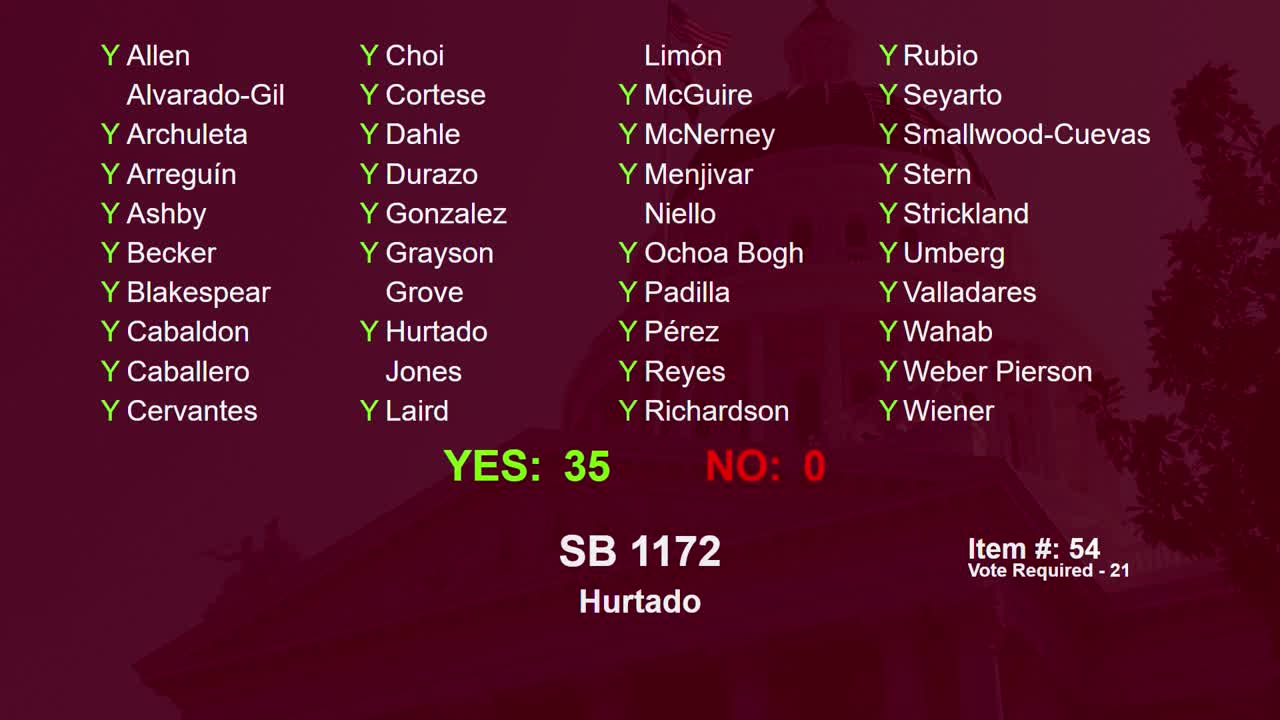
Bill Author

Bill Co-Author(s):