SB 142: Deaf and Disabled Telecommunications Program.
- Session Year: 2025-2026
- House: Senate
- Latest Version Date: 2025-06-27
Current Status:
Passed
(2025-06-27: Chaptered by Secretary of State. Chapter 19, Statutes of 2025.)
Introduced
In Committee
Awaiting First Chamber Vote
Passed First Chamber
In Committee
Awaiting Second Chamber Vote
Passed Second Chamber
Enacted
Existing law establishes the Deaf and Disabled Telecommunications Program and requires the Public Utilities Commission to administer a surcharge to collect revenues of up to $100,000,000 per year until January 1, 2025, subject to an annual appropriation of moneys by the Legislature, to allow providers of equipment and service pursuant to the Deaf and Disabled Telecommunications Program to recover their costs as they are incurred. Existing law establishes the Deaf and Disabled Telecommunications Program Administrative Committee Fund for the program described above.
This bill would extend the requirement on the commission to collect the surcharge described above until December 31, 2034, subject to annual appropriation of moneys by the Legislature, and would require the commission to transfer moneys it collects from the surcharge to the Controller for deposit into the Deaf and Disabled Telecommunications Program Administrative Committee Fund.
Existing law requires the commission to annually review the surcharge level and the balances in the fund identified above. Existing law authorized, until January 1, 2025, the commission to make necessary adjustments to the surcharge to ensure that the programs supported by the surcharge are adequately funded and that the fund balances are not excessive, as defined.
This bill would repeal that requirement and, instead, would authorize the commission to make recommendations to the Legislature regarding appropriations under the Deaf and Disabled Telecommunications Program.
Under existing law, a violation of an order, decision, rule, direction, demand, or requirement of the commission is a crime.
Because a violation of a commission action implementing this bills requirements would be a crime, the bill would impose a state-mandated local program.
The California Constitution requires the state to reimburse local agencies and school districts for certain costs mandated by the state. Statutory provisions establish procedures for making that reimbursement.
This bill would provide that no reimbursement is required by this act for a specified reason.
This bill would declare that it is to take effect immediately as an urgency statute.
This bill would express the intent of the Legislature to enact statutory changes relating to the Budget Act of 2025.This bill would express the intent of the Legislature to enact statutory changes relating to the Budget Act of 2025.
(a)The commission shall design and implement a program to provide a telecommunications device capable of serving the needs of individuals who are deaf or hard of hearing, together with a single party line, at no charge additional to the basic exchange rate, to a subscriber who is certified as an individual who is deaf or hard of hearing by a licensed physician and surgeon, audiologist, or a qualified state or federal agency, as determined by the commission, and to a subscriber that is an organization representing individuals who are deaf or hard of hearing, as determined and specified by the commission pursuant to subdivision (h). A licensed hearing aid dispenser may certify the need of an individual to participate in the program if that individual has been previously fitted with an amplified device by the dispenser and the dispenser has the individuals hearing records on file before certification. In addition, a physician assistant or nurse practitioner may certify the needs of an individual who has been diagnosed by a physician and surgeon as being deaf or hard of hearing to participate in the program after reviewing the medical records or copies of the medical records containing that diagnosis.
(b)The commission shall also design and implement a program to provide a dual-party relay system, using third-party intervention to connect individuals who are deaf or hard of hearing and offices of organizations representing individuals who are deaf or hard of hearing, as determined and specified by the commission pursuant to subdivision (h), with persons of normal hearing by way of intercommunications devices for individuals who are deaf or hard of hearing and the telephone system, making available reasonable access of all phases of public telephone service to telephone subscribers who are deaf or hard of hearing. In order to make a dual-party relay system that will meet the requirements of individuals who are deaf or hard of hearing available at a reasonable cost, the commission shall initiate an investigation, conduct public hearings to determine the most cost-effective method of providing dual-party relay service to the deaf or hard of hearing when using a telecommunications device, and solicit the advice, counsel, and physical assistance of statewide nonprofit consumer organizations of the deaf, during the development and implementation of the system. The commission shall apply for certification of this program under rules adopted by the Federal Communications Commission pursuant to Section 401 of the federal Americans with Disabilities Act of 1990 (Public Law 101-336).
(c)The commission shall also design and implement a program whereby specialized or supplemental telephone communications equipment may be provided to subscribers who are certified to be disabled at no charge additional to the basic exchange rate. The certification, including a statement of visual or medical need for specialized telecommunications equipment, shall be provided by a licensed optometrist, physician and surgeon, physician assistant, or nurse practitioner, acting within the scope of practice of the applicable license, or by a qualified state or federal agency as determined by the commission. The commission shall, in this connection, study the feasibility of, and implement, if determined to be feasible, personal income criteria, in addition to the certification of disability, for determining a subscribers eligibility under this subdivision.
(d)(1)The commission shall also design and implement a program to provide access to a speech-generating device to any subscriber who is certified as having a speech disability at no charge additional to the basic exchange rate. The certification shall be provided by a licensed physician, licensed speech-language pathologist, nurse practitioner, or qualified state or federal agency. The commission shall provide to a certified subscriber access to a speech-generating device that is all of the following:
(A)A telecommunications device or a device that includes a telecommunications component.
(B)Appropriate to meet the subscribers needs for access to, and use of, the telephone network, based on the recommendation of a licensed speech-language pathologist.
(C)Consistent with the quality of speech-generating devices available for purchase in the state.
(2)The commission shall adopt rules to implement this subdivision and subdivision (e) by January 1, 2014.
(e)All of the following apply to any device or equipment described in this section that is classified as durable medical equipment under guidelines established by the United States Department of Health and Human Services:
(1)It is the intent of the Legislature that the commission be the provider of last resort and that eligible subscribers first obtain coverage from any available public or private insurance.
(2)The commission may require the subscriber to provide information about coverage for any or all of the cost of the device or equipment that is available from a public or private insurance, the cost to the subscriber of a deductible, copayment, or other relevant expense, and any related benefit cap information.
(3)The total cost of a device or equipment provided to a subscriber under this section shall not exceed the rate of reimbursement provided by Medi-Cal for that device or equipment.
(f)This section does not require the commission to provide training to a subscriber on the use of a speech-generating device.
(g)(1)The commission shall administer a surcharge to collect revenues, subject to an annual appropriation of moneys by the Legislature, to allow providers of the equipment and service specified in subdivisions (a) to (d), inclusive, to recover costs as they are incurred under this section. The surcharge shall be in effect until December 31, 2034. The commission shall require that the programs implemented under this section be identified on subscribers bills, and shall transfer moneys collected by the commission from the surcharge to the Controller for deposit into the Deaf and Disabled Telecommunications Program Administrative Committee Fund.
(2)The commission may collect a sum not to exceed one hundred million dollars ($100,000,000) per year by imposing the surcharge pursuant to paragraph (1).
(h)The commission shall determine and specify those statewide organizations representing the deaf or hard of hearing that shall receive a telecommunications device pursuant to subdivision (a), or a dual-party relay system pursuant to subdivision (b), or both, and in which offices the equipment shall be installed in the case of an organization having more than one office.
(i)The commission may direct a telephone corporation subject to its jurisdiction to comply with its determinations and specifications pursuant to this section.
(j)The commission may make recommendations to the Legislature regarding appropriations from the Deaf and Disabled Telecommunications Program Administrative Committee Fund.
(k)In order to continue to meet the access needs of individuals with functional limitations of hearing, vision, movement, manipulation, speech, and interpretation of information, the commission shall perform an ongoing assessment of, and if appropriate, expand the scope of, the program to allow for additional access capability consistent with evolving telecommunications technology.
(l)The commission shall structure the programs required by this section so that a charge imposed to promote the goals of universal service reasonably equals the value of the benefits of universal service to contributing entities and their subscribers.
SEC. 2.No reimbursement is required by this act pursuant to Section 6 of Article XIIIB of the California Constitution because the only costs that may be incurred by a local agency or school district will be incurred because this act creates a new crime or infraction, eliminates a crime or infraction, or changes the penalty for a crime or infraction, within the meaning of Section 17556 of the Government Code, or changes the definition of a crime within the meaning of Section 6 of Article XIIIB of the California Constitution.
SEC. 3.This act is an urgency statute necessary for the immediate preservation of the public peace, health, or safety within the meaning of Article IV of the California Constitution and shall go into immediate effect. The facts constituting the necessity are:
In order to continue providing essential services for individuals who are deaf or hard of hearing, it is necessary that this act take effect immediately.
(a)The commission shall design and implement a program to provide a telecommunications device capable of serving the needs of individuals who are deaf or hard of hearing, together with a single party line, at no charge additional to the basic exchange rate, to a subscriber who is certified as an individual who is deaf or hard of hearing by a licensed physician and surgeon, audiologist, or a qualified state or federal agency, as determined by the commission, and to a subscriber that is an organization representing individuals who are deaf or hard of hearing, as determined and specified by the commission pursuant to subdivision (h). A licensed hearing aid dispenser may certify the need of an individual to participate in the program if that individual has been previously fitted with an amplified device by the dispenser and the dispenser has the individuals hearing records on file before certification. In addition, a physician assistant or nurse practitioner may certify the needs of an individual who has been diagnosed by a physician and surgeon as being deaf or hard of hearing to participate in the program after reviewing the medical records or copies of the medical records containing that diagnosis.
(b)The commission shall also design and implement a program to provide a dual-party relay system, using third-party intervention to connect individuals who are deaf or hard of hearing and offices of organizations representing individuals who are deaf or hard of hearing, as determined and specified by the commission pursuant to subdivision (h), with persons of normal hearing by way of intercommunications devices for individuals who are deaf or hard of hearing and the telephone system, making available reasonable access of all phases of public telephone service to telephone subscribers who are deaf or hard of hearing. In order to make a dual-party relay system that will meet the requirements of individuals who are deaf or hard of hearing available at a reasonable cost, the commission shall initiate an investigation, conduct public hearings to determine the most cost-effective method of providing dual-party relay service to the deaf or hard of hearing when using a telecommunications device, and solicit the advice, counsel, and physical assistance of statewide nonprofit consumer organizations of the deaf, during the development and implementation of the system. The commission shall apply for certification of this program under rules adopted by the Federal Communications Commission pursuant to Section 401 of the federal Americans with Disabilities Act of 1990 (Public Law 101-336).
(c)The commission shall also design and implement a program whereby specialized or supplemental telephone communications equipment may be provided to subscribers who are certified to be disabled at no charge additional to the basic exchange rate. The certification, including a statement of visual or medical need for specialized telecommunications equipment, shall be provided by a licensed optometrist, physician and surgeon, physician assistant, or nurse practitioner, acting within the scope of practice of the applicable license, or by a qualified state or federal agency as determined by the commission. The commission shall, in this connection, study the feasibility of, and implement, if determined to be feasible, personal income criteria, in addition to the certification of disability, for determining a subscribers eligibility under this subdivision.
(d)(1)The commission shall also design and implement a program to provide access to a speech-generating device to any subscriber who is certified as having a speech disability at no charge additional to the basic exchange rate. The certification shall be provided by a licensed physician, licensed speech-language pathologist, nurse practitioner, or qualified state or federal agency. The commission shall provide to a certified subscriber access to a speech-generating device that is all of the following:
(A)A telecommunications device or a device that includes a telecommunications component.
(B)Appropriate to meet the subscribers needs for access to, and use of, the telephone network, based on the recommendation of a licensed speech-language pathologist.
(C)Consistent with the quality of speech-generating devices available for purchase in the state.
(2)The commission shall adopt rules to implement this subdivision and subdivision (e) by January 1, 2014.
(e)All of the following apply to any device or equipment described in this section that is classified as durable medical equipment under guidelines established by the United States Department of Health and Human Services:
(1)It is the intent of the Legislature that the commission be the provider of last resort and that eligible subscribers first obtain coverage from any available public or private insurance.
(2)The commission may require the subscriber to provide information about coverage for any or all of the cost of the device or equipment that is available from a public or private insurance, the cost to the subscriber of a deductible, copayment, or other relevant expense, and any related benefit cap information.
(3)The total cost of a device or equipment provided to a subscriber under this section shall not exceed the rate of reimbursement provided by Medi-Cal for that device or equipment.
(f)This section does not require the commission to provide training to a subscriber on the use of a speech-generating device.
(g)(1)The commission shall administer a surcharge to collect revenues, subject to an annual appropriation of moneys by the Legislature, to allow providers of the equipment and service specified in subdivisions (a) to (d), inclusive, to recover costs as they are incurred under this section. The surcharge shall be in effect until January 1, 2025. December 31, 2034. The commission shall require that the programs implemented under this section be identified on subscribers bills, and shall establish a fund and require separate accounting transfer moneys collected by the commission from the surcharge to the Controller for each of deposit into the programs implemented under this section. Deaf and Disabled Telecommunications Program Administrative Committee Fund.
(2)The commission may collect a sum not to exceed one hundred million dollars ($100,000,000) per year by imposing the surcharge pursuant to paragraph (1).
(h)The commission shall determine and specify those statewide organizations representing the deaf or hard of hearing that shall receive a telecommunications device pursuant to subdivision (a), or a dual-party relay system pursuant to subdivision (b), or both, and in which offices the equipment shall be installed in the case of an organization having more than one office.
(i)The commission may direct a telephone corporation subject to its jurisdiction to comply with its determinations and specifications pursuant to this section.
(j)The commission shall annually review the surcharge level and the balances in the funds established pursuant to subdivision (g). Until January 1, 2025, the commission may make, within the limits set by subdivision (g), necessary adjustments make recommendations to the surcharge to ensure that Legislature regarding appropriations from the programs supported by the surcharge are adequately funded Deaf and that the fund balances are not excessive. A fund balance that is projected to exceed six months worth of projected expenses at the end of the fiscal year is excessive. Disabled Telecommunications Program Administrative Committee Fund.
(k)In order to continue to meet the access needs of individuals with functional limitations of hearing, vision, movement, manipulation, speech, and interpretation of information, the commission shall perform an ongoing assessment of, and if appropriate, expand the scope of, the program to allow for additional access capability consistent with evolving telecommunications technology.
(l)The commission shall structure the programs required by this section so that a charge imposed to promote the goals of universal service reasonably equals the value of the benefits of universal service to contributing entities and their subscribers.
SEC. 2.No reimbursement is required by this act pursuant to Section 6 of Article XIIIB of the California Constitution because the only costs that may be incurred by a local agency or school district will be incurred because this act creates a new crime or infraction, eliminates a crime or infraction, or changes the penalty for a crime or infraction, within the meaning of Section 17556 of the Government Code, or changes the definition of a crime within the meaning of Section 6 of Article XIIIB of the California Constitution.
SEC. 3.This act is an urgency statute necessary for the immediate preservation of the public peace, health, or safety within the meaning of Article IV of the California Constitution and shall go into immediate effect. The facts constituting the necessity are:
In order to continue providing essential services for individuals who are deaf or hard of hearing, it is necessary that this act take effect immediately.
SECTION 1.It is the intent of the Legislature to enact statutory changes relating to the Budget Act of 2025.It is the intent of the Legislature to enact statutory changes relating to the Budget Act of 2025.
|
Date
|
Status
|
|---|---|
| Jun 27, 2025 | Chaptered by Secretary of State. Chapter 19, Statutes of 2025. |
| Jun 27, 2025 | Approved by the Governor. |
| Jun 27, 2025 | Enrolled and presented to the Governor at 3 p.m. |
| Jun 27, 2025 | Urgency clause adopted. |
| Jun 27, 2025 | In Senate. Concurrence in Assembly amendments pending. |
| Jun 27, 2025 | Assembly amendments concurred in. (Ayes 37. Noes 0. Page 1816.) Ordered to engrossing and enrolling. |
| Jun 27, 2025 | Withdrawn from committee pursuant to Assembly Rule 96. |
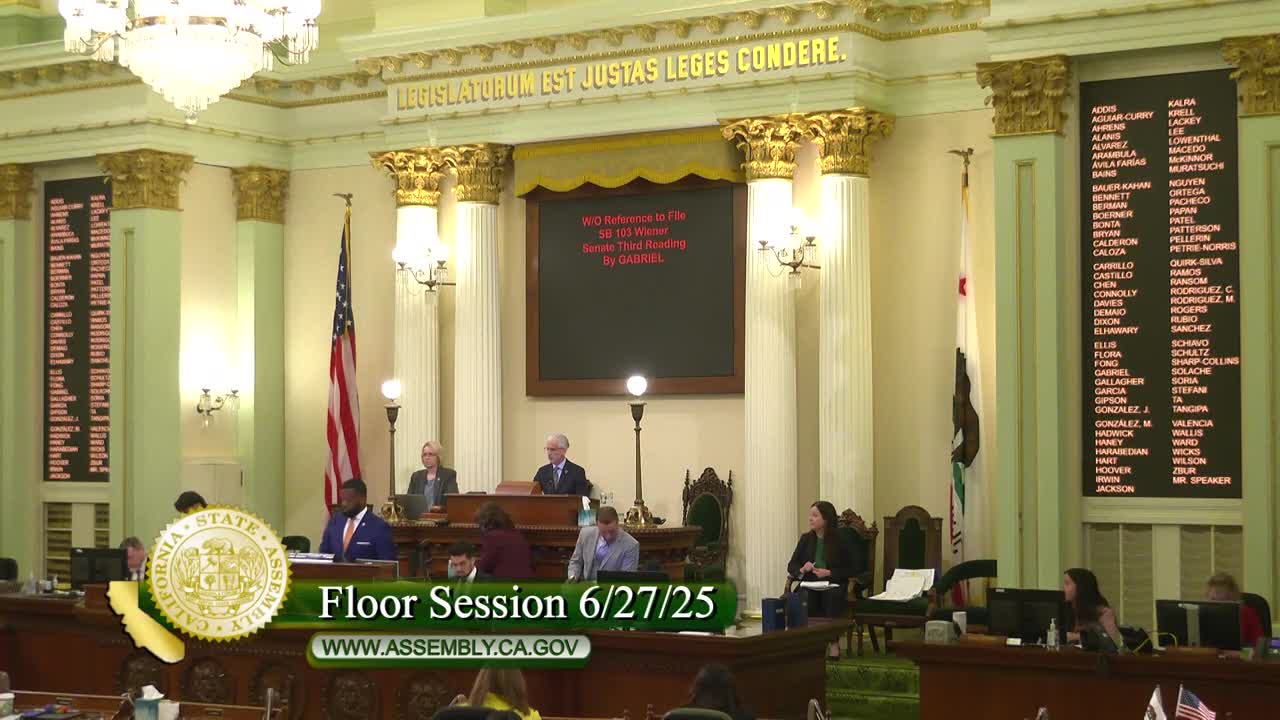
| Jun 27, 2025 | Read third time. Urgency clause adopted. Passed. (Ayes 72. Noes 1. Page 2326.) Ordered to the Senate. |
| Jun 27, 2025 | Ordered to third reading. |
| Jun 27, 2025 | Assembly Rule 63 suspended. (Ayes 55. Noes 19. Page 2316.) |
| Jun 24, 2025 | From committee with author's amendments. Read second time and amended. Re-referred to Com. on BUDGET. |
| Mar 24, 2025 | Referred to Com. on BUDGET. |
| Mar 20, 2025 | In Assembly. Read first time. Held at Desk. |
| Mar 20, 2025 | Read third time. Passed. (Ayes 28. Noes 10. Page 444.) Ordered to the Assembly. |
| Mar 18, 2025 | Read second time. Ordered to third reading. |
| Mar 17, 2025 | Withdrawn from committee. (Ayes 27. Noes 10. Page 384.) |
| Mar 17, 2025 | Ordered to second reading. |
| Feb 5, 2025 | Referred to Com. on B. & F. R. |
| Jan 24, 2025 | From printer. May be acted upon on or after February 23. |
| Jan 23, 2025 | Introduced. Read first time. To Com. on RLS. for assignment. To print. |
|
Date
|
Description
|
Location
|
Votes
|
|
|---|---|---|---|---|
| Jun 27, 2025 | SB 142 B. & F. R. Third Reading Urgency By GABRIEL | Assembly Floor |
Passed |
|
| Jun 27, 2025 | Unfinished Business SB142 B. & F.R. (Wiener) Urgency Clause Concurrence | Senate Floor |
Passed |
|
| Mar 20, 2025 | Reconsider: The committee(s) on WAM recommend(s) that the measure be PASSED, UNAMENDED. | Senate Floor |
Passed |
This list shows positions taken on this bill by organizations on the date displayed, which is linked to the original source.
Positions by individuals are not included.
SENATE RULES COMMITTEE Office of Senate Floor Analyses (916) 651-1520 Fax: (916) 327-4478 | SB 142 |
UNFINISHED BUSINESS
Bill No: SB 142
Author: Committee on Budget and Fiscal Review
Amended: 6/24/25
Vote: 27 - Urgency
ASSEMBLY FLOOR: 72-1, 6/27/25 - See last page for vote
SUBJECT: Deaf and Disabled Telecommunications Program
SOURCE: Author
DIGEST:
This bill relates to the Deaf and Disabled Telecommunications Program.
Assembly Amendments
delete the Senate version of this bill and instead add the current language.
ANALYSIS: This bill extends the surcharge for the Deaf and Disabled Telecommunications Program (DDTP) until December 31, 2034 and authorizes the California Public Utilities Commission to make recommendations to the Legislature regarding the appropriations for the DDTP.
FISCAL EFFECT: Appropriation: No Fiscal Com.: Yes Local: Yes
SUPPORT: (Verified 6/25/25)
None received
OPPOSITION: (Verified 6/25/25)
None received
ASSEMBLY FLOOR: 72-1, 6/27/25
AYES: Addis, Aguiar-Curry, Ahrens, Alanis, Alvarez, Arambula, Ávila Farías, Bains, Bennett, Berman, Boerner, Bonta, Bryan, Calderon, Caloza, Carrillo, Castillo, Chen, Connolly, Davies, Dixon, Elhawary, Flora, Fong, Gabriel, Gallagher, Garcia, Gipson, Jeff Gonzalez, Mark González, Hadwick, Haney, Harabedian, Hart, Hoover, Irwin, Jackson, Kalra, Krell, Lackey, Lee, Lowenthal, McKinnor, Muratsuchi, Nguyen, Ortega, Pacheco, Papan, Patel, Patterson, Petrie-Norris, Quirk-Silva, Ramos, Ransom, Celeste Rodriguez, Michelle Rodriguez, Rogers, Blanca Rubio, Schiavo, Schultz, Sharp-Collins, Solache, Soria, Stefani, Ta, Valencia, Wallis, Ward, Wicks, Wilson, Zbur, Rivas
NOES: DeMaio
NO VOTE RECORDED: Bauer-Kahan, Ellis, Macedo, Pellerin, Sanchez, Tangipa
Prepared by: Eunice Roh / B. & F.R. / (916) 651-4103
9/11/26 11:31:28
**** END ****
SENATE RULES COMMITTEE Office of Senate Floor Analyses (916) 651-1520 Fax: (916) 327-4478 | SB 142 |
UNFINISHED BUSINESS
Bill No: SB 142
Author: Committee on Budget and Fiscal Review
Amended: 6/24/25 in Assembly
Vote: 27 - Urgency
ASSEMBLY FLOOR: 68-1, 6/27/25
(ROLL CALL NOT AVAILABLE)
SUBJECT: Deaf and Disabled Telecommunications Program
SOURCE: Author
DIGEST:
This bill relates to the Deaf and Disabled Telecommunications Program.
Assembly Amendments
delete the Senate version of this bill and instead add the current language.
ANALYSIS: This bill extends the surcharge for the Deaf and Disabled Telecommunications Program (DDTP) until December 31, 2034 and authorizes the California Public Utilities Commission to make recommendations to the Legislature regarding the appropriations for the DDTP.
FISCAL EFFECT: Appropriation: No Fiscal Com.: Yes Local: Yes
SUPPORT: (Verified 6/25/25)
None received
OPPOSITION: (Verified 6/25/25)
None received
Prepared by: Eunice Roh / B. & F.R. / (916) 651-4103
6/27/25 12:27:14
**** END ****
(Without Reference to File)
SENATE THIRD READING
STR Bill Id:SB 142
Author:(Committee on Budget and Fiscal Review)
As Amended Ver:June 24, 2025
2/3 vote. Budget Bill Appropriation Takes Effect Immediately
SUMMARY
This bill extends the sunset on the Deaf and Disabled Telecommunications Program surcharge.
Major Provisions
- Extends the surcharge for the Deaf and Disabled Telecommunications Program (DDTP) until December 31, 2034 and authorizes the California Public Utilities Commission to make recommendations to the Legislature regarding the appropriations for the DDTP.
COMMENTS
According to the Author
This bill is necessary to implement the Budget Act of 2025.
Arguments in Support
None on file.
Arguments in Opposition
None on file.
FISCAL COMMENTS
This bill extends the Deaf and Disabled Telecommunications Program surcharge until 2035.
VOTES
SENATE FLOOR: 28-10-2
YES: Allen, Archuleta, Arreguín, Ashby, Becker, Blakespear, Cabaldon, Caballero, Cervantes, Cortese, Durazo, Gonzalez, Grayson, Hurtado, Laird, Limón, McGuire, McNerney, Menjivar, Padilla, Pérez, Richardson, Rubio, Smallwood-Cuevas, Umberg, Wahab, Weber Pierson, Wiener
NO: Alvarado-Gil, Choi, Dahle, Grove, Jones, Niello, Ochoa Bogh, Seyarto, Strickland, Valladares
ABS, ABST OR NV: Reyes, Stern
UPDATED
VERSION: June 24, 2025
CONSULTANT: Shy Forbes / BUDGET / (916) 319-2099 FN: 0001010
SENATE RULES COMMITTEE Office of Senate Floor Analyses (916) 651-1520 Fax: (916) 327-4478 | SB 142 |
THIRD READING
Bill No: SB 142
Author: Committee on Budget and Fiscal Review
Introduced: 1/23/25
Vote: 21
SOURCE: Author
DIGEST:
This bill expresses the intent of the Legislature to enact statutory changes relating to the Budget Act of 2025.
ANALYSIS: Senate Bills 100 through 219, inclusive, are to be considered as vehicles for the 2025-26 Budget Trailer Bills.
FISCAL EFFECT: Appropriation: No Fiscal Com.: No Local: No
SUPPORT: (Verified 3/18/25)
None received
OPPOSITION: (Verified 3/18/25)
None received
Prepared by: Sofia Pachon-Mendez / SFA / (916) 651-1520
3/19/25 15:13:18
**** END ****
Discussed in Hearing
View Older Hearings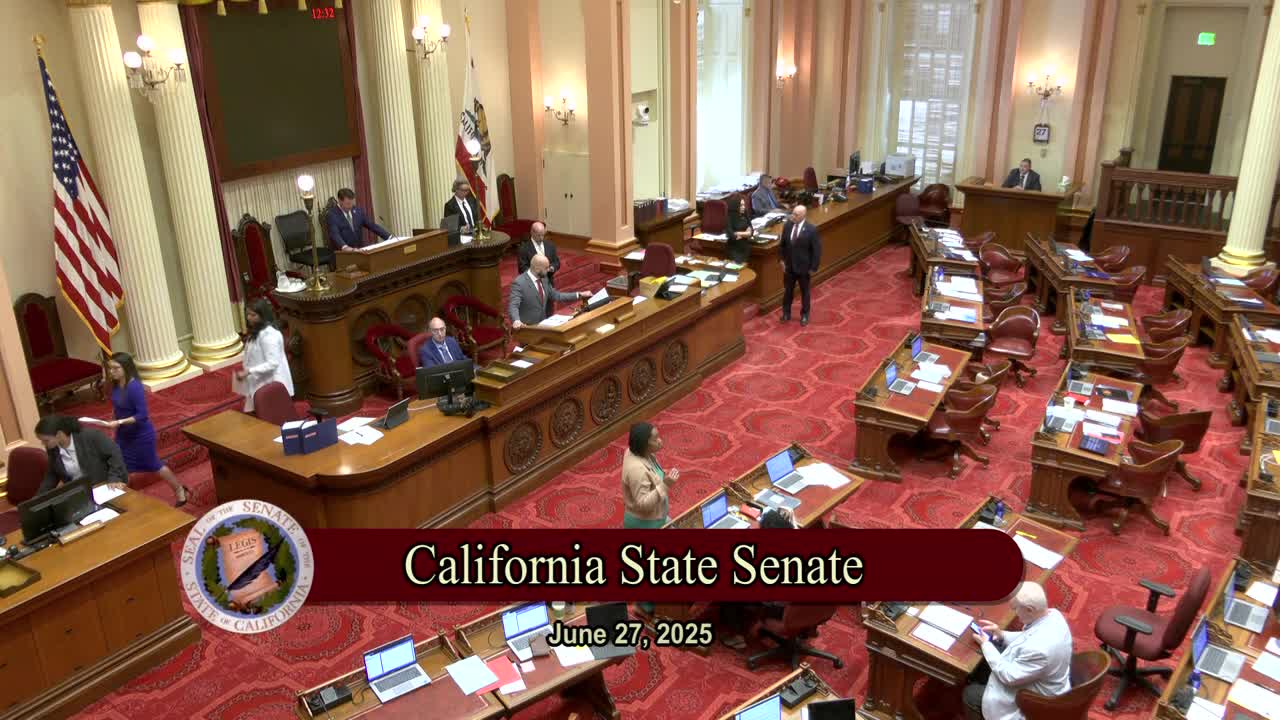
Bill Author
Bill Co-Author(s):