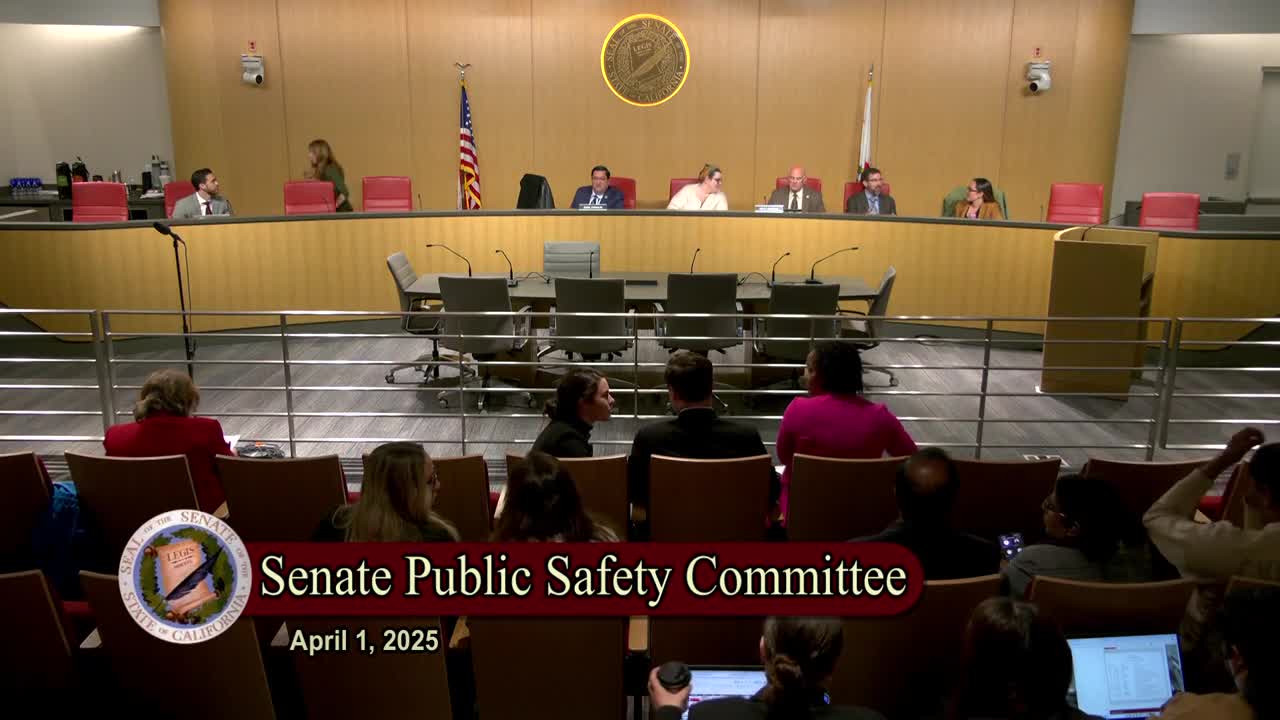
SB 221: Crimes: stalking.
- Session Year: 2025-2026
- House: Senate
- Latest Version Date: 2025-10-10
Current Status:
Passed
(2025-10-10: Chaptered by Secretary of State. Chapter 576, Statutes of 2025.)
Introduced
In Committee
Awaiting First Chamber Vote
Passed First Chamber
In Committee
Awaiting Second Chamber Vote
Passed Second Chamber
Enacted
Existing law makes a person who willfully, maliciously, and repeatedly follows or willfully and maliciously harasses another person and who makes a credible threat with the intent to place that person in reasonable fear for the persons safety, or the safety of the persons immediate family, guilty of the crime of stalking, punishable as a misdemeanor or a felony.
This bill would expand the meaning of credible threat to include threats to a persons pet, service animal, emotional support animal, or horse. By changing the definition of a crime, this bill would impose a state-mandated local program.
The California Constitution requires the state to reimburse local agencies and school districts for certain costs mandated by the state. Statutory provisions establish procedures for making that reimbursement.
This bill would provide that no reimbursement is required by this act for a specified reason.
Existing law makes a person who willfully, maliciously, and repeatedly follows or willfully and maliciously harasses another person and who makes a credible threat with the intent to place that person in reasonable fear for the persons safety, or the safety of the persons immediate family, guilty of the crime of stalking, punishable as a misdemeanor or a felony.
This bill would also make a person guilty of stalking if the person willfully, maliciously, and repeatedly follows or willfully and maliciously harasses another person and who makes a credible threat with the intent to place that person in reasonable fear for the safety of that expand the meaning of credible threat to include threats to a persons pet, service animal, emotional support animal, or horse. By changing the definition of a crime, this bill would impose a state-mandated local program.
The California Constitution requires the state to reimburse local agencies and school districts for certain costs mandated by the state. Statutory provisions establish procedures for making that reimbursement.
This bill would provide that no reimbursement is required by this act for a specified reason.
Existing law makes a person who willfully, maliciously, and repeatedly follows or willfully and maliciously harasses another person and who makes a credible threat with the intent to place that person in reasonable fear for the persons safety, or the safety of the persons immediate family, guilty of the crime of stalking, punishable as a misdemeanor or a felony.
This bill would also make a person guilty of stalking if the person willfully, maliciously, and repeatedly follows or willfully and maliciously harasses another person and who makes a credible threat with the intent to place that person in reasonable fear for the safety of that persons pet, service animal, emotional support animal, or horse. By changing the definition of a crime, this bill would impose a state-mandated local program.
The California Constitution requires the state to reimburse local agencies and school districts for certain costs mandated by the state. Statutory provisions establish procedures for making that reimbursement.
This bill would provide that no reimbursement is required by this act for a specified reason.
(a)Any person who willfully, maliciously, and repeatedly follows or willfully and maliciously harasses another person and who makes a credible threat with the intent to place that person in reasonable fear for their safety, or the safety of their immediate family, is guilty of the crime of stalking, punishable by imprisonment in a county jail for not more than one year, or by a fine of not more than one thousand dollars ($1,000), or by both that fine and imprisonment, or by imprisonment in the state prison.
(b)Any person who violates subdivision (a) when there is a temporary restraining order, injunction, or any other court order in effect prohibiting the behavior described in subdivision (a) against the same party, shall be punished by imprisonment in the state prison for two, three, or four years.
(c)(1)Every person who, after having been convicted of a felony under Section 273.5, 273.6, or 422, commits a violation of subdivision (a) shall be punished by imprisonment in a county jail for not more than one year, or by a fine of not more than one thousand dollars ($1,000), or by both that fine and imprisonment, or by imprisonment in the state prison for two, three, or five years.
(2)Every person who, after having been convicted of a felony under subdivision (a), commits a violation of this section shall be punished by imprisonment in the state prison for two, three, or five years.
(d)In addition to the penalties provided in this section, the sentencing court may order a person convicted of a felony under this section to register as a sex offender pursuant to Section 290.006.
(e)For the purposes of this section, harass means engages in a knowing and willful course of conduct directed at a specific person that seriously alarms, annoys, torments, or terrorizes the person, and that serves no legitimate purpose.
(f)For the purposes of this section, course of conduct means two or more acts occurring over a period of time, however short, evidencing a continuity of purpose. Constitutionally protected activity is not included within the meaning of course of conduct.
(g)For the purposes of this section, credible threat means a verbal or written threat, including a threat performed through the use of an electronic communication device, or a threat implied by a pattern of conduct or a combination of verbal, written, or electronically communicated statements and conduct, including threats to a persons pet, service animal, emotional support animal, or horse, made with the intent to place the person that is the target of the threat in reasonable fear for their safety, or the safety of their family, and made with the apparent ability to carry out the threat so as to cause the person who is the target of the threat to reasonably fear for their safety or the safety of their family. It is not necessary to prove that the defendant had the intent to actually carry out the threat. The present incarceration of a person making the threat shall not be a bar to prosecution under this section. Constitutionally protected activity is not included within the meaning of credible threat.
(h)For purposes of this section, the term electronic communication device includes, but is not limited to, telephones, cellular phones, computers, video recorders, fax machines, or pagers. Electronic communication has the same meaning as the term defined in Subsection 12 of Section 2510 of Title 18 of the United States Code.
(i)This section shall not apply to conduct that occurs during labor picketing.
(j)If probation is granted, or the execution or imposition of a sentence is suspended, for any person convicted under this section, it shall be a condition of probation that the person participate in counseling, as designated by the court. However, the court, upon a showing of good cause, may find that the counseling requirement shall not be imposed.
(k)(1)The sentencing court also shall consider issuing an order restraining the defendant from any contact with the victim, that may be valid for up to 10 years, as determined by the court. It is the intent of the Legislature that the length of any restraining order be based upon the seriousness of the facts before the court, the probability of future violations, the safety of the victim and their immediate family, and the information provided to the court pursuant to Section 273.75.
(2)This protective order may be issued by the court whether the defendant is sentenced to state prison, county jail, or if imposition of sentence is suspended and the defendant is placed on probation.
(l)For purposes of this section, immediate family means any spouse, parent, child, any person related by consanguinity or affinity within the second degree, or any other person who regularly resides in the household, or who, within the prior six months, regularly resided in the household.
(m)The court shall consider whether the defendant would benefit from treatment pursuant to Section 2684. If it is determined to be appropriate, the court shall recommend that the Department of Corrections and Rehabilitation make a certification as provided in Section 2684. Upon the certification, the defendant shall be evaluated and transferred to the appropriate hospital for treatment pursuant to Section 2684.
SEC. 2.No reimbursement is required by this act pursuant to Section 6 of Article XIIIB of the California Constitution because the only costs that may be incurred by a local agency or school district will be incurred because this act creates a new crime or infraction, eliminates a crime or infraction, or changes the penalty for a crime or infraction, within the meaning of Section 17556 of the Government Code, or changes the definition of a crime within the meaning of Section 6 of Article XIIIB of the California Constitution.
(a)Any person who willfully, maliciously, and repeatedly follows or willfully and maliciously harasses another person and who makes a credible threat with the intent to place that person in reasonable fear for their safety, or the safety of that persons pet, service animal, emotional support animal, or horse, or the safety of their immediate family their immediate family, is guilty of the crime of stalking, punishable by imprisonment in a county jail for not more than one year, or by a fine of not more than one thousand dollars ($1,000), or by both that fine and imprisonment, or by imprisonment in the state prison.
(b)Any person who violates subdivision (a) when there is a temporary restraining order, injunction, or any other court order in effect prohibiting the behavior described in subdivision (a) against the same party, shall be punished by imprisonment in the state prison for two, three, or four years.
(c)(1)Every person who, after having been convicted of a felony under Section 273.5, 273.6, or 422, commits a violation of subdivision (a) shall be punished by imprisonment in a county jail for not more than one year, or by a fine of not more than one thousand dollars ($1,000), or by both that fine and imprisonment, or by imprisonment in the state prison for two, three, or five years.
(2)Every person who, after having been convicted of a felony under subdivision (a), commits a violation of this section shall be punished by imprisonment in the state prison for two, three, or five years.
(d)In addition to the penalties provided in this section, the sentencing court may order a person convicted of a felony under this section to register as a sex offender pursuant to Section 290.006.
(e)For the purposes of this section, harass means engages in a knowing and willful course of conduct directed at a specific person that seriously alarms, annoys, torments, or terrorizes the person, and that serves no legitimate purpose.
(f)For the purposes of this section, course of conduct means two or more acts occurring over a period of time, however short, evidencing a continuity of purpose. Constitutionally protected activity is not included within the meaning of course of conduct.
(g)For the purposes of this section, credible threat means a verbal or written threat, including that a threat performed through the use of an electronic communication device, or a threat implied by a pattern of conduct or a combination of verbal, written, or electronically communicated statements and conduct, including threats to a persons pet, service animal, emotional support animal, or horse, made with the intent to place the person that is the target of the threat in reasonable fear for their safety, or the safety of their family, and made with the apparent ability to carry out the threat so as to cause the person who is the target of the threat to reasonably fear for their safety or the safety of their family. It is not necessary to prove that the defendant had the intent to actually carry out the threat. The present incarceration of a person making the threat shall not be a bar to prosecution under this section. Constitutionally protected activity is not included within the meaning of credible threat.
(h)For purposes of this section, the term electronic communication device includes, but is not limited to, telephones, cellular phones, computers, video recorders, fax machines, or pagers. Electronic communication has the same meaning as the term defined in Subsection 12 of Section 2510 of Title 18 of the United States Code.
(i)This section shall not apply to conduct that occurs during labor picketing.
(j)If probation is granted, or the execution or imposition of a sentence is suspended, for any person convicted under this section, it shall be a condition of probation that the person participate in counseling, as designated by the court. However, the court, upon a showing of good cause, may find that the counseling requirement shall not be imposed.
(k)(1)The sentencing court also shall consider issuing an order restraining the defendant from any contact with the victim, that may be valid for up to 10 years, as determined by the court. It is the intent of the Legislature that the length of any restraining order be based upon the seriousness of the facts before the court, the probability of future violations, the safety of the victim and their immediate family, and the information provided to the court pursuant to Section 273.75.
(2)This protective order may be issued by the court whether the defendant is sentenced to state prison, county jail, or if imposition of sentence is suspended and the defendant is placed on probation.
(l)For purposes of this section, immediate family means any spouse, parent, child, any person related by consanguinity or affinity within the second degree, or any other person who regularly resides in the household, or who, within the prior six months, regularly resided in the household.
(m)The court shall consider whether the defendant would benefit from treatment pursuant to Section 2684. If it is determined to be appropriate, the court shall recommend that the Department of Corrections and Rehabilitation make a certification as provided in Section 2684. Upon the certification, the defendant shall be evaluated and transferred to the appropriate hospital for treatment pursuant to Section 2684.
SEC. 2.No reimbursement is required by this act pursuant to Section 6 of Article XIIIB of the California Constitution because the only costs that may be incurred by a local agency or school district will be incurred because this act creates a new crime or infraction, eliminates a crime or infraction, or changes the penalty for a crime or infraction, within the meaning of Section 17556 of the Government Code, or changes the definition of a crime within the meaning of Section 6 of Article XIIIB of the California Constitution.
(a)Any person who willfully, maliciously, and repeatedly follows or willfully and maliciously harasses another person and who makes a credible threat with the intent to place that person in reasonable fear for their safety, or the safety of their immediate family, that persons pet, service animal, emotional support animal, or horse, or the safety of their immediate family is guilty of the crime of stalking, punishable by imprisonment in a county jail for not more than one year, or by a fine of not more than one thousand dollars ($1,000), or by both that fine and imprisonment, or by imprisonment in the state prison.
(b)Any person who violates subdivision (a) when there is a temporary restraining order, injunction, or any other court order in effect prohibiting the behavior described in subdivision (a) against the same party, shall be punished by imprisonment in the state prison for two, three, or four years.
(c)(1)Every person who, after having been convicted of a felony under Section 273.5, 273.6, or 422, commits a violation of subdivision (a) shall be punished by imprisonment in a county jail for not more than one year, or by a fine of not more than one thousand dollars ($1,000), or by both that fine and imprisonment, or by imprisonment in the state prison for two, three, or five years.
(2)Every person who, after having been convicted of a felony under subdivision (a), commits a violation of this section shall be punished by imprisonment in the state prison for two, three, or five years.
(d)In addition to the penalties provided in this section, the sentencing court may order a person convicted of a felony under this section to register as a sex offender pursuant to Section 290.006.
(e)For the purposes of this section, harasses harass means engages in a knowing and willful course of conduct directed at a specific person that seriously alarms, annoys, torments, or terrorizes the person, and that serves no legitimate purpose.
(f)For the purposes of this section, course of conduct means two or more acts occurring over a period of time, however short, evidencing a continuity of purpose. Constitutionally protected activity is not included within the meaning of course of conduct.
(g)For the purposes of this section, credible threat means a verbal or written threat, including that performed through the use of an electronic communication device, or a threat implied by a pattern of conduct or a combination of verbal, written, or electronically communicated statements and conduct, made with the intent to place the person that is the target of the threat in reasonable fear for their safety, or the safety of their family, and made with the apparent ability to carry out the threat so as to cause the person who is the target of the threat to reasonably fear for their safety or the safety of their family. It is not necessary to prove that the defendant had the intent to actually carry out the threat. The present incarceration of a person making the threat shall not be a bar to prosecution under this section. Constitutionally protected activity is not included within the meaning of credible threat.
(h)For purposes of this section, the term electronic communication device includes, but is not limited to, telephones, cellular phones, computers, video recorders, fax machines, or pagers. Electronic communication has the same meaning as the term defined in Subsection 12 of Section 2510 of Title 18 of the United States Code.
(i)This section shall not apply to conduct that occurs during labor picketing.
(j)If probation is granted, or the execution or imposition of a sentence is suspended, for any person convicted under this section, it shall be a condition of probation that the person participate in counseling, as designated by the court. However, the court, upon a showing of good cause, may find that the counseling requirement shall not be imposed.
(k)(1)The sentencing court also shall consider issuing an order restraining the defendant from any contact with the victim, that may be valid for up to 10 years, as determined by the court. It is the intent of the Legislature that the length of any restraining order be based upon the seriousness of the facts before the court, the probability of future violations, the safety of the victim and their immediate family, and the information provided to the court pursuant to Section 273.75.
(2)This protective order may be issued by the court whether the defendant is sentenced to state prison, county jail, or if imposition of sentence is suspended and the defendant is placed on probation.
(l)For purposes of this section, immediate family means any spouse, parent, child, any person related by consanguinity or affinity within the second degree, or any other person who regularly resides in the household, or who, within the prior six months, regularly resided in the household.
(m)The court shall consider whether the defendant would benefit from treatment pursuant to Section 2684. If it is determined to be appropriate, the court shall recommend that the Department of Corrections and Rehabilitation make a certification as provided in Section 2684. Upon the certification, the defendant shall be evaluated and transferred to the appropriate hospital for treatment pursuant to Section 2684.
SEC. 2.No reimbursement is required by this act pursuant to Section 6 of Article XIIIB of the California Constitution because the only costs that may be incurred by a local agency or school district will be incurred because this act creates a new crime or infraction, eliminates a crime or infraction, or changes the penalty for a crime or infraction, within the meaning of Section 17556 of the Government Code, or changes the definition of a crime within the meaning of Section 6 of Article XIIIB of the California Constitution.
|
Date
|
Status
|
|---|---|
| Oct 10, 2025 | Chaptered by Secretary of State. Chapter 576, Statutes of 2025. |
| Oct 10, 2025 | Approved by the Governor. |
| Sep 16, 2025 | Enrolled and presented to the Governor at 3 p.m. |
| Sep 8, 2025 | Assembly amendments concurred in. (Ayes 39. Noes 0. Page 2599.) Ordered to engrossing and enrolling. |
| Sep 3, 2025 | In Senate. Concurrence in Assembly amendments pending. |
| Sep 3, 2025 | Read third time. Passed. (Ayes 73. Noes 0. Page 2871.) Ordered to the Senate. |
| Sep 2, 2025 | Read second time. Ordered to third reading. |
| Aug 29, 2025 | From committee: Do pass. (Ayes 15. Noes 0.) (August 29). |
| Aug 20, 2025 | August 20 set for first hearing. Placed on APPR. suspense file. |
| Jul 17, 2025 | Read second time and amended. Re-referred to Com. on APPR. |
| Jul 16, 2025 | From committee: Do pass as amended and re-refer to Com. on APPR. (Ayes 8. Noes 0.) (July 15). |
| Jul 1, 2025 | July 1 hearing postponed by committee. |
| Jun 17, 2025 | June 17 hearing postponed by committee. |
| Jun 9, 2025 | Referred to Com. on PUB. S. |
| Jun 3, 2025 | In Assembly. Read first time. Held at Desk. |
| Jun 2, 2025 | Read third time. Passed. (Ayes 36. Noes 0. Page 1390.) Ordered to the Assembly. |
| May 23, 2025 | Read second time. Ordered to third reading. |
| May 23, 2025 | From committee: Do pass. (Ayes 6. Noes 0. Page 1192.) (May 23). |
| May 16, 2025 | Set for hearing May 23. |
| Apr 21, 2025 | April 21 hearing: Placed on APPR. suspense file. |
| Apr 4, 2025 | Set for hearing April 21. |
| Apr 1, 2025 | From committee: Do pass and re-refer to Com. on APPR. (Ayes 6. Noes 0. Page 611.) (April 1). Re-referred to Com. on APPR. |
| Mar 19, 2025 | Set for hearing April 1. |
| Mar 18, 2025 | March 25 set for first hearing canceled at the request of author. |
| Mar 7, 2025 | Set for hearing March 25. |
| Feb 5, 2025 | Referred to Com. on PUB. S. |
| Jan 24, 2025 | From printer. May be acted upon on or after February 23. |
| Jan 23, 2025 | Introduced. Read first time. To Com. on RLS. for assignment. To print. |
|
Date
|
Description
|
Location
|
Votes
|
|
|---|---|---|---|---|
| Sep 8, 2025 | Unfinished Business SB221 Ochoa Bogh et al. Concurrence | Senate Floor |
Passed |
|
| Sep 3, 2025 | SB 221 Ochoa Bogh Senate Third Reading | Assembly Floor |
Passed |
|
| Aug 29, 2025 | Do pass. | Assembly Standing Committee on Appropriations |
Passed |
|
| Jul 15, 2025 | Do pass as amended and be re-referred to the Committee on [Appropriations] | Assembly Standing Committee on Public Safety |
Passed |
|
| Jun 2, 2025 | Senate 3rd Reading SB221 Ochoa Bogh et al. | Senate Floor |
Passed |
|
| May 23, 2025 | Do pass | Senate Standing Committee on Appropriations |
Passed |
|
| Apr 21, 2025 | Placed on suspense file | Senate Standing Committee on Appropriations |
Passed |
|
| Apr 1, 2025 | Do pass, but first be re-referred to the Committee on [Appropriations] | Senate Standing Committee on Public Safety |
Passed |
This list shows positions taken on this bill by organizations on the date displayed, which is linked to the original source.
Positions by individuals are not included.
|
Organization
|
Position
|
Date
|
|---|---|---|
| Aclu California Action | ** Against | |
| American Kennel Club, INC. | ** Support | |
| American Society For The Prevention Of Cruelty To Animals | ** Support | |
| Angel's Furry Friends Rescue | ** Support | |
| Animal Legal Defense Fund | ** Support | |
| Animal Rescue Mission | ** Support | |
| Animal Rescuers for Change | ** Support | |
| ANIMAL WELLNESS ACTION | ** Support | |
| Arcadia Police Officers' Association | ** Support | |
| Berkeley Animal Rights Center | ** Support | |
| Better Together Forever | ** Support | |
| Born Again Animal Rescue and Adoption | ** Support | |
| Brea Police Association | ** Support | |
| Burbank Police Officers' Association | ** Support | |
| California Association of School Police Chiefs | ** Support | |
| California Coalition of School Safety Professionals | ** Support | |
| California District Attorneys Association | ** Support | |
| California Narcotic Officers' Association | ** Support | |
| California Police Chiefs Association | ** Support | |
| California Reserve Peace Officers Association | ** Support | |
| California State Sheriffs' Association | ** Support | |
| Californians United for a Responsible Budget | ** Against | |
| Claremont Police Officers' Association | ** Support | |
| Compassionate Bay | ** Support | |
| Concerned Citizens Animal Rescue | ** Support | |
| Corona Police Officers' Association | ** Support | |
| Culver City Police Officers' Association | ** Support | |
| Ella Baker Center For Human Rights | ** Against | |
| Feline Lucky Adventures | ** Support | |
| Fullerton Police Officers' Association | ** Support | |
| Giantmecha Syndicate | ** Support | |
| Greater Los Angeles Animal Spay Neuter Collaborative | ** Support | |
| Initiate Justice | ** Against | |
| Latino Alliance for Animal Care Coalition | ** Support | |
| Leaders for Ethics, Animals, and The Planet | ** Support | |
| Legal Services for Prisoners with Children | ** Against | |
| Local 148 La County Public Defenders Union | ** Against | |
| Los Angeles Democrats for the Protection of Animals | ** Support | |
| Los Angeles School Police Management Association | ** Support | |
| los angeles school police officers association | ** Support | |
| Michelson Center For Public Policy | ** Support | |
| Multiple Individuals | ** Support | |
| Multiple Individuals (488) | ** Support | |
| Murrieta Police Officers' Association | ** Support | |
| Newport Beach Police Association | ** Support | |
| NY 4 Whales | ** Support | |
| NY4Whales | ** Support | |
| Palos Verdes Police Officers' Association | ** Support | |
| Pibbles N Kibbles Animal Rescue | ** Support | |
| Placer County Deputy Sheriffs' Association | ** Support | |
| Plant-based Advocates | ** Support | |
| Pomona Police Officers' Association | ** Support | |
| Project Minnie | ** Support | |
| Real Good Rescue | ** Support | |
| Riverside County District Attorney | ** Support | |
| Riverside Police Officers' Association | ** Support | |
| Riverside Sheriffs' Association | ** Support | |
| San Bernardino County Sheriff'S Department | ** Support | |
| San Francisco Public Defender | ** Against | |
| Santa Ana Police Officers Association | ** Support | |
| Santa Ana Police Officers' Association | ** Support | |
| Seeds 4 Change Now Animal Rescue | ** Support | |
| Seniors Citizens for Humane Education and Legislation | ** Support | |
| Social Compassion In Legislation | ** Support | |
| START Rescue | ** Support | |
| Students Against Animal Cruelty Club - Hueneme High School | ** Support | |
| The Canine Condition | ** Support | |
| The Pet Loss Support Group | ** Support | |
| The Spayce Project | ** Support | |
| Underdog Heroes, INC. | ** Support | |
| Women United for Animal Welfare | ** Support | |
| World Animal Protection | ** Support |
SENATE RULES COMMITTEE Office of Senate Floor Analyses (916) 651-1520 Fax: (916) 327-4478 | SB 221 |
UNFINISHED BUSINESS
Bill No: SB 221
Author: Ochoa Bogh (R), et al.
Amended: 7/17/25
Vote: 21
SENATE PUBLIC SAFETY COMMITTEE: 6-0, 4/1/25
AYES: Arreguín, Seyarto, Caballero, Gonzalez, Pérez, Wiener
SENATE APPROPRIATIONS COMMITTEE: 6-0, 5/23/25
AYES: Caballero, Seyarto, Cabaldon, Grayson, Richardson, Wahab
NO VOTE RECORDED: Dahle
SENATE FLOOR: 36-0, 6/2/25
AYES: Allen, Alvarado-Gil, Archuleta, Arreguín, Ashby, Becker, Blakespear, Cabaldon, Caballero, Cervantes, Choi, Cortese, Dahle, Durazo, Gonzalez, Grayson, Grove, Jones, Laird, Limón, McGuire, McNerney, Niello, Ochoa Bogh, Padilla, Pérez, Richardson, Rubio, Seyarto, Stern, Strickland, Umberg, Valladares, Wahab, Weber Pierson, Wiener
NO VOTE RECORDED: Hurtado, Menjivar, Reyes, Smallwood-Cuevas
ASSEMBLY FLOOR: 73-0, 9/3/25 – See last page for vote.
SUBJECT: Crimes: stalking
SOURCE: Social Compassion in Legislation
DIGEST:
This bill expands the definition of “credible threats” in the crime of stalking to include threats to the safety of a victim’s pet, service animal, emotional support animal, or horse.
Assembly Amendments
of 7/17/25 include threats to a “pet, service animal, emotional support animal, or horse” as part of the pattern of conduct or combination of statements and conduct that may form the basis of a credible threat.
ANALYSIS:
Existing Law:
- States that any person who willfully, maliciously, and repeatedly follows or willfully and maliciously harasses another person and who makes a credible threat with the intent to place that person in reasonable fear for his or her safety, or the safety of their immediate family is guilty of stalking. (Penal (Pen.) Code, § 646.9, subd. (a).)
- Punishes stalking by imprisonment in county jail for not more than one year, or by imprisonment in the state prison. (Pen. Code, § 646.9, subd. (a.).)
- Provides that a person who commits stalking while there is a temporary restraining order, injunction, or any other court order in effect prohibiting stalking behavior against the same party shall be punished by imprisonment in the state prison for 2, 3, or 4 years. (Pen. Code, § 646.9, subd. (b).)
- Provides that a person who commits stalking after having been convicted of domestic violence, violation of a protective order, or of criminal threats shall be punished by imprisonment in the state prison for 2, 3 or 5 years. (Pen. Code, § 646.9, subd. (c)(1).)
- Provides that a person who commits stalking after previously having been convicted of felony stalking shall be punished by imprisonment in the state prison for 2, 3, or 5 years. (Pen. Code, § 646.9, subd. (c)(2).)
- Authorizes the sentencing court to order a person convicted of felony stalking to register as a sex offender. (Pen. Code, § 646.9, subd. (d).)
- Requires the sentencing court to consider issuing a restraining order valid for up to 10 years when a defendant is convicted of stalking, regardless of whether the defendant is placed on probation or sentenced to state prison or county jail. (Pen. Code, § 646.9, subd. (k).)
This bill expands the definition of “credible threats” in the crime of stalking to include threats to the safety of a victim’s pet, service animal, emotional support animal, or horse.
Comments
A defendant may be convicted of stalking for willfully, maliciously, and repeatedly following or willfully and maliciously harassing another person and making a credible threat with the intent to place that person in reasonable fear for their safety or the safety of their immediate family. Existing law defines “credible threat” to mean, among other things, a verbal, or written threat, or a threat implied by a pattern of conduct. It is not necessary to prove that the defendant had the intent to actually carry out the threat, but rather that the defendant intended to place the person targeted by the threat in reasonable fear for their safety or the safety of their immediate family.
This bill expands the definition of “credible threat” in the stalking statute to include threats to a person’s pet, service animal, emotional support animal, or horse. In practice, this will make it easier for a prosecutor to prove that a defendant’s threat against an animal, made with the intent to place the victim in reasonable fear for their safety, supports a conviction for stalking.
FISCAL EFFECT: Appropriation: No Fiscal Com.: Yes Local: Yes
According to the Assembly Appropriations Committee:
- Cost pressures (Trial Court Trust Fund, General Fund) of an unknown but potentially significant amount to the courts to adjudicate criminal charges resulting from this bill. A defendant charged with a misdemeanor or felony is entitled to a jury trial and, if the defendant is indigent, legal representation provided by the government. Actual court costs will depend on the number of violations, prosecutorial discretion, and the amount of court time needed to adjudicate each case. Although courts are not funded on the basis of workload, increased pressure on the Trial Court Trust Fund may create a demand for increased funding for courts from the General Fund. The fiscal year 2025-26 state budget provides $82 million ongoing General Fund to the Trial Court Trust Fund for court operations.
- Costs (local funds, General Fund) to the counties and the California Department of Corrections and Rehabilitation (CDCR) to incarcerate people convicted of organized retail theft. Actual incarceration costs will depend on the number of convictions, the length of each sentence, and whether each sentence must be served in county jail or state prison. The average annual cost to incarcerate one person in county jail is approximately $29,000, though costs are higher in larger counties. The Legislative Analyst’s Office estimates the average annual cost to incarcerate one person in state prison is $133,000. County incarceration costs are not subject to reimbursement by the state. However, overcrowding in county jails creates cost pressure on the General Fund because the state has historically granted new funding to counties to offset overcrowding resulting from public safety realignment.
The annual incidence of stalking involving threats against animals is unknown. By way of illustration, data from CDCR shows 77 new felony admissions in 2024 for which stalking was the primary offense and 55 new felony admissions for stalking in violation of a restraining or other court order.
SUPPORT: (Verified 9/2/25)
Social Compassion in Legislation (source)
American Kennel Club, INC.
American Society for The Prevention of Cruelty to Animals
Animal Legal Defense Fund
Animal Wellness Action
Arcadia Police Officers' Association
Berkeley Animal Rights Center
Better Together Forever
Brea Police Association
Burbank Police Officers' Association
California Association of School Police Chiefs
California Coalition of School Safety Professionals
California District Attorneys Association
California Narcotic Officers' Association
California Police Chiefs Association
California Reserve Peace Officers Association
California State Sheriffs' Association
Claremont Police Officers Association
Compassionate Bay
Corona Police Officers Association
Culver City Police Officers' Association
Feline Lucky Adventures
Fullerton Police Officers' Association
Giantmecha Syndicate
Greater Los Angeles Animal Spay Neuter Collaborative
Latino Alliance for Animal Care Coalition
Leaders for Ethics, Animals, and The Planet
Los Angeles School Police Management Association
Los Angeles School Police Officers Association
Multiple Individuals (488)
Murrieta Police Officers' Association
Newport Beach Police Association
Palos Verdes Police Officers Association
Placer County Deputy Sheriffs' Association
Pomona Police Officers' Association
Project Minnie
Riverside County District Attorney
Riverside Police Officers Association
Riverside Sheriffs' Association
Santa Ana Police Officers Association
Seniors Citizens for Humane Education and Legislation
Start Rescue
Students Against Animal Cruelty Club - Hueneme High School
Women United for Animal Welfare
OPPOSITION: (Verified 9/2/25)
ACLU California Action
Californians United for A Responsible Budget
Ella Baker Center for Human Rights
Initiate Justice
Legal Services for Prisoners With Children
Local 148 LA County Public Defenders Union
San Francisco Public Defender
ARGUMENTS IN SUPPORT:
According to Social Compassion in Legislation, the sponsor of this bill:
“Stalking is a pattern of repeated behavior that includes unwanted attention, contact, harassment, or other conduct towards a specific person. An estimated one in three women (31.2%) and one in six men (16.1%) in the United States report enduring stalking at some point in their lives while one in 15 women (8.6 million) and one in 24 men (4.8 million) in the United States report being stalked in last 12 months.
Stalking behaviors may be committed in person, by following the victim, or by monitoring and harassing the victim electronically. It is a crime of power and control that causes victims to fear for their safety, or the safety of their loved ones….
“Current California statute ignores animal abuse as a means to terrorize stalking victims. The relationship between animal cruelty and violent behavior, often referred to as ‘The Link,’ has been widely studied. The abuse of animals is often an indicator of an escalation of violence towards a human. Cruelty towards animals is a means to “perpetuate terror” towards a targeted individual….
“The emotional bond between humans and their companion animals is a source of vulnerability for victims of stalking. A pet is an easy target for threats and physical harm. Both threats and injuries to pets send a strong message to stalking victims about their own helplessness. This bill will send an equally strong message that California recognizes the bond between pets and their guardians as sacred and shall not be threatened as a way to harass a person.”
ARGUMENTS IN OPPOSITION:
According to ACLU California Action:
The ACLU is concerned that broadening this language could lead to the overcriminalization of actions that, while insensitive or unwelcome, do not rise to the level of true stalking and warrant imprisonment. This bill will result in unnecessary costs by overburdening our carceral system.
Criminalizing behavior that is insensitive is not only impractical, but dangerous. Overcriminalization exacerbates existing racial and economic disparities in the justice system, while also disproportionately affecting individuals who are low-income and unable to afford legal representation or pay fines. This expansion of criminal activity can ensnare individuals in the criminal justice system for relatively minor infractions, leading to long-term consequences such as loss of employment, housing and civil liberties. We must be mindful of these impacts when considering legislation that seeks to expand crimes.
Moreover, existing law already provides protections to animals under animal cruelty laws at the State and Federal level. In 2016, AB 494 amended Code of Civil Procedure 527.6 (civil harassment), Welfare and Institutions Code sections 213.5 (juvenile) and 15657.03 (elder and dependent adult abuse) to permit a court to issue a protective order for animals to keep a person away from them, and restrain from conduct including making threats. California also allows domestic violence protective orders to include pets. In addition, Federal law includes the crime of stalking and actions that make the victim fear that the stalker will hurt the victim’s pet, service or emotional support animal, or horse (18 U.S.C. § 2261A (2019)).
ASSEMBLY FLOOR: 73-0, 9/3/25
AYES: Addis, Aguiar-Curry, Ahrens, Alanis, Alvarez, Arambula, Ávila Farías, Bains, Bauer-Kahan, Bennett, Berman, Boerner, Bonta, Bryan, Calderon, Caloza, Carrillo, Castillo, Chen, Connolly, Davies, DeMaio, Dixon, Elhawary, Ellis, Flora, Fong, Gabriel, Gallagher, Garcia, Gipson, Jeff Gonzalez, Mark González, Hadwick, Haney, Hoover, Irwin, Jackson, Kalra, Krell, Lackey, Lowenthal, Macedo, Muratsuchi, Nguyen, Ortega, Pacheco, Papan, Patel, Patterson, Pellerin, Petrie-Norris, Ramos, Ransom, Michelle Rodriguez, Rogers, Blanca Rubio, Sanchez, Schiavo, Schultz, Sharp-Collins, Solache, Soria, Stefani, Ta, Tangipa, Valencia, Wallis, Ward, Wicks, Wilson, Zbur, Rivas
NO VOTE RECORDED: Harabedian, Hart, Lee, McKinnor, Quirk-Silva, Celeste Rodriguez
Prepared by: Sandy Uribe / PUB. S./ (916) 651-4118
9/14/26 10:53:17
SENATE RULES COMMITTEE Office of Senate Floor Analyses (916) 651-1520 Fax: (916) 327-4478 | SB 221 |
UNFINISHED BUSINESS
Bill No: SB 221
Author: Ochoa Bogh (R), et al.
Amended: 7/17/25 in Assembly
Vote: 21
SENATE PUBLIC SAFETY COMMITTEE: 6-0, 4/1/25
AYES: Arreguín, Seyarto, Caballero, Gonzalez, Pérez, Wiener
SENATE APPROPRIATIONS COMMITTEE: 6-0, 5/23/25
AYES: Caballero, Seyarto, Cabaldon, Grayson, Richardson, Wahab
NO VOTE RECORDED: Dahle
SENATE FLOOR: 36-0, 6/2/25
AYES: Allen, Alvarado-Gil, Archuleta, Arreguín, Ashby, Becker, Blakespear, Cabaldon, Caballero, Cervantes, Choi, Cortese, Dahle, Durazo, Gonzalez, Grayson, Grove, Jones, Laird, Limón, McGuire, McNerney, Niello, Ochoa Bogh, Padilla, Pérez, Richardson, Rubio, Seyarto, Stern, Strickland, Umberg, Valladares, Wahab, Weber Pierson, Wiener
NO VOTE RECORDED: Hurtado, Menjivar, Reyes, Smallwood-Cuevas
ASSEMBLY FLOOR: 73-0, 9/3/25 – Roll call not available.
SUBJECT: Crimes: stalking
SOURCE: Social Compassion in Legislation
DIGEST:
This bill expands the definition of “credible threats” in the crime of stalking to include threats to the safety of a victim’s pet, service animal, emotional support animal, or horse.
Assembly Amendments
of 7/17/25 include threats to a “pet, service animal, emotional support animal, or horse” as part of the pattern of conduct or combination of statements and conduct that may form the basis of a credible threat.
ANALYSIS:
Existing Law:
- States that any person who willfully, maliciously, and repeatedly follows or willfully and maliciously harasses another person and who makes a credible threat with the intent to place that person in reasonable fear for his or her safety, or the safety of their immediate family is guilty of stalking. (Penal (Pen.) Code, § 646.9, subd. (a).)
- Punishes stalking by imprisonment in county jail for not more than one year, or by imprisonment in the state prison. (Pen. Code, § 646.9, subd. (a.).)
- Provides that a person who commits stalking while there is a temporary restraining order, injunction, or any other court order in effect prohibiting stalking behavior against the same party shall be punished by imprisonment in the state prison for 2, 3, or 4 years. (Pen. Code, § 646.9, subd. (b).)
- Provides that a person who commits stalking after having been convicted of domestic violence, violation of a protective order, or of criminal threats shall be punished by imprisonment in the state prison for 2, 3 or 5 years. (Pen. Code, § 646.9, subd. (c)(1).)
- Provides that a person who commits stalking after previously having been convicted of felony stalking shall be punished by imprisonment in the state prison for 2, 3, or 5 years. (Pen. Code, § 646.9, subd. (c)(2).)
- Authorizes the sentencing court to order a person convicted of felony stalking to register as a sex offender. (Pen. Code, § 646.9, subd. (d).)
- Requires the sentencing court to consider issuing a restraining order valid for up to 10 years when a defendant is convicted of stalking, regardless of whether the defendant is placed on probation or sentenced to state prison or county jail. (Pen. Code, § 646.9, subd. (k).)
This bill expands the definition of “credible threats” in the crime of stalking to include threats to the safety of a victim’s pet, service animal, emotional support animal, or horse.
Comments
A defendant may be convicted of stalking for willfully, maliciously, and repeatedly following or willfully and maliciously harassing another person and making a credible threat with the intent to place that person in reasonable fear for their safety or the safety of their immediate family. Existing law defines “credible threat” to mean, among other things, a verbal, or written threat, or a threat implied by a pattern of conduct. It is not necessary to prove that the defendant had the intent to actually carry out the threat, but rather that the defendant intended to place the person targeted by the threat in reasonable fear for their safety or the safety of their immediate family.
This bill expands the definition of “credible threat” in the stalking statute to include threats to a person’s pet, service animal, emotional support animal, or horse. In practice, this will make it easier for a prosecutor to prove that a defendant’s threat against an animal, made with the intent to place the victim in reasonable fear for their safety, supports a conviction for stalking.
FISCAL EFFECT: Appropriation: No Fiscal Com.: Yes Local: Yes
According to the Assembly Appropriations Committee:
- Cost pressures (Trial Court Trust Fund, General Fund) of an unknown but potentially significant amount to the courts to adjudicate criminal charges resulting from this bill. A defendant charged with a misdemeanor or felony is entitled to a jury trial and, if the defendant is indigent, legal representation provided by the government. Actual court costs will depend on the number of violations, prosecutorial discretion, and the amount of court time needed to adjudicate each case. Although courts are not funded on the basis of workload, increased pressure on the Trial Court Trust Fund may create a demand for increased funding for courts from the General Fund. The fiscal year 2025-26 state budget provides $82 million ongoing General Fund to the Trial Court Trust Fund for court operations.
- Costs (local funds, General Fund) to the counties and the California Department of Corrections and Rehabilitation (CDCR) to incarcerate people convicted of organized retail theft. Actual incarceration costs will depend on the number of convictions, the length of each sentence, and whether each sentence must be served in county jail or state prison. The average annual cost to incarcerate one person in county jail is approximately $29,000, though costs are higher in larger counties. The Legislative Analyst’s Office estimates the average annual cost to incarcerate one person in state prison is $133,000. County incarceration costs are not subject to reimbursement by the state. However, overcrowding in county jails creates cost pressure on the General Fund because the state has historically granted new funding to counties to offset overcrowding resulting from public safety realignment.
The annual incidence of stalking involving threats against animals is unknown. By way of illustration, data from CDCR shows 77 new felony admissions in 2024 for which stalking was the primary offense and 55 new felony admissions for stalking in violation of a restraining or other court order.
SUPPORT: (Verified 9/2/25)
Social Compassion in Legislation (source)
American Kennel Club, INC.
American Society for The Prevention of Cruelty to Animals
Animal Legal Defense Fund
Animal Wellness Action
Arcadia Police Officers' Association
Berkeley Animal Rights Center
Better Together Forever
Brea Police Association
Burbank Police Officers' Association
California Association of School Police Chiefs
California Coalition of School Safety Professionals
California District Attorneys Association
California Narcotic Officers' Association
California Police Chiefs Association
California Reserve Peace Officers Association
California State Sheriffs' Association
Claremont Police Officers Association
Compassionate Bay
Corona Police Officers Association
Culver City Police Officers' Association
Feline Lucky Adventures
Fullerton Police Officers' Association
Giantmecha Syndicate
Greater Los Angeles Animal Spay Neuter Collaborative
Latino Alliance for Animal Care Coalition
Leaders for Ethics, Animals, and The Planet
Los Angeles School Police Management Association
Los Angeles School Police Officers Association
Multiple Individuals (488)
Murrieta Police Officers' Association
Newport Beach Police Association
Palos Verdes Police Officers Association
Placer County Deputy Sheriffs' Association
Pomona Police Officers' Association
Project Minnie
Riverside County District Attorney
Riverside Police Officers Association
Riverside Sheriffs' Association
Santa Ana Police Officers Association
Seniors Citizens for Humane Education and Legislation
Start Rescue
Students Against Animal Cruelty Club - Hueneme High School
Women United for Animal Welfare
OPPOSITION: (Verified 9/2/25)
ACLU California Action
Californians United for A Responsible Budget
Ella Baker Center for Human Rights
Initiate Justice
Legal Services for Prisoners With Children
Local 148 LA County Public Defenders Union
San Francisco Public Defender
ARGUMENTS IN SUPPORT:
According to Social Compassion in Legislation, the sponsor of this bill:
“Stalking is a pattern of repeated behavior that includes unwanted attention, contact, harassment, or other conduct towards a specific person. An estimated one in three women (31.2%) and one in six men (16.1%) in the United States report enduring stalking at some point in their lives while one in 15 women (8.6 million) and one in 24 men (4.8 million) in the United States report being stalked in last 12 months.
Stalking behaviors may be committed in person, by following the victim, or by monitoring and harassing the victim electronically. It is a crime of power and control that causes victims to fear for their safety, or the safety of their loved ones….
“Current California statute ignores animal abuse as a means to terrorize stalking victims. The relationship between animal cruelty and violent behavior, often referred to as ‘The Link,’ has been widely studied. The abuse of animals is often an indicator of an escalation of violence towards a human. Cruelty towards animals is a means to “perpetuate terror” towards a targeted individual….
“The emotional bond between humans and their companion animals is a source of vulnerability for victims of stalking. A pet is an easy target for threats and physical harm. Both threats and injuries to pets send a strong message to stalking victims about their own helplessness. This bill will send an equally strong message that California recognizes the bond between pets and their guardians as sacred and shall not be threatened as a way to harass a person.”
ARGUMENTS IN OPPOSITION:
According to ACLU California Action:
The ACLU is concerned that broadening this language could lead to the overcriminalization of actions that, while insensitive or unwelcome, do not rise to the level of true stalking and warrant imprisonment. This bill will result in unnecessary costs by overburdening our carceral system.
Criminalizing behavior that is insensitive is not only impractical, but dangerous. Overcriminalization exacerbates existing racial and economic disparities in the justice system, while also disproportionately affecting individuals who are low-income and unable to afford legal representation or pay fines. This expansion of criminal activity can ensnare individuals in the criminal justice system for relatively minor infractions, leading to long-term consequences such as loss of employment, housing and civil liberties. We must be mindful of these impacts when considering legislation that seeks to expand crimes.
Moreover, existing law already provides protections to animals under animal cruelty laws at the State and Federal level. In 2016, AB 494 amended Code of Civil Procedure 527.6 (civil harassment), Welfare and Institutions Code sections 213.5 (juvenile) and 15657.03 (elder and dependent adult abuse) to permit a court to issue a protective order for animals to keep a person away from them, and restrain from conduct including making threats. California also allows domestic violence protective orders to include pets. In addition, Federal law includes the crime of stalking and actions that make the victim fear that the stalker will hurt the victim’s pet, service or emotional support animal, or horse (18 U.S.C. § 2261A (2019)).Click or tap here to enter text.
Prepared by: Sandy Uribe / PUB. S. /
9/3/25 18:38:07
SENATE THIRD READING
STR Bill Id:SB 221
Author:(Ochoa Bogh)
As Amended Ver:July 17, 2025
Majority vote
SUMMARY
Expands the definition of "credible threats" in the crime of stalking to include threats to the safety of a victim's pet, service animal, emotional support animal, or horse.
Major Provisions
COMMENTS
According to the Author
"Senate Bill 221 would amend Penal Code section 646.9 to conform to the federal stalking statute by including threats to a victim's pet as a component of threatening behavior. According to the Bureau of Justice Statistics Special Report, Stalking Victimization in the US, about four in 10 stalkers threaten a "victim or the victim's family, friends, co-workers, or family pet," with 87,020 threats to harm a pet being reported. Women are stalked at a higher rate than men.
"Victims of stalking have an increased risk of experiencing depression and anxiety, with some studies indicating nearly 75% report mental health effects. This can be further exacerbated by the injury to or death of a pet. Not updating state statute to conform to federal anti-stalking law leaves victims and their pets vulnerable to threats and attacks by a stalker. Because humans and animals form strong bonds that induce strong feelings of affection and connection, this can make a pet an easy target for threats and physical harm. California's law ignores how powerful a threat or injury to a beloved pet can be. It is critical that California's anti-stalking law is updated in order to better protect victims and their pets."
Arguments in Support
According to the Berkeley Animal Rights Center: Stalking is a pattern of repeated behavior that includes unwanted attention, contact, harassment, or other conduct towards a specific person. An estimated one in three women (31.2%) and one in six men (16.1%) in the United States report enduring stalking at some point in their lives while one in 15 women (8.6 million) and one in 24 men (4.8 million) in the United States report being stalked in last 12 months. Stalking behaviors may be committed in person, by following the victim, or by monitoring and harassing the victim electronically. It is a crime of power and control that causes victims to fear for their safety, or the safety of their loved ones.
Perpetrators of stalking tend to damage their victim's property, even going as far as to target their loved ones, including pets. One National Crime Victimization Survey estimated that four in 10 stalkers threaten a "victim or the victim's family, friends, co-workers, or family pet," with 87,020 threats to harm a pet being reported. Unfortunately, stalking victims are unprotected by state law when it comes to their pets. Under existing state anti-stalking law, a stalker can threaten harm to a victim's pet without consequences.
Current California statute ignores animal abuse as a means to terrorize stalking victims. The relationship between animal cruelty and violent behavior, often referred to as "The Link," has been widely studied. The abuse of animals is often an indicator of an escalation of violence towards a human. Cruelty towards animals is a means to "perpetuate terror" towards a targeted individual.
In one such California case, a victim ended a short-term romantic relationship with the defendant. The defendant became upset and began to insult the victim. One evening, the victim left her residence and shortly thereafter received a message from the defendant that stated her dog was "gone." Upon the victim's return, she determined that her dog was in fact gone and contacted the authorities. The victim advised law enforcement she was fearful of what the defendant would do to her pet in retaliation of her not continuing the romantic relationship. Under existing California statutory language, prosecutors were unable to formally charge the defendant with stalking despite the implied threat to the victim's pet.
SB 221 would amend Penal Code 646.9 to conform with the federal stalking statute to make a person guilty of stalking if the person with the intent to kill, injure, harass, or intimidate another person, or with the intent to place another person under surveillance for the purpose of killing, injuring, harassing, or intimidating that person, engages in conduct that either places that person in reasonable fear of death or serious bodily injury to themselves, a close family member, or a pet, service animal, emotional support animal, or horse that belongs to that person, or causes, attempts to cause, or would be reasonably expected to cause substantial emotional distress to one of the above.
The emotional bond between humans and their companion animals is a source of vulnerability for victims of stalking. A pet is an easy target for threats and physical harm. Both threats and injuries to pets send a strong message to stalking victims about their own helplessness. This bill will send an equally strong message that California recognizes the bond between pets and their guardians as sacred and shall not be threatened as a way to harass a person.
Arguments in Opposition
According to ACLU California Action: Criminalizing behavior that is insensitive is not only impractical, but dangerous. Over-criminalization exacerbates existing racial and economic disparities in the justice system, while also disproportionately affecting individuals who are low-income and unable to afford legal representation or pay fines. This expansion of criminal activity can ensnare individuals in the criminal justice system for relatively minor infractions, leading to long-term consequences such as loss of employment, housing and civil liberties. We must be mindful of these impacts when considering legislation that seeks to expand crimes.
Moreover, existing law already provides protections to animals under animal cruelty laws at the State and Federal level. In 2016, AB 494 amended Code of Civil Procedure 527.6 (civil harassment), Welfare and Institutions Code sections 213.5 (juvenile) and 15657.03 (elder and dependent adult abuse) to permit a court to issue a protective order for animals to keep a person away from them, and restrain from conduct including making threats. California also allows domestic violence protective orders to include pets. In addition, Federal law includes the crime of stalking and actions that make the victim fear that the stalker will hurt the victim's pet, service or emotional support animal, or horse (18 U.S.C. Section 2261A (2019)).
FISCAL COMMENTS
According to the Assembly Appropriations Committee:
- Cost pressures (Trial Court Trust Fund, General Fund) of an unknown but potentially significant amount to the courts to adjudicate criminal charges resulting from this bill. A defendant charged with a misdemeanor or felony is entitled to a jury trial and, if the defendant is indigent, legal representation provided by the government. Actual court costs will depend on the number of violations, prosecutorial discretion, and the amount of court time needed to adjudicate each case. Although courts are not funded on the basis of workload, increased pressure on the Trial Court Trust Fund may create a demand for increased funding for courts from the General Fund. The fiscal year 2025-26 state budget provides $82 million ongoing General Fund to the Trial Court Trust Fund for court operations.
- Costs (local funds, General Fund) to the counties and the California Department of Corrections and Rehabilitation (CDCR) to incarcerate people convicted of organized retail theft. Actual incarceration costs will depend on the number of convictions, the length of each sentence, and whether each sentence must be served in county jail or state prison. The average annual cost to incarcerate one person in county jail is approximately $29,000, though costs are higher in larger counties. The Legislative Analyst's Office estimates the average annual cost to incarcerate one person in state prison is $133,000. County incarceration costs are not subject to reimbursement by the state. However, overcrowding in county jails creates cost pressure on the General Fund because the state has historically granted new funding to counties to offset overcrowding resulting from public safety realignment.
The annual incidence of stalking involving threats against animals is unknown. By way of illustration, data from CDCR shows 77 new felony admissions in 2024 for which stalking was the primary offense and 55 new felony admissions for stalking in violation of a restraining or other court order.
VOTES
SENATE FLOOR: 36-0-4
YES: Allen, Alvarado-Gil, Archuleta, Arreguín, Ashby, Becker, Blakespear, Cabaldon, Caballero, Cervantes, Choi, Cortese, Dahle, Durazo, Gonzalez, Grayson, Grove, Jones, Laird, Limón, McGuire, McNerney, Niello, Ochoa Bogh, Padilla, Pérez, Richardson, Rubio, Seyarto, Stern, Strickland, Umberg, Valladares, Wahab, Weber Pierson, Wiener
ABS, ABST OR NV: Hurtado, Menjivar, Reyes, Smallwood-Cuevas
ASM PUBLIC SAFETY: 8-0-1
YES: Schultz, Alanis, Mark González, Haney, Lackey, Nguyen, Ramos, Sharp-Collins
ABS, ABST OR NV: Harabedian
ASM APPROPRIATIONS: 15-0-0
YES: Wicks, Sanchez, Arambula, Calderon, Caloza, Dixon, Elhawary, Fong, Mark González, Ahrens, Pacheco, Pellerin, Solache, Ta, Tangipa
UPDATED
VERSION: July 17, 2025
CONSULTANT: Kimberly Horiuchi / PUB. S. / (916) 319-3744 FN: 0001318
Date of Hearing: August 20, 2025
ASSEMBLY COMMITTEE ON APPROPRIATIONS
Buffy Wicks, Chair
SBPCA Bill Id:SB 221
Author:(Ochoa Bogh) – As Amended Ver:July 17, 2025
Policy Committee: | Public Safety | Vote: | 8 - 0 |
|
| ||
|
|
Urgency: No State Mandated Local Program: Yes Reimbursable: No
SUMMARY:
This bill expands the definition of “credible threats” in the crime of stalking to include threats to the safety of a victim’s pet, service animal, emotional support animal, or horse.
FISCAL EFFECT:
- Cost pressures (Trial Court Trust Fund, General Fund) of an unknown but potentially significant amount to the courts to adjudicate criminal charges resulting from this bill. A defendant charged with a misdemeanor or felony is entitled to a jury trial and, if the defendant is indigent, legal representation provided by the government. Actual court costs will depend on the number of violations, prosecutorial discretion, and the amount of court time needed to adjudicate each case. Although courts are not funded on the basis of workload, increased pressure on the Trial Court Trust Fund may create a demand for increased funding for courts from the General Fund. The fiscal year 2025-26 state budget provides $82 million ongoing General Fund to the Trial Court Trust Fund for court operations.
- Costs (local funds, General Fund) to the counties and the California Department of Corrections and Rehabilitation (CDCR) to incarcerate people convicted of organized retail theft. Actual incarceration costs will depend on the number of convictions, the length of each sentence, and whether each sentence must be served in county jail or state prison. The average annual cost to incarcerate one person in county jail is approximately $29,000, though costs are higher in larger counties. The Legislative Analyst’s Office estimates the average annual cost to incarcerate one person in state prison is $133,000. County incarceration costs are not subject to reimbursement by the state. However, overcrowding in county jails creates cost pressure on the General Fund because the state has historically granted new funding to counties to offset overcrowding resulting from public safety realignment.
The annual incidence of stalking involving threats against animals is unknown. By way of illustration, data from CDCR shows 77 new felony admissions in 2024 for which stalking was the primary offense and 55 new felony admissions for stalking in violation of a restraining or other court order.
COMMENTS:
A defendant may be convicted of stalking for willfully, maliciously, and repeatedly following or willfully and maliciously harassing another person and making a credible threat with the intent to place that person in reasonable fear for their safety or the safety of their immediate family. Existing law defines “credible threat” to mean, among other things, a verbal, or written threat, or a threat implied by a pattern of conduct. It is not necessary to prove that the defendant had the intent to actually carry out the threat, but rather that the defendant intended to place the person targeted by the threat in reasonable fear for their safety or the safety of their immediate family. Stalking is punishable as a misdemeanor by up to one year in county jail or as a felony by a term in state prison. Stalking in violation of a restraining or other court order is a felony punishable by two, three, or five years in prison. If a defendant has a prior conviction for domestic violence, violating a restraining order, or criminal threats, among other circumstances, stalking is a felony punishable by two, three, or five years in prison.
This bill expands the definition of “credible threat” in the stalking statute to include threats to a person’s pet, service animal, emotional support animal, or horse. In practice, this will make it easier for a prosecutor to prove that a defendant’s threat against an animal, made with the intent to place the victim in reasonable fear for their safety, supports a conviction for stalking.
Analysis Prepared by: Annika Carlson / APPR. / (916) 319-2081
Date of Hearing: July 15, 2025
Counsel: Kimberly Horiuchi
ASSEMBLY COMMITTEE ON PUBLIC SAFETY
Nick Schultz, Chair
SBPCA Bill Id:SB 221
Author:(Ochoa Bogh) – As Introduced Ver:January 23, 2025
As Proposed to be Amended in Committee
SUMMARY: Expands the definition of “credible threats” in the crime of stalking to include threats to the safety of a victim’s pet, service animal, emotional support animal, or horse.
EXISTING LAW:
- States that any person who willfully, maliciously, and repeatedly follows or willfully and maliciously harasses another person and who makes a credible threat with the intent to place that person in reasonable fear for his or her safety, or the safety of their immediate family is guilty of stalking. (Pen. Code, § 646.9, subd. (a).)
- Punishes stalking by imprisonment in county jail for not more than one year, or by imprisonment in the state prison. (Pen. Code, § 646.9, subd. (a.).)
- Provides that a person who commits stalking while there is a temporary restraining order, injunction, or any other court order in effect prohibiting stalking behavior against the same party shall be punished by imprisonment in the state prison for 2, 3, or 4 years. (Pen. Code, § 646.9, subd. (b).)
- Provides that a person who commits stalking after having been convicted of domestic violence, violation of a protective order, or of criminal threats shall be punished by imprisonment in the state prison for 2, 3 or 5 years. (Pen. Code, § 646.9, subd. (c)(1).)
- Provides that a person who commits stalking after previously having been convicted of felony stalking shall be punished by imprisonment in the state prison for 2, 3, or 5 years. (Pen. Code, § 646.9, subd. (c)(2).)
- Authorizes the sentencing court to order a person convicted of felony stalking to register as a sex offender. (Pen. Code, § 646.9, subd. (d).)
- Requires the sentencing court to consider issuing a restraining order valid for up to 10 years when a defendant is convicted of stalking, regardless of whether the defendant is placed on probation or sentenced to state prison or county jail. (Pen. Code, § 646.9, subd. (k).)
- Defines the following terms as it relates to the elements of the crime of stalking:
- “Harass” means “engages in a knowing and willful course of conduct directed at a specific person that seriously alarms, annoys, torments, or terrorizes the person, and that serves no legitimate purpose.” (Pen. Code, § 646.9, subd. (e).)
- “Course of conduct” means “two or more acts occurring over a period of time, however short, evidencing a continuity of purpose.” Constitutionally protected activity is not included within the meaning of “course of conduct.” (Pen. Code, § 646.9, subd. (f).)
- “Credible threat” means “a verbal or written threat, including that performed through the use of an electronic communication device, or a threat implied by a pattern of conduct or a combination of verbal, written, or electronically communicated statements and conduct, made with the intent to place the person that is the target of the threat in reasonable fear for his or her safety or the safety of his or her family, and made with the apparent ability to carry out the threat so as to cause the person who is the target of the threat to reasonably fear for his or her safety or the safety of his or her family. It is not necessary to prove that the defendant had the intent to actually carry out the threat. The present incarceration of a person making the threat shall not be a bar to prosecution under this section.” Constitutionally protected activity is not included within the meaning of “credible threat.” (Pen. Code, § 646.9, subd. (g).)
- “Immediate family” means “any spouse, parent, child, any person related by consanguinity or affinity within the second degree, or any other person who regularly resides in the household, or who, within the prior six months, regularly resided in the household.” (Pen. Code, § 646.9, subd. (l).)
- “Harass” means “engages in a knowing and willful course of conduct directed at a specific person that seriously alarms, annoys, torments, or terrorizes the person, and that serves no legitimate purpose.” (Pen. Code, § 646.9, subd. (e).)
- Provides that a person who maliciously and intentionally maims, mutilates, tortures, or wounds a living animal, or maliciously and intentionally kills an animal, is guilty of animal cruelty. (Pen. Code, § 597, subd. (a).)
- Punishes a violation of animal cruelty as a felony with imprisonment in the county jail under realignment, or by a fine of not more than $20,000, or by both; or alternatively, as a misdemeanor with imprisonment in a county jail for not more than one year, or by a fine of not more than $20,000, or by both. (Pen. Code, § 597, subd. (d).)
FISCAL EFFECT: Unknown.
COMMENTS:
- Author's Statement: According to the author, "Senate Bill 221 would amend Penal Code section 646.9 to conform to the federal stalking statute by including threats to a victim’s pet as a component of threatening behavior. According to the Bureau of Justice Statistics Special Report, Stalking Victimization in the US, about four in 10 stalkers threaten a “victim or the victim’s family, friends, co-workers, or family pet,” with 87,020 threats to harm a pet being reported. Women are stalked at a higher rate than men.
“Victims of stalking have an increased risk of experiencing depression and anxiety, with some studies indicating nearly 75% report mental health effects. This can be further exacerbated by the injury to or death of a pet. Not updating state statute to conform to federal anti-stalking law leaves victims and their pets vulnerable to threats and attacks by a stalker. Because humans and animals form strong bonds that induce strong feelings of affection and connection, this can make a pet an easy target for threats and physical harm. California’s law ignores how powerful a threat or injury to a beloved pet can be. It is critical that California’s anti-stalking law is updated in order to better protect victims and their pets.
- Stalking: This bill expands the definition of credible threats in the stalking statute to include threats to a pet, service animal, emotional support animal, or horse as part of a pattern of conduct or a combination of verbal, written, or electronically communicated statements and conduct, made with the intent to place the person that is the target of the threat in reasonable fear for his or her safety or the safety of his or her family. Stalking requires a person to engage in willful, malicious[1], and repeated harassment or credible threats with the specific intent to place someone in fear for their safety or the safety of their family. (See CALCRIM No. 1301; see also People v. Falck (1997) 52 Cal.App.4th 287, 297-298.) Stalking is an alternate misdemeanor-felony with a maximum penalty of three years in state prison. If a person violates a restraining order to engage in stalking, the maximum penalty is four years in state prison. The penalty for stalking is understandably very serious since in some instances, stalking escalates to violence and even homicide. According to the Stalking Prevention Awareness Resource Center, approximately 25 percent of stalking cases result in violence, including homicides.[2]
Stalking requires either repeated following or harassment which necessarily includes multiple acts. (People v. Jantz (2006) 137 Cal.App.4th 1283, 1292-1293; People v. Heilman (1994) 25 Cal.App.4th 391, 400) “Repeated . . . simply means the perpetrator must follow the victim more than one time. The word adds to the restraint police officers must exercise, since it is not until a perpetrator follows a victim more than once that the conduct rises to a criminal level.” (People v. Heilman, supra, 25 Cal.App.4th at 400.) It is arguable under California’s statute that if a person threatens a pet with harm, it may still constitute stalking because there is a credible reason to think the harm will escalate to a person. For instance, if someone threatens to shoot a person’s service dog, with the intent to cause fear, it seems reasonable to fear the perpetrator will shoot them. Additionally, stalking, specifically federal stalking, may be taken cumulatively. (United States v. Shrader (4th Cir. 2012) 675 F.3d 300, 311.)
Multiple instances of threats to a pet and one threat to a family member or the victim, would constitute federal stalking. The federal statute was amended to include pets in 2018 and, following an exhaustive review of federal case law, there does not appear to be any judicial application or interpretation on point. (See also People v. Ibarra (2007) 156 Cal.App.4th 1174, 1198; Jantz, supra, 1292-1293.)
In California, a prosecutor would likely argue that any person would reasonably fear for their own safety (as opposed to that of just of their pet) if the perpetrator was threating a person’s pet in addition to committing other harassing or threatening behavior against that person. The definition of “credible threats” in the stalking statute means “a verbal or written threat, including that performed through the use of an electronic communication device, or a threat implied by a pattern of conduct or a combination of verbal, written, or electronically communicated statements and conduct, made with the intent to place the person that is the target of the threat in reasonable fear for his or her safety or the safety of his or her family…” This bill just inserts “pet, service animal, emotional support animal, or horse” as part of the pattern of conduct or combination of statements and conduct that may form the basis of a credible threat.
- Counterman v. Colorado: In Counterman v. Colorado, in 2023, the U.S. Supreme Court required criminal threats to include some subjective intent to threaten in order to avoid running afoul of the First Amendment. The Court held the state must show the defendant’s subjective intent to threaten in order to impose criminal penalties, however, a showing of a mental state of recklessness is sufficient. (See Counterman v. Colorado (2023) 143 S.Ct. 2106, 2112.)
“Again, guided by our precedent, we hold recklessness standard is enough. Given that a subjective standard here shields speech not independently entitled to protection – and indeed posing real dangers – we do not require that the State prove the defendant had any more specific intent to threat the victim.” (Counterman, supra, at 143 S.Ct. at 2113.)
The Court considered whether the defendant was aware of the threatening nature of the comments he made online to a local musician or whether his conduct was sufficiently reckless. (See Counterman, 143 S.Ct. at 2113.)
“…Recklessness offers the right path forward. We have so far mostly focused on the constitutional interest in free expression, and on the correlative need to take into account threat prosecutions’ chilling effect. But the precedent we have relied on has always recognized and insisted on accommodating the competing value in regularly historically unprotected speech. … [The] standard again, is recklessness. It offers enough breathing space for protected speech without sacrificing too many of the benefits of enforcing laws against true threats. (Counterman, supra, at 2116.)
The defendant in Counterman, was convicted under Colorado’s stalking statute and was based on hundreds of messages sent to the victim over Facebook. Counterman never met the victim and she never responded to any of his messages. While some of the messages were benign, others suggested Counterman might be surveilling the victim, and others expressed anger and threats of harm. The conviction was based solely on the repeated Facebook communications. (Counterman, supra, at 2112-13.) Counterman argued that the conviction should be overturned because the statements were not true threats and so were protected under the First Amendment. (Id. at 2114.)
The Supreme Court noted that the Colorado courts had used an objective, reasonable person standard to determine if Counterman had made a threat. (Id. at 2114.) The question before the Court was “whether the First Amendment still requires proof that the defendant had some subjective understanding of the threatening nature of his statements.” (Id. at 2111.) The Court answered the question in the affirmative. (Id. at 2115-16.) The Court reasoned that reliance on an objective standard would sometimes result in self-censorship because people would be worried about how their statements would be perceived. (Ibid.) To prove this subjective understanding, the Court further held that a mental state of recklessness is sufficient. In the threats context, recklessness means “that a speaker is aware ‘that others could regard his statements as’ threatening violence and ‘delivers them anyway.’” (Id. at 2117.)
While the Supreme Court overturned Counterman’s conviction, it did not overturn the Colorado stalking statute. Rather, what is affected going forward is the evidence prosecutors must prove to establish a conviction under the statute. Under the new U.S. Supreme Court precedent, going forward, prosecutors will have to show that the defendant knew that others could perceive a statement made threatened violence and yet the defendant uttered it anyway.
As in Colorado, California courts have applied an objective reasonable-person standard to determine if statements constitute a credible threat. The California stalking statute itself notes that the person that is the target of the threat must have reasonable fear for their safety. (Pen. Code, § 646.9, subd. (g).) However, under California law, prosecutors also have had to prove subjective mens rea for stalking based on threats, namely that “the defendant made a credible threat with the intent to place the other person in reasonable fear for their safety, or for the safety of their immediate family.” (See CALCRIM No. 1301; see also People v. McCray (1997) 58 Cal.App.4th 159, 172 [“The crimes with which appellant was charged required proof of his intent to place Michelle in fear for her safety or that of her family…. (§ 646.9, subd. (a)).”].)
- Argument in Support: According to the Berkeley Animal Rights Center: Stalking is a pattern of repeated behavior that includes unwanted attention, contact, harassment, or other conduct towards a specific person. An estimated one in three women (31.2%) and one in six men (16.1%) in the United States report enduring stalking at some point in their lives while one in 15 women (8.6 million) and one in 24 men (4.8 million) in the United States report being stalked in last 12 months. Stalking behaviors may be committed in person, by following the victim, or by monitoring and harassing the victim electronically. It is a crime of power and control that causes victims to fear for their safety, or the safety of their loved ones.
Perpetrators of stalking tend to damage their victim’s property, even going as far as to target their loved ones, including pets. One National Crime Victimization Survey estimated that four in 10 stalkers threaten a “victim or the victim’s family, friends, co-workers, or family pet,” with 87,020 threats to harm a pet being reported. Unfortunately, stalking victims are unprotected by state law when it comes to their pets. Under existing state anti-stalking law, a stalker can threaten harm to a victim’s pet without consequences.
Current California statute ignores animal abuse as a means to terrorize stalking victims. The relationship between animal cruelty and violent behavior, often referred to as “The Link,” has been widely studied. The abuse of animals is often an indicator of an escalation of violence towards a human. Cruelty towards animals is a means to “perpetuate terror” towards a targeted individual.
In one such California case, a victim ended a short-term romantic relationship with the defendant. The defendant became upset and began to insult the victim. One evening, the victim left her residence and shortly thereafter received a message from the defendant that stated her dog was “gone.” Upon the victim’s return, she determined that her dog was in fact gone and contacted the authorities. The victim advised law enforcement she was fearful of what the defendant would do to her pet in retaliation of her not continuing the romantic relationship. Under existing California statutory language, prosecutors were unable to formally charge the defendant with stalking despite the implied threat to the victim’s pet.
SB 221 would amend Penal Code 646.9 to conform with the federal stalking statute to make a person guilty of stalking if the person with the intent to kill, injure, harass, or intimidate another person, or with the intent to place another person under surveillance for the purpose of killing, injuring, harassing, or intimidating that person, engages in conduct that either places that person in reasonable fear of death or serious bodily injury to themselves, a close family member, or a pet, service animal, emotional support animal, or horse that belongs to that person, or causes, attempts to cause, or would be reasonably expected to cause substantial emotional distress to one of the above.
The emotional bond between humans and their companion animals is a source of vulnerability for victims of stalking. A pet is an easy target for threats and physical harm. Both threats and injuries to pets send a strong message to stalking victims about their own helplessness. This bill will send an equally strong message that California recognizes the bond between pets and their guardians as sacred and shall not be threatened as a way to harass a person.
- Argument in Opposition: According to ACLU California Action: Criminalizing behavior that is insensitive is not only impractical, but dangerous. Over-criminalization exacerbates existing racial and economic disparities in the justice system, while also disproportionately affecting individuals who are low-income and unable to afford legal representation or pay fines. This expansion of criminal activity can ensnare individuals in the criminal justice system for relatively minor infractions, leading to long-term consequences such as loss of employment, housing and civil liberties. We must be mindful of these impacts when considering legislation that seeks to expand crimes.
Moreover, existing law already provides protections to animals under animal cruelty laws at the State and Federal level. In 2016, AB 494 amended Code of Civil Procedure 527.6 (civil harassment), Welfare and Institutions Code sections 213.5 (juvenile) and 15657.03 (elder and dependent adult abuse) to permit a court to issue a protective order for animals to keep a person away from them, and restrain from conduct including making threats. California also allows domestic violence protective orders to include pets. In addition, Federal law includes the crime of stalking and actions that make the victim fear that the stalker will hurt the victim’s pet, service or emotional support animal, or horse (18 U.S.C. § 2261A (2019)).
- Related Legislation: SB 19 (Rubio) creates a new crime of threatening to commit a crime that will result in death or great bodily injury at a school or place of worship, punishable as an alternate felony-misdemeanor, or as an infraction when committed by a juvenile. SB 19 is pending in this committee.
- Prior Legislation: SB 89 (Ochoa-Bogh) was identical to this bill and failed passage in this committee.
REGISTERED SUPPORT / OPPOSITION:
Support
American Kennel Club, INC.
American Society for the Prevention of Cruelty to Animals
Angel's Furry Friends Rescue
Animal Legal Defense Fund
Animal Rescue Mission
Animal Rescuers for Change
Animal Wellness Action
Arcadia Police Officers' Association
Berkeley Animal Rights Center
Better Together Forever
Born Again Animal Rescue and Adoption
Brea Police Association
Burbank Police Officers' Association
California Association of School Police Chiefs
California Coalition of School Safety Professionals
California District Attorneys Association
California Narcotic Officers' Association
California Police Chiefs Association
California Reserve Peace Officers Association
California State Sheriffs' Association
Claremont Police Officers Association
Compassionate Bay
Concerned Citizens Animal Rescue
Corona Police Officers Association
Culver City Police Officers' Association
Feline Lucky Adventures
Fullerton Police Officers' Association
Giantmecha Syndicate
Greater Los Angeles Animal Spay Neuter Collaborative
Latino Alliance for Animal Care Coalition
Latino Alliance for Animal Care Foundation
Leaders for Ethics, Animals, and the Planet (LEAP)
Los Angeles Democrats for the Protection of Animals
Los Angeles School Police Management Association
Los Angeles School Police Officers Association
Michelson Center for Public Policy
Multiple Individuals (488)
Murrieta Police Officers' Association
Newport Beach Police Association
NY 4 Whales
Palos Verdes Police Officers Association
Pibbles N Kibbles Animal Rescue
Placer County Deputy Sheriffs' Association
Plant-based Advocates
Pomona Police Officers' Association
Project Minnie
Real Good Rescue
Riverside County District Attorney
Riverside Police Officers Association
Riverside Sheriffs' Association
San Bernardino County Sheriff's Department
Santa Ana Police Officers Association
Seeds 4 Change Now Animal Rescue
Seniors Citizens for Humane Education and Legislation
Social Compassion in Legislation
Start Rescue
Students Against Animal Cruelty Club - Hueneme High School
The Canine Condition
The Pet Loss Support Group
The Spayce Project
Underdog Heroes, INC.
Women United for Animal Welfare (WUFAW)
World Animal Protection
Oppose
ACLU California Action
Californians United for a Responsible Budget
Ella Baker Center for Human Rights
Initiate Justice
Legal Services for Prisoners With Children
Local 148 LA County Public Defenders Union
San Francisco Public Defender
Analysis Prepared by: Kimberly Horiuchi / PUB. S. / (916) 319-3744
Date of Hearing: June 17, 2025
Counsel: Kimberly Horiuchi
ASSEMBLY COMMITTEE ON PUBLIC SAFETY
Nick Schultz, Chair
SBPCA Bill Id:SB 221
Author:(Ochoa Bogh) – As Introduced Ver:January 23, 2025
SUMMARY: Expands the crime of stalking to include making a credible threat with the intent to place a person in reasonable fear for the safety of their pet, service animal, emotional support animal, or horse.
EXISTING LAW:
- States that any person who willfully, maliciously, and repeatedly follows or willfully and maliciously harasses another person and who makes a credible threat with the intent to place that person in reasonable fear for his or her safety, or the safety of their immediate family is guilty of stalking. (Pen. Code, § 646.9, subd. (a).)
- Punishes stalking by imprisonment in county jail for not more than one year, or by imprisonment in the state prison. (Pen. Code, § 646.9, subd. (a.).)
- Provides that a person who commits stalking while there is a temporary restraining order, injunction, or any other court order in effect prohibiting stalking behavior against the same party shall be punished by imprisonment in the state prison for 2, 3, or 4 years. (Pen. Code, § 646.9, subd. (b).)
- Provides that a person who commits stalking after having been convicted of domestic violence, violation of a protective order, or of criminal threats shall be punished by imprisonment in the state prison for 2, 3 or 5 years. (Pen. Code, § 646.9, subd. (c)(1).)
- Provides that a person who commits stalking after previously having been convicted of felony stalking shall be punished by imprisonment in the state prison for 2, 3, or 5 years. (Pen. Code, § 646.9, subd. (c)(2).)
- Authorizes the sentencing court to order a person convicted of felony stalking to register as a sex offender. (Pen. Code, § 646.9, subd. (d).)
- Requires the sentencing court to consider issuing a restraining order valid for up to 10 years when a defendant is convicted of stalking, regardless of whether the defendant is placed on probation or sentenced to state prison or county jail. (Pen. Code, § 646.9, subd. (k).)
- Defines the following terms as it relates to the elements of the crime of stalking:
- “Harass” means “engages in a knowing and willful course of conduct directed at a specific person that seriously alarms, annoys, torments, or terrorizes the person, and that serves no legitimate purpose.” (Pen. Code, § 646.9, subd. (e).)
- “Course of conduct” means “two or more acts occurring over a period of time, however short, evidencing a continuity of purpose.” Constitutionally protected activity is not included within the meaning of “course of conduct.” (Pen. Code, § 646.9, subd. (f).)
- “Credible threat” means “a verbal or written threat, including that performed through the use of an electronic communication device, or a threat implied by a pattern of conduct or a combination of verbal, written, or electronically communicated statements and conduct, made with the intent to place the person that is the target of the threat in reasonable fear for his or her safety or the safety of his or her family, and made with the apparent ability to carry out the threat so as to cause the person who is the target of the threat to reasonably fear for his or her safety or the safety of his or her family. It is not necessary to prove that the defendant had the intent to actually carry out the threat. The present incarceration of a person making the threat shall not be a bar to prosecution under this section.” Constitutionally protected activity is not included within the meaning of “credible threat.” (Pen. Code, § 646.9, subd. (g).)
- “Immediate family” means “any spouse, parent, child, any person related by consanguinity or affinity within the second degree, or any other person who regularly resides in the household, or who, within the prior six months, regularly resided in the household.” (Pen. Code, § 646.9, subd. (l).)
- “Harass” means “engages in a knowing and willful course of conduct directed at a specific person that seriously alarms, annoys, torments, or terrorizes the person, and that serves no legitimate purpose.” (Pen. Code, § 646.9, subd. (e).)
- Provides that a person who maliciously and intentionally maims, mutilates, tortures, or wounds a living animal, or maliciously and intentionally kills an animal, is guilty of animal cruelty. (Pen. Code, § 597, subd. (a).)
- Punishes a violation of animal cruelty as a felony with imprisonment in the county jail under realignment, or by a fine of not more than $20,000, or by both; or alternatively, as a misdemeanor with imprisonment in a county jail for not more than one year, or by a fine of not more than $20,000, or by both. (Pen. Code, § 597, subd. (d).)
FISCAL EFFECT: Unknown.
COMMENTS:
- Author's Statement: According to the author, "Senate Bill 221 would amend Penal Code section 646.9 to conform to the federal stalking statute by including threats to a victim’s pet as a component of threatening behavior. According to the Bureau of Justice Statistics Special Report, Stalking Victimization in the US, about four in 10 stalkers threaten a “victim or the victim’s family, friends, co-workers, or family pet,” with 87,020 threats to harm a pet being reported. Women are stalked at a higher rate than men.
“Victims of stalking have an increased risk of experiencing depression and anxiety, with some studies indicating nearly 75% report mental health effects. This can be further exacerbated by the injury to or death of a pet. Not updating state statute to conform to federal anti-stalking law leaves victims and their pets vulnerable to threats and attacks by a stalker. Because humans and animals form strong bonds that induce strong feelings of affection and connection, this can make a pet an easy target for threats and physical harm. California’s law ignores how powerful a threat or injury to a beloved pet can be. It is critical that California’s anti-stalking law is updated in order to better protect victims and their pets.
- Stalking: Stalking requires a person to engage in willful, malicious[1], and repeated harassment or credible threats with the specific intent to place someone in fear for their safety or the safety of their family. (See CALCRIM No. 1301; see also People v. Falck (1997) 52 Cal.App.4th 287, 297-298.) Stalking is an alternate misdemeanor-felony with a maximum penalty of three years in state prison. If a person violates a restraining order to engage in stalking, the maximum penalty is four years in state prison. The penalty for stalking is understandably very serious since in some instances, stalking escalates to violence and even homicide. According to the Stalking Prevention Awareness Resource Center, approximately 25 percent of stalking cases result in violence, including homicides.[2]
Stalking requires either repeated following or harassment which necessarily includes multiple acts. (People v. Jantz (2006) 137 Cal.App.4th 1283, 1292-1293; People v. Heilman (1994) 25 Cal.App.4th 391, 400) “Repeated . . . simply means the perpetrator must follow the victim more than one time. The word adds to the restraint police officers must exercise, since it is not until a perpetrator follows a victim more than once that the conduct rises to a criminal level.” (People v. Heilman, supra, 25 Cal.App.4th at 400.)
This bill would expand the offense stalking to include situations where the perpetrator threatens the safety of another’s pet, service animal, emotional support animal, or horse. The background provided by the author notes that the federal stalking statute protects the pet, service animal, emotional support animal, or horse of that person. (18 USCS § 2261A.) However, the federal statute is a bit more specific in nature than the state statute and of course, requires interstate travel or internet contact. Stalking under the federal statute includes “the intent to kill, injure, harass, intimidate, or place under surveillance with intent to kill, injure, harass, or intimidate another person, and in the course of, or as a result of, such travel or presence engages in [specified conduct”].) (18 U.S.C. § 2261A, subd. (a).)
It is arguable under California’s statute that if a person threatens a pet with harm, it may still constitute stalking because there is a credible reason to think the harm will escalate to a person. For instance, if someone threatens to shoot a person’s service dog, with the intent to cause fear, it seems reasonable to fear the perpetrator will shoot them. Additionally, stalking, specifically federal stalking, may be taken cumulatively. (United States v. Shrader (4th Cir. 2012) 675 F.3d 300, 311.)
Multiple instances of threats to a pet and one threat to a family member or the victim, would constitute federal stalking. The federal statute was amended to include pets in 2018 and, following an exhaustive review of federal case law, there does not appear to be any judicial application or interpretation on point. (See also People v. Ibarra (2007) 156 Cal.App.4th 1174, 1198; People v. Jantz (2006) 137 Cal.App.4th 1283, 1292-1293.) A prosecutor in California may already argue that any person would reasonably fear for their own safety (as opposed to that just of their pet) if the perpetrator was threating a person’s pet in addition to committing other harassing or threatening behavior against that person. As such, this bill appears unnecessary.
Furthermore, there are many instances where California law is not coextensive with federal law. Moreover, existing state law criminalizes harm to animals under animal cruelty laws. Expanding the stalking statute to pets and other animals creates a slippery slope for significant expansion of other crimes such as criminal threats and domestic violence. It also places pets on the same legal footing as a human family members. While most people view pets as members of the family and may depend on them for their day to day survival, the law provides more protection to humans than animals. While that may be disagreeable to some, our jurisprudence is anthropocentric. This bill would place threats to pets and threats to someone’s child or parent on the same legal footing for purposes of demonstrating stalking.
- Counterman v. Colorado: In Counterman v. Colorado, in 2023, the U.S. Supreme Court required criminal threats to include some subjective intent to threaten in order to avoid running afoul of the First Amendment. The Court held the state must show the defendant’s subjective intent to threaten in order to impose criminal penalties, however, a showing of a mental state of recklessness is sufficient. (See Counterman v. Colorado (2023) 143 S.Ct. 2106, 2112.)
“Again, guided by our precedent, we hold recklessness standard is enough. Given that a subjective standard here shields speech not independently entitled to protection – and indeed posing real dangers – we do not require that the State prove the defendant had any more specific intent to threat the victim.” (Counterman, supra, at 143 S.Ct. at 2113.)
The Court considered whether the defendant was aware of the threatening nature of the comments he made online to a local musician or whether his conduct was sufficiently reckless. (See Counterman, 143 S.Ct. at 2113.)
“…Recklessness offers the right path forward. We have so far mostly focused on the constitutional interest in free expression, and on the correlative need to take into account threat prosecutions’ chilling effect. But the precedent we have relied on has always recognized and insisted on accommodating the competing value in regularly historically unprotected speech. … [The] standard again, is recklessness. It offers enough breathing space for protected speech without sacrificing too many of the benefits of enforcing laws against true threats. (Counterman, supra, at 2116.)
The defendant in Counterman, was convicted under Colorado’s stalking statute and was based on hundreds of messages sent to the victim over Facebook. Counterman never met the victim and she never responded to any of his messages. While some of the messages were benign, others suggested Counterman might be surveilling the victim, and others expressed anger and threats of harm. The conviction was based solely on the repeated Facebook communications. (Counterman, supra, at 2112-13.) Counterman argued that the conviction should be overturned because the statements were not true threats and so were protected under the First Amendment. (Id. at 2114.)
The Supreme Court noted that the Colorado courts had used an objective, reasonable person standard to determine if Counterman had made a threat. (Id. at 2114.) The question before the Court was “whether the First Amendment still requires proof that the defendant had some subjective understanding of the threatening nature of his statements.” (Id. at 2111.) The Court answered the question in the affirmative. (Id. at 2115-16.) The Court reasoned that reliance on an objective standard would sometimes result in self-censorship because people would be worried about how their statements would be perceived. (Ibid.) To prove this subjective understanding, the Court further held that a mental state of recklessness is sufficient. In the threats context, recklessness means “that a speaker is aware ‘that others could regard his statements as’ threatening violence and ‘delivers them anyway.’” (Id. at 2117.)
While the Supreme Court overturned Counterman’s conviction, it did not overturn the Colorado stalking statute. Rather, what is affected going forward is the evidence prosecutors must prove to establish a conviction under the statute. Under the new U.S. Supreme Court precedent, going forward prosecutors will have to show that the defendant knew that others could perceive a statement made threatened violence and yet the defendant uttered it anyway.
As in Colorado, California courts have applied an objective reasonable-person standard to determine if statements constitute a credible threat. The California stalking statute itself notes that the person that is the target of the threat must have reasonable fear for their safety. (Pen. Code, § 646.9, subd. (g).) However, under California law, prosecutors also have had to prove subjective mens rea for stalking based on threats, namely that “the defendant made a credible threat with the intent to place the other person in reasonable fear for their safety, or for the safety of their immediate family.” (See CALCRIM No. 1301; see also People v. McCray (1997) 58 Cal.App.4th 159, 172 [“The crimes with which appellant was charged required proof of his intent to place Michelle in fear for her safety or that of her family…. (§ 646.9, subd. (a)).”].) Threats to a pet may be harder to demonstrate the intent requirement.
- Argument in Support: According to the Berkeley Animal Rights Center: “Stalking is a pattern of repeated behavior that includes unwanted attention, contact, harassment, or other conduct towards a specific person. An estimated one in three women (31.2%) and one in six men (16.1%) in the United States report enduring stalking at some point in their lives while one in 15 women (8.6 million) and one in 24 men (4.8 million) in the United States report being stalked in last 12 months. Stalking behaviors may be committed in person, by following the victim, or by monitoring and harassing the victim electronically. It is a crime of power and control that causes victims to fear for their safety, or the safety of their loved ones.
“Perpetrators of stalking tend to damage their victim’s property, even going as far as to target their loved ones, including pets. One National Crime Victimization Survey estimated that four in 10 stalkers threaten a “victim or the victim’s family, friends, co-workers, or family pet,” with 87,020 threats to harm a pet being reported. Unfortunately, stalking victims are unprotected by state law when it comes to their pets. Under existing state anti-stalking law, a stalker can threaten harm to a victim’s pet without consequences.
“Current California statute ignores animal abuse as a means to terrorize stalking victims. The relationship between animal cruelty and violent behavior, often referred to as “The Link,” has been widely studied. The abuse of animals is often an indicator of an escalation of violence towards a human. Cruelty towards animals is a means to “perpetuate terror” towards a targeted individual.
“In one such California case, a victim ended a short-term romantic relationship with the defendant. The defendant became upset and began to insult the victim. One evening, the victim left her residence and shortly thereafter received a message from the defendant that stated her dog was “gone.” Upon the victim’s return, she determined that her dog was in fact gone and contacted the authorities. The victim advised law enforcement she was fearful of what the defendant would do to her pet in retaliation of her not continuing the romantic relationship. Under existing California statutory language, prosecutors were unable to formally charge the defendant with stalking despite the implied threat to the victim’s pet.
“SB 221 would amend Penal Code 646.9 to conform with the federal stalking statute to make a person guilty of stalking if the person with the intent to kill, injure, harass, or intimidate another person, or with the intent to place another person under surveillance for the purpose of killing, injuring, harassing, or intimidating that person, engages in conduct that either places that person in reasonable fear of death or serious bodily injury to themselves, a close family member, or a pet, service animal, emotional support animal, or horse that belongs to that person, or causes, attempts to cause, or would be reasonably expected to cause substantial emotional distress to one of the above.
“The emotional bond between humans and their companion animals is a source of vulnerability for victims of stalking. A pet is an easy target for threats and physical harm. Both threats and injuries to pets send a strong message to stalking victims about their own helplessness. This bill will send an equally strong message that California recognizes the bond between pets and their guardians as sacred and shall not be threatened as a way to harass a person.”
- Argument in Opposition: According to ACLU California Action: “Criminalizing behavior that is insensitive is not only impractical, but dangerous. Over-criminalization exacerbates existing racial and economic disparities in the justice system, while also disproportionately affecting individuals who are low-income and unable to afford legal representation or pay fines. This expansion of criminal activity can ensnare individuals in the criminal justice system for relatively minor infractions, leading to long-term consequences such as loss of employment, housing and civil liberties. We must be mindful of these impacts when considering legislation that seeks to expand crimes.
“Moreover, existing law already provides protections to animals under animal cruelty laws at the State and Federal level. In 2016, AB 494 amended Code of Civil Procedure 527.6 (civil harassment), Welfare and Institutions Code sections 213.5 (juvenile) and 15657.03 (elder and dependent adult abuse) to permit a court to issue a protective order for animals to keep a person away from them, and restrain from conduct including making threats. California also allows domestic violence protective orders to include pets. In addition, Federal law includes the crime of stalking and actions that make the victim fear that the stalker will hurt the victim’s pet, service or emotional support animal, or horse (18 U.S.C. § 2261A (2019)).”
- Related Legislation: SB 19 (Rubio), would create a new crime of threatening to commit a crime that will result in death or great bodily injury at a school or place of worship, punishable as an alternate felony-misdemeanor, or as an infraction when committed by a juvenile. SB 19 is pending in this committee.
- Prior Legislation: SB 89 (Ochoa-Bogh), was identical to this bill and failed passage in this committee.
REGISTERED SUPPORT / OPPOSITION:
Support
American Kennel Club, INC.
American Society for the Prevention of Cruelty to Animals
Angel's Furry Friends Rescue
Animal Legal Defense Fund
Animal Rescue Mission
Animal Rescuers for Change
Animal Wellness Action
Arcadia Police Officers' Association
Berkeley Animal Rights Center
Better Together Forever
Born Again Animal Rescue and Adoption
Brea Police Association
Burbank Police Officers' Association
California Association of School Police Chiefs
California Coalition of School Safety Professionals
California District Attorneys Association
California Narcotic Officers' Association
California Police Chiefs Association
California Reserve Peace Officers Association
California State Sheriffs' Association
Claremont Police Officers Association
Compassionate Bay
Concerned Citizens Animal Rescue
Corona Police Officers Association
Culver City Police Officers' Association
Feline Lucky Adventures
Fullerton Police Officers' Association
Giantmecha Syndicate
Greater Los Angeles Animal Spay Neuter Collaborative
Latino Alliance for Animal Care Coalition
Latino Alliance for Animal Care Foundation
Leaders for Ethics, Animals, and the Planet (LEAP)
Los Angeles Democrats for the Protection of Animals
Los Angeles School Police Management Association
Los Angeles School Police Officers Association
Michelson Center for Public Policy
Multiple Individuals (488)
Murrieta Police Officers' Association
Newport Beach Police Association
NY 4 Whales
Palos Verdes Police Officers Association
Pibbles N Kibbles Animal Rescue
Placer County Deputy Sheriffs' Association
Plant-based Advocates
Pomona Police Officers' Association
Project Minnie
Real Good Rescue
Riverside County District Attorney
Riverside Police Officers Association
Riverside Sheriffs' Association
Santa Ana Police Officers Association
Seeds 4 Change Now Animal Rescue
Seniors Citizens for Humane Education and Legislation
Social Compassion in Legislation
Start Rescue
Students Against Animal Cruelty Club - Hueneme High School
The Canine Condition
The Pet Loss Support Group
The Spayce Project
Underdog Heroes, INC.
Women United for Animal Welfare (WUFAW)
World Animal Protection
Oppose
ACLU California Action
Californians United for a Responsible Budget
Ella Baker Center for Human Rights
Initiate Justice
Legal Services for Prisoners With Children
Local 148 LA County Public Defenders Union
San Francisco Public Defender
Analysis Prepared by: Kimberly Horiuchi / PUB. S. / (916) 319-3744
SENATE RULES COMMITTEE Office of Senate Floor Analyses (916) 651-1520 Fax: (916) 327-4478 | SB 221 |
THIRD READING
Bill No: SB 221
Author: Ochoa Bogh (R), et al.
Introduced: 1/23/25
Vote: 21
SENATE PUBLIC SAFETY COMMITTEE: 6-0, 4/1/25
AYES: Arreguín, Seyarto, Caballero, Gonzalez, Pérez, Wiener
SENATE APPROPRIATIONS COMMITTEE: 6-0, 5/23/25
AYES: Caballero, Seyarto, Cabaldon, Grayson, Richardson, Wahab
NO VOTE RECORDED: Dahle
SUBJECT: Crimes: stalking
SOURCE: Author
DIGEST:
This bill expands the crime of stalking to include making a credible threat with the intent to place a person in reasonable fear for the safety of their pet, service animal, emotional support animal, or horse.
ANALYSIS:
Existing Law:
- States that any person who willfully, maliciously, and repeatedly follows or willfully and maliciously harasses another person and who makes a credible threat with the intent to place that person in reasonable fear for his or her safety, or the safety of their immediate family is guilty of stalking. (Penal (Pen.) Code, § 646.9, subd. (a).)
- Punishes stalking by imprisonment in county jail for not more than one year, or by imprisonment in the state prison. (Pen. Code, § 646.9, subd. (a.).)
- Provides that a person who commits stalking while there is a temporary restraining order, injunction, or any other court order in effect prohibiting stalking behavior against the same party shall be punished by imprisonment in the state prison for 2, 3, or 4 years. (Pen. Code, § 646.9, subd. (b).)
- Provides that a person who commits stalking after having been convicted of domestic violence, violation of a protective order, or of criminal threats shall be punished by imprisonment in the state prison for 2, 3 or 5 years. (Pen. Code, § 646.9, subd. (c)(1).)
- Provides that a person who commits stalking after previously having been convicted of felony stalking shall be punished by imprisonment in the state prison for 2, 3, or 5 years. (Pen. Code, § 646.9, subd. (c)(2).)
- Authorizes the sentencing court to order a person convicted of felony stalking to register as a sex offender. (Pen. Code, § 646.9, subd. (d).)
- Requires the sentencing court to consider issuing a restraining order valid for up to 10 years when a defendant is convicted of stalking, regardless of whether the defendant is placed on probation or sentenced to state prison or county jail. (Pen. Code, § 646.9, subd. (k).)
This bill includes threats to a person’s pet, service animal, emotional support animal, or horse as a component of stalking.
Background
Stalking is generally understood as repeated threatening behavior that is intended to place the subject of the stalking in reasonable fear for their safety or the safety of their family. In order to convict a person under the current stalking statute, Penal Code section 646.9, the prosecutor must prove the following:
- The defendant willfully and maliciously harassed or willfully, maliciously, and repeatedly followed another person; and,
- The defendant made a credible threat with the intent to place the other person in reasonable fear for their safety, or for the safety of their immediate family. (See CALCRIM No. 1301; see also People v. Falck (1997) 52 Cal.App.4th 287, 297-298.)
- The defendant willfully and maliciously harassed or willfully, maliciously, and repeatedly followed another person; and,
Stalking requires either repeated following or harassment which necessarily includes multiple acts. (People v. Jantz (2006) 137 Cal.App.4th 1283, 1292-1293; People v. Heilman (1994) 25 Cal.App.4th 391, 400) “Repeated . . . simply means the perpetrator must follow the victim more than one time. The word adds to the restraint police officers must exercise, since it is not until a perpetrator follows a victim more than once that the conduct rises to a criminal level.” (People v. Heilman, supra, 25 Cal.App.4th at 400.)
This bill would expand the offense stalking to include situations where the person threatens the safety of another’s pet, service animal, emotional support animal, or horse. The background provided by the author notes that the federal stalking statute protects the pet, service animal, emotional support animal, or horse of that person. (18 USCS § 2261A.)
There are many instances where California law is not coextensive with federal law. Moreover, existing state law does provide protections to animals under animal cruelty laws. Expanding the stalking statute to pets and other animals creates a slippery slope for significant expansion of other crimes such as criminal threats and domestic violence.
Finally, as noted above, the crime of stalking is based on a continuous course of conduct involving multiple acts, not a single incident. (See also People v. Ibarra (2007) 156 Cal.App.4th 1174, 1198; People v. Jantz (2006) 137 Cal.App.4th 1283, 1292-1293.) A prosecutor can already argue that any person would reasonably fear for their own safety (as opposed to that just of their pet) if the perpetrator was threating a person’s pet in addition to committing other harassing or threatening behavior against that person. As such, this bill is unnecessary.
FISCAL EFFECT: Appropriation: No Fiscal Com.: Yes Local: Yes
According to the Senate Appropriations Committee:
- Trial Courts: Unknown, potentially significant cost to the state funded trial court system (Trial Court Trust Fund, General Fund) to adjudicate criminal penalties created by this bill. Defendants are constitutionally guaranteed certain rights during criminal proceedings, including the right to a jury trial and the right to counsel (at public expense if the defendants are unable to afford the costs of representation). Creating new crimes, with increased penalties, could lead to lengthier and more complex court proceedings with attendant workload and resource costs to the court.
Expanding the crime of stalking as proposed by this bill would create additional unique trial court cost pressures. Under existing law, the court is required to consider issuing an order restraining the defendant from any contact with the victim that may be valid for up to 10 years. In addition to litigating connected to issuing a restraining order, courts will have an increased workload of adjudicating violations of restraining orders, which is a criminal offense. If the defendant is sentenced to probation under this bill the court is required to order counseling. The court will have the added workload of litigating future probation violations and revocations, particularly if the defendant does not comply with court ordered counseling. For the crime of stalking, the court has the discretion to require the defendant to register as a sex offender, which requires additional judicial consideration and court time. In these cases, the court is further required to consider whether the defendant is an appropriate candidate for treatment in the Department of State Hospitals (DSH) treatment, which requires substantial additional workload for the court to litigate complex issues as to the defendant’s mental health, and to commence commitment proceedings.
The fiscal impact of this bill to the courts will depend on many unknown factors, including the numbers of people charged with an offense and the factors unique to each case. An eight-hour court day costs approximately $10,500 in staff in workload. If court days exceed 10, costs to the trial courts could reach hundreds of thousands of dollars. In 2023–24, over 4.8 million cases were filed statewide in the superior courts, including 179,821 felony cases and 451,647 misdemeanor cases. While the courts are not funded on a workload basis, an increase in workload could result in delayed court services and would put pressure on the General Fund to fund additional staff and resources and to increase the amount appropriated to backfill for trial court operations. The Governor’s 2025-26 budget proposes a $40 million ongoing increase in discretionary funding from the General Fund to help pay for increased trial court operation costs beginning in 2025-26.
- Incarceration: Unknown, potentially significant costs (local funds, General Fund) to the counties and the Department of Corrections and Rehabilitation (CDCR) to incarcerate people for stalking, for violation of the associated restraining orders, for probation revocations, and for failing to register as a sex offender, if required.
The Governor’s budget estimates that Proposition 36 (2024), which increased punishment for various theft and drug crimes, will cause the average daily prison population to be about 1% higher in 2024‑25 and 4% higher in 2025‑26. The Legislative Analyst’s Office (LAO) estimates the average annual cost to incarcerate one person in state prison is $133,000. Given the prevalence of mental illness among incarcerated people, legislation that sends more people to state prison adds significant costs to CDCR for the delivery of mental health care. About one‑third of the prison population has a diagnosed mental health need. The annual cost of operating a mental health crisis bed at CDCR is around $400,000. As part of the ongoing Coleman court case, CDCR has been incurring fines monthly since April 2023 for failing to reduce vacancy rates for five mental health classifications. The state has paid over $200 million in fines to date, and is still accruing fines. In addition, CDCR’s costs associated with this bill would also include the costs of making a certification for treatment transferring defendants to DSH custody, if required in appropriate cases.
The average annual cost to incarcerate one person in county jail is approximately $77,252 per year. Actual incarceration costs to counties will depend on the number of convictions and the length of each sentence. Although county incarceration costs are generally not considered reimbursable state mandates pursuant to Proposition 30 (2012), overcrowding in county jails creates cost pressure on the General Fund because the state has historically granted new funding to counties to offset overcrowding resulting from 2011 public safety realignment.
- Local Supervision: Unknown, potentially significant costs (local funds, General Fund) to county probation departments of an unknown, but potentially significant amount, if individuals convicted of the new crime created by this bill are supervised locally in the community in lieu of or in addition to incarceration. In each criminal case, county probation departments conduct investigations to provide presentencing reports to the courts after a conviction, supervise people in the community to ensure they comply with the terms of their supervision, and refer people to programs intended to help them avoid committing new crimes and improve their lives. This bill would create workload and costs pressures for probation departments, namely ensuring the defendant attends the required court ordered counseling. Annual supervision costs could range from approximately $4,000 to $15,000 per person. Actual costs would depend on the cost of supervision by each county probation department and how many individuals are granted probation, mandatory supervision or post release community supervision for the offense. According to the LAO, the state has typically provided counties with additional funding when state policy changes temporarily increase the post-release community supervision and probation populations.
To the extent that defendants are able to avail themselves to drug courts, collaborative courts, and diversion programs as a result of a stalking charge under this bill, there will be corresponding increases in workload and costs pressures (local funds) to probation, county behavioral health services, district attorneys, and public defenders.
In addition, there would likely non-reimbursable costs (local funds) of an unknown but potentially significant amount to local law enforcement agencies to fulfill sex offender registration requirements and provide supervision for people required to register under this bill. Although these duties are mandated by the state, the Commission on State Mandates has previously denied reimbursement for law enforcement duties relating to new sex offender registration requirements.
- Department of Justice: Cost pressures (General Fund) to the Department of Justice (DOJ) for staffing in its Division of California Justice Information Services to handle increased workload resulting from additional sex offender registrations. These positions would be responsible for, among other duties, processing requests for offender information from law enforcement agencies, processing registration documents and termination requests, updating offenders’ criminal history records, and handling related record management and programming. This bill could also result in potential costs pressures to the DOJ associated with entering restraining orders in the California Restraining and Protective Order System (CARPOS), the statewide registry maintained by the DOJ that stores data and images of restraining orders and protective orders, providing courts and law enforcement access to this information. Further DOJ costs pressures may result from the additional workload associated with updating a person’s state summary criminal history information.
- Department of State Hospitals: Unknown, significant costs (General Fund) to the DSH, in order to adequately house, treat, and care for an expanded population of persons that could committed to DSH under the provisions of this bill that otherwise would not. Expanding a crime will increase the number of defendants declared incompetent to stand trial (IST), or committed to DSH due to their being not guilty by reason of insanity. For the crime of stalking specifically, the court is required to consider whether the defendant would benefit from treatment at DSH, and if appropriate commit the person to DSH. Cost pressures to DSH are also connected with an increase in state prison sentences. DSH, in conjunction with CDCR, developed new methodologies to increase Coleman referrals from CDCR to DSH. In recent years, California has invested significantly in attempting to decrease the IST population. DSH’s proposed budget for fiscal year 2025-26 totals $3.4 billion – an increase of $3.4 million from the 2024 Budget Act. This bill could significantly increase the IST population, resulting in the need for additional funding.
SUPPORT: (Verified 5/23/25)
American Kennel Club, Inc.
American Society for The Prevention of Cruelty to Animals
Animal Legal Defense Fund
Animal Wellness Action
Arcadia Police Officers' Association
Berkeley Animal Rights Center
Better Together Forever
Brea Police Association
Burbank Police Officers' Association
California Association of School Police Chiefs
California Coalition of School Safety Professionals
California District Attorneys Association
California Narcotic Officers' Association
California Police Chiefs Association
California Reserve Peace Officers Association
California State Sheriffs' Association
Claremont Police Officers Association
Compassionate Bay
Culver City Police Officers' Association
Feline Lucky Adventures
Fullerton Police Officers' Association
Giantmecha Syndicate
Greater Los Angeles Animal Spay Neuter Collaborative
Latino Alliance for Animal Care Coalition
Leaders for Ethics, Animals, and The Planet (LEAP)
Los Angeles School Police Management Association
Los Angeles School Police Officers Association
Multiple Individuals (488)
Murrieta Police Officers' Association
Newport Beach Police Association
Palos Verdes Police Officers Association
Placer County Deputy Sheriffs' Assocation
Pomona Police Officers' Association
Project Minnie
Riverside County District Attorney
Riverside Police Officers Association
Riverside Sheriffs' Association
Santa Ana Police Officers Association
Seniors Citizens for Humane Education and Legislation
Social Compassion in Legislation
Start Rescue
Students Against Animal Cruelty Club - Hueneme High School
Women United for Animal Welfare
OPPOSITION: (Verified 5/23/25)
ACLU California Action
Californians United for A Responsible Budget
Ella Baker Center for Human Rights
Initiate Justice
Legal Services for Prisoners With Children
Local 148 LA County Public Defenders Union
San Francisco Public Defender
ARGUMENT IN SUPPORT:
According to Social Compassion in Legislation, the sponsor of this bill:
“Stalking is a pattern of repeated behavior that includes unwanted attention, contact, harassment, or other conduct towards a specific person. An estimated one in three women (31.2%) and one in six men (16.1%) in the United States report enduring stalking at some point in their lives while one in 15 women (8.6 million) and one in 24 men (4.8 million) in the United States report being stalked in last 12 months.
Stalking behaviors may be committed in person, by following the victim, or by monitoring and harassing the victim electronically. It is a crime of power and control that causes victims to fear for their safety, or the safety of their loved ones….
“Current California statute ignores animal abuse as a means to terrorize stalking victims. The relationship between animal cruelty and violent behavior, often referred to as ‘The Link,’ has been widely studied. The abuse of animals is often an indicator of an escalation of violence towards a human. Cruelty towards animals is a means to “perpetuate terror” towards a targeted individual….
“SB 221 would amend Penal Code 646.9 to conform with the federal stalking statute to make a person guilty of stalking if the person with the intent to kill, injure, harass, or intimidate another person, or with the intent to place another person under surveillance for the purpose of killing, injuring, harassing, or intimidating that person, engages in conduct that either places that person in reasonable fear of death or serious bodily injury to themselves, a close family member, or a pet, service animal, emotional support animal, or horse that belongs to that person, or causes, attempts to cause, or would be reasonably expected to cause substantial emotional distress to one of the above.
“The emotional bond between humans and their companion animals is a source of vulnerability for victims of stalking. A pet is an easy target for threats and physical harm. Both threats and injuries to pets send a strong message to stalking victims about their own helplessness. This bill will send an equally strong message that California recognizes the bond between pets and their guardians as sacred and shall not be threatened as a way to harass a person.”
ARGUMENT IN OPPOSITION:
According to the San Francisco Public Defender:
First, the San Francisco Public Defender’s Office sympathizes immensely with individuals who have endured and survived stalking– an extremely harmful type of abuse. Many of our clients have endured and survived stalking and other horrific abuses. However, this proposed legislation would greatly expand the definition of “stalking,” treating a threat against an animal as equally egregious as a threat against a human being. Depending on various factors, per current Penal Code 646.9, conviction for wilful or malicious harassment of a person that causes them reasonably to fear for their safety, carries penalties of one to five years of incarceration. SB 221 would expand the definition to include threats to pets, service animals, emotional support animals and horses.
Existing state and federal law already provides protections to pets and other animals against animal cruelty. Code of Civil Procedure 527.6 (civil harassment), Welfare and Institutions Code sections 213.5 (juvenile), and 15657.03 (elder and dependent adult abuse) permit a court to issue a protective order for animals, and restrain from conduct including threats. California also allows domestic violence protective orders to include pets. In addition, federal law includes the crime of stalking and actions that make the victim fear that the stalker will hurt the victim’s pet, service or emotional support animal, or horse (18 U.S.C. § 2261A (2019)).
Click here to enter text.
Prepared by: Sandy Uribe / PUB. S. /
5/25/25 13:54:55
**** END ****
SENATE COMMITTEE ON
Senator Anna Caballero, Chair
2025 - 2026 Regular Session
SB 221 (Ochoa Bogh) - Crimes: stalking
Version: | Policy Vote: |
Urgency: | Mandate: |
Hearing Date: | Consultant: |
Bill Summary:
SB 221 expands the crime of stalking to include a pet, service animal, emotional support animal, or horse.
Fiscal Impact:
- Trial Courts: Unknown, potentially significant cost to the state funded trial court system (Trial Court Trust Fund, General Fund) to adjudicate criminal penalties created by this bill. Defendants are constitutionally guaranteed certain rights during criminal proceedings, including the right to a jury trial and the right to counsel (at public expense if the defendants are unable to afford the costs of representation). Creating new crimes, with increased penalties, could lead to lengthier and more complex court proceedings with attendant workload and resource costs to the court.
Expanding the crime of stalking as proposed by this bill would create additional unique trial court cost pressures. Under existing law, the court is required to consider issuing an order restraining the defendant from any contact with the victim that may be valid for up to 10 years. In addition to litigating connected to issuing a restraining order, courts will have an increased workload of adjudicating violations of restraining orders, which is a criminal offense. If the defendant is sentenced to probation under this bill the court is required to order counseling. The court will have the added workload of litigating future probation violations and revocations, particularly if the defendant does not comply with court ordered counseling. For the crime of stalking, the court has the discretion to require the defendant to register as a sex offender, which requires additional judicial consideration and court time. In these cases, the court is further required to consider whether the defendant is an appropriate candidate for treatment in the Department of State Hospitals (DSH) treatment, which requires substantial additional workload for the court to litigate complex issues as to the defendant’s mental health, and to commence commitment proceedings.
The fiscal impact of this bill to the courts will depend on many unknown factors, including the numbers of people charged with an offense and the factors unique to each case. An eight-hour court day costs approximately $10,500 in staff in workload. If court days exceed 10, costs to the trial courts could reach hundreds of thousands of dollars. In 2023–24, over 4.8 million cases were filed statewide in the superior courts, including 179,821 felony cases and 451,647 misdemeanor cases. While the courts are not funded on a workload basis, an increase in workload could result in delayed court services and would put pressure on the General Fund to fund additional staff and resources and to increase the amount appropriated to backfill for trial court operations. The Governor’s 2025-26 budget proposes a $40 million ongoing increase in discretionary funding from the General Fund to help pay for increased trial court operation costs beginning in 2025-26.
- Incarceration: Unknown, potentially significant costs (local funds, General Fund) to the counties and the Department of Corrections and Rehabilitation (CDCR) to incarcerate people for stalking, for violation of the associated restraining orders, for probation revocations, and for failing to register as a sex offender, if required.
The Governor’s budget estimates that Proposition 36 (2024), which increased punishment for various theft and drug crimes, will cause the average daily prison population to be about 1% higher in 2024‑25 and 4% higher in 2025‑26. The Legislative Analyst’s Office (LAO) estimates the average annual cost to incarcerate one person in state prison is $133,000. Given the prevalence of mental illness among incarcerated people, legislation that sends more people to state prison adds significant costs to CDCR for the delivery of mental health care. About one‑third of the prison population has a diagnosed mental health need. The annual cost of operating a mental health crisis bed at CDCR is around $400,000. As part of the ongoing Coleman court case, CDCR has been incurring fines monthly since April 2023 for failing to reduce vacancy rates for five mental health classifications. The state has paid over $200 million in fines to date, and is still accruing fines. In addition, CDCR’s costs associated with this bill would also include the costs of making a certification for treatment transferring defendants to DSH custody, if required in appropriate cases.
The average annual cost to incarcerate one person in county jail is approximately $77,252 per year. Actual incarceration costs to counties will depend on the number of convictions and the length of each sentence. Although county incarceration costs are generally not considered reimbursable state mandates pursuant to Proposition 30 (2012), overcrowding in county jails creates cost pressure on the General Fund because the state has historically granted new funding to counties to offset overcrowding resulting from 2011 public safety realignment.
- Local Supervision: Unknown, potentially significant costs (local funds, General Fund) to county probation departments of an unknown, but potentially significant amount, if individuals convicted of the new crime created by this bill are supervised locally in the community in lieu of or in addition to incarceration. In each criminal case, county probation departments conduct investigations to provide presentencing reports to the courts after a conviction, supervise people in the community to ensure they comply with the terms of their supervision, and refer people to programs intended to help them avoid committing new crimes and improve their lives. This bill would create workload and costs pressures for probation departments, namely ensuring the defendant attends the required court ordered counseling. Annual supervision costs could range from approximately $4,000 to $15,000 per person. Actual costs would depend on the cost of supervision by each county probation department and how many individuals are granted probation, mandatory supervision or post release community supervision for the offense. According to the LAO, the state has typically provided counties with additional funding when state policy changes temporarily increase the post-release community supervision and probation populations.
To the extent that defendants are able to avail themselves to drug courts, collaborative courts, and diversion programs as a result of a stalking charge under this bill, there will be corresponding increases in workload and costs pressures(local funds) to probation, county behavioral health services, district attorneys, and public defenders.
In addition, there would likely non-reimbursable costs (local funds) of an unknown but potentially significant amount to local law enforcement agencies to fulfill sex offender registration requirements and provide supervision for people required to register under this bill. Although these duties are mandated by the state, the Commission on State Mandates has previously denied reimbursement for law enforcement duties relating to new sex offender registration requirements.
- Department of Justice: Cost pressures (General Fund) to the Department of Justice (DOJ) for staffing in its Division of California Justice Information Services to handle increased workload resulting from additional sex offender registrations. These positions would be responsible for, among other duties, processing requests for offender information from law enforcement agencies, processing registration documents and termination requests, updating offenders’ criminal history records, and handling related record management and programming. This bill could also result in potential costs pressures to the DOJ associated with entering restraining orders in the California Restraining and Protective Order System (CARPOS), the statewide registry maintained by the DOJ that stores data and images of restraining orders and protective orders, providing courts and law enforcement access to this information. Further DOJ costs pressures may result from the additional workload associated with updating a person’s state summary criminal history information.
- Department of State Hospitals: Unknown, significant costs (General Fund) to the DSH, in order to adequately house, treat, and care for an expanded population of persons that could committed to DSH under the provisions of this bill that otherwise would not. Expanding a crime will increase the number of defendants declared incompetent to stand trial (IST), or committed to DSH due to their being not guilty by reason of insanity. For the crime of stalking specifically, the court is required to consider whether the defendant would benefit from treatment at DSH, and if appropriate commit the person to DSH. Cost pressures to DSH are also connected with an increase in state prison sentences. DSH, in conjunction with CDCR, developed new methodologies to increase Coleman referrals from CDCR to DSH. In recent years, California has invested significantly in attempting to decrease the IST population. DSH’s proposed budget for fiscal year 2025-26 totals $3.4 billion – an increase of $3.4 million from the 2024 Budget Act. This bill could significantly increase the IST population, resulting in the need for additional funding.
Background:
Under existing law, stalking is a crime punishable as a misdemeanor by imprisonment in a county jail for not more than one year, or by a fine of not more than $1,000, or both; or punishable as a felony by imprisonment in the state prison. (Penal Code, § 646.9.) A court has discretion to require a person convicted of this offense to register as sex offender. A court is also required to consider issuing a restraining order, which may be valid for up to ten years. In stalking prosecutions, the court must further consider whether the defendant could benefit from treatment in DSH, and, if appropriate, the law requires CDCR to transfer the defendant to the custody of DSH. If probation is granted, the defendant is required to participate in counseling as designated by the court, unless upon a showing of good cause.
A person can be convicted of stalking if they:
- Willfully, maliciously, and repeatedly follow or willfully and maliciously harass another person; and,
- Make a credible threat with the intent to place that person in reasonable fear for their safety, or the safety of their immediate family.
Proposed Law: This bill expands the crime of stalking to also include a person who makes a credible threat with the intent to place that person in reasonable fear for the safety of their pet, service animal, emotional support animal, or horse.
Related Legislation:
SB 89 (Ochoa Bogh, 2023) was substantially similar to this bill. SB 89 failed passage in Assembly Public Safety Committee.
Staff Comments:
Existing state law provides protections to animals under animal cruelty laws. Expanding the stalking statute to pets and other animals creates a slippery slope for significant expansion of other crimes such as criminal threats and domestic violence.
-- END --
SENATE COMMITTEE ON PUBLIC SAFETY
Senator Jesse Arreguín, Chair
2025 - 2026 Regular
Bill No: SB 221 Hearing Date: April 1, 2025
Author: | Ochoa Bogh | ||
Version: | January 23, 2025 | ||
Urgency: | No | Fiscal: | Yes |
Consultant: | SU | ||
Subject: Crimes: stalking
HISTORY
Source: Social Compassion in Legislation
Prior Legislation: SB 89 (Ochoa Bogh), failed passage in Assembly Public Safety, 2023
AB 1982 (Ting), held in Assembly Approps, 2014
SB 1320 (Kuehl), Chapter 832, Statutes of 2002
Support: American Kennel Club, INC.; Animal Legal Defense Fund; Animal Wellness Action; Arcadia Police Officers’ Association; Better Together Forever; Berkeley Animal Rights Center; Brea Police Association; Burbank Police Officers’ Association; California Association of School Police Chiefs; California Coalition of School Safety Professionals; California District Attorneys Association; California Narcotics Officers’ Association; California Police Chiefs Association; California Reserve Peace Officers Association; California State Sheriffs’ Association; Claremont Police Officers Association; Compassionate Bay; Culver City Police Officers’ Association; Feline Lucky Adventures; Fullerton Police Officers’ Association; Giantmecha Syndicate; Greater Los Angeles Animal Spay Neuter Collaborative; Los Angeles School Police Officers Association; Los Angeles School Police Management Association; Leaders for Ethics, Animals and the Planet; Latino Alliance for Animal Care Coalition; Murrieta Police Officers’ Association; Newport Beach Police Association; NY4Whales; Palos Verdes Police Officers Association; Placer County Deputy Sheriffs’ Association; Pomona Police Officers’ Association; Project Minnie; Riverside County District Attorney; Riverside Police Officers Association; Riverside Sheriffs’ Association; Santa Ana Police Officers Association; Senior Citizens for Humane Education and Legislation; Start Rescue; Students Against Animal Cruelty Club Hueneme High School; Women United for Animal Welfare; 400+ Individuals
Opposition: ACLU California Action; Californians United for a Responsible Budget; Ella Baker Center for Human Rights; Initiate Justice; Legal Service for Prisoners with Children; LA County Public Defenders Union, Local 148; San Francisco Public Defender
PURPOSE
The purpose of this bill is to expand the crime of stalking to include making a credible threat with the intent to place a person in reasonable fear for the safety of their pet, service animal, emotional support animal, or horse.
Existing law states that any person who willfully, maliciously, and repeatedly follows or willfully and maliciously harasses another person and who makes a credible threat with the intent to place that person in reasonable fear for his or her safety, or the safety of their immediate family is guilty of stalking. (Pen. Code, § 646.9, subd. (a).)
This bill includes threats to a person’s pet, service animal, emotional support animal, or horse as a component of stalking.
Existing law punishes stalking by imprisonment in county jail for not more than one year, or by imprisonment in the state prison. (Pen. Code, § 646.9, subd. (a.).)
Existing law provides that a person who commits stalking while there is a temporary restraining order, injunction, or any other court order in effect prohibiting stalking behavior against the same party shall be punished by imprisonment in the state prison for 2, 3, or 4 years. (Pen. Code, § 646.9, subd. (b).)
Existing law provides that a person who commits stalking after having been convicted of domestic violence, violation of a protective order, or of criminal threats shall be punished by imprisonment in the state prison for 2, 3 or 5 years. (Pen. Code, § 646.9, subd. (c)(1).)
Existing law provides that a person who commits stalking after previously having been convicted of felony stalking shall be punished by imprisonment in the state prison for 2, 3, or 5 years. (Pen. Code, § 646.9, subd. (c)(2).)
Existing law authorizes the sentencing court to order a person convicted of felony stalking to register as a sex offender. (Pen. Code, § 646.9, subd. (d).)
Existing law requires the sentencing court to consider issuing a restraining order valid for up to 10 years when a defendant is convicted of stalking, regardless of whether the defendant is placed on probation or sentenced to state prison or county jail. (Pen. Code, § 646.9, subd. (k).)
Existing law defines the following terms as it relates to the elements of the crime of stalking:
- “Harass” means “engages in a knowing and willful course of conduct directed at a specific person that seriously alarms, annoys, torments, or terrorizes the person, and that serves no legitimate purpose.” (Pen. Code, § 646.9, subd. (e).)
- “Course of conduct” means “two or more acts occurring over a period of time, however short, evidencing a continuity of purpose.” Constitutionally protected activity is not included within the meaning of “course of conduct.” (Pen. Code, § 646.9, subd. (f).)
- “Credible threat” means “a verbal or written threat, including that performed through the use of an electronic communication device, or a threat implied by a pattern of conduct or a combination of verbal, written, or electronically communicated statements and conduct, made with the intent to place the person that is the target of the threat in reasonable fear for his or her safety or the safety of his or her family, and made with the apparent ability to carry out the threat so as to cause the person who is the target of the threat to reasonably fear for his or her safety or the safety of his or her family. It is not necessary to prove that the defendant had the intent to actually carry out the threat. The present incarceration of a person making the threat shall not be a bar to prosecution under this section.” Constitutionally protected activity is not included within the meaning of “credible threat.” (Pen. Code, § 646.9, subd. (g).)
- “Immediate family” means “any spouse, parent, child, any person related by consanguinity or affinity within the second degree, or any other person who regularly resides in the household, or who, within the prior six months, regularly resided in the household.” (Pen. Code, § 646.9, subd. (l).)
Existing law provides that a person who maliciously and intentionally maims, mutilates, tortures, or wounds a living animal, or maliciously and intentionally kills an animal, is guilty of animal cruelty. (Pen. Code, § 597, subd. (a).)
Existing law punishes a violation of animal cruelty as a felony with imprisonment in the county jail under realignment, or by a fine of not more than $20,000, or by both; or alternatively, as a misdemeanor with imprisonment in a county jail for not more than one year, or by a fine of not more than $20,000, or by both. (Pen. Code, § 597, subd. (d).)
COMMENTS
- Need for this Bill
The author states, “According to the Bureau of Justice Statistics Special Report: Stalking Victimization in the US, perpetrators of stalking tend to damage their victim’s property, even going as far as to target the victim’s loved ones, including pets. One National Crime Victimization Survey estimated that four in 10 stalkers threaten a “victim or the victim’s family, friends, co-workers, or family pet,” with 87,020 threats to harm a pet being reported.
“Humans and animals form strong bonds that induce strong feelings of affection and connection, which can make a pet an easy target for threats and physical harm. California’s law ignores how powerful a threat or injury to a beloved pet can be. Not updating state statute to conform to federal anti-stalking law leaves victims and their pets vulnerable to threats and attacks by a stalker. It is critical that California’s anti-stalking law is updated in order to better protect victims and their pets.”
- Elements Required for Stalking Prosecutions
Stalking is generally understood as repeated threatening behavior that is intended to place the subject of the stalking in reasonable fear for their safety or the safety of their family. In order to convict a person under the current stalking statute, Penal Code section 646.9, the prosecutor must prove the following:
- The defendant willfully and maliciously harassed or willfully, maliciously, and repeatedly followed another person; and,
- The defendant made a credible threat with the intent to place the other person in reasonable fear for their safety, or for the safety of their immediate family. (See CALCRIM No. 1301; see also People v. Falck (1997) 52 Cal.App.4th 287, 297-298.)
- The defendant willfully and maliciously harassed or willfully, maliciously, and repeatedly followed another person; and,
Stalking requires either repeated following or harassment which necessarily includes multiple acts. (People v. Jantz (2006) 137 Cal.App.4th 1283, 1292-1293; People v. Heilman (1994) 25 Cal.App.4th 391, 400) “Repeated . . . simply means the perpetrator must follow the victim more than one time. The word adds to the restraint police officers must exercise, since it is not until a perpetrator follows a victim more than once that the conduct rises to a criminal level.” (People v. Heilman, supra, 25 Cal.App.4th at 400.)
This bill would expand the offense stalking to include situations where the person threatens the safety of another’s pet, service animal, emotional support animal, or horse. The background provided by the author notes that the federal stalking statute protects the pet, service animal, emotional support animal, or horse of that person. (18 USCS § 2261A.)
There are many instances where California law is not coextensive with federal law. Moreover, existing state law does provide protections to animals under animal cruelty laws. Expanding the stalking statute to pets and other animals creates a slippery slope for significant expansion of other crimes such as criminal threats and domestic violence.
Finally, as noted above, the crime of stalking is based on a continuous course of conduct involving multiple acts, not a single incident. (See also People v. Ibarra (2007) 156 Cal.App.4th 1174, 1198; People v. Jantz (2006) 137 Cal.App.4th 1283, 1292-1293.) A prosecutor can already argue that any person would reasonably fear for their own safety (as opposed to that just of their pet) if the perpetrator was threating a person’s pet in addition to committing other harassing or threatening behavior against that person. As such, this bill is unnecessary.
- Recent Relevant United State Supreme Court Case Law
In Counterman v. Colorado (2023) 600 U.S. 66, the United States Supreme Court considered a case deciding what constitutes a “true threat” and what test should be applied to determine if a statement or conduct rises to the level of a true threat. The issue arose in the context of a conviction for the crime of stalking. The Colorado statute makes it unlawful to, in pertinent part, to directly, or indirectly through another person, knowingly either: make a credible threat to another person and, in connection with the threat, repeatedly follow, approach, contact or place under surveillance that person … or, make a credible threat to another person and, in connection with the threat, repeatedly make any form of communication with that person … regardless of whether a conversation ensues. (CRS 18-3-602, subd. (1).) (Id. at p. 71.)
In Counterman, supra, the defendant’s stalking conviction was based on hundreds of messages sent to the victim over Facebook. Counterman never met the victim and she never responded to any of his messages. While some of the messages were benign, others suggested Counterman might be surveilling the victim, and others expressed anger and threats of harm. The conviction was based solely on the repeated Facebook communications. (Counterman, supra, 600 U.S. at p. 70.) Counterman argued that the conviction should be overturned because the statements were not true threats and so were protected under the First Amendment. (Id. at p. 71.)
The Supreme Court noted that the Colorado courts had used an objective, reasonable person standard to determine if Counterman had made a threat. (Counterman, supra, 600 U.S. at p. 72.) The question before the Court was “whether the First Amendment still requires proof that the defendant had some subjective understanding of the threatening nature of his statements.” (Id. at p. 69.) The Court answered the question in the affirmative. The Court reasoned that reliance on an objective standard would sometimes result in self-censorship because people would be worried about how their statements would be perceived. (Id. at p. 75-77.) To prove this subjective understanding, the Court further held that a mental state of recklessness is sufficient. In the threats context, recklessness means “that a speaker is aware ‘that others could regard his statements as’ threatening violence and ‘delivers them anyway.’” (Id. at p. 79.)
While the Supreme Court overturned Counterman’s conviction, it did not overturn the Colorado stalking statute. Rather, what is affected going forward is the evidence prosecutors must prove to establish a conviction under the statute. Under the new U.S. Supreme Court precedent, going forward prosecutors will have to show that the defendant knew that others could perceive a statement made threatened violence and yet the defendant uttered it anyway.
As in Colorado, California courts have applied an objective reasonable-person standard to determine if statements constitute a credible threat. The California stalking statute itself notes that the person that is the target of the threat must have reasonable fear for their safety. (Pen. Code, § 646.9, subd. (g).) However, under California law, prosecutors also have had to prove subjective mens rea for stalking based on threats, namely that “the defendant made a credible threat with the intent to place the other person in reasonable fear for their safety, or for the safety of their immediate family.” (See CALCRIM No. 1301; see also People v. McCray (1997) 58 Cal.App.4th 159, 172 [“The crimes with which appellant was charged required proof of his intent to place Michelle in fear for her safety or that of her family…. (§ 646.9, subd. (a)).”].)
Argument in Support
According to Social Compassion in Legislation, the sponsor of this bill:
“Stalking is a pattern of repeated behavior that includes unwanted attention, contact, harassment, or other conduct towards a specific person. An estimated one in three women (31.2%) and one in six men (16.1%) in the United States report enduring stalking at some point in their lives while one in 15 women (8.6 million) and one in 24 men (4.8 million) in the United States report being stalked in last 12 months.
Stalking behaviors may be committed in person, by following the victim, or by monitoring and harassing the victim electronically. It is a crime of power and control that causes victims to fear for their safety, or the safety of their loved ones….
“Current California statute ignores animal abuse as a means to terrorize stalking victims. The relationship between animal cruelty and violent behavior, often referred to as ‘The Link,’ has been widely studied. The abuse of animals is often an indicator of an escalation of violence towards a human. Cruelty towards animals is a means to “perpetuate terror” towards a targeted individual….
“SB 221 would amend Penal Code 646.9 to conform with the federal stalking statute to make a person guilty of stalking if the person with the intent to kill, injure, harass, or intimidate another person, or with the intent to place another person under surveillance for the purpose of killing, injuring, harassing, or intimidating that person, engages in conduct that either places that person in reasonable fear of death or serious bodily injury to themselves, a close family member, or a pet, service animal, emotional support animal, or horse that belongs to that person, or causes, attempts to cause, or would be reasonably expected to cause substantial emotional distress to one of the above.
“The emotional bond between humans and their companion animals is a source of vulnerability for victims of stalking. A pet is an easy target for threats and physical harm. Both threats and injuries to pets send a strong message to stalking victims about their own helplessness. This bill will send an equally strong message that California recognizes the bond between pets and their guardians as sacred and shall not be threatened as a way to harass a person.”
Argument in Opposition
According to the San Francisco Public Defender:
First, the San Francisco Public Defender’s Office sympathizes immensely with individuals who have endured and survived stalking– an extremely harmful type of abuse. Many of our clients have endured and survived stalking and other horrific abuses. However, this proposed legislation would greatly expand the definition of “stalking,” treating a threat against an animal as equally egregious as a threat against a human being. Depending on various factors, per current Penal Code 646.9, conviction for wilful or malicious harassment of a person that causes them reasonably to fear for their safety, carries penalties of one to five years of incarceration. SB 221 would expand the definition to include threats to pets, service animals, emotional support animals and horses.
Existing state and federal law already provides protections to pets and other animals against animal cruelty. Code of Civil Procedure 527.6 (civil harassment), Welfare and Institutions Code sections 213.5 (juvenile), and 15657.03 (elder and dependent adult abuse) permit a court to issue a protective order for animals, and restrain from conduct including threats. California also allows domestic violence protective orders to include pets. In addition, federal law includes the crime of stalking and actions that make the victim fear that the stalker will hurt the victim’s pet, service or emotional support animal, or horse (18 U.S.C. § 2261A (2019)).
-- END –