SB 288: Property taxation: change in ownership: family homes and farms.
- Session Year: 2025-2026
- House: Senate
- Latest Version Date: 2026-06-01
Current Status:
In Progress
(2026-08-13: August 13 hearing: Held in committee and under submission.)
Introduced
In Committee
Awaiting First Chamber Vote
Passed First Chamber
In Committee
Awaiting Second Chamber Vote
Passed Second Chamber
Enacted
What does this bill do?
This bill lets heirs (parents, children, grandparents, or grandchildren) who inherit a family home or farm keep the parent‑child property tax exclusion if a probate (the court process after a death) delayed them from making the home their main residence within the normal one‑year window, as long as they file an eligibility form, a court order showing the probate delay, and a required statement with the county assessor. It also creates a limited filing extension for transfers tied to specified 2025 wildfires and clarifies how assessors must handle those late claims.
The summary is provided by generative AI which can make mistakes. For original language, please view the details in the table below.
The California Constitution limits the amount of ad valorem taxes on real property to 1% of the full cash value of that property, defined as the county assessors valuation of real property as shown on the 197576 tax bill and, thereafter, the appraised value of the real property when purchased, newly constructed, or a change in ownership occurs after the 1975 assessment, subject to an annual inflation adjustment not to exceed 2%.
Pursuant to constitutional authorization, existing property tax law, on and after February 16, 2021, excludes from classification as a change in ownership the purchase or transfer of a family home or family farm, as those terms are defined, of the transferor in the case of a transfer between parents and their children, or between grandparents and their grandchildren if all the parents of those grandchildren are deceased, if the property continues as the family home or family farm of the transferee, as specified. For purposes of the transfer of a family home, that law requires the transfer to be of a principal residence of the transferor and to become the principal residence of the transferee within one year of the transfer. That law also requires the transferee to file for the homeowners or disabled veterans exemption within a year of the transfer, as described.
This bill would provide that, in the event of a transfer to an eligible transferee as a result of the death of an eligible transferor by an order entered pursuant to specified existing law, that the one-year periods described above shall be deemed to commence as of the end one year after the effective date of the order, as specified. certain court orders resolving the disposition of the property if the eligible transferee files specified documents with the assessor, including a copy of a court order indicating that a probate matter prohibited the eligible transferee from establishing the property as their principal place of residence within the one-year period described above. By expanding the duties of local tax officials, the bill would impose a state-mandated local program.
The California Constitution requires the state to reimburse local agencies and school districts for certain costs mandated by the state. Statutory provisions establish procedures for making that reimbursement.
This bill would provide that, if the Commission on State Mandates determines that the bill contains costs mandated by the state, reimbursement for those costs shall be made pursuant to the statutory provisions noted above.
Existing law requires the state to reimburse local agencies annually for certain property tax revenues lost as a result of any exemption or classification of property for purposes of ad valorem property taxation.
This bill would provide that, notwithstanding those provisions, no appropriation is made and the state shall not reimburse local agencies for property tax revenues lost by them pursuant to the bill.
This bill would take effect immediately as a tax levy.
The California Constitution limits the amount of ad valorem taxes on real property to 1% of the full cash value of that property, defined as the county assessors valuation of real property as shown on the 197576 tax bill and, thereafter, the appraised value of the real property when purchased, newly constructed, or a change in ownership occurs after the 1975 assessment, subject to an annual inflation adjustment not to exceed 2%.
Pursuant to constitutional authorization, existing property tax law, on and after February 16, 2021, excludes from classification as a change in ownership the purchase or transfer of a family home or family farm, as those terms are defined, of the transferor in the case of a transfer between parents and their children, or between grandparents and their grandchildren if all the parents of those grandchildren are deceased, if the property continues as the family home or family farm of the transferee, as specified. For purposes of the transfer of a family home, that law requires the transfer to be of a principal residence of the transferor and to become the principal residence of the transferee within one year of the transfer. That law also requires the transferee to file for the homeowners or disabled veterans exemption within a year of the transfer, as described.
This bill would provide that, in the event of a transfer to an eligible transferee as a result of the death of an eligible transferor by an order entered pursuant to specified existing law, the one-year periods described above shall be deemed to commence as of the effective date of the order, as specified. The bill would require a transferee to notify the assessor of the county in which the property is located of their intention to claim the exclusion, as specified. By expanding the duties of local tax officials, the bill would impose a state-mandated local program.
The California Constitution requires the state to reimburse local agencies and school districts for certain costs mandated by the state. Statutory provisions establish procedures for making that reimbursement.This bill would provide that, if the Commission on State Mandates determines that the bill contains costs mandated by the state, reimbursement for those costs shall be made pursuant to the statutory provisions noted above.Existing law requires the state to reimburse local agencies annually for certain property tax revenues lost as a result of any exemption or classification of property for purposes of ad valorem property taxation.
This bill would provide that, notwithstanding those provisions, no appropriation is made and the state shall not reimburse local agencies for property tax revenues lost by them pursuant to the bill.
This bill would take effect immediately as a tax levy.
The California Constitution limits the amount of ad valorem taxes on real property to 1% of the full cash value of that property, defined as the county assessors valuation of real property as shown on the 197576 tax bill and, thereafter, the appraised value of the real property when purchased, newly constructed, or a change in ownership occurs after the 1975 assessment, subject to an annual inflation adjustment not to exceed 2%.
Pursuant to constitutional authorization, existing property tax law, on and after February 16, 2021, excludes from classification as a change in ownership the purchase or transfer of a family home or family farm, as those terms are defined, of the transferor in the case of a transfer between parents and their children, or between grandparents and their grandchildren if all the parents of those grandchildren are deceased, if the property continues as the family home or family farm of the transferee, as specified. For purposes of the transfer of a family home, that law requires the transfer to be of a principal residence of the transferor and to become the principal residence of the transferee within one year of the transfer. That law also requires the transferee to file for the homeowners or disabled veterans exemption within a year of the transfer, as described.
This bill would provide that, in the event of the death of an eligible transferor, a transfer to an eligible transferee as a result of the death of an eligible transferor by an order entered pursuant to specified existing law, the transfer commencing either of the above-described one-year periods periods described above shall be deemed to occur commence as of the effective date of a courts determination of the final ownership of the property, as specified. effective date of the order, as specified. The bill would require a transferee to notify the assessor of the county in which the property is located of their intention to claim the exclusion, as specified. By expanding the duties of local tax officials, the bill would impose a state-mandated local program.
The California Constitution requires the state to reimburse local agencies and school districts for certain costs mandated by the state. Statutory provisions establish procedures for making that reimbursement.
This bill would provide that, if the Commission on State Mandates determines that the bill contains costs mandated by the state, reimbursement for those costs shall be made pursuant to the statutory provisions noted above.
Existing law requires the state to reimburse local agencies annually for certain property tax revenues lost as a result of any exemption or classification of property for purposes of ad valorem property taxation.
This bill would provide that, notwithstanding those provisions, no appropriation is made and the state shall not reimburse local agencies for property tax revenues lost by them pursuant to the bill.
This bill would take effect immediately as a tax levy.
The California Constitution limits the amount of ad valorem taxes on real property to 1% of the full cash value of that property, defined as the county assessors valuation of real property as shown on the 197576 tax bill and, thereafter, the appraised value of the real property when purchased, newly constructed, or a change in ownership occurs after the 1975 assessment, subject to an annual inflation adjustment not to exceed 2%.
Pursuant to constitutional authorization, existing property tax law, on and after February 16, 2021, excludes from classification as a change in ownership the purchase or transfer of a family home or family farm, as those terms are defined, of the transferor in the case of a transfer between parents and their children, or between grandparents and their grandchildren if all the parents of those grandchildren are deceased, if the property continues as the family home or family farm of the transferee, as specified. For purposes of the transfer of a family home, that law requires the transfer to be of a principal residence of the transferor and to become the principal residence of the transferee within one year of the transfer. That law also requires the transferee to file for the homeowners or disabled veterans exemption within a year of the transfer, as described.
This bill would provide that, in the event of the death of an eligible transferor, the transfer commencing either of the above-described one-year periods shall be deemed to occur as of the effective date of a courts determination of the final ownership of the property, as specified. The bill would require a transferee to notify the assessor of the county in which the property is located of their intention to claim the exclusion, as specified. By expanding the duties of local tax officials, the bill would impose a state-mandated local program.
The California Constitution requires the state to reimburse local agencies and school districts for certain costs mandated by the state. Statutory provisions establish procedures for making that reimbursement.
This bill would provide that, if the Commission on State Mandates determines that the bill contains costs mandated by the state, reimbursement for those costs shall be made pursuant to the statutory provisions noted above.
Existing law requires the state to reimburse local agencies annually for certain property tax revenues lost as a result of any exemption or classification of property for purposes of ad valorem property taxation.
This bill would provide that, notwithstanding those provisions, no appropriation is made and the state shall not reimburse local agencies for property tax revenues lost by them pursuant to the bill.
This bill would take effect immediately as a tax levy.
Existing law generally authorizes a county tax collector to sell tax-defaulted property 5 years or more, or 3 years or more, as applicable, after that property has become tax defaulted, to any person, regardless of any prior or existing lien on, claim to, or interest in, the property, as specified. Existing law also generally authorizes the sale to certain entities of a property that has been tax defaulted for 5 years or more, or 3 years or more, as applicable, in an applicable county, including by authorizing the state, county, any revenue district the taxes of which on the property are collected by county officers, or a redevelopment agency, to purchase the property or any part thereof, as prescribed. Existing law also authorizes a nonprofit organization to purchase, with the approval of the board of supervisors of the county in which it is located, a residential or vacant property that has been tax defaulted for 5 years or more, or 3 years or more if the property is subject to a nuisance abatement lien, as prescribed. Existing law requires the sales price of a property sold pursuant to the provisions described or referenced above to include certain amounts, including all defaulted taxes and assessments and all associated penalties and costs.This bill would prohibit a property or property interest from being offered for sale under the provisions described above unless at least one of several conditions are met, including that the property has been offered for sale under the provisions described above authorizing a sale to any person, or that the assessed value of the property is $10,000 or less.Existing law generally authorizes a county tax collector to sell tax-defaulted property 5 years or more, or 3 years or more, as applicable, after that property has become tax defaulted, to any person, regardless of any prior or existing lien on, claim to, or interest in, the property, as specified. Existing law also generally authorizes the sale to certain entities of a property that has been tax defaulted for 5 years or more, or 3 years or more, as applicable, in an applicable county, including by authorizing the state, county, any revenue district the taxes of which on the property are collected by county officers, or a redevelopment agency, to purchase the property or any part thereof, as prescribed. Existing law also authorizes a nonprofit organization to purchase, with the approval of the board of supervisors of the county in which it is located, a residential or vacant property that has been tax defaulted for 5 years or more, or 3 years or more if the property is subject to a nuisance abatement lien, as prescribed. Existing law requires the sales price of a property sold pursuant to the provisions described or referenced above to include certain amounts, including all defaulted taxes and assessments and all associated penalties and costs.
This bill would prohibit a property or property interest from being offered for sale under the provisions described above unless at least one of several conditions are met, including that the property has been offered for sale under the provisions described above authorizing a sale to any person, or that the assessed value of the property is $10,000 or less.
(a)Notwithstanding any provision of this chapter, beginning on and after February 16, 2021, a change in ownership shall not include, in whole or in part, any of the following purchases or transfers for which a claim is filed:
(1)The purchase or transfer of real property that is the principal residence of an eligible transferor in the case of a purchase or transfer between parents and their children or between grandparents and their grandchildren, if all of the parents, other than stepparents, of that grandchild or those grandchildren, who qualify as the children of the grandparents, are deceased as of the date of purchase or transfer.
(A)The transfer is required to be of a principal residence of the transferor, and become the principal residence of the transferee within one year of the transfer.
(B)The transferee shall file for the homeowners or disabled veterans exemption within a year of the transfer, and the exclusion shall be removed on the date an eligible transferee, or a subsequent eligible transferee who files for the homeowners or disabled veterans exemption within one year, is no longer eligible for either the homeowners or disabled veterans exemption.
(C)If applicable, as of the lien date immediately following the date the eligible transferee or subsequent eligible transferee no longer qualifies for the exclusion provided by this section, the base year value established as of the change in ownership date to which the exclusion applied, adjusted annually in accordance with paragraph (1) of subdivision (a) of Section 51, shall be enrolled.
(D)Notwithstanding any other law, in the event of a transfer to an eligible transferee as a result of the death of an eligible transferor by an order entered pursuant to the Probate Code, the one-year period described in subparagraph (A) or (B) shall be deemed to commence as of the effective date of the order entered pursuant to the Probate Code.(D)Notwithstanding any other law, the one-year period described in subparagraph (A) or (B) shall be deemed to end one year after the effective date of a court order entered pursuant to the Probate Code resolving the disposition of the property if the eligible transferee files with the assessor all of the following:
(i)The eligibility form prescribed pursuant to paragraph (1) of subdivision (f).
(ii)A copy of a court order indicating that a probate matter prohibited the eligible transferee from establishing the property as their principal place of residence within the one-year period prescribed by subparagraph (A).
(iii)The statement described in subdivision (b) of Section 480.
(2)The purchase or transfer is of a family farm of an eligible transferor in the case of a purchase or transfer between parents and their children or between grandparents and their grandchildren, if all of the parents, other than stepparents, of that grandchild or those grandchildren, who qualify as the children of the grandparents, are deceased as of the date of purchase or transfer.
(A)This exclusion shall apply separately to the transfer of each legal parcel that makes up a family farm.
(B)For purposes of this section, each legal parcel that makes up a family farm shall be deemed to itself be a family farm, except for a legal parcel containing a family home.
(C)A legal parcel containing a family home as described in subparagraph (B) may qualify separately for exclusion under paragraph (1).
(b)The exclusions provided for in this section shall not be allowed unless a claim for the exclusion sought, pursuant to subdivision (f), is filed with the assessor.
(c)A claim filed under this section is not a public document and is not subject to public inspection, except that a claim shall be available for inspection by the transferee and the transferor or their respective spouse, the transferees legal representative, the transferors legal representative, the trustee of the transferees trust, the trustee of the transferors trust, and the executor or administrator of the transferees or transferors estate.
(d)The new taxable value of the family home or family farm shall be the sum of both of the following:
(1)The taxable value of the family home or family farm as determined in accordance with Section 110.1, with the adjustments permitted by subdivision (b) of Section 2 of Article XIIIA of the California Constitution and subdivision (f) of Section 110.1, determined as of the date immediately prior to the date the principal residence or family farm is purchased or transferred to the transferee.
(2)The applicable of the following amounts:
(A)If the fair market value, as defined in subdivision (a) of Section 110, of the family home or family farm upon purchase by, or transfer to, the transferee is less than the sum of the taxable value described in paragraph (1) plus one million dollars ($1,000,000), then zero dollars ($0).
(B)If the fair market value, as defined in subdivision (a) of Section 110, of the family home or family farm upon purchase by, or transfer to, the transferee is equal to or more than the sum of the taxable value described in paragraph (1) plus one million dollars ($1,000,000), an amount equal to the fair market value of the family home upon purchase by, or transfer to, the transferee, minus the sum of the taxable value described in paragraph (1) and one million dollars ($1,000,000).
(e)As used in this section, the following terms have the following meanings:
(1)Children means any of the following:
(A)Any child born of the parent or parents, except a child, as defined in subparagraph (D), who has been adopted by another person or persons.
(B)Any stepchild of the parent or parents and the spouse of that stepchild while the relationship of stepparent and stepchild exists. For purposes of this paragraph, the relationship of stepparent and stepchild shall be deemed to exist until the marriage on which the relationship is based is terminated by divorce, or, if the relationship is terminated by death, until the remarriage of the surviving stepparent.
(C)Any son-in-law or daughter-in-law of the parent or parents. For the purposes of this paragraph, the relationship of parent and son-in-law or daughter-in-law shall be deemed to exist until the marriage on which the relationship is based is terminated by divorce, or, if the relationship is terminated by death, until the remarriage of the surviving son-in-law or daughter-in-law.
(D)Any child adopted by the parent or parents pursuant to statute, other than an individual adopted after reaching 18 years of age.
(E)Any foster child of a state-licensed foster parent, if that child was not, because of a legal barrier, adopted by the foster parent or foster parents before the child aged out of the foster care system. For purposes of this paragraph, the relationship between a foster child and foster parent shall be deemed to exist until terminated by death. However, for purposes of a transfer that occurs on the date of death, the relationship shall be deemed to exist on the date of death.
(2)Eligible transferee means a parent, child, grandparent, or grandchild of an eligible transferor.
(3)Eligible transferor means a grandparent, parent, grandchild, or child of an eligible transferee.
(4)Family farm means any real property under cultivation or which is being used for pasture or grazing, or that is used to produce any agricultural commodity, as that term is defined in Section 51201 of the Government Code as that section read on January 1, 2020.
(5)Family home or principal place of residence means a dwelling that is eligible for a homeowners exemption or a disabled veterans exemption as a result of the transferors ownership and occupation of the dwelling. Family home or principal residence includes only that portion of the land underlying the residence that consists of an area of reasonable size that is used as a site for the residence.
(6)Full cash value means full cash value, as defined in Section 2 of Article XIIIA of the California Constitution and Section 110.1, with any adjustments authorized by those sections, and the full value of any new construction in progress, determined as of the date immediately prior to the date of a purchase by or transfer to an eligible transferee of real property subject to this section.
(7)Grandchild or grandchildren means any child or children of the child or children of the grandparent or grandparents.
(8)Real property means real property as defined in Section 104. Real property does not include any interest in a legal entity. For purposes of this section, real property includes any of the following:
(A)An interest in a unit or lot within a cooperative housing corporation, as defined in subdivision (i) of Section 61.
(B)A pro rata ownership interest in a mobilehome park, as defined in subdivision (b) of Section 62.1.
(C)A pro rata ownership in a floating home marina, as defined in subdivision (c) of Section 62.5.
(9)Transfer includes, and is not limited to, any transfer of the present beneficial ownership of property from an eligible transferor to an eligible transferee through the medium of an inter vivos or testamentary trust.
(f)(1)The State Board of Equalization shall prescribe, after consultation with the California Assessors Association, a form for claiming eligibility. Except as provided in paragraph (3), any claim under this section shall be filed as follows:
(A)Within three years after the date of the purchase or transfer of real property for which the claim is filed, or prior to the transfer of the real property to a third party, or an eligible transferee no longer occupies the residence, whichever is earlier.
(B)Notwithstanding subparagraph (A), a claim shall be deemed to be timely filed if it is filed within six months after the date of mailing of a notice of supplemental or escape assessment, issued as a result of the purchase or transfer of real property for which the claim is filed.
(2)(A)Notwithstanding subparagraph (B) of paragraph (1), and subject to subparagraph (C) of this paragraph, a claim shall be deemed to be timely filed within three years after the date of mailing of a notice of supplemental or escape assessment, issued as a result of transfer of real property for which the claim is filed, when all of the following apply:
(i)The assessor reassesses the property, pursuant to Section 170, as a result of that property being damaged or destroyed by the 2025 Palisades Fire, Eaton Fire, Hurst Fire, Lidia Fire, Sunset Fire, or Woodley Fire, for which the Governor proclaimed a state of emergency.
(ii)The assessor issued a supplemental or escape assessment due to a previously unrecorded change in ownership on or after the date of the state of emergency described in paragraph (A). clause (i).
(iii)The transferee acquires ownership of the property, including, but not limited to, pursuant to Chapter 4 (commencing with Section 13600) of Part 2 of Division 8 of the Probate Code, on or after the date of the state of emergency described in paragraph (A). clause (i).
(B)If all conditions of subparagraph (A) are satisfied, and notwithstanding subparagraph (B) of paragraph (1) of subdivision (a), a filing to claim the homeowners or disabled veterans exemption shall be treated as timely if it is filed within a year of the date of mailing of a notice of supplemental or escape assessment issued as a result of the transfer of the real property for which the claim is filed.
(C)This paragraph shall only apply to claims filed before January 1, 2031.
(3)In the case in which the real property subject to purchase or transfer has not been transferred to a third party, a claim for exclusion under this section that is filed subsequent to the expiration of the filing periods set forth in paragraph (1) shall be considered by the assessor, subject to both of the following conditions:
(A)Any exclusion granted pursuant to that claim shall apply, commencing with the lien date of the assessment year in which the claim is filed.
(B)Under any exclusion granted pursuant to that claim, the adjusted full cash value of the subject real property in the assessment year described in subparagraph (A) shall be the adjusted base year value of the subject real property in the assessment year in which the excluded purchase or transfer took place, factored to the assessment year described in subparagraph (A) for both of the following:
(i)Inflation as annually determined in accordance with paragraph (1) of subdivision (a) of Section 51.
(ii)Any subsequent new construction occurring with respect to the subject real property.
(g)(1)If the assessor notifies the transferee in writing of potential eligibility for exclusion from change in ownership under this section, a certified claim for exclusion shall be filed with the assessor within 45 days of the date of the notice of potential eligibility. If a certified claim for exclusion is not filed within 45 days, the assessor may send a second notice of potential eligibility for exclusion, notifying the transferee that a certified claim for exclusion has not been received and that reassessment of the property will commence unless a certified claim for exclusion is filed within 60 days of the date of the second notice of potential eligibility. The second notice of potential eligibility shall indicate whether a certified claim for exclusion that is not filed within 60 days will be subject to a processing fee as provided in paragraph (2).
(2)If a certified claim for exclusion is not filed within 60 days of the date of the second notice of potential eligibility and an eligible transferee subsequently files a claim and qualifies for the exclusion, the assessor may, upon authorization by a county board of supervisors, require an eligible transferee to pay a one-time processing fee, collected at the time the claim is submitted, and reimbursed by the assessor if the claim is ineligible. The fee shall be subject to the provisions of Chapter 12.5 (commencing with Section 54985) of Part 1 of Division 2 of Title 5 of the Government Code and shall not exceed the amount of the actual and reasonable costs incurred by the assessor for reassessment work done due to failure to file the claim for exclusion or one hundred seventy-five dollars ($175), whichever is less.
(h)(1)After consultation with the California Assessors Association, the board shall, by emergency regulation, adopt regulations and produce claim forms and instructions necessary to implement this section and Section 2.1 of Article XIIIA of the California Constitution.
(2)Any emergency regulation prescribed, adopted, or enforced pursuant to this section shall be adopted in accordance with Chapter 3.5 (commencing with Section 11340) of Part 1 of Division 3 of Title 2 of the Government Code, and, for purposes of that chapter, including Section 11349.6 of the Government Code, the adoption of the regulation is an emergency and shall be considered by the Office of Administrative Law as necessary for the immediate preservation of the public peace, health and safety, and general welfare.
SEC. 2.If the Commission on State Mandates determines that this act contains costs mandated by the state, reimbursement to local agencies and school districts for those costs shall be made pursuant to Part 7 (commencing with Section 17500) of Division 4 of Title 2 of the Government Code.
SEC. 2.SEC. 3.Notwithstanding Section 2229 of the Revenue and Taxation Code, no appropriation is made by this act and the state shall not reimburse any local agency for any property tax revenues lost by it pursuant to this act.
SEC. 3.SEC. 4.This act provides for a tax levy within the meaning of Article IV of the California Constitution and shall go into immediate effect.
(a)Notwithstanding any provision of this chapter, beginning on and after February 16, 2021, a change in ownership shall not include, in whole or in part, any of the following purchases or transfers for which a claim is filed:
(1)The purchase or transfer of real property that is the principal residence of an eligible transferor in the case of a purchase or transfer between parents and their children or between grandparents and their grandchildren, if all of the parents, other than stepparents, of that grandchild or those grandchildren, who qualify as the children of the grandparents, are deceased as of the date of purchase or transfer.
(A)The transfer is required to be of a principal residence of the transferor, and become the principal residence of the transferee within one year of the transfer.
(B)The transferee shall file for the homeowners or disabled veterans exemption within a year of the transfer, and the exclusion shall be removed on the date an eligible transferee, or a subsequent eligible transferee who files for the homeowners or disabled veterans exemption within one year, is no longer eligible for either the homeowners or disabled veterans exemption.
(C)If applicable, as of the lien date immediately following the date the eligible transferee or subsequent eligible transferee no longer qualifies for the exclusion provided by this section, the base year value established as of the change in ownership date to which the exclusion applied, adjusted annually in accordance with paragraph (1) of subdivision (a) of Section 51, shall be enrolled.
(D)Notwithstanding any other law, in the event of a transfer to an eligible transferee as a result of the death of an eligible transferor by an order entered pursuant to the Probate Code, the one-year period described in subparagraph (A) or (B) shall be deemed to commence as of the effective date of the order entered pursuant to the Probate Code.
(i)This subparagraph shall not be construed to alter the durations provided for correction of property tax assessments described in either Section 51.5 or 4831.(ii)The transferee shall, within one year of the death of the transferor and on forms prescribed by the State Board of Equalization, notify the assessor of the county in which the property is located of their intention to claim the exclusion provided by this section.(2)The purchase or transfer is of a family farm of an eligible transferor in the case of a purchase or transfer between parents and their children or between grandparents and their grandchildren, if all of the parents, other than stepparents, of that grandchild or those grandchildren, who qualify as the children of the grandparents, are deceased as of the date of purchase or transfer.
(A)This exclusion shall apply separately to the transfer of each legal parcel that makes up a family farm.
(B)For purposes of this section, each legal parcel that makes up a family farm shall be deemed to itself be a family farm, except for a legal parcel containing a family home.
(C)A legal parcel containing a family home as described in subparagraph (B) may qualify separately for exclusion under paragraph (1).
(b)The exclusions provided for in this section shall not be allowed unless a claim for the exclusion sought, pursuant to subdivision (f), is filed with the assessor.
(c)A claim filed under this section is not a public document and is not subject to public inspection, except that a claim shall be available for inspection by the transferee and the transferor or their respective spouse, the transferees legal representative, the transferors legal representative, the trustee of the transferees trust, the trustee of the transferors trust, and the executor or administrator of the transferees or transferors estate.
(d)The new taxable value of the family home or family farm shall be the sum of both of the following:
(1)The taxable value of the family home or family farm as determined in accordance with Section 110.1, with the adjustments permitted by subdivision (b) of Section 2 of Article XIIIA of the California Constitution and subdivision (f) of Section 110.1, determined as of the date immediately prior to the date the principal residence or family farm is purchased or transferred to the transferee.
(2)The applicable of the following amounts:
(A)If the fair market value, as defined in subdivision (a) of Section 110, of the family home or family farm upon purchase by, or transfer to, the transferee is less than the sum of the taxable value described in paragraph (1) plus one million dollars ($1,000,000), then zero dollars ($0).
(B)If the fair market value, as defined in subdivision (a) of Section 110, of the family home or family farm upon purchase by, or transfer to, the transferee is equal to or more than the sum of the taxable value described in paragraph (1) plus one million dollars ($1,000,000), an amount equal to the fair market value of the family home upon purchase by, or transfer to, the transferee, minus the sum of the taxable value described in paragraph (1) and one million dollars ($1,000,000).
(e)As used in this section, the following terms have the following meanings:
(1)Children means any of the following:
(A)Any child born of the parent or parents, except a child, as defined in subparagraph (D), who has been adopted by another person or persons.
(B)Any stepchild of the parent or parents and the spouse of that stepchild while the relationship of stepparent and stepchild exists. For purposes of this paragraph, the relationship of stepparent and stepchild shall be deemed to exist until the marriage on which the relationship is based is terminated by divorce, or, if the relationship is terminated by death, until the remarriage of the surviving stepparent.
(C)Any son-in-law or daughter-in-law of the parent or parents. For the purposes of this paragraph, the relationship of parent and son-in-law or daughter-in-law shall be deemed to exist until the marriage on which the relationship is based is terminated by divorce, or, if the relationship is terminated by death, until the remarriage of the surviving son-in-law or daughter-in-law.
(D)Any child adopted by the parent or parents pursuant to statute, other than an individual adopted after reaching 18 years of age.
(E)Any foster child of a state-licensed foster parent, if that child was not, because of a legal barrier, adopted by the foster parent or foster parents before the child aged out of the foster care system. For purposes of this paragraph, the relationship between a foster child and foster parent shall be deemed to exist until terminated by death. However, for purposes of a transfer that occurs on the date of death, the relationship shall be deemed to exist on the date of death.
(2)Eligible transferee means a parent, child, grandparent, or grandchild of an eligible transferor.
(3)Eligible transferor means a grandparent, parent, grandchild, or child of an eligible transferee.
(4)Family farm means any real property under cultivation or which is being used for pasture or grazing, or that is used to produce any agricultural commodity, as that term is defined in Section 51201 of the Government Code as that section read on January 1, 2020.
(5)Family home or principal place of residence means a dwelling that is eligible for a homeowners exemption or a disabled veterans exemption as a result of the transferors ownership and occupation of the dwelling. Family home or principal residence includes only that portion of the land underlying the residence that consists of an area of reasonable size that is used as a site for the residence.
(6)Full cash value means full cash value, as defined in Section 2 of Article XIIIA of the California Constitution and Section 110.1, with any adjustments authorized by those sections, and the full value of any new construction in progress, determined as of the date immediately prior to the date of a purchase by or transfer to an eligible transferee of real property subject to this section.
(7)Grandchild or grandchildren means any child or children of the child or children of the grandparent or grandparents.
(8)Real property means real property as defined in Section 104. Real property does not include any interest in a legal entity. For purposes of this section, real property includes any of the following:
(A)An interest in a unit or lot within a cooperative housing corporation, as defined in subdivision (i) of Section 61.
(B)A pro rata ownership interest in a mobilehome park, as defined in subdivision (b) of Section 62.1.
(C)A pro rata ownership in a floating home marina, as defined in subdivision (c) of Section 62.5.
(9)Transfer includes, and is not limited to, any transfer of the present beneficial ownership of property from an eligible transferor to an eligible transferee through the medium of an inter vivos or testamentary trust.
(f)(1)The State Board of Equalization shall prescribe, after consultation with the California Assessors Association, a form for claiming eligibility. Except as provided in paragraph (3), any claim under this section shall be filed as follows:
(A)Within three years after the date of the purchase or transfer of real property for which the claim is filed, or prior to the transfer of the real property to a third party, or an eligible transferee no longer occupies the residence, whichever is earlier.
(B)Notwithstanding subparagraph (A), a claim shall be deemed to be timely filed if it is filed within six months after the date of mailing of a notice of supplemental or escape assessment, issued as a result of the purchase or transfer of real property for which the claim is filed.
(2)(A)Notwithstanding subparagraph (B) of paragraph (1), and subject to subparagraph (C) of this paragraph, a claim shall be deemed to be timely filed within three years after the date of mailing of a notice of supplemental or escape assessment, issued as a result of transfer of real property for which the claim is filed, when all of the following apply:
(i)The assessor reassesses the property, pursuant to Section 170, as a result of that property being damaged or destroyed by the 2025 Palisades Fire, Eaton Fire, Hurst Fire, Lidia Fire, Sunset Fire, or Woodley Fire, for which the Governor proclaimed a state of emergency.
(ii)The assessor issued a supplemental or escape assessment due to a previously unrecorded change in ownership on or after the date of the state of emergency described in paragraph (A).
(iii)The transferee acquires ownership of the property, including, but not limited to, pursuant to Chapter 4 (commencing with Section 13600) of Part 2 of Division 8 of the Probate Code, on or after the date of the state of emergency described in paragraph (A).
(B)If all conditions of subparagraph (A) are satisfied, and notwithstanding subparagraph (B) of paragraph (1) of subdivision (a), a filing to claim the homeowners or disabled veterans exemption shall be treated as timely if it is filed within a year of the date of mailing of a notice of supplemental or escape assessment issued as a result of the transfer of the real property for which the claim is filed.
(C)This paragraph shall only apply to claims filed before January 1, 2031.
(3)In the case in which the real property subject to purchase or transfer has not been transferred to a third party, a claim for exclusion under this section that is filed subsequent to the expiration of the filing periods set forth in paragraph (1) shall be considered by the assessor, subject to both of the following conditions:
(A)Any exclusion granted pursuant to that claim shall apply, commencing with the lien date of the assessment year in which the claim is filed.
(B)Under any exclusion granted pursuant to that claim, the adjusted full cash value of the subject real property in the assessment year described in subparagraph (A) shall be the adjusted base year value of the subject real property in the assessment year in which the excluded purchase or transfer took place, factored to the assessment year described in subparagraph (A) for both of the following:
(i)Inflation as annually determined in accordance with paragraph (1) of subdivision (a) of Section 51.
(ii)Any subsequent new construction occurring with respect to the subject real property.
(g)(1)If the assessor notifies the transferee in writing of potential eligibility for exclusion from change in ownership under this section, a certified claim for exclusion shall be filed with the assessor within 45 days of the date of the notice of potential eligibility. If a certified claim for exclusion is not filed within 45 days, the assessor may send a second notice of potential eligibility for exclusion, notifying the transferee that a certified claim for exclusion has not been received and that reassessment of the property will commence unless a certified claim for exclusion is filed within 60 days of the date of the second notice of potential eligibility. The second notice of potential eligibility shall indicate whether a certified claim for exclusion that is not filed within 60 days will be subject to a processing fee as provided in paragraph (2).
(2)If a certified claim for exclusion is not filed within 60 days of the date of the second notice of potential eligibility and an eligible transferee subsequently files a claim and qualifies for the exclusion, the assessor may, upon authorization by a county board of supervisors, require an eligible transferee to pay a one-time processing fee, collected at the time the claim is submitted, and reimbursed by the assessor if the claim is ineligible. The fee shall be subject to the provisions of Chapter 12.5 (commencing with Section 54985) of Part 1 of Division 2 of Title 5 of the Government Code and shall not exceed the amount of the actual and reasonable costs incurred by the assessor for reassessment work done due to failure to file the claim for exclusion or one hundred seventy-five dollars ($175), whichever is less.
(h)(1)After consultation with the California Assessors Association, the board shall, by emergency regulation, adopt regulations and produce claim forms and instructions necessary to implement this section and Section 2.1 of Article XIIIA of the California Constitution.
(2)Any emergency regulation prescribed, adopted, or enforced pursuant to this section shall be adopted in accordance with Chapter 3.5 (commencing with Section 11340) of Part 1 of Division 3 of Title 2 of the Government Code, and, for purposes of that chapter, including Section 11349.6 of the Government Code, the adoption of the regulation is an emergency and shall be considered by the Office of Administrative Law as necessary for the immediate preservation of the public peace, health and safety, and general welfare.
SEC. 2.If the Commission on State Mandates determines that this act contains costs mandated by the state, reimbursement to local agencies and school districts for those costs shall be made pursuant to Part 7 (commencing with Section 17500) of Division 4 of Title 2 of the Government Code.SEC. 3.SEC. 2.Notwithstanding Section 2229 of the Revenue and Taxation Code, no appropriation is made by this act and the state shall not reimburse any local agency for any property tax revenues lost by it pursuant to this act.
SEC. 4.SEC. 3.This act provides for a tax levy within the meaning of Article IV of the California Constitution and shall go into immediate effect.
(a)Notwithstanding any provision of this chapter, beginning on and after February 16, 2021, a change in ownership shall not include, in whole or in part, any of the following purchases or transfers for which a claim is filed:
(1)The purchase or transfer of real property that is the principal residence of an eligible transferor in the case of a purchase or transfer between parents and their children or between grandparents and their grandchildren, if all of the parents, other than stepparents, of that grandchild or those grandchildren, who qualify as the children of the grandparents, are deceased as of the date of purchase or transfer.
(A)The transfer is required to be of a principal residence of the transferor, and become the principal residence of the transferee within one year of the transfer.
(B)The transferee shall file for the homeowners or disabled veterans exemption within a year of the transfer, and the exclusion shall be removed on the date an eligible transferee, or a subsequent eligible transferee who files for the homeowners or disabled veterans exemption within one year, is no longer eligible for either the homeowners or disabled veterans exemption.
(C)If applicable, as of the lien date immediately following the date the eligible transferee or subsequent eligible transferee no longer qualifies for the exclusion provided by this section, the base year value established as of the change in ownership date to which the exclusion applied, adjusted annually in accordance with paragraph (1) of subdivision (a) of Section 51, shall be enrolled.
(D)Notwithstanding any other law, in the event of the death of an eligible transferor, the transfer commencing the one-year period described in subparagraph (A) or (B) shall be deemed to occur as of the effective date of a courts determination of the final ownership of the property.(D)Notwithstanding any other law, in the event of a transfer to an eligible transferee as a result of the death of an eligible transferor by an order entered pursuant to the Probate Code, the one-year period described in subparagraph (A) or (B) shall be deemed to commence as of the effective date of the order entered pursuant to the Probate Code.
(i)This subparagraph shall not be construed to alter the durations provided for correction of property tax assessments described in either Section 51.5 or 4831.
(ii)The transferee shall, within one year of the death of the transferor and on forms prescribed by the State Board of Equalization, notify the assessor of the county in which the property is located of their intention to claim the exclusion provided by this section.
(2)The purchase or transfer is of a family farm of an eligible transferor in the case of a purchase or transfer between parents and their children or between grandparents and their grandchildren, if all of the parents, other than stepparents, of that grandchild or those grandchildren, who qualify as the children of the grandparents, are deceased as of the date of purchase or transfer.
(A)This exclusion shall apply separately to the transfer of each legal parcel that makes up a family farm.
(B)For purposes of this section, each legal parcel that makes up a family farm shall be deemed to itself be a family farm, except for a legal parcel containing a family home.
(C)A legal parcel containing a family home as described in subparagraph (B) may qualify separately for exclusion under paragraph (1).
(b)The exclusions provided for in this section shall not be allowed unless a claim for the exclusion sought, pursuant to subdivision (f), is filed with the assessor.
(c)A claim filed under this section is not a public document and is not subject to public inspection, except that a claim shall be available for inspection by the transferee and the transferor or their respective spouse, the transferees legal representative, the transferors legal representative, the trustee of the transferees trust, the trustee of the transferors trust, and the executor or administrator of the transferees or transferors estate.
(d)The new taxable value of the family home or family farm shall be the sum of both of the following:
(1)The taxable value of the family home or family farm as determined in accordance with Section 110.1, with the adjustments permitted by subdivision (b) of Section 2 of Article XIIIA of the California Constitution and subdivision (f) of Section 110.1, determined as of the date immediately prior to the date the principal residence or family farm is purchased or transferred to the transferee.
(2)The applicable of the following amounts:
(A)If the fair market value, as defined in subdivision (a) of Section 110, of the family home or family farm upon purchase by, or transfer to, the transferee is less than the sum of the taxable value described in paragraph (1) plus one million dollars ($1,000,000), then zero dollars ($0).
(B)If the fair market value, as defined in subdivision (a) of Section 110, of the family home or family farm upon purchase by, or transfer to, the transferee is equal to or more than the sum of the taxable value described in paragraph (1) plus one million dollars ($1,000,000), an amount equal to the fair market value of the family home upon purchase by, or transfer to, the transferee, minus the sum of the taxable value described in paragraph (1) and one million dollars ($1,000,000).
(e)As used in this section, the following terms have the following meanings:
(1)Children means any of the following:
(A)Any child born of the parent or parents, except a child, as defined in subparagraph (D), who has been adopted by another person or persons.
(B)Any stepchild of the parent or parents and the spouse of that stepchild while the relationship of stepparent and stepchild exists. For purposes of this paragraph, the relationship of stepparent and stepchild shall be deemed to exist until the marriage on which the relationship is based is terminated by divorce, or, if the relationship is terminated by death, until the remarriage of the surviving stepparent.
(C)Any son-in-law or daughter-in-law of the parent or parents. For the purposes of this paragraph, the relationship of parent and son-in-law or daughter-in-law shall be deemed to exist until the marriage on which the relationship is based is terminated by divorce, or, if the relationship is terminated by death, until the remarriage of the surviving son-in-law or daughter-in-law.
(D)Any child adopted by the parent or parents pursuant to statute, other than an individual adopted after reaching 18 years of age.
(E)Any foster child of a state-licensed foster parent, if that child was not, because of a legal barrier, adopted by the foster parent or foster parents before the child aged out of the foster care system. For purposes of this paragraph, the relationship between a foster child and foster parent shall be deemed to exist until terminated by death. However, for purposes of a transfer that occurs on the date of death, the relationship shall be deemed to exist on the date of death.
(2)Eligible transferee means a parent, child, grandparent, or grandchild of an eligible transferor.
(3)Eligible transferor means a grandparent, parent, grandchild, or child of an eligible transferee.
(4)Family farm means any real property under cultivation or which is being used for pasture or grazing, or that is used to produce any agricultural commodity, as that term is defined in Section 51201 of the Government Code as that section read on January 1, 2020.
(5)Family home or principal place of residence means a dwelling that is eligible for a homeowners exemption or a disabled veterans exemption as a result of the transferors ownership and occupation of the dwelling. Family home or principal residence includes only that portion of the land underlying the residence that consists of an area of reasonable size that is used as a site for the residence.
(6)Full cash value means full cash value, as defined in Section 2 of Article XIIIA of the California Constitution and Section 110.1, with any adjustments authorized by those sections, and the full value of any new construction in progress, determined as of the date immediately prior to the date of a purchase by or transfer to an eligible transferee of real property subject to this section.
(7)Grandchild or grandchildren means any child or children of the child or children of the grandparent or grandparents.
(8)Real property means real property as defined in Section 104. Real property does not include any interest in a legal entity. For purposes of this section, real property includes any of the following:
(A)An interest in a unit or lot within a cooperative housing corporation, as defined in subdivision (i) of Section 61.
(B)A pro rata ownership interest in a mobilehome park, as defined in subdivision (b) of Section 62.1.
(C)A pro rata ownership in a floating home marina, as defined in subdivision (c) of Section 62.5.
(9)Transfer includes, and is not limited to, any transfer of the present beneficial ownership of property from an eligible transferor to an eligible transferee through the medium of an inter vivos or testamentary trust.
(f)(1)The State Board of Equalization shall prescribe, after consultation with the California Assessors Association, a form for claiming eligibility. Except as provided in paragraph (3), any claim under this section shall be filed as follows:
(A)Within three years after the date of the purchase or transfer of real property for which the claim is filed, or prior to the transfer of the real property to a third party, or an eligible transferee no longer occupies the residence, whichever is earlier.
(B)Notwithstanding subparagraph (A), a claim shall be deemed to be timely filed if it is filed within six months after the date of mailing of a notice of supplemental or escape assessment, issued as a result of the purchase or transfer of real property for which the claim is filed.
(2)(A)Notwithstanding subparagraph (B) of paragraph (1), and subject to subparagraph (C) of this paragraph, a claim shall be deemed to be timely filed within three years after the date of mailing of a notice of supplemental or escape assessment, issued as a result of transfer of real property for which the claim is filed, when all of the following apply:
(i)The assessor reassesses the property, pursuant to Section 170, as a result of that property being damaged or destroyed by the 2025 Palisades Fire, Eaton Fire, Hurst Fire, Lidia Fire, Sunset Fire, or Woodley Fire, for which the Governor proclaimed a state of emergency.
(ii)The assessor issued a supplemental or escape assessment due to a previously unrecorded change in ownership on or after the date of the state of emergency described in paragraph (A).
(iii)The transferee acquires ownership of the property, including including, but not limited to, pursuant to Chapter 4 (commencing with Section 13600) of Part 2 of Division 8 of the Probate Code, on or after the date of the state of emergency described in paragraph (A).
(B)If all conditions of subparagraph (A) are satisfied, and notwithstanding subparagraph (B) of paragraph (1) of subdivision (a), a filing to claim the homeowners or disabled veterans exemption shall be treated as timely if it is filed within a year of the date of mailing of a notice of supplemental or escape assessment issued as a result of the transfer of the real property for which the claim is filed.
(C)This paragraph shall only apply to claims filed before January 1, 2031.
(3)In the case in which the real property subject to purchase or transfer has not been transferred to a third party, a claim for exclusion under this section that is filed subsequent to the expiration of the filing periods set forth in paragraph (1) shall be considered by the assessor, subject to both of the following conditions:
(A)Any exclusion granted pursuant to that claim shall apply, commencing with the lien date of the assessment year in which the claim is filed.
(B)Under any exclusion granted pursuant to that claim, the adjusted full cash value of the subject real property in the assessment year described in subparagraph (A) shall be the adjusted base year value of the subject real property in the assessment year in which the excluded purchase or transfer took place, factored to the assessment year described in subparagraph (A) for both of the following:
(i)Inflation as annually determined in accordance with paragraph (1) of subdivision (a) of Section 51.
(ii)Any subsequent new construction occurring with respect to the subject real property.
(g)(1)If the assessor notifies the transferee in writing of potential eligibility for exclusion from change in ownership under this section, a certified claim for exclusion shall be filed with the assessor within 45 days of the date of the notice of potential eligibility. If a certified claim for exclusion is not filed within 45 days, the assessor may send a second notice of potential eligibility for exclusion, notifying the transferee that a certified claim for exclusion has not been received and that reassessment of the property will commence unless a certified claim for exclusion is filed within 60 days of the date of the second notice of potential eligibility. The second notice of potential eligibility shall indicate whether a certified claim for exclusion that is not filed within 60 days will be subject to a processing fee as provided in paragraph (2).
(2)If a certified claim for exclusion is not filed within 60 days of the date of the second notice of potential eligibility and an eligible transferee subsequently files a claim and qualifies for the exclusion, the assessor may, upon authorization by a county board of supervisors, require an eligible transferee to pay a one-time processing fee, collected at the time the claim is submitted, and reimbursed by the assessor if the claim is ineligible. The fee shall be subject to the provisions of Chapter 12.5 (commencing with Section 54985) of Part 1 of Division 2 of Title 5 of the Government Code and shall not exceed the amount of the actual and reasonable costs incurred by the assessor for reassessment work done due to failure to file the claim for exclusion or one hundred seventy-five dollars ($175), whichever is less.
(h)(1)After consultation with the California Assessors Association, the board shall, by emergency regulation, adopt regulations and produce claim forms and instructions necessary to implement this section and Section 2.1 of Article XIIIA of the California Constitution.
(2)Any emergency regulation prescribed, adopted, or enforced pursuant to this section shall be adopted in accordance with Chapter 3.5 (commencing with Section 11340) of Part 1 of Division 3 of Title 2 of the Government Code, and, for purposes of that chapter, including Section 11349.6 of the Government Code, the adoption of the regulation is an emergency and shall be considered by the Office of Administrative Law as necessary for the immediate preservation of the public peace, health and safety, and general welfare.
SEC. 2.If the Commission on State Mandates determines that this act contains costs mandated by the state, reimbursement to local agencies and school districts for those costs shall be made pursuant to Part 7 (commencing with Section 17500) of Division 4 of Title 2 of the Government Code.
SEC. 3.Notwithstanding Section 2229 of the Revenue and Taxation Code, no appropriation is made by this act and the state shall not reimburse any local agency for any property tax revenues lost by it pursuant to this act.
SEC. 4.This act provides for a tax levy within the meaning of Article IV of the California Constitution and shall go into immediate effect.
(a)Notwithstanding any provision of this chapter, beginning on and after February 16, 2021, a change in ownership shall not include, in whole or in part, any of the following purchases or transfers for which a claim is filed:
(1)The purchase or transfer of real property that is the principal residence of an eligible transferor in the case of a purchase or transfer between parents and their children or between grandparents and their grandchildren, if all of the parents, other than stepparents, of that grandchild or those grandchildren, who qualify as the children of the grandparents, are deceased as of the date of purchase or transfer.
(A)The transfer is required to be of a principal residence of the transferor, and become the principal residence of the transferee within one year of the transfer.
(B)The transferee shall file for the homeowners or disabled veterans exemption within a year of the transfer, and the exclusion shall be removed on the date an eligible transferee, or a subsequent eligible transferee who files for the homeowners or disabled veterans exemption within one year, is no longer eligible for either the homeowners or disabled veterans exemption.
(C)If applicable, as of the lien date immediately following the date the eligible transferee or subsequent eligible transferee no longer qualifies for the exclusion provided by this section, the base year value established as of the change in ownership date to which the exclusion applied, adjusted annually in accordance with paragraph (1) of subdivision (a) of Section 51, shall be enrolled.
(D)Notwithstanding any other law, in the event of the death of an eligible transferor, the transfer commencing the one-year period described in subparagraph (A) or (B) shall be deemed to occur as of the effective date of a courts determination of the final ownership of the property.
(i)This subparagraph shall not be construed to alter the durations provided for correction of property tax assessments described in either Section 51.5 or 4831.
(ii)The transferee shall, within one year of the death of the transferor and on forms prescribed by the State Board of Equalization, notify the assessor of the county in which the property is located of their intention to claim the exclusion provided by this section.
(2)The purchase or transfer is of a family farm of an eligible transferor in the case of a purchase or transfer between parents and their children or between grandparents and their grandchildren, if all of the parents, other than stepparents, of that grandchild or those grandchildren, who qualify as the children of the grandparents, are deceased as of the date of purchase or transfer.
(A)This exclusion shall apply separately to the transfer of each legal parcel that makes up a family farm.
(B)For purposes of this section, each legal parcel that makes up a family farm shall be deemed to itself be a family farm, except for a legal parcel containing a family home.
(C)A legal parcel containing a family home as described in subparagraph (B) may qualify separately for exclusion under paragraph (1).
(b)The exclusions provided for in this section shall not be allowed unless a claim for the exclusion sought, pursuant to subdivision (f), is filed with the assessor.
(c)A claim filed under this section is not a public document and is not subject to public inspection, except that a claim shall be available for inspection by the transferee and the transferor or their respective spouse, the transferees legal representative, the transferors legal representative, the trustee of the transferees trust, the trustee of the transferors trust, and the executor or administrator of the transferees or transferors estate.
(d)The new taxable value of the family home or family farm shall be the sum of both of the following:
(1)The taxable value of the family home or family farm as determined in accordance with Section 110.1, with the adjustments permitted by subdivision (b) of Section 2 of Article XIIIA of the California Constitution and subdivision (f) of Section 110.1, determined as of the date immediately prior to the date the principal residence or family farm is purchased or transferred to the transferee.
(2)The applicable of the following amounts:
(A)If the fair market value, as defined in subdivision (a) of Section 110, of the family home or family farm upon purchase by, or transfer to, the transferee is less than the sum of the taxable value described in paragraph (1) plus one million dollars ($1,000,000), then zero dollars ($0).
(B)If the fair market value, as defined in subdivision (a) of Section 110, of the family home or family farm upon purchase by, or transfer to, the transferee is equal to or more than the sum of the taxable value described in paragraph (1) plus one million dollars ($1,000,000), an amount equal to the fair market value of the family home upon purchase by, or transfer to, the transferee, minus the sum of the taxable value described in paragraph (1) and one million dollars ($1,000,000).
(e)As used in this section, the following terms have the following meanings:
(1)Children means any of the following:
(A)Any child born of the parent or parents, except a child, as defined in subparagraph (D), who has been adopted by another person or persons.
(B)Any stepchild of the parent or parents and the spouse of that stepchild while the relationship of stepparent and stepchild exists. For purposes of this paragraph, the relationship of stepparent and stepchild shall be deemed to exist until the marriage on which the relationship is based is terminated by divorce, or, if the relationship is terminated by death, until the remarriage of the surviving stepparent.
(C)Any son-in-law or daughter-in-law of the parent or parents. For the purposes of this paragraph, the relationship of parent and son-in-law or daughter-in-law shall be deemed to exist until the marriage on which the relationship is based is terminated by divorce, or, if the relationship is terminated by death, until the remarriage of the surviving son-in-law or daughter-in-law.
(D)Any child adopted by the parent or parents pursuant to statute, other than an individual adopted after reaching 18 years of age.
(E)Any foster child of a state-licensed foster parent, if that child was not, because of a legal barrier, adopted by the foster parent or foster parents before the child aged out of the foster care system. For purposes of this paragraph, the relationship between a foster child and foster parent shall be deemed to exist until terminated by death. However, for purposes of a transfer that occurs on the date of death, the relationship shall be deemed to exist on the date of death.
(2)Eligible transferee means a parent, child, grandparent, or grandchild of an eligible transferor.
(3)Eligible transferor means a grandparent, parent, grandchild, or child of an eligible transferee.
(4)Family farm means any real property under cultivation or which is being used for pasture or grazing, or that is used to produce any agricultural commodity, as that term is defined in Section 51201 of the Government Code as that section read on January 1, 2020.
(5)Family home or principal place of residence means a dwelling that is eligible for a homeowners exemption or a disabled veterans exemption as a result of the transferors ownership and occupation of the dwelling. Family home or principal residence includes only that portion of the land underlying the residence that consists of an area of reasonable size that is used as a site for the residence.
(6)Full cash value means full cash value, as defined in Section 2 of Article XIIIA of the California Constitution and Section 110.1, with any adjustments authorized by those sections, and the full value of any new construction in progress, determined as of the date immediately prior to the date of a purchase by or transfer to an eligible transferee of real property subject to this section.
(7)Grandchild or grandchildren means any child or children of the child or children of the grandparent or grandparents.
(8)Real property means real property as defined in Section 104. Real property does not include any interest in a legal entity. For purposes of this section, real property includes any of the following:
(A)An interest in a unit or lot within a cooperative housing corporation, as defined in subdivision (i) of Section 61.
(B)A pro rata ownership interest in a mobilehome park, as defined in subdivision (b) of Section 62.1.
(C)A pro rata ownership in a floating home marina, as defined in subdivision (c) of Section 62.5.
(9)Transfer includes, and is not limited to, any transfer of the present beneficial ownership of property from an eligible transferor to an eligible transferee through the medium of an inter vivos or testamentary trust.
(f)(1)The State Board of Equalization shall prescribe, after consultation with the California Assessors Association, a form for claiming eligibility. Except as provided in paragraph (3), any claim under this section shall be filed as follows:
(A)Within three years after the date of the purchase or transfer of real property for which the claim is filed, or prior to the transfer of the real property to a third party, or an eligible transferee no longer occupies the residence, whichever is earlier.
(B)Notwithstanding subparagraph (A), a claim shall be deemed to be timely filed if it is filed within six months after the date of mailing of a notice of supplemental or escape assessment, issued as a result of the purchase or transfer of real property for which the claim is filed.
(2)(A)Notwithstanding subparagraph (B) of paragraph (1), and subject to subparagraph (C) of this paragraph, a claim shall be deemed to be timely filed within three years after the date of mailing of a notice of supplemental or escape assessment, issued as a result of transfer of real property for which the claim is filed, when all of the following apply:
(i)The assessor reassesses the property, pursuant to Section 170, as a result of that property being damaged or destroyed by the 2025 Palisades Fire, Eaton Fire, Hurst Fire, Lidia Fire, Sunset Fire, or Woodley Fire, for which the Governor proclaimed a state of emergency.
(ii)The assessor issued a supplemental or escape assessment due to a previously unrecorded change in ownership on or after the date of the state of emergency described in paragraph (A).
(iii)The transferee acquires ownership of the property, including but not limited to, pursuant to Chapter 4 (commencing with Section 13600) of Part 2 of Division 8 of the Probate Code, on or after the date of the state of emergency described in paragraph (A).
(B)If all conditions of subparagraph (A) are satisfied, and notwithstanding subparagraph (B) of paragraph (1) of subdivision (a), a filing to claim the homeowners or disabled veterans exemption shall be treated as timely if it is filed within a year of the date of mailing of a notice of supplemental or escape assessment issued as a result of the transfer of the real property for which the claim is filed.
(C)This paragraph shall only apply to claims filed before January 1, 2031.
(3)In the case in which the real property subject to purchase or transfer has not been transferred to a third party, a claim for exclusion under this section that is filed subsequent to the expiration of the filing periods set forth in paragraph (1) shall be considered by the assessor, subject to both of the following conditions:
(A)Any exclusion granted pursuant to that claim shall apply, commencing with the lien date of the assessment year in which the claim is filed.
(B)Under any exclusion granted pursuant to that claim, the adjusted full cash value of the subject real property in the assessment year described in subparagraph (A) shall be the adjusted base year value of the subject real property in the assessment year in which the excluded purchase or transfer took place, factored to the assessment year described in subparagraph (A) for both of the following:
(i)Inflation as annually determined in accordance with paragraph (1) of subdivision (a) of Section 51.
(ii)Any subsequent new construction occurring with respect to the subject real property.
(g)(1)If the assessor notifies the transferee in writing of potential eligibility for exclusion from change in ownership under this section, a certified claim for exclusion shall be filed with the assessor within 45 days of the date of the notice of potential eligibility. If a certified claim for exclusion is not filed within 45 days, the assessor may send a second notice of potential eligibility for exclusion, notifying the transferee that a certified claim for exclusion has not been received and that reassessment of the property will commence unless a certified claim for exclusion is filed within 60 days of the date of the second notice of potential eligibility. The second notice of potential eligibility shall indicate whether a certified claim for exclusion that is not filed within 60 days will be subject to a processing fee as provided in paragraph (2).
(2)If a certified claim for exclusion is not filed within 60 days of the date of the second notice of potential eligibility and an eligible transferee subsequently files a claim and qualifies for the exclusion, the assessor may, upon authorization by a county board of supervisors, require an eligible transferee to pay a one-time processing fee, collected at the time the claim is submitted, and reimbursed by the assessor if the claim is ineligible. The fee shall be subject to the provisions of Chapter 12.5 (commencing with Section 54985) of Part 1 of Division 2 of Title 5 of the Government Code and shall not exceed the amount of the actual and reasonable costs incurred by the assessor for reassessment work done due to failure to file the claim for exclusion or one hundred seventy-five dollars ($175), whichever is less.
(h)(1)After consultation with the California Assessors Association, the board shall, by emergency regulation, adopt regulations and produce claim forms and instructions necessary to implement this section and Section 2.1 of Article XIIIA of the California Constitution.
(2)Any emergency regulation prescribed, adopted, or enforced pursuant to this section shall be adopted in accordance with Chapter 3.5 (commencing with Section 11340) of Part 1 of Division 3 of Title 2 of the Government Code, and, for purposes of that chapter, including Section 11349.6 of the Government Code, the adoption of the regulation is an emergency and shall be considered by the Office of Administrative Law as necessary for the immediate preservation of the public peace, health and safety, and general welfare.
SEC. 2.If the Commission on State Mandates determines that this act contains costs mandated by the state, reimbursement to local agencies and school districts for those costs shall be made pursuant to Part 7 (commencing with Section 17500) of Division 4 of Title 2 of the Government Code.
SEC. 3.Notwithstanding Section 2229 of the Revenue and Taxation Code, no appropriation is made by this act and the state shall not reimburse any local agency for any property tax revenues lost by it pursuant to this act.
SEC. 4.This act provides for a tax levy within the meaning of Article IV of the California Constitution and shall go into immediate effect.
SECTION 1.Section 3777 is added to the Revenue and Taxation Code, to read:3777.Property or a property interest shall not be offered for sale under the provisions of this chapter unless any of the following conditions are met:(a)The property has been previously offered for sale under the provisions of Chapter 7 (commencing with Section 3691).(b)The assessed value of the property is ten thousand dollars ($10,000) or less.(c)The property has been appraised by a licensed appraiser. The costs associated with obtaining the appraisal shall be charged to the entity requesting to purchase the property. The price of the sale shall be equal to or greater than the appraised value.(d)After the tax collector applies a factor to the propertys current assessed value equal to 5 percent times the number of years from the assessment base year to the current year, the price of the sale would be equal to or greater than the factored value. This subdivision is not applicable to a parcel having either of the following conditions:(1)Assessed structures or improvements.(2)An occupied unsecured mobilehome on the property.(e)The owner of the property signs a letter of consent requesting the tax collector sell the property under the provisions of this chapter.Property or a property interest shall not be offered for sale under the provisions of this chapter unless any of the following conditions are met:
(a)The property has been previously offered for sale under the provisions of Chapter 7 (commencing with Section 3691).
(b)The assessed value of the property is ten thousand dollars ($10,000) or less.
(c)The property has been appraised by a licensed appraiser. The costs associated with obtaining the appraisal shall be charged to the entity requesting to purchase the property. The price of the sale shall be equal to or greater than the appraised value.
(d)After the tax collector applies a factor to the propertys current assessed value equal to 5 percent times the number of years from the assessment base year to the current year, the price of the sale would be equal to or greater than the factored value. This subdivision is not applicable to a parcel having either of the following conditions:
(1)Assessed structures or improvements.
(2)An occupied unsecured mobilehome on the property.
(e)The owner of the property signs a letter of consent requesting the tax collector sell the property under the provisions of this chapter.
|
Date
|
Status
|
|---|---|
| Aug 13, 2026 | August 13 hearing: Held in committee and under submission. |
| Aug 5, 2026 | August 5 set for first hearing. Placed on suspense file. |
| Jun 30, 2026 | From committee: Do pass and re-refer to Com. on APPR. (Ayes 7. Noes 0.) (June 29). Re-referred to Com. on APPR. |
| Jun 1, 2026 | From committee with author's amendments. Read second time and amended. Re-referred to Com. on REV. & TAX. |
| May 4, 2026 | Referred to Com. on REV. & TAX. |
| Jan 27, 2026 | In Assembly. Read first time. Held at Desk. |
| Jan 27, 2026 | Read third time. Passed. (Ayes 40. Noes 0. Page 3299.) Ordered to the Assembly. |
| Jan 26, 2026 | Read second time. Ordered to third reading. |
| Jan 22, 2026 | From committee: Do pass as amended. (Ayes 7. Noes 0. Page 3268.) (January 22). |
| Jan 22, 2026 | Read second time and amended. Ordered to second reading. |
| Jan 21, 2026 | Set for hearing January 22. |
| Jan 20, 2026 | January 20 hearing: Placed on APPR. suspense file. |
| Jan 15, 2026 | Set for hearing January 20. |
| Jan 15, 2026 | Read second time and amended. Re-referred to Com. on APPR. |
| Jan 14, 2026 | From committee: Do pass as amended and re-refer to Com. on APPR. (Ayes 5. Noes 0. Page 3225.) (January 14). |
| Jan 5, 2026 | From committee with author's amendments. Read second time and amended. Re-referred to Com. on REV. & TAX. |
| Dec 23, 2025 | Set for hearing January 14. |
| Feb 19, 2025 | Referred to Com. on REV. & TAX. |
| Feb 7, 2025 | From printer. May be acted upon on or after March 9. |
| Feb 6, 2025 | Introduced. Read first time. To Com. on RLS. for assignment. To print. |
|
Date
|
Description
|
Location
|
Votes
|
|
|---|---|---|---|---|
| Jun 29, 2026 | Do pass and be re-referred to the Committee on [Appropriations] | Assembly Standing Committee on Revenue and Taxation |
Passed |
|
| Jan 27, 2026 | Senate 3rd Reading SB288 Seyarto | Senate Floor |
Passed |
|
| Jan 22, 2026 | Do pass as amended | Senate Standing Committee on Appropriations |
Passed |
|
| Jan 20, 2026 | Placed on suspense file | Senate Standing Committee on Appropriations |
Passed |
|
| Jan 14, 2026 | Do pass as amended, but first amend, and re-refer to the Committee on [Appropriations] | Senate Standing Committee on Revenue and Taxation |
Passed |
This list shows positions taken on this bill by organizations on the date displayed, which is linked to the original source.
Positions by individuals are not included.
|
Organization
|
Position
|
Date
|
|---|---|---|
| California Assessors' Association | ** Support | |
| California Assessors’ Association | ** Support | |
| California Board of Equalization | ** Support | |
| Howard Jarvis Taxpayers Association | ** Support | |
| Southwest California Legislative Council | ** Support | |
| State Board of Equalization | ** Support |
Date of Hearing: August 5, 2026
ASSEMBLY COMMITTEE ON APPROPRIATIONS
Buffy Wicks, Chair
SBPCA Bill Id:SB 288
Author:(Seyarto) – As Amended Ver:June 1, 2026
Policy Committee: | Revenue and Taxation | Vote: | 7 - 0 |
|
| ||
|
|
Urgency: No State Mandated Local Program: Yes Reimbursable: Yes
SUMMARY:
This bill extends the time period by which a property subject to a probate court order may be transferred to qualify for the intergenerational transfer property tax exclusion.
Specifically, this bill requires that the one-year period during which certain residency qualifications must occur, for purposes of claiming the intergenerational transfer exclusion under property tax law, be deemed to end one year after the effective date of a court order entered pursuant to the Probate Code resolving the disposition of the property, if the eligible transferee files the following documents with the county assessor:
- The eligibility claim form for the intergenerational transfer exclusion;
- A copy of a court order indicating that a probate matter prohibited the eligible transferee from establishing the property as their principal place of residence within the otherwise required one-year period; and,
- The change-in-ownership statement required under existing law for a decedent’s real property subject to probate proceedings.
FISCAL EFFECT:
- Annual property tax revenue loss of approximately $24 million. The State Board of Equalization (BOE) notes that the magnitude of costs depends on the year-to-year assessed value of each qualifying property and the number of applicable probate dispositions each year. Although property tax is a local government revenue source and this bill prohibits the state from reimbursing local agencies for lost property tax revenues, reductions in property tax revenues, in turn, increase General Fund (GF) Proposition 98 spending (the exact amount depends on the operative test of the annual Proposition 98 guarantee).
- Costs of approximately $14,000 in fiscal year (FY) 2026-27, $2,000 in FY 2027-28, and $6,000 in FY 2028-29 to BOE to handle related transfer inquiries and administrative issues, including updating informational materials and guidance (GF).
- By requiring a county assessor to accept certain documentation and modify assessment practices, this bill likely creates a state-mandated local program. If the Commission on State Mandates determines the provisions of this bill create a new program or impose a higher level of service for which the state must reimburse local costs, the county may seek reimbursement from the state (GF). The magnitude of such costs is unknown.
COMMENTS:
- Purpose. According to the author:
SB 288 will provide protections for individuals who are not able to take ownership of a home because of a probate process. By adding clarity to Prop 19 this measure ensures that families preserve a valuable asset and are not unduly burdened by a tax reassessment because of a legal process with timelines outside their direct control.
This bill is supported by the BOE, California Assessors’ Association, and Howard Jarvis Taxpayers Association.
- Background. Intergenerational Transfer Exclusion. Existing law provides several exclusions to the required reassessment of real property from its base-year value to its current market value when a change in ownership or new construction occurs. Since Proposition 13 (1978) caps the annual growth of a property’s assessed value and set the tax rate at 1% of assessed value, such exclusions allow the taxpayer to maintain significantly lower property tax bills. For example, the intergenerational base-year value transfer exclusion allows the base-year value of a decedent’s property to transfer to their child or grandchild without triggering full reassessment of the property. Prior to Proposition 19 (2020), the entire base-year value of a property could be transferred to the decedent’s transferee; however, Proposition 19 imposed a value limit for a transfer occurring on or after February 16, 2021, and requires the transferee to claim the homeowners’ or disabled veterans’ exemption (thus certifying the property will serve as the transferee’s principal residence) within one year of the transfer to qualify for the intergenerational transfer exclusion, among other changes.
Probate Proceedings. For a deceased person’s assets processed through standard probate proceedings, it may take years to fully adjudicate the ownership of assets. While a beneficiary may occupy a property going through probate under certain circumstances, the beneficiary is not the owner of the property until such an order is issued by the court. Thus, with regard to qualifying for the intergenerational transfer exclusion, an otherwise eligible transferee subject to probate administration may not be able to occupy or own the transferred property (and thus claim the homeowners’ exemption) within the one-year period required under existing law, even though the transferee intends the property to serve as their principal residence. This bill tolls, until the end of probate, the one-year period for the property to become the principal residence of the transferee and the transferee to file for the homeowners’ exemption, if certain documentation is filed with the county assessor, thus allowing the eligible transferee to qualify for the intergenerational transfer exclusion.
- Related Legislation. SB 293 (Perez), Chapter 539, Statutes of 2025, extended the timeframe within which a claim for an intergenerational transfer exclusion must be deemed timely filed for certain properties impacted by the January 2025 Los Angeles-area wildfire disaster.
SB 284 (Seyarto) is similar to this bill, but prescribes a different standard and process by which the eligible transferee may qualify for the intergenerational transfer exclusion. SB 284 was held on the Assembly Revenue and Taxation Committee’s suspense file.
Analysis Prepared by: Irene Ho / APPR. / (916) 319-2081
Date of Hearing: June 29, 2026
ASSEMBLY COMMITTEE ON REVENUE AND TAXATION
Mike Gipson, Chair
SBPCA Bill Id:SB 288
Author:(Seyarto) – As Amended Ver:June 1, 2026
SUSPENSE
Majority vote. Tax levy. Fiscal committee.
SENATE VOTE: 40-0
SUBJECT: Property taxation: change in ownership: family homes and farms
SUMMARY: Clarifies the treatment of property subject to a court order entered pursuant to the Probate Code when transferring certain properties intergenerationally. Specifically, this bill:
- Provides that the one-year period for an eligible transferee to occupy a property as their principal residence, and file the homeowners' or disabled veterans' exemption, is deemed to end one year after the effective date of a court order entered pursuant to the Probate Code resolving disposition of the property if the eligible transferee files with the assessor all of the following:
- An eligibility claim for the "intergenerational transfer exclusion" required under existing law;
- A copy of a court order indicating that a probate matter prohibited the eligible transferee from establishing the property as their principal place of residence within the one-year period described under existing law; and,
- A change-in-ownership statement required under existing law.
- Corrects erroneous cross-references under existing law.
- Requires reimbursement of local agencies and school districts for costs mandated by this bill, if the Commission on State Mandates determines that this bill contains costs mandated by the state.
- Prohibits the state from reimbursing any local agency for any property tax revenues lost because of this bill.
- Takes immediate effect as a tax levy.
EXISTING LAW:
- Provides that all property is taxable unless otherwise stipulated by the California Constitution or the laws of the United States. (California Constitution, Article XIII, Section 1.)
- Limits the maximum amount of ad valorem property taxation to 1% of the full cash value of the property. Generally, the Constitution restricts the full cash value of a property to the assessed value upon a change of ownership in, or new construction on, the property. This value is referred to as the base year value, which may be adjusted upwards for inflation at no more than 2% annually. (California Constitution, Article XIIIA, Sections 1 and 2.)
- Excludes from the definition of change in ownership the purchase or transfer of a family home or family farm to a decedent's eligible child or grandchild. The exclusion is limited to $1 million of the increase in assessed value upon the purchase or transfer over the property's adjusted base year value; any additional assessed value is subject to taxation pursuant to existing law. To qualify, a decedent's child or grandchild, also termed a transferee, must occupy the property as their principal place of residence and claim the homeowner's or disabled veteran's exemption within one year of the transfer. Additionally, the transferee must file with the State Board of Equalization (BOE) claiming eligibility for the exclusion, generally within three years after the date of the purchase or transfer of the eligible real property, as conditioned. This exclusion applies to both voluntary transfers and transfers resulting from a court order or judicial decree, and is often referred to as the "intergenerational transfer exclusion." (California Constitution, Article XIIIA, Section 2.1. and Revenue and Taxation Code (R&TC) Section 63.2.)
- Requires that, among other provisions, the personal representative of a decedent file a change-in-ownership statement with the county recorder or assessor in each county in which the decedent owned real property at the time of death that is subject to probate proceedings. The statement must be filed prior to or at the time the inventory and appraisal are filed with the court clerk. (R&TC Section 480.)
FISCAL EFFECT: The BOE estimates that a previous, but similar, version of this bill would cause a projected annual property tax revenue loss of $24 million. Committee staff notes that this bill, as currently drafted, almost certainly exceeds this Committee's Suspense File threshold.
COMMENTS:
- The author has submitted the following statement in support of this bill:
SB 288 will provide protections for individuals who are not able to take ownership of a home because of a probate process. By adding clarity to Prop 19 this measure ensures that families preserve a valuable asset and are not unduly burdened by a tax reassessment because of a legal process with timelines outside their direct control.
- The California Assessors' Association, writing in support of this bill, states, in part:
SB 288 would allow the one-year period to begin after the effective date of a probate court order resolving the matter, provided the transferee has submitted the eligibility form, obtained the probate order demonstrating the prohibition on occupancy, and filed the death statement. These amendments ensure that transferees facing legal restrictions receive the same amount of time to establish residency as other applicants.
- Committee Staff Comments:
- ACA 11/Proposition (Prop.) 19: In 2020, the Legislature enacted ACA 11, which voters subsequently approved in November of that year as Prop. 19. Prop. 19 dramatically restructured a number of provisions related to the retention of base year values for properties with certain eligible owners. Prior to Prop. 19, intergenerational base year value transfers were far more generous, allowing the base year value of a decedent's property to transfer to their qualifying child or grandchild regardless of the property's fair market value if the property was used as the principal place of residence for both the transferor and transferee. Additionally, $1 million of the aggregate full cash value of all other real property could be excluded from assessment resulting from a change in ownership. Prop. 19 restricted this exclusion, such that only $1 million above the principal residence's taxable value just prior to transfer is excluded. Any increase in the amount of taxable value above $1 million is added to the adjusted base year value of the property, and the resulting sum becomes the property's new base year value. Prop. 19 also required that a qualifying transferee must claim the homeowners' or disabled veterans' exemptions within one year of the transfer to qualify for the intergenerational transfer exclusion.
- Disposition of a decedent's estate: Generally, a deceased person's assets are distributed through a will or by intestate succession. Usually, assets are subject to probate administration, though there are various mechanisms that allow for the transfer of property without undergoing the formal process. These include trusts and small estates, among others. If, however, assets are required to be processed through standard probate proceedings, it may take years to fully adjudicate the ownership of the assets. Thus, it may be that in the case of a property subject to probate administration, an otherwise eligible transferee cannot occupy the transferred property within the one-year period prescribed under existing law to qualify for the intergenerational transfer exclusion even if that transferee intended to occupy the property as their principal place of residence within one year of the transfer.
- This bill: As currently drafted, this bill would delay the counting of the one-year period for an eligible transferee to occupy a transferred property as a primary residence if certain documentation is filed with the assessor. Specifically, an eligible transferee must file the claim for eligibility form with the BOE required under existing law, a copy of the court order indicating that a probate matter prohibited the eligible transferee from establishing the property as their principal place of residence within the one-year period, and a change-in-ownership statement required under existing law.
- Related legislation: SB 284 (Seyarto) would have delayed the counting of the one-year period to occupy and claim certain exemptions to qualify for the intergenerational transfer exclusion if the transferred property was subject to a judicial decree issued pursuant to a specific section of the Probate Code. SB 284 was held on this Committee's Suspense File.
- Prior legislation: SB 539 (Hertzberg), Chapter 427, Statutes of 2021, was enacted to implement the provisions of Prop. 19 and clarified certain administrative uncertainties. Included in these provisions was the requirement that the eligible transferee claim the homeowners' or disabled veterans' exemption and occupy the property as their principal place of residence within one year of the transfer.
REGISTERED SUPPORT / OPPOSITION:
Support
California Assessors' Association
California Board of Equalization
Howard Jarvis Taxpayers Association
Southwest California Legislative Council
Opposition
None on file
Analysis Prepared by: Harrison Bowlby / REV. & TAX. / (916) 319-2098
Date of Hearing: June 8, 2026
ASSEMBLY COMMITTEE ON REVENUE AND TAXATION
Mike Gipson, Chair
SBPCA Bill Id:SB 288
Author:(Seyarto) – As Amended Ver:June 1, 2026
Majority vote. Tax levy. Fiscal committee.
SENATE VOTE: 40-0
SUBJECT: Property taxation: change in ownership: family homes and farms
SUMMARY: Clarifies the treatment of property subject to a court order entered pursuant to the Probate Code when transferring certain properties intergenerationally. Specifically, this bill:
- Provides that the one-year period for an eligible transferee to occupy a property as their principal residence, and file the homeowners' or disabled veterans' exemption, is deemed to end one year after the effective date of a court order entered pursuant to the Probate Code resolving disposition of the property if the eligible transferee files with the assessor all of the following:
- An eligibility claim for the "intergenerational transfer exclusion" required under existing law;
- A copy of a court order indicating that a probate matter prohibited the eligible transferee from establishing the property as their principal place of residence within the one-year period described under existing law; and,
- A change-in-ownership statement required under existing law.
- Corrects erroneous cross-references under existing law.
- Requires reimbursement of local agencies and school districts for costs mandated by this bill, if the Commission on State Mandates determines that this bill contains costs mandated by the state.
- Prohibits the state from reimbursing any local agency for any property tax revenues lost because of this bill.
- Takes immediate effect as a tax levy.
EXISTING LAW:
- Provides that all property is taxable unless otherwise stipulated by the California Constitution or the laws of the United States. (California Constitution, Article XIII, Section 1.)
- Limits the maximum amount of ad valorem property taxation to 1% of the full cash value of the property. Generally, the Constitution restricts the full cash value of a property to the assessed value upon a change of ownership in, or new construction on, the property. This value is referred to as the base year value, which may be adjusted upwards for inflation at no more than 2% annually. (California Constitution, Article XIIIA, Sections 1 and 2.)
- Excludes from the definition of change in ownership the purchase or transfer of a family home or family farm to a decedent's eligible child or grandchild. The exclusion is limited to $1 million of the increase in assessed value upon the purchase or transfer over the property's adjusted base year value; any additional assessed value is subject to taxation pursuant to existing law. To qualify, a decedent's child or grandchild, also termed a transferee, must occupy the property as their principal place of residence and claim the homeowner's or disabled veteran's exemption within one year of the transfer. Additionally, the transferee must file with the State Board of Equalization (BOE) claiming eligibility for the exclusion, generally within three years after the date of the purchase or transfer of the eligible real property, as conditioned. This exclusion applies to both voluntary transfers and transfers resulting from a court order or judicial decree, and is often referred to as the "intergenerational transfer exclusion." (California Constitution, Article XIIIA, Section 2.1. and Revenue and Taxation Code (R&TC) Section 63.2.)
- Requires that, among other provisions, the personal representative of a decedent file a change-in-ownership statement with the county recorder or assessor in each county in which the decedent owned real property at the time of death that is subject to probate proceedings. The statement must be filed prior to or at the time the inventory and appraisal are filed with the court clerk. (R&TC Section 480.)
FISCAL EFFECT: The BOE estimates that a previous, but similar, version of this bill would cause a projected annual property tax revenue loss of $24 million. Committee staff notes that this bill, as currently drafted, almost certainly exceeds this Committee's Suspense File threshold.
COMMENTS:
- The author has submitted the following statement in support of this bill:
SB 288 will provide protections for individuals who are not able to take ownership of a home because of a probate process. By adding clarity to Prop 19 this measure ensures that families preserve a valuable asset and are not unduly burdened by a tax reassessment because of a legal process with timelines outside their direct control.
- The California Assessors' Association, writing in support of this bill, states, in part:
SB 288 would allow the one-year period to begin after the effective date of a probate court order resolving the matter, provided the transferee has submitted the eligibility form, obtained the probate order demonstrating the prohibition on occupancy, and filed the death statement. These amendments ensure that transferees facing legal restrictions receive the same amount of time to establish residency as other applicants.
- Committee Staff Comments:
- ACA 11/Proposition (Prop.) 19: In 2020, the Legislature enacted ACA 11, which voters subsequently approved in November of that year as Prop. 19. Prop. 19 dramatically restructured a number of provisions related to the retention of base year values for properties with certain eligible owners. Prior to Prop. 19, intergenerational base year value transfers were far more generous, allowing the base year value of a decedent's property to transfer to their qualifying child or grandchild regardless of the property's fair market value if the property was used as the principal place of residence for both the transferor and transferee. Additionally, $1 million of the aggregate full cash value of all other real property could be excluded from assessment resulting from a change in ownership. Prop. 19 restricted this exclusion, such that only $1 million above the principal residence's taxable value just prior to transfer is excluded. Any increase in the amount of taxable value above $1 million is added to the adjusted base year value of the property, and the resulting sum becomes the property's new base year value. Prop. 19 also required that a qualifying transferee must claim the homeowners' or disabled veterans' exemptions within one year of the transfer to qualify for the intergenerational transfer exclusion.
- Disposition of a decedent's estate: Generally, a deceased person's assets are distributed through a will or by intestate succession. Usually, assets are subject to probate administration, though there are various mechanisms that allow for the transfer of property without undergoing the formal process. These include trusts and small estates, among others. If, however, assets are required to be processed through standard probate proceedings, it may take years to fully adjudicate the ownership of the assets. Thus, it may be that in the case of a property subject to probate administration, an otherwise eligible transferee cannot occupy the transferred property within the one-year period prescribed under existing law to qualify for the intergenerational transfer exclusion even if that transferee intended to occupy the property as their principal place of residence within one year of the transfer.
- This bill: As currently drafted, this bill would delay the counting of the one-year period for an eligible transferee to occupy a transferred property as a primary residence if certain documentation is filed with the assessor. Specifically, an eligible transferee must file the claim for eligibility form with the BOE required under existing law, a copy of the court order indicating that a probate matter prohibited the eligible transferee from establishing the property as their principal place of residence within the one-year period, and a change-in-ownership statement required under existing law.
- Related legislation: SB 284 (Seyarto) would have delayed the counting of the one-year period to occupy and claim certain exemptions to qualify for the intergenerational transfer exclusion if the transferred property was subject to a judicial decree issued pursuant to a specific section of the Probate Code. SB 284 was held on this Committee's Suspense File.
- Prior legislation: SB 539 (Hertzberg), Chapter 427, Statutes of 2021, was enacted to implement the provisions of Prop. 19 and clarified certain administrative uncertainties. Included in these provisions was the requirement that the eligible transferee claim the homeowners' or disabled veterans' exemption and occupy the property as their principal place of residence within one year of the transfer.
REGISTERED SUPPORT / OPPOSITION:
Support
California Assessors' Association
California Board of Equalization
Howard Jarvis Taxpayers Association
Southwest California Legislative Council
Opposition
None on file
Analysis Prepared by: Harrison Bowlby / REV. & TAX. / (916) 319-2098
SENATE RULES COMMITTEE Office of Senate Floor Analyses (916) 651-4171 | SB 288 |
THIRD READING
Bill No: SB 288
Author: Seyarto (R)
Amended: 1/22/26
Vote: 21
SENATE REVENUE AND TAXATION COMMITTEE: 5-0, 1/14/26
AYES: McNerney, Valladares, Ashby, Grayson, Umberg
SENATE APPROPRIATIONS COMMITTEE: 7-0, 1/22/26
AYES: Caballero, Seyarto, Cabaldon, Dahle, Grayson, Richardson, Wahab
SUBJECT: Property taxation: change in ownership: family homes and farms
SOURCE: Author
DIGEST:
This bill specifies that the one-year period to claim an intergenerational transfer change in ownership exclusion is deemed to commence on the effective date of a probate court’s determination of the final ownership of property.
ANALYSIS:
Existing law:
- Provides that all property is taxable unless explicitly exempted by the Constitution or federal law (California Constitution, Article XIII, Section One).
- Limits the maximum amount of any ad valorem tax on real property at 1% of full cash value, plus any locally-authorized bonded indebtedness, and caps a property’s annual inflationary increase in taxable value to 2%. Provides that assessors reappraise property whenever it is purchased, newly constructed, or when ownership changes (California Constitution, Article XIIIA, as added by Proposition 13, 1978).
- Defines a change in ownership as a transfer of a present interest in real property, including the beneficial use thereof, the value of which is substantially equal to the value of the fee interest.
- Provides that a change in ownership results in the establishment of a new base year value for the portion of a property that has undergone such change in ownership, unless an exclusion applies.
- Considers a decedent’s real property and manufactured homes to have changed ownership as of the date of death, and the property is subject to reassessment as of that date unless an exclusion applies, regardless of whether the decedent’s property is inherited through a trust, a will, intestate succession, revocable transfer on death deed, or is subject to probate administration; the date of death applies for property tax purposes even if the beneficiary is officially recorded as the new owner of the property at a later date.
- Enacts change in ownership exclusions for transfers of property transfers from one generation to the next, specifically:
- Transfers of property from parents to children from change in ownership (Proposition 58, 1986).
- Transfers of property to grandchildren, so long as the parents are deceased (Proposition 193, 1996).
- Enacts the Home Protection for Seniors, Severely Disabled, Families, and Victims of Wildfire or Natural Disasters Act, which limits the above exclusions solely to the transfer of a principal residence when the property continues as the primary residence of the transferee, and requires the transferee to claim the homeowner’s exemption from property tax at the time of transfer or within one year to apply the exclusion, among other limitations (Proposition 19, 2020).
- Codifies Proposition 19’s requirement that the transferee claim the homeowners’ or disabled veterans’ exemption at the time of transfer to apply the exclusion, reinforces its requirement for the transferee to file for the homeowners’ or disabled veterans’ exemption within one year of transfer, and directs the assessor to remove the exclusion as of the date the property is no longer the principal residence of the transferee (SB 539, Hertzberg, Chapter 427, Statutes of 2021).
This bill:
- Specifies that the one-year period to claim an intergeneration transfer change in ownership exclusion is deemed to commence on the effective date of a probate court’s determination of the final ownership of property, not the date of death.
- Applies notwithstanding any other law in the event of a transfer to an eligible transferee as a result of the death of an eligible transferor by an order entered pursuant to the Probate Code.
- Makes a punctuation change.
Background
A probate process generally takes 9 to 18 months from beginning to end, and can sometimes take even longer. While beneficiaries can occupy a property under certain circumstances, they cannot take ownership until the probate court issues its order. As a result, many beneficiaries cannot claim the homeowners’ exemption within one year, so therefore cannot claim a Proposition 19 intergenerational change in ownership exclusion. SB 288 would commence the one-year period on the date the court determines final ownership of the property, notwithstanding any other law, thereby allowing those inheriting property from parents or grandparents in probate to claim an exclusion.
Related/Prior Legislation
Last year, the Senate approved SB 284 (Seyarto), which made two changes: First, it would have provided a second change in ownership exclusion between eligible transferees within one year of the date of the initial transfer under Proposition 19. Second, it would have provided that the one-year period for an eligible transferee to file for a homeowner’s or disabled veteran’s exemption for purposes of claiming a Prop. 19 intergenerational transfer exclusion commences on the date of the probate court’s final order for purposes of claiming the intergenerational transfer exclusion. While this bill does not propose a similar second change in ownership exclusion, it is substantially similar to SB 284’s second part. SB 284 was held on the Assembly Revenue & Taxation Committee’s Suspense File.
Additionally, the Legislature enacted SB 293 (Perez, Chapter 539, Statutes of 2025), which extends the current deadline for taxpayers to retroactively apply a Proposition 58, 193, or 19 intergenerational transfer from six months to three years under specified circumstances resulting from the 2025 Los Angeles Fires.
FISCAL EFFECT: Appropriation: No Fiscal Com.: Yes Local: No
According to the Senate Appropriations Committee:
- The Board of Equalization (BOE) estimates that this bill would result in annual property tax revenue losses of $24 million. Reductions in local property tax revenues, in turn, can increase General Fund Proposition 98 spending by up to roughly 50 percent (the exact amount depends on the specific amount of the annual Proposition 98 guarantee, which in turn depends upon a variety of economic, demographic and budgetary factors). BOE would incur General Fund costs of $143,000 in 2026-27, $105,000 in 2027-28, $87,000 in 2028-29, and $72,000 annually thereafter, to implement the provisions of the bill.
- By changing the duties of local tax officials, this bill creates a state-mandated local program. To the extent the Commission on State Mandates determines that the provisions of this bill create a new program or impose a higher level of service on local agencies, local agencies could claim reimbursement of those costs. The magnitude is unknown (General Fund).
SUPPORT: (Verified 1/26/26)
Howard Jarvis Taxpayers Association
OPPOSITION: (Verified 1/26/26)
None received
ARGUMENTS IN SUPPORT: According to the author, “SB 288 will provide protections for individuals who are not able to take ownership of a home because of a probate process. By adding clarity to Prop 19 this measure ensures that families preserve a valuable asset and are not unduly burdened by a tax reassessment because of a legal process with timelines outside their direct control.”
Prepared by: Colin Grinnell / REV. & TAX. / (916) 651-4117
1/26/26 13:21:59
**** END ****
SENATE COMMITTEE ON
Senator Anna Caballero, Chair
2025 - 2026 Regular Session
SB 288 (Seyarto) - Property taxation: change in ownership: family homes and farms
Version: | Policy Vote: |
Urgency: | Mandate: |
Hearing Date: | Consultant: |
Bill Summary:
SB 288 would, for purposes of Proposition 19’s intergenerational transfer change in ownership exclusion, deem the date of transfer to occur as of the effective date of a court’s determination regarding the final ownership of inherited property, rather than the date of death.
*********** ANALYSIS ADDENDUM – SUSPENSE FILE ***********
The following information is revised to reflect amendments
adopted by the committee on January 22, 2026
Fiscal Impact:
- The Board of Equalization (BOE) estimates that this bill would result in annual property tax revenue losses of $24 million. Reductions in local property tax revenues, in turn, can increase General Fund Proposition 98 spending by up to roughly 50 percent (the exact amount depends on the specific amount of the annual Proposition 98 guarantee, which in turn depends upon a variety of economic, demographic and budgetary factors). BOE would incur General Fund costs of $143,000 in 2026-27, $105,000 in 2027-28, $87,000 in 2028-29, and $72,000 annually thereafter, to implement the provisions of the bill.
Author Amendments:
Delete provisions 63.2(a)(1)(D)(i) and 63.2(a)(1)(D)(ii) from the bill.
-- END --
SENATE COMMITTEE ON
Senator Anna Caballero, Chair
2025 - 2026 Regular Session
SB 288 (Seyarto) - Property taxation: change in ownership: family homes and farms
Version: | Policy Vote: |
Urgency: | Mandate: |
Hearing Date: | Consultant: |
Bill Summary:
SB 288 would, for purposes of Proposition 19’s intergenerational transfer change in ownership exclusion, deem the date of transfer to occur as of the effective date of a court’s determination regarding the final ownership of inherited property, rather than the date of death.
Fiscal Impact:
- The Board of Equalization (BOE) estimates that this bill would result in annual property tax revenue losses of $24 million. Reductions in local property tax revenues, in turn, can increase General Fund Proposition 98 spending by up to roughly 50 percent (the exact amount depends on the specific amount of the annual Proposition 98 guarantee, which in turn depends upon a variety of economic, demographic and budgetary factors). BOE would incur General Fund costs of $143,000 in 2026-27, $105,000 in 2027-28, $87,000 in 2028-29, and $72,000 annually thereafter, to implement the provisions of the bill.
- By changing the duties of local tax officials, this bill creates a state-mandated local program. To the extent the Commission on State Mandates determines that the provisions of this bill create a new program or impose a higher level of service on local agencies, local agencies could claim reimbursement of those costs. The magnitude is unknown (General Fund).
Background:
Under the California Constitution, all property is taxable unless explicitly exempted by itself or federal law. The Constitution limits the maximum amount of any ad valorem tax on real property at one percent of full cash value, plus any locally-authorized bonded indebtedness (Proposition 13, 1978). Assessors reappraise property whenever it is purchased, newly constructed, or when ownership changes (as defined by both statute and the Constitution). Current law generally sets a property’s value as its sales price when purchased or, when there is no sales price, at its fair market value when ownership changes (base year value). Thereafter, existing law requires an annual inflation adjustment to that value that cannot exceed 2 percent (factored base year value).
As part of Proposition 13’s implementation, the Legislature defined “change in ownership” as “a transfer of a present interest in real property, including the beneficial use thereof, the value of which is substantially equal to the value of the fee interest.” Two change in ownership exclusions for property transfers from one generation to the next were subsequently enacted: (1) Proposition 58 (1986) excluded transfers of property from parents to children from change in ownership, and (2) Proposition 193 extended the exclusion to transfers of property to grandchildren, if the parents are deceased. These exclusions applied to (1) all inherited primary residences, regardless of value or number of transfers, and (2) up to $1 million in aggregate value of all other types of property, such as second homes or business properties.
As of February 15, 2021, Proposition 19 (2020) among other things limits the parent-child and grandparent-grandchild exclusion enacted by Propositions 58 and 193 to apply solely to the transfer of a principal residence when the property continues as the primary residence of the transferee. Proposition 19 further repeals the parent-child, grandparent-grandchild exclusion for up to $1 million in aggregate value of all other types of property that is not the principal residence entirely. Among other requirements, transferees are required to claim the homeowners’ or disabled veteran’s exemption at the time of transfer to apply the exclusion. Finally, Proposition 19 caps the amount of value that can be excluded to $1 million, or $10,000 in tax at the basic 1 percent rate, even if the transfer meets all other requirements.
The Legislature subsequently enacted an omnibus Proposition 19 implementation bill (SB 539, Hertzberg) to resolve several administrative uncertainties, largely based on similar law implementing Propositions 58 and 193. Among other requirements, SB 539 codified Proposition 19’s requirement that the transferee claim the homeowners’ or disabled veteran’s exemption at the time of transfer to apply the exclusion. SB 539 additionally reinforced the requirement for the transferee to file for the homeowners’ or disabled veterans’ exemption within one year of transfer and remove the exclusion as of the date the property is no longer the principal residence of the transferee.
Upon death, a person’s assets are generally distributed through a will or by intestate succession, and are usually subject to probate administration. There are various other ways to transfer property outside of formal probate administration, such as trusts, payable on death accounts, revocable transfer on death deeds, joint tenancy with right of survivorship, community property with right of survivorship, and small estates.
For property tax purposes, current law generally considers a decedent’s real property and manufactured homes to have changed ownership as of the date of death, and the property is subject to reassessment as of that date unless an exclusion applies. This treatment applies regardless of whether the decedent’s property is inherited through a trust, a will, intestate succession, revocable transfer on death deed, or is subject to probate administration. The date of death applies for reassessment purposes even if the beneficiary is officially recorded as the new owner of the property at a later date. For trusts, state law specifically provides that a change in ownership occurs when any interests in real property vest in persons other than the trustor or the trustor’s spouse or registered domestic partner when a revocable trust becomes irrevocable, which is generally the trustor’s date of death.
The entire probate process generally lasts from 9 to 18 months, but can sometimes take even longer. While beneficiaries can occupy a property under certain circumstances, they cannot take ownership until the Court issues its order. Consequently, many beneficiaries cannot claim the homeowners’ exemption within one year, so therefore cannot claim a Proposition 19 intergenerational change in ownership exclusion even though they otherwise would be eligible.
Proposed Law:
This bill among other things would deem the date of transfer to occur as of the effective date of a probate court’s determination of the final ownership of property, not the date of death, for purposes of Proposition 19. It would apply in the event of the death of the transferor, and notwithstanding any other law.
Prior Legislation: SB 284 (Seyarto), similar to this bill, made two changes: First, it would have provided a second change in ownership exclusion between eligible transferees within one year of the date of the initial transfer under Proposition 19. Second, it would have provided that the one-year period for an eligible transferee to file for a homeowner’s or disabled veteran’s exemption for purposes of claiming a Proposition 19 intergenerational transfer exclusion commences on the date of the probate court’s final order for purposes of claiming the intergenerational transfer exclusion. While this bill does not propose a similar second change in ownership exclusion, it is substantially similar to SB 284’s second part. However, this bill would apply more broadly by applying to any case in which a court determines final property ownership after the death of the transferee, not just for final judicial decrees under the Probate Code. The bill was held under submission on the Suspense File of the Assembly Revenue & Taxation Committee.
Staff Comments: BOE’s revenue estimate assumes that every transfer taking place as a result of this bill would result in a revenue loss of $3,117, based on the differential between state median real estate prices and the 2025 average assessed value. The number of transfers occurring annually is expected to be below 10,000.
-- END --
SENATE COMMITTEE ON REVENUE AND TAXATION
Senator Jerry McNerney, Chair
2025 - 2026 Regular
Bill No: | SB 288 | Hearing Date: | 1/14/26 |
Author: | Seyarto | Tax Levy: | No |
Version: | 1/5/26 Amended | Fiscal: | Yes |
Consultant: | Grinnell | ||
Property taxation: change in ownership: family homes and farms
Deems the date of transfer to occur as of the effective date of a court’s determination regarding the final ownership of inherited property, rather than the date of death, for purposes of Proposition 19’s intergenerational transfer change in ownership exclusion.
Background
Section One of Article XIII of the California Constitution provides that all property is taxable unless explicitly exempted by the Constitution or federal law. The Constitution limits the maximum amount of any ad valorem tax on real property at 1% of full cash value, plus any locally authorized bonded indebtedness, and caps a property’s annual inflationary increase in taxable value to 2% (Article XIIIA, as added by Proposition 13 of 1978). Assessors reappraise property whenever it is purchased, newly constructed, or when there is a change in ownership. The Constitution and statute define those terms.
Change in ownership. State law defines a change in ownership as a transfer of a present interest in real property, including the beneficial use thereof, the value of which is substantially equal to the value of the fee interest. A change in ownership results in the establishment of a new base year value for the portion of a property that has undergone such change in ownership, unless an exclusion applies.
Change in ownership exclusions. Since voters approved Proposition 13, either voters or the Legislature (or both together) have enacted changes in ownership exclusions for certain transfers. Among these, the Legislature enacted, and voters approved, two changes in ownership exclusions for transfers of property from one generation to the next, known as “intergenerational transfers.” Proposition 58 (1986) excluded transfers of property from parents to children from change in ownership (ACA 2, Hannigan). Ten years later, Proposition 193 extended the exclusion to transfers of property to grandchildren, provided the parents are deceased (ACA 17, Knowles). These two changes created an exclusion to the requirement that property be reassessed when a change in ownership occurs and apply when property is passed down (parent to child; grandparent to grandchild) or passed up (child to parent). These exclusions applied to all inherited primary residences, regardless of value or number of transfers, and to up to $1 million in aggregate value of all other types of property, such as second homes or business properties.
ACA 11/Proposition 19. In 2020, the Legislature enacted, and voters approved as Proposition 19, the Home Protection for Seniors, Severely Disabled, Families, and Victims of Wildfire or Natural Disasters Act (ACA 11, Mullin). Among other provisions, the Act added a new section to the California Constitution to limit the parent-child and grandparent-grandchild exclusion enacted by Propositions 58 and 193. Specifically, the exclusion now applies only to the transfer of a principal residence when the property continues as the primary residence of the transferee. The transferee has one year from the date of transfer to reside in the home to be eligible for the exclusion. Additionally, the Act repealed the parent-child, grandparent-grandchild exclusion for up to $1 million in aggregate value of all other types of property that is not the principal residence entirely. Among other requirements for the exclusion to apply, the Act requires the principal residence of the transferor to become the principal residence of the transferee, and for the transferee to claim the homeowners’ or disabled veteran’s exemption at the time of transfer. Lastly, Proposition 19 caps the amount of value that can be excluded to $1 million, or $10,000 in tax at the 1% rate, even if the transfer meets all other requirements. These changes became effective February 15, 2021.
After the enactment of Proposition 19, the Legislature enacted an omnibus bill to resolve several administrative uncertainties, largely based on similar law implementing Propositions 58 and 193 (SB 539, Hertzberg). Among other requirements, SB 539 codified Proposition 19’s requirement that the transferee claim the homeowners’ or disabled veteran’s exemption at the time of transfer to apply the exclusion. Additionally, SB 539 reinforced the requirement for the transferee to file for the homeowners’ or disabled veterans’ exemption within one year of transfer and remove the exclusion as of the date the property is no longer the principal residence of the transferee.
Death of property owner. When a person dies, their assets are generally distributed through a will or by intestate succession and are usually subject to probate administration. There are various other ways to transfer property outside of formal probate administration, such as trusts, payable on death accounts, revocable transfer on death deeds, joint tenancy with right of survivorship, community property with right of survivorship, and small estates.
For property tax purposes, the law generally considers a decedent’s real property and manufactured homes to have changed ownership as of the date of death, and the property is subject to reassessment as of that date unless an exclusion applies. This treatment applies regardless of whether the decedent’s property is inherited through a trust, a will, intestate succession, revocable transfer on death deed, or is subject to probate administration. The date of death applies for reassessment purposes even if the beneficiary is officially recorded as the new owner of the property at a later date. For trusts, state law specifically provides that a change in ownership occurs when any interests in real property vest in persons other than the trustor or the trustor’s spouse or registered domestic partner when a revocable trust becomes irrevocable, which is generally the trustor’s date of death.
Resolving a decedent’s estate can take time. For example, the entire Probate process generally takes 9 to 18 months and can sometimes take even longer. While beneficiaries can occupy a property under certain circumstances, they generally cannot occupy or own the property until a Court issues its order. As a result, many beneficiaries cannot claim the homeowners’ exemption within one year, so therefore cannot claim a Proposition 19 intergenerational change in ownership exclusion even when they’re otherwise eligible.
The author wants to ensure that eligible transferees who want to claim an intergenerational transfer are not prevented from doing so because ownership of the property has not been granted by a court within one year of the transferor’s death.
Proposed Law
Senate Bill 288 deems the date of transfer to occur as of the effective date of a probate court’s determination of the final ownership of property, not the date of death, for purposes of Proposition 19. SB 288 applies in the event of the death of the transferor, and notwithstanding any other law. The measure clarifies that it shall not be construed to alter the duration for corrections of property tax assessments under current law. Transferees must notify the assessor within one year of the death of the transferor of their intent to claim a transfer, on a form designed by Board of Equalization.
State Revenue Impact
Pending.
Comments
1. Purpose of the bill. According to the author, “SB 288 will provide protections for individuals who are not able to take ownership of a home because of a probate process. By adding clarity to Prop 19 this measure ensures that families preserve a valuable asset and are not unduly burdened by a tax reassessment because of a legal process with timelines outside their direct control.”
2. Timing is everything. Proposition 19 inserted stringent new requirements for intergenerational transfers into the Constitution without authorizing the Legislature to modify them. These requirements significantly limited the ability of individuals who inherit property from transferring its base year value compared to Propositions 58 and 193, resulting in inheritors either maintaining ownership of the property and paying higher property taxes or selling it if they do not reside there. Specifically, inheriting transferees must reside in the family home within one year of the transferor’s date of death to claim a transfer. However, when a property is subject to Probate proceedings, transferees may be legally barred from complying with this requirement until the court determines its ownership. SB 288 seeks to resolve this problem by specifying that, in the case of a transferor’s death, the date of transfer is not the date of death that is the default for property tax purposes, but instead the date of the probate court’s order. While the measure departs from this default rule, it may be the only way to allow transferees who want to comply with Proposition 19 to claim the transfer.
3. Do it again. Last year, the Senate approved SB 284 (Seyarto), which made two changes: First, it would have provided a second change in ownership exclusion between eligible transferees within one year of the date of the initial transfer under Proposition 19. Second, it would have provided that the one-year period for an eligible transferee to file for a homeowner’s or disabled veteran’s exemption for purposes of claiming a Prop. 19 intergenerational transfer exclusion commences on the date of the probate court’s final order for purposes of claiming the intergenerational transfer exclusion. While this bill does not propose a similar second change in ownership exclusion, it is substantially similar to SB 284’s second part. However, SB 288 applies more broadly by applying to any case in which a court determines final property ownership after the death of the transferee, not just for final judicial decrees under the Probate Code. The Assembly Revenue & Taxation Committee held SB 284 on its suspense file.
4. Related legislation. Last year, the Legislature enacted SB 293 (Perez), which extends the current deadline for taxpayers to retroactively apply a Proposition 58, 193, or 19 intergenerational transfer from six months to three years under specified circumstances resulting from the 2025 Los Angeles Fires.
5. Mandate. The California Constitution requires the state to reimburse local governments for the costs of new or expanded state-mandated local programs. Because SB 288 changes how assessors value real property, Legislative Counsel says that this bill imposes a new state mandate. The measure provides that the state shall not reimburse local agencies for property tax revenue losses, instead stating that, should the Commission on State Mandates determine that the bill imposes a reimbursable mandate, reimbursement must be made pursuant to existing statutory provisions.
6. Technical. Currently, SB 288 sets a different date of transfer in the case of a transferor’s death; however, it’s likely better to instead specify that Prop. 19’s one year period is measured from a different date rather than setting a different date of transfer that would otherwise apply. Additionally, because SB 288 applies notwithstanding any other law, it may (1) refer to a non-existent date when a transferor dies but a court proceeding does not ensue, and (2) apply to proceedings outside the Probate Code. The Committee may wish to consider replacing the bill’s current addition of R&T §63.2(a)(1)(D) to instead read:
“Notwithstanding any other law, in the event of the transfer as a result of an eligible transferor by an order entered pursuant to the Probate Code, the one-year period described in subparagraph (A) or (B) shall be deemed to commence as of the effective date of the order entered into pursuant to the Probate Code.”
Support and Opposition
(1/8/26)
Support: Howard Jarvis Taxpayers Association.
Opposition: None received.
-- END --
Discussed in Hearing
 4MIN
Assembly Standing Committee on Revenue and Taxation
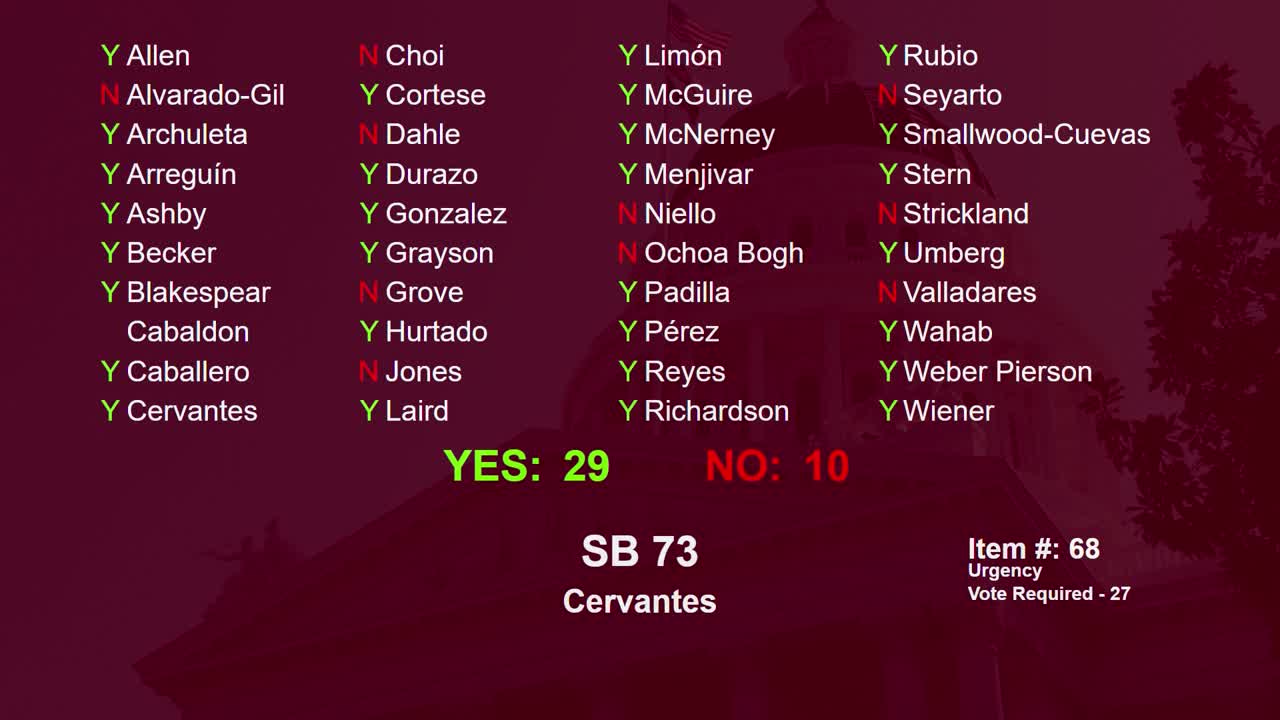 1MIN
Senate Floor
 3MIN
Senate Standing Committee on Revenue and Taxation
Bill Author

Bill Co-Author(s):