SB 38: Second Chance Program.
- Session Year: 2025-2026
- House: Senate
- Latest Version Date: 2025-04-09
Current Status:
Failed
(2026-02-02: Returned to Secretary of Senate pursuant to Joint Rule 56.)
Introduced
In Committee
Awaiting First Chamber Vote
Passed First Chamber
In Committee
Awaiting Second Chamber Vote
Passed Second Chamber
Enacted
What does this bill do?
This bill expands the Second Chance grant program to explicitly allow funding for mental and behavioral health services, substance use treatment, drug court or other collaborative court programs (including the court-ordered treatment option under the Treatment‑Mandated Felony Act), and diversion programs for people in the criminal justice system who have mental health or substance use disorders. It also directs the board to run a competitive grant program with an advisory steering committee and to prioritize proposals that reduce repeat offending, use restorative justice, provide housing and supportive services, leverage other funds, and favor public agency-led partnerships and drug or collaborative court models.
The summary is provided by generative AI which can make mistakes. For original language, please view the details in the table below.
Existing law establishes the Second Chance Program to support mental health treatment, substance use treatment, and diversion programs for persons in the criminal justice system with an emphasis on programs that reduce recidivism of persons convicted of less serious crimes and persons who have substance use and mental health problems. Existing law requires the Board of State and Community Corrections to administer a grant program to carry out the purposes of the Second Chance Program. Existing law requires the grant program to, among other things, restrict eligibility to proposals that offer mental health services, substance use disorder treatment services, misdemeanor diversion programs, or a combination thereof. Existing law also establishes the Second Chance Fund, a continuously appropriated fund, which is administered by the board.
Existing law, the Treatment-Mandated Felony Act, makes it a crime for a person, who has 2 or more prior convictions for a felony or misdemeanor violation of specified controlled substances crimes, to possess a hard drug, as defined, unless it has been prescribed by a doctor, among others. Under existing law, a defendant who has been charged with this crime can elect treatment, in lieu of a jail or prison sentence or probation, by pleading guilty or no contest and admitting the alleged prior convictions, waiving time for sentencing and the pronouncement of judgment, and agreeing to participate in, and complete, a detailed treatment program developed by a drug addiction expert and approved by the court.
This bill would require the Second Chance grant program to authorize eligibility for proposals that offer mental health or behavioral health services and drug court or collaborative court programs, including the treatment program under the Treatment-Mandated Felony Act. The bill would prohibit the program from specifying percentage allocations in applying for, or awarding, a grant. By expanding the purpose of a continuously appropriated fund, this bill would make an appropriation.
Existing law, the Lanterman-Petris-Short Act, provides generally for the evaluation, treatment, and civil commitment of persons with mental health disorders and other specified persons.This bill would make technical, nonsubstantive changes to the provision naming that act.Existing law, the Lanterman-Petris-Short Act, provides generally for the evaluation, treatment, and civil commitment of persons with mental health disorders and other specified persons.
This bill would make technical, nonsubstantive changes to the provision naming that act.
(a)The purpose of this article is to build safer communities by investing in community-based programs, services, and initiatives for formerly incarcerated individuals in need of mental health and substance use treatment services.
(b)The program established pursuant to this article shall support mental health treatment, substance use treatment, drug court or collaborative court programs, and diversion programs for persons in the criminal justice system, with an emphasis on programs that reduce recidivism of persons convicted of less serious crimes, such as those covered by the Safe Neighborhoods and Schools Act of 2014, Act, and those who have substance use and mental health problems.
(c)The Board of State and Community Corrections shall administer a grant program established pursuant to this article. The grant program is intended to support locally responsive and collaborative approaches and shall not require specific percentage allocations in applying for, or awarding, the grant. approaches.
SEC. 2.Section 6046.3 of the Penal Code is amended to read:6046.3.(a)The board shall administer a competitive grant program to carry out the purposes of this article that focuses on community-based solutions for reducing recidivism. The grant program shall, at minimum, do all of the following:
(1)Authorize eligibility for proposals designed to serve people who have been arrested, charged with, or convicted of a criminal offense and have a history of mental health or substance use disorders.
(2)Authorize eligibility for proposals that offer mental health or behavioral health services, drug court or collaborative court programs, substance use disorder treatment services, misdemeanor diversion programs, or some combination thereof.
(3)Restrict eligibility to proposals that have a public agency as the lead applicant.
(4)Authorize eligibility for treatment programs pursuant to Section 11395 of the Health and Safety Code.
(b)The board shall form an executive steering committee that includes, but is not limited to, a balanced and diverse membership from relevant state and local government entities, community-based treatment and service providers, and the formerly incarcerated community. The committee shall have expertise in homelessness and housing, behavioral health and substance abuse treatment, and effective rehabilitative treatment for adults and juveniles. The committee shall make recommendations regarding the design, efficacy, and viability of proposals, and make recommendations on guidelines for the submission of proposals, including threshold or scoring criteria, or both, that do all of the following:
(1)Prioritize proposals that advance principles of restorative justice while demonstrating a capacity to reduce recidivism.
(2)Prioritize proposals that leverage other federal, state, and local funds or other social investments, such as the following sources of funding:
(A)The Drug Medi-Cal Treatment Program (Sections 51341.1, 51490.1, and 51516.1 of Title 22 of the California Code of Regulations).
(B)The Mental Health Services Act, enacted by Proposition 63 at the November 2, 2004, general election, as amended.
(C)Funds provided for in connection with the implementation of Chapter 15 of the Statutes of 2011.
(D)The California Community Corrections Performance Incentives Act of 2009 (Stats. 2009, Ch. 608; Chapter 3 (commencing with Section 1228) of Title 8 of Part 2).
(E)The tax credits established pursuant to Section 12209 of the Revenue and Taxation Code.
(F)The federal Department of Housing and Urban Development funds, such as the Emergency Solutions Grant program (42 U.S.C. Sec. 11371 et seq.).
(G)The federal Department of Veterans Affairs Supportive Services for Veteran Families program (38 U.S.C. Sec. 2044).
(H)Social Innovation Funds established by the Corporation for National and Community Service pursuant to Section 12653k of Title 42 of the United States Code.
(I)The Edward Byrne Memorial Justice Assistance Grant Program (42 U.S.C. Sec. 3750 et seq.).
(3)Prioritize proposals that provide for all of the following:
(A)Mental health services, substance use disorder treatment services, misdemeanor diversion programs, or some combination thereof.
(B)Housing-related assistance that utilizes evidence-based models, including, but not limited to, those recommended by the federal Department of Housing and Urban Development. Housing-related assistance may include, but is not limited to, the following:
(i)Financial assistance, including security deposits, utility payments, moving-cost assistance, and up to 24 months of rental assistance.
(ii)Housing stabilization assistance, including case management, relocation assistance, outreach and engagement, landlord recruitment, housing navigation and placement, and credit repair.
(C)Other community-based supportive services, such as job skills training, case management, and civil legal services.
(4)Prioritize proposals that leverage existing contracts, partnerships, memoranda of understanding, or other formal relationships to provide one or more of the services prioritized in paragraph (3).
(5)Prioritize proposals put forth by a public agency in partnership with additional public agencies or with a philanthropic or nonprofit organization.
(6)Prioritize proposals that promote interagency and regional collaborations.
(7)Consider ways to promote services for people with offenses identical or similar to those addressed by the Safe Neighborhoods and Schools Act of 2014, Act, without precluding assistance to a person with other offenses in their criminal history.
(8)Consider geographic diversity.
(9)Consider appropriate limits for administrative costs and overhead.
(10)Consider proposals that provide services to juveniles.
(11)Permit proposals to expand the capacity of an existing program and prohibit proposals from using the fund to supplant funding for an existing program.
(12)Prioritize proposals that utilize a drug court or collaborative court model.
(a)The purpose of this article is to build safer communities by investing in community-based programs, services, and initiatives for formerly incarcerated individuals in need of mental health and substance use treatment services.
(b)The program established pursuant to this article shall be restricted to supporting support mental health treatment, substance use treatment, drug court or collaborative court programs, and diversion programs for persons in the criminal justice system, with an emphasis on programs that reduce recidivism of persons convicted of less serious crimes, such as those covered by the Safe Neighborhoods and Schools Act of 2014, and those who have substance use and mental health problems.
(c)The Board of State and Community Corrections shall administer a grant program established pursuant to this article. The grant program is intended to support locally responsive and collaborative approaches and shall not require specific percentage allocations in applying for, or awarding, the grant.
SEC. 2.Section 6046.3 of the Penal Code is amended to read:6046.3.(a)The board shall administer a competitive grant program to carry out the purposes of this article that focuses on community-based solutions for reducing recidivism. The grant program shall, at minimum, do all of the following:
(1)Restrict eligibility to Authorize eligibility for proposals designed to serve people who have been arrested, charged with, or convicted of a criminal offense and have a history of mental health or substance use disorders.
(2)Restrict eligibility to Authorize eligibility for proposals that offer mental health services, or behavioral health services, drug court or collaborative court programs, substance use disorder treatment services, misdemeanor diversion programs, or some combination thereof.
(3)Restrict eligibility to proposals that have a public agency as the lead applicant.
(4)Authorize eligibility for treatment programs pursuant to Section 11395 of the Health and Safety Code.
(b)The board shall form an executive steering committee that includes, but is not limited to, a balanced and diverse membership from relevant state and local government entities, community-based treatment and service providers, and the formerly incarcerated community. The committee shall have expertise in homelessness and housing, behavioral health and substance abuse treatment, and effective rehabilitative treatment for adults and juveniles. The committee shall make recommendations regarding the design, efficacy, and viability of proposals, and make recommendations on guidelines for the submission of proposals, including threshold or scoring criteria, or both, that do all of the following:
(1)Prioritize proposals that advance principles of restorative justice while demonstrating a capacity to reduce recidivism.
(2)Prioritize proposals that leverage other federal, state, and local funds or other social investments, such as the following sources of funding:
(A)The Drug Medi-Cal Treatment Program (22 Cal. Code Regs. (Sections 51341.1, 51490.1, and 51516.1). 51516.1 of Title 22 of the California Code of Regulations).
(B)The Mental Health Services Act, enacted by Proposition 63 at the November 2, 2004, general election, as amended.
(C)Funds provided for in connection with the implementation of Chapter 15 of the Statutes of 2011.
(D)The California Community Corrections Performance Incentives Act of 2009 (Stats. 2009, Ch. 608; Chapter 3 (commencing with Section 1228) of Title 8 of Part 2).
(E)The tax credits established pursuant to Sections 12209, 17053.57, and 23657 Section 12209 of the Revenue and Taxation Code.
(F)The federal Department of Housing and Urban Development funds, such as the Emergency Solutions Grant program (42 U.S.C. Sec. 11371 et seq.).
(G)The federal Department of Veterans Affairs Supportive Services for Veteran Families program (38 U.S.C. Sec. 2044).
(H)Social Innovation Funds established by the Corporation for National and Community Service pursuant to Section 12653k of Title 42 of the United States Code.
(I)The Edward Byrne Memorial Justice Assistance Grant Program (42 U.S.C. Sec. 3750 et seq.).
(3)Prioritize proposals that provide for all of the following:
(A)Mental health services, substance use disorder treatment services, misdemeanor diversion programs, or some combination thereof.
(B)Housing-related assistance that utilizes evidence-based models, including, but not limited to, those recommended by the federal Department of Housing and Urban Development. Housing-related assistance may include, but is not limited to, the following:
(i)Financial assistance, including security deposits, utility payments, moving-cost assistance, and up to 24 months of rental assistance.
(ii)Housing stabilization assistance, including case management, relocation assistance, outreach and engagement, landlord recruitment, housing navigation and placement, and credit repair.
(C)Other community-based supportive services, such as job skills training, case management, and civil legal services.
(4)Prioritize proposals that leverage existing contracts, partnerships, memoranda of understanding, or other formal relationships to provide one or more of the services prioritized in paragraph (3).
(5)Prioritize proposals put forth by a public agency in partnership with additional public agencies or with a philanthropic or nonprofit organization.
(6)Prioritize proposals that promote interagency and regional collaborations.
(7)Consider ways to promote services for people with offenses identical or similar to those addressed by the Safe Neighborhoods and Schools Act of 2014, without precluding assistance to a person with other offenses in his or her their criminal history.
(8)Consider geographic diversity.
(9)Consider appropriate limits for administrative costs and overhead.
(10)Consider proposals that provide services to juveniles.
(11)Permit proposals to expand the capacity of an existing program and prohibit proposals from using the fund to supplant funding for an existing program.
(12)Prioritize proposals that utilize a drug court or collaborative court model.
SECTION 1.Section 5000 of the Welfare and Institutions Code is amended to read:5000.This part shall be known, and may be cited, as the Lanterman-Petris-Short Act.This part shall be known known, and may be cited cited, as the Lanterman-Petris-Short Act.
|
Date
|
Status
|
|---|---|
| Feb 2, 2026 | Returned to Secretary of Senate pursuant to Joint Rule 56. |
| May 23, 2025 | May 23 hearing: Held in committee and under submission. |
| May 16, 2025 | Set for hearing May 23. |
| Apr 28, 2025 | April 28 hearing: Placed on APPR. suspense file. |
| Apr 17, 2025 | Set for hearing April 28. |
| Apr 9, 2025 | Read second time and amended. Re-referred to Com. on APPR. |
| Apr 8, 2025 | From committee: Do pass as amended and re-refer to Com. on APPR. (Ayes 6. Noes 0. Page 708.) (April 8). |
| Mar 27, 2025 | Set for hearing April 8. |
| Feb 14, 2025 | Re-referred to Com. on PUB. S. |
| Feb 5, 2025 | From committee with author's amendments. Read second time and amended. Re-referred to Com. on RLS. |
| Jan 29, 2025 | Referred to Com. on RLS. |
| Jan 6, 2025 | Read first time. |
| Dec 4, 2024 | From printer. May be acted upon on or after January 3. |
| Dec 3, 2024 | Introduced. To Com. on RLS. for assignment. To print. |
|
Date
|
Description
|
Location
|
Votes
|
|
|---|---|---|---|---|
| Apr 28, 2025 | Placed on suspense file | Senate Standing Committee on Appropriations |
Passed |
|
| Apr 8, 2025 | Do pass as amended, but first amend, and re-refer to the Committee on [Appropriations] | Senate Standing Committee on Public Safety |
Passed |
This list shows positions taken on this bill by organizations on the date displayed, which is linked to the original source.
Positions by individuals are not included.
|
Organization
|
Position
|
Date
|
|---|---|---|
| Aclu California Action | ** Against | |
| All of Us or None Los Angeles | ** Against | |
| Association of California Cities-Orange County | ** Support | |
| California District Attorneys Association | ** Support | |
| California State Sheriffs Association | ** Support | |
| Californians for Safety and Justice | ** Against | |
| Drug Policy Alliance | ** Against | |
| Initiate Justice Action | ** Against | |
| Legal Services for Prisoners with Children | ** Against | |
| Orange County Sheriffs Department | ** Support | |
| San Bernardino County SheriffS Department | ** Support | |
| San Francisco Public Defender | ** Against | |
| Silicon Valley De-Bug | ** Against | |
| Smart Justice California | ** Against | |
| South Bay Association of Chambers of Commerce | ** Support | |
| Underground Scholars Initiative, University of California, Irvine | ** Support |
SENATE COMMITTEE ON
Senator Anna Caballero, Chair
2025 - 2026 Regular Session
SB 38 (Umberg) - Second Chance Program
Version: | Policy Vote: |
Urgency: | Mandate: |
Hearing Date: | Consultant: |
Bill Summary:
SB 38 would remove existing eligibility restrictions and make additional programs eligible for the Proposition 47 Second Chance Grant Program, including Proposition 36 Treatment-Mandated Felony programs, behavioral health services, and drug court or collaborative court programs.
Fiscal Impact:
This bill would expand an existing continuously appropriated fund (Safe Neighborhood and Schools Fund, Second Chance Fund) which would result in unknown, potentially significant costs pressures (General Fund, local funds) to maintain funding for existing programs. (See Staff Comments) The Board of State and Community Corrections (BSCC) administers the Second Chance Grant Program. BSCC anticipates that its costs associated with this bill can be absorbed within currently allocated resources.
Background:
- Proposition 47 and the Safe Neighborhoods and Schools Fund: Proposition 47, passed in 2014, requires misdemeanor rather than felony sentencing for certain property and drug crimes and permits. The net savings to the state realized from fewer individuals arrested, convicted, and sentenced to prison is used to fund mental health and substance use treatment programs, crime prevention and support programs in K-12 schools, and trauma recovery services for crime victims. The goal of Proposition 47 was to provide services to reduce recidivism.
The Governor’s Proposed Budget estimates net General Fund savings of $88.3 million in 2025-26 from Proposition 47. These funds are deposited into the Safe Neighborhoods and Schools Fund, according to the formula specified in the ballot measure for education, victims’ compensation, mental health and substance abuse treatment, and programs that reduce recidivism. According to the Department of Finance’s, the Safe Neighborhoods and Schools Fund is continuously appropriated without regard to fiscal year. Its major revenue source is transfers from the General Fund. The Safe Neighborhoods and Schools Fund is administered by the BSCC and is disbursed as follows[1]:
- Twenty-five percent to the Department of Education to administer a grant program to public agencies aimed at improving outcomes for public school pupils;
- Ten percent to the California Victim Compensation and Government Claims Board to make grants to trauma recovery centers; and,
- Sixty-five percent to the BSCC to administer the Second Chance Grant Program to award funds to public agencies for mental health treatment, substance abuse treatment, and diversion programs.
Since 2014, Proposition 47 has generated nearly $1 billion in savings from reductions in incarceration, with funds diverted to local agencies for programs aimed at reducing recidivism.[2]
- BSCC and the Second Chance Fund: The Second Chance Fund is administered by BSCC. According to the Department of Finance, its major revenue source is transfers of sixty-five percent of the savings from Proposition 47 in the Safe Neighborhood and Schools Fund and from federal, state, and local grants, and any private donation or grant. The Second Chance Fund is continuously appropriated without regard to fiscal year. [3] Monies in the Second Chance Fund are set aside annually for the BSCC to administer the Second Chance Grant Program, a competitive 4-year grant program for local public agencies.
Proposition 47 requires that the Second Chance Grant funds be awarded to public agencies to provide mental health services, substance use disorder treatment and/or diversion programs. Follow-up legislation (AB 1056, Chap. 438, Stats. of 2015) requires that the grants be awarded competitively, specifies that funds may serve both adults and juveniles, and allows funds to be used for housing-related assistance and other community-based supportive services, including job skills training, case management or civil legal services. The BSCC further requires that at least 50 percent of the award made to grantees be passed through to community-based service providers. The intended purpose for the Second Chance fund is to fund treatment alternatives to court.
BSCC is currently accepting proposals for its fifth cohort of Proposition 47 funding. According to BSCC, a total of $127 million is available and programs selected for funding will be under agreement with the BSCC from October 1, 2025, to June 30, 2029.[4]
To apply for Proposition 47 Second Chance Grant funding, local government agencies are required to submit a proposal which describes the need for funding, how community input would be incorporated into all stages of the project, a detailed description of the proposed project, an evaluation plan, and budget. Proposals must also demonstrate how a minimum of 50 percent of funds will be passed through to community based organizations that have a proven track record of working with the target population and the capacity to support data collection and evaluation efforts.[5] Eligibility is restricted to proposals that offer mental health services, substance use disorder treatment services, misdemeanor diversion programs, or some combination thereof. Eligibility is also restricted to proposals designed to serve people who have been arrested, charged with, or convicted of a criminal offense and have a history of mental health or substance use disorders.
A comprehensive evaluation of BSCC’s Proposition 47 Second Chance Grant Program suggests participants who received services are substantially less likely to recidivate compared to those traditionally incarcerated in California.[6] Program participants who have received mental health or substance use disorder treatments or were diverted away from the criminal justice system. These individuals also received other supportive services, including case management, legal, housing and employment services. The benefits of these services are reflected in the lower recidivism rates of participants, and reductions in homelessness and unemployment.[7]
- Proposition 36 and Treatment-Mandated Felonies: Proposition 36, which went into effect in December 2024, repealed parts of Proposition 47 by increasing penalties, allowing specified felony charges, and requiring certain sentences to be served in state prison. Proposition 36 also created a new type of offence wherein people convicted of possession of certain drugs such as methamphetamines or fentanyl or who have two or more past convictions for drug crimes can be charged with a “Treatment-Mandated Felony”.
A person charged with a Treatment-Mandated Felony, can have their case dismissed and expunged if they complete treatment. If they do not successfully complete treatment, they will face a conviction and incarceration. Proposition 36 is silent on most of the details of the treatment program, leaving the operational details to be decided by the courts and local authorities.
Proposition 36 is not funded. It does not provide a new revenue source to pay for the increased expenses of incarceration or for the Treatment-Mandated Felony programs. The measure was criticized for significantly driving up state prison costs, cutting funding for behavioral health treatment and other critical services, and potentially pushing more Californians into homelessness.[8] The LAO estimates that the ongoing increase in state costs from Proposition 36 will likely range from several tens of millions of dollars to the low hundreds of millions of dollars, due to a larger prison population and an increase in state court workload.[9] State and local leaders now must look to other funding sources to budget for the unfunded costs imposed by Proposition 36, including the Treatment-Mandated Felony.
Without providing a new revenue source, Proposition 36 authorizes the BSCC to allocate “appropriate funds to counties and local governments” for Treatment-Mandated felony programs. Notably, with the passage of Proposition 36, Proposition 47 savings will substantially decrease. Proposition 36 will reduce the amounts in the Safe Neighborhood and Schools Fund and the Second Chance Fund that can be spent on mental health and drug treatment, school truancy and dropout prevention, and victim services. This reduction will likely be in the low tens of millions of dollars annually.[10]
Proposed Law:
SB 38 does all of the following:
- Removes existing provisions restricting Proposition 47 Second Chance Grant Program eligibility to proposals designed to serve people who have been arrested, charged with, or convicted of a criminal offense and have a history of mental health or substance use disorders.
- Removes existing provisions restricting Proposition 47 Second Chance Grant Program eligibility to proposals that offer mental health services, substance use disorder treatment services, misdemeanor diversion programs, or some combination thereof.
- Makes Proposition 36 Treatment-Mandated Felony programs eligible for Proposition 47 Second Chance Grant Program funds.
- Makes behavioral health services, drug court or collaborative court programs eligible for Proposition 47 Second Chance Grant Program funds.
- Requires the BSCC to prioritize proposals that utilize a drug court or collaborative court model for Proposition 47 Second Chance Grant Program awards.
Related Legislation:
- SB 28 (Umberg) would require treatment court programs be available to all eligible California defendants. SB 28 is pending on this Committee’s suspense file.
- SB 850 (McGuire), among other things, would require the BSCC to modify its scoring matrix for Proposition 47 grants, as specified. SB 850 is pending in the Senate Public Safety Committee.
Staff Comments:
As discussed above, the cost of implementing Proposition 36 is not yet fully known, but will be substantial. To cover the hefty price tag, at least partially, this bill proposes to raid Proposition 47’s piggybank—which has already been reduced by Proposition 36.[11] This bill proposes to further stretch what is left of Proposition 47 savings in order to bankroll the very proposition that undercut it. The critics of Proposition 47 that spent the last decade undermining and blaming[12] it for spikes in retail theft and homelessness, despite data showing a decline in crime[13], are now circling back to dip into its success.
This bill will funnel savings from Proposition 47 reductions in state prison incarceration into Proposition 36 programs that, paradoxically, will increase state prison incarceration.[14] Pulling money from the Proposition 47 grant program means slashing support for programs that have successfully diverted people who have a history of mental health or substance abuse disorders away from the criminal justice system and are proven to reduce unemployment, homelessness, and recidivism.[15] Instead, this bill removes eligibility restrictions and requires BSCC to prioritize proposals for mandated-treatment programs, drug courts, and collaborative courts that do not require that the person have a history of mental health or substance use disorder and are not required to be effective at rehabilitation and reducing recidivism.[16]
The strategy proposed by this bill creates a loop that yields less benefits and diminishing returns as the longer it spins.
-- END --
The Safe Neighborhoods and Schools Fund began the 2025-26 fiscal period with a balance of $11,775,000. A transfer of $57,165,000 was made from this fund to the Second Chance Fund as required by Proposition 47. This was offset by local Proposition 47 transfers, and the fund has a balance of $11,580,000. (See, 2025-26 Governor's Budget. Available at: https://ebudget.ca.gov/2025-26/pdf/GovernorsBudget/5210/5227FCS.pdf.)
↑Center on Juvenile & Criminal Justice, Proposition 47 Delivers Nearly $1 Billion to California Communities. Available at: https://www.cjcj.org/reports-publications/report/proposition-47-delivers-nearly-1-billion-to-california-communities.
↑The Second Chance Fund began the fiscal period with a beginning balance of $159,357,000. It received a transfer of $57,165,000 from the Safe Neighborhoods and Schools Fund in accordance with Proposition 47, bringing total resources to $216,522,000. Expenditures included $57,165,000 in local assistance, along with a small allocation for supplemental pension payments, resulting in total expenditures of $57,179,000. The fund has a balance of $159,343,000. (See, 2025-26 Governor's Budget. Available at: https://ebudget.ca.gov/2025-26/pdf/GovernorsBudget/5210/5227FCS.pdf.) ↑
BSCC, Proposition 47 Grant Program. Available at: https://www.bscc.ca.gov/s_bsccprop47/.
↑Ibid.
↑BSCC, Proposition 47 Cohort II Statewide Evaluation. Available at: https://www.bscc.ca.gov/wp-content/uploads/2024/02/H-2-Proposition-47-Cohort-2-Final-Evaluation-Report-FINAL-1.pdf.
↑Ibid. ↑
California Budget &Policy Center, Understanding Proposition 36. Available at: https://calbudgetcenter.org/resources/understanding-proposition-36/; See also, SOS, Official Voter Guide for Proposition 36 [CON Arguments stating Proposition 36 “…wastes billions on prisons, while slashing crucial funding for victims, crime prevention, treatment, and rehabilitation”]. Available at: https://voterguide.sos.ca.gov/propositions/36/. ↑
LAO, Analysis of Proposition 36. Available at: https://lao.ca.gov/BallotAnalysis/Proposition?number=36&year=2024. In a 2025 letter to the Senate Budget Committee, the author of this bill estimates Proposition 36 will cost counties statewide at least $250 million to implement annually. (See, Senator Umberg’s Letter to Senate Committee on Budget & Fiscal Review, Re: $250 Million in Funding to Implement Proposition 36 Statewide.) ↑
Ibid. ↑
According to the LAO:
Reduction in Savings Will Reduce Required Spending. By undoing parts of Proposition 47, Proposition 36 reduces the state savings from Proposition 47. This will reduce the amount the state must spend on the grant programs. We estimated this reduction would likely be in the low tens of millions of dollars annually.
(LAO, Overview of Proposition 36 Fiscal Impacts and Selected Substance Use Disorder Treatment Programs. Available at: https://lao.ca.gov/handouts/crimjust/2025/Fiscal-Impacts-of-Proposition-36-022525.pdf.) ↑See, SOS, Proposition 36, Full Text, Section 3 Findings and Declarations. Available at: https://vig.cdn.sos.ca.gov/2024/general/pdf/prop36-text-proposed-laws.pdf.
↑Data from the Department of Justice demonstrates that reforms did not bring more crime and crime rates are near record lows. (Center on Juvenile & Criminal Justice. Stop Lying About California. Available at: https://www.cjcj.org/reports-publications/report/stop-lying-about-california.) ↑
According to the LAO, a projected increase in the prison population “is primarily due to the estimated impact of Proposition 36, which increased punishment for certain drug and theft crimes and created a new court process called a “treatment‑mandated felony” for certain people who possess illegal drugs. Specifically, the administration estimates that Proposition 36 will cause the average daily prison population to be about 570 higher (or 1 percent) than otherwise in 2024‑25 and 3,300 higher (or 4 percent) in 2025‑26.” (LAO, The 2025-26 Budget, California Department of Corrections and Rehabilitation. Available at: https://www.lao.ca.gov/Publications/Report/4986.)
↑BSCC, Proposition 47 Cohort II Statewide Evaluation. Available at: https://www.bscc.ca.gov/wp-content/uploads/2024/02/H-2-Proposition-47-Cohort-2-Final-Evaluation-Report-FINAL-1.pdf. ↑
Counties are responsible for coordinating treatment programs under Proposition 36, with few guardrails. Specifically, Proposition 36 broadly provides that “A treatment program may include, but is not limited to, drug treatment, mental health treatment, job training, and any other conditions related to treatment or a successful outcome for the defendant that the court finds appropriate.” In comparison, Proposition 47 requires “an emphasis on programs that reduce recidivism of people convicted of less serious crimes, such as those covered by this measure, and those who have substance abuse and mental health problems.” ↑
SENATE COMMITTEE ON PUBLIC SAFETY
Senator Jesse Arreguín, Chair
2025 - 2026 Regular
Bill No: SB 38 Hearing Date: April 8, 2025
Author: | Umberg | ||
Version: | February 5, 2025 | ||
Urgency: | No | Fiscal: | Yes |
Consultant: | SJ | ||
Subject: Second Chance Program
HISTORY
Source: Chief Probation Officers of California
Prior Legislation: Proposition 36, as approved by the voters on November 5, 2024
AB 1056 (Atkins), Ch. 438, Stats. of 2015
Proposition 47, as approved by the voters on November 2, 2014
Support: Association of California Cities-Orange County; California District Attorneys Association; California State Sheriffs’ Association; Orange County Sheriff’s Department; San Bernardino County Sheriff’s Department; South Bay Association of Chambers of Commerce; Underground Scholars Initiative, University of California, Irvine
Opposition: ACLU California Action; All of Us or None Los Angeles; Californians for Safety and Justice; Drug Policy Alliance; Initiate Justice Action; Legal Services for Prisoners with Children; San Francisco Public Defender; Silicon Valley De-Bug; Smart Justice California
PURPOSE
The purposes of this bill are to explicitly authorize drug courts and collaborative courts as eligible to apply for Second Chance Program grants; authorize grant eligibility for treatment programs utilized for Proposition 36’s treatment-mandated felony; prohibit the grant program from requiring specific percentage allocations in applying for or awarding the grant; and add proposals that utilize a drug court or collaborative court model to the list of prioritized project proposals.
Existing law establishes, via the “Safe Neighborhoods and Schools Act” also known as Proposition 47, the “Safe Neighborhoods and Schools Fund” within the State Treasury and provides that it is continuously appropriated without regard to fiscal year. (Gov. Code, § 7599, subd. (a).)
Existing law requires the Director of Finance, on or before July 31, 2016, to calculate the savings that accrued to the state from the implementation of Proposition 47 during the fiscal year ending June 30, as compared to the fiscal year preceding the enactment of Proposition 47. Requires the calculation of savings to occur on or before July 31 of each fiscal year thereafter. Requires the Director of Finance to use actual data or best available estimates where actual data is not available. Provides that the calculation is final and cannot be adjusted for any subsequent changes in the underlying data. Requires the Director of Finance to certify the results of the calculation to the Controller no later than August 1 of each fiscal year. (Gov. Code, § 7599.1, subd. (a).)
Existing law requires the Controller to transfer from the General Fund to the Safe Neighborhoods and Schools Fund the total amount calculated before August 15 of each fiscal year. (Gov. Code, § 7599.1, subd. (b).)
Existing law requires moneys in the Safe Neighborhoods and Schools Fund to be continuously appropriated. Requires funds transferred to the Safe Neighborhoods and Schools Fund to be used exclusively for the purposes of Proposition 47 and prohibits those funds from being subject to appropriation or transfer by the Legislature for any other purpose. Provides that the funds in the Safe Neighborhoods and Schools Fund may be used without regard to fiscal year. (Gov. Code, § 7599.1, subd. (c).)
Existing law requires the following distribution of the moneys in the Safe Neighborhoods and Schools Fund:
- 25% to the State Department of Education, to administer a grant program to public agencies aimed at improving outcomes for public school students in kindergarten and grades 1 to 12, inclusive, by reducing truancy and supporting students who are at risk of dropping out of school or are victims of crime.
- 10% to the California Victim Compensation Board, to make grants to trauma recovery centers to provide services to victims of crime.
- 65% to the Board of State and Community Corrections (BSCC), to administer a grant program to public agencies aimed at supporting mental health treatment, substance abuse treatment, and diversion programs for people in the criminal justice system, with an emphasis on programs that reduce recidivism of people convicted of less serious crimes, such as those covered by this measure, and those who have substance abuse and mental health problems. (Gov. Code, § 7599.2, subd. (a).)
Existing law requires the Controller to disburse moneys deposited in the Safe Neighborhoods and Schools Fund by August 15 of each fiscal year. (Gov. Code, § 7599.2, subd. (a).)
Existing law requires the Controller to conduct an audit of the grant programs operated by the agencies every two years to ensure the funds are disbursed and expended solely as required. (Gov. Code, § 7599.2, subd. (c).)
Existing law requires the funding established pursuant to Proposition 47 to be used to expand programs for public school students in K-12, victims of crime, and mental health and substance abuse treatment and diversion programs for people in the criminal justice system. Prohibits these funds from being used to supplant existing state or local funds utilized for those purposes. (Gov. Code, § 7599.2, subd. (e).)
Existing law establishes the Second Chance Program to be administer by the BSCC. Provides that the purpose of the program is to build safer communities by investing in community-based programs, services, and initiatives for formerly incarcerated individuals in need of mental health and substance use treatment services. (Pen. Code, § 6046, subds. (a) & (c).)
Existing law restricts the Second Chance Program to supporting mental health treatment, substance use treatment, and diversion programs for persons in the criminal justice system, with an emphasis on programs that reduce recidivism of persons convicted of less serious crimes, such as those covered by Proposition 47, and those who have substance use and mental health problems. (Pen. Code, § 6046, subd. (b).)
Existing law establishes the Second Chance Fund in the State Treasury. Provides that the BSCC is responsible for administering the fund. Provides that moneys in the fund are continuously appropriated without regard to fiscal year. (Pen. Code, § 6046.2, subd. (a).)
Existing law provides that the Second Chance Fund may receive moneys from any other federal, state, or local grant, or from any private donation or grant. (Pen. Code, § 6046.2, subd. (b)(2).)
Existing law prohibits the BSCC from spending more than 5 percent annually of the moneys in the fund for administrative costs. (Pen. Code, § 6046.2, subd. (c).)
Existing law requires the BSCC to administer a competitive grant program to carry out the purposes of the Second Chance Program and that focuses on community-based solutions for reducing recidivism. (Pen. Code, § 6046.3, subd. (a).)
Existing law requires the grant program do all of the following at minimum:
- Restrict eligibility to proposals designed to serve people who have been arrested, charged with, or convicted of a criminal offense and have a history of mental health or substance use disorders.
- Restrict eligibility to proposals that offer mental health services, substance use disorder treatment services, misdemeanor diversion programs, or some combination.
- Restrict eligibility to proposals that have a public agency as the lead applicant. (Pen. Code, § 6046.3, subd. (a)(1)-(3).)
Existing law requires the BSCC to form an executive steering committee that includes, but is not limited to, a balanced and diverse membership from relevant state and local government entities, community-based treatment and service providers, and the formerly incarcerated community. Requires the committee to have expertise in homelessness and housing, behavioral health and substance abuse treatment, and effective rehabilitative treatment for adults and juveniles. (Pen. Code, § 6046.3, subd. (b).)
Existing law requires the committee to make recommendations regarding the design, efficacy, and viability of proposals, and make recommendations on guidelines for the submission of proposals, including threshold or scoring criteria, or both, that do all of the following:
- Prioritize proposals that advance principles of restorative justice while demonstrating a capacity to reduce recidivism.
- Prioritize proposals that leverage other federal, state, and local funds or other social investments, such as the following sources of funding:
- The Drug Medi-Cal Treatment Program.
- The Mental Health Services Act, enacted by Proposition 63 of 2004.
- Funds provided in connection with 2011 Realignment.
- The Community Corrections Performance Incentives Act.
- Tax credits, as specified.
- Federal Department of Housing and Urban Development funds, such as the Emergency Solutions Grant program.
- Federal Department of Veterans Affairs Supportive Services for Veteran Families program.
- Social Innovation Funds established by the Corporation for National and Community Service.
- The Edward Byrne Memorial Justice Assistance Grant Program.
- Prioritize proposals that provide for all of the following:
- Mental health services, substance use disorder treatment services, misdemeanor diversion programs, or some combination.
- Housing-related assistance that utilizes evidence-based models, including, but not limited to, those recommended by the federal Department of Housing and Urban Development. Provides that housing-related assistance may include, but is not limited to, the following: financial assistance, including security deposits, utility payments, moving-cost assistance, and up to 24 months of rental assistance; and housing stabilization assistance, including case management, relocation assistance, outreach and engagement, landlord recruitment, housing navigation and placement, and credit repair.
- Other community-based supportive services, such as job skills training, case management, and civil legal services.
- Prioritize proposals that leverage existing contracts, partnerships, memoranda of understanding, or other formal relationships to provide one or more of the following services: mental health services, substance use disorder treatment services, misdemeanor diversion programs, housing-related assistance, or other community-based supportive services.
- Prioritize proposals put forth by a public agency in partnership with a philanthropic or nonprofit organization.
- Prioritize proposals that promote interagency and regional collaborations.
- Consider ways to promote services for people with offenses identical or similar to those addressed by Proposition 47, without precluding assistance to a person with other offenses in his or her criminal history.
- Consider geographic diversity.
- Consider appropriate limits for administrative costs and overhead.
- Consider proposals that provide services to juveniles.
- Permit proposals to expand the capacity of an existing program and prohibit proposals from using the fund to supplant funding for an existing program. (Pen. Code, § 6046.3, subd. (b).)
Existing law defines “public agency” as a county, city, whether a general law city or a chartered city, or city and county, the duly constituted governing body of an Indian reservation or rancheria, a school district, municipal corporation, district, political subdivision, or any board, commission, or agency thereof, entities that are legislative bodies of a local agency, as provided, a housing authority, as provided, a state agency, public district, or other political subdivision of the state, or any instrumentality thereof, which is authorized to engage in or assist in the development or operation of housing for persons and families of low or moderate income. (Pen. Code, § 6046.1, subd. (c).)
Existing law defines “recidivism” as a conviction of a new felony or misdemeanor committed within three years of release from custody or committed within three years of placement on supervision for a previous criminal conviction. (Pen. Code, § 6046.1, subd. (d).)
Existing law establishes the Funding for the Homelessness, Drug Addiction, and Theft Reduction Act. (Gov. Code, § 7599.200, subd. (a).)
Existing law authorizes the BSCC to allocate appropriate funds to counties and local governments for programs utilized for Proposition 36’s treatment-mandated felony from moneys disbursed to it via Proposition 47 and the Second Chance Program. Specifies that the ability to use these funding sources does not preclude funding from any other source, including, but not limited to, the Local Revenue Fund 2011 and other funds designated for substance abuse and mental health treatment. (Gov. Code, § 7599.200, subd. (b).)
This bill adds drug court or collaborative court programs to the types of programs, services, and initiatives supported by the Second Chance Program.
This bill provides that the Second Chance Program is intended to support locally responsive and collaborative approaches and prohibits the program from requiring specific percentage allocations in applying for or awarding the grant.
This bill makes changes to the Second Chance Program’s requirements by authorizing eligibility for, instead of restricting eligibility to, proposals designed to serve people who have been arrested, charged with, or convicted of a criminal offense and have a history of mental health or substance use disorders.
This bill makes changes to the Second Chance Program’s requirements by authorizing eligibility for, instead of restricting eligibility to, mental health services, substance use disorder treatment services, misdemeanor diversion programs. Adds behavioral health services and drug court or collaborative court programs to the list of eligible services and programs.
This bill authorizes eligibility for treatment programs pursuant to Section 11395 of the Health and Safety Code—Proposition 36’s treatment-mandated felony.
This bill changes the requirement that the BSCC’s executive steering committee make recommendations that prioritize proposals put forth by a public agency in partnership with a philanthropic or nonprofit organization, and instead allows for the prioritization of proposals put forth by a public agency in partnership with additional public agencies or with a philanthropic or nonprofit organization.
This bill adds proposals that utilize a drug court or collaborative court model to the list of prioritized project proposals.
COMMENTS
- Need For This Bill
According to the author:
SB 38 would remove unnecessary barriers to locally responsive approaches and partnerships in the existing Proposition 47 competitive grant program and expressly clarify that drug court and collaborative court approaches are eligible for and meet the goals of the competitive grant program.
Voters approved Prop 47 on the November 2014 ballot, reducing specified low-level drug and property crimes from felonies to misdemeanors. Each year, state savings generated by the implementation of Proposition 47 are deposited into the Safe Neighborhoods and Schools Fund. Sixty-five percent of these savings are set aside annually for the Board of State and Community Corrections to administer a competitive grant program for services related to mental health, substance use treatment, and diversion. In 2015, AB 1056 (Atkins) was enacted, imposing additional parameters to the framework for allocating and prioritizing funds, known as the Second Chance Program.
In 2024, every county in California overwhelmingly passed Proposition 36 to address repeat retail theft and substance use offenses. Specifically, it established a Treatment Mandated Felony option for people meeting certain criteria and prior drug convictions. Counties have already received many referrals for the new felony, and having a diverse set of funding sources to implement treatment is critical.
SB 38 would add express language that drug court and collaborative court programs, as well as courts required to facilitate Treatment Mandated Felonies, are eligible for existing competitive grant programs. It would also remove barriers for public entities to apply by prohibiting prescribed pass-through percentage allocations in the grant.
- Proposition 47
Proposition 47, also known as the Safe Neighborhoods and Schools Act, was approved by the voters in November 2014. Proposition 47 made a number of changes to criminal penalties and provided that the resulting state savings be directed to mental health and substance abuse treatment, truancy and dropout prevention, and victims’ services. (See Legislative Analyst’s Office, Analysis of Proposition 47 available at <https://www.lao.ca.gov/ballot/2014/prop-47-110414.pdf>.) Specifically, the savings attributed to the sentencing changes in Proposition 47 are divided, with 25 percent for truancy and dropout prevention, 10 percent for victim services, and 65 percent for a “grant program to public agencies aimed at supporting mental health treatment, substance abuse treatment, and diversion programs for people in the criminal justice system, with an emphasis on programs that reduce recidivism of people convicted of less serious crimes, such as those covered by this measure, and those who have substance abuse and mental health problems.” (Gov. Code, § 7599.2, subd. (a).)
- Second Chance Program
AB 1056 (Atkins), Chapter 438, Statutes of 2015, established a framework for the use of the Proposition 47 savings. Specifically, it created a competitive grant program, the Second Chance Program, administered by the BSCC focused on community-based solutions for reducing recidivism. The grant program restricts eligibility to proposals that: are designed to serve people who have been arrested, charged with, or convicted of a criminal offense and have a history of mental health or substance use disorders; offer mental health services, substance use disorder treatment services, misdemeanor diversion programs, or a combination; and have a public agency as the lead applicant.
The executive steering committee—made up of representatives of relevant state and local entities and community-based treatment and service providers—makes recommendations regarding the viability of proposals as well as the overall guidelines for the submission of proposals, including scoring criteria. The governing statute outlines several proposal features to be prioritized when reviewing proposals, including those that: advance principles of restorative justice while demonstrating a capacity to reduce recidivism; leverage other federal, state, and local funds; provide mental health services, substance use disorder treatment services, misdemeanor diversion programs, housing-related assistance, or other community-based supportive services; and are put forth by a public agency in partnership with a philanthropic or nonprofit organization, among others. (Pen. Code, §6046.3, subd. (b)(1)-(11).) Although not statutorily required, the BSCC requires that at least 50 percent of the award made to a grantee is passed through to one or more community-based organizations, the providers of direct services to the targeted populations. (BSCC, Proposition 47 Grant Program available at <https://www.bscc.ca.gov/s_bsccprop47/>.)
There have been four Proposition 47 grant cohorts. The first cohort grant period ran from June 2017 to August 2021, after a 12-month extension following implementation delays for many grantees. Over $103.6 million was awarded to 23 grantees. (BSCC, Proposition 47 Cohort 1: Statewide Overview of Accomplishments by Grantees (May 2022), p. 3 available at <https://www.bscc.ca.gov/wp-content/uploads/Prop-47-C1-final-evaluation-report.pdf>.) Despite data limitations, the BSCC reported that it appeared that the Cohort 1 projects were effective in reducing recidivism. (Id. at p. 18.) The second cohort had a duration of just under 4 years, and over $92.7 million was awarded to 21 grantees. (BSCC, Proposition 47 Cohort II: Statewide Evaluation (Feb. 2024), p. 2 available at <https://www.bscc.ca.gov/2024/02/H-2-Proposition-47-Cohort-2-Final-Evaluation-Report-FINAL-1.pdf>.) Of the funds spent, over 78% passed through to community-based organizations, and over 21,000 participants received services through the Cohort 2 grant program. (Id. at pp. 2, 10.) An analysis of the Cohort 2 data suggested that the grant program was effective in reducing recidivism rates in program participants, in particular for individuals who received ongoing services even if they did not complete program requirements. (Id. at p. 24.)
The third cohort has a grant period that started in September 2022 and continues to June 2026, and over $124.9 million was awarded to 24 grantees. (BSCC, 2022 Proposition 47 Grant Project Summaries available at <https://www.bscc.ca.gov/wp-content/uploads/Attachment-C-3.-Proposition-47-Proposal-Summaries.pdf>.) Examples of funded proposals include Merced County’s expansion of a pretrial diversion program for individuals with mental health disorders, substance use disorders, or both; San Diego County’s project to provide reentry supports for individuals leaving jail; Santa Clara County’s co-occurring outpatient and transitional housing project; and the Corona-Norco Unified School District’s youth diversion program. (Ibid.)
The grant period for the fourth cohort of grantees began in October 2024 and is set to run through June 2028. Over $167 million was awarded to 27 grantees. (BSCC, 2024 Proposition 47 Grant Proposal Summaries available at <https://www.bscc.ca.gov/wp-content/uploads/2024/09/Attachment-G-2-Prop-47-Proposal-Summaries-FINAL-9-24-2024.pdf>.) Examples of funded proposals include the City of Anaheim’s misdemeanor pre-trial diversion program for unhoused individuals with substance use or mental health disorders; the City of Banning’s wraparound services project to facilitate reentry for individuals released from county jail; the City of Long Beach’s reentry project designed to provide various core and supportive services to justice-involved individuals; and Orange County’s expanded diversion program for youth. (Ibid.)
- Proposition 36
Proposition 36 was approved by the voters on November 5, 2024. Among its many provisions, Proposition 36 established the treatment-mandated felony, which can be charged when a person is arrested for possession of specified controlled substances and who has two or more prior convictions for specified drug offenses. (Health & Saf. Code, § 11395, subds. (b) & (c).) This offense can be charged as a misdemeanor or a felony, and allows a person charged under its provisions to complete a treatment program in lieu of serving time in jail or prison. (Health & Saf. Code, § 11395, subds. (b) & (c).) A “treatment program may include, but is not limited to, drug treatment, mental health treatment, job training, and any other conditions related to treatment or a successful outcome for the defendant that the court finds appropriate.” (Health & Saf. Code, § 11395, subd. (d)(2).) Although it did not provide a funding mechanism, Proposition 36 authorizes the BSCC to allocate appropriate funds to counties and local governments for programs specified in its treatment-mandated felony provision from Proposition 47 and the Second Chance Program funds. (Gov. Code, § 7599.200, subd. (b).)
This bill makes a number of changes to the Second Chance Program. First, it would allow treatment programs utilized for the treatment-mandated felony to apply for grants. This bill would also require that proposals that utilize a drug court or collaborative court model be prioritized. Finally, this bill prohibits the grant program from requiring specific percentage allocations in applying for or awarding the grant (i.e., eliminates the current requirement that proposals include a 50% pass through from the grantee to a community-based organization).
There appears to be substantial overlap between the types of programs funded via Proposition 47 grants—in particular, the substance use disorder and mental health treatment programs—and the types of programs that would serve the treatment-mandated felony population. While Proposition 36 gave the BSCC the discretion to allocate Proposition 47 funds to programs specified in its treatment-mandated felony provision, this bill amends the Second Chance Program eligibility criteria to explicitly authorize eligibility for those programs, adds proposals that utilize a drug court or collaborative court model to the list of proposals that the BSCC has to prioritize when reviewing grant applications, and eliminates the pass through from the public agency grantee to a community-based organization. Supporters argue that this bill allows for the efficient use of existing funding to aid in the implementation of Proposition 36 for many of the same programs that were already eligible for funding under Proposition 47. Opponents of the bill assert that it makes radical changes to an existing grant program that has heavily utilized community-based organizations to effectively reduce recidivism.
- Argument in Support
According to the Chief Probation Officers of California, the bill’s sponsor:
Senate Bill 38 … would update an existing competitive grant program administered by the Board of State and Community Corrections (BSCC) to remove barriers to participation and add express language that drug court and collaborative court programs as well as Health and Safety Code 11395 (Treatment Mandated Felony) programs, as outlined in Proposition 36, are eligible for the grant program.
Proposition 36 was recently and overwhelmingly passed in all counties and establishes a Treatment Mandated Felony option … for people meeting certain criteria and prior drug convictions. …
The current program was established via Proposition 47 in 2014. Sixty-five of percent of savings are set aside annually for the BSCC to administer a competitive grant program for services related to mental health, substance use treatment and diversion. Additionally, in 2015, AB 1056 (Atkins) was enacted, imposing additional parameters to the framework for how funds are to be allocated and prioritized.
This bill seeks to remove barriers to existing participation in the competitive grant program and add clarity around accessing programs that meet the requirements of Proposition 36 while remaining consistent with the goals of the program by making eligible drug court and collaborative court programs as well as treatment mandated felony programs. This proposal would also remove barriers for public entities to apply by prohibiting prescribed passthrough percentage allocations in the grant.
This bill retains the overarching structure of the competitive grant program including the intended goals and other programmatic elements but adds clarifying language around the ability to apply for the grant for collaborative court approaches and through various locally responsive partnership models.
Although additional resources are needed to fully support the implementation of Proposition 36, this bill represents an important component to supporting and carrying out the will of the voters in enacting Proposition 36.
- Argument in Opposition
Smart Justice California writes:
SB 38…would jeopardize existing programs by using Proposition 47 savings to fund Treatment-Mandated Felony programs.
…
With the passage of Proposition 36, Proposition 47 savings will substantially decrease. The estimated reduction is in the tens of millions of dollars annually. The Proposition 47 savings have funded programs like in Alameda County where the Office of Education received $1.7 million to increase attendance rates, increase graduation rates and improve outcomes for vulnerable youth. In Los Angeles, the savings funded the City Attorney’s office who received $18 million to expand its LA diversion outreach and opportunities for recovery (DOOR) model.
Diverting the funds now used for the Proposition 47 grant program to drug courts will further reduce the funding available to successful programs that now rely on the Prop 47 grant program. We are concerned that this bill will result in significant cuts to effective programs to fund the courts. We believe the General Fund is the appropriate source of funding for the courts.
-- END --
Discussed in Hearing
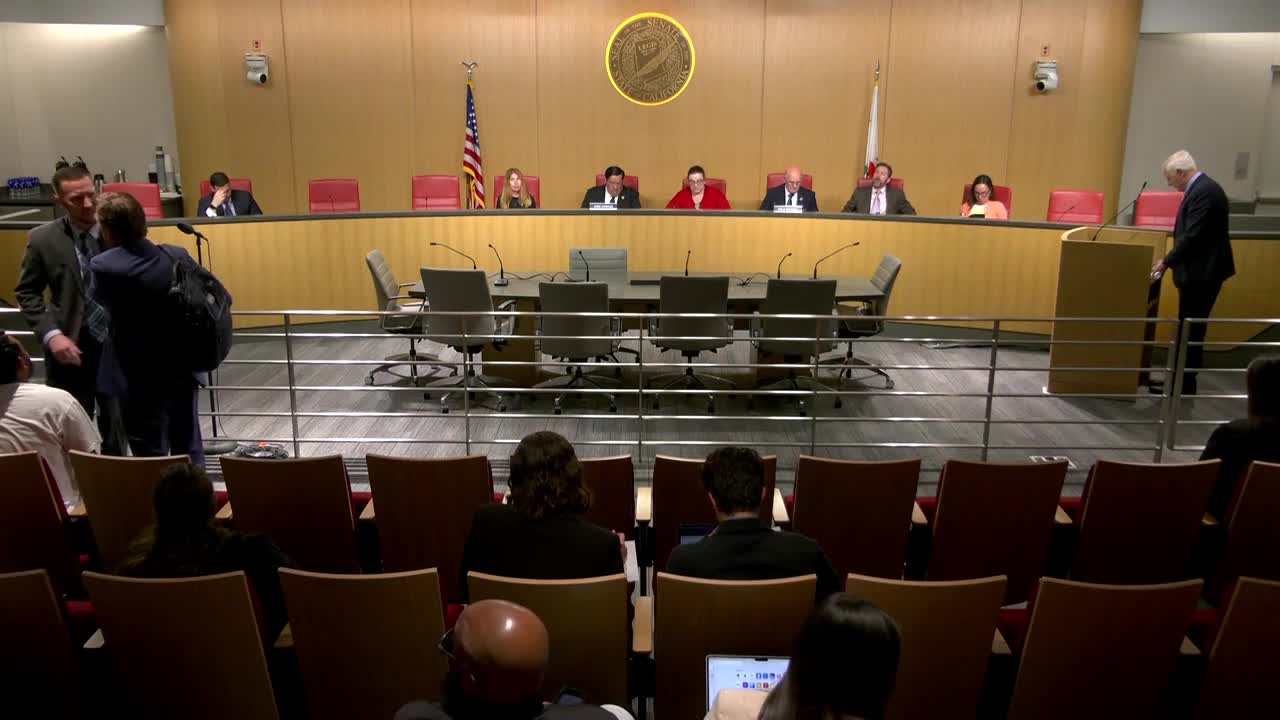 14MIN
Senate Standing Committee on Public Safety
Bill Author
Bill Co-Author(s):