SB 480: Autonomous vehicles.
- Session Year: 2025-2026
- House: Senate
- Latest Version Date: 2025-10-06
Current Status:
Passed
(2025-10-06: Chaptered by Secretary of State. Chapter 415, Statutes of 2025.)
Introduced
In Committee
Awaiting First Chamber Vote
Passed First Chamber
In Committee
Awaiting Second Chamber Vote
Passed Second Chamber
Enacted
Existing law authorizes the operation of an autonomous vehicle on public roads for testing purposes by a driver who possesses the proper class of license for the type of vehicle operated if specified requirements are satisfied. Existing law prohibits the operation of an autonomous vehicle on public roads until the manufacturer submits an application to the Department of Motor Vehicles, as specified, and that application is approved. Existing law requires the department to adopt regulations setting forth requirements for the submission and approval of an application, including, among other things, any testing, equipment, and performance standards the department concludes are necessary to ensure the safe operation of autonomous vehicles on public roads, as specified.
This bill would, commencing January 1, 2026, authorize an autonomous vehicle to be equipped with automated driving system (ADS) marker lamps in accordance with specified standards. For purposes of this provision, the bill would define an ADS marker lamp as a device that emits a light to indicate when an ADS is engaged in the operation of the vehicle. The bill would also make conforming changes.
Existing law authorizes the operation of an autonomous vehicle on public roads for testing purposes by a driver who possesses the proper class of license for the type of vehicle operated if specified requirements are satisfied. Existing law prohibits the operation of an autonomous vehicle on public roads until the manufacturer submits an application to the Department of Motor Vehicles, as specified, and that application is approved. Existing law requires the department to adopt regulations setting forth requirements for the submission and approval of an application, including, among other things, any testing, equipment, and performance standards the department concludes are necessary to ensure the safe operation of autonomous vehicles on public roads, as specified.
This bill would, commencing January 1, 2026, authorize an autonomous vehicle to be equipped with automated driving system (ADS) marker lamps in accordance with specified standards. For purposes of this provision, the bill would define an ADS marker lamp as a device that emits a light to indicate when an ADS is engaged in the operation of the vehicle.
This section applies to the color of lamps and to any reflector exhibiting or reflecting perceptible light of 0.05 candela or more per foot-candle of incident illumination. Unless provided otherwise, the color of lamps and reflectors upon a vehicle shall be as follows:
(a)The emitted light from all lamps and the reflected light from all reflectors, visible from in front of a vehicle, shall be white or yellow, except as follows:
(1)Rear side marker lamps required by Section 25100 may show red to the front.
(2)The color of foglamps described in Section 24403 may be in the color spectrum from white to yellow.
(3)An illuminating device, as permitted under Section 24255, shall emit radiation predominantly in the infrared region of the electromagnetic spectrum. Any incidental visible light projecting to the front of the vehicle shall be predominantly yellow to white. Any incidental visible light projecting to the rear of the vehicle shall be predominantly red. Any incidental visible light from an illuminating device, as permitted under Section 24255, shall not resemble any other required or permitted lighting device or official traffic control device.
(4)ADS marker lamps, as described in subdivision (i) of Section 38750, on an autonomous vehicle.
(b)The emitted light from all lamps and the reflected light from all reflectors, visible from the rear of a vehicle, shall be red except as follows:
(1)Stoplamps on vehicles manufactured before January 1, 1979, may show yellow to the rear.
(2)Turn signal lamps may show yellow to the rear.
(3)Front side marker lamps required by Section 25100 may show yellow to the rear.
(4)Backup lamps shall show white to the rear.
(5)The rearward facing portion of a front-mounted double-faced turn signal lamp may show amber to the rear while the headlamps or parking lamps are lighted, if the intensity of the light emitted is not greater than the parking lamps and the turn signal function is not impaired.
(6)A reflector meeting the requirements of, and installed in accordance with, Section 24611 shall be red or white, or both.
(7)ADS marker lamps, as described in subdivision (i) of Section 38750, on an autonomous vehicle.
(c)All lamps and reflectors visible from the front, sides, or rear of a vehicle, except headlamps, may have any unlighted color, provided the emitted light from all lamps or reflected light from all reflectors complies with the required color. Except for backup lamps, the entire effective projected luminous area of lamps visible from the rear or mounted on the sides near the rear of a vehicle shall be covered by an inner lens of the required color when the unlighted color differs from the required emitted light color. Taillamps, stoplamps, and turn signal lamps that are visible to the rear may be white when unlighted on vehicles manufactured before January 1, 1974.
SEC. 2.Section 38750 of the Vehicle Code is amended to read:38750.(a)For purposes of this division, the following definitions apply:
(1)Autonomous technology means technology that has the capability to drive a vehicle without the active physical control or monitoring by a human operator.
(2)(A)Autonomous vehicle means any vehicle equipped with autonomous technology that has been integrated into that vehicle that meets the definition of Level 3, Level 4, or Level 5 of SAE Internationals Taxonomy and Definitions for Terms Related to Driving Automation Systems for On-Road Motor Vehicles, standard J3016 (APR2021), as may be revised.
(B)An autonomous vehicle does not include a vehicle that is equipped with one or more collision avoidance systems, including, but not limited to, electronic blind spot assistance, automated emergency braking systems, park assist, adaptive cruise control, lane keep assist, lane departure warning, traffic jam and queuing assist, or other similar systems that enhance safety or provide driver assistance, but are not capable, collectively or singularly, of driving the vehicle without the active control or monitoring of a human operator.
(3)Department means the Department of Motor Vehicles.
(4)An operator of an autonomous vehicle is the person who is seated in the drivers seat, or, if there is no person in the drivers seat, causes the autonomous technology to engage.
(5)A manufacturer of autonomous technology is the person, as defined in Section 470, that originally manufactures a vehicle and equips autonomous technology on the originally completed vehicle or, in the case of a vehicle not originally equipped with autonomous technology by the vehicle manufacturer, the person that modifies the vehicle by installing autonomous technology to convert it to an autonomous vehicle after the vehicle was originally manufactured.
(b)An autonomous vehicle may be operated on public roads for testing purposes by a driver who possesses the proper class of license for the type of vehicle being operated if all of the following requirements are met:
(1)The autonomous vehicle is being operated on roads in this state solely by employees, contractors, or other persons designated by the manufacturer of the autonomous technology.
(2)The driver shall be seated in the drivers seat, monitoring the safe operation of the autonomous vehicle, and capable of taking over immediate manual control of the autonomous vehicle in the event of an autonomous technology failure or other emergency.
(3)Prior to the start of testing in this state, the manufacturer performing the testing shall obtain an instrument of insurance, surety bond, or proof of self-insurance in the amount of five million dollars ($5,000,000), and shall provide evidence of the insurance, surety bond, or self-insurance to the department in the form and manner required by the department pursuant to the regulations adopted pursuant to subdivision (d).
(c)Except as provided in subdivision (b), an autonomous vehicle shall not be operated on public roads until the manufacturer submits an application to the department, and that application is approved by the department pursuant to the regulations adopted pursuant to subdivision (d). The application shall contain, at a minimum, all of the following certifications:
(1)A certification by the manufacturer that the autonomous technology satisfies all of the following requirements:
(A)The autonomous vehicle has a mechanism to engage and disengage the autonomous technology that is easily accessible to the operator.
(B)The autonomous vehicle has a visual indicator inside the cabin to indicate when the autonomous technology is engaged.
(C)The autonomous vehicle has a system to safely alert the operator if an autonomous technology failure is detected while the autonomous technology is engaged, and when an alert is given, the system shall do either of the following:
(i)Require the operator to take control of the autonomous vehicle.
(ii)If the operator does not or is unable to take control of the autonomous vehicle, the autonomous vehicle shall be capable of coming to a complete stop.
(D)The autonomous vehicle shall allow the operator to take control in multiple manners, including, without limitation, through the use of the brake, the accelerator pedal, or the steering wheel, and it shall alert the operator that the autonomous technology has been disengaged.
(E)The autonomous vehicles autonomous technology meets Federal Motor Vehicle Safety Standards for the vehicles model year and all other applicable safety standards and performance requirements set forth in state and federal law and the regulations promulgated pursuant to those laws.
(F)The autonomous technology does not make inoperative any Federal Motor Vehicle Safety Standards for the vehicles model year and all other applicable safety standards and performance requirements set forth in state and federal law and the regulations promulgated pursuant to those laws.
(G)The autonomous vehicle has a separate mechanism, in addition to, and separate from, any other mechanism required by law, to capture and store the autonomous technology sensor data for at least 30 seconds before a collision occurs between the autonomous vehicle and another vehicle, object, or natural person while the vehicle is operating in autonomous mode. The autonomous technology sensor data shall be captured and stored in a read-only format by the mechanism so that the data is retained until extracted from the mechanism by an external device capable of downloading and storing the data. The data shall be preserved for three years after the date of the collision.
(2)A certification that the manufacturer has tested the autonomous technology on public roads and has complied with the testing standards, if any, established by the department pursuant to subdivision (d).
(3)A certification that the manufacturer will maintain, an instrument of insurance, a surety bond, or proof of self-insurance as specified in regulations adopted by the department pursuant to subdivision (d), in an amount of five million dollars ($5,000,000).
(d)(1)The department shall adopt regulations setting forth requirements for the submission of evidence of insurance, surety bond, or self-insurance required by subdivision (b), the submission and approval of an application to operate an autonomous vehicle pursuant to subdivision (c), and processes related to notices of autonomous vehicle noncompliance pursuant to Section 38752.
(2)The regulations shall include any testing, equipment, and performance standards, in addition to those established for purposes of subdivision (b), that the department concludes are necessary to ensure the safe operation of autonomous vehicles on public roads, with or without the presence of a driver inside the vehicle. In developing these regulations, the department may consult with the Department of the California Highway Patrol, the Institute of Transportation Studies at the University of California, or any other entity identified by the department that has expertise in automotive technology, automotive safety, and autonomous system design.
(3)The department may establish additional requirements by the adoption of regulations, which it determines, in consultation with the Department of the California Highway Patrol, are necessary to ensure the safe operation of autonomous vehicles on public roads, including, but not limited to, regulations regarding the aggregate number of deployments of autonomous vehicles on public roads, special rules for the registration of autonomous vehicles, new license requirements for operators of autonomous vehicles, regulations for notices of autonomous vehicle noncompliance, and rules for revocation, suspension, or denial of any license or any approval issued pursuant to this division.
(4)The department shall hold public hearings on the adoption of any regulation applicable to the operation of an autonomous vehicle without the presence of a driver inside the vehicle.
(e)(1)The department shall approve an application submitted by a manufacturer pursuant to subdivision (c) if it finds that the applicant has submitted all information and completed testing necessary to satisfy the department that the autonomous vehicles are safe to operate on public roads and the applicant has complied with all requirements specified in the regulations adopted by the department pursuant to subdivision (d).
(2)Notwithstanding paragraph (1), if the application seeks approval for autonomous vehicles capable of operating without the presence of a driver inside the vehicle, the department may impose additional requirements it deems necessary to ensure the safe operation of those vehicles, and may require the presence of a driver in the drivers seat of the vehicle if it determines, based on its review pursuant to paragraph (1), that such a requirement is necessary to ensure the safe operation of those vehicles on public roads.
(f)The department shall post a public notice on its internet website when it adopts the regulations required by subdivision (d). The department shall not approve an application submitted pursuant to the regulations until 30 days after the public notice is provided.
(g)Federal regulations promulgated by the National Highway Traffic Safety Administration shall supersede the provisions of this division when found to be in conflict with any other state law or regulation.
(h)The manufacturer of the autonomous technology installed on a vehicle shall provide a written disclosure to the purchaser of an autonomous vehicle that describes what information is collected by the autonomous technology equipped on the vehicle. The department may promulgate regulations to assess a fee upon a manufacturer that submits an application pursuant to subdivision (c) to operate autonomous vehicles on public roads in an amount necessary to recover all costs reasonably incurred by the department.
(i)Commencing January 1, 2026, an autonomous vehicle may be equipped with automated driving system (ADS) marker lamps in accordance with SAE Internationals Recommended Practice, Automated Driving System (ADS) Marker Lamp, standard J3134 (MAY2019), as may be revised, and SAE Internationals Chromaticity Requirements for Ground Vehicle Lamps and Lighting Equipment, standard J578 (APR2020), as may be revised. For purposes of this subdivision, an ADS marker lamp means a device that emits a light to indicate when an ADS is engaged in the operation of the vehicle.
(j)(1)Commencing January 1, 2030, to the extent authorized by federal law, any autonomous vehicle with a model year of 2031 or later and a gross vehicle weight rating of less than 8,501 pounds shall only be operated pursuant to a deployment permit pursuant to Article 3.8 (commencing with Section 228.00) of Chapter 1 of Division 1 of Title 13 of the California Code of Regulations if the vehicle is a zero-emission vehicle, as defined in Section 44258 of the Health and Safety Code.
(2)The department shall not commence rulemaking for the adoption of regulations implementing this subdivision before January 1, 2027.
This section applies to the color of lamps and to any reflector exhibiting or reflecting perceptible light of 0.05 candela or more per foot-candle of incident illumination. Unless provided otherwise, the color of lamps and reflectors upon a vehicle shall be as follows:
(a)The emitted light from all lamps and the reflected light from all reflectors, visible from in front of a vehicle, shall be white or yellow, except as follows:
(1)Rear side marker lamps required by Section 25100 may show red to the front.
(2)The color of foglamps described in Section 24403 may be in the color spectrum from white to yellow.
(3)An illuminating device, as permitted under Section 24255, shall emit radiation predominantly in the infrared region of the electromagnetic spectrum. Any incidental visible light projecting to the front of the vehicle shall be predominantly yellow to white. Any incidental visible light projecting to the rear of the vehicle shall be predominantly red. Any incidental visible light from an illuminating device, as permitted under Section 24255, shall not resemble any other required or permitted lighting device or official traffic control device.
(4)ADS marker lamps, as described in subdivision (i) of Section 38750, on an autonomous vehicle.
(b)The emitted light from all lamps and the reflected light from all reflectors, visible from the rear of a vehicle, shall be red except as follows:
(1)Stoplamps on vehicles manufactured before January 1, 1979, may show yellow to the rear.
(2)Turn signal lamps may show yellow to the rear.
(3)Front side marker lamps required by Section 25100 may show yellow to the rear.
(4)Backup lamps shall show white to the rear.
(5)The rearward facing portion of a front-mounted double-faced turn signal lamp may show amber to the rear while the headlamps or parking lamps are lighted, if the intensity of the light emitted is not greater than the parking lamps and the turn signal function is not impaired.
(6)A reflector meeting the requirements of, and installed in accordance with, Section 24611 shall be red or white, or both.
(7)ADS marker lamps, as described in subdivision (i) of Section 38750, on an autonomous vehicle.
(c)All lamps and reflectors visible from the front, sides, or rear of a vehicle, except headlamps, may have any unlighted color, provided the emitted light from all lamps or reflected light from all reflectors complies with the required color. Except for backup lamps, the entire effective projected luminous area of lamps visible from the rear or mounted on the sides near the rear of a vehicle shall be covered by an inner lens of the required color when the unlighted color differs from the required emitted light color. Taillamps, stoplamps, and turn signal lamps that are visible to the rear may be white when unlighted on vehicles manufactured before January 1, 1974.
SECTION 1.SEC. 2.Section 38750 of the Vehicle Code is amended to read:38750.(a)For purposes of this division, the following definitions apply:
(1)Autonomous technology means technology that has the capability to drive a vehicle without the active physical control or monitoring by a human operator.
(2)(A)Autonomous vehicle means any vehicle equipped with autonomous technology that has been integrated into that vehicle that meets the definition of Level 3, Level 4, or Level 5 of SAE Internationals Taxonomy and Definitions for Terms Related to Driving Automation Systems for On-Road Motor Vehicles, standard J3016 (APR2021), as may be revised.
(B)An autonomous vehicle does not include a vehicle that is equipped with one or more collision avoidance systems, including, but not limited to, electronic blind spot assistance, automated emergency braking systems, park assist, adaptive cruise control, lane keep assist, lane departure warning, traffic jam and queuing assist, or other similar systems that enhance safety or provide driver assistance, but are not capable, collectively or singularly, of driving the vehicle without the active control or monitoring of a human operator.
(3)Department means the Department of Motor Vehicles.
(4)An operator of an autonomous vehicle is the person who is seated in the drivers seat, or, if there is no person in the drivers seat, causes the autonomous technology to engage.
(5)A manufacturer of autonomous technology is the person, as defined in Section 470, that originally manufactures a vehicle and equips autonomous technology on the originally completed vehicle or, in the case of a vehicle not originally equipped with autonomous technology by the vehicle manufacturer, the person that modifies the vehicle by installing autonomous technology to convert it to an autonomous vehicle after the vehicle was originally manufactured.
(b)An autonomous vehicle may be operated on public roads for testing purposes by a driver who possesses the proper class of license for the type of vehicle being operated if all of the following requirements are met:
(1)The autonomous vehicle is being operated on roads in this state solely by employees, contractors, or other persons designated by the manufacturer of the autonomous technology.
(2)The driver shall be seated in the drivers seat, monitoring the safe operation of the autonomous vehicle, and capable of taking over immediate manual control of the autonomous vehicle in the event of an autonomous technology failure or other emergency.
(3)Prior to the start of testing in this state, the manufacturer performing the testing shall obtain an instrument of insurance, surety bond, or proof of self-insurance in the amount of five million dollars ($5,000,000), and shall provide evidence of the insurance, surety bond, or self-insurance to the department in the form and manner required by the department pursuant to the regulations adopted pursuant to subdivision (d).
(c)Except as provided in subdivision (b), an autonomous vehicle shall not be operated on public roads until the manufacturer submits an application to the department, and that application is approved by the department pursuant to the regulations adopted pursuant to subdivision (d). The application shall contain, at a minimum, all of the following certifications:
(1)A certification by the manufacturer that the autonomous technology satisfies all of the following requirements:
(A)The autonomous vehicle has a mechanism to engage and disengage the autonomous technology that is easily accessible to the operator.
(B)The autonomous vehicle has a visual indicator inside the cabin to indicate when the autonomous technology is engaged.
(C)The autonomous vehicle has a system to safely alert the operator if an autonomous technology failure is detected while the autonomous technology is engaged, and when an alert is given, the system shall do either of the following:
(i)Require the operator to take control of the autonomous vehicle.
(ii)If the operator does not or is unable to take control of the autonomous vehicle, the autonomous vehicle shall be capable of coming to a complete stop.
(D)The autonomous vehicle shall allow the operator to take control in multiple manners, including, without limitation, through the use of the brake, the accelerator pedal, or the steering wheel, and it shall alert the operator that the autonomous technology has been disengaged.
(E)The autonomous vehicles autonomous technology meets Federal Motor Vehicle Safety Standards for the vehicles model year and all other applicable safety standards and performance requirements set forth in state and federal law and the regulations promulgated pursuant to those laws.
(F)The autonomous technology does not make inoperative any Federal Motor Vehicle Safety Standards for the vehicles model year and all other applicable safety standards and performance requirements set forth in state and federal law and the regulations promulgated pursuant to those laws.
(G)The autonomous vehicle has a separate mechanism, in addition to, and separate from, any other mechanism required by law, to capture and store the autonomous technology sensor data for at least 30 seconds before a collision occurs between the autonomous vehicle and another vehicle, object, or natural person while the vehicle is operating in autonomous mode. The autonomous technology sensor data shall be captured and stored in a read-only format by the mechanism so that the data is retained until extracted from the mechanism by an external device capable of downloading and storing the data. The data shall be preserved for three years after the date of the collision.
(2)A certification that the manufacturer has tested the autonomous technology on public roads and has complied with the testing standards, if any, established by the department pursuant to subdivision (d).
(3)A certification that the manufacturer will maintain, an instrument of insurance, a surety bond, or proof of self-insurance as specified in regulations adopted by the department pursuant to subdivision (d), in an amount of five million dollars ($5,000,000).
(d)(1)The department shall adopt regulations setting forth requirements for the submission of evidence of insurance, surety bond, or self-insurance required by subdivision (b), the submission and approval of an application to operate an autonomous vehicle pursuant to subdivision (c), and processes related to notices of autonomous vehicle noncompliance pursuant to Section 38752.
(2)The regulations shall include any testing, equipment, and performance standards, in addition to those established for purposes of subdivision (b), that the department concludes are necessary to ensure the safe operation of autonomous vehicles on public roads, with or without the presence of a driver inside the vehicle. In developing these regulations, the department may consult with the Department of the California Highway Patrol, the Institute of Transportation Studies at the University of California, or any other entity identified by the department that has expertise in automotive technology, automotive safety, and autonomous system design.
(3)The department may establish additional requirements by the adoption of regulations, which it determines, in consultation with the Department of the California Highway Patrol, are necessary to ensure the safe operation of autonomous vehicles on public roads, including, but not limited to, regulations regarding the aggregate number of deployments of autonomous vehicles on public roads, special rules for the registration of autonomous vehicles, new license requirements for operators of autonomous vehicles, regulations for notices of autonomous vehicle noncompliance, and rules for revocation, suspension, or denial of any license or any approval issued pursuant to this division.
(4)The department shall hold public hearings on the adoption of any regulation applicable to the operation of an autonomous vehicle without the presence of a driver inside the vehicle.
(e)(1)The department shall approve an application submitted by a manufacturer pursuant to subdivision (c) if it finds that the applicant has submitted all information and completed testing necessary to satisfy the department that the autonomous vehicles are safe to operate on public roads and the applicant has complied with all requirements specified in the regulations adopted by the department pursuant to subdivision (d).
(2)Notwithstanding paragraph (1), if the application seeks approval for autonomous vehicles capable of operating without the presence of a driver inside the vehicle, the department may impose additional requirements it deems necessary to ensure the safe operation of those vehicles, and may require the presence of a driver in the drivers seat of the vehicle if it determines, based on its review pursuant to paragraph (1), that such a requirement is necessary to ensure the safe operation of those vehicles on public roads.
(f)The department shall post a public notice on its internet website when it adopts the regulations required by subdivision (d). The department shall not approve an application submitted pursuant to the regulations until 30 days after the public notice is provided.
(g)Federal regulations promulgated by the National Highway Traffic Safety Administration shall supersede the provisions of this division when found to be in conflict with any other state law or regulation.
(h)The manufacturer of the autonomous technology installed on a vehicle shall provide a written disclosure to the purchaser of an autonomous vehicle that describes what information is collected by the autonomous technology equipped on the vehicle. The department may promulgate regulations to assess a fee upon a manufacturer that submits an application pursuant to subdivision (c) to operate autonomous vehicles on public roads in an amount necessary to recover all costs reasonably incurred by the department.
(i)Commencing January 1, 2026, an autonomous vehicle may be equipped with automated driving system (ADS) marker lamps in accordance with SAE Internationals Recommended Practice, Automated Driving System (ADS) Marker Lamp, standard J3134 (MAY2019), as may be revised, and SAE Internationals Chromaticity Requirements for Ground Vehicle Lamps and Lighting Equipment, standard J578 (APR2020), as may be revised. For purposes of this subdivision, an ADS marker lamp means a device that emits a light to indicate when an ADS is engaged in the operation of the vehicle.
(j)(1)Commencing January 1, 2030, to the extent authorized by federal law, any autonomous vehicle with a model year of 2031 or later and a gross vehicle weight rating of less than 8,501 pounds shall only be operated pursuant to a deployment permit pursuant to Article 3.8 (commencing with Section 228.00) of Chapter 1 of Division 1 of Title 13 of the California Code of Regulations if the vehicle is a zero-emission vehicle, as defined in Section 44258 of the Health and Safety Code.
(2)The department shall not commence rulemaking for the adoption of regulations implementing this subdivision before January 1, 2027.
(a)For purposes of this division, the following definitions apply:
(1)Autonomous technology means technology that has the capability to drive a vehicle without the active physical control or monitoring by a human operator.
(2)(A)Autonomous vehicle means any vehicle equipped with autonomous technology that has been integrated into that vehicle that meets the definition of Level 3, Level 4, or Level 5 of SAE Internationals Taxonomy and Definitions for Terms Related to Driving Automation Systems for On-Road Motor Vehicles, standard J3016 (APR2021), as may be revised.
(B)An autonomous vehicle does not include a vehicle that is equipped with one or more collision avoidance systems, including, but not limited to, electronic blind spot assistance, automated emergency braking systems, park assist, adaptive cruise control, lane keep assist, lane departure warning, traffic jam and queuing assist, or other similar systems that enhance safety or provide driver assistance, but are not capable, collectively or singularly, of driving the vehicle without the active control or monitoring of a human operator.
(3)Department means the Department of Motor Vehicles.
(4)An operator of an autonomous vehicle is the person who is seated in the drivers seat, or, if there is no person in the drivers seat, causes the autonomous technology to engage.
(5)A manufacturer of autonomous technology is the person, as defined in Section 470, that originally manufactures a vehicle and equips autonomous technology on the originally completed vehicle or, in the case of a vehicle not originally equipped with autonomous technology by the vehicle manufacturer, the person that modifies the vehicle by installing autonomous technology to convert it to an autonomous vehicle after the vehicle was originally manufactured.
(b)An autonomous vehicle may be operated on public roads for testing purposes by a driver who possesses the proper class of license for the type of vehicle being operated if all of the following requirements are met:
(1)The autonomous vehicle is being operated on roads in this state solely by employees, contractors, or other persons designated by the manufacturer of the autonomous technology.
(2)The driver shall be seated in the drivers seat, monitoring the safe operation of the autonomous vehicle, and capable of taking over immediate manual control of the autonomous vehicle in the event of an autonomous technology failure or other emergency.
(3)Prior to the start of testing in this state, the manufacturer performing the testing shall obtain an instrument of insurance, surety bond, or proof of self-insurance in the amount of five million dollars ($5,000,000), and shall provide evidence of the insurance, surety bond, or self-insurance to the department in the form and manner required by the department pursuant to the regulations adopted pursuant to subdivision (d).
(c)Except as provided in subdivision (b), an autonomous vehicle shall not be operated on public roads until the manufacturer submits an application to the department, and that application is approved by the department pursuant to the regulations adopted pursuant to subdivision (d). The application shall contain, at a minimum, all of the following certifications:
(1)A certification by the manufacturer that the autonomous technology satisfies all of the following requirements:
(A)The autonomous vehicle has a mechanism to engage and disengage the autonomous technology that is easily accessible to the operator.
(B)The autonomous vehicle has a visual indicator inside the cabin to indicate when the autonomous technology is engaged.
(C)The autonomous vehicle has a system to safely alert the operator if an autonomous technology failure is detected while the autonomous technology is engaged, and when an alert is given, the system shall do either of the following:
(i)Require the operator to take control of the autonomous vehicle.
(ii)If the operator does not or is unable to take control of the autonomous vehicle, the autonomous vehicle shall be capable of coming to a complete stop.
(D)The autonomous vehicle shall allow the operator to take control in multiple manners, including, without limitation, through the use of the brake, the accelerator pedal, or the steering wheel, and it shall alert the operator that the autonomous technology has been disengaged.
(E)The autonomous vehicles autonomous technology meets Federal Motor Vehicle Safety Standards for the vehicles model year and all other applicable safety standards and performance requirements set forth in state and federal law and the regulations promulgated pursuant to those laws.
(F)The autonomous technology does not make inoperative any Federal Motor Vehicle Safety Standards for the vehicles model year and all other applicable safety standards and performance requirements set forth in state and federal law and the regulations promulgated pursuant to those laws.
(G)The autonomous vehicle has a separate mechanism, in addition to, and separate from, any other mechanism required by law, to capture and store the autonomous technology sensor data for at least 30 seconds before a collision occurs between the autonomous vehicle and another vehicle, object, or natural person while the vehicle is operating in autonomous mode. The autonomous technology sensor data shall be captured and stored in a read-only format by the mechanism so that the data is retained until extracted from the mechanism by an external device capable of downloading and storing the data. The data shall be preserved for three years after the date of the collision.
(2)A certification that the manufacturer has tested the autonomous technology on public roads and has complied with the testing standards, if any, established by the department pursuant to subdivision (d).
(3)A certification that the manufacturer will maintain, an instrument of insurance, a surety bond, or proof of self-insurance as specified in regulations adopted by the department pursuant to subdivision (d), in an amount of five million dollars ($5,000,000).
(d)(1)The department shall adopt regulations setting forth requirements for the submission of evidence of insurance, surety bond, or self-insurance required by subdivision (b), the submission and approval of an application to operate an autonomous vehicle pursuant to subdivision (c), and processes related to notices of autonomous vehicle noncompliance pursuant to Section 38752.
(2)The regulations shall include any testing, equipment, and performance standards, in addition to those established for purposes of subdivision (b), that the department concludes are necessary to ensure the safe operation of autonomous vehicles on public roads, with or without the presence of a driver inside the vehicle. In developing these regulations, the department may consult with the Department of the California Highway Patrol, the Institute of Transportation Studies at the University of California, or any other entity identified by the department that has expertise in automotive technology, automotive safety, and autonomous system design.
(3)The department may establish additional requirements by the adoption of regulations, which it determines, in consultation with the Department of the California Highway Patrol, are necessary to ensure the safe operation of autonomous vehicles on public roads, including, but not limited to, regulations regarding the aggregate number of deployments of autonomous vehicles on public roads, special rules for the registration of autonomous vehicles, new license requirements for operators of autonomous vehicles, regulations for notices of autonomous vehicle noncompliance, and rules for revocation, suspension, or denial of any license or any approval issued pursuant to this division.
(4)The department shall hold public hearings on the adoption of any regulation applicable to the operation of an autonomous vehicle without the presence of a driver inside the vehicle.
(e)(1)The department shall approve an application submitted by a manufacturer pursuant to subdivision (c) if it finds that the applicant has submitted all information and completed testing necessary to satisfy the department that the autonomous vehicles are safe to operate on public roads and the applicant has complied with all requirements specified in the regulations adopted by the department pursuant to subdivision (d).
(2)Notwithstanding paragraph (1), if the application seeks approval for autonomous vehicles capable of operating without the presence of a driver inside the vehicle, the department may impose additional requirements it deems necessary to ensure the safe operation of those vehicles, and may require the presence of a driver in the drivers seat of the vehicle if it determines, based on its review pursuant to paragraph (1), that such a requirement is necessary to ensure the safe operation of those vehicles on public roads.
(f)The department shall post a public notice on its internet website when it adopts the regulations required by subdivision (d). The department shall not approve an application submitted pursuant to the regulations until 30 days after the public notice is provided.
(g)Federal regulations promulgated by the National Highway Traffic Safety Administration shall supersede the provisions of this division when found to be in conflict with any other state law or regulation.
(h)The manufacturer of the autonomous technology installed on a vehicle shall provide a written disclosure to the purchaser of an autonomous vehicle that describes what information is collected by the autonomous technology equipped on the vehicle. The department may promulgate regulations to assess a fee upon a manufacturer that submits an application pursuant to subdivision (c) to operate autonomous vehicles on public roads in an amount necessary to recover all costs reasonably incurred by the department.
(i)Commencing January 1, 2026, an autonomous vehicle may be equipped with automated driving system (ADS) marker lamps in accordance with SAE Internationals Recommended Practice, Automated Driving System (ADS) Marker Lamp, standard J3134 (MAY2019), as may be revised, and SAE Internationals Chromaticity Requirements for Ground Vehicle Lamps and Lighting Equipment, standard J578 (APR2020), as may be revised. For purposes of this subdivision, an ADS marker lamp means a device that emits a light to indicate when an ADS is engaged in the operation of the vehicle.
(i)(j)(1)Commencing January 1, 2030, to the extent authorized by federal law, any autonomous vehicle with a model year of 2031 or later and a gross vehicle weight rating of less than 8,501 pounds shall only be operated pursuant to a deployment permit pursuant to Article 3.8 (commencing with Section 228.00) of Chapter 1 of Division 1 of Title 13 of the California Code of Regulations if the vehicle is a zero-emission vehicle, as defined in Section 44258 of the Health and Safety Code.
(2)The department shall not commence rulemaking for the adoption of regulations implementing this subdivision before January 1, 2027.
|
Date
|
Status
|
|---|---|
| Oct 6, 2025 | Chaptered by Secretary of State. Chapter 415, Statutes of 2025. |
| Oct 6, 2025 | Approved by the Governor. |
| Sep 9, 2025 | Enrolled and presented to the Governor at 2 p.m. |
| Sep 3, 2025 | Assembly amendments concurred in. (Ayes 40. Noes 0. Page 2443.) Ordered to engrossing and enrolling. |
| Aug 28, 2025 | In Senate. Concurrence in Assembly amendments pending. |
| Aug 28, 2025 | Read third time. Passed. (Ayes 74. Noes 0. Page 2776.) Ordered to the Senate. |
| Aug 21, 2025 | Read second time. Ordered to consent calendar. |
| Aug 20, 2025 | From committee: Do pass. Ordered to consent calendar. (Ayes 15. Noes 0.) (August 20). |
| Jul 17, 2025 | From committee: Do pass and re-refer to Com. on APPR. with recommendation: To consent calendar. (Ayes 9. Noes 0.) (July 16). Re-referred to Com. on APPR. |
| Jul 8, 2025 | From committee: Do pass and re-refer to Com. on C. & C. with recommendation: To consent calendar. (Ayes 16. Noes 0.) (July 7). Re-referred to Com. on C. & C. |
| Jun 26, 2025 | From committee with author's amendments. Read second time and amended. Re-referred to Com. on TRANS. |
| Jun 5, 2025 | Referred to Coms. on TRANS. and C. & C. |
| May 28, 2025 | In Assembly. Read first time. Held at Desk. |
| May 27, 2025 | Read third time. Passed. (Ayes 39. Noes 0. Page 1236.) Ordered to the Assembly. |
| Apr 8, 2025 | Read second time. Ordered to third reading. |
| Apr 7, 2025 | From committee: Be ordered to second reading pursuant to Senate Rule 28.8. |
| Mar 28, 2025 | Set for hearing April 7. |
| Mar 26, 2025 | From committee: Do pass and re-refer to Com. on APPR. (Ayes 14. Noes 0. Page 534.) (March 25). Re-referred to Com. on APPR. |
| Mar 18, 2025 | Set for hearing March 25. |
| Feb 26, 2025 | Referred to Com. on TRANS. |
| Feb 20, 2025 | From printer. May be acted upon on or after March 22. |
| Feb 19, 2025 | Introduced. Read first time. To Com. on RLS. for assignment. To print. |
|
Date
|
Description
|
Location
|
Votes
|
|
|---|---|---|---|---|
| Sep 3, 2025 | Unfinished Business SB480 Archuleta Concurrence | Senate Floor |
Passed |
|
| Aug 28, 2025 | SB 480 Archuleta Consent Calendar Second Day Regular Session | Assembly Floor |
Passed |
|
| Aug 20, 2025 | Do pass. To Consent Calendar. | Assembly Standing Committee on Appropriations |
Passed |
|
| Jul 16, 2025 | Do pass and be re-referred to the Committee on [Appropriations] with recommendation: To Consent Calendar | Assembly Standing Committee on Communications and Conveyance |
Passed |
|
| Jul 7, 2025 | Do pass and be re-referred to the Committee on [Communications and Conveyance] with recommendation: To Consent Calendar | Assembly Standing Committee on Transportation |
Passed |
|
| May 27, 2025 | Senate 3rd Reading SB480 Archuleta | Senate Floor |
Passed |
|
| Mar 25, 2025 | Do pass, but first be re-referred to the Committee on [Appropriations] | Senate Standing Committee on Transportation |
Passed |
This list shows positions taken on this bill by organizations on the date displayed, which is linked to the original source.
Positions by individuals are not included.
|
Organization
|
Position
|
Date
|
|---|---|---|
| Abate of California - Motorcyclists Rights & Safety Organization | ** Support | |
| Alliance For Automotive Innovation | ** Support | |
| Consumers For Auto Reliability & Safety | ** Support |
SENATE RULES COMMITTEE Office of Senate Floor Analyses (916) 651-1520 Fax: (916) 327-4478 | SB 480 |
UNFINISHED BUSINESS
Bill No: SB 480
Author: Archuleta (D)
Amended: 6/6/25
Vote: 21
SENATE TRANSPORTATION COMMITTEE: 14-0, 3/25/25
AYES: Cortese, Strickland, Archuleta, Arreguín, Blakespear, Cervantes, Gonzalez, Grayson, Limón, Menjivar, Richardson, Seyarto, Umberg, Valladares
NO VOTE RECORDED: Dahle
SENATE APPROPRIATIONS COMMITTEE: Senate Rule 28.8
SENATE FLOOR: 39-0, 5/27/25
AYES: Allen, Alvarado-Gil, Archuleta, Arreguín, Ashby, Becker, Blakespear, Cabaldon, Caballero, Cervantes, Choi, Cortese, Dahle, Durazo, Gonzalez, Grayson, Grove, Hurtado, Jones, Laird, Limón, McGuire, McNerney, Menjivar, Niello, Ochoa Bogh, Padilla, Pérez, Richardson, Rubio, Seyarto, Smallwood-Cuevas, Stern, Strickland, Umberg, Valladares, Wahab, Weber Pierson, Wiener
NO VOTE RECORDED: Reyes
ASSEMBLY FLOOR: 74-0, 8/28/25 (Consent) - See last page for vote
SUBJECT: Autonomous vehicles
SOURCE: Author
DIGEST:
This bill authorizes an autonomous vehicle to be equipped with automated driving system (ADS) marker lamps.
Assembly Amendments
of 6/26/25 make technical conforming changes.
ANALYSIS:
Existing law:
- Authorizes the operation of autonomous vehicles (AVs) on public roads for testing purposes under certain circumstances specified in the Department of Motor Vehicles’ (DMV) regulations.
- Defines “autonomous vehicle” to mean vehicle equipped with technology that makes it capable of operation that meets the definition of Levels 3, 4, or 5 of the SAE International's Taxonomy and Testing of Autonomous Vehicles Definitions for Terms Related to Driving Automation Systems for On-Road Motor Vehicles, standard J3016 (APR 2021).
- Requires the color of lamps and reflected light from all reflectors, visible from the front of the vehicle, to be white or yellow (with exceptions) and for light emitted from the rear of a vehicle to be red (with exceptions).
This bill:
- Defines “ADS marker lamp” to mean a device that emits a light to indicate when an ADS is engaged in the operation of the vehicle.
- Requires the ADS marker lamp to be in accordance with SAE International’s standards.
- Exempts ADS marker lamps from having to be white or yellow in the front of a vehicle and red in the back of a vehicle.
Comments
- Purpose of this bill. According to the author, “As technology on roads continues to evolve, we have a greater number of vehicles equipped with driver-assisting technology. While vehicle manufactures have adopted technologies like adaptive cruise control and lane-keeping assistant systems many are looking to transition into autonomous driving systems. These systems are intended to improve our commutes and reduce hazardous situations on the roads. However in order to ensure the public and law enforcement are aware of these systems while they’re in use, manufactures equipping their vehicles with autonomous driving systems should be allowed to install marker lamps on the outside of their vehicle to clearly communicate with pedestrians and law enforcement when a vehicle’s automated driving system is activated. Such recommendations were made by the SAE, National Highway Traffic Safety Administration (NHTSA), and the American Association of Motor Vehicle Administrators (AMVA). Authorizing vehicles with automated driving systems to be equipped with marker lamps will strengthen public safety and promote acceptance of automated driving systems by clearly communicating to pedestrians, law enforcement, and other road users when the systems are engaged.”
- AV’s in California: In 2012, the Legislature passed SB 1298 (Padilla, Chapter 570) which permitted AVs to operate on public roads for testing by a driver under certain conditions. In 2014, DMV released regulations to allow for testing AVs with a test driver. In April 2018, the DMV finalized regulations for the testing and deployment of AVs on public roads without a driver. Approximately 30 companies currently have a testing permit with a driver and seven companies have received an AV permit for testing without a driver. Only three companies currently have a valid driverless deployment permit.
- Industry Guidance: As AV technology has continued to evolve and more testing has been carried out, entities such as NHTSA and SAE have released a number of guidance documents to assist with the ongoing development of AV vehicles and its technology. These documents include research and recommendations on best practices in a variety of areas including, but not limited to, system safety, vehicle cybersecurity, and human machine interface. Additionally, entities such as SAE International have also studied, evaluated, and established a variety of industry standards that may be utilized by manufactures when designing and building AVs. Specific to this measure, SAE International standard J3134 provides details and recommendations on standardize ADS lamp signals for safety purposes. J3134 specifically studied / evaluated visible marker lamps (not flashing or sweeping) with a recommendation of a blue-green light for ADS lamp signals to indicate when the AV’s automated driving system is on / engaged.
NHTSA has yet to require AVs to have ADS marker lamps. This bill does not require AVs to have these marker lamps, but rather authorizes them to use the ADS marker lamps so they are not in violation of California law, which currently requires front lights to be white or yellow and rear lights to be red.
FISCAL EFFECT: Appropriation: No Fiscal Com.: Yes Local: No
According to the Assembly Appropriations Committee: Negligible state costs, if any.
SUPPORT: (Verified 8/28/25)
Abate of California - Motorcyclists Rights & Safety Organization
Alliance for Automotive Innovation
Consumers for Auto Reliability & Safety
OPPOSITION: (Verified 8/28/25)
ASSEMBLY FLOOR: 8/28/25, 74-0
Ayes: Addis, Aguiar-Curry, Ahrens, Alanis, Arambula, Ávila Farías, Bains, Bauer-Kahan, Bennett, Boerner, Bonta, Bryan, Calderon, Caloza, Carrillo, Castillo, Chen, Connolly, Davies, DeMaio, Dixon, Ellis, Flora, Fong, Gabriel, Garcia, Gipson, Jeff Gonzalez, Mark González, Hadwick, Haney, Harabedian, Hart, Hoover, Irwin, Jackson, Kalra, Krell, Lackey, Lee, Lowenthal, Macedo, McKinnor, Muratsuchi, Nguyen, Ortega, Pacheco, Papan, Patel, Patterson, Pellerin, Petrie-Norris, Quirk-Silva, Ramos, Ransom, Celeste Rodriguez, Michelle Rodriguez, Rogers, Blanca Rubio, Sanchez, Schiavo, Schultz, Sharp-Collins, Solache, Soria, Stefani, Ta, Tangipa, Wallis, Ward, Wicks, Wilson, Zbur, Rivas
Noes:
No Vote Recorded: Alvarez, Berman, Elhawary, Gallagher, Valencia
Prepared by: Manny Leon / TRANS. / (916) 651-1520
10/14/26 13:01:33
**** END ****
SENATE RULES COMMITTEE Office of Senate Floor Analyses (916) 651-1520 Fax: (916) 327-4478 | SB 480 |
UNFINISHED BUSINESS
Bill No: SB 480
Author: Archuleta (D)
Amended: 6/26/25 in Assembly
Vote: 21
SENATE TRANSPORTATION COMMITTEE: 14-0, 3/25/25
AYES: Cortese, Strickland, Archuleta, Arreguín, Blakespear, Cervantes, Gonzalez, Grayson, Limón, Menjivar, Richardson, Seyarto, Umberg, Valladares
NO VOTE RECORDED: Dahle
SENATE APPROPRIATIONS COMMITTEE: Senate Rule 28.8
SENATE FLOOR: 39-0, 5/27/25
AYES: Allen, Alvarado-Gil, Archuleta, Arreguín, Ashby, Becker, Blakespear, Cabaldon, Caballero, Cervantes, Choi, Cortese, Dahle, Durazo, Gonzalez, Grayson, Grove, Hurtado, Jones, Laird, Limón, McGuire, McNerney, Menjivar, Niello, Ochoa Bogh, Padilla, Pérez, Richardson, Rubio, Seyarto, Smallwood-Cuevas, Stern, Strickland, Umberg, Valladares, Wahab, Weber Pierson, Wiener
NO VOTE RECORDED: Reyes
ASSEMBLY FLOOR: 74-0, 8/28/25 (Consent) - See last page for vote
SUBJECT: Autonomous vehicles
SOURCE: Author
DIGEST:
Authorizes an autonomous vehicle to be equipped with automated driving system (ADS) marker lamps.
Assembly Amendments
of 6/26/25 make technical conforming changes.
ANALYSIS:
Existing law:
- Authorizes the operation of autonomous vehicles (AVs) on public roads for testing purposes under certain circumstances specified in the Department of Motor Vehicles’ (DMV) regulations.
- Defines “autonomous vehicle” to mean vehicle equipped with technology that makes it capable of operation that meets the definition of Levels 3, 4, or 5 of the SAE International's Taxonomy and Testing of Autonomous Vehicles Definitions for Terms Related to Driving Automation Systems for On-Road Motor Vehicles, standard J3016 (APR 2021).
- Requires the color of lamps and reflected light from all reflectors, visible from the front of the vehicle, to be white or yellow (with exceptions) and for light emitted from the rear of a vehicle to be red (with exceptions).
This bill:
- Defines “ADS marker lamp” to mean a device that emits a light to indicate when an ADS is engaged in the operation of the vehicle.
- Requires the ADS marker lamp to be in accordance with SAE International’s standards.
- Exempts ADS marker lamps from having to be white or yellow in the front of a vehicle and red in the back of a vehicle.
Comments
- Purpose of this bill. According to the author, “As technology on roads continues to evolve, we have a greater number of vehicles equipped with driver-assisting technology. While vehicle manufactures have adopted technologies like adaptive cruise control and lane-keeping assistant systems many are looking to transition into autonomous driving systems. These systems are intended to improve our commutes and reduce hazardous situations on the roads. However in order to ensure the public and law enforcement are aware of these systems while they’re in use, manufactures equipping their vehicles with autonomous driving systems should be allowed to install marker lamps on the outside of their vehicle to clearly communicate with pedestrians and law enforcement when a vehicle’s automated driving system is activated. Such recommendations were made by the SAE, National Highway Traffic Safety Administration (NHTSA), and the American Association of Motor Vehicle Administrators (AMVA). Authorizing vehicles with automated driving systems to be equipped with marker lamps will strengthen public safety and promote acceptance of automated driving systems by clearly communicating to pedestrians, law enforcement, and other road users when the systems are engaged.”
- AV’s in California: In 2012, the Legislature passed SB 1298 (Padilla, Chapter 570) which permitted AVs to operate on public roads for testing by a driver under certain conditions. In 2014, DMV released regulations to allow for testing AVs with a test driver. In April 2018, the DMV finalized regulations for the testing and deployment of AVs on public roads without a driver. Approximately 30 companies currently have a testing permit with a driver and seven companies have received an AV permit for testing without a driver. Only three companies currently have a valid driverless deployment permit.
- Industry Guidance: As AV technology has continued to evolve and more testing has been carried out, entities such as NHTSA and SAE have released a number of guidance documents to assist with the ongoing development of AV vehicles and its technology. These documents include research and recommendations on best practices in a variety of areas including, but not limited to, system safety, vehicle cybersecurity, and human machine interface. Additionally, entities such as SAE International have also studied, evaluated, and established a variety of industry standards that may be utilized by manufactures when designing and building AVs. Specific to this measure, SAE International standard J3134 provides details and recommendations on standardize ADS lamp signals for safety purposes. J3134 specifically studied / evaluated visible marker lamps (not flashing or sweeping) with a recommendation of a blue-green light for ADS lamp signals to indicate when the AV’s automated driving system is on / engaged.
NHTSA has yet to require AVs to have ADS marker lamps. This bill does not require AVs to have these marker lamps, but rather authorizes them to use the ADS marker lamps so they are not in violation of California law, which currently requires front lights to be white or yellow and rear lights to be red.
FISCAL EFFECT: Appropriation: No Fiscal Com.: Yes Local: No
According to the Assembly Appropriations Committee: Negligible state costs, if any.
SUPPORT: (Verified 8/28/25)
Abate of California - Motorcyclists Rights & Safety Organization
Alliance for Automotive Innovation
Consumers for Auto Reliability & Safety
OPPOSITION: (Verified 8/28/25)
Click or tap here to enter text.
Prepared by: Manny Leon / TRANS. / (916) 651-4121
8/28/25 16:50:07
**** END ****
Date of Hearing: August 20, 2025
ASSEMBLY COMMITTEE ON APPROPRIATIONS
Buffy Wicks, Chair
SBPCA Bill Id:SB 480
Author:(Archuleta) – As Amended Ver:June 26, 2025
Policy Committee: | Transportation | Vote: | 16 - 0 |
Communications and Conveyance | 9 - 0 | ||
|
|
Urgency: No State Mandated Local Program: No Reimbursable: No
SUMMARY:
This bill allows, effective January 1, 2026, an autonomous vehicle (AV) to be equipped with automated driving system (ADS) marker lamps and exempts such a lamp from existing requirements that regulate the color of any light emitted from an exterior vehicle lamp.
The bill specifies that any such lamp equipped on an AV be in accordance with SAE International’s “Recommended Practice, Automated Driving System (ADS) Marker Lamp, standard J3134 (MAY2019),” as may be revised, and SAE International’s “Chromaticity Requirements for Ground Vehicle Lamps and Lighting Equipment, standard J578 (APR2020),” as may be revised.
FISCAL EFFECT:
Negligible state costs, if any.
COMMENTS:
- Purpose. According to the author, “manufactures equipping their vehicles with autonomous driving systems should be allowed to install marker lamps on the outside of their vehicle to clearly communicate with pedestrians and law enforcement when a vehicle’s automated driving system is activated,” consistent with recommendations made by industry and federal regulators. The author contends doing so “will strengthen public safety and promote acceptance of automated driving systems.”
- Background. State law specifies, generally, that the color of lamps and reflected light from all reflectors visible from the front of a vehicle operated on the state’s roads or highways be white or yellow. Similarly, state law specifies, generally, that the color of lamps and reflected light from all reflectors visible from the rear of a vehicle operated on the state’s roads or highways be red.
California law also allows the operation of fully autonomous vehicles on its roadways for testing purposes. And, in some California cities, AVs provide commercial ride services.
Existing law requires an AV to have a visual marker inside the AV’s cabin to indicate when the vehicle is in autonomous mode. And regulators have contemplated techniques that identify to other road users that a vehicle is operating autonomously. For example, California allows one car maker to test the use of turquoise lights on its AVs. However, at present, there is no standard to indicate that a vehicle is in autonomous mode, and, as described above, California law limits the color of lamps and reflectors that may be used on the front or rear of a vehicle.
Writing in support of this bill, the Alliance for Automotive Innovation describes this bill as taking “the straightforward and important step of increasing safety on California roads by adopting the permissive use of the SAE ADS Marker Lamp lighting standards for the display activation of an automated-driving system and using a ‘Turquoise’ in-operation light.”
Analysis Prepared by: Jay Dickenson / APPR. / (916) 319-2081
Date of Hearing: July 16, 2025
ASSEMBLY COMMITTEE ON COMMUNICATIONS AND CONVEYANCE
Tasha Boerner, Chair
SBPCA Bill Id:SB 480
Author:(Archuleta) – As Amended Ver:June 26, 2025
SENATE VOTE: 39-0
SUBJECT: Autonomous vehicles
SUMMARY: Authorizes an autonomous vehicle (AV) to be equipped with automated driving system (ADS) marker lamps.
Specifically, this bill:
- Defines “ADS marker lamp” to mean a device that emits a light to indicate when an ADS is engaged in the operation of the vehicle.
- Requires the ADS marker lamp to be in accordance with SAE International’s standards.
- Exempts ADS marker lamps from having to be white or yellow in the front of a vehicle and red in the back of a vehicle.
EXISTING LAW:
- Authorizes the operation of autonomous vehicles (AVs) on public roads for testing purposes under certain circumstances specified in the Department of Motor Vehicles’ (DMV) regulations. (Vehicle Code Section (Vehicle Code (VEH) § 38750)
- Defines “autonomous vehicle” to mean vehicle equipped with technology that makes it capable of operation that meets the definition of Levels 3, 4, or 5 of the SAE International's Taxonomy and Testing of Autonomous Vehicles Definitions for Terms Related to Driving Automation Systems for On-Road Motor Vehicles, standard J3016 (APR 2021). (VEH § 38750)
- Requires the color of lamps and reflected light from all reflectors, visible from the front of the vehicle, to be white or yellow (with exceptions) and for light emitted from the rear of a vehicle to be red (with exceptions). (VEH § 25950)
- Defines a charter-party carrier of passengers as every person engaged in the transportation of persons by motor vehicle for compensation over any public highway in this state. A charter-party carrier of passengers includes any person, corporation, or other entity engaged in the provision of a hired driver service when a rented motor vehicle is being operated by a hired driver. (Public Utilities Code §5360)
- Authorizes the California Public Utilities Commission (CPUC) to supervise and regulate every charter-party carrier of passengers. (Public Utilities Code §5381)
FISCAL EFFECT: Pursuant to Senate Rule 28.8, negligible state costs.
COMMENTS:
- Author’s Statement. According to the author: “As technology on roads continues to evolve, we have a greater number of vehicles equipped with driver-assisting technology. While vehicle manufactures have adopted technologies like adaptive cruise control and lane-keeping assistant systems many are looking to transition into autonomous driving systems. These systems are intended to improve our commutes and reduce hazardous situations on the roads. However in order to ensure the public and law enforcement are aware of these systems while they’re in use, manufactures equipping their vehicles with autonomous driving systems should be allowed to install marker lamps on the outside of their vehicle to clearly communicate with pedestrians and law enforcement when a vehicle’s automated driving system is activated. Such recommendations were made by the SAE, National Highway Traffic Safety Administration (NHTSA, and the American Association of Motor Vehicle Administrators (AMVA). Authorizing vehicles with automated driving systems to be equipped with marker lamps will strengthen public safety and promote acceptance of automated driving systems by clearly communicating to pedestrians, law enforcement, and other road users when the systems are engaged.”
- Committee Jurisdiction. This committee’s jurisdiction includes transportation charter party carriers, which would include autonomous vehicles engaged in passenger carriage. This analysis will primarily focus on the impact of this legislation on AV’s engaged in passenger carriage.
- AVs as Charter Party Carriers. Existing law authorizes the California Public Utilities Commission (CPUC) to supervise and regulate every charter-party carrier of passengers in the state. Under that authority, the CPUC has authorized autonomous vehicle testing and deployment programs for passenger carriage. In 2018 the CPUC adopted a decision[1] that authorized the use of autonomous vehicles on a pilot program basis for testing purposes. The CPUC adopted a subsequent decision[2] in 2020 authorizing two deployment programs: one for drivered and one for driverless autonomous vehicle service. The distinction between the testing phase and the subsequent authorization for deployment is that deployment authorized the autonomous vehicles to be used for commercial purposes for the general public and charge fares. Currently only one company, Waymo, LLC, is authorized for full driverless deployment. As part of the decision authorizing AV deployment, the CPUC requires AV operators to submit a Passenger Safety Plan. That plan includes, among many other things, some description of the how an AV operator will property identify their vehicle for the passenger.
Similarly, this bill would authorize an AV to be equipped with automated driving system (ADS) marker lamps. Although this bill specifies the market lights need to be in accordance with SAE standards, the CPUC regulations are not that perspective. Nonetheless, AV operators have described using similar indicators on their vehicles used under the CPUC’s authorization. For example, Waymo’s[3] approved Passenger Safety Plan includes a description of the measures used to identify their vehicles: “Each Waymo AV is easily identifiable by the automated driving system’s roof assembly and front fender additions, which bear Waymo’s distinctive blue ring, and the Waymo name on the sides of the vehicle and TCP [permit] number.”
- Arguments in support. The Alliance for Automotive Innovation, writing in support of this bill, argues “This bill provides an important safety protection clause into the state's autonomous vehicle statutes. California law governing autonomous vehicles requires that: “The autonomous vehicle has a visual indicator inside the cabin to indicate when the autonomous technology is engaged.” (CA Veh. Code Sec. 38750(c)(1)(B)) However, current law does not contemplate ADS Marker Lamp Technology for use outside of the vehicle and only addresses lights for other motor vehicle functions, allowing only white, yellow and red lights on personal vehicles.
Studies from the University of Michigan Transportation Research Institute (UMTRI) and Ulm University (Germany) support the need for a distinctive color to avoid confusion with colors assigned to other vehicle functions. The studies determined that both pedestrians and drivers more fully understood that using a different lamp color other than the current allowable standard colors (white, red, & yellow) signified that the vehicle was a different style of controlled vehicle. SB 480 takes the straightforward and important step of increasing safety on California roads by adopting the permissive use of the SAE ADS Marker Lamp lighting standards.”
- Similar/related legislation.
- AB 1777 (Ting) Chapter 682, Statutes of 2024, requires AVs to have two way communication device that enables emergency response officials that are near the vehicle to communicate effectively with a remote human operator who has situational awareness about the AV.
- SB 1298 (Padilla), Chapter 570, Statutes of 2012 established conditions for the operation of AVs upon public roadways.
REGISTERED SUPPORT / OPPOSITION:
Support
Alliance for Automotive Innovation
Opposition
None on file
Analysis Prepared by: Emilio Perez / C. & C. / (916) 319-2637
SENATE RULES COMMITTEE Office of Senate Floor Analyses (916) 651-1520 Fax: (916) 327-4478 | SB 480 |
THIRD READING
Bill No: SB 480
Author: Archuleta (D)
Introduced: 2/19/25
Vote: 21
SENATE TRANSPORTATION COMMITTEE: 14-0, 3/25/25
AYES: Cortese, Strickland, Archuleta, Arreguín, Blakespear, Cervantes, Gonzalez, Grayson, Limón, Menjivar, Richardson, Seyarto, Umberg, Valladares
NO VOTE RECORDED: Dahle
SENATE APPROPRIATIONS COMMITTEE: Senate Rule 28.8
SUBJECT: Autonomous vehicles
SOURCE: Author
DIGEST:
This bill authorizes the use of specific equipment on autonomous vehicles (AV), as specified.
ANALYSIS:
Existing law:
- Defines “autonomous vehicle” to mean vehicle equipped with technology that makes it capable of operation that meets the definition of Levels 3, 4, or 5 of the Society of Automotive Engineers (SAE) International's Taxonomy and Testing of Autonomous Vehicles Definitions for Terms Related to Driving Automation Systems for On-Road Motor Vehicles, standard J3016 (APR 2021).
- Requires the Department of Motor Vehicles (DMV) to adopt regulations setting forth requirements for the submission and approval of an application, including, among other things, any testing, equipment, and performance standards the DMV concludes are necessary to ensure the safe operation of autonomous vehicles on public roads, as specified.
This bill:
- Allows, commencing January 1, 2026, an AV to be equipped with automated driving system (ADS) marker lamps in accordance with specified standards.
- Defines further ADS marker lamps for purposes of this bill.
Comments
- Purpose of the bill. According to the author, “As technology on roads continues to evolve, we have a greater number of vehicles equipped with driver-assisting technology. While vehicle manufactures have adopted technologies like adaptive cruise control and lane-keeping assistant systems many are looking to transition into autonomous driving systems. These systems are intended to improve our commutes and reduce hazardous situations on the roads. However in order to ensure the public and law enforcement are aware of these systems while they’re in use, manufactures equipping their vehicles with autonomous driving systems should be allowed to install marker lamps on the outside of their vehicle to clearly communicate with pedestrians and law enforcement when a vehicle’s automated driving system is activated. Such recommendations were made by the SAE, National Highway Traffic Safety Administration (NHTSA), and the American Association of Motor Vehicle Administrators. Authorizing vehicles with automated driving systems to be equipped with marker lamps will strengthen public safety and promote acceptance of automated driving systems by clearly communicating to pedestrians, law enforcement, and other road users when the systems are engaged.”
- AV’s in California. In 2012, the Legislature passed SB 1298 (Padilla, Chapter 570, Statutes of 2012) which permitted AVs to operate on public roads for testing by a driver under certain conditions. In 2014, DMV released regulations to allow for testing AVs with a test driver. In April 2018, the DMV finalized regulations for the testing and deployment of AVs on public roads without a driver. Approximately 30 companies currently have a testing permit with a driver and seven companies have received an AV permit for testing without a driver. Only three companies currently have a valid driverless deployment permit.
- Industry Guidance: As AV technology has continued to evolve and more testing has been carried out, entities such as NHTSA and SAE have released a number of guidance documents to assist with the ongoing development of AV vehicles and its technology. These documents include research and recommendations on best practices in a variety of areas including, but not limited to, system safety, vehicle cybersecurity, and human machine interface. Additionally, entities such as SAE International have also studied, evaluated, and established a variety of industry standards that may be utilized by manufactures when designing and building AVs. Specific to this measure, SAE International standard J3134 provides details and recommendations on standardize ADS lamp signals for safety purposes. J3134 specifically studied / evaluated visible marker lamps (not flashing or sweeping) with a recommendation of a blue-green light for ADS lamp signals to indicate when the AV’s automated driving system is on / engaged.
- AVs and public safety: Policy conversations continue as to how to improve AV safety on public streets. For example, in 2023 a series of public safety mishaps and accidents occurred between AVs and the public, including an accident with a pedestrian in San Francisco and AV robotaxis blocking public safety vehicles including firetrucks. One response was AB 1777 (Ting, Chapter 682, Statues of 2024) which, amongst other things, placed a variety of safety requirements on manufactures of AVs by July 1, 2026. This bill intends to offer AV manufacturers with an additional safety option that aims to provide motorists, pedestrians, cyclists, etc. with a notification that a nearby vehicle may be operating in an autonomous mode.
- Appropriate in Statue? While the provisions specified in this bill are permissive, it is unclear if legislation is the appropriate policy vehicle for this measure. While state law does in fact include some statutory framework of requirements and mandates, majority of California’s policy with respects to AV’s is developed and implemented via regulations. NHTSA’s 2017 AV voluntary guidance document which provides direction on, amongst other topics, “human machine interface,” specifies that NHTSA “strongly encourages states do not codify” the recommendations in their voluntary guidance document and allow “NHTSA alone to regulate the safety design and performance aspects of ADS technology.” Furthermore, SAE’s J3134 draft rationale summary notes that J3134 recommendations are not intended to provide a pathway for a mandate, but instead, “attempts to standardize any ADS lamp signals to reduce the risk that conflicting signals are executed in the field.”
Related/Prior Legislation
AB 1777 (Ting, Chapter 682, Statues of 2024). Placed a variety of safety requirements on manufactures of AVs by July 1, 2026 and further authorized a peace officer to issue a "notice of autonomous vehicle noncompliance" for a violation of the Vehicle Code or a local traffic ordinance to an AV manufacturer.
FISCAL EFFECT: Appropriation: No Fiscal Com.: Yes Local: No
SUPPORT: (Verified 4/8/25)
Abate of California - Motorcyclists Rights & Safety Organization
Alliance for Automotive Innovation
Consumers for Auto Reliability & Safety
OPPOSITION: (Verified 4/8/25)
None received
Prepared by: Manny Leon / TRANS. / (916) 651-4121
4/9/25 15:50:13
**** END ****
SENATE COMMITTEE ON TRANSPORTATION
Senator Dave Cortese, Chair
2025 - 2026 Regular
Bill No: Hearing Date: 3/25/25
Author: | Archuleta | ||
Version: | 2/19/2025 Introduced | ||
Urgency: | No | Fiscal: | Yes |
Consultant: | Manny Leon | ||
SUBJECT:
DIGEST: This bill authorizes the use of specific equipment on autonomous vehicles (AV), as specified.
ANALYSIS:
Existing law:
- Defines “autonomous vehicle” to mean vehicle equipped with technology that makes it capable of operation that meets the definition of Levels 3, 4, or 5 of the Society of Automotive Engineers (SAE) International's Taxonomy and Testing of Autonomous Vehicles Definitions for Terms Related to Driving Automation Systems for On-Road Motor Vehicles, standard J3016 (APR 2021).
- Authorizes the operation of an AV on public roads for testing purposes by a driver who possesses the proper class of license for the type of vehicle operated if specified requirements are satisfied.
- Prohibits the operation of an AV on public roads until the manufacturer submits an application to the Department of Motor Vehicles (DMV) and is approved, as specified.
- Requires the DMV to adopt regulations setting forth requirements for the submission and approval of an application, including, among other things, any testing, equipment, and performance standards the DMV concludes are necessary to ensure the safe operation of autonomous vehicles on public roads, as specified.
This bill:
- Commencing January 1, 2026, allows an AV to be equipped with automated driving system (ADS) marker lamps in accordance with specified standards.
- Further defines ADS marker lamps for purposes of this bill.
COMMENTS:
- Purpose of the bill. According to the author, “As technology on roads continues to evolve, we have a greater number of vehicles equipped with driver-assisting technology. While vehicle manufactures have adopted technologies like adaptive cruise control and lane-keeping assistant systems many are looking to transition into autonomous driving systems. These systems are intended to improve our commutes and reduce hazardous situations on the roads. However in order to ensure the public and law enforcement are aware of these systems while they’re in use, manufactures equipping their vehicles with autonomous driving systems should be allowed to install marker lamps on the outside of their vehicle to clearly communicate with pedestrians and law enforcement when a vehicle’s automated driving system is activated. Such recommendations were made by the SAE, National Highway Traffic Safety Administration (NHTSA), and the American Association of Motor Vehicle Administrators (AMVA). Authorizing vehicles with automated driving systems to be equipped with marker lamps will strengthen public safety and promote acceptance of automated driving systems by clearly communicating to pedestrians, law enforcement, and other road users when the systems are engaged.”
- AV’s in California: In 2012, the Legislature passed SB 1298 (Padilla, Chapter 570) which permitted AVs to operate on public roads for testing by a driver under certain conditions. In 2014, DMV released regulations to allow for testing AVs with a test driver. In April 2018, the DMV finalized regulations for the testing and deployment of AVs on public roads without a driver. Approximately 30 companies currently have a testing permit with a driver and seven companies have received an AV permit for testing without a driver. Only three companies currently have a valid driverless deployment permit.
- Industry Guidance: As AV technology has continued to evolve and more testing has been carried out, entities such as NHTSA and SAE have released a number of guidance documents to assist with the ongoing development of AV vehicles and its technology. These documents include research and recommendations on best practices in a variety of areas including, but not limited to, system safety, vehicle cybersecurity, and human machine interface. Additionally, entities such as SAE International have also studied, evaluated, and established a variety of industry standards that may be utilized by manufactures when designing and building AVs. Specific to this measure, SAE International standard J3134 provides details and recommendations on standardize ADS lamp signals for safety purposes. J3134 specifically studied / evaluated visible marker lamps (not flashing or sweeping) with a recommendation of a blue-green light for ADS lamp signals to indicate when the AV’s automated driving system is on / engaged.
- AVs and public safety: Policy conversations continue as to how to improve AV safety on public streets. For example, in 2023 a series of public safety mishaps and accidents occurred between AVs and the public, including an accident with a pedestrian in San Francisco and AV robotaxis blocking public safety vehicles including firetrucks. One response was AB 1777 (Chapter 682, Statues of 2024) which, amongst other things, placed a variety of safety requirements on manufactures of AVs by July 1, 2026. This bill intends to offer AV manufacturers with an additional safety option that aims to provide motorists, pedestrians, cyclists, etc. with a notification that a nearby vehicle may be operating in an autonomous mode.
- Appropriate in Statue? While the provisions specified in this bill are permissive, it is unclear if legislation is the appropriate policy vehicle for this measure. While state law does in fact include some statutory framework of requirements and mandates, majority of California’s policy with respects to AV’s is developed and implemented via regulations. NHTA’s 2017 AV voluntary guidance document which provides direction on, amongst other topics, “human machine interface,” specifies that NHTA “strongly encourages states do not codify” the recommendations in their voluntary guidance document and allow “NHTSA alone to regulate the safety design and performance aspects of ADS technology.” Furthermore, SAE’s J3134 draft rationale summary notes that J3134 recommendations are not intended to provide a pathway for a mandate, but instead, “attempts to standardize any ADS lamp signals to reduce the risk that conflicting signals are executed in the field.”
Related/PREVIOUS Legislation:
AB 1777 (Ting, Chapter 682, Statues of 2024). Placed a variety of safety requirements on manufactures of AVs by July 1, 2026 and further authorized a peace officer to issue a "notice of autonomous vehicle noncompliance" for a violation of the Vehicle Code or a local traffic ordinance to an AV manufacturer.
FISCAL EFFECT: Appropriation: No Fiscal Com.: Yes Local: No
POSITIONS: (Communicated to the committee before noon on Wednesday,
March 19, 2025.)
SUPPORT:
None on file
OPPOSITION:
None on file
-- END --
Discussed in Hearing
 51SEC
Senate Floor
 1MIN
Senate Floor
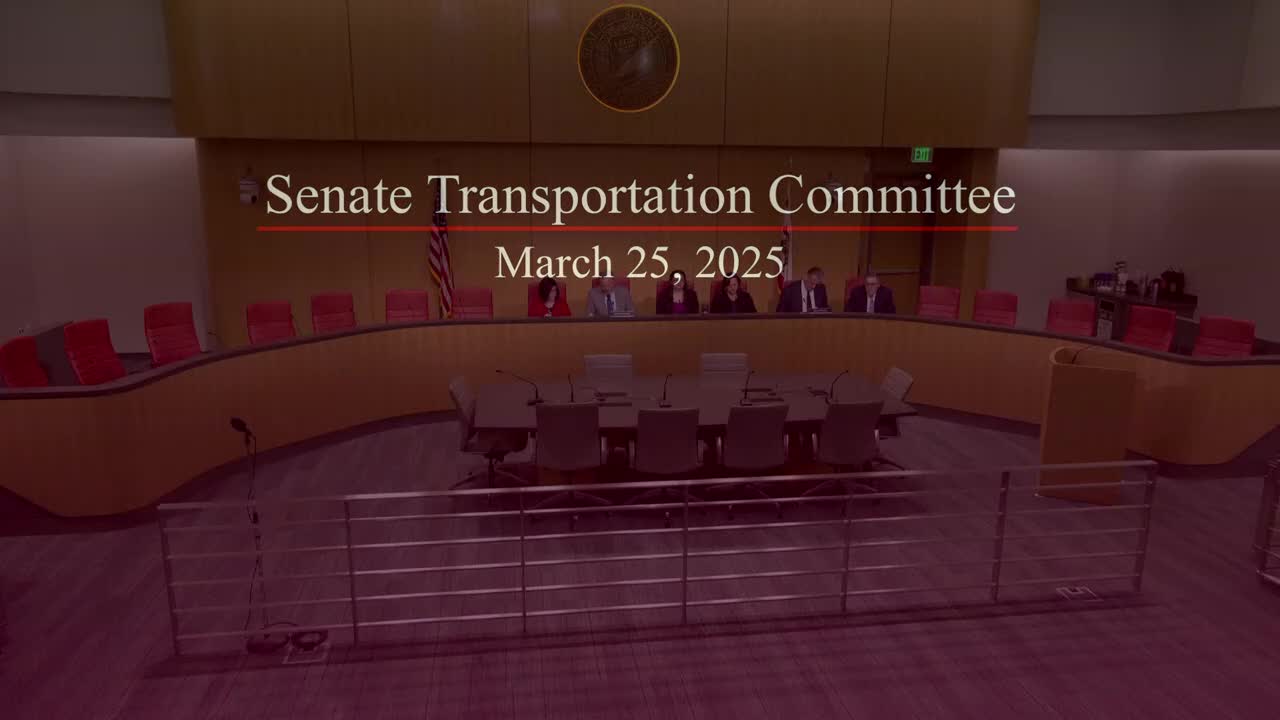 7MIN
Senate Standing Committee on Transportation
Bill Author

Bill Co-Author(s):