SB 51: Permanent standard time.
- Session Year: 2025-2026
- House: Senate
- Latest Version Date: 2025-04-08
Current Status:
Failed
(2026-02-02: Returned to Secretary of Senate pursuant to Joint Rule 56.)
Introduced
In Committee
Awaiting First Chamber Vote
Passed First Chamber
In Committee
Awaiting Second Chamber Vote
Passed Second Chamber
Enacted
Existing state law, Proposition 7, an initiative measure approved by the voters at the November 6, 2018, statewide general election, sets the standard time for California and sets daylight saving time to begin each March and end each November, as specified. Proposition 7 authorizes the Legislature to amend these provisions by a 2/3 vote to change the dates and times of the daylight saving time period, consistent with federal law, and authorizes the Legislature to amend these provisions by a 2/3 vote to provide for the application of year-round daylight saving time when authorized by federal law.
This bill would repeal daylight saving time in the state and the provisions regarding the Legislatures authority to amend the above-described provisions by a 2/3 vote. The bill would instead require the state and all political subdivisions of the state to observe year-round standard time. The bill would exempt the state and all political subdivisions of the state from the provisions of federal law that establish the advancement of time. The bill would make related findings and declarations.
Existing state law, Proposition 7, an initiative measure approved by the voters at the November 6, 2018, statewide general election, sets the standard time for California and sets daylight saving time to begin each March and end each November. November, as specified. Proposition 7 authorizes the Legislature to amend these provisions by a 2/3 vote to change the dates and times of the daylight saving time period, consistent with federal law, and authorizes the Legislature to amend these provisions by a 2/3 vote to provide for the application of year-round daylight saving time when authorized by federal law.
This bill would express the intent of the Legislature to enact legislation that would relate to the implementation of permanent standard time.This bill would repeal daylight saving time in the state and the provisions regarding the Legislatures authority to amend the above-described provisions by a 2/3 vote. The bill would instead require the state and all political subdivisions of the state to observe year-round standard time. The bill would exempt the state and all political subdivisions of the state from the provisions of federal law that establish the advancement of time. The bill would make related findings and declarations.
Existing state law, Proposition 7, an initiative measure approved by the voters at the November 6, 2018, statewide general election, sets the standard time for California and sets daylight saving time to begin each March and end each November. Proposition 7 authorizes the Legislature to amend these provisions by a 2/3 vote to change the dates and times of the daylight saving time period, consistent with federal law, and authorizes the Legislature to amend these provisions by a 2/3 vote to provide for the application of year-round daylight saving time when authorized by federal law.
This bill would express the intent of the Legislature to enact legislation that would relate to the implementation of permanent standard time.
The Legislature finds and declares all of the following:
(a)Changing between standard time and daylight saving time is disruptive to health, safety, and education.
(b)The California Medical Association, California Sleep Society, American Academy of Sleep Medicine, National Sleep Foundation, Sleep Research Society, and Society for Research on Biological Rhythms advise against permanent daylight saving time and recommend permanent standard time due to impacts to health.
(c)Permanent daylight saving time has historically been repealed due to its harm to health, safety, and education, after its trials during World War II and the 1970s.
(d)Federal law permits standard time by exemption from daylight saving time as the only alternative to biannual changing of clocks.
(e)Permanent standard time has been historically proven to last without incident for decades.
(f)Neighboring states are considering moving to permanent standard time so coordination with those states regarding timekeeping is essential for consistency.
(g)Permanent standard time has been historically proven to work without incident.
SEC. 2.Section 6808 of the Government Code is amended to read:6808.(a)(1)The standard time within the state is that of the fifth zone designated by federal law as Pacific standard time (15 U.S.C. Secs. 261 and 263).
(2)The state and all political subdivisions of the state shall observe the standard time pursuant to paragraph (1).
(b)The state and all political subdivisions of the state shall be exempt from the provisions of federal law that establish the advancement of time (15 U.S.C. Sec. 260a).
The Legislature finds and declares all of the following:
(a)Changing between standard time and daylight saving time is disruptive to health, safety, and education.
(b)The California Medical Association, California Sleep Society, American Academy of Sleep Medicine, National Sleep Foundation, Sleep Research Society, and Society for Research on Biological Rhythms advise against permanent daylight saving time and recommend permanent standard time due to impacts to health.
(c)Permanent daylight saving time has historically been repealed due to its harm to health, safety, and education, after its trials during World War II and the 1970s.
(d)Federal law permits standard time by exemption from daylight saving time as the only alternative to biannual changing of clocks.
(e)Permanent standard time has been historically proven to last without incident for decades.
(f)Neighboring states are considering moving to permanent standard time so coordination with those states regarding timekeeping is essential for consistency.
SEC. 2.Section 6808 of the Government Code is amended to read:6808.(a)(1)The standard time within the state is that of the fifth zone designated by federal law as Pacific standard time (15 U.S.C. Secs. 261 and 263).
(b)The standard time within the state shall advance by one hour during the daylight saving time period commencing at 2 a.m. on the second Sunday of March of each year and ending at 2 a.m. on the first Sunday of November of each year.(c)Notwithstanding subdivision (b), the Legislature may amend this section by a two-thirds vote to change the dates and times of the daylight saving time period, consistent with federal law, and, if federal law authorizes the state to provide for the year-round application of daylight saving time, the Legislature may amend this section by a two-thirds vote to provide for that application.(2)The state and all political subdivisions of the state shall observe the standard time pursuant to paragraph (1).
(b)The state and all political subdivisions of the state shall be exempt from the provisions of federal law that establish the advancement of time (15 U.S.C. Sec. 260a).
SECTION 1.It is the intent of the Legislature to enact legislation that would relate to the implementation of permanent standard time.It is the intent of the Legislature to enact legislation that would relate to the implementation of permanent standard time.
|
Date
|
Status
|
|---|---|
| Feb 2, 2026 | Returned to Secretary of Senate pursuant to Joint Rule 56. |
| May 23, 2025 | May 23 hearing: Held in committee and under submission. |
| May 16, 2025 | Set for hearing May 23. |
| May 5, 2025 | May 5 hearing: Placed on APPR. suspense file. |
| Apr 25, 2025 | Set for hearing May 5. |
| Apr 22, 2025 | From committee: Do pass and re-refer to Com. on APPR. (Ayes 9. Noes 2. Page 809.) (April 21). Re-referred to Com. on APPR. |
| Apr 10, 2025 | Set for hearing April 21. |
| Apr 8, 2025 | From committee with author's amendments. Read second time and amended. Re-referred to Com. on E., U & C. |
| Mar 26, 2025 | Re-referred to Com. on E., U & C. |
| Mar 17, 2025 | From committee with author's amendments. Read second time and amended. Re-referred to Com. on RLS. |
| Jan 29, 2025 | Referred to Com. on RLS. |
| Jan 6, 2025 | Read first time. |
| Dec 19, 2024 | From printer. May be acted upon on or after January 18. |
| Dec 18, 2024 | Introduced. To Com. on RLS. for assignment. To print. |
|
Date
|
Description
|
Location
|
Votes
|
|
|---|---|---|---|---|
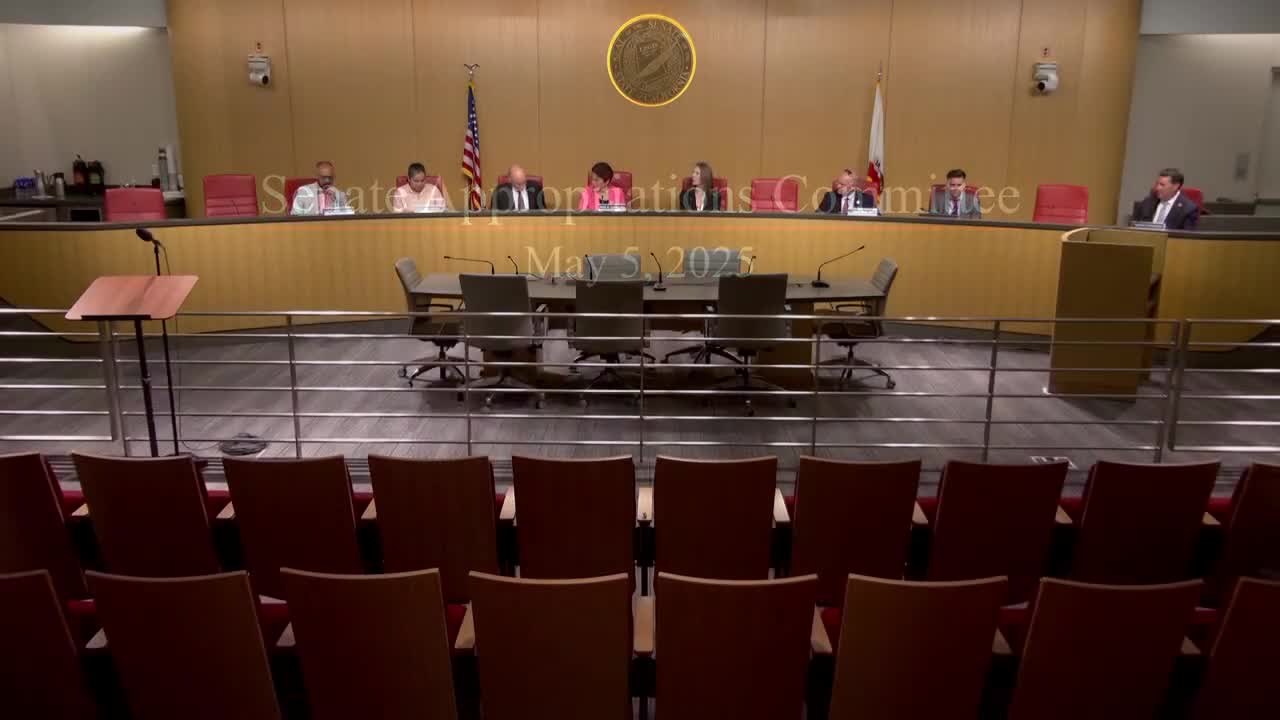
| May 5, 2025 | Placed on suspense file | Senate Standing Committee on Appropriations |
Passed |
|
| Apr 21, 2025 | Do pass, but first be re-referred to the Committee on [Appropriations] | Senate Standing Committee on Energy, Utilities and Communications |
Passed |
This list shows positions taken on this bill by organizations on the date displayed, which is linked to the original source.
Positions by individuals are not included.
|
Organization
|
Position
|
Date
|
|---|---|---|
| American Academy of Dental Sleep Medicine | ** Support | |
| american academy of sleep medicine | ** Support | |
| American Academy of Sleep Technology | ** Support | |
| American College of Chest Physicians | ** Support | |
| An individual | ** Against | |
| An individual | ** Support | |
| California Alliance For Golf | ** Against | |
| California Medical Association | ** Support | |
| California Sleep Society | ** Support | |
| California State Association of Psychiatrists | ** Support | |
| Coalition for Permanent Standard Time | ** Support | |
| national sleep foundation | ** Support | |
| Save Standard Time | ** Support | |
| Sleep Research Society | ** Support | |
| Society for Research on Biological Rhythms | ** Support |
SENATE COMMITTEE ON
Senator Anna Caballero, Chair
2025 - 2026 Regular Session
SB 51 (Niello) - Permanent standard time
Version: | Policy Vote: |
Urgency: | Mandate: |
Hearing Date: | Consultant: |
Bill Summary:
This bill would repeal Daylight Savings Time (DST).
Fiscal Impact:
- In the event that voters must approve the change proposed by this bill, it would result in one-time costs in the range of $738,000 to $984,000 (General Fund) to the Secretary of State (SOS) for printing and mailing costs to place a measure on the ballot in a statewide election. Actual costs could be higher or lower, depending on the length of required elements and the overall size of the ballot.
Background:
In California, DST (or “summer time”) is observed during the time of year when clocks “spring forward,” or between the second Sunday of March and first Sunday of November, consistent with federal law. Similarly, standard time (“winter time”) is observed during the time of year when clocks “fall back,” between the first Sunday of November and second Sunday of March.
Proposition 7. In 2018, AB 807 (Chu, Chapter 60, Statutes of 2018) placed a ballot measure before voters to make changes to the state’s observance of DST. Specifically, Proposition 7 (November 2018) which passed by 59.75% - 40.25% margin, allows the Legislature by 2/3 vote to make future changes to California’s DST period, including applying year-round application of DST, if changes are consistent with federal law. Proposition 7 also conformed California DST to current federal law. To enact Proposition 7 the measure also repealed Proposition 12 of 1949, a ballot initiative that established DST in California.
Energy impacts unclear. Claims of energy savings underlie observance of DST during the spring and summer. The argument is that by springing the clock forward during the summer when there is more sunlight we can take advantage of natural light and use less energy or fuel. Yet, there is no clear evidence that DST results in energy savings and some evidence suggests the contrary. In 2008, the National Bureau of Economic Research released a study on the effectiveness of DST. The study sought to provide the first empirical estimates of DST effects on electricity consumption in the United States by focusing on residential electricity demand as far back as the mid-1970s. The bureau’s main finding was that, contrary to the intent of the policy, DST increases residential electricity demand by approximately one percent. According to the study, during DST, there is a tradeoff between the demand for electricity and the demand for heating and cooling. That is, as the demand for electricity is reduced, the demand for heating and cooling is increased. These findings estimate that DST increased cost of electricity to Indiana households by about $9 million per year. The study further speculates that this impact is likely to vary by region, with regions where demand for heating and cooling is greater experiencing a higher increase in electricity use.
In 2007, the California Energy Commission (CEC) released a study in response to the expansion of DST by the Energy Policy Act of 2005. This study, titled “The Effect of Early Daylight Saving Time on California Electricity Consumption: A Statistical Analysis,” revealed that the “extension of DST to March 2007 had little or no effect on energy consumption in California, according to a statistical analysis. The most likely approximation is a .2% decrease during these three weeks.” The findings of the study in relation to energy savings of the changes to DST were largely inconclusive as the 95 percent confidence interval could result in a range of 1.5% energy savings to 1.4% increase in energy consumption.
Changing electricity generation sources. Since the 2007 CEC study, the state has increased its use of intermittent renewable energy resources, particularly solar generation which can only be used during the time the sun is shining. It is unclear how changes to DST could affect demand of energy resources and the particular effects on the electrical grid when solar generation is increasingly relied upon.
Proposed Law:
This bill would repeal DST with the aim of making year-round standard time permanent. Specifically, this bill would:
- Make several findings and declarations regarding the benefits of standard time.
- Repeal DST in the state and the provisions regarding the Legislature’s authority to amend the dates and times of the DST period, consistent with federal law, and if federal law authorizes the state to provide for the year-round application of DST by a 2/3 vote.
- Require the state and all political subdivisions of the state to observe year-round standard time.
- Exempt the state and all political subdivisions of the state from the provisions of federal law that establish the advancement of time.
The author and supporters are seeking to do away with the biannual changing of the clocks, and establish year-long standard time.
Related Legislation:
SB 1413 (Niello) of 2024, would have required the CEC to prepare and submit a report, on or before February 1, 2027, to the Legislature assessing the near-term and long-term impacts of observing year-round standard time on energy demand and supply. The bill was held by the author on the Assembly Floor.
AJR 33 (Chu) of 2020, was a measure to urge Congress and the President to enact legislation that would have allowed a state to adopt DST year-round. The measure was never heard.
AB 7 (Chu) of 2018, was an urgency measure that would have established year-round DST effective immediately once the federal government authorized such a change. The bill was held in Senate Energy, Utilities, & Communications Committee.
Proposition 7 of 2018 made numerous changes to the state’s statute concerning DST, including: conform the dates of DST observance with those in the federal statute; authorized the state, by a 2/3 votes of the Legislature, to adopt a year-round DST if allowed by the federal government; and repealed numerous sections of the 1949 California DST Act.
AB 807 (Chu, Chapter 60, Statutes of 2018) directed the Secretary of State to place an initiative on the ballot to allow voters to decide whether to authorize the Legislature, by a 2/3 vote of the members, to make changes to the state’s observance of DST consistent with, and to the extent authorized by, federal law.
AB 385 (Chu) of 2016, would have repealed the DST Act and authorized the Legislature by majority vote to amend the law for the application of permanent (year-round) DST, if authorized by federal law. The bill failed passage on the Senate Floor.
AB 2496 (Chu) of 2016, would have declared the intent of the Legislature to enact legislation to establish United States Standard Pacific Time as the standard time within the state during the entire year. The bill died at the Assembly Desk.
AJR 28 (Obernolte, Chapter 167, Statutes of 2016) urged Congress and the President to enact legislation that would allow states to adopt permanent (year-round) DST.
SJRX2 1 (Karnette, Chapter 1, Statutes of 2001) memorialized Congress to approve legislation that allows a state to uniformly apply DST year-round.
Staff Comments:
The Office of Legislative Counsel cautions that Section 2 of Article 2 of the California Constitution may require the voters to approve the change proposed in this bill. Specifically, Counsel warns that a change to year-long standard time may not be consistent with the passage of Proposition 7, which authorized the Legislature to make changes to the dates of DST.
Supporters of this bill contend that when AB 807 (Chu, Chapter 60, Statutes of 2018) was being debated the authors expressed that the language would still allow the state to adopt year-long standard time. However, Proposition 7 itself—what was actually approved by voters—does not state anything about simply “not switching” between DST and standard time. It is the position of Legislative Counsel that the plain language of the resolution is clear, and could be in conflict with this bill. In this event, the change to permanent year-long standard time may need to be placed on the ballot.
SOS indicates that printing and mailing costs associated with placing a measure on the statewide ballot are approximately $123,000 per page, depending on the length of the ballot. The fiscal estimates noted above reflect the addition of 6-8 pages in the Voter Information Guide. Actual costs would depend upon the length of the title and summary, analysis by the LAO, proponent and opponent arguments, and text of the proposal.
Other state fiscal impacts unclear. Much is unknown about the potential effects of repealing DST, including those that could impact the state or possibly come with state costs. As noted in the Senate Energy, Utilities, & Communications Committee analysis, a former legislative author abandoned a previous attempt to establish year-round standard time due to opposition against such a change, including concerns that standard time would limit daylight activities and other impacts. It is unclear whether the state is prepared for doing away with the time change and the full ramifications of this policy to a myriad of operations, including: schools, logistics industry, communications, transportation, and many others. As another example, in 1974, the federal government under President Nixon attempted a year-long DST as a response to the global energy crisis, which was, according to some news reports, abandoned by the fall due to the political backlash, public outcry, and concerns about safety due to the later sunrises (and darker mornings as a result). It is unclear whether a change to yearlong standard time would engender a similar response.
Energy impacts unclear. As noted above, since the 2007 CEC study, the state has increased its use of intermittent renewable energy resources, particularly solar generation which can only be used during the time the sun is shining. It is unclear how changes to DST could affect demand of energy resources and the particular effects on the electrical grid when solar generation is increasingly relied upon. In recent years, the state’s largest electrical grid operator, the California Independent System Operator (CAISO) has experienced challenges maintaining electric grid reliability in the evening hours of the late summer when solar generation has plummeted and hydroelectric resources have been reduced but demand for load is still high (the net peak load). As a result, the state has invested billions of dollars from the state General Fund and utility ratepayers to help shore up resources during the net peak load. It is unclear whether a move to permanent standard time might exacerbate these conditions, as the sun would set earlier on these days. Importantly, the amount of daily sunrise/sunset is not static and changes depending on the time of year and location.
-- END --
SENATE COMMITTEE ON ENERGY, UTILITIES AND COMMUNICATIONS
Senator Josh Becker, Chair
2025 - 2026 Regular
Bill No: Hearing Date: 4/21/2025
Author: | |||
Version: | Amended | ||
Urgency: | Fiscal: | ||
Consultant: | |||
SUBJECT:
DIGEST: This bill repeals Daylight Savings Time (DST) and make year-round Standard Time permanent.
ANALYSIS:
Existing law:
- Establishes, under federal law, the standard time of the United States for each of nine zones and advances the standard time of each zone by one hour during the period commencing at 2:00 a.m. on the second Sunday of March of each year and ending at 2:00 a.m. on the first Sunday of November of each year. Establishes the standard time within California is that of the fifth zone designated by federal law as Pacific Standard Time (PST). Prohibits a state from setting its standard time to year-round DST. (15 U.S. Code §260 et seq.)
- Establishes the standard time for California, consistent with federal law, is PST, and sets DST to begin at 2:00 a.m. on the second Sunday of March of each year and end at 2:00 a.m. on the first Sunday of November of each year. Authorizes the Legislature, by a 2/3 vote, to change the dates and times of the DST period, consistent with federal law, and if federal law authorizes the state to provide for the year-round application of DST. (Government Code §6808)
This bill:
- Makes several findings and declarations regarding the benefits of standard time.
- Repeals DST in the state and the provisions regarding the Legislature’s authority to amend the dates and times of the DST period, consistent with federal law, and if federal law authorizes the state to provide for the year-round application of DST by a 2/3 vote.
- Requires the state and all political subdivisions of the state to observe year-round standard time.
- Exempts the state and all political subdivisions of the state from the provisions of federal law that establish the advancement of time.
Background
Daylight savings time v. standard time. DST is commonly understood as “summer time” and standard time is commonly understood as “winter time.” In California, DST, summer time, is observed during the time of year when clocks “spring forward,” between the second Sunday of March and first Sunday of November, consistent with federal law. Standard time, or winter time, in California is observed during the time of year when clocks “fall back,” between the first Sunday of November and second Sunday of March.
History of DST. The first modern DST was established during WWI as an effort to save energy and conserve fuel. In April of 1916, at 11:00 p.m., Germany and Austria advanced the hands of their clocks one hour and kept them that way until the following October. Many other nations—mostly in Europe, but including Tasmania and some Canadian provinces as well—followed suit. Two years later, the United States also established in law DST and created a standard time. That law defined standard time zones and set summer DST to begin on March 31, 1918. The nation observed DST for seven months in 1918 and 1919 but ceased to do so when Congress repealed the DST law. Nonetheless, from February 9, 1942, to September 30, 1945, President Franklin Roosevelt instituted year-round DST, or “War Time.” From 1945 to 1966, there was no federal law regarding DST, leaving it to states and localities to choose whether and when to observe DST.
California Daylight Saving Time Act. California voters, in 1949, established The California Daylight Saving Time Act through the passage of Proposition 12. The proposition established standard time within California as the time which the federal government describes and designates as United States PST. The initiative also required that the state advance time one hour during the period from the last Sunday in April until the last Sunday in October. In the mid-1960s, Congress enacted The Uniform Act of 1966 to establish a uniform standard DST within each time zone. The act set DST to begin on the last Sunday of April and to end on the last Sunday of October. This act exempted any state from observing DST if the state passed a law that results in year-round observance of standard time. Two states—Arizona and Hawaii—have done so. Federal law does not, however, give states the option to observe DST year-round. In an effort to save energy, Congress passed The Energy Policy Act in 2005 to extend DST in the U.S. by three weeks in the spring and one week in the fall. This change created a conflict between California’s DST law and the federal law on DST. However, since federal law provides states only two options: (1) observe standard time throughout the year, or (2) observe DST on federally mandated dates, California has observed the dates consistent with the adjusted federal dates.
California passes Proposition 7 in 2018. In 2018, AB 807 (Chu, Chapter 60, Statutes of 2018) placed a ballot measure before voters to make changes to the state’s observance of DST. Specifically, Proposition 7 (November 2018) which passed by 59.75% - 40.25% margin, allows the Legislature by 2/3 vote to make future changes to California’s DST period, including applying year-round application of DST, if changes are consistent with federal law. Proposition 7 also conformed California DST to current federal law. To enact Proposition 7 the measure also repealed Proposition 12 of 1949, a ballot initiative that established DST in California.
Energy savings? Claims of energy savings underlie observance of DST during the spring and summer. The argument is that by springing the clock forward during the summer when there is more sunlight we can take advantage of natural light and use less energy or fuel. Yet, there is no clear evidence that DST results in energy savings and some evidence suggests the contrary. In 2008, the National Bureau of Economic Research released a study on the effectiveness of DST. The study sought to provide the first empirical estimates of DST effects on electricity consumption in the United States by focusing on residential electricity demand as far back as the mid-1970s. The bureau’s main finding was that, contrary to the intent of the policy, DST increases residential electricity demand by approximately one percent. According to the study, during DST, there is a tradeoff between the demand for electricity and the demand for heating and cooling. That is, as the demand for electricity is reduced, the demand for heating and cooling is increased. These findings estimate that DST increased cost of electricity to Indiana households by about $9 million per year. The study further speculates that this impact is likely to vary by region, with regions where demand for heating and cooling is greater experiencing a higher increase in electricity use.[1]
In 2007, the California Energy Commission (CEC) released a study in response to the expansion of DST by the Energy Policy Act of 2005. This study, titled “The Effect of Early Daylight Saving Time on California Electricity Consumption: A Statistical Analysis,” revealed that the “extension of DST to March 2007 had little or no effect on energy consumption in California, according to a statistical analysis. The most likely approximation is a .2% decrease during these three weeks.”[2] The findings of the study in relation to energy savings of the changes to DST were largely inconclusive as the 95 percent confidence interval could result in a range of 1.5% energy savings to 1.4% increase in energy consumption.
Comments
Bill seeks year-round standard time. The author and supporters are seeking to do away with the biannual changing of the clocks, and establish year-long standard time. In support of this goal, the author and supporters, cite various studies as to the benefits of having year-round standard time. The main benefits cited are the avoidance of public health impacts associated with switching the time by an hour twice a year, including increased heart attacks and strokes, traffic accidents, and workplace injuries as residents adjust to the time differences.
Changing electricity generation sources. Since the 2007 CEC study, the state has increased its use of intermittent renewable energy resources, particularly solar generation which can only be used during the time the sun is shining. It is unclear how changes to DST could affect demand of energy resources and the particular effects on the electrical grid when solar generation is increasingly relied upon. In recent years, the state’s largest electrical grid operator, the California Independent System Operator (CAISO) has experienced challenges maintaining electric grid reliability in the evening hours of the late summer when solar generation has plummeted and hydroelectric resources have been reduced but demand for load is still high (the net peak load). As a result, the state has invested billions of dollars from the state General Fund and utility ratepayers to help shore up resources during the net peak load. It is unclear whether a move to permanent standard time might exacerbate these conditions, as the sun would set earlier on these days. Importantly, the amount of daily sunrise/sunset is not static and changes depending on the time of year and location.
Legislature empowered? Act of Congress not needed to establish standard time. Existing federal law does not allow states to establish year-round DST, but does allow year-round standard time. A former legislative author abandoned a previous attempt to establish year-round standard time due to opposition against such a change, including concerns that standard time would limit daylight activities and other impacts. If the Legislature passes this measure by the required 2/3 and the Governor signs this bill into law, the bill would take effect on January 1, 2026. As such, the clocks would NOT spring forward on March 2026 in California and the state would remain on PST.
What did voters support? Voters supported the passage of Proposition 7 in 2018. However, it seems a valid question as to whether voters supported doing away with the biannual clock changes or if they support permanent year-long DST or permanent year-long standard time. Lacking any more recent data and analysis, this bill would go into effect on January 2026 and immediately adopt year-long standard time. It is unclear whether the state is prepared for doing away with the time change and the full ramifications of this policy to a myriad of operations, including: schools, logistics industry, communications, transportation, and many others, as well as, the effects on individuals adjusting to the new sunrise and sunset hours during the summer time (DST). The reality for most individuals is they may not fully appreciate the changes being proposed until they are clearly explained and potentially experienced.
In 1974, as a response to the global energy crisis, the federal government under President Nixon attempted a year-long DST which, according to some news reports, was abandoned by the fall due to the political backlash, public outcry, and concerns about safety due to the later sunrises (and darker mornings as a result). It is unclear whether a change to yearlong standard time would engender a similar response.
Impacts to communities along the state’s borders. California shares borders with three states and the country of Mexico. The constant movement of people and goods across those borders requires coordination. The economies and societies of the border communities are interdependent. Currently, Arizona does not observe DST. Mexico recently did away with observing DST, however, the border areas maintain alignment with U.S. states. Changes to DST in California have the potential for considerable disruption. For example, when Congress passed the Energy Policy Act of 2005, which amended the dates of DST in the United States, it resulted in a time difference, for a period of a couple of weeks, between communities in the U.S. and communities in Mexico. This had a huge effect on border communities. In order to address this effect, the Congress of Mexico passed a law to allow border communities to adopt a DST pattern consistent with the United States. However, given Mexico has moved to year-long standard time, it is unclear whether a similar move by California would have a similar effect.
Caution! According to the Office of Legislative Counsel, SB 1413 (Niello, 2024) may not be allowable as it may need to go before the voters before year-long standard time could be adopted. Legislative Counsel cautions that Section 2 of Article 2 of the California Constitution may require the voters to approve the change proposed in this bill. The Office of Legislative Counsel cautions that a change to year-long standard time may not be consistent with the passage of Proposition 7 which authorized the Legislature to make changes to the dates of DST. The supporters of this bill contend that when AB 807 (Chu, Chapter 60, Statutes of 2018) was being debated the authors expressed that the language would still allow the state to adopt year-long standard time. They suggest that this may strictly be an issue of divergent interpretations. Should this bill proceed, the author and members may wish to further assess whether to require the bill go before the voters, as suggested by the Office of Legislative Counsel.
Timing and federal play. The question for the Legislature is whether immediate action is necessary. At the federal level, there are efforts to advance year-round DST in Congress. Last week, the U.S. Senate Commerce Committee convened a hearing to hear from advocates for year-round DST and year-round standard time. Just last Friday, President Trump posted on social media “The House and Senate should push hard for more Daylight at the end of the day. Very popular and, most importantly, no more changing of the clocks, a big inconvenience and, for our government, A VERY COSTLY EVENT!!!”[3] There may be some benefit to waiting and assessing implications of a year-long standard time before authorizing its change. The state could assess the implications and the interests of residents, communities, schools, businesses, neighboring states and others to coordinate and conform to a year-long standard time all with a more informed analysis. Such an analysis should also include more current consideration of changes to energy systems, in the near-term and long-term, of moving to year-long standard time, as well as, the impacts during the different time of the year in different regions of the state.
Prior/Related Legislation
SB 1413 (Niello) of 2024, would have PST and required the CEC to prepare and submit a report, on or before February 1, 2027, to the Legislature assessing the near-term and long-term impacts of observing year-round standard time on energy demand and supply. The bill was held by the author on the Assembly Floor.
AJR 33 (Chu) of 2020, was a measure to urge Congress and the President to enact legislation that would have allowed a state to adopt DST year-round. The measure was never heard.
AB 7 (Chu) of 2018, was an urgency measure that would have established year-round DST effective immediately once the federal government authorizes such a change. The bill was held in this committee.
Proposition 7 of 2018 made numerous changes to the state’s statute concerning DST, including: conform the dates of DST observance with those in the federal statute; authorized the state, by a 2/3 votes of the Legislature, to adopt a year-round DST if allowed by the federal government; and repealed numerous sections of the 1949 California DST Act.
AB 807 (Chu, Chapter 60, Statutes of 2018) directed the Secretary of State to place an initiative on the ballot to allow voters to decide whether to authorize the Legislature, by a 2/3 vote of the members, to make changes to the state’s observance of DST consistent with, and to the extent authorized by, federal law.
AB 385 (Chu) of 2016, would have repealed the DST Act and authorized the Legislature by majority vote to amend the law for the application of permanent (year-round) DST, if authorized by federal law. The bill failed passage on the Senate Floor.
AB 2496 (Chu) of 2016, would have declared the intent of the Legislature to enact legislation to establish United States Standard Pacific Time as the standard time within the state during the entire year. The bill died at the Assembly Desk.
AJR 28 (Obernolte, Chapter 167, Statutes of 2016) urged Congress and the President to enact legislation that would allow states to adopt permanent (year-round) DST.
SJRX2 1 (Karnette, Chapter 1, Statutes of 2001) memorialized Congress to approve legislation that allows a state to uniformly apply DST year-round.
FISCAL EFFECT: Appropriation: Fiscal Com.: Local:
SUPPORT:
California Sleep Society (Co-Sponsor)
Save Standard Time (501c4 Nonprofit) (Co-Sponsor)
American Academy of Dental Sleep Medicine
American Academy of Sleep Medicine
American Academy of Sleep Technology
American College of Chest Physicians
California Medical Association
California State Association of Psychiatrists
Coalition for Permanent Standard Time
National Sleep Foundation
Sleep Research Society
Society for Research on Biological Rhythms
An Individual
OPPOSITION:
California Alliance for Golf
An Individual
ARGUMENTS IN SUPPORT: According to the author:
SB 51 is a bipartisan, multistate effort to “ditch the switch” and end the yearly transition to Daylight Saving Time (DST) in the spring. The practical impact would be that the State of California would remain on Permanent Standard Time (pST), the time during fall/winter, instead of switching our clocks twice a year to accommodate DST. There have been federal efforts to establish permanent DST, but those efforts have failed (federal action is needed for permanent DST). However, there is no act of Congress or federal permission needed to be successful in switching to pST. Not only does SB 51 eliminate an inconvenience for Californians, but would potentially help us have consistency with our border states who are also pursuing pST in their respective states (WA, OR, NV). There are also multiple health and safety implications this change would help address. It is time to “ditch the switch” and make the time stable once and for all by implementing pST for California.
ARGUMENTS IN OPPOSITION: The California Alliance for Golf states:
…The full economic consequences of the permanent standard time option compel consideration, particularly in light of the fact that no one, including the proponents of SB 51, suggest that “ditching a switch” Californians have been making for a century is an emergency. In addition to a full study of all health/safety and economic consequences of moving immediately to permanent standard time, we suggest the need to study the full energy consequences as well. Twice in American history (World War II and the 1974-1975 energy crisis) the nation has gone to permanent daylight-saving time as a means of saving energy. While we are aware of credible studies that have indicated disappointment in the resultant savings, “disappointment” doesn’t equate to nothing, nor does it indicate that 50 years later that same disappointment would prevail. This too ought to be part of any fully informed decision as to which means of “ditching the switch” would be preferable – permanent daylight-saving time or permanent standard time.
-- END --
Grant, Laura and Kotchen, Matthew. “Does Daylight Saving Time Save Energy? Evidence from a Natural Experiment in Indiana.” October 2008. http://www.nber.org/papers/ w14429.pdf ↑
California Energy Commission. The Effect of Early Daylight Saving Time on California. May 2007.< http://www.energy.ca.gov/2007publications/CEC-200-2007-004/CEC-200-2007-004.PDF>. ↑
https://www.politico.com/live-updates/2025/04/11/congress/trump-wants-to-change-the-time-00286183 ↑
Discussed in Hearing
 27SEC
Senate Standing Committee on Appropriations
 19MIN
Senate Standing Committee on Energy, Utilities and Communications
Bill Author