SB 553: Prisons: clearances.
- Session Year: 2025-2026
- House: Senate
- Latest Version Date: 2025-10-01
Current Status:
Passed
(2025-10-01: Chaptered by Secretary of State. Chapter 226, Statutes of 2025.)
Introduced
In Committee
Awaiting First Chamber Vote
Passed First Chamber
In Committee
Awaiting Second Chamber Vote
Passed Second Chamber
Enacted
Existing law requires the Department of Corrections and Rehabilitation to conduct rehabilitative programming in a manner that meets specified requirements, including minimizing program wait times and offering a variety of program opportunities to inmates regardless of security level or sentence length. Existing law establishes various clearance levels for program providers in state prisons, including short-term clearance, annual program provider clearance, and statewide program provider clearance, as defined. Existing law establishes a procedure for a program provider to receive one of these clearances and an identification card to gain entry into the state prison and requires the department to provide state prisons with forms for program providers to obtain the clearances.
This bill would expand these provisions to allow legal professionals and attorney support personnel, as defined, to apply for these clearances. The bill would revise the names of these clearances to annual gate clearances and short-term gate clearances. The bill would also require the department to, upon request, give a short-term gate clearance for any institution without the requirement to apply for a long-term gate clearance to specified individuals, including, among others, the Governor and all cabinet members, members of the Legislature and their staff, and current judges of the state.
Existing law requires the Department of Corrections and Rehabilitation to conduct rehabilitative programming in a manner that meets specified requirements, including minimizing program wait times and offering a variety of program opportunities to inmates regardless of security level or sentence length. Existing law establishes various clearance levels for program providers in state prisons, including short-term clearance, annual program provider clearance, and statewide program provider clearance, as defined. Existing law establishes a procedure for a program provider to receive one of these clearances and an identification card to gain entry into the state prison and requires the department to provide state prisons with forms for program providers to obtain the clearances.
This bill would require the department to create standardized clearance forms for legal professionals to apply for annual clearance to gain approval to provide legal services at all institutions, as specified. expand these provisions to allow legal professionals and attorney support personnel, as defined, to apply for these clearances. The bill would revise the names of these clearances to annual gate clearances and short-term gate clearances. The bill would also require the department to, upon request, give a short-term gate clearance for any institution without the requirement to apply for a long-term gate clearance to specified individuals, including, among others, the Governor and all cabinet members, members of the Legislature and their staff, and current judges of the state.
Existing law requires the Department of Corrections and Rehabilitation to conduct rehabilitative programming in a manner that meets specified requirements, including minimizing program wait times and offering a variety of program opportunities to inmates regardless of security level or sentence length. Existing law establishes various clearance levels for program providers in state prisons, including short-term clearance, annual program provider clearance, and statewide program provider clearance, as defined. Existing law establishes a procedure for a program provider to receive one of these clearances and an identification card to gain entry into the state prison and requires the department to provide state prisons with forms for program providers to obtain the clearances.
This bill would require the department to create standardized clearance forms for legal professionals to apply for annual clearance to gain approval to provide legal services at all institutions, as specified. The bill would also require the department to, upon request, give a short-term clearance without the requirement to apply for a long-term clearance to specified individuals, including, among others, the Governor and all cabinet members, members of the Legislature and their staff, and current judges of the state.
For purposes of this chapter, the following definitions apply:
(a)Annual gate clearance refers to a clearance status allowing a program provider or legal professional to enter one institution for a full calendar year.
(b)Institution refers to a California state prison or facility, including community reentry programs and fire camps under the jurisdiction of the Department of Corrections and Rehabilitation.
(c)Program provider refers to an individual affiliated with a nonprofit organization or a volunteer that originates outside the Department of Corrections and Rehabilitation and provides rehabilitative programming to incarcerated people.
(d)Program provider identification card refers to an identification card that allows a program provider with an annual or statewide gate clearance to enter specified institutions without a sponsor.
(e)Short-term gate clearance refers to a clearance status that allows a program provider, legal professional, or attorney support personnel to enter an institution for the specific dates and times, as approved by the hiring authority or designee, and shall not exceed 30 days.
(f)Sponsor refers to staff at an institution assigned to escort program providers, legal professionals, or attorney support personnel, within the institution.
(g)Statewide gate clearance refers to a clearance status provided to a program provider or legal professional entering more than three institutions on a routine basis.
(h)(1)Legal professional refers to an attorney or attorney representative.
(2)An attorney representative is any of the following:
(A)A private investigator licensed by any state and sponsored by the attorney or appointed by the court.
(B)An investigator who is employed by a government agency, public agency, or public institution.
(3)An attorney support personnel is any of the following:
(A)A law student sponsored by the attorney.
(B)A legal paraprofessional sponsored by the attorney or appointed by the court.
(C)An employee of an attorney, legitimate legal service organization, or licensed private investigator who is sponsored by the attorney or licensed private investigator.
SEC. 3.Section 7461 of the Penal Code is amended to read:7461.(a)The department shall provide forms to the institution for short-term gate clearances. The institution shall only use the forms provided by the department to process the short-term gate clearance. The forms should reflect the limited nature of this clearance and shall not be overly burdensome. An institution shall not require additional institution-specific local forms.
(b)The department shall not require a fingerprint-based background check from an applicant applying for a short-term gate clearance.
(c)The department shall not limit the number of short-term gate clearances an applicant can receive.
(d)The department shall notify all short-term gate clearance applicants of the decision to approve or disapprove the application consistent with the timeframes identified in the departments criminal history security screening form.
SEC. 4.Section 7462 of the Penal Code is amended to read:7462.(a)The department shall provide a standardized clearance packet to the institution for annual gate clearances. The institution shall only use the clearance packet provided by the department, composed only of approved forms, which allows an applicant to use the same packet for different institutions. An institution shall not require additional institution-specific local forms.
(b)(1)An applicant applying for an annual gate clearance shall complete a standardized clearance packet.
(2)A program provider applying for this clearance shall be subject to a fingerprint-based background check. The clearance application process shall be initiated prior to any fingerprint-based background check. Completion of the background check shall occur concurrently with the departments processing of the annual gate clearance application. If the program provider has already provided fingerprints to an institution or the department, a clearance application shall be submitted to the additional institution, noting where the fingerprints were previously provided. The institution shall not require the program provider to provide additional fingerprints.
(c)Approved applicants shall renew their gate clearance annually.
(d)Approved applicants with an annual gate clearance shall have either a program provider identification card or a sponsor.
(e)(1)The department shall not limit the number of annual gate clearances an applicant can receive.
(2)The department shall notify all applicants for an annual gate clearance of the decision to approve or disapprove the application within 30 days of receipt of the application. If the department has not received the applicable information from the Department of Justice after 30 days, the department shall provide an update to the applicant. The department shall notify applicants of the decision to approve or disapprove the application within 30 days of receiving the applicable information from the Department of Justice.
SEC. 5.Section 7463 of the Penal Code is amended to read:7463.(a)The department shall provide a standardized packet of forms to the institution for a program provider identification card, which allows program providers to use the same packet for different institutions. An institution shall not require additional institution-specific local forms.
(b)(1)A program provider identification card is valid for five years, provided the program provider meets testing and annual training requirements and renews their clearance annually.
(2)A program provider with a program provider identification card shall be able to escort other authorized program providers within the institution for which the program provider identification card is valid.
(3)A program provider applying for a program provider identification card shall be subject to the same baseline TB screening and testing, as defined in subdivision (b) of Section 6006.5, as required by various departmental staff. The department shall accept forms from a hospital, military, University of California system, or local public health department in lieu of the Department of Corrections and Rehabilitation standard forms as documentation of testing if the forms include the date of the testing and evaluation, the results, and the licensed evaluators or physicians signature.
(4)A program provider shall be subject to a fingerprint-based background check with their initial clearance application. If the program provider has already provided fingerprints to the department, a clearance application shall be submitted to the additional institution, noting where the fingerprints were previously provided. The institution shall not require the program provider to provide additional fingerprints.
(c)(1)The department shall not limit the number of program provider identification cards a program provider can receive.
(2)The department shall notify all program provider card applicants of the decision to approve or disapprove within 30 days of receipt of the application. If the department has not received the applicable information from the Department of Justice after 30 days, the department shall provide an update to the program provider. The department shall notify applicants of the decision to approve or disapprove the application within 30 days of receiving the applicable information from the Department of Justice.
SEC. 6.Section 7464 of the Penal Code is amended to read:7464.(a)(1)The department shall accept applications for statewide gate clearance from qualified program providers and legal professionals and, if a program provider is approved, the department shall provide a program provider identification card pursuant to Section 7463 if the program provider does not already have a valid identification card.
(2)Approved applicants shall renew their clearance annually.
(3)A program provider applying for this clearance shall be subject to a fingerprint-based background check with their initial clearance application. If the applicant has already provided fingerprints to the department, a clearance application shall be submitted to the additional institution, noting where the fingerprints were previously provided. The institution shall not require the applicant to provide additional fingerprints.
(b)A program provider with statewide gate clearance shall be able to escort other authorized program providers within each institution for which the statewide gate clearance is valid.
(c)A program provider with statewide gate clearance may provide programs without a sponsor.
(d)If a program provider has been providing programming for a minimum of six months at more than three institutions, when approved to provide programs at any additional institutions, they may immediately request a program provider identification card.
(e)The department shall notify all statewide gate clearance applicants of the decision to approve or disapprove the application within 30 days of receipt of the application.
SEC. 7.Section 7465 of the Penal Code is amended to read:7465.(a)The department shall designate a standardized approval process for people who were formerly incarcerated and who are applying for all clearances covered by this chapter.
(b)The department shall not exclude people who were formerly incarcerated from applying based on the type of institution or local area the person is applying to, unless extraordinary circumstances exist, such as verified or credible evidence by a warden that the person who was formerly incarcerated has introduced contraband into the institution or poses a significant security concern.
(c)For applicants who were formerly incarcerated and who are currently under supervision by the Division of Adult Parole Operations and who require documentation from the division to be provided any type of clearance, the division shall provide the documentation within 14 calendar days of the receipt of the request.
(d)An institution shall write and explain in a memorandum the reasons for denying a formerly incarcerated persons application for clearance. The memorandum shall be provided to the applicant by email or mail.
(e)Denial of applications for clearance shall be grounds for an appeal. An appeal of denial of applications for clearance shall be resolved within 90 days.
SEC. 8.Section 7466 of the Penal Code is amended to read:7466.(a)The department shall notify all applicants for clearance of their right to appeal clearance decisions and of the process for filing an appeal.
(b)The department shall notify all applicants for clearance of the final disposition of their appeal within 90 days.
SEC. 9.Section 7467 of the Penal Code is amended to read:7467.(a)The department shall submit to the Department of Justice fingerprint images and related information required by the Department of Justice from an applicant applying for an annual gate clearance, program provider identification card, or statewide gate clearance, as defined in Section 7460, in accordance with subdivision (u) of Section 11105.
(b)The Department of Justice shall provide a state or federal response to the department pursuant to subdivision (l) of Section 11105.
SEC. 10.Section 7468 is added to the Penal Code, to read:7468.The following persons shall, upon request, be granted a short-term gate clearance for any institution without the requirement to apply for a clearance for all Department of Corrections and Rehabilitation facilities upon request:
(a)The Governor and all cabinet members.
(b)Members of the Legislature and legislative staff.
(c)Current judges of the State of California.
For purposes of this chapter, the following definitions apply:
(a)Annual gate clearance refers to a clearance status allowing a program provider or legal professional to enter one institution for a full calendar year.
(b)Institution refers to a California state prison. prison or facility, including community reentry programs and fire camps under the jurisdiction of the Department of Corrections and Rehabilitation.
(c)Program provider refers to an individual affiliated with a nonprofit organization or a volunteer that originates outside the Department of Corrections and Rehabilitation and provides rehabilitative programming to incarcerated people.
(d)Program provider identification card refers to an identification card that allows a program provider with an annual or statewide gate clearance to enter a specified institution specified institutions without a sponsor.
(e)Short-term gate clearance refers to a clearance status that allows a program provider provider, legal professional, or attorney support personnel to enter an institution for three or fewer days per specific event. the specific dates and times, as approved by the hiring authority or designee, and shall not exceed 30 days.
(f)Sponsor refers to correctional staff at an institution assigned to escort program providers providers, legal professionals, or attorney support personnel, within the institution.
(g)Statewide program provider gate clearance refers to a clearance status provided to a program provider or legal professional entering more than three institutions on a routine basis consistent with their program provider status and entitles them to a program provider identification card. basis.
(h)(1)Legal professional refers to an attorney or attorney representative.
(2)An attorney representative is any of the following:
(A)A private investigator licensed by any state and sponsored by the attorney or appointed by the court.
(B)An investigator who is employed by a government agency, public agency, or public institution.
(3)An attorney support personnel is any of the following:
(C)(A)A law student sponsored by the attorney.
(D)(B)A legal paraprofessional sponsored by the attorney or appointed by the court.
(E)(C)An employee of an attorney, legitimate legal service organization, or licensed private investigator who is sponsored by the attorney or licensed private investigator.
SEC. 3.Section 7461 of the Penal Code is amended to read:7461.(a)The department shall provide forms to the institution for short-term gate clearances. The institution shall only use the forms provided by the department to process the short-term gate clearance. The forms should reflect the limited nature of this clearance and shall not be overly burdensome. An institution shall not require additional institution-specific local forms.
(b)The department shall not require a fingerprint-based background check for a program provider from an applicant applying for a short-term gate clearance.
(c)The department shall not limit the number of short-term gate clearances a program provider an applicant can receive.
(d)The department shall notify all short-term gate clearance applicants of the decision to approve or disapprove the application consistent with the timeframes identified in the departments criminal history security screening form.
SEC. 4.Section 7462 of the Penal Code is amended to read:7462.(a)The department shall provide a standardized clearance packet to the institution for annual gate clearances. The institution shall only use the clearance packet provided by the department, composed only of approved forms, which allows program providers an applicant to use the same packet for different institutions. An institution shall not require additional institution-specific local forms.
(b)(1)A program provider An applicant applying for an annual gate clearance shall complete a standardized clearance packet.
(2)A program provider applying for this clearance shall be subject to the same infectious disease testing policies as the department staff. The department shall accept forms from a hospital, military, University of California system, or local public health department in lieu of the CDCR Form 7336 or CDCR Form 7354 as documentation of testing if the forms include the date of the testing and evaluation, the results, and the licensed evaluators or physicians signature.(3)(2)A program provider applying for this clearance shall be subject to a fingerprint-based background check. The clearance application process shall be initiated prior to any fingerprint-based background check. Completion of the background check shall occur concurrently with the departments processing of the annual gate clearance application. If the program provider has already provided fingerprints to an institution or the department, a clearance application shall be submitted to the additional institution, noting where the fingerprints were previously provided. The institution shall not require the program provider to provide additional fingerprints.
(c)A program provider Approved applicants shall renew their gate clearance annually.
(d)A program provider Approved applicants with an annual gate clearance shall have either a program provider identification card or a sponsor.
(e)(1)The department shall not limit the number of annual gate clearances a program provider an applicant can receive.
(2)The department shall notify all program provider applicants for an annual gate clearance of the decision to approve or disapprove the application within 30 days of receipt of the application. If the department has not received the applicable information from the Department of Justice after 30 days, the department shall provide an update to the program provider. applicant. The department shall notify applicants of the decision to approve or disapprove the application within 30 days of receiving the applicable information from the Department of Justice.
SEC. 5.Section 7463 of the Penal Code is amended to read:7463.(a)The department shall provide a standardized packet of forms to the institution for a program provider identification card, which allows program providers to use the same packet for different institutions. An institution shall not require additional institution-specific local forms.
(b)(1)A program provider identification card is valid for five years, provided the program provider meets testing and annual training requirements and renews their clearance annually.
(2)A program provider with a program provider identification card shall be able to escort other authorized program providers within the institution for which the program provider identification card is valid.
(3)A program provider applying for a program provider identification card shall be subject to the same infectious disease testing policies as the department staff. baseline TB screening and testing, as defined in subdivision (b) of Section 6006.5, as required by various departmental staff. The department shall accept forms from a hospital, military, University of California system, or local public health department in lieu of the CDCR Form 7336 or CDCR Form 7354 Department of Corrections and Rehabilitation standard forms as documentation of testing if the forms include the date of the testing and evaluation, the results, and the licensed evaluators or physicians signature.
(4)A program provider shall be subject to a fingerprint-based background check with their initial clearance application. If the program provider has already provided fingerprints to the department, a clearance application shall be submitted to the additional institution, noting where the fingerprints were previously provided. The institution shall not require the program provider to provide additional fingerprints.
(c)(1)The department shall not limit the number of program provider identification cards a program provider can receive.
(2)The department shall notify all program provider card applicants of the decision to approve or disapprove within 30 days of receipt of the application. If the department has not received the applicable information from the Department of Justice after 30 days, the department shall provide an update to the program provider. The department shall notify applicants of the decision to approve or disapprove the application within 30 days of receiving the applicable information from the Department of Justice.
SEC. 6.Section 7464 of the Penal Code is amended to read:7464.(a)(1)The department shall accept applications for statewide program provider gate clearance from qualified program providers and legal professionals and, if a program provider is approved, the department shall provide a program provider identification card pursuant to Section 7463 if the program provider does not already have a valid identification card.
(2)A program provider Approved applicants shall renew their clearance annually.
(3)A program provider applying for a program provider identification card shall be subject to the same infectious disease testing policies as the department staff. The department shall accept forms from a hospital, military, University of California system, or local public health department in lieu of the CDCR Form 7336 or CDCR Form 7354 as documentation of testing if the forms include the date of the testing and evaluation, the results, and the licensed evaluators or physicians signature.(4)(3)A program provider applying for this clearance shall be subject to a fingerprint-based background check with their initial clearance application. If the program provider applicant has already provided fingerprints to the department, a clearance application shall be submitted to the additional institution, noting where the fingerprints were previously provided. The institution shall not require the program provider applicant to provide additional fingerprints.
(b)A program provider with statewide program provider gate clearance shall be able to escort other authorized program providers within each institution for which the statewide program provider gate clearance is valid.
(c)A program provider with statewide program provider gate clearance may provide programs without a sponsor.
(d)If a program provider has been providing programming for a minimum of six months at more than three institutions, when approved to provide programs at any additional institutions, they may immediately request a program provider identification card.
(e)The department shall notify all statewide program provider gate clearance applicants of the decision to approve or disapprove the application within 30 days of receipt of the application.
SEC. 7.Section 7465 of the Penal Code is amended to read:7465.(a)The department shall designate a standardized approval process for people who were formerly incarcerated and who are applying for all clearances covered by this chapter.
(b)The department shall not exclude people who were formerly incarcerated from applying based on the type of institution or local area the person is applying to, unless extraordinary circumstances exist, such as verified or credible evidence by a warden that the person who was formerly incarcerated has introduced contraband into the institution or poses a significant security concern.
(c)For applicants who were formerly incarcerated and who are currently under supervision by the Division of Adult Parole Operations and who require documentation from the division to be provided any type of clearance, the division shall provide the documentation within 14 calendar days of the receipt of the request.
(d)An institution shall write and explain in a memorandum the reasons for denying a formerly incarcerated persons program provider application for clearance. The memorandum shall be provided to the applicant by email or mail.
(e)Denial of applications for clearance shall be grounds for an appeal. An appeal of denial of applications for clearance shall be resolved within 90 days.
SEC. 8.Section 7466 of the Penal Code is amended to read:7466.(a)The department shall notify all program provider applicants for clearance of their right to appeal clearance decisions and of the process for filing an appeal.
(b)The department shall notify all program provider applicants for clearance of the final disposition of their appeal within 90 days.
SEC. 9.Section 7467 of the Penal Code is amended to read:7467.(a)(1)The department shall submit to the Department of Justice fingerprint images and related information required by the Department of Justice from a program provider an applicant applying for an annual gate clearance, program provider identification card, or statewide program provider gate clearance, as defined in Section 7460, in accordance with subdivision (u) of Section 11105 of the Penal Code. 11105.
(2)(b)The Department of Justice shall provide a state or federal response to the department pursuant to subdivision (l) of Section 11105 of the Penal Code. 11105.
SEC. 3.Section 7468 is added to the Penal Code, to read:7468.(a)The department shall provide standardized clearance forms for legal professionals to apply for annual clearances.(b)A legal professional applying for an annual clearance shall complete a standardized clearance form for approval to provide legal services at all institutions.(c)A legal professional shall renew their clearance annually.(d)The department shall notify all legal professional applicants for annual clearance of the decision to approve or disapprove the application within 30 days of receipt of the application. If the department has not received the applicable information from the Department of Justice after 30 days, the department shall provide an update to the applicant. The department shall notify applicants of the decision to approve or disapprove the application within 30 days of receiving the applicable information from the Department of Justice.SEC. 4.Section 7469 is added to the Penal Code, to read:7469.SEC. 10.Section 7468 is added to the Penal Code, to read:7468.The following persons shall shall, upon request, be granted a short-term gate clearance for any institution without the requirement to apply for a clearance for all Department of Corrections and Rehabilitation facilities upon request:
(a)The Governor and all cabinet members.
(b)Members of the Legislature and legislative staff.
(c)Current judges of the State of California.
For purposes of this chapter, the following definitions apply:
(a)Annual clearance refers to a clearance allowing a program provider to enter one institution for a full calendar year.
(b)Institution refers to a California state prison.
(c)Program provider refers to an individual affiliated with a nonprofit organization or a volunteer that originates outside the Department of Corrections and Rehabilitation and provides rehabilitative programming to incarcerated people.
(d)Program provider identification card refers to an identification card that allows a program provider to enter a specified institution without a sponsor.
(e)Short-term clearance refers to a clearance that allows a program provider to enter an institution for three or fewer days per specific event.
(f)Sponsor refers to correctional staff at an institution assigned to escort program providers within the institution.
(g)Statewide program provider clearance refers to a clearance status provided to a program provider entering more than three institutions on a routine basis consistent with their program provider status and entitles them to a program provider identification card.
(h)(1)Legal professional refers to an attorney or attorney representative.
(2)An attorney representative is any of the following:
(A)A private investigator licensed by any state and sponsored by the attorney or appointed by the court.
(B)An investigator who is employed by a government agency, public agency, or public institution.
(C)A law student sponsored by the attorney.
(D)A legal paraprofessional sponsored by the attorney or appointed by the court.
(E)An employee of an attorney, legitimate legal service organization, or licensed private investigator who is sponsored by the attorney or licensed private investigator.
SEC. 3.Section 7468 is added to the Penal Code, to read:7468.(a)The department shall provide standardized clearance forms for legal professionals to apply for annual clearances.
(b)A legal professional applying for an annual clearance shall complete a standardized clearance form for approval to provide legal services at all institutions.
(c)A legal professional shall renew their clearance annually.
(d)The department shall notify all legal professional applicants for annual clearance of the decision to approve or disapprove the application within 30 days of receipt of the application. If the department has not received the applicable information from the Department of Justice after 30 days, the department shall provide an update to the applicant. The department shall notify applicants of the decision to approve or disapprove the application within 30 days of receiving the applicable information from the Department of Justice.
SEC. 4.Section 7469 is added to the Penal Code, to read:7469.The following persons shall be granted short-term clearance without the requirement to apply for a clearance for all Department of Corrections and Rehabilitation facilities upon request:
(a)The Governor and all cabinet members.
(b)Members of the Legislature and legislative staff.
(c)Current judges of the State of California.
|
Date
|
Status
|
|---|---|
| Oct 1, 2025 | Chaptered by Secretary of State. Chapter 226, Statutes of 2025. |
| Oct 1, 2025 | Approved by the Governor. |
| Sep 23, 2025 | Enrolled and presented to the Governor at 2 p.m. |
| Sep 13, 2025 | Assembly amendments concurred in. (Ayes 37. Noes 0. Page 3024.) Ordered to engrossing and enrolling. |
| Sep 12, 2025 | In Senate. Concurrence in Assembly amendments pending. |
| Sep 12, 2025 | Read third time. Passed. (Ayes 80. Noes 0. Page 3393.) Ordered to the Senate. |
| Sep 3, 2025 | Read second time. Ordered to third reading. |
| Sep 2, 2025 | Read second time and amended. Ordered to second reading. |
| Aug 29, 2025 | From committee: Do pass as amended. (Ayes 11. Noes 0.) (August 29). |
| Jul 9, 2025 | July 9 set for first hearing. Placed on APPR. suspense file. |
| Jun 17, 2025 | From committee: Do pass and re-refer to Com. on APPR. with recommendation: To consent calendar. (Ayes 9. Noes 0.) (June 17). Re-referred to Com. on APPR. |
| Jun 5, 2025 | Referred to Com. on PUB. S. |
| May 29, 2025 | In Assembly. Read first time. Held at Desk. |
| May 29, 2025 | Read third time. Passed. (Ayes 38. Noes 0. Page 1327.) Ordered to the Assembly. |
| May 27, 2025 | Ordered to special consent calendar. |
| May 23, 2025 | Read second time. Ordered to third reading. |
| May 23, 2025 | From committee: Do pass. (Ayes 6. Noes 0. Page 1204.) (May 23). |
| May 16, 2025 | Set for hearing May 23. |
| Apr 21, 2025 | April 21 hearing: Placed on APPR. suspense file. |
| Apr 4, 2025 | Set for hearing April 21. |
| Apr 1, 2025 | From committee: Do pass and re-refer to Com. on APPR. with recommendation: To consent calendar. (Ayes 6. Noes 0. Page 612.) (April 1). Re-referred to Com. on APPR. |
| Mar 18, 2025 | Set for hearing April 1. |
| Mar 5, 2025 | Referred to Com. on PUB. S. |
| Feb 21, 2025 | From printer. May be acted upon on or after March 23. |
| Feb 20, 2025 | Introduced. Read first time. To Com. on RLS. for assignment. To print. |
|
Date
|
Description
|
Location
|
Votes
|
|
|---|---|---|---|---|
| Sep 13, 2025 | Unfinished Business SB553 Cortese Concurrence | Senate Floor |
Passed |
|
| Sep 12, 2025 | SB 553 Cortese Senate Third Reading By Sharp-Collins | Assembly Floor |
Passed |
|
| Sep 12, 2025 | Unfinished Business SB553 Cortese Concurrence | Senate Floor |
Passed |
|
| Aug 29, 2025 | Do pass as amended. | Assembly Standing Committee on Appropriations |
Passed |
|
| Jun 17, 2025 | Do pass and be re-referred to the Committee on [Appropriations] with recommendation: To Consent Calendar | Assembly Standing Committee on Public Safety |
Passed |
|
| May 29, 2025 | Special Consent SB553 Cortese | Senate Floor |
Passed |
|
| May 23, 2025 | Do pass | Senate Standing Committee on Appropriations |
Passed |
|
| Apr 21, 2025 | Placed on suspense file | Senate Standing Committee on Appropriations |
Passed |
|
| Apr 1, 2025 | Do pass, but first be re-referred to the Committee on [Appropriations] with the recommendation: To Consent Calendar | Senate Standing Committee on Public Safety |
Passed |
This list shows positions taken on this bill by organizations on the date displayed, which is linked to the original source.
Positions by individuals are not included.
|
Organization
|
Position
|
Date
|
|---|---|---|
| Aclu California Action | ** Support | |
| California Alliance for Youth and Community Justice | ** Support | |
| California Association for Licensed Investigators | ** Support | |
| California Association Of Licensed Investigators | ** Support | |
| California Attorneys For Criminal Justice | ** Support | |
| California Coalition for Women Prisoners | ** Support | |
| California Innocence Coalition | ** Support | |
| California Innocence Coalition (co-source) | ** Support | |
| California Public Defenders Association | ** Support | |
| Californians for Safety and Justice | ** Support | |
| Californians United for a Responsible Budget | ** Support | |
| Courage California | ** Support | |
| Ella Baker Center For Human Rights | ** Support | |
| Famm | ** Support | |
| Felony Murder Elimination Project | ** Support | |
| Grip Training Institute | ** Support | |
| Initiate Justice (co-source) | ** Support | |
| Initiate Justice Action | ** Support | |
| LA County Public Defenders Union, Local 148 | ** Support | |
| Land Together | ** Support | |
| Legal Services for Prisoners with Children | ** Support | |
| Prosecutors Alliance Action | ** Support | |
| Rubicon Programs | ** Support | |
| San Francisco Public Defender | ** Support | |
| Smart Justice California | ** Support | |
| Uncommon Law | ** Support | |
| University of San Francisco School of Law Racial Justice Clinic | ** Support | |
| University of San Francisco School of Law, Racial Justice Clinic | ** Support |
SENATE RULES COMMITTEE Office of Senate Floor Analyses (916) 651-1520 Fax: (916) 327-4478 | SB 553 |
UNFINISHED BUSINESS
Bill No: SB 553
Author: Cortese (D)
Amended: 9/2/25
Vote: 21
SENATE PUBLIC SAFETY COMMITTEE: 6-0, 4/1/25
AYES: Arreguín, Seyarto, Caballero, Gonzalez, Pérez, Wiener
SENATE APPROPRIATIONS COMMITTEE: 6-0, 5/23/25
AYES: Caballero, Seyarto, Cabaldon, Grayson, Richardson, Wahab
NO VOTE RECORDED: Dahle
SENATE FLOOR: 38-0, 5/29/25
AYES: Allen, Alvarado-Gil, Archuleta, Arreguín, Ashby, Becker, Blakespear, Cabaldon, Caballero, Cervantes, Choi, Cortese, Dahle, Durazo, Gonzalez, Grayson, Grove, Hurtado, Jones, Laird, McGuire, McNerney, Menjivar, Niello, Ochoa Bogh, Padilla, Pérez, Richardson, Rubio, Seyarto, Smallwood-Cuevas, Stern, Strickland, Umberg, Valladares, Wahab, Weber Pierson, Wiener
NO VOTE RECORDED: Limón, Reyes
ASSEMBLY FLOOR: 80-0, 9/12/25 - See last page for vote
SUBJECT: Prisons: clearances
SOURCE: California Innocence Coalition
Initiate Justice
DIGEST:
This bill expands existing law to allow legal professionals and attorney support personnel to apply for short-term, annual, and statewide clearances in order to enter the state’s prisons; and requires the California Department of Corrections and Rehabilitation (CDCR) to grant short-term gate clearance, upon request, to specified individuals.
Assembly Amendments of 9/2/25 remove the provision requiring CDCR to create standardized clearance forms for legal professionals to apply for annual clearances, and instead, amend existing laws pertaining to short-term, annual, and statewide clearances to add legal professionals and attorney support personnel.
ANALYSIS:
Existing law:
- Enumerates civil rights held by incarcerated individuals, including the right to correspond, confidentially, with any member of the State Bar or holder of public office, provided that the prison authorities may open and inspect incoming mail to search for contraband. (Penal (Pen.) Code, § 2601, subd. (b).)
- Includes the following definitions:
- “Annual clearance” refers to a clearance allowing a program provider to enter one institution for a full calendar year.
- “Institution” refers to a California state prison.
- “Program provider” refers to an individual affiliated with a nonprofit organization or a volunteer that originates outside CDCR and provides rehabilitative programming to incarcerated people.
- “Program provider identification card” refers to an identification card that allows a program provider to enter a specified institution without a sponsor.
- “Short-term clearance” refers to a clearance that allows a program provider to enter an institution for three or fewer days per specific event.
- “Sponsor” refers to correctional staff at an institution assigned to escort program providers within the institution.
- “Statewide program provider clearance” refers to a clearance status provided to a program provider entering more than three institutions on a routine basis consistent with their program provider status and entitles them to a program provider identification card. (Pen. Code, § 7460.)
- Requires CDCR to provide forms to the institution for short-term clearances for program providers. Requires an institution to use the forms provided by the department to process the short-term clearance and prohibits an institution from requiring additional institution-specific “local” forms. (Pen. Code, § 7461, subd. (a).)
- Requires CDCR provide a standardized clearance packet to the institution for annual clearances. Requires an institution to use the clearance packet provided by the department, and prohibits an institution from requiring additional institution-specific “local” forms. (Pen. Code, § 7462, subd. (a).)
- Delineates the process for a program provider to apply for short-term and annual clearance. (Pen. Code, §§ 7462, 7463, 7264.)
This bill:
- Defines “legal professional” as an attorney or attorney representative.
- Defines an attorney representative as any of the following:
- A private investigator licensed by any state and sponsored by the attorney or appointed by the court.
- An investigator who is employed by a government agency, public agency, or public institution.
- A law student sponsored by the attorney.
- A legal paraprofessional sponsored by the attorney or appointed by the court.
- An employee of an attorney, legitimate legal service organization, or licensed private investigator who is sponsored by the attorney or licensed private investigator.
- Requires a legal professional applying for an annual clearance to renew their clearance annually.
- Requires CDCR to accept applications for statewide
- Requires that the following individuals be granted short-term clearance without the requirement to apply for a clearance for all CDCR facilities upon request:
- The Governor and all cabinet members.
- Members of the Legislature and legislative staff.
- Current judges of the State of California.
- Makes other technical and conforming changes.
Background
Regulations outline the processes by which attorney visits are approved and conducted. An attorney visit is defined as “a private consultation between an incarcerated person and their attorney or attorney representative.” (Cal. Code of Regs., tit. 15, § 3178, subd. (b).) Regulations require attorney visiting to be accommodated during a prison’s regularly scheduled visiting days and hours, and where regular visiting is scheduled on both weekdays and weekends, the scheduling preference is for weekdays. (Ibid.) When a prison’s visiting schedule only provides for visiting on weekends, an attorney visit is required to be scheduled during normal weekday business hours upon written request of the attorney or attorney representative. (Ibid.) If an attorney or attorney representative does not desire private accommodations, the attorney or attorney representative may visit the incarcerated person on any scheduled visiting day and be provided the same accommodations as a regular visitor. (Ibid.)
An attorney or court may designate other individuals to act on the attorney’s behalf as attorney representatives. (California (Cal.) Code of Regulations (Regs.), tit. 15, § 3178, subd. (c).) Regulations define attorney representatives as one of the following: a private investigator licensed by any state and sponsored by the attorney or appointed by the court; an investigator who is employed by a government agency, public agency, or public institution; a law student sponsored by the attorney, a legal paraprofessional sponsored by the attorney or appointed by the court; or an employee of an attorney, legitimate legal service organization, or licensed private investigator who is sponsored by the attorney or licensed private investigator. (Cal. Code of Regs., tit. 15, § 3178, subd. (c)(1).) Personnel retained by an attorney or attorney representative, including, but not limited to certified sign language interpreters, certified language interpreters, and court reporters may accompany the attorney or attorney representative during the private consultation. (Cal. Code of Regs., tit. 15, § 3178, subd. (c)(2).) Licensed mental or medical health care professionals may also serve as attorney representatives and do not have to be accompanied by the attorney. (Ibid.) If a person is designated as an attorney representative, the designation must be in writing and signed by the attorney or judge. (Cal. Code of Regs., tit. 15, § 3178, subd. (c)(3).) Attorney representatives must be afforded the same accommodations and services, and are subject to the same rules and regulations, as an attorney. (Cal. Code of Regs., tit. 15, § 3178, subd. (c)(4).)
An attorney who wants to consult in person with an incarcerated person is required to contact the prison at which the incarcerated person is housed, and the request for the in-person consultation must be made by phone or in writing to the designated staff person at the prison. (Cal. Code of Regs., tit. 15, § 3178, subd. (d).) Regulations specify the information an attorney must provide in order to obtain approval and clearance to visit, including name, date of birth, and proof of current registry and good standing with a governing bar association, among other things. (Ibid.) Additionally, attorneys requesting an in-person consultation must also report any prior felony convictions, explain any prior suspension or exclusion from a correctional facility, and declare one or more of the following:
- They are the incarcerated person’s attorney either by appointment by the court or at the incarcerated person’s request;
- They have been requested by a judge to interview a named incarcerated person for purposes of possible appointment as counsel by the same court;
- They are requesting to visit an incarcerated person who may be a witness directly relevant to a legal process, purpose, or proceeding;
- They are seeking to interview a named incarcerated person, at the request of the incarcerated person, for the purpose of representation of the incarcerated person in a legal process, for a legal purpose or in a legal proceeding.
- They have been requested by a third party to consult with the incarcerated person when the incarcerated person cannot do so because of a medical condition, disability, or other circumstance.
(Cal. Code of Regs., tit. 15, § 3178, subd. (d)(1)-(5).)
After a request for an attorney visit is made, a background check is performed and the attorney’s state bar membership and status is verified. (Cal. Code of Regs., tit. 15, § 3178, subd. (f).) Once the clearance and state bar verification have been obtained and approved, the attorney is contacted to schedule the initial in-person visit with the specified incarcerated person. (Ibid.)
An approved attorney or approved attorney representative must provide a prison with no less than two business days’ notice to schedule a private consultation with an incarcerated person. (Cal. Code of Regs., tit. 15, § 3178, subd. (g).) In an emergency, appointment requests may be cleared through the institution head. (Ibid.) The approved attorney is processed into the prison in the same manner and under the same restrictions as regular visitors. (Cal. Code of Regs., tit. 15, § 3178, subd. (h).) Attorneys must present their state bar card or other similar documentation that they are currently registered in good standing with a state bar association. (Ibid.) Not more than two attorneys or attorney representatives may visit privately with an incarcerated person or witness at the same time but exceptions may be authorized by the official in charge of visiting commensurate with space and staff availability. (Cal. Code of Regs., tit. 15, § 3178, subd. (l).)
The provisions in this bill were modeled after AB 581 (Carrillo), Chapter 335, Statutes of 2023, which established uniform standards for program providers to apply for and obtain annual and short-term clearances in order to visit the state’s prisons. AB 581 was introduced, in part, due to the variation between different prisons with respect to the requirements for program providers seeking to obtain clearances. The proponents of this bill contend that there is a lack of uniformity regarding clearances for attorneys and attorney representatives which has created an unnecessary burden for obtaining approval for prison visits. To address that issue, this bill adds legal professionals and attorney support personnel to provisions of law pertaining to short-term, annual, and statewide clearances.
FISCAL EFFECT: Appropriation: No Fiscal Com.: Yes Local: No
According to the Assembly Appropriations Committee:
Costs (General Fund) to CDCR of an unknown but potentially significant amount to integrate legal professionals into its existing annual clearance process and process additional annual clearance applications on an ongoing basis.
SUPPORT: (Verified 9/08/25)
California Innocence Coalition (co-source)
Initiate Justice (co-source)
ACLU California Action
California Alliance for Youth and Community Justice
California Association of Licensed Investigators
California Attorneys for Criminal Justice
California Coalition for Women Prisoners
California Public Defenders Association
Californians for Safety and Justice
Californians United for A Responsible Budget
Courage California
Ella Baker Center for Human Rights
FAMM
Felony Murder Elimination Project
Grip Training Institute
Initiate Justice Action
LA County Public Defenders Union, Local 148
Land Together
Legal Services for Prisoners with Children
Prosecutors Alliance Action
Rubicon Programs
San Francisco Public Defender
Smart Justice California
UnCommon Law
University of San Francisco School of Law, Racial Justice Clinic
OPPOSITION: (Verified 9/08/25)
None received
ASSEMBLY FLOOR: 80-0, 9/12/25
AYES: Addis, Aguiar-Curry, Ahrens, Alanis, Alvarez, Arambula, Ávila Farías, Bains, Bauer-Kahan, Bennett, Berman, Boerner, Bonta, Bryan, Calderon, Caloza, Carrillo, Castillo, Chen, Connolly, Davies, DeMaio, Dixon, Elhawary, Ellis, Flora, Fong, Gabriel, Gallagher, Garcia, Gipson, Jeff Gonzalez, Mark González, Hadwick, Haney, Harabedian, Hart, Hoover, Irwin, Jackson, Johnson, Kalra, Krell, Lackey, Lee, Lowenthal, Macedo, McKinnor, Muratsuchi, Nguyen, Ortega, Pacheco, Papan, Patel, Patterson, Pellerin, Petrie-Norris, Quirk-Silva, Ramos, Ransom, Celeste Rodriguez, Michelle Rodriguez, Rogers, Blanca Rubio, Sanchez, Schiavo, Schultz, Sharp-Collins, Solache, Soria, Stefani, Ta, Tangipa, Valencia, Wallis, Ward, Wicks, Wilson, Zbur, Rivas
Prepared by: Stephanie Jordan / PUB. S. / (916) 651-4118
10/19/26 11:59:10
**** END ****
SENATE RULES COMMITTEE Office of Senate Floor Analyses (916) 651-1520 Fax: (916) 327-4478 | SB 553 |
UNFINISHED BUSINESS
Bill No: SB 553
Author: Cortese (D)
Amended: 9/2/25 in Assembly
Vote: 21
SENATE PUBLIC SAFETY COMMITTEE: 6-0, 4/1/25
AYES: Arreguín, Seyarto, Caballero, Gonzalez, Pérez, Wiener
SENATE APPROPRIATIONS COMMITTEE: 6-0, 5/23/25
AYES: Caballero, Seyarto, Cabaldon, Grayson, Richardson, Wahab
NO VOTE RECORDED: Dahle
SENATE FLOOR: 38-0, 5/29/25
AYES: Allen, Alvarado-Gil, Archuleta, Arreguín, Ashby, Becker, Blakespear, Cabaldon, Caballero, Cervantes, Choi, Cortese, Dahle, Durazo, Gonzalez, Grayson, Grove, Hurtado, Jones, Laird, McGuire, McNerney, Menjivar, Niello, Ochoa Bogh, Padilla, Pérez, Richardson, Rubio, Seyarto, Smallwood-Cuevas, Stern, Strickland, Umberg, Valladares, Wahab, Weber Pierson, Wiener
NO VOTE RECORDED: Limón, Reyes
ASSEMBLY FLOOR: 63-0, 9/12/25 – Roll call vote not available.
SUBJECT: Prisons: clearances
SOURCE: California Innocence Coalition
Initiate Justice
DIGEST:
This bill expands existing law to allow legal professionals and attorney support personnel to apply for short-term, annual, and statewide clearances in order to enter the state’s prisons; and requires the California Department of Corrections and Rehabilitation (CDCR) to grant short-term gate clearance, upon request, to specified individuals.
Assembly Amendments of 9/2/25 remove the provision requiring CDCR to create standardized clearance forms for legal professionals to apply for annual clearances, and instead, amend existing laws pertaining to short-term, annual, and statewide clearances to add legal professionals and attorney support personnel.
ANALYSIS:
Existing law:
- Enumerates civil rights held by incarcerated individuals, including the right to correspond, confidentially, with any member of the State Bar or holder of public office, provided that the prison authorities may open and inspect incoming mail to search for contraband. (Penal (Pen.) Code, § 2601, subd. (b).)
- Includes the following definitions:
- “Annual clearance” refers to a clearance allowing a program provider to enter one institution for a full calendar year.
- “Institution” refers to a California state prison.
- “Program provider” refers to an individual affiliated with a nonprofit organization or a volunteer that originates outside CDCR and provides rehabilitative programming to incarcerated people.
- “Program provider identification card” refers to an identification card that allows a program provider to enter a specified institution without a sponsor.
- “Short-term clearance” refers to a clearance that allows a program provider to enter an institution for three or fewer days per specific event.
- “Sponsor” refers to correctional staff at an institution assigned to escort program providers within the institution.
- “Statewide program provider clearance” refers to a clearance status provided to a program provider entering more than three institutions on a routine basis consistent with their program provider status and entitles them to a program provider identification card. (Pen. Code, § 7460.)
- Requires CDCR to provide forms to the institution for short-term clearances for program providers. Requires an institution to use the forms provided by the department to process the short-term clearance and prohibits an institution from requiring additional institution-specific “local” forms. (Pen. Code, § 7461, subd. (a).)
- Requires CDCR provide a standardized clearance packet to the institution for annual clearances. Requires an institution to use the clearance packet provided by the department, and prohibits an institution from requiring additional institution-specific “local” forms. (Pen. Code, § 7462, subd. (a).)
- Delineates the process for a program provider to apply for short-term and annual clearance. (Pen. Code, §§ 7462, 7463, 7264.)
This bill:
- Defines “legal professional” as an attorney or attorney representative.
- Defines an attorney representative as any of the following:
- A private investigator licensed by any state and sponsored by the attorney or appointed by the court.
- An investigator who is employed by a government agency, public agency, or public institution.
- A law student sponsored by the attorney.
- A legal paraprofessional sponsored by the attorney or appointed by the court.
- An employee of an attorney, legitimate legal service organization, or licensed private investigator who is sponsored by the attorney or licensed private investigator.
- Requires a legal professional applying for an annual clearance to renew their clearance annually.
- Requires CDCR to accept applications for statewide
- Requires that the following individuals be granted short-term clearance without the requirement to apply for a clearance for all CDCR facilities upon request:
- The Governor and all cabinet members.
- Members of the Legislature and legislative staff.
- Current judges of the State of California.
- Makes other technical and conforming changes.
Background
Regulations outline the processes by which attorney visits are approved and conducted. An attorney visit is defined as “a private consultation between an incarcerated person and their attorney or attorney representative.” (Cal. Code of Regs., tit. 15, § 3178, subd. (b).) Regulations require attorney visiting to be accommodated during a prison’s regularly scheduled visiting days and hours, and where regular visiting is scheduled on both weekdays and weekends, the scheduling preference is for weekdays. (Ibid.) When a prison’s visiting schedule only provides for visiting on weekends, an attorney visit is required to be scheduled during normal weekday business hours upon written request of the attorney or attorney representative. (Ibid.) If an attorney or attorney representative does not desire private accommodations, the attorney or attorney representative may visit the incarcerated person on any scheduled visiting day and be provided the same accommodations as a regular visitor. (Ibid.)
An attorney or court may designate other individuals to act on the attorney’s behalf as attorney representatives. (California (Cal.) Code of Regulations (Regs.), tit. 15, § 3178, subd. (c).) Regulations define attorney representatives as one of the following: a private investigator licensed by any state and sponsored by the attorney or appointed by the court; an investigator who is employed by a government agency, public agency, or public institution; a law student sponsored by the attorney, a legal paraprofessional sponsored by the attorney or appointed by the court; or an employee of an attorney, legitimate legal service organization, or licensed private investigator who is sponsored by the attorney or licensed private investigator. (Cal. Code of Regs., tit. 15, § 3178, subd. (c)(1).) Personnel retained by an attorney or attorney representative, including, but not limited to certified sign language interpreters, certified language interpreters, and court reporters may accompany the attorney or attorney representative during the private consultation. (Cal. Code of Regs., tit. 15, § 3178, subd. (c)(2).) Licensed mental or medical health care professionals may also serve as attorney representatives and do not have to be accompanied by the attorney. (Ibid.) If a person is designated as an attorney representative, the designation must be in writing and signed by the attorney or judge. (Cal. Code of Regs., tit. 15, § 3178, subd. (c)(3).) Attorney representatives must be afforded the same accommodations and services, and are subject to the same rules and regulations, as an attorney. (Cal. Code of Regs., tit. 15, § 3178, subd. (c)(4).)
An attorney who wants to consult in person with an incarcerated person is required to contact the prison at which the incarcerated person is housed, and the request for the in-person consultation must be made by phone or in writing to the designated staff person at the prison. (Cal. Code of Regs., tit. 15, § 3178, subd. (d).) Regulations specify the information an attorney must provide in order to obtain approval and clearance to visit, including name, date of birth, and proof of current registry and good standing with a governing bar association, among other things. (Ibid.) Additionally, attorneys requesting an in-person consultation must also report any prior felony convictions, explain any prior suspension or exclusion from a correctional facility, and declare one or more of the following:
- They are the incarcerated person’s attorney either by appointment by the court or at the incarcerated person’s request;
- They have been requested by a judge to interview a named incarcerated person for purposes of possible appointment as counsel by the same court;
- They are requesting to visit an incarcerated person who may be a witness directly relevant to a legal process, purpose, or proceeding;
- They are seeking to interview a named incarcerated person, at the request of the incarcerated person, for the purpose of representation of the incarcerated person in a legal process, for a legal purpose or in a legal proceeding.
- They have been requested by a third party to consult with the incarcerated person when the incarcerated person cannot do so because of a medical condition, disability, or other circumstance.
(Cal. Code of Regs., tit. 15, § 3178, subd. (d)(1)-(5).)
After a request for an attorney visit is made, a background check is performed and the attorney’s state bar membership and status is verified. (Cal. Code of Regs., tit. 15, § 3178, subd. (f).) Once the clearance and state bar verification have been obtained and approved, the attorney is contacted to schedule the initial in-person visit with the specified incarcerated person. (Ibid.)
An approved attorney or approved attorney representative must provide a prison with no less than two business days’ notice to schedule a private consultation with an incarcerated person. (Cal. Code of Regs., tit. 15, § 3178, subd. (g).) In an emergency, appointment requests may be cleared through the institution head. (Ibid.) The approved attorney is processed into the prison in the same manner and under the same restrictions as regular visitors. (Cal. Code of Regs., tit. 15, § 3178, subd. (h).) Attorneys must present their state bar card or other similar documentation that they are currently registered in good standing with a state bar association. (Ibid.) Not more than two attorneys or attorney representatives may visit privately with an incarcerated person or witness at the same time but exceptions may be authorized by the official in charge of visiting commensurate with space and staff availability. (Cal. Code of Regs., tit. 15, § 3178, subd. (l).)
The provisions in this bill were modeled after AB 581 (Carrillo), Chapter 335, Statutes of 2023, which established uniform standards for program providers to apply for and obtain annual and short-term clearances in order to visit the state’s prisons. AB 581 was introduced, in part, due to the variation between different prisons with respect to the requirements for program providers seeking to obtain clearances. The proponents of this bill contend that there is a lack of uniformity regarding clearances for attorneys and attorney representatives which has created an unnecessary burden for obtaining approval for prison visits. To address that issue, this bill adds legal professionals and attorney support personnel to provisions of law pertaining to short-term, annual, and statewide clearances.
FISCAL EFFECT: Appropriation: No Fiscal Com.: Yes Local: No
According to the Assembly Appropriations Committee:
Costs (General Fund) to CDCR of an unknown but potentially significant amount to integrate legal professionals into its existing annual clearance process and process additional annual clearance applications on an ongoing basis.
SUPPORT: (Verified 9/08/25)
California Innocence Coalition (co-source)
Initiate Justice (co-source)
ACLU California Action
California Alliance for Youth and Community Justice
California Association of Licensed Investigators
California Attorneys for Criminal Justice
California Coalition for Women Prisoners
California Public Defenders Association
Californians for Safety and Justice
Californians United for A Responsible Budget
Courage California
Ella Baker Center for Human Rights
FAMM
Felony Murder Elimination Project
Grip Training Institute
Initiate Justice Action
LA County Public Defenders Union, Local 148
Land Together
Legal Services for Prisoners with Children
Prosecutors Alliance Action
Rubicon Programs
San Francisco Public Defender
Smart Justice California
UnCommon Law
University of San Francisco School of Law, Racial Justice Clinic
OPPOSITION: (Verified 9/08/25)
None received
Prepared by: Stephanie Jordan / PUB. S. /
9/12/25 16:55:08
**** END ****
SENATE THIRD READING
STR Bill Id:SB 553
Author:(Cortese)
As Amended Ver:September 02, 2025
Majority vote
SUMMARY
Expands the requirement that the California Department of Corrections and Rehabilitation (CDCD) accept applications for statewide clearance to CDCR facilities from program providers to include "legal professionals," Exempts specified persons from the requirement to apply for a CDCR clearance.
Major Provisions
- Provides that the following persons shall be granted short-term clearance without the requirement to apply for a clearance for all CDCR facilities upon request:
- The Governor and all cabinet members;
- Members of the Legislature and legislative staff; and,
- Current judges of the State of California.
- Expands the requirement that the CDCD accept applications for statewide clearance to CDCR facilities from program providers to include "legal professionals."
- Defines "legal professional" as an attorney or attorney representative.
- Provides that an attorney representative is any of the following:
- A private investigator licensed by any state and sponsored by the attorney or appointed by the court; or,
- An investigator who is employed by a government agency, public agency, or public institution.
- Provides that "attorney support personnel" is any of the following:
- A law student sponsored by the attorney;
- A legal paraprofessional sponsored by the attorney or appointed by the court; or,
- An employee of an attorney, legitimate legal service organization, or licensed private investigator who is sponsored by the attorney or licensed private investigator.
- Clarifies that, for purposes of this statute, "institution" refers to any CDCR facility including community reentry programs and fire camps under CDCR jurisdiction.
- Makes technical and conforming changes.
COMMENTS
Effect of the Bill: The provisions in this bill were modeled after AB 581 (Carrillo), Chapter 335, Statutes of 2023, which established uniform standards for program providers to apply for and obtain annual and short-term clearances in order to visit the state's prisons. AB 581 was introduced, in part, due to the variation between different prisons with respect to the requirements for program providers seeking to obtain clearances.
The proponents of this bill contend that there is a lack of uniformity regarding clearances for attorneys and attorney representatives which has created an unnecessary burden for obtaining approval for prison visits. To address that issue, this bill expands the requirement that the CDCD accept applications for statewide clearance to CDCR facilities from program providers to include "legal professionals." This bill defines legal professional as an attorney or attorney representative and adopts the department's definition of attorney representative as provided in its regulations.
Finally, this bill requires the following individuals to be granted short-term clearance without the requirement to apply for a clearance for all CDCR facilities upon request: the Governor and all cabinet members, members of the Legislature and legislative staff, and sitting state judges. It is unclear that this provision of the bill is necessary given that some of the listed individuals do not currently need to obtain clearance at all (e.g., the Governor) and others face a fairly minimal burden in order to obtain clearance (e.g., legislative staff).
According to the Author
"An effective and accountable corrections system depends on ensuring efficient access for those responsible for shaping its policies and making informed decisions related to the criminal justice system. Currently, the California Department of Corrections and Rehabilitation (CDCR) requires state officials and legal professionals seeking prison entrance to undergo an extensive clearance process for each facility. This repetitive procedure creates administrative burdens and delays that hinder oversight. This bill will eliminate these barriers by granting seamless entry to trusted public officials and legal professionals upon request, removing redundant application requirements while maintaining essential security protocols. By streamlining this process, SB 553 will strengthen oversight, improve accountability, and support California's efforts to create more humane prison environments."
Arguments in Support
According to Smart Justice, "The California Department of Corrections and Rehabilitation (CDCR) currently has three existing clearance levels: short-term clearance, annual program provider clearance, and statewide program provider clearance. These longer-approval levels are exclusively available to community-based organization program providers upon a formal application procedure.
"If a legal professional would like to access a prison, they must follow the same extensive process for each facility. This system creates administrative burdens, logistical barriers, and delays as the cumulative workload overburdens prison staff.
"SB 553 provides seamless access upon request to legal professionals without the use of a formal application process each time, while upholding security protocols."
Arguments in Opposition
None submitted.
FISCAL COMMENTS
According to the Assembly Appropriations Committee, "Costs (General Fund) to CDCR of an unknown but potentially significant amount to integrate legal professionals into its existing annual clearance process and process additional annual clearance applications on an ongoing basis."
VOTES
SENATE FLOOR: 38-0-2
YES: Allen, Alvarado-Gil, Archuleta, Arreguín, Ashby, Becker, Blakespear, Cabaldon, Caballero, Cervantes, Choi, Cortese, Dahle, Durazo, Gonzalez, Grayson, Grove, Hurtado, Jones, Laird, McGuire, McNerney, Menjivar, Niello, Ochoa Bogh, Padilla, Pérez, Richardson, Rubio, Seyarto, Smallwood-Cuevas, Stern, Strickland, Umberg, Valladares, Wahab, Weber Pierson, Wiener
ABS, ABST OR NV: Limón, Reyes
ASM PUBLIC SAFETY: 9-0-0
YES: Schultz, Alanis, Mark González, Haney, Harabedian, Lackey, Nguyen, Ramos, Sharp-Collins
ASM APPROPRIATIONS: 11-0-4
YES: Wicks, Arambula, Calderon, Caloza, Elhawary, Fong, Mark González, Ahrens, Pacheco, Pellerin, Solache
ABS, ABST OR NV: Sanchez, Dixon, Ta, Tangipa
UPDATED
VERSION: September 02, 2025
CONSULTANT: Andrew Ironside / PUB. S. / (916) 319-3744 FN: 0001460
Date of Hearing: July 9, 2025
ASSEMBLY COMMITTEE ON APPROPRIATIONS
Buffy Wicks, Chair
SBPCA Bill Id:SB 553
Author:(Cortese) – As Introduced Ver:February 20, 2025
Policy Committee: | Public Safety | Vote: | 9 - 0 |
|
| ||
|
|
Urgency: No State Mandated Local Program: No Reimbursable: No
SUMMARY:
This bill requires the California Department of Corrections and Rehabilitation (CDCR) to provide standardized clearance forms for legal professionals and to grant short-term clearances to specified government officials and employees without requiring a clearance application.
FISCAL EFFECT:
Costs (General Fund) to CDCR to create standardized clearance application forms for legal professionals and process applications within the 30-day timeline established by the bill, likely in the hundreds of thousands of dollars annually. CDCR reports it currently receives about 1,000 attorney applications annually for statewide clearance into prisons, and expects an increase in requests for clearances resulting from this bill because it includes additional types of legal professionals. CDCR anticipates one-time costs of approximately $500,000 to modify and enhance existing IT systems to support the increased volume and new process requirements for clearing legal professionals, and ongoing workload costs of approximately $500,000 annually to review applications, conduct criminal history checks, and make determinations about legal professional clearance applications.
COMMENTS:
Existing law requires CDCR to provide a standard process through which a program provider may obtain clearance to enter a CDCR prison multiple times over the course of a year. The law also requires CDCR to provide standard forms to its prisons for short-term clearances, which allow a program provider to enter a prison for a few days for a specific event. These clearances are used by professionals and volunteers who facilitate self-help programs, administer education programs, and provide other programmatic services for incarcerated people.
However, many other people regularly visit prisons for professional reasons and are not covered by these existing processes, including attorneys, investigators, and law students. Existing processes also do not account for various government officials and staff who regularly visit prison facilities in the course of their job duties, like the Governor and his cabinet, judges, and members of the Legislature and their staff. According to the author:
Currently, [CDCR] requires state officials and legal professionals seeking prison entrance to undergo an extensive clearance process for each facility. This repetitive procedure creates administrative burdens and delays that hinder oversight. This bill will eliminate these barriers by granting seamless entry to trusted public officials and legal professionals upon request, removing redundant application requirements while maintaining essential security protocols.
This bill requires CDCR to provide specified legal professionals with a standardized clearance form that can be used to apply for an annual prison clearance, and to notify each legal professional who applies for a clearance of the decision to approve or disapprove their application within 30 days of receiving the application. Additionally, the bill requires CDCR to grant short-term clearances to certain government officials and staff without requiring an application.
Analysis Prepared by: Annika Carlson / APPR. / (916) 319-2081
Date of Hearing: June 17, 2025
Chief Counsel: Andrew Ironside
ASSEMBLY COMMITTEE ON PUBLIC SAFETY
Nick Schultz, Chair
SBPCA Bill Id:SB 553
Author:(Cortese) – As Introduced Ver:February 20, 2025
SUMMARY: Requires the California Department of Corrections and Rehabilitation (CDCR) to provide standardized clearance forms for legal professionals and exempts specified persons from the requirement to apply for a CDCR clearance. Specifically, this bill:
- Requires CDCR to provide standardized clearance forms for legal professionals to apply for annual clearances.
- Requires a legal professional applying for an annual clearance to complete a standardized clearance form for approval to provide legal services at all institutions.
- Requires a legal professional to renew their clearance annually.
- Requires CDCR to notify all legal professional applicants for annual clearance of the decision to approve or disapprove the application within 30 days of receipt of the application.
- Requires CDCR, if the department has not received the applicable information from the Department of Justice after 30 days, to provide an update to the applicant.
- Requires CDCR to notify applicants of the decision to approve or disapprove the application within 30 days of receiving the applicable information from the Department of Justice.
- Provides that the following persons shall be granted short-term clearance without the requirement to apply for a clearance for all CDCR facilities upon request:
- The Governor and all cabinet members;
- Members of the Legislature and legislative staff; and,
- Current judges of the State of California.
- The Governor and all cabinet members;
- Defines “Legal professional” as an attorney or attorney representative.
- Provides that an attorney representative is any of the following:
- A private investigator licensed by any state and sponsored by the attorney or appointed by the court;
- An investigator who is employed by a government agency, public agency, or public institution;
- A law student sponsored by the attorney;
- A legal paraprofessional sponsored by the attorney or appointed by the court; or,
- An employee of an attorney, legitimate legal service organization, or licensed private investigator who is sponsored by the attorney or licensed private investigator.
- A private investigator licensed by any state and sponsored by the attorney or appointed by the court;
EXISTING LAW:
- Enumerates civil rights held by incarcerated individuals, including the right to correspond, confidentially, with any member of the State Bar or holder of public office, provided that the prison authorities may open and inspect incoming mail to search for contraband. (Pen. Code, § 2601, subd. (b).)
- Includes the following definitions:
- “Annual clearance” refers to a clearance allowing a program provider to enter one institution for a full calendar year.
- “Institution” refers to a California state prison.
- “Program provider” refers to an individual affiliated with a nonprofit organization or a volunteer that originates outside CDCR and provides rehabilitative programming to incarcerated people.
- “Program provider identification card” refers to an identification card that allows a program provider to enter a specified institution without a sponsor.
- “Short-term clearance” refers to a clearance that allows a program provider to enter an institution for three or fewer days per specific event.
- “Sponsor” refers to correctional staff at an institution assigned to escort program providers within the institution.
- “Statewide program provider clearance” refers to a clearance status provided to a program provider entering more than three institutions on a routine basis consistent with their program provider status and entitles them to a program provider identification card. (Pen. Code, § 7460.)
- “Annual clearance” refers to a clearance allowing a program provider to enter one institution for a full calendar year.
- Requires CDCR to provide forms to the institution for short-term clearances for program providers. Requires an institution to use the forms provided by the department to process the short-term clearance and prohibits an institution from requiring additional institution-specific “local” forms. (Pen. Code, § 7461, subd. (a).)
- Requires CDCR provide a standardized clearance packet to the institution for annual clearances. Requires an institution to use the clearance packet provided by the department, and prohibits an institution from requiring additional institution-specific “local” forms. (Pen. Code, § 7462, subd. (a).)
- Delineates the process for a program provider to apply for short-term and annual clearance. (Pen. Code, §§ 7462, 7463, 7264.)
FISCAL EFFECT: Unknown.
COMMENTS:
- Author's Statement: According to the author, “An effective and accountable corrections system depends on ensuring efficient access for those responsible for shaping its policies and making informed decisions related to the criminal justice system. Currently, the California Department of Corrections and Rehabilitation (CDCR) requires state officials and legal professionals seeking prison entrance to undergo an extensive clearance process for each facility. This repetitive procedure creates administrative burdens and delays that hinder oversight. This bill will eliminate these barriers by granting seamless entry to trusted public officials and legal professionals upon request, removing redundant application requirements while maintaining essential security protocols. By streamlining this process, SB 553 will strengthen oversight, improve accountability, and support California’s efforts to create more humane prison environments.”
- Attorney Visits to Incarcerated Clients in State Prisons: Regulations outline the processes by which attorney visits are approved and conducted. An attorney visit is defined as “a private consultation between an incarcerated person and their attorney or attorney representative.” (Cal. Code of Regs., tit. 15, § 3178, subd. (b).) Attorney visits must be conducted in a confidential area in the prison. (Ibid.) Regulations require attorney visiting to be accommodated during a prison’s regularly scheduled visiting days and hours, and where regular visiting is scheduled on both weekdays and weekends, the scheduling preference is for weekdays. (Ibid.) When a prison’s visiting schedule only provides for visiting on weekends, an attorney visit is required to be scheduled during normal weekday business hours upon written request of the attorney or attorney representative. (Ibid.) If an attorney or attorney representative does not desire private accommodations, the attorney or attorney representative may visit the incarcerated person on any scheduled visiting day and be provided the same accommodations as a regular visitor. (Ibid.)
An attorney or court may designate other individuals to act on the attorney’s behalf as attorney representatives. (Cal. Code of Regs., tit. 15, § 3178, subd. (c).) Regulations define attorney representatives as one of the following: a private investigator licensed by any state and sponsored by the attorney or appointed by the court; an investigator who is employed by a government agency, public agency, or public institution; a law student sponsored by the attorney, a legal paraprofessional sponsored by the attorney or appointed by the court; or an employee of an attorney, legitimate legal service organization, or licensed private investigator who is sponsored by the attorney or licensed private investigator. (Cal. Code of Regs., tit. 15, § 3178, subd. (c)(1).) Personnel retained by an attorney or attorney representative, including, but not limited to certified sign language interpreters, certified language interpreters, and court reporters may accompany the attorney or attorney representative during the private consultation. (Cal. Code of Regs., tit. 15, § 3178, subd. (c)(2).) Licensed mental or medical health care professionals may also serve as attorney representatives and do not have to be accompanied by the attorney. (Ibid.) If a person is designated as an attorney representative, the designation must be in writing and signed by the attorney or judge. (Cal. Code of Regs., tit. 15, § 3178, subd. (c)(3).) Attorney representatives must be afforded the same accommodations and services, and are subject to the same rules and regulations, as an attorney. (Cal. Code of Regs., tit. 15, § 3178, subd. (c)(4).)
An attorney who wants to consult in person with an incarcerated person is required to contact the prison at which the incarcerated person is housed, and the request for the in-person consultation must be made by phone or in writing to the designated staff person at the prison. (Cal. Code of Regs., tit. 15, § 3178, subd. (d).) Regulations specify the information an attorney must provide in order to obtain approval and clearance to visit, including name, date of birth, and proof of current registry and good standing with a governing bar association, among other things. (Ibid.) Additionally, attorneys requesting an in-person consultation must also report any prior felony convictions, explain any prior suspension or exclusion from a correctional facility, and declare one or more of the following:
- They are the incarcerated person’s attorney either by appointment by the court or at the incarcerated person’s request;
- They have been requested by a judge to interview a named incarcerated person for purposes of possible appointment as counsel by the same court;
- They are requesting to visit an incarcerated person who may be a witness directly relevant to a legal process, purpose, or proceeding;
- They are seeking to interview a named incarcerated person, at the request of the incarcerated person, for the purpose of representation of the incarcerated person in a legal process, for a legal purpose or in a legal proceeding; or,
- They have been requested by a third party to consult with the incarcerated person when the incarcerated person cannot do so because of a medical condition, disability, or other circumstance.
(Cal. Code of Regs., tit. 15, § 3178, subd. (d)(1)-(5).)
Any false statement or deliberate misrepresentation of facts specific to the required requested information is grounds for denying the request and is cause for subsequent suspension or exclusion from all state prisons. (Cal. Code of Regs., tit. 15, § 3178, subd. (e).) After a request for an attorney visit is made, a background check is performed and the attorney’s state bar membership and status is verified. (Cal. Code of Regs., tit. 15, § 3178, subd. (f).) Once the clearance and state bar verification have been obtained and approved, the attorney is contacted to schedule the initial in-person visit with the specified incarcerated person. (Ibid.) Attorneys and attorney representatives are required to report any change in personal or professional information, arrest history, and declarations made to retain their approval and clearance. (Ibid.)
An approved attorney or approved attorney representative must provide a prison with no less than two business days’ notice to schedule a private consultation with an incarcerated person. (Cal. Code of Regs., tit. 15, § 3178, subd. (g).) In an emergency, appointment requests may be cleared through the institution head. (Ibid.) The approved attorney is processed into the prison in the same manner and under the same restrictions as regular visitors. (Cal. Code of Regs., tit. 15, § 3178, subd. (h).) Attorneys must present their state bar card or other similar documentation that they are currently registered in good standing with a state bar association. (Ibid.) Not more than two attorneys or attorney representatives may visit privately with an incarcerated person or witness at the same time but exceptions may be authorized by the official in charge of visiting commensurate with space and staff availability. (Cal. Code of Regs., tit. 15, § 3178, subd. (l).)
Conversations between an incarcerated person and an attorney or attorney representative are prohibited from being listened to or monitored, except visual observation by staff which is necessary for the safety and security of the prison. (Cal. Code of Regs., tit. 15, § 3178, subd. (m).) All items, including legal documents permitted into the security area, must be inspected for contraband or unauthorized items or substances, and the incarcerated person may retain and take any legal documents given to them by the attorney or attorney representative from the visiting area, provided that the incarcerated person consents to staff examination of the documents for contraband or unauthorized items or substances. (Cal. Code of Regs., tit. 15, § 3178, subd. (n).) Confidential privileges, including confidential visiting, mail, or phone privileges, or normal visiting privileges afforded an attorney or attorney representative may be taken by the institution head to restrict, where cause exists. (Cal. Code of Regs., tit. 15, § 3178, subd. (s).)
- Effect of the Bill: The provisions in this bill were modeled after AB 581 (Carrillo), Chapter 335, Statutes of 2023, which established uniform standards for program providers to apply for and obtain annual and short-term clearances in order to visit the state’s prisons. AB 581 was introduced, in part, due to the variation between different prisons with respect to the requirements for program providers seeking to obtain clearances.
The proponents of this bill contend that there is a lack of uniformity regarding clearances for attorneys and attorney representatives which has created an unnecessary burden for obtaining approval for prison visits. To address that issue, this bill requires CDCR to provide standardized clearance forms for legal professionals to apply for annual clearances for approval to provide legal services at all state prisons. This bill defines legal professional as an attorney or attorney representative and adopts the department’s definition of attorney representative as provided in its regulations. This bill also requires CDCR to notify all legal professional applicants for annual clearance of its decision to approve or deny the application within 30 days of receipt of the application, or within 30 days of receiving the necessary information from DOJ used to aid in making its determination.
Finally, this bill requires the following individuals to be granted short-term clearance without the requirement to apply for a clearance for all CDCR facilities upon request: the Governor and all cabinet members, members of the Legislature and legislative staff, and sitting state judges. It is unclear that this provision of the bill is necessary given that some of the listed individuals do not currently need to obtain clearance at all (e.g., the Governor) and others face a fairly minimal burden in order to obtain clearance (e.g., legislative staff). - Argument in Support: According to Smart Justice, “The California Department of Corrections and Rehabilitation (CDCR) currently has three existing clearance levels: short-term clearance, annual program provider clearance, and statewide program provider clearance. These longer-approval levels are exclusively available to community-based organization program providers upon a formal application procedure.
“If a legal professional would like to access a prison, they must follow the same extensive process for each facility. This system creates administrative burdens, logistical barriers, and delays as the cumulative workload overburdens prison staff.
“SB 553 provides seamless access upon request to legal professionals without the use of a formal application process each time, while upholding security protocols.” - Prior Legislation:
- AB 581 (Carrillo), Chapter 335, Statutes of 2023, established clearances for program providers that provide rehabilitative programming in state prisons.
- AB 958 (Santiago), of the 2023-2024 Legislative Session, would have made the right to visitation in state and local correctional facilities a civil right, as specified. AB 958 was held in suspense in the Senate Appropriations Committee.
- AB 1723 (Waldron), would allow individuals previously convicted of a felony, and employed by an organization that provides rehabilitative programming, or associated with an organization that provides mentorship to currently incarcerated individuals, to enter local detention facilities, as specified. AB 1723 was held in suspense in the Senate Appropriations Committee.
- AB 2133 (Goldberg), Chapter 238, Statutes of 2002, required that any amendments to existing regulations and any future regulations adopted by CDCR which may impact the visitation of incarcerated persons recognize and consider the value of visitation as a means of increasing safety in prisons, maintaining family and community connections, and preparing incarcerated persons for successful release and rehabilitation.
- AB 581 (Carrillo), Chapter 335, Statutes of 2023, established clearances for program providers that provide rehabilitative programming in state prisons.
REGISTERED SUPPORT / OPPOSITION:
Support
ACLU California Action
California Alliance for Youth and Community Justice
California Association of Licensed Investigators
California Attorneys for Criminal Justice
California Coalition for Women Prisoners
California Innocence Coalition
California Public Defenders Association (CPDA)
Californians for Safety and Justice
Californians United for a Responsible Budget
Courage California
Ella Baker Center for Human Rights
Famm
Felony Murder Elimination Project
Grip Training Institute
Initiate Justice
Initiate Justice Action
Land Together
Legal Services for Prisoners With Children
Local 148 LA County Public Defenders Union
Prosecutors Alliance Action
Rubicon Programs
San Francisco Public Defender
Smart Justice California, a Project of Tides Advocacy
Uncommon Law
University of San Francisco School of Law, Racial Justice Clinic
Opposition
None submitted.
Analysis Prepared by: Andrew Ironside / PUB. S. / (916) 319-3744
SENATE RULES COMMITTEE Office of Senate Floor Analyses (916) 651-1520 Fax: (916) 327-4478 | SB 553 |
THIRD READING
Bill No: SB 553
Author: Cortese (D)
Introduced: 2/20/25
Vote: 21
SENATE PUBLIC SAFETY COMMITTEE: 6-0, 4/1/25
AYES: Arreguín, Seyarto, Caballero, Gonzalez, Pérez, Wiener
SENATE APPROPRIATIONS COMMITTEE: 6-0, 5/23/25
AYES: Caballero, Seyarto, Cabaldon, Grayson, Richardson, Wahab
NO VOTE RECORDED: Dahle
SUBJECT: Prisons: clearances
SOURCE: California Innocence Coalition
Initiate Justice
DIGEST:
This bill requires the California Department of Corrections and Rehabilitation (CDCR) to create standardized clearance forms for legal professionals to apply for annual clearance to gain approval to provide legal services at all institutions, as specified, and requires CDCR to give short-term clearance, upon request, to specified individuals.
ANALYSIS:
Existing law:
- Enumerates civil rights held by incarcerated individuals, including the right to correspond, confidentially, with any member of the State Bar or holder of public office, provided that the prison authorities may open and inspect incoming mail to search for contraband. (Penal (Pen.) Code, § 2601, subd. (b).)
- Includes the following definitions:
- “Annual clearance” refers to a clearance allowing a program provider to enter one institution for a full calendar year.
- “Institution” refers to a California state prison.
- “Program provider” refers to an individual affiliated with a nonprofit organization or a volunteer that originates outside CDCR and provides rehabilitative programming to incarcerated people.
- “Program provider identification card” refers to an identification card that allows a program provider to enter a specified institution without a sponsor.
- “Short-term clearance” refers to a clearance that allows a program provider to enter an institution for three or fewer days per specific event.
- “Sponsor” refers to correctional staff at an institution assigned to escort program providers within the institution.
- “Statewide program provider clearance” refers to a clearance status provided to a program provider entering more than three institutions on a routine basis consistent with their program provider status and entitles them to a program provider identification card. (Pen. Code, § 7460.)
- Requires CDCR to provide forms to the institution for short-term clearances for program providers. Requires an institution to use the forms provided by the department to process the short-term clearance and prohibits an institution from requiring additional institution-specific “local” forms. (Pen. Code, § 7461, subd. (a).)
- Requires CDCR provide a standardized clearance packet to the institution for annual clearances. Requires an institution to use the clearance packet provided by the department, and prohibits an institution from requiring additional institution-specific “local” forms. (Pen. Code, § 7462, subd. (a).)
- Delineates the process for a program provider to apply for short-term and annual clearance. (Pen. Code, §§ 7462, 7463, 7264.)
This bill:
- Defines “legal professional” as an attorney or attorney representative.
- Defines an attorney representative as any of the following:
- A private investigator licensed by any state and sponsored by the attorney or appointed by the court.
- An investigator who is employed by a government agency, public agency, or public institution.
- A law student sponsored by the attorney.
- A legal paraprofessional sponsored by the attorney or appointed by the court.
- An employee of an attorney, legitimate legal service organization, or licensed private investigator who is sponsored by the attorney or licensed private investigator.
- Requires CDCR to provide standardized clearance forms for legal professionals to apply for annual clearances.
- Requires a legal professional applying for an annual clearance to complete a standardized clearance form for approval to provide legal services at all institutions.
- Requires a legal professional to renew their clearance annually.
- Requires CDCR to notify all legal professional applicants for annual clearance of the decision to approve or disapprove the application within 30 days of receipt of the application. Requires CDCR to provide an update to the applicant is it has not received the applicable information from the Department of Justice (DOJ) after 30 days. Requires CDCR to notify applicants of the decision to approve or disapprove the application within 30 days of receiving the applicable information from DOJ.
- Requires that the following individuals be granted short-term clearance without the requirement to apply for a clearance for all CDCR facilities upon request:
- The Governor and all cabinet members.
- Members of the Legislature and legislative staff.
- Current judges of the State of California.
Background
Regulations outline the processes by which attorney visits are approved and conducted. An attorney visit is defined as “a private consultation between an incarcerated person and their attorney or attorney representative.” (Cal. Code of Regs., tit. 15, § 3178, subd. (b).) Attorney visits must be conducted in a confidential area in the prison. (Ibid.) Regulations require attorney visiting to be accommodated during a prison’s regularly scheduled visiting days and hours, and where regular visiting is scheduled on both weekdays and weekends, the scheduling preference is for weekdays. (Ibid.) When a prison’s visiting schedule only provides for visiting on weekends, an attorney visit is required to be scheduled during normal weekday business hours upon written request of the attorney or attorney representative. (Ibid.) If an attorney or attorney representative does not desire private accommodations, the attorney or attorney representative may visit the incarcerated person on any scheduled visiting day and be provided the same accommodations as a regular visitor. (Ibid.)
An attorney or court may designate other individuals to act on the attorney’s behalf as attorney representatives. (Cal. Code of Regs., tit. 15, § 3178, subd. (c).) Regulations define attorney representatives as one of the following: a private investigator licensed by any state and sponsored by the attorney or appointed by the court; an investigator who is employed by a government agency, public agency, or public institution; a law student sponsored by the attorney, a legal paraprofessional sponsored by the attorney or appointed by the court; or an employee of an attorney, legitimate legal service organization, or licensed private investigator who is sponsored by the attorney or licensed private investigator. (Cal. Code of Regs., tit. 15, § 3178, subd. (c)(1).) Personnel retained by an attorney or attorney representative, including, but not limited to certified sign language interpreters, certified language interpreters, and court reporters may accompany the attorney or attorney representative during the private consultation. (Cal. Code of Regs., tit. 15, § 3178, subd. (c)(2).) Licensed mental or medical health care professionals may also serve as attorney representatives and do not have to be accompanied by the attorney. (Ibid.) If a person is designated as an attorney representative, the designation must be in writing and signed by the attorney or judge. (Cal. Code of Regs., tit. 15, § 3178, subd. (c)(3).) Attorney representatives must be afforded the same accommodations and services, and are subject to the same rules and regulations, as an attorney. (Cal. Code of Regs., tit. 15, § 3178, subd. (c)(4).)
An attorney who wants to consult in person with an incarcerated person is required to contact the prison at which the incarcerated person is housed, and the request for the in-person consultation must be made by phone or in writing to the designated staff person at the prison. (Cal. Code of Regs., tit. 15, § 3178, subd. (d).) Regulations specify the information an attorney must provide in order to obtain approval and clearance to visit, including name, date of birth, and proof of current registry and good standing with a governing bar association, among other things. (Ibid.) Additionally, attorneys requesting an in-person consultation must also report any prior felony convictions, explain any prior suspension or exclusion from a correctional facility, and declare one or more of the following:
- They are the incarcerated person’s attorney either by appointment by the court or at the incarcerated person’s request;
- They have been requested by a judge to interview a named incarcerated person for purposes of possible appointment as counsel by the same court;
- They are requesting to visit an incarcerated person who may be a witness directly relevant to a legal process, purpose, or proceeding;
- They are seeking to interview a named incarcerated person, at the request of the incarcerated person, for the purpose of representation of the incarcerated person in a legal process, for a legal purpose or in a legal proceeding.
- They have been requested by a third party to consult with the incarcerated person when the incarcerated person cannot do so because of a medical condition, disability, or other circumstance.
(Cal. Code of Regs., tit. 15, § 3178, subd. (d)(1)-(5).)
Any false statement or deliberate misrepresentation of facts specific to the required requested information is grounds for denying the request and is cause for subsequent suspension or exclusion from all state prisons. (Cal. Code of Regs., tit. 15, § 3178, subd. (e).) After a request for an attorney visit is made, a background check is performed and the attorney’s state bar membership and status is verified. (Cal. Code of Regs., tit. 15, § 3178, subd. (f).) Once the clearance and state bar verification have been obtained and approved, the attorney is contacted to
schedule the initial in-person visit with the specified incarcerated person. (Ibid.) Attorneys and attorney representatives are required to report any change in personal or professional information, arrest history, and declarations made to retain their approval and clearance. (Ibid.)
An approved attorney or approved attorney representative must provide a prison with no less than two business days’ notice to schedule a private consultation with an incarcerated person. (Cal. Code of Regs., tit. 15, § 3178, subd. (g).) In an emergency, appointment requests may be cleared through the institution head. (Ibid.) The approved attorney is processed into the prison in the same manner and under the same restrictions as regular visitors. (Cal. Code of Regs., tit. 15, § 3178, subd. (h).) Attorneys must present their state bar card or other similar documentation that they are currently registered in good standing with a state bar association. (Ibid.) Not more than two attorneys or attorney representatives may visit privately with an incarcerated person or witness at the same time but exceptions may be authorized by the official in charge of visiting commensurate with space and staff availability. (Cal. Code of Regs., tit. 15, § 3178, subd. (l).)
Conversations between an incarcerated person and an attorney or attorney representative are prohibited from being listened to or monitored, except visual observation by staff which is necessary for the safety and security of the prison. (Cal. Code of Regs., tit. 15, § 3178, subd. (m).) All items, including legal documents permitted into the security area, must be inspected for contraband or unauthorized items or substances, and the incarcerated person may retain and take any legal documents given to them by the attorney or attorney representative from the visiting area, provided that the incarcerated person consents to staff examination of the documents for contraband or unauthorized items or substances. (Cal. Code of Regs., tit. 15, § 3178, subd. (n).)
FISCAL EFFECT: Appropriation: No Fiscal Com.: Yes Local: No
According to the Senate Appropriations Committee:
Overall CDCR anticipates General Fund cost pressures around $1 million to implement this bill. CDCR notes that statewide clearance requests for institutional access are centrally processed at CDCR headquarters. CDCR anticipates a significant increase in the volume of requests from the various categories of legal professionals identified in this measure – including attorneys, private and public investigators, sponsored law students, legal professionals sponsored by attorneys, and other specified individuals.
Currently, CDCR processes approximately one thousand attorney applications annually for statewide clearance, which involves a criminal history review through the California Law Enforcement Telecommunications System (CLETS). An increase in the volume of requests through headquarters would necessitate staffing augmentations – likely resulting in General Fund cost pressures in the high hundreds of thousands of dollars – to meet this bill’s 30-day processing timeline for legal professional clearances. This uptake in CLETS clearances would add an estimated cost of $200,000.
Further compounding these costs are additional requirements under the bill, including providing status updates to applicants if CDCR has not received the necessary information from DOJ within 30 days, and issuing a decision to approve or deny the application within 30 days of receiving that information from the DOJ.
In addition to staffing needs, CDCR anticipates information technology costs of approximately $100,000 to modify and enhance existing systems to support the increased volume and new process requirements for clearing legal professionals.
SUPPORT: (Verified 5/23/25)
California Innocence Coalition (co-source)
Initiate Justice (co-source)
ACLU California Action
California Alliance for Youth and Community Justice
California Association of Licensed Investigators
California Attorneys for Criminal Justice
California Coalition for Women Prisoners
California Public Defenders Association
Californians for Safety and Justice
Californians United for A Responsible Budget
Courage California
Ella Baker Center for Human Rights
FAMM
Felony Murder Elimination Project
Grip Training Institute
Initiate Justice Action
LA County Public Defenders Union, Local 148
Land Together
Legal Services for Prisoners with Children
Prosecutors Alliance Action
Rubicon Programs
San Francisco Public Defender
Smart Justice California
UnCommon Law
University of San Francisco School of Law, Racial Justice Clinic
OPPOSITION: (Verified 5/23/25)
Prepared by: Stephanie Jordan / PUB. S. /
5/26/25 14:18:08
**** END ****
SENATE COMMITTEE ON APPROPRIATIONS
Senator Anna Caballero, Chair
2025 - 2026 Regular Session
SB 553 (Cortese) - Prisons: clearances
Version: February 20, 2025 | Policy Vote: PUB. S. 6 - 0 |
Urgency: No | Mandate: No |
Hearing Date: April 21, 2025 | Consultant: Liah Burnley |
Bill Summary:
SB 553 would require the California Department of Corrections and Rehabilitation (CDCR) to create standardized clearance forms for legal professionals to apply for annual clearance to gain approval to provide legal services at all institutions.
Fiscal Impact:
Overall CDCR anticipates General Fund cost pressures around $1 million to implement this bill. CDCR notes that statewide clearance requests for institutional access are centrally processed at CDCR headquarters. CDCR anticipates a significant increase in the volume of requests from the various categories of legal professionals identified in this measure – including attorneys, private and public investigators, sponsored law students, legal professionals sponsored by attorneys, and other specified individuals.
Currently, CDCR processes approximately one thousand attorney applications annually for statewide clearance, which involves a criminal history review through the California Law Enforcement Telecommunications System (CLETS). An increase in the volume of requests through headquarters would necessitate staffing augmentations – likely resulting in General Fund cost pressures in the high hundreds of thousands of dollars – to meet this bill’s 30-day processing timeline for legal professional clearances. This uptake in CLETS clearances would add an estimated cost of $200,000.
Further compounding these costs are additional requirements under the bill, including providing status updates to applicants if CDCR has not received the necessary information from DOJ within 30 days, and issuing a decision to approve or deny the application within 30 days of receiving that information from the DOJ.
In addition to staffing needs, CDCR anticipates information technology costs of approximately $100,000 to modify and enhance existing systems to support the increased volume and new process requirements for clearing legal professionals.
Background:
The provisions in this bill were modeled after AB 581 (Carrillo), Chapter 335, Statutes of 2023, which established uniform standards for program providers to apply for and obtain annual and short-term clearances in order to visit the state’s prisons. AB 581 was introduced, in part, due to the variation between different prisons with respect to the requirements for program providers seeking to obtain clearances.
The proponents of this bill contend that there is a lack of uniformity regarding clearances for attorneys and attorney representatives which has created an unnecessary burden for obtaining approval for prison visits. To address that issue, this bill requires CDCR to provide standardized clearance forms for legal professionals to apply for annual clearances for approval to provide legal services at all state prisons.
Proposed Law:
- Provides that “Legal professional” refers to an attorney or attorney representative. An attorney representative is any of the following:
- A private investigator licensed by any state and sponsored by the attorney or appointed by the court;
- An investigator who is employed by a government agency, public agency, or public institution;
- A law student sponsored by the attorney;
- A legal paraprofessional sponsored by the attorney or appointed by the court; and,
- An employee of an attorney, legitimate legal service organization, or licensed private investigator who is sponsored by the attorney or licensed private investigator.
- Requires CDCR to provide standardized clearance forms for legal professionals to apply for annual clearances.
- Provides that a legal professional applying for an annual clearance shall complete a standardized clearance form for approval to provide legal services at all institutions. A legal professional shall renew their clearance annually.
- Requires CDCR to notify all legal professional applicants for annual clearance of the decision to approve or disapprove the application within 30 days of receipt of the application. If the department has not received the applicable information from the Department of Justice after 30 days, the department shall provide an update to the applicant. The department shall notify applicants of the decision to approve or disapprove the application within 30 days of receiving the applicable information from the Department of Justice.
- Allows the following persons to be granted short-term clearance without the requirement to apply for a clearance for CDCR facilities upon request:
- The Governor and all cabinet members;
- Members of the Legislature and legislative staff; and,
- Current judges of the State of California.
Related Legislation:
AB 581 (Carrillo), Chapter 335, Statutes of 2023, created a standard processes for short-term clearances, annual clearances, and five-year clearances for rehabilitative providers providing services in state prisons.
-- END --
SENATE COMMITTEE ON PUBLIC SAFETY
Senator Jesse Arreguín, Chair
2025 - 2026 Regular
Bill No: SB 553 Hearing Date: April 1, 2025
Author: | Cortese | ||
Version: | February 20, 2025 | ||
Urgency: | No | Fiscal: | Yes |
Consultant: | SJ | ||
Subject: Prisons: clearances
HISTORY
Source: California Innocence Coalition
Initiate Justice
Prior Legislation: AB 581 (Carrillo), Ch. 335, Stats. of 2023
Support: ACLU California Action; California Alliance for Youth and Community Justice; California Association of Licensed Investigators; California Coalition for Women Prisoners; California Public Defenders Association; Californians for Safety and Justice; Californians United for A Responsible Budget; Courage California; Ella Baker Center for Human Rights; FAMM; Felony Murder Elimination Project; Grip Training Institute; Initiate Justice Action; Land Together; Legal Services for Prisoners with Children; Local 148, LA County Public Defenders Union; Prosecutors Alliance Action; Rubicon Programs; San Francisco Public Defender; Smart Justice California; UnCommon Law; University of San Francisco School of Law, Racial Justice Clinic
Opposition: None known
PURPOSE
The purpose of this bill is to require the California Department of Corrections and Rehabilitation (CDCR) to create standardized clearance forms for legal professionals to apply for annual clearance to gain approval to provide legal services at all institutions, as specified, and to require CDCR to give short-term clearance, upon request, to specified individuals.
Existing law enumerates civil rights held by incarcerated individuals, including the right to correspond, confidentially, with any member of the State Bar or holder of public office, provided that the prison authorities may open and inspect incoming mail to search for contraband. (Pen. Code, § 2601, subd. (b).)
Existing law includes the following definitions:
- “Annual clearance” refers to a clearance allowing a program provider to enter one institution for a full calendar year.
- “Institution” refers to a California state prison.
- “Program provider” refers to an individual affiliated with a nonprofit organization or a volunteer that originates outside CDCR and provides rehabilitative programming to incarcerated people.
- “Program provider identification card” refers to an identification card that allows a program provider to enter a specified institution without a sponsor.
- “Short-term clearance” refers to a clearance that allows a program provider to enter an institution for three or fewer days per specific event.
- “Sponsor” refers to correctional staff at an institution assigned to escort program providers within the institution.
- “Statewide program provider clearance” refers to a clearance status provided to a program provider entering more than three institutions on a routine basis consistent with their program provider status and entitles them to a program provider identification card.
(Pen. Code, § 7460.)
Existing law requires CDCR to provide forms to the institution for short-term clearances for program providers. Requires an institution to use the forms provided by the department to process the short-term clearance and prohibits an institution from requiring additional institution-specific “local” forms. (Pen. Code, § 7461, subd. (a).)
Existing law requires CDCR provide a standardized clearance packet to the institution for annual clearances. Requires an institution to use the clearance packet provided by the department, and prohibits an institution from requiring additional institution-specific “local” forms. (Pen. Code, § 7462, subd. (a).)
Existing law delineates the process for a program provider to apply for short-term and annual clearance. (Pen. Code, §§ 7462, 7463, 7264.)
This bill defines “legal professional” as an attorney or attorney representative.
This bill defines an attorney representative as any of the following:
- A private investigator licensed by any state and sponsored by the attorney or appointed by the court.
- An investigator who is employed by a government agency, public agency, or public institution.
- A law student sponsored by the attorney.
- A legal paraprofessional sponsored by the attorney or appointed by the court.
- An employee of an attorney, legitimate legal service organization, or licensed private investigator who is sponsored by the attorney or licensed private investigator.
This bill requires CDCR to provide standardized clearance forms for legal professionals to apply for annual clearances.
This bill requires a legal professional applying for an annual clearance to complete a standardized clearance form for approval to provide legal services at all institutions.
This bill requires a legal professional to renew their clearance annually.
This bill requires CDCR to notify all legal professional applicants for annual clearance of the decision to approve or disapprove the application within 30 days of receipt of the application. Requires CDCR to provide an update to the applicant is it has not received the applicable information from the Department of Justice (DOJ) after 30 days. Requires CDCR to notify applicants of the decision to approve or disapprove the application within 30 days of receiving the applicable information from DOJ.
This bill requires that the following individuals be granted short-term clearance without the requirement to apply for a clearance for all CDCR facilities upon request:
- The Governor and all cabinet members.
- Members of the Legislature and legislative staff.
- Current judges of the State of California.
COMMENTS
- Need For This Bill
According to the author:
An effective and accountable corrections system depends on ensuring efficient access for those responsible for shaping its policies and making informed decisions related to corrections. Currently, the California Department of Corrections and Rehabilitation (CDCR) requires state officials and legal professionals seeking prison access to undergo an extensive clearance process for each facility which creates administrative burdens and delays that hinder oversight. This bill will eliminate these barriers by granting seamless access upon request to trusted public officials and legal professionals, removing redundant application requirements while maintaining essential security protocols. By streamlining this process, SB 553 will strengthen oversight, improve accountability, and support efforts to create a porous prison atmosphere which aligns with California’s goals of promoting a more humane environment.
- Attorney Visits to Incarcerated Clients in State Prisons
Regulations outline the processes by which attorney visits are approved and conducted. An attorney visit is defined as “a private consultation between an incarcerated person and their attorney or attorney representative.” (Cal. Code of Regs., tit. 15, § 3178, subd. (b).) Attorney visits must be conducted in a confidential area in the prison. (Ibid.) Regulations require attorney visiting to be accommodated during a prison’s regularly scheduled visiting days and hours, and where regular visiting is scheduled on both weekdays and weekends, the scheduling preference is for weekdays. (Ibid.) When a prison’s visiting schedule only provides for visiting on weekends, an attorney visit is required to be scheduled during normal weekday business hours upon written request of the attorney or attorney representative. (Ibid.) If an attorney or attorney representative does not desire private accommodations, the attorney or attorney representative may visit the incarcerated person on any scheduled visiting day and be provided the same accommodations as a regular visitor. (Ibid.)
An attorney or court may designate other individuals to act on the attorney’s behalf as attorney representatives. (Cal. Code of Regs., tit. 15, § 3178, subd. (c).) Regulations define attorney representatives as one of the following: a private investigator licensed by any state and sponsored by the attorney or appointed by the court; an investigator who is employed by a government agency, public agency, or public institution; a law student sponsored by the attorney, a legal paraprofessional sponsored by the attorney or appointed by the court; or an employee of an attorney, legitimate legal service organization, or licensed private investigator who is sponsored by the attorney or licensed private investigator. (Cal. Code of Regs., tit. 15, § 3178, subd. (c)(1).) Personnel retained by an attorney or attorney representative, including, but not limited to certified sign language interpreters, certified language interpreters, and court reporters may accompany the attorney or attorney representative during the private consultation. (Cal. Code of Regs., tit. 15, § 3178, subd. (c)(2).) Licensed mental or medical health care professionals may also serve as attorney representatives and do not have to be accompanied by the attorney. (Ibid.) If a person is designated as an attorney representative, the designation must be in writing and signed by the attorney or judge. (Cal. Code of Regs., tit. 15, § 3178, subd. (c)(3).) Attorney representatives must be afforded the same accommodations and services, and are subject to the same rules and regulations, as an attorney. (Cal. Code of Regs., tit. 15, § 3178, subd. (c)(4).)
An attorney who wants to consult in person with an incarcerated person is required to contact the prison at which the incarcerated person is housed, and the request for the in-person consultation must be made by phone or in writing to the designated staff person at the prison. (Cal. Code of Regs., tit. 15, § 3178, subd. (d).) Regulations specify the information an attorney must provide in order to obtain approval and clearance to visit, including name, date of birth, and proof of current registry and good standing with a governing bar association, among other things. (Ibid.) Additionally, attorneys requesting an in-person consultation must also report any prior felony convictions, explain any prior suspension or exclusion from a correctional facility, and declare one or more of the following:
- They are the incarcerated person’s attorney either by appointment by the court or at the incarcerated person’s request;
- They have been requested by a judge to interview a named incarcerated person for purposes of possible appointment as counsel by the same court;
- They are requesting to visit an incarcerated person who may be a witness directly relevant to a legal process, purpose, or proceeding;
- They are seeking to interview a named incarcerated person, at the request of the incarcerated person, for the purpose of representation of the incarcerated person in a legal process, for a legal purpose or in a legal proceeding.
- They have been requested by a third party to consult with the incarcerated person when the incarcerated person cannot do so because of a medical condition, disability, or other circumstance.
(Cal. Code of Regs., tit. 15, § 3178, subd. (d)(1)-(5).)
Any false statement or deliberate misrepresentation of facts specific to the required requested information is grounds for denying the request and is cause for subsequent suspension or exclusion from all state prisons. (Cal. Code of Regs., tit. 15, § 3178, subd. (e).) After a request for an attorney visit is made, a background check is performed and the attorney’s state bar membership and status is verified. (Cal. Code of Regs., tit. 15, § 3178, subd. (f).) Once the clearance and state bar verification have been obtained and approved, the attorney is contacted to
schedule the initial in-person visit with the specified incarcerated person. (Ibid.) Attorneys and attorney representatives are required to report any change in personal or professional information, arrest history, and declarations made to retain their approval and clearance. (Ibid.)
An approved attorney or approved attorney representative must provide a prison with no less than two business days’ notice to schedule a private consultation with an incarcerated person. (Cal. Code of Regs., tit. 15, § 3178, subd. (g).) In an emergency, appointment requests may be cleared through the institution head. (Ibid.) The approved attorney is processed into the prison in the same manner and under the same restrictions as regular visitors. (Cal. Code of Regs., tit. 15, § 3178, subd. (h).) Attorneys must present their state bar card or other similar documentation that they are currently registered in good standing with a state bar association. (Ibid.) Not more than two attorneys or attorney representatives may visit privately with an incarcerated person or witness at the same time but exceptions may be authorized by the official in charge of visiting commensurate with space and staff availability. (Cal. Code of Regs., tit. 15, § 3178, subd. (l).)
Conversations between an incarcerated person and an attorney or attorney representative are prohibited from being listened to or monitored, except visual observation by staff which is necessary for the safety and security of the prison. (Cal. Code of Regs., tit. 15, § 3178, subd. (m).) All items, including legal documents permitted into the security area, must be inspected for contraband or unauthorized items or substances, and the incarcerated person may retain and take any legal documents given to them by the attorney or attorney representative from the visiting area, provided that the incarcerated person consents to staff examination of the documents for contraband or unauthorized items or substances. (Cal. Code of Regs., tit. 15, § 3178, subd. (n).)
confidential privileges, including confidential visiting, mail, or phone privileges, or normal visiting privileges afforded an attorney or attorney representative may be taken by the institution head to restrict, where cause exists. (Cal. Code of Regs., tit. 15, § 3178, subd. (s).)
- Effect of This Bill
The provisions in this bill were modeled after AB 581 (Carrillo), Chapter 335, Statutes of 2023, which established uniform standards for program providers to apply for and obtain annual and short-term clearances in order to visit the state’s prisons. AB 581 was introduced, in part, due to the variation between different prisons with respect to the requirements for program providers seeking to obtain clearances.
The proponents of this bill contend that there is a lack of uniformity regarding clearances for attorneys and attorney representatives which has created an unnecessary burden for obtaining approval for prison visits. To address that issue, this bill requires CDCR to provide standardized clearance forms for legal professionals to apply for annual clearances for approval to provide legal services at all state prisons. This bill defines legal professional as an attorney or attorney representative and adopts the department’s definition of attorney representative as provided in its regulations. This bill also requires CDCR to notify all legal professional applicants for annual clearance of its decision to approve or deny the application within 30 days of receipt of the application, or within 30 days of receiving the necessary information from DOJ used to aid in making its determination.
Finally, this bill requires the following individuals to be granted short-term clearance without the requirement to apply for a clearance for all CDCR facilities upon request: the Governor and all cabinet members, members of the Legislature and legislative staff, and sitting state judges. It is
unclear that this provision of the bill is necessary given that some of the listed individuals do not currently need to obtain clearance at all (e.g., the Governor) and others face a fairly minimal burden in order to obtain clearance (e.g., legislative staff).
- Argument in Support
Smart Justice California writes:
The California Department of Corrections and Rehabilitation (CDCR) currently has three existing clearance levels: short-term clearance, annual program provider clearance, and statewide program provider clearance. These longer-approval levels are exclusively available to community-based organization program providers upon a formal application procedure.
If a legal professional would like to access a prison, they must follow the same extensive process for each facility. This system creates administrative burdens, logistical barriers, and delays as the cumulative workload overburdens prison staff.
SB 553 provides seamless access upon request to legal professionals without the use of a formal application process each time, while upholding security protocols.
-- END --
Discussed in Hearing
View Older Hearings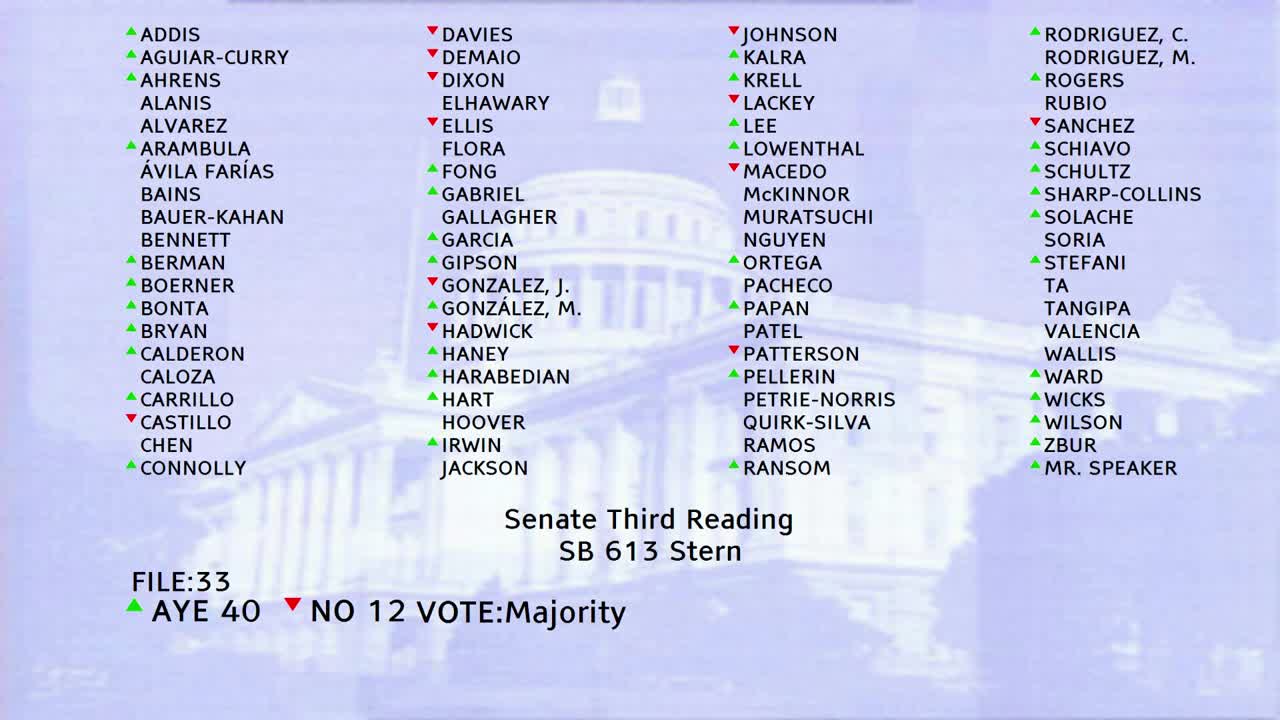
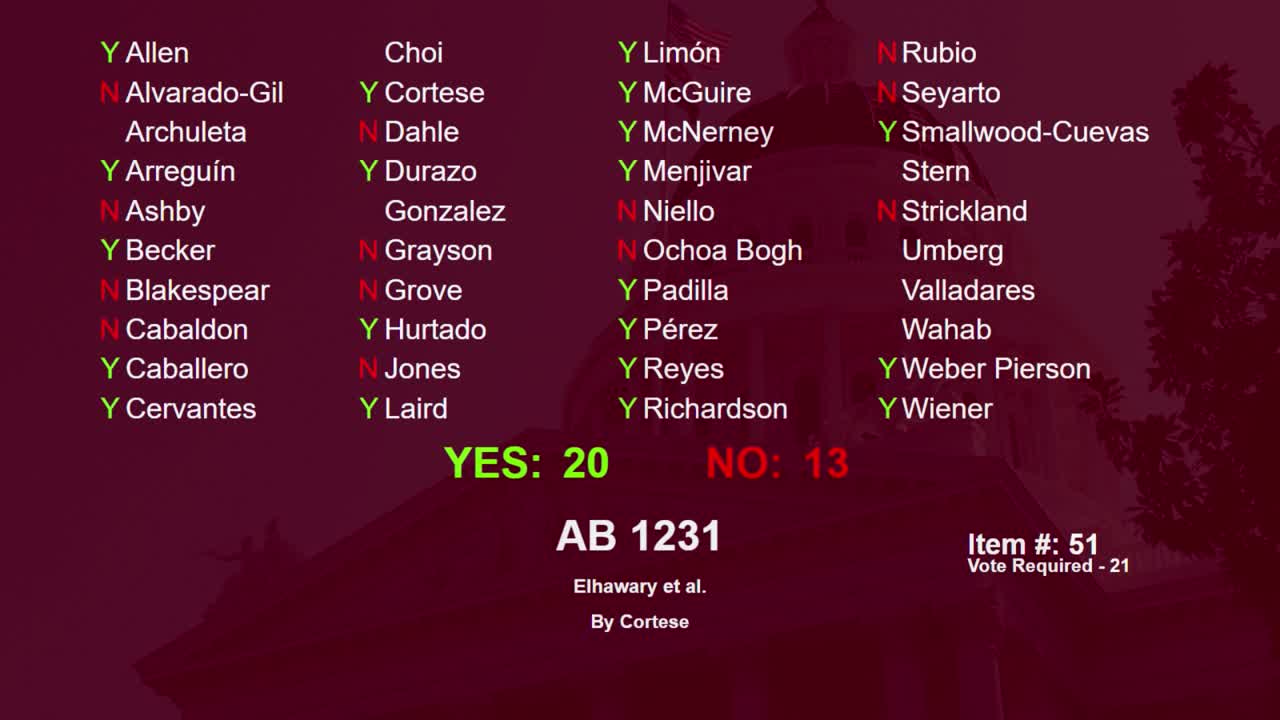
Bill Author
Bill Co-Author(s):