SB 596: Health facilities: administrative penalties.
- Session Year: 2025-2026
- House: Senate
- Latest Version Date: 2025-10-13
Current Status:
Passed
(2025-10-13: Chaptered by Secretary of State. Chapter 773, Statutes of 2025.)
Introduced
In Committee
Awaiting First Chamber Vote
Passed First Chamber
In Committee
Awaiting Second Chamber Vote
Passed Second Chamber
Enacted
What does this bill do?
The bill clarifies when a general acute care hospital can avoid penalties for failing to meet nurse-to-patient ratios by defining an “on-call list” as nurses scheduled to be on call for that unit and shift or nurses on a regularly scheduled float pool, and says contacting nurses who were not scheduled to be on call or not in the float pool does not count as exhausting the list. It also requires the state health department to treat violations that occur on different days as separate violations for penalty purposes.
The summary is provided by generative AI which can make mistakes. For original language, please view the details in the table below.
Existing law provides for the licensure of various health facilities, including general acute care hospitals, acute psychiatric hospitals, and special hospitals, by the State Department of Public Health. Existing law requires the department to adopt regulations that establish minimum, specific, and numerical licensed nurse-to-patient ratios by licensed nurse classification and by hospital unit for all general acute care hospitals, acute psychiatric hospitals, and special hospitals. Existing law requires the department to assess an administrative penalty of $15,000 for the first violation and $30,000 for the second and each subsequent violation if the department determines that a specified health facility has violated nurse-to-patient ratios, as specified. Under existing law, an acute general hospital is not subject to this administrative penalty if the hospital demonstrates it has met specified requirements, including that any fluctuation in required staffing levels was unpredictable and uncontrollable, prompt efforts were made to maintain required staffing levels, and the hospital immediately used and subsequently exhausted the hospitals on-call list of nurses and the charge nurse. Existing law specifies that multiple violations found on the same inspection survey constitute a single violation for purposes of determining whether the violation was a first, 2nd, or subsequent violation.
This bill would define on-call list for the above purpose and would specify that a hospital contacting, or attempting to contact, licensed nurses who are not scheduled to be on call and who are not assigned to a float pool for the unit and shift where an alleged violation occurred is not considered as exhausting an on-call list. The bill would require the department to treat violations on separate days as separate violations.
Existing law provides for the licensure of various health facilities, including general acute care hospitals, acute psychiatric hospitals, and special hospitals, by the State Department of Public Health. Existing law requires the department to adopt regulations that establish minimum, specific, and numerical licensed nurse-to-patient ratios by licensed nurse classification and by hospital unit for all general acute care hospitals, acute psychiatric hospitals, and special hospitals. Existing law requires the regulations adopted by the department for acute psychiatric hospitals that are not operated by the State Department of State Hospitals to take into account the special needs of the patients served in the psychiatric units. Existing law requires these health facilities to report specified adverse events to the department and prescribes the departments response.
This bill would specify that the adoption of these regulations adopted for acute psychiatric hospitals not operated by the State Department of State Hospitals are deemed to be an emergency and necessary for the immediate preservation of the public peace, health and safety, and general welfare.Existing law requires these health facilities to report specified adverse events to the department and prescribes the departments response.This bill would require, when the department receives a complaint alleging a violation of the regulations related to nurse-to-patient ratios that does not involve a threat of imminent danger of death or serious bodily harm, the department to commence and complete an inspection within a specified time period.
Existing law requires the department to assess an administrative penalty of $15,000 for the first violation and $30,000 for the second and each subsequent violation if the department determines that a specified health facility has violated nurse-to-patient ratios, as specified. Under existing law, an acute general hospital is not subject to this administrative penalty if the hospital demonstrates it has met specified requirements, including that any fluctuation in required staffing levels was unpredictable and uncontrollable, prompt efforts were made to maintain required staffing levels, and the hospital immediately used and subsequently exhausted the hospitals on-call list of nurses and the charge nurse. Existing law specifies that multiple violations found on the same inspection survey constitute a single violation for purposes of determining whether the violation was a first, 2nd, or subsequent violation.
This bill would require, as part of meeting the above requirements, that the hospital provide the department with documentation that it used and exhausted the on-call list, as defined. The bill would require the on-call list to be at least 10% of the registered nurse staff for the hospital, and would authorize nurses assigned to the hospitals float pool, as defined, to count towards the hospitals on-call list. The bill would also require all nurses assigned to an on-call list to possess and maintain, in writing, verified competencies specific to the unit for which they are on call. define on-call list for the above purpose and would specify that a hospital contacting, or attempting to contact, licensed nurses who are not scheduled to be on call and who are not assigned to a float pool for the unit and shift where an alleged violation occurred is not considered as exhausting an on-call list. The bill would require the department to treat violations on separate days as separate violations.
Existing law provides for the licensure of various health facilities, including general acute care hospitals, acute psychiatric hospitals, and special hospitals, by the State Department of Public Health. Existing law requires the department to adopt regulations that establish minimum, specific, and numerical licensed nurse-to-patient ratios by licensed nurse classification and by hospital unit for all general acute care hospitals, acute psychiatric hospitals, and special hospitals. Existing law requires the regulations adopted by the department for acute psychiatric hospitals that are not operated by the State Department of State Hospitals to take into account the special needs of the patients served in the psychiatric units.
This bill would specify that the adoption of these regulations adopted for acute psychiatric hospitals not operated by the State Department of State Hospitals are deemed to be an emergency and necessary for the immediate preservation of the public peace, health and safety, and general welfare.
Existing law requires these health facilities to report specified adverse events to the department and prescribes the departments response.
This bill would require, when the department receives a complaint alleging a violation of the regulations related to nurse-to-patient ratios that does not involve a threat of imminent danger of death or serious bodily harm, the department to commence and complete an inspection within a specified time period.
Existing law requires the department to assess an administrative penalty of $15,000 for the first violation and $30,000 for the second and each subsequent violation if the department determines that a specified health facility has violated nurse-to-patient ratios, as specified. Under existing law, an acute general hospital is not subject to this administrative penalty if the hospital demonstrates it has met specified requirements, including that any fluctuation in required staffing levels was unpredictable and uncontrollable, prompt efforts were made to maintain required staffing levels, and the hospital immediately used and subsequently exhausted the hospitals on-call list of nurses and the charge nurse. Existing law specifies that multiple violations found on the same inspection survey constitute a single violation for purposes of determining whether the violation was a first, 2nd, or subsequent violation.
This bill would require, as part of meeting the above requirements, that the hospital provide the department with documentation that it used and exhausted the on-call list, as defined. The bill would require the on-call list to be at least 10% of the registered nurse staff for the hospital, and hospital, and would authorize nurses assigned to the hospitals float pool, as defined, to count towards the hospitals on-call list. The bill would also require all nurses assigned to an on-call list to possess and maintain, in writing, verified competencies specific to the unit for which they are on call. The bill would require the department to treat violations on separate days as separate violations.
Existing law provides for the licensure of various health facilities, including general acute care hospitals, acute psychiatric hospitals, and special hospitals, by the State Department of Public Health. Existing law requires the department to adopt regulations that establish minimum, specific, and numerical licensed nurse-to-patient ratios by licensed nurse classification and by hospital unit for all general acute care hospitals, acute psychiatric hospitals, and special hospitals. Existing law requires the regulations adopted by the department for acute psychiatric hospitals that are not operated by the State Department of State Hospitals to take into account the special needs of the patients served in the psychiatric units.
This bill would specify that the adoption of these regulations adopted for acute psychiatric hospitals not operated by the State Department of State Hospitals are deemed to be an emergency and necessary for the immediate preservation of the public peace, health and safety, and general welfare.
Existing law requires these health facilities to report specified adverse events to the department and prescribes the departments response.
This bill would require, when the department receives a complaint alleging a violation of the regulations related to nurse-to-patient ratios that does not involve a threat of imminent danger of death or serious bodily harm, the department to commence and complete an inspection within a specified time period.
Existing law provides for the licensure of various health facilities, including general acute care hospitals, acute psychiatric hospitals, and special hospitals, by the State Department of Public Health. Existing law requires the department to assess an administrative penalty of $15,000 for the first violation and $30,000 for the second and each subsequent violation if the department determines that a specified health facility has violated nurse-to-patient ratios, as specified. Under existing law, an acute general hospital is not subject to this administrative penalty if the hospital demonstrates it has met specified requirements, including that any fluctuation in required staffing levels was unpredictable and uncontrollable, prompt efforts were made to maintain required staffing levels, and the hospital immediately used and subsequently exhausted the hospitals on-call list of nurses and the charge nurse. Existing law specifies that multiple violations found on the same inspection survey constitute a single violation for purposes of determining whether the violation was a first, 2nd, or subsequent violation.
This bill would require, as part of meeting the above requirements, that the hospital provide the department with documentation that it used and exhausted the on-call list, as defined. The bill would require the on-call list to be at least 10% of the registered nurse staff for the hospital, and require all nurses assigned to an on-call list to possess and maintain maintain, in writing, verified competencies specific to the unit for which they are on call. The bill would require the department to treat violations on separate days as separate violations.
Existing law provides for the licensure of various health facilities, including general acute care hospitals, acute psychiatric hospitals, and special hospitals, by the State Department of Public Health. Existing law requires the department to assess an administrative penalty of $15,000 for the first violation and $30,000 for the second and each subsequent violation if the department determines that a specified health facility has violated nurse-to-patient ratios, as specified. Under existing law, an acute general hospital is not subject to this administrative penalty if the hospital demonstrates it has met specified requirements, including that any fluctuation in required staffing levels was unpredictable and uncontrollable, prompt efforts were made to maintain required staffing levels, and the hospital immediately used and subsequently exhausted the hospitals on-call list of nurses and the charge nurse.
This bill would require, as part of meeting the above requirements, that the hospital provide the department with documentation that it used and exhausted the on-call list, as defined. The bill would require the on-call list to be at least 10% of the registered nurse staff for the hospital, and require all nurses assigned to an on-call list to possess and maintain verified competencies specific to the unit for which they are on call.
(a)Commencing on the effective date of the regulations adopted pursuant to this section, the director may assess an administrative penalty against a licensee of a health facility licensed under subdivision (a), (b), or (f) of Section 1250 for a deficiency constituting an immediate jeopardy violation as determined by the department up to a maximum of seventy-five thousand dollars ($75,000) for the first administrative penalty, up to one hundred thousand dollars ($100,000) for the second subsequent administrative penalty, and up to one hundred twenty-five thousand dollars ($125,000) for the third and every subsequent violation. An administrative penalty issued after three years from the date of the last issued immediate jeopardy violation shall be considered a first administrative penalty so long as the facility has not received additional immediate jeopardy violations and is found by the department to be in substantial compliance with all state and federal licensing laws and regulations. The department shall have full discretion to consider all factors when determining the amount of an administrative penalty pursuant to this section.
(b)Except as provided in subdivision (c), for a violation of this chapter or the rules and regulations promulgated thereunder that does not constitute a violation of subdivision (a), the department may assess an administrative penalty in an amount of up to twenty-five thousand dollars ($25,000) per violation. This subdivision shall also apply to violation of regulations set forth in Article 1 (commencing with Section 127400) of Chapter 2.5 of Part 2 of Division 107 or the rules and regulations promulgated thereunder.
The department shall promulgate regulations establishing the criteria to assess an administrative penalty against a health facility licensed pursuant to subdivision (a), (b), or (f) of Section 1250. The criteria shall include, but need not be limited to, the following:
(1)The patients physical and mental condition.
(2)The probability and severity of the risk that the violation presents to the patient.
(3)The actual financial harm to patients, if any.
(4)The nature, scope, and severity of the violation.
(5)The facilitys history of compliance with related state and federal statutes and regulations.
(6)Factors beyond the facilitys control that restrict the facilitys ability to comply with this chapter or the rules and regulations promulgated thereunder.
(7)The demonstrated willfulness of the violation.
(8)The extent to which the facility detected the violation and took steps to immediately correct the violation and prevent the violation from recurring.
(c)The department shall not assess an administrative penalty for minor violations.
(d)The regulations shall not change the definition of immediate jeopardy as established in this section.
(e)The regulations shall apply only to incidents occurring on or after the effective date of the regulations.
(f)(1)Notwithstanding subdivision (a), if the department determines that a health facility licensed under subdivision (a), (b), or (f) of Section 1250 has violated a regulation adopted pursuant to Section 1276.4, the department shall assess an administrative penalty of fifteen thousand dollars ($15,000) for the first violation and thirty thousand dollars ($30,000) for the second and each subsequent violation. For purposes of this subdivision, multiple violations found on the same inspection survey shall constitute a single violation for purposes of determining whether the violation was a first, second, or subsequent violation. For purposes of this subdivision, the department shall treat violations on separate days as separate violations.
(2)A violation occurring more than three years after the date of the last violation shall be treated as a first violation.
(3)Notwithstanding any other law, the department may, without taking any regulatory actions pursuant to Chapter 3.5 (commencing with Section 11340) of Part 1 of Division 3 of Title 2 of the Government Code, implement, interpret, or make specific this subdivision by means of an All Facilities Letter (AFL) or similar instruction.
(4)(A)Notwithstanding paragraph (1), a general acute care hospital shall not be subject to an administrative penalty under that paragraph if the hospital demonstrates to the satisfaction of the department all of the following:
(i)That any fluctuation in required staffing levels was unpredictable and uncontrollable.
(ii)Prompt efforts were made to maintain required staffing levels.
(iii)In making those efforts, the hospital immediately used and subsequently exhausted the hospitals on-call list of nurses and the charge nurse. For purposes of this paragraph, an on-call list shall be comprised of nurses who are scheduled to be on call for the shift and unit where an alleged violation occurred, or nurses who are assigned to a regularly scheduled float pool shift to cover any shortages across one or more specified units. A hospital contacting, or attempting to contact, licensed nurses who are not scheduled to be on call and who are not assigned to a float pool for the unit and shift where an alleged violation occurred shall not be considered as exhausting an on-call list for purposes of this paragraph.
(B)This paragraph does not affect the obligation of a general acute care hospital to maintain proper staffing levels as prescribed in Section 70217 of Title 22 of the California Code of Regulations.
(5)This section does not prohibit the department from issuing an administrative penalty for a staffing violation pursuant to this section and an administrative penalty for any resulting harm pursuant to subdivision (a).
(g)If the licensee disputes a determination by the department regarding the alleged deficiency or alleged failure to correct a deficiency, or regarding the reasonableness of the proposed deadline for correction or the amount of the penalty, the licensee may, within 10 working days, request a hearing pursuant to Section 131071. Penalties shall be paid when all appeals have been exhausted and the departments position has been upheld.
(h)For purposes of this section, immediate jeopardy means a situation in which the licensees noncompliance with one or more requirements of licensure has caused, or is likely to cause, serious injury or death to the patient.
(i)In enforcing subdivision (a) and paragraph (1) of subdivision (f), the department shall take into consideration the special circumstances of small and rural hospitals, as defined in Section 124840, in order to protect access to quality care in those hospitals.
(a)(1)In any case in which the department receives a report from a facility pursuant to Section 1279.1, or a written or oral complaint involving a health facility licensed pursuant to subdivision (a), (b), or (f) of Section 1250, that indicates an ongoing threat of imminent danger of death or serious bodily harm, the department shall make an onsite inspection or investigation within 48 hours or two business days, whichever is greater, of the receipt of the report or complaint and shall complete that investigation within 45 days.
(2)Until the department has determined by onsite inspection that the adverse event has been resolved, the department shall, not less than once a year, conduct an unannounced inspection of any health facility that has reported an adverse event pursuant to Section 1279.1.
(b)In any case in which the department is able to determine from the information available to it that there is no threat of imminent danger of death or serious bodily harm to that patient or other patients, the department shall complete an investigation of the report within 45 days.
(c)If the department does not meet the timeframes established in subdivision (a), the department shall document the extenuating circumstances explaining why it could not meet the timeframes. The department shall provide written notice to the facility and the complainant, if any, of the basis for the extenuating circumstances and the anticipated completion date.
(d)When the department receives a complaint alleging a violation of the regulations adopted pursuant to Section 1276.4 that does not involve a threat of imminent danger of death or serious bodily harm, the department shall commence an inspection or investigation within 10 business days, and shall complete that investigation within 60 days.
(e)The department shall notify the complainant and licensee in writing of the departments determination as a result of an inspection or report.
(f)For purposes of this section, complaint means any oral or written notice to the department, other than a report from the health facility, of an alleged violation of applicable requirements of state or federal law or an allegation of facts that might constitute a violation of applicable requirements of state or federal law.
(g)The costs of administering and implementing this section shall be paid from funds derived from existing licensing fees paid by general acute care hospitals, acute psychiatric hospitals, and special hospitals.
(h)In enforcing this section and Sections 1279 and 1279.1, the department shall take into account the special circumstances of small and rural hospitals, as defined in Section 124840, in order to protect the quality of patient care in those hospitals.
(i)In preparing the staffing and systems analysis required pursuant to Section 1266, the department shall also report regarding the number and timeliness of investigations of adverse events initiated in response to reports of adverse events.
SEC. 3.SEC. 2.Section 1280.3 of the Health and Safety Code is amended to read:1280.3.(a)Commencing on the effective date of the regulations adopted pursuant to this section, the director may assess an administrative penalty against a licensee of a health facility licensed under subdivision (a), (b), or (f) of Section 1250 for a deficiency constituting an immediate jeopardy violation as determined by the department up to a maximum of seventy-five thousand dollars ($75,000) for the first administrative penalty, up to one hundred thousand dollars ($100,000) for the second subsequent administrative penalty, and up to one hundred twenty-five thousand dollars ($125,000) for the third and every subsequent violation. An administrative penalty issued after three years from the date of the last issued immediate jeopardy violation shall be considered a first administrative penalty so long as the facility has not received additional immediate jeopardy violations and is found by the department to be in substantial compliance with all state and federal licensing laws and regulations. The department shall have full discretion to consider all factors when determining the amount of an administrative penalty pursuant to this section.
(b)Except as provided in subdivision (c), for a violation of this chapter or the rules and regulations promulgated thereunder that does not constitute a violation of subdivision (a), the department may assess an administrative penalty in an amount of up to twenty-five thousand dollars ($25,000) per violation. This subdivision shall also apply to violation of regulations set forth in Article 1 (commencing with Section 127400) of Chapter 2.5 of Part 2 of Division 107 or the rules and regulations promulgated thereunder.
The department shall promulgate regulations establishing the criteria to assess an administrative penalty against a health facility licensed pursuant to subdivision (a), (b), or (f) of Section 1250. The criteria shall include, but need not be limited to, the following:
(1)The patients physical and mental condition.
(2)The probability and severity of the risk that the violation presents to the patient.
(3)The actual financial harm to patients, if any.
(4)The nature, scope, and severity of the violation.
(5)The facilitys history of compliance with related state and federal statutes and regulations.
(6)Factors beyond the facilitys control that restrict the facilitys ability to comply with this chapter or the rules and regulations promulgated thereunder.
(7)The demonstrated willfulness of the violation.
(8)The extent to which the facility detected the violation and took steps to immediately correct the violation and prevent the violation from recurring.
(c)The department shall not assess an administrative penalty for minor violations.
(d)The regulations shall not change the definition of immediate jeopardy as established in this section.
(e)The regulations shall apply only to incidents occurring on or after the effective date of the regulations.
(f)(1)Notwithstanding subdivision (a), if the department determines that a health facility licensed under subdivision (a), (b), or (f) of Section 1250 has violated a regulation adopted pursuant to Section 1276.4, the department shall assess an administrative penalty of fifteen thousand dollars ($15,000) for the first violation and thirty thousand dollars ($30,000) for the second and each subsequent violation. For purposes of this subdivision, multiple violations found on the same inspection survey shall constitute a single violation for purposes of determining whether the violation was a first, second, or subsequent violation. For purposes of this subdivision, the department shall treat violations on separate days as separate violations.
(2)A violation occurring more than three years after the date of the last violation shall be treated as a first violation.
(3)Notwithstanding any other law, the department may, without taking any regulatory actions pursuant to Chapter 3.5 (commencing with Section 11340) of Part 1 of Division 3 of Title 2 of the Government Code, implement, interpret, or make specific this subdivision by means of an All Facilities Letter (AFL) or similar instruction.
(4)(A)Notwithstanding paragraph (1), a general acute care hospital shall not be subject to an administrative penalty under that paragraph if the hospital demonstrates to the satisfaction of the department all of the following:
(i)That any fluctuation in required staffing levels was unpredictable and uncontrollable.
(ii)Prompt efforts were made to maintain required staffing levels.
(iii)In making those efforts, the hospital immediately used and subsequently exhausted the hospitals on-call list of nurses and the charge nurse. To demonstrate that it has satisfied this requirement, the hospital shall provide the department with documentation that it used and exhausted the on-call list. As used in this clause, on-call list means a documented list of nurses who are officially scheduled to be on call for a shift outside their regularly scheduled shifts. To qualify as an on-call list for purposes of this paragraph, the on-call list shall be at least 10 percent of the registered nurse staff for the hospital. Nurses assigned to a hospital float pool, defined for purposes of this paragraph as nurses who are regularly scheduled but not assigned to a particular unit, may count towards the hospitals on-call list. All nurses assigned to an on-call list shall possess and maintain, in writing, verified competencies specific to the unit for which they are on call. For purposes of this paragraph, an on-call list shall be comprised of nurses who are scheduled to be on call for the shift and unit where an alleged violation occurred, or nurses who are assigned to a regularly scheduled float pool shift to cover any shortages across one or more specified units. A hospital contacting, or attempting to contact, licensed nurses who are not scheduled to be on call and who are not assigned to a float pool for the unit and shift where an alleged violation occurred shall not be considered as exhausting an on-call list for purposes of this paragraph.
(B)This paragraph does not affect the obligation of a general acute care hospital to maintain proper staffing levels as prescribed in Section 70217 of Title 22 of the California Code of Regulations.
(5)This section does not prohibit the department from issuing an administrative penalty for a staffing violation pursuant to this section and an administrative penalty for any resulting harm pursuant to subdivision (a).
(g)If the licensee disputes a determination by the department regarding the alleged deficiency or alleged failure to correct a deficiency, or regarding the reasonableness of the proposed deadline for correction or the amount of the penalty, the licensee may, within 10 working days, request a hearing pursuant to Section 131071. Penalties shall be paid when all appeals have been exhausted and the departments position has been upheld.
(h)For purposes of this section, immediate jeopardy means a situation in which the licensees noncompliance with one or more requirements of licensure has caused, or is likely to cause, serious injury or death to the patient.
(i)In enforcing subdivision (a) and paragraph (1) of subdivision (f), the department shall take into consideration the special circumstances of small and rural hospitals, as defined in Section 124840, in order to protect access to quality care in those hospitals.
(a)By January 1, 2002, the State Department of Public Health shall adopt regulations that establish minimum, specific, and numerical licensed nurse-to-patient ratios by licensed nurse classification and by hospital unit for all health facilities licensed pursuant to subdivision (a), (b), or (f) of Section 1250. The State Department of Public Health shall adopt these regulations in accordance with the departments licensing and certification regulations as stated in Sections 70053.2, 70215, and 70217 of Title 22 of the California Code of Regulations, and the professional and vocational regulations in Section 1443.5 of Title 16 of the California Code of Regulations. The department shall review these regulations five years after adoption and shall report to the Legislature regarding any proposed changes. Flexibility shall be considered by the department for rural general acute care hospitals in response to their special needs. As used in this subdivision, hospital unit means a critical care unit, burn unit, labor and delivery room, postanesthesia service area, emergency department, operating room, pediatric unit, step-down/intermediate care unit, specialty care unit, telemetry unit, general medical care unit, subacute care unit, and transitional inpatient care unit. The regulation addressing the emergency department shall distinguish between regularly scheduled core staff licensed nurses and additional licensed nurses required to care for critical care patients in the emergency department.
(b)These ratios shall constitute the minimum number of registered and licensed nurses that shall be allocated. Additional staff shall be assigned in accordance with a documented patient classification system for determining nursing care requirements, including the severity of the illness, the need for specialized equipment and technology, the complexity of clinical judgment needed to design, implement, and evaluate the patient care plan and the ability for self-care, and the licensure of the personnel required for care.
(c)Critical care unit as used in this section means a unit that is established to safeguard and protect patients whose severity of medical conditions requires continuous monitoring, and complex intervention by licensed nurses.
(d)All health facilities licensed under subdivision (a), (b), or (f) of Section 1250 shall adopt written policies and procedures for training and orientation of nursing staff.
(e)No registered nurse shall be assigned to a nursing unit or clinical area unless that nurse has first received orientation in that clinical area sufficient to provide competent care to patients in that area, and has demonstrated current competence in providing care in that area.
(f)The written policies and procedures for orientation of nursing staff shall require that all temporary personnel shall receive orientation and be subject to competency validation consistent with Sections 70016.1 and 70214 of Title 22 of the California Code of Regulations.
(g)Requests for waivers to this section that do not jeopardize the health, safety, and well-being of patients affected and that are needed for increased operational efficiency may be granted by the department to rural general acute care hospitals meeting the criteria set forth in Section 70059.1 of Title 22 of the California Code of Regulations.
(h)In case of conflict between this section and any provision or regulation defining the scope of nursing practice, the scope of practice provisions shall control.
(i)The regulations adopted by the department shall augment and not replace existing nurse-to-patient ratios that exist in regulation or law for the intensive care units, the neonatal intensive care units, or the operating room.
(j)The regulations adopted by the department shall not replace existing licensed staff-to-patient ratios for hospitals operated by the State Department of State Hospitals.
(k)The regulations adopted by the department for health facilities licensed under subdivision (b) of Section 1250 that are not operated by the State Department of State Hospitals shall take into account the special needs of the patients served in the psychiatric units. The adoption of these regulations shall be deemed to be an emergency and necessary for the immediate preservation of the public peace, health and safety, and general welfare.
(l)The department may take into consideration the unique nature of the University of California teaching hospitals as educational institutions when establishing licensed nurse-to-patient ratios. The department shall coordinate with the Board of Registered Nursing to ensure that staffing ratios are consistent with the Board of Registered Nursing approved nursing education requirements. This includes nursing clinical experience incidental to a work-study program rendered in a University of California clinical facility approved by the Board of Registered Nursing provided there will be sufficient direct care registered nurse preceptors available to ensure safe patient care.
SEC. 2.Section 1279.2 of the Health and Safety Code is amended to read:1279.2.(a)(1)In any case in which the department receives a report from a facility pursuant to Section 1279.1, or a written or oral complaint involving a health facility licensed pursuant to subdivision (a), (b), or (f) of Section 1250, that indicates an ongoing threat of imminent danger of death or serious bodily harm, the department shall make an onsite inspection or investigation within 48 hours or two business days, whichever is greater, of the receipt of the report or complaint and shall complete that investigation within 45 days.
(2)Until the department has determined by onsite inspection that the adverse event has been resolved, the department shall, not less than once a year, conduct an unannounced inspection of any health facility that has reported an adverse event pursuant to Section 1279.1.
(b)In any case in which the department is able to determine from the information available to it that there is no threat of imminent danger of death or serious bodily harm to that patient or other patients, the department shall complete an investigation of the report within 45 days.
(c)If the department does not meet the timeframes established in subdivision (a), the department shall document the extenuating circumstances explaining why it could not meet the timeframes. The department shall provide written notice to the facility and the complainant, if any, of the basis for the extenuating circumstances and the anticipated completion date.
(d)When the department receives a complaint alleging a violation of the regulations adopted pursuant to Section 1276.4 that does not involve a threat of imminent danger of death or serious bodily harm, the department shall commence an inspection or investigation within 10 business days, and shall complete that investigation within 60 days.
(e)The department shall notify the complainant and licensee in writing of the departments determination as a result of an inspection or report.
(f)For purposes of this section, complaint means any oral or written notice to the department, other than a report from the health facility, of an alleged violation of applicable requirements of state or federal law or an allegation of facts that might constitute a violation of applicable requirements of state or federal law.
(g)The costs of administering and implementing this section shall be paid from funds derived from existing licensing fees paid by general acute care hospitals, acute psychiatric hospitals, and special hospitals.
(h)In enforcing this section and Sections 1279 and 1279.1, the department shall take into account the special circumstances of small and rural hospitals, as defined in Section 124840, in order to protect the quality of patient care in those hospitals.
(i)In preparing the staffing and systems analysis required pursuant to Section 1266, the department shall also report regarding the number and timeliness of investigations of adverse events initiated in response to reports of adverse events.
SEC. 3.Section 1280.3 of the Health and Safety Code is amended to read:1280.3.(a)Commencing on the effective date of the regulations adopted pursuant to this section, the director may assess an administrative penalty against a licensee of a health facility licensed under subdivision (a), (b), or (f) of Section 1250 for a deficiency constituting an immediate jeopardy violation as determined by the department up to a maximum of seventy-five thousand dollars ($75,000) for the first administrative penalty, up to one hundred thousand dollars ($100,000) for the second subsequent administrative penalty, and up to one hundred twenty-five thousand dollars ($125,000) for the third and every subsequent violation. An administrative penalty issued after three years from the date of the last issued immediate jeopardy violation shall be considered a first administrative penalty so long as the facility has not received additional immediate jeopardy violations and is found by the department to be in substantial compliance with all state and federal licensing laws and regulations. The department shall have full discretion to consider all factors when determining the amount of an administrative penalty pursuant to this section.
(b)Except as provided in subdivision (c), for a violation of this chapter or the rules and regulations promulgated thereunder that does not constitute a violation of subdivision (a), the department may assess an administrative penalty in an amount of up to twenty-five thousand dollars ($25,000) per violation. This subdivision shall also apply to violation of regulations set forth in Article 1 (commencing with Section 127400) of Chapter 2.5 of Part 2 of Division 107 or the rules and regulations promulgated thereunder.
The department shall promulgate regulations establishing the criteria to assess an administrative penalty against a health facility licensed pursuant to subdivision (a), (b), or (f) of Section 1250. The criteria shall include, but need not be limited to, the following:
(1)The patients physical and mental condition.
(2)The probability and severity of the risk that the violation presents to the patient.
(3)The actual financial harm to patients, if any.
(4)The nature, scope, and severity of the violation.
(5)The facilitys history of compliance with related state and federal statutes and regulations.
(6)Factors beyond the facilitys control that restrict the facilitys ability to comply with this chapter or the rules and regulations promulgated thereunder.
(7)The demonstrated willfulness of the violation.
(8)The extent to which the facility detected the violation and took steps to immediately correct the violation and prevent the violation from recurring.
(c)The department shall not assess an administrative penalty for minor violations.
(d)The regulations shall not change the definition of immediate jeopardy as established in this section.
(e)The regulations shall apply only to incidents occurring on or after the effective date of the regulations.
(f)(1)Notwithstanding subdivision (a), if the department determines that a health facility licensed under subdivision (a), (b), or (f) of Section 1250 has violated a regulation adopted pursuant to Section 1276.4, the department shall assess an administrative penalty of fifteen thousand dollars ($15,000) for the first violation and thirty thousand dollars ($30,000) for the second and each subsequent violation. For purposes of this subdivision, multiple violations found on the same inspection survey shall constitute a single violation for purposes of determining whether the violation was a first, second, or subsequent violation. For purposes of this subdivision, the department shall treat violations on separate days as separate violations.
(2)A violation occurring more than three years after the date of the last violation shall be treated as a first violation.
(3)Notwithstanding any other law, the department may, without taking any regulatory actions pursuant to Chapter 3.5 (commencing with Section 11340) of Part 1 of Division 3 of Title 2 of the Government Code, implement, interpret, or make specific this subdivision by means of an All Facilities Letter (AFL) or similar instruction.
(4)(A)Notwithstanding paragraph (1), a general acute care hospital shall not be subject to an administrative penalty under that paragraph if the hospital demonstrates to the satisfaction of the department all of the following:
(i)That any fluctuation in required staffing levels was unpredictable and uncontrollable.
(ii)Prompt efforts were made to maintain required staffing levels.
(iii)In making those efforts, the hospital immediately used and subsequently exhausted the hospitals on-call list of nurses and the charge nurse. To demonstrate that it has satisfied this requirement, the hospital shall provide the department with documentation that it used and exhausted the on-call list. As used in this clause, on-call list means a documented list of nurses who are officially scheduled to be on call for a shift outside their regularly scheduled shifts. To qualify as an on-call list for purposes of this paragraph, the on-call list shall be at least 10 percent of the registered nurse staff for the hospital. Nurses assigned to a hospital float pool, defined for purposes of this paragraph as nurses who are regularly scheduled but not assigned to a particular unit, may count towards the hospitals on-call list. All nurses assigned to an on-call list shall possess and maintain, in writing, verified competencies specific to the unit for which they are on call.
(B)This paragraph does not affect the obligation of a general acute care hospital to maintain proper staffing levels as prescribed in Section 70217 of Title 22 of the California Code of Regulations.
(5)This section does not prohibit the department from issuing an administrative penalty for a staffing violation pursuant to this section and an administrative penalty for any resulting harm pursuant to subdivision (a).
(g)If the licensee disputes a determination by the department regarding the alleged deficiency or alleged failure to correct a deficiency, or regarding the reasonableness of the proposed deadline for correction or the amount of the penalty, the licensee may, within 10 working days, request a hearing pursuant to Section 131071. Penalties shall be paid when all appeals have been exhausted and the departments position has been upheld.
(h)For purposes of this section, immediate jeopardy means a situation in which the licensees noncompliance with one or more requirements of licensure has caused, or is likely to cause, serious injury or death to the patient.
(i)In enforcing subdivision (a) and paragraph (1) of subdivision (f), the department shall take into consideration the special circumstances of small and rural hospitals, as defined in Section 124840, in order to protect access to quality care in those hospitals.
(a)By January 1, 2002, the State Department of Public Health shall adopt regulations that establish minimum, specific, and numerical licensed nurse-to-patient ratios by licensed nurse classification and by hospital unit for all health facilities licensed pursuant to subdivision (a), (b), or (f) of Section 1250. The State Department of Public Health shall adopt these regulations in accordance with the departments licensing and certification regulations as stated in Sections 70053.2, 70215, and 70217 of Title 22 of the California Code of Regulations, and the professional and vocational regulations in Section 1443.5 of Title 16 of the California Code of Regulations. The department shall review these regulations five years after adoption and shall report to the Legislature regarding any proposed changes. Flexibility shall be considered by the department for rural general acute care hospitals in response to their special needs. As used in this subdivision, hospital unit means a critical care unit, burn unit, labor and delivery room, postanesthesia service area, emergency department, operating room, pediatric unit, step-down/intermediate care unit, specialty care unit, telemetry unit, general medical care unit, subacute care unit, and transitional inpatient care unit. The regulation addressing the emergency department shall distinguish between regularly scheduled core staff licensed nurses and additional licensed nurses required to care for critical care patients in the emergency department.
(b)These ratios shall constitute the minimum number of registered and licensed nurses that shall be allocated. Additional staff shall be assigned in accordance with a documented patient classification system for determining nursing care requirements, including the severity of the illness, the need for specialized equipment and technology, the complexity of clinical judgment needed to design, implement, and evaluate the patient care plan and the ability for self-care, and the licensure of the personnel required for care.
(c)Critical care unit as used in this section means a unit that is established to safeguard and protect patients whose severity of medical conditions requires continuous monitoring, and complex intervention by licensed nurses.
(d)All health facilities licensed under subdivision (a), (b), or (f) of Section 1250 shall adopt written policies and procedures for training and orientation of nursing staff.
(e)No registered nurse shall be assigned to a nursing unit or clinical area unless that nurse has first received orientation in that clinical area sufficient to provide competent care to patients in that area, and has demonstrated current competence in providing care in that area.
(f)The written policies and procedures for orientation of nursing staff shall require that all temporary personnel shall receive orientation and be subject to competency validation consistent with Sections 70016.1 and 70214 of Title 22 of the California Code of Regulations.
(g)Requests for waivers to this section that do not jeopardize the health, safety, and well-being of patients affected and that are needed for increased operational efficiency may be granted by the department to rural general acute care hospitals meeting the criteria set forth in Section 70059.1 of Title 22 of the California Code of Regulations.
(h)In case of conflict between this section and any provision or regulation defining the scope of nursing practice, the scope of practice provisions shall control.
(i)The regulations adopted by the department shall augment and not replace existing nurse-to-patient ratios that exist in regulation or law for the intensive care units, the neonatal intensive care units, or the operating room.
(j)The regulations adopted by the department shall not replace existing licensed staff-to-patient ratios for hospitals operated by the State Department of State Hospitals.
(k)The regulations adopted by the department for health facilities licensed under subdivision (b) of Section 1250 that are not operated by the State Department of State Hospitals shall take into account the special needs of the patients served in the psychiatric units. The adoption of these regulations shall be deemed to be an emergency and necessary for the immediate preservation of the public peace, health and safety, and general welfare.
(l)The department may take into consideration the unique nature of the University of California teaching hospitals as educational institutions when establishing licensed nurse-to-patient ratios. The department shall coordinate with the Board of Registered Nursing to ensure that staffing ratios are consistent with the Board of Registered Nursing approved nursing education requirements. This includes nursing clinical experience incidental to a work-study program rendered in a University of California clinical facility approved by the Board of Registered Nursing provided there will be sufficient direct care registered nurse preceptors available to ensure safe patient care.
SEC. 2.Section 1279.2 of the Health and Safety Code is amended to read:1279.2.(a)(1)In any case in which the department receives a report from a facility pursuant to Section 1279.1, or a written or oral complaint involving a health facility licensed pursuant to subdivision (a), (b), or (f) of Section 1250, that indicates an ongoing threat of imminent danger of death or serious bodily harm, the department shall make an onsite inspection or investigation within 48 hours or two business days, whichever is greater, of the receipt of the report or complaint and shall complete that investigation within 45 days.
(2)Until the department has determined by onsite inspection that the adverse event has been resolved, the department shall, not less than once a year, conduct an unannounced inspection of any health facility that has reported an adverse event pursuant to Section 1279.1.
(b)In any case in which the department is able to determine from the information available to it that there is no threat of imminent danger of death or serious bodily harm to that patient or other patients, the department shall complete an investigation of the report within 45 days.
(c)If the department does not meet the timeframes established in subdivision (a), the department shall document the extenuating circumstances explaining why it could not meet the timeframes. The department shall provide written notice to the facility and the complainant, if any, of the basis for the extenuating circumstances and the anticipated completion date.
(d)When the department receives a complaint alleging a violation of the regulations adopted pursuant to Section 1276.4 that does not involve a threat of imminent danger of death or serious bodily harm, the department shall commence an inspection or investigation within 10 business days, and shall complete that investigation within 60 days.
(d)(e)The department shall notify the complainant and licensee in writing of the departments determination as a result of an inspection or report.
(e)(f)For purposes of this section, complaint means any oral or written notice to the department, other than a report from the health facility, of an alleged violation of applicable requirements of state or federal law or an allegation of facts that might constitute a violation of applicable requirements of state or federal law.
(f)(g)The costs of administering and implementing this section shall be paid from funds derived from existing licensing fees paid by general acute care hospitals, acute psychiatric hospitals, and special hospitals.
(g)(h)In enforcing this section and Sections 1279 and 1279.1, the department shall take into account the special circumstances of small and rural hospitals, as defined in Section 124840, in order to protect the quality of patient care in those hospitals.
(h)(i)In preparing the staffing and systems analysis required pursuant to Section 1266, the department shall also report regarding the number and timeliness of investigations of adverse events initiated in response to reports of adverse events.
SECTION 1.SEC. 3.Section 1280.3 of the Health and Safety Code is amended to read:1280.3.(a)Commencing on the effective date of the regulations adopted pursuant to this section, the director may assess an administrative penalty against a licensee of a health facility licensed under subdivision (a), (b), or (f) of Section 1250 for a deficiency constituting an immediate jeopardy violation as determined by the department up to a maximum of seventy-five thousand dollars ($75,000) for the first administrative penalty, up to one hundred thousand dollars ($100,000) for the second subsequent administrative penalty, and up to one hundred twenty-five thousand dollars ($125,000) for the third and every subsequent violation. An administrative penalty issued after three years from the date of the last issued immediate jeopardy violation shall be considered a first administrative penalty so long as the facility has not received additional immediate jeopardy violations and is found by the department to be in substantial compliance with all state and federal licensing laws and regulations. The department shall have full discretion to consider all factors when determining the amount of an administrative penalty pursuant to this section.
(b)Except as provided in subdivision (c), for a violation of this chapter or the rules and regulations promulgated thereunder that does not constitute a violation of subdivision (a), the department may assess an administrative penalty in an amount of up to twenty-five thousand dollars ($25,000) per violation. This subdivision shall also apply to violation of regulations set forth in Article 1 (commencing with Section 127400) of Chapter 2.5 of Part 2 of Division 107 or the rules and regulations promulgated thereunder.
The department shall promulgate regulations establishing the criteria to assess an administrative penalty against a health facility licensed pursuant to subdivision (a), (b), or (f) of Section 1250. The criteria shall include, but need not be limited to, the following:
(1)The patients physical and mental condition.
(2)The probability and severity of the risk that the violation presents to the patient.
(3)The actual financial harm to patients, if any.
(4)The nature, scope, and severity of the violation.
(5)The facilitys history of compliance with related state and federal statutes and regulations.
(6)Factors beyond the facilitys control that restrict the facilitys ability to comply with this chapter or the rules and regulations promulgated thereunder.
(7)The demonstrated willfulness of the violation.
(8)The extent to which the facility detected the violation and took steps to immediately correct the violation and prevent the violation from recurring.
(c)The department shall not assess an administrative penalty for minor violations.
(d)The regulations shall not change the definition of immediate jeopardy as established in this section.
(e)The regulations shall apply only to incidents occurring on or after the effective date of the regulations.
(f)(1)Notwithstanding subdivision (a), if the department determines that a health facility licensed under subdivision (a), (b), or (f) of Section 1250 has violated a regulation adopted pursuant to Section 1276.4, the department shall assess an administrative penalty of fifteen thousand dollars ($15,000) for the first violation and thirty thousand dollars ($30,000) for the second and each subsequent violation. For purposes of this subdivision, multiple violations found on the same inspection survey shall constitute a single violation for purposes of determining whether the violation was a first, second, or subsequent violation. For purposes of this subdivision, the department shall treat violations on separate days as separate violations.
(2)A violation occurring more than three years after the date of the last violation shall be treated as a first violation.
(3)Notwithstanding any other law, the department may, without taking any regulatory actions pursuant to Chapter 3.5 (commencing with Section 11340) of Part 1 of Division 3 of Title 2 of the Government Code, implement, interpret, or make specific this subdivision by means of an All Facilities Letter (AFL) or similar instruction.
(4)(A)Notwithstanding paragraph (1), a general acute care hospital shall not be subject to an administrative penalty under that paragraph if the hospital demonstrates to the satisfaction of the department all of the following:
(i)That any fluctuation in required staffing levels was unpredictable and uncontrollable.
(ii)Prompt efforts were made to maintain required staffing levels.
(iii)In making those efforts, the hospital immediately used and subsequently exhausted the hospitals on-call list of nurses and the charge nurse. To demonstrate that it has satisfied this requirement, the hospital shall provide the department with documentation that it used and exhausted the on-call list. As used in this clause, on-call list means a documented list of nurses who are officially scheduled to be on call for a shift outside their regularly scheduled shifts. To qualify as an on-call list for purposes of this paragraph, the on-call list shall be at least 10 percent of the registered nurse staff for the hospital. All nurses assigned to an on-call list shall possess and maintain maintain, in writing, verified competencies specific to the unit for which they are on call.
(B)This paragraph does not affect the obligation of a general acute care hospital to maintain proper staffing levels as prescribed in Section 70217 of Title 22 of the California Code of Regulations.
(5)This section does not prohibit the department from issuing an administrative penalty for a staffing violation pursuant to this section and an administrative penalty for any resulting harm pursuant to subdivision (a).
(g)If the licensee disputes a determination by the department regarding the alleged deficiency or alleged failure to correct a deficiency, or regarding the reasonableness of the proposed deadline for correction or the amount of the penalty, the licensee may, within 10 working days, request a hearing pursuant to Section 131071. Penalties shall be paid when all appeals have been exhausted and the departments position has been upheld.
(h)For purposes of this section, immediate jeopardy means a situation in which the licensees noncompliance with one or more requirements of licensure has caused, or is likely to cause, serious injury or death to the patient.
(i)In enforcing subdivision (a) and paragraph (1) of subdivision (f), the department shall take into consideration the special circumstances of small and rural hospitals, as defined in Section 124840, in order to protect access to quality care in those hospitals.
(a)Commencing on the effective date of the regulations adopted pursuant to this section, the director may assess an administrative penalty against a licensee of a health facility licensed under subdivision (a), (b), or (f) of Section 1250 for a deficiency constituting an immediate jeopardy violation as determined by the department up to a maximum of seventy-five thousand dollars ($75,000) for the first administrative penalty, up to one hundred thousand dollars ($100,000) for the second subsequent administrative penalty, and up to one hundred twenty-five thousand dollars ($125,000) for the third and every subsequent violation. An administrative penalty issued after three years from the date of the last issued immediate jeopardy violation shall be considered a first administrative penalty so long as the facility has not received additional immediate jeopardy violations and is found by the department to be in substantial compliance with all state and federal licensing laws and regulations. The department shall have full discretion to consider all factors when determining the amount of an administrative penalty pursuant to this section.
(b)Except as provided in subdivision (c), for a violation of this chapter or the rules and regulations promulgated thereunder that does not constitute a violation of subdivision (a), the department may assess an administrative penalty in an amount of up to twenty-five thousand dollars ($25,000) per violation. This subdivision shall also apply to violation of regulations set forth in Article 1 (commencing with Section 127400) of Chapter 2.5 of Part 2 of Division 107 or the rules and regulations promulgated thereunder.
The department shall promulgate regulations establishing the criteria to assess an administrative penalty against a health facility licensed pursuant to subdivision (a), (b), or (f) of Section 1250. The criteria shall include, but need not be limited to, the following:
(1)The patients physical and mental condition.
(2)The probability and severity of the risk that the violation presents to the patient.
(3)The actual financial harm to patients, if any.
(4)The nature, scope, and severity of the violation.
(5)The facilitys history of compliance with related state and federal statutes and regulations.
(6)Factors beyond the facilitys control that restrict the facilitys ability to comply with this chapter or the rules and regulations promulgated thereunder.
(7)The demonstrated willfulness of the violation.
(8)The extent to which the facility detected the violation and took steps to immediately correct the violation and prevent the violation from recurring.
(c)The department shall not assess an administrative penalty for minor violations.
(d)The regulations shall not change the definition of immediate jeopardy as established in this section.
(e)The regulations shall apply only to incidents occurring on or after the effective date of the regulations.
(f)(1)Notwithstanding subdivision (a), if the department determines that a health facility licensed under subdivision (a), (b), or (f) of Section 1250 has violated a regulation adopted pursuant to Section 1276.4, the department shall assess an administrative penalty of fifteen thousand dollars ($15,000) for the first violation and thirty thousand dollars ($30,000) for the second and each subsequent violation. For purposes of this subdivision, multiple violations found on the same inspection survey shall constitute a single violation for purposes of determining whether the violation was a first, second, or subsequent violation.
(2)A violation occurring more than three years after the date of the last violation shall be treated as a first violation.
(3)Notwithstanding any other law, the department may, without taking any regulatory actions pursuant to Chapter 3.5 (commencing with Section 11340) of Part 1 of Division 3 of Title 2 of the Government Code, implement, interpret, or make specific this subdivision by means of an All Facilities Letter (AFL) or similar instruction.
(4)(A)Notwithstanding paragraph (1), a general acute care hospital shall not be subject to an administrative penalty under that paragraph if the hospital demonstrates to the satisfaction of the department all of the following:
(i)That any fluctuation in required staffing levels was unpredictable and uncontrollable.
(ii)Prompt efforts were made to maintain required staffing levels.
(iii)In making those efforts, the hospital immediately used and subsequently exhausted the hospitals on-call list of nurses and the charge nurse. To demonstrate that it has satisfied this requirement, the hospital shall provide the department with documentation that it used and exhausted the on-call list. As used in this clause, on-call list means a documented list of nurses who are officially scheduled to be on call for a shift outside their regularly scheduled shifts. To qualify as an on-call list for purposes of this paragraph, the on-call list shall be at least 10 percent of the registered nurse staff for the hospital. All nurses assigned to an on-call list shall possess and maintain verified competencies specific to the unit for which they are on call.
(B)Nothing in this paragraph shall be construed to This paragraph does not affect the obligation of a general acute care hospital to maintain proper staffing levels as prescribed in Section 70217 of Title 22 of the California Code of Regulations.
(5)Nothing in this section prohibits This section does not prohibit the department from issuing an administrative penalty for a staffing violation pursuant to this section and an administrative penalty for any resulting harm pursuant to subdivision (a).
(g)If the licensee disputes a determination by the department regarding the alleged deficiency or alleged failure to correct a deficiency, or regarding the reasonableness of the proposed deadline for correction or the amount of the penalty, the licensee may, within 10 working days, request a hearing pursuant to Section 131071. Penalties shall be paid when all appeals have been exhausted and the departments position has been upheld.
(h)For purposes of this section, immediate jeopardy means a situation in which the licensees noncompliance with one or more requirements of licensure has caused, or is likely to cause, serious injury or death to the patient.
(i)In enforcing subdivision (a) and paragraph (1) of subdivision (f), the department shall take into consideration the special circumstances of small and rural hospitals, as defined in Section 124840, in order to protect access to quality care in those hospitals.
|
Date
|
Status
|
|---|---|
| Oct 13, 2025 | Chaptered by Secretary of State. Chapter 773, Statutes of 2025. |
| Oct 13, 2025 | Approved by the Governor. |
| Sep 23, 2025 | Enrolled and presented to the Governor at 2 p.m. |
| Sep 12, 2025 | In Senate. Concurrence in Assembly amendments pending. |
| Sep 12, 2025 | Assembly amendments concurred in. (Ayes 21. Noes 10. Page 2973.) Ordered to engrossing and enrolling. |
| Sep 11, 2025 | Read third time. Passed. (Ayes 48. Noes 19. Page 3318.) Ordered to the Senate. |
| Sep 3, 2025 | Read second time. Ordered to third reading. |
| Sep 2, 2025 | Read second time and amended. Ordered to second reading. |
| Aug 29, 2025 | From committee: Do pass as amended. (Ayes 10. Noes 4.) (August 29). |
| Aug 20, 2025 | August 20 set for first hearing. Placed on APPR. suspense file. |
| Jul 16, 2025 | From committee: Do pass and re-refer to Com. on APPR. (Ayes 12. Noes 2.) (July 15). Re-referred to Com. on APPR. |
| Jul 3, 2025 | From committee with author's amendments. Read second time and amended. Re-referred to Com. on HEALTH. |
| Jul 1, 2025 | July 8 hearing postponed by committee. |
| Jun 16, 2025 | Referred to Com. on HEALTH. |
| Jun 5, 2025 | In Assembly. Read first time. Held at Desk. |
| Jun 4, 2025 | Read third time. Passed. (Ayes 24. Noes 10. Page 1510.) Ordered to the Assembly. |
| May 23, 2025 | Read second time. Ordered to third reading. |
| May 23, 2025 | From committee: Do pass. (Ayes 5. Noes 1. Page 1205.) (May 23). |
| May 16, 2025 | Set for hearing May 23. |
| May 12, 2025 | May 12 hearing: Placed on APPR. suspense file. |
| May 2, 2025 | Set for hearing May 12. |
| Apr 28, 2025 | Read second time and amended. Re-referred to Com. on APPR. |
| Apr 24, 2025 | From committee: Do pass as amended and re-refer to Com. on APPR. (Ayes 8. Noes 2. Page 868.) (April 23). |
| Apr 8, 2025 | Set for hearing April 23. |
| Mar 27, 2025 | From committee with author's amendments. Read second time and amended. Re-referred to Com. on HEALTH. |
| Mar 5, 2025 | Referred to Com. on HEALTH. |
| Feb 21, 2025 | From printer. May be acted upon on or after March 23. |
| Feb 20, 2025 | Introduced. Read first time. To Com. on RLS. for assignment. To print. |
|
Date
|
Description
|
Location
|
Votes
|
|
|---|---|---|---|---|
| Sep 12, 2025 | Unfinished Business SB596 Menjivar Concurrence | Senate Floor |
Passed |
|
| Sep 11, 2025 | SB 596 Menjivar Senate Third Reading By Schiavo | Assembly Floor |
Passed |
|
| Aug 29, 2025 | Do pass as amended. | Assembly Standing Committee on Appropriations |
Passed |
|
| Jul 15, 2025 | Do pass and be re-referred to the Committee on [Appropriations] | Assembly Standing Committee on Health |
Passed |
|
| Jun 4, 2025 | Senate 3rd Reading SB596 Menjivar | Senate Floor |
Passed |
|
| May 23, 2025 | Do pass | Senate Standing Committee on Appropriations |
Passed |
|
| May 12, 2025 | Placed on suspense file | Senate Standing Committee on Appropriations |
Passed |
|
| Apr 23, 2025 | Do pass as amended, but first amend, and re-refer to the Committee on [Appropriations] | Senate Standing Committee on Health |
Passed |
This list shows positions taken on this bill by organizations on the date displayed, which is linked to the original source.
Positions by individuals are not included.
|
Organization
|
Position
|
Date
|
|---|---|---|
| Adventist Health | ** Against | |
| Alliance Of Catholic Health Care | ** Against | |
| ARROWHEAD REGIONAL MEDICAL CENTER | ** Against | |
| CALIFORNIA ASSOCIATION OF PUBLIC HOSPITALS & HEALTH SYSTEMS | ** Against | |
| California ChildrenS Hospital Association | ** Against | |
| California Children’s Hospital Association | ** Against | |
| California Hospital Association | ** Against | |
| California Special Districts Association | ** Against | |
| Corona Regional Medical Center | ** Against | |
| Dignity Health | ** Against | |
| Kern Medical | ** Against | |
| Kindred Hospitals | ** Against | |
| LA Downtown Medical Center | ** Against | |
| Marshall Medical Center | ** Against | |
| Mayers Memorial Healthcare District | ** Against | |
| Palmdale Regional Medical Center | ** Against | |
| PIH Health | ** Against | |
| Redlands Community Hospital | ** Against | |
| Saint Agnes Medical Center | ** Against | |
| San Bernardino Mountains Community Hospital District | ** Against | |
| Scripps Health | ** Against | |
| Service Employees International Union California | ** Support | |
| Sharp Healthcare | ** Against | |
| Sierra View Medical Center | ** Against | |
| Southwest Healthcare Inland Valley Hospital | ** Against | |
| Southwest Healthcare Rancho Springs Hospital | ** Against | |
| Southwest Healthcare System | ** Against | |
| Stanford Health Care | ** Against | |
| Temecula Valley Hospital | ** Against | |
| Tenet Healthcare Corporation | ** Against | |
| UNAC | ** Support | |
| United Hospital Association | ** Against | |
| United Nurses Association Of California/Union Of Health Care Professionals | ** Support | |
| Valley Children's Healthcare | ** Against | |
| Valley Children’s Healthcare | ** Against | |
| VALLEY INDUSTRY AND COMMERCE ASSOCIATION | ** Against |
SENATE RULES COMMITTEE Office of Senate Floor Analyses (916) 651-1520 Fax: (916) 327-4478 | SB 596 |
UNFINISHED BUSINESS
Bill No: SB 596
Author: Menjivar (D)
Amended: 9/2/25
Vote: 21
SENATE HEALTH COMMITTEE: 8-2, 4/23/25
AYES: Menjivar, Durazo, Gonzalez, Limón, Padilla, Richardson, Rubio, Wiener
NOES: Valladares, Grove
NO VOTE RECORDED: Weber Pierson
SENATE APPROPRIATIONS COMMITTEE: 5-1, 5/23/25
AYES: Caballero, Cabaldon, Grayson, Richardson, Wahab
NOES: Seyarto
NO VOTE RECORDED: Dahle
SENATE FLOOR: 24-10, 6/4/25
AYES: Allen, Arreguín, Becker, Cabaldon, Caballero, Cervantes, Cortese, Durazo, Gonzalez, Grayson, Hurtado, Laird, Limón, McGuire, McNerney, Menjivar, Padilla, Pérez, Richardson, Rubio, Smallwood-Cuevas, Stern, Wahab, Wiener
NOES: Alvarado-Gil, Choi, Dahle, Grove, Jones, Niello, Ochoa Bogh, Seyarto, Strickland, Valladares
NO VOTE RECORDED: Archuleta, Ashby, Blakespear, Reyes, Umberg, Weber Pierson
ASSEMBLY FLOOR: 48-19, 9/11/25 - See last page for vote
SUBJECT: Health facilities: administrative penalties
SOURCE: Service Employees International Union California
United Nurses Association of California/Union of Health Care
Professionals
DIGEST:
This bill revises a provision of law exempting a hospital from financial penalties for nurse-to-patient ratio violations if the hospital immediately used and exhausted its on-call list of nurses, by defining an “on-call list” as being comprised of nurses who are scheduled to be on call for the shift and unit where an alleged violation occurred, or nurses who are assigned to a regularly scheduled float pool shift to cover any shortages across one or more specified units. Additionally, requires violations on separate days to be treated as separate violations.
Assembly Amendments
revised the definition of “on-call list” to delete the requirement that it be a minimum of 10% of the registered nurse staff for the hospital, deleted the timeline for investigations of nurse to patient ratios, and deleted a provision authorizing emergency regulations for the adoption of nurse to patient ratios in acute psychiatric hospitals.
ANALYSIS:
Existing law:
- Licenses and regulates health facilities by the California Department of Public Health (CDPH), including general acute care hospitals, acute psychiatric hospitals, and special hospitals (hospitals). [Health and Safety Code (HSC) §1250, et seq.]
- Requires CDPH to adopt regulations that establish minimum, specific, and numerical licensed nurse-to-patient ratios, by licensed nurse classification and by hospital unit, for hospitals, and requires these ratios to constitute the minimum number of registered and licensed nurses that must be allocated. [HSC §1276.4]
- Requires the regulations adopted for acute psychiatric hospitals that are not operated by the Department of State Hospitals to take into account the special needs of the patients served in the psychiatric units. [HSC §1276.4(k)]
- Establishes, in regulations, required nurse-to-patient ratios by unit or clinical area in general acute care hospitals. These ratios range from a minimum of one nurse to two patients in critical care units (1:2), 1:4 in an emergency department, and 1:6 in a medical/surgical unit, among other ratios for specific units. [California Code of Regulations (CCR) Title 22, §70217]
- Permits CDPH to assess an administrative penalty against a hospital, for a deficiency constituting an immediate jeopardy violation, as defined, up to a maximum of $75,000 for the first administrative penalty, up to $100,000 for the second administrative penalty, and up to $125,000 for the third and every subsequent administrative penalty. [HSC §1280.3 (a)]
- Permits CDPH to assess an administrative penalty of up to $25,000 per violation for those not deemed to constitute immediate jeopardy. Prohibits CDPH from assessing an administrative penalty for minor violations. [HSC §1280.3 (b) and (c)]
- Requires CDPH, notwithstanding the penalty provisions for other violations as described in 5) and 6) above, to assess hospitals a $15,000 penalty for a first violation of nurse-to-patient staffing ratios, and $30,000 for the second and each subsequent violation. However, specifies that a general acute care hospital is not subject to an administrative penalty if the hospital can demonstrate to the satisfaction of CDPH all of the following:
- That any fluctuation in required staffing levels was unpredictable and uncontrollable;
- Prompt efforts were made to made to maintain required staffing levels; and,
- In making these efforts, the hospital immediately used and subsequently exhausted the hospital’s on-call list of nurses and the charge nurse. [HSC §1280.3(f)]
- Requires CDPH, when it receives a report or complaint that indicates an ongoing threat of imminent danger of death or serious bodily harm, to make an onsite inspection or investigation within 48 hours or two business days, whichever is greater, and to complete that investigation within 45 days. [HSC §1279.2(a)]
This bill:
- Defines an “on-call list,” for purposes of a provision of law allowing hospitals to demonstrate that it has used and exhausted its on-call list of nurses in order to avoid an administrative penalty for a violation of the nurse-to-patient ratios, as being comprised of nurses who are scheduled to be on call for the shift and unit where an alleged violation occurred, or nurses who are assigned to a regularly scheduled float pool shift to cover any shortages across one or more specified units.
- Specifies that a hospital contacting, or attempting to contact, licensed nurses who are not scheduled to be on call and who are not assigned to a float pool for the unit and shift where an alleged violation occurred does not count as exhausting an on-call list.
- Requires CDPH to treat violations of the nurse-to-patient staffing ratios on separate days as separate violations.
Background
Nurse staffing ratios. In 2004, regulations implementing nurse-to-patient ratios in California hospitals pursuant to AB 394 (Kuehl, Chapter 945, Statutes of 1999) went into effect. However, long before California had specific nurse-to-patient ratios, hospitals were required, by regulation, to establish a patient classification system. This patient classification system is a method by which hospitals establish staffing requirements by unit, patient, and shift, and includes a method by which the amount of nursing care needed for each category of patient is validated for each unit.
The regulations implementing the AB 394 nurse-to-patient ratios law set the minimum ratio of nurses to patient by unit, including one-to-one in operating rooms, one-to-two in intensive care units or other “critical care units,” one-to-three in a step down unit, one-to-four in a telemetry unit, and one-to-and one-to-five in general medical-surgical units. These regulations also incorporated the patient classification system requirement. In essence, the specific nurse-to-patient ratios establish the minimum number of nurses by unit, while the patient classification system determines whether there needs to be a higher level of staffing beyond the minimum ratio after taking into consideration factors such as the severity of the illness, the need for specialized equipment and technology, and the complexity of clinical judgment needed to evaluate the patient care plan, among other factors. The nurse-to-patient ratio regulations require that the minimum ratios must be met at all times. However, if a health care emergency causes a change in the number of patients on a unit, a hospital is required to demonstrate that prompt efforts were made to maintain required staffing levels.
Data on nurse-to-patient ratio enforcement. According to CDPH, within the past three years, there were 1,328 complaints and facility-initiated incidents related to nurse-to-patient ratio violations. CDPH notes that it can receive multiple complaints for the same violation, for example if three nurses at the same facility report the same understaffed shift. Each complaint is entered in the Electronic Licensing Management System, but district-level investigators may identify multiple complaints for the same violation and consolidate their investigation activities as appropriate. In this example, the system for tracking deficiencies will only reflect a single deficiency that was substantiated. Of the 1,328 complaints and facility-initiated incidents received in the past three years, 1,071 complaints and 28 facility-initiated incidents were substantiated with deficiencies, and all of these required a Plan of Correction. CDPH imposed a fine for 25 of these violations, and five of those were issued in conjunction with a finding of harm to the patient. According to CDPH, the most common units where staffing violations were found were the telemetry units (which is required to be at 1:5 nurse to patient ratio), medical/surgical units (1:5 ratio), and critical care units (1:2 ratio). CDPH states that compliance with nurse staffing ratios is reviewed during the relicensing survey that is conducted every three years. Additionally, if a complaint is submitted, CDPH will assign this to a nurse surveyor for investigation. According to CDPH, nurse staffing was added to the statewide survey tool used during hospital inspections beginning in 2016. SB 227 (Leyva, Chapter 843, Statutes of 2019) provided fine authority specific to nurse-to-patient ratios, which is $15,000 for a first violation, and $30,000 for subsequent violations, with specified limitations.
Last year, AB 1063 (Gabriel) of 2024, among other provisions, would have required CDPH to conduct an annual review of its enforcement of the nurse-to-patient ratios, and to submit a report to the Legislature on its findings, including the number of reports received alleging violations and the outcome of any investigations. The Governor vetoed this bill, and in his veto message, indicated that he was directing CDPH to update their hospital citations tracking system to include a category specific to nurse-to-patient ratio violations, and to publish this on the Center for Health Care Quality’s State Enforcement Tracking Dashboard (Dashboard). On March 4, 2024, CDPH updated the Electronic Licensing Management System to include a category specific to nurse-to-patient ratio violations, and that moving forward, this information (which is specific to when an administrative penalty has been assessed against a facility, and does not include all substantiated violations) will be available on the Dashboard. As of June 18, 2024, the Dashboard shows that there have been 13 enforcement actions related to nurse-to-patient ratios, which resulted in an administrative penalty (fine), totaling $345,000. The earliest citation that appears on the Dashboard was assessed in October of 2023, and the most recent was in May of this year. All assessments were either $15,000 for a first violation, or $30,000 for a repeat violation, pursuant to SB 227.
Psychiatric hospitals still do not have nurse staffing ratio regulations. In a series entitled “Failed to death,” the San Francisco Chronicle published three articles in February and March of this year focusing on care provided at for-profit acute psychiatric hospitals. According to the Chronicle, it found that incidents of violence, neglect and patient self-harm are rampant within many of California’s for-profit psychiatric hospitals, the majority of which are run by just four companies. Among other things, the Chronicle found that for-profit operators employ fewer nurses and other frontline workers than nonprofit psychiatric hospitals and locked psychiatric units in general hospitals. The Chronicle also pointed out that while state law requires CDPH to set specific minimum nurse-to-patient ratios in psychiatric hospitals, it has not yet done so.
The original bill requiring CDPH to adopt nurse-to-patient ratios, AB 394, required the adoption of ratios for three category of hospitals: general acute care hospitals, which make up the vast majority of licensed hospitals in the state; special hospitals, which are specific to dental or maternity care, though there hasn’t been a licensed special hospital in many years; and acute psychiatric hospitals (with the exception of psychiatric hospitals operated by the Department of State Hospitals). While the regulations implementing ratios for general acute care hospitals went into effect in 2004, as described in 2) above, CDPH has never adopted regulations for acute psychiatric hospitals.
Comments
According to the author of this bill:
The enactment of nurse-to-patient ratios in California more than twenty years ago, has improved patient outcomes but more needs to be done to close some existing gaps. In an acknowledgement that hospitals can make a good faith effort and still have situations that result in a staffing shortage, the law provided that a hospital would not be subject to financial penalties if, among other things, hospitals “used and subsequently exhausted the hospital’s on-call list of nurses and the charge nurse.” However, there is no definition of what constitutes an “on-call list,” and nurses have reported that hospitals have claimed that it “exhausted” an on-call list simply by calling a few nurses to see if they could cover a shift. That is not anyone’s definition of an on-call list, and was not the intent of the Legislature when passing the bill. This bill simply requires that an on-call list be comprised of nurses who are officially scheduled to be on call. Additionally, this bill clarifies that violations on separate days should be treated as separate violations. This bill does not tell hospitals how many nurses need to be on-call, or even require hospitals to have an on-call list in the first place. Hospitals remain free to use any combination of strategies to meet safe staffing requirements, including the use of per diem nurses or staffing agencies. The only thing this bill does is prevent a hospital from claiming it had an on-call list, in order to avoid penalties when they are out of compliance with minimum staffing levels, when it did not have any nurses scheduled to be on call or scheduled as part of a float pool.
FISCAL EFFECT: Appropriation: No Fiscal Com.: Yes Local: No
According to the Assembly Appropriations Committee, there are no state costs associated with this bill.
SUPPORT: (Verified 9/10/25)
Service Employees International Union California (co-source)
United Nurses Association of California/Union of Health Care Professionals
(co-source)
OPPOSITION: (Verified 9/10/25)
Adventist Health
Alliance of Catholic Health Care
Arrowhead Regional Medical Center
California Association of Public Hospitals & Health Systems
California Children’s Hospital Association
California Hospital Association
California Special Districts Association
Corona Regional Medical Center
Dignity Health
Kern Medical
Kindred Hospitals
LA Downtown Medical Center
Marshall Medical Center
Mayers Memorial Healthcare District
Palmdale Regional Medical Center
PIH Health
Redlands Community Hospital
Saint Agnes Medical Center
San Bernardino Mountains Community Hospital District
Scripps Health
Sharp Healthcare
Sierra View Medical Center
Southwest Healthcare Inland Valley Hospital
Southwest Healthcare Rancho Springs Hospital
Southwest Healthcare System
Stanford Health Care
Temecula Valley Hospital
Tenet Healthcare Corporation
United Hospital Association
Valley Children’s Healthcare
Valley Industry and Commerce Association
ARGUMENTS IN SUPPORT: This bill is co-sponsored by SEIU California and United Nurses Associations of California/Union of Health Care Professionals (UNAC/UHCP). The sponsors state that this bill aims to strengthen nurse-to-patient ratio compliance and improve patient safety in California hospitals. According to the sponsors, this bill addresses critical issues related to implementation of nurse-to-patient ratios, including creating a common definition of on-call lists for purposes of the hospital qualifying for an exemption from staffing violation penalties. Additionally, this bill addresses the issue of complaint bundling, where hospitals reported that multiple complaints across multiple days are combined and treated as one violation, and creates a clear timeline for violations to be investigated. According to the sponsors, front line nurses have reported that some hospitals are not living up to the legislative intent of SB 227, by simply calling nurses who are not scheduled to be on-call and claiming that is exhausting an on-call list, and not making a good faith effort to stay in compliance with ratios. The practice of bundling has a chilling effect on nurses speaking up on staffing issues and allows hospitals to repeatedly violate state law with minimal accountability. According to the sponsors, the importance of appropriate nurse-to-patient ratios cannot be overstated, and decades of research have shown that safe staffing reduces patient mortality, hospital readmissions, and improves recovery outcomes. Moreover, when nurses are overburdened with excessive patient loads, it not only compromises patient safety, but also leads to increased stress and job dissatisfaction. By ensuring that if a hospital claims it has an on-call list, it means that nurses were actually scheduled to be on-call, this bill strengthens the foundation for quality patient care.
ARGUMENTS IN OPPOSITION: The California Hospital Association (CHA), along with a coalition of other hospitals and hospital systems, states in opposition that this bill would impose new requirements on hospitals’ on-call nurse staffing lists, and would disrupt current staffing processes and increase costs for all hospitals. Specifically, CHA and hospitals oppose this bill because it would impose a one-size-fits-all definition of “on-call list” that doesn’t reflect how hospitals currently manage staffing, creating conflicts with existing collective bargaining agreements and scheduling systems. Addition, CHA argues this bill ignores challenges stemming from variations in nursing specialties – variations that make it difficult, if not impossible, to mandate uniform on-call lists. CHA states that hospitals must have the flexibility to ensure the appropriate specialty nurses are on call for each shift, given the differing needs and requirements of certain hospital units. Finally, CHA states that this bill would significantly increase nurse staffing expenses. According to CHA, in most contracts, nurses receive 50% of their base hourly rate during on-call hours, and all call-back hours are compensated at time and a half. Increasing the number of on-call staff – without considering what the hospital and its patients truly need – would drive up staffing expenses without actually improving patient care.
Assembly Floor 48 19 13
Ayes: Addis, Ahrens, Alvarez, Arambula, Bains, Bauer-Kahan, Bennett, Berman, Boerner, Bonta, Bryan, Calderon, Caloza, Connolly, Elhawary, Fong, Gabriel, Garcia, Gipson, Mark González, Haney, Harabedian, Hart, Jackson, Kalra, Lee, Lowenthal, McKinnor, Muratsuchi, Ortega, Pacheco, Patel, Pellerin, Ransom, Celeste Rodriguez, Michelle Rodriguez, Rogers, Schiavo, Schultz, Sharp-Collins, Solache, Stefani, Valencia, Ward, Wicks, Wilson, Zbur, Rivas
Noes: Alanis, Ávila Farías, Castillo, Chen, Davies, DeMaio, Dixon, Ellis, Gallagher, Jeff Gonzalez, Hadwick, Hoover, Johnson, Lackey, Macedo, Sanchez, Ta, Tangipa, Wallis
No Vote Recorded: Aguiar-Curry, Carrillo, Flora, Irwin, Krell, Nguyen, Papan, Patterson, Petrie-Norris, Quirk-Silva, Ramos, Blanca Rubio, Soria
Prepared by: Vincent Marchand / HEALTH / (916) 651-4111
10/19/26 13:22:58
**** END ****
SENATE RULES COMMITTEE Office of Senate Floor Analyses (916) 651-1520 Fax: (916) 327-4478 | SB 596 |
UNFINISHED BUSINESS
Bill No: SB 596
Author: Menjivar (D)
Amended: 9/2/25 in Assembly
Vote: 21
SENATE HEALTH COMMITTEE: 8-2, 4/23/25
AYES: Menjivar, Durazo, Gonzalez, Limón, Padilla, Richardson, Rubio, Wiener
NOES: Valladares, Grove
NO VOTE RECORDED: Weber Pierson
SENATE APPROPRIATIONS COMMITTEE: 5-1, 5/23/25
AYES: Caballero, Cabaldon, Grayson, Richardson, Wahab
NOES: Seyarto
NO VOTE RECORDED: Dahle
SENATE FLOOR: 24-10, 6/4/25
AYES: Allen, Arreguín, Becker, Cabaldon, Caballero, Cervantes, Cortese, Durazo, Gonzalez, Grayson, Hurtado, Laird, Limón, McGuire, McNerney, Menjivar, Padilla, Pérez, Richardson, Rubio, Smallwood-Cuevas, Stern, Wahab, Wiener
NOES: Alvarado-Gil, Choi, Dahle, Grove, Jones, Niello, Ochoa Bogh, Seyarto, Strickland, Valladares
NO VOTE RECORDED: Archuleta, Ashby, Blakespear, Reyes, Umberg, Weber Pierson
ASSEMBLY FLOOR: 43-19, 9/11/25 – Roll call not available
SUBJECT: Health facilities: administrative penalties
SOURCE: Service Employees International Union California
United Nurses Association of California/Union of Health Care
Professionals
DIGEST:
This bill revises a provision of law exempting a hospital from financial penalties for nurse-to-patient ratio violations if the hospital immediately used and exhausted its on-call list of nurses, by defining an “on-call list” as being comprised of nurses who are scheduled to be on call for the shift and unit where an alleged violation occurred, or nurses who are assigned to a regularly scheduled float pool shift to cover any shortages across one or more specified units. Additionally, requires violations on separate days to be treated as separate violations.
Assembly Amendments
revised the definition of “on-call list” to delete the requirement that it be a minimum of 10% of the registered nurse staff for the hospital, deleted the timeline for investigations of nurse to patient ratios, and deleted a provision authorizing emergency regulations for the adoption of nurse to patient ratios in acute psychiatric hospitals.
ANALYSIS:
Existing law:
- Licenses and regulates health facilities by the California Department of Public Health (CDPH), including general acute care hospitals, acute psychiatric hospitals, and special hospitals (hospitals). [Health and Safety Code (HSC) §1250, et seq.]
- Requires CDPH to adopt regulations that establish minimum, specific, and numerical licensed nurse-to-patient ratios, by licensed nurse classification and by hospital unit, for hospitals, and requires these ratios to constitute the minimum number of registered and licensed nurses that must be allocated. [HSC §1276.4]
- Requires the regulations adopted for acute psychiatric hospitals that are not operated by the Department of State Hospitals to take into account the special needs of the patients served in the psychiatric units. [HSC §1276.4(k)]
- Establishes, in regulations, required nurse-to-patient ratios by unit or clinical area in general acute care hospitals. These ratios range from a minimum of one nurse to two patients in critical care units (1:2), 1:4 in an emergency department, and 1:6 in a medical/surgical unit, among other ratios for specific units. [California Code of Regulations (CCR) Title 22, §70217]
- Permits CDPH to assess an administrative penalty against a hospital, for a deficiency constituting an immediate jeopardy violation, as defined, up to a maximum of $75,000 for the first administrative penalty, up to $100,000 for the second administrative penalty, and up to $125,000 for the third and every subsequent administrative penalty. [HSC §1280.3 (a)]
- Permits CDPH to assess an administrative penalty of up to $25,000 per violation for those not deemed to constitute immediate jeopardy. Prohibits CDPH from assessing an administrative penalty for minor violations. [HSC §1280.3 (b) and (c)]
- Requires CDPH, notwithstanding the penalty provisions for other violations as described in 5) and 6) above, to assess hospitals a $15,000 penalty for a first violation of nurse-to-patient staffing ratios, and $30,000 for the second and each subsequent violation. However, specifies that a general acute care hospital is not subject to an administrative penalty if the hospital can demonstrate to the satisfaction of CDPH all of the following:
- That any fluctuation in required staffing levels was unpredictable and uncontrollable;
- Prompt efforts were made to made to maintain required staffing levels; and,
- In making these efforts, the hospital immediately used and subsequently exhausted the hospital’s on-call list of nurses and the charge nurse. [HSC §1280.3(f)]
- Requires CDPH, when it receives a report or complaint that indicates an ongoing threat of imminent danger of death or serious bodily harm, to make an onsite inspection or investigation within 48 hours or two business days, whichever is greater, and to complete that investigation within 45 days. [HSC §1279.2(a)]
This bill:
- Defines an “on-call list,” for purposes of a provision of law allowing hospitals to demonstrate that it has used and exhausted its on-call list of nurses in order to avoid an administrative penalty for a violation of the nurse-to-patient ratios, as being comprised of nurses who are scheduled to be on call for the shift and unit where an alleged violation occurred, or nurses who are assigned to a regularly scheduled float pool shift to cover any shortages across one or more specified units.
- Specifies that a hospital contacting, or attempting to contact, licensed nurses who are not scheduled to be on call and who are not assigned to a float pool for the unit and shift where an alleged violation occurred does not count as exhausting an on-call list.
- Requires CDPH to treat violations of the nurse-to-patient staffing ratios on separate days as separate violations.
Background
Nurse staffing ratios. In 2004, regulations implementing nurse-to-patient ratios in California hospitals pursuant to AB 394 (Kuehl, Chapter 945, Statutes of 1999) went into effect. However, long before California had specific nurse-to-patient ratios, hospitals were required, by regulation, to establish a patient classification system. This patient classification system is a method by which hospitals establish staffing requirements by unit, patient, and shift, and includes a method by which the amount of nursing care needed for each category of patient is validated for each unit.
The regulations implementing the AB 394 nurse-to-patient ratios law set the minimum ratio of nurses to patient by unit, including one-to-one in operating rooms, one-to-two in intensive care units or other “critical care units,” one-to-three in a step down unit, one-to-four in a telemetry unit, and one-to-and one-to-five in general medical-surgical units. These regulations also incorporated the patient classification system requirement. In essence, the specific nurse-to-patient ratios establish the minimum number of nurses by unit, while the patient classification system determines whether there needs to be a higher level of staffing beyond the minimum ratio after taking into consideration factors such as the severity of the illness, the need for specialized equipment and technology, and the complexity of clinical judgment needed to evaluate the patient care plan, among other factors. The nurse-to-patient ratio regulations require that the minimum ratios must be met at all times. However, if a health care emergency causes a change in the number of patients on a unit, a hospital is required to demonstrate that prompt efforts were made to maintain required staffing levels.
Data on nurse-to-patient ratio enforcement. According to CDPH, within the past three years, there were 1,328 complaints and facility-initiated incidents related to nurse-to-patient ratio violations. CDPH notes that it can receive multiple complaints for the same violation, for example if three nurses at the same facility report the same understaffed shift. Each complaint is entered in the Electronic Licensing Management System, but district-level investigators may identify multiple complaints for the same violation and consolidate their investigation activities as appropriate. In this example, the system for tracking deficiencies will only reflect a single deficiency that was substantiated. Of the 1,328 complaints and facility-initiated incidents received in the past three years, 1,071 complaints and 28 facility-initiated incidents were substantiated with deficiencies, and all of these required a Plan of Correction. CDPH imposed a fine for 25 of these violations, and five of those were issued in conjunction with a finding of harm to the patient. According to CDPH, the most common units where staffing violations were found were the telemetry units (which is required to be at 1:5 nurse to patient ratio), medical/surgical units (1:5 ratio), and critical care units (1:2 ratio). CDPH states that compliance with nurse staffing ratios is reviewed during the relicensing survey that is conducted every three years. Additionally, if a complaint is submitted, CDPH will assign this to a nurse surveyor for investigation. According to CDPH, nurse staffing was added to the statewide survey tool used during hospital inspections beginning in 2016. SB 227 (Leyva, Chapter 843, Statutes of 2019) provided fine authority specific to nurse-to-patient ratios, which is $15,000 for a first violation, and $30,000 for subsequent violations, with specified limitations.
Last year, AB 1063 (Gabriel) of 2024, among other provisions, would have required CDPH to conduct an annual review of its enforcement of the nurse-to-patient ratios, and to submit a report to the Legislature on its findings, including the number of reports received alleging violations and the outcome of any investigations. The Governor vetoed this bill, and in his veto message, indicated that he was directing CDPH to update their hospital citations tracking system to include a category specific to nurse-to-patient ratio violations, and to publish this on the Center for Health Care Quality’s State Enforcement Tracking Dashboard (Dashboard). On March 4, 2024, CDPH updated the Electronic Licensing Management System to include a category specific to nurse-to-patient ratio violations, and that moving forward, this information (which is specific to when an administrative penalty has been assessed against a facility, and does not include all substantiated violations) will be available on the Dashboard. As of June 18, 2024, the Dashboard shows that there have been 13 enforcement actions related to nurse-to-patient ratios, which resulted in an administrative penalty (fine), totaling $345,000. The earliest citation that appears on the Dashboard was assessed in October of 2023, and the most recent was in May of this year. All assessments were either $15,000 for a first violation, or $30,000 for a repeat violation, pursuant to SB 227.
Psychiatric hospitals still do not have nurse staffing ratio regulations. In a series entitled “Failed to death,” the San Francisco Chronicle published three articles in February and March of this year focusing on care provided at for-profit acute psychiatric hospitals. According to the Chronicle, it found that incidents of violence, neglect and patient self-harm are rampant within many of California’s for-profit psychiatric hospitals, the majority of which are run by just four companies. Among other things, the Chronicle found that for-profit operators employ fewer nurses and other frontline workers than nonprofit psychiatric hospitals and locked psychiatric units in general hospitals. The Chronicle also pointed out that while state law requires CDPH to set specific minimum nurse-to-patient ratios in psychiatric hospitals, it has not yet done so.
The original bill requiring CDPH to adopt nurse-to-patient ratios, AB 394, required the adoption of ratios for three category of hospitals: general acute care hospitals, which make up the vast majority of licensed hospitals in the state; special hospitals, which are specific to dental or maternity care, though there hasn’t been a licensed special hospital in many years; and acute psychiatric hospitals (with the exception of psychiatric hospitals operated by the Department of State Hospitals). While the regulations implementing ratios for general acute care hospitals went into effect in 2004, as described in 2) above, CDPH has never adopted regulations for acute psychiatric hospitals.
Comments
According to the author of this bill:
The enactment of nurse-to-patient ratios in California more than twenty years ago, has improved patient outcomes but more needs to be done to close some existing gaps. In an acknowledgement that hospitals can make a good faith effort and still have situations that result in a staffing shortage, the law provided that a hospital would not be subject to financial penalties if, among other things, hospitals “used and subsequently exhausted the hospital’s on-call list of nurses and the charge nurse.” However, there is no definition of what constitutes an “on-call list,” and nurses have reported that hospitals have claimed that it “exhausted” an on-call list simply by calling a few nurses to see if they could cover a shift. That is not anyone’s definition of an on-call list, and was not the intent of the Legislature when passing the bill. This bill simply requires that an on-call list be comprised of nurses who are officially scheduled to be on call. Additionally, this bill clarifies that violations on separate days should be treated as separate violations. This bill does not tell hospitals how many nurses need to be on-call, or even require hospitals to have an on-call list in the first place. Hospitals remain free to use any combination of strategies to meet safe staffing requirements, including the use of per diem nurses or staffing agencies. The only thing this bill does is prevent a hospital from claiming it had an on-call list, in order to avoid penalties when they are out of compliance with minimum staffing levels, when it did not have any nurses scheduled to be on call or scheduled as part of a float pool.
FISCAL EFFECT: Appropriation: No Fiscal Com.: Yes Local: No
According to the Assembly Appropriations Committee, there are no state costs associated with this bill.
SUPPORT: (Verified 9/10/25)
Service Employees International Union California (co-source)
United Nurses Association of California/Union of Health Care Professionals
(co-source)
OPPOSITION: (Verified 9/10/25)
Adventist Health
Alliance of Catholic Health Care
Arrowhead Regional Medical Center
California Association of Public Hospitals & Health Systems
California Children’s Hospital Association
California Hospital Association
California Special Districts Association
Corona Regional Medical Center
Dignity Health
Kern Medical
Kindred Hospitals
LA Downtown Medical Center
Marshall Medical Center
Mayers Memorial Healthcare District
Palmdale Regional Medical Center
PIH Health
Redlands Community Hospital
Saint Agnes Medical Center
San Bernardino Mountains Community Hospital District
Scripps Health
Sharp Healthcare
Sierra View Medical Center
Southwest Healthcare Inland Valley Hospital
Southwest Healthcare Rancho Springs Hospital
Southwest Healthcare System
Stanford Health Care
Temecula Valley Hospital
Tenet Healthcare Corporation
United Hospital Association
Valley Children’s Healthcare
Valley Industry and Commerce Association
ARGUMENTS IN SUPPORT: This bill is co-sponsored by SEIU California and United Nurses Associations of California/Union of Health Care Professionals (UNAC/UHCP). The sponsors state that this bill aims to strengthen nurse-to-patient ratio compliance and improve patient safety in California hospitals. According to the sponsors, this bill addresses critical issues related to implementation of nurse-to-patient ratios, including creating a common definition of on-call lists for purposes of the hospital qualifying for an exemption from staffing violation penalties. Additionally, this bill addresses the issue of complaint bundling, where hospitals reported that multiple complaints across multiple days are combined and treated as one violation, and creates a clear timeline for violations to be investigated. According to the sponsors, front line nurses have reported that some hospitals are not living up to the legislative intent of SB 227, by simply calling nurses who are not scheduled to be on-call and claiming that is exhausting an on-call list, and not making a good faith effort to stay in compliance with ratios. The practice of bundling has a chilling effect on nurses speaking up on staffing issues and allows hospitals to repeatedly violate state law with minimal accountability. According to the sponsors, the importance of appropriate nurse-to-patient ratios cannot be overstated, and decades of research have shown that safe staffing reduces patient mortality, hospital readmissions, and improves recovery outcomes. Moreover, when nurses are overburdened with excessive patient loads, it not only compromises patient safety, but also leads to increased stress and job dissatisfaction. By ensuring that if a hospital claims it has an on-call list, it means that nurses were actually scheduled to be on-call, this bill strengthens the foundation for quality patient care.
ARGUMENTS IN OPPOSITION: The California Hospital Association (CHA), along with a coalition of other hospitals and hospital systems, states in opposition that this bill would impose new requirements on hospitals’ on-call nurse staffing lists, and would disrupt current staffing processes and increase costs for all hospitals. Specifically, CHA and hospitals oppose this bill because it would impose a one-size-fits-all definition of “on-call list” that doesn’t reflect how hospitals currently manage staffing, creating conflicts with existing collective bargaining agreements and scheduling systems. Addition, CHA argues this bill ignores challenges stemming from variations in nursing specialties – variations that make it difficult, if not impossible, to mandate uniform on-call lists. CHA states that hospitals must have the flexibility to ensure the appropriate specialty nurses are on call for each shift, given the differing needs and requirements of certain hospital units. Finally, CHA states that this bill would significantly increase nurse staffing expenses. According to CHA, in most contracts, nurses receive 50% of their base hourly rate during on-call hours, and all call-back hours are compensated at time and a half. Increasing the number of on-call staff – without considering what the hospital and its patients truly need – would drive up staffing expenses without actually improving patient care.
Prepared by: Vincent D. Marchand / HEALTH / (916) 651-4111
9/11/25 17:26:51
**** END ****
SENATE THIRD READING
STR Bill Id:SB 596
Author:(Menjivar)
As Amended Ver: September 2, 2025
Majority vote
SUMMARY
Makes changes to provisions of existing law related to the enforcement of the nurse-to-patient ratio requirements including: creating a definition of an on-call list and documentation that hospitals have used and exhausted that list before qualifying for an exemption from staffing violation penalties and prohibiting alleged violations of the nurse-to-patient ratios that occurred on different days from being counted as a single violation.
Major Provisions
COMMENTS
Nurse-to-patient ratios and patient classification systems. In 2004, regulations implementing nurse-to-patient ratios in California hospitals pursuant to AB 394 (Kuehl) Chapter 945, Statutes of 1999 went into effect. However, long before California had specific nurse-to-patient ratios, hospitals were required, by regulation, to establish a patient classification system. This patient classification system is a method by which hospitals establish staffing requirements by unit, patient, and shift, and includes a method by which the amount of nursing care needed for each category of patient is validated for each unit.
The regulations implementing the AB 394 nurse-to-patient ratios law set the minimum ratio of nurses to patient by unit. These regulations also incorporated the patient classification system requirement. In essence, the specific nurse-to-patient ratios establish the minimum number of nurses by unit, while the patient classification system determines whether there needs to be a higher level of staffing beyond the minimum ratio after taking into consideration factors such as the severity of the illness, the need for specialized equipment and technology, and the complexity of clinical judgment needed to evaluate the patient care plan, among other factors. The nurse-to-patient ratio regulations require that the minimum ratios must be met at all times. However, if a health care emergency causes a change in the number of patients on a unit, a hospital is required to demonstrate that prompt efforts were made to maintain required staffing levels.
"Float pools." A float pool is a group of staff who can be deployed to different units within a healthcare facility as needed. They can be nurses that are not assigned to a specific unit but are instead available to fill staffing gaps across various units, such as emergency rooms, intensive care units, or surgical wards. This model allows for greater flexibility in staffing and ensures that patient care remains uninterrupted during times of high demand or staff shortages. By utilizing float pool nurses, facilities can reduce reliance on external staffing agencies, leading to cost savings.
"On call" lists. Hospitals often use an on-call schedule to ensure that a specialist is available to deal with emergencies should the need arise. While ER doctors and nurses may work the night shift and provide care for the vast majority of the patients that come through the door, there may be issues that they cannot handle (for example, an acute case of appendicitis). In that case, they would contact the on-call surgeon, who would come in and perform the necessary procedure. Similarly, some hospitals maintain an "on call" list of nurses to contact when someone calls in sick, or the hospital is busier than expected.
Effectiveness of nurse-to-patient ratios. According to an early Nurse-to-Patient Ratio study by researchers at the University of Pennsylvania, "Implications of the California Nurse Staffing Mandate for Other States," 29% of nurses in California experienced high burnout, compared with 34% of nurses in New Jersey and 36% of nurses in Pennsylvania, states without minimum staffing ratios during the period of research. The study also found that 20% of nurses in California reported dissatisfaction with their jobs, compared with 26% and 29% in New Jersey and Pennsylvania. California nurse staffing ratios also accompanied a lower likelihood of in-patient death within 30 days of hospital admission than in New Jersey or Pennsylvania; there was also a lower likelihood of death from failing to properly respond to symptoms.
Nurse-to-patient ratio enforcement. According to the Department of Public Health (DPH), within the past three years, there were 1,328 complaints and facility-initiated incidents related to nurse-to-patient ratio violations. DPH notes that it can receive multiple complaints for the same violation, for example if three nurses at the same facility report the same understaffed shift. Each complaint is entered in the Electronic Licensing Management System, but district-level investigators may identify multiple complaints for the same violation and consolidate their investigation activities as appropriate. In this example, the system for tracking deficiencies will only reflect a single deficiency that was substantiated. Of the 1,328 complaints and facility-initiated incidents received in the past three years, 1,071 complaints and 28 facility-initiated incidents were substantiated with deficiencies, and all of these required a Plan of Correction. DPH imposed a fine for 25 of these violations, and five of those were issued in conjunction with a finding of harm to the patient. According to DPH, the most common units where staffing violations were found were the telemetry units (which is required to be at 1:5 nurse to patient ratio), medical/surgical units (1:5 ratio), and critical care units (1:2 ratio). DPH states that compliance with nurse staffing ratios is reviewed during the relicensing survey that is conducted every three years. Additionally, if a complaint is submitted, DPH will assign this to a nurse surveyor for investigation. According to DPH, nurse staffing was added to the statewide survey tool used during hospital inspections beginning in 2016. SB 227 (Leyva) Chapter 843, Statutes of 2019 provides fine authority specific to nurse-to-patient ratios, which is $15,000 for a first violation, and $30,000 for subsequent violations, with specified limitations.
AB 1063 (Gabriel) of 2024, among other provisions, would have required DPH to conduct an annual review of its enforcement of the nurse-to-patient ratios, and to submit a report to the Legislature on its findings, including the number of reports received alleging violations and the outcome of any investigations. The Governor vetoed this bill, and in his veto message, indicated that he was directing DPH to update their hospital citations tracking system to include a category specific to nurse-to-patient ratio violations, and to publish this on the Center for Health Care Quality's State Enforcement Tracking Dashboard (Dashboard).
On March 4, 2024, DPH updated the Electronic Licensing Management System to include a category specific to nurse-to-patient ratio violations, and that moving forward, this information (which is specific to when an administrative penalty has been assessed against a facility, and does not include all substantiated violations) will be available on the Dashboard. As of June 18, 2024, the Dashboard shows that there have been 13 enforcement actions related to nurse-to-patient ratios, which resulted in an administrative penalty (fine), totaling $345,000. The earliest citation that appears on the Dashboard was assessed in October of 2023, and the most recent was in May of this year. All assessments were either $15,000 for a first violation, or $30,000 for a repeat violation, pursuant to SB 227.
According to the Author
The enactment of nurse-to-patient ratios in California more than twenty years ago has improved patient outcomes but more needs to be done to close some existing gaps. In an acknowledgement that hospitals can make a good faith effort and still have situations that result in a staffing shortage, the law provided that a hospital would not be subject to financial penalties if, among other things, hospitals "used and subsequently exhausted the hospital's on-call list of nurses and the charge nurse." However, there is no definition of what constitutes an "on-call list," and nurses have reported that hospitals have claimed that it "exhausted" an on-call list simply by calling a few nurses to see if they could cover a shift. The author states that is not anyone's definition of an on-call list, and was not the intent of the Legislature when passing the bill. This bill requires the on-call list to be comprised of nurses who are officially scheduled to be on call for the shift and unit where an alleged violation occurred, or nurses who are assigned to a regularly scheduled float pool shift to cover any shortage cross one or more specified units.
Arguments in Support
The Service Employees International Union California State Council (SEIU) and United Nurses Associations of California/Union of Health Care Professionals (UNAC) are the cosponsors of this bill and state that this bill addresses critical issues related to implementation of nurse-to-patient ratios by creating a common definition of on-call lists and documentation that hospitals have used and exhausted that list before qualifying for an exemption from staffing violation penalties, addressing the issue of complaint bundling, where hospitals reported that multiple complaints across multiple days are combined and treated as one violation, and creating a clear timeline for violations to be investigated.
Arguments in Opposition
The California Hospital Association (CHA) is opposed to this bill and states that this bill does not consider how health care is currently provided — hospitals maintain on-call lists in various ways, tailored to best meet their patients' care needs and their unique operational dynamics. CHA contends that there is no one-size-fits-all answer for defining an on-call list, nor for determining who populates the list (be it scheduled on-call nurses, float pools, or nurse staffing agencies). CHA argues that for some hospitals, the bill's requirements would disrupt existing scheduling systems that are designed to schedule and track call lists dynamically and that satisfying the bill's on-call list definition would be a significant administrative burden, requiring that hospitals either undergo major system redesigns or track on-call lists manually — both of which would be extremely problematic. CHA contends that the variation in nursing specialties could make it difficult to have the appropriate specialty RNs on-call for each shift, given the differing needs and requirements of certain hospital units. It is also important to note that some hospitals' collective bargaining agreements include provisions related to assigned/scheduled on-call pay and status — and this bill would likely conflict with those provisions. CHA further argues that beyond operational and implementation challenges, this bill would significantly increase the cost of care at a time when California can least afford it. In most contracts, nurses receive 50% of their base hourly rate during on-call hours, and all call-back hours are compensated at time and a half. CHA concludes that increasing the number of on-call staff — without consideration of what the hospital and its patients actually need — would drive up staffing expenses.
FISCAL COMMENTS
According to the Assembly Appropriations Committee, there are no state costs associated with this bill.
VOTES
SENATE FLOOR: 24-10-6
YES: Allen, Arreguín, Becker, Cabaldon, Caballero, Cervantes, Cortese, Durazo, Gonzalez, Grayson, Hurtado, Laird, Limón, McGuire, McNerney, Menjivar, Padilla, Pérez, Richardson, Rubio, Smallwood-Cuevas, Stern, Wahab, Wiener
NO: Alvarado-Gil, Choi, Dahle, Grove, Jones, Niello, Ochoa Bogh, Seyarto, Strickland, Valladares
ABS, ABST OR NV: Archuleta, Ashby, Blakespear, Reyes, Umberg, Weber Pierson
ASM HEALTH: 12-2-2
YES: Bonta, Addis, Aguiar-Curry, Caloza, Carrillo, Mark González, Krell, Patel, Celeste Rodriguez, Schiavo, Sharp-Collins, Stefani
NO: Patterson, Sanchez
ABS, ABST OR NV: Chen, Flora
ASM APPROPRIATIONS: 10-4-1
YES: Wicks, Arambula, Calderon, Caloza, Elhawary, Fong, Mark González, Ahrens, Pellerin, Solache
NO: Sanchez, Dixon, Ta, Tangipa
ABS, ABST OR NV: Pacheco
UPDATED
VERSION: September 2, 2025
CONSULTANT: Lara Flynn / HEALTH / (916) 319-2097 FN: 0001425
Date of Hearing: August 20, 2025
ASSEMBLY COMMITTEE ON APPROPRIATIONS
Buffy Wicks, Chair
SBPCA Bill Id:SB 596
Author:(Menjivar) – As Amended Ver:July 3, 2025
Policy Committee: | Health | Vote: | 12 - 2 |
|
| ||
|
|
Urgency: No State Mandated Local Program: No Reimbursable: No
SUMMARY:
This bill modifies the enforcement of hospital nurse-to-patient staffing ratios by: (1) shortening the time the California Department of Public Health (CDPH) has to start and complete certain investigations, (2) requiring CDPH treat violations on separate days as separate violations, and (3) defining “on-call list” for nurse staffing.
Specifically, this bill:
- When CDPH receives a complaint alleging a violation of the nurse-to-patient ratio regulations that does not involve a threat of imminent danger of death or serious bodily harm, requires CDPH to commence an inspection or investigation within 10 business days, and to complete that investigation within 60 days.
- Requires CDPH to treat violations of health facility nurse-to-patient ratio regulations on separate days as separate violations.
- Defines an “on-call list” as a list that is comprised of nurses who are scheduled to be on call for the shift and unit where an alleged nurse-to-patient ratio violation occurred, or nurses who are assigned to a regularly scheduled float pool shift to cover any shortages across one or more specified units. Prohibits a hospital contacting, or attempting to contact, licensed nurses who are not scheduled to be on call and who are not assigned to a float pool for the unit and shift where an alleged violation occurred from being considered as exhausting an on-call list.
FISCAL EFFECT:
CDPH estimates costs of approximately $435,000 starting in Fiscal Year (FY) 2026-27 and ongoing for two positions to reduce nurse-to-patient ratio complaints investigation start times (Licensing and Certification Fund).
COMMENTS:
- Purpose. This bill is sponsored by SEIU California State Council and UNAC. According to the author:
The enactment of nurse-to-patient ratios in California more than twenty years ago, has improved patient outcomes but more needs to be done to close some existing gaps. In an acknowledgement that hospitals can make a good faith effort and still have situations that result in a staffing shortage, the law provided that a hospital would not be subject to financial penalties if, among other things, hospitals “used and subsequently exhausted the hospital’s on-call list of nurses and the charge nurse.” However, there is no definition of what constitutes an “on-call list,” and nurses have reported that hospitals have claimed that it “exhausted” an on-call list simply by calling a few nurses to see if they could cover a shift. That is not anyone’s definition of an on-call list, and was not the intent of the Legislature when passing the bill. This bill requires the on-call list to be comprised of nurses who are officially scheduled to be on call,…a reasonable approximation of the flexibility a hospital should have to respond to an unexpected increase in patient volume as well as to cover nurses who cannot come into work for their regularly assigned shift.
- Background. Nurse-to-Patient Ratios. In 2004, regulations implementing nurse-to-patient ratios in California hospitals pursuant to AB 394 (Kuehl) Chapter 945, Statutes of 1999, went into effect. The regulations set the minimum ratio of nurses to patient by unit and require the minimum ratios be met at all times. If a health care emergency causes a change in the number of patients on a unit, a hospital is required to demonstrate that prompt efforts were made to maintain required staffing levels.
Float Pools. A float pool is a group of staff who can be deployed to different units within a health facility as needed. They can be nurses that are not assigned to a specific unit but are instead available to fill staffing gaps across various units, such as emergency rooms, intensive care units, or surgical wards. This model allows for greater flexibility in staffing and ensures that patient care remains uninterrupted during times of high demand or staff shortages. By utilizing float pool nurses, facilities can reduce reliance on external staffing agencies, leading to cost savings.
Nurse-to-Patient Ratio Enforcement. According to CDPH, within the past three years, 1,071 complaints of nurse-to-patient ratio violations and 28 facility-initiated incidents were substantiated with deficiencies, and all of these required a Plan of Correction. CDPH imposed a fine for 25 of these violations, and five of those were issued in conjunction with a finding of harm to the patient.
Analysis Prepared by: Allegra Kim / APPR. / (916) 319-2081
Date of Hearing: July 15, 2025
ASSEMBLY COMMITTEE ON HEALTH
Mia Bonta, Chair
SBPCA Bill Id:SB 596
Author:(Menjivar) – As Amended Ver:July 3, 2025
SENATE VOTE: 24-10
SUBJECT: Health facilities: administrative penalties.
SUMMARY: Makes changes to provisions of existing law related to the enforcement of the nurse-to-patient ratio requirements including: creating a definition of an on-call list and documentation that hospitals have used and exhausted that list before qualifying for an exemption from staffing violation penalties, prohibiting alleged violations of the nurse-to-patient ratios that occurred on different days from being counted as a single violation, and creating a clear timeline for violations to be investigated. Specifically, this bill:
- Requires, when the California Department of Public Health (DPH) receives a complaint alleging a violation of the nurse-to-patient ratio regulations that does not involve a threat of imminent danger of death or serious bodily harm, DPH to commence an inspection or investigation within 10 business days, and to complete that investigation within 60 days.
- Requires DPH to treat violations on separate days as separate violations.
- Defines an “on-call list” to be comprised of nurses who are scheduled to be on call for the shift and unit where an alleged nurse-to-patient ratio violation occurred, or nurses who are assigned to a regularly scheduled float pool shift to cover any shortages across one or more specified units. Prohibits a hospital contacting, or attempting to contact, licensed nurses who are not scheduled to be on call and who are not assigned to a float pool for the unit and shift where an alleged violation occurred from being considered as exhausting an on-call list.
EXISTING LAW:
- Licenses and regulates health facilities by DPH, including general acute care hospitals (GACHs), acute psychiatric hospitals (APHs), and special hospitals. [Health and Safety Code (HSC) § 1250 et seq.]
- Requires DPH to adopt regulations that establish minimum, specific, and numerical licensed nurse-to-patient ratios, by licensed nurse classification and by hospital unit, for hospitals, and requires these ratios to constitute the minimum number of registered and licensed nurses that must be allocated. [HSC § 1276.4]
- Requires the regulations adopted for APHs that are not operated by the Department of State Hospitals (DSH) to take into account the special needs of the patients served in the psychiatric units. [HSC § 1276.4(k)]
- Establishes, in regulations, required nurse-to-patient ratios by unit or clinical area in GACHs. These ratios range from a minimum of one nurse to two patients in critical care units (1:2), 1:4 in an emergency department, and 1:6 in a medical/surgical unit, among other ratios for specific units. [Title 22, California Code of Regulations (CCR) § 70217]
- Permits DPH to assess an administrative penalty against a hospital, for a deficiency constituting an immediate jeopardy violation, as defined, up to a maximum of $75,000 for the first administrative penalty, up to $100,000 for the second administrative penalty, and up to $125,000 for the third and every subsequent administrative penalty. [HSC § 1280.3 (a)]
- Permits DPH to assess an administrative penalty of up to $25,000 per violation for those not deemed to constitute immediate jeopardy. Prohibits DPH from assessing an administrative penalty for minor violations. [HSC § 1280.3 (b) and (c)]
- Requires DPH, notwithstanding the penalty provisions for other violations as described in 5) and 6) above, to assess hospitals a $15,000 penalty for a first violation of nurse-to-patient staffing ratios, and $30,000 for the second and each subsequent violation. Specifies that a GACH is not subject to an administrative penalty if the hospital can demonstrate to the satisfaction of DPH all of the following:
- That any fluctuation in required staffing levels was unpredictable and uncontrollable;
- Prompt efforts were made to made to maintain required staffing levels; and,
- In making these efforts, the hospital immediately used and subsequently exhausted the hospitals on-call list of nurses and the charge nurse. [HSC § 1280.3(f)]
- Requires DPH, when it receives a report or complaint that indicates an ongoing threat of imminent danger of death or serious bodily harm, to make an onsite inspection or investigation within 48 hours or two business days, whichever is greater, and to complete that investigation within 45 days. [HSC § 1279.2(a)]
FISCAL EFFECT: According to the Senate Appropriations Committee, unknown, ongoing costs for DPH to meet the requirements for licensing investigations (Licensing and Certification Fund).
COMMENTS:
- PURPOSE OF THIS BILL. According to the author, the enactment of nurse-to-patient ratios in California more than twenty years ago has improved patient outcomes but more needs to be done to close some existing gaps. In an acknowledgement that hospitals can make a good faith effort and still have situations that result in a staffing shortage, the law provided that a hospital would not be subject to financial penalties if, among other things, hospitals “used and subsequently exhausted the hospital’s on-call list of nurses and the charge nurse.” However, there is no definition of what constitutes an “on-call list,” and nurses have reported that hospitals have claimed that it “exhausted” an on-call list simply by calling a few nurses to see if they could cover a shift. The author states that is not anyone’s definition of an on-call list, and was not the intent of the Legislature when passing the bill. This bill requires the on-call list to be comprised of nurses who are officially scheduled to be on call, and to be 10% of the nurse staff, a reasonable approximation of the flexibility a hospital should have to respond to an unexpected increase in patient volume as well as to cover nurses who cannot come into work for their regularly assigned shift. The author concludes that this bill also makes other clarifications to enforcement of nurse ratios, including clarifying that violations on separate days should be treated as separate violations, and ensuring that nurses on the on-call list have verified competencies for the units for which they are on call.
- BACKGROUND.
- Nurse-to-patient ratios and patient classification systems. In 2004, regulations implementing nurse-to-patient ratios in California hospitals pursuant to AB 394 (Kuehl) Chapter 945, Statutes of 1999 went into effect. However, long before California had specific nurse-to-patient ratios, hospitals were required, by regulation, to establish a patient classification system. This patient classification system is a method by which hospitals establish staffing requirements by unit, patient, and shift, and includes a method by which the amount of nursing care needed for each category of patient is validated for each unit.
The regulations implementing the AB 394 nurse-to-patient ratios law set the minimum ratio of nurses to patient by unit. These regulations also incorporated the patient classification system requirement. In essence, the specific nurse-to-patient ratios establish the minimum number of nurses by unit, while the patient classification system determines whether there needs to be a higher level of staffing beyond the minimum ratio after taking into consideration factors such as the severity of the illness, the need for specialized equipment and technology, and the complexity of clinical judgment needed to evaluate the patient care plan, among other factors. The nurse-to-patient ratio regulations require that the minimum ratios must be met at all times. However, if a health care emergency causes a change in the number of patients on a unit, a hospital is required to demonstrate that prompt efforts were made to maintain required staffing levels.
- “Float pools.” A float pool is a group of staff who can be deployed to different units within a healthcare facility as needed. They can be nurses that are not assigned to a specific unit but are instead available to fill staffing gaps across various units, such as emergency rooms, intensive care units, or surgical wards. This model allows for greater flexibility in staffing and ensures that patient care remains uninterrupted during times of high demand or staff shortages. By utilizing float pool nurses, facilities can reduce reliance on external staffing agencies, leading to cost savings.
- “On call” lists. Hospitals often use an on-call schedule to ensure that a specialist is available to deal with emergencies should the need arise. While ER doctors and nurses may work the night shift and provide care for the vast majority of the patients that come through the door, there may be issues that they cannot handle (for example, an acute case of appendicitis). In that case, they would contact the on-call surgeon, who would come in and perform the necessary procedure. Similarly, some hospitals maintain an “on call” list of nurses to contact when someone calls in sick, or the hospital is busier than expected.
- Effectiveness of nurse-to-patient ratios. According to an early Nurse-to-Patient Ratio study by researchers at the University of Pennsylvania, “Implications of the California Nurse Staffing Mandate for Other States,” 29% of nurses in California experienced high burnout, compared with 34% of nurses in New Jersey and 36% of nurses in Pennsylvania, states without minimum staffing ratios during the period of research. The study also found that 20% of nurses in California reported dissatisfaction with their jobs, compared with 26% and 29% in New Jersey and Pennsylvania. California nurse staffing ratios also accompanied a lower likelihood of in-patient death within 30 days of hospital admission than in New Jersey or Pennsylvania; there was also a lower likelihood of death from failing to properly respond to symptoms.
- Nurse-to-patient ratio enforcement. According to DPH, within the past three years, there were 1,328 complaints and facility-initiated incidents related to nurse-to-patient ratio violations. DPH notes that it can receive multiple complaints for the same violation, for example if three nurses at the same facility report the same understaffed shift. Each complaint is entered in the Electronic Licensing Management System, but district-level investigators may identify multiple complaints for the same violation and consolidate their investigation activities as appropriate. In this example, the system for tracking deficiencies will only reflect a single deficiency that was substantiated. Of the 1,328 complaints and facility-initiated incidents received in the past three years, 1,071 complaints and 28 facility-initiated incidents were substantiated with deficiencies, and all of these required a Plan of Correction. DPH imposed a fine for 25 of these violations, and five of those were issued in conjunction with a finding of harm to the patient. According to DPH, the most common units where staffing violations were found were the telemetry units (which is required to be at 1:5 nurse to patient ratio), medical/surgical units (1:5 ratio), and critical care units (1:2 ratio). DPH states that compliance with nurse staffing ratios is reviewed during the relicensing survey that is conducted every three years. Additionally, if a complaint is submitted, DPH will assign this to a nurse surveyor for investigation. According to DPH, nurse staffing was added to the statewide survey tool used during hospital inspections beginning in 2016. SB 227 (Leyva) Chapter 843, Statutes of 2019 provides fine authority specific to nurse-to-patient ratios, which is $15,000 for a first violation, and $30,000 for subsequent violations, with specified limitations.
AB 1063 (Gabriel) of 2024, among other provisions, would have required DPH to conduct an annual review of its enforcement of the nurse-to-patient ratios, and to submit a report to the Legislature on its findings, including the number of reports received alleging violations and the outcome of any investigations. The Governor vetoed this bill, and in his veto message, indicated that he was directing DPH to update their hospital citations tracking system to include a category specific to nurse-to-patient ratio violations, and to publish this on the Center for Health Care Quality’s State Enforcement Tracking Dashboard (Dashboard).
On March 4, 2024, DPH updated the Electronic Licensing Management System to include a category specific to nurse-to-patient ratio violations, and that moving forward, this information (which is specific to when an administrative penalty has been assessed against a facility, and does not include all substantiated violations) will be available on the Dashboard. As of June 18, 2024, the Dashboard shows that there have been 13 enforcement actions related to nurse-to-patient ratios, which resulted in an administrative penalty (fine), totaling $345,000. The earliest citation that appears on the Dashboard was assessed in October of 2023, and the most recent was in May of this year. All assessments were either $15,000 for a first violation, or $30,000 for a repeat violation, pursuant to SB 227.
- SUPPORT. The Service Employees International Union California State Council (SEIU) and United Nurses Associations of California/Union of Health Care Professionals (UNAC) are the cosponsors of this bill and state that this bill addresses critical issues related to implementation of nurse-to-patient ratios by creating a common definition of on-call lists and documentation that hospitals have used and exhausted that list before qualifying for an exemption from staffing violation penalties, addressing the issue of complaint bundling, where hospitals reported that multiple complaints across multiple days are combined and treated as one violation, and creating a clear timeline for violations to be investigated.
- REMOVAL OF OPPOSITION. The Association of California Health Care Districts (ACHD) writes to remove ACHD opposition to this bill, and states that as originally introduced, this bill would have imposed significant financial and logistical burdens that would have been untenable for these hospitals to meet. However, as amended to remove the 10% staffing requirement and to add clarity about what constitutes an on-call list, ACHD believes their concerns have largely been addressed. As now drafted, this bill is consistent with current law and does not expand existing staffing requirements.
- OPPOSITION. The California Hospital Association (CHA) is opposed to this bill and states that as currently written this bill would disrupt current staffing processes and increase costs for all hospitals (including public hospitals), as well as the state of California. CHA continues that this bill would establish a specific definition of “on-call list” for registered nurse (RN) staff in the hospital, and would require an on-call list of nurses scheduled for a specific unit and shift. CHA contends that this does not consider how health care is currently provided — hospitals maintain on-call lists in various ways, tailored to best meet their patients’ care needs and their unique operational dynamics. There is no one-size-fits-all answer for defining an on-call list, nor for determining who populates the list (be it scheduled on-call nurses, float pools, or nurse staffing agencies). CHA states that for some hospitals, the bill’s requirements would disrupt existing scheduling systems that are designed to schedule and track call lists dynamically. Satisfying the bill’s on-call list definition would be a significant administrative burden, requiring that hospitals either undergo major system redesigns or track on-call lists manually — both of which would be extremely problematic. CHA also argues that the variation in nursing specialties could make it difficult to have the appropriate specialty RNs on-call for each shift, given the differing needs and requirements of certain hospital units. CHA continues that it is also important to note that some hospitals’ collective bargaining agreements include provisions related to assigned/scheduled on-call pay and status — and this bill would likely conflict with those provisions. CHA concludes that beyond operational and implementation challenges, this bill would significantly increase the cost of care at a time when California can least afford it. In most contracts, nurses receive 50% of their base hourly rate during on-call hours, and all call-back hours are compensated at time and a half. Increasing the number of on-call staff — without consideration of what the hospital and its patients actually need — would drive up staffing expenses.
The Alliance of Catholic Health Care (ACHC) is opposed to this bill and states that nursing is essential in ACHC hospitals, and nurses are often required to be flexible and make real-time staffing decisions based on constantly changing conditions like patient acuity levels, emergencies, and operational challenges. Therefore, scheduling and staffing decisions should be entrusted to clinical professionals. ACHC contends that on-call staffing requirements are a rigid approach that fails to account for the dynamic nature and unique circumstances of healthcare and each patient. ACHC also notes that they concerned that the mandatory on-call shifts would increase rates of burnout for our nursing staff. Nurse burnout has become increasingly common within the last few years due to increased rules and regulations.
- RELATED LEGISLATION. AB 116 (Committee on Budget) Chapter 21, Statutes of 2025, specifies that regulations for APHs not operated by DSH are deemed to be an emergency and necessary for the immediate preservation of the public peace, health and safety, and general welfare, and would require DPH to adopt emergency regulations for these facilities no later than January 31, 2026, and permanent regulations thereafter. Authorizes DPH to readopt the emergency regulations. Authorizes the emergency regulations to include, among other things, staffing standards specific to APHs.
- PREVIOUS LEGISLATION.
- AB 2899 (Gabriel) of 2024 would have required DPH, when it transmits to a hospital the action to be taken on a substantiated violation of nurse to patient staffing ratios, to simultaneously transmit the same information to the person who filed the claim of violation, and if the action taken did not include a fine, to include a statement of reasoning for not imposing a fine. AB 2899 was vetoed by Governor Newsom, who stated: “Currently, DPH publicly posts detailed findings of its investigations of nurse-to-patient ratios on its Cal Health Find Database website and informs the complainant of the action. The publicly posted information includes a description of the investigation, DPH’s determinations, and the evidence considered. The database also includes the number of penalties assessed against a facility for nurse-to-patient ratio violations. Nurse-to-patient ratios are important and DPH takes reports of potential violations seriously. However, the requirements of AB 2899 are duplicative.”
- AB 1063 (Gabriel) of 2023 would have required DPH to conduct an annual review of its enforcement of the nurse-to-patient ratios, and to submit a report to the Legislature on its findings, including the number of reports received alleging violations and the outcome of any investigations. AB 1063 would have additionally required DPH, at least once every two years, to hold a public hearing to receive input from direct care nurses and other stakeholders, and requires the input to be summarized in the report along with a plan to implement the suggestions received, or an explanation as to why those suggestions were rejected. AB 1063 was vetoed by Governor Newsom, who stated: “I agree it is important to ensure nurse-to-patient staffing ratios are enforced properly for patient safety and maintaining the nursing workforce. However, much of the information this bill seeks to document is already publicly available. Further, this Administration prioritizes ongoing and open engagement with stakeholders. A biennial, public hearing is unnecessary for the state to receive input and make changes. I am directing DPH to continue actively consulting with nurses and their representative labor groups to identify additional opportunities to increase transparency and communication. Further, I have asked DPH to update their hospital citations tracking system to include a category specific to nurse-to-patient ratio violations, and to publish this on the State Enforcement Tracking Dashboard.”
- AB 1422 (Gabriel), Chapter 716, Statutes of 2022 requires applications by health facilities for program flexibility to designate a bed in a critical care unit as requiring a lower level of care to be posted on DPH’s website, and requires DPH to solicit public comment on the application for at least 30 days.
- SB 637 (Newman) of 2021, as passed by the Senate Health Committee, would have required hospitals to report weekly during a health-related state of emergency, and monthly at all other times, information on whether the hospital is experiencing a staffing shortage of nurses, or has experienced any layoffs, furloughs, or repeated shift cancellations of nurses. SB 637 would have required hospitals to report weekly during a health-related state of emergency, and monthly at all other times, until January 1, 2025, information regarding COVID-19-positive staff, including number of staff and facility personnel who have tested positive, or are suspected positive, and total number of deaths of staff who are positive or suspected positive for COVID-19. Additionally, SB 637 would have required a licensed health facility to post any approval granted by DPH for program flexibility immediately adjacent to the health facility’s license. These provisions were amended out of SB 637.
- SB 227 (Leyva) Chapter 843, Statutes of 2019 requires periodic inspections of hospitals by DPH to include reviews of compliance with nurse staffing ratios, and establishes administrative penalties for nurse staffing ratio violations of $15,000 for a first violation, and $30,000 for each subsequent violation.
- SB 455 (Hernandez) of 2013, would have codified existing regulations requiring hospitals to have a committee annually review the reliability of its patient classification system, including regulations requiring at least one-half of this committee be composed of registered nurses (RNs) who provide direct patient care. SB 455 would have required the RNs appointed to this committee to be selected by the collective bargaining agent, if any. SB 455 would have required DPH, during every periodic state inspection of a hospital, to inspect for compliance with nurse-to-patient ratios, as specified. SB 455 was vetoed by Governor Brown, who stated that it restated existing law, which requires DPH to inspect hospital compliance with nurse-to-patient rations, and that the bill directs decisions that are best left at the local level.
- SB 360 (Yee) of 2009 would have required each new direct care registered nursing hire to receive and complete an orientation to the hospital and patient care unit in which they will be working. Under SB 360, nurses who have not completed this orientation would not be allowed to be assigned to direct patient care or be counted as staff in computing nurse-to-patient ratios. SB 360 was held on the Senate Appropriations suspense file.
- AB 394 (Kuehl) Chapter 945, Statutes of 1999 requires DPH to adopt regulations specifying nurse-to-patient ratios, by unit, for GACHs, APHs and special hospitals. AB 394 requires hospitals to adopt written policies and procedures for nursing staff training. AB 394 requires the ratios to constitute the minimum number of registered and licensed nurses that must be provided; and, requires hospitals to assign additional staff in accordance with a documented patient classification system.
- POLICY COMMENT. As noted above, this bill was recently amended to remove the 10% on-call staffing requirement and to add clarity about what constitutes an on-call list. However, as CHA notes in their opposition, not all hospitals use the same methods to create their on-call list and/or float pools. Moving forward, the author may wish to amend this bill to provide more flexibility to hospitals in how they meet the requirements of this bill.
REGISTERED SUPPORT / OPPOSITION:
Support
California State Council of Service Employees International Union (co-sponsor)
United Nurses Associations of California/Union of Health Care Professionals (co-sponsor)
Opposition
Alliance of Catholic Health Care, Inc.
California Association of Public Hospitals & Health Systems
California Hospital Association
Valley Industry and Commerce Association (VICA)
Analysis Prepared by: Lara Flynn / HEALTH / (916) 319-2097
SENATE RULES COMMITTEE Office of Senate Floor Analyses (916) 651-1520 Fax: (916) 327-4478 | SB 596 |
THIRD READING
Bill No: SB 596
Author: Menjivar (D)
Amended: 4/28/25
Vote: 21
SENATE HEALTH COMMITTEE: 8-2, 4/23/25
AYES: Menjivar, Durazo, Gonzalez, Limón, Padilla, Richardson, Rubio, Wiener
NOES: Valladares, Grove
NO VOTE RECORDED: Weber Pierson
SENATE APPROPRIATIONS COMMITTEE: 5-1, 5/23/25
AYES: Caballero, Cabaldon, Grayson, Richardson, Wahab
NOES: Seyarto
NO VOTE RECORDED: Dahle
SUBJECT: Health facilities: administrative penalties
SOURCE: Service Employees International Union California (co-source)
United Nurses Association of California/Union of Health Care
Professionals (co-source)
DIGEST:
This bill revises a provision of law exempting a hospital from financial penalties for nurse-to-patient ratio violations if the hospital immediately used and exhausted its on-call list of nurses, by defining an “on-call list” as 10% of the registered nurse staff at the hospital. Makes other changes related to enforcement of nurse-to-patient staffing ratios, including establishing a timeline for investigations, and requiring violations on separate days to be treated as separate violations.
ANALYSIS:
Existing law:
- Licenses and regulates health facilities by the California Department of Public Health (CDPH), including general acute care hospitals, acute psychiatric hospitals, and special hospitals (hospitals). [Health and Safety Code (HSC) §1250, et seq.]
- Requires CDPH to adopt regulations that establish minimum, specific, and numerical licensed nurse-to-patient ratios, by licensed nurse classification and by hospital unit, for hospitals, and requires these ratios to constitute the minimum number of registered and licensed nurses that must be allocated. [HSC §1276.4]
- Requires the regulations adopted for acute psychiatric hospitals that are not operated by the Department of State Hospitals to take into account the special needs of the patients served in the psychiatric units. [HSC §1276.4(k)]
- Establishes, in regulations, required nurse-to-patient ratios by unit or clinical area in general acute care hospitals. These ratios range from a minimum of one nurse to two patients in critical care units (1:2), 1:4 in an emergency department, and 1:6 in a medical/surgical unit, among other ratios for specific units. [California Code of Regulations (CCR) Title 22, §70217]
- Permits CDPH to assess an administrative penalty against a hospital, for a deficiency constituting an immediate jeopardy violation, as defined, up to a maximum of $75,000 for the first administrative penalty, up to $100,000 for the second administrative penalty, and up to $125,000 for the third and every subsequent administrative penalty. [HSC §1280.3 (a)]
- Permits CDPH to assess an administrative penalty of up to $25,000 per violation for those not deemed to constitute immediate jeopardy. Prohibits CDPH from assessing an administrative penalty for minor violations. [HSC §1280.3 (b) and (c)]
- Requires CDPH, notwithstanding the penalty provisions for other violations as described in 5) and 6) above, to assess hospitals a $15,000 penalty for a first violation of nurse-to-patient staffing ratios, and $30,000 for the second and each subsequent violation. However, specifies that a general acute care hospital is not subject to an administrative penalty if the hospital can demonstrate to the satisfaction of CDPH all of the following:
- That any fluctuation in required staffing levels was unpredictable and uncontrollable;
- Prompt efforts were made to made to maintain required staffing levels; and,
- In making these efforts, the hospital immediately used and subsequently exhausted the hospital’s on-call list of nurses and the charge nurse. [HSC §1280.3(f)]
- Requires CDPH, when it receives a report or complaint that indicates an ongoing threat of imminent danger of death or serious bodily harm, to make an onsite inspection or investigation within 48 hours or two business days, whichever is greater, and to complete that investigation within 45 days. [HSC §1279.2(a)]
This bill:
- Requires CDPH, when it receives a complaint alleging a violation of nurse-to-patient staffing ratios that does not involve a threat of imminent danger of death or serious bodily harm, to commence an inspection or investigation within 10 business days, and to complete that investigation within 60 days.
- Requires CDPH to treat violations of the nurse-to-patient staffing ratios on separate days as separate violations.
- Defines an “on-call list,” for purposes of a provision of law allowing hospitals to demonstrate that it has used and exhausted its on-call list of nurses in order to avoid an administrative penalty for a violation of the nurse-to-patient ratios, as a documented list of nurses who are officially scheduled to be on call for a shift outside their regularly scheduled shifts. Requires the on-call list, in order to qualify as an on-call list for purposes of avoiding an administrative penalty, to be at least 10% of the registered nurse staff for the hospital.
- Permits nurses assigned to a hospital float pool, defined as nurses who are regularly scheduled but not assigned to a particular unit, to count towards the hospital’s on-call list.
- Requires all nurses assigned to an on-call list to possess and maintain, in writing, verified competencies specific to the unit for which they are on call.
- Requires a hospital, in order to demonstrate that it has immediately used and subsequently exhausted its on-call list of nurses for purposes of avoiding an administrative penalty, to provide CDPH with documentation that it used and exhausted the on-call list.
- Requires the adoption of regulations establishing nurse-to-patient ratios for acute psychiatric hospitals to be deemed an emergency for purposes of the rulemaking process.
Background
Nurse staffing ratios. In 2004, regulations implementing nurse-to-patient ratios in California hospitals pursuant to AB 394 (Kuehl, Chapter 945, Statutes of 1999) went into effect. However, long before California had specific nurse-to-patient ratios, hospitals were required, by regulation, to establish a patient classification system. This patient classification system is a method by which hospitals establish staffing requirements by unit, patient, and shift, and includes a method by which the amount of nursing care needed for each category of patient is validated for each unit.
The regulations implementing the AB 394 nurse-to-patient ratios law set the minimum ratio of nurses to patient by unit, including one-to-one in operating rooms, one-to-two in intensive care units or other “critical care units,” one-to-three in a step down unit, one-to-four in a telemetry unit, and one-to-and one-to-five in general medical-surgical units. These regulations also incorporated the patient classification system requirement. In essence, the specific nurse-to-patient ratios establish the minimum number of nurses by unit, while the patient classification system determines whether there needs to be a higher level of staffing beyond the minimum ratio after taking into consideration factors such as the severity of the illness, the need for specialized equipment and technology, and the complexity of clinical judgment needed to evaluate the patient care plan, among other factors. The nurse-to-patient ratio regulations require that the minimum ratios must be met at all times. However, if a health care emergency causes a change in the number of patients on a unit, a hospital is required to demonstrate that prompt efforts were made to maintain required staffing levels.
Data on nurse-to-patient ratio enforcement. According to CDPH, within the past three years, there were 1,328 complaints and facility-initiated incidents related to nurse-to-patient ratio violations. CDPH notes that it can receive multiple complaints for the same violation, for example if three nurses at the same facility report the same understaffed shift. Each complaint is entered in the Electronic Licensing Management System, but district-level investigators may identify multiple complaints for the same violation and consolidate their investigation activities as appropriate. In this example, the system for tracking deficiencies will only reflect a single deficiency that was substantiated. Of the 1,328 complaints and facility-initiated incidents received in the past three years, 1,071 complaints and 28 facility-initiated incidents were substantiated with deficiencies, and all of these required a Plan of Correction. CDPH imposed a fine for 25 of these violations, and five of those were issued in conjunction with a finding of harm to the patient. According to CDPH, the most common units where staffing violations were found were the telemetry units (which is required to be at 1:5 nurse to patient ratio), medical/surgical units (1:5 ratio), and critical care units (1:2 ratio). CDPH states that compliance with nurse staffing ratios is reviewed during the relicensing survey that is conducted every three years. Additionally, if a complaint is submitted, CDPH will assign this to a nurse surveyor for investigation. According to CDPH, nurse staffing was added to the statewide survey tool used during hospital inspections beginning in 2016. SB 227 (Leyva, Chapter 843, Statutes of 2019) provided fine authority specific to nurse-to-patient ratios, which is $15,000 for a first violation, and $30,000 for subsequent violations, with specified limitations.
Last year, AB 1063 (Gabriel) of 2024, among other provisions, would have required CDPH to conduct an annual review of its enforcement of the nurse-to-patient ratios, and to submit a report to the Legislature on its findings, including the number of reports received alleging violations and the outcome of any investigations. The Governor vetoed this bill, and in his veto message, indicated that he was directing CDPH to update their hospital citations tracking system to include a category specific to nurse-to-patient ratio violations, and to publish this on the Center for Health Care Quality’s State Enforcement Tracking Dashboard (Dashboard). On March 4, 2024, CDPH updated the Electronic Licensing Management System to include a category specific to nurse-to-patient ratio violations, and that moving forward, this information (which is specific to when an administrative penalty has been assessed against a facility, and does not include all substantiated violations) will be available on the Dashboard. As of June 18, 2024, the Dashboard shows that there have been 13 enforcement actions related to nurse-to-patient ratios, which resulted in an administrative penalty (fine), totaling $345,000. The earliest citation that appears on the Dashboard was assessed in October of 2023, and the most recent was in May of this year. All assessments were either $15,000 for a first violation, or $30,000 for a repeat violation, pursuant to SB 227.
Psychiatric hospitals still do not have nurse staffing ratio regulations. In a series entitled “Failed to death,” the San Francisco Chronicle published three articles in February and March of this year focusing on care provided at for-profit acute psychiatric hospitals. According to the Chronicle, it found that incidents of violence, neglect and patient self-harm are rampant within many of California’s for-profit psychiatric hospitals, the majority of which are run by just four companies. Among other things, the Chronicle found that for-profit operators employ fewer nurses and other frontline workers than nonprofit psychiatric hospitals and locked psychiatric units in general hospitals. The Chronicle also pointed out that while state law requires CDPH to set specific minimum nurse-to-patient ratios in psychiatric hospitals, it has not yet done so.
The original bill requiring CDPH to adopt nurse-to-patient ratios, AB 394, required the adoption of ratios for three category of hospitals: general acute care hospitals, which make up the vast majority of licensed hospitals in the state; special hospitals, which are specific to dental or maternity care, though there hasn’t been a licensed special hospital in many years; and acute psychiatric hospitals (with the exception of psychiatric hospitals operated by the Department of State Hospitals). While the regulations implementing ratios for general acute care hospitals went into effect in 2004, as described in 2) above, CDPH has never adopted regulations for acute psychiatric hospitals.
Comments
According to the author of this bill:
The enactment of nurse-to-patient ratios in California more than twenty years ago, has improved patient outcomes but more needs to be done to close some existing gaps. In an acknowledgement that hospitals can make a good faith effort and still have situations that result in a staffing shortage, the law provided that a hospital would not be subject to financial penalties if, among other things, hospitals “used and subsequently exhausted the hospital’s on-call list of nurses and the charge nurse.” However, there is no definition of what constitutes an “on-call list,” and nurses have reported that hospitals have claimed that it “exhausted” an on-call list simply by calling a few nurses to see if they could cover a shift. That is not anyone’s definition of an on-call list, and was not the intent of the Legislature when passing the bill. This bill requires the on-call list to be comprised of nurses who are officially scheduled to be on call, and to be 10% of the nurse staff, a reasonable approximation of the flexibility a hospital should have to respond to an unexpected increase in patient volume as well as to cover nurses who cannot come into work for their regularly assigned shift. This bill also makes other clarifications to enforcement of nurse ratios, including clarifying that violations on separate days should be treated as separate violations, and ensuring that nurses on the on-call list have verified competencies for the units for which they are on call. Finally, in response to the disturbing accounts of patient harm at acute psychiatric hospitals detailed in a recent series of articles by the San Francisco Chronicle, this bill gives CDPH emergency rule-making authority to adopt regulations establishing nurse-to-patient ratios at acute psychiatric hospitals, something that was supposed to be done at the same time as general acute care hospitals, but has never been completed.
FISCAL EFFECT: Appropriation: No Fiscal Com.: Yes Local: No
According to the Senate Appropriations Committee, unknown, ongoing costs for CDPH to meet the requirements for licensing investigations (Licensing and Certification Fund).
SUPPORT: (Verified 5/8/25)
Service Employees International Union California (co-source)
United Nurses Association of California/Union of Health Care Professionals
(co-source)
OPPOSITION: (Verified 5/8/25)
Association of California Healthcare Districts (unless amended)
California Children’s Hospital Association
California Hospital Association
Sharp Healthcare
Stanford Health Care
Tenet Healthcare Corporation
United Hospital Association
ARGUMENTS IN SUPPORT: This bill is co-sponsored by SEIU California and United Nurses Associations of California/Union of Health Care Professionals (UNAC/UHCP). The sponsors state that this bill aims to strengthen nurse-to-patient ratio compliance and improve patient safety in California hospitals. According to the sponsors, this bill addresses critical issues related to implementation of nurse-to-patient ratios, including creating a common definition of on-call lists and documentation that hospitals have used and exhausted that list before qualifying for an exemption from staffing violation penalties. Additionally, this bill addresses the issue of complaint bundling, where hospitals reported that multiple complaints across multiple days are combined and treated as one violation, and creates a clear timeline for violations to be investigated. According to the sponsors, front line nurses have reported that some hospitals are not living up to the legislative intent of SB 227, by having an on-call list that is only a few nurses, and not making a good faith effort to stay in compliance with ratios. The practice of bundling has a chilling effect on nurses speaking up on staffing issues and allows hospitals to repeatedly violate state law with minimal accountability. Additionally, without a clear timeline for investigations, nurses are not sure what to expect when they file a complaint. According to the sponsors, the importance of appropriate nurse-to-patient ratios cannot be overstated, and decades of research have shown that safe staffing reduces patient mortality, hospital readmissions, and improves recovery outcomes. Moreover, when nurses are overburdened with excessive patient loads, it not only compromises patient safety, but also leads to increased stress and job dissatisfaction. By mandating that the on-call list comprises at least 10% of the hospital’s registered nurse staff and requiring nurses on the list to maintain verified competencies specific to their assigned units, this bill strengthens the foundation for quality patient care.
ARGUMENTS IN OPPOSITION: The California Hospital Association (CHA) states in opposition that while the intent to strengthen staffing protocols is appreciated, as currently written, this bill raises significant concerns about implementation and will increase costs for all hospitals. CHA states this bill would require that a hospital’s on-call list include at least 10% of the registered nurse staff for the hospital, but there is no one-size-fits-all answer to the ideal size of an on-call list or nursing float pool. Instead, staffing should be tailored to the specific needs and operational dynamics of each hospital. For example, CHA states that a set pool size might be considered excessive for non-critical care units, leading to increased costs and operational inefficiencies if not managed properly. Conversely, a 10% call list might be insufficient for critical care units. CHA states that the variation in nursing specialties could also make it operationally difficult to have the appropriate specialty nurses on call for each shift, given the differing needs and requirements of certain hospital units. CHA notes that some hospital collective bargaining agreements include provisions related to assigned or scheduled on-call pay and status, and this bill could conflict with the provisions of those collective bargaining agreements. According to CHA, in most contracts with nurses, on-call nurses receive 50% of the base hourly rate during on-call hours, and all call-back hours are compensation at time and a half. This mandate would result in hundreds of millions of dollars in additional health care expenses. Finally, CHA states that the requirement for CDPH to treat violations reported on separate days as separate violations would unduly penalize hospitals for a single triggering event, such as inclement weather and road conditions.
Oppose unless amended. The Association of California Healthcare Districts (ACHD) opposes this bill unless amended, stating that it lacks sufficient detail and raises significant concerns about implementation. ACHD states that district hospitals utilize both regularly scheduled traveling nurses as well as traveling nurses to serve as “on call” staff, to ensure that immediate and unforeseen gaps can be filled. ACHD states that this bill is not sufficiently clear on the total number needed to meet the 10% requirement, and whether facilities can continue to utilize temporary workers to fill gaps. ACHD requests amendments to add clarity and ensure the greatest flexibility for hospitals, while preserving the intent of codifying requirements for on-call lists.
Prepared by: Vincent D. Marchand / HEALTH / (916) 651-4111
5/26/25 14:58:36
**** END ****
SENATE COMMITTEE ON APPROPRIATIONS
Senator Anna Caballero, Chair
2025 - 2026 Regular Session
SB 596 (Menjivar) - Health facilities: administrative penalties
Version: April 28, 2025 | Policy Vote: HEALTH 8 - 2 |
Urgency: No | Mandate: No |
Hearing Date: May 12, 2025 | Consultant: Agnes Lee |
Bill Summary:
SB 596 would make changes to the licensing enforcement of hospital nurse-to-patient staffing ratios.
Fiscal Impact:
Unknown, ongoing costs for the California Department of Public Health (CDPH) to meet the requirements for licensing investigations (Licensing and Certification Fund).
Background:
The CDPH is responsible for licensing health facilities, including hospitals. Current law requires CDPH, when it receives a report or complaint that indicates an ongoing threat of imminent danger of death or serious bodily harm, to make an onsite inspection or investigation within 48 hours or two business days, whichever is greater, and to complete that investigation within 45 days.
Current law requires CDPH to adopt regulations that establish minimum, specific, and numerical licensed nurse-to-patient ratios, by licensed nurse classification and by hospital unit, for hospitals, and requires these ratios to constitute the minimum number of registered and licensed nurses that must be allocated. California regulations require nurse-to-patient ratios by unit or clinical area in general acute care hospitals. These ratios range from a minimum of one nurse to two patients in critical care units, one nurse to four patients in an emergency department, and one nurse to six patients in a medical/surgical unit, among other ratios for specific units. CDPH announced on April 29,2025 that it would be holding a stakeholder meeting to discuss the development of regulations for nurse-to-patient ratios for acute psychiatric hospitals.
Current law requires CDPH to assess hospitals a $15,000 penalty for a first violation of nurse-to-patient staffing ratios, and $30,000 for the second and each subsequent violation. However, a general acute care hospital is not subject to an administrative penalty if the hospital can demonstrate to the satisfaction of CDPH all of the following:
- That any fluctuation in required staffing levels was unpredictable and uncontrollable;
- Prompt efforts were made to made to maintain required staffing levels; and,
- In making these efforts, the hospital immediately used and subsequently exhausted the hospital’s on-call list of nurses and the charge nurse.
Proposed Law:
Specific provisions of the bill would:
- Provide that the adoption of regulations for acute psychiatric hospitals is deemed to be an emergency and necessary for the immediate preservation of the public peace, health and safety, and general welfare.
- Require that when the CDPH receives a complaint alleging a violation of the nurse-to-patient staffing ratios that does not involve a threat of imminent danger of death or serious bodily harm, the department must commence an inspection or investigation within 10 business days and complete that investigation within 60 days.
- Require CDPH to treat nurse-to-patient staffing ratio violations on separate days as separate violations.
- Require additional requirements on hospitals, as specified, for purposes of the existing provision that allows a hospital to demonstrate it immediately used and subsequently exhausted the hospital’s on-call list of nurses and the charge nurse in order to avoid an administrative penalty for a violation of the nurse-to-patient ratios.
-- END --
SENATE COMMITTEE ON HEALTH
Senator Caroline Menjivar, Chair
BILL NO: SB 596
AUTHOR: | Menjivar | ||
VERSION: | March 27, 2025 | ||
HEARING DATE: | April 23, 2025 | ||
CONSULTANT: | Vincent D. Marchand | ||
SUBJECT: Health facilities: administrative penalties
SUMMARY:
Revises a provision of law exempting a hospital from financial penalties for nurse-to-patient ratio violations if the hospital immediately used and exhausted its on-call list of nurses, by defining an “on-call list” as 10% of the registered nurse staff at the hospital. Makes other changes related to enforcement of nurse-to-patient staffing ratios, including establishing a timeline for investigations, and requiring violations on separate days to be treated as separate violations.
Existing law:
- Licenses and regulates health facilities by the California Department of Public Health (CDPH), including general acute care hospitals, acute psychiatric hospitals, and special hospitals (hospitals). [HSC §1250, et seq.]
- Requires CDPH to adopt regulations that establish minimum, specific, and numerical licensed nurse-to-patient ratios, by licensed nurse classification and by hospital unit, for hospitals, and requires these ratios to constitute the minimum number of registered and licensed nurses that must be allocated. [HSC §1276.4]
- Requires the regulations adopted for acute psychiatric hospitals that are not operated by the Department of State Hospitals to take into account the special needs of the patients served in the psychiatric units. [HSC §1276.4(k)]
- Establishes, in regulations, required nurse-to-patient ratios by unit or clinical area in general acute care hospitals. These ratios range from a minimum of one nurse to two patients in critical care units (1:2), 1:4 in an emergency department, and 1:6 in a medical/surgical unit, among other ratios for specific units. [CCR Title 22, §70217]
- Permits CDPH to assess an administrative penalty against a hospital, for a deficiency constituting an immediate jeopardy violation, as defined, up to a maximum of $75,000 for the first administrative penalty, up to $100,000 for the second administrative penalty, and up to $125,000 for the third and every subsequent administrative penalty. [HSC §1280.3 (a)]
- Permits CDPH to assess an administrative penalty of up to $25,000 per violation for those not deemed to constitute immediate jeopardy. Prohibits CDPH from assessing an administrative penalty for minor violations. [HSC §1280.3 (b) and (c)]
- Requires CDPH, notwithstanding the penalty provisions for other violations as described in 5) and 6) above, to assess hospitals a $15,000 penalty for a first violation of nurse-to-patient staffing ratios, and $30,000 for the second and each subsequent violation. However, specifies that a general acute care hospital is not subject to an administrative penalty if the hospital can demonstrate to the satisfaction of CDPH all of the following:
- That any fluctuation in required staffing levels was unpredictable and uncontrollable;
- Prompt efforts were made to made to maintain required staffing levels; and,
- In making these efforts, the hospital immediately used and subsequently exhausted the hospital’s on-call list of nurses and the charge nurse. [HSC §1280.3(f)]
- Requires CDPH, when it receives a report or complaint that indicates an ongoing threat of imminent danger of death or serious bodily harm, to make an onsite inspection or investigation within 48 hours or two business days, whichever is greater, and to complete that investigation within 45 days. [HSC §1279.2(a)]
This bill:
- Requires CDPH, when it receives a complaint alleging a violation of nurse-to-patient staffing ratios that does not involve a threat of imminent danger of death or serious bodily harm, to commence an inspection or investigation within 10 business days, and to complete that investigation within 60 days.
- Requires CDPH to treat violations of the nurse-to-patient staffing ratios on separate days as separate violations.
- Defines an “on-call list,” for purposes of a provision of law allowing hospitals to demonstrate that it has used and exhausted its on-call list of nurses in order to avoid an administrative penalty for a violation of the nurse-to-patient ratios, as a documented list of nurses who are officially scheduled to be on call for a shift outside their regularly scheduled shifts. Requires the on-call list, in order to qualify as an on-call list for purposes of avoiding an administrative penalty, to be at least 10% of the registered nurse staff for the hospital.
- Requires all nurses assigned to an on-call list to possess and maintain, in writing, verified competencies specific to the unit for which they are on call.
- Requires a hospital, in order to demonstrate that it has immediately used and subsequently exhausted its on-call list of nurses for purposes of avoiding an administrative penalty, to provide CDPH with documentation that it used and exhausted the on-call list.
- Requires the adoption of regulations establishing nurse-to-patient ratios for acute psychiatric hospitals to be deemed an emergency for purposes of the rulemaking process.
FISCAL EFFECT:
This bill has not been analyzed by a fiscal committee.
COMMENTS:
- Author’s statement. According to the author, the enactment of nurse-to-patient ratios in California more than twenty years ago, has improved patient outcomes but more needs to be done to close some existing gaps. In an acknowledgement that hospitals can make a good faith effort and still have situations that result in a staffing shortage, the law provided that a hospital would not be subject to financial penalties if, among other things, hospitals “used and subsequently exhausted the hospital’s on-call list of nurses and the charge nurse.” However, there is no definition of what constitutes an “on-call list,” and nurses have reported that hospitals have claimed that it “exhausted” an on-call list simply by calling a few nurses to see if they could cover a shift. That is not anyone’s definition of an on-call list, and was not the intent of the Legislature when passing the bill. This bill requires the on-call list to be comprised of nurses who are officially scheduled to be on call, and to be 10% of the nurse staff, a reasonable approximation of the flexibility a hospital should have to respond to an unexpected increase in patient volume as well as to cover nurses who cannot come into work for their regularly assigned shift. This bill also makes other clarifications to enforcement of nurse ratios, including clarifying that violations on separate days should be treated as separate violations, and ensuring that nurses on the on-call list have verified competencies for the units for which they are on call. Finally, in response to the disturbing accounts of patient harm at acute psychiatric hospitals detailed in a recent series of articles by the San Francisco Chronicle, this bill gives CDPH emergency rule-making authority to adopt regulations establishing nurse-to-patient ratios at acute psychiatric hospitals, something that was supposed to be done at the same time as general acute care hospitals, but has never been completed.
- Nurse staffing ratios. In 2004, regulations implementing nurse-to-patient ratios in California hospitals pursuant to AB 394 (Kuehl, Chapter 945, Statutes of 1999) went into effect. However, long before California had specific nurse-to-patient ratios, hospitals were required, by regulation, to establish a patient classification system. This patient classification system is a method by which hospitals establish staffing requirements by unit, patient, and shift, and includes a method by which the amount of nursing care needed for each category of patient is validated for each unit.
The regulations implementing the AB 394 nurse-to-patient ratios law set the minimum ratio of nurses to patient by unit, including one-to-one in operating rooms, one-to-two in intensive care units or other “critical care units,” one-to-three in a step down unit, one-to-four in a telemetry unit, and one-to-and one-to-five in general medical-surgical units. These regulations also incorporated the patient classification system requirement. In essence, the specific nurse-to-patient ratios establish the minimum number of nurses by unit, while the patient classification system determines whether there needs to be a higher level of staffing beyond the minimum ratio after taking into consideration factors such as the severity of the illness, the need for specialized equipment and technology, and the complexity of clinical judgment needed to evaluate the patient care plan, among other factors. The nurse-to-patient ratio regulations require that the minimum ratios must be met at all times. However, if a health care emergency causes a change in the number of patients on a unit, a hospital is required to demonstrate that prompt efforts were made to maintain required staffing levels. - Data on nurse-to-patient ratio enforcement. According to CDPH, within the past three years, there were 1,328 complaints and facility-initiated incidents related to nurse-to-patient ratio violations. CDPH notes that it can receive multiple complaints for the same violation, for example if three nurses at the same facility report the same understaffed shift. Each complaint is entered in the Electronic Licensing Management System, but district-level investigators may identify multiple complaints for the same violation and consolidate their investigation activities as appropriate. In this example, the system for tracking deficiencies will only reflect a single deficiency that was substantiated. Of the 1,328 complaints and facility-initiated incidents received in the past three years, 1,071 complaints and 28 facility-initiated incidents were substantiated with deficiencies, and all of these required a Plan of Correction. CDPH imposed a fine for 25 of these violations, and five of those were issued in conjunction with a finding of harm to the patient. According to CDPH, the most common units where staffing violations were found were the telemetry units (which is required to be at 1:5 nurse to patient ratio), medical/surgical units (1:5 ratio), and critical care units (1:2 ratio). CDPH states that compliance with nurse staffing ratios is reviewed during the relicensing survey that is conducted every three years. Additionally, if a complaint is submitted, CDPH will assign this to a nurse surveyor for investigation. According to CDPH, nurse staffing was added to the statewide survey tool used during hospital inspections beginning in 2016. SB 227 (Leyva, Chapter 843, Statutes of 2019) provided fine authority specific to nurse-to-patient ratios, which is $15,000 for a first violation, and $30,000 for subsequent violations, with specified limitations.
Last year, AB 1063 (Gabriel), among other provisions, would have required CDPH to conduct an annual review of its enforcement of the nurse-to-patient ratios, and to submit a report to the Legislature on its findings, including the number of reports received alleging violations and the outcome of any investigations. The Governor vetoed this bill, and in his veto message, indicated that he was directing CDPH to update their hospital citations tracking system to include a category specific to nurse-to-patient ratio violations, and to publish this on the Center for Health Care Quality’s State Enforcement Tracking Dashboard (Dashboard). On March 4, 2024, CDPH updated the Electronic Licensing Management System to include a category specific to nurse-to-patient ratio violations, and that moving forward, this information (which is specific to when an administrative penalty has been assessed against a facility, and does not include all substantiated violations) will be available on the Dashboard. As of June 18, 2024, the Dashboard shows that there have been 13 enforcement actions related to nurse-to-patient ratios, which resulted in an administrative penalty (fine), totaling $345,000. The earliest citation that appears on the Dashboard was assessed in October of 2023, and the most recent was in May of this year. All assessments were either $15,000 for a first violation, or $30,000 for a repeat violation, pursuant to SB 227. - Psychiatric hospitals still do not have nurse staffing ratio regulations. In a series entitled “Failed to death,” the San Francisco Chronicle published three articles in February and March of this year focusing on care provided at for-profit acute psychiatric hospitals. According to the Chronicle, it found that incidents of violence, neglect and patient self-harm are rampant within many of California’s for-profit psychiatric hospitals, the majority of which are run by just four companies. Among other things, the Chronicle found that for-profit operators employ fewer nurses and other frontline workers than nonprofit psychiatric hospitals and locked psychiatric units in general hospitals. The Chronicle also pointed out that while state law requires CDPH to set specific minimum nurse-to-patient ratios in psychiatric hospitals, it has not yet done so.
The original bill requiring CDPH to adopt nurse-to-patient ratios, AB 394, required the adoption of ratios for three category of hospitals: general acute care hospitals, which make up the vast majority of licensed hospitals in the state; special hospitals, which are specific to dental or maternity care, though there hasn’t been a licensed special hospital in many years; and acute psychiatric hospitals (with the exception of psychiatric hospitals operated by the Department of State Hospitals). While the regulations implementing ratios for general acute care hospitals went into effect in 2004, as described in 2) above, CDPH has never adopted regulations for acute psychiatric hospitals. - Prior legislation. AB 2899 (Gabriel of 2024) would have required CDPH, when it transmits to a hospital the action to be taken on a substantiated violation of nurse to patient staffing ratios, to simultaneously transmit the same information to the person who filed the claim of violation, and if the action taken did not include a fine, to include a statement of reasoning for not imposing a fine. AB 2899 was vetoed by Governor Newsom, who stated: “Currently, CDPH publicly posts detailed findings of its investigations of nurse-to-patient ratios on its Cal Health Find Database website and informs the complainant of the action. The publicly posted information includes a description of the investigation, CDPH’s determinations, and the evidence considered. The database also includes the number of penalties assessed against a facility for nurse-to-patient ratio violations. Nurse-to-patient ratios are important and CDPH takes reports of potential violations seriously. However, the requirements of AB 2899 are duplicative.”
AB 1063 (Gabriel of 2023) would have required CDPH to conduct an annual review of its enforcement of the nurse-to-patient ratios, and to submit a report to the Legislature on its findings, including the number of reports received alleging violations and the outcome of any investigations. AB 1063 would have additionally required CDPH, at least once every two years, to hold a public hearing to receive input from direct care nurses and other stakeholders, and requires the input to be summarized in the report along with a plan to implement the suggestions received, or an explanation as to why those suggestions were rejected. AB 1063 was vetoed by Governor Newsom, who stated: “I agree it is important to ensure nurse-to-patient staffing ratios are enforced properly for patient safety and maintaining the nursing workforce. However, much of the information this bill seeks to document is already publicly available. Further, this Administration prioritizes ongoing and open engagement with stakeholders. A biennial, public hearing is unnecessary for the state to receive input and make changes. I am directing CDPH to continue actively consulting with nurses and their representative labor groups to identify additional opportunities to increase transparency and communication. Further, I have asked CDPH to update their hospital citations tracking system to include a category specific to nurse-to-patient ratio violations, and to publish this on the Center for Health Care Quality's State Enforcement Tracking Dashboard.”
AB 1422 (Gabriel, Chapter 716, Statutes of 2021) requires applications by health facilities for program flexibility to designate a bed in a critical care unit as requiring a lower level of care to be posted on CDPH’s website, and requires CDPH to solicit public comment on the application for at least 30 days.
SB 637 (Newman of 2021), as passed by the Senate Health Committee, would have required hospitals to report weekly during a health-related state of emergency, and monthly at all other times, information on whether the hospital is experiencing a staffing shortage of nurses, or has experienced any layoffs, furloughs, or repeated shift cancellations of nurses. SB 637 would have required hospitals to report weekly during a health-related state of emergency, and monthly at all other times, until January 1, 2025, information regarding COVID-19-positive staff, including number of staff and facility personnel who have tested positive, or are suspected positive, and total number of deaths of staff who are positive or suspected positive for COVID-19. Additionally, SB 637 would have required a licensed health facility to post any approval granted by CDPH for program flexibility immediately adjacent to the health facility’s license. These provisions were amended out of SB 637.
SB 227 (Leyva, Chapter 843, Statutes of 2019) requires periodic inspections of hospitals by CDPH to include reviews of compliance with nurse staffing ratios, and establishes administrative penalties for nurse staffing ratio violations of $15,000 for a first violation, and $30,000 for each subsequent violation.
SB 455 (Hernandez of 2013) would have codified existing regulations requiring hospitals to have a committee annually review the reliability of its patient classification system, including regulations requiring at least one-half of this committee be composed of registered nurses (RNs) who provide direct patient care. SB 455 would have required the RNs appointed to this committee to be selected by the collective bargaining agent, if any. SB 455 would have required CDPH, during every periodic state inspection of a hospital, to inspect for compliance with nurse-to-patient ratios, as specified. SB 455 was vetoed by Governor Brown, who stated that it restated existing law, which requires CDPH to inspect hospital compliance with nurse-to-patient rations, and that the bill directs decisions that are best left at the local level.
SB 360 (Yee of 2009) would have required each new direct care registered nursing hire to receive and complete an orientation to the hospital and patient care unit in which he or she will be working. Under SB 360, nurses who have not completed this orientation would not be allowed to be assigned to direct patient care or be counted as staff in computing nurse-to-patient ratios. SB 360 was held on the Senate Appropriations suspense file.
AB 394 (Kuehl, Chapter 945, Statutes of 1999) requires CDPH to adopt regulations specifying nurse-to-patient ratios, by unit, for general acute care hospitals, acute psychiatric hospitals and special hospitals. AB 394 requires hospitals to adopt written policies and procedures for nursing staff training. AB 394 provides that the ratios shall constitute the minimum number of registered and licensed nurses that must be provided; requires hospitals to assign additional staff in accordance with a documented patient classification system. - Support. This bill is co-sponsored by SEIU California and United Nurses Associations of California/Union of Health Care Professionals (UNAC/UHCP). The sponsors state that this bill aims to strengthen nurse-to-patient ratio compliance and improve patient safety in California hospitals. According to the sponsors, this bill addresses critical issues related to implementation of nurse-to-patient ratios, including creating a common definition of on-call lists and documentation that hospitals have used and exhausted that list before qualifying for an exemption from staffing violation penalties. Additionally, this bill addresses the issue of complaint bundling, where hospitals reported that multiple complaints across multiple days are combined and treated as one violation, and creates a clear timeline for violations to be investigated. According to the sponsors, front line nurses have reported that some hospitals are not living up to the legislative intent of SB 227, by having an on-call list that is only a few nurses, and not making a good faith effort to stay in compliance with ratios. The practice of bundling has a chilling effect on nurses speaking up on staffing issues and allows hospitals to repeatedly violate state law with minimal accountability. Additionally, without a clear timeline for investigations, nurses are not sure what to expect when they file a complaint. According to the sponsors, the importance of appropriate nurse-to-patient ratios cannot be overstated, and decades of research have shown that safe staffing reduces patient mortality, hospital readmissions, and improves recovery outcomes. Moreover, when nurses are overburdened with excessive patient loads, it not only compromises patient safety, but also leads to increased stress and job dissatisfaction. By mandating that the on-call list comprises at least 10% of the hospital’s registered nurse staff and requiring nurses on the list to maintain verified competencies specific to their assigned units, this bill strengthens the foundation for quality patient care.
- Opposition. The California Hospital Association (CHA) states in opposition that while the intent to strengthen staffing protocols is appreciated, as currently written, this bill lacks clarity and raises significant concerns about implementation. CHA states this bill would require that a hospital’s on-call list include at least 10% of the registered nurse staff for the hospital, but there is no one-size-fits-all answer to the ideal size of an on-call list or nursing float pool. Instead, staffing should be tailored to the specific needs and operational dynamics of each hospital. For example, CHA states that a set pool size might be considered excessive for non-critical care units, leading to increased costs and operational inefficiencies if not managed properly. Conversely, a 10% call list might be insufficient for critical care units. CHA states that the variation in nursing specialties could also make it operationally difficult to have the appropriate specialty nurses on call for each shift, given the differing needs and requirements of certain hospital units. CHA notes that some hospital collective bargaining agreements include provisions related to assigned or scheduled on-call pay and status, and this bill could conflict with the provisions of those collective bargaining agreements. According to CHA, in most contracts with nurses, on-call nurses receive 50% of the base hourly rate during on-call hours, and all call-back hours are compensation at time and a half. This mandate would result in hundreds of millions of dollars in additional health care expenses. CHA also states that many hospitals do not use an on-call model, but instead uses “float pool” nurses consisting of full- or part-time scheduled nurses who are qualified to work in one or more units in a hospital, and when they arrive for their scheduled shift, they are deployed to a unit that needs additional nurses. As drafted, this bill is unclear as to whether this common and effective practice would satisfy the on-call requirements. Finally, CHA states that the requirement for CDPH to treat violations reported on separate days as separate violations would unduly penalize hospitals for a single triggering event, such as inclement weather and road conditions.
- Oppose unless amended. The Association of California Healthcare Districts (ACHD) opposes this bill unless amended, stating that it lacks sufficient detail and raises significant concerns about implementation. ACHD states that district hospitals utilize both regularly scheduled traveling nurses as well as traveling nurses to serve as “on call” staff, to ensure that immediate and unforeseen gaps can be filled. ACHD states that this bill is not sufficiently clear on the total number needed to meet the 10% requirement, and whether facilities can continue to utilize temporary workers to fill gaps. ACHD requests amendments to add clarity and ensure the greatest flexibility for hospitals, while preserving the intent of codifying requirements for on-call lists.
- Amendment to permit use of float pools. The author intends to accept an amendment to specify that nurses assigned to a float pool, which is where nurses are regularly scheduled but not assigned to a particular unit of the hospital, may count toward the hospital’s on-call list.
SUPPORT AND OPPOSITION:
Support: Service Employees International Union California (co-sponsor)
United Nurses Association of California/Union of Health Care Professionals
(co-sponsor)
Oppose: Association of California Healthcare Districts (unless amended)
California Children’s Hospital Association
California Hospital Association
Stanford Health Care
Tenet Healthcare Corporation
United Hospital Association
-- END --
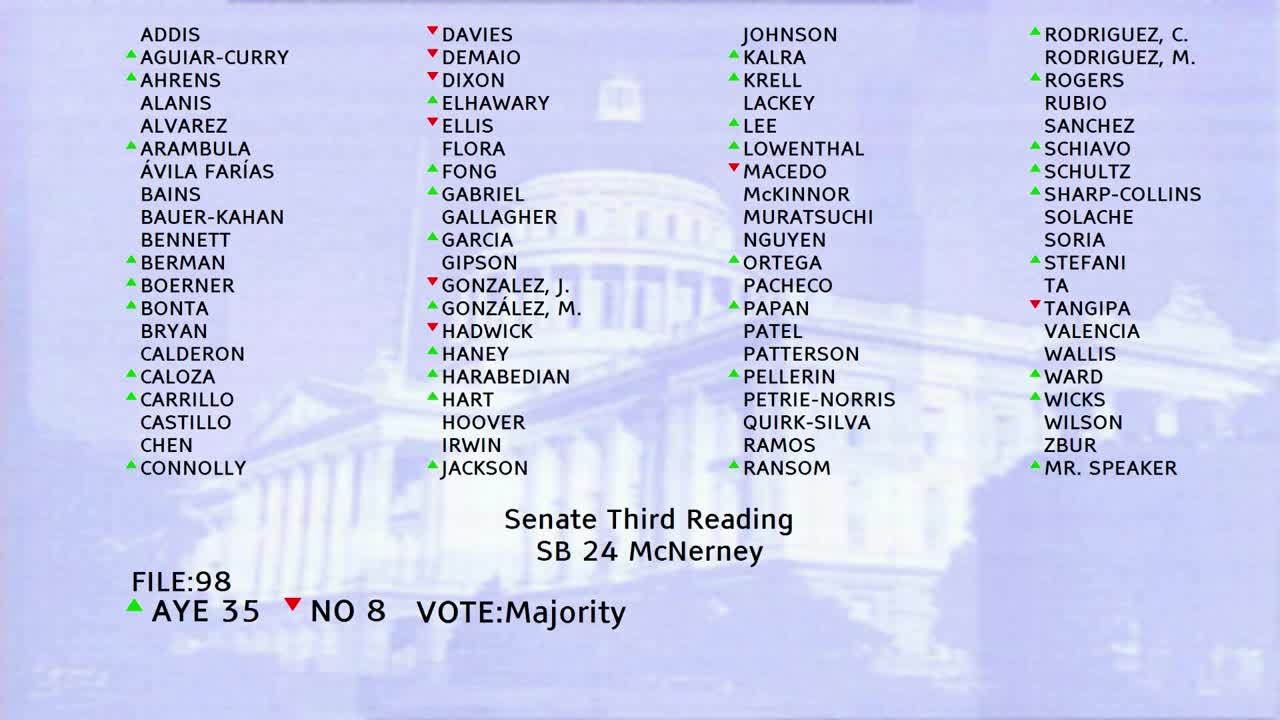
Bill Author

Bill Co-Author(s):