SB 6: Controlled substances: xylazine.
- Session Year: 2025-2026
- House: Senate
- Latest Version Date: 2024-12-02
Current Status:
In Progress
(2025-08-29: August 29 hearing: Held in committee and under submission.)
Introduced
In Committee
Awaiting First Chamber Vote
Passed First Chamber
In Committee
Awaiting Second Chamber Vote
Passed Second Chamber
Enacted
Existing law, the California Uniform Controlled Substances Act, categorizes controlled substances into 5 schedules and places the greatest restrictions on those substances contained in Schedule I. Under existing law, the substances in Schedule I are deemed to have a high potential for abuse and no accepted medical use while substances in Schedules II through V are substances that have an accepted medical use, but have the potential for abuse. Existing law restricts the prescription, furnishing, possession, sale, and use of controlled substances, and makes a violation of those laws a crime, except as specified. Existing law defines drug paraphernalia and prohibits, among other things, the manufacture, sale, and possession, as specified, of drug paraphernalia. Existing law excludes from these prohibitions any testing equipment that is designed, marketed, used, or intended to be used to analyze a substance for the presence of fentanyl, ketamine, gamma hydroxybutyric acid, or any analog of fentanyl.
This bill would add xylazine to the list of Schedule III substances, as specified. If an animal drug containing xylazine that has been approved under the federal Food, Drug and Cosmetic Act is not available for sale in California, the bill would create an exception for a substance that is intended to be used to compound an animal drug, as specified. The bill would exclude from the prohibitions on paraphernalia any testing equipment to analyze a substance for the presence of xylazine. By creating a new crime, the bill would impose a state-mandated local program.
The California Constitution requires the state to reimburse local agencies and school districts for certain costs mandated by the state. Statutory provisions establish procedures for making that reimbursement.
This bill would provide that no reimbursement is required by this act for a specified reason.
The Legislature finds and declares all of the following:
(a)Xylazine, an animal sedative used in veterinary medicine that has not been approved or authorized for human use by the federal Food and Drug Administration, has been increasingly found in the illicit drug supply and has been linked to an increasing number of overdose deaths in every United States census region. Xylazine is not currently listed on the federal- or state-controlled substances schedules.
(b)Xylazine, also known as tranq or the zombie drug, is frequently used as an adulterant mixed with other drugs, especially fentanyl. Fentanyl mixed with xylazine enhances fentanyls effects, increases its addictiveness, and worsens the risk of a life-threatening overdose. Overdoses involving xylazine pose additional challenges to first responders and emergency physicians because xylazine is not an opioid and its effects cannot be reversed with the opioid reversal medication naloxone.
(c)Combining drugs such as fentanyl with xylazine may increase profits for illicit drug traffickers by reducing the amount of fentanyl or other drugs used in a mixture.
(d)The Biden-Harris administration designated fentanyl adulterated with xylazine as an emerging drug threat under federal law, triggering a series of responses focused on prevention, treatment, and supply reduction.
(e)As of 2023, the prevalence of xylazine in California is low compared to other parts of the country. As a preventative effort to deterring further saturation of xylazine in the California illicit drug market, it is critical that further escalation of the current opioid epidemic be addressed.
(f)Though xylazine has no approved human use, animal drugs containing xylazine are critically important in veterinary medicine. It is important that any solution to address the prevalence of illicit xylazine also protects access for legitimate veterinary uses.
SEC. 2.Section 11014.5 of the Health and Safety Code is amended to read:11014.5.(a)Drug paraphernalia means all equipment, products, and materials of any kind that are designed for use or marketed for use, in planting, propagating, cultivating, growing, harvesting, manufacturing, compounding, converting, producing, processing, preparing, packaging, repackaging, storing, containing, concealing, injecting, ingesting, inhaling, or otherwise introducing into the human body a controlled substance in violation of this division. It includes, but is not limited to:
(1)Kits designed for use or marketed for use in planting, propagating, cultivating, growing, or harvesting of any species of plant that is a controlled substance or from which a controlled substance can be derived.
(2)Kits designed for use or marketed for use in manufacturing, compounding, converting, producing, processing, or preparing controlled substances.
(3)Isomerization devices designed for use or marketed for use in increasing the potency of any species of plant that is a controlled substance.
(4)Scales and balances designed for use or marketed for use in weighing or measuring controlled substances.
(5)Containers and other objects designed for use or marketed for use in storing or concealing controlled substances.
(6)Hypodermic syringes, needles, and other objects designed for use or marketed for use in parenterally injecting controlled substances into the human body.
(7)Objects designed for use or marketed for use in ingesting, inhaling, or otherwise introducing cannabis, cocaine, hashish, or hashish oil into the human body, such as:
(A)Carburetion tubes and devices.
(B)Smoking and carburetion masks.
(C)Roach clips, meaning objects used to hold burning material, such as a cannabis cigarette, that has become too small or too short to be held in the hand.
(D)Miniature cocaine spoons, and cocaine vials.
(E)Chamber pipes.
(F)Carburetor pipes.
(G)Electric pipes.
(H)Air-driven pipes.
(I)Chillums.
(J)Bongs.
(K)Ice pipes or chillers.
(8)Testing equipment designed for use or marketed for use in identifying, or in analyzing the strength, effectiveness, or purity of, controlled substances, except as otherwise provided in subdivision (d).
(b)For the purposes of this section, the phrase marketed for use means advertising, distributing, offering for sale, displaying for sale, or selling in a manner that promotes the use of equipment, products, or materials with controlled substances.
(c)In determining whether an object is drug paraphernalia, a court or other authority may consider, in addition to all other logically relevant factors, the following:
(1)Statements by an owner or by anyone in control of the object concerning its use.
(2)Instructions, oral or written, provided with the object concerning its use for ingesting, inhaling, or otherwise introducing a controlled substance into the human body.
(3)Descriptive materials accompanying the object that explain or depict its use.
(4)National and local advertising concerning its use.
(5)The manner in which the object is displayed for sale.
(6)Whether the owner or anyone in control of the object is a legitimate supplier of like or related items to the community, such as a licensed distributor or dealer of tobacco products.
(7)Expert testimony concerning its use.
(d)Notwithstanding paragraph (8) of subdivision (a), drug paraphernalia does not include any testing equipment designed, marketed, intended to be used, or used, to test a substance for the presence of contaminants, toxic substances, hazardous compounds, or other adulterants, or controlled substances that include, without limitation, fentanyl, ketamine, gamma hydroxybutyric acid, xylazine, or any analog of fentanyl.
(e)If any provision of this section or the application thereof to any person or circumstance is held invalid, it is the intent of the Legislature that the invalidity shall not affect other provisions or applications of the section that can be given effect without the invalid provision or application and to this end the provisions of this section are severable.
SEC. 3.Section 11056 of the Health and Safety Code is amended to read:11056.(a)The controlled substances listed in this section are included in Schedule III.
(b)Stimulants. Unless specifically excepted or unless listed in another schedule, any material, compound, mixture, or preparation that contains any quantity of the following substances having a stimulant effect on the central nervous system, including its salts, isomers (whether optical, position, or geometric), and salts of those isomers whenever the existence of those salts, isomers, and salts of isomers is possible within the specific chemical designation:
(1)Those compounds, mixtures, or preparations in dosage unit form containing any stimulant substances listed in Schedule II which compounds, mixtures, or preparations were listed on August 25, 1971, as excepted compounds under Section 1308.32 of Title 21 of the Code of Federal Regulations, and any other drug of the quantitative composition shown in that list for those drugs or that is the same except that it contains a lesser quantity of controlled substances.
(2)Benzphetamine.
(3)Chlorphentermine.
(4)Clortermine.
(5)Mazindol.
(6)Phendimetrazine.
(c)Depressants. Unless specifically excepted in Section 11059 or elsewhere, or unless listed in another schedule, any material, compound, mixture, or preparation that contains any quantity of the following substances having a depressant effect on the central nervous system:
(1)Any compound, mixture, or preparation containing any of the following:
(A)Amobarbital.
(B)Secobarbital.
(C)Pentobarbital
or any salt thereof and one or more other
active medicinal ingredients that are not listed in any schedule.
(2)Any suppository dosage form containing any of the following:
(A)Amobarbital.
(B)Secobarbital.
(C)Pentobarbital
or any salt of any of these drugs and approved by the federal Food and Drug Administration for marketing only as a suppository.
(3)Any substance that contains any quantity of a derivative of barbituric acid or any salt thereof.
(4)Chlorhexadol.
(5)Lysergic acid.
(6)Lysergic acid amide.
(7)Methyprylon.
(8)Sulfondiethylmethane.
(9)Sulfonethylmethane.
(10)Sulfonmethane.
(11)Gamma hydroxybutyric acid, and its salts, isomers, and salts of isomers, contained in a drug product for which an application has been approved under Section 505 of the Federal Food, Drug, and Cosmetic Act (21 U.S.C. Sec. 355).
(d)Nalorphine.
(e)Narcotic drugs. Unless specifically excepted or unless listed in another schedule, any material, compound, mixture, or preparation containing any of the following narcotic drugs, or their salts calculated as the free anhydrous base or alkaloid, in limited quantities as set forth below:
(1)Not more than 1.8 grams of codeine per 100 milliliters or not more than 90 milligrams per dosage unit, with an equal or greater quantity of an isoquinoline alkaloid of opium.
(2)Not more than 1.8 grams of codeine per 100 milliliters or not more than 90 milligrams per dosage unit, with one or more active, nonnarcotic ingredients in recognized therapeutic amounts.
(3)Not more than 1.8 grams of dihydrocodeine per 100 milliliters or not more than 90 milligrams per dosage unit, with one or more active nonnarcotic ingredients in recognized therapeutic amounts.
(4)Not more than 300 milligrams of ethylmorphine per 100 milliliters or not more than 15 milligrams per dosage unit, with one or more active, nonnarcotic ingredients in recognized therapeutic amounts.
(5)Not more than 500 milligrams of opium per 100 milliliters or per 100 grams or not more than 25 milligrams per dosage unit, with one or more active, nonnarcotic ingredients in recognized therapeutic amounts.
(6)Not more than 50 milligrams of morphine per 100 milliliters or per 100 grams, with one or more active, nonnarcotic ingredients in recognized therapeutic amounts.
(f)Anabolic steroids and chorionic gonadotropin. Any material, compound, mixture, or preparation containing chorionic gonadotropin or an anabolic steroid (excluding anabolic steroid products listed in the Table of Exempt Anabolic Steroid Products (Section 1308.34 of Title 21 of the Code of Federal Regulations), as exempt from the federal Controlled Substances Act (Section 801 and following of Title 21 of the United States Code)), including, but not limited to, the following:
(1)Androisoxazole.
(2)Androstenediol.
(3)Bolandiol.
(4)Bolasterone.
(5)Boldenone.
(6)Chloromethandienone.
(7)Clostebol.
(8)Dihydromesterone.
(9)Ethylestrenol.
(10)Fluoxymesterone.
(11)Formyldienolone.
(12)4-Hydroxy-19-nortestosterone.
(13)Mesterolone.
(14)Methandriol.
(15)Methandrostenolone.
(16)Methenolone.
(17)17-Methyltestosterone.
(18)Methyltrienolone.
(19)Nandrolone.
(20)Norbolethone.
(21)Norethandrolone.
(22)Normethandrolone.
(23)Oxandrolone.
(24)Oxymesterone.
(25)Oxymetholone.
(26)Quinbolone.
(27)Stanolone.
(28)Stanozolol.
(29)Stenbolone.
(30)Testosterone.
(31)Trenbolone.
(32)Human chorionic gonadotropin (hCG), except when possessed by, sold to, purchased by, transferred to, or administered by a licensed veterinarian, or a licensed veterinarians designated agent, exclusively for veterinary use.
(g)Ketamine. Any material, compound, mixture, or preparation containing ketamine.
(h)Hallucinogenic substances. Any of the following hallucinogenic substances: dronabinol (synthetic) in sesame oil and encapsulated in a soft gelatin capsule in a drug product approved by the federal Food and Drug Administration.
(i)(1)Xylazine, including its salts, isomers, and salts of its isomers. Any substance that contains xylazine.
(2)If an animal drug containing xylazine that has been approved under the federal Food, Drug and Cosmetic Act is not available for sale in California, a substance listed in paragraph (1) may be used to compound an animal drug pursuant to the federal Food and Drug Administrations industry guidance on compounding animal drugs from bulk drug substances.
(3)Notwithstanding any other law, compounding an animal drug pursuant to the conditions described in paragraph (2) shall not be deemed unprofessional conduct under Section 4301 of the Business and Professions Code.
SEC. 4.Section 11364.5 of the Health and Safety Code is amended to read:11364.5.(a)Except as authorized by law, a person shall not maintain or operate a place of business in which drug paraphernalia is kept, displayed, or offered in any manner, sold, furnished, transferred, or given away unless that drug paraphernalia is completely and wholly kept, displayed, or offered within a separate room or enclosure to which persons under 18 years of age who are not accompanied by a parent or legal guardian are excluded. Each entrance to such a room or enclosure shall be signposted in reasonably visible and legible words to the effect that drug paraphernalia is kept, displayed, or offered in the room or enclosure and that minors, unless accompanied by a parent or legal guardian, are excluded.
(b)Except as authorized by law, an owner, manager, proprietor, or other person in charge of a room or enclosure, within a place of business, in which drug paraphernalia is kept, displayed, or offered in any manner, sold, furnished, transferred, or given away shall not permit or allow a person under 18 years of age to enter, be in, remain in, or visit the room or enclosure unless that minor person is accompanied by their parent or legal guardian.
(c)Unless authorized by law, a person under 18 years of age shall not enter, be in, remain in, or visit a room or enclosure in a place of business in which drug paraphernalia is kept, displayed, or offered in any manner, sold, furnished, transferred, or given away unless accompanied by their parent or legal guardian.
(d)As used in this section, drug paraphernalia means all equipment, products, and materials of any kind which are intended for use or designed for use, in planting, propagating, cultivating, growing, harvesting, manufacturing, compounding, converting, producing, processing, preparing, packaging, repackaging, storing, containing, concealing, injecting, ingesting, inhaling, or otherwise introducing into the human body a controlled substance. Drug paraphernalia includes, but is not limited to, all of the following:
(1)Kits intended for use or designed for use in planting, propagating, cultivating, growing, or harvesting of any species of plant that is a controlled substance or from which a controlled substance can be derived.
(2)Kits intended for use or designed for use in manufacturing, compounding, converting, producing, processing, or preparing controlled substances.
(3)Isomerization devices intended for use or designed for use in increasing the potency of any species of plant that is a controlled substance.
(4)Scales and balances intended for use or designed for use in weighing or measuring controlled substances.
(5)Diluents and adulterants, such as quinine hydrochloride, mannitol, mannite, dextrose, and lactose, intended for use or designed for use in cutting controlled substances.
(6)Separation gins and sifters intended for use or designed for use in removing twigs and seeds from, or in otherwise cleaning or refining, cannabis.
(7)Blenders, bowls, containers, spoons, and mixing devices intended for use or designed for use in compounding controlled substances.
(8)Capsules, balloons, envelopes, and other containers intended for use or designed for use in packaging small quantities of controlled substances.
(9)Containers and other objects intended for use or designed for use in storing or concealing controlled substances.
(10)Hypodermic syringes, needles, and other objects intended for use or designed for use in parenterally injecting controlled substances into the human body.
(11)Objects intended for use or designed for use in ingesting, inhaling, or otherwise introducing cannabis, cocaine, hashish, or hashish oil into the human body, such as the following:
(A)Metal, wooden, acrylic, glass, stone, plastic, or ceramic pipes with or without screens, permanent screens, hashish heads, or punctured metal bowls.
(B)Water pipes.
(C)Carburetion tubes and devices.
(D)Smoking and carburetion masks.
(E)Roach clips, meaning objects used to hold burning material, such as a cannabis cigarette that has become too small or too short to be held in the hand.
(F)Miniature cocaine spoons, and cocaine vials.
(G)Chamber pipes.
(H)Carburetor pipes.
(I)Electric pipes.
(J)Air-driven pipes.
(K)Chillums.
(L)Bongs.
(M)Ice pipes or chillers.
(12)Testing equipment designed for use or marketed for use in identifying, or in analyzing the strength, effectiveness, or purity of, controlled substances, except as otherwise provided in subdivision (g).
(e)In determining whether an object is drug paraphernalia, a court or other authority may consider, in addition to all other logically relevant factors, the following:
(1)Statements by an owner or by anyone in control of the object concerning its use.
(2)Prior convictions, if any, of an owner, or of anyone in control of the object, under any state or federal law relating to any controlled substance.
(3)Direct or circumstantial evidence of the intent of an owner, or of anyone in control of the object, to deliver it to persons whom they know, or should reasonably know, intend to use the object to facilitate a violation of this section. The innocence of an owner, or of anyone in control of the object, as to a direct violation of this section shall not prevent a finding that the object is intended for use, or designed for use, as drug paraphernalia.
(4)Instructions, oral or written, provided with the object concerning its use.
(5)Descriptive materials, accompanying the object which explain or depict its use.
(6)National and local advertising concerning its use.
(7)The manner in which the object is displayed for sale.
(8)Whether the owner or anyone in control of the object is a legitimate supplier of like or related items to the community, such as a licensed distributor or dealer of tobacco products.
(9)The existence and scope of legitimate uses for the object in the community.
(10)Expert testimony concerning its use.
(f)This section shall not apply to any of the following:
(1)Any pharmacist or other authorized person who sells or furnishes drug paraphernalia described in paragraph (10) of subdivision (d) upon the prescription of a physician, dentist, podiatrist, or veterinarian.
(2)Any physician, dentist, podiatrist, or veterinarian who furnishes or prescribes drug paraphernalia described in paragraph (10) of subdivision (d) to a patient.
(3)Any manufacturer, wholesaler, or retailer licensed by the California State Board of Pharmacy to sell or transfer drug paraphernalia described in paragraph (10) of subdivision (d).
(g)Notwithstanding paragraph (12) of subdivision (a), drug paraphernalia does not include any testing equipment designed, marketed, intended to be used, or used, to test a substance for the presence of contaminants, toxic substances, hazardous compounds, or other adulterants, or controlled substances that include, without limitation, fentanyl, ketamine, gamma hydroxybutyric acid, xylazine, or any analog of fentanyl.
(h)Notwithstanding any other law, including Section 11374, violation of this section shall not constitute a criminal offense, but operation of a business in violation of the provisions of this section shall be grounds for revocation or nonrenewal of any license, permit, or other entitlement previously issued by a city, county, or city and county for the privilege of engaging in such business and shall be grounds for denial of any future license, permit, or other entitlement authorizing the conduct of such business or any other business, if the business includes the sale of drug paraphernalia.
SEC. 5.No reimbursement is required by this act pursuant to Section 6 of Article XIIIB of the California Constitution because the only costs that may be incurred by a local agency or school district will be incurred because this act creates a new crime or infraction, eliminates a crime or infraction, or changes the penalty for a crime or infraction, within the meaning of Section 17556 of the Government Code, or changes the definition of a crime within the meaning of Section 6 of Article XIIIB of the California Constitution.
|
Date
|
Status
|
|---|---|
| Aug 29, 2025 | August 29 hearing: Held in committee and under submission. |
| Jul 16, 2025 | July 16 set for first hearing. Placed on APPR. suspense file. |
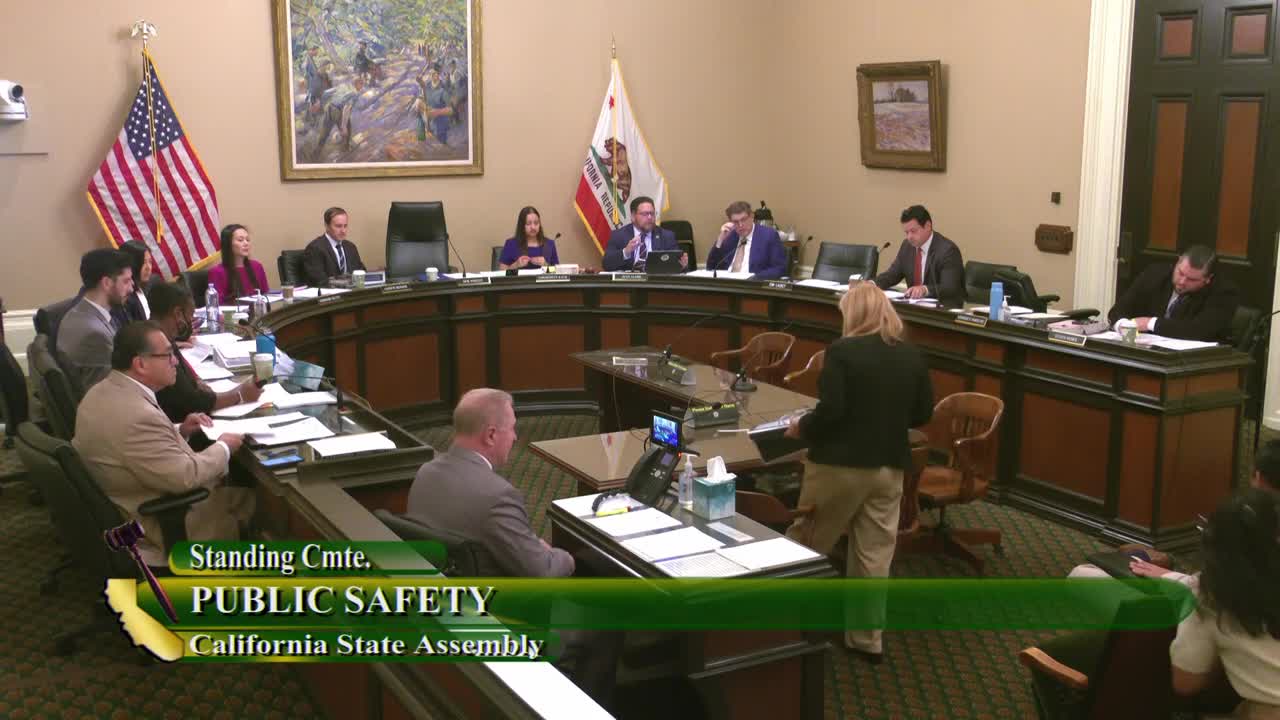
| Jul 2, 2025 | From committee: Do pass and re-refer to Com. on APPR. (Ayes 9. Noes 0.) (July 1). Re-referred to Com. on APPR. |
| Jun 9, 2025 | Referred to Com. on PUB. S. |
| Jun 4, 2025 | In Assembly. Read first time. Held at Desk. |
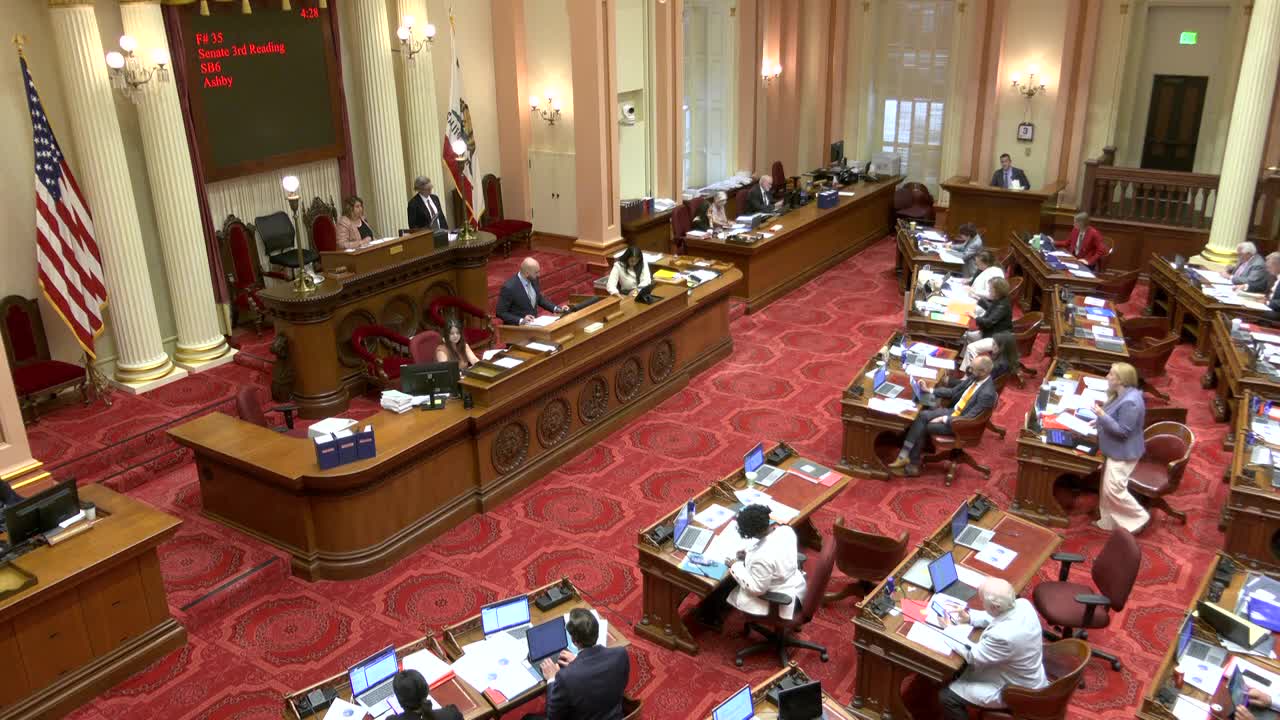
| Jun 3, 2025 | Read third time. Passed. (Ayes 38. Noes 0. Page 1472.) Ordered to the Assembly. |
| May 23, 2025 | From committee: Do pass. (Ayes 6. Noes 0. Page 1187.) (May 23). |
| May 23, 2025 | Read second time. Ordered to third reading. |
| May 16, 2025 | Set for hearing May 23. |
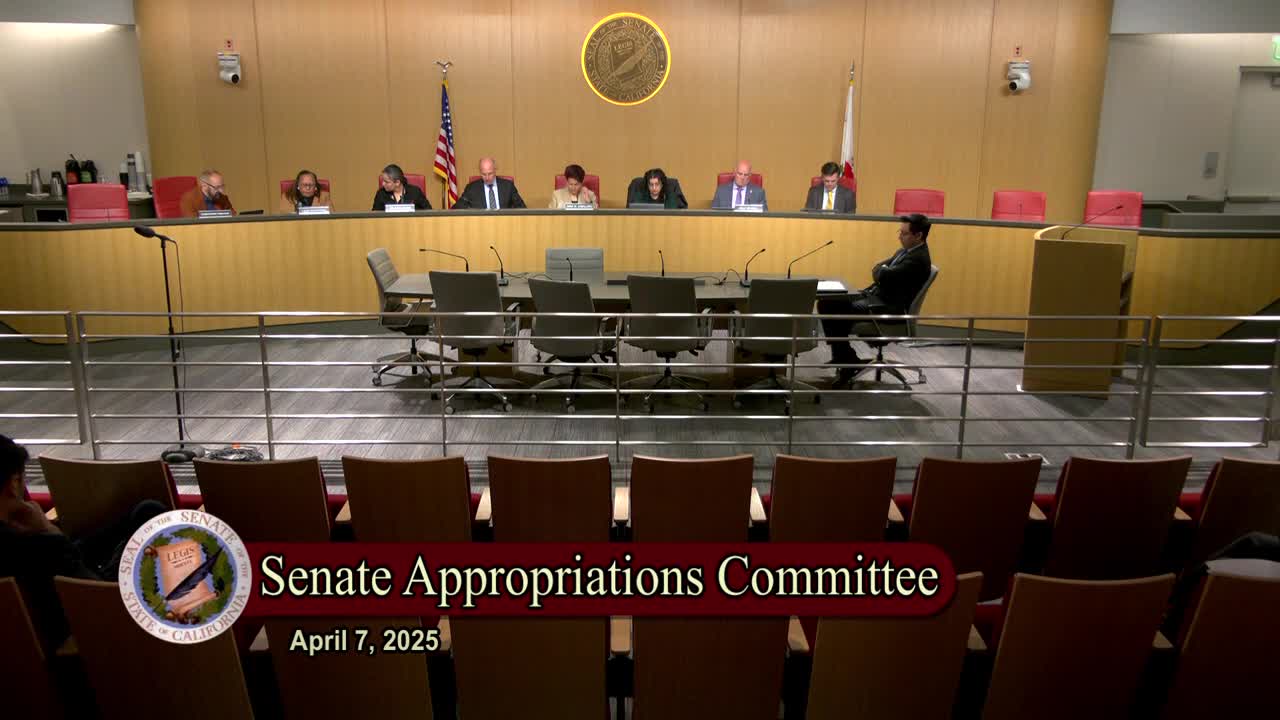
| Apr 7, 2025 | April 7 hearing: Placed on APPR. suspense file. |
| Mar 28, 2025 | Set for hearing April 7. |
| Mar 25, 2025 | From committee: Do pass and re-refer to Com. on APPR. (Ayes 6. Noes 0. Page 532.) (March 25). Re-referred to Com. on APPR. |
| Mar 7, 2025 | Set for hearing March 25. |
| Jan 29, 2025 | Referred to Com. on PUB. S. |
| Dec 3, 2024 | From printer. May be acted upon on or after January 2. |
| Dec 2, 2024 | Introduced. Read first time. To Com. on RLS. for assignment. To print. |
|
Date
|
Description
|
Location
|
Votes
|
|
|---|---|---|---|---|
| Jul 1, 2025 | Do pass and be re-referred to the Committee on [Appropriations] | Assembly Standing Committee on Public Safety |
Passed |
|
| Jun 3, 2025 | Senate 3rd Reading SB6 Ashby | Senate Floor |
Passed |
|
| May 23, 2025 | Do pass | Senate Standing Committee on Appropriations |
Passed |
|
| Apr 7, 2025 | Placed on suspense file | Senate Standing Committee on Appropriations |
Passed |
|
| Mar 25, 2025 | Do pass, but first be re-referred to the Committee on [Appropriations] | Senate Standing Committee on Public Safety |
Passed |
This list shows positions taken on this bill by organizations on the date displayed, which is linked to the original source.
Positions by individuals are not included.
|
Organization
|
Position
|
Date
|
|---|---|---|
| Aclu California Action | ** Against | |
| ARCADIA POLICE OFFICERS ASSOCIATION | ** Support | |
| Burbank Police Officers Association | ** Support | |
| California Association of School Police Chiefs | ** Support | |
| California Coalition of School Safety Professionals | ** Support | |
| California District Attorneys Association | ** Support | |
| California Emergency Nurses Association | ** Support | |
| California Narcotic Officers Association | ** Support | |
| California Pharmacists Association | ** Support | |
| California Police Chiefs Association | ** Support | |
| California Reserve Peace Officers Association | ** Support | |
| California State Sheriffs Association | ** Support | |
| California Veterinary Medical Association | ** Support | |
| Chief Probation Officers Of California | ** Support | |
| City of Los Alamitos | ** Support | |
| City of Moorpark | ** Support | |
| City of San Diego Mayor Todd Gloria | ** Support | |
| CLAREMONT POLICE OFFICERS ASSOCIATION | ** Support | |
| Culver City Police Officers' Association | ** Support | |
| Drug Policy Alliance | ** Against | |
| FULLERTON POLICE OFFICERS ASSOCIATION | ** Support | |
| Initiate Justice Action | ** Against | |
| League Of California Cities | ** Support | |
| Los Angeles School Police Management Association | ** Support | |
| los angeles school police officers association | ** Support | |
| MURRIETA POLICE OFFICERS ASSOCIATION | ** Support | |
| Newport Beach Police Association | ** Support | |
| Palos Verdes Police Officers Association | ** Support | |
| Placer County Deputy Sheriffs’ Association | ** Support | |
| POMONA POLICE OFFICERS ASSOCIATION | ** Support | |
| Riverside County Sheriff's Office | ** Support | |
| RIVERSIDE POLICE OFFICERS ASSOCIATION | ** Support | |
| Riverside Sheriffs Association | ** Support | |
| San Diego County District Attorneys Office | ** Support | |
| San Francisco District Attorney Brooke Jenkins | ** Support | |
| Santa Ana Police Officers Association | ** Support |
Date of Hearing: July 16, 2025
ASSEMBLY COMMITTEE ON APPROPRIATIONS
Buffy Wicks, Chair
SBPCA Bill Id:SB 6
Author:(Ashby) – As Introduced Ver:December 2, 2024
Policy Committee: | Public Safety | Vote: | 9 - 0 |
|
| ||
|
|
Urgency: No State Mandated Local Program: Yes Reimbursable: No
SUMMARY:
This bill adds xylazine as a Schedule III drug under California’s Uniform Controlled Substances Act (UCSA).
FISCAL EFFECT:
- Cost pressures (Trial Court Trust Fund, General Fund) of an unknown but potentially significant amount to the courts to adjudicate charges of xylazine-related crimes. A defendant charged with a misdemeanor or felony is entitled to a jury trial and, if the defendant is indigent, legal representation provided by the government. Actual court costs will depend on the number of violations, prosecutorial discretion, and the amount of court time needed to adjudicate each case. Although courts are not funded on the basis of workload, increased pressure on the Trial Court Trust Fund may create a demand for increased funding for courts from the General Fund. The fiscal year 2025-26 state budget provides $82 million ongoing General Fund to the Trial Court Trust Fund for court operations.
- Costs (local funds, General Fund) to the counties and the California Department of Corrections and Rehabilitation to incarcerate people convicted of xylazine-related crimes. Actual incarceration costs will depend on the number of convictions, the length of each sentence, and whether each sentence must be served in county jail or state prison. The average annual cost to incarcerate one person in county jail is approximately $29,000, though costs are higher in larger counties. The Legislative Analyst’s Office estimates the average annual cost to incarcerate one person in state prison is $133,000. County incarceration costs are not subject to reimbursement by the state. However, overcrowding in county jails creates cost pressure on the General Fund because the state has historically granted new funding to counties to offset overcrowding resulting from public safety realignment.
COMMENTS:
- Background. Through independent statutory schemes, the federal government and California restrict the use of certain drugs and substances. Both schemes classify a controlled substance into one of five “schedules” based on a number of factors, including the substance’s risk for abuse or dependence and whether it has currently accepted medical uses. Schedule I substances pose the greatest risk and are most highly regulated; substances in each subsequent tier pose a lesser risk in comparison. For example, in California, heroin, cocaine, and LSD are Schedule I drugs, while codeine and buprenorphine are Schedule V drugs. California is not required to but has generally aligned its regulation of controlled substances with the federal schedules, which do not currently include xylazine. Bipartisan federal legislation was introduced in February 2025 to list the substance as a Schedule III controlled substance on the federal schedules.
This bill places xylazine on Schedule III of the UCSA. By classifying xylazine as a Schedule III substance, this bill also criminalizes a host of activities related to the substance. Possession, possession for sale, trafficking, manufacturing, and offering to manufacture a non-narcotic Schedule III substance are all criminal offenses. Punishments for these offenses range from one to seven years in county jail, plus significant fines in some cases. In some circumstances, offenses and sentencing enhancements related to xylazine may be punishable by state prison terms.
According to the California Department of Public Health (CDPH), xylazine (also known as “tranq”) is a non-opioid animal tranquilizer that has been connected to overdose deaths nationwide. Some users intentionally take xylazine simultaneously with fentanyl or other drugs; in other circumstances, drug sellers cut fentanyl or heroin with xylazine to extend their product without disclosing the xylazine.
The extent to which xylazine is present in California drug markets is unclear. In 2022, the Drug Enforcement Administration (DEA) reported that its identification of xylazine-positive overdose deaths in the western United States increased from four deaths in 2020 to 34 in 2021. However, the DEA also noted comprehensive data on xylazine-related deaths is not available because xylazine is not routinely included in postmortem testing or data reporting in all jurisdictions. In April 2023, based in part on the DEA’s report, the White House Office of National Drug Control Policy designated fentanyl mixed with xylazine as an emerging threat, citing its “growing role in overdose deaths in every region in the United States.” On the other hand, in November 2023 in a letter to California health care facilities, CDPH described xylazine as “present” in California, but noted that the drug had not penetrated the state’s drug supply as extensively as it had in other regions. It does not appear CDPH has publicly updated its assessment of xylazine since then.
- Prior Legislation. AB 3029 (Bains), of the 2023-24 Legislative Session, would have added xylazine as a Schedule III controlled substance under the UCSA if xylazine was similarly classified by the federal government. AB 3029 was held on the Senate Appropriations Committee’s suspense file.
SB 1502 (Ashby), of the 2023-24 Legislative Session, was similar to SB 6 and also would have made other changes to the Health and Safety Codes regarding drug paraphernalia. SB 1502 died in the Assembly Committee on Public Safety.
Analysis Prepared by: Annika Carlson / APPR. / (916) 319-2081
SENATE RULES COMMITTEE Office of Senate Floor Analyses (916) 651-1520 Fax: (916) 327-4478 | SB 6 |
THIRD READING
Bill No: SB 6
Author: Ashby (D)
Introduced: 12/2/24
Vote: 21
SENATE PUBLIC SAFETY COMMITTEE: 6-0, 3/25/25
AYES: Arreguín, Seyarto, Caballero, Gonzalez, Pérez, Wiener
SENATE APPROPRIATIONS COMMITTEE: 6-0, 5/23/25
AYES: Caballero, Seyarto, Cabaldon, Grayson, Richardson, Wahab
NO VOTE RECORDED: Dahle
SUBJECT: Controlled substances: xylazine
SOURCE: City of San Diego Mayor Todd Gloria
DIGEST:
This bill adds xylazine to the list of Schedule III controlled substances, except as specified.
ANALYSIS:
Existing law:
- Establishes the California Uniform Controlled Substances Act, which regulates controlled substances. (Health & Safety (Saf.) Code, § 11000 et seq.)
- Classifies controlled substances into five schedules according to their danger and potential for abuse. Provides that Schedule I controlled substances have the greatest restrictions and penalties, including prohibiting the prescribing of a Schedule I controlled substance. (Health & Saf. Code, §§ 11054-11058.)
- Makes the possession of a Schedule III controlled substance that is not a narcotic drug a misdemeanor, unless upon the prescription physician, dentist, podiatrist, or veterinarian, licensed to practice in this state, and punishable by imprisonment in a county jail for a period of not more than one year, except that such person may instead be punished pursuant to Penal Code section 1170 (h) if that person has one or more prior convictions for specified offenses. (Health & Saf. Code § 11377, subd. (a).)
- Defines “drug paraphernalia” as all equipment, products, and materials of any kind which are designed for use or marketed for use, in planting, propagating, cultivating, growing, harvesting, manufacturing, compounding, converting, producing, processing, preparing, testing, analyzing, packaging, repackaging, storing, containing, concealing, injecting, ingesting, inhaling, or otherwise introducing into the human a body a controlled substance. (Health & Saf. Code, §§ 11014.5, subd. (a), 11364.5, subd. (d).)
- Provides that drug paraphernalia includes testing equipment designed for use or marketed for use in identifying, or in analyzing the strength, effectiveness, or purity of controlled substances. (Health & Saf. Code, §§ 11014.5, subd. (a)(8), 11364.5, subd. (d)(12).)
- Provides that “drug paraphernalia” does not include any testing equipment designed, marketed, intended to be used, or used, to test a substance for the presence of fentanyl, ketamine, gamma hydroxybutyric acid, or any analog of fentanyl. (Health & Saf. Code, §§ 11014.5, subd. (d), 11364.5, subd. (g).)
This bill:
- Adds xylazine, and its salts, isomers, and salts of its isomers to Schedule III. Also adds any substance that contains xylazine.
- Allows xylazine, its salts, isomers, and salts of its isomers, and a substance containing xylazine to be used to compound an animal drug pursuant to the federal Food and Drug Administration’s industry guidance on compounding animal drugs from bulk drug substances when the animal drug containing xylazine that has been approved under the federal Food, Drug and Cosmetic Act is not available for sale in California.
- Provides that notwithstanding any other law, compounding an animal drug as described in the provisions of this bill is not unprofessional conduct under Section 4301 of the Business and Professions Code.
- Adds xylazine to the exemptions from the drug paraphernalia statutes.
Background
Through the Controlled Substances Act of 1970, the federal government regulates the manufacture, distribution, and dispensing of controlled substances. The Act groups drugs into five schedules with decreasing potential for physical or psychological harm, based on three considerations: accepted medical use; potential for abuse; and, safety or dependency liability. California’s controlled substances schedules largely follow the federal schedules.
- Schedule I controlled substances, such as heroin, ecstasy, and LSD, have a high potential for abuse and no generally accepted medical use.
- Schedule II controlled substances have a currently accepted medical use, with significant risk to patient safety, and have a high potential for abuse and dependence. Schedule II drugs can be narcotics or non-narcotic. Examples of Schedule II controlled substances include morphine, oxycodone, codeine, and amphetamine.
- Schedule III controlled substances have a currently accepted medical use and potential for abuse leading to moderate physical dependence. Examples of Schedule III controlled substances include ketamine and anabolic steroids.
- Schedule IV controlled substances have a currently accepted medical use and low potential for abuse which may lead to limited physical dependence. Examples of Schedule IV controlled substances include benzodiazepines.
- Schedule V controlled substances have a low potential for abuse or dependence. Examples of Schedule V controlled substances include buprenorphine and narcotic drugs containing non-narcotic active medicinal ingredients.
Xylazine, also known as tranq, is a non-opiate sedative, analgesic, and muscle relaxant only authorized in the U.S. for veterinary use by the FDA. (U.S. Department of Justice and Drug Enforcement Administration, DEA Joint Intelligence Report: The Growing Threat of Xylazine and its Mixture with Illicit Drugs (Oct. 2022), p. 1 available at <https://www.dea.gov/sites/default/files/2022-12/The%20Growing%20Threat%20of%20Xylazine%20and%20its%20Mixture%20with%20Illicit%20Drugs.pdf [hereinafter DEA Joint Report].) It is not included in the federal controlled substances schedules, and it is not approved for consumption by humans. (Ibid.) In legal sales for veterinary use, xylazine is available in liquid form and sold in vials or preloaded syringes, with solutions prepared at a concentration appropriate for administration by injection based on the general size and weight of the species. (Ibid.) Xylazine is legitimately sold directly through pharmaceutical distributors and websites catering to veterinarians. (Ibid.)
Xylazine can be injected, sniffed, or consumed orally. (Centers for Disease Control and Prevention, What You Should Know About Xylazine available at <http://cdc.gov/overdose-prevention/about/what-you-should-know-about-xylazine.html .) People are most frequently exposed to xylazine while using illegal drugs, such as cocaine, heroin, and fentanyl, which are sometimes mixed with xylazine to enhance the effects of the drug it is being mixed with or to increase the price of the drug by increasing its weight. (Id.) The DEA reports that it has seized xylazine and fentanyl mixtures in almost all 50 states. (Id.) Between 2020 and 2021, DEA lab results found a 112% increase in the presence of xylazine in drug seizures in the Western region of the country. (DEA Joint Report, supra at p. 2.) Xylazine can cause respiratory depression similar to that of an opioid overdose which may increase the potential for a fatal outcome at a time when opioid overdose deaths remain high. (Id. at p. 4.) Due to the impact of xylazine on the opioid crisis, the Biden Administration designated fentanyl combined with xylazine as an emerging threat to the United States in 2023. (The White House, Office of the Press Secretary (Apr. 12, 2023) Biden-Harris Administration designates fentanyl combined with xylazine as an emerging threat to the United States, available at <https://bidenwhitehouse.archives.gov/ondcp/briefing-room/2023/04/12/biden-harris-administration-designates-fentanyl-combined-with-xylazine-as-an-emerging-threat-to-the-united-states/ .)
This bill adds xylazine to the list of Schedule III controlled substances. It contains an exception for a substance that is intended to be used to compound an animal drug pursuant to the federal FDA’s industry guidance on compounding animal drugs from bulk drug substances, or an animal drug compound containing xylazine that is compounded pursuant to this guidance, when the animal drug containing xylazine has been approved under the federal Food, Drug and Cosmetic Act and is not available for sale this state. This bill also adds xylazine to the exemptions from the drug paraphernalia statutes.
FISCAL EFFECT: Appropriation: No Fiscal Com.: Yes Local: Yes
According to the Senate Appropriations Committee:
Trial Courts: Unknown, potentially significant cost to the state funded trial court system (Trial Court Trust Fund, General Fund) to adjudicate criminal penalties created by this bill. Defendants are constitutionally guaranteed certain rights during criminal proceedings, including the right to a jury trial and the right to counsel (at public expense if the defendants are unable to afford the costs of representation). Creating new crimes, with increased penalties, could lead to lengthier and more complex court proceedings with attendant workload and resource costs to the court. The fiscal impact of this bill to the courts will depend on many unknown factors, including the numbers of people charged with an offense and the factors unique to each case. An eight-hour court day costs approximately $10,500 in staff in workload. If court days exceed 10, costs to the trial courts could reach hundreds of thousands of dollars. In 2023–24, over 4.8 million cases were filed statewide in the superior courts, including 179,821 felony cases and 451,647 misdemeanor cases. While the courts are not funded on a workload basis, an increase in workload could result in delayed court services and would put pressure on the General Fund to fund additional staff and resources and to increase the amount appropriated to backfill for trial court operations. The Governor’s 2025–26 budget proposes a $40 million ongoing increase in discretionary funding from the General Fund to help pay for increased trial court operation costs beginning in 2025–26.
Incarceration: Costs (local funds, General Fund) to the counties and the Department of Corrections and Rehabilitation of an unknown but significant amount to incarcerate people for xylazine-related crimes. The Legislative Analyst’s Office (LAO) estimates the average annual cost to incarcerate one person in state prison is $133,000. The average annual cost to incarcerate one person in county jail is approximately $77,252 per year. Actual incarceration costs will depend on the number of convictions and the length of each sentence. Although county incarceration costs are generally not considered reimbursable state mandates pursuant to Proposition 30 (2012), overcrowding in county jails creates cost pressure on the General Fund because the state has historically granted new funding to counties to offset overcrowding resulting from 2011 public safety realignment.
Local Supervision: Costs (local funds, General Fund) to county probation departments of an unknown, but potentially significant amount, if individuals convicted of the new crimes created by this bill are supervised locally in the community in lieu of or in addition to incarceration. In each criminal case, probation departments have a number of responsibilities such as providing pretrial risk assessments to the courts, conducting investigations to provide presentencing reports to the courts, and supervising people to ensure they comply with the terms of their probation. Costs could range from the hundreds of thousands to the millions of dollars annually in the aggregate. Actual costs would depend on the cost of supervision by each county probation department and how many individuals are granted probation for a xylazine-related offense. According to the LAO, the state has typically provided counties with additional funding when state policy changes temporarily increase the post-release community supervision and probation populations. Local costs to comply with this measure would be subject to reimbursement by the state to the extent that the Commission on State Mandates determines that this bill imposes a state-mandated local program.
SUPPORT: (Verified 5/23/25)
City of San Diego Mayor Todd Gloria (Source)
Arcadia Police Officers’ Association
Burbank Police Officers’ Association
California Association of School Police Chiefs
California Coalition of School Safety Professionals
California District Attorneys Association
California Emergency Nurses Association
California Narcotic Officers’ Association
California Pharmacists Association
California Police Chiefs Association
California Reserve Peace Officers Association
California State Sheriffs’ Association
California Veterinary Medical Association
Chief Probation Officers’ of California
City of Los Alamitos
City of Moorpark
Claremont Police Officers Association
Culver City Police Officers’ Association
Fullerton Police Officers’ Association
League of California Cities
Los Angeles School Police Management Association
Los Angeles School Police Officers Association
Murrieta Police Officers’ Association
Newport Beach Police Association
Palos Verdes Police Officers Association
Placer County Deputy Sheriffs’ Association
Pomona Police Officers’ Association
Riverside County Sheriff's Office
Riverside Police Officers Association
Riverside Sheriffs’ Association
San Diego County District Attorney’s Office
San Francisco District Attorney Brooke Jenkins
Santa Ana Police Officers Association
OPPOSITION: (Verified 5/23/25)
ACLU California Action
Drug Policy Alliance
Initiate Justice Action
ARGUMENT IN SUPPORT: San Diego Mayor Todd Gloria, the bill’s sponsor, writes:
…This is an important change to help law enforcement in the prosecution of drug trafficking and related deaths.
A recent study by the Center for Disease Control (CDC) named fentanyl the deadliest drug in the United States. According to the U.S. Drug Enforcement Administration, “Xylazine is making the deadliest drug threat our country has ever faced, fentanyl, even deadlier.” While xylazine has a legitimate use for veterinary medicine, its combination with fentanyl to create the street drug known as “tranq,” is concerning particularly because the drug is resistant to the overdose reversal drug naloxone.
The DEA continues to seize xylazine and fentanyl mixtures and has reported that in 2022 approximately 23% of fentanyl powder and 7% of fentanyl pills contained xylazine. In the City of San Diego, “accidental overdose” was the leading cause of death according to 2022 data. Of those … 66% involved fentanyl. The problem is particularly acute in the homeless population. …
ARGUMENT IN OPPOSITION: Drug Policy Alliance writes:
…This bill, should it become law, will lead to arbitrary, heightened criminalization and sentencing of people who use drugs, most of whom do not intend to possess xylazine and often do not have information about the specific chemical composition of substances they possess or consume. Additionally, it will impede research exploring the pathophysiology, patterns of xylazine use, clinical treatment and withdrawal management, wound treatment and management, while doing nothing to prevent overdose.
…We all want our loved ones and communities to be safe, but criminalizing xylazine will not prevent overdose deaths, reduce suffering associated with drug use or incarceration, or reduce drug use. It will only serve to increase the criminalization of people who use drugs, exposing them to additional criminal charges and potentially increased sentences. In recent years xylazine has been predominantly found in combination with fentanyl, for which severe criminal penalties already exist. …
… The experience of Florida illustrates the ineffectiveness of criminalization. In 2018 xylazine was classified as a Class I substance in that state … By April 2023 xylazine had become one of the six most commonly identified drugs in state law enforcement laboratories and the Florida Attorney General issued a “public safety alert” indicating that the prevalence of the drug was increasing. …
… Given the ineffectiveness of scheduling xylazine as a means of reducing its presence in the illicit drug supply, many experts have expressed opposition to scheduling xylazine as a Schedule III substance at the federal level. These experts also expressed concern that scheduling xylazine could lead to significant disruptions in emergency medicine by increasing the likelihood that very similar medications to xylazine would also be added to the schedule of controlled substances.
…Instead of hastily criminalizing xylazine as a controlled substance, policymakers should focus on health-centered approaches: expanding overdose-prevention and harm-reduction services (including community-based drug checking programs), peer-led outreach and street-medicine programs, strengthening our Good Samaritan statute, and increasing access to methadone, buprenorphine, and naloxone, and evidence-based drug education and voluntary treatment.
Prepared by: Stephanie Jordan / PUB. S. /
5/24/25 22:24:02
SENATE COMMITTEE ON APPROPRIATIONS
Senator Anna Caballero, Chair
2025 - 2026 Regular Session
SB 6 (Ashby) - Controlled substances: xylazine
Version: December 2, 2024 | Policy Vote: PUB. S. 6 - 0 |
Urgency: No | Mandate: Yes |
Hearing Date: April 7, 2025 | Consultant: Liah Burnley |
Bill Summary:
SB 6 criminalizes xylazine and any substance containing xylazine by classifying it as a Schedule III controlled substance under California’s Uniform Controlled Substances Act (UCSA).
Fiscal Impact:
- Trial Courts: Unknown, potentially significant cost to the state funded trial court system (Trial Court Trust Fund, General Fund) to adjudicate criminal penalties created by this bill. Defendants are constitutionally guaranteed certain rights during criminal proceedings, including the right to a jury trial and the right to counsel (at public expense if the defendants are unable to afford the costs of representation). Creating new crimes, with increased penalties, could lead to lengthier and more complex court proceedings with attendant workload and resource costs to the court. The fiscal impact of this bill to the courts will depend on many unknown factors, including the numbers of people charged with an offense and the factors unique to each case. An eight-hour court day costs approximately $10,500 in staff in workload. If court days exceed 10, costs to the trial courts could reach hundreds of thousands of dollars. In 2023–24, over 4.8 million cases were filed statewide in the superior courts, including 179,821 felony cases and 451,647 misdemeanor cases. While the courts are not funded on a workload basis, an increase in workload could result in delayed court services and would put pressure on the General Fund to fund additional staff and resources and to increase the amount appropriated to backfill for trial court operations. The Governor’s 2025-26 budget proposes a $40 million ongoing increase in discretionary funding from the General Fund to help pay for increased trial court operation costs beginning in 2025-26.
- Incarceration: Costs (local funds, General Fund) to the counties and the Department of Corrections and Rehabilitation of an unknown but significant amount to incarcerate people for xylazine-related crimes. The Legislative Analyst’s Office (LAO) estimates the average annual cost to incarcerate one person in state prison is $133,000. The average annual cost to incarcerate one person in county jail is approximately $77,252 per year. Actual incarceration costs will depend on the number of convictions and the length of each sentence. Although county incarceration costs are generally not considered reimbursable state mandates pursuant to Proposition 30 (2012), overcrowding in county jails creates cost pressure on the General Fund because the state has historically granted new funding to counties to offset overcrowding resulting from 2011 public safety realignment.
- Local Supervision: Costs (local funds, General Fund) to county probation departments of an unknown, but potentially significant amount, if individuals convicted of the new crimes created by this bill are supervised locally in the community in lieu of or in addition to incarceration. In each criminal case, probation departments have a number of responsibilities such as providing pretrial risk assessments to the courts, conducting investigations to provide presentencing reports to the courts, and supervising people to ensure they comply with the terms of their probation. Costs could range from the hundreds of thousands to the millions of dollars annually in the aggregate. Actual costs would depend on the cost of supervision by each county probation department and how many individuals are granted probation for a xylazine-related offense. According to the LAO, the state has typically provided counties with additional funding when state policy changes temporarily increase the post-release community supervision and probation populations. Local costs to comply with this measure would be subject to reimbursement by the state to the extent that the Commission on State Mandates determines that this bill imposes a state-mandated local program
Background:
Through independent statutory schemes, both the federal government and California restrict the use of certain substances by classifying them into five “schedules” based on abuse potential and medical use. Schedule I substances pose the greatest risk and are most highly regulated; substances in each subsequent tier pose a lesser risk in comparison. For example, heroin, cocaine, and LSD are Schedule I drugs, while codeine and buprenorphine are Schedule V drugs. California is not required to but typically aligns its regulation of controlled substances with the federal schedules. The federal government has classified xylazine as controlled substances. This bill classifies xylazine as Schedule III of the UCSA, which criminalizes a host of activities related to the substance.[1]
Proposed Law:
- Classifies xylazine, and its salts, isomers, and salts of its isomers as a Schedule III substance.
- Classifies any substance that contains xylazine as a Schedule III substance.
- Allows xylazine, its salts, isomers, and salts of its isomers, and any substance containing xylazine to be used to compound an animal drug pursuant to the federal Food and Drug Administration’s industry guidance, as specified.
- Exempts compounding xylazine for animal drugs from unprofessional conduct provisions of the Business and Professions Code.
- Adds xylazine to the existing exemptions for drug paraphernalia.
Related Legislation:
- SB 1502 (Ashby) would have classified xylazine or any substance containing xylazine as a Schedule III controlled substance. SB 1502 failed passage in Assembly Public Safety Committee.
- AB 3029 (Bains) would have classified xylazine or any substance containing xylazine as a Schedule III controlled substance. AB 3029 was held under submission in this Committee.
-- END --
For example, among other offenses and enhancements, this bill would make possession of xylazine a misdemeanor subject to imprisonment in county jail for up to one year (Health & Saf., § 11377, subd. (a)); expand a sentence enhancement for administering controlled substance to a consecutive term of imprisonment in the state prison for five years to include xylazine in some specified cases (Pen. Code sec. 12022.75); make possession for sale a felony subject to imprisonment in county jail for 16 months, 2 years or 3 years. (Health & Saf., § 11378); make trafficking xylazine a felony subject to imprisonment in county jail for 2, 3, or 4 years (Health & Saf., § 11379); makes manufacturing, producing, or preparing xylazine a felony punishable by imprisonment in county jail for 3, 5, or 7 years and a fine of up to $50,000 (Health & Saf., § 11379.6, subd. (a)); make offering to manufacturing, producing, or preparing a xylazine a felony punishable by imprisonment in county jail for 3, 4, or 5 years (Health & Saf., § 11379.6, subd. (e)). ↑
SENATE COMMITTEE ON PUBLIC SAFETY
Senator Jesse Arreguín, Chair
2025 - 2026 Regular
Bill No: SB 6 Hearing Date: March 25, 2025
Author: | Ashby | ||
Version: | December 2, 2024 | ||
Urgency: | No | Fiscal: | Yes |
Consultant: | SJ | ||
Subject: Controlled substances: xylazine
HISTORY
Source: City of San Diego Mayor Todd Gloria
Prior Legislation: SB 1502 (Ashby), held in Assembly Public Safety in 2024
AB 3029 (Bains), held in Senate Appropriations in 2024
AB 1598 (Davies), Ch. 201, Stats. of 2022
Support: Arcadia Police Officers’ Association; Burbank Police Officers’ Association; California Association of School Police Chiefs; California Coalition of School Safety Professionals; California District Attorneys Association; California Narcotic Officers’ Association; California Pharmacists Association; California Police Chiefs Association; California Reserve Peace Officers Association; California State Sheriffs’ Association; California Veterinary Medical Association; Claremont Police Officers Association; Culver City Police Officers’ Association; Fullerton Police Officers’ Association; League of California Cities; Los Angeles School Police Management Association; Los Angeles School Police Officers Association; Murrieta Police Officers’ Association; Newport Beach Police Association; Palos Verdes Police Officers Association; Placer County Deputy Sheriffs’ Association; Pomona Police Officers’ Association; Riverside County Sheriff’s Office; Riverside Police Officers Association; Riverside Sheriffs’ Association; San Diego County District Attorney’s Office; Santa Ana Police Officers Association
Opposition: ACLU California Action; Drug Policy Alliance; Initiate Justice Action
PURPOSE
The purpose of this bill is to add xylazine to the list of Schedule III controlled substances, except as specified.
Existing law establishes the California Uniform Controlled Substances Act, which regulates controlled substances. (Health & Saf. Code, § 11000 et seq.)
Existing law classifies controlled substances into five schedules according to their danger and potential for abuse. Provides that Schedule I controlled substances have the greatest restrictions and penalties, including prohibiting the prescribing of a Schedule I controlled substance. (Health & Saf. Code, §§ 11054-11058.)
Existing law makes the possession of a Schedule III controlled substance that is not a narcotic drug a misdemeanor, unless upon the prescription physician, dentist, podiatrist, or veterinarian, licensed to practice in this state, and punishable by imprisonment in a county jail for a period of not more than one year, except that such person may instead be punished pursuant to Penal Code section 1170 (h) if that person has one or more prior convictions for specified offenses. (Health & Saf. Code § 11377, subd. (a).)
Existing law defines “drug paraphernalia” as all equipment, products and materials of any kind which are designed for use or marketed for use, in planting, propagating, cultivating, growing, harvesting, manufacturing, compounding, converting, producing, processing, preparing, testing, analyzing, packaging, repackaging, storing, containing, concealing, injecting, ingesting, inhaling, or otherwise introducing into the human a body a controlled substance. (Health & Saf. Code, §§ 11014.5, subd. (a), 11364.5, subd. (d).)
Existing law provides that drug paraphernalia includes testing equipment designed for use or marketed for use in identifying, or in analyzing the strength, effectiveness, or purity of controlled substances. (Health & Saf. Code, §§ 11014.5, subd. (a)(8), 11364.5, subd. (d)(12).)
Existing law provides that “drug paraphernalia” does not include any testing equipment designed, marketed, intended to be used, or used, to test a substance for the presence of fentanyl, ketamine, gamma hydroxybutyric acid, or any analog of fentanyl. (Health & Saf. Code, §§ 11014.5, subd. (d), 11364.5, subd. (g).)
This bill adds xylazine, and its salts, isomers, and salts of its isomers to Schedule III. Also adds any substance that contains xylazine.
This bill allows xylazine, its salts, isomers, and salts of its isomers, and a substance containing xylazine to be used to compound an animal drug pursuant to the federal Food and Drug Administration’s industry guidance on compounding animal drugs from bulk drug substances when the animal drug containing xylazine that has been approved under the federal Food, Drug and Cosmetic Act is not available for sale in California.
This bill provides that notwithstanding any other law, compounding an animal drug as described in the provisions of this bill is not unprofessional conduct under Section 4301 of the Business and Professions Code.
This bill adds xylazine to the exemptions from the drug paraphernalia statutes.
COMMENTS
- Need For This Bill
According to the author:
California is facing a worsening opioid crisis, with over 7,000 opioid-related deaths reported in 2022 alone. This crisis has been exacerbated by the rise of fentanyl mixed with xylazine, making it the deadliest drug threat in the United States. According to the DEA, xylazine-related deaths have more than tripled year over year.
Also known as “tranq” or the “zombie drug,” xylazine is a potent veterinary sedative that is being trafficked into the U.S. at alarming rates. It is not approved for human use but is frequently added to opioids like fentanyl to extend the high. Xylazine overdoses closely resemble opioid overdoses but often go undetected in routine drug screenings. Unlike opioid overdoses, xylazine overdoses cannot be reversed with naloxone (Narcan), and no approved treatment exists for its effects in humans.
To address this growing threat, SB 6 classifies xylazine as a Schedule III substance, granting law enforcement greater authority to regulate its distribution. By restricting access and preventing misuse, SB 6 will protect public health and enhance community safety.
- Controlled Substance Schedules
Through the Controlled Substances Act of 1970, the federal government regulates the manufacture, distribution, and dispensing of controlled substances. The Act groups drugs into five schedules with decreasing potential for physical or psychological harm, based on three considerations: accepted medical use; potential for abuse; and, safety or dependency liability. California’s controlled substances schedules largely follow the federal schedules.
- Schedule I controlled substances, such as heroin, ecstasy, and LSD, have a high potential for abuse and no generally accepted medical use.
- Schedule II controlled substances have a currently accepted medical use, with significant risk to patient safety, and have a high potential for abuse and dependence. Schedule II drugs can be narcotics or non-narcotic. Examples of Schedule II controlled substances include morphine, oxycodone, codeine, and amphetamine.
- Schedule III controlled substances have a currently accepted medical use and potential for abuse leading to moderate physical dependence. Examples of Schedule III controlled substances include ketamine and anabolic steroids.
- Schedule IV controlled substances have a currently accepted medical use and low potential for abuse which may lead to limited physical dependence. Examples of Schedule IV controlled substances include benzodiazepines.
- Schedule V controlled substances have a low potential for abuse or dependence. Examples of Schedule V controlled substances include buprenorphine and narcotic drugs containing non-narcotic active medicinal ingredients.
- Xylazine
Xylazine, also known as tranq, is a non-opiate sedative, analgesic, and muscle relaxant only authorized in the U.S. for veterinary use by the FDA. (U.S. Department of Justice and Drug Enforcement Administration, DEA Joint Intelligence Report: The Growing Threat of Xylazine and its Mixture with Illicit Drugs (Oct. 2022), p. 1 available at <https://www.dea.gov/sites/default/files/2022-12/The%20Growing%20Threat%20of%20Xylazine%20and%20its%20Mixture%20with%20Illicit%20Drugs.pdf> [hereinafter DEA Joint Report].) It is not included in the federal controlled substances schedules, and it is not approved for consumption by humans. (Ibid.) In legal sales for veterinary use, xylazine is available in liquid form and sold in vials or preloaded syringes, with solutions prepared at a concentration appropriate for administration by injection based on the general size and weight of the species. (Ibid.) Xylazine is legitimately sold directly through pharmaceutical distributors and websites catering to veterinarians. (Ibid.)
Xylazine can be injected, sniffed, or consumed orally. (Centers for Disease Control and Prevention, What You Should Know About Xylazine available at <http://cdc.gov/overdose-prevention/about/what-you-should-know-about-xylazine.html>.) People are most frequently exposed to xylazine while using illegal drugs, such as cocaine, heroin, and fentanyl, which are sometimes mixed with xylazine to enhance the effects of the drug it is being mixed with or to increase the price of the drug by increasing its weight. (Id.) The DEA reports that it has seized xylazine and fentanyl mixtures in almost all 50 states. (Id.) Between 2020 and 2021, DEA lab results found a 112% increase in the presence of xylazine in drug seizures in the Western region of the country. (DEA Joint Report, supra at p. 2.) Xylazine can cause respiratory depression similar to that of an opioid overdose which may increase the potential for a fatal outcome at a time when opioid overdose deaths remain high. (Id. at p. 4.) Due to the impact of xylazine on the opioid crisis, the Biden Administration designated fentanyl combined with xylazine as an emerging threat to the United States in 2023. (The White House, Office of the Press Secretary (Apr. 12, 2023) Biden-Harris Administration designates fentanyl combined with xylazine as an emerging threat to the United States, available at <https://bidenwhitehouse.archives.gov/ondcp/briefing-room/2023/04/12/biden-harris-administration-designates-fentanyl-combined-with-xylazine-as-an-emerging-threat-to-the-united-states/>.)
This bill adds xylazine to the list of Schedule III controlled substances. It contains an exception for a substance that is intended to be used to compound an animal drug pursuant to the federal FDA’s industry guidance on compounding animal drugs from bulk drug substances, or an animal drug compound containing xylazine that is compounded pursuant to this guidance, when the animal drug containing xylazine has been approved under the federal Food, Drug and Cosmetic Act and is not available for sale this state. This bill also adds xylazine to the exemptions from the drug paraphernalia statutes.
- Argument in Support
San Diego Mayor Todd Gloria, the bill’s sponsor, writes:
…This is an important change to help law enforcement in the prosecution of drug trafficking and related deaths.
A recent study by the Center for Disease Control (CDC) named fentanyl the deadliest drug in the United States. According to the U.S. Drug Enforcement Administration, “Xylazine is making the deadliest drug threat our country has ever faced, fentanyl, even deadlier.” While xylazine has a legitimate use for veterinary medicine, its combination with fentanyl to create the street drug known as “tranq,” is concerning particularly because the drug is resistant to the overdose reversal drug naloxone.
The DEA continues to seize xylazine and fentanyl mixtures and has reported that in 2022 approximately 23% of fentanyl powder and 7% of fentanyl pills contained xylazine. In the City of San Diego, “accidental overdose” was the leading cause of death according to 2022 data. Of those … 66% involved fentanyl. The problem is particularly acute in the homeless population. …
- Argument in Opposition
Drug Policy Alliance writes:
…This bill, should it become law, will lead to arbitrary, heightened criminalization and sentencing of people who use drugs, most of whom do not intend to possess xylazine and often do not have information about the specific chemical composition of substances they possess or consume. Additionally, it will impede research exploring the pathophysiology, patterns of xylazine use, clinical treatment and withdrawal management, wound treatment and management, while doing nothing to prevent overdose.
…
We all want our loved ones and communities to be safe, but criminalizing xylazine will not prevent overdose deaths, reduce suffering associated with drug use or incarceration, or reduce drug use. It will only serve to increase the criminalization of people who use drugs, exposing them to additional criminal charges and potentially increased sentences. In recent years xylazine has been predominantly found in combination with fentanyl, for which severe criminal penalties already exist. …
… The experience of Florida illustrates the ineffectiveness of criminalization. In 2018 xylazine was classified as a Class I substance in that state … By April 2023 xylazine had become one of the six most commonly identified drugs in state law enforcement laboratories and the Florida Attorney General issued a “public safety alert” indicating that the prevalence of the drug was increasing. …
… Given the ineffectiveness of scheduling xylazine as a means of reducing its presence in the illicit drug supply, many experts have expressed opposition to scheduling xylazine as a Schedule III substance at the federal level. These experts also expressed concern that scheduling xylazine could lead to significant disruptions in emergency medicine by increasing the likelihood that very similar medications to xylazine would also be added to the schedule of controlled substances.
…
Instead of hastily criminalizing xylazine as a controlled substance, policymakers should focus on health-centered approaches: expanding overdose-prevention and harm-reduction services (including community-based drug checking programs), peer-led outreach and street-medicine programs, strengthening our Good Samaritan statute, and increasing access to methadone, buprenorphine, and naloxone, and evidence-based drug education and voluntary treatment.
-- END --
Discussed in Hearing
 36MIN
Assembly Standing Committee on Public Safety
 3MIN
Senate Floor
 36SEC
Senate Standing Committee on Appropriations
 20MIN
Senate Standing Committee on Public Safety
Bill Author
Bill Co-Author(s):