SB 632: Community colleges: California College Promise.
- Session Year: 2025-2026
- House: Senate
- Latest Version Date: 2026-09-01
Current Status:
In Progress
(2026-09-20: In Senate. Consideration of Governor's veto pending.)
Introduced
In Committee
Awaiting First Chamber Vote
Passed First Chamber
In Committee
Awaiting Second Chamber Vote
Passed Second Chamber
Enacted
Existing law establishes the California College Promise, under the administration of the Chancellor of the California Community Colleges, to provide funding, upon appropriation by the Legislature, to each community college meeting prescribed requirements. Existing law authorizes a community college to use that funding to waive some or all of the fees for 2 academic years for first-time community college students and returning community college students, as defined, who are enrolled in 12 or more semester units or the equivalent, or fewer for students certified as full time by a staff person in the disabled student services program, as specified, and who complete and submit either a Free Application for Federal Student Aid or a California Dream Act application, except as provided.
This bill would instead require, for purposes of eligibility for the California College Promise, that students be enrolled in 9 or more, rather than 12 or more, semester units or the equivalent, or fewer for a student certified as eligible, based on a commitment by the student that is analogous to the 9-semester-unit or equivalent workload, by a staff person in the disabled student services program. The bill would additionally require, as a condition of receiving funding for the California College Promise, community colleges to provide a written notification to initial recipients of the California College Promise that includes specified information related to the 2 academic years of eligibility for the California College Promise.
Existing law establishes a workers compensation system, administered by the Administrative Director of the Division of Workers Compensation, to compensate an employee for injuries sustained in the course of employment. Existing law creates a rebuttable presumption that specified injuries sustained in the course of employment of a specified member of law enforcement or a specified first responder arose out of and in the course of employment. Prior existing law, until January 1, 2024, created a rebuttable presumption of injury for various employees, including an employee who works at a health facility, as defined, that included an illness or death resulting from COVID-19, if specified circumstances applied.This bill would define injury, for a hospital employee who provides direct patient care in an acute care hospital, to include infectious diseases, cancer, musculoskeletal injuries, post-traumatic stress disorder, and respiratory diseases. The bill would include the 2019 novel coronavirus disease (COVID-19) from SARS-CoV-2 and its variants, among other conditions, in the definitions of infectious and respiratory diseases. The bill would create rebuttable presumptions that these injuries that develop or manifest in a hospital employee who provides direct patient care in an acute care hospital arose out of and in the course of the employment. The bill would extend these presumptions for specified time periods after the hospital employees termination of employment.Existing law establishes a workers compensation system, administered by the Administrative Director of the Division of Workers Compensation, to compensate an employee for injuries sustained in the course of employment. Existing law creates a rebuttable presumption that specified injuries sustained in the course of employment of a specified member of law enforcement or a specified first responder arose out of and in the course of employment. Prior existing law, until January 1, 2024, created a rebuttable presumption of injury for various employees, including an employee who works at a health facility, as defined, that included an illness or death resulting from COVID-19, if specified circumstances applied.
This bill would define injury, for a hospital employee who provides direct patient care in an acute care hospital, to include infectious diseases, cancer, musculoskeletal injuries, post-traumatic stress disorder, and respiratory diseases. The bill would include the 2019 novel coronavirus disease (COVID-19) from SARS-CoV-2 and its variants, among other conditions, in the definitions of infectious and respiratory diseases. The bill would create rebuttable presumptions that these injuries that develop or manifest in a hospital employee who provides direct patient care in an acute care hospital arose out of and in the course of the employment. The bill would extend these presumptions for specified time periods after the hospital employees termination of employment.
Existing law establishes a workers compensation system, administered by the Administrative Director of the Division of Workers Compensation, to compensate an employee for injuries sustained in the course of employment. Existing law creates a rebuttable presumption that specified injuries sustained in the course of employment of a specified member of law enforcement or a specified first responder arose out of and in the course of employment. Prior existing law, until January 1, 2024, created a rebuttable presumption of injury for various employees, including an employee who works at a health facility, as defined, that included an illness or death resulting from COVID-19, if specified circumstances applied.
This bill would define injury, for a hospital employee who provides direct patient care in an acute care hospital, to include infectious diseases, cancer, musculoskeletal injuries, post-traumatic stress disorder, and respiratory diseases. The bill would include the 2019 novel coronavirus disease (COVID-19) from SARS-CoV-2 and its variants, among other conditions, in the definitions of infectious and respiratory diseases. The bill would create rebuttable presumptions that these injuries that develop or manifest in a hospital employee who provides direct patient care in an acute care hospital arose out of and in the course of the employment. The bill would extend these presumptions for specified time periods after the hospital employees termination of employment.
(a)A community college that has been certified by the chancellor as meeting the conditions established under Section 76396.2 shall receive funding pursuant to Section 76396.
(b)(1)The community college may use funding appropriated pursuant to this article to waive some or all of the fees for first-time community college students and returning community college students who are enrolled at the college with an eligible workload, and who complete and submit either a Free Application for Federal Student Aid or a California Dream Act application, except that a student who has previously earned a degree or certificate from a postsecondary educational institution is not eligible for this fee waiver. However, a certificate awarded to a student by a postsecondary educational institution as part of a course sequence leading to an associate degree shall not make the student ineligible for a fee waiver pursuant to this paragraph. A fee waiver that a first-time community college student or returning community college student receives pursuant to this subdivision shall only be for two academic years, and fees shall only be waived for the summer term and each semester or quarter of an academic year in which the student maintains an eligible workload. A fee waiver provided pursuant to this subdivision shall not be available to a student who is charged a tuition fee pursuant to Section 76140.
(2)Notwithstanding paragraph (1), a student who is a member of the Armed Forces of the United States and is called to duty compelling the student to take a leave of absence pursuant to provisions of Title 10, Title 14, or Title 32 of the United States Code, or to state-funded active duty on order of the Governor, may withdraw from participation in the California College Promise and resume participation in the program upon the students return from duty without losing eligibility for the fee waiver or any other benefit of the program. The time during which the student was obliged to withdraw because of active duty shall not count toward the limit of the period of that students eligibility for participation in the California College Promise.
(3)Notwithstanding paragraph (1), a high school pupil who enrolls in community college pursuant to Section 48800, 52620, or 76004 shall be considered a first-time community college student for purposes of paragraph (1) upon the students enrollment in community college after high school graduation.
(4)As a condition of receiving funding pursuant to Section 76396, a community college shall provide, upon issuing an initial fee waiver pursuant to this subdivision to a student, a written notification to the student that includes all of the following:
(A)A statement informing the student that the period of eligibility for a California College Promise fee waiver is limited to two academic years, as specified in this subdivision.
(B)A description of the number of units a student needs to complete per semester or the quarterly equivalent, or the number of semester or quarterly units the student needs to complete per academic year, to complete an associate degree or certificate program within two academic years.
(C)Information on how to access other financial aid opportunities available to a student who has exceeded their two years of eligibility for a fee waiver pursuant to this subdivision.
(c)For purposes of this section, the following terms have the following meanings:
(1)Academic year means the total of the summer term that immediately precedes the first semester or quarter of the fall term, and the two consecutive semesters or three quarters that immediately follow that summer term. Each semester or quarter is approximately the same length.
(2)Armed Forces of the United States means the United States Air Force, Army, Coast Guard, Marine Corps, Space Force, and Navy, and the reserve components of each of those forces, and the California National Guard, the California State Guard, and the California Naval Militia.
(3)(A)Except as provided in subparagraph (B), eligible workload means nine or more semester units or the equivalent.
(B)A student enrolled in fewer than nine units may be deemed to have an eligible workload at the discretion of the institution if the student has been certified as eligible, based on a commitment by the student that is analogous to an eligible workload, by a staff person in the disabled student services program at the institution who is qualified to make such a determination.
(4)Returning community college student means a student who has taken a break of one or more semesters, or the equivalent quarters.
(d)It is the intent of the Legislature that funding provided to support the California College Promise be used by the community college to advance the goals outlined in Section 76396.1.
(e)On or before July 1, 2024, the chancellors office shall submit a report to the Legislature in compliance with Section 9795 of the Government Code evaluating the use of funding for the California College Promise to waive student fees. The report shall determine whether the goals outlined in Section 76396.1 are being met.
(f)The chancellors office may require community colleges and community college districts receiving funding pursuant to this article to report on an annual basis the use of these funds consistent with the conditions of Section 76396.2. Funding during the following academic year may only be distributed to those community colleges and community college districts that provided this information, if required by the chancellors office, in a timely manner during the prior academic year and demonstrated compliance with the requirements of Section 76396.2 and this subdivision.
(a)A community college that has been certified by the chancellor as meeting the conditions established under Section 76396.2 shall receive funding pursuant to Section 76396.
(b)(1)The community college may use funding appropriated pursuant to this article to waive some or all of the fees for first-time community college students and returning community college students who are enrolled at the college full time, with an eligible workload, and who complete and submit either a Free Application for Federal Student Aid or a California Dream Act application, except that a student who has previously earned a degree or certificate from a postsecondary educational institution is not eligible for this fee waiver. However, a certificate awarded to a student by a postsecondary educational institution as part of a course sequence leading to an associate degree shall not make the student ineligible for a fee waiver pursuant to this paragraph. A fee waiver that a first-time community college student or returning community college student receives pursuant to this subdivision shall only be for two academic years, and fees shall only be waived for the summer term and each semester or quarter of an academic year in which the student maintains full-time status. an eligible workload. A fee waiver provided pursuant to this subdivision shall not be available to a student who is charged a tuition fee pursuant to Section 76140.
(2)Notwithstanding paragraph (1), a student who is a member of the Armed Forces of the United States and is called to duty compelling the student to take a leave of absence pursuant to provisions of Title 10, Title 14, or Title 32 of the United States Code, or to state-funded active duty on order of the Governor, may withdraw from participation in the California College Promise and resume participation in the program upon the students return from duty without losing eligibility for the fee waiver or any other benefit of the program. The time during which the student was obliged to withdraw because of active duty shall not count toward the limit of the period of that students eligibility for participation in the California College Promise.
(3)Notwithstanding paragraph (1), a high school pupil who enrolls in community college pursuant to Section 48800, 52620, or 76004 shall be considered a first-time community college student for purposes of paragraph (1) upon the students enrollment in community college after high school graduation.
(4)As a condition of receiving funding pursuant to Section 76396, a community college shall provide, upon issuing an initial fee waiver pursuant to this subdivision to a student, a written notification to the student that includes all of the following:
(A)A statement informing the student that the period of eligibility for a California College Promise fee waiver is limited to two academic years, as specified in this subdivision.
(B)A description of the number of units a student needs to complete per semester or the quarterly equivalent, or the number of semester or quarterly units the student needs to complete per academic year, to complete an associate degree or certificate program within two academic years.
(C)Information on how to access other financial aid opportunities available to a student who has exceeded their two years of eligibility for a fee waiver pursuant to this subdivision.
(c)For purposes of this section, the following terms have the following meanings:
(1)Academic year means the total of the summer term that immediately precedes the first semester or quarter of the fall term, and the two consecutive semesters or three quarters that immediately follow that summer term. Each semester or quarter is approximately the same length.
(2)Armed Forces of the United States means the United States Air Force, Army, Coast Guard, Marine Corps, Space Force, and Navy, and the reserve components of each of those forces, and the California National Guard, the California State Guard, and the California Naval Militia.
(3)(A)Except as provided in subparagraph (B), full time eligible workload means 12 nine or more semester units or the equivalent.
(B)A student enrolled in fewer than 12 nine units may be deemed full time to have an eligible workload at the discretion of the institution if the student has been certified as full time by eligible, based on a commitment by the student that is analogous to an eligible workload, by a staff person in the disabled student services program at the institution who is qualified to make such a designation. determination.
(4)Returning community college student means a student who has taken a break of one or more semesters, or the equivalent quarters.
(d)It is the intent of the Legislature that funding provided to support the California College Promise be used by the community college to advance the goals outlined in Section 76396.1.
(e)On or before July 1, 2024, the chancellors office shall submit a report to the Legislature in compliance with Section 9795 of the Government Code evaluating the use of funding for the California College Promise to waive student fees. The report shall determine whether the goals outlined in Section 76396.1 are being met.
(f)The chancellors office may require community colleges and community college districts receiving funding pursuant to this article to report on an annual basis the use of these funds consistent with the conditions of Section 76396.2. Funding during the following academic year may only be distributed to those community colleges and community college districts that provided this information, if required by the chancellors office, in a timely manner during the prior academic year and demonstrated compliance with the requirements of Section 76396.2 and this subdivision.
SECTION 1.Section 76396.3 of the Education Code is amended to read:76396.3.(a)A community college that has been certified by the chancellor as meeting the conditions established under Section 76396.2 shall receive funding pursuant to Section 76396.(b)(1)The community college may use funding appropriated pursuant to this article to waive some or all of the fees for first-time community college students and returning community college students who are enrolled at the college with an eligible workload, and who complete and submit either a Free Application for Federal Student Aid or a California Dream Act application, except that a student who has previously earned a degree or certificate from a postsecondary educational institution is not eligible for this fee waiver. A fee waiver that a first-time community college student or returning community college student receives pursuant to this subdivision shall only be for two academic years, and fees shall only be waived for the summer term and each semester or quarter of an academic year in which the student maintains an eligible workload. A fee waiver provided pursuant to this subdivision shall not be available to a student who is charged a tuition fee pursuant to Section 76140.(2)Notwithstanding paragraph (1), a student who is a member of the Armed Forces of the United States and is called to duty compelling the student to take a leave of absence pursuant to provisions of Title 10, Title 14, or Title 32 of the United States Code, or to state-funded active duty on order of the Governor, may withdraw from participation in the California College Promise and resume participation in the program upon the students return from duty without losing eligibility for the fee waiver or any other benefit of the program. The time during which the student was obliged to withdraw because of active duty shall not count toward the limit of the period of that students eligibility for participation in the California College Promise.(3)Notwithstanding paragraph (1), a high school pupil who enrolls in community college pursuant to Section 48800, 52620, or 76004 shall be considered a first-time community college student for purposes of paragraph (1) upon the students enrollment in community college after high school graduation.(4)As a condition of receiving funding pursuant to Section 76396, a community college shall provide, upon issuing an initial fee waiver pursuant to this subdivision to a student, a written notification to the student that includes all of the following:(A)A statement informing the student that the period of eligibility for a California College Promise fee waiver is limited to two academic years, as specified in this subdivision.(B)A description of the number of units a student needs to complete per semester or the quarterly equivalent, or the number of semester or quarterly units the student needs to complete per academic year, to complete an associate degree or certificate program within two academic years.(C)Information on how to access other financial aid opportunities available to a student who has exceeded their two years of eligibility for a fee waiver pursuant to this subdivision.(c)For purposes of this section, the following terms have the following meanings:(1)Academic year means the total of the summer term that immediately precedes the first semester or quarter of the fall term, and the two consecutive semesters or three quarters that immediately follow that summer term. Each semester or quarter is approximately the same length.(2)Armed Forces of the United States means the United States Air Force, Army, Coast Guard, Marine Corps, Space Force, and Navy, and the reserve components of each of those forces, and the California National Guard, the California State Guard, and the California Naval Militia.(3)(A)Except as provided in subparagraph (B), eligible workload means nine or more semester units or the equivalent.(B)A student enrolled in fewer than nine units may be deemed to have an eligible workload at the discretion of the institution if the student has been certified as eligible, based on commitment by the student that is analogous to an eligible workload, by a staff person in the disabled student services program at the institution who is qualified to make such a determination.(4)Returning community college student means a student who has taken a break of one or more semesters, or the equivalent quarters.(d)It is the intent of the Legislature that funding provided to support the California College Promise be used by the community college to advance the goals outlined in Section 76396.1.(e)On or before July 1, 2024, the chancellors office shall submit a report to the Legislature in compliance with Section 9795 of the Government Code evaluating the use of funding for the California College Promise to waive student fees. The report shall determine whether the goals outlined in Section 76396.1 are being met.(f)The chancellors office may require community colleges and community college districts receiving funding pursuant to this article to report on an annual basis the use of these funds consistent with the conditions of Section 76396.2. Funding during the following academic year may only be distributed to those community colleges and community college districts that provided this information, if required by the chancellors office, in a timely manner during the prior academic year and demonstrated compliance with the requirements of Section 76396.2 and this subdivision.(a)A community college that has been certified by the chancellor as meeting the conditions established under Section 76396.2 shall receive funding pursuant to Section 76396.
(b)(1)The community college may use funding appropriated pursuant to this article to waive some or all of the fees for first-time community college students and returning community college students who are enrolled at the college full time, with an eligible workload, and who complete and submit either a Free Application for Federal Student Aid or a California Dream Act application, except that a student who has previously earned a degree or certificate from a postsecondary educational institution is not eligible for this fee waiver. A fee waiver that a first-time community college student or returning community college student receives pursuant to this subdivision shall only be for two academic years, and fees shall only be waived for the summer term and each semester or quarter of an academic year in which the student maintains full-time status. an eligible workload. A fee waiver provided pursuant to this subdivision shall not be available to a student who is charged a tuition fee pursuant to Section 76140.
(2)Notwithstanding paragraph (1), a student who is a member of the Armed Forces of the United States and is called to duty compelling the student to take a leave of absence pursuant to provisions of Title 10, Title 14, or Title 32 of the United States Code, or to state-funded active duty on order of the Governor, may withdraw from participation in the California College Promise and resume participation in the program upon the students return from duty without losing eligibility for the fee waiver or any other benefit of the program. The time during which the student was obliged to withdraw because of active duty shall not count toward the limit of the period of that students eligibility for participation in the California College Promise.
(3)Notwithstanding paragraph (1), a high school pupil who enrolls in community college pursuant to Section 48800, 52620, or 76004 shall be considered a first-time community college student for purposes of paragraph (1) upon the students enrollment in community college after high school graduation.
(4)As a condition of receiving funding pursuant to Section 76396, a community college shall provide, upon issuing an initial fee waiver pursuant to this subdivision to a student, a written notification to the student that includes all of the following:
(A)A statement informing the student that the period of eligibility for a California College Promise fee waiver is limited to two academic years, as specified in this subdivision.
(B)A description of the number of units a student needs to complete per semester or the quarterly equivalent, or the number of semester or quarterly units the student needs to complete per academic year, to complete an associate degree or certificate program within two academic years.
(C)Information on how to access other financial aid opportunities available to a student who has exceeded their two years of eligibility for a fee waiver pursuant to this subdivision.
(c)For purposes of this section, the following terms have the following meanings:
(1)Academic year means the total of the summer term that immediately precedes the first semester or quarter of the fall term, and the two consecutive semesters or three quarters that immediately follow that summer term. Each semester or quarter is approximately the same length.
(2)Armed Forces of the United States means the United States Air Force, Army, Coast Guard, Marine Corps, Space Force, and Navy, and the reserve components of each of those forces, and the California National Guard, the California State Guard, and the California Naval Militia.
(3)(A)Except as provided in subparagraph (B), full time eligible workload means 12 nine or more semester units or the equivalent.
(B)A student enrolled in fewer than 12 nine units may be deemed full time to have an eligible workload at the discretion of the institution if the student has been certified as full time eligible, based on commitment by the student that is analogous to an eligible workload, by a staff person in the disabled student services program at the institution who is qualified to make such a designation. determination.
(4)Returning community college student means a student who has taken a break of one or more semesters, or the equivalent quarters.
(d)It is the intent of the Legislature that funding provided to support the California College Promise be used by the community college to advance the goals outlined in Section 76396.1.
(e)On or before July 1, 2024, the chancellors office shall submit a report to the Legislature in compliance with Section 9795 of the Government Code evaluating the use of funding for the California College Promise to waive student fees. The report shall determine whether the goals outlined in Section 76396.1 are being met.
(f)The chancellors office may require community colleges and community college districts receiving funding pursuant to this article to report on an annual basis the use of these funds consistent with the conditions of Section 76396.2. Funding during the following academic year may only be distributed to those community colleges and community college districts that provided this information, if required by the chancellors office, in a timely manner during the prior academic year and demonstrated compliance with the requirements of Section 76396.2 and this subdivision.
SECTION 1.The Legislature finds and declares the following:(a)According to the United States Department of Labor, health care is one of the fastest growing sectors, currently employing 20,000,000 people, and is expected to add more jobs than any other occupational group. Women represent nearly 80 percent of the health care workforce.(b)Registered nurses constitute the largest occupation within the health care sector and number over 2,500,000, of which 70 percent are employed in hospitals. Nearly 90 percent of registered nurses are women.(c)Workers compensation was created to ensure that workers who are injured or become ill due to work are promptly and fully cared for and that employers are held responsible for maintaining a safe and healthy work environment. Certain occupations have significantly increased exposure or susceptibility to particular work-related injuries or illnesses that can be recognized, and at least partially remedied, through guaranteed access to the workers compensation system.(d)In California and many other states, a number of injuries and illnesses are already presumed work-related, and therefore eligible for workers compensation benefits, for firefighters, police officers, first responders, and other categories of workers. These professions predominantly employ men. According to the United States Department of Labor, 3 out of 4 Emergency Medical Technicians (EMTs) and paramedics are men, 7 out of 8 police officers are men, and 19 out of 20 firefighters are men.(e)According to the United States Department of Labor, 9 out of 10 registered nurses are women. Registered nurses working in a hospital treat the same patients that first responders, firefighters, and police officers treat.(f)In California, women earn 89 cents for every dollar earned by a man, according to the United States Census Bureau. Given this persistent wage gap and the additional caregiving burden that women often bear, guaranteeing access to workers compensation for nurses, of whom nearly 90 percent are women, will aid in addressing economic and social gender inequality.(g)By the nature of their profession, health care workers are in constant danger of being directly exposed to many hazards, including infectious diseases, carcinogens, ergonomic hazards, and traumatic events, and indirectly exposed through contact with various pieces of equipment, chemicals, and clothing.(h)Registered nurses have significantly more exposure to infectious diseases, including bloodborne pathogens, methicillin-resistant Staphylococcus aureus (MRSA), tuberculosis, and meningitis, than other workers. According to the Healthcare Cost and Utilization Project, 1 out of every 100 inpatient stays in California involved MRSA. In addition, the incidence of tuberculosis in California was significantly higher than the national average, according to the federal Centers for Disease Control and Prevention.(i)Registered nurses experience more work-related injuries and illnesses than workers overall in the United States, including 72 percent more musculoskeletal disorders, over 95 percent more injuries and illnesses of all kinds, nearly four times more injuries from workplace violence, and nearly four times more injuries and illnesses due to exposure to harmful substances or environments, including infectious diseases like COVID-19.(j)As of January 11, 2023, local health departments in California have reported 189,081 confirmed positive SARS-CoV-2 (COVID-19) cases in nurses and health care workers. This data is collected daily and the number of infected nurses and health care workers continues to climb exponentially. This figure includes on-the-job exposures. However, this figure does not include the immeasurable number of asymptomatic nurses and health care workers who are currently working every day, lack personal protective equipment, and also lack the priority testing that should be conducted for health care workers, given they are essential workers.(k)Frontline nurses treating patients with COVID-19 are likely exposed to the highest risk of infection because of their close, frequent contact with patients and longer than usual working hours. By the nature of their profession, health care workers in California are in daily danger of direct exposure to all infectious diseases, including COVID-19.(l)Registered nurses encounter a variety of carcinogenic exposures in the course of doing their jobs. Antineoplastic and other hazardous drugs are administered by registered nurses. While these drugs are life-saving treatments for patients, they are hazardous and can cause cancer and other health impacts, including organ damage, infertility, harm to developing fetuses, and hearing impairment. Studies have documented the wide-ranging contamination of the workplace that occurs when antineoplastic drugs and other hazardous drugs are handled and administered. Registered nurses are exposed in the course of doing their jobs to these harmful chemicals. Additionally, the National Institute for Occupational Safety and Health has determined that some anesthetic gases are carcinogenic hazards to registered nurses and other health care workers.(m)Registered nurses provide hands-on, direct patient care, which often requires physically assisting, moving, and repositioning patients. Many studies have documented the high rates of musculoskeletal disorders that occur among nurses. In crafting a regulation, the Division of Occupational Safety and Health has deemed musculoskeletal disorders and related injuries a significant hazard specifically encountered by health care workers.(n)Registered nurses encounter many traumatic events in the course of providing care to patients, including workplace violence and threats, active shooter incidents, traumatic patient deaths, repeated exposure to patients trauma, and other events. A landmark study found that 22 percent of nurses had symptoms of post-traumatic stress disorder. Another study, published over a decade later, found that 28.4 percent of nurses had symptoms that qualified for a presumptive post-traumatic stress disorder diagnosis. This excess stress and trauma must be recognized and addressed as an occupational hazard in nursing.(o)The Nurses Health Study found that frequent use of disinfectants is associated with a significantly increased risk for developing chronic obstructive pulmonary disease, or COPD. (p)Because health care workers have significantly increased exposure or susceptibility to particular work-related injuries or illnesses, it is appropriate to protect them by guaranteeing access to the workers compensation system.SEC. 2.Section 3212.21 is added to the Labor Code, to read:3212.21.(a)In the case of a hospital employee who provides direct patient care in an acute care hospital, the term injury as used in this division includes an infectious disease when a part of the disease or infection develops or manifests itself during a period of the persons employment with the hospital.(b)The compensation that is awarded for an infectious disease shall include, but not be limited to, full hospital, surgical, medical treatment, disability indemnity, and death benefits, as provided by the workers compensation laws of this state.(c)(1)An infectious disease that develops or manifests in a hospital employee who provides direct patient care in an acute care hospital shall be presumed to arise out of and in the course of the employment. This presumption is rebuttable by other evidence, but, unless rebutted, the appeals board shall presume the infectious disease arose out of and in the course of the employment. Except if the infectious disease is attributed to a methicillin-resistant Staphylococcus aureus skin infection, this presumption shall be extended to a hospital employee following termination of employment for a period of 3 calendar months for each full year of employment, but not to exceed 60 months, beginning with the last date actually worked in the specified capacity.(2)If an infectious disease is attributed to a methicillin-resistant Staphylococcus aureus skin infection, the presumption in paragraph (1) shall be extended to a hospital employee following termination of employment for a period of 90 days, beginning with the last day actually worked in the specified capacity.(d)An infectious disease that develops or manifests in a hospital employee who provides direct patient care in an acute care hospital shall not be attributed to a disease existing prior to that development or manifestation.(e)For purposes of this section:(1)Acute care hospital means a health facility as defined in subdivision (a) or (b) of Section 1250 of the Health and Safety Code.(2)Bloodborne infectious disease means a disease caused by exposure to pathogenic microorganisms that are present in human blood that can cause disease in humans, including those pathogenic microorganisms defined as bloodborne pathogens by the Department of Industrial Relations.(3)Infectious disease means any of the following:(A)Methicillin-resistant Staphylococcus aureus skin infection.(B)Bloodborne infectious diseases.(C)Tuberculosis.(D)Meningitis.(E)The 2019 novel coronavirus disease (COVID-19) from SARS-CoV-2 and its variants.SEC. 3.Section 3212.22 is added to the Labor Code, to read:3212.22.(a)In the case of a hospital employee who provides direct patient care in an acute care hospital, the term injury as used in this division includes cancer that develops or manifests itself during a period of the persons employment with the hospital if the employee demonstrates exposure, while employed with the hospital, to a known or suspected carcinogen as defined by the International Agency for Research on Cancer or by the director.(b)The compensation that is awarded for cancer shall include, but not be limited to, full hospital, surgical, medical treatment, disability indemnity, and death benefits, as provided by this division.(c)Cancer that develops or manifests in a hospital employee who provides direct patient care in an acute care hospital shall be presumed to arise out of and in the course of the employment. This presumption is rebuttable by evidence that the primary site of the cancer has been established and that the carcinogen to which the member has demonstrated exposure is not reasonably linked to the disabling cancer. Unless rebutted, the appeals board shall presume the cancer arose out of and in the course of the employment. This presumption shall be extended to a hospital employee following termination of employment for a period of 3 calendar months for each full year of employment, but not to exceed 120 months, beginning with the last date actually worked in the specified capacity.(d)As used in this section:(1)Acute care hospital means a health facility as defined in subdivision (a) or (b) of Section 1250 of the Health and Safety Code.(2)Cancer includes liver cancer, myeloid leukemia, kidney cancer, multiple myeloma, ovarian cancer, breast cancer, nasopharyngeal cancer, thyroid cancer, cancers of the brain and nervous system, HPV-positive tonsillar cancer, and those cancers that develop or manifest as a result of exposure to antineoplastic drugs, anesthetic gases, or surgical smoke.SEC. 4.Section 3212.24 is added to the Labor Code, to read:3212.24.(a)In the case of a hospital employee who provides direct patient care in an acute care hospital, the term injury as used in this division includes a musculoskeletal injury that develops or manifests itself during a period of the persons employment with the hospital.(b)The compensation that is awarded for a musculoskeletal injury shall include, but not be limited to, full hospital, surgical, medical treatment, disability indemnity, and death benefits, as provided by this division.(c)The musculoskeletal injury that develops or manifests in a hospital employee who provides direct patient care in an acute care hospital shall be presumed to arise out of and in the course of the employment. This presumption is rebuttable by other evidence, but, unless rebutted, the appeals board shall presume the musculoskeletal injury arose out of and in the course of the employment. This presumption shall be extended to a hospital employee following termination of employment for a period of 3 calendar months for each full year of employment, but not to exceed 60 months, beginning with the last date actually worked in the specified capacity. A musculoskeletal injury that develops or manifests in a hospital employee who provides direct patient care in an acute care hospital shall not be attributed to a disease existing prior to that development or manifestation.(d)As used in this section:(1)Acute care hospital means a health facility as defined in subdivision (a) or (b) of Section 1250 of the Health and Safety Code. (2)Musculoskeletal injury means injury to the muscles, tendons, ligaments, bursas, peripheral nerves, joints, bones, or blood vessels.SEC. 5.Section 3212.26 is added to the Labor Code, to read:3212.26.(a)In the case of a hospital employee who provides direct patient care in an acute care hospital, the term injury as used in this division includes post-traumatic stress injury that is diagnosed by a mental health professional and that develops or manifests itself during a period of the persons employment with the hospital.(b)The compensation that is awarded for post-traumatic stress injury shall include, but not be limited to, full hospital, surgical, medical treatment, disability indemnity, and death benefits, as provided by this division.(c)The post-traumatic stress injury that develops or manifests in a hospital employee who provides direct patient care in an acute care hospital shall be presumed to arise out of and in the course of the employment. This presumption is rebuttable by other evidence, but, unless rebutted, the appeals board shall presume the post-traumatic stress disorder arose out of and in the course of the employment. This presumption shall be extended to a hospital employee following termination of employment for a period of 3 calendar months for each full year of employment, but not to exceed 36 months, beginning with the last date actually worked in the specified capacity.(d)As used in this section:(1)Acute care hospital means a health facility as defined in subdivision (a) or (b) of Section 1250 of the Health and Safety Code.(2)Mental health professional means a person with professional training, experience, and demonstrated competence in the treatment and diagnosis of mental conditions, who is certified or licensed to provide mental health care services and for whom diagnoses of mental conditions are within the professionals scope of practice, including a physician and surgeon, nurse with recognized psychiatric specialties, psychologist, clinical social worker, mental health counselor, or alcohol or drug abuse counselor.SEC. 6.Section 3212.28 is added to the Labor Code, to read:3212.28.(a)In the case of a hospital employee who provides direct patient care in an acute care hospital, the term injury as used in this division includes respiratory disease that develops or manifests itself during a period of the persons employment with the hospital.(b)The compensation that is awarded for respiratory disease shall include, but not be limited to, full hospital, surgical, medical treatment, disability indemnity, and death benefits, as provided by this division.(c)The respiratory disease that develops or manifests in a hospital employee who provides direct patient care in an acute care hospital shall be presumed to arise out of and in the course of the employment. This presumption is rebuttable by other evidence, but, unless rebutted, the appeals board shall presume the respiratory disease arose out of and in the course of the employment. This presumption shall be extended to a hospital employee following termination of employment for a period of 3 calendar months for each full year of employment, but not to exceed 60 months, beginning with the last date actually worked in the specified capacity. The respiratory disease that develops or manifests in a hospital employee who provides direct patient care in an acute care hospital shall not be attributed to a disease existing prior to that development or manifestation.(d)As used in this section:(1)Acute care hospital means a health facility as defined in subdivision (a) or (b) of Section 1250 of the Health and Safety Code.(2)Respiratory disease includes asthma or the 2019 novel coronavirus disease (COVID-19) from SARS-CoV-2 and its variants. REVISIONS: HeadingLine 2.The Legislature finds and declares the following:
(a)According to the United States Department of Labor, health care is one of the fastest growing sectors, currently employing 20,000,000 people, and is expected to add more jobs than any other occupational group. Women represent nearly 80 percent of the health care workforce.
(b)Registered nurses constitute the largest occupation within the health care sector and number over 2,500,000, of which 70 percent are employed in hospitals. Nearly 90 percent of registered nurses are women.
(c)Workers compensation was created to ensure that workers who are injured or become ill due to work are promptly and fully cared for and that employers are held responsible for maintaining a safe and healthy work environment. Certain occupations have significantly increased exposure or susceptibility to particular work-related injuries or illnesses that can be recognized, and at least partially remedied, through guaranteed access to the workers compensation system.
(d)In California and many other states, a number of injuries and illnesses are already presumed work-related, and therefore eligible for workers compensation benefits, for firefighters, police officers, first responders, and other categories of workers. These professions predominantly employ men. According to the United States Department of Labor, 3 out of 4 Emergency Medical Technicians (EMTs) and paramedics are men, 7 out of 8 police officers are men, and 19 out of 20 firefighters are men.
(e)According to the United States Department of Labor, 9 out of 10 registered nurses are women. Registered nurses working in a hospital treat the same patients that first responders, firefighters, and police officers treat.
(f)In California, women earn 89 cents for every dollar earned by a man, according to the United States Census Bureau. Given this persistent wage gap and the additional caregiving burden that women often bear, guaranteeing access to workers compensation for nurses, of whom nearly 90 percent are women, will aid in addressing economic and social gender inequality.
(g)By the nature of their profession, health care workers are in constant danger of being directly exposed to many hazards, including infectious diseases, carcinogens, ergonomic hazards, and traumatic events, and indirectly exposed through contact with various pieces of equipment, chemicals, and clothing.
(h)Registered nurses have significantly more exposure to infectious diseases, including bloodborne pathogens, methicillin-resistant Staphylococcus aureus (MRSA), tuberculosis, and meningitis, than other workers. According to the Healthcare Cost and Utilization Project, 1 out of every 100 inpatient stays in California involved MRSA. In addition, the incidence of tuberculosis in California was significantly higher than the national average, according to the federal Centers for Disease Control and Prevention.
(i)Registered nurses experience more work-related injuries and illnesses than workers overall in the United States, including 72 percent more musculoskeletal disorders, over 95 percent more injuries and illnesses of all kinds, nearly four times more injuries from workplace violence, and nearly four times more injuries and illnesses due to exposure to harmful substances or environments, including infectious diseases like COVID-19.
(j)As of January 11, 2023, local health departments in California have reported 189,081 confirmed positive SARS-CoV-2 (COVID-19) cases in nurses and health care workers. This data is collected daily and the number of infected nurses and health care workers continues to climb exponentially. This figure includes on-the-job exposures. However, this figure does not include the immeasurable number of asymptomatic nurses and health care workers who are currently working every day, lack personal protective equipment, and also lack the priority testing that should be conducted for health care workers, given they are essential workers.
(k)Frontline nurses treating patients with COVID-19 are likely exposed to the highest risk of infection because of their close, frequent contact with patients and longer than usual working hours. By the nature of their profession, health care workers in California are in daily danger of direct exposure to all infectious diseases, including COVID-19.
(l)Registered nurses encounter a variety of carcinogenic exposures in the course of doing their jobs. Antineoplastic and other hazardous drugs are administered by registered nurses. While these drugs are life-saving treatments for patients, they are hazardous and can cause cancer and other health impacts, including organ damage, infertility, harm to developing fetuses, and hearing impairment. Studies have documented the wide-ranging contamination of the workplace that occurs when antineoplastic drugs and other hazardous drugs are handled and administered. Registered nurses are exposed in the course of doing their jobs to these harmful chemicals. Additionally, the National Institute for Occupational Safety and Health has determined that some anesthetic gases are carcinogenic hazards to registered nurses and other health care workers.
(m)Registered nurses provide hands-on, direct patient care, which often requires physically assisting, moving, and repositioning patients. Many studies have documented the high rates of musculoskeletal disorders that occur among nurses. In crafting a regulation, the Division of Occupational Safety and Health has deemed musculoskeletal disorders and related injuries a significant hazard specifically encountered by health care workers.
(n)Registered nurses encounter many traumatic events in the course of providing care to patients, including workplace violence and threats, active shooter incidents, traumatic patient deaths, repeated exposure to patients trauma, and other events. A landmark study found that 22 percent of nurses had symptoms of post-traumatic stress disorder. Another study, published over a decade later, found that 28.4 percent of nurses had symptoms that qualified for a presumptive post-traumatic stress disorder diagnosis. This excess stress and trauma must be recognized and addressed as an occupational hazard in nursing.
(o)The Nurses Health Study found that frequent use of disinfectants is associated with a significantly increased risk for developing chronic obstructive pulmonary disease, or COPD.
(p)Because health care workers have significantly increased exposure or susceptibility to particular work-related injuries or illnesses, it is appropriate to protect them by guaranteeing access to the workers compensation system.
SEC. 2.Section 3212.21 is added to the Labor Code, to read:3212.21.(a)In the case of a hospital employee who provides direct patient care in an acute care hospital, the term injury as used in this division includes an infectious disease when a part of the disease or infection develops or manifests itself during a period of the persons employment with the hospital.
(b)The compensation that is awarded for an infectious disease shall include, but not be limited to, full hospital, surgical, medical treatment, disability indemnity, and death benefits, as provided by the workers compensation laws of this state.
(c)(1)An infectious disease that develops or manifests in a hospital employee who provides direct patient care in an acute care hospital shall be presumed to arise out of and in the course of the employment. This presumption is rebuttable by other evidence, but, unless rebutted, the appeals board shall presume the infectious disease arose out of and in the course of the employment. Except if the infectious disease is attributed to a methicillin-resistant Staphylococcus aureus skin infection, this presumption shall be extended to a hospital employee following termination of employment for a period of 3 calendar months for each full year of employment, but not to exceed 60 months, beginning with the last date actually worked in the specified capacity.
(2)If an infectious disease is attributed to a methicillin-resistant Staphylococcus aureus skin infection, the presumption in paragraph (1) shall be extended to a hospital employee following termination of employment for a period of 90 days, beginning with the last day actually worked in the specified capacity.
(d)An infectious disease that develops or manifests in a hospital employee who provides direct patient care in an acute care hospital shall not be attributed to a disease existing prior to that development or manifestation.
(e)For purposes of this section:
(1)Acute care hospital means a health facility as defined in subdivision (a) or (b) of Section 1250 of the Health and Safety Code.
(2)Bloodborne infectious disease means a disease caused by exposure to pathogenic microorganisms that are present in human blood that can cause disease in humans, including those pathogenic microorganisms defined as bloodborne pathogens by the Department of Industrial Relations.
(3)Infectious disease means any of the following:
(A)Methicillin-resistant Staphylococcus aureus skin infection.
(B)Bloodborne infectious diseases.
(C)Tuberculosis.
(D)Meningitis.
(E)The 2019 novel coronavirus disease (COVID-19) from SARS-CoV-2 and its variants.
SEC. 3.Section 3212.22 is added to the Labor Code, to read:3212.22.(a)In the case of a hospital employee who provides direct patient care in an acute care hospital, the term injury as used in this division includes cancer that develops or manifests itself during a period of the persons employment with the hospital if the employee demonstrates exposure, while employed with the hospital, to a known or suspected carcinogen as defined by the International Agency for Research on Cancer or by the director.
(b)The compensation that is awarded for cancer shall include, but not be limited to, full hospital, surgical, medical treatment, disability indemnity, and death benefits, as provided by this division.
(c)Cancer that develops or manifests in a hospital employee who provides direct patient care in an acute care hospital shall be presumed to arise out of and in the course of the employment. This presumption is rebuttable by evidence that the primary site of the cancer has been established and that the carcinogen to which the member has demonstrated exposure is not reasonably linked to the disabling cancer. Unless rebutted, the appeals board shall presume the cancer arose out of and in the course of the employment. This presumption shall be extended to a hospital employee following termination of employment for a period of 3 calendar months for each full year of employment, but not to exceed 120 months, beginning with the last date actually worked in the specified capacity.
(d)As used in this section:
(1)Acute care hospital means a health facility as defined in subdivision (a) or (b) of Section 1250 of the Health and Safety Code.
(2)Cancer includes liver cancer, myeloid leukemia, kidney cancer, multiple myeloma, ovarian cancer, breast cancer, nasopharyngeal cancer, thyroid cancer, cancers of the brain and nervous system, HPV-positive tonsillar cancer, and those cancers that develop or manifest as a result of exposure to antineoplastic drugs, anesthetic gases, or surgical smoke.
SEC. 4.Section 3212.24 is added to the Labor Code, to read:3212.24.(a)In the case of a hospital employee who provides direct patient care in an acute care hospital, the term injury as used in this division includes a musculoskeletal injury that develops or manifests itself during a period of the persons employment with the hospital.
(b)The compensation that is awarded for a musculoskeletal injury shall include, but not be limited to, full hospital, surgical, medical treatment, disability indemnity, and death benefits, as provided by this division.
(c)The musculoskeletal injury that develops or manifests in a hospital employee who provides direct patient care in an acute care hospital shall be presumed to arise out of and in the course of the employment. This presumption is rebuttable by other evidence, but, unless rebutted, the appeals board shall presume the musculoskeletal injury arose out of and in the course of the employment. This presumption shall be extended to a hospital employee following termination of employment for a period of 3 calendar months for each full year of employment, but not to exceed 60 months, beginning with the last date actually worked in the specified capacity. A musculoskeletal injury that develops or manifests in a hospital employee who provides direct patient care in an acute care hospital shall not be attributed to a disease existing prior to that development or manifestation.
(d)As used in this section:
(1)Acute care hospital means a health facility as defined in subdivision (a) or (b) of Section 1250 of the Health and Safety Code.
(2)Musculoskeletal injury means injury to the muscles, tendons, ligaments, bursas, peripheral nerves, joints, bones, or blood vessels.
SEC. 5.Section 3212.26 is added to the Labor Code, to read:3212.26.(a)In the case of a hospital employee who provides direct patient care in an acute care hospital, the term injury as used in this division includes post-traumatic stress injury that is diagnosed by a mental health professional and that develops or manifests itself during a period of the persons employment with the hospital.
(b)The compensation that is awarded for post-traumatic stress injury shall include, but not be limited to, full hospital, surgical, medical treatment, disability indemnity, and death benefits, as provided by this division.
(c)The post-traumatic stress injury that develops or manifests in a hospital employee who provides direct patient care in an acute care hospital shall be presumed to arise out of and in the course of the employment. This presumption is rebuttable by other evidence, but, unless rebutted, the appeals board shall presume the post-traumatic stress disorder arose out of and in the course of the employment. This presumption shall be extended to a hospital employee following termination of employment for a period of 3 calendar months for each full year of employment, but not to exceed 36 months, beginning with the last date actually worked in the specified capacity.
(d)As used in this section:
(1)Acute care hospital means a health facility as defined in subdivision (a) or (b) of Section 1250 of the Health and Safety Code.
(2)Mental health professional means a person with professional training, experience, and demonstrated competence in the treatment and diagnosis of mental conditions, who is certified or licensed to provide mental health care services and for whom diagnoses of mental conditions are within the professionals scope of practice, including a physician and surgeon, nurse with recognized psychiatric specialties, psychologist, clinical social worker, mental health counselor, or alcohol or drug abuse counselor.
SEC. 6.Section 3212.28 is added to the Labor Code, to read:3212.28.(a)In the case of a hospital employee who provides direct patient care in an acute care hospital, the term injury as used in this division includes respiratory disease that develops or manifests itself during a period of the persons employment with the hospital.
(b)The compensation that is awarded for respiratory disease shall include, but not be limited to, full hospital, surgical, medical treatment, disability indemnity, and death benefits, as provided by this division.
(c)The respiratory disease that develops or manifests in a hospital employee who provides direct patient care in an acute care hospital shall be presumed to arise out of and in the course of the employment. This presumption is rebuttable by other evidence, but, unless rebutted, the appeals board shall presume the respiratory disease arose out of and in the course of the employment. This presumption shall be extended to a hospital employee following termination of employment for a period of 3 calendar months for each full year of employment, but not to exceed 120 60 months, beginning with the last date actually worked in the specified capacity. The respiratory disease that develops or manifests in a hospital employee who provides direct patient care in an acute care hospital shall not be attributed to a disease existing prior to that development or manifestation.
(d)As used in this section:
(1)Acute care hospital means a health facility as defined in subdivision (a) or (b) of Section 1250 of the Health and Safety Code.
(2)Respiratory disease includes asthma or the 2019 novel coronavirus disease (COVID-19) from SARS-CoV-2 and its variants.
The Legislature finds and declares the following:
(a)According to the United States Department of Labor, health care is one of the fastest growing sectors, currently employing 20,000,000 people, and is expected to add more jobs than any other occupational group. Women represent nearly 80 percent of the health care workforce.
(b)Registered nurses constitute the largest occupation within the health care sector and number over 2,500,000, of which 70 percent are employed in hospitals. Nearly 90 percent of registered nurses are women.
(c)Workers compensation was created to ensure that workers who are injured or become ill due to work are promptly and fully cared for and that employers are held responsible for maintaining a safe and healthy work environment. Certain occupations have significantly increased exposure or susceptibility to particular work-related injuries or illnesses that can be recognized, and at least partially remedied, through guaranteed access to the workers compensation system.
(d)In California and many other states, a number of injuries and illnesses are already presumed work-related, and therefore eligible for workers compensation benefits, for firefighters, police officers, first responders, and other categories of workers. These professions predominantly employ men. According to the United States Department of Labor, 3 out of 4 Emergency Medical Technicians (EMTs) and paramedics are men, 7 out of 8 police officers are men, and 19 out of 20 firefighters are men.
(e)According to the United States Department of Labor, 9 out of 10 registered nurses are women. Registered nurses working in a hospital treat the same patients that first responders, firefighters, and police officers treat.
(f)In California, women earn 89 cents for every dollar earned by a man, according to the United States Census Bureau. Given this persistent wage gap and the additional caregiving burden that women often bear, guaranteeing access to workers compensation for nurses, of whom nearly 90 percent are women, will aid in addressing economic and social gender inequality.
(g)By the nature of their profession, health care workers are in constant danger of being directly exposed to many hazards, including infectious diseases, carcinogens, ergonomic hazards, and traumatic events, and indirectly exposed through contact with various pieces of equipment, chemicals, and clothing.
(h)Registered nurses have significantly more exposure to infectious diseases, including bloodborne pathogens, methicillin-resistant Staphylococcus aureus (MRSA), tuberculosis, and meningitis, than other workers. According to the Healthcare Cost and Utilization Project, 1 out of every 100 inpatient stays in California involved MRSA. In addition, the incidence of tuberculosis in California was significantly higher than the national average, according to the federal Centers for Disease Control and Prevention.
(i)Registered nurses experience more work-related injuries and illnesses than workers overall in the United States, including 72 percent more musculoskeletal disorders, over 95 percent more injuries and illnesses of all kinds, nearly four times more injuries from workplace violence, and nearly four times more injuries and illnesses due to exposure to harmful substances or environments, including infectious diseases like COVID-19.
(j)As of January 11, 2023, local health departments in California have reported 189,081 confirmed positive SARS-CoV-2 (COVID-19) cases in nurses and health care workers. This data is collected daily and the number of infected nurses and health care workers continues to climb exponentially. This figure includes on-the-job exposures. However, this figure does not include the immeasurable number of asymptomatic nurses and health care workers who are currently working every day, lack personal protective equipment, and also lack the priority testing that should be conducted for health care workers, given they are essential workers.
(k)Frontline nurses treating patients with COVID-19 are likely exposed to the highest risk of infection because of their close, frequent contact with patients and longer than usual working hours. By the nature of their profession, health care workers in California are in daily danger of direct exposure to all infectious diseases, including COVID-19.
(l)Registered nurses encounter a variety of carcinogenic exposures in the course of doing their jobs. Antineoplastic and other hazardous drugs are administered by registered nurses. While these drugs are life-saving treatments for patients, they are hazardous and can cause cancer and other health impacts, including organ damage, infertility, harm to developing fetuses, and hearing impairment. Studies have documented the wide-ranging contamination of the workplace that occurs when antineoplastic drugs and other hazardous drugs are handled and administered. Registered nurses are exposed in the course of doing their jobs to these harmful chemicals. Additionally, the National Institute for Occupational Safety and Health has determined that some anesthetic gases are carcinogenic hazards to registered nurses and other health care workers.
(m)Registered nurses provide hands-on, direct patient care, which often requires physically assisting, moving, and repositioning patients. Many studies have documented the high rates of musculoskeletal disorders that occur among nurses. In crafting a regulation, the Division of Occupational Safety and Health has deemed musculoskeletal disorders and related injuries a significant hazard specifically encountered by health care workers.
(n)Registered nurses encounter many traumatic events in the course of providing care to patients, including workplace violence and threats, active shooter incidents, traumatic patient deaths, repeated exposure to patients trauma, and other events. A landmark study found that 22 percent of nurses had symptoms of post-traumatic stress disorder. Another study, published over a decade later, found that 28.4 percent of nurses had symptoms that qualified for a presumptive post-traumatic stress disorder diagnosis. This excess stress and trauma must be recognized and addressed as an occupational hazard in nursing.
(o)The Nurses Health Study found that frequent use of disinfectants is associated with a significantly increased risk for developing chronic obstructive pulmonary disease, or COPD.
(p)Because health care workers have significantly increased exposure or susceptibility to particular work-related injuries or illnesses, it is appropriate to protect them by guaranteeing access to the workers compensation system.
SEC. 2.Section 3212.21 is added to the Labor Code, to read:3212.21.(a)In the case of a hospital employee who provides direct patient care in an acute care hospital, the term injury as used in this division includes an infectious disease when a part of the disease or infection develops or manifests itself during a period of the persons employment with the hospital.
(b)The compensation that is awarded for an infectious disease shall include, but not be limited to, full hospital, surgical, medical treatment, disability indemnity, and death benefits, as provided by the workers compensation laws of this state.
(c)(1)An infectious disease that develops or manifests in a hospital employee who provides direct patient care in an acute care hospital shall be presumed to arise out of and in the course of the employment. This presumption is rebuttable by other evidence, but, unless rebutted, the appeals board shall presume the infectious disease arose out of and in the course of the employment. Except if the infectious disease is attributed to a methicillin-resistant Staphylococcus aureus skin infection, this presumption shall be extended to a hospital employee following termination of employment for a period of 3 calendar months for each full year of employment, but not to exceed 60 months, beginning with the last date actually worked in the specified capacity.
(2)If an infectious disease is attributed to a methicillin-resistant Staphylococcus aureus skin infection, the presumption in paragraph (1) shall be extended to a hospital employee following termination of employment for a period of 90 days, beginning with the last day actually worked in the specified capacity.
(d)An infectious disease that develops or manifests in a hospital employee who provides direct patient care in an acute care hospital shall not be attributed to a disease existing prior to that development or manifestation.
(e)For purposes of this section:
(1)Acute care hospital means a health facility as defined in subdivision (a) or (b) of Section 1250 of the Health and Safety Code.
(2)Bloodborne infectious disease means a disease caused by exposure to pathogenic microorganisms that are present in human blood that can cause disease in humans, including those pathogenic microorganisms defined as bloodborne pathogens by the Department of Industrial Relations.
(3)Infectious disease means any of the following:
(A)Methicillin-resistant Staphylococcus aureus skin infection.
(B)Bloodborne infectious diseases.
(C)Tuberculosis.
(D)Meningitis.
(E)The 2019 novel coronavirus disease (COVID-19) from SARS-CoV-2 and its variants.
SEC. 3.Section 3212.22 is added to the Labor Code, to read:3212.22.(a)In the case of a hospital employee who provides direct patient care in an acute care hospital, the term injury as used in this division includes cancer that develops or manifests itself during a period of the persons employment with the hospital if the employee demonstrates exposure, while employed with the hospital, to a known or suspected carcinogen as defined by the International Agency for Research on Cancer or by the director.
(b)The compensation that is awarded for cancer shall include, but not be limited to, full hospital, surgical, medical treatment, disability indemnity, and death benefits, as provided by this division.
(c)Cancer that develops or manifests in a hospital employee who provides direct patient care in an acute care hospital shall be presumed to arise out of and in the course of the employment. This presumption is rebuttable by evidence that the primary site of the cancer has been established and that the carcinogen to which the member has demonstrated exposure is not reasonably linked to the disabling cancer. Unless rebutted, the appeals board shall presume the cancer arose out of and in the course of the employment. This presumption shall be extended to a hospital employee following termination of employment for a period of 3 calendar months for each full year of employment, but not to exceed 120 months, beginning with the last date actually worked in the specified capacity.
(d)As used in this section:
(1)Acute care hospital means a health facility as defined in subdivision (a) or (b) of Section 1250 of the Health and Safety Code.
(2)Cancer includes liver cancer, myeloid leukemia, kidney cancer, multiple myeloma, ovarian cancer, breast cancer, nasopharyngeal cancer, thyroid cancer, cancers of the brain and nervous system, HPV-positive tonsillar cancer, and those cancers that develop or manifest as a result of exposure to antineoplastic drugs, anesthetic gases, or surgical smoke.
SEC. 4.Section 3212.24 is added to the Labor Code, to read:3212.24.(a)In the case of a hospital employee who provides direct patient care in an acute care hospital, the term injury as used in this division includes a musculoskeletal injury that develops or manifests itself during a period of the persons employment with the hospital.
(b)The compensation that is awarded for a musculoskeletal injury shall include, but not be limited to, full hospital, surgical, medical treatment, disability indemnity, and death benefits, as provided by this division.
(c)The musculoskeletal injury that develops or manifests in a hospital employee who provides direct patient care in an acute care hospital shall be presumed to arise out of and in the course of the employment. This presumption is rebuttable by other evidence, but, unless rebutted, the appeals board shall presume the musculoskeletal injury arose out of and in the course of the employment. This presumption shall be extended to a hospital employee following termination of employment for a period of 3 calendar months for each full year of employment, but not to exceed 60 months, beginning with the last date actually worked in the specified capacity. A musculoskeletal injury that develops or manifests in a hospital employee who provides direct patient care in an acute care hospital shall not be attributed to a disease existing prior to that development or manifestation.
(d)As used in this section:
(1)Acute care hospital means a health facility as defined in subdivision (a) or (b) of Section 1250 of the Health and Safety Code.
(2)Musculoskeletal injury means injury to the muscles, tendons, ligaments, bursas, peripheral nerves, joints, bones, or blood vessels.
SEC. 5.Section 3212.26 is added to the Labor Code, to read:3212.26.(a)In the case of a hospital employee who provides direct patient care in an acute care hospital, the term injury as used in this division includes post-traumatic stress injury that is diagnosed by a mental health professional and that develops or manifests itself during a period of the persons employment with the hospital.
(b)The compensation that is awarded for post-traumatic stress injury shall include, but not be limited to, full hospital, surgical, medical treatment, disability indemnity, and death benefits, as provided by this division.
(c)The post-traumatic stress injury that develops or manifests in a hospital employee who provides direct patient care in an acute care hospital shall be presumed to arise out of and in the course of the employment. This presumption is rebuttable by other evidence, but, unless rebutted, the appeals board shall presume the post-traumatic stress disorder arose out of and in the course of the employment. This presumption shall be extended to a hospital employee following termination of employment for a period of 3 calendar months for each full year of employment, but not to exceed 36 months, beginning with the last date actually worked in the specified capacity.
(d)As used in this section:
(1)Acute care hospital means a health facility as defined in subdivision (a) or (b) of Section 1250 of the Health and Safety Code.
(2)Mental health professional means a person with professional training, experience, and demonstrated competence in the treatment and diagnosis of mental conditions, who is certified or licensed to provide mental health care services and for whom diagnoses of mental conditions are within the professionals scope of practice, including a physician and surgeon, nurse with recognized psychiatric specialties, psychologist, clinical social worker, mental health counselor, or alcohol or drug abuse counselor.
SEC. 6.Section 3212.28 is added to the Labor Code, to read:3212.28.(a)In the case of a hospital employee who provides direct patient care in an acute care hospital, the term injury as used in this division includes respiratory disease that develops or manifests itself during a period of the persons employment with the hospital.
(b)The compensation that is awarded for respiratory disease shall include, but not be limited to, full hospital, surgical, medical treatment, disability indemnity, and death benefits, as provided by this division.
(c)The respiratory disease that develops or manifests in a hospital employee who provides direct patient care in an acute care hospital shall be presumed to arise out of and in the course of the employment. This presumption is rebuttable by other evidence, but, unless rebutted, the appeals board shall presume the respiratory disease arose out of and in the course of the employment. This presumption shall be extended to a hospital employee following termination of employment for a period of 3 calendar months for each full year of employment, but not to exceed 120 months, beginning with the last date actually worked in the specified capacity. The respiratory disease that develops or manifests in a hospital employee who provides direct patient care in an acute care hospital shall not be attributed to a disease existing prior to that development or manifestation.
(d)As used in this section:
(1)Acute care hospital means a health facility as defined in subdivision (a) or (b) of Section 1250 of the Health and Safety Code.
(2)Respiratory disease includes asthma or the 2019 novel coronavirus disease (COVID-19) from SARS-CoV-2 and its variants.
|
Date
|
Status
|
|---|---|
| Sep 20, 2026 | In Senate. Consideration of Governor's veto pending. |
| Sep 20, 2026 | Vetoed by the Governor. |
| Sep 8, 2026 | Enrolled and presented to the Governor at 4 p.m. |
| Aug 30, 2026 | Assembly amendments concurred in. (Ayes 37. Noes 2.) Ordered to engrossing and enrolling. |
| Aug 26, 2026 | From committee: That the Assembly amendments be concurred in. (Ayes 5. Noes 2.) |
| Aug 26, 2026 | From committee: That the Assembly amendments be concurred in. (Ayes 5. Noes 2. Page 5924.) |
| Aug 25, 2026 | From committee: Be re-referred to Com. on ED. pursuant to Senate Rule 29.10(d). (Ayes 5. Noes 0. Page 5725.) Re-referred to Com. on ED. |
| Aug 25, 2026 | From committee: Be re-referred to Com. on ED. pursuant to Senate Rule 29.10(d). (Ayes 5. Noes 0.) Re-referred to Com. on ED. |
| Aug 25, 2026 | Re-referred to Com. on RLS. pursuant to Senate Rule 29.10(d). |
| Aug 24, 2026 | In Senate. Concurrence in Assembly amendments pending. |
| Aug 24, 2026 | Read third time. Passed. (Ayes 78. Noes 0. Page 6387.) Ordered to the Senate. |
| Aug 24, 2026 | Read third time. Passed. Ordered to the Senate. |
| Aug 19, 2026 | Read third time and amended. |
| Aug 19, 2026 | Ordered to third reading. |
| Aug 13, 2026 | Read second time. Ordered to third reading. |
| Aug 13, 2026 | From committee: Do pass. (Ayes 15. Noes 0.) (August 13). |
| Aug 13, 2026 | Assembly Rule 63 suspended. |
| Aug 5, 2026 | August 5 set for first hearing. Placed on suspense file. |
| Jun 24, 2026 | From committee: Do pass and re-refer to Com. on APPR. (Ayes 9. Noes 0.) (June 23). Re-referred to Com. on APPR. |
| Jun 24, 2026 | Coauthors revised. |
| Jun 15, 2026 | Re-referred to Com. on HIGHER ED. pursuant to Assembly Rule 96. |
| Jun 10, 2026 | From committee with author's amendments. Read second time and amended. Re-referred to Com. on INS. |
| Jun 16, 2025 | Referred to Com. on INS. |
| Jun 5, 2025 | In Assembly. Read first time. Held at Desk. |
| Jun 4, 2025 | Read third time. Passed. (Ayes 22. Noes 10. Page 1518.) Ordered to the Assembly. |
| May 23, 2025 | From committee: Do pass. (Ayes 5. Noes 1. Page 1207.) (May 23). |
| May 23, 2025 | Read second time. Ordered to third reading. |
| May 16, 2025 | Set for hearing May 23. |
| Apr 28, 2025 | April 28 hearing: Placed on APPR. suspense file. |
| Apr 17, 2025 | Set for hearing April 28. |
| Apr 10, 2025 | Read second time and amended. Re-referred to Com. on APPR. |
| Apr 9, 2025 | From committee: Do pass as amended and re-refer to Com. on APPR. (Ayes 4. Noes 1. Page 739.) (April 9). |
| Mar 26, 2025 | Set for hearing April 9. |
| Mar 5, 2025 | Referred to Com. on L., P.E. & R. |
| Feb 21, 2025 | From printer. May be acted upon on or after March 23. |
| Feb 20, 2025 | Introduced. Read first time. To Com. on RLS. for assignment. To print. |
|
Date
|
Description
|
Location
|
Votes
|
|
|---|---|---|---|---|
| Aug 30, 2026 | Unfinished Business SB632 Arreguín et al. Concurrence | Senate Floor |
Passed |
|
| Aug 26, 2026 | That the Assembly amendments be concurred in | Senate Standing Committee on Education |
Passed |
|
| Aug 24, 2026 | SB 632 Arreguín Senate Third Reading By Ahrens | Assembly Floor |
Passed |
|
| Aug 13, 2026 | Do pass. | Assembly Standing Committee on Appropriations |
Passed |
|
| Jun 23, 2026 | Do pass and be re-referred to the Committee on [Appropriations] | Assembly Standing Committee on Higher Education |
Passed |
|
| Jun 4, 2025 | Senate 3rd Reading SB632 Arreguín | Senate Floor |
Passed |
|
| May 23, 2025 | Do pass | Senate Standing Committee on Appropriations |
Passed |
|
| Apr 28, 2025 | Placed on suspense file | Senate Standing Committee on Appropriations |
Passed |
|
| Apr 9, 2025 | Do pass as amended, but first amend, and re-refer to the Committee on [Appropriations] | Senate Standing Committee on Labor, Public Employment and Retirement |
Passed |
This list shows positions taken on this bill by organizations on the date displayed, which is linked to the original source.
Positions by individuals are not included.
|
Organization
|
Position
|
Date
|
|---|---|---|
| Murrieta Wildomar Chamber of Commerce | ** Against | |
| Acclamation Insurance Management Services | ** Against | |
| Alameda Chamber & Economic Alliance | ** Against | |
| Alameda Chamber of Commerce | ** Against | |
| Alhambra Chamber of Commerce | ** Against | |
| Alliance Of Catholic Health Care Inc. | ** Against | |
| ALLIANCE OF CATHOLIC HEALTH CARE, INC. | ** Against | |
| Allied Managed Care | ** Against | |
| American Property Casualty Insurance Association | ** Against | |
| Anaheim Chamber Of Commerce | ** Against | |
| Antelope Valley Chambers of Commerce | ** Against | |
| Associated Equipment Distributors | ** Against | |
| Association of California Healthcare Districts | ** Against | |
| Association Of California Healthcare Districts The | ** Against | |
| ASSOCIATION OF CALIFORNIA HEALTHCARE DISTRICTS; THE | ** Against | |
| Association Of Claims Professionals | ** Against | |
| Beverly Hills Chamber Of Commerce | ** Against | |
| Brea Chamber of Commerce | ** Against | |
| California Association Of Joint Powers Authorities | ** Against | |
| California Association Of Public Hospitals Health Systems | ** Against | |
| CALIFORNIA ASSOCIATION OF PUBLIC HOSPITALS & HEALTH SYSTEMS | ** Against | |
| California Business Properties Association | ** Against | |
| California Chamber Of Commerce | ** Against | |
| California Children's Hospital Assn | ** Against | |
| California Coalition On Workers Compensation | ** Against | |
| California Federation of Labor Unions | ** Support | |
| California Hispanic Chambers Of Commerce | ** Against | |
| California Hospital Association | ** Against | |
| California League of Food Producers | ** Against | |
| California Nurses Association | ** Support | |
| California Professional Firefighters | ** Support | |
| California Retailers Association | ** Against | |
| California School Employees Association | ** Support | |
| California Special Districts Association | ** Against | |
| California State Association Of Counties | ** Against | |
| Carlsbad Chamber of Commerce | ** Against | |
| Cedars-Sinai Medical Center | ** Against | |
| Central Valley Doctors Health System | ** Against | |
| CFT – A Union of Educators and Classified Professionals | ** Support | |
| Chino Valley Chamber of Commerce | ** Against | |
| Citrus Heights Chamber of Commerce | ** Against | |
| Coalition of California Chambers – Orange County | ** Against | |
| Contra Costa Central Labor Council | ** Support | |
| Corona Chamber of Commerce | ** Against | |
| Cottage Health | ** Against | |
| County of Los Angeles Board of Supervisors | ** Against | |
| Desert Care Network | ** Against | |
| Dignity Health | ** Against | |
| Escondido Chamber Of Commerce | ** Against | |
| Folsom Chamber Of Commerce | ** Against | |
| Fontana Chamber of Commerce | ** Against | |
| Fountain Valley Chamber of Commerce | ** Against | |
| Fremont Chamber of Commerce | ** Against | |
| Fresno Chamber of Commerce | ** Against | |
| Garden Grove Chamber Of Commerce | ** Against | |
| Gateway Chambers Alliance | ** Against | |
| Gilroy Chamber of Commerce | ** Against | |
| Glendora Chamber of Commerce | ** Against | |
| Greater Arden Chamber of Commerce | ** Against | |
| Greater Coachella Valley Chamber of Commerce | ** Against | |
| Greater High Desert Chamber of Commerce | ** Against | |
| Greater Riverside Chambers of Commerce | ** Against | |
| Greater San Fernando Valley Chamber of Commerce | ** Against | |
| Hayward Chamber of Commerce | ** Against | |
| Henry Mayo Newhall Hospital | ** Against | |
| hollywood chamber of commerce | ** Against | |
| Huntington Health | ** Against | |
| Imperial Valley Regional Chamber of Commerce | ** Against | |
| Industry Business Council | ** Against | |
| John Muir Health | ** Against | |
| Kindred Hospitals | ** Against | |
| LA Canada Flintridge Chamber of Commerce | ** Against | |
| La Verne Chamber of Commerce | ** Against | |
| Lake Elsinore Valley Chamber of Commerce | ** Against | |
| livermore valley chamber of commerce | ** Against | |
| Lodi Chamber of Commerce | ** Against | |
| Loma Linda University Adventist Health Sciences Center And Its Affiliated Entities | ** Against | |
| Lomita Chamber of Commerce | ** Against | |
| Lompoc Valley Chamber of Commerce & Visitors Bureau | ** Against | |
| Long Beach Area Chamber of Commerce | ** Against | |
| Los Angeles Area Chamber Of Commerce | ** Against | |
| Los Angeles College Faculty Guild, Local 1521 | ** Support | |
| Mammoth Lakes Chamber of Commerce | ** Against | |
| Marshall Medical Center | ** Against | |
| MemorialCare Health System | ** Against | |
| Mission Viejo Chamber of Commerce | ** Against | |
| Modesto Chamber of Commerce | ** Against | |
| Morgan Hill Chamber of Commerce | ** Against | |
| National Federation Of Independent Business | ** Against | |
| Newport Beach Chamber of Commerce | ** Against | |
| North Orange County Chamber | ** Against | |
| North San Diego Business Chamber | ** Against | |
| Northbay Healthcare | ** Against | |
| Norwalk Chamber Of Commerce | ** Against | |
| Oceanside Chamber of Commerce | ** Against | |
| Orange County Business Council | ** Against | |
| Palos Verdes Peninsula Chamber Of Commerce | ** Against | |
| Paso Robles & Templeton Chamber of Commerce | ** Against | |
| PIH Health | ** Against | |
| Pleasanton Chamber of Commerce | ** Against | |
| Porterville Chamber of Commerce | ** Against | |
| Public Risk Innovation Solutions and Management | ** Against | |
| Rady Children's Health | ** Against | |
| Rady Children's Hospital | ** Against | |
| Rancho Cordova Area Chamber of Commerce | ** Against | |
| Rancho Mirage Chamber of Commerce | ** Against | |
| Redondo Beach Chamber of Commerce | ** Against | |
| Roseville Area Chamber Of Commerce | ** Against | |
| Rural County Representatives of California | ** Against | |
| Saint Agnes Medical Center | ** Against | |
| San Antonio Regional Hospital | ** Against | |
| San Diego Community College District | ** Support | |
| San Diego Regional Chamber Of Commerce | ** Against | |
| San Gabriel Valley Economic Partnership | ** Against | |
| San Juan Capistrano Chamber of Commerce | ** Against | |
| San Marcos Chamber Of Commerce | ** Against | |
| San Ramon Regional Medical Center | ** Against | |
| Santa Ana Chamber of Commerce | ** Against | |
| Santa Barbara South Coast Chamber of Commerce | ** Against | |
| Santa Clarita Valley Chamber of Commerce | ** Against | |
| Santa Maria Valley Chamber of Commerce | ** Against | |
| Santa Rosa Behavioral Healthcare Hospital | ** Against | |
| Santee Chamber of Commerce | ** Against | |
| Scripps Health | ** Against | |
| Sharp Healthcare | ** Against | |
| Silicon Valley Leadership Group | ** Against | |
| Simi Valley Chamber of Commerce | ** Against | |
| Sohum Health | ** Against | |
| Sonoma Valley Hospital | ** Against | |
| South Bay Association of Chambers of Commerce | ** Against | |
| South Bay Chambers of Commerce | ** Against | |
| South Orange County Economic Coalition | ** Against | |
| Southern California Black Chamber of Commerce | ** Against | |
| Southwest California Legislative Council | ** Against | |
| Special District Risk Management Authority | ** Against | |
| Stanford Health Care | ** Against | |
| Tahoe Forest Health System | ** Against | |
| Templeton Chamber of Commerce | ** Against | |
| Torrance Area Chamber of Commerce | ** Against | |
| Tri County Chamber Alliance | ** Against | |
| Tulare Chamber of Commerce | ** Against | |
| United Chambers of Commerce | ** Against | |
| United Hospital Association | ** Against | |
| United Nurses Associations Of California/Union Of Health Care Professionals | ** Support | |
| University of California | ** Against | |
| Urban Counties of California | ** Against | |
| Vacaville Chamber of Commerce | ** Against | |
| VALLEY INDUSTRY AND COMMERCE ASSOCIATION | ** Against | |
| Vista Chamber Of Commerce | ** Against | |
| Walnut Creek Chamber of Commerce | ** Against | |
| West Ventura County Business Alliance | ** Against | |
| Whittier Area Chamber of Commerce | ** Against | |
| Yorba Linda Chamber of Commerce | ** Against |
SENATE RULES COMMITTEE Office of Senate Floor Analyses (916) 651-4171 | SB 632 |
VETO
Bill No: SB 632
Author: Arreguín (D), et al.
Enrolled: 9/1/26
Vote: 27
SENATE LABOR, PUB. EMP. & RET. COMMITTEE: 4-1, 4/9/25
AYES: Smallwood-Cuevas, Cortese, Durazo, Laird
NOES: Strickland
SENATE APPROPRIATIONS COMMITTEE: 5-1, 5/23/25
AYES: Caballero, Cabaldon, Grayson, Richardson, Wahab
NOES: Seyarto
NO VOTE RECORDED: Dahle
SENATE FLOOR: 22-10, 6/4/25
AYES: Allen, Archuleta, Arreguín, Ashby, Caballero, Cervantes, Cortese, Durazo, Gonzalez, Hurtado, Laird, Limón, McGuire, McNerney, Menjivar, Padilla, Pérez, Smallwood-Cuevas, Stern, Umberg, Wahab, Wiener
NOES: Alvarado-Gil, Choi, Dahle, Grove, Jones, Niello, Ochoa Bogh, Seyarto, Strickland, Valladares
NO VOTE RECORDED: Becker, Blakespear, Cabaldon, Grayson, Reyes, Richardson, Rubio, Weber Pierson
SENATE EDUCATION COMMITTEE: 5-2, 8/26/26
AYES: Pérez, Choi, Cortese, Gonzalez, Reyes
NOES: Ochoa Bogh, Cabaldon
SENATE FLOOR: 38-2, 8/30/26
AYES: Allen, Alvarado-Gil, Archuleta, Arreguín, Ashby, Becker, Blakespear, Caballero, Cervantes, Choi, Cortese, Dahle, Durazo, Gonzalez, Grayson, Grove, Hurtado, Jones, Laird, Limón, McGuire, McNerney, Menjivar, Niello, Padilla, Pérez, Reyes, Richardson, Rubio, Seyarto, Smallwood-Cuevas, Stern, Strickland, Umberg, Valladares, Wahab, Weber Pierson, Wiener
NOES: Cabaldon, Ochoa Bogh
ASSEMBLY FLOOR: 78-0, 8/24/26 - See last page for vote
SUBJECT: Community colleges: California College Promise
SOURCE: CFT – A Union of Educators and Classified Professionals
DIGEST:
This bill reduces the minimum unit requirement for a California community college (CCC) student to qualify for a California College Promise fee waiver from 12 units, or a full-time courseload, to 9 units. This bill also requires a CCC, as a condition of receiving program funds, to provide written notification to a student, upon issuing an initial fee waiver, on (1) the period of eligibility for a California College Promise fee waiver is limited to two academic years, (2) a description of the units a student needs per semester or academic year to complete an associate degree or certificate within two academic years, and (3) information on how to access other financial aid opportunities available to a student who has exceeded their two years of eligibility for a fee waiver.
ANALYSIS:
Existing law:
- Establishes the mission and function of the CCCs, which, in part, is to:
- Offer academic and vocational instruction at the lower division level for both younger and older students.
- Authorizes the CCC to grant the associate in arts degree and the associate in science degree.
- Requires the CCC to offer English as a Second Language instruction, adult noncredit instruction, and support services which help students succeed at the postsecondary level.
- Advance California’s economic growth and global competitiveness through education, training, and services that contribute to continuous workforce improvement. (Education Code (EC) § 66010.4)
- Requires community college districts (CCDs) to charge students an enrollment fee of $46 per unit per semester. (EC § 76300)
- Provides for a fee waiver for certain types of students, including those who meet minimum academic and progress standards adopted by the Board of Governors (BOG) and have incomes below certain thresholds established by the BOG or have demonstrated financial need pursuant to federal law. (EC § 76300)
- Establishes the California College Promise, under the administration of the Chancellor of the CCCs, and requires the Chancellor, upon appropriation by the Legislature, to distribute funding to CCDs to fund colleges that meet specified requirements. (EC § 76396)
- Authorizes a community college to use funding appropriated for the California College Promise to waive some or all of the fees for two academic years for first-time community college students and returning community college students, who are enrolled full time at the college, and who complete and submit either a Free Application for Federal Student Aid (FAFSA) or a California Dream Act application (CADAA). (EC § 76396.3)
- Defines “full time” as 12 or more semester units or the equivalent. (EC § 76396.3)
- Permits that a student enrolled in fewer than 12 units may be deemed “full time”, for purposes of eligibility for the California College Promise, at the discretion of the institution if the student has been certified as “full time” by a staff person in the disabled student services program at the institution who is qualified to make such a designation. (EC § 76396.3)
This bill:
- Requires a community college, as a condition of receiving funding for the California College Promise, to provide a written notification to a student, upon issuing the student an initial fee waiver, that states the following:
- A statement informing the student that the period of eligibility for a California College Promise fee waiver is limited to two academic years, as specified.
- A description of the number of units a student needs to complete per semester or the quarterly equivalent, or the number of semester or quarterly units the student needs to complete per academic year, to complete an associate degree or certificate program within two academic years.
- Information on how to access other financial aid opportunities available to a student who has exceeded their two years of eligibility for a fee waiver.
- Reduces the minimum unit requirement for community college students to qualify for a California College Promise fee waiver from 12 units, or a full-time courseload, to 9 units.
- Revises the definition of “full time” to be “eligible workload”, which means 9 or more semester units or the equivalent, for purposes of eligibility for the California College Promise.
- Provides that a student enrolled in fewer than 9 units—instead of 12 units—may be certified as eligible for the California College Promise, at the discretion of the institution if the student has been certified as eligible, based on commitment by the student that is analogous to an eligible workload, by a staff person in the disabled student services program at the institution who is qualified to make such a designation.
- Adds language to avoid chaptering out issues with the section amended by this bill.
Comments
- Need for the bill. The author states, “I am proud to lead the fight to expand the California College Promise program to help our neediest students by expanding the ability of our community colleges to waive the fees for part-time students for two years. Existing law requires that a student be full time in order to receive a fee waiver through the program, which erroneously locks out our least advantaged students and perpetuates inequity and inequality at our community colleges.”
- Statutory fees and fee waivers for the CCC system. At $46 per unit, and with an annual average tuition of $1,380 for full-time California resident students, the CCC system offers the lowest tuition in the nation, as of February 2026. Enrollment fees are waived for CCC students demonstrating financial need, which was almost half of CCC students, or over 1 million students, in 2024-25. For decades, this waiver was known as the BOG fee waiver and has existed since CCC enrollment fees were established in 1984. The fee waiver has since been renamed the California College Promise Grant—not to be confused with the separate California College Promise Program. A CCC student meeting specified income standards may qualify and may receive the waiver, so long as they are eligible to take courses; there is no minimum unit requirement, and the fee waiver is applied to any course for which a student must pay the enrollment fee.
- The California College Promise was initially framed as “Free College” for first-time, full-time students. The California College Promise was established by AB 19 (Santiago, Chapter 735, Statutes of 2017). The program, broadly marketed as providing “free college”, allowed participating CCCs to waive some or all enrollment fees for one academic year for first-time, full-time community college students who completed and submitted a FAFSA or CADAA. Unlike the statutory fee waivers for CCC students demonstrating financial need, the California College Promise allowed CCCs to waive fees for students who did not demonstrate financial need but met other program criteria. Though some have critiqued the California College Promise for not being a means-tested program, others have indicated that the “free college” marketing have created interest and enthusiasm in CCCs that exceeds the costs of the program. In addition, program eligibility for the California College Promise focused on students who are enrolled full time, with the intent to expedite the time to degree for students in exchange for paying for a student’s tuition.
- Student eligibility for the program’s fee waivers has expanded over time. The California College Promise is a CCC categorical program and has received an appropriation of roughly $91.2 million for the last five years. Though the initial statute intended for California College Promise cohorts to be comprised of first-time, full-time community college students, subsequent legislation has gradually expanded student eligibility for the program:
- AB 2 (Santiago, Chapter 509, Statutes of 2019) authorized for a student enrolled in fewer than 12 units to be deemed as full time at the discretion of the institution if the student has been certified as full time by a staff person in the disabled student services program.
- AB 3137 (Voepel, Chapter 226, Statutes of 2020) required that a student who is a member of the Armed Forces of the United States, and is called to duty, may withdraw from participation in the California College Promise and resume program participation upon the student’s return from duty without losing eligibility for the benefits of the program, including fee waivers.
- AB 183 (Committee on Budget, Chapter 54, Statutes of 2022) made returning students, defined as a student who has taken a break of one or more semesters (or the quarterly equivalent), eligible for the program.
- AB 1342 (Megan Dahle, Chapter 102, Statutes of 2023) clarified that a high school pupil who enrolls in community college as part of dual enrollment programs are required to be considered a first-time community college student for purposes of the California College Promise upon the student’s enrollment in community college after high school graduation.
- The California College Promise incentivizes full-time enrollment, which can help students save money over time. Since the program’s inception, the California College Promise has required most students receiving fee waivers to be enrolled full time. According to a 2014 report from the Campaign for College Opportunity called “The Real Cost of College: Time and Credits to Degree in California,” a student who takes four years to earn an associate degree can spend as much as $15,200 more on fees and other expenses, and will earn $33,500 less, compared to someone who graduated in two years. As a result of these additional years, this student would incur $48,700 in extra expenses and lost wages.
According to the Legislative Analyst’s Office’s 2024 report called “Trends in Higher Education: Student Outcomes,” CCC completion rates have ticked up over time but remain very low. It finds that the three-year completion rate has increased steadily over time, rising from 12% in 2011-12 to around 18% by 2017-18; the two-year completion rate also shows a gradual increase from roughly 5% in 2011-12 to around 9% by 2018-19. Despite improvement over time, overall completion rates remain low. It is unclear to what extent reducing the unit requirement for this specific program may have on completion rates for students.
- 2025 report on California College Promise program. AB 2 (Santiago, Chapter 509, Statutes of 2019) required the California Community Colleges Chancellor’s Office (CCCCO) to submit a report, by July 1, 2024, to the Legislature evaluating the use of funding for the California College Promise to waive student fees, and for the report to determine whether the program was supporting the CCCs in accomplishing certain goals outlined in program statute. The CCCCO submitted the report on July 1, 2025, with the following findings:
- Use of funds. The report indicated that from 2018-19 to 2022-23, 70% of the participating CCCs used some of their program funds to waive student fees, 48% of participating CCCs used some funds on book vouchers, and 24% of participating CCCs used some funds on emergency grants.
- Completion rates. The report indicated that three-year associate’s degree or career technical education certification completion rates for first-time students declined from 34% for the 2018 cohort to 28% for the 2020 cohort. This decline may be attributed to the onset of the COVID-19 pandemic in 2020, which negatively impacted retention.
- Transfer rates. The report indicated that transfer rates to the University of California and the California State University were 37% for the 2018 cohort to 36% for the 2020 cohort—essentially unchanged.
- Impact of reducing minimum unit requirements for a 2-year fee waiver program. This bill is substantially similar to AB 537 (Ahrens, 2025), which was held in the Senate Appropriations Committee, and this bill revises the requirement that students must be enrolled full time—defined as 12 or more units, and instead requires students to be enrolled in at least 9 units to receive fee waivers. Current law allows, but does not require, CCCs to waive fees for full-time students for two academic years using program funds, and applicants are not required to demonstrate their financial need to qualify for a waiver.
A primary mission of the CCCs is to award associate degrees, which are typically composed of 60 semester units. A student enrolled in 12 units per semester can complete the degree in 2.5 years, while a student taking 9 units per semester would take approximately 3.5 years. Current law limits eligibility for the California College Promise waiver program to two years. The bill’s proposed change to reduce the minimum unit requirement from 12 to 9 units could potentially extend the time needed to finish an associate degree to be significantly beyond the waiver’s expiration date. This gap could leave students without financial aid or needing to rely on other aid programs for additional semesters. The Legislature will need to consider the tradeoff of making changes to the California College Promise that could provide additional support services for students who are taking fewer units against encouraging students to take additional units so that they could potentially complete their programs more quickly.
Related/Prior Legislation
AB 537 (Ahrens, 2025) would have reduced the minimum unit requirement for CCC students to qualify for a California College Promise fee waiver from full time (12 or more units) to 9 units. AB 537 (Ahrens, 2025), which is substantially similar to SB 632 (Arreguín, 2026), was held in the Senate Appropriations Committee.
FISCAL EFFECT: Appropriation: No Fiscal Com.: Yes Local: No
According to the Assembly Appropriations Committee:
- Ongoing Proposition 98 General Fund cost pressures of an unknown, but potentially significant amount, possibly in the millions of dollars for the CCCs, collectively statewide, to provide fee waivers to part-time students under the California College Promise Program.
- One-time Proposition 98 General Fund costs in the tens of thousands of dollars for the CCCs, collectively statewide, to develop and provide information to students regarding the benefits of full-time enrollment.
SUPPORT: (Verified 9/25/26)
CFT – A Union of Educators and Classified Professionals (source)
OPPOSITION: (Verified 9/25/26)
None received
GOVERNOR'S VETO MESSAGE:
This bill expands eligibility to qualify for a California College Promise fee waiver by reducing the minimum unit requirement from 12 to 9 units.
While expanding eligibility for this program is a laudable goal, this bill would create significant cost pressure, into the tens of millions of dollars annually, and was not included in the 2026 Budget Act.
In partnership with the Legislature this year, my administration has enacted a balanced budget that recognizes the challenging fiscal landscape our state faces while maintaining our commitment to working families and our most vulnerable communities. With significant fiscal pressures and the federal government's hostile economic policies, it is vital that we remain disciplined when considering bills with significant fiscal implications that are not included in the budget, such as this measure.
For this reason, I cannot sign this bill.
ASSEMBLY FLOOR: 78-0, 8/24/26
AYES: Addis, Aguiar-Curry, Ahrens, Alanis, Alvarez, Arambula, Ávila Farías, Bains, Bauer-Kahan, Bennett, Berman, Boerner, Bonta, Bryan, Calderon, Caloza, Carrillo, Castillo, Chen, Connolly, Davies, DeMaio, Dixon, Elhawary, Ellis, Flora, Fong, Gabriel, Garcia, Gipson, Jeff Gonzalez, Mark González, Hadwick, Haney, Harabedian, Hart, Hoover, Irwin, Jackson, Johnson, Kalra, Krell, Lackey, Lee, Lowenthal, Macedo, Muratsuchi, Nguyen, Ortega, Pacheco, Papan, Patel, Patterson, Pellerin, Petrie-Norris, Quirk-Silva, Ramos, Ransom, Celeste Rodriguez, Michelle Rodriguez, Rogers, Blanca Rubio, Sanchez, Schiavo, Schultz, Sharp-Collins, Solache, Soria, Stefani, Ta, Tangipa, Valencia, Wallis, Ward, Wicks, Wilson, Zbur, Rivas
NO VOTE RECORDED: McKinnor
Prepared by: Michelle Nguyen / ED. / (916) 651-4105
10/2/26 11:28:25
**** END ****
SENATE COMMITTEE ON EDUCATION
Senator Sasha Renée Pérez, Chair
2025 - 2026 Regular
Bill No: Hearing Date: August 26, 2026
Author: | |||
Version: |
| ||
Urgency: | Fiscal: | ||
Consultant: | |||
Subject:
SUMMARY
This bill reduces the minimum unit requirement for a California community college (CCC) student to qualify for a California College Promise fee waiver from 12 units, or a full-time courseload, to 9 units. This bill also requires a CCC, as a condition of receiving program funds, to provide written notification to a student, upon issuing an initial fee waiver, on (1) the period of eligibility for a California College Promise fee waiver is limited to two academic years, (2) a description of the units a student needs per semester or academic year to complete an associate degree or certificate within two academic years, and (3) information on how to access other financial aid opportunities available to a student who has exceeded their two years of eligibility for a fee waiver.
BACKGROUND
Existing law:
- Establishes the mission and function of the CCCs, which, in part, is to:
- Offer academic and vocational instruction at the lower division level for both younger and older students.
- Authorizes the CCC to grant the associate in arts degree and the associate in science degree.
- Requires the CCC to offer English as a Second Language instruction, adult noncredit instruction, and support services which help students succeed at the postsecondary level.
- Advance California’s economic growth and global competitiveness through education, training, and services that contribute to continuous workforce improvement. (Education Code (EC) § 66010.4)
- Requires community college districts (CCDs) to charge students an enrollment fee of $46 per unit per semester. (EC § 76300)
- Provides for a fee waiver for certain types of students, including those who meet minimum academic and progress standards adopted by the Board of Governors (BOG) and have incomes below certain thresholds established by the BOG or have demonstrated financial need pursuant to federal law. (EC § 76300)
- Establishes the California College Promise, under the administration of the Chancellor of the CCCs, and requires the Chancellor, upon appropriation by the Legislature, to distribute funding to CCDs to fund colleges that meet specified requirements. (EC § 76396)
- Authorizes a community college to use funding appropriated for the California College Promise to waive some or all of the fees for two academic years for first-time community college students and returning community college students, who are enrolled full time at the college, and who complete and submit either a Free Application for Federal Student Aid (FAFSA) or a California Dream Act application (CADAA). (EC § 76396.3)
- Defines “full time” as 12 or more semester units or the equivalent. (EC § 76396.3)
- Permits that a student enrolled in fewer than 12 units may be deemed “full time”, for purposes of eligibility for the California College Promise, at the discretion of the institution if the student has been certified as “full time” by a staff person in the disabled student services program at the institution who is qualified to make such a designation. (EC § 76396.3)
ANALYSIS
This bill:
- Requires a community college, as a condition of receiving funding for the California College Promise, to provide a written notification to a student, upon issuing the student an initial fee waiver, that states the following:
- A statement informing the student that the period of eligibility for a California College Promise fee waiver is limited to two academic years, as specified.
- A description of the number of units a student needs to complete per semester or the quarterly equivalent, or the number of semester or quarterly units the student needs to complete per academic year, to complete an associate degree or certificate program within two academic years.
- Information on how to access other financial aid opportunities available to a student who has exceeded their two years of eligibility for a fee waiver.
- Reduces the minimum unit requirement for community college students to qualify for a California College Promise fee waiver from 12 units, or a full-time courseload, to 9 units.
- Revises the definition of “full time” to be “eligible workload”, which means 9 or more semester units or the equivalent, for purposes of eligibility for the California College Promise.
- Provides that a student enrolled in fewer than 9 units—instead of 12 units—may be certified as eligible for the California College Promise, at the discretion of the institution if the student has been certified as eligible, based on commitment by the student that is analogous to an eligible workload, by a staff person in the disabled student services program at the institution who is qualified to make such a designation.
STAFF COMMENTS
- Need for the bill. The author states, “I am proud to lead the fight to expand the California College Promise program to help our neediest students by expanding the ability of our community colleges to waive the fees for part-time students for two years. Existing law requires that a student be full time in order to receive a fee waiver through the program, which erroneously locks out our least advantaged students and perpetuates inequity and inequality at our community colleges.”
- Statutory fees and fee waivers for the CCC system. At $46 per unit, and with an annual average tuition of $1,380 for full-time California resident students, the CCC system offers the lowest tuition in the nation, as of February 2026. Enrollment fees are waived for CCC students demonstrating financial need, which was almost half of CCC students, or over 1 million students, in 2024-25. For decades, this waiver was known as the BOG fee waiver and has existed since CCC enrollment fees were established in 1984. The fee waiver has since been renamed the California College Promise Grant—not to be confused with the separate California College Promise Program. A CCC student meeting specified income standards may qualify and may receive the waiver, so long as they are eligible to take courses; there is no minimum unit requirement, and the fee waiver is applied to any course for which a student must pay the enrollment fee.
- The California College Promise was initially framed as “Free College” for first-time, full-time students. The California College Promise was established by AB 19 (Santiago, Chapter 735, Statutes of 2017). The program, broadly marketed as providing “free college”, allowed participating CCCs to waive some or all enrollment fees for one academic year for first-time, full-time community college students who completed and submitted a FAFSA or CADAA. Unlike the statutory fee waivers for CCC students demonstrating financial need, the California College Promise allowed CCCs to waive fees for students who did not demonstrate financial need but met other program criteria. Though some have critiqued the California College Promise for not being a means-tested program, others have indicated that the “free college” marketing have created interest and enthusiasm in CCCs that exceeds the costs of the program. In addition, program eligibility for the California College Promise focused on students who are enrolled full time, with the intent to expedite the time to degree for students in exchange for paying for a student’s tuition.
- Student eligibility for the program’s fee waivers has expanded over time. The California College Promise is a CCC categorical program and has received an appropriation of roughly $91.2 million for the last five years. Though the initial statute intended for California College Promise cohorts to be comprised of first-time, full-time community college students, subsequent legislation has gradually expanded student eligibility for the program:
- AB 2 (Santiago, Chapter 509, Statutes of 2019) authorized for a student enrolled in fewer than 12 units to be deemed as full time at the discretion of the institution if the student has been certified as full time by a staff person in the disabled student services program.
- AB 3137 (Voepel, Chapter 226, Statutes of 2020) required that a student who is a member of the Armed Forces of the United States, and is called to duty, may withdraw from participation in the California College Promise and resume program participation upon the student’s return from duty without losing eligibility for the benefits of the program, including fee waivers.
- AB 183 (Committee on Budget, Chapter 54, Statutes of 2022) made returning students, defined as a student who has taken a break of one or more semesters (or the quarterly equivalent), eligible for the program.
- AB 1342 (Megan Dahle, Chapter 102, Statutes of 2023) clarified that a high school pupil who enrolls in community college as part of dual enrollment programs are required to be considered a first-time community college student for purposes of the California College Promise upon the student’s enrollment in community college after high school graduation.
- The California College Promise incentivizes full-time enrollment, which can help students save money over time. Since the program’s inception, the California College Promise has required most students receiving fee waivers to be enrolled full time. According to a 2014 report from the Campaign for College Opportunity called “The Real Cost of College: Time and Credits to Degree in California,” a student who takes four years to earn an associate degree can spend as much as $15,200 more on fees and other expenses, and will earn $33,500 less, compared to someone who graduated in two years. As a result of these additional years, this student would incur $48,700 in extra expenses and lost wages.
According to the Legislative Analyst’s Office’s 2024 report called “Trends in Higher Education: Student Outcomes,” CCC completion rates have ticked up over time but remain very low. It finds that the three-year completion rate has increased steadily over time, rising from 12% in 2011-12 to around 18% by 2017-18; the two-year completion rate also shows a gradual increase from roughly 5% in 2011-12 to around 9% by 2018-19. Despite improvement over time, overall completion rates remain low. It is unclear to what extent reducing the unit requirement for this specific program may have on completion rates for students.
- 2025 report on California College Promise program. AB 2 (Santiago, Chapter 509, Statutes of 2019) required the California Community Colleges Chancellor’s Office (CCCCO) to submit a report, by July 1, 2024, to the Legislature evaluating the use of funding for the California College Promise to waive student fees, and for the report to determine whether the program was supporting the CCCs in accomplishing certain goals outlined in program statute. The CCCCO submitted the report on July 1, 2025, with the following findings:
- Use of funds. The report indicated that from 2018-19 to 2022-23, 70% of the participating CCCs used some of their program funds to waive student fees, 48% of participating CCCs used some funds on book vouchers, and 24% of participating CCCs used some funds on emergency grants.
- Completion rates. The report indicated that three-year associate’s degree or career technical education certification completion rates for first-time students declined from 34% for the 2018 cohort to 28% for the 2020 cohort. This decline may be attributed to the onset of the COVID-19 pandemic in 2020, which negatively impacted retention.
- Transfer rates. The report indicated that transfer rates to the University of California and the California State University were 37% for the 2018 cohort to 36% for the 2020 cohort—essentially unchanged.
- Impact of reducing minimum unit requirements for a 2-year fee waiver program. This bill is substantially similar to AB 537 (Ahrens, 2025), which was held in the Senate Appropriations Committee, and this bill revises the requirement that students must be enrolled full time—defined as 12 or more units, and instead requires students to be enrolled in at least 9 units to receive fee waivers. Current law allows, but does not require, CCCs to waive fees for full-time students for two academic years using program funds, and applicants are not required to demonstrate their financial need to qualify for a waiver.
A primary mission of the CCCs is to award associate degrees, which are typically composed of 60 semester units. A student enrolled in 12 units per semester can complete the degree in 2.5 years, while a student taking 9 units per semester would take approximately 3.5 years. Current law limits eligibility for the California College Promise waiver program to two years. The bill’s proposed change to reduce the minimum unit requirement from 12 to 9 units could potentially extend the time needed to finish an associate degree to be significantly beyond the waiver’s expiration date. This gap could leave students without financial aid or needing to rely on other aid programs for additional semesters. The Committee will need to consider the tradeoff of making changes to the California College Promise that could provide additional support services for students who are taking fewer units against encouraging students to take additional units so that they could potentially complete their programs more quickly.
- Related and Prior Legislation.
AB 537 (Ahrens, 2025) would have reduced the minimum unit requirement for CCC students to qualify for a California College Promise fee waiver from full time (12 or more units) to 9 units. AB 537 (Ahrens, 2025), which is substantially similar to SB 632 (Arreguín, 2026), was held in the Senate Appropriations Committee.
SUPPORT
None received
OPPOSITION
None received
-- END --
SENATE RULES COMMITTEE Office of Senate Floor Analyses (916) 651-4171 | SB 632 |
UNFINISHED BUSINESS
Bill No: SB 632
Author: Arreguín (D), et al.
Amended: 8/19/26
Vote: 21
SENATE EDUCATION COMMITTEE: 5-2, 8/26/26
AYES: Pérez, Choi, Cortese, Gonzalez, Reyes
NOES: Ochoa Bogh, Cabaldon
ASSEMBLY FLOOR: 78-0, 8/24/26 - See last page for vote
SUBJECT: Community colleges: California College Promise
SOURCE: CFT – A Union of Educators and Classified Professionals
DIGEST:
This bill reduces the minimum unit requirement for a California community college (CCC) student to qualify for a California College Promise fee waiver from 12 units, or a full-time courseload, to 9 units. This bill also requires a CCC, as a condition of receiving program funds, to provide written notification to a student, upon issuing an initial fee waiver, on (1) the period of eligibility for a California College Promise fee waiver is limited to two academic years, (2) a description of the units a student needs per semester or academic year to complete an associate degree or certificate within two academic years, and (3) information on how to access other financial aid opportunities available to a student who has exceeded their two years of eligibility for a fee waiver.
Assembly Amendments
replace the contents of the version of the bill amended April 10, 2025 to instead reduce the minimum unit requirement for a CCC student to qualify for a California College Promise fee waiver from 12 units to 9 units, and to require a CCC, as a condition of receiving program funds, to provide written notification, as specified, to a student upon issuing an initial fee waiver. The amendments also add language to avoid chaptering out issues with the section amended by this bill.
ANALYSIS:
Existing law:
- Establishes the mission and function of the CCCs, which, in part, is to:
- Offer academic and vocational instruction at the lower division level for both younger and older students.
- Authorizes the CCC to grant the associate in arts degree and the associate in science degree.
- Requires the CCC to offer English as a Second Language instruction, adult noncredit instruction, and support services which help students succeed at the postsecondary level.
- Advance California’s economic growth and global competitiveness through education, training, and services that contribute to continuous workforce improvement. (Education Code (EC) § 66010.4)
- Requires community college districts (CCDs) to charge students an enrollment fee of $46 per unit per semester. (EC § 76300)
- Provides for a fee waiver for certain types of students, including those who meet minimum academic and progress standards adopted by the Board of Governors (BOG) and have incomes below certain thresholds established by the BOG or have demonstrated financial need pursuant to federal law. (EC § 76300)
- Establishes the California College Promise, under the administration of the Chancellor of the CCCs, and requires the Chancellor, upon appropriation by the Legislature, to distribute funding to CCDs to fund colleges that meet specified requirements. (EC § 76396)
- Authorizes a community college to use funding appropriated for the California College Promise to waive some or all of the fees for two academic years for first-time community college students and returning community college students, who are enrolled full time at the college, and who complete and submit either a Free Application for Federal Student Aid (FAFSA) or a California Dream Act application (CADAA). (EC § 76396.3)
- Defines “full time” as 12 or more semester units or the equivalent. (EC § 76396.3)
- Permits that a student enrolled in fewer than 12 units may be deemed “full time”, for purposes of eligibility for the California College Promise, at the discretion of the institution if the student has been certified as “full time” by a staff person in the disabled student services program at the institution who is qualified to make such a designation. (EC § 76396.3)
This bill:
- Requires a community college, as a condition of receiving funding for the California College Promise, to provide a written notification to a student, upon issuing the student an initial fee waiver, that states the following:
- A statement informing the student that the period of eligibility for a California College Promise fee waiver is limited to two academic years, as specified.
- A description of the number of units a student needs to complete per semester or the quarterly equivalent, or the number of semester or quarterly units the student needs to complete per academic year, to complete an associate degree or certificate program within two academic years.
- Information on how to access other financial aid opportunities available to a student who has exceeded their two years of eligibility for a fee waiver.
- Reduces the minimum unit requirement for community college students to qualify for a California College Promise fee waiver from 12 units, or a full-time courseload, to 9 units.
- Revises the definition of “full time” to be “eligible workload”, which means 9 or more semester units or the equivalent, for purposes of eligibility for the California College Promise.
- Provides that a student enrolled in fewer than 9 units—instead of 12 units—may be certified as eligible for the California College Promise, at the discretion of the institution if the student has been certified as eligible, based on commitment by the student that is analogous to an eligible workload, by a staff person in the disabled student services program at the institution who is qualified to make such a designation.
- Adds language to avoid chaptering out issues with the section amended by this bill.
Comments
- Need for the bill. The author states, “I am proud to lead the fight to expand the California College Promise program to help our neediest students by expanding the ability of our community colleges to waive the fees for part-time students for two years. Existing law requires that a student be full time in order to receive a fee waiver through the program, which erroneously locks out our least advantaged students and perpetuates inequity and inequality at our community colleges.”
- Statutory fees and fee waivers for the CCC system. At $46 per unit, and with an annual average tuition of $1,380 for full-time California resident students, the CCC system offers the lowest tuition in the nation, as of February 2026. Enrollment fees are waived for CCC students demonstrating financial need, which was almost half of CCC students, or over 1 million students, in 2024-25. For decades, this waiver was known as the BOG fee waiver and has existed since CCC enrollment fees were established in 1984. The fee waiver has since been renamed the California College Promise Grant—not to be confused with the separate California College Promise Program. A CCC student meeting specified income standards may qualify and may receive the waiver, so long as they are eligible to take courses; there is no minimum unit requirement, and the fee waiver is applied to any course for which a student must pay the enrollment fee.
- The California College Promise was initially framed as “Free College” for first-time, full-time students. The California College Promise was established by AB 19 (Santiago, Chapter 735, Statutes of 2017). The program, broadly marketed as providing “free college”, allowed participating CCCs to waive some or all enrollment fees for one academic year for first-time, full-time community college students who completed and submitted a FAFSA or CADAA. Unlike the statutory fee waivers for CCC students demonstrating financial need, the California College Promise allowed CCCs to waive fees for students who did not demonstrate financial need but met other program criteria. Though some have critiqued the California College Promise for not being a means-tested program, others have indicated that the “free college” marketing have created interest and enthusiasm in CCCs that exceeds the costs of the program. In addition, program eligibility for the California College Promise focused on students who are enrolled full time, with the intent to expedite the time to degree for students in exchange for paying for a student’s tuition.
- Student eligibility for the program’s fee waivers has expanded over time. The California College Promise is a CCC categorical program and has received an appropriation of roughly $91.2 million for the last five years. Though the initial statute intended for California College Promise cohorts to be comprised of first-time, full-time community college students, subsequent legislation has gradually expanded student eligibility for the program:
- AB 2 (Santiago, Chapter 509, Statutes of 2019) authorized for a student enrolled in fewer than 12 units to be deemed as full time at the discretion of the institution if the student has been certified as full time by a staff person in the disabled student services program.
- AB 3137 (Voepel, Chapter 226, Statutes of 2020) required that a student who is a member of the Armed Forces of the United States, and is called to duty, may withdraw from participation in the California College Promise and resume program participation upon the student’s return from duty without losing eligibility for the benefits of the program, including fee waivers.
- AB 183 (Committee on Budget, Chapter 54, Statutes of 2022) made returning students, defined as a student who has taken a break of one or more semesters (or the quarterly equivalent), eligible for the program.
- AB 1342 (Megan Dahle, Chapter 102, Statutes of 2023) clarified that a high school pupil who enrolls in community college as part of dual enrollment programs are required to be considered a first-time community college student for purposes of the California College Promise upon the student’s enrollment in community college after high school graduation.
- The California College Promise incentivizes full-time enrollment, which can help students save money over time. Since the program’s inception, the California College Promise has required most students receiving fee waivers to be enrolled full time. According to a 2014 report from the Campaign for College Opportunity called “The Real Cost of College: Time and Credits to Degree in California,” a student who takes four years to earn an associate degree can spend as much as $15,200 more on fees and other expenses, and will earn $33,500 less, compared to someone who graduated in two years. As a result of these additional years, this student would incur $48,700 in extra expenses and lost wages.
According to the Legislative Analyst’s Office’s 2024 report called “Trends in Higher Education: Student Outcomes,” CCC completion rates have ticked up over time but remain very low. It finds that the three-year completion rate has increased steadily over time, rising from 12% in 2011-12 to around 18% by 2017-18; the two-year completion rate also shows a gradual increase from roughly 5% in 2011-12 to around 9% by 2018-19. Despite improvement over time, overall completion rates remain low. It is unclear to what extent reducing the unit requirement for this specific program may have on completion rates for students.
- 2025 report on California College Promise program. AB 2 (Santiago, Chapter 509, Statutes of 2019) required the California Community Colleges Chancellor’s Office (CCCCO) to submit a report, by July 1, 2024, to the Legislature evaluating the use of funding for the California College Promise to waive student fees, and for the report to determine whether the program was supporting the CCCs in accomplishing certain goals outlined in program statute. The CCCCO submitted the report on July 1, 2025, with the following findings:
- Use of funds. The report indicated that from 2018-19 to 2022-23, 70% of the participating CCCs used some of their program funds to waive student fees, 48% of participating CCCs used some funds on book vouchers, and 24% of participating CCCs used some funds on emergency grants.
- Completion rates. The report indicated that three-year associate’s degree or career technical education certification completion rates for first-time students declined from 34% for the 2018 cohort to 28% for the 2020 cohort. This decline may be attributed to the onset of the COVID-19 pandemic in 2020, which negatively impacted retention.
- Transfer rates. The report indicated that transfer rates to the University of California and the California State University were 37% for the 2018 cohort to 36% for the 2020 cohort—essentially unchanged.
- Impact of reducing minimum unit requirements for a 2-year fee waiver program. This bill is substantially similar to AB 537 (Ahrens, 2025), which was held in the Senate Appropriations Committee, and this bill revises the requirement that students must be enrolled full time—defined as 12 or more units, and instead requires students to be enrolled in at least 9 units to receive fee waivers. Current law allows, but does not require, CCCs to waive fees for full-time students for two academic years using program funds, and applicants are not required to demonstrate their financial need to qualify for a waiver.
A primary mission of the CCCs is to award associate degrees, which are typically composed of 60 semester units. A student enrolled in 12 units per semester can complete the degree in 2.5 years, while a student taking 9 units per semester would take approximately 3.5 years. Current law limits eligibility for the California College Promise waiver program to two years. The bill’s proposed change to reduce the minimum unit requirement from 12 to 9 units could potentially extend the time needed to finish an associate degree to be significantly beyond the waiver’s expiration date. This gap could leave students without financial aid or needing to rely on other aid programs for additional semesters. The Legislature will need to consider the tradeoff of making changes to the California College Promise that could provide additional support services for students who are taking fewer units against encouraging students to take additional units so that they could potentially complete their programs more quickly.
Related/Prior Legislation
AB 537 (Ahrens, 2025) would have reduced the minimum unit requirement for CCC students to qualify for a California College Promise fee waiver from full time (12 or more units) to 9 units. AB 537 (Ahrens, 2025), which is substantially similar to SB 632 (Arreguín, 2026), was held in the Senate Appropriations Committee.
FISCAL EFFECT: Appropriation: No Fiscal Com.: Yes Local: No
According to the Assembly Appropriations Committee:
- Ongoing Proposition 98 General Fund cost pressures of an unknown, but potentially significant amount, possibly in the millions of dollars for the CCCs, collectively statewide, to provide fee waivers to part-time students under the California College Promise Program.
- One-time Proposition 98 General Fund costs in the tens of thousands of dollars for the CCCs, collectively statewide, to develop and provide information to students regarding the benefits of full-time enrollment.
SUPPORT: (Verified 8/26/26)
CFT – A Union of Educators and Classified Professionals (source)
OPPOSITION: (Verified 8/26/26)
None received
ASSEMBLY FLOOR: 78-0, 8/24/26
AYES: Addis, Aguiar-Curry, Ahrens, Alanis, Alvarez, Arambula, Ávila Farías, Bains, Bauer-Kahan, Bennett, Berman, Boerner, Bonta, Bryan, Calderon, Caloza, Carrillo, Castillo, Chen, Connolly, Davies, DeMaio, Dixon, Elhawary, Ellis, Flora, Fong, Gabriel, Garcia, Gipson, Jeff Gonzalez, Mark González, Hadwick, Haney, Harabedian, Hart, Hoover, Irwin, Jackson, Johnson, Kalra, Krell, Lackey, Lee, Lowenthal, Macedo, Muratsuchi, Nguyen, Ortega, Pacheco, Papan, Patel, Patterson, Pellerin, Petrie-Norris, Quirk-Silva, Ramos, Ransom, Celeste Rodriguez, Michelle Rodriguez, Rogers, Blanca Rubio, Sanchez, Schiavo, Schultz, Sharp-Collins, Solache, Soria, Stefani, Ta, Tangipa, Valencia, Wallis, Ward, Wicks, Wilson, Zbur, Rivas
NO VOTE RECORDED: McKinnor
Prepared by: Michelle Nguyen / ED. / (916) 651-4105
8/26/26 19:54:48
**** END ****
SENATE THIRD READING
STR Bill Id:SB 632
Author:(Arreguín)
As Amended Ver:August 19, 2026
Majority vote
SUMMARY
Reduces the minimum unit requirement for California Community College (CCC) students to qualify for a California College Promise fee waiver from 12 or more units (full-time) to 9 units.
Major Provisions
- Reduces the minimum unit requirement for CCC students to qualify for a California College Promise fee waiver from full-time (12 or more units) to 9 units.
- Provides that a student enrolled in fewer than 9 units can be deemed to have an "eligible workload" at the discretion of the institution if the student has been certified as eligible, based on a commitment by the student that is analogous to an eligible workload, by a staff person in the disabled student services program at the college who is qualified to make a determination.
- Requires a CCC to provide, upon issuing an initial fee waiver to a student, a written notification to the student that includes all of the following:
- A statement informing the student that the period of eligibility for a California College Promise fee waiver is limited to two academic years, as specified;
- A description of the number of units a student needs to complete per semester or the quarterly equivalent, or the number of semester or quarterly units the student needs to complete per academic year, to complete an associate degree or certificate program within two academic years; and,
- Information on how to access other financial aid opportunities available to a student who has exceeded their two years of eligibility for a fee waiver pursuant to this subdivision.
- Defines "an eligible workload" to mean 9 or more semester units or the equivalent.
- Makes clarifying changes to existing law.
- Addresses potential chaptering out issues with AB 1920 (Mark González and Ahrens), Chapter 32, Statues of 2026.
COMMENTS
Fees and fee waivers at the CCC. Enrollment fees at CCCs are the lowest in the country ($46 per unit), and are waived for almost half of all CCC students (this amounts to over one million students). For decades, this waiver was known as the Board of Governors (BOG) fee waiver and has existed since enrollment fees were established (1984) at the CCC and waives the per unit enrollment fee for any CCC student who demonstrates financial need.
The BOG fee waiver has been renamed as the California College Promise Grant (not to be confused with the separate California College Promise Program). Additionally, current law requires fees to be waived for surviving dependents of certain military service members and first responders.
California College Promise Program. In addition to the statute waivers (as noted in the Fees and fee waivers at the CCC section of this analysis), AB 19 (Santiago), Chapter 735, Statutes of 2017, established the California College Promise Program, which authorizes, but does not require, CCCs to waive fees for two years of college for first-time or returning full-time students regardless of financial need. To be eligible for these waivers, students must have no prior postsecondary coursework or have taken one or more semesters off from college coursework, enroll in 12 or more units per semester (which is considered full-time), and submit a Free Application for Federal Student Aid (FAFSA) or a California Dream Act Application (CADAA).
Under the Program, colleges may also use their college program funds for a variety of other purposes, such as providing students with supplemental services.
The California College Promise Program was funded beginning in 2018-19 for $46 million. Not all colleges receiving Promise funds are waiving enrollment fees; many believe their California Promise funding is better used for other purposes, such as strengthening student support services to boost outcomes, or providing grants to help students cover the costs of child care, transportation, books or other expenses. Under the provisions of the Promise Program, colleges receiving California Promise funds must engage in several outlined activities.
Among those activities: operating programs with local high school districts that support pathways to college; implementing the Guided Pathways framework; and helping students access need-based financial aid such as Pell Grants and Cal Grants.
This measure, in part, seeks to expand eligibility for the California College Promise Program to include community college students who are less than full-time students.
According to the CCC Chancellor's Office (CCCCO) 2025 California College Promise Program Report, from 2018-2023, $375 million was allocated by the Legislature to CCCs for purposes of administering the California College Program. On average, 75% of the allocated funds were spent on direct student aid. Thirty-eight colleges spent at least 90% on aid such as fee waivers, book/computer vouchers, emergency grants, and transportation. Approximately 70% of CCCs used funds for fee waivers and approximately 50% for book vouchers.
How many? As noted above in the last two sections of this analysis, the California College Promise Grant and the California College Promise Program are two different programs, both which potentially significantly reduce the costs associated attending a CCC. California is home to the nation's largest higher education system, the CCCs, with 115 brick and mortar campuses and one completely online campus for a total of 116 campuses serving over 2.2 million students. According to the CCCCO, from Fall 2021-2025 the percentage of part-time CCC students ranged from 63% - 65%; making part-time students well over the majority of students attending the CCC. Further, according to the CCCCO, annually, between 8% - 10% of CCC students are non-credit and are not counted as part-time or full-time students. Based on the data from the CCCCO, approximately 25% of CCC students are full-time.
Please refer to the policy committee analysis for further information regarding 'how many.'
Completion rates at the CCC. According to the Public Policy Institute of California (PPIC) March 2026 fact sheet, titled, College Completion in California, degree and transfer attainment remain low at the CCC. According to the PPIC, among students that begin at a CCC, more than 60% declare a degree/transfer goal, yet only one-fifth of transfer-intending students do so within four years; 10% transfer within two years.
According to the Author
According to the author, "I am proud to lead the fight to expand the California College Promise Program to help our neediest students by expanding the ability of our community colleges to waive the fees for part-time students for two years. Existing law requires that a student be full-time in order to receive a fee waiver through the Program, which erroneously locks out our least advantaged students and perpetuates inequity and inequality at our community colleges."
Arguments in Support
According to the Los Angeles College Faculty Guild, Local 1521, "the College Promise Program offers financial support to districts interested in creating or expanding Promise Programs that include partnerships aligned with local K-12 school districts, community colleges, and public university systems to create a clear pathway for students to reach their educational goals. Almost every community college in the state participates in this program but unfortunately these funds are not accessible to students who are not carrying less than a 12-unit course load. This legislation would expand the resources available through the College Promise Program to the part-time students, who represent the majority of community college students."
Arguments in Opposition
None on file based on the current version of the measure.
FISCAL COMMENTS
According to the Assembly Committee on Appropriations:
- Ongoing Proposition 98 General Fund cost pressures of an unknown, but potentially significant amount, possibly in the millions of dollars for the CCCs, collectively statewide, to provide fee waivers to part-time students under the California College Promise Program.
- One-time Proposition 98 General Fund costs in the tens of thousands of dollars for the CCCs, collectively statewide, to develop and provide information to students regarding the benefits of full-time enrollment.
VOTES
SENATE FLOOR: 22-10-8
YES: Allen, Archuleta, Arreguín, Ashby, Caballero, Cervantes, Cortese, Durazo, Gonzalez, Hurtado, Laird, Limón, McGuire, McNerney, Menjivar, Padilla, Pérez, Smallwood-Cuevas, Stern, Umberg, Wahab, Wiener
NO: Alvarado-Gil, Choi, Dahle, Grove, Jones, Niello, Ochoa Bogh, Seyarto, Strickland, Valladares
ABS, ABST OR NV: Becker, Blakespear, Cabaldon, Grayson, Reyes, Richardson, Rubio, Weber Pierson
ASM HIGHER EDUCATION: 9-0-1
YES: Fong, DeMaio, Boerner, Jeff Gonzalez, Jackson, Patel, Celeste Rodriguez, Sharp-Collins, Tangipa
ABS, ABST OR NV: Muratsuchi
ASM APPROPRIATIONS: 15-0-0
YES: Wicks, Hoover, Arambula, Calderon, Caloza, Dixon, Fong, Mark González, Krell, Pacheco, Pellerin, Sharp-Collins, Solache, Ta, Tangipa
UPDATED
VERSION: August 19, 2026
CONSULTANT: Jeanice Warden / HIGHER ED. / (916) 319-3960 FN: 0003868
SENATE THIRD READING
STR Bill Id:SB 632
Author:(Arreguín)
As Amended Ver:June 10, 2026
Majority vote
SUMMARY
Reduces the minimum unit requirement for California Community College (CCC) students to qualify for a California College Promise fee waiver from 12 or more units (full-time) to 9 units.
Major Provisions
- Reduces the minimum unit requirement for CCC students to qualify for a California College Promise fee waiver from full-time (12 or more units) to 9 units.
- Provides that a student enrolled in fewer than 9 units can be deemed to have an "eligible workload" at the discretion of the institution if the student has been certified as eligible, based on a commitment by the student that is analogous to an eligible workload, by a staff person in the disabled student services program at the college who is qualified to make a determination.
- Requires a CCC to provide, upon issuing an initial fee waiver to a student, a written notification to the student that includes all of the following:
- A statement informing the student that the period of eligibility for a California College Promise fee waiver is limited to two academic years, as specified;
- A description of the number of units a student needs to complete per semester or the quarterly equivalent, or the number of semester or quarterly units the student needs to complete per academic year, to complete an associate degree or certificate program within two academic years; and,
- Information on how to access other financial aid opportunities available to a student who has exceeded their two years of eligibility for a fee waiver pursuant to this subdivision.
- Defines "an eligible workload" to mean 9 or more semester units or the equivalent.
- Makes clarifying changes to existing law.
COMMENTS
Fees and fee waivers at the CCC. Enrollment fees at CCCs are the lowest in the country ($46 per unit), and are waived for almost half of all CCC students (this amounts to over one million students). For decades, this waiver was known as the Board of Governors (BOG) fee waiver and has existed since enrollment fees were established (1984) at the CCC and waives the per unit enrollment fee for any CCC student who demonstrates financial need.
The BOG fee waiver has been renamed as the California College Promise Grant (not to be confused with the separate California College Promise Program). Additionally, current law requires fees to be waived for surviving dependents of certain military service members and first responders.
California College Promise Program. In addition to the statute waivers (as noted in the Fees and fee waivers at the CCC section of this analysis), AB 19 (Santiago), Chapter 735, Statutes of 2017, established the California College Promise Program, which authorizes, but does not require, CCCs to waive fees for two years of college for first-time or returning full-time students regardless of financial need. To be eligible for these waivers, students must have no prior postsecondary coursework or have taken one or more semesters off from college coursework, enroll in 12 or more units per semester (which is considered full-time), and submit a Free Application for Federal Student Aid (FAFSA) or a California Dream Act Application (CADAA).
Under the Program, colleges may also use their college program funds for a variety of other purposes, such as providing students with supplemental services.
The California College Promise Program was funded beginning in 2018-19 for $46 million. Not all colleges receiving Promise funds are waiving enrollment fees; many believe their California Promise funding is better used for other purposes, such as strengthening student support services to boost outcomes, or providing grants to help students cover the costs of child care, transportation, books or other expenses. Under the provisions of the Promise Program, colleges receiving California Promise funds must engage in several outlined activities.
Among those activities: operating programs with local high school districts that support pathways to college; implementing the Guided Pathways framework; and helping students access need-based financial aid such as Pell Grants and Cal Grants.
This measure, in part, seeks to expand eligibility for the California College Promise Program to include community college students who are less than full-time students.
According to the CCC Chancellor's Office (CCCCO) 2025 California College Promise Program Report, from 2018-2023, $375 million was allocated by the Legislature to CCCs for purposes of administering the California College Program. On average, 75% of the allocated funds were spent on direct student aid. Thirty-eight colleges spent at least 90% on aid such as fee waivers, book/computer vouchers, emergency grants, and transportation. Approximately 70% of CCCs used funds for fee waivers and approximately 50% for book vouchers.
How many? As noted above in the last two sections of this analysis, the California College Promise Grant and the California College Promise Program are two different programs, both which potentially significantly reduce the costs associated attending a CCC. California is home to the nation's largest higher education system, the CCCs, with 115 brick and mortar campuses and one completely online campus for a total of 116 campuses serving over 2.2 million students. According to the CCCCO, from Fall 2021-2025 the percentage of part-time CCC students ranged from 63% - 65%; making part-time students well over the majority of students attending the CCC. Further, according to the CCCCO, annually, between 8% - 10% of CCC students are non-credit and are not counted as part-time or full-time students. Based on the data from the CCCCO, approximately 25% of CCC students are full-time.
Please refer to the policy committee analysis for further information regarding 'how many.'
Completion rates at the CCC. According to the Public Policy Institute of California (PPIC) March 2026 fact sheet, titled, College Completion in California, degree and transfer attainment remain low at the CCC. According to the PPIC, among students that begin at a CCC, more than 60% declare a degree/transfer goal, yet only one-fifth of transfer-intending students do so within four years; 10% transfer within two years.
According to the Author
According to the author, "I am proud to lead the fight to expand the California College Promise Program to help our neediest students by expanding the ability of our community colleges to waive the fees for part-time students for two years. Existing law requires that a student be full-time in order to receive a fee waiver through the Program, which erroneously locks out our least advantaged students and perpetuates inequity and inequality at our community colleges."
Arguments in Support
According to the Los Angeles College Faculty Guild, Local 1521, "the College Promise Program offers financial support to districts interested in creating or expanding Promise Programs that include partnerships aligned with local K-12 school districts, community colleges, and public university systems to create a clear pathway for students to reach their educational goals. Almost every community college in the state participates in this program but unfortunately these funds are not accessible to students who are not carrying less than a 12-unit course load. This legislation would expand the resources available through the College Promise Program to the part-time students, who represent the majority of community college students."
Arguments in Opposition
None on file based on the current version of the measure.
FISCAL COMMENTS
According to the Assembly Committee on Appropriations:
- Ongoing Proposition 98 General Fund cost pressures of an unknown, but potentially significant amount, possibly in the millions of dollars for the CCCs, collectively statewide, to provide fee waivers to part-time students under the California College Promise Program.
- One-time Proposition 98 General Fund costs in the tens of thousands of dollars for the CCCs, collectively statewide, to develop and provide information to students regarding the benefits of full-time enrollment.
VOTES
SENATE FLOOR: 22-10-8
YES: Allen, Archuleta, Arreguín, Ashby, Caballero, Cervantes, Cortese, Durazo, Gonzalez, Hurtado, Laird, Limón, McGuire, McNerney, Menjivar, Padilla, Pérez, Smallwood-Cuevas, Stern, Umberg, Wahab, Wiener
NO: Alvarado-Gil, Choi, Dahle, Grove, Jones, Niello, Ochoa Bogh, Seyarto, Strickland, Valladares
ABS, ABST OR NV: Becker, Blakespear, Cabaldon, Grayson, Reyes, Richardson, Rubio, Weber Pierson
ASM HIGHER EDUCATION: 9-0-1
YES: Fong, DeMaio, Boerner, Jeff Gonzalez, Jackson, Patel, Celeste Rodriguez, Sharp-Collins, Tangipa
ABS, ABST OR NV: Muratsuchi
ASM APPROPRIATIONS: 15-0-0
YES: Wicks, Hoover, Arambula, Calderon, Caloza, Dixon, Fong, Mark González, Krell, Pacheco, Pellerin, Sharp-Collins, Solache, Ta, Tangipa
UPDATED
VERSION: June 10, 2026
CONSULTANT: Jeanice Warden / HIGHER ED. / (916) 319-3960 FN: 0003606
Date of Hearing: August 5, 2026
ASSEMBLY COMMITTEE ON APPROPRIATIONS
Buffy Wicks, Chair
SBPCA Bill Id:SB 632
Author:(Arreguín) – As Amended Ver:June 10, 2026
Policy Committee: | Higher Education | Vote: | 9 - 0 |
|
| ||
|
|
Urgency: No State Mandated Local Program: No Reimbursable: No
SUMMARY:
This bill expands eligibility for a fee waiver provided under the California College Promise Program to part-time students enrolled in at least nine semester units. The bill also prohibits, as a condition of receipt of program funds, participating California Community Colleges (CCCs) and Districts (CCDs) from referring to any other student financial aid program as the California College Promise.
FISCAL EFFECT:
- Ongoing Proposition 98 General Fund cost pressures of an unknown, but potentially significant amount, possibly in the millions of dollars for the CCCs, collectively statewide, to provide fee waivers to part-time students under the California College Promise Program.
- One-time Proposition 98 General Fund costs in the tens of thousands of dollars for the CCCs, collectively statewide, to develop and provide information to students regarding the benefits of full-time enrollment.
COMMENTS:
- Purpose. According to the author:
I am proud to lead the fight to expand the California College Promise Program to help our neediest students by expanding the ability of our community colleges to waive the fees for part-time students for two years. Existing law requires that a student be full-time in order to receive a fee waiver through the Program, which erroneously locks out our least advantaged students and perpetuates inequity and inequality at our community colleges.
- Background. California College Promise Program. Established in 2017, the California College Promise Program authorizes CCCs to waive fees for the first two years of college for first-time or returning full-time students regardless of financial need. To qualify, a student must have no prior postsecondary coursework or have taken one or more semesters off from college coursework, enroll full-time (defined as 12 or more units per semester), and submit a Free Application for Federal Student Aid or California Dream Act Application. Under the program, CCCs may also use the California College Promise Program funds for a variety of other purposes, such as strengthening student support services, or providing grants to help students cover the costs of child care, transportation, books or other expenses. The Legislative Analyst’s Office (LAO) estimates that CCCs spent 75% of the total $375 million allocated by the Legislature for the program between fiscal years 2018-19 and 2022-23 on direct student aid. According to the CCC Chancellor’s Office, in any given year approximately 61% to 65% of over 1.9 million total CCC students enrolled are part-time students.
This bill allows a CCC to provide a fee waiver under the California College Promise Program to part-time students enrolled in at least nine semester units.
California College Promise Grant Fee Waiver. Enrollment fees at CCCs are the lowest in the country ($46 per unit), and almost half of all CCC students (over one million) receive a fee waiver. Until recently, the CCCs referred to a fee waiver as a Board of Governor’s (BOG) fee waiver. The BOG fee waiver has existed since the establishment of enrollment fees at the CCC in 1984 and waives the per unit enrollment fee for any CCC student (part-time or full-time) who demonstrates financial need, without limit on the number of years a student may be eligible.
The California College Promise Grant replaced the BOG fee waiver. Additionally, current law requires CCCs to provide fee waivers for surviving dependents of certain military service members and first responders.
- Related Legislation. AB 537 (Ahrens), of the current legislative session, is substantially similar to this bill but with no minimum unit enrollment requirement for eligibility. AB 537 was held in the Senate Appropriations Committee.
Analysis Prepared by: Aaron Heredia / APPR. / (916) 319-2081
Date of Hearing: June 23, 2026
ASSEMBLY COMMITTEE ON HIGHER EDUCATION
Mike Fong, Chair
SBPCA Bill Id:SB 632
Author:(Arreguín) – As Amended Ver:June 10, 2026
SENATE VOTE: 22-10 (but not on this version of the measure)
SUBJECT: Community colleges: California College Promise.
SUMMARY: Reduces the minimum unit requirement for California Community College (CCC) students to qualify for a California College Promise fee waiver from 12 or more units (full-time) to 9 units. Specifically, this bill:
- Reduces the minimum unit requirement for CCC students to qualify for a California College Promise fee waiver from full-time (12 or more units) to 9 units.
- Provides that a student enrolled in fewer than 9 units can be deemed to have an “eligible workload” at the discretion of the institution if the student has been certified as eligible, based on a commitment by the student that is analogous to an eligible workload, by a staff person in the disabled student services program at the college who is qualified to make a determination.
- Requires a CCC to provide, upon issuing an initial fee waiver to a student, a written notification to the student that includes all of the following:
- A statement informing the student that the period of eligibility for a California College Promise fee waiver is limited to two academic years, as specified;
- A description of the number of units a student needs to complete per semester or the quarterly equivalent, or the number of semester or quarterly units the student needs to complete per academic year, to complete an associate degree or certificate program within two academic years; and,
- Information on how to access other financial aid opportunities available to a student who has exceeded their two years of eligibility for a fee waiver pursuant to this subdivision.
- Defines “an eligible workload” to mean 9 or more semester units or the equivalent.
- Makes clarifying changes to existing law.
EXISTING LAW:
- Establishes the mission and function of the CCC, which, in part is to: 1) offer academic and vocational instruction at the lower division level for both younger and older students, including those persons returning to school; 2) authorizes the CCC to grant the associate in arts and the associate in science degrees; 3) requires the CCC to offer English as a Second Language instruction, adult noncredit instruction, and support services which help students succeed at the postsecondary level; and, 4) advance California’s economic growth and global competitiveness through education, training, and services that contribute to continuous work force improvement (Education Code (EC) Section 66010.4).
- Establishes a $46 per unit fee for students at the CCC. Provides for a fee waiver for certain types of students, including those who meet minimum academic and progress standards adopted by the CCC Board of Governors (BOG) and have household incomes below certain thresholds established by the BOG or have demonstrated financial need pursuant to federal law (EC Section 76300).
- Establishes the California College Promise, under the administration of the CCC Chancellor, to provide funding, upon appropriation by the Legislature, to each community college meeting prescribed requirements. Additionally, existing law:
- Authorizes a community college to use that funding to waive some or all of the fees for two academic years for first-time community college students and returning community college students, as defined, who are enrolled in 12 or more semester units or the equivalent, or less for students certified as “full time,” as specified, and who complete and submit either a Free Application for Federal Student Aid (FAFSA) or a California Dream Act Application (CADAA), except as provided;
- Requires the CCC Chancellor to establish a funding formula that advances the goals of the program;
- Requires the funding formula to include, for funding appropriated for the program in excess of the funding needed to waive all student fees, the number of full-time equivalent students at a community college and the number of students at a community college who satisfy the requirements to receive federal Pell Grants and the requirements to receive a specified exemption from paying nonresident tuition; and,
- Requires the CCC Chancellor to submit a report to the Legislature by July 1, 2024, evaluating the use of funding for the California College Promise to waive student fees (EC Sections 76396-76396.4).
FISCAL EFFECT: Unknown
COMMENTS: Gut and amend. As introduced and amended in the Senate, this measure sought to establish a series of rebuttable presumptions that infectious diseases, cancer, musculoskeletal injuries, post-traumatic stress injuries, and respiratory diseases, including COVID-19, are occupational injuries for a hospital employee who provides direct patient care in an acute care hospital and are therefore eligible for workers’ compensation benefits.
However, on June 10, 2026, the contents were gutted, and the measure now seeks to expand the scope of the CCC College Promise Program.
Purpose. According to the author, “I am proud to lead the fight to expand the California College Promise Program to help our neediest students by expanding the ability of our community colleges to waive the fees for part-time students for two years. Existing law requires that a student be full-time in order to receive a fee waiver through the Program, which erroneously locks out our least advantaged students and perpetuates inequity and inequality at our community colleges.”
Fees and fee waivers at the CCC. Enrollment fees at CCCs are the lowest in the country ($46 per unit), and are waived for almost half of all CCC students (this amounts to over one million students). For decades, this waiver was known as the BOG fee waiver and has existed since enrollment fees were established (1984) at the CCC and waives the per unit enrollment fee for any CCC student who demonstrates financial need.
The BOG fee waiver has been renamed as the California College Promise Grant (not to be confused with the separate California College Promise Program). Additionally, current law requires fees to be waived for surviving dependents of certain military service members and first responders.
California College Promise Program. In addition to the statute waivers (as noted in the Fees and fee waivers at the CCC section of this analysis), AB 19 (Santiago), Chapter 735, Statutes of 2017, established the California College Promise Program, which authorizes, but does not require, CCCs to waive fees for two years of college for first-time or returning full-time students regardless of financial need. To be eligible for these waivers, students must have no prior postsecondary coursework or have taken one or more semesters off from college coursework, enroll in 12 or more units per semester (which is considered full-time), and submit a FAFSA or CADAA.
Under the Program, colleges may also use their college program funds for a variety of other purposes, such as providing students with supplemental services.
The California College Promise Program was funded beginning in 2018-19 for $46 million. Not all colleges receiving Promise funds are waiving enrollment fees; many believe their California Promise funding is better used for other purposes, such as strengthening student support services to boost outcomes, or providing grants to help students cover the costs of child care, transportation, books or other expenses. Under the provisions of the Promise Program, colleges receiving California Promise funds must engage in several outlined activities.
Among those activities: operating programs with local high school districts that support pathways to college; implementing the Guided Pathways framework; and helping students access need-based financial aid such as Pell Grants and Cal Grants.
This measure, in part, seeks to expand eligibility for the California College Promise Program to include community college students who are less than full-time students.
According to the CCC Chancellor’s Office (CCCCO) 2025 California College Promise Program Report, from 2018-2023, $375 million was allocated by the Legislature to CCCs for purposes of administering the California College Program. On average, 75% of the allocated funds were spent on direct student aid. Thirty-eight colleges spent at least 90% on aid such as fee waivers, book/computer vouchers, emergency grants, and transportation. Approximately 70% of CCCs used funds for fee waivers and approximately 50% for book vouchers.
How many? As noted above in the last two sections of this analysis, the California College Promise Grant and the California College Promise Program are two different programs, both which potentially significantly reduce the costs associated attending a CCC. The chart below, from the CCCCO delineates the number of CCC students who have received the California College Promise Grant waiver, a California College Promise Program waiver, and Other Grant (California Promise [AB 19] Source – which includes grants that can be used as fee waivers and other direct aid from AB 19 funds to students]:
Academic Year | California College Promise Grant Wavier | California College Promise Program | Other Grant: California College Promise (AB19) Source |
2019-20 | 928,974 | 28,985 | 39,064 |
2020-21 | 802,674 | 34,445 | 52,740 |
2021-22 | 724,425 | 33,726 | 33,350 |
2022-23 | 727,295 | 38,623 | 37,139 |
2023-24 | 818,256 | 35,756 | 31,980 |
2024-25 | 859,161 | 37,349 | 41,188 |
The CCCCO indicated that data for the 2025-26 academic year will not be available until the Fall of 2026.
California is home to the nation’s largest higher education system, the CCCs, with 115 brick and mortar campuses and one completely online campus for a total of 116 campuses serving over 2.2 million students. According to the CCCCO, from Fall 2021-2025 the percentage of part-time CCC students ranged from 63% - 65%; making part-time students well over the majority of students attending the CCC. Further, according to the CCCCO, annually, between 8% - 10% of CCC students are non-credit and are not counted as part-time or full-time students.
Based on the data from the CCCCO, approximately 25% of CCC students are full-time.
Completion rates at the CCC. According to the Public Policy Institute of California (PPIC) March 2026 fact sheet, titled, College Completion in California, degree and transfer attainment remain low at the CCC. According to the PPIC, among students that begin at a CCC, more than 60% declare a degree/transfer goal, yet only one-fifth of transfer-intending students do so within four years; 10% transfer within two years.
Committee comments. Many community college students attend part-time for myriad of reasons, including, but not limited to, the cost of living requiring them to work a full-time job and/or caring for a dependent(s). If the California College Promise Program is expanded to enable part-time students to potentially experience the benefits of the California College Promise Program, it may assist part-time students in taking more classes even if not equal to full-time status, thus potentially reducing their time to degree or transfer.
However, it could also increase their time to degree or transfer because it removes the incentive that currently exists – being enrolled full-time – in order to benefit from the waiver.
Additionally, while it is presently unknown the exact costs associated with expanding the California College Promise Program to everyone, regardless of enrollment status or financial need, it is also unknown where the funds to expand this program will come from.
Moving forward, the author may wish to work with the appropriate stakeholders in order to determine if it is prudent to augment the Program for all part-time CCC students or perhaps augment just for part-time CCC students who have a proven financial need.
Arguments in support. According to the Los Angeles College Faculty Guild, Local 1521, “the College Promise Program offers financial support to districts interested in creating or expanding Promise Programs that include partnerships aligned with local K-12 school districts, community colleges, and public university systems to create a clear pathway for students to reach their educational goals. Almost every community college in the state participates in this program but unfortunately these funds are not accessible to students who are not carrying less than a 12-unit course load. This legislation would expand the resources available through the College Promise Program to the part-time students, who represent the majority of community college students.”
Prior legislation. AB 537 (Ahrens) of 2025, which was held on the Suspense File in the Senate Committee on Appropriations, is substantially similar to this measure.
AB 1035 (Mark González) of 2025, which was held on the Suspense File in the Assembly Committee on Appropriations, in part, authorizes the expansion of the community college enrollment fee waiver that students are eligible for under the California College Promise Program by an additional two years of full-time attendance for a student enrolled in a community college baccalaureate degree program for a total of four years of eligibility.
AB 1342 (Megan Dahle), Chapter 102, Statutes of 2023, deems a student as a first-time CCC student for purposes of qualifying for a California College Promise Program fee waiver, even if that student had been enrolled in a CCC through a dual enrollment program in high school.
AB 2 (Santiago, et al.), Chapter 509, Statutes of 2019, expands the California Promise Program, allowing a student enrolled in fewer than 12 units, and part of the Disabled Students Programs and Services (DSPS), to be considered a full-time student for purposes of eligibility for the California College Promise Program.
SB 77 (Committee on Budget and Fiscal Review) Chapter 53, Statutes of 2019, which is the higher education budget trailer bill, includes the statutory changes necessary to expand the California College Promise Program for a second academic year.
AB 19 (Santiago), Chapter 735, Statutes of 2017, establishes the California College Promise Program, to be administered by the CCCCO which must distribute funding, upon appropriation by the Legislature, to each community college meeting the specified requirements to be used to accomplish certain goals and waive the $46 per unit fee for one academic year for first-time students.
AB 1741 (Freddie Rodriguez and O'Donnell), Chapter 434, Statutes of 2016, in part, until January 1, 2021, establishes the California College Promise Innovation Grant Program to be administered by the CCC Chancellor's Office. The Program would support the CCC in establishing or expanding regional programs to address college preparedness, attendance, and graduation in partnership with school districts and public postsecondary universities in California.
REGISTERED SUPPORT / OPPOSITION:
Support
California School Employees Association
Los Angeles College Faculty Guild, Local 1521
San Diego Community College District
Opposition
None on file based on this version of the measure.
Analysis Prepared by: Jeanice Warden / HIGHER ED. / (916) 319-3960
SENATE RULES COMMITTEE Office of Senate Floor Analyses (916) 651-1520 Fax: (916) 327-4478 | SB 632 |
THIRD READING
Bill No: SB 632
Author: Arreguín (D)
Amended: 4/10/25
Vote: 21
SENATE LABOR, PUB. EMP. & RET. COMMITTEE: 4-1, 4/9/25
AYES: Smallwood-Cuevas, Cortese, Durazo, Laird
NOES: Strickland
SENATE APPROPRIATIONS COMMITTEE: 5-1, 5/23/25
AYES: Caballero, Cabaldon, Grayson, Richardson, Wahab
NOES: Seyarto
NO VOTE RECORDED: Dahle
SUBJECT: Workers’ compensation: hospital employees
SOURCE: California Nurses Association
DIGEST:
This bill establishes a series of rebuttable presumptions that infectious diseases, cancer, musculoskeletal injuries, post-traumatic stress injuries, and respiratory diseases, including COVID-19, are occupational injuries for a hospital employee who provides direct patient care in an acute care hospital and are therefore eligible for workers’ compensation benefits.
ANALYSIS:
Existing law:
- Establishes a comprehensive system of workers’ compensation that provides a range of benefits for an employee who suffers from an injury or illness that arises out of and in the course of employment, regardless of fault. This system requires all employers to insure payment of benefits by either securing the consent of the Department of Industrial Relations to self-insure or by obtaining insurance from a company authorized by the state. (Labor Code §§3200-6002)
- Creates a series of rebuttable presumptions of an occupational injury for peace and safety officers for the purpose of the workers’ compensation system. These presumptions include: heart disease, hernias, pneumonia, cancer, tuberculosis, blood-borne infectious disease or methicillin-resistant Staphylococcus aureus skin infection (MRSA), bio-chemical illness, and meningitis. The compensation awarded for these injuries must include full hospital, surgical, medical treatment, disability indemnity, and death benefits, as provided by workers’ compensation law. (Labor Code (LAB) §§3212-3213.2)
- Provides, until January 1, 2029, a rebuttable presumption that a diagnosis of Post-Traumatic Stress Disorder (PTSD) injuries for specified peace officers and firefighters is an occupational injury. The benefit includes full hospital, surgical, medical treatment, disability indemnity, and death benefits, but only applies to peace officers who have served at least six months. (LAB §3212.15)
This bill:
- Establishes a series of rebuttable presumptions that the following injuries that develop or manifest in a hospital employee who provides direct patient care in an acute care hospital arose of an in the course of employment:
- Infectious disease
- Cancer
- Musculoskeletal injury
- Post-traumatic stress injury
- Respiratory disease
- Defines “infectious disease” as any of the following: Methicillin-resistant Staphylococcus aureus skin infection, bloodborne infectious diseases, tuberculosis, meningitis, the 2019 novel coronavirus disease (COVID-19) from SARS-CoV-2 and its variants.
- Defines “bloodborne infectious disease” as a disease caused by exposure to pathogenic microorganisms that are present in human blood that can cause disease in humans, including those pathogenic microorganisms defined as bloodborne pathogens by the Department of Industrial Relations.
- This presumption is extended following termination of employment for a period of 3 months for each full year of employment, not to exceed 60 months.
- If the infectious disease is attributed to methicillin-resistant Staphylococcus aureus skin infection, the presumption is extended 90 days from the termination of employment.
- Specifies that cancer includes liver cancer, myeloid leukemia, kidney cancer, multiple myeloma, ovarian cancer, breast cancer, nasopharyngeal cancer, thyroid cancer, cancers of the brain and nervous system, HPV-positive tonsillar cancer, and those cancers that develop or manifest as a result of exposure to antineoplastic drugs, anesthetic gases, or surgical smoke.
- The employee is required to demonstrate exposure to a known or suspected carcinogen, as defined by the International Agency for Research on Cancer or by the director, while employed by the hospital.
- This presumption is extended following termination of employment for a period of 3 months for each full year of employment, not to exceed 120 months.
- Defines “musculoskeletal injury” as injury to the muscles, tendons, ligaments, bursas, peripheral nerves, joints, bones, or blood vessels.
- This presumption is extended following termination of employment for a period of 3 months for each full year of employment, not to exceed 60 months.
- Specifies that post-traumatic stress injury has to be diagnosed by a mental health professional.
- Defines “mental health professional” as a person with professional training, experience, and demonstrated competence in the treatment and diagnosis of mental conditions, who is certified or licensed to provide mental health care services and for whom diagnoses of mental conditions are within the professional’s scope of practice, including a physician and surgeon, nurse with recognized psychiatric specialties, psychologist, clinical social worker, mental health counselor, or alcohol or drug abuse counselor.
- This presumption is extended following termination of employment for a period of 3 months for each full year of employment, not to exceed 36 months.
- Specifies “respiratory disease” includes asthma or the 2019 novel coronavirus disease (COVID-19) from SARS-CoV-2 and its variants. This presumption is extended following termination of employment for a period of 3 months for each full year of employment, not to exceed 60 months.
- Defines “acute care hospital” as a health facility as defined in subdivision (a) or (b) of Section 1250 of the Health and Safety Code.
- Makes a series of legislative findings and declarations related to registered nurses and work-related injuries and illness.
Background
Workers’ Compensation Presumptions. Under the California workers’ compensation system, if a worker is injured on a job, the employer must pay for the worker’s medical treatment, and provide monetary benefits if the injury is permanent. In return for receiving free medical treatment, the worker surrenders the right to sue the employer for monetary damages in civil court. This simple premise is sometimes referred to as the “grand bargain.”
The Legislature has created disputable or rebuttable presumptions within the workers’ compensation system, which shifts the burden of proof in an injury claim from the employee to the employer. If an injury is covered by a presumption, the employer carries the burden to prove the injury is not related to work. For certain occupations, such as firefighters and peace officers, where workers can be exposed to more types of injuries than in other occupations, the law presume certain injury and illness more likely to be caused by work-related exposure. These workers have rebuttable presumptions that the following diagnoses are occupational injuries for purposes of workers’ compensation coverage:
- Heart disease, hernias, pneumonia,
- Cancer,
- Post-traumatic stress disorder injuries (PTSI)[1]
- Tuberculosis,
- Blood-borne infectious disease or methicillin-resistant Staphylococcus aureus skin infection (MRSA),
- Bio-chemical illness, and
- Meningitis.
Expanding Workers’ Compensation Presumptions to Private Sector Employees. There is a long history of workers’ compensation presumptions for public safety employees, such as peace offices and firefighters, who have unique occupational hazards including fires, accidents, and exposure to carcinogens and other toxic or hazardous material. However, there has not been a presumption applied to private sector employees besides a temporary presumption granted during the COVID-19 pandemic. In 2020, SB 1159 (Hill, Chapter 85), established a rebuttable presumption that specified employees who contracted COVID-19 in their workplace were covered under workers’ compensation. The COVID-19 presumption was limited in scope and only in effect from late 2020 until January 1, 2024.
This bill, SB 632, attempts to make this COVID-19 presumption permanent for hospital employees that provides direct patient care for up to 5 years after an employee has stopped working. Presumably, this is intended to capture long-COVID impacts that employees might suffer if they contract COVID-19 while working in a hospital and in the years after leaving their place of employment. Opponents argue that the workers’ compensation system is designed to apply a consistent, objective set of rules to determine eligibility, medical needs, and disability payment for injured workers in the state and that the Legislature should not take on the role of trying to identify likely injuries for every occupation in this state.
Prior Attempts to Create Rebuttable Presumptions for Hospital Workers Providing Direct Patient Care. Historically, the Legislature has been hesitant to create new workers’ compensation presumptions outside of limited exceptions for law enforcement and firefighters, as previously noted. The Legislature has traditionally focused on the following key points when considering expansions to rebuttable presumptions: 1) high incidence of injury, and 2) high rate of claim denials. There have been several attempts to create rebuttable presumptions for hospital workers providing direct patient care, as this bill proposes to do.
In fact, similar or nearly identical bills have been introduced in recent years. Most recently, AB 1156 (Bonta, 2023) was not set for a hearing in the Assembly Insurance Committee, SB 213 (Cortese, 2021) did not receive a motion in the Assembly Insurance Committee, and both SB 893 (Caballero, 2020) and SB 567 (Caballero, 2019) failed passage in the Senate Labor, Public Employment and Retirement Committee.
[NOTE: See the Senate Labor, Public Employment, and Retirement Committee analysis for detailed background on this bill.]
Prior Legislation:
SB 623 (Laird, Chapter 621, Statutes of 2023) extended the sunset until January 1, 2029 for a rebuttable presumption that a diagnosis of post-traumatic stress disorder injuries for specified peace officers and firefighters is an occupational injury, and required the Commission on Health and Safety and Workers’ Compensation to submit both reports to the Legislature analyzing the effectiveness of the presumption and a review of claims filed by specified types of employees not included in the presumption, such as public safety dispatchers, as defined.
AB 1156 (Bonta, 2023) was essentially identical to this bill, and would have established workers’ compensation rebuttable presumptions that specified diagnoses are occupational for a hospital employee who provides direct patient care in an acute care hospital. These diagnoses included infectious diseases, cancer, musculoskeletal injuries, post-traumatic stress disorder, and respiratory diseases. The bill would also have included the 2019 novel coronavirus disease (COVID-19) from SARS-CoV-2 and its variants, among other conditions, in the definitions of infectious and respiratory diseases. The bill would have further extended these presumptions for specified time periods after the hospital employee’s termination of employment. The bill was held in the Assembly Committee on Insurance.
SB 213 (Cortese, 2021) was essentially identical to this bill, and would have created a series of rebuttable presumptions that infectious disease, COVID-19, cancer, musculoskeletal injury, post-traumatic stress disorder, or respiratory disease are occupational injuries for a direct patient care worker employed in an acute care hospital, as defined. The bill was held in the Assembly Committee on Insurance.
SB 1159 (Hill, Chapter 85, Statutes of 2020) created a rebuttable presumption for specified employees, including active firefighting members of a fire department that provides fire protection to a commercial airport, as defined, that illness or death resulting from COVID-19 under specified circumstances, and until January 1, 2023, is an occupational injury and therefore covered by workers’ compensation.
SB 893 (Caballero, 2020) was essentially identical to this bill, and would have created a series of specified industrial injury presumptions for acute hospital employees that provide direct patient care. The bill failed passage in the Senate Labor, Public Employment and Retirement Committee.
SB 542 (Stern, Chapter 390, Statutes of 2019) created the rebuttable presumption for specified peace officers that a diagnosis of PTSI is occupational and therefore covered by workers’ compensation.
SB 567 (Caballero, 2019) was essentially identical to this bill, and would have created a series of specified industrial injury presumptions for acute hospital employees that provide direct patient care. The bill failed passage in the Senate Labor, Public Employment and Retirement Committee.
AB 2616 (Skinner, 2014, Vetoed) would have only created a rebuttable presumption for MRSA for certain hospital employees that provide direct patient care. The bill was vetoed.
FISCAL EFFECT: Appropriation: No Fiscal Com.: Yes Local: No
According to the Senate Appropriations Committee:
- Extending coverage of presumptive injuries to specified employees would likely result in increases to workers compensation premiums. Thus, the bill would result in higher workers compensation premium costs for impacted state departments, as the State is a direct employer. The magnitude is unknown, but is expected to be roughly $100 million annually (see Staff Comments).
- The Department of Industrial Relations (DIR) indicates that the bill’s impact to its Division of Workers Compensation (DWC) would be minor and absorbable.
SUPPORT: (Verified 5/23/25)
California Nurses Association (source)
California Federation of Labor Unions
California Professional Firefighters
Contra Costa Central Labor Council
United Nurses Associations of California/Union of Health Care Professionals
OPPOSITION: (Verified 5/23/25)
Acclamation Insurance Management Services
Alameda Chamber & Economic Alliance
Alameda Chamber of Commerce
Alhambra Chamber of Commerce
Alliance of Catholic Health Care, INC.
Allied Managed Care
American Property Casualty Insurance Association
Anaheim Chamber of Commerce
Antelope Valley Chambers of Commerce
Associated Equipment Distributors
Association of California Healthcare Districts
Association of California Healthcare Districts; the
Association of Claims Professionals
Beverly Hills Chamber of Commerce
Brea Chamber of Commerce
California Association of Joint Powers Authorities
California Association of Public Hospitals & Health Systems
California Business Properties Association
California Chamber of Commerce
California Children's Hospital Assn
California Coalition on Workers Compensation
California Hispanic Chambers of Commerce
California Hospital Association
California League of Food Producers
California Retailers Association
California Special Districts Association
California State Association of Counties
Carlsbad Chamber of Commerce
Cedars-sinai Medical Center
Central Valley Doctors Health System
Chino Valley Chamber of Commerce
Citrus Heights Chamber of Commerce
Coalition of California Chambers – Orange County
Corona Chamber of Commerce
Cottage Health
County of Los Angeles Board of Supervisors
Desert Care Network
Dignity Health
Escondido Chamber of Commerce
Folsom Chamber of Commerce
Fontana Chamber of Commerce
Fountain Valley Chamber of Commerce
Fremont Chamber of Commerce
Fresno Chamber of Commerce
Garden Grove Chamber of Commerce
Gateway Chambers Alliance
Gilroy Chamber of Commerce
Glendora Chamber of Commerce
Greater Arden Chamber of Commerce
Greater Coachella Valley Chamber of Commerce
Greater High Desert Chamber of Commerce
Greater Riverside Chambers of Commerce
Greater San Fernando Valley Chamber of Commerce
Hayward Chamber of Commerce
Henry Mayo Newhall Hospital
Hollywood Chamber of Commerce
Huntington Health
Imperial Valley Regional Chamber of Commerce
Industry Business Council
John Muir Health
Kindred Hospitals
LA Canada Flintridge Chamber of Commerce
LA Verne Chamber of Commerce
Lake Elsinore Valley Chamber of Commerce
Livermore Valley Chamber of Commerce
Lodi Chamber of Commerce
Loma Linda University Adventist Health Sciences Center and Its Affiliated Entities
Lomita Chamber of Commerce
Lompoc Valley Chamber of Commerce & Visitors Bureau
Long Beach Area Chamber of Commerce
Los Angeles Area Chamber of Commerce
Mammoth Lakes Chamber of Commerce
Marshall Medical Center
Memorialcare Health System
Mission Viejo Chamber of Commerce
Modesto Chamber of Commerce
Morgan Hill Chamber of Commerce
Murrieta Wildomar Chamber of Commerce
National Federation of Independent Business
Newport Beach Chamber of Commerce
North Orange County Chamber
North San Diego Business Chamber
Northbay Healthcare
Norwalk Chamber of Commerce
Oceanside Chamber of Commerce
Orange County Business Council
Palos Verdes Peninsula Chamber of Commerce
Paso Robles Templeton Chamber of Commerce
Pih Health
Pleasanton Chamber of Commerce
Porterville Chamber of Commerce
Public Risk Innovation, Solutions, and Management (PRISM)
Rady Children's Health
Rady Children's Hospital
Rancho Cordova Area Chamber of Commerce
Rancho Mirage Chamber of Commerce
Redondo Beach Chamber of Commerce
Roseville Area Chamber of Commerce
Rural County Representatives of California
Saint Agnes Medical Center
San Antonio Regional Hospital
San Diego Regional Chamber of Commerce
San Gabriel Valley Economic Partnership
San Juan Capistrano Chamber of Commerce
San Marcos Chamber of Commerce
San Ramon Regional Medical Center
Santa Ana Chamber of Commerce
Santa Barbara South Coast Chamber of Commerce
Santa Clarita Valley Chamber of Commerce
Santa Maria Valley Chamber of Commerce
Santa Rosa Behavioral Healthcare Hospital
Santee Chamber of Commerce
Scripps Health
Sharp Healthcare
Silicon Valley Leadership Group
Simi Valley Chamber of Commerce
Sohum Health
Sonoma Valley Hospital
South Bay Association of Chambers of Commerce
South Bay Chambers of Commerce
South Orange County Economic Coalition
Southern California Black Chamber of Commerce
Southwest California Legislative Council
Special District Risk Management Authority
Stanford Health Care
Tahoe Forest Health System
Templeton Chamber of Commerce
Torrance Area Chamber of Commerce
Tri County Chamber Alliance
Tulare Chamber of Commerce
United Chambers of Commerce
United Hospital Association
University of California
Urban Counties of California (UCC)
Vacaville Chamber of Commerce
Valley Industry and Commerce Association
Vista Chamber of Commerce
Walnut Creek Chamber of Commerce
West Ventura County Business Alliance
Whittier Area Chamber of Commerce
Yorba Linda Chamber of Commerce
ARGUMENTS IN SUPPORT:
According to the sponsors, the California Nurses Association:
“Many occupational injuries, such as musculoskeletal disorders, develop over time rather than from a single incident, making it difficult to establish a direct causal link to the workplace. Similarly, infectious diseases and exposure to harmful substances can lack a clear point of origin, often as a result of employers’ failure to appropriately track them in the workplace, leaving workers vulnerable to claim denials due to the inability to pinpoint the exact moment of exposure.
Granting presumptive eligibility to registered nurses and other hospital workers is not just a matter of workplace fairness – it is a matter of gender equity. For decades, California has recognized the unique risks faced by male-dominated first responder professions such as firefighters and peace officers, granting them workers’ compensation presumptions for certain illnesses and injuries. However, despite facing similar hazards, nurses and other hospital workers have not been afforded these same protections. This discrepancy disproportionately impacts women, as nursing is a profession where over 90% of registered nurses are female. By aligning protections for hospital workers with those already provided to first responders, this bill will remove unnecessary barriers in the workers’ compensation system and ensure that those who dedicate their lives to patient care receive the support they need to heal and return to work.”
ARGUMENTS IN OPPOSITION:
According to a coalition of hospitals, businesses, including the California Chamber of Commerce:
“The California Chamber of Commerce and the organizations listed below respectfully OPPOSE SB 632 (Arreguín), which has been labelled a COST DRIVER. SB 632 will impose an astronomical financial burden on employers in the healthcare industry, especially at a time when there is uncertainty about federal funding and general concerns about affordability. The Legislature has consistently rejected all nine versions of this bill, including narrower versions, over the last sixteen years.
SB 632 creates a troubling precedent for the workers’ compensation system in general by creating a legal presumption that blood-borne infectious disease, tuberculosis, meningitis, methicillin-resistant Staphylococcus aureus (MRSA), COVID-19, cancer, musculoskeletal injury, post-traumatic stress disorder, or respiratory disease are presumptively workplace injuries for up to 10 years for all hospital employees that provide direct care. Injuries occurring within the course and scope of employment are automatically covered by workers’ compensation insurance, regardless of fault. SB 632 would require that hospital employees do not need to demonstrate work causation for specified injuries or illnesses in any circumstance. Instead, these injuries and illnesses are presumed under the law to be work related. Presumptions of industrial causation for specific employees and injury types are simply not needed and create a tiered system of benefits that treats employees differently based on occupation and undermines the credibility and consistency of our workers’ compensation system. […] There is no evidence that hospital workers should be entitled to a separate legal standard for certain injuries and illnesses. In fact, it logically follows that the most obvious types of occupational injuries and illnesses for any given occupation would be far more likely to be accepted as industrial by employers and less in need of a legal presumption to obtain benefits.”
Prepared by: Jazmin Marroquin / L., P.E. & R. / (916) 651-1556
5/26/25 15:43:15
**** END ****
For purposes of this analysis, post-traumatic stress disorder injuries and PTSI will be used interchangeably. ↑
SENATE COMMITTEE ON APPROPRIATIONS
Senator Anna Caballero, Chair
2025 - 2026 Regular Session
SB 632 (Arreguín) - Workers’ compensation: hospital employees
Version: April 10, 2025 | Policy Vote: L., P.E. & R. 4 - 1 |
Urgency: No | Mandate: No |
Hearing Date: April 28, 2025 | Consultant: Robert Ingenito |
Bill Summary:
SB 632 would establish a series of rebuttable presumptions that infectious diseases, cancer, musculoskeletal injuries, post-traumatic stress injuries, and respiratory diseases, including COVID-19, are occupational injuries for a hospital employee who provides direct patient care in an acute care hospital and are consequently eligible for workers’ compensation benefits.
Fiscal Impact:
- Extending coverage of presumptive injuries to specified employees would likely result in increases to workers compensation premiums. Thus, the bill would result in higher workers compensation premium costs for impacted state departments, as the State is a direct employer. The magnitude is unknown, but is expected to be roughly $100 million annually (see Staff Comments).
- The Department of Industrial Relations (DIR) indicates that the bill’s impact to its Division of Workers Compensation (DWC) would be minor and absorbable.
Background:
Current law creates presumptions to reflect instances where injuries or illnesses seem to be work-related, but it is difficult for the employee to prove so. Presumptions are rebuttable, but given that many injuries for which presumptions exist can have a variety of causes, it is difficult to prove they are not work-related. Consequently, employers seldom attempt to rebut presumptions. In the absence of such a presumption, an employee must prove an injury is work-related in order to qualify for workers compensation.
Current law includes presumptions for, among other things, cancer, lower back impairment, hernia, heart trouble, tuberculosis, pneumonia, meningitis and biochemical exposures. These presumptions generally apply to a majority of peace officers employed by public agencies including firefighters, police and sheriffs, California Highway Patrol, and correctional institutions.
Current law defines “acute care hospital” to mean a health facility having a duly constituted governing body with overall administrative and professional responsibility and an organized medical staff that provides 24-hour inpatient care, including the following basic services: medical, nursing, surgical, anesthesia, laboratory, radiology, pharmacy, and dietary services. A general acute care hospital may include more than one physical plant maintained and operated on separate premises. Additionally, existing law defines an “acute psychiatric hospital” as a health facility having a duly constituted governing body with overall administrative and professional responsibility and an organized medical staff that provides 24-hour inpatient care for persons with mental health disorders or other patients, including the following basic services: medical, nursing, rehabilitative, pharmacy, and dietary services.
Generally, there is a one-year statute of limitations for worker’s compensation claims from the date the injury occurred. For cumulative trauma injuries, where the exact date of injury is unclear, the statute of limitations begins when the worker knew or should have known that their condition was work-related.
Under existing law, the statute of limitations for the rebuttable presumptions afforded to firefighters and peace officers extend beyond the employee’s termination. Some presumptions (including bloodborne infectious diseases, tuberculosis, and meningitis) have a statute of limitations of up to 5 years after employment. A PTSI presumption is in effect until January 1, 2029 and applies up to 5 years after employment. The cancer presumption is the longest and applies up to 10 years after employment.
Proposed Law:
This bill, among other things, would do the following:
- Establish a series of rebuttable presumptions that the following injuries that develop or manifest in a hospital employee who provides direct patient care in an acute care hospital (as defined) arose of an in the course of employment: (1) infectious disease, (2) cancer, (3) musculoskeletal injury, (4) post-traumatic stress injury, and (5) respiratory disease.
- Define “infectious disease” as any of the following: Methicillin-resistant Staphylococcus aureus skin infection, bloodborne infectious diseases (as defined), tuberculosis, meningitis, the 2019 novel coronavirus disease (COVID-19) from SARS-CoV-2 and its variants. Specify that the is extended following termination of employment for a period of 3 months for each full year of employment, not to exceed 60 months. Further specify that, if the infectious disease is attributed to methicillin-resistant Staphylococcus aureus skin infection, the presumption is extended 90 days from the termination of employment.
- Specify that cancer includes liver cancer, myeloid leukemia, kidney cancer, multiple myeloma, ovarian cancer, breast cancer, nasopharyngeal cancer, thyroid cancer, cancers of the brain and nervous system, HPV-positive tonsillar cancer, and those cancers that develop or manifest as a result of exposure to antineoplastic drugs, anesthetic gases, or surgical smoke. Specify that employee is required to demonstrate exposure to a known or suspected carcinogen, as defined by the International Agency for Research on Cancer or by the director, while employed by the hospital. Specify that this presumption is extended following termination of employment for a period of 3 months for each full year of employment, not to exceed 120 months.
- Define “musculoskeletal injury” as injury to the muscles, tendons, ligaments, bursas, peripheral nerves, joints, bones, or blood vessels. Specify that this presumption is extended following termination of employment for a period of 3 months for each full year of employment, not to exceed 60 months.
- Specify that post-traumatic stress injury has to be diagnosed by a mental health professional, as defined. This presumption is extended following termination of employment for a period of 3 months for each full year of employment, not to exceed 36 months.
- Specify that “respiratory disease” includes asthma or the 2019 novel coronavirus disease (COVID-19) from SARS-CoV-2 and its variants. This presumption is extended following termination of employment for a period of 3 months for each full year of employment, not to exceed 60 months.
Related Legislation:
- SB 623 (Laird, Chapter 621, Statutes of 2023) extended the sunset until January 1, 2029 for a rebuttable presumption that a diagnosis of post-traumatic stress disorder injuries for specified peace officers and firefighters is an occupational injury, and required the Commission on Health and Safety and Workers’ Compensation to submit both reports to the Legislature analyzing the effectiveness of the presumption and a review of claims filed by specified types of employees not included in the presumption, such as public safety dispatchers, as defined.
- AB 1156 (Bonta, 2023) was essentially identical to this bill, and would have established workers’ compensation rebuttable presumptions that specified diagnoses are occupational for a hospital employee who provides direct patient care in an acute care hospital. These diagnoses included infectious diseases, cancer, musculoskeletal injuries, post-traumatic stress disorder, and respiratory diseases. The bill would also have included the 2019 novel coronavirus disease (COVID-19) from SARS-CoV-2 and its variants, among other conditions, in the definitions of infectious and respiratory diseases. The bill would have further extended these presumptions for specified time periods after the hospital employee’s termination of employment. The bill was held in the Assembly Committee on Insurance.
- AB 1145 (Maienschein, 2023) would have provided, until January 1, 2030, that for specified state nurses, psychiatric technicians, and various medical and social services specialists, the term “injury” also included post-traumatic stress that develops or manifests itself during a period in which the injured person is in the service of the department or unit. The bill would have applied to injuries occurring on or after January 1, 2024. The bill would have prohibited compensation from being paid for a claim of injury unless the member performed services for the department or unit for at least 6 months, unless the injury is caused by a sudden and extraordinary employment condition. The bill was vetoed by Governor Newsom.
- AB 597 (Rodriguez, 2023) would have, for injuries occurring on or after January 1, 2025, created a rebuttable presumption for emergency medical technicians and paramedics that PTSI is an occupational injury and covered under workers’ compensation. This bill was held in the Assembly Committee on Insurance.
- AB 699 (Weber, 2023) would have extended rebuttable presumptions for hernia, pneumonia, heart trouble, cancer, tuberculosis, blood-borne infectious disease, methicillin-resistant Staphylococcus aureus skin infection, and meningitis-related illnesses and injuries to a lifeguard employed on a year-round, full-time basis in the Boating Safety Unit by the City of San Diego Fire-Rescue Department, as specified. It would also have expanded the presumptions for post-traumatic stress disorder or exposure to biochemical substances, as defined, to a lifeguard employed in the Boating Safety Unit by the City of San Diego Fire-Rescue Department. This bill was vetoed by Governor Newsom.
- SB 213 (Cortese, 2021) was essentially identical to this bill, and would have created a series of rebuttable presumptions that infectious disease, COVID-19, cancer, musculoskeletal injury, post-traumatic stress disorder, or respiratory disease are occupational injuries for a direct patient care worker employed in an acute care hospital, as defined. This bill was held in the Assembly Committee on Insurance.
- SB 1159 (Hill, Chapter 85, Statutes of 2020) created a rebuttable presumption for specified employees, including active firefighting members of a fire department that provides fire protection to a commercial airport, as defined, that illness or death resulting from COVID-19 under specified circumstances, and until January 1, 2023, is an occupational injury and therefore covered by workers’ compensation.
- SB 893 (Caballero, 2020) was essentially identical to this bill, and would have created a series of specified industrial injury presumptions for acute hospital employees that provide direct patient care. This bill failed passage in the Senate Labor, Public Employment and Retirement Committee.
- SB 542 (Stern, Chapter 390, Statutes of 2019) created the rebuttable presumption for specified peace officers that a diagnosis of PTSI is occupational and therefore covered by workers’ compensation.
- AB 2616 (Skinner, 2014) would have only created a rebuttable presumption for MRSA for certain hospital employees that provide direct patient care. This bill was vetoed by Governor Brown.
Staff Comments:
Under current law, any state employee can file a worker’s compensation claim for a work-related injury. To the extent that the presumption expansions in this bill result in a higher number of workers’ compensation claims being approved among state workers that would have otherwise been denied, annual costs are expected to be roughly $100 million. Staff has identified two impacted departments: the Department of State Hospitals (DSH, which operates five facilities that provide inpatient treatment services for Californians with serious mental illnesses) and the University of California (which operates multiple acute care hospitals, including ones in Davis, Irvine, Los Angeles, San Diego, and San Francisco). Based upon greater claim numbers and the new presumptions for workplace illnesses contained in the bill, UC estimates that its costs would be $90 million annually. The bill’s fiscal impact to DSH has yet to be identified. Current DSH claims data indicate that its workers compensation costs in 2023-24 totaled $76 million, and would be expected to rise under the bill.
DIR notes that the bill would have at minimal fiscal impact on DWC. There may be additional litigated cases to decide whether an injured hospital worker was engaged in “direct patient care” at the time of exposure, or deciding the at-injury employer (in cases where an injured hospital worker was employed at two acute care hospitals at the time of injury), but DIR anticipates the number to be small and the associated costs to be absorbable.
There has not been a related workers’ compensation presumption applied to private sector employees other than a temporary presumption granted during the COVID-19 pandemic. As noted above, in 2020, SB 1159 (Hill) established a rebuttable presumption that specified employees who contracted COVID-19 in their workplace were covered under workers’ compensation. The presumption was limited in both scope and duration.
-- END --
SENATE COMMITTEE ON LABOR, PUBLIC EMPLOYMENT AND RETIREMENT
Senator Lola Smallwood-Cuevas, Chair
2025 - 2026 Regular
Bill No: SB 632 Hearing Date: April 9, 2025
Author: | Arreguín | ||
Version: | February 20, 2025 | ||
Urgency: | No | Fiscal: | Yes |
Consultant: | Jazmin Marroquin | ||
SUBJECT: Workers’ compensation: hospital employees
KEY ISSUE
This bill establishes a series of rebuttable presumptions that infectious diseases, cancer, musculoskeletal injuries, post-traumatic stress injuries, and respiratory diseases, including COVID-19, are occupational injuries for a hospital employee who provides direct patient care in an acute care hospital and are therefore eligible for workers’ compensation benefits.
ANALYSIS
Existing law:
- Establishes a comprehensive system of workers’ compensation that provides a range of benefits for an employee who suffers from an injury or illness that arises out of and in the course of employment, regardless of fault. This system requires all employers to insure payment of benefits by either securing the consent of the Department of Industrial Relations to self-insure or by obtaining insurance from a company authorized by the state. (Labor Code §§3200-6002)
- Creates a series of rebuttable presumptions of an occupational injury for peace and safety officers for the purpose of the workers’ compensation system. These presumptions include: heart disease, hernias, pneumonia, cancer, tuberculosis, blood-borne infectious disease or methicillin-resistant Staphylococcus aureus skin infection (MRSA), bio-chemical illness, and meningitis. The compensation awarded for these injuries must include full hospital, surgical, medical treatment, disability indemnity, and death benefits, as provided by workers’ compensation law. (Labor Code §§3212-3213.2)
- Provides, until January 1, 2029, a rebuttable presumption that a diagnosis of Post-Traumatic Stress Disorder (PTSD) injuries for specified peace officers and firefighters is an occupational injury. The benefit includes full hospital, surgical, medical treatment, disability indemnity, and death benefits, but only applies to peace officers who have served at least six months. (Labor Code §3212.15)
This bill:
- Establishes a series of rebuttable presumptions that the following injuries that develop or manifest in a hospital employee who provides direct patient care in an acute care hospital arose of an in the course of employment:
- Infectious disease
- Cancer
- Musculoskeletal injury
- Post-traumatic stress injury
- Respiratory disease
- Defines “infectious disease” as any of the following: Methicillin-resistant Staphylococcus aureus skin infection, bloodborne infectious diseases, tuberculosis, meningitis, the 2019 novel coronavirus disease (COVID-19) from SARS-CoV-2 and its variants.
- Defines “bloodborne infectious disease” as a disease caused by exposure to pathogenic microorganisms that are present in human blood that can cause disease in humans, including those pathogenic microorganisms defined as bloodborne pathogens by the Department of Industrial Relations.
- This presumption is extended following termination of employment for a period of 3 months for each full year of employment, not to exceed 60 months.
- If the infectious disease is attributed to methicillin-resistant Staphylococcus aureus skin infection, the presumption is extended 90 days from the termination of employment.
- Specifies that cancer includes liver cancer, myeloid leukemia, kidney cancer, multiple myeloma, ovarian cancer, breast cancer, nasopharyngeal cancer, thyroid cancer, cancers of the brain and nervous system, HPV-positive tonsillar cancer, and those cancers that develop or manifest as a result of exposure to antineoplastic drugs, anesthetic gases, or surgical smoke.
- The employee is required to demonstrate exposure to a known or suspected carcinogen, as defined by the International Agency for Research on Cancer or by the director, while employed by the hospital.
- This presumption is extended following termination of employment for a period of 3 months for each full year of employment, not to exceed 120 months.
- Defines “musculoskeletal injury” as injury to the muscles, tendons, ligaments, bursas, peripheral nerves, joints, bones, or blood vessels.
- This presumption is extended following termination of employment for a period of 3 months for each full year of employment, not to exceed 60 months.
- Specifies that post-traumatic stress injury has to be diagnosed by a mental health professional.
- Defines “mental health professional” as a person with professional training, experience, and demonstrated competence in the treatment and diagnosis of mental conditions, who is certified or licensed to provide mental health care services and for whom diagnoses of mental conditions are within the professional’s scope of practice, including a physician and surgeon, nurse with recognized psychiatric specialties, psychologist, clinical social worker, mental health counselor, or alcohol or drug abuse counselor.
- This presumption is extended following termination of employment for a period of 3 months for each full year of employment, not to exceed 36 months.
- Specifies “respiratory disease” includes asthma or the 2019 novel coronavirus disease (COVID-19) from SARS-CoV-2 and its variants.
- This presumption is extended following termination of employment for a period of 3 months for each full year of employment, not to exceed 120 months.
- Defines “acute care hospital” as a health facility as defined in subdivision (a) or (b) of Section 1250 of the Health and Safety Code.
- Makes a series of legislative findings and declarations related to registered nurses and work-related injuries and illness.
COMMENTS
1. Background:
Workers’ Compensation Presumptions
Under the California workers’ compensation system, if a worker is injured on a job, the employer must pay for the worker’s medical treatment, and provide monetary benefits if the injury is permanent. In return for receiving free medical treatment, the worker surrenders the right to sue the employer for monetary damages in civil court. This simple premise is sometimes referred to as the “grand bargain.”
The Legislature has created disputable or rebuttable presumptions within the workers’ compensation system, which shifts the burden of proof in an injury claim from the employee to the employer. If an injury is covered by a presumption, the employer carries the burden to prove the injury is not related to work. For certain occupations, such as firefighters and peace officers, where workers can be exposed to more types of injuries than in other occupations, the law presume certain injury and illness more likely to be caused by work-related exposure. These workers have rebuttable presumptions that the following diagnoses are occupational injuries for purposes of workers’ compensation coverage:
- Heart disease, hernias, pneumonia,
- Cancer,
- Post-traumatic stress disorder injuries (PTSI)[1]
- Tuberculosis,
- Blood-borne infectious disease or methicillin-resistant Staphylococcus aureus skin infection (MRSA),
- Bio-chemical illness, and
- Meningitis.
Expanding workers’ compensation presumptions to private sector employees
There is a long history of workers’ compensation presumptions for public safety employees, such as peace offices and firefighters, who have unique occupational hazards including fires, accidents, and exposure to carcinogens and other toxic or hazardous material. However, there has not been a presumption applied to private sector employees besides a temporary presumption granted during the COVID-19 pandemic. In 2020, SB 1159 (Hill, Chapter 85), established a rebuttable presumption that specified employees who contracted COVID-19 in their workplace were covered under workers’ compensation. The COVID-19 presumption was limited in scope and only in effect from late 2020 until January 1, 2024.
This bill, SB 632, attempts to make this COVID-19 presumption permanent for hospital employees that provides direct patient care for up to 10 years after an employee has stopped working. Presumably, this is intended to capture long-COVID impacts that employees might suffer if they contract COVID-19 while working in a hospital and in the years after leaving their place of employment. Opponents argue that the workers’ compensation system is designed to apply a consistent, objective set of rules to determine eligibility, medical needs, and disability payment for injured workers in the state and that the Legislature should not take on the role of trying to identify likely injuries for every occupation in this state.
Statute of limitations for workers’ compensation claims
Generally, there is a one-year statute of limitations for worker’s compensation claims from the date the injury occurred. For cumulative trauma injuries, where the exact date of injury is unclear, the statute of limitations begins when the worker knew or should have known that their condition was work-related.
Under existing law, the statute of limitations for the rebuttable presumptions afforded to firefighters and peace officers extend beyond the employee’s termination. As shown in the table below, some presumptions (including bloodborne infectious diseases, tuberculosis, and meningitis) have a statute of limitations of up to 5 years after employment. A PTSI presumption is in effect until January 1, 2029 and applies up to 5 years after employment. The cancer presumption is the longest and applies up to 10 years after employment. Firefighters and peace officers do not have a musculoskeletal injury presumption.
Existing law for firefighter/peace officer presumptions: | SB 632 proposed presumptions for hospital employees: |
Bloodborne infectious diseases, tuberculosis, meningitis: Up to 5 years after employment | Infectious diseases (bloodborne infectious diseases, tuberculosis, meningitis, COVID-19): Up to 5 years after employment |
MRSA: Up to 90 days after employment | MRSA: Up to 90 days after employment |
Cancer: Up to 10 years after employment | Cancer: Up to 10 years after employment |
Musculoskeletal injury: N/A | Musculoskeletal injury: Up to 5 years after employment |
PTSI: Up to 5 years after employment | PTSI: Up to 3 years after employment |
Expired COVID-19 presumption: Up to 14 days after employment | Respiratory disease (asthma or COVID-19): Up to 10 years after employment |
This bill, SB 632, would require the presumptions’ statutes of limitations to be extended to the employees following their termination for up to 3, 5, or 10 years, depending on the injury. Most of the proposed presumptions, such as for tuberculosis, meningitis, MRSA, and cancer, align with existing law for the firefighter and peace office presumptions. This bill, SB 632, however, proposes a permanent PTSI presumption for hospital employees for up to 3 years after employment, while existing law affords firefighters a PTSI presumption for up to 5 years after employment but only until January 1, 2029. As previously described, the COVID-19 presumption is expired but it only applied to employees for up to 14 weeks after employment. SB 632’s proposed 10-year statute of limitations for the respiratory disease presumption, including COVID-19, differs greatly from what the Legislature previously approved on a limited basis. Should hospital employees be entitled to a presumption that a respiratory disease, such as asthma or COVID-19, was work-related and is therefore covered by workers’ compensation for up to 10 years after employment?
The sponsors claim that many occupational injuries, such as musculoskeletal disorders, develop over time rather than from a single incident, making it difficult to establish a direct causal link to the workplace. Opponents, however, argue that this length of time allows a former employee to come back and file a claim based on this presumption for up to 10 years after employment has ended and the employer would be virtually powerless to question that claim.
Prior attempts to create rebuttable presumptions’ for hospital workers providing direct patient care
Historically, the Legislature has been hesitant to create new workers’ compensation presumptions outside of limited exceptions for law enforcement and firefighters, as previously noted. The Legislature has traditionally focused on the following key points when considering expansions to rebuttable presumptions: 1) high incidence of injury, and 2) high rate of claim denials. There have been several attempts to create rebuttable presumptions for hospital workers providing direct patient care, as this bill proposes to do.
In fact, similar or nearly identical bills have been introduced in recent years. Most recently, AB 1156 (Bonta, 2023) was not set for a hearing in the Assembly Insurance Committee, SB 213 (Cortese, 2021) did not receive a motion in the Assembly Insurance Committee, and both SB 893 (Caballero, 2020) and SB 567 (Caballero, 2019) failed passage in the Senate Labor, Public Employment and Retirement Committee.
Frequency of injuries or illnesses of hospital worker providing direct patient care and workers’ compensation claims
As noted previously, data on the high frequency of injuries and high rate of claim denials is essential to consider the creation of a workers’ compensation presumption. It is important to remember that presumptions shift the dynamic of a claim from a worker having the burden to prove the injury is not work related to the employer. Presumptions were not intended only for occupations that have a high risk of injury, but rather they are useful for occupational injuries where the cause could be difficult to precisely pinpoint.
Opponents claim that no statistical evidence indicates, in any way, that workers’ compensation claims by hospital employees are being inappropriately delayed or denied by employers or insurers for exposure to the illness and injuries specified in this bill.
The sponsors, the California Nurses Association (CNA), throughout March 2023, surveyed registered nurses (RNs) across California on their experiences with the workers’ compensation system. In total, they received responses from 2,003 hospital RNs (1,688 respondents were members of CNA and 315 respondents were not CNA RNs and not members of any other RN union in the state). From their survey, the sponsors note that that 79.4 percent of all respondents reported experiencing at least one injury on the job in health care and 68.4 percent reported experiencing at least one illness because of the job in health care. Their survey results note that of the hospital RNs who responded that they were injured at work or became ill from an occupation exposure, 58.8 percent filed a workers’ compensation claim. Of the respondents who answered that they did not file a worker’s compensation claim (34.7 percent of all respondents), 16.5 percent responded that they had trouble proving that their injury or illness was work-related. Of all hospital RNs who filed claims, 17.3 percent had their claims denied or partly denied (7.9 percent denied and 9.4 percent partly denied), according to the CNA survey.
Overall, CNA's own data shows that:
- The majority (81.3 percent) of hospital RNs’ workers’ compensation claims for COVID-19 were accepted.
- The majority (69.7 percent) of hospital RNs’ workers’ compensation claims for musculoskeletal disorder or injury were accepted.
- Less than half (44.4 percent) of hospital RNs’ workers’ compensation claims for infectious diseases (MRSA, bloodborne infectious diseases, and tuberculosis) were accepted.
- Less than two-thirds (21.6 percent) of hospital RNs’ workers’ compensation claims for post-traumatic stress disorder were accepted.
- None (0 percent) of hospital RNs’ workers’ compensation claims for cancer were accepted. [2]
The State Compensation Insurance Fund (State Fund) administers workers’ compensation claims for the state, including for the Department of State Hospitals (DHS). According to the State Fund, there were 2,782 DHS claims for injuries of infectious diseases, bloodborne infectious diseases, cancer and musculoskeletal injuries from 2020-2024 and liability for approximately 90 percent of these claims has been accepted. There were 5,793 DHS claims for COVID from 2020-2024 and liability for approximately 86 percent of these COVID claims has been accepted. The State Fund does not insure many health facilities, but of the ten claims the State Fund did insure from 2020-2024, only one claim was denied.
2. Committee Amendments:
In order to address concerns about the length of time that a rebuttable presumption applies to an injured worker after they have left that job, the author has agreed to take an amendment in this committee. The amendment will shorten the 10-year statute of limitations for respiratory diseases covered by workers’ compensation, such as asthma or COVID-19, to 5 years after employment.
The amendment, as outlined below, changes the statute of limitations for the respiratory disease presumption in Section 3212.28 from 120 months to 60 months:
3212.28. (a) In the case of a hospital employee who provides direct patient care in an acute care hospital, the term “injury” as used in this division includes respiratory disease that develops or manifests itself during a period of the person’s employment with the hospital.
(b) The compensation that is awarded for respiratory disease shall include, but not be limited to, full hospital, surgical, medical treatment, disability indemnity, and death benefits, as provided by this division.
(c) The respiratory disease that develops or manifests in a hospital employee who provides direct patient care in an acute care hospital shall be presumed to arise out of and in the course of the employment. This presumption is rebuttable by other evidence, but, unless rebutted, the appeals board shall presume the respiratory disease arose out of and in the course of the employment. This presumption shall be extended to a hospital employee following termination of employment for a period of 3 calendar months for each full year of employment, but not to exceed 120 60 months, beginning with the last date actually worked in the specified capacity. The respiratory disease that develops or manifests in a hospital employee who provides direct patient care in an acute care hospital shall not be attributed to a disease existing prior to that development or manifestation.
(d) As used in this section:
(1) “Acute care hospital” means a health facility as defined in subdivision (a) or (b) of Section 1250 of the Health and Safety Code.
(2) “Respiratory disease” includes asthma or the 2019 novel coronavirus disease (COVID-19) from SARS-CoV-2 and its variants.
3. Need for this bill?
According to the author:
“Nurses and other hospital workers face similar risks of exposure to diseases, injuries, and trauma as other first responder professions but are not granted the same presumptive eligibility protections. This discrepancy creates an unequal system where some male-dominated first responder professions receive automatic protections, while other women-dominated frontline professions who perform equally essential, high-risk jobs face barriers to accessing timely benefits and medical care.
Without presumptive eligibility, nurses and other hospital workers must prove that their illnesses or injuries were directly caused by their job, which can be challenging for conditions like infectious diseases, back injuries, or post-traumatic stress injury (PTSI) that may be difficult to trace to a specific workplace incident.
Nurses report that they often face delays or denials in workers' compensation claims, leading to postponed treatment. These delays can worsen their health conditions, increase medical costs, and prolong time away from work – ultimately exacerbating the staffing crisis in hospitals. Many nurses must hire lawyers to appeal claims, adding financial and emotional strain, while others forgo filing claims altogether, shouldering the costs themselves. […]
Establishing a rebuttable presumption for workers’ compensation claims is a crucial step in protecting our frontline health care workers. Presumptive eligibility for workers’ compensation claims ensures that nurses and other hospital workers receive the care and compensation they deserve when they get injured or sick on the job. By shifting the burden of proof to the employer, this presumption will eliminate unnecessary delays and administrative hurdles when nurses file workers’ compensation claims. Most importantly, SB 632 will support the retention of health care workers, by allowing nurses and hospital staff to focus on healing and returning to their vital work without the added stress of fighting for their rights in the workers’ compensation process.”
4. Proponent Arguments:
According to the sponsors, the California Nurses Association:
“Many occupational injuries, such as musculoskeletal disorders, develop over time rather than from a single incident, making it difficult to establish a direct causal link to the workplace. Similarly, infectious diseases and exposure to harmful substances can lack a clear point of origin, often as a result of employers’ failure to appropriately track them in the workplace, leaving workers vulnerable to claim denials due to the inability to pinpoint the exact moment of exposure.
Registered Nurse’s Experience High Rates of Workplace Injury and Illness:
• RNs experience 95% more work-related injuries and illnesses of all kinds than U.S. workers overall.
• RNs experience 72% more musculoskeletal disorders than workers overall.
• Workplace violence injuries for nurses occur at nearly four times the rate of workers overall.
• RNs experience nearly four times the rate of injuries and illnesses than workers overall due to exposure to harmful substances or environments, including infectious diseases like MRSA and Covid-19. […]
Granting presumptive eligibility to registered nurses and other hospital workers is not just a matter of workplace fairness – it is a matter of gender equity. For decades, California has recognized the unique risks faced by male-dominated first responder professions such as firefighters and peace officers, granting them workers’ compensation presumptions for certain illnesses and injuries. However, despite facing similar hazards, nurses and other hospital workers have not been afforded these same protections. This discrepancy disproportionately impacts women, as nursing is a profession where over 90% of registered nurses are female.
By aligning protections for hospital workers with those already provided to first responders, this bill will remove unnecessary barriers in the workers’ compensation system and ensure that those who dedicate their lives to patient care receive the support they need to heal and return to work.”
5. Opponent Arguments:
According to a coalition of hospitals, businesses, including the California Chamber of Commerce:
“The California Chamber of Commerce and the organizations listed below respectfully OPPOSE SB 632 (Arreguín), which has been labelled a COST DRIVER. SB 632 will impose an astronomical financial burden on employers in the healthcare industry, especially at a time when there is uncertainty about federal funding and general concerns about affordability. The Legislature has consistently rejected all nine versions of this bill, including narrower versions, over the last sixteen years.
SB 632 creates a troubling precedent for the workers’ compensation system in general by creating a legal presumption that blood-borne infectious disease, tuberculosis, meningitis, methicillin-resistant Staphylococcus aureus (MRSA), COVID-19, cancer, musculoskeletal injury, post-traumatic stress disorder, or respiratory disease are presumptively workplace injuries for up to 10 years for all hospital employees that provide direct care. Injuries occurring within the course and scope of employment are automatically covered by workers’ compensation insurance, regardless of fault. SB 632 would require that hospital employees do not need to demonstrate work causation for specified injuries or illnesses in any circumstance. Instead, these injuries and illnesses are presumed under the law to be work related. Presumptions of industrial causation for specific employees and injury types are imply not needed and create a tiered system of benefits that treats employees differently based on occupation and undermines the credibility and consistency of our workers’ compensation system. […]
California’s no-fault system of workers’ compensation insurance that must be “liberally construed” with the purpose of extending benefits to injured workers does not create many obstacles for employees who believe that they have been injured at work. The creation of a presumption for employees, absent some significant justification, serves only to make it nearly impossible for an employer to contest any claim for benefits, which will unnecessarily increase costs for employers. […]
There is no evidence that hospital workers should be entitled to a separate legal standard for certain injuries and illnesses. In fact, it logically follows that the most obvious types of occupational injuries and illnesses for any given occupation would be far more likely to be accepted as industrial by employers and less in need of a legal presumption to obtain benefits.”
6. Prior Legislation:
SB 623 (Laird, Chapter 621, Statutes of 2023) extended the sunset until January 1, 2029 for a rebuttable presumption that a diagnosis of post-traumatic stress disorder injuries for specified peace officers and firefighters is an occupational injury, and required the Commission on Health and Safety and Workers’ Compensation to submit both reports to the Legislature analyzing the effectiveness of the presumption and a review of claims filed by specified types of employees not included in the presumption, such as public safety dispatchers, as defined.
AB 1156 (Bonta, 2023) was essentially identical to this bill, and would have established workers’ compensation rebuttable presumptions that specified diagnoses are occupational for a hospital employee who provides direct patient care in an acute care hospital. These diagnoses included infectious diseases, cancer, musculoskeletal injuries, post-traumatic stress disorder, and respiratory diseases. The bill would also have included the 2019 novel coronavirus disease (COVID-19) from SARS-CoV-2 and its variants, among other conditions, in the definitions of infectious and respiratory diseases. The bill would have further extended these presumptions for specified time periods after the hospital employee’s termination of employment. This bill was held in the Assembly Committee on Insurance.
AB 1145 (Maienschein, 2023, Vetoed) would have provided, until January 1, 2030, that for specified state nurses, psychiatric technicians, and various medical and social services specialists, the term “injury” also included post-traumatic stress that develops or manifests itself during a period in which the injured person is in the service of the department or unit. The bill would have applied to injuries occurring on or after January 1, 2024. The bill would have prohibited compensation from being paid for a claim of injury unless the member performed services for the department or unit for at least 6 months, unless the injury is caused by a sudden and extraordinary employment condition. This bill was vetoed. In his veto, Governor Newsom stated:
“PTSD is compensable under the workers compensation system. However, altering the burden of proof through a presumption should be provided sparingly and based upon the unique hazards or proven difficulty of establishing a direct relationship between a disease or injury and the employee's work. Although well-intentioned, the need for the presumption envisioned by this bill must be supported by clear and compelling evidence. For this reason, I cannot sign this bill.”
AB 597 (Rodriguez, 2023) would have, for injuries occurring on or after January 1, 2025, created a rebuttable presumption for emergency medical technicians and paramedics that PTSI is an occupational injury and covered under workers’ compensation. This bill was held in the Assembly Committee on Insurance.
AB 699 (Weber, 2023, Vetoed) would have extended rebuttable presumptions for hernia, pneumonia, heart trouble, cancer, tuberculosis, blood-borne infectious disease, methicillin-resistant Staphylococcus aureus skin infection, and meningitis-related illnesses and injuries to a lifeguard employed on a year-round, full-time basis in the Boating Safety Unit by the City of San Diego Fire-Rescue Department, as specified. It would also have expanded the presumptions for post-traumatic stress disorder or exposure to biochemical substances, as defined, to a lifeguard employed in the Boating Safety Unit by the City of San Diego Fire-Rescue Department. This bill was vetoed. In his veto, Governor Newsom stated:
“A presumption is not required for an occupational disease to be compensable. Although lifeguards engage in hazardous responsibilities, a presumption should be provided sparingly and based upon the unique hazards or proven difficulty of establishing a direct relationship between a disease or injury and the employee's work. Although well-intentioned, the need for the presumption envisioned by this bill must be supported by clear and compelling evidence.”
SB 213 (Cortese, 2021) was essentially identical to this bill, and would have created a series of rebuttable presumptions that infectious disease, COVID-19, cancer, musculoskeletal injury, post-traumatic stress disorder, or respiratory disease are occupational injuries for a direct patient care worker employed in an acute care hospital, as defined. This bill was held in the Assembly Committee on Insurance.
SB 1159 (Hill, Chapter 85, Statutes of 2020) created a rebuttable presumption for specified employees, including active firefighting members of a fire department that provides fire protection to a commercial airport, as defined, that illness or death resulting from COVID-19 under specified circumstances, and until January 1, 2023, is an occupational injury and therefore covered by workers’ compensation.
SB 893 (Caballero, 2020) was essentially identical to this bill, and would have created a series of specified industrial injury presumptions for acute hospital employees that provide direct patient care. This bill failed passage in the Senate Labor, Public Employment and Retirement Committee.
SB 542 (Stern, Chapter 390, Statutes of 2019) created the rebuttable presumption for specified peace officers that a diagnosis of PTSI is occupational and therefore covered by workers’ compensation.
SB 567 (Caballero, 2019) was essentially identical to this bill, and would have created a series of specified industrial injury presumptions for acute hospital employees that provide direct patient care. This bill failed passage in the Senate Labor, Public Employment and Retirement Committee.
AB 2616 (Skinner, 2014, Vetoed) would have only created a rebuttable presumption for MRSA for certain hospital employees that provide direct patient care. This bill was vetoed.
SUPPORT
California Nurses Association (Sponsor)
California Federation of Labor Unions
United Nurses Associations of California/union of Health Care Professionals
OPPOSITION
Acclamation Insurance Management Services
Alameda Chamber & Economic Alliance
Alameda Chamber of Commerce
Alhambra Chamber of Commerce
Alliance of Catholic Health Care, INC.
Allied Managed Care
American Property Casualty Insurance Association
Anaheim Chamber of Commerce
Antelope Valley Chambers of Commerce
Associated Equipment Distributors
Association of California Healthcare Districts
Association of California Healthcare Districts; the
Association of Claims Professionals
Beverly Hills Chamber of Commerce
Brea Chamber of Commerce
California Association of Joint Powers Authorities
California Association of Public Hospitals & Health Systems
California Business Properties Association
California Chamber of Commerce
California Children's Hospital Assn
California Coalition on Workers Compensation
California Hispanic Chambers of Commerce
California Hospital Association
California League of Food Producers
California Retailers Association
California Special Districts Association
California State Association of Counties
Carlsbad Chamber of Commerce
Cedars-Sinai Medical Center
Central Valley Doctors Health System
Chino Valley Chamber of Commerce
Citrus Heights Chamber of Commerce
Coalition of California Chambers – Orange County
Corona Chamber of Commerce
Cottage Health
Desert Care Network
Dignity Health
Escondido Chamber of Commerce
Folsom Chamber of Commerce
Fontana Chamber of Commerce
Fountain Valley Chamber of Commerce
Fremont Chamber of Commerce
Fresno Chamber of Commerce
Garden Grove Chamber of Commerce
Gateway Chambers Alliance
Gilroy Chamber of Commerce
Glendora Chamber of Commerce
Greater Arden Chamber of Commerce
Greater Coachella Valley Chamber of Commerce
Greater High Desert Chamber of Commerce
Greater Riverside Chambers of Commerce
Greater San Fernando Valley Chamber of Commerce
Hayward Chamber of Commerce
Henry Mayo Newhall Hospital
Hollywood Chamber of Commerce
Huntington Health
Imperial Valley Regional Chamber of Commerce
Industry Business Council
John Muir Health
Kindred Hospitals
LA Canada Flintridge Chamber of Commerce
LA Verne Chamber of Commerce
Lake Elsinore Valley Chamber of Commerce
Livermore Valley Chamber of Commerce
Lodi Chamber of Commerce
Loma Linda University Adventist Health Sciences Center and Its Affiliated Entities
Lomita Chamber of Commerce
Lompoc Valley Chamber of Commerce & Visitors Bureau
Long Beach Area Chamber of Commerce
Los Angeles Area Chamber of Commerce
Mammoth Lakes Chamber of Commerce
Marshall Medical Center
Memorialcare Health System
Mission Viejo Chamber of Commerce
Modesto Chamber of Commerce
Morgan Hill Chamber of Commerce
Murrieta Wildomar Chamber of Commerce
National Federation of Independent Business
Newport Beach Chamber of Commerce
North Orange County Chamber
North San Diego Business Chamber
Northbay Healthcare
Norwalk Chamber of Commerce
Oceanside Chamber of Commerce
Orange County Business Council
Palos Verdes Peninsula Chamber of Commerce
Paso Robles Templeton Chamber of Commerce
Pih Health
Pleasanton Chamber of Commerce
Porterville Chamber of Commerce
Public Risk Innovation, Solutions, and Management (PRISM)
Rady Children's Health
Rancho Cordova Area Chamber of Commerce
Rancho Mirage Chamber of Commerce
Redondo Beach Chamber of Commerce
Roseville Area Chamber of Commerce
Rural County Representatives of California
Saint Agnes Medical Center
San Antonio Regional Hospital
San Diego Regional Chamber of Commerce
San Gabriel Valley Economic Partnership
San Juan Capistrano Chamber of Commerce
San Marcos Chamber of Commerce
San Ramon Regional Medical Center
Santa Ana Chamber of Commerce
Santa Barbara South Coast Chamber of Commerce
Santa Clarita Valley Chamber of Commerce
Santa Maria Valley Chamber of Commerce
Santa Rosa Behavioral Healthcare Hospital
Santee Chamber of Commerce
Scripps Health
Sharp Healthcare
Silicon Valley Leadership Group
Simi Valley Chamber of Commerce
Sohum Health
Sonoma Valley Hospital
South Bay Association of Chambers of Commerce
South Bay Chambers of Commerce
South Orange County Economic Coalition
Southern California Black Chamber of Commerce
Southwest California Legislative Council
Special District Risk Management Authority
Stanford Health Care
Tahoe Forest Health System
Templeton Chamber of Commerce
Torrance Area Chamber of Commerce
Tri County Chamber Alliance
Tulare Chamber of Commerce
United Chambers of Commerce
United Hospital Association
Urban Counties of California (UCC)
Vacaville Chamber of Commerce
Valley Industry and Commerce Association
Vista Chamber of Commerce
Walnut Creek Chamber of Commerce
West Ventura County Business Alliance
Whittier Area Chamber of Commerce
Yorba Linda Chamber of Commerce
-- END --
Discussed in Hearing
 3MIN
Senate Floor
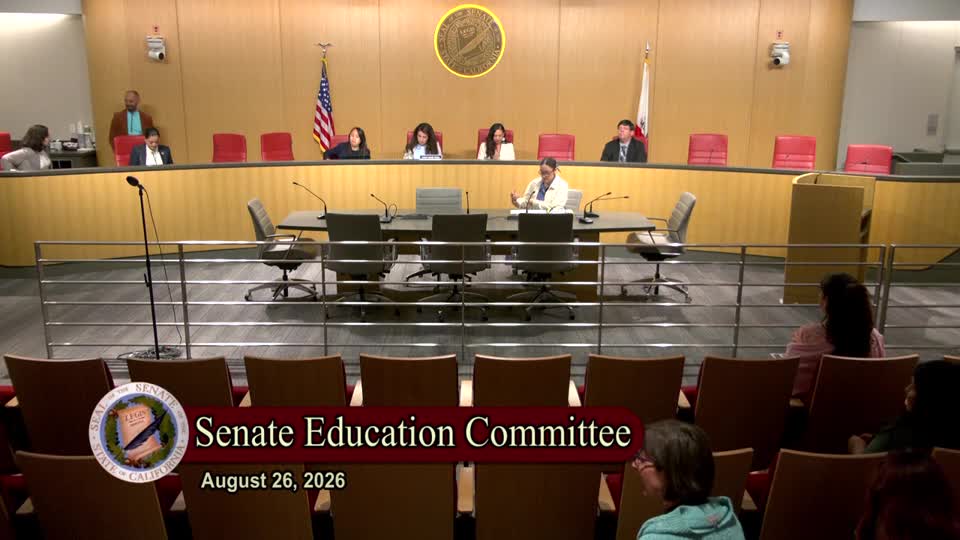 10MIN
Senate Standing Committee on Education
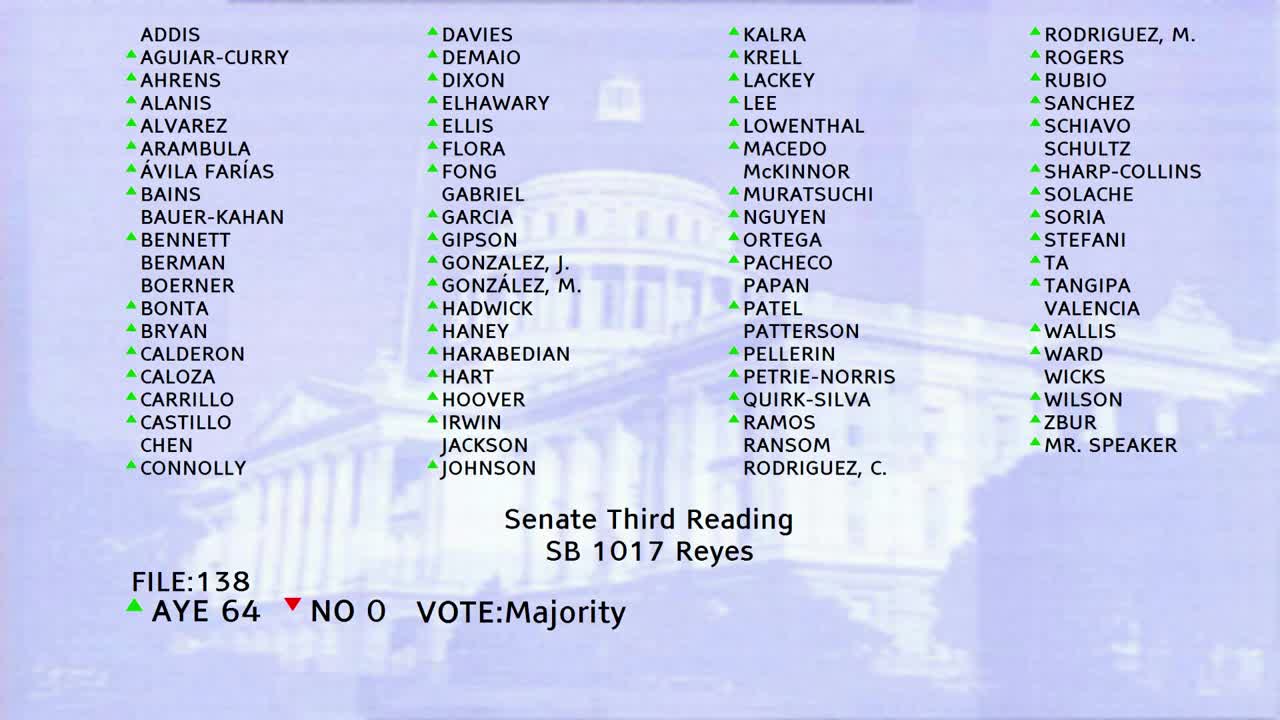 54SEC
Assembly Floor
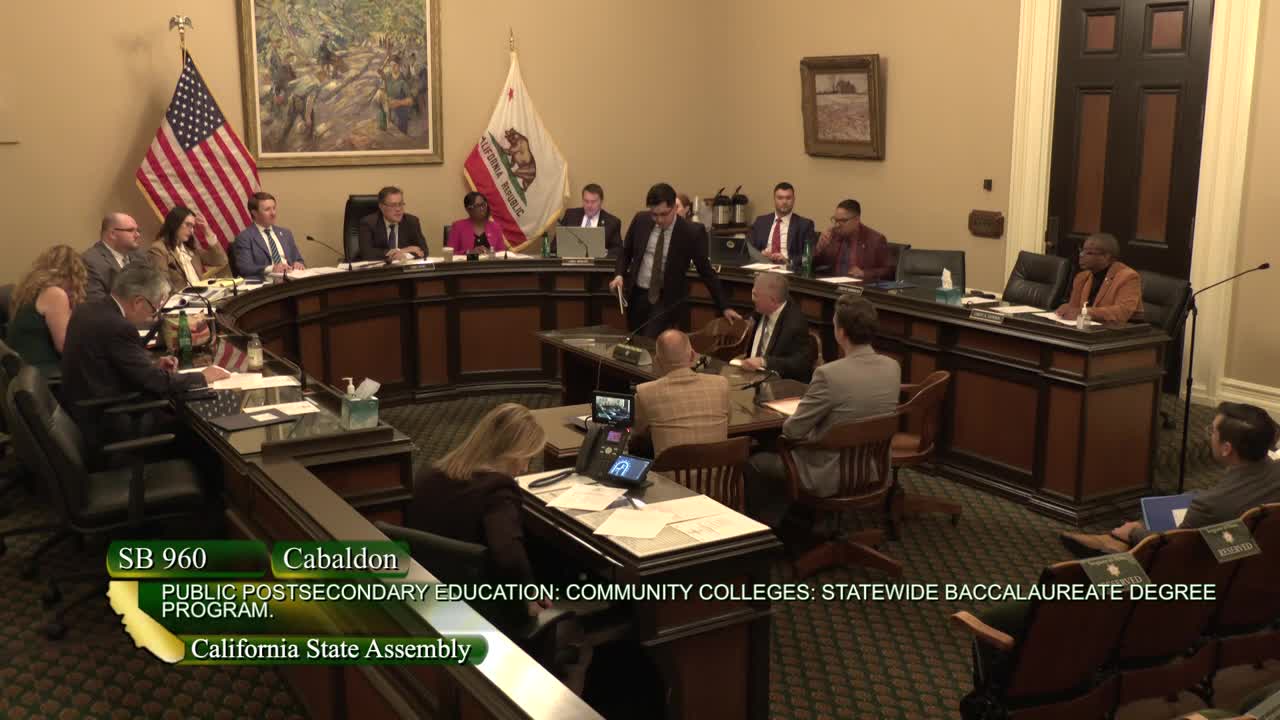 11MIN
Assembly Standing Committee on Higher Education
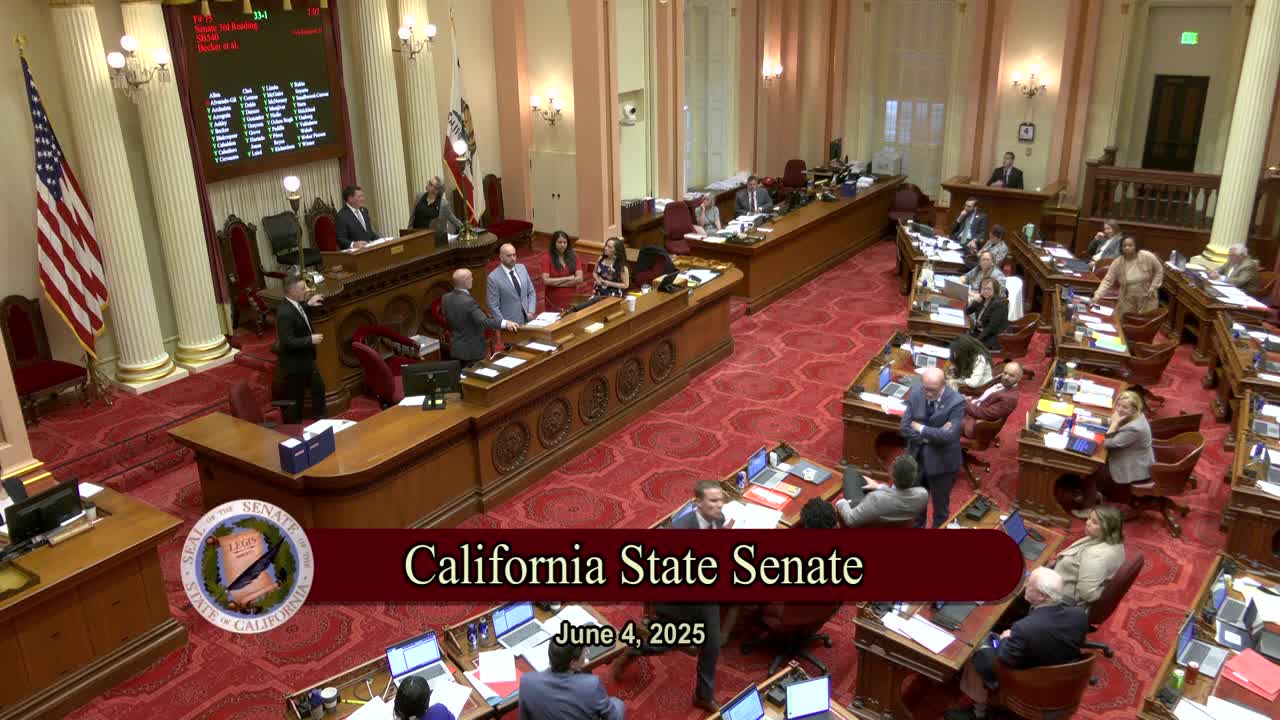 25MIN
Senate Floor
 23MIN
Senate Standing Committee on Labor, Public Employment and Retirement
Bill Author