SB 667: Railroads: safety: report.
- Session Year: 2025-2026
- House: Senate
- Latest Version Date: 2026-09-18
Current Status:
Passed
(2026-09-18: Chaptered by Secretary of State. Chapter 316, Statutes of 2026.)
Introduced
In Committee
Awaiting First Chamber Vote
Passed First Chamber
In Committee
Awaiting Second Chamber Vote
Passed Second Chamber
Enacted
Existing law requires the Public Utilities Commission to annually report to the Legislature on sites on railroad lines in the state that the commission finds to be hazardous, including a list of all railroad sites in the state that it determines pose a local safety hazard. Existing law authorizes the commission to submit in the annual report the list of railroad sites submitted in the immediate prior year annual report, and to amend or revise that list from the immediate prior year as necessary. In determining which railroad sites pose a local safety hazard, existing law requires the commission to consider, among other things, whether any local safety hazards at railroad sites have been eliminated or sufficiently remediated to warrant removal of the site from the list.
This bill would require the commission, on or before July 1, 2029, to review the list of railroad sites and, in the annual report, to include an evaluation of each site on the list and determine whether changes in conditions, operations, or safety data warrant the removal, modification, or addition of any site.
The existing Federal Railroad Safety Act (FRSA) authorizes the United States Secretary of Transportation to prescribe regulations and issue orders for railroad safety and requires the United States Secretary of Homeland Security, when prescribing a security regulation or issuing a security order that affects the safety of railroad operations, to consult with the United States Secretary of Transportation. The FRSA provides for state participation in the enforcement of the safety regulations and orders issued by the United States Secretary of Transportation or the United States Secretary of Homeland Security, pursuant to an annual certification, and authorizes the respective secretaries to make an agreement with a state to provide investigative and surveillance activities. The FRSA provides that, to the extent practicable, laws, regulations, and orders related to railroad safety and security are required to be nationally uniform, but authorizes a state to adopt or continue in force a law, regulation, or order related to railroad safety or security until the United States Secretary of Transportation, with respect to railroad safety matters, or the United States Secretary of Homeland Security, with respect to railroad security matters, prescribes a regulation or issues an order covering the subject matter of the state requirement. A state is additionally authorized to adopt or continue in force an additional or more stringent law, regulation, or order related to railroad safety or security, when necessary to eliminate or reduce an essentially local safety or security hazard, that is not incompatible with a federal law, regulation, or order, and that does not unreasonably burden interstate commerce.This bill would require a railroad corporation to install and operate a network of wayside detector systems on or adjacent to any track used by a freight train, require that each wayside detector system include a hot wheel bearing detector, and prescribe the maximum spacing for individual detection devices along a continuous track. The bill would define wayside detector system to mean an electronic device or series of connected devices that scans passing freight trains and their component equipment and parts for defects. The bill would require the Public Utilities Commission to adopt rules and processes to implement these provisions, including a penalty of not less than $25,000 for violating these provisions, as provided. The bill would not apply to a class II or class III carrier that has a speed limit of 10 miles per hour or less.The existing Federal Railroad Safety Act (FRSA) authorizes the United States Secretary of Transportation to prescribe regulations and issue orders for railroad safety and requires the United States Secretary of Homeland Security, when prescribing a security regulation or issuing a security order that affects the safety of railroad operations, to consult with the United States Secretary of Transportation. The FRSA provides for state participation in the enforcement of the safety regulations and orders issued by the United States Secretary of Transportation or the United States Secretary of Homeland Security, pursuant to an annual certification, and authorizes the respective secretaries to make an agreement with a state to provide investigative and surveillance activities. The FRSA provides that, to the extent practicable, laws, regulations, and orders related to railroad safety and security are required to be nationally uniform, but authorizes a state to adopt or continue in force a law, regulation, or order related to railroad safety or security until the United States Secretary of Transportation, with respect to railroad safety matters, or the United States Secretary of Homeland Security, with respect to railroad security matters, prescribes a regulation or issues an order covering the subject matter of the state requirement. A state is additionally authorized to adopt or continue in force an additional or more stringent law, regulation, or order related to railroad safety or security, when necessary to eliminate or reduce an essentially local safety or security hazard, that is not incompatible with a federal law, regulation, or order, and that does not unreasonably burden interstate commerce.
This bill would require a railroad corporation to install and operate a network of wayside detector systems on or adjacent to any track used by a freight train with train, require that each wayside detector system include a hot wheel bearing detector, and prescribe the maximum spacing specified for individual detection devices along a continuous track. The bill would define wayside detector system to mean an electronic device or series of connected devices that scans passing freight trains and their component equipment and parts for defects. The bill would require a railroad corporation to submit a wayside detector response plan to the Public Utilities Commission, as provided. The bill would require the commission Public Utilities Commission to adopt rules necessary and processes to implement these provisions provisions, including establishing a penalty of not less than $25,000, $25,000 for violating these provisions, as provided. The bill would provide that these provisions do not apply to a class II or class III carrier that has a speed limit of 10 miles per hour or less.
The existing Federal Railroad Safety Act (FRSA) authorizes the United States Secretary of Transportation to prescribe regulations and issue orders for railroad safety and requires the United States Secretary of Homeland Security, when prescribing a security regulation or issuing a security order that affects the safety of railroad operations, to consult with the United States Secretary of Transportation. The FRSA provides for state participation in the enforcement of the safety regulations and orders issued by the United States Secretary of Transportation or the United States Secretary of Homeland Security, pursuant to an annual certification, and authorizes the respective secretaries to make an agreement with a state to provide investigative and surveillance activities. The FRSA provides that, to the extent practicable, laws, regulations, and orders related to railroad safety and security are required to be nationally uniform, but authorizes a state to adopt or continue in force a law, regulation, or order related to railroad safety or security until the United States Secretary of Transportation, with respect to railroad safety matters, or the United States Secretary of Homeland Security, with respect to railroad security matters, prescribes a regulation or issues an order covering the subject matter of the state requirement. A state is additionally authorized to adopt or continue in force an additional or more stringent law, regulation, or order related to railroad safety or security, when necessary to eliminate or reduce an essentially local safety or security hazard, that is not incompatible with a federal law, regulation, or order, and that does not unreasonably burden interstate commerce.
This bill would require a railroad corporation to install and operate a network of wayside detector systems on or adjacent to any track used by a freight train with maximum spacing specified for individual detection devices along a continuous track. The bill would define wayside detector system to mean an electronic device or series of connected devices that scans passing freight trains and their component equipment and parts for defects. The bill would require the Public Utilities Commission to (1) establish a process for freight train crews to receive alerts from wayside detectors, (2) create standards for freight train inspections to be conducted following the receipt of an alert from a wayside detector, as provided, and (3) adopt rules necessary to implement these provisions. The bill would require a railroad corporation to submit a wayside detector response plan to the Public Utilities Commission, as provided. The bill would require the commission to adopt rules necessary to implement these provisions including establishing a penalty of not less than $25,000, as provided. The bill would provide that these provisions do not apply to a class II or class III carrier that has a speed limit of 10 miles per hour or less.
This bill would prohibit certain freight trains with a total length exceeding 7,500 feet from operating on any part of a main line or branch line in this state, as specified. The bill would require a freight train that is completely stopped and that is blocking an at-grade railroad crossing to be cut, separated, or moved to clear the at-grade railroad crossing upon the approach of an emergency vehicle, except as specified. The bill would require the commission to adopt rules necessary to implement these provisions, including, but not limited to, establishing financial penalties, subject to specified minimums, for railroad corporations that are in violation.The existing Federal Railroad Safety Act (FRSA) authorizes the United States Secretary of Transportation to prescribe regulations and issue orders for railroad safety and requires the United States Secretary of Homeland Security, when prescribing a security regulation or issuing a security order that affects the safety of railroad operations, to consult with the United States Secretary of Transportation. The FRSA provides for state participation in the enforcement of the safety regulations and orders issued by the United States Secretary of Transportation or the United States Secretary of Homeland Security, pursuant to an annual certification, and authorizes the respective secretaries to make an agreement with a state to provide investigative and surveillance activities. The FRSA provides that, to the extent practicable, laws, regulations, and orders related to railroad safety and security are required to be nationally uniform, but authorizes a state to adopt or continue in force a law, regulation, or order related to railroad safety or security until the United States Secretary of Transportation, with respect to railroad safety matters, or the United States Secretary of Homeland Security, with respect to railroad security matters, prescribes a regulation or issues an order covering the subject matter of the state requirement. A state is additionally authorized to adopt or continue in force an additional or more stringent law, regulation, or order related to railroad safety or security, when necessary to eliminate or reduce an essentially local safety or security hazard, that is not incompatible with a federal law, regulation, or order, and that does not unreasonably burden interstate commerce.
This bill would require a railroad corporation to install and operate a network of wayside detector systems on or adjacent to any track used by a freight train with maximum spacing specified for individual detection devices along a continuous track. The bill would define wayside detector system to mean an electronic device or series of connected devices that scans passing freight trains, rolling stock, on-track equipment, trains and their component equipment and parts for defects. The bill would require a wayside detector system to issue certain messages if a defect is detected or is not detected, and would specify actions to be taken if a message indicating a defect is detected. The bill would require a railroad corporation to ensure that its employees know and understand these requirements. The bill would require the commission to enforce these requirements and would impose a penalty of not less than $25,000 upon a railroad corporation for each violation. The bill would require the Public Utilities Commission to (1) establish a process for freight train crews to receive alerts from wayside detectors, (2) create standards for freight train inspections to be conducted following the receipt of an alert from a wayside detector, as provided, and (3) adopt rules necessary to implement these provisions.
This bill would prohibit certain freight trains with a total length exceeding 7,500 feet from operating on any part of a main line or branch line in this state, as specified. The bill would require a freight train, rolling stock, or other on-track equipment train that is completely stopped and that is blocking an at-grade railroad crossing to be cut, separated, or moved to clear the at-grade railroad crossing upon the approach of an emergency vehicle, except as specified. The bill would require the commission to enforce these provisions and would impose penalties of not less than $5,000 for a first violation, $10,000 for a 2nd violation, and $25,000 for a 3rd or subsequent violation, as specified. The bill would require the commission to adopt rules necessary to implement these provisions, including, but not limited to, establishing financial penalties, subject to specified minimums, for railroad corporations that are in violation.
The existing Federal Railroad Safety Act (FRSA) authorizes the United States Secretary of Transportation to prescribe regulations and issue orders for railroad safety and requires the United States Secretary of Homeland Security, when prescribing a security regulation or issuing a security order that affects the safety of railroad operations, to consult with the United States Secretary of Transportation. The FRSA provides for state participation in the enforcement of the safety regulations and orders issued by the United States Secretary of Transportation or the United States Secretary of Homeland Security, pursuant to an annual certification, and authorizes the respective secretaries to make an agreement with a state to provide investigative and surveillance activities. The FRSA provides that, to the extent practicable, laws, regulations, and orders related to railroad safety and security are required to be nationally uniform, but authorizes a state to adopt or continue in force a law, regulation, or order related to railroad safety or security until the United States Secretary of Transportation, with respect to railroad safety matters, or the United States Secretary of Homeland Security, with respect to railroad security matters, prescribes a regulation or issues an order covering the subject matter of the state requirement. A state is additionally authorized to adopt or continue in force an additional or more stringent law, regulation, or order related to railroad safety or security, when necessary to eliminate or reduce an essentially local safety or security hazard, that is not incompatible with a federal law, regulation, or order, and that does not unreasonably burden interstate commerce.
This bill would require a railroad corporation to install and operate a network of wayside detector systems on or adjacent to its tracks, any track used by a freight train with maximum spacing specified for individual detection devices along a continuous track. The bill would define wayside detector system to mean an electronic device or series of connected devices that scans passing freight trains, rolling stock, on-track equipment, and their component equipment and parts for defects. The bill would require a wayside detector system to issue certain messages if a defect is detected or is not detected, and would specify actions to be taken if a message indicating a defect is detected. The bill would require a railroad corporation to ensure that its employees know and understand these requirements. The bill would require the commission to enforce these requirements and would impose a penalty of not less than $25,000 upon a railroad corporation for each violation.
This bill would prohibit certain freight trains with a total length exceeding 7,500 feet from operating on any part of a main line or branch line in this state, as specified. The bill would require a freight train, rolling stock, or other on-track equipment that is completely stopped and that is blocking an at-grade railroad crossing to be cut, separated, or moved to clear the at-grade railroad crossing upon the approach of an emergency vehicle, except as specified. The bill would require the commission to enforce these provisions and would impose penalties of not less than $5,000 for a first violation, $10,000 for a 2nd violation, and $25,000 for a 3rd or subsequent violation, as specified.
The existing Federal Railroad Safety Act (FRSA) authorizes the United States Secretary of Transportation to prescribe regulations and issue orders for railroad safety and requires the United States Secretary of Homeland Security, when prescribing a security regulation or issuing a security order that affects the safety of railroad operations, to consult with the United States Secretary of Transportation. The FRSA provides for state participation in the enforcement of the safety regulations and orders issued by the United States Secretary of Transportation or the United States Secretary of Homeland Security, pursuant to an annual certification, and authorizes the respective secretaries to make an agreement with a state to provide investigative and surveillance activities. The FRSA provides that, to the extent practicable, laws, regulations, and orders related to railroad safety and security are required to be nationally uniform, but authorizes a state to adopt or continue in force a law, regulation, or order related to railroad safety or security until the United States Secretary of Transportation, with respect to railroad safety matters, or the United States Secretary of Homeland Security, with respect to railroad security matters, prescribes a regulation or issues an order covering the subject matter of the state requirement. A state is additionally authorized to adopt or continue in force an additional or more stringent law, regulation, or order related to railroad safety or security, when necessary to eliminate or reduce an essentially local safety or security hazard, that is not incompatible with a federal law, regulation, or order, and that does not unreasonably burden interstate commerce.
This bill would require a railroad to install and operate a network of wayside detector systems on or adjacent to its tracks, with maximum spacing specified for individual detection devices along a continuous track. The bill would define wayside detector system to mean an electronic device or series of connected devices that scans passing trains, rolling stock, on-track equipment, and their component equipment and parts for defects. The bill would require a wayside detector system to issue certain messages if a defect is detected or is not detected, and would specify actions to be taken if a message indicating a defect is detected. The bill would require a railroad to ensure that its employees know and understand these requirements. The bill would require the commission to enforce these requirements and would impose a penalty of not less than $25,000 upon a railroad for each violation.
This bill would prohibit certain trains with a total length exceeding 7,500 feet from operating on any part of a main line or branch line in this state, as specified. The bill would require a train, rolling stock, or other on-track equipment that is completely stopped and that is blocking an at-grade railroad crossing to be cut, separated, or moved to clear the at-grade railroad crossing upon the approach of an emergency vehicle, except as specified. The bill would require the commission to enforce these provisions and would impose penalties of not less than $5,000 for a first violation, $10,000 for a 2nd violation, and $25,000 for a 3rd or subsequent violation, as specified.
Existing law establishes the Department of Transportation and the California Transportation Commission, and vests with the department the obligation to improve and maintain state highways, including all traversable highways that have been adopted or designated as state highways by the commission.Existing law authorizes the commission, whenever the commission deems it expedient to alter the established grade of a state highway, or portion thereof, within a city, to declare, by resolution, the commissions intention to alter that established grade, as provided.This bill would make nonsubstantive changes to that provision.Existing law establishes the Department of Transportation and the California Transportation Commission, and vests with the department the obligation to improve and maintain state highways, including all traversable highways that have been adopted or designated as state highways by the commission.
Existing law authorizes the commission, whenever the commission deems it expedient to alter the established grade of a state highway, or portion thereof, within a city, to declare, by resolution, the commissions intention to alter that established grade, as provided.
This bill would make nonsubstantive changes to that provision.
(a)The commission shall annually report to the Legislature, on or before July 1, on sites on railroad lines in the state it finds to be hazardous. The report shall include, but not be limited to, information on all of the following:
(1)A list of all railroad derailment accident sites in the state on which accidents have occurred within at least the previous five years. The list shall describe the nature and probable causes of the accidents, if known, and shall indicate whether the accidents occurred at or near sites that the commission has determined, pursuant to paragraph (2), pose a local safety hazard.
(2)A list of all railroad sites in the state that the commission determines, pursuant to Section 20106 of Title 49 of the United States Code, pose a local safety hazard. The commission may submit in the annual report the list of railroad sites submitted in the immediate prior year annual report, and may amend or revise that list from the immediate prior year as necessary. Factors that the commission shall consider in determining a local safety hazard may include, but need not be limited to, all of the following:
(A)The severity of grade and curve of track.
(B)The value of special skills of train operators in negotiating the particular segment of railroad line.
(C)The value of special railroad equipment in negotiating the particular segment of railroad line.
(D)The types of commodities transported on or near the particular segment of railroad line.
(E)The hazard posed by the release of the commodity into the environment.
(F)The value of special railroad equipment in the process of safely loading, transporting, storing, or unloading potentially hazardous commodities.
(G)The proximity of railroad activity to human activity or sensitive environmental areas.
(H)A list of the root causes and significant contributing factors of all train accidents or derailments investigated.
(b)(1)In determining which railroad sites pose a local safety hazard pursuant to paragraph (2) of subdivision (a), the commission shall consider the history of accidents at or near the sites. The commission shall not limit its determination to sites at which accidents have already occurred, but shall identify potentially hazardous sites based on the criteria enumerated in paragraph (2) of subdivision (a) and all other criteria that the commission determines influence railroad safety. The commission shall also consider whether any local safety hazards at railroad sites have been eliminated or sufficiently remediated to warrant removal of the site from the list required under paragraph (2) of subdivision (a).
(2)On or before July 1, 2029, the commission shall review the list of railroad sites identified pursuant to paragraph (2) of subdivision (a). In reviewing these sites, the commission shall, in the report required pursuant to this section, include an evaluation of each site on the list and determine whether changes in conditions, operations, or safety data warrant the removal, modification, or addition of any site.
(c)The commission may combine the information required to be reported by this section with the report prepared pursuant to Section 916.
(a)The commission shall annually report to the Legislature, on or before July 1, on sites on railroad lines in the state it finds to be hazardous. The report shall include, but not be limited to, information on all of the following:
(a)(1)A list of all railroad derailment accident sites in the state on which accidents have occurred within at least the previous five years. The list shall describe the nature and probable causes of the accidents, if known, and shall indicate whether the accidents occurred at or near sites that the commission has determined, pursuant to subdivision (b), paragraph (2), pose a local safety hazard.
(b)(2)A list of all railroad sites in the state that the commission determines, pursuant to Section 20106 of Title 49 of the United States Code, pose a local safety hazard. The commission may submit in the annual report the list of railroad sites submitted in the immediate prior year annual report, and may amend or revise that list from the immediate prior year as necessary. Factors that the commission shall consider in determining a local safety hazard may include, but need not be limited to, all of the following:
(1)(A)The severity of grade and curve of track.
(2)(B)The value of special skills of train operators in negotiating the particular segment of railroad line.
(3)(C)The value of special railroad equipment in negotiating the particular segment of railroad line.
(4)(D)The types of commodities transported on or near the particular segment of railroad line.
(5)(E)The hazard posed by the release of the commodity into the environment.
(6)(F)The value of special railroad equipment in the process of safely loading, transporting, storing, or unloading potentially hazardous commodities.
(7)(G)The proximity of railroad activity to human activity or sensitive environmental areas.
(8)(H)A list of the root causes and significant contributing factors of all train accidents or derailments investigated.
(c)(b)(1)In determining which railroad sites pose a local safety hazard pursuant to subdivision (b), paragraph (2) of subdivision (a), the commission shall consider the history of accidents at or near the sites. The commission shall not limit its determination to sites at which accidents have already occurred, but shall identify potentially hazardous sites based on the criteria enumerated in subdivision (b) paragraph (2) of subdivision (a) and all other criteria that the commission determines influence railroad safety. The commission shall also consider whether any local safety hazards at railroad sites have been eliminated or sufficiently remediated to warrant removal of the site from the list required under subdivision (b). paragraph (2) of subdivision (a).
(2)On or before July 1, 2029, the commission shall review the list of railroad sites identified pursuant to paragraph (2) of subdivision (a). In reviewing these sites, the commission shall, in the report required pursuant to this section, include an evaluation of each site on the list and determine whether changes in conditions, operations, or safety data warrant the removal, modification, or addition of any site.
(d)(c)The commission may combine the information required to be reported by this section with the report prepared pursuant to Section 916.
SECTION 1.Section 7615 is added to the Public Utilities Code, to read:7615.(a)For purposes of this section, wayside detector system means an electronic device or a series of connected devices that scan passing freight trains and their component equipment and parts for defects, which may include, but are not limited to, hot wheel bearings, hot wheels, defective bearings that are detected through acoustics, dragging equipment, excessive height or weight, shifted loads, low hoses, excessive rail temperature, and poor wheel condition.(b)A railroad corporation shall install and operate a network of wayside detector systems on or adjacent to any track that is used by a freight train. Each wayside detector system shall include a hot wheel bearing detector and be located no farther from the following distances from another wayside detector system on a continuous track:(1)For a class I carrier railroad, no farther than 10 miles.(2)For a class II carrier railroad, no farther than 25 miles.(3)For a class III carrier railroad, no farther than 35 miles.(c)If a freight train is operating on a track between wayside detector systems that do not comply with the spacing requirements of subdivision (b), then it shall not travel faster than 10 miles per hour and may only travel faster than 10 miles per hour after it passes a wayside detector system that is in compliance with the spacing requirements of subdivision (b) and has received a message from the wayside detector system indicating that there are no defects.(d)The commission shall adopt rules and processes to implement this section. The rules and processes shall include, but not be limited to, all of the following:(1)Minimum requirements for the wayside detector systems applicable to railroad corporations in the state and a process for railroad corporations to submit their wayside detector systems to the commission for review and approval.(2)A process for freight train crews to receive alerts from wayside detector systems and standards for freight train inspections to be conducted following the receipt of an alert from a wayside detector system, including the obligation of a railroad corporation to ensure that railroad employees are aware of these standards.(3)A penalty of not less than twenty-five thousand dollars ($25,000) for each violation of this section by a railroad corporation.(e)This section shall not apply to a railroad track owned or leased by a class II or class III carrier that has a speed limit of 10 miles per hour or less.(a)For purposes of this section, Wayside wayside detector system means an electronic device or a series of connected devices that scan passing freight trains and their component equipment and parts for defects, which may include, but are not limited to, hot wheel bearings, hot wheels, defective bearings that are detected through acoustics, dragging equipment, excessive height or weight, shifted loads, low hoses, excessive rail temperature, and poor wheel condition.
(b)A railroad corporation shall install and operate a network of wayside detector systems on or adjacent to any track that is used by a freight train with each train. Each wayside detector system to shall include a hot wheel bearing detector and be located no farther from the following distances from another wayside detector system on a continuous track:
(1)For a class I carrier railroad, no farther than 10 miles.
(2)For a class II carrier railroad, no farther than 25 miles.
(3)For a class III carrier railroad, no farther than 35 miles.
(c)If a freight train is operating on a track between wayside detector systems that do not comply with the spacing requirements of subdivision (b), then it shall not travel faster than 10 miles per hour and may only travel faster than 10 miles per hour after it passes a wayside detector system that is in compliance with the spacing requirements of subdivision (b) and has received a message from the wayside detector system indicating that there are no defects.
(d)(1)A railroad corporation shall submit a wayside detector system response plan to the commission via an expedited Tier 3 advice letter process. The commission shall adopt rules and processes to implement this section. The response plan rules and processes shall include, but not be limited to, both all of the following:
(A)A process for freight train crews to receive alerts from wayside detector systems.(1)Minimum requirements for the wayside detector systems applicable to railroad corporations in the state and a process for railroad corporations to submit their wayside detector systems to the commission for review and approval.
(B)Standards for(2)A process for freight train crews to receive alerts from wayside detector systems and standards for freight train inspections to be conducted following the receipt of an alert from a wayside detector system, including the obligation of a railroad corporation to ensure that railroad employees are aware of these standards.
(2)The commission shall adopt rules necessary to implement this section, including establishing a(3)A penalty of not less than twenty-five thousand dollars ($25,000) for each violation of this section by a railroad corporation.
(e)This section shall not apply to a railroad track owned or leased by a class II or class III carrier that has a speed limit of 10 miles per hour or less.
(a)For purposes of this section, all of the following definitions apply: Wayside detector system means an electronic device or a series of connected devices that scan passing freight trains and their component equipment and parts for defects, which include, but are not limited to, hot wheel bearings, hot wheels, defective bearings that are detected through acoustics, dragging equipment, excessive height or weight, shifted loads, low hoses, excessive rail temperature, and poor wheel condition.
(1)AAR frequency means the Association of American Railroads frequency assigned to the location of the wayside detector system that is sending a message.(2)Wayside detector communications system means technology that uses wireless communications systems or algorithms to allow communication between one wayside detector system with another wayside detector system to better predict and detect defects.(3)Wayside detector system means an electronic device or a series of connected devices that scan passing freight trains and their component equipment and parts for defects, which include, but are not limited to, hot wheel bearings, hot wheels, defective bearings that are detected through acoustics, dragging equipment, excessive height or weight, shifted loads, low hoses, excessive rail temperature, and poor wheel condition.(b)(1)Except as provided in paragraph (2), a A railroad corporation shall install and operate a network of wayside detector systems on or adjacent to any track that is used by a freight train with each wayside detector system no farther than 10 miles to be located no farther from the following distances from another wayside detector system on a continuous track. track:
(2)If the natural terrain renders it infeasible to install or operate a wayside detector system no farther than 10 miles from another wayside detector system on a continuous track, then a railroad corporation shall install and operate a wayside detector system as close as feasible to another wayside detector system on any continuous track used by a freight train, but no farther than 15 miles from another wayside detector system on a continuous track.(1)For a class I carrier railroad, no farther than 10 miles.
(2)For a class II carrier railroad, no farther than 25 miles.
(3)For a class III carrier railroad, no farther than 35 miles.
(c)If a freight train is operating on a track between wayside detector systems that do not comply with the spacing requirements of subdivision (b), then it shall not travel faster than 10 miles per hour and may only travel faster than 10 miles per hour after it passes a wayside detector system that is in compliance with the spacing requirements of subdivision (b) and has received a message from the wayside detector system indicating that there are no defects.
(d)As part of a new or existing proceeding, the commission shall do all of the following: (1)A railroad corporation shall submit a wayside detector system response plan to the commission via an expedited Tier 3 advice letter process. The response plan shall include, but not be limited to, both of the following:
(1)Establish a(A)A process for freight train crews to receive alerts from wayside detectors. detector systems.
(2)Create standards(B)Standards for freight train inspections to be conducted following the receipt of an alert from a wayside detector, detector system, including the obligation of a railroad corporation to ensure that railroad employees are aware of these standards.
(3)Adopt(2)The commission shall adopt rules necessary to implement this section, including establishing a penalty of not less than twenty-five thousand dollars ($25,000) for each violation of this section by a railroad corporation.
(e)This section shall not apply to a railroad track owned or leased by a class II or class III carrier that has a speed limit of 10 miles per hour or less.
SEC. 3.Section 7664 is added to the Public Utilities Code, to read:7664.(a)For purposes of this section, the following definitions apply:(1)Branch line means a segment or route of railroad tracks that branches off from a main line.(2)Main line means a segment or route of railroad tracks of a Class I railroad, as documented in current timetables filed by the Class I railroad with the Federal Railroad Administration under Part 217.7 of Title 49 of the Code of Federal Regulations, over which 5,000,000 or more gross tons of railroad traffic is transported annually, or used for regularly scheduled intercity or commuter rail passenger service, or both. For purposes of this section, tourist, scenic, historic, or excursion operations are not intercity or commuter passenger service.(3)Railroad means any form of nonhighway ground transportation that runs on rails and is used in connection with the movement of freight.(4)Freight train means one or more locomotives without cars or with one or more freight cars, except during switching operations or where the operation is that of classifying and assembling rail cars within a railroad yard for the purpose of making or breaking up trains.(5)Train length means the total length of a train as measured in linear feet.(b)(1)A freight train originating in this state with a train length exceeding 7,500 feet shall not operate on any part of a main line or branch line in this state.(2)If a freight train originating from outside this state with a train length exceeding 7,500 feet operates in this state and stops to add or remove cars before its final destination, then it shall reduce its train length to not exceed 7,500 feet while it is stopped to add or remove cars before its final destination.(c)As part of a new or existing proceeding, the commission shall adopt rules necessary to implement this section, including, but not limited to, the establishment of the following penalties for railroad corporations that violate this section:(1)A penalty of not less than five thousand dollars ($5,000) for the first violation.(2)A penalty of not less than ten thousand dollars ($10,000) for a second violation within three years of a prior violation.(3)A penalty of not less than twenty-five thousand dollars ($25,000) for a third or subsequent violation within three years of two prior violations.SEC. 4.Section 7664.5 is added to the Public Utilities Code, to read:7664.5.(a)For purposes of this section, the following definitions apply:(1)At-grade railroad crossing means a location where a public highway, road, street, or private roadway, including associated sidewalks and pathways, crosses one or more railroad tracks at the same level.(2)Authorized emergency vehicle has the same meaning as in Section 165 of the Vehicle Code.(b)(1)Except as provided in paragraph (2), a freight train that is completely stopped and that is blocking an at-grade railroad crossing shall be cut, separated, or moved to clear the at-grade railroad crossing upon the approach of an authorized emergency vehicle.(2)Paragraph (1) does not apply to a freight train that is stopped due to a mechanical failure and where separation or movement is not possible.(c)As part of a new or existing proceeding, the commission shall adopt rules necessary to implement this section, including, but not limited to, the establishment of the following penalties for railroad corporations that violate this section:(1)A penalty of not less than five thousand dollars ($5,000) for the first violation.(2)A penalty of not less than ten thousand dollars ($10,000) for a second violation within three years of a prior violation.(3)A penalty of not less than twenty-five thousand dollars ($25,000) for a third or subsequent violation within three years of two prior violations.The Legislature finds and declares both of the following:
(a)Freight trains exhibiting excessive length operating within the state on any main line or branch line expose the public to unnecessary dangers and disruptions of commerce.
(b)Section 3 of this bill is intended to eliminate disruptions of commerce and dangers imposed upon communities and the general citizenry.
SEC. 2.Section 7615 is added to the Public Utilities Code, to read:7615.(a)For purposes of this section, all of the following definitions apply:
(1)AAR frequency means the Association of American Railroads frequency assigned to the location of the wayside detector system that is sending a message.
(2)Wayside detector communications system means technology that uses wireless communications systems or algorithms to allow communication between one wayside detector system with another wayside detector system to better predict and detect defects.
(3)Wayside detector system means an electronic device or a series of connected devices that scan passing freight trains, rolling stock, on-track equipment, trains and their component equipment and parts for defects, which include, but are not limited to, hot wheel bearings, hot wheels, defective bearings that are detected through acoustics, dragging equipment, excessive height or weight, shifted loads, low hoses, excessive rail temperature, and poor wheel condition.
(b)(1)Except as provided in paragraph (2), a railroad corporation shall install and operate a network of wayside detector systems on or adjacent to any track used by a freight train with each wayside detector system no farther than 10 miles from another wayside detector system on a continuous track.
(2)If the natural terrain renders it infeasible to install or operate a wayside detector system no farther than 10 miles from another wayside detector system on a continuous track, then a railroad corporation shall install and operate a wayside detector system as close as feasible to another wayside detector system on any continuous track used by a freight train, but no farther than 15 miles from another wayside detector system on a continuous track.
(c)If a freight train, rolling stock, or on-track equipment train is operating on a track between wayside detector systems that do not comply with the spacing requirements of subdivision (b), then it shall not travel faster than 10 miles per hour and may only travel faster than 10 miles per hour after it passes a wayside detector system that is in compliance with the spacing requirements of subdivision (b) and has received a message from the wayside detector system indicating that there are no defects.
(d)A wayside detector system shall provide an audible message on the AAR frequency and be equipped with a hot box detector, a hot wheel detector, and a dragging equipment detector. (e)If either a wayside detector system or a wayside detector communications system identifies a defect, an audible message shall sound over the AAR frequency at least three times, with each message lasting at least five seconds with at least five seconds of silence between each message. The audible message shall include all of the following information:(1)The system location milepost and name.(2)The track number, if applicable.(3)The total number of axles on the freight train, rolling stock, or on-track equipment, including motive power. (4)The location of the defect within the freight train, rolling stock, or on-track equipment, or its component parts or equipment.(f)If a wayside detector system identifies no defect, an audible message shall sound over the AAR frequency indicating the speed of the freight train, rolling stock, or on-track equipment, and that no defect was identified.(g)The operator of a freight train, rolling stock, or on-track equipment that receives a message indicating a defect shall do all of the following:(1)Stop the freight train, rolling stock, or on-track equipment in accordance with applicable safety procedures.(2)Inspect the location of the identified defect.(3)Note the results of the inspection and provide the results to the appropriate officer of the railroad corporation, local dispatcher, or other qualified person based on the applicable railroad policy.(4)If the operator believes continued operation is safe based on the results of the inspection, the operator shall proceed to operate the freight train, rolling stock, or on-track equipment at a speed no faster than 10 miles per hour if carrying hazardous materials or at a speed no faster than 30 miles per hour if not carrying hazardous materials. The operator may exceed these speeds after passing a wayside detector system and receiving a message indicating no defect.(5)If the operator believes continued operation is unsafe based on the results of the inspection, the operator shall have the freight train, rolling stock, or on-track equipment fully inspected by a qualified mechanical inspector to determine if it is safe to proceed. The freight train, rolling stock, or on-track equipment shall not proceed until after a qualified mechanical inspector makes a thorough inspection, makes any necessary repairs, and declares it safe to proceed.(h)If there is a determination that it is safe to proceed after receiving a message indicating a defect, and then the operator of a freight train, rolling stock, or on-track equipment receives another message indicating the same defect, the operator shall do all of the following:(1)Stop the freight train, rolling stock, or on-track equipment in accordance with applicable safety procedures.(2)Have the freight train, rolling stock, or on-track equipment fully inspected by a qualified mechanical inspector to determine if it is safe to proceed. The freight train, rolling stock, or on-track equipment shall not proceed until after a qualified mechanical inspector makes a thorough inspection, makes any necessary repairs, and declares it safe to proceed.(i)All inspections required by this section shall be performed from a position on the ground and shall not be made from, on, or within any vehicle.(j)(1)If a wayside detector system reports a number of axles for a freight train that is less than the reported number of axles for the train, then the operator shall report the discrepancy to the proper railroad authority.(2)If a wayside detector system reports a number of axles for the freight train that is greater than the reported number of axles for the freight train, then the operator shall report the discrepancy to the proper railroad authority. If the discrepancy is not resolved before the freight train travels five miles, then the operator shall stop the freight train in accordance with applicable safety procedures and shall not proceed until the discrepancy is resolved, all extra equipment or cars are identified, and any necessary documentation is issued.(k)A railroad corporation doing business in this state shall ensure that its employees know and understand the requirements of this section.(l)A railroad corporation shall partner with the commission to determine what temperature readings above ambient temperature of an identified defective car constitute a defect.(m)(1)The commission shall enforce this section.(2)A railroad corporation in violation of this section shall be liable for a penalty of not less than twenty-five thousand dollars ($25,000) for each violation of this section.(d)As part of a new or existing proceeding, the commission shall do all of the following:
(1)Establish a process for freight train crews to receive alerts from wayside detectors.
(2)Create standards for freight train inspections to be conducted following the receipt of an alert from a wayside detector, including the obligation of a railroad corporation to ensure that railroad employees are aware of these standards.
(3)Adopt rules necessary to implement this section, including establishing a penalty of not less than twenty-five thousand dollars ($25,000) for each violation of this section by a railroad corporation.
SEC. 3.Section 7664 is added to the Public Utilities Code, to read:7664.(a)For purposes of this section, the following definitions apply:
(1)Branch line means a segment or route of railroad tracks that branches off from a main line.
(2)Main line means a segment or route of railroad tracks of a Class I railroad, as documented in current timetables filed by the Class I railroad with the Federal Railroad Administration under Part 217.7 of Title 49 of the Code of Federal Regulations, over which 5,000,000 or more gross tons of railroad traffic is transported annually, or used for regularly scheduled intercity or commuter rail passenger service, or both. For purposes of this section, tourist, scenic, historic, or excursion operations are not intercity or commuter passenger service.
(3)Railroad means any form of nonhighway ground transportation that runs on rails and is used in connection with the movement of freight.
(4)Freight train means one or more locomotives without cars or with one or more freight cars, except during switching operations or where the operation is that of classifying and assembling rail cars within a railroad yard for the purpose of making or breaking up trains.
(5)Train length means the total length of a train as measured in linear feet.
(b)(1)A freight train originating in this state with a train length exceeding 7,500 feet shall not operate on any part of a main line or branch line in this state.
(2)If a freight train originating from outside this state with a train length exceeding 7,500 feet operates in this state and stops to add or remove cars before its final destination, then it shall reduce its train length to not exceed 7,500 feet while it is stopped to add or remove cars before its final destination.
(c)(1)The commission shall enforce subdivision (b).(2)A railroad corporation in violation of subdivision (b) shall be liable as follows:(c)As part of a new or existing proceeding, the commission shall adopt rules necessary to implement this section, including, but not limited to, the establishment of the following penalties for railroad corporations that violate this section:
(A)(1)A penalty of not less than five thousand dollars ($5,000) for the first violation.
(B)(2)A penalty of not less than ten thousand dollars ($10,000) for a second violation within three years of a prior violation.
(C)(3)A penalty of not less than twenty-five thousand dollars ($25,000) for a third or subsequent violation within three years of two prior violations.
SEC. 4.Section 7664.5 is added to the Public Utilities Code, to read:7664.5.(a)For purposes of this section, the following definitions apply:
(1)At-grade railroad crossing means a location where a public highway, road, street, or private roadway, including associated sidewalks and pathways, crosses one or more railroad tracks at the same level.
(2)Authorized emergency vehicle has the same meaning as in Section 165 of the Vehicle Code.
(b)(1)Except as provided in paragraph (2), a freight train, rolling stock, or other on-track equipment train that is completely stopped and that is blocking an at-grade railroad crossing shall be cut, separated, or moved to clear the at-grade railroad crossing upon the approach of an authorized emergency vehicle.
(2)Paragraph (1) does not apply to a freight train, rolling stock, or other on-track equipment train that is stopped due to a mechanical failure and where separation or movement is not possible.
(c)(1)The commission shall enforce subdivision (b).(2)A railroad corporation in violation of subdivision (b) shall be liable as follows:(c)As part of a new or existing proceeding, the commission shall adopt rules necessary to implement this section, including, but not limited to, the establishment of the following penalties for railroad corporations that violate this section:
(A)(1)A penalty of not less than five thousand dollars ($5,000) for the first violation.
(B)(2)A penalty of not less than ten thousand dollars ($10,000) for a second violation within three years of a prior violation.
(C)(3)A penalty of not less than twenty-five thousand dollars ($25,000) for a third or subsequent violation within three years of two prior violations.
The Legislature finds and declares both of the following:
(a)Trains Freight trains exhibiting excessive length operating within the state on any main line or branch line expose the public to unnecessary dangers and disruptions of commerce.
(b)Section 3 of this bill is intended to eliminate disruptions of commerce and dangers imposed upon communities and the general citizenry.
SEC. 2.Section 7615 is added to the Public Utilities Code, to read:7615.(a)For purposes of this section, all of the following definitions apply:
(1)AAR frequency means the Association of American Railroads frequency assigned to the location of the wayside detector system that is sending a message.
(2)Wayside detector communications system means technology that uses wireless communications systems or algorithms to allow communication between one wayside detector system with another wayside detector system to better predict and detect defects.
(3)Wayside detector system means an electronic device or a series of connected devices that scan passing freight trains, rolling stock, on-track equipment, and their component equipment and parts for defects, which include, but are not limited to, hot wheel bearings, hot wheels, defective bearings that are detected through acoustics, dragging equipment, excessive height or weight, shifted loads, low hoses, excessive rail temperature, and poor wheel condition.
(b)(1)Except as provided in paragraph (2), a railroad corporation shall install and operate a network of wayside detector systems on or adjacent to its tracks any track used by a freight train with each wayside detector system no farther than 10 miles from another wayside detector system on a continuous track.
(2)If the natural terrain renders it infeasible to install or operate a wayside detector system no farther than 10 miles from another wayside detector system on a continuous track, then a railroad corporation shall install and operate a wayside detector system as close as feasible to another wayside detector system on a any continuous track, track used by a freight train, but no farther than 15 miles from another wayside detector system on a continuous track.
(c)If a freight train, rolling stock, or on-track equipment is operating on a track between wayside detector systems that do not comply with the spacing requirements of subdivision (b), then it shall not travel faster than 10 miles per hour and may only travel faster than 10 miles per hour after it passes a wayside detector system that is in compliance with the spacing requirements of subdivision (b) and has received a message from the wayside detector system indicating that there are no defects.
(d)A wayside detector system shall provide an audible message on the AAR frequency and be equipped with a hot box detector, a hot wheel detector, and a dragging equipment detector.
(e)If either a wayside detector system or a wayside detector communications system identifies a defect, an audible message shall sound over the AAR frequency at least three times, with each message lasting at least five seconds with at least five seconds of silence between each message. The audible message shall include all of the following information:
(1)The system location milepost and name.
(2)The track number, if applicable.
(3)The total number of axles on the freight train, rolling stock, or on-track equipment, including motive power.
(4)The location of the defect within the freight train, rolling stock, or on-track equipment, or its component parts or equipment.
(f)If a wayside detector system identifies no defect, an audible message shall sound over the AAR frequency indicating the speed of the freight train, rolling stock, or on-track equipment, and that no defect was identified.
(g)The operator of a freight train, rolling stock, or on-track equipment that receives a message indicating a defect shall do all of the following:
(1)Stop the freight train, rolling stock, or on-track equipment in accordance with applicable safety procedures.
(2)Inspect the location of the identified defect.
(3)Note the results of the inspection and provide the results to the appropriate officer of the railroad, railroad corporation, local dispatcher, or other qualified person based on the applicable railroad policy.
(4)If the operator believes continued operation is safe based on the results of the inspection, the operator shall proceed to operate the freight train, rolling stock, or on-track equipment at a speed no faster than 10 miles per hour if carrying hazardous materials or at a speed no faster than 30 miles per hour if not carrying hazardous materials. The operator may exceed these speeds after passing a wayside detector system and receiving a message indicating no defect.
(5)If the operator believes continued operation is unsafe based on the results of the inspection, the operator shall have the freight train, rolling stock, or on-track equipment fully inspected by a qualified mechanical inspector to determine if it is safe to proceed. The freight train, rolling stock, or on-track equipment shall not proceed until after a qualified mechanical inspector makes a thorough inspection, makes any necessary repairs, and declares it safe to proceed.
(h)If there is a determination that it is safe to proceed after receiving a message indicating a defect, and then the operator of a freight train, rolling stock, or on-track equipment receives another message indicating the same defect, the operator shall do all of the following:
(1)Stop the freight train, rolling stock, or on-track equipment in accordance with applicable safety procedures.
(2)Have the freight train, rolling stock, or on-track equipment fully inspected by a qualified mechanical inspector to determine if it is safe to proceed. The freight train, rolling stock, or on-track equipment shall not proceed until after a qualified mechanical inspector makes a thorough inspection, makes any necessary repairs, and declares it safe to proceed.
(i)All inspections required by this section shall be performed from a position on the ground and shall not be made from, on, or within any vehicle.
(j)(1)If a wayside detector system reports a number of axles for a freight train that is less than the reported number of axles for the train, then the operator shall report the discrepancy to the proper railroad authority.
(2)If a wayside detector system reports a number of axles for the freight train that is greater than the reported number of axles for the freight train, then the operator shall report the discrepancy to the proper railroad authority. If the discrepancy is not resolved before the freight train travels five miles, then the operator shall stop the freight train in accordance with applicable safety procedures and shall not proceed until the discrepancy is resolved, all extra equipment or cars are identified, and any necessary documentation is issued.
(k)A railroad corporation doing business in this state shall ensure that its employees know and understand the requirements of this section.
(l)A railroad corporation shall partner with the commission to determine what temperature readings above ambient temperature of an identified defective car constitute a defect.
(m)(1)The commission shall enforce this section.
(2)A railroad corporation in violation of this section shall be liable for a penalty of not less than twenty-five thousand dollars ($25,000) for each violation of this section.
SEC. 3.Section 7664 is added to the Public Utilities Code, to read:7664.(a)For purpose purposes of this section, the following definitions apply:
(1)Branch line means a secondary railroad track segment or route of railroad tracks that branches off from a main railroad line.
(2)Main line means a segment or route of railroad tracks of a Class I railroad, as documented in current timetables filed by the Class I railroad with the Federal Railroad Administration under Part 217.7 of Title 49 of the Code of Federal Regulations, over which 5,000,000 or more gross tons of railroad traffic is transported annually, or used for regularly scheduled intercity or commuter rail passenger service, or both. For purposes of this section, tourist, scenic, historic, or excursion operations are not intercity or commuter passenger service.
(3)(A)Railroad means, unless the context otherwise requires, means any form of nonhighway ground transportation that runs on rails or electromagnetic guideways, including, but not limited to, both of the following: and is used in connection with the movement of freight.
(i)Commuter or other short-haul railroad passenger service in a metropolitan or suburban area and commuter railroad service.(ii)High-speed ground transportation systems that connect metropolitan areas, without regard to whether those systems use new technologies not associated with traditional railroads.(B)Railroad does not include rapid transit operations in an urban area that are not connected to the general railroad system of transportation.(4)Train Freight train means one or more locomotives coupled with or without cars, requiring an air brake test in accordance with Part 232 or 238 of Title 49 of the Code of Federal Regulations, cars or with one or more freight cars, except during switching operations or where the operation is that of classifying and assembling rail cars within a railroad yard for the purpose of making or breaking up trains.
(5)Train length means the total length of a train as measured in linear feet.
(b)(1)A freight train originating in this state with a train length exceeding 7,500 feet shall not operate on any part of a main line or branch line in this state.
(2)If a freight train originating from outside this state with a train length exceeding 7,500 feet operates in this state and stops to add or remove cars prior to before its final destination, then it shall reduce its train length to not exceed 7,500 feet while it is stopped to add or remove cars prior to before its final destination.
(c)(1)The commission shall enforce subdivision (b).
(2)A railroad corporation in violation of subdivision (b) shall be liable as follows:
(A)A penalty of not less than five thousand dollars ($5,000) for the first violation.
(B)A penalty of not less than ten thousand dollars ($10,000) for a second violation within three years of a prior violation.
(C)A penalty of not less than twenty-five thousand dollars ($25,000) for a third or subsequent violation within three years of two prior violations.
SEC. 4.Section 7664.5 is added to the Public Utilities Code, to read:7664.5.(a)For purposes of this section, the following definitions apply:
(1)At-grade railroad crossing means a location where a public highway, road, street, or private roadway, including associated sidewalks and pathways, crosses one or more railroad tracks at the same level.
(2)Authorized emergency vehicle has the same meaning as in Section 165 of the Vehicle Code.
(b)(1)Except as provided in paragraph (2), a freight train, rolling stock, or other on-track equipment that is completely stopped and that is blocking an at-grade railroad crossing shall be cut, separated, or moved to clear the at-grade railroad crossing upon the approach of an authorized emergency vehicle.
(2)Paragraph (1) does not apply to a freight train, rolling stock, or other on-track equipment that is stopped due to a mechanical failure and where separation or movement is not possible.
(c)(1)The commission shall enforce subdivision (b).
(2)A railroad corporation in violation of subdivision (b) shall be liable as follows:
(A)A penalty of not less than five thousand dollars ($5,000) for the first violation.
(B)A penalty of not less than ten thousand dollars ($10,000) for a second violation within three years of a prior violation.
(C)A penalty of not less than twenty-five thousand dollars ($25,000) for a third or subsequent violation within three years of two prior violations.
The Legislature finds and declares both of the following:
(a)Trains exhibiting excessive length operating within the state on any main line or branch line expose the public to unnecessary dangers and disruptions of commerce.
(b)Section 3 of this bill is intended to eliminate disruptions of commerce and dangers imposed upon communities and the general citizenry.
SEC. 2.Section 7615 is added to the Public Utilities Code, to read:7615.(a)For purposes of this section, all of the following definitions apply:
(1)AAR frequency means the Association of American Railroads frequency assigned to the location of the wayside detector system that is sending a message.
(2)Wayside detector communications system means technology that uses wireless communications systems or algorithms to allow communication between one wayside detector system with another wayside detector system to better predict and detect defects.
(3)Wayside detector system means an electronic device or a series of connected devices that scan passing trains, rolling stock, on-track equipment, and their component equipment and parts for defects, which include, but are not limited to, hot wheel bearings, hot wheels, defective bearings that are detected through acoustics, dragging equipment, excessive height or weight, shifted loads, low hoses, excessive rail temperature, and poor wheel condition.
(b)(1)Except as provided in paragraph (2), a railroad shall install and operate a network of wayside detector systems on or adjacent to its tracks with each wayside detector system no farther than 10 miles from another wayside detector system on a continuous track.
(2)If the natural terrain renders it infeasible to install or operate a wayside detector system no farther than 10 miles from another wayside detector system on a continuous track, then a railroad shall install and operate a wayside detector system as close as feasible to another wayside detector system on a continuous track, but no farther than 15 miles from another wayside detector system on a continuous track.
(c)If a train, rolling stock, or on-track equipment is operating on a track between wayside detector systems that do not comply with the spacing requirements of subdivision (b), then it shall not travel faster than 10 miles per hour and may only travel faster than 10 miles per hour after it passes a wayside detector system that is in compliance with the spacing requirements of subdivision (b) and has received a message from the wayside detector system indicating that there are no defects.
(d)A wayside detector system shall provide an audible message on the AAR frequency and be equipped with a hot box detector, a hot wheel detector, and a dragging equipment detector.
(e)If either a wayside detector system or a wayside detector communications system identifies a defect, an audible message shall sound over the AAR frequency at least three times, with each message lasting at least five seconds with at least five seconds of silence between each message. The audible message shall include all of the following information:
(1)The system location milepost and name.
(2)The track number, if applicable.
(3)The total number of axles on the train, rolling stock, or on-track equipment, including motive power.
(4)The location of the defect within the train, rolling stock, or on-track equipment, or its component parts or equipment.
(f)If a wayside detector system identifies no defect, an audible message shall sound over the AAR frequency indicating the speed of the train, rolling stock, or on-track equipment, and that no defect was identified.
(g)The operator of a train, rolling stock, or on-track equipment that receives a message indicating a defect shall do all of the following:
(1)Stop the train, rolling stock, or on-track equipment in accordance with applicable safety procedures.
(2)Inspect the location of the identified defect.
(3)Note the results of the inspection and provide the results to the appropriate officer of the railroad, local dispatcher, or other qualified person based on the applicable railroad policy.
(4)If the operator believes continued operation is safe based on the results of the inspection, the operator shall proceed to operate the train, rolling stock, or on-track equipment at a speed no faster than 10 miles per hour if carrying hazardous materials or at a speed no faster than 30 miles per hour if not carrying hazardous materials. The operator may exceed these speeds after passing a wayside detector system and receiving a message indicating no defect.
(5)If the operator believes continued operation is unsafe based on the results of the inspection, the operator shall have the train, rolling stock, or on-track equipment fully inspected by a qualified mechanical inspector to determine if it is safe to proceed. The train, rolling stock, or on-track equipment shall not proceed until after a qualified mechanical inspector makes a thorough inspection, makes any necessary repairs, and declares it safe to proceed.
(h)If there is a determination that it is safe to proceed after receiving a message indicating a defect, and then the operator of a train, rolling stock, or on-track equipment receives another message indicating the same defect, the operator shall do all of the following:
(1)Stop the train, rolling stock, or on-track equipment in accordance with applicable safety procedures.
(2)Have the train, rolling stock, or on-track equipment fully inspected by a qualified mechanical inspector to determine if it is safe to proceed. The train, rolling stock, or on-track equipment shall not proceed until after a qualified mechanical inspector makes a thorough inspection, makes any necessary repairs, and declares it safe to proceed.
(i)All inspections required by this section shall be performed from a position on the ground and shall not be made from, on, or within any vehicle.
(j)(1)If a wayside detector system reports a number of axles for a train that is less than the reported number of axles for the train, then the operator shall report the discrepancy to the proper railroad authority.
(2)If a wayside detector system reports a number of axles for the train that is greater than the reported number of axles for the train, then the operator shall report the discrepancy to the proper railroad authority. If the discrepancy is not resolved before the train travels five miles, then the operator shall stop the train in accordance with applicable safety procedures and shall not proceed until the discrepancy is resolved, all extra equipment or cars are identified, and any necessary documentation is issued.
(k)A railroad doing business in this state shall ensure that its employees know and understand the requirements of this section.
(l)A railroad shall partner with the commission to determine what temperature readings above ambient temperature of an identified defective car constitute a defect.
(m)(1)The commission shall enforce this section.
(2)A railroad in violation of this section shall be liable for a penalty of not less than twenty-five thousand dollars ($25,000) for each violation of this section.
SEC. 3.Section 7664 is added to the Public Utilities Code, to read:7664.(a)For purpose of this section, the following definitions apply:
(1)Branch line means a secondary railroad track that branches off from a main railroad line.
(2)Main line means a Class I railroad, as documented in current timetables filed by the Class I railroad with the Federal Railroad Administration under Part 217.7 of Title 49 of the Code of Federal Regulations, over which 5,000,000 or more gross tons of railroad traffic is transported annually, or used for regularly scheduled intercity or commuter rail passenger service, or both. For purposes of this section, tourist, scenic, historic, or excursion operations are not intercity or commuter passenger service.
(3)(A)Railroad means, unless the context otherwise requires, any form of nonhighway ground transportation that runs on rails or electromagnetic guideways, including, but not limited to, both of the following:
(i)Commuter or other short-haul railroad passenger service in a metropolitan or suburban area and commuter railroad service.
(ii)High-speed ground transportation systems that connect metropolitan areas, without regard to whether those systems use new technologies not associated with traditional railroads.
(B)Railroad does not include rapid transit operations in an urban area that are not connected to the general railroad system of transportation.
(4)Train means one or more locomotives coupled with or without cars, requiring an air brake test in accordance with Part 232 or 238 of Title 49 of the Code of Federal Regulations, except during switching operations or where the operation is that of classifying and assembling rail cars within a railroad yard for the purpose of making or breaking up trains.
(5)Train length means the total length of a train as measured in linear feet.
(b)(1)A train originating in this state with a train length exceeding 7,500 feet shall not operate on any part of a main line or branch line in this state.
(2)If a train originating from outside this state with a train length exceeding 7,500 feet operates in this state and stops to add or remove cars prior to its final destination, then it shall reduce its train length to not exceed 7,500 feet while it is stopped to add or remove cars prior to its final destination.
(c)(1)The commission shall enforce subdivision (b).
(2)A railroad in violation of subdivision (b) shall be liable as follows:
(A)A penalty of not less than five thousand dollars ($5,000) for the first violation.
(B)A penalty of not less than ten thousand dollars ($10,000) for a second violation within three years of a prior violation.
(C)A penalty of not less than twenty-five thousand dollars ($25,000) for a third or subsequent violation within three years of two prior violations.
SEC. 4.Section 7664.5 is added to the Public Utilities Code, to read:7664.5.(a)For purposes of this section, the following definitions apply:
(1)At-grade railroad crossing means a location where a public highway, road, street, or private roadway, including associated sidewalks and pathways, crosses one or more railroad tracks at the same level.
(2)Authorized emergency vehicle has the same meaning as in Section 165 of the Vehicle Code.
(b)(1)Except as provided in paragraph (2), a train, rolling stock, or other on-track equipment that is completely stopped and that is blocking an at-grade railroad crossing shall be cut, separated, or moved to clear the at-grade railroad crossing upon the approach of an authorized emergency vehicle.
(2)Paragraph (1) does not apply to a train, rolling stock, or other on-track equipment that is stopped due to a mechanical failure and where separation or movement is not possible.
(c)(1)The commission shall enforce subdivision (b).
(2)A railroad in violation of subdivision (b) shall be liable as follows:
(A)A penalty of not less than five thousand dollars ($5,000) for the first violation.
(B)A penalty of not less than ten thousand dollars ($10,000) for a second violation within three years of a prior violation.
(C)A penalty of not less than twenty-five thousand dollars ($25,000) for a third or subsequent violation within three years of two prior violations.
SECTION 1.Section 854 of the Streets and Highways Code is amended to read:854.(a)Whenever the commission deems it expedient to alter the established grade of a state highway, or portion thereof, within a city, the commission may declare, by resolution, the commissions intention to alter that established grade. The resolution shall briefly specify the grade to be established and include a reference to a place where a profile map or maps showing the new grade and the old grade may be examined and a place in the city where objections may be presented.(b)A copy of the map or maps described in subdivision (a) shall be furnished to the governing body having jurisdiction over any highway intersecting or intercepting any affected portion of the state highway proposed to be altered pursuant to subdivision (a).(a)Whenever the commission shall deem deems it expedient to alter the established grade of any State a state highway, or portion thereof, within a city, the commission may by resolution declare its declare, by resolution, the commissions intention to alter such that established grade, in which grade. The resolution must be shall briefly specified specify the grade to be established, together with established and include a reference to a place where a profile map or maps showing the new grade and the old grade may be examined, examined and a place in the city where objections may be presented. A
(b)A copy of such profile the map or maps described in subdivision (a) shall be furnished to the governing body having jurisdiction of over any highway intersecting or intercepting any affected portion of the State highway. state highway proposed to be altered pursuant to subdivision (a).
|
Date
|
Status
|
|---|---|
| Sep 18, 2026 | Chaptered by Secretary of State. Chapter 316, Statutes of 2026. |
| Sep 18, 2026 | Approved by the Governor. |
| Sep 2, 2026 | Enrolled and presented to the Governor at 3 p.m. |
| Aug 27, 2026 | Assembly amendments concurred in. (Ayes 40. Noes 0. Page 6016.) Ordered to engrossing and enrolling. |
| Aug 27, 2026 | Assembly amendments concurred in. (Ayes 39. Noes 0.) Ordered to engrossing and enrolling. |
| Aug 24, 2026 | In Senate. Concurrence in Assembly amendments pending. |
| Aug 24, 2026 | Read third time. Passed. (Ayes 78. Noes 0. Page 6387.) Ordered to the Senate. |
| Aug 24, 2026 | Read third time. Passed. Ordered to the Senate. |
| Aug 13, 2026 | Read second time. Ordered to third reading. |
| Aug 13, 2026 | Assembly Rule 63 suspended. |
| Aug 13, 2026 | From committee: Do pass. (Ayes 15. Noes 0.) (August 13). |
| Jul 1, 2026 | July 1 set for first hearing. Placed on suspense file. |
| Jun 11, 2026 | From committee: Do pass and re-refer to Com. on APPR. with recommendation: To consent calendar. (Ayes 18. Noes 0.) (June 10). Re-referred to Com. on APPR. |
| Jun 3, 2026 | From committee with author's amendments. Read second time and amended. Re-referred to Com. on U. & E. |
| May 4, 2026 | Referred to Coms. on U. & E. and TRANS. |
| Jan 27, 2026 | In Assembly. Read first time. Held at Desk. |
| Jan 27, 2026 | Read third time. Passed. (Ayes 26. Noes 11. Page 3305.) Ordered to the Assembly. |
| Jan 26, 2026 | Read second time. Ordered to third reading. |
| Jan 22, 2026 | Read second time and amended. Ordered to second reading. |
| Jan 22, 2026 | From committee: Do pass as amended. (Ayes 4. Noes 2. Page 3269.) (January 22). |
| Jan 21, 2026 | Set for hearing January 22. |
| Jan 20, 2026 | January 20 hearing: Placed on APPR. suspense file. |
| Jan 15, 2026 | Set for hearing January 20. |
| Jan 14, 2026 | From committee: Do pass and re-refer to Com. on APPR. (Ayes 11. Noes 3. Page 3215.) (January 13). Re-referred to Com. on APPR. |
| Jan 5, 2026 | From committee with author's amendments. Read second time and amended. Re-referred to Com. on TRANS. |
| Dec 18, 2025 | Set for hearing January 13. |
| Apr 29, 2025 | From committee with author's amendments. Read second time and amended. Re-referred to Com. on TRANS. |
| Apr 28, 2025 | April 28 set for first hearing canceled at the request of author. |
| Apr 22, 2025 | From committee: Do pass and re-refer to Com. on TRANS. (Ayes 12. Noes 4. Page 811.) (April 21). Re-referred to Com. on TRANS. |
| Apr 11, 2025 | Set for hearing April 28 in TRANS. pending receipt. |
| Apr 10, 2025 | Set for hearing April 21. |
| Apr 8, 2025 | From committee with author's amendments. Read second time and amended. Re-referred to Com. on E., U & C. |
| Apr 2, 2025 | Re-referred to Coms. on E., U & C. and TRANS. |
| Mar 24, 2025 | From committee with author's amendments. Read second time and amended. Re-referred to Com. on RLS. |
| Mar 5, 2025 | Referred to Com. on RLS. |
| Feb 21, 2025 | From printer. May be acted upon on or after March 23. |
| Feb 20, 2025 | Introduced. Read first time. To Com. on RLS. for assignment. To print. |
|
Date
|
Description
|
Location
|
Votes
|
|
|---|---|---|---|---|
| Aug 27, 2026 | Unfinished Business SB667 Archuleta Concurrence | Senate Floor |
Passed |
|
| Aug 24, 2026 | SB 667 Archuleta Senate Third Reading By Calderon | Assembly Floor |
Passed |
|
| Aug 13, 2026 | Do pass. | Assembly Standing Committee on Appropriations |
Passed |
|
| Jun 10, 2026 | Do pass and be re-referred to the Committee on [Appropriations] with recommendation: To Consent Calendar | Assembly Standing Committee on Utilities and Energy |
Passed |
|
| Jan 27, 2026 | Senate 3rd Reading SB667 Archuleta | Senate Floor |
Passed |
|
| Jan 22, 2026 | Do pass as amended | Senate Standing Committee on Appropriations |
Passed |
|
| Jan 20, 2026 | Placed on suspense file | Senate Standing Committee on Appropriations |
Passed |
|
| Jan 13, 2026 | Do pass, but first be re-referred to the Committee on [Appropriations] | Senate Standing Committee on Transportation |
Passed |
|
| Apr 21, 2025 | Do pass, but first be re-referred to the Committee on [Transportation] | Senate Standing Committee on Energy, Utilities and Communications |
Passed |
This list shows positions taken on this bill by organizations on the date displayed, which is linked to the original source.
Positions by individuals are not included.
|
Organization
|
Position
|
Date
|
|---|---|---|
| African American Farmers of California | ** Against | |
| Agricultural Council Of California | ** Against | |
| Almond Alliance | ** Against | |
| American Federation of State, County and Municipal Employees | ** Support | |
| ARIZONA & CALIFORNIA RAILROAD COMPANY | ** Against | |
| Association Of California Egg Farmers | ** Against | |
| Bay Area Council | ** Against | |
| Bnsf Railway | ** Against | |
| BOMA California | ** Against | |
| Brotherhood of Locomotive Engineers and Trainmen | ** Support | |
| California Building Industry Association | ** Against | |
| California Business Properties Association | ** Against | |
| California Business Roundtable | ** Against | |
| California Chamber Of Commerce | ** Against | |
| California Cotton Ginners & Growers Association | ** Against | |
| California Farm Bureau | ** Against | |
| California Federation of Labor Unions, Afl-cio | ** Support | |
| California Forestry Association | ** Against | |
| California Fresh Fruit Association | ** Against | |
| California Grain & Feed Association | ** Against | |
| California Manufacturers & Technology Association | ** Against | |
| California Northern Railroad Company | ** Against | |
| California Professional Firefighters | ** Support | |
| California Retailers Association | ** Against | |
| California Safety & Legislative Board of SMART–Transportation Div | ** Support | |
| California School Employees Association | ** Support | |
| California Short Line Railroad Association | ** Against | |
| California Teamsters Public Affairs Council | ** Support | |
| California Walnut Commission | ** Against | |
| California’s Intercity Rail Corridors Linking Everyone | ** Against | |
| Capitol Corridor Joint Powers Authority | ** Against | |
| Central Oregon Pacific Railroad Inc | ** Against | |
| CENTRAL OREGON & PACIFIC RAILROAD INC. | ** Against | |
| Grower-Shipper Association of Central California | ** Against | |
| Inland Empire Economic Partnership | ** Against | |
| J.D. Heiskell Holdings, LLC | ** Against | |
| NAIOP of California | ** Against | |
| Nisei Farmers League | ** Against | |
| Pacific Coast Renderers Association | ** Against | |
| Pacific Egg & Poultry Association | ** Against | |
| Pacific Merchant Shipping Association | ** Against | |
| San Diego & Imperial Valley Railroad | ** Against | |
| San Joaquin Joint Powers Authority | ** Against | |
| San Joaquin Regional Rail Commission | ** Against | |
| San Joaquin Valley Railroad Company | ** Against | |
| San Luis Obispo Council of Governments | ** Against | |
| Southern California Leadership Council | ** Against | |
| Supply Chain Federation | ** Against | |
| Union Pacific Railroad | ** Against | |
| Ventura County Railroad Company | ** Against | |
| Western Plant Health Association | ** Against | |
| Western States Council of Sheet Metal Workers in California | ** Support | |
| Western Tree Nut Association | ** Against | |
| Wine Institute | ** Against |
SENATE RULES COMMITTEE Office of Senate Floor Analyses (916) 651-4171 | SB 667 |
UNFINISHED BUSINESS
Bill No: SB 667
Author: Archuleta (D)
Amended: 6/3/26
Vote: 21
SENATE ENERGY, U. & C. COMMITTEE: 12-4, 4/21/25
AYES: Becker, Allen, Archuleta, Arreguín, Ashby, Gonzalez, Grayson, Limón, McNerney, Rubio, Stern, Wahab
NOES: Ochoa Bogh, Dahle, Grove, Strickland
NO VOTE RECORDED: Caballero
SENATE TRANSPORTATION COMMITTEE: 11-3, 1/13/26
AYES: Cortese, Archuleta, Arreguín, Blakespear, Cervantes, Gonzalez, Grayson, Menjivar, Pérez, Richardson, Umberg
NOES: Dahle, Seyarto, Valladares
NO VOTE RECORDED: Strickland
SENATE APPROPRIATIONS COMMITTEE: 4-2, 1/22/26
AYES: Caballero, Grayson, Richardson, Wahab
NOES: Seyarto, Dahle
NO VOTE RECORDED: Cabaldon
SENATE FLOOR: 26-11, 1/27/26
AYES: Allen, Archuleta, Arreguín, Ashby, Becker, Blakespear, Cervantes, Cortese, Durazo, Gonzalez, Laird, Limón, McGuire, McNerney, Menjivar, Padilla, Pérez, Reyes, Richardson, Rubio, Smallwood-Cuevas, Stern, Umberg, Wahab, Weber Pierson, Wiener
NOES: Alvarado-Gil, Cabaldon, Choi, Dahle, Grove, Jones, Niello, Ochoa Bogh, Seyarto, Strickland, Valladares
NO VOTE RECORDED: Caballero, Grayson, Hurtado
ASSEMBLY FLOOR: 78-0, 8/24/26 - See last page for vote
SUBJECT: Railroads: safety: report
SOURCE: Author
DIGEST:
This bill requires the California Public Utilities Commission (CPUC) to evaluate a list of hazardous railroad sites by July 1, 2029, and determine whether changes to railroad operations, conditions and safety data warrant modifications to the list.
Assembly Amendments
delete the prior version of this bill and add language requiring the CPUC to evaluate whether changes to railroad operations, conditions and safety data warrant modifications to the CPUC’s list of hazardous railroad sites.
ANALYSIS:
Existing law:
- Defines a “public utility” as every common carrier, toll bridge corporation, pipeline corporation, gas corporation, electrical corporation, telephone corporation, telegraph corporation, water corporation, sewer system corporation, and heat corporation. Existing law provides the CPUC with authority to regulate public utilities. (Public Utilities Code §216)
- Specifies that the definition of a “common carrier” includes every railroad corporation, street railroad corporation, and specified car corporation accepting compensation for transportation. (Public Utilities Code §211)
- Requires approval from the CPUC before an applicant can construct a public road, highway, or street across a railroad track. (Public Utilities Code §1201)
- Provides the CPUC with exclusive authority to prescribe standards for railroad crossings, including the location, installation, operation, maintenance, and use of crossings. (Public Utilities Code §1202)
- Allows individuals who own land through which a railroad operates to build private crossings over the railroad when those crossings are necessary for ingress or egress. Existing law gives the CPUC the authority to determine the necessity for any crossing, the location and conditions for constructing and maintaining the private crossing, and the ability to assess costs. (Public Utilities Code §7537)
- Requires the CPUC to annually submit a report to the Legislature by July 1, regarding railroad lines in California that the CPUC deems hazardous. Existing law specifies that this report must include specified information about railroad accidents and railroad sites that pose local safety hazards. (Public Utilities Code §916.2)
This bill requires the CPUC to evaluate its list of hazardous railroad sites by July 1, 2029, and determine whether changes to railroad operations, conditions and safety data warrant modifications to the list.
Background
The East Palestine rail derailment increased awareness of railroad safety issues. In 2020, a freight train carrying hazardous materials derailed in the town of East Palestine, Ohio. In a subsequent investigation, the National Transportation Safety Board (NTSB) determined that a rail car’s defective wheel bearing overheated and failed, triggering the train derailment. At the time of the derailment, the train was approximately 9,000 feet in length, consisting of 149 cars. Of those 149 cars, 38 derailed, and 11 of the derailed cars contained toxic chemicals. While the derailment did not directly result in any fatalities or injuries, fires burning around derailed cars containing combustible toxic chemicals led to concerns about the potential for an uncontrolled explosion. Residents of East Palestine continue to express concerns about the safety of the town’s air and water following the derailment.
The East Palestine derailment raised a variety of concerns about safety issues related to railroads, including concerns about the extent to which inadequate warning systems, overly long train lengths, and low train staffing ratios increase the likelihood of train crashes and derailments. These concerns have also reignited debates about the extent to which regulations should address trains blocking traffic around at-grade crossings, particularly when that traffic includes emergency response vehicles.
The CPUC’s role in railroad regulation. While the CPUC has long held a role in regulating rail safety, federal law largely preempts states from regulating most rail operations. The Federal Railroad Safety Act (FRSA) and the Interstate Commerce Commission Termination Act (ICCTA) expressly exempt states from exercising regulatory action over railroads in certain circumstances. For example, the ICCTA provides the federal Surface Transportation Board with exclusive authority over the construction and operation of railroad tracks and facilities, even when those tracks and facilities are located entirely in one state. Federal law also generally gives the Federal Railroad Administration regulatory authority over railroad tracks, vehicles, speeds, and safety inspections. Generally, if a law has not provided a federal agency with express preemption authority, the agency may claim an implied preemption power, which may depend on whether the federal agency has adopted a conflicting federal regulation. However, federal law also sets express boundaries on states’ authority to adopt railroad safety regulations in the absence of federal rules. Federal statute (Title 49 United States Code (U.S.C.) §20106) states that states can only adopt rail safety rules in circumstances where there is no federal conflicting rule and all of the following conditions are also met:
- The regulation necessary to eliminate or reduce an essentially local safety or security hazard,
- The regulation is not incompatible with a law, regulation, or order of the United States Government; and
- The regulation does not unreasonably burden interstate commerce.
Federal and state courts have consistently preempted state statutes addressing rail infrastructure, train length, and blocked crossings – even in circumstances where the federal government has not implemented a conflicting regulation. In a number of cases, the courts have deferred to the federal government’s broad authority over interstate commerce.
Bill modifies existing CPUC reporting on hazardous railroad sites. This bill requires the CPUC to evaluate the list of rail lines identified as local safety hazard sites (LSHSs) by the CPUC and determine the extent to which railroad operations, conditions and safety data warrant changes to this list. The CPUC annually reports the list of LSHSs to the Legislature as part of requirements developed in response to legislation and regulation regarding rail safety incidents that occurred in the 1990s. In 1991, two separate train derailments in California resulted in large toxic substance spills. A derailment near Dunsmuir, California led to thousands of gallons of pesticide components spilling into the Sacramento River. This spilled killed all fish and wildlife over a 40 mile stretch of the river. A separate derailment near Seacliff, California, also led to a release of toxic materials that necessitated evacuations, highway closures, and medical emergencies. Following these incidents, the Legislature directed the CPUC to identify local safety hazards on rail lines in California and adopt regulations addressing rail safety issues. In 1997, the CPUC finally adopted a decision (D. 97-09-045), which identified 19 LSHSs and established safety requirements for trains operating at these sites. The CPUC’s rail safety regulations were heavily litigated and courts determined that federal law preempted a number of the CPUC’s train safety regulations.
Existing law requires the CPUC to annually report a list of LSHSs in the state and identify the number of derailment incidents that have occurred at LSHSs in the previous five years. Since the characteristics of LSHSs has not changed since the CPUC first developed LSHS criteria, the CPUC’s reported list of these sites has not changed since 1997. The CPUC’s data shows that certain LSHSs are associated with much higher derailment risks. A stretch of Union Pacific rail line near the Tehachapi Pass that serves a critical freight corridor through the Tehachapi Mountains and Mojave Desert is associated with a uniquely high number of derailments. Very few miles of this route’s track are in California; however, the route has been associated with more than five percent of the state’s derailments over the prior five years. While the CPUC’s data shows that some LSHSs routes continue to warrant close tracking of safety concerns, the data also indicates that some routes that are not currently on the LSHS list have experienced more derailments in the past five years than many of those on the LSHS list. By requiring the CPUC to evaluate the LSHS list and determine whether updates are needed, this bill may help the state better identify those routes that currently pose the greatest local safety risk.
Prior/Related Legislation
SB 544 (Laird, Chapter 224, Statutes of 2025) allowed the CPUC to establish an expedited review and approval process for railroad crossing applications that are uncontested and do not need additional review or evidentiary hearings.
SB 757 (Archuleta, Chapter 411, Statutes of 2023) clarified licensing requirements for rail crew transportation providers, prohibits certain subcontracting for these services, and increased minimum insurance requirements for rail crew transportation operators.
SB 506 (Laird, Chapter 288, Statutes of 2023) required the CPUC to create a pilot project to test the use of color pavement markings at at-grade highway-railroad crossings, to the extent permitted by federal law.
FISCAL EFFECT: Appropriation: No Fiscal Com.: Yes Local: No
According to the Assembly Appropriations Committee, this bill will require additional administrative and analytical work of the CPUC, at least until it completes its review of local safety hazard sites. Costs will likely be in the hundreds of thousands of dollars annually until that work is completed. For its part, the CPUC estimates these costs at approximately $568,000 annually (special fund): $272,000 for travel, training, and safety and testing equipment and $239,000 for a senior utilities engineer.
SUPPORT: (Verified 8/24/26)
California Professional Firefighters
California School Employees Association
OPPOSITION: (Verified 8/24/26)
None received
ARGUMENTS IN SUPPORT: In support, the California School Employees Association states:
SB 667 will increase public safety and rail crew members’ safety in California’s heavy rail sector by requiring the Public Utilities Commission to evaluate a list of sites and determine whether changes in conditions, operations or safety data warrant the removal, modification or addition of any site. By ensuring that there is a regular assessment of safety for potentially hazardous sites, SB 667 would significantly enhance California’s ability to detect potential equipment failures before they result in catastrophic incidents such as the East Palestine, Ohio disaster of 2023.
ASSEMBLY FLOOR: 78-0, 8/24/26
AYES: Addis, Aguiar-Curry, Ahrens, Alanis, Alvarez, Arambula, Ávila Farías, Bains, Bauer-Kahan, Bennett, Berman, Boerner, Bonta, Bryan, Calderon, Caloza, Carrillo, Castillo, Chen, Connolly, Davies, DeMaio, Dixon, Elhawary, Ellis, Flora, Fong, Gabriel, Garcia, Gipson, Jeff Gonzalez, Mark González, Hadwick, Haney, Harabedian, Hart, Hoover, Irwin, Jackson, Johnson, Kalra, Krell, Lackey, Lee, Lowenthal, Macedo, Muratsuchi, Nguyen, Ortega, Pacheco, Papan, Patel, Patterson, Pellerin, Petrie-Norris, Quirk-Silva, Ramos, Ransom, Celeste Rodriguez, Michelle Rodriguez, Rogers, Blanca Rubio, Sanchez, Schiavo, Schultz, Sharp-Collins, Solache, Soria, Stefani, Ta, Tangipa, Valencia, Wallis, Ward, Wicks, Wilson, Zbur, Rivas
NO VOTE RECORDED: McKinnor
Prepared by: Sarah Smith / E., U. & C. / (916) 651-4107
9/16/26 15:13:12
**** END ****
SENATE RULES COMMITTEE Office of Senate Floor Analyses (916) 651-4171 | SB 667 |
UNFINISHED BUSINESS
Bill No: SB 667
Author: Archuleta (D)
Amended: 6/3/26
Vote: 21
SENATE ENERGY, U. & C. COMMITTEE: 12-4, 4/21/25
AYES: Becker, Allen, Archuleta, Arreguín, Ashby, Gonzalez, Grayson, Limón, McNerney, Rubio, Stern, Wahab
NOES: Ochoa Bogh, Dahle, Grove, Strickland
NO VOTE RECORDED: Caballero
SENATE TRANSPORTATION COMMITTEE: 11-3, 1/13/26
AYES: Cortese, Archuleta, Arreguín, Blakespear, Cervantes, Gonzalez, Grayson, Menjivar, Pérez, Richardson, Umberg
NOES: Dahle, Seyarto, Valladares
NO VOTE RECORDED: Strickland
SENATE APPROPRIATIONS COMMITTEE: 4-2, 1/22/26
AYES: Caballero, Grayson, Richardson, Wahab
NOES: Seyarto, Dahle
NO VOTE RECORDED: Cabaldon
SENATE FLOOR: 26-11, 1/27/26
AYES: Allen, Archuleta, Arreguín, Ashby, Becker, Blakespear, Cervantes, Cortese, Durazo, Gonzalez, Laird, Limón, McGuire, McNerney, Menjivar, Padilla, Pérez, Reyes, Richardson, Rubio, Smallwood-Cuevas, Stern, Umberg, Wahab, Weber Pierson, Wiener
NOES: Alvarado-Gil, Cabaldon, Choi, Dahle, Grove, Jones, Niello, Ochoa Bogh, Seyarto, Strickland, Valladares
NO VOTE RECORDED: Caballero, Grayson, Hurtado
ASSEMBLY FLOOR: Passed, 8/24/26
SUBJECT: Railroads: safety: report
SOURCE: Author
DIGEST:
This bill requires the California Public Utilities Commission (CPUC) to evaluate a list of hazardous railroad sites by July 1, 2029, and determine whether changes to railroad operations, conditions and safety data warrant modifications to the list.
Assembly Amendments
delete the prior version of this bill and add language requiring the CPUC to evaluate whether changes to railroad operations, conditions and safety data warrant modifications to the CPUC’s list of hazardous railroad sites.
ANALYSIS:
Existing law:
- Defines a “public utility” as every common carrier, toll bridge corporation, pipeline corporation, gas corporation, electrical corporation, telephone corporation, telegraph corporation, water corporation, sewer system corporation, and heat corporation. Existing law provides the CPUC with authority to regulate public utilities. (Public Utilities Code §216)
- Specifies that the definition of a “common carrier” includes every railroad corporation, street railroad corporation, and specified car corporation accepting compensation for transportation. (Public Utilities Code §211)
- Requires approval from the CPUC before an applicant can construct a public road, highway, or street across a railroad track. (Public Utilities Code §1201)
- Provides the CPUC with exclusive authority to prescribe standards for railroad crossings, including the location, installation, operation, maintenance, and use of crossings. (Public Utilities Code §1202)
- Allows individuals who own land through which a railroad operates to build private crossings over the railroad when those crossings are necessary for ingress or egress. Existing law gives the CPUC the authority to determine the necessity for any crossing, the location and conditions for constructing and maintaining the private crossing, and the ability to assess costs. (Public Utilities Code §7537)
- Requires the CPUC to annually submit a report to the Legislature by July 1, regarding railroad lines in California that the CPUC deems hazardous. Existing law specifies that this report must include specified information about railroad accidents and railroad sites that pose local safety hazards. (Public Utilities Code §916.2)
This bill requires the CPUC to evaluate its list of hazardous railroad sites by July 1, 2029, and determine whether changes to railroad operations, conditions and safety data warrant modifications to the list.
Background
The East Palestine rail derailment increased awareness of railroad safety issues. In 2020, a freight train carrying hazardous materials derailed in the town of East Palestine, Ohio. In a subsequent investigation, the National Transportation Safety Board (NTSB) determined that a rail car’s defective wheel bearing overheated and failed, triggering the train derailment. At the time of the derailment, the train was approximately 9,000 feet in length, consisting of 149 cars. Of those 149 cars, 38 derailed, and 11 of the derailed cars contained toxic chemicals. While the derailment did not directly result in any fatalities or injuries, fires burning around derailed cars containing combustible toxic chemicals led to concerns about the potential for an uncontrolled explosion. Residents of East Palestine continue to express concerns about the safety of the town’s air and water following the derailment.
The East Palestine derailment raised a variety of concerns about safety issues related to railroads, including concerns about the extent to which inadequate warning systems, overly long train lengths, and low train staffing ratios increase the likelihood of train crashes and derailments. These concerns have also reignited debates about the extent to which regulations should address trains blocking traffic around at-grade crossings, particularly when that traffic includes emergency response vehicles.
The CPUC’s role in railroad regulation. While the CPUC has long held a role in regulating rail safety, federal law largely preempts states from regulating most rail operations. The Federal Railroad Safety Act (FRSA) and the Interstate Commerce Commission Termination Act (ICCTA) expressly exempt states from exercising regulatory action over railroads in certain circumstances. For example, the ICCTA provides the federal Surface Transportation Board with exclusive authority over the construction and operation of railroad tracks and facilities, even when those tracks and facilities are located entirely in one state. Federal law also generally gives the Federal Railroad Administration regulatory authority over railroad tracks, vehicles, speeds, and safety inspections. Generally, if a law has not provided a federal agency with express preemption authority, the agency may claim an implied preemption power, which may depend on whether the federal agency has adopted a conflicting federal regulation. However, federal law also sets express boundaries on states’ authority to adopt railroad safety regulations in the absence of federal rules. Federal statute (Title 49 United States Code (U.S.C.) §20106) states that states can only adopt rail safety rules in circumstances where there is no federal conflicting rule and all of the following conditions are also met:
- The regulation necessary to eliminate or reduce an essentially local safety or security hazard,
- The regulation is not incompatible with a law, regulation, or order of the United States Government; and
- The regulation does not unreasonably burden interstate commerce.
Federal and state courts have consistently preempted state statutes addressing rail infrastructure, train length, and blocked crossings – even in circumstances where the federal government has not implemented a conflicting regulation. In a number of cases, the courts have deferred to the federal government’s broad authority over interstate commerce.
Bill modifies existing CPUC reporting on hazardous railroad sites. This bill requires the CPUC to evaluate the list of rail lines identified as local safety hazard sites (LSHSs) by the CPUC and determine the extent to which railroad operations, conditions and safety data warrant changes to this list. The CPUC annually reports the list of LSHSs to the Legislature as part of requirements developed in response to legislation and regulation regarding rail safety incidents that occurred in the 1990s. In 1991, two separate train derailments in California resulted in large toxic substance spills. A derailment near Dunsmuir, California led to thousands of gallons of pesticide components spilling into the Sacramento River. This spilled killed all fish and wildlife over a 40 mile stretch of the river. A separate derailment near Seacliff, California, also led to a release of toxic materials that necessitated evacuations, highway closures, and medical emergencies. Following these incidents, the Legislature directed the CPUC to identify local safety hazards on rail lines in California and adopt regulations addressing rail safety issues. In 1997, the CPUC finally adopted a decision (D. 97-09-045), which identified 19 LSHSs and established safety requirements for trains operating at these sites. The CPUC’s rail safety regulations were heavily litigated and courts determined that federal law preempted a number of the CPUC’s train safety regulations.
Existing law requires the CPUC to annually report a list of LSHSs in the state and identify the number of derailment incidents that have occurred at LSHSs in the previous five years. Since the characteristics of LSHSs has not changed since the CPUC first developed LSHS criteria, the CPUC’s reported list of these sites has not changed since 1997. The CPUC’s data shows that certain LSHSs are associated with much higher derailment risks. A stretch of Union Pacific rail line near the Tehachapi Pass that serves a critical freight corridor through the Tehachapi Mountains and Mojave Desert is associated with a uniquely high number of derailments. Very few miles of this route’s track are in California; however, the route has been associated with more than five percent of the state’s derailments over the prior five years. While the CPUC’s data shows that some LSHSs routes continue to warrant close tracking of safety concerns, the data also indicates that some routes that are not currently on the LSHS list have experienced more derailments in the past five years than many of those on the LSHS list. By requiring the CPUC to evaluate the LSHS list and determine whether updates are needed, this bill may help the state better identify those routes that currently pose the greatest local safety risk.
Prior/Related Legislation
SB 544 (Laird, Chapter 224, Statutes of 2025) allowed the CPUC to establish an expedited review and approval process for railroad crossing applications that are uncontested and do not need additional review or evidentiary hearings.
SB 757 (Archuleta, Chapter 411, Statutes of 2023) clarified licensing requirements for rail crew transportation providers, prohibits certain subcontracting for these services, and increased minimum insurance requirements for rail crew transportation operators.
SB 506 (Laird, Chapter 288, Statutes of 2023) required the CPUC to create a pilot project to test the use of color pavement markings at at-grade highway-railroad crossings, to the extent permitted by federal law.
FISCAL EFFECT: Appropriation: No Fiscal Com.: Yes Local: No
According to the Assembly Appropriations Committee, this bill will require additional administrative and analytical work of the CPUC, at least until it completes its review of local safety hazard sites. Costs will likely be in the hundreds of thousands of dollars annually until that work is completed. For its part, the CPUC estimates these costs at approximately $568,000 annually (special fund): $272,000 for travel, training, and safety and testing equipment and $239,000 for a senior utilities engineer.
SUPPORT: (Verified 8/24/26)
California Professional Firefighters
California School Employees Association
OPPOSITION: (Verified 8/24/26)
None received
ARGUMENTS IN SUPPORT: In support, the California School Employees Association states:
SB 667 will increase public safety and rail crew members’ safety in California’s heavy rail sector by requiring the Public Utilities Commission to evaluate a list of sites and determine whether changes in conditions, operations or safety data warrant the removal, modification or addition of any site. By ensuring that there is a regular assessment of safety for potentially hazardous sites, SB 667 would significantly enhance California’s ability to detect potential equipment failures before they result in catastrophic incidents such as the East Palestine, Ohio disaster of 2023.
Prepared by: Sarah Smith / E., U. & C. / (916) 651-4107
8/24/26 16:50:58
**** END ****
SENATE THIRD READING
STR Bill Id:SB 667
Author:(Archuleta)
As Amended Ver:June 3, 2026
Majority vote
SUMMARY
This bill requires the California Public Utilities Commission (CPUC) on or before July 1, 2029, to review railroad sites classified as Local Safety Hazard Sites and determine whether changes in conditions, operations, or safety data warrant the removal, modification, or addition of any site.
Major Provisions
COMMENTS
State law provides the CPUC with oversight of rail transit within the state to ensure its safe operation, though its regulatory authority is constrained by federal laws regarding rail safety and operation. In 1991, following a number of notable rail accidents, the Legislature required the CPUC to (1) identify railroad sites that were local safety hazards and (2) adopt regulations to prevent serious rail accidents at these sites. The courts determined that the CPUC's authority to regulate rail safety was largely preempted by federal law; however, the authority of the CPUC to identify local safety hazards remained.
In 1997 the CPUC created a list of all railroad derailment accident sites in the state at which accidents had occurred within at least the previous five years and of all railroad sites in the state the CPUC determined, consistent with federal law, pose a local safety hazard – deemed Local Safety Hazard Sites.
The CPUC reports to the legislature on any derailments that occur at these designated sites annually. State law also authorizes the CPUC to amend or revise the list of local safety hazard sites from the immediate prior year as necessary; however, the CPUC has not done so.
This bill requires the CPUC to review the list of local safety hazard sites and determine whether changes in conditions, operations or safety data warrant the removal, modification or addition of any railroad site.
According to the Author
According to the author, "Train accidents represent a persistent challenge to rail safety in the United States, with thousands of incidents occurring annually across the nation's extensive rail network. SB 667 takes a measured approach to enhance public safety by requiring the CPUC to review the list of eighteen railroad local safety hazard sites across California in its annual report to the legislature. The CPUC will include an evaluation of each site on the list and determine whether changes in conditions, operations, or safety data warrant the removal, modification, or addition of any site. This will allow California to identify issues with current operations at these sites, while also providing insight into how California can improve rail safety in the highest-risk corridors."
Arguments in Support
The California School Employees Association and the California Professional Firefighters emphasize that this bill will help increase public safety and rail crew members' safety by updating the assessment of local safety hazard sites.
Arguments in Opposition
None on file
FISCAL COMMENTS
According to the Assembly Committee on Appropriations, the CPUC estimates annual costs of approximately $568,000, until the updated report is complete.
VOTES
SENATE FLOOR: 26-11-3
YES: Allen, Archuleta, Arreguín, Ashby, Becker, Blakespear, Cervantes, Cortese, Durazo, Gonzalez, Laird, Limón, McGuire, McNerney, Menjivar, Padilla, Pérez, Reyes, Richardson, Rubio, Smallwood-Cuevas, Stern, Umberg, Wahab, Weber Pierson, Wiener
NO: Alvarado-Gil, Cabaldon, Choi, Dahle, Grove, Jones, Niello, Ochoa Bogh, Seyarto, Strickland, Valladares
ABS, ABST OR NV: Caballero, Grayson, Hurtado
ASM UTILITIES AND ENERGY: 18-0-0
YES: Petrie-Norris, Patterson, Boerner, Calderon, Chen, Davies, Mark González, Harabedian, Hart, Irwin, Kalra, Papan, Rogers, Schiavo, Schultz, Ta, Wallis, Zbur
ASM APPROPRIATIONS: 15-0-0
YES: Wicks, Hoover, Arambula, Calderon, Caloza, Dixon, Fong, Mark González, Krell, Pacheco, Pellerin, Sharp-Collins, Solache, Ta, Tangipa
UPDATED
VERSION: June 3, 2026
CONSULTANT: Alexa Cohill-Milanick / U. & E. / (916) 319-2083 FN: 0003474
Date of Hearing: July 1, 2026
ASSEMBLY COMMITTEE ON APPROPRIATIONS
Buffy Wicks, Chair
SBPCA Bill Id:SB 667
Author:(Archuleta) – As Amended Ver:June 3, 2026
Policy Committee: | Utilities and Energy | Vote: | 18 - 0 |
|
| ||
|
|
Urgency: No State Mandated Local Program: No Reimbursable: No
SUMMARY:
This bill requires the California Public Utilities Commission (CPUC), by July 1, 2029, to review the list of railroad sites it identified, pursuant to existing law, as posing a local safety hazard.
The bill further requires the CPUC to include in its annual report to the Legislature on such railroad sites (1) an evaluation of each site and (2) a determination of whether changes in conditions, operations or safety data warrant the removal, modification or addition of any railroad site.
FISCAL EFFECT:
This bill will require additional administrative and analytical work of the CPUC, at least until it completes its review of local safety hazard sites. Costs will likely be in the hundreds of thousands of dollars annually until that work is completed. For its part, the CPUC estimates these costs at approximately $568,000 annually (special fund): $272,000 for travel, training, and safety and testing equipment and $239,000 for a senior utilities engineer.
Regardless of the bill’s estimated costs, because it has the primary purpose of creating or modifying a reporting requirement, the bill is a candidate for the committee’s suspense file, consistent with the committee rules and its custom and practice.
COMMENTS:
State law provides the CPUC with oversight of rail transit within the state to ensure its safe operation, though its regulatory authority is constrained by federal laws regarding rail safety and operation. In 1991, following a number of notable rail accidents, the Legislature required the CPUC to (1) identify railroad sites that were local safety hazards and (2) adopt regulations to prevent serious rail accidents at these sites. The courts determined that the CPUC’s authority to regulate rail safety was largely preempted by federal law; however, the authority of the CPUC to identify local safety hazards remained.
In 1997 the CPUC created a list of all railroad derailment accident sites in the state at which accidents have occurred within at least the previous five years and of all railroad sites in the state the CPUC determined, consistent with federal law, pose a local safety hazard. In keeping with state law, the CPUC reported to the Legislature 19 local safety hazardous sites.
State law authorizes the CPUC to amend or revise the list of local safety hazardous sites from the immediate prior year as necessary; however, the CPUC has not done so.
This bill requires the CPUC to review the list of local safety hazardous sites and determine whether changes in conditions, operations or safety data warrant the removal, modification or addition of any railroad site. According to the author, there are “thousands of incidents occurring annually across the nation's extensive rail network” and, by requiring a review of local safety hazardous sites, this bill will enhance safety by “providing insight into how California can improve rail safety in the highest-risk corridors.”
The committee is aware of neither support for nor opposition against this bill.
Analysis Prepared by: Jay Dickenson / APPR. / (916) 319-2081
Date of Hearing: June 10, 2026
ASSEMBLY COMMITTEE ON UTILITIES AND ENERGY
Cottie Petrie-Norris, Chair
SBPCA Bill Id:SB 667
Author:(Archuleta) – As Amended Ver:June 3, 2026
SENATE VOTE: 26-11
SUBJECT: Railroads: safety: report
SUMMARY: Requires the California Public Utilities Commission (CPUC) on or before July 1, 2029, to review railroad sites classified as Local Safety Hazard Sites (LSHS) and determine whether changes in conditions, operations, or safety data warrant the removal, modification, or addition of any site.
EXISTING LAW:
- Defines a “public utility” as every common carrier, toll bridge corporation, pipeline corporation, gas corporation, electrical corporation, telephone corporation, telegraph corporation, water corporation, sewer system corporation, and heat corporation. Existing law provides the CPUC with authority to regulate public utilities. (Public Utilities Code § 216)
- Specifies that the definition of a “common carrier” includes every railroad corporation, street railroad corporation, and specified car corporation accepting compensation for transportation. (Public Utilities Code § 211)
- Defines “railroad corporation” as every corporation or person owning, controlling, operating, or managing any railroad for compensation within the state. (Public Utilities Code § 230)
- Creates the Rail Safety Division (RSD) of the CPUC to be responsible for inspection, surveillance, and investigation of the rights-of-way, facilities, equipment, and operations of railroads and public mass transit guideways, and for enforcing state and federal laws, regulations, orders, and directives relating to transportation of persons or commodities, or both, of any nature or description by rail. (Public Utilities Code § 309.7)
- Requires the CPUC to annually report to the legislature on sites on railroad lines in the state it finds to be hazardous. These sites are classified by the CPUC as LSHS. (Public Utilities Code § 916.2)
FISCAL EFFECT: Unknown. The contents of this bill were entirely removed, with new provisions added; therefore, the fiscal estimates from the Senate are no longer an accurate reflection of this bill’s predicted costs. It will be referred to the Assembly Committee on Appropriations for its review, if passed out of this committee.
BACKGROUND:
What are Local Safety Hazard Sites? In 1993, the CPUC opened a rulemaking[1] to consider mitigations for local rail safety hazards within California. This rulemaking was prompted by a series of derailments, runaway trains, injuries and fatalities in the few years prior, including disastrous derailments and toxic spills at Dunsmuir[2] and Seacliff[3], California in 1991. Around the same time, the Legislature also passed a bill[4] that required the CPUC to enact a comprehensive system review to identify railroad sites that were local safety hazards and mandated that the CPUC adopt regulations to prevent serious rail accidents at these sites.
In a 1997 decision,[5] the CPUC identified 19 local safety hazard sites in California using statistical methods and models to analyze site characteristics and accident concentrations and thus established Local Safety Hazard Sites (LSHS) as they stand today. The following factors were considered when establishing LSHS and remain considerations in statute to date:[6]
- Severity of grade and curve of track.
- Value of special skills of train operators in negotiating the particular segment of railroad line.
- Value of special railroad equipment in negotiating the particular segment of railroad line.
- Types of commodities transported on or near the particular segment of railroad line.
- Hazard posed by the release of the commodity into the environment.
- Value of special railroad equipment in the process of safely loading, transporting, storing, or unloading potentially hazardous commodities.
- Proximity of railroad activity to human activity or sensitive environmental areas.
- A list of the root causes and significant contributing factors of all train accidents or derailments investigated.
This decision by the CPUC regarding LSHS was heavily litigated, in part because it imposed new safety requirements on rail companies, which was deemed to be a preemption of federal law.[7] The CPUC lost this case, and as a result had to reverse nearly all new safety requirements on rail companies associated with the LSHS designation. In other words, today the LSHS designation does not trigger any mandatory action by a rail company. However, the CPUC does maintain the authority to enforce the rail companies’ own rules at these sites, such as train make-up. The identification of these sites is meant to produce enhanced scrutiny and encourage safer passage via increased safety precautions from the rail companies.
Almost 30 years following the original CPUC decision, the same 19 LSHS remain. These sites represent 366 miles out of approximately 5,881 miles of track in California and result in about 10% of all derailments in the state.[8]
COMMENTS:
- Author’s statement. According to the author, “Train accidents represent a persistent challenge to rail safety in the United States, with thousands of incidents occurring annually across the nation's extensive rail network. SB 667 takes a measured approach to enhance public safety by requiring the CPUC to review the list of eighteen railroad local safety hazard sites across California in its annual report to the legislature. The CPUC will include an evaluation of each site on the list and determine whether changes in conditions, operations, or safety data warrant the removal, modification, or addition of any site. This will allow California to identify issues with current operations at these sites, while also providing insight into how California can improve rail safety in the highest-risk corridors.”
- Purpose of the bill. The goal of this bill is to make updated determinations of LSHS in the state, as determined by the CPUC. As noted, these sites have not been updated since 1997, despite being within CPUC’s authority to do so. It is possible these designated sites are largely unchanged since their establishment. LSHS are, in part, a reflection of physical challenges of rail lines such as the severity of grade and the curve of track or the need for special skills or equipment to negotiate a segment of railroad line. However, due to a myriad of reasons, including climate change, population growth, and technological advancements, an update to the state’s designated LSHS is much overdue. This bill directs the CPUC to conduct this update and provide to the legislature a determination on any modifications needed to these designated sites.
- Prior Legislation.
SB 544 (Laird) authorizes CPUC to establish an expedited review and approval process for railroad crossing applications that are uncontested and do not need additional review or evidentiary hearings. Status: Chapter 224, Statutes of 2025.
SB 757 (Archuleta) clarifies licensing requirements for rail crew transportation providers, prohibits certain subcontracting for these services, and increases minimum insurance requirements for rail crew transportation operators. Status: Chapter 411, Statutes of 2023.
SB 506 (Laird) requires CPUC to create a pilot project to test the use of color pavement markings at at-grade highway-railroad crossings, to the extent permitted by federal law. Status: Chapter 288, Statutes of 2023.
SB 730 (Wolk) prohibits a freight train from being operated in California unless it has a crew consisting of at least two individuals, as specified. Status: Chapter 283, Statutes of 2015.
REGISTERED SUPPORT / OPPOSITION:
This bill was significantly amended on June 3rd; therefore, the following support positions may not be an accurate reflection of the bill now in print. Updated letters were received from opposition groups, moving their opposition to neutral following the amendments.
Support
California Federation of Labor Unions, Afl-cio
California Professional Firefighters
California School Employees Association
Opposition
None on file.
Other
African American Farmers of California
Agricultural Council of California
Almond Alliance
Almond Alliance of California
Arizona & California Railroad Company
Bay Area Council
Bnsf Railway
Boma California
California Business Properties Association
California Business Roundtable
California Chamber of Commerce
California Cotton Ginners & Growers Association
California Cotton Ginners and Growers Association
California Farm Bureau
California Forestry Association
California Forestry Association
California Fresh Fruit Association
California Grain and Feed Association
California Manufacturers and Technology Association
California Northern Railroad Company
California Retailers Associaiton
California Retailers Association
California Short Line Railroad Association
Capitol Corridor Joint Powers Authority
Central Oregon & Pacific Railroad INC.
Genesee & Wyoming Railroad Services, INC.
Naiop California
Naiop of California
Nisei Farmers League
Pacific Coast Renderers Association
Pacific Egg and Poultry Association
Pacific Merchant Shipping Association
San Diego & Imperial Valley Railroad Company, INC.
San Joaquin Valley Railroad Company
Southern California Leadership Council
Supply Chain Federation
Union Pacific Railroad
Ventura County Railroad Company
Western Plant Health Association
Western Tree Nut Association
Analysis Prepared by: Alexa Cohill-Milanick / U. & E. / (916) 319-2083
R.93.10.002 ↑
https://www.sfgate.com/bayarea/article/shasta-california-chemical-spill-17786445.php ↑
https://www.latimes.com/archives/la-xpm-1991-07-29-me-203-story.html ↑
AB 151, Chapter 763, Statutes of 1991 ↑
D.97-09-045 ↑
Public Utilities Code § 916.2 ↑
Union Pacific Railroad Co. v. CPUC, 346 F.3d 851 (9th Cir. 2003.) ↑
P. 41, CPUC Annual Railroad Safety Report, 2025, https://www.cpuc.ca.gov/-/media/cpuc-website/divisions/rail-safety-division/documents/annual-reports/arsr-to-the-csl-113025--fnl.pdf ↑
SENATE RULES COMMITTEE Office of Senate Floor Analyses (916) 651-4171 | SB 667 |
THIRD READING
Bill No: SB 667
Author: Archuleta (D)
Amended: 1/22/26
Vote: 21
SENATE ENERGY, U. & C. COMMITTEE: 12-4, 4/21/25
AYES: Becker, Allen, Archuleta, Arreguín, Ashby, Gonzalez, Grayson, Limón, McNerney, Rubio, Stern, Wahab
NOES: Ochoa Bogh, Dahle, Grove, Strickland
NO VOTE RECORDED: Caballero
SENATE TRANSPORTATION COMMITTEE: 11-3, 1/13/26
AYES: Cortese, Archuleta, Arreguín, Blakespear, Cervantes, Gonzalez, Grayson, Menjivar, Pérez, Richardson, Umberg
NOES: Dahle, Seyarto, Valladares
NO VOTE RECORDED: Strickland
SENATE APPROPRIATIONS COMMITTEE: 4-2, 1/22/26
AYES: Caballero, Grayson, Richardson, Wahab
NOES: Seyarto, Dahle
NO VOTE RECORDED: Cabaldon
SUBJECT: Railroads: safety: wayside detectors
SOURCE: Brotherhood of Locomotive Engineers and Trainmen
California Safety & Legislative Board of SMART–Transportation Div
California Teamsters Public Affairs Council
DIGEST:
This bill requires railroad corporations to install wayside detectors at specified intervals on California rail tracks that serve freight trains. This bill establishes penalties for this bill’s violations and requires the California Public Utilities Commission (CPUC) to enforce those penalties.
ANALYSIS:
Existing law:
- Defines a “public utility” as every common carrier, toll bridge corporation, pipeline corporation, gas corporation, electrical corporation, telephone corporation, telegraph corporation, water corporation, sewer system corporation, and heat corporation. Existing law provides the CPUC with authority to regulate public utilities. (Public Utilities Code §216)
- Specifies that the definition of a “common carrier” includes every railroad corporation, street railroad corporation, and specified car corporation accepting compensation for transportation. (Public Utilities Code §211)
- Requires approval from the CPUC before an applicant can construct a public road, highway, or street across a railroad track. (Public Utilities Code §1201)
- Provides the CPUC with exclusive authority to prescribe standards for railroad crossings, including the location, installation, operation, maintenance, and use of crossings. (Public Utilities Code §1202)
- Allows individuals who own land through which a railroad operates to build private crossings over the railroad when those crossings are necessary for ingress or egress. Existing law gives the CPUC the authority to determine the necessity for any crossing, the location and conditions for constructing and maintaining the private crossing, and the ability to assess costs. (Public Utilities Code §7537)
This bill:
- Defines a wayside detector system as an electronic device or series of connected devices that scans passing freight trains and their component equipment and parts for defects.
- Requires a railroad corporation to install wayside detectors at the following intervals:
- Class I railroads: every 10 miles.
- Class II railroads: every 25 miles.
- Class III railroads: every 35 miles.
- Specifies that wayside detector systems installed pursuant to this bill must include a hot wheel bearing detector.
- Prohibits freight trains from travelling faster than 10 miles per hour on tracks that do not have wayside detectors that comply with this bill. This bill also prohibits freight trains from travelling faster than 10 miles per hour on any track unless it receives a notification from a wayside detector that no defects are detected.
- Requires the CPUC to adopt rules to implement this bill, including all the following:
- Establishing minimum requirements for wayside detector systems.
- Establishing a process for railroad corporations to receive approval from the CPUC for their wayside detector systems.
- Specify a process for freight train crews to receive alert from wayside detector systems.
- Create standards for freight train inspections that must be conducted following a wayside detector system alert. These standards must include requirements for railroad corporations to ensure that their employees are aware of these inspection standards.
- Establishes a penalty of at least $25,000 for each railroad corporation violation of this bill’s provisions regarding wayside detectors.
Background
Bill aims to address safety issues highlighted by the East Palestine derailment. In 2020, a freight train carrying hazardous materials derailed in the town of East Palestine, Ohio. In a subsequent investigation, the National Transportation Safety Board (NTSB) determined that a rail car’s defective wheel bearing overheated and failed, triggering the train derailment. At the time of the derailment, the train was approximately 9,000 feet in length, consisting of 149 cars. Of those 149 cars, 38 derailed, and 11 of the derailed cars contained toxic chemicals. While the derailment did not directly result in any fatalities or injuries, fires burning around derailed cars containing combustible toxic chemicals led to concerns about the potential for an uncontrolled explosion. Residents of East Palestine continue to express concerns about the safety of the town’s air and water following the derailment.
The East Palestine derailment raised a variety of concerns about safety issues related to railroads, including concerns about the extent to which inadequate warning systems, overly long train lengths, and low train staffing ratios increase the likelihood of train crashes and derailments. These concerns have also reignited debates about the extent to which regulations should address trains blocking traffic around at-grade crossings, particularly when that traffic includes emergency response vehicles.
Bill requires installation of wayside detectors on California rail lines serving freight trains. Wayside detectors are devices installed on or adjacent to rail tracks to monitor conditions of the train and the rails. Wayside detectors have a variety of sensors that can alert train operators to issues, including hot wheel bearing detectors that sense the temperature of train bearings, axels and brakes. These sensors are sometimes known as hot box detectors (HBDs) This bill requires railroad corporations to install wayside detectors at specified intervals on any tracks serving freight trains and specifies that these detectors must include HBDs. This bill is silent on other requirements for these systems; however, it requires the CPUC to establish requirements for these wayside detection systems, including a process for train crews to receive alerts from wayside detector systems and standards for freight train inspections following an alert.
Wayside detectors already exist on some rail lines. The train that crashed in East Palestine passed multiple wayside detectors before it derailed. At least two of these detectors sensed that the train’s wheel bearings were overheating; however, these detectors were not set to alert the train’s crew until the bearing reached substantially higher temperatures. By the time the final detector sensed a temperature high enough to trigger an alert to the train’s crew, the train was already in the process of derailing and catching fire. The NTSB’s Chair, Jennifer Homendy, speculated that improved spacing and settings for wayside detectors could have prevented the East Palestine derailment.
Bill addresses freight trains, but it may impact California rail systems more broadly. This bill requires certain classes of railroad corporations to install wayside detectors on tracks that serve freight trains, requires the CPUC to set standards for inspections of freight trains, and limits the speed at which freight trains can travel in the state on tracks that do not have compliant wayside detector systems. This bill also limits the speed at which freight trains can travel on any track where the detector has not provided a notification indicating that there no defects detected.
In many parts of the state, freight and passenger rail travel on overlapping tracks. For example, Los Angeles’s Metrolink, the Altamont Corridor Express (ACE), and Amtrak’s Capitol Corridor passenger rail systems heavily rely on and share tracks with Union Pacific (UP) and Burlington Northern Santa Fe (BNSF) which are Class I freight rail providers. Both the Amtrak Capitol Corridor Express and the ACE passenger rail system between Santa Clara and Stockton are largely based on UP freight lines. As a result, all these systems may require the installation of wayside detectors every 10 miles along their tracks. This bill limits the speed of freight trains on tracks that do not have detectors at these intervals and limits the speed of freight when a detector does not alert that defects are not detected. While this bill’s speed limitation appears to apply only to freight trains, slowing freight trains on passenger rail systems below 10 miles per hour will necessarily require all other trains to slow their speed on the same track to prevent collisions and allow slower moving freight to clear tracks before other trains can move forward. While this bill requires the CPUC specify requirements for wayside detector systems that include heat sensors, this bill does not specify how this bill’s speed limitations will be enforced.
CPUC maintains limited jurisdiction over rail safety issues. While the CPUC has long held a role in regulating rail safety, federal law largely preempts states from regulating most rail operations. The Federal Railroad Safety Act (FRSA) and the Interstate Commerce Commission Termination Act (ICCTA) expressly exempt states from exercising regulatory action over railroads in certain circumstances. For example, the ICCTA provides the federal Surface Transportation Board with exclusive authority over the construction and operation of railroad tracks and facilities, even when those tracks and facilities are located entirely in one state. Federal law also generally gives the Federal Railroad Administration regulatory authority over railroad tracks, vehicles, speeds, and safety inspections. Generally, if a law has not provided a federal agency with express preemption authority, the agency may claim an implied preemption power, which may depend on whether the federal agency has adopted a conflicting federal regulation. However, federal law also sets express boundaries on states’ authority to adopt railroad safety regulations in the absence of federal rules. Federal statute (Title 49 U.S.C. §20106) states that states can only adopt rail safety rules in circumstances where there is no federal conflicting rule and all of the following conditions are also met:
- The regulation necessary to eliminate or reduce an essentially local safety or security hazard,
- The regulation is not incompatible with a law, regulation, or order of the United States Government; and
- The regulation does not unreasonably burden interstate commerce.
Federal and state courts have consistently preempted state statutes addressing rail infrastructure, train length, and blocked crossings – even in circumstances where the federal government has not implemented a conflicting regulation. In a number of cases, the courts have deferred to the federal government’s broad authority over interstate commerce. In 2023, Ohio Governor Mike DeWine signed state legislation that contained wayside detector requirements substantially similar to those in this bill. The Ohio law also set train crew size requirements. Subsequent litigation regarding rail crew size is ongoing; however, the railroad corporations have not yet challenged the wayside detector requirements. While Ohio’s wayside detector law remains unchallenged, railroads have successfully argued that state regulatory wayside detector installation requirements are federally preempted in other cases, including Missouri Pacific Railroad Company v. Railroad Commission of Texas (W.D. Texas, 1987).
Related/Prior Legislation
SB 544 (Laird, Chapter 224, Statutes of 2025) allowed the CPUC to establish an expedited review and approval process for railroad crossing applications that are uncontested and do not need additional review or evidentiary hearings.
SB 757 (Archuleta, Chapter 411, Statutes of 2023) clarified licensing requirements for rail crew transportation providers, prohibits certain subcontracting for these services, and increased minimum insurance requirements for rail crew transportation operators.
SB 506 (Laird, Chapter 288, Statutes of 2023) required the CPUC to create a pilot project to test the use of color pavement markings at at-grade highway-railroad crossings, to the extent permitted by federal law.
FISCAL EFFECT: Appropriation: No Fiscal Com.: Yes Local: No
According to the Senate Appropriations Committee:
- The CPUC estimates one-time costs of approximately $49,000 to develop rules for implementation of the bill, and ongoing costs of approximately $530,000 annually for 2 PY of new staff to review response plans and administer the citation program addressing railroad corporation violations. (General Fund)
- Unknown penalty revenues in future fiscal years, to the extent the CPUC issues citations for violations of the bill’s requirements. (General Fund)
SUPPORT: (Verified 1/22/26)
Brotherhood of Locomotive Engineers and Trainmen (Co-source)
California Safety & Legislative Board of SMART–Transportation Div (Co-source)
California Teamsters Public Affairs Council (Co-source)
American Federation of State, County and Municipal Employees
California Federation of Labor Unions, AFL-CIO
California Professional Firefighters
California School Employees Association
Western States Council of Sheet Metal Workers in California
OPPOSITION: (Verified 1/22/26)
African American Farmers of California
Agricultural Council of California
Almond Alliance
Arizona & California Railroad Company
Association of California Egg Farmers
Bay Area Council
BNSF Railway
BOMA California
California Building Industry Association
California Business Properties Association
California Business Roundtable
California Chamber of Commerce
California Cotton Ginners & Growers Association
California Farm Bureau
California Forestry Association
California Fresh Fruit Association
California Grain & Feed Association
California Manufacturers & Technology Association
California Northern Railroad Company
California Retailers Association
California Short Line Railroad Association
California Walnut Commission
Capitol Corridor Joint Powers Authority
Central Oregon & Pacific Railroad INC.
Grower-Shipper Association of Central California
Inland Empire Economic Partnership
J.D. Heiskell Holdings, LLC
NAIOP of California
Nisei Farmers League
Pacific Coast Renders Association
Pacific Egg & Poultry Association
Pacific Merchant Shipping Association
San Diego & Imperial Valley Railroad
San Joaquin Joint Powers Authority
San Joaquin Regional Rail Commission
San Joaquin Valley Railroad Company
San Luis Obispo Council of Governments
Southern California Leadership Council
Supply Chain Federation
Union Pacific Railroad
Ventura County Railroad Company
Western Plant Health Association
Western Tree Nut Association
Wine Institute
ARGUMENTS IN SUPPORT: According to the author:
Train accidents represent a persistent challenge to rail safety in the United States, with thousands of incidents occurring annually across the nation's extensive rail network. Senate Bill 667 will increase public and operator safety in California’s heavy rail sector by requiring a railroad to operate a network of wayside detector systems on or adjacent to its tracks as well as limit trains originating in California to 7500ft. By mandating comprehensive detection coverage, communication protocols and maximum train length, SB 667 would significantly enhance California's ability to prevent catastrophic incidents. SB 667 also recognizes that rail safety extends beyond preventing derailments and collisions, addressing a critical aspect of community safety by requiring that stationary trains blocking at-grade railroad crossings be cut, separated, or moved to allow passage of emergency vehicles. This measure directly benefits California communities by reducing potential delays in emergency response times due to blocked crossings. SB 667 addresses critical safety gaps in California's rail system by implementing targeted measures informed by recent derailments, industry operational changes, and evolving understanding of rail safety best practices. By focusing on wayside detection technology, train length, and emergency access provisions, SB 667 takes a comprehensive approach to rail safety that prioritizes prevention of catastrophic incidents while maintaining the viability of rail transportation.
ARGUMENTS IN OPPOSITION: Opponents argue that this bill will result in increased costs and supply chain delays that could impact goods movement. Opponents also argue that many of this bill’s provisions are preempted by federal law. In opposition, a coalition of business, shipping, agriculture, and retail organizations state:
While California needs to ensure rail operations are safe, data from the Federal Railroad Administration (FRA) shows rail safety has dramatically improved. Congress has also tasked the FRA to gather additional information to ensure the industry and its regulators are able to have definitive answers to the question of train length, and its effect on safety, the economy, and the environment. Limiting the length a train can operate is also federally preempted under both the Commerce Clause and the ICC Termination Act (ICCTA) passed by Congress in 1995 which gives the Surface Transportation Board (STB) the sole jurisdiction to regulate rail transportation. Courts have repeatedly found that “ICCTA does not permit states to directly regulate a railroad's economic decisions such as those pertaining to train length.” SB 667 imposes an arbitrary one-size-fits-all and does not allow railroads flexibility to take into account multiple driving factors.
Prepared by: Sarah Smith / E., U. & C. / (916) 651-4107
1/26/26 13:22:03
**** END ****
SENATE COMMITTEE ON
Senator Anna Caballero, Chair
2025 - 2026 Regular Session
SB 667 (Archuleta) - Railroads: safety: wayside detectors
Version: | Policy Vote: |
Urgency: | Mandate: |
Hearing Date: | Consultant: |
Bill Summary:
SB 667 would require a railroad corporation to install and operate a network of wayside detector systems on or adjacent to any track used by a freight train, with specified spacing requirements. The bill would require a railroad corporation to submit a wayside detector system response plan to the California Public Utilities Commission (CPUC) and require the CPUC to adopt rules necessary to implement the bill’s requirements, including the establishment of penalties, as specified.
*********** ANALYSIS ADDENDUM – SUSPENSE FILE ***********
The following information is revised to reflect amendments
adopted by the committee on January 22, 2026
Fiscal Impact:
- The CPUC estimates one-time costs of approximately $49,000 to develop rules for implementation of the bill, and ongoing costs of approximately $530,000 annually for 2 PY of new staff to review response plans and administer the citation program addressing railroad corporation violations. (General Fund)
- Unknown penalty revenues in future fiscal years, to the extent the CPUC issues citations for violations of the bill’s requirements. (General Fund)
Author Amendments:
- Make a clarifying change to the definition of a “wayside detector system,” as specified.
- Specify that a wayside detector system that is subject to the minimum spacing requirements must include a hot wheel bearing detector.
- Delete the requirement for a railroad to submit a wayside detector response plan to the CPUC via an expedited Tier 3 advice letter process, and instead require the CPUC to adopt rules and processes that include certain regulatory guidance to implement the bill, as specified.
-- END --
SENATE COMMITTEE ON
Senator Anna Caballero, Chair
2025 - 2026 Regular Session
SB 667 (Archuleta) - Railroads: safety: wayside detectors
Version: | Policy Vote: |
Urgency: | Mandate: |
Hearing Date: | Consultant: |
Bill Summary:
SB 667 would require a railroad corporation to install and operate a network of wayside detector systems on or adjacent to any track used by a freight train, with specified spacing requirements. The bill would require a railroad corporation to submit a wayside detector system response plan to the California Public Utilities Commission (CPUC) and require the CPUC to adopt rules necessary to implement the bill’s requirements, including the establishment of penalties, as specified.
Fiscal Impact:
- The CPUC estimates one-time costs of approximately $53,000 to develop rules for implementation of the bill, and ongoing costs of approximately $640,000 annually for 2 PY of new staff to review response plans and administer the citation program addressing railroad corporation violations. (General Fund)
- Unknown penalty revenues in future fiscal years, to the extent the CPUC issues citations for violations of the bill’s requirements. (General Fund)
Background:
Existing federal law, the Federal Railroad Safety Act (FRSA), authorizes the United States Secretary of Transportation (USDOT) to prescribe regulations and issue orders for all areas of railroad safety, supplementing existing rail safety statutes and regulations, and to conduct necessary research, development, testing, evaluation, and training. Federal law also requires the United States Secretary of Homeland Security (DHS) to consult with the USDOT when prescribing a security regulation or issuing a security order that affects the safety of railroad operations.
Federal law requires, to the extent practicable, that laws, regulations, and orders related to railroad safety and security must be nationally uniform, but authorizes a state to adopt or continue to enforce a law, regulation, or order related to railroad safety or security until USDOT, with respect to railroad safety matters, or DHS, with respect to railroad security matters, prescribes a regulation or issues an order covering the subject matter of the state requirement. A state may adopt or continue to enforce an additional or more stringent law, regulation, or order related to railroad safety or security, when necessary to eliminate or reduce an essentially local safety or security hazard, that is not incompatible with a federal law, regulation, or order, and that does not unreasonably burden interstate commerce.
For the purposes of federal regulation, the Surface Transportation Board (STB) categorizes freight railroads in three classes based upon their annual operating revenue.
Existing state law establishes the Rail Safety Division (RSD) within the CPUC, which is responsible for the inspection, surveillance, and investigation of the rights-of-way, facilities, equipment, and operations of railroads and public mass transit guideways, and for enforcing state and federal laws, regulations, orders, and directives relating to transportation of persons or commodities, or both, of any nature or description by rail. Existing law defines a “railroad corporation” to include every corporation or person owning, controlling, operating, or managing any railroad for compensation within the state, and requires every operator of rail facilities to provide a risk assessment to the CPUC for each rail facility in the state that is under its ownership, operation, or control, and prescribes the elements of the risk assessment.
Wayside detectors are devices installed on or adjacent to rail tracks to monitor conditions of the train and the rails. Wayside detectors have sensors that can alert train operators to safety-related issues, such as hot wheel bearings. Wayside detectors are currently in place on many rail lines throughout California. According to the only two class I freight railroads operating in California, Union Pacific (UP) and Burlington Northern Santa Fe (BNSF) railroads, there are approximately 11,000 wayside detector systems that are operational on mainline track throughout their networks, including in California. They estimate that current wayside detectors spacing averages under 17 miles between detectors and they are targeting an average of 15 miles between detectors.
Additionally, there are certain types of wayside detectors that serve different purposes for safety detection. For example, a Hot Bearing, or Hot Box, Detector (HBD) uses infrared sensors to detect overheated wheel bearings, or hot boxes, on passing trains, alerting crews to potential derailments by identifying hot axles and other defects like dragging equipment, allowing for immediate inspection and preventing accidents. According to UP, they currently have 184 HBD’s on key routes in California, such as heavy freight main lines, lines shared with passenger rail, and lines carrying hazardous materials, with spacing averaging roughly 15 miles apart.
In 2023, a freight train carrying hazardous materials derailed in the town of East Palestine, Ohio. In a subsequent investigation, the National Transportation Safety Board (NTSB) determined that a rail car’s defective wheel bearing overheated and failed, triggering the train derailment. At the time of the derailment, the train was approximately 9,000 feet in length, consisting of 149 cars. Of those 149 cars, 38 derailed, and 11 of the derailed cars contained toxic chemicals. While the derailment did not directly result in any fatalities or injuries, fires burning around derailed cars containing combustible toxic chemicals led to concerns about the potential for an uncontrolled explosion. Residents of East Palestine continue to express concerns about the safety of the town’s air and water following the derailment. The East Palestine derailment raised a variety of concerns about safety issues related to railroads, including concerns about the extent to which inadequate warning systems, overly long train lengths, and low train staffing ratios increase the likelihood of train crashes and derailments. In the wake of the East Palestine derailment, legislation was enacted in Ohio that require wayside detector systems to be installed, with specific spacing requirements for the different classes of railroads, with the largest railroads required to place wayside detector systems not more than 10 miles apart.
Proposed Law:
SB 667 would require a railroad corporation to install and operate wayside detector systems on tracks used by freight trains and submit a wayside detector system response plan to the CPUC, which must adopt rules necessary to implement these requirements. Specifically, this bill would:
- Define a “wayside detector system” as an electronic device or a series of connected devices that scan passing freight trains and their component equipment and parts for defects, which include hot wheel bearings, hot wheels, defective bearings that are detected through acoustics, dragging equipment, excessive height or weight, shifted loads, low hoses, excessive rail temperature, and poor wheel condition.
- Require a railroad corporation to install and operate a network of wayside detector systems on or adjacent to any track that is used by a freight train, and require each detector system to be located no farther from the following distances from another wayside detector system on a continuous track:
- No farther than 10 miles for a class I carrier railroad.
- No farther than 25 miles for a class II carrier railroad.
- No farther than 35 miles for a class III carrier railroad.
- Limit the speed of a freight train operating on a track with wayside detector systems that do not comply with the above spacing requirements to 10 miles per hour (mph). Speeds in excess of 10 mph would only be authorized for trains that pass a wayside detector system that is in compliance with the above spacing requirements and receive a message from the detector system indicating there are no defects.
- Require a railroad corporation to submit a wayside detector response plan to the CPUC via an expedited Tier 3 advice letter process. The response plan must include both of the following:
- A process for freight train crews to receive alerts from wayside detector systems.
- Standards for freight train inspections to be conducted following receipt of an alert from a wayside detector system, including the obligation of a railroad corporation to ensure that railroad employees are aware of the standards.
- Require the CPUC to adopt rules necessary to implement the bill’s requirements, including establishing a penalty of at least $25,000 for each violation by a railroad corporation.
- Provide an exception to the bill’s requirements for a railroad track owned or leased by a class II or class III carrier that has a speed limit of 10 mph or less.
Staff Comments:
This bill is intended to apply directly to freight rail operators in California to enhance rail safety and promote the prevention of catastrophic incidents. However, many of the state’s commuter and inter-city rail systems operate on facilities owned by private railroad corporations and some also own rail facilities that also service freight. These operators serve travel routes throughout the state ranging from short, local commuter distances to long, interregional routes, including local and regional commuter rail systems as well as the three state-supported intercity passenger rail systems operated by Amtrak. It is unclear how meeting the requirements of the bill may indirectly affect passenger rail, including operational frequencies, specifically if freight trains can only operate at 10 miles per hour when operating on tracks that do not meet the minimum spacing requirements for wayside detector systems. Additionally, it may increase operating costs for certain public agencies, both for those who operate on freight rail lines and those agencies that own rail infrastructure.
SB 667 requires a railroad corporation to install and operate wayside detector systems with specified minimum spacing requirements and to submit a wayside detector plan to the CPUC via an expedited Tier 3 advice letter process, and also requires the CPUC to adopt rules necessary to implement the bill. The author intends to propose amendments to limit the spacing requirements for wayside detector systems specifically to systems that include hot wheel bearing detectors (HBDs), and to delete references to the Tier 3 advice letter process and clarify the requirements for the CPUC to adopt rules and processes to implement the bill. The Committee may also wish to consider amendments to clarify that enforcement of the minimum spacing requirements, and the associated speed limits on tracks with non-compliant spacing, would not occur until either a specified date, or following the adoption of CPUC rules and processes regarding minimum requirements for wayside detector systems, for railroad corporations to submit wayside detector system plans for review and approval by the CPUC, standards for freight train inspections, and penalties for violations of the bill.
-- END --
SENATE COMMITTEE ON TRANSPORTATION
Senator Dave Cortese, Chair
2025 - 2026 Regular
Bill No: Hearing Date: 1/13/2026
Author: | Archuleta | ||
Version: | 1/5/2026 Amended | ||
Urgency: | No | Fiscal: | Yes |
Consultant: | Melissa White | ||
SUBJECT:
DIGEST: This bill requires certain railroads to install wayside detector systems every 10, 25, or 35 miles, as specified. Requires certain railroads to submit a wayside detector system response plan to the California Public Utilities Commission (CPUC), as specified. Establishes a penalty for violations of the requirements of the bill. Requires CPUC to adopt rules necessary to implement the bill.
ANALYSIS:
Existing federal law:
- The Federal Railroad Safety Act (FRSA) authorizes the United States Secretary of Transportation (USDOT) to prescribe regulations and issue orders for all areas of railroad safety, (supplementing existing rail safety statutes and regulations), and to conduct necessary research, development, testing, evaluation, and training. Requires the United States Secretary of Homeland Security (DHS), when prescribing a security regulation or issuing a security order that affects the safety of railroad operations, to consult with USDOT.
- Provides that, to the extent practicable, laws, regulations, and orders related to railroad safety and security are required to be nationally uniform, but authorizes a state to adopt or continue to enforce a law, regulation, or order related to railroad safety or security until USDOT, with respect to railroad safety matters, or DHS, with respect to railroad security matters, prescribes a regulation or issues an order covering the subject matter of the state requirement.
- Authorizes a state to adopt or continue to enforce an additional or more stringent law, regulation, or order related to railroad safety or security, when necessary to eliminate or reduce an essentially local safety or security hazard, that is not incompatible with a federal law, regulation, or order, and that does not unreasonably burden interstate commerce.
- For the purposes of federal regulation, the Surface Transportation Board (STB) categorizes freight railroads in three classes based upon its annual operating revenue.
Existing state law:
- Defines “common carrier” to include every railroad corporation, street railroad corporation, and specified car corporation accepting compensation for transportation.
- Defines “railroad” to include every commercial, interurban, and other railway, other than a street railroad, and each branch or extension thereof, by whatsoever power operated, together with all tracks, bridges, trestles, rights of way, subways, tunnels, stations, depots, union depots, ferries, yards, grounds, terminals, terminal facilities, structures, and equipment, and all other real estate, fixtures, and personal property of every kind used in connection therewith, owned, controlled, operated, or managed for public use in the transportation of persons or property.
- Defines “railroad corporation” to include every corporation or person owning, controlling, operating, or managing any railroad for compensation within this state.
- Creates the Rail Safety Division (RSD) of CPUC to be responsible for inspection, surveillance, and investigation of the rights-of-way, facilities, equipment, and operations of railroads and public mass transit guideways, and for enforcing state and federal laws, regulations, orders, and directives relating to transportation of persons or commodities, or both, of any nature or description by rail.
- Declares that whenever CPUC finds that rules, practices, equipment, appliances, facilities, or service of any public utility are unjust, unreasonable, unsafe, improper, inadequate, or insufficient, the commission shall fix the rules.
- Requires every operator of rail facilities to provide a risk assessment to CPUC for each rail facility in the state that is under its ownership, operation, or control, and prescribes the elements of the risk assessment.
- Requires approval from CPUC before an applicant can construct a public road, highway, or street across a railroad track.
- Provides CPUC with exclusive authority to prescribe standards for railroad crossings, including the location, installation, operation, maintenance, and use of crossings.
This bill:
- Defines “wayside detector system” to mean an electronic device or a series of connected devices that scan passing freight trains and their component equipment and parts for defects, which include, but are not limited to, hot wheel bearings, hot wheels, defective bearings that are detected through acoustics, dragging equipment, excessive height or weight, shifted loads, low hoses, excessive rail temperature, and poor wheel condition.
- Requires a railroad corporation to install and operate a wayside detector system to be located no farther than the following distances from another wayside detector system on a continuous track:
- For Class I railroads, no farther than 10 miles.
- For Class II railroads, no farther than 25 miles.
- For Class III railroads, no farther than 35 miles.
- Prohibits freight trains from travelling faster than 10 miles per hour on tracks that do not have wayside detectors that comply with the spacing requirements of the bill. Allows for freight trains to travel faster than 10 miles per hour after it passes a wayside detector system that is in compliance with the spacing requirements of the bill and has indicated that there are no defects.
- Requires a railroad corporation to submit a wayside detector system response plan to CPUC via an expedited Tier 3 advice letter process.
- Requires the response plan to include, but not be limited to, both of the following:
- A process for freight train crews to receive alerts from wayside detector systems.
- Standards for freight train inspections to be conducted following the receipt of an alert from a wayside detector system, including the obligation of a railroad corporation to ensure that railroad employees are aware of these standards.
- Establishes a penalty of at least $25,000 for each violation by a railroad corporation.
- Requires CPUC to adopt rules necessary to implement the bill.
- Declares that the bill does not apply to a railroad track owned or leased by a Class II or Class III carrier that has a speed limit of 10 miles per hour or less.
COMMENTS:
- Purpose of the bill. According to the author, “Train accidents represent a persistent challenge to rail safety in the United States, with thousands of incidents occurring annually across the nation's extensive rail network. SB 667 will increase public and operator safety in California’s heavy rail sector by requiring a railroad to operate a network of wayside detector systems on or adjacent to its tracks, addressing critical safety gaps highlighted by recent derailments, industry operational changes, and evolving understanding of rail best practices. By mandating comprehensive detection coverage, SB 667 will significantly enhance California's ability to prevent catastrophic incidents like the East Palestine disaster. Following East Palestine, Ohio has passed similar legislation mandating wayside detectors. California must not wait for our own East Palestine before implementing mandatory wayside detectors. By focusing on wayside detection technology, SB 667 takes a targeted approach to rail safety that prioritizes prevention of catastrophic incidents while maintaining the viability of rail transportation.”
- Derailment puts railroad safety in the spotlight. In 2023, a freight train carrying hazardous materials derailed in the town of East Palestine, Ohio. In a subsequent investigation, the National Transportation Safety Board (NTSB) determined that a rail car’s defective wheel bearing overheated and failed, triggering the train derailment. At the time of the derailment, the train was approximately 9,000 feet in length, consisting of 149 cars. Of those 149 cars, 38 derailed, and 11 of the derailed cars contained toxic chemicals. While the derailment did not directly result in any fatalities or injuries, fires burning around derailed cars containing combustible toxic chemicals led to concerns about the potential for an uncontrolled explosion. Residents of East Palestine continue to express concerns about the safety of the town’s air and water following the derailment.
The East Palestine derailment raised a variety of concerns about safety issues related to railroads, including concerns about the extent to which inadequate warning systems, overly long train lengths, and low train staffing ratios increase the likelihood of train crashes and derailments.
- Wayside detectors and the fallout from East Palestine. Wayside detectors are devices installed on or adjacent to rail tracks to monitor conditions of the train and the rails. Wayside detectors have sensors that can alert train operators to issues, like hot wheel bearings. Wayside detectors already exist on many rail lines throughout California. According to the freight railroad operators, Union Pacific (UP) and BNSF railroads, they have approximately 11,000 wayside detector systems on mainline track throughout their networks, including in California. They estimate that wayside detectors spacing averages under 17 miles between detectors and they are targeting an average of 15 miles between detectors.
Additionally, there are certain types of wayside detectors that serve different purposes for safety detection. For example, a Hot Bearing, or Hot Box, Detector (HBD) uses infrared sensors to detect overheated wheel bearings, or hot boxes, on passing trains, alerting crews to potential derailments by identifying hot axles and other defects like dragging equipment, allowing for immediate inspection and preventing accidents. According to UP, they currently have 184 HBD’s on key routes in California, such as heavy freight main lines, lines shared with passenger rail and lines carrying hazardous materials, with spacing averaging roughly 15 miles apart.
The train in East Palestine passed multiple wayside detectors before it derailed. At least two of these detectors sensed that the train’s wheel bearings were overheating; however, these detectors were not set to alert the train’s crew until the bearing reached substantially higher temperatures. By the time the final detector sensed a temperature high enough to trigger an alert to the train’s crew, the train was already in the process of derailing and catching fire. The NTSB’s Chair, Jennifer Homendy, speculated that improved spacing and settings for wayside detectors could have prevented the East Palestine derailment.
To that end, a June 2024 NTSB report following the investigation included recommendations to the Federal Railroad Administration (FRA) to:
- Research the effectiveness of current bearing defect detection systems, identify minimum standards to protect railroad personnel and the public, and make public the results of this research.
- Use the results of the research described to develop and establish minimum requirements for bearing defect detection systems, including criteria for bearing alert and alarm thresholds and maximum distances between wayside detectors.
- Establish requirements for the installation, inspection, and maintenance of wayside bearing defect detectors to protect the reliability of these devices and improve the safety of railroad operations.
- Use the results of the research described to develop and establish rules governing railroads’ operational responses to bearing alerts and alarms.
A January 10, 2025, response letter from FRA detailed that NTSB detection system recommendations have been transmitted to “the Railroad Safety Advisory Committee (RSAC), which is tasked with considering and reviewing issues related to wayside detectors, and HBDs in particular.” The FRA reports that, “on April 21, 2023, RSAC approved a task statement forming a working group focused on wayside detectors, with an initial focus on HBDs. This group, the Wayside Detector Working Group, is researching and evaluating the current best practices and standards used by the industry and expects to capture the results in a best practices document, which would be presented at a future RSAC public meeting and published on FRA’s website.”
It is unclear whether RSAC has completed its work or whether FRA plans to pursue any national requirements for wayside detectors. However, according to UP, working with FRA, the railroads have taken steps to further the effectiveness of wayside detectors including increasing the frequency of HBDs across key routes, establishment of a new industry standard of stopping and inspecting trains when an HBD reading exceeds 170 degrees, down from 200 degrees, and establishment of a new trending analysis rule to pinpoint the most effective algorithm for detecting problematic bearings.
Additionally, in 2023, the State of Ohio passed a number of safety related provisions as part of its transportation budget. Specifically, Ohio became the first state in the nation to require wayside detector systems. In 2025, the Ohio Legislature clarified the bill to apply specific wayside detector spacing requirements for the different classes of railroads, with the largest freight railroads required to place wayside detector systems not more than 10 miles apart, similar to the provisions in SB 667.
- States maintain limited jurisdiction over rail safety issues. CPUC has regulatory authority over rail safety within California. CPUC’s RSD is responsible for enforcing state and federal laws, regulations, CPUC General Orders (GO), and directives relating to transportation by rail. Specifically, CPUC’s reported activity from the 2023-24 Annual Railroad Safety Report include:
- Performed 4,695 inspections and follow-up inspections to monitor the railroads’ compliance with federal and state laws and CPUC GOs.
- Cited 16,682 federal regulation defects.
- Recommended civil penalties to FRA for 782 violations of federal regulations.
- Completed 401 CPUC GO reports that identified 1,226 state regulation defects.
- Investigated four uncontrolled train movements.
While CPUC has long held this role, federal law largely preempts states from regulating most rail operations. FRSA and the Interstate Commerce Commission Termination Act (ICCTA) expressly exempt states from exercising regulatory action over railroads in certain circumstances. For example, ICCTA provides STB with exclusive authority over the construction and operation of railroad tracks and facilities, even when those tracks and facilities are located entirely in one state.
Federal law also generally gives FRA regulatory authority over railroad tracks, vehicles, speeds, and safety inspections. Generally, if a law has not provided a federal agency with express preemption authority, the agency may claim an implied preemption power, which may depend on whether the federal agency has adopted a conflicting federal regulation. However, federal law also sets express boundaries on states’ authority to adopt railroad safety regulations in the absence of federal rules. Specifically, federal law states that states can only adopt rail safety rules in circumstances where there is no federal conflicting rule and all of the following conditions are also met:
- The regulation is necessary to eliminate or reduce an essentially local safety or security hazard;
- The regulation is not incompatible with a law, regulation, or order of the United States Government; and,
- The regulation does not unreasonably burden interstate commerce.
As noted above, Ohio passed a law requiring wayside detector systems and empowered the state Public Utilities Commission and state Department of Transportation to work with each railroad company to ensure they are installed and operating. To date, this law has not been overturned. In addition to California, last year the State of New Mexico also considered a bill which would have required wayside detectors every 10 miles for hot bearings and dragging equipment and would have authorized state Department of Transportation to investigate and issue fines for violations. The bill died in committee.
- SB 667 requires wayside detector systems at specific intervals for freight trains in California. Recent amendments to SB 667 narrowed the bill to focus on wayside detector systems. Specifically, SB 667 requires a railroad corporation to install and operate a network of wayside detectors systems on or adjacent to any track that is used by a freight train, with each wayside detector to be located no farther than 10 miles apart for Class I railroads, 25 miles apart for Class II railroads, and 35 miles apart for Class III railroads.
If the railroad is not in compliance, the bill restricts train travel to not more than 10 miles per hour on those tracks. However, a train can travel faster than 10 miles per hour after it passes a wayside detector system that is in compliance and has received a message indicating that there are no defects.
STB categorizes freight railroads in three classes based upon the railroads annual operating revenue. CPUC notes that UP and BNSF are the only Class I railroads that currently operate in California. The remainder of the railroads are Class III and are considered short line railroads. It is unclear how the bill would impact the short line railroads, as many do not operate on lines longer than 35 miles or operate faster than 10 miles per hour.
The bill also requires the railroads to submit a wayside detector system response plan to CPUC, which must include: (1) a process for freight train crews to receive alerts from wayside detectors systems; (2) standards for freight train inspections to be conducted following the receipt of an alert from a wayside detector system; and (3) standards for how railroad employees will be made aware of the new protocols.
The response plans must be submitted via an existing CPUC process referred to as the Tier 3 advice letter process. Advice letters generally offer a more expedited process for CPUC to approve modifications to existing tariffs, rates, and other procedures outside the full proceeding process. However, advice letters are generally reserved for requests and informational filings that do not require major policy considerations. Specifically, CPUC General Order 96-B (GO 96-B) establishes the process for filing advice letters, including specifying three different tiers of advice letters for different types of filings. Tier 1 and Tier 2 advice letters can be approved through ministerial staff review. Tier 3 advice letters require a CPUC vote for approval. While GO 96-B contains provisions that are specific to certain utility sectors, railroad advice letters are governed by GO 96-B’s “General Rules,” which apply to utilities for which sector-specific rules do not exist and those utilities for which CPUC has limited regulatory jurisdiction.
Finally, SB 667 calls for CPUC adopt rules necessary to implement the bill, including establishing a $25,000 penalty for each violation. Currently, the bill does not indicate where the penalty revenue would be deposited. The author is working with CPUC, Senate Energy, Utilities, and Communications Committee, and this committee on the issue.
- SB 667 could impact California’s passenger rail systems. The author intends the provisions of SB 667 to apply to freight rail operators in California. However, many of the state’s commuter and inter-city rail systems operate on facilities owned by private railroad corporations and some also own rail facilities that also service freight. These operators serve travel routes ranging from short, local commuter distances to long, interregional routes. Specifically, these operators include commuter systems such as Metrolink in Southern California, Caltrain in the Bay Area, Altamont Commuter Express (ACE) in the Central Valley, North Coast Transit District in San Diego County, and the newest system, the Sonoma-Marin Area Regional Transit (SMART). Additionally, the three state-supported intercity passenger rail systems, the Capital Corridor, the San Joaquins (newly rebranded as the Gold Runner), and the LOSSAN Pacific Surfliner, carry passengers across regions and are operated by Amtrak.
The California Air Resources Board’s 2022 Scoping Plan scenario for achieving 85% greenhouse gas (GHG) emission reductions by 2045 calls for a 25% reduction in vehicles miles traveled (VMT) by 2030 and a 30% reduction in VMT by 2045. Mode shift – getting people out of their cars and onto public transit – is an important component of success. According to the CA State Rail Plan, at least 20% of passenger miles traveled must be shifted to rail and transit to achieve this goal. The Plan identifies that the largest amount of the state’s VMT is generated by trips from 10-50 miles – the perfect distance for regional commuter and inter-city rail. It is unclear how meeting the requirements of the bill may affect passenger rail, including operational frequencies, specifically if freight trains can only operate at 10 miles per hour. Additionally, it may increase operating costs for the public agencies, both for those who operate on freight rail lines and those agencies that own rail infrastructure.
According to the San Joaquin Regional Rail Commission and the San Joaquin Joint Powers Authority, who operate ACE and Gold Runner service, “While the bill does not directly implicate passenger rail, the ACE and Gold Runner services, and freight rail operate on the same tracks. Because of this, any changes made to slow down or otherwise alter freight rail traffic would have ripple effects that would impact the ACE and Gold Runner services, and delay trains and riders.”
Further, “ACE and Gold Runner service levels have only recently returned to pre-pandemic numbers, and any degradation in on-time performance or train frequency resulting from increased rail traffic and slower freight operations could reverse those gains and contribute to ridership decline.”
- Support and Opposition. Writing as the co-sponsor of SB 667, the Sheet Metal, Air, Rail, and Transportation Workers – Transportation Division (SMART-TD), state, “By focusing on wayside detection technology, this legislation takes a comprehensive approach to rail safety that prioritizes prevention of catastrophic incidents while maintaining the viability of rail transportation. Currently the railroads set their own spacing and temperature thresholds for alert/alarm and crew notification. There are currently not any state or federal requirements or regulations related to wayside detectors spacing or response.”
Further, “SB 667 addresses the regulatory gap nationally by establishing baseline distances between detectors and tying those standards to enforceable penalties administered by the California Public Utilities Commission, which already has experience overseeing rail safety. SB 667 reduces the likelihood that a mechanical defect will escalate into a catastrophic derailment, and hazardous materials release here in California, protecting the public, first responders and rail crews.
“California currently has several Public Utility Code General Orders that regulate freight rail safety that are exclusive to California. Under the Federal Rail Safety Act, California is authorized to adopt additional or more stringent law, regulation, or order related to railroad safety or security, when necessary to eliminate or reduce an essentially local safety or security hazard, that is not incompatible with federal law, regulation, or order, and that does not unreasonably burden interstate commerce. In 2023 Ohio passed a similar law requiring the 10-mile spacing of wayside detectors with the 15-mile exception that has not been challenged.”
Writing in opposition, a coalition of California’s freight railroads state, “California railroads have long led the nation in deploying advanced wayside detection systems, investing proactively to exceed federal standards. Union Pacific alone operates roughly 7,000 devices across its 23-state network, including California. These systems—more than ten types in use—deliver critical safety benefits by identifying risks early, monitoring fleet health, optimizing asset utilization, reducing inspection variability, and strengthening repair capabilities. This voluntary commitment underscores the industry’s
dedication to innovation and public safety without the need for prescriptive mandates.
“California railroads are committed to stopping trains and inspecting bearings whenever a hot bearing detector reading exceeds 170 degrees above ambient temperature – a practice that sets a new industry standard. California railroads have enhanced early problem detection, reducing derailments and other accidents. Measures include safer car designs, more frequent pre-departure inspections, scanners, video analysis and advanced technologies such as autonomous track cars, drone inspection of track, train inspection portals and machine vision systems.”
Further, “Because Congress vested exclusive authority over rail operations in the STB and FRA, and federal law comprehensively regulates inspection and safety standards, state mandates for wayside detector systems are preempted under ICCTA and FRSA and unconstitutional under the Commerce Clause. Any attempt by a state to impose such requirements would conflict with federal law, disrupt national uniformity, and is therefore invalid.”
- Double Referral. This bill was approved by the Senate Energy, Utilities, and Communications Committee by a 12-4 vote on April 21, 2025.
Related/PREVIOUS Legislation:
SB 544 (Laird, Chapter 224, Statutes of 2025) – Authorized CPUC to establish an expedited review and approval process for railroad crossing applications that are uncontested and do not need additional review or evidentiary hearings.
SB 757 (Archuleta, Chapter 411, Statutes of 2023) – Clarified licensing requirements for rail crew transportation providers, prohibits certain subcontracting for these services, and increased minimum insurance requirements for rail crew transportation operators.
SB 506 (Laird, Chapter 288, Statutes of 2023) – Required CPUC to create a pilot project to test the use of color pavement markings at at-grade highway-railroad crossings, to the extent permitted by federal law.
SB 730 (Wolk, Chapter 283, Statutes of 2015) – Prohibited a freight train from being operated in California unless it has a crew consisting of at least two individuals, as specified.
FISCAL EFFECT: Appropriation: Fiscal Com.: Local:
POSITIONS: (Communicated to the committee before noon on Wednesday,
January 7, 2026.)
SUPPORT:
California Safety and Legislative Board, Smart – Transportation Division (SMART – TD) (sponsor)
Teamsters California (sponsor)
American Federation of State, County and Municipal Employees, AFL-CIO
California Federation of Labor Unions, AFL-CIO
California Professional Firefighters
California School Employees Association
CSLB-BLET-IBT
Western States Council of Sheet Metal Workers
OPPOSITION:
African American Farmers of California
Agricultural Council of California
Almond Alliance
BNSF Railway
Boma California
California Business Properties Association
California Chamber of Commerce
California Cotton Ginners & Growers Association
California Farm Bureau
California Forestry Association
California Fresh Fruit Association
California Grain and Feed Association
California Manufacturers and Technology Association
California Retailers Association
California Short Line Railroad Association
NAIOP of California
Nisei Farmers League
Pacific Coast Renderers Association
Pacific Egg and Poultry Association
Pacific Merchant Shipping Association
San Joaquin Joint Powers Authority
San Joaquin Regional Rail Commission
Supply Chain Federation
Union Pacific Railroad
Western Plant Health Association
Western Tree Nut Association
-- END --
SENATE COMMITTEE ON TRANSPORTATION
Senator Dave Cortese, Chair
2025 - 2026 Regular
Bill No: SB 667 Hearing Date: 4/28/2025
Author: | Archuleta | ||
Version: | 4/8/2025 Amended | ||
Urgency: | No | Fiscal: | Yes |
Consultant: | Melissa White | ||
SUBJECT: Railroads: safety: wayside detectors: train length: emergency vehicle crossing
DIGEST: This bill requires certain railroads to install wayside detectors every 10 to 15 miles; to limit the length of trains operating in the state; and to cut, separate or move a train blocking emergency vehicles at an at-grade crossing, as specified. Establishes penalties for this bill’s violations and requires the California Public Utilities Commission (CPUC) to enforce those penalties.
ANALYSIS:
Existing federal law:
- The Federal Railroad Safety Act (FRSA) authorizes the United States Secretary of Transportation (U.S. DOT) to prescribe regulations and issue orders for all areas of railroad safety, (supplementing existing rail safety statues and regulations), and to conduct necessary research, development, testing, evaluation, and training. Requires the United States Secretary of Homeland Security (U.S. DHS), when prescribing a security regulation or issuing a security order that affects the safety of railroad operations, to consult with U.S. DOT
- Provides that, to the extent practicable, laws, regulations, and orders related to railroad safety and security are required to be nationally uniform, but authorizes a state to adopt or continue to enforce a law, regulation, or order related to railroad safety or security until the U.S DOT, with respect to railroad safety matters, or the U. S. DHS, with respect to railroad security matters, prescribes a regulation or issues an order covering the subject matter of the state requirement.
- Authorizes a state to adopt or continue to enforce an additional or more stringent law, regulation, or order related to railroad safety or security, when necessary to eliminate or reduce an essentially local safety or security hazard, that is not incompatible with a federal law, regulation, or order, and that does not unreasonably burden interstate commerce.
Existing state law:
- Specifies that the definition of a “common carrier” includes every railroad corporation, street railroad corporation, and specified car corporation accepting compensation for transportation.
- Requires approval from the CPUC before an applicant can construct a public road, highway, or street across a railroad track.
- Provides the CPUC with exclusive authority to prescribe standards for railroad crossings, including the location, installation, operation, maintenance, and use of crossings.
- Allows individuals who own land through which a railroad operates to build private crossings over the railroad when those crossings are necessary for ingress or egress. Gives the CPUC the authority to determine the necessity for any crossing, the location and conditions for constructing and maintaining the private crossing, and the ability to assess costs.
This bill:
- Makes findings and declarations supporting the bill’s purpose.
- Defines “AAR frequency” to mean the Association of American Railroads frequency assigned to the location of the wayside detector system that is sending a message.
- Defines “wayside detector communications system” to mean technology that uses wireless communications systems or algorithms to allow communication between one wayside detector system with another wayside detector system to better predict and detect defects.
- Defines “wayside detector system” to mean an electronic device or a series of connected devices that scan passing freight trains, rolling stock, on-track equipment, and their component equipment and parts for defects, which include, but are not limited to, hot wheel bearings, hot wheels, defective bearings that are detected through acoustics, dragging equipment, excessive height or weight, shifted loads, low hoses, excessive rail temperature, and poor wheel condition.
- Defines a “freight train” as one or more locomotives without cars or with one or more freight cars, except during switching operations or when classifying and assembling rail cars within a railroad yard to make or break-up trains.
Wayside Detectors
- Requires a railroad corporation to install and operate a wayside detector system every 10 miles on or adjacent to any track used by a freight train, as specified.
- Specifies that if the terrain makes it infeasible to install or operate a wayside detector system within 10 miles of another detector, the railroad corporation will install and operate a detector at the nearest feasible location. Prohibits railroad corporations from installing wayside detectors farther than 15 miles apart on a continuous track.
- Prohibits freight trains, rolling stock, or on-track equipment from travelling faster than 10 miles per hour on tracks that do not have wayside detectors that comply with the spacing requirements of the bill. Allows for freight trains to travel faster than 10 miles per hour after it passes a wayside detector system that is in compliance with the spacing requirements of the bill and has indicated that there are no defects.
- Establishes requirements for wayside detectors and specifies a process by which wayside detectors must alert train operators about defects.
- Specifies the steps a train operator must take once a wayside detector reports a defect.
- Requires that all inspections, as specified, be performed from a position on the ground and cannot be made from, on, or within any vehicle.
- Requires the operator to report any discrepancy to the proper railroad authority of a wayside detector system reporting the number of axles for a freight train is more or less than the reported number, as specified.
- Establishes a penalty of at least $25,000 for each railroad corporation violation of the bill’s provisions regarding wayside detectors.
Train lengths
- Defines “branch line” to mean a segment or route of railroad tracks that branches off from a mainline.
- Defines “main line” to mean a segment or route of railroad tracks of a Class I railroad, as specified, over which 5,000,000 or more gross tons of railroad traffic is transported annually, or used for regularly scheduled intercity or commuter rail passenger service, or both. Excludes tourist, scenic, historic, or excursion operations.
- Defines “railroad” to mean any form of non-highway ground transportation that runs on rails and is used in connection with the movement of freight.
- Defines “freight train” to mean one or more locomotives without cars or with one or more freight cars, as specified.
- Defines “train length” to mean the total length of a train as measured in linear feet.
- Prohibits a freight train originating in-state from exceeding 7,500 feet. Specifies that when a train that originates outside of California exceeds 7,500 feet stops to add or remove cars within California prior to its final destination, the train must reduce its total length to no more than 7,500 feet.
- Establishes the following penalties for a railroad corporation in violation of the provisions: a penalty of not less than $5,000 for the first violation; a penalty of not less than $10,000 for a second violation within three years of a prior violation; and a penalty of not less than $25,000 for a third or subsequent violation within three years of two prior violations.
Blocked Crossings
- Defines “at-grade railroad crossing” to mean a location where a public highway, road, street, or private roadway, including associated sidewalks and pathways, crosses one or more railroad tracks at the same level.
- Defines “authorized emergency vehicle” to have the same meaning as section 165 of the Vehicle Code.
- Requires any freight train, rolling stock or other on-track equipment that is completely stopped and blocking an at-grade crossing to be cut, separated or moved to clear the crossing if an authorized emergency vehicle approaches the crossing. Specifies that this requirement does not apply in circumstances where the train is stopped due to a mechanical failure or where separation or movement of the train is impossible.
- Establishes the following penalties for a railroad corporation in violation of the provisions: a penalty of not less than $5,000 for the first violation; a penalty of not less than $10,000 for a second violation within three years of a prior violation; and a penalty of not less than $25,000 for a third or subsequent violation within three years of two prior violations.
COMMENTS:
- Purpose of the bill. According to the author, “Train accidents represent a persistent challenge to rail safety in the United States, with thousands of incidents occurring annually across the nation's extensive rail network. Senate Bill 667 will increase public and operator safety in California’s heavy rail sector by requiring a railroad to operate a network of wayside detector systems on or adjacent to its tracks as well as limit trains originating in California to 7500ft. By mandating comprehensive detection coverage, communication protocols and maximum train length, SB 667 would significantly enhance California's ability to prevent catastrophic incidents. SB 667 also recognizes that rail safety extends beyond preventing derailments and collisions, addressing a critical aspect of community safety by requiring that stationary trains blocking at-grade railroad crossings be cut, separated, or moved to allow passage of emergency vehicles. This measure directly benefits California communities by reducing potential delays in emergency response times due to blocked crossings. SB 667 addresses critical safety gaps in California's rail system by implementing targeted measures informed by recent derailments, industry operational changes, and evolving understanding of rail safety best practices. By focusing on wayside detection technology, train length, and emergency access provisions, SB 667 takes a comprehensive approach to rail safety that prioritizes prevention of catastrophic incidents while maintaining the viability of rail transportation.”
- Derailment puts railroad safety in the spotlight. In 2023, a freight train carrying hazardous materials derailed in the town of East Palestine, Ohio. In a subsequent investigation, the National Transportation Safety Board (NTSB) determined that a rail car’s defective wheel bearing overheated and failed, triggering the train derailment. At the time of the derailment, the train was approximately 9,000 feet in length, consisting of 149 cars. Of those 149 cars, 38 derailed, and 11 of the derailed cars contained toxic chemicals. While the derailment did not directly result in any fatalities or injuries, fires burning around derailed cars containing combustible toxic chemicals led to concerns about the potential for an uncontrolled explosion. Residents of East Palestine continue to express concerns about the safety of the town’s air and water following the derailment.
The East Palestine derailment raised a variety of concerns about safety issues related to railroads, including concerns about the extent to which inadequate warning systems, overly long train lengths, and low train staffing ratios increase the likelihood of train crashes and derailments. These concerns have also reignited debates about the extent to which regulations should address trains blocking traffic around at-grade crossings, particularly when that traffic includes emergency response vehicles.
- Wayside detectors. Wayside detectors are devices installed on or adjacent to rail tracks to monitor conditions of the train and the rails. Wayside detectors have sensors that can alert train operators to issues, like hot wheel bearings. Wayside detectors already exist on many rail lines throughout California. According to the freight railroad operators, Union Pacific and BNSF railroads have approximately 11,000 wayside detector systems on mainline track throughout their networks, including in California. They estimate that wayside detectors spacing averages under 17 miles between detectors and they are targeting an average of 15 miles between detectors.
The train that crashed in East Palestine passed multiple wayside detectors before it derailed. At least two of these detectors sensed that the train’s wheel bearings were overheating; however, these detectors were not set to alert the train’s crew until the bearing reached substantially higher temperatures. By the time the final detector sensed a temperature high enough to trigger an alert to the train’s crew, the train was already in the process of derailing and catching fire. The NTSB’s Chair, Jennifer Homendy, speculated that improved spacing and settings for wayside detectors could have prevented the East Palestine derailment.
SB 667 requires a railroad corporation to install and operate a network of wayside detectors systems on or adjacent to any track used by a freight train no farther than 10 miles apart on a continuous track. If the terrain is infeasible for placement every 10 miles, then the detectors can be placed every 15 miles. The bill further restricts train travel to not more than 10 miles per hour on tracks that are not in compliance. The bill also details the requirements of wayside detector system operations and how information and data should be conveyed. Additionally, it details the actions an operator should take if they receive a message indicating a defect. Finally, the bill calls for the CPUC to enforce the provisions and sets a $25,000 penalty for each violation.
- SB 667 also tackles the length of trains. In addition to wayside detection systems, SB 667 also limits the length of trains in California. Specifically, the bill requires trains that originate in California must be limited to no more than 7,500 feet. Additionally, trains that enter the state must reduce their size to no more than 7,500 feet if those trains stop to add or remove cars in California before reaching their final destination. It also sets up a penalty structure ranging from $5,000 for the first violation to $25,000 for multiple violations.
It is unclear if reducing the length of trains may increase reliance on trucking to move goods or increase the number of trains required to move freight in the state. According to the 2024 California State Rail Plan, “ground transportation, shipping, and logistics contribute more than $50 billion dollars a year to California’s state economy. The California Department of Transportation’s (Caltrans) strategic goal is to ensure that the state’s freight network is efficient, environmentally friendly, and equitable. As in many cases, the most efficient mode to transport freight is rail, and because of this, Caltrans encourages mode shift from over-the-road trucking to the rail system. Shifting freight to rail also frees up additional capacity at airports and on highways, which reduces congestion on those existing facilities and improves the movement of both goods and people.”
- Blocked crossings can harm emergency response. While blocked crossings are a safety issue unrelated to the East Palestine derailment, the extended length of some trains has increased the likelihood that blocked crossings could impact the path of emergency vehicles. SB 667 requires freight trains that are completely stopped and blocking an at-grade crossing to move, cut, or separate the train to clear a crossing when an emergency vehicle approaches. It would not apply if the train is stopped due to a mechanical failure or where separate or movement is not possible. Again, the bill sets up a penalty structure ranging from $5,000 for the first violation to $25,000 for multiple violations.
- CPUC maintains limited jurisdiction over rail safety issues. The CPUC has regulatory authority over rail safety within California. The CPUC’s Rail Safety Division (RSD) is responsible for enforcing state and federal laws, regulations, CPUC General Orders (GO), and directives relating to transportation by rail. Specifically, CPUC’s reported activity from the 2023-24 Annual Railroad Safety Report include:
- Performed 4,695 inspections and follow-up inspections to monitor the railroads’ compliance with federal and state laws and CPUC GOs.
- Cited 16,682 federal regulation defects.
- Recommended civil penalties to the FRA for 782 violations of federal regulations.
- Completed 401 CPUC GO reports that identified 1,226 state regulation defects.
- Investigated four uncontrolled train movements
While the CPUC has long held this role, federal law largely preempts states from regulating most rail operations. The Federal Railroad Safety Act (FRSA) and the Interstate Commerce Commission Termination Act (ICCTA) expressly exempt states from exercising regulatory action over railroads in certain circumstances. For example, the ICCTA provides the federal Surface Transportation Board with exclusive authority over the construction and operation of railroad tracks and facilities, even when those tracks and facilities are located entirely in one state. Federal law also generally gives the Federal Railroad Administration (FRA) regulatory authority over railroad tracks, vehicles, speeds, and safety inspections. Generally, if a law has not provided a federal agency with express preemption authority, the agency may claim an implied preemption power, which may depend on whether the federal agency has adopted a conflicting federal regulation. However, federal law also sets express boundaries on states’ authority to adopt railroad safety regulations in the absence of federal rules. Federal law (Title 49 U.S.C. §20106) states that states can only adopt rail safety rules in circumstances where there is no federal conflicting rule and all of the following conditions are also met:
- The regulation necessary to eliminate or reduce an essentially local safety or security hazard;
- The regulation is not incompatible with a law, regulation, or order of the United States Government; and
- The regulation does not unreasonably burden interstate commerce.
- SB 677 could impact California’s passenger rail systems. The author intends the provisions of SB 677 to apply to freight rail operators in California. However, many of the state’s commuter and inter-city rail systems operate on facilities owned by private railroad corporations and some also own rail facilities that also service freight. These operators serve travel routes for from short, local commuter distances to long, interregional routes. Specifically, these operators include commuter systems such as Metrolink in Southern California, Caltrain in the Bay Area, Altamont Commuter Express (ACE) in the Central Valley, North Coast Transit District in San Diego County, and the newest system, the Sonoma-Marin Area Regional Transit (SMART). Additionally, the three state-supported intercity passenger rail systems, the Capital Corridor, the San Joaquins, and the LOSSAN Pacific Surfliner, carry passengers across regions and are operated by Amtrak.
The California Air Resources Board’s 2022 Scoping Plan scenario for achieving 85% GHG emission reductions by 2045 calls for a 25% reduction in vehicles miles traveled (VMT) by 2030 and a 30% reduction in VMT by 2045. Mode shift – getting people out of their cars and onto public transit – is an important component of success. According to the CA State Rail Plan, at least 20% of passenger miles traveled must be shifted to rail and transit to achieve this goal. The Plan identifies that the largest amount of the state’s VMT is generated by trips from 10-50 miles – the perfect distance for regional commuter and inter-city rail. It is unclear how meeting the requirements of the bill may affect operational frequencies of passenger rail operators if more freight trains are deployed on the system. Additionally, it may increase operating costs for the public agencies, both for those who operate on freight rail lines and those agencies that own rail infrastructure.
- Support and opposition. Writing as the co-sponsor of SB 667, the Sheet Metal, Air, Rail, and Transportation Workers – Transportation Division (SMART-TD), state, “SB 667 addresses critical safety gaps in California's rail system by implementing targeted measures informed by recent derailments, industry and operational changes such as Precision Scheduled Railroading (PSR). As the derailment of a train carrying toxic materials in East Palestine, Ohio in 2023 demonstrated, deferred maintenance, a reduction in workers, and overly long and heavy trains, attributed to PSR, can all contribute to disastrous and deadly results.
“By focusing on wayside detection technology, train length restrictions, and emergency access provisions, this legislation takes a comprehensive approach to rail safety that prioritizes prevention of catastrophic incidents while maintaining the viability of rail transportation.
“California currently has several Public Utility Code General Orders that regulate freight rail safety that are exclusive to California only. Under the Federal Rail Safety Act, California is authorized to adopt additional or more stringent law, regulation, or order related to railroad safety or security, when necessary to eliminate or reduce an essentially local safety or security hazard, that is not incompatible with federal law, regulation, or order, and that does not unreasonably burden interstate commerce. There are currently no federal laws, regulations, or orders covering the subject matter addressed in SB 667, and the requirements in this bill will not unreasonably burden interstate commerce.”
Writing in opposition, a coalition of business, shipping, agriculture, and retail organizations state, “While California needs to ensure rail operations are safe, data from the Federal Railroad Administration (FRA) shows rail safety has dramatically improved. Congress has also tasked the FRA to gather additional information to ensure the industry and its regulators are able to have definitive answers to the question of train length, and its effect on safety, the economy, and the environment. Limiting the length a train can operate is also federally preempted under both the Commerce Clause and the ICC Termination Act (ICCTA) passed by Congress in 1995 which gives the Surface Transportation Board (STB) the sole jurisdiction to regulate rail transportation. Courts have repeatedly found that ‘ICCTA does not permit states to directly regulate a railroad's economic decisions such as those pertaining to train length.’ SB 667 imposes an arbitrary one-size-fits-all and does not allow railroads flexibility to take into account multiple driving factors.”
Regarding potential passenger rail impacts, the San Joaquin Regional Rail Commission, notes, “Both the Altamont Corridor Express (ACE) commuter rail service, operated by the SJRRC, and the Amtrak San Joaquins service, administered by the SJJPA, primarily operate on freight railroad-owned tracks. The success and reliability of these passenger rail services depend heavily on carefully orchestrated schedules and collaboration with freight rail operators. Over the past several years, this collaborative relationship has resulted in an on-time performance consistently exceeding 90%, critical for the 1.5 million Californians who rely on our trains for commuting and intercity travel.
“SB 667's restrictions on freight train lengths will result in a greater number of overall trains that will increase congestion on the rail corridors and reduce operational flexibility. There will be fewer time slots available for passenger trains, and higher costs for the host railroads, which would likely be passed on to us as a tenant. That would jeopardize the efficiency, affordability, and reliability of passenger rail service across the state. Despite amendments proposed to exempt passenger rail from direct restrictions or recent language adding “freight” to train throughout the bill, the indirect impacts through increased freight operations on shared rail infrastructure remain significant and will impact hundreds of miles of tracks and we therefore remain opposed. The delicate scheduling balance, achieved over decades of close cooperation with freight railroads, would be compromised, leading to significant delays that will cascade through passenger rail operations.”
- Committee Amendments. The author and the Senate Energy, Utilities, and Communications Committee agreed to amendments to SB 667. Due to the double referral of SB 667, the amendments will be taken in this committee, as follows:
- As currently written, some provisions of this bill apply solely to freight trains while other provisions apply to other rail systems, including passenger rail and transit systems. The author’s intent was to have the provisions only apply to freight trains. The author has agreed to remove references to “rolling stock” and “on track equipment” to clarify that this bill applies solely to freight trains.
- SB 667 also requires the CPUC to enforce its provisions, which will likely require the CPUC to modify existing General Orders and adopt new railroad regulations as part of a new or ongoing proceeding. However, this bill also appears to establish regulatory-level requirements in statute by proscribing specific processes that the CPUC would generally address through regulation. The author has agreed to amend the bill to provide the CPUC with flexibility to adopt the bill’s requirements through a new or existing proceeding. Also, to delete processes in subsections (d) through (l) in Section 2 of the bill and instead require the CPUC to establish requirements for wayside detectors required by this bill, adopt processes for receiving alerts from wayside detectors, and create standards for freight train inspections conducted following the receipt of an alert from a wayside detector.
- Double Referral. On April 21, 2025, this bill was approved by the Senate Energy, Utilities and Communications Committee by a vote of 12 to 4.
Related/PREVIOUS Legislation:
SB 544 (Laird, 2025) -- Authorizes the CPUC to establish an expedited review and approval process for railroad crossing applications that are uncontested and do not need additional review or evidentiary hearings. This bill is pending in the Senate Appropriations Committee.
SB 757 (Archuleta, Chapter 411, Statutes of 2023) -- Clarified licensing requirements for rail crew transportation providers, prohibits certain subcontracting for these services, and increased minimum insurance requirements for rail crew transportation operators.
SB 506 (Laird, Chapter 288, Statutes of 2023) -- Required the CPUC to create a pilot project to test the use of color pavement markings at at-grade highway-railroad crossings, to the extent permitted by federal law.
SB 730 (Wolk, Chapter 283, Statutes of 2015) -- Prohibited a freight train from being operated in California unless it has a crew consisting of at least two individuals, as specified.
FISCAL EFFECT: Appropriation: Fiscal Com.: Local:
POSITIONS: (Communicated to the committee before noon on Wednesday,
April 23, 2025.)
SUPPORT:
California Safety and Legislative Board of Smart – Transportation Division (SMART – TD) (co-sponsor)
California Teamsters Public Affairs Council (co-sponsor)
California Federation of Labor Unions, AFL-CIO
California Professional Firefighters
California School Employees Association
CSLB-BLET-IBT
Western States Council of Sheet Metal Workers
OPPOSITION:
Agricultural Council of California
Almond Alliance
Arizona & California Railroad Company
Association of California Egg Farmers
Bay Area Council
BNSF Railway
California Building Industry Association
California Business Properties Association
California Business Roundtable
California Chamber of Commerce
California Cotton Ginners & Growers Association
California Farm Bureau
California Forestry Association
California Fresh Fruit Association
California Grain & Feed Association
California Manufacturers & Technology Association
California Northern Railroad Company
California Retailers Association
California Short Line Railroad Association
California Walnut Commission
California’s Intercity Rail Corridors Linking Everyone (CIRCLE)
Central Oregon & Pacific Railroad INC.
Grower-shipper Association of Central California
Inland Empire Economic Partnership
J.D. Heiskell Holdings, LLC
NAIOP of California
Pacific Egg & Poultry Association
Pacific Merchant Shipping Association
San Diego & Imperial Valley Railroad
San Diego & Imperial Valley Railroad Company, INC.
San Joaquin Regional Rail Commission
San Joaquin Valley Railroad Company
Southern California Leadership Council
Union Pacific Railroad
Ventura County Railroad Company
Western Plant Health Association
Western Tree Nut Association
Wine Institute
-- END --
SENATE COMMITTEE ON ENERGY, UTILITIES AND COMMUNICATIONS
Senator Josh Becker, Chair
2025 - 2026 Regular
Bill No: SB 667 Hearing Date: 4/21/2025
Author: | Archuleta | ||
Version: | 4/8/2025 Amended | ||
Urgency: | No | Fiscal: | Yes |
Consultant: | Sarah Smith | ||
SUBJECT: Railroads: safety: wayside detectors: train length: emergency vehicle crossing
DIGEST: This bill requires certain railroads to install wayside detectors every 10 to 15 miles, limit the length of trains operating in the state, and cut, separate or move a train blocking emergency vehicles at an at-grade crossing as specified. This bill establishes penalties for this bill’s violations and requires the California Public Utilities Commission (CPUC) to enforce those penalties.
ANALYSIS:
Existing law:
- Defines a “public utility” as every common carrier, toll bridge corporation, pipeline corporation, gas corporation, electrical corporation, telephone corporation, telegraph corporation, water corporation, sewer system corporation, and heat corporation. Existing law provides the CPUC with authority to regulate public utilities. (Public Utilities Code §216)
- Specifies that the definition of a “common carrier” includes every railroad corporation, street railroad corporation, and specified car corporation accepting compensation for transportation. (Public Utilities Code §211)
- Requires approval from the CPUC before an applicant can construct a public road, highway, or street across a railroad track. (Public Utilities Code §1201)
- Provides the CPUC with exclusive authority to prescribe standards for railroad crossings, including the location, installation, operation, maintenance, and use of crossings. (Public Utilities Code §1202)
- Allows individuals who own land through which a railroad operates to build private crossings over the railroad when those crossings are necessary for ingress or egress. Existing law gives the CPUC the authority to determine the necessity for any crossing, the location and conditions for constructing and maintaining the private crossing, and the ability to assess costs. (Public Utilities Code §7537)
This bill:
- Defines a “freight train” as one or more locomotives without cars or with one or more freight cars, except during switching operations or when classifying and assembling rail cars within a railroad yard to make or break-up trains.
- Requires a railroad corporation to install wayside detectors every 10 miles on or adjacent to any track used by a freight train, as specified. This bill specifies that if the terrain makes it infeasible to install a wayside detector within 10 miles of another detector, the railroad corporation shall install a detector at the nearest feasible location. This bill prohibits railroad corporations from installing wayside detectors farther than 15 miles apart on a continuous track.
- Prohibits freight trains, rolling stock, or on-track equipment from travelling faster than 10 miles per hour on tracks that do not have wayside detectors that comply with this bill. This bill also prohibits freight trains from travelling faster than 10 miles per hour if a wayside detector system has not indicated that there are no defects.
- Establishes requirements for wayside detectors and specifies a process by which wayside detectors must alert train operators about defects. This bill also specifies the steps a train operator must take once a wayside detector reports a defect.
- Establishes a penalty of at least $25,000 for each railroad corporation violation of this bill’s provisions regarding wayside detectors.
- Prohibits a freight train originating in-state from exceeding 7,500 feet. This bill specifies that when a train that originates outside of California exceeds 7,500 feet stops or removes cars within California before reaching its final destination, the train must reduce its total length to no more than 7,500 feet.
- Requires any freight train, rolling stock or other on-track equipment blocking an at-grade crossing to be cut, separated or moved to clear the crossing if an authorized emergency vehicle approaches the crossing. This bill specifies that this requirement does not apply in circumstances where the train is stopped due to a mechanical failure or where separation or movement of the train is impossible.
- Establishes the following penalty schedule for railroad corporations that violate this bill’s provisions regarding train length limitations and blocked crossings:
- At least $5,000 for a railroad corporation’s first violation.
- At least $10,000 for a second violation within three years.
- At least $25,000 for a third or subsequent violation within three years of the prior two violations.
Background
Bill aims to address safety issues highlighted by the East Palestine derailment. In 2020, a freight train carrying hazardous materials derailed in the town of East Palestine, Ohio. In a subsequent investigation, the National Transportation Safety Board (NTSB) determined that a rail car’s defective wheel bearing overheated and failed, triggering the train derailment. At the time of the derailment, the train was approximately 9,000 feet in length, consisting of 149 cars. Of those 149 cars, 38 derailed, and 11 of the derailed cars contained toxic chemicals. While the derailment did not directly result in any fatalities or injuries, fires burning around derailed cars containing combustible toxic chemicals led to concerns about the potential for an uncontrolled explosion. Residents of East Palestine continue to express concerns about the safety of the town’s air and water following the derailment.
The East Palestine derailment raised a variety of concerns about safety issues related to railroads, including concerns about the extent to which inadequate warning systems, overly long train lengths, and low train staffing ratios increase the likelihood of train crashes and derailments. These concerns have also reignited debates about the extent to which regulations should address trains blocking traffic around at-grade crossings, particularly when that traffic includes emergency response vehicles.
Bill addresses three main issues: train length, wayside detectors, and blocked crossings. Wayside detectors are devices installed on or adjacent to rail tracks to monitor conditions of the train and the rails. Wayside detectors have sensors that can alert train operators to issues, like hot wheel bearings. Wayside detectors already exist on some rail lines. The train that crashed in East Palestine passed multiple wayside detectors before it derailed. At least two of these detectors sensed that the train’s wheel bearings were overheating; however, these detectors were not set to alert the train’s crew until the bearing reached substantially higher temperatures. By the time the final detector sensed a temperature high enough to trigger an alert to the train’s crew, the train was already in the process of derailing and catching fire. The NTSB’s Chair, Jennifer Homendy, speculated that improved spacing and settings for wayside detectors could have prevented the East Palestine derailment.
In addition to wayside detection systems, this bill also limits the length of trains originating in California and requires trains that enter the state to reduce their size to no more than 7,500 feet if those trains stop to add or remove cars in California before reaching their final destination. While this limitation may be couched as requirement that only applies within California, it is unclear which freight trains traveling into California would not stop in the state. As a result, it appears likely that most freight trains entering into California would be forced to reduce their size at some point to comply with this bill’s limitation on train length. Reducing the length of trains may increase reliance on trucking to move goods or increase the number of trains required to move freight in the state. Since freight and passenger rail share tracks in large portions of the state, the increased traffic of freight trains may create more delays for transit and passenger rail systems. Additionally, goods movement at ports may face challenges as any reduction in the capacity to unload shipping containers may reduce the amount of shipping containers than can stored at the port.
While blocked crossings are a safety issue unrelated to the East Palestine derailment, the extended length of some trains has increased the likelihood that blocked crossings will impact the path of emergency vehicles. This bill requires trains that block crossings to move or cut the train to clear a crossing when an emergency vehicle approaches. The process of clearing obstacles on train tracks to enable a train to move or the process of cutting a train to clear a crossing can also delay traffic. In urban areas with sufficient ingresses and egresses, the fastest option for emergency vehicles to get through a blocked crossing may be to seek another route to bypass the train through another street or a raised freeway. However, emergency vehicles at blocked crossings in more rural locations may have limited options for bypassing a stopped train. Once a train is cut, the process of moving the cars cut away from the rest of the train may further delay the train’s movement, which could result in other impacts to non-emergency transportation.
CPUC maintains limited jurisdiction over rail safety issues. While the CPUC has long held a role in regulating rail safety, federal law largely preempts states from regulating most rail operations. The Federal Railroad Safety Act (FRSA) and the Interstate Commerce Commission Termination Act (ICCTA) expressly exempt states from exercising regulatory action over railroads in certain circumstances. For example, the ICCTA provides the federal Surface Transportation Board with exclusive authority over the construction and operation of railroad tracks and facilities, even when those tracks and facilities are located entirely in one state. Federal law also generally gives the Federal Railroad Administration regulatory authority over railroad tracks, vehicles, speeds, and safety inspections. Generally, if a law has not provided a federal agency with express preemption authority, the agency may claim an implied preemption power, which may depend on whether the federal agency has adopted a conflicting federal regulation. However, federal law also sets express boundaries on states’ authority to adopt railroad safety regulations in the absence of federal rules. Federal statute (Title 49 U.S.C. §20106) states that states can only adopt rail safety rules in circumstances where there is no federal conflicting rule and all of the following conditions are also met:
- The regulation necessary to eliminate or reduce an essentially local safety or security hazard,
- The regulation is not incompatible with a law, regulation, or order of the United States Government; and
- The regulation does not unreasonably burden interstate commerce.
Federal and state courts have consistently preempted state statutes aimed at limiting train lengths and blocked crossings despite the absence of federal regulations addressing these issues. In some cases, the courts have deferred to the federal government’s broad authority over interstate commerce. In other decisions, including the Ohio Supreme Court’s decision in Ohio v. CSX Transportation, Inc., courts have opined that blocked crossings are not rail safety issues, but rather public safety issues that cannot be addressed through rail safety regulatory powers. In 2024, the Supreme Court denied a petition to review the Ohio Supreme Court’s opinion in this case.
Need for amendments. As currently written, some provisions of this bill apply solely to freight trains while other provisions apply to other rail systems, including passenger rail and transit systems. To the extent that the author and committee intend for this bill to address freight train concerns, the author and committee may wish to amend this bill to remove references to “rolling stock” and other rail equipment and instead clarify that this bill applies solely to freight trains. This bill also requires the CPUC to enforce its provisions, which will likely require the CPUC to modify existing General Orders and adopt new railroad regulations as part of a new or ongoing proceeding. However, this bill also appears to establish regulatory-level requirements in statute by proscribing specific processes that the CPUC would generally address through regulation. As a result the author and committee may wish to amend this bill to do the following:
- Provide the CPUC with flexibility to adopt the bill’s requirements through a new or existing proceeding.
- Delete proscribed processes in subsections (d) through (l) in Section 2 of the bill and instead require the CPUC to establish requirements for wayside detectors required by this bill, adopt processes for receiving alerts from wayside detectors, and create standards for freight train inspections conducted following the receipt of an alert from a wayside detector.
Dual Referral. Should this bill be approved by this committee, it will be re-referred to the Senate Transportation Committee.
Prior/Related Legislation
SB 544 (Laird) of the current legislative session, allows the CPUC to establish an expedited review and approval process for railroad crossing applications that are uncontested and do not need additional review or evidentiary hearings.
SB 757 (Archuleta, Chapter 411, Statutes of 2023) clarified licensing requirements for rail crew transportation providers, prohibits certain subcontracting for these services, and increased minimum insurance requirements for rail crew transportation operators.
SB 506 (Laird, Chapter 288, Statutes of 2023) required the CPUC to create a pilot project to test the use of color pavement markings at at-grade highway-railroad crossings, to the extent permitted by federal law.
FISCAL EFFECT: Appropriation: No Fiscal Com.: Yes Local: No
SUPPORT:
Brotherhood of Locomotive Engineers and Trainmen (Co-Sponsor)
California Safety and Legislative Board of SMART–Transportation Division (Co-Sponsor)
California Teamsters Public Affairs Council (Co-Sponsor)
California Federation of Labor Unions, AFL-CIO
California Professional Firefighters
California School Employees Association
OPPOSITION:
Agricultural Council of California
Almond Alliance
Arizona & California Railroad Company
Association of California Egg Farmers
Bay Area Council
BNSF Railway
California Building Industry Association
California Business Properties Association
California Business Roundtable
California Chamber of Commerce
California Cotton Ginners & Growers Association
California Farm Bureau
California Forestry Association
California Fresh Fruit Association
California Grain & Feed Association
California Manufacturers & Technology Association
California Northern Railroad Company
California Retailers Association
California Short Line Railroad Association
California Walnut Commission
Central Oregon & Pacific Railroad INC.
Grower-shipper Association of Central California
Inland Empire Economic Partnership
J.D. Heiskell Holdings, LLC
NAIOP of California
Pacific Egg & Poultry Association
Pacific Merchant Shipping Association
San Diego & Imperial Valley Railroad
San Joaquin Valley Railroad Company
Southern California Leadership Council
Union Pacific Railroad
Ventura County Railroad Company
Western Plant Health Association
Western Tree Nut Association
Wine Institute
ARGUMENTS IN SUPPORT: According to the author:
Train accidents represent a persistent challenge to rail safety in the United States, with thousands of incidents occurring annually across the nation's extensive rail network. Senate Bill 667 will increase public and operator safety in California’s heavy rail sector by requiring a railroad to operate a network of wayside detector systems on or adjacent to its tracks as well as limit trains originating in California to 7500ft. By mandating comprehensive detection coverage, communication protocols and maximum train length, SB 667 would significantly enhance California's ability to prevent catastrophic incidents. SB 667 also recognizes that rail safety extends beyond preventing derailments and collisions, addressing a critical aspect of community safety by requiring that stationary trains blocking at-grade railroad crossings be cut, separated, or moved to allow passage of emergency vehicles. This measure directly benefits California communities by reducing potential delays in emergency response times due to blocked crossings. SB 667 addresses critical safety gaps in California's rail system by implementing targeted measures informed by recent derailments, industry operational changes, and evolving understanding of rail safety best practices. By focusing on wayside detection technology, train length, and emergency access provisions, SB 667 takes a comprehensive approach to rail safety that prioritizes prevention of catastrophic incidents while maintaining the viability of rail transportation.
ARGUMENTS IN OPPOSITION: Opponents argue that this bill will result in increased costs and supply chain delays that could impact goods movement. Opponents also argue that many of the bill’s provisions are preempted by federal law. In opposition, a coalition of business, shipping, agriculture, and retail organizations state:
While California needs to ensure rail operations are safe, data from the Federal Railroad Administration (FRA) shows rail safety has dramatically improved. Congress has also tasked the FRA to gather additional information to ensure the industry and its regulators are able to have definitive answers to the question of train length, and its effect on safety, the economy, and the environment. Limiting the length a train can operate is also federally preempted under both the Commerce Clause and the ICC Termination Act (ICCTA) passed by Congress in 1995 which gives the Surface Transportation Board (STB) the sole jurisdiction to regulate rail transportation. Courts have repeatedly found that “ICCTA does not permit states to directly regulate a railroad's economic decisions such as those pertaining to train length.” SB 667 imposes an arbitrary one-size-fits-all and does not allow railroads flexibility to take into account multiple driving factors.
-- END --
Discussed in Hearing
 5MIN
Senate Floor
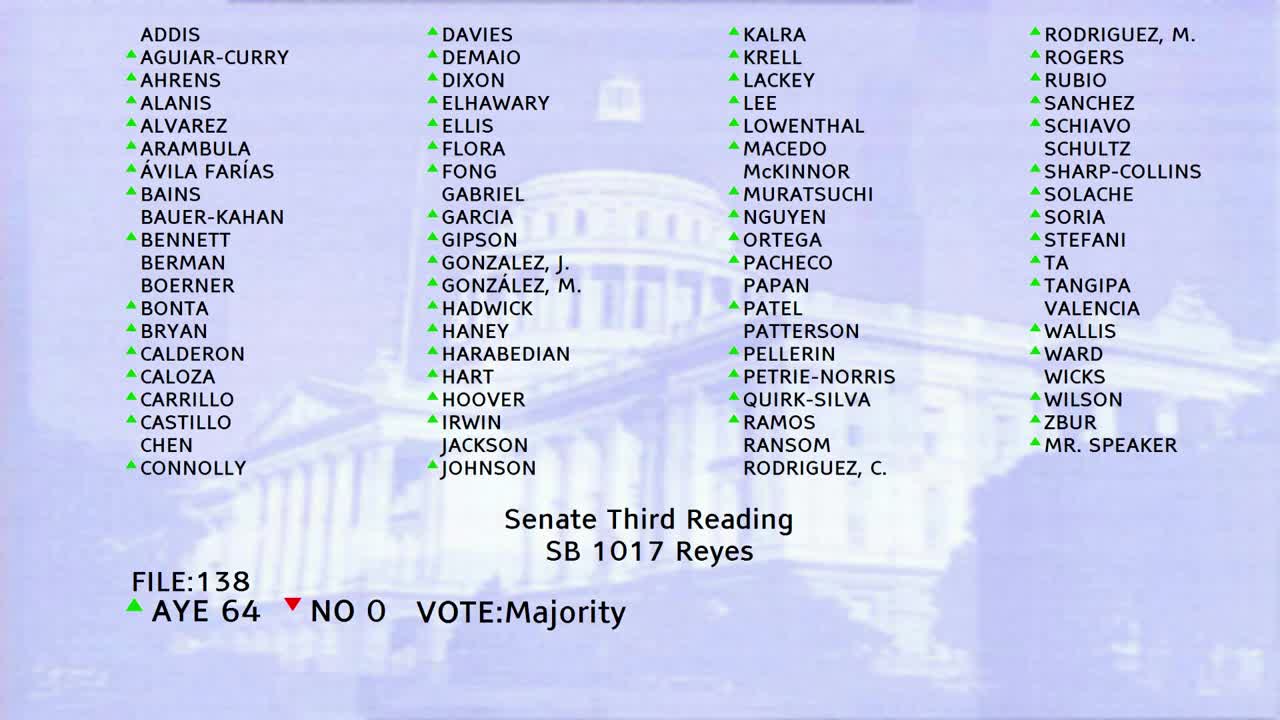 1MIN
Assembly Floor
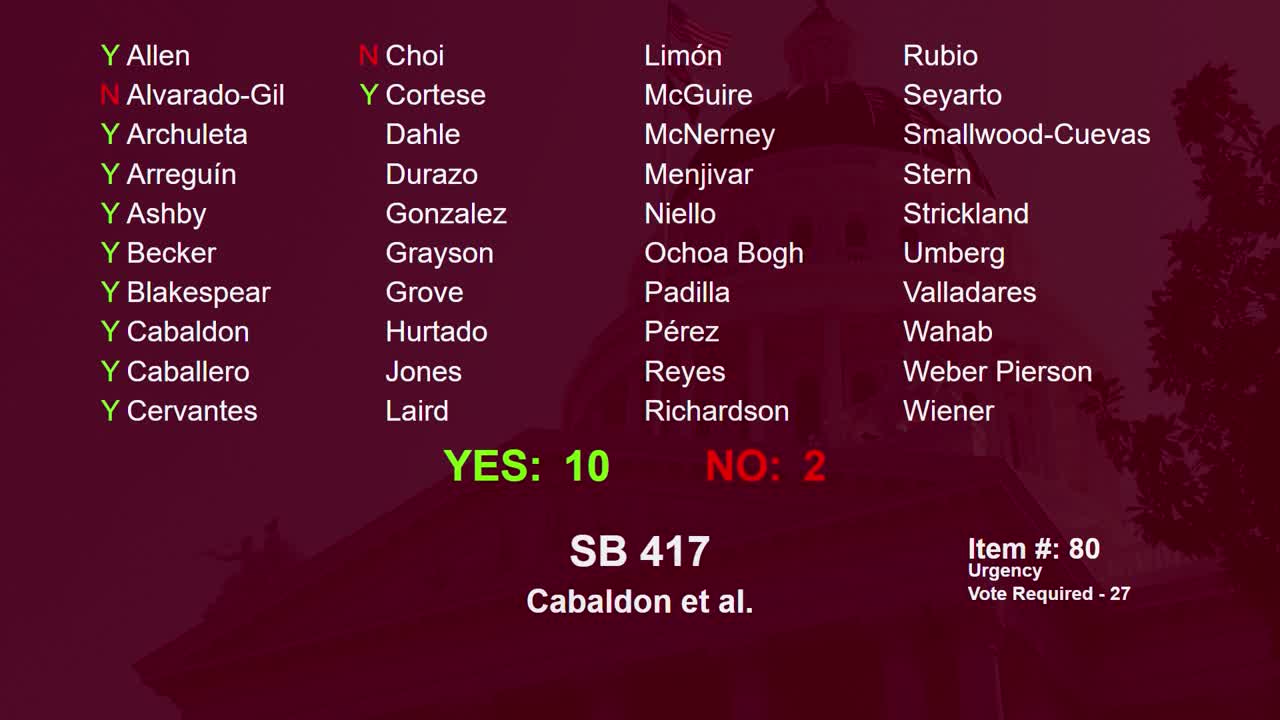 11MIN
Senate Floor
 1MIN
Senate Standing Committee on Appropriations
 48MIN
Senate Standing Committee on Transportation
 30MIN
Senate Standing Committee on Energy, Utilities and Communications
Bill Author
Bill Co-Author(s):