SB 67: Student financial aid: Cal Grants: Middle Class Scholarship Program: eligibility: dependents of members of the armed services stationed outside of California.
- Session Year: 2025-2026
- House: Senate
- Latest Version Date: 2025-10-11
Current Status:
Passed
(2025-10-11: Chaptered by Secretary of State. Chapter 648, Statutes of 2025.)
Introduced
In Committee
Awaiting First Chamber Vote
Passed First Chamber
In Committee
Awaiting Second Chamber Vote
Passed Second Chamber
Enacted
What does this bill do?
The bill allows students who were not California residents when they finished high school to qualify for Cal Grant and Middle Class Scholarship awards if they are the dependent natural or adopted child, stepchild, or spouse of a U.S. service member stationed outside California on active duty and that service member maintains California as their legal residence. These students must still meet all other program eligibility rules to receive the awards.
The summary is provided by generative AI which can make mistakes. For original language, please view the details in the table below.
Existing law, the Cal Grant Program, establishes the Cal Grant A Entitlement Awards, the Cal Grant B Entitlement Awards, the California Community College Expanded Entitlement Awards, the California Community College Transfer Entitlement Awards, the Competitive Cal Grant A and B Awards, the Cal Grant C Awards, and the Cal Grant T Awards under the administration of the Student Aid Commission.
Existing law, the Cal Grant Reform Act, revises and recasts the provisions establishing and governing the existing Cal Grant Program into a new Cal Grant Program. Existing law specifies that the act becomes operative only if General Fund moneys over the multiyear forecasts beginning in the 202425 fiscal year are available to support ongoing augmentations and actions, and if funding is provided in the annual Budget Act to implement the act.
Under either Cal Grant Program that is operative, existing law establishes eligibility requirements for awards under the program for participating students attending qualifying institutions, including, among others, California residency requirements, as provided.
Existing law establishes the Middle Class Scholarship Program (MCSP) under the administration of the commission. Existing law makes an undergraduate student eligible for a scholarship award under the MCSP if the student is enrolled at the University of California or the California State University, or enrolled in upper division coursework in a community college baccalaureate program, and meets certain eligibility requirements, including, among others, that the applicant meets the eligibility requirements for a Cal Grant.
This bill would extend Cal Grant and MCSP eligibility to a student who was not a resident of California at the time of high school graduation or its equivalent but meets all other applicable eligibility requirements and is a dependent natural or adopted child, stepchild, or spouse of a member of the Armed Forces of the United States stationed outside of California on active duty, if the member of the Armed Forces of the United States otherwise maintains California as their state of legal residence. The bill also would make conforming changes.
This bill would incorporate additional changes to Section 70022 of the Education Code proposed by AB 148 and SB 148 to be operative only if this bill and either SB 148 or AB 148 are enacted, and this bill is enacted last.
Existing law, the Cal Grant Program, establishes the Cal Grant A Entitlement Awards, the Cal Grant B Entitlement Awards, the California Community College Expanded Entitlement Awards, the California Community College Transfer Entitlement Awards, the Competitive Cal Grant A and B Awards, the Cal Grant C Awards, and the Cal Grant T Awards under the administration of the Student Aid Commission.
Existing law, the Cal Grant Reform Act, revises and recasts the provisions establishing and governing the existing Cal Grant Program into a new Cal Grant Program. Existing law specifies that the act becomes operative only if General Fund moneys over the multiyear forecasts beginning in the 202425 fiscal year are available to support ongoing augmentations and actions, and if funding is provided in the annual Budget Act to implement the act.
Under either Cal Grant Program that is operative, existing law establishes eligibility requirements for awards under the program for participating students attending qualifying institutions, including, among others, California residency requirements, as provided.
Existing law establishes the Middle Class Scholarship Program (MCSP) under the administration of the commission. Existing law makes an undergraduate student eligible for a scholarship award under the MCSP if the student is enrolled at the University of California or the California State University, or enrolled in upper division coursework in a community college baccalaureate program, and meets certain eligibility requirements, including, among others, that the applicant meets the eligibility requirements for a Cal Grant.
This bill would extend Cal Grant and MCSP eligibility to a student who was not a resident of California at the time of high school graduation or its equivalent but meets all other applicable eligibility requirements and is a dependent natural or adopted child, stepchild, or spouse of a member of the Armed Forces of the United States stationed outside of California on active duty, if the member of the Armed Forces of the United States otherwise maintains California as their state of legal residence. The bill also would make conforming changes.
(a)To be eligible for a Cal Grant Reform Act Program award under this chapter, a student shall be all of the following:
(1)A citizen of the United States, or an eligible noncitizen, as defined for purposes of financial aid programs under Title IV of the federal Higher Education Act of 1965, as amended from time to time (20 U.S.C. Sec. 1070 et seq.).
(2)Either of the following:
(A)A resident of California at the time of high school graduation or its equivalent.
(B)A student who has residence, pursuant to Article 5 (commencing with Section 68060) of Chapter 1 of Part 41, in the state for more than three years immediately preceding July 1 of the award year.
(3)Not in default on any student loan within the meaning of Section 69507.5.
(b)Notwithstanding paragraphs (1) and (2) of subdivision (a), a student who is exempt from paying nonresident tuition pursuant to Section 68130.5 shall be eligible for an award pursuant to this chapter if they meet all other eligibility requirements.
(c)Notwithstanding paragraph (2) of subdivision (a), a student who is a dependent natural or adopted child, stepchild, or spouse of a member of the Armed Forces of the United States stationed outside of California on active duty, if the member of the Armed Forces of the United States otherwise maintains California as their state of legal residence, shall be eligible for an award pursuant to this chapter if the student meets all other eligibility requirements.
SEC. 2.Section 69433.9 of the Education Code is amended to read:69433.9.(a)To be eligible to receive a Cal Grant award pursuant to this chapter, a student shall be all of the following:
(1)A citizen of the United States, or an eligible noncitizen, as defined for purposes of financial aid programs under Title IV of the federal Higher Education Act of 1965 (20 U.S.C. Sec. 1070 et seq., as from time to time amended).
(2)Not incarcerated.
(3)Not in default on any student loan within the meaning of Section 69507.5.
(4)(A)For purposes of Article 2 (commencing with Section 69434), Article 3 (commencing with Section 69435), and Article 4 (commencing with Section 69436), except as provided in subdivision (d) of Section 69436, at the time of high school graduation or its equivalent, be a resident of California.
(B)A student who does not meet the requirements for a high school diploma or its equivalent in the academic year immediately preceding the award year, but who meets the requirements for a high school diploma or its equivalent by December 31 of the academic year immediately following the date of application, satisfies any requirement for obtaining high school graduation or its equivalent for the purposes of this chapter as of the first day of the academic term immediately following the term in which the requirements for the high school diploma or its equivalent are met.
(C)No student shall receive an award for a term that begins before satisfying any requirement for obtaining high school graduation or its equivalent.
(b)Notwithstanding subdivision (a), a student shall be eligible to receive a Cal Grant award pursuant to this chapter if the student satisfies the requirements of paragraphs (1) to (3), inclusive, of subdivision (a) and the student is a dependent natural or adopted child, stepchild, or spouse of a member of the Armed Forces of the United States stationed outside of California on active duty, if the member of the Armed Forces of the United States otherwise maintains California as their state of legal residence.
SEC. 3.Section 69436 of the Education Code is amended to read:69436.(a)A student who was not awarded a Cal Grant A or B award pursuant to Article 2 (commencing with Section 69434) or Article 3 (commencing with Section 69435) at the time of their high school graduation but, at the time of transfer from a California community college to a qualifying baccalaureate program or upon matriculation into the upper division coursework of a community college baccalaureate program, described in Article 3 (commencing with Section 78040) of Chapter 1 of Part 48 of Division 7, meets all of the criteria set forth in subdivision (b), shall be entitled to a Cal Grant A or B award.
(b)Any California resident transferring from a California community college to a qualifying institution that offers a baccalaureate degree or who matriculates into the upper division coursework of a community college baccalaureate program, described in Article 3 (commencing with Section 78040) of Chapter 1 of Part 48 of Division 7, is entitled to receive, and the commission, or a qualifying institution pursuant to Article 8 (commencing with Section 69450), shall award, a Cal Grant A or B award depending on the eligibility determined pursuant to subdivision (c), if all of the following criteria are met:
(1)A complete official financial aid application has been submitted or postmarked pursuant to Section 69432.9, no later than the March 2 of the year immediately preceding the award year.
(2)The student demonstrates financial need pursuant to Section 69433.
(3)The student has earned a community college grade point average of at least 2.4 on a 4.0 scale and is eligible to transfer to a qualifying institution that offers a baccalaureate degree.
(4)The students household has an income and asset level not exceeding the limits set forth in Section 69432.7.
(5)The student is pursuing a baccalaureate degree that is offered by a qualifying institution.
(6)The student is enrolled at least part time.
(7)The student meets the general Cal Grant eligibility requirements set forth in Article 1 (commencing with Section 69430).
(8)The student will not be 28 years of age or older by December 31 of the award year.
(9)The student graduated from a California high school or its equivalent during or after the 200001 academic year.
(10)(A)Except as provided for in subparagraph (B), the student attended a California community college in the academic year immediately preceding the academic year for which the award will be used.
(B)A student otherwise eligible to receive an award pursuant to this section, who attended a California community college in the 201112 academic year, may use the award for the 201213 and 201314 academic years.
(c)The amount and type of the award pursuant to this article shall be determined as follows:
(1)For applicants with income and assets at or under the Cal Grant A limits, the award amount shall be the amount established pursuant to Article 2 (commencing with Section 69434).
(2)For applicants with income and assets at or under the Cal Grant B limits, the award amount shall be the amount established pursuant to Article 3 (commencing with Section 69435).
(d)(1)A student meeting the requirements of paragraph (9) of subdivision (b) by means of high school graduation, rather than its equivalent, shall be required to have graduated from a California high school, unless that California resident graduated from a high school outside of California due solely to orders received from a branch of the United States Armed Forces by that student or by that students parent or guardian that required that student to be outside of California at the time of high school graduation.
(2)For the purposes of this article, all of the following are exempt from the requirements of paragraph (4) of subdivision (a) of Section 69433.9 and paragraph (9) of subdivision (b) of this section:
(A)A student for whom a claim under this article was paid before December 1, 2005.
(B)A student for whom a claim under this article for the 200405 award year or the 200506 award year was or is paid on or after December 1, 2005, but no later than October 15, 2006.
(C)Commencing with the 201718 academic year, a student who did not graduate from high school or its equivalent and was a California resident, as determined pursuant to Article 5 (commencing with Section 68060) of Chapter 1 of Part 41, on their 18th birthday.
(3)(A)The commission, or a qualifying institution pursuant to Article 8 (commencing with Section 69450), shall make preliminary awards to all applicants currently eligible for an award under this article. At the time an applicant receives a preliminary award, the commission, or a qualifying institution pursuant to Article 8 (commencing with Section 69450), shall require that applicant to affirm, in writing, under penalty of perjury, that they meet the requirements set forth in paragraph (4) of subdivision (a) of Section 69433.9, paragraph (9) of subdivision (b) of this section, and paragraph (1) of this subdivision. The commission, or a qualifying institution pursuant to Article 8 (commencing with Section 69450), shall notify each person who receives a preliminary award under this paragraph that their award is subject to an audit pursuant to subparagraph (B).
(B)The commission shall select, at random, a minimum of 10 percent of the new and renewal awards made under subparagraph (A), and shall require, before the disbursement of Cal Grant funds to the affected postsecondary institution, that the institution verify that the recipient meets the requirements of paragraph (4) of subdivision (a) of Section 69433.9, paragraph (9) of subdivision (b) of this section, and paragraph (1) of this subdivision. An award that is audited under this paragraph and found to be valid shall not be subject to a subsequent audit.
(C)Pursuant to Section 69517.5, the commission shall seek repayment of any and all funds found to be improperly disbursed under this article.
(D)On or before November 1 of each year, the commission shall submit a report to the Legislature and the Governor, including, but not necessarily limited to, both of the following:
(i)The number of awards made under this article in the preceding 12 months.
(ii)The number of new and renewal awards selected, in the preceding 12 months, for verification under subparagraph (B), and the results of that verification with respect to students at the University of California, at the California State University, at independent nonprofit institutions, and at independent for-profit institutions.
SEC. 4.Section 69514 of the Education Code is amended to read:69514.The commission shall do all of the following:
(a)Report, on or before April 1 of each year, statistical data examining the impact and effectiveness of state-funded programs. The commission shall use common criteria in determining the impact of these programs, and shall have the authority to obtain any data from postsecondary educational institutions necessary for the reports. To the extent practicable, this report shall specifically note the number and the demographic characteristics of the students who qualify for a Cal Grant award based on obtaining high school graduation or its equivalent pursuant to subparagraph (B) of paragraph (4) of subdivision (a) of Section 69433.9.
(b)Collect and disseminate data concerning the financial resources and needs of students and potential students, and the scope and impact of existing state, federal, and institutional student aid programs.
(c)Report, on or before April 1 of each year, the aggregate financial need of individuals seeking access to postsecondary education and the degree to which current student aid programs meet this legitimate financial need.
(d)Develop and report annually the distribution of funds and awards among income groups, ethnic groups, grade point average levels, and postsecondary education segments.
(e)Prepare and disseminate information regarding the criteria used in distributing available student aid funds.
(f)Be authorized to expend funds for the purpose of disseminating information about all institutional, state, and federal student aid programs to potential applicants. This distribution of information shall primarily focus on potential applicants with the greatest financial need.
(g)In the event that the Financial Aid Shopping Sheet developed by the United States Department of Education is no longer available, develop, in consultation with the Bureau for Private Postsecondary Education, a similar form that a postsecondary educational institution subject to the requirements of either Section 66021.3 or 94912.5 shall use. The form shall provide students and their families with information, including, but not necessarily limited to, grant and scholarship opportunities and net costs associated with attendance at an institution.
SEC. 5.Section 70022 of the Education Code is amended to read:70022.(a)(1)Subject to an available and sufficient appropriation, an undergraduate student enrolled in the California State University or the University of California, or a community college student enrolled in upper division coursework of a community college baccalaureate program, described in Article 3 (commencing with Section 78040) of Chapter 1 of Part 48 of Division 7, who meets the requirements of paragraph (3) is eligible for a scholarship award as described in paragraph (2).
(2)(A)For the 201314 to the 202122 academic year, inclusive, except as provided in paragraphs (4) and (5), an eligible student shall receive a scholarship award in an amount that, combined with other federal, state, or institutionally administered student grants or fee waivers received by an eligible student, is up to 40 percent of the amount charged to that student in that academic year for mandatory systemwide tuition and fees, or for an eligible community college student, up to 40 percent of the amount charged to that student in upper division fees for a community college baccalaureate degree program, if all of the requirements in paragraph (3) are met, to the satisfaction of the commission, each academic year.
(B)For the 202223 academic year, except as provided in paragraph (5), an eligible student shall receive a scholarship award in an amount that equals the difference between their cost of attendance as determined by the commission and the sum of the following amounts:
(i)Other federal, state, and institutionally administered student scholarships, grants, or fee waivers, and the amount of private scholarships awarded to the student in excess of the sum of the amounts in clauses (ii) and (iii).
(ii)Seven thousand eight hundred ninety-eight dollars ($7,898), reflecting an expected student contribution toward cost of attendance from work earnings or other resources.
(iii)Notwithstanding Section 69506, for dependent students with an annual household income exceeding one hundred thousand dollars ($100,000), 33 percent of the parents contribution from adjusted available income, as determined using the federal methodology established by Title IV of the federal Higher Education Act of 1965, as amended (20 U.S.C. Sec. 1087mm et seq.), and applicable rules and regulations adopted by the commission.
(C)For the 202324 academic year, except as provided in paragraph (5), an eligible student shall receive a scholarship award in an amount that equals the difference between their cost of attendance as determined by the commission and the sum of the following amounts:
(i)Other federal, state, and institutionally administered student scholarships, grants, or fee waivers.
(ii)The amount of private grants and scholarships awarded to the student, and institutionally awarded emergency housing funds and other basic needs emergency assistance awarded to the student, including emergency assistance awarded by an institution-based foster youth support program, in excess of the sum of the amounts in clauses (iii) and (iv).
(iii)Seven thousand eight hundred ninety-eight dollars ($7,898), reflecting an expected student contribution toward cost of attendance from work earnings or other resources.
(iv)Notwithstanding Section 69506, for dependent students with an annual household income exceeding one hundred thousand dollars ($100,000), 33 percent of the parents contribution from adjusted available income, as determined using the federal methodology established by Title IV of the federal Higher Education Act of 1965, as amended (20 U.S.C. Sec. 1087mm et seq.), and applicable rules and regulations adopted by the commission.
(D)Commencing with the 202425 academic year, except as provided in paragraph (5), an eligible student shall receive a scholarship award in an amount that equals the difference between their cost of attendance as determined by the commission and the sum of the following amounts:
(i)Other federal, state, and institutionally administered student need-based scholarships, grants, or fee waivers.
(ii)The amount of private grants and scholarships awarded to the student, and institutionally administered non-need-based scholarships and institutionally awarded emergency housing funds or other basic needs emergency assistance awarded to the student, including emergency assistance awarded by an institution-based foster youth support program, in excess of the sum of the amounts in clauses (iii) and (iv).
(iii)An expected student contribution toward cost of attendance from work earnings or other resources. The commission shall adjust the 202324 amount of seven thousand eight hundred ninety-eight dollars ($7,898) annually thereafter based on the percentage change in the minimum wage, pursuant to paragraph (1) of subdivision (c) of Section 1182.12 of the Labor Code.
(iv)Notwithstanding Section 69506, for dependent students with an annual household income exceeding one hundred thousand dollars ($100,000), 33 percent of the parents contribution from adjusted available income, as determined using the federal methodology established by Title IV of the federal Higher Education Act of 1965, as amended (20 U.S.C. Sec. 1087mm et seq.), and applicable rules and regulations adopted by the commission.
(E)If a students total award under this article, in combination with other grants and scholarships treated as estimated financial assistance (EFA) or other financial assistance (OFA) pursuant to federal financial aid regulations, exceeds the allowable gift aid under those regulations, the award under this article shall be reduced to the greatest allowable award to maintain compliance pursuant to federal financial aid regulations.
(3)(A)A student shall be eligible to receive an award if all of the following requirements are met, to the satisfaction of the commission, each academic year:
(B)(i)For each academic year from 201314 to 202122, inclusive, the students annual household income does not exceed one hundred fifty thousand dollars ($150,000). For awards distributed for the 201617 academic year and subsequent academic years, the commission shall annually adjust the maximum income level set under this clause in accordance with the percentage changes in the cost of living within the meaning of paragraph (1) of subdivision (e) of Section 8 of Article XIII B of the California Constitution. For purposes of this article, annual household income shall be calculated in a manner that is consistent with the requirements applicable to the Ortiz-Pacheco-Poochigian-Vasconcellos Cal Grant Program (Chapter 1.7 (commencing with Section 69430)) and Section 69506.
(ii)Commencing with the 202223 academic year, the students annual household income does not exceed the following amounts:
(I)Two hundred one thousand dollars ($201,000) if the student is a dependent student or an independent student with dependents other than a spouse.
(II)One hundred thirty-three thousand dollars ($133,000) if the student is a married independent student with no dependents other than a spouse.
(III)One hundred sixteen thousand dollars ($116,000) if the student is a single independent student with no dependents.
(iii)For awards distributed for the 202324 academic year and subsequent academic years, the commission shall annually adjust the maximum income levels set under clause (ii) in accordance with the percentage changes in the cost of living within the meaning of paragraph (1) of subdivision (e) of Section 8 of Article XIIIB of the California Constitution. For purposes of this article, annual household income shall be calculated in a manner that is consistent with the requirements applicable to the Ortiz-Pacheco-Poochigian-Vasconcellos Cal Grant Program (Chapter 1.7 (commencing with Section 69430)) and Section 69506.
(C)(i)For each academic year from 201516 to 202122, inclusive, the students household asset level shall not exceed one hundred fifty thousand dollars ($150,000). For awards distributed in the 201617 academic year and subsequent academic years, the commission shall annually adjust the maximum household asset level set under this clause in accordance with the percentage changes in the cost of living within the meaning of paragraph (1) of subdivision (e) of Section 8 of Article XIIIB of the California Constitution. For purposes of this article, students household asset level shall be calculated in a manner that is consistent with the requirements applicable to the Ortiz-Pacheco-Poochigian-Vasconcellos Cal Grant Program (Chapter 1.7 (commencing with Section 69430)) and Section 69506.
(ii)Commencing with the 202223 academic year, the students household asset level does not exceed the following amounts:
(I)Two hundred one thousand dollars ($201,000) if the student is a dependent student or an independent student with dependents other than a spouse.
(II)Ninety-six thousand dollars ($96,000) if the student is a single independent student with no dependents or a married independent student with no dependents other than a spouse.
(iii)For awards distributed in the 202324 academic year and subsequent academic years, the commission shall annually adjust the maximum household asset level set under clause (ii) in accordance with the percentage changes in the cost of living within the meaning of paragraph (1) of subdivision (e) of Section 8 of Article XIIIB of the California Constitution. For purposes of this article, a students household asset level shall be calculated in a manner that is consistent with the requirements applicable to the Ortiz-Pacheco-Poochigian-Vasconcellos Cal Grant Program (Chapter 1.7 (commencing with Section 69430)) and Section 69506.
(D)The student satisfies the eligibility requirements for a Cal Grant award pursuant to either subdivision (a) or (b) of Section 69433.9, except that a student who is exempt from nonresident tuition under Section 68130.5 shall not be required to satisfy the requirements of paragraph (1) of subdivision (a) of Section 69433.9.
(E)The student is exempt from paying nonresident tuition.
(F)The student completes and submits a Free Application for Federal Student Aid (FAFSA) or a California Dream Act application. The FAFSA or California Dream Act application must be submitted or postmarked by no later than March 2.
(G)The student makes a timely application or applications for all other federal, state, or institutionally administered grants or fee waivers for which the student is eligible.
(H)The student maintains satisfactory academic progress in a manner that is consistent with the requirements applicable to the Ortiz-Pacheco-Poochigian-Vasconcellos Cal Grant Program pursuant to subdivision (m) of Section 69432.7.
(I)The student is pursuing the students first undergraduate baccalaureate degree or has completed a baccalaureate degree and has been admitted to, and is enrolled in, a program of professional teacher preparation at an institution approved by the Commission on Teacher Credentialing.
(J)The student is enrolled at least part time.
(4)(A)For each academic year from 201314 to 202122, inclusive, the percentages specified in paragraph (2) shall be reduced by 0.6-percent increments per one thousand dollars ($1,000) of annual household income in excess of one hundred thousand dollars ($100,000), to a minimum 10 percent, provided that no scholarship award shall be provided to a student with an annual household income exceeding one hundred fifty thousand dollars ($150,000). Beginning with award calculations for the 201617 academic year, and for subsequent academic years, the commission shall annually adjust the income levels specified in this subparagraph by the percentage change in the cost of living within the meaning of paragraph (1) of subdivision (e) of Section 8 of Article XIIIB of the California Constitution and shall adjust the incremental reduction accordingly to ensure that a minimum of 10 percent of mandatory systemwide tuition and fees for an academic year are awarded. This reduction shall be in addition to any reduction required by Section 70023.
(B)Notwithstanding subparagraph (A), for each academic year from 201314 to 202122, inclusive, for any student who qualifies for a scholarship award of at least one dollar ($1), the minimum annual scholarship amount for full-time enrollment is ninety dollars ($90).
(5)(A)For the 201415, 201516, and 201617 academic years, the maximum amount of a students scholarship award shall be 35 percent, 50 percent, and 75 percent, respectively, of the total scholarship award amount that the student would otherwise be eligible to receive.
(B)Commencing with the 202223 academic year, except as provided in subparagraph (D), the maximum amount of a students scholarship award shall be determined by the percentage determined pursuant to subparagraph (C) of the total scholarship award amount that the student would otherwise be eligible to receive.
(C)The commission shall annually determine the percentage required for purposes of subparagraph (B) by taking the amount appropriated for purposes of this program for the applicable award year, less the amount necessary to fund subparagraph (D), and dividing that by the sum of the projected amount computed pursuant to subparagraph (B), (C), or (D) of paragraph (2) for the applicable award year for all eligible students, except those affected by subparagraph (D).
(D)Commencing with the 202324 academic year, a current or former foster youth, as defined in paragraph (2) of subdivision (e) of Section 69433.6, shall receive a scholarship award in the full amount determined in subparagraph (C) or (D) of paragraph (2), as adjusted, if applicable, pursuant to paragraph (2) of subdivision (d).
(b)In order for students enrolled in their respective segments to remain eligible to receive a scholarship award under this article, the University of California and the California State University shall not supplant their respective institutional need-based or merit-based grants with the funds provided for scholarships under this article. The University of California and the California State University shall ensure that the amount of institutional student aid provided in each academic year beginning with the 202223 academic year is adjusted annually to account for increases in systemwide undergraduate enrollment, as applicable, such that the proportion of institutional student aid relative to systemwide undergraduate enrollment is maintained at a level at least equivalent to the level maintained for undergraduate students during the 202122 academic year. The University of California and the California State University shall also ensure that at least 33 percent of the revenues of an increase to existing mandatory systemwide fees charged to undergraduate students is set aside by the regents or the trustees, as applicable, for institutional student aid to assist resident undergraduate students, including those undergraduate students exempt from nonresident tuition pursuant to Sections 68075.5 and 68130.5, and families in meeting the total cost of education.
(c)(1)The University of California and the California State University shall report on the implementation of this article as part of the report made pursuant to Section 66021.1. At a minimum, the report shall add the following information, by parental income level or expected family contribution deciles, for the prior academic year:
(A)The number and percentage of students receiving an award under this article and the average dollar amount of that award.
(B)The number and percentage of students receiving a student loan and the average amount borrowed.
(2)The report shall also include the following information by campus for the prior academic year:
(A)The cost of attendance for undergraduates in each living arrangement (on campus, off campus, or at home with parents).
(B)The number and percentage of undergraduates in each living arrangement (on campus, off campus, or at home with parents).
(d)(1)A Middle Class Scholarship Program award authorized pursuant to this article shall be defined as a full-time equivalent grant. An award to a part-time student shall be a fraction of a full-time grant. For each academic year from 201314 to 202122, inclusive, an award to a part-time student shall be determined by the proportionate amount charged for systemwide tuition and fees. A part-time student shall not be discriminated against in the selection of Middle Class Scholarship Program awards. For purposes of this section, full-time student and part-time student have the same meaning as specified in subdivision (f) of Section 69432.7.
(2)Commencing with the 202223 academic year, an award to a student enrolled in six to eight semester units, inclusive, or the equivalent shall be no more than one-half of the award the student would have received had the student enrolled full time. An award to a student enrolled in 9 to 11 semester units, inclusive, or the equivalent shall be no more than three-quarters of the award the student would have received had the student enrolled full time.
SEC. 5.5.Section 70022 of the Education Code is amended to read:70022.(a)(1)Subject to an available and sufficient appropriation, an undergraduate student enrolled in the California State University or the University of California, or a community college student enrolled in upper division coursework of a community college baccalaureate program, described in Article 3 (commencing with Section 78040) of Chapter 1 of Part 48 of Division 7, who meets the requirements of paragraph (3) is eligible for a scholarship award as described in paragraph (2).
(2)(A)For the 201314 to the 202122 academic year, inclusive, except as provided in paragraphs (4) and (5), an eligible student shall receive a scholarship award in an amount that, combined with other federal, state, or institutionally administered student grants or fee waivers received by an eligible student, is up to 40 percent of the amount charged to that student in that academic year for mandatory systemwide tuition and fees, or for an eligible community college student, up to 40 percent of the amount charged to that student in upper division fees for a community college baccalaureate degree program, if all of the requirements in paragraph (3) are met, to the satisfaction of the commission, each academic year.
(B)For the 202223 academic year, except as provided in paragraph (5), an eligible student shall receive a scholarship award in an amount that equals the difference between their cost of attendance as determined by the commission and the sum of the following amounts:
(i)Other federal, state, and institutionally administered student scholarships, grants, or fee waivers, and the amount of private scholarships awarded to the student in excess of the sum of the amounts in clauses (ii) and (iii).
(ii)Seven thousand eight hundred ninety-eight dollars ($7,898), reflecting an expected student contribution toward cost of attendance from work earnings or other resources.
(iii)Notwithstanding Section 69506, for dependent students with an annual household income exceeding one hundred thousand dollars ($100,000), 33 percent of the parents contribution from adjusted available income, as determined using the federal methodology established by Title IV of the federal Higher Education Act of 1965, as amended (20 U.S.C. Sec. 1087mm et seq.), and applicable rules and regulations adopted by the commission.
(C)For the 202324 academic year, except as provided in paragraph (5), an eligible student shall receive a scholarship award in an amount that equals the difference between their cost of attendance as determined by the commission and the sum of the following amounts:
(i)Other federal, state, and institutionally administered student scholarships, grants, or fee waivers.
(ii)The amount of private grants and scholarships awarded to the student, and institutionally awarded emergency housing funds and other basic needs emergency assistance awarded to the student, including emergency assistance awarded by an institution-based foster youth support program, in excess of the sum of the amounts in clauses (iii) and (iv).
(iii)Seven thousand eight hundred ninety-eight dollars ($7,898), reflecting an expected student contribution toward cost of attendance from work earnings or other resources.
(iv)Notwithstanding Section 69506, for dependent students with an annual household income exceeding one hundred thousand dollars ($100,000), 33 percent of the parents contribution from adjusted available income, as determined using the federal methodology established by Title IV of the federal Higher Education Act of 1965, as amended (20 U.S.C. Sec. 1087mm et seq.), and applicable rules and regulations adopted by the commission.
(D)Commencing with the 202425 academic year, except as provided in paragraph (5), an eligible student shall receive a scholarship award in an amount that equals the difference between their cost of attendance as determined by the commission and the sum of the following amounts:
(i)Other federal, state, and institutionally administered student need-based scholarships, grants, or fee waivers.
(ii)The amount of private grants and scholarships awarded to the student, and institutionally administered non-need-based scholarships and institutionally awarded emergency housing funds or other basic needs emergency assistance awarded to the student, including emergency assistance awarded by an institution-based foster youth support program, in excess of the sum of the amounts in clauses (iii) and (iv).
(iii)An expected student contribution toward cost of attendance from work earnings or other resources. The commission shall adjust the 202324 amount of seven thousand eight hundred ninety-eight dollars ($7,898) annually thereafter based on the percentage change in the minimum wage, pursuant to paragraph (1) of subdivision (c) of Section 1182.12 of the Labor Code.
(iv)Notwithstanding Section 69506, for dependent students with an annual household income exceeding one hundred thousand dollars ($100,000), 33 percent of the parents contribution from adjusted available income, as determined using the federal methodology established by Title IV of the federal Higher Education Act of 1965, as amended (20 U.S.C. Sec. 1087mm et seq.), and applicable rules and regulations adopted by the commission.
(E)If a students total award under this article, in combination with other grants and scholarships treated as estimated financial assistance (EFA) or other financial assistance (OFA) pursuant to federal financial aid regulations, exceeds the allowable gift aid under those regulations, the award under this article shall be reduced to the greatest allowable award to maintain compliance pursuant to federal financial aid regulations.
(F)If an award in clause (i) of subparagraph (D) of less than three hundred dollars ($300) is identified following the determination of a students scholarship award under this article, the students scholarship award under this article shall not require a recalculation.
(3)(A)A student shall be eligible to receive an award if all of the following requirements are met, to the satisfaction of the commission, each academic year:
(B)(i)For each academic year from 201314 to 202122, inclusive, the students annual household income does not exceed one hundred fifty thousand dollars ($150,000). For awards distributed for the 201617 academic year and subsequent academic years, the commission shall annually adjust the maximum income level set under this clause in accordance with the percentage changes in the cost of living within the meaning of paragraph (1) of subdivision (e) of Section 8 of Article XIII B of the California Constitution. For purposes of this article, annual household income shall be calculated in a manner that is consistent with the requirements applicable to the Ortiz-Pacheco-Poochigian-Vasconcellos Cal Grant Program (Chapter 1.7 (commencing with Section 69430)) and Section 69506.
(ii)Commencing with the 202223 academic year, the students annual household income does not exceed the following amounts:
(I)Two hundred one thousand dollars ($201,000) if the student is a dependent student or an independent student with dependents other than a spouse.
(II)One hundred thirty-three thousand dollars ($133,000) if the student is a married independent student with no dependents other than a spouse.
(III)One hundred sixteen thousand dollars ($116,000) if the student is a single independent student with no dependents.
(iii)For awards distributed for the 202324 academic year and subsequent academic years, the commission shall annually adjust the maximum income levels set under clause (ii) in accordance with the percentage changes in the cost of living within the meaning of paragraph (1) of subdivision (e) of Section 8 of Article XIIIB of the California Constitution. For purposes of this article, annual household income shall be calculated in a manner that is consistent with the requirements applicable to the Ortiz-Pacheco-Poochigian-Vasconcellos Cal Grant Program (Chapter 1.7 (commencing with Section 69430)) and Section 69506.
(C)(i)For each academic year from 201516 to 202122, inclusive, the students household asset level shall not exceed one hundred fifty thousand dollars ($150,000). For awards distributed in the 201617 academic year and subsequent academic years, the commission shall annually adjust the maximum household asset level set under this clause in accordance with the percentage changes in the cost of living within the meaning of paragraph (1) of subdivision (e) of Section 8 of Article XIIIB of the California Constitution. For purposes of this article, students household asset level shall be calculated in a manner that is consistent with the requirements applicable to the Ortiz-Pacheco-Poochigian-Vasconcellos Cal Grant Program (Chapter 1.7 (commencing with Section 69430)) and Section 69506.
(ii)Commencing with the 202223 academic year, the students household asset level does not exceed the following amounts:
(I)Two hundred one thousand dollars ($201,000) if the student is a dependent student or an independent student with dependents other than a spouse.
(II)Ninety-six thousand dollars ($96,000) if the student is a single independent student with no dependents or a married independent student with no dependents other than a spouse.
(iii)For awards distributed in the 202324 academic year and subsequent academic years, the commission shall annually adjust the maximum household asset level set under clause (ii) in accordance with the percentage changes in the cost of living within the meaning of paragraph (1) of subdivision (e) of Section 8 of Article XIIIB of the California Constitution. For purposes of this article, a students household asset level shall be calculated in a manner that is consistent with the requirements applicable to the Ortiz-Pacheco-Poochigian-Vasconcellos Cal Grant Program (Chapter 1.7 (commencing with Section 69430)) and Section 69506.
(D)The student satisfies the eligibility requirements for a Cal Grant award pursuant to either subdivision (a) or (b) of Section 69433.9, except that a student who is exempt from nonresident tuition under Section 68130.5 shall not be required to satisfy the requirements of paragraph (1) of subdivision (a) of Section 69433.9.
(E)The student is exempt from paying nonresident tuition.
(F)The student completes and submits a Free Application for Federal Student Aid (FAFSA) or a California Dream Act application. The FAFSA or California Dream Act application must be submitted or postmarked by no later than March 2.
(G)The student makes a timely application or applications for all other federal, state, or institutionally administered grants or fee waivers for which the student is eligible.
(H)The student maintains satisfactory academic progress in a manner that is consistent with the requirements applicable to the Ortiz-Pacheco-Poochigian-Vasconcellos Cal Grant Program pursuant to subdivision (m) of Section 69432.7.
(I)The student is pursuing the students first undergraduate baccalaureate degree or has completed a baccalaureate degree and has been admitted to, and is enrolled in, a program of professional teacher preparation at an institution approved by the Commission on Teacher Credentialing.
(J)The student is enrolled at least part time.
(4)(A)For each academic year from 201314 to 202122, inclusive, the percentages specified in paragraph (2) shall be reduced by 0.6-percent increments per one thousand dollars ($1,000) of annual household income in excess of one hundred thousand dollars ($100,000), to a minimum 10 percent, provided that no scholarship award shall be provided to a student with an annual household income exceeding one hundred fifty thousand dollars ($150,000). Beginning with award calculations for the 201617 academic year, and for subsequent academic years, the commission shall annually adjust the income levels specified in this subparagraph by the percentage change in the cost of living within the meaning of paragraph (1) of subdivision (e) of Section 8 of Article XIII B of the California Constitution and shall adjust the incremental reduction accordingly to ensure that a minimum of 10 percent of mandatory systemwide tuition and fees for an academic year are awarded. This reduction shall be in addition to any reduction required by Section 70023.
(B)Notwithstanding subparagraph (A), for each academic year from 201314 to 202122, inclusive, for any student who qualifies for a scholarship award of at least one dollar ($1), the minimum annual scholarship amount for full-time enrollment is ninety dollars ($90).
(5)(A)For the 201415, 201516, and 201617 academic years, the maximum amount of a students scholarship award shall be 35 percent, 50 percent, and 75 percent, respectively, of the total scholarship award amount that the student would otherwise be eligible to receive.
(B)Commencing with the 202223 academic year, except as provided in subparagraph (D), the maximum amount of a students scholarship award shall be determined by the percentage determined pursuant to subparagraph (C) of the total scholarship award amount that the student would otherwise be eligible to receive.
(C)The commission shall annually determine the percentage required for purposes of subparagraph (B) by taking the amount appropriated for purposes of this program for the applicable award year, less the amount necessary to fund subparagraph (D), and dividing that by the sum of the projected amount computed pursuant to subparagraph (B), (C), or (D) of paragraph (2) for the applicable award year for all eligible students, except those affected by subparagraph (D).
(D)Commencing with the 202324 academic year, a current or former foster youth, as defined in paragraph (2) of subdivision (e) of Section 69433.6, shall receive a scholarship award in the full amount determined in subparagraphs (C) or (D) of paragraph (2), as adjusted, if applicable, pursuant to paragraph (2) of subdivision (d).
(b)In order for students enrolled in their respective segments to remain eligible to receive a scholarship award under this article, the University of California and the California State University shall not supplant their respective institutional need-based or merit-based grants with the funds provided for scholarships under this article. The University of California and the California State University shall ensure that the amount of institutional student aid provided in each academic year beginning with the 202223 academic year is adjusted annually to account for increases in systemwide undergraduate enrollment, as applicable, such that the proportion of institutional student aid relative to systemwide undergraduate enrollment is maintained at a level at least equivalent to the level maintained for undergraduate students during the 202122 academic year. The University of California and the California State University shall also ensure that at least 33 percent of the revenues of an increase to existing mandatory systemwide fees charged to undergraduate students is set aside by the regents or the trustees, as applicable, for institutional student aid to assist resident undergraduate students, including those undergraduate students exempt from nonresident tuition pursuant to Sections 68075.5 and 68130.5, and families in meeting the total cost of education.
(c)(1)The University of California and the California State University shall report on the implementation of this article as part of the report made pursuant to Section 66021.1. At a minimum, the report shall add the following information, by parental income level or expected family contribution deciles, for the prior academic year:
(A)The number and percentage of students receiving an award under this article and the average dollar amount of that award.
(B)The number and percentage of students receiving a student loan and the average amount borrowed.
(2)The report shall also include the following information by campus for the prior academic year:
(A)The cost of attendance for undergraduates in each living arrangement (on campus, off campus, or at home with parents).
(B)The number and percentage of undergraduates in each living arrangement (on campus, off campus, or at home with parents).
(d)(1)A Middle Class Scholarship Program award authorized pursuant to this article shall be defined as a full-time equivalent grant. An award to a part-time student shall be a fraction of a full-time grant. For each academic year from 201314 to 202122, inclusive, an award to a part-time student shall be determined by the proportionate amount charged for systemwide tuition and fees. A part-time student shall not be discriminated against in the selection of Middle Class Scholarship Program awards. For purposes of this section, full-time student and part-time student have the same meaning as specified in subdivision (f) of Section 69432.7.
(2)Commencing with the 202223 academic year, an award to a student enrolled in six to eight semester units, inclusive, or the equivalent shall be no more than one-half of the award the student would have received had the student enrolled full time. An award to a student enrolled in 9 to 11 semester units, inclusive, or the equivalent shall be no more than three-quarters of the award the student would have received had the student enrolled full time.
SEC. 6.Section 5.5 of this bill incorporates amendments to Section 70022 of the Education Code proposed by this bill, Senate Bill 148, and Assembly Bill 148. That section of this bill shall only become operative if (1) this bill and either Senate Bill 148 or Assembly Bill 148 are enacted and become effective on or before January 1, 2026, (2) this bill and either Senate Bill 148 or Assembly Bill 148, as enacted, amend Section 70022 of the Education Code, and (3) this bill is enacted last of these bills amending Section 70022 of the Education Code, in which case Section 70022 of the Education Code, as amended by either Senate Bill 148 or Assembly Bill 148, whichever is operative, shall remain operative only until the operative date of this bill, at which time Section 5.5 of this bill shall become operative, and Section 5 of this bill shall not become operative.
(a)To be eligible for a Cal Grant Reform Act Program award under this chapter, a student shall be all of the following:
(1)A citizen of the United States, or an eligible noncitizen, as defined for purposes of financial aid programs under Title IV of the federal Higher Education Act of 1965, as amended from time to time (20 U.S.C. Sec. 1070 et seq.).
(2)Either of the following:
(A)A resident of California at the time of high school graduation or its equivalent.
(B)A student who has residence, pursuant to Article 5 (commencing with Section 68060) of Chapter 1 of Part 41, in the state for more than three years immediately preceding July 1 of the award year.
(3)Not in default on any student loan within the meaning of Section 69507.5.
(b)Notwithstanding paragraphs (1) and (2) of subdivision (a), a student who is exempt from paying nonresident tuition pursuant to Section 68130.5 shall be eligible for an award pursuant to this chapter if they meet all other eligibility requirements.
(c)Notwithstanding paragraph (2) of subdivision (a), a student who is a dependent natural or adopted child, stepchild, or spouse of a member of the Armed Forces of the United States stationed outside of California on active duty, if the member of the Armed Forces of the United States otherwise maintains California as their state of legal residence, shall be eligible for an award pursuant to this chapter if the student meets all other eligibility requirements.
SEC. 2.Section 69433.9 of the Education Code is amended to read:69433.9.(a)To be eligible to receive a Cal Grant award pursuant to this chapter, a student shall be all of the following:
(1)A citizen of the United States, or an eligible noncitizen, as defined for purposes of financial aid programs under Title IV of the federal Higher Education Act of 1965 (20 U.S.C. Sec. 1070 et seq., as from time to time amended).
(2)Not incarcerated.
(3)Not in default on any student loan within the meaning of Section 69507.5.
(4)(A)For purposes of Article 2 (commencing with Section 69434), Article 3 (commencing with Section 69435), and Article 4 (commencing with Section 69436), except as provided in subdivision (d) of Section 69436, at the time of high school graduation or its equivalent, be a resident of California.
(B)A student who does not meet the requirements for a high school diploma or its equivalent in the academic year immediately preceding the award year, but who meets the requirements for a high school diploma or its equivalent by December 31 of the academic year immediately following the date of application, satisfies any requirement for obtaining high school graduation or its equivalent for the purposes of this chapter as of the first day of the academic term immediately following the term in which the requirements for the high school diploma or its equivalent are met.
(C)No student shall receive an award for a term that begins before satisfying any requirement for obtaining high school graduation or its equivalent.
(b)Notwithstanding subdivision (a), a student shall be eligible to receive a Cal Grant award pursuant to this chapter if the student satisfies the requirements of paragraphs (1) to (3), inclusive, of subdivision (a) and the student is a dependent natural or adopted child, stepchild, or spouse of a member of the Armed Forces of the United States stationed outside of California on active duty, if the member of the Armed Forces of the United States otherwise maintains California as their state of legal residence.
SEC. 3.Section 69436 of the Education Code is amended to read:69436.(a)A student who was not awarded a Cal Grant A or B award pursuant to Article 2 (commencing with Section 69434) or Article 3 (commencing with Section 69435) at the time of their high school graduation but, at the time of transfer from a California community college to a qualifying baccalaureate program or upon matriculation into the upper division coursework of a community college baccalaureate program, described in Article 3 (commencing with Section 78040) of Chapter 1 of Part 48 of Division 7, meets all of the criteria set forth in subdivision (b), shall be entitled to a Cal Grant A or B award.
(b)Any California resident transferring from a California community college to a qualifying institution that offers a baccalaureate degree or who matriculates into the upper division coursework of a community college baccalaureate program, described in Article 3 (commencing with Section 78040) of Chapter 1 of Part 48 of Division 7, is entitled to receive, and the commission, or a qualifying institution pursuant to Article 8 (commencing with Section 69450), shall award, a Cal Grant A or B award depending on the eligibility determined pursuant to subdivision (c), if all of the following criteria are met:
(1)A complete official financial aid application has been submitted or postmarked pursuant to Section 69432.9, no later than the March 2 of the year immediately preceding the award year.
(2)The student demonstrates financial need pursuant to Section 69433.
(3)The student has earned a community college grade point average of at least 2.4 on a 4.0 scale and is eligible to transfer to a qualifying institution that offers a baccalaureate degree.
(4)The students household has an income and asset level not exceeding the limits set forth in Section 69432.7.
(5)The student is pursuing a baccalaureate degree that is offered by a qualifying institution.
(6)The student is enrolled at least part time.
(7)The student meets the general Cal Grant eligibility requirements set forth in Article 1 (commencing with Section 69430).
(8)The student will not be 28 years of age or older by December 31 of the award year.
(9)The student graduated from a California high school or its equivalent during or after the 200001 academic year.
(10)(A)Except as provided for in subparagraph (B), the student attended a California community college in the academic year immediately preceding the academic year for which the award will be used.
(B)A student otherwise eligible to receive an award pursuant to this section, who attended a California community college in the 201112 academic year, may use the award for the 201213 and 201314 academic years.
(c)The amount and type of the award pursuant to this article shall be determined as follows:
(1)For applicants with income and assets at or under the Cal Grant A limits, the award amount shall be the amount established pursuant to Article 2 (commencing with Section 69434).
(2)For applicants with income and assets at or under the Cal Grant B limits, the award amount shall be the amount established pursuant to Article 3 (commencing with Section 69435).
(d)(1)A student meeting the requirements of paragraph (9) of subdivision (b) by means of high school graduation, rather than its equivalent, shall be required to have graduated from a California high school, unless that California resident graduated from a high school outside of California due solely to orders received from a branch of the United States Armed Forces by that student or by that students parent or guardian that required that student to be outside of California at the time of high school graduation.
(2)For the purposes of this article, all of the following are exempt from the requirements of paragraph (4) of subdivision (a) of Section 69433.9 and paragraph (9) of subdivision (b) of this section:
(A)A student for whom a claim under this article was paid before December 1, 2005.
(B)A student for whom a claim under this article for the 200405 award year or the 200506 award year was or is paid on or after December 1, 2005, but no later than October 15, 2006.
(C)Commencing with the 201718 academic year, a student who did not graduate from high school or its equivalent and was a California resident, as determined pursuant to Article 5 (commencing with Section 68060) of Chapter 1 of Part 41, on their 18th birthday.
(3)(A)The commission, or a qualifying institution pursuant to Article 8 (commencing with Section 69450), shall make preliminary awards to all applicants currently eligible for an award under this article. At the time an applicant receives a preliminary award, the commission, or a qualifying institution pursuant to Article 8 (commencing with Section 69450), shall require that applicant to affirm, in writing, under penalty of perjury, that they meet the requirements set forth in paragraph (4) of subdivision (a) of Section 69433.9, paragraph (9) of subdivision (b) of this section, and paragraph (1) of this subdivision. The commission, or a qualifying institution pursuant to Article 8 (commencing with Section 69450), shall notify each person who receives a preliminary award under this paragraph that their award is subject to an audit pursuant to subparagraph (B).
(B)The commission shall select, at random, a minimum of 10 percent of the new and renewal awards made under subparagraph (A), and shall require, before the disbursement of Cal Grant funds to the affected postsecondary institution, that the institution verify that the recipient meets the requirements of paragraph (4) of subdivision (a) of Section 69433.9, paragraph (9) of subdivision (b) of this section, and paragraph (1) of this subdivision. An award that is audited under this paragraph and found to be valid shall not be subject to a subsequent audit.
(C)Pursuant to Section 69517.5, the commission shall seek repayment of any and all funds found to be improperly disbursed under this article.
(D)On or before November 1 of each year, the commission shall submit a report to the Legislature and the Governor, including, but not necessarily limited to, both of the following:
(i)The number of awards made under this article in the preceding 12 months.
(ii)The number of new and renewal awards selected, in the preceding 12 months, for verification under subparagraph (B), and the results of that verification with respect to students at the University of California, at the California State University, at independent nonprofit institutions, and at independent for-profit institutions.
SEC. 4.Section 69514 of the Education Code is amended to read:69514.The commission shall do all of the following:
(a)Report, on or before April 1 of each year, statistical data examining the impact and effectiveness of state-funded programs. The commission shall use common criteria in determining the impact of these programs, and shall have the authority to obtain any data from postsecondary educational institutions necessary for the reports. To the extent practicable, this report shall specifically note the number and the demographic characteristics of the students who qualify for a Cal Grant award based on obtaining high school graduation or its equivalent pursuant to subparagraph (B) of paragraph (4) of subdivision (a) of Section 69433.9.
(b)Collect and disseminate data concerning the financial resources and needs of students and potential students, and the scope and impact of existing state, federal, and institutional student aid programs.
(c)Report, on or before April 1 of each year, the aggregate financial need of individuals seeking access to postsecondary education and the degree to which current student aid programs meet this legitimate financial need.
(d)Develop and report annually the distribution of funds and awards among income groups, ethnic groups, grade point average levels, and postsecondary education segments.
(e)Prepare and disseminate information regarding the criteria used in distributing available student aid funds.
(f)Be authorized to expend funds for the purpose of disseminating information about all institutional, state, and federal student aid programs to potential applicants. This distribution of information shall primarily focus on potential applicants with the greatest financial need.
(g)In the event that the Financial Aid Shopping Sheet developed by the United States Department of Education is no longer available, develop, in consultation with the Bureau for Private Postsecondary Education, a similar form that a postsecondary educational institution subject to the requirements of either Section 66021.3 or 94912.5 shall use. The form shall provide students and their families with information, including, but not necessarily limited to, grant and scholarship opportunities and net costs associated with attendance at an institution.
SEC. 5.Section 70022 of the Education Code is amended to read:70022.(a)(1)Subject to an available and sufficient appropriation, an undergraduate student enrolled in the California State University or the University of California, or a community college student enrolled in upper division coursework of a community college baccalaureate program, described in Article 3 (commencing with Section 78040) of Chapter 1 of Part 48 of Division 7, who meets the requirements of paragraph (3) is eligible for a scholarship award as described in paragraph (2).
(2)(A)For the 201314 to the 202122 academic year, inclusive, except as provided in paragraphs (4) and (5), an eligible student shall receive a scholarship award in an amount that, combined with other federal, state, or institutionally administered student grants or fee waivers received by an eligible student, is up to 40 percent of the amount charged to that student in that academic year for mandatory systemwide tuition and fees, or for an eligible community college student, up to 40 percent of the amount charged to that student in upper division fees for a community college baccalaureate degree program, if all of the requirements in paragraph (3) are met, to the satisfaction of the commission, each academic year.
(B)For the 202223 academic year, except as provided in paragraph (5), an eligible student shall receive a scholarship award in an amount that equals the difference between their cost of attendance as determined by the commission and the sum of the following amounts:
(i)Other federal, state, and institutionally administered student scholarships, grants, or fee waivers, and the amount of private scholarships awarded to the student in excess of the sum of the amounts in clauses (ii) and (iii).
(ii)Seven thousand eight hundred ninety-eight dollars ($7,898), reflecting an expected student contribution toward cost of attendance from work earnings or other resources.
(iii)Notwithstanding Section 69506, for dependent students with an annual household income exceeding one hundred thousand dollars ($100,000), 33 percent of the parents contribution from adjusted available income, as determined using the federal methodology established by Title IV of the federal Higher Education Act of 1965, as amended (20 U.S.C. Sec. 1087mm et seq.), and applicable rules and regulations adopted by the commission.
(C)For the 202324 academic year, except as provided in paragraph (5), an eligible student shall receive a scholarship award in an amount that equals the difference between their cost of attendance as determined by the commission and the sum of the following amounts:
(i)Other federal, state, and institutionally administered student scholarships, grants, or fee waivers.
(ii)The amount of private grants and scholarships awarded to the student, and institutionally awarded emergency housing funds and other basic needs emergency assistance awarded to the student, including emergency assistance awarded by an institution-based foster youth support program, in excess of the sum of the amounts in clauses (iii) and (iv).
(iii)Seven thousand eight hundred ninety-eight dollars ($7,898), reflecting an expected student contribution toward cost of attendance from work earnings or other resources.
(iv)Notwithstanding Section 69506, for dependent students with an annual household income exceeding one hundred thousand dollars ($100,000), 33 percent of the parents contribution from adjusted available income, as determined using the federal methodology established by Title IV of the federal Higher Education Act of 1965, as amended (20 U.S.C. Sec. 1087mm et seq.), and applicable rules and regulations adopted by the commission.
(D)Commencing with the 202425 academic year, except as provided in paragraph (5), an eligible student shall receive a scholarship award in an amount that equals the difference between their cost of attendance as determined by the commission and the sum of the following amounts:
(i)Other federal, state, and institutionally administered student need-based scholarships, grants, or fee waivers.
(ii)The amount of private grants and scholarships awarded to the student, and institutionally administered non-need-based scholarships and institutionally awarded emergency housing funds or other basic needs emergency assistance awarded to the student, including emergency assistance awarded by an institution-based foster youth support program, in excess of the sum of the amounts in clauses (iii) and (iv).
(iii)An expected student contribution toward cost of attendance from work earnings or other resources. The commission shall adjust the 202324 amount of seven thousand eight hundred ninety-eight dollars ($7,898) annually thereafter based on the percentage change in the minimum wage, pursuant to paragraph (1) of subdivision (c) of Section 1182.12 of the Labor Code.
(iv)Notwithstanding Section 69506, for dependent students with an annual household income exceeding one hundred thousand dollars ($100,000), 33 percent of the parents contribution from adjusted available income, as determined using the federal methodology established by Title IV of the federal Higher Education Act of 1965, as amended (20 U.S.C. Sec. 1087mm et seq.), and applicable rules and regulations adopted by the commission.
(E)If a students total award under this article, in combination with other grants and scholarships treated as estimated financial assistance (EFA) or other financial assistance (OFA) pursuant to federal financial aid regulations, exceeds the allowable gift aid under those regulations, the award under this article shall be reduced to the greatest allowable award to maintain compliance pursuant to federal financial aid regulations.
(3)(A)A student shall be eligible to receive an award if all of the following requirements are met, to the satisfaction of the commission, each academic year:
(B)(i)For each academic year from 201314 to 202122, inclusive, the students annual household income does not exceed one hundred fifty thousand dollars ($150,000). For awards distributed for the 201617 academic year and subsequent academic years, the commission shall annually adjust the maximum income level set under this clause in accordance with the percentage changes in the cost of living within the meaning of paragraph (1) of subdivision (e) of Section 8 of Article XIII B of the California Constitution. For purposes of this article, annual household income shall be calculated in a manner that is consistent with the requirements applicable to the Ortiz-Pacheco-Poochigian-Vasconcellos Cal Grant Program (Chapter 1.7 (commencing with Section 69430)) and Section 69506.
(ii)Commencing with the 202223 academic year, the students annual household income does not exceed the following amounts:
(I)Two hundred one thousand dollars ($201,000) if the student is a dependent student or an independent student with dependents other than a spouse.
(II)One hundred thirty-three thousand dollars ($133,000) if the student is a married independent student with no dependents other than a spouse.
(III)One hundred sixteen thousand dollars ($116,000) if the student is a single independent student with no dependents.
(iii)For awards distributed for the 202324 academic year and subsequent academic years, the commission shall annually adjust the maximum income levels set under clause (ii) in accordance with the percentage changes in the cost of living within the meaning of paragraph (1) of subdivision (e) of Section 8 of Article XIIIB of the California Constitution. For purposes of this article, annual household income shall be calculated in a manner that is consistent with the requirements applicable to the Ortiz-Pacheco-Poochigian-Vasconcellos Cal Grant Program (Chapter 1.7 (commencing with Section 69430)) and Section 69506.
(C)(i)For each academic year from 201516 to 202122, inclusive, the students household asset level shall not exceed one hundred fifty thousand dollars ($150,000). For awards distributed in the 201617 academic year and subsequent academic years, the commission shall annually adjust the maximum household asset level set under this clause in accordance with the percentage changes in the cost of living within the meaning of paragraph (1) of subdivision (e) of Section 8 of Article XIIIB of the California Constitution. For purposes of this article, students household asset level shall be calculated in a manner that is consistent with the requirements applicable to the Ortiz-Pacheco-Poochigian-Vasconcellos Cal Grant Program (Chapter 1.7 (commencing with Section 69430)) and Section 69506.
(ii)Commencing with the 202223 academic year, the students household asset level does not exceed the following amounts:
(I)Two hundred one thousand dollars ($201,000) if the student is a dependent student or an independent student with dependents other than a spouse.
(II)Ninety-six thousand dollars ($96,000) if the student is a single independent student with no dependents or a married independent student with no dependents other than a spouse.
(iii)For awards distributed in the 202324 academic year and subsequent academic years, the commission shall annually adjust the maximum household asset level set under clause (ii) in accordance with the percentage changes in the cost of living within the meaning of paragraph (1) of subdivision (e) of Section 8 of Article XIIIB of the California Constitution. For purposes of this article, a students household asset level shall be calculated in a manner that is consistent with the requirements applicable to the Ortiz-Pacheco-Poochigian-Vasconcellos Cal Grant Program (Chapter 1.7 (commencing with Section 69430)) and Section 69506.
(D)The student satisfies the eligibility requirements for a Cal Grant award pursuant to either subdivision (a) or (b) of Section 69433.9, except that a student who is exempt from nonresident tuition under Section 68130.5 shall not be required to satisfy the requirements of paragraph (1) of subdivision (a) of Section 69433.9.
(E)The student is exempt from paying nonresident tuition.
(F)The student completes and submits a Free Application for Federal Student Aid (FAFSA) or a California Dream Act application. The FAFSA or California Dream Act application must be submitted or postmarked by no later than March 2.
(G)The student makes a timely application or applications for all other federal, state, or institutionally administered grants or fee waivers for which the student is eligible.
(H)The student maintains satisfactory academic progress in a manner that is consistent with the requirements applicable to the Ortiz-Pacheco-Poochigian-Vasconcellos Cal Grant Program pursuant to subdivision (m) of Section 69432.7.
(I)The student is pursuing the students first undergraduate baccalaureate degree or has completed a baccalaureate degree and has been admitted to, and is enrolled in, a program of professional teacher preparation at an institution approved by the Commission on Teacher Credentialing.
(J)The student is enrolled at least part time.
(4)(A)For each academic year from 201314 to 202122, inclusive, the percentages specified in paragraph (2) shall be reduced by 0.6-percent increments per one thousand dollars ($1,000) of annual household income in excess of one hundred thousand dollars ($100,000), to a minimum 10 percent, provided that no scholarship award shall be provided to a student with an annual household income exceeding one hundred fifty thousand dollars ($150,000). Beginning with award calculations for the 201617 academic year, and for subsequent academic years, the commission shall annually adjust the income levels specified in this subparagraph by the percentage change in the cost of living within the meaning of paragraph (1) of subdivision (e) of Section 8 of Article XIIIB of the California Constitution and shall adjust the incremental reduction accordingly to ensure that a minimum of 10 percent of mandatory systemwide tuition and fees for an academic year are awarded. This reduction shall be in addition to any reduction required by Section 70023.
(B)Notwithstanding subparagraph (A), for each academic year from 201314 to 202122, inclusive, for any student who qualifies for a scholarship award of at least one dollar ($1), the minimum annual scholarship amount for full-time enrollment is ninety dollars ($90).
(5)(A)For the 201415, 201516, and 201617 academic years, the maximum amount of a students scholarship award shall be 35 percent, 50 percent, and 75 percent, respectively, of the total scholarship award amount that the student would otherwise be eligible to receive.
(B)Commencing with the 202223 academic year, except as provided in subparagraph (D), the maximum amount of a students scholarship award shall be determined by the percentage determined pursuant to subparagraph (C) of the total scholarship award amount that the student would otherwise be eligible to receive.
(C)The commission shall annually determine the percentage required for purposes of subparagraph (B) by taking the amount appropriated for purposes of this program for the applicable award year, less the amount necessary to fund subparagraph (D), and dividing that by the sum of the projected amount computed pursuant to subparagraph (B), (C), or (D) of paragraph (2) for the applicable award year for all eligible students, except those affected by subparagraph (D).
(D)Commencing with the 202324 academic year, a current or former foster youth, as defined in paragraph (2) of subdivision (e) of Section 69433.6, shall receive a scholarship award in the full amount determined in subparagraphs subparagraph (C) or (D) of paragraph (2), as adjusted, if applicable, pursuant to paragraph (2) of subdivision (d).
(b)In order for students enrolled in their respective segments to remain eligible to receive a scholarship award under this article, the University of California and the California State University shall not supplant their respective institutional need-based or merit-based grants with the funds provided for scholarships under this article. The University of California and the California State University shall ensure that the amount of institutional student aid provided in each academic year beginning with the 202223 academic year is adjusted annually to account for increases in systemwide undergraduate enrollment, as applicable, such that the proportion of institutional student aid relative to systemwide undergraduate enrollment is maintained at a level at least equivalent to the level maintained for undergraduate students during the 202122 academic year. The University of California and the California State University shall also ensure that at least 33 percent of the revenues of an increase to existing mandatory systemwide fees charged to undergraduate students is set aside by the regents or the trustees, as applicable, for institutional student aid to assist resident undergraduate students, including those undergraduate students exempt from nonresident tuition pursuant to Sections 68075.5 and 68130.5, and families in meeting the total cost of education.
(c)(1)The University of California and the California State University shall report on the implementation of this article as part of the report made pursuant to Section 66021.1. At a minimum, the report shall add the following information, by parental income level or expected family contribution deciles, for the prior academic year:
(A)The number and percentage of students receiving an award under this article and the average dollar amount of that award.
(B)The number and percentage of students receiving a student loan and the average amount borrowed.
(2)The report shall also include the following information by campus for the prior academic year:
(A)The cost of attendance for undergraduates in each living arrangement (on campus, off campus, or at home with parents).
(B)The number and percentage of undergraduates in each living arrangement (on campus, off campus, or at home with parents).
(d)(1)A Middle Class Scholarship Program award authorized pursuant to this article shall be defined as a full-time equivalent grant. An award to a part-time student shall be a fraction of a full-time grant. For each academic year from 201314 to 202122, inclusive, an award to a part-time student shall be determined by the proportionate amount charged for systemwide tuition and fees. A part-time student shall not be discriminated against in the selection of Middle Class Scholarship Program awards. For purposes of this section, full-time student and part-time student have the same meaning as specified in subdivision (f) of Section 69432.7.
(2)Commencing with the 202223 academic year, an award to a student enrolled in six to eight semester units, inclusive, or the equivalent shall be no more than one-half of the award the student would have received had the student enrolled full time. An award to a student enrolled in 9 to 11 semester units, inclusive, or the equivalent shall be no more than three-quarters of the award the student would have received had the student enrolled full time.
SEC. 5.5.Section 70022 of the Education Code is amended to read:70022.(a)(1)Subject to an available and sufficient appropriation, an undergraduate student enrolled in the California State University or the University of California, or a community college student enrolled in upper division coursework of a community college baccalaureate program, described in Article 3 (commencing with Section 78040) of Chapter 1 of Part 48 of Division 7, who meets the requirements of paragraph (3) is eligible for a scholarship award as described in paragraph (2).
(2)(A)For the 201314 to the 202122 academic year, inclusive, except as provided in paragraphs (4) and (5), an eligible student shall receive a scholarship award in an amount that, combined with other federal, state, or institutionally administered student grants or fee waivers received by an eligible student, is up to 40 percent of the amount charged to that student in that academic year for mandatory systemwide tuition and fees, or for an eligible community college student, up to 40 percent of the amount charged to that student in upper division fees for a community college baccalaureate degree program, if all of the requirements in paragraph (3) are met, to the satisfaction of the commission, each academic year.
(B)For the 202223 academic year, except as provided in paragraph (5), an eligible student shall receive a scholarship award in an amount that equals the difference between their cost of attendance as determined by the commission and the sum of the following amounts:
(i)Other federal, state, and institutionally administered student scholarships, grants, or fee waivers, and the amount of private scholarships awarded to the student in excess of the sum of the amounts in clauses (ii) and (iii).
(ii)Seven thousand eight hundred ninety-eight dollars ($7,898), reflecting an expected student contribution toward cost of attendance from work earnings or other resources.
(iii)Notwithstanding Section 69506, for dependent students with an annual household income exceeding one hundred thousand dollars ($100,000), 33 percent of the parents contribution from adjusted available income, as determined using the federal methodology established by Title IV of the federal Higher Education Act of 1965, as amended (20 U.S.C. Sec. 1087mm et seq.), and applicable rules and regulations adopted by the commission.
(C)For the 202324 academic year, except as provided in paragraph (5), an eligible student shall receive a scholarship award in an amount that equals the difference between their cost of attendance as determined by the commission and the sum of the following amounts:
(i)Other federal, state, and institutionally administered student scholarships, grants, or fee waivers.
(ii)The amount of private grants and scholarships awarded to the student, and institutionally awarded emergency housing funds and other basic needs emergency assistance awarded to the student, including emergency assistance awarded by an institution-based foster youth support program, in excess of the sum of the amounts in clauses (iii) and (iv).
(iii)Seven thousand eight hundred ninety-eight dollars ($7,898), reflecting an expected student contribution toward cost of attendance from work earnings or other resources.
(iv)Notwithstanding Section 69506, for dependent students with an annual household income exceeding one hundred thousand dollars ($100,000), 33 percent of the parents contribution from adjusted available income, as determined using the federal methodology established by Title IV of the federal Higher Education Act of 1965, as amended (20 U.S.C. Sec. 1087mm et seq.), and applicable rules and regulations adopted by the commission.
(D)Commencing with the 202425 academic year, except as provided in paragraph (5), an eligible student shall receive a scholarship award in an amount that equals the difference between their cost of attendance as determined by the commission and the sum of the following amounts:
(i)Other federal, state, and institutionally administered student need-based scholarships, grants, or fee waivers.
(ii)The amount of private grants and scholarships awarded to the student, and institutionally administered non-need-based scholarships and institutionally awarded emergency housing funds or other basic needs emergency assistance awarded to the student, including emergency assistance awarded by an institution-based foster youth support program, in excess of the sum of the amounts in clauses (iii) and (iv).
(iii)An expected student contribution toward cost of attendance from work earnings or other resources. The commission shall adjust the 202324 amount of seven thousand eight hundred ninety-eight dollars ($7,898) annually thereafter based on the percentage change in the minimum wage, pursuant to paragraph (1) of subdivision (c) of Section 1182.12 of the Labor Code.
(iv)Notwithstanding Section 69506, for dependent students with an annual household income exceeding one hundred thousand dollars ($100,000), 33 percent of the parents contribution from adjusted available income, as determined using the federal methodology established by Title IV of the federal Higher Education Act of 1965, as amended (20 U.S.C. Sec. 1087mm et seq.), and applicable rules and regulations adopted by the commission.
(E)If a students total award under this article, in combination with other grants and scholarships treated as estimated financial assistance (EFA) or other financial assistance (OFA) pursuant to federal financial aid regulations, exceeds the allowable gift aid under those regulations, the award under this article shall be reduced to the greatest allowable award to maintain compliance pursuant to federal financial aid regulations.
(F)If an award in clause (i) of subparagraph (D) of less than three hundred dollars ($300) is identified following the determination of a students scholarship award under this article, the students scholarship award under this article shall not require a recalculation.
(3)(A)A student shall be eligible to receive an award if all of the following requirements are met, to the satisfaction of the commission, each academic year:
(B)(i)For each academic year from 201314 to 202122, inclusive, the students annual household income does not exceed one hundred fifty thousand dollars ($150,000). For awards distributed for the 201617 academic year and subsequent academic years, the commission shall annually adjust the maximum income level set under this clause in accordance with the percentage changes in the cost of living within the meaning of paragraph (1) of subdivision (e) of Section 8 of Article XIII B of the California Constitution. For purposes of this article, annual household income shall be calculated in a manner that is consistent with the requirements applicable to the Ortiz-Pacheco-Poochigian-Vasconcellos Cal Grant Program (Chapter 1.7 (commencing with Section 69430)) and Section 69506.
(ii)Commencing with the 202223 academic year, the students annual household income does not exceed the following amounts:
(I)Two hundred one thousand dollars ($201,000) if the student is a dependent student or an independent student with dependents other than a spouse.
(II)One hundred thirty-three thousand dollars ($133,000) if the student is a married independent student with no dependents other than a spouse.
(III)One hundred sixteen thousand dollars ($116,000) if the student is a single independent student with no dependents.
(iii)For awards distributed for the 202324 academic year and subsequent academic years, the commission shall annually adjust the maximum income levels set under clause (ii) in accordance with the percentage changes in the cost of living within the meaning of paragraph (1) of subdivision (e) of Section 8 of Article XIIIB of the California Constitution. For purposes of this article, annual household income shall be calculated in a manner that is consistent with the requirements applicable to the Ortiz-Pacheco-Poochigian-Vasconcellos Cal Grant Program (Chapter 1.7 (commencing with Section 69430)) and Section 69506.
(C)(i)For each academic year from 201516 to 202122, inclusive, the students household asset level shall not exceed one hundred fifty thousand dollars ($150,000). For awards distributed in the 201617 academic year and subsequent academic years, the commission shall annually adjust the maximum household asset level set under this clause in accordance with the percentage changes in the cost of living within the meaning of paragraph (1) of subdivision (e) of Section 8 of Article XIIIB of the California Constitution. For purposes of this article, students household asset level shall be calculated in a manner that is consistent with the requirements applicable to the Ortiz-Pacheco-Poochigian-Vasconcellos Cal Grant Program (Chapter 1.7 (commencing with Section 69430)) and Section 69506.
(ii)Commencing with the 202223 academic year, the students household asset level does not exceed the following amounts:
(I)Two hundred one thousand dollars ($201,000) if the student is a dependent student or an independent student with dependents other than a spouse.
(II)Ninety-six thousand dollars ($96,000) if the student is a single independent student with no dependents or a married independent student with no dependents other than a spouse.
(iii)For awards distributed in the 202324 academic year and subsequent academic years, the commission shall annually adjust the maximum household asset level set under clause (ii) in accordance with the percentage changes in the cost of living within the meaning of paragraph (1) of subdivision (e) of Section 8 of Article XIIIB of the California Constitution. For purposes of this article, a students household asset level shall be calculated in a manner that is consistent with the requirements applicable to the Ortiz-Pacheco-Poochigian-Vasconcellos Cal Grant Program (Chapter 1.7 (commencing with Section 69430)) and Section 69506.
(D)The student satisfies the eligibility requirements for a Cal Grant award pursuant to either subdivision (a) or (b) of Section 69433.9, except that a student who is exempt from nonresident tuition under Section 68130.5 shall not be required to satisfy the requirements of paragraph (1) of subdivision (a) of Section 69433.9.
(E)The student is exempt from paying nonresident tuition.
(F)The student completes and submits a Free Application for Federal Student Aid (FAFSA) or a California Dream Act application. The FAFSA or California Dream Act application must be submitted or postmarked by no later than March 2.
(G)The student makes a timely application or applications for all other federal, state, or institutionally administered grants or fee waivers for which the student is eligible.
(H)The student maintains satisfactory academic progress in a manner that is consistent with the requirements applicable to the Ortiz-Pacheco-Poochigian-Vasconcellos Cal Grant Program pursuant to subdivision (m) of Section 69432.7.
(I)The student is pursuing the students first undergraduate baccalaureate degree or has completed a baccalaureate degree and has been admitted to, and is enrolled in, a program of professional teacher preparation at an institution approved by the Commission on Teacher Credentialing.
(J)The student is enrolled at least part time.
(4)(A)For each academic year from 201314 to 202122, inclusive, the percentages specified in paragraph (2) shall be reduced by 0.6-percent increments per one thousand dollars ($1,000) of annual household income in excess of one hundred thousand dollars ($100,000), to a minimum 10 percent, provided that no scholarship award shall be provided to a student with an annual household income exceeding one hundred fifty thousand dollars ($150,000). Beginning with award calculations for the 201617 academic year, and for subsequent academic years, the commission shall annually adjust the income levels specified in this subparagraph by the percentage change in the cost of living within the meaning of paragraph (1) of subdivision (e) of Section 8 of Article XIII B of the California Constitution and shall adjust the incremental reduction accordingly to ensure that a minimum of 10 percent of mandatory systemwide tuition and fees for an academic year are awarded. This reduction shall be in addition to any reduction required by Section 70023.
(B)Notwithstanding subparagraph (A), for each academic year from 201314 to 202122, inclusive, for any student who qualifies for a scholarship award of at least one dollar ($1), the minimum annual scholarship amount for full-time enrollment is ninety dollars ($90).
(5)(A)For the 201415, 201516, and 201617 academic years, the maximum amount of a students scholarship award shall be 35 percent, 50 percent, and 75 percent, respectively, of the total scholarship award amount that the student would otherwise be eligible to receive.
(B)Commencing with the 202223 academic year, except as provided in subparagraph (D), the maximum amount of a students scholarship award shall be determined by the percentage determined pursuant to subparagraph (C) of the total scholarship award amount that the student would otherwise be eligible to receive.
(C)The commission shall annually determine the percentage required for purposes of subparagraph (B) by taking the amount appropriated for the purposes of this program for the applicable award year, less the amount necessary to fund subparagraph (D), and dividing that by the sum of the projected amount computed pursuant to subparagraph (B), (C), or (D) of paragraph (2) for the applicable award year for all eligible students, except those affected by subparagraph (D).
(D)Commencing with the 202324 academic year, a current or former foster youth, as defined in paragraph (2) of subdivision (e) of Section 69433.6, shall receive a scholarship award in the full amount determined in subparagraphs (C) or (D) of paragraph (2), as adjusted, if applicable, pursuant to paragraph (2) of subdivision (d).
(b)In order for students enrolled in their respective segments to remain eligible to receive a scholarship award under this article, the University of California and the California State University shall not supplant their respective institutional need-based or merit-based grants with the funds provided for scholarships under this article. The University of California and the California State University shall ensure that the amount of institutional student aid provided in each academic year beginning with the 202223 academic year is adjusted annually to account for increases in systemwide undergraduate enrollment, as applicable, such that the proportion of institutional student aid relative to systemwide undergraduate enrollment is maintained at a level at least equivalent to the level maintained for undergraduate students during the 202122 academic year. The University of California and the California State University shall also ensure that at least 33 percent of the revenues of an increase to existing mandatory systemwide fees charged to undergraduate students is set aside by the regents or the trustees, as applicable, for institutional student aid to assist resident undergraduate students, including those undergraduate students exempt from nonresident tuition pursuant to Sections 68075.5 and 68130.5, and families in meeting the total cost of education.
(c)(1)The University of California and the California State University shall report on the implementation of this article as part of the report made pursuant to Section 66021.1. At a minimum, the report shall add the following information, by parental income level or expected family contribution deciles, for the prior academic year:
(A)The number and percentage of students receiving an award under this article and the average dollar amount of that award.
(B)The number and percentage of students receiving a student loan and the average amount borrowed.
(2)The report shall also include the following information by campus for the prior academic year:
(A)The cost of attendance for undergraduates in each living arrangement (on campus, off campus, or at home with parents).
(B)The number and percentage of undergraduates in each living arrangement (on campus, off campus, or at home with parents).
(d)(1)A Middle Class Scholarship Program award authorized pursuant to this article shall be defined as a full-time equivalent grant. An award to a part-time student shall be a fraction of a full-time grant. For each academic year from 201314 to 202122, inclusive, an award to a part-time student shall be determined by the proportionate amount charged for systemwide tuition and fees. A part-time student shall not be discriminated against in the selection of Middle Class Scholarship Program awards. For purposes of this section, full-time student and part-time student have the same meaning as specified in subdivision (f) of Section 69432.7.
(2)Commencing with the 202223 academic year, an award to a student enrolled in six to eight semester units, inclusive, or the equivalent shall be no more than one-half of the award the student would have received had the student enrolled full time. An award to a student enrolled in 9 to 11 semester units, inclusive, or the equivalent shall be no more than three-quarters of the award the student would have received had the student enrolled full time.
SEC. 6.Section 5.5 of this bill incorporates amendments to Section 70022 of the Education Code proposed by this bill, Senate Bill 148, and Assembly Bill 148. That section of this bill shall only become operative if (1) this bill and either Senate Bill 148 or Assembly Bill 148 are enacted and become effective on or before January 1, 2026, (2) this bill and either Senate Bill 148 or Assembly Bill 148, as enacted, amend Section 70022 of the Education Code, and (3) this bill is enacted last of these bills amending Section 70022 of the Education Code, in which case Section 70022 of the Education Code, as amended by either Senate Bill 148 or Assembly Bill 148, whichever is operative, shall remain operative only until the operative date of this bill, at which time Section 5.5 of this bill shall become operative, and Section 5 of this bill shall not become operative.
(a)To be eligible for a Cal Grant Reform Act Program award under this chapter, a student shall be all of the following:
(1)A citizen of the United States, or an eligible noncitizen, as defined for purposes of financial aid programs under Title IV of the federal Higher Education Act of 1965, as amended from time to time (20 U.S.C. Sec. 1070 et seq.).
(2)Either of the following:
(A)A resident of California at the time of high school graduation or its equivalent.
(B)A student who has residence, pursuant to Article 5 (commencing with Section 68060) of Chapter 1 of Part 41, in the state for more than three years immediately preceding July 1 of the award year.
(3)Not in default on any student loan within the meaning of Section 69507.5.
(b)Notwithstanding paragraphs (1) and (2) of subdivision (a), a student who is exempt from paying nonresident tuition under pursuant to Section 68130.5 is shall be eligible for an award under pursuant to this chapter if they meet all other eligibility requirements.
(c)Notwithstanding paragraph (2) of subdivision (a), a student who is a dependent natural or adopted child, stepchild, or spouse of a member of the Armed Forces of the United States stationed outside of California on active duty, if the member of the Armed Forces of the United States otherwise maintains California as their state of legal residence, shall be eligible for an award pursuant to this chapter if the student meets all other eligibility requirements.
SEC. 2.Section 69433.9 of the Education Code is amended to read:69433.9.(a)To be eligible to receive a Cal Grant award under pursuant to this chapter, a student shall be all of the following:
(a)(1)A citizen of the United States, or an eligible noncitizen, as defined for purposes of financial aid programs under Title IV of the federal Higher Education Act of 1965 (20 U.S.C. Secs. Sec. 1070 et seq., as from time to time amended).
(b)(2)Not incarcerated.
(c)(3)Not in default on any student loan within the meaning of Section 69507.5.
(d)(1)(4)(A)For purposes of Article 2 (commencing with Section 69434), Article 3 (commencing with Section 69435), and Article 4 (commencing with Section 69436), except as provided in subdivision (d) of Section 69436, at the time of high school graduation or its equivalent, be a resident of California.
(2)(B)A student who does not meet the requirements for a high school diploma or its equivalent in the academic year immediately preceding the award year, but who meets the requirements for a high school diploma or its equivalent by December 31 of the academic year immediately following the date of application, satisfies any requirement for obtaining high school graduation or its equivalent for the purposes of this chapter as of the first day of the academic term immediately following the term in which the requirements for the high school diploma or its equivalent are met.
(3)(C)No student shall receive an award for a term that begins before satisfying any requirement for obtaining high school graduation or its equivalent.
(b)Notwithstanding subdivision (a), a student shall be eligible to receive a Cal Grant award pursuant to this chapter if the student satisfies the requirements of paragraphs (1) to (3), inclusive, of subdivision (a) and the student is a dependent natural or adopted child, stepchild, or spouse of a member of the Armed Forces of the United States stationed outside of California on active duty, if the member of the Armed Forces of the United States otherwise maintains California as their state of legal residence.
SEC. 3.Section 69436 of the Education Code is amended to read:69436.(a)A student who was not awarded a Cal Grant A or B award pursuant to Article 2 (commencing with Section 69434) or Article 3 (commencing with Section 69435) at the time of their high school graduation but, at the time of transfer from a California community college to a qualifying baccalaureate program or upon matriculation into the upper division coursework of a community college baccalaureate program, described in Article 3 (commencing with Section 78040) of Chapter 1 of Part 48 of Division 7, meets all of the criteria set forth in subdivision (b), shall be entitled to a Cal Grant A or B award.
(b)Any California resident transferring from a California community college to a qualifying institution that offers a baccalaureate degree or who matriculates into the upper division coursework of a community college baccalaureate program, described in Article 3 (commencing with Section 78040) of Chapter 1 of Part 48 of Division 7, is entitled to receive, and the commission, or a qualifying institution pursuant to Article 8 (commencing with Section 69450), shall award, a Cal Grant A or B award depending on the eligibility determined pursuant to subdivision (c), if all of the following criteria are met:
(1)A complete official financial aid application has been submitted or postmarked pursuant to Section 69432.9, no later than the March 2 of the year immediately preceding the award year.
(2)The student demonstrates financial need pursuant to Section 69433.
(3)The student has earned a community college grade point average of at least 2.4 on a 4.0 scale and is eligible to transfer to a qualifying institution that offers a baccalaureate degree.
(4)The students household has an income and asset level not exceeding the limits set forth in Section 69432.7.
(5)The student is pursuing a baccalaureate degree that is offered by a qualifying institution.
(6)The student is enrolled at least part time.
(7)The student meets the general Cal Grant eligibility requirements set forth in Article 1 (commencing with Section 69430).
(8)The student will not be 28 years of age or older by December 31 of the award year.
(9)The student graduated from a California high school or its equivalent during or after the 200001 academic year.
(10)(A)Except as provided for in subparagraph (B), the student attended a California community college in the academic year immediately preceding the academic year for which the award will be used.
(B)A student otherwise eligible to receive an award pursuant to this section, who attended a California community college in the 201112 academic year, may use the award for the 201213 and 201314 academic years.
(c)The amount and type of the award pursuant to this article shall be determined as follows:
(1)For applicants with income and assets at or under the Cal Grant A limits, the award amount shall be the amount established pursuant to Article 2 (commencing with Section 69434).
(2)For applicants with income and assets at or under the Cal Grant B limits, the award amount shall be the amount established pursuant to Article 3 (commencing with Section 69435).
(d)(1)A student meeting the requirements of paragraph (9) of subdivision (b) by means of high school graduation, rather than its equivalent, shall be required to have graduated from a California high school, unless that California resident graduated from a high school outside of California due solely to orders received from a branch of the United States Armed Forces by that student or by that students parent or guardian that required that student to be outside of California at the time of high school graduation.
(2)For the purposes of this article, all of the following are exempt from the requirements of paragraph (4) of subdivision (d) (a) of Section 69433.9 and paragraph (9) of subdivision (b) of this section:
(A)A student for whom a claim under this article was paid prior to before December 1, 2005.
(B)A student for whom a claim under this article for the 200405 award year or the 200506 award year was or is paid on or after December 1, 2005, but no later than October 15, 2006.
(C)Commencing with the 201718 academic year, a student who did not graduate from high school or its equivalent and was a California resident, as determined pursuant to Article 5 (commencing with Section 68060) of Chapter 1 of Part 41, on their 18th birthday.
(3)(A)The commission, or a qualifying institution pursuant to Article 8 (commencing with Section 69450), shall make preliminary awards to all applicants currently eligible for an award under this article. At the time an applicant receives a preliminary award, the commission, or a qualifying institution pursuant to Article 8 (commencing with Section 69450), shall require that applicant to affirm, in writing, under penalty of perjury, that they meet the requirements set forth in paragraph (4) of subdivision (d) (a) of Section 69433.9, paragraph (9) of subdivision (b) of this section, and paragraph (1) of this subdivision. The commission, or a qualifying institution pursuant to Article 8 (commencing with Section 69450), shall notify each person who receives a preliminary award under this paragraph that their award is subject to an audit pursuant to subparagraph (B).
(B)The commission shall select, at random, a minimum of 10 percent of the new and renewal awards made under subparagraph (A), and shall require, prior to before the disbursement of Cal Grant funds to the affected postsecondary institution, that the institution verify that the recipient meets the requirements of paragraph (4) of subdivision (d) (a) of Section 69433.9, paragraph (9) of subdivision (b) of this section, and paragraph (1) of this subdivision. An award that is audited under this paragraph and found to be valid shall not be subject to a subsequent audit.
(C)Pursuant to Section 69517.5, the commission shall seek repayment of any and all funds found to be improperly disbursed under this article.
(D)On or before November 1 of each year, the commission shall submit a report to the Legislature and the Governor Governor, including, but not necessarily limited to, both of the following:
(i)The number of awards made under this article in the preceding 12 months.
(ii)The number of new and renewal awards selected, in the preceding 12 months, for verification under subparagraph (B), and the results of that verification with respect to students at the University of California, at the California State University, at independent nonprofit institutions, and at independent for-profit institutions.
SEC. 4.Section 69514 of the Education Code is amended to read:69514.The commission shall do all of the following:
(a)Report, on or before April 1 of each year, statistical data examining the impact and effectiveness of state-funded programs. The commission shall utilize use common criteria in determining the impact of these programs, and shall have the authority to obtain any data from postsecondary educational institutions necessary for the reports. To the extent practicable, this report shall specifically note the number and the demographic characteristics of the students who qualify for a Cal Grant award based on obtaining high school graduation or its equivalent pursuant to subparagraph (B) of paragraph (2) (4) of subdivision (d) (a) of Section 69433.9.
(b)Collect and disseminate data concerning the financial resources and needs of students and potential students, and the scope and impact of existing state, federal, and institutional student aid programs.
(c)Report, on or before April 1 of each year, the aggregate financial need of individuals seeking access to postsecondary education and the degree to which current student aid programs meet this legitimate financial need.
(d)Develop and report annually the distribution of funds and awards among income groups, ethnic groups, grade point average levels, and postsecondary education segments.
(e)Prepare and disseminate information regarding the criteria utilized used in distributing available student aid funds.
(f)Be authorized to expend funds for the purpose of disseminating information about all institutional, state, and federal student aid programs to potential applicants. This distribution of information shall primarily focus on potential applicants with the greatest financial need.
(g)In the event that the Financial Aid Shopping Sheet developed by the United States Department of Education is no longer available, develop, in consultation with the Bureau for Private Postsecondary Education, a similar form that a postsecondary educational institution subject to the requirements of either Section 66021.3 or 94912.5 shall use. The form shall provide students and their families with information information, including, but not necessarily limited to, grant and scholarship opportunities and net costs associated with attendance at an institution.
SEC. 5.Section 70022 of the Education Code is amended to read:70022.(a)(1)Subject to an available and sufficient appropriation, an undergraduate student enrolled in the California State University or the University of California, or a community college student enrolled in upper division coursework of a community college baccalaureate program, described in Article 3 (commencing with Section 78040) of Chapter 1 of Part 48 of Division 7, who meets the requirements of paragraph (3) is eligible for a scholarship award as described in paragraph (2).
(2)(A)For the 201314 to the 202122 academic year, inclusive, except as provided in paragraphs (4) and (5), an eligible student shall receive a scholarship award in an amount that, combined with other federal, state, or institutionally administered student grants or fee waivers received by an eligible student, is up to 40 percent of the amount charged to that student in that academic year for mandatory systemwide tuition and fees, or for an eligible community college student, up to 40 percent of the amount charged to that student in upper division fees for a community college baccalaureate degree program, if all of the requirements in paragraph (3) are met, to the satisfaction of the commission, each academic year.
(B)For the 202223 academic year, except as provided in paragraph (5), an eligible student shall receive a scholarship award in an amount that equals the difference between their cost of attendance as determined by the commission and the sum of the following amounts:
(i)Other federal, state, and institutionally administered student scholarships, grants, or fee waivers, and the amount of private scholarships awarded to the student in excess of the sum of the amounts in clauses (ii) and (iii).
(ii)Seven thousand eight hundred ninety-eight dollars ($7,898), reflecting an expected student contribution toward cost of attendance from work earnings or other resources.
(iii)Notwithstanding Section 69506, for dependent students with an annual household income exceeding one hundred thousand dollars ($100,000), 33 percent of the parents contribution from adjusted available income, as determined using the federal methodology established by Title IV of the federal Higher Education Act of 1965, as amended (20 U.S.C. Sec. 1087mm et seq.), and applicable rules and regulations adopted by the commission.
(C)For the 202324 academic year, except as provided in paragraph (5), an eligible student shall receive a scholarship award in an amount that equals the difference between their cost of attendance as determined by the commission and the sum of the following amounts:
(i)Other federal, state, and institutionally administered student scholarships, grants, or fee waivers.
(ii)The amount of private grants and scholarships awarded to the student, and institutionally awarded emergency housing funds and other basic needs emergency assistance awarded to the student, including emergency assistance awarded by an institution-based foster youth support program, in excess of the sum of the amounts in clauses (iii) and (iv).
(iii)Seven thousand eight hundred ninety-eight dollars ($7,898), reflecting an expected student contribution toward cost of attendance from work earnings or other resources.
(iv)Notwithstanding Section 69506, for dependent students with an annual household income exceeding one hundred thousand dollars ($100,000), 33 percent of the parents contribution from adjusted available income, as determined using the federal methodology established by Title IV of the federal Higher Education Act of 1965, as amended (20 U.S.C. Sec. 1087mm et seq.), and applicable rules and regulations adopted by the commission.
(D)Commencing with the 202425 academic year, except as provided in paragraph (5), an eligible student shall receive a scholarship award in an amount that equals the difference between their cost of attendance as determined by the commission and the sum of the following amounts:
(i)Other federal, state, and institutionally administered student need-based scholarships, grants, or fee waivers.
(ii)The amount of private grants and scholarships awarded to the student, and institutionally administered non-need-based scholarships and institutionally awarded emergency housing funds or other basic needs emergency assistance awarded to the student, including emergency assistance awarded by an institution-based foster youth support program, in excess of the sum of the amounts in clauses (iii) and (iv).
(iii)An expected student contribution toward cost of attendance from work earnings or other resources. The commission shall adjust the 202324 amount of seven thousand eight hundred ninety-eight dollars ($7,898) annually thereafter based on the percentage change in the minimum wage, pursuant to paragraph (1) of subdivision (c) of Section 1182.12 of the Labor Code.
(iv)Notwithstanding Section 69506, for dependent students with an annual household income exceeding one hundred thousand dollars ($100,000), 33 percent of the parents contribution from adjusted available income, as determined using the federal methodology established by Title IV of the federal Higher Education Act of 1965, as amended (20 U.S.C. Sec. 1087mm et seq.), and applicable rules and regulations adopted by the commission.
(E)If a students total award under this article, in combination with other grants and scholarships treated as estimated financial assistance (EFA) or other financial assistance (OFA) pursuant to federal financial aid regulations, exceeds the allowable gift aid under those regulations, the award under this article shall be reduced to the greatest allowable award to maintain compliance pursuant to federal financial aid regulations.
(3)(A)A student shall be eligible to receive an award if all of the following requirements are met, to the satisfaction of the commission, each academic year:
(B)(i)For each academic year from 201314 to 202122, inclusive, the students annual household income does not exceed one hundred fifty thousand dollars ($150,000). For awards distributed for the 201617 academic year and subsequent academic years, the commission shall annually adjust the maximum income level set under this clause in accordance with the percentage changes in the cost of living within the meaning of paragraph (1) of subdivision (e) of Section 8 of Article XIII B of the California Constitution. For purposes of this article, annual household income shall be calculated in a manner that is consistent with the requirements applicable to the Ortiz-Pacheco-Poochigian-Vasconcellos Cal Grant Program (Chapter 1.7 (commencing with Section 69430)) and Section 69506.
(ii)Commencing with the 202223 academic year, the students annual household income does not exceed the following amounts:
(I)Two hundred one thousand dollars ($201,000) if the student is a dependent student or an independent student with dependents other than a spouse.
(II)One hundred thirty-three thousand dollars ($133,000) if the student is a married independent student with no dependents other than a spouse.
(III)One hundred sixteen thousand dollars ($116,000) if the student is a single independent student with no dependents.
(iii)For awards distributed for the 202324 academic year and subsequent academic years, the commission shall annually adjust the maximum income levels set under clause (ii) in accordance with the percentage changes in the cost of living within the meaning of paragraph (1) of subdivision (e) of Section 8 of Article XIIIB of the California Constitution. For purposes of this article, annual household income shall be calculated in a manner that is consistent with the requirements applicable to the Ortiz-Pacheco-Poochigian-Vasconcellos Cal Grant Program (Chapter 1.7 (commencing with Section 69430)) and Section 69506.
(C)(i)For each academic year from 201516 to 202122, inclusive, the students household asset level shall not exceed one hundred fifty thousand dollars ($150,000). For awards distributed in the 201617 academic year and subsequent academic years, the commission shall annually adjust the maximum household asset level set under this clause in accordance with the percentage changes in the cost of living within the meaning of paragraph (1) of subdivision (e) of Section 8 of Article XIIIB of the California Constitution. For purposes of this article, students household asset level shall be calculated in a manner that is consistent with the requirements applicable to the Ortiz-Pacheco-Poochigian-Vasconcellos Cal Grant Program (Chapter 1.7 (commencing with Section 69430)) and Section 69506.
(ii)Commencing with the 202223 academic year, the students household asset level does not exceed the following amounts:
(I)Two hundred one thousand dollars ($201,000) if the student is a dependent student or an independent student with dependents other than a spouse.
(II)Ninety-six thousand dollars ($96,000) if the student is a single independent student with no dependents or a married independent student with no dependents other than a spouse.
(iii)For awards distributed in the 202324 academic year and subsequent academic years, the commission shall annually adjust the maximum household asset level set under clause (ii) in accordance with the percentage changes in the cost of living within the meaning of paragraph (1) of subdivision (e) of Section 8 of Article XIIIB of the California Constitution. For purposes of this article, a students household asset level shall be calculated in a manner that is consistent with the requirements applicable to the Ortiz-Pacheco-Poochigian-Vasconcellos Cal Grant Program (Chapter 1.7 (commencing with Section 69430)) and Section 69506.
(D)The student satisfies the eligibility requirements for a Cal Grant award pursuant to either subdivision (a) or (b) of Section 69433.9, except that a student who is exempt from nonresident tuition under Section 68130.5 shall not be required to satisfy the requirements of paragraph (1) of subdivision (a) of Section 69433.9.
(E)The student is exempt from paying nonresident tuition.
(F)The student completes and submits a Free Application for Federal Student Aid (FAFSA) or a California Dream Act application. The FAFSA or California Dream Act application must be submitted or postmarked by no later than March 2.
(G)The student makes a timely application or applications for all other federal, state, or institutionally administered grants or fee waivers for which the student is eligible.
(H)The student maintains satisfactory academic progress in a manner that is consistent with the requirements applicable to the Ortiz-Pacheco-Poochigian-Vasconcellos Cal Grant Program pursuant to subdivision (m) of Section 69432.7.
(I)The student is pursuing the students first undergraduate baccalaureate degree or has completed a baccalaureate degree and has been admitted to, and is enrolled in, a program of professional teacher preparation at an institution approved by the Commission on Teacher Credentialing.
(J)The student is enrolled at least part time.
(4)(A)For each academic year from 201314 to 202122, inclusive, the percentages specified in paragraph (2) shall be reduced by 0.6-percent increments per one thousand dollars ($1,000) of annual household income in excess of one hundred thousand dollars ($100,000), to a minimum 10 percent, provided that no scholarship award shall be provided to a student with an annual household income exceeding one hundred fifty thousand dollars ($150,000). Beginning with award calculations for the 201617 academic year, and for subsequent academic years, the commission shall annually adjust the income levels specified in this subparagraph by the percentage change in the cost of living within the meaning of paragraph (1) of subdivision (e) of Section 8 of Article XIIIB of the California Constitution and shall adjust the incremental reduction accordingly to ensure that a minimum of 10 percent of mandatory systemwide tuition and fees for an academic year are awarded. This reduction shall be in addition to any reduction required by Section 70023.
(B)Notwithstanding subparagraph (A), for each academic year from 201314 to 202122, inclusive, for any student who qualifies for a scholarship award of at least one dollar ($1), the minimum annual scholarship amount for full-time enrollment is ninety dollars ($90).
(5)(A)For the 201415, 201516, and 201617 academic years, the maximum amount of a students scholarship award shall be 35 percent, 50 percent, and 75 percent, respectively, of the total scholarship award amount that the student would otherwise be eligible to receive.
(B)Commencing with the 202223 academic year, except as provided in subparagraph (D), the maximum amount of a students scholarship award shall be determined by the percentage determined pursuant to subparagraph (C) of the total scholarship award amount that the student would otherwise be eligible to receive.
(C)The commission shall annually determine the percentage required for purposes of subparagraph (B) by taking the amount appropriated for the purposes of this program for the applicable award year, less the amount necessary to fund subparagraph (D), and dividing that by the sum of the projected amount computed pursuant to subparagraph (B), (C), or (D) of paragraph (2) for the applicable award year for all eligible students, except those affected by subparagraph (D).
(D)Commencing with the 202324 academic year, a current or former foster youth, as defined in paragraph (2) of subdivision (e) of Section 69433.6, shall receive a scholarship award in the full amount determined in subparagraphs (C) or (D) of paragraph (2), as adjusted, if applicable, pursuant to paragraph (2) of subdivision (d).
(b)In order for students enrolled in their respective segments to remain eligible to receive a scholarship award under this article, the University of California and the California State University shall not supplant their respective institutional need-based or merit-based grants with the funds provided for scholarships under this article. The University of California and the California State University shall ensure that the amount of institutional student aid provided in each academic year beginning with the 202223 academic year is adjusted annually to account for increases in systemwide undergraduate enrollment, as applicable, such that the proportion of institutional student aid relative to systemwide undergraduate enrollment is maintained at a level at least equivalent to the level maintained for undergraduate students during the 202122 academic year. The University of California and the California State University shall also ensure that at least 33 percent of the revenues of an increase to existing mandatory systemwide fees charged to undergraduate students is set aside by the regents or the trustees, as applicable, for institutional student aid to assist resident undergraduate students, including those undergraduate students exempt from nonresident tuition pursuant to Sections 68075.5 and 68130.5, and families in meeting the total cost of education.
(c)(1)The University of California and the California State University shall report on the implementation of this article as part of the report made pursuant to Section 66021.1. At a minimum, the report shall add the following information, by parental income level or expected family contribution deciles, for the prior academic year:
(A)The number and percentage of students receiving an award under this article and the average dollar amount of that award.
(B)The number and percentage of students receiving a student loan and the average amount borrowed.
(2)The report shall also include the following information by campus for the prior academic year:
(A)The cost of attendance for undergraduates in each living arrangement (on campus, off campus, or at home with parents).
(B)The number and percentage of undergraduates in each living arrangement (on campus, off campus, or at home with parents).
(d)(1)A Middle Class Scholarship Program award authorized pursuant to this article shall be defined as a full-time equivalent grant. An award to a part-time student shall be a fraction of a full-time grant. For each academic year from 201314 to 202122, inclusive, an award to a part-time student shall be determined by the proportionate amount charged for systemwide tuition and fees. A part-time student shall not be discriminated against in the selection of Middle Class Scholarship Program awards. For purposes of this section, full-time student and part-time student have the same meaning as specified in subdivision (f) of Section 69432.7.
(2)Commencing with the 202223 academic year, an award to a student enrolled in six to eight semester units, inclusive, or the equivalent shall be no more than one-half of the award the student would have received had the student enrolled full time. An award to a student enrolled in 9 to 11 semester units, inclusive, or the equivalent shall be no more than three-quarters of the award the student would have received had the student enrolled full time.
|
Date
|
Status
|
|---|---|
| Oct 11, 2025 | Chaptered by Secretary of State. Chapter 648, Statutes of 2025. |
| Oct 11, 2025 | Approved by the Governor. |
| Sep 23, 2025 | Enrolled and presented to the Governor at 2 p.m. |
| Sep 13, 2025 | Assembly amendments concurred in. (Ayes 34. Noes 0. Page 3060.) Ordered to engrossing and enrolling. |
| Sep 13, 2025 | In Senate. Concurrence in Assembly amendments pending. |
| Sep 13, 2025 | Read third time. Passed. (Ayes 78. Noes 0. Page 3459.) Ordered to the Senate. |
| Sep 13, 2025 | Joint Rule 61(a)(14) and 51(a)(4) suspended. (Ayes 59. Noes 20. Page 3413.) |
| Sep 9, 2025 | Read third time and amended. |
| Sep 9, 2025 | Ordered to third reading. |
| Sep 9, 2025 | Joint Rule 61(a)(13) suspended. (Ayes 58. Noes 17. Page 3062.) |
| Sep 2, 2025 | Read second time. Ordered to third reading. |
| Aug 29, 2025 | From committee: Do pass. (Ayes 15. Noes 0.) (August 29). |
| Aug 20, 2025 | August 20 set for first hearing. Placed on APPR. suspense file. |
| Jul 16, 2025 | From committee: Do pass and re-refer to Com. on APPR. with recommendation: To consent calendar. (Ayes 8. Noes 0.) (July 15). Re-referred to Com. on APPR. |
| Jun 25, 2025 | From committee: Do pass and re-refer to Com. on M. & V.A. with recommendation: To consent calendar. (Ayes 10. Noes 0.) (June 24). Re-referred to Com. on M. & V.A. |
| Jun 5, 2025 | Referred to Coms. on HIGHER ED. and M. & V.A. |
| May 29, 2025 | In Assembly. Read first time. Held at Desk. |
| May 29, 2025 | Read third time. Passed. (Ayes 38. Noes 0. Page 1322.) Ordered to the Assembly. |
| May 27, 2025 | Ordered to special consent calendar. |
| May 23, 2025 | Read second time. Ordered to third reading. |
| May 23, 2025 | From committee: Do pass. (Ayes 6. Noes 0. Page 1190.) (May 23). |
| May 16, 2025 | Set for hearing May 23. |
| May 12, 2025 | May 12 hearing: Placed on APPR. suspense file. |
| May 2, 2025 | Set for hearing May 12. |
| Apr 29, 2025 | From committee: Do pass and re-refer to Com. on APPR. with recommendation: To consent calendar. (Ayes 4. Noes 0. Page 918.) (April 28). Re-referred to Com. on APPR. |
| Apr 9, 2025 | Set for hearing April 28. |
| Mar 19, 2025 | From committee: Do pass and re-refer to Com. on M. & V.A. (Ayes 7. Noes 0. Page 420.) (March 19). Re-referred to Com. on M. & V.A. |
| Mar 3, 2025 | Set for hearing March 19. |
| Jan 29, 2025 | Referred to Coms. on ED. and M. & V.A. |
| Jan 14, 2025 | From printer. May be acted upon on or after February 13. |
| Jan 13, 2025 | Introduced. Read first time. To Com. on RLS. for assignment. To print. |
|
Date
|
Description
|
Location
|
Votes
|
|
|---|---|---|---|---|
| Sep 13, 2025 | SB 67 Seyarto Senate Third Reading By Ta | Assembly Floor |
Passed |
|
| Sep 13, 2025 | Unfinished Business SB67 Seyarto et al. Concurrence | Senate Floor |
Passed |
|
| Sep 12, 2025 | Unfinished Business SB67 Seyarto et al. Concurrence | Senate Floor |
Passed |
|
| Aug 29, 2025 | Do pass. | Assembly Standing Committee on Appropriations |
Passed |
|
| Jul 15, 2025 | Do pass and be re-referred to the Committee on [Appropriations] with recommendation: To Consent Calendar | Assembly Standing Committee on Military and Veterans Affairs |
Passed |
|
| Jun 24, 2025 | Do pass and be re-referred to the Committee on [Military and Veterans Affairs] with recommendation: To Consent Calendar | Assembly Standing Committee on Higher Education |
Passed |
|
| May 29, 2025 | Special Consent SB67 Seyarto et al. | Senate Floor |
Passed |
|
| May 23, 2025 | Do pass | Senate Standing Committee on Appropriations |
Passed |
|
| May 12, 2025 | Placed on suspense file | Senate Standing Committee on Appropriations |
Passed |
|
| Apr 28, 2025 | Do pass, but first be re-referred to the Committee on [Appropriations] with the recommendation: To Consent Calendar | Senate Standing Committee on Military and Veterans Affairs |
Passed |
|
| Mar 19, 2025 | Do pass, but first be re-referred to the Committee on [Military and Veterans Affairs] | Senate Standing Committee on Education |
Passed |
This list shows positions taken on this bill by organizations on the date displayed, which is linked to the original source.
Positions by individuals are not included.
|
Organization
|
Position
|
Date
|
|---|---|---|
| A coalition of Veteran Service Organizations | ** Support | |
| American Legion, Department Of California | ** Support | |
| AMVETS-Department of California | ** Support | |
| California Association Of County Veterans Service Officers | ** Support | |
| California State Commanders Veterans Council | ** Support | |
| California State University, Office Of The Chancellor | ** Support | |
| Junior League of San Diego | ** Support | |
| Junior Leagues of California State Public Affairs Committee | ** Support | |
| Military Officers Association Of America, California Council Of Chapters | ** Support | |
| Peace Officers Research Association Of California | ** Support | |
| San Jose-Evergreen Community College District | ** Support | |
| Stuttgart Law Center | ** Support |
SENATE RULES COMMITTEE Office of Senate Floor Analyses (916) 651-1520 Fax: (916) 327-4478 | SB 67 |
UNFINISHED BUSINESS
Bill No: SB 67
Author: Seyarto (R), et al.
Amended: 9/9/25
Vote: 21
SENATE EDUCATION COMMITTEE: 7-0, 3/19/25
AYES: Pérez, Ochoa Bogh, Cabaldon, Choi, Cortese, Gonzalez, Laird
SENATE MILITARY & VETERANS COMMITTEE: 4-0, 4/28/25
AYES: Archuleta, McNerney, Menjivar, Umberg
NO VOTE RECORDED: Grove
SENATE APPROPRIATIONS COMMITTEE: 6-0, 5/23/25
AYES: Caballero, Seyarto, Cabaldon, Grayson, Richardson, Wahab
NO VOTE RECORDED: Dahle
SENATE FLOOR: 38-0, 5/29/25
AYES: Allen, Alvarado-Gil, Archuleta, Arreguín, Ashby, Becker, Blakespear, Cabaldon, Caballero, Cervantes, Choi, Cortese, Dahle, Durazo, Gonzalez, Grayson, Grove, Hurtado, Jones, Laird, McGuire, McNerney, Menjivar, Niello, Ochoa Bogh, Padilla, Pérez, Richardson, Rubio, Seyarto, Smallwood-Cuevas, Stern, Strickland, Umberg, Valladares, Wahab, Weber Pierson, Wiener
NO VOTE RECORDED: Limón, Reyes
ASSEMBLY FLOOR: 78-0, 9/13/25 - See last page for vote
SUBJECT: Student financial aid: Cal Grants: Middle Class Scholarship Program: eligibility: dependents of members of the armed services stationed outside of California
SOURCE: Author
DIGEST:
This bill extends eligibility for the Cal Grant and Middle Class Scholarship (MCS) Program to dependents of a member of the United States (US) Armed Forces who maintains California as their state of legal residence even if the dependent member did not graduate from a California high school and who otherwise meets all other applicable eligibility requirements.
Assembly Amendments
of 9/9/25 add language to avoid chaptering conflicts with SB 148 (Committee on Budget and Fiscal Review, 2025) and AB 148 (Committee on Budget, 2025).
ANALYSIS:
Existing law:
1) Creates the Cal Grant Program, and therein establishes the Cal Grant A
Entitlement Awards, the Cal Grant B Entitlement Awards, the California Community College (CCC) Expanded Entitlement Awards, the California Community College Transfer Entitlement Awards, the Competitive Cal Grant A and B Awards, the Cal Grant C Awards, and the Cal Grant T Awards under the administration of the Student Aid Commission. (Education Code (EC) § 69430 et al.)
2) Establishes the Cal Grant Reform Act, which revises and recasts the provisions establishing and governing the existing Cal Grant Program into a new Cal Grant Program. Specifies that the Act becomes operative only if General Fund moneys over the multiyear forecasts beginning in the 2024–25 fiscal year are available to support ongoing augmentations and actions, and if funding is provided in the annual Budget Act to implement the Act. (EC § 69504 et al.)
3) Establishes eligibility requirements for awards under the program for participating students attending qualifying institutions, including, among others, California residency requirements, as provided. (EC § 69411 and 69433.9.)
4) Establishes the MCS program under the administration of the Commission. Existing law makes an undergraduate student eligible for a scholarship award under the MCS if the student is enrolled at the University of California (UC) or the California State University (CSU), or enrolled in upper division coursework in a community college baccalaureate program, and meets certain eligibility requirements, including, among others, that the applicant meets the eligibility requirements for a Cal Grant. (EC § 70020 et al.)
This bill:
- Extends Cal Grant and MCS Program eligibility to a student who is a dependent child or spouse of a member of the US Armed Forces stationed outside of California on active duty, if:
- The member of the US Armed Forces otherwise maintains California
as their state of legal residence; and
- The student meets all other eligibility requirements.
Comments
- Need for this bill. According to the author, “California is home to many active-duty military personnel and Veterans who made the courageous decision to dedicate their lives to service and protecting our nation’s freedoms. This weighty commitment often takes them and their families far away from the state they call their home for extended periods of time, whether it be across state lines or across the globe.
‘The fact that these families are stationed out of state does not make them any less Californian. California is their home, they pay the same taxes and they contribute in all the same ways as any other resident and then some with their added commitment to our nation. Cal Grant was meant to make education more accessible to all Californians regardless of their socioeconomic status or background. SB 67 will ensure our military families are afforded that same access to education for their children.”
- State of legal residence. The federal Servicemembers’ Civil Relief Act of 2003 grants active military members certain privileges and protections that allow them to maintain legal residency in one state while physically stationed in another state or outside of the country. The State of Legal Residence (SLR) is what the military service considers to be one’s true, fixed, and permanent residence. According to the US Military’s Staff Judge Advocate document, “What You Should Know About Your State of Legal Residence,” a service member’s SLR is the location where they intend to return and their permanent home after retirement. SLR also determines where a service member votes, pays taxes, registers vehicles, has their will probated, and whether or not they receive privileges from a state.
This bill attempts to expand Cal Grant and MCS eligibility to a child or spouse of a service member with SLR in California to be used at qualifying California-based institutions.
- The current use of SLR to qualify students for state aid is unclear. Most students apply for Cal Grant awards and MCS by submitting the Free Application for Federal Student Aid (FAFSA), which is operated by the U.S. Department of Education and the Office of Federal Student Aid. An applicant may identify their SLR on the FAFSA. Seemingly, a student with a California SLR who has completed their application correctly, submitted a verified high school GPA by the deadline, and met all other eligibility requirements may receive award consideration. However, it is important to note that final determination of California residency requirements happens at the college or university. According to information provided by CSU within their system student residency is determined by their parents’ residency and servicemembers often remain residents of California after they join the service, or switch their residency to California while stationed in the state as a result pay California income taxes regardless of where they are stationed. It is not clear the extent to which having a California SLR has disqualified a student from California residency status for purposes of qualifying for resident tuition or aid programs. It is possible that this bill’s provisions are clarifying and codifying an existing practice.
FISCAL EFFECT: Appropriation: No Fiscal Com.: Yes Local: No
According to the Assembly Appropriations Committee analysis, this bill would have the following fiscal impact:
- Unknown, potentially significant, ongoing General Fund costs to provide additional Cal Grants or MCSP to newly eligible students. Costs would depend on the number of students newly qualifying for Cal Grants and MCSP and the amount of their grant received. For example, if 15 students each received a tuition awards to attend UC at the 2024-25 academic year tuition cost of $14,436, costs would be about $216,540.
- Minor and absorbable General Fund costs to the California Students Aid Commission (CSAC) to accommodate these changes to Cal Grant and MCSP.
SUPPORT: (Verified 9/12/25)
American Legion, Department of California
AMVETS-Department of California
California Association of County Veterans Service Officers
California State Commanders Veterans Council
California State University, Office of the Chancellor
Junior Leagues of California State Public Affairs Committee
Military Officers Association of America, California Council of Chapters
Peace Officers Research Association of California
San Jose-Evergreen Community College District
OPPOSITION: (Verified 9/12/25)
None received
ASSEMBLY FLOOR: 78-0, 9/13/25
AYES: Addis, Aguiar-Curry, Ahrens, Alanis, Alvarez, Arambula, Ávila Farías, Bains, Bauer-Kahan, Bennett, Berman, Boerner, Bonta, Bryan, Calderon, Caloza, Carrillo, Castillo, Chen, Connolly, Davies, DeMaio, Dixon, Elhawary, Ellis, Flora, Fong, Gabriel, Gallagher, Garcia, Gipson, Jeff Gonzalez, Mark González, Hadwick, Haney, Harabedian, Hart, Hoover, Irwin, Jackson, Johnson, Kalra, Krell, Lackey, Lowenthal, Macedo, Muratsuchi, Nguyen, Ortega, Pacheco, Papan, Patel, Patterson, Pellerin, Petrie-Norris, Quirk-Silva, Ramos, Ransom, Celeste Rodriguez, Michelle Rodriguez, Rogers, Blanca Rubio, Sanchez, Schiavo, Schultz, Sharp-Collins, Solache, Soria, Stefani, Ta, Tangipa, Valencia, Wallis, Ward, Wicks, Wilson, Zbur, Rivas
NO VOTE RECORDED: Lee, McKinnor
Prepared by: Olgalilia Ramirez / ED. / (916) 651-4105
7/21/26 13:44:46
**** END ****
SENATE RULES COMMITTEE Office of Senate Floor Analyses (916) 651-1520 Fax: (916) 327-4478 | SB 67 |
UNFINISHED BUSINESS
Bill No: SB 67
Author: Seyarto (R), et al.
Amended: 9/9/25 in Assembly
Vote: 21
SENATE EDUCATION COMMITTEE: 7-0, 3/19/25
AYES: Pérez, Ochoa Bogh, Cabaldon, Choi, Cortese, Gonzalez, Laird
SENATE MILITARY & VETERANS COMMITTEE: 4-0, 4/28/25
AYES: Archuleta, McNerney, Menjivar, Umberg
NO VOTE RECORDED: Grove
SENATE APPROPRIATIONS COMMITTEE: 6-0, 5/23/25
AYES: Caballero, Seyarto, Cabaldon, Grayson, Richardson, Wahab
NO VOTE RECORDED: Dahle
SENATE FLOOR: 38-0, 5/29/25
AYES: Allen, Alvarado-Gil, Archuleta, Arreguín, Ashby, Becker, Blakespear, Cabaldon, Caballero, Cervantes, Choi, Cortese, Dahle, Durazo, Gonzalez, Grayson, Grove, Hurtado, Jones, Laird, McGuire, McNerney, Menjivar, Niello, Ochoa Bogh, Padilla, Pérez, Richardson, Rubio, Seyarto, Smallwood-Cuevas, Stern, Strickland, Umberg, Valladares, Wahab, Weber Pierson, Wiener
NO VOTE RECORDED: Limón, Reyes
ASSEMBLY FLOOR: 61-0, 9/13/25 – Roll call vote not available.
SUBJECT: Student financial aid: Cal Grants: Middle Class Scholarship Program: eligibility: dependents of members of the armed services stationed outside of California
SOURCE: Author
DIGEST:
This bill extends eligibility for the Cal Grant and Middle Class Scholarship (MCS) Program to dependents of a member of the United States (US) Armed Forces who maintains California as their state of legal residence even if the dependent member did not graduate from a California high school and who otherwise meets all other applicable eligibility requirements.
Assembly Amendments
of 9/9/25 add language to avoid chaptering conflicts with SB 148 (Committee on Budget and Fiscal Review, 2025) and AB 148 (Committee on Budget, 2025).
ANALYSIS:
Existing law:
1) Creates the Cal Grant Program, and therein establishes the Cal Grant A
Entitlement Awards, the Cal Grant B Entitlement Awards, the California Community College (CCC) Expanded Entitlement Awards, the California Community College Transfer Entitlement Awards, the Competitive Cal Grant A and B Awards, the Cal Grant C Awards, and the Cal Grant T Awards under the administration of the Student Aid Commission. (Education Code (EC) § 69430 et al.)
2) Establishes the Cal Grant Reform Act, which revises and recasts the provisions establishing and governing the existing Cal Grant Program into a new Cal Grant Program. Specifies that the Act becomes operative only if General Fund moneys over the multiyear forecasts beginning in the 2024–25 fiscal year are available to support ongoing augmentations and actions, and if funding is provided in the annual Budget Act to implement the Act. (EC § 69504 et al.)
3) Establishes eligibility requirements for awards under the program for participating students attending qualifying institutions, including, among others, California residency requirements, as provided. (EC § 69411 and 69433.9.)
4) Establishes the MCS program under the administration of the Commission. Existing law makes an undergraduate student eligible for a scholarship award under the MCS if the student is enrolled at the University of California (UC) or the California State University (CSU), or enrolled in upper division coursework in a community college baccalaureate program, and meets certain eligibility requirements, including, among others, that the applicant meets the eligibility requirements for a Cal Grant. (EC § 70020 et al.)
This bill:
- Extends Cal Grant and MCS Program eligibility to a student who is a dependent child or spouse of a member of the US Armed Forces stationed outside of California on active duty, if:
- The member of the US Armed Forces otherwise maintains California
as their state of legal residence; and
- The student meets all other eligibility requirements.
Comments
- Need for this bill. According to the author, “California is home to many active-duty military personnel and Veterans who made the courageous decision to dedicate their lives to service and protecting our nation’s freedoms. This weighty commitment often takes them and their families far away from the state they call their home for extended periods of time, whether it be across state lines or across the globe.
‘The fact that these families are stationed out of state does not make them any less Californian. California is their home, they pay the same taxes and they contribute in all the same ways as any other resident and then some with their added commitment to our nation. Cal Grant was meant to make education more accessible to all Californians regardless of their socioeconomic status or background. SB 67 will ensure our military families are afforded that same access to education for their children.”
- State of legal residence. The federal Servicemembers’ Civil Relief Act of 2003 grants active military members certain privileges and protections that allow them to maintain legal residency in one state while physically stationed in another state or outside of the country. The State of Legal Residence (SLR) is what the military service considers to be one’s true, fixed, and permanent residence. According to the US Military’s Staff Judge Advocate document, “What You Should Know About Your State of Legal Residence,” a service member’s SLR is the location where they intend to return and their permanent home after retirement. SLR also determines where a service member votes, pays taxes, registers vehicles, has their will probated, and whether or not they receive privileges from a state.
This bill attempts to expand Cal Grant and MCS eligibility to a child or spouse of a service member with SLR in California to be used at qualifying California-based institutions.
- The current use of SLR to qualify students for state aid is unclear. Most students apply for Cal Grant awards and MCS by submitting the Free Application for Federal Student Aid (FAFSA), which is operated by the U.S. Department of Education and the Office of Federal Student Aid. An applicant may identify their SLR on the FAFSA. Seemingly, a student with a California SLR who has completed their application correctly, submitted a verified high school GPA by the deadline, and met all other eligibility requirements may receive award consideration. However, it is important to note that final determination of California residency requirements happens at the college or university. According to information provided by CSU within their system student residency is determined by their parents’ residency and servicemembers often remain residents of California after they join the service, or switch their residency to California while stationed in the state as a result pay California income taxes regardless of where they are stationed. It is not clear the extent to which having a California SLR has disqualified a student from California residency status for purposes of qualifying for resident tuition or aid programs. It is possible that this bill’s provisions are clarifying and codifying an existing practice.
FISCAL EFFECT: Appropriation: No Fiscal Com.: Yes Local: No
According to the Assembly Appropriations Committee analysis, this bill would have the following fiscal impact:
- Unknown, potentially significant, ongoing General Fund costs to provide additional Cal Grants or MCSP to newly eligible students. Costs would depend on the number of students newly qualifying for Cal Grants and MCSP and the amount of their grant received. For example, if 15 students each received a tuition awards to attend UC at the 2024-25 academic year tuition cost of $14,436, costs would be about $216,540.
- Minor and absorbable General Fund costs to the California Students Aid Commission (CSAC) to accommodate these changes to Cal Grant and MCSP.
SUPPORT: (Verified 9/12/25)
American Legion, Department of California
AMVETS-Department of California
California Association of County Veterans Service Officers
California State Commanders Veterans Council
California State University, Office of the Chancellor
Junior Leagues of California State Public Affairs Committee
Military Officers Association of America, California Council of Chapters
Peace Officers Research Association of California
San Jose-Evergreen Community College District
OPPOSITION: (Verified 9/12/25)
None received
Prepared by: Olgalilia Ramirez / ED. / (916) 651-4105
9/13/25 1:43:18
**** END ****
SENATE THIRD READING
STR Bill Id:SB 67
Author:(Seyarto)
As Amended Ver:September 9, 2025
Majority vote
SUMMARY
Extends Cal Grant and Middle Class Scholarship Program (MCSP) to dependents of U.S. military members stationed outside of California on active duty who otherwise maintain their legal residence in California.
Major Provisions
- Provides Cal Grant and MCSP eligibility to a student who was not a resident of California at the time of high school graduation or its equivalent but meets all other applicable eligibility requirements and is a dependent natural or adopted child, stepchild, or spouse of a member of the Armed Forces of the United States stationed outside of California on active duty, if the member of the Armed Forces of the United States otherwise maintains California as their state of legal residence.
- Makes technical and conforming changes to existing law, and incorporates chaptering out amendments.
COMMENTS
Cal Grant. California's primary state-funded student financial aid program, the Cal Grant, is the largest state financial aid program.
There are currently three kinds of Cal Grants, A, B and C, of which eligibility is determined by the Free Application for Federal Student Aid (FAFSA) or California Dream Act Application, a student's verified Cal Grant GPA, the type of California colleges a student listed on their FAFSA, and whether they are a recent high school graduate. Students are considered for a Cal Grant A, B, or C after they either establish eligibility for an Entitlement award (if they graduated from high school less than one year ago or transfer from a community college before age 28) or secure one of a limited number of Competitive awards (for any students that do not qualify for an Entitlement).
The 2021-22 Budget Act included the largest Cal Grant expansion in more than two decades. Prior to this action, only recent high school graduates and transfer students under the age of 28 qualified for a Cal Grant entitlement award, which left tens of thousands of low-income California college students out of the program.
Additionally, the Budget Act expanded entitlement awards to CCC students regardless of their age and time out of high school. For CCC students who receive this new award, they remain eligible for the award even after transferring to a California State University (CSU) or University of California (UC) campus.
Middle Class Scholarship Program. The State created the original MCS program in the 2013-2014 Budget package to provide partial tuition coverage to certain UC and CSU students. Originally, MCS awards were for students who were not receiving tuition coverage through the Cal Grant program or other need-based financial aid programs. At full implementation, the program was providing average awards of $3,000 for UC students and $1,700 for CSU students. Nearly 60,000 students received the award in 2021-2022.
The MCS 2.0 was altered in the 2021 Budget Act and implemented in 2023. The adopted plan revamped the MCS program to focus on total cost of attendance (COA) rather than tuition only. Under the revamped program, students may use MCS awards for non-tuition expenses, such as housing and food. The state implemented the revamped program for the first time in 2022-2023. Award amounts are now calculated based on a multicomponent formula. Calculating a student's award amount under the revamped program involves several steps. First, the CSAC accounts for other available gift aid, a student contribution from part-time work earnings, and parent contribution for dependent students with a household income of over $100,000. CSAC then deducts these amounts from the student's total cost of attendance to determine whether the student has any remaining costs. Finally, CSAC determines what percentage of each student's remaining costs to cover based on the annual state appropriation for the program. Under this formula, award amounts vary widely among students, with each student's award reflecting their costs and available resources.
The revamped MCS program generally maintains the income and asset ceilings of the original program, adjusted for inflation. The maximum annual household income to qualify for an MCS award is $234,000 for dependent students in 2025-2026. However, the program is now serving considerably more low-income students than before. Now students receiving tuition coverage through Cal Grants or other financial aid programs are newly eligible for MCS awards to help cover non-tuition expenses under the revamped program. More than half of students who received MCS awards in 2023-24 had a household income of $50,000 or less, and almost 80% had a household income of $100,000 or less. Students with lower household incomes, however, tended to receive smaller award amounts because they were receiving more gift aid from other programs (such as Cal Grants, Pell Grants, and institutional aid).
Committee comments. Servicemembers stationed in California and their dependents are entitled to resident classification in order to determine their tuition – and are allowed to maintain that residency if the servicemember is later stationed outside of the state, so long as the servicemember or their dependents remain continuously enrolled in the institution.
The expanded residency status proposed in SB 67 (Seyarto) seems a natural companion to this existing law. If a servicemember maintains California as their state of legal residency, than it seems reasonable that their children be entitled to financial aid options that residency has helped to support.
According to the Author
According to the author, "California is home to many active-duty military personnel and Veterans who made the courageous decision to dedicate their lives to service and protecting our nation's freedoms. This weighty commitment often takes them and their families far away from the state they call their home for extended periods of time, whether it be across state lines or across the globe."
"The fact that these families are stationed out of state does not make them any less Californian. California is their home, they pay the same taxes and they contribute in all the same ways as any other resident and then some with their added commitment to our nation. Cal Grant was meant to make education more accessible to all Californians regardless of their socioeconomic status or background. SB 67 will ensure our military families are afforded that same access to education for their children."
Arguments in Support
A coalition of Veteran Service Organizations wrote in support of SB 67 (Seyarto), noting that, "California's Cal Grant program is the state's largest financial aid resource, providing vital assistance to help students afford college. However, current law unintentionally excludes a unique group: dependents of military personnel who maintain legal California residency but are stationed out of state under official military orders. As a result, these students—though their families continue to pay taxes and own property in California—are deemed ineligible for aid simply because they graduated from an out-of-state high school."
SB 67 corrects this oversight by recognizing that service members often retain California as their legal residence, even when military duty requires relocation. As the Stuttgart Law Center explains, legal residence is determined by factors such as registering to vote, paying California taxes, and maintaining a California driver's license and permanent address. The bill appropriately affirms that dependents of those service members should not be penalized for their parent's federal military assignments. By clarifying eligibility criteria, SB 67 advances equitable access to higher education for military families, honoring their service and preserving the intent of the Cal Grant program."
Arguments in Opposition
None on file.
FISCAL COMMENTS
Per the Assembly Committee on Appropriations:
- Unknown, potentially significant, ongoing General Fund costs to provide additional Cal Grants or MCSP to newly eligible students. Costs would depend on the number of students newly qualifying for Cal Grants and MCSP and the amount of their grant received. For example, if 15 students each received a tuition awards to attend UC at the 2024-25 academic year tuition cost of $14,436, costs would be about $216,540.
- Minor and absorbable General Fund costs to the California Students Aid Commission (CSAC) to accommodate these changes to Cal Grant and MCSP.
VOTES
SENATE FLOOR: 38-0-2
YES: Allen, Alvarado-Gil, Archuleta, Arreguín, Ashby, Becker, Blakespear, Cabaldon, Caballero, Cervantes, Choi, Cortese, Dahle, Durazo, Gonzalez, Grayson, Grove, Hurtado, Jones, Laird, McGuire, McNerney, Menjivar, Niello, Ochoa Bogh, Padilla, Pérez, Richardson, Rubio, Seyarto, Smallwood-Cuevas, Stern, Strickland, Umberg, Valladares, Wahab, Weber Pierson, Wiener
ABS, ABST OR NV: Limón, Reyes
ASM HIGHER EDUCATION: 10-0-0
YES: Fong, DeMaio, Boerner, Jeff Gonzalez, Jackson, Muratsuchi, Patel, Celeste Rodriguez, Sharp-Collins, Tangipa
ASM MILITARY AND VETERANS AFFAIRS: 8-0-0
YES: Schiavo, Jeff Gonzalez, Ávila Farías, Carrillo, Davies, Michelle Rodriguez, Sharp-Collins, Valencia
ASM APPROPRIATIONS: 15-0-0
YES: Wicks, Sanchez, Arambula, Calderon, Caloza, Dixon, Elhawary, Fong, Mark González, Ahrens, Pacheco, Pellerin, Solache, Ta, Tangipa
UPDATED
VERSION: September 9, 2025
CONSULTANT: Kevin J. Powers / HIGHER ED. / (916) 319-3960 FN: 0001942
SENATE THIRD READING
STR Bill Id:SB 67
Author:(Seyarto)
As Introduced Ver:January 13, 2025
Majority vote
SUMMARY
Extends Cal Grant and Middle Class Scholarship Program (MCSP) to dependents of U.S. military members stationed outside of California on active duty who otherwise maintain their legal residence in California.
Major Provisions
- Provides Cal Grant and MCSP eligibility to a student who was not a resident of California at the time of high school graduation or its equivalent but meets all other applicable eligibility requirements and is a dependent natural or adopted child, stepchild, or spouse of a member of the Armed Forces of the United States stationed outside of California on active duty, if the member of the Armed Forces of the United States otherwise maintains California as their state of legal residence.
- Makes technical and conforming changes to existing law.
COMMENTS
Cal Grant. California's primary state-funded student financial aid program, the Cal Grant, is the largest state financial aid program.
There are currently three kinds of Cal Grants, A, B and C, of which eligibility is determined by the Free Application for Federal Student Aid (FAFSA) or California Dream Act Application, a student's verified Cal Grant GPA, the type of California colleges a student listed on their FAFSA, and whether they are a recent high school graduate. Students are considered for a Cal Grant A, B, or C after they either establish eligibility for an Entitlement award (if they graduated from high school less than one year ago or transfer from a community college before age 28) or secure one of a limited number of Competitive awards (for any students that do not qualify for an Entitlement).
The 2021-22 Budget Act included the largest Cal Grant expansion in more than two decades. Prior to this action, only recent high school graduates and transfer students under the age of 28 qualified for a Cal Grant entitlement award, which left tens of thousands of low-income California college students out of the program.
Additionally, the Budget Act expanded entitlement awards to CCC students regardless of their age and time out of high school. For CCC students who receive this new award, they remain eligible for the award even after transferring to a California State University (CSU) or University of California (UC) campus.
Middle Class Scholarship Program. The State created the original MCS program in the 2013-2014 Budget package to provide partial tuition coverage to certain UC and CSU students. Originally, MCS awards were for students who were not receiving tuition coverage through the Cal Grant program or other need-based financial aid programs. At full implementation, the program was providing average awards of $3,000 for UC students and $1,700 for CSU students. Nearly 60,000 students received the award in 2021-2022.
The MCS 2.0 was altered in the 2021 Budget Act and implemented in 2023. The adopted plan revamped the MCS program to focus on total cost of attendance (COA) rather than tuition only. Under the revamped program, students may use MCS awards for non-tuition expenses, such as housing and food. The state implemented the revamped program for the first time in 2022-2023. Award amounts are now calculated based on a multicomponent formula. Calculating a student's award amount under the revamped program involves several steps. First, the CSAC accounts for other available gift aid, a student contribution from part-time work earnings, and parent contribution for dependent students with a household income of over $100,000. CSAC then deducts these amounts from the student's total cost of attendance to determine whether the student has any remaining costs. Finally, CSAC determines what percentage of each student's remaining costs to cover based on the annual state appropriation for the program. Under this formula, award amounts vary widely among students, with each student's award reflecting their costs and available resources.
The revamped MCS program generally maintains the income and asset ceilings of the original program, adjusted for inflation. The maximum annual household income to qualify for an MCS award is $234,000 for dependent students in 2025-2026. However, the program is now serving considerably more low-income students than before. Now students receiving tuition coverage through Cal Grants or other financial aid programs are newly eligible for MCS awards to help cover non-tuition expenses under the revamped program. More than half of students who received MCS awards in 2023-24 had a household income of $50,000 or less, and almost 80% had a household income of $100,000 or less. Students with lower household incomes, however, tended to receive smaller award amounts because they were receiving more gift aid from other programs (such as Cal Grants, Pell Grants, and institutional aid).
Committee comments. Servicemembers stationed in California and their dependents are entitled to resident classification in order to determine their tuition – and are allowed to maintain that residency if the servicemember is later stationed outside of the state, so long as the servicemember or their dependents remain continuously enrolled in the institution.
The expanded residency status proposed in SB 67 (Seyarto) seems a natural companion to this existing law. If a servicemember maintains California as their state of legal residency, than it seems reasonable that their children be entitled to financial aid options that residency has helped to support.
According to the Author
According to the author, "California is home to many active-duty military personnel and Veterans who made the courageous decision to dedicate their lives to service and protecting our nation's freedoms. This weighty commitment often takes them and their families far away from the state they call their home for extended periods of time, whether it be across state lines or across the globe."
"The fact that these families are stationed out of state does not make them any less Californian. California is their home, they pay the same taxes and they contribute in all the same ways as any other resident and then some with their added commitment to our nation. Cal Grant was meant to make education more accessible to all Californians regardless of their socioeconomic status or background. SB 67 will ensure our military families are afforded that same access to education for their children."
Arguments in Support
A coalition of Veteran Service Organizations wrote in support of SB 67 (Seyarto), noting that, "California's Cal Grant program is the state's largest financial aid resource, providing vital assistance to help students afford college. However, current law unintentionally excludes a unique group: dependents of military personnel who maintain legal California residency but are stationed out of state under official military orders. As a result, these students—though their families continue to pay taxes and own property in California—are deemed ineligible for aid simply because they graduated from an out-of-state high school."
SB 67 corrects this oversight by recognizing that service members often retain California as their legal residence, even when military duty requires relocation. As the Stuttgart Law Center explains, legal residence is determined by factors such as registering to vote, paying California taxes, and maintaining a California driver's license and permanent address. The bill appropriately affirms that dependents of those service members should not be penalized for their parent's federal military assignments. By clarifying eligibility criteria, SB 67 advances equitable access to higher education for military families, honoring their service and preserving the intent of the Cal Grant program."
Arguments in Opposition
None on file.
FISCAL COMMENTS
Per the Assembly Committee on Appropriations:
- Unknown, potentially significant, ongoing General Fund costs to provide additional Cal Grants or MCSP to newly eligible students. Costs would depend on the number of students newly qualifying for Cal Grants and MCSP and the amount of their grant received. For example, if 15 students each received a tuition awards to attend UC at the 2024-25 academic year tuition cost of $14,436, costs would be about $216,540.
- Minor and absorbable General Fund costs to the California Students Aid Commission (CSAC) to accommodate these changes to Cal Grant and MCSP.
VOTES
SENATE FLOOR: 38-0-2
YES: Allen, Alvarado-Gil, Archuleta, Arreguín, Ashby, Becker, Blakespear, Cabaldon, Caballero, Cervantes, Choi, Cortese, Dahle, Durazo, Gonzalez, Grayson, Grove, Hurtado, Jones, Laird, McGuire, McNerney, Menjivar, Niello, Ochoa Bogh, Padilla, Pérez, Richardson, Rubio, Seyarto, Smallwood-Cuevas, Stern, Strickland, Umberg, Valladares, Wahab, Weber Pierson, Wiener
ABS, ABST OR NV: Limón, Reyes
ASM HIGHER EDUCATION: 10-0-0
YES: Fong, DeMaio, Boerner, Jeff Gonzalez, Jackson, Muratsuchi, Patel, Celeste Rodriguez, Sharp-Collins, Tangipa
ASM MILITARY AND VETERANS AFFAIRS: 8-0-0
YES: Schiavo, Jeff Gonzalez, Ávila Farías, Carrillo, Davies, Michelle Rodriguez, Sharp-Collins, Valencia
ASM APPROPRIATIONS: 15-0-0
YES: Wicks, Sanchez, Arambula, Calderon, Caloza, Dixon, Elhawary, Fong, Mark González, Ahrens, Pacheco, Pellerin, Solache, Ta, Tangipa
UPDATED
VERSION: January 13, 2025
CONSULTANT: Kevin J. Powers / HIGHER ED. / (916) 319-3960 FN: 0001386
Date of Hearing: August 20, 2025
ASSEMBLY COMMITTEE ON APPROPRIATIONS
Buffy Wicks, Chair
SBPCA Bill Id:SB 67
Author:(Seyarto) – As Introduced Ver:January 13, 2025
Policy Committee: | Higher Education | Vote: | 10 - 0 |
Military and Veterans Affairs | 8 - 0 | ||
|
|
Urgency: No State Mandated Local Program: No Reimbursable: No
SUMMARY:
This bill extends eligibility for certain state financial aid programs to family members of a member of the armed forces who maintains California as their state of residence, even if the family member did not graduate from a California high school.
Specifically, this bill provides Cal Grant and Middle Class Scholarship Program (MCSP) eligibility to a student who was not a resident of California at the time of high school graduation or its equivalent but meets all other applicable eligibility requirements and is a dependent natural or adopted child, stepchild, or spouse of a member of the Armed Forces of the United States stationed outside of California on active duty, if the member of the Armed Forces of the United States otherwise maintains California as their state of legal residence.
FISCAL EFFECT:
- Unknown, potentially significant, ongoing General Fund costs to provide additional Cal Grants or MCSP to newly eligible students. Costs would depend on the number of students newly qualifying for Cal Grants and MCSP and the amount of their grant received. For example, if 15 students each received a tuition awards to attend UC at the 2024-25 academic year tuition cost of $14,436, costs would be about $216,540.
- Minor and absorbable General Fund costs to the California Students Aid Commission (CSAC) to accommodate these changes to Cal Grant and MCSP.
COMMENTS:
- Background. Cal Grant is a postsecondary financial aid program administered by CSAC. Cal Grant is California’s primary state-funded student financial aid program. Students must meet income and eligibility requirements to receive an award, including state residency requirements. The program offers multiple types of Cal Grant awards, based on what institution a student receiving a Cal Grant attends and other variables. Students may use their awards for tuition or non-tuition expenses, depending on the type of Cal Grant. In the 2023-24 fiscal year, the state awarded $2.29 billion to students through Cal Grants.
MCSP is a postsecondary financial aid program administered by CSAC. A student must meet income and eligibility requirements to receive an award, including state residency requirements. Students may use their awards for tuition or non-tuition expenses. The award is designed for students with higher income levels than those students eligible for Cal Grant. In the 2023-24 fiscal year, the state awarded $568 million to students through the MCSP.
- Related Legislation. AB 88 (Ta) of the current legislative session, is identical to this bill. AB 88 is currently awaiting hearing with the Senate Appropriations Committee.
Analysis Prepared by: Aaron Heredia / APPR. / (916) 319-2081
Date of Hearing: July 15, 2025
ASSEMBLY COMMITTEE ON MILITARY AND VETERANS AFFAIRS
Pilar Schiavo, Chair
SBPCA Bill Id:SB 67
Author:(Seyarto) – As Introduced Ver:January 13, 2025
SENATE VOTE: 38-0
SUBJECT: Student financial aid: Cal Grants: Middle Class Scholarship Program: eligibility: dependents of members of the armed services stationed outside of California.
SUMMARY: Expands eligibility for the Cal Grants and Middle Class Scholarship (MCS) Program to include dependents of a member of the United States (US) Armed Forces who maintain California as their state of legal residence even if the dependent did not graduate from a California high school and who otherwise meets all other applicable eligibility requirements.
EXISTING LAW:
- Creates the Cal Grant Program, and therein establishes the Cal Grant A Entitlement Awards, the Cal Grant B Entitlement Awards, the California Community College (CCC) Expanded Entitlement Awards, the California Community College Transfer Entitlement Awards, the Competitive Cal Grant A and B Awards, the Cal Grant C Awards, and the Cal Grant T Awards under the administration of the Student Aid Commission. (Education Code (EDC) § 69430 et seq.)
- Establishes the Cal Grant Reform Act, which revises and recasts the provisions establishing and governing the existing Cal Grant Program into a new Cal Grant Program. Specifies that the Cal Grant Reform Act becomes operative only if General Fund moneys over the multiyear forecasts beginning in the 2024-25 fiscal year are available to support ongoing augmentations and actions, and if funding is provided in the annual Budget Act to implement the Cal Grant Reform Act. (EDC § 69504 et seq.)
- Establishes eligibility requirements for awards under the program for participating students attending qualifying institutions, including, among others, California residency requirements, as provided. (EDC § 69411 and § 69433.9.)
- Establishes the Middle Class Scholarship Program (MCSP) under the administration of the commission. Existing law makes an undergraduate student eligible for a scholarship award under the MCSP if the student is enrolled at the University of California or the California State University, or enrolled in upper division coursework in a community college baccalaureate program, and meets certain eligibility requirements, including, among others, that the applicant meets the eligibility requirements for a Cal Grant. (EDC § 70020 et seq.)
- Specifies that a student who is a natural or adopted child, stepchild, or spouse and who is a dependent of a member of the US Armed Forces stationed in California on active duty is entitled to resident classification for the purpose of determining the amount of tuition and fees. (EDC § 68074)
- Specifies that a student who is a member of the US Armed Forces stationed in California is entitled to resident classification for the purpose of determining the amount of tuition and fees. (EDC Section 68075)
- Federal law states a servicemember (and a servicemember’s spouse) will neither lose nor acquire a residence or domicile for purposes of taxation with respect to the person, personal property, or income of the servicemember by reason of being absent or present in any tax jurisdiction of the United States solely in compliance with military orders. (Title 50 of the US Code § 4001)
FISCAL EFFECT: According to the Senate Appropriations Committee:
- By expanding eligibility for Cal Grants and the MCS Program, the California Student Aid Commission (CSAC) indicates that this bill could result in additional General Fund costs, potentially in the low hundreds of thousands of dollars each year. However, actual costs would depend on the number of new students that qualify for the grants as well as the amount of the grants received.
- The CSAC estimates that the bill’s administrative costs should be minor and absorbable within existing resources.
- The Chancellor’s Office estimates minor costs to local community college districts to update financial aid procedures.
COMMENTS:
- PURPOSE OF THIS BILL. According to the author, California is home to many active-duty military personnel and veterans who made the courageous decision to dedicate their lives to service and protecting our nation’s freedoms. This weighty commitment often takes them and their families far away from the state they call home for extended periods, whether it be across state lines or across the globe. The fact that these families are stationed out of state does not make them any less Californian. California is their home; they pay the same taxes and contribute in all the same ways as any other resident, and then some, with their added commitment to our nation. The Cal Grant Program was intended to make education more accessible to all Californians, regardless of their socioeconomic status or background. This bill will ensure our military families are afforded the same access to education for their children.
- BACKGROUND. There are differing types of “residency” under state law. Those are related, but not identical, to the “state of legal residence” status used by the military. First, a clarification of terms: The military makes a distinction between “Home of Record” (HOR) and State of Legal Residence (SLR). It is important not to confuse the two. The term "domicile" is often confused with "State of Legal Residence," as it typically refers to a physical address. In contrast, a military servicemember's legal residence can exist independently of any physical location.
"Home of Record," a phrase generally meaningless outside of the military, typically refers to the state where a servicemember first enlisted in the military. The military uses it to determine things such as travel allowances, transportation expenses, and travel time to report for duty, among other factors. It is usually the same as a servicemember’s SLR, but is not necessarily so.
"State of Legal Residence" is what the military services consider to be one’s true, fixed, and permanent home. From an explanation written by the Stuttgart Law Center, which provides legal support to members of the U.S. military stationed at United States Army Garrison Stuttgart:
“This is the place where, although you may leave for military duty, you intend to return. For example, a soldier with a SLR in Oregon leaves the state on military orders, but intends to go back to Oregon after leaving the military. Oregon is his permanent home, even though he is temporarily absent from it due to military orders. The soldier might never be stationed in Oregon during a thirty-year military career, and yet Oregon would remain the soldier's SLR for the entire thirty-year period.”
The Servicemember’s Civil Relief Act permits military members to conduct activities like paying taxes and voting in their legal residence state instead of the state where they are stationed.
Changing one’s SLR is not as easy as merely declaring it, or even simply submitting a form. Doing so requires, according to the Stuttgart Law Center, that one is physically present in the new state; intends to remain in the new state permanently or to treat that location as one's permanent home; and intends to abandon the old SLR. That intent can be demonstrated by doing as many as possible of the following: getting a driver’s license or registering a vehicle in the new SLR; paying taxes in the new SLR and notifying the old SLR’s taxation authority of one’s SLR change; establishing a permanent physical address in the new SLR, etc., and then filing a DD Form 2058, State of Legal Residence Certificate.
- Cal Grant. California’s primary state-funded student financial aid program, the Cal Grant, is the largest state financial aid program.
There are currently three kinds of Cal Grants, A, B and C, of which eligibility is determined by the Free Application for Federal Student Aid (FAFSA) or California Dream Act Application, a student’s verified Cal Grant GPA, the type of California colleges a student listed on their FAFSA, and whether they are a recent high school graduate. Students are considered for a Cal Grant A, B, or C after they either establish eligibility for an Entitlement award (if they graduated from high school less than one year ago or transfer from a community college before age 28) or secure one of a limited number of Competitive awards (for any students that do not qualify for an Entitlement).
The 2021-22 Budget Act included the largest Cal Grant expansion in more than two decades. Before this action, only recent high school graduates and transfer students under the age of 28 were eligible for a Cal Grant entitlement award, leaving tens of thousands of low-income California college students out of the program.
Additionally, the Budget Act expanded entitlement awards to CCC students regardless of their age and time out of high school. For CCC students who receive this new award, they remain eligible for the award even after transferring to a California State University (CSU) or University of California (UC) campus. - Middle Class Scholarship Program. The State created the original MCS program in the 2013-2014 Budget package to provide partial tuition coverage to particular UC and CSU students. Originally, MCS awards were for students who were not receiving tuition coverage through the Cal Grant program or other need-based financial aid programs. At full implementation, the program was providing average awards of $3,000 for UC students and $1,700 for CSU students. Nearly 60,000 students received the award in 2021-22.
The MCS 2.0 was altered in the 2021 Budget Act and implemented in 2023. The adopted plan revamped the MCS program to focus on the total cost of attendance rather than tuition only. Under the revamped program, students may use MCS awards for non-tuition expenses, such as housing and food. The state implemented the revamped program for the first time in 2022-2023. Award amounts are now calculated based on a multicomponent formula. Calculating a student’s award amount under the revamped program involves several steps. First, the CSAC accounts for other available gift aid, a student contribution from part-time work earnings, and parent contribution for dependent students with a household income of over $100,000. CSAC then deducts these amounts from the student’s total cost of attendance to determine whether the student has any remaining costs. Finally, CSAC determines what percentage of each student’s remaining costs to cover based on the annual state appropriation for the program. Under this formula, award amounts vary widely among students, with each student’s award reflecting their costs and available resources.
The revamped MCS program generally maintains the income and asset ceilings of the original program, adjusted for inflation. The maximum annual household income to qualify for an MCS award is $234,000 for dependent students in 2025-2026. However, the program is now serving considerably more low-income students than before. Now, students receiving tuition coverage through Cal Grants or other financial aid programs are newly eligible for MCS awards to help cover non-tuition expenses under the revamped program. More than half of the students who received MCS awards in the 2023-24 academic year had a household income of $50,000 or less, and nearly 80% had a household income of $100,000 or less. Students with lower household incomes, however, tended to receive smaller award amounts because they were receiving more gift aid from other programs (such as Cal Grants, Pell Grants, and institutional aid).
- Cal Grant. California’s primary state-funded student financial aid program, the Cal Grant, is the largest state financial aid program.
- SUPPORT. The American Legion-Department of California, AMVETS-Department of California, California State Commanders Veterans Council, and the Military Officers Association of America-California Council of Chapters, we write in support of this bill. Supporters argue that California's Cal Grant program, the state's largest financial aid resource, unintentionally excludes dependents of military personnel stationed out of state. These individuals, who maintain legal residency and pay taxes in California, are ineligible for aid because they graduated from high schools outside of California. The support explains that this bill addresses the oversight by acknowledging that service members may keep California as their legal residence despite being relocated for military duty, affirming that their dependents should not face penalties due to federal assignments.
- RELATED LEGISLATION. AB 88 (Ta) is identical to this bill and is pending hearing in the Senate Committee on Military and Veterans Affairs.
- PREVIOUS LEGISLATION. AB 1793 (Ta) of 2024 was also identical to this bill and was held on the Suspense File in the Senate Appropriations Committee.
- DOUBLE REFERRAL. This bill is double referred. It passed the Assembly Committee on Higher Education with a vote of 10-0 on June 24, 2025.
REGISTERED SUPPORT / OPPOSITION:
Support
American Legion, Department of California
Amvets Department of California
California Association of County Veterans Service Officers
California State Commanders Veterans Council
California State University, Office of the Chancellor
Junior League of San Diego
Junior Leagues of California State Public Affairs Committee (CALSPAC)
Military Officers Association of America, California Council of Chapters
Peace Officers Research Association of California (PORAC)
San Jose Evergreen Community College District
Opposition
None on file.
Analysis Prepared by: Patty Patten / M. & V.A. / (916) 319-3550
Date of Hearing: June 24, 2025
ASSEMBLY COMMITTEE ON HIGHER EDUCATION
Mike Fong, Chair
SBPCA Bill Id:SB 67
Author:(Seyarto) – As Introduced Ver:January 13, 2025
[Note: This bill is double-referred to the Assembly Committee on Military and Veterans Affairs and will be heard by that Committee as it relates to issues under its jurisdiction.]
SENATE VOTE: 38-0
SUBJECT: Student financial aid: Cal Grants: Middle Class Scholarship Program: eligibility: dependents of members of the armed services stationed outside of California
SUMMARY: Extends Cal Grant and Middle Class Scholarship Program (MCSP) to dependents of U.S. military members stationed outside of California on active duty who otherwise maintain their legal residence in California. Specifically, this bill:
- Provides Cal Grant and MCSP eligibility to a student who was not a resident of California at the time of high school graduation or its equivalent but meets all other applicable eligibility requirements and is a dependent natural or adopted child, stepchild, or spouse of a member of the Armed Forces of the United States stationed outside of California on active duty, if the member of the Armed Forces of the United States otherwise maintains California as their state of legal residence.
- Makes technical and conforming changes to existing law.
EXISTING LAW:
- Creates the Cal Grant Program, and therein establishes the Cal Grant A Entitlement Awards, the Cal Grant B Entitlement Awards, the California Community College (CCC) Expanded Entitlement Awards, the California Community College Transfer Entitlement Awards, the Competitive Cal Grant A and B Awards, the Cal Grant C Awards, and the Cal Grant T Awards under the administration of the Student Aid Commission. (Education Code (EDC) Section 69430 et seq.)
- Establishes the Cal Grant Reform Act, which revises and recasts the provisions establishing and governing the existing Cal Grant Program into a new Cal Grant Program. Specifies that the act becomes operative only if General Fund moneys over the multiyear forecasts beginning in the 2024–25 fiscal year are available to support ongoing augmentations and actions, and if funding is provided in the annual Budget Act to implement the act. (EDC Section 69504 et seq.)
- Establishes eligibility requirements for awards under the program for participating students attending qualifying institutions, including, among others, California residency requirements, as provided. (EDC Sections 69411 and 69433.9.)
- Establishes the Middle Class Scholarship Program (MCSP) under the administration of the commission. Existing law makes an undergraduate student eligible for a scholarship award under the MCSP if the student is enrolled at the University of California or the California State University, or enrolled in upper division coursework in a community college baccalaureate program, and meets certain eligibility requirements, including, among others, that the applicant meets the eligibility requirements for a Cal Grant. (EDC Section 70020 et seq.)
- Specifies that a student who is a natural or adopted child, stepchild, or spouse who is a dependent of a member of the Armed Forces of the United States stationed in this California on active duty is entitled to resident classification for the purpose of determining the amount of tuition and fees. (EDC Section 68074)
- Specifies that a student who is a member of the Armed Forces of the United States stationed in California is entitled to resident classification for the purpose of determining the amount of tuition and fees. (EDC Section 68075)
- Federal law states a servicemember (and a servicemember’s spouse) will neither lose nor acquire a residence or domicile for purposes of taxation with respect to the person, personal property, or income of the servicemember by reason of being absent or present in any tax jurisdiction of the United States solely in compliance with military orders. (50 USC Sec. 4001.)
FISCAL EFFECT: According to the Senate Committee on Appropriations, by expanding eligibility for Cal Grants and the MCS Program, the California Student Aid Commission (CSAC) indicates that this bill could result in additional General Fund costs, potentially in the low hundreds of thousands of dollars each year. However, actual costs would depend on the number of new students that qualify for the grants as well as the amount of the grants received.
COMMENTS: According to the author, “California is home to many active-duty military personnel and Veterans who made the courageous decision to dedicate their lives to service and protecting our nation’s freedoms. This weighty commitment often takes them and their families far away from the state they call their home for extended periods of time, whether it be across state lines or across the globe.”
“The fact that these families are stationed out of state does not make them any less Californian. California is their home, they pay the same taxes and they contribute in all the same ways as any other resident and then some with their added commitment to our nation. Cal Grant was meant to make education more accessible to all Californians regardless of their socioeconomic status or background. SB 67 will ensure our military families are afforded that same access to education for their children.”
Cal Grant. California’s primary state-funded student financial aid program, the Cal Grant, is the largest state financial aid program.
There are currently three kinds of Cal Grants, A, B and C, of which eligibility is determined by the Free Application for Federal Student Aid (FAFSA) or California Dream Act Application, a student’s verified Cal Grant GPA, the type of California colleges a student listed on their FAFSA, and whether they are a recent high school graduate. Students are considered for a Cal Grant A, B, or C after they either establish eligibility for an Entitlement award (if they graduated from high school less than one year ago or transfer from a community college before age 28) or secure one of a limited number of Competitive awards (for any students that do not qualify for an Entitlement).
The 2021-22 Budget Act included the largest Cal Grant expansion in more than two decades. Prior to this action, only recent high school graduates and transfer students under the age of 28 qualified for a Cal Grant entitlement award, which left tens of thousands of low-income California college students out of the program.
Additionally, the Budget Act expanded entitlement awards to CCC students regardless of their age and time out of high school. For CCC students who receive this new award, they remain eligible for the award even after transferring to a California State University (CSU) or University of California (UC) campus.
Middle Class Scholarship Program. The State created the original MCS program in the 2013-2014 Budget package to provide partial tuition coverage to certain UC and CSU students. Originally, MCS awards were for students who were not receiving tuition coverage through the Cal Grant program or other need-based financial aid programs. At full implementation, the program was providing average awards of $3,000 for UC students and $1,700 for CSU students. Nearly 60,000 students received the award in 2021-2022.
The MCS 2.0 was altered in the 2021 Budget Act and implemented in 2023. The adopted plan revamped the MCS program to focus on total cost of attendance (COA) rather than tuition only. Under the revamped program, students may use MCS awards for non-tuition expenses, such as housing and food. The state implemented the revamped program for the first time in 2022-2023. Award amounts are now calculated based on a multicomponent formula. Calculating a student’s award amount under the revamped program involves several steps. First, the CSAC accounts for other available gift aid, a student contribution from part-time work earnings, and parent contribution for dependent students with a household income of over $100,000. CSAC then deducts these amounts from the student’s total cost of attendance to determine whether the student has any remaining costs. Finally, CSAC determines what percentage of each student’s remaining costs to cover based on the annual state appropriation for the program. Under this formula, award amounts vary widely among students, with each student’s award reflecting their costs and available resources.
The revamped MCS program generally maintains the income and asset ceilings of the original program, adjusted for inflation. The maximum annual household income to qualify for an MCS award is $234,000 for dependent students in 2025-2026. However, the program is now serving considerably more low-income students than before. Now students receiving tuition coverage through Cal Grants or other financial aid programs are newly eligible for MCS awards to help cover non-tuition expenses under the revamped program. More than half of students who received MCS awards in 2023-24 had a household income of $50,000 or less, and almost 80% had a household income of $100,000 or less. Students with lower household incomes, however, tended to receive smaller award amounts because they were receiving more gift aid from other programs (such as Cal Grants, Pell Grants, and institutional aid).
Arguments in support. A coalition of Veteran Service Organizations wrote in support of SB 67 (Seyarto), noting that, “California’s Cal Grant program is the state’s largest financial aid resource, providing vital assistance to help students afford college. However, current law unintentionally excludes a unique group: dependents of military personnel who maintain legal California residency but are stationed out of state under official military orders. As a result, these students—though their families continue to pay taxes and own property in California—are deemed ineligible for aid simply because they graduated from an out-of-state high school.”
SB 67 corrects this oversight by recognizing that service members often retain California as their legal residence, even when military duty requires relocation. As the Stuttgart Law Center explains, legal residence is determined by factors such as registering to vote, paying California taxes, and maintaining a California driver’s license and permanent address. The bill appropriately affirms that dependents of those service members should not be penalized for their parent’s federal military assignments. By clarifying eligibility criteria, SB 67 advances equitable access to higher education for military families, honoring their service and preserving the intent of the Cal Grant program.”
Committee comments. As noted in existing law, servicemembers stationed in California and their dependents are entitled to resident classification in order to determine their tuition – and are allowed to maintain that residency if the servicemember is later stationed outside of the state, so long as the servicemember or their dependents remain continuously enrolled in the institution.
The expanded residency status proposed in SB 67 (Seyarto) seems a natural companion to this existing law. If a servicemember maintains California as their state of legal residency, than it seems reasonable that their children be entitled to financial aid options that residency has helped to support.
Prior and related legislation. AB 88 (Ta, 2025), identical to this bill and AB 1793 (Ta, 2024), would expand eligibility for the Cal Grant and MCS program to dependents of a US Armed Forces member who maintains California as their state of legal residency, even if the dependent did not graduate from a California high school and otherwise meets all other applicable eligibility requirements. AB 88 (Ta) is in the Senate Committee on Education.
AB 1793 (Ta, 2024), was held in the Senate Committee on Appropriations.
REGISTERED SUPPORT / OPPOSITION:
Support
American Legion, Department of California
AMVETS - Department of California
California Association of County Veterans Service Officers
California State Commanders Veterans Council
California State University, Office of the Chancellor
Junior Leagues of California State Public Affairs Committee (CALSPAC)
Military Officers Association of America, California Council of Chapters
Peace Officers Research Association of California
San Jose-Evergreen Community College District
Opposition
None on file.
Analysis Prepared by: Kevin J. Powers / HIGHER ED. / (916) 319-3960
SENATE RULES COMMITTEE Office of Senate Floor Analyses (916) 651-1520 Fax: (916) 327-4478 | SB 67 |
THIRD READING
Bill No: SB 67
Author: Seyarto (R), et al.
Introduced: 1/13/25
Vote: 21
SENATE EDUCATION COMMITTEE: 7-0, 3/19/25
AYES: Pérez, Ochoa Bogh, Cabaldon, Choi, Cortese, Gonzalez, Laird
SENATE MILITARY & VETERANS COMMITTEE: 4-0, 4/28/25
AYES: Archuleta, McNerney, Menjivar, Umberg
NO VOTE RECORDED: Grove
SUBJECT: Student financial aid: Cal Grants: Middle Class Scholarship Program: eligibility: dependents of members of the armed services stationed outside of California
SOURCE: Author
DIGEST:
This bill extends eligibility for the Cal Grant and Middle Class Scholarship (MCS) Program to dependents of a member of the United States (US) Armed Forces who maintains California as their state of legal residence even if the dependent member did not graduate from a California high school and who otherwise meets all other applicable eligibility requirements.
ANALYSIS:
Existing law:
1) Creates the Cal Grant Program, and therein establishes the Cal Grant A
Entitlement Awards, the Cal Grant B Entitlement Awards, the California Community College (CCC) Expanded Entitlement Awards, the California Community College Transfer Entitlement Awards, the Competitive Cal Grant A and B Awards, the Cal Grant C Awards, and the Cal Grant T Awards under the administration of the Student Aid Commission. (Education Code (EC) § 69430 et al.)
2) Establishes the Cal Grant Reform Act, which revises and recasts the provisions establishing and governing the existing Cal Grant Program into a new Cal Grant Program. Specifies that the Act becomes operative only if General Fund moneys over the multiyear forecasts beginning in the 2024–25 fiscal year are available to support ongoing augmentations and actions, and if funding is provided in the annual Budget Act to implement the Act. (EC § 69504 et al.)
3) Establishes eligibility requirements for awards under the program for participating students attending qualifying institutions, including, among others, California residency requirements, as provided. (EC § 69411 and 69433.9.)
4) Establishes the MCS program under the administration of the Commission. Existing law makes an undergraduate student eligible for a scholarship award under the MCS if the student is enrolled at the University of California (UC) or the California State University (CSU), or enrolled in upper division coursework in a community college baccalaureate program, and meets certain eligibility requirements, including, among others, that the applicant meets the eligibility requirements for a Cal Grant. (EC § 70020 et al.)
This bill:
- Extends Cal Grant and MCS Program eligibility to a student who is a dependent child or spouse of a member of the US Armed Forces stationed outside of California on active duty, if:
- The member of the US Armed Forces otherwise maintains California
as their state of legal residence; and
- The student meets all other eligibility requirements.
Comments
- Need for this bill. According to the author, “California is home to many active-duty military personnel and Veterans who made the courageous decision to dedicate their lives to service and protecting our nation’s freedoms. This weighty commitment often takes them and their families far away from the state they call their home for extended periods of time, whether it be across state lines or across the globe.
‘The fact that these families are stationed out of state does not make them any less Californian. California is their home, they pay the same taxes and they contribute in all the same ways as any other resident and then some with their added commitment to our nation. Cal Grant was meant to make education more accessible to all Californians regardless of their socioeconomic status or background. SB 67 will ensure our military families are afforded that same access to education for their children.”
- State of legal residence. The federal Servicemembers’ Civil Relief Act of 2003 grants active military members certain privileges and protections that allow them to maintain legal residency in one state while physically stationed in another state or outside of the country. The State of Legal Residence (SLR) is what the military service considers to be one’s true, fixed, and permanent residence. According to the US Military’s Staff Judge Advocate document, “What You Should Know About Your State of Legal Residence,” a service member’s SLR is the location where they intend to return and their permanent home after retirement. SLR also determines where a service member votes, pays taxes, registers vehicles, has their will probated, and whether or not they receive privileges from a state.
This bill attempts to expand Cal Grant and MCS eligibility to a child or spouse of a service member with SLR in California to be used at qualifying California-based institutions.
- The current use of SLR to qualify students for state aid is unclear. Most students apply for Cal Grant awards and MCS by submitting the free application for federal student aid (FAFSA), which is operated by the U.S. Department of Education and the Office of Federal Student Aid. An applicant may identify their SLR on the FAFSA. Seemingly, a student with a California SLR who has completed their application correctly, submitted a verified high school GPA by the deadline, and met all other eligibility requirements may receive award consideration. However, it is important to note that final determination of California residency requirements happens at the college or university. According to information provided by CSU within their system student residency is determined by their parents’ residency and servicemembers often remain residents of California after they join the service, or switch their residency to California while stationed in the state as a result pay California income taxes regardless of where they are stationed. It is not clear the extent to which having a California SLR has disqualified a student from California residency status for purposes of qualifying for resident tuition or aid programs. It is possible that this bill’s provisions are clarifying and codifying an existing practice.
- Prior and related legislation.
AB 88 (Ta, 2025) identical to this bill and AB 1793, would expand eligibility for the Cal Grant and MCS program to dependents of a US Armed Forces member who maintains California as their SLR, even if the dependent did not graduate from a California high school and otherwise meets all other applicable eligibility requirements. AB 88 is pending in the Assembly Appropriations Committee.
AB 1793 (Ta, 2024) identical to this bill, would have expanded eligibility for the Cal Grant and MCS program to dependents of a US Armed Forces member who maintains California as their SLR, even if the dependent did not graduate from a California high school and otherwise meets all other applicable eligibility requirements.
FISCAL EFFECT: Appropriation: No Fiscal Com.: Yes Local: No
According to the Senate Appropriations Committee analysis, this bill will have the following fiscal impact:
- By expanding eligibility for Cal Grants and the MCS Program, the California Student Aid Commission (CSAC) indicates that this bill could result in additional General Fund costs, potentially in the low hundreds of thousands of dollars each year. However, actual costs would depend on the number of new students that qualify for the grants as well as the amount of the grants received.
- The CSAC estimates that this bill’s administrative costs should be minor and absorbable within existing resources.
- The Chancellor’s Office estimates minor costs to local community college districts to update financial aid procedures.
SUPPORT: (Verified 5/23/25)
American Legion, Department of California
AMVETS-Department of California
California Association of County Veterans Service Officers
California State Commanders Veterans Council
California State University, Office of the Chancellor
Junior Leagues of California State Public Affairs Committee
Military Officers Association of America, California Council of Chapters
Peace Officers Research Association of California
San Jose-Evergreen Community College District
OPPOSITION: (Verified 5/23/25)
None received
Prepared by: Olgalilia Ramirez / ED. / (916) 651-4105
5/25/25 13:05:14
**** END ****
SENATE COMMITTEE ON
Senator Anna Caballero, Chair
2025 - 2026 Regular Session
SB 67 (Seyarto) - Student financial aid: Cal Grants: Middle Class Scholarship Program: eligibility: dependents of members of the armed services stationed outside of California
Version: | Policy Vote: |
Urgency: | Mandate: |
Hearing Date: | Consultant: |
Bill Summary:
This bill extends eligibility for the Cal Grant and Middle Class Scholarship (MCS) Program to dependents of a member of the United States (US) Armed Forces who maintain California as their state of legal residence and meets all other applicable eligibility requirements.
Fiscal Impact:
- By expanding eligibility for Cal Grants and the MCS Program, the California Student Aid Commission (CSAC) indicates that this bill could result in additional General Fund costs, potentially in the low hundreds of thousands of dollars each year. However, actual costs would depend on the number of new students that qualify for the grants as well as the amount of the grants received.
- The CSAC estimates that the bill’s administrative costs should be minor and absorbable within existing resources.
- The Chancellor’s Office estimates minor costs to local community college districts to update financial aid procedures.
Background:
Existing law establishes the Cal Grant program, administered by CSAC, to provide grants to financially needy students to attend a college or university. The Cal Grant programs include both the entitlement and the competitive Cal Grant awards. The programs consists of the Cal Grant A, Cal Grant B, and Cal Grant C programs; eligibility, in part, is based upon financial need, GPA, and California residency. Maximum Cal Grant award amounts for California State University (CSU) and University of California (UC) are established in the annual Budget Act and have traditionally covered all systemwide tuition and fees. Supplemental Cal Grant awards programs are available to students with dependent children and former and current foster youth attending CSU, UC, or a California Community Colleges (CCC) to assist with non-tuition costs such as living expenses.
Existing law establishes the MCS program under the administration of the CSAC, where
undergraduate students are eligible for a scholarship award if they are enrolled at the UC or the CSU, or enrolled in upper division coursework in a community college baccalaureate program. Students with family income and assets of up to $201,000 may be eligible and must also meet other eligibility requirements.
Proposed Law:
This bill extends Cal Grant and Middle Class Scholarship Program eligibility to a student who is a dependent child or spouse of a member of the U.S. Armed Forces stationed outside of California on active duty if they meet the following:
- The member of the US Armed Forces otherwise maintains California as their state of legal residence; and
- The student meets all other eligibility requirements.
Related Legislation:
AB 88 (Ta, 2025) is identical to this bill and currently pending in the Assembly Appropriations Committee.
AB 1793 (Ta, 2024) was identical to this bill and held on the Suspense File in this Committee.
Staff Comments:
The Cal Grant program is the state’s largest financial aid program and intended to help students with financial need to cover the cost of attending college. The program offers multiple types of Cal Grant awards and the amount of financial depends on their award type and the segment of higher education that they attend. Cal Grant A covers full systemwide tuition and fees at public universities and a fixed amount of tuition at private universities, while Cal Grant B provides the same amount of tuition coverage in most cases and also provides an “access award” for nontuition expenses such as food and housing. Cal Grant C is only available to students enrolled in career technical education programs and provides lower award amounts for tuition and nontuition expenses.
The MCS program provides undergraduate students, including students pursuing a teaching credential, with a scholarship to attend a UC, CSU or community college Bachelor’s degree program. Currently, a community college student pursuing an associate degree or certificate is not eligible for the program. Students with family income and assets up to $201,000 may be eligible.
This bill would provide eligibility to the Cal Grant and MCS programs for a nonresident student if the student’s family member was in the armed forces and maintains California as their state of residence. According to the author, “California is home to many active-duty military personnel and Veterans who made the courageous decision to dedicate their lives to service and protecting our nation’s freedoms. This weighty commitment often takes them and their families far away from the state they call their home for extended periods of time, whether it be across state lines or across the globe.” The CSAC indicates that the bill could result in additional General Fund costs in the low hundreds of thousands of dollars each year. However, the exact amount would depend on the number of students newly qualifying for Cal Grants and the MCS Program and the amount of their grants received. If 15 students received the maximum Cal Grant A award for tuition to attend UC during the 2025-26 academic year at an award amount of $13,752, the total cost would be $206,280. If 15 students received the maximum Cal Grant A award to attend the CSU for 2025-26 at an award amount of $6,084, the total cost would be $91,260.
-- END --
SENATE COMMITTEE ON MILITARY AND VETERANS AFFAIRS
Senator Bob Archuleta, Chair
2025 - 2026 Regular
Bill No: SB 67 Hearing Date: 4/28/25
Author: | Seyarto | ||
Version: | 1/13/25 Introduced | ||
Urgency: | No | Fiscal: | Yes |
Consultant: | Jenny Callison | ||
Subject: Student financial aid: Cal Grants: Middle Class Scholarship Program: eligibility: dependents of members of the armed services stationed outside of California
DESCRIPTION
Summary:
Extends eligibility for the Cal Grant and Middle Class Scholarship Program to a student who is a dependent of a member of the United States Armed Forces, did not graduate in California but maintains California as their state of legal residence, and meets all other applicable eligibility requirements
Existing law:
- Creates the Cal Grant Program, and therein establishes the Cal Grant A Entitlement Awards, the Cal Grant B Entitlement Awards, the California Community College (CCC) Expanded Entitlement Awards, the California Community College Transfer Entitlement Awards, the Competitive Cal Grant A and B Awards, the Cal Grant C Awards, and the Cal Grant T Awards under the administration of the Student Aid Commission. (Education Code (EC) § 69430 et al.)
- Establishes the Cal Grant Reform Act, which revises and recasts the provisions establishing and governing the existing Cal Grant Program into a new Cal Grant Program. Specifies that the Act becomes operative only if General Fund moneys over the multiyear forecasts beginning in the 2024–25 fiscal year are available to support ongoing augmentations and actions, and if funding is provided in the annual Budget Act to implement the Act. (EC § 69504 et al.)
- Establishes eligibility requirements for awards under the program for participating students attending qualifying institutions, including, among others, California residency requirements, as provided. (EC § 69411 and 69433.9.)
- Establishes the Middle Class Scholarship program (MCS) under the administration of the Commission. Makes an undergraduate student eligible for a scholarship award under the MCS if the student is enrolled at the University of California (UC) or the California State University (CSU), or enrolled in upper division coursework in a community college baccalaureate program, and meets certain eligibility requirements, including, among others, that the applicant meets the eligibility requirements for a Cal Grant. (EC § 70020 et al.)
This bill:
- Extends Cal Grant and MCS Program eligibility to a student who is a dependent child or spouse of a member of the US Armed Forces stationed outside of California on active duty, if:
- The member of the US Armed Forces otherwise maintains California as their state of legal residence; and
- The student meets all other eligibility requirements.
BACKGROUND
The Cal Grant program: The Cal Grant program is the state’s largest financial aid program, it is intended to help students with financial need to cover college costs. The program offers multiple types of Cal Grant awards. The aid amount students receive depends on their award type and the segment of higher education they attend. Cal Grant A covers full systemwide tuition and fees at public universities and a fixed amount of tuition at private universities. Cal Grant B provides the same amount of tuition coverage as Cal Grant A in most cases, while also providing an “access award” for non-tuition expenses such as food and housing. Cal Grant C, which is only available to students enrolled in career technical education programs, provides lower award amounts for tuition and non-tuition expenses. Across all award types, larger amounts of non-tuition coverage are available to students with dependent children as well as current and former foster youth. Among the conditions for Cal Grant A and B entitlement award eligibility is the requirement that a student be a resident of California at the time of their high school graduation in order to qualify for an award. Additionally, any nonresident student who has spent at least three years in a California school and has graduated from a California high school may qualify for the program.
Middle Class Scholarship program: MCS provides undergraduate students, including students pursuing a teaching credential, with a scholarship, and was recently revamped to account for cost of attendance, to attend a UC, CSU or CCC Bachelor’s degree program. Currently, a CCC student pursuing an associate degree or certificate is not eligible for MCS. Students with family income and assets up to $217,000 may be eligible. MCS California residency requirements are aligned with the Cal Grant program.
COMMENT
It is very common that active duty military serve around the country and away from the state in which they claim legal residency. While moving around the country, it is common for active duty military members to bring their immediate family with them. The term “military brat” is a cultural identifier for children who grew up in a military family and experienced a somewhat nomadic lifestyle. Many argue that military brat experiences, such as frequent moves and adapting to new environments, foster resilience and adaptability in these children. It can also present challenges and stress from frequent moves and parental deployments.
This bill extends Cal Grant and MCSP eligibility to some “military brats” aka dependents of a member of the United State armed Forces, who maintains California as their state of legal residence.
According to the author:
California is home to many active-duty military personnel and Veterans who made the courageous decision to dedicate their lives to service and protecting our nation’s freedoms. This weighty commitment often takes them and their families far away from the state they call their home for extended periods of time, whether it be across state lines or across the globe.
The fact that these families are stationed out of state does not make them any less Californian. California is their home, they pay the same taxes and they contribute in all the same ways as any other resident and then some with their added commitment to our nation. Cal Grant was meant to make education more accessible to all Californians regardless of their socioeconomic status or background. SB 67 will ensure our military families are afforded that same access to education for their children.
POSITIONS
Sponsor: Author.
Support: American Legion, Department of California
AMVETs, Department of California
California Association of County Veterans Service Officers
California State Commanders Veterans Council
California State University, Office of the Chancellor
Junior Leagues of California State Public Affairs Committee
Military Officers Association of America, California Council of Chapters
Peace Officers Research Association of California
San Jose-Evergreen Community College District
Oppose: None on File.
-- END --
SENATE COMMITTEE ON EDUCATION
Senator Sasha Renée Pérez, Chair
2025 - 2026 Regular
Bill No: Hearing Date: March 19, 2025
Author: | Seyarto | ||
Version: |
| ||
Urgency: | Fiscal: | ||
Consultant: | |||
Subject: .
NOTE: This bill has been referred to the Committees on Education and Military and Veterans Affairs. A “do pass” motion should include referral to the Committee on Military and Veterans Affairs.
SUMMARY
This bill extends eligibility for the Cal Grant and Middle Class Scholarship (MCS) Program to dependents of a member of the United States (US) Armed Forces who maintains California as their state of legal residence even if the dependent member did not graduate from a California high school and who otherwise meets all other applicable eligibility requirements.
BACKGROUND
Existing law:
1) Creates the Cal Grant Program, and therein establishes the Cal Grant A
Entitlement Awards, the Cal Grant B Entitlement Awards, the California Community College (CCC) Expanded Entitlement Awards, the California Community College Transfer Entitlement Awards, the Competitive Cal Grant A and B Awards, the Cal Grant C Awards, and the Cal Grant T Awards under the administration of the Student Aid Commission. (Education Code (EC) § 69430 et al.)
2) Establishes the Cal Grant Reform Act, which revises and recasts the provisions establishing and governing the existing Cal Grant Program into a new Cal Grant Program. Specifies that the Act becomes operative only if General Fund moneys over the multiyear forecasts beginning in the 2024–25 fiscal year are available to support ongoing augmentations and actions, and if funding is provided in the annual Budget Act to implement the Act. (EC § 69504 et al.)
3) Establishes eligibility requirements for awards under the program for participating students attending qualifying institutions, including, among others, California residency requirements, as provided. (EC § 69411 and 69433.9.)
4) Establishes the MCS program under the administration of the Commission. Existing law makes an undergraduate student eligible for a scholarship award under the MCS if the student is enrolled at the University of California (UC) or the California State University (CSU), or enrolled in upper division coursework in a community college baccalaureate program, and meets certain eligibility requirements, including, among others, that the applicant meets the eligibility requirements for a Cal Grant. (EC § 70020 et al.)
ANALYSIS
This bill:
- Extends Cal Grant and MCS Program eligibility to a student who is a dependent child or spouse of a member of the US Armed Forces stationed outside of California on active duty, if:
- The member of the US Armed Forces otherwise maintains California as
their state of legal residence; and
- The student meets all other eligibility requirements.
STAFF COMMENTS
- Need for the bill. According to the author, “California is home to many active-duty military personnel and Veterans who made the courageous decision to dedicate their lives to service and protecting our nation’s freedoms. This weighty commitment often takes them and their families far away from the state they call their home for extended periods of time, whether it be across state lines or across the globe.
‘The fact that these families are stationed out of state does not make them any less Californian. California is their home, they pay the same taxes and they contribute in all the same ways as any other resident and then some with their added commitment to our nation. Cal Grant was meant to make education more accessible to all Californians regardless of their socioeconomic status or background. SB 67 will ensure our military families are afforded that same access to education for their children.”
- State of legal residence. The federal Servicemembers’ Civil Relief Act of 2003 grants active military members certain privileges and protections that allow them to maintain legal residency in one state while physically stationed in another state or outside of the country. The State of Legal Residence (SLR) is what the military service considers to be one’s true, fixed, and permanent residence. According to the US Military’s Staff Judge Advocate document, “What You Should Know About Your State of Legal Residence,” a service member’s SLR is the location where they intend to return and their permanent home after retirement. SLR also determines where a service member votes, pays taxes, registers vehicles, has their will probated, and whether or not they receive privileges from a state.
According to an example presented in the publication, a service member with SLR in Minnesota leaves the state on military orders but intends to return to Minnesota after leaving the military. Minnesota is the service member’s SLR, even though the service member is temporarily absent from it due to military orders. The service member may never be stationed in Minnesota during his or her military career, but Minnesota would remain the service member’s SLR.
Furthermore, the publication states that changing SLR is difficult. To alter SLR, three requirements must be met: 1) one must be physically present in the new state; 2) intend to remain in the new state permanently, or treat the location as a permanent home, demonstrated by registering to vote, obtaining a driver’s license, paying taxes, among other things; 3) and must demonstrate intent to abandon the old SLR.
This bill attempts to extend state aid eligibility specifically for Cal Grant and MCS to a child or spouse of a service member with SLR in California, which can be used at qualifying California-based institutions. It is unclear whether expanding eligibility to state aid programs could result in supplanting other forms of federal student aid currently available to defray college costs for the dependents of service members.
- The Cal Grant program. The Cal Grant program is the state’s largest financial aid program, it is intended to help students with financial need to cover college costs. The program offers multiple types of Cal Grant awards. The aid amount students receive depends on their award type and the segment of higher education they attend. Cal Grant A covers full systemwide tuition and fees at public universities and a fixed amount of tuition at private universities. Cal Grant B provides the same amount of tuition coverage as Cal Grant A in most cases, while also providing an “access award” for non-tuition expenses such as food and housing. Cal Grant C, which is only available to students enrolled in career technical education programs, provides lower award amounts for tuition and non-tuition expenses. Across all award types, larger amounts of non-tuition coverage are available to students with dependent children as well as current and former foster youth. Among the conditions for Cal Grant A and B entitlement award eligibility is the requirement that a student be a resident of California at the time of their high school graduation in order to qualify for an award. Additionally, any nonresident student who has spent at least three years in a California school and has graduated from a California high school may qualify for the program.
- MCS program. MCS provides undergraduate students, including students pursuing a teaching credential, with a scholarship, and was recently revamped to account for cost of attendance, to attend a UC, CSU or CCC Bachelor’s degree program. Currently, a CCC student pursuing an associate degree or certificate is not eligible for MCS. Students with family income and assets up to $217,000 may be eligible. MCS California residency requirements are aligned with the Cal Grant program.
- The consideration of the federal SLR for state student aid remains ambiguous. Most students apply for Cal Grant awards and MCS by submitting the free application for federal student aid (FAFSA), which is operated by the U.S. Department of Education and the Office of Federal Student Aid. An applicant may identify their SLR on the FAFSA. Seemingly, a student with a California SLR who has completed their application correctly, submitted a verified high school GPA by the deadline, and met all other eligibility requirements may receive award consideration. However, it is important to note that final determination of California residency requirements happens at the college or university. According to information provided by CSU within their system student residency is determined by their parents’ residency and servicemembers often remain residents of California after they join the service, or switch their residency to California while stationed in the state as a result pay California income taxes regardless of where they are stationed. Committee staff was unable to receive information from UC in time for this analysis. It is not clear the extent to which having a California SLR has disqualified a student from California residency status for purposes of qualifying for resident tuition or aid programs. It is possible that the bill’s provisions are clarifying and codifying an existing practice.
- Prior and related legislation.
AB 88 (Ta, 2025) identical to this bill and AB 1793, would expand eligibility for the Cal Grant and MCS program to dependents of a US Armed Forces member who maintains California as their SLR, even if the dependent did not graduate from a California high school and otherwise meets all other applicable eligibility requirements.
AB 1793 (Ta, 2024) identical to this bill, would have expanded eligibility for the Cal Grant and MCS program to dependents of a US Armed Forces member who maintains California as their SLR, even if the dependent did not graduate from a California high school and otherwise meets all other applicable eligibility requirements.
SUPPORT
California Association of County Veterans Service Officers
California State University, Office of the Chancellor
Peace Officers Research Association of California
OPPOSITION
None received
-- END --
Discussed in Hearing
 43SEC
Senate Floor
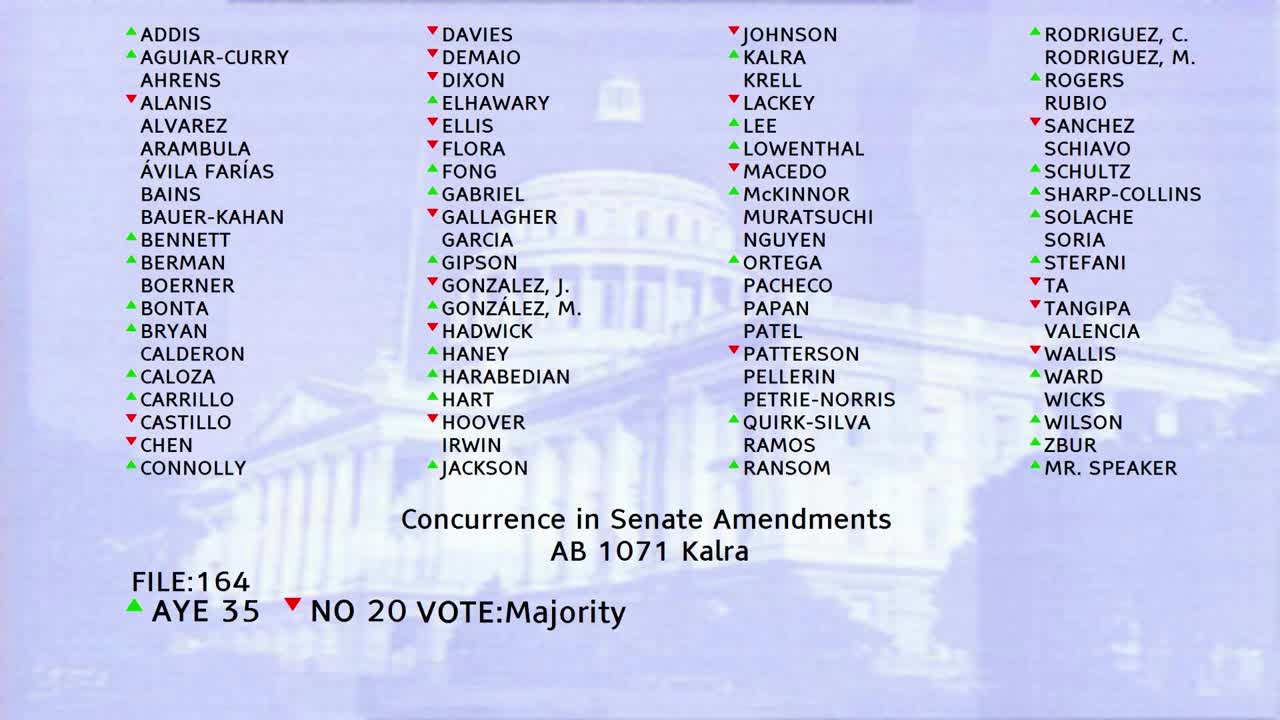 1MIN
Assembly Floor
 9MIN
Senate Standing Committee on Education
Bill Author

Bill Co-Author(s):