SB 683: Privacy: use of a person’s name, voice, signature, photograph, or likeness: injunctive relief.
- Session Year: 2025-2026
- House: Senate
- Latest Version Date: 2025-10-10
Current Status:
Passed
(2025-10-10: Chaptered by Secretary of State. Chapter 590, Statutes of 2025.)
Introduced
In Committee
Awaiting First Chamber Vote
Passed First Chamber
In Committee
Awaiting Second Chamber Vote
Passed Second Chamber
Enacted
Existing law makes any person who knowingly uses anothers name, voice, signature, photograph, or likeness in products, merchandise, or goods, or for purposes of advertising or selling, or soliciting purchases of, products, merchandise, goods, or services, without that persons prior consent liable for damages, as specified.
This bill would provide that a party seeking relief pursuant to those provisions may also seek an injunction or temporary restraining order according to specified procedures. The bill would require the respondent to comply with the order within 2 business days from the day the order is served, unless otherwise required by the order, if the court grants the applicant a temporary restraining order without notice to the opposing party that requires the respondent to remove, recall, or otherwise cease the publication or distribution of the petitioners name, voice, signature, photograph, or likeness. The bill would make other nonsubstantive changes.
This bill would incorporate additional changes to Section 3344 of the Civil Code proposed by SB 11 to be operative only if this bill and SB 11 are enacted and this bill is enacted last.
Existing law makes any person who knowingly uses anothers name, voice, signature, photograph, or likeness in products, merchandise, or goods, or for purposes of advertising or selling, or soliciting purchases of, products, merchandise, goods, or services, without that persons prior consent liable for damages, as specified.
This bill would provide that a party seeking relief pursuant to those provisions may also seek an injunction or temporary restraining order according to specified procedures. The bill would require the respondent to comply with the order within 2 business days from the day the order is served, unless the order requires faster compliance, otherwise required by the order, if the court grants the applicant a temporary restraining order without notice to the opposing party that requires the respondent to remove, recall, or otherwise cease the publication or distribution of the petitioners name, voice, signature, photograph, or likeness.
Existing law makes any person who knowingly uses anothers name, voice, signature, photograph, or likeness in products, merchandise, or goods, or for purposes of advertising or selling, or soliciting purchases of, products, merchandise, goods, or services, without that persons prior consent liable for damages, as specified.
This bill would provide that a party seeking relief pursuant to those provisions may also seek an injunction or temporary restraining order according to specified procedures. The bill would require the respondent to comply with the order within 2 business days from the day the order is served, unless the order requires faster compliance, if the court grants the applicant a temporary restraining order without notice to the opposing party. party that requires the respondent to remove, recall, or otherwise cease the publication or distribution of the petitioners name, voice, signature, photograph, or likeness.
Existing law makes any person who knowingly uses anothers name, voice, signature, photograph, or likeness in products, merchandise, or goods, or for purposes of advertising or selling, or soliciting purchases of, products, merchandise, goods, or services, without that persons prior consent liable for damages, as specified.
This bill would provide that a party seeking relief pursuant to those provisions may also seek an injunction or temporary restraining order according to specified procedures. The bill would require the respondent to comply with the order within 2 business days from the day the order is served, unless the order requires faster compliance, if the court grants the applicant a temporary restraining order without notice to the opposing party.
Existing law provides that marriage is a personal relation arising out of a civil contract between 2 persons. Existing law provides that a subsequent marriage contracted by a person during the life of their former spouse, with a person other than the former spouse, is illegal and void except under specified situations, including that the former marriage has been dissolved or adjudged a nullity before the date of the subsequent marriage.This bill would make technical, nonsubstantive changes to that provision.Existing law provides that marriage is a personal relation arising out of a civil contract between 2 persons. Existing law provides that a subsequent marriage contracted by a person during the life of their former spouse, with a person other than the former spouse, is illegal and void except under specified situations, including that the former marriage has been dissolved or adjudged a nullity before the date of the subsequent marriage.
This bill would make technical, nonsubstantive changes to that provision.
(a)(1)Any person who knowingly uses anothers name, voice, signature, photograph, or likeness, in any manner, on or in products, merchandise, or goods, or for purposes of advertising or selling, or soliciting purchases of, products, merchandise, goods, or services, without that persons prior consent, or, in the case of a minor, the prior consent of their parent or legal guardian, shall be liable for any damages sustained by the person or persons injured as a result thereof. In addition, in any action brought under this section, the person who violated the section shall be liable to the injured party or parties in an amount equal to the greater of seven hundred fifty dollars ($750) or the actual damages suffered by them as a result of the unauthorized use, and any profits from the unauthorized use that are attributable to the use and are not taken into account in computing the actual damages. In establishing these profits, the injured party or parties are required to present proof only of the gross revenue attributable to the unauthorized use, and the person who violated this section is required to prove their deductible expenses. Punitive damages may also be awarded to the injured party or parties. The prevailing party in any action under this section shall also be entitled to attorneys fees and costs.
(2)In addition to the remedies available in paragraph (1), a party may seek an injunction or temporary restraining order pursuant to Section 527 of the Code of Civil Procedure. If the court grants the applicant an order under subdivision (c) of Section 527 of the Code of Civil Procedure that requires the respondent to remove, recall, or otherwise cease the publication or distribution of the petitioners name, voice, signature, photograph, or likeness, the respondent shall complete the removal or recall, or cease the publication or distribution, within two business days from the day the order is served, unless otherwise required by the order.
(b)As used in this section, photograph means any photograph or photographic reproduction, still or moving, or any videotape or live television transmission, of any person, such that the person is readily identifiable.
(1)A person shall be deemed to be readily identifiable from a photograph when one who views the photograph with the naked eye can reasonably determine that the person depicted in the photograph is the same person who is complaining of its unauthorized use.
(2)If the photograph includes more than one person so identifiable, then the person or persons complaining of the use shall be represented as individuals rather than solely as members of a definable group represented in the photograph. A definable group includes, but is not limited to, the following examples: a crowd at any sporting event, a crowd in any street or public building, the audience at any theatrical or stage production, a glee club, or a baseball team.
(3)A person or persons shall be considered to be represented as members of a definable group if they are represented in the photograph solely as a result of being present at the time the photograph was taken and have not been singled out as individuals in any manner.
(c)Where a photograph or likeness of an employee of the person using the photograph or likeness appearing in the advertisement or other publication prepared by or in behalf of the user is only incidental, and not essential, to the purpose of the publication in which it appears, there shall arise a rebuttable presumption affecting the burden of producing evidence that the failure to obtain the consent of the employee was not a knowing use of the employees photograph or likeness.
(d)For purposes of this section, a use of a name, voice, signature, photograph, or likeness in connection with any news, public affairs, or sports broadcast or account, or any political campaign, shall not constitute a use for which consent is required under subdivision (a).
(e)The use of a name, voice, signature, photograph, or likeness in a commercial medium shall not constitute a use for which consent is required under subdivision (a) solely because the material containing the use is commercially sponsored or contains paid advertising. Rather it shall be a question of fact whether or not the use of the persons name, voice, signature, photograph, or likeness was so directly connected with the commercial sponsorship or with the paid advertising as to constitute a use for which consent is required under subdivision (a).
(f)Nothing in this section shall apply to the owners or employees of any medium used for advertising, including, but not limited to, newspapers, magazines, radio and television networks and stations, cable television systems, billboards, and transit ads, by whom any advertisement or solicitation in violation of this section is published or disseminated, unless it is established that those owners or employees had knowledge of the unauthorized use of the persons name, voice, signature, photograph, or likeness as prohibited by this section.
(g)The remedies provided for in this section are cumulative and shall be in addition to any others provided for by law.
SEC. 1.5.Section 3344 of the Civil Code is amended to read:3344.(a)(1)Any person who knowingly uses anothers name, voice, signature, photograph, or likeness, in any manner, on or in products, merchandise, or goods, or for purposes of advertising or selling, or soliciting purchases of, products, merchandise, goods, or services, without that persons prior consent, or, in the case of a minor, the prior consent of their parent or legal guardian, shall be liable for any damages sustained by the person or persons injured as a result thereof. In addition, in any action brought under this section, the person who violated the section shall be liable to the injured party or parties in an amount equal to the greater of seven hundred fifty dollars ($750) or the actual damages suffered by them as a result of the unauthorized use, and any profits from the unauthorized use that are attributable to the use and are not taken into account in computing the actual damages. In establishing these profits, the injured party or parties are required to present proof only of the gross revenue attributable to the unauthorized use, and the person who violated this section is required to prove their deductible expenses. Punitive damages may also be awarded to the injured party or parties. The prevailing party in any action under this section shall also be entitled to attorneys fees and costs.
(2)In addition to the remedies available in paragraph (1), a party may seek an injunction or temporary restraining order pursuant to Section 527 of the Code of Civil Procedure. If the court grants the applicant an order under subdivision (c) of Section 527 of the Code of Civil Procedure that requires the respondent to remove, recall, or otherwise cease the publication or distribution of the petitioners name, voice, signature, photograph, or likeness, the respondent shall complete the removal or recall, or cease the publication or distribution, within two business days from the day the order is served, unless otherwise required by the order.
(b)As used in this section, photograph means any photograph or photographic reproduction, still or moving, or any videotape or live television transmission, of any person, such that the person is readily identifiable.
(1)A person shall be deemed to be readily identifiable from a photograph when one who views the photograph with the naked eye can reasonably determine that the person depicted in the photograph is the same person who is complaining of its unauthorized use.
(2)If the photograph includes more than one person so identifiable, then the person or persons complaining of the use shall be represented as individuals rather than solely as members of a definable group represented in the photograph. A definable group includes, but is not limited to, the following examples: a crowd at any sporting event, a crowd in any street or public building, the audience at any theatrical or stage production, a glee club, or a baseball team.
(3)A person or persons shall be considered to be represented as members of a definable group if they are represented in the photograph solely as a result of being present at the time the photograph was taken and have not been singled out as individuals in any manner.
(c)For purposes of this section, a use of a name, voice, signature, photograph, or likeness in connection with any news, public affairs, or sports broadcast or account, or any political campaign, shall not constitute a use for which consent is required under subdivision (a).
(d)The use of a name, voice, signature, photograph, or likeness in a commercial medium shall not constitute a use for which consent is required under subdivision (a) solely because the material containing the use is commercially sponsored or contains paid advertising. Rather it shall be a question of fact whether or not the use of the persons name, voice, signature, photograph, or likeness was so directly connected with the commercial sponsorship or with the paid advertising as to constitute a use for which consent is required under subdivision (a).
(e)Nothing in this section shall apply to the owners or employees of any medium used for advertising, including, but not limited to, newspapers, magazines, radio and television networks and stations, cable television systems, billboards, and transit ads, by whom any advertisement or solicitation in violation of this section is published or disseminated, unless it is established that those owners or employees had knowledge of the unauthorized use of the persons name, voice, signature, photograph, or likeness as prohibited by this section.
(f)For the purposes of this section, a voice or likeness includes a digital replica, as defined in Section 3344.1.
(g)The remedies provided for in this section are cumulative and shall be in addition to any others provided for by law.
SEC. 2.Section 1.5 of this bill incorporates amendments to Section 3344 of the Civil Code proposed by both this bill and Senate Bill 11. That section of this bill shall only become operative if (1) both bills are enacted and become effective on or before January 1, 2026, (2) each bill amends Section 3344 of the Civil Code, and (3) this bill is enacted after Senate Bill 11, in which case Section 1 of this bill shall not become operative.
(a)(1)Any person who knowingly uses anothers name, voice, signature, photograph, or likeness, in any manner, on or in products, merchandise, or goods, or for purposes of advertising or selling, or soliciting purchases of, products, merchandise, goods, or services, without the that persons prior consent, or, in the case of a minor, the prior consent of their parent or legal guardian, shall be liable for any damages sustained by the person or persons injured as a result thereof. In addition, in any action brought under this section, the person who violated the section shall be liable to the injured party or parties in an amount equal to the greater of seven hundred fifty dollars ($750) or the actual damages suffered by them as a result of the unauthorized use, and any profits from the unauthorized use that are attributable to the use and are not taken into account in computing the actual damages. In establishing the these profits, the injured party or parties are required to present proof only of the gross revenue attributable to the unauthorized use, and the person who violated this section is required to prove their deductible expenses. Punitive damages may also be awarded to the injured party or parties. The prevailing party in any action under this section shall also be entitled to attorneys fees and costs.
(2)In addition to the remedies available in paragraph (1), a party may seek an injunction or temporary restraining order pursuant to Section 527 of the Code of Civil Procedure. If the court grants the applicant an order under subdivision (c) of Section 527 of the Code of Civil Procedure that requires the respondent to remove, recall, or otherwise cease the publication or distribution of the petitioners name, voice, signature, photograph, or likeness, the respondent shall complete the removal or recall, or cease the publication or distribution, within two business days from the day the order is served, unless otherwise required by the order.
(b)As used in this section, photograph means any photograph or photographic reproduction, still or moving, or any videotape or live television transmission, of any person, such that the person is readily identifiable.
(1)A person shall be deemed to be readily identifiable from a photograph when one who views the photograph with the naked eye can reasonably determine that the person depicted in the photograph is the same person who is complaining of its unauthorized use.
(2)If the photograph includes more than one person so identifiable, then the person or persons complaining of the use shall be represented as individuals rather than solely as members of a definable group represented in the photograph. A definable group includes, but is not limited to, the following examples: a crowd at any sporting event, a crowd in any street or public building, the audience at any theatrical or stage production, a glee club, or a baseball team.
(3)A person or persons shall be considered to be represented as members of a definable group if they are represented in the photograph solely as a result of being present at the time the photograph was taken and have not been singled out as individuals in any manner.
(c)Where a photograph or likeness of an employee of the person using the photograph or likeness appearing in the advertisement or other publication prepared by or in behalf of the user is only incidental, and not essential, to the purpose of the publication in which it appears, there shall arise a rebuttable presumption affecting the burden of producing evidence that the failure to obtain the consent of the employee was not a knowing use of the employees photograph or likeness.
(d)For purposes of this section, a use of a name, voice, signature, photograph, or likeness in connection with any news, public affairs, or sports broadcast or account, or any political campaign, shall not constitute a use for which consent is required under subdivision (a).
(e)The use of a name, voice, signature, photograph, or likeness in a commercial medium shall not constitute a use for which consent is required under subdivision (a) solely because the material containing the use is commercially sponsored or contains paid advertising. Rather it shall be a question of fact whether or not the use of the persons name, voice, signature, photograph, or likeness was so directly connected with the commercial sponsorship or with the paid advertising as to constitute a use for which consent is required under subdivision (a).
(f)Nothing in this section shall apply to the owners or employees of any medium used for advertising, including, but not limited to, newspapers, magazines, radio and television networks and stations, cable television systems, billboards, and transit ads, by whom any advertisement or solicitation in violation of this section is published or disseminated, unless it is established that the those owners or employees had knowledge of the unauthorized use of the persons name, voice, signature, photograph, or likeness as prohibited by this section.
(g)The remedies provided for in this section are cumulative and shall be in addition to any others provided for by law.
SEC. 1.5.Section 3344 of the Civil Code is amended to read:3344.(a)(1)Any person who knowingly uses anothers name, voice, signature, photograph, or likeness, in any manner, on or in products, merchandise, or goods, or for purposes of advertising or selling, or soliciting purchases of, products, merchandise, goods goods, or services, without such that persons prior consent, or, in the case of a minor, the prior consent of his their parent or legal guardian, shall be liable for any damages sustained by the person or persons injured as a result thereof. In addition, in any action brought under this section, the person who violated the section shall be liable to the injured party or parties in an amount equal to the greater of seven hundred fifty dollars ($750) or the actual damages suffered by him or her them as a result of the unauthorized use, and any profits from the unauthorized use that are attributable to the use and are not taken into account in computing the actual damages. In establishing such these profits, the injured party or parties are required to present proof only of the gross revenue attributable to such the unauthorized use, and the person who violated this section is required to prove his or her their deductible expenses. Punitive damages may also be awarded to the injured party or parties. The prevailing party in any action under this section shall also be entitled to attorneys fees and costs.
(2)In addition to the remedies available in paragraph (1), a party may seek an injunction or temporary restraining order pursuant to Section 527 of the Code of Civil Procedure. If the court grants the applicant an order under subdivision (c) of Section 527 of the Code of Civil Procedure that requires the respondent to remove, recall, or otherwise cease the publication or distribution of the petitioners name, voice, signature, photograph, or likeness, the respondent shall complete the removal or recall, or cease the publication or distribution, within two business days from the day the order is served, unless otherwise required by the order.
(b)As used in this section, photograph means any photograph or photographic reproduction, still or moving, or any videotape or live television transmission, of any person, such that the person is readily identifiable.
(1)A person shall be deemed to be readily identifiable from a photograph when one who views the photograph with the naked eye can reasonably determine that the person depicted in the photograph is the same person who is complaining of its unauthorized use.
(2)If the photograph includes more than one person so identifiable, then the person or persons complaining of the use shall be represented as individuals rather than solely as members of a definable group represented in the photograph. A definable group includes, but is not limited to, the following examples: a crowd at any sporting event, a crowd in any street or public building, the audience at any theatrical or stage production, a glee club, or a baseball team.
(3)A person or persons shall be considered to be represented as members of a definable group if they are represented in the photograph solely as a result of being present at the time the photograph was taken and have not been singled out as individuals in any manner.
(c)Where a photograph or likeness of an employee of the person using the photograph or likeness appearing in the advertisement or other publication prepared by or in behalf of the user is only incidental, and not essential, to the purpose of the publication in which it appears, there shall arise a rebuttable presumption affecting the burden of producing evidence that the failure to obtain the consent of the employee was not a knowing use of the employees photograph or likeness.(d)(c)For purposes of this section, a use of a name, voice, signature, photograph, or likeness in connection with any news, public affairs, or sports broadcast or account, or any political campaign, shall not constitute a use for which consent is required under subdivision (a).
(e)(d)The use of a name, voice, signature, photograph, or likeness in a commercial medium shall not constitute a use for which consent is required under subdivision (a) solely because the material containing such the use is commercially sponsored or contains paid advertising. Rather it shall be a question of fact whether or not the use of the persons name, voice, signature, photograph, or likeness was so directly connected with the commercial sponsorship or with the paid advertising as to constitute a use for which consent is required under subdivision (a).
(f)(e)Nothing in this section shall apply to the owners or employees of any medium used for advertising, including, but not limited to, newspapers, magazines, radio and television networks and stations, cable television systems, billboards, and transit ads, by whom any advertisement or solicitation in violation of this section is published or disseminated, unless it is established that such those owners or employees had knowledge of the unauthorized use of the persons name, voice, signature, photograph, or likeness as prohibited by this section.
(f)For the purposes of this section, a voice or likeness includes a digital replica, as defined in Section 3344.1.
(g)The remedies provided for in this section are cumulative and shall be in addition to any others provided for by law.
SEC. 2.Section 1.5 of this bill incorporates amendments to Section 3344 of the Civil Code proposed by both this bill and Senate Bill 11. That section of this bill shall only become operative if (1) both bills are enacted and become effective on or before January 1, 2026, (2) each bill amends Section 3344 of the Civil Code, and (3) this bill is enacted after Senate Bill 11, in which case Section 1 of this bill shall not become operative.
(a)(1)Any person who knowingly uses anothers name, voice, signature, photograph, or likeness, in any manner, on or in products, merchandise, or goods, or for purposes of advertising or selling, or soliciting purchases of, products, merchandise, goods goods, or services, without the persons prior consent, or, in the case of a minor, the prior consent of their parent or legal guardian, shall be liable for any damages sustained by the person or persons injured as a result thereof. In addition, in any action brought under this section, the person who violated the section shall be liable to the injured party or parties in an amount equal to the greater of seven hundred fifty dollars ($750) or the actual damages suffered by them as a result of the unauthorized use, and any profits from the unauthorized use that are attributable to the use and are not taken into account in computing the actual damages. In establishing the profits, the injured party or parties are required to present proof only of the gross revenue attributable to the use, and the person who violated this section is required to prove their deductible expenses. Punitive damages may also be awarded to the injured party or parties. The prevailing party in any action under this section shall also be entitled to attorneys fees and costs.
(2)In addition to the remedies available in paragraph (1), a party may seek an injunction or temporary restraining order pursuant to Section 527 of the Code of Civil Procedure. If the court grants the applicant an order under subdivision (c) of Section 527 of the Code of Civil Procedure that requires the respondent to remove, recall, or otherwise cease the publication or distribution of the petitioners name, voice, signature, photograph, or likeness, the respondent shall complete the removal or recall, or cease the publication or distribution, within two business days from the day the order is served, unless the order requires faster compliance. otherwise required by the order.
(b)As used in this section, photograph means any photograph or photographic reproduction, still or moving, or any videotape or live television transmission, of any person, that the person is readily identifiable.
(1)A person shall be deemed to be readily identifiable from a photograph when one who views the photograph with the naked eye can reasonably determine that the person depicted in the photograph is the same person who is complaining of its unauthorized use.
(2)If the photograph includes more than one person so identifiable, then the person or persons complaining of the use shall be represented as individuals rather than solely as members of a definable group represented in the photograph. A definable group includes, but is not limited to, the following examples: a crowd at any sporting event, a crowd in any street or public building, the audience at any theatrical or stage production, a glee club, or a baseball team.
(3)A person or persons shall be considered to be represented as members of a definable group if they are represented in the photograph solely as a result of being present at the time the photograph was taken and have not been singled out as individuals in any manner.
(c)Where a photograph or likeness of an employee of the person using the photograph or likeness appearing in the advertisement or other publication prepared by or in behalf of the user is only incidental, and not essential, to the purpose of the publication in which it appears, there shall arise a rebuttable presumption affecting the burden of producing evidence that the failure to obtain the consent of the employee was not a knowing use of the employees photograph or likeness.
(d)For purposes of this section, a use of a name, voice, signature, photograph, or likeness in connection with any news, public affairs, or sports broadcast or account, or any political campaign, shall not constitute a use for which consent is required under subdivision (a).
(e)The use of a name, voice, signature, photograph, or likeness in a commercial medium shall not constitute a use for which consent is required under subdivision (a) solely because the material containing the use is commercially sponsored or contains paid advertising. Rather it shall be a question of fact whether or not the use of the persons name, voice, signature, photograph, or likeness was so directly connected with the commercial sponsorship or with the paid advertising as to constitute a use for which consent is required under subdivision (a).
(f)Nothing in this section shall apply to the owners or employees of any medium used for advertising, including, but not limited to, newspapers, magazines, radio and television networks and stations, cable television systems, billboards, and transit ads, by whom any advertisement or solicitation in violation of this section is published or disseminated, unless it is established that the owners or employees had knowledge of the unauthorized use of the persons name, voice, signature, photograph, or likeness as prohibited by this section.
(g)The remedies provided for in this section are cumulative and shall be in addition to any others provided for by law.
(a)(1)Any person who knowingly uses anothers name, voice, signature, photograph, or likeness, in any manner, on or in products, merchandise, or goods, or for purposes of advertising or selling, or soliciting purchases of, products, merchandise, goods or services, without the persons prior consent, or, in the case of a minor, the prior consent of their parent or legal guardian, shall be liable for any damages sustained by the person or persons injured as a result thereof. In addition, in any action brought under this section, the person who violated the section shall be liable to the injured party or parties in an amount equal to the greater of seven hundred fifty dollars ($750) or the actual damages suffered by them as a result of the unauthorized use, and any profits from the unauthorized use that are attributable to the use and are not taken into account in computing the actual damages. In establishing the profits, the injured party or parties are required to present proof only of the gross revenue attributable to the use, and the person who violated this section is required to prove their deductible expenses. Punitive damages may also be awarded to the injured party or parties. The prevailing party in any action under this section shall also be entitled to attorneys fees and costs.
(2)In addition to the remedies available in paragraph (1), a party may seek an injunction or temporary restraining order pursuant to Section 527 of the Code of Civil Procedure. If the court grants the applicant an order under subdivision (c) of Section 527 of the Code of Civil Procedure, Procedure that requires the respondent to remove, recall, or otherwise cease the publication or distribution of the petitioners name, voice, signature, photograph, or likeness, the respondent shall comply with the order complete the removal or recall, or cease the publication or distribution, within two business days from the day the order is served, unless the order requires faster compliance.
(b)As used in this section, photograph means any photograph or photographic reproduction, still or moving, or any videotape or live television transmission, of any person, that the person is readily identifiable.
(1)A person shall be deemed to be readily identifiable from a photograph when one who views the photograph with the naked eye can reasonably determine that the person depicted in the photograph is the same person who is complaining of its unauthorized use.
(2)If the photograph includes more than one person so identifiable, then the person or persons complaining of the use shall be represented as individuals rather than solely as members of a definable group represented in the photograph. A definable group includes, but is not limited to, the following examples: a crowd at any sporting event, a crowd in any street or public building, the audience at any theatrical or stage production, a glee club, or a baseball team.
(3)A person or persons shall be considered to be represented as members of a definable group if they are represented in the photograph solely as a result of being present at the time the photograph was taken and have not been singled out as individuals in any manner.
(c)Where a photograph or likeness of an employee of the person using the photograph or likeness appearing in the advertisement or other publication prepared by or in behalf of the user is only incidental, and not essential, to the purpose of the publication in which it appears, there shall arise a rebuttable presumption affecting the burden of producing evidence that the failure to obtain the consent of the employee was not a knowing use of the employees photograph or likeness.
(d)For purposes of this section, a use of a name, voice, signature, photograph, or likeness in connection with any news, public affairs, or sports broadcast or account, or any political campaign, shall not constitute a use for which consent is required under subdivision (a).
(e)The use of a name, voice, signature, photograph, or likeness in a commercial medium shall not constitute a use for which consent is required under subdivision (a) solely because the material containing the use is commercially sponsored or contains paid advertising. Rather it shall be a question of fact whether or not the use of the persons name, voice, signature, photograph, or likeness was so directly connected with the commercial sponsorship or with the paid advertising as to constitute a use for which consent is required under subdivision (a).
(f)Nothing in this section shall apply to the owners or employees of any medium used for advertising, including, but not limited to, newspapers, magazines, radio and television networks and stations, cable television systems, billboards, and transit ads, by whom any advertisement or solicitation in violation of this section is published or disseminated, unless it is established that the owners or employees had knowledge of the unauthorized use of the persons name, voice, signature, photograph, or likeness as prohibited by this section.
(g)The remedies provided for in this section are cumulative and shall be in addition to any others provided for by law.
(a)(1)Any person who knowingly uses anothers name, voice, signature, photograph, or likeness, in any manner, on or in products, merchandise, or goods, or for purposes of advertising or selling, or soliciting purchases of, products, merchandise, goods or services, without such the persons prior consent, or, in the case of a minor, the prior consent of his their parent or legal guardian, shall be liable for any damages sustained by the person or persons injured as a result thereof. In addition, in any action brought under this section, the person who violated the section shall be liable to the injured party or parties in an amount equal to the greater of seven hundred fifty dollars ($750) or the actual damages suffered by him or her them as a result of the unauthorized use, and any profits from the unauthorized use that are attributable to the use and are not taken into account in computing the actual damages. In establishing such the profits, the injured party or parties are required to present proof only of the gross revenue attributable to such the use, and the person who violated this section is required to prove his or her their deductible expenses. Punitive damages may also be awarded to the injured party or parties. The prevailing party in any action under this section shall also be entitled to attorneys fees and costs.
(2)In addition to the remedies available in paragraph (1), a party may seek an injunction or temporary restraining order pursuant to Section 527 of the Code of Civil Procedure. If the court grants the applicant an order under subdivision (c) of Section 527 of the Code of Civil Procedure, the respondent shall comply with the order within two business days from the day the order is served, unless the order requires faster compliance.
(b)As used in this section, photograph means any photograph or photographic reproduction, still or moving, or any videotape or live television transmission, of any person, such that the person is readily identifiable.
(1)A person shall be deemed to be readily identifiable from a photograph when one who views the photograph with the naked eye can reasonably determine that the person depicted in the photograph is the same person who is complaining of its unauthorized use.
(2)If the photograph includes more than one person so identifiable, then the person or persons complaining of the use shall be represented as individuals rather than solely as members of a definable group represented in the photograph. A definable group includes, but is not limited to, the following examples: a crowd at any sporting event, a crowd in any street or public building, the audience at any theatrical or stage production, a glee club, or a baseball team.
(3)A person or persons shall be considered to be represented as members of a definable group if they are represented in the photograph solely as a result of being present at the time the photograph was taken and have not been singled out as individuals in any manner.
(c)Where a photograph or likeness of an employee of the person using the photograph or likeness appearing in the advertisement or other publication prepared by or in behalf of the user is only incidental, and not essential, to the purpose of the publication in which it appears, there shall arise a rebuttable presumption affecting the burden of producing evidence that the failure to obtain the consent of the employee was not a knowing use of the employees photograph or likeness.
(d)For purposes of this section, a use of a name, voice, signature, photograph, or likeness in connection with any news, public affairs, or sports broadcast or account, or any political campaign, shall not constitute a use for which consent is required under subdivision (a).
(e)The use of a name, voice, signature, photograph, or likeness in a commercial medium shall not constitute a use for which consent is required under subdivision (a) solely because the material containing such the use is commercially sponsored or contains paid advertising. Rather it shall be a question of fact whether or not the use of the persons name, voice, signature, photograph, or likeness was so directly connected with the commercial sponsorship or with the paid advertising as to constitute a use for which consent is required under subdivision (a).
(f)Nothing in this section shall apply to the owners or employees of any medium used for advertising, including, but not limited to, newspapers, magazines, radio and television networks and stations, cable television systems, billboards, and transit ads, by whom any advertisement or solicitation in violation of this section is published or disseminated, unless it is established that such the owners or employees had knowledge of the unauthorized use of the persons name, voice, signature, photograph, or likeness as prohibited by this section.
(g)The remedies provided for in this section are cumulative and shall be in addition to any others provided for by law.
SECTION 1.Section 2201 of the Family Code is amended to read:2201.(a)A subsequent marriage contracted by a person during the life of their former spouse, with a person other than the former spouse, is illegal and void, unless:(1)The former marriage has been dissolved or adjudged a nullity before the date of the subsequent marriage.(2)The former spouse is either of the following:(A)Absent, and not known to the person to be living for the period of five successive years immediately preceding the subsequent marriage.(B)Generally reputed or believed by the person to be dead at the time the subsequent marriage was contracted.(b)In either of the cases described in paragraph (2) of subdivision (a), the subsequent marriage is valid until its nullity is adjudged pursuant to subdivision (b) of Section 2210.(a)A subsequent marriage contracted by a person during the life of his or her their former spouse, with a person other than the former spouse, is illegal and void, unless:
(1)The former marriage has been dissolved or adjudged a nullity before the date of the subsequent marriage.
(2)The former spouse (A) is absent, is either of the following:
(A)Absent, and not known to the person to be living for the period of five successive years immediately preceding the subsequent marriage, or (B) is generally marriage.
(B)Generally reputed or believed by the person to be dead at the time the subsequent marriage was contracted.
(b)In either of the cases described in paragraph (2) of subdivision (a), the subsequent marriage is valid until its nullity is adjudged pursuant to subdivision (b) of Section 2210.
|
Date
|
Status
|
|---|---|
| Oct 10, 2025 | Chaptered by Secretary of State. Chapter 590, Statutes of 2025. |
| Oct 10, 2025 | Approved by the Governor. |
| Sep 22, 2025 | Enrolled and presented to the Governor at 2 p.m. |
| Sep 11, 2025 | Assembly amendments concurred in. (Ayes 39. Noes 0. Page 2883.) Ordered to engrossing and enrolling. |
| Sep 10, 2025 | In Senate. Concurrence in Assembly amendments pending. |
| Sep 10, 2025 | Read third time. Passed. (Ayes 76. Noes 0. Page 3166.) Ordered to the Senate. |
| Sep 3, 2025 | Read third time and amended. |
| Sep 3, 2025 | Ordered to third reading. |
| Jul 3, 2025 | Read second time. Ordered to third reading. |
| Jul 2, 2025 | From committee: Do pass. (Ayes 14. Noes 0.) (July 2). |
| Jun 25, 2025 | From committee: Do pass and re-refer to Com. on APPR. (Ayes 14. Noes 0.) (June 24). Re-referred to Com. on APPR. |
| Jun 18, 2025 | Read second time and amended. Re-referred to Com. on P. & C.P. |
| Jun 17, 2025 | From committee: Do pass as amended and re-refer to Com. on P. & C.P. (Ayes 11. Noes 0.) (June 17). |
| Jun 5, 2025 | Referred to Coms. on JUD., P. & C.P., and APPR. |
| May 28, 2025 | In Assembly. Read first time. Held at Desk. |
| May 28, 2025 | Read third time. Passed. (Ayes 38. Noes 0. Page 1293.) Ordered to the Assembly. |
| May 23, 2025 | Read second time. Ordered to third reading. |
| May 23, 2025 | From committee: Do pass. (Ayes 6. Noes 0. Page 1209.) (May 23). |
| May 16, 2025 | Set for hearing May 23. |
| Apr 28, 2025 | April 28 hearing: Placed on APPR. suspense file. |
| Apr 17, 2025 | Set for hearing April 28. |
| Apr 10, 2025 | Read second time and amended. Re-referred to Com. on APPR. |
| Apr 9, 2025 | From committee: Do pass as amended and re-refer to Com. on APPR. (Ayes 13. Noes 0. Page 706.) (April 8). |
| Apr 3, 2025 | Set for hearing April 8. |
| Apr 2, 2025 | Re-referred to Coms. on JUD. and APPR. |
| Mar 25, 2025 | From committee with author's amendments. Read second time and amended. Re-referred to Com. on RLS. |
| Mar 5, 2025 | Referred to Com. on RLS. |
| Feb 24, 2025 | Read first time. |
| Feb 24, 2025 | From printer. May be acted upon on or after March 24. |
| Feb 21, 2025 | Introduced. To Com. on RLS. for assignment. To print. |
|
Date
|
Description
|
Location
|
Votes
|
|
|---|---|---|---|---|
| Sep 11, 2025 | Unfinished Business SB683 Cortese Concurrence | Senate Floor |
Passed |
|
| Sep 10, 2025 | SB 683 Cortese Senate Third Reading By Bauer-Kahan | Assembly Floor |
Passed |
|
| Jul 2, 2025 | Do pass. | Assembly Standing Committee on Appropriations |
Passed |
|
| Jun 24, 2025 | Do pass and be re-referred to the Committee on [Appropriations] | Assembly Standing Committee on Privacy and Consumer Protection |
Passed |
|
| Jun 17, 2025 | Do pass as amended and be re-referred to the Committee on [Privacy and Consumer Protection] | Assembly Standing Committee on Judiciary |
Passed |
|
| May 28, 2025 | Senate 3rd Reading SB683 Cortese | Senate Floor |
Passed |
|
| May 23, 2025 | Do pass | Senate Standing Committee on Appropriations |
Passed |
|
| Apr 28, 2025 | Placed on suspense file | Senate Standing Committee on Appropriations |
Passed |
|
| Apr 8, 2025 | Do pass as amended, but first amend, and re-refer to the Committee on [Appropriations] | Senate Standing Committee on Judiciary |
Passed |
This list shows positions taken on this bill by organizations on the date displayed, which is linked to the original source.
Positions by individuals are not included.
|
Organization
|
Position
|
Date
|
|---|---|---|
| Alum Rock Counseling Center | ** Support | |
| Asian Americans for Community Involvement | ** Support | |
| Asian Law Alliance | ** Support | |
| California Federation of Labor Unions, Afl-cio | ** Support | |
| California Iatse Council | ** Support | |
| California Partnership To End Domestic Violence | ** Support | |
| Family Violence Law Center | ** Support | |
| First Amendment Coalition | ** Against | |
| Motion Picture Association, Inc. | ** Against | |
| Motion Picture Association, Inc. | ** Against | |
| National College Players Association | ** Support | |
| Recording Industry Association Of America | ** Against | |
| SAG-AFTRA | ** Support | |
| Somos Mayfair | ** Support | |
| Valorus | ** Support |
SENATE RULES COMMITTEE Office of Senate Floor Analyses (916) 651-1520 Fax: (916) 327-4478 | SB 683 |
UNFINISHED BUSINESS
Bill No: SB 683
Author: Cortese (D)
Amended: 10/10/25
Vote: 21
SENATE JUDICIARY COMMITTEE: 13-0, 4/8/25
AYES: Umberg, Niello, Allen, Arreguín, Ashby, Caballero, Durazo, Laird, Stern, Valladares, Wahab, Weber Pierson, Wiener
SENATE APPROPRIATIONS COMMITTEE: 6-0, 5/23/25
AYES: Caballero, Seyarto, Cabaldon, Grayson, Richardson, Wahab
NO VOTE RECORDED: Dahle
SENATE FLOOR: 38-0, 5/28/25
AYES: Allen, Alvarado-Gil, Archuleta, Arreguín, Ashby, Becker, Blakespear, Cabaldon, Caballero, Cervantes, Choi, Cortese, Dahle, Durazo, Gonzalez, Grayson, Grove, Hurtado, Jones, Laird, McGuire, McNerney, Menjivar, Niello, Ochoa Bogh, Padilla, Pérez, Richardson, Rubio, Seyarto, Smallwood-Cuevas, Stern, Strickland, Umberg, Valladares, Wahab, Weber Pierson, Wiener
NO VOTE RECORDED: Limón, Reyes
ASSEMBLY FLOOR: 76-0, 9/10/25 - See last page for vote
SUBJECT: Privacy: use of a person’s name, voice, signature, photograph, or likeness: injunctive relief
SOURCE: Author
DIGEST:
This bill clarifies that a plaintiff in a right of publicity lawsuit may seek injunctive relief prior to the entry of judgment, and sets forth the timeframe for a defendant to comply with a temporary restraining order entered in such a case.
Assembly Amendments
of 9/3/25 add nonsubstantive clarifying language and chaptering-out language to avoid a conflict with SB 11 (Ashby, 2025).
ANALYSIS:
Existing law:
- Provides that any person who knowingly uses another’s name, voice, signature, photograph, or likeness, in any manner, on or in products, merchandise, or goods, or for purposes of advertising or selling, or soliciting purchases of, products, merchandise, goods, or services, without that person’s prior consent, or in the case of a minor, the prior consent of their parent or guardian, shall be liable for:
- Any damages sustained by the person or persons injured as a result of the unauthorized use or $750, whichever is greater.
- Any profits from the unauthorized use that are attributable to the use and not taken into account in computing the actual damages; in estimating such profits, the injured party must present proof only of the gross revenue attributable to the use, and the violator must prove their deductible expenses.
- Punitive damages, if awarded under existing punitive damages laws. (Civil (Civ.) Code, § 3344(a).)
- Provides that the prevailing party in an action under 1) shall be entitled to reasonable attorney’s fees and costs. (Civ. Code, § 3344(a).)
- Provides that the remedies in 1) and 2) are cumulative and in addition to any others provided for by law. (Civ. Code, § 3344(g).)
- Provides that a person shall be deemed to be readily identifiable from a photograph when one who views the photograph with the naked eye can reasonably determine that the person depicted in the photograph is the same person who is complaining of its unauthorized use; however, persons photographed as part of a definable group—such as in a crowd at a sporting event or in the audience at a theater—who are in the photograph solely as a result of being present at the time the photograph was taken do not have a claim under 1). (Civ. Code, § 3344(b).)
- Provides that, where a photograph or likeness of an employee of the person using the photograph or likeness appearing in the advertisement prepared by or on behalf of the user is only incidental, and not essential, to the purpose of the publication in which it appears, there is a rebuttable presumption affecting the burden of production that the failure to obtain the consent of the employee was not a knowing use of the employee’s likeness. (Civ. Code, § 3344(c).)
- Provides that the use of a name, voice, signature, photograph, or likeness in connection with any news, public affairs, or sports broadcast or account, or any political campaign, shall not constitute a use for which consent is required under 1). (Civ. Code, § 3344(d).)
- Provides that the use of a name, voice, signature, photograph, or likeness in a commercial medium shall not constitute a use for which consent is required under 1) solely because the material containing the use is commercially sponsored or contains paid advertising; rather, the question is whether the use of the person’s name, voice, signature, photograph, or likeness is so directly connected with the commercial sponsorship or with the paid advertising as to constitute a use for which consent is required under 1). (Civ. Code, § 3344(e).)
- Provides that nothing in 1)-5) applies to the owners or employees of any medium used for advertising, including, but not limited to, newspapers, magazines, radio and television networks and stations, cable television systems, billboards, and transit ads, by whom any advertisement or solicitation in violation of 1) is published or disseminated, unless it is established that such owners or employees had knowledge of the unauthorized use. (Civ. Code, § 3344(f).)
- Provides that a court may grant a preliminary injunction in a civil action at any time before judgment upon a verified complaint, or upon affidavits, if the complaint or affidavits establish sufficient grounds for the injunction and notice is provided to the opposing party. (Code Civ. Proc., § 527(a).)
- Provides that a court can grant a temporary restraining order (TRO) in a civil action at any time before judgment, without notice to the opposing party, if the following requirements are satisfied:
- It appears from the facts shown by the affidavit or complaint that great or irreparable injury will result to the applicant before the matter can be heard on notice.
- The applicant or their attorney certifies to the court under oath one of the following: (1) that within a reasonable time prior to the application, the applicant informed the opposing party or their attorney at what time and where the application would be made; (2) that the applicant attempted in good faith, but was unable to, inform the opposing party and their attorney, specifying the efforts made to contact them; or (3) for reasons specified, the applicant should not be required to inform the opposing party or their attorney of the pending application. (Code Civ. Proc., § 527(c).)
- Provides that, if a TRO is granted under 9):
- The matter shall be made returnable on an order requiring cause to be shown why a preliminary injunction should not be granted, on the earliest day possible for the court, but not later than 15 days or, with a showing of good cause, 22 days from the date the TRO is issued.
- The party who obtained the TRO shall serve specified documents on the opposing party, within five days from the date the TRO was issued or two days prior to the hearing on the order to show cause, whichever is earlier; the court may, for good cause, shorten the time required for service.
- When the matter first comes up for the hearing, if the party who obtained the TRO is not ready to proceed, or if the party has failed to serve the opposing party as required under 11)(b), the court shall dissolve the TRO.
- The opposing party is entitled to one continuance of not less than 15 days or any shorter period requested by the opposing party; if the opposing party obtains the continuance, the TRO shall remain in effect until the date of the continued hearing.
- If the applicant files an affidavit stating that the opposing party could not be served within the time required, the court may reissue the TRO; the time periods for the hearing on the order to show cause will run from the reissued TRO. (Code Civ. Proc., § 527(d).)
This bill:
- Clarifies that in an action for the knowing use of another’s name, voice, signature, photograph, or likeness for commercial use without consent, a party may seek a preliminary injunction or TRO pursuant to section 527 of the Code of Civil Procedure.
- Specifies that, if a party obtains a TRO pursuant to 1), the respondent shall comply with the order within two business days from the day the order is served, unless otherwise required by the order.
- Makes nonsubstantive clarifying changes.
- Includes double-jointing language to take effect if both this bill and SB 11 (Asbhy, 2025) are enacted and become effective on or before January 1, 2026.
Comments
Current law establishes a right to control one’s own name, voice, signature, image, and likeness for commercial purposes. A person whose name, voice, signature, image, or likeness was used in connection with a product or advertisement without their consent can file a civil action against the person who used the image and receive actual or statutory damages, disgorgement of profits from the wrongful use, and potentially punitive damages.
This bill clarifies that a party to a suit for nonconsensual use of one’s name, voice, signature, image, or likeness for commercial purposes can also obtain an injunction or temporary restraining order under existing procedures, and provides that, if a temporary restraining order is issued, the subject of the order must complete the removal or take-down of the material within two business days from the date of service of the order, unless the court specifically orders a different compliance timeline.
FISCAL EFFECT: Appropriation: No Fiscal Com.: No Local: No
According to the Assembly Appropriations Committee, this bill presents “[n]o significant state costs.”
SUPPORT: (Verified 9/9/25)
Alum Rock Counseling Center
Asian Americans for Community Involvement
Asian Law Alliance
California Federation of Labor Unions, AFL-CIO
California IATSE Council
California Partnership to End Domestic Violence
Family Violence Law Center
National College Players Association
SAG-AFTRA
SOMOS Mayfair
ValorUS
OPPOSITION: (Verified 9/9/25)
First Amendment Coalition
Motion Picture Association, Inc.
Recording Industry Association of America
ARGUMENTS IN SUPPORT: According to the National College Players Association:
Over the last decade, there has been a substantial amount of case law outlining the rights and responsibilities of platforms, users, digital and print media in an increasingly interconnected world. Platforms can be held accountable under state law for specific violations, including negligence in removing identified illegal material.
Despite existing remedies allowing courts to award damages and order removal, legal proceedings can take years to be resolved, leaving affected parties exposed to indefinite harm. SB 683 provides a path for affected individuals to file a temporary restraining order or preliminary injunctive relief to have nonconsensual, harmful use of image or likeness provisionally removed from circulation.
Victims deserve mitigation immediately, not after paid legal fees and claims have been filed in court. Establishing a right to a two day take down pending final adjudication will protect individuals and allow the court time to determine whether or not the content is constitutionally sound.
ARGUMENTS IN OPPOSITION: According to the Recording Industry Association of America:
In its current form, SB 683 would establish two business days as the statutory default for compliance with a court-ordered TRO. The amendment adopted in Assembly Judiciary Committee provides courts the flexibility to specify faster – or slower – compliance, but the two business day standard would inevitably result in delays in compliance where the recipient of a TRO today would be expected to act immediately upon receipt of the order. Artists are often subject to abusive misappropriation of their likeness, the harms of which can increase exponentially the longer the misappropriation is made available to the public. A two-business day default standard for compliance is simply too long and does not reflect the urgency of remediation or the existing capacity for action to be taken with much greater haste. Taken to its extreme, the two business day standard can expand to permit inaction for up to a five calendar day period after issuance of a court order, when removal could otherwise be effectuated within minutes.
ASSEMBLY FLOOR: 76-0, 9/10/25
AYES: Addis, Aguiar-Curry, Ahrens, Alanis, Alvarez, Arambula, Ávila Farías, Bains, Bauer-Kahan, Bennett, Berman, Boerner, Bonta, Bryan, Calderon, Carrillo, Castillo, Chen, Connolly, Davies, DeMaio, Dixon, Elhawary, Ellis, Flora, Fong, Gabriel, Gallagher, Garcia, Gipson, Jeff Gonzalez, Hadwick, Haney, Harabedian, Hart, Hoover, Jackson, Johnson, Kalra, Krell, Lackey, Lee, Lowenthal, Macedo, McKinnor, Muratsuchi, Nguyen, Ortega, Pacheco, Papan, Patel, Patterson, Pellerin, Petrie-Norris, Quirk-Silva, Ramos, Ransom, Celeste Rodriguez, Michelle Rodriguez, Rogers, Blanca Rubio, Sanchez, Schiavo, Schultz, Sharp-Collins, Solache, Soria, Stefani, Ta, Valencia, Wallis, Ward, Wicks, Wilson, Zbur, Rivas
NO VOTE RECORDED: Caloza, Mark González, Irwin, Tangipa
Prepared by: Allison Whitt Meredith / JUD. / (916) 651-4113
7/17/26 11:28:17
**** END ****
SENATE RULES COMMITTEE Office of Senate Floor Analyses (916) 651-1520 Fax: (916) 327-4478 | SB 683 |
UNFINISHED BUSINESS
Bill No: SB 683
Author: Cortese (D)
Amended: 9/3/25
Vote: 21
SENATE JUDICIARY COMMITTEE: 13-0, 4/8/25
AYES: Umberg, Niello, Allen, Arreguín, Ashby, Caballero, Durazo, Laird, Stern, Valladares, Wahab, Weber Pierson, Wiener
SENATE APPROPRIATIONS COMMITTEE: 6-0, 5/23/25
AYES: Caballero, Seyarto, Cabaldon, Grayson, Richardson, Wahab
NO VOTE RECORDED: Dahle
SENATE FLOOR: 38-0, 5/28/25
AYES: Allen, Alvarado-Gil, Archuleta, Arreguín, Ashby, Becker, Blakespear, Cabaldon, Caballero, Cervantes, Choi, Cortese, Dahle, Durazo, Gonzalez, Grayson, Grove, Hurtado, Jones, Laird, McGuire, McNerney, Menjivar, Niello, Ochoa Bogh, Padilla, Pérez, Richardson, Rubio, Seyarto, Smallwood-Cuevas, Stern, Strickland, Umberg, Valladares, Wahab, Weber Pierson, Wiener
NO VOTE RECORDED: Limón, Reyes
ASSEMBLY FLOOR: 63-0, 9/10/25 – Roll call not available.
SUBJECT: Privacy: use of a person’s name, voice, signature, photograph, or likeness: injunctive relief
SOURCE: Author
DIGEST:
This bill clarifies that a plaintiff in a right of publicity lawsuit may seek injunctive relief prior to the entry of judgment, and sets forth the timeframe for a defendant to comply with a temporary restraining order entered in such a case.
Assembly Amendments
of 9/3/25 add nonsubstantive clarifying language and chaptering-out language to avoid a conflict with SB 11 (Ashby, 2025).
ANALYSIS:
Existing law:
- Provides that any person who knowingly uses another’s name, voice, signature, photograph, or likeness, in any manner, on or in products, merchandise, or goods, or for purposes of advertising or selling, or soliciting purchases of, products, merchandise, goods, or services, without that person’s prior consent, or in the case of a minor, the prior consent of their parent or guardian, shall be liable for:
- Any damages sustained by the person or persons injured as a result of the unauthorized use or $750, whichever is greater.
- Any profits from the unauthorized use that are attributable to the use and not taken into account in computing the actual damages; in estimating such profits, the injured party must present proof only of the gross revenue attributable to the use, and the violator must prove their deductible expenses.
- Punitive damages, if awarded under existing punitive damages laws. (Civil (Civ.) Code, § 3344(a).)
- Provides that the prevailing party in an action under 1) shall be entitled to reasonable attorney’s fees and costs. (Civ. Code, § 3344(a).)
- Provides that the remedies in 1) and 2) are cumulative and in addition to any others provided for by law. (Civ. Code, § 3344(g).)
- Provides that a person shall be deemed to be readily identifiable from a photograph when one who views the photograph with the naked eye can reasonably determine that the person depicted in the photograph is the same person who is complaining of its unauthorized use; however, persons photographed as part of a definable group—such as in a crowd at a sporting event or in the audience at a theater—who are in the photograph solely as a result of being present at the time the photograph was taken do not have a claim under 1). (Civ. Code, § 3344(b).)
- Provides that, where a photograph or likeness of an employee of the person using the photograph or likeness appearing in the advertisement prepared by or on behalf of the user is only incidental, and not essential, to the purpose of the publication in which it appears, there is a rebuttable presumption affecting the burden of production that the failure to obtain the consent of the employee was not a knowing use of the employee’s likeness. (Civ. Code, § 3344(c).)
- Provides that the use of a name, voice, signature, photograph, or likeness in connection with any news, public affairs, or sports broadcast or account, or any political campaign, shall not constitute a use for which consent is required under 1). (Civ. Code, § 3344(d).)
- Provides that the use of a name, voice, signature, photograph, or likeness in a commercial medium shall not constitute a use for which consent is required under 1) solely because the material containing the use is commercially sponsored or contains paid advertising; rather, the question is whether the use of the person’s name, voice, signature, photograph, or likeness is so directly connected with the commercial sponsorship or with the paid advertising as to constitute a use for which consent is required under 1). (Civ. Code, § 3344(e).)
- Provides that nothing in 1)-5) applies to the owners or employees of any medium used for advertising, including, but not limited to, newspapers, magazines, radio and television networks and stations, cable television systems, billboards, and transit ads, by whom any advertisement or solicitation in violation of 1) is published or disseminated, unless it is established that such owners or employees had knowledge of the unauthorized use. (Civ. Code, § 3344(f).)
- Provides that a court may grant a preliminary injunction in a civil action at any time before judgment upon a verified complaint, or upon affidavits, if the complaint or affidavits establish sufficient grounds for the injunction and notice is provided to the opposing party. (Code Civ. Proc., § 527(a).)
- Provides that a court can grant a temporary restraining order (TRO) in a civil action at any time before judgment, without notice to the opposing party, if the following requirements are satisfied:
- It appears from the facts shown by the affidavit or complaint that great or irreparable injury will result to the applicant before the matter can be heard on notice.
- The applicant or their attorney certifies to the court under oath one of the following: (1) that within a reasonable time prior to the application, the applicant informed the opposing party or their attorney at what time and where the application would be made; (2) that the applicant attempted in good faith, but was unable to, inform the opposing party and their attorney, specifying the efforts made to contact them; or (3) for reasons specified, the applicant should not be required to inform the opposing party or their attorney of the pending application. (Code Civ. Proc., § 527(c).)
- Provides that, if a TRO is granted under 9):
- The matter shall be made returnable on an order requiring cause to be shown why a preliminary injunction should not be granted, on the earliest day possible for the court, but not later than 15 days or, with a showing of good cause, 22 days from the date the TRO is issued.
- The party who obtained the TRO shall serve specified documents on the opposing party, within five days from the date the TRO was issued or two days prior to the hearing on the order to show cause, whichever is earlier; the court may, for good cause, shorten the time required for service.
- When the matter first comes up for the hearing, if the party who obtained the TRO is not ready to proceed, or if the party has failed to serve the opposing party as required under 11)(b), the court shall dissolve the TRO.
- The opposing party is entitled to one continuance of not less than 15 days or any shorter period requested by the opposing party; if the opposing party obtains the continuance, the TRO shall remain in effect until the date of the continued hearing.
- If the applicant files an affidavit stating that the opposing party could not be served within the time required, the court may reissue the TRO; the time periods for the hearing on the order to show cause will run from the reissued TRO. (Code Civ. Proc., § 527(d).)
This bill:
- Clarifies that in an action for the knowing use of another’s name, voice, signature, photograph, or likeness for commercial use without consent, a party may seek a preliminary injunction or TRO pursuant to section 527 of the Code of Civil Procedure.
- Specifies that, if a party obtains a TRO pursuant to 1), the respondent shall comply with the order within two business days from the day the order is served, unless otherwise required by the order.
- Makes nonsubstantive clarifying changes.
- Includes double-jointing language to take effect if both this bill and SB 11 (Asbhy, 2025) are enacted and become effective on or before January 1, 2026.
Comments
Current law establishes a right to control one’s own name, voice, signature, image, and likeness for commercial purposes. A person whose name, voice, signature, image, or likeness was used in connection with a product or advertisement without their consent can file a civil action against the person who used the image and receive actual or statutory damages, disgorgement of profits from the wrongful use, and potentially punitive damages.
This bill clarifies that a party to a suit for nonconsensual use of one’s name, voice, signature, image, or likeness for commercial purposes can also obtain an injunction or temporary restraining order under existing procedures, and provides that, if a temporary restraining order is issued, the subject of the order must complete the removal or take-down of the material within two business days from the date of service of the order, unless the court specifically orders a different compliance timeline.
FISCAL EFFECT: Appropriation: No Fiscal Com.: No Local: No
According to the Assembly Appropriations Committee, this bill presents “[n]o significant state costs.”
SUPPORT: (Verified 9/9/25)
Alum Rock Counseling Center
Asian Americans for Community Involvement
Asian Law Alliance
California Federation of Labor Unions, AFL-CIO
California IATSE Council
California Partnership to End Domestic Violence
Family Violence Law Center
National College Players Association
SAG-AFTRA
SOMOS Mayfair
ValorUS
OPPOSITION: (Verified 9/9/25)
First Amendment Coalition
Motion Picture Association, Inc.
Recording Industry Association of America
ARGUMENTS IN SUPPORT: According to the National College Players Association:
Over the last decade, there has been a substantial amount of case law outlining the rights and responsibilities of platforms, users, digital and print media in an increasingly interconnected world. Platforms can be held accountable under state law for specific violations, including negligence in removing identified illegal material.
Despite existing remedies allowing courts to award damages and order removal, legal proceedings can take years to be resolved, leaving affected parties exposed to indefinite harm. SB 683 provides a path for affected individuals to file a temporary restraining order or preliminary injunctive relief to have nonconsensual, harmful use of image or likeness provisionally removed from circulation.
Victims deserve mitigation immediately, not after paid legal fees and claims have been filed in court. Establishing a right to a two day take down pending final adjudication will protect individuals and allow the court time to determine whether or not the content is constitutionally sound.
ARGUMENTS IN OPPOSITION: According to the Recording Industry Association of America:
In its current form, SB 683 would establish two business days as the statutory default for compliance with a court-ordered TRO. The amendment adopted in Assembly Judiciary Committee provides courts the flexibility to specify faster – or slower – compliance, but the two business day standard would inevitably result in delays in compliance where the recipient of a TRO today would be expected to act immediately upon receipt of the order. Artists are often subject to abusive misappropriation of their likeness, the harms of which can increase exponentially the longer the misappropriation is made available to the public. A two-business day default standard for compliance is simply too long and does not reflect the urgency of remediation or the existing capacity for action to be taken with much greater haste. Taken to its extreme, the two business day standard can expand to permit inaction for up to a five calendar day period after issuance of a court order, when removal could otherwise be effectuated within minutes.
Prepared by: Allison Whitt Meredith / JUD. / (916) 651-4113
9/10/25 14:48:52
**** END ****
SENATE THIRD READING
STR Bill Id:SB 683
Author:(Cortese)
As Amended Ver:September 3, 2025
Majority vote
SUMMARY
Clarifies that individuals whose identity is commercially exploited without consent may seek injunctive relief; and establishes a statutory timeline for compliance with a temporary restraining order.
Major Provisions
- Clarifies that in an action for the knowing use of another′s name, voice, signature, photograph, or likeness for commercial use without consent, a party may also seek a preliminary injunction or temporary restraining order (TRO) pursuant to Section 527 of the Code of Civil Procedure.
- Specifies that, if a party obtains a TRO pursuant to 1), the respondent shall comply with the order within two business days from the day the order is served, unless otherwise specified by the order.
- Adds chaptering language to resolve potential conflict with pending legislation.
COMMENTS
This measure clarifies the remedies available under California′s existing publicity rights statute by explicitly authorizing injunctive relief. It also sets a strict deadline for compliance with a TRO issued pursuant to Civil Code Section 3344: two business days. The two-day compliance timeline applies, unless otherwise ordered by the court.
Existing law: publicity rights. California Civil Code Section 3344 provides a cause of action for the unauthorized commercial use of a person′s ″name, voice, signature, photograph, or likeness″ for advertising or selling products, goods, or services. The law applies to living individuals and allows them to recover damages if their identity is exploited without consent for commercial gain. This measure was first enacted in 1971, codifying and expanding the common law tort of misappropriation of name or likeness. The statute aims to protect an individual′s right of publicity—a form of intellectual property that gives people control over the commercial use of their persona. It recognizes the economic value of a person′s identity and seeks to prevent businesses from misappropriating that value for profit without permission. The statute prohibits only nonconsensual commercial use, such as in advertisements and on products.
Existing law: injunctions and TROs for violating Civil Code Section 3344. Under existing law, a person whose name, voice, signature, photograph, or likeness is knowingly used for commercial purposes without consent may bring a civil action under Civil Code Section 3344 to recover statutory damages, actual damages, profits attributable to the use, punitive damages (as permitted under Civil Code Section 3294), and attorney′s fees and costs. Although Section 3344 does not expressly provide for injunctive relief, California courts may grant such relief pursuant to Code of Civil Procedure Sections 526 (preliminary injunctions) and Section 527 (temporary restraining orders). These provisions are generally available in a civil action where the plaintiff demonstrates a likelihood of prevailing on the merits and a threat of great or irreparable harm. (Code of Civil Procedure Section 526 (a); see also IT Corp. v. County of Imperial (1983) 35 Cal.3d 63, 69-70.) Thus, a plaintiff alleging a violation of Section 3344 could obtain a TRO or injunction under existing law to stop or prevent further unauthorized commercial use of their identity, subject to the timelines and procedural safeguards set forth in the Code of Civil Procedure.
While detailed timelines for notice, service and the like are set forth in existing law, there is no fixed statutory timeline requiring immediate compliance with a TRO. Instead, compliance is expected to occur upon service of the order, unless otherwise specified by the court.
This bill clarifies and strengthens the existing enforcement framework for violations of Civil Code Section 3344 by expressly authorizing plaintiffs to seek injunctive relief—specifically, a TRO or preliminary injunction—under Code of Civil Procedure Section 527, and by establishing a statutory timeline for compliance. While existing law already permits injunctive relief through general civil procedure, this bill eliminates any ambiguity by codifying the availability of equitable remedies within the text of Section 3344 itself. The bill also adds a new procedural requirement: if a court grants a TRO requiring the removal, recall, or cessation of the unauthorized use of a person′s name, voice, signature, photograph, or likeness, the respondent must comply within two business days of being served, unless otherwise specified by the order. This language was included to provide courts with the discretion to amend compliance deadlines based on the specific circumstances of a given case. The prescribed two-day compliance deadline ensures that individuals have access to prompt, meaningful relief to prevent ongoing or viral misuse of their identity in commercial media—particularly in digital or advertising contexts where harm can escalate rapidly. By integrating this compliance standard directly into Section 3344, the bill seeks to enhance both the clarity and effectiveness of the statute′s remedies without altering the standards or process for obtaining injunctive relief.
Opposition. Opposition emphasizes the risks associated with making injunctive relief explicit in the publicity rights statute. Opponents argue that SB 683 risks unconstitutional application. They warn that by expressly authorizing TROs in right of publicity cases and mandating compliance within two business days, the bill could invite courts to issue prior restraints on First Amendment-protected expression—particularly in instances where plaintiffs seek to suppress unflattering portrayals in news, commentary, or artistic works. The First Amendment Coalition notes that, absent full adjudication, compelled takedown orders risk becoming impermissible prior restraints. They cite Balboa Island Village Inn, Inc. v. Lemen (2007) 40 Cal.4th 1141, which prohibits pre-judgment injunctions in defamation cases, and warn that similar reasoning may apply to commercial misappropriation claims where expressive use is alleged.
These constitutional concerns are significant but overstated in this context. First, this bill is expressly limited to the narrow commercial uses prohibited under Section 3344—such as unauthorized uses in advertising or merchandise—not expressive uses like biographical films or news reporting, which are exempted under Civil Code Section 3344 (d). The bill does not alter that exemption, nor does it expand the right of publicity to encompass expressive works that fall outside traditional commercial exploitation. Second, courts remain bound by longstanding constitutional constraints and procedural safeguards before issuing any TRO, including evaluating irreparable harm and likelihood of success on the merits. As such, TROs will still be unavailable where the use is protected speech. For example, in Michaels v. Internet Entertainment Group, Inc. (C.D. Cal. 1998) 5 F.Supp.2d 823, the court granted a preliminary injunction based in part on a claim under Section 3344, finding that the plaintiffs had demonstrated a likelihood of success on the merits and that monetary damages would be inadequate to remedy the harm. The court issued the injunction despite First Amendment objections, because the use at issue—unauthorized online distribution of a sex tape—was plainly commercial and nonexpressive. Michaels thus illustrates both the availability of injunctive relief under existing law and the courts′ ability to distinguish between protected expression and actionable commercial exploitation.
Finally, the bill′s inclusion of a two-business-day compliance timeline, ″unless otherwise specified by the order,″ preserves judicial discretion and due process, allowing courts to tailor relief as needed without imposing mandatory censorship.
In short, this bill does not authorize prior restraints—it reaffirms the availability of equitable remedies already presumed in case law and clarifies a procedural path to stop ongoing commercial violations while respecting constitutional limitations. As with any civil statute, improper or overbroad applications can be challenged under California′s anti-SLAPP law or on First Amendment grounds, ensuring frivolous or abusive claims are promptly addressed.
According to the Author
We are living in an era when materials are used to sell and promote an increasing variety of products in every conceivable medium at a time when advancing technology provides the means for virtually unlimited manipulation of images and their instantaneous distribution. To the extent the misuse is distributed widely, the damage done is irreparable, even if owners of the rights win an exhaustive lawsuit. Not only do authorized users suffer by this theft, but owners of the rights lose important compensation and career opportunities.
This bill would benefit consumers by providing additional remedies against unauthorized use of image and likeness by requiring removal of material within two business days if a judge grants a temporary restraining order, pending adjudication. One of the strongest interests consumers have is the use over their own name, voice, signature, photograph and likeness, our laws must provide protection to the individual citizen from an invasion of privacy.
Arguments in Support
The Family Violence Law Center, California Partnership to End Domestic Violence, and the Asian Law Alliance explain their support of this measure:
Despite existing remedies allowing courts to award damages and order removal, legal proceedings can take years to be resolved, leaving affected parties exposed to indefinite harm. SB 683 provides a path for affected individuals to file a temporary restraining order or preliminary injunctive relief to have nonconsensual, harmful use of image or likeness provisionally removed from circulation. Victims deserve mitigation immediately, not after paid legal fees and claims have been filed in court. Establishing a right to a two day take down pending final adjudication will protect individuals and allow the court time to determine whether or not the content is constitutionally sound.
Arguments in Opposition
The Motion Picture Association (MPA) opposes this measure, noting that existing law already provides for injunctive relief, and that explicitly requiring injunctive relief is unnecessary:
MPA is unaware of any compelling reason to alter the existing statutory scheme under which injunctions are already available under Section 527 for violations of Civil Code Section 3344, subject of course to the important constitutional safeguards discussed in more detail below…
[T]he sponsor has not cited any examples where plaintiffs whose names, voices, signatures, photographs, or likenesses were used without their consent to sell or promote a product were unable to obtain injunctive relief under Section 527; nor is MPA aware of such instances. Altering a statutory framework that appears to be working well, especially in an area involving First Amendment-protected speech, is simply not warranted.
They argue that though already available, expressly including injunctive relief, ″would encourage plaintiffs to seek, and courts to grant, such relief despite the serious infringement on free expression that these remedies represent in this context.″
FISCAL COMMENTS
According to the Assembly Appropriations Committee, no significant state costs.
VOTES
SENATE FLOOR: 38-0-2
YES: Allen, Alvarado-Gil, Archuleta, Arreguín, Ashby, Becker, Blakespear, Cabaldon, Caballero, Cervantes, Choi, Cortese, Dahle, Durazo, Gonzalez, Grayson, Grove, Hurtado, Jones, Laird, McGuire, McNerney, Menjivar, Niello, Ochoa Bogh, Padilla, Pérez, Richardson, Rubio, Seyarto, Smallwood-Cuevas, Stern, Strickland, Umberg, Valladares, Wahab, Weber Pierson, Wiener
ABS, ABST OR NV: Limón, Reyes
ASM JUDICIARY: 11-0-1
YES: Kalra, Dixon, Bauer-Kahan, Bryan, Connolly, Harabedian, Pacheco, Papan, Sanchez, Stefani, Zbur
ABS, ABST OR NV: Macedo
ASM PRIVACY AND CONSUMER PROTECTION: 14-0-1
YES: Dixon, Bennett, Bryan, DeMaio, Irwin, Lowenthal, Hoover, McKinnor, Ortega, Patterson, Pellerin, Petrie-Norris, Wicks, Wilson
ABS, ABST OR NV: Ward
ASM APPROPRIATIONS: 14-0-1
YES: Wicks, Sanchez, Arambula, Calderon, Nguyen, Dixon, Elhawary, Aguiar-Curry, Hart, Pacheco, Pellerin, Solache, Ta, Tangipa
ABS, ABST OR NV: Mark González
UPDATED
VERSION: September 3, 2025
CONSULTANT: Shiran Zohar / JUD. / (916) 319-2334 FN: 0001575
Date of Hearing: June 24, 2025
Fiscal: No
ASSEMBLY COMMITTEE ON PRIVACY AND CONSUMER PROTECTION
Rebecca Bauer-Kahan, Chair
SBPCA Bill Id:SB 683
Author:(Cortese) – As Amended Ver:June 18, 2025
SENATE VOTE: 38-0
SUBJECT: Privacy: use of a person’s name, voice, signature, photograph, or likeness: injunctive relief
SYNOPSIS
Civil Code section 3344 grants individuals a property right – the “right of publicity” – to ensure they can control the commercial use of their name, voice, signature, photograph, or likeness. That section expressly makes violators liable for statutory damages, actual damages, lost profits, punitive damages, and attorney’s fees and costs. Code of Civil Procedure section 527, meanwhile, authorizes courts to issue temporary restraining orders (TROs) and preliminary injunctions in civil actions.
This author-sponsored measure expressly links the two by providing that a person who brings a right of publicity lawsuit may seek an injunction or TRO pursuant to section 527. In the event the court grants a TRO, the bill requires the entity that is misusing the person’s likeness to cease doing so within two business days after the order is served upon them, unless otherwise specified by the order. The bill is supported by a coalition that includes the Asian Law Alliance, the Family Violence Law Center, and the National College Players Association. The First Amendment Coalition and the Motion Picture Association oppose the bill.
This bill was previously heard by the Judiciary Committee, where it passed on an 11-0 vote.
THIS BILL:
- Expressly provides that a party to a right-of-publicity lawsuit may seek an injunction or TRO under existing section 527 of the Code of Civil Procedure.
- Requires a respondent to a TRO order to remove, recall, or otherwise cease the publication or distribution of the petitioner’s name, voice, signature, photograph, or likeness within two business days from the day the order is served, unless otherwise specified by the order.
EXISTING LAW:
- Provides that any person who knowingly uses another’s name, voice, signature, photograph or likeness, in any manner, on or in products, merchandise, or goods, or for the purposes of advertising or selling, or soliciting purchases of, products, merchandise, goods or services, without such person’s prior consent, is liable for statutory damages, actual damages, lost profits, punitive damages, and attorney’s fees and costs. (Civ. Code § 3344(a).)
- Excludes from 1) a use of a name, voice, signature, photograph, or likeness in connection with any news, public affairs, or sports broadcast or account, or any political campaign. (Civ. Code § 3344(d).)
- States that the above described remedies are cumulative and are in addition to any others provided for by law. (Civ. Code § 3344(g).)
- Authorizes court to grant injunctions in specified cases, including when it would produce great or irreparable injury, pecuniary compensation would not afford adequate relief, or where it would be extremely difficult to ascertain the amount of compensation which would afford adequate relief. (Code Civ. Proc. § 526(a).)
- Provides that a preliminary injunction may be granted at any time before judgment if a verified complaint or affidavit shows satisfactorily that sufficient grounds exist therefor, provided that notice is given to the opposing party. (Code Civ. Proc. § 527(a).)
- Prohibits a TRO from being granted without notice to the opposing party, unless both of the following apply:
- It appears from facts shown in the affidavit or verified complaint that great or irreparable injury will result to the applicant before the matter can be heard on notice.
- The applicant or their attorney certifies under oath that (1) the opposing party or their attorney was informed within a reasonable time before the application, (2) a good faith attempt was made to inform the opposing party or their attorney, or (3) the applicant should not be required to inform the opposing party or their attorney. (Code Civ. Proc. § 527(c).)
- If a TRO is granted, requires, among other things that:
- A hearing on a preliminary injunction be held within 15 days of the issuance of the TRO, or 22 days for good cause.
- The party who obtained the TRO must, within 5 days (unless the court requires faster), serve the opposing party a copy of the complaint if not previously served, the order to show cause stating the date, time, and place of the hearing, any affidavits to be used in the application, and a copy of the points and authorities in support of the application. (Code Civ. Proc. § 527(d).)
COMMENTS:
1) Author’s statement. According to the author:
We are living at a time when materials are used to sell and promote an increasing variety of products in every conceivable medium at a time when advancing technology provides the means for virtually unlimited manipulation of images and their instantaneous distribution. To the extent the misuse is distributed widely, the damage done is irreparable, even if owners of the rights win an exhaustive lawsuit. Not only do authorized users suffer by this theft, but owners of the rights lose important compensation and career opportunities.
This bill would benefit consumers by providing additional remedies against unauthorized use of image and likeness by requiring removal of material within two business days if a judge grants a temporary restraining order, pending adjudication. One of the strongest interests consumers have is the use over their own name, voice, signature, photograph and likeness, our laws must provide protection to the individual citizen from an invasion of privacy.”
2) The right of publicity. The use of a person’s name or image without consent for commercial purposes has long been recognized as a common-law invasion of privacy. In 1974, California Civil Code section 3344 codified the right to publicity, imposing liability on any person who knowingly uses another’s name, voice, signature, photograph, or likeness, in any manner, on or in products, merchandise, or goods, or for purposes of advertising or selling, or soliciting purchases of, products, merchandise, goods or services, without prior consent.[1]
In 1977, the United States Supreme Court framed the right in terms of economic rather than privacy interests:
The State’s interest in permitting a “right of publicity” is in protecting the proprietary interest of the individual in his act in part to encourage such entertainment. The State’s interest is closely analogous to the goals of patent and copyright law, focusing on the right of the individual to reap the reward of his endeavors and having little to do with protecting feelings or reputation? “The rationale for [protecting the right of publicity] is the straight-forward one of preventing unjust enrichment by the theft of good will. No social purpose is served by having the defendant get free some aspect of the plaintiff that would have market value and for which he would normally pay. [Citation.]”[2]
After two California Supreme Court cases in 1979 found that California’s statutory right to publicity was not transferable upon death,[3] the Legislature extended the right to the heirs of deceased “personalities” – individuals whose likeness had commercial value at the time of their death.[4]
Digital replicas. Technological advances have had major implications for likeness rights. “Digital replicas” is the term for computer-generated avatars of an individual’s likeness—including their face, body, voice, movement; indeed, their very identity—that can appear authentic and be manipulated to create entirely new “performances,” even if the actor had no active role in the making of the performance. For example, James Dean, despite passing away over 60 years ago, was cast in a 2019 movie using a digital replica.[5]
Meanwhile, “[a]spiring musicians, actors, and models routinely sign predatory blanket, long-term (sometimes perpetual) assignments and licenses of their publicity rights as a condition of getting representation, a record deal, a role, or a photo shoot,” writes Professor Jennifer Rothman, a leading scholar on the issue. “Similarly, the NCAA has had student-athletes sign contracts as a condition of participation in college athletics that the NCAA claimed assigned to it the perpetual rights to those students’ names and likenesses for use in any context.”[6]
Last session, two bills enacted protections related to digital replicas in the entertainment industry. AB 2602 (Kalra, Stats. 2024, Ch. 259) deemed unenforceable contractual provisions governing digital replicas (1) that do not sufficiently delineate the uses of the digital replica, or (2) for which the performer lacked proper representation, either by an attorney or labor union representative. Additionally, to prevent the unauthorized reanimation of dead celebrities, AB 1836 (Bauer-Kahan, Stats. 2024, Ch. 258) established a specific cause of action for beneficiaries of deceased celebrities for the unauthorized use of a digital replica of the celebrity in audiovisual works or sound recordings.[7]
This session, SB 11 (Ashby) would expressly incorporate the definition of “digital replica” from AB 1836 into section 3344. As described below, SB 683, although not specific to digital replicas, addresses a key remedy for individuals seeking to protect their likeness rights more broadly.
3) What this bill would do. Under existing law, courts may grant injunctive relief before issuing a final judgment in specified cases, including to prevent great or irreparable injury, or when pecuniary compensation would not afford adequate relief, or where it would be extremely difficult to ascertain the amount of compensation that would afford adequate relief.[8] Plaintiffs generally must also show a likelihood of prevailing on the merits. Preliminary injunctions require notice to be provided to the opposing party.[9] Notice is not required for a TRO, provided that certain requirements are met, such as a good faith effort, under oath, to provide such notice.[10] If a TRO is granted, a noticed hearing on a preliminary injunction must generally be held within 15 days.[11] A preliminary injunction, once issued, generally stays in effect until a decision is reached on the merits.
This bill would clarify that a person who brings a right-of-publicity lawsuit may seek a preliminary injunction or a TRO. If a TRO is granted, the respondent must remove, recall, or otherwise cease the publication or distribution of the petitioner’s name, voice, signature, photograph, or likeness within two business days from the day the order is served, unless the court exercises its discretion to craft a different order.
Proponents assert that the bill will ensure a prompt remedy for individuals whose likeness has been misappropriated. If the misuse of the person’s likeness is sufficiently widespread, the damage may be irreparable. Asian Law Alliance, in a point echoed by other supporters, argues that “[v]ictims deserve mitigation immediately, not after paid legal fees and claims have been filed in court. Establishing a right to a two day take down pending final adjudication will protect individuals and allow the court time to determine whether or not the content is constitutionally sound.”
4) Opposition concerns. In opposition to the bill, the First Amendment Coalition and the Motion Picture Association assert that the bill will enable owners of publicity rights to effectively censor protected speech.
Several cases have addressed First Amendment defenses to right-of-publicity lawsuits, although the legal standards that have emerged from these cases are fuzzy and fact-specific. Drawing on the “fair use” doctrine from copyright law, the California Supreme Court, in 2001, adopted “a balancing test between the First Amendment and the right of publicity based on whether the work in question adds significant creative elements so as to be transformed into something more than a mere . . . likeness or imitation.”[12] The test asks “whether the new work merely ‘supersedes the objects’ of the original creation, or instead adds something new, with a further purpose or different character, altering the first with new expression, meaning, or message.”[13] “Another way of stating the inquiry is whether the celebrity likeness is one of the ‘raw materials’ from which an original work is synthesized, or whether the depiction or imitation of the celebrity is the very sum and substance of the work in question.”[14] “When the value of the work comes principally from some source other than the [plaintiff]—from the creativity, skill, and reputation of the artist—it may be presumed that sufficient transformative elements are present to warrant First Amendment protection.”[15]
Using this test, courts have found transformative a comic book’s “half-human and half worm” caricature of two well-known musicians,[16] as well as a video game’s depiction of a popular 1990s singer as an anime “space-age reporter in the 25th century.”[17] By contrast, non-transformative uses have included literal depictions of celebrities, including lithographs of the Three Stooges,[18] a Hallmark card featuring a celebrity heiress’s head on a cartoon body of a waitress,[19] and video games with realistic avatars of band members playing music,[20] as well as collegiate and professional athletes playing the sports that brought them renown.[21]
Section 3344(g) states that “[t]he remedies provided for in this section are cumulative and shall be in addition to any others provided for by law.” Opponents appear to concede, and both Judiciary Committees have concluded, that TROs and preliminary injunctive relief under section 527 are, under existing law, already available to plaintiffs asserting publicity rights under section 3344. Nevertheless, opponents argue that a full trial and final judgment is necessary to protect speech rights; in their view, granting a takedown right during the pendency of the case invites unconstitutional censorship.
The argument seems to presuppose judges cannot appropriately exercise their discretion to balance the interests at stake. Moreover, section 3344 is relatively narrow in scope – it applies only to commercial misappropriation of a person’s likeness. Section 3344(d) expressly exempts use of a likeness “in connection with any news, public affairs, or sports broadcast or account, or any political campaign.” Finally, as noted in the Assembly Judiciary Committee analysis:
[C]ourts remain bound by longstanding constitutional constraints and procedural safeguards before issuing any TRO, including evaluating irreparable harm and likelihood of success on the merits. As such, TROs will still be unavailable where the use is protected speech. For example, in Michaels v. Internet Entertainment Group, Inc. (C.D. Cal. 1998) 5 F.Supp.2d 823, the court granted a preliminary injunction based in part on a claim under Section 3344, finding that the plaintiffs had demonstrated a likelihood of success on the merits and that monetary damages would be inadequate to remedy the harm. The court issued the injunction despite First Amendment objections, because the use at issue—unauthorized online distribution of a sex tape—was plainly commercial and nonexpressive. Michaels thus illustrates both the availability of injunctive relief under existing law and the courts’ ability to distinguish between protected expression and actionable commercial exploitation.[22]
ARGUMENTS IN SUPPORT: Family Violence Law Center writes: “Victims deserve mitigation immediately, not after paid legal fees and claims have been filed in court. Establishing a right to a two day take down pending final adjudication will protect individuals and allow the court time to determine whether or not the content is constitutionally sound.”
National College Players Association adds: “Despite existing remedies allowing courts to award damages and order removal, legal proceedings can take years to be resolved, leaving affected parties exposed to indefinite harm. SB 683 provides a path for affected individuals to file a temporary restraining order or preliminary injunctive relief to have nonconsensual, harmful use of image or likeness provisionally removed from circulation.”
ARGUMENTS IN OPPOSITION: First Amendment Coalition argues:
Given the fundamental rights at stake — freedom of speech, freedom of the press — judges should have the benefit of adversary presentation before issuing any order that could impact First Amendment rights. The emergency order might be dissolved later and the claim would ultimately be subject to dismissal or anti-SLAPP motion, but by then the damage of the prior restraint would be done. This problem is especially acute due to the enhanced risk of error in expedited or ex parte presentations in support of a temporary restraining order or preliminary injunction that do not allow complete adversary presentation or development of a full record.
A deep-pocketed plaintiff could afford to pay attorney fees as a cost of silencing and harassing critics in the media or elsewhere. And that’s assuming the defendant can afford counsel to mount a legal defense. Celebrities have already attempted to prevent newspapers from using their name, image, and likeness for protected speech. See, e.g., Montana v. San Jose Mercury News, Inc., 34 Cal. App. 4th 790 (1995). In that case, the newspaper prevailed after prolonged litigation, but it had funds to pay counsel to defend the case. The same cannot be said for all reporters or publications today.
Motion Picture Association writes:
[C]ourts already have the authority to issue injunctive relief under Code of Civil Procedure § 527. But even more concerning, the Bill would encourage litigants to seek, and courts to issue, injunctions that constitute prior restraints on First Amendment-protected speech, including motion pictures and television programs produced and distributed by the MPA’s members and their affiliates.
REGISTERED SUPPORT / OPPOSITION:
Support
Alum Rock Counseling Center
Asian Americans for Community Involvement
Asian Law Alliance
California Partnership to End Domestic Violence
Family Violence Law Center
National College Players Association
Sag Aftra
Somos Mayfair
Valor US
Oppose
First Amendment Coalition
Motion Picture Association
Oppose Unless Amended
Recording Industry Association of America
Analysis Prepared by: Josh Tosney / P. & C.P. / (916) 319-2200
Stats. 1971, Ch. 1595. ↑
Zacchini v. Scripps-Howard Broad, Co. (1977) 433 U.S. 562, 573. ↑
Lugosi v. Universal Pictures (1979) 25 Cal.3d 813; Guglielmi v. Spelling-Goldberg Productions (1979) 25 Cal.3d 860. ↑
Stats. 1984, Ch. 1704. ↑
“James Dean set to star in new film through digital resurrection, horrifying fans” (Nov. 7, 2019) NBC News, https://www.nbcnews.com/pop-culture/celebrity/james-dean-set-star-new-film-through-digital-resurrection-horrifying-n1078051. ↑
Jennifer E. Rothman, The Right of Publicity: Privacy Reimagined for a Public World (Harvard University Press, 2018), p. 117. ↑
Some scholars have argued that legislatures should do even more to limit a third party’s ability to use an individual’s likeness. According to Professor Rothman, the shift from framing publicity rights in terms of economic rather than privacy interests fails to protect the dignity interests at stake when it comes to the control of one’s identity. In Professor Rothman’s view, “[a]llowing the transfer of a person’s name and likeness and other indicia of identity significantly impairs the rights to liberty, freedom of speech, and freedom of association.” (“The Right of Publicity,” supra, at p. 125.) Professor Rothman raises the possibility that a holder of an individual’s publicity rights could, over the objections of the individual, use their likeness in performances involving products or causes the individual finds abhorrent. Similarly, the rightsholder could theoretically limit the individual’s ability to make appearances or participate in performances in a manner that competes with authorized uses of their digital likeness. Professor Rothman points to Goldman v. Simpson, wherein the trial court, which had transferred O.J. Simpson’s copyright in a book to the family of Ronald Goldman as they attempted to collect on the $33.5 wrongful death judgment against Simpson, refused to transfer his right of publicity because of the resulting restrictions on his personal freedom. The court concluded that rights to Simpson’s name, likeness, and voice were personal to him and likened the forced transfer of those rights to involuntary servitude. (Id. at p. 118.) ↑
Code Civ. Proc. § 526(a). ↑
§ 527(a). ↑
§ 527(c). ↑
§ 527(d). ↑
Comedy III Productions, Inc. v. Gary Saderup, Inc. (2001) 25 Cal.4th 387, 391 (Comedy III). ↑
Id. at p. 404. ↑
Id. at p. 406. ↑
Ibid. ↑
Winter v. DC Comics (2003) 30 Cal.4th 881, 890. ↑
Kirby v. Sega of Am., Inc. (2006) 144 Cal.App.4th 47, 59. ↑
Comedy III, supra, 25 Cal.4th at p. 409. ↑
Hilton v. Hallmark Cards (9th Cir. 2009) 599 F.3d 894, 911. ↑
No Doubt v. Activision Publishing, Inc. (2011) 192 Cal.App.4th 1018. ↑
Keller v. Electronic Arts Inc. (9th Cir. 2013) 724 F.3d 1268, 1276-1277; Davis v. Elec. Arts, Inc. (9th Cir. 2015) 775 F.3d 1172, 1178. The “transformative” test has been criticized by some courts and academics. “Lower courts have struggled mightily[] . . . to figure out how to apply [the test] to expressive works such as films, plays, and television programs.” (De Havilland v. FX Networks, LLC (2018) 21 Cal.App.5th 845, 863.) “[O]nce we realize that the larger purpose of any such test is to determine the constitutional value of particular communicative acts, we can also see that the doctrine is woefully inadequate.” (Robert C. Post & Jennifer E. Rothman, The First Amendment and the Right(s) of Publicity (2020) 130 Yale L.J. 86, 158.) Additionally, the Ninth Circuit has indicated that the more stringent “strict scrutiny” test may apply rather than the “transformative” test. (Sarver v. Chartier (9th Cir. 2016) 813 F.3d 891, 903 (Sarver); citing Reed v. Town of Gilbert (2015) 135 S. Ct. 2218, 2226.) “Sarver, however, limited application of strict scrutiny to case in which the plaintiff was not a celebrity.” (Robert C. Post & Jennifer E. Rothman, supra, 130 Yale L.J. at p. 131.) And cases subsequent to Sarver have continued to apply the “transformative” test. (See e.g., De Havilland v. FX Networks, LLC (2018) 21 Cal.App.5th 845, 863; Woloszynska v. Netflix, Inc. (N.D.Cal. 2023) U.S.Dist.LEXIS 194648.) ↑
Asm. Jud. Comm. Analysis, AB 683 (2025), pp. 5-6. ↑
Date of Hearing: June 17, 2025
ASSEMBLY COMMITTEE ON JUDICIARY
Ash Kalra, Chair
SBPCA Bill Id:SB 683
Author:(Cortese) – As Amended Ver:April 10, 2025
As Proposed to be Amended
SENATE VOTE: 38-0
SUBJECT: PRIVACY: USE OF A PERSON’S NAME, VOICE, SIGNATURE, PHOTOGRAPH, OR LIKENESS: INJUNCTIVE RELIEF
KEY ISSUE: IN CASES INVOLVING UNAUTHORIZED COMMERCIAL USE OF A PERSON’S IDENTITY, SHOULD CALIFORNIA LAW EXPRESSLY AUTHORIZE INJUNCTIVE RELIEF AS A REMEDY; AND SHOULD THE LAW REQUIRE COMPLIANCE WITH CERTAIN COURT ORDERS WITHIN TWO BUSINESS DAYS?
SYNOPSIS
California’s right of publicity statute (Civil Code Section 3344), enacted in 1971, protects individuals from the unauthorized commercial use of their name, voice, signature, photograph, or likeness. The statute builds upon the common law tort of misappropriation and recognizes the economic and dignitary interest individuals have in controlling the use of their persona, especially in advertising and merchandise. Section 3344 provides statutory damages, actual damages, profits attributable to the violation, punitive damages where appropriate, and attorney’s fees and costs. While Section 3344 does not explicitly mention injunctive relief, courts have authority to grant temporary restraining orders (TROs) and preliminary injunctions in civil cases under Code of Civil Procedure Sections 526–527 where a plaintiff demonstrates a likelihood of prevailing on the merits and a threat of great or irreparable harm. Current law, however, does not specify a timeline for compliance of a TRO, leaving enforcement to the discretion of the court.
This bill clarifies that injunctive relief is available for a violation of Section 3344, and that compliance with a court-issued TRO must occur within two business days of the TRO’s issuance. As proposed to be amended, and as reflected in the SUMMARY and throughout the analysis, the two-day compliance requirement applies, unless otherwise specified by the court order. This author-sponsored measure is supported by a broad coalition, including the Asian Law Alliance, the Family Violence Law Center, and the National College Players Association. The First Amendment Coalition and the Motion Picture Association oppose the bill.
SUMMARY: Clarifies that individuals whose identity is commercially exploited without consent may seek injunctive relief; and establishes a statutory timeline for compliance with a temporary restraining order. Specifically, this bill:
- Clarifies that in an action for the knowing use of another’s name, voice, signature, photograph, or likeness for commercial use without consent, a party may also seek a preliminary injunction or temporary restraining order (TRO) pursuant to Section 527 of the Code of Civil Procedure.
- Specifies that, if a party obtains a TRO pursuant to 1), the respondent shall comply with the order within two business days from the day the order is served, unless otherwise specified by the order.
EXISTING LAW:
- Provides that any person who knowingly uses another’s name, voice, signature, photograph, or likeness, in any manner, on or in products, merchandise, or goods, or for purposes of advertising or selling, or soliciting purchases of, products, merchandise, goods, or services, without that person’s prior consent, or in the case of a minor, the prior consent of their parent or guardian, shall be liable for:
- Any damages sustained by the person or persons injured as a result of the unauthorized use or $750, whichever is greater.
- Any profits from the unauthorized use that are attributable to the use and not taken into account in computing the actual damages; in estimating such profits, the injured party must present proof only of the gross revenue attributable to the use, and the violator must prove their deductible expenses.
- Punitive damages, if awarded under existing punitive damages laws. (Civil Code Section 3344 (a). All further statutory references are to the Civil Code, unless otherwise specified.)
- Provides that the prevailing party in an action under 1) shall be entitled to reasonable attorney’s fees and costs. (Ibid.)
- Provides that the remedies in 1) and 2) are cumulative and in addition to any others provided for by law. (Section 3344 (g).)
- Provides that a person shall be deemed to be readily identifiable from a photograph when one who views the photograph with the naked eye can reasonably determine that the person depicted in the photograph is the same person who is complaining of its unauthorized use; however, persons photographed as part of a definable group—such as in a crowd at a sporting event or in the audience at a theater—who are in the photograph solely as a result of being present at the time the photograph was taken do not have a claim under 1). (Section 3344 (b).)
- Provides that, where a photograph or likeness of an employee of the person using the photograph or likeness appearing in the advertisement prepared by or on behalf of the user is only incidental, and not essential, to the purpose of the publication in which it appears, there is a rebuttable presumption affecting the burden of production that the failure to obtain the consent of the employee was not a knowing use of the employee’s likeness. (Section 3344 (c).)
- Provides that the use of a name, voice, signature, photograph, or likeness in connection with any news, public affairs, or sports broadcast or account, or any political campaign, shall not constitute a use for which consent is required under 1). (Section 3344 (d).)
- Provides that the use of a name, voice, signature, photograph, or likeness in a commercial medium shall not constitute a use for which consent is required under 1) solely because the material containing the use is commercially sponsored or contains paid advertising; rather, the question is whether the use of the person’s name, voice, signature, photograph, or likeness is so directly connected with the commercial sponsorship or with the paid advertising as to constitute a use for which consent is required under 1). (Section 3344 (e).)
- Provides that nothing in 1)-5) applies to the owners or employees of any medium used for advertising, including, but not limited to, newspapers, magazines, radio and television networks and stations, cable television systems, billboards, and transit ads, by whom any advertisement or solicitation in violation of 1) is published or disseminated, unless it is established that such owners or employees had knowledge of the unauthorized use. (Section 3344 (f).)
- Provides for injunctive relief—either permanent or temporary— in certain cases, including where it appears by the complaint that the plaintiff is entitled to stop the defendant from continuing a harmful or unlawful act. (Code of Civil Procedure Section 526 (a)(1).)
- Provides that a court can grant a temporary restraining order (TRO) in a civil action at any time before judgment, without notice to the opposing party, if the following requirements are satisfied:
- It appears from the facts shown by the affidavit or complaint that great or irreparable injury will result to the applicant before the matter can be heard on notice.
- The applicant or their attorney certifies to the court under oath one of the following: (1) that within a reasonable time prior to the application, the applicant informed the opposing party or their attorney at what time and where the application would be made; (2) that the applicant attempted in good faith, but was unable to, inform the opposing party and their attorney, specifying the efforts made to contact them; or (3) for reasons specified, the applicant should not be required to inform the opposing party or their attorney of the pending application. (Code of Civil Procedure Section 527 (c).)
- Provides that, if a TRO is granted under 10):
- The matter shall be made returnable on an order requiring cause to be shown why a preliminary injunction should not be granted, on the earliest day possible for the court, but not later than 15 days or, with a showing of good cause, 22 days from the date the TRO is issued.
- The party who obtained the TRO shall serve specified documents on the opposing party, within five days from the date the TRO was issued or two days prior to the hearing on the order to show cause, whichever is earlier; the court may, for good cause, shorten the time required for service.
- When the matter first comes up for the hearing, if the party who obtained the TRO is not ready to proceed, or if the party has failed to serve the opposing party as required under 11) b), the court shall dissolve the TRO.
- The opposing party is entitled to one continuance of not less than 15 days or any shorter period requested by the opposing party; if the opposing party obtains the continuance, the TRO shall remain in effect until the date of the continued hearing.
- If the applicant files an affidavit stating that the opposing party could not be served within the time required, the court may reissue the TRO; the time periods for the hearing on the order to show cause will run from the reissued TRO. (Code of Civil Procedure Section 527 (d).)
FISCAL EFFECT: As currently in print this bill is keyed non-fiscal.
COMMENTS: This measure clarifies the remedies available under California’s existing publicity rights statute by explicitly authorizing injunctive relief. It also sets a strict deadline for compliance with a TRO issued pursuant to Civil Code Section 3344: two business days. As proposed to amended, the two-day compliance timeline applies, unless otherwise ordered by the court.
As explained by the author, this statutory compliance window promotes prompt enforcement and helps prevent the continued exploitation of a person’s identity in high-speed commercial contexts—particularly online—where harm may continue and escalate rapidly:
We are living in an era when materials are used to sell and promote an increasing variety of products in every conceivable medium at a time when advancing technology provides the means for virtually unlimited manipulation of images and their instantaneous distribution. To the extent the misuse is distributed widely, the damage done is irreparable, even if owners of the rights win an exhaustive lawsuit. Not only do authorized users suffer by this theft, but owners of the rights lose important compensation and career opportunities.
This bill would benefit consumers by providing additional remedies against unauthorized use of image and likeness by requiring removal of material within two business days if a judge grants a temporary restraining order, pending adjudication. One of the strongest interests consumers have is the use over their own name, voice, signature, photograph and likeness, our laws must provide protection to the individual citizen from an invasion of privacy.
Existing law: publicity rights. California Civil Code Section 3344 provides a cause of action for the unauthorized commercial use of a person’s “name, voice, signature, photograph, or likeness” for advertising or selling products, goods, or services. The law applies to living individuals and allows them to recover damages if their identity is exploited without consent for commercial gain. This measure was first enacted in 1971, codifying and expanding the common law tort of misappropriation of name or likeness. The statute aims to protect an individual’s right of publicity—a form of intellectual property that gives people control over the commercial use of their persona. It recognizes the economic value of a person’s identity and seeks to prevent businesses from misappropriating that value for profit without permission. The statute prohibits only nonconsensual commercial use, such as in advertisements and on products.
Existing law: injunctions and TROs for violating Civil Code Section 3344. Under existing law, a person whose name, voice, signature, photograph, or likeness is knowingly used for commercial purposes without consent may bring a civil action under Civil Code Section 3344 to recover statutory damages, actual damages, profits attributable to the use, punitive damages (as permitted under Civil Code Section 3294), and attorney’s fees and costs. Although Section 3344 does not expressly provide for injunctive relief, California courts may grant such relief pursuant to Code of Civil Procedure Sections 526 (preliminary injunctions) and Section 527 (temporary restraining orders). These provisions are generally available in a civil action where the plaintiff demonstrates a likelihood of prevailing on the merits and a threat of great or irreparable harm. (Code of Civil Procedure Section 526 (a); see also IT Corp. v. County of Imperial (1983) 35 Cal.3d 63, 69-70.) Thus, even without the amendments proposed in this bill, a plaintiff alleging a violation of Section 3344 could obtain a TRO or injunction under existing law to stop or prevent further unauthorized commercial use of their identity, subject to the timelines and procedural safeguards set forth in the Code of Civil Procedure.
While detailed timelines for notice, service and the like are set forth in existing law, there is no fixed statutory timeline requiring immediate compliance with a TRO. Instead, compliance is expected to occur upon service of the order, unless otherwise specified by the court.
This bill clarifies and strengthens the existing enforcement framework for violations of Civil Code Section 3344 by expressly authorizing plaintiffs to seek injunctive relief—specifically, a TRO or preliminary injunction—under Code of Civil Procedure Section 527, and by establishing a statutory timeline for compliance. While existing law already permits injunctive relief through general civil procedure, this bill eliminates any ambiguity by codifying the availability of equitable remedies within the text of Section 3344 itself. The bill also adds a new procedural requirement: if a court grants a TRO requiring the removal, recall, or cessation of the unauthorized use of a person’s name, voice, signature, photograph, or likeness, the respondent must comply within two business days of being served, unless otherwise specified by the order. This amended language was included to provide courts with the discretion to amend compliance deadlines based on the specific circumstances of a given case. The prescribed two-day compliance deadline ensures that individuals have access to prompt, meaningful relief to prevent ongoing or viral misuse of their identity in commercial media—particularly in digital or advertising contexts where harm can escalate rapidly. By integrating this compliance standard directly into Section 3344, the bill seeks to enhance both the clarity and effectiveness of the statute’s remedies without altering the standards or process for obtaining injunctive relief.
Opposition. Late-submitted opposition emphasizes the risks associated with making injunctive relief explicit in the publicity rights statute. Opponents argue that SB 683 risks unconstitutional application. They warn that by expressly authorizing TROs in right of publicity cases and mandating compliance within two business days, the bill could invite courts to issue prior restraints on First Amendment-protected expression—particularly in instances where plaintiffs seek to suppress unflattering portrayals in news, commentary, or artistic works. The First Amendment Coalition notes that, absent full adjudication, compelled takedown orders risk becoming impermissible prior restraints. They cite Balboa Island Village Inn, Inc. v. Lemen (2007) 40 Cal.4th 1141, which prohibits pre-judgment injunctions in defamation cases, and warn that similar reasoning may apply to commercial misappropriation claims where expressive use is alleged.
These constitutional concerns are significant but overstated in this context. First, SB 683 is expressly limited to the narrow commercial uses prohibited under Section 3344—such as unauthorized uses in advertising or merchandise—not expressive uses like biographical films or news reporting, which are exempted under Civil Code Section 3344 (d). The bill does not alter that exemption, nor does it expand the right of publicity to encompass expressive works that fall outside traditional commercial exploitation. Second, courts remain bound by longstanding constitutional constraints and procedural safeguards before issuing any TRO, including evaluating irreparable harm and likelihood of success on the merits. As such, TROs will still be unavailable where the use is protected speech. For example, in Michaels v. Internet Entertainment Group, Inc. (C.D. Cal. 1998) 5 F.Supp.2d 823, the court granted a preliminary injunction based in part on a claim under Section 3344, finding that the plaintiffs had demonstrated a likelihood of success on the merits and that monetary damages would be inadequate to remedy the harm. The court issued the injunction despite First Amendment objections, because the use at issue—unauthorized online distribution of a sex tape—was plainly commercial and nonexpressive. Michaels thus illustrates both the availability of injunctive relief under existing law and the courts’ ability to distinguish between protected expression and actionable commercial exploitation.
Finally, the bill’s inclusion of a two-business-day compliance timeline, “unless otherwise specified by the order,” preserves judicial discretion and due process, allowing courts to tailor relief as needed without imposing mandatory censorship.
In short, SB 683 does not authorize prior restraints—it reaffirms the availability of equitable remedies already presumed in case law and clarifies a procedural path to stop ongoing commercial violations while respecting constitutional limitations. As with any civil statute, improper or overbroad applications can be challenged under California’s anti-SLAPP law or on First Amendment grounds, ensuring frivolous or abusive claims are promptly addressed.
Author’s Amendments. In order to provide courts with discretion to amend a compliance deadline depending on the circumstances of a given case, the author will be taking the following amendment:
3344(a) (2) In addition to the remedies available in paragraph (1), a party may seek an injunction or temporary restraining order pursuant to Section 527 of the Code of Civil Procedure. If the court grants the applicant an order under subdivision (c) of Section 527 of the Code of Civil Procedure that requires the respondent to remove, recall, or otherwise cease the publication or distribution of the petitioner’s name, voice, signature, photograph, or likeness, the respondent shall complete the removal or recall, or cease the publication or distribution, within two business days from the day the order is served, unless otherwise specified by the order the order requires faster compliance.
ARGUMENTS IN SUPPORT: The Family Violence Law Center, California Partnership to End Domestic Violence, and the Asian Law Alliance explain their support of this measure:
Despite existing remedies allowing courts to award damages and order removal, legal proceedings can take years to be resolved, leaving affected parties exposed to indefinite harm. SB 683 provides a path for affected individuals to file a temporary restraining order or preliminary injunctive relief to have nonconsensual, harmful use of image or likeness provisionally removed from circulation. Victims deserve mitigation immediately, not after paid legal fees and claims have been filed in court. Establishing a right to a two day take down pending final adjudication will protect individuals and allow the court time to determine whether or not the content is constitutionally sound.
ARGUMENTS IN OPPOSITION: The Motion Picture Association (MPA) opposes this measure, noting that existing law already provides for injunctive relief, and that explicitly requiring injunctive relief is unnecessary:
MPA is unaware of any compelling reason to alter the existing statutory scheme under which injunctions are already available under § 527 for violations of Civil Code § 3344, subject of course to the important constitutional safeguards discussed in more detail below…
[T]he sponsor has not cited any examples where plaintiffs whose names, voices, signatures, photographs, or likenesses were used without their consent to sell or promote a product were unable to obtain injunctive relief under § 527; nor is MPA aware of such instances. Altering a statutory framework that appears to be working well, especially in an area involving First Amendment-protected speech, is simply not warranted.
They argue that though already available, expressly including injunctive relief, “would encourage plaintiffs to seek, and courts to grant, such relief despite the serious infringement on free expression that these remedies represent in this context.”
REGISTERED SUPPORT / OPPOSITION:
Support
Alum Rock Counseling Center
Asian Americans for Community Involvement
Asian Law Alliance
California Partnership to End Domestic Violence
Family Violence Law Center
National College Players Association
Somos Mayfair
Opposition
First Amendment Coalition
Motion Picture Association
Analysis Prepared by: Shiran Zohar / JUD. / (916) 319-2334
SENATE RULES COMMITTEE Office of Senate Floor Analyses (916) 651-1520 Fax: (916) 327-4478 | SB 683 |
THIRD READING
Bill No: SB 683
Author: Cortese (D)
Amended: 4/10/25
Vote: 21
SENATE JUDICIARY COMMITTEE: 13-0, 4/8/25
AYES: Umberg, Niello, Allen, Arreguín, Ashby, Caballero, Durazo, Laird, Stern, Valladares, Wahab, Weber Pierson, Wiener
SENATE APPROPRIATIONS COMMITTEE: 6-0, 5/23/25
AYES: Caballero, Seyarto, Cabaldon, Grayson, Richardson, Wahab
NO VOTE RECORDED: Dahle
SUBJECT: Privacy: use of a person’s name, voice, signature, photograph, or likeness: injunctive relief
SOURCE: Author
DIGEST:
This bill (1) clarifies that a plaintiff in a right of publicity lawsuit may seek injunctive relief prior to the entry of judgment, and (2) sets forth the timeframe for a defendant to comply with a temporary restraining order entered in such a case.
ANALYSIS:
Existing law:
- Provides that any person who knowingly uses another’s name, voice, signature, photograph, or likeness, in any manner, on or in products, merchandise, or goods, or for purposes of advertising or selling, or soliciting purchases of, products, merchandise, goods, or services, without that person’s prior consent, or in the case of a minor, the prior consent of their parent or guardian, shall be liable for:
- Any damages sustained by the person or persons injured as a result of the unauthorized use or $750, whichever is greater.
- Any profits from the unauthorized use that are attributable to the use and not taken into account in computing the actual damages; in estimating such profits, the injured party must present proof only of the gross revenue attributable to the use, and the violator must prove their deductible expenses.
- Punitive damages, if awarded under existing punitive damages laws. (Civil (Civ.) Code, § 3344(a).)
- Provides that the prevailing party in an action under 1) shall be entitled to reasonable attorney’s fees and costs. (Civ. Code, § 3344(a).)
- Provides that the remedies in 1) and 2) are cumulative and in addition to any others provided for by law. (Civ. Code, § 3344(g).)
- Provides that a person shall be deemed to be readily identifiable from a photograph when one who views the photograph with the naked eye can reasonably determine that the person depicted in the photograph is the same person who is complaining of its unauthorized use; however, persons photographed as part of a definable group—such as in a crowd at a sporting event or in the audience at a theater—who are in the photograph solely as a result of being present at the time the photograph was taken do not have a claim under 1). (Civ. Code, § 3344(b).)
- Provides that, where a photograph or likeness of an employee of the person using the photograph or likeness appearing in the advertisement prepared by or on behalf of the user is only incidental, and not essential, to the purpose of the publication in which it appears, there is a rebuttable presumption affecting the burden of production that the failure to obtain the consent of the employee was not a knowing use of the employee’s likeness. (Civ. Code, § 3344(c).)
- Provides that the use of a name, voice, signature, photograph, or likeness in connection with any news, public affairs, or sports broadcast or account, or any political campaign, shall not constitute a use for which consent is required under 1). (Civ. Code, § 3344(d).)
- Provides that the use of a name, voice, signature, photograph, or likeness in a commercial medium shall not constitute a use for which consent is required under 1) solely because the material containing the use is commercially sponsored or contains paid advertising; rather, the question is whether the use of the person’s name, voice, signature, photograph, or likeness is so directly connected with the commercial sponsorship or with the paid advertising as to constitute a use for which consent is required under 1). (Civ. Code, § 3344(e).)
- Provides that nothing in 1)-5) applies to the owners or employees of any medium used for advertising, including, but not limited to, newspapers, magazines, radio and television networks and stations, cable television systems, billboards, and transit ads, by whom any advertisement or solicitation in violation of 1) is published or disseminated, unless it is established that such owners or employees had knowledge of the unauthorized use. (Civ. Code, § 3344(f).)
- Provides that a court may grant a preliminary injunction in a civil action at any time before judgment upon a verified complaint, or upon affidavits, if the complaint or affidavits establish sufficient grounds for the injunction and notice is provided to the opposing party. (Code Civ. Proc., § 527(a).)
- Provides that a court can grant a temporary restraining order (TRO) in a civil action at any time before judgment, without notice to the opposing party, if the following requirements are satisfied:
- It appears from the facts shown by the affidavit or complaint that great or irreparable injury will result to the applicant before the matter can be heard on notice.
- The applicant or their attorney certifies to the court under oath one of the following: (1) that within a reasonable time prior to the application, the applicant informed the opposing party or their attorney at what time and where the application would be made; (2) that the applicant attempted in good faith, but was unable to, inform the opposing party and their attorney, specifying the efforts made to contact them; or (3) for reasons specified, the applicant should not be required to inform the opposing party or their attorney of the pending application. (Code Civ. Proc., § 527(c).)
- Provides that, if a TRO is granted under 9):
- The matter shall be made returnable on an order requiring cause to be shown why a preliminary injunction should not be granted, on the earliest day possible for the court, but not later than 15 days or, with a showing of good cause, 22 days from the date the TRO is issued.
- The party who obtained the TRO shall serve specified documents on the opposing party, within five days from the date the TRO was issued or two days prior to the hearing on the order to show cause, whichever is earlier; the court may, for good cause, shorten the time required for service.
- When the matter first comes up for the hearing, if the party who obtained the TRO is not ready to proceed, or if the party has failed to serve the opposing party as required under 11)(b), the court shall dissolve the TRO.
- The opposing party is entitled to one continuance of not less than 15 days or any shorter period requested by the opposing party; if the opposing party obtains the continuance, the TRO shall remain in effect until the date of the continued hearing.
- If the applicant files an affidavit stating that the opposing party could not be served within the time required, the court may reissue the TRO; the time periods for the hearing on the order to show cause will run from the reissued TRO. (Code Civ. Proc., § 527(d).)
This bill:
- Clarifies that in an action for the knowing use of another’s name, voice, signature, photograph, or likeness for commercial use without consent, a party may seek a preliminary injunction or TRO pursuant to section 527 of the Code of Civil Procedure.
- Specifies that, if a party obtains a TRO pursuant to 1), the respondent shall comply with the order within two business days from the day the order is served, unless the order requires a shorter timeline for compliance.
Comments
Current law establishes a right to control one’s own name, voice, signature, image, and likeness for commercial purposes. A person whose name, voice, signature, image, or likeness was used in connection with a product or advertisement without their consent can file a civil action against the person who used the image and receive actual or statutory damages, disgorgement of profits from the wrongful use, and potentially punitive damages.
This bill clarifies that a party to a suit for nonconsensual use of one’s name, voice, signature, image, or likeness for commercial purposes can also obtain an injunction or temporary restraining order under existing procedures, and provides that, if a temporary restraining order is issued, the subject of the order must complete the removal or take-down of the material within two business days from the date of service of the order, unless the order requires faster compliance.
FISCAL EFFECT: Appropriation: No Fiscal Com.: No Local: No
According to the Senate Appropriations Committee, the bill’s fiscal impact is as follows:
Cost pressures to the state funded trial court system (Trial Court Trust Fund, General Fund). It is unclear how many request for temporary restraining orders and related proceedings would actually be commenced that otherwise would not have as a result of this bill. The fiscal impact of this bill to the courts will depend on many unknown factors, including the number or proceedings and the factors unique to each case. An eight-hour court day costs approximately $10,500 in staff in workload. The Governor’s 2025-26 budget proposes a $40 million ongoing increase in discretionary funding from the General Fund to help pay for increased trial court operation costs beginning in 2025-26. Although courts are not funded on the basis of workload, increased pressure on the Trial Court Trust Fund may create a need for increased funding for courts from the General Fund to fund additional staff and resources and to increase the amount appropriated to backfill for trial court operations. If funding is not provided for the new workload created by this bill, it may result in delays and prioritization of court cases.
SUPPORT: (Verified 5/23/25)
Alum Rock Counseling Center
Asian Americans for Community Involvement
Asian Law Alliance
California Partnership to End Domestic Violence
Family Violence Law Center
National College Players Association
SOMOS Mayfair
OPPOSITION: (Verified 5/23/25)
None received
ARGUMENTS IN SUPPORT: According to the National College Players Association:
Over the last decade, there has been a substantial amount of case law outlining the rights and responsibilities of platforms, users, digital and print media in an increasingly interconnected world. Platforms can be held accountable under state law for specific violations, including negligence in removing identified illegal material.
Despite existing remedies allowing courts to award damages and order removal, legal proceedings can take years to be resolved, leaving affected parties exposed to indefinite harm. SB 683 provides a path for affected individuals to file a temporary restraining order or preliminary injunctive relief to have nonconsensual, harmful use of image or likeness provisionally removed from circulation.
Victims deserve mitigation immediately, not after paid legal fees and claims have been filed in court. Establishing a right to a two day take down pending final adjudication will protect individuals and allow the court time to determine whether or not the content is constitutionally sound.
Prepared by: Allison Whitt Meredith / JUD. / (916) 651-4113
5/26/25 13:27:01
**** END ****
SENATE COMMITTEE ON APPROPRIATIONS
Senator Anna Caballero, Chair
2025 - 2026 Regular Session
SB 683 (Cortese) - Privacy: use of a person’s name, voice, signature, photograph, or likeness: injunctive relief
Version: April 10, 2025 | Policy Vote: JUD. 13 - 0 |
Urgency: No | Mandate: No |
Hearing Date: April 28, 2025 | Consultant: Liah Burnley |
Bill Summary:
SB 683 specifies that a party to a suit for nonconsensual use of one’s name, voice, signature, image, or likeness for commercial purposes can obtain an injunction or temporary restraining order under existing procedures.
Fiscal Impact:
Cost pressures to the state funded trial court system (Trial Court Trust Fund, General Fund). It is unclear how many request for temporary restraining orders and related proceedings would actually be commenced that otherwise would not have as a result of this bill. The fiscal impact of this bill to the courts will depend on many unknown factors, including the number or proceedings and the factors unique to each case. An eight-hour court day costs approximately $10,500 in staff in workload. The Governor’s 2025-26 budget proposes a $40 million ongoing increase in discretionary funding from the General Fund to help pay for increased trial court operation costs beginning in 2025-26. Although courts are not funded on the basis of workload, increased pressure on the Trial Court Trust Fund may create a need for increased funding for courts from the General Fund to fund additional staff and resources and to increase the amount appropriated to backfill for trial court operations. If funding is not provided for the new workload created by this bill, it may result in delays and prioritization of court cases.
Background:
Current law establishes a right to control one’s own name, voice, signature, image, and likeness for commercial purposes. A person whose name, voice, signature, image, or likeness was used in connection with a product or advertisement without their consent can file a civil action against the person who used the image and receive actual or statutory damages, disgorgement of profits from the wrongful use, and potentially punitive damages. Existing law also provides that a court can grant a temporary restraining order in a civil action at any time before judgment, without notice to the opposing party, if specified following requirements are satisfied.
Proposed Law:
This bill provides that a party to a suit for nonconsensual use of one’s name, voice, signature, image, or likeness for commercial purposes can obtain an injunction or temporary restraining order under existing procedures. This bill also provides that, if a temporary restraining order requires the subject to remove or otherwise stop publishing a plaintiff’s protected likeness, that the subject of the order must complete the required removal or recall of the likeness in question within two days.
Related Legislation:
AB 1836 (Bauer-Kahan, Ch. 258, Stats. 2024) prohibited the production or distribution of a digital replica of a deceased person’s voice or likeness, as specified, without specified prior consent, and awards actual damages or $10,000, whichever is greater, to the person controlling the rights to the deceased person’s likeness, except as provided.
-- END --
Senator Thomas Umberg, Chair
2025-2026 Regular Session
Bill No: SB 683 (Author:Cortese)
Version: March 25, 2025
Hearing Date: April 8, 2025
Fiscal: No
Urgency: No
Consultant: AWM
SUBJECT
Privacy: use of a person’s name, voice, signature, photograph, or likeness: injunctive relief
DIGEST
This bill clarifies that a plaintiff in a right of publicity lawsuit may seek injunctive relief prior to the entry of judgment, and sets forth the timeframe for a defendant to comply with a temporary restraining order entered in such a case.
EXECUTIVE SUMMARY
Current law establishes a right to control one’s own name, voice, signature, image, and likeness for commercial purposes. A person whose name, voice, signature, image, or likeness was used in connection with a product or advertisement without their consent can file a civil action against the person who used the image and receive actual or statutory damages, disgorgement of profits from the wrongful use, and potentially punitive damages.
This bill clarifies that a party to a suit for nonconsensual use of one’s name, voice, signature, image, or likeness for commercial purposes can also obtain an injunction or temporary restraining order under existing procedures, and provides that, if a temporary restraining order is issued, the subject of the order must comply with the order within two business days unless the order specified a shorter time for compliance. The author has agreed to minor amendments to clarify that the two-day compliance period applies to orders to remove or otherwise stop publishing a plaintiff’s protected likeness, and that the subject of the order must complete the required removal or recall of the likeness in question within two days.
This bill is sponsored by the author. The Committee has not received timely opposition to this bill.
PROPOSED CHANGES TO THE LAW
Existing law:
- Provides that any person who knowingly uses another’s name, voice, signature, photograph, or likeness, in any manner, on or in products, merchandise, or goods, or for purposes of advertising or selling, or soliciting purchases of, products, merchandise, goods, or services, without that person’s prior consent, or in the case of a minor, the prior consent of their parent or guardian, shall be liable for:
- Any damages sustained by the person or persons injured as a result of the unauthorized use or $750, whichever is greater.
- Any profits from the unauthorized use that are attributable to the use and not taken into account in computing the actual damages; in estimating such profits, the injured party must present proof only of the gross revenue attributable to the use, and the violator must prove their deductible expenses.
- Punitive damages, if awarded under existing punitive damages laws. (Civ. Code, § 3344(a).)
- Provides that the prevailing party in an action under 1) shall be entitled to reasonable attorney’s fees and costs. (Civ. Code, § 3344(a).)
- Provides that the remedies in 1) and 2) are cumulative and in addition to any others provided for by law. (Civ. Code, § 3344(g).)
- Provides that a person shall be deemed to be readily identifiable from a photograph when one who views the photograph with the naked eye can reasonably determine that the person depicted in the photograph is the same person who is complaining of its unauthorized use; however, persons photographed as part of a definable group—such as in a crowd at a sporting event or in the audience at a theater—who are in the photograph solely as a result of being present at the time the photograph was taken do not have a claim under 1). (Civ. Code, § 3344(b).)
- Provides that, where a photograph or likeness of an employee of the person using the photograph or likeness appearing in the advertisement prepared by or on behalf of the user is only incidental, and not essential, to the purpose of the publication in which it appears, there is a rebuttable presumption affecting the burden of production that the failure to obtain the consent of the employee was not a knowing use of the employee’s likeness. (Civ. Code, § 3344(c).)
- Provides that the use of a name, voice, signature, photograph, or likeness in connection with any news, public affairs, or sports broadcast or account, or any political campaign, shall not constitute a use for which consent is required under 1). (Civ. Code, § 3344(d).)
- Provides that the use of a name, voice, signature, photograph, or likeness in a commercial medium shall not constitute a use for which consent is required under 1) solely because the material containing the use is commercially sponsored or contains paid advertising; rather, the question is whether the use of the person’s name, voice, signature, photograph, or likeness is so directly connected with the commercial sponsorship or with the paid advertising as to constitute a use for which consent is required under 1). (Civ. Code, § 3344(e).)
- Provides that nothing in 1)-5) applies to the owners or employees of any medium used for advertising, including, but not limited to, newspapers, magazines, radio and television networks and stations, cable television systems, billboards, and transit ads, by whom any advertisement or solicitation in violation of 1) is published or disseminated, unless it is established that such owners or employees had knowledge of the unauthorized use. (Civ. Code, § 3344(f).)
- Provides that a court may grant a preliminary injunction in a civil action at any time before judgment upon a verified complaint, or upon affidavits, if the complaint or affidavits establish sufficient grounds for the injunction and notice is provided to the opposing party. (Code Civ. Proc., § 527(a).)
- Provides that a court can grant a temporary restraining order (TRO) in a civil action at any time before judgment, without notice to the opposing party, if the following requirements are satisfied:
- It appears from the facts shown by the affidavit or complaint that great or irreparable injury will result to the applicant before the matter can be heard on notice.
- The applicant or their attorney certifies to the court under oath one of the following: (1) that within a reasonable time prior to the application, the applicant informed the opposing party or their attorney at what time and where the application would be made; (2) that the applicant attempted in good faith, but was unable to, inform the opposing party and their attorney, specifying the efforts made to contact them; or (3) for reasons specified, the applicant should not be required to inform the opposing party or their attorney of the pending application. (Code Civ. Proc., § 527(c).)
- Provides that, if a TRO is granted under 9):
- The matter shall be made returnable on an order requiring cause to be shown why a preliminary injunction should not be granted, on the earliest day possible for the court, but not later than 15 days or, with a showing of good cause, 22 days from the date the TRO is issued.
- The party who obtained the TRO shall serve specified documents on the opposing party, within five days from the date the TRO was issued or two days prior to the hearing on the order to show cause, whichever is earlier; the court may, for good cause, shorten the time required for service.
- When the matter first comes up for the hearing, if the party who obtained the TRO is not ready to proceed, or if the party has failed to serve the opposing party as required under 11)(b), the court shall dissolve the TRO.
- The opposing party is entitled to one continuance of not less than 15 days or any shorter period requested by the opposing party; if the opposing party obtains the continuance, the TRO shall remain in effect until the date of the continued hearing.
- If the applicant files an affidavit stating that the opposing party could not be served within the time required, the court may reissue the TRO; the time periods for the hearing on the order to show cause will run from the reissued TRO. (Code Civ. Proc., § 527(d).)
This bill:
- Clarifies that in an action for the knowing use of another’s name, voice, signature, photograph, or likeness for commercial use without consent, a party may seek a preliminary injunction or TRO pursuant to section 527 of the Code of Civil Procedure.
- Specifies that, if a party obtains a TRO pursuant to 1), the respondent shall comply with the order within two business days from the day the order is served, unless the order requires a shorter timeline for compliance.
COMMENTS
- Author’s comment
According to the author:
We are living in an era when materials are used to sell and promote an increasing variety of products in every conceivable medium at a time when advancing technology provides the means for virtually unlimited manipulation of images and their instantaneous distribution. To the extent the misuse is distributed widely, the damage done is irreparable, even if owners of the rights win an exhaustive lawsuit. Not only do authorized users suffer by this theft, but owners of the rights lose important compensation and career opportunities.
This bill would benefit consumers by providing additional remedies against unauthorized use of image and likeness by requiring removal of material within two business days if a judge grants a temporary restraining order, pending adjudication. One of the strongest interests consumers have is the use over their own name, voice, signature, photograph and likeness, our laws must provide protection to the individual citizen from an invasion of privacy.
2. California’s right of publicity statute
Civil Code section 3344 (section 3344) establishes a right to control one’s own name, voice, signature, image, and likeness (collectively, “likeness”) for commercial purposes.[1] The right of publicity set forth in section 3344 “protects an individual’s right to profit from the commercial value of [their] identity.”[2] “The rationale for protecting the right of publicity is the straightforward one of preventing unjust enrichment by the theft of good will. No social purpose is served by having the defendant get free some aspect of the plaintiff that would have market value and for which he would normally pay.”[3] Section 3344 applies both to actual photographic likenesses of an individual as well as artificially generated ones.[4]
Section 3344 is a fairly narrow statute. It does not prohibit any use of another’s likeness without consent; rather, it applies only to the nonconsensual commercial use of one’s likeness, such as in advertisements and on products.[5] Additionally, because section 3344 restricts speech, there is “a tension between the right of publicity and the First Amendment.”[6] Once a person places themselves in the public eye, “the First Amendment dictates that the right to comment on, parody, lampoon, and make other expressive uses of the celebrity image must be given broad scope.”[7]
To determine whether a nonconsensual commercial use of another’s likeness is protected, the court conducts an analysis similar, but not identical, to the fair use analysis under copyright law, examining whether the use of the likeness is sufficiently “transformative” and whether “the marketability and economic value of the challenged work derive[s] primarily from the fame of the celebrity depicted.”[8] Commercial products or advertisements that straightforwardly portray the likeness of the plaintiff in a context connected to their celebrity—such as using the image of a college football player in a college football video game—are generally not found to be so transformative as to entitle the defendant to a First Amendment defense to a section 3344 action.[9]
3. This bill clarifies the availability of injunctive relief, and sets a timeline for complying with a TRO issued, in a case under section 3344
This bill is intended to ensure that individuals whose likenesses have been used without their consent for commercial purposes—including likenesses generated by artificial intelligence or other artificial means—have an expeditious means to halt the use of those nonconsensual images.
SB 683 first clarifies that a party in a section 3344 case can seek a preliminary injunction or TRO under Code of Civil Procedure section 527. Second, SB 683 provides that, if a court grants a TRO in a section 3344 case, the respondent must comply with the TRO within two business days of the service of the order, unless the order specifies a faster time for compliance. The author has agreed to amend this second provision in order to clarify the need for compliance, as follows:[10]
“If the court grants the applicant an order under subdivision (c) of Section 527 of the Code of Civil Procedure that requires the respondent to remove, recall, or otherwise cease the publication or distribution of the petitioner’s name, voice, signature, photograph, or likeness, the respondent shall complete the removal, recall, publication, or distribution within two business days from the day the order is served, unless the order requires faster compliance.”
These changes make clear that the respondent’s requirement to comply with a court order takes effect immediately, and that, if a respondent has been ordered to take down or stop using the petitioner’s likeness, the respondent cannot drag their feet.
SUPPORT
None received
OPPOSITION
None received
RELATED LEGISLATION
Pending legislation: SB 11 (Ashby, 2025) among other things, modifies section 3344 to remove the rebuttable presumption that, when an employer’s use of an employee’s image or likeness is incidental to the purpose of the publication, the employer’s failure to obtain consent from the employee was not a knowing use of the employee’s image or likeness. SB 11 is pending before the Senate Public Safety Committee.
Prior legislation:
SB 970 (Ashby, 2024) among other things, would have specified that, for purposes of section 3344, a voice or photograph that is synthetic content, as would have been defined in the bill, is deemed to be the voice or photograph of the person depicted, if a reasonable person would believe that the synthetic content is the genuine voice or photograph of that person. SB 970 died in Senate Appropriations Committee.
AB 2602 (Kalra, Ch. 259, Stats. 2024) provided that a provision in an agreement between an individual and any other person for the performance of personal or professional services is unenforceable only as it relates to a new performance, fixed on or after January 1, 2025, by a digital replica, as defined, of the individual if the provision meets specified conditions relating to the use of a digital replica of the voice or likeness of an individual in lieu of the work of the individual.
AB 1836 (Bauer-Kahan, Ch. 258, Stats. 2024) prohibited the production or distribution of a digital replica of a deceased person’s voice or likeness, as specified, without specified prior consent, and awards actual damages or $10,000, whichever is greater, to the person controlling the rights to the deceased person’s likeness, except as provided.
**************
Civ. Code, § 3344. ↑
Ross v. Roberts (2013) 222 Cal.App.4th 677, 685. ↑
Zacchini v. Scripps-Howard Broadcasting Co. (1977) 433 U.S. 562, 576 (cleaned up). ↑
E.g., No Doubt v. Activision Publishing, Inc. (2011) 192 Cal.App.4th 1018, 1033 (applying section 3344 to images of the members of No Doubt in a video game); In re NCAA Student-Athlete Name & Likeness Licensing Litigation (9th Cir. 2013) 724 F.3d 1268, 1279 (applying section 3344 to images of student athletes in a video game). ↑
Civ. Code, § 3344(a). ↑
Comedy Ill Productions, Inc. v. Gary Saderup, Inc. (2001) 25 Cal.4th 387, 396. ↑
Id. at p. 403. ↑
Id. at p. 407. ↑
E.g., In re NCAA Student-Athlete Name & Likeness Licensing Litigation, supra, 724 F.3f at p. 1276. ↑
This language is subject to any nonsubstantive changes the Office of Legislative Counsel may make. ↑
Discussed in Hearing
 2MIN
Senate Floor
 1MIN
Assembly Floor
 13MIN
Assembly Standing Committee on Privacy and Consumer Protection
 32MIN
Assembly Standing Committee on Judiciary
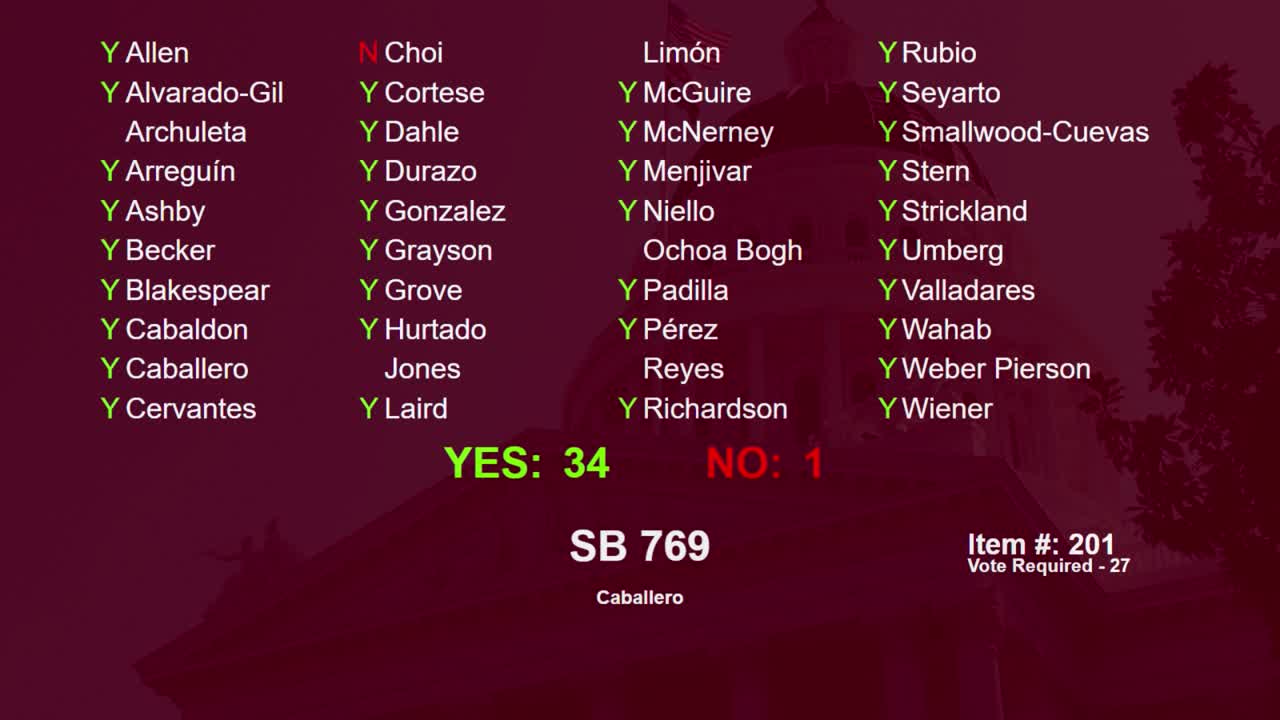 3MIN
Senate Floor
 3MIN
Senate Standing Committee on Judiciary
Bill Author

Bill Co-Author(s):