SB 699: Legislature: constitutional course.
- Session Year: 2025-2026
- House: Senate
- Latest Version Date: 2026-01-05
Current Status:
Failed
(2026-02-02: Returned to Secretary of Senate pursuant to Joint Rule 56.)
Introduced
In Committee
Awaiting First Chamber Vote
Passed First Chamber
In Committee
Awaiting Second Chamber Vote
Passed Second Chamber
Enacted
Existing law provides for the administration of the constitutional oath of office and seating of Members of the Legislature at the beginning of any regular session of the Legislature. Existing law requires each Member of the Legislature and each designated employee of the Legislature to attend certain orientation courses conducted by the appropriate legislative ethics committees at least once in each biennial session.
This bill would require a Member of the Legislature and an employee all Members and employees of the Legislature to attend a course regarding the United States Constitution and the California Constitution within 6 months of the convening of a regular session of the Legislature, except as specified. The bill would require the Joint Rules Committee Legislative Counsel Bureau to develop and conduct the course, as specified.
Existing law provides for the administration of the constitutional oath of office and seating of Members of the Legislature at the beginning of any regular session of the Legislature. Existing law requires each Member of the Legislature and each designated employee of the Legislature to attend certain orientation courses conducted by the appropriate legislative ethics committees at least once in each biennial session.
This bill would require a Member of the Legislature and an employee of the Legislature to attend a course regarding the United States Constitution and the California Constitution within 6 months of the convening of a regular session of the Legislature, except as specified. The bill would require the Joint Rules Committee to develop and conduct the course, as specified.
Existing law, for the purpose of reducing and improving administrative regulations, establishes an Office of Administrative Law to review adopted regulations. Existing law provides that the office is under the direction and control of a director, appointed by the Governor, subject to confirmation by the Senate.This bill would make nonsubstantive changes to those provisions.Existing law, for the purpose of reducing and improving administrative regulations, establishes an Office of Administrative Law to review adopted regulations. Existing law provides that the office is under the direction and control of a director, appointed by the Governor, subject to confirmation by the Senate.
This bill would make nonsubstantive changes to those provisions.
(a)Except as provided in subdivision (b), a Member of the Legislature and an employee of the Legislature all Members and employees of the Legislature shall, within six months of the convening of a regular session of the Legislature, attend a course regarding the United States Constitution and the California Constitution.
(b)(1)If a Member of the Legislature assumes their seat after a regular session is convened, the Member shall attend the course within six months of assuming their seat.
(2)If an employee of the Legislature is hired after a regular session is convened, the employee shall attend the course within six months of their date of hire.
(c)The Joint Rules Committee Legislative Counsel Bureau, in consultation with the Joint Rules Committee, shall develop and conduct the course described in subdivision (a). The course shall be at least two hours in length and address the principles of federalism, preemption, civil rights, and the separation of powers. at a minimum the following topics: federalism, preemption, separation of powers, civil rights, the Bill of Rights, state constitutional rights and freedoms, and the roles and responsibilities of the three branches of government at the state and federal levels.
(a)Except as provided in subdivision (b), a Member of the Legislature and an employee of the Legislature shall, within six months of the convening of a regular session of the Legislature, attend a course regarding the United States Constitution and the California Constitution.
(b)(1)If a Member of the Legislature assumes their seat after a regular session is convened, the Member shall attend the course within six months of assuming their seat.
(2)If an employee of the Legislature is hired after a regular session is convened, the employee shall attend the course within six months of their date of hire.
(c)The Joint Rules Committee shall develop and conduct the course described in subdivision (a). The course shall be at least two hours in length and address the principles of federalism, preemption, civil rights, and the separation of powers.
SECTION 1.Section 11340.2 of the Government Code is amended to read:11340.2.(a)The Office of Administrative Law is hereby established in state government in the Government Operations Agency. The office shall be under the direction and control of an executive officer who shall be known as the director. There shall also be a deputy director. The directors term and the deputy directors term of office shall be coterminous with that of the appointing power, except that they shall be subject to reappointment.(b)The director and deputy director shall have the same qualifications as a hearing officer and shall be appointed by the Governor, subject to confirmation by the Senate.(a)The Office of Administrative Law is hereby established in state government in the Government Operations Agency. The office shall be under the direction and control of an executive officer who shall be known as the director. There shall also be a deputy director. The directors term and the deputy directors term of office shall be coterminous with that of the appointing power, except that they shall be subject to reappointment.
(b)The director and deputy director shall have the same qualifications as a hearing officer and shall be appointed by the Governor Governor, subject to the confirmation of by the Senate.
|
Date
|
Status
|
|---|---|
| Feb 2, 2026 | Returned to Secretary of Senate pursuant to Joint Rule 56. |
| Jan 13, 2026 | January 13 set for first hearing canceled at the request of author. |
| Jan 5, 2026 | From committee with author's amendments. Read second time and amended. Re-referred to Com. on JUD. |
| Dec 23, 2025 | Set for hearing January 13. |
| May 7, 2025 | May 6 hearing: Testimony taken. Hearing postponed by committee. |
| Apr 22, 2025 | Set for hearing May 6. |
| Apr 9, 2025 | Re-referred to Com. on JUD. |
| Mar 26, 2025 | From committee with author's amendments. Read second time and amended. Re-referred to Com. on RLS. |
| Mar 5, 2025 | Referred to Com. on RLS. |
| Feb 24, 2025 | From printer. May be acted upon on or after March 24. |
| Feb 24, 2025 | Read first time. |
| Feb 21, 2025 | Introduced. To Com. on RLS. for assignment. To print. |
This list shows positions taken on this bill by organizations on the date displayed, which is linked to the original source.
Positions by individuals are not included.
Senator Thomas Umberg, Chair
2025-2026 Regular Session
Bill No: SB 699 (Author:Ochoa Bogh)
Version: March 26, 2025
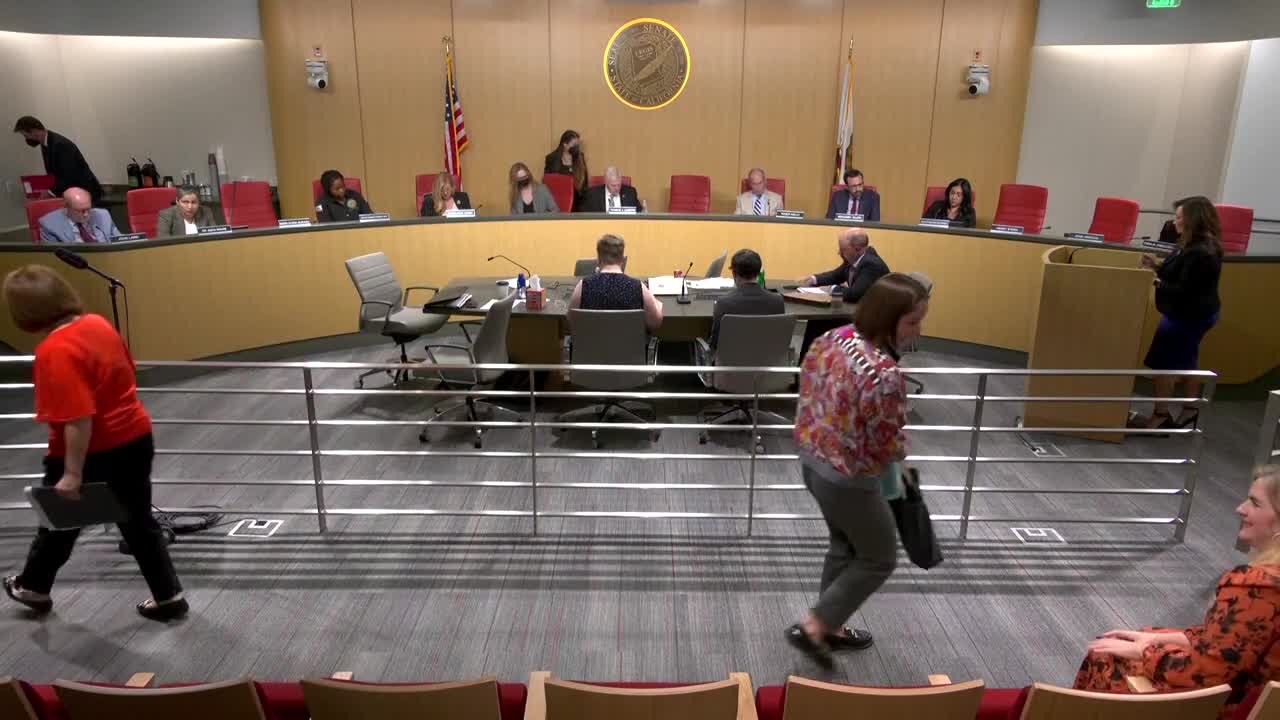
Hearing Date: May 6, 2025
Fiscal: No
Urgency: No
Consultant: AWM
SUBJECT
Legislature: constitutional course
DIGEST
This bill requires the Joint Rules Committee to develop and conduct a course regarding the United States Constitution and the California Constitution, and for each Member of the Legislature and each employee of the Legislature to take the course within six months of the convening of a regular session.
EXECUTIVE SUMMARY
Under current law and Legislative Rules, members of the Legislature and some Legislative employees must take courses every session covering topics including ethics, workplace harassment, and workplace violence.
This bill requires every member of the Legislature, and every employee of the Legislature, to take a course on the United States and California Constitutions once per session. The bill requires the Joint Rules Committee to develop the course, which must be at least two hours in duration, and requires the course to address the principles of federalism, preemption, civil rights, and separation of powers. According to the author, this course is intended to inform members and employees of the Legislature about the constitutional strictures on Legislative action. This analysis also sets forth proposed amendments to require additional constitutional provisions to be covered in the course.
This bill is sponsored by the author. The Committee has not received timely support for, or opposition to, this bill.
PROPOSED CHANGES TO THE LAW
Existing constitutional law and case law:
- Requires all Members of the Legislature, and all public officers and employees, executive, legislative, and judicial, except such inferior officers and employees as may be by law exempted, to, before they enter upon the duties of their respective offices, take and subscribe the constitutional oath of office, as specified.
- No other oath, declaration, or test shall be required as a qualification for any public office or employment.
- “Public officer and employee” includes every officer and employee of the State, including the University of California, every county, city, city and county, district, and authority, including any department, division, bureau, board, commission, agency, or instrumentality of any of the foregoing. (Cal. Const., art. XX, § 3.)
- Provides that the portion of the oath set forth in 1) that requires a person to swear or affirm that the person does not advocate, and is not a member, of any party or organization, political or otherwise, that now advocates to overthrow the Government of the United States or of the State of California by force or violence or other unlawful means, and to disclose any such organizations in which they have been a member in the preceding five years, is invalid as a violation of the First Amendment to the United States Constitution. (See Vogel v. Los Angeles County (1967) 68 Cal.2d 18, 19, 25-26.)
Existing state law:
- Requires the appropriate legislative ethics committees to conduct, at least semiannually, the following courses:
- An orientation course of the relevant statutes and regulations governing official conduct, the curriculum and presentation of which shall be established by house rules.
- An orientation course on the relevant ethical issues and laws relating to lobbying, in consultation with the Fair Political Practices Commission (FPPC); the course shall also include information on each legislative house’s policies against harassment, including sexual harassment, in connection with lobbying activities. (Gov. Code, §§ 8956(a) & (b).)
- Requires that each Member of the Legislature and each designated employee of the Legislature attend each of the courses. (Gov. Code, § 8956(c).)
- Requires the committees to impose fees on lobbyists for attending the course described in 1)(b), which shall be set at an amount that will enable the lobbyists’ participation in the course to be funded from those fees to the fullest extent possible. (Gov. Code, § 8956(d).)
- Requires, at the day and hour appointed for the assembling of any regular session of the Legislature, the Members and Members-Elect to take the constitutional oath of office. (Gov. Code, §§ 9022, 9023.)
- Members of the Legislature who do not take the oath of office at the assembling of the Legislature may take the oath at any time during the term for which they were elected. (Gov. Code, § 9024.)
- An entry of the oath taken by members of the Legislature shall be made on the journals of the proper house. (Gov. Code, § 9025.)
Current Legislative Rules:
- Require the Senate Committee on Legislative Ethics to conduct periodic workshops, at least once per calendar year, for Senators and officers and employees of the Senate, including workshops specifically designed for newly elected Senators and newly elected appointed officers and employees; at least once per biennial session, each Senator and each officer or employee of the Senate shall attend one of these workshops, and each Senator must also attend an individual training or review session conducted by the Chief Counsel of the Committee. (Standing Rules of the Sen. (2025-2026 Leg. Sess.) Rule 12.3(b)(4).)
- Require each Member of the Assembly to attend their house’s Ethics Committee’s course on the relevant statutes and regulations governing official conduct. (Standing Rules of the Assem. (2025-2026 Reg. Sess.) Rule 22.5(p).)
- Require every employee of the Assembly to complete the following courses within the first six months of their employment, and thereafter, within the first six months of every legislative session:
- The Assembly ethics course.
- A course on harassment, discrimination, and retaliation prevention. (Standing Rules of the Assem. (2025-2026 Reg. Sess.) Rules 22.5, 24.)
This bill:
- Requires, except as provided in 2), each Member of the Legislature and each employee of the Legislature to, within six months of the convening of a regular session of the Legislature, attend a course regarding the United States Constitution and the California Constitution.
- Permits a Member who is seated, or an employee who is hired, after a regular session is convened to attend the course within six months of assuming their seat or their hire date, respectively.
- Requires the Joint Legislative Committee to develop and conduct the course described in 1).
- The course shall be at least two hours in length.
- The course shall address the principles of federalism, preemption, civil rights, and the separation of powers.
COMMENTS
- Author’s comment
According to the author:
The California State Legislature requires all members and employees to attend mandatory trainings regarding legislative ethics, harassment and discrimination prevention, and workplace violence prevention. These courses serve to inform legislative members and employees of the protections and policies that exist within the workplace, and ensure awareness and compliance.
Similarly, a mandatory course regarding the Constitutions of both the United States and the State of California would serve to inform legislative members and employees of the protections and policies that these documents outline for each branch of government, specifically related to the role and jurisdiction of the Legislature.
Ensuring that proposed legislation is in alignment with the framework of the U.S. and California Constitutions is essential to protecting the integrity of the legislative process and preserving the separation of powers that defines our democracy.
In order to fully uphold the responsibilities described in the Oath of Office, all members and employees of the Legislature should be fully informed of the provisions of both Constitutions that they have sworn to abide by within their legislative duties.
2. This bill requires all Members and Legislative employees to take, once per session, a course on the United States and California Constitutions
To fulfill the author’s goal of having Members and Legislative employees fully informed about the United States and California Constitutions, this bill requires every Member and Legislative employee to take, once per session, a course on those Constitutions. The bill requires the Joint Legislative Committee to develop and conduct the course, and requires the course to be at least two hours in duration.
The course required by the bill is not a comprehensive constitutional overview, but rather will address specifically enumerated topics: the principles of federalism, preemption, civil rights, and the separation of powers. These topics, along with related constitutional provisions that the author may wish to add in order to make those topics more complete, are discussed below; in brief, current events suggest that members of government at all levels could benefit from a reminder of what is actually required by, and prohibited under, the United States Constitution. Comment 3 of this analysis discusses additional topics which the Committee may wish to include in the bill.
a. The principles of federalism and preemption.
Federalism and preemption are two sides of the same coin: “the Constitution established a system of ‘dual sovereignty’ ” through which “the States surrendered many of their powers to the new Federal Government” while “retain[ing] ‘a residuary and inviolable sovereignty.’ ”[1] The Preemption Clause of the United States Constitution[2] is one of the constitutional provisions establishing that states are “prohibit[ed] from exercising some attributes of sovereignty,”[3] but while “[t]he legislative powers granted to Congress are sizeable…they are not unlimited.”[4] As the United States Supreme Court explained:
The Constitution confers on Congress not plenary legislative power but only certain enumerated powers. Therefore, all other legislative power is reserved for the States, as the Tenth Amendment confirms. And conspicuously absent from the list of powers given to Congress is the power to issue direct orders to the governments of the States.[5]
Or, in the words of James Madison, “The powers delegated by the proposed Constitution to the federal government are few and defined. Those which are to remain in the State governments are numerous and indefinite.”[6]
Despite the foundational principles of federalism and states’ rights, the federal government is currently infringing on California’s constitutional right to govern within its borders, including on matters of energy;[7] water conservation and management;[8] education;[9] elections;[10] and health care, medical treatment options, and disease prevention policies.[11] Some federal measures attempting to assert federal restrictions on state prerogatives have already been enjoined on the basis that they violate the Tenth Amendment.[12]
In recognition of the Tenth Amendment’s[13] important role in preserving California’s inviolable sovereignty in some areas of law, as well as the rights retained by the people, the Committee recommends that the author include the Tenth Amendment as a required course topic.
b. Civil Rights
Civil rights are under attack at the national level. A concerted campaign to destroy hard-fought civil rights gains is being waged under the fiction that diversity, equity, and inclusion (DEI) programs discriminate against white people. For example, on his second day in office, President Trump issued Executive Order 14173, “Ending Illegal Discrimination and Restoring Merit-Based Opportunity,”[14] which, among other things, revoked executive orders dating back to the 1960s prohibiting discrimination in federal employment and federal contracting.[15] President Trump is also attacking the right of transgender and nonbinary individuals to exist, declaring in an Executive Order 14168 that “[i]t is the policy of the United States to recognize two sexes, male and female.”[16] One result of these, and other, orders is disappearance of people of color and gender minorities from federal websites, including: the United States Army, pursuant to a memo instructing the removal of digital content that relates to race, ethnicity, or sex, removed websites about the history of women in the military, the 100th Infantry Battalion and the 442nd Infantry Regiment,[17] and Navajo code talkers;[18] NASA asked its staff to “drop everything” and scrub mentions of “[a]nything specifically targeting women” from its websites;[19] and references to transgender persons have been removed from the National Park Service’s Stonewall page, even though trans woman Marsha P. Johnson is generally believed to have started the Stonewall Uprising.[20]
In light of these ongoing threats to civil rights, it seems reasonable to ensure that Members and Legislative employees are aware of the civil rights protections in the United States and California Constitutions. The Committee recommends that the course specifically cover the Reconstruction Amendments—the Thirteenth, Fourteenth, and Fifteenth Amendments—which provide much of the basis for civil rights law as applied to the states.
c. Separation of powers
“Separation of powers” refers to the Constitution’s division of power between the three branches of government—the Legislature, the Executive, and the Judiciary—and the system of checks and balances between those branches.[21] Under this system, the judicial branch can declare acts of Congress or the executive unconstitutional;[22] the president can veto legislation passed by Congress,[23] which can, in turn, override the veto with a two-thirds vote;[24] and in international affairs, “the President alone has the power to speak or listen as a representative of the nation,” but Congress still retains advice and consent authority on treaties and the power to declare war.[25]
As explained by James Madison, our system of separation of powers with checks and balances between the branches is intended to protect against authoritarianism: “The accumulation of all powers, legislative, executive, and judiciary, in the same hands, whether of one, a few, or many, and whether hereditary, self-appointed, or elective, may justly be pronounced the very definition of tyranny.”[26] And as Justice Jackson explained in 1952, history has provided multiple reasons to fear a unitary executive, unchecked by co-equal branches:
The example of such unlimited executive power that must have most impressed the forefathers was the prerogative exercised by George III, and the description of its evils in the Declaration of Independence leads me to doubt that they were creating their new Executive in his image. Continental European examples were no more appealing. And if we seek instruction from our own times, we can match it only from the executive powers in those governments we disparagingly describe as totalitarian. I cannot accept the view that [Section 1 of Article II] is a grant in bulk of all conceivable executive power but regard it as an allocation to the presidential office of the generic powers thereafter stated.[27]
The federal executive branch, however, is currently attempting to seize power from both the Legislative and Judicial branches. Numerous executive orders signed by the current President have been struck down by the courts on the basis that they unconstitutionally countermand acts of the Legislature.[28] In response to these rulings, President Trump’s response—joined by some members of Congress—has been to attack members of the Judiciary. The President has called for the impeachment of judges who ruled against him,[29] called them communists, and told his supporters that “[j]udges are trying to take away the power given to the president to keep our country safe…[t]hese people are just looking to destroy our country.”[30] Members of President Trump’s administration have echoed the attacks and calls for impeachment,[31] and his supporters have gone as far as to target judges’ families online.[32] President Trump has also “truthed” about the need for, and members of Congress have offered, legislation to prohibit district court judges from entering nationwide injunctions.[33] Furthermore, federal agencies have been skirting compliance with federal court orders,[34] to the point that the United States Supreme Court stepped in with a middle-of-the-night order prohibiting the federal government from removing more Venezuelan detainees from the United States without a further order from the Court.[35]
In light of the above, the Committee may wish to amend this bill to require, as a component of the course dedicated to the separation of powers, instruction on the independence of the Judiciary.
3. Additional topics to cover in the Constitution class
In light of the author’s goal to better educate members and Legislative staff about the proper role of the Legislature within our constitutional framework, the Committee may wish to amend the bill to include the topics discussed below.
a. The First Amendment
The First Amendment states that “Congress shall make no law respecting an establishment of religion, or prohibiting the free exercise thereof; or abridging the freedom of speech, or of the press, or the right of the people to peaceably assemble, and to petition the Government for a redress of grievances.”[36] As explained by Justice Brandeis:
Those who won our independence believed that the final end of the state was to make men free to develop their faculties, and that in its government the deliberative forces should prevail over the arbitrary. They valued liberty both as an end and as a means. They believed liberty to [be] the secret of happiness and courage to be the secret of liberty. They believed that freedom to think as you will and to speak as you think are means indispensable to the discovery and spread of political truth; that without free speech and assembly discussion would be futile; that with them, discussion affords ordinarily adequate protection against the dissemination of noxious doctrine; that the greatest menace to freedom is an inert people; that public discussion is a political duty; and that this should be a fundamental principle of the American government. They recognized the risks to which all human institutions are subject. But they knew that order cannot be secured merely through fear of punishment for its infraction; that it is hazardous to discourage thought, hope and imagination; that fear breeds repression; that repression breeds hate; that hate menaces stable government; that the path of safety lies in the opportunity to discuss freely supposed grievances and proposed remedies; and that the fitting remedy for evil counsels is good ones. Believing in the power of reason as applied through public discussion, they eschewed silence coerced by law—the argument of force in its worst form. Recognizing the occasional tyrannies of governing majorities, they amended the Constitution so that free speech and assembly should be guaranteed.[37]
The First Amendment protects a range of expressive conduct vital to our democracy, including academic freedom at colleges and universities;[38] the right to read and receive information;[39] a free and independent press;[40] the right to assemble and protest;[41] and the right to speak freely, even when—or especially when—the topic is disfavored by the government or the majority.[42]
All of these activities are now under siege.
I. Academic freedom at colleges and universities.
The Trump Administration “has vowed to take federal money from colleges that defy his agenda on issues including diversity, equity and inclusion programs, transgender athletes’ participation in women’s sports, and student protests that he deems ‘illegal.’ ”[43] Columbia University caved to a number of the Administration’s demands after President Trump withheld $400 million in grants and other funding sources;[44] the Administration then froze $250 million more in funding for research grants and has yet to refund the original $400 million.[45] When the Administration tried to interfere with Harvard University’s operations, holding $2.2 billion in federal grant funding hostage, Harvard sued rather than comply.[46] The Trump Administration has frozen, or is threatening to freeze, grants to multiple other schools, including the University of Pennsylvania and Princeton.[47]
II. The right to read and receive information
As discussed above in Comment 2, the Trump Administration is attempting to censor topics related to America’s history, past and present prejudices, and gender diversity under the guise of ending “discriminatory” DEI policies and “radical gender ideology.”[48] The effects of these orders are not limited to federal agencies censoring their own speech. For example, the Department of Defense ordered children’s books removed from libraries at schools run by the Pentagon to determine whether they violate the President’s Executive Orders; books caught up in the sweep include “No Truth Without Ruth,” a book about Supreme Court Justice Ruth Bader Ginsburg, and “Freckleface Strawberry,” a book about a young girl “coming to terms with her freckles.”[49] The scientific and medical establishments have also fallen victim: numerous federal agencies, including the Centers for Disease Control, Census Bureau, and Substance Abuse and Mental Health Services Administration, removed research and scientific datasets from public websites because they supposedly violated anti-DEI executive orders.[50]
III. A free and independent press
It is no secret that the current President does not care for the “freedom of the press” portion of the First Amendment. In his last term, President Trump opined that it is “frankly disgusting the way the press is able to write whatever they want to write.”[51] Consistent with this attitude, President Trump has attempted to gut the Voice of America news service,[52] tried to prevent the Associated Press from covering White House events in retaliation for refusing to refer to the Gulf of Mexico as the “Gulf of America,”[53] and sued several news outlets for publishing unflattering coverage of him.[54] The new chair of the Federal Communications Commission (FCC) has also opened inquiries into NPR, PBS, and Comcast (NBC’s parent company) and reopened probes into CBS and ABC.[55] This legal onslaught seems to have spurred some news sources to begin self-censoring: some newspaper owners have tried to curry favor with the President by self-censoring or limiting their coverage and opinion pieces to topics they believe he would approve, [56] and Paramount is now “supervising” the news content on 60 Minutes because it needs the FCC’s approval for a merger.[57]
IV. The right to assemble and protest
The President’s antipathy towards protesters is well known: in his first term, President Trump ordered the military “to clear peaceful protestors from a park so he could stage a photo op at a nearby church,” which they did with chemical spray and rubber bullets.[58] This time around, President Trump “truthed” on his Truth Social platform that “All Federal Funding will STOP for any College, School, or University that allows illegal protests. Agitators will be imprisoned/or permanently sent back to the country from which they came. American students will be permanently expelled or, depending on the crime, arrested. NO MASKS! Thank you for your attention to this matter.”[59] Since then, federal immigration officials have detained, with the intent to deport, a number of foreign-born students and professors for their participation in pro-Gaza campus protests; the federal government concedes that these individuals were present in the United States under valid visas or green cards, but argues that their speech and protest activities amount to supporting terrorism.[60] Fear of further reprisals has chilled protests and activism on campuses.[61]
V. The right to speak freely
This is, perhaps, the most ironic curtailment of rights: President Trump campaigned on a platform of free speech, and one of the first executive orders of his second term was entitled “Restoring Freedom of Speech and Ending Federal Censorship.”[62] Many of the specific restrictions discussed in the above paragraphs also fall under the right to speak freely, but it is worth noting a few other contexts in which individuals are being punished for their speech. President Trump has issued executive orders against several law firms, targeting each by name, in retaliation for those firms’ participation, or former partners’ participation, in litigation he perceives to be unfair.[63] Paul Weiss chose to capitulate, promising to eliminate their DEI programs and offering pro bono services to the Trump Administration.[64] The firms that chose to fight the orders have won temporary restraining orders prohibiting the orders from taking effect, except for the portions of the orders requiring a review of security clearances.[65] Prior to those wins, however, a number of other firms rushed to make deals with the Administration similar to Paul Weiss’, rather than risk being the next target.[66] This is exactly the kind of coerced conformity the First Amendment is intended to prevent.[67]
The above examples are far from a complete list of the impending threats to the First Amendment. Because the First Amendment is vital to our system of government, the Committee may wish to include the First Amendment as a topic to be covered in the constitution class.
b. California-specific rights
The bill as currently in print describes the constitution course as covering the United States and California Constitutions but does not list any topics specific to the California Constitution. Because the California Constitution grants rights in excess of what the United States Constitution is currently understood to grant, the author may wish to amend the bill to include coverage of express rights unique to the California Constitution, including:
- The right to privacy: Section 1 of Article I of the California Constitution recognizes the right to “pursu[e] privacy” as an inalienable right.[68] At the federal level, however, the Supreme Court has gone back and forth on whether, and to what extent, privacy is a right protected under the United States Constitution.[69] At a time when the federal government[70] and private companies[71] are amassing unprecedented troves of data about individuals for authorized and unauthorized uses,[72] California’s right to privacy seems more relevant than ever.
- Reproductive freedom. In 2022, the United States Supreme Court overruled the 49-year-old Roe v. Wade[73] and held that the United States Constitution does not protect the right to obtain an abortion.[74] The California Constitution, however, separately protects the right to obtain reproductive care, including abortion.[75] That right was expressly enshrined in the California Constitution by the voters in 2022.[76] This right is consistent with the principles of federalism, which, as discussed above, permit California to grant to its residents more freedoms than protected under the United States Constitution.
4. Amendments
As discussed above, the Committee may wish to amend the bill to include the following additional constitutional provisions to the list of topics that must be covered by the constitutional course: the Tenth Amendment; the Reconstruction Amendments; the First Amendment; rights protected under the California Constitution, including the rights of privacy and reproductive freedom; and, as a component of the instruction on separation of powers, the independence of the Judiciary.
Additionally, in recognition of the fact that the Joint Rules Committee is not, first and foremost, a Committee formed with an eye to establishing legally focused trainings, the Committee may wish to amend the bill to require the Joint Rules Committee to seek input from legal experts. In particular, the author may wish to amend the bill to require the Joint Rules Committee to consult with the Civil Rights Department, the California Department of Justice, and the deans of the law schools of the University of California.
SUPPORT
None received
OPPOSITION
None received
RELATED LEGISLATION
Pending legislation: SCR 66 (Umberg, 2025) states that the Legislature designates May 1 as Law Day to commemorate the importance that law plays in California and to stand in solidarity with the legal community.
Prior legislation: None known.
**************
Printz v. U.S. (1997) 521 U.S. 898, 918-919 (quoting The Federalist No. 39, at 245 (J. Madison)). ↑
U.S. Const., art. XI, cl. 2. ↑
Murphy v. National College Athletic Association (2018) 584 U.S. 453, 470. ↑
Id. at p. 471 ↑
Ibid. ↑
Madison, The Federalist Papers, No. 45 (Jan. 26, 1788) available at The Avalon Project, https://avalon.law.yale.edu/18th_century/fed45.asp. All links in this analysis are current as of May 1, 2025. ↑
See, e.g., Exec. Order No. 14260, 90 Fed. Reg. 15513 (Apr. 8, 2025); Exec. Order No. 14213, 90 Fed. Reg. 9945 (Feb. 20, 2025). ↑
See, e.g., Exec. Order No. 14181, 90 Fed. Reg. 8747 (Jan. 24, 2025); see also Von Kaenel & Snyder, Trump says he opened California’s water. Local officials say he nearly flooded them (Jan. 31, 2025) Politico, https://www.politico.com/news/2025/01/31/trump-california-water-00201909. ↑
See, e.g., Exec. Order No. 14280, 90 Fed. Reg. 17533 (Apr. 23, 2025); Exec. Order No. 14277, 90 Fed. Reg. 17519 (Apr. 23, 2025); Exec. Order No. 14201, 90 Fed. Reg. 9279 (Feb. 5, 2025); Exec. Order No. 14191, 90 Fed. Reg. 8859 (Jan. 29, 2025); Exec. Order No. 14190, 90 Fed. Reg. 8853 (Jan. 29, 2025); Exec. Order No. 14173, 90 Fed. Reg. 8633 (Jan. 21, 2025). ↑
See, e.g., Exec. Order No. 14248, 90 Fed. Reg. 14005 (Mar. 25, 2025), enjoined in part by League of United Latin American Citizens v. Executive Office of the President (D.D.C., Apr. 24, 2025) —F.Supp.3d—, 2025 WL 1187730. ↑
See, e.g., Exec. Order No. 14214, 90 Fed. Reg. 9949 (Feb. 14, 2025); Exec. Order No. 14212, 90 Fed. Reg. 9833 (Feb. 13, 2025); Exec. Order No. 14187, 90 Fed. Reg. 8771 (Jan. 28, 2025). ↑
See, e.g., City and County of San Francisco v. Trump (N.D. Cal., Apr. 24, 2025) —F.Supp.3d—, 2025 WL 1186310 (enjoining federal actions to freeze, withhold, or condition federal funding apportioned to localities by Congress on Tenth Amendment grounds); Washington v. Trump (W.D. Wash., Feb. 16, 2025) —F.Supp.3d—, 2025 WL 509617 (executive order purporting to criminalize certain forms of medical care could not override state law to the contrary under the Tenth Amendment). ↑
U.S. Const., 10th amend. (“The powers not delegated to the United States by the Constitution, nor prohibited by it to the States, are reserved to the States respectively, or to the people”). ↑
Exec. Order No. 14173, 90 Fed. Reg. 8633 (Jan. 21, 2025). ↑
Id. at p. 8634; see Exec. Order No. 11246, 30 Fed. Reg. 12319 (Sept. 24, 1965) (“Equal Employment Opportunity”). ↑
Exec. Order No. 14168, 90 Fed. Reg. 8615 (Jan. 20, 2025). ↑
The 100th Infantry Battalion and the 442nd Infantry Regiment fought in World War II and were comprised of Americans of Japanese descent at a time when the military was racially segregated and many of the soldiers’ family members were interned in concentration camps in the United States because of their race. (Shenkle, Patriots Under Fire: Japanese Americans in World War II, https://web.archive.org/web/20130623035411/http://www.history.army.mil/html/topics/apam/patriots.html.) The 442nd Infantry Regiment liberated the Dachau concentration camp and remains the most decorated unit of its size in the U.S. Army. (100th Battalion, 442nd Infantry, https://www.globalsecurity.org/military/agency/army/100-442in.htm.) ↑
Jingnan & Lawrence, Here are all the ways people are disappearing from government websites (Mar. 19 2025) NPR, https://www.npr.org/2025/03/19/nx-s1-5317567/federal-websites-lgbtq-diversity-erased. ↑
Cole, Workers at NASA Told to ‘Drop Everything’ to Scrub Mentions of Indigenous People, Women from Its Websites (Feb. 4, 2025) 404 Media, https://www.404media.co/nasa-dei-drop-everything-executive-order/ ↑
Kim, Park Service erases ‘transgender’ on Stonewall website, uses the term ‘LGB’ movement (Feb. 15, 2025) NPR, https://www.npr.org/2025/02/14/g-s1-48923/stonewall-monument-transgender-park-service; see also National Park Service, Stonewall National Monument, https://www.nps.gov/ston/learn/education/new-index.htm. ↑
Chemerinsky, et al., Constitutional Law: Principles and Policies (5th ed. 2015) p. 1. ↑
Marbury v. Madison (1803) 5 U.S. 137, 177-180. ↑
U.S. Const., art. I, § 7, cl. 2. ↑
Ibid. ↑
U.S. v. Curtiss-Wright Export Corp. (1936) 299 U.S. 304, 318-319; U.S. Const., art. I, § 8, cl. 11 & art. II, § 2, cl. 2. ↑
Madison, The Federalist Papers, No. 47 (Feb. 1, 1788) available at The Avalon Project, https://avalon.law.yale.edu/18th_century/fed47.asp. ↑
Youngstown Sheet & Tube Co. v. Sawyer (1952) 343 U.S. 579, 640-641 (conc. opn. of Jackson, J.). ↑
E.g., RFE/RL, Inc. v. Lake (D.D.C. Apr. 29, 2025) —F.Supp.3d—, 2025 WL 1232863 (ordering the U.S. Agency for Global Media (USAGM) to disburse $12,178,590 in Congressionally appropriated funds to Radio Free Europe/Radio Liberty, overriding executive order instructing USAGM to eliminate certain functions); National Treasury Employees Union v. Trump (D.D.C. Apr. 28, 2025) —F.Supp.3d—, 2025 WL 1218044 (enjoining executive order that contravened the Federal Service Labor-Management Relations Statute); League of United Latin American Citizens, supra, 2025 WL 1187730 (enjoining executive order in part that contravened National Voter Registration Act). ↑
Lowell & Gedeon, Chief justice rebukes Trump for call to impeach judge hearing deportation case (Mar. 18, 2025) The Guardian, https://www.theguardian.com/us-news/2025/mar/18/trump-judge-impeachment-venezuelan-deportations. ↑
Smith, Trump warns ‘nothing will stop me’ at rally to celebrate 100 days in office (Apr. 30, 2025) The Guardian, https://www.theguardian.com/us-news/2025/apr/29/trump-100-days-rally-michigan. ↑
E.g., Sneed, ‘Breathtaking in its audacity’: Trump’s conflict with judges has escalated to new heights (Apr. 17, 2025) CNN, https://edition.cnn.com/2025/04/17/politics/trump-judges-conflict-boasberg-contempt/index.html; Robins-Early, Elon Musk lashes out at US judges as they rule against Doge (Mar. 22, 2025) The Guardian, https://www.theguardian.com/technology/2025/mar/22/elon-musk-doge-judges-usaid. ↑
Schwartz & VanSickle, Judges Fear for Their Safety Amid a Wave of Threats ((Mar. 19, 2025; updated Mar. 21, 2025) N.Y. Times, available at https://web.archive.org/web/20250407100206/https://www.nytimes.com/2025/03/19/us/trump-judges-threats.html. ↑
See Trump, D. [@realDonaldTrump], Unlawful Nationwide Injunctions by Radical Left Judges could very well lead to the destruction of our Country! (Mar. 20, 2025) Truth Social, https://truthsocial.com/@realDonaldTrump/posts/114197092205719557; Sen. No. 1206, 119th Cong, 1st Sess. (2025); H.R. No. 1526, 119th Cong., 1st Sess. (2025). ↑
E.g., Abrego Garcia v. Noem (4th Cir. Apr. 17, 2025) 2025 WL 1135113, *2 (The Supreme Court’s order requiring the facilitation of the return of Kilmar Armando Abrego Garcia from El Salvador ”does not permit the admittedly erroneous deportation of an individual to the one country’s prisons that the withholding order forbids and, further, to do so in disregard of a court order that the government not so subtly spurns. ‘Facilitation’ does not sanction the abrogation of habeas corpus through the transfer of custody to foreign detention centers in the manner attempted here. Allowing all this would ‘facilitate’ foreign detention more than it would domestic return. It would reduce the rule of law to lawlessness and tarnish the very values for which Americans of diverse views and persuasions have always stood.”). ↑
See A.A.R.P. v. Trump (2025) 145 S.Ct. 1034. ↑
U.S. Const., 1st amend. ↑
Whitney v. California (1927) 274 U.S. 357, 375-376 (conc. opn. of Brandeis, J.), overruled in part by Brandenburg v. Ohio (1969) 395 U.S. 444. ↑
Keyishian v. Board of Regents (1967) 385 U.S. 589, 603 (“Our nation is deeply committed to safeguarding academic freedom, which is of transcendent value to all of us and not merely to the teachers concerned. That freedom is therefore a special concern of the First Amendment, which does not tolerate laws that cast a pall of orthodoxy over the classroom.”) ↑
Stanley v. Georgia (1969) 394 U.S. 557, 564 (“It is now well established that the Constitution protects the right to receive information and ideas. This freedom of speech and press necessarily protects the right to receive. This right to receive information and ideas, regardless of their social worth, is fundamental to our free society.” (cleaned up)). ↑
New York Times Co. v. U.S. (1971) 403 U.S. 713, 717 (conc. opn. of Black, J.) (“In the First Amendment the Founding Fathers gave the free press the protection it must have to fulfill its essential role in our democracy. The press was to serve the governed, not the governors. The Government’s power to censure the press was abolished so that the press would remain forever free to censure the Government. The press was protected so that it could bare the secrets of government and inform the people. Only a free and unrestrained press can effectively expose deception in government.”). ↑
Police Dept. of City of Chicago v. Mosley (1972) 408 U.S. 92, 96 (“Necessarily, then, under the Equal Protection Clause, not to mention the First Amendment itself, government may not grant the use of a forum to people whose views it finds acceptable, but deny use to those wishing to express less favored or more controversial views. And it may not select which issues are worth discussing or debating in public facilities.”); De Jonge v. State of Oregon (1937) 299 U.S. 353, 365 (“The greater the importance of safeguarding the community from incitements to the overthrow of our institutions by force and violence, the more imperative is the need to preserve inviolate the constitutional rights of free speech, free press and free assembly in order to maintain the opportunity for free political discussion, to the end that government may be responsive to the will of the people and that changes, if desired, may be obtained by peaceful means. Therein lies the security of the Republic, the very foundation of constitutional government.”). ↑
Terminiello v. City of Chicago (1949) 337 U.S. 1, 4-5 (“[A] function of free speech under our system of government is to invite dispute. It may indeed best serve its higher purpose when it induces a condition of unrest, creates dissatisfaction with conditions as they are, or even stirs people to anger. Speech is often provocative and challenging. It may strike at prejudices and preconceptions and have profound unsettling effects as it presses for acceptance of an idea. That is why freedom of speech, though not absolute [citation], is nevertheless protected against censorship or punishment, unless shown likely to produce a clear and present danger of serious substantive evil that rises far above public inconvenience, annoyance, or unrest. [Citations.] There is no room under our Constitution for a more restrictive view. For the alternative would lead to standardization of ideas either by legislatures, courts, or dominant political or community groups.”). ↑
Rush, Some universities are freezing hiring and laying off staff as Trump cuts federal funding (Mar. 13, 2025) AP News, https://apnews.com/article/college-jobs-education-department-nih-trump-antisemitism-af96e181e7958998a0fca0c8bb462b1e. ↑
Habeshia, Columbia caves to Trump demands to regain $400 million in funding (Mar. 21, 2025) Axios, https://www.axios.com/2025/03/21/columbia-trump-federal-funding-protests. ↑
Moody & Quinn, NIH Freezes Millions More in Funding for Columbia (Apr. 9, 2025) Inside Higher Ed, https://www.insidehighered.com/news/government/politics-elections/2025/04/09/nih-freezes-millions-more-funding-columbia. ↑
Raymond, US judge to hear Harvard’s case over Trump funding freeze in July (Apr. 28, 2025) Reuters, https://www.reuters.com/world/us/us-judge-hear-harvards-case-over-trump-funding-freeze-july-2025-04-28/. ↑
Brinkley, Trump administration halts dozens of research grants at Princeton University (Apr. 1, 2025) AP News, https://apnews.com/article/princeton-trump-federal-funding-9c32a996256849ac00792ef50dbdfb0e. ↑
See also, e.g., Exec. Order No. 14190, 90 Fed. Reg. 8853 (Jan. 29, 2025). ↑
Pilkington, Pentagon schools suspend library books for ‘compliance review’ under Trump orders (Feb. 13, 2025) The Guardian, https://www.theguardian.com/us-news/2025/feb/13/pentagon-schools-closed-libraries-trump. ↑
E.g., Singer, Thousands of U.S. Government Web Pages Have Been Taken Down Since Friday (Feb. 2, 2025; updated Feb. 3, 2025) N.Y. Times, available at https://web.archive.org/web/20250424164649/https://www.nytimes.com/2025/02/02/upshot/trump-government-websites-missing-pages.html. Some, but not all, of the pages have been restored, including some pursuant to a court order. (See Doctors for America v. Office of Personnel Management (D.D.C., Feb. 11, 2025) —F.3d—, 2025 WL 452707.) ↑
Nakamura, Trump escalates threats against press, calling news coverage ‘frankly disgusting’ (Oct. 11, 2017) Washington Post, https://www.washingtonpost.com/politics/trump-escalates-threats-against-press-calls-news-coverage-frankly-disgusting/2017/10/11/32996dba-ae9c-11e7-9e58-e6288544af98_story.html. ↑
Kunzelman & Boone, Federal judge blocks Trump administration from dismantling Voice of America (Apr. 22, 2025) AP News, https://apnews.com/article/voice-of-america-trump-f30c48df0c16de622ec5fd99ee6c627c. ↑
Bauder, AP wins reinstatement to White House events after judge rules government can’t bar its journalists (Apr. 8, 2025) AP News, https://apnews.com/article/trump-ap-media-court-white-house-events-access-f346a0efe87c1dec4d6f90e6041abd09. ↑
E.g., Coster & Queen, Trump sues Des Moines Register, vows to pursue more defamation claims (Dec. 17, 2024) Reuters, https://www.reuters.com/legal/trump-vows-pursue-more-defamation-claims-after-abc-news-settlement-2024-12-17/. ↑
Siemaszko, Trump’s anti-media rhetoric turns to action (Feb. 12, 2025) NBC News, https://www.nbcnews.com/politics/donald-trump/trumps-anti-media-rhetoric-turns-action-rcna191949. ↑
E.g., Mullin, Bezos Orders Washington Post Opinion Section to Embrace ‘Personal Liberties and Free Markets’ (Feb. 26, 2025) Washington Post, available at https://web.archive.org/web/20250403033029/https://www.nytimes.com/2025/02/26/business/media/washington-post-bezos-shipley.html. ↑
Glenza, Host of CBS’s 60 Minutes rebukes corporate owners Paramount on-air (Apr. 28, 2025) The Guardian, https://www.theguardian.com/media/2025/apr/28/cbs-60-minutes-paramount-scott-pelley. ↑
Gibbons-Neff, et al., Former Commanders Fault Trump’s Use of Troops Against Protesters (Jun, 2, 2020; updated Jul. 9, 2020) N.Y. Times, available at https://web.archive.org/web/20250322084759/https://www.nytimes.com/2020/06/02/us/politics/military-national-guard-trump-protests.html. ↑
Trump, D. [@realDonaldTrump], All Federal Funding will STOP (Mar. 4, 2025) TruthSocial, https://truthsocial.com/@realDonaldTrump/posts/114104167452161158 (capitalization and punctuation in original). ↑
E.g., Faguy & Iqbal, Judge allows Columbia graduate Mahmoud Khalil’s deportation (Apr. 11, 2025), https://www.bbc.com/news/articles/cwy0ngd11yzo (green card holder Mahmoud Khalil seized and subject to deportation proceedings for taking part in protests against the war in Gaza); Whittle & Ramer, A Palestinian activist expecting a US citizenship interview is arrested instead by ICE in Vermont (Apr. 14, 2025) AP News, https://apnews.com/article/immigration-palestine-protest-trump-deportation-columbia-fca7e73fe2cbd616c1eacf3bdececdbe (Mohsen Mahdawi, a pro-Gaza protester at Columbia University, detained at his citizenship interview after being a green card holder since 2015); Tsui, What we know about the federal detention of activists, students and scholars connected to universities (Apr. 2, 2025) CNN, https://www.cnn.com/2025/03/31/us/what-we-know-college-activists-immigration-hnk/index.html. A federal district court judge has since ordered Mahdawi released from custody while his immigration case proceeds, stating that Mahdawi had raised “ ‘a substantial claim that the government arrested him to stifle speech with which it disagrees.’ ” (Swinhart & Ramer, A Palestinian student at Columbia is released after arrest at his citizenship interview (Apr. 30, 2025) AP News, https://apnews.com/article/mohsen-mahdawi-columbia-student-palestinian-release-dd95ffff78464df1b485d5912f1b3fcb.) ↑
E.g., Hughes, Trump targeted college students. Campuses went silent (Apr. 10, 2025) USA Today, https://www.usatoday.com/story/news/nation/2025/04/10/campus-palestine-protests-free-speech-trump-crackdown/83010185007/. ↑
See Exec. Order No. 14149, 90 Fed. Reg. 8243 (Jan. 20, 2025). ↑
See Exec. Order No. 14263, 90 Fed. Reg. 15615 (Apr. 9, 2025) (Susman Godfrey); Exec. Order No. 14250, 90 Fed. Reg. 14549 (Mar. 27, 2025) (Wilmer Hale); Exec. Order No. 14246, 90 Fed. Reg. 13997 (Mar. 25, 2025) (Jenner & Block); Exec. Order No. 14237, 90 Fed. Reg. 13039 (Mar. 14, 2025), superseded by Exec. Order No. 14244, 90 Fed. Reg. 13685 (Mar. 21, 2025) (Paul Weiss); Exec. Order No. 14230, 90 Fed. Reg. 11781 (Mar. 6, 2025) (Perkins Coie). President Trump also ordered the suspension of security clearances for Covington & Burling employees “pending a review of their roles and responsibility in the weaponization of the judicial process.” (The White House, Fact Sheet: President Donald J. Trump Directs Suspension of Security Clearances and Evaluation of Government Contracts for Involvement in Government Weaponization (Feb. 25, 2025) https://www.whitehouse.gov/fact-sheets/2025/02/fact-sheet-president-donald-j-trump-directs-suspension-of-security-clearances-and-evaluation-of-government-contracts-for-involvement-in-government-weaponization/.) ↑
See Exec. Order No. 14244, 90 Fed. Reg. 13685 (Paul Weiss) ↑
See Susman Godfrey LLP v. Executive Office of President (D.D.C. Apr. 15, 2025) 2025 WL 1113408; Jenner & Block LLP v. U.S. Dept. of Justice (D.D.C. Mar. 28, 2025) 2025 WL 946993; Wilmer Cutler Pickering Hale and Door LLP v. Executive Office of the President (D.D.C. Mar. 28, 2025) —F.Supp.3d—, 2025 WL 946979; Perkins Coie LLP v. U.S Dept. of Justice (D.D.C. Mar. 12, 2025) —F.Supp.3d—, 2025 WL 782889. ↑
Tucker, Trump reaches deals with 5 law firms, allowing them to avoid the prospect of punishing executive orders (Apr. 11, 2025) AP News, https://apnews.com/article/trump-law-firms-executive-order-fe8f38a61cf77c5bb6add1315f5f96f1. ↑
See, e.g., Terminiello, supra, 337 U.S. at pp. 4-5. ↑
Cal. Const., art. I, § 1. ↑
Compare Griswold v. Connecticut (1965) 381 U.S. 479, 484-485 (the Bill of Rights establishes “penumbral rights of ‘privacy and repose.’ ”) with Dobbs v. Jackson Women’s Health Organization (2022) 597 U.S. 215, 235 (noting that right to privacy is not mentioned in the Constitution). ↑
Kelly & Elliott, DOGE Is Building a Master Database to Surveil and Track Immigrants (Apr. 18, 2025) WIRED, https://www.wired.com/story/doge-collecting-immigrant-data-surveil-track/ (“The scale at which DOGE is seeking to interconnect data, including sensitive biometric data, has never been done before, raising alarms with experts who fear it may lead to disastrous privacy violations for citizens, certified foreign workers, and undocumented immigrants”). ↑
E.g., Key, Time to Delete? The Most Invasive Apps List Includes Some of Your Favorites (Jan. 28, 2025) PC Mag, https://www.pcmag.com/articles/time-to-delete-the-most-invasive-apps-list-includes-some-of-your-favorites. ↑
E.g., Apodaca & Lecher, How the states sent Californians’ personal health data to LinkedIn (Apr. 28, 2025) CalMatters, https://calmatters.org/health/2025/04/covered-california-linkedin-tracker/. ↑
(1973) 410 U.S. 113. ↑
Dobbs, supra, 597 U.S. at p. 292. ↑
People v. Belous (1969) 71 Cal.2d 954. ↑
See Cal. Const., art. I, § 1.1, added by ballot measure in the November 8, 2022, General Election (Prop. 1). ↑
Bill Author
Bill Co-Author(s):