SB 848: Pupil safety: school employee misconduct: child abuse prevention.
- Session Year: 2025-2026
- House: Senate
- Latest Version Date: 2025-10-07
Current Status:
Passed
(2025-10-07: Chaptered by Secretary of State. Chapter 460, Statutes of 2025.)
Introduced
In Committee
Awaiting First Chamber Vote
Passed First Chamber
In Committee
Awaiting Second Chamber Vote
Passed Second Chamber
Enacted
What does this bill do?
The bill tightens pupil safety rules for K–12 public, charter, and private schools by requiring written policies on professional boundaries and updating school safety plans to cover supervision and protection from child abuse, neglect, and sex offenses (sexual crimes) and to assess all crimes on campus. It expands who must report suspected child abuse to include many school employees, volunteers, contractors, and board members; requires annual prevention and reporting training; extends hiring and retention limits for staff convicted of sex offenses; applies disclosure rules about egregious misconduct (serious staff misconduct) to private schools; and directs a statewide data system to record substantiated investigations and employment changes for noncertificated (non-teaching) and private‑school employees.
The summary is provided by generative AI which can make mistakes. For original language, please view the details in the table below.
(1)Under existing law, each school district and county office of education is responsible for the overall development, as specified, of a comprehensive school safety plan for each of its schools operating kindergarten or any of grades 1 to 12, inclusive. Existing law requires that the plan include, among other things, child abuse reporting procedures, as specified.
This bill would require a comprehensive school plan to instead include child abuse or neglect reporting procedures and would additionally require a comprehensive school safety plan, when it is next reviewed and updated, or by no later than July 1, 2026, to include procedures specifically designed to address the supervision and protection of children from child abuse or neglect and sex offenses. By imposing additional duties on local educational agencies, the bill would impose a state-mandated local program.
Existing law requires school district and county office of education comprehensive school safety plans to include assessing school crime committed on school campuses and at school-related functions.
This bill would require school district and county office of education comprehensive school safety plans to instead include assessing all crime, not just school crime, committed on school campuses and at school-related functions. By imposing additional duties on local educational agencies, the bill would impose a state-mandated local program.
Existing law authorizes a principal or their designee, when they verify through local law enforcement officials that a report has been filed of the occurrence of a violent crime on the schoolsite of an elementary or secondary school at which they are the principal, to send to each pupils parent or legal guardian and each school employee a written notice of the occurrence and general nature of the crime, as specified. Existing law provides that these provisions do not create any liability in a school district or its employees.
This bill would revise and expand the definition of violent crime for these purposes and would authorize a principal or their designee to also provide that same notification for sex offenses, as defined.
(2)Existing law requires the Commission on Teacher Credentialing to, among other things, establish standards for the issuance and renewal of credentials, certificates, and permits, as specified. Existing law requires the commission to deny an application for the issuance of a credential or for the renewal of a credential, or to revoke a credential, for any person convicted of a sex offense, as defined. Existing law prohibits the governing board of a school district from employing or retaining in employment persons in public school service who have been convicted, or who have been convicted following a plea of nolo contendere to charges, of any sex offense, and prescribes numerous provisions, including required actions, relating to suspensions, dismissals, and leaves of absences of public school employees charged or convicted of a sex offense.
This bill would expand the definition of sex offense for those purposes to include additional crimes, as provided. To the extent the expanded definition of sex offenses would impose additional duties on local educational agencies or other local entities or officials, the bill would impose a state-mandated local program.
In addition to any other prohibition or provision, existing law prohibits a person who has been convicted of a violent or serious felony from being hired by a school district, as defined, or charter school in a position requiring certification qualifications or supervising positions requiring certification qualifications, and prohibits a school district, as defined, or charter school from retaining in employment a current certificated employee who has been convicted of a violent or serious felony, and who is a temporary employee, a substitute employee, or a probationary employee serving before March 15 of the employees second probationary year, as provided.
This bill would apply those same prohibitions to persons who have been convicted of sex offenses, as defined, as provided. To the extent the bill would impose additional duties on local educational agencies, the bill would impose a state-mandated local program.
(3)Existing law prohibits school districts, county offices of education, charter schools, and state special schools from entering into an agreement that would prevent a mandatory report of egregious misconduct, as defined, or expunging from an employees personnel file, or entering in an agreement that would authorize expunging from an employees personnel file, credible complaints of, substantiated investigations into, or discipline for, egregious misconduct. Existing law requires a school district, county office of education, charter school, or state special school that has made a report of an employees egregious misconduct to the Commission on Teacher Credentialing to disclose this fact to a school district, county office of education, charter school, or state special school considering an application for employment from the employee, upon inquiry.
This bill would additionally apply those provisions to private schools and diagnostic centers operated by the State Department of Education.
Existing law requires a person applying for a certificated position at a school district, county office of education, charter school, or state special school to provide that prospective employer with a complete list of every school district, county office of education, charter school, or state special school that the applicant has previously been an employee of, and requires school districts, county offices of education, charter schools, and state special schools considering an applicant for a certificated position to inquire with each of those local educational agencies that previously employed the applicant as to whether the applicant, while previously employed by the local educational agency, was the subject of any credible complaints of, substantiated investigations into, or discipline for, egregious misconduct that were required to be reported to the commission. Existing law requires those local educational agencies, when responding to an inquiry as to whether it has made a report of egregious misconduct to the commission, to also provide the inquiring local educational agency with a copy of all relevant information that was reported to the commission within its possession.
This bill would additionally apply those provisions to private schools and diagnostic centers operated by the department, and would also prescribe similar provisions for noncertificated employees applicable to school districts, county offices of education, charter schools, and state special schools and diagnostic centers operated by the department, and for employees of any position at private schools. By imposing additional duties on local educational agencies, the bill would impose a state-mandated local program.
This bill would require the commission, on or before July 1, 2027, and contingent upon an appropriation for these purposes in the annual Budget Act or another statute, to develop a statewide data system that includes information relating to investigations of allegations of egregious misconduct of individuals serving in a noncertificated position for a local educational agency, as defined, or in any position for a private school. The bill would require the commission to serve only as the data administrator for records submitted to the statewide data system and to ensure the secure operation and technical functionality of the statewide data system. The bill would require local educational agency employers and private school employers, following both the start of, and completion of, an investigation of egregious misconduct, to submit notice to the statewide data system, as provided. The bill would require substantiated reports of egregious misconduct and employee departures from employment during investigations to be recorded in the statewide data system, and would prohibit the recording in the statewide data system of investigations of egregious misconduct that result in an unfounded or inconclusive report, as provided. The bill would require those local educational agencies and private school organizations that are responsible for employment, employee investigations, or hiring decisions to review the statewide data system to determine whether an investigation resulted in a substantiated report of egregious misconduct before hiring an individual for an applicable position. By imposing additional duties on local educational agencies, the bill would impose a state-mandated local program. The bill would prohibit the commission from being responsible for verifying the truthfulness or legal sufficiency of the information submitted by local educational agency employers or private school employers.
This bill would, on or before July 1, 2026, require each governing board of a school district, county board of education, and governing body of a charter school or private school, and the department for purposes of state special schools and diagnostic centers operated by the department, to (A) adopt written policies that promote safe environments for pupil learning and engagement, as specified, and (B) adopt written policies, plans, or specifications regarding school facilities, and the furnishing of school facilities, that address classroom and nonclassroom environments to promote safe environments for learning and engagement that are easily supervised. By imposing additional duties on local educational agencies, the bill would impose a state-mandated local program. The bill would encourage school districts, county offices of education, and charter schools to work with their public entity risk pool joint powers authority or insurance provider to identify and adopt best practices known to prevent violent crimes, injury, sex offenses, and egregious misconduct.
(4)Existing law requires the commission to appoint a Committee of Credentials and requires allegations of acts or omissions for which adverse action may be taken against applicants or holders of teaching or services credentials to be presented to the committee. Existing law authorizes the committee to commence an initial review upon the receipt of any of a list of specified documents or information.
This bill would additionally authorize the committee to commence an initial review upon the receipt of a record of a substantiated report or the receipt of a record of a start of an investigation followed by a change in employment status during an investigation entered into the statewide data system.
(5)Existing law requires the State Department of Education, in consultation with the Office of Child Abuse Prevention in the State Department of Social Services to, among other things, (A) develop and disseminate to all school districts, county offices of education, state special schools and diagnostic centers operated by the department, and charter schools, and their school personnel in California, information regarding the detection and reporting of child abuse, and (B) provide statewide guidance on the responsibilities of mandated reporters who are school personnel, as specified.
This bill, commencing July 1, 2026, would, among other things, (A) require that information to additionally be developed and disseminated to private schools and school volunteers, and (B) require that guidance to include school volunteers who are mandated reporters.
Existing law requires the State Department of Education to develop and disseminate to all school districts, county offices of education, state special schools and diagnostic centers operated by the department, and charter schools, and their school personnel in California, information regarding the prevention of abuse, including sexual abuse, of children on school grounds, by school personnel, or in school-sponsored programs, and to develop appropriate means of instructing school personnel regarding the prevention of abuse, including sexual abuse, of children on school grounds, by school personnel, or in school-sponsored programs.
This bill, commencing July 1, 2026, would, among other things, (A) require that information to additionally be developed and disseminated to private schools and school volunteers, and (B) require that means of instruction to include school volunteers.
Existing law requires school districts, county offices of education, state special schools and diagnostic centers operated by the State Department of Education, and charter schools to provide annual training, using the online training module provided by the State Department of Social Services or an alternative training, to their employees and persons working on their behalf who are mandated reporters, as defined, on the mandated reporting requirements related to child abuse, as provided. Existing law also requires those entities to develop a process for all persons required to receive that training to provide proof of completing the training within the first 6 weeks of each school year or within the first 6 weeks of that persons employment. Commencing July 1, 2025, existing law additionally requires school districts, county offices of education, state special schools and diagnostic centers operated by the State Department of Education, and charter schools to, among other things, provide annual training to their employees on the prevention of abuse, including sexual abuse, of children on school grounds, by school personnel, or in school-sponsored programs, as provided, and applies the proof of training requirements to this training.
This bill, commencing July 1, 2026, would, among other things, additionally apply those provisions to private schools and school volunteers, as provided, and would require school districts, county offices of education, state special schools and diagnostic centers operated by the State Department of Education, private schools, and charter schools that do not use the online training module provided by the State Department of Social Services to use an equivalent training module developed specifically to meet those requirements, as provided.
(6)Existing law authorizes a school district to provide abuse, including sexual abuse, and human trafficking prevention education, as provided, and authorizes a parent or guardian of a pupil to excuse their child from all or part of abuse, including sexual abuse, and human trafficking prevention education, and assessments related to that education, pursuant to a specified opt-out process, as provided.
This bill would, among other things, require the Superintendent of Public Instruction, in consultation with the Office of Child Abuse Prevention in the State Department of Social Services, local educational agencies, and public entity risk pool joint powers authorities that provide risk management services to California schools, on or before July 1, 2026, to (A) develop, (B) disseminate to all school districts, county offices of education, charter schools, state special schools and diagnostic centers operated by the State Department of Education, and private schools, and (C) post on the departments internet website, resources and information relating to appropriate boundaries, as provided. The bill would require the Superintendent, on or before July 1, 2026, to develop guidance on the appropriate means of instructing pupils regarding the prevention of abuse, including sexual abuse and assault, of pupils, as specified, and would authorize school districts, county offices of education, charter schools, state special schools and diagnostic centers operated by the department, and private schools to provide annual instruction using the resources, information, and guidance developed and disseminated by the Superintendent, to all pupils, as provided. The bill would authorize a parent or guardian of a pupil to excuse their child from all or part of the instruction pursuant to the same opt-out process described above.
(7)Existing law, the Child Abuse and Neglect Reporting Act, establishes procedures for the reporting and investigation of suspected child abuse or neglect. The act requires certain professionals, including teachers, instructional aides, and classified employees, known as mandated reporters, to report known or reasonably suspected child abuse or neglect to a local law enforcement agency or a county welfare or probation department, as specified. Failure by a mandated reporter to report an incident of known or reasonably suspected child abuse or neglect is a misdemeanor. The act provides that volunteers, except for volunteers of public or private organizations whose duties require direct contact with and supervision of children, except a volunteer of a Court Appointed Special Advocate program, are not mandated reporters.
This bill would revise and recast those provisions as they relate to the educational environment to instead make (A) employees, certain volunteers, and governing board or body members of a school district, county office of education, charter school, or private school, (B) employees, certain volunteers, and board members of public and private contractors to a school district, county office of education, charter school, state special school or diagnostic center operated by the department, or private school whose duties require contact or supervision of pupils at that school district, county office of education, charter school, state special school or diagnostic center operated by the department, or private school, and (C) employees and certain volunteers assigned to a state special school or diagnostic center operated by the State Department of Education, all mandated reporters under the act. By imposing the reporting requirements on a new class of persons, for whom failure to report specified conduct is a crime, this bill would impose a state-mandated local program.
(8)This bill would incorporate additional changes to Section 32282 of the Education Code proposed by SB 98, to be operative only if this bill and SB 98 are enacted and this bill is enacted last.
(9)This bill would incorporate additional changes to Section 11165.7 of the Penal Code proposed by AB 653 and SB 402 to be operative only if this bill and either or both of those bills are enacted and this bill is enacted last.
(10)The California Constitution requires the state to reimburse local agencies and school districts for certain costs mandated by the state. Statutory provisions establish procedures for making that reimbursement.
This bill would provide that with regard to certain mandates no reimbursement is required by this act for a specified reason.
With regard to any other mandates, this bill would provide that, if the Commission on State Mandates determines that the bill contains costs so mandated by the state, reimbursement for those costs shall be made pursuant to the statutory provisions noted above.
(1)Under existing law, each school district and county office of education is responsible for the overall development, as specified, of a comprehensive school safety plan for each of its schools operating kindergarten or any of grades 1 to 12, inclusive. Existing law requires that the plan include, among other things, child abuse reporting procedures, as specified.
This bill would instead require a comprehensive school plan to include child abuse or neglect reporting procedures and would additionally require a comprehensive school safety plan, when it is next reviewed and updated, or by no later than July 1, 2026, to include procedures specifically designed to address the supervision and protection of children from child abuse or neglect and sex offenses. By imposing additional duties on local educational agencies, the bill would impose a state-mandated local program.
Existing law requires school district and county office of education comprehensive school safety plans to include assessing school crime committed on school campuses and at school-related functions.
This bill would require school district and county office of education comprehensive school safety plans to instead include assessing all crime, not just school crime, committed on school campuses and at school-related functions. By imposing additional duties on local educational agencies, the bill would impose a state-mandated local program.
Existing law authorizes a principal or their designee, when they verify through local law enforcement officials that a report has been filed of the occurrence of a violent crime on the schoolsite of an elementary or secondary school at which they are the principal, to send to each pupils parent or legal guardian and each school employee a written notice of the occurrence and general nature of the crime, as specified. Existing law provides that these provisions do not create any liability in a school district or its employees.
This bill would revise and expand the definition of violent crime for these purposes and authorize a principal or their designee to also provide that same notification for sex offenses, as defined.
(2)Existing law requires the Commission on Teacher Credentialing to, among other things, establish standards for the issuance and renewal of credentials, certificates, and permits, as specified. Existing law requires the commission to deny an application for the issuance of a credential or for the renewal of a credential, or to revoke a credential, for any person convicted of a sex offense, as defined. Existing law prohibits the governing board of a school district from employing or retaining in employment persons in public school service who have been convicted, or who have been convicted following a plea of nolo contendere to charges, of any sex offense, and prescribes numerous provisions, including required actions, relating to suspensions, dismissals, and leaves of absences of public school employees charged or convicted of a sex offense.
This bill would expand the definition of sex offense for those purposes to include additional crimes, as provided. To the extent the expanded definition of sex offenses would impose additional duties on local educational agencies or other local entities or officials, the bill would impose a state-mandated local program.
In addition to any other prohibition or provision, existing law prohibits a person who has been convicted of a violent or serious felony from being hired by a school district, as defined, or charter school in a position requiring certification qualifications or supervising positions requiring certification qualifications, and prohibits a school district, as defined, or charter school from retaining in employment a current certificated employee who has been convicted of a violent or serious felony, and who is a temporary employee, a substitute employee, or a probationary employee serving before March 15 of the employees second probationary year, as provided.
This bill would apply those same prohibitions to persons who have been convicted of sex offenses, as defined, as provided. To the extent the bill would impose additional duties on local educational agencies, the bill would impose a state-mandated local program.
(3)Existing law prohibits school districts, county offices of education, charter schools, and state special schools from entering into an agreement that would prevent a mandatory report of egregious misconduct, as defined, or expunging from an employees personnel file, or entering in an agreement that would authorize expunging from an employees personnel file, credible complaints of, substantiated investigations into, or discipline for, egregious misconduct. Existing law requires a school district, county office of education, charter school, or state special school that has made a report of an employees egregious misconduct to the commission to disclose this fact to a school district, county office of education, charter school, or state special school considering an application for employment from the employee, upon inquiry.
This bill would additionally apply those provisions to private schools and diagnostic centers operated by the State Department of Education.
Existing law requires a person applying for a certificated position at a school district, county office of education, charter school, or state special school to provide that prospective employer with a complete list of every school district, county office of education, charter school, or state special school that the applicant has previously been an employee of, and requires school districts, county offices of education, charter schools, and state special schools considering an applicant for a certificated position to inquire with each of those local educational agencies that previously employed the applicant as to whether the applicant, while previously employed by the local educational agency, was the subject of any credible complaints of, substantiated investigations into, or discipline for, egregious misconduct that were required to be reported to the commission. Existing law requires those local educational agencies, when responding to an inquiry as to whether it has made a report of egregious misconduct to the commission, to also provide the inquiring local educational agency with a copy of all relevant information that was reported to the commission within its possession.
This bill would additionally apply those provisions to private schools and diagnostic centers operated by the department, and would also prescribe similar provisions for noncertificated employees applicable to school districts, county offices of education, charter schools, and state special schools and diagnostic centers operated by the department, and for employees of any position at private schools. By imposing additional duties on local educational agencies, the bill would impose a state-mandated local program.
This bill would require the commission, on or before July 1, 2027, and contingent upon an appropriation for these purposes in the annual Budget Act or another statute, to develop a statewide data system that includes information relating to investigations of allegations of egregious misconduct of individuals serving in a noncertificated position for a local educational agency, as defined, or in any position for a private school. The bill would require the commission to serve only as the data administrator for records submitted to the statewide data system and to ensure the secure operation and technical functionality of the statewide data system. The bill would require local educational agency employers and private school employers, following both the start of, and completion of, an investigation of egregious misconduct, to submit notice to the statewide data system, as provided. The bill would require substantiated reports of egregious misconduct and employee departures from employment during investigations to be recorded in the statewide data system, and would prohibit the recording in the statewide data system of investigations of egregious misconduct that result in an unfounded or inconclusive report, as provided. The bill would require those local educational agencies and private school organizations that are responsible for employment, employee investigations, or hiring decisions to review the statewide data system to determine whether an investigation resulted in a substantiated report of egregious misconduct before hiring an individual for an applicable position. By imposing additional duties on local educational agencies, the bill would impose a state-mandated local program. The bill would prohibit the commission from being responsible for verifying the truthfulness or legal sufficiency of the information submitted by local educational agency employers or private school employers.
This bill would, on or before July 1, 2026, require each governing board of a school district, county board of education, and governing body of a charter school or private school, and the department for purposes of state special schools and diagnostic centers operated by the department, to (A) adopt written policies that promote safe environments for pupil learning and engagement, as specified, and (B) adopt written policies, plans, or specifications regarding school facilities, and the furnishing of school facilities, that address classroom and nonclassroom environments to promote safe environments for learning and engagement that are easily supervised. By imposing additional duties on local educational agencies, the bill would impose a state-mandated local program. The bill would encourage school districts, county offices of education, and charter schools to work with their public entity risk pool joint powers authority or insurance provider to identify and adopt best practices known to prevent violent crimes, injury, sex offenses, and egregious misconduct.
(4)Existing law requires the commission to appoint a Committee of Credentials and requires allegations of acts or omissions for which adverse action may be taken against applicants or holders of teaching or services credentials to be presented to the committee. Existing law authorizes the committee to commence an initial review upon the receipt of any of a list of specified documents or information.
This bill would additionally authorize the committee to commence an initial review upon the receipt of a record of a substantiated report, and a record of a start of an investigation followed by a change in employment status during an investigation, entered into the statewide data system.
(5)Existing law requires the State Department of Education, in consultation with the Office of Child Abuse Prevention in the State Department of Social Services to, among other things, (A) develop and disseminate to all school districts, county offices of education, state special schools and diagnostic centers operated by the department, and charter schools, and their school personnel in California, information regarding the detection and reporting of child abuse, and (B) provide statewide guidance on the responsibilities of mandated reporters who are school personnel, as specified.
This bill, commencing July 1, 2026, would, among other things, (A) require that information to additionally be developed and disseminated to private schools and school volunteers, and (B) require that guidance to include school volunteers who are mandated reporters.
Existing law requires the State Department of Education to develop and disseminate to all school districts, county offices of education, state special schools and diagnostic centers operated by the department, and charter schools, and their school personnel in California, information regarding the prevention of abuse, including sexual abuse, of children on school grounds, by school personnel, or in school-sponsored programs, and to develop appropriate means of instructing school personnel regarding the prevention of abuse, including sexual abuse, of children on school grounds, by school personnel, or in school-sponsored programs.
This bill, commencing July 1, 2026, would, among other things, (A) require that information to additionally be developed and disseminated to private schools and school volunteers, and (B) require that means of instruction to include school volunteers.
Existing law requires school districts, county offices of education, state special schools and diagnostic centers operated by the State Department of Education, and charter schools to provide annual training, using the online training module provided by the State Department of Social Services or an alternative training, to their employees and persons working on their behalf who are mandated reporters, as defined, on the mandated reporting requirements related to child abuse, as provided. Existing law also requires those entities to develop a process for all persons required to receive that training to provide proof of completing the training within the first 6 weeks of each school year or within the first 6 weeks of that persons employment. Commencing July 1, 2025, existing law additionally requires school districts, county offices of education, state special schools and diagnostic centers operated by the State Department of Education, and charter schools to, among other things, provide annual training to their employees on the prevention of abuse, including sexual abuse, of children on school grounds, by school personnel, or in school-sponsored programs, as provided, and applies the proof of training requirements to this training.
This bill, commencing July 1, 2026, would, among other things, additionally apply those provisions to private schools and school volunteers, as provided, and would require school districts, county offices of education, state special schools and diagnostic centers operated by the State Department of Education, private schools, and charter schools that do not use the online training module provided by the State Department of Social Services to use an equivalent training module developed specifically to meet those requirements, as provided.
(6)Existing law authorizes a school district to provide abuse, including sexual abuse, and human trafficking prevention education, as provided, and authorizes a parent or guardian of a pupil to excuse their child from all or part of abuse, including sexual abuse, and human trafficking prevention education, and assessments related to that education, pursuant to a specified opt-out process, as provided.
This bill would, among other things, require the Superintendent, in consultation with the Office of Child Abuse Prevention in the State Department of Social Services, local educational agencies, and public entity risk pool joint powers authorities that provide risk management services to California schools, on or before July 1, 2026, to (A) develop, (B) disseminate to all school districts, county offices of education, charter schools, state special schools and diagnostic centers operated by the department, and private schools, and (C) post on the departments internet website, resources and information relating to appropriate boundaries, as provided. The bill would require the Superintendent, on or before July 1, 2026, to develop guidance on the appropriate means of instructing pupils regarding the prevention of abuse, including sexual abuse and assault, of pupils, as specified, and would authorize school districts, county offices of education, charter schools, state special schools and diagnostic centers operated by the department, and private schools to provide annual instruction using the resources, information, and guidance developed and disseminated by the Superintendent, to all pupils, as provided. The bill would authorize a parent or guardian of a pupil to excuse their child from all or part of the instruction pursuant to the same opt-out process described above.
(7)Existing law, the Child Abuse and Neglect Reporting Act, establishes procedures for the reporting and investigation of suspected child abuse or neglect. The act requires certain professionals, including teachers, instructional aides, and classified employees, known as mandated reporters, to report known or reasonably suspected child abuse or neglect to a local law enforcement agency or a county welfare or probation department, as specified. Failure by a mandated reporter to report an incident of known or reasonably suspected child abuse or neglect is a misdemeanor. The act provides that volunteers, except for volunteers of public or private organizations whose duties require direct contact with and supervision of children, except a volunteer of a Court Appointed Special Advocate program, are not mandated reporters.
This bill would revise and recast those provisions as they relate to the educational environment to instead make (A) employees, certain volunteers, and governing board or body members of a school district, county office of education, charter school, or private school, (B) employees, certain volunteers, and board members of public and private contractors to a school district, county office of education, charter school, state special school or diagnostic center operated by the department, or private school whose duties require contact or supervision of pupils at that school district, county office of education, charter school, state special school or diagnostic center operated by the department, or private school, and (C) employees and certain volunteers assigned to a state special school or diagnostic center operated by the State Department of Education, all mandated reporters under the act. By imposing the reporting requirements on a new class of persons, for whom failure to report specified conduct is a crime, this bill would impose a state-mandated local program.
(8)This bill would incorporate additional changes to Section 32282 of the Education Code proposed by SB 98, to be operative only if this bill and SB 98 are enacted and this bill is enacted last.
(9)This bill would incorporate additional changes to Section 11165.7 of the Penal Code proposed by AB 653 and SB 402 to be operative only if this bill and either or both of those bills are enacted and this bill is enacted last.
(8)(10)The California Constitution requires the state to reimburse local agencies and school districts for certain costs mandated by the state. Statutory provisions establish procedures for making that reimbursement.
This bill would provide that with regard to certain mandates no reimbursement is required by this act for a specified reason.
With regard to any other mandates, this bill would provide that, if the Commission on State Mandates determines that the bill contains costs so mandated by the state, reimbursement for those costs shall be made pursuant to the statutory provisions noted above.
(1)Under existing law, each school district and county office of education is responsible for the overall development, as specified, of a comprehensive school safety plan for each of its schools operating kindergarten or any of grades 1 to 12, inclusive. Existing law requires that the plan include, among other things, child abuse reporting procedures, as specified.
This bill would instead require a comprehensive school plan to include child abuse or neglect reporting procedures and would additionally require, when require a comprehensive school safety plan plan, when it is next reviewed and updated, or by no later than July 1, 2026, those plans to include procedures specifically designed to address the supervision and protection of children from child abuse or neglect and sex offenses. By imposing additional duties on local educational agencies, the bill would impose a state-mandated local program.
Existing law requires school district and county office of education comprehensive school safety plans to include assessing school crime committed on school campuses and at school-related functions.
This bill would require school district and county office of education comprehensive school safety plans to instead include assessing all crime, not just school crime, committed on school campuses and at school-related functions. By imposing additional duties on local educational agencies, the bill would impose a state-mandated local program.
Existing law authorizes a principal or their designee, when they verify through local law enforcement officials that a report has been filed of the occurrence of a violent crime on the schoolsite of an elementary or secondary school at which they are the principal, to send to each pupils parent or legal guardian and each school employee a written notice of the occurrence and general nature of the crime, as specified. Existing law provides that these provisions do not create any liability in a school district or its employees.
This bill would revise and expand the definition of violent crime for these purposes and authorize a principal or their designee to also provide that same notification for sex offenses, as defined.
(2)Existing law requires the Commission on Teacher Credentialing to, among other things, establish standards for the issuance and renewal of credentials, certificates, and permits, as specified. Existing law requires the commission to deny an application for the issuance of a credential or for the renewal of a credential, or to revoke a credential, for any person convicted of a sex offense, as defined. Existing law prohibits the governing board of a school district from employing or retaining in employment persons in public school service who have been convicted, or who have been convicted following a plea of nolo contendere to charges, of any sex offense, and prescribes numerous provisions, including required actions, relating to suspensions, dismissals, and leaves of absences of public school employees charged or convicted of a sex offense.
This bill would expand the definition of sex offense for those purposes to include additional crimes, as provided. To the extent the expanded definition of sex offenses would impose additional duties on local educational agencies or other local entities or officials, the bill would impose a state-mandated local program.
In addition to any other prohibition or provision, existing law prohibits a person who has been convicted of a violent or serious felony from being hired by a school district, as defined, or charter school in a position requiring certification qualifications or supervising positions requiring certification qualifications, and prohibits a school district, as defined, or charter school from retaining in employment a current certificated employee who has been convicted of a violent or serious felony, and who is a temporary employee, a substitute employee, or a probationary employee serving before March 15 of the employees second probationary year, as provided.
This bill would apply those same prohibitions to persons who have been convicted of sex offenses, as defined, as provided. To the extent the bill would impose additional duties on local educational agencies, the bill would impose a state-mandated local program.
(3)Existing law prohibits school districts, county offices of education, charter schools, and state special schools from entering into an agreement that would prevent a mandatory report of egregious misconduct, as defined, or expunging from an employees personnel file, or entering in an agreement that would authorize expunging from an employees personnel file, credible complaints of, substantiated investigations into, or discipline for, egregious misconduct. Existing law requires a school district, county office of education, charter school, or state special school that has made a report of an employees egregious misconduct to the commission to disclose this fact to a school district, county office of education, charter school, or state special school considering an application for employment from the employee, upon inquiry.
This bill would additionally apply those provisions to private schools and diagnostic centers operated by the State Department of Education.
Existing law requires a person applying for a certificated position at a school district, county office of education, charter school, or state special school to provide that prospective employer with a complete list of every school district, county office of education, charter school, or state special school that the applicant has previously been an employee of, and requires school districts, county offices of education, charter schools, and state special schools considering an applicant for a certificated position to inquire with each of those local educational agencies that previously employed the applicant as to whether the applicant, while previously employed by the local educational agency, was the subject of any credible complaints of, substantiated investigations into, or discipline for, egregious misconduct that were required to be reported to the commission. Existing law requires those local educational agencies, when responding to an inquiry as to whether it has made a report of egregious misconduct to the commission, to also provide the inquiring local educational agency with a copy of all relevant information that was reported to the commission within its possession.
This bill would additionally apply those provisions to private schools and diagnostic centers operated by the department, and would also prescribe similar provisions for noncertificated employees applicable to school districts, county offices of education, charter schools, and state special schools and diagnostic centers operated by the department, and for employees of any position at private schools. By imposing additional duties on local educational agencies, the bill would impose a state-mandated local program.
This bill would require the commission, on or before July 1, 2027, and contingent upon an appropriation for these purposes in the annual Budget Act or another statute, to develop a statewide data system that includes information relating to investigations of allegations of egregious misconduct of individuals serving in a noncertificated position for a local educational agency, as defined, or in any position for a private school. The bill would require the commission to serve only as the data administrator for records submitted to the statewide data system and to ensure the secure operation and technical accuracy functionality of the statewide data system. The bill would require local educational agency employers and private school employers, following both the start of, and completion of, an investigation of egregious misconduct, to submit notice to the statewide data system, as provided. The bill would require substantiated reports of egregious misconduct and employee departures from employment during investigations to be recorded in the statewide data system, and would prohibit the recording in the statewide data system of investigations of egregious misconduct that result in an unfounded or inconclusive report, as provided. The bill would require those local educational agencies and private school organizations that are responsible for employment, employee investigations, or hiring decisions to review the statewide data system to determine whether an investigation resulted in a substantiated report of egregious misconduct before hiring an individual for an applicable position. By imposing additional duties on local educational agencies, the bill would impose a state-mandated local program. The bill would prohibit the commission from being responsible for verifying the truthfulness or legal sufficiency of the information submitted by local educational agency employers or private school employers.
This bill would, on or before July 1, 2026, require each governing board of a school district, county board of education, and governing body of a charter school or private school, and the department for purposes of state special schools and diagnostic centers operated by the department, to (A) adopt written policies that promote safe environments for pupil learning and engagement, as specified, and (B) adopt written policies, plans, or specifications regarding school facilities, and the furnishing of school facilities, that address classroom and nonclassroom environments to promote safe environments for learning and engagement that are easily supervised. By imposing additional duties on local educational agencies, the bill would impose a state-mandated local program. The bill would encourage school districts, county offices of education, and charter schools to work with their public entity risk pool joint powers authority or insurance provider to identify and adopt best practices known to prevent violent crimes, injury, sex offenses, and egregious misconduct.
(4)Existing law requires the commission to appoint a Committee of Credentials and requires allegations of acts or omissions for which adverse action may be taken against applicants or holders of teaching or services credentials to be presented to the committee. Existing law authorizes the committee to commence an initial review upon the receipt of any of a list of specified documents or information.
This bill would additionally authorize the committee to commence an initial review upon the receipt of a record of a substantiated report, and a record of a start of an investigation followed by a change in employment status during an investigation, entered into the statewide data system.
(5)Existing law requires the State Department of Education, in consultation with the Office of Child Abuse Prevention in the State Department of Social Services to, among other things, (A) develop and disseminate to all school districts, county offices of education, state special schools and diagnostic centers operated by the department, and charter schools, and their school personnel in California, information regarding the detection and reporting of child abuse, and (B) provide statewide guidance on the responsibilities of mandated reporters who are school personnel, as specified.
This bill, commencing July 1, 2026, would, among other things, (A) require that information to additionally be developed and disseminated to private schools and school volunteers, and (B) require that guidance to include school volunteers who are mandated reporters.
Existing law requires the State Department of Education to develop and disseminate to all school districts, county offices of education, state special schools and diagnostic centers operated by the department, and charter schools, and their school personnel in California, information regarding the prevention of abuse, including sexual abuse, of children on school grounds, by school personnel, or in school-sponsored programs, and to develop appropriate means of instructing school personnel regarding the prevention of abuse, including sexual abuse, of children on school grounds, by school personnel, or in school-sponsored programs.
This bill, commencing July 1, 2026, would, among other things, (A) require that information to additionally be developed and disseminated to private schools and school volunteers, and (B) require that means of instruction to include school volunteers.
Existing law requires school districts, county offices of education, state special schools and diagnostic centers operated by the State Department of Education, and charter schools to provide annual training, using the online training module provided by the State Department of Social Services or an alternative training, to their employees and persons working on their behalf who are mandated reporters, as defined, on the mandated reporting requirements related to child abuse, as provided. Existing law also requires those entities to develop a process for all persons required to receive that training to provide proof of completing the training within the first 6 weeks of each school year or within the first 6 weeks of that persons employment. Commencing July 1, 2025, existing law additionally requires school districts, county offices of education, state special schools and diagnostic centers operated by the State Department of Education, and charter schools to, among other things, provide annual training to their employees on the prevention of abuse, including sexual abuse, of children on school grounds, by school personnel, or in school-sponsored programs, as provided, and applies the proof of training requirements to this training.
This bill, commencing July 1, 2026, would, among other things, additionally apply those provisions to private schools and school volunteers, as provided, and would require school districts, county offices of education, state special schools and diagnostic centers operated by the State Department of Education, private schools, and charter schools that do not use the online training module provided by the State Department of Social Services to use an equivalent training module developed specifically to meet those requirements, as provided.
(6)Existing law authorizes a school district to provide abuse, including sexual abuse, and human trafficking prevention education, as provided, and authorizes a parent or guardian of a pupil to excuse their child from all or part of abuse, including sexual abuse, and human trafficking prevention education, and assessments related to that education, pursuant to a specified opt-out process, as provided.
This bill would, among other things, require the Superintendent, in consultation with the Office of Child Abuse Prevention in the State Department of Social Services, local educational agencies, and public entity risk pool joint powers authorities that provide risk management services to California schools, on or before July 1, 2026, to (A) develop, (B) disseminate to all school districts, county offices of education, charter schools, state special schools and diagnostic centers operated by the department, and private schools, and (C) post on the departments internet website, resources and information relating to appropriate boundaries, as provided. The bill would require the Superintendent, on or before July 1, 2026, to develop guidance on the appropriate means of instructing pupils regarding the prevention of abuse, including sexual abuse and assault, of pupils, as specified, and would authorize school districts, county offices of education, charter schools, state special schools and diagnostic centers operated by the department, and private schools to provide annual instruction using the resources, information, and guidance developed and disseminated by the Superintendent, to all pupils, as provided. The bill would authorize a parent or guardian of a pupil to excuse their child from all or part of the instruction pursuant to the same opt-out process described above.
(7)Existing law, the Child Abuse and Neglect Reporting Act, establishes procedures for the reporting and investigation of suspected child abuse or neglect. The act requires certain professionals, including teachers, instructional aides, and classified employees, known as mandated reporters, to report known or reasonably suspected child abuse or neglect to a local law enforcement agency or a county welfare or probation department, as specified. Failure by a mandated reporter to report an incident of known or reasonably suspected child abuse or neglect is a misdemeanor. The act provides that volunteers, except for volunteers of public or private organizations whose duties require direct contact with and supervision of children, except a volunteer of a Court Appointed Special Advocate program, are not mandated reporters.
This bill would revise and recast those provisions as they relate to the educational environment to instead make (A) employees, certain volunteers, and governing board or body members of a school district, county office of education, charter school, or private school, (B) employees, certain volunteers, and board members of public and private contractors to a school district, county office of education, charter school, state special school or diagnostic center operated by the department, or private school whose duties require contact or supervision of pupils at that school district, county office of education, charter school, state special school or diagnostic center operated by the department, or private school, and (C) employees and certain volunteers assigned to a state special school or diagnostic center operated by the State Department of Education, all mandated reporters under the act. By imposing the reporting requirements on a new class of persons, for whom failure to report specified conduct is a crime, this bill would impose a state-mandated local program.
(8)The California Constitution requires the state to reimburse local agencies and school districts for certain costs mandated by the state. Statutory provisions establish procedures for making that reimbursement.
This bill would provide that with regard to certain mandates no reimbursement is required by this act for a specified reason.
With regard to any other mandates, this bill would provide that, if the Commission on State Mandates determines that the bill contains costs so mandated by the state, reimbursement for those costs shall be made pursuant to the statutory provisions noted above.
(1)Under existing law, each school district and county office of education is responsible for the overall development, as specified, of a comprehensive school safety plan for each of its schools operating kindergarten or any of grades 1 to 12, inclusive. Existing law requires that the plan include, among other things, child abuse reporting procedures, as specified. Existing law prohibits a chartering authority from denying a petition for the establishment of a charter school unless it makes written factual findings supporting at least one of specified bases for denial, including, among other bases for denial, that the petition does not contain a reasonably comprehensive description of the development of a school safety plan that includes the same safety topics required in school district and county office of education comprehensive school safety plans.
This bill would additionally require, when a comprehensive school safety plan or charter schools school safety plan is next reviewed and updated, or by no later than July 1, 2026, those plans to include procedures specifically designed to address the supervision and protection of children from child abuse and sex offenses. By imposing additional duties on local educational agencies, the bill would impose a state-mandated local program.
Existing law requires school district and county office of education comprehensive school safety plans, but not a charter schools school safety plan, plans to include assessing school crime committed on school campuses and at school-related functions.
This bill would require school district and county office of education comprehensive school safety plans to instead include assessing all crime, not just school crime, committed on school campuses and at school-related functions. The bill would require, when a charter schools school safety plan is next reviewed and updated, or by no later than July 1, 2026, the plan to include assessing the current status of crime committed on the charter schools campus and at school-related functions. By imposing additional duties on local educational agencies, the bill would impose a state-mandated local program.
Existing law authorizes a principal or their designee, when they verify through local law enforcement officials that a report has been filed of the occurrence of a violent crime on the schoolsite of an elementary or secondary school at which they are the principal, to send to each pupils parent or legal guardian and each school employee a written notice of the occurrence and general nature of the crime, as specified. Existing law provides that these provisions do not create any liability in a school district or its employees.
This bill would (A) revise and expand the definition of violent crime for these purposes, (B) purposes and authorize a principal or their designee to also provide that same notification for sex offenses, as defined, (C) authorize charter school principals and their designees to provide the same notifications, and (D) provide that these provisions also do not create any liability in a charter school or its employees. defined.
(2)Existing law requires the Commission on Teacher Credentialing to, among other things, establish standards for the issuance and renewal of credentials, certificates, and permits, as specified. Existing law requires the commission to deny an application for the issuance of a credential or for the renewal of a credential, or to revoke a credential, for any person convicted of a sex offense, as defined. Existing law prohibits the governing board of a school district from employing or retaining in employment persons in public school service who have been convicted, or who have been convicted following a plea of nolo contendere to charges, of any sex offense, and prescribes numerous provisions, including required actions, relating to suspensions, dismissals, and leaves of absences of public school employees charged or convicted of a sex offense.
This bill would expand the definition of sex offense for those purposes to include additional crimes, as provided. To the extent the expanded definition of sex offenses would impose additional duties on local educational agencies or other local entities or officials, the bill would impose a state-mandated local program.
In addition to any other prohibition or provision, existing law prohibits a person who has been convicted of a violent or serious felony from being hired by a school district, as defined, or charter school in a position requiring certification qualifications or supervising positions requiring certification qualifications, and prohibits a school district, as defined, or charter school from retaining in employment a current certificated employee who has been convicted of a violent or serious felony, and who is a temporary employee, a substitute employee, or a probationary employee serving before March 15 of the employees second probationary year, as provided.
This bill would apply those same prohibitions to persons who have been convicted of sex offenses, as defined, as provided. To the extent the bill would impose additional duties on local educational agencies, the bill would impose a state-mandated local program.
(3)Existing law prohibits school districts, county offices of education, charter schools, and state special schools from entering into an agreement that would prevent a mandatory report of egregious misconduct, as defined, or expunging from an employees personnel file, or entering in an agreement that would authorize expunging from an employees personnel file, credible complaints of, substantiated investigations into, or discipline for, egregious misconduct. Existing law requires a school district, county office of education, charter school, or state special school that has made a report of an employees egregious misconduct to the commission to disclose this fact to a school district, county office of education, charter school, or state special school considering an application for employment from the employee, upon inquiry.
This bill would additionally apply those provisions to private schools and diagnostic centers operated by the State Department of Education.
Existing law requires a person applying for a certificated position at a school district, county office of education, charter school, or state special school to provide that prospective employer with a complete list of every school district, county office of education, charter school, or state special school that the applicant has previously been an employee of, and requires school districts, county offices of education, charter schools, and state special schools considering an applicant for a certificated position to inquire with each of those local educational agencies that previously employed the applicant as to whether the applicant, while previously employed by the local educational agency, was the subject of any credible complaints of, substantiated investigations into, or discipline for, egregious misconduct that were required to be reported to the commission. Existing law requires those local educational agencies, when responding to an inquiry as to whether it has made a report of egregious misconduct to the commission, to also provide the inquiring local educational agency with a copy of all relevant information that was reported to the commission within its possession.
This bill would additionally apply those provisions to private schools and diagnostic centers operated by the department, and would also prescribe similar provisions for noncertificated employees applicable to school districts, county offices of education, charter schools, and state specials special schools and diagnostic centers operated by the department, and for employees of any position at private schools. By imposing additional duties on local educational agencies, the bill would impose a state-mandated local program.
This bill would require the commission, on or before July 1, 2027, and contingent upon an appropriation for these purposes in the annual Budget Act or another statute, to develop a statewide data system that includes information relating to investigations of allegations of egregious misconduct of individuals serving in a noncertificated position for a private school employer or local educational agency, as defined. defined, or in any position for a private school. The bill would require the commission to serve only as the data administrator for records submitted to the systemwide statewide data system and to ensure the secure operation and technical accuracy of the statewide data system. The bill would require local educational agency employers and private school employers, following both the start of, and completion of, an investigation of egregious misconduct, to submit notice to the statewide data system, as provided. The bill would require substantiated reports of egregious misconduct and employee departures from employment during investigations to be recorded in the statewide data system, and would prohibit the recording in the statewide data system of investigations of egregious misconduct that result in an unfounded or inconclusive report, as provided. The bill would require those local educational agencies and private school organizations that are responsible for employment, employee investigations, or hiring decisions to review the statewide data system to determine whether an investigation resulted in a substantiated report of egregious misconduct before hiring an individual for a noncertificated an applicable position. By imposing additional duties on local educational agencies, the bill would impose a state-mandated local program. The bill would prohibit the commission from being responsible for verifying the truthfulness or legal sufficiency of the information submitted by local educational agency employers or private school employers.
This bill would, on or before July 1, 2026, require each governing board of a school district, county board of education, and governing body of a charter school or private school, and the department for purposes of state special schools and diagnostic centers operated by the department, to (A) adopt written policies that promote safe environments for pupil learning and engagement, as specified, and (B) adopt written policies, plans, or specifications regarding school facilities, and the furnishing of school facilities, that address classroom and nonclassroom environments to promote safe environments for learning and engagement that are easily supervised. By imposing additional duties on local educational agencies, the bill would impose a state-mandated local program. The bill would encourage school districts, county offices of education, and charter schools to work with their public entity risk pool joint powers authority or insurance provider to identify and adopt best practices known to prevent violent crimes, injury, sex offenses, and egregious misconduct.
(4)Existing law requires the commission to appoint a Committee of Credentials and requires allegations of acts or omissions for which adverse action may be taken against applicants or holders of teaching or services credentials to be presented to the committee. Existing law authorizes the committee to commence an initial review upon the receipt of any of a list of specified documents or information.
This bill would additionally authorize the committee to commence an initial review upon the receipt of a record of a substantiated report, and a record of a start of an investigation followed by a change in employment status during an investigation, entered into the statewide data system.
(4)(5)Existing law requires the State Department of Education, in consultation with the Office of Child Abuse Prevention in the State Department of Social Services to, among other things, (A) develop and disseminate to all school districts, county offices of education, state special schools and diagnostic centers operated by the department, and charter schools, and their school personnel in California, information regarding the detection and reporting of child abuse, and (B) provide statewide guidance on the responsibilities of mandated reporters who are school personnel, as specified.
This bill, commencing July 1, 2026, would, among other things, (A) require the Superintendent of Public Instruction, instead of the department, to undertake those activities in consultation with the Office of Child Abuse Prevention in the State Department of Social Services, (B) (A) require that information to additionally be developed and disseminated to private schools and school volunteers, and (C) volunteers, and (B) require that guidance to include school volunteers who are mandated reporters.
Existing law requires the State Department of Education to develop and disseminate to all school districts, county offices of education, state special schools and diagnostic centers operated by the department, and charter schools, and their school personnel in California, information regarding the prevention of abuse, including sexual abuse, of children on school grounds, by school personnel, or in school-sponsored programs, and to develop appropriate means of instructing school personnel regarding the prevention of abuse, including sexual abuse, of children on school grounds, by school personnel, or in school-sponsored programs.
This bill, commencing July 1, 2026, would, among other things, (A) require the Superintendent, instead of the department, to undertake those activities, (B) (A) require that information to additionally be developed and disseminated to private schools and school volunteers, and (C) volunteers, and (B) require that means of instruction to include school volunteers.
Existing law requires school districts, county offices of education, state special schools and diagnostic centers operated by the State Department of Education, and charter schools to provide annual training, using the online training module provided by the State Department of Social Services or an alternative training, to their employees and persons working on their behalf who are mandated reporters, as defined, on the mandated reporting requirements related to child abuse, as provided. Existing law also requires those entities to develop a process for all persons required to receive that training to provide proof of completing the training within the first 6 weeks of each school year or within the first 6 weeks of that persons employment. Commencing July 1, 2025, existing law additionally requires school districts, county offices of education, state special schools and diagnostic centers operated by the State Department of Education, and charter schools to, among other things, provide annual training to their employees on the prevention of abuse, including sexual abuse, of children on school grounds, by school personnel, or in school-sponsored programs, as provided, and applies the proof of training requirements to this training.
This bill, commencing July 1, 2026, would, among other things, additionally apply those provisions to private schools and school volunteers, as provided, and would require school districts, county offices of education, state special schools and diagnostic centers operated by the State Department of Education, private schools, and charter schools that do not use the online training module provided by the State Department of Social Services to use an equivalent training module developed specifically to meet those requirements, as provided.
(5)(6)Existing law authorizes a school district to provide abuse, including sexual abuse, and human trafficking prevention education, as provided, and authorizes a parent or guardian of a pupil to excuse their child from all or part of abuse, including sexual abuse, and human trafficking prevention education, and assessments related to that education, pursuant to a specified opt-out process, as provided.
This bill would, among other things, require the Superintendent, in consultation with the Office of Child Abuse Prevention in the State Department of Social Services, local educational agencies, and public entity risk pool joint powers authorities that provide risk management services to California schools, on or before July 1, 2026, to (A) develop, (B) disseminate to all school districts, county offices of education, charter schools, state special schools and diagnostic centers operated by the department, and private schools, and (C) post on the departments internet website, resources and information relating to appropriate boundaries, as provided, and provided. The bill would require the Superintendent, on or before July 1, 2026, to develop guidance on the appropriate means of instructing pupils regarding the prevention of abuse, including sexual abuse and assault, of pupils, as specified. The bill would, commencing July 1, 2027, require specified, and would authorize school districts, county offices of education, charter schools, state special schools and diagnostic centers operated by the department, and private schools to provide annual in-person instruction, instruction using the resources, information, and guidance developed and disseminated by the Superintendent, to all pupils, as provided. By imposing additional duties on local educational agencies, the bill would impose a state-mandated local program. The bill would authorize a parent or guardian of a pupil to excuse their child from all or part of the instruction pursuant to the same opt-out process described above.
(6)(7)Existing law, the Child Abuse and Neglect Reporting Act, establishes procedures for the reporting and investigation of suspected child abuse or neglect. The act requires certain professionals, including teachers, instructional aides, and classified employees, known as mandated reporters, to report known or reasonably suspected child abuse or neglect to a local law enforcement agency or a county welfare or probation department, as specified. Failure by a mandated reporter to report an incident of known or reasonably suspected child abuse or neglect is a misdemeanor. The act provides that volunteers, except for volunteers of public or private organizations whose duties require direct contact with and supervision of children, except a volunteer of a Court Appointed Special Advocate program, are not mandated reporters.
This bill would revise and recast those provisions as they relate to the educational environment to instead make (A) employees, certain volunteers, and governing board or body members of a school district, county office of education, charter school, or private school, (B) employees, certain volunteers, and board members of public and private contractors to a school district, county office of education, charter school, state special school or diagnostic center operated by the department, or private school whose duties require contact or supervision of pupils at that school district, county office of education, charter school, state special school or diagnostic center operated by the department, or private school, and (C) employees and certain volunteers assigned to a state special school or diagnostic center operated by the State Department of Education, all mandated reporters under the act. By imposing the reporting requirements on a new class of persons, for whom failure to report specified conduct is a crime, this bill would impose a state-mandated local program.
(7)(8)The California Constitution requires the state to reimburse local agencies and school districts for certain costs mandated by the state. Statutory provisions establish procedures for making that reimbursement.
This bill would provide that with regard to certain mandates no reimbursement is required by this act for a specified reason.
With regard to any other mandates, this bill would provide that, if the Commission on State Mandates determines that the bill contains costs so mandated by the state, reimbursement for those costs shall be made pursuant to the statutory provisions noted above.
(1)Under existing law, each school district and county office of education is responsible for the overall development, as specified, of a comprehensive school safety plan for each of its schools operating kindergarten or any of grades 1 to 12, inclusive. Existing law requires that the plan include, among other things, child abuse reporting procedures, as specified. Existing law prohibits a chartering authority from denying a petition for the establishment of a charter school unless it makes written factual findings supporting at least one of specified bases for denial, including, among other bases for denial, that the petition does not contain a reasonably comprehensive description of the development of a school safety plan that includes the same safety topics required in school district and county office of education comprehensive school safety plans.
This bill would additionally require, when a comprehensive school safety plan or charter schools school safety plan is next reviewed and updated, or by no later than July 1, 2026, those plans to include procedures specifically designed to address the supervision and protection of children from child abuse and sex offenses. By imposing additional duties on local educational agencies, the bill would impose a state-mandated local program.
Existing law requires school district and county office of education comprehensive school safety plans, but not a charter schools school safety plan, to include assessing school crime committed on school campuses and at school-related functions.
This bill would require school district and county office of education comprehensive school safety plans to instead include assessing all crime, not just school crime, committed on school campuses and at school-related functions. The bill would require, when a charter schools school safety plan is next reviewed and updated, or by no later than July 1, 2026, the plan to include assessing the current status of crime committed on the charter schools campus and at school-related functions. By imposing additional duties on local educational agencies, the bill would impose a state-mandated local program.
Existing law authorizes a principal or their designee, when they verify through local law enforcement officials that a report has been filed of the occurrence of a violent crime on the schoolsite of an elementary or secondary school at which they are the principal, to send to each pupils parent or legal guardian and each school employee a written notice of the occurrence and general nature of the crime, as specified. Existing law provides that these provisions do not create any liability in a school district or its employees.
This bill would (A) revise and expand the definition of violent crime for these purposes, (B) authorize a principal or their designee to also provide that same notification for sex crimes, offenses, as defined, (C) authorize charter school principals and their designees to provide the same notifications, and (D) provide that these provisions also do not create any liability in a charter school or its employees.
(2)Existing law requires the Commission on Teacher Credentialing to, among other things, establish standards for the issuance and renewal of credentials, certificates, and permits, as specified. Existing law requires the commission to deny an application for the issuance of a credential or for the renewal of a credential, or to revoke a credential, for any person convicted of a sex offense, as defined. Existing law prohibits the governing board of a school district from employing or retaining in employment persons in public school service who have been convicted, or who have been convicted following a plea of nolo contendere to charges, of any sex offense, and prescribes numerous provisions, including required actions, relating to suspensions, dismissals, and leaves of absences of public school employees charged or convicted of a sex offense.
This bill would expand the definition of sex offense for those purposes to include additional crimes, as provided. To the extent the expanded definition of sex offenses would impose additional duties on local educational agencies or other local entities or officials, the bill would impose a state-mandated local program.
In addition to any other prohibition or provision, existing law prohibits a person who has been convicted of a violent or serious felony from being hired by a school district, as defined, or charter school in a position requiring certification qualifications or supervising positions requiring certification qualifications, and prohibits a school district, as defined, or charter school from retaining in employment a current certificated employee who has been convicted of a violent or serious felony, and who is a temporary employee, a substitute employee, or a probationary employee serving before March 15 of the employees second probationary year, as provided.
This bill would apply those same prohibitions to persons who have been convicted of sex offenses, as defined, as provided. To the extent the bill would impose additional duties on local educational agencies, the bill would impose a state-mandated local program.
(3)Existing law prohibits school districts, county offices of education, charter schools, and state special schools from entering into an agreement that would prevent a mandatory report of egregious misconduct, as defined, or expunging from an employees personnel file, or entering in an agreement that would authorize expunging from an employees personnel file, credible complaints of, substantiated investigations into, or discipline for, egregious misconduct. Existing law requires a school district, county office of education, charter school, or state special school that has made a report of an employees egregious misconduct to the commission to disclose this fact to a school district, county office of education, charter school, or state special school considering an application for employment from the employee, upon inquiry.
This bill would add additionally apply those provisions to private schools and diagnostic centers operated by the State Department of Education to those provisions. Education.
Existing law requires a person applying for a certificated position at a school district, county office of education, charter school, or state special school to provide that prospective employer with a complete list of every school district, county office of education, charter school, or state special school that the applicant has previously been an employee of, and requires school districts, county offices of education, charter schools, and state special schools considering an applicant for a certificated position to inquire with each of those local educational agencies that previously employed the applicant as to whether the applicant, while previously employed by the local educational agency, was the subject of any credible complaints of, substantiated investigations into, or discipline for, egregious misconduct that were required to be reported to the commission. Existing law requires those local educational agencies, when responding to an inquiry as to whether it has made a report of egregious misconduct to the commission, to also provide the inquiring local educational agency with a copy of all relevant information that was reported to the commission within its possession.
This bill would additionally apply those provisions to private schools and diagnostic centers operated by the department, and would also prescribe similar provisions for noncertificated employees applicable to school districts, county offices of education, charter schools, state specials schools and diagnostic centers operated by the department, and private schools. By imposing additional duties on local educational agencies, the bill would impose a state-mandated local program.
This bill would require the commission, on or before July 1, 2027, and contingent upon an appropriation for these purposes in the annual Budget Act or another statute, to develop a statewide data system that includes information relating to investigations of allegations of egregious misconduct of individuals serving in a noncertificated position for a private school employer or local educational agency, as defined. The bill would require the commission to serve only as the data administrator for records submitted to the systemwide data system and to ensure the secure operation and technical accuracy of the statewide data system. The bill would require local educational agency employers and private school employers, following both the start of, and completion of, an investigation of egregious misconduct, to submit notice to the statewide data system, as provided. The bill would require substantiated reports of egregious misconduct and employee departures from employment during investigations to be recorded in the statewide data system, and would prohibit the recording in the statewide data system of investigations of egregious misconduct that result in an unfounded or inconclusive report, as provided. The bill would require those local educational agencies and private school organizations that are responsible for employment, employee investigations, or hiring decisions to review the statewide data system to determine whether an investigation resulted in a substantiated report of egregious misconduct before hiring an individual for a noncertificated position. By imposing additional duties on local educational agencies, the bill would impose a state-mandated local program. The bill would prohibit the commission from being responsible for verifying the truthfulness or legal sufficiency of the information submitted by local educational agency employers or private school employers.
This bill would, on or before July 1, 2026, require each governing board of a school district, county board of education, and governing body of a charter school or private school, and the department for purposes of state special schools and diagnostic centers operated by the department, to (A) adopt written policies that promote safe environments for pupil learning and engagement, as specified, and (B) adopt written policies, plans, or specifications regarding school facilities, and the furnishing of school facilities, that address classroom and nonclassroom environments to promote safe environments for learning and engagement that are easily supervised. By imposing additional duties on local educational agencies, the bill would impose a state-mandated local program. The bill would encourage school districts, county offices of education, and charter schools to work with their public entity risk pool joint powers authority or insurance provider to identify and adopt best practices known to prevent violent crimes, injury, sex offenses, and egregious misconduct.
(4)Existing law requires the State Department of Education, in consultation with the Office of Child Abuse Prevention in the State Department of Social Services to, among other things, (A) develop and disseminate to all school districts, county offices of education, state special schools and diagnostic centers operated by the department, and charter schools, and their school personnel in California, information regarding the detection and reporting of child abuse abuse, and (B) provide statewide guidance on the responsibilities of mandated reporters who are school personnel, as specified.
This bill, commencing July 1, 2026, would, among other things, (A) require the Superintendent of Public Instruction, instead of the department, to undertake those activities in consultation with the Office of Child Abuse Prevention in the State Department of Social Services, (B) require that information to additionally be developed and disseminated to private schools and school volunteers, and (C) require that guidance to include school volunteers who are mandated reporters.
Existing law requires the State Department of Education to develop and disseminate to all school districts, county offices of education, state special schools and diagnostic centers operated by the State Department of Education, department, and charter schools, and their school personnel in California, information regarding the prevention of abuse, including sexual abuse, of children on school grounds, by school personnel, or in school-sponsored programs, and to develop appropriate means of instructing school personnel regarding the prevention of abuse, including sexual abuse, of children on school grounds, by school personnel, or in school-sponsored programs.
This bill, commencing July 1, 2026, would, among other things, (A) require the Superintendent, instead of the department, to undertake those activities, (B) require that information to additionally be developed and disseminated to private schools and school volunteers, and (C) require that means of instruction to include school volunteers.
Existing law requires school districts, county offices of education, state special schools and diagnostic centers operated by the State Department of Education, and charter schools to provide annual training, using the online training module provided by the State Department of Social Services or an alternative training, to their employees and persons working on their behalf who are mandated reporters, as defined, on the mandated reporting requirements related to child abuse, as provided. Existing law also requires those entities to develop a process for all persons required to receive that training to provide proof of completing the training within the first 6 weeks of each school year or within the first 6 weeks of that persons employment. Commencing July 1, 2025, existing law additionally requires school districts, county offices of education, state special schools and diagnostic centers operated by the State Department of Education, and charter schools to, among other things, provide annual training to their employees on the prevention of abuse, including sexual abuse, of children on school grounds, by school personnel, or in school-sponsored programs, as provided, and applies the proof of training requirements to this training.
This bill, commencing July 1, 2026, would, among other things, additionally apply those provisions to private schools and school volunteers, as provided, and would require school districts, county offices of education, state special schools and diagnostic centers operated by the State Department of Education, private schools, and charter schools that do not use the online training module provided by the State Department of Social Services to use an equivalent training module developed specifically to meet those requirements, as provided.
(5)Existing law authorizes a school district to provide abuse, including sexual abuse, and human trafficking prevention education, as provided, and authorizes a parent or guardian of a pupil to excuse their child from all or part of abuse, including sexual abuse, and human trafficking prevention education, and assessments related to that education, pursuant to a specified opt-out process, as provided.
This bill would, among other things, require the Superintendent, in consultation with the Office of Child Abuse Prevention in the State Department of Social Services, local educational agencies, and public entity risk pool joint powers authorities that provide risk management services to California schools, on or before July 1, 2026, to (A) develop, (B) disseminate to all school districts, county offices of education, charter schools, state special schools and diagnostic centers operated by the department, and private schools, and (C) post on the departments internet website, resources and information relating to appropriate boundaries, as provided, and would require the Superintendent, on or before July 1, 2026, to develop guidance on the appropriate means of instructing pupils regarding the prevention of abuse, including sexual abuse and assault, of pupils, as specified. The bill would, commencing July 1, 2027, require school districts, county offices of education, charter schools, state special schools and diagnostic centers operated by the department, and private schools to provide annual in-person instruction, using the resources, information, and guidance developed and disseminated by the Superintendent, to all pupils, as provided. By imposing additional duties on local educational agencies, the bill would impose a state-mandated local program. The bill would authorize a parent or guardian of a pupil to excuse their child from all or part of the instruction pursuant to the same opt-out process described above.
(6)Existing law, the Child Abuse and Neglect Reporting Act, establishes procedures for the reporting and investigation of suspected child abuse or neglect. The act requires certain professionals, including teachers, instructional aides, and classified employees, known as mandated reporters, to report known or reasonably suspected child abuse or neglect to a local law enforcement agency or a county welfare or probation department, as specified. Failure by a mandated reporter to report an incident of known or reasonably suspected child abuse or neglect is a misdemeanor. The act provides that volunteers, except for volunteers of public or private organizations whose duties require direct contact with and supervision of children, except a volunteer of a Court Appointed Special Advocate program, are not mandated reporters.
This bill would revise and recast those provisions as they relate to the educational environment to instead make (A) employees, certain volunteers, and governing board or body members of a school district, county office of education, charter school, or private school, (B) employees, certain volunteers, and board members of public and private contractors to a school district, county office of education, charter school, or private school whose duties require contact or supervision of pupils at that school district, county office of education, charter school, or private school, and (C) employees and certain volunteers assigned to a state special school or diagnostic center operated by the State Department of Education, all mandated reporters under the act. By imposing the reporting requirements on a new class of persons, for whom failure to report specified conduct is a crime, this bill would impose a state-mandated local program.
(7)The California Constitution requires the state to reimburse local agencies and school districts for certain costs mandated by the state. Statutory provisions establish procedures for making that reimbursement.
This bill would provide that with regard to certain mandates no reimbursement is required by this act for a specified reason.
With regard to any other mandates, this bill would provide that, if the Commission on State Mandates determines that the bill contains costs so mandated by the state, reimbursement for those costs shall be made pursuant to the statutory provisions noted above.
(1)Under existing law, each school district and county office of education is responsible for the overall development, as specified, of a comprehensive school safety plan for each of its schools operating kindergarten or any of grades 1 to 12, inclusive. Existing law requires that the plan include, among other things, child abuse reporting procedures, as specified. Existing law prohibits a chartering authority from denying a petition for the establishment of a charter school unless it makes written factual findings supporting at least one of specified bases for denial, including, among other bases for denial, that the petition does not contain a reasonably comprehensive description of the development of a school safety plan that includes the same safety topics required in school district and county office of education comprehensive school safety plans.
This bill would additionally require, when a comprehensive school safety plan or charter schools school safety plan is next reviewed and updated, or by no later than July 1, 2026, those plans to include procedures specifically designed to address the supervision and protection of children from child abuse and sex offenses. By imposing additional duties on local educational agencies, the bill would impose a state-mandated local program.
Existing law requires school district and county office of education comprehensive school safety plans, but not a charter schools school safety plan, to include assessing school crime committed on school campuses and at school-related functions.
This bill would require school district and county office of education comprehensive school safety plans to instead include assessing all crime, not just school crime, committed on school campuses and at school-related functions. The bill would require, when a charter schools school safety plan is next reviewed and updated, or by no later than July 1, 2026, the plan to include assessing the current status of crime committed on the charter schools campus and at school-related functions. By imposing additional duties on local educational agencies, the bill would impose a state-mandated local program.
Existing law authorizes a principal or their designee, when they verify through local law enforcement officials that a report has been filed of the occurrence of a violent crime on the schoolsite of an elementary or secondary school at which they are the principal, to send to each pupils parent or legal guardian and each school employee a written notice of the occurrence and general nature of the crime, as specified. Existing law provides that these provisions do not create any liability in a school district or its employees.
This bill would (A) revise and expand the definition of violent crime for these purposes, (B) authorize a principal or their designee to also provide that same notification for sex crimes, as defined, (C) authorize charter school principals and their designees to provide the same notifications, and (D) provide that these provisions also do not create any liability in a charter school or its employees.
(2)Existing law requires the Commission on Teacher Credentialing to, among other things, establish standards for the issuance and renewal of credentials, certificates, and permits, as specified. Existing law requires the commission to deny an application for the issuance of a credential or for the renewal of a credential, or to revoke a credential, for any person convicted of a sex offense, as defined. Existing law prohibits the governing board of a school district from employing or retain retaining in employment persons in public school service who have been convicted, or who have been convicted following a plea of nolo contendere to charges, of any sex offense, and prescribes numerous provisions, including required actions, relating to suspensions, dismissals, and leaves of absences of public school employees charged or convicted of a sex offense.
This bill would expand the definition of sex offense for those purposes to include additional crimes, as provided. To the extent the expanded definition of sex offenses would impose additional duties on local educational agencies or other local entities or officials, the bill would impose a state-mandated local program.
In addition to any other prohibition or provision, existing law prohibits a person who has been convicted of a violent or serious felony from being hired by a school district, as defined, or charter school in a position requiring certification qualifications or supervising positions requiring certification qualifications, and prohibits a school district, as defined, or charter school from retaining in employment a current certificated employee who has been convicted of a violent or serious felony, and who is a temporary employee, a substitute employee, or a probationary employee serving before March 15 of the employees second probationary year, as provided.
This bill would apply those same prohibitions to persons who have been convicted of sex offenses, as defined, as provided. To the extent the bill would impose additional duties on local educational agencies, the bill would impose a state-mandated local program.
(3)Existing law prohibits school districts, county offices of education, charter schools, and state special schools from entering into an agreement that would prevent a mandatory report of egregious misconduct, as defined, or expunging from an employees personnel file, or entering in an agreement that would authorize expunging from an employees personnel file, credible complaints of, substantiated investigations into, or discipline for, egregious misconduct. Existing law requires a school district, county office of education, charter school, or state special school that has made a report of an employees egregious misconduct to the commission to disclose this fact to a school district, county office of education, charter school, or state special school considering an application for employment from the employee, upon inquiry.
This bill would add private schools and diagnostic centers operated by the State Department of Education to those provisions.
Existing laws law requires a person applying for a certificated position at a school district, county office of education, charter school, or state special school to provide that prospective employer with a complete list of every school district, county office of education, charter school, or state special school that the applicant has previously been an employee of, and requires school districts, county offices of education, charter schools, and state special schools considering an applicant for a certificated position to inquire with each of those local educational agencies that previously employed the applicant as to whether the applicant, while previously employed by the local educational agency, was the subject of any credible complaints of, substantiated investigations into, or discipline for, egregious misconduct that were required to be reported to the commission. Existing law requires those local educational agencies, when responding to an inquiry as to whether it has made a report of egregious misconduct to the commission, to also provide the inquiring local educational agency with a copy of all relevant information that was reported to the commission within its possession.
This bill would apply those provisions to private schools and diagnostic centers operated by the department, and would also prescribe similar provisions for noncertificated employees applicable to school districts, county offices of education, charter schools, state specials schools and diagnostic centers operated by the department, and private schools. By imposing additional duties on local educational agencies, the bill would impose a state-mandated local program.
This bill would require the commission, on or before July 1, 2027, to develop a statewide data system that includes specified information, including information relating to egregious misconduct, for individuals serving in a noncertificated position for a school district, county office of education, charter school, state special school or diagnostic center operated by the department, or private school. The bill would, among other things, require those employers, following the start of an investigation of egregious misconduct, to submit notice that an investigation was commenced and would require only substantiated reports to result in a record of the statewide data system indicating the employer and position for which the investigation was conducted. information relating to investigations of allegations of egregious misconduct of individuals serving in a noncertificated position for a private school employer or local educational agency, as defined. The bill would require local educational agency employers and private school employers, following both the start of, and completion of, an investigation of egregious misconduct, to submit notice to the statewide data system, as provided. The bill would require substantiated reports of egregious misconduct and employee departures from employment during investigations to be recorded in the statewide data system, and would prohibit the recording in the statewide data system of investigations of egregious misconduct that result in an unfounded or inconclusive report, as provided. The bill would require those local educational agencies and private school organizations that are responsible for employment, employee investigations, or hiring decisions to review the statewide data system to determine whether an investigation resulted in a substantiated report of egregious misconduct before hiring an individual for a noncertificated position. By imposing additional duties on local educational agencies, the bill would impose a state-mandated local program.
This bill would, on or before July 1, 2026, require each governing board of a school district, county board of the education, and governing body of a charter school or private school, and the department for purposes of state special schools and diagnostic centers operated by the department, to (A) adopt written policies that promote safe environments for pupil learning and engagement, as specified, and (B) adopt written policies, plans, or specifications regarding school facilities, and the furnishing of school facilities, that address classroom and nonclassroom environments to promote safe environments for learning and engagement that are easily supervised. By imposing additional duties on local educational agencies, the bill would impose a state-mandated local program. The bill would encourage school districts, county offices of education, and charter schools to work with their public entity risk pool joint powers authority or insurance provider to identify and adopt best practices known to prevent violent crimes, injury, sex offenses, and egregious misconduct.
(4)Existing law requires the State Department of Education, in consultation with the Office of Child Abuse Prevention in the State Department of Social Services to, among other things, (A) develop and disseminate to all school districts, county offices of education, state special schools and diagnostic centers operated by the department, and charter schools, and their school personnel in California, information regarding the detection and reporting of child abuse and (B) provide statewide guidance on the responsibilities of mandated reporters who are school personnel, as specified.
This bill, commencing July 1, 2026, would, among other things, (A) require the Superintendent of Public Instruction, instead of the department, to undertake those activities in consultation with the Office of Child Abuse Prevention in the State Department of Social Services, (B) require that information to additionally be developed and disseminated to private schools and school volunteers, and (C) require that guidance to include school volunteers who are mandated reporters.
Existing law requires the State Department of Education to develop and disseminate to all school districts, county offices of education, state special schools and diagnostic centers operated by the State Department of Education, and charter schools, and their school personnel in California, information regarding the prevention of abuse, including sexual abuse, of children on school grounds, by school personnel, or in school-sponsored programs, and to develop appropriate means of instructing school personnel regarding the prevention of abuse, including sexual abuse, of children on school grounds, by school personnel, or in school-sponsored programs.
This bill, commencing July 1, 2026, would, among other things, (A) require the Superintendent, instead of the department, to undertake those activities, (B) require that information to additionally be developed and disseminated to private schools and school volunteers, and (C) require that means of instruction to include school volunteers.
Existing law requires school districts, county offices of education, state special schools and diagnostic centers operated by the State Department of Education, and charter schools to provide annual training, using the online training module provided by the State Department of Social Services or an alternative training, to their employees and persons working on their behalf who are mandated reporters, as defined, on the mandated reporting requirements related to child abuse, as provided. Existing law also requires those entities to develop a process for all persons required to receive that training to provide proof of completing the training within the first 6 weeks of each school year or within the first 6 weeks of that persons employment. Commencing July 1, 2025, existing law additionally requires school districts, county offices of education, state special schools and diagnostic centers operated by the State Department of Education, and charter schools to, among other things, provide annual training to their employees on the prevention of abuse, including sexual abuse, of children on school grounds, by school personnel, or in school-sponsored programs, as provided, and applies the proof of training requirements to this training.
This bill, commencing July 1, 2026, would, among other things, apply those provisions to private schools and school volunteers, as provided, and would require school districts, county offices of education, state special schools and diagnostic centers operated by the State Department of Education, private schools, and charter schools that do not use the online training module provided by the State Department of Social Services to use an equivalent training module developed specifically to meet those requirements, as provided.
(5)Existing law authorizes a school district to provide abuse, including sexual abuse, and human trafficking prevention education, as provided, and authorizes a parent or guardian of a pupil to excuse their child from all or part of abuse, including sexual abuse, and human trafficking prevention education, and assessments related to that education, pursuant to a specified opt-out process, as provided.
This bill would, among other things, require the Superintendent, in consultation with the Office of Child Abuse Prevention in the State Department of Social Services, local educational agencies, and public entity risk pool joint powers authorities that provide risk management services to California schools, on or before July 1, 2026, to (A) develop, (B) disseminate to all school districts, county offices of education, charter schools, state special schools and diagnostic centers operated by the department, and private schools, and (C) post on the departments internet website, resources and information relating to appropriate boundaries, as provided, and would require the Superintendent, on or before July 1, 2026, to develop guidance on the appropriate means of instructing pupils regarding the prevention of abuse, including sexual abuse and assault, of pupils, as specified. The bill would, commencing, commencing July 1, 2027, require school districts, county offices of education, charter schools, state special schools and diagnostic centers operated by the department, and private schools to provide annual in-person instruction, using the resources, information, and guidance developed and disseminated by the Superintendent, to all pupils, as provided. By imposing additional duties on local educational agencies, the bill would impose a state-mandated local program. The bill would authorize a parent or guardian of a pupil to excuse their child from all or part of the instruction pursuant to the same opt-out process described above.
(6)Existing law, as added by Proposition 83 of the November 7, 2006, statewide general election, makes it a crime for a person to contact or communicate with a minor, or attempt to contact or communicate with a minor, when the person knows or reasonably should know that the person being contacted is a minor, with the intent to commit one of a list of specified offenses involving the minor, including kidnapping and rape.This bill would expand the list of specified offenses described above to include acts that meet the definition of sex offense for certain purposes in the Education Code, as specified, and would expressly include, as a means of contacting or communicating, any social networking internet website or application. By expanding the definition of a crime, the bill would impose a state-mandated local program.(7)(6)Existing law, the Child Abuse and Neglect Reporting Act, establishes procedures for the reporting and investigation of suspected child abuse or neglect. The act requires certain professionals, including teachers, instructional aides, and classified employees, known as mandated reporters, to report known or reasonably suspected child abuse or neglect to a local law enforcement agency or a county welfare or probation department, as specified. Failure by a mandated reporter to report an incident of known or reasonably suspected child abuse or neglect is a misdemeanor. The act provides that volunteers, except for volunteers of public or private organizations whose duties require direct contact with and supervision of children, except a volunteer of a Court Appointed Special Advocate program, are not mandated reporters.
This bill would revise and recast those provisions as they relate to the educational environment to instead make (A) an employee, volunteer, or employees, certain volunteers, and governing board or body member members of a school district, county office of education, charter school, or private school, (B) an employee, volunteer, or employees, certain volunteers, and board member members of a public or and private contractor contractors to a school district, county office of education, charter school, or private school whose duties require contact or supervision of pupils at that school district, county office of education, charter school, or private school, and (C) an employee or volunteer employees and certain volunteers assigned to a state special school or diagnostic center operated by the State Department of Education, all mandated reporters under the act. By imposing the reporting requirements on a new class of persons, for whom failure to report specified conduct is a crime, this bill would impose a state-mandated local program.
(8)(7)The California Constitution requires the state to reimburse local agencies and school districts for certain costs mandated by the state. Statutory provisions establish procedures for making that reimbursement.
This bill would provide that with regard to certain mandates no reimbursement is required by this act for a specified reason.
With regard to any other mandates, this bill would provide that, if the Commission on State Mandates determines that the bill contains costs so mandated by the state, reimbursement for those costs shall be made pursuant to the statutory provisions noted above.
(1)Under existing law, each school district and county office of education is responsible for the overall development, as specified, of a comprehensive school safety plan for each of its schools operating kindergarten or any of grades 1 to 12, inclusive. Existing law requires that the plan include, among other things, child abuse reporting procedures, as specified. Existing law prohibits a chartering authority from denying a petition for the establishment of a charter school unless it makes written factual findings supporting at least one of specified bases for denial, including, among other bases for denial, that the petition does not contain a reasonably comprehensive description of the development of a school safety plan that includes the same safety topics required in school district and county office of education comprehensive school safety plans.
This bill would additionally require, when a comprehensive school safety plan or charter schools school safety plan is next reviewed and updated, or by no later than July 1, 2026, those plans to include procedures specifically designed to address the supervision and protection of children from child abuse and sex offenses. By imposing additional duties on local educational agencies, the bill would impose a state-mandated local program.
Existing law requires school district and county office of education comprehensive school safety plans, but not a charter schools school safety plan, to include assessing school crime committed on school campuses and at school-related functions.
This bill would require school district and county office of education comprehensive school safety plans to instead include assessing all crime, not just school crime, committed on school campuses and at school-related functions. The bill would require, when a charter schools school safety plan is next reviewed and updated, or by no later than July 1, 2026, the plan to include assessing the current status of crime committed on the charter schools campus and at school-related functions. By imposing additional duties on local educational agencies, the bill would impose a state-mandated local program.
Existing law authorizes a principal or their designee, when they verify through local law enforcement officials that a report has been filed of the occurrence of a violent crime on the schoolsite of an elementary or secondary school at which they are the principal, to send to each pupils parent or legal guardian and each school employee a written notice of the occurrence and general nature of the crime, as specified. Existing law provides that these provisions do not create any liability in a school district or its employees.
This bill would (A) revise and expand the definition of violent crime for these purposes, (B) authorize a principal or their designee to also provide that same notification for sex crimes, as defined, (C) authorize charter school principals and their designees to provide the same notifications, and (D) provide that these provisions also do not create any liability in a charter school or its employees.
(2)Existing law requires the Commission on Teacher Credentialing to, among other things, establish standards for the issuance and renewal of credentials, certificates, and permits, as specified. Existing law requires the commission to deny an application for the issuance of a credential or for the renewal of a credential, or to revoke a credential, for any person convicted of a sex offense, as defined. Existing law prohibits the governing board of a school district from employing or retain in employment persons in public school service who have been convicted, or who have been convicted following a plea of nolo contendere to charges, of any sex offense, and prescribes numerous provisions, including required actions, relating to suspensions, dismissals, and leaves of absences of public school employees charged or convicted of a sex offense.
This bill would expand the definition of sex offense for those purposes to include additional crimes, as provided. To the extent the expanded definition of sex offenses would impose additional duties on local educational agencies or other local entities or officials, the bill would impose a state-mandated local program.
(3)Existing law prohibits school districts, county offices of education, charter schools, and state special schools from entering into an agreement that would prevent a mandatory report of egregious misconduct, as defined, or expunging from an employees personnel file, or entering in an agreement that would authorize expunging from an employees personnel file, credible complaints of, substantiated investigations into, or discipline for, egregious misconduct. Existing law requires a school district, county office of education, charter school, or state special school that has made a report of an employees egregious misconduct to the commission to disclose this fact to a school district, county office of education, charter school, or state special school considering an application for employment from the employee, upon inquiry.
This bill would add private schools and diagnostic centers operated by the State Department of Education to those provisions.
Existing laws requires a person applying for a certificated position at a school district, county office of education, charter school, or state special school to provide that prospective employer with a complete list of every school district, county office of education, charter school, or state special school that the applicant has previously been an employee of, and requires school districts, county offices of education, charter schools, and state special schools considering an applicant for a certificated position to inquire with each of those local educational agencies that previously employed the applicant as to whether the applicant, while previously employed by the local educational agency, was the subject of any credible complaints of, substantiated investigations into, or discipline for, egregious misconduct that were required to be reported to the commission. Existing law requires those local educational agencies, when responding to an inquiry as to whether it has made a report of egregious misconduct to the commission, to also provide the inquiring local educational agency with a copy of all relevant information that was reported to the commission within its possession.
This bill would apply those provisions to private schools and diagnostic centers operated by the department, and would also prescribe similar provisions for noncertificated employees applicable to school districts, county offices of education, charter schools, state specials schools and diagnostic centers operated by the department, and private schools. By imposing additional duties on local educational agencies, the bill would impose a state-mandated local program.
This bill would require the commission, on or before July 1, 2027, to develop a statewide data system that includes specified information, including information relating to egregious misconduct, for individuals serving in a noncertificated position for a school district, county office of education, charter school, state special school or diagnostic center operated by the department, or private school. The bill would, among other things, require those employers, following the start of an investigation of egregious misconduct, to submit notice that an investigation was commenced and would require only substantiated reports to result in a record of the statewide data system indicating the employer and position for which the investigation was conducted. By imposing additional duties on local educational agencies, the bill would impose a state-mandated local program.
This bill would, on or before July 1, 2026, require each governing board of a school district, county board of the education, and governing body of a charter school or private school, and the department for purposes of state special schools and diagnostic centers operated by the department, to (A) adopt written policies that promote safe environments for pupil learning and engagement, as specified, and (B) adopt written policies, plans, or specifications regarding school facilities, and the furnishing of school facilities, that address classroom and nonclassroom environments to promote safe environments for learning and engagement that are easily supervised. By imposing additional duties on local educational agencies, the bill would impose a state-mandated local program. The bill would encourage school districts, county offices of education, and charter schools to work with their public entity risk pool joint powers authority or insurance provider to identify and adopt best practices known to prevent violent crimes, injury, sex offenses, and egregious misconduct.
(4)Existing law requires the State Department of Education, in consultation with the Office of Child Abuse Prevention in the State Department of Social Services to, among other things, (A) develop and disseminate to all school districts, county offices of education, state special schools and diagnostic centers operated by the department, and charter schools, and their school personnel in California, information regarding the detection and reporting of child abuse and (B) provide statewide guidance on the responsibilities of mandated reporters who are school personnel, as specified.
This bill, commencing July 1, 2026, would, among other things, (A) require the Superintendent of Public Instruction, instead of the department, to undertake those activities in consultation with the Office of Child Abuse Prevention in the State Department of Social Services, (B) require that information to additionally be developed and disseminated to private schools and school volunteers, and (C) require that guidance to include school volunteers who are mandated reporters.
Existing law requires the State Department of Education to develop and disseminate to all school districts, county offices of education, state special schools and diagnostic centers operated by the State Department of Education, and charter schools, and their school personnel in California, information regarding the prevention of abuse, including sexual abuse, of children on school grounds, by school personnel, or in school-sponsored programs, and to develop appropriate means of instructing school personnel regarding the prevention of abuse, including sexual abuse, of children on school grounds, by school personnel, or in school-sponsored programs.
This bill, commencing July 1, 2026, would, among other things, (A) require the Superintendent, instead of the department, to undertake those activities, (B) require that information to additionally be developed and disseminated to private schools and school volunteers, and (C) require that means of instruction to include school volunteers.
Existing law requires school districts, county offices of education, state special schools and diagnostic centers operated by the State Department of Education, and charter schools to provide annual training, using the online training module provided by the State Department of Social Services or an alternative training, to their employees and persons working on their behalf who are mandated reporters, as defined, on the mandated reporting requirements related to child abuse, as provided. Existing law also requires those entities to develop a process for all persons required to receive that training to provide proof of completing the training within the first 6 weeks of each school year or within the first 6 weeks of that persons employment. Commencing July 1, 2025, existing law additionally requires school districts, county offices of education, state special schools and diagnostic centers operated by the State Department of Education, and charter schools to, among other things, provide annual training to their employees on the prevention of abuse, including sexual abuse, of children on school grounds, by school personnel, or in school-sponsored programs, as provided, and applies the proof of training requirements to this training.
This bill, commencing July 1, 2026, would, among other things, apply those provisions to private schools and school volunteers, as provided, and would require school districts, county offices of education, state special schools and diagnostic centers operated by the State Department of Education, private schools, and charter schools that do not use the online training module provided by the State Department of Social Services to use an equivalent training module developed specifically to meet those requirements, as provided.
(5)Existing law authorizes a school district to provide abuse, including sexual abuse, and human trafficking prevention education, as provided, and authorizes a parent or guardian of a pupil to excuse their child from all or part of abuse, including sexual abuse, and human trafficking prevention education, and assessments related to that education, pursuant to a specified opt-out process, as provided.
This bill would, among other things, require the Superintendent, in consultation with the Office of Child Abuse Prevention in the State Department of Social Services, local educational agencies, and public entity risk pool joint powers authorities that provide risk management services to California schools, on or before July 1, 2026, to (A) develop, (B) disseminate to all school districts, county offices of education, charter schools, state special schools and diagnostic centers operated by the department, and private schools, and (C) post on the departments internet website, resources and information relating to appropriate boundaries, as provided, and would require the Superintendent, on or before July 1, 2026, to develop guidance on the appropriate means of instructing pupils regarding the prevention of abuse, including sexual abuse and assault, of pupils, as specified. The bill would, commencing, July 1, 2027, require school districts, county offices of education, charter schools, state special schools and diagnostic centers operated by the department, and private schools to provide annual in-person instruction, using the resources, information, and guidance developed and disseminated by the Superintendent, to all pupils, as provided. By imposing additional duties on local educational agencies, the bill would impose a state-mandated local program. The bill would authorize a parent or guardian of a pupil to excuse their child from all or part of the instruction pursuant to the same opt-out process described above.
(6)Existing law, as added by Proposition 83 of the November 7, 2006, statewide general election, makes it a crime for a person to contact or communicate with a minor, or attempt to contact or communicate with a minor, when the person knows or reasonably should know that the person being contacted is a minor, with the intent to commit one of a list of specified offenses involving the minor, including kidnapping and rape.
This bill would expand the list of specified offenses described above to include acts that meet the definition of sex offense for certain purposes in the Education Code, as specified, and would expressly include, as a means of contacting or communicating, any social networking internet website or application. By expanding the definition of a crime, the bill would impose a state-mandated local program.
(7)Existing law, the Child Abuse and Neglect Reporting Act, establishes procedures for the reporting and investigation of suspected child abuse or neglect. The act requires certain professionals, including teachers, instructional aides, and classified employees, known as mandated reporters, to report known or reasonably suspected child abuse or neglect to a local law enforcement agency or a county welfare or probation department, as specified. Failure by a mandated reporter to report an incident of known or reasonably suspected child abuse or neglect is a misdemeanor. The act provides that volunteers, except for volunteers of public or private organizations whose duties require direct contact with and supervision of children, except a volunteer of a Court Appointed Special Advocate program, are not mandated reporters.
This bill would revise and recast those provisions as they relate to the educational environment to instead make (A) an employee, volunteer, or governing board or body member of a school district, county office of education, charter school, or private school, (B) an employee, volunteer, or board member of a public or private contractor to a school district, county office of education, charter school, or private school whose duties require contact or supervision of pupils at that school district, county office of education, charter school, or private school, and (C) an employee or volunteer assigned to a state special school or diagnostic center operated by the State Department of Education, all mandated reporters under the act. By imposing the reporting requirements on a new class of persons, for whom failure to report specified conduct is a crime, this bill would impose a state-mandated local program.
(8)The California Constitution requires the state to reimburse local agencies and school districts for certain costs mandated by the state. Statutory provisions establish procedures for making that reimbursement.
This bill would provide that with regard to certain mandates no reimbursement is required by this act for a specified reason.
With regard to any other mandates, this bill would provide that, if the Commission on State Mandates determines that the bill contains costs so mandated by the state, reimbursement for those costs shall be made pursuant to the statutory provisions noted above.
Existing federal law, Title IX of the Education Amendments of 1972 (Title IX), prohibits a person, on the basis of sex, from being excluded from participation in, being denied the benefits of, or being subject to discrimination, which includes sexual harassment, under any education program or activity receiving federal financial assistance.This bill would state the intent of the Legislature to enact future legislation relating to Title IX.Existing federal law, Title IX of the Education Amendments of 1972 (Title IX), prohibits a person, on the basis of sex, from being excluded from participation in, being denied the benefits of, or being subject to discrimination, which includes sexual harassment, under any education program or activity receiving federal financial assistance.
This bill would state the intent of the Legislature to enact future legislation relating to Title IX.
(a)It is the intent of the Legislature that school districts, schools operated by county offices of education, charter schools, private schools, and state special schools and diagnostic centers operated by the department be safe and nurturing places for pupils that are free of fear and threats of violence and free of violent crimes and sexual offenses committed by, or intended to be committed by, other pupils, school employees, volunteers, and contractors.
(b)On or before July 1, 2026, each governing board of a school district, county board of education, and governing body of a charter school or private school, and the department, for purposes of state special schools and diagnostic centers operated by the department, shall do both of the following:
(1)Adopt written policies that promote safe environments for pupil learning and engagement, consistent with the legislative intent specified in subdivision (a), and that do both of the following:
(A)Explicitly address professional boundaries (i) between pupils and school employees, adult volunteers, and school contractors, (ii) among and between pupils, and (iii) among and between adults employed, volunteering, or under contract.
(B)Establish appropriate limits on contact during or outside of the schoolday between pupils and school employees, volunteers, and school contractors via social media internet platforms, text messaging, and other forms of communication that do not otherwise include the pupils parent or guardian. The policies may vary the limitations based on the age or grade of the pupil.
(2)Adopt written policies, plans, or specifications regarding school facilities, and the furnishing of school facilities, that address classroom and nonclassroom environments to promote safe environments for learning and engagement that are easily supervised.
(c)School districts, county offices of education, and charter schools are encouraged to work with their public entity risk pool joint powers authority or insurance provider to identify and adopt best practices known to prevent violent crimes, injury, sex offenses, and egregious misconduct.
(d)For purposes of this article, the following definitions apply:
(1)Sex offense has the same meaning as defined in Section 44010.
(2)Small school district means a school district that has fewer than 2,501 units of average daily attendance at the beginning of each fiscal year.
(3)Violent crime has the same meaning as defined in Section 32281.
SEC. 2.Section 32280 of the Education Code is amended to read:32280.(a)It is the intent of the Legislature that all California public schools teaching kindergarten or any of grades 1 to 12, inclusive, operated by a school district, in cooperation with local law enforcement agencies, community leaders, parents, pupils, teachers, administrators, classified employees, local emergency medical services personnel, the schools public entity risk pool joint powers authority or insurance provider, and other persons who may be interested in the health and safety of pupils and the prevention of campus crime and violence, develop a comprehensive school safety plan that addresses the safety concerns identified through a systematic planning process.
(b)It is also the intent of the Legislature that all school staff be trained on the comprehensive school safety plan.
(c)For the purposes of this section, law enforcement agencies include local police departments, county sheriffs offices, school district police or security departments, probation departments, and district attorneys offices.
(d)For purposes of this section, a safety plan means a plan to develop strategies aimed at the prevention of, response to, and education about, potential incidents involving medical emergencies, including sudden cardiac arrest, and crime and violence on the school campus.
SEC. 3.Section 32281 of the Education Code is amended to read:32281.(a)Each school district and county office of education is responsible for the overall development of all comprehensive school safety plans for its schools operating kindergarten or any of grades 1 to 12, inclusive.
(b)(1)Except as provided in subdivision (d) with regard to a small school district, the schoolsite council established pursuant to former Section 52012, as it existed before July 1, 2005, or Section 52852 shall write and develop a comprehensive school safety plan relevant to the needs and resources of that particular school.
(2)The schoolsite council may delegate this responsibility to a school safety planning committee made up of the following members:
(A)The principal or the principals designee.
(B)One teacher who is a representative of the recognized certificated employee organization.
(C)One parent whose child attends the school.
(D)One classified employee who is a representative of the recognized classified employee organization.
(E)Other members, if desired.
(3)The schoolsite council shall consult with a representative from a law enforcement agency, a fire department, and other first responder entities in the writing and development of the comprehensive school safety plan. The comprehensive school safety plan and any updates to the plan shall be shared with the law enforcement agency, the fire department, and the other first responder entities.
(4)In the absence of a schoolsite council, the members specified in paragraph (2) shall serve as the school safety planning committee.
(c)This article does not limit or take away the authority of school boards as guaranteed under this code.
(d)Subdivision (b) shall not apply to a small school district if the small school district develops a districtwide comprehensive school safety plan that is applicable to each schoolsite.
(e)(1)When a principal or their designee verifies through local law enforcement officials that a report has been filed of the occurrence of a violent crime or sex offense on the schoolsite of an elementary or secondary school at which they are the principal, the principal or the principals designee may send to each pupils parent or legal guardian and each school employee a written notice of the occurrence and general nature of the crime. If the principal or their designee chooses to send the written notice, the Legislature encourages the notice be sent no later than the end of business on the second regular workday after the verification. If, at the time of verification, local law enforcement officials determine that notification of the violent crime or sex offense would hinder an ongoing investigation, the notification authorized by this subdivision shall be made within a reasonable period of time, to be determined by the local law enforcement agency and the school district.
(2)This subdivision does not create any liability in a school district or their employees for complying with paragraph (1).
(f)(1)Notwithstanding subdivision (b), a school district or county office of education may, in consultation with law enforcement officials, elect to not have its schoolsite council develop and write those portions of its comprehensive school safety plan that include tactical responses to criminal incidents that may result in death or serious bodily injury at the schoolsite. The portions of a comprehensive school safety plan that include tactical responses to criminal incidents may be developed by administrators of the school district or county office of education in consultation with law enforcement officials and with a representative of an exclusive bargaining unit of employees of that school district or county office of education, if the representative chooses to participate. The school district or county office of education may elect not to disclose those portions of the comprehensive school safety plan that include tactical responses to criminal incidents.
(2)As used in this article, tactical responses to criminal incidents means steps taken to safeguard pupils and staff, to secure the affected school premises, and to apprehend the criminal perpetrator or perpetrators.
(3)This subdivision does not preclude the governing board of a school district or county office of education from conferring in a closed session with law enforcement officials pursuant to Section 54957 of the Government Code to approve a tactical response plan developed in consultation with those officials pursuant to this subdivision. Any vote to approve the tactical response plan shall be announced in open session following the closed session.
(4)This subdivision does not reduce or eliminate the requirements of Section 32282.
(g)For purposes of this article, the following definitions apply:
(1)Child abuse or neglect has the same meaning as defined in Section 11165.6 of the Penal Code.
(2)Sex offense has the same meaning as defined in Section 44010.
(3)Small school district means a school district that has fewer than 2,501 units of average daily attendance at the beginning of each fiscal year.
(4)Violent crime means any of the following:
(A)An act defined or described in paragraphs (2) to (4), inclusive, of subdivision (i) of Section 67381 and that is an act for which a pupil could or would be expelled pursuant to Section 48915.
(B)A violent felony pursuant to subdivision (c) of Section 667.5 of the Penal Code.
(C)A serious felony pursuant to subdivision (c) of Section 1192.7 of the Penal Code.
SEC. 4.Section 32282 of the Education Code is amended to read:32282.(a)The comprehensive school safety plan shall include, but not be limited to, all of the following:
(1)Assessing the current status of crime committed on school campuses and at school-related functions.
(2)Identifying appropriate strategies and programs that will provide or maintain a high level of school safety and address the schools procedures for complying with existing laws related to school safety, which shall include the development of all of the following:
(A)(i)Child abuse or neglect reporting procedures consistent with Article 2.5 (commencing with Section 11164) of Chapter 2 of Title 1 of Part 4 of the Penal Code.
(ii)When a comprehensive school safety plan is next reviewed and updated, or by no later than July 1, 2026, procedures specifically designed to address the supervision and protection of children from child abuse or neglect or sex offenses.
(B)(i)Disaster procedures, routine and emergency, including adaptations for pupils with disabilities in accordance with the federal Americans with Disabilities Act of 1990 (42 U.S.C. Sec. 12101 et seq.), the federal Individuals with Disabilities Education Act (20 U.S.C. Sec. 1400 et seq.), and Section 504 of the federal Rehabilitation Act of 1973 (29 U.S.C. Sec. 794(a)). The disaster procedures shall also include, but not be limited to, all of the following:
(I)Establishing an earthquake emergency procedure system in every public school building having an occupant capacity of 50 or more pupils or more than one classroom. A school district or county office of education may work with the Office of Emergency Services and the Alfred E. Alquist Seismic Safety Commission to develop and establish the earthquake emergency procedure system. The system shall include, but not be limited to, all of the following:
(ia)A school building disaster plan, ready for implementation at any time, for maintaining the safety and care of pupils and staff. The department shall provide general direction to school districts and county offices of education on what to include in the school building disaster plan.
(ib)A drop procedure whereby each pupil and staff member takes cover under a table or desk, dropping to their knees, with the head protected by the arms, and the back to the windows. A drop procedure practice shall be held at least once a school quarter in elementary schools and at least once a semester in secondary schools.
(ic)Protective measures to be taken before, during, and following an earthquake.
(id)A program to ensure that pupils and both the certificated and classified staff are aware of, and properly trained in, the earthquake emergency procedure system.
(II)Establishing a procedure to allow a public agency, including the American Red Cross, to use school buildings, grounds, and equipment for mass care and welfare shelters during disasters or other emergencies affecting the public health and welfare. The school district or county office of education shall cooperate with the public agency in furnishing and maintaining the services as the school district or county office of education may deem necessary to meet the needs of the community.
(III)(ia)Commencing with the 202627 fiscal year, establishing a procedure to identify appropriate refuge shelter for all pupils and staff to be used in the event of an evacuation order by local authorities and notify the operational area having jurisdiction within the schools boundaries of this identified refuge, in order to first prioritize the safety of pupils and staff, and then the defense of that structure in the event of a fire. Each public school, including a charter school, serving more than 50 pupils in kindergarten or any of grades 1 to 12, inclusive, that is in a high or very high fire hazard severity zone, identified pursuant to Section 51178 of the Government Code or Section 4204 of the Public Resources Code, shall coordinate the procedure with the operational area having jurisdiction within the schools boundaries. For those schools under the jurisdiction of a school district or county office of education, the school district or county office of education shall be the entity that coordinates with the operational area having jurisdiction within each of the schools boundaries.
(ib)Commencing with the 202627 fiscal year, the development by each public school, including a charter school, serving more than 50 pupils in kindergarten or any of grades 1 to 12, inclusive, that is in a high or very high fire hazard severity zone, identified pursuant to Section 51178 of the Government Code or Section 4204 of the Public Resources Code, of a communication and evacuation plan, to be used in the event of an early notice evacuation warning, that allows enough time to evacuate all pupils and staff. These plans shall clearly identify a decision process to determine whether an evacuation order is appropriate.
(ic)For purposes of this subclause, operational area means an intermediate level of the state emergency services organization, consisting of a county and all political subdivisions within the county area, that serves as a link in the system of communication and coordination between the states emergency operation centers and the operating centers of the political subdivisions that make up the operational area, as described in subdivision (b) of Section 8559 of the Government Code and Section 8605 of the Government Code.
(ii)The evaluation of a comprehensive school safety plan pursuant to subdivision (d) and the review of a school safety plan pursuant to clause (iii) of subparagraph (F) of paragraph (5) of subdivision (c) of Section 47605 or clause (iii) of subparagraph (G) of paragraph (5) of subdivision (b) of Section 47605.6, as applicable, shall include ensuring that the plan includes appropriate adaptations for pupils with disabilities, as required pursuant to clause (i).
(iii)(I)After the first evaluation or review, as applicable, for purposes of subdivision (d) and clause (ii) is conducted, and after each annual evaluation or review thereafter, a school employee, a pupils parent, guardian, or educational rights holder, or a pupil themselves may bring concerns about an individual pupils ability to access disaster safety procedures described in the comprehensive school safety plan or the school safety plan to the school principal. If the school principal determines there is merit to a concern, the principal shall direct the schoolsite council, school safety planning committee, or charter school, as applicable, to make appropriate modifications to the comprehensive school safety plan or school safety plan, as applicable, during the evaluation of the comprehensive school safety plan pursuant to subdivision (d) or the review of the school safety plan pursuant to clause (iii) of subparagraph (F) of paragraph (5) of subdivision (c) of Section 47605 or clause (iii) of subparagraph (G) of paragraph (5) of subdivision (b) of Section 47605.6, as applicable. The school principal may direct the schoolsite council, the school safety planning committee, or the charter school, as applicable, to make such modifications before the evaluation of the comprehensive school safety plan pursuant to subdivision (d) or the review of the school safety plan pursuant to clause (iii) of subparagraph (F) of paragraph (5) of subdivision (c) of Section 47605 or clause (iii) of subparagraph (G) of paragraph (5) of subdivision (b) of Section 47605.6, as applicable.
(II)Subclause (I) does not prohibit a school employee, a pupils parent, guardian, or educational rights holder, or a pupil themselves from bringing their concerns to the school principal before an evaluation or review, as applicable, for purposes of subdivision (d) and clause (ii) is conducted.
(iv)All deliberations of the schoolsite council, school safety planning committee, or charter school, as applicable, related to individual pupils with disabilities for purposes of the requirements of clauses (i) to (iii), inclusive, shall be subject to applicable state and federal laws regarding the privacy of pupil information.
(C)Policies pursuant to subdivision (d) of Section 48915 for pupils who committed an act listed in subdivision (c) of Section 48915 and other school-designated serious acts that would lead to suspension, expulsion, or mandatory expulsion recommendations pursuant to Article 1 (commencing with Section 48900) of Chapter 6 of Part 27 of Division 4 of Title 2.
(D)Procedures to notify teachers of dangerous pupils pursuant to Section 49079.
(E)A discrimination and harassment policy consistent with the prohibition against discrimination contained in Chapter 2 (commencing with Section 200) of Part 1.
(F)The provisions of any schoolwide dress code, pursuant to Section 35183, that prohibits pupils from wearing gang-related apparel, if the school has adopted that type of a dress code. For those purposes, the comprehensive school safety plan shall define gang-related apparel. The definition shall be limited to apparel that, if worn or displayed on a school campus, reasonably could be determined to threaten the health and safety of the school environment. A schoolwide dress code established pursuant to this section and Section 35183 shall be enforced on the school campus and at any school-sponsored activity by the principal of the school or the person designated by the principal. For purposes of this subparagraph, gang-related apparel shall not be considered a protected form of speech pursuant to Section 48950.
(G)Procedures for safe ingress and egress of pupils, parents, and school employees to and from school.
(H)A safe and orderly environment conducive to learning at the school.
(I)The rules and procedures on school discipline adopted pursuant to Sections 35291, 35291.5, 47605, and 47605.6.
(J)Procedures for conducting tactical responses to criminal incidents, including procedures related to individuals with guns on school campuses and at school-related functions. The procedures to prepare for active shooters or other armed assailants shall be based on the specific needs and context of each school and community.
(K)If a comprehensive school safety plan includes procedures to prepare for active shooters or other armed assailants by conducting a drill, a school shall comply with all of the following relating to the drill:
(i)(I)The school shall not conduct a high-intensity drill.
(II)For purposes of this clause, high-intensity drill means a drill that includes simulations that mimic an actual school shooter or other armed assailant incident, including, but not limited to, theatrical makeup or other materials to give an image of blood or gunshot wounds, acting by an individual posing to be the assailant, acting by individuals posing as victims, or simulations that instruct pupils to actively resist an assailant by throwing objects, attacking, or swarming the assailant.
(ii)The school shall not include the use of real weapons, gunfire blanks, or explosions in the conducting of the drill.
(iii)The school shall ensure a trauma-informed approach to the design and execution of any drill, which shall include all of the following:
(I)Age-appropriate and developmentally appropriate drill content and terminology developed with the involvement of school personnel, including school-based mental health professionals.
(II)Notice to all parents and guardians of pupils, teachers, administrators, and school personnel subject to the drills in advance of the drill and of the drills expected length of time.
(III)The ability for parents or guardians to opt their child or children out of the drills.
(IV)An announcement to pupils and educators immediately before the start of the drills and an announcement to pupils and educators immediately after the drills have concluded.
(V)A notice to all parents and guardians after the drill has concluded.
(VI)The provision of contact information for community-based resources, including local organizations with objectives to reduce gun violence or provide mental health counseling, to parents or guardians, pupils, and staff who are negatively impacted by the drills, and, where available, prioritizing school-based resources.
(L)Procedures to assess and respond to reports of any dangerous, violent, or unlawful activity that is being conducted or threatened to be conducted at the school, at an activity sponsored by the school, or on a schoolbus serving the school.
(M)(i)When a comprehensive school safety plan is next reviewed and updated on or after July 1, 2025, procedures to respond to incidents involving an individual experiencing a sudden cardiac arrest or a similar life-threatening medical emergency while on school grounds.
(ii)The procedures described in clause (i) are encouraged to integrate evidence-based core elements, including any cardiopulmonary resuscitation training offered and the placement of any automated external defibrillator available on the schoolsite in accordance with nationally recognized evidence-based emergency cardiac care guidelines, as dictated by the school safety plan.
(N)For schools that serve pupils in any of grades 7 to 12, inclusive, a protocol in the event a pupil is suffering or is reasonably believed to be suffering from an opioid overdose.
(3)(A)Beginning July 1, 2025, an instructional continuity plan to establish communication with pupils and their families and provide instruction to pupils when in-person instruction is disrupted due to an emergency pursuant to Section 41422 or subdivision (a) of Section 46392. The plan shall include all the following:
(i)Procedures for pupil engagement, as soon as practicable, and no later than five calendar days following the emergency. Procedures shall be designed to establish two-way communication with pupils and their families and identify and provide supports for pupils social-emotional, mental health, and academic needs.
(ii)A plan to provide access to in-person instruction or remote instruction pursuant to Sections 51747 and 51749.5, as soon as practicable, but no later than 10 instructional days following the emergency. The plan may include support to pupils and families to enroll in or be temporarily reassigned to another school district, county office of education, or charter school.
(B)Local educational agencies are encouraged to plan to meet instructional standards that are at least equivalent to those applicable to independent study programs.
(C)(i)For purposes of this paragraph, temporarily reassigned means temporarily reassigned to another local educational agency outside of the school district, but within the county or an immediately adjacent county, in which the pupils parent or guardian resides. Notwithstanding Section 48200 or any other law, a pupil who is temporarily reassigned shall be deemed to have complied with the residency requirements for attendance in the local educational agency that is temporarily serving the pupil pursuant to this section.
(ii)Notwithstanding Section 48200 or any other law, a school district, county office of education, or charter school may continue to enroll a pupil who is temporarily reassigned to another school district, county office of education, or charter school pursuant to this section in order to facilitate the timely reentry of the pupil in their prior school after the emergency event has ended.
(D)This paragraph applies to school districts, county offices of education, and charter schools.
(b)It is the intent of the Legislature that schools develop comprehensive school safety plans using existing resources, including the materials and services of the partnership, pursuant to this chapter. It is also the intent of the Legislature that schools use the handbook developed and distributed in partnership by the departments Safe Schools and Violence Prevention Center and the Attorney Generals Crime and Violence Prevention Center entitled Safe Schools: A Planning Guide for Action in conjunction with developing their plan for school safety.
(c)Each schoolsite council or school safety planning committee, in developing and updating a comprehensive school safety plan, shall, where practical, consult, cooperate, and coordinate with other schoolsite councils or school safety planning committees.
(d)The comprehensive school safety plan may be evaluated and amended, as needed, by the school safety planning committee, but shall be evaluated at least once a year, to ensure that the comprehensive school safety plan is properly implemented. An updated file of all safety-related plans and materials shall be readily available for inspection by the public.
(e)As comprehensive school safety plans are reviewed and updated, the Legislature encourages all plans, to the extent that resources are available, to include policies and procedures aimed at the prevention of bullying.
(f)The comprehensive school safety plan, as written and updated by the schoolsite council or school safety planning committee, shall be submitted for approval pursuant to subdivision (a) of Section 32288.
(g)The department shall maintain and conspicuously post on its internet website a compliance checklist for developing a comprehensive school safety plan, and shall update the checklist when necessary.
(h)On or before March 1, 2025, the Superintendent shall develop and post on the departments internet website instructional continuity plan guidance, including guidance for continued academic and school engagement strategies during disruptions in instruction due to emergencies.
SEC. 4.5.Section 32282 of the Education Code is amended to read:32282.(a)The comprehensive school safety plan shall include, but not be limited to, all of the following:
(1)Assessing the current status of crime committed on school campuses and at school-related functions.
(2)Identifying appropriate strategies and programs that will provide or maintain a high level of school safety and address the schools procedures for complying with existing laws related to school safety, which shall include the development of all of the following:
(A)(i)Child abuse or neglect reporting procedures consistent with Article 2.5 (commencing with Section 11164) of Chapter 2 of Title 1 of Part 4 of the Penal Code.
(ii)When a comprehensive school safety plan is next reviewed and updated, or by no later than July 1, 2026, procedures specifically designed to address the supervision and protection of children from child abuse or neglect or sex offenses.
(B)(i)Disaster procedures, routine and emergency, including adaptations for pupils with disabilities in accordance with the federal Americans with Disabilities Act of 1990 (42 U.S.C. Sec. 12101 et seq.), the federal Individuals with Disabilities Education Act (20 U.S.C. Sec. 1400 et seq.), and Section 504 of the federal Rehabilitation Act of 1973 (29 U.S.C. Sec. 794(a)). The disaster procedures shall also include, but not be limited to, all of the following:
(I)Establishing an earthquake emergency procedure system in every public school building having an occupant capacity of 50 or more pupils or more than one classroom. A school district or county office of education may work with the Office of Emergency Services and the Alfred E. Alquist Seismic Safety Commission to develop and establish the earthquake emergency procedure system. The system shall include, but not be limited to, all of the following:
(ia)A school building disaster plan, ready for implementation at any time, for maintaining the safety and care of pupils and staff. The department shall provide general direction to school districts and county offices of education on what to include in the school building disaster plan.
(ib)A drop procedure whereby each pupil and staff member takes cover under a table or desk, dropping to their knees, with the head protected by the arms, and the back to the windows. A drop procedure practice shall be held at least once a school quarter in elementary schools and at least once a semester in secondary schools.
(ic)Protective measures to be taken before, during, and following an earthquake.
(id)A program to ensure that pupils and both the certificated and classified staff are aware of, and properly trained in, the earthquake emergency procedure system.
(II)Establishing a procedure to allow a public agency, including the American Red Cross, to use school buildings, grounds, and equipment for mass care and welfare shelters during disasters or other emergencies affecting the public health and welfare. The school district or county office of education shall cooperate with the public agency in furnishing and maintaining the services as the school district or county office of education may deem necessary to meet the needs of the community.
(III)(ia)Commencing with the 202627 fiscal year, establishing a procedure to identify appropriate refuge shelter for all pupils and staff to be used in the event of an evacuation order by local authorities and notify the operational area having jurisdiction within the schools boundaries of this identified refuge, in order to first prioritize the safety of pupils and staff, and then the defense of that structure in the event of a fire. Each public school, including a charter school, serving more than 50 pupils in kindergarten or any of grades 1 to 12, inclusive, that is in a high or very high fire hazard severity zone, identified pursuant to Section 51178 of the Government Code or Section 4204 of the Public Resources Code, shall coordinate the procedure with the operational area having jurisdiction within the schools boundaries. For those schools under the jurisdiction of a school district or county office of education, the school district or county office of education shall be the entity that coordinates with the operational area having jurisdiction within each of the schools boundaries.
(ib)Commencing with the 202627 fiscal year, the development by each public school, including a charter school, serving more than 50 pupils in kindergarten or any of grades 1 to 12, inclusive, that is in a high or very high fire hazard severity zone, identified pursuant to Section 51178 of the Government Code or Section 4204 of the Public Resources Code, of a communication and evacuation plan, to be used in the event of an early notice evacuation warning, that allows enough time to evacuate all pupils and staff. These plans shall clearly identify a decision process to determine whether an evacuation order is appropriate.
(ic)For purposes of this subclause, operational area means an intermediate level of the state emergency services organization, consisting of a county and all political subdivisions within the county area, that serves as a link in the system of communication and coordination between the states emergency operation centers and the operating centers of the political subdivisions that make up the operational area, as described in subdivision (b) of Section 8559 of the Government Code and Section 8605 of the Government Code.
(ii)The evaluation of a comprehensive school safety plan pursuant to subdivision (d) and the review of a school safety plan pursuant to clause (iii) of subparagraph (F) of paragraph (5) of subdivision (c) of Section 47605 or clause (iii) of subparagraph (G) of paragraph (5) of subdivision (b) of Section 47605.6, as applicable, shall include ensuring that the plan includes appropriate adaptations for pupils with disabilities, as required pursuant to clause (i).
(iii)(I)After the first evaluation or review, as applicable, for purposes of subdivision (d) and clause (ii) is conducted, and after each annual evaluation or review thereafter, a school employee, a pupils parent, guardian, or educational rights holder, or a pupil themselves may bring concerns about an individual pupils ability to access disaster safety procedures described in the comprehensive school safety plan or the school safety plan to the school principal. If the school principal determines there is merit to a concern, the principal shall direct the schoolsite council, school safety planning committee, or charter school, as applicable, to make appropriate modifications to the comprehensive school safety plan or school safety plan, as applicable, during the evaluation of the comprehensive school safety plan pursuant to subdivision (d) or the review of the school safety plan pursuant to clause (iii) of subparagraph (F) of paragraph (5) of subdivision (c) of Section 47605 or clause (iii) of subparagraph (G) of paragraph (5) of subdivision (b) of Section 47605.6, as applicable. The school principal may direct the schoolsite council, the school safety planning committee, or the charter school, as applicable, to make such modifications before the evaluation of the comprehensive school safety plan pursuant to subdivision (d) or the review of the school safety plan pursuant to clause (iii) of subparagraph (F) of paragraph (5) of subdivision (c) of Section 47605 or clause (iii) of subparagraph (G) of paragraph (5) of subdivision (b) of Section 47605.6, as applicable.
(II)Subclause (I) does not prohibit a school employee, a pupils parent, guardian, or educational rights holder, or a pupil themselves from bringing their concerns to the school principal before an evaluation or review, as applicable, for purposes of subdivision (d) and clause (ii) is conducted.
(iv)All deliberations of the schoolsite council, school safety planning committee, or charter school, as applicable, related to individual pupils with disabilities for purposes of the requirements of clauses (i) to (iii), inclusive, shall be subject to applicable state and federal laws regarding the privacy of pupil information.
(C)Policies pursuant to subdivision (d) of Section 48915 for pupils who committed an act listed in subdivision (c) of Section 48915 and other school-designated serious acts that would lead to suspension, expulsion, or mandatory expulsion recommendations pursuant to Article 1 (commencing with Section 48900) of Chapter 6 of Part 27 of Division 4 of Title 2.
(D)Procedures to notify teachers of dangerous pupils pursuant to Section 49079.
(E)A discrimination and harassment policy consistent with the prohibition against discrimination contained in Chapter 2 (commencing with Section 200) of Part 1.
(F)The provisions of any schoolwide dress code, pursuant to Section 35183, that prohibits pupils from wearing gang-related apparel, if the school has adopted that type of a dress code. For those purposes, the comprehensive school safety plan shall define gang-related apparel. The definition shall be limited to apparel that, if worn or displayed on a school campus, reasonably could be determined to threaten the health and safety of the school environment. A schoolwide dress code established pursuant to this section and Section 35183 shall be enforced on the school campus and at any school-sponsored activity by the principal of the school or the person designated by the principal. For purposes of this subparagraph, gang-related apparel shall not be considered a protected form of speech pursuant to Section 48950.
(G)Procedures for safe ingress and egress of pupils, parents, and school employees to and from school.
(H)A safe and orderly environment conducive to learning at the school.
(I)The rules and procedures on school discipline adopted pursuant to Sections 35291, 35291.5, 47605, and 47605.6.
(J)Procedures for conducting tactical responses to criminal incidents, including procedures related to individuals with guns on school campuses and at school-related functions. The procedures to prepare for active shooters or other armed assailants shall be based on the specific needs and context of each school and community.
(K)If a comprehensive school safety plan includes procedures to prepare for active shooters or other armed assailants by conducting a drill, a school shall comply with all of the following relating to the drill:
(i)(I)The school shall not conduct a high-intensity drill.
(II)For purposes of this clause, high-intensity drill means a drill that includes simulations that mimic an actual school shooter or other armed assailant incident, including, but not limited to, theatrical makeup or other materials to give an image of blood or gunshot wounds, acting by an individual posing to be the assailant, acting by individuals posing as victims, or simulations that instruct pupils to actively resist an assailant by throwing objects, attacking, or swarming the assailant.
(ii)The school shall not include the use of real weapons, gunfire blanks, or explosions in the conducting of the drill.
(iii)The school shall ensure a trauma-informed approach to the design and execution of any drill, which shall include all of the following:
(I)Age-appropriate and developmentally appropriate drill content and terminology developed with the involvement of school personnel, including school-based mental health professionals.
(II)Notice to all parents and guardians of pupils, teachers, administrators, and school personnel subject to the drills in advance of the drill and of the drills expected length of time.
(III)The ability for parents or guardians to opt their child or children out of the drills.
(IV)An announcement to pupils and educators immediately before the start of the drills and an announcement to pupils and educators immediately after the drills have concluded.
(V)A notice to all parents and guardians after the drill has concluded.
(VI)The provision of contact information for community-based resources, including local organizations with objectives to reduce gun violence or provide mental health counseling, to parents or guardians, pupils, and staff who are negatively impacted by the drills, and, where available, prioritizing school-based resources.
(L)Procedures to assess and respond to reports of any dangerous, violent, or unlawful activity that is being conducted or threatened to be conducted at the school, at an activity sponsored by the school, or on a schoolbus serving the school.
(M)(i)When a comprehensive school safety plan is next reviewed and updated on or after July 1, 2025, procedures to respond to incidents involving an individual experiencing a sudden cardiac arrest or a similar life-threatening medical emergency while on school grounds.
(ii)The procedures described in clause (i) are encouraged to integrate evidence-based core elements, including any cardiopulmonary resuscitation training offered and the placement of any automated external defibrillator available on the schoolsite in accordance with nationally recognized evidence-based emergency cardiac care guidelines, as dictated by the school safety plan.
(N)(i)When a comprehensive school safety plan is next reviewed and updated, but by no later than March 1, 2026, procedures specifically designed to notify parents and guardians of pupils, teachers, administrators, and school personnel when the school confirms the presence of immigration enforcement on the schoolsite.
(ii)The content and timing of a notification provided under the procedures in clause (i) shall consider the safety and well-being of the pupils, employees, and community members of the schoolsite when determining when and how to issue the notification to parents and guardians of pupils, teachers, administrators, and school personnel.
(iii)The notification provided under the procedures in clause (i) may also include a hyperlink to additional resources for families with information about their educational rights, state laws that protects parents and students privacy and confidentiality, and, if available, counseling or support services, which may include services that support families impacted by immigration enforcement and model policies adopted by the local educational agency pursuant to subdivision (g) of Section 234.7.
(iv)A notification provided under the procedures in clause (i) shall not include any personally identifiable information.
(v)For purposes of this subparagraph, immigration enforcement includes any and all efforts to investigate, enforce, or assist in the investigation or enforcement of any federal civil immigration law, and also includes any and all efforts to investigate, enforce, or assist in the investigation or enforcement of any federal criminal immigration law that penalizes a persons presence in, entry, or reentry to, or employment in, the United States.
(O)For schools that serve pupils in any of grades 7 to 12, inclusive, a protocol in the event a pupil is suffering or is reasonably believed to be suffering from an opioid overdose.
(3)(A)Beginning July 1, 2025, an instructional continuity plan to establish communication with pupils and their families and provide instruction to pupils when in-person instruction is disrupted due to an emergency pursuant to Section 41422 or subdivision (a) of Section 46392. The plan shall include all the following:
(i)Procedures for pupil engagement, as soon as practicable, and no later than five calendar days following the emergency. Procedures shall be designed to establish two-way communication with pupils and their families and identify and provide supports for pupils social-emotional, mental health, and academic needs.
(ii)A plan to provide access to in-person instruction or remote instruction pursuant to Sections 51747 and 51749.5, as soon as practicable, but no later than 10 instructional days following the emergency. The plan may include support to pupils and families to enroll in or be temporarily reassigned to another school district, county office of education, or charter school.
(B)Local educational agencies are encouraged to plan to meet instructional standards that are at least equivalent to those applicable to independent study programs.
(C)(i)For purposes of this paragraph, temporarily reassigned means temporarily reassigned to another local educational agency outside of the school district, but within the county or an immediately adjacent county, in which the pupils parent or guardian resides. Notwithstanding Section 48200 or any other law, a pupil who is temporarily reassigned shall be deemed to have complied with the residency requirements for attendance in the local educational agency that is temporarily serving the pupil pursuant to this section.
(ii)Notwithstanding Section 48200 or any other law, a school district, county office of education, or charter school may continue to enroll a pupil who is temporarily reassigned to another school district, county office of education, or charter school pursuant to this section in order to facilitate the timely reentry of the pupil in their prior school after the emergency event has ended.
(D)This paragraph applies to school districts, county offices of education, and charter schools.
(b)It is the intent of the Legislature that schools develop comprehensive school safety plans using existing resources, including the materials and services of the partnership, pursuant to this chapter. It is also the intent of the Legislature that schools use the handbook developed and distributed in partnership by the departments Safe Schools and Violence Prevention Center and the Attorney Generals Crime and Violence Prevention Center entitled Safe Schools: A Planning Guide for Action in conjunction with developing their plan for school safety.
(c)Each schoolsite council or school safety planning committee, in developing and updating a comprehensive school safety plan, shall, where practical, consult, cooperate, and coordinate with other schoolsite councils or school safety planning committees.
(d)The comprehensive school safety plan may be evaluated and amended, as needed, by the school safety planning committee, but shall be evaluated at least once a year, to ensure that the comprehensive school safety plan is properly implemented. An updated file of all safety-related plans and materials shall be readily available for inspection by the public.
(e)As comprehensive school safety plans are reviewed and updated, the Legislature encourages all plans, to the extent that resources are available, to include policies and procedures aimed at the prevention of bullying.
(f)The comprehensive school safety plan, as written and updated by the schoolsite council or school safety planning committee, shall be submitted for approval pursuant to subdivision (a) of Section 32288.
(g)The department shall maintain and conspicuously post on its internet website a compliance checklist for developing a comprehensive school safety plan, and shall update the checklist when necessary.
(h)On or before March 1, 2025, the Superintendent shall develop and post on the departments internet website instructional continuity plan guidance, including guidance for continued academic and school engagement strategies during disruptions in instruction due to emergencies.
(i)This section shall remain in effect only until January 1, 2031, and as of that date is repealed.
SEC. 5.Section 44010 of the Education Code is amended to read:44010.Sex offense, as used in Sections 44020, 44237, 44346, 44425, 44436, 44836, and 45123, means any one or more of the offenses listed below:
(a)An offense defined in Section 220, 261, 261.5, 288.2, 288.3, 288.4, subdivision (c) of Section 290, Section 311.2, 313.1, 647b, subdivision (a) or (d) of Section 647, or paragraph (2) of subdivision (c) of Section 647.6, of the Penal Code.
(b)An offense defined in former subdivision (5) of former Section 647 of the Penal Code repealed by Chapter 560 of the Statutes of 1961, or any offense defined in former subdivision (2) of former Section 311 of the Penal Code repealed by Chapter 2147 of the Statutes of 1961, if the offense defined in those sections was committed before September 15, 1961, to the same extent that an offense committed before that date was a sex offense for the purposes of this section before September 15, 1961.
(c)An offense defined in Section 314 of the Penal Code committed on or after September 15, 1961.
(d)An offense defined in former subdivision (1) of former Section 311 of the Penal Code repealed by Chapter 2147 of the Statutes of 1961 committed on or after September 7, 1955, and before September 15, 1961.
(e)An offense involving lewd and lascivious conduct under Section 272 of the Penal Code committed on or after September 15, 1961.
(f)An offense involving lewd and lascivious conduct under former Section 702 of the Welfare and Institutions Code repealed by Chapter 1616 of the Statutes of 1961, if that offense was committed before September 15, 1961, to the same extent that an offense committed before that date was a sex offense for the purposes of this section before September 15, 1961.
(g)An offense defined in Section 286 or 288a of the Penal Code before the effective date of the amendment of either section enacted at the 197576 Regular Session of the Legislature committed before the effective date of the amendment.
(h)An attempt to commit any of the offenses specified in this section.
(i)An offense committed or attempted in any other state or against the laws of the United States that, if committed or attempted in this state, would have been punishable as one or more of the offenses specified in this section.
(j)A conviction for an offense resulting in the requirement to register as a sex offender pursuant to Section 290 of the Penal Code.
(k)Commitment as a mentally disordered sex offender under former Article 1 (commencing with Section 6300) of Chapter 2 of Part 2 of Division 6 of the Welfare and Institutions Code, as repealed by Chapter 928 of the Statutes of 1981.
SEC. 6.Section 44051 is added to the Education Code, immediately following Section 44050, to read:44051.(a)(1)A person applying for a noncertificated position at a school district, county office of education, charter school, or state special school or diagnostic center operated by the department, or applying for any position at a private school, shall provide that prospective employer with a complete list of every school district, county office of education, charter school, state special school and diagnostic center operated by the department, and private school that the applicant has previously been an employee of.
(2)School districts, county offices of education, charter schools, and state special schools and diagnostic centers operated by the department considering an applicant for a noncertificated position, and private schools considering an applicant for any position, shall inquire with each school district, county office of education, charter school, state special school and diagnostic center operated by the department, and private school that previously employed the applicant, as disclosed pursuant to paragraph (1), as to whether the applicant, while previously employed by the school district, county office of education, charter school, state special school or diagnostic center operated by the department, or private school was the subject of any credible complaints of, substantiated investigations into, or discipline for, egregious misconduct, as defined in paragraph (1) of subdivision (a) of Section 44932, that were used to support a substantiated investigation.
(3)School districts, county offices of education, charter schools, state special schools and diagnostic centers operated by the department, and private schools that have made a report of an employees egregious misconduct to the Commission on Teacher Credentialing shall disclose this fact to a school district, county office of education, charter school, state special school or diagnostic center operated by the department, or private school considering an application for employment from the employee, upon inquiry, and, notwithstanding any other law, shall provide the inquiring school district, county office of education, charter school, state special school or diagnostic center operated by the department, or private school with a copy of all relevant information that was used to support a substantiated investigation, within its possession.
(b)For purposes of this section, noncertificated employees include noncertificated temporary employees regardless of the length of their employment.
SEC. 7.Section 44052 is added to the Education Code, immediately following Section 44051, to read:44052.(a)On or before July 1, 2027, the commission shall, contingent upon an appropriation for these purposes in the annual Budget Act or another statute, develop a statewide data system that includes all of the following information for individuals serving in a noncertificated position for a local educational agency or in any position for a private school employer:
(1)The name, date of birth, and a unique identification number of the employee.
(2)The name of the school employer.
(3)The starting date, ending date, if applicable, and title for each school position held by the employee.
(4)The name of any local educational agency or private school employer that conducted an employee investigation for egregious misconduct that resulted in evidence for a substantiated report, as defined in Section 11165.12 of the Penal Code, on or after July 1, 2027.
(5)The date an investigation described in paragraph (4) was commenced.
(6)The date a substantiated report described in paragraph (4) was filed.
(b)Those local educational agencies and private school organizations that are responsible for employment, employee investigations, or hiring decisions shall, before hiring an individual for a noncertificated position at a local educational agency or any position at a private school employer, review the statewide data system established pursuant to subdivision (a) to determine whether an investigation resulted in a substantiated report pursuant to paragraph (4) of subdivision (a).
(c)Within 30 calendar days of hiring an individual for a noncertificated position at a local educational agency or for any position at a private school employer, the local educational agency employer or private school employer shall provide to the statewide data system established pursuant to subdivision (a) the name and start date of the individual and the title of the position.
(d)Within 30 calendar days of an individual changing into, or adding, a noncertificated position with the same local educational agency employer or any position at a private school organization, the local educational agency employer or private school employer shall provide to the statewide data system established pursuant to subdivision (a) the name and start date of the individual and the title of the new or additional position.
(e)Within 10 calendar days of a noncertificated employee leaving a position at a local educational agency or any employee leaving a position at a private school, the local educational agency employer or private school employer shall provide to the statewide data system established pursuant to subdivision (a) the final date of employment or final date in the position.
(f)(1)Within 10 calendar days of the start of an investigation of egregious misconduct, the local educational agency employer or private school employer shall submit notice to the statewide data system established pursuant to subdivision (a) that an investigation was commenced.
(2)Statewide data system records shall indicate a pending status from the receipt of notice pursuant to paragraph (1) until the local educational agency employer or private school employer submits subsequent notice pursuant to this subdivision.
(3)Within 10 calendar days of the completion of an investigation of egregious misconduct, the local educational agency employer or private school employer shall submit notice stating the result of the investigation to the statewide data system.
(A)If an investigation of egregious misconduct results in a substantiated report as defined in subdivision (b) of Section 11165.12 of the Penal Code, a record of the investigation result shall be created in the statewide data system.
(B)If an investigation of egregious misconduct results in an unfounded report or inconclusive report as defined in Section 11165.12 of the Penal Code, no record of an investigation shall be created in the statewide data system.
(4)If a noncertificated employee leaves a local educational agency employer or any employee leaves a private school employer before the completion of an investigation of egregious misconduct, the local educational agency employer or private school employer shall submit notice of the change in employment status mid-investigation to the statewide data system to be included in the employees record.
(5)If a previously substantiated report is later determined by the governing board or body of the local educational agency, the private school, or an administrative law judge, if applicable, to be unfounded or inconclusive, the local educational agency or private school shall notify the commission within 10 days. Upon receiving the notification, the commission shall remove the report from the statewide data system.
(g)The commission shall serve only as the data administrator for records submitted to the statewide data system pursuant to this section. The commission shall ensure the secure operation and technical functionality of the statewide data system, but shall not be responsible for verifying the truthfulness or legal sufficiency of the information submitted by local educational agency employers or private school employers.
(h)For purposes of this section, the following definitions apply:
(1)Egregious misconduct has the same meaning as defined in Section 44932.
(2)Local educational agency means a school district, county office of education, charter school, or state special school or diagnostic center operated by the department.
SEC. 8.Section 44242.5 of the Education Code is amended to read:44242.5.(a)Each allegation of an act or omission by an applicant for, or holder of, a credential for which the applicant may be subject to an adverse action shall be presented to the Committee of Credentials.
(b)The committee has jurisdiction to commence an initial review upon receipt of any of the following:
(1)(A)Official records of the Department of Justice, of a law enforcement agency, of a state or federal court, and of any other agency of this state or another state.
(B)For purposes of subparagraph (A), agency of this state has the same meaning as that of state agency as set forth in Section 11000 of the Government Code.
(2)An affidavit or declaration signed by a person with personal knowledge of the acts alleged to constitute misconduct.
(3)(A)A statement from an employer notifying the commission that, as a result of an allegation of misconduct, or while an allegation of misconduct is pending, a credentialholder has been dismissed, nonreelected, suspended for more than 10 days, or placed pursuant to a final adverse employment action on unpaid administrative leave for more than 10 days, or has resigned or otherwise left employment.
(B)The employer shall provide the notice described in subparagraph (A) to the commission not later than 30 days after the dismissal, nonreelection, suspension, placement on unpaid administrative leave, resignation, or departure from employment of the employee.
(C)For purposes of subparagraphs (A) and (B), a change in status due solely to unsatisfactory performance pursuant to paragraph (4) of subdivision (a) of Section 44932 or a reduction in force pursuant to Sections 44955 to 44958, inclusive, is not a result of an allegation of misconduct.
(4)A notice from an employer that a complaint was filed with the school district alleging sexual misconduct by a credentialholder. Results of an investigation by the committee based on this paragraph shall not be considered for action by the committee unless there is evidence presented to the committee in the form of a written or oral declaration under penalty of perjury that confirms the personal knowledge of the declarant regarding the acts alleged to constitute misconduct.
(5)A notice from a school district, employer, public agency, or testing administrator of a violation of Section 44420, 44421.1, 44421.5, or 44439.
(6)(A)An affirmative response on an application submitted to the commission as to any conviction, adverse action on, or denial of, a license, or pending investigation into a criminal allegation or pending investigation of a noncriminal allegation of misconduct by a governmental licensing entity.
(B)Failure to disclose any matter set forth in subparagraph (A).
(7)(A)A record of a substantiated report entered into the statewide data system established pursuant to Section 44052.
(B)A record of a start of an investigation followed by a change in employment status during the investigation entered into the statewide data system established pursuant to Section 44052.
(c)An initial review commences on the date that the written notice is mailed to the applicant or credentialholder that their fitness to hold a credential is under review. Upon commencement of a formal review pursuant to Section 44244, the committee shall investigate all alleged misconduct and the circumstances in mitigation and aggravation. The investigation shall include, but not be limited to, all of the following:
(1)Investigation of the fitness and competence of the applicant or credentialholder to perform the duties authorized by the credential for which they have applied or that they presently hold.
(2)Preparation of a summary of the applicable law, a summary of the facts, contested and uncontested, and a summary of any circumstances in aggravation or mitigation of the allegation.
(3)Determination of probable cause for an adverse action on the credential. If the allegation is for unprofessional or immoral conduct, the committee, in any formal review conducted pursuant to Section 44244 to determine probable cause, shall permit the employer of the credentialholder to be present while testimony is taken. If the allegation of unprofessional or immoral conduct involves sexual abuse, the employer shall be examined in the meeting for any relevant evidence relating to the sexual abuse.
(A)If the committee determines that probable cause for an adverse action does not exist, the committee shall terminate the investigation.
(B)If the committee determines that probable cause for an adverse action on the credential exists, upon receipt of a request from an applicant or a credentialholder pursuant to Section 44244.1, the commission shall initiate an adjudicatory hearing, as prescribed by Chapter 5 (commencing with Section 11500) of Part 1 of Division 3 of Title 2 of the Government Code, by filing an accusation or statement of issues.
(d)The committee has jurisdiction to commence a formal review pursuant to Section 44244 upon receipt of any of the following:
(1)(A)Official records of a state or federal court that reflect a conviction or plea, including a plea of nolo contendere, to a criminal offense or official records of a state court that adjudge a juvenile to be a dependent of the court pursuant to Section 300 of the Welfare and Institutions Code due to allegations of sexual misconduct or physical abuse by a credentialholder or applicant.
(B)Subparagraph (A) does not relieve the commission from the confidentiality provisions, notice, and due process requirements set forth in Section 827 of the Welfare and Institutions Code.
(2)An affidavit or declaration signed by a person with personal knowledge of the acts alleged to constitute misconduct.
(3)A statement described in paragraph (3) of subdivision (b).
(4)Official records of a governmental licensing entity that reflect an administrative proceeding or investigation, otherwise authorized by law or regulation, that has become final.
(5)A notice described in paragraph (5) of subdivision (b).
(6)A response or failure to disclose, as described in paragraph (6) of subdivision (b).
(e)(1)Upon completion of its investigation, the committee shall report its actions and recommendations to the commission, including its findings as to probable cause, and if probable cause exists, its recommendations as to the appropriate adverse action.
(2)The findings shall be available, upon its request, to the employing or last known employing school district, or, if adverse action is recommended by the committee and the credentialholder has not filed a timely appeal of the recommendation of the committee pursuant to Section 44244.1, upon a request made within five years of the date of the committees recommendations to a school district providing verification that the credentialholder has applied for employment in the school district. The findings, for all purposes, shall remain confidential and limited to school district personnel in a direct supervisory capacity in relation to the person investigated. A person who otherwise releases findings received from the committee or the commission, absent a verified release signed by the person who is the subject of the investigation, shall be guilty of a misdemeanor.
(3)The findings shall not contain any information that reveals the identity of persons other than the person who is the subject of the investigation.
(f)(1)Except as provided in paragraph (2) and, notwithstanding subdivision (b), for purposes of determining whether jurisdiction exists under subdivision (b), the commission, in accordance with Section 44341, may make inquiries and requests for production of information and records only from the Department of Justice, a law enforcement agency, a state or federal court, and a licensing agency of this state, or a licensing agency of another state.
(2)For purposes of determining whether jurisdiction exists, paragraph (1) does not apply to release of personnel records.
(g)Notwithstanding subdivision (a), convictions for controlled substance offenses listed in Section 11350 or 11377, or former Section 11500 or 11500.5, of the Health and Safety Code that are more than five years old, for which relief is granted pursuant to Section 1203.4, 1203.4a, 1203.41, 1203.42, 1203.425, or 1203.49 of the Penal Code, shall not be presented to the Committee on Credentials.
SEC. 9.Section 44691 of the Education Code, as added by Section 2 of Chapter 814 of the Statutes of 2024, is amended to read:44691.(a)The State Department of Education, in consultation with the Office of Child Abuse Prevention in the State Department of Social Services, shall do all of the following:
(1)Develop and disseminate information to all school districts, county offices of education, state special schools and diagnostic centers operated by the State Department of Education, and charter schools, and their school personnel in California, regarding the detection and reporting of child abuse, and post on the departments internet website links to existing training resources.
(2)Provide statewide guidance on the responsibilities of mandated reporters who are school personnel in accordance with the Child Abuse and Neglect Reporting Act (Article 2.5 (commencing with Section 11164) of Chapter 2 of Title 1 of Part 4 of the Penal Code). This guidance shall include, but not necessarily be limited to, both of the following:
(A)Information on the identification of child abuse and neglect.
(B)Reporting requirements for child abuse and neglect.
(b)(1)The State Department of Education shall develop and disseminate information to all school districts, county offices of education, state special schools and diagnostic centers operated by the State Department of Education, and charter schools, and their school personnel in California, regarding the prevention of abuse, including sexual abuse, of children on school grounds, by school personnel, or in school-sponsored programs.
(2)The State Department of Education shall develop appropriate means of instructing school personnel regarding the prevention of abuse, including sexual abuse, of children on school grounds, by school personnel, or in school-sponsored programs.
(c)School districts, county offices of education, state special schools and diagnostic centers operated by the State Department of Education, and charter schools shall do the following:
(1)(A)Provide annual training, using the online training module provided by the State Department of Social Services or as provided in subdivision (d), to their employees and persons working on their behalf who are mandated reporters, as defined in Section 11165.7 of the Penal Code, pursuant to this section and subdivision (d) of Section 11165.7 of the Penal Code on the mandated reporting requirements. This training shall include information that failure to report an incident of known or reasonably suspected child abuse or neglect, as required by Section 11166 of the Penal Code, is a misdemeanor punishable by up to six months confinement in a county jail, or by a fine of one thousand dollars ($1,000), or by both that imprisonment and fine.
(B)Provide annual training on the prevention of abuse, including sexual abuse, of children on school grounds, by school personnel, or in school-sponsored programs.
(C)The training provided pursuant to subparagraphs (A) and (B) shall be provided to school personnel hired during the course of the school year.
(D)It is the intent of the Legislature that the child abuse prevention content, as added by Assembly Bill 1913 of the 202324 Regular Session, will not add to the duration of training requirements pursuant to this section, as it read on January 1, 2024, but instead only alter the content of those training requirements.
(2)Develop a process for all persons required to receive training pursuant to this section to provide proof of completing the training within the first six weeks of each school year or within the first six weeks of that persons employment. The process developed under this paragraph may include, but not necessarily be limited to, the use of a sign-in sheet or the submission of a certificate of completion to the applicable governing board or body of the school district, county office of education, state special school and diagnostic center, or charter school.
(d)School districts, county offices of education, state special schools and diagnostic centers operated by the State Department of Education, and charter schools that do not use the online training module provided by the State Department of Social Services shall report to the State Department of Education the training being used in its place.
(e)This section shall become operative on July 1, 2025.
(f)This section shall become inoperative on July 1, 2026, and, as of January 1, 2027, is repealed.
SEC. 10.Section 44691 is added to the Education Code, to read:44691.(a)The State Department of Education, in consultation with the Office of Child Abuse Prevention in the State Department of Social Services, shall do all of the following:
(1)Develop and disseminate information to all school districts, county offices of education, state special schools and diagnostic centers operated by the State Department of Education, private schools, and charter schools, and their school personnel and volunteers in California, regarding the detection and reporting of child abuse and assault, and post on the departments internet website links to existing training resources.
(2)Provide statewide guidance on the responsibilities of mandated reporters who are school personnel in accordance with the Child Abuse and Neglect Reporting Act (Article 2.5 (commencing with Section 11164) of Chapter 2 of Title 1 of Part 4 of the Penal Code). This guidance shall include, but not be limited to, both of the following:
(A)Information on the identification of child abuse and neglect and child sexual abuse and assault.
(B)Reporting requirements for child abuse and neglect and child sexual abuse and assault.
(b)(1)The State Department of Education shall develop and disseminate information to all school districts, county offices of education, state special schools and diagnostic centers operated by the department, private schools, and charter schools, and their school personnel and volunteers in California, regarding the prevention of abuse, including sexual abuse and assault, of children on school grounds, by school personnel and volunteers, or in school-sponsored programs.
(2)The State Department of Education shall develop appropriate means of instructing school personnel regarding the prevention of abuse, including sexual abuse, of children on school grounds, by school personnel, or in school-sponsored programs.
(c)School districts, county offices of education, state special schools and diagnostic centers operated by the State Department of Education, private schools, and charter schools shall do the following:
(1)(A)Provide annual training, using the online training module provided by the State Department of Social Services or as provided in subdivision (d), to their employees, volunteers, and persons working on their behalf who are mandated reporters, as defined in Section 11165.7 of the Penal Code, pursuant to this section and subdivision (d) of Section 11165.7 of the Penal Code on the mandated reporting requirements. This training shall include information that failure to report an incident of known or reasonably suspected child abuse or neglect, as required by Section 11166 of the Penal Code, is a misdemeanor punishable by up to six months confinement in a county jail, or by a fine of one thousand dollars ($1,000), or by both that imprisonment and fine.
(B)Provide annual training on the prevention of abuse, including sexual abuse and assault, of children on school grounds, by school personnel and volunteers, or in school-sponsored programs.
(C)The training provided pursuant to subparagraphs (A) and (B) shall be provided to school personnel hired during the course of the school year and to volunteers upon commencing volunteer services.
(D)It is the intent of the Legislature that the child abuse prevention content, as added by Assembly Bill 1913 of the 202324 Regular Session, will not add to the duration of training requirements pursuant to this section, as it read on January 1, 2024, but instead only alter the content of those training requirements.
(2)Develop a process for all persons required to receive training pursuant to this section to provide proof of completing the training within the first six weeks of each school year, within the first six weeks of that persons employment, or within six weeks of commencing volunteer services. The process developed under this paragraph may include, but not be limited to, the use of a sign-in sheet or the submission of a certificate of completion to the applicable governing board or body of the school district, county office of education, state special school or diagnostic center operated by the State Department of Education, private school, or charter school.
(d)(1)School districts, county offices of education, state special schools and diagnostic centers operated by the State Department of Education, private schools, and charter schools that do not use the online training module provided by the State Department of Social Services shall use an equivalent training module developed specifically to meet the requirements of this section and report that training to the State Department of Education.
(2)The alternative training module shall be approved by the public entity risk pool joint powers authority or liability insurance provider used by the school district, county office of education, state special school or diagnostic center operated by the State Department of Education, private school, or charter school.
(e)For purposes of this section, a volunteer is a person who is over 18 years of age and who interacts with pupils outside of the immediate supervision and control of the pupils parent or guardian or a school employee.
(f)A person who has completed the mandated reporter training provided by the State Department of Social Services and received a certificate of completion within the previous 12 months shall be deemed to satisfy the training requirements specified in this section.
(g)It is the intent of the Legislature that the child sexual abuse and assault content, as added by Senate Bill 848 of the 202526 Regular Session, will not add to the duration of training requirements pursuant to this section, as it read on January 1, 2025, but instead only alter the content of those training requirements.
(h)This section shall become operative on July 1, 2026.
SEC. 11.Section 44830.1 of the Education Code is amended to read:44830.1.(a)In addition to any other prohibition or provision, no person who has been convicted of a violent or serious felony, or of a sex offense, shall be hired by a school district in a position requiring certification qualifications or supervising positions requiring certification qualifications. A school district shall not retain in employment a current certificated employee who has been convicted of a violent or serious felony, or of a sex offense, and who is a temporary employee, a substitute employee, or a probationary employee serving before March 15 of the employees second probationary year. If any conviction is reversed and the formerly convicted person is acquitted of the offense in a new trial, or the charges are dismissed, this section does not prohibit their employment thereafter.
(b)This section applies to any violent, serious, or sex offense which, if committed in this state, would have been punishable as a violent or serious felony or as a sex offense.
(c)(1)For purposes of this section, all of the following apply:
(A)A violent felony is any felony listed in subdivision (c) of Section 667.5 of the Penal Code.
(B)A serious felony is any felony listed in subdivision (c) of Section 1192.7 of the Penal Code.
(C)A sex offense is an offense listed in Section 44010 other than those described in subparagraph (A) or (B).
(2)For purposes of this section, a plea of nolo contendere to a serious or violent felony or a sex offense constitutes a conviction.
(3)For purposes of this section, the term school district has the same meaning as defined in Section 41302.5.
(d)When the governing board of any school district requests a criminal record summary of a temporary, substitute, or probationary certificated employee, two fingerprint cards, bearing the legible rolled and flat impressions of the persons fingerprints together with a personal description and the fee, shall be submitted, by any means authorized by the Department of Justice, to the Department of Justice.
(e)When the Department of Justice ascertains that an individual who is an applicant for employment by a school district has been convicted of a violent or serious felony, or for purposes of implementing the prohibitions set forth in Section 44836, any sex offense, as defined in Section 44010, or any controlled substance offense, as defined in Section 44011, the department shall notify the school district of the criminal information pertaining to the applicant. The notification shall be delivered by telephone or electronic mail to the school district. The notification to the school district shall cease to be made once the statewide electronic fingerprinting network is returning responses within three working days. The Department of Justice shall send by first-class mail or electronic mail a copy of the criminal information to the Commission on Teacher Credentialing. The Department of Justice may charge a reasonable fee to cover the costs associated with processing, reviewing, and supplying the criminal record summary required by this section. In no event shall the fee exceed the actual costs incurred by the department.
(f)Notwithstanding subdivision (a), a person shall not be denied employment or terminated from employment solely on the basis that the person has been convicted of a violent or serious felony, or of a sex offense, if the person has obtained a certificate of rehabilitation and pardon pursuant to Chapter 3.5 (commencing with Section 4852.01) of Title 6 of Part 3 of the Penal Code.
(g)Notwithstanding subdivision (f), a person shall not be denied employment or terminated from employment solely on the basis that the person has been convicted of a serious felony that is not also a violent felony or sex offense if that person can prove to the sentencing court of the offense in question, by clear and convincing evidence, that they have been rehabilitated for the purposes of school employment for at least one year. If the offense in question occurred outside this state, then the person may seek a finding of rehabilitation from the court in the school district in which they are a resident.
(h)Notwithstanding any other law, when the Department of Justice notifies a school district by telephone or electronic mail that a current temporary employee, substitute employee, or probationary employee serving before March 15 of the employees second probationary year, has been convicted of a violent or serious felony, or of a sex offense, that employee shall immediately be placed on leave without pay. When the school district receives written electronic notification of the fact of conviction from the Department of Justice, the employee shall be terminated automatically and without regard to any other procedure for termination specified in this code or school district procedures unless the employee challenges the record of the Department of Justice and the Department of Justice withdraws in writing its notification to the school district. Upon receipt of written withdrawal of notification from the Department of Justice, the employee shall immediately be reinstated with full restoration of salary and benefits for the period of time from the suspension without pay to the reinstatement.
(i)An employer shall request subsequent arrest service from the Department of Justice as provided under Section 11105.2 of the Penal Code.
(j)Notwithstanding Section 47610, this section applies to a charter school.
(k)This section shall not apply to a certificated employee who applies to renew their credential when both of the following conditions have been met:
(1)The employees original application for credential was accompanied by that persons fingerprints.
(2)The employee has either been continuously employed in one or more public school districts since the issuance or last renewal of their credential or their credential has not expired between renewals.
(l)Nothing in this section shall prohibit a county superintendent of schools from issuing a temporary certificate to any person described in paragraph (1) or (2) of subdivision (k).
(m)This section shall not prohibit a school district from hiring a certificated employee who became a permanent employee of another school district as of October 1, 1997.
(n)All information obtained from the Department of Justice is confidential. Every agency handling Department of Justice information shall ensure the following:
(1)No recipient may disclose its contents or provide copies of information.
(2)Information received shall be stored in a locked file separate from other files, and shall only be accessible to the custodian of records.
(3)Information received shall be destroyed upon the hiring determination in accordance with subdivision (a) of Section 708 of Title 11 of the California Code of Regulations.
(4)Compliance with destruction, storage, dissemination, auditing, backgrounding, and training requirements as set forth in Sections 700 to 708, inclusive, of Title 11 of the California Code of Regulations and Section 11077 of the Penal Code governing the use and security of criminal offender record information is the responsibility of the entity receiving the information from the Department of Justice.
SEC. 12.Section 44939.5 of the Education Code is amended to read:44939.5.(a)School districts, county offices of education, charter schools, state special schools and diagnostic centers operated by the department, and private schools shall not enter into an agreement that would prevent a mandatory report of egregious misconduct, as defined in paragraph (1) of subdivision (a) of Section 44932, to the Commission on Teacher Credentialing or any other state or federal agency.
(b)School districts, county offices of education, charter schools, state special schools and diagnostic centers operated by the department, and private schools shall not expunge from an employees personnel file, nor shall they enter into an agreement that would authorize expunging from an employees personnel file, credible complaints of, substantiated investigations into, or discipline for, egregious misconduct, as defined in paragraph (1) of subdivision (a) of Section 44932. This prohibition does not preclude removing, or entering into an agreement to remove, documents containing allegations that have been the subject of a hearing before an arbitrator, school board, personnel commission, Commission on Professional Competence, or administrative law judge, in which the employee prevailed, the allegations were determined to be false, not credible, or unsubstantiated, or a determination was made that the discipline was not warranted.
(c)(1)A person applying for a certificated position at a school district, county office of education, charter school, state special school or diagnostic center operated by the department, or private school shall provide that prospective employer with a complete list of every school district, county office of education, charter school, state special school or diagnostic center operated by the department, and private school that the applicant has previously been an employee of.
(2)School districts, county offices of education, charter schools, state special schools and diagnostic centers operated by the department, and private schools considering an applicant for a certificated position shall inquire with each school district, county office of education, charter school, state special school and diagnostic center operated by the department, and private school that previously employed the applicant, as disclosed pursuant to paragraph (1), as to whether the applicant, while previously employed by the school district, county office of education, charter school, state special school or diagnostic center operated by the department, or private school was the subject of any credible complaints of, substantiated investigations into, or discipline for, egregious misconduct, as defined in paragraph (1) of subdivision (a) of Section 44932, that were required to be reported to the Commission on Teacher Credentialing.
(3)School districts, county offices of education, charter schools, state special schools and diagnostic centers operated by the department, and private schools that have made a report of an employees egregious misconduct to the Commission on Teacher Credentialing shall disclose this fact to a school district, county office of education, charter school, state special school or diagnostic center operated by the department, or private school considering an application for employment from the employee, upon inquiry, and, notwithstanding any other law, shall provide the inquiring school district, county office of education, charter school, state special school or diagnostic center operated by the department, or private school with a copy of all relevant information that was reported to the Commission on Teacher Credentialing, within its possession.
(d)Any school employee who alleges that another school employee has engaged in egregious misconduct, as defined in paragraph (1) of subdivision (a) of Section 44932, knowing at the time of making the allegation that the allegation was false, shall be subject to certificate revocation, if applicable.
SEC. 13.Section 51950 of the Education Code is amended to read:51950.(a)Except as required by subdivision (d), a school district may provide abuse, including sexual abuse and assault, and human trafficking prevention education.
(b)For purposes of this section, abuse, including sexual abuse and assault, and human trafficking prevention education means instruction on the prevalence and nature of abuse, including sexual abuse and assault, and human trafficking, strategies to reduce risk, techniques to set healthy boundaries, and how to safely seek assistance.
(c)The Superintendent, in consultation with the Office of Child Abuse Prevention in the State Department of Social Services, local educational agencies, and public entity risk pool joint powers authorities that provide risk management services to California schools, shall do all of the following:
(1)On or before July 1, 2026, develop, disseminate to all school districts, county offices of education, charter schools, state special schools and diagnostic centers operated by the department, and private schools, and post on the departments internet website, resources and information regarding all of the following:
(A)Building awareness and understanding of appropriate boundaries regarding adult-to-pupil interactions and relationships.
(B)Building awareness and understanding of appropriate professional boundaries between pupils and school personnel and volunteers.
(C)Building awareness and understanding of appropriate pupil-to-pupil interactions and relationships.
(D)Building awareness and understanding of the detection and indicators of inappropriate behaviors in adults and pupils, and strategies to reduce risk and establish healthy boundaries.
(E)Options to report child abuse and assault, and inappropriate interactions and relationships, and to safely seek assistance.
(2)On or before July 1, 2026, develop guidance on the appropriate means of instructing pupils regarding the prevention of abuse, including sexual abuse and assault, of pupils, consistent with all of the following:
(A)The instruction shall be age appropriate and differentiated by grade and instructional setting.
(B)The instruction shall include the prevention of abuse, including sexual abuse and assault, of children at home, in the community, on school grounds, by school personnel, other pupils, and school volunteers, or in school-sponsored programs.
(C)The instruction shall be delivered by certificated personnel who do not otherwise have regular contact with the pupils receiving the instruction and who have received training described in subdivision (h).
(d)School districts, county offices of education, charter schools, state special schools and diagnostic centers operated by the department, and private schools may provide annual instruction, using the resources, information, and guidance developed and disseminated by the Superintendent pursuant to subdivision (c), to all enrolled pupils.
(e)A parent or guardian of a pupil shall have the right to excuse their child from all or part of abuse, including sexual abuse, and human trafficking prevention education, and assessments related to that education, and from the instruction described in subdivision (d), consistent with Section 51938.
(f)The Superintendent may make available on the departments internet website information about the education described in this section, resources on abuse, including sexual abuse and assault, and human trafficking prevention for professional learning purposes, and relevant materials for parents, guardians, and other caretakers of pupils.
(g)A school district is encouraged to collaborate with its countys child welfare probation, mental health, public health, and sheriffs departments, juvenile court, and office of education on intervention programs for pupils and other minors.
(h)As part of satisfying the requirements of Section 51934 that education be provided by instructors trained in the appropriate courses, as defined in Section 51931, continuation training shall be available and conducted periodically to enable school district personnel to learn about new developments in the understanding of abuse, including sexual abuse and assault, and human trafficking, and to receive instruction on current prevention efforts and methods. A school district is encouraged to include training on early identification of abuse, including sexual abuse, and human trafficking of pupils and other minors.
SEC. 14.Section 11165.7 of the Penal Code is amended to read:11165.7.(a)As used in this article, mandated reporter is defined as any of the following:
(1)An employee, volunteer, or governing board or body member of a school district, county office of education, charter school, or private school. For purposes of this paragraph, a volunteer is a person who is over 18 years of age and who interacts with pupils outside of the immediate supervision and control of the pupils parent or guardian or a school employee.
(2)An employee, volunteer, or board member of a public or private school, contractor to a school district, county office of education, charter school, state special school or diagnostic center operated by the State Department of Education, or private school whose duties require contact with or supervision of pupils at that school district, county office of education, charter school, state special school or diagnostic center operated by the State Department of Education, or private school. For purposes of this paragraph, a volunteer is a person who is over 18 years of age and who interacts with pupils outside of the immediate supervision and control of the pupils parent or guardian or a school employee.
(3)An employee or volunteer assigned to a state special school or diagnostic center operated by the State Department of Education. For purposes of this paragraph, a volunteer is a person who is over 18 years of age and who interacts with pupils outside of the immediate supervision and control of the pupils parent or guardian or a school employee.
(4)[Reserved]
(5)[Reserved]
(6)An administrator of a public or private day camp.
(7)An administrator or employee of a public or private youth center, youth recreation program, or youth organization.
(8)An administrator, board member, or employee of a public or private organization whose duties require direct contact and supervision of children, including a foster family agency.
(9)[Reserved]
(10)A licensee, an administrator, or an employee of a licensed child daycare facility or community care facility, except those licensed community care facilities exclusively serving adults and seniors.
(11)A Head Start program teacher.
(12)A licensing worker or licensing evaluator employed by a licensing agency, as defined in Section 11165.11.
(13)A public assistance worker.
(14)An employee of a childcare institution, including, but not limited to, foster parents, group home personnel, and personnel of residential care facilities.
(15)A social worker, probation officer, or parole officer.
(16)[Reserved]
(17)A person who is an administrator or presenter of, or a counselor in, a child abuse prevention program in a public or private school.
(18)A district attorney investigator, inspector, or local child support agency caseworker, unless the investigator, inspector, or caseworker is working with an attorney appointed pursuant to Section 317 of the Welfare and Institutions Code to represent a minor.
(19)A peace officer, as defined in Chapter 4.5 (commencing with Section 830) of Title 3 of Part 2, who is not otherwise described in this section.
(20)A firefighter, except for volunteer firefighters.
(21)A physician and surgeon, psychiatrist, psychologist, dentist, resident, intern, podiatrist, chiropractor, licensed nurse, dental hygienist, optometrist, marriage and family therapist, clinical social worker, professional clinical counselor, or any other person who is currently licensed under Division 2 (commencing with Section 500) of the Business and Professions Code.
(22)An emergency medical technician I or II, paramedic, or other person certified pursuant to Division 2.5 (commencing with Section 1797) of the Health and Safety Code.
(23)A psychological assistant registered pursuant to Section 2913 of the Business and Professions Code.
(24)A marriage and family therapist trainee, as defined in subdivision (c) of Section 4980.03 of the Business and Professions Code.
(25)An unlicensed associate marriage and family therapist registered under Section 4980.44 of the Business and Professions Code.
(26)A state or county public health employee who treats a minor for venereal disease or any other condition.
(27)A coroner.
(28)A medical examiner or other person who performs autopsies.
(29)A commercial film and photographic print or image processor as specified in subdivision (e) of Section 11166. As used in this article, commercial film and photographic print or image processor means a person who develops exposed photographic film into negatives, slides, or prints, or who makes prints from negatives or slides, or who prepares, publishes, produces, develops, duplicates, or prints any representation of information, data, or an image, including, but not limited to, any film, filmstrip, photograph, negative, slide, photocopy, videotape, video laser disc, computer hardware, computer software, computer floppy disk, data storage medium, CD-ROM, computer-generated equipment, or computer-generated image, for compensation. The term includes any employee of that person; it does not include a person who develops film or makes prints or images for a public agency.
(30)A child visitation monitor. As used in this article, child visitation monitor means a person who, for financial compensation, acts as a monitor of a visit between a child and another person when the monitoring of that visit has been ordered by a court of law.
(31)An animal control officer or humane society officer. For the purposes of this article, the following terms have the following meanings:
(A)Animal control officer means a person employed by a city, county, or city and county for the purpose of enforcing animal control laws or regulations.
(B)Humane society officer means a person appointed or employed by a public or private entity as a humane officer who is qualified pursuant to Section 14502 or 14503 of the Corporations Code.
(32)A clergy member, as specified in subdivision (d) of Section 11166. As used in this article, clergy member means a priest, minister, rabbi, religious practitioner, or similar functionary of a church, temple, or recognized denomination or organization.
(33)Any custodian of records of a clergy member, as specified in this section and subdivision (d) of Section 11166.
(34)An employee of any police department, county sheriffs department, county probation department, or county welfare department.
(35)An employee or volunteer of a Court Appointed Special Advocate program, as defined in Rule 5.655 of the California Rules of Court.
(36)A custodial officer, as defined in Section 831.5.
(37)A person providing services to a minor child under Section 12300 or 12300.1 of the Welfare and Institutions Code.
(38)An alcohol and drug counselor. As used in this article, an alcohol and drug counselor is a person providing counseling, therapy, or other clinical services for a state licensed or certified drug, alcohol, or drug and alcohol treatment program. However, alcohol or drug abuse, or both alcohol and drug abuse, is not, in and of itself, a sufficient basis for reporting child abuse or neglect.
(39)A clinical counselor trainee, as defined in subdivision (g) of Section 4999.12 of the Business and Professions Code.
(40)An associate professional clinical counselor registered under Section 4999.42 of the Business and Professions Code.
(41)An employee or administrator of a public or private postsecondary educational institution, whose duties bring the administrator or employee into contact with children on a regular basis, or who supervises those whose duties bring the administrator or employee into contact with children on a regular basis, as to child abuse or neglect occurring on that institutions premises or at an official activity of, or program conducted by, the institution. Nothing in this paragraph shall be construed as altering the lawyer-client privilege as set forth in Article 3 (commencing with Section 950) of Chapter 4 of Division 8 of the Evidence Code.
(42)An athletic coach, athletic administrator, or athletic director employed by any public or private school that provides any combination of instruction for kindergarten, or grades 1 to 12, inclusive.
(43)(A)A commercial computer technician as specified in subdivision (e) of Section 11166. As used in this article, commercial computer technician means a person who works for a company that is in the business of repairing, installing, or otherwise servicing a computer or computer component, including, but not limited to, a computer part, device, memory storage or recording mechanism, auxiliary storage recording or memory capacity, or any other material relating to the operation and maintenance of a computer or computer network system, for a fee. An employer who provides an electronic communications service or a remote computing service to the public shall be deemed to comply with this article if that employer complies with Section 2258A of Title 18 of the United States Code.
(B)An employer of a commercial computer technician may implement internal procedures for facilitating reporting consistent with this article. These procedures may direct employees who are mandated reporters under this paragraph to report materials described in subdivision (e) of Section 11166 to an employee who is designated by the employer to receive the reports. An employee who is designated to receive reports under this subparagraph shall be a commercial computer technician for purposes of this article. A commercial computer technician who makes a report to the designated employee pursuant to this subparagraph shall be deemed to have complied with the requirements of this article and shall be subject to the protections afforded to mandated reporters, including, but not limited to, those protections afforded by Section 11172.
(44)Any athletic coach, including, but not limited to, an assistant coach or a graduate assistant involved in coaching, at public or private postsecondary educational institutions.
(45)An individual certified by a licensed foster family agency as a certified family home, as defined in Section 1506 of the Health and Safety Code.
(46)An individual approved as a resource family, as defined in Section 1517 of the Health and Safety Code and Section 16519.5 of the Welfare and Institutions Code.
(47)A qualified autism service provider, a qualified autism service professional, or a qualified autism service paraprofessional, as defined in Section 1374.73 of the Health and Safety Code and Section 10144.51 of the Insurance Code.
(48)A human resource employee of a business subject to Part 2.8 (commencing with Section 12900) of Division 3 of Title 2 of the Government Code that employs minors. For purposes of this section, a human resource employee is the employee or employees designated by the employer to accept any complaints of misconduct as required by Chapter 6 (commencing with Section 12940) of Part 2.8 of Division 3 of Title 2 of the Government Code.
(49)An adult person whose duties require direct contact with and supervision of minors in the performance of the minors duties in the workplace of a business subject to Part 2.8 (commencing with Section 12900) of Division 3 of Title 2 of the Government Code is a mandated reporter of sexual abuse, as defined in Section 11165.1. Nothing in this paragraph shall be construed to modify or limit the persons duty to report known or suspected child abuse or neglect when the person is acting in some other capacity that would otherwise make the person a mandated reporter.
(b)Except as provided in paragraphs (1), (2), (3), and (35) of subdivision (a), volunteers of public or private organizations whose duties require direct contact with and supervision of children are not mandated reporters but are encouraged to obtain training in the identification and reporting of child abuse and neglect and are further encouraged to report known or suspected instances of child abuse or neglect to an agency specified in Section 11165.9.
(c)(1)Except as provided in subdivision (d) and paragraph (2), employers are strongly encouraged to provide their employees who are mandated reporters with training in the duties imposed by this article. This training shall include training in child abuse and neglect identification and training in child abuse and neglect reporting. Whether or not employers provide their employees with training in child abuse and neglect identification and reporting, the employers shall provide their employees who are mandated reporters with the statement required pursuant to subdivision (a) of Section 11166.5.
(2)Employers subject to paragraphs (48) and (49) of subdivision (a) shall provide their employees who are mandated reporters with training in the duties imposed by this article. This training shall include training in child abuse and neglect identification and training in child abuse and neglect reporting. The training requirement may be met by completing the general online training for mandated reporters offered by the Office of Child Abuse Prevention in the State Department of Social Services.
(d)Pursuant to Section 44691 of the Education Code, school districts, county offices of education, state special schools and diagnostic centers operated by the State Department of Education, charter schools, and, commencing July 1, 2026, private schools, shall annually train their employees and persons working on their behalf specified in subdivision (a) in the duties of mandated reporters under the child abuse reporting laws. The training shall include, but not necessarily be limited to, training in child abuse and neglect identification and child abuse and neglect reporting.
(e)(1)On and after January 1, 2018, pursuant to Section 1596.8662 of the Health and Safety Code, a childcare licensee applicant shall take training in the duties of mandated reporters under the child abuse reporting laws as a condition of licensure, and a childcare administrator or an employee of a licensed child daycare facility shall take training in the duties of mandated reporters during the first 90 days when that administrator or employee is employed by the facility.
(2)A person specified in paragraph (1) who becomes a licensee, administrator, or employee of a licensed child daycare facility shall take renewal mandated reporter training every two years following the date on which that person completed the initial mandated reporter training. The training shall include, but not necessarily be limited to, training in child abuse and neglect identification and child abuse and neglect reporting.
(f)Unless otherwise specifically provided, the absence of training shall not excuse a mandated reporter from the duties imposed by this article.
(g)Public and private organizations are encouraged to provide their volunteers whose duties require direct contact with and supervision of children with training in the identification and reporting of child abuse and neglect.
SEC. 14.1.Section 11165.7 of the Penal Code is amended to read:11165.7.(a)As used in this article, mandated reporter is defined as any of the following:
(1)An employee, volunteer, or governing board or body member of a school district, county office of education, charter school, or private school. For purposes of this paragraph, a volunteer is a person who is over 18 years of age and who interacts with pupils outside of the immediate supervision and control of the pupils parent or guardian or a school employee.
(2)An employee, volunteer, or board member of a public or private school, contractor to a school district, county office of education, charter school, state special school or diagnostic center operated by the State Department of Education, or private school whose duties require contact with or supervision of pupils at that school district, county office of education, charter school, state special school or diagnostic center operated by the State Department of Education, or private school. For purposes of this paragraph, a volunteer is a person who is over 18 years of age and who interacts with pupils outside of the immediate supervision and control of the pupils parent or guardian or a school employee.
(3)An employee or volunteer assigned to a state special school or diagnostic center operated by the State Department of Education. For purposes of this paragraph, a volunteer is a person who is over 18 years of age and who interacts with pupils outside of the immediate supervision and control of the pupils parent or guardian or a school employee.
(4)[Reserved]
(5)[Reserved]
(6)An administrator of a public or private day camp.
(7)An administrator or employee of a public or private youth center, youth recreation program, or youth organization.
(8)An administrator, board member, or employee of a public or private organization whose duties require direct contact and supervision of children, including a foster family agency.
(9)[Reserved]
(10)A licensee, an administrator, or an employee of a licensed child daycare facility or community care facility, except those licensed community care facilities exclusively serving adults and seniors.
(11)A Head Start program teacher.
(12)A licensing worker or licensing evaluator employed by a licensing agency, as defined in Section 11165.11.
(13)A public assistance worker.
(14)An employee of a childcare institution, including, but not limited to, foster parents, group home personnel, and personnel of residential care facilities.
(15)A social worker, probation officer, or parole officer.
(16)[Reserved]
(17)A person who is an administrator or presenter of, or a counselor in, a child abuse prevention program in a public or private school.
(18)A district attorney investigator, inspector, or local child support agency caseworker, unless the investigator, inspector, or caseworker is working with an attorney appointed pursuant to Section 317 of the Welfare and Institutions Code to represent a minor.
(19)A peace officer, as defined in Chapter 4.5 (commencing with Section 830) of Title 3 of Part 2, who is not otherwise described in this section.
(20)A firefighter, except for volunteer firefighters.
(21)A physician and surgeon, psychiatrist, psychologist, dentist, resident, intern, podiatrist, chiropractor, licensed nurse, dental hygienist, optometrist, marriage and family therapist, clinical social worker, professional clinical counselor, or any other person who is currently licensed under Division 2 (commencing with Section 500) of the Business and Professions Code.
(22)An emergency medical technician I or II, paramedic, or other person certified pursuant to Division 2.5 (commencing with Section 1797) of the Health and Safety Code.
(23)A psychological assistant registered pursuant to Section 2913 of the Business and Professions Code.
(24)A marriage and family therapist trainee, as defined in subdivision (c) of Section 4980.03 of the Business and Professions Code.
(25)An unlicensed associate marriage and family therapist registered under Section 4980.44 of the Business and Professions Code.
(26)A state or county public health employee who treats a minor for venereal disease or any other condition.
(27)A coroner.
(28)A medical examiner or other person who performs autopsies.
(29)A commercial film and photographic print or image processor as specified in subdivision (e) of Section 11166. As used in this article, commercial film and photographic print or image processor means a person who develops exposed photographic film into negatives, slides, or prints, or who makes prints from negatives or slides, or who prepares, publishes, produces, develops, duplicates, or prints any representation of information, data, or an image, including, but not limited to, any film, filmstrip, photograph, negative, slide, photocopy, videotape, video laser disc, computer hardware, computer software, computer floppy disk, data storage medium, CD-ROM, computer-generated equipment, or computer-generated image, for compensation. The term includes any employee of that person; it does not include a person who develops film or makes prints or images for a public agency.
(30)A child visitation monitor. As used in this article, child visitation monitor means a person who, for financial compensation, acts as a monitor of a visit between a child and another person when the monitoring of that visit has been ordered by a court of law.
(31)An animal control officer or humane society officer. For the purposes of this article, the following terms have the following meanings:
(A)Animal control officer means a person employed by a city, county, or city and county for the purpose of enforcing animal control laws or regulations.
(B)Humane society officer means a person appointed or employed by a public or private entity as a humane officer who is qualified pursuant to Section 14502 or 14503 of the Corporations Code.
(32)A clergy member, as specified in subdivision (d) of Section 11166. As used in this article, clergy member means a priest, minister, rabbi, religious practitioner, or similar functionary of a church, temple, or recognized denomination or organization.
(33)Any custodian of records of a clergy member, as specified in this section and subdivision (d) of Section 11166.
(34)An employee of any police department, county sheriffs department, county probation department, or county welfare department.
(35)An employee or volunteer of a Court Appointed Special Advocate program, as defined in Rule 5.655 of the California Rules of Court.
(36)A custodial officer, as defined in Section 831.5.
(37)A person providing services to a minor child under Section 12300 or 12300.1 of the Welfare and Institutions Code.
(38)An alcohol and drug counselor. As used in this article, an alcohol and drug counselor is a person providing counseling, therapy, or other clinical services for a state licensed or certified drug, alcohol, or drug and alcohol treatment program. However, alcohol or drug abuse, or both alcohol and drug abuse, is not, in and of itself, a sufficient basis for reporting child abuse or neglect.
(39)A clinical counselor trainee, as defined in subdivision (g) of Section 4999.12 of the Business and Professions Code.
(40)An associate professional clinical counselor registered under Section 4999.42 of the Business and Professions Code.
(41)An employee or administrator of a public or private postsecondary educational institution, whose duties bring the administrator or employee into contact with children on a regular basis, or who supervises those whose duties bring the administrator or employee into contact with children on a regular basis, as to child abuse or neglect occurring on that institutions premises or at an official activity of, or program conducted by, the institution. Nothing in this paragraph shall be construed as altering the lawyer-client privilege as set forth in Article 3 (commencing with Section 950) of Chapter 4 of Division 8 of the Evidence Code.
(42)An athletic coach, athletic administrator, or athletic director employed by any public or private school that provides any combination of instruction for kindergarten, or grades 1 to 12, inclusive.
(43)(A)A commercial computer technician as specified in subdivision (e) of Section 11166. As used in this article, commercial computer technician means a person who works for a company that is in the business of repairing, installing, or otherwise servicing a computer or computer component, including, but not limited to, a computer part, device, memory storage or recording mechanism, auxiliary storage recording or memory capacity, or any other material relating to the operation and maintenance of a computer or computer network system, for a fee. An employer who provides an electronic communications service or a remote computing service to the public shall be deemed to comply with this article if that employer complies with Section 2258A of Title 18 of the United States Code.
(B)An employer of a commercial computer technician may implement internal procedures for facilitating reporting consistent with this article. These procedures may direct employees who are mandated reporters under this paragraph to report materials described in subdivision (e) of Section 11166 to an employee who is designated by the employer to receive the reports. An employee who is designated to receive reports under this subparagraph shall be a commercial computer technician for purposes of this article. A commercial computer technician who makes a report to the designated employee pursuant to this subparagraph shall be deemed to have complied with the requirements of this article and shall be subject to the protections afforded to mandated reporters, including, but not limited to, those protections afforded by Section 11172.
(44)Any athletic coach, including, but not limited to, an assistant coach or a graduate assistant involved in coaching, at public or private postsecondary educational institutions.
(45)An individual certified by a licensed foster family agency as a certified family home, as defined in Section 1506 of the Health and Safety Code.
(46)An individual approved as a resource family, as defined in Section 1517 of the Health and Safety Code and Section 16519.5 of the Welfare and Institutions Code.
(47)A qualified autism service provider, a qualified autism service professional, or a qualified autism service paraprofessional as defined in Chapter 17 (commencing with Section 4999.200) of Division 2 of the Business and Professions Code.
(48)A human resource employee of a business subject to Part 2.8 (commencing with Section 12900) of Division 3 of Title 2 of the Government Code that employs minors. For purposes of this section, a human resource employee is the employee or employees designated by the employer to accept any complaints of misconduct as required by Chapter 6 (commencing with Section 12940) of Part 2.8 of Division 3 of Title 2 of the Government Code.
(49)An adult person whose duties require direct contact with and supervision of minors in the performance of the minors duties in the workplace of a business subject to Part 2.8 (commencing with Section 12900) of Division 3 of Title 2 of the Government Code is a mandated reporter of sexual abuse, as defined in Section 11165.1. Nothing in this paragraph shall be construed to modify or limit the persons duty to report known or suspected child abuse or neglect when the person is acting in some other capacity that would otherwise make the person a mandated reporter.
(b)Except as provided in paragraphs (1), (2), (3), and (35) of subdivision (a), volunteers of public or private organizations whose duties require direct contact with and supervision of children are not mandated reporters but are encouraged to obtain training in the identification and reporting of child abuse and neglect and are further encouraged to report known or suspected instances of child abuse or neglect to an agency specified in Section 11165.9.
(c)(1)Except as provided in subdivision (d) and paragraph (2), employers are strongly encouraged to provide their employees who are mandated reporters with training in the duties imposed by this article. This training shall include training in child abuse and neglect identification and training in child abuse and neglect reporting. Whether or not employers provide their employees with training in child abuse and neglect identification and reporting, the employers shall provide their employees who are mandated reporters with the statement required pursuant to subdivision (a) of Section 11166.5.
(2)Employers subject to paragraphs (48) and (49) of subdivision (a) shall provide their employees who are mandated reporters with training in the duties imposed by this article. This training shall include training in child abuse and neglect identification and training in child abuse and neglect reporting. The training requirement may be met by completing the general online training for mandated reporters offered by the Office of Child Abuse Prevention in the State Department of Social Services.
(d)Pursuant to Section 44691 of the Education Code, school districts, county offices of education, state special schools and diagnostic centers operated by the State Department of Education, charter schools, and, commencing July 1, 2026, private schools, shall annually train their employees and persons working on their behalf specified in subdivision (a) in the duties of mandated reporters under the child abuse reporting laws. The training shall include, but not necessarily be limited to, training in child abuse and neglect identification and child abuse and neglect reporting.
(e)(1)On and after January 1, 2018, pursuant to Section 1596.8662 of the Health and Safety Code, a childcare licensee applicant shall take training in the duties of mandated reporters under the child abuse reporting laws as a condition of licensure, and a childcare administrator or an employee of a licensed child daycare facility shall take training in the duties of mandated reporters during the first 90 days when that administrator or employee is employed by the facility.
(2)A person specified in paragraph (1) who becomes a licensee, administrator, or employee of a licensed child daycare facility shall take renewal mandated reporter training every two years following the date on which that person completed the initial mandated reporter training. The training shall include, but not necessarily be limited to, training in child abuse and neglect identification and child abuse and neglect reporting.
(f)Unless otherwise specifically provided, the absence of training shall not excuse a mandated reporter from the duties imposed by this article.
(g)Public and private organizations are encouraged to provide their volunteers whose duties require direct contact with and supervision of children with training in the identification and reporting of child abuse and neglect.
SEC. 14.2.Section 11165.7 of the Penal Code is amended to read:11165.7.(a)As used in this article, mandated reporter is defined as any of the following:
(1)An employee, volunteer, or governing board or body member of a school district, county office of education, charter school, or private school. For purposes of this paragraph, a volunteer is a person who is over 18 years of age and who interacts with pupils outside of the immediate supervision and control of the pupils parent or guardian or a school employee.
(2)An employee, volunteer, or board member of a public or private school, contractor to a school district, county office of education, charter school, state special school or diagnostic center operated by the State Department of Education, or private school whose duties require contact with or supervision of pupils at that school district, county office of education, charter school, state special school or diagnostic center operated by the State Department of Education, or private school. For purposes of this paragraph, a volunteer is a person who is over 18 years of age and who interacts with pupils outside of the immediate supervision and control of the pupils parent or guardian or a school employee.
(3)An employee or volunteer assigned to a state special school or diagnostic center operated by the State Department of Education. For purposes of this paragraph, a volunteer is a person who is over 18 years of age and who interacts with pupils outside of the immediate supervision and control of the pupils parent or guardian or a school employee.
(4)[Reserved]
(5)[Reserved]
(6)An administrator of a public or private day camp.
(7)An administrator or employee of a public or private youth center, youth recreation program, or youth organization.
(8)An administrator, board member, or employee of a public or private organization whose duties require direct contact and supervision of children, including a foster family agency.
(9)[Reserved]
(10)A licensee, an administrator, or an employee of a licensed child daycare facility or community care facility, except those licensed community care facilities exclusively serving adults and seniors.
(11)A Head Start program teacher.
(12)A licensing worker or licensing evaluator employed by a licensing agency, as defined in Section 11165.11.
(13)A public assistance worker.
(14)An employee of a childcare institution, including, but not limited to, foster parents, group home personnel, and personnel of residential care facilities.
(15)A social worker, probation officer, or parole officer.
(16)[Reserved]
(17)A person who is an administrator or presenter of, or a counselor in, a child abuse prevention program in a public or private school.
(18)A district attorney investigator, inspector, or local child support agency caseworker, unless the investigator, inspector, or caseworker is working with an attorney appointed pursuant to Section 317 of the Welfare and Institutions Code to represent a minor.
(19)A peace officer, as defined in Chapter 4.5 (commencing with Section 830) of Title 3 of Part 2, who is not otherwise described in this section.
(20)A firefighter, except for volunteer firefighters.
(21)A physician and surgeon, psychiatrist, psychologist, dentist, resident, intern, podiatrist, chiropractor, licensed nurse, dental hygienist, optometrist, marriage and family therapist, clinical social worker, professional clinical counselor, or any other person who is currently licensed under Division 2 (commencing with Section 500) of the Business and Professions Code.
(22)An emergency medical technician I or II, paramedic, or other person certified pursuant to Division 2.5 (commencing with Section 1797) of the Health and Safety Code.
(23)A psychological assistant registered pursuant to Section 2913 of the Business and Professions Code.
(24)A marriage and family therapist trainee, as defined in subdivision (c) of Section 4980.03 of the Business and Professions Code.
(25)An unlicensed associate marriage and family therapist registered under Section 4980.44 of the Business and Professions Code.
(26)A state or county public health employee who treats a minor for venereal disease or any other condition.
(27)A coroner.
(28)A medical examiner or other person who performs autopsies.
(29)A commercial film and photographic print or image processor as specified in subdivision (e) of Section 11166. As used in this article, commercial film and photographic print or image processor means a person who develops exposed photographic film into negatives, slides, or prints, or who makes prints from negatives or slides, or who prepares, publishes, produces, develops, duplicates, or prints any representation of information, data, or an image, including, but not limited to, any film, filmstrip, photograph, negative, slide, photocopy, videotape, video laser disc, computer hardware, computer software, computer floppy disk, data storage medium, CD-ROM, computer-generated equipment, or computer-generated image, for compensation. The term includes any employee of that person; it does not include a person who develops film or makes prints or images for a public agency.
(30)A child visitation monitor. As used in this article, child visitation monitor means a person who, for financial compensation, acts as a monitor of a visit between a child and another person when the monitoring of that visit has been ordered by a court of law.
(31)An animal control officer or humane society officer. For the purposes of this article, the following terms have the following meanings:
(A)Animal control officer means a person employed by a city, county, or city and county for the purpose of enforcing animal control laws or regulations.
(B)Humane society officer means a person appointed or employed by a public or private entity as a humane officer who is qualified pursuant to Section 14502 or 14503 of the Corporations Code.
(32)A clergy member, as specified in subdivision (d) of Section 11166. As used in this article, clergy member means a priest, minister, rabbi, religious practitioner, or similar functionary of a church, temple, or recognized denomination or organization.
(33)Any custodian of records of a clergy member, as specified in this section and subdivision (d) of Section 11166.
(34)An employee of any police department, county sheriffs department, county probation department, or county welfare department.
(35)An employee or volunteer of a Court Appointed Special Advocate program, as defined in Rule 5.655 of the California Rules of Court.
(36)A custodial officer, as defined in Section 831.5.
(37)A person providing services to a minor child under Section 12300 or 12300.1 of the Welfare and Institutions Code.
(38)An alcohol and drug counselor. As used in this article, an alcohol and drug counselor is a person providing counseling, therapy, or other clinical services for a state licensed or certified drug, alcohol, or drug and alcohol treatment program. However, alcohol or drug abuse, or both alcohol and drug abuse, is not, in and of itself, a sufficient basis for reporting child abuse or neglect.
(39)A clinical counselor trainee, as defined in subdivision (g) of Section 4999.12 of the Business and Professions Code.
(40)An associate professional clinical counselor registered under Section 4999.42 of the Business and Professions Code.
(41)An employee or administrator of a public or private postsecondary educational institution, whose duties bring the administrator or employee into contact with children on a regular basis, or who supervises those whose duties bring the administrator or employee into contact with children on a regular basis, as to child abuse or neglect occurring on that institutions premises or at an official activity of, or program conducted by, the institution. Nothing in this paragraph shall be construed as altering the lawyer-client privilege as set forth in Article 3 (commencing with Section 950) of Chapter 4 of Division 8 of the Evidence Code.
(42)An athletic coach, athletic administrator, or athletic director employed by any public or private school that provides any combination of instruction for kindergarten, or grades 1 to 12, inclusive.
(43)(A)A commercial computer technician as specified in subdivision (e) of Section 11166. As used in this article, commercial computer technician means a person who works for a company that is in the business of repairing, installing, or otherwise servicing a computer or computer component, including, but not limited to, a computer part, device, memory storage or recording mechanism, auxiliary storage recording or memory capacity, or any other material relating to the operation and maintenance of a computer or computer network system, for a fee. An employer who provides an electronic communications service or a remote computing service to the public shall be deemed to comply with this article if that employer complies with Section 2258A of Title 18 of the United States Code.
(B)An employer of a commercial computer technician may implement internal procedures for facilitating reporting consistent with this article. These procedures may direct employees who are mandated reporters under this paragraph to report materials described in subdivision (e) of Section 11166 to an employee who is designated by the employer to receive the reports. An employee who is designated to receive reports under this subparagraph shall be a commercial computer technician for purposes of this article. A commercial computer technician who makes a report to the designated employee pursuant to this subparagraph shall be deemed to have complied with the requirements of this article and shall be subject to the protections afforded to mandated reporters, including, but not limited to, those protections afforded by Section 11172.
(44)Any athletic coach, including, but not limited to, an assistant coach or a graduate assistant involved in coaching, at public or private postsecondary educational institutions.
(45)An individual certified by a licensed foster family agency as a certified family home, as defined in Section 1506 of the Health and Safety Code.
(46)An individual approved as a resource family, as defined in Section 1517 of the Health and Safety Code and Section 16519.5 of the Welfare and Institutions Code.
(47)A qualified autism service provider, a qualified autism service professional, or a qualified autism service paraprofessional, as defined in Section 1374.73 of the Health and Safety Code and Section 10144.51 of the Insurance Code.
(48)A human resource employee of a business subject to Part 2.8 (commencing with Section 12900) of Division 3 of Title 2 of the Government Code that employs minors. For purposes of this section, a human resource employee is the employee or employees designated by the employer to accept any complaints of misconduct as required by Chapter 6 (commencing with Section 12940) of Part 2.8 of Division 3 of Title 2 of the Government Code.
(49)An adult person whose duties require direct contact with and supervision of minors in the performance of the minors duties in the workplace of a business subject to Part 2.8 (commencing with Section 12900) of Division 3 of Title 2 of the Government Code is a mandated reporter of sexual abuse, as defined in Section 11165.1. Nothing in this paragraph shall be construed to modify or limit the persons duty to report known or suspected child abuse or neglect when the person is acting in some other capacity that would otherwise make the person a mandated reporter.
(50)An individual employed as a talent agent, talent manager, or talent coach, who provides services to a minor.
(b)Except as provided in paragraphs (1), (2), (3), and (35) of subdivision (a), volunteers of public or private organizations whose duties require direct contact with and supervision of children are not mandated reporters but are encouraged to obtain training in the identification and reporting of child abuse and neglect and are further encouraged to report known or suspected instances of child abuse or neglect to an agency specified in Section 11165.9.
(c)(1)Except as provided in subdivision (d) and paragraph (2), employers are strongly encouraged to provide their employees who are mandated reporters with training in the duties imposed by this article. This training shall include training in child abuse and neglect identification and training in child abuse and neglect reporting. Whether or not employers provide their employees with training in child abuse and neglect identification and reporting, the employers shall provide their employees who are mandated reporters with the statement required pursuant to subdivision (a) of Section 11166.5.
(2)Employers subject to paragraphs (48) and (49) of subdivision (a) shall provide their employees who are mandated reporters with training in the duties imposed by this article. This training shall include training in child abuse and neglect identification and training in child abuse and neglect reporting. The training requirement may be met by completing the general online training for mandated reporters offered by the Office of Child Abuse Prevention in the State Department of Social Services.
(d)Pursuant to Section 44691 of the Education Code, school districts, county offices of education, state special schools and diagnostic centers operated by the State Department of Education, charter schools, and, commencing July 1, 2026, private schools, shall annually train their employees and persons working on their behalf specified in subdivision (a) in the duties of mandated reporters under the child abuse reporting laws. The training shall include, but not necessarily be limited to, training in child abuse and neglect identification and child abuse and neglect reporting.
(e)(1)On and after January 1, 2018, pursuant to Section 1596.8662 of the Health and Safety Code, a childcare licensee applicant shall take training in the duties of mandated reporters under the child abuse reporting laws as a condition of licensure, and a childcare administrator or an employee of a licensed child daycare facility shall take training in the duties of mandated reporters during the first 90 days when that administrator or employee is employed by the facility.
(2)A person specified in paragraph (1) who becomes a licensee, administrator, or employee of a licensed child daycare facility shall take renewal mandated reporter training every two years following the date on which that person completed the initial mandated reporter training. The training shall include, but not necessarily be limited to, training in child abuse and neglect identification and child abuse and neglect reporting.
(f)Unless otherwise specifically provided, the absence of training shall not excuse a mandated reporter from the duties imposed by this article.
(g)Public and private organizations are encouraged to provide their volunteers whose duties require direct contact with and supervision of children with training in the identification and reporting of child abuse and neglect.
SEC. 14.3.Section 11165.7 of the Penal Code is amended to read:11165.7.(a)As used in this article, mandated reporter is defined as any of the following:
(1)An employee, volunteer, or governing board or body member of a school district, county office of education, charter school, or private school. For purposes of this paragraph, a volunteer is a person who is over 18 years of age and who interacts with pupils outside of the immediate supervision and control of the pupils parent or guardian or a school employee.
(2)An employee, volunteer, or board member of a public or private school, contractor to a school district, county office of education, charter school, state special school or diagnostic center operated by the State Department of Education, or private school whose duties require contact with or supervision of pupils at that school district, county office of education, charter school, state special school or diagnostic center operated by the State Department of Education, or private school. For purposes of this paragraph, a volunteer is a person who is over 18 years of age and who interacts with pupils outside of the immediate supervision and control of the pupils parent or guardian or a school employee.
(3)An employee or volunteer assigned to a state special school or diagnostic center operated by the State Department of Education. For purposes of this paragraph, a volunteer is a person who is over 18 years of age and who interacts with pupils outside of the immediate supervision and control of the pupils parent or guardian or a school employee.
(4)[Reserved]
(5)[Reserved]
(6)An administrator of a public or private day camp.
(7)An administrator or employee of a public or private youth center, youth recreation program, or youth organization.
(8)An administrator, board member, or employee of a public or private organization whose duties require direct contact and supervision of children, including a foster family agency.
(9)[Reserved]
(10)A licensee, an administrator, or an employee of a licensed child daycare facility or community care facility, except those licensed community care facilities exclusively serving adults and seniors.
(11)A Head Start program teacher.
(12)A licensing worker or licensing evaluator employed by a licensing agency, as defined in Section 11165.11.
(13)A public assistance worker.
(14)An employee of a childcare institution, including, but not limited to, foster parents, group home personnel, and personnel of residential care facilities.
(15)A social worker, probation officer, or parole officer.
(16)[Reserved]
(17)A person who is an administrator or presenter of, or a counselor in, a child abuse prevention program in a public or private school.
(18)A district attorney investigator, inspector, or local child support agency caseworker, unless the investigator, inspector, or caseworker is working with an attorney appointed pursuant to Section 317 of the Welfare and Institutions Code to represent a minor.
(19)A peace officer, as defined in Chapter 4.5 (commencing with Section 830) of Title 3 of Part 2, who is not otherwise described in this section.
(20)A firefighter, except for volunteer firefighters.
(21)A physician and surgeon, psychiatrist, psychologist, dentist, resident, intern, podiatrist, chiropractor, licensed nurse, dental hygienist, optometrist, marriage and family therapist, clinical social worker, professional clinical counselor, or any other person who is currently licensed under Division 2 (commencing with Section 500) of the Business and Professions Code.
(22)An emergency medical technician I or II, paramedic, or other person certified pursuant to Division 2.5 (commencing with Section 1797) of the Health and Safety Code.
(23)A psychological assistant registered pursuant to Section 2913 of the Business and Professions Code.
(24)A marriage and family therapist trainee, as defined in subdivision (c) of Section 4980.03 of the Business and Professions Code.
(25)An unlicensed associate marriage and family therapist registered under Section 4980.44 of the Business and Professions Code.
(26)A state or county public health employee who treats a minor for venereal disease or any other condition.
(27)A coroner.
(28)A medical examiner or other person who performs autopsies.
(29)A commercial film and photographic print or image processor as specified in subdivision (e) of Section 11166. As used in this article, commercial film and photographic print or image processor means a person who develops exposed photographic film into negatives, slides, or prints, or who makes prints from negatives or slides, or who prepares, publishes, produces, develops, duplicates, or prints any representation of information, data, or an image, including, but not limited to, any film, filmstrip, photograph, negative, slide, photocopy, videotape, video laser disc, computer hardware, computer software, computer floppy disk, data storage medium, CD-ROM, computer-generated equipment, or computer-generated image, for compensation. The term includes any employee of that person; it does not include a person who develops film or makes prints or images for a public agency.
(30)A child visitation monitor. As used in this article, child visitation monitor means a person who, for financial compensation, acts as a monitor of a visit between a child and another person when the monitoring of that visit has been ordered by a court of law.
(31)An animal control officer or humane society officer. For the purposes of this article, the following terms have the following meanings:
(A)Animal control officer means a person employed by a city, county, or city and county for the purpose of enforcing animal control laws or regulations.
(B)Humane society officer means a person appointed or employed by a public or private entity as a humane officer who is qualified pursuant to Section 14502 or 14503 of the Corporations Code.
(32)A clergy member, as specified in subdivision (d) of Section 11166. As used in this article, clergy member means a priest, minister, rabbi, religious practitioner, or similar functionary of a church, temple, or recognized denomination or organization.
(33)Any custodian of records of a clergy member, as specified in this section and subdivision (d) of Section 11166.
(34)An employee of any police department, county sheriffs department, county probation department, or county welfare department.
(35)An employee or volunteer of a Court Appointed Special Advocate program, as defined in Rule 5.655 of the California Rules of Court.
(36)A custodial officer, as defined in Section 831.5.
(37)A person providing services to a minor child under Section 12300 or 12300.1 of the Welfare and Institutions Code.
(38)An alcohol and drug counselor. As used in this article, an alcohol and drug counselor is a person providing counseling, therapy, or other clinical services for a state licensed or certified drug, alcohol, or drug and alcohol treatment program. However, alcohol or drug abuse, or both alcohol and drug abuse, is not, in and of itself, a sufficient basis for reporting child abuse or neglect.
(39)A clinical counselor trainee, as defined in subdivision (g) of Section 4999.12 of the Business and Professions Code.
(40)An associate professional clinical counselor registered under Section 4999.42 of the Business and Professions Code.
(41)An employee or administrator of a public or private postsecondary educational institution, whose duties bring the administrator or employee into contact with children on a regular basis, or who supervises those whose duties bring the administrator or employee into contact with children on a regular basis, as to child abuse or neglect occurring on that institutions premises or at an official activity of, or program conducted by, the institution. Nothing in this paragraph shall be construed as altering the lawyer-client privilege as set forth in Article 3 (commencing with Section 950) of Chapter 4 of Division 8 of the Evidence Code.
(42)An athletic coach, athletic administrator, or athletic director employed by any public or private school that provides any combination of instruction for kindergarten, or grades 1 to 12, inclusive.
(43)(A)A commercial computer technician as specified in subdivision (e) of Section 11166. As used in this article, commercial computer technician means a person who works for a company that is in the business of repairing, installing, or otherwise servicing a computer or computer component, including, but not limited to, a computer part, device, memory storage or recording mechanism, auxiliary storage recording or memory capacity, or any other material relating to the operation and maintenance of a computer or computer network system, for a fee. An employer who provides an electronic communications service or a remote computing service to the public shall be deemed to comply with this article if that employer complies with Section 2258A of Title 18 of the United States Code.
(B)An employer of a commercial computer technician may implement internal procedures for facilitating reporting consistent with this article. These procedures may direct employees who are mandated reporters under this paragraph to report materials described in subdivision (e) of Section 11166 to an employee who is designated by the employer to receive the reports. An employee who is designated to receive reports under this subparagraph shall be a commercial computer technician for purposes of this article. A commercial computer technician who makes a report to the designated employee pursuant to this subparagraph shall be deemed to have complied with the requirements of this article and shall be subject to the protections afforded to mandated reporters, including, but not limited to, those protections afforded by Section 11172.
(44)Any athletic coach, including, but not limited to, an assistant coach or a graduate assistant involved in coaching, at public or private postsecondary educational institutions.
(45)An individual certified by a licensed foster family agency as a certified family home, as defined in Section 1506 of the Health and Safety Code.
(46)An individual approved as a resource family, as defined in Section 1517 of the Health and Safety Code and Section 16519.5 of the Welfare and Institutions Code.
(47)A qualified autism service provider, a qualified autism service professional, or a qualified autism service paraprofessional as defined in Chapter 17 (commencing with Section 4999.200) of Division 2 of the Business and Professions Code.
(48)A human resource employee of a business subject to Part 2.8 (commencing with Section 12900) of Division 3 of Title 2 of the Government Code that employs minors. For purposes of this section, a human resource employee is the employee or employees designated by the employer to accept any complaints of misconduct as required by Chapter 6 (commencing with Section 12940) of Part 2.8 of Division 3 of Title 2 of the Government Code.
(49)An adult person whose duties require direct contact with and supervision of minors in the performance of the minors duties in the workplace of a business subject to Part 2.8 (commencing with Section 12900) of Division 3 of Title 2 of the Government Code is a mandated reporter of sexual abuse, as defined in Section 11165.1. Nothing in this paragraph shall be construed to modify or limit the persons duty to report known or suspected child abuse or neglect when the person is acting in some other capacity that would otherwise make the person a mandated reporter.
(50)An individual employed as a talent agent, talent manager, or talent coach, who provides services to a minor.
(b)Except as provided in paragraphs (1), (2), (3), and (35) of subdivision (a), volunteers of public or private organizations whose duties require direct contact with and supervision of children are not mandated reporters but are encouraged to obtain training in the identification and reporting of child abuse and neglect and are further encouraged to report known or suspected instances of child abuse or neglect to an agency specified in Section 11165.9.
(c)(1)Except as provided in subdivision (d) and paragraph (2), employers are strongly encouraged to provide their employees who are mandated reporters with training in the duties imposed by this article. This training shall include training in child abuse and neglect identification and training in child abuse and neglect reporting. Whether or not employers provide their employees with training in child abuse and neglect identification and reporting, the employers shall provide their employees who are mandated reporters with the statement required pursuant to subdivision (a) of Section 11166.5.
(2)Employers subject to paragraphs (48) and (49) of subdivision (a) shall provide their employees who are mandated reporters with training in the duties imposed by this article. This training shall include training in child abuse and neglect identification and training in child abuse and neglect reporting. The training requirement may be met by completing the general online training for mandated reporters offered by the Office of Child Abuse Prevention in the State Department of Social Services.
(d)Pursuant to Section 44691 of the Education Code, school districts, county offices of education, state special schools and diagnostic centers operated by the State Department of Education, charter schools, and, commencing July 1, 2026, private schools, shall annually train their employees and persons working on their behalf specified in subdivision (a) in the duties of mandated reporters under the child abuse reporting laws. The training shall include, but not necessarily be limited to, training in child abuse and neglect identification and child abuse and neglect reporting.
(e)(1)On and after January 1, 2018, pursuant to Section 1596.8662 of the Health and Safety Code, a childcare licensee applicant shall take training in the duties of mandated reporters under the child abuse reporting laws as a condition of licensure, and a childcare administrator or an employee of a licensed child daycare facility shall take training in the duties of mandated reporters during the first 90 days when that administrator or employee is employed by the facility.
(2)A person specified in paragraph (1) who becomes a licensee, administrator, or employee of a licensed child daycare facility shall take renewal mandated reporter training every two years following the date on which that person completed the initial mandated reporter training. The training shall include, but not necessarily be limited to, training in child abuse and neglect identification and child abuse and neglect reporting.
(f)Unless otherwise specifically provided, the absence of training shall not excuse a mandated reporter from the duties imposed by this article.
(g)Public and private organizations are encouraged to provide their volunteers whose duties require direct contact with and supervision of children with training in the identification and reporting of child abuse and neglect.
SEC. 15.Section 4.5 of this bill incorporates amendments to Section 32282 of the Education Code proposed by this bill and Senate Bill 98. That section of this bill shall only become operative if (1) both bills are enacted and become effective on or before January 1, 2026, (2) each bill amends Section 32282 of the Education Code, and (3) this bill is enacted after Senate Bill 98, in which case (A) Section 32282 of the Education Code, as amended by Section 2 of Senate Bill 98, shall remain operative only until January 1, 2026, (B) Section 32282 of the Education Code, as added by Section 3 of Senate Bill 98 shall be repealed as of January 1, 2026, (C) Section 4.5 of this bill shall become operative on January 1, 2026, and (D) Section 4 of this bill shall become operative on January 1, 2031.
SEC. 16.(a)Section 14.1 of this bill incorporates amendments to Section 11165.7 of the Penal Code proposed by both this bill and Senate Bill 402. That section of this bill shall only become operative if (1) both bills are enacted and become effective on or before January 1, 2026, (2) each bill amends Section 11165.7 of the Penal Code, (3) Assembly Bill 653 is not enacted or as enacted does not amend that section, and (4) this bill is enacted after Senate Bill 402, in which case Sections 14, 14.2, and 14.3 of this bill shall not become operative.
(b)Section 14.2 of this bill incorporates amendments to Section 11165.7 of the Penal Code proposed by both this bill and Assembly Bill 653. That section of this bill shall only become operative if (1) both bills are enacted and become effective on or before January 1, 2026, (2) each bill amends Section 11165.7 of the Penal Code, (3) Senate Bill 402 is not enacted or as enacted does not amend that section, and (4) this bill is enacted after Assembly Bill 653, in which case Sections 14, 14.1, and 14.3 of this bill shall not become operative.
(c)Section 14.3 of this bill incorporates amendments to Section 11165.7 of the Penal Code proposed by this bill, Senate Bill 402, and Assembly Bill 653. That section of this bill shall only become operative if (1) all three bills are enacted and become effective on or before January 1, 2026, (2) all three bills amend Section 11165.7 of the Penal Code, and (3) this bill is enacted after Senate Bill 402 and Assembly Bill 653, in which case Sections 14, 14.1, and 14.2 of this bill shall not become operative.
SEC. 17.No reimbursement is required by this act pursuant to Section 6 of Article XIIIB of the California Constitution for certain costs that may be incurred by a local agency or school district because, in that regard, this act creates a new crime or infraction, eliminates a crime or infraction, or changes the penalty for a crime or infraction, within the meaning of Section 17556 of the Government Code, or changes the definition of a crime within the meaning of Section 6 of Article XIIIB of the California Constitution.
However, if the Commission on State Mandates determines that this act contains other costs mandated by the state, reimbursement to local agencies and school districts for those costs shall be made pursuant to Part 7 (commencing with Section 17500) of Division 4 of Title 2 of the Government Code.
(a)It is the intent of the Legislature that school districts, schools operated by county offices of education, charter schools, private schools, and state special schools and diagnostic centers operated by the department be safe and nurturing places for pupils that are free of fear and threats of violence and free of violent crimes and sexual offenses committed by, or intended to be committed by, other pupils, school employees, volunteers, and contractors.
(b)On or before July 1, 2026, each governing board of a school district, county board of education, and governing body of a charter school or private school, and the department, for purposes of state special schools and diagnostic centers operated by the department, shall do both of the following:
(1)Adopt written policies that promote safe environments for pupil learning and engagement, consistent with the legislative intent specified in subdivision (a), and that do both of the following:
(A)Explicitly address professional boundaries (i) between pupils and school employees, adult volunteers, and school contractors, (ii) among and between pupils, and (iii) among and between adults employed, volunteering, or under contract.
(B)Establish appropriate limits on contact during or outside of the schoolday between pupils and school employees, volunteers, and school contractors via social media internet platforms, text messaging, and other forms of communication that do not otherwise include the pupils parent or guardian. The policies may vary the limitations based on the age or grade of the pupil.
(2)Adopt written policies, plans, or specifications regarding school facilities, and the furnishing of school facilities, that address classroom and nonclassroom environments to promote safe environments for learning and engagement that are easily supervised.
(c)School districts, county offices of education, and charter schools are encouraged to work with their public entity risk pool joint powers authority or insurance provider to identify and adopt best practices known to prevent violent crimes, injury, sex offenses, and egregious misconduct.
(d)For purposes of this article, the following definitions apply:
(1)Sex offense has the same meaning as defined in Section 44010.
(2)Small school district means a school district that has fewer than 2,501 units of average daily attendance at the beginning of each fiscal year.
(3)Violent crime has the same meaning as defined in Section 32281.
SEC. 2.Section 32280 of the Education Code is amended to read:32280.(a)It is the intent of the Legislature that all California public schools teaching kindergarten or any of grades 1 to 12, inclusive, operated by a school district, in cooperation with local law enforcement agencies, community leaders, parents, pupils, teachers, administrators, classified employees, local emergency medical services personnel, the schools public entity risk pool joint powers authority or insurance provider, and other persons who may be interested in the health and safety of pupils and the prevention of campus crime and violence, develop a comprehensive school safety plan that addresses the safety concerns identified through a systematic planning process.
(b)It is also the intent of the Legislature that all school staff be trained on the comprehensive school safety plan.
(c)For the purposes of this section, law enforcement agencies include local police departments, county sheriffs offices, school district police or security departments, probation departments, and district attorneys offices.
(d)For purposes of this section, a safety plan means a plan to develop strategies aimed at the prevention of, response to, and education about, potential incidents involving medical emergencies, including sudden cardiac arrest, and crime and violence on the school campus.
SEC. 3.Section 32281 of the Education Code is amended to read:32281.(a)Each school district and county office of education is responsible for the overall development of all comprehensive school safety plans for its schools operating kindergarten or any of grades 1 to 12, inclusive.
(b)(1)Except as provided in subdivision (d) with regard to a small school district, the schoolsite council established pursuant to former Section 52012, as it existed before July 1, 2005, or Section 52852 shall write and develop a comprehensive school safety plan relevant to the needs and resources of that particular school.
(2)The schoolsite council may delegate this responsibility to a school safety planning committee made up of the following members:
(A)The principal or the principals designee.
(B)One teacher who is a representative of the recognized certificated employee organization.
(C)One parent whose child attends the school.
(D)One classified employee who is a representative of the recognized classified employee organization.
(E)Other members, if desired.
(3)The schoolsite council shall consult with a representative from a law enforcement agency, a fire department, and other first responder entities in the writing and development of the comprehensive school safety plan. The comprehensive school safety plan and any updates to the plan shall be shared with the law enforcement agency, the fire department, and the other first responder entities.
(4)In the absence of a schoolsite council, the members specified in paragraph (2) shall serve as the school safety planning committee.
(c)This article does not limit or take away the authority of school boards as guaranteed under this code.
(d)Subdivision (b) shall not apply to a small school district if the small school district develops a districtwide comprehensive school safety plan that is applicable to each schoolsite.
(e)(1)When a principal or their designee verifies through local law enforcement officials that a report has been filed of the occurrence of a violent crime or sex offense on the schoolsite of an elementary or secondary school at which they are the principal, the principal or the principals designee may send to each pupils parent or legal guardian and each school employee a written notice of the occurrence and general nature of the crime. If the principal or their designee chooses to send the written notice, the Legislature encourages the notice be sent no later than the end of business on the second regular workday after the verification. If, at the time of verification, local law enforcement officials determine that notification of the violent crime or sex offense would hinder an ongoing investigation, the notification authorized by this subdivision shall be made within a reasonable period of time, to be determined by the local law enforcement agency and the school district.
(2)This subdivision does not create any liability in a school district or their employees for complying with paragraph (1).
(f)(1)Notwithstanding subdivision (b), a school district or county office of education may, in consultation with law enforcement officials, elect to not have its schoolsite council develop and write those portions of its comprehensive school safety plan that include tactical responses to criminal incidents that may result in death or serious bodily injury at the schoolsite. The portions of a comprehensive school safety plan that include tactical responses to criminal incidents may be developed by administrators of the school district or county office of education in consultation with law enforcement officials and with a representative of an exclusive bargaining unit of employees of that school district or county office of education, if the representative chooses to participate. The school district or county office of education may elect not to disclose those portions of the comprehensive school safety plan that include tactical responses to criminal incidents.
(2)As used in this article, tactical responses to criminal incidents means steps taken to safeguard pupils and staff, to secure the affected school premises, and to apprehend the criminal perpetrator or perpetrators.
(3)This subdivision does not preclude the governing board of a school district or county office of education from conferring in a closed session with law enforcement officials pursuant to Section 54957 of the Government Code to approve a tactical response plan developed in consultation with those officials pursuant to this subdivision. Any vote to approve the tactical response plan shall be announced in open session following the closed session.
(4)This subdivision does not reduce or eliminate the requirements of Section 32282.
(g)For purposes of this article, the following definitions apply:
(1)Child abuse or neglect has the same meaning as defined in Section 11165.6 of the Penal Code.
(2)Sex offense has the same meaning as defined in Section 44010.
(3)Small school district means a school district that has fewer than 2,501 units of average daily attendance at the beginning of each fiscal year.
(4)Violent crime means any of the following:
(A)An act defined or described in paragraphs (2) to (4), inclusive, of subdivision (i) of Section 67381 and that is an act for which a pupil could or would be expelled pursuant to Section 48915.
(B)A violent felony pursuant to subdivision (c) of Section 667.5 of the Penal Code.
(C)A serious felony pursuant to subdivision (c) of Section 1192.7 of the Penal Code.
SEC. 4.Section 32282 of the Education Code is amended to read:32282.(a)The comprehensive school safety plan shall include, but not be limited to, all of the following:
(1)Assessing the current status of crime committed on school campuses and at school-related functions.
(2)Identifying appropriate strategies and programs that will provide or maintain a high level of school safety and address the schools procedures for complying with existing laws related to school safety, which shall include the development of all of the following:
(A)(i)Child abuse or neglect reporting procedures consistent with Article 2.5 (commencing with Section 11164) of Chapter 2 of Title 1 of Part 4 of the Penal Code.
(ii)When a comprehensive school safety plan is next reviewed and updated, or by no later than July 1, 2026, procedures specifically designed to address the supervision and protection of children from child abuse or neglect or sex offenses.
(B)(i)Disaster procedures, routine and emergency, including adaptations for pupils with disabilities in accordance with the federal Americans with Disabilities Act of 1990 (42 U.S.C. Sec. 12101 et seq.), the federal Individuals with Disabilities Education Act (20 U.S.C. Sec. 1400 et seq.), and Section 504 of the federal Rehabilitation Act of 1973 (29 U.S.C. Sec. 794(a)). The disaster procedures shall also include, but not be limited to, all of the following:
(I)Establishing an earthquake emergency procedure system in every public school building having an occupant capacity of 50 or more pupils or more than one classroom. A school district or county office of education may work with the Office of Emergency Services and the Alfred E. Alquist Seismic Safety Commission to develop and establish the earthquake emergency procedure system. The system shall include, but not be limited to, all of the following:
(ia)A school building disaster plan, ready for implementation at any time, for maintaining the safety and care of pupils and staff. The department shall provide general direction to school districts and county offices of education on what to include in the school building disaster plan.
(ib)A drop procedure whereby each pupil and staff member takes cover under a table or desk, dropping to their knees, with the head protected by the arms, and the back to the windows. A drop procedure practice shall be held at least once a school quarter in elementary schools and at least once a semester in secondary schools.
(ic)Protective measures to be taken before, during, and following an earthquake.
(id)A program to ensure that pupils and both the certificated and classified staff are aware of, and properly trained in, the earthquake emergency procedure system.
(II)Establishing a procedure to allow a public agency, including the American Red Cross, to use school buildings, grounds, and equipment for mass care and welfare shelters during disasters or other emergencies affecting the public health and welfare. The school district or county office of education shall cooperate with the public agency in furnishing and maintaining the services as the school district or county office of education may deem necessary to meet the needs of the community.
(III)(ia)Commencing with the 202627 fiscal year, establishing a procedure to identify appropriate refuge shelter for all pupils and staff to be used in the event of an evacuation order by local authorities and notify the operational area having jurisdiction within the schools boundaries of this identified refuge, in order to first prioritize the safety of pupils and staff, and then the defense of that structure in the event of a fire. Each public school, including a charter school, serving more than 50 pupils in kindergarten or any of grades 1 to 12, inclusive, that is in a high or very high fire hazard severity zone, identified pursuant to Section 51178 of the Government Code or Section 4204 of the Public Resources Code, shall coordinate the procedure with the operational area having jurisdiction within the schools boundaries. For those schools under the jurisdiction of a school district or county office of education, the school district or county office of education shall be the entity that coordinates with the operational area having jurisdiction within each of the schools boundaries.
(ib)Commencing with the 202627 fiscal year, the development by each public school, including a charter school, serving more than 50 pupils in kindergarten or any of grades 1 to 12, inclusive, that is in a high or very high fire hazard severity zone, identified pursuant to Section 51178 of the Government Code or Section 4204 of the Public Resources Code, of a communication and evacuation plan, to be used in the event of an early notice evacuation warning, that allows enough time to evacuate all pupils and staff. These plans shall clearly identify a decision process to determine whether an evacuation order is appropriate.
(ic)For purposes of this subclause, operational area means an intermediate level of the state emergency services organization, consisting of a county and all political subdivisions within the county area, that serves as a link in the system of communication and coordination between the states emergency operation centers and the operating centers of the political subdivisions that make up the operational area, as described in subdivision (b) of Section 8559 of the Government Code and Section 8605 of the Government Code.
(ii)The evaluation of a comprehensive school safety plan pursuant to subdivision (d) and the review of a school safety plan pursuant to clause (iii) of subparagraph (F) of paragraph (5) of subdivision (c) of Section 47605 or clause (iii) of subparagraph (G) of paragraph (5) of subdivision (b) of Section 47605.6, as applicable, shall include ensuring that the plan includes appropriate adaptations for pupils with disabilities, as required pursuant to clause (i).
(iii)(I)After the first evaluation or review, as applicable, for purposes of subdivision (d) and clause (ii) is conducted, and after each annual evaluation or review thereafter, a school employee, a pupils parent, guardian, or educational rights holder, or a pupil themselves may bring concerns about an individual pupils ability to access disaster safety procedures described in the comprehensive school safety plan or the school safety plan to the school principal. If the school principal determines there is merit to a concern, the principal shall direct the schoolsite council, school safety planning committee, or charter school, as applicable, to make appropriate modifications to the comprehensive school safety plan or school safety plan, as applicable, during the evaluation of the comprehensive school safety plan pursuant to subdivision (d) or the review of the school safety plan pursuant to clause (iii) of subparagraph (F) of paragraph (5) of subdivision (c) of Section 47605 or clause (iii) of subparagraph (G) of paragraph (5) of subdivision (b) of Section 47605.6, as applicable. The school principal may direct the schoolsite council, the school safety planning committee, or the charter school, as applicable, to make such modifications before the evaluation of the comprehensive school safety plan pursuant to subdivision (d) or the review of the school safety plan pursuant to clause (iii) of subparagraph (F) of paragraph (5) of subdivision (c) of Section 47605 or clause (iii) of subparagraph (G) of paragraph (5) of subdivision (b) of Section 47605.6, as applicable.
(II)Subclause (I) does not prohibit a school employee, a pupils parent, guardian, or educational rights holder, or a pupil themselves from bringing their concerns to the school principal before an evaluation or review, as applicable, for purposes of subdivision (d) and clause (ii) is conducted.
(iv)All deliberations of the schoolsite council, school safety planning committee, or charter school, as applicable, related to individual pupils with disabilities for purposes of the requirements of clauses (i) to (iii), inclusive, shall be subject to applicable state and federal laws regarding the privacy of pupil information.
(C)Policies pursuant to subdivision (d) of Section 48915 for pupils who committed an act listed in subdivision (c) of Section 48915 and other school-designated serious acts that would lead to suspension, expulsion, or mandatory expulsion recommendations pursuant to Article 1 (commencing with Section 48900) of Chapter 6 of Part 27 of Division 4 of Title 2.
(D)Procedures to notify teachers of dangerous pupils pursuant to Section 49079.
(E)A discrimination and harassment policy consistent with the prohibition against discrimination contained in Chapter 2 (commencing with Section 200) of Part 1.
(F)The provisions of any schoolwide dress code, pursuant to Section 35183, that prohibits pupils from wearing gang-related apparel, if the school has adopted that type of a dress code. For those purposes, the comprehensive school safety plan shall define gang-related apparel. The definition shall be limited to apparel that, if worn or displayed on a school campus, reasonably could be determined to threaten the health and safety of the school environment. A schoolwide dress code established pursuant to this section and Section 35183 shall be enforced on the school campus and at any school-sponsored activity by the principal of the school or the person designated by the principal. For purposes of this subparagraph, gang-related apparel shall not be considered a protected form of speech pursuant to Section 48950.
(G)Procedures for safe ingress and egress of pupils, parents, and school employees to and from school.
(H)A safe and orderly environment conducive to learning at the school.
(I)The rules and procedures on school discipline adopted pursuant to Sections 35291, 35291.5, 47605, and 47605.6.
(J)Procedures for conducting tactical responses to criminal incidents, including procedures related to individuals with guns on school campuses and at school-related functions. The procedures to prepare for active shooters or other armed assailants shall be based on the specific needs and context of each school and community.
(K)If a comprehensive school safety plan includes procedures to prepare for active shooters or other armed assailants by conducting a drill, a school shall comply with all of the following relating to the drill:
(i)(I)The school shall not conduct a high-intensity drill.
(II)For purposes of this clause, high-intensity drill means a drill that includes simulations that mimic an actual school shooter or other armed assailant incident, including, but not limited to, theatrical makeup or other materials to give an image of blood or gunshot wounds, acting by an individual posing to be the assailant, acting by individuals posing as victims, or simulations that instruct pupils to actively resist an assailant by throwing objects, attacking, or swarming the assailant.
(ii)The school shall not include the use of real weapons, gunfire blanks, or explosions in the conducting of the drill.
(iii)The school shall ensure a trauma-informed approach to the design and execution of any drill, which shall include all of the following:
(I)Age-appropriate and developmentally appropriate drill content and terminology developed with the involvement of school personnel, including school-based mental health professionals.
(II)Notice to all parents and guardians of pupils, teachers, administrators, and school personnel subject to the drills in advance of the drill and of the drills expected length of time.
(III)The ability for parents or guardians to opt their child or children out of the drills.
(IV)An announcement to pupils and educators immediately before the start of the drills and an announcement to pupils and educators immediately after the drills have concluded.
(V)A notice to all parents and guardians after the drill has concluded.
(VI)The provision of contact information for community-based resources, including local organizations with objectives to reduce gun violence or provide mental health counseling, to parents or guardians, pupils, and staff who are negatively impacted by the drills, and, where available, prioritizing school-based resources.
(L)Procedures to assess and respond to reports of any dangerous, violent, or unlawful activity that is being conducted or threatened to be conducted at the school, at an activity sponsored by the school, or on a schoolbus serving the school.
(M)(i)When a comprehensive school safety plan is next reviewed and updated on or after July 1, 2025, procedures to respond to incidents involving an individual experiencing a sudden cardiac arrest or a similar life-threatening medical emergency while on school grounds.
(ii)The procedures described in clause (i) are encouraged to integrate evidence-based core elements, including any cardiopulmonary resuscitation training offered and the placement of any automated external defibrillator available on the schoolsite in accordance with nationally recognized evidence-based emergency cardiac care guidelines, as dictated by the school safety plan.
(N)For schools that serve pupils in any of grades 7 to 12, inclusive, a protocol in the event a pupil is suffering or is reasonably believed to be suffering from an opioid overdose.
(3)(A)Beginning July 1, 2025, an instructional continuity plan to establish communication with pupils and their families and provide instruction to pupils when in-person instruction is disrupted due to an emergency pursuant to Section 41422 or subdivision (a) of Section 46392. The plan shall include all the following:
(i)Procedures for pupil engagement, as soon as practicable, and no later than five calendar days following the emergency. Procedures shall be designed to establish two-way communication with pupils and their families and identify and provide supports for pupils social-emotional, mental health, and academic needs.
(ii)A plan to provide access to in-person instruction or remote instruction pursuant to Sections 51747 and 51749.5, as soon as practicable, but no later than 10 instructional days following the emergency. The plan may include support to pupils and families to enroll in or be temporarily reassigned to another school district, county office of education, or charter school.
(B)Local educational agencies are encouraged to plan to meet instructional standards that are at least equivalent to those applicable to independent study programs.
(C)(i)For purposes of this paragraph, temporarily reassigned means temporarily reassigned to another local educational agency outside of the school district, but within the county or an immediately adjacent county, in which the pupils parent or guardian resides. Notwithstanding Section 48200 or any other law, a pupil who is temporarily reassigned shall be deemed to have complied with the residency requirements for attendance in the local educational agency that is temporarily serving the pupil pursuant to this section.
(ii)Notwithstanding Section 48200 or any other law, a school district, county office of education, or charter school may continue to enroll a pupil who is temporarily reassigned to another school district, county office of education, or charter school pursuant to this section in order to facilitate the timely reentry of the pupil in their prior school after the emergency event has ended.
(D)This paragraph applies to school districts, county offices of education, and charter schools.
(b)It is the intent of the Legislature that schools develop comprehensive school safety plans using existing resources, including the materials and services of the partnership, pursuant to this chapter. It is also the intent of the Legislature that schools use the handbook developed and distributed in partnership by the departments Safe Schools and Violence Prevention Center and the Attorney Generals Crime and Violence Prevention Center entitled Safe Schools: A Planning Guide for Action in conjunction with developing their plan for school safety.
(c)Each schoolsite council or school safety planning committee, in developing and updating a comprehensive school safety plan, shall, where practical, consult, cooperate, and coordinate with other schoolsite councils or school safety planning committees.
(d)The comprehensive school safety plan may be evaluated and amended, as needed, by the school safety planning committee, but shall be evaluated at least once a year, to ensure that the comprehensive school safety plan is properly implemented. An updated file of all safety-related plans and materials shall be readily available for inspection by the public.
(e)As comprehensive school safety plans are reviewed and updated, the Legislature encourages all plans, to the extent that resources are available, to include policies and procedures aimed at the prevention of bullying.
(f)The comprehensive school safety plan, as written and updated by the schoolsite council or school safety planning committee, shall be submitted for approval pursuant to subdivision (a) of Section 32288.
(g)The department shall maintain and conspicuously post on its internet website a compliance checklist for developing a comprehensive school safety plan, and shall update the checklist when necessary.
(h)On or before March 1, 2025, the Superintendent shall develop and post on the departments internet website instructional continuity plan guidance, including guidance for continued academic and school engagement strategies during disruptions in instruction due to emergencies.
SEC. 4.5.Section 32282 of the Education Code is amended to read:32282.(a)The comprehensive school safety plan shall include, but not be limited to, all of the following:
(1)Assessing the current status of school crime committed on school campuses and at school-related functions.
(2)Identifying appropriate strategies and programs that will provide or maintain a high level of school safety and address the schools procedures for complying with existing laws related to school safety, which shall include the development of all of the following:
(A)(i)Child abuse or neglect reporting procedures consistent with Article 2.5 (commencing with Section 11164) of Chapter 2 of Title 1 of Part 4 of the Penal Code.
(ii)When a comprehensive school safety plan is next reviewed and updated, or by no later than July 1, 2026, procedures specifically designed to address the supervision and protection of children from child abuse or neglect or sex offenses.
(B)(i)Disaster procedures, routine and emergency, including adaptations for pupils with disabilities in accordance with the federal Americans with Disabilities Act of 1990 (42 U.S.C. Sec. 12101 et seq.), the federal Individuals with Disabilities Education Act (20 U.S.C. Sec. 1400 et seq.), and Section 504 of the federal Rehabilitation Act of 1973 (29 U.S.C. Sec. 794(a)). The disaster procedures shall also include, but not be limited to, all of the following:
(I)Establishing an earthquake emergency procedure system in every public school building having an occupant capacity of 50 or more pupils or more than one classroom. A school district or county office of education may work with the Office of Emergency Services and the Alfred E. Alquist Seismic Safety Commission to develop and establish the earthquake emergency procedure system. The system shall include, but not be limited to, all of the following:
(ia)A school building disaster plan, ready for implementation at any time, for maintaining the safety and care of pupils and staff. The department shall provide general direction to school districts and county offices of education on what to include in the school building disaster plan.
(ib)A drop procedure whereby each pupil and staff member takes cover under a table or desk, dropping to their knees, with the head protected by the arms, and the back to the windows. A drop procedure practice shall be held at least once a school quarter in elementary schools and at least once a semester in secondary schools.
(ic)Protective measures to be taken before, during, and following an earthquake.
(id)A program to ensure that pupils and both the certificated and classified staff are aware of, and properly trained in, the earthquake emergency procedure system.
(II)Establishing a procedure to allow a public agency, including the American Red Cross, to use school buildings, grounds, and equipment for mass care and welfare shelters during disasters or other emergencies affecting the public health and welfare. The school district or county office of education shall cooperate with the public agency in furnishing and maintaining the services as the school district or county office of education may deem necessary to meet the needs of the community.
(III)(ia)Commencing with the 202627 fiscal year, establishing a procedure to identify appropriate refuge shelter for all pupils and staff to be used in the event of an evacuation order by local authorities and notify the operational area having jurisdiction within the schools boundaries of this identified refuge, in order to first prioritize the safety of pupils and staff, and then the defense of that structure in the event of a fire. Each public school, including a charter school, serving more than 50 pupils in kindergarten or any of grades 1 to 12, inclusive, that is in a high or very high fire hazard severity zone, identified pursuant to Section 51178 of the Government Code or Section 4204 of the Public Resources Code, shall coordinate the procedure with the operational area having jurisdiction within the schools boundaries. For those schools under the jurisdiction of a school district or county office of education, the school district or county office of education shall be the entity that coordinates with the operational area having jurisdiction within each of the schools boundaries.
(ib)Commencing with the 202627 fiscal year, the development by each public school, including a charter school, serving more than 50 pupils in kindergarten or any of grades 1 to 12, inclusive, that is in a high or very high fire hazard severity zone, identified pursuant to Section 51178 of the Government Code or Section 4204 of the Public Resources Code, of a communication and evacuation plan, to be used in the event of an early notice evacuation warning, that allows enough time to evacuate all pupils and staff. These plans shall clearly identify a decision process to determine whether an evacuation order is appropriate.
(ic)For purposes of this subclause, operational area means an intermediate level of the state emergency services organization, consisting of a county and all political subdivisions within the county area, that serves as a link in the system of communication and coordination between the states emergency operation centers and the operating centers of the political subdivisions that make up the operational area, as described in subdivision (b) of Section 8559 of the Government Code and Section 8605 of the Government Code.
(ii)The evaluation of a comprehensive school safety plan pursuant to subdivision (d) and the review of a school safety plan pursuant to clause (iii) of subparagraph (F) of paragraph (5) of subdivision (c) of Section 47605 or clause (iii) of subparagraph (G) of paragraph (5) of subdivision (b) of Section 47605.6, as applicable, shall include ensuring that the plan includes appropriate adaptations for pupils with disabilities, as required pursuant to clause (i).
(iii)(I)After the first evaluation or review, as applicable, for purposes of subdivision (d) and clause (ii) is conducted, and after each annual evaluation or review thereafter, a school employee, a pupils parent, guardian, or educational rights holder, or a pupil themselves may bring concerns about an individual pupils ability to access disaster safety procedures described in the comprehensive school safety plan or the school safety plan to the school principal. If the school principal determines there is merit to a concern, the principal shall direct the schoolsite council, school safety planning committee, or charter school, as applicable, to make appropriate modifications to the comprehensive school safety plan or school safety plan, as applicable, during the evaluation of the comprehensive school safety plan pursuant to subdivision (d) or the review of the school safety plan pursuant to clause (iii) of subparagraph (F) of paragraph (5) of subdivision (c) of Section 47605 or clause (iii) of subparagraph (G) of paragraph (5) of subdivision (b) of Section 47605.6, as applicable. The school principal may direct the schoolsite council, the school safety planning committee, or the charter school, as applicable, to make such modifications before the evaluation of the comprehensive school safety plan pursuant to subdivision (d) or the review of the school safety plan pursuant to clause (iii) of subparagraph (F) of paragraph (5) of subdivision (c) of Section 47605 or clause (iii) of subparagraph (G) of paragraph (5) of subdivision (b) of Section 47605.6, as applicable.
(II)Subclause (I) does not prohibit a school employee, a pupils parent, guardian, or educational rights holder, or a pupil themselves from bringing their concerns to the school principal before an evaluation or review, as applicable, for purposes of subdivision (d) and clause (ii) is conducted.
(iv)All deliberations of the schoolsite council, school safety planning committee, or charter school, as applicable, related to individual pupils with disabilities for purposes of the requirements of clauses (i) to (iii), inclusive, shall be subject to applicable state and federal laws regarding the privacy of pupil information.
(C)Policies pursuant to subdivision (d) of Section 48915 for pupils who committed an act listed in subdivision (c) of Section 48915 and other school-designated serious acts that would lead to suspension, expulsion, or mandatory expulsion recommendations pursuant to Article 1 (commencing with Section 48900) of Chapter 6 of Part 27 of Division 4 of Title 2.
(D)Procedures to notify teachers of dangerous pupils pursuant to Section 49079.
(E)A discrimination and harassment policy consistent with the prohibition against discrimination contained in Chapter 2 (commencing with Section 200) of Part 1.
(F)The provisions of any schoolwide dress code, pursuant to Section 35183, that prohibits pupils from wearing gang-related apparel, if the school has adopted that type of a dress code. For those purposes, the comprehensive school safety plan shall define gang-related apparel. The definition shall be limited to apparel that, if worn or displayed on a school campus, reasonably could be determined to threaten the health and safety of the school environment. A schoolwide dress code established pursuant to this section and Section 35183 shall be enforced on the school campus and at any school-sponsored activity by the principal of the school or the person designated by the principal. For purposes of this subparagraph, gang-related apparel shall not be considered a protected form of speech pursuant to Section 48950.
(G)Procedures for safe ingress and egress of pupils, parents, and school employees to and from school.
(H)A safe and orderly environment conducive to learning at the school.
(I)The rules and procedures on school discipline adopted pursuant to Sections 35291, 35291.5, 47605, and 47605.6.
(J)Procedures for conducting tactical responses to criminal incidents, including procedures related to individuals with guns on school campuses and at school-related functions. The procedures to prepare for active shooters or other armed assailants shall be based on the specific needs and context of each school and community.
(K)If a comprehensive school safety plan includes procedures to prepare for active shooters or other armed assailants by conducting a drill, a school shall comply with all of the following relating to the drill:
(i)(I)The school shall not conduct a high-intensity drill.
(II)For purposes of this clause, high-intensity drill means a drill that includes simulations that mimic an actual school shooter or other armed assailant incident, including, but not limited to, theatrical makeup or other materials to give an image of blood or gunshot wounds, acting by an individual posing to be the assailant, acting by individuals posing as victims, or simulations that instruct pupils to actively resist an assailant by throwing objects, attacking, or swarming the assailant.
(ii)The school shall not include the use of real weapons, gunfire blanks, or explosions in the conducting of the drill.
(iii)The school shall ensure a trauma-informed approach to the design and execution of any drill, which shall include all of the following:
(I)Age-appropriate and developmentally appropriate drill content and terminology developed with the involvement of school personnel, including school-based mental health professionals.
(II)Notice to all parents and guardians of pupils, teachers, administrators, and school personnel subject to the drills in advance of the drill and of the drills expected length of time.
(III)The ability for parents or guardians to opt their child or children out of the drills.
(IV)An announcement to pupils and educators immediately before the start of the drills and an announcement to pupils and educators immediately after the drills have concluded.
(V)A notice to all parents and guardians after the drill has concluded.
(VI)The provision of contact information for community-based resources, including local organizations with objectives to reduce gun violence or provide mental health counseling, to parents or guardians, pupils, and staff who are negatively impacted by the drills, and, where available, prioritizing school-based resources.
(L)Procedures to assess and respond to reports of any dangerous, violent, or unlawful activity that is being conducted or threatened to be conducted at the school, at an activity sponsored by the school, or on a schoolbus serving the school.
(M)(i)When a comprehensive school safety plan is next reviewed and updated on or after July 1, 2025, procedures to respond to incidents involving an individual experiencing a sudden cardiac arrest or a similar life-threatening medical emergency while on school grounds.
(ii)The procedures described in clause (i) are encouraged to integrate evidence-based core elements, including any cardiopulmonary resuscitation training offered and the placement of any automated external defibrillator available on the schoolsite in accordance with nationally recognized evidence-based emergency cardiac care guidelines, as dictated by the school safety plan.
(N)(i)When a comprehensive school safety plan is next reviewed and updated, but by no later than March 1, 2026, procedures specifically designed to notify parents and guardians of pupils, teachers, administrators, and school personnel when the school confirms the presence of immigration enforcement on the schoolsite.
(ii)The content and timing of a notification provided under the procedures in clause (i) shall consider the safety and well-being of the pupils, employees, and community members of the schoolsite when determining when and how to issue the notification to parents and guardians of pupils, teachers, administrators, and school personnel.
(iii)The notification provided under the procedures in clause (i) may also include a hyperlink to additional resources for families with information about their educational rights, state laws that protects parents and students privacy and confidentiality, and, if available, counseling or support services, which may include services that support families impacted by immigration enforcement and model policies adopted by the local educational agency pursuant to subdivision (g) of Section 234.7.
(iv)A notification provided under the procedures in clause (i) shall not include any personally identifiable information.
(v)For purposes of this subparagraph, immigration enforcement includes any and all efforts to investigate, enforce, or assist in the investigation or enforcement of any federal civil immigration law, and also includes any and all efforts to investigate, enforce, or assist in the investigation or enforcement of any federal criminal immigration law that penalizes a persons presence in, entry, or reentry to, or employment in, the United States.
(N)(O)For schools that serve pupils in any of grades 7 to 12, inclusive, a protocol in the event a pupil is suffering or is reasonably believed to be suffering from an opioid overdose.
(3)(A)Beginning July 1, 2025, an instructional continuity plan to establish communication with pupils and their families and provide instruction to pupils when in-person instruction is disrupted due to an emergency pursuant to Section 41422 or subdivision (a) of Section 46392. The plan shall include all the following:
(i)Procedures for pupil engagement, as soon as practicable, and no later than five calendar days following the emergency. Procedures shall be designed to establish two-way communication with pupils and their families and identify and provide supports for pupils social-emotional, mental health, and academic needs.
(ii)A plan to provide access to in-person instruction or remote instruction pursuant to Sections 51747 and 51749.5, as soon as practicable, but no later than 10 instructional days following the emergency. The plan may include support to pupils and families to enroll in or be temporarily reassigned to another school district, county office of education, or charter school.
(B)Local educational agencies are encouraged to plan to meet instructional standards that are at least equivalent to those applicable to independent study programs.
(C)(i)For purposes of this paragraph, temporarily reassigned means temporarily reassigned to another local educational agency outside of the school district, but within the county or an immediately adjacent county, in which the pupils parent or guardian resides. Notwithstanding Section 48200 or any other law, a pupil who is temporarily reassigned shall be deemed to have complied with the residency requirements for attendance in the local educational agency that is temporarily serving the pupil pursuant to this section.
(ii)Notwithstanding Section 48200 or any other law, a school district, county office of education, or charter school may continue to enroll a pupil who is temporarily reassigned to another school district, county office of education, or charter school pursuant to this section in order to facilitate the timely reentry of the pupil in their prior school after the emergency event has ended.
(D)This paragraph applies to school districts, county offices of education, and charter schools.
(b)It is the intent of the Legislature that schools develop comprehensive school safety plans using existing resources, including the materials and services of the partnership, pursuant to this chapter. It is also the intent of the Legislature that schools use the handbook developed and distributed in partnership by the departments Safe Schools and Violence Prevention Center and the Attorney Generals Crime and Violence Prevention Center entitled Safe Schools: A Planning Guide for Action in conjunction with developing their plan for school safety.
(c)Each schoolsite council or school safety planning committee, in developing and updating a comprehensive school safety plan, shall, where practical, consult, cooperate, and coordinate with other schoolsite councils or school safety planning committees.
(d)The comprehensive school safety plan may be evaluated and amended, as needed, by the school safety planning committee, but shall be evaluated at least once a year, to ensure that the comprehensive school safety plan is properly implemented. An updated file of all safety-related plans and materials shall be readily available for inspection by the public.
(e)As comprehensive school safety plans are reviewed and updated, the Legislature encourages all plans, to the extent that resources are available, to include policies and procedures aimed at the prevention of bullying.
(f)The comprehensive school safety plan, as written and updated by the schoolsite council or school safety planning committee, shall be submitted for approval pursuant to subdivision (a) of Section 32288.
(g)The department shall maintain and conspicuously post on its internet website a compliance checklist for developing a comprehensive school safety plan, and shall update the checklist when necessary.
(h)On or before March 1, 2025, the Superintendent shall develop and post on the departments internet website instructional continuity plan guidance, including guidance for continued academic and school engagement strategies during disruptions in instruction due to emergencies.
(i)This section shall remain in effect only until January 1, 2031, and as of that date is repealed.
SEC. 5.Section 44010 of the Education Code is amended to read:44010.Sex offense, as used in Sections 44020, 44237, 44346, 44425, 44436, 44836, and 45123, means any one or more of the offenses listed below:
(a)An offense defined in Section 220, 261, 261.5, 288.2, 288.3, 288.4, subdivision (c) of Section 290, Section 311.2, 313.1, 647b, subdivision (a) or (d) of Section 647, or paragraph (2) of subdivision (c) of Section 647.6, of the Penal Code.
(b)An offense defined in former subdivision (5) of former Section 647 of the Penal Code repealed by Chapter 560 of the Statutes of 1961, or any offense defined in former subdivision (2) of former Section 311 of the Penal Code repealed by Chapter 2147 of the Statutes of 1961, if the offense defined in those sections was committed before September 15, 1961, to the same extent that an offense committed before that date was a sex offense for the purposes of this section before September 15, 1961.
(c)An offense defined in Section 314 of the Penal Code committed on or after September 15, 1961.
(d)An offense defined in former subdivision (1) of former Section 311 of the Penal Code repealed by Chapter 2147 of the Statutes of 1961 committed on or after September 7, 1955, and before September 15, 1961.
(e)An offense involving lewd and lascivious conduct under Section 272 of the Penal Code committed on or after September 15, 1961.
(f)An offense involving lewd and lascivious conduct under former Section 702 of the Welfare and Institutions Code repealed by Chapter 1616 of the Statutes of 1961, if that offense was committed before September 15, 1961, to the same extent that an offense committed before that date was a sex offense for the purposes of this section before September 15, 1961.
(g)An offense defined in Section 286 or 288a of the Penal Code before the effective date of the amendment of either section enacted at the 197576 Regular Session of the Legislature committed before the effective date of the amendment.
(h)An attempt to commit any of the offenses specified in this section.
(i)An offense committed or attempted in any other state or against the laws of the United States that, if committed or attempted in this state, would have been punishable as one or more of the offenses specified in this section.
(j)A conviction for an offense resulting in the requirement to register as a sex offender pursuant to Section 290 of the Penal Code.
(k)Commitment as a mentally disordered sex offender under former Article 1 (commencing with Section 6300) of Chapter 2 of Part 2 of Division 6 of the Welfare and Institutions Code, as repealed by Chapter 928 of the Statutes of 1981.
SEC. 6.Section 44051 is added to the Education Code, immediately following Section 44050, to read:44051.(a)(1)A person applying for a noncertificated position at a school district, county office of education, charter school, or state special school or diagnostic center operated by the department, or applying for any position at a private school, shall provide that prospective employer with a complete list of every school district, county office of education, charter school, state special school and diagnostic center operated by the department, and private school that the applicant has previously been an employee of.
(2)School districts, county offices of education, charter schools, and state special schools and diagnostic centers operated by the department considering an applicant for a noncertificated position, and private schools considering an applicant for any position, shall inquire with each school district, county office of education, charter school, state special school and diagnostic center operated by the department, and private school that previously employed the applicant, as disclosed pursuant to paragraph (1), as to whether the applicant, while previously employed by the school district, county office of education, charter school, state special school or diagnostic center operated by the department, or private school was the subject of any credible complaints of, substantiated investigations into, or discipline for, egregious misconduct, as defined in paragraph (1) of subdivision (a) of Section 44932, that were used to support a substantiated investigation.
(3)School districts, county offices of education, charter schools, state special schools and diagnostic centers operated by the department, and private schools that have made a report of an employees egregious misconduct to the Commission on Teacher Credentialing shall disclose this fact to a school district, county office of education, charter school, state special school or diagnostic center operated by the department, or private school considering an application for employment from the employee, upon inquiry, and, notwithstanding any other law, shall provide the inquiring school district, county office of education, charter school, state special school or diagnostic center operated by the department, or private school with a copy of all relevant information that was used to support a substantiated investigation, within its possession.
(b)For purposes of this section, noncertificated employees include noncertificated temporary employees regardless of the length of their employment.
SEC. 7.Section 44052 is added to the Education Code, immediately following Section 44051, to read:44052.(a)On or before July 1, 2027, the commission shall, contingent upon an appropriation for these purposes in the annual Budget Act or another statute, develop a statewide data system that includes all of the following information for individuals serving in a noncertificated position for a local educational agency or in any position for a private school employer:
(1)The name, date of birth, and a unique identification number of the employee.
(2)The name of the school employer.
(3)The starting date, ending date, if applicable, and title for each school position held by the employee.
(4)The name of any local educational agency or private school employer that conducted an employee investigation for egregious misconduct that resulted in evidence for a substantiated report, as defined in Section 11165.12 of the Penal Code, on or after July 1, 2027.
(5)The date an investigation described in paragraph (4) was commenced.
(6)The date a substantiated report described in paragraph (4) was filed.
(b)Those local educational agencies and private school organizations that are responsible for employment, employee investigations, or hiring decisions shall, before hiring an individual for a noncertificated position at a local educational agency or any position at a private school employer, review the statewide data system established pursuant to subdivision (a) to determine whether an investigation resulted in a substantiated report pursuant to paragraph (4) of subdivision (a).
(c)Within 30 calendar days of hiring an individual for a noncertificated position at a local educational agency or for any position at a private school employer, the local educational agency employer or private school employer shall provide to the statewide data system established pursuant to subdivision (a) the name and start date of the individual and the title of the position.
(d)Within 30 calendar days of an individual changing into, or adding, a noncertificated position with the same local educational agency employer or any position at a private school organization, the local educational agency employer or private school employer shall provide to the statewide data system established pursuant to subdivision (a) the name and start date of the individual and the title of the new or additional position.
(e)Within 10 calendar days of a noncertificated employee leaving a position at a local educational agency or any employee leaving a position at a private school, the local educational agency employer or private school employer shall provide to the statewide data system established pursuant to subdivision (a) the final date of employment or final date in the position.
(f)(1)Within 10 calendar days of the start of an investigation of egregious misconduct, the local educational agency employer or private school employer shall submit notice to the statewide data system established pursuant to subdivision (a) that an investigation was commenced.
(2)Statewide data system records shall indicate a pending status from the receipt of notice pursuant to paragraph (1) until the local educational agency employer or private school employer submits subsequent notice pursuant to this subdivision.
(3)Within 10 calendar days of the completion of an investigation of egregious misconduct, the local educational agency employer or private school employer shall submit notice stating the result of the investigation to the statewide data system.
(A)If an investigation of egregious misconduct results in a substantiated report as defined in subdivision (b) of Section 11165.12 of the Penal Code, a record of the investigation result shall be created in the statewide data system.
(B)If an investigation of egregious misconduct results in an unfounded report or inconclusive report as defined in Section 11165.12 of the Penal Code, no record of an investigation shall be created in the statewide data system.
(4)If a noncertificated employee leaves a local educational agency employer or any employee leaves a private school employer before the completion of an investigation of egregious misconduct, the local educational agency employer or private school employer shall submit notice of the change in employment status mid-investigation to the statewide data system to be included in the employees record.
(5)If a previously substantiated report is later determined by the governing board or body of the local educational agency, the private school, or an administrative law judge, if applicable, to be unfounded or inconclusive, the local educational agency or private school shall notify the commission within 10 days. Upon receiving the notification, the commission shall remove the report from the statewide data system.
(g)The commission shall serve only as the data administrator for records submitted to the statewide data system pursuant to this section. The commission shall ensure the secure operation and technical functionality of the statewide data system, but shall not be responsible for verifying the truthfulness or legal sufficiency of the information submitted by local educational agency employers or private school employers.
(h)For purposes of this section, the following definitions apply:
(1)Egregious misconduct has the same meaning as defined in Section 44932.
(2)Local educational agency means a school district, county office of education, charter school, or state special school or diagnostic center operated by the department.
SEC. 8.Section 44242.5 of the Education Code is amended to read:44242.5.(a)Each allegation of an act or omission by an applicant for, or holder of, a credential for which the applicant may be subject to an adverse action shall be presented to the Committee of Credentials.
(b)The committee has jurisdiction to commence an initial review upon receipt of any of the following:
(1)(A)Official records of the Department of Justice, of a law enforcement agency, of a state or federal court, and of any other agency of this state or another state.
(B)For purposes of subparagraph (A), agency of this state has the same meaning as that of state agency as set forth in Section 11000 of the Government Code.
(2)An affidavit or declaration signed by a person with personal knowledge of the acts alleged to constitute misconduct.
(3)(A)A statement from an employer notifying the commission that, as a result of an allegation of misconduct, or while an allegation of misconduct is pending, a credentialholder has been dismissed, nonreelected, suspended for more than 10 days, or placed pursuant to a final adverse employment action on unpaid administrative leave for more than 10 days, or has resigned or otherwise left employment.
(B)The employer shall provide the notice described in subparagraph (A) to the commission not later than 30 days after the dismissal, nonreelection, suspension, placement on unpaid administrative leave, resignation, or departure from employment of the employee.
(C)For purposes of subparagraphs (A) and (B), a change in status due solely to unsatisfactory performance pursuant to paragraph (4) of subdivision (a) of Section 44932 or a reduction in force pursuant to Sections 44955 to 44958, inclusive, is not a result of an allegation of misconduct.
(4)A notice from an employer that a complaint was filed with the school district alleging sexual misconduct by a credentialholder. Results of an investigation by the committee based on this paragraph shall not be considered for action by the committee unless there is evidence presented to the committee in the form of a written or oral declaration under penalty of perjury that confirms the personal knowledge of the declarant regarding the acts alleged to constitute misconduct.
(5)A notice from a school district, employer, public agency, or testing administrator of a violation of Section 44420, 44421.1, 44421.5, or 44439.
(6)(A)An affirmative response on an application submitted to the commission as to any conviction, adverse action on, or denial of, a license, or pending investigation into a criminal allegation or pending investigation of a noncriminal allegation of misconduct by a governmental licensing entity.
(B)Failure to disclose any matter set forth in subparagraph (A).
(7)(A)A record of a substantiated report entered into the statewide data system established pursuant to Section 44052.
(B)A record of a start of an investigation followed by a change in employment status during the investigation entered into the statewide data system established pursuant to Section 44052.
(c)An initial review commences on the date that the written notice is mailed to the applicant or credentialholder that their fitness to hold a credential is under review. Upon commencement of a formal review pursuant to Section 44244, the committee shall investigate all alleged misconduct and the circumstances in mitigation and aggravation. The investigation shall include, but not be limited to, all of the following:
(1)Investigation of the fitness and competence of the applicant or credentialholder to perform the duties authorized by the credential for which they have applied or that they presently hold.
(2)Preparation of a summary of the applicable law, a summary of the facts, contested and uncontested, and a summary of any circumstances in aggravation or mitigation of the allegation.
(3)Determination of probable cause for an adverse action on the credential. If the allegation is for unprofessional or immoral conduct, the committee, in any formal review conducted pursuant to Section 44244 to determine probable cause, shall permit the employer of the credentialholder to be present while testimony is taken. If the allegation of unprofessional or immoral conduct involves sexual abuse, the employer shall be examined in the meeting for any relevant evidence relating to the sexual abuse.
(A)If the committee determines that probable cause for an adverse action does not exist, the committee shall terminate the investigation.
(B)If the committee determines that probable cause for an adverse action on the credential exists, upon receipt of a request from an applicant or a credentialholder pursuant to Section 44244.1, the commission shall initiate an adjudicatory hearing, as prescribed by Chapter 5 (commencing with Section 11500) of Part 1 of Division 3 of Title 2 of the Government Code, by filing an accusation or statement of issues.
(d)The committee has jurisdiction to commence a formal review pursuant to Section 44244 upon receipt of any of the following:
(1)(A)Official records of a state or federal court that reflect a conviction or plea, including a plea of nolo contendere, to a criminal offense or official records of a state court that adjudge a juvenile to be a dependent of the court pursuant to Section 300 of the Welfare and Institutions Code due to allegations of sexual misconduct or physical abuse by a credentialholder or applicant.
(B)Subparagraph (A) does not relieve the commission from the confidentiality provisions, notice, and due process requirements set forth in Section 827 of the Welfare and Institutions Code.
(2)An affidavit or declaration signed by a person with personal knowledge of the acts alleged to constitute misconduct.
(3)A statement described in paragraph (3) of subdivision (b).
(4)Official records of a governmental licensing entity that reflect an administrative proceeding or investigation, otherwise authorized by law or regulation, that has become final.
(5)A notice described in paragraph (5) of subdivision (b).
(6)A response or failure to disclose, as described in paragraph (6) of subdivision (b).
(e)(1)Upon completion of its investigation, the committee shall report its actions and recommendations to the commission, including its findings as to probable cause, and if probable cause exists, its recommendations as to the appropriate adverse action.
(2)The findings shall be available, upon its request, to the employing or last known employing school district, or, if adverse action is recommended by the committee and the credentialholder has not filed a timely appeal of the recommendation of the committee pursuant to Section 44244.1, upon a request made within five years of the date of the committees recommendations to a school district providing verification that the credentialholder has applied for employment in the school district. The findings, for all purposes, shall remain confidential and limited to school district personnel in a direct supervisory capacity in relation to the person investigated. A person who otherwise releases findings received from the committee or the commission, absent a verified release signed by the person who is the subject of the investigation, shall be guilty of a misdemeanor.
(3)The findings shall not contain any information that reveals the identity of persons other than the person who is the subject of the investigation.
(f)(1)Except as provided in paragraph (2) and, notwithstanding subdivision (b), for purposes of determining whether jurisdiction exists under subdivision (b), the commission, in accordance with Section 44341, may make inquiries and requests for production of information and records only from the Department of Justice, a law enforcement agency, a state or federal court, and a licensing agency of this state, or a licensing agency of another state.
(2)For purposes of determining whether jurisdiction exists, paragraph (1) does not apply to release of personnel records.
(g)Notwithstanding subdivision (a), convictions for controlled substance offenses listed in Section 11350 or 11377, or former Section 11500 or 11500.5, of the Health and Safety Code that are more than five years old, for which relief is granted pursuant to Section 1203.4, 1203.4a, 1203.41, 1203.42, 1203.425, or 1203.49 of the Penal Code, shall not be presented to the Committee on Credentials.
SEC. 9.Section 44691 of the Education Code, as added by Section 2 of Chapter 814 of the Statutes of 2024, is amended to read:44691.(a)The State Department of Education, in consultation with the Office of Child Abuse Prevention in the State Department of Social Services, shall do all of the following:
(1)Develop and disseminate information to all school districts, county offices of education, state special schools and diagnostic centers operated by the State Department of Education, and charter schools, and their school personnel in California, regarding the detection and reporting of child abuse, and post on the departments internet website links to existing training resources.
(2)Provide statewide guidance on the responsibilities of mandated reporters who are school personnel in accordance with the Child Abuse and Neglect Reporting Act (Article 2.5 (commencing with Section 11164) of Chapter 2 of Title 1 of Part 4 of the Penal Code). This guidance shall include, but not necessarily be limited to, both of the following:
(A)Information on the identification of child abuse and neglect.
(B)Reporting requirements for child abuse and neglect.
(b)(1)The State Department of Education shall develop and disseminate information to all school districts, county offices of education, state special schools and diagnostic centers operated by the State Department of Education, and charter schools, and their school personnel in California, regarding the prevention of abuse, including sexual abuse, of children on school grounds, by school personnel, or in school-sponsored programs.
(2)The State Department of Education shall develop appropriate means of instructing school personnel regarding the prevention of abuse, including sexual abuse, of children on school grounds, by school personnel, or in school-sponsored programs.
(c)School districts, county offices of education, state special schools and diagnostic centers operated by the State Department of Education, and charter schools shall do the following:
(1)(A)Provide annual training, using the online training module provided by the State Department of Social Services or as provided in subdivision (d), to their employees and persons working on their behalf who are mandated reporters, as defined in Section 11165.7 of the Penal Code, pursuant to this section and subdivision (d) of Section 11165.7 of the Penal Code on the mandated reporting requirements. This training shall include information that failure to report an incident of known or reasonably suspected child abuse or neglect, as required by Section 11166 of the Penal Code, is a misdemeanor punishable by up to six months confinement in a county jail, or by a fine of one thousand dollars ($1,000), or by both that imprisonment and fine.
(B)Provide annual training on the prevention of abuse, including sexual abuse, of children on school grounds, by school personnel, or in school-sponsored programs.
(C)The training provided pursuant to subparagraphs (A) and (B) shall be provided to school personnel hired during the course of the school year.
(D)It is the intent of the Legislature that the child abuse prevention content, as added by Assembly Bill 1913 of the 202324 Regular Session, will not add to the duration of training requirements pursuant to this section, as it read on January 1, 2024, but instead only alter the content of those training requirements.
(2)Develop a process for all persons required to receive training pursuant to this section to provide proof of completing the training within the first six weeks of each school year or within the first six weeks of that persons employment. The process developed under this paragraph may include, but not necessarily be limited to, the use of a sign-in sheet or the submission of a certificate of completion to the applicable governing board or body of the school district, county office of education, state special school and diagnostic center, or charter school.
(d)School districts, county offices of education, state special schools and diagnostic centers operated by the State Department of Education, and charter schools that do not use the online training module provided by the State Department of Social Services shall report to the State Department of Education the training being used in its place.
(e)This section shall become operative on July 1, 2025.
(f)This section shall become inoperative on July 1, 2026, and, as of January 1, 2027, is repealed.
SEC. 10.Section 44691 is added to the Education Code, to read:44691.(a)The State Department of Education, in consultation with the Office of Child Abuse Prevention in the State Department of Social Services, shall do all of the following:
(1)Develop and disseminate information to all school districts, county offices of education, state special schools and diagnostic centers operated by the State Department of Education, private schools, and charter schools, and their school personnel and volunteers in California, regarding the detection and reporting of child abuse and assault, and post on the departments internet website links to existing training resources.
(2)Provide statewide guidance on the responsibilities of mandated reporters who are school personnel in accordance with the Child Abuse and Neglect Reporting Act (Article 2.5 (commencing with Section 11164) of Chapter 2 of Title 1 of Part 4 of the Penal Code). This guidance shall include, but not be limited to, both of the following:
(A)Information on the identification of child abuse and neglect and child sexual abuse and assault.
(B)Reporting requirements for child abuse and neglect and child sexual abuse and assault.
(b)(1)The State Department of Education shall develop and disseminate information to all school districts, county offices of education, state special schools and diagnostic centers operated by the department, private schools, and charter schools, and their school personnel and volunteers in California, regarding the prevention of abuse, including sexual abuse and assault, of children on school grounds, by school personnel and volunteers, or in school-sponsored programs.
(2)The State Department of Education shall develop appropriate means of instructing school personnel regarding the prevention of abuse, including sexual abuse, of children on school grounds, by school personnel, or in school-sponsored programs.
(c)School districts, county offices of education, state special schools and diagnostic centers operated by the State Department of Education, private schools, and charter schools shall do the following:
(1)(A)Provide annual training, using the online training module provided by the State Department of Social Services or as provided in subdivision (d), to their employees, volunteers, and persons working on their behalf who are mandated reporters, as defined in Section 11165.7 of the Penal Code, pursuant to this section and subdivision (d) of Section 11165.7 of the Penal Code on the mandated reporting requirements. This training shall include information that failure to report an incident of known or reasonably suspected child abuse or neglect, as required by Section 11166 of the Penal Code, is a misdemeanor punishable by up to six months confinement in a county jail, or by a fine of one thousand dollars ($1,000), or by both that imprisonment and fine.
(B)Provide annual training on the prevention of abuse, including sexual abuse and assault, of children on school grounds, by school personnel and volunteers, or in school-sponsored programs.
(C)The training provided pursuant to subparagraphs (A) and (B) shall be provided to school personnel hired during the course of the school year and to volunteers upon commencing volunteer services.
(D)It is the intent of the Legislature that the child abuse prevention content, as added by Assembly Bill 1913 of the 202324 Regular Session, will not add to the duration of training requirements pursuant to this section, as it read on January 1, 2024, but instead only alter the content of those training requirements.
(2)Develop a process for all persons required to receive training pursuant to this section to provide proof of completing the training within the first six weeks of each school year, within the first six weeks of that persons employment, or within six weeks of commencing volunteer services. The process developed under this paragraph may include, but not be limited to, the use of a sign-in sheet or the submission of a certificate of completion to the applicable governing board or body of the school district, county office of education, state special school or diagnostic center operated by the State Department of Education, private school, or charter school.
(d)(1)School districts, county offices of education, state special schools and diagnostic centers operated by the State Department of Education, private schools, and charter schools that do not use the online training module provided by the State Department of Social Services shall use an equivalent training module developed specifically to meet the requirements of this section and report that training to the State Department of Education.
(2)The alternative training module shall be approved by the public entity risk pool joint powers authority or liability insurance provider used by the school district, county office of education, state special school or diagnostic center operated by the State Department of Education, private school, or charter school.
(e)For purposes of this section, a volunteer is a person who is over 18 years of age and who interacts with pupils outside of the immediate supervision and control of the pupils parent or guardian or a school employee.
(f)A person who has completed the mandated reporter training provided by the State Department of Social Services and received a certificate of completion within the previous 12 months shall be deemed to satisfy the training requirements specified in this section.
(g)It is the intent of the Legislature that the child sexual abuse and assault content, as added by Senate Bill 848 of the 202526 Regular Session, will not add to the duration of training requirements pursuant to this section, as it read on January 1, 2025, but instead only alter the content of those training requirements.
(h)This section shall become operative on July 1, 2026.
SEC. 11.Section 44830.1 of the Education Code is amended to read:44830.1.(a)In addition to any other prohibition or provision, no person who has been convicted of a violent or serious felony, or of a sex offense, shall be hired by a school district in a position requiring certification qualifications or supervising positions requiring certification qualifications. A school district shall not retain in employment a current certificated employee who has been convicted of a violent or serious felony, or of a sex offense, and who is a temporary employee, a substitute employee, or a probationary employee serving before March 15 of the employees second probationary year. If any conviction is reversed and the formerly convicted person is acquitted of the offense in a new trial, or the charges are dismissed, this section does not prohibit their employment thereafter.
(b)This section applies to any violent, serious, or sex offense which, if committed in this state, would have been punishable as a violent or serious felony or as a sex offense.
(c)(1)For purposes of this section, all of the following apply:
(A)A violent felony is any felony listed in subdivision (c) of Section 667.5 of the Penal Code.
(B)A serious felony is any felony listed in subdivision (c) of Section 1192.7 of the Penal Code.
(C)A sex offense is an offense listed in Section 44010 other than those described in subparagraph (A) or (B).
(2)For purposes of this section, a plea of nolo contendere to a serious or violent felony or a sex offense constitutes a conviction.
(3)For purposes of this section, the term school district has the same meaning as defined in Section 41302.5.
(d)When the governing board of any school district requests a criminal record summary of a temporary, substitute, or probationary certificated employee, two fingerprint cards, bearing the legible rolled and flat impressions of the persons fingerprints together with a personal description and the fee, shall be submitted, by any means authorized by the Department of Justice, to the Department of Justice.
(e)When the Department of Justice ascertains that an individual who is an applicant for employment by a school district has been convicted of a violent or serious felony, or for purposes of implementing the prohibitions set forth in Section 44836, any sex offense, as defined in Section 44010, or any controlled substance offense, as defined in Section 44011, the department shall notify the school district of the criminal information pertaining to the applicant. The notification shall be delivered by telephone or electronic mail to the school district. The notification to the school district shall cease to be made once the statewide electronic fingerprinting network is returning responses within three working days. The Department of Justice shall send by first-class mail or electronic mail a copy of the criminal information to the Commission on Teacher Credentialing. The Department of Justice may charge a reasonable fee to cover the costs associated with processing, reviewing, and supplying the criminal record summary required by this section. In no event shall the fee exceed the actual costs incurred by the department.
(f)Notwithstanding subdivision (a), a person shall not be denied employment or terminated from employment solely on the basis that the person has been convicted of a violent or serious felony, or of a sex offense, if the person has obtained a certificate of rehabilitation and pardon pursuant to Chapter 3.5 (commencing with Section 4852.01) of Title 6 of Part 3 of the Penal Code.
(g)Notwithstanding subdivision (f), a person shall not be denied employment or terminated from employment solely on the basis that the person has been convicted of a serious felony that is not also a violent felony or sex offense if that person can prove to the sentencing court of the offense in question, by clear and convincing evidence, that they have been rehabilitated for the purposes of school employment for at least one year. If the offense in question occurred outside this state, then the person may seek a finding of rehabilitation from the court in the school district in which they are a resident.
(h)Notwithstanding any other law, when the Department of Justice notifies a school district by telephone or electronic mail that a current temporary employee, substitute employee, or probationary employee serving before March 15 of the employees second probationary year, has been convicted of a violent or serious felony, or of a sex offense, that employee shall immediately be placed on leave without pay. When the school district receives written electronic notification of the fact of conviction from the Department of Justice, the employee shall be terminated automatically and without regard to any other procedure for termination specified in this code or school district procedures unless the employee challenges the record of the Department of Justice and the Department of Justice withdraws in writing its notification to the school district. Upon receipt of written withdrawal of notification from the Department of Justice, the employee shall immediately be reinstated with full restoration of salary and benefits for the period of time from the suspension without pay to the reinstatement.
(i)An employer shall request subsequent arrest service from the Department of Justice as provided under Section 11105.2 of the Penal Code.
(j)Notwithstanding Section 47610, this section applies to a charter school.
(k)This section shall not apply to a certificated employee who applies to renew their credential when both of the following conditions have been met:
(1)The employees original application for credential was accompanied by that persons fingerprints.
(2)The employee has either been continuously employed in one or more public school districts since the issuance or last renewal of their credential or their credential has not expired between renewals.
(l)Nothing in this section shall prohibit a county superintendent of schools from issuing a temporary certificate to any person described in paragraph (1) or (2) of subdivision (k).
(m)This section shall not prohibit a school district from hiring a certificated employee who became a permanent employee of another school district as of October 1, 1997.
(n)All information obtained from the Department of Justice is confidential. Every agency handling Department of Justice information shall ensure the following:
(1)No recipient may disclose its contents or provide copies of information.
(2)Information received shall be stored in a locked file separate from other files, and shall only be accessible to the custodian of records.
(3)Information received shall be destroyed upon the hiring determination in accordance with subdivision (a) of Section 708 of Title 11 of the California Code of Regulations.
(4)Compliance with destruction, storage, dissemination, auditing, backgrounding, and training requirements as set forth in Sections 700 to 708, inclusive, of Title 11 of the California Code of Regulations and Section 11077 of the Penal Code governing the use and security of criminal offender record information is the responsibility of the entity receiving the information from the Department of Justice.
SEC. 12.Section 44939.5 of the Education Code is amended to read:44939.5.(a)School districts, county offices of education, charter schools, state special schools and diagnostic centers operated by the department, and private schools shall not enter into an agreement that would prevent a mandatory report of egregious misconduct, as defined in paragraph (1) of subdivision (a) of Section 44932, to the Commission on Teacher Credentialing or any other state or federal agency.
(b)School districts, county offices of education, charter schools, state special schools and diagnostic centers operated by the department, and private schools shall not expunge from an employees personnel file, nor shall they enter into an agreement that would authorize expunging from an employees personnel file, credible complaints of, substantiated investigations into, or discipline for, egregious misconduct, as defined in paragraph (1) of subdivision (a) of Section 44932. This prohibition does not preclude removing, or entering into an agreement to remove, documents containing allegations that have been the subject of a hearing before an arbitrator, school board, personnel commission, Commission on Professional Competence, or administrative law judge, in which the employee prevailed, the allegations were determined to be false, not credible, or unsubstantiated, or a determination was made that the discipline was not warranted.
(c)(1)A person applying for a certificated position at a school district, county office of education, charter school, state special school or diagnostic center operated by the department, or private school shall provide that prospective employer with a complete list of every school district, county office of education, charter school, state special school or diagnostic center operated by the department, and private school that the applicant has previously been an employee of.
(2)School districts, county offices of education, charter schools, state special schools and diagnostic centers operated by the department, and private schools considering an applicant for a certificated position shall inquire with each school district, county office of education, charter school, state special school and diagnostic center operated by the department, and private school that previously employed the applicant, as disclosed pursuant to paragraph (1), as to whether the applicant, while previously employed by the school district, county office of education, charter school, state special school or diagnostic center operated by the department, or private school was the subject of any credible complaints of, substantiated investigations into, or discipline for, egregious misconduct, as defined in paragraph (1) of subdivision (a) of Section 44932, that were required to be reported to the Commission on Teacher Credentialing.
(3)School districts, county offices of education, charter schools, state special schools and diagnostic centers operated by the department, and private schools that have made a report of an employees egregious misconduct to the Commission on Teacher Credentialing shall disclose this fact to a school district, county office of education, charter school, state special school or diagnostic center operated by the department, or private school considering an application for employment from the employee, upon inquiry, and, notwithstanding any other law, shall provide the inquiring school district, county office of education, charter school, state special school or diagnostic center operated by the department, or private school with a copy of all relevant information that was reported to the Commission on Teacher Credentialing, within its possession.
(d)Any school employee who alleges that another school employee has engaged in egregious misconduct, as defined in paragraph (1) of subdivision (a) of Section 44932, knowing at the time of making the allegation that the allegation was false, shall be subject to certificate revocation, if applicable.
SEC. 13.Section 51950 of the Education Code is amended to read:51950.(a)Except as required by subdivision (d), a school district may provide abuse, including sexual abuse and assault, and human trafficking prevention education.
(b)For purposes of this section, abuse, including sexual abuse and assault, and human trafficking prevention education means instruction on the prevalence and nature of abuse, including sexual abuse and assault, and human trafficking, strategies to reduce risk, techniques to set healthy boundaries, and how to safely seek assistance.
(c)The Superintendent, in consultation with the Office of Child Abuse Prevention in the State Department of Social Services, local educational agencies, and public entity risk pool joint powers authorities that provide risk management services to California schools, shall do all of the following:
(1)On or before July 1, 2026, develop, disseminate to all school districts, county offices of education, charter schools, state special schools and diagnostic centers operated by the department, and private schools, and post on the departments internet website, resources and information regarding all of the following:
(A)Building awareness and understanding of appropriate boundaries regarding adult-to-pupil interactions and relationships.
(B)Building awareness and understanding of appropriate professional boundaries between pupils and school personnel and volunteers.
(C)Building awareness and understanding of appropriate pupil-to-pupil interactions and relationships.
(D)Building awareness and understanding of the detection and indicators of inappropriate behaviors in adults and pupils, and strategies to reduce risk and establish healthy boundaries.
(E)Options to report child abuse and assault, and inappropriate interactions and relationships, and to safely seek assistance.
(2)On or before July 1, 2026, develop guidance on the appropriate means of instructing pupils regarding the prevention of abuse, including sexual abuse and assault, of pupils, consistent with all of the following:
(A)The instruction shall be age appropriate and differentiated by grade and instructional setting.
(B)The instruction shall include the prevention of abuse, including sexual abuse and assault, of children at home, in the community, on school grounds, by school personnel, other pupils, and school volunteers, or in school-sponsored programs.
(C)The instruction shall be delivered by certificated personnel who do not otherwise have regular contact with the pupils receiving the instruction and who have received training described in subdivision (h).
(d)School districts, county offices of education, charter schools, state special schools and diagnostic centers operated by the department, and private schools may provide annual instruction, using the resources, information, and guidance developed and disseminated by the Superintendent pursuant to subdivision (c), to all enrolled pupils.
(e)A parent or guardian of a pupil shall have the right to excuse their child from all or part of abuse, including sexual abuse, and human trafficking prevention education, and assessments related to that education, and from the instruction described in subdivision (d), consistent with Section 51938.
(f)The Superintendent may make available on the departments internet website information about the education described in this section, resources on abuse, including sexual abuse and assault, and human trafficking prevention for professional learning purposes, and relevant materials for parents, guardians, and other caretakers of pupils.
(g)A school district is encouraged to collaborate with its countys child welfare probation, mental health, public health, and sheriffs departments, juvenile court, and office of education on intervention programs for pupils and other minors.
(h)As part of satisfying the requirements of Section 51934 that education be provided by instructors trained in the appropriate courses, as defined in Section 51931, continuation training shall be available and conducted periodically to enable school district personnel to learn about new developments in the understanding of abuse, including sexual abuse and assault, and human trafficking, and to receive instruction on current prevention efforts and methods. A school district is encouraged to include training on early identification of abuse, including sexual abuse, and human trafficking of pupils and other minors.
SEC. 14.Section 11165.7 of the Penal Code is amended to read:11165.7.(a)As used in this article, mandated reporter is defined as any of the following:
(1)An employee, volunteer, or governing board or body member of a school district, county office of education, charter school, or private school. For purposes of this paragraph, a volunteer is a person who is over 18 years of age and who interacts with pupils outside of the immediate supervision and control of the pupils parent or guardian or a school employee.
(2)An employee, volunteer, or board member of a public or private school, contractor to a school district, county office of education, charter school, state special school or diagnostic center operated by the State Department of Education, or private school whose duties require contact with or supervision of pupils at that school district, county office of education, charter school, state special school or diagnostic center operated by the State Department of Education, or private school. For purposes of this paragraph, a volunteer is a person who is over 18 years of age and who interacts with pupils outside of the immediate supervision and control of the pupils parent or guardian or a school employee.
(3)An employee or volunteer assigned to a state special school or diagnostic center operated by the State Department of Education. For purposes of this paragraph, a volunteer is a person who is over 18 years of age and who interacts with pupils outside of the immediate supervision and control of the pupils parent or guardian or a school employee.
(4)[Reserved]
(5)[Reserved]
(6)An administrator of a public or private day camp.
(7)An administrator or employee of a public or private youth center, youth recreation program, or youth organization.
(8)An administrator, board member, or employee of a public or private organization whose duties require direct contact and supervision of children, including a foster family agency.
(9)[Reserved]
(10)A licensee, an administrator, or an employee of a licensed child daycare facility or community care facility, except those licensed community care facilities exclusively serving adults and seniors.
(11)A Head Start program teacher.
(12)A licensing worker or licensing evaluator employed by a licensing agency, as defined in Section 11165.11.
(13)A public assistance worker.
(14)An employee of a childcare institution, including, but not limited to, foster parents, group home personnel, and personnel of residential care facilities.
(15)A social worker, probation officer, or parole officer.
(16)[Reserved]
(17)A person who is an administrator or presenter of, or a counselor in, a child abuse prevention program in a public or private school.
(18)A district attorney investigator, inspector, or local child support agency caseworker, unless the investigator, inspector, or caseworker is working with an attorney appointed pursuant to Section 317 of the Welfare and Institutions Code to represent a minor.
(19)A peace officer, as defined in Chapter 4.5 (commencing with Section 830) of Title 3 of Part 2, who is not otherwise described in this section.
(20)A firefighter, except for volunteer firefighters.
(21)A physician and surgeon, psychiatrist, psychologist, dentist, resident, intern, podiatrist, chiropractor, licensed nurse, dental hygienist, optometrist, marriage and family therapist, clinical social worker, professional clinical counselor, or any other person who is currently licensed under Division 2 (commencing with Section 500) of the Business and Professions Code.
(22)An emergency medical technician I or II, paramedic, or other person certified pursuant to Division 2.5 (commencing with Section 1797) of the Health and Safety Code.
(23)A psychological assistant registered pursuant to Section 2913 of the Business and Professions Code.
(24)A marriage and family therapist trainee, as defined in subdivision (c) of Section 4980.03 of the Business and Professions Code.
(25)An unlicensed associate marriage and family therapist registered under Section 4980.44 of the Business and Professions Code.
(26)A state or county public health employee who treats a minor for venereal disease or any other condition.
(27)A coroner.
(28)A medical examiner or other person who performs autopsies.
(29)A commercial film and photographic print or image processor as specified in subdivision (e) of Section 11166. As used in this article, commercial film and photographic print or image processor means a person who develops exposed photographic film into negatives, slides, or prints, or who makes prints from negatives or slides, or who prepares, publishes, produces, develops, duplicates, or prints any representation of information, data, or an image, including, but not limited to, any film, filmstrip, photograph, negative, slide, photocopy, videotape, video laser disc, computer hardware, computer software, computer floppy disk, data storage medium, CD-ROM, computer-generated equipment, or computer-generated image, for compensation. The term includes any employee of that person; it does not include a person who develops film or makes prints or images for a public agency.
(30)A child visitation monitor. As used in this article, child visitation monitor means a person who, for financial compensation, acts as a monitor of a visit between a child and another person when the monitoring of that visit has been ordered by a court of law.
(31)An animal control officer or humane society officer. For the purposes of this article, the following terms have the following meanings:
(A)Animal control officer means a person employed by a city, county, or city and county for the purpose of enforcing animal control laws or regulations.
(B)Humane society officer means a person appointed or employed by a public or private entity as a humane officer who is qualified pursuant to Section 14502 or 14503 of the Corporations Code.
(32)A clergy member, as specified in subdivision (d) of Section 11166. As used in this article, clergy member means a priest, minister, rabbi, religious practitioner, or similar functionary of a church, temple, or recognized denomination or organization.
(33)Any custodian of records of a clergy member, as specified in this section and subdivision (d) of Section 11166.
(34)An employee of any police department, county sheriffs department, county probation department, or county welfare department.
(35)An employee or volunteer of a Court Appointed Special Advocate program, as defined in Rule 5.655 of the California Rules of Court.
(36)A custodial officer, as defined in Section 831.5.
(37)A person providing services to a minor child under Section 12300 or 12300.1 of the Welfare and Institutions Code.
(38)An alcohol and drug counselor. As used in this article, an alcohol and drug counselor is a person providing counseling, therapy, or other clinical services for a state licensed or certified drug, alcohol, or drug and alcohol treatment program. However, alcohol or drug abuse, or both alcohol and drug abuse, is not, in and of itself, a sufficient basis for reporting child abuse or neglect.
(39)A clinical counselor trainee, as defined in subdivision (g) of Section 4999.12 of the Business and Professions Code.
(40)An associate professional clinical counselor registered under Section 4999.42 of the Business and Professions Code.
(41)An employee or administrator of a public or private postsecondary educational institution, whose duties bring the administrator or employee into contact with children on a regular basis, or who supervises those whose duties bring the administrator or employee into contact with children on a regular basis, as to child abuse or neglect occurring on that institutions premises or at an official activity of, or program conducted by, the institution. Nothing in this paragraph shall be construed as altering the lawyer-client privilege as set forth in Article 3 (commencing with Section 950) of Chapter 4 of Division 8 of the Evidence Code.
(42)An athletic coach, athletic administrator, or athletic director employed by any public or private school that provides any combination of instruction for kindergarten, or grades 1 to 12, inclusive.
(43)(A)A commercial computer technician as specified in subdivision (e) of Section 11166. As used in this article, commercial computer technician means a person who works for a company that is in the business of repairing, installing, or otherwise servicing a computer or computer component, including, but not limited to, a computer part, device, memory storage or recording mechanism, auxiliary storage recording or memory capacity, or any other material relating to the operation and maintenance of a computer or computer network system, for a fee. An employer who provides an electronic communications service or a remote computing service to the public shall be deemed to comply with this article if that employer complies with Section 2258A of Title 18 of the United States Code.
(B)An employer of a commercial computer technician may implement internal procedures for facilitating reporting consistent with this article. These procedures may direct employees who are mandated reporters under this paragraph to report materials described in subdivision (e) of Section 11166 to an employee who is designated by the employer to receive the reports. An employee who is designated to receive reports under this subparagraph shall be a commercial computer technician for purposes of this article. A commercial computer technician who makes a report to the designated employee pursuant to this subparagraph shall be deemed to have complied with the requirements of this article and shall be subject to the protections afforded to mandated reporters, including, but not limited to, those protections afforded by Section 11172.
(44)Any athletic coach, including, but not limited to, an assistant coach or a graduate assistant involved in coaching, at public or private postsecondary educational institutions.
(45)An individual certified by a licensed foster family agency as a certified family home, as defined in Section 1506 of the Health and Safety Code.
(46)An individual approved as a resource family, as defined in Section 1517 of the Health and Safety Code and Section 16519.5 of the Welfare and Institutions Code.
(47)A qualified autism service provider, a qualified autism service professional, or a qualified autism service paraprofessional, as defined in Section 1374.73 of the Health and Safety Code and Section 10144.51 of the Insurance Code.
(48)A human resource employee of a business subject to Part 2.8 (commencing with Section 12900) of Division 3 of Title 2 of the Government Code that employs minors. For purposes of this section, a human resource employee is the employee or employees designated by the employer to accept any complaints of misconduct as required by Chapter 6 (commencing with Section 12940) of Part 2.8 of Division 3 of Title 2 of the Government Code.
(49)An adult person whose duties require direct contact with and supervision of minors in the performance of the minors duties in the workplace of a business subject to Part 2.8 (commencing with Section 12900) of Division 3 of Title 2 of the Government Code is a mandated reporter of sexual abuse, as defined in Section 11165.1. Nothing in this paragraph shall be construed to modify or limit the persons duty to report known or suspected child abuse or neglect when the person is acting in some other capacity that would otherwise make the person a mandated reporter.
(b)Except as provided in paragraphs (1), (2), (3), and (35) of subdivision (a), volunteers of public or private organizations whose duties require direct contact with and supervision of children are not mandated reporters but are encouraged to obtain training in the identification and reporting of child abuse and neglect and are further encouraged to report known or suspected instances of child abuse or neglect to an agency specified in Section 11165.9.
(c)(1)Except as provided in subdivision (d) and paragraph (2), employers are strongly encouraged to provide their employees who are mandated reporters with training in the duties imposed by this article. This training shall include training in child abuse and neglect identification and training in child abuse and neglect reporting. Whether or not employers provide their employees with training in child abuse and neglect identification and reporting, the employers shall provide their employees who are mandated reporters with the statement required pursuant to subdivision (a) of Section 11166.5.
(2)Employers subject to paragraphs (48) and (49) of subdivision (a) shall provide their employees who are mandated reporters with training in the duties imposed by this article. This training shall include training in child abuse and neglect identification and training in child abuse and neglect reporting. The training requirement may be met by completing the general online training for mandated reporters offered by the Office of Child Abuse Prevention in the State Department of Social Services.
(d)Pursuant to Section 44691 of the Education Code, school districts, county offices of education, state special schools and diagnostic centers operated by the State Department of Education, charter schools, and, commencing July 1, 2026, private schools, shall annually train their employees and persons working on their behalf specified in subdivision (a) in the duties of mandated reporters under the child abuse reporting laws. The training shall include, but not necessarily be limited to, training in child abuse and neglect identification and child abuse and neglect reporting.
(e)(1)On and after January 1, 2018, pursuant to Section 1596.8662 of the Health and Safety Code, a childcare licensee applicant shall take training in the duties of mandated reporters under the child abuse reporting laws as a condition of licensure, and a childcare administrator or an employee of a licensed child daycare facility shall take training in the duties of mandated reporters during the first 90 days when that administrator or employee is employed by the facility.
(2)A person specified in paragraph (1) who becomes a licensee, administrator, or employee of a licensed child daycare facility shall take renewal mandated reporter training every two years following the date on which that person completed the initial mandated reporter training. The training shall include, but not necessarily be limited to, training in child abuse and neglect identification and child abuse and neglect reporting.
(f)Unless otherwise specifically provided, the absence of training shall not excuse a mandated reporter from the duties imposed by this article.
(g)Public and private organizations are encouraged to provide their volunteers whose duties require direct contact with and supervision of children with training in the identification and reporting of child abuse and neglect.
SEC. 14.1.Section 11165.7 of the Penal Code is amended to read:11165.7.(a)As used in this article, mandated reporter is defined as any of the following:
(1)A teacher.(2)An instructional aide.(3)A teachers aide or teachers assistant employed by a public or private school.(4)A classified employee of a public school.(5)An administrative officer or supervisor of child welfare and attendance, or a certificated pupil personnel employee of a public or private school.(1)An employee, volunteer, or governing board or body member of a school district, county office of education, charter school, or private school. For purposes of this paragraph, a volunteer is a person who is over 18 years of age and who interacts with pupils outside of the immediate supervision and control of the pupils parent or guardian or a school employee.
(2)An employee, volunteer, or board member of a public or private school, contractor to a school district, county office of education, charter school, state special school or diagnostic center operated by the State Department of Education, or private school whose duties require contact with or supervision of pupils at that school district, county office of education, charter school, state special school or diagnostic center operated by the State Department of Education, or private school. For purposes of this paragraph, a volunteer is a person who is over 18 years of age and who interacts with pupils outside of the immediate supervision and control of the pupils parent or guardian or a school employee.
(3)An employee or volunteer assigned to a state special school or diagnostic center operated by the State Department of Education. For purposes of this paragraph, a volunteer is a person who is over 18 years of age and who interacts with pupils outside of the immediate supervision and control of the pupils parent or guardian or a school employee.
(4)[Reserved]
(5)[Reserved]
(6)An administrator of a public or private day camp.
(7)An administrator or employee of a public or private youth center, youth recreation program, or youth organization.
(8)An administrator, board member, or employee of a public or private organization whose duties require direct contact and supervision of children, including a foster family agency.
(9)An employee of a county office of education or the State Department of Education whose duties bring the employee into contact with children on a regular basis.(9)[Reserved]
(10)A licensee, an administrator, or an employee of a licensed child daycare facility or community care facility, except those licensed community care facilities exclusively serving adults and seniors.
(11)A Head Start program teacher.
(12)A licensing worker or licensing evaluator employed by a licensing agency, as defined in Section 11165.11.
(13)A public assistance worker.
(14)An employee of a childcare institution, including, but not limited to, foster parents, group home personnel, and personnel of residential care facilities.
(15)A social worker, probation officer, or parole officer.
(16)An employee of a school district police or security department.(16)[Reserved]
(17)A person who is an administrator or presenter of, or a counselor in, a child abuse prevention program in a public or private school.
(18)A district attorney investigator, inspector, or local child support agency caseworker, unless the investigator, inspector, or caseworker is working with an attorney appointed pursuant to Section 317 of the Welfare and Institutions Code to represent a minor.
(19)A peace officer, as defined in Chapter 4.5 (commencing with Section 830) of Title 3 of Part 2, who is not otherwise described in this section.
(20)A firefighter, except for volunteer firefighters.
(21)A physician and surgeon, psychiatrist, psychologist, dentist, resident, intern, podiatrist, chiropractor, licensed nurse, dental hygienist, optometrist, marriage and family therapist, clinical social worker, professional clinical counselor, or any other person who is currently licensed under Division 2 (commencing with Section 500) of the Business and Professions Code.
(22)An emergency medical technician I or II, paramedic, or other person certified pursuant to Division 2.5 (commencing with Section 1797) of the Health and Safety Code.
(23)A psychological assistant registered pursuant to Section 2913 of the Business and Professions Code.
(24)A marriage and family therapist trainee, as defined in subdivision (c) of Section 4980.03 of the Business and Professions Code.
(25)An unlicensed associate marriage and family therapist registered under Section 4980.44 of the Business and Professions Code.
(26)A state or county public health employee who treats a minor for venereal disease or any other condition.
(27)A coroner.
(28)A medical examiner or other person who performs autopsies.
(29)A commercial film and photographic print or image processor as specified in subdivision (e) of Section 11166. As used in this article, commercial film and photographic print or image processor means a person who develops exposed photographic film into negatives, slides, or prints, or who makes prints from negatives or slides, or who prepares, publishes, produces, develops, duplicates, or prints any representation of information, data, or an image, including, but not limited to, any film, filmstrip, photograph, negative, slide, photocopy, videotape, video laser disc, computer hardware, computer software, computer floppy disk, data storage medium, CD-ROM, computer-generated equipment, or computer-generated image, for compensation. The term includes any employee of that person; it does not include a person who develops film or makes prints or images for a public agency.
(30)A child visitation monitor. As used in this article, child visitation monitor means a person who, for financial compensation, acts as a monitor of a visit between a child and another person when the monitoring of that visit has been ordered by a court of law.
(31)An animal control officer or humane society officer. For the purposes of this article, the following terms have the following meanings:
(A)Animal control officer means a person employed by a city, county, or city and county for the purpose of enforcing animal control laws or regulations.
(B)Humane society officer means a person appointed or employed by a public or private entity as a humane officer who is qualified pursuant to Section 14502 or 14503 of the Corporations Code.
(32)A clergy member, as specified in subdivision (d) of Section 11166. As used in this article, clergy member means a priest, minister, rabbi, religious practitioner, or similar functionary of a church, temple, or recognized denomination or organization.
(33)Any custodian of records of a clergy member, as specified in this section and subdivision (d) of Section 11166.
(34)An employee of any police department, county sheriffs department, county probation department, or county welfare department.
(35)An employee or volunteer of a Court Appointed Special Advocate program, as defined in Rule 5.655 of the California Rules of Court.
(36)A custodial officer, as defined in Section 831.5.
(37)A person providing services to a minor child under Section 12300 or 12300.1 of the Welfare and Institutions Code.
(38)An alcohol and drug counselor. As used in this article, an alcohol and drug counselor is a person providing counseling, therapy, or other clinical services for a state licensed or certified drug, alcohol, or drug and alcohol treatment program. However, alcohol or drug abuse, or both alcohol and drug abuse, is not, in and of itself, a sufficient basis for reporting child abuse or neglect.
(39)A clinical counselor trainee, as defined in subdivision (g) of Section 4999.12 of the Business and Professions Code.
(40)An associate professional clinical counselor registered under Section 4999.42 of the Business and Professions Code.
(41)An employee or administrator of a public or private postsecondary educational institution, whose duties bring the administrator or employee into contact with children on a regular basis, or who supervises those whose duties bring the administrator or employee into contact with children on a regular basis, as to child abuse or neglect occurring on that institutions premises or at an official activity of, or program conducted by, the institution. Nothing in this paragraph shall be construed as altering the lawyer-client privilege as set forth in Article 3 (commencing with Section 950) of Chapter 4 of Division 8 of the Evidence Code.
(42)An athletic coach, athletic administrator, or athletic director employed by any public or private school that provides any combination of instruction for kindergarten, or grades 1 to 12, inclusive.
(43)(A)A commercial computer technician as specified in subdivision (e) of Section 11166. As used in this article, commercial computer technician means a person who works for a company that is in the business of repairing, installing, or otherwise servicing a computer or computer component, including, but not limited to, a computer part, device, memory storage or recording mechanism, auxiliary storage recording or memory capacity, or any other material relating to the operation and maintenance of a computer or computer network system, for a fee. An employer who provides an electronic communications service or a remote computing service to the public shall be deemed to comply with this article if that employer complies with Section 2258A of Title 18 of the United States Code.
(B)An employer of a commercial computer technician may implement internal procedures for facilitating reporting consistent with this article. These procedures may direct employees who are mandated reporters under this paragraph to report materials described in subdivision (e) of Section 11166 to an employee who is designated by the employer to receive the reports. An employee who is designated to receive reports under this subparagraph shall be a commercial computer technician for purposes of this article. A commercial computer technician who makes a report to the designated employee pursuant to this subparagraph shall be deemed to have complied with the requirements of this article and shall be subject to the protections afforded to mandated reporters, including, but not limited to, those protections afforded by Section 11172.
(44)Any athletic coach, including, but not limited to, an assistant coach or a graduate assistant involved in coaching, at public or private postsecondary educational institutions.
(45)An individual certified by a licensed foster family agency as a certified family home, as defined in Section 1506 of the Health and Safety Code.
(46)An individual approved as a resource family, as defined in Section 1517 of the Health and Safety Code and Section 16519.5 of the Welfare and Institutions Code.
(47)A qualified autism service provider, a qualified autism service professional, or a qualified autism service paraprofessional, paraprofessional as defined in Section 1374.73 of the Health and Safety Code and Section 10144.51 of the Insurance Chapter 17 (commencing with Section 4999.200) of Division 2 of the Business and Professions Code.
(48)A human resource employee of a business subject to Part 2.8 (commencing with Section 12900) of Division 3 of Title 2 of the Government Code that employs minors. For purposes of this section, a human resource employee is the employee or employees designated by the employer to accept any complaints of misconduct as required by Chapter 6 (commencing with Section 12940) of Part 2.8 of Division 3 of Title 2 of the Government Code.
(49)An adult person whose duties require direct contact with and supervision of minors in the performance of the minors duties in the workplace of a business subject to Part 2.8 (commencing with Section 12900) of Division 3 of Title 2 of the Government Code is a mandated reporter of sexual abuse, as defined in Section 11165.1. Nothing in this paragraph shall be construed to modify or limit the persons duty to report known or suspected child abuse or neglect when the person is acting in some other capacity that would otherwise make the person a mandated reporter.
(b)Except as provided in paragraph paragraphs (1), (2), (3), and (35) of subdivision (a), volunteers of public or private organizations whose duties require direct contact with and supervision of children are not mandated reporters but are encouraged to obtain training in the identification and reporting of child abuse and neglect and are further encouraged to report known or suspected instances of child abuse or neglect to an agency specified in Section 11165.9.
(c)(1)Except as provided in subdivision (d) and paragraph (2), employers are strongly encouraged to provide their employees who are mandated reporters with training in the duties imposed by this article. This training shall include training in child abuse and neglect identification and training in child abuse and neglect reporting. Whether or not employers provide their employees with training in child abuse and neglect identification and reporting, the employers shall provide their employees who are mandated reporters with the statement required pursuant to subdivision (a) of Section 11166.5.
(2)Employers subject to paragraphs (48) and (49) of subdivision (a) shall provide their employees who are mandated reporters with training in the duties imposed by this article. This training shall include training in child abuse and neglect identification and training in child abuse and neglect reporting. The training requirement may be met by completing the general online training for mandated reporters offered by the Office of Child Abuse Prevention in the State Department of Social Services.
(d)Pursuant to Section 44691 of the Education Code, school districts, county offices of education, state special schools and diagnostic centers operated by the State Department of Education, and charter schools charter schools, and, commencing July 1, 2026, private schools, shall annually train their employees and persons working on their behalf specified in subdivision (a) in the duties of mandated reporters under the child abuse reporting laws. The training shall include, but not necessarily be limited to, training in child abuse and neglect identification and child abuse and neglect reporting.
(e)(1)On and after January 1, 2018, pursuant to Section 1596.8662 of the Health and Safety Code, a childcare licensee applicant shall take training in the duties of mandated reporters under the child abuse reporting laws as a condition of licensure, and a childcare administrator or an employee of a licensed child daycare facility shall take training in the duties of mandated reporters during the first 90 days when that administrator or employee is employed by the facility.
(2)A person specified in paragraph (1) who becomes a licensee, administrator, or employee of a licensed child daycare facility shall take renewal mandated reporter training every two years following the date on which that person completed the initial mandated reporter training. The training shall include, but not necessarily be limited to, training in child abuse and neglect identification and child abuse and neglect reporting.
(f)Unless otherwise specifically provided, the absence of training shall not excuse a mandated reporter from the duties imposed by this article.
(g)Public and private organizations are encouraged to provide their volunteers whose duties require direct contact with and supervision of children with training in the identification and reporting of child abuse and neglect.
SEC. 14.2.Section 11165.7 of the Penal Code is amended to read:11165.7.(a)As used in this article, mandated reporter is defined as any of the following:
(1)A teacher.(2)An instructional aide.(3)A teachers aide or teachers assistant employed by a public or private school.(4)A classified employee of a public school.(5)An administrative officer or supervisor of child welfare and attendance, or a certificated pupil personnel employee of a public or private school.(1)An employee, volunteer, or governing board or body member of a school district, county office of education, charter school, or private school. For purposes of this paragraph, a volunteer is a person who is over 18 years of age and who interacts with pupils outside of the immediate supervision and control of the pupils parent or guardian or a school employee.
(2)An employee, volunteer, or board member of a public or private school, contractor to a school district, county office of education, charter school, state special school or diagnostic center operated by the State Department of Education, or private school whose duties require contact with or supervision of pupils at that school district, county office of education, charter school, state special school or diagnostic center operated by the State Department of Education, or private school. For purposes of this paragraph, a volunteer is a person who is over 18 years of age and who interacts with pupils outside of the immediate supervision and control of the pupils parent or guardian or a school employee.
(3)An employee or volunteer assigned to a state special school or diagnostic center operated by the State Department of Education. For purposes of this paragraph, a volunteer is a person who is over 18 years of age and who interacts with pupils outside of the immediate supervision and control of the pupils parent or guardian or a school employee.
(4)[Reserved]
(5)[Reserved]
(6)An administrator of a public or private day camp.
(7)An administrator or employee of a public or private youth center, youth recreation program, or youth organization.
(8)An administrator, board member, or employee of a public or private organization whose duties require direct contact and supervision of children, including a foster family agency.
(9)An employee of a county office of education or the State Department of Education whose duties bring the employee into contact with children on a regular basis.(9)[Reserved]
(10)A licensee, an administrator, or an employee of a licensed child daycare facility or community care facility, except those licensed community care facilities exclusively serving adults and seniors.
(11)A Head Start program teacher.
(12)A licensing worker or licensing evaluator employed by a licensing agency, as defined in Section 11165.11.
(13)A public assistance worker.
(14)An employee of a childcare institution, including, but not limited to, foster parents, group home personnel, and personnel of residential care facilities.
(15)A social worker, probation officer, or parole officer.
(16)An employee of a school district police or security department.(16)[Reserved]
(17)A person who is an administrator or presenter of, or a counselor in, a child abuse prevention program in a public or private school.
(18)A district attorney investigator, inspector, or local child support agency caseworker, unless the investigator, inspector, or caseworker is working with an attorney appointed pursuant to Section 317 of the Welfare and Institutions Code to represent a minor.
(19)A peace officer, as defined in Chapter 4.5 (commencing with Section 830) of Title 3 of Part 2, who is not otherwise described in this section.
(20)A firefighter, except for volunteer firefighters.
(21)A physician and surgeon, psychiatrist, psychologist, dentist, resident, intern, podiatrist, chiropractor, licensed nurse, dental hygienist, optometrist, marriage and family therapist, clinical social worker, professional clinical counselor, or any other person who is currently licensed under Division 2 (commencing with Section 500) of the Business and Professions Code.
(22)An emergency medical technician I or II, paramedic, or other person certified pursuant to Division 2.5 (commencing with Section 1797) of the Health and Safety Code.
(23)A psychological assistant registered pursuant to Section 2913 of the Business and Professions Code.
(24)A marriage and family therapist trainee, as defined in subdivision (c) of Section 4980.03 of the Business and Professions Code.
(25)An unlicensed associate marriage and family therapist registered under Section 4980.44 of the Business and Professions Code.
(26)A state or county public health employee who treats a minor for venereal disease or any other condition.
(27)A coroner.
(28)A medical examiner or other person who performs autopsies.
(29)A commercial film and photographic print or image processor as specified in subdivision (e) of Section 11166. As used in this article, commercial film and photographic print or image processor means a person who develops exposed photographic film into negatives, slides, or prints, or who makes prints from negatives or slides, or who prepares, publishes, produces, develops, duplicates, or prints any representation of information, data, or an image, including, but not limited to, any film, filmstrip, photograph, negative, slide, photocopy, videotape, video laser disc, computer hardware, computer software, computer floppy disk, data storage medium, CD-ROM, computer-generated equipment, or computer-generated image, for compensation. The term includes any employee of that person; it does not include a person who develops film or makes prints or images for a public agency.
(30)A child visitation monitor. As used in this article, child visitation monitor means a person who, for financial compensation, acts as a monitor of a visit between a child and another person when the monitoring of that visit has been ordered by a court of law.
(31)An animal control officer or humane society officer. For the purposes of this article, the following terms have the following meanings:
(A)Animal control officer means a person employed by a city, county, or city and county for the purpose of enforcing animal control laws or regulations.
(B)Humane society officer means a person appointed or employed by a public or private entity as a humane officer who is qualified pursuant to Section 14502 or 14503 of the Corporations Code.
(32)A clergy member, as specified in subdivision (d) of Section 11166. As used in this article, clergy member means a priest, minister, rabbi, religious practitioner, or similar functionary of a church, temple, or recognized denomination or organization.
(33)Any custodian of records of a clergy member, as specified in this section and subdivision (d) of Section 11166.
(34)An employee of any police department, county sheriffs department, county probation department, or county welfare department.
(35)An employee or volunteer of a Court Appointed Special Advocate program, as defined in Rule 5.655 of the California Rules of Court.
(36)A custodial officer, as defined in Section 831.5.
(37)A person providing services to a minor child under Section 12300 or 12300.1 of the Welfare and Institutions Code.
(38)An alcohol and drug counselor. As used in this article, an alcohol and drug counselor is a person providing counseling, therapy, or other clinical services for a state licensed or certified drug, alcohol, or drug and alcohol treatment program. However, alcohol or drug abuse, or both alcohol and drug abuse, is not, in and of itself, a sufficient basis for reporting child abuse or neglect.
(39)A clinical counselor trainee, as defined in subdivision (g) of Section 4999.12 of the Business and Professions Code.
(40)An associate professional clinical counselor registered under Section 4999.42 of the Business and Professions Code.
(41)An employee or administrator of a public or private postsecondary educational institution, whose duties bring the administrator or employee into contact with children on a regular basis, or who supervises those whose duties bring the administrator or employee into contact with children on a regular basis, as to child abuse or neglect occurring on that institutions premises or at an official activity of, or program conducted by, the institution. Nothing in this paragraph shall be construed as altering the lawyer-client privilege as set forth in Article 3 (commencing with Section 950) of Chapter 4 of Division 8 of the Evidence Code.
(42)An athletic coach, athletic administrator, or athletic director employed by any public or private school that provides any combination of instruction for kindergarten, or grades 1 to 12, inclusive.
(43)(A)A commercial computer technician as specified in subdivision (e) of Section 11166. As used in this article, commercial computer technician means a person who works for a company that is in the business of repairing, installing, or otherwise servicing a computer or computer component, including, but not limited to, a computer part, device, memory storage or recording mechanism, auxiliary storage recording or memory capacity, or any other material relating to the operation and maintenance of a computer or computer network system, for a fee. An employer who provides an electronic communications service or a remote computing service to the public shall be deemed to comply with this article if that employer complies with Section 2258A of Title 18 of the United States Code.
(B)An employer of a commercial computer technician may implement internal procedures for facilitating reporting consistent with this article. These procedures may direct employees who are mandated reporters under this paragraph to report materials described in subdivision (e) of Section 11166 to an employee who is designated by the employer to receive the reports. An employee who is designated to receive reports under this subparagraph shall be a commercial computer technician for purposes of this article. A commercial computer technician who makes a report to the designated employee pursuant to this subparagraph shall be deemed to have complied with the requirements of this article and shall be subject to the protections afforded to mandated reporters, including, but not limited to, those protections afforded by Section 11172.
(44)Any athletic coach, including, but not limited to, an assistant coach or a graduate assistant involved in coaching, at public or private postsecondary educational institutions.
(45)An individual certified by a licensed foster family agency as a certified family home, as defined in Section 1506 of the Health and Safety Code.
(46)An individual approved as a resource family, as defined in Section 1517 of the Health and Safety Code and Section 16519.5 of the Welfare and Institutions Code.
(47)A qualified autism service provider, a qualified autism service professional, or a qualified autism service paraprofessional, as defined in Section 1374.73 of the Health and Safety Code and Section 10144.51 of the Insurance Code.
(48)A human resource employee of a business subject to Part 2.8 (commencing with Section 12900) of Division 3 of Title 2 of the Government Code that employs minors. For purposes of this section, a human resource employee is the employee or employees designated by the employer to accept any complaints of misconduct as required by Chapter 6 (commencing with Section 12940) of Part 2.8 of Division 3 of Title 2 of the Government Code.
(49)An adult person whose duties require direct contact with and supervision of minors in the performance of the minors duties in the workplace of a business subject to Part 2.8 (commencing with Section 12900) of Division 3 of Title 2 of the Government Code is a mandated reporter of sexual abuse, as defined in Section 11165.1. Nothing in this paragraph shall be construed to modify or limit the persons duty to report known or suspected child abuse or neglect when the person is acting in some other capacity that would otherwise make the person a mandated reporter.
(50)An individual employed as a talent agent, talent manager, or talent coach, who provides services to a minor.
(b)Except as provided in paragraph paragraphs (1), (2), (3), and (35) of subdivision (a), volunteers of public or private organizations whose duties require direct contact with and supervision of children are not mandated reporters but are encouraged to obtain training in the identification and reporting of child abuse and neglect and are further encouraged to report known or suspected instances of child abuse or neglect to an agency specified in Section 11165.9.
(c)(1)Except as provided in subdivision (d) and paragraph (2), employers are strongly encouraged to provide their employees who are mandated reporters with training in the duties imposed by this article. This training shall include training in child abuse and neglect identification and training in child abuse and neglect reporting. Whether or not employers provide their employees with training in child abuse and neglect identification and reporting, the employers shall provide their employees who are mandated reporters with the statement required pursuant to subdivision (a) of Section 11166.5.
(2)Employers subject to paragraphs (48) and (49) of subdivision (a) shall provide their employees who are mandated reporters with training in the duties imposed by this article. This training shall include training in child abuse and neglect identification and training in child abuse and neglect reporting. The training requirement may be met by completing the general online training for mandated reporters offered by the Office of Child Abuse Prevention in the State Department of Social Services.
(d)Pursuant to Section 44691 of the Education Code, school districts, county offices of education, state special schools and diagnostic centers operated by the State Department of Education, and charter schools charter schools, and, commencing July 1, 2026, private schools, shall annually train their employees and persons working on their behalf specified in subdivision (a) in the duties of mandated reporters under the child abuse reporting laws. The training shall include, but not necessarily be limited to, training in child abuse and neglect identification and child abuse and neglect reporting.
(e)(1)On and after January 1, 2018, pursuant to Section 1596.8662 of the Health and Safety Code, a childcare licensee applicant shall take training in the duties of mandated reporters under the child abuse reporting laws as a condition of licensure, and a childcare administrator or an employee of a licensed child daycare facility shall take training in the duties of mandated reporters during the first 90 days when that administrator or employee is employed by the facility.
(2)A person specified in paragraph (1) who becomes a licensee, administrator, or employee of a licensed child daycare facility shall take renewal mandated reporter training every two years following the date on which that person completed the initial mandated reporter training. The training shall include, but not necessarily be limited to, training in child abuse and neglect identification and child abuse and neglect reporting.
(f)Unless otherwise specifically provided, the absence of training shall not excuse a mandated reporter from the duties imposed by this article.
(g)Public and private organizations are encouraged to provide their volunteers whose duties require direct contact with and supervision of children with training in the identification and reporting of child abuse and neglect.
SEC. 14.3.Section 11165.7 of the Penal Code is amended to read:11165.7.(a)As used in this article, mandated reporter is defined as any of the following:
(1)A teacher.(2)An instructional aide.(3)A teachers aide or teachers assistant employed by a public or private school.(4)A classified employee of a public school.(5)An administrative officer or supervisor of child welfare and attendance, or a certificated pupil personnel employee of a public or private school.(1)An employee, volunteer, or governing board or body member of a school district, county office of education, charter school, or private school. For purposes of this paragraph, a volunteer is a person who is over 18 years of age and who interacts with pupils outside of the immediate supervision and control of the pupils parent or guardian or a school employee.
(2)An employee, volunteer, or board member of a public or private school, contractor to a school district, county office of education, charter school, state special school or diagnostic center operated by the State Department of Education, or private school whose duties require contact with or supervision of pupils at that school district, county office of education, charter school, state special school or diagnostic center operated by the State Department of Education, or private school. For purposes of this paragraph, a volunteer is a person who is over 18 years of age and who interacts with pupils outside of the immediate supervision and control of the pupils parent or guardian or a school employee.
(3)An employee or volunteer assigned to a state special school or diagnostic center operated by the State Department of Education. For purposes of this paragraph, a volunteer is a person who is over 18 years of age and who interacts with pupils outside of the immediate supervision and control of the pupils parent or guardian or a school employee.
(4)[Reserved]
(5)[Reserved]
(6)An administrator of a public or private day camp.
(7)An administrator or employee of a public or private youth center, youth recreation program, or youth organization.
(8)An administrator, board member, or employee of a public or private organization whose duties require direct contact and supervision of children, including a foster family agency.
(9)An employee of a county office of education or the State Department of Education whose duties bring the employee into contact with children on a regular basis.(9)[Reserved]
(10)A licensee, an administrator, or an employee of a licensed child daycare facility or community care facility, except those licensed community care facilities exclusively serving adults and seniors.
(11)A Head Start program teacher.
(12)A licensing worker or licensing evaluator employed by a licensing agency, as defined in Section 11165.11.
(13)A public assistance worker.
(14)An employee of a childcare institution, including, but not limited to, foster parents, group home personnel, and personnel of residential care facilities.
(15)A social worker, probation officer, or parole officer.
(16)An employee of a school district police or security department.(16)[Reserved]
(17)A person who is an administrator or presenter of, or a counselor in, a child abuse prevention program in a public or private school.
(18)A district attorney investigator, inspector, or local child support agency caseworker, unless the investigator, inspector, or caseworker is working with an attorney appointed pursuant to Section 317 of the Welfare and Institutions Code to represent a minor.
(19)A peace officer, as defined in Chapter 4.5 (commencing with Section 830) of Title 3 of Part 2, who is not otherwise described in this section.
(20)A firefighter, except for volunteer firefighters.
(21)A physician and surgeon, psychiatrist, psychologist, dentist, resident, intern, podiatrist, chiropractor, licensed nurse, dental hygienist, optometrist, marriage and family therapist, clinical social worker, professional clinical counselor, or any other person who is currently licensed under Division 2 (commencing with Section 500) of the Business and Professions Code.
(22)An emergency medical technician I or II, paramedic, or other person certified pursuant to Division 2.5 (commencing with Section 1797) of the Health and Safety Code.
(23)A psychological assistant registered pursuant to Section 2913 of the Business and Professions Code.
(24)A marriage and family therapist trainee, as defined in subdivision (c) of Section 4980.03 of the Business and Professions Code.
(25)An unlicensed associate marriage and family therapist registered under Section 4980.44 of the Business and Professions Code.
(26)A state or county public health employee who treats a minor for venereal disease or any other condition.
(27)A coroner.
(28)A medical examiner or other person who performs autopsies.
(29)A commercial film and photographic print or image processor as specified in subdivision (e) of Section 11166. As used in this article, commercial film and photographic print or image processor means a person who develops exposed photographic film into negatives, slides, or prints, or who makes prints from negatives or slides, or who prepares, publishes, produces, develops, duplicates, or prints any representation of information, data, or an image, including, but not limited to, any film, filmstrip, photograph, negative, slide, photocopy, videotape, video laser disc, computer hardware, computer software, computer floppy disk, data storage medium, CD-ROM, computer-generated equipment, or computer-generated image, for compensation. The term includes any employee of that person; it does not include a person who develops film or makes prints or images for a public agency.
(30)A child visitation monitor. As used in this article, child visitation monitor means a person who, for financial compensation, acts as a monitor of a visit between a child and another person when the monitoring of that visit has been ordered by a court of law.
(31)An animal control officer or humane society officer. For the purposes of this article, the following terms have the following meanings:
(A)Animal control officer means a person employed by a city, county, or city and county for the purpose of enforcing animal control laws or regulations.
(B)Humane society officer means a person appointed or employed by a public or private entity as a humane officer who is qualified pursuant to Section 14502 or 14503 of the Corporations Code.
(32)A clergy member, as specified in subdivision (d) of Section 11166. As used in this article, clergy member means a priest, minister, rabbi, religious practitioner, or similar functionary of a church, temple, or recognized denomination or organization.
(33)Any custodian of records of a clergy member, as specified in this section and subdivision (d) of Section 11166.
(34)An employee of any police department, county sheriffs department, county probation department, or county welfare department.
(35)An employee or volunteer of a Court Appointed Special Advocate program, as defined in Rule 5.655 of the California Rules of Court.
(36)A custodial officer, as defined in Section 831.5.
(37)A person providing services to a minor child under Section 12300 or 12300.1 of the Welfare and Institutions Code.
(38)An alcohol and drug counselor. As used in this article, an alcohol and drug counselor is a person providing counseling, therapy, or other clinical services for a state licensed or certified drug, alcohol, or drug and alcohol treatment program. However, alcohol or drug abuse, or both alcohol and drug abuse, is not, in and of itself, a sufficient basis for reporting child abuse or neglect.
(39)A clinical counselor trainee, as defined in subdivision (g) of Section 4999.12 of the Business and Professions Code.
(40)An associate professional clinical counselor registered under Section 4999.42 of the Business and Professions Code.
(41)An employee or administrator of a public or private postsecondary educational institution, whose duties bring the administrator or employee into contact with children on a regular basis, or who supervises those whose duties bring the administrator or employee into contact with children on a regular basis, as to child abuse or neglect occurring on that institutions premises or at an official activity of, or program conducted by, the institution. Nothing in this paragraph shall be construed as altering the lawyer-client privilege as set forth in Article 3 (commencing with Section 950) of Chapter 4 of Division 8 of the Evidence Code.
(42)An athletic coach, athletic administrator, or athletic director employed by any public or private school that provides any combination of instruction for kindergarten, or grades 1 to 12, inclusive.
(43)(A)A commercial computer technician as specified in subdivision (e) of Section 11166. As used in this article, commercial computer technician means a person who works for a company that is in the business of repairing, installing, or otherwise servicing a computer or computer component, including, but not limited to, a computer part, device, memory storage or recording mechanism, auxiliary storage recording or memory capacity, or any other material relating to the operation and maintenance of a computer or computer network system, for a fee. An employer who provides an electronic communications service or a remote computing service to the public shall be deemed to comply with this article if that employer complies with Section 2258A of Title 18 of the United States Code.
(B)An employer of a commercial computer technician may implement internal procedures for facilitating reporting consistent with this article. These procedures may direct employees who are mandated reporters under this paragraph to report materials described in subdivision (e) of Section 11166 to an employee who is designated by the employer to receive the reports. An employee who is designated to receive reports under this subparagraph shall be a commercial computer technician for purposes of this article. A commercial computer technician who makes a report to the designated employee pursuant to this subparagraph shall be deemed to have complied with the requirements of this article and shall be subject to the protections afforded to mandated reporters, including, but not limited to, those protections afforded by Section 11172.
(44)Any athletic coach, including, but not limited to, an assistant coach or a graduate assistant involved in coaching, at public or private postsecondary educational institutions.
(45)An individual certified by a licensed foster family agency as a certified family home, as defined in Section 1506 of the Health and Safety Code.
(46)An individual approved as a resource family, as defined in Section 1517 of the Health and Safety Code and Section 16519.5 of the Welfare and Institutions Code.
(47)A qualified autism service provider, a qualified autism service professional, or a qualified autism service paraprofessional, paraprofessional as defined in Section 1374.73 of the Health and Safety Code and Section 10144.51 of the Insurance Chapter 17 (commencing with Section 4999.200) of Division 2 of the Business and Professions Code.
(48)A human resource employee of a business subject to Part 2.8 (commencing with Section 12900) of Division 3 of Title 2 of the Government Code that employs minors. For purposes of this section, a human resource employee is the employee or employees designated by the employer to accept any complaints of misconduct as required by Chapter 6 (commencing with Section 12940) of Part 2.8 of Division 3 of Title 2 of the Government Code.
(49)An adult person whose duties require direct contact with and supervision of minors in the performance of the minors duties in the workplace of a business subject to Part 2.8 (commencing with Section 12900) of Division 3 of Title 2 of the Government Code is a mandated reporter of sexual abuse, as defined in Section 11165.1. Nothing in this paragraph shall be construed to modify or limit the persons duty to report known or suspected child abuse or neglect when the person is acting in some other capacity that would otherwise make the person a mandated reporter.
(50)An individual employed as a talent agent, talent manager, or talent coach, who provides services to a minor.
(b)Except as provided in paragraph paragraphs (1), (2), (3), and (35) of subdivision (a), volunteers of public or private organizations whose duties require direct contact with and supervision of children are not mandated reporters but are encouraged to obtain training in the identification and reporting of child abuse and neglect and are further encouraged to report known or suspected instances of child abuse or neglect to an agency specified in Section 11165.9.
(c)(1)Except as provided in subdivision (d) and paragraph (2), employers are strongly encouraged to provide their employees who are mandated reporters with training in the duties imposed by this article. This training shall include training in child abuse and neglect identification and training in child abuse and neglect reporting. Whether or not employers provide their employees with training in child abuse and neglect identification and reporting, the employers shall provide their employees who are mandated reporters with the statement required pursuant to subdivision (a) of Section 11166.5.
(2)Employers subject to paragraphs (48) and (49) of subdivision (a) shall provide their employees who are mandated reporters with training in the duties imposed by this article. This training shall include training in child abuse and neglect identification and training in child abuse and neglect reporting. The training requirement may be met by completing the general online training for mandated reporters offered by the Office of Child Abuse Prevention in the State Department of Social Services.
(d)Pursuant to Section 44691 of the Education Code, school districts, county offices of education, state special schools and diagnostic centers operated by the State Department of Education, and charter schools charter schools, and, commencing July 1, 2026, private schools, shall annually train their employees and persons working on their behalf specified in subdivision (a) in the duties of mandated reporters under the child abuse reporting laws. The training shall include, but not necessarily be limited to, training in child abuse and neglect identification and child abuse and neglect reporting.
(e)(1)On and after January 1, 2018, pursuant to Section 1596.8662 of the Health and Safety Code, a childcare licensee applicant shall take training in the duties of mandated reporters under the child abuse reporting laws as a condition of licensure, and a childcare administrator or an employee of a licensed child daycare facility shall take training in the duties of mandated reporters during the first 90 days when that administrator or employee is employed by the facility.
(2)A person specified in paragraph (1) who becomes a licensee, administrator, or employee of a licensed child daycare facility shall take renewal mandated reporter training every two years following the date on which that person completed the initial mandated reporter training. The training shall include, but not necessarily be limited to, training in child abuse and neglect identification and child abuse and neglect reporting.
(f)Unless otherwise specifically provided, the absence of training shall not excuse a mandated reporter from the duties imposed by this article.
(g)Public and private organizations are encouraged to provide their volunteers whose duties require direct contact with and supervision of children with training in the identification and reporting of child abuse and neglect.
SEC. 15.Section 4.5 of this bill incorporates amendments to Section 32282 of the Education Code proposed by this bill and Senate Bill 98. That section of this bill shall only become operative if (1) both bills are enacted and become effective on or before January 1, 2026, (2) each bill amends Section 32282 of the Education Code, and (3) this bill is enacted after Senate Bill 98, in which case (A) Section 32282 of the Education Code, as amended by Section 2 of Senate Bill 98, shall remain operative only until January 1, 2026, (B) Section 32282 of the Education Code, as added by Section 3 of Senate Bill 98 shall be repealed as of January 1, 2026, (C) Section 4.5 of this bill shall become operative on January 1, 2026, and (D) Section 4 of this bill shall become operative on January 1, 2031.
SEC. 16.(a)Section 14.1 of this bill incorporates amendments to Section 11165.7 of the Penal Code proposed by both this bill and Senate Bill 402. That section of this bill shall only become operative if (1) both bills are enacted and become effective on or before January 1, 2026, (2) each bill amends Section 11165.7 of the Penal Code, (3) Assembly Bill 653 is not enacted or as enacted does not amend that section, and (4) this bill is enacted after Senate Bill 402, in which case Sections 14, 14.2, and 14.3 of this bill shall not become operative.
(b)Section 14.2 of this bill incorporates amendments to Section 11165.7 of the Penal Code proposed by both this bill and Assembly Bill 653. That section of this bill shall only become operative if (1) both bills are enacted and become effective on or before January 1, 2026, (2) each bill amends Section 11165.7 of the Penal Code, (3) Senate Bill 402 is not enacted or as enacted does not amend that section, and (4) this bill is enacted after Assembly Bill 653, in which case Sections 14, 14.1, and 14.3 of this bill shall not become operative.
(c)Section 14.3 of this bill incorporates amendments to Section 11165.7 of the Penal Code proposed by this bill, Senate Bill 402, and Assembly Bill 653. That section of this bill shall only become operative if (1) all three bills are enacted and become effective on or before January 1, 2026, (2) all three bills amend Section 11165.7 of the Penal Code, and (3) this bill is enacted after Senate Bill 402 and Assembly Bill 653, in which case Sections 14, 14.1, and 14.2 of this bill shall not become operative.
SEC. 15.SEC. 17.No reimbursement is required by this act pursuant to Section 6 of Article XIIIB of the California Constitution for certain costs that may be incurred by a local agency or school district because, in that regard, this act creates a new crime or infraction, eliminates a crime or infraction, or changes the penalty for a crime or infraction, within the meaning of Section 17556 of the Government Code, or changes the definition of a crime within the meaning of Section 6 of Article XIIIB of the California Constitution.
However, if the Commission on State Mandates determines that this act contains other costs mandated by the state, reimbursement to local agencies and school districts for those costs shall be made pursuant to Part 7 (commencing with Section 17500) of Division 4 of Title 2 of the Government Code.
(a)It is the intent of the Legislature that school districts, schools operated by county offices of education, charter schools, private schools, and state special schools and diagnostic centers operated by the department be safe and nurturing places for pupils that are free of fear and threats of violence and free of violent crimes and sexual offenses committed by, or intended to be committed by, other pupils, school employees, volunteers, and contractors.
(b)On or before July 1, 2026, each governing board of a school district, county board of education, and governing body of a charter school or private school, and the department, for purposes of state special schools and diagnostic centers operated by the department, shall do both of the following:
(1)Adopt written policies that promote safe environments for pupil learning and engagement, consistent with the legislative intent specified in subdivision (a), and that do both of the following:
(A)Explicitly address professional boundaries (i) between pupils and school employees, adult volunteers, and school contractors, (ii) among and between pupils, and (iii) among and between adults employed, volunteering, or under contract.
(B)Establish appropriate limits on contact during or outside of the schoolday between pupils and school employees, volunteers, and school contractors via social media internet platforms, text messaging, and other forms of communication that do not otherwise include the pupils parent or guardian. The policies may vary the limitations based on the age or grade of the pupil.
(2)Adopt written policies, plans, or specifications regarding school facilities, and the furnishing of school facilities, that address classroom and nonclassroom environments to promote safe environments for learning and engagement that are easily supervised.
(c)School districts, county offices of education, and charter schools are encouraged to work with their public entity risk pool joint powers authority or insurance provider to identify and adopt best practices known to prevent violent crimes, injury, sex offenses, and egregious misconduct.
(d)For purposes of this article, the following definitions apply:
(1)Sex offense has the same meaning as defined in Section 44010.
(2)Small school district means a school district that has fewer than 2,501 units of average daily attendance at the beginning of each fiscal year.
(3)Violent crime means any of the following: has the same meaning as defined in Section 32281.
(A)An act defined or described in paragraphs (2) to (4), inclusive, of subdivision (i) of Section 67381.(B)An act for which a pupil could or would be expelled pursuant to Section 48915.(C)A violent felony pursuant to subdivision (c) of Section 667.5 of the Penal Code.(D)A serious felony pursuant to subdivision (c) of Section 1192.7 of the Penal Code.SEC. 2.Section 32280 of the Education Code is amended to read:32280.(a)It is the intent of the Legislature that all California public schools teaching kindergarten or any of grades 1 to 12, inclusive, operated by a school district, in cooperation with local law enforcement agencies, community leaders, parents, pupils, teachers, administrators, classified employees, local emergency medical services personnel, the schools public entity risk pool joint powers authority or insurance provider, and other persons who may be interested in the health and safety of pupils and the prevention of campus crime and violence, develop a comprehensive school safety plan that addresses the safety concerns identified through a systematic planning process.
(b)It is also the intent of the Legislature that all school staff be trained on the comprehensive school safety plan.
(c)For the purposes of this section, law enforcement agencies include local police departments, county sheriffs offices, school district police or security departments, probation departments, and district attorneys offices.
(d)For purposes of this section, a safety plan means a plan to develop strategies aimed at the prevention of, response to, and education about, potential incidents involving medical emergencies, including sudden cardiac arrest, and crime and violence on the school campus.
SEC. 3.Section 32281 of the Education Code is amended to read:32281.(a)Each school district and county office of education is responsible for the overall development of all comprehensive school safety plans for its schools operating kindergarten or any of grades 1 to 12, inclusive.
(b)(1)Except as provided in subdivision (d) with regard to a small school district, the schoolsite council established pursuant to former Section 52012, as it existed before July 1, 2005, or Section 52852 shall write and develop a comprehensive school safety plan relevant to the needs and resources of that particular school.
(2)The schoolsite council may delegate this responsibility to a school safety planning committee made up of the following members:
(A)The principal or the principals designee.
(B)One teacher who is a representative of the recognized certificated employee organization.
(C)One parent whose child attends the school.
(D)One classified employee who is a representative of the recognized classified employee organization.
(E)Other members, if desired.
(3)The schoolsite council shall consult with a representative from a law enforcement agency, a fire department, and other first responder entities in the writing and development of the comprehensive school safety plan. The comprehensive school safety plan and any updates to the plan shall be shared with the law enforcement agency, the fire department, and the other first responder entities.
(4)In the absence of a schoolsite council, the members specified in paragraph (2) shall serve as the school safety planning committee.
(c)This article does not limit or take away the authority of school boards as guaranteed under this code.
(d)Subdivision (b) shall not apply to a small school district if the small school district develops a districtwide comprehensive school safety plan that is applicable to each schoolsite.
(e)(1)When a principal or their designee verifies through local law enforcement officials that a report has been filed of the occurrence of a violent crime or sex offense on the schoolsite of an elementary or secondary school at which they are the principal, the principal or the principals designee may send to each pupils parent or legal guardian and each school employee a written notice of the occurrence and general nature of the crime. If the principal or their designee chooses to send the written notice, the Legislature encourages the notice be sent no later than the end of business on the second regular workday after the verification. If, at the time of verification, local law enforcement officials determine that notification of the violent crime or sex offense would hinder an ongoing investigation, the notification authorized by this subdivision shall be made within a reasonable period of time, to be determined by the local law enforcement agency and the school district.
(2)This subdivision does not create any liability in a school district or their employees for complying with paragraph (1).
(f)(1)Notwithstanding subdivision (b), a school district or county office of education may, in consultation with law enforcement officials, elect to not have its schoolsite council develop and write those portions of its comprehensive school safety plan that include tactical responses to criminal incidents that may result in death or serious bodily injury at the schoolsite. The portions of a comprehensive school safety plan that include tactical responses to criminal incidents may be developed by administrators of the school district or county office of education in consultation with law enforcement officials and with a representative of an exclusive bargaining unit of employees of that school district or county office of education, if the representative chooses to participate. The school district or county office of education may elect not to disclose those portions of the comprehensive school safety plan that include tactical responses to criminal incidents.
(2)As used in this article, tactical responses to criminal incidents means steps taken to safeguard pupils and staff, to secure the affected school premises, and to apprehend the criminal perpetrator or perpetrators.
(3)This subdivision does not preclude the governing board of a school district or county office of education from conferring in a closed session with law enforcement officials pursuant to Section 54957 of the Government Code to approve a tactical response plan developed in consultation with those officials pursuant to this subdivision. Any vote to approve the tactical response plan shall be announced in open session following the closed session.
(4)This subdivision does not reduce or eliminate the requirements of Section 32282.
(g)For purposes of this article, the following definitions apply:
(1)Child abuse or neglect has the same meaning as defined in Section 11165.6 of the Penal Code.
(1)(2)Sex offense has the same meaning as defined in Section 44010.
(2)(3)Small school district means a school district that has fewer than 2,501 units of average daily attendance at the beginning of each fiscal year.
(3)(4)Violent crime means any of the following:
(A)An act defined or described in paragraphs (2) to (4), inclusive, of subdivision (i) of Section 67381. 67381 and that is an act for which a pupil could or would be expelled pursuant to Section 48915.
(B)An act for which a pupil could or would be expelled pursuant to Section 48915.(C)(B)A violent felony pursuant to subdivision (c) of Section 667.5 of the Penal Code.
(D)(C)A serious felony pursuant to subdivision (c) of Section 1192.7 of the Penal Code.
SEC. 4.Section 32282 of the Education Code is amended to read:32282.(a)The comprehensive school safety plan shall include, but not be limited to, all of the following:
(1)Assessing the current status of crime committed on school campuses and at school-related functions.
(2)Identifying appropriate strategies and programs that will provide or maintain a high level of school safety and address the schools procedures for complying with existing laws related to school safety, which shall include the development of all of the following:
(A)(i)Child abuse or neglect reporting procedures consistent with Article 2.5 (commencing with Section 11164) of Chapter 2 of Title 1 of Part 4 of the Penal Code.
(ii)When a comprehensive school safety plan is next reviewed and updated, or by no later than July 1, 2026, procedures specifically designed to address the supervision and protection of children from child abuse or neglect or sex offenses.
(B)(i)Disaster procedures, routine and emergency, including adaptations for pupils with disabilities in accordance with the federal Americans with Disabilities Act of 1990 (42 U.S.C. Sec. 12101 et seq.), the federal Individuals with Disabilities Education Act (20 U.S.C. Sec. 1400 et seq.), and Section 504 of the federal Rehabilitation Act of 1973 (29 U.S.C. Sec. 794(a)). The disaster procedures shall also include, but not be limited to, all of the following:
(I)Establishing an earthquake emergency procedure system in every public school building having an occupant capacity of 50 or more pupils or more than one classroom. A school district or county office of education may work with the Office of Emergency Services and the Alfred E. Alquist Seismic Safety Commission to develop and establish the earthquake emergency procedure system. The system shall include, but not be limited to, all of the following:
(ia)A school building disaster plan, ready for implementation at any time, for maintaining the safety and care of pupils and staff. The department shall provide general direction to school districts and county offices of education on what to include in the school building disaster plan.
(ib)A drop procedure whereby each pupil and staff member takes cover under a table or desk, dropping to their knees, with the head protected by the arms, and the back to the windows. A drop procedure practice shall be held at least once a school quarter in elementary schools and at least once a semester in secondary schools.
(ic)Protective measures to be taken before, during, and following an earthquake.
(id)A program to ensure that pupils and both the certificated and classified staff are aware of, and properly trained in, the earthquake emergency procedure system.
(II)Establishing a procedure to allow a public agency, including the American Red Cross, to use school buildings, grounds, and equipment for mass care and welfare shelters during disasters or other emergencies affecting the public health and welfare. The school district or county office of education shall cooperate with the public agency in furnishing and maintaining the services as the school district or county office of education may deem necessary to meet the needs of the community.
(III)(ia)Commencing with the 202627 fiscal year, establishing a procedure to identify appropriate refuge shelter for all pupils and staff to be used in the event of an evacuation order by local authorities and notify the operational area having jurisdiction within the schools boundaries of this identified refuge, in order to first prioritize the safety of pupils and staff, and then the defense of that structure in the event of a fire. Each public school, including a charter school, serving more than 50 pupils in kindergarten or any of grades 1 to 12, inclusive, that is in a high or very high fire hazard severity zone, identified pursuant to Section 51178 of the Government Code or Section 4204 of the Public Resources Code, shall coordinate the procedure with the operational area having jurisdiction within the schools boundaries. For those schools under the jurisdiction of a school district or county office of education, the school district or county office of education shall be the entity that coordinates with the operational area having jurisdiction within each of the schools boundaries.
(ib)Commencing with the 202627 fiscal year, the development by each public school, including a charter school, serving more than 50 pupils in kindergarten or any of grades 1 to 12, inclusive, that is in a high or very high fire hazard severity zone, identified pursuant to Section 51178 of the Government Code or Section 4204 of the Public Resources Code, of a communication and evacuation plan, to be used in the event of an early notice evacuation warning, that allows enough time to evacuate all pupils and staff. These plans shall clearly identify a decision process to determine whether an evacuation order is appropriate.
(ic)For purposes of this subclause, operational area means an intermediate level of the state emergency services organization, consisting of a county and all political subdivisions within the county area, that serves as a link in the system of communication and coordination between the states emergency operation centers and the operating centers of the political subdivisions that make up the operational area, as described in subdivision (b) of Section 8559 of the Government Code and Section 8605 of the Government Code.
(ii)The evaluation of a comprehensive school safety plan pursuant to subdivision (d) and the review of a school safety plan pursuant to clause (iii) of subparagraph (F) of paragraph (5) of subdivision (c) of Section 47605 or clause (iii) of subparagraph (G) of paragraph (5) of subdivision (b) of Section 47605.6, as applicable, shall include ensuring that the plan includes appropriate adaptations for pupils with disabilities, as required pursuant to clause (i).
(iii)(I)After the first evaluation or review, as applicable, for purposes of subdivision (d) and clause (ii) is conducted, and after each annual evaluation or review thereafter, a school employee, a pupils parent, guardian, or educational rights holder, or a pupil themselves may bring concerns about an individual pupils ability to access disaster safety procedures described in the comprehensive school safety plan or the school safety plan to the school principal. If the school principal determines there is merit to a concern, the principal shall direct the schoolsite council, school safety planning committee, or charter school, as applicable, to make appropriate modifications to the comprehensive school safety plan or school safety plan, as applicable, during the evaluation of the comprehensive school safety plan pursuant to subdivision (d) or the review of the school safety plan pursuant to clause (iii) of subparagraph (F) of paragraph (5) of subdivision (c) of Section 47605 or clause (iii) of subparagraph (G) of paragraph (5) of subdivision (b) of Section 47605.6, as applicable. The school principal may direct the schoolsite council, the school safety planning committee, or the charter school, as applicable, to make such modifications before the evaluation of the comprehensive school safety plan pursuant to subdivision (d) or the review of the school safety plan pursuant to clause (iii) of subparagraph (F) of paragraph (5) of subdivision (c) of Section 47605 or clause (iii) of subparagraph (G) of paragraph (5) of subdivision (b) of Section 47605.6, as applicable.
(II)Subclause (I) does not prohibit a school employee, a pupils parent, guardian, or educational rights holder, or a pupil themselves from bringing their concerns to the school principal before an evaluation or review, as applicable, for purposes of subdivision (d) and clause (ii) is conducted.
(iv)All deliberations of the schoolsite council, school safety planning committee, or charter school, as applicable, related to individual pupils with disabilities for purposes of the requirements of clauses (i) to (iii), inclusive, shall be subject to applicable state and federal laws regarding the privacy of pupil information.
(C)Policies pursuant to subdivision (d) of Section 48915 for pupils who committed an act listed in subdivision (c) of Section 48915 and other school-designated serious acts that would lead to suspension, expulsion, or mandatory expulsion recommendations pursuant to Article 1 (commencing with Section 48900) of Chapter 6 of Part 27 of Division 4 of Title 2.
(D)Procedures to notify teachers of dangerous pupils pursuant to Section 49079.
(E)A discrimination and harassment policy consistent with the prohibition against discrimination contained in Chapter 2 (commencing with Section 200) of Part 1.
(F)The provisions of any schoolwide dress code, pursuant to Section 35183, that prohibits pupils from wearing gang-related apparel, if the school has adopted that type of a dress code. For those purposes, the comprehensive school safety plan shall define gang-related apparel. The definition shall be limited to apparel that, if worn or displayed on a school campus, reasonably could be determined to threaten the health and safety of the school environment. A schoolwide dress code established pursuant to this section and Section 35183 shall be enforced on the school campus and at any school-sponsored activity by the principal of the school or the person designated by the principal. For purposes of this subparagraph, gang-related apparel shall not be considered a protected form of speech pursuant to Section 48950.
(G)Procedures for safe ingress and egress of pupils, parents, and school employees to and from school.
(H)A safe and orderly environment conducive to learning at the school.
(I)The rules and procedures on school discipline adopted pursuant to Sections 35291, 35291.5, 47605, and 47605.6.
(J)Procedures for conducting tactical responses to criminal incidents, including procedures related to individuals with guns on school campuses and at school-related functions. The procedures to prepare for active shooters or other armed assailants shall be based on the specific needs and context of each school and community.
(K)If a comprehensive school safety plan includes procedures to prepare for active shooters or other armed assailants by conducting a drill, a school shall comply with all of the following relating to the drill:
(i)(I)The school shall not conduct a high-intensity drill.
(II)For purposes of this clause, high-intensity drill means a drill that includes simulations that mimic an actual school shooter or other armed assailant incident, including, but not limited to, theatrical makeup or other materials to give an image of blood or gunshot wounds, acting by an individual posing to be the assailant, acting by individuals posing as victims, or simulations that instruct pupils to actively resist an assailant by throwing objects, attacking, or swarming the assailant.
(ii)The school shall not include the use of real weapons, gunfire blanks, or explosions in the conducting of the drill.
(iii)The school shall ensure a trauma-informed approach to the design and execution of any drill, which shall include all of the following:
(I)Age-appropriate and developmentally appropriate drill content and terminology developed with the involvement of school personnel, including school-based mental health professionals.
(II)Notice to all parents and guardians of pupils, teachers, administrators, and school personnel subject to the drills in advance of the drill and of the drills expected length of time.
(III)The ability for parents or guardians to opt their child or children out of the drills.
(IV)An announcement to pupils and educators immediately before the start of the drills and an announcement to pupils and educators immediately after the drills have concluded.
(V)A notice to all parents and guardians after the drill has concluded.
(VI)The provision of contact information for community-based resources, including local organizations with objectives to reduce gun violence or provide mental health counseling, to parents or guardians, pupils, and staff who are negatively impacted by the drills, and, where available, prioritizing school-based resources.
(L)Procedures to assess and respond to reports of any dangerous, violent, or unlawful activity that is being conducted or threatened to be conducted at the school, at an activity sponsored by the school, or on a schoolbus serving the school.
(M)(i)When a comprehensive school safety plan is next reviewed and updated on or after July 1, 2025, procedures to respond to incidents involving an individual experiencing a sudden cardiac arrest or a similar life-threatening medical emergency while on school grounds.
(ii)The procedures described in clause (i) are encouraged to integrate evidence-based core elements, including any cardiopulmonary resuscitation training offered and the placement of any automated external defibrillator available on the schoolsite in accordance with nationally recognized evidence-based emergency cardiac care guidelines, as dictated by the school safety plan.
(N)For schools that serve pupils in any of grades 7 to 12, inclusive, a protocol in the event a pupil is suffering or is reasonably believed to be suffering from an opioid overdose.
(3)(A)Beginning July 1, 2025, an instructional continuity plan to establish communication with pupils and their families and provide instruction to pupils when in-person instruction is disrupted due to an emergency pursuant to Section 41422 or subdivision (a) of Section 46392. The plan shall include all the following:
(i)Procedures for pupil engagement, as soon as practicable, and no later than five calendar days following the emergency. Procedures shall be designed to establish two-way communication with pupils and their families and identify and provide supports for pupils social-emotional, mental health, and academic needs.
(ii)A plan to provide access to in-person instruction or remote instruction pursuant to Sections 51747 and 51749.5, as soon as practicable, but no later than 10 instructional days following the emergency. The plan may include support to pupils and families to enroll in or be temporarily reassigned to another school district, county office of education, or charter school.
(B)Local educational agencies are encouraged to plan to meet instructional standards that are at least equivalent to those applicable to independent study programs.
(C)(i)For purposes of this paragraph, temporarily reassigned means temporarily reassigned to another local educational agency outside of the school district, but within the county or an immediately adjacent county, in which the pupils parent or guardian resides. Notwithstanding Section 48200 or any other law, a pupil who is temporarily reassigned shall be deemed to have complied with the residency requirements for attendance in the local educational agency that is temporarily serving the pupil pursuant to this section.
(ii)Notwithstanding Section 48200 or any other law, a school district, county office of education, or charter school may continue to enroll a pupil who is temporarily reassigned to another school district, county office of education, or charter school pursuant to this section in order to facilitate the timely reentry of the pupil in their prior school after the emergency event has ended.
(D)This paragraph applies to school districts, county offices of education, and charter schools.
(b)It is the intent of the Legislature that schools develop comprehensive school safety plans using existing resources, including the materials and services of the partnership, pursuant to this chapter. It is also the intent of the Legislature that schools use the handbook developed and distributed in partnership by the departments Safe Schools and Violence Prevention Center and the Attorney Generals Crime and Violence Prevention Center entitled Safe Schools: A Planning Guide for Action in conjunction with developing their plan for school safety.
(c)Each schoolsite council or school safety planning committee, in developing and updating a comprehensive school safety plan, shall, where practical, consult, cooperate, and coordinate with other schoolsite councils or school safety planning committees.
(d)The comprehensive school safety plan may be evaluated and amended, as needed, by the school safety planning committee, but shall be evaluated at least once a year, to ensure that the comprehensive school safety plan is properly implemented. An updated file of all safety-related plans and materials shall be readily available for inspection by the public.
(e)As comprehensive school safety plans are reviewed and updated, the Legislature encourages all plans, to the extent that resources are available, to include policies and procedures aimed at the prevention of bullying.
(f)The comprehensive school safety plan, as written and updated by the schoolsite council or school safety planning committee, shall be submitted for approval pursuant to subdivision (a) of Section 32288.
(g)The department shall maintain and conspicuously post on its internet website a compliance checklist for developing a comprehensive school safety plan, and shall update the checklist when necessary.
(h)On or before March 1, 2025, the Superintendent shall develop and post on the departments internet website instructional continuity plan guidance, including guidance for continued academic and school engagement strategies during disruptions in instruction due to emergencies.
SEC. 5.Section 44010 of the Education Code is amended to read:44010.Sex offense, as used in Sections 44020, 44237, 44346, 44425, 44436, 44836, and 45123, means any one or more of the offenses listed below:
(a)An offense defined in Section 220, 261, 261.5, 288.2, 288.3, 288.4, subdivision (c) of Section 290, Section 311.2, 313.1, 647b, subdivision (a) or (d) of Section 647, or paragraph (2) of subdivision (c) of Section 647.6, of the Penal Code.
(b)An offense defined in former subdivision (5) of former Section 647 of the Penal Code repealed by Chapter 560 of the Statutes of 1961, or any offense defined in former subdivision (2) of former Section 311 of the Penal Code repealed by Chapter 2147 of the Statutes of 1961, if the offense defined in those sections was committed before September 15, 1961, to the same extent that an offense committed before that date was a sex offense for the purposes of this section before September 15, 1961.
(c)An offense defined in Section 314 of the Penal Code committed on or after September 15, 1961.
(d)An offense defined in former subdivision (1) of former Section 311 of the Penal Code repealed by Chapter 2147 of the Statutes of 1961 committed on or after September 7, 1955, and before September 15, 1961.
(e)An offense involving lewd and lascivious conduct under Section 272 of the Penal Code committed on or after September 15, 1961.
(f)An offense involving lewd and lascivious conduct under former Section 702 of the Welfare and Institutions Code repealed by Chapter 1616 of the Statutes of 1961, if that offense was committed before September 15, 1961, to the same extent that an offense committed before that date was a sex offense for the purposes of this section before September 15, 1961.
(g)An offense defined in Section 286 or 288a of the Penal Code before the effective date of the amendment of either section enacted at the 197576 Regular Session of the Legislature committed before the effective date of the amendment.
(h)An attempt to commit any of the offenses specified in this section.
(i)An offense committed or attempted in any other state or against the laws of the United States that, if committed or attempted in this state, would have been punishable as one or more of the offenses specified in this section.
(j)A conviction for an offense resulting in the requirement to register as a sex offender pursuant to Section 290 of the Penal Code.
(k)Commitment as a mentally disordered sex offender under former Article 1 (commencing with Section 6300) of Chapter 2 of Part 2 of Division 6 of the Welfare and Institutions Code, as repealed by Chapter 928 of the Statutes of 1981.
SEC. 6.Section 44051 is added to the Education Code, immediately following Section 44050, to read:44051.(a)(1)A person applying for a noncertificated position at a school district, county office of education, charter school, or state special school or diagnostic center operated by the department, or applying for any position at a private school, shall provide that prospective employer with a complete list of every school district, county office of education, charter school, state special school and diagnostic center operated by the department, and private school that the applicant has previously been an employee of.
(2)School districts, county offices of education, charter schools, and state special schools and diagnostic centers operated by the department considering an applicant for a noncertificated position, and private schools considering an applicant for any position, shall inquire with each school district, county office of education, charter school, state special school and diagnostic center operated by the department, and private school that previously employed the applicant, as disclosed pursuant to paragraph (1), as to whether the applicant, while previously employed by the school district, county office of education, charter school, state special school or diagnostic center operated by the department, or private school was the subject of any credible complaints of, substantiated investigations into, or discipline for, egregious misconduct, as defined in paragraph (1) of subdivision (a) of Section 44932, that were required to be reported to the Commission on Teacher Credentialing. used to support a substantiated investigation.
(3)School districts, county offices of education, charter schools, state special schools and diagnostic centers operated by the department, and private schools that have made a report of an employees egregious misconduct to the Commission on Teacher Credentialing shall disclose this fact to a school district, county office of education, charter school, state special school or diagnostic center operated by the department, or private school considering an application for employment from the employee, upon inquiry, and, notwithstanding any other law, shall provide the inquiring school district, county office of education, charter school, state special school or diagnostic center operated by the department, or private school with a copy of all relevant information that was reported to the Commission on Teacher Credentialing, used to support a substantiated investigation, within its possession.
(b)For purposes of this section, noncertificated employees include noncertificated temporary employees regardless of the length of their employment.
SEC. 7.Section 44052 is added to the Education Code, immediately following Section 44051, to read:44052.(a)On or before July 1, 2027, the commission shall, contingent upon an appropriation for these purposes in the annual Budget Act or another statute, develop a statewide data system that includes all of the following information for individuals serving in a noncertificated position for a local educational agency or in any position for a private school employer:
(1)The name, date of birth, and a unique identification number of the employee.
(2)The name of the school employer.
(3)The starting date, ending date, if applicable, and title for each school position held by the employee.
(4)The name of any local educational agency or private school employer that conducted an employee investigation for egregious misconduct that resulted in evidence for a substantiated report, as defined in Section 11165.12 of the Penal Code, on or after July 1, 2027.
(5)The date an investigation described in paragraph (4) was commenced.
(6)The date a substantiated report described in paragraph (4) was filed.
(b)Those local educational agencies and private school organizations that are responsible for employment, employee investigations, or hiring decisions shall, before hiring an individual for a noncertificated position at a local educational agency or any position at a private school employer, review the statewide data system established pursuant to subdivision (a) to determine whether an investigation resulted in a substantiated report pursuant to paragraph (4) of subdivision (a).
(c)Within 30 calendar days of hiring an individual for a noncertificated position at a local educational agency or for any position at a private school employer, the local educational agency employer or private school employer shall provide to the statewide data system established pursuant to subdivision (a) the name and start date of the individual and the title of the position.
(d)Within 30 calendar days of an individual changing into, or adding, a noncertificated position with the same local educational agency employer or any position at a private school organization, the local educational agency employer or private school employer shall provide to the statewide data system established pursuant to subdivision (a) the name and start date of the individual and the title of the new or additional position.
(e)Within 10 calendar days of a noncertificated employee leaving a position at a local educational agency or any employee leaving a position at a private school, the local educational agency employer or private school employer shall provide to the statewide data system established pursuant to subdivision (a) the final date of employment or final date in the position.
(f)(1)Within 10 calendar days of the start of an investigation of egregious misconduct, the local educational agency employer or private school employer shall submit notice to the statewide data system established pursuant to subdivision (a) that an investigation was commenced.
(2)Statewide data system records shall indicate a pending status from the receipt of notice pursuant to paragraph (1) until the local educational agency employer or private school employer submits subsequent notice pursuant to this subdivision.
(3)Within 10 calendar days of the completion of an investigation of egregious misconduct, the local educational agency employer or private school employer shall submit notice stating the result of the investigation to the statewide data system.
(A)If an investigation of egregious misconduct results in a substantiated report as defined in subdivision (b) of Section 11165.12 of the Penal Code, a record of the investigation result shall be created in the statewide data system.
(B)If an investigation of egregious misconduct results in an unfounded report or inconclusive report as defined in Section 11165.12 of the Penal Code, no record of an investigation shall be created in the statewide data system.
(4)If a noncertificated employee leaves a local educational agency employer or any employee leaves a private school employer before the completion of an investigation of egregious misconduct, the local educational agency employer or private school employer shall submit notice of the change in employment status mid-investigation to the statewide data system to be included in the employees record.
(5)If a previously substantiated report is later determined by the governing board or body of the local educational agency or agency, the private school school, or an administrative law judge, if applicable, to be unfounded or inconclusive, the local educational agency or private school shall notify the commission within 10 days. Upon receiving the notification, the commission shall remove the report from the statewide data system.
(g)The commission shall serve only as the data administrator for records submitted to the statewide data system pursuant to this section. The commission shall ensure the secure operation and technical accuracy functionality of the statewide data system, but shall not be responsible for verifying the truthfulness or legal sufficiency of the information submitted by local educational agency employers or private school employers.
(h)For purposes of this section, the following definitions apply:
(1)Egregious misconduct has the same meaning as defined in Section 44932.
(2)Local educational agency means a school district, county office of education, charter school, or state special school or diagnostic center operated by the department.
SEC. 8.Section 44242.5 of the Education Code is amended to read:44242.5.(a)Each allegation of an act or omission by an applicant for, or holder of, a credential for which the applicant may be subject to an adverse action shall be presented to the Committee of Credentials.
(b)The committee has jurisdiction to commence an initial review upon receipt of any of the following:
(1)(A)Official records of the Department of Justice, of a law enforcement agency, of a state or federal court, and of any other agency of this state or another state.
(B)For purposes of subparagraph (A), agency of this state has the same meaning as that of state agency as set forth in Section 11000 of the Government Code.
(2)An affidavit or declaration signed by a person with personal knowledge of the acts alleged to constitute misconduct.
(3)(A)A statement from an employer notifying the commission that, as a result of an allegation of misconduct, or while an allegation of misconduct is pending, a credentialholder has been dismissed, nonreelected, suspended for more than 10 days, or placed pursuant to a final adverse employment action on unpaid administrative leave for more than 10 days, or has resigned or otherwise left employment.
(B)The employer shall provide the notice described in subparagraph (A) to the commission not later than 30 days after the dismissal, nonreelection, suspension, placement on unpaid administrative leave, resignation, or departure from employment of the employee.
(C)For purposes of subparagraphs (A) and (B), a change in status due solely to unsatisfactory performance pursuant to paragraph (4) of subdivision (a) of Section 44932 or a reduction in force pursuant to Sections 44955 to 44958, inclusive, is not a result of an allegation of misconduct.
(4)A notice from an employer that a complaint was filed with the school district alleging sexual misconduct by a credentialholder. Results of an investigation by the committee based on this paragraph shall not be considered for action by the committee unless there is evidence presented to the committee in the form of a written or oral declaration under penalty of perjury that confirms the personal knowledge of the declarant regarding the acts alleged to constitute misconduct.
(5)A notice from a school district, employer, public agency, or testing administrator of a violation of Section 44420, 44421.1, 44421.5, or 44439.
(6)(A)An affirmative response on an application submitted to the commission as to any conviction, adverse action on, or denial of, a license, or pending investigation into a criminal allegation or pending investigation of a noncriminal allegation of misconduct by a governmental licensing entity.
(B)Failure to disclose any matter set forth in subparagraph (A).
(7)(A)A record of a substantiated report entered into the statewide data system established pursuant to Section 44052.
(B)A record of a start of an investigation followed by a change in employment status during the investigation entered into the statewide data system established pursuant to Section 44052.
(c)An initial review commences on the date that the written notice is mailed to the applicant or credentialholder that their fitness to hold a credential is under review. Upon commencement of a formal review pursuant to Section 44244, the committee shall investigate all alleged misconduct and the circumstances in mitigation and aggravation. The investigation shall include, but not be limited to, all of the following:
(1)Investigation of the fitness and competence of the applicant or credentialholder to perform the duties authorized by the credential for which they have applied or that they presently hold.
(2)Preparation of a summary of the applicable law, a summary of the facts, contested and uncontested, and a summary of any circumstances in aggravation or mitigation of the allegation.
(3)Determination of probable cause for an adverse action on the credential. If the allegation is for unprofessional or immoral conduct, the committee, in any formal review conducted pursuant to Section 44244 to determine probable cause, shall permit the employer of the credentialholder to be present while testimony is taken. If the allegation of unprofessional or immoral conduct involves sexual abuse, the employer shall be examined in the meeting for any relevant evidence relating to the sexual abuse.
(A)If the committee determines that probable cause for an adverse action does not exist, the committee shall terminate the investigation.
(B)If the committee determines that probable cause for an adverse action on the credential exists, upon receipt of a request from an applicant or a credentialholder pursuant to Section 44244.1, the commission shall initiate an adjudicatory hearing, as prescribed by Chapter 5 (commencing with Section 11500) of Part 1 of Division 3 of Title 2 of the Government Code, by filing an accusation or statement of issues.
(d)The committee has jurisdiction to commence a formal review pursuant to Section 44244 upon receipt of any of the following:
(1)(A)Official records of a state or federal court that reflect a conviction or plea, including a plea of nolo contendere, to a criminal offense or official records of a state court that adjudge a juvenile to be a dependent of the court pursuant to Section 300 of the Welfare and Institutions Code due to allegations of sexual misconduct or physical abuse by a credentialholder or applicant.
(B)Subparagraph (A) does not relieve the commission from the confidentiality provisions, notice, and due process requirements set forth in Section 827 of the Welfare and Institutions Code.
(2)An affidavit or declaration signed by a person with personal knowledge of the acts alleged to constitute misconduct.
(3)A statement described in paragraph (3) of subdivision (b).
(4)Official records of a governmental licensing entity that reflect an administrative proceeding or investigation, otherwise authorized by law or regulation, that has become final.
(5)A notice described in paragraph (5) of subdivision (b).
(6)A response or failure to disclose, as described in paragraph (6) of subdivision (b).
(e)(1)Upon completion of its investigation, the committee shall report its actions and recommendations to the commission, including its findings as to probable cause, and if probable cause exists, its recommendations as to the appropriate adverse action.
(2)The findings shall be available, upon its request, to the employing or last known employing school district, or, if adverse action is recommended by the committee and the credentialholder has not filed a timely appeal of the recommendation of the committee pursuant to Section 44244.1, upon a request made within five years of the date of the committees recommendations to a school district providing verification that the credentialholder has applied for employment in the school district. The findings, for all purposes, shall remain confidential and limited to school district personnel in a direct supervisory capacity in relation to the person investigated. A person who otherwise releases findings received from the committee or the commission, absent a verified release signed by the person who is the subject of the investigation, shall be guilty of a misdemeanor.
(3)The findings shall not contain any information that reveals the identity of persons other than the person who is the subject of the investigation.
(f)(1)Except as provided in paragraph (2) and, notwithstanding subdivision (b), for purposes of determining whether jurisdiction exists under subdivision (b), the commission, in accordance with Section 44341, may make inquiries and requests for production of information and records only from the Department of Justice, a law enforcement agency, a state or federal court, and a licensing agency of this state, or a licensing agency of another state.
(2)For purposes of determining whether jurisdiction exists, paragraph (1) does not apply to release of personnel records.
(g)Notwithstanding subdivision (a), convictions for controlled substance offenses listed in Section 11350 or 11377, or former Section 11500 or 11500.5, of the Health and Safety Code that are more than five years old, for which relief is granted pursuant to Section 1203.4, 1203.4a, 1203.41, 1203.42, 1203.425, or 1203.49 of the Penal Code, shall not be presented to the Committee on Credentials.
SEC. 9.Section 44691 of the Education Code, as added by Section 2 of Chapter 814 of the Statutes of 2024, is amended to read:44691.(a)The State Department of Education, in consultation with the Office of Child Abuse Prevention in the State Department of Social Services, shall do all of the following:
(1)Develop and disseminate information to all school districts, county offices of education, state special schools and diagnostic centers operated by the State Department of Education, and charter schools, and their school personnel in California, regarding the detection and reporting of child abuse, and post on the departments internet website links to existing training resources.
(2)Provide statewide guidance on the responsibilities of mandated reporters who are school personnel in accordance with the Child Abuse and Neglect Reporting Act (Article 2.5 (commencing with Section 11164) of Chapter 2 of Title 1 of Part 4 of the Penal Code). This guidance shall include, but not necessarily be limited to, both of the following:
(A)Information on the identification of child abuse and neglect.
(B)Reporting requirements for child abuse and neglect.
(b)(1)The State Department of Education shall develop and disseminate information to all school districts, county offices of education, state special schools and diagnostic centers operated by the State Department of Education, and charter schools, and their school personnel in California, regarding the prevention of abuse, including sexual abuse, of children on school grounds, by school personnel, or in school-sponsored programs.
(2)The State Department of Education shall develop appropriate means of instructing school personnel regarding the prevention of abuse, including sexual abuse, of children on school grounds, by school personnel, or in school-sponsored programs.
(c)School districts, county offices of education, state special schools and diagnostic centers operated by the State Department of Education, and charter schools shall do the following:
(1)(A)Provide annual training, using the online training module provided by the State Department of Social Services or as provided in subdivision (d), to their employees and persons working on their behalf who are mandated reporters, as defined in Section 11165.7 of the Penal Code, pursuant to this section and subdivision (d) of Section 11165.7 of the Penal Code on the mandated reporting requirements. This training shall include information that failure to report an incident of known or reasonably suspected child abuse or neglect, as required by Section 11166 of the Penal Code, is a misdemeanor punishable by up to six months confinement in a county jail, or by a fine of one thousand dollars ($1,000), or by both that imprisonment and fine.
(B)Provide annual training on the prevention of abuse, including sexual abuse, of children on school grounds, by school personnel, or in school-sponsored programs.
(C)The training provided pursuant to subparagraphs (A) and (B) shall be provided to school personnel hired during the course of the school year.
(D)It is the intent of the Legislature that the child abuse prevention content, as added by Assembly Bill 1913 of the 202324 Regular Session, will not add to the duration of training requirements pursuant to this section, as it read on January 1, 2024, but instead only alter the content of those training requirements.
(2)Develop a process for all persons required to receive training pursuant to this section to provide proof of completing the training within the first six weeks of each school year or within the first six weeks of that persons employment. The process developed under this paragraph may include, but not necessarily be limited to, the use of a sign-in sheet or the submission of a certificate of completion to the applicable governing board or body of the school district, county office of education, state special school and diagnostic center, or charter school.
(d)School districts, county offices of education, state special schools and diagnostic centers operated by the State Department of Education, and charter schools that do not use the online training module provided by the State Department of Social Services shall report to the State Department of Education the training being used in its place.
(e)This section shall become operative on July 1, 2025.
(f)This section shall become inoperative on July 1, 2026, and, as of January 1, 2027, is repealed.
SEC. 10.Section 44691 is added to the Education Code, to read:44691.(a)The State Department of Education, in consultation with the Office of Child Abuse Prevention in the State Department of Social Services, shall do all of the following:
(1)Develop and disseminate information to all school districts, county offices of education, state special schools and diagnostic centers operated by the State Department of Education, private schools, and charter schools, and their school personnel and volunteers in California, regarding the detection and reporting of child abuse and assault, and post on the departments internet website links to existing training resources.
(2)Provide statewide guidance on the responsibilities of mandated reporters who are school personnel in accordance with the Child Abuse and Neglect Reporting Act (Article 2.5 (commencing with Section 11164) of Chapter 2 of Title 1 of Part 4 of the Penal Code). This guidance shall include, but not be limited to, both of the following:
(A)Information on the identification of child abuse and neglect and child sexual abuse and assault.
(B)Reporting requirements for child abuse and neglect and child sexual abuse and assault.
(b)(1)The State Department of Education shall develop and disseminate information to all school districts, county offices of education, state special schools and diagnostic centers operated by the department, private schools, and charter schools, and their school personnel and volunteers in California, regarding the prevention of abuse, including sexual abuse and assault, of children on school grounds, by school personnel and volunteers, or in school-sponsored programs.
(2)The State Department of Education shall develop appropriate means of instructing school personnel regarding the prevention of abuse, including sexual abuse, of children on school grounds, by school personnel, or in school-sponsored programs.
(c)School districts, county offices of education, state special schools and diagnostic centers operated by the State Department of Education, private schools, and charter schools shall do the following:
(1)(A)Provide annual training, using the online training module provided by the State Department of Social Services or as provided in subdivision (d), to their employees, volunteers, and persons working on their behalf who are mandated reporters, as defined in Section 11165.7 of the Penal Code, pursuant to this section and subdivision (d) of Section 11165.7 of the Penal Code on the mandated reporting requirements. This training shall include information that failure to report an incident of known or reasonably suspected child abuse or neglect, as required by Section 11166 of the Penal Code, is a misdemeanor punishable by up to six months confinement in a county jail, or by a fine of one thousand dollars ($1,000), or by both that imprisonment and fine.
(B)Provide annual training on the prevention of abuse, including sexual abuse and assault, of children on school grounds, by school personnel and volunteers, or in school-sponsored programs.
(C)The training provided pursuant to subparagraphs (A) and (B) shall be provided to school personnel hired during the course of the school year and to volunteers upon commencing volunteer services.
(D)It is the intent of the Legislature that the child abuse prevention content, as added by Assembly Bill 1913 of the 202324 Regular Session, will not add to the duration of training requirements pursuant to this section, as it read on January 1, 2024, but instead only alter the content of those training requirements.
(2)Develop a process for all persons required to receive training pursuant to this section to provide proof of completing the training within the first six weeks of each school year, within the first six weeks of that persons employment, or within six weeks of commencing volunteer services. The process developed under this paragraph may include, but not be limited to, the use of a sign-in sheet or the submission of a certificate of completion to the applicable governing board or body of the school district, county office of education, state special school or diagnostic center operated by the State Department of Education, private school, or charter school.
(d)(1)School districts, county offices of education, state special schools and diagnostic centers operated by the State Department of Education, private schools, and charter schools that do not use the online training module provided by the State Department of Social Services shall use an equivalent training module developed specifically to meet the requirements of this section and report that training to the State Department of Education.
(2)The alternative training module shall be approved by the public entity risk pool joint powers authority or liability insurance provider used by the school district, county office of education, state special school or diagnostic center operated by the State Department of Education, private school, or charter school.
(e)For purposes of this section, a volunteer is a person who is over 18 years of age and who interacts with pupils outside of the immediate supervision and control of the pupils parent or guardian or a school employee.
(f)A person who has completed the mandated reporter training provided by the State Department of Social Services and received a certificate of completion within the previous 12 months shall be deemed to satisfy the training requirements specified in this section.
(g)It is the intent of the Legislature that the child sexual abuse and assault content, as added by Senate Bill 848 of the 202526 Regular Session, will not add to the duration of training requirements pursuant to this section, as it read on January 1, 2025, but instead only alter the content of those training requirements.
(h)This section shall become operative on July 1, 2026.
SEC. 11.Section 44830.1 of the Education Code is amended to read:44830.1.(a)In addition to any other prohibition or provision, no person who has been convicted of a violent or serious felony, or of a sex offense, shall be hired by a school district in a position requiring certification qualifications or supervising positions requiring certification qualifications. A school district shall not retain in employment a current certificated employee who has been convicted of a violent or serious felony, or of a sex offense, and who is a temporary employee, a substitute employee, or a probationary employee serving before March 15 of the employees second probationary year. If any conviction is reversed and the formerly convicted person is acquitted of the offense in a new trial, or the charges are dismissed, this section does not prohibit their employment thereafter.
(b)This section applies to any violent, serious, or sex offense which, if committed in this state, would have been punishable as a violent or serious felony or as a sex offense.
(c)(1)For purposes of this section, all of the following apply:
(A)A violent felony is any felony listed in subdivision (c) of Section 667.5 of the Penal Code.
(B)A serious felony is any felony listed in subdivision (c) of Section 1192.7 of the Penal Code.
(C)A sex offense is an offense listed in Section 44010 other than those described in subparagraph (A) or (B).
(2)For purposes of this section, a plea of nolo contendere to a serious or violent felony or a sex offense constitutes a conviction.
(3)For purposes of this section, the term school district has the same meaning as defined in Section 41302.5.
(d)When the governing board of any school district requests a criminal record summary of a temporary, substitute, or probationary certificated employee, two fingerprint cards, bearing the legible rolled and flat impressions of the persons fingerprints together with a personal description and the fee, shall be submitted, by any means authorized by the Department of Justice, to the Department of Justice.
(e)When the Department of Justice ascertains that an individual who is an applicant for employment by a school district has been convicted of a violent or serious felony, or for purposes of implementing the prohibitions set forth in Section 44836, any sex offense, as defined in Section 44010, or any controlled substance offense, as defined in Section 44011, the department shall notify the school district of the criminal information pertaining to the applicant. The notification shall be delivered by telephone or electronic mail to the school district. The notification to the school district shall cease to be made once the statewide electronic fingerprinting network is returning responses within three working days. The Department of Justice shall send by first-class mail or electronic mail a copy of the criminal information to the Commission on Teacher Credentialing. The Department of Justice may charge a reasonable fee to cover the costs associated with processing, reviewing, and supplying the criminal record summary required by this section. In no event shall the fee exceed the actual costs incurred by the department.
(f)Notwithstanding subdivision (a), a person shall not be denied employment or terminated from employment solely on the basis that the person has been convicted of a violent or serious felony, or of a sex offense, if the person has obtained a certificate of rehabilitation and pardon pursuant to Chapter 3.5 (commencing with Section 4852.01) of Title 6 of Part 3 of the Penal Code.
(g)Notwithstanding subdivision (f), a person shall not be denied employment or terminated from employment solely on the basis that the person has been convicted of a serious felony that is not also a violent felony or sex offense if that person can prove to the sentencing court of the offense in question, by clear and convincing evidence, that they have been rehabilitated for the purposes of school employment for at least one year. If the offense in question occurred outside this state, then the person may seek a finding of rehabilitation from the court in the school district in which they are a resident.
(h)Notwithstanding any other law, when the Department of Justice notifies a school district by telephone or electronic mail that a current temporary employee, substitute employee, or probationary employee serving before March 15 of the employees second probationary year, has been convicted of a violent or serious felony, or of a sex offense, that employee shall immediately be placed on leave without pay. When the school district receives written electronic notification of the fact of conviction from the Department of Justice, the employee shall be terminated automatically and without regard to any other procedure for termination specified in this code or school district procedures unless the employee challenges the record of the Department of Justice and the Department of Justice withdraws in writing its notification to the school district. Upon receipt of written withdrawal of notification from the Department of Justice, the employee shall immediately be reinstated with full restoration of salary and benefits for the period of time from the suspension without pay to the reinstatement.
(i)An employer shall request subsequent arrest service from the Department of Justice as provided under Section 11105.2 of the Penal Code.
(j)Notwithstanding Section 47610, this section applies to a charter school.
(k)This section shall not apply to a certificated employee who applies to renew their credential when both of the following conditions have been met:
(1)The employees original application for credential was accompanied by that persons fingerprints.
(2)The employee has either been continuously employed in one or more public school districts since the issuance or last renewal of their credential or their credential has not expired between renewals.
(l)Nothing in this section shall prohibit a county superintendent of schools from issuing a temporary certificate to any person described in paragraph (1) or (2) of subdivision (k).
(m)This section shall not prohibit a school district from hiring a certificated employee who became a permanent employee of another school district as of October 1, 1997.
(n)All information obtained from the Department of Justice is confidential. Every agency handling Department of Justice information shall ensure the following:
(1)No recipient may disclose its contents or provide copies of information.
(2)Information received shall be stored in a locked file separate from other files, and shall only be accessible to the custodian of records.
(3)Information received shall be destroyed upon the hiring determination in accordance with subdivision (a) of Section 708 of Title 11 of the California Code of Regulations.
(4)Compliance with destruction, storage, dissemination, auditing, backgrounding, and training requirements as set forth in Sections 700 to 708, inclusive, of Title 11 of the California Code of Regulations and Section 11077 of the Penal Code governing the use and security of criminal offender record information is the responsibility of the entity receiving the information from the Department of Justice.
SEC. 12.Section 44939.5 of the Education Code is amended to read:44939.5.(a)School districts, county offices of education, charter schools, state special schools and diagnostic centers operated by the department, and private schools shall not enter into an agreement that would prevent a mandatory report of egregious misconduct, as defined in paragraph (1) of subdivision (a) of Section 44932, to the Commission on Teacher Credentialing or any other state or federal agency.
(b)School districts, county offices of education, charter schools, state special schools and diagnostic centers operated by the department, and private schools shall not expunge from an employees personnel file, nor shall they enter into an agreement that would authorize expunging from an employees personnel file, credible complaints of, substantiated investigations into, or discipline for, egregious misconduct, as defined in paragraph (1) of subdivision (a) of Section 44932. This prohibition does not preclude removing, or entering into an agreement to remove, documents containing allegations that have been the subject of a hearing before an arbitrator, school board, personnel commission, Commission on Professional Competence, or administrative law judge, in which the employee prevailed, the allegations were determined to be false, not credible, or unsubstantiated, or a determination was made that the discipline was not warranted.
(c)(1)A person applying for a certificated position at a school district, county office of education, charter school, state special school or diagnostic center operated by the department, or private school shall provide that prospective employer with a complete list of every school district, county office of education, charter school, state special school or diagnostic center operated by the department, and private school that the applicant has previously been an employee of.
(2)School districts, county offices of education, charter schools, state special schools and diagnostic centers operated by the department, and private schools considering an applicant for a certificated position shall inquire with each school district, county office of education, charter school, state special school and diagnostic center operated by the department, and private school that previously employed the applicant, as disclosed pursuant to paragraph (1), as to whether the applicant, while previously employed by the school district, county office of education, charter school, state special school or diagnostic center operated by the department, or private school was the subject of any credible complaints of, substantiated investigations into, or discipline for, egregious misconduct, as defined in paragraph (1) of subdivision (a) of Section 44932, that were required to be reported to the Commission on Teacher Credentialing.
(3)School districts, county offices of education, charter schools, state special schools and diagnostic centers operated by the department, and private schools that have made a report of an employees egregious misconduct to the Commission on Teacher Credentialing shall disclose this fact to a school district, county office of education, charter school, state special school or diagnostic center operated by the department, or private school considering an application for employment from the employee, upon inquiry, and, notwithstanding any other law, shall provide the inquiring school district, county office of education, charter school, state special school or diagnostic center operated by the department, or private school with a copy of all relevant information that was reported to the Commission on Teacher Credentialing, within its possession.
(d)Any school employee who alleges that another school employee has engaged in egregious misconduct, as defined in paragraph (1) of subdivision (a) of Section 44932, knowing at the time of making the allegation that the allegation was false, shall be subject to certificate revocation, if applicable.
SEC. 13.Section 51950 of the Education Code is amended to read:51950.(a)Except as required by subdivision (d), a school district may provide abuse, including sexual abuse and assault, and human trafficking prevention education.
(b)For purposes of this section, abuse, including sexual abuse and assault, and human trafficking prevention education means instruction on the prevalence and nature of abuse, including sexual abuse and assault, and human trafficking, strategies to reduce risk, techniques to set healthy boundaries, and how to safely seek assistance.
(c)The Superintendent, in consultation with the Office of Child Abuse Prevention in the State Department of Social Services, local educational agencies, and public entity risk pool joint powers authorities that provide risk management services to California schools, shall do all of the following:
(1)On or before July 1, 2026, develop, disseminate to all school districts, county offices of education, charter schools, state special schools and diagnostic centers operated by the department, and private schools, and post on the departments internet website, resources and information regarding all of the following:
(A)Building awareness and understanding of appropriate boundaries regarding adult-to-pupil interactions and relationships.
(B)Building awareness and understanding of appropriate professional boundaries between pupils and school personnel and volunteers.
(C)Building awareness and understanding of appropriate pupil-to-pupil interactions and relationships.
(D)Building awareness and understanding of the detection and indicators of inappropriate behaviors in adults and pupils, and strategies to reduce risk and establish healthy boundaries.
(E)Options to report child abuse and assault, and inappropriate interactions and relationships, and to safely seek assistance.
(2)On or before July 1, 2026, develop guidance on the appropriate means of instructing pupils regarding the prevention of abuse, including sexual abuse and assault, of pupils, consistent with all of the following:
(A)The instruction shall be age appropriate and differentiated by grade and instructional setting.
(B)The instruction shall include the prevention of abuse, including sexual abuse and assault, of children at home, in the community, on school grounds, by school personnel, other pupils, and school volunteers, or in school-sponsored programs.
(C)The instruction shall be delivered by certificated personnel who do not otherwise have regular contact with the pupils receiving the instruction and who have received training described in subdivision (h).
(d)School districts, county offices of education, charter schools, state special schools and diagnostic centers operated by the department, and private schools may provide annual instruction, using the resources, information, and guidance developed and disseminated by the Superintendent pursuant to subdivision (c), to all enrolled pupils.
(e)A parent or guardian of a pupil shall have the right to excuse their child from all or part of abuse, including sexual abuse, and human trafficking prevention education, and assessments related to that education, and from the instruction described in subdivision (d), consistent with Section 51938.
(f)The Superintendent may make available on the departments internet website information about the education described in this section, resources on abuse, including sexual abuse and assault, and human trafficking prevention for professional learning purposes, and relevant materials for parents, guardians, and other caretakers of pupils.
(g)A school district is encouraged to collaborate with its countys child welfare probation, mental health, public health, and sheriffs departments, juvenile court, and office of education on intervention programs for pupils and other minors.
(h)As part of satisfying the requirements of Section 51934 that education be provided by instructors trained in the appropriate courses, as defined in Section 51931, continuation training shall be available and conducted periodically to enable school district personnel to learn about new developments in the understanding of abuse, including sexual abuse and assault, and human trafficking, and to receive instruction on current prevention efforts and methods. A school district is encouraged to include training on early identification of abuse, including sexual abuse, and human trafficking of pupils and other minors.
SEC. 14.Section 11165.7 of the Penal Code is amended to read:11165.7.(a)As used in this article, mandated reporter is defined as any of the following:(1)An employee, volunteer, or governing board or body member of a school district, county office of education, charter school, or private school. For purposes of this paragraph, a volunteer is a person who is over 18 years of age and who interacts with pupils outside of the immediate supervision and control of the pupils parent or guardian or a school employee.(2)An employee, volunteer, or board member of a public or private contractor to a school district, county office of education, charter school, state special school or diagnostic center operated by the State Department of Education, or private school whose duties require contact or supervision of pupils at that school district, county office of education, charter school, state special school or diagnostic center operated by the State Department of Education, or private school. For purposes of this paragraph, a volunteer is a person who is over 18 years of age and who interacts with pupils outside of the immediate supervision and control of the pupils parent or guardian or a school employee.(3)An employee or volunteer assigned to a state special school or diagnostic center operated by the State Department of Education. For purposes of this paragraph, a volunteer is a person who is over 18 years of age and who interacts with pupils outside of the immediate supervision and control of the pupils parent or guardian or a school employee.(4)[Reserved](5)[Reserved](6)An administrator of a public or private day camp.(7)An administrator or employee of a public or private youth center, youth recreation program, or youth organization.(8)An administrator, board member, or employee of a public or private organization whose duties require direct contact and supervision of children, including a foster family agency.(9)[Reserved](10)A licensee, an administrator, or an employee of a licensed community care or child daycare facility.(11)A Head Start program teacher.(12)A licensing worker or licensing evaluator employed by a licensing agency, as defined in Section 11165.11.(13)A public assistance worker.(14)An employee of a childcare institution, including, but not limited to, foster parents, group home personnel, and personnel of residential care facilities.(15)A social worker, probation officer, or parole officer.(16)[Reserved](17)A person who is an administrator or presenter of, or a counselor in, a child abuse prevention program in a public or private school.(18)A district attorney investigator, inspector, or local child support agency caseworker, unless the investigator, inspector, or caseworker is working with an attorney appointed pursuant to Section 317 of the Welfare and Institutions Code to represent a minor.(19)A peace officer, as defined in Chapter 4.5 (commencing with Section 830) of Title 3 of Part 2, who is not otherwise described in this section.(20)A firefighter, except for volunteer firefighters.(21)A physician and surgeon, psychiatrist, psychologist, dentist, resident, intern, podiatrist, chiropractor, licensed nurse, dental hygienist, optometrist, marriage and family therapist, clinical social worker, professional clinical counselor, or any other person who is currently licensed under Division 2 (commencing with Section 500) of the Business and Professions Code.(22)An emergency medical technician I or II, paramedic, or other person certified pursuant to Division 2.5 (commencing with Section 1797) of the Health and Safety Code.(23)A psychological assistant registered pursuant to Section 2913 of the Business and Professions Code.(24)A marriage and family therapist trainee, as defined in subdivision (c) of Section 4980.03 of the Business and Professions Code.(25)An unlicensed associate marriage and family therapist registered under Section 4980.44 of the Business and Professions Code.(26)A state or county public health employee who treats a minor for venereal disease or any other condition.(27)A coroner.(28)A medical examiner or other person who performs autopsies.(29)A commercial film and photographic print or image processor as specified in subdivision (e) of Section 11166. As used in this article, commercial film and photographic print or image processor means a person who develops exposed photographic film into negatives, slides, or prints, or who makes prints from negatives or slides, or who prepares, publishes, produces, develops, duplicates, or prints any representation of information, data, or an image, including, but not limited to, any film, filmstrip, photograph, negative, slide, photocopy, videotape, video laser disc, computer hardware, computer software, computer floppy disk, data storage medium, CD-ROM, computer-generated equipment, or computer-generated image, for compensation. The term includes any employee of that person; it does not include a person who develops film or makes prints or images for a public agency.(30)A child visitation monitor. As used in this article, child visitation monitor means a person who, for financial compensation, acts as a monitor of a visit between a child and another person when the monitoring of that visit has been ordered by a court of law.(31)An animal control officer or humane society officer. For the purposes of this article, the following terms have the following meanings:(A)Animal control officer means a person employed by a city, county, or city and county for the purpose of enforcing animal control laws or regulations.(B)Humane society officer means a person appointed or employed by a public or private entity as a humane officer who is qualified pursuant to Section 14502 or 14503 of the Corporations Code.(32)A clergy member, as specified in subdivision (d) of Section 11166. As used in this article, clergy member means a priest, minister, rabbi, religious practitioner, or similar functionary of a church, temple, or recognized denomination or organization.(33)Any custodian of records of a clergy member, as specified in this section and subdivision (d) of Section 11166.(34)An employee of any police department, county sheriffs department, county probation department, or county welfare department.(35)An employee or volunteer of a Court Appointed Special Advocate program, as defined in Rule 5.655 of the California Rules of Court.(36)A custodial officer, as defined in Section 831.5.(37)A person providing services to a minor child under Section 12300 or 12300.1 of the Welfare and Institutions Code.(38)An alcohol and drug counselor. As used in this article, an alcohol and drug counselor is a person providing counseling, therapy, or other clinical services for a state licensed or certified drug, alcohol, or drug and alcohol treatment program. However, alcohol or drug abuse, or both alcohol and drug abuse, is not, in and of itself, a sufficient basis for reporting child abuse or neglect.(39)A clinical counselor trainee, as defined in subdivision (g) of Section 4999.12 of the Business and Professions Code.(40)An associate professional clinical counselor registered under Section 4999.42 of the Business and Professions Code.(41)An employee or administrator of a public or private postsecondary educational institution, whose duties bring the administrator or employee into contact with children on a regular basis, or who supervises those whose duties bring the administrator or employee into contact with children on a regular basis, as to child abuse or neglect occurring on that institutions premises or at an official activity of, or program conducted by, the institution. Nothing in this paragraph shall be construed as altering the lawyer-client privilege as set forth in Article 3 (commencing with Section 950) of Chapter 4 of Division 8 of the Evidence Code.(42)An athletic coach, athletic administrator, or athletic director employed by any public or private school that provides any combination of instruction for kindergarten, or grades 1 to 12, inclusive.(43)(A)A commercial computer technician as specified in subdivision (e) of Section 11166. As used in this article, commercial computer technician means a person who works for a company that is in the business of repairing, installing, or otherwise servicing a computer or computer component, including, but not limited to, a computer part, device, memory storage or recording mechanism, auxiliary storage recording or memory capacity, or any other material relating to the operation and maintenance of a computer or computer network system, for a fee. An employer who provides an electronic communications service or a remote computing service to the public shall be deemed to comply with this article if that employer complies with Section 2258A of Title 18 of the United States Code.(B)An employer of a commercial computer technician may implement internal procedures for facilitating reporting consistent with this article. These procedures may direct employees who are mandated reporters under this paragraph to report materials described in subdivision (e) of Section 11166 to an employee who is designated by the employer to receive the reports. An employee who is designated to receive reports under this subparagraph shall be a commercial computer technician for purposes of this article. A commercial computer technician who makes a report to the designated employee pursuant to this subparagraph shall be deemed to have complied with the requirements of this article and shall be subject to the protections afforded to mandated reporters, including, but not limited to, those protections afforded by Section 11172.(44)Any athletic coach, including, but not limited to, an assistant coach or a graduate assistant involved in coaching, at public or private postsecondary educational institutions.(45)An individual certified by a licensed foster family agency as a certified family home, as defined in Section 1506 of the Health and Safety Code.(46)An individual approved as a resource family, as defined in Section 1517 of the Health and Safety Code and Section 16519.5 of the Welfare and Institutions Code.(47)A qualified autism service provider, a qualified autism service professional, or a qualified autism service paraprofessional, as defined in Section 1374.73 of the Health and Safety Code and Section 10144.51 of the Insurance Code.(48)A human resource employee of a business subject to Part 2.8 (commencing with Section 12900) of Division 3 of Title 2 of the Government Code that employs minors. For purposes of this section, a human resource employee is the employee or employees designated by the employer to accept any complaints of misconduct as required by Chapter 6 (commencing with Section 12940) of Part 2.8 of Division 3 of Title 2 of the Government Code.(49)An adult person whose duties require direct contact with and supervision of minors in the performance of the minors duties in the workplace of a business subject to Part 2.8 (commencing with Section 12900) of Division 3 of Title 2 of the Government Code is a mandated reporter of sexual abuse, as defined in Section 11165.1. Nothing in this paragraph shall be construed to modify or limit the persons duty to report known or suspected child abuse or neglect when the person is acting in some other capacity that would otherwise make the person a mandated reporter.(b)Except as provided in paragraphs (1), (2), (3), and (35) of subdivision (a), volunteers of public or private organizations whose duties require direct contact with and supervision of children are not mandated reporters but are encouraged to obtain training in the identification and reporting of child abuse and neglect and are further encouraged to report known or suspected instances of child abuse or neglect to an agency specified in Section 11165.9.(c)(1)Except as provided in subdivision (d) and paragraph (2), employers are strongly encouraged to provide their employees who are mandated reporters with training in the duties imposed by this article. This training shall include training in child abuse and neglect identification and training in child abuse and neglect reporting. Whether or not employers provide their employees with training in child abuse and neglect identification and reporting, the employers shall provide their employees who are mandated reporters with the statement required pursuant to subdivision (a) of Section 11166.5.(2)Employers subject to paragraphs (48) and (49) of subdivision (a) shall provide their employees who are mandated reporters with training in the duties imposed by this article. This training shall include training in child abuse and neglect identification and training in child abuse and neglect reporting. The training requirement may be met by completing the general online training for mandated reporters offered by the Office of Child Abuse Prevention in the State Department of Social Services.(d)Pursuant to Section 44691 of the Education Code, school districts, county offices of education, state special schools and diagnostic centers operated by the State Department of Education, charter schools, and, commencing July 1, 2026, private schools, shall annually train their employees and persons working on their behalf specified in subdivision (a) in the duties of mandated reporters under the child abuse reporting laws. The training shall include, but not necessarily be limited to, training in child abuse and neglect identification and child abuse and neglect reporting.(e)(1)On and after January 1, 2018, pursuant to Section 1596.8662 of the Health and Safety Code, a childcare licensee applicant shall take training in the duties of mandated reporters under the child abuse reporting laws as a condition of licensure, and a childcare administrator or an employee of a licensed child daycare facility shall take training in the duties of mandated reporters during the first 90 days when that administrator or employee is employed by the facility.(2)A person specified in paragraph (1) who becomes a licensee, administrator, or employee of a licensed child daycare facility shall take renewal mandated reporter training every two years following the date on which that person completed the initial mandated reporter training. The training shall include, but not necessarily be limited to, training in child abuse and neglect identification and child abuse and neglect reporting.(f)Unless otherwise specifically provided, the absence of training shall not excuse a mandated reporter from the duties imposed by this article.(g)Public and private organizations are encouraged to provide their volunteers whose duties require direct contact with and supervision of children with training in the identification and reporting of child abuse and neglect.SEC. 14.Section 11165.7 of the Penal Code is amended to read:11165.7.(a)As used in this article, mandated reporter is defined as any of the following:
(1)A teacher.(2)An instructional aide.(3)A teachers aide or teachers assistant employed by a public or private school.(4)A classified employee of a public school.(5)An administrative officer or supervisor of child welfare and attendance, or a certificated pupil personnel employee of a public or private school.(1)An employee, volunteer, or governing board or body member of a school district, county office of education, charter school, or private school. For purposes of this paragraph, a volunteer is a person who is over 18 years of age and who interacts with pupils outside of the immediate supervision and control of the pupils parent or guardian or a school employee.
(2)An employee, volunteer, or board member of a public or private school, contractor to a school district, county office of education, charter school, state special school or diagnostic center operated by the State Department of Education, or private school whose duties require contact with or supervision of pupils at that school district, county office of education, charter school, state special school or diagnostic center operated by the State Department of Education, or private school. For purposes of this paragraph, a volunteer is a person who is over 18 years of age and who interacts with pupils outside of the immediate supervision and control of the pupils parent or guardian or a school employee.
(3)An employee or volunteer assigned to a state special school or diagnostic center operated by the State Department of Education. For purposes of this paragraph, a volunteer is a person who is over 18 years of age and who interacts with pupils outside of the immediate supervision and control of the pupils parent or guardian or a school employee.
(4)[Reserved]
(5)[Reserved]
(6)An administrator of a public or private day camp.
(7)An administrator or employee of a public or private youth center, youth recreation program, or youth organization.
(8)An administrator, board member, or employee of a public or private organization whose duties require direct contact and supervision of children, including a foster family agency.
(9)An employee of a county office of education or the State Department of Education whose duties bring the employee into contact with children on a regular basis.(9)[Reserved]
(10)A licensee, an administrator, or an employee of a licensed child daycare facility or community care facility, except those licensed community care facilities exclusively serving adults and seniors.
(11)A Head Start program teacher.
(12)A licensing worker or licensing evaluator employed by a licensing agency, as defined in Section 11165.11.
(13)A public assistance worker.
(14)An employee of a childcare institution, including, but not limited to, foster parents, group home personnel, and personnel of residential care facilities.
(15)A social worker, probation officer, or parole officer.
(16)An employee of a school district police or security department.(16)[Reserved]
(17)A person who is an administrator or presenter of, or a counselor in, a child abuse prevention program in a public or private school.
(18)A district attorney investigator, inspector, or local child support agency caseworker, unless the investigator, inspector, or caseworker is working with an attorney appointed pursuant to Section 317 of the Welfare and Institutions Code to represent a minor.
(19)A peace officer, as defined in Chapter 4.5 (commencing with Section 830) of Title 3 of Part 2, who is not otherwise described in this section.
(20)A firefighter, except for volunteer firefighters.
(21)A physician and surgeon, psychiatrist, psychologist, dentist, resident, intern, podiatrist, chiropractor, licensed nurse, dental hygienist, optometrist, marriage and family therapist, clinical social worker, professional clinical counselor, or any other person who is currently licensed under Division 2 (commencing with Section 500) of the Business and Professions Code.
(22)An emergency medical technician I or II, paramedic, or other person certified pursuant to Division 2.5 (commencing with Section 1797) of the Health and Safety Code.
(23)A psychological assistant registered pursuant to Section 2913 of the Business and Professions Code.
(24)A marriage and family therapist trainee, as defined in subdivision (c) of Section 4980.03 of the Business and Professions Code.
(25)An unlicensed associate marriage and family therapist registered under Section 4980.44 of the Business and Professions Code.
(26)A state or county public health employee who treats a minor for venereal disease or any other condition.
(27)A coroner.
(28)A medical examiner or other person who performs autopsies.
(29)A commercial film and photographic print or image processor as specified in subdivision (e) of Section 11166. As used in this article, commercial film and photographic print or image processor means a person who develops exposed photographic film into negatives, slides, or prints, or who makes prints from negatives or slides, or who prepares, publishes, produces, develops, duplicates, or prints any representation of information, data, or an image, including, but not limited to, any film, filmstrip, photograph, negative, slide, photocopy, videotape, video laser disc, computer hardware, computer software, computer floppy disk, data storage medium, CD-ROM, computer-generated equipment, or computer-generated image, for compensation. The term includes any employee of that person; it does not include a person who develops film or makes prints or images for a public agency.
(30)A child visitation monitor. As used in this article, child visitation monitor means a person who, for financial compensation, acts as a monitor of a visit between a child and another person when the monitoring of that visit has been ordered by a court of law.
(31)An animal control officer or humane society officer. For the purposes of this article, the following terms have the following meanings:
(A)Animal control officer means a person employed by a city, county, or city and county for the purpose of enforcing animal control laws or regulations.
(B)Humane society officer means a person appointed or employed by a public or private entity as a humane officer who is qualified pursuant to Section 14502 or 14503 of the Corporations Code.
(32)A clergy member, as specified in subdivision (d) of Section 11166. As used in this article, clergy member means a priest, minister, rabbi, religious practitioner, or similar functionary of a church, temple, or recognized denomination or organization.
(33)Any custodian of records of a clergy member, as specified in this section and subdivision (d) of Section 11166.
(34)An employee of any police department, county sheriffs department, county probation department, or county welfare department.
(35)An employee or volunteer of a Court Appointed Special Advocate program, as defined in Rule 5.655 of the California Rules of Court.
(36)A custodial officer, as defined in Section 831.5.
(37)A person providing services to a minor child under Section 12300 or 12300.1 of the Welfare and Institutions Code.
(38)An alcohol and drug counselor. As used in this article, an alcohol and drug counselor is a person providing counseling, therapy, or other clinical services for a state licensed or certified drug, alcohol, or drug and alcohol treatment program. However, alcohol or drug abuse, or both alcohol and drug abuse, is not, in and of itself, a sufficient basis for reporting child abuse or neglect.
(39)A clinical counselor trainee, as defined in subdivision (g) of Section 4999.12 of the Business and Professions Code.
(40)An associate professional clinical counselor registered under Section 4999.42 of the Business and Professions Code.
(41)An employee or administrator of a public or private postsecondary educational institution, whose duties bring the administrator or employee into contact with children on a regular basis, or who supervises those whose duties bring the administrator or employee into contact with children on a regular basis, as to child abuse or neglect occurring on that institutions premises or at an official activity of, or program conducted by, the institution. Nothing in this paragraph shall be construed as altering the lawyer-client privilege as set forth in Article 3 (commencing with Section 950) of Chapter 4 of Division 8 of the Evidence Code.
(42)An athletic coach, athletic administrator, or athletic director employed by any public or private school that provides any combination of instruction for kindergarten, or grades 1 to 12, inclusive.
(43)(A)A commercial computer technician as specified in subdivision (e) of Section 11166. As used in this article, commercial computer technician means a person who works for a company that is in the business of repairing, installing, or otherwise servicing a computer or computer component, including, but not limited to, a computer part, device, memory storage or recording mechanism, auxiliary storage recording or memory capacity, or any other material relating to the operation and maintenance of a computer or computer network system, for a fee. An employer who provides an electronic communications service or a remote computing service to the public shall be deemed to comply with this article if that employer complies with Section 2258A of Title 18 of the United States Code.
(B)An employer of a commercial computer technician may implement internal procedures for facilitating reporting consistent with this article. These procedures may direct employees who are mandated reporters under this paragraph to report materials described in subdivision (e) of Section 11166 to an employee who is designated by the employer to receive the reports. An employee who is designated to receive reports under this subparagraph shall be a commercial computer technician for purposes of this article. A commercial computer technician who makes a report to the designated employee pursuant to this subparagraph shall be deemed to have complied with the requirements of this article and shall be subject to the protections afforded to mandated reporters, including, but not limited to, those protections afforded by Section 11172.
(44)Any athletic coach, including, but not limited to, an assistant coach or a graduate assistant involved in coaching, at public or private postsecondary educational institutions.
(45)An individual certified by a licensed foster family agency as a certified family home, as defined in Section 1506 of the Health and Safety Code.
(46)An individual approved as a resource family, as defined in Section 1517 of the Health and Safety Code and Section 16519.5 of the Welfare and Institutions Code.
(47)A qualified autism service provider, a qualified autism service professional, or a qualified autism service paraprofessional, as defined in Section 1374.73 of the Health and Safety Code and Section 10144.51 of the Insurance Code.
(48)A human resource employee of a business subject to Part 2.8 (commencing with Section 12900) of Division 3 of Title 2 of the Government Code that employs minors. For purposes of this section, a human resource employee is the employee or employees designated by the employer to accept any complaints of misconduct as required by Chapter 6 (commencing with Section 12940) of Part 2.8 of Division 3 of Title 2 of the Government Code.
(49)An adult person whose duties require direct contact with and supervision of minors in the performance of the minors duties in the workplace of a business subject to Part 2.8 (commencing with Section 12900) of Division 3 of Title 2 of the Government Code is a mandated reporter of sexual abuse, as defined in Section 11165.1. Nothing in this paragraph shall be construed to modify or limit the persons duty to report known or suspected child abuse or neglect when the person is acting in some other capacity that would otherwise make the person a mandated reporter.
(b)Except as provided in paragraph paragraphs (1), (2), (3), and (35) of subdivision (a), volunteers of public or private organizations whose duties require direct contact with and supervision of children are not mandated reporters but are encouraged to obtain training in the identification and reporting of child abuse and neglect and are further encouraged to report known or suspected instances of child abuse or neglect to an agency specified in Section 11165.9.
(c)(1)Except as provided in subdivision (d) and paragraph (2), employers are strongly encouraged to provide their employees who are mandated reporters with training in the duties imposed by this article. This training shall include training in child abuse and neglect identification and training in child abuse and neglect reporting. Whether or not employers provide their employees with training in child abuse and neglect identification and reporting, the employers shall provide their employees who are mandated reporters with the statement required pursuant to subdivision (a) of Section 11166.5.
(2)Employers subject to paragraphs (48) and (49) of subdivision (a) shall provide their employees who are mandated reporters with training in the duties imposed by this article. This training shall include training in child abuse and neglect identification and training in child abuse and neglect reporting. The training requirement may be met by completing the general online training for mandated reporters offered by the Office of Child Abuse Prevention in the State Department of Social Services.
(d)Pursuant to Section 44691 of the Education Code, school districts, county offices of education, state special schools and diagnostic centers operated by the State Department of Education, and charter schools charter schools, and, commencing July 1, 2026, private schools, shall annually train their employees and persons working on their behalf specified in subdivision (a) in the duties of mandated reporters under the child abuse reporting laws. The training shall include, but not necessarily be limited to, training in child abuse and neglect identification and child abuse and neglect reporting.
(e)(1)On and after January 1, 2018, pursuant to Section 1596.8662 of the Health and Safety Code, a childcare licensee applicant shall take training in the duties of mandated reporters under the child abuse reporting laws as a condition of licensure, and a childcare administrator or an employee of a licensed child daycare facility shall take training in the duties of mandated reporters during the first 90 days when that administrator or employee is employed by the facility.
(2)A person specified in paragraph (1) who becomes a licensee, administrator, or employee of a licensed child daycare facility shall take renewal mandated reporter training every two years following the date on which that person completed the initial mandated reporter training. The training shall include, but not necessarily be limited to, training in child abuse and neglect identification and child abuse and neglect reporting.
(f)Unless otherwise specifically provided, the absence of training shall not excuse a mandated reporter from the duties imposed by this article.
(g)Public and private organizations are encouraged to provide their volunteers whose duties require direct contact with and supervision of children with training in the identification and reporting of child abuse and neglect.
SEC. 15.No reimbursement is required by this act pursuant to Section 6 of Article XIIIB of the California Constitution for certain costs that may be incurred by a local agency or school district because, in that regard, this act creates a new crime or infraction, eliminates a crime or infraction, or changes the penalty for a crime or infraction, within the meaning of Section 17556 of the Government Code, or changes the definition of a crime within the meaning of Section 6 of Article XIIIB of the California Constitution.
However, if the Commission on State Mandates determines that this act contains other costs mandated by the state, reimbursement to local agencies and school districts for those costs shall be made pursuant to Part 7 (commencing with Section 17500) of Division 4 of Title 2 of the Government Code.
(a)It is the intent of the Legislature that school districts, schools operated by county offices of education, charter schools, private schools, and state special schools and diagnostic centers operated by the department be safe and nurturing places for pupils that are free of fear and threats of violence and free of violent crimes and sexual offenses committed by, or intended to be committed by, other pupils, school employees, volunteers, and contractors.
(b)On or before July 1, 2026, each governing board of a school district, county board of education, and governing body of a charter school or private school, and the department, for purposes of state special schools and diagnostic centers operated by the department, shall do both of the following:
(1)Adopt written policies that promote safe environments for pupil learning and engagement, consistent with the legislative intent specified in subdivision (a), and that do both of the following:
(A)Explicitly address professional boundaries (i) between pupils and school employees, adult volunteers, and school contractors, (ii) among and between pupils, and (iii) among and between adults employed, volunteering, or under contract.
(B)Establish appropriate limits on contact during or outside of the schoolday between pupils and school employees, volunteers, and school contractors via social media internet platforms, text messaging, and other forms of communication that do not otherwise include the pupils parent or guardian. The policies may vary the limitations based on the age or grade of the pupil.
(2)Adopt written policies, plans, or specifications regarding school facilities, and the furnishing of school facilities, that address classroom and nonclassroom environments to promote safe environments for learning and engagement that are easily supervised.
(c)School districts, county offices of education, and charter schools are encouraged to work with their public entity risk pool joint powers authority or insurance provider to identify and adopt best practices known to prevent violent crimes, injury, sex offenses, and egregious misconduct.
(d)For purposes of this article, the following definitions apply:
(1)Sex offense has the same meaning as defined in Section 44010.
(2)Small school district means a school district that has fewer than 2,501 units of average daily attendance at the beginning of each fiscal year.
(3)Violent crime means any of the following:
(A)An act defined or described in paragraphs (2) to (4), inclusive, of subdivision (i) of Section 67381.
(B)An act for which a pupil could or would be expelled pursuant to Section 48915.
(C)A violent felony pursuant to subdivision (c) of Section 667.5 of the Penal Code.
(D)A serious felony pursuant to subdivision (c) of Section 1192.7 of the Penal Code.
SEC. 2.Section 32280 of the Education Code is amended to read:32280.(a)It is the intent of the Legislature that all California public schools teaching kindergarten or any of grades 1 to 12, inclusive, operated by a school district, in cooperation with local law enforcement agencies, community leaders, parents, pupils, teachers, administrators, classified employees, local emergency medical services personnel, the schools public entity risk pool joint powers authority or insurance provider, and other persons who may be interested in the health and safety of pupils and the prevention of campus crime and violence, develop a comprehensive school safety plan that addresses the safety concerns identified through a systematic planning process.
(b)It is also the intent of the Legislature that all school staff be trained on the comprehensive school safety plan.
(c)For the purposes of this section, law enforcement agencies include local police departments, county sheriffs offices, school district police or security departments, probation departments, and district attorneys offices.
(d)For purposes of this section, a safety plan means a plan to develop strategies aimed at the prevention of, response to, and education about, potential incidents involving medical emergencies, including sudden cardiac arrest, and crime and violence on the school campus.
SEC. 3.Section 32281 of the Education Code is amended to read:32281.(a)Each school district and county office of education is responsible for the overall development of all comprehensive school safety plans for its schools operating kindergarten or any of grades 1 to 12, inclusive.
(b)(1)Except as provided in subdivision (d) with regard to a small school district, the schoolsite council established pursuant to former Section 52012, as it existed before July 1, 2005, or Section 52852 shall write and develop a comprehensive school safety plan relevant to the needs and resources of that particular school.
(2)The schoolsite council may delegate this responsibility to a school safety planning committee made up of the following members:
(A)The principal or the principals designee.
(B)One teacher who is a representative of the recognized certificated employee organization.
(C)One parent whose child attends the school.
(D)One classified employee who is a representative of the recognized classified employee organization.
(E)Other members, if desired.
(3)The schoolsite council shall consult with a representative from a law enforcement agency, a fire department, and other first responder entities in the writing and development of the comprehensive school safety plan. The comprehensive school safety plan and any updates to the plan shall be shared with the law enforcement agency, the fire department, and the other first responder entities.
(4)In the absence of a schoolsite council, the members specified in paragraph (2) shall serve as the school safety planning committee.
(c)This article does not limit or take away the authority of school boards as guaranteed under this code.
(d)Subdivision (b) shall not apply to a small school district if the small school district develops a districtwide comprehensive school safety plan that is applicable to each schoolsite.
(e)(1)When a principal or their designee, including the principal of a charter school or their designee, designee verifies through local law enforcement officials that a report has been filed of the occurrence of a violent crime or sex offense on the schoolsite of an elementary or secondary school at which they are the principal, the principal or the principals designee may send to each pupils parent or legal guardian and each school employee a written notice of the occurrence and general nature of the crime. If the principal or their designee chooses to send the written notice, the Legislature encourages the notice be sent no later than the end of business on the second regular workday after the verification. If, at the time of verification, local law enforcement officials determine that notification of the violent crime or sex offense would hinder an ongoing investigation, the notification authorized by this subdivision shall be made within a reasonable period of time, to be determined by the local law enforcement agency and the school district or charter school, as applicable. district.
(2)This subdivision does not create any liability in a school district, charter school, district or their employees for complying with paragraph (1).
(f)(1)Notwithstanding subdivision (b), a school district or county office of education may, in consultation with law enforcement officials, elect to not have its schoolsite council develop and write those portions of its comprehensive school safety plan that include tactical responses to criminal incidents that may result in death or serious bodily injury at the schoolsite. The portions of a comprehensive school safety plan that include tactical responses to criminal incidents may be developed by administrators of the school district or county office of education in consultation with law enforcement officials and with a representative of an exclusive bargaining unit of employees of that school district or county office of education, if the representative chooses to participate. The school district or county office of education may elect not to disclose those portions of the comprehensive school safety plan that include tactical responses to criminal incidents.
(2)As used in this article, tactical responses to criminal incidents means steps taken to safeguard pupils and staff, to secure the affected school premises, and to apprehend the criminal perpetrator or perpetrators.
(3)This subdivision does not preclude the governing board of a school district or county office of education from conferring in a closed session with law enforcement officials pursuant to Section 54957 of the Government Code to approve a tactical response plan developed in consultation with those officials pursuant to this subdivision. Any vote to approve the tactical response plan shall be announced in open session following the closed session.
(4)This subdivision does not reduce or eliminate the requirements of Section 32282.
(g)For purposes of this article, the following definitions apply:
(1)Sex offense has the same meaning as defined in Section 44010.
(2)Small school district means a school district that has fewer than 2,501 units of average daily attendance at the beginning of each fiscal year.
(3)Violent crime means any of the following:
(A)An act defined or described in paragraphs (2) to (4), inclusive, of subdivision (i) of Section 67381.
(B)An act for which a pupil could or would be expelled pursuant to Section 48915.
(C)A violent felony pursuant to subdivision (c) of Section 667.5 of the Penal Code.
(D)A serious felony pursuant to subdivision (c) of Section 1192.7 of the Penal Code.
SEC. 4.Section 32282 of the Education Code is amended to read:32282.(a)The comprehensive school safety plan shall include, but not be limited to, all of the following:
(1)(A)Assessing the current status of crime committed on school campuses and at school-related functions.
(B)When a charter schools school safety plan is next reviewed and updated, or by no later than July 1, 2026, it shall include assessing the current status of crime committed on the charter schools campus and at school-related functions.(2)Identifying appropriate strategies and programs that will provide or maintain a high level of school safety and address the schools procedures for complying with existing laws related to school safety, which shall include the development of all of the following:
(A)(i)Child abuse reporting procedures consistent with Article 2.5 (commencing with Section 11164) of Chapter 2 of Title 1 of Part 4 of the Penal Code.
(ii)When a comprehensive school safety plan or charter schools school safety plan is next reviewed and updated, or by no later than July 1, 2026, procedures specifically designed to address the supervision and protection of children from child abuse or sex offenses.
(B)(i)Disaster procedures, routine and emergency, including adaptations for pupils with disabilities in accordance with the federal Americans with Disabilities Act of 1990 (42 U.S.C. Sec. 12101 et seq.), the federal Individuals with Disabilities Education Act (20 U.S.C. Sec. 1400 et seq.), and Section 504 of the federal Rehabilitation Act of 1973 (29 U.S.C. Sec. 794(a)). The disaster procedures shall also include, but not be limited to, all of the following:
(I)Establishing an earthquake emergency procedure system in every public school building having an occupant capacity of 50 or more pupils or more than one classroom. A school district or county office of education may work with the Office of Emergency Services and the Alfred E. Alquist Seismic Safety Commission to develop and establish the earthquake emergency procedure system. The system shall include, but not be limited to, all of the following:
(ia)A school building disaster plan, ready for implementation at any time, for maintaining the safety and care of pupils and staff. The department shall provide general direction to school districts and county offices of education on what to include in the school building disaster plan.
(ib)A drop procedure whereby each pupil and staff member takes cover under a table or desk, dropping to their knees, with the head protected by the arms, and the back to the windows. A drop procedure practice shall be held at least once a school quarter in elementary schools and at least once a semester in secondary schools.
(ic)Protective measures to be taken before, during, and following an earthquake.
(id)A program to ensure that pupils and both the certificated and classified staff are aware of, and properly trained in, the earthquake emergency procedure system.
(II)Establishing a procedure to allow a public agency, including the American Red Cross, to use school buildings, grounds, and equipment for mass care and welfare shelters during disasters or other emergencies affecting the public health and welfare. The school district or county office of education shall cooperate with the public agency in furnishing and maintaining the services as the school district or county office of education may deem necessary to meet the needs of the community.
(III)(ia)Commencing with the 202627 fiscal year, establishing a procedure to identify appropriate refuge shelter for all pupils and staff to be used in the event of an evacuation order by local authorities and notify the operational area having jurisdiction within the schools boundaries of this identified refuge, in order to first prioritize the safety of pupils and staff, and then the defense of that structure in the event of a fire. Each public school, including a charter school, serving more than 50 pupils in kindergarten or any of grades 1 to 12, inclusive, that is in a high or very high fire hazard severity zone, identified pursuant to Section 51178 of the Government Code or Section 4204 of the Public Resources Code, shall coordinate the procedure with the operational area having jurisdiction within the schools boundaries. For those schools under the jurisdiction of a school district or county office of education, the school district or county office of education shall be the entity that coordinates with the operational area having jurisdiction within each of the schools boundaries.
(ib)Commencing with the 202627 fiscal year, the development by each public school, including a charter school, serving more than 50 pupils in kindergarten or any of grades 1 to 12, inclusive, that is in a high or very high fire hazard severity zone, identified pursuant to Section 51178 of the Government Code or Section 4204 of the Public Resources Code, of a communication and evacuation plan, to be used in the event of an early notice evacuation warning, that allows enough time to evacuate all pupils and staff. These plans shall clearly identify a decision process to determine whether an evacuation order is appropriate.
(ic)For purposes of this subclause, operational area means an intermediate level of the state emergency services organization, consisting of a county and all political subdivisions within the county area, that serves as a link in the system of communication and coordination between the states emergency operation centers and the operating centers of the political subdivisions that make up the operational area, as described in subdivision (b) of Section 8559 of the Government Code and Section 8605 of the Government Code.
(ii)The evaluation of a comprehensive school safety plan pursuant to subdivision (d) and the review of a school safety plan pursuant to clause (iii) of subparagraph (F) of paragraph (5) of subdivision (c) of Section 47605 or clause (iii) of subparagraph (G) of paragraph (5) of subdivision (b) of Section 47605.6, as applicable, shall include ensuring that the plan includes appropriate adaptations for pupils with disabilities, as required pursuant to clause (i).
(iii)(I)After the first evaluation or review, as applicable, for purposes of subdivision (d) and clause (ii) is conducted, and after each annual evaluation or review thereafter, a school employee, a pupils parent, guardian, or educational rights holder, or a pupil themselves may bring concerns about an individual pupils ability to access disaster safety procedures described in the comprehensive school safety plan or the school safety plan to the school principal. If the school principal determines there is merit to a concern, the principal shall direct the schoolsite council, school safety planning committee, or charter school, as applicable, to make appropriate modifications to the comprehensive school safety plan or school safety plan, as applicable, during the evaluation of the comprehensive school safety plan pursuant to subdivision (d) or the review of the school safety plan pursuant to clause (iii) of subparagraph (F) of paragraph (5) of subdivision (c) of Section 47605 or clause (iii) of subparagraph (G) of paragraph (5) of subdivision (b) of Section 47605.6, as applicable. The school principal may direct the schoolsite council, the school safety planning committee, or the charter school, as applicable, to make such modifications before the evaluation of the comprehensive school safety plan pursuant to subdivision (d) or the review of the school safety plan pursuant to clause (iii) of subparagraph (F) of paragraph (5) of subdivision (c) of Section 47605 or clause (iii) of subparagraph (G) of paragraph (5) of subdivision (b) of Section 47605.6, as applicable.
(II)Subclause (I) does not prohibit a school employee, a pupils parent, guardian, or educational rights holder, or a pupil themselves from bringing their concerns to the school principal before an evaluation or review, as applicable, for purposes of subdivision (d) and clause (ii) is conducted.
(iv)All deliberations of the schoolsite council, school safety planning committee, or charter school, as applicable, related to individual pupils with disabilities for purposes of the requirements of clauses (i) to (iii), inclusive, shall be subject to applicable state and federal laws regarding the privacy of pupil information.
(C)Policies pursuant to subdivision (d) of Section 48915 for pupils who committed an act listed in subdivision (c) of Section 48915 and other school-designated serious acts that would lead to suspension, expulsion, or mandatory expulsion recommendations pursuant to Article 1 (commencing with Section 48900) of Chapter 6 of Part 27 of Division 4 of Title 2.
(D)Procedures to notify teachers of dangerous pupils pursuant to Section 49079.
(E)A discrimination and harassment policy consistent with the prohibition against discrimination contained in Chapter 2 (commencing with Section 200) of Part 1.
(F)The provisions of any schoolwide dress code, pursuant to Section 35183, that prohibits pupils from wearing gang-related apparel, if the school has adopted that type of a dress code. For those purposes, the comprehensive school safety plan shall define gang-related apparel. The definition shall be limited to apparel that, if worn or displayed on a school campus, reasonably could be determined to threaten the health and safety of the school environment. A schoolwide dress code established pursuant to this section and Section 35183 shall be enforced on the school campus and at any school-sponsored activity by the principal of the school or the person designated by the principal. For purposes of this subparagraph, gang-related apparel shall not be considered a protected form of speech pursuant to Section 48950.
(G)Procedures for safe ingress and egress of pupils, parents, and school employees to and from school.
(H)A safe and orderly environment conducive to learning at the school.
(I)The rules and procedures on school discipline adopted pursuant to Sections 35291, 35291.5, 47605, and 47605.6.
(J)Procedures for conducting tactical responses to criminal incidents, including procedures related to individuals with guns on school campuses and at school-related functions. The procedures to prepare for active shooters or other armed assailants shall be based on the specific needs and context of each school and community.
(K)If a comprehensive school safety plan includes procedures to prepare for active shooters or other armed assailants by conducting a drill, a school shall comply with all of the following relating to the drill:
(i)(I)The school shall not conduct a high-intensity drill.
(II)For purposes of this clause, high-intensity drill means a drill that includes simulations that mimic an actual school shooter or other armed assailant incident, including, but not limited to, theatrical makeup or other materials to give an image of blood or gunshot wounds, acting by an individual posing to be the assailant, acting by individuals posing as victims, or simulations that instruct pupils to actively resist an assailant by throwing objects, attacking, or swarming the assailant.
(ii)The school shall not include the use of real weapons, gunfire blanks, or explosions in the conducting of the drill.
(iii)The school shall ensure a trauma-informed approach to the design and execution of any drill, which shall include all of the following:
(I)Age-appropriate and developmentally appropriate drill content and terminology developed with the involvement of school personnel, including school-based mental health professionals.
(II)Notice to all parents and guardians of pupils, teachers, administrators, and school personnel subject to the drills in advance of the drill and of the drills expected length of time.
(III)The ability for parents or guardians to opt their child or children out of the drills.
(IV)An announcement to pupils and educators immediately before the start of the drills and an announcement to pupils and educators immediately after the drills have concluded.
(V)A notice to all parents and guardians after the drill has concluded.
(VI)The provision of contact information for community-based resources, including local organizations with objectives to reduce gun violence or provide mental health counseling, to parents or guardians, pupils, and staff who are negatively impacted by the drills, and, where available, prioritizing school-based resources.
(L)Procedures to assess and respond to reports of any dangerous, violent, or unlawful activity that is being conducted or threatened to be conducted at the school, at an activity sponsored by the school, or on a schoolbus serving the school.
(M)(i)When a comprehensive school safety plan is next reviewed and updated on or after July 1, 2025, procedures to respond to incidents involving an individual experiencing a sudden cardiac arrest or a similar life-threatening medical emergency while on school grounds.
(ii)The procedures described in clause (i) are encouraged to integrate evidence-based core elements, including any cardiopulmonary resuscitation training offered and the placement of any automated external defibrillator available on the schoolsite in accordance with nationally recognized evidence-based emergency cardiac care guidelines, as dictated by the school safety plan.
(N)For schools that serve pupils in any of grades 7 to 12, inclusive, a protocol in the event a pupil is suffering or is reasonably believed to be suffering from an opioid overdose.
(3)(A)Beginning July 1, 2025, an instructional continuity plan to establish communication with pupils and their families and provide instruction to pupils when in-person instruction is disrupted due to an emergency pursuant to Section 41422 or subdivision (a) of Section 46392. The plan shall include all the following:
(i)Procedures for pupil engagement, as soon as practicable, and no later than five calendar days following the emergency. Procedures shall be designed to establish two-way communication with pupils and their families and identify and provide supports for pupils social-emotional, mental health, and academic needs.
(ii)A plan to provide access to in-person instruction or remote instruction pursuant to Sections 51747 and 51749.5, as soon as practicable, but no later than 10 instructional days following the emergency. The plan may include support to pupils and families to enroll in or be temporarily reassigned to another school district, county office of education, or charter school.
(B)Local educational agencies are encouraged to plan to meet instructional standards that are at least equivalent to those applicable to independent study programs.
(C)(i)For purposes of this paragraph, temporarily reassigned means temporarily reassigned to another local educational agency outside of the school district, but within the county or an immediately adjacent county, in which the pupils parent or guardian resides. Notwithstanding Section 48200 or any other law, a pupil who is temporarily reassigned shall be deemed to have complied with the residency requirements for attendance in the local educational agency that is temporarily serving the pupil pursuant to this section.
(ii)Notwithstanding Section 48200 or any other law, a school district, county office of education, or charter school may continue to enroll a pupil who is temporarily reassigned to another school district, county office of education, or charter school pursuant to this section in order to facilitate the timely reentry of the pupil in their prior school after the emergency event has ended.
(D)This paragraph applies to school districts, county offices of education, and charter schools.
(b)It is the intent of the Legislature that schools develop comprehensive school safety plans using existing resources, including the materials and services of the partnership, pursuant to this chapter. It is also the intent of the Legislature that schools use the handbook developed and distributed in partnership by the departments Safe Schools and Violence Prevention Center and the Attorney Generals Crime and Violence Prevention Center entitled Safe Schools: A Planning Guide for Action in conjunction with developing their plan for school safety.
(c)Each schoolsite council or school safety planning committee, in developing and updating a comprehensive school safety plan, shall, where practical, consult, cooperate, and coordinate with other schoolsite councils or school safety planning committees.
(d)The comprehensive school safety plan may be evaluated and amended, as needed, by the school safety planning committee, but shall be evaluated at least once a year, to ensure that the comprehensive school safety plan is properly implemented. An updated file of all safety-related plans and materials shall be readily available for inspection by the public.
(e)As comprehensive school safety plans are reviewed and updated, the Legislature encourages all plans, to the extent that resources are available, to include policies and procedures aimed at the prevention of bullying.
(f)The comprehensive school safety plan, as written and updated by the schoolsite council or school safety planning committee, shall be submitted for approval pursuant to subdivision (a) of Section 32288.
(g)The department shall maintain and conspicuously post on its internet website a compliance checklist for developing a comprehensive school safety plan, and shall update the checklist when necessary.
(h)On or before March 1, 2025, the Superintendent shall develop and post on the departments internet website instructional continuity plan guidance, including guidance for continued academic and school engagement strategies during disruptions in instruction due to emergencies.
SEC. 5.Section 44010 of the Education Code is amended to read:44010.Sex offense, as used in Sections 44020, 44237, 44346, 44425, 44436, 44836, and 45123, means any one or more of the offenses listed below:
(a)An offense defined in Section 220, 261, 261.5, 288.2, 288.3, 288.4, subdivision (c) of Section 290, Section 311.2, 313.1, 647b, subdivision (a) or (d) of Section 647, or paragraph (2) of subdivision (c) of Section 647.6, of the Penal Code.
(b)An offense defined in former subdivision (5) of former Section 647 of the Penal Code repealed by Chapter 560 of the Statutes of 1961, or any offense defined in former subdivision (2) of former Section 311 of the Penal Code repealed by Chapter 2147 of the Statutes of 1961, if the offense defined in those sections was committed before September 15, 1961, to the same extent that an offense committed before that date was a sex offense for the purposes of this section before September 15, 1961.
(c)An offense defined in Section 314 of the Penal Code committed on or after September 15, 1961.
(d)An offense defined in former subdivision (1) of former Section 311 of the Penal Code repealed by Chapter 2147 of the Statutes of 1961 committed on or after September 7, 1955, and before September 15, 1961.
(e)An offense involving lewd and lascivious conduct under Section 272 of the Penal Code committed on or after September 15, 1961.
(f)An offense involving lewd and lascivious conduct under former Section 702 of the Welfare and Institutions Code repealed by Chapter 1616 of the Statutes of 1961, if that offense was committed before September 15, 1961, to the same extent that an offense committed before that date was a sex offense for the purposes of this section before September 15, 1961.
(g)An offense defined in Section 286 or 288a of the Penal Code before the effective date of the amendment of either section enacted at the 197576 Regular Session of the Legislature committed before the effective date of the amendment.
(h)An attempt to commit any of the offenses specified in this section.
(i)An offense committed or attempted in any other state or against the laws of the United States that, if committed or attempted in this state, would have been punishable as one or more of the offenses specified in this section.
(j)A conviction for an offense resulting in the requirement to register as a sex offender pursuant to Section 290 of the Penal Code.
(k)Commitment as a mentally disordered sex offender under former Article 1 (commencing with Section 6300) of Chapter 2 of Part 2 of Division 6 of the Welfare and Institutions Code, as repealed by Chapter 928 of the Statutes of 1981.
SEC. 6.Section 44051 is added to the Education Code, immediately following Section 44050, to read:44051.(a)(1)A person applying for a noncertificated position at a school district, county office of education, charter school, or state special school or diagnostic center operated by the department, or applying for any position at a private school school, shall provide that prospective employer with a complete list of every school district, county office of education, charter school, state special school and diagnostic center operated by the department, and private school that the applicant has previously been an employee of.
(2)School districts, county offices of education, charter schools, and state special schools and diagnostic centers operated by the department, and private schools department considering an applicant for a noncertificated position position, and private schools considering an applicant for any position, shall inquire with each school district, county office of education, charter school, state special school and diagnostic center operated by the department, and private school that previously employed the applicant, as disclosed pursuant to paragraph (1), as to whether the applicant, while previously employed by the school district, county office of education, charter school, state special school or diagnostic center operated by the department, or private school was the subject of any credible complaints of, substantiated investigations into, or discipline for, egregious misconduct, as defined in paragraph (1) of subdivision (a) of Section 44932, that were required to be reported to the Commission on Teacher Credentialing.
(3)School districts, county offices of education, charter schools, state special schools and diagnostic centers operated by the department, and private schools that have made a report of an employees egregious misconduct to the Commission on Teacher Credentialing shall disclose this fact to a school district, county office of education, charter school, state special school or diagnostic center operated by the department, or private school considering an application for employment from the employee, upon inquiry, and, notwithstanding any other law, shall provide the inquiring school district, county office of education, charter school, state special school or diagnostic center operated by the department, or private school with a copy of all relevant information that was reported to the Commission on Teacher Credentialing, within its possession.
(b)For purposes of this section, noncertificated employees include noncertificated temporary employees regardless of the length of their employment.
SEC. 7.Section 44052 is added to the Education Code, immediately following Section 44051, to read:44052.(a)On or before July 1, 2027, the commission shall, contingent upon an appropriation for these purposes in the annual Budget Act or another statute, develop a statewide data system that includes all of the following information for individuals serving in a noncertificated position for a local educational agency or in any position for a private school employer:
(1)The name, date of birth, and a unique identification number of the noncertificated employee.
(2)The name of the school employer.
(3)The starting date, ending date, if applicable, and title for each school position held by the noncertificated employee.
(4)The name of any local educational agency or private school employer that conducted an employee investigation for egregious misconduct that resulted in evidence for a substantiated report, as defined in Section 11165.12 of the Penal Code, on or after July 1, 2027.
(5)The date an investigation described in paragraph (4) was commenced.
(6)The date a substantiated report described in paragraph (4) was filed.
(b)Those local educational agencies and private school organizations that are responsible for employment, employee investigations, or hiring decisions shall, before hiring an individual for a noncertificated position, position at a local educational agency or any position at a private school employer, review the statewide data system established pursuant to subdivision (a) to determine whether an investigation resulted in a substantiated report pursuant to paragraph (4) of subdivision (a).
(c)Within 30 calendar days of hiring an individual for a noncertificated position position at a local educational agency or for any position at a private school employer, the local educational agency employer or private school employer shall provide to the statewide data system established pursuant to subdivision (a) the name and start date of the individual and the title of the noncertificated position.
(d)Within 30 calendar days of an individual changing into, or adding, a noncertificated position with the same local educational agency employer or any position at a private school organization, the local educational agency employer or private school employer shall provide to the statewide data system established pursuant to subdivision (a) the name and start date of the individual and the title of the new or additional noncertificated position.
(e)Within 10 calendar days of a noncertificated employee leaving a position, position at a local educational agency or any employee leaving a position at a private school, the local educational agency employer or private school employer shall provide to the statewide data system established pursuant to subdivision (a) the final date of employment or final date in the position.
(f)(1)Within 10 calendar days of the start of an investigation of egregious misconduct, the local educational agency employer or private school employer shall submit notice to the statewide data system established pursuant to subdivision (a) that an investigation was commenced.
(2)Statewide data system records shall indicate a pending status from the receipt of notice pursuant to paragraph (1) until the local educational agency employer or private school employer submits subsequent notice pursuant to this subdivision.
(3)Within 10 calendar days of the completion of an investigation of egregious misconduct, the local educational agency employer or private school employer shall submit notice stating the result of the investigation to the statewide data system.
(A)If an investigation of egregious misconduct results in a substantiated report as defined in subdivision (b) of Section 11165.12 of the Penal Code, a record of the investigation result shall be created in the statewide data system.
(B)If an investigation of egregious misconduct results in an unfounded report or inconclusive report as defined in Section 11165.12 of the Penal Code, no record of an investigation shall be created in the statewide data system.
(4)If a noncertificated employee leaves a local educational agency employer or any employee leaves a private school employer before the completion of an investigation of egregious misconduct, the local educational agency employer or private school employer shall submit notice of the change in employment status mid-investigation to the statewide data system to be included in the noncertificated employees record.
(5)If a previously substantiated report is later determined by the governing board or body of the local educational agency or private school to be unfounded or inconclusive, the local educational agency or private school shall notify the commission within 10 days. Upon receiving the notification, the commission shall remove the report from the statewide data system.
(g)The commission shall serve only as the data administrator for records submitted to the systemwide statewide data system pursuant to this section. The commission shall ensure the secure operation and technical accuracy of the statewide data system, but shall not be responsible for verifying the truthfulness or legal sufficiency of the information submitted by local educational agency employers or private school employers.
(h)For purposes of this section, the following definitions apply:
(1)Egregious misconduct has the same meaning as defined in Section 44932.
(2)Local educational agency means a school district, county office of education, charter school, or state special school or diagnostic center operated by the department.
SEC. 8.Section 44242.5 of the Education Code is amended to read:44242.5.(a)Each allegation of an act or omission by an applicant for, or holder of, a credential for which the applicant may be subject to an adverse action shall be presented to the Committee of Credentials.
(b)The committee has jurisdiction to commence an initial review upon receipt of any of the following:
(1)(A)Official records of the Department of Justice, of a law enforcement agency, of a state or federal court, and of any other agency of this state or another state.
(B)For purposes of subparagraph (A), agency of this state has the same meaning as that of state agency as set forth in Section 11000 of the Government Code.
(2)An affidavit or declaration signed by a person with personal knowledge of the acts alleged to constitute misconduct.
(3)(A)A statement from an employer notifying the commission that, as a result of an allegation of misconduct, or while an allegation of misconduct is pending, a credentialholder has been dismissed, nonreelected, suspended for more than 10 days, or placed pursuant to a final adverse employment action on unpaid administrative leave for more than 10 days, or has resigned or otherwise left employment.
(B)The employer shall provide the notice described in subparagraph (A) to the commission not later than 30 days after the dismissal, nonreelection, suspension, placement on unpaid administrative leave, resignation, or departure from employment of the employee.
(C)For purposes of subparagraphs (A) and (B), a change in status due solely to unsatisfactory performance pursuant to paragraph (4) of subdivision (a) of Section 44932 or a reduction in force pursuant to Sections 44955 to 44958, inclusive, is not a result of an allegation of misconduct.
(4)A notice from an employer that a complaint was filed with the school district alleging sexual misconduct by a credentialholder. Results of an investigation by the committee based on this paragraph shall not be considered for action by the committee unless there is evidence presented to the committee in the form of a written or oral declaration under penalty of perjury that confirms the personal knowledge of the declarant regarding the acts alleged to constitute misconduct.
(5)A notice from a school district, employer, public agency, or testing administrator of a violation of Section 44420, 44421.1, 44421.5, or 44439.
(6)(A)An affirmative response on an application submitted to the commission as to any conviction, adverse action on, or denial of, a license, or pending investigation into a criminal allegation or pending investigation of a noncriminal allegation of misconduct by a governmental licensing entity.
(B)Failure to disclose any matter set forth in subparagraph (A).
(7)(A)A record of a substantiated report entered into the statewide data system established pursuant to Section 44052.
(B)A record of a start of an investigation followed by a change in employment status during the investigation entered into the statewide data system established pursuant to Section 44052.
(c)An initial review commences on the date that the written notice is mailed to the applicant or credentialholder that their fitness to hold a credential is under review. Upon commencement of a formal review pursuant to Section 44244, the committee shall investigate all alleged misconduct and the circumstances in mitigation and aggravation. The investigation shall include, but not be limited to, all of the following:
(1)Investigation of the fitness and competence of the applicant or credentialholder to perform the duties authorized by the credential for which they have applied or that they presently hold.
(2)Preparation of a summary of the applicable law, a summary of the facts, contested and uncontested, and a summary of any circumstances in aggravation or mitigation of the allegation.
(3)Determination of probable cause for an adverse action on the credential. If the allegation is for unprofessional or immoral conduct, the committee, in any formal review conducted pursuant to Section 44244 to determine probable cause, shall permit the employer of the credentialholder to be present while testimony is taken. If the allegation of unprofessional or immoral conduct involves sexual abuse, the employer shall be examined in the meeting for any relevant evidence relating to the sexual abuse.
(A)If the committee determines that probable cause for an adverse action does not exist, the committee shall terminate the investigation.
(B)If the committee determines that probable cause for an adverse action on the credential exists, upon receipt of a request from an applicant or a credentialholder pursuant to Section 44244.1, the commission shall initiate an adjudicatory hearing, as prescribed by Chapter 5 (commencing with Section 11500) of Part 1 of Division 3 of Title 2 of the Government Code, by filing an accusation or statement of issues.
(d)The committee has jurisdiction to commence a formal review pursuant to Section 44244 upon receipt of any of the following:
(1)(A)Official records of a state or federal court that reflect a conviction or plea, including a plea of nolo contendere, to a criminal offense or official records of a state court that adjudge a juvenile to be a dependent of the court pursuant to Section 300 of the Welfare and Institutions Code due to allegations of sexual misconduct or physical abuse by a credentialholder or applicant.
(B)Subparagraph (A) does not relieve the commission from the confidentiality provisions, notice, and due process requirements set forth in Section 827 of the Welfare and Institutions Code.
(2)An affidavit or declaration signed by a person with personal knowledge of the acts alleged to constitute misconduct.
(3)A statement described in paragraph (3) of subdivision (b).
(4)Official records of a governmental licensing entity that reflect an administrative proceeding or investigation, otherwise authorized by law or regulation, that has become final.
(5)A notice described in paragraph (5) of subdivision (b).
(6)A response or failure to disclose, as described in paragraph (6) of subdivision (b).
(e)(1)Upon completion of its investigation, the committee shall report its actions and recommendations to the commission, including its findings as to probable cause, and if probable cause exists, its recommendations as to the appropriate adverse action.
(2)The findings shall be available, upon its request, to the employing or last known employing school district, or, if adverse action is recommended by the committee and the credentialholder has not filed a timely appeal of the recommendation of the committee pursuant to Section 44244.1, upon a request made within five years of the date of the committees recommendations to a school district providing verification that the credentialholder has applied for employment in the school district. The findings, for all purposes, shall remain confidential and limited to school district personnel in a direct supervisory capacity in relation to the person investigated. A person who otherwise releases findings received from the committee or the commission, absent a verified release signed by the person who is the subject of the investigation, shall be guilty of a misdemeanor.
(3)The findings shall not contain any information that reveals the identity of persons other than the person who is the subject of the investigation.
(f)(1)Except as provided in paragraph (2) and, notwithstanding subdivision (b), for purposes of determining whether jurisdiction exists under subdivision (b), the commission, in accordance with Section 44341, may make inquiries and requests for production of information and records only from the Department of Justice, a law enforcement agency, a state or federal court, and a licensing agency of this state, or a licensing agency of another state.
(2)For purposes of determining whether jurisdiction exists, paragraph (1) does not apply to release of personnel records.
(g)Notwithstanding subdivision (a), convictions for controlled substance offenses listed in Section 11350 or 11377, or former Section 11500 or 11500.5, of the Health and Safety Code that are more than five years old, for which relief is granted pursuant to Section 1203.4, 1203.4a, 1203.41, 1203.42, 1203.425, or 1203.49 of the Penal Code, shall not be presented to the Committee on Credentials.
SEC. 8.SEC. 9.Section 44691 of the Education Code, as added by Section 2 of Chapter 814 of the Statutes of 2024, is amended to read:44691.(a)The State Department of Education, in consultation with the Office of Child Abuse Prevention in the State Department of Social Services, shall do all of the following:
(1)Develop and disseminate information to all school districts, county offices of education, state special schools and diagnostic centers operated by the State Department of Education, and charter schools, and their school personnel in California, regarding the detection and reporting of child abuse, and post on the departments internet website links to existing training resources.
(2)Provide statewide guidance on the responsibilities of mandated reporters who are school personnel in accordance with the Child Abuse and Neglect Reporting Act (Article 2.5 (commencing with Section 11164) of Chapter 2 of Title 1 of Part 4 of the Penal Code). This guidance shall include, but not necessarily be limited to, both of the following:
(A)Information on the identification of child abuse and neglect.
(B)Reporting requirements for child abuse and neglect.
(b)(1)The State Department of Education shall develop and disseminate information to all school districts, county offices of education, state special schools and diagnostic centers operated by the State Department of Education, and charter schools, and their school personnel in California, regarding the prevention of abuse, including sexual abuse, of children on school grounds, by school personnel, or in school-sponsored programs.
(2)The State Department of Education shall develop appropriate means of instructing school personnel regarding the prevention of abuse, including sexual abuse, of children on school grounds, by school personnel, or in school-sponsored programs.
(c)School districts, county offices of education, state special schools and diagnostic centers operated by the State Department of Education, and charter schools shall do the following:
(1)(A)Provide annual training, using the online training module provided by the State Department of Social Services or as provided in subdivision (d), to their employees and persons working on their behalf who are mandated reporters, as defined in Section 11165.7 of the Penal Code, pursuant to this section and subdivision (d) of Section 11165.7 of the Penal Code on the mandated reporting requirements. This training shall include information that failure to report an incident of known or reasonably suspected child abuse or neglect, as required by Section 11166 of the Penal Code, is a misdemeanor punishable by up to six months confinement in a county jail, or by a fine of one thousand dollars ($1,000), or by both that imprisonment and fine.
(B)Provide annual training on the prevention of abuse, including sexual abuse, of children on school grounds, by school personnel, or in school-sponsored programs.
(C)The training provided pursuant to subparagraphs (A) and (B) shall be provided to school personnel hired during the course of the school year.
(D)It is the intent of the Legislature that the child abuse prevention content, as added by Assembly Bill 1913 of the 202324 Regular Session, will not add to the duration of training requirements pursuant to this section, as it read on January 1, 2024, but instead only alter the content of those training requirements.
(2)Develop a process for all persons required to receive training pursuant to this section to provide proof of completing the training within the first six weeks of each school year or within the first six weeks of that persons employment. The process developed under this paragraph may include, but not necessarily be limited to, the use of a sign-in sheet or the submission of a certificate of completion to the applicable governing board or body of the school district, county office of education, state special school and diagnostic center, or charter school.
(d)School districts, county offices of education, state special schools and diagnostic centers operated by the State Department of Education, and charter schools that do not use the online training module provided by the State Department of Social Services shall report to the State Department of Education the training being used in its place.
(e)This section shall become operative on July 1, 2025.
(f)This section shall become inoperative on July 1, 2026, and, as of January 1, 2027, is repealed.
SEC. 9.SEC. 10.Section 44691 is added to the Education Code, to read:44691.(a)The Superintendent, State Department of Education, in consultation with the Office of Child Abuse Prevention in the State Department of Social Services, shall do all of the following:
(1)Develop and disseminate information to all school districts, county offices of education, state special schools and diagnostic centers operated by the State Department of Education, private schools, and charter schools, and their school personnel and volunteers in California, regarding the detection and reporting of child abuse and assault, and post on the departments internet website links to existing training resources.
(2)Provide statewide guidance on the responsibilities of mandated reporters who are school personnel in accordance with the Child Abuse and Neglect Reporting Act (Article 2.5 (commencing with Section 11164) of Chapter 2 of Title 1 of Part 4 of the Penal Code). This guidance shall include, but not necessarily be limited to, both of the following:
(A)Information on the identification of child abuse and neglect and child sexual abuse and assault.
(B)Reporting requirements for child abuse and neglect and child sexual abuse and assault.
(b)(1)The Superintendent State Department of Education shall develop and disseminate information to all school districts, county offices of education, state special schools and diagnostic centers operated by the State Department of Education, department, private schools, and charter schools, and their school personnel and volunteers in California, regarding the prevention of abuse, including sexual abuse and assault, of children on school grounds, by school personnel and volunteers, or in school-sponsored programs.
(2)The State Department of Education shall develop appropriate means of instructing school personnel regarding the prevention of abuse, including sexual abuse, of children on school grounds, by school personnel, or in school-sponsored programs.
(c)School districts, county offices of education, state special schools and diagnostic centers operated by the State Department of Education, private schools, and charter schools shall do the following:
(1)(A)Provide annual training, using the online training module provided by the State Department of Social Services or as provided in subdivision (d), to their employees, volunteers, and persons working on their behalf who are mandated reporters, as defined in Section 11165.7 of the Penal Code, pursuant to this section and subdivision (d) of Section 11165.7 of the Penal Code on the mandated reporting requirements. This training shall include information that failure to report an incident of known or reasonably suspected child abuse or neglect, as required by Section 11166 of the Penal Code, is a misdemeanor punishable by up to six months confinement in a county jail, or by a fine of one thousand dollars ($1,000), or by both that imprisonment and fine.
(B)Provide annual training on the prevention of abuse, including sexual abuse and assault, of children on school grounds, by school personnel and volunteers, or in school-sponsored programs.
(C)The training provided pursuant to subparagraphs (A) and (B) shall be provided to school personnel hired during the course of the school year and to volunteers upon commencing volunteer services.
(D)It is the intent of the Legislature that the child abuse prevention content, as added by Assembly Bill 1913 of the 202324 Regular Session, will not add to the duration of training requirements pursuant to this section, as it read on January 1, 2024, but instead only alter the content of those training requirements.
(2)Develop a process for all persons required to receive training pursuant to this section to provide proof of completing the training within the first six weeks of each school year or year, within the first six weeks of that persons employment, or within six weeks of commencing volunteer services. The process developed under this paragraph may include, but not necessarily be limited to, the use of a sign-in sheet or the submission of a certificate of completion to the applicable governing board or body of the school district, county office of education, state special school or diagnostic center operated by the State Department of Education, private school, or charter school.
(d)(1)School districts, county offices of education, state special schools and diagnostic centers operated by the State Department of Education, private schools, and charter schools that do not use the online training module provided by the State Department of Social Services shall use an equivalent training module developed specifically to meet the requirements of this section and report that training to the Superintendent. State Department of Education.
(2)The alternative training module shall be approved by the public entity risk pool joint powers authority or liability insurance provider used by the school district, county office of education, state special school or diagnostic center operated by the State Department of Education, private school, or charter school.
(e)For purposes of this section, a volunteer is a person who is over 18 years of age and who interacts with pupils outside of the immediate supervision and control of the pupils parent or guardian or a school employee.
(f)A person who has completed the mandated reporter training provided by the State Department of Social Services and received a certificate of completion within the previous 12 months shall be deemed to satisfy the training requirements specified in this section.
(g)It is the intent of the Legislature that the child sexual abuse and assault content, as added by Senate Bill 848 of the 202526 Regular Session, will not add to the duration of training requirements pursuant to this section, as it read on January 1, 2025, but instead only alter the content of those training requirements.
(e)(h)This section shall become operative on July 1, 2026.
SEC. 10.SEC. 11.Section 44830.1 of the Education Code is amended to read:44830.1.(a)In addition to any other prohibition or provision, no person who has been convicted of a violent or serious felony, or of a sex offense, shall be hired by a school district in a position requiring certification qualifications or supervising positions requiring certification qualifications. A school district shall not retain in employment a current certificated employee who has been convicted of a violent or serious felony, or of a sex offense, and who is a temporary employee, a substitute employee, or a probationary employee serving before March 15 of the employees second probationary year. If any conviction is reversed and the formerly convicted person is acquitted of the offense in a new trial, or the charges are dismissed, this section does not prohibit their employment thereafter.
(b)This section applies to any violent, serious, or sex offense which, if committed in this state, would have been punishable as a violent or serious felony or as a sex offense.
(c)(1)For purposes of this section, all of the following apply:
(A)A violent felony is any felony listed in subdivision (c) of Section 667.5 of the Penal Code.
(B)A serious felony is any felony listed in subdivision (c) of Section 1192.7 of the Penal Code.
(C)A sex offense is an offense listed in Section 44010 other than those described in subparagraph (A) or (B).
(2)For purposes of this section, a plea of nolo contendere to a serious or violent felony or a sex offense constitutes a conviction.
(3)For purposes of this section, the term school district has the same meaning as defined in Section 41302.5.
(d)When the governing board of any school district requests a criminal record summary of a temporary, substitute, or probationary certificated employee, two fingerprint cards, bearing the legible rolled and flat impressions of the persons fingerprints together with a personal description and the fee, shall be submitted, by any means authorized by the Department of Justice, to the Department of Justice.
(e)When the Department of Justice ascertains that an individual who is an applicant for employment by a school district has been convicted of a violent or serious felony, or for purposes of implementing the prohibitions set forth in Section 44836, any sex offense, as defined in Section 44010, or any controlled substance offense, as defined in Section 44011, the department shall notify the school district of the criminal information pertaining to the applicant. The notification shall be delivered by telephone or electronic mail to the school district. The notification to the school district shall cease to be made once the statewide electronic fingerprinting network is returning responses within three working days. The Department of Justice shall send by first-class mail or electronic mail a copy of the criminal information to the Commission on Teacher Credentialing. The Department of Justice may charge a reasonable fee to cover the costs associated with processing, reviewing, and supplying the criminal record summary required by this section. In no event shall the fee exceed the actual costs incurred by the department.
(f)Notwithstanding subdivision (a), a person shall not be denied employment or terminated from employment solely on the basis that the person has been convicted of a violent or serious felony, or of a sex offense, if the person has obtained a certificate of rehabilitation and pardon pursuant to Chapter 3.5 (commencing with Section 4852.01) of Title 6 of Part 3 of the Penal Code.
(g)Notwithstanding subdivision (f), a person shall not be denied employment or terminated from employment solely on the basis that the person has been convicted of a serious felony that is not also a violent felony or sex offense if that person can prove to the sentencing court of the offense in question, by clear and convincing evidence, that they have been rehabilitated for the purposes of school employment for at least one year. If the offense in question occurred outside this state, then the person may seek a finding of rehabilitation from the court in the school district in which they are a resident.
(h)Notwithstanding any other provision of law, when the Department of Justice notifies a school district by telephone or electronic mail that a current temporary employee, substitute employee, or probationary employee serving before March 15 of the employees second probationary year, has been convicted of a violent or serious felony, or of a sex offense, that employee shall immediately be placed on leave without pay. When the school district receives written electronic notification of the fact of conviction from the Department of Justice, the employee shall be terminated automatically and without regard to any other procedure for termination specified in this code or school district procedures unless the employee challenges the record of the Department of Justice and the Department of Justice withdraws in writing its notification to the school district. Upon receipt of written withdrawal of notification from the Department of Justice, the employee shall immediately be reinstated with full restoration of salary and benefits for the period of time from the suspension without pay to the reinstatement.
(i)An employer shall request subsequent arrest service from the Department of Justice as provided under Section 11105.2 of the Penal Code.
(j)Notwithstanding Section 47610, this section applies to a charter school.
(k)This section shall not apply to a certificated employee who applies to renew their credential when both of the following conditions have been met:
(1)The employees original application for credential was accompanied by that persons fingerprints.
(2)The employee has either been continuously employed in one or more public school districts since the issuance or last renewal of their credential or their credential has not expired between renewals.
(l)Nothing in this section shall prohibit a county superintendent of schools from issuing a temporary certificate to any person described in paragraph (1) or (2) of subdivision (k).
(m)This section shall not prohibit a school district from hiring a certificated employee who became a permanent employee of another school district as of October 1, 1997.
(n)All information obtained from the Department of Justice is confidential. Every agency handling Department of Justice information shall ensure the following:
(1)No recipient may disclose its contents or provide copies of information.
(2)Information received shall be stored in a locked file separate from other files, and shall only be accessible to the custodian of records.
(3)Information received shall be destroyed upon the hiring determination in accordance with subdivision (a) of Section 708 of Title 11 of the California Code of Regulations.
(4)Compliance with destruction, storage, dissemination, auditing, backgrounding, and training requirements as set forth in Sections 700 to 708, inclusive, of Title 11 of the California Code of Regulations and Section 11077 of the Penal Code governing the use and security of criminal offender record information is the responsibility of the entity receiving the information from the Department of Justice.
SEC. 11.SEC. 12.Section 44939.5 of the Education Code is amended to read:44939.5.(a)School districts, county offices of education, charter schools, state special schools and diagnostic centers operated by the department, and private schools shall not enter into an agreement that would prevent a mandatory report of egregious misconduct, as defined in paragraph (1) of subdivision (a) of Section 44932, to the Commission on Teacher Credentialing or any other state or federal agency.
(b)School districts, county offices of education, charter schools, state special schools and diagnostic centers operated by the department, and private schools shall not expunge from an employees personnel file, nor shall they enter into an agreement that would authorize expunging from an employees personnel file, credible complaints of, substantiated investigations into, or discipline for, egregious misconduct, as defined in paragraph (1) of subdivision (a) of Section 44932. This prohibition does not preclude removing, or entering into an agreement to remove, documents containing allegations that have been the subject of a hearing before an arbitrator, school board, personnel commission, Commission on Professional Competence, or administrative law judge, in which the employee prevailed, the allegations were determined to be false, not credible, or unsubstantiated, or a determination was made that the discipline was not warranted.
(c)(1)A person applying for a certificated position at a school district, county office of education, charter school, state special school or diagnostic center operated by the department, or private school shall provide that prospective employer with a complete list of every school district, county office of education, charter school, state special school or diagnostic center operated by the department, and private school that the applicant has previously been an employee of.
(2)School districts, county offices of education, charter schools, state special schools and diagnostic centers operated by the department, and private schools considering an applicant for a certificated position shall inquire with each school district, county office of education, charter school, state special school and diagnostic center operated by the department, and private school that previously employed the applicant, as disclosed pursuant to paragraph (1), as to whether the applicant, while previously employed by the school district, county office of education, charter school, state special school or diagnostic center operated by the department, or private school was the subject of any credible complaints of, substantiated investigations into, or discipline for, egregious misconduct, as defined in paragraph (1) of subdivision (a) of Section 44932, that were required to be reported to the Commission on Teacher Credentialing.
(3)School districts, county offices of education, charter schools, state special schools and diagnostic centers operated by the department, and private schools that have made a report of an employees egregious misconduct to the Commission on Teacher Credentialing shall disclose this fact to a school district, county office of education, charter school, state special school or diagnostic center operated by the department, or private school considering an application for employment from the employee, upon inquiry, and, notwithstanding any other law, shall provide the inquiring school district, county office of education, charter school, state special school or diagnostic center operated by the department, or private school with a copy of all relevant information that was reported to the Commission on Teacher Credentialing, within its possession.
(d)Any school employee who alleges that another school employee has engaged in egregious misconduct, as defined in paragraph (1) of subdivision (a) of Section 44932, knowing at the time of making the allegation that the allegation was false, shall be subject to certificate revocation, if applicable.
SEC. 12.SEC. 13.Section 51950 of the Education Code is amended to read:51950.(a)Except as required by subdivision (d), a school district may provide abuse, including sexual abuse and assault, and human trafficking prevention education.
(b)For purposes of this section, abuse, including sexual abuse and assault, and human trafficking prevention education means instruction on the prevalence and nature of abuse, including sexual abuse and assault, and human trafficking, strategies to reduce risk, techniques to set healthy boundaries, and how to safely seek assistance.
(c)The Superintendent, in consultation with the Office of Child Abuse Prevention in the State Department of Social Services, local educational agencies, and public entity risk pool joint powers authorities that provide risk management services to California schools, shall do all of the following:
(1)On or before July 1, 2026, develop, disseminate to all school districts, county offices of education, charter schools, state special schools and diagnostic centers operated by the department, and private schools, and post on the departments internet website, resources and information regarding all of the following:
(A)Building awareness and understanding of appropriate boundaries regarding adult-to-pupil interactions and relationships.
(B)Building awareness and understanding of appropriate professional boundaries between pupils and school personnel and volunteers.
(C)Building awareness and understanding of appropriate pupil-to-pupil interactions and relationships.
(D)Building awareness and understanding of the detection and indicators of inappropriate behaviors in adults and pupils, and strategies to reduce risk and establish healthy boundaries.
(E)Options to report child abuse and assault, and inappropriate interactions and relationships, and to safely seek assistance.
(2)On or before July 1, 2026, develop guidance on the appropriate means of instructing pupils regarding the prevention of abuse, including sexual abuse and assault, of pupils, consistent with all of the following:
(A)The instruction shall be age appropriate and differentiated by grade and instructional setting.
(B)The instruction shall include the prevention of abuse, including sexual abuse and assault, of children at home, in the community, on school grounds, by school personnel, other pupils, and school volunteers, or in school-sponsored programs.
(C)The instruction shall be delivered by certificated personnel who do not otherwise have regular contact with the pupils receiving the instruction and who have received training described in subdivision (h).
(d)Commencing July 1, 2027, school School districts, county offices of education, charter schools, state special schools and diagnostic centers operated by the department, and private schools shall may provide annual in-person instruction, using the resources, information, and guidance developed and disseminated by the Superintendent pursuant to subdivision (c), to all enrolled pupils.
(e)A parent or guardian of a pupil shall have the right to excuse their child from all or part of abuse, including sexual abuse, and human trafficking prevention education, and assessments related to that education, and from the instruction described in subdivision (d), consistent with Section 51938.
(f)The Superintendent may make available on the departments internet website information about the education described in this section, resources on abuse, including sexual abuse and assault, and human trafficking prevention for professional learning purposes, and relevant materials for parents, guardians, and other caretakers of pupils.
(g)A school district is encouraged to collaborate with its countys child welfare probation, mental health, public health, and sheriffs departments, juvenile court, and office of education on intervention programs for pupils and other minors.
(h)As part of satisfying the requirements of Section 51934 that education be provided by instructors trained in the appropriate courses, as defined in Section 51931, continuation training shall be available and conducted periodically to enable school district personnel to learn about new developments in the understanding of abuse, including sexual abuse and assault, and human trafficking, and to receive instruction on current prevention efforts and methods. A school district is encouraged to include training on early identification of abuse, including sexual abuse, and human trafficking of pupils and other minors.
SEC. 13.SEC. 14.Section 11165.7 of the Penal Code is amended to read:11165.7.(a)As used in this article, mandated reporter is defined as any of the following:
(1)An employee, volunteer, or governing board or body member of a school district, county office of education, charter school, or private school. For purposes of this paragraph, a volunteer is a person who is over 18 years of age and who interacts with pupils outside of the immediate supervision and control of the pupils parent or guardian or a school employee.
(2)An employee, volunteer, or board member of a public or private contractor to a school district, county office of education, charter school, state special school or diagnostic center operated by the State Department of Education, or private school whose duties require contact or supervision of pupils at that school district, county office of education, charter school, state special school or diagnostic center operated by the State Department of Education, or private school. For purposes of this paragraph, a volunteer is a person who is over 18 years of age and who interacts with pupils outside of the immediate supervision and control of the pupils parent or guardian or a school employee.
(3)An employee or volunteer assigned to a state special school or diagnostic center operated by the State Department of Education. For purposes of this paragraph, a volunteer is a person who is over 18 years of age and who interacts with pupils outside of the immediate supervision and control of the pupils parent or guardian or a school employee.
(4)[Reserved]
(5)[Reserved]
(6)An administrator of a public or private day camp.
(7)An administrator or employee of a public or private youth center, youth recreation program, or youth organization.
(8)An administrator, board member, or employee of a public or private organization whose duties require direct contact and supervision of children, including a foster family agency.
(9)[Reserved]
(10)A licensee, an administrator, or an employee of a licensed community care or child daycare facility.
(11)A Head Start program teacher.
(12)A licensing worker or licensing evaluator employed by a licensing agency, as defined in Section 11165.11.
(13)A public assistance worker.
(14)An employee of a childcare institution, including, but not limited to, foster parents, group home personnel, and personnel of residential care facilities.
(15)A social worker, probation officer, or parole officer.
(16)[Reserved]
(17)A person who is an administrator or presenter of, or a counselor in, a child abuse prevention program in a public or private school.
(18)A district attorney investigator, inspector, or local child support agency caseworker, unless the investigator, inspector, or caseworker is working with an attorney appointed pursuant to Section 317 of the Welfare and Institutions Code to represent a minor.
(19)A peace officer, as defined in Chapter 4.5 (commencing with Section 830) of Title 3 of Part 2, who is not otherwise described in this section.
(20)A firefighter, except for volunteer firefighters.
(21)A physician and surgeon, psychiatrist, psychologist, dentist, resident, intern, podiatrist, chiropractor, licensed nurse, dental hygienist, optometrist, marriage and family therapist, clinical social worker, professional clinical counselor, or any other person who is currently licensed under Division 2 (commencing with Section 500) of the Business and Professions Code.
(22)An emergency medical technician I or II, paramedic, or other person certified pursuant to Division 2.5 (commencing with Section 1797) of the Health and Safety Code.
(23)A psychological assistant registered pursuant to Section 2913 of the Business and Professions Code.
(24)A marriage and family therapist trainee, as defined in subdivision (c) of Section 4980.03 of the Business and Professions Code.
(25)An unlicensed associate marriage and family therapist registered under Section 4980.44 of the Business and Professions Code.
(26)A state or county public health employee who treats a minor for venereal disease or any other condition.
(27)A coroner.
(28)A medical examiner or other person who performs autopsies.
(29)A commercial film and photographic print or image processor as specified in subdivision (e) of Section 11166. As used in this article, commercial film and photographic print or image processor means a person who develops exposed photographic film into negatives, slides, or prints, or who makes prints from negatives or slides, or who prepares, publishes, produces, develops, duplicates, or prints any representation of information, data, or an image, including, but not limited to, any film, filmstrip, photograph, negative, slide, photocopy, videotape, video laser disc, computer hardware, computer software, computer floppy disk, data storage medium, CD-ROM, computer-generated equipment, or computer-generated image, for compensation. The term includes any employee of that person; it does not include a person who develops film or makes prints or images for a public agency.
(30)A child visitation monitor. As used in this article, child visitation monitor means a person who, for financial compensation, acts as a monitor of a visit between a child and another person when the monitoring of that visit has been ordered by a court of law.
(31)An animal control officer or humane society officer. For the purposes of this article, the following terms have the following meanings:
(A)Animal control officer means a person employed by a city, county, or city and county for the purpose of enforcing animal control laws or regulations.
(B)Humane society officer means a person appointed or employed by a public or private entity as a humane officer who is qualified pursuant to Section 14502 or 14503 of the Corporations Code.
(32)A clergy member, as specified in subdivision (d) of Section 11166. As used in this article, clergy member means a priest, minister, rabbi, religious practitioner, or similar functionary of a church, temple, or recognized denomination or organization.
(33)Any custodian of records of a clergy member, as specified in this section and subdivision (d) of Section 11166.
(34)An employee of any police department, county sheriffs department, county probation department, or county welfare department.
(35)An employee or volunteer of a Court Appointed Special Advocate program, as defined in Rule 5.655 of the California Rules of Court.
(36)A custodial officer, as defined in Section 831.5.
(37)A person providing services to a minor child under Section 12300 or 12300.1 of the Welfare and Institutions Code.
(38)An alcohol and drug counselor. As used in this article, an alcohol and drug counselor is a person providing counseling, therapy, or other clinical services for a state licensed or certified drug, alcohol, or drug and alcohol treatment program. However, alcohol or drug abuse, or both alcohol and drug abuse, is not, in and of itself, a sufficient basis for reporting child abuse or neglect.
(39)A clinical counselor trainee, as defined in subdivision (g) of Section 4999.12 of the Business and Professions Code.
(40)An associate professional clinical counselor registered under Section 4999.42 of the Business and Professions Code.
(41)An employee or administrator of a public or private postsecondary educational institution, whose duties bring the administrator or employee into contact with children on a regular basis, or who supervises those whose duties bring the administrator or employee into contact with children on a regular basis, as to child abuse or neglect occurring on that institutions premises or at an official activity of, or program conducted by, the institution. Nothing in this paragraph shall be construed as altering the lawyer-client privilege as set forth in Article 3 (commencing with Section 950) of Chapter 4 of Division 8 of the Evidence Code.
(42)An athletic coach, athletic administrator, or athletic director employed by any public or private school that provides any combination of instruction for kindergarten, or grades 1 to 12, inclusive.
(43)(A)A commercial computer technician as specified in subdivision (e) of Section 11166. As used in this article, commercial computer technician means a person who works for a company that is in the business of repairing, installing, or otherwise servicing a computer or computer component, including, but not limited to, a computer part, device, memory storage or recording mechanism, auxiliary storage recording or memory capacity, or any other material relating to the operation and maintenance of a computer or computer network system, for a fee. An employer who provides an electronic communications service or a remote computing service to the public shall be deemed to comply with this article if that employer complies with Section 2258A of Title 18 of the United States Code.
(B)An employer of a commercial computer technician may implement internal procedures for facilitating reporting consistent with this article. These procedures may direct employees who are mandated reporters under this paragraph to report materials described in subdivision (e) of Section 11166 to an employee who is designated by the employer to receive the reports. An employee who is designated to receive reports under this subparagraph shall be a commercial computer technician for purposes of this article. A commercial computer technician who makes a report to the designated employee pursuant to this subparagraph shall be deemed to have complied with the requirements of this article and shall be subject to the protections afforded to mandated reporters, including, but not limited to, those protections afforded by Section 11172.
(44)Any athletic coach, including, but not limited to, an assistant coach or a graduate assistant involved in coaching, at public or private postsecondary educational institutions.
(45)An individual certified by a licensed foster family agency as a certified family home, as defined in Section 1506 of the Health and Safety Code.
(46)An individual approved as a resource family, as defined in Section 1517 of the Health and Safety Code and Section 16519.5 of the Welfare and Institutions Code.
(47)A qualified autism service provider, a qualified autism service professional, or a qualified autism service paraprofessional, as defined in Section 1374.73 of the Health and Safety Code and Section 10144.51 of the Insurance Code.
(48)A human resource employee of a business subject to Part 2.8 (commencing with Section 12900) of Division 3 of Title 2 of the Government Code that employs minors. For purposes of this section, a human resource employee is the employee or employees designated by the employer to accept any complaints of misconduct as required by Chapter 6 (commencing with Section 12940) of Part 2.8 of Division 3 of Title 2 of the Government Code.
(49)An adult person whose duties require direct contact with and supervision of minors in the performance of the minors duties in the workplace of a business subject to Part 2.8 (commencing with Section 12900) of Division 3 of Title 2 of the Government Code is a mandated reporter of sexual abuse, as defined in Section 11165.1. Nothing in this paragraph shall be construed to modify or limit the persons duty to report known or suspected child abuse or neglect when the person is acting in some other capacity that would otherwise make the person a mandated reporter.
(b)Except as provided in paragraphs (1), (2), (3), and (35) of subdivision (a), volunteers of public or private organizations whose duties require direct contact with and supervision of children are not mandated reporters but are encouraged to obtain training in the identification and reporting of child abuse and neglect and are further encouraged to report known or suspected instances of child abuse or neglect to an agency specified in Section 11165.9.
(c)(1)Except as provided in subdivision (d) and paragraph (2), employers are strongly encouraged to provide their employees who are mandated reporters with training in the duties imposed by this article. This training shall include training in child abuse and neglect identification and training in child abuse and neglect reporting. Whether or not employers provide their employees with training in child abuse and neglect identification and reporting, the employers shall provide their employees who are mandated reporters with the statement required pursuant to subdivision (a) of Section 11166.5.
(2)Employers subject to paragraphs (48) and (49) of subdivision (a) shall provide their employees who are mandated reporters with training in the duties imposed by this article. This training shall include training in child abuse and neglect identification and training in child abuse and neglect reporting. The training requirement may be met by completing the general online training for mandated reporters offered by the Office of Child Abuse Prevention in the State Department of Social Services.
(d)Pursuant to Section 44691 of the Education Code, school districts, county offices of education, state special schools and diagnostic centers operated by the State Department of Education, charter schools, and, commencing July 1, 2026, private schools, shall annually train their employees and persons working on their behalf specified in subdivision (a) in the duties of mandated reporters under the child abuse reporting laws. The training shall include, but not necessarily be limited to, training in child abuse and neglect identification and child abuse and neglect reporting.
(e)(1)On and after January 1, 2018, pursuant to Section 1596.8662 of the Health and Safety Code, a childcare licensee applicant shall take training in the duties of mandated reporters under the child abuse reporting laws as a condition of licensure, and a childcare administrator or an employee of a licensed child daycare facility shall take training in the duties of mandated reporters during the first 90 days when that administrator or employee is employed by the facility.
(2)A person specified in paragraph (1) who becomes a licensee, administrator, or employee of a licensed child daycare facility shall take renewal mandated reporter training every two years following the date on which that person completed the initial mandated reporter training. The training shall include, but not necessarily be limited to, training in child abuse and neglect identification and child abuse and neglect reporting.
(f)Unless otherwise specifically provided, the absence of training shall not excuse a mandated reporter from the duties imposed by this article.
(g)Public and private organizations are encouraged to provide their volunteers whose duties require direct contact with and supervision of children with training in the identification and reporting of child abuse and neglect.
SEC. 14.SEC. 15.No reimbursement is required by this act pursuant to Section 6 of Article XIIIB of the California Constitution for certain costs that may be incurred by a local agency or school district because, in that regard, this act creates a new crime or infraction, eliminates a crime or infraction, or changes the penalty for a crime or infraction, within the meaning of Section 17556 of the Government Code, or changes the definition of a crime within the meaning of Section 6 of Article XIIIB of the California Constitution.
However, if the Commission on State Mandates determines that this act contains other costs mandated by the state, reimbursement to local agencies and school districts for those costs shall be made pursuant to Part 7 (commencing with Section 17500) of Division 4 of Title 2 of the Government Code.
REVISIONS: HeadingLine 3.(a)It is the intent of the Legislature that school districts, schools operated by county offices of education, charter schools, private schools, and state special schools and diagnostic centers operated by the department be safe and nurturing places for pupils that are free of fear and threats of violence and free of violent crimes and sexual offenses committed by, or intended to be committed by, other pupils, school employees, volunteers, and contractors.
(b)On or before July 1, 2026, each governing board of a school district, county board of education, and governing body of a charter school or private school, and the department, for purposes of state special schools and diagnostic centers operated by the department, shall do both of the following:
(1)Adopt written policies that promote safe environments for pupil learning and engagement, consistent with the legislative intent specified in subdivision (a), and that do both of the following:
(A)Explicitly address professional boundaries (i) between pupils and school employees, adult volunteers, and school contractors, (ii) among and between pupils, and (iii) among and between adults employed, volunteering, or under contract.
(B)Establish appropriate limits on contact during or outside of the schoolday between pupils and school employees, volunteers, and school contractors via social media internet platforms, text messaging, and other forms of communication that do not otherwise include the pupils parent or guardian. The policies may vary the limitations based on the age or grade of the pupil.
(2)Adopt written policies, plans, or specifications regarding school facilities, and the furnishing of school facilities, that address classroom and nonclassroom environments to promote safe environments for learning and engagement that are easily supervised.
(c)School districts, county offices of education, and charter schools are encouraged to work with their public entity risk pool joint powers authority or insurance provider to identify and adopt best practices known to prevent violent crimes, injury, sex offenses, and egregious misconduct.
(d)For purposes of this article, the following definitions apply:
(1)Sex offense has the same meaning as defined in Section 44010.
(2)Small school district means a school district that has fewer than 2,501 units of average daily attendance at the beginning of each fiscal year.
(3)Violent crime means any of the following:
(A)An act defined or described in paragraphs (2) to (4), inclusive, of subdivision (i) of Section 67381.
(B)An act for which a pupil could or would be expelled pursuant to Section 48915.
(C)A violent felony pursuant to subdivision (c) of Section 667.5 of the Penal Code.
(D)A serious felony pursuant to subdivision (c) of Section 1192.7 of the Penal Code.
SEC. 2.Section 32280 of the Education Code is amended to read:32280.(a)It is the intent of the Legislature that all California public schools teaching kindergarten or any of grades 1 to 12, inclusive, operated by a school district, in cooperation with local law enforcement agencies, community leaders, parents, pupils, teachers, administrators, classified employees, local emergency medical services personnel, the schools public entity risk pool joint powers authority or insurance provider, and other persons who may be interested in the health and safety of pupils and the prevention of campus crime and violence, develop a comprehensive school safety plan that addresses the safety concerns identified through a systematic planning process.
(b)It is also the intent of the Legislature that all school staff be trained on the comprehensive school safety plan.
(c)For the purposes of this section, law enforcement agencies include local police departments, county sheriffs offices, school district police or security departments, probation departments, and district attorneys offices.
(d)For purposes of this section, a safety plan means a plan to develop strategies aimed at the prevention of, response to, and education about, potential incidents involving medical emergencies, including sudden cardiac arrest, and crime and violence on the school campus.
SEC. 3.Section 32281 of the Education Code is amended to read:32281.(a)Each school district and county office of education is responsible for the overall development of all comprehensive school safety plans for its schools operating kindergarten or any of grades 1 to 12, inclusive.
(b)(1)Except as provided in subdivision (d) with regard to a small school district, the schoolsite council established pursuant to former Section 52012, as it existed before July 1, 2005, or Section 52852 shall write and develop a comprehensive school safety plan relevant to the needs and resources of that particular school.
(2)The schoolsite council may delegate this responsibility to a school safety planning committee made up of the following members:
(A)The principal or the principals designee.
(B)One teacher who is a representative of the recognized certificated employee organization.
(C)One parent whose child attends the school.
(D)One classified employee who is a representative of the recognized classified employee organization.
(E)Other members, if desired.
(3)The schoolsite council shall consult with a representative from a law enforcement agency, a fire department, and other first responder entities in the writing and development of the comprehensive school safety plan. The comprehensive school safety plan and any updates to the plan shall be shared with the law enforcement agency, the fire department, and the other first responder entities.
(4)In the absence of a schoolsite council, the members specified in paragraph (2) shall serve as the school safety planning committee.
(c)This article does not limit or take away the authority of school boards as guaranteed under this code.
(d)Subdivision (b) shall not apply to a small school district if the small school district develops a districtwide comprehensive school safety plan that is applicable to each schoolsite.
(e)(1)When a principal or their designee, including the principal of a charter school or their designee, verifies through local law enforcement officials that a report has been filed of the occurrence of a violent crime or sex offense on the schoolsite of an elementary or secondary school at which they are the principal, the principal or the principals designee may send to each pupils parent or legal guardian and each school employee a written notice of the occurrence and general nature of the crime. If the principal or their designee chooses to send the written notice, the Legislature encourages the notice be sent no later than the end of business on the second regular workday after the verification. If, at the time of verification, local law enforcement officials determine that notification of the violent crime or sex offense would hinder an ongoing investigation, the notification authorized by this subdivision shall be made within a reasonable period of time, to be determined by the local law enforcement agency and the school district or charter school, as applicable.
(2)This subdivision does not create any liability in a school district, charter school, or their employees for complying with paragraph (1).
(f)(1)Notwithstanding subdivision (b), a school district or county office of education may, in consultation with law enforcement officials, elect to not have its schoolsite council develop and write those portions of its comprehensive school safety plan that include tactical responses to criminal incidents that may result in death or serious bodily injury at the schoolsite. The portions of a comprehensive school safety plan that include tactical responses to criminal incidents may be developed by administrators of the school district or county office of education in consultation with law enforcement officials and with a representative of an exclusive bargaining unit of employees of that school district or county office of education, if the representative chooses to participate. The school district or county office of education may elect not to disclose those portions of the comprehensive school safety plan that include tactical responses to criminal incidents.
(2)As used in this article, tactical responses to criminal incidents means steps taken to safeguard pupils and staff, to secure the affected school premises, and to apprehend the criminal perpetrator or perpetrators.
(3)This subdivision does not preclude the governing board of a school district or county office of education from conferring in a closed session with law enforcement officials pursuant to Section 54957 of the Government Code to approve a tactical response plan developed in consultation with those officials pursuant to this subdivision. Any vote to approve the tactical response plan shall be announced in open session following the closed session.
(4)This subdivision does not reduce or eliminate the requirements of Section 32282.
(g)For purposes of this article, the following definitions apply:
(1)Sex offense has the same meaning as defined in Section 44010.
(2)Small school district means a school district that has fewer than 2,501 units of average daily attendance at the beginning of each fiscal year.
(3)Violent crime means any of the following:
(A)An act defined or described in paragraphs (2) to (4), inclusive, of subdivision (i) of Section 67381.
(B)An act for which a pupil could or would be expelled pursuant to Section 48915.
(C)A violent felony pursuant to subdivision (c) of Section 667.5 of the Penal Code.
(D)A serious felony pursuant to subdivision (c) of Section 1192.7 of the Penal Code.
SEC. 4.Section 32282 of the Education Code is amended to read:32282.(a)The comprehensive school safety plan shall include, but not be limited to, all of the following:
(1)(A)Assessing the current status of crime committed on school campuses and at school-related functions.
(B)When a charter schools school safety plan is next reviewed and updated, or by no later than July 1, 2026, it shall include assessing the current status of crime committed on the charter schools campus and at school-related functions.
(2)Identifying appropriate strategies and programs that will provide or maintain a high level of school safety and address the schools procedures for complying with existing laws related to school safety, which shall include the development of all of the following:
(A)(i)Child abuse reporting procedures consistent with Article 2.5 (commencing with Section 11164) of Chapter 2 of Title 1 of Part 4 of the Penal Code.
(ii)When a comprehensive school safety plan or charter schools school safety plan is next reviewed and updated, or by no later than July 1, 2026, procedures specifically designed to address the supervision and protection of children from child abuse or sex offenses.
(B)(i)Disaster procedures, routine and emergency, including adaptations for pupils with disabilities in accordance with the federal Americans with Disabilities Act of 1990 (42 U.S.C. Sec. 12101 et seq.), the federal Individuals with Disabilities Education Act (20 U.S.C. Sec. 1400 et seq.), and Section 504 of the federal Rehabilitation Act of 1973 (29 U.S.C. Sec. 794(a)). The disaster procedures shall also include, but not be limited to, all of the following:
(I)Establishing an earthquake emergency procedure system in every public school building having an occupant capacity of 50 or more pupils or more than one classroom. A school district or county office of education may work with the Office of Emergency Services and the Alfred E. Alquist Seismic Safety Commission to develop and establish the earthquake emergency procedure system. The system shall include, but not be limited to, all of the following:
(ia)A school building disaster plan, ready for implementation at any time, for maintaining the safety and care of pupils and staff. The department shall provide general direction to school districts and county offices of education on what to include in the school building disaster plan.
(ib)A drop procedure whereby each pupil and staff member takes cover under a table or desk, dropping to their knees, with the head protected by the arms, and the back to the windows. A drop procedure practice shall be held at least once a school quarter in elementary schools and at least once a semester in secondary schools.
(ic)Protective measures to be taken before, during, and following an earthquake.
(id)A program to ensure that pupils and both the certificated and classified staff are aware of, and properly trained in, the earthquake emergency procedure system.
(II)Establishing a procedure to allow a public agency, including the American Red Cross, to use school buildings, grounds, and equipment for mass care and welfare shelters during disasters or other emergencies affecting the public health and welfare. The school district or county office of education shall cooperate with the public agency in furnishing and maintaining the services as the school district or county office of education may deem necessary to meet the needs of the community.
(III)(ia)Commencing with the 202627 fiscal year, establishing a procedure to identify appropriate refuge shelter for all pupils and staff to be used in the event of an evacuation order by local authorities and notify the operational area having jurisdiction within the schools boundaries of this identified refuge, in order to first prioritize the safety of pupils and staff, and then the defense of that structure in the event of a fire. Each public school, including a charter school, serving more than 50 pupils in kindergarten or any of grades 1 to 12, inclusive, that is in a high or very high fire hazard severity zone, identified pursuant to Section 51178 of the Government Code or Section 4204 of the Public Resources Code, shall coordinate the procedure with the operational area having jurisdiction within the schools boundaries. For those schools under the jurisdiction of a school district or county office of education, the school district or county office of education shall be the entity that coordinates with the operational area having jurisdiction within each of the schools boundaries.
(ib)Commencing with the 202627 fiscal year, the development by each public school, including a charter school, serving more than 50 pupils in kindergarten or any of grades 1 to 12, inclusive, that is in a high or very high fire hazard severity zone, identified pursuant to Section 51178 of the Government Code or Section 4204 of the Public Resources Code, of a communication and evacuation plan, to be used in the event of an early notice evacuation warning, that allows enough time to evacuate all pupils and staff. These plans shall clearly identify a decision process to determine whether an evacuation order is appropriate.
(ic)For purposes of this subclause, operational area means an intermediate level of the state emergency services organization, consisting of a county and all political subdivisions within the county area, that serves as a link in the system of communication and coordination between the states emergency operation centers and the operating centers of the political subdivisions that make up the operational area, as described in subdivision (b) of Section 8559 of the Government Code and Section 8605 of the Government Code.
(ii)The evaluation of a comprehensive school safety plan pursuant to subdivision (d) and the review of a school safety plan pursuant to clause (iii) of subparagraph (F) of paragraph (5) of subdivision (c) of Section 47605 or clause (iii) of subparagraph (G) of paragraph (5) of subdivision (b) of Section 47605.6, as applicable, shall include ensuring that the plan includes appropriate adaptations for pupils with disabilities, as required pursuant to clause (i).
(iii)(I)After the first evaluation or review, as applicable, for purposes of subdivision (d) and clause (ii) is conducted, and after each annual evaluation or review thereafter, a school employee, a pupils parent, guardian, or educational rights holder, or a pupil themselves may bring concerns about an individual pupils ability to access disaster safety procedures described in the comprehensive school safety plan or the school safety plan to the school principal. If the school principal determines there is merit to a concern, the principal shall direct the schoolsite council, school safety planning committee, or charter school, as applicable, to make appropriate modifications to the comprehensive school safety plan or school safety plan, as applicable, during the evaluation of the comprehensive school safety plan pursuant to subdivision (d) or the review of the school safety plan pursuant to clause (iii) of subparagraph (F) of paragraph (5) of subdivision (c) of Section 47605 or clause (iii) of subparagraph (G) of paragraph (5) of subdivision (b) of Section 47605.6, as applicable. The school principal may direct the schoolsite council, the school safety planning committee, or the charter school, as applicable, to make such modifications before the evaluation of the comprehensive school safety plan pursuant to subdivision (d) or the review of the school safety plan pursuant to clause (iii) of subparagraph (F) of paragraph (5) of subdivision (c) of Section 47605 or clause (iii) of subparagraph (G) of paragraph (5) of subdivision (b) of Section 47605.6, as applicable.
(II)Subclause (I) does not prohibit a school employee, a pupils parent, guardian, or educational rights holder, or a pupil themselves from bringing their concerns to the school principal before an evaluation or review, as applicable, for purposes of subdivision (d) and clause (ii) is conducted.
(iv)All deliberations of the schoolsite council, school safety planning committee, or charter school, as applicable, related to individual pupils with disabilities for purposes of the requirements of clauses (i) to (iii), inclusive, shall be subject to applicable state and federal laws regarding the privacy of pupil information.
(C)Policies pursuant to subdivision (d) of Section 48915 for pupils who committed an act listed in subdivision (c) of Section 48915 and other school-designated serious acts that would lead to suspension, expulsion, or mandatory expulsion recommendations pursuant to Article 1 (commencing with Section 48900) of Chapter 6 of Part 27 of Division 4 of Title 2.
(D)Procedures to notify teachers of dangerous pupils pursuant to Section 49079.
(E)A discrimination and harassment policy consistent with the prohibition against discrimination contained in Chapter 2 (commencing with Section 200) of Part 1.
(F)The provisions of any schoolwide dress code, pursuant to Section 35183, that prohibits pupils from wearing gang-related apparel, if the school has adopted that type of a dress code. For those purposes, the comprehensive school safety plan shall define gang-related apparel. The definition shall be limited to apparel that, if worn or displayed on a school campus, reasonably could be determined to threaten the health and safety of the school environment. A schoolwide dress code established pursuant to this section and Section 35183 shall be enforced on the school campus and at any school-sponsored activity by the principal of the school or the person designated by the principal. For purposes of this subparagraph, gang-related apparel shall not be considered a protected form of speech pursuant to Section 48950.
(G)Procedures for safe ingress and egress of pupils, parents, and school employees to and from school.
(H)A safe and orderly environment conducive to learning at the school.
(I)The rules and procedures on school discipline adopted pursuant to Sections 35291, 35291.5, 47605, and 47605.6.
(J)Procedures for conducting tactical responses to criminal incidents, including procedures related to individuals with guns on school campuses and at school-related functions. The procedures to prepare for active shooters or other armed assailants shall be based on the specific needs and context of each school and community.
(K)If a comprehensive school safety plan includes procedures to prepare for active shooters or other armed assailants by conducting a drill, a school shall comply with all of the following relating to the drill:
(i)(I)The school shall not conduct a high-intensity drill.
(II)For purposes of this clause, high-intensity drill means a drill that includes simulations that mimic an actual school shooter or other armed assailant incident, including, but not limited to, theatrical makeup or other materials to give an image of blood or gunshot wounds, acting by an individual posing to be the assailant, acting by individuals posing as victims, or simulations that instruct pupils to actively resist an assailant by throwing objects, attacking, or swarming the assailant.
(ii)The school shall not include the use of real weapons, gunfire blanks, or explosions in the conducting of the drill.
(iii)The school shall ensure a trauma-informed approach to the design and execution of any drill, which shall include all of the following:
(I)Age-appropriate and developmentally appropriate drill content and terminology developed with the involvement of school personnel, including school-based mental health professionals.
(II)Notice to all parents and guardians of pupils, teachers, administrators, and school personnel subject to the drills in advance of the drill and of the drills expected length of time.
(III)The ability for parents or guardians to opt their child or children out of the drills.
(IV)An announcement to pupils and educators immediately before the start of the drills and an announcement to pupils and educators immediately after the drills have concluded.
(V)A notice to all parents and guardians after the drill has concluded.
(VI)The provision of contact information for community-based resources, including local organizations with objectives to reduce gun violence or provide mental health counseling, to parents or guardians, pupils, and staff who are negatively impacted by the drills, and, where available, prioritizing school-based resources.
(L)Procedures to assess and respond to reports of any dangerous, violent, or unlawful activity that is being conducted or threatened to be conducted at the school, at an activity sponsored by the school, or on a schoolbus serving the school.
(M)(i)When a comprehensive school safety plan is next reviewed and updated on or after July 1, 2025, procedures to respond to incidents involving an individual experiencing a sudden cardiac arrest or a similar life-threatening medical emergency while on school grounds.
(ii)The procedures described in clause (i) are encouraged to integrate evidence-based core elements, including any cardiopulmonary resuscitation training offered and the placement of any automated external defibrillator available on the schoolsite in accordance with nationally recognized evidence-based emergency cardiac care guidelines, as dictated by the school safety plan.
(N)For schools that serve pupils in any of grades 7 to 12, inclusive, a protocol in the event a pupil is suffering or is reasonably believed to be suffering from an opioid overdose.
(3)(A)Beginning July 1, 2025, an instructional continuity plan to establish communication with pupils and their families and provide instruction to pupils when in-person instruction is disrupted due to an emergency pursuant to Section 41422 or subdivision (a) of Section 46392. The plan shall include all the following:
(i)Procedures for pupil engagement, as soon as practicable, and no later than five calendar days following the emergency. Procedures shall be designed to establish two-way communication with pupils and their families and identify and provide supports for pupils social-emotional, mental health, and academic needs.
(ii)A plan to provide access to in-person instruction or remote instruction pursuant to Sections 51747 and 51749.5, as soon as practicable, but no later than 10 instructional days following the emergency. The plan may include support to pupils and families to enroll in or be temporarily reassigned to another school district, county office of education, or charter school.
(B)Local educational agencies are encouraged to plan to meet instructional standards that are at least equivalent to those applicable to independent study programs.
(C)(i)For purposes of this paragraph, temporarily reassigned means temporarily reassigned to another local educational agency outside of the school district, but within the county or an immediately adjacent county, in which the pupils parent or guardian resides. Notwithstanding Section 48200 or any other law, a pupil who is temporarily reassigned shall be deemed to have complied with the residency requirements for attendance in the local educational agency that is temporarily serving the pupil pursuant to this section.
(ii)Notwithstanding Section 48200 or any other law, a school district, county office of education, or charter school may continue to enroll a pupil who is temporarily reassigned to another school district, county office of education, or charter school pursuant to this section in order to facilitate the timely reentry of the pupil in their prior school after the emergency event has ended.
(D)This paragraph applies to school districts, county offices of education, and charter schools.
(b)It is the intent of the Legislature that schools develop comprehensive school safety plans using existing resources, including the materials and services of the partnership, pursuant to this chapter. It is also the intent of the Legislature that schools use the handbook developed and distributed in partnership by the departments Safe Schools and Violence Prevention Center and the Attorney Generals Crime and Violence Prevention Center entitled Safe Schools: A Planning Guide for Action in conjunction with developing their plan for school safety.
(c)Each schoolsite council or school safety planning committee, in developing and updating a comprehensive school safety plan, shall, where practical, consult, cooperate, and coordinate with other schoolsite councils or school safety planning committees.
(d)The comprehensive school safety plan may be evaluated and amended, as needed, by the school safety planning committee, but shall be evaluated at least once a year, to ensure that the comprehensive school safety plan is properly implemented. An updated file of all safety-related plans and materials shall be readily available for inspection by the public.
(e)As comprehensive school safety plans are reviewed and updated, the Legislature encourages all plans, to the extent that resources are available, to include policies and procedures aimed at the prevention of bullying.
(f)The comprehensive school safety plan, as written and updated by the schoolsite council or school safety planning committee, shall be submitted for approval pursuant to subdivision (a) of Section 32288.
(g)The department shall maintain and conspicuously post on its internet website a compliance checklist for developing a comprehensive school safety plan, and shall update the checklist when necessary.
(h)On or before March 1, 2025, the Superintendent shall develop and post on the departments internet website instructional continuity plan guidance, including guidance for continued academic and school engagement strategies during disruptions in instruction due to emergencies.
SEC. 5.Section 44010 of the Education Code is amended to read:44010.Sex offense, as used in Sections 44020, 44237, 44346, 44425, 44436, 44836, and 45123, means any one or more of the offenses listed below:
(a)An offense defined in Section 220, 261, 261.5, 288.2, 288.3, 288.4, subdivision (c) of Section 290, Section 311.2, 313.1, 647b, subdivision (a) or (d) of Section 647, or paragraph (2) of subdivision (c) of Section 647.6, of the Penal Code.
(b)An offense defined in former subdivision (5) of former Section 647 of the Penal Code repealed by Chapter 560 of the Statutes of 1961, or any offense defined in former subdivision (2) of former Section 311 of the Penal Code repealed by Chapter 2147 of the Statutes of 1961, if the offense defined in those sections was committed before September 15, 1961, to the same extent that an offense committed before that date was a sex offense for the purposes of this section before September 15, 1961.
(c)An offense defined in Section 314 of the Penal Code committed on or after September 15, 1961.
(d)An offense defined in former subdivision (1) of former Section 311 of the Penal Code repealed by Chapter 2147 of the Statutes of 1961 committed on or after September 7, 1955, and before September 15, 1961.
(e)An offense involving lewd and lascivious conduct under Section 272 of the Penal Code committed on or after September 15, 1961.
(f)An offense involving lewd and lascivious conduct under former Section 702 of the Welfare and Institutions Code repealed by Chapter 1616 of the Statutes of 1961, if that offense was committed before September 15, 1961, to the same extent that an offense committed before that date was a sex offense for the purposes of this section before September 15, 1961.
(g)An offense defined in Section 286 or 288a of the Penal Code before the effective date of the amendment of either section enacted at the 197576 Regular Session of the Legislature committed before the effective date of the amendment.
(h)An attempt to commit any of the offenses specified in this section.
(i)An offense committed or attempted in any other state or against the laws of the United States that, if committed or attempted in this state, would have been punishable as one or more of the offenses specified in this section.
(j)A conviction for an offense resulting in the requirement to register as a sex offender pursuant to Section 290 of the Penal Code.
(k)Commitment as a mentally disordered sex offender under former Article 1 (commencing with Section 6300) of Chapter 2 of Part 2 of Division 6 of the Welfare and Institutions Code, as repealed by Chapter 928 of the Statutes of 1981.
SEC. 6.Section 44051 is added to the Education Code, immediately following Section 44050, to read:44051.(a)(1)A person applying for a noncertificated position at a school district, county office of education, charter school, state special school or diagnostic center operated by the department, or private school shall provide that prospective employer with a complete list of every school district, county office of education, charter school, state special school and diagnostic center operated by the department, and private school that the applicant has previously been an employee of.
(2)School districts, county offices of education, charter schools, state special schools and diagnostic centers operated by the department, and private schools considering an applicant for a noncertificated position shall inquire with each school district, county office of education, charter school, state special school and diagnostic center operated by the department, and private school that previously employed the applicant, as disclosed pursuant to paragraph (1), as to whether the applicant, while previously employed by the school district, county office of education, charter school, state special school or diagnostic center operated by the department, or private school was the subject of any credible complaints of, substantiated investigations into, or discipline for, egregious misconduct, as defined in paragraph (1) of subdivision (a) of Section 44932, that were required to be reported to the Commission on Teacher Credentialing.
(3)School districts, county offices of education, charter schools, state special schools and diagnostic centers operated by the department, and private schools that have made a report of an employees egregious misconduct to the Commission on Teacher Credentialing shall disclose this fact to a school district, county office of education, charter school, state special school or diagnostic center operated by the department, or private school considering an application for employment from the employee, upon inquiry, and, notwithstanding any other law, shall provide the inquiring school district, county office of education, charter school, state special school or diagnostic center operated by the department, or private school with a copy of all relevant information that was reported to the Commission on Teacher Credentialing, within its possession.
(b)For purposes of this section, noncertificated employees include noncertificated temporary employees regardless of the length of their employment.
SEC. 7.Section 44052 is added to the Education Code, immediately following Section 44051, to read:44052.(a)On or before July 1, 2027, the commission shall shall, contingent upon an appropriation for these purposes in the annual Budget Act or another statute, develop a statewide data system that includes all of the following information for individuals serving in a noncertificated position for a local educational agency or private school employer:
(1)The name, date of birth, and a unique identification number of the noncertificated employee.
(2)The name of the school employer.
(3)The starting date, ending date, if applicable, and title for each school position held by the noncertificated employee.
(4)The name of any local educational agency or private school employer that conducted an employee investigation for egregious misconduct that resulted in evidence for a substantiated report, as defined in Section 11165.12 of the Penal Code, on or after July 1, 2027.
(5)The date an investigation described in paragraph (4) was commenced.
(6)The date a substantiated report described in paragraph (4) was filed.
(b)Those local educational agencies and private school organizations that are responsible for employment, employee investigations, or hiring decisions shall, before hiring an individual for a noncertificated position, review the statewide data system established pursuant to subdivision (a) to determine whether an investigation resulted in a substantiated report pursuant to paragraph (4) of subdivision (a).
(c)Within 30 calendar days of hiring an individual for a noncertificated position the local educational agency employer or private school employer shall provide to the statewide data system established pursuant to subdivision (a) the name and start date of the individual and the title of the noncertificated position.
(d)Within 30 calendar days of an individual changing into, or adding, a noncertificated position with the same local educational agency employer or private school organization, the local educational agency employer or private school employer shall provide to the statewide data system established pursuant to subdivision (a) the name and start date of the individual and the title of the new or additional noncertificated position.
(e)Within 10 calendar days of a noncertificated employee leaving a position, the local educational agency employer or private school employer shall provide to the statewide data system established pursuant to subdivision (a) the final date of employment or final date in the position.
(f)(1)Within 10 calendar days of the start of an investigation of egregious misconduct, the local educational agency employer or private school employer shall submit notice to the statewide data system established pursuant to subdivision (a) that an investigation was commenced.
(2)Statewide data system records shall indicate a pending status from the receipt of notice pursuant to paragraph (1) until the local educational agency employer or private school employer submits subsequent notice pursuant to this subdivision.
(3)Within 10 calendar days of the completion of an investigation of egregious misconduct, the local educational agency employer or private school employer shall submit notice stating the result of the investigation to the statewide data system.
(A)If an investigation of egregious misconduct results in a substantiated report as defined in subdivision (b) of Section 11165.12 of the Penal Code, a record of the investigation result shall be created in the statewide data system.
(B)If an investigation of egregious misconduct results in an unfounded report or inconclusive report as defined in Section 11165.12 of the Penal Code, no record of an investigation shall be created in the statewide data system.
(4)If a noncertificated employee leaves a local educational agency employer or private school employer before the completion of an investigation of egregious misconduct, the local educational agency employer or private school employer shall submit notice of the change in employment status mid-investigation to the statewide data system to be included in the noncertificated employees record.
(g)The commission shall serve only as the data administrator for records submitted to the systemwide data system pursuant to this section. The commission shall ensure the secure operation and technical accuracy of the statewide data system, but shall not be responsible for verifying the truthfulness or legal sufficiency of the information submitted by local educational agency employers or private school employers.
(g)(h)For purposes of this section, the following definitions apply:
(1)Egregious misconduct has the same meaning as defined in Section 44932.
(2)Local educational agency means a school district, county office of education, charter school, or state special school or diagnostic center operated by the department.
SEC. 8.Section 44691 of the Education Code, as added by Section 2 of Chapter 814 of the Statutes of 2024, is amended to read:44691.(a)The State Department of Education, in consultation with the Office of Child Abuse Prevention in the State Department of Social Services, shall do all of the following:
(1)Develop and disseminate information to all school districts, county offices of education, state special schools and diagnostic centers operated by the State Department of Education, and charter schools, and their school personnel in California, regarding the detection and reporting of child abuse, and post on the departments internet website links to existing training resources.
(2)Provide statewide guidance on the responsibilities of mandated reporters who are school personnel in accordance with the Child Abuse and Neglect Reporting Act (Article 2.5 (commencing with Section 11164) of Chapter 2 of Title 1 of Part 4 of the Penal Code). This guidance shall include, but not necessarily be limited to, both of the following:
(A)Information on the identification of child abuse and neglect.
(B)Reporting requirements for child abuse and neglect.
(b)(1)The State Department of Education shall develop and disseminate information to all school districts, county offices of education, state special schools and diagnostic centers operated by the State Department of Education, and charter schools, and their school personnel in California, regarding the prevention of abuse, including sexual abuse, of children on school grounds, by school personnel, or in school-sponsored programs.
(2)The State Department of Education shall develop appropriate means of instructing school personnel regarding the prevention of abuse, including sexual abuse, of children on school grounds, by school personnel, or in school-sponsored programs.
(c)School districts, county offices of education, state special schools and diagnostic centers operated by the State Department of Education, and charter schools shall do the following:
(1)(A)Provide annual training, using the online training module provided by the State Department of Social Services or as provided in subdivision (d), to their employees and persons working on their behalf who are mandated reporters, as defined in Section 11165.7 of the Penal Code, pursuant to this section and subdivision (d) of Section 11165.7 of the Penal Code on the mandated reporting requirements. This training shall include information that failure to report an incident of known or reasonably suspected child abuse or neglect, as required by Section 11166 of the Penal Code, is a misdemeanor punishable by up to six months confinement in a county jail, or by a fine of one thousand dollars ($1,000), or by both that imprisonment and fine.
(B)Provide annual training on the prevention of abuse, including sexual abuse, of children on school grounds, by school personnel, or in school-sponsored programs.
(C)The training provided pursuant to subparagraphs (A) and (B) shall be provided to school personnel hired during the course of the school year.
(D)It is the intent of the Legislature that the child abuse prevention content, as added by Assembly Bill 1913 of the 202324 Regular Session, will not add to the duration of training requirements pursuant to this section, as it read on January 1, 2024, but instead only alter the content of those training requirements.
(2)Develop a process for all persons required to receive training pursuant to this section to provide proof of completing the training within the first six weeks of each school year or within the first six weeks of that persons employment. The process developed under this paragraph may include, but not necessarily be limited to, the use of a sign-in sheet or the submission of a certificate of completion to the applicable governing board or body of the school district, county office of education, state special school and diagnostic center, or charter school.
(d)School districts, county offices of education, state special schools and diagnostic centers operated by the State Department of Education, and charter schools that do not use the online training module provided by the State Department of Social Services shall report to the State Department of Education the training being used in its place.
(e)This section shall become operative on July 1, 2025.
(f)This section shall become inoperative on July 1, 2026, and, as of January 1, 2027, is repealed.
SEC. 9.Section 44691 is added to the Education Code, to read:44691.(a)The Superintendent, in consultation with the Office of Child Abuse Prevention in the State Department of Social Services, shall do all of the following:
(1)Develop and disseminate information to all school districts, county offices of education, state special schools and diagnostic centers operated by the State Department of Education, private schools, and charter schools, and their school personnel and volunteers in California, regarding the detection and reporting of child abuse and assault, and post on the departments internet website links to existing training resources.
(2)Provide statewide guidance on the responsibilities of mandated reporters who are school personnel in accordance with the Child Abuse and Neglect Reporting Act (Article 2.5 (commencing with Section 11164) of Chapter 2 of Title 1 of Part 4 of the Penal Code). This guidance shall include, but not necessarily be limited to, both of the following:
(A)Information on the identification of child abuse and neglect and child sexual abuse and assault.
(B)Reporting requirements for child abuse and neglect and child sexual abuse and assault.
(b)(1)The Superintendent shall develop and disseminate information to all school districts, county offices of education, state special schools and diagnostic centers operated by the State Department of Education, private schools, and charter schools, and their school personnel and volunteers in California, regarding the prevention of abuse, including sexual abuse and assault, of children on school grounds, by school personnel and volunteers, or in school-sponsored programs.
(2)The State Department of Education shall develop appropriate means of instructing school personnel regarding the prevention of abuse, including sexual abuse, of children on school grounds, by school personnel, or in school-sponsored programs.
(c)School districts, county offices of education, state special schools and diagnostic centers operated by the State Department of Education, private schools, and charter schools shall do the following:
(1)(A)Provide annual training, using the online training module provided by the State Department of Social Services or as provided in subdivision (d), to their employees, volunteers, and persons working on their behalf who are mandated reporters, as defined in Section 11165.7 of the Penal Code, pursuant to this section and subdivision (d) of Section 11165.7 of the Penal Code on the mandated reporting requirements. This training shall include information that failure to report an incident of known or reasonably suspected child abuse or neglect, as required by Section 11166 of the Penal Code, is a misdemeanor punishable by up to six months confinement in a county jail, or by a fine of one thousand dollars ($1,000), or by both that imprisonment and fine.
(B)Provide annual training on the prevention of abuse, including sexual abuse and assault, of children on school grounds, by school personnel and volunteers, or in school-sponsored programs.
(C)The training provided pursuant to subparagraphs (A) and (B) shall be provided to school personnel hired during the course of the school year and to volunteers upon commencing volunteer services.
(D)It is the intent of the Legislature that the child abuse prevention content, as added by Assembly Bill 1913 of the 202324 Regular Session, will not add to the duration of training requirements pursuant to this section, as it read on January 1, 2024, but instead only alter the content of those training requirements.
(2)Develop a process for all persons required to receive training pursuant to this section to provide proof of completing the training within the first six weeks of each school year or within the first six weeks of that persons employment, or within six weeks of commencing volunteer services. The process developed under this paragraph may include, but not necessarily be limited to, the use of a sign-in sheet or the submission of a certificate of completion to the applicable governing board or body of the school district, county office of education, state special school or diagnostic center operated by the State Department of Education, private school, or charter school.
(d)(1)School districts, county offices of education, state special schools and diagnostic centers operated by the State Department of Education, private schools, and charter schools that do not use the online training module provided by the State Department of Social Services shall use an equivalent training module developed specifically to meet the requirements of this section and report that training to the Superintendent.
(2)The alternative training module shall be approved by the public entity risk pool joint powers authority or liability insurance provider used by the school district, county office of education, state special school or diagnostic center operated by the State Department of Education, private school, or charter school.
(e)This section shall become operative on July 1, 2026.
SEC. 10.Section 44830.1 of the Education Code is amended to read:44830.1.(a)In addition to any other prohibition or provision, no person who has been convicted of a violent or serious felony, or of a sex offense, shall be hired by a school district in a position requiring certification qualifications or supervising positions requiring certification qualifications. A school district shall not retain in employment a current certificated employee who has been convicted of a violent or serious felony, or of a sex offense, and who is a temporary employee, a substitute employee, or a probationary employee serving before March 15 of the employees second probationary year. If any conviction is reversed and the formerly convicted person is acquitted of the offense in a new trial, or the charges are dismissed, this section does not prohibit their employment thereafter.
(b)This section applies to any violent, serious, or sex offense which, if committed in this state, would have been punishable as a violent or serious felony or as a sex offense.
(c)(1)For purposes of this section, all of the following applies: apply:
(A)A violent felony is any felony listed in subdivision (c) of Section 667.5 of the Penal Code.
(B)A serious felony is any felony listed in subdivision (c) of Section 1192.7 of the Penal Code.
(C)A sex offense is an offense listed in Section 44010 other than those described in subparagraph (A) or (B).
(2)For purposes of this section, a plea of nolo contendere to a serious or violent felony or a sex offense constitutes a conviction.
(3)For purposes of this section, the term school district has the same meaning as defined in Section 41302.5.
(d)When the governing board of any school district requests a criminal record summary of a temporary, substitute, or probationary certificated employee, two fingerprint cards, bearing the legible rolled and flat impressions of the persons fingerprints together with a personal description and the fee, shall be submitted, by any means authorized by the Department of Justice, to the Department of Justice.
(e)When the Department of Justice ascertains that an individual who is an applicant for employment by a school district has been convicted of a violent or serious felony, or for purposes of implementing the prohibitions set forth in Section 44836, any sex offense, as defined in Section 44010, or any controlled substance offense, as defined in Section 44011, the department shall notify the school district of the criminal information pertaining to the applicant. The notification shall be delivered by telephone or electronic mail to the school district. The notification to the school district shall cease to be made once the statewide electronic fingerprinting network is returning responses within three working days. The Department of Justice shall send by first-class mail or electronic mail a copy of the criminal information to the Commission on Teacher Credentialing. The Department of Justice may charge a reasonable fee to cover the costs associated with processing, reviewing, and supplying the criminal record summary required by this section. In no event shall the fee exceed the actual costs incurred by the department.
(f)Notwithstanding subdivision (a), a person shall not be denied employment or terminated from employment solely on the basis that the person has been convicted of a violent or serious felony, or of a sex offense, if the person has obtained a certificate of rehabilitation and pardon pursuant to Chapter 3.5 (commencing with Section 4852.01) of Title 6 of Part 3 of the Penal Code.
(g)Notwithstanding subdivision (f), a person shall not be denied employment or terminated from employment solely on the basis that the person has been convicted of a serious felony that is not also a violent felony or sex offense if that person can prove to the sentencing court of the offense in question, by clear and convincing evidence, that they have been rehabilitated for the purposes of school employment for at least one year. If the offense in question occurred outside this state, then the person may seek a finding of rehabilitation from the court in the school district in which they are a resident.
(h)Notwithstanding any other provision of law, when the Department of Justice notifies a school district by telephone or electronic mail that a current temporary employee, substitute employee, or probationary employee serving before March 15 of the employees second probationary year, has been convicted of a violent or serious felony, or of a sex offense, that employee shall immediately be placed on leave without pay. When the school district receives written electronic notification of the fact of conviction from the Department of Justice, the employee shall be terminated automatically and without regard to any other procedure for termination specified in this code or school district procedures unless the employee challenges the record of the Department of Justice and the Department of Justice withdraws in writing its notification to the school district. Upon receipt of written withdrawal of notification from the Department of Justice, the employee shall immediately be reinstated with full restoration of salary and benefits for the period of time from the suspension without pay to the reinstatement.
(i)An employer shall request subsequent arrest service from the Department of Justice as provided under Section 11105.2 of the Penal Code.
(j)Notwithstanding Section 47610, this section applies to a charter school.
(k)This section shall not apply to a certificated employee who applies to renew their credential when both of the following conditions have been met:
(1)The employees original application for credential was accompanied by that persons fingerprints.
(2)The employee has either been continuously employed in one or more public school districts since the issuance or last renewal of their credential or their credential has not expired between renewals.
(l)Nothing in this section shall prohibit a county superintendent of schools from issuing a temporary certificate to any person described in paragraph (1) or (2) of subdivision (k).
(m)This section shall not prohibit a school district from hiring a certificated employee who became a permanent employee of another school district as of October 1, 1997.
(n)All information obtained from the Department of Justice is confidential. Every agency handling Department of Justice information shall ensure the following:
(1)No recipient may disclose its contents or provide copies of information.
(2)Information received shall be stored in a locked file separate from other files, and shall only be accessible to the custodian of records.
(3)Information received shall be destroyed upon the hiring determination in accordance with subdivision (a) of Section 708 of Title 11 of the California Code of Regulations.
(4)Compliance with destruction, storage, dissemination, auditing, backgrounding, and training requirements as set forth in Sections 700 through 708 to 708, inclusive, of Title 11 of the California Code of Regulations and Section 11077 of the Penal Code governing the use and security of criminal offender record information is the responsibility of the entity receiving the information from the Department of Justice.
SEC. 11.Section 44939.5 of the Education Code is amended to read:44939.5.(a)School districts, county offices of education, charter schools, state special schools and diagnostic centers operated by the department, and private schools shall not enter into an agreement that would prevent a mandatory report of egregious misconduct, as defined in paragraph (1) of subdivision (a) of Section 44932, to the Commission on Teacher Credentialing or any other state or federal agency.
(b)School districts, county offices of education, charter schools, state special schools and diagnostic centers operated by the department, and private schools shall not expunge from an employees personnel file, nor shall they enter into an agreement that would authorize expunging from an employees personnel file, credible complaints of, substantiated investigations into, or discipline for, egregious misconduct, as defined in paragraph (1) of subdivision (a) of Section 44932. This prohibition does not preclude removing, or entering into an agreement to remove, documents containing allegations that have been the subject of a hearing before an arbitrator, school board, personnel commission, Commission on Professional Competence, or administrative law judge, in which the employee prevailed, the allegations were determined to be false, not credible, or unsubstantiated, or a determination was made that the discipline was not warranted.
(c)(1)A person applying for a certificated position at a school district, county office of education, charter school, state special school or diagnostic center operated by the department, or private school shall provide that prospective employer with a complete list of every school district, county office of education, charter school, state special school or diagnostic center operated by the department, and private school that the applicant has previously been an employee of.
(2)School districts, county offices of education, charter schools, state special schools and diagnostic centers operated by the department, and private schools considering an applicant for a certificated position shall inquire with each school district, county office of education, charter school, state special school and diagnostic center operated by the department, and private school that previously employed the applicant, as disclosed pursuant to paragraph (1), as to whether the applicant, while previously employed by the school district, county office of education, charter school, state special school or diagnostic center operated by the department, or private school was the subject of any credible complaints of, substantiated investigations into, or discipline for, egregious misconduct, as defined in paragraph (1) of subdivision (a) of Section 44932, that were required to be reported to the Commission on Teacher Credentialing.
(3)School districts, county offices of education, charter schools, state special schools and diagnostic centers operated by the department, and private schools that have made a report of an employees egregious misconduct to the Commission on Teacher Credentialing shall disclose this fact to a school district, county office of education, charter school, state special school or diagnostic center operated by the department, or private school considering an application for employment from the employee, upon inquiry, and, notwithstanding any other law, shall provide the inquiring school district, county office of education, charter school, state special school or diagnostic center operated by the department, or private school with a copy of all relevant information that was reported to the Commission on Teacher Credentialing, within its possession.
(d)Any school employee who alleges that another school employee has engaged in egregious misconduct, as defined in paragraph (1) of subdivision (a) of Section 44932, knowing at the time of making the allegation that the allegation was false, shall be subject to certificate revocation, if applicable.
SEC. 12.Section 51950 of the Education Code is amended to read:51950.(a)Except as required by subdivision (d), a school district may provide abuse, including sexual abuse and assault, and human trafficking prevention education.
(b)For purposes of this section, abuse, including sexual abuse and assault, and human trafficking prevention education means instruction on the prevalence and nature of abuse, including sexual abuse and assault, and human trafficking, strategies to reduce risk, techniques to set healthy boundaries, and how to safely seek assistance.
(c)The Superintendent, in consultation with the Office of Child Abuse Prevention in the State Department of Social Services, local educational agencies, and public entity risk pool joint powers authorities that provide risk management services to California schools, shall do all of the following:
(1)On or before July 1, 2026, develop, disseminate to all school districts, county offices of education, charter schools, state special schools and diagnostic centers operated by the department, and private schools, and post on the departments internet website, resources and information regarding all of the following:
(A)Building awareness and understanding of appropriate boundaries regarding adult-to-pupil interactions and relationships.
(B)Building awareness and understanding of appropriate professional boundaries between pupils and school personnel and volunteers.
(C)Building awareness and understanding of appropriate pupil-to-pupil interactions and relationships.
(D)Building awareness and understanding of the detection and indicators of inappropriate behaviors in adults and pupils, and strategies to reduce risk and establish healthy boundaries.
(E)Options to report child abuse and assault, and inappropriate interactions and relationships, and to safely seek assistance.
(2)On or before July 1, 2026, develop guidance on the appropriate means of instructing pupils regarding the prevention of abuse, including sexual abuse and assault, of pupils, consistent with all of the following:
(A)The instruction shall be age appropriate and differentiated by grade and instructional setting.
(B)The instruction shall include the prevention of abuse, including sexual abuse and assault, of children at home, in the community, on school grounds, by school personnel, other pupils, and school volunteers, or in school-sponsored programs.
(C)The instruction shall be delivered by certificated personnel who do not otherwise have regular contact with the pupils receiving the instruction and who have received training described in subdivision (h).
(d)Commencing July 1, 2027, school districts, county offices of education, charter schools, state special schools and diagnostic centers operated by the department, and private schools shall provide annual in-person instruction, using the resources, information, and guidance developed and disseminated by the Superintendent pursuant to subdivision (c), to all enrolled pupils.
(e)A parent or guardian of a pupil shall have the right to excuse their child from all or part of abuse, including sexual abuse, and human trafficking prevention education, and assessments related to that education, and from the instruction described in subdivision (d), consistent with Section 51938.
(f)The Superintendent may make available on the departments internet website information about the education described in this section, resources on abuse, including sexual abuse and assault, and human trafficking prevention for professional learning purposes, and relevant materials for parents, guardians, and other caretakers of pupils.
(g)A school district is encouraged to collaborate with its countys child welfare probation, mental health, public health, and sheriffs departments, juvenile court, and office of education on intervention programs for pupils and other minors.
(h)As part of satisfying the requirements of Section 51934 that education be provided by instructors trained in the appropriate courses, as defined in Section 51931, continuation training shall be available and conducted periodically to enable school district personnel to learn about new developments in the understanding of abuse, including sexual abuse and assault, and human trafficking, and to receive instruction on current prevention efforts and methods. A school district is encouraged to include training on early identification of abuse, including sexual abuse, and human trafficking of pupils and other minors.
SEC. 13.Section 11165.7 of the Penal Code is amended to read:11165.7.(a)As used in this article, mandated reporter is defined as any of the following:
(1)An employee, volunteer, or governing board or body member of a school district, county office of education, charter school, or private school. For purposes of this paragraph, a volunteer is a person who is over 18 years of age and who interacts with pupils outside of the immediate supervision and control of the pupils parent or guardian or a school employee.
(2)An employee, volunteer, or board member of a public or private contractor to a school district, county office of education, charter school, or private school whose duties require contact or supervision of pupils at that school district, county office of education, charter school, or private school. For purposes of this paragraph, a volunteer is a person who is over 18 years of age and who interacts with pupils outside of the immediate supervision and control of the pupils parent or guardian or a school employee.
(3)An employee or volunteer assigned to a state special school or diagnostic center operated by the State Department of Education. For purposes of this paragraph, a volunteer is a person who is over 18 years of age and who interacts with pupils outside of the immediate supervision and control of the pupils parent or guardian or a school employee.
(4)[Reserved]
(5)[Reserved]
(6)An administrator of a public or private day camp.
(7)An administrator or employee of a public or private youth center, youth recreation program, or youth organization.
(8)An administrator, board member, or employee of a public or private organization whose duties require direct contact and supervision of children, including a foster family agency.
(9)[Reserved]
(10)A licensee, an administrator, or an employee of a licensed community care or child daycare facility.
(11)A Head Start program teacher.
(12)A licensing worker or licensing evaluator employed by a licensing agency, as defined in Section 11165.11.
(13)A public assistance worker.
(14)An employee of a childcare institution, including, but not limited to, foster parents, group home personnel, and personnel of residential care facilities.
(15)A social worker, probation officer, or parole officer.
(16)[Reserved]
(17)A person who is an administrator or presenter of, or a counselor in, a child abuse prevention program in a public or private school.
(18)A district attorney investigator, inspector, or local child support agency caseworker, unless the investigator, inspector, or caseworker is working with an attorney appointed pursuant to Section 317 of the Welfare and Institutions Code to represent a minor.
(19)A peace officer, as defined in Chapter 4.5 (commencing with Section 830) of Title 3 of Part 2, who is not otherwise described in this section.
(20)A firefighter, except for volunteer firefighters.
(21)A physician and surgeon, psychiatrist, psychologist, dentist, resident, intern, podiatrist, chiropractor, licensed nurse, dental hygienist, optometrist, marriage and family therapist, clinical social worker, professional clinical counselor, or any other person who is currently licensed under Division 2 (commencing with Section 500) of the Business and Professions Code.
(22)An emergency medical technician I or II, paramedic, or other person certified pursuant to Division 2.5 (commencing with Section 1797) of the Health and Safety Code.
(23)A psychological assistant registered pursuant to Section 2913 of the Business and Professions Code.
(24)A marriage and family therapist trainee, as defined in subdivision (c) of Section 4980.03 of the Business and Professions Code.
(25)An unlicensed associate marriage and family therapist registered under Section 4980.44 of the Business and Professions Code.
(26)A state or county public health employee who treats a minor for venereal disease or any other condition.
(27)A coroner.
(28)A medical examiner or other person who performs autopsies.
(29)A commercial film and photographic print or image processor as specified in subdivision (e) of Section 11166. As used in this article, commercial film and photographic print or image processor means a person who develops exposed photographic film into negatives, slides, or prints, or who makes prints from negatives or slides, or who prepares, publishes, produces, develops, duplicates, or prints any representation of information, data, or an image, including, but not limited to, any film, filmstrip, photograph, negative, slide, photocopy, videotape, video laser disc, computer hardware, computer software, computer floppy disk, data storage medium, CD-ROM, computer-generated equipment, or computer-generated image, for compensation. The term includes any employee of that person; it does not include a person who develops film or makes prints or images for a public agency.
(30)A child visitation monitor. As used in this article, child visitation monitor means a person who, for financial compensation, acts as a monitor of a visit between a child and another person when the monitoring of that visit has been ordered by a court of law.
(31)An animal control officer or humane society officer. For the purposes of this article, the following terms have the following meanings:
(A)Animal control officer means a person employed by a city, county, or city and county for the purpose of enforcing animal control laws or regulations.
(B)Humane society officer means a person appointed or employed by a public or private entity as a humane officer who is qualified pursuant to Section 14502 or 14503 of the Corporations Code.
(32)A clergy member, as specified in subdivision (d) of Section 11166. As used in this article, clergy member means a priest, minister, rabbi, religious practitioner, or similar functionary of a church, temple, or recognized denomination or organization.
(33)Any custodian of records of a clergy member, as specified in this section and subdivision (d) of Section 11166.
(34)An employee of any police department, county sheriffs department, county probation department, or county welfare department.
(35)An employee or volunteer of a Court Appointed Special Advocate program, as defined in Rule 5.655 of the California Rules of Court.
(36)A custodial officer, as defined in Section 831.5.
(37)A person providing services to a minor child under Section 12300 or 12300.1 of the Welfare and Institutions Code.
(38)An alcohol and drug counselor. As used in this article, an alcohol and drug counselor is a person providing counseling, therapy, or other clinical services for a state licensed or certified drug, alcohol, or drug and alcohol treatment program. However, alcohol or drug abuse, or both alcohol and drug abuse, is not, in and of itself, a sufficient basis for reporting child abuse or neglect.
(39)A clinical counselor trainee, as defined in subdivision (g) of Section 4999.12 of the Business and Professions Code.
(40)An associate professional clinical counselor registered under Section 4999.42 of the Business and Professions Code.
(41)An employee or administrator of a public or private postsecondary educational institution, whose duties bring the administrator or employee into contact with children on a regular basis, or who supervises those whose duties bring the administrator or employee into contact with children on a regular basis, as to child abuse or neglect occurring on that institutions premises or at an official activity of, or program conducted by, the institution. Nothing in this paragraph shall be construed as altering the lawyer-client privilege as set forth in Article 3 (commencing with Section 950) of Chapter 4 of Division 8 of the Evidence Code.
(42)An athletic coach, athletic administrator, or athletic director employed by any public or private school that provides any combination of instruction for kindergarten, or grades 1 to 12, inclusive.
(43)(A)A commercial computer technician as specified in subdivision (e) of Section 11166. As used in this article, commercial computer technician means a person who works for a company that is in the business of repairing, installing, or otherwise servicing a computer or computer component, including, but not limited to, a computer part, device, memory storage or recording mechanism, auxiliary storage recording or memory capacity, or any other material relating to the operation and maintenance of a computer or computer network system, for a fee. An employer who provides an electronic communications service or a remote computing service to the public shall be deemed to comply with this article if that employer complies with Section 2258A of Title 18 of the United States Code.
(B)An employer of a commercial computer technician may implement internal procedures for facilitating reporting consistent with this article. These procedures may direct employees who are mandated reporters under this paragraph to report materials described in subdivision (e) of Section 11166 to an employee who is designated by the employer to receive the reports. An employee who is designated to receive reports under this subparagraph shall be a commercial computer technician for purposes of this article. A commercial computer technician who makes a report to the designated employee pursuant to this subparagraph shall be deemed to have complied with the requirements of this article and shall be subject to the protections afforded to mandated reporters, including, but not limited to, those protections afforded by Section 11172.
(44)Any athletic coach, including, but not limited to, an assistant coach or a graduate assistant involved in coaching, at public or private postsecondary educational institutions.
(45)An individual certified by a licensed foster family agency as a certified family home, as defined in Section 1506 of the Health and Safety Code.
(46)An individual approved as a resource family, as defined in Section 1517 of the Health and Safety Code and Section 16519.5 of the Welfare and Institutions Code.
(47)A qualified autism service provider, a qualified autism service professional, or a qualified autism service paraprofessional, as defined in Section 1374.73 of the Health and Safety Code and Section 10144.51 of the Insurance Code.
(48)A human resource employee of a business subject to Part 2.8 (commencing with Section 12900) of Division 3 of Title 2 of the Government Code that employs minors. For purposes of this section, a human resource employee is the employee or employees designated by the employer to accept any complaints of misconduct as required by Chapter 6 (commencing with Section 12940) of Part 2.8 of Division 3 of Title 2 of the Government Code.
(49)An adult person whose duties require direct contact with and supervision of minors in the performance of the minors duties in the workplace of a business subject to Part 2.8 (commencing with Section 12900) of Division 3 of Title 2 of the Government Code is a mandated reporter of sexual abuse, as defined in Section 11165.1. Nothing in this paragraph shall be construed to modify or limit the persons duty to report known or suspected child abuse or neglect when the person is acting in some other capacity that would otherwise make the person a mandated reporter.
(b)Except as provided in paragraphs (1), (2), (3), and (35) of subdivision (a), volunteers of public or private organizations whose duties require direct contact with and supervision of children are not mandated reporters but are encouraged to obtain training in the identification and reporting of child abuse and neglect and are further encouraged to report known or suspected instances of child abuse or neglect to an agency specified in Section 11165.9.
(c)(1)Except as provided in subdivision (d) and paragraph (2), employers are strongly encouraged to provide their employees who are mandated reporters with training in the duties imposed by this article. This training shall include training in child abuse and neglect identification and training in child abuse and neglect reporting. Whether or not employers provide their employees with training in child abuse and neglect identification and reporting, the employers shall provide their employees who are mandated reporters with the statement required pursuant to subdivision (a) of Section 11166.5.
(2)Employers subject to paragraphs (48) and (49) of subdivision (a) shall provide their employees who are mandated reporters with training in the duties imposed by this article. This training shall include training in child abuse and neglect identification and training in child abuse and neglect reporting. The training requirement may be met by completing the general online training for mandated reporters offered by the Office of Child Abuse Prevention in the State Department of Social Services.
(d)Pursuant to Section 44691 of the Education Code, school districts, county offices of education, state special schools and diagnostic centers operated by the State Department of Education, charter schools, and, commencing July 1, 2026, private schools, shall annually train their employees and persons working on their behalf specified in subdivision (a) in the duties of mandated reporters under the child abuse reporting laws. The training shall include, but not necessarily be limited to, training in child abuse and neglect identification and child abuse and neglect reporting.
(e)(1)On and after January 1, 2018, pursuant to Section 1596.8662 of the Health and Safety Code, a childcare licensee applicant shall take training in the duties of mandated reporters under the child abuse reporting laws as a condition of licensure, and a childcare administrator or an employee of a licensed child daycare facility shall take training in the duties of mandated reporters during the first 90 days when that administrator or employee is employed by the facility.
(2)A person specified in paragraph (1) who becomes a licensee, administrator, or employee of a licensed child daycare facility shall take renewal mandated reporter training every two years following the date on which that person completed the initial mandated reporter training. The training shall include, but not necessarily be limited to, training in child abuse and neglect identification and child abuse and neglect reporting.
(f)Unless otherwise specifically provided, the absence of training shall not excuse a mandated reporter from the duties imposed by this article.
(g)Public and private organizations are encouraged to provide their volunteers whose duties require direct contact with and supervision of children with training in the identification and reporting of child abuse and neglect.
SEC. 14.No reimbursement is required by this act pursuant to Section 6 of Article XIIIB of the California Constitution for certain costs that may be incurred by a local agency or school district because, in that regard, this act creates a new crime or infraction, eliminates a crime or infraction, or changes the penalty for a crime or infraction, within the meaning of Section 17556 of the Government Code, or changes the definition of a crime within the meaning of Section 6 of Article XIIIB of the California Constitution.
However, if the Commission on State Mandates determines that this act contains other costs mandated by the state, reimbursement to local agencies and school districts for those costs shall be made pursuant to Part 7 (commencing with Section 17500) of Division 4 of Title 2 of the Government Code.
(a)It is the intent of the Legislature that school districts, schools operated by county offices of education, charter schools, private schools, and state special schools and diagnostic centers operated by the department be safe and nurturing places for pupils that are free of fear and threats of violence and free of violent crimes and sexual offenses committed by, or intended to be committed by, other pupils, school employees, volunteers, and contractors.
(b)On or before July 1, 2026, each governing board of a school district, county board of the education, and governing body of a charter school or private school, and the department, for purposes of state special schools and diagnostic centers operated by the department, shall do both of the following:
(1)Adopt written policies that promote safe environments for pupil learning and engagement, consistent with the legislative intent specified in subdivision (a), and that do both of the following:
(A)Explicitly address professional boundaries (i) between pupils and school employees, adult volunteers, and school contractors, (ii) among and between pupils, and (iii) among and between adults employed, volunteering, or under contract.
(B)Establish appropriate limits on contact during or outside of the schoolday between pupils and school employees, volunteers, and school contractors via social media internet platforms, text messaging, and other forms of communication that do not otherwise include the pupils parent or guardian. The policies may vary the limitations based on the age or grade of the pupil.
(2)Adopt written policies, plans, or specifications regarding school facilities, and the furnishing of school facilities, that address classroom and nonclassroom environments to promote safe environments for learning and engagement that are easily supervised.
(c)School districts, county offices of education, and charter schools are encouraged to work with their public entity risk pool joint powers authority or insurance provider to identify and adopt best practices known to prevent violent crimes, injury, sex offenses, and egregious misconduct.
(d)For purposes of this article, the following definitions apply:
(1)Sex offense has the same meaning as defined in Section 44010.
(2)Small school district means a school district that has fewer than 2,501 units of average daily attendance at the beginning of each fiscal year.
(3)Violent crime means any of the following:
(A)An act defined or described in paragraphs (2) to (4), inclusive, of subdivision (i) of Section 67381.
(B)An act for which a pupil could or would be expelled pursuant to Section 48915.
(C)A violent felony pursuant to subdivision (c) of Section 667.5 of the Penal Code.
(D)A serious felony pursuant to subdivision (c) of Section 1192.7 of the Penal Code.
SEC. 2.Section 32280 of the Education Code is amended to read:32280.(a)It is the intent of the Legislature that all California public schools teaching kindergarten or any of grades 1 to 12, inclusive, operated by a school district, in cooperation with local law enforcement agencies, community leaders, parents, pupils, teachers, administrators, classified employees, local emergency medical services personnel, the schools public entity risk pool joint powers authority or insurance provider, and other persons who may be interested in the health and safety of pupils and the prevention of campus crime and violence, develop a comprehensive school safety plan that addresses the safety concerns identified through a systematic planning process.
(b)It is also the intent of the Legislature that all school staff be trained on the comprehensive school safety plan.
(c)For the purposes of this section, law enforcement agencies include local police departments, county sheriffs offices, school district police or security departments, probation departments, and district attorneys offices.
(d)For purposes of this section, a safety plan means a plan to develop strategies aimed at the prevention of, response to, and education about, potential incidents involving medical emergencies, including sudden cardiac arrest, and crime and violence on the school campus.
SEC. 3.Section 32281 of the Education Code is amended to read:32281.(a)Each school district and county office of education is responsible for the overall development of all comprehensive school safety plans for its schools operating kindergarten or any of grades 1 to 12, inclusive.
(b)(1)Except as provided in subdivision (d) with regard to a small school district, the schoolsite council established pursuant to former Section 52012, as it existed before July 1, 2005, or Section 52852 shall write and develop a comprehensive school safety plan relevant to the needs and resources of that particular school.
(2)The schoolsite council may delegate this responsibility to a school safety planning committee made up of the following members:
(A)The principal or the principals designee.
(B)One teacher who is a representative of the recognized certificated employee organization.
(C)One parent whose child attends the school.
(D)One classified employee who is a representative of the recognized classified employee organization.
(E)Other members, if desired.
(3)The schoolsite council shall consult with a representative from a law enforcement agency, a fire department, and other first responder entities in the writing and development of the comprehensive school safety plan. The comprehensive school safety plan and any updates to the plan shall be shared with the law enforcement agency, the fire department, and the other first responder entities.
(4)In the absence of a schoolsite council, the members specified in paragraph (2) shall serve as the school safety planning committee.
(c)This article does not limit or take away the authority of school boards as guaranteed under this code.
(d)Subdivision (b) shall not apply to a small school district if the small school district develops a districtwide comprehensive school safety plan that is applicable to each schoolsite.
(e)(1)When a principal or their designee, including the principal of a charter school or their designee, verifies through local law enforcement officials that a report has been filed of the occurrence of a violent crime or sex offense on the schoolsite of an elementary or secondary school at which they are the principal, the principal or the principals designee may send to each pupils parent or legal guardian and each school employee a written notice of the occurrence and general nature of the crime. If the principal or their designee chooses to send the written notice, the Legislature encourages the notice be sent no later than the end of business on the second regular workday after the verification. If, at the time of verification, local law enforcement officials determine that notification of the violent crime or sex offense would hinder an ongoing investigation, the notification authorized by this subdivision shall be made within a reasonable period of time, to be determined by the local law enforcement agency and the school district or charter school, as applicable.
(2)This subdivision does not create any liability in a school district, charter school, or their employees for complying with paragraph (1).
(f)(1)Notwithstanding subdivision (b), a school district or county office of education may, in consultation with law enforcement officials, elect to not have its schoolsite council develop and write those portions of its comprehensive school safety plan that include tactical responses to criminal incidents that may result in death or serious bodily injury at the schoolsite. The portions of a comprehensive school safety plan that include tactical responses to criminal incidents may be developed by administrators of the school district or county office of education in consultation with law enforcement officials and with a representative of an exclusive bargaining unit of employees of that school district or county office of education, if the representative chooses to participate. The school district or county office of education may elect not to disclose those portions of the comprehensive school safety plan that include tactical responses to criminal incidents.
(2)As used in this article, tactical responses to criminal incidents means steps taken to safeguard pupils and staff, to secure the affected school premises, and to apprehend the criminal perpetrator or perpetrators.
(3)This subdivision does not preclude the governing board of a school district or county office of education from conferring in a closed session with law enforcement officials pursuant to Section 54957 of the Government Code to approve a tactical response plan developed in consultation with those officials pursuant to this subdivision. Any vote to approve the tactical response plan shall be announced in open session following the closed session.
(4)This subdivision does not reduce or eliminate the requirements of Section 32282.
(g)For purposes of this article, the following definitions apply:
(1)Sex offense has the same meaning as defined in Section 44010.
(2)Small school district means a school district that has fewer than 2,501 units of average daily attendance at the beginning of each fiscal year.
(3)Violent crime means any of the following:
(A)An act defined or described in paragraphs (2) to (4), inclusive, of subdivision (i) of Section 67381.
(B)An act for which a pupil could or would be expelled pursuant to Section 48915.
(C)A violent felony pursuant to subdivision (c) of Section 667.5 of the Penal Code.
(D)A serious felony pursuant to subdivision (c) of Section 1192.7 of the Penal Code.
SEC. 4.Section 32282 of the Education Code is amended to read:32282.(a)The comprehensive school safety plan shall include, but not be limited to, all of the following:
(1)(A)Assessing the current status of crime committed on school campuses and at school-related functions.
(B)When a charter schools school safety plan is next reviewed and updated, or by no later than July 1, 2026, it shall include assessing the current status of crime committed on the charter schools campus and at school-related functions.
(2)Identifying appropriate strategies and programs that will provide or maintain a high level of school safety and address the schools procedures for complying with existing laws related to school safety, which shall include the development of all of the following:
(A)(i)Child abuse reporting procedures consistent with Article 2.5 (commencing with Section 11164) of Chapter 2 of Title 1 of Part 4 of the Penal Code.
(ii)When a comprehensive school safety plan or charter schools school safety plan is next reviewed and updated, or by no later than July 1, 2026, procedures specifically designed to address the supervision and protection of children from child abuse or sex offenses.
(B)(i)Disaster procedures, routine and emergency, including adaptations for pupils with disabilities in accordance with the federal Americans with Disabilities Act of 1990 (42 U.S.C. Sec. 12101 et seq.), the federal Individuals with Disabilities Education Act (20 U.S.C. Sec. 1400 et seq.), and Section 504 of the federal Rehabilitation Act of 1973 (29 U.S.C. Sec. 794(a)). The disaster procedures shall also include, but not be limited to, all of the following:
(I)Establishing an earthquake emergency procedure system in every public school building having an occupant capacity of 50 or more pupils or more than one classroom. A school district or county office of education may work with the Office of Emergency Services and the Alfred E. Alquist Seismic Safety Commission to develop and establish the earthquake emergency procedure system. The system shall include, but not be limited to, all of the following:
(ia)A school building disaster plan, ready for implementation at any time, for maintaining the safety and care of pupils and staff. The department shall provide general direction to school districts and county offices of education on what to include in the school building disaster plan.
(ib)A drop procedure whereby each pupil and staff member takes cover under a table or desk, dropping to their knees, with the head protected by the arms, and the back to the windows. A drop procedure practice shall be held at least once a school quarter in elementary schools and at least once a semester in secondary schools.
(ic)Protective measures to be taken before, during, and following an earthquake.
(id)A program to ensure that pupils and both the certificated and classified staff are aware of, and properly trained in, the earthquake emergency procedure system.
(II)Establishing a procedure to allow a public agency, including the American Red Cross, to use school buildings, grounds, and equipment for mass care and welfare shelters during disasters or other emergencies affecting the public health and welfare. The school district or county office of education shall cooperate with the public agency in furnishing and maintaining the services as the school district or county office of education may deem necessary to meet the needs of the community.
(III)(ia)Commencing with the 202627 fiscal year, establishing a procedure to identify appropriate refuge shelter for all pupils and staff to be used in the event of an evacuation order by local authorities and notify the operational area having jurisdiction within the schools boundaries of this identified refuge, in order to first prioritize the safety of pupils and staff, and then the defense of that structure in the event of a fire. Each public school, including a charter school, serving more than 50 pupils in kindergarten or any of grades 1 to 12, inclusive, that is in a high or very high fire hazard severity zone, identified pursuant to Section 51178 of the Government Code or Section 4204 of the Public Resources Code, shall coordinate the procedure with the operational area having jurisdiction within the schools boundaries. For those schools under the jurisdiction of a school district or county office of education, the school district or county office of education shall be the entity that coordinates with the operational area having jurisdiction within each of the schools boundaries.
(ib)Commencing with the 202627 fiscal year, the development by each public school, including a charter school, serving more than 50 pupils in kindergarten or any of grades 1 to 12, inclusive, that is in a high or very high fire hazard severity zone, identified pursuant to Section 51178 of the Government Code or Section 4204 of the Public Resources Code, of a communication and evacuation plan, to be used in the event of an early notice evacuation warning, that allows enough time to evacuate all pupils and staff. These plans shall clearly identify a decision process to determine whether an evacuation order is appropriate.
(ic)For purposes of this subclause, operational area means an intermediate level of the state emergency services organization, consisting of a county and all political subdivisions within the county area, that serves as a link in the system of communication and coordination between the states emergency operation centers and the operating centers of the political subdivisions that make up the operational area, as described in subdivision (b) of Section 8559 of the Government Code and Section 8605 of the Government Code.
(ii)The evaluation of a comprehensive school safety plan pursuant to subdivision (d) and the review of a school safety plan pursuant to clause (iii) of subparagraph (F) of paragraph (5) of subdivision (c) of Section 47605 or clause (iii) of subparagraph (G) of paragraph (5) of subdivision (b) of Section 47605.6, as applicable, shall include ensuring that the plan includes appropriate adaptations for pupils with disabilities, as required pursuant to clause (i).
(iii)(I)After the first evaluation or review, as applicable, for purposes of subdivision (d) and clause (ii) is conducted, and after each annual evaluation or review thereafter, a school employee, a pupils parent, guardian, or educational rights holder, or a pupil themselves may bring concerns about an individual pupils ability to access disaster safety procedures described in the comprehensive school safety plan or the school safety plan to the school principal. If the school principal determines there is merit to a concern, the principal shall direct the schoolsite council, school safety planning committee, or charter school, as applicable, to make appropriate modifications to the comprehensive school safety plan or school safety plan, as applicable, during the evaluation of the comprehensive school safety plan pursuant to subdivision (d) or the review of the school safety plan pursuant to clause (iii) of subparagraph (F) of paragraph (5) of subdivision (c) of Section 47605 or clause (iii) of subparagraph (G) of paragraph (5) of subdivision (b) of Section 47605.6, as applicable. The school principal may direct the schoolsite council, the school safety planning committee, or the charter school, as applicable, to make such modifications before the evaluation of the comprehensive school safety plan pursuant to subdivision (d) or the review of the school safety plan pursuant to clause (iii) of subparagraph (F) of paragraph (5) of subdivision (c) of Section 47605 or clause (iii) of subparagraph (G) of paragraph (5) of subdivision (b) of Section 47605.6, as applicable.
(II)Subclause (I) does not prohibit a school employee, a pupils parent, guardian, or educational rights holder, or a pupil themselves from bringing their concerns to the school principal before an evaluation or review, as applicable, for purposes of subdivision (d) and clause (ii) is conducted.
(iv)All deliberations of the schoolsite council, school safety planning committee, or charter school, as applicable, related to individual pupils with disabilities for purposes of the requirements of clauses (i) to (iii), inclusive, shall be subject to applicable state and federal laws regarding the privacy of pupil information.
(C)Policies pursuant to subdivision (d) of Section 48915 for pupils who committed an act listed in subdivision (c) of Section 48915 and other school-designated serious acts that would lead to suspension, expulsion, or mandatory expulsion recommendations pursuant to Article 1 (commencing with Section 48900) of Chapter 6 of Part 27 of Division 4 of Title 2.
(D)Procedures to notify teachers of dangerous pupils pursuant to Section 49079.
(E)A discrimination and harassment policy consistent with the prohibition against discrimination contained in Chapter 2 (commencing with Section 200) of Part 1.
(F)The provisions of any schoolwide dress code, pursuant to Section 35183, that prohibits pupils from wearing gang-related apparel, if the school has adopted that type of a dress code. For those purposes, the comprehensive school safety plan shall define gang-related apparel. The definition shall be limited to apparel that, if worn or displayed on a school campus, reasonably could be determined to threaten the health and safety of the school environment. A schoolwide dress code established pursuant to this section and Section 35183 shall be enforced on the school campus and at any school-sponsored activity by the principal of the school or the person designated by the principal. For purposes of this subparagraph, gang-related apparel shall not be considered a protected form of speech pursuant to Section 48950.
(G)Procedures for safe ingress and egress of pupils, parents, and school employees to and from school.
(H)A safe and orderly environment conducive to learning at the school.
(I)The rules and procedures on school discipline adopted pursuant to Sections 35291, 35291.5, 47605, and 47605.6.
(J)Procedures for conducting tactical responses to criminal incidents, including procedures related to individuals with guns on school campuses and at school-related functions. The procedures to prepare for active shooters or other armed assailants shall be based on the specific needs and context of each school and community.
(K)If a comprehensive school safety plan includes procedures to prepare for active shooters or other armed assailants by conducting a drill, a school shall comply with all of the following relating to the drill:
(i)(I)The school shall not conduct a high-intensity drill.
(II)For purposes of this clause, high-intensity drill means a drill that includes simulations that mimic an actual school shooter or other armed assailant incident, including, but not limited to, theatrical makeup or other materials to give an image of blood or gunshot wounds, acting by an individual posing to be the assailant, acting by individuals posing as victims, or simulations that instruct pupils to actively resist an assailant by throwing objects, attacking, or swarming the assailant.
(ii)The school shall not include the use of real weapons, gunfire blanks, or explosions in the conducting of the drill.
(iii)The school shall ensure a trauma-informed approach to the design and execution of any drill, which shall include all of the following:
(I)Age-appropriate and developmentally appropriate drill content and terminology developed with the involvement of school personnel, including school-based mental health professionals.
(II)Notice to all parents and guardians of pupils, teachers, administrators, and school personnel subject to the drills in advance of the drill and of the drills expected length of time.
(III)The ability for parents or guardians to opt their child or children out of the drills.
(IV)An announcement to pupils and educators immediately before the start of the drills and an announcement to pupils and educators immediately after the drills have concluded.
(V)A notice to all parents and guardians after the drill has concluded.
(VI)The provision of contact information for community-based resources, including local organizations with objectives to reduce gun violence or provide mental health counseling, to parents or guardians, pupils, and staff who are negatively impacted by the drills, and, where available, prioritizing school-based resources.
(L)Procedures to assess and respond to reports of any dangerous, violent, or unlawful activity that is being conducted or threatened to be conducted at the school, at an activity sponsored by the school, or on a schoolbus serving the school.
(M)(i)When a comprehensive school safety plan is next reviewed and updated on or after July 1, 2025, procedures to respond to incidents involving an individual experiencing a sudden cardiac arrest or a similar life-threatening medical emergency while on school grounds.
(ii)The procedures described in clause (i) are encouraged to integrate evidence-based core elements, including any cardiopulmonary resuscitation training offered and the placement of any automated external defibrillator available on the schoolsite in accordance with nationally recognized evidence-based emergency cardiac care guidelines, as dictated by the school safety plan.
(N)For schools that serve pupils in any of grades 7 to 12, inclusive, a protocol in the event a pupil is suffering or is reasonably believed to be suffering from an opioid overdose.
(3)(A)Beginning July 1, 2025, an instructional continuity plan to establish communication with pupils and their families and provide instruction to pupils when in-person instruction is disrupted due to an emergency pursuant to Section 41422 or subdivision (a) of Section 46392. The plan shall include all the following:
(i)Procedures for pupil engagement, as soon as practicable, and no later than five calendar days following the emergency. Procedures shall be designed to establish two-way communication with pupils and their families and identify and provide supports for pupils social-emotional, mental health, and academic needs.
(ii)A plan to provide access to in-person instruction or remote instruction pursuant to Sections 51747 and 51749.5, as soon as practicable, but no later than 10 instructional days following the emergency. The plan may include support to pupils and families to enroll in or be temporarily reassigned to another school district, county office of education, or charter school.
(B)Local educational agencies are encouraged to plan to meet instructional standards that are at least equivalent to those applicable to independent study programs.
(C)(i)For purposes of this paragraph, temporarily reassigned means temporarily reassigned to another local educational agency outside of the school district, but within the county or an immediately adjacent county, in which the pupils parent or guardian resides. Notwithstanding Section 48200 or any other law, a pupil who is temporarily reassigned shall be deemed to have complied with the residency requirements for attendance in the local educational agency that is temporarily serving the pupil pursuant to this section.
(ii)Notwithstanding Section 48200 or any other law, a school district, county office of education, or charter school may continue to enroll a pupil who is temporarily reassigned to another school district, county office of education, or charter school pursuant to this section in order to facilitate the timely reentry of the pupil in their prior school after the emergency event has ended.
(D)This paragraph applies to school districts, county offices of education, and charter schools.
(b)It is the intent of the Legislature that schools develop comprehensive school safety plans using existing resources, including the materials and services of the partnership, pursuant to this chapter. It is also the intent of the Legislature that schools use the handbook developed and distributed in partnership by the departments Safe Schools and Violence Prevention Center and the Attorney Generals Crime and Violence Prevention Center entitled Safe Schools: A Planning Guide for Action in conjunction with developing their plan for school safety.
(c)Each schoolsite council or school safety planning committee, in developing and updating a comprehensive school safety plan, shall, where practical, consult, cooperate, and coordinate with other schoolsite councils or school safety planning committees.
(d)The comprehensive school safety plan may be evaluated and amended, as needed, by the school safety planning committee, but shall be evaluated at least once a year, to ensure that the comprehensive school safety plan is properly implemented. An updated file of all safety-related plans and materials shall be readily available for inspection by the public.
(e)As comprehensive school safety plans are reviewed and updated, the Legislature encourages all plans, to the extent that resources are available, to include policies and procedures aimed at the prevention of bullying.
(f)The comprehensive school safety plan, as written and updated by the schoolsite council or school safety planning committee, shall be submitted for approval pursuant to subdivision (a) of Section 32288.
(g)The department shall maintain and conspicuously post on its internet website a compliance checklist for developing a comprehensive school safety plan, and shall update the checklist when necessary.
(h)On or before March 1, 2025, the Superintendent shall develop and post on the departments internet website instructional continuity plan guidance, including guidance for continued academic and school engagement strategies during disruptions in instruction due to emergencies.
SEC. 5.Section 44010 of the Education Code is amended to read:44010.Sex offense, as used in Sections 44020, 44237, 44346, 44425, 44436, 44836, and 45123, means any one or more of the offenses listed below:
(a)An offense defined in Section 220, 261, 261.5, or 288.2, 288.3, 288.4, subdivision (c) of Section 290, Section 311.2, 313.1, 528.5, 647b, subdivision (a) or (d) of Section 647, or paragraph (2) of subdivision (c) of Section 647.6, of the Penal Code.
(b)An offense defined in former subdivision (5) of former Section 647 of the Penal Code repealed by Chapter 560 of the Statutes of 1961, or any offense defined in former subdivision (2) of former Section 311 of the Penal Code repealed by Chapter 2147 of the Statutes of 1961, if the offense defined in those sections was committed before September 15, 1961, to the same extent that an offense committed before that date was a sex offense for the purposes of this section before September 15, 1961.
(c)An offense defined in Section 314 of the Penal Code committed on or after September 15, 1961.
(d)An offense defined in former subdivision (1) of former Section 311 of the Penal Code repealed by Chapter 2147 of the Statutes of 1961 committed on or after September 7, 1955, and before September 15, 1961.
(e)An offense involving lewd and lascivious conduct under Section 272 of the Penal Code committed on or after September 15, 1961.
(f)An offense involving lewd and lascivious conduct under former Section 702 of the Welfare and Institutions Code repealed by Chapter 1616 of the Statutes of 1961, if that offense was committed before September 15, 1961, to the same extent that an offense committed before that date was a sex offense for the purposes of this section before September 15, 1961.
(g)An offense defined in Section 286 or 288a of the Penal Code before the effective date of the amendment of either section enacted at the 197576 Regular Session of the Legislature committed before the effective date of the amendment.
(h)An attempt to commit any of the offenses specified in this section.
(i)An offense committed or attempted in any other state or against the laws of the United States that, if committed or attempted in this state, would have been punishable as one or more of the offenses specified in this section.
(j)A conviction for an offense resulting in the requirement to register as a sex offender pursuant to Section 290 of the Penal Code.
(k)Commitment as a mentally disordered sex offender under former Article 1 (commencing with Section 6300) of Chapter 2 of Part 2 of Division 6 of the Welfare and Institutions Code, as repealed by Chapter 928 of the Statutes of 1981.
SEC. 6.Section 44051 is added to the Education Code, immediately following Section 44050, to read:44051.(a)(1)A person applying for a noncertificated position at a school district, county office of education, charter school, state special school or diagnostic center operated by the department, or private school shall provide that prospective employer with a complete list of every school district, county office of education, charter school, state special school and diagnostic center operated by the department, and private school that the applicant has previously been an employee of.
(2)School districts, county offices of education, charter schools, state special schools and diagnostic centers operated by the department, and private schools considering an applicant for a noncertificated position shall inquire with each school district, county office of education, charter school, state special school and diagnostic center operated by the department, and private school that previously employed the applicant, as disclosed pursuant to paragraph (1), as to whether the applicant, while previously employed by the school district, county office of education, charter school, state special school or diagnostic center operated by the department, or private school was the subject of any credible complaints of, substantiated investigations into, or discipline for, egregious misconduct, as defined in paragraph (1) of subdivision (a) of Section 44932, that were required to be reported to the Commission on Teacher Credentialing.
(3)School districts, county offices of education, charter schools, state special schools and diagnostic centers operated by the department, and private schools that have made a report of an employees egregious misconduct to the Commission on Teacher Credentialing shall disclose this fact to a school district, county office of education, charter school, state special school or diagnostic center operated by the department, or private school considering an application for employment from the employee, upon inquiry, and, notwithstanding any other law, shall provide the inquiring school district, county office of education, charter school, state special school or diagnostic center operated by the department, or private school with a copy of all relevant information that was reported to the Commission on Teacher Credentialing, within its possession.
(b)For purposes of this section, noncertificated employees include noncertificated temporary employees regardless of the length of their employment.
SEC. 7.Section 44052 is added to the Education Code, immediately following Section 44051, to read:44052.(a)On or before July 1, 2027, the commission shall develop and establish a statewide data system that includes all of the following information for individuals serving in a noncertificated position for a school district, county office of education, charter school, state special school or diagnostic center operated by the department, or private school:(1)The name, date of birth, and a unique identification number of the noncertificated employee.(2)The name of the employer.(3)The starting date, ending date, if applicable, and title for each position held by the noncertificated employee.(4)The name of any employer that conducted an employee investigation for egregious misconduct, as defined in Section 44932, that resulted in evidence for a substantiated report, as defined in Section 11165.12 of the Penal Code, on or after January 1, 2027.(5)The date an investigation described in paragraph (4) was commenced.(6)The date a substantiated report described in paragraph (4) was filed.(b)The statewide data system established pursuant to subdivision (a) shall be accessible to all school district, county office of education, charter school, department-operated state special school and diagnostic center personnel who are responsible for employment, employee investigations, or hiring decisions.(c)Within 30 calendar days of hiring an individual for a noncertificated position, or the start of a new or additional noncertificated position, the employer shall provide the name, title, and start date of the noncertificated position held to the statewide data system established pursuant to subdivision (a).(d)Within 10 calendar days of a noncertificated employee leaving a position, the employer shall provide the final date of employment or final date in a specific noncertificated position to the statewide data system established pursuant to subdivision (a).(e)(1)Following the start of an investigation of egregious misconduct, the employer shall submit notice to the statewide data system established pursuant to subdivision (a) that an investigation was commenced.(2)Statewide data system records shall indicate a pending status until the investigation results in a substantiated report.(3)Only substantiated reports shall result in a record in the statewide data system indicating the employer organization and position for which the investigation was conducted. No other investigatory outcomes shall result in a permanent record in the statewide data system indicating a substantiated report.(f)For purposes of this section, employer means a school district, county office of education, charter school, state special school or diagnostic center operated by the department, or private school.SEC. 7.Section 44052 is added to the Education Code, immediately following Section 44051, to read:44052.(a)On or before July 1, 2027, the commission shall develop a statewide data system that includes all of the following information for individuals serving in a noncertificated position for a local educational agency or private school employer:
(1)The name, date of birth, and a unique identification number of the noncertificated employee.
(2)The name of the school employer.
(3)The starting date, ending date, if applicable, and title for each school position held by the noncertificated employee.
(4)The name of any local educational agency or private school employer that conducted an employee investigation for egregious misconduct that resulted in evidence for a substantiated report, as defined in Section 11165.12 of the Penal Code, on or after July 1, 2027.
(5)The date an investigation described in paragraph (4) was commenced.
(6)The date a substantiated report described in paragraph (4) was filed.
(b)Those local educational agencies and private school organizations that are responsible for employment, employee investigations, or hiring decisions shall, before hiring an individual for a noncertificated position, review the statewide data system established pursuant to subdivision (a) to determine whether an investigation resulted in a substantiated report pursuant to paragraph (4) of subdivision (a).
(c)Within 30 calendar days of hiring an individual for a noncertificated position the local educational agency employer or private school employer shall provide to the statewide data system established pursuant to subdivision (a) the name and start date of the individual and the title of the noncertificated position.
(d)Within 30 calendar days of an individual changing into, or adding, a noncertificated position with the same local educational agency employer or private school organization, the local educational agency employer or private school employer shall provide to the statewide data system established pursuant to subdivision (a) the name and start date of the individual and the title of the new or additional noncertificated position.
(e)Within 10 calendar days of a noncertificated employee leaving a position, the local educational agency employer or private school employer shall provide to the statewide data system established pursuant to subdivision (a) the final date of employment or final date in the position.
(f)(1)Within 10 calendar days of the start of an investigation of egregious misconduct, the local educational agency employer or private school employer shall submit notice to the statewide data system established pursuant to subdivision (a) that an investigation was commenced.
(2)Statewide data system records shall indicate a pending status from the receipt of notice pursuant to paragraph (1) until the local educational agency employer or private school employer submits subsequent notice pursuant to this subdivision.
(3)Within 10 calendar days of the completion of an investigation of egregious misconduct, the local educational agency employer or private school employer shall submit notice stating the result of the investigation to the statewide data system.
(A)If an investigation of egregious misconduct results in a substantiated report as defined in subdivision (b) of Section 11165.12 of the Penal Code, a record of the investigation result shall be created in the statewide data system.
(B)If an investigation of egregious misconduct results in an unfounded report or inconclusive report as defined in Section 11165.12 of the Penal Code, no record of an investigation shall be created in the statewide data system.
(4)If a noncertificated employee leaves a local educational agency employer or private school employer before the completion of an investigation of egregious misconduct, the local educational agency employer or private school employer shall submit notice of the change in employment status mid-investigation to the statewide data system to be included in the noncertificated employees record.
(g)For purposes of this section, the following definitions apply:
(1)Egregious misconduct has the same meaning as defined in Section 44932.
(2)Local educational agency means a school district, county office of education, charter school, or state special school or diagnostic center operated by the department.
SEC. 8.Section 44691 of the Education Code, as added by Section 2 of Chapter 814 of the Statutes of 2024, is amended to read:44691.(a)The State Department of Education, in consultation with the Office of Child Abuse Prevention in the State Department of Social Services, shall do all of the following:
(1)Develop and disseminate information to all school districts, county offices of education, state special schools and diagnostic centers operated by the State Department of Education, and charter schools, and their school personnel in California, regarding the detection and reporting of child abuse, and post on the departments internet website links to existing training resources.
(2)Provide statewide guidance on the responsibilities of mandated reporters who are school personnel in accordance with the Child Abuse and Neglect Reporting Act (Article 2.5 (commencing with Section 11164) of Chapter 2 of Title 1 of Part 4 of the Penal Code). This guidance shall include, but not necessarily be limited to, both of the following:
(A)Information on the identification of child abuse and neglect.
(B)Reporting requirements for child abuse and neglect.
(b)(1)The State Department of Education shall develop and disseminate information to all school districts, county offices of education, state special schools and diagnostic centers operated by the State Department of Education, and charter schools, and their school personnel in California, regarding the prevention of abuse, including sexual abuse, of children on school grounds, by school personnel, or in school-sponsored programs.
(2)The State Department of Education shall develop appropriate means of instructing school personnel regarding the prevention of abuse, including sexual abuse, of children on school grounds, by school personnel, or in school-sponsored programs.
(c)School districts, county offices of education, state special schools and diagnostic centers operated by the State Department of Education, and charter schools shall do the following:
(1)(A)Provide annual training, using the online training module provided by the State Department of Social Services or as provided in subdivision (d), to their employees and persons working on their behalf who are mandated reporters, as defined in Section 11165.7 of the Penal Code, pursuant to this section and subdivision (d) of Section 11165.7 of the Penal Code on the mandated reporting requirements. This training shall include information that failure to report an incident of known or reasonably suspected child abuse or neglect, as required by Section 11166 of the Penal Code, is a misdemeanor punishable by up to six months confinement in a county jail, or by a fine of one thousand dollars ($1,000), or by both that imprisonment and fine.
(B)Provide annual training on the prevention of abuse, including sexual abuse, of children on school grounds, by school personnel, or in school-sponsored programs.
(C)The training provided pursuant to subparagraphs (A) and (B) shall be provided to school personnel hired during the course of the school year.
(D)It is the intent of the Legislature that the child abuse prevention content, as added by Assembly Bill 1913 of the 202324 Regular Session, will not add to the duration of training requirements pursuant to this section, as it read on January 1, 2024, but instead only alter the content of those training requirements.
(2)Develop a process for all persons required to receive training pursuant to this section to provide proof of completing the training within the first six weeks of each school year or within the first six weeks of that persons employment. The process developed under this paragraph may include, but not necessarily be limited to, the use of a sign-in sheet or the submission of a certificate of completion to the applicable governing board or body of the school district, county office of education, state special school and diagnostic center, or charter school.
(d)School districts, county offices of education, state special schools and diagnostic centers operated by the State Department of Education, and charter schools that do not use the online training module provided by the State Department of Social Services shall report to the State Department of Education the training being used in its place.
(e)This section shall become operative on July 1, 2025.
(f)This section shall become inoperative on July 1, 2026, and, as of January 1, 2027, is repealed.
SEC. 9.Section 44691 is added to the Education Code, to read:44691.(a)The Superintendent, in consultation with the Office of Child Abuse Prevention in the State Department of Social Services, shall do all of the following:
(1)Develop and disseminate information to all school districts, county offices of education, state special schools and diagnostic centers operated by the State Department of Education, private schools, and charter schools, and their school personnel and volunteers in California, regarding the detection and reporting of child abuse and assault, and post on the departments internet website links to existing training resources.
(2)Provide statewide guidance on the responsibilities of mandated reporters who are school personnel in accordance with the Child Abuse and Neglect Reporting Act (Article 2.5 (commencing with Section 11164) of Chapter 2 of Title 1 of Part 4 of the Penal Code). This guidance shall include, but not necessarily be limited to, both of the following:
(A)Information on the identification of child abuse and neglect and child sexual abuse and assault.
(B)Reporting requirements for child abuse and neglect and child sexual abuse and assault.
(b)(1)The Superintendent shall develop and disseminate information to all school districts, county offices of education, state special schools and diagnostic centers operated by the State Department of Education, private schools, and charter schools, and their school personnel and volunteers in California, regarding the prevention of abuse, including sexual abuse and assault, of children on school grounds, by school personnel and volunteers, or in school-sponsored programs.
(2)The State Department of Education shall develop appropriate means of instructing school personnel regarding the prevention of abuse, including sexual abuse, of children on school grounds, by school personnel, or in school-sponsored programs.
(c)School districts, county offices of education, state special schools and diagnostic centers operated by the State Department of Education, private schools, and charter schools shall do the following:
(1)(A)Provide annual training, using the online training module provided by the State Department of Social Services or as provided in subdivision (d), to their employees, volunteers, and persons working on their behalf who are mandated reporters, as defined in Section 11165.7 of the Penal Code, pursuant to this section and subdivision (d) of Section 11165.7 of the Penal Code on the mandated reporting requirements. This training shall include information that failure to report an incident of known or reasonably suspected child abuse or neglect, as required by Section 11166 of the Penal Code, is a misdemeanor punishable by up to six months confinement in a county jail, or by a fine of one thousand dollars ($1,000), or by both that imprisonment and fine.
(B)Provide annual training on the prevention of abuse, including sexual abuse and assault, of children on school grounds, by school personnel and volunteers, or in school-sponsored programs.
(C)The training provided pursuant to subparagraphs (A) and (B) shall be provided to school personnel hired during the course of the school year and to volunteers upon commencing volunteer services.
(D)It is the intent of the Legislature that the child abuse prevention content, as added by Assembly Bill 1913 of the 202324 Regular Session, will not add to the duration of training requirements pursuant to this section, as it read on January 1, 2024, but instead only alter the content of those training requirements.
(2)Develop a process for all persons required to receive training pursuant to this section to provide proof of completing the training within the first six weeks of each school year or within the first six weeks of that persons employment, or within six week weeks of commencing volunteer services. The process developed under this paragraph may include, but not necessarily be limited to, the use of a sign-in sheet or the submission of a certificate of completion to the applicable governing board or body of the school district, county office of education, state special school or diagnostic center operated by the State Department of Education, private school, or charter school.
(d)(1)School districts, county offices of education, state special schools and diagnostic centers operated by the State Department of Education, private schools, and charter schools that do not use the online training module provided by the State Department of Social Services shall use an equivalent training module developed specifically to meet the requirements of this section and report that training to the Superintendent.
(2)The alternative training module shall be approved by the public entity risk pool joint powers authority or liability insurance provider used by the school district, county office of education, state special school or diagnostic center operated by the State Department of Education, private school, or charter school.
(e)This section shall become operative on July 1, 2026.
SEC. 10.Section 44830.1 of the Education Code is amended to read:44830.1.(a)In addition to any other prohibition or provision, no person who has been convicted of a violent or serious felony felony, or of a sex offense, shall be hired by a school district in a position requiring certification qualifications or supervising positions requiring certification qualifications. A school district shall not retain in employment a current certificated employee who has been convicted of a violent or serious felony, or of a sex offense, and who is a temporary employee, a substitute employee, or a probationary employee serving before March 15 of the employees second probationary year. If any conviction is reversed and the formerly convicted person is acquitted of the offense in a new trial, or the charges are dismissed, this section does not prohibit his or her their employment thereafter.
(b)This section applies to any violent or serious violent, serious, or sex offense which, if committed in this state, would have been punishable as a violent or serious felony. felony or as a sex offense.
(c)(1)For purposes of this section, a section, all of the following applies:
(A)A violent felony is any felony listed in subdivision (c) of Section 667.5 of the Penal Code and a Code.
(B)A serious felony is any felony listed in subdivision (c) of Section 1192.7 of the Penal Code.
(C)A sex offense is an offense listed in Section 44010 other than those described in subparagraph (A) or (B).
(2)For purposes of this section, a plea of nolo contendere to a serious or violent felony or a sex offense constitutes a conviction.
(3)For purposes of this section, the term school district has the same meaning as defined in Section 41302.5.
(d)When the governing board of any school district requests a criminal record summary of a temporary, substitute, or probationary certificated employee, two fingerprint cards, bearing the legible rolled and flat impressions of the persons fingerprints together with a personal description and the fee, shall be submitted, by any means authorized by the Department of Justice, to the Department of Justice.
(e)When the Department of Justice ascertains that an individual who is an applicant for employment by a school district has been convicted of a violent or serious felony, or for purposes of implementing the prohibitions set forth in Section 44836, any sex offense, as defined in Section 44010, or any controlled substance offense, as defined in Section 44011, the department shall notify the school district of the criminal information pertaining to the applicant. The notification shall be delivered by telephone or electronic mail to the school district. The notification to the school district shall cease to be made once the statewide electronic fingerprinting network is returning responses within three working days. The Department of Justice shall send by first-class mail or electronic mail a copy of the criminal information to the Commission on Teacher Credentialing. The Department of Justice may charge a reasonable fee to cover the costs associated with processing, reviewing, and supplying the criminal record summary required by this section. In no event shall the fee exceed the actual costs incurred by the department.
(f)Notwithstanding subdivision (a), a person shall not be denied employment or terminated from employment solely on the basis that the person has been convicted of a violent or serious felony felony, or of a sex offense, if the person has obtained a certificate of rehabilitation and pardon pursuant to Chapter 3.5 (commencing with Section 4852.01) of Title 6 of Part 3 of the Penal Code.
(g)Notwithstanding subdivision (f), a person shall not be denied employment or terminated from employment solely on the basis that the person has been convicted of a serious felony that is not also a violent felony or sex offense if that person can prove to the sentencing court of the offense in question, by clear and convincing evidence, that he or she has they have been rehabilitated for the purposes of school employment for at least one year. If the offense in question occurred outside this state, then the person may seek a finding of rehabilitation from the court in the school district in which he or she is they are a resident.
(h)Notwithstanding any other provision of law, when the Department of Justice notifies a school district by telephone or electronic mail that a current temporary employee, substitute employee, or probationary employee serving before March 15 of the employees second probationary year, has been convicted of a violent or serious felony, or of a sex offense, that employee shall immediately be placed on leave without pay. When the school district receives written electronic notification of the fact of conviction from the Department of Justice, the employee shall be terminated automatically and without regard to any other procedure for termination specified in this code or school district procedures unless the employee challenges the record of the Department of Justice and the Department of Justice withdraws in writing its notification to the school district. Upon receipt of written withdrawal of notification from the Department of Justice, the employee shall immediately be reinstated with full restoration of salary and benefits for the period of time from the suspension without pay to the reinstatement.
(i)An employer shall request subsequent arrest service from the Department of Justice as provided under Section 11105.2 of the Penal Code.
(j)Notwithstanding Section 47610, this section applies to a charter school.
(k)This section shall not apply to a certificated employee who applies to renew his or her their credential when both of the following conditions have been met:
(1)The employees original application for credential was accompanied by that persons fingerprints.
(2)The employee has either been continuously employed in one or more public school districts since the issuance or last renewal of his or her their credential or his or her their credential has not expired between renewals.
(l)Nothing in this section shall prohibit a county superintendent of schools from issuing a temporary certificate to any person described in paragraph (1) or (2) of subdivision (k).
(m)This section shall not prohibit a school district from hiring a certificated employee who became a permanent employee of another school district as of October 1, 1997.
(n)All information obtained from the Department of Justice is confidential. Every agency handling Department of Justice information shall ensure the following:
(1)No recipient may disclose its contents or provide copies of information.
(2)Information received shall be stored in a locked file separate from other files, and shall only be accessible to the custodian of records.
(3)Information received shall be destroyed upon the hiring determination in accordance with subdivision (a) of Section 708 of Title 11 of the California Code of Regulations.
(4)Compliance with destruction, storage, dissemination, auditing, backgrounding, and training requirements as set forth in Sections 700 through 708 inclusive, of Title 11 of the California Code of Regulations and Section 11077 of the Penal Code governing the use and security of criminal offender record information is the responsibility of the entity receiving the information from the Department of Justice.
SEC. 10.SEC. 11.Section 44939.5 of the Education Code is amended to read:44939.5.(a)School districts, county offices of education, charter schools, state special schools and diagnostic centers operated by the department, and private schools shall not enter into an agreement that would prevent a mandatory report of egregious misconduct, as defined in paragraph (1) of subdivision (a) of Section 44932, to the Commission on Teacher Credentialing or any other state or federal agency.
(b)School districts, county offices of education, charter schools, state special schools and diagnostic centers operated by the department, and private schools shall not expunge from an employees personnel file, nor shall they enter into an agreement that would authorize expunging from an employees personnel file, credible complaints of, substantiated investigations into, or discipline for, egregious misconduct, as defined in paragraph (1) of subdivision (a) of Section 44932. This prohibition does not preclude removing, or entering into an agreement to remove, documents containing allegations that have been the subject of a hearing before an arbitrator, school board, personnel commission, Commission on Professional Competence, or administrative law judge, in which the employee prevailed, the allegations were determined to be false, not credible, or unsubstantiated, or a determination was made that the discipline was not warranted.
(c)(1)A person applying for a certificated position at a school district, county office of education, charter school, state special school or diagnostic center operated by the department, or private school shall provide that prospective employer with a complete list of every school district, county office of education, charter school, state special school or diagnostic center operated by the department, and private school that the applicant has previously been an employee of.
(2)School districts, county offices of education, charter schools, state special schools and diagnostic centers operated by the department, and private schools considering an applicant for a certificated position shall inquire with each school district, county office of education, charter school, state special school and diagnostic center operated by the department, and private school that previously employed the applicant, as disclosed pursuant to paragraph (1), as to whether the applicant, while previously employed by the school district, county office of education, charter school, state special school or diagnostic center operated by the department, or private school was the subject of any credible complaints of, substantiated investigations into, or discipline for, egregious misconduct, as defined in paragraph (1) of subdivision (a) of Section 44932, that were required to be reported to the Commission on Teacher Credentialing.
(3)School districts, county offices of education, charter schools, state special schools and diagnostic centers operated by the department, and private schools that have made a report of an employees egregious misconduct to the Commission on Teacher Credentialing shall disclose this fact to a school district, county office of education, charter school, state special school or diagnostic center operated by the department, or private school considering an application for employment from the employee, upon inquiry, and, notwithstanding any other law, shall provide the inquiring school district, county office of education, charter school, state special school or diagnostic center operated by the department, or private school with a copy of all relevant information that was reported to the Commission on Teacher Credentialing, within its possession.
(d)Any school employee who alleges that another school employee has engaged in egregious misconduct, as defined in paragraph (1) of subdivision (a) of Section 44932, knowing at the time of making the allegation that the allegation was false, shall be subject to certificate revocation, if applicable.
SEC. 11.SEC. 12.Section 51950 of the Education Code is amended to read:51950.(a)Except as required by subdivision (d), a school district may provide abuse, including sexual abuse and assault, and human trafficking prevention education.
(b)For purposes of this section, abuse, including sexual abuse and assault, and human trafficking prevention education means instruction on the prevalence and nature of abuse, including sexual abuse and assault, and human trafficking, strategies to reduce risk, techniques to set healthy boundaries, and how to safely seek assistance.
(c)The Superintendent, in consultation with the Office of Child Abuse Prevention in the State Department of Social Services, local educational agencies, and public entity risk pool joint powers authorities that provide risk management services to California schools, shall do all of the following:
(1)On or before July 1, 2026, develop, disseminate to all school districts, county offices of education, charter schools, state special schools and diagnostic centers operated by the department, and private schools, and post on the departments internet website, resources and information regarding all of the following:
(A)Building awareness and understanding of appropriate boundaries regarding adult-to-pupil interactions and relationships.
(B)Building awareness and understanding of appropriate professional boundaries between pupils and school personnel and volunteers.
(C)Building awareness and understanding of appropriate pupil-to-pupil interactions and relationships.
(D)Building awareness and understanding of the detection and indicators of inappropriate behaviors in adults and pupils, and strategies to reduce risk and establish healthy boundaries.
(E)Options to report child abuse and assault, and inappropriate interactions and relationships, and to safely seek assistance.
(2)On or before July 1, 2026, develop guidance on the appropriate means of instructing pupils regarding the prevention of abuse, including sexual abuse and assault, of pupils, consistent with all of the following:
(A)The instruction shall be age appropriate and differentiated by grade and instructional setting.
(B)The instruction shall include the prevention of abuse, including sexual abuse and assault, of children at home, in the community, on school grounds, by school personnel, other pupils, and school volunteers, or in school-sponsored programs.
(C)The instruction shall be delivered by certificated personnel who do not otherwise have regular contact with the pupils receiving the instruction and who have received training described in subdivision (h).
(d)Commencing July 1, 2027, school districts, county offices of education, charter schools, state special schools and diagnostic centers operated by the department, and private schools shall provide annual in-person instruction, using the resources, information, and guidance developed and disseminated by the Superintendent pursuant to subdivision (c), to all enrolled pupils.
(e)A parent or guardian of a pupil shall have the right to excuse their child from all or part of abuse, including sexual abuse, and human trafficking prevention education, and assessments related to that education, and from the instruction described in subdivision (d), consistent with Section 51938.
(f)The Superintendent may make available on the departments internet website information about the education described in this section, resources on abuse, including sexual abuse and assault, and human trafficking prevention for professional learning purposes, and relevant materials for parents, guardians, and other caretakers of pupils.
(g)A school district is encouraged to collaborate with its countys child welfare probation, mental health, public health, and sheriffs departments, juvenile court, and office of education on intervention programs for pupils and other minors.
(h)As part of satisfying the requirements of Section 51934 that education be provided by instructors trained in the appropriate courses, as defined in Section 51931, continuation training shall be available and conducted periodically to enable school district personnel to learn about new developments in the understanding of abuse, including sexual abuse and assault, and human trafficking, and to receive instruction on current prevention efforts and methods. A school district is encouraged to include training on early identification of abuse, including sexual abuse, and human trafficking of pupils and other minors.
SEC. 12.Section 288.3 of the Penal Code is amended to read:288.3.(a)Every person who contacts or communicates with a minor, or attempts to contact or communicate with a minor, who knows or reasonably should know that the person is a minor, with intent to commit an offense specified in Section 207, 209, 261, 264.1, 273a, 286, 287, 288, 288.2, 289, 311.1, 311.2, 311.4 or 311.11, or former Section 288a, or to otherwise commit a sex offense identified pursuant to Section 44010 of the Education Code, involving the minor shall be punished by imprisonment in the state prison for the term prescribed for an attempt to commit the intended offense.(b)As used in this section, contacts or communicates with shall include direct and indirect contact or communication that may be achieved personally or by use of an agent or agency, any print medium, any postal service, a common carrier or communication common carrier, any electronic communications system, or any telecommunications, wire, computer, or radio communications device or system, including, but not limited to, any social networking internet website or application.(c)A person convicted of a violation of subdivision (a) who has previously been convicted of a violation of subdivision (a) shall be punished by an additional and consecutive term of imprisonment in the state prison for five years.SEC. 13.Section 11165.7 of the Penal Code is amended to read:11165.7.(a)As used in this article, mandated reporter is defined as any of the following:
(1)An employee, volunteer, or governing board or body member of a school district, county office of education, charter school, or private school. For purposes of this paragraph, a volunteer is a person who is over 18 years of age and who interacts with pupils outside of the immediate supervision and control of the pupils parent or guardian or a school employee.
(2)An employee, volunteer, or board member of a public or private contractor to a school district, county office of education, charter school, or private school whose duties require contact or supervision of pupils at that school district, county office of education, charter school, or private school. For purposes of this paragraph, a volunteer is a person who is over 18 years of age and who interacts with pupils outside of the immediate supervision and control of the pupils parent or guardian or a school employee.
(3)An employee or volunteer assigned to a state special school or diagnostic center operated by the State Department of Education. For purposes of this paragraph, a volunteer is a person who is over 18 years of age and who interacts with pupils outside of the immediate supervision and control of the pupils parent or guardian or a school employee.
(4)[Reserved]
(5)[Reserved]
(6)An administrator of a public or private day camp.
(7)An administrator or employee of a public or private youth center, youth recreation program, or youth organization.
(8)An administrator, board member, or employee of a public or private organization whose duties require direct contact and supervision of children, including a foster family agency.
(9)[Reserved]
(10)A licensee, an administrator, or an employee of a licensed community care or child daycare facility.
(11)A Head Start program teacher.
(12)A licensing worker or licensing evaluator employed by a licensing agency, as defined in Section 11165.11.
(13)A public assistance worker.
(14)An employee of a childcare institution, including, but not limited to, foster parents, group home personnel, and personnel of residential care facilities.
(15)A social worker, probation officer, or parole officer.
(16)[Reserved]
(17)A person who is an administrator or presenter of, or a counselor in, a child abuse prevention program in a public or private school.
(18)A district attorney investigator, inspector, or local child support agency caseworker, unless the investigator, inspector, or caseworker is working with an attorney appointed pursuant to Section 317 of the Welfare and Institutions Code to represent a minor.
(19)A peace officer, as defined in Chapter 4.5 (commencing with Section 830) of Title 3 of Part 2, who is not otherwise described in this section.
(20)A firefighter, except for volunteer firefighters.
(21)A physician and surgeon, psychiatrist, psychologist, dentist, resident, intern, podiatrist, chiropractor, licensed nurse, dental hygienist, optometrist, marriage and family therapist, clinical social worker, professional clinical counselor, or any other person who is currently licensed under Division 2 (commencing with Section 500) of the Business and Professions Code.
(22)An emergency medical technician I or II, paramedic, or other person certified pursuant to Division 2.5 (commencing with Section 1797) of the Health and Safety Code.
(23)A psychological assistant registered pursuant to Section 2913 of the Business and Professions Code.
(24)A marriage and family therapist trainee, as defined in subdivision (c) of Section 4980.03 of the Business and Professions Code.
(25)An unlicensed associate marriage and family therapist registered under Section 4980.44 of the Business and Professions Code.
(26)A state or county public health employee who treats a minor for venereal disease or any other condition.
(27)A coroner.
(28)A medical examiner or other person who performs autopsies.
(29)A commercial film and photographic print or image processor as specified in subdivision (e) of Section 11166. As used in this article, commercial film and photographic print or image processor means a person who develops exposed photographic film into negatives, slides, or prints, or who makes prints from negatives or slides, or who prepares, publishes, produces, develops, duplicates, or prints any representation of information, data, or an image, including, but not limited to, any film, filmstrip, photograph, negative, slide, photocopy, videotape, video laser disc, computer hardware, computer software, computer floppy disk, data storage medium, CD-ROM, computer-generated equipment, or computer-generated image, for compensation. The term includes any employee of that person; it does not include a person who develops film or makes prints or images for a public agency.
(30)A child visitation monitor. As used in this article, child visitation monitor means a person who, for financial compensation, acts as a monitor of a visit between a child and another person when the monitoring of that visit has been ordered by a court of law.
(31)An animal control officer or humane society officer. For the purposes of this article, the following terms have the following meanings:
(A)Animal control officer means a person employed by a city, county, or city and county for the purpose of enforcing animal control laws or regulations.
(B)Humane society officer means a person appointed or employed by a public or private entity as a humane officer who is qualified pursuant to Section 14502 or 14503 of the Corporations Code.
(32)A clergy member, as specified in subdivision (d) of Section 11166. As used in this article, clergy member means a priest, minister, rabbi, religious practitioner, or similar functionary of a church, temple, or recognized denomination or organization.
(33)Any custodian of records of a clergy member, as specified in this section and subdivision (d) of Section 11166.
(34)An employee of any police department, county sheriffs department, county probation department, or county welfare department.
(35)An employee or volunteer of a Court Appointed Special Advocate program, as defined in Rule 5.655 of the California Rules of Court.
(36)A custodial officer, as defined in Section 831.5.
(37)A person providing services to a minor child under Section 12300 or 12300.1 of the Welfare and Institutions Code.
(38)An alcohol and drug counselor. As used in this article, an alcohol and drug counselor is a person providing counseling, therapy, or other clinical services for a state licensed or certified drug, alcohol, or drug and alcohol treatment program. However, alcohol or drug abuse, or both alcohol and drug abuse, is not, in and of itself, a sufficient basis for reporting child abuse or neglect.
(39)A clinical counselor trainee, as defined in subdivision (g) of Section 4999.12 of the Business and Professions Code.
(40)An associate professional clinical counselor registered under Section 4999.42 of the Business and Professions Code.
(41)An employee or administrator of a public or private postsecondary educational institution, whose duties bring the administrator or employee into contact with children on a regular basis, or who supervises those whose duties bring the administrator or employee into contact with children on a regular basis, as to child abuse or neglect occurring on that institutions premises or at an official activity of, or program conducted by, the institution. Nothing in this paragraph shall be construed as altering the lawyer-client privilege as set forth in Article 3 (commencing with Section 950) of Chapter 4 of Division 8 of the Evidence Code.
(42)An athletic coach, athletic administrator, or athletic director employed by any public or private school that provides any combination of instruction for kindergarten, or grades 1 to 12, inclusive.
(43)(A)A commercial computer technician as specified in subdivision (e) of Section 11166. As used in this article, commercial computer technician means a person who works for a company that is in the business of repairing, installing, or otherwise servicing a computer or computer component, including, but not limited to, a computer part, device, memory storage or recording mechanism, auxiliary storage recording or memory capacity, or any other material relating to the operation and maintenance of a computer or computer network system, for a fee. An employer who provides an electronic communications service or a remote computing service to the public shall be deemed to comply with this article if that employer complies with Section 2258A of Title 18 of the United States Code.
(B)An employer of a commercial computer technician may implement internal procedures for facilitating reporting consistent with this article. These procedures may direct employees who are mandated reporters under this paragraph to report materials described in subdivision (e) of Section 11166 to an employee who is designated by the employer to receive the reports. An employee who is designated to receive reports under this subparagraph shall be a commercial computer technician for purposes of this article. A commercial computer technician who makes a report to the designated employee pursuant to this subparagraph shall be deemed to have complied with the requirements of this article and shall be subject to the protections afforded to mandated reporters, including, but not limited to, those protections afforded by Section 11172.
(44)Any athletic coach, including, but not limited to, an assistant coach or a graduate assistant involved in coaching, at public or private postsecondary educational institutions.
(45)An individual certified by a licensed foster family agency as a certified family home, as defined in Section 1506 of the Health and Safety Code.
(46)An individual approved as a resource family, as defined in Section 1517 of the Health and Safety Code and Section 16519.5 of the Welfare and Institutions Code.
(47)A qualified autism service provider, a qualified autism service professional, or a qualified autism service paraprofessional, as defined in Section 1374.73 of the Health and Safety Code and Section 10144.51 of the Insurance Code.
(48)A human resource employee of a business subject to Part 2.8 (commencing with Section 12900) of Division 3 of Title 2 of the Government Code that employs minors. For purposes of this section, a human resource employee is the employee or employees designated by the employer to accept any complaints of misconduct as required by Chapter 6 (commencing with Section 12940) of Part 2.8 of Division 3 of Title 2 of the Government Code.
(49)An adult person whose duties require direct contact with and supervision of minors in the performance of the minors duties in the workplace of a business subject to Part 2.8 (commencing with Section 12900) of Division 3 of Title 2 of the Government Code is a mandated reporter of sexual abuse, as defined in Section 11165.1. Nothing in this paragraph shall be construed to modify or limit the persons duty to report known or suspected child abuse or neglect when the person is acting in some other capacity that would otherwise make the person a mandated reporter.
(b)Except as provided in paragraphs (1), (2), (3), and (35) of subdivision (a), volunteers of public or private organizations whose duties require direct contact with and supervision of children are not mandated reporters but are encouraged to obtain training in the identification and reporting of child abuse and neglect and are further encouraged to report known or suspected instances of child abuse or neglect to an agency specified in Section 11165.9.
(c)(1)Except as provided in subdivision (d) and paragraph (2), employers are strongly encouraged to provide their employees who are mandated reporters with training in the duties imposed by this article. This training shall include training in child abuse and neglect identification and training in child abuse and neglect reporting. Whether or not employers provide their employees with training in child abuse and neglect identification and reporting, the employers shall provide their employees who are mandated reporters with the statement required pursuant to subdivision (a) of Section 11166.5.
(2)Employers subject to paragraphs (48) and (49) of subdivision (a) shall provide their employees who are mandated reporters with training in the duties imposed by this article. This training shall include training in child abuse and neglect identification and training in child abuse and neglect reporting. The training requirement may be met by completing the general online training for mandated reporters offered by the Office of Child Abuse Prevention in the State Department of Social Services.
(d)Pursuant to Section 44691 of the Education Code, school districts, county offices of education, state special schools and diagnostic centers operated by the State Department of Education, charter schools, and, commencing July 1, 2026, private schools, shall annually train their employees and persons working on their behalf specified in subdivision (a) in the duties of mandated reporters under the child abuse reporting laws. The training shall include, but not necessarily be limited to, training in child abuse and neglect identification and child abuse and neglect reporting.
(e)(1)On and after January 1, 2018, pursuant to Section 1596.8662 of the Health and Safety Code, a childcare licensee applicant shall take training in the duties of mandated reporters under the child abuse reporting laws as a condition of licensure, and a childcare administrator or an employee of a licensed child daycare facility shall take training in the duties of mandated reporters during the first 90 days when that administrator or employee is employed by the facility.
(2)A person specified in paragraph (1) who becomes a licensee, administrator, or employee of a licensed child daycare facility shall take renewal mandated reporter training every two years following the date on which that person completed the initial mandated reporter training. The training shall include, but not necessarily be limited to, training in child abuse and neglect identification and child abuse and neglect reporting.
(f)Unless otherwise specifically provided, the absence of training shall not excuse a mandated reporter from the duties imposed by this article.
(g)Public and private organizations are encouraged to provide their volunteers whose duties require direct contact with and supervision of children with training in the identification and reporting of child abuse and neglect.
SEC. 14.No reimbursement is required by this act pursuant to Section 6 of Article XIIIB of the California Constitution for certain costs that may be incurred by a local agency or school district because, in that regard, this act creates a new crime or infraction, eliminates a crime or infraction, or changes the penalty for a crime or infraction, within the meaning of Section 17556 of the Government Code, or changes the definition of a crime within the meaning of Section 6 of Article XIIIB of the California Constitution.
However, if the Commission on State Mandates determines that this act contains other costs mandated by the state, reimbursement to local agencies and school districts for those costs shall be made pursuant to Part 7 (commencing with Section 17500) of Division 4 of Title 2 of the Government Code.
(a)It is the intent of the Legislature that school districts, schools operated by county offices of education, charter schools, private schools, and state special schools and diagnostic centers operated by the department be safe and nurturing places for pupils that are free of fear and threats of violence and free of violent crimes and sexual offenses committed by, or intended to be committed by, other pupils, school employees, volunteers, and contractors.
(b)On or before July 1, 2026, each governing board of a school district, county board of the education, and governing body of a charter school or private school, and the department, for purposes of state special schools and diagnostic centers operated by the department, shall do both of the following:
(1)Adopt written policies that promote safe environments for pupil learning and engagement, consistent with the legislative intent specified in subdivision (a), and that do both of the following:
(A)Explicitly address professional boundaries (i) between pupils and school employees, adult volunteers, and school contractors, (ii) among and between pupils, and (iii) among and between adults employed, volunteering, or under contract.
(B)Establish appropriate limits on contact during or outside of the schoolday between pupils and school employees, volunteers, and school contractors via social media internet platforms, text messaging, and other forms of communication that do not otherwise include the pupils parent or guardian. The policies may vary the limitations based on the age or grade of the pupil.
(2)Adopt written policies, plans, or specifications regarding school facilities, and the furnishing of school facilities, that address classroom and nonclassroom environments to promote safe environments for learning and engagement that are easily supervised.
(c)School districts, county offices of education, and charter schools are encouraged to work with their public entity risk pool joint powers authority or insurance provider to identify and adopt best practices known to prevent violent crimes, injury, sex offenses, and egregious misconduct.
(d)For purposes of this article, the following definitions apply:
(1)Sex offense has the same meaning as defined in Section 44010.
(2)Small school district means a school district that has fewer than 2,501 units of average daily attendance at the beginning of each fiscal year.
(3)Violent crime means any of the following:
(A)An act defined or described in paragraphs (2) to (4), inclusive, of subdivision (i) of Section 67381.
(B)An act for which a pupil could or would be expelled pursuant to Section 48915.
(C)A violent felony pursuant to subdivision (c) of Section 667.5 of the Penal Code.
(D)A serious felony pursuant to subdivision (c) of Section 1192.7 of the Penal Code.
SEC. 2.Section 32280 of the Education Code is amended to read:32280.(a)It is the intent of the Legislature that all California public schools teaching kindergarten or any of grades 1 to 12, inclusive, operated by a school district, in cooperation with local law enforcement agencies, community leaders, parents, pupils, teachers, administrators, classified employees, local emergency medical services personnel, the schools public entity risk pool joint powers authority or insurance provider, and other persons who may be interested in the health and safety of pupils and the prevention of campus crime and violence, develop a comprehensive school safety plan that addresses the safety concerns identified through a systematic planning process. It
(b)It is also the intent of the Legislature that all school staff be trained on the comprehensive school safety plan. For
(c)For the purposes of this section, law enforcement agencies include local police departments, county sheriffs offices, school district police or security departments, probation departments, and district attorneys offices. For
(d)For purposes of this section, a safety plan means a plan to develop strategies aimed at the prevention of, response to, and education about, potential incidents involving medical emergencies, including sudden cardiac arrest, and crime and violence on the school campus.
SEC. 3.Section 32281 of the Education Code is amended to read:32281.(a)Each school district and county office of education is responsible for the overall development of all comprehensive school safety plans for its schools operating kindergarten or any of grades 1 to 12, inclusive.
(b)(1)Except as provided in subdivision (d) with regard to a small school district, the schoolsite council established pursuant to former Section 52012, as it existed before July 1, 2005, or Section 52852 shall write and develop a comprehensive school safety plan relevant to the needs and resources of that particular school.
(2)The schoolsite council may delegate this responsibility to a school safety planning committee made up of the following members:
(A)The principal or the principals designee.
(B)One teacher who is a representative of the recognized certificated employee organization.
(C)One parent whose child attends the school.
(D)One classified employee who is a representative of the recognized classified employee organization.
(E)Other members, if desired.
(3)The schoolsite council shall consult with a representative from a law enforcement agency, a fire department, and other first responder entities in the writing and development of the comprehensive school safety plan. The comprehensive school safety plan and any updates to the plan shall be shared with the law enforcement agency, the fire department, and the other first responder entities.
(4)In the absence of a schoolsite council, the members specified in paragraph (2) shall serve as the school safety planning committee.
(c)This article does not limit or take away the authority of school boards as guaranteed under this code.
(d)(1)Subdivision (b) shall not apply to a small school district, as defined in paragraph (2), district if the small school district develops a districtwide comprehensive school safety plan that is applicable to each schoolsite.
(2)As used in this article, small school district means a school district that has fewer than 2,501 units of average daily attendance at the beginning of each fiscal year.(e)(1)When a principal or his or her designee their designee, including the principal of a charter school or their designee, verifies through local law enforcement officials that a report has been filed of the occurrence of a violent crime or sex offense on the schoolsite of an elementary or secondary school at which he or she is they are the principal, the principal or the principals designee may send to each pupils parent or legal guardian and each school employee a written notice of the occurrence and general nature of the crime. If the principal or his or her their designee chooses to send the written notice, the Legislature encourages the notice be sent no later than the end of business on the second regular workday after the verification. If, at the time of verification, local law enforcement officials determine that notification of the violent crime or sex offense would hinder an ongoing investigation, the notification authorized by this subdivision shall be made within a reasonable period of time, to be determined by the local law enforcement agency and the school district. For purposes of this section, an act considered a violent crime shall meet the definition of Section 67381 and be an act for which a pupil could or would be expelled pursuant to Section 48915. district or charter school, as applicable.
(2)This subdivision does not create any liability in a school district or its district, charter school, or their employees for complying with paragraph (1).
(f)(1)Notwithstanding subdivision (b), a school district or county office of education may, in consultation with law enforcement officials, elect to not have its schoolsite council develop and write those portions of its comprehensive school safety plan that include tactical responses to criminal incidents that may result in death or serious bodily injury at the schoolsite. The portions of a comprehensive school safety plan that include tactical responses to criminal incidents may be developed by administrators of the school district or county office of education in consultation with law enforcement officials and with a representative of an exclusive bargaining unit of employees of that school district or county office of education, if he or she the representative chooses to participate. The school district or county office of education may elect not to disclose those portions of the comprehensive school safety plan that include tactical responses to criminal incidents.
(2)As used in this article, tactical responses to criminal incidents means steps taken to safeguard pupils and staff, to secure the affected school premises, and to apprehend the criminal perpetrator or perpetrators.
(3)This subdivision does not preclude the governing board of a school district or county office of education from conferring in a closed session with law enforcement officials pursuant to Section 54957 of the Government Code to approve a tactical response plan developed in consultation with those officials pursuant to this subdivision. Any vote to approve the tactical response plan shall be announced in open session following the closed session.
(4)This subdivision does not reduce or eliminate the requirements of Section 32282.
(g)For purposes of this article, the following definitions apply:
(1)Sex offense has the same meaning as defined in Section 44010.
(2)Small school district means a school district that has fewer than 2,501 units of average daily attendance at the beginning of each fiscal year.
(3)Violent crime means any of the following:
(A)An act defined or described in paragraphs (2) to (4), inclusive, of subdivision (i) of Section 67381.
(B)An act for which a pupil could or would be expelled pursuant to Section 48915.
(C)A violent felony pursuant to subdivision (c) of Section 667.5 of the Penal Code.
(D)A serious felony pursuant to subdivision (c) of Section 1192.7 of the Penal Code.
SEC. 4.Section 32282 of the Education Code is amended to read:32282.(a)The comprehensive school safety plan shall include, but not be limited to, all of the following:
(1)(A)Assessing the current status of school crime committed on school campuses and at school-related functions.
(B)When a charter schools school safety plan is next reviewed and updated, or by no later than July 1, 2026, it shall include assessing the current status of crime committed on the charter schools campus and at school-related functions.
(2)Identifying appropriate strategies and programs that will provide or maintain a high level of school safety and address the schools procedures for complying with existing laws related to school safety, which shall include the development of all of the following:
(A)(i)Child abuse reporting procedures consistent with Article 2.5 (commencing with Section 11164) of Chapter 2 of Title 1 of Part 4 of the Penal Code.
(ii)When a comprehensive school safety plan or charter schools school safety plan is next reviewed and updated, or by no later than July 1, 2026, procedures specifically designed to address the supervision and protection of children from child abuse or sex offenses.
(B)(i)Disaster procedures, routine and emergency, including adaptations for pupils with disabilities in accordance with the federal Americans with Disabilities Act of 1990 (42 U.S.C. Sec. 12101 et seq.), the federal Individuals with Disabilities Education Act (20 U.S.C. Sec. 1400 et seq.), and Section 504 of the federal Rehabilitation Act of 1973 (29 U.S.C. Sec. 794(a)). The disaster procedures shall also include, but not be limited to, all of the following:
(I)Establishing an earthquake emergency procedure system in every public school building having an occupant capacity of 50 or more pupils or more than one classroom. A school district or county office of education may work with the Office of Emergency Services and the Alfred E. Alquist Seismic Safety Commission to develop and establish the earthquake emergency procedure system. The system shall include, but not be limited to, all of the following:
(ia)A school building disaster plan, ready for implementation at any time, for maintaining the safety and care of pupils and staff. The department shall provide general direction to school districts and county offices of education on what to include in the school building disaster plan.
(ib)A drop procedure whereby each pupil and staff member takes cover under a table or desk, dropping to their knees, with the head protected by the arms, and the back to the windows. A drop procedure practice shall be held at least once a school quarter in elementary schools and at least once a semester in secondary schools.
(ic)Protective measures to be taken before, during, and following an earthquake.
(id)A program to ensure that pupils and both the certificated and classified staff are aware of, and properly trained in, the earthquake emergency procedure system.
(II)Establishing a procedure to allow a public agency, including the American Red Cross, to use school buildings, grounds, and equipment for mass care and welfare shelters during disasters or other emergencies affecting the public health and welfare. The school district or county office of education shall cooperate with the public agency in furnishing and maintaining the services as the school district or county office of education may deem necessary to meet the needs of the community.
(III)(ia)Commencing with the 202627 fiscal year, establishing a procedure to identify appropriate refuge shelter for all pupils and staff to be used in the event of an evacuation order by local authorities and notify the operational area having jurisdiction within the schools boundaries of this identified refuge, in order to first prioritize the safety of pupils and staff, and then the defense of that structure in the event of a fire. Each public school, including a charter school, serving more than 50 pupils in kindergarten or any of grades 1 to 12, inclusive, that is in a high or very high fire hazard severity zone, identified pursuant to Section 51178 of the Government Code or Section 4204 of the Public Resources Code, shall coordinate the procedure with the operational area having jurisdiction within the schools boundaries. For those schools under the jurisdiction of a school district or county office of education, the school district or county office of education shall be the entity that coordinates with the operational area having jurisdiction within each of the schools boundaries.
(ib)Commencing with the 202627 fiscal year, the development by each public school, including a charter school, serving more than 50 pupils in kindergarten or any of grades 1 to 12, inclusive, that is in a high or very high fire hazard severity zone, identified pursuant to Section 51178 of the Government Code or Section 4204 of the Public Resources Code, of a communication and evacuation plan, to be used in the event of an early notice evacuation warning, that allows enough time to evacuate all pupils and staff. These plans shall clearly identify a decision process to determine whether an evacuation order is appropriate.
(ic)For purposes of this subclause, operational area means an intermediate level of the state emergency services organization, consisting of a county and all political subdivisions within the county area, that serves as a link in the system of communication and coordination between the states emergency operation centers and the operating centers of the political subdivisions that make up the operational area, as described in subdivision (b) of Section 8559 of the Government Code and Section 8605 of the Government Code.
(ii)The evaluation of a comprehensive school safety plan pursuant to subdivision (d) and the review of a school safety plan pursuant to clause (iii) of subparagraph (F) of paragraph (5) of subdivision (c) of Section 47605 or clause (iii) of subparagraph (G) of paragraph (5) of subdivision (b) of Section 47605.6, as applicable, shall include ensuring that the plan includes appropriate adaptations for pupils with disabilities, as required pursuant to clause (i).
(iii)(I)After the first evaluation or review, as applicable, for purposes of subdivision (d) and clause (ii) is conducted, and after each annual evaluation or review thereafter, a school employee, a pupils parent, guardian, or educational rights holder, or a pupil themselves may bring concerns about an individual pupils ability to access disaster safety procedures described in the comprehensive school safety plan or the school safety plan to the school principal. If the school principal determines there is merit to a concern, the principal shall direct the schoolsite council, school safety planning committee, or charter school, as applicable, to make appropriate modifications to the comprehensive school safety plan or school safety plan, as applicable, during the evaluation of the comprehensive school safety plan pursuant to subdivision (d) or the review of the school safety plan pursuant to clause (iii) of subparagraph (F) of paragraph (5) of subdivision (c) of Section 47605 or clause (iii) of subparagraph (G) of paragraph (5) of subdivision (b) of Section 47605.6, as applicable. The school principal may direct the schoolsite council, the school safety planning committee, or the charter school, as applicable, to make such modifications before the evaluation of the comprehensive school safety plan pursuant to subdivision (d) or the review of the school safety plan pursuant to clause (iii) of subparagraph (F) of paragraph (5) of subdivision (c) of Section 47605 or clause (iii) of subparagraph (G) of paragraph (5) of subdivision (b) of Section 47605.6, as applicable.
(II)Subclause (I) does not prohibit a school employee, a pupils parent, guardian, or educational rights holder, or a pupil themselves from bringing their concerns to the school principal before an evaluation or review, as applicable, for purposes of subdivision (d) and clause (ii) is conducted.
(iv)All deliberations of the schoolsite council, school safety planning committee, or charter school, as applicable, related to individual pupils with disabilities for purposes of the requirements of clauses (i) to (iii), inclusive, shall be subject to applicable state and federal laws regarding the privacy of pupil information.
(C)Policies pursuant to subdivision (d) of Section 48915 for pupils who committed an act listed in subdivision (c) of Section 48915 and other school-designated serious acts that would lead to suspension, expulsion, or mandatory expulsion recommendations pursuant to Article 1 (commencing with Section 48900) of Chapter 6 of Part 27 of Division 4 of Title 2.
(D)Procedures to notify teachers of dangerous pupils pursuant to Section 49079.
(E)A discrimination and harassment policy consistent with the prohibition against discrimination contained in Chapter 2 (commencing with Section 200) of Part 1.
(F)The provisions of any schoolwide dress code, pursuant to Section 35183, that prohibits pupils from wearing gang-related apparel, if the school has adopted that type of a dress code. For those purposes, the comprehensive school safety plan shall define gang-related apparel. The definition shall be limited to apparel that, if worn or displayed on a school campus, reasonably could be determined to threaten the health and safety of the school environment. A schoolwide dress code established pursuant to this section and Section 35183 shall be enforced on the school campus and at any school-sponsored activity by the principal of the school or the person designated by the principal. For purposes of this subparagraph, gang-related apparel shall not be considered a protected form of speech pursuant to Section 48950.
(G)Procedures for safe ingress and egress of pupils, parents, and school employees to and from school.
(H)A safe and orderly environment conducive to learning at the school.
(I)The rules and procedures on school discipline adopted pursuant to Sections 35291, 35291.5, 47605, and 47605.6.
(J)Procedures for conducting tactical responses to criminal incidents, including procedures related to individuals with guns on school campuses and at school-related functions. The procedures to prepare for active shooters or other armed assailants shall be based on the specific needs and context of each school and community.
(K)If a comprehensive school safety plan includes procedures to prepare for active shooters or other armed assailants by conducting a drill, a school shall comply with all of the following relating to the drill:
(i)(I)The school shall not conduct a high-intensity drill.
(II)For purposes of this clause, high-intensity drill means a drill that includes simulations that mimic an actual school shooter or other armed assailant incident, including, but not limited to, theatrical makeup or other materials to give an image of blood or gunshot wounds, acting by an individual posing to be the assailant, acting by individuals posing as victims, or simulations that instruct pupils to actively resist an assailant by throwing objects, attacking, or swarming the assailant.
(ii)The school shall not include the use of real weapons, gunfire blanks, or explosions in the conducting of the drill.
(iii)The school shall ensure a trauma-informed approach to the design and execution of any drill, which shall include all of the following:
(I)Age-appropriate and developmentally appropriate drill content and terminology developed with the involvement of school personnel, including school-based mental health professionals.
(II)Notice to all parents and guardians of pupils, teachers, administrators, and school personnel subject to the drills in advance of the drill and of the drills expected length of time.
(III)The ability for parents or guardians to opt their child or children out of the drills.
(IV)An announcement to pupils and educators immediately before the start of the drills and an announcement to pupils and educators immediately after the drills have concluded.
(V)A notice to all parents and guardians after the drill has concluded.
(VI)The provision of contact information for community-based resources, including local organizations with objectives to reduce gun violence or provide mental health counseling, to parents or guardians, pupils, and staff who are negatively impacted by the drills, and, where available, prioritizing school-based resources.
(L)Procedures to assess and respond to reports of any dangerous, violent, or unlawful activity that is being conducted or threatened to be conducted at the school, at an activity sponsored by the school, or on a schoolbus serving the school.
(M)(i)When a comprehensive school safety plan is next reviewed and updated on or after July 1, 2025, procedures to respond to incidents involving an individual experiencing a sudden cardiac arrest or a similar life-threatening medical emergency while on school grounds.
(ii)The procedures described in clause (i) are encouraged to integrate evidence-based core elements, including any cardiopulmonary resuscitation training offered and the placement of any automated external defibrillator available on the schoolsite in accordance with nationally recognized evidence-based emergency cardiac care guidelines, as dictated by the school safety plan.
(N)For schools that serve pupils in any of grades 7 to 12, inclusive, a protocol in the event a pupil is suffering or is reasonably believed to be suffering from an opioid overdose.
(3)(A)Beginning July 1, 2025, an instructional continuity plan to establish communication with pupils and their families and provide instruction to pupils when in-person instruction is disrupted due to an emergency pursuant to Section 41422 or subdivision (a) of Section 46392. The plan shall include all the following:
(i)Procedures for pupil engagement, as soon as practicable, and no later than five calendar days following the emergency. Procedures shall be designed to establish two-way communication with pupils and their families and identify and provide supports for pupils social-emotional, mental health, and academic needs.
(ii)A plan to provide access to in-person instruction or remote instruction pursuant to Sections 51747 and 51749.5, as soon as practicable, but no later than 10 instructional days following the emergency. The plan may include support to pupils and families to enroll in or be temporarily reassigned to another school district, county office of education, or charter school.
(B)Local educational agencies are encouraged to plan to meet instructional standards that are at least equivalent to those applicable to independent study programs.
(C)(i)For purposes of this paragraph, temporarily reassigned means temporarily reassigned to another local educational agency outside of the school district, but within the county or an immediately adjacent county, in which the pupils parent or guardian resides. Notwithstanding Section 48200 or any other law, a pupil who is temporarily reassigned shall be deemed to have complied with the residency requirements for attendance in the local educational agency that is temporarily serving the pupil pursuant to this section.
(ii)Notwithstanding Section 48200 or any other law, a school district, county office of education, or charter school may continue to enroll a pupil who is temporarily reassigned to another school district, county office of education, or charter school pursuant to this section in order to facilitate the timely reentry of the pupil in their prior school after the emergency event has ended.
(D)This paragraph applies to school districts, county offices of education, and charter schools.
(b)It is the intent of the Legislature that schools develop comprehensive school safety plans using existing resources, including the materials and services of the partnership, pursuant to this chapter. It is also the intent of the Legislature that schools use the handbook developed and distributed in partnership by the departments Safe Schools and Violence Prevention Center and the Attorney Generals Crime and Violence Prevention Center entitled Safe Schools: A Planning Guide for Action in conjunction with developing their plan for school safety.
(c)Each schoolsite council or school safety planning committee, in developing and updating a comprehensive school safety plan, shall, where practical, consult, cooperate, and coordinate with other schoolsite councils or school safety planning committees.
(d)The comprehensive school safety plan may be evaluated and amended, as needed, by the school safety planning committee, but shall be evaluated at least once a year, to ensure that the comprehensive school safety plan is properly implemented. An updated file of all safety-related plans and materials shall be readily available for inspection by the public.
(e)As comprehensive school safety plans are reviewed and updated, the Legislature encourages all plans, to the extent that resources are available, to include policies and procedures aimed at the prevention of bullying.
(f)The comprehensive school safety plan, as written and updated by the schoolsite council or school safety planning committee, shall be submitted for approval pursuant to subdivision (a) of Section 32288.
(g)The department shall maintain and conspicuously post on its internet website a compliance checklist for developing a comprehensive school safety plan, and shall update the checklist when necessary.
(h)On or before March 1, 2025, the Superintendent shall develop and post on the departments internet website instructional continuity plan guidance, including guidance for continued academic and school engagement strategies during disruptions in instruction due to emergencies.
SEC. 5.Section 44010 of the Education Code is amended to read:44010.Sex offense, as used in Sections 44020, 44237, 44346, 44425, 44436, 44836, and 45123, means any one or more of the offenses listed below:
(a)An offense defined in Section 220, 261, 261.5, 262, or 288.2, subdivision (c) of Section 290, Section 311.2, 313.1, or 528.5, 647b, or subdivision (a) or (d) of Section 647, or paragraph (2) of subdivision (c) of Section 647.6, of the Penal Code.
(b)An offense defined in former subdivision (5) of former Section 647 of the Penal Code repealed by Chapter 560 of the Statutes of 1961, or any offense defined in former subdivision (2) of former Section 311 of the Penal Code repealed by Chapter 2147 of the Statutes of 1961, if the offense defined in those sections was committed before September 15, 1961, to the same extent that an offense committed before that date was a sex offense for the purposes of this section before September 15, 1961.
(c)An offense defined in Section 314 of the Penal Code committed on or after September 15, 1961.
(d)An offense defined in former subdivision (1) of former Section 311 of the Penal Code repealed by Chapter 2147 of the Statutes of 1961 committed on or after September 7, 1955, and before September 15, 1961.
(e)An offense involving lewd and lascivious conduct under Section 272 of the Penal Code committed on or after September 15, 1961.
(f)An offense involving lewd and lascivious conduct under former Section 702 of the Welfare and Institutions Code repealed by Chapter 1616 of the Statutes of 1961, if that offense was committed before September 15, 1961, to the same extent that an offense committed before that date was a sex offense for the purposes of this section before September 15, 1961.
(g)An offense defined in Section 286 or 288a of the Penal Code before the effective date of the amendment of either section enacted at the 197576 Regular Session of the Legislature committed before the effective date of the amendment.
(h)An attempt to commit any of the offenses specified in this section.
(i)An offense committed or attempted in any other state or against the laws of the United States that, if committed or attempted in this state, would have been punishable as one or more of the offenses specified in this section.
(j)A conviction for an offense resulting in the requirement to register as a sex offender pursuant to Section 290 of the Penal Code.
(k)Commitment as a mentally disordered sex offender under former Article 1 (commencing with Section 6300) of Chapter 2 of Part 2 of Division 6 of the Welfare and Institutions Code, as repealed by Chapter 928 of the Statutes of 1981.
SEC. 6.Section 44051 is added to the Education Code, immediately following Section 44050, to read:44051.(a)(1)A person applying for a noncertificated position at a school district, county office of education, charter school, state special school or diagnostic center operated by the department, or private school shall provide that prospective employer with a complete list of every school district, county office of education, charter school, state special school and diagnostic center operated by the department, and private school that the applicant has previously been an employee of.
(2)School districts, county offices of education, charter schools, state special schools and diagnostic centers operated by the department, and private schools considering an applicant for a noncertificated position shall inquire with each school district, county office of education, charter school, state special school and diagnostic center operated by the department, and private school that previously employed the applicant, as disclosed pursuant to paragraph (1), as to whether the applicant, while previously employed by the school district, county office of education, charter school, state special school or diagnostic center operated by the department, or private school was the subject of any credible complaints of, substantiated investigations into, or discipline for, egregious misconduct, as defined in paragraph (1) of subdivision (a) of Section 44932, that were required to be reported to the Commission on Teacher Credentialing.
(3)School districts, county offices of education, charter schools, state special schools and diagnostic centers operated by the department, and private schools that have made a report of an employees egregious misconduct to the Commission on Teacher Credentialing shall disclose this fact to a school district, county office of education, charter school, state special school or diagnostic center operated by the department, or private school considering an application for employment from the employee, upon inquiry, and, notwithstanding any other law, shall provide the inquiring school district, county office of education, charter school, state special school or diagnostic center operated by the department, or private school with a copy of all relevant information that was reported to the Commission on Teacher Credentialing, within its possession.
(b)For purposes of this section, noncertificated employees include noncertificated temporary employees regardless of the length of their employment.
SEC. 7.Section 44052 is added to the Education Code, immediately following Section 44051, to read:44052.(a)On or before July 1, 2027, the commission shall develop and establish a statewide data system that includes all of the following information for individuals serving in a noncertificated position for a school district, county office of education, charter school, state special school or diagnostic center operated by the department, or private school:
(1)The name, date of birth, and a unique identification number of the noncertificated employee.
(2)The name of the employer.
(3)The starting date, ending date, if applicable, and title for each position held by the noncertificated employee.
(4)The name of any employer that conducted an employee investigation for egregious misconduct, as defined in Section 44932, that resulted in evidence for a substantiated report, as defined in Section 11165.12 of the Penal Code, on or after January 1, 2027.
(5)The date an investigation described in paragraph (4) was commenced.
(6)The date a substantiated report described in paragraph (4) was filed.
(b)The statewide data system established pursuant to subdivision (a) shall be accessible to all school district, county office of education, charter school, department-operated state special school and diagnostic center personnel who are responsible for employment, employee investigations, or hiring decisions.
(c)Within 30 calendar days of hiring an individual for a noncertificated position, or the start of a new or additional noncertificated position, the employer shall provide the name, title, and start date of the noncertificated position held to the statewide data system established pursuant to subdivision (a).
(d)Within 10 calendar days of a noncertificated employee leaving a position, the employer shall provide the final date of employment or final date in a specific noncertificated position to the statewide data system established pursuant to subdivision (a).
(e)(1)Following the start of an investigation of egregious misconduct, the employer shall submit notice to the statewide data system established pursuant to subdivision (a) that an investigation was commenced.
(2)Statewide data system records shall indicate a pending status until the investigation results in a substantiated report.
(3)Only substantiated reports shall result in a record in the statewide data system indicating the employer organization and position for which the investigation was conducted. No other investigatory outcomes shall result in a permanent record in the statewide data system indicating a substantiated report.
(f)For purposes of this section, employer means a school district, county office of education, charter school, state special school or diagnostic center operated by the department, or private school.
SEC. 8.Section 44691 of the Education Code, as added by Section 2 of Chapter 814 of the Statutes of 2024, is amended to read:44691.(a)The State Department of Education, in consultation with the Office of Child Abuse Prevention in the State Department of Social Services, shall do all of the following:
(1)Develop and disseminate information to all school districts, county offices of education, state special schools and diagnostic centers operated by the State Department of Education, and charter schools, and their school personnel in California, regarding the detection and reporting of child abuse, and post on the departments internet website links to existing training resources.
(2)Provide statewide guidance on the responsibilities of mandated reporters who are school personnel in accordance with the Child Abuse and Neglect Reporting Act (Article 2.5 (commencing with Section 11164) of Chapter 2 of Title 1 of Part 4 of the Penal Code). This guidance shall include, but not necessarily be limited to, both of the following:
(A)Information on the identification of child abuse and neglect.
(B)Reporting requirements for child abuse and neglect.
(b)(1)The State Department of Education shall develop and disseminate information to all school districts, county offices of education, state special schools and diagnostic centers operated by the State Department of Education, and charter schools, and their school personnel in California, regarding the prevention of abuse, including sexual abuse, of children on school grounds, by school personnel, or in school-sponsored programs.
(2)The State Department of Education shall develop appropriate means of instructing school personnel regarding the prevention of abuse, including sexual abuse, of children on school grounds, by school personnel, or in school-sponsored programs.
(c)School districts, county offices of education, state special schools and diagnostic centers operated by the State Department of Education, and charter schools shall do the following:
(1)(A)Provide annual training, using the online training module provided by the State Department of Social Services or as provided in subdivision (d), to their employees and persons working on their behalf who are mandated reporters, as defined in Section 11165.7 of the Penal Code, pursuant to this section and subdivision (d) of Section 11165.7 of the Penal Code on the mandated reporting requirements. This training shall include information that failure to report an incident of known or reasonably suspected child abuse or neglect, as required by Section 11166 of the Penal Code, is a misdemeanor punishable by up to six months confinement in a county jail, or by a fine of one thousand dollars ($1,000), or by both that imprisonment and fine.
(B)Provide annual training on the prevention of abuse, including sexual abuse, of children on school grounds, by school personnel, or in school-sponsored programs.
(C)The training provided pursuant to subparagraphs (A) and (B) shall be provided to school personnel hired during the course of the school year.
(D)It is the intent of the Legislature that the child abuse prevention content, as added by Assembly Bill 1913 of the 202324 Regular Session, will not add to the duration of training requirements pursuant to this section, as it read on January 1, 2024, but instead only alter the content of those training requirements.
(2)Develop a process for all persons required to receive training pursuant to this section to provide proof of completing the training within the first six weeks of each school year or within the first six weeks of that persons employment. The process developed under this paragraph may include, but not necessarily be limited to, the use of a sign-in sheet or the submission of a certificate of completion to the applicable governing board or body of the school district, county office of education, state special school and diagnostic center, or charter school.
(d)School districts, county offices of education, state special schools and diagnostic centers operated by the State Department of Education, and charter schools that do not use the online training module provided by the State Department of Social Services shall report to the State Department of Education the training being used in its place.
(e)This section shall become operative on July 1, 2025.
(f)This section shall become inoperative on July 1, 2026, and, as of January 1, 2027, is repealed.
SEC. 9.Section 44691 is added to the Education Code, to read:44691.(a)The Superintendent, in consultation with the Office of Child Abuse Prevention in the State Department of Social Services, shall do all of the following:
(1)Develop and disseminate information to all school districts, county offices of education, state special schools and diagnostic centers operated by the State Department of Education, private schools, and charter schools, and their school personnel and volunteers in California, regarding the detection and reporting of child abuse and assault, and post on the departments internet website links to existing training resources.
(2)Provide statewide guidance on the responsibilities of mandated reporters who are school personnel in accordance with the Child Abuse and Neglect Reporting Act (Article 2.5 (commencing with Section 11164) of Chapter 2 of Title 1 of Part 4 of the Penal Code). This guidance shall include, but not necessarily be limited to, both of the following:
(A)Information on the identification of child abuse and neglect and child sexual abuse and assault.
(B)Reporting requirements for child abuse and neglect and child sexual abuse and assault.
(b)(1)The Superintendent shall develop and disseminate information to all school districts, county offices of education, state special schools and diagnostic centers operated by the State Department of Education, private schools, and charter schools, and their school personnel and volunteers in California, regarding the prevention of abuse, including sexual abuse and assault, of children on school grounds, by school personnel and volunteers, or in school-sponsored programs.
(2)The State Department of Education shall develop appropriate means of instructing school personnel regarding the prevention of abuse, including sexual abuse, of children on school grounds, by school personnel, or in school-sponsored programs.
(c)School districts, county offices of education, state special schools and diagnostic centers operated by the State Department of Education, private schools, and charter schools shall do the following:
(1)(A)Provide annual training, using the online training module provided by the State Department of Social Services or as provided in subdivision (d), to their employees, volunteers, and persons working on their behalf who are mandated reporters, as defined in Section 11165.7 of the Penal Code, pursuant to this section and subdivision (d) of Section 11165.7 of the Penal Code on the mandated reporting requirements. This training shall include information that failure to report an incident of known or reasonably suspected child abuse or neglect, as required by Section 11166 of the Penal Code, is a misdemeanor punishable by up to six months confinement in a county jail, or by a fine of one thousand dollars ($1,000), or by both that imprisonment and fine.
(B)Provide annual training on the prevention of abuse, including sexual abuse and assault, of children on school grounds, by school personnel and volunteers, or in school-sponsored programs.
(C)The training provided pursuant to subparagraphs (A) and (B) shall be provided to school personnel hired during the course of the school year and to volunteers upon commencing volunteer services.
(D)It is the intent of the Legislature that the child abuse prevention content, as added by Assembly Bill 1913 of the 202324 Regular Session, will not add to the duration of training requirements pursuant to this section, as it read on January 1, 2024, but instead only alter the content of those training requirements.
(2)Develop a process for all persons required to receive training pursuant to this section to provide proof of completing the training within the first six weeks of each school year or within the first six weeks of that persons employment, or within six week of commencing volunteer services. The process developed under this paragraph may include, but not necessarily be limited to, the use of a sign-in sheet or the submission of a certificate of completion to the applicable governing board or body of the school district, county office of education, state special school or diagnostic center operated by the State Department of Education, private school, or charter school.
(d)(1)School districts, county offices of education, state special schools and diagnostic centers operated by the State Department of Education, private schools, and charter schools that do not use the online training module provided by the State Department of Social Services shall use an equivalent training module developed specifically to meet the requirements of this section and report that training to the Superintendent.
(2)The alternative training module shall be approved by the public entity risk pool joint powers authority or liability insurance provider used by the school district, county office of education, state special school or diagnostic center operated by the State Department of Education, private school, or charter school.
(e)This section shall become operative on July 1, 2026.
SEC. 10.Section 44939.5 of the Education Code is amended to read:44939.5.(a)School districts, county offices of education, charter schools, and state special schools and diagnostic centers operated by the department, and private schools shall not enter into an agreement that would prevent a mandatory report of egregious misconduct, as defined in paragraph (1) of subdivision (a) of Section 44932, to the Commission on Teacher Credentialing or any other state or federal agency.
(b)School districts, county offices of education, charter schools, and state special schools and diagnostic centers operated by the department, and private schools shall not expunge from an employees personnel file, nor shall they enter into an agreement that would authorize expunging from an employees personnel file, credible complaints of, substantiated investigations into, or discipline for, egregious misconduct, as defined in paragraph (1) of subdivision (a) of Section 44932. This prohibition does not preclude removing, or entering into an agreement to remove, documents containing allegations that have been the subject of a hearing before an arbitrator, school board, personnel commission, Commission on Professional Competence, or administrative law judge, in which the employee prevailed, the allegations were determined to be false, not credible, or unsubstantiated, or a determination was made that the discipline was not warranted.
(c)(1)A person applying for a certificated position at a school district, county office of education, charter school, or state special school or diagnostic center operated by the department, or private school shall provide that prospective employer with a complete list of every school district, county office of education, charter school, and state special school or diagnostic center operated by the department, and private school that the applicant has previously been an employee of.
(2)School districts, county offices of education, charter schools, and state special schools and diagnostic centers operated by the department, and private schools considering an applicant for a certificated position shall inquire with each school district, county office of education, charter school, and state special school and diagnostic center operated by the department, and private school that previously employed the applicant, as disclosed pursuant to paragraph (1), as to whether the applicant, while previously employed by the local educational agency, school district, county office of education, charter school, state special school or diagnostic center operated by the department, or private school was the subject of any credible complaints of, substantiated investigations into, or discipline for, egregious misconduct, as defined in paragraph (1) of subdivision (a) of Section 44932, that were required to be reported to the Commission on Teacher Credentialing.
(3)School districts, county offices of education, charter schools, and state special schools and diagnostic centers operated by the department, and private schools that have made a report of an employees egregious misconduct to the Commission on Teacher Credentialing shall disclose this fact to a school district, county office of education, charter school, or state special school or diagnostic center operated by the department, or private school considering an application for employment from the employee, upon inquiry, and, notwithstanding any other law, shall provide the inquiring local educational agency school district, county office of education, charter school, state special school or diagnostic center operated by the department, or private school with a copy of all relevant information that was reported to the Commission on Teacher Credentialing, within its possession.
(d)Any school employee who alleges that another school employee has engaged in egregious misconduct, as defined in paragraph (1) of subdivision (a) of Section 44932, knowing at the time of making the allegation that the allegation was false, shall be subject to certificate revocation, if applicable.
SEC. 11.Section 51950 of the Education Code is amended to read:51950.(a)A Except as required by subdivision (d), a school district may provide abuse, including sexual abuse, abuse and assault, and human trafficking prevention education.
(b)For purposes of this section, abuse, including sexual abuse, abuse and assault, and human trafficking prevention education means instruction on the prevalence and nature of abuse, including sexual abuse, abuse and assault, and human trafficking, strategies to reduce risk, techniques to set healthy boundaries, and how to safely seek assistance.
(c)The Superintendent, in consultation with the Office of Child Abuse Prevention in the State Department of Social Services, local educational agencies, and public entity risk pool joint powers authorities that provide risk management services to California schools, shall do all of the following:
(1)On or before July 1, 2026, develop, disseminate to all school districts, county offices of education, charter schools, state special schools and diagnostic centers operated by the department, and private schools, and post on the departments internet website, resources and information regarding all of the following:
(A)Building awareness and understanding of appropriate boundaries regarding adult-to-pupil interactions and relationships.
(B)Building awareness and understanding of appropriate professional boundaries between pupils and school personnel and volunteers.
(C)Building awareness and understanding of appropriate pupil-to-pupil interactions and relationships.
(D)Building awareness and understanding of the detection and indicators of inappropriate behaviors in adults and pupils, and strategies to reduce risk and establish healthy boundaries.
(E)Options to report child abuse and assault, and inappropriate interactions and relationships, and to safely seek assistance.
(2)On or before July 1, 2026, develop guidance on the appropriate means of instructing pupils regarding the prevention of abuse, including sexual abuse and assault, of pupils, consistent with all of the following:
(A)The instruction shall be age appropriate and differentiated by grade and instructional setting.
(B)The instruction shall include the prevention of abuse, including sexual abuse and assault, of children at home, in the community, on school grounds, by school personnel, other pupils, and school volunteers, or in school-sponsored programs.
(C)The instruction shall be delivered by certificated personnel who do not otherwise have regular contact with the pupils receiving the instruction and who have received training described in subdivision (h).
(d)Commencing July 1, 2027, school districts, county offices of education, charter schools, state special schools and diagnostic centers operated by the department, and private schools shall provide annual in-person instruction, using the resources, information, and guidance developed and disseminated by the Superintendent pursuant to subdivision (c), to all enrolled pupils.
(c)(e)A parent or guardian of a pupil shall have the right to excuse his or her their child from all or part of abuse, including sexual abuse, and human trafficking prevention education, and assessments related to that education, and from the instruction described in subdivision (d), consistent with Section 51938.
(d)(f)The department Superintendent may make available on the departments Internet Web site internet website information about the education described in this section, resources on abuse, including sexual abuse, abuse and assault, and human trafficking prevention for professional learning purposes, and relevant materials for parents, guardians, and other caretakers of pupils.
(e)(g)A school district is encouraged to collaborate with its countys child welfare probation, mental health, public health, and sheriffs departments, juvenile court, and office of education on intervention programs for pupils and other minors.
(f)(h)As part of satisfying the requirements of Section 51934 that education be provided by instructors trained in the appropriate courses, as defined in Section 51931, continuation training shall be available and conducted periodically to enable school district personnel to learn about new developments in the understanding of abuse, including sexual abuse, abuse and assault, and human trafficking, and to receive instruction on current prevention efforts and methods. A school district is encouraged to include training on early identification of abuse, including sexual abuse, and human trafficking of pupils and other minors.
SEC. 12.Section 288.3 of the Penal Code is amended to read:288.3.(a)Every person who contacts or communicates with a minor, or attempts to contact or communicate with a minor, who knows or reasonably should know that the person is a minor, with intent to commit an offense specified in Section 207, 209, 261, 264.1, 273a, 286, 287, 288, 288.2, 289, 311.1, 311.2, 311.4 or 311.11, or former Section 288a, or to otherwise commit a sex offense identified pursuant to Section 44010 of the Education Code, involving the minor shall be punished by imprisonment in the state prison for the term prescribed for an attempt to commit the intended offense.
(b)As used in this section, contacts or communicates with shall include direct and indirect contact or communication that may be achieved personally or by use of an agent or agency, any print medium, any postal service, a common carrier or communication common carrier, any electronic communications system, or any telecommunications, wire, computer, or radio communications device or system. system, including, but not limited to, any social networking internet website or application.
(c)A person convicted of a violation of subdivision (a) who has previously been convicted of a violation of subdivision (a) shall be punished by an additional and consecutive term of imprisonment in the state prison for five years.
SEC. 13.Section 11165.7 of the Penal Code is amended to read:11165.7.(a)As used in this article, mandated reporter is defined as any of the following:
(1)A teacher.(2)An instructional aide.(3)A teachers aide or teachers assistant employed by a public or private school.(4)A classified employee of a public school.(5)An administrative officer or supervisor of child welfare and attendance, or a certificated pupil personnel employee of a public or private school.(1)An employee, volunteer, or governing board or body member of a school district, county office of education, charter school, or private school.
(2)An employee, volunteer, or board member of a public or private contractor to a school district, county office of education, charter school, or private school whose duties require contact or supervision of pupils at that school district, county office of education, charter school, or private school.
(3)An employee or volunteer assigned to a state special school or diagnostic center operated by the State Department of Education.
(4)[Reserved]
(5)[Reserved]
(6)An administrator of a public or private day camp.
(7)An administrator or employee of a public or private youth center, youth recreation program, or youth organization.
(8)An administrator, board member, or employee of a public or private organization whose duties require direct contact and supervision of children, including a foster family agency.
(9)An employee of a county office of education or the State Department of Education whose duties bring the employee into contact with children on a regular basis.(9)[Reserved]
(10)A licensee, an administrator, or an employee of a licensed community care or child daycare facility.
(11)A Head Start program teacher.
(12)A licensing worker or licensing evaluator employed by a licensing agency, as defined in Section 11165.11.
(13)A public assistance worker.
(14)An employee of a childcare institution, including, but not limited to, foster parents, group home personnel, and personnel of residential care facilities.
(15)A social worker, probation officer, or parole officer.
(16)An employee of a school district police or security department.(16)[Reserved]
(17)A person who is an administrator or presenter of, or a counselor in, a child abuse prevention program in a public or private school.
(18)A district attorney investigator, inspector, or local child support agency caseworker, unless the investigator, inspector, or caseworker is working with an attorney appointed pursuant to Section 317 of the Welfare and Institutions Code to represent a minor.
(19)A peace officer, as defined in Chapter 4.5 (commencing with Section 830) of Title 3 of Part 2, who is not otherwise described in this section.
(20)A firefighter, except for volunteer firefighters.
(21)A physician and surgeon, psychiatrist, psychologist, dentist, resident, intern, podiatrist, chiropractor, licensed nurse, dental hygienist, optometrist, marriage and family therapist, clinical social worker, professional clinical counselor, or any other person who is currently licensed under Division 2 (commencing with Section 500) of the Business and Professions Code.
(22)An emergency medical technician I or II, paramedic, or other person certified pursuant to Division 2.5 (commencing with Section 1797) of the Health and Safety Code.
(23)A psychological assistant registered pursuant to Section 2913 of the Business and Professions Code.
(24)A marriage and family therapist trainee, as defined in subdivision (c) of Section 4980.03 of the Business and Professions Code.
(25)An unlicensed associate marriage and family therapist registered under Section 4980.44 of the Business and Professions Code.
(26)A state or county public health employee who treats a minor for venereal disease or any other condition.
(27)A coroner.
(28)A medical examiner or other person who performs autopsies.
(29)A commercial film and photographic print or image processor as specified in subdivision (e) of Section 11166. As used in this article, commercial film and photographic print or image processor means a person who develops exposed photographic film into negatives, slides, or prints, or who makes prints from negatives or slides, or who prepares, publishes, produces, develops, duplicates, or prints any representation of information, data, or an image, including, but not limited to, any film, filmstrip, photograph, negative, slide, photocopy, videotape, video laser disc, computer hardware, computer software, computer floppy disk, data storage medium, CD-ROM, computer-generated equipment, or computer-generated image, for compensation. The term includes any employee of that person; it does not include a person who develops film or makes prints or images for a public agency.
(30)A child visitation monitor. As used in this article, child visitation monitor means a person who, for financial compensation, acts as a monitor of a visit between a child and another person when the monitoring of that visit has been ordered by a court of law.
(31)An animal control officer or humane society officer. For the purposes of this article, the following terms have the following meanings:
(A)Animal control officer means a person employed by a city, county, or city and county for the purpose of enforcing animal control laws or regulations.
(B)Humane society officer means a person appointed or employed by a public or private entity as a humane officer who is qualified pursuant to Section 14502 or 14503 of the Corporations Code.
(32)A clergy member, as specified in subdivision (d) of Section 11166. As used in this article, clergy member means a priest, minister, rabbi, religious practitioner, or similar functionary of a church, temple, or recognized denomination or organization.
(33)Any custodian of records of a clergy member, as specified in this section and subdivision (d) of Section 11166.
(34)An employee of any police department, county sheriffs department, county probation department, or county welfare department.
(35)An employee or volunteer of a Court Appointed Special Advocate program, as defined in Rule 5.655 of the California Rules of Court.
(36)A custodial officer, as defined in Section 831.5.
(37)A person providing services to a minor child under Section 12300 or 12300.1 of the Welfare and Institutions Code.
(38)An alcohol and drug counselor. As used in this article, an alcohol and drug counselor is a person providing counseling, therapy, or other clinical services for a state licensed or certified drug, alcohol, or drug and alcohol treatment program. However, alcohol or drug abuse, or both alcohol and drug abuse, is not, in and of itself, a sufficient basis for reporting child abuse or neglect.
(39)A clinical counselor trainee, as defined in subdivision (g) of Section 4999.12 of the Business and Professions Code.
(40)An associate professional clinical counselor registered under Section 4999.42 of the Business and Professions Code.
(41)An employee or administrator of a public or private postsecondary educational institution, whose duties bring the administrator or employee into contact with children on a regular basis, or who supervises those whose duties bring the administrator or employee into contact with children on a regular basis, as to child abuse or neglect occurring on that institutions premises or at an official activity of, or program conducted by, the institution. Nothing in this paragraph shall be construed as altering the lawyer-client privilege as set forth in Article 3 (commencing with Section 950) of Chapter 4 of Division 8 of the Evidence Code.
(42)An athletic coach, athletic administrator, or athletic director employed by any public or private school that provides any combination of instruction for kindergarten, or grades 1 to 12, inclusive.
(43)(A)A commercial computer technician as specified in subdivision (e) of Section 11166. As used in this article, commercial computer technician means a person who works for a company that is in the business of repairing, installing, or otherwise servicing a computer or computer component, including, but not limited to, a computer part, device, memory storage or recording mechanism, auxiliary storage recording or memory capacity, or any other material relating to the operation and maintenance of a computer or computer network system, for a fee. An employer who provides an electronic communications service or a remote computing service to the public shall be deemed to comply with this article if that employer complies with Section 2258A of Title 18 of the United States Code.
(B)An employer of a commercial computer technician may implement internal procedures for facilitating reporting consistent with this article. These procedures may direct employees who are mandated reporters under this paragraph to report materials described in subdivision (e) of Section 11166 to an employee who is designated by the employer to receive the reports. An employee who is designated to receive reports under this subparagraph shall be a commercial computer technician for purposes of this article. A commercial computer technician who makes a report to the designated employee pursuant to this subparagraph shall be deemed to have complied with the requirements of this article and shall be subject to the protections afforded to mandated reporters, including, but not limited to, those protections afforded by Section 11172.
(44)Any athletic coach, including, but not limited to, an assistant coach or a graduate assistant involved in coaching, at public or private postsecondary educational institutions.
(45)An individual certified by a licensed foster family agency as a certified family home, as defined in Section 1506 of the Health and Safety Code.
(46)An individual approved as a resource family, as defined in Section 1517 of the Health and Safety Code and Section 16519.5 of the Welfare and Institutions Code.
(47)A qualified autism service provider, a qualified autism service professional, or a qualified autism service paraprofessional, as defined in Section 1374.73 of the Health and Safety Code and Section 10144.51 of the Insurance Code.
(48)A human resource employee of a business subject to Part 2.8 (commencing with Section 12900) of Division 3 of Title 2 of the Government Code that employs minors. For purposes of this section, a human resource employee is the employee or employees designated by the employer to accept any complaints of misconduct as required by Chapter 6 (commencing with Section 12940) of Part 2.8 of Division 3 of Title 2 of the Government Code.
(49)An adult person whose duties require direct contact with and supervision of minors in the performance of the minors duties in the workplace of a business subject to Part 2.8 (commencing with Section 12900) of Division 3 of Title 2 of the Government Code is a mandated reporter of sexual abuse, as defined in Section 11165.1. Nothing in this paragraph shall be construed to modify or limit the persons duty to report known or suspected child abuse or neglect when the person is acting in some other capacity that would otherwise make the person a mandated reporter.
(b)Except as provided in paragraph paragraphs (1), (2), (3), and (35) of subdivision (a), volunteers of public or private organizations whose duties require direct contact with and supervision of children are not mandated reporters but are encouraged to obtain training in the identification and reporting of child abuse and neglect and are further encouraged to report known or suspected instances of child abuse or neglect to an agency specified in Section 11165.9.
(c)(1)Except as provided in subdivision (d) and paragraph (2), employers are strongly encouraged to provide their employees who are mandated reporters with training in the duties imposed by this article. This training shall include training in child abuse and neglect identification and training in child abuse and neglect reporting. Whether or not employers provide their employees with training in child abuse and neglect identification and reporting, the employers shall provide their employees who are mandated reporters with the statement required pursuant to subdivision (a) of Section 11166.5.
(2)Employers subject to paragraphs (48) and (49) of subdivision (a) shall provide their employees who are mandated reporters with training in the duties imposed by this article. This training shall include training in child abuse and neglect identification and training in child abuse and neglect reporting. The training requirement may be met by completing the general online training for mandated reporters offered by the Office of Child Abuse Prevention in the State Department of Social Services.
(d)Pursuant to Section 44691 of the Education Code, school districts, county offices of education, state special schools and diagnostic centers operated by the State Department of Education, and charter schools schools, and, commencing July 1, 2026, private schools, shall annually train their employees and persons working on their behalf specified in subdivision (a) in the duties of mandated reporters under the child abuse reporting laws. The training shall include, but not necessarily be limited to, training in child abuse and neglect identification and child abuse and neglect reporting.
(e)(1)On and after January 1, 2018, pursuant to Section 1596.8662 of the Health and Safety Code, a childcare licensee applicant shall take training in the duties of mandated reporters under the child abuse reporting laws as a condition of licensure, and a childcare administrator or an employee of a licensed child daycare facility shall take training in the duties of mandated reporters during the first 90 days when that administrator or employee is employed by the facility.
(2)A person specified in paragraph (1) who becomes a licensee, administrator, or employee of a licensed child daycare facility shall take renewal mandated reporter training every two years following the date on which that person completed the initial mandated reporter training. The training shall include, but not necessarily be limited to, training in child abuse and neglect identification and child abuse and neglect reporting.
(f)Unless otherwise specifically provided, the absence of training shall not excuse a mandated reporter from the duties imposed by this article.
(g)Public and private organizations are encouraged to provide their volunteers whose duties require direct contact with and supervision of children with training in the identification and reporting of child abuse and neglect.
SEC. 14.No reimbursement is required by this act pursuant to Section 6 of Article XIIIB of the California Constitution for certain costs that may be incurred by a local agency or school district because, in that regard, this act creates a new crime or infraction, eliminates a crime or infraction, or changes the penalty for a crime or infraction, within the meaning of Section 17556 of the Government Code, or changes the definition of a crime within the meaning of Section 6 of Article XIIIB of the California Constitution.
However, if the Commission on State Mandates determines that this act contains other costs mandated by the state, reimbursement to local agencies and school districts for those costs shall be made pursuant to Part 7 (commencing with Section 17500) of Division 4 of Title 2 of the Government Code.
SECTION 1.It is the intent of the Legislature to enact future legislation relating to Title IX of the Education Amendments of 1972.It is the intent of the Legislature to enact future legislation relating to Title IX of the Education Amendments of 1972.
|
Date
|
Status
|
|---|---|
| Oct 7, 2025 | Chaptered by Secretary of State. Chapter 460, Statutes of 2025. |
| Oct 7, 2025 | Approved by the Governor. |
| Sep 23, 2025 | Enrolled and presented to the Governor at 2 p.m. |
| Sep 13, 2025 | Assembly amendments concurred in. (Ayes 37. Noes 0. Page 3029.) Ordered to engrossing and enrolling. |
| Sep 12, 2025 | In Senate. Concurrence in Assembly amendments pending. |
| Sep 12, 2025 | Read third time. Passed. (Ayes 71. Noes 0. Page 3408.) Ordered to the Senate. |
| Sep 5, 2025 | Assembly Rule 69(b)(1) suspended. |
| Sep 5, 2025 | Ordered to third reading. |
| Sep 5, 2025 | Read third time and amended. |
| Sep 3, 2025 | Read second time. Ordered to third reading. |
| Sep 2, 2025 | Read second time and amended. Ordered to second reading. |
| Aug 29, 2025 | From committee: Do pass as amended. (Ayes 11. Noes 0.) (August 29). |
| Aug 20, 2025 | August 20 set for first hearing. Placed on APPR. suspense file. |
| Jul 16, 2025 | From committee: Do pass and re-refer to Com. on APPR. (Ayes 9. Noes 0.) (July 15). Re-referred to Com. on APPR. |
| Jul 16, 2025 | Coauthors revised. |
| Jul 7, 2025 | Read second time and amended. Re-referred to Com. on PUB. S. |
| Jul 3, 2025 | From committee: Do pass as amended and re-refer to Com. on PUB. S. (Ayes 9. Noes 0.) (July 2). |
| Jun 9, 2025 | Referred to Coms. on ED. and PUB. S. |
| Jun 3, 2025 | In Assembly. Read first time. Held at Desk. |
| Jun 2, 2025 | Read third time. Passed. (Ayes 38. Noes 0. Page 1377.) Ordered to the Assembly. |
| May 27, 2025 | Read second time. Ordered to third reading. |
| May 23, 2025 | Read second time and amended. Ordered to second reading. |
| May 23, 2025 | From committee: Do pass as amended. (Ayes 6. Noes 0. Page 1215.) (May 23). |
| May 20, 2025 | Set for hearing May 23. |
| May 19, 2025 | May 19 hearing: Placed on APPR. suspense file. |
| May 9, 2025 | Set for hearing May 19. |
| May 1, 2025 | Read second time and amended. Re-referred to Com. on APPR. |
| Apr 30, 2025 | From committee: Do pass as amended and re-refer to Com. on APPR. (Ayes 6. Noes 0. Page 946.) (April 29). |
| Apr 23, 2025 | From committee: Do pass and re-refer to Com. on PUB. S. (Ayes 7. Noes 0. Page 866.) (April 23). Re-referred to Com. on PUB. S. |
| Apr 11, 2025 | Set for hearing April 29 in PUB. S. pending receipt. |
| Apr 4, 2025 | Set for hearing April 23. |
| Apr 2, 2025 | Re-referred to Coms. on ED. and PUB. S. |
| Mar 26, 2025 | From committee with author's amendments. Read second time and amended. Re-referred to Com. on RLS. |
| Mar 12, 2025 | Referred to Com. on RLS. |
| Feb 24, 2025 | Read first time. |
| Feb 24, 2025 | From printer. May be acted upon on or after March 24. |
| Feb 21, 2025 | Introduced. To Com. on RLS. for assignment. To print. |
|
Date
|
Description
|
Location
|
Votes
|
|
|---|---|---|---|---|
| Sep 13, 2025 | Unfinished Business SB848 Pérez et al. Concurrence | Senate Floor |
Passed |
|
| Sep 12, 2025 | SB 848 Pérez Senate Third Reading By Wicks | Assembly Floor |
Passed |
|
| Sep 12, 2025 | Unfinished Business SB848 Pérez et al. Concurrence | Senate Floor |
Passed |
|
| Aug 29, 2025 | Do pass as amended. | Assembly Standing Committee on Appropriations |
Passed |
|
| Jul 15, 2025 | Do pass and be re-referred to the Committee on [Appropriations] | Assembly Standing Committee on Public Safety |
Passed |
|
| Jul 2, 2025 | Do pass as amended and be re-referred to the Committee on [Public Safety] | Assembly Standing Committee on Education |
Passed |
|
| Jun 2, 2025 | Senate 3rd Reading SB848 Pérez | Senate Floor |
Passed |
|
| May 23, 2025 | Do pass as amended | Senate Standing Committee on Appropriations |
Passed |
|
| May 19, 2025 | Placed on suspense file | Senate Standing Committee on Appropriations |
Passed |
|
| Apr 29, 2025 | Do pass as amended, but first amend, and re-refer to the Committee on [Appropriations] | Senate Standing Committee on Public Safety |
Passed |
|
| Apr 23, 2025 | Do pass, but first be re-referred to the Committee on [Public Safety] | Senate Standing Committee on Education |
Passed |
This list shows positions taken on this bill by organizations on the date displayed, which is linked to the original source.
Positions by individuals are not included.
|
Organization
|
Position
|
Date
|
|---|---|---|
| 3strands global foundation | ** Support | |
| Aclu California Action | ** Against | |
| AFSCME California | ** Against | |
| Association of California School Administrators (ACSA) | ** Support | |
| California Association Of School Business Officials | ** Support | |
| California Association of School Police Chiefs | ** Support | |
| California Attorneys For Criminal Justice | ** Against | |
| California Coalition of School Safety Professionals | ** Support | |
| California Federation Of Teachers | ** Against | |
| California Public Defenders Association | ** Against | |
| California School Employees Association | ** Against | |
| California Sexual Assault Forensic Examiners Association | ** Support | |
| California Youth Defender Center | ** Against | |
| Californians United for a Responsible Budget | ** Against | |
| Child Empowerment and Safety | ** Support | |
| Consumer Attorneys Of California | ** Support | |
| Crime Survivors Resource Center | ** Support | |
| Enough Abuse | ** Support | |
| Fiscal Crisis Management and Assistance Team | ** Support | |
| Initiate Justice Action | ** Against | |
| Inner Circle Children’s Advocacy Center | ** Support | |
| Los Angeles County District Attorney'S Office | ** Support | |
| Los Angeles School Police Management Association | ** Support | |
| los angeles school police officers association | ** Support | |
| No longer applicable. | ** Against | |
| Office of the Riverside County Superintendent of Schools | ** Support | |
| RIVERSIDE POLICE OFFICERS ASSOCIATION | ** Support | |
| Riverside Sheriffs’ Association | ** Support | |
| San Francisco Public Defender | ** Against | |
| Schools Excess Liability Fund | ** Support | |
| SMART - Transportation Division | ** Against | |
| Smart Justice California, a project of Tides Advocacy | ** Against | |
| Teamsters California | ** Against |
SENATE RULES COMMITTEE Office of Senate Floor Analyses (916) 651-1520 Fax: (916) 327-4478 | SB 848 |
UNFINISHED BUSINESS
Bill No: SB 848
Author: Pérez (D), et al.
Amended: 9/5/25
Vote: 21
SENATE EDUCATION COMMITTEE: 7-0, 4/23/25
AYES: Pérez, Ochoa Bogh, Cabaldon, Choi, Cortese, Gonzalez, Laird
SENATE PUBLIC SAFETY COMMITTEE: 6-0, 4/29/25
AYES: Arreguín, Seyarto, Caballero, Gonzalez, Pérez, Wiener
SENATE APPROPRIATIONS COMMITTEE: 6-0, 5/23/25
AYES: Caballero, Seyarto, Cabaldon, Grayson, Richardson, Wahab
NO VOTE RECORDED: Dahle
SENATE FLOOR: 38-0, 6/2/25
AYES: Allen, Alvarado-Gil, Archuleta, Arreguín, Ashby, Becker, Blakespear, Cabaldon, Caballero, Cervantes, Choi, Cortese, Dahle, Durazo, Gonzalez, Grayson, Grove, Jones, Laird, Limón, McGuire, McNerney, Menjivar, Niello, Ochoa Bogh, Padilla, Pérez, Richardson, Rubio, Seyarto, Smallwood-Cuevas, Stern, Strickland, Umberg, Valladares, Wahab, Weber Pierson, Wiener
NO VOTE RECORDED: Hurtado, Reyes
ASSEMBLY FLOOR: 71-0, 9/12/25 - See last page for vote
SUBJECT: Pupil safety: school employee misconduct: child abuse prevention
SOURCE: Author
DIGEST:
This bill (1) establishes new requirements to improve pupil safety by addressing school employee misconduct, clarifying professional boundaries, enhancing comprehensive school safety plans, expanding child abuse prevention training requirements, requiring instructional programming on abuse prevention, and creating a statewide system for tracking employee misconduct investigations. It also (2) expands the definition and reporting responsibilities of mandated reporters.
Assembly Amendments of 9/5/25 (1)
clarify that this bill applies to any position in a private school, (2) authorize the Commission on Teacher Credentialing (CTC) to review records from the statewide data system from credentialed employees, (3) make technical changes to align definitions with the Penal Code, and (4) avoid conflicts with other bills that amend the same code sections this year.
ANALYSIS:
Existing law:
- Requires local educational agencies (LEAs) to adopt and annually review comprehensive school safety plans addressing crime, violence prevention, crisis response, and safe pupil conduct. (Education Code (EC) § 32280-32289)
- Prohibits LEAs from entering into agreements that suppress mandatory reporting of egregious misconduct by school employees, including sexual misconduct. (EC § 44939.5)
- Defines specific offenses as “sex offenses” triggering mandatory reporting and disciplinary action, including suspension and revocation of teaching credentials. (EC § 44010)
- Prohibits employment of individuals convicted of sex offenses, requiring LEAs to conduct background checks through fingerprinting and criminal history records. (EC §§ 44237, 45125)
- Establishes procedures for LEAs to dismiss certificated employees for immoral conduct, unprofessional conduct, or crimes involving moral turpitude. (EC §§ 44932, 44933)
- Requires LEAs to maintain personnel records, including documentation of complaints, investigations, and discipline involving misconduct allegations. (EC § 44031)
- Defines mandated reporters as individuals whose professions involve regular contact with minors, including teachers, administrators, classified employees, and school district police officers. (Penal Code (PEN) § 11165.7)
- Requires mandated reporters to immediately report suspected child abuse or neglect to appropriate authorities and follow up with a written report within 36 hours. (PEN§§ 11165.9, 11166)
- Requires annual training for mandated reporters working in LEAs on recognizing and reporting child abuse and neglect. (EC § 44691)
- Permits LEAs to offer instruction on sexual abuse and sexual assault prevention, including information on available resources for victims and methods of reporting such incidents. (EC § 51950)
- Requires comprehensive sexual health education provided to pupils to include instruction on sexual harassment, sexual assault, adolescent relationship abuse, and human trafficking prevention. (EC §§ 51930-51939)
- Establishes that adults who contact or communicate with minors with the intent to commit specified sexual offenses face criminal penalties. (PEN§ 288.3)
- Sets forth requirements regarding acceptable use policies for school district technology to restrict inappropriate communication between staff and students. (EC § 51871.5)
- Eliminates the statute of limitations for civil actions related to childhood sexual assault occurring on or after January 1, 2024, and previously extended the limitations period for claims occurring before 2024 to 22 years after the victim reaches majority age (AB 218, Gonzalez, Chapter 861, Statutes of 2019; AB 452, Addis, Chapter 655, Statutes of 2023).
- Exempts, permanently childhood sexual assault claims from the Government Tort Claims Act’s presentation requirement, allowing claims to go directly to litigation without prior administrative claims filing. (Government Code (GOV) §§ 905, 935)
- Allows courts to order public agencies facing judgments causing unreasonable financial hardship to pay those judgments in annual installments over a maximum of 10 years. (GOV § 970.6)
- Requires CTC to suspend or revoke credentials of school employees for specified misconduct, including sexual misconduct involving pupils. (EC §§ 44421, 44425, 44426)
- Requires LEAs to provide public access to reports of findings from investigations of employee misconduct resulting in discipline. (EC §§ 44932, 45113)
This bill:
- Requires all schools — including school districts, county offices of education, charter schools, private schools, and state special schools — by July 1, 2026, to adopt written policies that promote safe environments for pupils. Policies must include clear standards for professional boundaries between employees, contractors, volunteers, and students, and must explicitly prohibit inappropriate electronic and social media communications.
- Expands comprehensive school safety plans to include procedures for supervision to prevent child abuse, emergency response plans addressing earthquakes, fires, active shooter incidents, sudden cardiac arrest, and opioid overdoses, and requires training for employees and volunteers on these protocols.
- Requires the Superintendent, by July 1, 2026, to develop and disseminate resources and guidance on student instruction regarding abuse prevention, appropriate boundaries, and reporting options. Beginning in 2027, schools may provide this instruction annually using the state-developed materials. Parents retain the right to opt students out.
- Broadens the definition of mandated reporters to explicitly include specified school volunteers, governing board members, and private school employees. Requires annual mandated reporter training covering child abuse reporting, grooming behavior identification, and maintaining professional boundaries.
- Requires enhanced employment screening for certificated and classified employees, requiring LEAs to inquire specifically about prior credible allegations or substantiated misconduct investigations during hiring.
- Establishes a statewide data system managed by the CTC by July 1, 2027, tracking substantiated investigations of employee misconduct accessible to all LEAs and private schools for employment screening.
- Authorizes the CTC’s Committee of Credentials to initiate a review based on records in the statewide data system, including substantiated reports or mid-investigation departures.
- Prohibits LEAs from entering agreements or practices designed to conceal or remove credible allegations of employee misconduct from personnel records.
Comments
- Need for this bill. According to the author, “More than 75% of states have enacted laws to prevent educator sexual misconduct. California has taken significant steps in this area by implementing policy changes to safeguard both students and employees, and enhance transparency. However, several high profile cases continue to highlight systemic failures and underscore the urgent need for stronger preventive measures and mandates to protect children.
“A series of articles published in 2023 and 2024, an investigative reporter uncovered a 40-year history of sexual misconduct at a single California high school, where dozens of educators engaged in behavior ranging from inappropriate comments to sexual relationships with students. This is not an isolated incident. According to the Fiscal Crisis and Management Assistance Team (FCMAT), a 2023 report found that claims originated in 48 of 58 California’s counties with the majority of offences (50%) occurred in classrooms, with 68% taking place during general education, 14% in athletics, and 6% in before- or after-school programs.
“While most school employees are dedicated professionals who nurture student growth, disciplinary statutes and post-incident reforms in California lacks a comprehensive approach to preventing abuse in K-12 schools. SB 848 aims to create a safer environment for students by strengthening policies on professional boundaries, school safety plans, and child protection.”
- Legislative Background and the Fiscal Crisis and Management Assistance Team AB 218 Report. Recent legislative changes have significantly reshaped California’s legal landscape around childhood sexual assault claims, profoundly affecting schools and public agencies. Assembly Bill 218 (Gonzalez, Chapter 861, Statutes of 2019) dramatically increased liability exposure for schools by extending and, in many cases, reviving expired statutes of limitation for childhood sexual assault claims against educational agencies. Subsequently, AB 452 (Addis, Chapter 655, Statutes of 2023) permanently eliminated these statutes of limitation for claims arising after January 1, 2024. In response to concerns about substantial fiscal impacts on public agencies—estimated by FCMAT to be between $2–$3 billion for California schools alone—the Legislature enacted SB 153 (Committee on Budget and Fiscal Review, Chapter 38 Statutes of 2024), mandating FCMAT to analyze the financial implications and provide recommendations to strengthen prevention, accountability, and fiscal management related to childhood sexual assault in public entities.
The resulting FCMAT AB 218 report underscores the urgent need for enhanced statewide measures, including clearer boundary policies, mandated comprehensive training, improved oversight, and more rigorous employment screening practices, all aimed explicitly at preventing misconduct and mitigating substantial legal and financial risks to California’s educational institutions. This bill directly aligns with and implements these critical recommendations, offering a comprehensive legislative response to the concerns and gaps highlighted by FCMAT.
- Persistent Risks of Adult-to-Student Misconduct and Need for Clear Boundaries. Despite existing mandated reporting laws and criminal penalties, adult-to-student misconduct remains alarmingly prevalent in schools. Research indicates approximately 10% of students in grades 8-11 experience sexual misconduct by educators. Of these cases, roughly 70% involved grooming, where offenders manipulate students gradually through inappropriate boundary crossing, especially through electronic communication (Shakeshaft, 2018, Journal of Child Sexual Abuse). This bill directly addresses these risks by requiring explicit, written professional boundary policies in all LEAs, significantly reducing ambiguity about acceptable adult behaviors toward students.
- Effectiveness of Mandated Reporter Training in Reducing Abuse and Increasing Reporting. Effective mandated reporter training significantly improves identification and timely reporting of abuse. According to data from the U.S. Department of Health and Human Services, comprehensive mandated reporter training leads to a significant increase in reporting accuracy and frequency, thus enhancing child protection outcomes. Nonetheless, the U.S. Government Accountability Office reports ongoing challenges, including inconsistent training quality and clarity around reporting responsibilities. This bill addresses these gaps explicitly, expanding mandated reporting responsibilities to volunteers, governing board members, and private school employees, while requiring detailed annual training to improve accuracy and consistency of abuse reporting.
The Necessity of a Centralized Statewide Misconduct Database. Currently, fragmented recordkeeping and inconsistent reporting practices allow individuals with substantiated misconduct histories to move between school employers—particularly in noncertificated positions—without detection. The FCMAT report identified this lack of a coordinated, statewide system as a major vulnerability in pupil protection efforts.
FISCAL EFFECT: Appropriation: No Fiscal Com.: Yes Local: Yes
According to the Assembly Appropriations Committee:
- One-time General Fund costs of approximately $2.6 million in the first year of implementation, and $2.5 million annually ongoing thereafter, for the CTC to hire a) four additional information technology staff needed for the development, implementation, and integration of the new database into the existing database for credentialed employees, and b) 14 additional administrative staff to provide technical assistance to employees and LEAs along with investigating and processing data regarding classified employees entered into the database who are flagged for egregious misconduct.
- Minor and absorbable costs to the CDE.
SUPPORT: (Verified 9/12/25)
3Strands Global Foundation
California Association of School Business Officials
California Association of School Police Chiefs
California Coalition of School Safety Professionals
California Sexual Assault Forensic Examiners Association
Child Empowerment and Safety
Consumer Attorneys of California
Crime Survivors Resource Center
Enough Abuse
Inner Circle Children’s Advocacy Center
Los Angeles County District Attorney's Office
Los Angeles School Police Management Association
Los Angeles School Police Officers Association
Office of the Riverside County Superintendent of Schools
Riverside Police Officers Association
Riverside Sheriffs’ Association
Schools Excess Liability Fund
OPPOSITION: (Verified 9/12/25)
AFSCME California
California Attorneys for Criminal Justice
California Federation of Teachers
California School Employees Association
Californians United for a Responsible Budget
Smart - Transportation Division
Smart Justice California, a Project of Tides Advocacy
Teamsters California
ASSEMBLY FLOOR: 71-0, 9/12/25
AYES: Addis, Ahrens, Alanis, Alvarez, Arambula, Ávila Farías, Bains, Bauer-Kahan, Bennett, Berman, Boerner, Calderon, Carrillo, Castillo, Chen, Connolly, Davies, DeMaio, Dixon, Elhawary, Ellis, Flora, Fong, Gabriel, Gallagher, Garcia, Gipson, Jeff Gonzalez, Hadwick, Haney, Harabedian, Hart, Hoover, Irwin, Jackson, Johnson, Kalra, Krell, Lackey, Lee, Lowenthal, Macedo, McKinnor, Nguyen, Pacheco, Patel, Patterson, Pellerin, Petrie-Norris, Quirk-Silva, Ramos, Ransom, Celeste Rodriguez, Michelle Rodriguez, Rogers, Blanca Rubio, Sanchez, Schiavo, Schultz, Sharp-Collins, Soria, Stefani, Ta, Tangipa, Valencia, Wallis, Ward, Wicks, Wilson, Zbur, Rivas
NO VOTE RECORDED: Aguiar-Curry, Bonta, Bryan, Caloza, Mark González, Muratsuchi, Ortega, Papan, Solache
Prepared by: Ian Johnson / ED. / (916) 651-4105
7/24/26 15:24:34
**** END ****
SENATE THIRD READING
STR Bill Id:SB 848
Author:(Pérez)
As Amended Ver:September 05, 2025
Majority vote
SUMMARY
Establishes new requirements to improve pupil safety by addressing school employee misconduct, clarifying professional boundaries, enhancing comprehensive school safety plans, expanding child abuse prevention training requirements, requiring instructional programming on abuse prevention, and creating a statewide system for tracking employee misconduct investigations. Also expands the definition and reporting responsibilities of mandated reporters.
Major Provisions
- Requires all schools operated by school districts, charters, private schools, county offices of education (COE), and state special schools to adopt written policies on appropriate interactions and professional boundaries between school employees, volunteers, contractors, and pupils by July 1, 2026. Policies must clearly prohibit inappropriate electronic and social media communications during, or outside of the schoolday.
- Expands comprehensive school safety plans to include procedures for supervision to prevent child abuse and requires training for employees and volunteers on these protocols.
- Broadens the definition of mandated reporters to explicitly include specified school volunteers, governing board members, and private school employees. Requires annual mandated reporter training covering child abuse reporting, grooming behavior identification, and maintaining professional boundaries.
- Requires enhanced employment screening for certificated and classified employees, requiring LEAs and private schools to inquire specifically about prior credible allegations or substantiated misconduct investigations during hiring.
- Establishes a statewide data system managed by the Commission on Teacher Credentialing (CTC) by July 1, 2027, tracking substantiated investigations of employee misconduct accessible to all LEAs and private schools for employment screening, subject to an appropriation for this purpose.
- Requires that, if a previously substantiated report is later determined to be unfounded or inconclusive, the local educational agency or private school to notify the CTC within 10 days. Requires the CTC to remove the report from the statewide data system.
- Prohibits LEAs from entering agreements or practices designed to conceal or remove credible allegations of employee misconduct from personnel records.
- Requires private schools, commencing on July 1, 2026, to annually train their employees and persons working on their behalf in the duties of mandated reporters.
- Includes provisions to avoid chaptering out several other measures.
COMMENTS
Legislative history and the Fiscal Crisis and Management Assistance Team (FCMAT) AB 218 report. Recent legislative changes have significantly reshaped California's legal landscape around childhood sexual assault claims, profoundly affecting schools and public agencies. Assembly Bill 218 (Gonzalez) Chapter 861, Statutes of 2019, dramatically increased liability exposure for schools by extending and, in many cases, reviving expired statutes of limitation for childhood sexual assault claims against educational agencies. Subsequently, AB 452 (Addis) Chapter 655, Statutes of 2023, permanently eliminated these statutes of limitation for claims arising after January 1, 2024. In response to concerns about substantial fiscal impacts on public agencies—estimated by FCMAT to be between $2–$3 billion for California schools alone—the Legislature enacted SB 153 (Committee on Budget and Fiscal Review, Chapter 38 Statutes of 2024), mandating FCMAT to analyze the financial implications and provide recommendations to strengthen prevention, accountability, and fiscal management related to childhood sexual assault in public entities.
The resulting FCMAT AB 218 report underscores the urgent need for enhanced statewide measures, including clearer boundary policies, mandated comprehensive training, improved oversight, and more rigorous employment screening practices, all aimed explicitly at preventing misconduct and mitigating substantial legal and financial risks to California's educational institutions. This bill directly aligns with and implements these critical recommendations, offering a comprehensive legislative response to the concerns and gaps highlighted by FCMAT.
Persistent risks of adult-to-student misconduct and the need for clear boundaries. Despite existing mandated reporting laws and criminal penalties, adult-to-student misconduct remains alarmingly prevalent in schools. Research indicates approximately 10% of students in grades 8-11 experience sexual misconduct by educators. Of these cases, roughly 70% involved grooming, where offenders manipulate students gradually through inappropriate boundary crossing, especially through electronic communication (Shakeshaft, 2018). This bill directly addresses these risks by requiring explicit, written professional boundary policies in all LEAs, significantly reducing ambiguity about acceptable adult behaviors toward students.
Effectiveness of mandated reporter training in reducing abuse and increasing reporting. Effective mandated reporter training significantly improves identification and timely reporting of abuse. According to data from the U.S. Department of Health and Human Services, comprehensive mandated reporter training leads to a significant increase in reporting accuracy and frequency, thus enhancing child protection outcomes. Nonetheless, the U.S. Government Accountability Office (GAO) reports ongoing challenges, including inconsistent training quality and clarity around reporting responsibilities. This bill addresses these gaps explicitly, expanding mandated reporting responsibilities to volunteers, governing board members, and private school employees, while requiring detailed annual training to improve accuracy and consistency of abuse reporting.
The necessity of a centralized statewide misconduct database. Currently, fragmented recordkeeping and inconsistent reporting practices allow individuals with substantiated misconduct histories to move between school employers, particularly in noncertificated positions, without detection. The FCMAT report identified this lack of a coordinated, statewide system as a major vulnerability in pupil protection efforts.
Fiscal impact of preventing versus responding to abuse cases. Beyond human costs, ineffective abuse prevention measures impose severe financial consequences on educational agencies. According to the recent FCMAT AB 218 report, California's public schools face a liability exposure estimated between $2 to $3 billion due to historical claims of sexual misconduct, highlighting the unsustainable financial implications of inadequate prevention and reporting structures. This bill's proactive measures, such as clear boundary policies, robust training, and mandatory abuse prevention instruction, represent cost-effective strategies that substantially reduce liability risks and mitigate potential fiscal impacts on LEAs.
According to the Author
"More than 75% of states have enacted laws to prevent educator sexual misconduct. California has taken significant steps in this area by implementing policy changes to safeguard both students and employees, and enhance transparency. However, several high profile cases continue to highlight systemic failures and underscore the urgent need for stronger preventive measures and mandates to protect children.
A series of articles published in 2023 and 2024, an investigative reporter uncovered a 40-year history of sexual misconduct at a single California high school, where dozens of educators engaged in behavior ranging from inappropriate comments to sexual relationships with students. This is not an isolated incident. According to the Fiscal Crisis and Management Assistance Team (FCMAT), a 2023 report found that claims originated in 48 of 58 California's counties with the majority of offences (50%) occurred in classrooms, with 68% taking place during general education, 14% in athletics, and 6% in before- or after-school programs. While severe forms of sexual misconduct account for less than 1%, according to a 2022 survey reflecting national trends, this still translates to hundreds of thousands of cases, exposing systemic deficiencies that contribute to educator sexual misconduct.
SB 848 implements stronger preventative measures, as recommended by FCMAT, to fully protect children by establishing professional boundaries, improving work history verification, and creating an electronic database of school employee misconduct. It also mandates comprehensive training, requires abuse awareness education for students, and ensures reporting of egregious misconduct, amongst other mandates."
Arguments in Support
The Riverside County Superintendent of Schools states, "In large part, the provisions in SB 848 are based on recommendations made in a recent report by the Fiscal Crisis Management and Assistance Team (FCMAT) – Childhood Sexual Assault: Fiscal Implications for Public Agencies. Released in January 2025, the report delivered a concise, clear picture of the fiscal impact resulting from changes in the statute of limitations and assignment of liability for childhood sexual assault claims through various laws enacted in recent years. Just as importantly, the FCMAT report included a number of recommendations designed to prevent childhood sexual assault from occurring at schools.
In particular, there is one provision in the bill that we strongly support and is reflected in Section 7. Unlike teaching (certificated) positions, there is no current statewide employment database to track the employment history for classified employees. School employers, despite best efforts to conduct thorough background checks, sometimes lack important information if the applicants do not disclose their full employment history or prior investigations for egregious misconduct. SB 848 takes a number of steps to address those gaps, including requiring all applicants for a classified position to disclose any prior local educational agency (LEA) or private school-based employment; and establishing a statewide database to collect classified position employment data prospectively, including the position held and dates, which would be accessible to hiring LEAs. Most importantly, the database would include any substantiated reports resulting from egregious misconduct (as defined in Education Code Section 44932) at prior schools where the individual was employed. Egregious misconduct includes the most serious sex, drug, or abuse-related offenses involving a minor."
Arguments in Opposition
Californians United for a Responsible Budget writes, "SB 848 would require state prison and sex offender registration for 20 new offenses by amending Penal Code section 288.3 to incorporate Education Code section 44010.
Both existing Education Code section 44010 and the additions to section 44010 proposed by SB 848 include misdemeanor offenses. By incorporating the list of sex offenses found in section 44010, SB 848 would include a number of misdemeanor offenses including Penal Code sections 261.5, 647b, 314 and 528.5 (impersonating which does not make any reference to sexual conduct) to Penal Code section 288.3's list of offenses requiring "imprisonment in the state prison for the term prescribed for an attempt to commit the intended offense." Penal Code section 290(d)(3)(C)(xi) requires lifetime registration for an individual convicted of a violation of Penal Code section 288.3 with a few limited exceptions.
While the goal of keeping children safe is laudable, there is no evidence that amending Penal Code section 288.3 to send numerous people to prison and to require them to register as sex offenders for offenses previously classified as misdemeanors would accomplish that goal."
FISCAL COMMENTS
According to the Assembly Appropriations Committee:
- One-time General Fund costs of approximately $2.6 million in the first year of implementation, and $2.5 million annually ongoing thereafter, for the CTC to hire a) four additional information technology staff needed for the development, implementation, and integration of the new database into the existing database for credentialed employees, and b) 14 additional administrative staff to provide technical assistance to employees and LEAs along with investigating and processing data regarding classified employees entered into the database who are flagged for egregious misconduct.
- Minor and absorbable costs to the CDE.
VOTES
SENATE FLOOR: 38-0-2
YES: Allen, Alvarado-Gil, Archuleta, Arreguín, Ashby, Becker, Blakespear, Cabaldon, Caballero, Cervantes, Choi, Cortese, Dahle, Durazo, Gonzalez, Grayson, Grove, Jones, Laird, Limón, McGuire, McNerney, Menjivar, Niello, Ochoa Bogh, Padilla, Pérez, Richardson, Rubio, Seyarto, Smallwood-Cuevas, Stern, Strickland, Umberg, Valladares, Wahab, Weber Pierson, Wiener
ABS, ABST OR NV: Hurtado, Reyes
ASM EDUCATION: 9-0-0
YES: Muratsuchi, Hoover, Addis, Alvarez, Bonta, Castillo, Garcia, Lowenthal, Patel
ASM PUBLIC SAFETY: 9-0-0
YES: Schultz, Alanis, Mark González, Haney, Harabedian, Lackey, Nguyen, Ramos, Sharp-Collins
ASM APPROPRIATIONS: 11-0-4
YES: Wicks, Arambula, Calderon, Caloza, Elhawary, Fong, Mark González, Ahrens, Pacheco, Pellerin, Solache
ABS, ABST OR NV: Sanchez, Dixon, Ta, Tangipa
UPDATED
VERSION: September 05, 2025
CONSULTANT: Debbie Look / Chelsea Kelley / ED. / (916) 319-2087 FN: 0001810
SENATE RULES COMMITTEE Office of Senate Floor Analyses (916) 651-1520 Fax: (916) 327-4478 | SB 848 |
UNFINISHED BUSINESS
Bill No: SB 848
Author: Pérez (D), et al.
Amended: 9/5/25 in Assembly
Vote: 21
SENATE EDUCATION COMMITTEE: 7-0, 4/23/25
AYES: Pérez, Ochoa Bogh, Cabaldon, Choi, Cortese, Gonzalez, Laird
SENATE PUBLIC SAFETY COMMITTEE: 6-0, 4/29/25
AYES: Arreguín, Seyarto, Caballero, Gonzalez, Pérez, Wiener
SENATE APPROPRIATIONS COMMITTEE: 6-0, 5/23/25
AYES: Caballero, Seyarto, Cabaldon, Grayson, Richardson, Wahab
NO VOTE RECORDED: Dahle
SENATE FLOOR: 38-0, 6/2/25
AYES: Allen, Alvarado-Gil, Archuleta, Arreguín, Ashby, Becker, Blakespear, Cabaldon, Caballero, Cervantes, Choi, Cortese, Dahle, Durazo, Gonzalez, Grayson, Grove, Jones, Laird, Limón, McGuire, McNerney, Menjivar, Niello, Ochoa Bogh, Padilla, Pérez, Richardson, Rubio, Seyarto, Smallwood-Cuevas, Stern, Strickland, Umberg, Valladares, Wahab, Weber Pierson, Wiener
NO VOTE RECORDED: Hurtado, Reyes
ASSEMBLY FLOOR: 64-0, 9/12/25 – Roll call not available.
SUBJECT: Pupil safety: school employee misconduct: child abuse prevention
SOURCE: Author
DIGEST:
This bill (1) establishes new requirements to improve pupil safety by addressing school employee misconduct, clarifying professional boundaries, enhancing comprehensive school safety plans, expanding child abuse prevention training requirements, requiring instructional programming on abuse prevention, and creating a statewide system for tracking employee misconduct investigations. It also (2) expands the definition and reporting responsibilities of mandated reporters.
Assembly Amendments of 9/5/25 (1)
clarify that this bill applies to any position in a private school, (2) authorize the Commission on Teacher Credentialing (CTC) to review records from the statewide data system from credentialed employees, (3) make technical changes to align definitions with the Penal Code, and (4) avoid conflicts with other bills that amend the same code sections this year.
ANALYSIS:
Existing law:
- Requires local educational agencies (LEAs) to adopt and annually review comprehensive school safety plans addressing crime, violence prevention, crisis response, and safe pupil conduct. (Education Code (EC) § 32280-32289)
- Prohibits LEAs from entering into agreements that suppress mandatory reporting of egregious misconduct by school employees, including sexual misconduct. (EC § 44939.5)
- Defines specific offenses as “sex offenses” triggering mandatory reporting and disciplinary action, including suspension and revocation of teaching credentials. (EC § 44010)
- Prohibits employment of individuals convicted of sex offenses, requiring LEAs to conduct background checks through fingerprinting and criminal history records. (EC §§ 44237, 45125)
- Establishes procedures for LEAs to dismiss certificated employees for immoral conduct, unprofessional conduct, or crimes involving moral turpitude. (EC §§ 44932, 44933)
- Requires LEAs to maintain personnel records, including documentation of complaints, investigations, and discipline involving misconduct allegations. (EC § 44031)
- Defines mandated reporters as individuals whose professions involve regular contact with minors, including teachers, administrators, classified employees, and school district police officers. (Penal Code (PEN) § 11165.7)
- Requires mandated reporters to immediately report suspected child abuse or neglect to appropriate authorities and follow up with a written report within 36 hours. (PEN§§ 11165.9, 11166)
- Requires annual training for mandated reporters working in LEAs on recognizing and reporting child abuse and neglect. (EC § 44691)
- Permits LEAs to offer instruction on sexual abuse and sexual assault prevention, including information on available resources for victims and methods of reporting such incidents. (EC § 51950)
- Requires comprehensive sexual health education provided to pupils to include instruction on sexual harassment, sexual assault, adolescent relationship abuse, and human trafficking prevention. (EC §§ 51930-51939)
- Establishes that adults who contact or communicate with minors with the intent to commit specified sexual offenses face criminal penalties. (PEN§ 288.3)
- Sets forth requirements regarding acceptable use policies for school district technology to restrict inappropriate communication between staff and students. (EC § 51871.5)
- Eliminates the statute of limitations for civil actions related to childhood sexual assault occurring on or after January 1, 2024, and previously extended the limitations period for claims occurring before 2024 to 22 years after the victim reaches majority age (AB 218, Gonzalez, Chapter 861, Statutes of 2019; AB 452, Addis, Chapter 655, Statutes of 2023).
- Exempts, permanently childhood sexual assault claims from the Government Tort Claims Act’s presentation requirement, allowing claims to go directly to litigation without prior administrative claims filing. (Government Code (GOV) §§ 905, 935)
- Allows courts to order public agencies facing judgments causing unreasonable financial hardship to pay those judgments in annual installments over a maximum of 10 years. (GOV § 970.6)
- Requires CTC to suspend or revoke credentials of school employees for specified misconduct, including sexual misconduct involving pupils. (EC §§ 44421, 44425, 44426)
- Requires LEAs to provide public access to reports of findings from investigations of employee misconduct resulting in discipline. (EC §§ 44932, 45113)
This bill:
- Requires all schools — including school districts, county offices of education, charter schools, private schools, and state special schools — by July 1, 2026, to adopt written policies that promote safe environments for pupils. Policies must include clear standards for professional boundaries between employees, contractors, volunteers, and students, and must explicitly prohibit inappropriate electronic and social media communications.
- Expands comprehensive school safety plans to include procedures for supervision to prevent child abuse, emergency response plans addressing earthquakes, fires, active shooter incidents, sudden cardiac arrest, and opioid overdoses, and requires training for employees and volunteers on these protocols.
- Requires the Superintendent, by July 1, 2026, to develop and disseminate resources and guidance on student instruction regarding abuse prevention, appropriate boundaries, and reporting options. Beginning in 2027, schools may provide this instruction annually using the state-developed materials. Parents retain the right to opt students out.
- Broadens the definition of mandated reporters to explicitly include specified school volunteers, governing board members, and private school employees. Requires annual mandated reporter training covering child abuse reporting, grooming behavior identification, and maintaining professional boundaries.
- Requires enhanced employment screening for certificated and classified employees, requiring LEAs to inquire specifically about prior credible allegations or substantiated misconduct investigations during hiring.
- Establishes a statewide data system managed by the CTC by July 1, 2027, tracking substantiated investigations of employee misconduct accessible to all LEAs and private schools for employment screening.
- Authorizes the CTC’s Committee of Credentials to initiate a review based on records in the statewide data system, including substantiated reports or mid-investigation departures.
- Prohibits LEAs from entering agreements or practices designed to conceal or remove credible allegations of employee misconduct from personnel records.
Comments
- Need for this bill. According to the author, “More than 75% of states have enacted laws to prevent educator sexual misconduct. California has taken significant steps in this area by implementing policy changes to safeguard both students and employees, and enhance transparency. However, several high profile cases continue to highlight systemic failures and underscore the urgent need for stronger preventive measures and mandates to protect children.
“A series of articles published in 2023 and 2024, an investigative reporter uncovered a 40-year history of sexual misconduct at a single California high school, where dozens of educators engaged in behavior ranging from inappropriate comments to sexual relationships with students. This is not an isolated incident. According to the Fiscal Crisis and Management Assistance Team (FCMAT), a 2023 report found that claims originated in 48 of 58 California’s counties with the majority of offences (50%) occurred in classrooms, with 68% taking place during general education, 14% in athletics, and 6% in before- or after-school programs.
“While most school employees are dedicated professionals who nurture student growth, disciplinary statutes and post-incident reforms in California lacks a comprehensive approach to preventing abuse in K-12 schools. SB 848 aims to create a safer environment for students by strengthening policies on professional boundaries, school safety plans, and child protection.”
- Legislative Background and the Fiscal Crisis and Management Assistance Team AB 218 Report. Recent legislative changes have significantly reshaped California’s legal landscape around childhood sexual assault claims, profoundly affecting schools and public agencies. Assembly Bill 218 (Gonzalez, Chapter 861, Statutes of 2019) dramatically increased liability exposure for schools by extending and, in many cases, reviving expired statutes of limitation for childhood sexual assault claims against educational agencies. Subsequently, AB 452 (Addis, Chapter 655, Statutes of 2023) permanently eliminated these statutes of limitation for claims arising after January 1, 2024. In response to concerns about substantial fiscal impacts on public agencies—estimated by FCMAT to be between $2–$3 billion for California schools alone—the Legislature enacted SB 153 (Committee on Budget and Fiscal Review, Chapter 38 Statutes of 2024), mandating FCMAT to analyze the financial implications and provide recommendations to strengthen prevention, accountability, and fiscal management related to childhood sexual assault in public entities.
The resulting FCMAT AB 218 report underscores the urgent need for enhanced statewide measures, including clearer boundary policies, mandated comprehensive training, improved oversight, and more rigorous employment screening practices, all aimed explicitly at preventing misconduct and mitigating substantial legal and financial risks to California’s educational institutions. This bill directly aligns with and implements these critical recommendations, offering a comprehensive legislative response to the concerns and gaps highlighted by FCMAT.
- Persistent Risks of Adult-to-Student Misconduct and Need for Clear Boundaries. Despite existing mandated reporting laws and criminal penalties, adult-to-student misconduct remains alarmingly prevalent in schools. Research indicates approximately 10% of students in grades 8-11 experience sexual misconduct by educators. Of these cases, roughly 70% involved grooming, where offenders manipulate students gradually through inappropriate boundary crossing, especially through electronic communication (Shakeshaft, 2018, Journal of Child Sexual Abuse). This bill directly addresses these risks by requiring explicit, written professional boundary policies in all LEAs, significantly reducing ambiguity about acceptable adult behaviors toward students.
- Effectiveness of Mandated Reporter Training in Reducing Abuse and Increasing Reporting. Effective mandated reporter training significantly improves identification and timely reporting of abuse. According to data from the U.S. Department of Health and Human Services, comprehensive mandated reporter training leads to a significant increase in reporting accuracy and frequency, thus enhancing child protection outcomes. Nonetheless, the U.S. Government Accountability Office reports ongoing challenges, including inconsistent training quality and clarity around reporting responsibilities. This bill addresses these gaps explicitly, expanding mandated reporting responsibilities to volunteers, governing board members, and private school employees, while requiring detailed annual training to improve accuracy and consistency of abuse reporting.
The Necessity of a Centralized Statewide Misconduct Database. Currently, fragmented recordkeeping and inconsistent reporting practices allow individuals with substantiated misconduct histories to move between school employers—particularly in noncertificated positions—without detection. The FCMAT report identified this lack of a coordinated, statewide system as a major vulnerability in pupil protection efforts.
FISCAL EFFECT: Appropriation: No Fiscal Com.: Yes Local: Yes
According to the Assembly Appropriations Committee:
- One-time General Fund costs of approximately $2.6 million in the first year of implementation, and $2.5 million annually ongoing thereafter, for the CTC to hire a) four additional information technology staff needed for the development, implementation, and integration of the new database into the existing database for credentialed employees, and b) 14 additional administrative staff to provide technical assistance to employees and LEAs along with investigating and processing data regarding classified employees entered into the database who are flagged for egregious misconduct.
- Minor and absorbable costs to the CDE.
SUPPORT: (Verified 9/12/25)
3Strands Global Foundation
California Association of School Business Officials
California Association of School Police Chiefs
California Coalition of School Safety Professionals
California Sexual Assault Forensic Examiners Association
Child Empowerment and Safety
Consumer Attorneys of California
Crime Survivors Resource Center
Enough Abuse
Inner Circle Children’s Advocacy Center
Los Angeles County District Attorney's Office
Los Angeles School Police Management Association
Los Angeles School Police Officers Association
Office of the Riverside County Superintendent of Schools
Riverside Police Officers Association
Riverside Sheriffs’ Association
Schools Excess Liability Fund
OPPOSITION: (Verified 9/12/25)
California Attorneys for Criminal Justice
California Federation of Teachers
California School Employees Association
Californians United for a Responsible Budget
Smart - Transportation Division
Smart Justice California, a Project of Tides Advocacy
Teamsters California
Prepared by: Ian Johnson / ED. / (916) 651-4105
9/12/25 21:21:10
**** END ****
SENATE THIRD READING
STR Bill Id:SB 848
Author:(Pérez)
As Amended Ver:September 5, 2025
Majority vote
SUMMARY
Establishes new requirements to improve pupil safety by addressing school employee misconduct, clarifying professional boundaries, enhancing comprehensive school safety plans, expanding child abuse prevention training requirements, requiring instructional programming on abuse prevention, and creating a statewide system for tracking employee misconduct investigations. Also expands the definition and reporting responsibilities of mandated reporters.
Major Provisions
- Requires all schools operated by school districts, charters, private schools, county offices of education (COE), and state special schools to adopt written policies on appropriate interactions and professional boundaries between school employees, volunteers, contractors, and pupils by July 1, 2026. Policies must clearly prohibit inappropriate electronic and social media communications during, or outside of the schoolday.
- Expands comprehensive school safety plans to include procedures for supervision to prevent child abuse and requires training for employees and volunteers on these protocols.
- Broadens the definition of mandated reporters to explicitly include specified school volunteers, governing board members, and private school employees. Requires annual mandated reporter training covering child abuse reporting, grooming behavior identification, and maintaining professional boundaries.
- Requires enhanced employment screening for certificated and classified employees, requiring LEAs and private schools to inquire specifically about prior credible allegations or substantiated misconduct investigations during hiring.
- Establishes a statewide data system managed by the Commission on Teacher Credentialing (CTC) by July 1, 2027, tracking substantiated investigations of employee misconduct accessible to all LEAs and private schools for employment screening, subject to an appropriation for this purpose.
- Requires that, if a previously substantiated report is later determined to be unfounded or inconclusive, the local educational agency or private school to notify the CTC within 10 days. Requires the CTC to remove the report from the statewide data system.
- Prohibits LEAs from entering agreements or practices designed to conceal or remove credible allegations of employee misconduct from personnel records.
- Requires private schools, commencing on July 1, 2026, to annually train their employees and persons working on their behalf in the duties of mandated reporters.
- Includes provisions to avoid chaptering out several other measures.
COMMENTS
Legislative history and the Fiscal Crisis and Management Assistance Team (FCMAT) AB 218 report. Recent legislative changes have significantly reshaped California's legal landscape around childhood sexual assault claims, profoundly affecting schools and public agencies. Assembly Bill 218 (Gonzalez) Chapter 861, Statutes of 2019, dramatically increased liability exposure for schools by extending and, in many cases, reviving expired statutes of limitation for childhood sexual assault claims against educational agencies. Subsequently, AB 452 (Addis) Chapter 655, Statutes of 2023, permanently eliminated these statutes of limitation for claims arising after January 1, 2024. In response to concerns about substantial fiscal impacts on public agencies—estimated by FCMAT to be between $2–$3 billion for California schools alone—the Legislature enacted SB 153 (Committee on Budget and Fiscal Review, Chapter 38 Statutes of 2024), mandating FCMAT to analyze the financial implications and provide recommendations to strengthen prevention, accountability, and fiscal management related to childhood sexual assault in public entities.
The resulting FCMAT AB 218 report underscores the urgent need for enhanced statewide measures, including clearer boundary policies, mandated comprehensive training, improved oversight, and more rigorous employment screening practices, all aimed explicitly at preventing misconduct and mitigating substantial legal and financial risks to California's educational institutions. This bill directly aligns with and implements these critical recommendations, offering a comprehensive legislative response to the concerns and gaps highlighted by FCMAT.
Persistent risks of adult-to-student misconduct and the need for clear boundaries. Despite existing mandated reporting laws and criminal penalties, adult-to-student misconduct remains alarmingly prevalent in schools. Research indicates approximately 10% of students in grades eight through 11 experience sexual misconduct by educators. Of these cases, roughly 70% involved grooming, where offenders manipulate students gradually through inappropriate boundary crossing, especially through electronic communication (Shakeshaft, 2018). This bill directly addresses these risks by requiring explicit, written professional boundary policies in all LEAs, significantly reducing ambiguity about acceptable adult behaviors toward students.
Effectiveness of mandated reporter training in reducing abuse and increasing reporting. Effective mandated reporter training significantly improves identification and timely reporting of abuse. According to data from the U.S. Department of Health and Human Services, comprehensive mandated reporter training leads to a significant increase in reporting accuracy and frequency, thus enhancing child protection outcomes. Nonetheless, the U.S. Government Accountability Office (GAO) reports ongoing challenges, including inconsistent training quality and clarity around reporting responsibilities. This bill addresses these gaps explicitly, expanding mandated reporting responsibilities to volunteers, governing board members, and private school employees, while requiring detailed annual training to improve accuracy and consistency of abuse reporting.
The necessity of a centralized statewide misconduct database. Currently, fragmented recordkeeping and inconsistent reporting practices allow individuals with substantiated misconduct histories to move between school employers, particularly in noncertificated positions, without detection. The FCMAT report identified this lack of a coordinated, statewide system as a major vulnerability in pupil protection efforts.
Fiscal impact of preventing versus responding to abuse cases. Beyond human costs, ineffective abuse prevention measures impose severe financial consequences on educational agencies. According to the recent FCMAT AB 218 report, California's public schools face a liability exposure estimated between $2 to $3 billion due to historical claims of sexual misconduct, highlighting the unsustainable financial implications of inadequate prevention and reporting structures. This bill's proactive measures, such as clear boundary policies, robust training, and mandatory abuse prevention instruction, represent cost-effective strategies that substantially reduce liability risks and mitigate potential fiscal impacts on LEAs.
According to the Author
"More than 75% of states have enacted laws to prevent educator sexual misconduct. California has taken significant steps in this area by implementing policy changes to safeguard both students and employees, and enhance transparency. However, several high profile cases continue to highlight systemic failures and underscore the urgent need for stronger preventive measures and mandates to protect children.
A series of articles published in 2023 and 2024, an investigative reporter uncovered a 40-year history of sexual misconduct at a single California high school, where dozens of educators engaged in behavior ranging from inappropriate comments to sexual relationships with students. This is not an isolated incident. According to the Fiscal Crisis and Management Assistance Team (FCMAT), a 2023 report found that claims originated in 48 of 58 California's counties with the majority of offences (50%) occurred in classrooms, with 68% taking place during general education, 14% in athletics, and 6% in before- or after-school programs. While severe forms of sexual misconduct account for less than 1%, according to a 2022 survey reflecting national trends, this still translates to hundreds of thousands of cases, exposing systemic deficiencies that contribute to educator sexual misconduct.
SB 848 implements stronger preventative measures, as recommended by FCMAT, to fully protect children by establishing professional boundaries, improving work history verification, and creating an electronic database of school employee misconduct. It also mandates comprehensive training, requires abuse awareness education for students, and ensures reporting of egregious misconduct, amongst other mandates."
Arguments in Support
The Riverside County Superintendent of Schools states, "In large part, the provisions in SB 848 are based on recommendations made in a recent report by the Fiscal Crisis Management and Assistance Team (FCMAT) – Childhood Sexual Assault: Fiscal Implications for Public Agencies. Released in January 2025, the report delivered a concise, clear picture of the fiscal impact resulting from changes in the statute of limitations and assignment of liability for childhood sexual assault claims through various laws enacted in recent years. Just as importantly, the FCMAT report included a number of recommendations designed to prevent childhood sexual assault from occurring at schools.
In particular, there is one provision in the bill that we strongly support and is reflected in Section 7. Unlike teaching (certificated) positions, there is no current statewide employment database to track the employment history for classified employees. School employers, despite best efforts to conduct thorough background checks, sometimes lack important information if the applicants do not disclose their full employment history or prior investigations for egregious misconduct. SB 848 takes a number of steps to address those gaps, including requiring all applicants for a classified position to disclose any prior local educational agency (LEA) or private school-based employment; and establishing a statewide database to collect classified position employment data prospectively, including the position held and dates, which would be accessible to hiring LEAs. Most importantly, the database would include any substantiated reports resulting from egregious misconduct (as defined in Education Code Section 44932) at prior schools where the individual was employed. Egregious misconduct includes the most serious sex, drug, or abuse-related offenses involving a minor."
Arguments in Opposition
Californians United for a Responsible Budget writes, "SB 848 would require state prison and sex offender registration for 20 new offenses by amending Penal Code section 288.3 to incorporate Education Code section 44010.
Both existing Education Code section 44010 and the additions to section 44010 proposed by SB 848 include misdemeanor offenses. By incorporating the list of sex offenses found in section 44010, SB 848 would include a number of misdemeanor offenses including Penal Code sections 261.5, 647b, 314 and 528.5 (impersonating which does not make any reference to sexual conduct) to Penal Code section 288.3's list of offenses requiring "imprisonment in the state prison for the term prescribed for an attempt to commit the intended offense." Penal Code section 290(d)(3)(C)(xi) requires lifetime registration for an individual convicted of a violation of Penal Code section 288.3 with a few limited exceptions.
While the goal of keeping children safe is laudable, there is no evidence that amending Penal Code section 288.3 to send numerous people to prison and to require them to register as sex offenders for offenses previously classified as misdemeanors would accomplish that goal."
FISCAL COMMENTS
According to the Assembly Appropriations Committee:
- One-time General Fund costs of approximately $2.6 million in the first year of implementation, and $2.5 million annually ongoing thereafter, for the CTC to hire a) four additional information technology staff needed for the development, implementation, and integration of the new database into the existing database for credentialed employees, and b) 14 additional administrative staff to provide technical assistance to employees and LEAs along with investigating and processing data regarding classified employees entered into the database who are flagged for egregious misconduct.
- Minor and absorbable costs to the CDE.
VOTES
SENATE FLOOR: 38-0-2
YES: Allen, Alvarado-Gil, Archuleta, Arreguín, Ashby, Becker, Blakespear, Cabaldon, Caballero, Cervantes, Choi, Cortese, Dahle, Durazo, Gonzalez, Grayson, Grove, Jones, Laird, Limón, McGuire, McNerney, Menjivar, Niello, Ochoa Bogh, Padilla, Pérez, Richardson, Rubio, Seyarto, Smallwood-Cuevas, Stern, Strickland, Umberg, Valladares, Wahab, Weber Pierson, Wiener
ABS, ABST OR NV: Hurtado, Reyes
ASM EDUCATION: 9-0-0
YES: Muratsuchi, Hoover, Addis, Alvarez, Bonta, Castillo, Garcia, Lowenthal, Patel
ASM PUBLIC SAFETY: 9-0-0
YES: Schultz, Alanis, Mark González, Haney, Harabedian, Lackey, Nguyen, Ramos, Sharp-Collins
ASM APPROPRIATIONS: 11-0-4
YES: Wicks, Arambula, Calderon, Caloza, Elhawary, Fong, Mark González, Ahrens, Pacheco, Pellerin, Solache
ABS, ABST OR NV: Sanchez, Dixon, Ta, Tangipa
UPDATED
VERSION: September 5, 2025
CONSULTANT: Debbie Look / ED. / (916) 319-2087, Chelsea Kelley / ED. / (916) 319-2087 FN: 0001812
SENATE THIRD READING
STR Bill Id:SB 848
Author:(Pérez)
As Amended Ver:September 02, 2025
Majority vote
SUMMARY
Establishes new requirements to improve pupil safety by addressing school employee misconduct, clarifying professional boundaries, enhancing comprehensive school safety plans, expanding child abuse prevention training requirements, requiring instructional programming on abuse prevention, and creating a statewide system for tracking employee misconduct investigations. Also expands the definition and reporting responsibilities of mandated reporters.
Major Provisions
- Requires all schools operated by school districts, charters, private schools, county offices of education (COE), and state special schools to adopt written policies on appropriate interactions and professional boundaries between school employees, volunteers, contractors, and pupils by July 1, 2026. Policies must clearly prohibit inappropriate electronic and social media communications during, or outside of the schoolday.
- Expands comprehensive school safety plans to include procedures for supervision to prevent child abuse and requires training for employees and volunteers on these protocols.
- Broadens the definition of mandated reporters to explicitly include specified school volunteers, governing board members, and private school employees. Requires annual mandated reporter training covering child abuse reporting, grooming behavior identification, and maintaining professional boundaries.
- Requires enhanced employment screening for certificated and classified employees, requiring LEAs and private schools to inquire specifically about prior credible allegations or substantiated misconduct investigations during hiring.
- Establishes a statewide data system managed by the Commission on Teacher Credentialing (CTC) by July 1, 2027, tracking substantiated investigations of employee misconduct accessible to all LEAs and private schools for employment screening, subject to an appropriation for this purpose.
- Requires that, if a previously substantiated report is later determined to be unfounded or inconclusive, the local educational agency or private school to notify the CTC within 10 days. Requires the CTC to remove the report from the statewide data system.
- Prohibits LEAs from entering agreements or practices designed to conceal or remove credible allegations of employee misconduct from personnel records.
- Requires private schools, commencing on July 1, 2026, to annually train their employees and persons working on their behalf in the duties of mandated reporters.
COMMENTS
Legislative history and the Fiscal Crisis and Management Assistance Team (FCMAT) AB 218 report. Recent legislative changes have significantly reshaped California's legal landscape around childhood sexual assault claims, profoundly affecting schools and public agencies. Assembly Bill 218 (Gonzalez) Chapter 861, Statutes of 2019, dramatically increased liability exposure for schools by extending and, in many cases, reviving expired statutes of limitation for childhood sexual assault claims against educational agencies. Subsequently, AB 452 (Addis) Chapter 655, Statutes of 2023, permanently eliminated these statutes of limitation for claims arising after January 1, 2024. In response to concerns about substantial fiscal impacts on public agencies—estimated by FCMAT to be between $2–$3 billion for California schools alone—the Legislature enacted SB 153 (Committee on Budget and Fiscal Review), Chapter 38 Statutes of 2024, mandating FCMAT to analyze the financial implications and provide recommendations to strengthen prevention, accountability, and fiscal management related to childhood sexual assault in public entities.
The resulting FCMAT AB 218 report underscores the urgent need for enhanced statewide measures, including clearer boundary policies, mandated comprehensive training, improved oversight, and more rigorous employment screening practices, all aimed explicitly at preventing misconduct and mitigating substantial legal and financial risks to California's educational institutions. This bill directly aligns with and implements these critical recommendations, offering a comprehensive legislative response to the concerns and gaps highlighted by FCMAT.
Persistent risks of adult-to-student misconduct and the need for clear boundaries. Despite existing mandated reporting laws and criminal penalties, adult-to-student misconduct remains alarmingly prevalent in schools. Research indicates approximately 10% of students in grades 8-11 experience sexual misconduct by educators. Of these cases, roughly 70% involved grooming, where offenders manipulate students gradually through inappropriate boundary crossing, especially through electronic communication (Shakeshaft, 2018). This bill directly addresses these risks by requiring explicit, written professional boundary policies in all LEAs, significantly reducing ambiguity about acceptable adult behaviors toward students.
Effectiveness of mandated reporter training in reducing abuse and increasing reporting. Effective mandated reporter training significantly improves identification and timely reporting of abuse. According to data from the U.S. Department of Health and Human Services, comprehensive mandated reporter training leads to a significant increase in reporting accuracy and frequency, thus enhancing child protection outcomes. Nonetheless, the U.S. Government Accountability Office (GAO) reports ongoing challenges, including inconsistent training quality and clarity around reporting responsibilities. This bill addresses these gaps explicitly, expanding mandated reporting responsibilities to volunteers, governing board members, and private school employees, while requiring detailed annual training to improve accuracy and consistency of abuse reporting.
The necessity of a centralized statewide misconduct database. Currently, fragmented recordkeeping and inconsistent reporting practices allow individuals with substantiated misconduct histories to move between school employers, particularly in noncertificated positions, without detection. The FCMAT report identified this lack of a coordinated, statewide system as a major vulnerability in pupil protection efforts.
Fiscal impact of preventing versus responding to abuse cases. Beyond human costs, ineffective abuse prevention measures impose severe financial consequences on educational agencies. According to the recent FCMAT AB 218 report, California's public schools face a liability exposure estimated between $2 to $3 billion due to historical claims of sexual misconduct, highlighting the unsustainable financial implications of inadequate prevention and reporting structures. This bill's proactive measures, such as clear boundary policies, robust training, and mandatory abuse prevention instruction, represent cost-effective strategies that substantially reduce liability risks and mitigate potential fiscal impacts on LEAs.
According to the Author
"More than 75% of states have enacted laws to prevent educator sexual misconduct. California has taken significant steps in this area by implementing policy changes to safeguard both students and employees, and enhance transparency. However, several high profile cases continue to highlight systemic failures and underscore the urgent need for stronger preventive measures and mandates to protect children.
A series of articles published in 2023 and 2024, an investigative reporter uncovered a 40-year history of sexual misconduct at a single California high school, where dozens of educators engaged in behavior ranging from inappropriate comments to sexual relationships with students. This is not an isolated incident. According to the Fiscal Crisis and Management Assistance Team (FCMAT), a 2023 report found that claims originated in 48 of 58 California's counties with the majority of offences (50%) occurred in classrooms, with 68% taking place during general education, 14% in athletics, and 6% in before- or after-school programs. While severe forms of sexual misconduct account for less than 1%, according to a 2022 survey reflecting national trends, this still translates to hundreds of thousands of cases, exposing systemic deficiencies that contribute to educator sexual misconduct.
SB 848 implements stronger preventative measures, as recommended by FCMAT, to fully protect children by establishing professional boundaries, improving work history verification, and creating an electronic database of school employee misconduct. It also mandates comprehensive training, requires abuse awareness education for students, and ensures reporting of egregious misconduct, amongst other mandates."
Arguments in Support
The Riverside County Superintendent of Schools states, "In large part, the provisions in SB 848 are based on recommendations made in a recent report by the Fiscal Crisis Management and Assistance Team (FCMAT) – Childhood Sexual Assault: Fiscal Implications for Public Agencies. Released in January 2025, the report delivered a concise, clear picture of the fiscal impact resulting from changes in the statute of limitations and assignment of liability for childhood sexual assault claims through various laws enacted in recent years. Just as importantly, the FCMAT report included a number of recommendations designed to prevent childhood sexual assault from occurring at schools.
In particular, there is one provision in the bill that we strongly support and is reflected in Section 7. Unlike teaching (certificated) positions, there is no current statewide employment database to track the employment history for classified employees. School employers, despite best efforts to conduct thorough background checks, sometimes lack important information if the applicants do not disclose their full employment history or prior investigations for egregious misconduct. SB 848 takes a number of steps to address those gaps, including requiring all applicants for a classified position to disclose any prior local educational agency (LEA) or private school-based employment; and establishing a statewide database to collect classified position employment data prospectively, including the position held and dates, which would be accessible to hiring LEAs. Most importantly, the database would include any substantiated reports resulting from egregious misconduct (as defined in Education Code Section 44932) at prior schools where the individual was employed. Egregious misconduct includes the most serious sex, drug, or abuse-related offenses involving a minor."
Arguments in Opposition
Californians United for a Responsible Budget writes, "SB 848 would require state prison and sex offender registration for 20 new offenses by amending Penal Code section 288.3 to incorporate Education Code section 44010.
Both existing Education Code section 44010 and the additions to section 44010 proposed by SB 848 include misdemeanor offenses. By incorporating the list of sex offenses found in section 44010, SB 848 would include a number of misdemeanor offenses including Penal Code sections 261.5, 647b, 314 and 528.5 (impersonating which does not make any reference to sexual conduct) to Penal Code section 288.3's list of offenses requiring "imprisonment in the state prison for the term prescribed for an attempt to commit the intended offense." Penal Code section 290(d)(3)(C)(xi) requires lifetime registration for an individual convicted of a violation of Penal Code section 288.3 with a few limited exceptions.
While the goal of keeping children safe is laudable, there is no evidence that amending Penal Code section 288.3 to send numerous people to prison and to require them to register as sex offenders for offenses previously classified as misdemeanors would accomplish that goal."
FISCAL COMMENTS
According to the Assembly Appropriations Committee:
- One-time General Fund costs of approximately $2.6 million in the first year of implementation, and $2.5 million annually ongoing thereafter, for the CTC to hire a) four additional information technology staff needed for the development, implementation, and integration of the new database into the existing database for credentialed employees, and b) 14 additional administrative staff to provide technical assistance to employees and LEAs along with investigating and processing data regarding classified employees entered into the database who are flagged for egregious misconduct.
- Minor and absorbable costs to the CDE.
VOTES
SENATE FLOOR: 38-0-2
YES: Allen, Alvarado-Gil, Archuleta, Arreguín, Ashby, Becker, Blakespear, Cabaldon, Caballero, Cervantes, Choi, Cortese, Dahle, Durazo, Gonzalez, Grayson, Grove, Jones, Laird, Limón, McGuire, McNerney, Menjivar, Niello, Ochoa Bogh, Padilla, Pérez, Richardson, Rubio, Seyarto, Smallwood-Cuevas, Stern, Strickland, Umberg, Valladares, Wahab, Weber Pierson, Wiener
ABS, ABST OR NV: Hurtado, Reyes
ASM EDUCATION: 9-0-0
YES: Muratsuchi, Hoover, Addis, Alvarez, Bonta, Castillo, Garcia, Lowenthal, Patel
ASM PUBLIC SAFETY: 9-0-0
YES: Schultz, Alanis, Mark González, Haney, Harabedian, Lackey, Nguyen, Ramos, Sharp-Collins
ASM APPROPRIATIONS: 11-0-4
YES: Wicks, Arambula, Calderon, Caloza, Elhawary, Fong, Mark González, Ahrens, Pacheco, Pellerin, Solache
ABS, ABST OR NV: Sanchez, Dixon, Ta, Tangipa
UPDATED
VERSION: September 02, 2025
CONSULTANT: Debbie Look / Chelsea Kelley / ED. / (916) 319-2087 FN: 0001468
Date of Hearing: August 20, 2025
ASSEMBLY COMMITTEE ON APPROPRIATIONS
Buffy Wicks, Chair
SBPCA Bill Id:SB 848
Author:(Pérez) – As Amended Ver:July 7, 2025
Policy Committee: | Education | Vote: | 9 - 0 |
Public Safety | 9 - 0 | ||
|
|
Urgency: No State Mandated Local Program: Yes Reimbursable: Yes
SUMMARY:
This bill expands the definition of mandated reporters and requires the California Commission on Teacher Credentialing (CTC) to create a statewide school employee misconduct data tracking system for classified staff, contingent on an appropriation. The bill also requires the California Department of Education (CDE), in consultation with the State Department of Social Services (DSS), to develop and disseminate information regarding child abuse and assault and provide statewide guidance regarding the responsibilities of mandated reporters who are school personnel.
FISCAL EFFECT:
- One-time General Fund costs of approximately $2.6 million in the first year of implementation, and $2.5 million annually ongoing thereafter, for the CTC to hire a) four additional information technology staff needed for the development, implementation, and integration of the new database into the existing database for credentialed employees, and b) 14 additional administrative staff to provide technical assistance to employees and LEAs along with investigating and processing data regarding classified employees entered into the database who are flagged for egregious misconduct.
- Minor and absorbable costs to the CDE.
COMMENTS:
- Purpose. According to the author:
A series of articles published in 2023 and 2024, an investigative reporter uncovered a 40-year history of sexual misconduct at a single California high school, where dozens of educators engaged in behavior ranging from inappropriate comments to sexual relationships with students. This is not an isolated incident. According to the Fiscal Crisis and Management Assistance Team (FCMAT), a 2023 report found that claims originated in 48 of 58 California’s counties with the majority of offences (50%) occurred in classrooms, with 68% taking place during general education, 14% in athletics, and 6% in before- or after-school programs. While severe forms of sexual misconduct account for less than 1%, according to a 2022 survey reflecting national trends, this still translates to hundreds of thousands of cases, exposing systemic deficiencies that contribute to educator sexual misconduct.
SB 848 implements stronger preventative measures, as recommended by FCMAT, to fully protect children by establishing professional boundaries, improving work history verification, and creating an electronic database of school employee misconduct. It also mandates comprehensive training, requires abuse awareness education for students, and ensures reporting of egregious misconduct, amongst other mandates.
- Background. Egregious Misconduct by School Employees. Under current law, when a school employer hires an individual in a noncertificated position, commonly referred to as a classified employee, the employer obtains fingerprints, arrest, and conviction records from the Department of Justice and the Federal Bureau of Investigation, however, the employer does not have information regarding whether the employee has been investigated at a previous school employer for egregious misconduct with children unless it resulted in an arrest or conviction. The bill refers to existing egregious misconduct definitions in current law including sex offenses, controlled substance offenses, and child abuse and neglect offenses, as specified.
In the event of a school investigating a teacher (certificated employee) for egregious misconduct who subsequently leaves employment for any reason, state law requires the school to notify the California Commission on Teacher Credentialing (CTC), which completes an investigation and may take action on the teacher’s credential. Because a statewide entity investigates and potentially takes action against a teacher’s credential, it is impossible for a teacher to have substantiated investigations of egregious misconduct with children not resulting in an arrest or conviction to later work for another school employer. No such statewide system or process exists for classified employees.
Fiscal Crisis and Management Assistance Team (FCMAT) Report. Several recent legislative changes have significantly altered California’s legal landscape regarding childhood sexual assault claims, most notably AB 218 (Gonzalez), Chapter 861, Statutes of 2019. As a consequence, various entities have undertaken investigation and analysis to determine effects of these legislative changes on schools and public agencies. The Budget Act of 2024 required FCMAT to produce a report on the recent policy changes related to childhood sexual assault at public entities, given the oftentimes exorbitant cost of childhood sexual assault claims, recommend how the state might strengthen those entities’ prevention, accountability, and fiscal management. According to FCMAT’s report, the cost exposure for local educational agencies alone resulting from AB 218 claims to date was approximately $2 billion to $3 billion. An exact figure is not possible as many cases outcomes have yet to be determined.
Acknowledging both the fiscal implications for public agencies as well as the need for California to better protect would-be victims, the report makes several recommendations regarding expanded training and requirements for mandated reporters of child abuse and neglect and expanded screening of school personnel, including volunteers. Proponents of the bill argue that the recommended changes in the FCMAT report would strengthen prevention by expanding work history verification and through development of a new electronic database of school employee work history for both public and private schools in California. Consistent with the recommendations, the bill requires the CTC, contingent on an appropriation, to develop a statewide database for classified school employees and all private school employees. The Association of California School Administrators (ACSA), in support, writes the following:
School environments today look very different compared to 30 years ago, with concerted efforts in place related to abuse prevention, as well as training, tracking, and reporting processes. However, gaps remain that warrant further attention, specifically related to mandated reporter designation, employment history, and egregious misconduct investigations. SB 848 reflects key recommendations from the Fiscal Crisis and Management Assistance Team (FCMAT) report on childhood sexual assault in schools to help fill these gaps.
We especially appreciate the proposal to establish a statewide database of classified employees’ school-based employment and related substantiated investigations of egregious misconduct. Unlike certificated positions, there is no similar database to supporting hiring classified positions such as transportation providers, classroom aides, front office personnel, custodial staff, and nutrition services staff. The database would help school employers make more informed hiring decisions when seeking to fill essential positions with trusted adults.
Mandated Reporters in Schools. Generally, a person working in a position the law designates as a mandated reporter, operating within their professional capacity or scope of employment, must report to law enforcement or a county welfare department any knowledge or reasonable suspicion of a child who has been the victim of abuse or neglect. Under current law, the following education personnel are mandated reporters: teachers, instructional aides, teacher’s aides, or teacher’s assistants employed by a public or private school, classified employees of a public school, administrative officers or supervisors of child welfare and attendance, or certified pupil personnel employees of a public or private school, employees of a county office of education whose duties bring the employees into contact with children on a regular basis, and employees of a school district police or security personnel. This bill broadens the existing definition of a mandated reporter to include an employee, volunteer, or governing board member of a school district, county office of education, charter school, or private school, and includes employees or volunteers assigned to a state special school or diagnostic center operated by the CDE.
Analysis Prepared by: Aaron Heredia / APPR. / (916) 319-2081
Date of Hearing: July 15, 2025
Deputy Chief Counsel: Stella Choe
ASSEMBLY COMMITTEE ON PUBLIC SAFETY
Nick Schultz, Chair
SBPCA Bill Id:SB 848
Author:(Pérez) – As Amended Ver:July 7, 2025
SUMMARY: Expands the list of persons defined as mandated reporters and creates a statewide data system for tracking substantiated school employee misconduct. Specifically, this bill:
- Revises the mandated reporter definition in existing law as follows:
- Strike out “teacher,” and instead include “an employee, volunteer, or governing board or body member of a school district, county office of education, charter school, or private school.
- Strike out “a teacher’s aide or teacher’s assistant employed by a public or private school,” and instead include “an employee, volunteer, or board member of a public or private contractor to a school district, county office of education, charter school, state special school or diagnostic center operated by the State Department of Education (DOE), or private school whose duties require contact or supervision of pupils at that school district, county office of education, charter school, state special school or diagnostic center operated by DOE, or private school.”
- Strike out “a classified employee of a public school,” and instead include “an employee or volunteer assigned to a state special school or diagnostic center operated by DOE.”
- States that for purposes of the revised paragraphs, a volunteer is a person who is over 18 years of age and who interacts with pupils outside of the immediate supervision and control of the pupil’s parent or guardian or a school employee.
- Makes conforming changes.
- Expands the annual training on the duties of mandated reporters requirement that currently applies to school districts, county offices of education, state special schools and diagnostic centers operated by DOE and charter schools, to also apply to private schools commencing July 1, 2026, and to apply to volunteers that are mandated reporters in the education field as specified.
- Requires, on or before July 1, 2026, each governing board of a school district, county board of education, and governing body of a charter school or private school, and DOE, for purposes of state special schools and diagnostic centers operated by the department, to do both of the following:
- Adopt written policies that promote safe environments for pupil learning and engagement, consistent with the specified legislative intent, and that explicitly address professional boundaries and establish appropriate limits on contact during or outside the school day; and,
- Adopt written policies, plans, or specifications regarding school facilities, and the furnishing of school facilities, that address classroom and nonclassroom environments to promote safe environments for learning and engagement that are easily supervised.
- States that school districts, county offices of education, and charter schools are encouraged to work with their public entity risk pool joint powers authority or insurance provider to identify and adopt best practices known to prevent violent crimes, injury, sex offenses, and egregious misconduct.
- Specifies that “sex offense” has the same meaning as defined in Education Code section 44010.
- Defines “violent crime” to mean any of the following:
- An act defined in paragraphs (2) to (4), inclusive, of subdivision (i) of Education Code Section 67381.
- An act for which a pupil could or would be expelled.
- A “violent” felony as defined in subdivision (c) of Penal Code section 667.5.
- A “serious” felony as defined in subdivision (c) of Penal Code section 1192.7.
- Provides that “law enforcement agencies” includes local police departments, county sheriffs’ offices, school district police or security departments, probation departments, and district attorneys’ offices.
- Defines “safety plan” to mean “a plan to develop strategies aimed at the prevention of, response to, and education about, potential incidents involving medical emergencies, including sudden cardiac arrest, and crime and violence on the school campus.”
- Requires the comprehensive school safety plan to include, no later than July 1, 2026, procedures specifically designed to address the supervision and protection of children from child abuse or sex abuse.
- Adds to the definition of “sex offense” within the Education Code the act of communicating with intent to commit a sexual offense, the act of arranging a meeting with a minor with intent to commit a sexual offense, and the act of annoying or molesting a child under 18 after having a previous felony conviction of specified sex offenses involving a minor.
- Requires a person applying for a noncertificated position at a school district, county office of education, charter school, or state special school or diagnostic center operated by DOE, or applying for any position at a private school to provide that prospective employer with a complete list of every school district, county office of education, charter school, state special school and diagnostic center operated by DOE, and private school that the applicant has previously been an employee of.
- Requires school districts, county offices of education, charter schools, state special schools and diagnostic centers operated by DOE considering an applicant for a noncertificated position, and private schools considering an applicant for any position, to inquire of the previous employers disclosed by the application as to whether the applicant, during their employment, was the subject of any credible complaints of, substantiated investigations into, or discipline for, egregious misconduct, as defined, that were required to be reported to the Commission on Teacher Credentialing (CTC).
- Requires school districts, county offices of education, charter schools, state special schools and diagnostic centers operated by DOE, and private schools that have made a report of an employee’s egregious misconduct to CTC to disclose this fact upon inquiry and, notwithstanding any other law, provide a copy of all relevant information that was reported to the CTC, within its possession.
- States that for purposes of this section, noncertificated employees include noncertificated temporary employees regardless of the length of their employment.
- Requires CTC, on or before July 1, 2027, contingent upon an appropriation for these purposes, to develop a statewide data system that includes all of the following information for individuals serving a noncertificated position for a local educational agency or in any position for a private school employer:
- The name, date of birth, and a unique identification number of the employee;
- The name of the school employer;
- The starting date, ending date, if applicable, and title for each school position held by the employee;
- The name of any local educational agency or private school employer that conducted an employee investigation for egregious misconduct that resulted in evidence for a substantiated report, as defined in Section 11165.12 of the Penal Code, on or after July 1, 2027;
- The date an investigation described in paragraph (d) was commenced; and,
- The date a substantiated reported described in paragraph (d) was filed.
- Requires those local educational agencies and private school organizations that are responsible for employment, employee investigations, or hiring decisions, before hiring an individual for a noncertificated position at a local educational agency or any position at a private school employer, to review the statewide data system established by this bill to determine whether an investigation resulted in a substantiated report.
- Requires the local educational agency employer or private school employer to provide to the statewide data system established by this bill the name and start date of the individual and the title of the position within 30 calendar days of hiring of the noncertificated position at a local educational agency or for any position at a private school employer.
- Requires the local educational agency employer or private school employer to provide to the statewide data system established by this bill the name and start date of the individual and the title of the new or additional position within 30 calendar days of an individual changing into, or adding, a noncertificated position with the same local educational agency employer or any position at a private school organization.
- Requires the local educational agency employer or private school employer to provide to the statewide data system established by this bill the final date of employment or final date in the position within 10 calendar days of an employee leaving a position.
- Requires the local educational agency employer or private school employer to submit notice that an investigation was commenced to the statewide data system established by this bill within 10 calendar days of the start of an investigation of egregious misconduct.
- Requires the statewide data system records to indicate a pending status from the receipt of the notice until the local educational agency employer or private school employer submits a subsequent notice to the statewide data system.
- Requires the local educational agency employer or private school employer to submit notice stating the result of the investigation to the statewide data system within 10 calendar days of the completion of an investigation of egregious misconduct.
- States that if an investigation of egregious misconduct results in a substantiated report, a record of the investigation result shall be created in the statewide data system; if an investigation result in an unfounded or inconclusive report, no record of an investigation shall be created in the statewide data system.
- Provides that if a noncertificated employee leaves a local educational agency employer or any employee leaves a private school employer before the completion of an investigation of egregious misconduct, the employer shall submit notice of the change in employment status mid-investigation to the statewide data system to be included in the employee’s record.
- States that if a previously substantiated report is later determined by the governing board or body of the local educational agency or private school to be unfounded or inconclusive, the local educational agency or private school shall notify the CTC within 10 days. Upon receiving the notification, CTC shall remove the report from the statewide system.
- States that CTC shall serve only as the data administrator for records submitted to the statewide data system. CTC shall ensure the secure operation and technical accuracy of the statewide data system, but shall not be responsible for verifying the truthfulness or legal sufficiency of the information submitted by local educational agency employers or private school employers.
- Defines “local educational agency” to mean a school district, county office of education, charter school, or state special school or diagnostic center operated by DOE.
- Provides jurisdiction to the Committee of Credentials (COC) to review a record of substantiated report and a record of a start of an investigation followed by a change in employment status during the investigations entered into the statewide data system established by this bill and follow existing specified procedures for allegations affecting rights to credential.
- Requires, starting July 1, 2026, the Superintendent, in consultation with the Office of Child Abuse Prevention in the State Department of Social Services (DSS), to do all of the following:
- Develop and disseminate information to all school districts, county offices of education, state special schools and diagnostic centers operated by the DOE, private schools, and charter schools, and their school personnel and volunteers in California, regarding the detection and reporting of child abuse and assault, and post on the department’s internet website links to existing training resources.
- Provide statewide guidance on the responsibilities of mandated reporters who are school personnel in accordance with the Child Abuse and Neglect Reporting Act (CANRA).This guidance shall include, but not necessarily be limited to, both of the following:
- Information on the identification of child abuse and neglect and child sexual abuse and assault; and,
- Reporting requirements for child abuse and neglect and child sexual abuse and assault.
- Requires, starting July 1, 2026, the Superintendent to develop and disseminate information to all school districts, county offices of education, state special schools and diagnostic centers operated by the DOE, private schools, and charter schools, and their school personnel and volunteers in California, regarding the prevention of abuse, including sexual abuse and assault, of children on school grounds, by school personnel and volunteers, or in school-sponsored programs.
- Requires DOE, starting July 1, 2026, to develop appropriate means of instructing school personnel regarding the prevention of abuse, including sexual abuse, of children on school grounds, by school personnel, or in school-sponsored programs.
- Requires school districts, county offices of education, state special schools and diagnostic centers operated by DOE, private schools, and charter schools, starting July 1, 2026, to do the following:
- Provide annual training, using the online training module provided by DSS to their employees, volunteers, and person working on their behalf who are mandated reporters on the mandated reporter requirements. This training shall include information that failure to report an incident of known or reasonably suspected child abuse or neglect as required by law is a misdemeanor.
- Provide annual training on the prevention of abuse, including sexual abuse and assault, of children on school grounds, by school personnel and volunteers, or in school-sponsored programs.
- The training shall be provided to school personnel hired during the course of the school year and to volunteers upon commencing volunteer services.
- States that school districts, county offices of education, state special schools and diagnostic centers operated by DOE, private schools, and charter schools that do not use the online training module provided by DSS shall use an equivalent training module developed specifically to meet the requirements of this section and report that training to the Superintendent.
- Requires the alternative training module to be approved by the public entity risk pool joint powers authority or liability insurance provider used by the school district, county office of education, state special school or diagnostic center operated by DOE, private school, or charter school.
- States that a volunteer is a person over 18 years of age and who interacts with pupils outside of the immediate supervision and control of the pupil’s parent or guardian or a school employee.
- Provides that a person who has completed the mandated reporter training provided by the DSS and received a certificate of completion within the previous 12 months shall be deemed to satisfy the training requirements specified above.
- Applies the existing prohibition on hiring a person who has been convicted of a violent or serious felony by a school district in a position requiring certification qualifications or supervising positions requiring certification qualifications to sex offenses listed in Education Code section 44010, except as specified.
- Applies the existing parent and legal guardian notification procedures that apply when a principal or their designee verifies through local law enforcement officials that a report has been filed of the occurrence of a violent crime on the school site at which they are the principal to also apply to sex offenses.
- Requires DOE, in consultation with the Office of Child Abuse Prevention in the DSS, local educational agencies, and public entity risk pool joint powers authorities that provide risk management services to California schools, to do all of the following:
- On or before July 1, 2026, develop, disseminate to all school districts, county offices of education, charter schools, state special schools and diagnostic centers operated by the department, and private schools, and post on DOE’s internet website, resources and information regarding all of the following:
- Building awareness and understanding of appropriate boundaries regarding adult-to-pupil interactions and relationships.
- Building awareness and understanding of appropriate professional boundaries between pupils and school personnel and volunteers.
- Building awareness and understanding of appropriate pupil-to-pupil interactions and relationships.
- Building awareness and understanding of the detection and indicators of inappropriate behaviors in adults and pupils, and strategies to reduce risk and establish healthy boundaries.
- Options to report child abuse and assault, and inappropriate interactions and relationships, and to safely seek assistance.
- On or before July 1, 2026, develop guidance on the appropriate means of instructing pupils regarding the prevention of abuse, including sexual abuse and assault, of pupils, consistent with all of the following:
- The instruction shall be age appropriate and differentiated by grade and instructional setting.
- The instruction shall include the prevention of abuse, including sexual abuse and assault, of children at home, in the community, on school grounds, by school personnel, other pupils, and school volunteers, or in school-sponsored programs.
- The instruction shall be delivered by certificated personnel who do not otherwise have regular contact with the pupils receiving the instruction and who have received training.
- On or before July 1, 2026, develop, disseminate to all school districts, county offices of education, charter schools, state special schools and diagnostic centers operated by the department, and private schools, and post on DOE’s internet website, resources and information regarding all of the following:
- Includes Legislative intent regarding school safety and training.
EXISTING LAW:
- Establishes CANRA with the intent and purpose of protecting children from abuse and neglect. In any investigation of suspected child abuse or neglect, all persons participating in the investigation of the case shall consider the needs of the child victim and shall do whatever is necessary to prevent psychological harm to the child victim. (Pen. Code, § 11164.)
- Defines “child” under CANRA to mean a person under the age of 18 years. (Pen. Code, § 11165.)
- Defines “child abuse or neglect” under CANRA to include physical injury or death inflicted by other than accidental means upon a child by another person, sexual abuse as defined, neglect as defined, the willful harming or injuring of a child or the endangering of the person or health of a child as defined, and unlawful corporal punishment or injury. (Pen. Code, § 11165.6.)
- Defines “mandated reporter” under CANRA as specific child-care custodians, health practitioners, law enforcement officers, and other medical and professional persons. (Pen. Code, § 11165.7.)
- Requires school districts, county offices of education, state special schools and diagnostic centers operated by DOE, and charter schools to annually train their employees and persons working on their behalf specified as a mandated reporter in the duties of mandated reporters under the child abuse reporting laws. The training shall include, but not necessarily be limited to, training in child abuse and neglect identification and child abuse and neglect reporting. (Pen. Code, § 11165.7, subd. (d).)
- Requires any mandated reporter who has knowledge of or observes a child, their professional capacity or within the scope of their employment whom they know or reasonably suspect has been the victim of child abuse or neglect, to report it as specified, to any police or sheriff's department, a county probation department if designated by the county to receive mandated reports, or the county welfare department. (Pen. Code, §§ 11166, subd. (a) & 11165.9.)
- Defines “reasonable suspicion” under CANRA as meaning that it is objectively reasonable for a person to entertain a suspicion, based upon facts that could cause a reasonable person in a like position, drawing, when appropriate, on the person’s training and experience, to suspect child abuse or neglect. “Reasonable suspicion” does not require certainty that child abuse or neglect has occurred nor does it require a specific medical indication of child abuse or neglect; any “reasonable suspicion” is sufficient. For purposes of this article, the pregnancy of a minor does not, in and of itself, constitute a basis for a reasonable suspicion of sexual abuse. (Pen. Code, § 11166, subd. (a)(1).)
- Requires specified government agencies to forward to the DOJ a report of every case of suspected child abuse or neglect that it investigates and determines to be substantiated; and if a previously filed report proves to be not substantiated, the DOJ shall be notified in writing, and shall not retain that report. (Pen. Code, § 11169, subd. (a).)
- Defines “substantiated report” as a report that is determined by the investigator to constitute child abuse or neglect based on some evidence that makes it more likely than not that child abuse or neglect occurred. (Pen. Code, § 11165.12, subd. (b).)
- Provides that any mandated reporter who fails to report an incident of known or reasonably suspected child abuse or neglect as required is guilty of a misdemeanor punishable by up to six months confinement in a county jail or by a fine of $1,000 or by both. If a mandated reporter intentionally conceals his or her failure to report an incident known by the mandated reporter to be abuse or severe neglect, the failure to report is a continuing offense until a specified agency discovers the offense. (Pen. Code, § 11166, subd. (c).)
- States that it is the intent of the Legislature that all California public schools teaching kindergarten or any of grades 1 to 12, inclusive, operated by a school district, in cooperation with local law enforcement agencies, community leaders, parents, pupils, teachers, administrators, classified employees, local emergency medical services personnel, and other persons who may be interested in the health and safety of pupils and the prevention of campus crime and violence, develop a comprehensive school safety plan that addresses the safety concerns identified through a systematic planning process. (Ed. Code, § 32280.)
- States that each school district and county office of education is responsible for the overall development of all comprehensive school safety plans for its schools operating kindergarten or any grades 1 to 12, inclusive. (Ed. Code, § 32281, subd. (a).)
- States that when a principal or their designee verifies through local law enforcement officials that a report has been filed of the occurrence of a violent crime on the school site of an elementary or secondary school at which they are the principal, the principal may send to each pupil’s parent or legal guardian and each school employees a written notice of the occurrence and general nature of the crime. (Ed. Code, § 32281, subd. (e).)
- Requires a comprehensive school safety plan to include, but not be limited to, all of the following:
- Assessing the current status of crime committed on school campuses and at school-related functions.
- Identifying appropriate strategies and programs that will provide or maintain a high level of school safety and address the school’s procedures for complying with existing laws related to school safety, as specified.
- Beginning July 1, 2025, an instructional continuity plan to establish communication with pupils and their families and provide instruction to pupils when in-person instruction is disrupted due to an emergency. (Ed. Code, § 32282, subd. (a).)
- States that the comprehensive school safety plan may be evaluated and amended, as needed, by the school safety planning committee, but shall be evaluated at least once a year, to ensure that the comprehensive school safety plan is properly implemented. An updated file of all safety-related plans and materials shall be readily available for inspection by the public. (Ed. Code, § 32282, subd. (d).)
- Defines specific offenses as “sex offenses” triggering mandatory reporting and disciplinary action, including suspension and revocation of teaching credentials. (Ed. Code, § 44010.)
- Prohibits employment of individuals convicted of sex offenses, requiring local education agencies to request California Department of Justice (DOJ) to conduct background checks through fingerprinting and criminal history records. (Ed. Code, §§ 44237, 45125.)
- Establishes procedures for local education agencies to dismiss certificated employees for immoral conduct, unprofessional conduct, or crimes involving moral turpitude. (Ed. Code, §§ 44932, 44933.)
- Requires local education agencies to maintain personnel records, including documentation of complaints, investigations, and discipline involving misconduct allegations. (Ed. Code, § 44031.)
- Requires DOE , in consultation with the Office of Child Abuse Prevention in DSS, to develop and disseminate information to all school districts, county offices of education, state special schools and diagnostic centers operated by DOE, and charter schools, and their school personnel in California, regarding the detection and reporting of child abuse, and post on DOE’s internet website links to existing training resource, and provide statewide guidance on the responsibilities of mandated reporters who are school personnel in accordance with CANRA. (Ed. Code, § 44691, subd. (a)(1)-(2).)
- Requires annual training for mandated reporters working in local education agencies on recognizing and reporting child abuse and neglect. (Ed. Code, § 44691, subd. (c).)
- Prohibits, in addition to any other prohibition or provision, a person who has been convicted of a violent or serious felony from being hired by a school district in a position requiring certification qualifications or supervising positions requiring certification qualifications. A school district shall not retain in employment a current certificated employee who has been convicted of a violent or serious felony and who is a temporary employee, a substitute employee or probationary employee, unless the conviction is reversed and the person is acquitted of the offense, or the charges are dismissed. (Ed. Code, § 44830.1, subd. (a).)
- States, notwithstanding the above prohibition, a person shall not be denied employment or terminated from employment based on the conviction if the person has obtained a certificate of rehabilitation and pardon. (Ed. Code, § 44830.1, subd. (f).)
- Requires an employer to request subsequent arrest service from DOJ. (Ed. Code, § 44830.1, subd. (i).)
- Prohibits school districts, county offices of education, charter schools, and state special schools from expunging from an employee’s personnel file complaints of, substantiated investigations into, or discipline for, egregious misconduct, except as specified. (Ed. Code, § 44939.5, subd. (b).)
- Requires a person applying for a certificated position at a school district, county office of education, charter school, or state special school to provide that prospective employer with a complete list of employers that employed the applicant and requires the prospective employer to inquire as to, and the previous employer to disclose, whether the applicant was the subject of any credible complaints of, substantiated investigations into, or discipline for, egregious misconduct that were required to be reported to the CTC. (Ed. Code, § 44939.5, subd. (c).)
- Requires the previous employing school district, county office of education, charter school, or state special school to provide the inquiring local educational agency with a copy of all relevant information that was reported to the CTC within its possession. (Ed. Code, § 44939.5, subd. (c)(3).)
- Permits local education agencies to offer instruction on sexual abuse and sexual assault prevention, including information on available resources for victims and methods of reporting such incidents. (Ed. Code, § 51950.)
- States that a parent or guardian of a pupil shall have the right to excuse their child from all or part of the abuse, including sexual abuse, and human trafficking prevention education, and assessments related to that education. (Ed. Code, § 51950, subd. (c).)
- States that a school district is encouraged to collaborate with its county’s child welfare probation, mental health, public health, and sheriff’s departments, juvenile court, and office of education on intervention programs for pupils and other minors. (Ed. Code, § 51950, subd. (e).)
FISCAL EFFECT: Unknown.
COMMENTS:
- Author's Statement: According to the author, "More than 75% of states have enacted laws to prevent educator sexual misconduct. California has taken significant steps in this area by implementing policy changes to safeguard both students and employees, and enhance transparency. However, several high profile cases continue to highlight systemic failures and underscore the urgent need for stronger preventive measures and mandates to protect children.
“A series of articles published in 2023 and 2024, an investigative reporter uncovered a 40-year history of sexual misconduct at a single California high school, where dozens of educators engaged in behavior ranging from inappropriate comments to sexual relationships with students. This is not an isolated incident. According to the Fiscal Crisis and Management Assistance Team (FCMAT), a 2023 report found that claims originated in 48 of 58 California’s counties with the majority of offences (50%) occurred in classrooms, with 68% taking place during general education, 14% in athletics, and 6% in before- or after-school programs. While severe forms of sexual misconduct account for less than 1%, according to a 2022 survey reflecting national trends, this still translates to hundreds of thousands of cases, exposing systemic deficiencies that contribute to educator sexual misconduct.
“SB 848 implements stronger preventative measures, as recommended by FCMAT, to fully protect children by establishing professional boundaries, improving work history verification, and creating an electronic database of school employee misconduct. It also mandates comprehensive training, requires abuse awareness education for students, and ensures reporting of egregious misconduct, amongst other mandates.”
- Fiscal Crisis and Management Assistance Team (FCMAT) Report on Childhood Sexual Assault Claims Post Recent Legislative Changes: Recent legislative changes have significantly reshaped California’s legal landscape around childhood sexual assault claims, profoundly affecting schools and public agencies. Assembly Bill 218 (Gonzalez), Chapter 861, Statutes of 2019, dramatically increased liability exposure for schools by extending and, in many cases, reviving expired statutes of limitation for childhood sexual assault claims against educational agencies. Subsequently, AB 452 (Addis), Chapter 655, Statutes of 2023, permanently eliminated these statutes of limitation for claims arising after January 1, 2024.
In response to concerns about substantial fiscal impacts on public agencies, the Legislature enacted SB 153 (Committee on Budget and Fiscal Review), Chapter 38, Statutes of 2024, mandating FCMAT to analyze the financial implications and provide recommendations to strengthen prevention, accountability, and fiscal management related to childhood sexual assault in public entities.
According to FCMAT’s report, the fiscal impact of these legislative changes is and will continue to be significant and estimated that the dollar value of claims brought to date because of AB 218 is $2-3 billion for local education agencies alone.[1] The report made several recommendations including, among others, expanding requirements and training regarding mandated reporting of child abuse and neglect and expanding screening of applicants and volunteers to strengthen prevention through expanded work history verification and an developing a new electronic database of school employee work history in California’s public and private schools. The report suggested expanding the accessibility of the CTC database for certificated employees or those holding other Commission-issued authorizations.[2]
- The Child Abuse and Neglect Reporting Act (CANRA): CANRA (Pen. Code §§ 11164 et seq.) provides “a comprehensive reporting scheme aimed toward increasing the likelihood that child abuse victims [will] be identified.” (Ferraro v. Chadwick (1990) 221 Cal.App.3d 86, 90.) “The Act requires persons in positions where abuse is likely to be detected to report promptly all suspected and known instances of child abuse to authorities for follow-up investigation.” (Ibid.; accord, James W. v. Superior Court (1993) 17 Cal.App.4th 246, 253-254.)
The Act identifies 49 separate categories of mandated reporters which includes teachers, school employees, doctors, athletic coaches, police officers, firefighters, social workers, and persons whose duties require direct contact with and supervision of minors, among many others. (Pen. Code, § 11165.7, (a)(1)-(49).) A mandated reporter must report known or reasonably suspected child abuse or neglect to a designated agency under section 11165.9, specifically “any police or sheriff's department, not including a school district police or security department, county probation department, if designated by the county to receive such reports, or county welfare department.” (Pen. Code, § 11166, subd. (a).) Failure to make the required report is a misdemeanor. (Pen. Code, § 11166, subd. (c).)
CANRA also expressly permits any person that is not a mandated reporter, who has knowledge of, or reasonably suspects a child has been a victim of child abuse or neglect, to report the known or suspected instance of child abuse or neglect. (Pen. Code, § 11166, subd. (g).)
Under current law, the following individuals in the field of education are mandated reporters: a teacher, an instructional aide, a teacher’s aide, or teacher’s assistant employed by a public or private school, a classified employee of a public school, an administrative officer or supervisor of child welfare and attendance, or a certified pupil personnel employee of a public or private school, an employee of a county office of education of the DOE whose duties bring the employee into contact with children on a regular basis, and an employee of a school district police or security personnel. (Pen. Code, § 11165.7, subds. (a)(1)-(5), (a)(9), & (a)(16).)
This bill revises and expands the list of mandated reporters at schools to include an employee, volunteer, or governing board member of a school district, county office of education, charter school or private school; an employee, volunteer, or board member of a public or private contractor to a school district, county office of education, charter school, or private school whose duties require contact or supervision of pupils; and an employee or volunteer assigned to a state special school or diagnostic center operated by DOE. The bill defines “volunteer” for purposes of the changes to the list of mandated reporters as “a person who is over 18 years of age and who interacts with pupils outside of the immediate supervision and control of the pupil’s parent or guardian or a school employee.” This bill also expands the existing mandated reporter training requirements to private schools and school volunteers.
With the bill’s revised definition of mandated reporters to cover more employees in the education field, regardless of whether they are credentialed or working in a public versus private school, and the expanded training for mandated reporters in the education field added by this bill including training of volunteers, the hope is that mandated reporters will be better equipped to make critical reporting decisions.
- Creation of Statewide Database: This bill requires CTC, on or before July 1, 2027, and contingent upon appropriation for these purposes in the annual Budget Act or another statute, to develop a statewide data system that includes information relating to investigations of allegations of egregious misconduct of individuals serving in a noncertificated position for a private school employer or local educational agency. “Egregious misconduct” is defined in existing law as immoral conduct that is the basis for sex-related offense described in Education Code section 44010, a controlled substance offense described in Education Code section 44011, or offenses involving child abuse and neglect described in CANRA. (Ed. Code, § 44932, subd. (a)(1).) Local educational agency employers and private school employers would be required to, following both the start of, and completion of, an investigation of egregious misconduct, to submit notice to the statewide data system. The bill would require substantiated reports of egregious misconduct and employee departures from employment during investigations to be recorded in the statewide data system, and would prohibit the recording in the statewide data system of investigations of egregious misconduct that result in an unfounded or inconclusive report.
This bill specifies that CTC is to serve as the data administrator for the records submitted to the database, but is not responsible for verifying the truthfulness or legal sufficiency of the information submitted by local educational agency employers or private school employers.
Existing law establishes a statewide database for substantiated allegations of child abuse and neglect called the Child Abuse Central Index (CACI) which is maintained by DOJ. (Pen. Code, § 11170.) Existing law requires specified local agencies to send the DOJ reports of every case of child abuse or severe neglect that they investigate and determine to be substantiated. (Pen. Code, § 11169, subd. (a).) If a previously filed report subsequently proves to be not substantiated, DOJ shall be notified in writing of that fact and shall not retain the report. (Ibid.)
DOJ provides the following summary of CACI on its website:
The Attorney General administers the Child Abuse Central Index (CACI), which was created by the Legislature in 1965 as a tool for state and local agencies to help protect the health and safety of California's children. Defined in Penal Code sections 11164 through 11174.31, these statutes are referred to as the "Child Abuse and Neglect Reporting Act" or "CANRA".
Investigated reports of child abuse are forwarded to the CACI. These reports contain information related to substantiated cases of physical abuse, sexual abuse, mental/emotional abuse, and/or severe neglect of a child.
The information in the CACI is available to aid law enforcement investigations, prosecutions, and to provide notification of new child abuse investigation reports involving the same suspects and/or victims. Information also is provided to designated social welfare agencies to help screen applicants for licensing or employment in child care facilities and foster homes, and to aid in background checks for other possible child placements, and adoptions. Dissemination of CACI information is restricted and controlled by statute
Information on file in the Child Abuse Central Index include:
1) Names and personal descriptors of the suspects and victims listed on reports;
2) Reporting agency that investigated the incident;
3) The name and/or number assigned to the case by the investigating agency; and
4) Type(s) of abuse investigated.
It is important to note that the effectiveness of the index is only as good as the quality of the information reported. Each reporting agency is required by law to forward to the DOJ a report of every child abuse incident it investigates, unless the incident is determined to be unfounded or general neglect. Each reporting agency is responsible for the accuracy, completeness and retention of the original reports. The CACI serves as a “pointer” back to the original submitting agency.[3]
Existing law requires reporting agencies to provide written notification to a person reported to CACI and gives the listed person a right to a hearing before the agency that requested their inclusion on CACI. (Pen. Code, § 11169, subds. (c)-(e).) If the result of the hearing finds that the listing was based on an unsubstantiated report, DOJ is required to remove that person’s name from CACI. (Pen. Code, § 11169, subd. (h).) Once a person is listed in CACI, their name is to remain on the index until they reach the age of 100, except for a minor who is listed on CACI is to be removed after 10 years without re-offense. (Pen. Code, § 11169, subds. (f) & (g).)
A recent audit of CACI found that the information in the database contained errors, failed to include substantiated reports of child abuse and inexplicably included persons who did not have any history of child abuse. At the time of the report, CACI contained references to more than 700,000 reports of child abuse.[4]
According to the Assembly Education Committee’s analysis of this bill, a centralized statewide misconduct database is necessary because currently, fragmented recordkeeping and inconsistent reporting practices allow individuals with substantiated misconduct histories to move between school employers, particularly in noncertificated positions, without detection. As discussed above, FCMAT report identified this lack of a coordinated, statewide system as a major vulnerability in pupil protection efforts. Additionally, AB 2534 (Flora), Chapter 570, Statutes of 2024, created a process for CTC to track allegations or investigations of egregious misconduct by certificated employees for employment purposes. This bill would additionally have CTC also keep information on egregious misconduct by noncertificated employees and any employee of a private school for employment purposes.
This bill would also authorize the Committee of Credentials, which is appointed by the CTC to review allegations of acts or omissions for which adverse action may be taken against applicants or holders of teaching or services credentials, to also review the receipt of a record of a substantiated report and a record of a start of an investigation followed by a change in employment status during an investigation that has been entered into the statewide data system. Existing authority for the Committee of Credentials specify procedures for initial review of allegations and formal review. The findings of any investigation and recommendations are then reported to the commission and conduct a hearing at the request of the affected applicant or credential holder.
- Double-Referral: This bill has been double-referred with Assembly Education Committee which heard the bill on July 2. Issues related to Education Committee’s jurisdiction are fully analyzed in the committee’s analysis.
- Argument in Support: According to Association of California School Administrators, “School environments today look very different compared to 30 years ago, with concerted efforts in place related to abuse prevention, as well as training, tracking, and reporting processes. However, gaps remain that warrant further attention, specifically related to mandated reporter designation, employment history, and egregious misconduct investigations. SB 848 reflects key recommendations from the Fiscal Crisis and Management Assistance Team (FCMAT) report on childhood sexual assault in schools to help fill these gaps.
“We especially appreciate the proposal to establish a statewide database of classified employees’ school-based employment and related substantiated investigations of egregious misconduct. Unlike certificated positions, there is no similar database to supporting hiring classified positions such as transportation providers, classroom aides, front office personnel, custodial staff, and nutrition services staff. The database would help school employers make more informed hiring decisions when seeking to fill essential positions with trusted adults.”
- Related Legislation:
- AB 653 (Lackey) would add an individual employed as a talent agent, talent manager, or talent coach, who provides services to a minor to the list of mandated reporters. AB 653 is pending hearing in the Senate Committee on Appropriations.
- AB 970 (McKinnor) would authorize Los Angeles County to establish a two-year pilot program to test and evaluate a new model for mandatory reporting of child abuse or neglect which may include an internet-based decision-support tool to support and guide the duty to report suspected child abuse or neglect. AB 970 was not heard in this Committee.
- AB 922 (Hoover) would authorize the University of California to require background checks to be completed by DOJ during the final stages of the recruitment process for a prospective staff employee, contractor or volunteer. AB 922 is pending hearing in the Senate Appropriations Committee.
- AB 1192 (Carillo) would require reports of abuse or neglect of a foster youth alleged to have occurred in facilities or placements licensed by DSS to be sent to the attorney who represents a parent of the dependent child, as well as the attorneys who represent all children in that placement. AB 1192 was held on the suspense file in the Assembly Appropriations Committee.
- Prior Legislation: AB 1913 (Addis), Chapter 814, Statutes of 2024, requires, commencing July 1, 2025, to additionally require school districts, county offices of education, state special schools and diagnostic centers operated by the DOE, and charter schools to, among other things, provide annual training to their employees on the prevention of abuse, including sexual abuse, of children on school grounds, by school personnel, or in school-sponsored programs, as provided.
REGISTERED SUPPORT / OPPOSITION:
Support
Association of California School Administrators
Enough Abuse
Los Angeles County District Attorney's Office
Office of the Riverside County Superintendent of Schools
Schools Excess Liability Fund (SELF)
Opposition
No longer applicable
Analysis Prepared by: Stella Choe / PUB. S. / (916) 319-3744
Childhood Sexual Assault: Fiscal Implications for California Public Agencies, FCMAT (Jan. 31, 2025), p. 2 [accessed July 9, 2025]. ↑
Id. at p. 40. ↑
https://oag.ca.gov/childabuse (accessed July 7, 2025.) ↑
California State Auditor, The Child Abuse Central Index: The Unreliability of This Database Puts Children at Risk and May Violate Individuals’ Rights (May 2022) Report Number: 2021-112. ↑
SENATE RULES COMMITTEE Office of Senate Floor Analyses (916) 651-1520 Fax: (916) 327-4478 | SB 848 |
THIRD READING
Bill No: SB 848
Author: Pérez (D)
Amended: 5/23/25
Vote: 21
SENATE EDUCATION COMMITTEE: 7-0, 4/23/25
AYES: Pérez, Ochoa Bogh, Cabaldon, Choi, Cortese, Gonzalez, Laird
SENATE PUBLIC SAFETY COMMITTEE: 6-0, 4/29/25
AYES: Arreguín, Seyarto, Caballero, Gonzalez, Pérez, Wiener
SENATE APPROPRIATIONS COMMITTEE: 6-0, 5/23/25
AYES: Caballero, Seyarto, Cabaldon, Grayson, Richardson, Wahab
NO VOTE RECORDED: Dahle
SUBJECT: Pupil safety: school employee misconduct: child abuse prevention
SOURCE: Author
DIGEST:
This bill (1) establishes new requirements to improve pupil safety by addressing school employee misconduct, clarifying professional boundaries, enhancing comprehensive school safety plans, expanding child abuse prevention training requirements, requiring instructional programming on abuse prevention, and creating a statewide system for tracking employee misconduct investigations. It also (2) expands the definition and reporting responsibilities of mandated reporters.
ANALYSIS:
Existing law:
- Requires local educational agencies (LEAs) to adopt and annually review comprehensive school safety plans addressing crime, violence prevention, crisis response, and safe pupil conduct. (Education Code (EC) § 32280-32289)
- Prohibits LEAs from entering into agreements that suppress mandatory reporting of egregious misconduct by school employees, including sexual misconduct. (EC § 44939.5)
- Defines specific offenses as “sex offenses” triggering mandatory reporting and disciplinary action, including suspension and revocation of teaching credentials. (EC § 44010)
- Prohibits employment of individuals convicted of sex offenses, requiring LEAs to conduct background checks through fingerprinting and criminal history records. (EC §§ 44237, 45125)
- Establishes procedures for LEAs to dismiss certificated employees for immoral conduct, unprofessional conduct, or crimes involving moral turpitude. (EC §§ 44932, 44933)
- Requires LEAs to maintain personnel records, including documentation of complaints, investigations, and discipline involving misconduct allegations. (EC § 44031)
- Defines mandated reporters as individuals whose professions involve regular contact with minors, including teachers, administrators, classified employees, and school district police officers. (Penal Code (PEN) § 11165.7)
- Requires mandated reporters to immediately report suspected child abuse or neglect to appropriate authorities and follow up with a written report within 36 hours. (PEN§§ 11165.9, 11166)
- Requires annual training for mandated reporters working in LEAs on recognizing and reporting child abuse and neglect. (EC § 44691)
- Permits LEAs to offer instruction on sexual abuse and sexual assault prevention, including information on available resources for victims and methods of reporting such incidents. (EC § 51950)
- Requires comprehensive sexual health education provided to pupils to include instruction on sexual harassment, sexual assault, adolescent relationship abuse, and human trafficking prevention. (EC §§ 51930-51939)
- Establishes that adults who contact or communicate with minors with the intent to commit specified sexual offenses face criminal penalties. (PEN§ 288.3)
- Sets forth requirements regarding acceptable use policies for school district technology to restrict inappropriate communication between staff and students. (EC § 51871.5)
- Eliminates the statute of limitations for civil actions related to childhood sexual assault occurring on or after January 1, 2024, and previously extended the limitations period for claims occurring before 2024 to 22 years after the victim reaches majority age (AB 218, Gonzalez, Chapter 861, Statutes of 2019; AB 452, Addis, Chapter 655, Statutes of 2023).
- Exempts, permanently childhood sexual assault claims from the Government Tort Claims Act’s presentation requirement, allowing claims to go directly to litigation without prior administrative claims filing. (Government Code (GOV) §§ 905, 935)
- Allows courts to order public agencies facing judgments causing unreasonable financial hardship to pay those judgments in annual installments over a maximum of 10 years. (GOV § 970.6)
- Requires the Commission on Teacher Credentialing (CTC) to suspend or revoke credentials of school employees for specified misconduct, including sexual misconduct involving pupils. (EC §§ 44421, 44425, 44426)
- Requires LEAs to provide public access to reports of findings from investigations of employee misconduct resulting in discipline. (EC §§ 44932, 45113)
This bill:
- Requires all schools (including public, charter, private, county offices of education, and state special schools) to adopt written policies on appropriate interactions and professional boundaries between school employees, volunteers, contractors, and pupils by July 1, 2026. Policies must clearly prohibit inappropriate electronic and social media communications.
- Expands comprehensive school safety plans to include procedures for supervision to prevent child abuse, emergency response plans addressing earthquakes, fires, active shooter incidents, sudden cardiac arrest, and opioid overdoses, and requires training for employees and volunteers on these protocols.
- Makes pupil instruction on sexual abuse and assault prevention mandatory beginning July 2027, covering recognition of inappropriate behaviors, reporting mechanisms, and accessing support services.
- Broadens the definition of mandated reporters to explicitly include specified school volunteers, governing board members, and private school employees. Requires annual mandated reporter training covering child abuse reporting, grooming behavior identification, and maintaining professional boundaries.
- Requires enhanced employment screening for certificated and classified employees, requiring LEAs to inquire specifically about prior credible allegations or substantiated misconduct investigations during hiring.
- Establishes a statewide data system managed by the CTC by July 1, 2027, tracking substantiated investigations of employee misconduct accessible to all LEAs for employment screening.
- Prohibits LEAs from entering agreements or practices designed to conceal or remove credible allegations of employee misconduct from personnel records.
Comments
- Need for this bill. According to the author, “More than 75% of states have enacted laws to prevent educator sexual misconduct. California has taken significant steps in this area by implementing policy changes to safeguard both students and employees, and enhance transparency. However, several high profile cases continue to highlight systemic failures and underscore the urgent need for stronger preventive measures and mandates to protect children.
“A series of articles published in 2023 and 2024, an investigative reporter uncovered a 40-year history of sexual misconduct at a single California high school, where dozens of educators engaged in behavior ranging from inappropriate comments to sexual relationships with students. This is not an isolated incident. According to the Fiscal Crisis and Management Assistance Team (FCMAT), a 2023 report found that claims originated in 48 of 58 California’s counties with the majority of offences (50%) occurred in classrooms, with 68% taking place during general education, 14% in athletics, and 6% in before- or after-school programs.
“While most school employees are dedicated professionals who nurture student growth, disciplinary statutes and post-incident reforms in California lacks a comprehensive approach to preventing abuse in K-12 schools. SB 848 aims to create a safer environment for students by strengthening policies on professional boundaries, school safety plans, and child protection.”
- Legislative Background and the Fiscal Crisis and Management Assistance Team (FCMAT) AB 218 Report. Recent legislative changes have significantly reshaped California’s legal landscape around childhood sexual assault claims, profoundly affecting schools and public agencies. Assembly Bill 218 (Gonzalez, Chapter 861, Statutes of 2019) dramatically increased liability exposure for schools by extending and, in many cases, reviving expired statutes of limitation for childhood sexual assault claims against educational agencies. Subsequently, AB 452 (Addis, Chapter 655, Statutes of 2023) permanently eliminated these statutes of limitation for claims arising after January 1, 2024. In response to concerns about substantial fiscal impacts on public agencies—estimated by FCMAT to be between $2–$3 billion for California schools alone—the Legislature enacted SB 153 (Committee on Budget and Fiscal Review, Chapter 38 Statutes of 2024), mandating FCMAT to analyze the financial implications and provide recommendations to strengthen prevention, accountability, and fiscal management related to childhood sexual assault in public entities.
The resulting FCMAT AB 218 report underscores the urgent need for enhanced statewide measures, including clearer boundary policies, mandated comprehensive training, improved oversight, and more rigorous employment screening practices, all aimed explicitly at preventing misconduct and mitigating substantial legal and financial risks to California’s educational institutions. This bill directly aligns with and implements these critical recommendations, offering a comprehensive legislative response to the concerns and gaps highlighted by FCMAT.
- Persistent Risks of Adult-to-Student Misconduct and Need for Clear Boundaries. Despite existing mandated reporting laws and criminal penalties, adult-to-student misconduct remains alarmingly prevalent in schools. Research indicates approximately 10% of students in grades 8-11 experience sexual misconduct by educators. Of these cases, roughly 70% involved grooming, where offenders manipulate students gradually through inappropriate boundary crossing, especially through electronic communication (Shakeshaft, 2018, Journal of Child Sexual Abuse). This bill directly addresses these risks by requiring explicit, written professional boundary policies in all LEAs, significantly reducing ambiguity about acceptable adult behaviors toward students.
- Effectiveness of Mandated Reporter Training in Reducing Abuse and Increasing Reporting. Effective mandated reporter training significantly improves identification and timely reporting of abuse. According to data from the U.S. Department of Health and Human Services, comprehensive mandated reporter training leads to a significant increase in reporting accuracy and frequency, thus enhancing child protection outcomes. Nonetheless, the U.S. Government Accountability Office reports ongoing challenges, including inconsistent training quality and clarity around reporting responsibilities. This bill addresses these gaps explicitly, expanding mandated reporting responsibilities to volunteers, governing board members, and private school employees, while requiring detailed annual training to improve accuracy and consistency of abuse reporting.
- The Necessity of a Centralized Statewide Misconduct Database. Currently, fragmented recordkeeping and inconsistent reporting practices allow individuals with substantiated misconduct histories to move between school employers—particularly in noncertificated positions—without detection. The FCMAT report identified this lack of a coordinated, statewide system as a major vulnerability in pupil protection efforts.
FISCAL EFFECT: Appropriation: No Fiscal Com.: Yes Local: Yes
According to the Senate Appropriations Committee:
- While the development of the statewide tracking system would be contingent upon an appropriation, the Commission on Teacher Credentialing (CTC) estimates that this bill could result in General Fund costs of $621,000 in the first year and $613,000 thereafter. Specifically, the CTC indicates it would need 2.0 IT Specialist positions to develop, implement, and maintain the employee database and 2.0 additional positions to provide guidance and technical support, and respond to inquiries from schools.
- By requiring LEAs to add new procedures to their school safety plans, this bill could result in a reimbursable state mandate. The extent of these costs is unknown, but based on the existing Comprehensive School Safety Plan I and II mandates, the Proposition 98 General Fund costs could be in the tens of thousands of dollars each year. A precise amount would ultimately depend on the scope of the activities that LEAs would need to comply.
- The bill’s requirements for LEAs to have enhanced employment screening for certificated and classified employees and provide annual training to mandated reporters on child abuse reporting, grooming behavior identification, and maintaining professional boundaries are likely to be deemed reimbursable state mandated activities. The extent of the costs is unknown, but could be in the hundreds of thousands to low millions of dollars each year. (Proposition 98 General Fund)
- There could be unknown, potentially significant costs (local funds, General Fund) to counties by expanding the class of individuals who are mandated reporters and are legally obligated to report specified conduct. Subdivision (c) of Penal Code section 11166 makes failing to report a misdemeanor punishable by up to six months confinement in a county jail, a $1,000 fine, or by both. The average annual cost to incarcerate one person in county jail is approximately $77,252 per year. Actual incarceration costs to counties will depend on the number of convictions and the length of each sentence. Although county incarceration costs are generally not considered reimbursable state mandates pursuant to Proposition 30 (2012), overcrowding in county jails creates cost pressure on the General Fund because the state has historically granted new funding to counties to offset overcrowding resulting from 2011 public safety realignment.
- There could be unknown, potentially significant cost pressures (local funds, General Fund) to county probation departments if individuals convicted of offenses under this bill are supervised locally in the community in lieu of or in addition to incarceration. To the extent this bill leads to supervision of individuals who otherwise would not have been charged with a crime, this bill would create workload and costs pressures for probation departments, namely ensuring the defendant attends the required court ordered counseling. Annual supervision costs could range from approximately $4,000 to $15,000 per person. Actual costs would depend on the cost of supervision by each county probation department and how many individuals are granted probation. General Fund costs will depend on whether the duties imposed on county probation departments by this bill are considered a state reimbursable mandate by the Commission on State Mandates. In addition, these costs may be paid by the state pursuant to Proposition 30 (2012). Proposition 30 provides that legislation enacted after September 30, 2012, that has an overall effect of increasing the costs already borne by a local agency for programs or levels of service mandated by realignment applies to local agencies only to the extent the state provides annual funding for the cost increase.
- To the extent that the bill’s provisions lead to a reduction in claims of sexual misconduct in schools, it could lead to long-term savings for school districts by reducing the financial liabilities that could result from these cases.
SUPPORT: (Verified 5/23/25)
3Strands Global Foundation
California Association of School Business Officials
Child Empowerment and Safety
Enough Abuse
Los Angeles County District Attorney’s Office
Office of the Riverside County Superintendent of Schools
Schools Excess Liability Fund
OPPOSITION: (Verified 5/23/25)
California Attorneys for Criminal Justice
Californians United for a Responsible Budget
Smart Justice California, a Project of Tides Advocacy
Prepared by: Ian Johnson / ED. / (916) 651-4105
5/27/25 13:24:01
**** END ****
SENATE COMMITTEE ON
Senator Anna Caballero, Chair
2025 - 2026 Regular Session
SB 848 (Pérez) - Pupil safety: school employee misconduct: child abuse prevention
Version: | Policy Vote: |
Urgency: | Mandate: |
Hearing Date: | Consultant: |
Bill Summary:
This bill establishes various requirements that are intended to improve student safety by addressing school employee misconduct, clarifying professional boundaries, enhancing comprehensive school safety plans, expanding child abuse prevention training requirements, and requiring instructional programming on abuse prevention. This bill also create a statewide system for tracking employee misconduct investigations.
*********** ANALYSIS ADDENDUM – SUSPENSE FILE ***********
The following information is revised to reflect amendments
adopted by the committee on May 23, 2025
Fiscal Impact:
- While the development of the statewide tracking system would be contingent upon an appropriation, the Commission on Teacher Credentialing (CTC) estimates that this bill could result in General Fund costs of $621,000 in the first year and $613,000 thereafter. Specifically, the CTC indicates it would need 2.0 IT Specialist positions to develop, implement, and maintain the employee database and 2.0 additional positions to provide guidance and technical support, and respond to inquiries from schools.
- By requiring LEAs to add new procedures to their school safety plans, this bill could result in a reimbursable state mandate. The extent of these costs is unknown, but based on the existing Comprehensive School Safety Plan I and II mandates, the Proposition 98 General Fund costs could be in the tens of thousands of dollars each year. A precise amount would ultimately depend on the scope of the activities that LEAs would need to comply.
- The bill’s requirements for LEAs to have enhanced employment screening for certificated and classified employees and provide annual training to mandated reporters on child abuse reporting, grooming behavior identification, and maintaining professional boundaries are likely to be deemed reimbursable state mandated activities. The extent of the costs is unknown, but could be in the hundreds of thousands to low millions of dollars each year. (Proposition 98 General Fund)
- There could be unknown, potentially significant costs (local funds, General Fund) to counties by expanding the class of individuals who are mandated reporters and are legally obligated to report specified conduct. Subdivision (c) of Penal Code section 11166 makes failing to report a misdemeanor punishable by up to six months confinement in a county jail, a $1,000 fine, or by both. The average annual cost to incarcerate one person in county jail is approximately $77,252 per year. Actual incarceration costs to counties will depend on the number of convictions and the length of each sentence. Although county incarceration costs are generally not considered reimbursable state mandates pursuant to Proposition 30 (2012), overcrowding in county jails creates cost pressure on the General Fund because the state has historically granted new funding to counties to offset overcrowding resulting from 2011 public safety realignment.
- There could be unknown, potentially significant cost pressures (local funds, General Fund) to county probation departments if individuals convicted of offenses under this bill are supervised locally in the community in lieu of or in addition to incarceration. To the extent this bill leads to supervision of individuals who otherwise would not have been charged with a crime, this bill would create workload and costs pressures for probation departments, namely ensuring the defendant attends the required court ordered counseling. Annual supervision costs could range from approximately $4,000 to $15,000 per person. Actual costs would depend on the cost of supervision by each county probation department and how many individuals are granted probation. General Fund costs will depend on whether the duties imposed on county probation departments by this bill are considered a state reimbursable mandate by the Commission on State Mandates. In addition, these costs may be paid by the state pursuant to Proposition 30 (2012). Proposition 30 provides that legislation enacted after September 30, 2012, that has an overall effect of increasing the costs already borne by a local agency for programs or levels of service mandated by realignment applies to local agencies only to the extent the state provides annual funding for the cost increase.
- To the extent that the bill’s provisions lead to a reduction in claims of sexual misconduct in schools, it could lead to long-term savings for school districts by reducing the financial liabilities that could result from these cases.
Author Amendments:
Make the development of the statewide system for tracking employee misconduct investigations contingent upon an appropriation and clarify that the CTC shall only serve as the data administrator for records submitted to the data system. The amendments provide that the CTC shall ensure the secure operation and technical accuracy of the statewide data system, but shall not be responsible for verifying the truthfulness or legal sufficiency of the information submitted by LEA or private school employers.
-- END --
SENATE COMMITTEE ON
Senator Anna Caballero, Chair
2025 - 2026 Regular Session
SB 848 (Pérez) - Pupil safety: school employee misconduct: child abuse prevention
Version: | Policy Vote: |
Urgency: | Mandate: |
Hearing Date: | Consultant: |
Bill Summary:
This bill establishes various requirements that are intended to improve student safety by addressing school employee misconduct, clarifying professional boundaries, enhancing comprehensive school safety plans, expanding child abuse prevention training requirements, and requiring instructional programming on abuse prevention. This bill also create a statewide system for tracking employee misconduct investigations.
Fiscal Impact:
- The Commission on Teacher Credentialing (CTC) estimates that this bill would result in General Fund costs of $621,000 in the first year and $613,000 thereafter. The CTC indicates that developing, implementing, and maintaining the statewide employee database would require 2.0 IT Specialist positions, and 2.0 positions would be needed to provide guidance, technical support, and respond to other inquiries from schools since it would be the main point of contact regarding the statewide database.
- By requiring LEAs to add new procedures to their school safety plans, this bill could result in a reimbursable state mandate. The extent of these costs is unknown, but based on the existing Comprehensive School Safety Plan I and II mandates, the Proposition 98 General Fund costs could be in the tens of thousands of dollars each year. A precise amount would ultimately depend on the scope of the activities that LEAs would need to comply.
- The bill’s requirements for LEAs to have enhanced employment screening for certificated and classified employees for LEAs and provide annual training to mandated reporters on child abuse reporting, grooming behavior identification, and maintaining professional boundaries are likely to be deemed reimbursable state mandated activities. The extent of the costs is unknown, but could be in the hundreds of thousands to low millions of dollars each year. (Proposition 98 General Fund)
- There could be unknown, potentially significant costs (local funds, General Fund) to counties by expanding the class of individuals who are mandated reporters and are legally obligated to report specified conduct. Subdivision (c) of Penal Code section 11166 makes failing to report a misdemeanor punishable by up to six months confinement in a county jail, a $1,000 fine, or by both. The average annual cost to incarcerate one person in county jail is approximately $77,252 per year. Actual incarceration costs to counties will depend on the number of convictions and the length of each sentence. Although county incarceration costs are generally not considered reimbursable state mandates pursuant to Proposition 30 (2012), overcrowding in county jails creates cost pressure on the General Fund because the state has historically granted new funding to counties to offset overcrowding resulting from 2011 public safety realignment.
- There could be unknown, potentially significant cost pressures (local funds, General Fund) to county probation departments if individuals convicted of offenses under this bill are supervised locally in the community in lieu of or in addition to incarceration. To the extent this bill leads to supervision of individuals who otherwise would not have been charged with a crime, this bill would create workload and costs pressures for probation departments, namely ensuring the defendant attends the required court ordered counseling. Annual supervision costs could range from approximately $4,000 to $15,000 per person. Actual costs would depend on the cost of supervision by each county probation department and how many individuals are granted probation. General Fund costs will depend on whether the duties imposed on county probation departments by this bill are considered a state reimbursable mandate by the Commission on State Mandates. In addition, these costs may be paid by the state pursuant to Proposition 30 (2012). Proposition 30 provides that legislation enacted after September 30, 2012, that has an overall effect of increasing the costs already borne by a local agency for programs or levels of service mandated by realignment applies to local agencies only to the extent the state provides annual funding for the cost increase.
- To the extent that the bill’s provisions lead to a reduction in claims of sexual misconduct in schools, it could lead to long-term savings for school districts by reducing the financial liabilities that could result from these cases.
Background:
Existing law requires each school district or county office of education (COE) to be responsible for the overall development of all comprehensive school safety plans for its schools operating kindergarten or any of grades 1 through 12. The comprehensive school safety plans shall include an assessment of the current status of school crime committed on school campuses and at school-related functions and identification of appropriate strategies and programs to provide or maintain a high level of school safety and address the school’s procedures for complying with existing laws related to school safety, including child abuse reporting procedures; policies regarding pupils who commit specified acts that would lead to suspension or expulsion; procedures to notify teachers of dangerous pupils; a discrimination and harassment policy; procedures for safe ingress and egress of pupils, parents, and school employees to and from school; a safe and orderly environment conducive to learning; and rules and procedures on school discipline.
Existing law prohibits LEAs from entering into agreements that suppress mandatory reporting of egregious misconduct by school employees, including sexual misconduct. It also prohibits employment of individuals convicted of sex offenses, requiring LEAs to conduct background checks through fingerprinting and criminal history records.
Existing law establishes procedures for LEAs to dismiss certificated employees for immoral conduct, unprofessional conduct, or crimes involving moral turpitude. It also requires LEAs to maintain personnel records, including documentation of complaints, investigations, and discipline involving misconduct allegations.
Existing law defines mandated reporters as individuals whose professions involve regular contact with minors, including teachers, administrators, classified employees, and school district police officers. It requires mandated reporters to immediately report suspected child abuse or neglect to appropriate authorities and follow up with a written report within 36 hours. The law also requires annual training for mandated reporters working in LEAs on recognizing and reporting child abuse and neglect.
Proposed Law:
This bill requires all schools (including public, charter, private, county offices of education, and state special schools) to adopt written policies on appropriate interactions and professional boundaries between school employees, volunteers, contractors, and pupils by July 1, 2026. Policies must clearly prohibit inappropriate electronic and social media communications.
This bill expands comprehensive school safety plans to include procedures to address the supervision and protection of children from child abuse or sex offenses and for charter schools, assessment of the current status of crime committed on the school’s campus and at school-related functions, as specified.
This bill makes pupil instruction on sexual abuse and assault prevention mandatory beginning in July of 2027, covering recognition of inappropriate behaviors, reporting mechanisms, and accessing support services.
This bill broadens the definition of mandated reporters to explicitly include school volunteers, governing board members, contractors to an LEA or private school, and private school employees. It also requires annual mandated reporter training covering child abuse reporting, grooming behavior identification, and maintaining professional boundaries, as specified, including information that failure to report an incident of known or reasonably suspected child abuse or neglect is a misdemeanor, as specified. LEAs, the state special schools and diagnostics centers, and private schools would also be required to develop a process for all persons required to receive the training to provide proof of completion within the first six weeks of each school year or that person’s employment or commencement of volunteer work.
This bill requires enhanced employment screening for certificated and classified employees, requiring LEAs to inquire specifically about prior credible allegations or substantiated misconduct investigations during hiring.
This bill requires the CTC to establish a statewide data system, as specified, by July 1, 2027, to track substantiated investigations of employee misconduct that would be accessible to all LEAs for employment screening.
This bill prohibits LEAs from entering agreements or practices designed to conceal or remove credible allegations of employee misconduct from personnel records.
This bill requires the SPI, in consultation with the Office of Child Abuse Prevention in the Department of Social Services, to develop and disseminate information to all LEAs, state special schools, and diagnostic centers, private schools, and their personnel and volunteers in California regarding the detection and reporting of child abuse and assault, and post on the its website internet links to existing training resources; and provide statewide guidance on the responsibilities of mandated reporters who are school personnel, as specified. The bill also requires the SPI to develop and disseminate information regarding the prevention of abuse of children on school grounds by school personnel and volunteers, or in school-sponsored programs.
Staff Comments:
SB 153 (Committee on Budget and Fiscal Review, Chapter 38 Statutes of 2024) required the Fiscal Crisis and Management Assistance Team (FCMAT) to analyze the financial implications and provide recommendations to strengthen prevention, accountability, and fiscal management related to childhood sexual assault in public entities. The resulting FCMAT AB 218 report recommended enhanced statewide measures, including clearer boundary policies, mandated comprehensive training, improved oversight, and more rigorous employment screening practices, which were intended to prevent misconduct and mitigate the substantial legal and financial risks to California’s educational institutions. This bill seeks to implement these recommendations in response to the issues raised by FCMAT in the AB 218 report. According to the author, “More than 75% of states have enacted laws to prevent educator sexual misconduct. California has taken significant steps in this area by implementing policy changes to safeguard both students and employees, and enhance transparency. However, several high profile cases continue to highlight systemic failures and underscore the urgent need for stronger preventive measures and mandates to protect children.”
This bill requires LEAs to expand their comprehensive school safety plans to include procedures to address the supervision and protection of children from child abuse or sex offenses. The bill also requires enhanced employment screening for certificated and classified employees for LEAs. Further, the bill broadens the definition of mandated reporters who would also be required to receive training each year on child abuse reporting, grooming behavior identification, and maintaining professional boundaries. Consistent with previous determinations by the Commission on State Mandates regarding school safety plans, the Commission is likely to determine these activities to be a higher level of service and therefore a reimbursable state mandate. The associated costs could be significant, potentially in the hundreds of thousands of dollars each year. Alternatively, if school districts elect not to submit mandate claims to the Commission, there could be pressure for the state to increase the K-12 Mandate Block Grant. The amount of funding provided through the block grant is tied to the mandates that the Commission has approved as well as the costs for those mandates. School districts that choose to participate in the block grant receive a per-student amount to cover the cost of the various state mandated activities in lieu of submitting mandate claims for reimbursement. Charter schools may participate in the block grant, but are not eligible to submit mandate claims nor receive reimbursement from the state.
-- END --
SENATE COMMITTEE ON PUBLIC SAFETY
Senator Jesse Arreguín, Chair
2025 - 2026 Regular
Bill No: SB 848 Hearing Date: April 29, 2025
Author: | Pérez | ||
Version: | March 26, 2025 | ||
Urgency: | No | Fiscal: | Yes |
Consultant: | SU | ||
Subject: Pupil safety: school employee misconduct: child abuse prevention: criminal communications with a minor
HISTORY
Source: Author
Prior Legislation: AB 1544 (Lackey), not heard in Senate Public Safety, 2024
AB 1737 (Holden), placed on the Assembly Inactive File, 2022
AB 2274 (B. Rubio), Ch. 587, Stats. of 2022
AB 505 (L. Gonzalez), Ch. 169, Stats. of 2021
AB 1450 (Lackey), failed passage in Senate Public Safety, 2019
AB 2005 (Santiago), vetoed, 2018
AB 1911 (Lackey), failed passage in Assembly Public Safety, 2018
AB 717 (Ammiano), Ch. 468, Stats. of 2011
Support: Office of the Riverside County Superintendent of Schools; Schools Excess Liability Fund
Opposition: ACLU California Action; California Public Defenders Association; California Youth Defender Center; Californians United for a Responsible Budget; Smart Justice California; Initiate Justice Action; San Francisco Public Defender
PURPOSE
The purpose of this bill is to protect children against sexual misconduct in schools by expanding the individuals who are mandated reporters of child abuse and neglect, creating a database to track “egregious conduct” in order to vet prospective employees applying for noncertificated positions, and expand the list of offenses requiring state prison punishment based on contact or communication with a minor with intent to commit specified sex offenses.
Existing law establishes the Child Abuse and Neglect Reporting Act (CANRA) and states that the intent and purpose of the Act is to protect children from abuse and neglect. (Pen. Code, § 11164.)
Existing law defines “child” under CANRA to mean a person under the age of 18 years. (Pen. Code, § 11165.)
Existing law enumerates close to 50 categories of mandatory child abuse reporters. Specific occupations that are mandated reporters include, but are not limited to, teachers, athletic coaches, social workers, peace officers, firefighters, physicians, psychologists, psychiatrists, emergency medical technicians, licensed family therapists, child visitation monitors, and clergy (Pen. Code, § 11165.7 (a).)
Existing law requires a mandated reporter to make a report to a specified agency whenever the mandated reporter, in his or her professional capacity or within the scope of his or her employment, has knowledge of or observes a child whom the mandated reporter knows or reasonably suspects has been the victim of child abuse or neglect to report that incident immediately to a specified child protection agency by telephone, and further requires a written report be sent within 36 hours. (Pen. Code, §11166, subd. (a).)
Existing law defines “reasonable suspicion” under CANRA as meaning that it is objectively reasonable for a person to entertain a suspicion, based upon facts that could cause a reasonable person in a like position, drawing, when appropriate, on the person’s training and experience, to suspect child abuse or neglect. “Reasonable suspicion” does not require certainty that child abuse or neglect has occurred nor does it require a specific medical indication of child abuse or neglect; any “reasonable suspicion” is sufficient. For purposes of this article, the pregnancy of a minor does not, in and of itself, constitute a basis for a reasonable suspicion of sexual abuse. (Pen. Code, § 11166, subd. (a)(1).)
Existing law provides that any mandated reporter who fails to report an incident of known or reasonably suspected child abuse or neglect as required is guilty of a misdemeanor punishable by up to six months confinement in a county jail or by a fine of $1,000 or by both. If a mandated reporter intentionally conceals his or her failure to report an incident known by the mandated reporter to be abuse or severe neglect, the failure to report is a continuing offense until a specified agency discovers the offense. (Pen. Code, § 11166, subd. (c).)
Existing law allows any other person who is not a mandated reporter, who has knowledge of or observes a child whom the person knows or reasonably suspects has been a victim of child abuse or neglect, to report the known or suspected instance of child abuse or neglect. (Pen. Code, § 11166, subd. (g).)
This bill makes the following individuals mandated reporters:
- All employees, volunteers, or governing board or body members of a school district, county office of education, charter school, or private school;
- An employee, volunteer, or board member of a public or private contractor to a school district, county office of education, charter school, or private school whose duties require contact or supervision of pupils at that school district, county office of education, charter school, or private school; and,
- An employee or volunteer assigned to a state special school or diagnostic center operated by the State Department of Education.
This bill requires private schools to provide annual mandated-reporter training beginning July 1, 2026, as specified.
Existing law requires specified government agencies to forward to the DOJ a report of every case of suspected child abuse or neglect that it investigates and determines to be substantiated; and if a previously filed report proves to be not substantiated, the DOJ shall be notified in writing, and shall not retain that report. (Pen. Code, § 11169, subd. (a).)
Existing law defines “substantiated report” as a report that is determined by the investigator to constitute child abuse or neglect based on some evidence that makes it more likely than not that child abuse or neglect occurred. (Pen. Code, § 11165.12, subd. (b).)
Existing law directs the Department of Justice (DOJ) to maintain an index, referred to as the Child Abuse Central Index (CACI), of all substantiated reports of child abuse and neglect submitted, as specified. (Pen. Code § 11170, subds. (a)(1) and (a)(3).)
Existing law allows DOJ to disclose information contained in the CACI to multiple identified parties for purposes of child abuse investigation, licensing, and employment applications for positions that have interaction with children. (Pen. Code, § 11170, subd. (b).)
Existing law requires reporting agencies to provide written notification to a person reported to the CACI. (Pen. Code, § 11169, subd. (c).)
Existing law provides that, except in those cases where a court has determined that suspected child abuse or neglect has occurred or a case is currently pending before the court, any person listed in the CACI has the right to hearing which comports with due process before the agency that requested the person's CACI inclusion. (Pen. Code, §11169, subds. (d) & (e).)
Existing law requires a reporting agency to notify the DOJ when a due process hearing results in a finding that a CACI listing was based on an unsubstantiated report. (Pen. Code, § 11169, subd. (h).)
Existing law requires the DOJ to remove a person's name from the CACI when it is notified that the due process hearing resulted in a finding that the listing was based on an unsubstantiated report. (Pen. Code, § 11169, subd. (h).)
Existing law provides that any person listed in CACI who has reached age 100 is to be removed from CACI. (Pen. Code, §11169, subd. (f).)
Existing law provides that any non-reoffending minor who is listed in CACI shall be removed after 10 years. (Pen. Code, § 11169, subd. (g).)
This bill creates a statewide database, by July 1, 2027, to track egregious misconduct of individuals serving in a noncertificated position.
This bill requires specified information related to the employee, the employer, and the egregious misconduct be submitted to the database.
This bill establishes timelines for inclusion of requisite information to be included.
This bill requires submission to the database that an investigation into an allegation of egregious misconduct has been opened.
This bill requires the database to reflect when an investigation is pending.
This bill requires submission of the results of the investigation.
This bill provides that only substantiated reports, shall result in a record in the statewide database.
This bill defines the following terms:
- “egregious misconduct” means immoral conduct that is the basis for an offense related to sex described in Education Code 44010, a controlled substance offense described in Education Code 44011, or offenses involving child abuse and neglect described in CANRA.
- “substantiated report” means a report that is determined by the investigator who conducted the investigation to constitute child abuse or neglect, as defined, based upon evidence that makes it more likely than not that child abuse or neglect occurred. A substantiated report shall not include a report where the investigator who conducted the investigation found the report to be false, inherently improbable, to involve an accidental injury, or to not constitute child abuse or neglect.
Existing law defines specific offenses as “sex offenses” triggering mandatory reporting and disciplinary action, including suspension and revocation of teaching credentials. (Ed.Code, § 44010.)
Existing law provides that every person who contacts or communicates with a minor, or attempts to contact or communicate with a minor, who knows or reasonably should know that the person is a minor, with intent to commit one of 14 enumerated sexually-related offenses involving the minor is guilty of luring, and shall be punished by imprisonment in the state prison for the term prescribed for an attempt to commit the intended offense. (Pen. Code, § 288.3, subd. (a).)
Existing law provides that a subsequent offense for luring is punishable by an additional and consecutive term of imprisonment in the state prison for five years. (Pen. Code, § 288.3, subd. (b).)
Existing law requires a person convicted of luring to register as a sex offender for life, except as specified. (Pen. Code, § 290, subd. (d)(3)(C)(xi).)
This bill adds the crimes of false personation, and annoying or molesting a child to the list of crimes that qualify as “sex offenses” under Education Code section 44010 for purposes of triggering mandated reporting and disciplinary action for teachers.
This bill incorporates every crime listed in Education Code section 44010 into the luring statute.
COMMENTS
- Need for this Bill
According to the author:
More than 75% of states have enacted laws to prevent educator sexual misconduct. California has taken significant steps in this area by implementing policy changes to safeguard both students and employees, and enhance transparency. However, several high profile cases continue to highlight systemic failures and underscore the urgent need for stronger preventive measures and mandates to protect children.
A series of articles published in 2023 and 2024, an investigative reporter uncovered a 40-year history of sexual misconduct at a single California high school, where dozens of educators engaged in behavior ranging from inappropriate comments to sexual relationships with students. This is not an isolated incident. According to the Fiscal Crisis and Management Assistance Team (FCMAT), a 2023 report found that claims originated in 48 of 58 California’s counties with the majority of offences (50%) occurred in classrooms, with 68% taking place during general education, 14% in athletics, and 6% in before- or after-school programs.
While most school employees are dedicated professionals who nurture student growth, disciplinary statutes and post-incident reforms in California lacks a comprehensive approach to preventing abuse in K-12 schools. SB 848 aims to create a safer environment for students by strengthening policies on professional boundaries, school safety plans, and child protection.
- Impetus for This Bill
In response to concerns about substantial fiscal impacts on public agencies due to legislative changes with regards to not only eliminating, but also reviving, statutes of limitations for childhood sexual assault claims, the Legislature enacted SB 153 (Committee on Budget and Fiscal Review), Chapter 38 Statutes of 2024, which mandated the Fiscal Crisis and Management Assistance Team (FCMAT) to analyze the financial implications to public entities and to provide recommendations to strengthen prevention, accountability, and fiscal management related to childhood sexual assault.
The FCMAT report underscores the urgent need for enhanced statewide measures, including clearer boundary policies, mandated comprehensive training, improved oversight, and more rigorous employment screening practices, all aimed explicitly at preventing misconduct and mitigating substantial legal and financial risks to California’s educational institutions. This bill is based on those recommendations.
The bill has been analyzed by, and heard in, the Senate Education Committee. It passed the Senate Education Committee on a 7-0 vote. Provisions solely within the purview of that committee, such as written policies on appropriate interactions and professional boundaries
between school employees and pupils, school safety plans, pupil instruction on sexual abuse and assault prevention, will not be discussed.
- The Child Abuse Reporting Act (CANRA)
CANRA (sections 11164 et seq.) provides "a comprehensive reporting scheme aimed toward increasing the likelihood that child abuse victims [will] be identified." (Ferraro v. Chadwick (1990) 221 Cal.App.3d 86, 90.) "The Act requires persons in positions where abuse is likely to be detected to report promptly all suspected and known instances of child abuse to authorities for follow-up investigation." (Ibid.; accord, James W. v. Superior Court (1993) 17 Cal.App.4th 246, 253-254.)
A mandated reporter must report known or reasonably suspected child abuse or neglect to a designated agency, specifically “any police or sheriff's department, not including a school district police or security department, county probation department, if designated by the county to receive such reports, or county welfare department.” (Pen. Code, § 11166, subd. (a).) The statute defines what constitutes reasonable suspicion and lists 49 specific categories of employees that are defined as mandated reporters, including teachers, coaches, child care workers, social workers and probation officers, firefighters, specific medical personnel, commercial film and photographic image processors, and others. It requires that mandated reporters be trained about their responsibilities and duties to report, including specifying that the first report must be made by telephone and a subsequent written report must be made within 36 hours of receiving information about the incident. (Pen. Code, §§ 11165.7 & 11166.)
The penalty for a mandated reporter who fails to report an incident in a timely manner is up to six months in jail and a fine of up to $1,000, or both. (Pen. Code, § 11166, subd. (c).) The punishment for a mandated reporter who either willfully fails to report or who impedes or inhibits a report of abuse or neglect – where the abuse or neglect results in the death or great bodily injury of a child – is up to one year in a county jail, or a fine of not more than $5,000, or both. (Pen. Code, § 11166.01, subd. (b).)
CANRA also permits any person that is not a mandated reporter, who has knowledge of, or reasonably suspects a child has been a victim of child abuse or neglect, to report the known or suspected instance of child abuse or neglect. (Pen. Code, § 11166, subd. (g).)
Under current law, the following individuals in the field of education are mandated reporters: a teacher, an instructional aide, a teacher’s aide, or teacher’s assistant employed by a public or private school, a classified employee of a public school, an administrative officer or supervisor of child welfare and attendance, or a certified pupil personnel employee of a public or private school, an employee of a county office of education of the State Department of Education whose duties bring the employee into contact with children on a regular basis, and an employee of a school district police or security personnel. (Pen. Code, § 11165.7, subds. (a)(1)-(5), (a)(9, & (a)(16).)
This bill expands the list of mandated reporters at schools to include any employee, volunteer, or governing board member of a school district, county office of education, charter school or private school; an employee, volunteer, or board member of a public or private contractor to a school district, county office of education, charter school, or private school whose duties require contact or supervision of pupils; and an employee or volunteer assigned to a state special school or diagnostic center operated by the State Department of Education.
This bill also requires, commencing July 1, 2026, private schools to annually train their employees and persons working on their behalf in the duties of mandated reporters under the child abuse reporting laws. This requirement already applies to public and charter schools.
- Volunteers as Mandated Reporters
With regards to volunteers, existing law provides that volunteers of public or private organizations, except a volunteer of a Court Appointed Special Advocate program, whose duties require direct contact with and supervision of children are not mandated reporters but are encouraged to obtain training in the identification and reporting of child abuse and neglect and are further encouraged to report known or suspected instances of child abuse or neglect to a specified agency. (Pen. Code, § 11165.7, subd. (b).)
Existing law requires an administrator, employee, or regular volunteer of a youth service organization to complete training in child abuse and neglect identification and training in child abuse and neglect reporting and to undergo a background check. (Bus. & Prof. Code, § 18975, subds. (a) & (b).) A “youth service organization” is an organization that employs or utilizes the services of persons who, due to their relationship with the organization, are mandated reporters, as specified. (Bus. & Prof. Code, § 18975, subd. (e)(2).) For purposes of these provisions, a "regular volunteer" is defined as a volunteer with the youth service organization who is 18 years of age or older and who has direct contact with, or supervision of, children for more than 16 hours per month or 32 hours per year. (Bus. & Prof. Code, § 18975, subd. (e)(1).)[1]
With regards to CANRA, a “child” is a person under 18 years of age. (Pen. Code, § 11165.) It is not uncommon for high school children, and even middle school children, to volunteer at other schools. Should this bill be amended to exempt children under 18 years of age from the mandated reporting requirements, since they are the very people the law seeks to protect?
Additionally, will this bill have unintended consequences for infrequent school volunteers because of training requirements and the potential exposure to criminal liability a mandated reporter faces? This may be particularly true for those individual who do not volunteer for schools when children may not necessarily be present, or only volunteer when others are present. Should this bill be amended to make volunteers mandated reporters only when they have direct contact with children in an unsupervised setting?
- Proposed Egregious Misconduct Database Child Abuse Central Index (CACI)
This bill creates a statewide database managed by the Commission on Teaching Credentialing to track substantiated investigations of egregious misconduct for individuals serving in a noncertificated position, which will be accessible for employment screening. Egregious misconduct is defined as immoral conduct that is the basis for an offense related to sex described in Education Code 44010, a controlled substance offense described in Education Code 44011, or offenses involving child abuse and neglect described in CANRA. The database is to be implemented by July 1, 2027.
Because of the types of offenses involved, the database is comparable to CACI. The CACI was created in 1965 as a centralized system for collecting reports of suspected child abuse. This is not an index of persons who necessarily have been convicted of any crime; it is an index of persons against whom reports of child abuse or neglect have been made, investigated, and determined by the reporting agency (local welfare departments and law enforcement) to meet the requirements for inclusion, according to standards that have changed over the years.
Access to CACI initially was limited to official investigations of open child abuse cases, but in 1986 the Legislature expanded access to allow the Department of Social Services (DSS) to use the information for conducting background checks on applications for licenses, adoptions, and employment in child care and related services positions.
DOJ provides the following summary of CACI on its website:
The Attorney General administers the Child Abuse Central Index (CACI), which was created by the Legislature in 1965 as a tool for state and local agencies to help protect the health and safety of California's children….
Investigated reports of child abuse are forwarded to the CACI. These reports contain information related to substantiated cases of physical abuse, sexual abuse, mental/emotional abuse, and/or severe neglect of a child.
The information in the CACI is available to aid law enforcement investigations, prosecutions, and to provide notification of new child abuse investigation reports involving the same suspects and/or victims. Information also is provided to designated social welfare agencies to help screen applicants for licensing or employment in child care facilities and foster homes, and to aid in background checks for other possible child placements, and adoptions. Dissemination of CACI information is restricted and controlled by statute.
Information on file in the Child Abuse Central Index includes:
• Names and personal descriptors of the suspects and victims listed on reports;
• Reporting agency that investigated the incident;
• The name and/or number assigned to the case by the investigating agency; and
• Type(s) of abuse investigated.
It is important to note that the effectiveness of the CACI is only as good as the quality of the information reported. Each agency that submits a report of substantiated child abuse or severe neglect is responsible for the accuracy, completeness and retention of the original reports. The CACI serves as a “pointer” back to the original submitting agency. (See http://oag.ca.gov/childabuse > [as of April 18, 2025].)
DOJ is not authorized to remove suspect records from CACI unless requested by the original reporting agency. (https://oag.ca.gov/childabuse/selfinquiry [as of April 18, 2025].)
CACI was previously fraught with problems and the subject of extensive litigation. In 1963, the Legislature began requiring physicians to report suspected child abuse. [See Smith v. M.D. (2003) 105 Cal.App.4th 1169 (discussing evolution of child abuse detection laws).] Two years later, the Legislature expanded the reporting scheme to require that instances of suspected abuse and neglect be referred to a central registry maintained by DOJ. In the early 1980s, the Legislature revised the then-existing laws and enacted the Child Abuse and Neglect Reporting Act (CANRA), which created the current version of the CACI. These revisions did not require that listed individuals be notified of the listing, nor were individuals even able to determine whether they were listed in the CACI.
In Burt v. County of Orange (2004) 120 Cal.App.4th 273, the Court of Appeal held that a CACI listing implicates an individual's state constitutional right to familial and informational privacy, thus entitling the person to due process. (Id. at pp. 284-285.) Although the CACI does not explicitly grant a hearing for a listed individual to challenge placement on the CACI, the statutory scheme contained an implicit right to a hearing. (Id. at p. 285.) The court declined to provide guidance on what procedures that hearing should include. The court merely stated that the county social services agency was required to afford a listed individual a "reasonable" opportunity to be heard. (Id. at p. 286.)
In Humphries v. Los Angeles County (9th Cir. 2009) 554 F.3d 1170, the Ninth Circuit held that an erroneous listing of parents who were accused of child abuse on the CACI without notice and an opportunity to be heard would violate the parents' due process rights. Specifically,"[t]he lack of any meaningful, guaranteed procedural safeguards before the initial placement on CACI combined with the lack of any effective process for removal from CACI violates the [parents'] due process rights." (Id. at 1200) The court ruled that, "California must promptly notify a suspected child abuser that his name is on the CACI and provide 'some kind of hearing' by which he can challenge his inclusion." (Id. at 1201.)
Following the Humphries decision, the Legislature made significant changes to Penal Code section 11169 to establish some procedural safeguards. (See AB 717 (Ammiano), Chapter 468, Statutes of 2011.) First, the standard for the inclusion of report on CACI was changed from “determined not to be unfounded” to “determined to be substantiated.” Second, persons listed on the CACI were given the right to a hearing to challenge the listing. Third, police and sheriffs’ departments were barred from forwarding reports to CACI. In addition to these statutory changes, a settlement decision in Gomez v. Saenz established due process requirements regarding reports of abuse submitted to CACI by social service agencies. These requirements resulted in the adoption of the Department of Social Services regulations now applicable when child welfare agencies submit reports onto CACI.
Investigatory databases established for other purposes also have been criticized for inaccuracy and lack of oversight. For example, in August 2016, the California State Auditor released findings of the first ever investigation into the workings and impact of CalGang and the other shared gang databases that feed into it across the state. The audit revealed many concerns, including: the oversight structure is inadequate and does not ensure that user agencies collect and maintain criminal intelligence in a manner that preserves individuals’ privacy rights; the governing entities act without statutory authority, transparency, or public input; there is little evidence that the governing entities have ensured user agencies to comply with federal regulations regarding databases; the investigators could not substantiate the validity of numerous CalGang entries; the gang databases were “tracking people who do not appear to justifiably
belong in the system;” user agencies that responded to the auditor’s statewide survey admitted that they use CalGang for employment or military-related screenings which is prohibited; user agencies have not ensured that CalGang records are added, removed, and shared in ways that maintain system accuracy and safeguard individuals’ rights; the programming underlying CalGang did not purge all records within the required time frame. (See Report 2015-130, August 2016, https://www.auditor.ca.gov/pdfs/reports/2015-130.pdf, as of April 24, 2025.)
Creating another database of allegations of abuse based on egregious conduct of employees without oversight, minimum standards, or procedural safeguards raises the same policy concerns.
- Increased Criminal Penalties and Sex Offender Registration
Penal Code section 288.3, criminalizes luring a minor, or an attempt to do so, with the intent to commit a specified sex crime. The crime requires the act of contacting or communicating with a minor, or an attempt to do so, coupled with the specific intent to commit one of 14 enumerated sex crimes. (People v. Keister (2011) 198 Cal.App.4th 442, 450.) “Luring may be committed by a ‘contact or communication’ that is preparatory or indirect. (People v. Medelez (2016) 2 Cal.App.5th 659, 663.)
This bill incorporates all the offenses classified as “sex offenses” under Education Code 44010 into the luring statute. By so doing, this bill would include a number of misdemeanor offenses which are punishable by no more than one year in the county jail to the list of offenses requiring “imprisonment in the state prison for the term prescribed for an attempt to commit the intended offense.” Some of these misdemeanor offenses include: unlawful sexual intercourse with a minor (Pen. Code, § 261.5), annoying or molesting a person attending adult school, (Pen. Code, § 647b), indecent exposure (Pen. Code, § 314). This bill also adds the crime of false personation (Pen. Code, § 528.5) to Education Code section 44010, and so this crime would also be included in the luring statute, even though it is a generally applicable statute, not based on sexual conduct. All these misdemeanors would now be subject to a state prison sentence of 8 months, one year, or 18 months. Besides the fact that misdemeanors are not subject to a prison sentence, this bill sets up the situation where the attempted crime is punished more severely than the completed crime.
A further consequence of mandating a state prison sentence for these misdemeanor crimes would be that the California Department of Corrections and Rehabilitation would be required to contact immigration authorities upon the person’s release. (See Pen. Code, §§ 5025 & 5026.)
In addition Penal Code section 290, subdivision (d)(3)(C)(xi) mandates lifetime sex offender registration for an individual convicted of a violation of Penal Code section 288.3, with a few limited exceptions.
California was the first state to require sex offender registration in 1947. Sex offender registration is a regulatory means of assisting law enforcement in dealing with the problem of recidivist sex offenders. (In re Alval (2004) 33 Cal.4th 254, 279.) Until recently, California was one of the few states that required lifetime registration for all registerable offenses with no discernment. California had thousands of people on the registry that posed no threat to public safety, were deceased, or who had otherwise left the state. The registry was so bloated as to be meaningless in tracking who could be, dangerous people. In 2006 the Sex Offender Management Board (CA-SOMB) was created to examine the state of California’s sex offender laws and to provide the Governor, Legislature, as well as relevant state and local agencies with an assessment of current sex offender management practices and recommended areas of improvement. (CA-SOMB Report Jan 2010_Final Report, <casomb.org/docs/CASOMB Report Jan 2010_Final Report.pdf>, p. 2 [last visited April 2, 2025]; see also Pen. Code, § 9000, et seq.) The CA-SOMB’s highest priority became advocating for a system of tiered registry. Specifically, the CA-SOMB recommended:
California should concentrate state resources on more closely monitoring high-and-moderate risk sex offenders. A sex offender’s risk of re-offense should be one factor in determining the length of time the person must register as a sex offender and whether to post the offender on the Internet; other factors that should determine duration of registration and Internet posting include whether the sex offense was violent, was against a child, involved sexual or violent recidivism, and whether the person was civilly committed as a sexually violent predator. (Id. at p. 6.)
In response to the CA-SOMB recommendations, the Legislature passed SB 384 (Wiener) Chapter 541, Statutes of 2017, which established a three-tiered registration system based on seriousness of the crime, risk of sexual reoffending, and criminal history. Duration of registration ranges from 10 years to lifetime registration.
As noted above, this bill would have the effect of requiring lifetime sex offender registration for the misdemeanor offenses it seeks to include into the luring statute, raising the concern that by requiring lifetime registration for these misdemeanants, the registry will once again become bloated and ineffective.
- Argument in Support
According to the Office of the Riverside County Superintendent of Schools:
In large part, the provisions in SB 848 are based on recommendations made in a recent report by the Fiscal Crisis Management and Assistance Team (FCMAT) – Childhood Sexual Assault: Fiscal Implications for Public Agencies. Released in January 2025, the report delivered a concise, clear picture of the fiscal impact resulting from changes in the statute of limitations and assignment of liability for childhood sexual assault claims through various laws enacted in recent years. Just as importantly, the FCMAT report included a number of recommendations designed to prevent childhood sexual assault from occurring at schools.
In particular, there is one provision in the bill that we strongly support and is reflected in Section 7. Unlike teaching (certificated) positions, there is no current statewide employment database to track the employment history for classified employees. School employers, despite best efforts to conduct thorough background checks, sometimes lack important information if the applicants do not disclose their full employment history or prior investigations for egregious misconduct. SB 848 takes a number of steps to address those gaps, including requiring all applicants for a classified position to disclose any prior local educational agency (LEA) or private school-based employment; and establishing a statewide database to collect classified position employment data prospectively, including the position held and dates, which would be accessible to hiring LEAs. Most importantly, the database would include any substantiated reports resulting from egregious misconduct (as defined in Education Code Section 44932) at prior schools where the individual was employed. Egregious misconduct includes the most serious sex, drug, or abuse-related offenses involving a minor.
There is a shared responsibility of all school leaders to stop these incidents from occurring, once and for all. Today’s school environment looks much different than it did 30 years ago, with concerted efforts related to training, tracking, and reporting in place. However, large gaps remain that warrant further attention related to employment history, misconduct investigations, and the statewide availability of data to inform employment decisions. SB 848 is a large step toward closing these gaps.
While there are provisions in the bill that merit further discussion, including but not limited to the treatment of school volunteers and the scope of mandated reporting, we are grateful for your introduction of SB 848 and look forward to further discussions about the bill and this very important topic.
- Argument in Opposition
According to the California Public Defenders Association:
SB 848 is a lengthy bill with numerous provisions that involve Comprehensive School Safety plans, mandated reporting and teacher credentials that we do not take issue with. But it would also require state prison and sex offender registration for 20 new offenses by amending Penal Code section 288.3 to incorporate Education Code section 44010.
- Section 5 of SB 848 would amend Education Code section 44010 to expand the definition of sex offense for purposes of the Education Code to include false impersonation (Penal Code section 528.5) and annoying or molesting a child (Penal Code section 647.6(c)(2).
- Section 12 would amend Penal Code 288.3 3 which mandates the imposition of a state prison term on any person who knowingly communicates with a minor with the intent to commit certain enumerated sex offenses to add all the offenses listed in Education Code section 44010. This would add over 20 additional offenses to Penal Code section 288.3.
Both existing Education Code section 44010 and the additions to section 44010 proposed by SB 848 include misdemeanor offenses. By incorporating the list of sex offenses found in section 44010, SB 848 would include a number of misdemeanor offenses including Penal Code sections 261.5, 647b, 314 and 528.5 (impersonating which does not make any reference to sexual conduct) to Penal Code section 288.3’s list of offenses requiring “imprisonment in the state prison for the term prescribed for an attempt to commit the intended offense.” Penal Code section 290(d)(3)(C)(xi) requires lifetime registration for an individual convicted of a violation of Penal Code section 288.3 with a few limited exceptions.
While the goal of keeping children safe is laudable, there is no evidence that amending Penal Code section 288.3 to send numerous people to prison and to require them to register as sex offenders for offenses previously classified as misdemeanors would accomplish that goal. Instead, SB 848 will harm individuals who are unlikely to reoffend, harm their families and disrupt their communities. SB 848 will also make the sex offender registry useless by needlessly adding thousands of individuals to the registry retroactively at a cost of millions of dollars for state and local government.
SB 848 Dramatically Increases Punishment for Existing Misdemeanor Crimes
SB 848 would increase the punishment for a number of misdemeanor crimes which are punishable by six months or one year in county jail by requiring state prison for 8 months, one year or 18 months. …
SB 848 Punishes Minors
Since SB 848 has no exception or recognition of lesser culpability for teenagers. Teenagers could be found to have violated Penal Code section 288.3 if they merely communicated or contacted each other asking for explicit photos or sexual contact. No actual sexual contact would be required to violate Penal Code section 288.3 and unlike existing Penal Code section 261.5, unlawful sexual intercourse, there is no misdemeanor provision for individuals who are close in age.
It's not difficult to imagine a scenario in which a teacher or other mandated reporter sees an exchange of text messages on a minor’s phone between two minors and is required against the phone owner’s wishes to report the incident potentially exposing both minors, the sender and the recipient, to being charged under Penal Code section 288.3.
SB 384 (Wiener), which overhauled the then existing California lifetime sex offender registration system, enjoyed broad support and was the culmination of years of work by all stakeholders, including victims and law enforcement. It was consistent with recommendations of the California Sex Offender Management Board (CASOMB) whose members were appointed by the Governor, the Speaker and the President Pro Tempore. Underlying the reform effort was an acknowledgement that “…California's registry being so bloated - more than 100,000 people – that law enforcement cannot effectively use it. When something terrible happens and law enforcement pulls the list of registered sex offenders to look at suspects, the list is often so large that it's useless. That's because it isn't based on risk of reoffense. The size of the registry also leads to law enforcement spending a huge amount of resources on paperwork for people who don't pose a risk to anyone.” (Assembly Floor Analysis 9-14-17.) (Available online at https://leginfo.legislature.ca.gov/faces/billAnalysisClient.xhtml?bill_id=201720180SB384.)
SB 848 would require so many people to register as sex offenders that it would effectively undo the reforms of SB 384 and return the sex offender registration system to its lack of utility for genuine law enforcement purposes.
-- END –
Soon after that law took effect it raised concerns among organizations that work with children for practical reasons. In AB 2669 (Nazarian) Chapter 261, Statutes of 2022, an exemption was requested by some organizations. ↑
SENATE COMMITTEE ON EDUCATION
Senator Sasha Renée Pérez, Chair
2025 - 2026 Regular
Bill No: Hearing Date: April 23, 2025
Author: | Pérez | ||
Version: |
| ||
Urgency: | Fiscal: | ||
Consultant: | |||
Subject: .
NOTE: This bill has been referred to the Committees on Education and Public Safety. A “do pass” motion should include referral to the Committee on Public Safety.
SUMMARY
This bill establishes new requirements to improve pupil safety by addressing school employee misconduct, clarifying professional boundaries, enhancing comprehensive school safety plans, expanding child abuse prevention training requirements, requiring instructional programming on abuse prevention, and creating a statewide system for tracking employee misconduct investigations. It also expands the definition and reporting responsibilities of mandated reporters.
BACKGROUND
Existing law:
Professional Boundaries, Misconduct, and Employee Discipline
- Requires local educational agencies (LEAs) to adopt and annually review comprehensive school safety plans addressing crime, violence prevention, crisis response, and safe pupil conduct. (Education Code (EC) § 32280-32289)
- Prohibits LEAs from entering into agreements that suppress mandatory reporting of egregious misconduct by school employees, including sexual misconduct. (EC § 44939.5)
- Defines specific offenses as “sex offenses” triggering mandatory reporting and disciplinary action, including suspension and revocation of teaching credentials. (EC § 44010)
- Prohibits employment of individuals convicted of sex offenses, requiring LEAs to conduct background checks through fingerprinting and criminal history records. (EC §§ 44237, 45125)
- Establishes procedures for LEAs to dismiss certificated employees for immoral conduct, unprofessional conduct, or crimes involving moral turpitude. (EC §§ 44932, 44933)
- Requires LEAs to maintain personnel records, including documentation of complaints, investigations, and discipline involving misconduct allegations. (EC § 44031)
Child Abuse and Mandatory Reporting
- Defines mandated reporters as individuals whose professions involve regular contact with minors, including teachers, administrators, classified employees, and school district police officers. (Penal Code (PEN) § 11165.7)
- Requires mandated reporters to immediately report suspected child abuse or neglect to appropriate authorities and follow up with a written report within 36 hours. (PEN§§ 11165.9, 11166)
- Requires annual training for mandated reporters working in LEAs on recognizing and reporting child abuse and neglect. (EC § 44691)
Instructional Programs and Student Education on Abuse Prevention
- Permits LEAs to offer instruction on sexual abuse and sexual assault prevention, including information on available resources for victims and methods of reporting such incidents. (EC § 51950)
- Requires comprehensive sexual health education provided to pupils to include instruction on sexual harassment, sexual assault, adolescent relationship abuse, and human trafficking prevention. (EC §§ 51930-51939)
Communication and Interactions with Minors
- Establishes that adults who contact or communicate with minors with the intent to commit specified sexual offenses face criminal penalties. (PEN§ 288.3)
- Sets forth requirements regarding acceptable use policies for school district technology to restrict inappropriate communication between staff and students. (EC § 51871.5)
Liability and Fiscal Implications:
- Eliminated the statute of limitations for civil actions related to childhood sexual assault occurring on or after January 1, 2024, and previously extended the limitations period for claims occurring before 2024 to 22 years after the victim reaches majority age (AB 218, Gonzalez, Chapter 861, Statutes of 2019; AB 452, Addis, Chapter 655, Statutes of 2023).
- Permanently exempted childhood sexual assault claims from the Government Tort Claims Act’s presentation requirement, allowing claims to go directly to litigation without prior administrative claims filing. (Government Code (GOV) §§ 905, 935)
- Allows courts to order public agencies facing judgments causing unreasonable financial hardship to pay those judgments in annual installments over a maximum of 10 years. (GOV § 970.6)
State Oversight and Accountability
- Requires the Commission on Teacher Credentialing (CTC) to suspend or revoke credentials of school employees for specified misconduct, including sexual misconduct involving pupils. (EC §§ 44421, 44425, 44426)
- Requires LEAs to provide public access to reports of findings from investigations of employee misconduct resulting in discipline. (EC §§ 44932, 45113)
ANALYSIS
This bill:
- Requires all schools (including public, charter, private, county offices of education, and state special schools) to adopt written policies on appropriate interactions and professional boundaries between school employees, volunteers, contractors, and pupils by July 1, 2026. Policies must clearly prohibit inappropriate electronic and social media communications.
- Expands comprehensive school safety plans to include procedures for supervision to prevent child abuse, emergency response plans addressing earthquakes, fires, active shooter incidents, sudden cardiac arrest, and opioid overdoses, and requires training for employees and volunteers on these protocols.
- Makes pupil instruction on sexual abuse and assault prevention mandatory beginning July 2027, covering recognition of inappropriate behaviors, reporting mechanisms, and accessing support services.
- Broadens the definition of mandated reporters to explicitly include school volunteers, governing board members, and private school employees. Requires annual mandated reporter training covering child abuse reporting, grooming behavior identification, and maintaining professional boundaries.
- Requires enhanced employment screening for certificated and classified employees, requiring LEAs to inquire specifically about prior credible allegations or substantiated misconduct investigations during hiring.
- Establishes a statewide data system managed by the CTC by July 1, 2027, tracking substantiated investigations of employee misconduct accessible to all LEAs for employment screening.
- Prohibits LEAs from entering agreements or practices designed to conceal or remove credible allegations of employee misconduct from personnel records.
- Expands criminal penalties by clarifying that electronic communication with minors for the intent of committing sexual offenses explicitly includes communications through social networking platforms.
STAFF COMMENTS
- Need for the bill. According to the author, “More than 75% of states have enacted laws to prevent educator sexual misconduct. California has taken significant steps in this area by implementing policy changes to safeguard both students and employees, and enhance transparency. However, several high profile cases continue to highlight systemic failures and underscore the urgent need for stronger preventive measures and mandates to protect children.
“A series of articles published in 2023 and 2024, an investigative reporter uncovered a 40-year history of sexual misconduct at a single California high school, where dozens of educators engaged in behavior ranging from inappropriate comments to sexual relationships with students. This is not an isolated incident. According to the Fiscal Crisis and Management Assistance Team (FCMAT), a 2023 report found that claims originated in 48 of 58 California’s counties with the majority of offences (50%) occurred in classrooms, with 68% taking place during general education, 14% in athletics, and 6% in before- or after-school programs.
“While most school employees are dedicated professionals who nurture student growth, disciplinary statutes and post-incident reforms in California lacks a comprehensive approach to preventing abuse in K-12 schools. SB 848 aims to create a safer environment for students by strengthening policies on professional boundaries, school safety plans, and child protection.”
- Legislative Background and the Fiscal Crisis and Management Assistance Team (FCMAT) AB 218 Report. Recent legislative changes have significantly reshaped California’s legal landscape around childhood sexual assault claims, profoundly affecting schools and public agencies. Assembly Bill 218 (Gonzalez, Chapter 861, Statutes of 2019) dramatically increased liability exposure for schools by extending and, in many cases, reviving expired statutes of limitation for childhood sexual assault claims against educational agencies. Subsequently, AB 452 (Addis, Chapter 655, Statutes of 2023) permanently eliminated these statutes of limitation for claims arising after January 1, 2024. In response to concerns about substantial fiscal impacts on public agencies—estimated by FCMAT to be between $2–$3 billion for California schools alone—the Legislature enacted SB 153 (Committee on Budget and Fiscal Review, Chapter 38 Statutes of 2024), mandating FCMAT to analyze the financial implications and provide recommendations to strengthen prevention, accountability, and fiscal management related to childhood sexual assault in public entities.
The resulting FCMAT AB 218 report underscores the urgent need for enhanced statewide measures, including clearer boundary policies, mandated comprehensive training, improved oversight, and more rigorous employment screening practices, all aimed explicitly at preventing misconduct and mitigating substantial legal and financial risks to California’s educational institutions. This bill directly aligns with and implements these critical recommendations, offering a comprehensive legislative response to the concerns and gaps highlighted by FCMAT.
- Persistent Risks of Adult-to-Student Misconduct and Need for Clear Boundaries. Despite existing mandated reporting laws and criminal penalties, adult-to-student misconduct remains alarmingly prevalent in schools. Research indicates approximately 10% of students in grades 8-11 experience sexual misconduct by educators. Of these cases, roughly 70% involved grooming, where offenders manipulate students gradually through inappropriate boundary crossing, especially through electronic communication (Shakeshaft, 2018, Journal of Child Sexual Abuse). This bill directly addresses these risks by requiring explicit, written professional boundary policies in all LEAs, significantly reducing ambiguity about acceptable adult behaviors toward students.
- Effectiveness of Mandated Reporter Training in Reducing Abuse and Increasing Reporting. Effective mandated reporter training significantly improves identification and timely reporting of abuse. According to data from the U.S. Department of Health and Human Services, comprehensive mandated reporter training leads to a significant increase in reporting accuracy and frequency, thus enhancing child protection outcomes. Nonetheless, the U.S. Government Accountability Office (GAO) reports ongoing challenges, including inconsistent training quality and clarity around reporting responsibilities. This bill addresses these gaps explicitly, expanding mandated reporting responsibilities to volunteers, governing board members, and private school employees, while requiring detailed annual training to improve accuracy and consistency of abuse reporting.
- The Necessity of a Centralized Statewide Misconduct Database. Currently, fragmented recordkeeping and inconsistent reporting practices allow individuals with substantiated misconduct histories to move between school employers—particularly in noncertificated positions—without detection. The FCMAT report identified this lack of a coordinated, statewide system as a major vulnerability in pupil protection efforts.
As currently drafted, this bill requires the creation of a statewide data system to track substantiated findings of egregious misconduct, but leaves key implementation details unresolved. To address these issues, staff recommends amending the bill as follows to establish clear statutory requirements for how the database will operate:
- Assign responsibility for system development to the California School Information Services (CSIS).
- Define the data elements to be collected for noncertificated employees, including job titles, employment dates, and investigation outcomes.
- Establish mandatory reporting timelines for school employers when hiring, reassigning, or separating employees, and during investigations of egregious misconduct.
- Require school districts, charter schools, county offices of education, and private schools to check the database before hiring individuals into noncertificated positions.
By codifying the operational framework, the database can avoid implementation delays and meaningfully enhance student safety more quickly.
- Fiscal Impact of Preventing vs. Responding to Abuse Cases. Beyond human costs, ineffective abuse prevention measures impose severe financial consequences on educational agencies. According to the recent FCMAT AB 218 report, California’s public schools face a liability exposure estimated between $2–$3 billion due to historical claims of sexual misconduct, highlighting the unsustainable financial implications of inadequate prevention and reporting structures. This bill’s proactive measures—such as clear boundary policies, robust training, and mandatory abuse prevention instruction—represent cost-effective strategies that substantially reduce liability risks and mitigate potential fiscal impacts on LEAs.
- Explicit Digital Communication Policies as an Essential Protection. Digital platforms have become prominent venues for grooming and exploitation. According to a recent national report, over 60% of online exploitation cases involving minors included initial contact through social media or other digital channels (National Center for Missing & Exploited Children). California’s current statutes inadequately address specific digital communication platforms, complicating prosecution efforts. This bill explicitly expands criminal penalties related to inappropriate electronic communications, clearly defining digital interactions via social networking platforms as criminal misconduct, strengthening law enforcement capabilities to prosecute these offenses effectively.
- Concerns Raised by Private School Organizations. Some private school organizations have raised concerns about the inclusion of private schools in this bill. The California Catholic Conference, representing Catholic dioceses operating K-12 schools across the state, submitted a letter emphasizing that Catholic schools already implement extensive child safety protocols aligned with the Charter for the Protection of Children and Young People, first adopted in 2002. These protocols include fingerprinting and background checks for all employees and volunteers, mandatory annual training on abuse prevention, and grade-level instruction for students on how to recognize and report misconduct. They argue that these practices meet or exceed the requirements proposed in SB 848 and request that private schools be removed from the bill’s scope.
The California Association of Private School Organizations (CAPSO)—a statewide umbrella group representing over 1,400 schools and 370,000 students—expresses a different concern, grounded in legal and structural considerations. CAPSO points to California’s longstanding treatment of private schools as legally distinct from public education and outside the regulatory authority of the California Department of Education. They argue that applying mandates intended for public schools to private institutions raises constitutional questions related to governance, enforcement, religious freedom, and freedom of association. CAPSO maintains that such mandates are difficult to enforce and could establish a precedent for state overreach into independent education.
Both groups affirm their commitment to student safety and describe existing policies that reflect many of the practices required under the bill. However, they oppose the imposition of uniform requirements on private schools through legislation designed to govern public institutions.
- Related Legislation.
SB 832 (Allen, 2025) amends existing civil liability statutes related to childhood sexual assault and establishes that plaintiffs may recover treble damages in cases where childhood sexual assault is found to have been intentionally concealed by an entity responsible for the victim’s care or oversight. The bill also introduces procedural safeguards requiring plaintiffs aged 40 or older at the time of filing to submit certificates of merit to ensure the credibility and factual basis of their claims. SB 832 is pending in the Senate Judiciary Committee.
SUPPORT
3Strands Global Foundation
Child Empowerment and Safety
Enough Abuse
Office of the Riverside County Superintendent of Schools
OPPOSITION
None received
-- END --
Discussed in Hearing
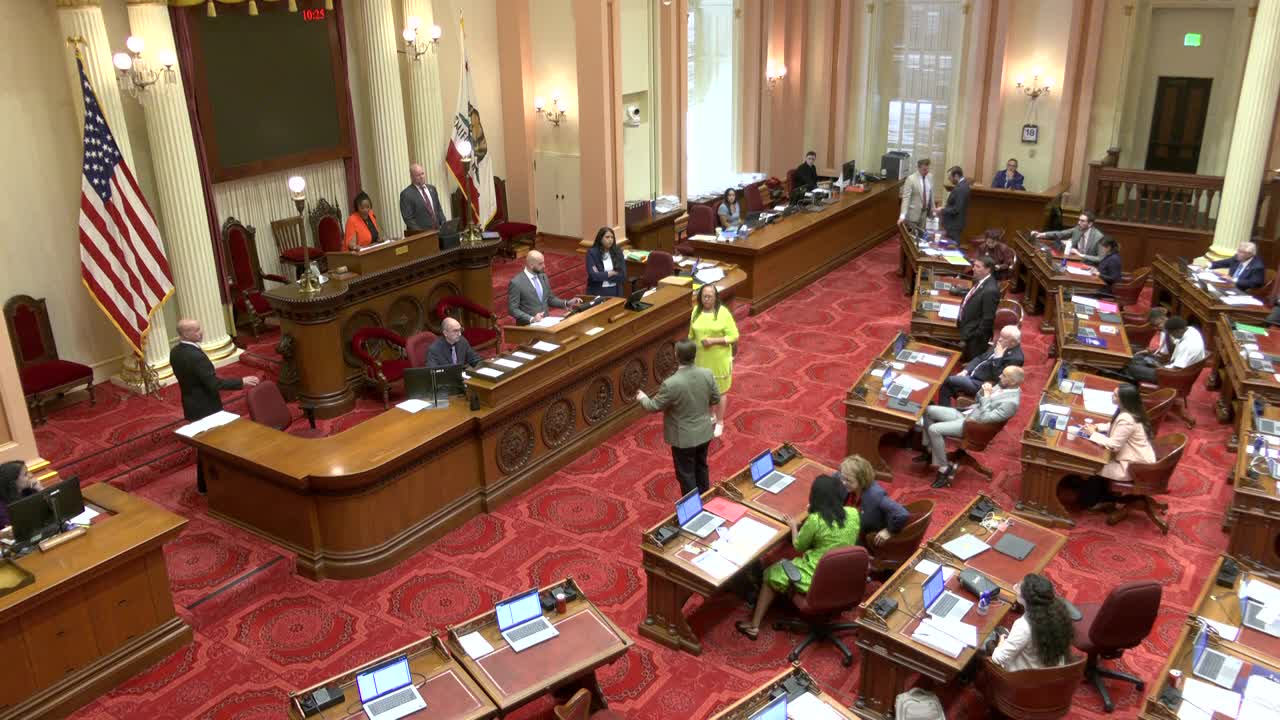 16MIN
Senate Floor
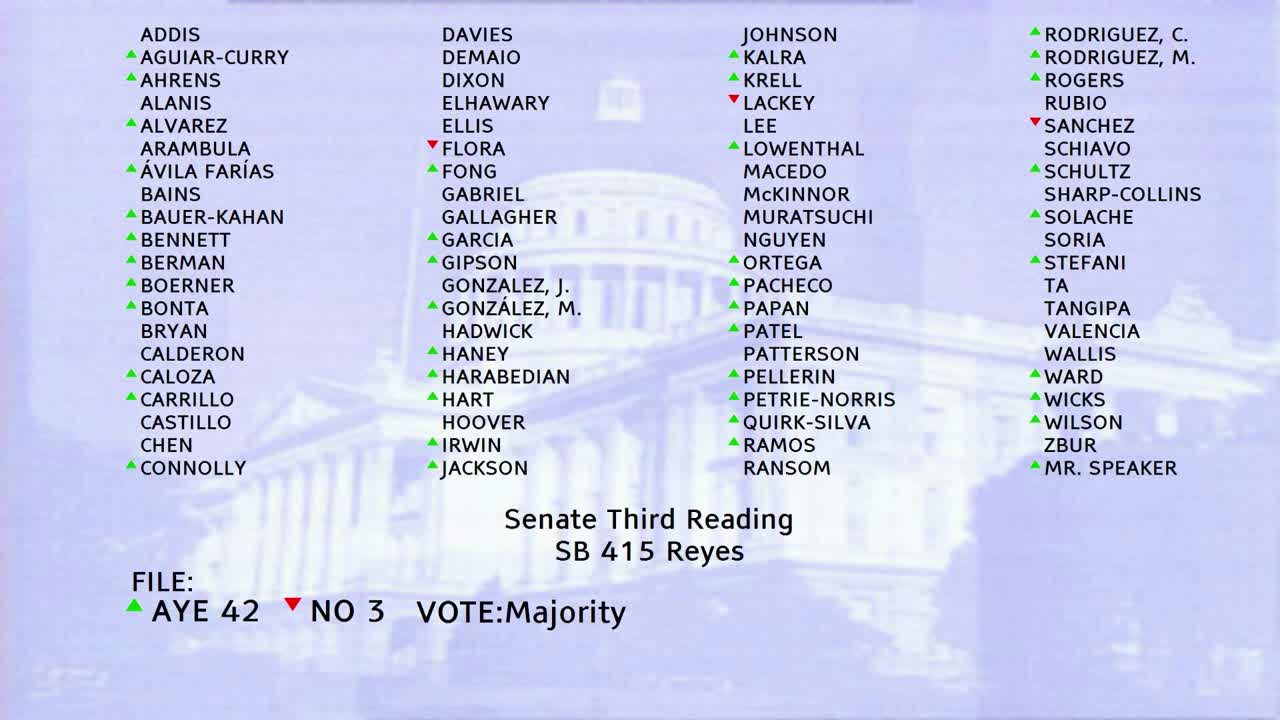 5MIN
Assembly Floor
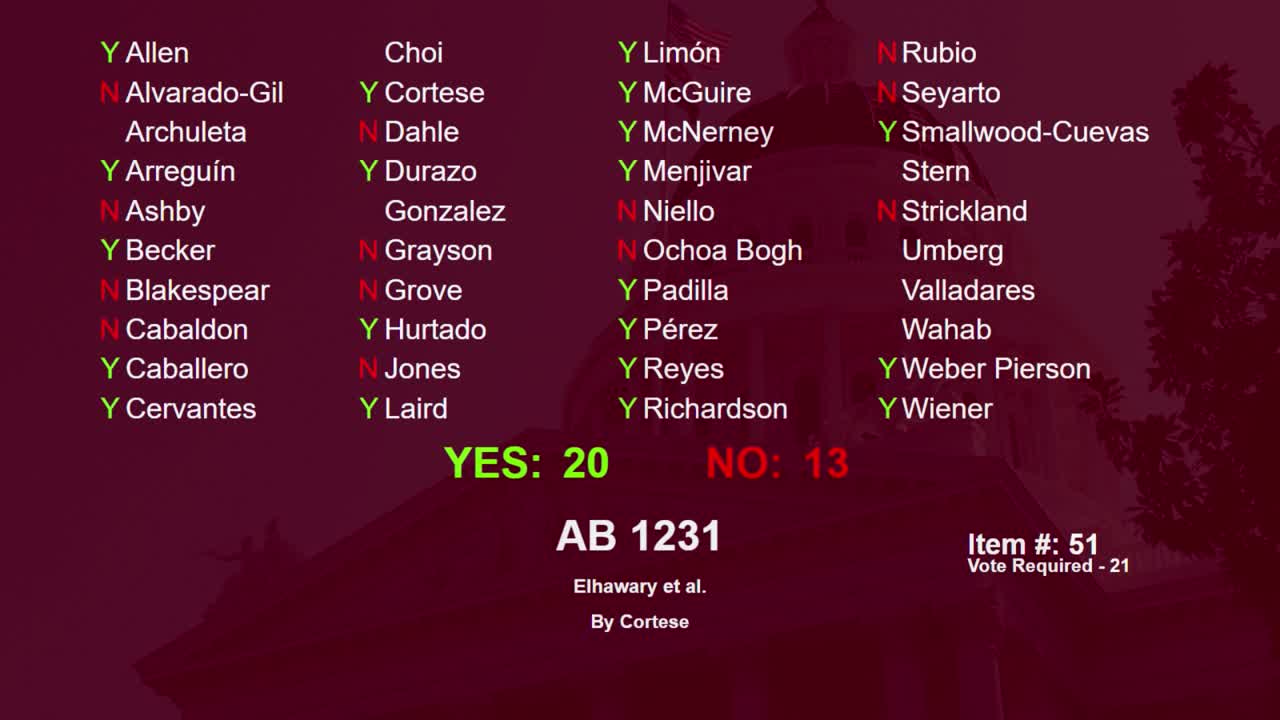 3MIN
Senate Floor
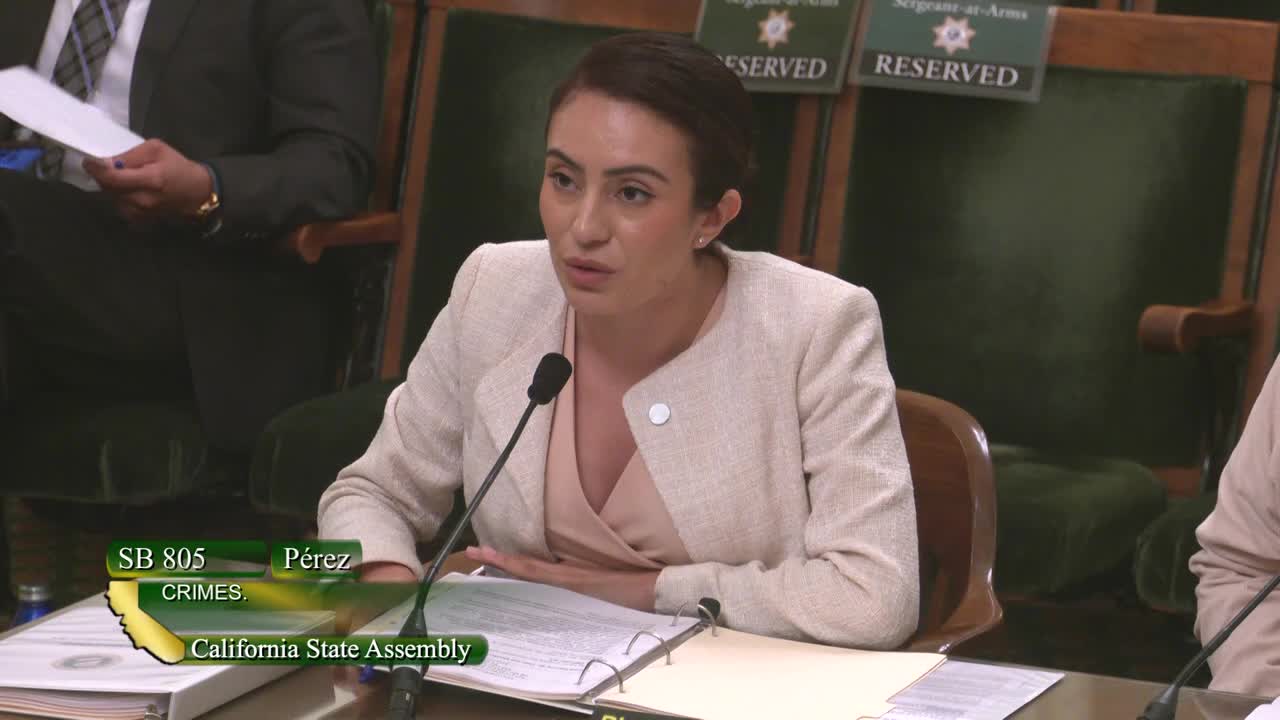 9MIN
Assembly Standing Committee on Public Safety
 15MIN
Assembly Standing Committee on Education
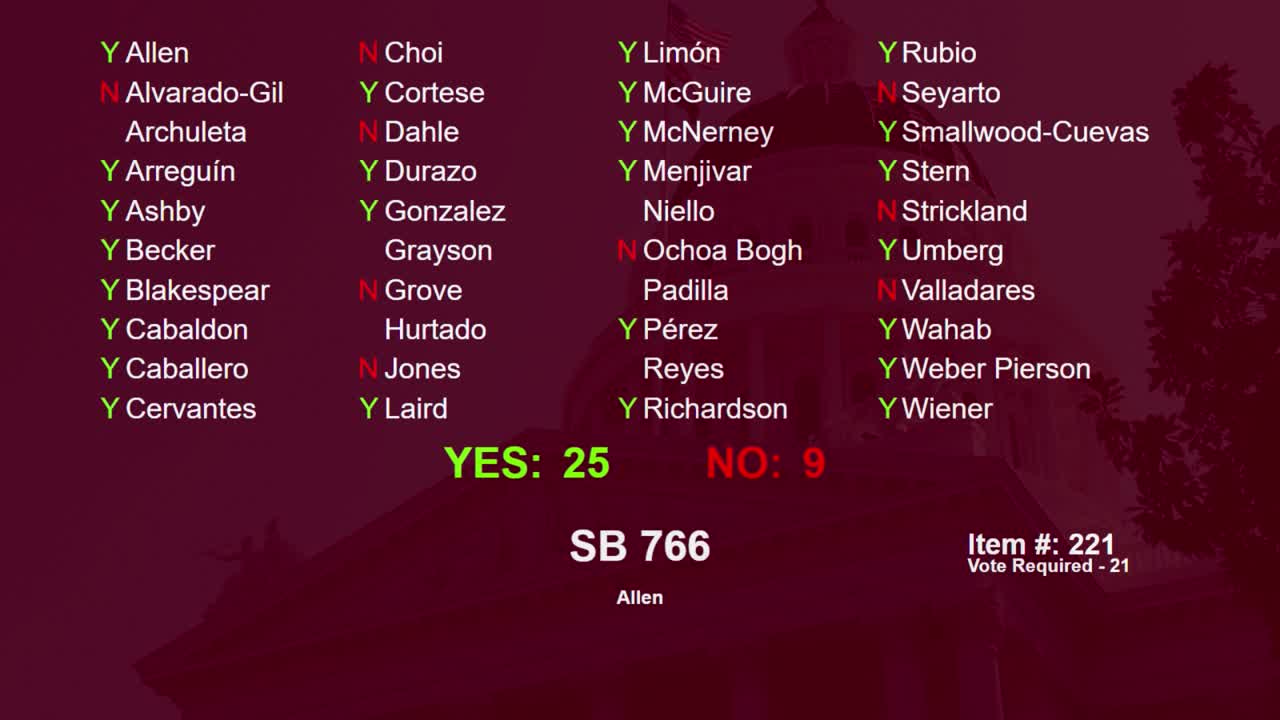 7MIN
Senate Floor
 14MIN
Senate Standing Committee on Public Safety
 14MIN
Senate Standing Committee on Education
Bill Author