SB 872: Delta Levees and Canal Subsidence Fund.
- Session Year: 2025-2026
- House: Senate
- Latest Version Date: 2026-08-24
Current Status:
In Progress
(2026-09-27: In Senate. Consideration of Governor's veto pending.)
Introduced
In Committee
Awaiting First Chamber Vote
Passed First Chamber
In Committee
Awaiting Second Chamber Vote
Passed Second Chamber
Enacted
What does this bill do?
The bill creates a Delta Levees and Canal Subsidence Fund to pay for repairing canals damaged by land subsidence and for improving levees in the Sacramento‑San Joaquin Delta and Suisun Marsh, affecting state water managers, local agencies, and Delta communities. It lets the department accept state, federal, and private funds, requires a conservancy‑led public working group to pick projects, mandates a five‑year spending plan for canal repairs, allows local agencies full reimbursement for hardship cases that protect life, property, water supply, or habitat, and bars spending on new Delta conveyance facilities.
The summary is provided by generative AI which can make mistakes. For original language, please view the details in the table below.
Existing law, the Sacramento-San Joaquin Delta Reform Act of 2009, declares that the Sacramento-San Joaquin Delta (Delta) is a critically important natural resource for California and the nation and it serves as both the hub of the California water system and the most valuable estuary and wetland ecosystem on the west coast of North and South America. Existing law establishes in the Natural Resources Agency the Department of Water Resources (department). Existing law requires the department and the Department of Fish and Wildlife to determine the principal options for the Delta and requires the department to evaluate and comparatively rate each option for its ability to do specified things, including, among others, to maintain Delta water quality for Delta users, and to preserve, protect, and improve Delta levees. Existing law establishes in the agency the Sacramento-San Joaquin Delta Conservancy. Existing law requires the conservancy to act as a primary state agency to implement ecosystem restoration in the Delta and to support efforts that advance environmental protection and the economic well-being of Delta residents. Existing law provides for the preservation of specified management areas of the Suisun Marsh, pursuant to a protection plan prepared and adopted by the San Francisco Bay Conservation and Development Commission, as provided. Existing law establishes the Delta Stewardship Council, and requires the council to develop, adopt, and implement a comprehensive long-term management plan for the Delta, known as the Delta Plan, as provided.
Existing law requires the department, upon appropriation, to reimburse an eligible local agency for costs incurred for the maintenance or improvement of specified levees, in an amount not to exceed 75% of costs incurred in excess of a set amount per mile, as provided.
This bill would require the department to reimburse 100% of the excess costs if a local agency demonstrates economic hardship and the reimbursement is for a project that addresses a threat to life, property, water supply, or habitat.
This bill would establish the Delta Levees and Canal Subsidence Fund in the State Treasury and, upon appropriation, would make the moneys in the fund available to the Secretary of the Natural Resources Agency for expenditure consistent with the allocations described below. The bill would authorize the secretary to seek out, and the fund to accept, state moneys from, among other sources, any bond funds, the General Fund, or the Greenhouse Gas Reduction Fund. The bill would authorize the fund to accept moneys from nonstate sources, including federal and private moneys, and would continuously appropriate those moneys without regard to fiscal year, for allocation as described below, thereby making an appropriation. The bill would require the secretary to allocate moneys in the fund, as specified, subject to funding availability, as follows: (1) to the department for the purposes of supporting capital improvements to restore the original design water conveyance capacity for state water conveyance systems, as defined, impacted operationally by land subsidence, and (2) to the department for projects in the Delta or Suisun Marsh to improve existing levees, as specified. The bill would require the conservancy to convene a working group with specified representation to develop a list of recommended projects, as provided. The bill would require the conservancy to publish the list on its internet website, allow 45 days for public comment, and hold at least one community meeting before the list is approved by the conservancys governing board. The bill would require the department to administer any grants or funding agreements from the list of projects. The bill would require at least 15% of the funds for projects in the Delta or Suisun Marsh, as described in (2) above, to be for Delta levee projects from the list developed by the working group, as provided. The bill would authorize the department to impose additional requirements on projects to meet the conditions of the funding source, as provided. The bill would prohibit these moneys from being expended to pay the costs of the design, construction, operation, mitigation, or maintenance of any additional Delta conveyance facilities, as provided. The bill would require the secretary, no later than January 1, 2032, and by January 1 every 5 years thereafter, to report to the Legislature on expenditures, as provided.
This bill would also require the department to provide a report to the budget committees of the Assembly and Senate no later than May 1, 2027, and biennially thereafter, that contains a 5-year spending plan detailing the engineering and capital improvements necessary to address state water conveyance systems impacted operationally by land subsidence, as provided. The bill would authorize the department to charge the state water supply contractors for the actual and reasonable cost of developing the plan.
Existing law, the Sacramento-San Joaquin Delta Reform Act of 2009, declares that the Sacramento-San Joaquin Delta (Delta) is a critically important natural resource for California and the nation and it serves as both the hub of the California water system and the most valuable estuary and wetland ecosystem on the west coast of North and South America. Existing law establishes in the Natural Resources Agency the Department of Water Resources. Resources (department). Existing law requires the department and the Department of Fish and Wildlife to determine the principal options for the Delta and requires the department to evaluate and comparatively rate each option for its ability to do specified things, including, among others, to maintain Delta water quality for Delta users, and to preserve, protect, and improve Delta levees. Existing law establishes in the agency the Sacramento-San Joaquin Delta Conservancy. Existing law requires the conservancy to act as a primary state agency to implement ecosystem restoration in the Delta and to support efforts that advance environmental protection and the economic well-being of Delta residents. Existing law provides for the preservation of specified management areas of the Suisun Marsh, pursuant to a protection plan prepared and adopted by the San Francisco Bay Conservation and Development Commission, as provided. Existing law establishes the Delta Stewardship Council, and requires the council to develop, adopt, and implement a comprehensive long-term management plan for the Delta, known as the Delta Plan, as provided.
Existing law requires the department, upon appropriation, to reimburse an eligible local agency for costs incurred for the maintenance or improvement of specified levees, in an amount not to exceed 75% of costs incurred in excess of a set amount per mile, as provided.
This bill would require the department to reimburse 100% of the excess costs if a local agency demonstrates economic hardship and the reimbursement is for a project that addresses a threat to life, property, water supply, or habitat.
This bill would establish the Delta Levees and Canal Subsidence Fund in the State Treasury and, upon appropriation, would make the moneys in the fund available to the Secretary of the Natural Resources Agency for expenditure consistent with the allocations described below. The bill would authorize the secretary to seek out, and the fund to accept, state moneys from, among other sources, any bond funds, the General Fund, or the Greenhouse Gas Reduction Fund. The bill would authorize the fund to accept moneys from nonstate sources, including federal and private moneys, and would continuously appropriate those moneys without regard to fiscal year, for allocation as described below, thereby making an appropriation. The bill would require the secretary to allocate moneys in the fund, as specified, subject to funding availability, as follows: (1) to the Department of Water Resources department for the purposes of supporting capital improvements to restore the original design water conveyance capacity for state water conveyance systems, as defined, impacted operationally by land subsidence, and (2) to the conservancy department for projects in the Delta or Suisun Marsh to improve existing levees, as specified. The bill would require the conservancy to convene a working group with specified representation to develop a list of recommended projects, as provided. The bill would require the conservancy to publish the list on its internet website, allow 45 days for public comment, and hold at least one community meeting before the list is approved by the conservancys governing board. The bill would require the department to administer any grants or funding agreements from the list of projects. The bill would require at least 15% of the funds for projects in the Delta or Suisun Marsh, as described in (2) above, to be for Delta levee projects from the list developed by the working group, as provided. The bill would authorize the conservancy department to impose additional requirements on projects to meet the conditions of the funding source, as provided. The bill would prohibit these moneys from being expended to pay the costs of the design, construction, operation, mitigation, or maintenance of any additional Delta conveyance facilities, as provided. The bill would require the secretary, no later than January 1, 2032, and by January 1 every 5 years thereafter, to report to the Legislature on expenditures, as provided.
This bill would require the conservancy, before expending funds for any project in the Delta or Suisun Marsh, as described above, to prepare an annual spending plan, require the governing board of the conservancy to approve the spending plan, and require the spending plan to detail the projects the conservancy intends to fund in that fiscal year. The bill would also require the conservancy to publish the spending plan on its internet website, allow at least 45 days for public comment on the spending plan, and hold at least one community meeting on the spending plan before it is approved by the governing board. The bill would also require the conservancy, in conjunction with the council and the department, to develop a 5-year spending plan to improve existing levees in the Delta and would require the conservancy to publish the plan on its internet website.This bill would also require the department to provide a report to the budget committees of the Assembly and Senate no later than May 1, 2027, and biennially thereafter, that contains a 5-year spending plan detailing the engineering and capital improvements necessary to address state water conveyance systems impacted operationally by land subsidence, as provided. The bill would authorize the department to charge the state water supply contractors for the actual and reasonable cost of developing the plan.
Existing law, the Sacramento-San Joaquin Delta Reform Act of 2009, declares that the Sacramento-San Joaquin Delta (Delta) is a critically important natural resource for California and the nation and it serves as both the hub of the California water system and the most valuable estuary and wetland ecosystem on the west coast of North and South America. Existing law establishes in the Natural Resources Agency the Department of Water Resources. Existing law requires the department and the Department of Fish and Wildlife to determine the principal options for the Delta and requires the department to evaluate and comparatively rate each option for its ability to do specified things, including, among others, to maintain Delta water quality for Delta users, and to preserve, protect, and improve Delta levees. Existing law establishes in the agency the Sacramento-San Joaquin Delta Conservancy. Existing law requires the conservancy to act as a primary state agency to implement ecosystem restoration in the Delta and to support efforts that advance environmental protection and the economic well-being of Delta residents. Existing law provides for the preservation of specified management areas of the Suisun Marsh, pursuant to a protection plan prepared and adopted by the San Francisco Bay Conservation and Development Commission, as provided. Existing law establishes the Delta Stewardship Council, and requires the council to develop, adopt, and implement a comprehensive long-term management plan for the Delta, known as the Delta Plan, as provided.
This bill would establish the Delta Levees and Canal Subsidence Fund in the State Treasury and, upon appropriation, would make the moneys in the fund available to the Secretary of the Natural Resources Agency for expenditure consistent with the allocations described below. The bill would authorize the secretary to seek out, and the fund to accept, state moneys from, among other sources, any bond funds, the General Fund, or the Greenhouse Gas Reduction Fund. The bill would authorize the fund to accept moneys from nonstate sources, including federal and private moneys, and would continuously appropriate those moneys without regard to fiscal year, for allocation as described below, thereby making an appropriation. The bill would require the secretary to allocate moneys in the fund, through the 204647 fiscal year, as specified, subject to funding availability, as follows: (1) in the amount of $150,000,000, annually, to the Department of Water Resources for the purposes of supporting capital improvements to restore the original design water conveyance capacity for state water conveyance systems, as defined, impacted operationally by land subsidence, and (2) in the amount of $150,000,000, annually, to the conservancy for projects in the Delta or Suisun Marsh to improve existing levees, as specified. The bill would authorize the conservancy to impose additional requirements on projects to meet the conditions of the funding source, as provided. The bill would require the secretary to proportionally reduce the above-described amounts if there is insufficient moneys in the fund, as provided. The bill would prohibit these moneys from being expended to pay the costs of the design, construction, operation, mitigation, or maintenance of any additional Delta conveyance facilities, as provided. The bill would require the secretary, no later than January 1, 2032, and by January 1 every 5 years thereafter, to report to the Legislature on expenditures, as provided.
This bill would require the conservancy, before expending funds for any project in the Delta or Suisun Marsh, as described above, to prepare an annual spending plan, require the governing board of the conservancy to approve the spending plan, and require the spending plan to detail the projects the conservancy intends to fund in that fiscal year. The bill would also require the conservancy to publish the spending plan on its internet website, allow at least 45 days for public comment on the spending plan, and hold at least one community meeting on the spending plan before it is approved by the governing board. The bill would also require the conservancy, in conjunction with the council and the department, to develop a 5-year spending plan to improve existing levees in the Delta and would require the conservancy to publish the plan on its internet website.
This bill would also require the department to provide a report to the budget committees of the Assembly and Senate no later than May 1, 2027, and biennially thereafter, that contains a 5-year spending plan detailing the engineering and capital improvements necessary to address state water conveyance systems impacted operationally by land subsidence, as provided. The bill would authorize the department to charge the state water supply contractors for the actual and reasonable cost of developing the plan.
Existing law, the Sacramento-San Joaquin Delta Reform Act of 2009, declares that the Sacramento-San Joaquin Delta (Delta) is a critically important natural resource for California and the nation and it serves as both the hub of the California water system and the most valuable estuary and wetland ecosystem on the west coast of North and South America. Existing law establishes in the Natural Resources Agency the Department of Water Resources. Existing law requires the department and the Department of Fish and Wildlife to determine the principal options for the Delta and requires the department to evaluate and comparatively rate each option for its ability to do specified things, including, among others, to maintain Delta water quality for Delta users, and to preserve, protect, and improve Delta levees. Existing law establishes in the agency the Sacramento-San Joaquin Delta Conservancy. Existing law requires the conservancy to act as a primary state agency to implement ecosystem restoration in the Delta and to support efforts that advance environmental protection and the economic well-being of Delta residents. Existing law provides for the preservation of specified management areas of the Suisun Marsh, pursuant to a protection plan prepared and adopted by the San Francisco Bay Conservation and Development Commission, as provided.
This bill would establish the Delta Levees and Canal Subsidence Fund in the State Treasury and, upon appropriation, would make the moneys in the fund available to the Secretary of the Natural Resources Agency for expenditure consistent with the allocations described below. The bill would authorize the secretary to seek out, and the fund to accept, state moneys from, among other sources, any bond funds, the General Fund, or the Greenhouse Gas Reduction Fund. The bill would authorize the fund to accept moneys from nonstate sources, including federal and private moneys, and would continuously appropriate those moneys without regard to fiscal year, for allocation as described below, thereby making an appropriation. The bill would require the secretary to allocate moneys in the fund, through the 204647 fiscal year, subject to funding availability, as follows: (1) in the amount of $150,000,000, annually, to the Department of Water Resources for the purposes of supporting capital improvements to restore the original design water conveyance capacity for state water conveyance systems systems, as defined, impacted operationally by land subsidence, and (2) in the amount of $150,000,000, annually, to the conservancy for projects in the Delta or Suisun Marsh to improve existing levees, as specified. The bill would authorize the conservancy to impose additional requirements on projects to meet the conditions of the funding source, as provided. The bill would require the secretary to proportionally reduce the above-described amounts if there is insufficient moneys in the fund, as provided. The bill would prohibit these moneys from being expended to pay the costs of the design, construction, operation, mitigation, or maintenance of any additional Delta conveyance facilities, as provided. The bill would require the secretary, no later than January 1, 2032, and by January 1 every 5 years thereafter, to report to the Legislature on expenditures, as provided.
This bill would require the conservancy, before expending funds for any project in the Delta or Suisun Marsh, as described above, to prepare an annual spending plan, require the governing board of the conservancy to approve the spending plan, and require the spending plan to detail the projects the conservancy intends to fund in that fiscal year. The bill would also require the conservancy to publish the spending plan on its internet website, allow at least 45 days for public comment on the spending plan, and hold at least one community meeting on the spending plan before it is approved by the governing board.
Existing law, the Sacramento-San Joaquin Delta Reform Act of 2009, declares that the Sacramento-San Joaquin Delta (Delta) is a critically important natural resource for California and the nation and it serves as both the hub of the California water system and the most valuable estuary and wetland ecosystem on the west coast of North and South America. Existing law establishes in the Natural Resources Agency the Department of Water Resources. Existing law requires the department and the Department of Fish and Wildlife to determine the principal options for the Delta and requires the department to evaluate and comparatively rate each option for its ability to do specified things, including, among others, to maintain Delta water quality for Delta users, and to preserve, protect, and improve Delta levees. Existing law establishes in the agency the Sacramento-San Joaquin Delta Conservancy. Existing law requires the conservancy to act as a primary state agency to implement ecosystem restoration in the Delta and to support efforts that advance environmental protection and the economic well-being of Delta residents.
This bill would establish the Delta Levees and Canal Subsidence Fund in the State Treasury and, upon appropriation, would make the moneys in the fund available to the Secretary of the Natural Resources Agency for expenditure consistent with the allocations described below. The bill would authorize the secretary to seek out, and the fund to accept, state moneys from, among other sources, any bond funds, the General Fund, or the Greenhouse Gas Reduction Fund. The bill would authorize the fund to accept moneys from nonstate sources, including federal and private moneys, and would continuously appropriate those moneys without regard to fiscal year, for allocation as described below, thereby making an appropriation. The bill would require the secretary to allocate moneys in the fund, through the 204647 fiscal year, subject to funding availability, as follows: (1) in the amount of $150,000,000, annually, to the Department of Water Resources for the purposes of supporting capital improvements to restore the original design water conveyance capacity for state water conveyance systems impacted operationally by land subsidence, and (2) in the amount of $150,000,000, annually, to the conservancy for projects in the Delta to improve existing levees, as specified. The bill would authorize the conservancy to impose additional requirements on projects to meet the conditions of the funding source, as provided. The bill would require the secretary to proportionally reduce the above-described amounts if there is insufficient moneys in the fund, as provided. The bill would prohibit these moneys from being expended to pay the costs of the design, construction, operation, mitigation, or maintenance of any additional Delta conveyance facilities, as provided. The bill would require the secretary, no later than January 1, 2032, and by January 1 every 5 years thereafter, to report to the Legislature on expenditures, as provided.
Existing law, the Sacramento-San Joaquin Delta Reform Act of 2009, declares that the Sacramento-San Joaquin Delta (Delta) is a critically important natural resource for California and the nation and it serves as both the hub of the California water system and the most valuable estuary and wetland ecosystem on the west coast of North and South America. Existing law establishes in the Natural Resources Agency the Department of Water Resources. Existing law requires the department and the Department of Fish and Wildlife to determine the principal options for the Delta and requires the department to evaluate and comparatively rate each option for its ability to do specified things, including, among others, to maintain Delta water quality for Delta users, and to preserve, protect, and improve Delta levees. Existing law establishes in the agency the Sacramento-San Joaquin Delta Conservancy. Existing law requires the conservancy to act as a primary state agency to implement ecosystem restoration in the Delta and to support efforts that advance environmental protection and the economic well-being of Delta residents.
This bill would establish the Delta Levees and Canal Subsidence Fund in the State Treasury and, upon appropriation, would make the moneys in the fund available to the Secretary of the Natural Resources Agency for expenditure consistent with the allocations described below. The bill would authorize the secretary to seek out, and the fund to accept, state moneys from, among other sources, any bond funds, the General Fund, or the Greenhouse Gas Reduction Fund. The bill would authorize the fund to accept moneys from nonstate sources, including federal and private moneys, and would continuously appropriate those moneys without regard to fiscal year, for allocation as described below, thereby making an appropriation. The bill would require the secretary to allocate moneys in the fund, through the 204647 fiscal year, subject to funding availability, as follows: (1) in the amount of $150,000,000, annually, to the Department of Water Resources for the purposes of supporting capital improvements to restore the original design water conveyance capacity for state water conveyance systems impacted operationally by land subsidence, and (2) in the amount of $150,000,000, annually, to the conservancy for projects in the Delta to improve existing levees, as specified. The bill would require the secretary to proportionally reduce the above-described amounts if there is insufficient moneys in the fund, as provided. The bill would prohibit these moneys from being expended to pay the costs of the design, construction, operation, mitigation, or maintenance of any additional Delta conveyance facilities, as provided.
Existing law, the Sacramento-San Joaquin Delta Reform Act of 2009, declares that the Sacramento-San Joaquin Delta (Delta) is a critically important natural resource for California and the nation and it serves as both the hub of the California water system and the most valuable estuary and wetland ecosystem on the west coast of North and South America. Existing law establishes in the Natural Resources Agency the Department of Water Resources. Existing law requires the department and the Department of Fish and Wildlife to determine the principal options for the Delta and requires the department to evaluate and comparatively rate each option for its ability to do specified things, including, among others, to maintain Delta water quality for Delta users, and to preserve, protect, and improve Delta levees. Existing law establishes in the agency the Sacramento-San Joaquin Delta Conservancy. Existing law requires the conservancy to act as a primary state agency to implement ecosystem restoration in the Delta and to support efforts that advance environmental protection and the economic well-being of Delta residents.
This bill would require, of that amount, beginning with the 202627 fiscal year and continuing establish the Delta Levees and Canal Subsidence Fund in the State Treasury and, upon appropriation, would make the moneys in the fund available to the Secretary of the Natural Resources Agency for expenditure consistent with the allocations described below. The bill would authorize the secretary to seek out, and the fund to accept, state moneys from, among other sources, any bond funds, the General Fund, or the Greenhouse Gas Reduction Fund. The bill would authorize the fund to accept moneys from nonstate sources, including federal and private moneys, and would continuously appropriate those moneys without regard to fiscal year, for allocation as described below, thereby making an appropriation. The bill would require the secretary to allocate moneys in the fund, through the 204647 fiscal year, the sum of $150,000,000 be appropriated subject to funding availability, as follows: (1) in the amount of $150,000,000, annually, to the Department of Water Resources for the purposes of supporting capital improvements to restore the original design water conveyance capacity for state water conveyance systems impacted operationally by land subsidence, and the sum of $150,000,000 be appropriated annually (2) in the amount of $150,000,000, annually, to the Sacramento-San Joaquin Delta Conservancy conservancy for projects in the Sacramento-San Joaquin Delta to improve existing levees, as specified, thereby making an appropriation. specified. The bill would require the secretary to proportionally reduce the above-described amounts if there is insufficient moneys in the fund, as provided. The bill would prohibit funds provided by these provisions these moneys from being expended to pay the costs of the design, construction, operation, mitigation, or maintenance of any additional Sacramento-San Joaquin Delta conveyance facilities, as provided.
The California Global Warming Solutions Act of 2006 designates the State Air Resources Board as the state agency charged with monitoring and regulating sources of emissions of greenhouse gases. The act authorizes the state board to include in its regulation of those emissions the use of market-based compliance mechanisms. Existing law requires all moneys, except for fines and penalties, collected by the state board from the auction or sale of allowances as part of a market-based compliance mechanism to be deposited in the Greenhouse Gas Reduction Fund. Existing law requires, beginning with 202627 fiscal year, that funds be allocated according to a specified priority, including, among other things, that the sum of $1,000,000,000 be reserved for appropriation by the Legislature in the annual Budget Act or other statute.
This bill would require, of that amount, beginning with the 202627 fiscal year and continuing through the 204647 fiscal year, the sum of $150,000,000 be appropriated annually, to the Department of Water Resources for the purposes of supporting capital improvements to restore the original design water conveyance capacity for state water conveyance systems impacted operationally by land subsidence, and the sum of $150,000,000 be appropriated annually to the Sacramento-San Joaquin Delta Conservancy for projects in the Sacramento-San Joaquin Delta to improve existing levees, as specified, thereby making an appropriation. The bill would prohibit funds provided by these provisions from being expended to pay the costs of the design, construction, operation, mitigation, or maintenance of any additional Sacramento-San Joaquin Delta conveyance facilities, as provided.
Existing law prohibits the construction of any new dam or reservoir or the enlargement of any new dam or reservoir until the owner has applied for and obtained from the Department of Water Resources written approval of plans and specifications. Existing law authorizes the department, in connection with approving a dam or reservoir, to require certain data, investigations, reports, and any other appropriate information as may be necessary.This bill would make a nonsubstantive change in these provisions.Existing law prohibits the construction of any new dam or reservoir or the enlargement of any new dam or reservoir until the owner has applied for and obtained from the Department of Water Resources written approval of plans and specifications. Existing law authorizes the department, in connection with approving a dam or reservoir, to require certain data, investigations, reports, and any other appropriate information as may be necessary.
This bill would make a nonsubstantive change in these provisions.
The Legislature finds and declares all of the following:
(a)Climate change continues to have an immense impact on Californias water systems and changing precipitation patterns, increasing flood and drought risks, sea level rise, and aging infrastructure are all combining to cause significant risks to our ability to protect water quality in the Sacramento-San Joaquin Delta (Delta), protect flood-vulnerable communities, maintain water deliveries, and ensure climate-responsive water operations.
(b)Before passage of the Sustainable Groundwater Management Act (Part 2.74 (commencing with Section 10720) of Division 6 of the Water Code), groundwater pumping and other factors resulted in significant land subsidence in the San Joaquin Valley. According to the State Water Project Adaptation Strategy, this subsidence threatens to reduce the water carrying capacity of the State Water Project by 87 percent by 2040 if not repaired, putting drinking water for 27,000,000 residents and 750,000 acres of farmland in California at risk.
(c)The State Water Project is the single largest energy user in state, using about 3 percent of total statewide consumption, and with subsided canals increasing the energy it takes to move water, if these subsidence impacts to the State Water Project are not addressed, there will be unnecessary increased energy usage and associated costs.
(d)Each public water agency contracted with the Department of Water Resources is obligated to pay the capital and operation and management costs of the State Water Project in order to participate in the State Water Project, and the Department of Water Resources is authorized to issue bonds for the capital costs under the Central Valley Project (Part 3 (commencing with Section 11100) of Division 6 of the Water Code) that each state water contractor repays along with other expenses billed by the Department of Water Resources, including annual operation and maintenance costs.
(e)Damage to the State Water Project due to subsided canals is largely caused by groundwater pumping actions done outside of the public water agencies service areas. Obligations to pay the costs of repair of the canals would significantly increase annual costs to public water agencies and their ratepayers.
(f)The Delta supports local communities, businesses, and more than 400,000 acres of farmland, 80 percent of which is considered United States Department of Agriculture prime farmland, and it is also a national heritage site, a site of critical cultural importance to several indigenous tribes, and a thriving ecosystem supporting several native species of plants and animals.
(g)The Delta is also experiencing the impacts of climate change, including, but not limited to, increasing droughts, more extreme precipitation events, earlier snowmelt, and sea level rise that all create concerns for how to manage the dynamic ecosystem in a way that continues to support human life and natural ecosystems.
(h)The Delta is supported by 1,100 miles of levees that provide protection to residences, businesses, agricultural lands, tribal cultural sites, and infrastructure and help ensure fresh drinking water supply to millions of Californians. However, many levees date back to the 19th century and no longer meet the United States Army Corps of Engineers standards. If levees are breached, human life and property in the Delta would be at risk, and saltwater intrusion into the fresh water that feeds the state and federal water projects could threaten the drinking water sources for over one-half of the people in the state.
(i)The Sacramento-San Joaquin Delta Reform Act of 2009 required, among other things, that the Delta Stewardship Council establish a plan to reduce flood risk and guide prioritization of state investments in the Delta. The resulting Delta Levees Investment Strategy (DLIS) is a risk-based prioritization for levee investments in the Delta that became law as part of the Delta Plan on January 1, 2024. The goal is to maximize flood protection for people, property, water supply, the delta ecosystem, and infrastructure, for the benefit of all Californians. While the strategy provides a risk-based prioritization of levee repairs in the Delta, it does not currently have funding sources to meet its goals.
(j)The Sacramento-San Joaquin Delta Reform Act of 2009 also established that it is state policy to reduce reliance on the Delta in meeting the states future water supply needs by investing in improved water use efficiency, water recycling, advanced water technologies, and other regional water supply projects. These alternative water supplies will continue to be critical to protecting and preserving the overall health of the Delta, and critical to the protection of a diverse clean water supply for the people of California.
SEC. 2.Section 12986 of the Water Code is amended to read:12986.(a)The department, upon appropriation by the Legislature, shall reimburse an eligible local agency pursuant to this part for costs incurred in any year for the maintenance or improvement of project or nonproject levees as follows:
(1)Costs incurred shall not be reimbursed if the entire cost incurred per mile of project or nonproject levee is either of the following:
(A)Two thousand five hundred dollars ($2,500) or less for a project or nonproject levee in an urban area.
(B)One thousand dollars ($1,000) or less for a project or nonproject levee in a rural area.
(2)(A)Not more than 75 percent of any costs incurred in excess of the amount per mile of project or nonproject levee specified in paragraph (1) shall be reimbursed.
(B)Notwithstanding subparagraph (A), the department shall reimburse 100 percent of any costs incurred in excess of the amount per mile of project or nonproject levee specified in paragraph (1) if a local agency demonstrates economic hardship and the reimbursement is for a project that addresses a threat to life, property, water supply, or habitat.
(3)In addition to project plans approved by the board, the department shall require the local agency to provide information to the department that may include, but is not limited to, a detailed engineers report prepared pursuant to subdivision (b) of Section 4 of Article XIII D of the California Constitution, audited financial statements, or an assessment commissioners report. The information provided to the department shall be the basis for determining the maximum allowable reimbursement eligible under this part. Nothing in this paragraph shall be interpreted to increase the maximum reimbursement allowed under paragraph (2).
(4)Reimbursements made to the local agency in excess of the maximum allowable reimbursement shall be returned to the department.
(5)All final costs allocated or reimbursed under a plan shall be approved by the Central Valley Flood Protection Board for project and nonproject levee work.
(6)Costs incurred pursuant to this part that are eligible for reimbursement include construction costs and associated engineering services, financial or economic analyses, environmental costs, mitigation costs, and habitat improvement costs.
(b)Upon completion of its evaluation pursuant to Sections 139.2 and 139.4, by January 1, 2008, the department shall recommend to the Legislature and the Governor priorities for funding under this section.
(c)Reimbursements made pursuant to this section shall reflect the priorities of, and be consistent with, the Delta Plan established pursuant to Chapter 1 (commencing with Section 85300) of Part 4 of Division 35.
(d)For the purposes of this section, the following definitions apply:
(1)Rural area means an area that is not an urban area.
(2)Urban area means an area in which 10 percent or more of the land area within the project area is used for residential use.
SEC. 3.Part 10 (commencing with Section 12996) is added to Division 6 of the Water Code, to read:10.Delta Levees and Canal Subsidence Fund12996.Unless the context otherwise requires, the definitions below govern the construction of this part:
(a)Board means the governing board of the conservancy, established pursuant to Section 32330 of the Public Resources Code.
(b)Conservancy means the Sacramento-San Joaquin Delta Conservancy, established pursuant to Division 22.3 (commencing with Section 32300) of the Public Resources Code.
(c)Council means the Delta Stewardship Council, established pursuant to Section 85200.
(d)Department means the Department of Water Resources.
(e)Fund means the Delta Levees and Canal Subsidence Fund created pursuant to Section 12997.
(f)Sacramento-San Joaquin Delta has the same meaning as described in Section 12220 of the Water Code.
(g)Secretary means the Secretary of the Natural Resources Agency.
(h)State water conveyance systems means the water conveyance facilities owned or maintained by the department.
(i)State water supply contractor has the same meaning as the term is used in Section 11975.
(j)Suisun Marsh has the same meaning as described in Section 29101 of the Public Resources Code.
12997.(a)The Delta Levees and Canal Subsidence Fund is hereby created in the State Treasury. Upon appropriation by the Legislature, moneys deposited into the fund shall be available to the secretary for expenditure consistent with this part.
(b)(1)The secretary may seek out, and the fund may accept, state moneys, including, but not limited to, from the General Fund, special funds, the Greenhouse Gas Reduction Fund created pursuant to Section 16428.8 of the Government Code, or any bond funds, for purposes of this part.
(2)The fund may accept moneys from nonstate sources, including, but not limited to, federal and private moneys, for purposes of this part.
(3)The secretary may establish accounts within the fund.
(4)Notwithstanding subdivision (a), and Section 13340 of the Government Code, any nonstate funds, including, but not limited to, federal and private funds, in the fund are continuously appropriated without regard to fiscal year to the secretary for expenditure consistent with this part.
(c)The secretary shall allocate moneys in the fund, subject to funding availability, in proportion to need, as determined by the secretary, and based at least in part on seismic risk assessment, for all of the following purposes:
(1)(A)To the department for the purpose of supporting capital improvements to restore the original design water conveyance capacity for state water conveyance systems impacted operationally by land subsidence.
(B)The department shall prioritize projects based on the volume of water capacity they can restore to the state water system, and shall provide priority to projects where the surrounding groundwater basin is implementing best management practices aligned with the goals of the Sustainable Groundwater Management Act (Part 2.74 (commencing with Section 10720)), or the equivalent as determined by the department, to manage land subsidence, as determined by the department.
(C)(i)The department may adopt guidelines to implement this paragraph. The Administrative Procedure Act (Chapter 3.5 (commencing with Section 11340) of Part 1 of Division 3 of Title 2 of the Government Code) does not apply to the adoption of the guidelines by the department to implement this paragraph. Before adopting or revising the guidelines or other standards, the department shall provide an opportunity for public comment and at least one public workshop.
(ii)For purposes of moneys deposited into the fund, the department may impose additional requirements on projects to meet any conditions of the funding source.
(2)(A)To the department for projects consistent with the Delta Special Flood Control Projects program pursuant to Chapter 2 (commencing with Section 12310) of Part 4.8, the Delta Levee Maintenance Subventions program pursuant to Part 9 (commencing with Section 12980), or other projects in the Sacramento-San Joaquin Delta or Suisun Marsh to improve existing levees, including multibenefit levee projects that protect, enhance, or restore habitat, and improve water quality.
(B)Projects may include, but are not limited to, projects to address subsidence alongside levees and the construction of seepage and stability berms on levees to correct underseepage, through-seepage, or structural instability.
(C)The department shall prioritize projects consistent with the Delta Levees Investment Strategy.
(D)(i)The conservancy shall convene a working group that includes representatives of local governments, landowners, reclamation districts, tribes, environmental groups, and environmental justice organizations to develop a list of recommended projects for any funding made available pursuant to subparagraph (A). The list of projects shall be consistent with the Delta Levees Investment Strategy and shall be approved by the board. The conservancy shall publish the list of projects on its internet website, allow at least 45 days for public comment, and hold at least one community meeting before the list of projects is approved by the board.
(ii)The board may establish an advisory committee to support development of the list of recommended projects for funding.
(E)(i)The department may adopt or revise guidelines to implement this paragraph. The Administrative Procedure Act (Chapter 3.5 (commencing with Section 11340) of Part 1 of Division 3 of Title 2 of the Government Code) does not apply to the adoption of the guidelines by the conservancy to implement this paragraph. Before adopting or revising the guidelines or other standards, the department shall provide an opportunity for public comment and at least one public workshop.
(ii)For purposes of moneys deposited into the fund, the department may impose additional requirements on projects to meet any conditions of the funding source.
(F)(i)At least 15 percent of the funds made available under subparagraph (A) shall be for levee projects within the Sacramento-San Joaquin Delta recommended by the conservancy pursuant to subparagraph (D) that improve flood risk, protect human health and safety, or protect agricultural interests.
(ii)The department shall administer any grants or funding agreements from the list of projects recommended by the conservancy.
(d)(1)No later than May 1, 2027, and biennially thereafter, the department shall provide a report to the Assembly Committee on Budget and to the Senate Committee on Budget and Fiscal Review that contains a five-year spending plan detailing the engineering and capital improvements necessary to address state water conveyance systems impacted operationally by land subsidence. The initial spending plan shall cover the 202728 to 203132 fiscal years, inclusive, and shall include the out-years anticipated for completion of any necessary capital improvement that is detailed in the spending plan.
(2)The department may charge the state water supply contractors for the actual and reasonable cost of developing the spending plan required pursuant to paragraph (1).
(e)Moneys provided by this part shall not be expended to pay the costs of the design, construction, operation, mitigation, or maintenance of any additional Sacramento-San Joaquin Delta conveyance facilities. Those costs shall be the responsibility of the water agencies that benefit from the design, construction, operation, mitigation, or maintenance of those facilities.
(f)No later than January 1, 2032, and by January 1 every five years thereafter, the secretary shall report to the Legislature, in accordance with Section 9795 of the Government Code, on its expenditures pursuant to this section and the public benefits received from those expenditures.
The Legislature finds and declares all of the following:
(a)Climate change continues to have an immense impact on Californias water systems and changing precipitation patterns, increasing flood and drought risks, sea level rise, and aging infrastructure are all combining to cause significant risks to our ability to protect water quality in the Sacramento-San Joaquin Delta (Delta), protect flood-vulnerable communities, maintain water deliveries, and ensure climate-responsive water operations.
(b)Before passage of the Sustainable Groundwater Management Act (Part 2.74 (commencing with Section 10720) of Division 6 of the Water Code), groundwater pumping and other factors resulted in significant land subsidence in the San Joaquin Valley. According to the State Water Project Adaptation Strategy, this subsidence threatens to reduce the water carrying capacity of the State Water Project by 87 percent by 2040 if not repaired, putting drinking water for 27,000,000 residents and 750,000 acres of farmland in California at risk.
(c)The State Water Project is the single largest energy user in state, using about 3 percent of total statewide consumption, and with subsided canals increasing the energy it takes to move water, if these subsidence impacts to the State Water Project are not addressed, there will be unnecessary increased energy usage and associated costs.
(d)Each public water agency contracted with the Department of Water Resources is obligated to pay the capital and operation and management costs of the State Water Project in order to participate in the State Water Project, and the Department of Water Resources is authorized to issue bonds for the capital costs under the Central Valley Project (Part 3 (commencing with Section 11100) of Division 6 of the Water Code) that each state water contractor repays along with other expenses billed by the Department of Water Resources, including annual operation and maintenance costs.
(e)Damage to the State Water Project due to subsided canals is largely caused by groundwater pumping actions done outside of the public water agencies service areas. Obligations to pay the costs of repair of the canals would significantly increase annual costs to public water agencies and their ratepayers.
(f)The Delta supports local communities, businesses, and more than 400,000 acres of farmland, 80 percent of which is considered United States Department of Agriculture prime farmland, and it is also a national heritage site, a site of critical cultural importance to several indigenous tribes, and a thriving ecosystem supporting several native species of plants and animals.
(g)The Delta is also experiencing the impacts of climate change, including, but not limited to, increasing droughts, more extreme precipitation events, earlier snowmelt, and sea level rise that all create concerns for how to manage the dynamic ecosystem in a way that continues to support human life and natural ecosystems.
(h)The Delta is supported by 1,100 miles of levees that provide protection to residences, businesses, agricultural lands, tribal cultural sites, and infrastructure and help ensure fresh drinking water supply to millions of Californians. However, many levees date back to the 19th century and no longer meet the United States Army Corps of Engineers standards. If levees are breached, human life and property in the Delta would be at risk, and saltwater intrusion into the fresh water that feeds the state and federal water projects could threaten the drinking water sources for over one-half of the people in the state.
(i)The Sacramento-San Joaquin Delta Reform Act of 2009 required, among other things, that the Delta Stewardship Council establish a plan to reduce flood risk and guide prioritization of state investments in the Delta. The resulting Delta Levees Investment Strategy (DLIS) is a risk-based prioritization for levee investments in the Delta adopted by the Delta Stewardship Council that became law as part of the Delta Plan on January 1, 2024. The goal is to maximize flood protection for people, property, water supply, the delta ecosystem, and infrastructure, for the benefit of all Californians. While the strategy provides a risk-based prioritization of levee repairs in the Delta, it does not currently have funding sources to meet its goals.
(j)The Sacramento-San Joaquin Delta Reform Act of 2009 also established that it is state policy to reduce reliance on the Delta in meeting the states future water supply needs by investing in improved water use efficiency, water recycling, advanced water technologies, and other regional water supply projects. These alternative water supplies will continue to be critical to protecting and preserving the overall health of the Delta, and critical to the protection of a diverse clean water supply for the people of California.
SEC. 2.Section 12986 of the Water Code is amended to read:12986.(a)The department, upon appropriation by the Legislature, shall reimburse an eligible local agency pursuant to this part for costs incurred in any year for the maintenance or improvement of project or nonproject levees as follows:
(1)Costs incurred shall not be reimbursed if the entire cost incurred per mile of project or nonproject levee is either of the following:
(A)Two thousand five hundred dollars ($2,500) or less for a project or nonproject levee in an urban area.
(B)One thousand dollars ($1,000) or less for a project or nonproject levee in a rural area.
(2)(A)Not more than 75 percent of any costs incurred in excess of the amount per mile of project or nonproject levee specified in paragraph (1) shall be reimbursed.
(B)Notwithstanding subparagraph (A), the department shall reimburse 100 percent of any costs incurred in excess of the amount per mile of project or nonproject levee specified in paragraph (1) if a local agency demonstrates economic hardship and the reimbursement is for a project that addresses a threat to life, property, water supply, or habitat.
(3)In addition to project plans approved by the board, the department shall require the local agency to provide information to the department that may include, but is not limited to, a detailed engineers report prepared pursuant to subdivision (b) of Section 4 of Article XIII D of the California Constitution, audited financial statements, or an assessment commissioners report. The information provided to the department shall be the basis for determining the maximum allowable reimbursement eligible under this part. Nothing in this paragraph shall be interpreted to increase the maximum reimbursement allowed under paragraph (2).
(4)Reimbursements made to the local agency in excess of the maximum allowable reimbursement shall be returned to the department.
(5)All final costs allocated or reimbursed under a plan shall be approved by the Central Valley Flood Protection Board for project and nonproject levee work.
(6)Costs incurred pursuant to this part that are eligible for reimbursement include construction costs and associated engineering services, financial or economic analyses, environmental costs, mitigation costs, and habitat improvement costs.
(b)Upon completion of its evaluation pursuant to Sections 139.2 and 139.4, by January 1, 2008, the department shall recommend to the Legislature and the Governor priorities for funding under this section.
(c)Reimbursements made pursuant to this section shall reflect the priorities of, and be consistent with, the Delta Plan established pursuant to Chapter 1 (commencing with Section 85300) of Part 4 of Division 35.
(d)For the purposes of this section, the following definitions apply:
(1)Rural area means an area that is not an urban area.
(2)Urban area means an area in which 10 percent or more of the land area within the project area is used for residential use.
SEC. 2.SEC. 3.Part 10 (commencing with Section 12996) is added to Division 6 of the Water Code, to read:10.Delta Levees and Canal Subsidence Fund12996.Unless the context otherwise requires, the definitions below govern the construction of this part:
(a)Board means the governing board of the conservancy, established pursuant to Section 32330 of the Public Resources Code.
(b)Conservancy means the Sacramento-San Joaquin Delta Conservancy, established pursuant to Division 22.3 (commencing with Section 32300) of the Public Resources Code.
(c)Council means the Delta Stewardship Council, established pursuant to Section 85200.
(d)Department means the Department of Water Resources.
(e)Fund means the Delta Levees and Canal Subsidence Fund created pursuant to Section 12997.
(f)Sacramento-San Joaquin Delta has the same meaning as described in Section 12220 of the Water Code.
(g)Secretary means the Secretary of the Natural Resources Agency.
(h)State water conveyance systems means the water conveyance facilities owned or maintained by the department.
(i)State water supply contractor has the same meaning as the term is used in Section 11975.
(j)Suisun Marsh has the same meaning as described in Section 29101 of the Public Resources Code.
12997.(a)The Delta Levees and Canal Subsidence Fund is hereby created in the State Treasury. Upon appropriation by the Legislature, moneys deposited into the fund shall be available to the secretary for expenditure consistent with this part.
(b)(1)The secretary may seek out, and the fund may accept, state moneys, including, but not limited to, from the General Fund, special funds, the Greenhouse Gas Reduction Fund created pursuant to Section 16428.8 of the Government Code, or any bond funds, for purposes of this part.
(2)The fund may accept moneys from nonstate sources, including, but not limited to, federal and private moneys, for purposes of this part.
(3)The secretary may establish accounts within the fund.
(4)Notwithstanding subdivision (a), and Section 13340 of the Government Code, any nonstate funds, including, but not limited to, federal and private funds, in the fund are continuously appropriated without regard to fiscal year to the secretary for expenditure consistent with this part.
(c)The secretary shall allocate moneys in the fund, subject to funding availability, in proportion to need, as determined by the secretary, and based at least in part on seismic risk assessment, for all of the following purposes:
(1)(A)To the department for the purpose of supporting capital improvements to restore the original design water conveyance capacity for state water conveyance systems impacted operationally by land subsidence.
(B)The department shall prioritize projects based on the volume of water capacity they can restore to the state water system, and shall provide priority to projects where the surrounding groundwater basin is implementing best management practices aligned with the goals of the Sustainable Groundwater Management Act (Part 2.74 (commencing with Section 10720)), or the equivalent as determined by the department, to manage land subsidence, as determined by the department.
(C)(i)The department may adopt guidelines to implement this paragraph. The Administrative Procedure Act (Chapter 3.5 (commencing with Section 11340) of Part 1 of Division 3 of Title 2 of the Government Code) does not apply to the adoption of the guidelines by the department to implement this paragraph. Before adopting or revising the guidelines or other standards, the department shall provide an opportunity for public comment and at least one public workshop.
(ii)For purposes of moneys deposited into the fund, the department may impose additional requirements on projects to meet any conditions of the funding source.
(2)(A)To the conservancy department for projects consistent with the Delta Special Flood Control Projects program pursuant to Chapter 2 (commencing with Section 12310) of Part 4.8, the Delta Levee Maintenance Subventions program pursuant to Part 9 (commencing with Section 12980), or other projects in the Sacramento-San Joaquin Delta or Suisun Marsh to improve existing levees, including multibenefit levee projects that protect, enhance, or restore habitat, and improve water quality.
(B)Projects may include, but are not limited to, projects to address subsidence alongside levees and the construction of seepage and stability berms on levees to correct underseepage, through-seepage, or structural instability.
(C)The conservancy department shall prioritize projects that improve the sustainability of local or state water supplies, and projects that improve instream, riparian, flood plain, and wetland habitat. consistent with the Delta Levees Investment Strategy.
(D)(i)The conservancy shall convene a working group that includes representatives of local governments, landowners, reclamation districts, tribes, environmental groups, and environmental justice organizations to develop a list of recommended projects for any funding made available pursuant to subparagraph (A). The list of projects shall be approved by the board. The conservancy shall publish the list of projects on its internet website, allow at least 45 days for public comment, and hold at least one community meeting before the list of projects is approved by the board.
(ii)The board may establish an advisory committee to support development of the list of recommended projects for funding.
(D)(E)(i)The conservancy department may adopt or revise guidelines to implement this paragraph. The Administrative Procedure Act (Chapter 3.5 (commencing with Section 11340) of Part 1 of Division 3 of Title 2 of the Government Code) does not apply to the adoption of the guidelines by the conservancy to implement this paragraph. Before adopting or revising the guidelines or other standards, the conservancy department shall provide an opportunity for public comment and at least one public workshop.
(ii)For purposes of moneys deposited into the fund, the conservancy department may impose additional requirements on projects to meet any conditions of the funding source.
(E)(F)(i)Before expending funds for any project pursuant to this paragraph, the conservancy shall prepare an annual spending plan that shall be approved by the board that details the projects the conservancy intends to fund in that fiscal year. The conservancy shall publish the spending plan on its internet website, allow at least 45 days for public comment on the spending plan, and hold at At least one community meeting on the spending plan before it is approved by the board. 15 percent of the funds made available under subparagraph (A) shall be for levee projects within the Sacramento-San Joaquin Delta recommended by the conservancy pursuant to subparagraph (D) that improve flood risk, protect human health and safety, or protect agricultural interests.
(ii)The board may establish an advisory committee to support development of the spending plan. department shall administer any grants or funding agreements from the list of projects recommended by the conservancy.
(iii)The spending plan shall consider the Delta Levees Investment Strategy.(iv)The conservancy shall convene a working group to provide recommendations during the development of the spending plan that includes representatives of local governments, landowners, reclamation districts, environmental groups, and environmental justice organizations.(F)No later than December 1, 2027, and biennially thereafter, the conservancy, in conjunction with the council and the department, shall prepare a five-year spending plan to improve existing levees in the Sacramento-San Joaquin Delta. The conservancy shall publish the five-year spending plan on its internet website.(d)(1)No later than May 1, 2027, and biennially thereafter, the department shall provide a report to the Assembly Committee on Budget and to the Senate Committee on Budget and Fiscal Review that contains a five-year spending plan detailing the engineering and capital improvements necessary to address state water conveyance systems impacted operationally by land subsidence. The initial spending plan shall cover the 202728 to 203132 fiscal years, inclusive, and shall include the out-years anticipated for completion of any necessary capital improvement that is detailed in the spending plan.
(2)The department may charge the state water supply contractors for the actual and reasonable cost of developing the spending plan required pursuant to paragraph (1).
(e)Moneys provided by this part shall not be expended to pay the costs of the design, construction, operation, mitigation, or maintenance of any additional Sacramento-San Joaquin Delta conveyance facilities. Those costs shall be the responsibility of the water agencies that benefit from the design, construction, operation, mitigation, or maintenance of those facilities.
(f)No later than January 1, 2032, and by January 1 every five years thereafter, the secretary shall report to the Legislature, in accordance with Section 9795 of the Government Code, on its expenditures pursuant to this section and the public benefits received from those expenditures.
The Legislature finds and declares all of the following:
(a)Climate change continues to have an immense impact on Californias water systems and changing precipitation patterns, increasing flood and drought risks, sea level rise, and aging infrastructure are all combining to cause significant risks to our ability to protect water quality in the Sacramento-San Joaquin Delta (Delta), protect flood-vulnerable communities, maintain water deliveries, and ensure climate-responsive water operations.
(b)Before passage of the Sustainable Groundwater Management Act (Part 2.74 (commencing with Section 10720) of Division 6 of the Water Code), groundwater pumping and other factors resulted in significant land subsidence in the San Joaquin Valley. According to the State Water Project Adaptation Strategy, this subsidence threatens to reduce the water carrying capacity of the State Water Project by 87 percent by 2040 if not repaired, putting drinking water for 27,000,000 residents and 750,000 acres of farmland in California at risk.
(c)The State Water Project is the single largest energy user in state, using about 3 percent of total statewide consumption, and with subsided canals increasing the energy it takes to move water, if these subsidence impacts to the State Water Project are not addressed, there will be unnecessary increased energy usage and associated costs.
(d)Each public water agency contracted with the Department of Water Resources is obligated to pay the capital and operation and management costs of the State Water Project in order to participate in the State Water Project, and the Department of Water Resources is authorized to issue bonds for the capital costs under the Central Valley Project (Part 3 (commencing with Section 11100) of Division 6 of the Water Code) that each state water contractor repays along with other expenses billed by the Department of Water Resources, including annual operation and maintenance costs.
(e)Damage to the State Water Project due to subsided canals is largely caused by groundwater pumping actions done outside of the public water agencies service areas. Obligations to pay the costs of repair of the canals would significantly increase annual costs to public water agencies and their ratepayers.
(f)The Delta supports local communities, businesses, and more than 400,000 acres of farmland, 80 percent of which is considered United States Department of Agriculture prime farmland, and it is also a national heritage site, a site of critical cultural importance to several indigenous tribes, and a thriving ecosystem supporting several native species of plants and animals.
(g)The Delta is also experiencing the impacts of climate change, including, but not limited to, increasing droughts, more extreme precipitation events, earlier snowmelt, and sea level rise that all create concerns for how to manage the dynamic ecosystem in a way that continues to support human life and natural ecosystems.
(h)The Delta is supported by 1,100 miles of levees that provide protection to residences, businesses, agricultural lands, tribal cultural sites, and infrastructure and help ensure fresh drinking water supply to millions of Californians. However, many levees date back to the 19th century and no longer meet the United States Army Corps of Engineers standards. If levees are breached, human life and property in the Delta would be at risk, and saltwater intrusion into the fresh water that feeds the state and federal water projects could threaten the drinking water sources for over one-half of the people in the state.
(i)The Sacramento-San Joaquin Delta Reform Act of 2009 required, among other things, that the Delta Stewardship Council establish a plan to reduce flood risk and guide prioritization of state investments in the Delta. The resulting Delta Levees Investment Strategy (DLIS) is a risk-based prioritization for levee investments in the Delta adopted by the Delta Stewardship Council as part of the Delta Plan on January 1, 2024. The goal is to maximize flood protection for people, property, water supply, the delta ecosystem, and infrastructure, for the benefit of all Californians. While the strategy provides a risk-based prioritization of levee repairs in the Delta, it does not currently have funding sources to meet its goals.
(j)The Sacramento-San Joaquin Delta Reform Act of 2009 also established that it is state policy to reduce reliance on the Delta in meeting the states future water supply needs by investing in improved water use efficiency, water recycling, advanced water technologies, and other regional water supply projects. These alternative water supplies will continue to be critical to protecting and preserving the overall health of the Delta, and critical to the protection of a diverse clean water supply for the people of California.
SEC. 2.Part 10 (commencing with Section 12996) is added to Division 6 of the Water Code, to read:10.Delta Levees and Canal Subsidence Fund12996.Unless the context otherwise requires, the definitions below govern the construction of this part:
(a)Board means the governing board of the conservancy, established pursuant to Section 32330 of the Public Resources Code.
(b)Conservancy means the Sacramento-San Joaquin Delta Conservancy, established pursuant to Division 22.3 (commencing with Section 32300) of the Public Resources Code.
(c)Council means the Delta Stewardship Council, established pursuant to Section 85200.
(c)(d)Department means the Department of Water Resources.
(d)(e)Fund means the Delta Levees and Canal Subsidence Fund created pursuant to Section 12997.
(e)(f)Sacramento-San Joaquin Delta has the same meaning as described in Section 12220 of the Water Code.
(f)(g)Secretary means the Secretary of the Natural Resources Agency.
(g)(h)State water conveyance systems means the water conveyance facilities owned or maintained by the department.
(i)State water supply contractor has the same meaning as the term is used in Section 11975.
(h)(j)Suisun Marsh has the same meaning as described in Section 29101 of the Public Resources Code.
12997.(a)The Delta Levees and Canal Subsidence Fund is hereby created in the State Treasury. Upon appropriation by the Legislature, moneys deposited into the fund shall be available to the secretary for expenditure consistent with this part.
(b)(1)The secretary may seek out, and the fund may accept, state moneys, including, but not limited to, from the General Fund, special funds, the Greenhouse Gas Reduction Fund created pursuant to Section 16428.8 of the Government Code, or any bond funds, for purposes of this part.
(2)The fund may accept moneys from nonstate sources, including, but not limited to, federal and private moneys, for purposes of this part.
(3)The secretary may establish accounts within the fund.
(4)Notwithstanding subdivision (a), and Section 13340 of the Government Code, any nonstate funds, including, but not limited to, federal and private funds, in the fund are continuously appropriated without regard to fiscal year to the secretary for expenditure consistent with this part.
(c)The secretary shall allocate moneys in the fund in the following manner: fund, subject to funding availability, in proportion to need, as determined by the secretary, and based at least in part on seismic risk assessment, for all of the following purposes:
(1)(A)The sum of one hundred fifty million dollars ($150,000,000) annually through the 2046-47 fiscal year, subject to funding availability, to To the department for the purpose of supporting capital improvements to restore the original design water conveyance capacity for state water conveyance systems impacted operationally by land subsidence.
(B)The department shall prioritize projects based on the volume of water capacity they can restore to the state water system, and shall provide priority to projects where the surrounding groundwater basin is implementing best management practices aligned with the goals of the Sustainable Groundwater Management Act (Part 2.74 (commencing with Section 10720)), or the equivalent as determined by the department, to manage land subsidence, as determined by the department.
(C)(i)The department may adopt guidelines to implement this paragraph. The Administrative Procedure Act (Chapter 3.5 (commencing with Section 11340) of Part 1 of Division 3 of Title 2 of the Government Code) does not apply to the adoption of the guidelines by the department to implement this paragraph. Before adopting or revising the guidelines or other standards, the department shall provide an opportunity for public comment and at least one public workshop.
(ii)For purposes of moneys deposited into the fund, the department may impose additional requirements on projects to meet any conditions of the funding source.
(2)(A)The sum of one hundred fifty million dollars ($150,000,000) annually through the 204647 fiscal year, subject to funding availability, to To the conservancy for projects in the Sacramento-San Joaquin Delta or Suisun Marsh to improve existing levees, including multibenefit levee projects that protect, enhance, or restore habitat, and improve water quality.
(B)Projects may include, but are not limited to, projects to address subsidence alongside levees and the construction of seepage and stability berms on levees to correct underseepage, through-seepage, or structural instability.
(C)The conservancy shall prioritize projects that improve the sustainability of local or state water supplies, and projects that improve instream, riparian, flood plain, and wetland habitat.
(D)(i)The conservancy may adopt guidelines to implement this paragraph. The Administrative Procedure Act (Chapter 3.5 (commencing with Section 11340) of Part 1 of Division 3 of Title 2 of the Government Code) does not apply to the adoption of the guidelines by the conservancy to implement this paragraph. Before adopting or revising the guidelines or other standards, the conservancy shall provide an opportunity for public comment and at least one public workshop.
(ii)For purposes of moneys deposited into the fund, the conservancy may impose additional requirements on projects to meet any conditions of the funding source.
(E)(i)Before expending funds for any project pursuant to this paragraph, the conservancy shall prepare an annual spending plan that shall be approved by the board that details the projects the conservancy intends to fund in that fiscal year. The conservancy shall publish the spending plan on its internet website, allow at least 45 days for public comment on the spending plan, and hold at least one community meeting on the spending plan before it is approved by the board.
(ii)The board may establish an advisory committee to support development of the spending plan.
(iii)The spending plan shall consider the Delta Levees Investment Strategy.
(iv)The conservancy shall convene a working group to provide recommendations during the development of the spending plan that includes representatives of local governments, landowners, reclamation districts, environmental groups, and environmental justice organizations.
(F)No later than December 1, 2027, and biennially thereafter, the conservancy, in conjunction with the council and the department, shall prepare a five-year spending plan to improve existing levees in the Sacramento-San Joaquin Delta. The conservancy shall publish the five-year spending plan on its internet website.
(d)If there are insufficient moneys in the fund to fully provide for the allocations specified in subdivision (c), the amounts shall be proportionally reduced as determined by the secretary.(d)(1)No later than May 1, 2027, and biennially thereafter, the department shall provide a report to the Assembly Committee on Budget and to the Senate Committee on Budget and Fiscal Review that contains a five-year spending plan detailing the engineering and capital improvements necessary to address state water conveyance systems impacted operationally by land subsidence. The initial spending plan shall cover the 202728 to 203132 fiscal years, inclusive, and shall include the out-years anticipated for completion of any necessary capital improvement that is detailed in the spending plan.
(2)The department may charge the state water supply contractors for the actual and reasonable cost of developing the spending plan required pursuant to paragraph (1).
(e)Moneys provided by this part shall not be expended to pay the costs of the design, construction, operation, mitigation, or maintenance of any additional Sacramento-San Joaquin Delta conveyance facilities. Those costs shall be the responsibility of the water agencies that benefit from the design, construction, operation, mitigation, or maintenance of those facilities.
(f)No later than January 1, 2032, and, notwithstanding Section 10231.5 of the Government Code, and by January 1 every five years thereafter, the secretary shall report to the Legislature, in accordance with Section 9795 of the Government Code, on its expenditures pursuant to this section and the public benefits received from those expenditures.
The Legislature finds and declares all of the following:
(a)Climate change continues to have an immense impact on Californias water systems and changing precipitation patterns, increasing flood and drought risks, sea level rise, and aging infrastructure are all combining to cause significant risks to our ability to protect water quality in the Sacramento-San Joaquin Delta (Delta), protect flood-vulnerable communities, maintain water deliveries, and ensure climate-responsive water operations.
(b)Before passage of the Sustainable Groundwater Management Act (Part 2.74 (commencing with Section 10720) of Division 6 of the Water Code), groundwater pumping and other factors resulted in significant land subsidence in the San Joaquin Valley. According to the State Water Project Adaptation Strategy, this subsidence threatens to reduce the water carrying capacity of the State Water Project by 87 percent by 2040 if not repaired, putting drinking water for 27,000,000 residents and 750,000 acres of farmland in California at risk.
(c)The State Water Project is the single largest energy user in state, using about 3 percent of total statewide consumption, and with subsided canals increasing the energy it takes to move water, if these subsidence impacts to the State Water Project are not addressed, there will be unnecessary increased energy usage and associated costs.
(d)Each public water agency contracted with the Department of Water Resources is obligated to pay the capital and operation and management costs of the State Water Project in order to participate in the State Water Project, and the Department of Water Resources is authorized to issue bonds for the capital costs under the Central Valley Project (Part 3 (commencing with Section 11100) of Division 6 of the Water Code) that each state water contractor repays along with other expenses billed by the Department of Water Resources, including annual operation and maintenance costs.
(e)Damage to the State Water Project due to subsided canals is largely caused by groundwater pumping actions done outside of the public water agencies service areas. Obligations to pay the costs of repair of the canals would significantly increase annual costs to public water agencies and their ratepayers.
(f)The Delta supports local communities, businesses, and more than 400,000 acres of farmland, 80 percent of which is considered United States Department of Agriculture prime farmland, and it is also a national heritage site, a site of critical cultural importance to several indigenous tribes, and a thriving ecosystem supporting several native species of plants and animals.
(g)The Delta is also experiencing the impacts of climate change, including, but not limited to, increasing droughts, more extreme precipitation events, earlier snowmelt, and sea level rise that all create concerns for how to manage the dynamic ecosystem in a way that continues to support human life and natural ecosystems.
(h)The Delta is supported by 1,100 miles of levees that provide protection to residences, businesses, agricultural lands, tribal cultural sites, and infrastructure and help ensure fresh drinking water supply to millions of Californians. However, many levees date back to the 19th century and no longer meet the United States Army Corps of Engineers standards. If levees are breached, human life and property in the Delta would be at risk, and saltwater intrusion into the fresh water that feeds the state and federal water projects could threaten the drinking water sources for over one-half of the people in the state.
(i)The Sacramento-San Joaquin Delta Reform Act of 2009 required, among other things, that the Delta Stewardship Council establish a plan to reduce flood risk and guide prioritization of state investments in the Delta. The resulting Delta Levees Investment Strategy (DLIS) is a risk-based prioritization for levee investments in the Delta adopted by the Delta Stewardship Council as part of the Delta Plan on January 1, 2024. The goal is to maximize flood protection for people, property, water supply, the delta ecosystem, and infrastructure, for the benefit of all Californians. While the strategy provides a risk-based prioritization of levee repairs in the Delta, it does not currently have funding sources to meet its goals.
(j)The Sacramento-San Joaquin Delta Reform Act of 2009 also established that it is state policy to reduce reliance on the Delta in meeting the states future water supply needs by investing in improved water use efficiency, water recycling, advanced water technologies, and other regional water supply projects. These alternative water supplies will continue to be critical to protecting and preserving the overall health of the Delta, and critical to the protection of a diverse clean water supply for the people of California.
SEC. 2.Part 10 (commencing with Section 12996) is added to Division 6 of the Water Code, to read:10.Delta Levees and Canal Subsidence Fund12996.Unless the context otherwise requires, the definitions below govern the construction of this part:
(a)Board means the governing board of the conservancy, established pursuant to Section 32330 of the Public Resources Code.
(a)(b)Conservancy means the Sacramento-San Joaquin Delta Conservancy, established pursuant to Division 22.3 (commencing with Section 32300) of the Public Resources Code.
(b)(c)Department means the Department of Water Resources.
(c)(d)Fund means the Delta Levees and Canal Subsidence Fund created pursuant to Section 12997.
(d)(e)Sacramento-San Joaquin Delta has the same meaning as described in Section 12220 of the Water Code.
(e)(f)Secretary means the Secretary of the Natural Resources Agency.
(g)State water conveyance systems means the water conveyance facilities owned or maintained by the department.
(h)Suisun Marsh has the same meaning as described in Section 29101 of the Public Resources Code.
12997.(a)The Delta Levees and Canal Subsidence Fund is hereby created in the State Treasury. Upon appropriation by the Legislature, moneys deposited into the fund shall be available to the secretary for expenditure consistent with this part.
(b)(1)The secretary may seek out, and the fund may accept, state moneys, including, but not limited to, from the General Fund, special funds, the Greenhouse Gas Reduction Fund created pursuant to Section 16428.8 of the Government Code, or any bond funds, for purposes of this part.
(2)The fund may accept moneys from nonstate sources, including, but not limited to, federal and private moneys, for purposes of this part.
(3)The secretary may establish accounts within the fund.
(4)Notwithstanding subdivision (a), and Section 13340 of the Government Code, any nonstate funds, including, but not limited to, federal and private funds, in the fund are continuously appropriated without regard to fiscal year to the secretary for expenditure consistent with this part.
(c)The secretary shall allocate moneys in the fund in the following manner:
(1)(A)The sum of one hundred fifty million dollars ($150,000,000) annually through the 2046-47 fiscal year, subject to funding availability, to the department for the purpose of supporting capital improvements to restore the original design water conveyance capacity for state water conveyance systems impacted operationally by land subsidence.
(B)The department shall prioritize projects based on the volume of water capacity they can restore to the state water system, and shall provide priority to projects where the surrounding groundwater basin is implementing best management practices aligned with the goals of the Sustainable Groundwater Management Act (Part 2.74 (commencing with Section 10720)), or the equivalent as determined by the department, to manage land subsidence, as determined by the department.
(C)(i)The department may adopt guidelines to implement this paragraph. The Administrative Procedure Act (Chapter 3.5 (commencing with Section 11340) of Part 1 of Division 3 of Title 2 of the Government Code) does not apply to the adoption of the guidelines by the department to implement this paragraph. Before adopting or revising the guidelines or other standards, the department shall provide an opportunity for public comment and at least one public workshop.
(ii)For purposes of moneys deposited into the fund, the department may impose additional requirements on projects to meet any conditions of the funding source.
(2)(A)The sum of one hundred fifty million dollars ($150,000,000) annually through the 2046-47 204647 fiscal year, subject to funding availability, to the conservancy for projects in the Sacramento-San Joaquin Delta or Suisun Marsh to improve existing levees, including multibenefit levee projects that protect, enhance, or restore habitat, and improve water quality.
(B)Projects may include, but are not limited to, projects to address subsidence alongside levees and the construction of seepage and stability berms on levees to correct underseepage, through-seepage, or structural instability.
(B)(C)The conservancy shall prioritize projects that improve the sustainability of local or state water supplies, and projects that improve instream, riparian, flood plain, and wetland habitat.
(C)(D)(i)The conservancy may adopt guidelines to implement this paragraph. The Administrative Procedure Act (Chapter 3.5 (commencing with Section 11340) of Part 1 of Division 3 of Title 2 of the Government Code) does not apply to the adoption of the guidelines by the conservancy to implement this paragraph. Before adopting or revising the guidelines or other standards, the conservancy shall provide an opportunity for public comment and at least one public workshop.
(ii)For purposes of moneys deposited into the fund, the conservancy may impose additional requirements on projects to meet any conditions of the funding source.
(E)(i)Before expending funds for any project pursuant to this paragraph, the conservancy shall prepare an annual spending plan that shall be approved by the board that details the projects the conservancy intends to fund in that fiscal year. The conservancy shall publish the spending plan on its internet website, allow at least 45 days for public comment on the spending plan, and hold at least one community meeting on the spending plan before it is approved by the board.
(ii)The board may establish an advisory committee to support development of the spending plan.
(d)If there are insufficient moneys in the fund to fully provide for the allocations specified in subdivision (c), the amounts shall be proportionally reduced as determined by the secretary.
(e)Moneys provided by this part shall not be expended to pay the costs of the design, construction, operation, mitigation, or maintenance of any additional Sacramento-San Joaquin Delta conveyance facilities. Those costs shall be the responsibility of the water agencies that benefit from the design, construction, operation, mitigation, or maintenance of those facilities.
(f)No later than January 1, 2032, and, notwithstanding Section 10231.5 of the Government Code, by January 1 every five years thereafter, the secretary shall report to the Legislature, in accordance with Section 9795 of the Government Code, on its expenditures pursuant to this section and the public benefits received from those expenditures.
The Legislature finds and declares all of the following:
(a)Climate change continues to have an immense impact on Californias water systems and changing precipitation patterns, increasing flood and drought risks, sea level rise, and aging infrastructure are all combining to cause significant risks to our ability to protect water quality in the Sacramento-San Joaquin Delta (Delta), protect flood-vulnerable communities, maintain water deliveries, and ensure climate-responsive water operations.
(b)Before passage of the Sustainable Groundwater Management Act (Part 2.74 (commencing with Section 10720) of Division 6 of the Water Code), groundwater pumping and other factors resulted in significant land subsidence in the San Joaquin Valley. According to the State Water Project Adaptation Strategy, this subsidence threatens to reduce the water carrying capacity of the State Water Project by 87 percent by 2040 if not repaired, putting drinking water for 27,000,000 residents and 750,000 acres of farmland in California at risk.
(c)The State Water Project is the single largest energy user in state, using about 3 percent of total statewide consumption, and with subsided canals increasing the energy it takes to move water, if these subsidence impacts to the State Water Project are not addressed, there will be unnecessary increased energy usage and associated costs.
(d)Each public water agency contracted with the Department of Water Resources is obligated to pay the capital and operation and management costs of the State Water Project in order to participate in the State Water Project, and the Department of Water Resources is authorized to issue bonds for the capital costs under the Central Valley Project (Part 3 (commencing with Section 11100) of Division 6 of the Water Code) that each state water contractor repays along with other expenses billed by the Department of Water Resources, including annual operation and maintenance costs.
(e)Damage to the State Water Project due to subsided canals is largely caused by groundwater pumping actions done outside of the public water agencies service areas. Obligations to pay the costs of repair of the canals would significantly increase annual costs to public water agencies and their ratepayers.
(f)The Delta supports local communities, businesses, and more than 400,000 acres of farmland, 80 percent of which is considered United States Department of Agriculture prime farmland, and it is also a national heritage site, a site of critical cultural importance to several indigenous tribes, and a thriving ecosystem supporting several native species of plants and animals.
(g)The Delta is also experiencing the impacts of climate change, including, but not limited to, increasing droughts, more extreme precipitation events, earlier snowmelt, and sea level rise that all create concerns for how to manage the dynamic ecosystem in a way that continues to support human life and natural ecosystems.
(h)The Delta is supported by 1,100 miles of levees that provide protection to residences, businesses, agricultural lands, tribal cultural sites, and infrastructure and help ensure fresh drinking water supply to millions of Californians. However, many levees date back to the 19th century and no longer meet the United States Army Corps of Engineers standards. If levees are breached, human life and property in the Delta would be at risk, and saltwater intrusion into the fresh water that feeds the state and federal water projects could threaten the drinking water sources for over one-half of the people in the state.
(i)The Sacramento-San Joaquin Delta Reform Act of 2009 required, among other things, that the Delta Stewardship Council establish a plan to reduce flood risk and guide prioritization of state investments in the Delta. The resulting Delta Levees Investment Strategy (DLIS) is a risk-based prioritization for levee investments in the Delta adopted by the Delta Stewardship Council as part of the Delta Plan on January 1, 2024. The goal is to maximize flood protection for people, property, water supply, the delta ecosystem, and infrastructure, for the benefit of all Californians. While the strategy provides a risk-based prioritization of levee repairs in the Delta, it does not currently have funding sources to meet its goals.
(j)The Sacramento-San Joaquin Delta Reform Act of 2009 also established that it is state policy to reduce reliance on the Delta in meeting the states future water supply needs by investing in improved water use efficiency, water recycling, advanced water technologies, and other regional water supply projects. These alternative water supplies will continue to be critical to protecting and preserving the overall health of the Delta, and critical to the protection of a diverse clean water supply for the people of California.
SEC. 2.Part 10 (commencing with Section 12996) is added to Division 6 of the Water Code, to read:10.Delta Levees and Canal Subsidence Fund12996.Unless the context otherwise requires, the definitions below govern the construction of this part:
(a)Conservancy means the Sacramento-San Joaquin Delta Conservancy, established pursuant to Division 22.3 (commencing with Section 32300) of the Public Resources Code.
(b)Department means the Department of Water Resources.
(c)Fund means the Delta Levees and Canal Subsidence Fund created pursuant to Section 12997.
(d)Sacramento-San Joaquin Delta has the same meaning as described in Section 12220 of the Water Code.
(e)Secretary means the Secretary of the Natural Resources Agency.
12997.(a)The Delta Levees and Canal Subsidence Fund is hereby created in the State Treasury. Upon appropriation by the Legislature, moneys deposited into the fund shall be available to the secretary for expenditure consistent with this part.
(b)(1)The secretary may seek out, and the fund may accept, state moneys, including, but not limited to, from the General Fund, special funds, the Greenhouse Gas Reduction Fund created pursuant to Section 16428.8 of the Government Code, or any bond funds, for purposes of this part.
(2)The fund may accept moneys from nonstate sources, including, but not limited to, federal and private moneys, for purposes of this part.
(3)The secretary may establish accounts within the fund.
(4)Notwithstanding subdivision (a), and Section 13340 of the Government Code, any nonstate funds, including, but not limited to, federal and private funds, in the fund are continuously appropriated without regard to fiscal year to the secretary for expenditure consistent with this part.
(c)The secretary shall allocate moneys in the fund in the following manner:
(1)(A)The sum of one hundred fifty million dollars ($150,000,000) annually through the 2046-47 fiscal year, subject to funding availability, to the department for the purpose of supporting capital improvements to restore the original design water conveyance capacity for state water conveyance systems impacted operationally by land subsidence.
(B)The department shall prioritize projects based on the volume of water capacity they can restore to the state water system, and shall provide priority to projects where the surrounding groundwater basin is implementing best management practices aligned with the goals of the Sustainable Groundwater Management Act (Part 2.74 (commencing with Section 10720)), or the equivalent as determined by the department, to manage land subsidence, as determined by the department.
(C)(i)The department may adopt guidelines to implement this paragraph. The Administrative Procedure Act (Chapter 3.5 (commencing with Section 11340) of Part 1 of Division 3 of Title 2 of the Government Code) does not apply to the adoption of the guidelines by the department to implement this paragraph. Before adopting or revising the guidelines or other standards, the department shall provide an opportunity for public comment and at least one public workshop.
(ii)For purposes of moneys deposited into the fund, the department may impose additional requirements on projects to meet any conditions of the funding source.
(2)(A)The sum of one hundred fifty million dollars ($150,000,000) annually through the 2046-47 fiscal year, subject to funding availability, to the conservancy for projects in the Sacramento-San Joaquin Delta to improve existing levees, including multibenefit levee projects that protect, enhance, or restore habitat, and improve water quality.
(B)The conservancy shall prioritize projects that improve the sustainability of local or state water supplies, and projects that improve instream, riparian, flood plain, and wetland habitat.
(C)(i)The conservancy may adopt guidelines to implement this paragraph. The Administrative Procedure Act (Chapter 3.5 (commencing with Section 11340) of Part 1 of Division 3 of Title 2 of the Government Code) does not apply to the adoption of the guidelines by the conservancy to implement this paragraph. Before adopting or revising the guidelines or other standards, the conservancy shall provide an opportunity for public comment and at least one public workshop.
(ii)For purposes of moneys deposited into the fund, the conservancy may impose additional requirements on projects to meet any conditions of the funding source.
(d)If there are insufficient moneys in the fund to fully provide for the allocations specified in subdivision (c), the amounts shall be proportionally reduced as determined by the secretary.
(e)Moneys provided by this part shall not be expended to pay the costs of the design, construction, operation, mitigation, or maintenance of any additional Sacramento-San Joaquin Delta conveyance facilities. Those costs shall be the responsibility of the water agencies that benefit from the design, construction, operation, mitigation, or maintenance of those facilities.
(f)No later than January 1, 2032, and, notwithstanding Section 10231.5 of the Government Code, by January 1 every five years thereafter, the secretary shall report to the Legislature, in accordance with Section 9795 of the Government Code, on its expenditures pursuant to this section and the public benefits received from those expenditures.
The Legislature finds and declares all of the following:
(a)Climate change continues to have an immense impact on Californias water systems and changing precipitation patterns, increasing flood and drought risks, sea level rise, and aging infrastructure are all combining to cause significant risks to our ability to protect water quality in the Sacramento-San Joaquin Delta (Delta), protect flood-vulnerable communities, maintain water deliveries, and ensure climate-responsive water operations.
(b)Before passage of the Sustainable Groundwater Management Act (Part 2.74 (commencing with Section 10720) of Division 6 of the Water Code), groundwater pumping and other factors resulted in significant land subsidence in the San Joaquin Valley. According to the State Water Project Adaptation Strategy, this subsidence threatens to reduce the water carrying capacity of the State Water Project by 87 percent by 2040 if not repaired, putting drinking water for 27,000,000 residents and 750,000 acres of farmland in California at risk.
(c)The State Water Project is the single largest energy user in state, using about 3 percent of total statewide consumption, and with subsided canals increasing the energy it takes to move water, if these subsidence impacts to the State Water Project are not addressed, there will be unnecessary increased energy usage and associated costs.
(d)Each public water agency contracted with the Department of Water Resources is obligated to pay the capital and operation and management costs of the State Water Project in order to participate in the State Water Project, and the Department of Water Resources is authorized to issue bonds for the capital costs under the Central Valley Project (Part 3 (commencing with Section 11100) of Division 6 of the Water Code) that each state water contractor repays along with other expenses billed by the Department of Water Resources, including annual operation and maintenance costs.
(e)Damage to the State Water Project due to subsided canals is largely caused by groundwater pumping actions done outside of the public water agencies service areas. Obligations to pay the costs of repair of the canals would significantly increase annual costs to public water agencies and their ratepayers.
(f)The Delta supports local communities, businesses, and more than 400,000 acres of farmland, 80 percent of which is considered United States Department of Agriculture prime farmland, and it is also a national heritage site, a site of critical cultural importance to several indigenous tribes, and a thriving ecosystem supporting several native species of plants and animals.
(g)The Delta is also experiencing the impacts of climate change, including, but not limited to, increasing droughts, more extreme precipitation events, earlier snowmelt, and sea level rise that all create concerns for how to manage the dynamic ecosystem in a way that continues to support human life and natural ecosystems.
(h)The Delta is supported by 1,100 miles of levees that provide protection to residences, businesses, agricultural lands, tribal cultural sites, and infrastructure and help ensure fresh drinking water supply to millions of Californians. However, many levees date back to the 1800s 19th century and no longer meet the United States Army Corps of Engineers standards. If levees are breached, human life and property in the Delta would be at risk, and saltwater intrusion into the fresh water that feeds the state and federal water projects could threaten the drinking water sources for over one-half of the people in the state.
(i)The Sacramento-San Joaquin Delta Reform Act of 2009 required, among other things, that the Delta Stewardship Council establish a plan to reduce flood risk and guide prioritization of state investments in the Delta. The resulting Delta Levees Investment Strategy (DLIS) is a risk-based prioritization for levee investments in the Delta adopted by the Delta Stewardship Council as part of the Delta Plan on January 1, 2024. The goal is to maximize flood protection for people, property, water supply, the delta ecosystem, and infrastructure, for the benefit of all Californians. While the strategy provides a risk-based prioritization of levee repairs in the Delta, it does not currently have funding sources to meet its goals.
(j)The Sacramento-San Joaquin Delta Reform Act of 2009 also established that it is state policy to reduce reliance on the Delta in meeting the states future water supply needs by investing in improved water use efficiency, water recycling, advanced water technologies, and other regional water supply projects. These alternative water supplies will continue to be critical to protecting and preserving the overall health of the Delta, and critical to the protection of a diverse clean water supply for the people of California.
SEC. 2.Part 10 (commencing with Section 12996) is added to Division 6 of the Water Code, to read:10.Delta Levees and Canal Subsidence Fund12996.Unless the context otherwise requires, the definitions below govern the construction of this part:
(a)Conservancy means the Sacramento-San Joaquin Delta Conservancy, established pursuant to Division 22.3 (commencing with Section 32300) of the Public Resources Code.
(b)Department means the Department of Water Resources.
(c)Fund means the Delta Levees and Canal Subsidence Fund created pursuant to Section 12997.
(d)Sacramento-San Joaquin Delta has the same meaning as described in Section 12220 of the Water Code.
(e)Secretary means the Secretary of the Natural Resources Agency.
12997.(a)The Delta Levees and Canal Subsidence Fund is hereby created in the State Treasury. Upon appropriation by the Legislature, moneys deposited into the fund shall be available to the secretary for expenditure consistent with this part.
(b)(1)The secretary may seek out, and the fund may accept, state moneys, including, but not limited to, from the General Fund, special funds, the Greenhouse Gas Reduction Fund created pursuant to Section 16428.8 of the Government Code, or any bond funds, for purposes of this part.
(2)The fund may accept moneys from nonstate sources, including, but not limited to, federal and private moneys, for purposes of this part.
(3)The secretary may establish accounts within the fund.
(4)Notwithstanding subdivision (a), and Section 13340 of the Government Code, any nonstate funds, including, but not limited to, federal and private funds, in the fund are continuously appropriated without regard to fiscal year to the secretary for expenditure consistent with this part.
(c)The secretary shall allocate moneys in the fund in the following manner:
(1)(A)The sum of one hundred fifty million dollars ($150,000,000) annually through the 2046-47 fiscal year, subject to funding availability, to the department for the purpose of supporting capital improvements to restore the original design water conveyance capacity for state water conveyance systems impacted operationally by land subsidence.
(B)The department shall prioritize projects based on the volume of water capacity they can restore to the state water system, and shall provide priority to projects where the surrounding groundwater basin is implementing best management practices aligned with the goals of the Sustainable Groundwater Management Act (Part 2.74 (commencing with Section 10720)), or the equivalent as determined by the department, to manage land subsidence, as determined by the department.
(C)The department may adopt guidelines to implement this paragraph. The Administrative Procedure Act (Chapter 3.5 (commencing with Section 11340) of Part 1 of Division 3 of Title 2 of the Government Code) does not apply to the adoption of the guidelines by the department to implement this paragraph. Before adopting or revising the guidelines or other standards, the department shall provide an opportunity for public comment and at least one public workshop.
(2)(A)The sum of one hundred fifty million dollars ($150,000,000) annually through the 2046-47 fiscal year, subject to funding availability, to the conservancy for projects in the Sacramento-San Joaquin Delta to improve existing levees, including multibenefit levee projects that protect, enhance, or restore habitat, and improve water quality.
(B)The conservancy shall prioritize projects that improve the sustainability of local or state water supplies, and projects that improve instream, riparian, flood plain, and wetland habitat.
(C)The conservancy may adopt guidelines to implement this paragraph. The Administrative Procedure Act (Chapter 3.5 (commencing with Section 11340) of Part 1 of Division 3 of Title 2 of the Government Code) does not apply to the adoption of the guidelines by the conservancy to implement this paragraph. Before adopting or revising the guidelines or other standards, the conservancy shall provide an opportunity for public comment and at least one public workshop.
(d)If there are insufficient moneys in the fund to fully provide for the allocations specified in subdivision (c), the amounts shall be proportionally reduced as determined by the secretary.
(e)Moneys provided by this part shall not be expended to pay the costs of the design, construction, operation, mitigation, or maintenance of any additional Sacramento-San Joaquin Delta conveyance facilities. Those costs shall be the responsibility of the water agencies that benefit from the design, construction, operation, mitigation, or maintenance of those facilities.
The Legislature finds and declares all of the following:
(a)Climate change continues to have an immense impact on Californias water systems and changing precipitation patterns, increasing flood and drought risks, sea level rise, and aging infrastructure are all combining to cause significant risks to our ability to protect water quality in the Sacramento-San Joaquin Delta (Delta), protect flood-vulnerable communities, maintain water deliveries, and ensure climate-responsive water operations.
(b)Before passage of the Sustainable Groundwater Management Act (Part 2.74 (commencing with Section 10720) of Division 6 of the Water Code), groundwater pumping and other factors resulted in significant land subsidence in the San Joaquin Valley. According to the State Water Project Adaptation Strategy, this subsidence threatens to reduce the water carrying capacity of the State Water Project by 87 percent by 2040 if not repaired, putting drinking water for 27,000,000 residents and 750,000 acres of farmland in California at risk.
(c)The State Water Project is the single largest energy user in state, using about 3 percent of total statewide consumption, and with subsided canals increasing the energy it takes to move water, if these subsidence impacts to the State Water Project are not addressed, there will be unnecessary increased energy usage and associated costs.
(d)Each public water agency contracted with the Department of Water Resources is obligated to pay the capital and operation and management costs of the State Water Project in order to participate in the State Water Project, and the Department of Water Resources is authorized to issue bonds for the capital costs under the Central Valley Project (Part 3 (commencing with Section 11100) of Division 6 of the Water Code) that each state water contractor repays along with other expenses billed by the Department of Water Resources, including annual operation and maintenance costs.
(e)Damage to the State Water Project due to subsided canals is largely caused by groundwater pumping actions done outside of the public water agencies service areas. Obligations to pay the costs of repair of the canals would significantly increase annual costs to public water agencies and their ratepayers.
(f)The Delta supports local communities, businesses, and more than 400,000 acres of farmland, 80 percent of which is considered United States Department of Agriculture prime farmland, and it is also a national heritage site, a site of critical cultural importance to several indigenous tribes, and a thriving ecosystem supporting several native species of plants and animals.
(g)The Delta is also experiencing the impacts of climate change, including, but not limited to, increasing droughts, more extreme precipitation events, earlier snowmelt, and sea level rise that all create concerns for how to manage the dynamic ecosystem in a way that continues to support human life and natural ecosystems.
(h)The Delta is supported by 1,100 miles of levees that provide protection to residences, businesses, agricultural lands, tribal cultural sites, and infrastructure and help ensure fresh drinking water supply to millions of Californians. However, many levees date back to the 1800s and no longer meet the United States Army Corps of Engineers standards. If levees are breached, human life and property in the Delta would be at risk, and saltwater intrusion into the fresh water that feeds the state and federal water projects could threaten the drinking water sources for over one-half of the people in the state.
(i)The Sacramento-San Joaquin Delta Reform Act of 2009 required, among other things, that the Delta Stewardship Council establish a plan to reduce flood risk and guide prioritization of state investments in the Delta. The resulting Delta Levees Investment Strategy (DLIS) is a risk-based prioritization for levee investments in the Delta adopted by the Delta Stewardship Council as part of the Delta Plan on January 1, 2024. The goal is to maximize flood protection for people, property, water supply, the delta ecosystem, and infrastructure, for the benefit of all Californians. While the strategy provides a risk-based prioritization of levee repairs in the Delta, it does not currently have funding sources to meet its goals.
(j)The Sacramento-San Joaquin Delta Reform Act of 2009 also established that it is state policy to reduce reliance on the Delta in meeting the states future water supply needs by investing in improved water use efficiency, water recycling, advanced water technologies, and other regional water supply projects. These alternative water supplies will continue to be critical to protecting and preserving the overall health of the Delta, and critical to the protection of a diverse clean water supply for the people of California.
SEC. 2.Section 39719.4 of the Health and Safety Code is amended to read:39719.4.Beginning with the 202627 fiscal year, moneys in the funds shall be allocated in the following priority:(a)(1)Amounts described in Sections 4210 to 4214, inclusive, of the Public Resources Code to replace the revenues generated by the State Responsibility Area fire prevention fee authorized by Section 4212 of the Public Resources Code.(2)Amounts appropriated by subparagraph (A) of paragraph (3) of subdivision (g) of Section 6377.1 of the Revenue and Taxation Code.(3)The sum of three million dollars ($3,000,000) for the establishment of the Legislative Counsel Climate Bureau.(b)After the amounts specified in subdivision (a) are fully allocated, as determined by the Department of Finance, the remaining moneys in the fund shall be allocated as follows:(1)Notwithstanding Section 13340 of the Government Code and subject to Section 39719.3, the sum of one billion dollars ($1,000,000,000) is continuously appropriated without regard to fiscal year to the High-Speed Rail Authority for the following components of the initial operating segment and Phase I Blended System as described in the 2012 business plan adopted pursuant to Section 185033 of the Public Utilities Code:(A)Acquisition and construction costs of the project.(B)Environmental review and design costs of the project.(C)Other capital costs of the project.(D)Repayment of any loans made to the authority to fund the project.(2)(A)The sum of one billion dollars ($1,000,000,000) is reserved for appropriation by the Legislature in the annual Budget Act or other statute.(B)It is the intent of the Legislature that the amount reserved pursuant to subparagraph (A) is allocated in the following amounts for the 202627 fiscal year:(i)The sum of one hundred twenty-five million dollars ($125,000,000) for transit passes.(ii)The sum of twenty-five million dollars ($25,000,000) for seed funding for a University of California Climate Research Center.(iii)The sum of fifteen million dollars ($15,000,000) for rebuilding Topanga Park.(iv)The sum of eighty-five million dollars ($85,000,000) for an entity chosen by the Legislature to support climate-focused technological innovation, related research, and the deployment of climate solutions identified in the scoping plan prepared pursuant to Section 38561.(C)Notwithstanding subparagraph (A) and of the amount described in therein, both of the following are appropriated annually, beginning with the 202627 fiscal year and continuing through the 204647 fiscal year:(i)The sum of one hundred fifty million dollars ($150,000,000) to the Department of Water Resources for the purposes of supporting capital improvements to restore the original design water conveyance capacity for state water conveyance systems impacted operationally by land subsidence. The department shall prioritize projects based on the volume of water capacity they can restore to the state water system, and shall provide priority to projects where the surrounding groundwater basin is implementing best management practices aligned with the goals of the Sustainable Groundwater Management Act (Part 2.74 (commencing with Section 10720) of Division 6 of the Water Code), or the equivalent as determined by the department, to manage land subsidence, as determined by the department.(ii)The sum of one hundred fifty million dollars ($150,000,000) to the Sacramento-San Joaquin Delta Conservancy for projects in the Sacramento-San Joaquin Delta to improve existing levees, including multibenefit levee projects that protect, enhance, or restore habitat, and improve water quality. The Conservancy shall prioritize projects that improve the sustainability of local or state water supplies, and projects that improve instream, riparian, flood plain, and wetland habitat. For purposes of this subdivision, Sacramento-San Joaquin Delta has the same meaning as described in Section 12220 of the Water Code.(D)Funds provided by this subdivision shall not be expended to pay the costs of the design, construction, operation, mitigation, or maintenance of any additional Sacramento-San Joaquin Delta conveyance facilities. Those costs shall be the responsibility of the water agencies that benefit from the design, construction, operation, mitigation, or maintenance of those facilities.(c)(1)After the amounts specified in subdivisions (a) and (b) are fully allocated, as determined by the Department of Finance, the remaining moneys in the fund, notwithstanding Section 13340 of the Government Code, are continuously appropriated, without regard to fiscal year, as follows:(A)The sum of eight hundred million dollars ($800,000,000) to the Strategic Growth Council for the Affordable Housing and Sustainable Communities Program created by Part 1 (commencing with Section 75200) of Division 44 of the Public Resources Code. Of the amount appropriated in this subparagraph, no less than 10 percent of the annual proceeds of the fund shall be expended for affordable housing, consistent with the provisions of that program.(B)The sum of four hundred million dollars ($400,000,000) to the Transportation Agency for the Transit and Intercity Rail Capital Program created by Part 2 (commencing with Section 75220) of Division 44 of the Public Resources Code.(C)The sum of two hundred fifty million dollars ($250,000,000) to the State Air Resources Board for community air protection programs and allocated for financial incentives to reduce mobile and stationary sources of criteria air pollutants or toxic air contaminants consistent with community emissions reduction programs developed pursuant to Section 44391.2 and for support for local air districts implementation of Chapter 136 of the Statutes of 2017.(D)The sum of two hundred million dollars ($200,000,000) to the Transportation Agency for the Low Carbon Transit Operations Program created by Part 3 (commencing with Section 75230) of Division 44 of the Public Resources Code. Moneys shall be allocated by the Controller, according to requirements of the program, and pursuant to the distribution formula in subdivision (b) or (c) of Section 99312 of, and Sections 99313 and 99314 of, the Public Utilities Code.(E)The sum of two hundred million dollars ($200,000,000) to the Department of Forestry and Fire Protection and allocated as follows:(i)Eighty-two and one-half percent for healthy forest and fire prevention programs and projects that improve forest health and reduce emissions of greenhouse gases caused by uncontrolled wildfires.(ii)Seventeen and one-half percent for the completion of prescribed fire and other fuel reduction projects through proven forestry practices consistent with the recommendations of the California Forest Carbon Plan, including the operation of year-round prescribed fire crews and implementation of a research and monitoring program for climate adaptation.(F)The sum of one hundred thirty million dollars ($130,000,000) is transferred to the Safe and Affordable Drinking Water Fund established pursuant to Section 116766 for the purposes of Chapter 4.6 (commencing with Section 116765) of Part 12 of Division 104.(2)(A)Moneys appropriate pursuant to paragraph (1) shall be used for the purpose of facilitating the achievement of reductions of greenhouse gas emissions in this state in accordance with the requirements of Section 39712 or to improve climate change adaptation and resiliency of disadvantaged communities or low-income households or communities, consistent with Division 25.5 (commencing with Section 38500).(B)For purposes of the moneys appropriated pursuant to paragraph (1), a state agency may comply with the requirements of paragraphs (2) and (3) of subdivision (a) of Section 16428.9 of the Government Code by describing how each proposed expenditure will improve climate change adaptation and resiliency of disadvantaged communities or low-income households or communities.(3)If, for any fiscal year the Department of Finance determines that, after fully allocating the amounts pursuant to subdivisions (a) and (b), there are insufficient annual proceeds to fully provide for the appropriations specified in paragraph (1) in addition to any state operations costs appropriated in the annual Budget Act, the amounts specified in paragraph (1) shall be proportionally reduced as determined by the Department of Finance.(d)Any amounts in the fund not needed to fully fund the amounts pursuant to subdivisions (a), (b), and (c) in a fiscal year are available to be appropriated by the Legislature in the annual Budget Act or other statute.SEC. 2.Part 10 (commencing with Section 12996) is added to Division 6 of the Water Code, to read:10.Delta Levees and Canal Subsidence Fund12996.Unless the context otherwise requires, the definitions below govern the construction of this part:
(a)Conservancy means the Sacramento-San Joaquin Delta Conservancy, established pursuant to Division 22.3 (commencing with Section 32300) of the Public Resources Code.
(b)Department means the Department of Water Resources.
(c)Fund means the Delta Levees and Canal Subsidence Fund created pursuant to Section 12997.
(d)Sacramento-San Joaquin Delta has the same meaning as described in Section 12220 of the Water Code.
(e)Secretary means the Secretary of the Natural Resources Agency.
12997.(a)The Delta Levees and Canal Subsidence Fund is hereby created in the State Treasury. Upon appropriation by the Legislature, moneys deposited into the fund shall be available to the secretary for expenditure consistent with this part.
(b)(1)The secretary may seek out, and the fund may accept, state moneys, including, but not limited to, from the General Fund, special funds, the Greenhouse Gas Reduction Fund created pursuant to Section 16428.8 of the Government Code, or any bond funds, for purposes of this part.
(2)The fund may accept moneys from nonstate sources, including, but not limited to, federal and private moneys, for purposes of this part.
(3)The secretary may establish accounts within the fund.
(4)Notwithstanding subdivision (a), and Section 13340 of the Government Code, any nonstate funds, including, but not limited to, federal and private funds, in the fund are continuously appropriated without regard to fiscal year to the secretary for expenditure consistent with this part.
(c)The secretary shall allocate moneys in the fund in the following manner:
(1)(A)The sum of one hundred fifty million dollars ($150,000,000) annually through the 2046-47 fiscal year, subject to funding availability, to the department for the purpose of supporting capital improvements to restore the original design water conveyance capacity for state water conveyance systems impacted operationally by land subsidence.
(B)The department shall prioritize projects based on the volume of water capacity they can restore to the state water system, and shall provide priority to projects where the surrounding groundwater basin is implementing best management practices aligned with the goals of the Sustainable Groundwater Management Act (Part 2.74 (commencing with Section 10720)), or the equivalent as determined by the department, to manage land subsidence, as determined by the department.
(C)The department may adopt guidelines to implement this paragraph. The Administrative Procedure Act (Chapter 3.5 (commencing with Section 11340) of Part 1 of Division 3 of Title 2 of the Government Code) does not apply to the adoption of the guidelines by the department to implement this paragraph. Before adopting or revising the guidelines or other standards, the department shall provide an opportunity for public comment and at least one public workshop.
(2)(A)The sum of one hundred fifty million dollars ($150,000,000) annually through the 2046-47 fiscal year, subject to funding availability, to the conservancy for projects in the Sacramento-San Joaquin Delta to improve existing levees, including multibenefit levee projects that protect, enhance, or restore habitat, and improve water quality.
(B)The conservancy shall prioritize projects that improve the sustainability of local or state water supplies, and projects that improve instream, riparian, flood plain, and wetland habitat.
(C)The conservancy may adopt guidelines to implement this paragraph. The Administrative Procedure Act (Chapter 3.5 (commencing with Section 11340) of Part 1 of Division 3 of Title 2 of the Government Code) does not apply to the adoption of the guidelines by the conservancy to implement this paragraph. Before adopting or revising the guidelines or other standards, the conservancy shall provide an opportunity for public comment and at least one public workshop.
(d)If there are insufficient moneys in the fund to fully provide for the allocations specified in subdivision (c), the amounts shall be proportionally reduced as determined by the secretary.
(e)Moneys provided by this part shall not be expended to pay the costs of the design, construction, operation, mitigation, or maintenance of any additional Sacramento-San Joaquin Delta conveyance facilities. Those costs shall be the responsibility of the water agencies that benefit from the design, construction, operation, mitigation, or maintenance of those facilities.
The Legislature finds and declares all of the following:
(a)Climate change continues to have an immense impact on Californias water systems and changing precipitation patterns, increasing flood and drought risks, sea level rise, and aging infrastructure are all combining to cause significant risks to our ability to protect water quality in the Sacramento-San Joaquin Delta (Delta), protect flood-vulnerable communities, maintain water deliveries, and ensure climate-responsive water operations.
(b)Before passage of the Sustainable Groundwater Management Act (Part 2.74 (commencing with Section 10720) of Division 6 of the Water Code), groundwater pumping and other factors resulted in significant land subsidence in the San Joaquin Valley. According to the State Water Project Adaptation Strategy, this subsidence threatens to reduce the water carrying capacity of the State Water Project by 87 percent by 2040 if not repaired, putting drinking water for 27,000,000 residents and 750,000 acres of farmland in California at risk.
(c)The State Water Project is the single largest energy user in state, using about 3 percent of total statewide consumption, and with subsided canals increasing the energy it takes to move water, if these subsidence impacts to the State Water Project are not addressed, there will be unnecessary increased energy usage and associated costs.
(d)Each public water agency contracted with the Department of Water Resources is obligated to pay the capital and operation and management costs of the State Water Project in order to participate in the State Water Project, and the Department of Water Resources is authorized to issue bonds for the capital costs under the Central Valley Project (Part 3 (commencing with Section 11100) of Division 6 of the Water Code) that each state water contractor repays along with other expenses billed by the Department of Water Resources, including annual operation and maintenance costs.
(e)Damage to the State Water Project due to subsided canals is largely caused by groundwater pumping actions done outside of the public water agencies service areas. Obligations to pay the costs of repair of the canals would significantly increase annual costs to public water agencies and their ratepayers.
(f)The Delta supports local communities, businesses, and more than 400,000 acres of farmland, 80 percent of which is considered United States Department of Agriculture prime farmland, and it is also a national heritage site, a site of critical cultural importance to several indigenous tribes, and a thriving ecosystem supporting several native species of plants and animals.
(g)The Delta is also experiencing the impacts of climate change, including, but not limited to, increasing droughts, more extreme precipitation events, earlier snowmelt, and sea level rise that all create concerns for how to manage the dynamic ecosystem in a way that continues to support human life and natural ecosystems.
(h)The Delta is supported by 1,100 miles of levees that provide protection to residences, businesses, agricultural lands, tribal cultural sites, and infrastructure and help ensure fresh drinking water supply to millions of Californians. However, many levees date back to the 1800s and no longer meet the United States Army Corps of Engineers standards. If levees are breached, human life and property in the Delta would be at risk, and saltwater intrusion into the fresh water that feeds the state and federal water projects could threaten the drinking water sources for over one-half of the people in the state.
(i)The Sacramento-San Joaquin Delta Reform Act of 2009 required, among other things, that the Delta Stewardship Council establish a plan to reduce flood risk and guide prioritization of state investments in the Delta. The resulting Delta Levees Investment Strategy (DLIS) is a risk-based prioritization for levee investments in the Delta adopted by the Delta Stewardship Council as part of the Delta Plan on January 1, 2024. The goal is to maximize flood protection for people, property, water supply, the delta ecosystem, and infrastructure, for the benefit of all Californians. While the strategy provides a risk-based prioritization of levee repairs in the Delta, it does not currently have funding sources to meet its goals.
(j)The Sacramento-San Joaquin Delta Reform Act of 2009 also established that it is state policy to reduce reliance on the Delta in meeting the states future water supply needs by investing in improved water use efficiency, water recycling, advanced water technologies, and other regional water supply projects. These alternative water supplies will continue to be critical to protecting and preserving the overall health of the Delta, and critical to the protection of a diverse clean water supply for the people of California.
SEC. 2.Section 39719.4 of the Health and Safety Code is amended to read:39719.4.Beginning with the 202627 fiscal year, moneys in the funds shall be allocated in the following priority:
(a)(1)Amounts described in Sections 4210 to 4214, inclusive, of the Public Resources Code to replace the revenues generated by the State Responsibility Area fire prevention fee authorized by Section 4212 of the Public Resources Code.
(2)Amounts appropriated by subparagraph (A) of paragraph (3) of subdivision (g) of Section 6377.1 of the Revenue and Taxation Code.
(3)The sum of three million dollars ($3,000,000) for the establishment of the Legislative Counsel Climate Bureau.
(b)After the amounts specified in subdivision (a) are fully allocated, as determined by the Department of Finance, the remaining moneys in the fund shall be allocated as follows:
(1)Notwithstanding Section 13340 of the Government Code and subject to Section 39719.3, the sum of one billion dollars ($1,000,000,000) is continuously appropriate appropriated without regard to fiscal year to the High-Speed Rail Authority for the following components of the initial operating segment and Phase I Blended System as described in the 2012 business plan adopted pursuant to Section 185033 of the Public Utilities Code:
(A)Acquisition and construction costs of the project.
(B)Environmental review and design costs of the project.
(C)Other capital costs of the project.
(D)Repayment of any loans made to the authority to fund the project.
(2)(A)The sum of one billion dollars ($1,000,000,000) is reserved for appropriation by the Legislature in the annual Budget Act or other statute.
(B)It is the intent of the Legislature that the amount reserved pursuant to subparagraph (A) is allocated in the following amounts for the 202627 fiscal year:
(i)The sum of one hundred twenty-five million dollars ($125,000,000) for transit passes.
(ii)The sum of twenty-five million dollars ($25,000,000) for seed funding for a University of California Climate Research Center.
(iii)The sum of fifteen million dollars ($15,000,000) for rebuilding Topanga Park.
(iv)The sum of eighty-five million dollars ($85,000,000) for an entity chosen by the Legislature to support climate-focused technological innovation, related research, and the deployment of climate solutions identified in the scoping plan prepared pursuant to Section 38561.
(C)Notwithstanding subparagraph (A) and of the amount described in therein, both of the following are appropriated annually, beginning with the 202627 fiscal year and continuing through the 204647 fiscal year:
(i)The sum of one hundred fifty million dollars ($150,000,000) to the Department of Water Resources for the purposes of supporting capital improvements to restore the original design water conveyance capacity for state water conveyance systems impacted operationally by land subsidence. The department shall prioritize projects based on the volume of water capacity they can restore to the state water system, and shall provide priority to projects where the surrounding groundwater basin is implementing best management practices aligned with the goals of the Sustainable Groundwater Management Act (Part 2.74 (commencing with Section 10720) of Division 6 of the Water Code), or the equivalent as determined by the department, to manage land subsidence, as determined by the department.
(ii)The sum of one hundred fifty million dollars ($150,000,000) to the Sacramento-San Joaquin Delta Conservancy for projects in the Sacramento-San Joaquin Delta to improve existing levees, including multibenefit levee projects that protect, enhance, or restore habitat, and improve water quality. The Conservancy shall prioritize projects that improve the sustainability of local or state water supplies, and projects that improve instream, riparian, flood plain, and wetland habitat. For purposes of this subdivision, Sacramento-San Joaquin Delta has the same meaning as described in Section 12220 of the Water Code.
(D)Funds provided by this subdivision shall not be expended to pay the costs of the design, construction, operation, mitigation, or maintenance of any additional Sacramento-San Joaquin Delta conveyance facilities. Those costs shall be the responsibility of the water agencies that benefit from the design, construction, operation, mitigation, or maintenance of those facilities.
(c)(1)After the amounts specified in subdivisions (a) and (b) are fully allocated, as determined by the Department of Finance, the remaining moneys in the fund, notwithstanding Section 13340 of the Government Code, are continuously appropriated, without regard to fiscal year, as follows:
(A)The sum of eight hundred million dollars ($800,000,000) to the Strategic Growth Council for the Affordable Housing and Sustainable Communities Program created by Part 1 (commencing with Section 75200) of Division 44 of the Public Resources Code. Of the amount appropriated in this subparagraph, no less than 10 percent of the annual proceeds of the fund shall be expended for affordable housing, consistent with the provisions of that program.
(B)The sum of four hundred million dollars ($400,000,000) to the Transportation Agency for the Transit and Intercity Rail Capital Program created by Part 2 (commencing with Section 75220) of Division 44 of the Public Resources Code.
(C)The sum of two hundred fifty million dollars ($250,000,000) to the State Air Resources Board for community air protection programs and allocated for financial incentives to reduce mobile and stationary sources of criteria air pollutants or toxic air contaminants consistent with community emissions reduction programs developed pursuant to Section 44391.2 and for support for local air districts implementation of Chapter 136 of the Statutes of 2017.
(D)The sum of two hundred million dollars ($200,000,000) to the Transportation Agency for the Low Carbon Transit Operations Program created by Part 3 (commencing with Section 75230) of Division 44 of the Public Resources Code. Moneys shall be allocated by the Controller, according to requirements of the program, and pursuant to the distribution formula in subdivision (b) or (c) of Section 99312 of, and Sections 99313 and 99314 of, the Public Utilities Code.
(E)The sum of two hundred million dollars ($200,000,000) to the Department of Forestry and Fire Protection and allocated as follows:
(i)Eighty-two and one-half percent for healthy forest and fire prevention programs and projects that improve forest health and reduce emissions of greenhouse gases caused by uncontrolled wildfires.
(ii)Seventeen and one-half percent for the completion of prescribed fire and other fuel reduction projects through proven forestry practices consistent with the recommendations of the California Forest Carbon Plan, including the operation of year-round prescribed fire crews and implementation of a research and monitoring program for climate adaptation.
(F)The sum of one hundred thirty million dollars ($130,000,000) is transferred to the Safe and Affordable Drinking Water Fund established pursuant to Section 116766 for the purposes of Chapter 4.6 (commencing with Section 116765) of Part 12 of Division 104.
(2)(A)Moneys appropriate pursuant to paragraph (1) shall be used for the purpose of facilitating the achievement of reductions of greenhouse gas emissions in this state in accordance with the requirements of Section 39712 or to improve climate change adaptation and resiliency of disadvantaged communities or low-income households or communities, consistent with Division 25.5 (commencing with Section 38500).
(B)For purposes of the moneys appropriated pursuant to paragraph (1), a state agency may comply with the requirements of paragraphs (2) and (3) of subdivision (a) of Section 16428.9 of the Government Code by describing how each proposed expenditure will improve climate change adaptation and resiliency of disadvantaged communities or low-income households or communities.
(3)If, for any fiscal year the Department of Finance determines that, after fully allocating the amounts pursuant to subdivisions (a) and (b), there are insufficient annual proceeds to fully provide for the appropriations specified in paragraph (1) in addition to any state operations costs appropriated in the annual Budget Act, the amounts specified in paragraph (1) shall be proportionally reduced as determined by the Department of Finance.
(d)Any amounts in the fund not needed to fully fund the amounts pursuant to subdivisions (a), (b), and (c) in a fiscal year are available to be appropriated by the Legislature in the annual Budget Act or other statute.
SECTION 1.Section 6203 of the Water Code is amended to read:6203.The department may also require the following:(a)Data concerning subsoil and foundation conditions and the materials entering into construction of the dam or reservoir.(b)Investigations of, and reports on, subsurface conditions, involving such matters as exploratory pits, trenches and adits, drilling, coring, geophysical surveys, tests to determine leakage rates, and physical tests to measure in place the properties and behavior of foundation materials at the dam or reservoir site.(c)Investigations of, and reports on, the geology of the dam or reservoir site and its vicinity, possible geologic hazards, availability and quality of construction materials, and other pertinent features.(d)Any other appropriate information as may be necessary in a given instance.The department may also require the following:
(a)Data concerning subsoil and foundation conditions and the materials entering into construction of the dam or reservoir.
(b)Investigations of, and reports on, subsurface conditions, involving such matters as exploratory pits, trenches and adits, drilling, coring, geophysical surveys, tests to determine leakage rates, and physical tests to measure in place the properties and behavior of foundation materials at the dam or reservoir site.
(c)Investigations of, and reports on, the geology of the dam or reservoir site and its vicinity, possible geologic hazards, availability and quality of construction materials, and other pertinent features.
(d)Such Any other appropriate information as may be necessary in a given instance.
|
Date
|
Status
|
|---|---|
| Sep 27, 2026 | In Senate. Consideration of Governor's veto pending. |
| Sep 27, 2026 | Vetoed by the Governor. |
| Aug 27, 2026 | Enrolled and presented to the Governor at 4:30 p.m. |
| Aug 20, 2026 | Assembly amendments concurred in. (Ayes 37. Noes 0.) Ordered to engrossing and enrolling. |
| Aug 20, 2026 | Assembly amendments concurred in. (Ayes 37. Noes 0. Page 5577.) Ordered to engrossing and enrolling. |
| Aug 19, 2026 | In Senate. Concurrence in Assembly amendments pending. |
| Aug 19, 2026 | Read third time. Passed. (Ayes 70. Noes 0. Page 6266.) Ordered to the Senate. |
| Aug 19, 2026 | Read third time. Passed. Ordered to the Senate. |
| Aug 17, 2026 | Read second time. Ordered to third reading. |
| Aug 13, 2026 | From committee: Do pass as amended. (Ayes 11. Noes 0.) (August 13). |
| Aug 13, 2026 | Assembly Rule 63 suspended. |
| Aug 13, 2026 | Read second time and amended. Ordered to second reading. |
| Aug 5, 2026 | August 5 set for first hearing. Placed on suspense file. |
| Jul 2, 2026 | Read second time and amended. Re-referred to Com. on APPR. |
| Jul 1, 2026 | From committee: Do pass as amended and re-refer to Com. on APPR. (Ayes 11. Noes 0.) (June 30). |
| May 26, 2026 | Referred to Com. on W., P., & W. |
| May 20, 2026 | In Assembly. Read first time. Held at Desk. |
| May 19, 2026 | Read third time. Passed. (Ayes 39. Noes 0.) Ordered to the Assembly. |
| May 19, 2026 | Read third time. Passed. (Ayes 39. Noes 0. Page 4350.) Ordered to the Assembly. |
| May 18, 2026 | Read second time. Ordered to third reading. |
| May 14, 2026 | From committee: Do pass as amended. (Ayes 7. Noes 0.) (May 14). |
| May 14, 2026 | Read second time and amended. Ordered to second reading. |
| May 14, 2026 | From committee: Do pass as amended. (Ayes 7. Noes 0. Page 4255.) (May 14). |
| May 8, 2026 | Set for hearing May 14. |
| Apr 27, 2026 | April 27 hearing: Placed on APPR. suspense file. |
| Apr 17, 2026 | Set for hearing April 27. |
| Apr 16, 2026 | April 20 hearing postponed by committee. |
| Apr 14, 2026 | Set for hearing April 20. |
| Apr 14, 2026 | From committee with author's amendments. Read second time and amended. Re-referred to Com. on APPR. |
| Apr 9, 2026 | Read second time and amended. Re-referred to Com. on APPR. |
| Apr 8, 2026 | From committee: Do pass as amended and re-refer to Com. on APPR. (Ayes 7. Noes 0. Page 3758.) (April 7). |
| Apr 8, 2026 | From committee: Do pass as amended and re-refer to Com. on APPR. (Ayes 7. Noes 0.) (April 7). |
| Mar 26, 2026 | From committee with author's amendments. Read second time and amended. Re-referred to Com. on N.R. & W. |
| Mar 24, 2026 | Set for hearing April 7. |
| Mar 19, 2026 | Read second time and amended. Re-referred to Com. on N.R. & W. |
| Mar 18, 2026 | From committee: Do pass as amended and re-refer to Com. on N.R. & W. (Ayes 5. Noes 0.) (March 18). |
| Mar 18, 2026 | From committee: Do pass as amended and re-refer to Com. on N.R. & W. (Ayes 5. Noes 0. Page 3600.) (March 18). |
| Mar 3, 2026 | Set for hearing March 18. |
| Feb 26, 2026 | Re-referred to Coms. on E.Q. and N.R. & W. |
| Feb 18, 2026 | From committee with author's amendments. Read second time and amended. Re-referred to Com. on RLS. |
| Feb 11, 2026 | Referred to Com. on RLS. |
| Jan 7, 2026 | From printer. May be acted upon on or after February 6. |
| Jan 6, 2026 | Introduced. Read first time. To Com. on RLS. for assignment. To print. |
|
Date
|
Description
|
Location
|
Votes
|
|
|---|---|---|---|---|
| Aug 20, 2026 | Unfinished Business SB872 McNerney et al. Concurrence | Senate Floor |
Passed |
|
| Aug 19, 2026 | SB 872 McNerney Senate Third Reading By Harabedian | Assembly Floor |
Passed |
|
| Aug 13, 2026 | Do pass as amended. | Assembly Standing Committee on Appropriations |
Passed |
|
| Jun 30, 2026 | Do pass as amended and be re-referred to the Committee on [Appropriations] | Assembly Standing Committee on Water, Parks, and Wildlife |
Passed |
|
| May 19, 2026 | Senate 3rd Reading SB872 McNerney et al. | Senate Floor |
Passed |
|
| May 14, 2026 | Do pass as amended | Senate Standing Committee on Appropriations |
Passed |
|
| Apr 27, 2026 | Placed on suspense file | Senate Standing Committee on Appropriations |
Passed |
|
| Apr 7, 2026 | Do pass as amended, but first amend, and re-refer to the Committee on [Appropriations] | Senate Standing Committee on Natural Resources and Water |
Passed |
|
| Mar 18, 2026 | Do pass as amended, but first amend, and re-refer to the Committee on [Natural Resources and Water] | Senate Standing Committee on Environmental Quality |
Passed |
This list shows positions taken on this bill by organizations on the date displayed, which is linked to the original source.
Positions by individuals are not included.
|
Organization
|
Position
|
Date
|
|---|---|---|
| Alameda County Zone 7 Water Agency | ** Support | |
| Antelope Valley East Kern Water Agency | ** Support | |
| Association of California Water Agencies (ACWA) | ** Support | |
| Bay Area Council | ** Support | |
| Burbank Water and Power | ** Support | |
| Cal Asian Chamber of Commerce | ** Support | |
| California Alliance for Jobs | ** Support | |
| California Building Industry Association | ** Support | |
| California Central Valley Flood Control Association | ** Support | |
| California Council For Environmental & Economic Balance (Cceeb) | ** Support | |
| California Municipal Utilities Association | ** Support | |
| California State Association of Counties (CSAC) | ** Support | |
| Camrosa Water District | ** Support | |
| Carpinteria Valley Water District | ** Support | |
| Central Coast Water Authority | ** Support | |
| City Of Beverly Hills | ** Support | |
| City Of Fullerton | ** Support | |
| City of Glendale Water & Power | ** Support | |
| Coachella Valley Water District | ** Support | |
| Contra Costa County | ** Support | |
| county of sacramento | ** Support | |
| County of Solano | ** Support | |
| County of Yolo | ** Support | |
| Crescenta Valley Water District | ** Support | |
| Crestline-Lake Arrowhead Water Agency | ** Support | |
| Cucamonga Valley Water District | ** Support | |
| Defenders Of Wildlife | ** Support | |
| Delta Counties Coalition | ** Support | |
| Desert Water Agency | ** Support | |
| Dudley Ridge Water District | ** Support | |
| Foothill Municipal Water District | ** Support | |
| Fresno County Economic Development Corporation | ** Support | |
| Great Valley Farm Water Partnership | ** Support | |
| Greater Conejo Valley Chamber of Commerce | ** Support | |
| Inland Empire Utilities Agency | ** Support | |
| International Union of Operating Engineers, Cal-Nevada Conference | ** Support | |
| Irvine Ranch Water District | ** Support | |
| Kern County Water Agency | ** Support | |
| Las Virgenes Municipal Water District | ** Support | |
| Long Beach Area Chamber of Commerce | ** Support | |
| Metropolitan Water District Of Orange County | ** Support | |
| Metropolitan Water District Of Southern California | ** Support | |
| Mojave Water Agency | ** Support | |
| Napa County Flood Control And Water Conservation District | ** Support | |
| New California Coalition | ** Support | |
| Orange County Business Council | ** Support | |
| Palmdale Water District | ** Support | |
| Public Water Agencies Group | ** Support | |
| Rancho California Water District | ** Support | |
| Restore the Delta | ** Support | |
| Restore the Delta (RTD) | ** Support | |
| San Bernardino Valley Municipal Water District | ** Support | |
| San Gabriel Valley Council Of Governments | ** Support | |
| San Gabriel Valley Municipal Water District | ** Support | |
| San Gabriel Valley Water Association | ** Support | |
| San Gorgonio Pass Water Agency | ** Support | |
| San Joaquin Area Flood Control Agency | ** Support | |
| SAN JOAQUIN; COUNTY OF | ** Support | |
| Santa Clara Valley Water District | ** Support | |
| Santa Clarita Valley Water Agency | ** Support | |
| Secure Water Alliance | ** Support | |
| Sierra Club California | ** Support | |
| Solano County Water Agency | ** Support | |
| SOLANO; COUNTY OF | ** Support | |
| Southern California Leadership Council | ** Support | |
| Southern California Water Coalition | ** Support | |
| State Building & Construction Trades Council Of California | ** Support | |
| State Water Contractors | ** Support | |
| Suisun Resource Conservation District | ** Support | |
| Three Valleys Muncipal Water District | ** Support | |
| Three Valleys Municipal Water District | ** Support | |
| Upper San Gabriel Valley Municipal Water District | ** Support | |
| Valley Ag Water Coalition | ** Support | |
| West Basin Municipal Water District | ** Support | |
| Western Municipal Water District | ** Support | |
| Yorba Linda Water District | ** Support | |
| Zone 7 Water Agency | ** Support |
SENATE RULES COMMITTEE Office of Senate Floor Analyses (916) 651-4171 | SB 872 |
VETO
Bill No: SB 872
Author: McNerney (D), et al.
Amended: 8/13/26
Vote: 21
SENATE ENVIRONMENTAL QUALITY COMMITTEE: 5-0, 3/18/26
AYES: Blakespear, Valladares, Allen, Hurtado, Menjivar
NO VOTE RECORDED: Dahle, Gonzalez
SENATE NATURAL RES. & WATER COMMITTEE: 7-0, 4/7/26
AYES: Becker, Seyarto, Allen, Blakespear, Cabaldon, Grove, Stern
SENATE APPROPRIATIONS COMMITTEE: 7-0, 5/14/26
AYES: Cervantes, Seyarto, Cabaldon, Dahle, Grayson, Richardson, Wahab
SENATE FLOOR: 39-0, 5/19/26
AYES: Allen, Alvarado-Gil, Archuleta, Arreguín, Ashby, Becker, Blakespear, Cabaldon, Caballero, Cervantes, Choi, Cortese, Dahle, Durazo, Gonzalez, Grayson, Grove, Hurtado, Jones, Laird, Limón, McGuire, McNerney, Menjivar, Ochoa Bogh, Padilla, Pérez, Reyes, Richardson, Rubio, Seyarto, Smallwood-Cuevas, Stern, Strickland, Umberg, Valladares, Wahab, Weber Pierson, Wiener
NO VOTE RECORDED: Niello
SENATE FLOOR: 37-0, 8/20/26
AYES: Allen, Archuleta, Arreguín, Ashby, Becker, Blakespear, Cabaldon, Caballero, Cervantes, Choi, Cortese, Dahle, Durazo, Gonzalez, Grayson, Grove, Hurtado, Jones, Laird, Limón, McGuire, McNerney, Menjivar, Niello, Ochoa Bogh, Pérez, Richardson, Rubio, Seyarto, Smallwood-Cuevas, Stern, Strickland, Umberg, Valladares, Wahab, Weber Pierson, Wiener
NO VOTE RECORDED: Alvarado-Gil, Padilla, Reyes
ASSEMBLY FLOOR: 77-0, 8/19/26 - See last page for vote
SUBJECT: Delta Levees and Canal Subsidence Fund
SOURCE: Author
DIGEST:
This bill establishes the Delta Levees and Canal Subsidence Fund (Delta and Canal Fund) in the State Treasury to provide funding for capital projects to restore the design capacity of the State Water Project (SWP) and improve existing levees in the Sacramento-San Joaquin Delta (Delta).
Assembly Amendments
create a mechanism for the Department of Water Resources to reimburse eligible local agencies for costs incurred maintaining or improving levees, as specified, and makes changes to how various state entities are to operate and expend the fund.
ANALYSIS:
Existing law:
- Authorizes state financial assistance for the following types of flood programs and projects, among others:
- Construction, operation, and maintenance for facilities of the State Plan of Flood Control. Facilities of the State Plan of Flood Control include levees, weirs, channels, and other features of the federally and state-authorized flood control facilities located in the Sacramento River and San Joaquin River drainage basin.
- Delta levee maintenance pursuant to the Delta Levee Subvention Program (Water Code (Wat. C.) §12986).
- Delta levee improvements pursuant to the Delta Special Flood Control Projects Program (Wat. C. §12311 et seq.).
This bill:
- Creates the Delta Levees and Canal Subsidence Fund (Fund) and makes moneys deposited into the Fund available to the Secretary of the California Natural Resources Agency (Secretary) for specific reasons:
- Makes moneys in the Fund available upon appropriation, except that nonstate funds are continuously appropriated without regard to fiscal year.
- Authorizes the Secretary to seek out, and authorizes the Fund to accept state moneys or any bond funds for these purposes.
- Authorizes the Fund to accept moneys from nonstate sources, including, but not limited to, federal and private moneys for these purposes.
- Authorizes the Secretary to establish accounts within the Fund.
- Requires the Secretary to allocate moneys in the Fund, subject to funding availability, in proportion to need, as determined by the Secretary, and based at least in part on seismic risk assessment, for the following purposes:
- To DWR for the purpose of supporting capital improvements to restore the original design water conveyance capacity for state water conveyance systems impacted operationally by land subsidence. Requires DWR to prioritize projects based on the volume of water capacity they can restore to the state water system and provide priority to projects where the surrounding groundwater basin is implementing best management practices aligned with the goals of the Sustainable Groundwater Management Act to manage land subsidence, as determined by DWR.
- To the Conservancy for projects in the Sacramento-San Joaquin Delta or Suisun Marsh to improve existing levees, including multibenefit levee projects that protect, enhance, or restore habitat, and improve water quality. Requires the Conservancy to prioritize projects that improve the sustainability of local or state water supplies, and projects that improve instream, riparian, flood plain, and wetland habitat.
- Authorizes DWR and the Conservancy to adopt guidelines to implement these provisions that would not be subject to the Administrative Procedure Act. Requires DWR and the Conservancy to provide an opportunity for public comment and at least one public workshop before adopting or revising the guidelines or other standards.
- Requires the Conservancy, before expending funds for any project pursuant to these provisions, to prepare an annual spending plan, as specified, that details the projects the Conservancy intends to fund in that fiscal year. Requires the Conservancy to publish the spending plan on its internet website, allow at least 45 days for public comment, and hold at least one community meeting before it is approved by the Conservancy governing board.
- Requires the Conservancy, by December 1, 2027, and biennially thereafter, to prepare a five-year spending plan to improve existing levees in the Sacramento-San Joaquin Delta.
- Requires DWR, by May 1, 2027, and biennially thereafter, to provide a report to the Assembly Committee on Budget and to the Senate Committee on Budget and Fiscal review that contains a five-year spending plan detailing the engineering and capital improvements necessary to address state water conveyance systems impacted operationally by land subsidence, as specified. Authorizes DWR to charge the state water supply contractors for the actual and reasonable costs of developing the spending plan.
- Makes findings and declarations relating to subsidence and its impact on the State Water Project and relating to the need for levee maintenance to protect the Delta and its residences, businesses, agricultural lands, tribal cultural sites, and infrastructure.
Background
Sacramento-San Joaquin Delta. The Sacramento-San Joaquin Delta (Delta) is formed by the confluence of the Sacramento and San Joaquin rivers and covers about 1,150 square miles in Sacramento, San Joaquin, Contra Costa, Solano, and Yolo counties. The Delta comprises about 70 islands that have been created from what was historically tidal marshland through the construction of over 1,100 miles of levees.
Although the Delta is geographically located in one part of the state, it affects the rest of the state in four important ways. The Delta is (1) a biologically diverse ecosystem, (2) essential to the State Water Project (SWP), (3) a place with economic and cultural value to the state, and (4) an important infrastructure corridor. The Delta is the largest estuary on the west coast and contains a variety of habitat types for over 700 species of fish and wildlife. In addition, many of the state’s native fish species migrate through the Delta. As a result, the Delta is important for maintaining biodiversity in California and the United States, and essential to the state’s water system.
The State Water Project. Water supply in California does not naturally occur where demand is highest. Much of the state’s precipitation occurs in the northern and eastern parts of the state, while much of the demand occurs in the south and on the western coast because of the locations of population centers and agricultural lands. As a result, two large water projects—the SWP and the federal Central Valley Project (CVP) — were built to store and transport water throughout the state. These projects store water in dams upstream of the Delta and use rivers to transport it to the Delta. The water then moves through the Delta’s waterways to pumps in the southern part of the Delta, where the SWP and the CVP then pump, or “export,” that water to the Central Valley, Southern California, and parts of the San Francisco Bay Area. The project makes deliveries to two-thirds of California's population.
Delta levees. The Delta levees are essential for the protection from flooding of human life, property (e.g. buildings, equipment, and crops, among others), water quality, and wildlife habitat. While the Delta levees are mostly private, the State relies upon them to maintain the Delta in its current state as a water conveyance system for the SWP and the federal CVP.
Subsidence issues. Subsidence is the sinking of land surface due to changes in the soil or sediment in the ground. Subsidence occurs for a variety of reasons such as groundwater pumping, oil extraction, and geologic processes. Subsidence is a growing issue in California that impacts our water infrastructure and the communities who rely on it.
According to a DWR fact sheet, subsidence impacts across the state can be grouped into three broad categories: (1) infrastructure, (2) flood control, and (3) groundwater wells. Infrastructure impacts include damage to roads, pipelines, bridges, and water canals. Examples of impacted infrastructure include the SWP and local irrigation projects. Flood control system impacts include the lowering of levees and loss of channel capacity to move water during storm events. These impacts are occurring primarily in the San Joaquin River and Tulare Lake hydrologic regions. Subsidence can worsen the risk of flooding over time, damage groundwater well casings, and render some wells unusable.
As discussed above, large-scale canals deliver water to vast areas of the Central Valley and Southern California. Projects like the SWP deliver millions of acre-feet of water to urban and agricultural users to grow crops and use in their homes and businesses through a system of gravity canals, pumps, and control structures. When the land sinks along these canals, they lose their ability to move water and the canal structures are put at risk.
FISCAL EFFECT: Appropriation: Yes Fiscal Com.: Yes Local: No
According to the Assembly Appropriations Committee, this bill has the following fiscal impact:
- Cost pressure on DWR's subventions program of an unknown but potentially significant amount (General Fund, Delta and Canal Fund, other special fund, or bond funds) to reimburse any local cost share DWR waives pursuant to authority provided by this bill. Under DWR's subventions program, local agencies are responsible for the first $1,000 to $2,500 per levee mile and the subventions program reimburses up to 75% of a local agency's eligible costs. For reference, in fiscal year (FY) 2023-24, 71 local levee maintaining agencies participated in the subventions program, and DWR provided about $14.8 million in reimbursements. Proposition 4 (the climate bond) provides $150 million to the subventions program.
- Ongoing cost pressure of an unknown but significant amount, likely in the hundreds of millions of dollars annually, to provide funding for the Delta and Canal Fund (General Fund, special fund such as the Greenhouse Gas Reduction Fund, bond funds, federal funds, or private funds). For context, prior to recent amendments, the bill required the Natural Resources Agency (CNRA) to allocate up to $300 million annually for the Delta and Canal Fund.
According to DWR, the subventions and special projects programs have received around $30 million in annual state funding. Since the subventions program began in 1973 followed by the special projects program in 1988, DWR has provided more than $865 million in grants to aid local levee-maintaining agencies through these programs. Proposition 4 (in addition to the $150 million for the subventions program) allocates $150 million for projects in the Delta to improve existing levees to increase flood protection and improve climate resiliency. - The Delta Conservancy estimates costs of $420,000 in FY 2027-28 for one full-time position for one year as well as some one-time costs followed by ongoing annual costs of $185,000 for one-half of a permanent position (Delta and Canal Fund or General Fund). Workload includes convening the working group, establishing and working with an advisory group to develop and publish a recommended list of levee projects for funding, holding community meetings, and conducting stakeholder engagement.
- Increased staffing costs of an unknown amount to DWR (Delta and Canal Fund or General Fund). DWR has 10 staff who currently work on DWR's Delta levee programs, and DWR estimates that each doubling of funding for the programs would increase staff needs by 50%. So, an increase to $60 million annually would require approximately 15 staff and an increase to $120 million would require close to 23 staff.
- Ongoing annual costs of an unknown amount, ranging from minor and absorbable to the low hundreds of thousands of dollars, for CNRA to administer the Delta and Canal Fund, allocate moneys based on need and seismic risk assessment, and report to the Legislature every five years on Delta and Canal Fund expenditures and public benefits (Delta and Canal Fund or General Fund).
- DSC estimates ongoing annual General Fund costs of about $194,000 for one water resource engineer (or similar position) to implement and update the DLIS and its prioritization and reporting requirements commensurate with any increase in Delta levees funding resulting from the creation of the Delta and Canal Fund.
SUPPORT: (Verified 9/28/2026)
Alameda County Zone 7 Water Agency
Antelope Valley East Kern Water Agency
Bay Area Council
Burbank Water and Power
Cal Asian Chamber of Commerce
California Alliance for Jobs
California Building Industry Association
California Council for Environmental & Economic Balance (CCEEB)
California Municipal Utilities Association
California State Association of Counties (CSAC)
Camrosa Water District
Carpinteria Valley Water District
Central Coast Water Authority
City of Beverly Hills
City of Fullerton
City of Glendale Water & Power
Coachella Valley Water District
Contra Costa County
County of Yolo
Crescenta Valley Water District
Crestline-lake Arrowhead Water Agency
Cucamonga Valley Water District
Defenders of Wildlife
Delta Counties Coalition
Desert Water Agency
Dudley Ridge Water District
Foothill Municipal Water District
Fresno County Economic Development Corporation
Greater Conejo Valley Chamber of Commerce
Inland Empire Utilities Agency
International Union of Operating Engineers, Cal-nevada Conference
Irvine Ranch Water District
Kern County Water Agency
Las Virgenes Municipal Water District
Long Beach Area Chamber of Commerce
Metropolitan Water District of Orange County
Metropolitan Water District of Southern California
Mojave Water Agency
Napa County Flood Control and Water Conservation District
New California Coalition
Orange County Business Council
Palmdale Water District
Public Water Agencies Group
Rancho California Water District
Restore the Delta
San Bernardino Valley Municipal Water District
San Gabriel Valley Council of Governments
San Gabriel Valley Municipal Water District
San Gabriel Valley Water Association
San Gorgonio PASS Water Agency
San Joaquin Area Flood Control Agency
San Joaquin; County of
Santa Clarita Valley Water Agency
Secure Water Alliance
Sierra Club California
Solano County Water Agency
Solano; County of
Southern California Leadership Council
Southern California Water Coalition
State Building & Construction Trades Council of California
State Water Contractors
Three Valleys Muncipal Water District
Three Valleys Municipal Water District
Upper San Gabriel Valley Municipal Water District
West Basin Municipal Water District
Western Municipal Water District
OPPOSITION: (Verified 9/28/2026)
None received
GOVERNOR'S VETO MESSAGE:
I am returning Senate Bill 872 without my signature.
This bill establishes the Delta Levees and Canal Subsidence Fund (Fund) to support multi-benefit levee projects and capital improvements to water conveyance systems impacted by subsidence in the Sacramento-San Joaquin Delta, and requires the Sacramento-San Joaquin Delta Conservancy (Conservancy) to establish an advisory committee to make recommendations for projects to be supported by the Fund.
In this year’s budget, in partnership with the Legislature, we allocated $68 million to mitigate subsidence on the state's aqueducts and canals, $75 million for projects that repair levees and improve flood protection and climate resiliency in the Delta, $20.2 million to the Sacramento-San Joaquin Delta Conservancy to reduce the risks of climate change impacts on communities, fish and wildlife, and natural resources, and $7.9 million to pay for mitigation costs associated with the Delta levee projects.
This bill would establish parameters for spending revenue from a Fund that did not receive resources in this year’s budget. While well-intentioned, this bill is unnecessary.
For these reasons, I cannot sign this bill.
ASSEMBLY FLOOR: 77-0, 8/19/26
AYES: Addis, Aguiar-Curry, Ahrens, Alanis, Alvarez, Arambula, Ávila Farías, Bains, Bauer-Kahan, Bennett, Berman, Boerner, Bonta, Bryan, Calderon, Caloza, Carrillo, Castillo, Chen, Connolly, Davies, DeMaio, Dixon, Elhawary, Ellis, Flora, Fong, Gabriel, Garcia, Gipson, Jeff Gonzalez, Mark González, Hadwick, Haney, Harabedian, Hart, Irwin, Jackson, Johnson, Kalra, Krell, Lackey, Lee, Lowenthal, Macedo, McKinnor, Muratsuchi, Nguyen, Ortega, Pacheco, Papan, Patel, Patterson, Pellerin, Petrie-Norris, Quirk-Silva, Ramos, Ransom, Celeste Rodriguez, Michelle Rodriguez, Rogers, Sanchez, Schiavo, Schultz, Sharp-Collins, Solache, Soria, Stefani, Ta, Tangipa, Valencia, Wallis, Ward, Wicks, Wilson, Zbur, Rivas
NO VOTE RECORDED: Hoover, Blanca Rubio
Prepared by: Heather Walters / E.Q. / (916) 651-4108
10/2/26 16:05:06
**** END ****
SENATE RULES COMMITTEE Office of Senate Floor Analyses (916) 651-4171 | SB 872 |
UNFINISHED BUSINESS
Bill No: SB 872
Author: McNerney (D), et al.
Amended: 8/13/26
Vote: 21
SENATE ENVIRONMENTAL QUALITY COMMITTEE: 5-0, 3/18/26
AYES: Blakespear, Valladares, Allen, Hurtado, Menjivar
NO VOTE RECORDED: Dahle, Gonzalez
SENATE NATURAL RES. & WATER COMMITTEE: 7-0, 4/7/26
AYES: Becker, Seyarto, Allen, Blakespear, Cabaldon, Grove, Stern
SENATE APPROPRIATIONS COMMITTEE: 7-0, 5/14/26
AYES: Cervantes, Seyarto, Cabaldon, Dahle, Grayson, Richardson, Wahab
SENATE FLOOR: 39-0, 5/19/26
AYES: Allen, Alvarado-Gil, Archuleta, Arreguín, Ashby, Becker, Blakespear, Cabaldon, Caballero, Cervantes, Choi, Cortese, Dahle, Durazo, Gonzalez, Grayson, Grove, Hurtado, Jones, Laird, Limón, McGuire, McNerney, Menjivar, Ochoa Bogh, Padilla, Pérez, Reyes, Richardson, Rubio, Seyarto, Smallwood-Cuevas, Stern, Strickland, Umberg, Valladares, Wahab, Weber Pierson, Wiener
NO VOTE RECORDED: Niello
ASSEMBLY FLOOR: 77-0, 8/19/26 - See last page for vote
SUBJECT: Climate change: funding priorities
SOURCE: Author
DIGEST:
This bill establishes the Delta Levees and Canal Subsidence Fund (Delta and Canal Fund) in the State Treasury to provide funding for capital projects to restore the design capacity of the State Water Project (SWP) and improve existing levees in the Sacramento-San Joaquin Delta (Delta).
Assembly Amendments
create a mechanism for the Department of Water Resources to reimburse eligible local agencies for costs incurred maintaining or improving levees, as specified, and makes changes to how various state entities are to operate and expend the fund.
ANALYSIS:
Existing law:
- Authorizes state financial assistance for the following types of flood programs and projects, among others:
- Construction, operation, and maintenance for facilities of the State Plan of Flood Control. Facilities of the State Plan of Flood Control include levees, weirs, channels, and other features of the federally and state-authorized flood control facilities located in the Sacramento River and San Joaquin River drainage basin.
- Delta levee maintenance pursuant to the Delta Levee Subvention Program (Water Code (Wat. C.) §12986).
- Delta levee improvements pursuant to the Delta Special Flood Control Projects Program (Wat. C. §12311 et seq.).
This bill:
- Creates the Delta Levees and Canal Subsidence Fund (Fund) and makes moneys deposited into the Fund available to the Secretary of the California Natural Resources Agency (Secretary) for specific reasons:
- Makes moneys in the Fund available upon appropriation, except that nonstate funds are continuously appropriated without regard to fiscal year.
- Authorizes the Secretary to seek out, and authorizes the Fund to accept state moneys or any bond funds for these purposes.
- Authorizes the Fund to accept moneys from nonstate sources, including, but not limited to, federal and private moneys for these purposes.
- Authorizes the Secretary to establish accounts within the Fund.
- Requires the Secretary to allocate moneys in the Fund, subject to funding availability, in proportion to need, as determined by the Secretary, and based at least in part on seismic risk assessment, for the following purposes:
- To DWR for the purpose of supporting capital improvements to restore the original design water conveyance capacity for state water conveyance systems impacted operationally by land subsidence. Requires DWR to prioritize projects based on the volume of water capacity they can restore to the state water system and provide priority to projects where the surrounding groundwater basin is implementing best management practices aligned with the goals of the Sustainable Groundwater Management Act to manage land subsidence, as determined by DWR.
- To the Conservancy for projects in the Sacramento-San Joaquin Delta or Suisun Marsh to improve existing levees, including multibenefit levee projects that protect, enhance, or restore habitat, and improve water quality. Requires the Conservancy to prioritize projects that improve the sustainability of local or state water supplies, and projects that improve instream, riparian, flood plain, and wetland habitat.
- Authorizes DWR and the Conservancy to adopt guidelines to implement these provisions that would not be subject to the Administrative Procedure Act. Requires DWR and the Conservancy to provide an opportunity for public comment and at least one public workshop before adopting or revising the guidelines or other standards.
- Requires the Conservancy, before expending funds for any project pursuant to these provisions, to prepare an annual spending plan, as specified, that details the projects the Conservancy intends to fund in that fiscal year. Requires the Conservancy to publish the spending plan on its internet website, allow at least 45 days for public comment, and hold at least one community meeting before it is approved by the Conservancy governing board.
- Requires the Conservancy, by December 1, 2027, and biennially thereafter, to prepare a five-year spending plan to improve existing levees in the Sacramento-San Joaquin Delta.
- Requires DWR, by May 1, 2027, and biennially thereafter, to provide a report to the Assembly Committee on Budget and to the Senate Committee on Budget and Fiscal review that contains a five-year spending plan detailing the engineering and capital improvements necessary to address state water conveyance systems impacted operationally by land subsidence, as specified. Authorizes DWR to charge the state water supply contractors for the actual and reasonable costs of developing the spending plan.
- Makes findings and declarations relating to subsidence and its impact on the State Water Project and relating to the need for levee maintenance to protect the Delta and its residences, businesses, agricultural lands, tribal cultural sites, and infrastructure.
Background
Sacramento-San Joaquin Delta. The Sacramento-San Joaquin Delta (Delta) is formed by the confluence of the Sacramento and San Joaquin rivers and covers about 1,150 square miles in Sacramento, San Joaquin, Contra Costa, Solano, and Yolo counties. The Delta comprises about 70 islands that have been created from what was historically tidal marshland through the construction of over 1,100 miles of levees.
Although the Delta is geographically located in one part of the state, it affects the rest of the state in four important ways. The Delta is (1) a biologically diverse ecosystem, (2) essential to the State Water Project (SWP), (3) a place with economic and cultural value to the state, and (4) an important infrastructure corridor. The Delta is the largest estuary on the west coast and contains a variety of habitat types for over 700 species of fish and wildlife. In addition, many of the state’s native fish species migrate through the Delta. As a result, the Delta is important for maintaining biodiversity in California and the United States, and essential to the state’s water system.
The State Water Project. Water supply in California does not naturally occur where demand is highest. Much of the state’s precipitation occurs in the northern and eastern parts of the state, while much of the demand occurs in the south and on the western coast because of the locations of population centers and agricultural lands. As a result, two large water projects—the SWP and the federal Central Valley Project (CVP) — were built to store and transport water throughout the state. These projects store water in dams upstream of the Delta and use rivers to transport it to the Delta. The water then moves through the Delta’s waterways to pumps in the southern part of the Delta, where the SWP and the CVP then pump, or “export,” that water to the Central Valley, Southern California, and parts of the San Francisco Bay Area. The project makes deliveries to two-thirds of California's population.
Delta levees. The Delta levees are essential for the protection from flooding of human life, property (e.g. buildings, equipment, and crops, among others), water quality, and wildlife habitat. While the Delta levees are mostly private, the State relies upon them to maintain the Delta in its current state as a water conveyance system for the SWP and the federal CVP.
Subsidence issues. Subsidence is the sinking of land surface due to changes in the soil or sediment in the ground. Subsidence occurs for a variety of reasons such as groundwater pumping, oil extraction, and geologic processes. Subsidence is a growing issue in California that impacts our water infrastructure and the communities who rely on it.
According to a DWR fact sheet, subsidence impacts across the state can be grouped into three broad categories: (1) infrastructure, (2) flood control, and (3) groundwater wells. Infrastructure impacts include damage to roads, pipelines, bridges, and water canals. Examples of impacted infrastructure include the SWP and local irrigation projects. Flood control system impacts include the lowering of levees and loss of channel capacity to move water during storm events. These impacts are occurring primarily in the San Joaquin River and Tulare Lake hydrologic regions. Subsidence can worsen the risk of flooding over time, damage groundwater well casings, and render some wells unusable.
As discussed above, large-scale canals deliver water to vast areas of the Central Valley and Southern California. Projects like the SWP deliver millions of acre-feet of water to urban and agricultural users to grow crops and use in their homes and businesses through a system of gravity canals, pumps, and control structures. When the land sinks along these canals, they lose their ability to move water and the canal structures are put at risk.
FISCAL EFFECT: Appropriation: Yes Fiscal Com.: Yes Local: No
According to the Assembly Appropriations Committee, this bill has the following fiscal impact:
- Cost pressure on DWR's subventions program of an unknown but potentially significant amount (General Fund, Delta and Canal Fund, other special fund, or bond funds) to reimburse any local cost share DWR waives pursuant to authority provided by this bill. Under DWR's subventions program, local agencies are responsible for the first $1,000 to $2,500 per levee mile and the subventions program reimburses up to 75% of a local agency's eligible costs. For reference, in fiscal year (FY) 2023-24, 71 local levee maintaining agencies participated in the subventions program, and DWR provided about $14.8 million in reimbursements. Proposition 4 (the climate bond) provides $150 million to the subventions program.
- Ongoing cost pressure of an unknown but significant amount, likely in the hundreds of millions of dollars annually, to provide funding for the Delta and Canal Fund (General Fund, special fund such as the Greenhouse Gas Reduction Fund, bond funds, federal funds, or private funds). For context, prior to recent amendments, the bill required the Natural Resources Agency (CNRA) to allocate up to $300 million annually for the Delta and Canal Fund.
According to DWR, the subventions and special projects programs have received around $30 million in annual state funding. Since the subventions program began in 1973 followed by the special projects program in 1988, DWR has provided more than $865 million in grants to aid local levee-maintaining agencies through these programs. Proposition 4 (in addition to the $150 million for the subventions program) allocates $150 million for projects in the Delta to improve existing levees to increase flood protection and improve climate resiliency. - The Delta Conservancy estimates costs of $420,000 in FY 2027-28 for one full-time position for one year as well as some one-time costs followed by ongoing annual costs of $185,000 for one-half of a permanent position (Delta and Canal Fund or General Fund). Workload includes convening the working group, establishing and working with an advisory group to develop and publish a recommended list of levee projects for funding, holding community meetings, and conducting stakeholder engagement.
- Increased staffing costs of an unknown amount to DWR (Delta and Canal Fund or General Fund). DWR has 10 staff who currently work on DWR's Delta levee programs, and DWR estimates that each doubling of funding for the programs would increase staff needs by 50%. So, an increase to $60 million annually would require approximately 15 staff and an increase to $120 million would require close to 23 staff.
- Ongoing annual costs of an unknown amount, ranging from minor and absorbable to the low hundreds of thousands of dollars, for CNRA to administer the Delta and Canal Fund, allocate moneys based on need and seismic risk assessment, and report to the Legislature every five years on Delta and Canal Fund expenditures and public benefits (Delta and Canal Fund or General Fund).
- DSC estimates ongoing annual General Fund costs of about $194,000 for one water resource engineer (or similar position) to implement and update the DLIS and its prioritization and reporting requirements commensurate with any increase in Delta levees funding resulting from the creation of the Delta and Canal Fund.
SUPPORT: (Verified 8/19/2026)
Alameda County Zone 7 Water Agency
Antelope Valley East Kern Water Agency
Bay Area Council
Burbank Water and Power
Cal Asian Chamber of Commerce
California Alliance for Jobs
California Building Industry Association
California Council for Environmental & Economic Balance
California Municipal Utilities Association
California State Association of Counties
Camrosa Water District
Carpinteria Valley Water District
Central Coast Water Authority
City of Beverly Hills
City of Fullerton
City of Glendale Water & Power
Coachella Valley Water District
Contra Costa County
County of Yolo
Crescenta Valley Water District
Crestline-lake Arrowhead Water Agency
Cucamonga Valley Water District
Defenders of Wildlife
Delta Counties Coalition
Desert Water Agency
Dudley Ridge Water District
Foothill Municipal Water District
Fresno County Economic Development Corporation
Greater Conejo Valley Chamber of Commerce
Inland Empire Utilities Agency
International Union of Operating Engineers, Cal-nevada Conference
Irvine Ranch Water District
Kern County Water Agency
Las Virgenes Municipal Water District
Long Beach Area Chamber of Commerce
Metropolitan Water District of Orange County
Metropolitan Water District of Southern California
Mojave Water Agency
Napa County Flood Control and Water Conservation District
New California Coalition
Orange County Business Council
Palmdale Water District
Public Water Agencies Group
Rancho California Water District
Restore the Delta
San Bernardino Valley Municipal Water District
San Gabriel Valley Council of Governments
San Gabriel Valley Municipal Water District
San Gabriel Valley Water Association
San Gorgonio PASS Water Agency
San Joaquin Area Flood Control Agency
San Joaquin; County of
Santa Clarita Valley Water Agency
Secure Water Alliance
Sierra Club California
Solano County Water Agency
Solano; County of
Southern California Leadership Council
Southern California Water Coalition
State Building & Construction Trades Council of California
State Water Contractors
Three Valleys Muncipal Water District
Three Valleys Municipal Water District
Upper San Gabriel Valley Municipal Water District
West Basin Municipal Water District
Western Municipal Water District
OPPOSITION: (Verified 8/19/2026)
None received
ASSEMBLY FLOOR: 77-0, 8/19/26
AYES: Addis, Aguiar-Curry, Ahrens, Alanis, Alvarez, Arambula, Ávila Farías, Bains, Bauer-Kahan, Bennett, Berman, Boerner, Bonta, Bryan, Calderon, Caloza, Carrillo, Castillo, Chen, Connolly, Davies, DeMaio, Dixon, Elhawary, Ellis, Flora, Fong, Gabriel, Garcia, Gipson, Jeff Gonzalez, Mark González, Hadwick, Haney, Harabedian, Hart, Irwin, Jackson, Johnson, Kalra, Krell, Lackey, Lee, Lowenthal, Macedo, McKinnor, Muratsuchi, Nguyen, Ortega, Pacheco, Papan, Patel, Patterson, Pellerin, Petrie-Norris, Quirk-Silva, Ramos, Ransom, Celeste Rodriguez, Michelle Rodriguez, Rogers, Sanchez, Schiavo, Schultz, Sharp-Collins, Solache, Soria, Stefani, Ta, Tangipa, Valencia, Wallis, Ward, Wicks, Wilson, Zbur, Rivas
NO VOTE RECORDED: Hoover, Blanca Rubio
Prepared by: Heather Walters / E.Q. / (916) 651-4108
8/19/26 16:56:00
**** END ****
SENATE THIRD READING
STR Bill Id:SB 872
Author:(McNerney)
As Amended Ver:August 13, 2026
Majority vote
SUMMARY
Establishes the Delta Levees and Canal Subsidence Fund (Delta and Canal Fund) in the State Treasury to provide funding for capital projects to restore the design capacity of the State Water Project (SWP) and improve existing levees in the Sacramento-San Joaquin Delta (Delta).
Major Provisions
- Establishes the Delta and Canal Fund in the State Treasury to provide funds for capital projects to restore the design capacity of SWP and improve existing levees in the Delta.
- Provides that the Delta and Canal Fund may accept moneys from non-state sources, including from federal and private sources.
- Provides that moneys in the Delta and Canal Fund are continuously appropriated for the purposes of this bill.
- Provides that funding the Department of Water Resources (DWR) receives from the Delta and Canal Fund for water conveyance shall support capital improvements to restore the original design water conveyance capacity for state water conveyance systems impacted operationally by land subsidence.
- Provides that DWR may adopt program guidelines when disbursing funds received from the Delta and Canal Fund for water conveyance.
- Provides that the adoption of program guidelines by DWR shall not be subject to the Administrative Procedures Act (APA); however, requires DWR to provide opportunity for public comment and hold at least one public workshop before adopting or revising program guidelines.
- Provides that funding DWR receives from the Delta and Canal Fund for Delta levees shall be for projects consistent with the Delta Special Flood Control Projects program, the Delta Levee Maintenance Subventions programs, and other projects in the Delta or Suisun Marsh to improve existing levees, including multibenefit projects.
- Requires DWR to prioritize projects consistent with the Delta Levees Investment Strategy (DLIS).
- Provides that DWR may adopt program guidelines when disbursing funds received from the Delta and Canal Fund for Delta levees.
- Provides the adoption of program guidelines by DWR shall not be subject to APA; however, requires DWR to provide opportunity for public comment and hold at least one public workshop before adopting or revising program guidelines.
- Requires the Delta Conservancy to convene a working group of specified Delta community members to develop a list of recommended projects to inform DWR's distribution of funds available from the Delta and Canal Fund. The list of projects must be approved by the Delta Conservancy's board and be consistent with DLIS.
- Requires that at least 15% of the funding DWR receives from the Delta and Canal Fund for Delta levees must go to projects recommended by the Delta Conservancy's working group.
- Requires DWR to waive the local agency cost share requirement for the Delta Levees Maintenance Subventions Program if a local agency demonstrates economic hardship and the project addresses a threat to life, property, water supply, or habitat.
COMMENTS
The Delta lies at the confluence of the Sacramento and San Joaquin Rivers, adjacent to San Pablo Bay. Freshwater flows from these rivers and other local streams meet seawater in numerous waterways, creating a rich and diverse landscape and ecosystem. While most of the vast expanses of tule marsh that once characterized the Delta have been converted to agricultural uses, remnant natural and managed marshes still support a variety of native and introduced fish, wildlife, and waterfowl. The Delta is also an infrastructure hub laced with highways, railroads, aqueducts, oil and gas pipelines, powerlines, and other important infrastructure, including serving as a key component of California's major water projects, SWP and the Central Valley Project.
A defining feature of the Delta is its 1,100 miles of levees that have facilitated reclamation and development of the islands they protect. However, unlike typical river levees that are stressed by high water during floods, Delta levees constantly have water against them and must continuously withstand the pressures and erosive forces of river flows, tides, and wind waves. Many of these levees were built over 150 years ago with readily available borrow material from adjacent lands or channels and are underlain with low strength/stability organic peat soil and alluvial sands. Current and future threats to the integrity of Delta levees include land subsidence, climate change, and sea level rise.
Through its Delta levee programs, DWR plays a key role in protecting and enhancing the Delta, addressing the need for investments in flood risk management, and prioritizing the maintenance, repair, and improvements of the levees that are essential to the Delta's current function and its resilience moving forward. DWR has invested over $865 million to improve Delta levees through its programs, including the Delta Levees Maintenance Subventions program, Delta Levees Special Flood Control Projects program, and the Delta Ecosystem Enhancement section.
DLIS is a regulation adopted by the Delta Stewardship Council (DSC) that requires DWR to prioritize state investment in Delta levees. DLIS is based on a decision support tool that uses various metrics to assess risks and that assigns a priority of "very high," "high," or "other" to each island or tract within the legal boundaries of the Delta. Per the regulation, DWR must expend public funds on "very high" levees before it expends funds on other priority levees. DWR can deviate from this rule, but it must document the rationale for each exception in its annual report to DSC on investments in Delta levees.
South of the Delta, the California Aqueduct, a key feature of SWP, moves water from Northern California to Southern California. It is a concrete-lined canal that winds its way through the Central Valley, moving water from the Clifton Court Forebay in the Delta down to Lake Perris, SWP's southernmost reservoir. Water travels by gravity until it is lifted by pumping plants and then continues its journey south by gravity until the next pumping plant.
The California Aqueduct and some other water conveyance canals are unable to move as much water as they were designed to carry due to land subsidence. Land subsidence is the sinking of land due to various factors, including the de-watering of sediments in an aquifer due to excessive groundwater pumping (i.e., overdraft) and oxidation of soils. According to DWR's Best Management Practices for Land Subsidence (2026):
Aside from impacting the structure of the aquifer itself, subsidence can also significantly impact infrastructure, including water conveyance facilities, pipelines, levees, building foundations, railways, highways, well casings, and bridges. Subsidence from groundwater pumping has severely impacted land surfaces and infrastructure in parts of California. Rates of subsidence and its associated impacts have increased in some areas of California due to unsustainable groundwater pumping. The effects are costing Californians hundreds of millions of dollars annually in damage repairs, reducing water supply reliability, and jeopardizing public safety. It is imperative that existing subsidence is minimized as quickly as possible and that the emergence of new subsiding areas is avoided.
DWR monitors the impacts of land subsidence on the capacity of the California Aqueduct; in a recent analysis, DWR estimates that "under 2043 climate conditions, projected subsidence would cause reductions in SWP deliveries by 84 percent." Land subsidence primarily caused by groundwater overdraft has been occurring in the San Joaquin Valley since at least the 1920s. During construction of the California Aqueduct in the 1960s, 20 to 30 feet of subsidence had already occurred. While the situation stabilized for a few decades following construction, there has been an alarming increase in subsidence in recent decades. In January 2026, DWR estimated that restoring the capacity lost in the California Aqueduct and San Luis Canal (a joint federal-state water conveyance facility) due to land subsidence will cost nearly $4 billion.
According to the Author
"The [Delta] and [SWP] together make up California's primary water source, providing freshwater supplies to 27 million people, businesses, and farms in the Central Valley, the Bay Area, and Southern California. But the Delta's levees and the SWP's water canals are in desperate need of repair. Many of the Delta's aging levees are at risk of collapse, threatening the region with catastrophic flooding. And the SWP's canals are being seriously impacted by sinking land, imperiling up to 80% of the system's water supplies." The author argues that this bill will protect California's main water system by directing funding to essential levee repairs in the Delta and shoring up SWP's canals impacted by subsidence.
Arguments in Support
Restore the Delta (RTD) supports this bill and argues that it dedicates funding to two statewide priorities: 1) maintaining and improving Delta levees; and 2) addressing land subsidence impacts to the California Aqueduct. Regarding Delta levees, RTD notes that many at risk of failure today. "These levees were constructed in the late 1800s, and do not currently meet the 200-year flood standard. Climate change places additional stress on Delta levees, impacted by increasing droughts, extreme precipitation events, earlier snowmelt, and sea level rise. As the levees continue to age in the face of climate change, there is an increasing risk of levee breach or boils. In 2025 alone, there were three near-levee breaches." By addressing these two priorities, RTD contends this bill is "contributing to a shared and coordinated investment to protect Delta communities and the economy more broadly from flood risk, and to avoid the further degradation of state water conveyance infrastructure."
Arguments in Opposition
None on file.
FISCAL COMMENTS
According to the Assembly Appropriations Committee, this bill has the following fiscal impact:
- Cost pressure on DWR's subventions program of an unknown but potentially significant amount (General Fund, Delta and Canal Fund, other special fund, or bond funds) to reimburse any local cost share DWR waives pursuant to authority provided by this bill. Under DWR's subventions program, local agencies are responsible for the first $1,000 to $2,500 per levee mile and the subventions program reimburses up to 75% of a local agency's eligible costs. For reference, in fiscal year (FY) 2023-24, 71 local levee maintaining agencies participated in the subventions program, and DWR provided about $14.8 million in reimbursements. Proposition 4 (the climate bond) provides $150 million to the subventions program.
2) Ongoing cost pressure of an unknown but significant amount, likely in the hundreds of millions of dollars annually, to provide funding for the Delta and Canal Fund (General Fund, special fund such as the Greenhouse Gas Reduction Fund, bond funds, federal funds, or private funds). For context, prior to recent amendments, the bill required the Natural Resources Agency (CNRA) to allocate up to $300 million annually for the Delta and Canal Fund.
According to DWR, the subventions and special projects programs have received around $30 million in annual state funding. Since the subventions program began in 1973 followed by the special projects program in 1988, DWR has provided more than $865 million in grants to aid local levee-maintaining agencies through these programs. Proposition 4 (in addition to the $150 million for the subventions program) allocates $150 million for projects in the Delta to improve existing levees to increase flood protection and improve climate resiliency.
3) The Delta Conservancy estimates costs of $420,000 in FY 2027-28 for one full-time position for one year as well as some one-time costs followed by ongoing annual costs of $185,000 for one-half of a permanent position (Delta and Canal Fund or General Fund). Workload includes convening the working group, establishing and working with an advisory group to develop and publish a recommended list of levee projects for funding, holding community meetings, and conducting stakeholder engagement.
4) Increased staffing costs of an unknown amount to DWR (Delta and Canal Fund or General Fund). DWR has 10 staff who currently work on DWR's Delta levee programs, and DWR estimates that each doubling of funding for the programs would increase staff needs by 50%. So, an increase to $60 million annually would require approximately 15 staff and an increase to $120 million would require close to 23 staff.
5) Ongoing annual costs of an unknown amount, ranging from minor and absorbable to the low hundreds of thousands of dollars, for CNRA to administer the Delta and Canal Fund, allocate moneys based on need and seismic risk assessment, and report to the Legislature every five years on Delta and Canal Fundexpenditures and public benefits (Delta and Canal Fund or General Fund).
6) DSC estimates ongoing annual General Fund costs of about $194,000 for one water resource engineer (or similar position) to implement and update the DLIS and its prioritization and reporting requirements commensurate with any increase in Delta levees funding resulting from the creation of the Delta and Canal Fund.
VOTES
SENATE FLOOR: 39-0-1
YES: Allen, Alvarado-Gil, Archuleta, Arreguín, Ashby, Becker, Blakespear, Cabaldon, Caballero, Cervantes, Choi, Cortese, Dahle, Durazo, Gonzalez, Grayson, Grove, Hurtado, Jones, Laird, Limón, McGuire, McNerney, Menjivar, Ochoa Bogh, Padilla, Pérez, Reyes, Richardson, Rubio, Seyarto, Smallwood-Cuevas, Stern, Strickland, Umberg, Valladares, Wahab, Weber Pierson, Wiener
ABS, ABST OR NV: Niello
ASM WATER, PARKS, AND WILDLIFE: 11-0-2
YES: Papan, Jeff Gonzalez, Alanis, Alvarez, Ávila Farías, Bennett, Boerner, Caloza, Hadwick, Hart, Rogers
ABS, ABST OR NV: Bains, Celeste Rodriguez
ASM APPROPRIATIONS: 11-0-4
YES: Wicks, Arambula, Calderon, Caloza, Fong, Mark González, Krell, Pacheco, Pellerin, Sharp-Collins, Solache
ABS, ABST OR NV: Hoover, Dixon, Ta, Tangipa
UPDATED
VERSION: August 13, 2026
CONSULTANT: Pablo Garza / W., P., & W. / (916) 319-2096 FN: 0003497
Date of Hearing: August 5, 2026
ASSEMBLY COMMITTEE ON APPROPRIATIONS
Buffy Wicks, Chair
SBPCA Bill Id:SB 872
Author:(McNerney) – As Amended Ver:July 2, 2026
Policy Committee: | Water, Parks and Wildlife | Vote: | 11 - 0 |
|
| ||
|
|
Urgency: No State Mandated Local Program: No Reimbursable: No
SUMMARY:
This bill permits the Department of Water Resources (DWR) to waive the local cost share requirement for the Delta Levee Maintenance Subventions Program (subventions program) under specified circumstances and establishes the Delta Levees and Canal Subsidence Fund (DLCSF) to fund capital projects to restore the design capacity of the State Water Project (SWP) and improve existing levees in the Sacramento-San Joaquin Delta (Delta).
More specifically, this bill, among other things:
1) Requires DWR, as part of the subventions program, to reimburse an eligible local agency 100% of any costs incurred in excess of the amount per mile of project or nonproject levee specified in existing law if the local agency demonstrates economic hardship and the reimbursement is for a project that addresses a threat to life, property, water supply, or habitat.
2) Creates the DLCSF in the State Treasury; makes, upon appropriation, moneys deposited in the DLCSF available to the secretary of the California Natural Resources Agency (CNRA) for expenditure; and authorizes the secretary to seek out, and the DLCSF to accept, state moneys from specified sources as well as moneys from nonstate sources.
3) Requires the secretary of CNRA to allocate moneys in the DLCSF to DWR for the following purposes, as specified:
a) To support capital improvements to restore the original design water conveyance capacity for state water conveyance systems impacted operationally by land subsidence, as specified; authorizes DWR to adopt guidelines to implement this provision; and exempts the adoption of these guidelines from the Administrative Procedure Act but requires DWR to provide an opportunity for public comment and at least one public workshop before adopting or revising the guidelines or other standards.
b) For projects consistent with the Delta Special Flood Control Projects program (special projects program), the subventions program, or other projects in the Delta or Suisun Marsh to improve existing levees, as specified; requires DWR to prioritize projects consistent with the Delta Levees Investment Strategy (DLIS); requires the Sacramento-San Joaquin Delta Conservancy (Conservancy) to convene a working group to develop a list of recommended projects for any funding made available pursuant to this provision, as specified, and requires the governing board of the Conservancy to approve the list of projects; requires the Conservancy to publish the list of projects on its website, allow at least 45 days for public comment, and hold at least one community meeting before the list of projects is approved by the board; applies the same requirements related to guideline development as item 3(a), above; requires at least 15% of the funds made available under this provision to be for levee projects within the Delta recommended by the Conservancy that improve flood risk, protect human health and safety, or protect agricultural interests; and requires DWR to administer any grants or funding agreements from the list of projects recommended by the Conservancy.
4) Requires DWR, by May 1, 2027, and every other year thereafter, to provide a report to the budget committees of the Legislature that contains a five-year spending plan detailing the engineering and capital improvements necessary to address state water conveyance systems impacted operationally by land subsidence; and authorizes DWR to charge the state water supply contractors (SWC) for the actual and reasonable cost of developing the spending plan.
5) Requires the secretary of CNRA, by January 1, 2032, and every five years thereafter, to report to the Legislature on its expenditures pursuant to this bill and the public benefits received from those expenditures.
FISCAL EFFECT:
1) Cost pressure on DWR’s subventions program of an unknown but potentially significant amount (General Fund, DLCSF, other special fund, or bond funds) to reimburse any local cost share DWR waives pursuant to authority provided by this bill. Under DWR’s subventions program, local agencies are responsible for the first $1,000 to $2,500 per levee mile and the subventions program reimburses up to 75% of a local agency’s eligible costs. For reference, in fiscal year (FY) 2023-24, 71 local levee maintaining agencies participated in the subventions program, and DWR provided about $14.8 million in reimbursements. Proposition 4 (the climate bond) provides $150 million to the subventions program.
2) Ongoing cost pressure of an unknown but significant amount, likely in the hundreds of millions of dollars annually, to provide funding for the DLCSF (General Fund, special fund such as the Greenhouse Gas Reduction Fund, bond funds, federal funds, or private funds). For context, prior to recent amendments, the bill required CNRA to allocate up to $300 million annually for the DLCSF.
According to DWR, the subventions and special projects programs have received around $30 million in annual state funding. Since the subventions program began in 1973 followed by the special projects program in 1988, DWR has provided more than $865 million in grants to aid local levee-maintaining agencies through these programs. Proposition 4 (in addition to the $150 million for the subventions program) allocates $150 million for projects in the Delta to improve existing levees to increase flood protection and improve climate resiliency.
3) The Conservancy estimates costs of $420,000 in FY 2027-28 for one full-time position for one year as well as some one-time costs followed by ongoing annual costs of $185,000 for one-half of a permanent position (DLCSF or General Fund). Workload includes convening the working group, establishing and working with an advisory group to develop and publish a recommended list of levee projects for funding, holding community meetings, and conducting stakeholder engagement.
4) Increased staffing costs of an unknown amount to DWR (DLCSF or General Fund). DWR has 10 staff who currently work on the department’s Delta levee programs, and the department estimates that each doubling of funding for the programs would increase staff needs by 50%. So, an increase to $60 million annually would require approximately 15 staff and an increase to $120 million would require close to 23 staff.
5) Ongoing annual costs of an unknown amount, ranging from minor and absorbable to the low hundreds of thousands of dollars, for CNRA to administer the DLCSF, allocate moneys based on need and seismic risk assessment, and report to the Legislature every five years on DLCSF expenditures and public benefits (DLCSF or General Fund).
6) The Delta Stewardship Council (DSC) estimates ongoing annual General Fund costs of about $194,000 for one water resource engineer (or similar position) to implement and update the DLIS and its prioritization and reporting requirements commensurate with any increase in Delta levees funding resulting from the creation of the DLCSF.
COMMENTS:
1) Purpose. According to the author, the Delta’s levees and the SWP’s water canals are in desperate need of repair, and this bill will protect California’s main water system by directing funding to essential levee repairs in the Delta and shoring up SWP’s canals impacted by subsidence.
2) Background. Delta Levees. The Delta is California's largest estuary, supplies a portion of drinking water for 27 million Californians, is a biodiversity hotspot for more than 750 plant and animal species, supports millions of acres of farmland, and is home to more than 600,000 people spread across rural agricultural communities, legacy communities, and urban areas. A defining feature of the Delta is its 1,100 miles of levees, many of which were built over 150 years ago, that have facilitated reclamation and development of the islands they protect. Current and future threats to the integrity of Delta levees include land subsidence, climate change, and sea level rise. DWR plays a key role in protecting and enhancing the Delta through various programs (such as the subventions programs, the special projects program, and the Delta Ecosystem Enhancements Section.)
Based on recent engineering planning studies developed by local reclamation districts (RDs) in the Delta, there are approximately 500 miles of levees that do not meet levee safety standards. The RDs estimate $1.4 billion in levee and flood control improvement projects is necessary to bring Delta levees up to compliance with levee standards. For the past two decades, Delta levee programs have relied on bond funding for their activities. This has led to uneven revenue streams for levee improvement and maintenance work. Given limited funding, DWR reported only one levee improvement project award in FY 2024–25 for $1.5 million. DWR does not anticipate issuing any program solicitations or making awards in FY 2025-26, although, as previously noted, Proposition 4 includes funding for Delta levee improvements and for the subventions program.
Water Conveyance. According to DWR, the SWP is a multi-purpose water storage and delivery system that extends more than 705 miles. A collection of canals, pipelines, reservoirs, and hydroelectric power facilities delivers water to 27 million Californians, 750,000 acres of farmland, and businesses throughout the state. Planned, built, operated, and maintained by DWR, the SWP is the nation’s largest state-owned water and power generator and user-financed water system. In a recent analysis, DWR estimated that, “under 2043 climate conditions, projected subsidence would cause reductions in SWP deliveries by 84 percent.”
Among others in support of the bill, Restore the Delta writes:
SB 872 commits to long-term funding for water conveyance subsidence repairs and Delta levees, contributing to a shared and coordinated investment to protect Delta communities and the economy more broadly from flood risk, and to avoid the further degradation of state water conveyance infrastructure. Delays in prioritization of levee investments will only increase the cost of repairs, putting Delta communities, farms, businesses, existing infrastructure, and ecosystems at risk. Inaction on subsidence repairs will similarly burden communities and businesses who depend upon a reliable water supply, additionally placing the financial burden on communities in Southern California, which include a significant number of disadvantaged communities.
Analysis Prepared by: Nikita Koraddi / APPR. / (916) 319-2081
Date of Hearing: June 30, 2026
ASSEMBLY COMMITTEE ON WATER, PARKS, AND WILDLIFE
Diane Papan, Chair
SBPCA Bill Id:SB 872
Author:(McNerney) – As Amended Ver:May 14, 2026
SENATE VOTE: 39-0
SUBJECT: Delta Levees and Canal Subsidence Fund
SUMMARY: Establishes the Delta Levees and Canal Subsidence Fund (Delta and Canal Fund) in the State Treasury to be a receptacle for funds for capital projects to restore the design capacity of the State Water Project (SWP) and improve existing levees in the Sacramento-San Joaquin Delta (Delta). Specifically, this bill:
- Establishes the Delta and Canal Fund in the State Treasury to provide funds for capital projects to restore the design capacity of SWP and improve existing levees in the Delta.
- Provides the Secretary of the Natural Resources Agency may seek out state moneys for the Delta and Canal Fund, including from the General Fund, Greenhouse Gas Reduction Fund, and bonds.
- Provides the Delta and Canal Fund may accept moneys from non-state sources, including from federal and private sources.
- Provides moneys in the Delta and Canal Fund are continuously appropriated for the purposes of this bill.
- Provides the Secretary of the Natural Resources Agency shall allocate moneys in the Delta and Canal Fund in proportion to need and, in part, based on seismic risk to the Department of Water Resources (DWR) to address subsidence damage in SWP or the Delta Conservancy to improve Delta Levees.
- Requires DWR to prioritize funding it receives from the Delta and Canal Fund for projects based on the volume of water capacity that can be restored to SWP and where a groundwater basin is implementing best management practices aligned with the Sustainable Groundwater Management Act.
- Provides DWR may adopt program guidelines when disbursing funds received from the Delta and Canal Fund.
- Provides the adoption of program guidelines by DWR shall not be subject to the Administrative Procedures Act; however, requires DWR to provide opportunity for public comment and hold at least one public workshop before adopting or revising program guidelines.
- Requires the Delta Conservancy to prioritize funding it receives from the Delta and Canal Fund for projects that improve the sustainability of local or state water supplies and that improve instream, riparian, floodplain, and wetland habitat.
- Provides the Delta Conservancy may adopt program guidelines when disbursing funds received from the Delta and Canal Fund.
- Provided the adoption of program guidelines by the Delta Conservancy shall not be subject to the Administrative Procedures Act; however, requires the Delta Conservancy to provide opportunity for public comment and hold at least one public workshop before adopting or revising program guidelines.
- Requires the Delta Conservancy to develop and approve an annual spending plan before disbursing any funds from the Delta and Canal Fund to a project. The Delta Conservancy must allow at least 45 days for public comment and hold a public workshop on the spending plan before approving it.
- Provides the Delta Conservancy may establish an advisory committee to support development of the spending plan.
- Requires the spending plan to consider the Delta Levees Investment Strategy developed by the Delta Stewardship Council (DSC).
- Requires the Delta Conservancy to convene a working group that includes representatives of local governments, landowners, reclamation districts, environmental groups, and environmental justice organizations to provide recommendations during development of the spending plan.
- Requires the Delta Conservancy, in conjunction with DSC and DWR, to prepare a 5-year spending plan to improve existing levees in the Delta every two years beginning December 1, 2027. The 5-year spending plan shall be published on the Conservancy’s web site.
- Requires DWR to submit a 5-year plan to the Legislature detailing the engineering and capital improvements necessary to address state water conveyance systems impacted by land subsidence. The initial 5-year plan shall be submitted by May 1, 2027 and every two years thereafter.
- The initial 5-year plan shall cover 2027–28 to 2031–32 fiscal years and include the out-years anticipated for completion of any capital improvement identified in the plan.
- Provides DWR may charge state water contractors the actual and reasonable costs of developing the 5-year spending plan.
- Prohibits the use of any funds made available pursuant to this bill from being used to pay the costs of design, construction, operation, mitigation, or maintenance of any additional Delta conveyance facilities. Provides those costs shall be the responsibility of the water agencies that benefit from the design, construction, operation, mitigation, or maintenance of those facilities.
- Requires the Secretary of the Natural Resources Agency to report to the Legislature on expenditures made and public benefits realized pursuant to this bill by January 1, 2032 and every five years thereafter.
- Makes various legislative findings and declarations regarding the impact of climate change on the Delta and SWP and the need for investment in Delta levees and SWP.
EXISTING LAW:
- Defines the legal boundaries of the Delta (Water Code § 12220).
- Establishes the Delta Conservancy as a state agency to work in collaboration and cooperation with local governments and interested parties to implement ecosystem restoration in the Delta and to advance environmental protection and the economic well-being of Delta residents [Public Resources Code (PRC) § 32320 et seq.].
- Requires the Delta Conservancy to cooperate and consult with a city or county in which a grant is proposed to be expended or an interest in real property is proposed to be acquired and coordinate its efforts with other state agencies. Also requires, as necessary or appropriate, the conservancy to cooperate and consult with a public water system, levee, flood control, or drainage agency that owns or operates facilities where a grant is proposed to be expended or an interest in land is proposed to be acquired (PRC § 32363).
- Establishes DSC to develop, adopt, and begin implementation of a Delta Plan to achieve the state’s co-equal goals for the Delta: (i) provide a reliable water supply; and (ii) protect, enhance, and restore the Delta ecosystem (Water Code §§ 85020 and 85200–85310).
- Requires DSC to recommend priorities for state investment in levee operation, maintenance, and improvements in the Delta and include these recommendations in the Delta Plan (Water Code § 85306).
- Establishes the Delta Levees Special Flood Control Projects program to protect discrete and identifiable public benefits, including public highways and roads, utility lines and conduits, urbanized areas, water quality, recreation, navigation, and fish and wildlife habitat (Water Code §§ 12310—12318).
- Establishes the Delta Levees Maintenance Subventions program at DWR to reimburse local flood control agencies in the Delta for up to 75% of the costs to maintain or improve Delta levees to specified standards (Water Code §§ 12986—12995).
- Provides that local flood control agencies in the Delta must have a maintenance and improvement plan approved by the Central Valley Flood Protection Board (CVFPB) in order to be eligible for reimbursements under the Delta Levees Maintenance Subventions Program (Water Code § 12987).
- Authorizes the issuance of $1.75 billion in general obligation bonds for the acquisition, construction, and completion projects making up the “State Water Resources Development System” (i.e., SWP) previously authorized by the Legislature as part of Central Valley Project (CVP), including Lake Oroville and the California Aqueduct. States the goal of SWP is to meet local needs, including, flood control and water supply augmentation (Water Code § 12930 et seq.).
- Provides that the construction, operation, and maintenance of the CVP is for the welfare and benefit of the people of the state and for the improvement of their prosperity and living conditions (Water Code § 11126 et seq.).
- Authorizes Lake Oroville, the California Aqueduct, and Delta diversion project as part of CVP (Water Code § 11260).
FISCAL EFFECT: Unknown. This bill is keyed fiscal.
COMMENTS:
- Purpose of this bill. According to the author, the [Delta] and [SWP] together make up California’s primary water source, providing freshwater supplies to 27 million people, businesses, and farms in the Central Valley, the Bay Area, and Southern California. But the Delta’s levees and the SWP’s water canals are in desperate need of repair. Many of the Delta’s aging levees are at risk of collapse, threatening the region with catastrophic flooding. And the SWP’s canals are being seriously impacted by sinking land, imperiling up to 80% of the system’s water supplies.” The author argues this bill will protect California’s main water system by directing funding to essential levee repairs in the Delta and shoring up SWP’s canals impacted by subsidence.
- Background. The Delta lies at the confluence of the Sacramento and San Joaquin Rivers, adjacent to San Pablo Bay. Freshwater flows from these rivers and other local streams meet seawater in numerous waterways, creating a rich and diverse landscape and ecosystem. While most of the vast expanses of tule marsh that once characterized the Delta have been converted to agricultural uses, remnant natural and managed marshes still support a variety of native and introduced fish, wildlife, and waterfowl. The Delta is also a significant stopover for birds migrating along the Pacific Flyway and a migration corridor for millions of salmon annually. Because of its geographic location – stretching from Sacramento to the confluence of the San Joaquin and Stanislaus Rivers, from Stockton to the Suisun Bay – the Delta is also an infrastructure hub laced with highways, railroads, aqueducts, oil and gas pipelines, powerlines, and other important infrastructure. With its legacy communities reflecting the rich cultural heritage and history of the region, as well as its natural and recreational resources, the Delta is a National Heritage Area and has been recognized in statute as a unique place that has immense value and must be protected. Additionally, the Delta is a key component of California’s water infrastructure (SWP and CVP), providing a critically important source of water for 27 million Californians.
Delta Levees. A defining feature of the Delta is its 1,100 miles of levees that have facilitated reclamation and development of the islands they protect. However, unlike typical river levees that are stressed by high water during floods, Delta levees constantly have water against them and must continuously withstand the pressures and erosive forces of river flows, tides, and wind waves. Many of these levees were built over 150 years ago with readily available borrow material from adjacent lands or channels and are underlain with low strength/stability organic peat soil and alluvial sands. Current and future threats to the integrity of Delta levees include land subsidence, climate change, and sea level rise.
Land subsidence in the Delta increases flood risk by lowering the elevation of lands protected by levees and threatening the stability of levees. This subsidence has created a situation where the dry land behind levees is at a lower elevation (typically 15 feet or more below sea level) than the water on the “wet side” of the levee on a majority of Delta islands. As a result, levees must withstand greater hydraulic pressure as the supporting soil on the landside of the levee sinks. Land subsidence in the Delta is an ongoing process because the peat soils on many Delta islands oxidize when exposed to air.
Delta Levees Programs. Through its programs, DWR plays a key role in protecting and enhancing the Delta, addressing the need for investments in flood risk management, prioritizing maintenance, repair, and improvements of the levees that are essential to the Delta’s current function and its resilience moving forward. DWR has invested over $400 million to improve Delta levees through the following programs:
- Delta Levees Maintenance Subventions Program: Established in 1973, this program reimburses local levee maintaining agencies (e.g., reclamation districts) for their costs in maintaining Delta levees to specified federal and state standards. The types of activities funded by this program include vegetation control, rodent control, erosion control, erosion repair, access road repairs, levee rehabilitation, rip rap replacement, clearing drains and toe ditches, encroachment removal, levee crown repairs, seepage control, debris removal, regular inspection, and levee crown raises to compensate for subsidence. To be eligible for the funding, a local levee maintaining agency must have a levee and maintenance improvement plan that is approved by CVFPB and have submitted an application to DWR. DWR makes recommendations to CVFPB which then reviews DWR’s recommendations, approves final awards, and executes work agreements with grantees selected. Upon completion of work, DWR conducts an inspection of the project and, if satisfactory, reimburses a local levee maintaining agency for up to 75% of its project costs. Program guidelines place caps on the total amount a levee maintaining agency may receive and prioritize maintenance projects over rehabilitation projects when available funding is limited.
- Delta Levees Special Flood Control Projects Program: Established in 1988, this program provides funding to local public agencies that maintain Delta levees for field investigations, habitat projects, setback levees, levee improvement, levee repair, emergency response planning and preparedness, engineering analysis and design work, environmental permitting and planning work, planning studies, scientific studies and research, beneficial reuse of dredged materials projects, and the development or update of a five-year plan. To be eligible for funding, a local public agency must have a completed five-year plan approved by DWR that provides an assessment of the agency’s existing levee system and a strategic plan to meet required standards and level of protection. DWR typically provides no more than $10 million to a given project or funds up to 75% of the project cost, whichever is lower. The $10 million cap or 75% cost share can be exceeded if projects are to meet a levee standard specified by DWR or provide other benefits such as protecting a statewide interest (e.g., water or transportation infrastructure) or providing habitat.
- Delta Ecosystem Enhancement Section: This is not a standalone program, but an effort by an interdisciplinary team within DWR to help develop and oversee the habitat elements of Delta levee projects funded by the Delta levees programs and other flood protection programs administered by DWR. Staff from this team review, coordinate, monitor, and manage habitat mitigation and enhancement projects to provide ecosystem benefits for native aquatic and terrestrial species.
These programs are targeted specifically to Delta levees, but local agencies can also apply for and receive funding from other statewide flood protection programs administered by DWR such as the Systemwide Flood Risk Reduction Program and Small Communities Flood Risk Reduction Program. The primary source of funding for the Delta levees programs over the past two decades has been general obligation bonds. For example, Proposition 4 from 2024 includes $150 million for projects in the Delta to improve existing levees “to increase flood protection and improve climate resiliency.”
Delta Levee Investment Strategy (DLIS). Following a public process at DSC that took roughly a decade, DLIS took effect as a regulation on January 1, 2024 (23 California Code of Regulation §§ 5001 and 5012). DLIS is based on a decision support tool that uses various metrics to assess risks to people, assets, water supply reliability, the Delta ecosystem, and the Delta as a place. These metrics consider both the probability and consequences of flooding, utilizing hazard recurrence curves and fragility curves to inform the analysis. Based on this analysis, DLIS assigns a risk-based priority of “very high,” “high,” or “other” to each island or tract within the legal boundaries of the Delta to prioritize state investment in Delta levees. Per the regulation, DWR must expend public funds on “very high” levees before it expends funds on other priority levees. DWR can deviate from this rule, but it must document the rationale for each exception in its annual report to DSC on investments in Delta levees.
SWP. DWR is also responsible for managing SWP, “a multi-purpose water storage and delivery system that extends more than 705 miles” and encompasses a collection of canals, pipelines, reservoirs, and hydroelectric power facilities that delivers clean water to 27 million Californians, 750,000 acres of farmland, and businesses throughout California. SWP collects surface water from the northern part of the state in its largest reservoir, Lake Oroville, and transports that water south through rivers, the Delta, and the California Aqueduct to 29 cities, counties, and water districts that have contracts with SWP. DWR delivers a percentage of water to its contractors depending on hydrologic conditions and forecasted runoff. The California Aqueduct is a key feature of SWP and the primary method of transporting water from Northern California to Southern California. It is a concrete-lined canal that winds its way through the Central Valley, moving water from the Clifton Court Forebay in the Delta down to Lake Perris, SWP’s southernmost reservoir. Water travels by gravity until it is lifted by pumping plants and then continues its journey south by gravity until the next pumping plant.
Land subsidence. Land subsidence is the sinking of land due to various factors, including the de-watering of sediments in an aquifer due to excessive groundwater pumping (i.e., overdraft) and oxidation of soils (as discussed above). According to DWR’s Best Management Practices for Land Subsidence (2026):
Aside from impacting the structure of the aquifer itself, subsidence can also significantly impact infrastructure, including water conveyance facilities, pipelines, levees, building foundations, railways, highways, well casings, and bridges. Subsidence from groundwater pumping has severely impacted land surfaces and infrastructure in parts of California. Rates of subsidence and its associated impacts have increased in some areas of California due to unsustainable groundwater pumping. The effects are costing Californians hundreds of millions of dollars annually in damage repairs, reducing water supply reliability, and jeopardizing public safety. It is imperative that existing subsidence is minimized as quickly as possible and that the emergence of new subsiding areas is avoided.
Impact of land subsidence on SWP. DWR monitors the impacts of land subsidence on the capacity of the California Aqueduct; in a recent analysis, DWR estimates that “under 2043 climate conditions, projected subsidence would cause reductions in SWP deliveries by 84 percent.” Land subsidence primarily caused by groundwater overdraft has been occurring in the San Joaquin Valley since at least the 1920’s. During construction of the California Aqueduct in the 1960’s, 20 to 30 feet of subsidence had already occurred. While the situation stabilized for a few decades following construction, there has been an alarming increase in subsidence in recent decades. In January 2026, DWR estimated that restoring the capacity lost in the California Aqueduct and San Luis Canal (a joint federal-state water conveyance facility) due to land subsidence will cost nearly $4 billion.
- Arguments in support. Restore the Delta (RTD) supports this bill and argues that it dedicates funding to two statewide priorities: 1) maintaining and improving Delta levees; and 2) address land subsidence impacts to the California Aqueduct. Regarding Delta levees, RTD notes that many at risk of failure today, “these levees were constructed in the late 1800s, and do not currently meet the 200-year flood standard. Climate change places additional stress on Delta levees, impacted by increasing droughts, extreme precipitation events, earlier snowmelt, and sea level rise. As the levees continue to age in the face of climate change, there is an increasing risk of levee breach or boils. In 2025 alone, there were 3 near-levee breaches.” By addressing these two priorities, RTD contends this bill is “contributing to a shared and coordinated investment to protect Delta communities and the economy more broadly from flood risk, and to avoid the further degradation of state water conveyance infrastructure.”
- Proposed committee amendments. This bill creates a new Delta levee program at the Delta Conservancy and tasks the Delta Conservancy with creating a five-year spending plan to improve Delta levees. Given that there are existing programs at DWR for Delta levees and there have been previous planning and prioritization efforts (e.g., Delta Levee Investment Strategy), rather than duplicate existing work, the Committee may wish to request that the author amend this bill to incorporate the Delta Conservancy into the existing programs. The following amendments will task the Delta Conservancy with soliciting community input to make recommendations to DWR regarding project funding, require a minimum of 15% of the funds made available by this bill to go to levees to improve flood risk, protect human health and safety, or protect agricultural interests and waive the local cost share requirement for the Delta Levee Subventions Program and Delta Levees Special Flood Control Projects Program for three years:
Amendment 1 – make technical correction to findings:
(i) The Sacramento-San Joaquin Delta Reform Act of 2009 required, among other things, that the Delta Stewardship Council establish a plan to reduce flood risk and guide prioritization of state investments in the Delta. The resulting Delta Levees Investment Strategy (DLIS) is a risk-based prioritization for levee investments in the Delta that became law adopted by the Delta Stewardship Council as part of the Delta Plan on January 1, 2024. The goal is to maximize flood protection for people, property, water supply, the delta ecosystem, and infrastructure, for the benefit of all Californians. While the strategy provides a risk-based prioritization of levee repairs in the Delta, it does not currently have funding sources to meet its goals.
Amendment 2 – incorporate Delta Conservancy into existing Delta Levees programs
12997. (a) The Delta Levees and Canal Subsidence Fund is hereby created in the State Treasury. Upon appropriation by the Legislature, moneys deposited into the fund shall be available to the secretary for expenditure consistent with this part.
(b) (1) The secretary may seek out, and the fund may accept, state moneys, including, but not limited to, from the General Fund, special funds, the Greenhouse Gas Reduction Fund created pursuant to Section 16428.8 of the Government Code, or any bond funds, for purposes of this part.
(2) The fund may accept moneys from nonstate sources, including, but not limited to, federal and private moneys, for purposes of this part.
(3) The secretary may establish accounts within the fund.
(4) Notwithstanding subdivision (a), and Section 13340 of the Government Code, any nonstate funds, including, but not limited to, federal and private funds, in the fund are continuously appropriated without regard to fiscal year to the secretary for expenditure consistent with this part.
(c) The secretary shall allocate moneys in the fund, subject to funding availability, in proportion to need, as determined by the secretary, and based at least in part on seismic risk assessment, for all of the following purposes:
(1) (A) To the department for the purpose of supporting capital improvements to restore the original design water conveyance capacity for state water conveyance systems impacted operationally by land subsidence.
(B) The department shall prioritize projects based on the volume of water capacity they can restore to the state water system, and shall provide priority to projects where the surrounding groundwater basin is implementing best management practices aligned with the goals of the Sustainable Groundwater Management Act (Part 2.74 (commencing with Section 10720)), or the equivalent as determined by the department, to manage land subsidence, as determined by the department.
(C) (i) The department may adopt guidelines to implement this paragraph. The Administrative Procedure Act (Chapter 3.5 (commencing with Section 11340) of Part 1 of Division 3 of Title 2 of the Government Code) does not apply to the adoption of the guidelines by the department to implement this paragraph. Before adopting or revising the guidelines or other standards, the department shall provide an opportunity for public comment and at least one public workshop.
(ii) For purposes of moneys deposited into the fund, the department may impose additional requirements on projects to meet any conditions of the funding source.
(2) (A) To the conservancy department for projects consistent with the Delta Levee Maintenance Subventions program (commencing with Section 12980 of the Water Code), the Delta Special Flood Control Projects program (commencing with Section 12310 of the Water Code) or other projects in the Sacramento-San Joaquin Delta or Suisun Marsh to improve existing levees, including multibenefit levee projects that protect, enhance, or restore habitat, and improve water quality.
(B) Projects may include, but are not limited to, projects to address subsidence alongside levees and the construction of seepage and stability berms on levees to correct underseepage, through-seepage, or structural instability.
(C) The conservancy department shall prioritize projects consistent with the Delta Levees Investment Strategy. that improve the sustainability of local or state water supplies, and projects that improve instream, riparian, flood plain, and wetland habitat.
(D) (i) The conservancy shall convene a working group that includes representatives of local governments, landowners, reclamation districts, tribes, environmental groups, and environmental justice organizations to develop a list of recommended projects for any funding made available pursuant to subdivision (A). The list of projects shall be approved by the board. The conservancy shall publish the list of projects on its internet website, allow at least 45 days for public comment, and hold at least one community meeting before the list of projects is approved by the board.
(ii) The board may establish an advisory committee to support development of the list of recommended projects for funding.
(D) (i) The conservancy department may adopt or revise guidelines to implement this paragraph. The Administrative Procedure Act (Chapter 3.5 (commencing with Section 11340) of Part 1 of Division 3 of Title 2 of the Government Code) does not apply to the adoption of the guidelines by the conservancy to implement this paragraph. Before adopting or revising the guidelines or other standards, the conservancy department shall provide an opportunity for public comment and at least one public workshop.
(ii) For purposes of moneys deposited into the fund, the conservancy department may impose additional requirements on projects to meet any conditions of the funding source.
(E) (i) At least 15 percent of the funds made available under (A) shall be for levee projects within the legal Delta recommended by the conservancy pursuant to subdivision (D) that improve flood risk, protect human health and safety, or protect agricultural interests.
Before expending funds for any project pursuant to this paragraph, the conservancy shall prepare an annual spending plan that shall be approved by the board that details the projects the conservancy intends to fund in that fiscal year. The conservancy shall publish the spending plan on its internet website, allow at least 45 days for public comment on the spending plan, and hold at least one community meeting on the spending plan before it is approved by the board.
(ii) The board may establish an advisory committee to support development of the spending plan.
(iii) The spending plan shall consider the Delta Levees Investment Strategy.
(ii) The department shall administer any grants or funding agreement from the list of projects recommended by the conservancy.
(iv) The conservancy shall convene a working group to provide recommendations during the development of the spending plan that includes representatives of local governments, landowners, reclamation districts, environmental groups, and environmental justice organizations.
(F) No later than December 1, 2027, and biennially thereafter, the conservancy, in conjunction with the council and the department, shall prepare a five-year spending plan to improve existing levees in the Sacramento-San Joaquin Delta. The conservancy shall publish the five-year spending plan on its internet website.
Amendment 3 – Permit DWR to waive local cost share requirement for Delta Levee Maintenance Subventions program where local agency demonstrates economic hardship
SEC. 3. Section 12986 of the Water Code is amended to read as follows:
12986. (a) The department, upon appropriation by the Legislature, shall reimburse an eligible local agency pursuant to this part for costs incurred in any year for the maintenance or improvement of project or nonproject levees as follows:
(1) Costs incurred shall not be reimbursed if the entire cost incurred per mile of project or nonproject levee is either of the following:
(A) Two thousand five hundred dollars ($2,500) or less for a project or nonproject levee in an urban area.
(B) One thousand dollars ($1,000) or less for a project or nonproject levee in a rural area.
(2) (i) Not more than 75 percent of any costs incurred in excess of the amount per mile of project or nonproject levee specified in paragraph (1) shall be reimbursed.
(ii) The department may waive the limitation in (i) if a local agency demonstrates economic hardship and reimbursement is for a project that addresses an imminent threat to life, property, water supply, or habitat.
(3) In addition to project plans approved by the board, the department shall require the local agency to provide information to the department that may include, but is not limited to, a detailed engineer’s report prepared pursuant to subdivision (b) of Section 4 of Article XIII D of the California Constitution, audited financial statements, or an assessment commissioners’ report. The information provided to the department shall be the basis for determining the maximum allowable reimbursement eligible under this part. Nothing in this paragraph shall be interpreted to increase the maximum reimbursement allowed under paragraph (2).
(4) Reimbursements made to the local agency in excess of the maximum allowable reimbursement shall be returned to the department.
(5) All final costs allocated or reimbursed under a plan shall be approved by the Central Valley Flood Protection Board for project and nonproject levee work.
(6) Costs incurred pursuant to this part that are eligible for reimbursement include construction costs and associated engineering services, financial or economic analyses, environmental costs, mitigation costs, and habitat improvement costs.
(b) Upon completion of its evaluation pursuant to Sections 139.2 and 139.4, by January 1, 2008, the department shall recommend to the Legislature and the Governor priorities for funding under this section.
(c) Reimbursements made pursuant to this section shall reflect the priorities of, and be consistent with, the Delta Plan established pursuant to Chapter 1 (commencing with Section 85300) of Part 4 of Division 35.
- Related legislation. SB 890 (Nielsen and Borgeas) of 2022 would have established the Water Storage and Conveyance Fund to help expand and restore water conveyance and storage capacity throughout California, specifically projects that support subsidence repair and reservoir storage costs. SB 890 failed passage in the Senate Natural Resources and Water Committee.
SB 559 (Hurtado) of 2021 would have established the Water Conveyance Restoration Program at DWR to minimize losses in water conveyance capacity due to damaged conveyance infrastructure. SB 559 was subsequently amended to ratify a tribal-state gaming compact and enacted into law.
SB 129 (Skinner), Chapter 69, Statutes of 2021, is the “Budget Bill Junior” that makes changes to the 2021-22 Budget Act passed by the Legislature on June 14, 2021. Among other provisions, SB 129 appropriates $100 million to DWR for water conveyance projects (e.g., SWP and Friant-Kern Canal) where a project has an adequate nonstate cost share to match the state’s investment.
SB 559 (Hurtado) of 2020 would have required DWR to identify federal funding approved to restore the capacity of the Friant-Kern Canal and recommends an appropriate state cost share for the project in a report to the Legislature. SB 559 was vetoed by the Governor.
SB 854 (Budget and Fiscal Review Committee), Chapter 51, Statutes of 2018, makes various changes to the Delta Levee Subventions program and deletes the repeal date of the program, making the program operational indefinitely.
AB 732 (Frazier) of 2017 would have extended the July 1, 2018 sunset date for the Delta Levee Subventions program by two years to July 1, 2020. AB 732 was held in the Senate Appropriations Committee.
SB 554 (Wolk) of 2016 would have extended the Delta Levee Subventions program by two years, until July 1, 2020. SB 554 was vetoed by Governor Brown.
REGISTERED SUPPORT / OPPOSITION:
Support
California Municipal Utilities Association
California State Association of Counties
County of Contra Costa
County of Sacramento
County of San Joaquin
County of Solano
County of Yolo
Restore the Delta
Suisun Resource Conservation District
Yorba Linda Water District
Opposition
None on file
Analysis Prepared by: Pablo Garza / W., P., & W. / (916) 319-2096
SENATE RULES COMMITTEE Office of Senate Floor Analyses (916) 651-4171 | SB 872 |
THIRD READING
Bill No: SB 872
Author: McNerney (D), et al.
Amended: 5/14/26
Vote: 21
SENATE ENVIRONMENTAL QUALITY COMMITTEE: 5-0, 3/18/26
AYES: Blakespear, Valladares, Allen, Hurtado, Menjivar
NO VOTE RECORDED: Dahle, Gonzalez
SENATE NATURAL RES. & WATER COMMITTEE: 7-0, 4/7/26
AYES: Becker, Seyarto, Allen, Blakespear, Cabaldon, Grove, Stern
SENATE APPROPRIATIONS COMMITTEE: 7-0, 5/14/26
AYES: Cervantes, Seyarto, Cabaldon, Dahle, Grayson, Richardson, Wahab
SUBJECT: Delta Levees and Canal Subsidence Fund
SOURCE: Author
DIGEST:
This bill establishes the Delta Levees and Canal Subsidence Fund and, upon appropriation, requires the Secretary of the California Natural Resources Agency to allocate moneys from the fund to the Department of Water Resources (DWR) for supporting capital improvements to restore the original design water conveyance capacity for state water conveyance systems impacted by land subsidence and to the Sacramento-San Joaquin Delta Conservancy for projects in the Sacramento-San Joaquin Delta or Suisun Marsh to improve existing levees.
ANALYSIS:
Existing law:
- Authorizes state financial assistance for the following types of flood programs and projects, among others:
- Construction, operation, and maintenance for facilities of the State Plan of Flood Control. Facilities of the State Plan of Flood Control include levees, weirs, channels, and other features of the federally and state-authorized flood control facilities located in the Sacramento River and San Joaquin River drainage basin.
- Delta levee maintenance pursuant to the Delta Levee Subvention Program (Water Code (Wat. C.) §12986).
- Delta levee improvements pursuant to the Delta Special Flood Control Projects Program (Wat. C. §12311 et seq.).
This bill:
- Creates the Delta Levees and Canal Subsidence Fund (Fund) and makes moneys deposited into the Fund available to the Secretary of the California Natural Resources Agency (Secretary) for specific reasons:
- Makes moneys in the Fund available upon appropriation, except that nonstate funds are continuously appropriated without regard to fiscal year.
- Authorizes the Secretary to seek out, and authorizes the Fund to accept, state moneys or any bond funds for these purposes.
- Authorizes the Fund to accept moneys from nonstate sources, including, but not limited to, federal and private moneys for these purposes.
- Authorizes the Secretary to establish accounts within the Fund.
- Makes moneys in the Fund available upon appropriation, except that nonstate funds are continuously appropriated without regard to fiscal year.
- Requires the Secretary to allocate moneys in the Fund, subject to funding availability, in proportion to need, as determined by the Secretary, and based at least in part on seismic risk assessment, for the following purposes:
- To DWR for the purpose of supporting capital improvements to restore the original design water conveyance capacity for state water conveyance systems impacted operationally by land subsidence. Requires DWR to prioritize projects based on the volume of water capacity they can restore to the state water system and provide priority to projects where the surrounding groundwater basin is implementing best management practices aligned with the goals of the Sustainable Groundwater Management Act to manage land subsidence, as determined by DWR.
- To the Conservancy for projects in the Sacramento-San Joaquin Delta or Suisun Marsh to improve existing levees, including multibenefit levee projects that protect, enhance, or restore habitat, and improve water quality. Requires the Conservancy to prioritize projects that improve the sustainability of local or state water supplies, and projects that improve instream, riparian, flood plain, and wetland habitat.
- To DWR for the purpose of supporting capital improvements to restore the original design water conveyance capacity for state water conveyance systems impacted operationally by land subsidence. Requires DWR to prioritize projects based on the volume of water capacity they can restore to the state water system and provide priority to projects where the surrounding groundwater basin is implementing best management practices aligned with the goals of the Sustainable Groundwater Management Act to manage land subsidence, as determined by DWR.
- Authorizes DWR and the Conservancy to adopt guidelines to implement these provisions that would not be subject to the Administrative Procedure Act. Requires DWR and the Conservancy to provide an opportunity for public comment and at least one public workshop before adopting or revising the guidelines or other standards.
- Requires the Conservancy, before expending funds for any project pursuant to these provisions, to prepare an annual spending plan, as specified, that details the projects the Conservancy intends to fund in that fiscal year. Requires the Conservancy to publish the spending plan on its internet website, allow at least 45 days for public comment, and hold at least one community meeting before it is approved by the Conservancy governing board.
- Requires the Conservancy, by December 1, 2027, and biennially thereafter, to prepare a five-year spending plan to improve existing levees in the Sacramento-San Joaquin Delta.
- Requires DWR, by May 1, 2027, and biennially thereafter, to provide a report to the Assembly Committee on Budget and to the Senate Committee on Budget and Fiscal review that contains a five-year spending plan detailing the engineering and capital improvements necessary to address state water conveyance systems impacted operationally by land subsidence, as specified. Authorizes DWR to charge the state water supply contractors for the actual and reasonable costs of developing the spending plan.
- Makes findings and declarations relating to subsidence and its impact on the State Water Project and relating to the need for levee maintenance to protect the Delta and its residences, businesses, agricultural lands, tribal cultural sites, and infrastructure.
Background
Sacramento-San Joaquin Delta. The Sacramento-San Joaquin Delta (Delta) is formed by the confluence of the Sacramento and San Joaquin rivers and covers about 1,150 square miles in Sacramento, San Joaquin, Contra Costa, Solano, and Yolo counties. The Delta comprises about 70 islands that have been created from what was historically tidal marshland through the construction of over 1,100 miles of levees.
Although the Delta is geographically located in one part of the state, it affects the rest of the state in four important ways. The Delta is (1) a biologically diverse ecosystem, (2) essential to the State Water Project (SWP), (3) a place with economic and cultural value to the state, and (4) an important infrastructure corridor. The Delta is the largest estuary on the west coast and contains a variety of habitat types for over 700 species of fish and wildlife. In addition, many of the state’s native fish species migrate through the Delta. As a result, the Delta is important for maintaining biodiversity in California and the United States, and essential to the state’s water system.
The State Water Project. Water supply in California does not naturally occur where demand is highest. Much of the state’s precipitation occurs in the northern and eastern parts of the state, while much of the demand occurs in the south and on the western coast because of the locations of population centers and agricultural lands. As a result, two large water projects—the SWP and the federal Central Valley Project (CVP) — were built to store and transport water throughout the state. These projects store water in dams upstream of the Delta and use rivers to transport it to the Delta. The water then moves through the Delta’s waterways to pumps in the southern part of the Delta, where the SWP and the CVP then pump, or “export,” that water to the Central Valley, Southern California, and parts of the San Francisco Bay Area. The project makes deliveries to two-thirds of California's population.
Delta levees. The Delta levees are essential for the protection from flooding of human life, property (e.g. buildings, equipment, and crops, among others), water quality, and wildlife habitat. While the Delta levees are mostly private, the State relies upon them to maintain the Delta in its current state as a water conveyance system for the SWP and the federal CVP.
Subsidence issues. Subsidence is the sinking of land surface due to changes in the soil or sediment in the ground. Subsidence occurs for a variety of reasons such as groundwater pumping, oil extraction, and geologic processes. Subsidence is a growing issue in California that impacts our water infrastructure and the communities who rely on it.
According to a DWR fact sheet, subsidence impacts across the state can be grouped into three broad categories: (1) infrastructure, (2) flood control, and (3) groundwater wells. Infrastructure impacts include damage to roads, pipelines, bridges, and water canals. Examples of impacted infrastructure include the SWP and local irrigation projects. Flood control system impacts include the lowering of levees and loss of channel capacity to move water during storm events. These impacts are occurring primarily in the San Joaquin River and Tulare Lake hydrologic regions. Subsidence can worsen the risk of flooding over time, damage groundwater well casings, and render some wells unusable.
As discussed above, large-scale canals deliver water to vast areas of the Central Valley and Southern California. Projects like the SWP deliver millions of acre-feet of water to urban and agricultural users to grow crops and use in their homes and businesses through a system of gravity canals, pumps, and control structures. When the land sinks along these canals, they lose their ability to move water and the canal structures are put at risk.
FISCAL EFFECT: Appropriation: Yes Fiscal Com.: Yes Local: No
According to the Senate Appropriations Committee,
- “Unknown but significant cost pressures (various funds) to provide funding for deposit into the Delta Levees and Canal Subsidence Fund in order to be allocated pursuant to the provisions of this bill. SB 872 would require CNRA to allocate monies in the fund, subject to availability, to specified purposes proportionate to need, as determined by CNRA, and based, at least in part, on seismic risk assessment. Some of these monies may come from sources other than state funds, such as private or federal funds.
- “Unknown, potentially significant ongoing costs, possibly in the hundreds of thousands of dollars annually (General Fund) for the Conservancy and Department of Water Resources to develop and produce spending plans as provided.
- “Implementation and administration costs for CNRA, DWR, the Conservancy, and other state entities would be dependent upon actual amounts allocated in any given year, and would likely vary significantly across departments and fiscal years.
- DWR has existing State Water Project staff who are already doing some of the subsidence work identified by the bill and therefore DWR anticipates no additional costs to implement that portion of the bill.
- DWR operates two local assistant programs that support work on levees of the Delta – the Delta Levee Maintenance Subventions Program and the Delta Special Projects Program – that currently receive between $12 million and $15 million annually and are supported by approximately 10 staff. Based on current program data, it is estimated that each doubling of grant monies would call for an increase of approximately 5 staff. Actual staffing needs and associated costs would depend on amounts allocated.
- The Conservancy estimates that in order to implement a new program it would need funding allocated across several key functions. Of the total amount allocated, the Conservancy estimates it would need approximately five percent to support program delivery, including contract management, communications, budgeting, and accounting. An additional five percent would be dedicated to planning and monitoring activities, such as grant and contract management. Lastly, the Conservancy estimates that about 10 percent would fund technical assistance, provided by both internal staff and external consultants. The Conservancy notes that the scope and cost of technical assistance would vary depending on the type of expertise required and the location of the work.
- Unknown but potentially significant costs for the Delta Stewardship Council to support implementation of annual Delta Levees Investment Strategy prioritization.
- “Unknown costs of up to the low hundreds of thousands of dollars once every five years for CNRA to prepare and provide the required report to the Legislature.”
SUPPORT: (Verified 5/14/26)
Alameda County Zone 7 Water Agency
Antelope Valley East Kern Water Agency
Association of California Water Agencies
Bay Area Council
Burbank Water and Power
Cal Asian Chamber of Commerce
California Alliance for Jobs
California Building Industry Association
California Central Valley Flood Control Association
California Council for Environmental & Economic Balance
California Environmental Voters
California Municipal Utilities Association
California State Association of Counties
Camrosa Water District
Carpinteria Valley Water District
Central Coast Water Authority
City of Beverly Hills
City of Fullerton
City of Glendale Water & Power
Coachella Valley Water District
Contra Costa County
County of Yolo
Crescenta Valley Water District
Crestline-lake Arrowhead Water Agency
Cucamonga Valley Water District
Defenders of Wildlife
Delta Counties Coalition
Desert Water Agency
Dudley Ridge Water District
Foothill Municipal Water District
Fresno County Economic Development Corporation
Great Valley Farm Water Partnership
Greater Conejo Valley Chamber of Commerce
Inland Empire Utilities Agency
International Union of Operating Engineers, Cal-Nevada Conference
Irvine Ranch Water District
Kern County Water Agency
Las Virgenes Municipal Water District
Long Beach Area Chamber of Commerce
Metropolitan Water District of Orange County
Metropolitan Water District of Southern California
Mojave Water Agency
Napa County Flood Control and Water Conservation District
New California Coalition
Orange County Business Council
Palmdale Water District
Public Water Agencies Group
Rancho California Water District
Restore the Delta
San Bernardino Valley Municipal Water District
San Diego County Water Authority
San Gabriel Valley Council of Governments
San Gabriel Valley Municipal Water District
San Gabriel Valley Water Association
San Gorgonio PASS Water Agency
San Joaquin Area Flood Control Agency
San Joaquin; County of
Santa Clara Valley Water District
Santa Clarita Valley Water Agency
Secure Water Alliance
Sierra Club California
Solano County Water Agency
Solano; County of
Southern California Leadership Council
Southern California Water Coalition
Southwest California Legislative Council
State Building & Construction Trades Council of California
State Water Contractors
The Greater Coachella Valley Chamber of Commerce
Three Valleys Municipal Water District
Upper San Gabriel Valley Municipal Water District
Valley Ag Water Coalition
West Basin Municipal Water District
Western Municipal Water District
OPPOSITION: (Verified 5/14/26)
None received
ARGUMENTS IN SUPPORT: According to the author, “The Sacramento-San Joaquin River Delta and the State Water Project (SWP) together make up California’s primary water source, providing freshwater supplies to 27 million people, businesses, and farms in the Central Valley, the Bay Area, and Southern California. But the Delta’s levees and the SWP’s water canals are in desperate need of repair. Many of the Delta’s aging levees are at risk of collapse, threatening the region with catastrophic flooding. And the SWP’s canals are being seriously impacted by sinking land, imperiling up to 80% of the system’s water supplies. SB 872 protects CA’s main water system by creating a fund for essential levee repairs in the Delta and shoring up SWP’s canals impacted by subsidence to prevent interruptions in essential water deliveries. Historically, CA’s longstanding water wars have pitted North against South, the environment versus agriculture. SB 872 provides a pragmatic and peaceful solution by bringing traditional adversaries together to support projects that will benefit the entire state.”
Prepared by: Genevieve Wong / N.R. & W. / (916) 651-4116
5/16/26 12:16:26
**** END ****
SENATE COMMITTEE ON
Senator Sabrina Cervantes, Chair
2025 - 2026 Regular Session
SB 872 (McNerney) - Delta Levees and Canal Subsidence Fund
Version: | Policy Vote: |
Urgency: | Mandate: |
Hearing Date: | Consultant: |
Bill Summary:
This bill would establish the Delta Levees and Canal Subsidence Fund (Fund) and, upon appropriation, would require the Secretary of the California Natural Resources Agency (CNRA) to allocate from the fund, through the 2046-47 fiscal year, $150 million annually to the Department of Water Resources (DWR) for supporting capital improvements to restore the original design water conveyance capacity for state water conveyance systems impacted by land subsidence and $150 million annually to the Sacramento-San Joaquin Delta Conservancy (Conservancy) for projects in the Sacramento-San Joaquin Delta or Suisun Marsh to improve existing levees, as specified.
*********** ANALYSIS ADDENDUM – SUSPENSE FILE ***********
The following information is revised to reflect amendments
adopted by the committee on May 14, 2026
Fiscal Impact:
- Unknown but significant cost pressures (various funds) to provide funding for deposit into the Delta Levees and Canal Subsidence Fund in order to be allocated pursuant to the provisions of this bill. SB 872 would require CNRA to allocate monies in the fund, subject to availability, to specified purposes proportionate to need, as determined by CNRA, and based, at least in part, on seismic risk assessment. Some of these monies may come from sources other than state funds, such as private or federal funds.
- Unknown, potentially significant ongoing costs, possibly in the hundreds of thousands of dollars annually (General Fund) for the Conservancy and Department of Water Resources to develop and produce spending plans as provided.
- Implementation and administration costs for CNRA, DWR, the Conservancy, and other state entities would be dependent upon actual amounts allocated in any given year, and would likely vary significantly across departments and fiscal years.
- DWR has existing State Water Project staff who are already doing some of the subsidence work identified by the bill and therefore DWR anticipates no additional costs to implement that portion of the bill.
- DWR operates two local assistant programs that support work on levees of the Delta – the Delta Levee Maintenance Subventions Program and the Delta Special Projects Program – that currently receive between $12 million and $15 million annually and are supported by approximately 10 staff. Based on current program data, it is estimated that each doubling of grant monies would call for an increase of approximately 5 staff. Actual staffing needs and associated costs would depend on amounts allocated.
- The Conservancy estimates that in order to implement a new program it would need funding allocated across several key functions. Of the total amount allocated, the Conservancy estimates it would need approximately five percent to support program delivery, including contract management, communications, budgeting, and accounting. An additional five percent would be dedicated to planning and monitoring activities, such as grant and contract management. Lastly, the Conservancy estimates that about 10 percent would fund technical assistance, provided by both internal staff and external consultants. The Conservancy notes that the scope and cost of technical assistance would vary depending on the type of expertise required and the location of the work.
- Unknown but potentially significant costs for the Delta Stewardship Council to support implementation of annual Delta Levees Investment Strategy prioritization.
- Unknown costs of up to the low hundreds of thousands of dollars once every five years for CNRA to prepare and provide the required report to the Legislature.
Author Amendments:
Author amendments would modify the Delta Conservancy spending plan, and add a spending plan for DWR.
Committee Amendments:
Committee amendments would strike references to specific dollar amounts and instead require CNRA to allocate monies in the fund based on need and, at least in part, assessment of seismic risk.
-- END --
SENATE COMMITTEE ON
Senator Sabrina Cervantes, Chair
2025 - 2026 Regular Session
SB 872 (McNerney) - Delta Levees and Canal Subsidence Fund
Version: | Policy Vote: |
Urgency: | Mandate: |
Hearing Date: | Consultant: |
Bill Summary:
This bill would establish the Delta Levees and Canal Subsidence Fund (Fund) and, upon appropriation, would require the Secretary of the California Natural Resources Agency (CNRA) to allocate from the fund, through the 2046-47 fiscal year, $150 million annually to the Department of Water Resources (DWR) for supporting capital improvements to restore the original design water conveyance capacity for state water conveyance systems impacted by land subsidence and $150 million annually to the Sacramento-San Joaquin Delta Conservancy (Conservancy) for projects in the Sacramento-San Joaquin Delta or Suisun Marsh to improve existing levees, as specified.
Fiscal Impact:
- Unknown but significant cost pressures, up to the low hundreds of millions of dollars annually (various funds), to provide funds for deposit into the newly created Delta Levees and Canal Subsidence Fund in order to be allocated pursuant to the provisions of this bill. SB 872 requires CNRA to allocate up to $300 million annually, contingent upon an appropriation. Some of these monies may come from sources other than state funds, such as private or federal funds.
- Implementation and administration costs for CNRA, DWR, the Conservancy, and other state entities would be dependent upon actual amounts allocated in any given year, and would likely vary significantly across departments and fiscal years.
- DWR has existing State Water Project staff who are already doing some of the subsidence work identified by the bill and therefore DWR anticipates no additional costs to implement that portion of the bill.
- DWR operates two local assistant programs that support work on levees of the Delta – the Delta Levee Maintenance Subventions Program and the Delta Special Projects Program – that currently receive between $12 million and $15 million annually and are supported by approximately 10 staff. Based on current program data, it is estimated that each doubling of grant monies would call for an increase of approximately 5 staff. Actual staffing needs and associated costs would depend on amounts allocated.
- The Conservancy estimates that in order to implement a new program it would need funding allocated across several key functions. Of the total amount allocated, the Conservancy estimates it would need approximately five percent to support program delivery, including contract management, communications, budgeting, and accounting. An additional five percent would be dedicated to planning and monitoring activities, such as grant and contract management. Lastly, the Conservancy estimates that about 10 percent would fund technical assistance, provided by both internal staff and external consultants. The Conservancy notes that the scope and cost of technical assistance would vary depending on the type of expertise required and the location of the work.
- The Delta Stewardship Council estimates, at a minimum, ongoing costs of approximately $194,000 for one position and one-time costs of about $274,000 spread over two for a limited term position to implement the provisions of this bill. These positions would support Council implementation of annual Delta Levees Investment Strategy prioritization, as extended to apply to both DWR and the Delta Conservancy. Although the Delta Levees Investment Strategy is an existing program, it has historically applied to a considerably smaller total amount of annual levee expenditures than what is proposed in the bill.
- Unknown costs of up to the low hundreds of thousands of dollars once every five years for CNRA to prepare and provide the required report to the Legislature.
Background:
Sacramento-San Joaquin Delta. The Sacramento-San Joaquin Delta (Delta) is formed by the confluence of the Sacramento and San Joaquin rivers and covers about 1,150 square miles in Sacramento, San Joaquin, Contra Costa, Solano, and Yolo counties. The Delta comprises about 70 islands that have been created from what was historically tidal marshland through the construction of over 1,100 miles of levees. About three-fourths of the water flowing into the Delta comes from the Sacramento River. In addition, the Suisun Marsh, the San Francisco Bay, and the Pacific Ocean affect the Delta through the tides and the flow of saltwater.
Although the Delta is geographically located in one part of the state, it affects the rest of the state in four important ways. The Delta is (1) a biologically diverse ecosystem, (2) essential to the State Water Project (SWP), (3) a place with economic and cultural value to the state, and (4) an important infrastructure corridor. The Delta is the largest estuary on the west coast and contains a variety of habitat types for over 700 species of fish and wildlife. In addition, many of the state’s native fish species migrate through the Delta. As a result, the Delta is important for maintaining biodiversity in California and the United States, and essential to the state’s water system.
The State Water Project. Water supply in California does not naturally occur where demand is highest. Much of the state’s precipitation occurs in the northern and eastern parts of the state, while much of the demand occurs in the south and on the western coast because of the locations of population centers and agricultural lands. As a result, two large water projects—the SWP and the federal Central Valley Project (CVP) — were built to store and transport water throughout the state. These projects store water in dams upstream of the Delta and use rivers to transport it to the Delta. The water then moves through the Delta’s waterways to pumps in the southern part of the Delta, where the SWP and the CVP then pump, or “export,” that water to the Central Valley, Southern California, and parts of the San Francisco Bay Area.
The SWP extends more than 705 miles. Of the contracted water supply, 70 percent goes to urban users and 30 percent to agricultural users. The project makes deliveries to two-thirds of California's population.
Delta levees. The Delta levees are essential for the protection from flooding of human life, property (e.g. buildings, equipment, and crops, among others), water quality, and wildlife habitat. While the Delta levees are mostly private, the State relies upon them to maintain the Delta in its current state as a water conveyance system for the SWP and the federal CVP.
The Delta levee maintenance subvention program, administered by DWR, was created by SB 541 in 1973 (Way, Chapter 717, Statutes of 1973). According to DWR’s website, the program “provides funding on a cost-share basis to local levee maintaining agencies for rehabilitation and maintenance of levees in the Delta. The program … fund[s] levee work with the purpose of preserving the Delta’s invaluable resources including highly productive agriculture, recreational assets, fisheries, and wildlife.”
Subsidence issues. Subsidence is the sinking of land surface due to changes in the soil or sediment in the ground. Subsidence occurs for a variety of reasons such as groundwater pumping, oil extraction, and geologic processes. Subsidence is a growing issue in California that impacts our water infrastructure and the communities who rely on it.
According to a DWR fact sheet, subsidence impacts across the state can be grouped into three broad categories: (1) infrastructure, (2) flood control, and (3) groundwater wells. Infrastructure impacts include damage to roads, pipelines, bridges, and water canals. Examples of impacted infrastructure include the SWP and local irrigation projects. Flood control system impacts include the lowering of levees and loss of channel capacity to move water during storm events. These impacts are occurring primarily in the San Joaquin River and Tulare Lake hydrologic regions. Subsidence can worsen the risk of flooding over time, damage groundwater well casings, and render some wells unusable.
As discussed above, large-scale canals deliver water to vast areas of the Central Valley and Southern California. Projects like the SWP deliver millions of acre-feet of water to urban and agricultural users to grow crops and use in their homes and businesses through a system of gravity canals, pumps, and control structures. When the land sinks along these canals, they lose their ability to move water and the canal structures are put at risk.
In recent decades, groundwater pumping near canals in the San Joaquin Valley has caused the land to sink and reduced the effectiveness of the canals to deliver water. In response, DWR established the California Aqueduct Subsidence Program. This program monitors subsidence and has released a series of reports documenting subsidence impacts and potential future impacts. According to the findings from the most recent supplemental report published in March 2019, subsidence is an ongoing significant problem and, together with climate change, will diminish the SWP’s future water deliveries.
Sacramento-San Joaquin Delta Conservancy (Conservancy). According to the Conservancy’s website, it is “a primary state agency in the implementation of ecosystem restoration in the Delta. [It] support[s] efforts that advance environmental protection and the economic well-being of Delta residents. The Conservancy collaborates and cooperates with local communities and other parties to preserve, protect, and restore the natural resources, economy, and agriculture in the Sacramento-San Joaquin Delta and Suisun Marsh.” The Conservancy’s primary program areas are: (1) ecological restoration and climate adaptation, (2) Delta working lands, (3) community programs, and (4) education and enrichment.
Federal Funds. On March 17, 2026, the Interior Department announced that California would receive $540 million for HR 1, the spending bill passed by Congress in the Summer 2025. The $540 million will be split up as follows:
- $235 million for the Delta-Mendota Canal;
- $200 million for Fiant-Kern Canal; and
- $50 million for San Luis Canal.
These moneys are intended to help repair the subsidence issues of these canals.
Proposed Law:
This bill would:
- Create the Delta Levees and Canal Subsidence Fund (Fund) and makes moneys deposited into the fund available to the Secretary of the California Natural Resources Agency (Secretary) for specific purposes.
- Make moneys in the Fund available upon appropriation, except that nonstate funds are continuously appropriated without regard to fiscal year.
- Authorize the Secretary to seek out, and authorize the Fund to accept, state moneys or any bond funds for these purposes.
- Authorize the Fund to accept moneys from nonstate sources, including, but not limited to, federal and private moneys for these purposes.
- Authorize the Secretary to establish accounts within the Fund.
- Require the Secretary to allocate moneys in the Fund as follows:
- $150,000,000 annually through the 2046-47 fiscal year, subject to funding availability, to DWR for the purpose of supporting capital improvements to restore the original design water conveyance capacity for state water conveyance systems impacted operationally by land subsidence.
- $150,000,000 annually through the 2046-47 fiscal year, subject to funding availability, to the Conservancy for projects in the Sacramento-San Joaquin Delta or Suisun Marsh to improve existing levees, including multibenefit levee projects that protect, enhance, or restore habitat, and improve water quality.
- Require the Secretary, no later than January 1, 2032, and by January 1 every 5 years thereafter, to report to the Legislature on expenditures, as provided.
- Require DWR to prioritize projects based on the volume of water capacity they can restore to the state water system and provide priority to projects where the surrounding groundwater basin is implementing best management practices aligned with the goals of the Sustainable Groundwater Management Act to manage land subsidence, as determined by DWR.
- Authorize DWR to adopt guidelines to implement these provisions and provide that the Administrative Procedure Act does not apply to the adoption of guidelines by DWR. DWR would be required to provide an opportunity for public comment and at least one public workshop.
- Provide that projects may include, but are not limited to, projects to address subsidence alongside levees and the construction of seepage and stability berms on levees to correct underseepage, through-seepage, or structural instability.
- Require the Conservancy to prioritize projects that improve the sustainability of local or state water supplies, and projects that improve instream, riparian, flood plain, and wetland habitat.
- Authorize DWR and the Conservancy to adopt guidelines to implement these provisions that would not be subject to the Administrative Procedure Act. Require DWR and the Conservancy to provide an opportunity for public comment and at least one public workshop before adopting or revising the guidelines or other standards.
- Authorize DWR and the Conservancy to impose additional requirements on projects to meet the conditions of the funding source, as provided.
- Require the Conservancy, before expending funds for any project, to prepare an annual spending plan that shall be approved by the governing board of the Conservancy that details the projects the conservancy intends to fund in that fiscal year.
- Require the conservancy to publish the spending plan on its internet website, allow at least 45 days for public comment on the spending plan, and hold at least one community meeting on the spending plan before it is approved by the board.
- Make findings and declarations relating to subsidence and its impact on the State Water Project and relating to the need for levee maintenance to protect the Delta and its residences, businesses, agricultural lands, tribal cultural sites, and infrastructure.
Related Legislation:
SB 890 (Nielson and Borgeas, 2022) would have established the Water Storage and Conveyance Fund to help expand and restore water conveyance and storage capacity throughout California, specifically projects that support subsidence repair and reservoir storage costs. The bill would have required DWR to expend from the fund specified amounts for grants to restore capacity of the Friant-Kern Canal, Delta-Mendota Canal, San Luis Field Division of the California Aqueduct, and the San Joaquin Division of the California Aqueduct, and funding for the construction of the Sites Reservoir. This bill failed passage in policy committee.
SB 1253 (Melendez, Chapter 195, Statutes of 2022) requires the Governor’s 5-year infrastructure plan, submitted in conjunction with the Governor’s Budget, to set out infrastructure priorities relating to specified flood prevention and maintenance projects.
SB 854 (Budget and Fiscal Review Committee, Chapter 51, Statutes of 2018) made various changes to the Delta Levee Subventions program and deleted the repeal date of the program, making the program operational indefinitely.
AB 732 (Frazier, 2017) would have extended the July 1, 2018, sunset date for the Delta Levee Subventions program by two years, until July 1, 2020. Specifically, AB 732 would have maintained the state's 75% maximum share for Delta levee maintenance costs in excess of $1,000 per mile until July 1, 2020. This bill was on the suspense file in this committee.
SB 554 (Wolk, 2016) would have extended the Delta Levee Subventions program by two years, until July 1, 2020. This bill was vetoed by Governor Brown.
Staff Comments:
Who pays? Traditionally water projects, such as the SWP, have been funded consistent with the beneficiaries pay principle: the concept that those directly benefiting from a project should fund the project. This principle was first articulated in the CALFED Bay-Delta Program Record of Decision, published August 28, 2000. One aspect of this principle is that those who would pay would weigh their share of the cost of the project to the cost of alternate methods of getting those same benefits.
For a canal project, the beneficiaries would be those agencies that received water via the canal and the benefit would be the additional water gained. In deciding whether to participate in the project, each beneficiary would weigh the net cost of increased capacity and the gain of additional water against getting that additional water through water conservation, recycled water, or some other alternate source.
Among other things, the beneficiaries pay principle helps ensure that the project is properly sized and helps lead to the most economically efficient outcome. This efficient outcome is undermined if there is funding from some other source besides the beneficiaries; e.g., a subsidy of some sort.
Additionally, beneficiaries pay principle ensures people do not have to contribute to a project that does not directly benefit them.
However, there is some precedent of the Legislature allocating money to address subsidence issues along the SWP. Last year, the Legislature appropriated $2 million from the Safe Drinking Water, Wildfire Prevention, Drought Preparedness, and Clean Air Fund (Proposition 4, Prop. 4) for subsidence repair projects related to existing conveyance projects (SB 105 (Wiener), Chapter 104, Statutes of 2025).
Whether a particular project is consistent with this principle is dependent on the specifics of the project itself. As the bill moves through the legislative process, the author may wish to consider whether a project funded by the Fund could potentially violate the beneficiaries pay principle and consider ways to ensure that projects funded by the Fund do not provide a non-public benefit and violate this principle.
Funding source. SB 872 does not identify a specific funding source, but instead would allow for moneys from different sources be deposited into one fund.
-- END --
SENATE COMMITTEE ON
Senator Sabrina Cervantes, Chair
2025 - 2026 Regular Session
SB 872 (McNerney) - Delta Levees and Canal Subsidence Fund
Version: | Policy Vote: |
Urgency: | Mandate: |
Hearing Date: | Consultant: |
Bill Summary:
This bill would establish the Delta Levees and Canal Subsidence Fund (Fund) and, upon appropriation, would require the Secretary of the California Natural Resources Agency (CNRA) to allocate from the fund, through the 2046-47 fiscal year, $150 million annually to the Department of Water Resources (DWR) for supporting capital improvements to restore the original design water conveyance capacity for state water conveyance systems impacted by land subsidence and $150 million annually to the Sacramento-San Joaquin Delta Conservancy (Conservancy) for projects in the Sacramento-San Joaquin Delta or Suisun Marsh to improve existing levees, as specified.
Fiscal Impact:
- Unknown but significant cost pressures, up to the low hundreds of millions of dollars annually (various funds), to provide funds for deposit into the newly created Delta Levees and Canal Subsidence Fund in order to be allocated pursuant to the provisions of this bill. SB 872 requires CNRA to allocate up to $300,000 annually, contingent upon an appropriation. Some of these monies may come from sources other than state funds, such as private or federal funds.
- Implementation and administration costs for CNRA, DWR, the Conservancy, and other state entities would be dependent upon actual amounts allocated in any given year, and would likely vary significantly across departments and fiscal years.
- DWR has existing State Water Project staff who are already doing some of the subsidence work identified by the bill and therefore DWR anticipates no additional costs to implement that portion of the bill.
- DWR operates two local assistant programs that support work on levees of the Delta – the Delta Levee Maintenance Subventions Program and the Delta Special Projects Program – that currently receive between $12 million and $15 million annually and are supported by approximately 10 staff. Based on current program data, it is estimated that each doubling of grant monies would call for an increase of approximately 5 staff. Actual staffing needs and associated costs would depend on amounts allocated.
- The Conservancy estimates that in order to implement a new program it would need funding allocated across several key functions. Of the total amount allocated, the Conservancy estimates it would need approximately five percent to support program delivery, including contract management, communications, budgeting, and accounting. An additional five percent would be dedicated to planning and monitoring activities, such as grant and contract management. Lastly, the Conservancy estimates that about 10 percent would fund technical assistance, provided by both internal staff and external consultants. The Conservancy notes that the scope and cost of technical assistance would vary depending on the type of expertise required and the location of the work.
- The Delta Stewardship Council estimates, at a minimum, ongoing costs of approximately $194,000 for one position and one-time costs of about $274,000 spread over two for a limited term position to implement the provisions of this bill. These positions would support Council implementation of annual Delta Levees Investment Strategy prioritization, as extended to apply to both DWR and the Delta Conservancy. Although the Delta Levees Investment Strategy is an existing program, it has historically applied to a considerably smaller total amount of annual levee expenditures than what is proposed in the bill.
- Unknown costs of up to the low hundreds of thousands of dollars once every five years for CNRA to prepare and provide the required report to the Legislature.
Background:
Sacramento-San Joaquin Delta. The Sacramento-San Joaquin Delta (Delta) is formed by the confluence of the Sacramento and San Joaquin rivers and covers about 1,150 square miles in Sacramento, San Joaquin, Contra Costa, Solano, and Yolo counties. The Delta comprises about 70 islands that have been created from what was historically tidal marshland through the construction of over 1,100 miles of levees. About three-fourths of the water flowing into the Delta comes from the Sacramento River. In addition, the Suisun Marsh, the San Francisco Bay, and the Pacific Ocean affect the Delta through the tides and the flow of saltwater.
Although the Delta is geographically located in one part of the state, it affects the rest of the state in four important ways. The Delta is (1) a biologically diverse ecosystem, (2) essential to the State Water Project (SWP), (3) a place with economic and cultural value to the state, and (4) an important infrastructure corridor. The Delta is the largest estuary on the west coast and contains a variety of habitat types for over 700 species of fish and wildlife. In addition, many of the state’s native fish species migrate through the Delta. As a result, the Delta is important for maintaining biodiversity in California and the United States, and essential to the state’s water system.
The State Water Project. Water supply in California does not naturally occur where demand is highest. Much of the state’s precipitation occurs in the northern and eastern parts of the state, while much of the demand occurs in the south and on the western coast because of the locations of population centers and agricultural lands. As a result, two large water projects—the SWP and the federal Central Valley Project (CVP) — were built to store and transport water throughout the state. These projects store water in dams upstream of the Delta and use rivers to transport it to the Delta. The water then moves through the Delta’s waterways to pumps in the southern part of the Delta, where the SWP and the CVP then pump, or “export,” that water to the Central Valley, Southern California, and parts of the San Francisco Bay Area.
The SWP extends more than 705 miles. Of the contracted water supply, 70 percent goes to urban users and 30 percent to agricultural users. The project makes deliveries to two-thirds of California's population.
Delta levees. The Delta levees are essential for the protection from flooding of human life, property (e.g. buildings, equipment, and crops, among others), water quality, and wildlife habitat. While the Delta levees are mostly private, the State relies upon them to maintain the Delta in its current state as a water conveyance system for the SWP and the federal CVP.
The Delta levee maintenance subvention program, administered by DWR, was created by SB 541 in 1973 (Way, Chapter 717, Statutes of 1973). According to DWR’s website, the program “provides funding on a cost-share basis to local levee maintaining agencies for rehabilitation and maintenance of levees in the Delta. The program … fund[s] levee work with the purpose of preserving the Delta’s invaluable resources including highly productive agriculture, recreational assets, fisheries, and wildlife.”
Subsidence issues. Subsidence is the sinking of land surface due to changes in the soil or sediment in the ground. Subsidence occurs for a variety of reasons such as groundwater pumping, oil extraction, and geologic processes. Subsidence is a growing issue in California that impacts our water infrastructure and the communities who rely on it.
According to a DWR fact sheet, subsidence impacts across the state can be grouped into three broad categories: (1) infrastructure, (2) flood control, and (3) groundwater wells. Infrastructure impacts include damage to roads, pipelines, bridges, and water canals. Examples of impacted infrastructure include the SWP and local irrigation projects. Flood control system impacts include the lowering of levees and loss of channel capacity to move water during storm events. These impacts are occurring primarily in the San Joaquin River and Tulare Lake hydrologic regions. Subsidence can worsen the risk of flooding over time, damage groundwater well casings, and render some wells unusable.
As discussed above, large-scale canals deliver water to vast areas of the Central Valley and Southern California. Projects like the SWP deliver millions of acre-feet of water to urban and agricultural users to grow crops and use in their homes and businesses through a system of gravity canals, pumps, and control structures. When the land sinks along these canals, they lose their ability to move water and the canal structures are put at risk.
In recent decades, groundwater pumping near canals in the San Joaquin Valley has caused the land to sink and reduced the effectiveness of the canals to deliver water. In response, DWR established the California Aqueduct Subsidence Program. This program monitors subsidence and has released a series of reports documenting subsidence impacts and potential future impacts. According to the findings from the most recent supplemental report published in March 2019, subsidence is an ongoing significant problem and, together with climate change, will diminish the SWP’s future water deliveries.
Sacramento-San Joaquin Delta Conservancy (Conservancy). According to the Conservancy’s website, it is “a primary state agency in the implementation of ecosystem restoration in the Delta. [It] support[s] efforts that advance environmental protection and the economic well-being of Delta residents. The Conservancy collaborates and cooperates with local communities and other parties to preserve, protect, and restore the natural resources, economy, and agriculture in the Sacramento-San Joaquin Delta and Suisun Marsh.” The Conservancy’s primary program areas are: (1) ecological restoration and climate adaptation, (2) Delta working lands, (3) community programs, and (4) education and enrichment.
Federal Funds. On March 17, 2026, the Interior Department announced that California would receive $540 million for HR 1, the spending bill passed by Congress in the Summer 2025. The $540 million will be split up as follows:
- $235 million for the Delta-Mendota Canal;
- $200 million for Fiant-Kern Canal; and
- $50 million for San Luis Canal.
These moneys are intended to help repair the subsidence issues of these canals.
Proposed Law:
This bill would:
- Create the Delta Levees and Canal Subsidence Fund (Fund) and makes moneys deposited into the fund available to the Secretary of the California Natural Resources Agency (Secretary) for specific purposes.
- Make moneys in the Fund available upon appropriation, except that nonstate funds are continuously appropriated without regard to fiscal year.
- Authorize the Secretary to seek out, and authorize the Fund to accept, state moneys or any bond funds for these purposes.
- Authorize the Fund to accept moneys from nonstate sources, including, but not limited to, federal and private moneys for these purposes.
- Authorize the Secretary to establish accounts within the Fund.
- Require the Secretary to allocate moneys in the Fund as follows:
- $150,000,000 annually through the 2046-47 fiscal year, subject to funding availability, to DWR for the purpose of supporting capital improvements to restore the original design water conveyance capacity for state water conveyance systems impacted operationally by land subsidence.
- $150,000,000 annually through the 2046-47 fiscal year, subject to funding availability, to the Conservancy for projects in the Sacramento-San Joaquin Delta or Suisun Marsh to improve existing levees, including multibenefit levee projects that protect, enhance, or restore habitat, and improve water quality.
- Require the Secretary, no later than January 1, 2032, and by January 1 every 5 years thereafter, to report to the Legislature on expenditures, as provided.
- Require DWR to prioritize projects based on the volume of water capacity they can restore to the state water system and provide priority to projects where the surrounding groundwater basin is implementing best management practices aligned with the goals of the Sustainable Groundwater Management Act to manage land subsidence, as determined by DWR.
- Authorize DWR to adopt guidelines to implement these provisions and provide that the Administrative Procedure Act does not apply to the adoption of guidelines by DWR. DWR would be required to provide an opportunity for public comment and at least one public workshop.
- Provide that projects may include, but are not limited to, projects to address subsidence alongside levees and the construction of seepage and stability berms on levees to correct underseepage, through-seepage, or structural instability.
- Require the Conservancy to prioritize projects that improve the sustainability of local or state water supplies, and projects that improve instream, riparian, flood plain, and wetland habitat.
- Authorize DWR and the Conservancy to adopt guidelines to implement these provisions that would not be subject to the Administrative Procedure Act. Require DWR and the Conservancy to provide an opportunity for public comment and at least one public workshop before adopting or revising the guidelines or other standards.
- Authorize DWR and the Conservancy to impose additional requirements on projects to meet the conditions of the funding source, as provided.
- Require the Conservancy, before expending funds for any project, to prepare an annual spending plan that shall be approved by the governing board of the Conservancy that details the projects the conservancy intends to fund in that fiscal year.
- Require the conservancy to publish the spending plan on its internet website, allow at least 45 days for public comment on the spending plan, and hold at least one community meeting on the spending plan before it is approved by the board.
- Make findings and declarations relating to subsidence and its impact on the State Water Project and relating to the need for levee maintenance to protect the Delta and its residences, businesses, agricultural lands, tribal cultural sites, and infrastructure.
Related Legislation:
SB 890 (Nielson and Borgeas, 2022) would have established the Water Storage and Conveyance Fund to help expand and restore water conveyance and storage capacity throughout California, specifically projects that support subsidence repair and reservoir storage costs. The bill would have required DWR to expend from the fund specified amounts for grants to restore capacity of the Friant-Kern Canal, Delta-Mendota Canal, San Luis Field Division of the California Aqueduct, and the San Joaquin Division of the California Aqueduct, and funding for the construction of the Sites Reservoir. This bill failed passage in policy committee.
SB 1253 (Melendez, Chapter 195, Statutes of 2022) requires the Governor’s 5-year infrastructure plan, submitted in conjunction with the Governor’s Budget, to set out infrastructure priorities relating to specified flood prevention and maintenance projects.
SB 854 (Budget and Fiscal Review Committee, Chapter 51, Statutes of 2018) made various changes to the Delta Levee Subventions program and deleted the repeal date of the program, making the program operational indefinitely.
AB 732 (Frazier, 2017) would have extended the July 1, 2018, sunset date for the Delta Levee Subventions program by two years, until July 1, 2020. Specifically, AB 732 would have maintained the state's 75% maximum share for Delta levee maintenance costs in excess of $1,000 per mile until July 1, 2020. This bill was on the suspense file in this committee.
SB 554 (Wolk, 2016) would have extended the Delta Levee Subventions program by two years, until July 1, 2020. This bill was vetoed by Governor Brown.
Staff Comments:
Who pays? Traditionally water projects, such as the SWP, have been funded consistent with the beneficiaries pay principle: the concept that those directly benefiting from a project should fund the project. This principle was first articulated in the CALFED Bay-Delta Program Record of Decision, published August 28, 2000. One aspect of this principle is that those who would pay would weigh their share of the cost of the project to the cost of alternate methods of getting those same benefits.
For a canal project, the beneficiaries would be those agencies that received water via the canal and the benefit would be the additional water gained. In deciding whether to participate in the project, each beneficiary would weigh the net cost of increased capacity and the gain of additional water against getting that additional water through water conservation, recycled water, or some other alternate source.
Among other things, the beneficiaries pay principle helps ensure that the project is properly sized and helps lead to the most economically efficient outcome. This efficient outcome is undermined if there is funding from some other source besides the beneficiaries; e.g., a subsidy of some sort.
Additionally, beneficiaries pay principle ensures people do not have to contribute to a project that does not directly benefit them.
However, there is some precedent of the Legislature allocating money to address subsidence issues along the SWP. Last year, the Legislature appropriated $2 million from the Safe Drinking Water, Wildfire Prevention, Drought Preparedness, and Clean Air Fund (Proposition 4, Prop. 4) for subsidence repair projects related to existing conveyance projects (SB 105 (Wiener), Chapter 104, Statutes of 2025).
Whether a particular project is consistent with this principle is dependent on the specifics of the project itself. As the bill moves through the legislative process, the author may wish to consider whether a project funded by the Fund could potentially violate the beneficiaries pay principle and consider ways to ensure that projects funded by the Fund do not provide a non-public benefit and violate this principle.
Funding source. SB 872 does not identify a specific funding source, but instead would allow for moneys from different sources be deposited into one fund.
-- END --
SENATE COMMITTEE ON NATURAL RESOURCES AND WATER
Senator Josh Becker, Chair
2025 - 2026 Regular
Bill No: SB Hearing Date: April 7, 2026
Author: | |||
Version: | Amended | ||
Urgency: | Fiscal: | ||
Consultant: | |||
Subject: Delta Levees and Canal Subsidence Fund
SUMMARY
This bill would establish the Delta Levees and Canal Subsidence Fund and, upon appropriation, would require the Secretary of the California Natural Resources Agency to allocate from the fund, through the 2046-47 fiscal year, $150,000,000 annually to the Department of Water Resources for supporting capital improvements to restore the original design water conveyance capacity for state water conveyance systems impacted by land subsidence and $150,000,000 annually to the Sacramento-San Joaquin Delta Conservancy for projects in the Sacramento-San Joaquin Delta to improve existing levees.
BACKGROUND AND EXISTING LAW
Sacramento-San Joaquin Delta. The Sacramento-San Joaquin Delta (Delta) is formed by the confluence of the Sacramento and San Joaquin rivers and covers about 1,150 square miles in Sacramento, San Joaquin, Contra Costa, Solano, and Yolo counties. The Delta comprises about 70 islands that have been created from what was historically tidal marshland through the construction of over 1,100 miles of levees. About three-fourths of the water flowing into the Delta comes from the Sacramento River. In addition, the Suisun Marsh, the San Francisco Bay, and the Pacific Ocean affect the Delta through the tides and the flow of saltwater.
Although the Delta is geographically located in one part of the state, it affects the rest of the state in four important ways. The Delta is (1) a biologically diverse ecosystem, (2) essential to the State Water Project (SWP), (3) a place with economic and cultural value to the state, and (4) an important infrastructure corridor. The Delta is the largest estuary on the west coast and contains a variety of habitat types for over 700 species of fish and wildlife. In addition, many of the state’s native fish species migrate through the Delta. As a result, the Delta is important for maintaining biodiversity in California and the United States, and essential to the state’s water system.
The State Water Project. Water supply in California does not naturally occur where demand is highest. Much of the state’s precipitation occurs in the northern and eastern parts of the state, while much of the demand occurs in the south and on the western coast because of the locations of population centers and agricultural lands. As a result, two large water projects—the SWP and the federal Central Valley Project (CVP) — were built to store and transport water throughout the state. These projects store water in dams upstream of the Delta and use rivers to transport it to the Delta. The water then moves through the Delta’s waterways to pumps in the southern part of the Delta, where the SWP and the CVP then pump, or “export,” that water to the Central Valley, Southern California, and parts of the San Francisco Bay Area.
The SWP extends more than 705 miles. Of the contracted water supply, 70 percent goes to urban users and 30 percent to agricultural users. The project makes deliveries to two-thirds of California's population.
Delta levees. The Delta levees are essential for the protection from flooding of human life, property (e.g. buildings, equipment, and crops, among others), water quality, and wildlife habitat. While the Delta levees are mostly private, the State relies upon them to maintain the Delta in its current state as a water conveyance system for the SWP and the federal CVP.
The Delta levee maintenance subvention program, administered by DWR, was created by SB 541 in 1973 (Way, Chapter 717, Statutes of 1973). According to DWR’s website, the program “provides funding on a cost-share basis to local levee maintaining agencies for rehabilitation and maintenance of levees in the Delta. The program … fund[s] levee work with the purpose of preserving the Delta’s invaluable resources including highly productive agriculture, recreational assets, fisheries, and wildlife.”
Subsidence issues. Subsidence is the sinking of land surface due to changes in the soil or sediment in the ground. Subsidence occurs for a variety of reasons such as groundwater pumping, oil extraction, and geologic processes. Subsidence is a growing issue in California that impacts our water infrastructure and the communities who rely on it.
According to a DWR fact sheet, subsidence impacts across the state can be grouped into three broad categories: (1) infrastructure, (2) flood control, and (3) groundwater wells. Infrastructure impacts include damage to roads, pipelines, bridges, and water canals. Examples of impacted infrastructure include the SWP and local irrigation projects. Flood control system impacts include the lowering of levees and loss of channel capacity to move water during storm events. These impacts are occurring primarily in the San Joaquin River and Tulare Lake hydrologic regions. Subsidence can worsen the risk of flooding over time, damage groundwater well casings, and render some wells unusable.
As discussed above, large-scale canals deliver water to vast areas of the Central Valley and Southern California. Projects like the SWP deliver millions of acre-feet of water to urban and agricultural users to grow crops and use in their homes and businesses through a system of gravity canals, pumps, and control structures. When the land sinks along these canals, they lose their ability to move water and the canal structures are put at risk.
In recent decades, groundwater pumping near canals in the San Joaquin Valley has caused the land to sink and reduced the effectiveness of the canals to deliver water. In response, DWR established the California Aqueduct Subsidence Program. This program monitors subsidence and has released a series of reports documenting subsidence impacts and potential future impacts. According to the findings from the most recent supplemental report published in March 2019, subsidence is an ongoing significant problem and, together with climate change, will diminish the SWP’s future water deliveries.
Sacramento-San Joaquin Delta Conservancy (Conservancy). According to the Conservancy’s website, it is “a primary state agency in the implementation of ecosystem restoration in the Delta. [It] support[s] efforts that advance environmental protection and the economic well-being of Delta residents. The Conservancy collaborates and cooperates with local communities and other parties to preserve, protect, and restore the natural resources, economy, and agriculture in the Sacramento-San Joaquin Delta and Suisun Marsh.” The Conservancy’s primary program areas are: (1) ecological restoration and climate adaptation, (2) Delta working lands, (3) community programs, and (4) education and enrichment.
Existing law:
- Authorizes state financial assistance for the following types of flood programs and projects, among others:
- Construction, operation, and maintenance for facilities of the State Plan of Flood Control. Facilities of the State Plan of Flood Control include levees, weirs, channels, and other features of the federally and state-authorized flood control facilities located in the Sacramento River and San Joaquin River drainage basin.
- Delta levee maintenance pursuant to the Delta Levee Subvention Program (Water Code §12986).
- Delta levee improvements pursuant to the Delta Special Flood Control Projects Program (Wat. C. §12311 et seq.).
- Construction, operation, and maintenance for facilities of the State Plan of Flood Control. Facilities of the State Plan of Flood Control include levees, weirs, channels, and other features of the federally and state-authorized flood control facilities located in the Sacramento River and San Joaquin River drainage basin.
PROPOSED LAW
This bill would:
- Create the Delta Levees and Canal Subsidence Fund (Fund) and makes moneys deposited into the fund available to the Secretary of the California Natural Resources Agency (Secretary) for specific purposes.
- Make moneys in the Fund available upon appropriation, except that nonstate funds are continuously appropriated without regard to fiscal year.
- Authorize the Secretary to seek out, and authorize the Fund to accept, state moneys or any bond funds for these purposes.
- Authorize the Fund to accept moneys from nonstate sources, including, but not limited to, federal and private moneys for these purposes.
- Authorize the Secretary to establish accounts within the Fund.
- Make moneys in the Fund available upon appropriation, except that nonstate funds are continuously appropriated without regard to fiscal year.
- Requires the Secretary to allocate moneys in the Fund as follows:
- $150,000,000 annually through the 2046-47 fiscal year, subject to funding availability, to DWR for the purpose of supporting capital improvements to restore the original design water conveyance capacity for state water conveyance systems impacted operationally by land subsidence.
- $150,000,000 annually through the 2046-47 fiscal year, subject to funding availability, to the Conservancy for projects in the Sacramento-San Joaquin Delta to improve existing levees, including multibenefit levee projects that protect, enhance, or restore habitat, and improve water quality.
- $150,000,000 annually through the 2046-47 fiscal year, subject to funding availability, to DWR for the purpose of supporting capital improvements to restore the original design water conveyance capacity for state water conveyance systems impacted operationally by land subsidence.
- Require DWR to prioritize projects based on the volume of water capacity they can restore to the state water system and provide priority to projects where the surrounding groundwater basin is implementing best management practices aligned with the goals of the Sustainable Groundwater Management Act to manage land subsidence, as determined by DWR.
- Authorize DWR to adopt guidelines to implement these provisions and provide that the Administrative Procedure Act does not apply to the adoption of guidelines by DWR. DWR would be required to provide an opportunity for public comment and at least one public workshop.
- Authorize DWR to adopt guidelines to implement these provisions and provide that the Administrative Procedure Act does not apply to the adoption of guidelines by DWR. DWR would be required to provide an opportunity for public comment and at least one public workshop.
- Require the Conservancy to prioritize projects that improve the sustainability of local or state water supplies, and projects that improve instream, riparian, flood plain, and wetland habitat.
- Authorize DWR and the Conservancy to adopt guidelines to implement these provisions that would not be subject to the Administrative Procedure Act. Requires DWR and the Conservancy to provide an opportunity for public comment and at least one public workshop before adopting or revising the guidelines or other standards.
- Make findings and declarations relating to subsidence and its impact on the State Water Project and relating to the need for levee maintenance to protect the Delta and its residences, businesses, agricultural lands, tribal cultural sites, and infrastructure.
ARGUMENTS IN SUPPORT
According to the author, “The Sacramento-San Joaquin River Delta and the State Water Project (SWP) together make up California’s primary water source, providing freshwater supplies to 27 million people, businesses, and farms in the Central Valley, the Bay Area, and Southern California. But the Delta’s levees and the SWP’s water canals are in desperate need of repair. Many of the Delta’s aging levees are at risk of collapse, threatening the region with catastrophic flooding. And the SWP’s canals are being seriously impacted by sinking land, imperiling up to 80% of the system’s water supplies. SB 872 protects CA’s main water system by directing $300 million annually to essential levee repairs in the Delta and shoring up SWP’s canals impacted by subsidence to prevent interruptions in essential water deliveries. Historically, CA’s longstanding water wars have pitted North against South, the environment versus agriculture. SB 872 provides a pragmatic and peaceful solution by bringing traditional adversaries together to support projects that will benefit the entire state.”
ARGUMENTS IN OPPOSITION
None Received
COMMENTS
This bill is double referred. This bill has been referred to both the Senate Environmental Quality Committee and this Committee for hearing. This Committee is the second committee of referral. This bill was heard in the Senate Environmental Quality Committee on March 18, 2026, and passed out with a vote of 5 - 0. Elements of this bill under the jurisdiction of the Senate Environmental Quality Committee are included here for completeness and context only.
“Beneficiaries pay” principle. Traditionally water projects, such as the SWP, have been funded consistent with the beneficiaries pay principle: the concept that those directly benefiting from a project should fund the project. This principle was first articulated in the CALFED Bay-Delta Program Record of Decision, published August 28, 2000. One aspect of this principle is that those who would pay would weigh their share of the cost of the project to the cost of alternate methods of getting those same benefits.
For a canal project, the beneficiaries would be those agencies that received water via the canal and the benefit would be the additional water gained. In deciding whether to participate in the project, each beneficiary would weigh the net cost of increased capacity and the gain of additional water against getting that additional water through water conservation, recycled water, or some other alternate source.
Among other things, the beneficiaries pay principle helps ensure that the project is properly sized and helps lead to the most economically efficient outcome. This efficient outcome is undermined if there is funding from some other source besides the beneficiaries; e.g., a subsidy of some sort.
Additionally, beneficiaries pay principle ensures people do not have to contribute to a project that does not directly benefit them.
However, there is some precedent of the Legislature allocating money to address subsidence issues along the SWP. Last year, the Legislature appropriated $2 million from the Safe Drinking Water, Wildfire Prevention, Drought Preparedness, and Clean Air Fund (Proposition 4, Prop. 4) for subsidence repair projects related to existing conveyance projects (SB 105 (Wiener), Chapter 104, Statutes of 2025).
Whether a particular project is consistent with this principle is dependent on the specifics of the project itself. As the bill moves through the legislative process, the author may wish to consider whether a project funded by the Fund could potentially violate the beneficiaries pay principle and consider ways to ensure that projects funded by the Fund do not provide a non-public benefit and violate this principle.
Adopting guidelines. SB 872 gives DWR and the Conservancy authority to adopt guidelines to implement their authority to fund SWP subsidence projects and Delta levee improvement projects, respectively. The bill also requires DWR and the Conservancy, before adopting or revising the guidelines or other standards, to provide an opportunity for public comment and at least one public hearing.
It is not uncommon for the Legislature to require a responsible agency to adopt guidelines when administering funding for certain types of projects. For example, the Safe Drinking Water, Water Quality and Supply, Flood Control, River and Coastal Protection Bond Act of 2006 (Proposition 84, Prop. 84) required each state agency disbursing a competitive grant pursuant to the bond act to develop project solicitation and evaluations guidelines and to conduct at least one public meeting to consider public comments before finalizing guidelines. The state agency was also required to provide outreach to disadvantaged communities, to the extent feasible, to promote access and participation in the meetings (Public Resources Code (PRC) §75100).
Similarly, the Water Quality, Supply, and Infrastructure Improvement Act of 2014 (Proposition 1, Prop. 1) requires each state agency that receives an appropriation from the bond funding to administer a grant or loan program to develop and adopt project solicitation and evaluation guidelines. The guidelines are required to include monitoring and reporting requirements and, if the state agency had previously developed and adopted project solicitation and evaluation guidelines that comply with these requirements, the agency is authorized to use those guidelines. Additionally, before finalizing, the state agency is required to conduct three public meetings to consider public comments, to publish the draft solicitation and evaluation guidelines on its website at least 30 days before the public meeting, and to, upon adoption, to transmit copies of the guidelines to the fiscal and appropriate policy committees of the Legislature (Wat. C. §79706).
Finally, the California Drought, Water, Parks, Climate, Coastal Protection, and Outdoor Access for All Act of 2018 (Proposition 68, Prop. 68) required similar requirements to Prop. 1. However, Prop. 68 additionally required, for statewide competitive grant programs, the state agency to submit the guidelines to the Secretary of CNRA for verification that the guidelines are consistent with applicable statutes and for the purposes of Prop. 68. The Secretary of CNRA is required to post the guidelines on tis internet website (PRC §80010).
Guidelines development has evolved over time. Some of the above-described requirements may be appropriate for application in SB 872; some may not. The author may wish to consider if DWR and the Conservancy should also be subject to any of these requirements in implementing the bill.
Federal actions. An argument has been raised that this bill should be expanded to also apply to projects along federal conveyances. On March 17, 2026, the Interior Department announced that California would receive $540 million for HR 1, the spending bill passed by Congress in the Summer 2025. The $540 million will be split up as follows:
- $235 million for the Delta-Mendota Canal;
- $200 million for Fiant-Kern Canal; and
- $50 million for San Luis Canal.
These moneys are intended to help repair the subsidence issues of these canals.
Name your source. SB 872 would allow for moneys from different sources be deposited into one fund. However, each of those sources may have different conditions for the expenditure of those funds.
The committee may wish to consider amending the bill to authorize DWR and the Conservancy to place additional requirements on the projects to meet the conditions of the fund source. See Amendment 1.
Bang for your buck. To provide legislative oversight and ensure that the Fund is being funded and used as intended, the committee may wish to amend the bill to require a reporting requirement. Including a reporting requirement could also alert the Legislature if the Fund is lacking the appropriate resources to fulfill its purposes. See Amendment 2.
Anticipated amendments. According to author staff, the author is working with various stakeholders on amendments that would further define state water conveyance systems, which would clarify DWR’s ability to expend funds; require the Conservancy to prepare an annual spending plan, subject to public notice and comment; and further clarify types of levee improvement projects eligible for funding. The committee may wish to require the author to continue to work with committee staff as these amendments are being discussed and reserves the right to bring the bill back to committee for further discussion.
Prior, related legislation
SB 890 (Nielson and Borgeas, 2022) would have established the Water Storage and Conveyance Fund to help expand and restore water conveyance and storage capacity throughout California, specifically projects that support subsidence repair and reservoir storage costs. The bill would have required DWR to expend from the fund specified amounts for grants to restore capacity of the Friant-Kern Canal, Delta-Mendota Canal, San Luis Field Division of the California Aqueduct, and the San Joaquin Division of the California Aqueduct, and funding for the construction of the Sites Reservoir. This bill failed passage in this committee.
SB 1253 (Melendez, Chapter 195, Statutes of 2022) requires the Governor’s 5-year infrastructure plan, submitted in conjunction with the Governor’s Budget, to set out infrastructure priorities relating to specified flood prevention and maintenance projects.
SB 854 (Budget and Fiscal Review Committee, Chapter 51, Statutes of 2018) made various changes to the Delta Levee Subventions program and deleted the repeal date of the program, making the program operational indefinitely.
AB 732 (Frazier, 2017) would have extended the July 1, 2018, sunset date for the Delta Levee Subventions program by two years, until July 1, 2020. Specifically, AB 732 would have maintained the state's 75% maximum share for Delta levee maintenance costs in excess of $1,000 per mile until July 1, 2020. This bill was held in the Senate Appropriations Committee on its suspense file.
SB 554 (Wolk, 2016) would have extended the Delta Levee Subventions program by two years, until July 1, 2020. This bill was vetoed by Governor Brown.
SUGGESTED AMENDMENTS
AMENDMENT 1
Amend proposed Water Code §12997(c)(1)(B) and (c)(2)(B) as follows:
(c)(1)(C) The department shall prioritize projects based on the volume of water capacity they can restore to the state water system, and shall provide priority to projects where the surrounding groundwater basin is implementing best management practices aligned with the goals of the Sustainable Groundwater Management Act (Part 2.74 (commencing with Section 10720)), of the equivalent as determined by the department, to manage land subsidence, as determined by the department. For purposes of funds deposited into the Delta Levees and Canal Subsidence Fund, the department may impose additional requirements on projects to meet any conditions of the funding source.
.
.
.
(c)(2)(B) The conservancy shall prioritize projects that improve the sustainability of local or state water supplies, and projects that improve instream, riparian, flood plain, and wetland habitat. For purposes of funds deposited into the Delta Levees and Canal Subsidence Fund, the conservancy may impose additional requirements on projects to meet any conditions of the funding source.
AMENDMENT 2
Amend proposed Water Code §12997 to add subdivision (f) as follows:
(f) No later than January 1, 2032, and by January 1 every five years thereafter, the secretary shall report to the Legislature on its expenditures pursuant to this section and the public benefits received from those expenditures.
SUPPORT
Antelope Valley East Kern Water Agency
Association of California Water Agencies (ACWA)
Bay Area Council
Burbank Water and Power
Cal Asian Chamber of Commerce
California Alliance for Jobs
California Building Industry Association
California Central Valley Flood Control Association
California Council for Environmental & Economic Balance (CCEEB)
California Municipal Utilities Association
California State Association of Counties (CSAC)
Camrosa Water District
Central Coast Water Authority
City of Beverly Hills
City of Fullerton
City of Glendale Water & Power
Coachella Valley Water District
County of Contra Costa
County of San Joaquin
County of Solano
County of Yolo
Crescenta Valley Water District
Crestline-lake Arrowhead Water Agency
Cucamonga Valley Water District
Defenders of Wildlife
Delta Counties Coalition
Desert Water Agency
Dudley Ridge Water District
Foothill Municipal Water District
Fresno County Economic Development Corporation
Great Valley Farm Water Partnership
Greater Conejo Valley Chamber of Commerce
Inland Empire Utilities Agency
International Union of Operating Engineers, Cal-Nevada Conference
Irvine Ranch Water District
Kern County Water Agency
Las Virgenes Municipal Water District
Long Beach Area Chamber of Commerce
Metropolitan Water District of Orange County
Metropolitan Water District of Southern California
Mojave Water Agency
Napa County Flood Control and Water Conservation District
New California Coalition
Orange County Business Council
Palmdale Water District
Public Water Agencies Group
Rancho California Water District
Restore the Delta
San Bernardino Valley Municipal Water District
San Gabriel Valley Council of Governments
San Gabriel Valley Municipal Water District
San Gabriel Valley Water Association
San Gorgonio PASS Water Agency
Santa Clara Valley Water District
Santa Clarita Valley Water Agency
Secure Water Alliance
Sierra Club California
Solano County Water Agency
Southern California Leadership Council
Southern California Water Coalition
State Building & Construction Trades Council of California
State Water Contractors
Three Valleys Municipal Water District
Upper San Gabriel Valley Municipal Water District
Valley Ag Water Coalition
West Basin Municipal Water District
Western Municipal Water District
Zone 7 Water Agency
OPPOSITION
None Received
-- END --
SENATE COMMITTEE ON ENVIRONMENTAL QUALITY
Senator Blakespear, Chair
2025 - 2026 Regular
Bill No: SB 872
Author: | McNerney | ||
Version: | 2/18/2026 | Hearing Date: | 3/18/2026 |
Urgency: | No | Fiscal: | Yes |
Consultant: | Heather Walters | ||
SUBJECT: Climate change: funding priorities
DIGEST: This bill continuously appropriates $300 million from the Greenhouse Gas Reduction Fund (GGRF) annually for the next 20 years for specified purposes regarding water conveyance and levees.
ANALYSIS:
Existing law:
- Requires the California Air Resources Board (CARB) to ensure that statewide greenhouse gas (GHG) emissions are reduced to at least 40% below the 1990 level by December 31, 2030 (i.e., SB 32); and allows CARB, until December 31, 2030, to adopt regulations that utilize market-based compliance mechanisms (i.e., the cap-and-invest program) to reduce GHG emissions. (Health and Safety Code (HSC) §§ 38566, 38562)
- Establishes the GGRF in the State Treasury, requires all monies, except for fines and penalties, collected pursuant to a market-based mechanism be deposited in the fund. (Government Code (GOV) §16428.8)
- Directs GGRF monies, under SB 840, to:
- Before all else (“Tier 1”):
- Backfill revenues generated by the State Responsibility Area fire prevention fee; and
- Establish the Legislative Counsel Climate Bureau; and
- Once the above are fully funded (“Tier 2”):
- Provide $1 billion to High Speed Rail; and
- Reserve, $1 billion for appropriation by the Legislature (including for specified purposes in the 2026-2027 fiscal year); and
- Once the above are fully funded (“Tier 3”):
- Provide dollar amounts roughly equivalent to past proportional GGRF continuous appropriations in line with those commitments; and
- Provide $250 million to CARB to implement AB 617; and
- Once all of the above are fully funded (“Tier 4”):
- Give the Legislature discretion on all additional GGRF revenues to be appropriated through the annual Budget Act or other statute.
- Give the Legislature discretion on all additional GGRF revenues to be appropriated through the annual Budget Act or other statute.
- Before all else (“Tier 1”):
This bill:
- Makes findings and declarations regarding climate change, California’s groundwater, and the Sacramento-San Joaquin Delta.
- Continuously appropriates, in Tier 2 of GGRF until the 2046-47 fiscal year:
- $150 million to the Department of Water Resources for capital improvements to water projects affected by subsidence; and
- $150 million to the Sacramento-San Joaquin Delta Conservancy to improve existing levees, among other things.
- Specifies certain activities that cannot be funded by GGRF.
Background
- GGRF, historically. The GGRF is the depository for revenues generated from the sale of cap-and-invest allowances. In 2025, the Legislature passed SB 840 (Limón), which responded to historical trends by making changes to GGRF alongside cap-and-trade reauthorization (and renaming to cap-and-invest).
In the years leading up to reauthorization, cap-and-invest auctions have raised between $2 billion and $5 billion per year, totaling $26.4 billion between 2013 and 2023. Multiple factors influenced revenues—including interest in purchasing allowances from outside investors, confidence in the longevity of the program, and the balance of supply versus demand for allowances.
As a result of several bills over the years, roughly 65% of annual GGRF revenues had been dedicated to statutorily required continuous appropriations. Since 2014, High-Speed Rail (receiving 25% of GGRF revenues), Affordable Housing and Sustainable Communities (20%), Transit and Intercity Rail (10%), and Low Carbon Transit Operations (5%) have collectively accounted for 60% of all GGRF spending. More recently, Safe and Affordable Drinking Water ($130 million) and Healthy and Resilient Forests ($200 million) were added as continuous appropriations in 2019 and 2022, respectively.
After accounting for these statutory spending commitments, the remainder of annual GGRF revenues had been available for the state to spend on other activities, at its discretion (and pursuant to other statutory requirements). The Legislature typically appropriated GGRF funds as a part of the annual budget process, and spending priorities for these “discretionary” revenues varied each year. Past expenditures have focused on low-carbon transportation programs, community-based air protection, and agriculture programs. The Legislative Analyst’s Office has noted in several recent reports on GGRF expenditures that the existing statutory commitments were made under different policy environments than exists today. - GGRF, in 2026 and beyond. There have only been two quarterly cap-and-invest auctions since the passage of SB 840, meaning there are limited data with which to evaluate the present and future state of GGRF. The outlook, however, is not rosy.
SB 840 introduced a new funding structure for GGRF, in an effort to honor the commitments made by past Legislatures for continuous appropriations while also freeing the current and future Legislature to freely allocate all funds above a certain threshold to address present realities. If GGRF were expending well over $4 billion per year, this would be the case. However, the recent auctions suggest the state will not reach that threshold, and so the Legislature in fact has somewhat less discretion over GGRF expenditures this year, owing to the inclusion of additional continuous appropriations and multi-year commitments of GGRF for CalFire operations.
CARB’s recent Initial Statement of Reasons (ISOR) for the implementing regulations for AB 1207 and SB 840 included a long-term projection of GGRF revenues from the program as proposed to be amended. Although the specific basis of those projections was not disclosed, the ISOR predicts GGRF revenues will not exceed $4 billion for the remaining life of the program. - GGRF expenditures and indirect GHG reductions. When cap-and-trade was first established in California, law specified that the auction revenues must be used to facilitate the achievement of measurable GHG emissions reductions and outlined various categories of allowable expenditures. However, upon the program’s reauthorization in 2017 (through AB 398 (E. Garcia, Chapter 135, Statutes of 2017)), the nature of GGRF expenditures changed. In a 2018 opinion from Legislative Counsel, it was determined that, “In the context of AB 398, it is our view that the Legislature changed the character of the cap-and-trade charge from a fee to a tax by granting new authority for the cap-and-trade charge and changing the purposes for which the revenue from the charge may be appropriated to incorporate General Fund expenditures. Moreover, because the bill received a two-thirds vote in each house of the Legislature, it is a validly enacted tax… On and after January 1, 2021, the revenue generated by the cap-and-trade charge constitutes General Fund revenue that may be appropriated for any lawful purpose.”
Comments
- Purpose of Bill. According to the author, “The Sacramento-San Joaquin River Delta and the State Water Project (SWP) together make up California’s primary water source, providing freshwater supplies to 27 million people, businesses, and farms in the Central Valley, the Bay Area, and Southern California. But the Delta’s levees and the SWP’s water canals are in desperate need of repair. Many of the Delta’s aging levees are at risk of collapse, threatening the region with catastrophic flooding. And the SWP’s canals are being seriously impacted by sinking land, imperiling up to 80% of the system’s water supplies. SB 872 protects CA’s main water system by directing $300 million annually to essential levee repairs in the Delta and shoring up SWP’s canals impacted by subsidence to prevent interruptions in essential water deliveries. Historically, CA’s longstanding water wars have pitted North against South, the environment versus agriculture. SB 872 provides a pragmatic and peaceful solution by bringing traditional adversaries together to support projects that will benefit the entire state.”
- Can’t get blood from a stone. As described in the background section, there is unlikely to be sufficient GGRF revenues this fiscal year to fully fund all existing statutory appropriations. Adding $300 million annually in additional cost pressures—which must be fully funded before existing continuous appropriations—would only make matters worse for those existing funding obligations.
The committee may wish to shift the proposed $300 million funding obligation to a separate fund, which could receive monies from other sources including but not limited to GGRF. - No comment on the merits. The necessity and appropriateness of $300 million appropriated annually for 20 years to address subsidence and levee issues is beyond the scope of this committee. The Senate Natural Resources and Water Committee, where this bill will be heard next if passed today, will weigh such considerations. Although the bill’s findings and declarations make the case for the GHG reduction impacts of the funding, GGRF expenditures no longer need a direct GHG reduction nexus, and have not since 2020. Thus, assessing whether or not GHG reductions would result from the actions funded by this bill is not essential.
- Committee amendments. Staff recommends that the committee adopt the bolded amendments contained in comment 2 above.
DOUBLE REFERRAL:
If this measure is approved by the Senate Environmental Quality Committee, the do pass motion must include the action to re-refer the bill to the Senate Natural Resources and Water Committee.
Related/Prior Legislation
SB 840 (Limón, 2025) reconfigures the continuous appropriations established for the GGRF and sets new legislative intent for how GGRF monies are spent. The bill also directs the CARB to assess and update compliance offset protocols, and establishes a new unit within the Legislative Counsel Bureau to support climate and environmental policymaking efforts.
SOURCE:
Author
SUPPORT:
Alameda County Zone 7 Water Agency
Antelope Valley East Kern Water Agency
Bay Area Council
Burbank Water and Power
Cal Asian Chamber of Commerce
California Alliance for Jobs
California Building Industry Association
California State Association of Counties (CSAC)
Camrosa Water District
Central Coast Water Authority
City of Beverly Hills
City of Fullerton
City of Glendale Water & Power
Coachella Valley Water District
Contra Costa County
County of Yolo
Crescenta Valley Water District
Crestline-lake Arrowhead Water Agency
Cucamonga Valley Water District
Defenders of Wildlife
Delta Counties Coalition
Desert Water Agency
Dudley Ridge Water District
Foothill Municipal Water District
Fresno County Economic Development Corporation
Greater Conejo Valley Chamber of Commerce
Inland Empire Utilities Agency
International Union of Operating Engineers, Cal-nevada Conference
Irvine Ranch Water District
Kern County Water Agency
Las Virgenes Municipal Water District
Long Beach Area Chamber of Commerce
Metropolitan Water District of Orange County
Metropolitan Water District of Southern California
Mojave Water Agency
Napa County Flood Control and Water Conservation District
New California Coalition
Orange County Business Council
Palmdale Water District
Public Water Agencies Group
Rancho California Water District
Restore the Delta
San Bernardino Valley Municipal Water District
San Gabriel Valley Municipal Water District
San Gabriel Valley Water Association
San Gorgonio PASS Water Agency
San Joaquin; County of
Santa Clarita Valley Water Agency
Secure Water Alliance
Sierra Club California
Solano County Water Agency
Solano; County of
Southern California Leadership Council
Southern California Water Coalition
State Building & Construction Trades Council of California
State Water Contractors
Three Valleys Muncipal Water District
Three Valleys Municipal Water District
Upper San Gabriel Valley Municipal Water District
West Basin Municipal Water District
Western Municipal Water District
OPPOSITION:
None received
-- END --
Discussed in Hearing
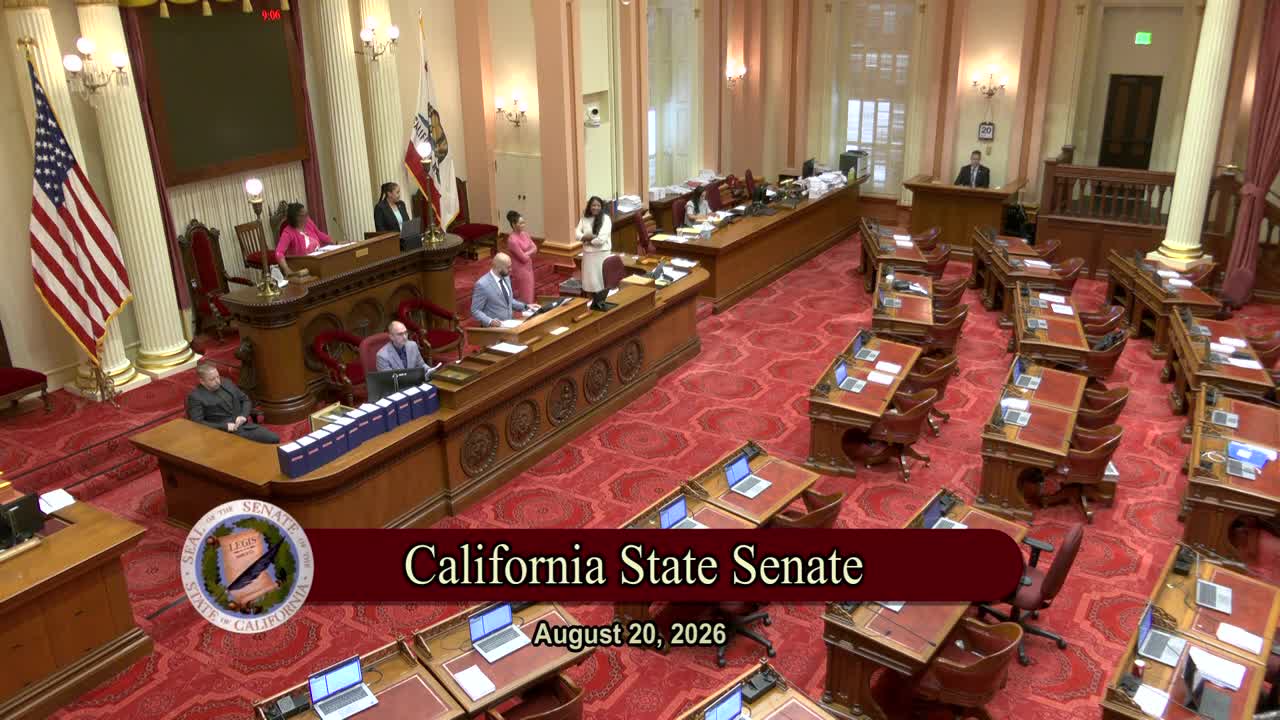 2MIN
Senate Floor
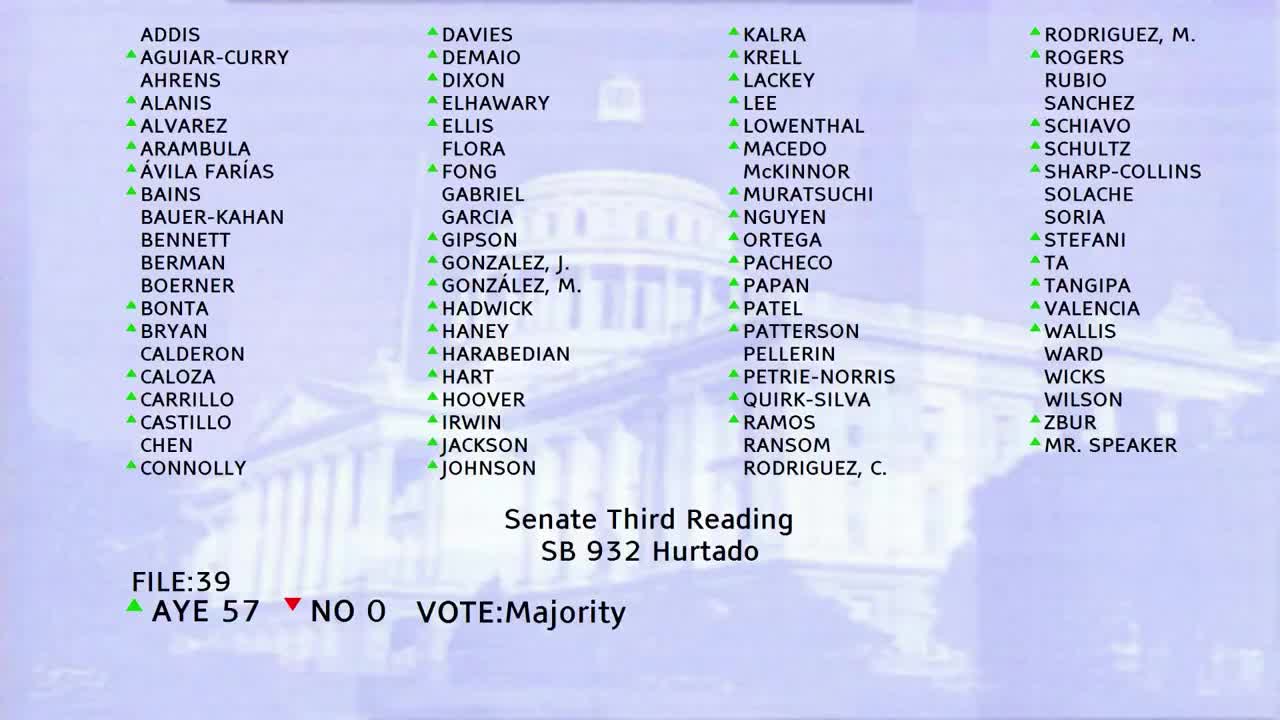 53SEC
Assembly Floor
 13MIN
Assembly Standing Committee on Water, Parks, and Wildlife
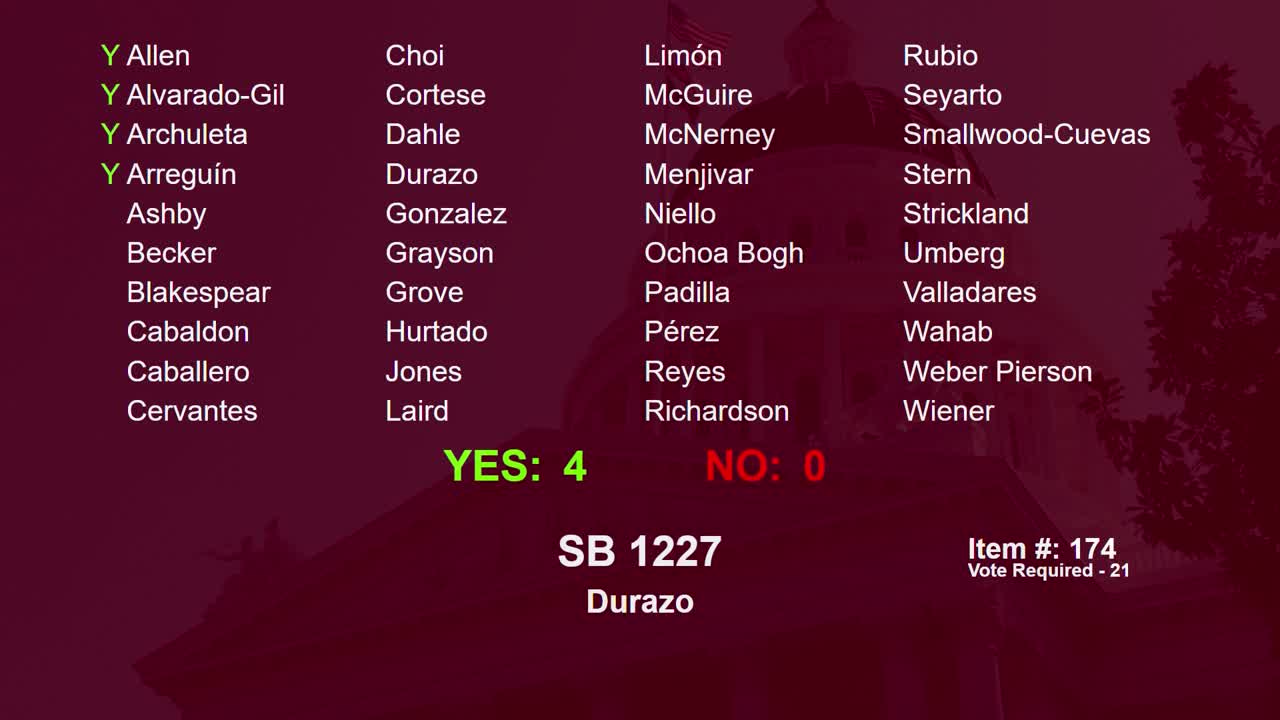 5MIN
Senate Floor
 13MIN
Senate Standing Committee on Appropriations
 26MIN
Senate Standing Committee on Natural Resources and Water
 14MIN