SB 98: Elementary, secondary, and postsecondary education: immigration enforcement: notification.
- Session Year: 2025-2026
- House: Senate
- Latest Version Date: 2025-09-20
Current Status:
Passed
(2025-09-20: Chaptered by Secretary of State. Chapter 124, Statutes of 2025.)
Introduced
In Committee
Awaiting First Chamber Vote
Passed First Chamber
In Committee
Awaiting Second Chamber Vote
Passed Second Chamber
Enacted
What does this bill do?
The bill requires K–12 school districts, county offices, charter schools, and public and qualifying private colleges to include procedures to notify students, parents, teachers, administrators, and staff when the school or campus confirms the presence of immigration enforcement (efforts to enforce federal immigration laws). It also makes those notification procedures a required part of school safety plans and allows chartering authorities to deny charter petitions that do not include them.
The summary is provided by generative AI which can make mistakes. For original language, please view the details in the table below.
(1)Under existing law, each school district and county office of education is responsible for the overall development, as specified, of a comprehensive school safety plan for each of its schools operating kindergarten or any of grades 1 to 12, inclusive. Existing law requires a comprehensive school safety plan to, among other things, identify appropriate strategies and programs that will provide or maintain a high level of school safety and address the schools procedures for complying with existing laws related to school safety.
This bill would additionally require, until January 1, 2031, when a comprehensive school safety plan is next reviewed and updated, or by no later than March 1, 2026, those plans to include procedures specifically designed to notify parents and guardians of pupils, teachers, administrators, and school personnel when the school confirms the presence of immigration enforcement, as defined, on the schoolsite.
Existing law prohibits a chartering authority from denying a petition for the establishment of a charter school unless it makes written factual findings supporting at least one of specified bases for denial. One of those bases for denying a petition is if the petition does not contain a reasonably comprehensive description of the development of a school safety plan that includes the same safety topics required in the comprehensive school safety plan of a school district or county office of education.
This bill would authorize, until January 1, 2031, a chartering authority to deny a charter school petition that does not include in its proposed development of a school safety plan the same provisions on procedures and policies relating to notifying parents and guardians of pupils, teachers, administrators, and charter school personnel when the charter school confirms the presence of immigration enforcement, as defined, on the schoolsite as are required by the bill in a school district or county office of education comprehensive school safety plan. The bill also would make conforming changes.
To the extent that this bill would impose new duties on local educational agencies, the bill would impose a state-mandated local program.
(2)Existing law establishes the California State University, under the administration of the Trustees of the California State University, the University of California, under the administration of the Regents of the University of California, the California Community Colleges, under the administration of the Board of Governors of the California Community Colleges, and independent institutions of higher education as 4 segments of postsecondary education in the state.
Existing law requires the Trustees of the California State University, the governing boards of community college districts, and independent institutions of higher education that are qualifying institutions for purposes of the Cal Grant Program, and requests the Regents of the University of California, to the fullest extent consistent with state and federal law, to implement various precautionary measures when federal immigration enforcement activities are undertaken on campuses of those segments, as specified, including, among others, that those postsecondary entities advise all students, faculty, and staff to notify the office of the chancellor or president, or their designee, as soon as possible, if they are advised that an immigration officer is expected to enter, will enter, or has entered the campus to execute a federal immigration order.
This bill would require, until January 1, 2031, those postsecondary educational entities, and each campus of those postsecondary educational entities, to notify, as specified, all students, faculty, staff, and other campus community members who work on campus when the presence of immigration enforcement, as defined, is confirmed on campus. To the extent that the bill would impose new duties on community college districts, the bill would impose a state-mandated local program.
The California Constitution requires the state to reimburse local agencies and school districts for certain costs mandated by the state. Statutory provisions establish procedures for making that reimbursement.
This bill would provide that, if the Commission on State Mandates determines that the bill contains costs mandated by the state, reimbursement for those costs shall be made pursuant to the statutory provisions noted above.
This bill would declare that it is to take effect immediately as an urgency statute.
(1)Under existing law, each school district and county office of education is responsible for the overall development, as specified, of a comprehensive school safety plan for each of its schools operating kindergarten or any of grades 1 to 12, inclusive. Existing law requires a comprehensive school safety plan to, among other things, identify appropriate strategies and programs that will provide or maintain a high level of school safety and address the schools procedures for complying with existing laws related to school safety.
This bill would additionally require, until January 1, 2031, when a comprehensive school safety plan is next reviewed and updated, or by no later than March 1, 2026, those plans to include procedures specifically designed to notify parents and guardians of pupils, teachers, administrators, and school personnel when the school confirms the presence of immigration enforcement, as defined, on the schoolsite.
Existing law prohibits a chartering authority from denying a petition for the establishment of a charter school unless it makes written factual findings supporting at least one of specified bases for denial. One of those bases for denying a petition is if the petition does not contain a reasonably comprehensive description of the development of a school safety plan that includes the same safety topics required in the comprehensive school safety plan of a school district or county office of education.
This bill would authorize, until January 1, 2031, a chartering authority to deny a charter school petition that does not include in its proposed development of a school safety plan the same provisions on procedures and policies relating to notifying parents and guardians of pupils, teachers, administrators, and charter school personnel when the charter school confirms the presence of immigration enforcement, as defined, on the schoolsite as are required by the bill in a school district or county office of education comprehensive school safety plan.
To the extent that this bill would impose new duties on local educational agencies, the bill would impose a state-mandated local program.
(2)Existing law establishes the California State University, under the administration of the Trustees of the California State University, the University of California, under the administration of the Regents of the University of California, the California Community Colleges, under the administration of the Board of Governors of the California Community Colleges, and independent institutions of higher education as 4 segments of postsecondary education in the state.
Existing law requires the Trustees of the California State University, the governing boards of community college districts, and independent institutions of higher education that are qualifying institutions for purposes of the Cal Grant Program, and requests the Regents of the University of California, to the fullest extent consistent with state and federal law, to implement various precautionary measures when federal immigration enforcement activities are undertaken on campuses of those segments, as specified, including, among others, that those postsecondary entities advise all students, faculty, and staff to notify the office of the chancellor or president, or their designee, as soon as possible, if they are advised that an immigration officer is expected to enter, will enter, or has entered the campus to execute a federal immigration order.
This bill would require require, until January 1, 2031, those postsecondary educational entities, and each campus of those postsecondary educational entities, to notify, as specified, all students, faculty, staff, and other campus community members who work on campus when the presence of immigration enforcement, as defined, is confirmed on campus. To the extent that the bill would impose new duties on community college districts, the bill would impose a state-mandated local program.
The California Constitution requires the state to reimburse local agencies and school districts for certain costs mandated by the state. Statutory provisions establish procedures for making that reimbursement.
This bill would provide that, if the Commission on State Mandates determines that the bill contains costs mandated by the state, reimbursement for those costs shall be made pursuant to the statutory provisions noted above.
This bill would declare that it is to take effect immediately as an urgency statute.
(1)Existing law prohibits, except as required by state or federal law or as required to administer a state or federally supported educational program, school officials and employees of a school district, county office of education, or charter school from collecting information or documents regarding citizenship or immigration status of pupils or their family members. Existing law requires the superintendent of a school district, the superintendent of a county office of education, and the principal of a charter school, as applicable, to report to the respective governing board or body of the local educational agency in a timely manner any requests for information or access to a schoolsite by an officer or employee of a law enforcement agency for the purpose of enforcing the immigration laws in a manner that ensures the confidentiality and privacy of any potentially identifying information. Existing law requires the Attorney General, by April 1, 2018, in consultation with the appropriate stakeholders, to publish model policies limiting assistance with immigration enforcement at public schools, to the fullest extent possible consistent with federal and state law, and ensuring that public schools remain safe and accessible to all California residents, regardless of immigration status, and requires the Attorney General, at a minimum, to consider certain issues when developing the model policies, including, among others, procedures for local educational agency employees to notify the specified officials if an individual requests or gains access to school grounds for purposes related to immigration enforcement.
Existing law requires the superintendent of a school district, the superintendent of a county office of education, and the principal of a charter school, as applicable, to report to the respective governing board or body of the local educational agency in a timely manner any requests for information or access to a schoolsite by an officer or employee of a law enforcement agency for the purpose of enforcing the immigration laws in a manner that ensures the confidentiality and privacy of any potentially identifying information.
This bill would require the governing board or body of a local educational agency superintendent of a school district, the superintendent of a county office of education, and the principal of a charter school, or their respective designee, to notify, as specified, all teachers, staff, other school community members that work on the schoolsite, parents, and guardians when the presence of immigration enforcement, as defined, is confirmed on the schoolsite. To the extent that the bill would impose new duties on school districts, county office offices of education, or charter schools, the bill would impose a state-mandated local program.
(2)Existing law establishes the California State University, under the administration of the Trustees of the California State University, the University of California, under the administration of the Regents of the University of California, the California Community Colleges, under the administration of the Board of Governors of the California Community Colleges, and independent institutions of higher education as 4 segments of postsecondary education in the state.
Existing law requires the Trustees of the California State University, the governing boards of community college districts, and independent institutions of higher education that are qualifying institutions for purposes of the Cal Grant Program, and requests the Regents of the University of California, to the fullest extent consistent with state and federal law, to implement various precautionary measures when federal immigration enforcement activities are undertaken on campuses of those segments, as specified, including, among others, that those postsecondary entities advise all students, faculty, and staff to notify the office of the chancellor or president, or their designee, as soon as possible, if they are advised that an immigration officer is expected to enter, will enter, or has entered the campus to execute a federal immigration order.
This bill would require those postsecondary educational entities entities, and each campus of those postsecondary educational entities, to notify, as specified, all students, faculty, staff, and other campus community members when the presence of immigration enforcement, as defined, is confirmed on campus. To the extent that the bill would impose new duties on community college districts, the bill would impose a state-mandated local program.
The California Constitution requires the state to reimburse local agencies and school districts for certain costs mandated by the state. Statutory provisions establish procedures for making that reimbursement.
This bill would provide that, if the Commission on State Mandates determines that the bill contains costs mandated by the state, reimbursement for those costs shall be made pursuant to the statutory provisions noted above.
This bill would declare that it is to take effect immediately as an urgency statute.
(1)Existing law prohibits, except as required by state or federal law or as required to administer a state or federally supported educational program, school officials and employees of a school district, county office of education, or charter school from collecting information or documents regarding citizenship or immigration status of pupils or their family members. Existing law requires the superintendent of a school district, the superintendent of a county office of education, and the principal of a charter school, as applicable, to report to the respective governing board or body of the local educational agency in a timely manner any requests for information or access to a schoolsite by an officer or employee of a law enforcement agency for the purpose of enforcing the immigration laws in a manner that ensures the confidentiality and privacy of any potentially identifying information. Existing law requires the Attorney General, by April 1, 2018, in consultation with the appropriate stakeholders, to publish model policies limiting assistance with immigration enforcement at public schools, to the fullest extent possible consistent with federal and state law, and ensuring that public schools remain safe and accessible to all California residents, regardless of immigration status, and requires the Attorney General, at a minimum, to consider certain issues when developing the model policies, including, among others, procedures for local educational agency employees to notify the specified officials if an individual requests or gains access to school grounds for purposes related to immigration enforcement.
This bill would require the governing board or body of a local educational agency to notify notify, as specified, all teachers, staff, other school community members that work on the schoolsite, parents, and guardians when the presence of immigration enforcement, as defined, is confirmed on the schoolsite. To the extent that the bill would impose new duties on school districts, county office of education, or charter schools, the bill would impose a state-mandated local program.
(2)Existing law establishes the California State University, under the administration of the Trustees of the California State University, the University of California, under the administration of the Regents of the University of California, the California Community Colleges, under the administration of the Board of Governors of the California Community Colleges, and independent institutions of higher education as 4 segments of postsecondary education in the state.
Existing law requires the Trustees of the California State University, the governing boards of community college districts, and independent institutions of higher education that are qualifying institutions for purposes of the Cal Grant Program, and requests the Regents of the University of California, to the fullest extent consistent with state and federal law, to implement various precautionary measures when federal immigration enforcement activities are undertaken on campuses of those segments, as specified, including, among others, that those postsecondary entities advise all students, faculty, and staff to notify the office of the chancellor or president, or their designee, as soon as possible, if they are advised that an immigration officer is expected to enter, will enter, or has entered the campus to execute a federal immigration order.
This bill would require those postsecondary educational entities to notify notify, as specified, all students, faculty, staff, and other campus community members when the presence of immigration enforcement, as defined, is confirmed on campus. To the extent that the bill would impose new duties on community college districts, the bill would impose a state-mandated local program.
The California Constitution requires the state to reimburse local agencies and school districts for certain costs mandated by the state. Statutory provisions establish procedures for making that reimbursement.
This bill would provide that, if the Commission on State Mandates determines that the bill contains costs mandated by the state, reimbursement for those costs shall be made pursuant to the statutory provisions noted above.
This bill would declare that it is to take effect immediately as an urgency statute.
(1)Existing law prohibits, except as required by state or federal law or as required to administer a state or federally supported educational program, school officials and employees of a school district, county office of education, or charter school from collecting information or documents regarding citizenship or immigration status of pupils or their family members. Existing law requires the superintendent of a school district, the superintendent of a county office of education, and the principal of a charter school, as applicable, to report to the respective governing board or body of the local educational agency in a timely manner any requests for information or access to a schoolsite by an officer or employee of a law enforcement agency for the purpose of enforcing the immigration laws in a manner that ensures the confidentiality and privacy of any potentially identifying information. Existing law requires the Attorney General, by April 1, 2018, in consultation with the appropriate stakeholders, to publish model policies limiting assistance with immigration enforcement at public schools, to the fullest extent possible consistent with federal and state law, and ensuring that public schools remain safe and accessible to all California residents, regardless of immigration status, and requires the Attorney General, at a minimum, to consider certain issues when developing the model policies, including, among others, procedures for local educational agency employees to notify the specified officials if an individual requests or gains access to school grounds for purposes related to immigration enforcement.
This bill would require the governing board or body of a local educational agency to notify all teachers, staff, other school community members that work on the schoolsite, parents, and guardians when the presence of immigration enforcement, as defined, is confirmed on the schoolsite. To the extent that the bill would impose new duties on school districts, county office of education, or charter schools, the bill would impose a state-mandated local program.
(2)Existing law establishes the California State University, under the administration of the Trustees of the California State University, the University of California, under the administration of the Regents of the University of California, the California Community Colleges, under the administration of the Board of Governors of the California Community Colleges, and independent institutions of higher education as 4 segments of postsecondary education in the state.
Existing law requires the Trustees of the California State University, the governing boards of community college districts, and independent institutions of higher education that are qualifying institutions for purposes of the Cal Grant Program, and requests the Regents of the University of California, to the fullest extent consistent with state and federal law, to implement various precautionary measures when federal immigration enforcement activities are undertaken on campuses of those segments, as specified, including, among others, that those postsecondary entities advise all students, faculty, and staff to notify the office of the chancellor or president, or their designee, as soon as possible, if they are advised that an immigration officer is expected to enter, will enter, or has entered the campus to execute a federal immigration order.
This bill would require those postsecondary educational entities to notify all students, faculty, staff, and other campus community members when the presence of immigration enforcement, as defined, is confirmed on campus. To the extent that the bill would impose new duties on community college districts, the bill would impose a state-mandated local program.
The California Constitution requires the state to reimburse local agencies and school districts for certain costs mandated by the state. Statutory provisions establish procedures for making that reimbursement.
This bill would provide that, if the Commission on State Mandates determines that the bill contains costs mandated by the state, reimbursement for those costs shall be made pursuant to the statutory provisions noted above.
(1)Existing law prohibits, except as required by state or federal law or as required to administer a state or federally supported educational program, school officials and employees of a school district, county office of education, or charter school from collecting information or documents regarding citizenship or immigration status of pupils or their family members. Existing law requires the superintendent of a school district, the superintendent of a county office of education, and the principal of a charter school, as applicable, to report to the respective governing board or body of the local educational agency in a timely manner any requests for information or access to a schoolsite by an officer or employee of a law enforcement agency for the purpose of enforcing the immigration laws in a manner that ensures the confidentiality and privacy of any potentially identifying information. Existing law requires the Attorney General, by April 1, 2018, in consultation with the appropriate stakeholders, to publish model policies limiting assistance with immigration enforcement at public schools, to the fullest extent possible consistent with federal and state law, and ensuring that public schools remain safe and accessible to all California residents, regardless of immigration status, and requires the Attorney General, at a minimum, to consider certain issues when developing the model policies, including, among others, procedures for local educational agency employees to notify the specified officials if an individual requests or gains access to school grounds for purposes related to immigration enforcement.
This bill would require each school district, county office of education, and charter school to immediately the governing board or body of a local educational agency to notify all pupils, parents, faculty, teachers, staff, and other school community members of the presence of immigration officers, as defined, that work on the schoolsite, parents, and guardians when the presence of immigration enforcement, as defined, is confirmed on the schoolsite. To the extent that the bill would impose new duties on school districts, county office of education, or charter schools, the bill would impose a state-mandated local program.
(2)Existing law establishes the California State University, under the administration of the Trustees of the California State University, the University of California, under the administration of the Regents of the University of California, the California Community Colleges, under the administration of the Board of Governors of the California Community Colleges, and independent institutions of higher education as 4 segments of postsecondary education in the state.
Existing law requires the Trustees of the California State University, the governing boards of community college districts, and independent institutions of higher education that are qualifying institutions for purposes of the Cal Grant Program, and requests the Regents of the University of California, to the fullest extent consistent with state and federal law, to implement various precautionary measures when federal immigration enforcement activities are undertaken on campuses of those segments, as specified, including, among others, that those postsecondary entities advise all students, faculty, and staff to notify the office of the chancellor or president, or their designee, as soon as possible, if they are advised that an immigration officer is expected to enter, will enter, or has entered the campus to execute a federal immigration order.
This bill would require those postsecondary educational entities to immediately notify all students, faculty, staff, and other campus community members of when the presence of immigration officers enforcement, as defined, is confirmed on campus, as specified. campus. To the extent that the bill would impose new duties on community college districts, the bill would impose a state-mandated local program.
The California Constitution requires the state to reimburse local agencies and school districts for certain costs mandated by the state. Statutory provisions establish procedures for making that reimbursement.
This bill would provide that, if the Commission on State Mandates determines that the bill contains costs mandated by the state, reimbursement for those costs shall be made pursuant to the statutory provisions noted above.
(1)Existing law prohibits, except as required by state or federal law or as required to administer a state or federally supported educational program, school officials and employees of a school district, county office of education, or charter school from collecting information or documents regarding citizenship or immigration status of pupils or their family members. Existing law requires the superintendent of a school district, the superintendent of a county office of education, and the principal of a charter school, as applicable, to report to the respective governing board or body of the local educational agency in a timely manner any requests for information or access to a schoolsite by an officer or employee of a law enforcement agency for the purpose of enforcing the immigration laws in a manner that ensures the confidentiality and privacy of any potentially identifying information. Existing law requires the Attorney General, by April 1, 2018, in consultation with the appropriate stakeholders, to publish model policies limiting assistance with immigration enforcement at public schools, to the fullest extent possible consistent with federal and state law, and ensuring that public schools remain safe and accessible to all California residents, regardless of immigration status, and requires the Attorney General, at a minimum, to consider certain issues when developing the model policies, including, among others, procedures for local educational agency employees to notify the specified officials if an individual requests or gains access to school grounds for purposes related to immigration enforcement.
This bill would require each school district, county office of education, and charter school to immediately notify all pupils, parents, faculty, staff, and other school community members of the presence of immigration officers, as defined, on the schoolsite. To the extent that the bill would impose new duties on school districts, county office of education, or charter schools, the bill would impose a state-mandated local program.
(2)Existing law establishes the California State University, under the administration of the Trustees of the California State University, the University of California, under the administration of the Regents of the University of California, the California Community Colleges, under the administration of the Board of Governors of the California Community Colleges, and independent institutions of higher education as 4 segments of postsecondary education in the state.
Existing law requires the Trustees of the California State University, the governing boards of community college districts, and independent institutions of higher education that are qualifying institutions for purposes of the Cal Grant Program, and requests the Regents of the University of California, to the fullest extent consistent with state and federal law, to implement various precautionary measures when federal immigration enforcement activities are undertaken on campuses of those segments, as specified, including, among others, that those postsecondary entities advise all students, faculty, and staff to notify the office of the chancellor or president, or their designee, as soon as possible, if they are advised that an immigration officer is expected to enter, will enter, or has entered the campus to execute a federal immigration order.
This bill would require those postsecondary educational entities to immediately notify all students, faculty, staff, and other campus community members of the presence of immigration officers on campus, as specified. To the extent that the bill would impose new duties on community college districts, the bill would impose a state-mandated local program.
The California Constitution requires the state to reimburse local agencies and school districts for certain costs mandated by the state. Statutory provisions establish procedures for making that reimbursement.
This bill would provide that, if the Commission on State Mandates determines that the bill contains costs mandated by the state, reimbursement for those costs shall be made pursuant to the statutory provisions noted above.
The Legislature finds and declares both of the following:
(a)California is responsible for ensuring access to a quality education.
(b)Ensuring access to a quality education includes creating a safe and an inclusive campus environment for all students, regardless of their backgrounds or origins.
SEC. 2.Section 32282 of the Education Code is amended to read:32282.(a)The comprehensive school safety plan shall include, but not be limited to, all of the following:
(1)Assessing the current status of school crime committed on school campuses and at school-related functions.
(2)Identifying appropriate strategies and programs that will provide or maintain a high level of school safety and address the schools procedures for complying with existing laws related to school safety, which shall include the development of all of the following:
(A)Child abuse reporting procedures consistent with Article 2.5 (commencing with Section 11164) of Chapter 2 of Title 1 of Part 4 of the Penal Code.
(B)(i)Disaster procedures, routine and emergency, including adaptations for pupils with disabilities in accordance with the federal Americans with Disabilities Act of 1990 (42 U.S.C. Sec. 12101 et seq.), the federal Individuals with Disabilities Education Act (20 U.S.C. Sec. 1400 et seq.), and Section 504 of the federal Rehabilitation Act of 1973 (29 U.S.C. Sec. 794(a)). The disaster procedures shall also include, but not be limited to, all of the following:
(I)Establishing an earthquake emergency procedure system in every public school building having an occupant capacity of 50 or more pupils or more than one classroom. A school district or county office of education may work with the Office of Emergency Services and the Alfred E. Alquist Seismic Safety Commission to develop and establish the earthquake emergency procedure system. The system shall include, but not be limited to, all of the following:
(ia)A school building disaster plan, ready for implementation at any time, for maintaining the safety and care of pupils and staff. The department shall provide general direction to school districts and county offices of education on what to include in the school building disaster plan.
(ib)A drop procedure whereby each pupil and staff member takes cover under a table or desk, dropping to their knees, with the head protected by the arms, and the back to the windows. A drop procedure practice shall be held at least once a school quarter in elementary schools and at least once a semester in secondary schools.
(ic)Protective measures to be taken before, during, and following an earthquake.
(id)A program to ensure that pupils and both the certificated and classified staff are aware of, and properly trained in, the earthquake emergency procedure system.
(II)Establishing a procedure to allow a public agency, including the American Red Cross, to use school buildings, grounds, and equipment for mass care and welfare shelters during disasters or other emergencies affecting the public health and welfare. The school district or county office of education shall cooperate with the public agency in furnishing and maintaining the services as the school district or county office of education may deem necessary to meet the needs of the community.
(III)(ia)Commencing with the 202627 fiscal year, establishing a procedure to identify appropriate refuge shelter for all pupils and staff to be used in the event of an evacuation order by local authorities and notify the operational area having jurisdiction within the schools boundaries of this identified refuge, in order to first prioritize the safety of pupils and staff, and then the defense of that structure in the event of a fire. Each public school, including a charter school, serving more than 50 pupils in kindergarten or any of grades 1 to 12, inclusive, that is in a high or very high fire hazard severity zone, identified pursuant to Section 51178 of the Government Code or Section 4204 of the Public Resources Code, shall coordinate the procedure with the operational area having jurisdiction within the schools boundaries. For those schools under the jurisdiction of a school district or county office of education, the school district or county office of education shall be the entity that coordinates with the operational area having jurisdiction within each of the schools boundaries.
(ib)Commencing with the 202627 fiscal year, the development by each public school, including a charter school, serving more than 50 pupils in kindergarten or any of grades 1 to 12, inclusive, that is in a high or very high fire hazard severity zone, identified pursuant to Section 51178 of the Government Code or Section 4204 of the Public Resources Code, of a communication and evacuation plan, to be used in the event of an early notice evacuation warning, that allows enough time to evacuate all pupils and staff. These plans shall clearly identify a decision process to determine whether an evacuation order is appropriate.
(ic)For purposes of this subclause, operational area means an intermediate level of the state emergency services organization, consisting of a county and all political subdivisions within the county area, that serves as a link in the system of communication and coordination between the states emergency operation centers and the operating centers of the political subdivisions that make up the operational area, as described in subdivision (b) of Section 8559 of the Government Code and Section 8605 of the Government Code.
(ii)The evaluation of a comprehensive school safety plan pursuant to subdivision (d) and the review of a school safety plan pursuant to clause (iii) of subparagraph (F) of paragraph (5) of subdivision (c) of Section 47605 or clause (iii) of subparagraph (G) of paragraph (5) of subdivision (b) of Section 47605.6, as applicable, shall include ensuring that the plan includes appropriate adaptations for pupils with disabilities, as required pursuant to clause (i).
(iii)(I)After the first evaluation or review, as applicable, for purposes of subdivision (d) and clause (ii) is conducted, and after each annual evaluation or review thereafter, a school employee, a pupils parent, guardian, or educational rights holder, or a pupil themselves may bring concerns about an individual pupils ability to access disaster safety procedures described in the comprehensive school safety plan or the school safety plan to the school principal. If the school principal determines there is merit to a concern, the principal shall direct the schoolsite council, school safety planning committee, or charter school, as applicable, to make appropriate modifications to the comprehensive school safety plan or school safety plan, as applicable, during the evaluation of the comprehensive school safety plan pursuant to subdivision (d) or the review of the school safety plan pursuant to clause (iii) of subparagraph (F) of paragraph (5) of subdivision (c) of Section 47605 or clause (iii) of subparagraph (G) of paragraph (5) of subdivision (b) of Section 47605.6, as applicable. The school principal may direct the schoolsite council, the school safety planning committee, or the charter school, as applicable, to make such modifications before the evaluation of the comprehensive school safety plan pursuant to subdivision (d) or the review of the school safety plan pursuant to clause (iii) of subparagraph (F) of paragraph (5) of subdivision (c) of Section 47605 or clause (iii) of subparagraph (G) of paragraph (5) of subdivision (b) of Section 47605.6, as applicable.
(II)Subclause (I) does not prohibit a school employee, a pupils parent, guardian, or educational rights holder, or a pupil themselves from bringing their concerns to the school principal before an evaluation or review, as applicable, for purposes of subdivision (d) and clause (ii) is conducted.
(iv)All deliberations of the schoolsite council, school safety planning committee, or charter school, as applicable, related to individual pupils with disabilities for purposes of the requirements of clauses (i) to (iii), inclusive, shall be subject to applicable state and federal laws regarding the privacy of pupil information.
(C)Policies pursuant to subdivision (d) of Section 48915 for pupils who committed an act listed in subdivision (c) of Section 48915 and other school-designated serious acts that would lead to suspension, expulsion, or mandatory expulsion recommendations pursuant to Article 1 (commencing with Section 48900) of Chapter 6 of Part 27 of Division 4 of Title 2.
(D)Procedures to notify teachers of dangerous pupils pursuant to Section 49079.
(E)A discrimination and harassment policy consistent with the prohibition against discrimination contained in Chapter 2 (commencing with Section 200) of Part 1.
(F)The provisions of any schoolwide dress code, pursuant to Section 35183, that prohibits pupils from wearing gang-related apparel, if the school has adopted that type of a dress code. For those purposes, the comprehensive school safety plan shall define gang-related apparel. The definition shall be limited to apparel that, if worn or displayed on a school campus, reasonably could be determined to threaten the health and safety of the school environment. A schoolwide dress code established pursuant to this section and Section 35183 shall be enforced on the school campus and at any school-sponsored activity by the principal of the school or the person designated by the principal. For purposes of this subparagraph, gang-related apparel shall not be considered a protected form of speech pursuant to Section 48950.
(G)Procedures for safe ingress and egress of pupils, parents, and school employees to and from school.
(H)A safe and orderly environment conducive to learning at the school.
(I)The rules and procedures on school discipline adopted pursuant to Sections 35291, 35291.5, 47605, and 47605.6.
(J)Procedures for conducting tactical responses to criminal incidents, including procedures related to individuals with guns on school campuses and at school-related functions. The procedures to prepare for active shooters or other armed assailants shall be based on the specific needs and context of each school and community.
(K)If a comprehensive school safety plan includes procedures to prepare for active shooters or other armed assailants by conducting a drill, a school shall comply with all of the following relating to the drill:
(i)(I)The school shall not conduct a high-intensity drill.
(II)For purposes of this clause, high-intensity drill means a drill that includes simulations that mimic an actual school shooter or other armed assailant incident, including, but not limited to, theatrical makeup or other materials to give an image of blood or gunshot wounds, acting by an individual posing to be the assailant, acting by individuals posing as victims, or simulations that instruct pupils to actively resist an assailant by throwing objects, attacking, or swarming the assailant.
(ii)The school shall not include the use of real weapons, gunfire blanks, or explosions in the conducting of the drill.
(iii)The school shall ensure a trauma-informed approach to the design and execution of any drill, which shall include all of the following:
(I)Age-appropriate and developmentally appropriate drill content and terminology developed with the involvement of school personnel, including school-based mental health professionals.
(II)Notice to all parents and guardians of pupils, teachers, administrators, and school personnel subject to the drills in advance of the drill and of the drills expected length of time.
(III)The ability for parents or guardians to opt their child or children out of the drills.
(IV)An announcement to pupils and educators immediately before the start of the drills and an announcement to pupils and educators immediately after the drills have concluded.
(V)A notice to all parents and guardians after the drill has concluded.
(VI)The provision of contact information for community-based resources, including local organizations with objectives to reduce gun violence or provide mental health counseling, to parents or guardians, pupils, and staff who are negatively impacted by the drills, and, where available, prioritizing school-based resources.
(L)Procedures to assess and respond to reports of any dangerous, violent, or unlawful activity that is being conducted or threatened to be conducted at the school, at an activity sponsored by the school, or on a schoolbus serving the school.
(M)(i)When a comprehensive school safety plan is next reviewed and updated on or after July 1, 2025, procedures to respond to incidents involving an individual experiencing a sudden cardiac arrest or a similar life-threatening medical emergency while on school grounds.
(ii)The procedures described in clause (i) are encouraged to integrate evidence-based core elements, including any cardiopulmonary resuscitation training offered and the placement of any automated external defibrillator available on the schoolsite in accordance with nationally recognized evidence-based emergency cardiac care guidelines, as dictated by the school safety plan.
(N)(i)When a comprehensive school safety plan is next reviewed and updated, but by no later than March 1, 2026, procedures specifically designed to notify parents and guardians of pupils, teachers, administrators, and school personnel when the school confirms the presence of immigration enforcement on the schoolsite.
(ii)The content and timing of a notification provided under the procedures in clause (i) shall consider the safety and well-being of the pupils, employees, and community members of the schoolsite when determining when and how to issue the notification to parents and guardians of pupils, teachers, administrators, and school personnel.
(iii)The notification provided under the procedures in clause (i) may also include a hyperlink to additional resources for families with information about their educational rights, state laws that protects parents and students privacy and confidentiality, and, if available, counseling or support services, which may include services that support families impacted by immigration enforcement and model policies adopted by the local educational agency pursuant to subdivision (g) of Section 234.7.
(iv)A notification provided under the procedures in clause (i) shall not include any personally identifiable information.
(v)For purposes of this subparagraph, immigration enforcement includes any and all efforts to investigate, enforce, or assist in the investigation or enforcement of any federal civil immigration law, and also includes any and all efforts to investigate, enforce, or assist in the investigation or enforcement of any federal criminal immigration law that penalizes a persons presence in, entry, or reentry to, or employment in, the United States.
(O)For schools that serve pupils in any of grades 7 to 12, inclusive, a protocol in the event a pupil is suffering or is reasonably believed to be suffering from an opioid overdose.
(3)(A)Beginning July 1, 2025, an instructional continuity plan to establish communication with pupils and their families and provide instruction to pupils when in-person instruction is disrupted due to an emergency pursuant to Section 41422 or subdivision (a) of Section 46392. The plan shall include all the following:
(i)Procedures for pupil engagement, as soon as practicable, and no later than five calendar days following the emergency. Procedures shall be designed to establish two-way communication with pupils and their families and identify and provide supports for pupils social-emotional, mental health, and academic needs.
(ii)A plan to provide access to in-person instruction or remote instruction pursuant to Sections 51747 and 51749.5, as soon as practicable, but no later than 10 instructional days following the emergency. The plan may include support to pupils and families to enroll in or be temporarily reassigned to another school district, county office of education, or charter school.
(B)Local educational agencies are encouraged to plan to meet instructional standards that are at least equivalent to those applicable to independent study programs.
(C)(i)For purposes of this paragraph, temporarily reassigned means temporarily reassigned to another local educational agency outside of the school district, but within the county or an immediately adjacent county, in which the pupils parent or guardian resides. Notwithstanding Section 48200 or any other law, a pupil who is temporarily reassigned shall be deemed to have complied with the residency requirements for attendance in the local educational agency that is temporarily serving the pupil pursuant to this section.
(ii)Notwithstanding Section 48200 or any other law, a school district, county office of education, or charter school may continue to enroll a pupil who is temporarily reassigned to another school district, county office of education, or charter school pursuant to this section in order to facilitate the timely reentry of the pupil in their prior school after the emergency event has ended.
(D)This paragraph applies to school districts, county offices of education, and charter schools.
(b)It is the intent of the Legislature that schools develop comprehensive school safety plans using existing resources, including the materials and services of the partnership, pursuant to this chapter. It is also the intent of the Legislature that schools use the handbook developed and distributed in partnership by the departments Safe Schools and Violence Prevention Center and the Attorney Generals Crime and Violence Prevention Center entitled Safe Schools: A Planning Guide for Action in conjunction with developing their plan for school safety.
(c)Each schoolsite council or school safety planning committee, in developing and updating a comprehensive school safety plan, shall, where practical, consult, cooperate, and coordinate with other schoolsite councils or school safety planning committees.
(d)The comprehensive school safety plan may be evaluated and amended, as needed, by the school safety planning committee, but shall be evaluated at least once a year, to ensure that the comprehensive school safety plan is properly implemented. An updated file of all safety-related plans and materials shall be readily available for inspection by the public.
(e)As comprehensive school safety plans are reviewed and updated, the Legislature encourages all plans, to the extent that resources are available, to include policies and procedures aimed at the prevention of bullying.
(f)The comprehensive school safety plan, as written and updated by the schoolsite council or school safety planning committee, shall be submitted for approval pursuant to subdivision (a) of Section 32288.
(g)The department shall maintain and conspicuously post on its internet website a compliance checklist for developing a comprehensive school safety plan, and shall update the checklist when necessary.
(h)On or before March 1, 2025, the Superintendent shall develop and post on the departments internet website instructional continuity plan guidance, including guidance for continued academic and school engagement strategies during disruptions in instruction due to emergencies.
(i)This section shall remain in effect only until January 1, 2031, and as of that date is repealed.
SEC. 3.Section 32282 is added to the Education Code, to read:32282.(a)The comprehensive school safety plan shall include, but not be limited to, all of the following:
(1)Assessing the current status of school crime committed on school campuses and at school-related functions.
(2)Identifying appropriate strategies and programs that will provide or maintain a high level of school safety and address the schools procedures for complying with existing laws related to school safety, which shall include the development of all of the following:
(A)Child abuse reporting procedures consistent with Article 2.5 (commencing with Section 11164) of Chapter 2 of Title 1 of Part 4 of the Penal Code.
(B)(i)Disaster procedures, routine and emergency, including adaptations for pupils with disabilities in accordance with the federal Americans with Disabilities Act of 1990 (42 U.S.C. Sec. 12101 et seq.), the federal Individuals with Disabilities Education Act (20 U.S.C. Sec. 1400 et seq.), and Section 504 of the federal Rehabilitation Act of 1973 (29 U.S.C. Sec. 794(a)). The disaster procedures shall also include, but not be limited to, all of the following:
(I)Establishing an earthquake emergency procedure system in every public school building having an occupant capacity of 50 or more pupils or more than one classroom. A school district or county office of education may work with the Office of Emergency Services and the Alfred E. Alquist Seismic Safety Commission to develop and establish the earthquake emergency procedure system. The system shall include, but not be limited to, all of the following:
(ia)A school building disaster plan, ready for implementation at any time, for maintaining the safety and care of pupils and staff. The department shall provide general direction to school districts and county offices of education on what to include in the school building disaster plan.
(ib)A drop procedure whereby each pupil and staff member takes cover under a table or desk, dropping to their knees, with the head protected by the arms, and the back to the windows. A drop procedure practice shall be held at least once a school quarter in elementary schools and at least once a semester in secondary schools.
(ic)Protective measures to be taken before, during, and following an earthquake.
(id)A program to ensure that pupils and both the certificated and classified staff are aware of, and properly trained in, the earthquake emergency procedure system.
(II)Establishing a procedure to allow a public agency, including the American Red Cross, to use school buildings, grounds, and equipment for mass care and welfare shelters during disasters or other emergencies affecting the public health and welfare. The school district or county office of education shall cooperate with the public agency in furnishing and maintaining the services as the school district or county office of education may deem necessary to meet the needs of the community.
(III)(ia)Commencing with the 202627 fiscal year, establishing a procedure to identify appropriate refuge shelter for all pupils and staff to be used in the event of an evacuation order by local authorities and notify the operational area having jurisdiction within the schools boundaries of this identified refuge, in order to first prioritize the safety of pupils and staff, and then the defense of that structure in the event of a fire. Each public school, including a charter school, serving more than 50 pupils in kindergarten or any of grades 1 to 12, inclusive, that is in a high or very high fire hazard severity zone, identified pursuant to Section 51178 of the Government Code or Section 4204 of the Public Resources Code, shall coordinate the procedure with the operational area having jurisdiction within the schools boundaries. For those schools under the jurisdiction of a school district or county office of education, the school district or county office of education shall be the entity that coordinates with the operational area having jurisdiction within each of the schools boundaries.
(ib)Commencing with the 202627 fiscal year, the development by each public school, including a charter school, serving more than 50 pupils in kindergarten or any of grades 1 to 12, inclusive, that is in a high or very high fire hazard severity zone, identified pursuant to Section 51178 of the Government Code or Section 4204 of the Public Resources Code, of a communication and evacuation plan, to be used in the event of an early notice evacuation warning, that allows enough time to evacuate all pupils and staff. These plans shall clearly identify a decision process to determine whether an evacuation order is appropriate.
(ic)For purposes of this subclause, operational area means an intermediate level of the state emergency services organization, consisting of a county and all political subdivisions within the county area, that serves as a link in the system of communication and coordination between the states emergency operation centers and the operating centers of the political subdivisions that make up the operational area, as described in subdivision (b) of Section 8559 of the Government Code and Section 8605 of the Government Code.
(ii)The evaluation of a comprehensive school safety plan pursuant to subdivision (d) and the review of a school safety plan pursuant to clause (iii) of subparagraph (F) of paragraph (5) of subdivision (c) of Section 47605 or clause (iii) of subparagraph (G) of paragraph (5) of subdivision (b) of Section 47605.6, as applicable, shall include ensuring that the plan includes appropriate adaptations for pupils with disabilities, as required pursuant to clause (i).
(iii)(I)After the first evaluation or review, as applicable, for purposes of subdivision (d) and clause (ii) is conducted, and after each annual evaluation or review thereafter, a school employee, a pupils parent, guardian, or educational rights holder, or a pupil themselves may bring concerns about an individual pupils ability to access disaster safety procedures described in the comprehensive school safety plan or the school safety plan to the school principal. If the school principal determines there is merit to a concern, the principal shall direct the schoolsite council, school safety planning committee, or charter school, as applicable, to make appropriate modifications to the comprehensive school safety plan or school safety plan, as applicable, during the evaluation of the comprehensive school safety plan pursuant to subdivision (d) or the review of the school safety plan pursuant to clause (iii) of subparagraph (F) of paragraph (5) of subdivision (c) of Section 47605 or clause (iii) of subparagraph (G) of paragraph (5) of subdivision (b) of Section 47605.6, as applicable. The school principal may direct the schoolsite council, the school safety planning committee, or the charter school, as applicable, to make such modifications before the evaluation of the comprehensive school safety plan pursuant to subdivision (d) or the review of the school safety plan pursuant to clause (iii) of subparagraph (F) of paragraph (5) of subdivision (c) of Section 47605 or clause (iii) of subparagraph (G) of paragraph (5) of subdivision (b) of Section 47605.6, as applicable.
(II)Subclause (I) does not prohibit a school employee, a pupils parent, guardian, or educational rights holder, or a pupil themselves from bringing their concerns to the school principal before an evaluation or review, as applicable, for purposes of subdivision (d) and clause (ii) is conducted.
(iv)All deliberations of the schoolsite council, school safety planning committee, or charter school, as applicable, related to individual pupils with disabilities for purposes of the requirements of clauses (i) to (iii), inclusive, shall be subject to applicable state and federal laws regarding the privacy of pupil information.
(C)Policies pursuant to subdivision (d) of Section 48915 for pupils who committed an act listed in subdivision (c) of Section 48915 and other school-designated serious acts that would lead to suspension, expulsion, or mandatory expulsion recommendations pursuant to Article 1 (commencing with Section 48900) of Chapter 6 of Part 27 of Division 4 of Title 2.
(D)Procedures to notify teachers of dangerous pupils pursuant to Section 49079.
(E)A discrimination and harassment policy consistent with the prohibition against discrimination contained in Chapter 2 (commencing with Section 200) of Part 1.
(F)The provisions of any schoolwide dress code, pursuant to Section 35183, that prohibits pupils from wearing gang-related apparel, if the school has adopted that type of a dress code. For those purposes, the comprehensive school safety plan shall define gang-related apparel. The definition shall be limited to apparel that, if worn or displayed on a school campus, reasonably could be determined to threaten the health and safety of the school environment. A schoolwide dress code established pursuant to this section and Section 35183 shall be enforced on the school campus and at any school-sponsored activity by the principal of the school or the person designated by the principal. For purposes of this subparagraph, gang-related apparel shall not be considered a protected form of speech pursuant to Section 48950.
(G)Procedures for safe ingress and egress of pupils, parents, and school employees to and from school.
(H)A safe and orderly environment conducive to learning at the school.
(I)The rules and procedures on school discipline adopted pursuant to Sections 35291, 35291.5, 47605, and 47605.6.
(J)Procedures for conducting tactical responses to criminal incidents, including procedures related to individuals with guns on school campuses and at school-related functions. The procedures to prepare for active shooters or other armed assailants shall be based on the specific needs and context of each school and community.
(K)If a comprehensive school safety plan includes procedures to prepare for active shooters or other armed assailants by conducting a drill, a school shall comply with all of the following relating to the drill:
(i)(I)The school shall not conduct a high-intensity drill.
(II)For purposes of this clause, high-intensity drill means a drill that includes simulations that mimic an actual school shooter or other armed assailant incident, including, but not limited to, theatrical makeup or other materials to give an image of blood or gunshot wounds, acting by an individual posing to be the assailant, acting by individuals posing as victims, or simulations that instruct pupils to actively resist an assailant by throwing objects, attacking, or swarming the assailant.
(ii)The school shall not include the use of real weapons, gunfire blanks, or explosions in the conducting of the drill.
(iii)The school shall ensure a trauma-informed approach to the design and execution of any drill, which shall include all of the following:
(I)Age-appropriate and developmentally appropriate drill content and terminology developed with the involvement of school personnel, including school-based mental health professionals.
(II)Notice to all parents and guardians of pupils, teachers, administrators, and school personnel subject to the drills in advance of the drill and of the drills expected length of time.
(III)The ability for parents or guardians to opt their child or children out of the drills.
(IV)An announcement to pupils and educators immediately before the start of the drills and an announcement to pupils and educators immediately after the drills have concluded.
(V)A notice to all parents and guardians after the drill has concluded.
(VI)The provision of contact information for community-based resources, including local organizations with objectives to reduce gun violence or provide mental health counseling, to parents or guardians, pupils, and staff who are negatively impacted by the drills, and, where available, prioritizing school-based resources.
(L)Procedures to assess and respond to reports of any dangerous, violent, or unlawful activity that is being conducted or threatened to be conducted at the school, at an activity sponsored by the school, or on a schoolbus serving the school.
(M)(i)When a comprehensive school safety plan is next reviewed and updated on or after July 1, 2025, procedures to respond to incidents involving an individual experiencing a sudden cardiac arrest or a similar life-threatening medical emergency while on school grounds.
(ii)The procedures described in clause (i) are encouraged to integrate evidence-based core elements, including any cardiopulmonary resuscitation training offered and the placement of any automated external defibrillator available on the schoolsite in accordance with nationally recognized evidence-based emergency cardiac care guidelines, as dictated by the school safety plan.
(N)For schools that serve pupils in any of grades 7 to 12, inclusive, a protocol in the event a pupil is suffering or is reasonably believed to be suffering from an opioid overdose.
(3)(A)Beginning July 1, 2025, an instructional continuity plan to establish communication with pupils and their families and provide instruction to pupils when in-person instruction is disrupted due to an emergency pursuant to Section 41422 or subdivision (a) of Section 46392. The plan shall include all the following:
(i)Procedures for pupil engagement, as soon as practicable, and no later than five calendar days following the emergency. Procedures shall be designed to establish two-way communication with pupils and their families and identify and provide supports for pupils social-emotional, mental health, and academic needs.
(ii)A plan to provide access to in-person instruction or remote instruction pursuant to Sections 51747 and 51749.5, as soon as practicable, but no later than 10 instructional days following the emergency. The plan may include support to pupils and families to enroll in or be temporarily reassigned to another school district, county office of education, or charter school.
(B)Local educational agencies are encouraged to plan to meet instructional standards that are at least equivalent to those applicable to independent study programs.
(C)(i)For purposes of this paragraph, temporarily reassigned means temporarily reassigned to another local educational agency outside of the school district, but within the county or an immediately adjacent county, in which the pupils parent or guardian resides. Notwithstanding Section 48200 or any other law, a pupil who is temporarily reassigned shall be deemed to have complied with the residency requirements for attendance in the local educational agency that is temporarily serving the pupil pursuant to this section.
(ii)Notwithstanding Section 48200 or any other law, a school district, county office of education, or charter school may continue to enroll a pupil who is temporarily reassigned to another school district, county office of education, or charter school pursuant to this section in order to facilitate the timely reentry of the pupil in their prior school after the emergency event has ended.
(D)This paragraph applies to school districts, county offices of education, and charter schools.
(b)It is the intent of the Legislature that schools develop comprehensive school safety plans using existing resources, including the materials and services of the partnership, pursuant to this chapter. It is also the intent of the Legislature that schools use the handbook developed and distributed in partnership by the departments Safe Schools and Violence Prevention Center and the Attorney Generals Crime and Violence Prevention Center entitled Safe Schools: A Planning Guide for Action in conjunction with developing their plan for school safety.
(c)Each schoolsite council or school safety planning committee, in developing and updating a comprehensive school safety plan, shall, where practical, consult, cooperate, and coordinate with other schoolsite councils or school safety planning committees.
(d)The comprehensive school safety plan may be evaluated and amended, as needed, by the school safety planning committee, but shall be evaluated at least once a year, to ensure that the comprehensive school safety plan is properly implemented. An updated file of all safety-related plans and materials shall be readily available for inspection by the public.
(e)As comprehensive school safety plans are reviewed and updated, the Legislature encourages all plans, to the extent that resources are available, to include policies and procedures aimed at the prevention of bullying.
(f)The comprehensive school safety plan, as written and updated by the schoolsite council or school safety planning committee, shall be submitted for approval pursuant to subdivision (a) of Section 32288.
(g)The department shall maintain and conspicuously post on its internet website a compliance checklist for developing a comprehensive school safety plan, and shall update the checklist when necessary.
(h)On or before March 1, 2025, the Superintendent shall develop and post on the departments internet website instructional continuity plan guidance, including guidance for continued academic and school engagement strategies during disruptions in instruction due to emergencies.
(i)This section shall become operative on January 1, 2031.
SEC. 4.Section 47605 of the Education Code is amended to read:47605.(a)(1)Except as set forth in paragraph (2), a petition for the establishment of a charter school within a school district may be circulated by one or more persons seeking to establish the charter school. A petition for the establishment of a charter school shall identify a single charter school that will operate within the geographic boundaries of that school district. A charter school may propose to operate at multiple sites within the school district if each location is identified in the charter school petition. The petition may be submitted to the governing board of the school district for review after either of the following conditions is met:
(A)The petition is signed by a number of parents or legal guardians of pupils that is equivalent to at least one-half of the number of pupils that the charter school estimates will enroll in the charter school for its first year of operation.
(B)The petition is signed by a number of teachers that is equivalent to at least one-half of the number of teachers that the charter school estimates will be employed at the charter school during its first year of operation.
(2)A petition that proposes to convert an existing public school to a charter school that would not be eligible for a loan pursuant to subdivision (c) of Section 41365 may be circulated by one or more persons seeking to establish the charter school. The petition may be submitted to the governing board of the school district for review after the petition is signed by not less than 50 percent of the permanent status teachers currently employed at the public school to be converted.
(3)A petition shall include a prominent statement that a signature on the petition means that the parent or legal guardian is meaningfully interested in having their child or ward attend the charter school, or in the case of a teachers signature, means that the teacher is meaningfully interested in teaching at the charter school. The proposed charter shall be attached to the petition.
(4)After receiving approval of its petition, a charter school that proposes to expand operations to one or more additional sites or grade levels shall request a material revision to its charter and shall notify the chartering authority of those additional locations or grade levels. The chartering authority shall consider whether to approve those additional locations or grade levels at an open, public meeting. If the additional locations or grade levels are approved pursuant to the standards and criteria described in subdivision (c), they shall be a material revision to the charter schools charter.
(5)(A)A charter school that established one site outside the boundaries of the school district, but within the county in which that school district is located before January 1, 2020, may continue to operate that site until the charter school submits a request for the renewal of its charter petition. To continue operating the site, the charter school shall do either of the following:
(i)First, before submitting the request for the renewal of the charter petition, obtain approval in writing from the school district where the site is operating.
(ii)Submit a request for the renewal of the charter petition pursuant to Section 47607 to the school district in which the charter school is located.
(B)If a Presidential declaration of a major disaster or emergency is issued in accordance with the federal Robert T. Stafford Disaster Relief and Emergency Assistance Act (42 U.S.C. Sec. 5121 et seq.) for an area in which a charter schoolsite is located and operating, the charter school, for not more than five years, may relocate that site outside the area subject to the Presidential declaration if the charter school first obtains the written approval of the school district where the site is being relocated to.
(C)Notwithstanding subparagraph (A), if a charter school was relocated from December 31, 2016, to December 31, 2019, inclusive, due to a Presidential declaration of a major disaster or emergency in accordance with the federal Robert T. Stafford Disaster Relief and Emergency Assistance Act (42 U.S.C. Sec. 5121 et seq.), that charter school shall be allowed to return to its original campus location in perpetuity.
(D)(i)A charter school in operation and providing educational services to pupils before October 1, 2019, located on a federally recognized California Indian reservation or rancheria or operated by a federally recognized California Indian tribe shall be exempt from the geographic restrictions of paragraph (1) and subparagraph (A) of this paragraph and the geographic restrictions of subdivision (a) of Section 47605.1.
(ii)The exemption to the geographic restrictions of subdivision (a) of Section 47605.1 in clause (i) does not apply to nonclassroom-based charter schools operating pursuant to Section 47612.5.
(E)The department shall regard as a continuing charter school for all purposes a charter school that was granted approval of its petition, that was providing educational services to pupils before October 1, 2019, and is authorized by a different chartering authority due to changes to this paragraph that took effect January 1, 2020. This paragraph shall be implemented only to the extent it does not conflict with federal law. In order to prevent any potential conflict with federal law, this paragraph does not apply to covered programs as identified in Section 8101(11) of the federal Elementary and Secondary Education Act of 1965 (20 U.S.C. Sec. 7801) to the extent the affected charter school is the restructured portion of a divided charter school pursuant to Section 47654.
(6)Commencing January 1, 2003, a petition to establish a charter school shall not be approved to serve pupils in a grade level that is not served by the school district of the governing board considering the petition, unless the petition proposes to serve pupils in all of the grade levels served by that school district.
(b)No later than 60 days after receiving a petition, in accordance with subdivision (a), the governing board of the school district shall hold a public hearing on the provisions of the charter, at which time the governing board of the school district shall consider the level of support for the petition by teachers employed by the school district, other employees of the school district, and parents. Following review of the petition and the public hearing, the governing board of the school district shall either grant or deny the charter within 90 days of receipt of the petition, provided, however, that the date may be extended by an additional 30 days if both parties agree to the extension. A petition is deemed received by the governing board of the school district for purposes of commencing the timelines described in this subdivision on the day the petitioner submits a petition to the district office, along with a signed certification that the petitioner deems the petition to be complete. The governing board of the school district shall publish all staff recommendations, including the recommended findings and, if applicable, the certification from the county superintendent of schools prepared pursuant to paragraph (8) of subdivision (c), regarding the petition at least 15 days before the public hearing at which the governing board of the school district will either grant or deny the charter. At the public hearing at which the governing board of the school district will either grant or deny the charter, petitioners shall have equivalent time and procedures to present evidence and testimony to respond to the staff recommendations and findings.
(c)In reviewing petitions for the establishment of charter schools pursuant to this section, the chartering authority shall be guided by the intent of the Legislature that charter schools are and should become an integral part of the California educational system and that the establishment of charter schools should be encouraged. The governing board of the school district shall grant a charter for the operation of a school under this part if it is satisfied that granting the charter is consistent with sound educational practice and with the interests of the community in which the school is proposing to locate. The governing board of the school district shall consider the academic needs of the pupils the school proposes to serve. The governing board of the school district shall not deny a petition for the establishment of a charter school unless it makes written factual findings, specific to the particular petition, setting forth specific facts to support one or more of the following findings:
(1)The charter school presents an unsound educational program for the pupils to be enrolled in the charter school.
(2)The petitioners are demonstrably unlikely to successfully implement the program set forth in the petition.
(3)The petition does not contain the number of signatures required by subdivision (a).
(4)The petition does not contain an affirmation of each of the conditions described in subdivision (e).
(5)The petition does not contain reasonably comprehensive descriptions of all of the following:
(A)(i)The educational program of the charter school, designed, among other things, to identify those whom the charter school is attempting to educate, what it means to be an educated person in the 21st century, and how learning best occurs. The goals identified in that program shall include the objective of enabling pupils to become self-motivated, competent, and lifelong learners.
(ii)The annual goals for the charter school for all pupils and for each subgroup of pupils identified pursuant to Section 52052, to be achieved in the state priorities, as described in subdivision (d) of Section 52060, that apply for the grade levels served, and specific annual actions to achieve those goals. A charter petition may identify additional school priorities, the goals for the school priorities, and the specific annual actions to achieve those goals.
(iii)If the proposed charter school will serve high school pupils, the manner in which the charter school will inform parents about the transferability of courses to other public high schools and the eligibility of courses to meet college entrance requirements. Courses offered by the charter school that are accredited by the Western Association of Schools and Colleges may be considered transferable and courses approved by the University of California or the California State University as creditable under the A to G admissions criteria may be considered to meet college entrance requirements.
(B)The measurable pupil outcomes identified for use by the charter school. Pupil outcomes, for purposes of this part, means the extent to which all pupils of the charter school demonstrate that they have attained the skills, knowledge, and attitudes specified as goals in the charter schools educational program. Pupil outcomes shall include outcomes that address increases in pupil academic achievement both schoolwide and for all pupil subgroups served by the charter school, as that term is defined in subdivision (a) of Section 52052. The pupil outcomes shall align with the state priorities, as described in subdivision (d) of Section 52060, that apply for the grade levels served by the charter school.
(C)The method by which pupil progress in meeting those pupil outcomes is to be measured. To the extent practicable, the method for measuring pupil outcomes for state priorities shall be consistent with the way information is reported on a school accountability report card.
(D)The governance structure of the charter school, including, but not limited to, the process to be followed by the charter school to ensure parental involvement.
(E)The qualifications to be met by individuals to be employed by the charter school.
(F)The procedures that the charter school will follow to ensure the health and safety of pupils and staff. These procedures shall require all of the following:
(i)That each employee of the charter school furnish the charter school with a criminal record summary as described in Section 44237.
(ii)The development of a school safety plan, and the annual review and update of the plan, pursuant to Section 47606.3.
(G)The means by which the charter school will achieve a balance of racial and ethnic pupils, special education pupils, and English learner pupils, including redesignated fluent English proficient pupils, as defined by the evaluation rubrics in Section 52064.5, that is reflective of the general population residing within the territorial jurisdiction of the school district to which the charter petition is submitted. Upon renewal, for a charter school not deemed to be a local educational agency for purposes of special education pursuant to Section 47641, the chartering authority may consider the effect of school placements made by the chartering authority in providing a free and appropriate public education as required by the federal Individuals with Disabilities Education Act (Public Law 101-476), on the balance of pupils with disabilities at the charter school.
(H)Admission policies and procedures, consistent with subdivision (e).
(I)The manner in which annual, independent financial audits shall be conducted, which shall employ generally accepted accounting principles, and the manner in which audit exceptions and deficiencies shall be resolved to the satisfaction of the chartering authority.
(J)The procedures by which pupils can be suspended or expelled from the charter school for disciplinary reasons or otherwise involuntarily removed from the charter school for any reason. These procedures, at a minimum, shall include an explanation of how the charter school will comply with federal and state constitutional procedural and substantive due process requirements that are consistent with all of the following:
(i)For suspensions of fewer than 10 days, provide oral or written notice of the charges against the pupil and, if the pupil denies the charges, an explanation of the evidence that supports the charges and an opportunity for the pupil to present the pupils side of the story.
(ii)For suspensions of 10 days or more and all other expulsions for disciplinary reasons, both of the following:
(I)Provide timely, written notice of the charges against the pupil and an explanation of the pupils basic rights.
(II)Provide a hearing adjudicated by a neutral officer within a reasonable number of days at which the pupil has a fair opportunity to present testimony, evidence, and witnesses and confront and cross-examine adverse witnesses, and at which the pupil has the right to bring legal counsel or an advocate.
(iii)Contain a clear statement that no pupil shall be involuntarily removed by the charter school for any reason unless the parent or guardian of the pupil has been provided written notice of intent to remove the pupil no less than five schooldays before the effective date of the action. The written notice shall be in the native language of the pupil or the pupils parent or guardian, or, if the pupil is a homeless child or youth, or a foster child or youth, in the native language of the homeless or foster childs educational rights holder. In the case of a foster child or youth, the written notice shall also be provided to the foster childs attorney and county social worker. If the pupil is an Indian child, as defined in Section 224.1 of the Welfare and Institutions Code, the written notice shall also be provided to the Indian childs tribal social worker and, if applicable, county social worker. The written notice shall inform the pupil, the pupils parent or guardian, the homeless childs educational rights holder, the foster childs educational rights holder, attorney, and county social worker, or the Indian childs tribal social worker and, if applicable, county social worker of the right to initiate the procedures specified in clause (ii) before the effective date of the action. If the pupils parent or guardian, the homeless childs educational rights holder, the foster childs educational rights holder, attorney, or county social worker, or the Indian childs tribal social worker or, if applicable, county social worker initiates the procedures specified in clause (ii), the pupil shall remain enrolled and shall not be removed until the charter school issues a final decision. For purposes of this clause, involuntarily removed includes disenrolled, dismissed, transferred, or terminated, but does not include suspensions specified in clauses (i) and (ii).
(iv)A foster childs educational rights holder, attorney, and county social worker and an Indian childs tribal social worker and, if applicable, county social worker shall have the same rights a parent or guardian of a child has to receive a suspension notice, expulsion notice, manifestation determination notice, involuntary transfer notice, and other documents and related information.
(K)The manner by which staff members of the charter schools will be covered by the State Teachers Retirement System, the Public Employees Retirement System, or federal social security.
(L)The public school attendance alternatives for pupils residing within the school district who choose not to attend charter schools.
(M)The rights of an employee of the school district upon leaving the employment of the school district to work in a charter school, and of any rights of return to the school district after employment at a charter school.
(N)The procedures to be followed by the charter school and the chartering authority to resolve disputes relating to provisions of the charter.
(O)The procedures to be used if the charter school closes. The procedures shall ensure a final audit of the charter school to determine the disposition of all assets and liabilities of the charter school, including plans for disposing of any net assets and for the maintenance and transfer of pupil records.
(6)The petition does not contain a declaration of whether or not the charter school shall be deemed the exclusive public employer of the employees of the charter school for purposes of Chapter 10.7 (commencing with Section 3540) of Division 4 of Title 1 of the Government Code.
(7)The charter school is demonstrably unlikely to serve the interests of the entire community in which the school is proposing to locate. Analysis of this finding shall include consideration of the fiscal impact of the proposed charter school. A written factual finding under this paragraph shall detail specific facts and circumstances that analyze and consider the following factors:
(A)The extent to which the proposed charter school would substantially undermine existing services, academic offerings, or programmatic offerings.
(B)Whether the proposed charter school would duplicate a program currently offered within the school district and the existing program has sufficient capacity for the pupils proposed to be served within reasonable proximity to where the charter school intends to locate.
(8)The school district is not positioned to absorb the fiscal impact of the proposed charter school. A school district satisfies this paragraph if it has a qualified interim certification pursuant to Section 42131 and the county superintendent of schools, in consultation with the County Office Fiscal Crisis and Management Assistance Team, certifies that approving the charter school would result in the school district having a negative interim certification pursuant to Section 42131, has a negative interim certification pursuant to Section 42131, or is under state receivership. Charter schools proposed in a school district satisfying one of these conditions shall be subject to a rebuttable presumption of denial.
(d)(1)Charter schools shall meet all statewide standards and conduct the pupil assessments required pursuant to Section 60605 and any other statewide standards authorized in statute or pupil assessments applicable to pupils in noncharter public schools.
(2)Charter schools shall, on a regular basis, consult with their parents, legal guardians, and teachers regarding the charter schools educational programs.
(e)(1)In addition to any other requirement imposed under this part, a charter school shall be nonsectarian in its programs, admission policies, employment practices, and all other operations, shall not charge tuition, and shall not discriminate against a pupil on the basis of the characteristics listed in Section 220. Except as provided in paragraph (2), admission to a charter school shall not be determined according to the place of residence of the pupil, or of that pupils parent or legal guardian, within this state, except that an existing public school converting partially or entirely to a charter school under this part shall adopt and maintain a policy giving admission preference to pupils who reside within the former attendance area of that public school.
(2)(A)A charter school shall admit all pupils who wish to attend the charter school.
(B)If the number of pupils who wish to attend the charter school exceeds the charter schools capacity, attendance, except for existing pupils of the charter school, shall be determined by a public random drawing. Preference shall be extended to pupils currently attending the charter school and pupils who reside in the school district except as provided for in Section 47614.5. Preferences, including, but not limited to, siblings of pupils admitted or attending the charter school and children of the charter schools teachers, staff, and founders identified in the initial charter, may also be permitted by the chartering authority on an individual charter school basis. Priority order for any preference shall be determined in the charter petition in accordance with all of the following:
(i)Each type of preference shall be approved by the chartering authority at a public hearing.
(ii)Preferences shall be consistent with federal law, the California Constitution, and Section 200.
(iii)Preferences shall not result in limiting enrollment access for pupils with disabilities, academically low-achieving pupils, English learners, neglected or delinquent pupils, homeless pupils, or pupils who are economically disadvantaged, as determined by eligibility for any free or reduced-price meal program, foster youth, or pupils based on nationality, race, ethnicity, or sexual orientation.
(iv)In accordance with Section 49011, preferences shall not require mandatory parental volunteer hours as a criterion for admission or continued enrollment.
(C)In the event of a drawing, the chartering authority shall make reasonable efforts to accommodate the growth of the charter school and shall not take any action to impede the charter school from expanding enrollment to meet pupil demand.
(3)If a pupil is expelled or leaves the charter school without graduating or completing the school year for any reason, the charter school shall notify the superintendent of the school district of the pupils last known address within 30 days, and shall, upon request, provide that school district with a copy of the cumulative record of the pupil, including report cards or a transcript of grades, and health information. If the pupil is subsequently expelled or leaves the school district without graduating or completing the school year for any reason, the school district shall provide this information to the charter school within 30 days if the charter school demonstrates that the pupil had been enrolled in the charter school. This paragraph applies only to pupils subject to compulsory full-time education pursuant to Section 48200.
(4)(A)A charter school shall not discourage a pupil from enrolling or seeking to enroll in the charter school for any reason, including, but not limited to, academic performance of the pupil or because the pupil exhibits any of the characteristics described in clause (iii) of subparagraph (B) of paragraph (2).
(B)A charter school shall not request a pupils records or require a parent, guardian, or pupil to submit the pupils records to the charter school before enrollment.
(C)A charter school shall not encourage a pupil currently attending the charter school to disenroll from the charter school or transfer to another school for any reason, including, but not limited to, academic performance of the pupil or because the pupil exhibits any of the characteristics described in clause (iii) of subparagraph (B) of paragraph (2). This subparagraph shall not apply to actions taken by a charter school pursuant to the procedures described in subparagraph (J) of paragraph (5) of subdivision (c).
(D)The department shall develop a notice of the requirements of this paragraph. This notice shall be posted on a charter schools internet website. A charter school shall provide a parent or guardian, or a pupil if the pupil is 18 years of age or older, a copy of this notice at all of the following times:
(i)When a parent, guardian, or pupil inquires about enrollment.
(ii)Before conducting an enrollment lottery.
(iii)Before disenrollment of a pupil.
(E)(i)A person who suspects that a charter school has violated this paragraph may file a complaint with the chartering authority.
(ii)The department shall develop a template to be used for filing complaints pursuant to clause (i).
(5)Notwithstanding any other law, a charter school in operation as of July 1, 2019, that operates in partnership with the California National Guard may dismiss a pupil from the charter school for failing to maintain the minimum standards of conduct required by the Military Department.
(f)The governing board of a school district shall not require an employee of the school district to be employed in a charter school.
(g)The governing board of a school district shall not require a pupil enrolled in the school district to attend a charter school.
(h)The governing board of a school district shall require that the petitioner or petitioners provide information regarding the proposed operation and potential effects of the charter school, including, but not limited to, the facilities to be used by the charter school, the manner in which administrative services of the charter school are to be provided, and potential civil liability effects, if any, upon the charter school and upon the school district. The description of the facilities to be used by the charter school shall specify where the charter school intends to locate. The petitioner or petitioners also shall be required to provide financial statements that include a proposed first-year operational budget, including startup costs, and cashflow and financial projections for the first three years of operation. If the school is to be operated by, or as, a nonprofit public benefit corporation, the petitioner shall provide the names and relevant qualifications of all persons whom the petitioner nominates to serve on the governing body of the charter school.
(i)In reviewing petitions for the establishment of charter schools within the school district, the governing board of the school district shall give preference to petitions that demonstrate the capability to provide comprehensive learning experiences to pupils identified by the petitioner or petitioners as academically low achieving pursuant to the standards established by the department under Section 54032, as that section read before July 19, 2006.
(j)Upon the approval of the petition by the governing board of the school district, the petitioner or petitioners shall provide written notice of that approval, including a copy of the petition, to the applicable county superintendent of schools, the department, and the state board.
(k)(1)(A)(i)If the governing board of a school district denies a petition, the petitioner may elect to submit the petition for the establishment of a charter school to the county board of education. The petitioner shall submit the petition to the county board of education within 30 days of a denial by the governing board of the school district. At the same time the petition is submitted to the county board of education, the petitioner shall also provide a copy of the petition to the school district. The county board of education shall review the petition pursuant to subdivisions (b) and (c). If the petition submitted on appeal contains new or different material terms, the county board of education shall immediately remand the petition to the governing board of the school district for reconsideration, which shall grant or deny the petition within 30 days. If the governing board of the school district denies a petition after reconsideration, the petitioner may elect to resubmit the petition for the establishment of a charter school to the county board of education.
(ii)The county board of education shall review the appeal petition pursuant to subdivision (c). If the denial of the petition was made pursuant to paragraph (8) of subdivision (c), the county board of education shall also review the school districts findings pursuant to paragraph (8) of subdivision (c).
(iii)As used in this subdivision, material terms of the petition means the signatures, affirmations, disclosures, documents, and descriptions described in subdivisions (a), (b), (c), and (h), but shall not include minor administrative updates to the petition or related documents due to changes in circumstances based on the passage of time related to fiscal affairs, facilities arrangements, or state law, or to reflect the county board of education as the chartering authority.
(B)If the governing board of a school district denies a petition and the county board of education has jurisdiction over a single school district, the petitioner may elect to submit the petition for the establishment of a charter school to the state board. The state board shall review a petition submitted pursuant to this subparagraph pursuant to subdivision (c). If the denial of a charter petition is reversed by the state board pursuant to this subparagraph, the state board shall designate the governing board of the school district in which the charter school is located as the chartering authority.
(2)If the county board of education denies a petition, the petitioner may appeal that denial to the state board.
(A)The petitioner shall submit the petition to the state board within 30 days of a denial by the county board of education. The petitioner shall include the findings and documentary record from the governing board of the school district and the county board of education and a written submission detailing, with specific citations to the documentary record, how the governing board of the school district and the county board of education abused their discretion. The governing board of the school district and county board of education shall prepare the documentary record, including transcripts of the public hearing at which the governing board of the school district and county board of education denied the charter, at the request of the petitioner. The documentary record shall be prepared by the governing board of the school district and county board of education no later than 10 business days after the request of the petitioner is made. At the same time the petition and supporting documentation is submitted to the state board, the petitioner shall also provide a copy of the petition and supporting documentation to the school district and the county board of education.
(B)If the appeal contains new or different material terms, as defined in clause (iii) of subparagraph (A) of paragraph (1), the state board shall immediately remand the petition to the governing board of the school district to which the petition was submitted for reconsideration. The governing board of the school district shall grant or deny the petition within 30 days. If the governing board of the school district denies a petition after reconsideration, the petitioner may elect to resubmit the petition to the state board.
(C)Within 30 days of receipt of the appeal submitted to the state board, the governing board of the school district or county board of education may submit a written opposition to the state board detailing, with specific citations to the documentary record, how the governing board of the school district or the county board of education did not abuse its discretion in denying the petition. The governing board of the school district or the county board of education may submit supporting documentation or evidence from the documentary record that was considered by the governing board of the school district or the county board of education.
(D)The state boards Advisory Commission on Charter Schools shall hold a public hearing to review the appeal and documentary record. Based on its review, the Advisory Commission on Charter Schools shall submit a recommendation to the state board whether there is sufficient evidence to hear the appeal or to summarily deny review of the appeal based on the documentary record. If the Advisory Commission on Charter Schools does not submit a recommendation to the state board, the state board shall consider the appeal, and shall either hear the appeal or summarily deny review of the appeal based on the documentary record at a regular public meeting of the state board.
(E)The state board shall either hear the appeal or summarily deny review of the appeal based on the documentary record. If the state board hears the appeal, the state board may affirm the determination of the governing board of the school district or the county board of education, or both of those determinations, or may reverse only upon a determination that there was an abuse of discretion by both the governing board of the school district and the county board of education. Abuse of discretion is the most deferential standard of review, under which the state board must give deference to the decisions of the governing board of the school district and the county board of education to deny the petition. If the denial of a charter petition is reversed by the state board, the state board shall designate, in consultation with the petitioner, either the governing board of the school district or the county board of education in which the charter school is located as the chartering authority.
(3)A charter school for which a charter is granted by either the county board of education or the state board based on an appeal pursuant to this subdivision shall qualify fully as a charter school for all funding and other purposes of this part.
(4)A charter school that receives approval of its petition from a county board of education or from the state board on appeal shall be subject to the same requirements concerning geographic location to which it would otherwise be subject if it received approval from the chartering authority to which it originally submitted its petition. A charter petition that is submitted to either a county board of education or to the state board shall meet all otherwise applicable petition requirements, including the identification of the proposed site or sites where the charter school will operate.
(5)Upon the approval of the petition by the county board of education, the petitioner or petitioners shall provide written notice of that approval, including a copy of the petition, to the governing board of the school district in which the charter school is located, the department, and the state board.
(6)If either the county board of education or the state board fails to act on a petition within 180 days of receipt, the decision of the governing board of the school district to deny the petition shall be subject to judicial review.
(l)(1)Teachers in charter schools shall hold the Commission on Teacher Credentialing certificate, permit, or other document required for the teachers certificated assignment. These documents shall be maintained on file at the charter school and are subject to periodic inspection by the chartering authority. A governing body of a direct-funded charter school may use local assignment options authorized in statute and regulations for the purpose of legally assigning certificated teachers, in accordance with all of the requirements of the applicable statutes or regulations in the same manner as a governing board of a school district. A charter school shall have authority to request an emergency permit or a waiver from the Commission on Teacher Credentialing for individuals in the same manner as a school district.
(2)By July 1, 2020, all teachers in charter schools shall obtain a certificate of clearance and satisfy the requirements for professional fitness pursuant to Sections 44339, 44340, and 44341.
(3)The Commission on Teacher Credentialing shall include in the bulletins it issues pursuant to subdivision (k) of Section 44237 to provide notification to local educational agencies of any adverse actions taken against the holders of any commission documents, notice of any adverse actions taken against teachers employed by charter schools, and shall make this bulletin available to all chartering authorities and charter schools in the same manner in which it is made available to local educational agencies.
(m)A charter school shall transmit a copy of its annual, independent financial audit report for the preceding fiscal year, as described in subparagraph (I) of paragraph (5) of subdivision (c), to its chartering authority, the Controller, the county superintendent of schools of the county in which the charter school is sited, unless the county board of education of the county in which the charter school is sited is the chartering authority, and the department by December 15 of each year. This subdivision does not apply if the audit of the charter school is encompassed in the audit of the chartering authority pursuant to Section 41020.
(n)A charter school may encourage parental involvement, but shall notify the parents and guardians of applicant pupils and currently enrolled pupils that parental involvement is not a requirement for acceptance to, or continued enrollment at, the charter school.
(o)The requirements of this section shall not be waived by the state board pursuant to Section 33050 or any other law.
SEC. 5.Section 47605.6 of the Education Code is amended to read:47605.6.(a)(1)In addition to the authority provided by Section 47605.5, a county board of education may also approve a petition for the operation of a charter school that operates at one or more sites within the geographic boundaries of the county and that provides instructional services that are not generally provided by a county office of education. A county board of education may approve a countywide charter only if it finds, in addition to the other requirements of this section, that the educational services to be provided by the charter school will offer services to a pupil population that will benefit from those services and that cannot be served as well by a charter school that operates in only one school district in the county. A petition for the establishment of a countywide charter school pursuant to this subdivision may be circulated throughout the county by any one or more persons seeking to establish the charter school. The petition may be submitted to the county board of education for review after either of the following conditions is met:
(A)The petition is signed by a number of parents or guardians of pupils residing within the county that is equivalent to at least one-half of the number of pupils that the charter school estimates will enroll in the school for its first year of operation and each of the school districts where the charter school petitioner proposes to operate a facility has received at least 30 days notice of the petitioners intent to operate a charter school pursuant to this section.
(B)The petition is signed by a number of teachers that is equivalent to at least one-half of the number of teachers that the charter school estimates will be employed at the school during its first year of operation and each of the school districts where the charter school petitioner proposes to operate a facility has received at least 30 days notice of the petitioners intent to operate a charter school pursuant to this section.
(2)An existing public school shall not be converted to a charter school in accordance with this section.
(3)After receiving approval of its petition, a charter school that proposes to establish operations at additional sites within the geographic boundaries of the county board of education shall notify the school districts where those sites will be located. The charter school shall also request a material revision of its charter by the county board of education that approved its charter and the county board of education shall consider whether to approve those additional locations at an open, public meeting, held no sooner than 30 days following notification of the school districts where the sites will be located. If approved, the location of the approved sites shall be a material revision of the charter schools approved charter.
(4)A petition shall include a prominent statement indicating that a signature on the petition means that the parent or guardian is meaningfully interested in having their child or ward attend the charter school, or in the case of a teachers signature, means that the teacher is meaningfully interested in teaching at the charter school. The proposed charter shall be attached to the petition.
(b)No later than 60 days after receiving a petition, in accordance with subdivision (a), the county board of education shall hold a public hearing on the provisions of the charter, at which time the county board of education shall consider the level of support for the petition by teachers, parents or guardians, and the school districts where the charter school petitioner proposes to place school facilities. Following review of the petition and the public hearing, the county board of education shall either grant or deny the charter within 90 days of receipt of the petition. However, this date may be extended by an additional 30 days if both parties agree to the extension. A petition is deemed received by the county board of education for purposes of commencing the timelines described in this subdivision when the petitioner submits a petition, in accordance with subparagraph (A) or (B) of paragraph (1) of subdivision (a), to the county office of education. The county board of education shall publish all staff recommendations, including the recommended findings, regarding the petition at least 15 days before the public hearing at which the county board of education will either grant or deny the charter. At the public hearing at which the county board of education will either grant or deny the charter, petitioners shall have equivalent time and procedures to present evidence and testimony to respond to the staff recommendations and findings. A county board of education may impose any additional requirements beyond those required by this section that it considers necessary for the sound operation of a countywide charter school. A county board of education may grant a charter for the operation of a charter school under this part only if it is satisfied that granting the charter is consistent with sound educational practice and that the charter school has reasonable justification for why it could not be established by petition to a school district pursuant to Section 47605. The county board of education shall deny a petition for the establishment of a charter school if it finds one or more of the following:
(1)The charter school presents an unsound educational program for the pupils to be enrolled in the charter school.
(2)The petitioners are demonstrably unlikely to successfully implement the program set forth in the petition.
(3)The petition does not contain the number of signatures required by subdivision (a).
(4)The petition does not contain an affirmation of each of the conditions described in subdivision (e).
(5)The petition does not contain reasonably comprehensive descriptions of all of the following:
(A)(i)The educational program of the charter school, designed, among other things, to identify those pupils whom the charter school is attempting to educate, what it means to be an educated person in the 21st century, and how learning best occurs. The goals identified in that program shall include the objective of enabling pupils to become self-motivated, competent, and lifelong learners.
(ii)The annual goals for the charter school for all pupils and for each subgroup of pupils identified pursuant to Section 52052, to be achieved in the state priorities, as described in subdivision (d) of Section 52060, that apply for the grade levels served by the charter school, and specific annual actions to achieve those goals. A charter petition may identify additional school priorities, the goals for the school priorities, and the specific annual actions to achieve those goals.
(iii)If the proposed charter school will enroll high school pupils, the manner in which the charter school will inform parents regarding the transferability of courses to other public high schools. Courses offered by the charter school that are accredited by the Western Association of Schools and Colleges may be considered to be transferable to other public high schools.
(iv)If the proposed charter school will enroll high school pupils, information as to the manner in which the charter school will inform parents as to whether each individual course offered by the charter school meets college entrance requirements. Courses approved by the University of California or the California State University as satisfying their prerequisites for admission may be considered as meeting college entrance requirements for purposes of this clause.
(B)The measurable pupil outcomes identified for use by the charter school. Pupil outcomes, for purposes of this part, means the extent to which all pupils of the charter school demonstrate that they have attained the skills, knowledge, and aptitudes specified as goals in the charter schools educational program. Pupil outcomes shall include outcomes that address increases in pupil academic achievement both schoolwide and for all pupil subgroups served by the charter school, as that term is defined in subdivision (a) of Section 52052. The pupil outcomes shall align with the state priorities, as described in subdivision (d) of Section 52060, that apply for the grade levels served by the charter school.
(C)The method by which pupil progress in meeting those pupil outcomes is to be measured. To the extent practicable, the method for measuring pupil outcomes for state priorities shall be consistent with the way information is reported on a school accountability report card.
(D)The location of each charter school facility that the petitioner proposes to operate.
(E)The governance structure of the charter school, including, but not limited to, the process to be followed by the charter school to ensure parental involvement.
(F)The qualifications to be met by individuals to be employed by the charter school.
(G)The procedures that the charter school will follow to ensure the health and safety of pupils and staff. These procedures shall require all of the following:
(i)That each employee of the charter school furnish the charter school with a criminal record summary as described in Section 44237.
(ii)The development of a school safety plan, and the annual review and update of the plan, pursuant to Section 47606.3.
(iii)That the school safety plan be reviewed and updated by March 1 of every year by the charter school.
(H)The means by which the charter school will achieve a balance of racial and ethnic pupils, special education pupils, and English learner pupils, including redesignated fluent English proficient pupils as defined by the evaluation rubrics in Section 52064.5, that is reflective of the general population residing within the territorial jurisdiction of the county board of education to which the charter petition is submitted. Upon renewal, for a charter school not deemed to be a local educational agency for purposes of special education pursuant to Section 47641, the chartering authority may consider the effect of school placements made by the chartering authority in providing a free and appropriate public education as required by the federal Individuals with Disabilities Education Act (Public Law 101-476), on the balance of pupils with disabilities at the charter school.
(I)The manner in which annual, independent financial audits shall be conducted, in accordance with regulations established by the state board, and the manner in which audit exceptions and deficiencies shall be resolved.
(J)The procedures by which pupils can be suspended or expelled from the charter school for disciplinary reasons or otherwise involuntarily removed from the charter school for any reason. These procedures, at a minimum, shall include an explanation of how the charter school will comply with federal and state constitutional procedural and substantive due process requirements that is consistent with all of the following:
(i)For suspensions of fewer than 10 days, provide oral or written notice of the charges against the pupil and, if the pupil denies the charges, an explanation of the evidence that supports the charges and an opportunity for the pupil to present the pupils side of the story.
(ii)For suspensions of 10 days or more and all other expulsions for disciplinary reasons, both of the following:
(I)Provide timely, written notice of the charges against the pupil and an explanation of the pupils basic rights.
(II)Provide a hearing adjudicated by a neutral officer within a reasonable number of days at which the pupil has a fair opportunity to present testimony, evidence, and witnesses and confront and cross-examine adverse witnesses, and at which the pupil has the right to bring legal counsel or an advocate.
(iii)Contain a clear statement that no pupil shall be involuntarily removed by the charter school for any reason unless the parent or guardian of the pupil has been provided written notice of intent to remove the pupil no less than five schooldays before the effective date of the action. The written notice shall be in the native language of the pupil or the pupils parent or guardian, or, if the pupil is a homeless child or youth, or a foster child or youth, in the native language of the homeless or foster childs educational rights holder. In the case of a foster child or youth, the written notice shall also be provided to the foster childs attorney and county social worker. If the pupil is an Indian child, as defined in Section 224.1 of the Welfare and Institutions Code, the written notice shall also be provided to the Indian childs tribal social worker and, if applicable, county social worker. The written notice shall inform the pupil, the pupils parent or guardian, the homeless childs educational rights holder, the foster childs educational rights holder, attorney, and county social worker, or the Indian childs tribal social worker and, if applicable, county social worker of the right to initiate the procedures specified in clause (ii) before the effective date of the action. If the pupils parent or guardian, the homeless childs educational rights holder, the foster childs educational rights holder, attorney, or county social worker, or the Indian childs tribal social worker or, if applicable, county social worker initiates the procedures specified in clause (ii), the pupil shall remain enrolled and shall not be removed until the charter school issues a final decision. For purposes of this clause, involuntarily removed includes disenrolled, dismissed, transferred, or terminated, but does not include suspensions specified in clauses (i) and (ii).
(iv)A foster childs educational rights holder, attorney, and county social worker and an Indian childs tribal social worker and, if applicable, county social worker shall have the same rights a parent or guardian of a child has to receive a suspension notice, expulsion notice, manifestation determination notice, involuntary transfer notice, and other documents and related information.
(K)The manner by which staff members of the charter school will be covered by the State Teachers Retirement System, the Public Employees Retirement System, or federal social security.
(L)The procedures to be followed by the charter school and the county board of education to resolve disputes relating to provisions of the charter.
(M)Admission policy and procedures, consistent with subdivision (e).
(N)The public school attendance alternatives for pupils residing within the county who choose not to attend the charter school.
(O)The rights of an employee of the county office of education, upon leaving the employment of the county office of education, to be employed by the charter school, and any rights of return to the county office of education that an employee may have upon leaving the employment of the charter school.
(P)The procedures to be used if the charter school closes. The procedures shall ensure a final audit of the charter school to determine the disposition of all assets and liabilities of the charter school, including plans for disposing of any net assets and for the maintenance and transfer of pupil records.
(6)A declaration of whether or not the charter school shall be deemed the exclusive public school employer of the employees of the charter school for purposes of the Educational Employment Relations Act (Chapter 10.7 (commencing with Section 3540) of Division 4 of Title 1 of the Government Code).
(7)Any other basis that the county board of education finds justifies the denial of the petition.
(c)A county board of education that approves a petition for the operation of a countywide charter may, as a condition of charter approval, enter into an agreement with a third party, at the expense of the charter school, to oversee, monitor, and report to the county board of education on the operations of the charter school. The county board of education may prescribe the aspects of the charter schools operations to be monitored by the third party and may prescribe appropriate requirements regarding the reporting of information concerning the operations of the charter school to the county board of education.
(d)(1)Charter schools shall meet all statewide standards and conduct the pupil assessments required pursuant to Section 60605 and any other statewide standards authorized in statute or pupil assessments applicable to pupils in noncharter public schools.
(2)Charter schools shall on a regular basis consult with their parents and teachers regarding the charter schools educational programs.
(e)(1)In addition to any other requirement imposed under this part, a charter school shall be nonsectarian in its programs, admission policies, employment practices, and all other operations, shall not charge tuition, and shall not discriminate against any pupil on the basis of ethnicity, national origin, gender, gender identity, gender expression, or disability. Except as provided in paragraph (2), admission to a charter school shall not be determined according to the place of residence of the pupil, or of the pupils parent or guardian, within this state.
(2)(A)A charter school shall admit all pupils who wish to attend the charter school.
(B)If the number of pupils who wish to attend the charter school exceeds the charter schools capacity, attendance, except for existing pupils of the charter school, shall be determined by a public random drawing. Preference shall be extended to pupils currently attending the charter school and pupils who reside in the county except as provided for in Section 47614.5. Preferences, including, but not limited to, siblings of pupils admitted or attending the charter school and children of the charter schools teachers, staff, and founders identified in the initial charter, may also be permitted by the chartering authority on an individual charter school basis. Priority order for any preference shall be determined in the charter petition in accordance with all of the following:
(i)Each type of preference shall be approved by the chartering authority at a public hearing.
(ii)Preferences shall be consistent with federal law, the California Constitution, and Section 200.
(iii)Preferences shall not result in limiting enrollment access for pupils with disabilities, academically low-achieving pupils, English learners, neglected or delinquent pupils, homeless pupils, or pupils who are economically disadvantaged, as determined by eligibility for any free or reduced-price meal program, foster youth, or pupils based on nationality, race, ethnicity, or sexual orientation.
(iv)In accordance with Section 49011, preferences shall not require mandatory parental volunteer hours as a criterion for admission or continued enrollment.
(C)In the event of a drawing, the county board of education shall make reasonable efforts to accommodate the growth of the charter school and in no event shall take any action to impede the charter school from expanding enrollment to meet pupil demand.
(3)If a pupil is expelled or leaves the charter school without graduating or completing the school year for any reason, the charter school shall notify the superintendent of the school district of the pupils last known address within 30 days and shall, upon request, provide that school district with a copy of the cumulative record of the pupil, including report cards or a transcript of grades, and health information. If the pupil is subsequently expelled or leaves the school district without graduating or completing the school year for any reason, the school district shall provide this information to the charter school within 30 days if the charter school demonstrates that the pupil had been enrolled in the charter school. This paragraph applies only to pupils subject to compulsory full-time education pursuant to Section 48200.
(4)(A)A charter school shall not discourage a pupil from enrolling or seeking to enroll in the charter school for any reason, including, but not limited to, academic performance of the pupil or because the pupil exhibits any of the characteristics described in clause (iii) of subparagraph (B) of paragraph (2).
(B)A charter school shall not request a pupils records or require a parent, guardian, or pupil to submit the pupils records to the charter school before enrollment.
(C)A charter school shall not encourage a pupil currently attending the charter school to disenroll from the charter school or transfer to another school for any reason, including, but not limited to, academic performance of the pupil or because the pupil exhibits any of the characteristics described in clause (iii) of subparagraph (B) of paragraph (2). This subparagraph shall not apply to actions taken by a charter school pursuant to the procedures described in subparagraph (J) of paragraph (5) of subdivision (b).
(D)The department shall develop a notice of the requirements of this paragraph. This notice shall be posted on a charter schools internet website. A charter school shall provide a parent or guardian, or a pupil if the pupil is 18 years of age or older, a copy of this notice at all of the following times:
(i)When a parent, guardian, or pupil inquires about enrollment.
(ii)Before conducting an enrollment lottery.
(iii)Before disenrollment of a pupil.
(E)(i)A person who suspects that a charter school has violated this paragraph may file a complaint with the chartering authority.
(ii)The department shall develop a template to be used for filing complaints pursuant to clause (i).
(5)Notwithstanding any other law, a charter school in operation as of July 1, 2019, that operates in partnership with the California National Guard may dismiss a pupil from the charter school for failing to maintain the minimum standards of conduct required by the Military Department.
(f)The county board of education shall not require an employee of the county or a school district to be employed in a charter school.
(g)The county board of education shall not require a pupil enrolled in a county program to attend a charter school.
(h)The county board of education shall require that the petitioner or petitioners provide information regarding the proposed operation and potential effects of the charter school, including, but not limited to, the facilities to be used by the charter school, the manner in which administrative services of the charter school are to be provided, and potential civil liability effects, if any, upon the charter school, any school district where the charter school may operate, and upon the county board of education. The petitioner or petitioners shall also be required to provide financial statements that include a proposed first-year operational budget, including startup costs, and cashflow and financial projections for the first three years of operation. If the charter school is to be operated by, or as, a nonprofit public benefit corporation, the petitioner shall provide the names and relevant qualifications of all persons whom the petitioner nominates to serve on the governing body of the charter school.
(i)In reviewing petitions for the establishment of charter schools within the county, the county board of education shall give preference to petitions that demonstrate the capability to provide comprehensive learning experiences to pupils identified by the petitioner or petitioners as academically low achieving pursuant to the standards established by the department under Section 54032, as that section read before July 19, 2006.
(j)Upon the approval of the petition by the county board of education, the petitioner or petitioners shall provide written notice of that approval, including a copy of the petition, to the school districts within the county, the Superintendent, and the state board.
(k)If a county board of education denies a petition, the petitioner shall not elect to submit the petition for the establishment of the charter school to the state board.
(l)(1)Teachers in charter schools shall be required to hold the Commission on Teacher Credentialing certificate, permit, or other document required for the teachers certificated assignment. These documents shall be maintained on file at the charter school and shall be subject to periodic inspection by the chartering authority. A governing body of a direct-funded charter school may use local assignment options authorized in statute and regulations for the purpose of legally assigning certificated teachers, in accordance with all of the requirements of the applicable statutes or regulations in the same manner as a governing board of a school district. A charter school shall have authority to request an emergency permit or a waiver from the Commission on Teacher Credentialing for individuals in the same manner as a school district.
(2)The Commission on Teacher Credentialing shall include in the bulletins it issues pursuant to subdivision (k) of Section 44237 to provide notification to local educational agencies of any adverse actions taken against the holders of any commission documents, notice of any adverse actions taken against teachers employed by charter schools. The Commission on Teacher Credentialing shall make this bulletin available to all chartering authorities and charter schools in the same manner in which it is made available to local educational agencies.
(m)A charter school shall transmit a copy of its annual, independent, financial audit report for the preceding fiscal year, as described in subparagraph (I) of paragraph (5) of subdivision (b), to the county office of education, the Controller, and the department by December 15 of each year. This subdivision does not apply if the audit of the charter school is encompassed in the audit of the chartering authority pursuant to Section 41020.
(n)A charter school may encourage parental involvement but shall notify the parents and guardians of applicant pupils and currently enrolled pupils that parental involvement is not a requirement for acceptance to, or continued enrollment at, the charter school.
(o)The requirements of this section shall not be waived by the state board pursuant to Section 33050 or any other law.
SEC. 6.Section 47606.3 is added to the Education Code, to read:47606.3.(a)For purposes of clause (ii) of subparagraph (F) of paragraph (5) of subdivision (c) of Section 47605 and clause (ii) of subparagraph (G) of paragraph (5) of subdivision (b) of Section 47605.6, the procedures shall require the following:
(1)For all schools, the development of a school safety plan, which shall include the safety topics listed in subparagraphs (A) to (N), inclusive, of paragraph (2) of subdivision (a) of Section 32282.
(2)For schools serving pupils in any of grades 7 to 12, inclusive, the development of a school safety plan shall also include the safety topic listed in subparagraph (O) of paragraph (2) of subdivision (a) of Section 32282.
(3)The review and update of the school safety plan by March 1 of every year by the charter school.
(b)This section shall remain in effect only until January 1, 2031, and as of that date is repealed.
SEC. 7.Section 47606.3 is added to the Education Code, to read:47606.3.(a)For purposes of clause (ii) of subparagraph (F) of paragraph (5) of subdivision (c) of Section 47605 and clause (ii) of subparagraph (G) of paragraph (5) of subdivision (b) of Section 47605.6, the procedures shall require the following:
(1)For all schools, the development of a school safety plan, which shall include the safety topics listed in subparagraphs (A) to (M), inclusive, of paragraph (2) of subdivision (a) of Section 32282.
(2)For schools serving pupils in any of grades 7 to 12, inclusive, the development of a school safety plan shall also include the safety topic listed in subparagraph (N) of paragraph (2) of subdivision (a) of Section 32282.
(3)The review and update of the school safety plan by March 1 of every year by the charter school.
(b)This section shall become operative on January 1, 2031.
SEC. 8.Section 66093.3 of the Education Code is amended to read:66093.3.(a)The Trustees of the California State University, the governing board of each community college district in the state, and each independent institution of higher education that is a qualifying institution as defined in subdivision (l) of Section 69432.7, shall, and the Regents of the University of California are requested to, do all of the following to the fullest extent consistent with state and federal law:
(1)Refrain from disclosing personal information about students, faculty, and staff except: (A) with the consent of the person identified, or if the person is under 18 years of age, with the consent of the parent or guardian of the person identified; (B) as may legally be disclosed under state and federal privacy laws; (C) for the programmatic purpose for which the information was obtained; (D) as part of a directory that does not include residence addresses or individual persons course schedules and that the person has not elected to opt out of; or (E) in response to a judicial warrant, court order, or subpoena.
(2)Advise all students, faculty, and staff to notify the office of the chancellor or president, or their designee, as soon as possible, if they are advised that an immigration officer is expected to enter, will enter, or has entered the campus to execute a federal immigration order.
(3)If there is reason to suspect that a student, faculty, or staff person has been taken into custody as a result of an immigration enforcement action, the college or university, as soon as possible, shall notify the persons emergency contact that the person has been taken into custody.
(4)Comply with a request from an immigration officer for access to nonpublic areas of the campus only upon presentation of a judicial warrant. This paragraph shall not apply to an immigration officers request for access or information related to the operation of international student, staff, or faculty programs, employment verification efforts, or other nonenforcement activities.
(5)Advise all students, faculty, and staff responding to or having contact with an immigration officer executing a federal immigration order, to refer the entity or individual to the office of the chancellor or president, or their designee, for purposes of verifying the legality of any warrant, court order, or subpoena.
(6)Designate a staff person to serve as a point of contact for any student, faculty, or staff person who may or could be subject to an immigration order or inquiry on campus. Unless the disclosure is permitted by state and federal education privacy law, faculty and staff persons shall be prohibited from discussing the personal information, including immigration status information, of any student, faculty, or staff person with anyone, or revealing that personal information to anyone. This paragraph shall not be construed as requiring a college or university to hire staff to fulfill the requirements of this paragraph.
(7)Maintain a contact list of legal services providers who provide legal immigration representation, and provide it free of charge to any and all students who request it. The list shall include, but not be limited to, the organizations name and contact number, email address, and office address.
(8)Adopt and implement, by March 1, 2019, the model policy developed by the Attorney General or an equivalent policy pursuant to the California Values Act (Chapter 17.25 (commencing with Section 7284) of Division 7 of Title 1 of the Government Code), limiting assistance with immigration enforcement to the fullest extent possible consistent with federal and state law.
(9)(A)Post on its internet website in a conspicuous location, and provide via email quarterly or each semester to all students, faculty, and staff:
(i)A copy of the policy adopted pursuant to paragraph (8).
(ii)Guidance informing them of their rights under state and federal immigration laws and how to respond to a federal immigration action or order.
(B)Update the information posted on its internet website pursuant to subparagraph (A) as often as is necessary to reflect any changes to federal and state immigration laws and university or college policies and procedures.
(10)In the event that an undocumented student is subject to a federal immigration order, ensure that all of the following occur:
(A)In the event that an undocumented student is detained, deported, or is unable to attend to the students academic requirements due to the actions of an immigration officer in relation to a federal immigration order, the college or university shall make all reasonable efforts to assist the student in retaining any eligibility for financial aid, fellowship stipends, exemption from nonresident tuition fees, funding for research or other educational projects, housing stipends or services, or other benefits the student has been awarded or received, and permit the student to be reenrolled if and when the student is able to return to the college or university. It is the intent of the Legislature that, in implementing this paragraph, California colleges and universities make reasonable and good faith efforts to provide for a seamless transition in a students reenrollment and reacquisition of campus services and supports.
(B)That staff is available to assist, in a sensitive manner, undocumented students, and other students, faculty, and staff who may be subject to a federal immigration order or inquiry, or who may face similar issues, and whose education or employment is at risk because of federal immigration actions.
(C)(i)All students, faculty, staff, and campus community members who work on campus are notified when the presence of immigration enforcement is confirmed on campus.
(ii)A notice provided pursuant to clause (i) shall include all of the following:
(I)The date and time the immigration enforcement was confirmed.
(II)The location of the confirmed immigration enforcement.
(III)A hyperlink to additional resources, including the information posted on its internet website pursuant to paragraph (10).
(iii)A notice provided pursuant to clause (i) shall not include any personally identifiable information.
(b)(1)Each campus of the California Community Colleges, of the California State University, and of each independent institution of higher education that is a qualifying institution as defined in subdivision (l) of Section 69432.7 shall, and each campus of the University of California is requested to, notify all students, faculty, staff, and other campus community members who work on campus when the presence of immigration enforcement is confirmed on campus, to the fullest extent consistent with state and federal law.
(2)A notice provided pursuant to paragraph (1) shall include all of the following information:
(A)The date and time the immigration enforcement was confirmed.
(B)The location of the confirmed immigration enforcement.
(C)A hyperlink to additional resources, including the information posted on its internet website pursuant to paragraph (9) of subdivision (a).
(3)A notice provided pursuant to paragraph (1) shall not include any personally identifiable information.
(c)For purposes of this article, the following definitions apply:
(1)Immigration enforcement includes any and all efforts to investigate, enforce, or assist in the investigation or enforcement of any federal civil immigration law, and also includes any and all efforts to investigate, enforce, or assist in the investigation or enforcement of any federal criminal immigration law that penalizes a persons presence in, entry, or reentry to, or employment in, the United States.
(2)Immigration officer means any state, local, or federal law enforcement officer who is seeking to enforce immigration law.
(d)This section shall remain in effect only until January 1, 2031, and as of that date is repealed.
SEC. 9.Section 66093.3 is added to the Education Code, to read:66093.3.The Trustees of the California State University, the governing board of each community college district in the state, and each independent institution of higher education that is a qualifying institution as defined in subdivision (l) of Section 69432.7, shall, and the Regents of the University of California are requested to, do all of the following to the fullest extent consistent with state and federal law:
(a)Refrain from disclosing personal information about students, faculty, and staff except: (1) with the consent of the person identified, or if the person is under 18 years of age, with the consent of the parent or guardian of the person identified; (2) as may legally be disclosed under state and federal privacy laws; (3) for the programmatic purpose for which the information was obtained; (4) as part of a directory that does not include residence addresses or individual persons course schedules and that the person has not elected to opt out of; or (5) in response to a judicial warrant, court order, or subpoena.
(b)Advise all students, faculty, and staff to notify the office of the chancellor or president, or their designee, as soon as possible, if they are advised that an immigration officer is expected to enter, will enter, or has entered the campus to execute a federal immigration order.
(c)If there is reason to suspect that a student, faculty, or staff person has been taken into custody as a result of an immigration enforcement action, the college or university, as soon as possible, shall notify the persons emergency contact that the person has been taken into custody.
(d)Comply with a request from an immigration officer for access to nonpublic areas of the campus only upon presentation of a judicial warrant. This subdivision shall not apply to an immigration officers request for access or information related to the operation of international student, staff, or faculty programs, employment verification efforts, or other nonenforcement activities.
(e)Advise all students, faculty, and staff responding to or having contact with an immigration officer executing a federal immigration order, to refer the entity or individual to the office of the chancellor or president, or their designee, for purposes of verifying the legality of any warrant, court order, or subpoena.
(f)Designate a staff person to serve as a point of contact for any student, faculty, or staff person who may or could be subject to an immigration order or inquiry on campus. Unless the disclosure is permitted by state and federal education privacy law, faculty and staff persons shall be prohibited from discussing the personal information, including immigration status information, of any student, faculty, or staff person with anyone, or revealing that personal information to anyone. This subdivision shall not be construed as requiring a college or university to hire staff to fulfill the requirements of this subdivision.
(g)Maintain a contact list of legal services providers who provide legal immigration representation, and provide it free of charge to any and all students who request it. The list shall include, but not be limited to, the organizations name and contact number, email address, and office address.
(h)Adopt and implement, by March 1, 2019, the model policy developed by the Attorney General or an equivalent policy pursuant to the California Values Act (Chapter 17.25 (commencing with Section 7284) of Division 7 of Title 1 of the Government Code), limiting assistance with immigration enforcement to the fullest extent possible consistent with federal and state law.
(i)(1)Post on its internet website in a conspicuous location, and provide via email quarterly or each semester to all students, faculty, and staff:
(A)A copy of the policy adopted pursuant to subdivision (h).
(B)Guidance informing them of their rights under state and federal immigration laws and how to respond to a federal immigration action or order.
(2)Update the information posted on its internet website pursuant to paragraph (1) as often as is necessary to reflect any changes to federal and state immigration laws and university or college policies and procedures.
(j)In the event that an undocumented student is subject to a federal immigration order, ensure that both of the following occur:
(1)In the event that an undocumented student is detained, deported, or is unable to attend to the students academic requirements due to the actions of an immigration officer in relation to a federal immigration order, the college or university shall make all reasonable efforts to assist the student in retaining any eligibility for financial aid, fellowship stipends, exemption from nonresident tuition fees, funding for research or other educational projects, housing stipends or services, or other benefits the student has been awarded or received, and permit the student to be reenrolled if and when the student is able to return to the college or university. It is the intent of the Legislature that, in implementing this paragraph, California colleges and universities make reasonable and good faith efforts to provide for a seamless transition in a students reenrollment and reacquisition of campus services and supports.
(2)That staff is available to assist, in a sensitive manner, undocumented students, and other students, faculty, and staff who may be subject to a federal immigration order or inquiry, or who may face similar issues, and whose education or employment is at risk because of federal immigration actions.
(k)For purposes of this article, immigration officer means any state, local, or federal law enforcement officer who is seeking to enforce immigration law.
(l)This section shall become operative on January 1, 2031.
SEC. 10.If the Commission on State Mandates determines that this act contains costs mandated by the state, reimbursement to local agencies and school districts for those costs shall be made pursuant to Part 7 (commencing with Section 17500) of Division 4 of Title 2 of the Government Code.
SEC. 11.This act is an urgency statute necessary for the immediate preservation of the public peace, health, or safety within the meaning of Article IV of the California Constitution and shall go into immediate effect. The facts constituting the necessity are:
In order to ensure the safety of all students, teachers, faculty, and staff by preventing panic and to promote a greater sense of calm and security on schoolsites and campuses, it is necessary that this act take effect immediately.
The Legislature finds and declares both of the following:
(a)California is responsible for ensuring access to a quality education.
(b)Ensuring access to a quality education includes creating a safe and an inclusive campus environment for all students, regardless of their backgrounds or origins.
SEC. 2.Section 32282 of the Education Code is amended to read:32282.(a)The comprehensive school safety plan shall include, but not be limited to, all of the following:
(1)Assessing the current status of school crime committed on school campuses and at school-related functions.
(2)Identifying appropriate strategies and programs that will provide or maintain a high level of school safety and address the schools procedures for complying with existing laws related to school safety, which shall include the development of all of the following:
(A)Child abuse reporting procedures consistent with Article 2.5 (commencing with Section 11164) of Chapter 2 of Title 1 of Part 4 of the Penal Code.
(B)(i)Disaster procedures, routine and emergency, including adaptations for pupils with disabilities in accordance with the federal Americans with Disabilities Act of 1990 (42 U.S.C. Sec. 12101 et seq.), the federal Individuals with Disabilities Education Act (20 U.S.C. Sec. 1400 et seq.), and Section 504 of the federal Rehabilitation Act of 1973 (29 U.S.C. Sec. 794(a)). The disaster procedures shall also include, but not be limited to, all of the following:
(I)Establishing an earthquake emergency procedure system in every public school building having an occupant capacity of 50 or more pupils or more than one classroom. A school district or county office of education may work with the Office of Emergency Services and the Alfred E. Alquist Seismic Safety Commission to develop and establish the earthquake emergency procedure system. The system shall include, but not be limited to, all of the following:
(ia)A school building disaster plan, ready for implementation at any time, for maintaining the safety and care of pupils and staff. The department shall provide general direction to school districts and county offices of education on what to include in the school building disaster plan.
(ib)A drop procedure whereby each pupil and staff member takes cover under a table or desk, dropping to their knees, with the head protected by the arms, and the back to the windows. A drop procedure practice shall be held at least once a school quarter in elementary schools and at least once a semester in secondary schools.
(ic)Protective measures to be taken before, during, and following an earthquake.
(id)A program to ensure that pupils and both the certificated and classified staff are aware of, and properly trained in, the earthquake emergency procedure system.
(II)Establishing a procedure to allow a public agency, including the American Red Cross, to use school buildings, grounds, and equipment for mass care and welfare shelters during disasters or other emergencies affecting the public health and welfare. The school district or county office of education shall cooperate with the public agency in furnishing and maintaining the services as the school district or county office of education may deem necessary to meet the needs of the community.
(III)(ia)Commencing with the 202627 fiscal year, establishing a procedure to identify appropriate refuge shelter for all pupils and staff to be used in the event of an evacuation order by local authorities and notify the operational area having jurisdiction within the schools boundaries of this identified refuge, in order to first prioritize the safety of pupils and staff, and then the defense of that structure in the event of a fire. Each public school, including a charter school, serving more than 50 pupils in kindergarten or any of grades 1 to 12, inclusive, that is in a high or very high fire hazard severity zone, identified pursuant to Section 51178 of the Government Code or Section 4204 of the Public Resources Code, shall coordinate the procedure with the operational area having jurisdiction within the schools boundaries. For those schools under the jurisdiction of a school district or county office of education, the school district or county office of education shall be the entity that coordinates with the operational area having jurisdiction within each of the schools boundaries.
(ib)Commencing with the 202627 fiscal year, the development by each public school, including a charter school, serving more than 50 pupils in kindergarten or any of grades 1 to 12, inclusive, that is in a high or very high fire hazard severity zone, identified pursuant to Section 51178 of the Government Code or Section 4204 of the Public Resources Code, of a communication and evacuation plan, to be used in the event of an early notice evacuation warning, that allows enough time to evacuate all pupils and staff. These plans shall clearly identify a decision process to determine whether an evacuation order is appropriate.
(ic)For purposes of this subclause, operational area means an intermediate level of the state emergency services organization, consisting of a county and all political subdivisions within the county area, that serves as a link in the system of communication and coordination between the states emergency operation centers and the operating centers of the political subdivisions that make up the operational area, as described in subdivision (b) of Section 8559 of the Government Code and Section 8605 of the Government Code.
(ii)The evaluation of a comprehensive school safety plan pursuant to subdivision (d) and the review of a school safety plan pursuant to clause (iii) of subparagraph (F) of paragraph (5) of subdivision (c) of Section 47605 or clause (iii) of subparagraph (G) of paragraph (5) of subdivision (b) of Section 47605.6, as applicable, shall include ensuring that the plan includes appropriate adaptations for pupils with disabilities, as required pursuant to clause (i).
(iii)(I)After the first evaluation or review, as applicable, for purposes of subdivision (d) and clause (ii) is conducted, and after each annual evaluation or review thereafter, a school employee, a pupils parent, guardian, or educational rights holder, or a pupil themselves may bring concerns about an individual pupils ability to access disaster safety procedures described in the comprehensive school safety plan or the school safety plan to the school principal. If the school principal determines there is merit to a concern, the principal shall direct the schoolsite council, school safety planning committee, or charter school, as applicable, to make appropriate modifications to the comprehensive school safety plan or school safety plan, as applicable, during the evaluation of the comprehensive school safety plan pursuant to subdivision (d) or the review of the school safety plan pursuant to clause (iii) of subparagraph (F) of paragraph (5) of subdivision (c) of Section 47605 or clause (iii) of subparagraph (G) of paragraph (5) of subdivision (b) of Section 47605.6, as applicable. The school principal may direct the schoolsite council, the school safety planning committee, or the charter school, as applicable, to make such modifications before the evaluation of the comprehensive school safety plan pursuant to subdivision (d) or the review of the school safety plan pursuant to clause (iii) of subparagraph (F) of paragraph (5) of subdivision (c) of Section 47605 or clause (iii) of subparagraph (G) of paragraph (5) of subdivision (b) of Section 47605.6, as applicable.
(II)Subclause (I) does not prohibit a school employee, a pupils parent, guardian, or educational rights holder, or a pupil themselves from bringing their concerns to the school principal before an evaluation or review, as applicable, for purposes of subdivision (d) and clause (ii) is conducted.
(iv)All deliberations of the schoolsite council, school safety planning committee, or charter school, as applicable, related to individual pupils with disabilities for purposes of the requirements of clauses (i) to (iii), inclusive, shall be subject to applicable state and federal laws regarding the privacy of pupil information.
(C)Policies pursuant to subdivision (d) of Section 48915 for pupils who committed an act listed in subdivision (c) of Section 48915 and other school-designated serious acts that would lead to suspension, expulsion, or mandatory expulsion recommendations pursuant to Article 1 (commencing with Section 48900) of Chapter 6 of Part 27 of Division 4 of Title 2.
(D)Procedures to notify teachers of dangerous pupils pursuant to Section 49079.
(E)A discrimination and harassment policy consistent with the prohibition against discrimination contained in Chapter 2 (commencing with Section 200) of Part 1.
(F)The provisions of any schoolwide dress code, pursuant to Section 35183, that prohibits pupils from wearing gang-related apparel, if the school has adopted that type of a dress code. For those purposes, the comprehensive school safety plan shall define gang-related apparel. The definition shall be limited to apparel that, if worn or displayed on a school campus, reasonably could be determined to threaten the health and safety of the school environment. A schoolwide dress code established pursuant to this section and Section 35183 shall be enforced on the school campus and at any school-sponsored activity by the principal of the school or the person designated by the principal. For purposes of this subparagraph, gang-related apparel shall not be considered a protected form of speech pursuant to Section 48950.
(G)Procedures for safe ingress and egress of pupils, parents, and school employees to and from school.
(H)A safe and orderly environment conducive to learning at the school.
(I)The rules and procedures on school discipline adopted pursuant to Sections 35291, 35291.5, 47605, and 47605.6.
(J)Procedures for conducting tactical responses to criminal incidents, including procedures related to individuals with guns on school campuses and at school-related functions. The procedures to prepare for active shooters or other armed assailants shall be based on the specific needs and context of each school and community.
(K)If a comprehensive school safety plan includes procedures to prepare for active shooters or other armed assailants by conducting a drill, a school shall comply with all of the following relating to the drill:
(i)(I)The school shall not conduct a high-intensity drill.
(II)For purposes of this clause, high-intensity drill means a drill that includes simulations that mimic an actual school shooter or other armed assailant incident, including, but not limited to, theatrical makeup or other materials to give an image of blood or gunshot wounds, acting by an individual posing to be the assailant, acting by individuals posing as victims, or simulations that instruct pupils to actively resist an assailant by throwing objects, attacking, or swarming the assailant.
(ii)The school shall not include the use of real weapons, gunfire blanks, or explosions in the conducting of the drill.
(iii)The school shall ensure a trauma-informed approach to the design and execution of any drill, which shall include all of the following:
(I)Age-appropriate and developmentally appropriate drill content and terminology developed with the involvement of school personnel, including school-based mental health professionals.
(II)Notice to all parents and guardians of pupils, teachers, administrators, and school personnel subject to the drills in advance of the drill and of the drills expected length of time.
(III)The ability for parents or guardians to opt their child or children out of the drills.
(IV)An announcement to pupils and educators immediately before the start of the drills and an announcement to pupils and educators immediately after the drills have concluded.
(V)A notice to all parents and guardians after the drill has concluded.
(VI)The provision of contact information for community-based resources, including local organizations with objectives to reduce gun violence or provide mental health counseling, to parents or guardians, pupils, and staff who are negatively impacted by the drills, and, where available, prioritizing school-based resources.
(L)Procedures to assess and respond to reports of any dangerous, violent, or unlawful activity that is being conducted or threatened to be conducted at the school, at an activity sponsored by the school, or on a schoolbus serving the school.
(M)(i)When a comprehensive school safety plan is next reviewed and updated on or after July 1, 2025, procedures to respond to incidents involving an individual experiencing a sudden cardiac arrest or a similar life-threatening medical emergency while on school grounds.
(ii)The procedures described in clause (i) are encouraged to integrate evidence-based core elements, including any cardiopulmonary resuscitation training offered and the placement of any automated external defibrillator available on the schoolsite in accordance with nationally recognized evidence-based emergency cardiac care guidelines, as dictated by the school safety plan.
(N)(i)When a comprehensive school safety plan is next reviewed and updated, but by no later than March 1, 2026, procedures specifically designed to notify parents and guardians of pupils, teachers, administrators, and school personnel when the school confirms the presence of immigration enforcement on the schoolsite.
(ii)The content and timing of a notification provided under the procedures in clause (i) shall consider the safety and well-being of the pupils, employees, and community members of the schoolsite when determining when and how to issue the notification to parents and guardians of pupils, teachers, administrators, and school personnel.
(iii)The notification provided under the procedures in clause (i) may also include a hyperlink to additional resources for families with information about their educational rights, state laws that protects parents and students privacy and confidentiality, and, if available, counseling or support services, which may include services that support families impacted by immigration enforcement and model policies adopted by the local educational agency pursuant to subdivision (g) of Section 234.7.
(iv)A notification provided under the procedures in clause (i) shall not include any personally identifiable information.
(v)For purposes of this subparagraph, immigration enforcement includes any and all efforts to investigate, enforce, or assist in the investigation or enforcement of any federal civil immigration law, and also includes any and all efforts to investigate, enforce, or assist in the investigation or enforcement of any federal criminal immigration law that penalizes a persons presence in, entry, or reentry to, or employment in, the United States.
(O)For schools that serve pupils in any of grades 7 to 12, inclusive, a protocol in the event a pupil is suffering or is reasonably believed to be suffering from an opioid overdose.
(3)(A)Beginning July 1, 2025, an instructional continuity plan to establish communication with pupils and their families and provide instruction to pupils when in-person instruction is disrupted due to an emergency pursuant to Section 41422 or subdivision (a) of Section 46392. The plan shall include all the following:
(i)Procedures for pupil engagement, as soon as practicable, and no later than five calendar days following the emergency. Procedures shall be designed to establish two-way communication with pupils and their families and identify and provide supports for pupils social-emotional, mental health, and academic needs.
(ii)A plan to provide access to in-person instruction or remote instruction pursuant to Sections 51747 and 51749.5, as soon as practicable, but no later than 10 instructional days following the emergency. The plan may include support to pupils and families to enroll in or be temporarily reassigned to another school district, county office of education, or charter school.
(B)Local educational agencies are encouraged to plan to meet instructional standards that are at least equivalent to those applicable to independent study programs.
(C)(i)For purposes of this paragraph, temporarily reassigned means temporarily reassigned to another local educational agency outside of the school district, but within the county or an immediately adjacent county, in which the pupils parent or guardian resides. Notwithstanding Section 48200 or any other law, a pupil who is temporarily reassigned shall be deemed to have complied with the residency requirements for attendance in the local educational agency that is temporarily serving the pupil pursuant to this section.
(ii)Notwithstanding Section 48200 or any other law, a school district, county office of education, or charter school may continue to enroll a pupil who is temporarily reassigned to another school district, county office of education, or charter school pursuant to this section in order to facilitate the timely reentry of the pupil in their prior school after the emergency event has ended.
(D)This paragraph applies to school districts, county offices of education, and charter schools.
(b)It is the intent of the Legislature that schools develop comprehensive school safety plans using existing resources, including the materials and services of the partnership, pursuant to this chapter. It is also the intent of the Legislature that schools use the handbook developed and distributed in partnership by the departments Safe Schools and Violence Prevention Center and the Attorney Generals Crime and Violence Prevention Center entitled Safe Schools: A Planning Guide for Action in conjunction with developing their plan for school safety.
(c)Each schoolsite council or school safety planning committee, in developing and updating a comprehensive school safety plan, shall, where practical, consult, cooperate, and coordinate with other schoolsite councils or school safety planning committees.
(d)The comprehensive school safety plan may be evaluated and amended, as needed, by the school safety planning committee, but shall be evaluated at least once a year, to ensure that the comprehensive school safety plan is properly implemented. An updated file of all safety-related plans and materials shall be readily available for inspection by the public.
(e)As comprehensive school safety plans are reviewed and updated, the Legislature encourages all plans, to the extent that resources are available, to include policies and procedures aimed at the prevention of bullying.
(f)The comprehensive school safety plan, as written and updated by the schoolsite council or school safety planning committee, shall be submitted for approval pursuant to subdivision (a) of Section 32288.
(g)The department shall maintain and conspicuously post on its internet website a compliance checklist for developing a comprehensive school safety plan, and shall update the checklist when necessary.
(h)On or before March 1, 2025, the Superintendent shall develop and post on the departments internet website instructional continuity plan guidance, including guidance for continued academic and school engagement strategies during disruptions in instruction due to emergencies.
(i)This section shall remain in effect only until January 1, 2031, and as of that date is repealed.
SEC. 3.Section 32282 is added to the Education Code, to read:32282.(a)The comprehensive school safety plan shall include, but not be limited to, all of the following:
(1)Assessing the current status of school crime committed on school campuses and at school-related functions.
(2)Identifying appropriate strategies and programs that will provide or maintain a high level of school safety and address the schools procedures for complying with existing laws related to school safety, which shall include the development of all of the following:
(A)Child abuse reporting procedures consistent with Article 2.5 (commencing with Section 11164) of Chapter 2 of Title 1 of Part 4 of the Penal Code.
(B)(i)Disaster procedures, routine and emergency, including adaptations for pupils with disabilities in accordance with the federal Americans with Disabilities Act of 1990 (42 U.S.C. Sec. 12101 et seq.), the federal Individuals with Disabilities Education Act (20 U.S.C. Sec. 1400 et seq.), and Section 504 of the federal Rehabilitation Act of 1973 (29 U.S.C. Sec. 794(a)). The disaster procedures shall also include, but not be limited to, all of the following:
(I)Establishing an earthquake emergency procedure system in every public school building having an occupant capacity of 50 or more pupils or more than one classroom. A school district or county office of education may work with the Office of Emergency Services and the Alfred E. Alquist Seismic Safety Commission to develop and establish the earthquake emergency procedure system. The system shall include, but not be limited to, all of the following:
(ia)A school building disaster plan, ready for implementation at any time, for maintaining the safety and care of pupils and staff. The department shall provide general direction to school districts and county offices of education on what to include in the school building disaster plan.
(ib)A drop procedure whereby each pupil and staff member takes cover under a table or desk, dropping to their knees, with the head protected by the arms, and the back to the windows. A drop procedure practice shall be held at least once a school quarter in elementary schools and at least once a semester in secondary schools.
(ic)Protective measures to be taken before, during, and following an earthquake.
(id)A program to ensure that pupils and both the certificated and classified staff are aware of, and properly trained in, the earthquake emergency procedure system.
(II)Establishing a procedure to allow a public agency, including the American Red Cross, to use school buildings, grounds, and equipment for mass care and welfare shelters during disasters or other emergencies affecting the public health and welfare. The school district or county office of education shall cooperate with the public agency in furnishing and maintaining the services as the school district or county office of education may deem necessary to meet the needs of the community.
(III)(ia)Commencing with the 202627 fiscal year, establishing a procedure to identify appropriate refuge shelter for all pupils and staff to be used in the event of an evacuation order by local authorities and notify the operational area having jurisdiction within the schools boundaries of this identified refuge, in order to first prioritize the safety of pupils and staff, and then the defense of that structure in the event of a fire. Each public school, including a charter school, serving more than 50 pupils in kindergarten or any of grades 1 to 12, inclusive, that is in a high or very high fire hazard severity zone, identified pursuant to Section 51178 of the Government Code or Section 4204 of the Public Resources Code, shall coordinate the procedure with the operational area having jurisdiction within the schools boundaries. For those schools under the jurisdiction of a school district or county office of education, the school district or county office of education shall be the entity that coordinates with the operational area having jurisdiction within each of the schools boundaries.
(ib)Commencing with the 202627 fiscal year, the development by each public school, including a charter school, serving more than 50 pupils in kindergarten or any of grades 1 to 12, inclusive, that is in a high or very high fire hazard severity zone, identified pursuant to Section 51178 of the Government Code or Section 4204 of the Public Resources Code, of a communication and evacuation plan, to be used in the event of an early notice evacuation warning, that allows enough time to evacuate all pupils and staff. These plans shall clearly identify a decision process to determine whether an evacuation order is appropriate.
(ic)For purposes of this subclause, operational area means an intermediate level of the state emergency services organization, consisting of a county and all political subdivisions within the county area, that serves as a link in the system of communication and coordination between the states emergency operation centers and the operating centers of the political subdivisions that make up the operational area, as described in subdivision (b) of Section 8559 of the Government Code and Section 8605 of the Government Code.
(ii)The evaluation of a comprehensive school safety plan pursuant to subdivision (d) and the review of a school safety plan pursuant to clause (iii) of subparagraph (F) of paragraph (5) of subdivision (c) of Section 47605 or clause (iii) of subparagraph (G) of paragraph (5) of subdivision (b) of Section 47605.6, as applicable, shall include ensuring that the plan includes appropriate adaptations for pupils with disabilities, as required pursuant to clause (i).
(iii)(I)After the first evaluation or review, as applicable, for purposes of subdivision (d) and clause (ii) is conducted, and after each annual evaluation or review thereafter, a school employee, a pupils parent, guardian, or educational rights holder, or a pupil themselves may bring concerns about an individual pupils ability to access disaster safety procedures described in the comprehensive school safety plan or the school safety plan to the school principal. If the school principal determines there is merit to a concern, the principal shall direct the schoolsite council, school safety planning committee, or charter school, as applicable, to make appropriate modifications to the comprehensive school safety plan or school safety plan, as applicable, during the evaluation of the comprehensive school safety plan pursuant to subdivision (d) or the review of the school safety plan pursuant to clause (iii) of subparagraph (F) of paragraph (5) of subdivision (c) of Section 47605 or clause (iii) of subparagraph (G) of paragraph (5) of subdivision (b) of Section 47605.6, as applicable. The school principal may direct the schoolsite council, the school safety planning committee, or the charter school, as applicable, to make such modifications before the evaluation of the comprehensive school safety plan pursuant to subdivision (d) or the review of the school safety plan pursuant to clause (iii) of subparagraph (F) of paragraph (5) of subdivision (c) of Section 47605 or clause (iii) of subparagraph (G) of paragraph (5) of subdivision (b) of Section 47605.6, as applicable.
(II)Subclause (I) does not prohibit a school employee, a pupils parent, guardian, or educational rights holder, or a pupil themselves from bringing their concerns to the school principal before an evaluation or review, as applicable, for purposes of subdivision (d) and clause (ii) is conducted.
(iv)All deliberations of the schoolsite council, school safety planning committee, or charter school, as applicable, related to individual pupils with disabilities for purposes of the requirements of clauses (i) to (iii), inclusive, shall be subject to applicable state and federal laws regarding the privacy of pupil information.
(C)Policies pursuant to subdivision (d) of Section 48915 for pupils who committed an act listed in subdivision (c) of Section 48915 and other school-designated serious acts that would lead to suspension, expulsion, or mandatory expulsion recommendations pursuant to Article 1 (commencing with Section 48900) of Chapter 6 of Part 27 of Division 4 of Title 2.
(D)Procedures to notify teachers of dangerous pupils pursuant to Section 49079.
(E)A discrimination and harassment policy consistent with the prohibition against discrimination contained in Chapter 2 (commencing with Section 200) of Part 1.
(F)The provisions of any schoolwide dress code, pursuant to Section 35183, that prohibits pupils from wearing gang-related apparel, if the school has adopted that type of a dress code. For those purposes, the comprehensive school safety plan shall define gang-related apparel. The definition shall be limited to apparel that, if worn or displayed on a school campus, reasonably could be determined to threaten the health and safety of the school environment. A schoolwide dress code established pursuant to this section and Section 35183 shall be enforced on the school campus and at any school-sponsored activity by the principal of the school or the person designated by the principal. For purposes of this subparagraph, gang-related apparel shall not be considered a protected form of speech pursuant to Section 48950.
(G)Procedures for safe ingress and egress of pupils, parents, and school employees to and from school.
(H)A safe and orderly environment conducive to learning at the school.
(I)The rules and procedures on school discipline adopted pursuant to Sections 35291, 35291.5, 47605, and 47605.6.
(J)Procedures for conducting tactical responses to criminal incidents, including procedures related to individuals with guns on school campuses and at school-related functions. The procedures to prepare for active shooters or other armed assailants shall be based on the specific needs and context of each school and community.
(K)If a comprehensive school safety plan includes procedures to prepare for active shooters or other armed assailants by conducting a drill, a school shall comply with all of the following relating to the drill:
(i)(I)The school shall not conduct a high-intensity drill.
(II)For purposes of this clause, high-intensity drill means a drill that includes simulations that mimic an actual school shooter or other armed assailant incident, including, but not limited to, theatrical makeup or other materials to give an image of blood or gunshot wounds, acting by an individual posing to be the assailant, acting by individuals posing as victims, or simulations that instruct pupils to actively resist an assailant by throwing objects, attacking, or swarming the assailant.
(ii)The school shall not include the use of real weapons, gunfire blanks, or explosions in the conducting of the drill.
(iii)The school shall ensure a trauma-informed approach to the design and execution of any drill, which shall include all of the following:
(I)Age-appropriate and developmentally appropriate drill content and terminology developed with the involvement of school personnel, including school-based mental health professionals.
(II)Notice to all parents and guardians of pupils, teachers, administrators, and school personnel subject to the drills in advance of the drill and of the drills expected length of time.
(III)The ability for parents or guardians to opt their child or children out of the drills.
(IV)An announcement to pupils and educators immediately before the start of the drills and an announcement to pupils and educators immediately after the drills have concluded.
(V)A notice to all parents and guardians after the drill has concluded.
(VI)The provision of contact information for community-based resources, including local organizations with objectives to reduce gun violence or provide mental health counseling, to parents or guardians, pupils, and staff who are negatively impacted by the drills, and, where available, prioritizing school-based resources.
(L)Procedures to assess and respond to reports of any dangerous, violent, or unlawful activity that is being conducted or threatened to be conducted at the school, at an activity sponsored by the school, or on a schoolbus serving the school.
(M)(i)When a comprehensive school safety plan is next reviewed and updated on or after July 1, 2025, procedures to respond to incidents involving an individual experiencing a sudden cardiac arrest or a similar life-threatening medical emergency while on school grounds.
(ii)The procedures described in clause (i) are encouraged to integrate evidence-based core elements, including any cardiopulmonary resuscitation training offered and the placement of any automated external defibrillator available on the schoolsite in accordance with nationally recognized evidence-based emergency cardiac care guidelines, as dictated by the school safety plan.
(N)For schools that serve pupils in any of grades 7 to 12, inclusive, a protocol in the event a pupil is suffering or is reasonably believed to be suffering from an opioid overdose.
(3)(A)Beginning July 1, 2025, an instructional continuity plan to establish communication with pupils and their families and provide instruction to pupils when in-person instruction is disrupted due to an emergency pursuant to Section 41422 or subdivision (a) of Section 46392. The plan shall include all the following:
(i)Procedures for pupil engagement, as soon as practicable, and no later than five calendar days following the emergency. Procedures shall be designed to establish two-way communication with pupils and their families and identify and provide supports for pupils social-emotional, mental health, and academic needs.
(ii)A plan to provide access to in-person instruction or remote instruction pursuant to Sections 51747 and 51749.5, as soon as practicable, but no later than 10 instructional days following the emergency. The plan may include support to pupils and families to enroll in or be temporarily reassigned to another school district, county office of education, or charter school.
(B)Local educational agencies are encouraged to plan to meet instructional standards that are at least equivalent to those applicable to independent study programs.
(C)(i)For purposes of this paragraph, temporarily reassigned means temporarily reassigned to another local educational agency outside of the school district, but within the county or an immediately adjacent county, in which the pupils parent or guardian resides. Notwithstanding Section 48200 or any other law, a pupil who is temporarily reassigned shall be deemed to have complied with the residency requirements for attendance in the local educational agency that is temporarily serving the pupil pursuant to this section.
(ii)Notwithstanding Section 48200 or any other law, a school district, county office of education, or charter school may continue to enroll a pupil who is temporarily reassigned to another school district, county office of education, or charter school pursuant to this section in order to facilitate the timely reentry of the pupil in their prior school after the emergency event has ended.
(D)This paragraph applies to school districts, county offices of education, and charter schools.
(b)It is the intent of the Legislature that schools develop comprehensive school safety plans using existing resources, including the materials and services of the partnership, pursuant to this chapter. It is also the intent of the Legislature that schools use the handbook developed and distributed in partnership by the departments Safe Schools and Violence Prevention Center and the Attorney Generals Crime and Violence Prevention Center entitled Safe Schools: A Planning Guide for Action in conjunction with developing their plan for school safety.
(c)Each schoolsite council or school safety planning committee, in developing and updating a comprehensive school safety plan, shall, where practical, consult, cooperate, and coordinate with other schoolsite councils or school safety planning committees.
(d)The comprehensive school safety plan may be evaluated and amended, as needed, by the school safety planning committee, but shall be evaluated at least once a year, to ensure that the comprehensive school safety plan is properly implemented. An updated file of all safety-related plans and materials shall be readily available for inspection by the public.
(e)As comprehensive school safety plans are reviewed and updated, the Legislature encourages all plans, to the extent that resources are available, to include policies and procedures aimed at the prevention of bullying.
(f)The comprehensive school safety plan, as written and updated by the schoolsite council or school safety planning committee, shall be submitted for approval pursuant to subdivision (a) of Section 32288.
(g)The department shall maintain and conspicuously post on its internet website a compliance checklist for developing a comprehensive school safety plan, and shall update the checklist when necessary.
(h)On or before March 1, 2025, the Superintendent shall develop and post on the departments internet website instructional continuity plan guidance, including guidance for continued academic and school engagement strategies during disruptions in instruction due to emergencies.
(i)This section shall become operative on January 1, 2031.
SEC. 4.Section 47605 of the Education Code is amended to read:47605.(a)(1)Except as set forth in paragraph (2), a petition for the establishment of a charter school within a school district may be circulated by one or more persons seeking to establish the charter school. A petition for the establishment of a charter school shall identify a single charter school that will operate within the geographic boundaries of that school district. A charter school may propose to operate at multiple sites within the school district if each location is identified in the charter school petition. The petition may be submitted to the governing board of the school district for review after either of the following conditions is met:
(A)The petition is signed by a number of parents or legal guardians of pupils that is equivalent to at least one-half of the number of pupils that the charter school estimates will enroll in the charter school for its first year of operation.
(B)The petition is signed by a number of teachers that is equivalent to at least one-half of the number of teachers that the charter school estimates will be employed at the charter school during its first year of operation.
(2)A petition that proposes to convert an existing public school to a charter school that would not be eligible for a loan pursuant to subdivision (c) of Section 41365 may be circulated by one or more persons seeking to establish the charter school. The petition may be submitted to the governing board of the school district for review after the petition is signed by not less than 50 percent of the permanent status teachers currently employed at the public school to be converted.
(3)A petition shall include a prominent statement that a signature on the petition means that the parent or legal guardian is meaningfully interested in having their child or ward attend the charter school, or in the case of a teachers signature, means that the teacher is meaningfully interested in teaching at the charter school. The proposed charter shall be attached to the petition.
(4)After receiving approval of its petition, a charter school that proposes to expand operations to one or more additional sites or grade levels shall request a material revision to its charter and shall notify the chartering authority of those additional locations or grade levels. The chartering authority shall consider whether to approve those additional locations or grade levels at an open, public meeting. If the additional locations or grade levels are approved pursuant to the standards and criteria described in subdivision (c), they shall be a material revision to the charter schools charter.
(5)(A)A charter school that established one site outside the boundaries of the school district, but within the county in which that school district is located before January 1, 2020, may continue to operate that site until the charter school submits a request for the renewal of its charter petition. To continue operating the site, the charter school shall do either of the following:
(i)First, before submitting the request for the renewal of the charter petition, obtain approval in writing from the school district where the site is operating.
(ii)Submit a request for the renewal of the charter petition pursuant to Section 47607 to the school district in which the charter school is located.
(B)If a Presidential declaration of a major disaster or emergency is issued in accordance with the federal Robert T. Stafford Disaster Relief and Emergency Assistance Act (42 U.S.C. Sec. 5121 et seq.) for an area in which a charter schoolsite is located and operating, the charter school, for not more than five years, may relocate that site outside the area subject to the Presidential declaration if the charter school first obtains the written approval of the school district where the site is being relocated to.
(C)Notwithstanding subparagraph (A), if a charter school was relocated from December 31, 2016, to December 31, 2019, inclusive, due to a Presidential declaration of a major disaster or emergency in accordance with the federal Robert T. Stafford Disaster Relief and Emergency Assistance Act (42 U.S.C. Sec. 5121 et seq.), that charter school shall be allowed to return to its original campus location in perpetuity.
(D)(i)A charter school in operation and providing educational services to pupils before October 1, 2019, located on a federally recognized California Indian reservation or rancheria or operated by a federally recognized California Indian tribe shall be exempt from the geographic restrictions of paragraph (1) and subparagraph (A) of this paragraph and the geographic restrictions of subdivision (a) of Section 47605.1.
(ii)The exemption to the geographic restrictions of subdivision (a) of Section 47605.1 in clause (i) does not apply to nonclassroom-based charter schools operating pursuant to Section 47612.5.
(E)The department shall regard as a continuing charter school for all purposes a charter school that was granted approval of its petition, that was providing educational services to pupils before October 1, 2019, and is authorized by a different chartering authority due to changes to this paragraph that took effect January 1, 2020. This paragraph shall be implemented only to the extent it does not conflict with federal law. In order to prevent any potential conflict with federal law, this paragraph does not apply to covered programs as identified in Section 8101(11) of the federal Elementary and Secondary Education Act of 1965 (20 U.S.C. Sec. 7801) to the extent the affected charter school is the restructured portion of a divided charter school pursuant to Section 47654.
(6)Commencing January 1, 2003, a petition to establish a charter school shall not be approved to serve pupils in a grade level that is not served by the school district of the governing board considering the petition, unless the petition proposes to serve pupils in all of the grade levels served by that school district.
(b)No later than 60 days after receiving a petition, in accordance with subdivision (a), the governing board of the school district shall hold a public hearing on the provisions of the charter, at which time the governing board of the school district shall consider the level of support for the petition by teachers employed by the school district, other employees of the school district, and parents. Following review of the petition and the public hearing, the governing board of the school district shall either grant or deny the charter within 90 days of receipt of the petition, provided, however, that the date may be extended by an additional 30 days if both parties agree to the extension. A petition is deemed received by the governing board of the school district for purposes of commencing the timelines described in this subdivision on the day the petitioner submits a petition to the district office, along with a signed certification that the petitioner deems the petition to be complete. The governing board of the school district shall publish all staff recommendations, including the recommended findings and, if applicable, the certification from the county superintendent of schools prepared pursuant to paragraph (8) of subdivision (c), regarding the petition at least 15 days before the public hearing at which the governing board of the school district will either grant or deny the charter. At the public hearing at which the governing board of the school district will either grant or deny the charter, petitioners shall have equivalent time and procedures to present evidence and testimony to respond to the staff recommendations and findings.
(c)In reviewing petitions for the establishment of charter schools pursuant to this section, the chartering authority shall be guided by the intent of the Legislature that charter schools are and should become an integral part of the California educational system and that the establishment of charter schools should be encouraged. The governing board of the school district shall grant a charter for the operation of a school under this part if it is satisfied that granting the charter is consistent with sound educational practice and with the interests of the community in which the school is proposing to locate. The governing board of the school district shall consider the academic needs of the pupils the school proposes to serve. The governing board of the school district shall not deny a petition for the establishment of a charter school unless it makes written factual findings, specific to the particular petition, setting forth specific facts to support one or more of the following findings:
(1)The charter school presents an unsound educational program for the pupils to be enrolled in the charter school.
(2)The petitioners are demonstrably unlikely to successfully implement the program set forth in the petition.
(3)The petition does not contain the number of signatures required by subdivision (a).
(4)The petition does not contain an affirmation of each of the conditions described in subdivision (e).
(5)The petition does not contain reasonably comprehensive descriptions of all of the following:
(A)(i)The educational program of the charter school, designed, among other things, to identify those whom the charter school is attempting to educate, what it means to be an educated person in the 21st century, and how learning best occurs. The goals identified in that program shall include the objective of enabling pupils to become self-motivated, competent, and lifelong learners.
(ii)The annual goals for the charter school for all pupils and for each subgroup of pupils identified pursuant to Section 52052, to be achieved in the state priorities, as described in subdivision (d) of Section 52060, that apply for the grade levels served, and specific annual actions to achieve those goals. A charter petition may identify additional school priorities, the goals for the school priorities, and the specific annual actions to achieve those goals.
(iii)If the proposed charter school will serve high school pupils, the manner in which the charter school will inform parents about the transferability of courses to other public high schools and the eligibility of courses to meet college entrance requirements. Courses offered by the charter school that are accredited by the Western Association of Schools and Colleges may be considered transferable and courses approved by the University of California or the California State University as creditable under the A to G admissions criteria may be considered to meet college entrance requirements.
(B)The measurable pupil outcomes identified for use by the charter school. Pupil outcomes, for purposes of this part, means the extent to which all pupils of the charter school demonstrate that they have attained the skills, knowledge, and attitudes specified as goals in the charter schools educational program. Pupil outcomes shall include outcomes that address increases in pupil academic achievement both schoolwide and for all pupil subgroups served by the charter school, as that term is defined in subdivision (a) of Section 52052. The pupil outcomes shall align with the state priorities, as described in subdivision (d) of Section 52060, that apply for the grade levels served by the charter school.
(C)The method by which pupil progress in meeting those pupil outcomes is to be measured. To the extent practicable, the method for measuring pupil outcomes for state priorities shall be consistent with the way information is reported on a school accountability report card.
(D)The governance structure of the charter school, including, but not limited to, the process to be followed by the charter school to ensure parental involvement.
(E)The qualifications to be met by individuals to be employed by the charter school.
(F)The procedures that the charter school will follow to ensure the health and safety of pupils and staff. These procedures shall require all of the following:
(i)That each employee of the charter school furnish the charter school with a criminal record summary as described in Section 44237.
(ii)For all schools, the The development of a school safety plan, which shall include the safety topics listed in subparagraphs (A) to (N), inclusive, of paragraph (2) of subdivision (a) of Section 32282. For schools serving pupils in any of grades 7 to 12, inclusive, the development of a school safety plan shall also include the safety topic listed in subparagraph (O) of paragraph (2) of subdivision (a) of Section 32282. and the annual review and update of the plan, pursuant to Section 47606.3.
(iii)That the school safety plan be reviewed and updated by March 1 of every year by the charter school.(G)The means by which the charter school will achieve a balance of racial and ethnic pupils, special education pupils, and English learner pupils, including redesignated fluent English proficient pupils, as defined by the evaluation rubrics in Section 52064.5, that is reflective of the general population residing within the territorial jurisdiction of the school district to which the charter petition is submitted. Upon renewal, for a charter school not deemed to be a local educational agency for purposes of special education pursuant to Section 47641, the chartering authority may consider the effect of school placements made by the chartering authority in providing a free and appropriate public education as required by the federal Individuals with Disabilities Education Act (Public Law 101-476), on the balance of pupils with disabilities at the charter school.
(H)Admission policies and procedures, consistent with subdivision (e).
(I)The manner in which annual, independent financial audits shall be conducted, which shall employ generally accepted accounting principles, and the manner in which audit exceptions and deficiencies shall be resolved to the satisfaction of the chartering authority.
(J)The procedures by which pupils can be suspended or expelled from the charter school for disciplinary reasons or otherwise involuntarily removed from the charter school for any reason. These procedures, at a minimum, shall include an explanation of how the charter school will comply with federal and state constitutional procedural and substantive due process requirements that are consistent with all of the following:
(i)For suspensions of fewer than 10 days, provide oral or written notice of the charges against the pupil and, if the pupil denies the charges, an explanation of the evidence that supports the charges and an opportunity for the pupil to present the pupils side of the story.
(ii)For suspensions of 10 days or more and all other expulsions for disciplinary reasons, both of the following:
(I)Provide timely, written notice of the charges against the pupil and an explanation of the pupils basic rights.
(II)Provide a hearing adjudicated by a neutral officer within a reasonable number of days at which the pupil has a fair opportunity to present testimony, evidence, and witnesses and confront and cross-examine adverse witnesses, and at which the pupil has the right to bring legal counsel or an advocate.
(iii)Contain a clear statement that no pupil shall be involuntarily removed by the charter school for any reason unless the parent or guardian of the pupil has been provided written notice of intent to remove the pupil no less than five schooldays before the effective date of the action. The written notice shall be in the native language of the pupil or the pupils parent or guardian, or, if the pupil is a homeless child or youth, or a foster child or youth, in the native language of the homeless or foster childs educational rights holder. In the case of a foster child or youth, the written notice shall also be provided to the foster childs attorney and county social worker. If the pupil is an Indian child, as defined in Section 224.1 of the Welfare and Institutions Code, the written notice shall also be provided to the Indian childs tribal social worker and, if applicable, county social worker. The written notice shall inform the pupil, the pupils parent or guardian, the homeless childs educational rights holder, the foster childs educational rights holder, attorney, and county social worker, or the Indian childs tribal social worker and, if applicable, county social worker of the right to initiate the procedures specified in clause (ii) before the effective date of the action. If the pupils parent or guardian, the homeless childs educational rights holder, the foster childs educational rights holder, attorney, or county social worker, or the Indian childs tribal social worker or, if applicable, county social worker initiates the procedures specified in clause (ii), the pupil shall remain enrolled and shall not be removed until the charter school issues a final decision. For purposes of this clause, involuntarily removed includes disenrolled, dismissed, transferred, or terminated, but does not include suspensions specified in clauses (i) and (ii).
(iv)A foster childs educational rights holder, attorney, and county social worker and an Indian childs tribal social worker and, if applicable, county social worker shall have the same rights a parent or guardian of a child has to receive a suspension notice, expulsion notice, manifestation determination notice, involuntary transfer notice, and other documents and related information.
(K)The manner by which staff members of the charter schools will be covered by the State Teachers Retirement System, the Public Employees Retirement System, or federal social security.
(L)The public school attendance alternatives for pupils residing within the school district who choose not to attend charter schools.
(M)The rights of an employee of the school district upon leaving the employment of the school district to work in a charter school, and of any rights of return to the school district after employment at a charter school.
(N)The procedures to be followed by the charter school and the chartering authority to resolve disputes relating to provisions of the charter.
(O)The procedures to be used if the charter school closes. The procedures shall ensure a final audit of the charter school to determine the disposition of all assets and liabilities of the charter school, including plans for disposing of any net assets and for the maintenance and transfer of pupil records.
(6)The petition does not contain a declaration of whether or not the charter school shall be deemed the exclusive public employer of the employees of the charter school for purposes of Chapter 10.7 (commencing with Section 3540) of Division 4 of Title 1 of the Government Code.
(7)The charter school is demonstrably unlikely to serve the interests of the entire community in which the school is proposing to locate. Analysis of this finding shall include consideration of the fiscal impact of the proposed charter school. A written factual finding under this paragraph shall detail specific facts and circumstances that analyze and consider the following factors:
(A)The extent to which the proposed charter school would substantially undermine existing services, academic offerings, or programmatic offerings.
(B)Whether the proposed charter school would duplicate a program currently offered within the school district and the existing program has sufficient capacity for the pupils proposed to be served within reasonable proximity to where the charter school intends to locate.
(8)The school district is not positioned to absorb the fiscal impact of the proposed charter school. A school district satisfies this paragraph if it has a qualified interim certification pursuant to Section 42131 and the county superintendent of schools, in consultation with the County Office Fiscal Crisis and Management Assistance Team, certifies that approving the charter school would result in the school district having a negative interim certification pursuant to Section 42131, has a negative interim certification pursuant to Section 42131, or is under state receivership. Charter schools proposed in a school district satisfying one of these conditions shall be subject to a rebuttable presumption of denial.
(d)(1)Charter schools shall meet all statewide standards and conduct the pupil assessments required pursuant to Section 60605 and any other statewide standards authorized in statute or pupil assessments applicable to pupils in noncharter public schools.
(2)Charter schools shall, on a regular basis, consult with their parents, legal guardians, and teachers regarding the charter schools educational programs.
(e)(1)In addition to any other requirement imposed under this part, a charter school shall be nonsectarian in its programs, admission policies, employment practices, and all other operations, shall not charge tuition, and shall not discriminate against a pupil on the basis of the characteristics listed in Section 220. Except as provided in paragraph (2), admission to a charter school shall not be determined according to the place of residence of the pupil, or of that pupils parent or legal guardian, within this state, except that an existing public school converting partially or entirely to a charter school under this part shall adopt and maintain a policy giving admission preference to pupils who reside within the former attendance area of that public school.
(2)(A)A charter school shall admit all pupils who wish to attend the charter school.
(B)If the number of pupils who wish to attend the charter school exceeds the charter schools capacity, attendance, except for existing pupils of the charter school, shall be determined by a public random drawing. Preference shall be extended to pupils currently attending the charter school and pupils who reside in the school district except as provided for in Section 47614.5. Preferences, including, but not limited to, siblings of pupils admitted or attending the charter school and children of the charter schools teachers, staff, and founders identified in the initial charter, may also be permitted by the chartering authority on an individual charter school basis. Priority order for any preference shall be determined in the charter petition in accordance with all of the following:
(i)Each type of preference shall be approved by the chartering authority at a public hearing.
(ii)Preferences shall be consistent with federal law, the California Constitution, and Section 200.
(iii)Preferences shall not result in limiting enrollment access for pupils with disabilities, academically low-achieving pupils, English learners, neglected or delinquent pupils, homeless pupils, or pupils who are economically disadvantaged, as determined by eligibility for any free or reduced-price meal program, foster youth, or pupils based on nationality, race, ethnicity, or sexual orientation.
(iv)In accordance with Section 49011, preferences shall not require mandatory parental volunteer hours as a criterion for admission or continued enrollment.
(C)In the event of a drawing, the chartering authority shall make reasonable efforts to accommodate the growth of the charter school and shall not take any action to impede the charter school from expanding enrollment to meet pupil demand.
(3)If a pupil is expelled or leaves the charter school without graduating or completing the school year for any reason, the charter school shall notify the superintendent of the school district of the pupils last known address within 30 days, and shall, upon request, provide that school district with a copy of the cumulative record of the pupil, including report cards or a transcript of grades, and health information. If the pupil is subsequently expelled or leaves the school district without graduating or completing the school year for any reason, the school district shall provide this information to the charter school within 30 days if the charter school demonstrates that the pupil had been enrolled in the charter school. This paragraph applies only to pupils subject to compulsory full-time education pursuant to Section 48200.
(4)(A)A charter school shall not discourage a pupil from enrolling or seeking to enroll in the charter school for any reason, including, but not limited to, academic performance of the pupil or because the pupil exhibits any of the characteristics described in clause (iii) of subparagraph (B) of paragraph (2).
(B)A charter school shall not request a pupils records or require a parent, guardian, or pupil to submit the pupils records to the charter school before enrollment.
(C)A charter school shall not encourage a pupil currently attending the charter school to disenroll from the charter school or transfer to another school for any reason, including, but not limited to, academic performance of the pupil or because the pupil exhibits any of the characteristics described in clause (iii) of subparagraph (B) of paragraph (2). This subparagraph shall not apply to actions taken by a charter school pursuant to the procedures described in subparagraph (J) of paragraph (5) of subdivision (c).
(D)The department shall develop a notice of the requirements of this paragraph. This notice shall be posted on a charter schools internet website. A charter school shall provide a parent or guardian, or a pupil if the pupil is 18 years of age or older, a copy of this notice at all of the following times:
(i)When a parent, guardian, or pupil inquires about enrollment.
(ii)Before conducting an enrollment lottery.
(iii)Before disenrollment of a pupil.
(E)(i)A person who suspects that a charter school has violated this paragraph may file a complaint with the chartering authority.
(ii)The department shall develop a template to be used for filing complaints pursuant to clause (i).
(5)Notwithstanding any other law, a charter school in operation as of July 1, 2019, that operates in partnership with the California National Guard may dismiss a pupil from the charter school for failing to maintain the minimum standards of conduct required by the Military Department.
(f)The governing board of a school district shall not require an employee of the school district to be employed in a charter school.
(g)The governing board of a school district shall not require a pupil enrolled in the school district to attend a charter school.
(h)The governing board of a school district shall require that the petitioner or petitioners provide information regarding the proposed operation and potential effects of the charter school, including, but not limited to, the facilities to be used by the charter school, the manner in which administrative services of the charter school are to be provided, and potential civil liability effects, if any, upon the charter school and upon the school district. The description of the facilities to be used by the charter school shall specify where the charter school intends to locate. The petitioner or petitioners also shall be required to provide financial statements that include a proposed first-year operational budget, including startup costs, and cashflow and financial projections for the first three years of operation. If the school is to be operated by, or as, a nonprofit public benefit corporation, the petitioner shall provide the names and relevant qualifications of all persons whom the petitioner nominates to serve on the governing body of the charter school.
(i)In reviewing petitions for the establishment of charter schools within the school district, the governing board of the school district shall give preference to petitions that demonstrate the capability to provide comprehensive learning experiences to pupils identified by the petitioner or petitioners as academically low achieving pursuant to the standards established by the department under Section 54032, as that section read before July 19, 2006.
(j)Upon the approval of the petition by the governing board of the school district, the petitioner or petitioners shall provide written notice of that approval, including a copy of the petition, to the applicable county superintendent of schools, the department, and the state board.
(k)(1)(A)(i)If the governing board of a school district denies a petition, the petitioner may elect to submit the petition for the establishment of a charter school to the county board of education. The petitioner shall submit the petition to the county board of education within 30 days of a denial by the governing board of the school district. At the same time the petition is submitted to the county board of education, the petitioner shall also provide a copy of the petition to the school district. The county board of education shall review the petition pursuant to subdivisions (b) and (c). If the petition submitted on appeal contains new or different material terms, the county board of education shall immediately remand the petition to the governing board of the school district for reconsideration, which shall grant or deny the petition within 30 days. If the governing board of the school district denies a petition after reconsideration, the petitioner may elect to resubmit the petition for the establishment of a charter school to the county board of education.
(ii)The county board of education shall review the appeal petition pursuant to subdivision (c). If the denial of the petition was made pursuant to paragraph (8) of subdivision (c), the county board of education shall also review the school districts findings pursuant to paragraph (8) of subdivision (c).
(iii)As used in this subdivision, material terms of the petition means the signatures, affirmations, disclosures, documents, and descriptions described in subdivisions (a), (b), (c), and (h), but shall not include minor administrative updates to the petition or related documents due to changes in circumstances based on the passage of time related to fiscal affairs, facilities arrangements, or state law, or to reflect the county board of education as the chartering authority.
(B)If the governing board of a school district denies a petition and the county board of education has jurisdiction over a single school district, the petitioner may elect to submit the petition for the establishment of a charter school to the state board. The state board shall review a petition submitted pursuant to this subparagraph pursuant to subdivision (c). If the denial of a charter petition is reversed by the state board pursuant to this subparagraph, the state board shall designate the governing board of the school district in which the charter school is located as the chartering authority.
(2)If the county board of education denies a petition, the petitioner may appeal that denial to the state board.
(A)The petitioner shall submit the petition to the state board within 30 days of a denial by the county board of education. The petitioner shall include the findings and documentary record from the governing board of the school district and the county board of education and a written submission detailing, with specific citations to the documentary record, how the governing board of the school district and the county board of education abused their discretion. The governing board of the school district and county board of education shall prepare the documentary record, including transcripts of the public hearing at which the governing board of the school district and county board of education denied the charter, at the request of the petitioner. The documentary record shall be prepared by the governing board of the school district and county board of education no later than 10 business days after the request of the petitioner is made. At the same time the petition and supporting documentation is submitted to the state board, the petitioner shall also provide a copy of the petition and supporting documentation to the school district and the county board of education.
(B)If the appeal contains new or different material terms, as defined in clause (iii) of subparagraph (A) of paragraph (1), the state board shall immediately remand the petition to the governing board of the school district to which the petition was submitted for reconsideration. The governing board of the school district shall grant or deny the petition within 30 days. If the governing board of the school district denies a petition after reconsideration, the petitioner may elect to resubmit the petition to the state board.
(C)Within 30 days of receipt of the appeal submitted to the state board, the governing board of the school district or county board of education may submit a written opposition to the state board detailing, with specific citations to the documentary record, how the governing board of the school district or the county board of education did not abuse its discretion in denying the petition. The governing board of the school district or the county board of education may submit supporting documentation or evidence from the documentary record that was considered by the governing board of the school district or the county board of education.
(D)The state boards Advisory Commission on Charter Schools shall hold a public hearing to review the appeal and documentary record. Based on its review, the Advisory Commission on Charter Schools shall submit a recommendation to the state board whether there is sufficient evidence to hear the appeal or to summarily deny review of the appeal based on the documentary record. If the Advisory Commission on Charter Schools does not submit a recommendation to the state board, the state board shall consider the appeal, and shall either hear the appeal or summarily deny review of the appeal based on the documentary record at a regular public meeting of the state board.
(E)The state board shall either hear the appeal or summarily deny review of the appeal based on the documentary record. If the state board hears the appeal, the state board may affirm the determination of the governing board of the school district or the county board of education, or both of those determinations, or may reverse only upon a determination that there was an abuse of discretion by both the governing board of the school district and the county board of education. Abuse of discretion is the most deferential standard of review, under which the state board must give deference to the decisions of the governing board of the school district and the county board of education to deny the petition. If the denial of a charter petition is reversed by the state board, the state board shall designate, in consultation with the petitioner, either the governing board of the school district or the county board of education in which the charter school is located as the chartering authority.
(3)A charter school for which a charter is granted by either the county board of education or the state board based on an appeal pursuant to this subdivision shall qualify fully as a charter school for all funding and other purposes of this part.
(4)A charter school that receives approval of its petition from a county board of education or from the state board on appeal shall be subject to the same requirements concerning geographic location to which it would otherwise be subject if it received approval from the chartering authority to which it originally submitted its petition. A charter petition that is submitted to either a county board of education or to the state board shall meet all otherwise applicable petition requirements, including the identification of the proposed site or sites where the charter school will operate.
(5)Upon the approval of the petition by the county board of education, the petitioner or petitioners shall provide written notice of that approval, including a copy of the petition, to the governing board of the school district in which the charter school is located, the department, and the state board.
(6)If either the county board of education or the state board fails to act on a petition within 180 days of receipt, the decision of the governing board of the school district to deny the petition shall be subject to judicial review.
(l)(1)Teachers in charter schools shall hold the Commission on Teacher Credentialing certificate, permit, or other document required for the teachers certificated assignment. These documents shall be maintained on file at the charter school and are subject to periodic inspection by the chartering authority. A governing body of a direct-funded charter school may use local assignment options authorized in statute and regulations for the purpose of legally assigning certificated teachers, in accordance with all of the requirements of the applicable statutes or regulations in the same manner as a governing board of a school district. A charter school shall have authority to request an emergency permit or a waiver from the Commission on Teacher Credentialing for individuals in the same manner as a school district.
(2)By July 1, 2020, all teachers in charter schools shall obtain a certificate of clearance and satisfy the requirements for professional fitness pursuant to Sections 44339, 44340, and 44341.
(3)The Commission on Teacher Credentialing shall include in the bulletins it issues pursuant to subdivision (k) of Section 44237 to provide notification to local educational agencies of any adverse actions taken against the holders of any commission documents, notice of any adverse actions taken against teachers employed by charter schools, and shall make this bulletin available to all chartering authorities and charter schools in the same manner in which it is made available to local educational agencies.
(m)A charter school shall transmit a copy of its annual, independent financial audit report for the preceding fiscal year, as described in subparagraph (I) of paragraph (5) of subdivision (c), to its chartering authority, the Controller, the county superintendent of schools of the county in which the charter school is sited, unless the county board of education of the county in which the charter school is sited is the chartering authority, and the department by December 15 of each year. This subdivision does not apply if the audit of the charter school is encompassed in the audit of the chartering authority pursuant to Section 41020.
(n)A charter school may encourage parental involvement, but shall notify the parents and guardians of applicant pupils and currently enrolled pupils that parental involvement is not a requirement for acceptance to, or continued enrollment at, the charter school.
(o)The requirements of this section shall not be waived by the state board pursuant to Section 33050 or any other law.
(p)This section shall remain in effect only until January 1, 2031, and as of that date is repealed.SEC. 5.Section 47605 is added to the Education Code, to read:47605.(a)(1)Except as set forth in paragraph (2), a petition for the establishment of a charter school within a school district may be circulated by one or more persons seeking to establish the charter school. A petition for the establishment of a charter school shall identify a single charter school that will operate within the geographic boundaries of that school district. A charter school may propose to operate at multiple sites within the school district if each location is identified in the charter school petition. The petition may be submitted to the governing board of the school district for review after either of the following conditions is met:(A)The petition is signed by a number of parents or legal guardians of pupils that is equivalent to at least one-half of the number of pupils that the charter school estimates will enroll in the charter school for its first year of operation.(B)The petition is signed by a number of teachers that is equivalent to at least one-half of the number of teachers that the charter school estimates will be employed at the charter school during its first year of operation.(2)A petition that proposes to convert an existing public school to a charter school that would not be eligible for a loan pursuant to subdivision (c) of Section 41365 may be circulated by one or more persons seeking to establish the charter school. The petition may be submitted to the governing board of the school district for review after the petition is signed by not less than 50 percent of the permanent status teachers currently employed at the public school to be converted.(3)A petition shall include a prominent statement that a signature on the petition means that the parent or legal guardian is meaningfully interested in having their child or ward attend the charter school, or in the case of a teachers signature, means that the teacher is meaningfully interested in teaching at the charter school. The proposed charter shall be attached to the petition.(4)After receiving approval of its petition, a charter school that proposes to expand operations to one or more additional sites or grade levels shall request a material revision to its charter and shall notify the chartering authority of those additional locations or grade levels. The chartering authority shall consider whether to approve those additional locations or grade levels at an open, public meeting. If the additional locations or grade levels are approved pursuant to the standards and criteria described in subdivision (c), they shall be a material revision to the charter schools charter.(5)(A)A charter school that established one site outside the boundaries of the school district, but within the county in which that school district is located before January 1, 2020, may continue to operate that site until the charter school submits a request for the renewal of its charter petition. To continue operating the site, the charter school shall do either of the following:(i)First, before submitting the request for the renewal of the charter petition, obtain approval in writing from the school district where the site is operating.(ii)Submit a request for the renewal of the charter petition pursuant to Section 47607 to the school district in which the charter school is located.(B)If a Presidential declaration of a major disaster or emergency is issued in accordance with the federal Robert T. Stafford Disaster Relief and Emergency Assistance Act (42 U.S.C. Sec. 5121 et seq.) for an area in which a charter schoolsite is located and operating, the charter school, for not more than five years, may relocate that site outside the area subject to the Presidential declaration if the charter school first obtains the written approval of the school district where the site is being relocated to.(C)Notwithstanding subparagraph (A), if a charter school was relocated from December 31, 2016, to December 31, 2019, inclusive, due to a Presidential declaration of a major disaster or emergency in accordance with the federal Robert T. Stafford Disaster Relief and Emergency Assistance Act (42 U.S.C. Sec. 5121 et seq.), that charter school shall be allowed to return to its original campus location in perpetuity.(D)(i)A charter school in operation and providing educational services to pupils before October 1, 2019, located on a federally recognized California Indian reservation or rancheria or operated by a federally recognized California Indian tribe shall be exempt from the geographic restrictions of paragraph (1) and subparagraph (A) of this paragraph and the geographic restrictions of subdivision (a) of Section 47605.1.(ii)The exemption to the geographic restrictions of subdivision (a) of Section 47605.1 in clause (i) does not apply to nonclassroom-based charter schools operating pursuant to Section 47612.5.(E)The department shall regard as a continuing charter school for all purposes a charter school that was granted approval of its petition, that was providing educational services to pupils before October 1, 2019, and is authorized by a different chartering authority due to changes to this paragraph that took effect January 1, 2020. This paragraph shall be implemented only to the extent it does not conflict with federal law. In order to prevent any potential conflict with federal law, this paragraph does not apply to covered programs as identified in Section 8101(11) of the federal Elementary and Secondary Education Act of 1965 (20 U.S.C. Sec. 7801) to the extent the affected charter school is the restructured portion of a divided charter school pursuant to Section 47654.(6)Commencing January 1, 2003, a petition to establish a charter school shall not be approved to serve pupils in a grade level that is not served by the school district of the governing board considering the petition, unless the petition proposes to serve pupils in all of the grade levels served by that school district.(b)No later than 60 days after receiving a petition, in accordance with subdivision (a), the governing board of the school district shall hold a public hearing on the provisions of the charter, at which time the governing board of the school district shall consider the level of support for the petition by teachers employed by the school district, other employees of the school district, and parents. Following review of the petition and the public hearing, the governing board of the school district shall either grant or deny the charter within 90 days of receipt of the petition, provided, however, that the date may be extended by an additional 30 days if both parties agree to the extension. A petition is deemed received by the governing board of the school district for purposes of commencing the timelines described in this subdivision on the day the petitioner submits a petition to the district office, along with a signed certification that the petitioner deems the petition to be complete. The governing board of the school district shall publish all staff recommendations, including the recommended findings and, if applicable, the certification from the county superintendent of schools prepared pursuant to paragraph (8) of subdivision (c), regarding the petition at least 15 days before the public hearing at which the governing board of the school district will either grant or deny the charter. At the public hearing at which the governing board of the school district will either grant or deny the charter, petitioners shall have equivalent time and procedures to present evidence and testimony to respond to the staff recommendations and findings.(c)In reviewing petitions for the establishment of charter schools pursuant to this section, the chartering authority shall be guided by the intent of the Legislature that charter schools are and should become an integral part of the California educational system and that the establishment of charter schools should be encouraged. The governing board of the school district shall grant a charter for the operation of a school under this part if it is satisfied that granting the charter is consistent with sound educational practice and with the interests of the community in which the school is proposing to locate. The governing board of the school district shall consider the academic needs of the pupils the school proposes to serve. The governing board of the school district shall not deny a petition for the establishment of a charter school unless it makes written factual findings, specific to the particular petition, setting forth specific facts to support one or more of the following findings:(1)The charter school presents an unsound educational program for the pupils to be enrolled in the charter school.(2)The petitioners are demonstrably unlikely to successfully implement the program set forth in the petition.(3)The petition does not contain the number of signatures required by subdivision (a).(4)The petition does not contain an affirmation of each of the conditions described in subdivision (e).(5)The petition does not contain reasonably comprehensive descriptions of all of the following:(A)(i)The educational program of the charter school, designed, among other things, to identify those whom the charter school is attempting to educate, what it means to be an educated person in the 21st century, and how learning best occurs. The goals identified in that program shall include the objective of enabling pupils to become self-motivated, competent, and lifelong learners.(ii)The annual goals for the charter school for all pupils and for each subgroup of pupils identified pursuant to Section 52052, to be achieved in the state priorities, as described in subdivision (d) of Section 52060, that apply for the grade levels served, and specific annual actions to achieve those goals. A charter petition may identify additional school priorities, the goals for the school priorities, and the specific annual actions to achieve those goals.(iii)If the proposed charter school will serve high school pupils, the manner in which the charter school will inform parents about the transferability of courses to other public high schools and the eligibility of courses to meet college entrance requirements. Courses offered by the charter school that are accredited by the Western Association of Schools and Colleges may be considered transferable and courses approved by the University of California or the California State University as creditable under the A to G admissions criteria may be considered to meet college entrance requirements.(B)The measurable pupil outcomes identified for use by the charter school. Pupil outcomes, for purposes of this part, means the extent to which all pupils of the charter school demonstrate that they have attained the skills, knowledge, and attitudes specified as goals in the charter schools educational program. Pupil outcomes shall include outcomes that address increases in pupil academic achievement both schoolwide and for all pupil subgroups served by the charter school, as that term is defined in subdivision (a) of Section 52052. The pupil outcomes shall align with the state priorities, as described in subdivision (d) of Section 52060, that apply for the grade levels served by the charter school.(C)The method by which pupil progress in meeting those pupil outcomes is to be measured. To the extent practicable, the method for measuring pupil outcomes for state priorities shall be consistent with the way information is reported on a school accountability report card.(D)The governance structure of the charter school, including, but not limited to, the process to be followed by the charter school to ensure parental involvement.(E)The qualifications to be met by individuals to be employed by the charter school.(F)The procedures that the charter school will follow to ensure the health and safety of pupils and staff. These procedures shall require all of the following:(i)That each employee of the charter school furnish the charter school with a criminal record summary as described in Section 44237.(ii)For all schools, the development of a school safety plan, which shall include the safety topics listed in subparagraphs (A) to (M), inclusive, of paragraph (2) of subdivision (a) of Section 32282. For schools serving pupils in any of grades 7 to 12, inclusive, the development of a school safety plan shall also include the safety topic listed in subparagraph (N) of paragraph (2) of subdivision (a) of Section 32282.(iii)That the school safety plan be reviewed and updated by March 1 of every year by the charter school.(G)The means by which the charter school will achieve a balance of racial and ethnic pupils, special education pupils, and English learner pupils, including redesignated fluent English proficient pupils, as defined by the evaluation rubrics in Section 52064.5, that is reflective of the general population residing within the territorial jurisdiction of the school district to which the charter petition is submitted. Upon renewal, for a charter school not deemed to be a local educational agency for purposes of special education pursuant to Section 47641, the chartering authority may consider the effect of school placements made by the chartering authority in providing a free and appropriate public education as required by the federal Individuals with Disabilities Education Act (Public Law 101-476), on the balance of pupils with disabilities at the charter school.(H)Admission policies and procedures, consistent with subdivision (e).(I)The manner in which annual, independent financial audits shall be conducted, which shall employ generally accepted accounting principles, and the manner in which audit exceptions and deficiencies shall be resolved to the satisfaction of the chartering authority.(J)The procedures by which pupils can be suspended or expelled from the charter school for disciplinary reasons or otherwise involuntarily removed from the charter school for any reason. These procedures, at a minimum, shall include an explanation of how the charter school will comply with federal and state constitutional procedural and substantive due process requirements that are consistent with all of the following:(i)For suspensions of fewer than 10 days, provide oral or written notice of the charges against the pupil and, if the pupil denies the charges, an explanation of the evidence that supports the charges and an opportunity for the pupil to present the pupils side of the story.(ii)For suspensions of 10 days or more and all other expulsions for disciplinary reasons, both of the following:(I)Provide timely, written notice of the charges against the pupil and an explanation of the pupils basic rights.(II)Provide a hearing adjudicated by a neutral officer within a reasonable number of days at which the pupil has a fair opportunity to present testimony, evidence, and witnesses and confront and cross-examine adverse witnesses, and at which the pupil has the right to bring legal counsel or an advocate.(iii)Contain a clear statement that no pupil shall be involuntarily removed by the charter school for any reason unless the parent or guardian of the pupil has been provided written notice of intent to remove the pupil no less than five schooldays before the effective date of the action. The written notice shall be in the native language of the pupil or the pupils parent or guardian, or, if the pupil is a homeless child or youth, or a foster child or youth, in the native language of the homeless or foster childs educational rights holder. In the case of a foster child or youth, the written notice shall also be provided to the foster childs attorney and county social worker. If the pupil is an Indian child, as defined in Section 224.1 of the Welfare and Institutions Code, the written notice shall also be provided to the Indian childs tribal social worker and, if applicable, county social worker. The written notice shall inform the pupil, the pupils parent or guardian, the homeless childs educational rights holder, the foster childs educational rights holder, attorney, and county social worker, or the Indian childs tribal social worker and, if applicable, county social worker of the right to initiate the procedures specified in clause (ii) before the effective date of the action. If the pupils parent or guardian, the homeless childs educational rights holder, the foster childs educational rights holder, attorney, or county social worker, or the Indian childs tribal social worker or, if applicable, county social worker initiates the procedures specified in clause (ii), the pupil shall remain enrolled and shall not be removed until the charter school issues a final decision. For purposes of this clause, involuntarily removed includes disenrolled, dismissed, transferred, or terminated, but does not include suspensions specified in clauses (i) and (ii).(iv)A foster childs educational rights holder, attorney, and county social worker and an Indian childs tribal social worker and, if applicable, county social worker shall have the same rights a parent or guardian of a child has to receive a suspension notice, expulsion notice, manifestation determination notice, involuntary transfer notice, and other documents and related information.(K)The manner by which staff members of the charter schools will be covered by the State Teachers Retirement System, the Public Employees Retirement System, or federal social security.(L)The public school attendance alternatives for pupils residing within the school district who choose not to attend charter schools.(M)The rights of an employee of the school district upon leaving the employment of the school district to work in a charter school, and of any rights of return to the school district after employment at a charter school.(N)The procedures to be followed by the charter school and the chartering authority to resolve disputes relating to provisions of the charter.(O)The procedures to be used if the charter school closes. The procedures shall ensure a final audit of the charter school to determine the disposition of all assets and liabilities of the charter school, including plans for disposing of any net assets and for the maintenance and transfer of pupil records.(6)The petition does not contain a declaration of whether or not the charter school shall be deemed the exclusive public employer of the employees of the charter school for purposes of Chapter 10.7 (commencing with Section 3540) of Division 4 of Title 1 of the Government Code.(7)The charter school is demonstrably unlikely to serve the interests of the entire community in which the school is proposing to locate. Analysis of this finding shall include consideration of the fiscal impact of the proposed charter school. A written factual finding under this paragraph shall detail specific facts and circumstances that analyze and consider the following factors:(A)The extent to which the proposed charter school would substantially undermine existing services, academic offerings, or programmatic offerings.(B)Whether the proposed charter school would duplicate a program currently offered within the school district and the existing program has sufficient capacity for the pupils proposed to be served within reasonable proximity to where the charter school intends to locate.(8)The school district is not positioned to absorb the fiscal impact of the proposed charter school. A school district satisfies this paragraph if it has a qualified interim certification pursuant to Section 42131 and the county superintendent of schools, in consultation with the County Office Fiscal Crisis and Management Assistance Team, certifies that approving the charter school would result in the school district having a negative interim certification pursuant to Section 42131, has a negative interim certification pursuant to Section 42131, or is under state receivership. Charter schools proposed in a school district satisfying one of these conditions shall be subject to a rebuttable presumption of denial.(d)(1)Charter schools shall meet all statewide standards and conduct the pupil assessments required pursuant to Section 60605 and any other statewide standards authorized in statute or pupil assessments applicable to pupils in noncharter public schools.(2)Charter schools shall, on a regular basis, consult with their parents, legal guardians, and teachers regarding the charter schools educational programs.(e)(1)In addition to any other requirement imposed under this part, a charter school shall be nonsectarian in its programs, admission policies, employment practices, and all other operations, shall not charge tuition, and shall not discriminate against a pupil on the basis of the characteristics listed in Section 220. Except as provided in paragraph (2), admission to a charter school shall not be determined according to the place of residence of the pupil, or of that pupils parent or legal guardian, within this state, except that an existing public school converting partially or entirely to a charter school under this part shall adopt and maintain a policy giving admission preference to pupils who reside within the former attendance area of that public school.(2)(A)A charter school shall admit all pupils who wish to attend the charter school.(B)If the number of pupils who wish to attend the charter school exceeds the charter schools capacity, attendance, except for existing pupils of the charter school, shall be determined by a public random drawing. Preference shall be extended to pupils currently attending the charter school and pupils who reside in the school district except as provided for in Section 47614.5. Preferences, including, but not limited to, siblings of pupils admitted or attending the charter school and children of the charter schools teachers, staff, and founders identified in the initial charter, may also be permitted by the chartering authority on an individual charter school basis. Priority order for any preference shall be determined in the charter petition in accordance with all of the following:(i)Each type of preference shall be approved by the chartering authority at a public hearing.(ii)Preferences shall be consistent with federal law, the California Constitution, and Section 200.(iii)Preferences shall not result in limiting enrollment access for pupils with disabilities, academically low-achieving pupils, English learners, neglected or delinquent pupils, homeless pupils, or pupils who are economically disadvantaged, as determined by eligibility for any free or reduced-price meal program, foster youth, or pupils based on nationality, race, ethnicity, or sexual orientation.(iv)In accordance with Section 49011, preferences shall not require mandatory parental volunteer hours as a criterion for admission or continued enrollment.(C)In the event of a drawing, the chartering authority shall make reasonable efforts to accommodate the growth of the charter school and shall not take any action to impede the charter school from expanding enrollment to meet pupil demand.(3)If a pupil is expelled or leaves the charter school without graduating or completing the school year for any reason, the charter school shall notify the superintendent of the school district of the pupils last known address within 30 days, and shall, upon request, provide that school district with a copy of the cumulative record of the pupil, including report cards or a transcript of grades, and health information. If the pupil is subsequently expelled or leaves the school district without graduating or completing the school year for any reason, the school district shall provide this information to the charter school within 30 days if the charter school demonstrates that the pupil had been enrolled in the charter school. This paragraph applies only to pupils subject to compulsory full-time education pursuant to Section 48200.(4)(A)A charter school shall not discourage a pupil from enrolling or seeking to enroll in the charter school for any reason, including, but not limited to, academic performance of the pupil or because the pupil exhibits any of the characteristics described in clause (iii) of subparagraph (B) of paragraph (2).(B)A charter school shall not request a pupils records or require a parent, guardian, or pupil to submit the pupils records to the charter school before enrollment.(C)A charter school shall not encourage a pupil currently attending the charter school to disenroll from the charter school or transfer to another school for any reason, including, but not limited to, academic performance of the pupil or because the pupil exhibits any of the characteristics described in clause (iii) of subparagraph (B) of paragraph (2). This subparagraph shall not apply to actions taken by a charter school pursuant to the procedures described in subparagraph (J) of paragraph (5) of subdivision (c).(D)The department shall develop a notice of the requirements of this paragraph. This notice shall be posted on a charter schools internet website. A charter school shall provide a parent or guardian, or a pupil if the pupil is 18 years of age or older, a copy of this notice at all of the following times:(i)When a parent, guardian, or pupil inquires about enrollment.(ii)Before conducting an enrollment lottery.(iii)Before disenrollment of a pupil.(E)(i)A person who suspects that a charter school has violated this paragraph may file a complaint with the chartering authority.(ii)The department shall develop a template to be used for filing complaints pursuant to clause (i).(5)Notwithstanding any other law, a charter school in operation as of July 1, 2019, that operates in partnership with the California National Guard may dismiss a pupil from the charter school for failing to maintain the minimum standards of conduct required by the Military Department.(f)The governing board of a school district shall not require an employee of the school district to be employed in a charter school.(g)The governing board of a school district shall not require a pupil enrolled in the school district to attend a charter school.(h)The governing board of a school district shall require that the petitioner or petitioners provide information regarding the proposed operation and potential effects of the charter school, including, but not limited to, the facilities to be used by the charter school, the manner in which administrative services of the charter school are to be provided, and potential civil liability effects, if any, upon the charter school and upon the school district. The description of the facilities to be used by the charter school shall specify where the charter school intends to locate. The petitioner or petitioners also shall be required to provide financial statements that include a proposed first-year operational budget, including startup costs, and cashflow and financial projections for the first three years of operation. If the school is to be operated by, or as, a nonprofit public benefit corporation, the petitioner shall provide the names and relevant qualifications of all persons whom the petitioner nominates to serve on the governing body of the charter school.(i)In reviewing petitions for the establishment of charter schools within the school district, the governing board of the school district shall give preference to petitions that demonstrate the capability to provide comprehensive learning experiences to pupils identified by the petitioner or petitioners as academically low achieving pursuant to the standards established by the department under Section 54032, as that section read before July 19, 2006.(j)Upon the approval of the petition by the governing board of the school district, the petitioner or petitioners shall provide written notice of that approval, including a copy of the petition, to the applicable county superintendent of schools, the department, and the state board.(k)(1)(A)(i)If the governing board of a school district denies a petition, the petitioner may elect to submit the petition for the establishment of a charter school to the county board of education. The petitioner shall submit the petition to the county board of education within 30 days of a denial by the governing board of the school district. At the same time the petition is submitted to the county board of education, the petitioner shall also provide a copy of the petition to the school district. The county board of education shall review the petition pursuant to subdivisions (b) and (c). If the petition submitted on appeal contains new or different material terms, the county board of education shall immediately remand the petition to the governing board of the school district for reconsideration, which shall grant or deny the petition within 30 days. If the governing board of the school district denies a petition after reconsideration, the petitioner may elect to resubmit the petition for the establishment of a charter school to the county board of education.(ii)The county board of education shall review the appeal petition pursuant to subdivision (c). If the denial of the petition was made pursuant to paragraph (8) of subdivision (c), the county board of education shall also review the school districts findings pursuant to paragraph (8) of subdivision (c).(iii)As used in this subdivision, material terms of the petition means the signatures, affirmations, disclosures, documents, and descriptions described in subdivisions (a), (b), (c), and (h), but shall not include minor administrative updates to the petition or related documents due to changes in circumstances based on the passage of time related to fiscal affairs, facilities arrangements, or state law, or to reflect the county board of education as the chartering authority.(B)If the governing board of a school district denies a petition and the county board of education has jurisdiction over a single school district, the petitioner may elect to submit the petition for the establishment of a charter school to the state board. The state board shall review a petition submitted pursuant to this subparagraph pursuant to subdivision (c). If the denial of a charter petition is reversed by the state board pursuant to this subparagraph, the state board shall designate the governing board of the school district in which the charter school is located as the chartering authority.(2)If the county board of education denies a petition, the petitioner may appeal that denial to the state board.(A)The petitioner shall submit the petition to the state board within 30 days of a denial by the county board of education. The petitioner shall include the findings and documentary record from the governing board of the school district and the county board of education and a written submission detailing, with specific citations to the documentary record, how the governing board of the school district and the county board of education abused their discretion. The governing board of the school district and county board of education shall prepare the documentary record, including transcripts of the public hearing at which the governing board of the school district and county board of education denied the charter, at the request of the petitioner. The documentary record shall be prepared by the governing board of the school district and county board of education no later than 10 business days after the request of the petitioner is made. At the same time the petition and supporting documentation is submitted to the state board, the petitioner shall also provide a copy of the petition and supporting documentation to the school district and the county board of education.(B)If the appeal contains new or different material terms, as defined in clause (iii) of subparagraph (A) of paragraph (1), the state board shall immediately remand the petition to the governing board of the school district to which the petition was submitted for reconsideration. The governing board of the school district shall grant or deny the petition within 30 days. If the governing board of the school district denies a petition after reconsideration, the petitioner may elect to resubmit the petition to the state board.(C)Within 30 days of receipt of the appeal submitted to the state board, the governing board of the school district or county board of education may submit a written opposition to the state board detailing, with specific citations to the documentary record, how the governing board of the school district or the county board of education did not abuse its discretion in denying the petition. The governing board of the school district or the county board of education may submit supporting documentation or evidence from the documentary record that was considered by the governing board of the school district or the county board of education.(D)The state boards Advisory Commission on Charter Schools shall hold a public hearing to review the appeal and documentary record. Based on its review, the Advisory Commission on Charter Schools shall submit a recommendation to the state board whether there is sufficient evidence to hear the appeal or to summarily deny review of the appeal based on the documentary record. If the Advisory Commission on Charter Schools does not submit a recommendation to the state board, the state board shall consider the appeal, and shall either hear the appeal or summarily deny review of the appeal based on the documentary record at a regular public meeting of the state board.(E)The state board shall either hear the appeal or summarily deny review of the appeal based on the documentary record. If the state board hears the appeal, the state board may affirm the determination of the governing board of the school district or the county board of education, or both of those determinations, or may reverse only upon a determination that there was an abuse of discretion by both the governing board of the school district and the county board of education. Abuse of discretion is the most deferential standard of review, under which the state board must give deference to the decisions of the governing board of the school district and the county board of education to deny the petition. If the denial of a charter petition is reversed by the state board, the state board shall designate, in consultation with the petitioner, either the governing board of the school district or the county board of education in which the charter school is located as the chartering authority.(3)A charter school for which a charter is granted by either the county board of education or the state board based on an appeal pursuant to this subdivision shall qualify fully as a charter school for all funding and other purposes of this part.(4)A charter school that receives approval of its petition from a county board of education or from the state board on appeal shall be subject to the same requirements concerning geographic location to which it would otherwise be subject if it received approval from the chartering authority to which it originally submitted its petition. A charter petition that is submitted to either a county board of education or to the state board shall meet all otherwise applicable petition requirements, including the identification of the proposed site or sites where the charter school will operate.(5)Upon the approval of the petition by the county board of education, the petitioner or petitioners shall provide written notice of that approval, including a copy of the petition, to the governing board of the school district in which the charter school is located, the department, and the state board.(6)If either the county board of education or the state board fails to act on a petition within 180 days of receipt, the decision of the governing board of the school district to deny the petition shall be subject to judicial review.(l)(1)Teachers in charter schools shall hold the Commission on Teacher Credentialing certificate, permit, or other document required for the teachers certificated assignment. These documents shall be maintained on file at the charter school and are subject to periodic inspection by the chartering authority. A governing body of a direct-funded charter school may use local assignment options authorized in statute and regulations for the purpose of legally assigning certificated teachers, in accordance with all of the requirements of the applicable statutes or regulations in the same manner as a governing board of a school district. A charter school shall have authority to request an emergency permit or a waiver from the Commission on Teacher Credentialing for individuals in the same manner as a school district.(2)By July 1, 2020, all teachers in charter schools shall obtain a certificate of clearance and satisfy the requirements for professional fitness pursuant to Sections 44339, 44340, and 44341.(3)The Commission on Teacher Credentialing shall include in the bulletins it issues pursuant to subdivision (k) of Section 44237 to provide notification to local educational agencies of any adverse actions taken against the holders of any commission documents, notice of any adverse actions taken against teachers employed by charter schools, and shall make this bulletin available to all chartering authorities and charter schools in the same manner in which it is made available to local educational agencies.(m)A charter school shall transmit a copy of its annual, independent financial audit report for the preceding fiscal year, as described in subparagraph (I) of paragraph (5) of subdivision (c), to its chartering authority, the Controller, the county superintendent of schools of the county in which the charter school is sited, unless the county board of education of the county in which the charter school is sited is the chartering authority, and the department by December 15 of each year. This subdivision does not apply if the audit of the charter school is encompassed in the audit of the chartering authority pursuant to Section 41020.(n)A charter school may encourage parental involvement, but shall notify the parents and guardians of applicant pupils and currently enrolled pupils that parental involvement is not a requirement for acceptance to, or continued enrollment at, the charter school.(o)The requirements of this section shall not be waived by the state board pursuant to Section 33050 or any other law.(p)This section shall become operative on January 1, 2031.SEC. 6.SEC. 5.Section 47605.6 of the Education Code is amended to read:47605.6.(a)(1)In addition to the authority provided by Section 47605.5, a county board of education may also approve a petition for the operation of a charter school that operates at one or more sites within the geographic boundaries of the county and that provides instructional services that are not generally provided by a county office of education. A county board of education may approve a countywide charter only if it finds, in addition to the other requirements of this section, that the educational services to be provided by the charter school will offer services to a pupil population that will benefit from those services and that cannot be served as well by a charter school that operates in only one school district in the county. A petition for the establishment of a countywide charter school pursuant to this subdivision may be circulated throughout the county by any one or more persons seeking to establish the charter school. The petition may be submitted to the county board of education for review after either of the following conditions is met:
(A)The petition is signed by a number of parents or guardians of pupils residing within the county that is equivalent to at least one-half of the number of pupils that the charter school estimates will enroll in the school for its first year of operation and each of the school districts where the charter school petitioner proposes to operate a facility has received at least 30 days notice of the petitioners intent to operate a charter school pursuant to this section.
(B)The petition is signed by a number of teachers that is equivalent to at least one-half of the number of teachers that the charter school estimates will be employed at the school during its first year of operation and each of the school districts where the charter school petitioner proposes to operate a facility has received at least 30 days notice of the petitioners intent to operate a charter school pursuant to this section.
(2)An existing public school shall not be converted to a charter school in accordance with this section.
(3)After receiving approval of its petition, a charter school that proposes to establish operations at additional sites within the geographic boundaries of the county board of education shall notify the school districts where those sites will be located. The charter school shall also request a material revision of its charter by the county board of education that approved its charter and the county board of education shall consider whether to approve those additional locations at an open, public meeting, held no sooner than 30 days following notification of the school districts where the sites will be located. If approved, the location of the approved sites shall be a material revision of the charter schools approved charter.
(4)A petition shall include a prominent statement indicating that a signature on the petition means that the parent or guardian is meaningfully interested in having their child or ward attend the charter school, or in the case of a teachers signature, means that the teacher is meaningfully interested in teaching at the charter school. The proposed charter shall be attached to the petition.
(b)No later than 60 days after receiving a petition, in accordance with subdivision (a), the county board of education shall hold a public hearing on the provisions of the charter, at which time the county board of education shall consider the level of support for the petition by teachers, parents or guardians, and the school districts where the charter school petitioner proposes to place school facilities. Following review of the petition and the public hearing, the county board of education shall either grant or deny the charter within 90 days of receipt of the petition. However, this date may be extended by an additional 30 days if both parties agree to the extension. A petition is deemed received by the county board of education for purposes of commencing the timelines described in this subdivision when the petitioner submits a petition, in accordance with subparagraph (A) or (B) of paragraph (1) of subdivision (a), to the county office of education. The county board of education shall publish all staff recommendations, including the recommended findings, regarding the petition at least 15 days before the public hearing at which the county board of education will either grant or deny the charter. At the public hearing at which the county board of education will either grant or deny the charter, petitioners shall have equivalent time and procedures to present evidence and testimony to respond to the staff recommendations and findings. A county board of education may impose any additional requirements beyond those required by this section that it considers necessary for the sound operation of a countywide charter school. A county board of education may grant a charter for the operation of a charter school under this part only if it is satisfied that granting the charter is consistent with sound educational practice and that the charter school has reasonable justification for why it could not be established by petition to a school district pursuant to Section 47605. The county board of education shall deny a petition for the establishment of a charter school if it finds one or more of the following:
(1)The charter school presents an unsound educational program for the pupils to be enrolled in the charter school.
(2)The petitioners are demonstrably unlikely to successfully implement the program set forth in the petition.
(3)The petition does not contain the number of signatures required by subdivision (a).
(4)The petition does not contain an affirmation of each of the conditions described in subdivision (e).
(5)The petition does not contain reasonably comprehensive descriptions of all of the following:
(A)(i)The educational program of the charter school, designed, among other things, to identify those pupils whom the charter school is attempting to educate, what it means to be an educated person in the 21st century, and how learning best occurs. The goals identified in that program shall include the objective of enabling pupils to become self-motivated, competent, and lifelong learners.
(ii)The annual goals for the charter school for all pupils and for each subgroup of pupils identified pursuant to Section 52052, to be achieved in the state priorities, as described in subdivision (d) of Section 52060, that apply for the grade levels served by the charter school, and specific annual actions to achieve those goals. A charter petition may identify additional school priorities, the goals for the school priorities, and the specific annual actions to achieve those goals.
(iii)If the proposed charter school will enroll high school pupils, the manner in which the charter school will inform parents regarding the transferability of courses to other public high schools. Courses offered by the charter school that are accredited by the Western Association of Schools and Colleges may be considered to be transferable to other public high schools.
(iv)If the proposed charter school will enroll high school pupils, information as to the manner in which the charter school will inform parents as to whether each individual course offered by the charter school meets college entrance requirements. Courses approved by the University of California or the California State University as satisfying their prerequisites for admission may be considered as meeting college entrance requirements for purposes of this clause.
(B)The measurable pupil outcomes identified for use by the charter school. Pupil outcomes, for purposes of this part, means the extent to which all pupils of the charter school demonstrate that they have attained the skills, knowledge, and aptitudes specified as goals in the charter schools educational program. Pupil outcomes shall include outcomes that address increases in pupil academic achievement both schoolwide and for all pupil subgroups served by the charter school, as that term is defined in subdivision (a) of Section 52052. The pupil outcomes shall align with the state priorities, as described in subdivision (d) of Section 52060, that apply for the grade levels served by the charter school.
(C)The method by which pupil progress in meeting those pupil outcomes is to be measured. To the extent practicable, the method for measuring pupil outcomes for state priorities shall be consistent with the way information is reported on a school accountability report card.
(D)The location of each charter school facility that the petitioner proposes to operate.
(E)The governance structure of the charter school, including, but not limited to, the process to be followed by the charter school to ensure parental involvement.
(F)The qualifications to be met by individuals to be employed by the charter school.
(G)The procedures that the charter school will follow to ensure the health and safety of pupils and staff. These procedures shall require all of the following:
(i)That each employee of the charter school furnish the charter school with a criminal record summary as described in Section 44237.
(ii)For all schools, the The development of a school safety plan, which shall include the safety topics listed in subparagraphs (A) to (N), inclusive, of paragraph (2) of subdivision (a) of Section 32282. For schools serving pupils in any of grades 7 to 12, inclusive, the development of a school safety plan shall also include the safety topic listed in subparagraph (O) of paragraph (2) of subdivision (a) of Section 32282. and the annual review and update of the plan, pursuant to Section 47606.3.
(iii)That the school safety plan be reviewed and updated by March 1 of every year by the charter school.
(H)The means by which the charter school will achieve a balance of racial and ethnic pupils, special education pupils, and English learner pupils, including redesignated fluent English proficient pupils as defined by the evaluation rubrics in Section 52064.5, that is reflective of the general population residing within the territorial jurisdiction of the county board of education to which the charter petition is submitted. Upon renewal, for a charter school not deemed to be a local educational agency for purposes of special education pursuant to Section 47641, the chartering authority may consider the effect of school placements made by the chartering authority in providing a free and appropriate public education as required by the federal Individuals with Disabilities Education Act (Public Law 101-476), on the balance of pupils with disabilities at the charter school.
(I)The manner in which annual, independent financial audits shall be conducted, in accordance with regulations established by the state board, and the manner in which audit exceptions and deficiencies shall be resolved.
(J)The procedures by which pupils can be suspended or expelled from the charter school for disciplinary reasons or otherwise involuntarily removed from the charter school for any reason. These procedures, at a minimum, shall include an explanation of how the charter school will comply with federal and state constitutional procedural and substantive due process requirements that is consistent with all of the following:
(i)For suspensions of fewer than 10 days, provide oral or written notice of the charges against the pupil and, if the pupil denies the charges, an explanation of the evidence that supports the charges and an opportunity for the pupil to present the pupils side of the story.
(ii)For suspensions of 10 days or more and all other expulsions for disciplinary reasons, both of the following:
(I)Provide timely, written notice of the charges against the pupil and an explanation of the pupils basic rights.
(II)Provide a hearing adjudicated by a neutral officer within a reasonable number of days at which the pupil has a fair opportunity to present testimony, evidence, and witnesses and confront and cross-examine adverse witnesses, and at which the pupil has the right to bring legal counsel or an advocate.
(iii)Contain a clear statement that no pupil shall be involuntarily removed by the charter school for any reason unless the parent or guardian of the pupil has been provided written notice of intent to remove the pupil no less than five schooldays before the effective date of the action. The written notice shall be in the native language of the pupil or the pupils parent or guardian, or, if the pupil is a homeless child or youth, or a foster child or youth, in the native language of the homeless or foster childs educational rights holder. In the case of a foster child or youth, the written notice shall also be provided to the foster childs attorney and county social worker. If the pupil is an Indian child, as defined in Section 224.1 of the Welfare and Institutions Code, the written notice shall also be provided to the Indian childs tribal social worker and, if applicable, county social worker. The written notice shall inform the pupil, the pupils parent or guardian, the homeless childs educational rights holder, the foster childs educational rights holder, attorney, and county social worker, or the Indian childs tribal social worker and, if applicable, county social worker of the right to initiate the procedures specified in clause (ii) before the effective date of the action. If the pupils parent or guardian, the homeless childs educational rights holder, the foster childs educational rights holder, attorney, or county social worker, or the Indian childs tribal social worker or, if applicable, county social worker initiates the procedures specified in clause (ii), the pupil shall remain enrolled and shall not be removed until the charter school issues a final decision. For purposes of this clause, involuntarily removed includes disenrolled, dismissed, transferred, or terminated, but does not include suspensions specified in clauses (i) and (ii).
(iv)A foster childs educational rights holder, attorney, and county social worker and an Indian childs tribal social worker and, if applicable, county social worker shall have the same rights a parent or guardian of a child has to receive a suspension notice, expulsion notice, manifestation determination notice, involuntary transfer notice, and other documents and related information.
(K)The manner by which staff members of the charter school will be covered by the State Teachers Retirement System, the Public Employees Retirement System, or federal social security.
(L)The procedures to be followed by the charter school and the county board of education to resolve disputes relating to provisions of the charter.
(M)Admission policy and procedures, consistent with subdivision (e).
(N)The public school attendance alternatives for pupils residing within the county who choose not to attend the charter school.
(O)The rights of an employee of the county office of education, upon leaving the employment of the county office of education, to be employed by the charter school, and any rights of return to the county office of education that an employee may have upon leaving the employment of the charter school.
(P)The procedures to be used if the charter school closes. The procedures shall ensure a final audit of the charter school to determine the disposition of all assets and liabilities of the charter school, including plans for disposing of any net assets and for the maintenance and transfer of pupil records.
(6)A declaration of whether or not the charter school shall be deemed the exclusive public school employer of the employees of the charter school for purposes of the Educational Employment Relations Act (Chapter 10.7 (commencing with Section 3540) of Division 4 of Title 1 of the Government Code).
(7)Any other basis that the county board of education finds justifies the denial of the petition.
(c)A county board of education that approves a petition for the operation of a countywide charter may, as a condition of charter approval, enter into an agreement with a third party, at the expense of the charter school, to oversee, monitor, and report to the county board of education on the operations of the charter school. The county board of education may prescribe the aspects of the charter schools operations to be monitored by the third party and may prescribe appropriate requirements regarding the reporting of information concerning the operations of the charter school to the county board of education.
(d)(1)Charter schools shall meet all statewide standards and conduct the pupil assessments required pursuant to Section 60605 and any other statewide standards authorized in statute or pupil assessments applicable to pupils in noncharter public schools.
(2)Charter schools shall on a regular basis consult with their parents and teachers regarding the charter schools educational programs.
(e)(1)In addition to any other requirement imposed under this part, a charter school shall be nonsectarian in its programs, admission policies, employment practices, and all other operations, shall not charge tuition, and shall not discriminate against any pupil on the basis of ethnicity, national origin, gender, gender identity, gender expression, or disability. Except as provided in paragraph (2), admission to a charter school shall not be determined according to the place of residence of the pupil, or of the pupils parent or guardian, within this state.
(2)(A)A charter school shall admit all pupils who wish to attend the charter school.
(B)If the number of pupils who wish to attend the charter school exceeds the charter schools capacity, attendance, except for existing pupils of the charter school, shall be determined by a public random drawing. Preference shall be extended to pupils currently attending the charter school and pupils who reside in the county except as provided for in Section 47614.5. Preferences, including, but not limited to, siblings of pupils admitted or attending the charter school and children of the charter schools teachers, staff, and founders identified in the initial charter, may also be permitted by the chartering authority on an individual charter school basis. Priority order for any preference shall be determined in the charter petition in accordance with all of the following:
(i)Each type of preference shall be approved by the chartering authority at a public hearing.
(ii)Preferences shall be consistent with federal law, the California Constitution, and Section 200.
(iii)Preferences shall not result in limiting enrollment access for pupils with disabilities, academically low-achieving pupils, English learners, neglected or delinquent pupils, homeless pupils, or pupils who are economically disadvantaged, as determined by eligibility for any free or reduced-price meal program, foster youth, or pupils based on nationality, race, ethnicity, or sexual orientation.
(iv)In accordance with Section 49011, preferences shall not require mandatory parental volunteer hours as a criterion for admission or continued enrollment.
(C)In the event of a drawing, the county board of education shall make reasonable efforts to accommodate the growth of the charter school and in no event shall take any action to impede the charter school from expanding enrollment to meet pupil demand.
(3)If a pupil is expelled or leaves the charter school without graduating or completing the school year for any reason, the charter school shall notify the superintendent of the school district of the pupils last known address within 30 days and shall, upon request, provide that school district with a copy of the cumulative record of the pupil, including report cards or a transcript of grades, and health information. If the pupil is subsequently expelled or leaves the school district without graduating or completing the school year for any reason, the school district shall provide this information to the charter school within 30 days if the charter school demonstrates that the pupil had been enrolled in the charter school. This paragraph applies only to pupils subject to compulsory full-time education pursuant to Section 48200.
(4)(A)A charter school shall not discourage a pupil from enrolling or seeking to enroll in the charter school for any reason, including, but not limited to, academic performance of the pupil or because the pupil exhibits any of the characteristics described in clause (iii) of subparagraph (B) of paragraph (2).
(B)A charter school shall not request a pupils records or require a parent, guardian, or pupil to submit the pupils records to the charter school before enrollment.
(C)A charter school shall not encourage a pupil currently attending the charter school to disenroll from the charter school or transfer to another school for any reason, including, but not limited to, academic performance of the pupil or because the pupil exhibits any of the characteristics described in clause (iii) of subparagraph (B) of paragraph (2). This subparagraph shall not apply to actions taken by a charter school pursuant to the procedures described in subparagraph (J) of paragraph (5) of subdivision (b).
(D)The department shall develop a notice of the requirements of this paragraph. This notice shall be posted on a charter schools internet website. A charter school shall provide a parent or guardian, or a pupil if the pupil is 18 years of age or older, a copy of this notice at all of the following times:
(i)When a parent, guardian, or pupil inquires about enrollment.
(ii)Before conducting an enrollment lottery.
(iii)Before disenrollment of a pupil.
(E)(i)A person who suspects that a charter school has violated this paragraph may file a complaint with the chartering authority.
(ii)The department shall develop a template to be used for filing complaints pursuant to clause (i).
(5)Notwithstanding any other law, a charter school in operation as of July 1, 2019, that operates in partnership with the California National Guard may dismiss a pupil from the charter school for failing to maintain the minimum standards of conduct required by the Military Department.
(f)The county board of education shall not require an employee of the county or a school district to be employed in a charter school.
(g)The county board of education shall not require a pupil enrolled in a county program to attend a charter school.
(h)The county board of education shall require that the petitioner or petitioners provide information regarding the proposed operation and potential effects of the charter school, including, but not limited to, the facilities to be used by the charter school, the manner in which administrative services of the charter school are to be provided, and potential civil liability effects, if any, upon the charter school, any school district where the charter school may operate, and upon the county board of education. The petitioner or petitioners shall also be required to provide financial statements that include a proposed first-year operational budget, including startup costs, and cashflow and financial projections for the first three years of operation. If the charter school is to be operated by, or as, a nonprofit public benefit corporation, the petitioner shall provide the names and relevant qualifications of all persons whom the petitioner nominates to serve on the governing body of the charter school.
(i)In reviewing petitions for the establishment of charter schools within the county, the county board of education shall give preference to petitions that demonstrate the capability to provide comprehensive learning experiences to pupils identified by the petitioner or petitioners as academically low achieving pursuant to the standards established by the department under Section 54032, as that section read before July 19, 2006.
(j)Upon the approval of the petition by the county board of education, the petitioner or petitioners shall provide written notice of that approval, including a copy of the petition, to the school districts within the county, the Superintendent, and the state board.
(k)If a county board of education denies a petition, the petitioner shall not elect to submit the petition for the establishment of the charter school to the state board.
(l)(1)Teachers in charter schools shall be required to hold the Commission on Teacher Credentialing certificate, permit, or other document required for the teachers certificated assignment. These documents shall be maintained on file at the charter school and shall be subject to periodic inspection by the chartering authority. A governing body of a direct-funded charter school may use local assignment options authorized in statute and regulations for the purpose of legally assigning certificated teachers, in accordance with all of the requirements of the applicable statutes or regulations in the same manner as a governing board of a school district. A charter school shall have authority to request an emergency permit or a waiver from the Commission on Teacher Credentialing for individuals in the same manner as a school district.
(2)The Commission on Teacher Credentialing shall include in the bulletins it issues pursuant to subdivision (k) of Section 44237 to provide notification to local educational agencies of any adverse actions taken against the holders of any commission documents, notice of any adverse actions taken against teachers employed by charter schools. The Commission on Teacher Credentialing shall make this bulletin available to all chartering authorities and charter schools in the same manner in which it is made available to local educational agencies.
(m)A charter school shall transmit a copy of its annual, independent, financial audit report for the preceding fiscal year, as described in subparagraph (I) of paragraph (5) of subdivision (b), to the county office of education, the Controller, and the department by December 15 of each year. This subdivision does not apply if the audit of the charter school is encompassed in the audit of the chartering authority pursuant to Section 41020.
(n)A charter school may encourage parental involvement but shall notify the parents and guardians of applicant pupils and currently enrolled pupils that parental involvement is not a requirement for acceptance to, or continued enrollment at, the charter school.
(o)The requirements of this section shall not be waived by the state board pursuant to Section 33050 or any other law.
(p)This section shall remain in effect only until January 1, 2031, and as of that date is repealed.SEC. 7.Section 47605.6 is added to the Education Code, to read:47605.6.(a)(1)In addition to the authority provided by Section 47605.5, a county board of education may also approve a petition for the operation of a charter school that operates at one or more sites within the geographic boundaries of the county and that provides instructional services that are not generally provided by a county office of education. A county board of education may approve a countywide charter only if it finds, in addition to the other requirements of this section, that the educational services to be provided by the charter school will offer services to a pupil population that will benefit from those services and that cannot be served as well by a charter school that operates in only one school district in the county. A petition for the establishment of a countywide charter school pursuant to this subdivision may be circulated throughout the county by any one or more persons seeking to establish the charter school. The petition may be submitted to the county board of education for review after either of the following conditions is met:(A)The petition is signed by a number of parents or guardians of pupils residing within the county that is equivalent to at least one-half of the number of pupils that the charter school estimates will enroll in the school for its first year of operation and each of the school districts where the charter school petitioner proposes to operate a facility has received at least 30 days notice of the petitioners intent to operate a charter school pursuant to this section.(B)The petition is signed by a number of teachers that is equivalent to at least one-half of the number of teachers that the charter school estimates will be employed at the school during its first year of operation and each of the school districts where the charter school petitioner proposes to operate a facility has received at least 30 days notice of the petitioners intent to operate a charter school pursuant to this section.(2)An existing public school shall not be converted to a charter school in accordance with this section.(3)After receiving approval of its petition, a charter school that proposes to establish operations at additional sites within the geographic boundaries of the county board of education shall notify the school districts where those sites will be located. The charter school shall also request a material revision of its charter by the county board of education that approved its charter and the county board of education shall consider whether to approve those additional locations at an open, public meeting, held no sooner than 30 days following notification of the school districts where the sites will be located. If approved, the location of the approved sites shall be a material revision of the charter schools approved charter.(4)A petition shall include a prominent statement indicating that a signature on the petition means that the parent or guardian is meaningfully interested in having their child or ward attend the charter school, or in the case of a teachers signature, means that the teacher is meaningfully interested in teaching at the charter school. The proposed charter shall be attached to the petition.(b)No later than 60 days after receiving a petition, in accordance with subdivision (a), the county board of education shall hold a public hearing on the provisions of the charter, at which time the county board of education shall consider the level of support for the petition by teachers, parents or guardians, and the school districts where the charter school petitioner proposes to place school facilities. Following review of the petition and the public hearing, the county board of education shall either grant or deny the charter within 90 days of receipt of the petition. However, this date may be extended by an additional 30 days if both parties agree to the extension. A petition is deemed received by the county board of education for purposes of commencing the timelines described in this subdivision when the petitioner submits a petition, in accordance with subparagraph (A) or (B) of paragraph (1) of subdivision (a), to the county office of education. The county board of education shall publish all staff recommendations, including the recommended findings, regarding the petition at least 15 days before the public hearing at which the county board of education will either grant or deny the charter. At the public hearing at which the county board of education will either grant or deny the charter, petitioners shall have equivalent time and procedures to present evidence and testimony to respond to the staff recommendations and findings. A county board of education may impose any additional requirements beyond those required by this section that it considers necessary for the sound operation of a countywide charter school. A county board of education may grant a charter for the operation of a charter school under this part only if it is satisfied that granting the charter is consistent with sound educational practice and that the charter school has reasonable justification for why it could not be established by petition to a school district pursuant to Section 47605. The county board of education shall deny a petition for the establishment of a charter school if it finds one or more of the following:(1)The charter school presents an unsound educational program for the pupils to be enrolled in the charter school.(2)The petitioners are demonstrably unlikely to successfully implement the program set forth in the petition.(3)The petition does not contain the number of signatures required by subdivision (a).(4)The petition does not contain an affirmation of each of the conditions described in subdivision (e).(5)The petition does not contain reasonably comprehensive descriptions of all of the following:(A)(i)The educational program of the charter school, designed, among other things, to identify those pupils whom the charter school is attempting to educate, what it means to be an educated person in the 21st century, and how learning best occurs. The goals identified in that program shall include the objective of enabling pupils to become self-motivated, competent, and lifelong learners.(ii)The annual goals for the charter school for all pupils and for each subgroup of pupils identified pursuant to Section 52052, to be achieved in the state priorities, as described in subdivision (d) of Section 52060, that apply for the grade levels served by the charter school, and specific annual actions to achieve those goals. A charter petition may identify additional school priorities, the goals for the school priorities, and the specific annual actions to achieve those goals.(iii)If the proposed charter school will enroll high school pupils, the manner in which the charter school will inform parents regarding the transferability of courses to other public high schools. Courses offered by the charter school that are accredited by the Western Association of Schools and Colleges may be considered to be transferable to other public high schools.(iv)If the proposed charter school will enroll high school pupils, information as to the manner in which the charter school will inform parents as to whether each individual course offered by the charter school meets college entrance requirements. Courses approved by the University of California or the California State University as satisfying their prerequisites for admission may be considered as meeting college entrance requirements for purposes of this clause.(B)The measurable pupil outcomes identified for use by the charter school. Pupil outcomes, for purposes of this part, means the extent to which all pupils of the charter school demonstrate that they have attained the skills, knowledge, and aptitudes specified as goals in the charter schools educational program. Pupil outcomes shall include outcomes that address increases in pupil academic achievement both schoolwide and for all pupil subgroups served by the charter school, as that term is defined in subdivision (a) of Section 52052. The pupil outcomes shall align with the state priorities, as described in subdivision (d) of Section 52060, that apply for the grade levels served by the charter school.(C)The method by which pupil progress in meeting those pupil outcomes is to be measured. To the extent practicable, the method for measuring pupil outcomes for state priorities shall be consistent with the way information is reported on a school accountability report card.(D)The location of each charter school facility that the petitioner proposes to operate.(E)The governance structure of the charter school, including, but not limited to, the process to be followed by the charter school to ensure parental involvement.(F)The qualifications to be met by individuals to be employed by the charter school.(G)The procedures that the charter school will follow to ensure the health and safety of pupils and staff. These procedures shall require all of the following:(i)That each employee of the charter school furnish the charter school with a criminal record summary as described in Section 44237.(ii)For all schools, the development of a school safety plan, which shall include the safety topics listed in subparagraphs (A) to (M), inclusive, of paragraph (2) of subdivision (a) of Section 32282. For schools serving pupils in any of grades 7 to 12, inclusive, the development of a school safety plan shall also include the safety topic listed in subparagraph (N) of paragraph (2) of subdivision (a) of Section 32282.(iii)That the school safety plan be reviewed and updated by March 1 of every year by the charter school.(H)The means by which the charter school will achieve a balance of racial and ethnic pupils, special education pupils, and English learner pupils, including redesignated fluent English proficient pupils as defined by the evaluation rubrics in Section 52064.5, that is reflective of the general population residing within the territorial jurisdiction of the county board of education to which the charter petition is submitted. Upon renewal, for a charter school not deemed to be a local educational agency for purposes of special education pursuant to Section 47641, the chartering authority may consider the effect of school placements made by the chartering authority in providing a free and appropriate public education as required by the federal Individuals with Disabilities Education Act (Public Law 101-476), on the balance of pupils with disabilities at the charter school.(I)The manner in which annual, independent financial audits shall be conducted, in accordance with regulations established by the state board, and the manner in which audit exceptions and deficiencies shall be resolved.(J)The procedures by which pupils can be suspended or expelled from the charter school for disciplinary reasons or otherwise involuntarily removed from the charter school for any reason. These procedures, at a minimum, shall include an explanation of how the charter school will comply with federal and state constitutional procedural and substantive due process requirements that is consistent with all of the following:(i)For suspensions of fewer than 10 days, provide oral or written notice of the charges against the pupil and, if the pupil denies the charges, an explanation of the evidence that supports the charges and an opportunity for the pupil to present the pupils side of the story.(ii)For suspensions of 10 days or more and all other expulsions for disciplinary reasons, both of the following:(I)Provide timely, written notice of the charges against the pupil and an explanation of the pupils basic rights.(II)Provide a hearing adjudicated by a neutral officer within a reasonable number of days at which the pupil has a fair opportunity to present testimony, evidence, and witnesses and confront and cross-examine adverse witnesses, and at which the pupil has the right to bring legal counsel or an advocate.(iii)Contain a clear statement that no pupil shall be involuntarily removed by the charter school for any reason unless the parent or guardian of the pupil has been provided written notice of intent to remove the pupil no less than five schooldays before the effective date of the action. The written notice shall be in the native language of the pupil or the pupils parent or guardian, or, if the pupil is a homeless child or youth, or a foster child or youth, in the native language of the homeless or foster childs educational rights holder. In the case of a foster child or youth, the written notice shall also be provided to the foster childs attorney and county social worker. If the pupil is an Indian child, as defined in Section 224.1 of the Welfare and Institutions Code, the written notice shall also be provided to the Indian childs tribal social worker and, if applicable, county social worker. The written notice shall inform the pupil, the pupils parent or guardian, the homeless childs educational rights holder, the foster childs educational rights holder, attorney, and county social worker, or the Indian childs tribal social worker and, if applicable, county social worker of the right to initiate the procedures specified in clause (ii) before the effective date of the action. If the pupils parent or guardian, the homeless childs educational rights holder, the foster childs educational rights holder, attorney, or county social worker, or the Indian childs tribal social worker or, if applicable, county social worker initiates the procedures specified in clause (ii), the pupil shall remain enrolled and shall not be removed until the charter school issues a final decision. For purposes of this clause, involuntarily removed includes disenrolled, dismissed, transferred, or terminated, but does not include suspensions specified in clauses (i) and (ii).(iv)A foster childs educational rights holder, attorney, and county social worker and an Indian childs tribal social worker and, if applicable, county social worker shall have the same rights a parent or guardian of a child has to receive a suspension notice, expulsion notice, manifestation determination notice, involuntary transfer notice, and other documents and related information.(K)The manner by which staff members of the charter school will be covered by the State Teachers Retirement System, the Public Employees Retirement System, or federal social security.(L)The procedures to be followed by the charter school and the county board of education to resolve disputes relating to provisions of the charter.(M)Admission policy and procedures, consistent with subdivision (e).(N)The public school attendance alternatives for pupils residing within the county who choose not to attend the charter school.(O)The rights of an employee of the county office of education, upon leaving the employment of the county office of education, to be employed by the charter school, and any rights of return to the county office of education that an employee may have upon leaving the employment of the charter school.(P)The procedures to be used if the charter school closes. The procedures shall ensure a final audit of the charter school to determine the disposition of all assets and liabilities of the charter school, including plans for disposing of any net assets and for the maintenance and transfer of pupil records.(6)A declaration of whether or not the charter school shall be deemed the exclusive public school employer of the employees of the charter school for purposes of the Educational Employment Relations Act (Chapter 10.7 (commencing with Section 3540) of Division 4 of Title 1 of the Government Code).(7)Any other basis that the county board of education finds justifies the denial of the petition.(c)A county board of education that approves a petition for the operation of a countywide charter may, as a condition of charter approval, enter into an agreement with a third party, at the expense of the charter school, to oversee, monitor, and report to the county board of education on the operations of the charter school. The county board of education may prescribe the aspects of the charter schools operations to be monitored by the third party and may prescribe appropriate requirements regarding the reporting of information concerning the operations of the charter school to the county board of education.(d)(1)Charter schools shall meet all statewide standards and conduct the pupil assessments required pursuant to Section 60605 and any other statewide standards authorized in statute or pupil assessments applicable to pupils in noncharter public schools.(2)Charter schools shall on a regular basis consult with their parents and teachers regarding the charter schools educational programs.(e)(1)In addition to any other requirement imposed under this part, a charter school shall be nonsectarian in its programs, admission policies, employment practices, and all other operations, shall not charge tuition, and shall not discriminate against any pupil on the basis of ethnicity, national origin, gender, gender identity, gender expression, or disability. Except as provided in paragraph (2), admission to a charter school shall not be determined according to the place of residence of the pupil, or of the pupils parent or guardian, within this state.(2)(A)A charter school shall admit all pupils who wish to attend the charter school.(B)If the number of pupils who wish to attend the charter school exceeds the charter schools capacity, attendance, except for existing pupils of the charter school, shall be determined by a public random drawing. Preference shall be extended to pupils currently attending the charter school and pupils who reside in the county except as provided for in Section 47614.5. Preferences, including, but not limited to, siblings of pupils admitted or attending the charter school and children of the charter schools teachers, staff, and founders identified in the initial charter, may also be permitted by the chartering authority on an individual charter school basis. Priority order for any preference shall be determined in the charter petition in accordance with all of the following:(i)Each type of preference shall be approved by the chartering authority at a public hearing.(ii)Preferences shall be consistent with federal law, the California Constitution, and Section 200.(iii)Preferences shall not result in limiting enrollment access for pupils with disabilities, academically low-achieving pupils, English learners, neglected or delinquent pupils, homeless pupils, or pupils who are economically disadvantaged, as determined by eligibility for any free or reduced-price meal program, foster youth, or pupils based on nationality, race, ethnicity, or sexual orientation.(iv)In accordance with Section 49011, preferences shall not require mandatory parental volunteer hours as a criterion for admission or continued enrollment.(C)In the event of a drawing, the county board of education shall make reasonable efforts to accommodate the growth of the charter school and in no event shall take any action to impede the charter school from expanding enrollment to meet pupil demand.(3)If a pupil is expelled or leaves the charter school without graduating or completing the school year for any reason, the charter school shall notify the superintendent of the school district of the pupils last known address within 30 days and shall, upon request, provide that school district with a copy of the cumulative record of the pupil, including report cards or a transcript of grades, and health information. If the pupil is subsequently expelled or leaves the school district without graduating or completing the school year for any reason, the school district shall provide this information to the charter school within 30 days if the charter school demonstrates that the pupil had been enrolled in the charter school. This paragraph applies only to pupils subject to compulsory full-time education pursuant to Section 48200.(4)(A)A charter school shall not discourage a pupil from enrolling or seeking to enroll in the charter school for any reason, including, but not limited to, academic performance of the pupil or because the pupil exhibits any of the characteristics described in clause (iii) of subparagraph (B) of paragraph (2).(B)A charter school shall not request a pupils records or require a parent, guardian, or pupil to submit the pupils records to the charter school before enrollment.(C)A charter school shall not encourage a pupil currently attending the charter school to disenroll from the charter school or transfer to another school for any reason, including, but not limited to, academic performance of the pupil or because the pupil exhibits any of the characteristics described in clause (iii) of subparagraph (B) of paragraph (2). This subparagraph shall not apply to actions taken by a charter school pursuant to the procedures described in subparagraph (J) of paragraph (5) of subdivision (b).(D)The department shall develop a notice of the requirements of this paragraph. This notice shall be posted on a charter schools internet website. A charter school shall provide a parent or guardian, or a pupil if the pupil is 18 years of age or older, a copy of this notice at all of the following times:(i)When a parent, guardian, or pupil inquires about enrollment.(ii)Before conducting an enrollment lottery.(iii)Before disenrollment of a pupil.(E)(i)A person who suspects that a charter school has violated this paragraph may file a complaint with the chartering authority.(ii)The department shall develop a template to be used for filing complaints pursuant to clause (i).(5)Notwithstanding any other law, a charter school in operation as of July 1, 2019, that operates in partnership with the California National Guard may dismiss a pupil from the charter school for failing to maintain the minimum standards of conduct required by the Military Department.(f)The county board of education shall not require an employee of the county or a school district to be employed in a charter school.(g)The county board of education shall not require a pupil enrolled in a county program to attend a charter school.(h)The county board of education shall require that the petitioner or petitioners provide information regarding the proposed operation and potential effects of the charter school, including, but not limited to, the facilities to be used by the charter school, the manner in which administrative services of the charter school are to be provided, and potential civil liability effects, if any, upon the charter school, any school district where the charter school may operate, and upon the county board of education. The petitioner or petitioners shall also be required to provide financial statements that include a proposed first-year operational budget, including startup costs, and cashflow and financial projections for the first three years of operation. If the charter school is to be operated by, or as, a nonprofit public benefit corporation, the petitioner shall provide the names and relevant qualifications of all persons whom the petitioner nominates to serve on the governing body of the charter school.(i)In reviewing petitions for the establishment of charter schools within the county, the county board of education shall give preference to petitions that demonstrate the capability to provide comprehensive learning experiences to pupils identified by the petitioner or petitioners as academically low achieving pursuant to the standards established by the department under Section 54032, as that section read before July 19, 2006.(j)Upon the approval of the petition by the county board of education, the petitioner or petitioners shall provide written notice of that approval, including a copy of the petition, to the school districts within the county, the Superintendent, and the state board.(k)If a county board of education denies a petition, the petitioner shall not elect to submit the petition for the establishment of the charter school to the state board.(l)(1)Teachers in charter schools shall be required to hold the Commission on Teacher Credentialing certificate, permit, or other document required for the teachers certificated assignment. These documents shall be maintained on file at the charter school and shall be subject to periodic inspection by the chartering authority. A governing body of a direct-funded charter school may use local assignment options authorized in statute and regulations for the purpose of legally assigning certificated teachers, in accordance with all of the requirements of the applicable statutes or regulations in the same manner as a governing board of a school district. A charter school shall have authority to request an emergency permit or a waiver from the Commission on Teacher Credentialing for individuals in the same manner as a school district.(2)The Commission on Teacher Credentialing shall include in the bulletins it issues pursuant to subdivision (k) of Section 44237 to provide notification to local educational agencies of any adverse actions taken against the holders of any commission documents, notice of any adverse actions taken against teachers employed by charter schools. The Commission on Teacher Credentialing shall make this bulletin available to all chartering authorities and charter schools in the same manner in which it is made available to local educational agencies.(m)A charter school shall transmit a copy of its annual, independent, financial audit report for the preceding fiscal year, as described in subparagraph (I) of paragraph (5) of subdivision (b), to the county office of education, the Controller, and the department by December 15 of each year. This subdivision does not apply if the audit of the charter school is encompassed in the audit of the chartering authority pursuant to Section 41020.(n)A charter school may encourage parental involvement but shall notify the parents and guardians of applicant pupils and currently enrolled pupils that parental involvement is not a requirement for acceptance to, or continued enrollment at, the charter school.(o)The requirements of this section shall not be waived by the state board pursuant to Section 33050 or any other law.(p)This section shall become operative on January 1, 2031.SEC. 6.Section 47606.3 is added to the Education Code, to read:47606.3.(a)For purposes of clause (ii) of subparagraph (F) of paragraph (5) of subdivision (c) of Section 47605 and clause (ii) of subparagraph (G) of paragraph (5) of subdivision (b) of Section 47605.6, the procedures shall require the following:
(1)For all schools, the development of a school safety plan, which shall include the safety topics listed in subparagraphs (A) to (N), inclusive, of paragraph (2) of subdivision (a) of Section 32282.
(2)For schools serving pupils in any of grades 7 to 12, inclusive, the development of a school safety plan shall also include the safety topic listed in subparagraph (O) of paragraph (2) of subdivision (a) of Section 32282.
(3)The review and update of the school safety plan by March 1 of every year by the charter school.
(b)This section shall remain in effect only until January 1, 2031, and as of that date is repealed.
SEC. 7.Section 47606.3 is added to the Education Code, to read:47606.3.(a)For purposes of clause (ii) of subparagraph (F) of paragraph (5) of subdivision (c) of Section 47605 and clause (ii) of subparagraph (G) of paragraph (5) of subdivision (b) of Section 47605.6, the procedures shall require the following:
(1)For all schools, the development of a school safety plan, which shall include the safety topics listed in subparagraphs (A) to (M), inclusive, of paragraph (2) of subdivision (a) of Section 32282.
(2)For schools serving pupils in any of grades 7 to 12, inclusive, the development of a school safety plan shall also include the safety topic listed in subparagraph (N) of paragraph (2) of subdivision (a) of Section 32282.
(3)The review and update of the school safety plan by March 1 of every year by the charter school.
(b)This section shall become operative on January 1, 2031.
SEC. 8.Section 66093.3 of the Education Code is amended to read:66093.3.(a)The Trustees of the California State University, the governing board of each community college district in the state, and each independent institution of higher education that is a qualifying institution as defined in subdivision (l) of Section 69432.7, shall, and the Regents of the University of California are requested to, do all of the following to the fullest extent consistent with state and federal law:
(1)Refrain from disclosing personal information about students, faculty, and staff except: (A) with the consent of the person identified, or if the person is under 18 years of age, with the consent of the parent or guardian of the person identified; (B) as may legally be disclosed under state and federal privacy laws; (C) for the programmatic purpose for which the information was obtained; (D) as part of a directory that does not include residence addresses or individual persons course schedules and that the person has not elected to opt out of; or (E) in response to a judicial warrant, court order, or subpoena.
(2)Advise all students, faculty, and staff to notify the office of the chancellor or president, or their designee, as soon as possible, if they are advised that an immigration officer is expected to enter, will enter, or has entered the campus to execute a federal immigration order.
(3)If there is reason to suspect that a student, faculty, or staff person has been taken into custody as a result of an immigration enforcement action, the college or university, as soon as possible, shall notify the persons emergency contact that the person has been taken into custody.
(4)Comply with a request from an immigration officer for access to nonpublic areas of the campus only upon presentation of a judicial warrant. This paragraph shall not apply to an immigration officers request for access or information related to the operation of international student, staff, or faculty programs, employment verification efforts, or other nonenforcement activities.
(5)Advise all students, faculty, and staff responding to or having contact with an immigration officer executing a federal immigration order, to refer the entity or individual to the office of the chancellor or president, or their designee, for purposes of verifying the legality of any warrant, court order, or subpoena.
(6)Designate a staff person to serve as a point of contact for any student, faculty, or staff person who may or could be subject to an immigration order or inquiry on campus. Unless the disclosure is permitted by state and federal education privacy law, faculty and staff persons shall be prohibited from discussing the personal information, including immigration status information, of any student, faculty, or staff person with anyone, or revealing that personal information to anyone. This paragraph shall not be construed as requiring a college or university to hire staff to fulfill the requirements of this paragraph.
(7)Maintain a contact list of legal services providers who provide legal immigration representation, and provide it free of charge to any and all students who request it. The list shall include, but not be limited to, the organizations name and contact number, email address, and office address.
(8)Adopt and implement, by March 1, 2019, the model policy developed by the Attorney General or an equivalent policy pursuant to the California Values Act (Chapter 17.25 (commencing with Section 7284) of Division 7 of Title 1 of the Government Code), limiting assistance with immigration enforcement to the fullest extent possible consistent with federal and state law.
(9)(A)Post on its internet website in a conspicuous location, and provide via email quarterly or each semester to all students, faculty, and staff:
(i)A copy of the policy adopted pursuant to paragraph (8).
(ii)Guidance informing them of their rights under state and federal immigration laws and how to respond to a federal immigration action or order.
(B)Update the information posted on its internet website pursuant to subparagraph (A) as often as is necessary to reflect any changes to federal and state immigration laws and university or college policies and procedures.
(10)In the event that an undocumented student is subject to a federal immigration order, ensure that all of the following occur:
(A)In the event that an undocumented student is detained, deported, or is unable to attend to the students academic requirements due to the actions of an immigration officer in relation to a federal immigration order, the college or university shall make all reasonable efforts to assist the student in retaining any eligibility for financial aid, fellowship stipends, exemption from nonresident tuition fees, funding for research or other educational projects, housing stipends or services, or other benefits the student has been awarded or received, and permit the student to be reenrolled if and when the student is able to return to the college or university. It is the intent of the Legislature that, in implementing this paragraph, California colleges and universities make reasonable and good faith efforts to provide for a seamless transition in a students reenrollment and reacquisition of campus services and supports.
(B)That staff is available to assist, in a sensitive manner, undocumented students, and other students, faculty, and staff who may be subject to a federal immigration order or inquiry, or who may face similar issues, and whose education or employment is at risk because of federal immigration actions.
(C)(i)All students, faculty, staff, and campus community members who work on campus are notified when the presence of immigration enforcement is confirmed on campus.
(ii)A notice provided pursuant to clause (i) shall include all of the following:
(I)The date and time the immigration enforcement was confirmed.
(II)The location of the confirmed immigration enforcement.
(III)A hyperlink to additional resources, including the information posted on its internet website pursuant to paragraph (10).
(iii)A notice provided pursuant to clause (i) shall not include any personally identifiable information.
(b)(1)Each campus of the California Community Colleges, of the California State University, and of each independent institution of higher education that is a qualifying institution as defined in subdivision (l) of Section 69432.7 shall, and each campus of the University of California is requested to, notify all students, faculty, staff, and other campus community members who work on campus when the presence of immigration enforcement is confirmed on campus, to the fullest extent consistent with state and federal law.
(2)A notice provided pursuant to paragraph (1) shall include all of the following information:
(A)The date and time the immigration enforcement was confirmed.
(B)The location of the confirmed immigration enforcement.
(C)A hyperlink to additional resources, including the information posted on its internet website pursuant to paragraph (9) of subdivision (a).
(3)A notice provided pursuant to paragraph (1) shall not include any personally identifiable information.
(c)For purposes of this article, the following definitions apply:
(1)Immigration enforcement includes any and all efforts to investigate, enforce, or assist in the investigation or enforcement of any federal civil immigration law, and also includes any and all efforts to investigate, enforce, or assist in the investigation or enforcement of any federal criminal immigration law that penalizes a persons presence in, entry, or reentry to, or employment in, the United States.
(2)Immigration officer means any state, local, or federal law enforcement officer who is seeking to enforce immigration law.
(d)This section shall remain in effect only until January 1, 2031, and as of that date is repealed.
SEC. 9.Section 66093.3 is added to the Education Code, to read:66093.3.The Trustees of the California State University, the governing board of each community college district in the state, and each independent institution of higher education that is a qualifying institution as defined in subdivision (l) of Section 69432.7, shall, and the Regents of the University of California are requested to, do all of the following to the fullest extent consistent with state and federal law:
(a)Refrain from disclosing personal information about students, faculty, and staff except: (1) with the consent of the person identified, or if the person is under 18 years of age, with the consent of the parent or guardian of the person identified; (2) as may legally be disclosed under state and federal privacy laws; (3) for the programmatic purpose for which the information was obtained; (4) as part of a directory that does not include residence addresses or individual persons course schedules and that the person has not elected to opt out of; or (5) in response to a judicial warrant, court order, or subpoena.
(b)Advise all students, faculty, and staff to notify the office of the chancellor or president, or their designee, as soon as possible, if they are advised that an immigration officer is expected to enter, will enter, or has entered the campus to execute a federal immigration order.
(c)If there is reason to suspect that a student, faculty, or staff person has been taken into custody as a result of an immigration enforcement action, the college or university, as soon as possible, shall notify the persons emergency contact that the person has been taken into custody.
(d)Comply with a request from an immigration officer for access to nonpublic areas of the campus only upon presentation of a judicial warrant. This subdivision shall not apply to an immigration officers request for access or information related to the operation of international student, staff, or faculty programs, employment verification efforts, or other nonenforcement activities.
(e)Advise all students, faculty, and staff responding to or having contact with an immigration officer executing a federal immigration order, to refer the entity or individual to the office of the chancellor or president, or their designee, for purposes of verifying the legality of any warrant, court order, or subpoena.
(f)Designate a staff person to serve as a point of contact for any student, faculty, or staff person who may or could be subject to an immigration order or inquiry on campus. Unless the disclosure is permitted by state and federal education privacy law, faculty and staff persons shall be prohibited from discussing the personal information, including immigration status information, of any student, faculty, or staff person with anyone, or revealing that personal information to anyone. This subdivision shall not be construed as requiring a college or university to hire staff to fulfill the requirements of this subdivision.
(g)Maintain a contact list of legal services providers who provide legal immigration representation, and provide it free of charge to any and all students who request it. The list shall include, but not be limited to, the organizations name and contact number, email address, and office address.
(h)Adopt and implement, by March 1, 2019, the model policy developed by the Attorney General or an equivalent policy pursuant to the California Values Act (Chapter 17.25 (commencing with Section 7284) of Division 7 of Title 1 of the Government Code), limiting assistance with immigration enforcement to the fullest extent possible consistent with federal and state law.
(i)(1)Post on its internet website in a conspicuous location, and provide via email quarterly or each semester to all students, faculty, and staff:
(A)A copy of the policy adopted pursuant to subdivision (h).
(B)Guidance informing them of their rights under state and federal immigration laws and how to respond to a federal immigration action or order.
(2)Update the information posted on its internet website pursuant to paragraph (1) as often as is necessary to reflect any changes to federal and state immigration laws and university or college policies and procedures.
(j)In the event that an undocumented student is subject to a federal immigration order, ensure that both of the following occur:
(1)In the event that an undocumented student is detained, deported, or is unable to attend to the students academic requirements due to the actions of an immigration officer in relation to a federal immigration order, the college or university shall make all reasonable efforts to assist the student in retaining any eligibility for financial aid, fellowship stipends, exemption from nonresident tuition fees, funding for research or other educational projects, housing stipends or services, or other benefits the student has been awarded or received, and permit the student to be reenrolled if and when the student is able to return to the college or university. It is the intent of the Legislature that, in implementing this paragraph, California colleges and universities make reasonable and good faith efforts to provide for a seamless transition in a students reenrollment and reacquisition of campus services and supports.
(2)That staff is available to assist, in a sensitive manner, undocumented students, and other students, faculty, and staff who may be subject to a federal immigration order or inquiry, or who may face similar issues, and whose education or employment is at risk because of federal immigration actions.
(k)For purposes of this article, immigration officer means any state, local, or federal law enforcement officer who is seeking to enforce immigration law.
(l)This section shall become operative on January 1, 2031.
SEC. 10.If the Commission on State Mandates determines that this act contains costs mandated by the state, reimbursement to local agencies and school districts for those costs shall be made pursuant to Part 7 (commencing with Section 17500) of Division 4 of Title 2 of the Government Code.
SEC. 11.This act is an urgency statute necessary for the immediate preservation of the public peace, health, or safety within the meaning of Article IV of the California Constitution and shall go into immediate effect. The facts constituting the necessity are:
In order to ensure the safety of all students, teachers, faculty, and staff by preventing panic and to promote a greater sense of calm and security on schoolsites and campuses, it is necessary that this act take effect immediately.
The Legislature finds and declares both of the following:
(a)California is responsible for ensuring access to a quality education.
(b)Ensuring access to a quality education includes creating a safe and an inclusive campus environment for all students, regardless of their backgrounds or origins.
SEC. 2.Section 234.7 of the Education Code is amended to read:234.7.(a)Except as required by state or federal law, or as required to administer a state or federally supported educational program, school officials and employees of a local educational agency shall not collect information or documents regarding citizenship or immigration status of pupils or their family members.(b)(1)The superintendent of a school district, the superintendent of a county office of education, and the principal of a charter school, as applicable, shall report to the respective governing board or body of the local educational agency in a timely manner any requests for information or access to a schoolsite by an officer or employee of a law enforcement agency for the purpose of enforcing the immigration laws in a manner that ensures the confidentiality and privacy of any potentially identifying information.(2)(A)The superintendent of a school district, the superintendent of a county office of education, and the principal of a charter school, or their respective designee, shall notify all teachers, staff, other school community members that work on a schoolsite, parents, and guardians when the presence of immigration enforcement is confirmed on the schoolsite.(B)A notice provided pursuant to subparagraph (A) shall include all of the following information:(i)The date and time the immigration enforcement was confirmed.(ii)The location of the confirmed immigration enforcement.(iii)A hyperlink to additional resources, including model policies adopted by the local educational agency pursuant to subdivision (g).(C)A notice provided pursuant to subparagraph (A) shall not include any personally identifiable information.(c)If an employee of a school is aware that a pupils parent or guardian is not available to care for the pupil, the school shall first exhaust any parental instruction relating to the pupils care in the emergency contact information it has for the pupil to arrange for the pupils care. A school is encouraged to work with parents or guardians to update the emergency contact information and not to contact Child Protective Services to arrange for the pupils care unless the school is unable to arrange for care through the use of emergency contact information or other information or instructions provided by the parent or guardian.(d)The governing board or body of a local educational agency shall do both of the following:(1)Provide information to parents and guardians, as appropriate, regarding their childrens right to a free public education, regardless of immigration status or religious beliefs. This information shall include information relating to know your rights immigration enforcement established by the Attorney General and may be provided in the annual notification to parents and guardians pursuant to Section 48980 or any other cost-effective means determined by the local educational agency.(2)Educate pupils about the negative impact of bullying other pupils based on their actual or perceived immigration status or their religious beliefs and customs.(e)This section does not prohibit the governing board or body of a local educational agency from establishing stronger standards and protections.(f)(1)The Attorney General, by April 1, 2018, in consultation with the appropriate stakeholders, shall publish model policies limiting assistance with immigration enforcement at public schools, to the fullest extent possible consistent with federal and state law, and ensuring that public schools remain safe and accessible to all California residents, regardless of immigration status. The Attorney General shall, at a minimum, consider all of the following issues when developing the model policies:(A)Procedures related to requests for access to school grounds for purposes related to immigration enforcement.(B)Procedures for local educational agency employees to notify the superintendent of the school district or their designee, the superintendent of the county office of education or their designee, or the principal of the charter school or their designee, as applicable, if an individual requests or gains access to school grounds for purposes related to immigration enforcement.(C)Procedures for responding to requests for personal information about pupils or their family members for purposes of immigration enforcement.(2)Notwithstanding the rulemaking provisions of the Administrative Procedure Act (Chapter 3.5 (commencing with Section 11340) of Part 1 of Division 3 of Title 2 of the Government Code), the Department of Justice may implement, interpret, or make specific this section without taking any regulatory action.(g)All local educational agencies shall adopt the model policies developed pursuant to subdivision (f), or equivalent policies, by July 1, 2018.(h)For purposes of this section, the following definitions apply:(1)Immigration enforcement includes any and all efforts to investigate, enforce, or assist in the investigation or enforcement of any federal civil immigration law, and also includes any and all efforts to investigate, enforce, or assist in the investigation or enforcement of any federal criminal immigration law that penalizes a persons presence in, entry, or reentry to, or employment in, the United States.(2)Local educational agency means a school district, county office of education, or charter school.SEC. 2.Section 32282 of the Education Code is amended to read:32282.(a)The comprehensive school safety plan shall include, but not be limited to, all of the following:
(1)Assessing the current status of school crime committed on school campuses and at school-related functions.
(2)Identifying appropriate strategies and programs that will provide or maintain a high level of school safety and address the schools procedures for complying with existing laws related to school safety, which shall include the development of all of the following:
(A)Child abuse reporting procedures consistent with Article 2.5 (commencing with Section 11164) of Chapter 2 of Title 1 of Part 4 of the Penal Code.
(B)(i)Disaster procedures, routine and emergency, including adaptations for pupils with disabilities in accordance with the federal Americans with Disabilities Act of 1990 (42 U.S.C. Sec. 12101 et seq.), the federal Individuals with Disabilities Education Act (20 U.S.C. Sec. 1400 et seq.), and Section 504 of the federal Rehabilitation Act of 1973 (29 U.S.C. Sec. 794(a)). The disaster procedures shall also include, but not be limited to, all of the following:
(I)Establishing an earthquake emergency procedure system in every public school building having an occupant capacity of 50 or more pupils or more than one classroom. A school district or county office of education may work with the Office of Emergency Services and the Alfred E. Alquist Seismic Safety Commission to develop and establish the earthquake emergency procedure system. The system shall include, but not be limited to, all of the following:
(ia)A school building disaster plan, ready for implementation at any time, for maintaining the safety and care of pupils and staff. The department shall provide general direction to school districts and county offices of education on what to include in the school building disaster plan.
(ib)A drop procedure whereby each pupil and staff member takes cover under a table or desk, dropping to their knees, with the head protected by the arms, and the back to the windows. A drop procedure practice shall be held at least once a school quarter in elementary schools and at least once a semester in secondary schools.
(ic)Protective measures to be taken before, during, and following an earthquake.
(id)A program to ensure that pupils and both the certificated and classified staff are aware of, and properly trained in, the earthquake emergency procedure system.
(II)Establishing a procedure to allow a public agency, including the American Red Cross, to use school buildings, grounds, and equipment for mass care and welfare shelters during disasters or other emergencies affecting the public health and welfare. The school district or county office of education shall cooperate with the public agency in furnishing and maintaining the services as the school district or county office of education may deem necessary to meet the needs of the community.
(III)(ia)Commencing with the 202627 fiscal year, establishing a procedure to identify appropriate refuge shelter for all pupils and staff to be used in the event of an evacuation order by local authorities and notify the operational area having jurisdiction within the schools boundaries of this identified refuge, in order to first prioritize the safety of pupils and staff, and then the defense of that structure in the event of a fire. Each public school, including a charter school, serving more than 50 pupils in kindergarten or any of grades 1 to 12, inclusive, that is in a high or very high fire hazard severity zone, identified pursuant to Section 51178 of the Government Code or Section 4204 of the Public Resources Code, shall coordinate the procedure with the operational area having jurisdiction within the schools boundaries. For those schools under the jurisdiction of a school district or county office of education, the school district or county office of education shall be the entity that coordinates with the operational area having jurisdiction within each of the schools boundaries.
(ib)Commencing with the 202627 fiscal year, the development by each public school, including a charter school, serving more than 50 pupils in kindergarten or any of grades 1 to 12, inclusive, that is in a high or very high fire hazard severity zone, identified pursuant to Section 51178 of the Government Code or Section 4204 of the Public Resources Code, of a communication and evacuation plan, to be used in the event of an early notice evacuation warning, that allows enough time to evacuate all pupils and staff. These plans shall clearly identify a decision process to determine whether an evacuation order is appropriate.
(ic)For purposes of this subclause, operational area means an intermediate level of the state emergency services organization, consisting of a county and all political subdivisions within the county area, that serves as a link in the system of communication and coordination between the states emergency operation centers and the operating centers of the political subdivisions that make up the operational area, as described in subdivision (b) of Section 8559 of the Government Code and Section 8605 of the Government Code.
(ii)The evaluation of a comprehensive school safety plan pursuant to subdivision (d) and the review of a school safety plan pursuant to clause (iii) of subparagraph (F) of paragraph (5) of subdivision (c) of Section 47605 or clause (iii) of subparagraph (G) of paragraph (5) of subdivision (b) of Section 47605.6, as applicable, shall include ensuring that the plan includes appropriate adaptations for pupils with disabilities, as required pursuant to clause (i).
(iii)(I)After the first evaluation or review, as applicable, for purposes of subdivision (d) and clause (ii) is conducted, and after each annual evaluation or review thereafter, a school employee, a pupils parent, guardian, or educational rights holder, or a pupil themselves may bring concerns about an individual pupils ability to access disaster safety procedures described in the comprehensive school safety plan or the school safety plan to the school principal. If the school principal determines there is merit to a concern, the principal shall direct the schoolsite council, school safety planning committee, or charter school, as applicable, to make appropriate modifications to the comprehensive school safety plan or school safety plan, as applicable, during the evaluation of the comprehensive school safety plan pursuant to subdivision (d) or the review of the school safety plan pursuant to clause (iii) of subparagraph (F) of paragraph (5) of subdivision (c) of Section 47605 or clause (iii) of subparagraph (G) of paragraph (5) of subdivision (b) of Section 47605.6, as applicable. The school principal may direct the schoolsite council, the school safety planning committee, or the charter school, as applicable, to make such modifications before the evaluation of the comprehensive school safety plan pursuant to subdivision (d) or the review of the school safety plan pursuant to clause (iii) of subparagraph (F) of paragraph (5) of subdivision (c) of Section 47605 or clause (iii) of subparagraph (G) of paragraph (5) of subdivision (b) of Section 47605.6, as applicable.
(II)Subclause (I) does not prohibit a school employee, a pupils parent, guardian, or educational rights holder, or a pupil themselves from bringing their concerns to the school principal before an evaluation or review, as applicable, for purposes of subdivision (d) and clause (ii) is conducted.
(iv)All deliberations of the schoolsite council, school safety planning committee, or charter school, as applicable, related to individual pupils with disabilities for purposes of the requirements of clauses (i) to (iii), inclusive, shall be subject to applicable state and federal laws regarding the privacy of pupil information.
(C)Policies pursuant to subdivision (d) of Section 48915 for pupils who committed an act listed in subdivision (c) of Section 48915 and other school-designated serious acts that would lead to suspension, expulsion, or mandatory expulsion recommendations pursuant to Article 1 (commencing with Section 48900) of Chapter 6 of Part 27 of Division 4 of Title 2.
(D)Procedures to notify teachers of dangerous pupils pursuant to Section 49079.
(E)A discrimination and harassment policy consistent with the prohibition against discrimination contained in Chapter 2 (commencing with Section 200) of Part 1.
(F)The provisions of any schoolwide dress code, pursuant to Section 35183, that prohibits pupils from wearing gang-related apparel, if the school has adopted that type of a dress code. For those purposes, the comprehensive school safety plan shall define gang-related apparel. The definition shall be limited to apparel that, if worn or displayed on a school campus, reasonably could be determined to threaten the health and safety of the school environment. A schoolwide dress code established pursuant to this section and Section 35183 shall be enforced on the school campus and at any school-sponsored activity by the principal of the school or the person designated by the principal. For purposes of this subparagraph, gang-related apparel shall not be considered a protected form of speech pursuant to Section 48950.
(G)Procedures for safe ingress and egress of pupils, parents, and school employees to and from school.
(H)A safe and orderly environment conducive to learning at the school.
(I)The rules and procedures on school discipline adopted pursuant to Sections 35291, 35291.5, 47605, and 47605.6.
(J)Procedures for conducting tactical responses to criminal incidents, including procedures related to individuals with guns on school campuses and at school-related functions. The procedures to prepare for active shooters or other armed assailants shall be based on the specific needs and context of each school and community.
(K)If a comprehensive school safety plan includes procedures to prepare for active shooters or other armed assailants by conducting a drill, a school shall comply with all of the following relating to the drill:
(i)(I)The school shall not conduct a high-intensity drill.
(II)For purposes of this clause, high-intensity drill means a drill that includes simulations that mimic an actual school shooter or other armed assailant incident, including, but not limited to, theatrical makeup or other materials to give an image of blood or gunshot wounds, acting by an individual posing to be the assailant, acting by individuals posing as victims, or simulations that instruct pupils to actively resist an assailant by throwing objects, attacking, or swarming the assailant.
(ii)The school shall not include the use of real weapons, gunfire blanks, or explosions in the conducting of the drill.
(iii)The school shall ensure a trauma-informed approach to the design and execution of any drill, which shall include all of the following:
(I)Age-appropriate and developmentally appropriate drill content and terminology developed with the involvement of school personnel, including school-based mental health professionals.
(II)Notice to all parents and guardians of pupils, teachers, administrators, and school personnel subject to the drills in advance of the drill and of the drills expected length of time.
(III)The ability for parents or guardians to opt their child or children out of the drills.
(IV)An announcement to pupils and educators immediately before the start of the drills and an announcement to pupils and educators immediately after the drills have concluded.
(V)A notice to all parents and guardians after the drill has concluded.
(VI)The provision of contact information for community-based resources, including local organizations with objectives to reduce gun violence or provide mental health counseling, to parents or guardians, pupils, and staff who are negatively impacted by the drills, and, where available, prioritizing school-based resources.
(L)Procedures to assess and respond to reports of any dangerous, violent, or unlawful activity that is being conducted or threatened to be conducted at the school, at an activity sponsored by the school, or on a schoolbus serving the school.
(M)(i)When a comprehensive school safety plan is next reviewed and updated on or after July 1, 2025, procedures to respond to incidents involving an individual experiencing a sudden cardiac arrest or a similar life-threatening medical emergency while on school grounds.
(ii)The procedures described in clause (i) are encouraged to integrate evidence-based core elements, including any cardiopulmonary resuscitation training offered and the placement of any automated external defibrillator available on the schoolsite in accordance with nationally recognized evidence-based emergency cardiac care guidelines, as dictated by the school safety plan.
(N)(i)When a comprehensive school safety plan is next reviewed and updated, but by no later than March 1, 2026, procedures specifically designed to notify parents and guardians of pupils, teachers, administrators, and school personnel when the school confirms the presence of immigration enforcement on the schoolsite.
(ii)The content and timing of a notification provided under the procedures in clause (i) shall consider the safety and well-being of the pupils, employees, and community members of the schoolsite when determining when and how to issue the notification to parents and guardians of pupils, teachers, administrators, and school personnel.
(iii)The notification provided under the procedures in clause (i) may also include a hyperlink to additional resources for families with information about their educational rights, state laws that protects parents and students privacy and confidentiality, and, if available, counseling or support services, which may include services that support families impacted by immigration enforcement and model policies adopted by the local educational agency pursuant to subdivision (g) of Section 234.7.
(iv)A notification provided under the procedures in clause (i) shall not include any personally identifiable information.
(v)For purposes of this subparagraph, immigration enforcement includes any and all efforts to investigate, enforce, or assist in the investigation or enforcement of any federal civil immigration law, and also includes any and all efforts to investigate, enforce, or assist in the investigation or enforcement of any federal criminal immigration law that penalizes a persons presence in, entry, or reentry to, or employment in, the United States.
(N)(O)For schools that serve pupils in any of grades 7 to 12, inclusive, a protocol in the event a pupil is suffering or is reasonably believed to be suffering from an opioid overdose.
(3)(A)Beginning July 1, 2025, an instructional continuity plan to establish communication with pupils and their families and provide instruction to pupils when in-person instruction is disrupted due to an emergency pursuant to Section 41422 or subdivision (a) of Section 46392. The plan shall include all the following:
(i)Procedures for pupil engagement, as soon as practicable, and no later than five calendar days following the emergency. Procedures shall be designed to establish two-way communication with pupils and their families and identify and provide supports for pupils social-emotional, mental health, and academic needs.
(ii)A plan to provide access to in-person instruction or remote instruction pursuant to Sections 51747 and 51749.5, as soon as practicable, but no later than 10 instructional days following the emergency. The plan may include support to pupils and families to enroll in or be temporarily reassigned to another school district, county office of education, or charter school.
(B)Local educational agencies are encouraged to plan to meet instructional standards that are at least equivalent to those applicable to independent study programs.
(C)(i)For purposes of this paragraph, temporarily reassigned means temporarily reassigned to another local educational agency outside of the school district, but within the county or an immediately adjacent county, in which the pupils parent or guardian resides. Notwithstanding Section 48200 or any other law, a pupil who is temporarily reassigned shall be deemed to have complied with the residency requirements for attendance in the local educational agency that is temporarily serving the pupil pursuant to this section.
(ii)Notwithstanding Section 48200 or any other law, a school district, county office of education, or charter school may continue to enroll a pupil who is temporarily reassigned to another school district, county office of education, or charter school pursuant to this section in order to facilitate the timely reentry of the pupil in their prior school after the emergency event has ended.
(D)This paragraph applies to school districts, county offices of education, and charter schools.
(b)It is the intent of the Legislature that schools develop comprehensive school safety plans using existing resources, including the materials and services of the partnership, pursuant to this chapter. It is also the intent of the Legislature that schools use the handbook developed and distributed in partnership by the departments Safe Schools and Violence Prevention Center and the Attorney Generals Crime and Violence Prevention Center entitled Safe Schools: A Planning Guide for Action in conjunction with developing their plan for school safety.
(c)Each schoolsite council or school safety planning committee, in developing and updating a comprehensive school safety plan, shall, where practical, consult, cooperate, and coordinate with other schoolsite councils or school safety planning committees.
(d)The comprehensive school safety plan may be evaluated and amended, as needed, by the school safety planning committee, but shall be evaluated at least once a year, to ensure that the comprehensive school safety plan is properly implemented. An updated file of all safety-related plans and materials shall be readily available for inspection by the public.
(e)As comprehensive school safety plans are reviewed and updated, the Legislature encourages all plans, to the extent that resources are available, to include policies and procedures aimed at the prevention of bullying.
(f)The comprehensive school safety plan, as written and updated by the schoolsite council or school safety planning committee, shall be submitted for approval pursuant to subdivision (a) of Section 32288.
(g)The department shall maintain and conspicuously post on its internet website a compliance checklist for developing a comprehensive school safety plan, and shall update the checklist when necessary.
(h)On or before March 1, 2025, the Superintendent shall develop and post on the departments internet website instructional continuity plan guidance, including guidance for continued academic and school engagement strategies during disruptions in instruction due to emergencies.
(i)This section shall remain in effect only until January 1, 2031, and as of that date is repealed.
SEC. 3.Section 32282 is added to the Education Code, to read:32282.(a)The comprehensive school safety plan shall include, but not be limited to, all of the following:
(1)Assessing the current status of school crime committed on school campuses and at school-related functions.
(2)Identifying appropriate strategies and programs that will provide or maintain a high level of school safety and address the schools procedures for complying with existing laws related to school safety, which shall include the development of all of the following:
(A)Child abuse reporting procedures consistent with Article 2.5 (commencing with Section 11164) of Chapter 2 of Title 1 of Part 4 of the Penal Code.
(B)(i)Disaster procedures, routine and emergency, including adaptations for pupils with disabilities in accordance with the federal Americans with Disabilities Act of 1990 (42 U.S.C. Sec. 12101 et seq.), the federal Individuals with Disabilities Education Act (20 U.S.C. Sec. 1400 et seq.), and Section 504 of the federal Rehabilitation Act of 1973 (29 U.S.C. Sec. 794(a)). The disaster procedures shall also include, but not be limited to, all of the following:
(I)Establishing an earthquake emergency procedure system in every public school building having an occupant capacity of 50 or more pupils or more than one classroom. A school district or county office of education may work with the Office of Emergency Services and the Alfred E. Alquist Seismic Safety Commission to develop and establish the earthquake emergency procedure system. The system shall include, but not be limited to, all of the following:
(ia)A school building disaster plan, ready for implementation at any time, for maintaining the safety and care of pupils and staff. The department shall provide general direction to school districts and county offices of education on what to include in the school building disaster plan.
(ib)A drop procedure whereby each pupil and staff member takes cover under a table or desk, dropping to their knees, with the head protected by the arms, and the back to the windows. A drop procedure practice shall be held at least once a school quarter in elementary schools and at least once a semester in secondary schools.
(ic)Protective measures to be taken before, during, and following an earthquake.
(id)A program to ensure that pupils and both the certificated and classified staff are aware of, and properly trained in, the earthquake emergency procedure system.
(II)Establishing a procedure to allow a public agency, including the American Red Cross, to use school buildings, grounds, and equipment for mass care and welfare shelters during disasters or other emergencies affecting the public health and welfare. The school district or county office of education shall cooperate with the public agency in furnishing and maintaining the services as the school district or county office of education may deem necessary to meet the needs of the community.
(III)(ia)Commencing with the 202627 fiscal year, establishing a procedure to identify appropriate refuge shelter for all pupils and staff to be used in the event of an evacuation order by local authorities and notify the operational area having jurisdiction within the schools boundaries of this identified refuge, in order to first prioritize the safety of pupils and staff, and then the defense of that structure in the event of a fire. Each public school, including a charter school, serving more than 50 pupils in kindergarten or any of grades 1 to 12, inclusive, that is in a high or very high fire hazard severity zone, identified pursuant to Section 51178 of the Government Code or Section 4204 of the Public Resources Code, shall coordinate the procedure with the operational area having jurisdiction within the schools boundaries. For those schools under the jurisdiction of a school district or county office of education, the school district or county office of education shall be the entity that coordinates with the operational area having jurisdiction within each of the schools boundaries.
(ib)Commencing with the 202627 fiscal year, the development by each public school, including a charter school, serving more than 50 pupils in kindergarten or any of grades 1 to 12, inclusive, that is in a high or very high fire hazard severity zone, identified pursuant to Section 51178 of the Government Code or Section 4204 of the Public Resources Code, of a communication and evacuation plan, to be used in the event of an early notice evacuation warning, that allows enough time to evacuate all pupils and staff. These plans shall clearly identify a decision process to determine whether an evacuation order is appropriate.
(ic)For purposes of this subclause, operational area means an intermediate level of the state emergency services organization, consisting of a county and all political subdivisions within the county area, that serves as a link in the system of communication and coordination between the states emergency operation centers and the operating centers of the political subdivisions that make up the operational area, as described in subdivision (b) of Section 8559 of the Government Code and Section 8605 of the Government Code.
(ii)The evaluation of a comprehensive school safety plan pursuant to subdivision (d) and the review of a school safety plan pursuant to clause (iii) of subparagraph (F) of paragraph (5) of subdivision (c) of Section 47605 or clause (iii) of subparagraph (G) of paragraph (5) of subdivision (b) of Section 47605.6, as applicable, shall include ensuring that the plan includes appropriate adaptations for pupils with disabilities, as required pursuant to clause (i).
(iii)(I)After the first evaluation or review, as applicable, for purposes of subdivision (d) and clause (ii) is conducted, and after each annual evaluation or review thereafter, a school employee, a pupils parent, guardian, or educational rights holder, or a pupil themselves may bring concerns about an individual pupils ability to access disaster safety procedures described in the comprehensive school safety plan or the school safety plan to the school principal. If the school principal determines there is merit to a concern, the principal shall direct the schoolsite council, school safety planning committee, or charter school, as applicable, to make appropriate modifications to the comprehensive school safety plan or school safety plan, as applicable, during the evaluation of the comprehensive school safety plan pursuant to subdivision (d) or the review of the school safety plan pursuant to clause (iii) of subparagraph (F) of paragraph (5) of subdivision (c) of Section 47605 or clause (iii) of subparagraph (G) of paragraph (5) of subdivision (b) of Section 47605.6, as applicable. The school principal may direct the schoolsite council, the school safety planning committee, or the charter school, as applicable, to make such modifications before the evaluation of the comprehensive school safety plan pursuant to subdivision (d) or the review of the school safety plan pursuant to clause (iii) of subparagraph (F) of paragraph (5) of subdivision (c) of Section 47605 or clause (iii) of subparagraph (G) of paragraph (5) of subdivision (b) of Section 47605.6, as applicable.
(II)Subclause (I) does not prohibit a school employee, a pupils parent, guardian, or educational rights holder, or a pupil themselves from bringing their concerns to the school principal before an evaluation or review, as applicable, for purposes of subdivision (d) and clause (ii) is conducted.
(iv)All deliberations of the schoolsite council, school safety planning committee, or charter school, as applicable, related to individual pupils with disabilities for purposes of the requirements of clauses (i) to (iii), inclusive, shall be subject to applicable state and federal laws regarding the privacy of pupil information.
(C)Policies pursuant to subdivision (d) of Section 48915 for pupils who committed an act listed in subdivision (c) of Section 48915 and other school-designated serious acts that would lead to suspension, expulsion, or mandatory expulsion recommendations pursuant to Article 1 (commencing with Section 48900) of Chapter 6 of Part 27 of Division 4 of Title 2.
(D)Procedures to notify teachers of dangerous pupils pursuant to Section 49079.
(E)A discrimination and harassment policy consistent with the prohibition against discrimination contained in Chapter 2 (commencing with Section 200) of Part 1.
(F)The provisions of any schoolwide dress code, pursuant to Section 35183, that prohibits pupils from wearing gang-related apparel, if the school has adopted that type of a dress code. For those purposes, the comprehensive school safety plan shall define gang-related apparel. The definition shall be limited to apparel that, if worn or displayed on a school campus, reasonably could be determined to threaten the health and safety of the school environment. A schoolwide dress code established pursuant to this section and Section 35183 shall be enforced on the school campus and at any school-sponsored activity by the principal of the school or the person designated by the principal. For purposes of this subparagraph, gang-related apparel shall not be considered a protected form of speech pursuant to Section 48950.
(G)Procedures for safe ingress and egress of pupils, parents, and school employees to and from school.
(H)A safe and orderly environment conducive to learning at the school.
(I)The rules and procedures on school discipline adopted pursuant to Sections 35291, 35291.5, 47605, and 47605.6.
(J)Procedures for conducting tactical responses to criminal incidents, including procedures related to individuals with guns on school campuses and at school-related functions. The procedures to prepare for active shooters or other armed assailants shall be based on the specific needs and context of each school and community.
(K)If a comprehensive school safety plan includes procedures to prepare for active shooters or other armed assailants by conducting a drill, a school shall comply with all of the following relating to the drill:
(i)(I)The school shall not conduct a high-intensity drill.
(II)For purposes of this clause, high-intensity drill means a drill that includes simulations that mimic an actual school shooter or other armed assailant incident, including, but not limited to, theatrical makeup or other materials to give an image of blood or gunshot wounds, acting by an individual posing to be the assailant, acting by individuals posing as victims, or simulations that instruct pupils to actively resist an assailant by throwing objects, attacking, or swarming the assailant.
(ii)The school shall not include the use of real weapons, gunfire blanks, or explosions in the conducting of the drill.
(iii)The school shall ensure a trauma-informed approach to the design and execution of any drill, which shall include all of the following:
(I)Age-appropriate and developmentally appropriate drill content and terminology developed with the involvement of school personnel, including school-based mental health professionals.
(II)Notice to all parents and guardians of pupils, teachers, administrators, and school personnel subject to the drills in advance of the drill and of the drills expected length of time.
(III)The ability for parents or guardians to opt their child or children out of the drills.
(IV)An announcement to pupils and educators immediately before the start of the drills and an announcement to pupils and educators immediately after the drills have concluded.
(V)A notice to all parents and guardians after the drill has concluded.
(VI)The provision of contact information for community-based resources, including local organizations with objectives to reduce gun violence or provide mental health counseling, to parents or guardians, pupils, and staff who are negatively impacted by the drills, and, where available, prioritizing school-based resources.
(L)Procedures to assess and respond to reports of any dangerous, violent, or unlawful activity that is being conducted or threatened to be conducted at the school, at an activity sponsored by the school, or on a schoolbus serving the school.
(M)(i)When a comprehensive school safety plan is next reviewed and updated on or after July 1, 2025, procedures to respond to incidents involving an individual experiencing a sudden cardiac arrest or a similar life-threatening medical emergency while on school grounds.
(ii)The procedures described in clause (i) are encouraged to integrate evidence-based core elements, including any cardiopulmonary resuscitation training offered and the placement of any automated external defibrillator available on the schoolsite in accordance with nationally recognized evidence-based emergency cardiac care guidelines, as dictated by the school safety plan.
(N)For schools that serve pupils in any of grades 7 to 12, inclusive, a protocol in the event a pupil is suffering or is reasonably believed to be suffering from an opioid overdose.
(3)(A)Beginning July 1, 2025, an instructional continuity plan to establish communication with pupils and their families and provide instruction to pupils when in-person instruction is disrupted due to an emergency pursuant to Section 41422 or subdivision (a) of Section 46392. The plan shall include all the following:
(i)Procedures for pupil engagement, as soon as practicable, and no later than five calendar days following the emergency. Procedures shall be designed to establish two-way communication with pupils and their families and identify and provide supports for pupils social-emotional, mental health, and academic needs.
(ii)A plan to provide access to in-person instruction or remote instruction pursuant to Sections 51747 and 51749.5, as soon as practicable, but no later than 10 instructional days following the emergency. The plan may include support to pupils and families to enroll in or be temporarily reassigned to another school district, county office of education, or charter school.
(B)Local educational agencies are encouraged to plan to meet instructional standards that are at least equivalent to those applicable to independent study programs.
(C)(i)For purposes of this paragraph, temporarily reassigned means temporarily reassigned to another local educational agency outside of the school district, but within the county or an immediately adjacent county, in which the pupils parent or guardian resides. Notwithstanding Section 48200 or any other law, a pupil who is temporarily reassigned shall be deemed to have complied with the residency requirements for attendance in the local educational agency that is temporarily serving the pupil pursuant to this section.
(ii)Notwithstanding Section 48200 or any other law, a school district, county office of education, or charter school may continue to enroll a pupil who is temporarily reassigned to another school district, county office of education, or charter school pursuant to this section in order to facilitate the timely reentry of the pupil in their prior school after the emergency event has ended.
(D)This paragraph applies to school districts, county offices of education, and charter schools.
(b)It is the intent of the Legislature that schools develop comprehensive school safety plans using existing resources, including the materials and services of the partnership, pursuant to this chapter. It is also the intent of the Legislature that schools use the handbook developed and distributed in partnership by the departments Safe Schools and Violence Prevention Center and the Attorney Generals Crime and Violence Prevention Center entitled Safe Schools: A Planning Guide for Action in conjunction with developing their plan for school safety.
(c)Each schoolsite council or school safety planning committee, in developing and updating a comprehensive school safety plan, shall, where practical, consult, cooperate, and coordinate with other schoolsite councils or school safety planning committees.
(d)The comprehensive school safety plan may be evaluated and amended, as needed, by the school safety planning committee, but shall be evaluated at least once a year, to ensure that the comprehensive school safety plan is properly implemented. An updated file of all safety-related plans and materials shall be readily available for inspection by the public.
(e)As comprehensive school safety plans are reviewed and updated, the Legislature encourages all plans, to the extent that resources are available, to include policies and procedures aimed at the prevention of bullying.
(f)The comprehensive school safety plan, as written and updated by the schoolsite council or school safety planning committee, shall be submitted for approval pursuant to subdivision (a) of Section 32288.
(g)The department shall maintain and conspicuously post on its internet website a compliance checklist for developing a comprehensive school safety plan, and shall update the checklist when necessary.
(h)On or before March 1, 2025, the Superintendent shall develop and post on the departments internet website instructional continuity plan guidance, including guidance for continued academic and school engagement strategies during disruptions in instruction due to emergencies.
(i)This section shall become operative on January 1, 2031.
SEC. 4.Section 47605 of the Education Code is amended to read:47605.(a)(1)Except as set forth in paragraph (2), a petition for the establishment of a charter school within a school district may be circulated by one or more persons seeking to establish the charter school. A petition for the establishment of a charter school shall identify a single charter school that will operate within the geographic boundaries of that school district. A charter school may propose to operate at multiple sites within the school district if each location is identified in the charter school petition. The petition may be submitted to the governing board of the school district for review after either of the following conditions is met:
(A)The petition is signed by a number of parents or legal guardians of pupils that is equivalent to at least one-half of the number of pupils that the charter school estimates will enroll in the charter school for its first year of operation.
(B)The petition is signed by a number of teachers that is equivalent to at least one-half of the number of teachers that the charter school estimates will be employed at the charter school during its first year of operation.
(2)A petition that proposes to convert an existing public school to a charter school that would not be eligible for a loan pursuant to subdivision (c) of Section 41365 may be circulated by one or more persons seeking to establish the charter school. The petition may be submitted to the governing board of the school district for review after the petition is signed by not less than 50 percent of the permanent status teachers currently employed at the public school to be converted.
(3)A petition shall include a prominent statement that a signature on the petition means that the parent or legal guardian is meaningfully interested in having their child or ward attend the charter school, or in the case of a teachers signature, means that the teacher is meaningfully interested in teaching at the charter school. The proposed charter shall be attached to the petition.
(4)After receiving approval of its petition, a charter school that proposes to expand operations to one or more additional sites or grade levels shall request a material revision to its charter and shall notify the chartering authority of those additional locations or grade levels. The chartering authority shall consider whether to approve those additional locations or grade levels at an open, public meeting. If the additional locations or grade levels are approved pursuant to the standards and criteria described in subdivision (c), they shall be a material revision to the charter schools charter.
(5)(A)A charter school that established one site outside the boundaries of the school district, but within the county in which that school district is located before January 1, 2020, may continue to operate that site until the charter school submits a request for the renewal of its charter petition. To continue operating the site, the charter school shall do either of the following:
(i)First, before submitting the request for the renewal of the charter petition, obtain approval in writing from the school district where the site is operating.
(ii)Submit a request for the renewal of the charter petition pursuant to Section 47607 to the school district in which the charter school is located.
(B)If a Presidential declaration of a major disaster or emergency is issued in accordance with the federal Robert T. Stafford Disaster Relief and Emergency Assistance Act (42 U.S.C. Sec. 5121 et seq.) for an area in which a charter schoolsite is located and operating, the charter school, for not more than five years, may relocate that site outside the area subject to the Presidential declaration if the charter school first obtains the written approval of the school district where the site is being relocated to.
(C)Notwithstanding subparagraph (A), if a charter school was relocated from December 31, 2016, to December 31, 2019, inclusive, due to a Presidential declaration of a major disaster or emergency in accordance with the federal Robert T. Stafford Disaster Relief and Emergency Assistance Act (42 U.S.C. Sec. 5121 et seq.), that charter school shall be allowed to return to its original campus location in perpetuity.
(D)(i)A charter school in operation and providing educational services to pupils before October 1, 2019, located on a federally recognized California Indian reservation or rancheria or operated by a federally recognized California Indian tribe shall be exempt from the geographic restrictions of paragraph (1) and subparagraph (A) of this paragraph and the geographic restrictions of subdivision (a) of Section 47605.1.
(ii)The exemption to the geographic restrictions of subdivision (a) of Section 47605.1 in clause (i) does not apply to nonclassroom-based charter schools operating pursuant to Section 47612.5.
(E)The department shall regard as a continuing charter school for all purposes a charter school that was granted approval of its petition, that was providing educational services to pupils before October 1, 2019, and is authorized by a different chartering authority due to changes to this paragraph that took effect January 1, 2020. This paragraph shall be implemented only to the extent it does not conflict with federal law. In order to prevent any potential conflict with federal law, this paragraph does not apply to covered programs as identified in Section 8101(11) of the federal Elementary and Secondary Education Act of 1965 (20 U.S.C. Sec. 7801) to the extent the affected charter school is the restructured portion of a divided charter school pursuant to Section 47654.
(6)Commencing January 1, 2003, a petition to establish a charter school shall not be approved to serve pupils in a grade level that is not served by the school district of the governing board considering the petition, unless the petition proposes to serve pupils in all of the grade levels served by that school district.
(b)No later than 60 days after receiving a petition, in accordance with subdivision (a), the governing board of the school district shall hold a public hearing on the provisions of the charter, at which time the governing board of the school district shall consider the level of support for the petition by teachers employed by the school district, other employees of the school district, and parents. Following review of the petition and the public hearing, the governing board of the school district shall either grant or deny the charter within 90 days of receipt of the petition, provided, however, that the date may be extended by an additional 30 days if both parties agree to the extension. A petition is deemed received by the governing board of the school district for purposes of commencing the timelines described in this subdivision on the day the petitioner submits a petition to the district office, along with a signed certification that the petitioner deems the petition to be complete. The governing board of the school district shall publish all staff recommendations, including the recommended findings and, if applicable, the certification from the county superintendent of schools prepared pursuant to paragraph (8) of subdivision (c), regarding the petition at least 15 days before the public hearing at which the governing board of the school district will either grant or deny the charter. At the public hearing at which the governing board of the school district will either grant or deny the charter, petitioners shall have equivalent time and procedures to present evidence and testimony to respond to the staff recommendations and findings.
(c)In reviewing petitions for the establishment of charter schools pursuant to this section, the chartering authority shall be guided by the intent of the Legislature that charter schools are and should become an integral part of the California educational system and that the establishment of charter schools should be encouraged. The governing board of the school district shall grant a charter for the operation of a school under this part if it is satisfied that granting the charter is consistent with sound educational practice and with the interests of the community in which the school is proposing to locate. The governing board of the school district shall consider the academic needs of the pupils the school proposes to serve. The governing board of the school district shall not deny a petition for the establishment of a charter school unless it makes written factual findings, specific to the particular petition, setting forth specific facts to support one or more of the following findings:
(1)The charter school presents an unsound educational program for the pupils to be enrolled in the charter school.
(2)The petitioners are demonstrably unlikely to successfully implement the program set forth in the petition.
(3)The petition does not contain the number of signatures required by subdivision (a).
(4)The petition does not contain an affirmation of each of the conditions described in subdivision (e).
(5)The petition does not contain reasonably comprehensive descriptions of all of the following:
(A)(i)The educational program of the charter school, designed, among other things, to identify those whom the charter school is attempting to educate, what it means to be an educated person in the 21st century, and how learning best occurs. The goals identified in that program shall include the objective of enabling pupils to become self-motivated, competent, and lifelong learners.
(ii)The annual goals for the charter school for all pupils and for each subgroup of pupils identified pursuant to Section 52052, to be achieved in the state priorities, as described in subdivision (d) of Section 52060, that apply for the grade levels served, and specific annual actions to achieve those goals. A charter petition may identify additional school priorities, the goals for the school priorities, and the specific annual actions to achieve those goals.
(iii)If the proposed charter school will serve high school pupils, the manner in which the charter school will inform parents about the transferability of courses to other public high schools and the eligibility of courses to meet college entrance requirements. Courses offered by the charter school that are accredited by the Western Association of Schools and Colleges may be considered transferable and courses approved by the University of California or the California State University as creditable under the A to G admissions criteria may be considered to meet college entrance requirements.
(B)The measurable pupil outcomes identified for use by the charter school. Pupil outcomes, for purposes of this part, means the extent to which all pupils of the charter school demonstrate that they have attained the skills, knowledge, and attitudes specified as goals in the charter schools educational program. Pupil outcomes shall include outcomes that address increases in pupil academic achievement both schoolwide and for all pupil subgroups served by the charter school, as that term is defined in subdivision (a) of Section 52052. The pupil outcomes shall align with the state priorities, as described in subdivision (d) of Section 52060, that apply for the grade levels served by the charter school.
(C)The method by which pupil progress in meeting those pupil outcomes is to be measured. To the extent practicable, the method for measuring pupil outcomes for state priorities shall be consistent with the way information is reported on a school accountability report card.
(D)The governance structure of the charter school, including, but not limited to, the process to be followed by the charter school to ensure parental involvement.
(E)The qualifications to be met by individuals to be employed by the charter school.
(F)The procedures that the charter school will follow to ensure the health and safety of pupils and staff. These procedures shall require all of the following:
(i)That each employee of the charter school furnish the charter school with a criminal record summary as described in Section 44237.
(ii)For all schools, the development of a school safety plan, which shall include the safety topics listed in subparagraphs (A) to (M), (N), inclusive, of paragraph (2) of subdivision (a) of Section 32282. For schools serving pupils in any of grades 7 to 12, inclusive, the development of a school safety plan shall also include the safety topic listed in subparagraph (N) (O) of paragraph (2) of subdivision (a) of Section 32282.
(iii)That the school safety plan be reviewed and updated by March 1 of every year by the charter school.
(G)The means by which the charter school will achieve a balance of racial and ethnic pupils, special education pupils, and English learner pupils, including redesignated fluent English proficient pupils, as defined by the evaluation rubrics in Section 52064.5, that is reflective of the general population residing within the territorial jurisdiction of the school district to which the charter petition is submitted. Upon renewal, for a charter school not deemed to be a local educational agency for purposes of special education pursuant to Section 47641, the chartering authority may consider the effect of school placements made by the chartering authority in providing a free and appropriate public education as required by the federal Individuals with Disabilities Education Act (Public Law 101-476), on the balance of pupils with disabilities at the charter school.
(H)Admission policies and procedures, consistent with subdivision (e).
(I)The manner in which annual, independent financial audits shall be conducted, which shall employ generally accepted accounting principles, and the manner in which audit exceptions and deficiencies shall be resolved to the satisfaction of the chartering authority.
(J)The procedures by which pupils can be suspended or expelled from the charter school for disciplinary reasons or otherwise involuntarily removed from the charter school for any reason. These procedures, at a minimum, shall include an explanation of how the charter school will comply with federal and state constitutional procedural and substantive due process requirements that are consistent with all of the following:
(i)For suspensions of fewer than 10 days, provide oral or written notice of the charges against the pupil and, if the pupil denies the charges, an explanation of the evidence that supports the charges and an opportunity for the pupil to present the pupils side of the story.
(ii)For suspensions of 10 days or more and all other expulsions for disciplinary reasons, both of the following:
(I)Provide timely, written notice of the charges against the pupil and an explanation of the pupils basic rights.
(II)Provide a hearing adjudicated by a neutral officer within a reasonable number of days at which the pupil has a fair opportunity to present testimony, evidence, and witnesses and confront and cross-examine adverse witnesses, and at which the pupil has the right to bring legal counsel or an advocate.
(iii)Contain a clear statement that no pupil shall be involuntarily removed by the charter school for any reason unless the parent or guardian of the pupil has been provided written notice of intent to remove the pupil no less than five schooldays before the effective date of the action. The written notice shall be in the native language of the pupil or the pupils parent or guardian, or, if the pupil is a homeless child or youth, or a foster child or youth, in the native language of the homeless or foster childs educational rights holder. In the case of a foster child or youth, the written notice shall also be provided to the foster childs attorney and county social worker. If the pupil is an Indian child, as defined in Section 224.1 of the Welfare and Institutions Code, the written notice shall also be provided to the Indian childs tribal social worker and, if applicable, county social worker. The written notice shall inform the pupil, the pupils parent or guardian, the homeless childs educational rights holder, the foster childs educational rights holder, attorney, and county social worker, or the Indian childs tribal social worker and, if applicable, county social worker of the right to initiate the procedures specified in clause (ii) before the effective date of the action. If the pupils parent or guardian, the homeless childs educational rights holder, the foster childs educational rights holder, attorney, or county social worker, or the Indian childs tribal social worker or, if applicable, county social worker initiates the procedures specified in clause (ii), the pupil shall remain enrolled and shall not be removed until the charter school issues a final decision. For purposes of this clause, involuntarily removed includes disenrolled, dismissed, transferred, or terminated, but does not include suspensions specified in clauses (i) and (ii).
(iv)A foster childs educational rights holder, attorney, and county social worker and an Indian childs tribal social worker and, if applicable, county social worker shall have the same rights a parent or guardian of a child has to receive a suspension notice, expulsion notice, manifestation determination notice, involuntary transfer notice, and other documents and related information.
(K)The manner by which staff members of the charter schools will be covered by the State Teachers Retirement System, the Public Employees Retirement System, or federal social security.
(L)The public school attendance alternatives for pupils residing within the school district who choose not to attend charter schools.
(M)The rights of an employee of the school district upon leaving the employment of the school district to work in a charter school, and of any rights of return to the school district after employment at a charter school.
(N)The procedures to be followed by the charter school and the chartering authority to resolve disputes relating to provisions of the charter.
(O)The procedures to be used if the charter school closes. The procedures shall ensure a final audit of the charter school to determine the disposition of all assets and liabilities of the charter school, including plans for disposing of any net assets and for the maintenance and transfer of pupil records.
(6)The petition does not contain a declaration of whether or not the charter school shall be deemed the exclusive public employer of the employees of the charter school for purposes of Chapter 10.7 (commencing with Section 3540) of Division 4 of Title 1 of the Government Code.
(7)The charter school is demonstrably unlikely to serve the interests of the entire community in which the school is proposing to locate. Analysis of this finding shall include consideration of the fiscal impact of the proposed charter school. A written factual finding under this paragraph shall detail specific facts and circumstances that analyze and consider the following factors:
(A)The extent to which the proposed charter school would substantially undermine existing services, academic offerings, or programmatic offerings.
(B)Whether the proposed charter school would duplicate a program currently offered within the school district and the existing program has sufficient capacity for the pupils proposed to be served within reasonable proximity to where the charter school intends to locate.
(8)The school district is not positioned to absorb the fiscal impact of the proposed charter school. A school district satisfies this paragraph if it has a qualified interim certification pursuant to Section 42131 and the county superintendent of schools, in consultation with the County Office Fiscal Crisis and Management Assistance Team, certifies that approving the charter school would result in the school district having a negative interim certification pursuant to Section 42131, has a negative interim certification pursuant to Section 42131, or is under state receivership. Charter schools proposed in a school district satisfying one of these conditions shall be subject to a rebuttable presumption of denial.
(d)(1)Charter schools shall meet all statewide standards and conduct the pupil assessments required pursuant to Section 60605 and any other statewide standards authorized in statute or pupil assessments applicable to pupils in noncharter public schools.
(2)Charter schools shall, on a regular basis, consult with their parents, legal guardians, and teachers regarding the charter schools educational programs.
(e)(1)In addition to any other requirement imposed under this part, a charter school shall be nonsectarian in its programs, admission policies, employment practices, and all other operations, shall not charge tuition, and shall not discriminate against a pupil on the basis of the characteristics listed in Section 220. Except as provided in paragraph (2), admission to a charter school shall not be determined according to the place of residence of the pupil, or of that pupils parent or legal guardian, within this state, except that an existing public school converting partially or entirely to a charter school under this part shall adopt and maintain a policy giving admission preference to pupils who reside within the former attendance area of that public school.
(2)(A)A charter school shall admit all pupils who wish to attend the charter school.
(B)If the number of pupils who wish to attend the charter school exceeds the charter schools capacity, attendance, except for existing pupils of the charter school, shall be determined by a public random drawing. Preference shall be extended to pupils currently attending the charter school and pupils who reside in the school district except as provided for in Section 47614.5. Preferences, including, but not limited to, siblings of pupils admitted or attending the charter school and children of the charter schools teachers, staff, and founders identified in the initial charter, may also be permitted by the chartering authority on an individual charter school basis. Priority order for any preference shall be determined in the charter petition in accordance with all of the following:
(i)Each type of preference shall be approved by the chartering authority at a public hearing.
(ii)Preferences shall be consistent with federal law, the California Constitution, and Section 200.
(iii)Preferences shall not result in limiting enrollment access for pupils with disabilities, academically low-achieving pupils, English learners, neglected or delinquent pupils, homeless pupils, or pupils who are economically disadvantaged, as determined by eligibility for any free or reduced-price meal program, foster youth, or pupils based on nationality, race, ethnicity, or sexual orientation.
(iv)In accordance with Section 49011, preferences shall not require mandatory parental volunteer hours as a criterion for admission or continued enrollment.
(C)In the event of a drawing, the chartering authority shall make reasonable efforts to accommodate the growth of the charter school and shall not take any action to impede the charter school from expanding enrollment to meet pupil demand.
(3)If a pupil is expelled or leaves the charter school without graduating or completing the school year for any reason, the charter school shall notify the superintendent of the school district of the pupils last known address within 30 days, and shall, upon request, provide that school district with a copy of the cumulative record of the pupil, including report cards or a transcript of grades, and health information. If the pupil is subsequently expelled or leaves the school district without graduating or completing the school year for any reason, the school district shall provide this information to the charter school within 30 days if the charter school demonstrates that the pupil had been enrolled in the charter school. This paragraph applies only to pupils subject to compulsory full-time education pursuant to Section 48200.
(4)(A)A charter school shall not discourage a pupil from enrolling or seeking to enroll in the charter school for any reason, including, but not limited to, academic performance of the pupil or because the pupil exhibits any of the characteristics described in clause (iii) of subparagraph (B) of paragraph (2).
(B)A charter school shall not request a pupils records or require a parent, guardian, or pupil to submit the pupils records to the charter school before enrollment.
(C)A charter school shall not encourage a pupil currently attending the charter school to disenroll from the charter school or transfer to another school for any reason, including, but not limited to, academic performance of the pupil or because the pupil exhibits any of the characteristics described in clause (iii) of subparagraph (B) of paragraph (2). This subparagraph shall not apply to actions taken by a charter school pursuant to the procedures described in subparagraph (J) of paragraph (5) of subdivision (c).
(D)The department shall develop a notice of the requirements of this paragraph. This notice shall be posted on a charter schools internet website. A charter school shall provide a parent or guardian, or a pupil if the pupil is 18 years of age or older, a copy of this notice at all of the following times:
(i)When a parent, guardian, or pupil inquires about enrollment.
(ii)Before conducting an enrollment lottery.
(iii)Before disenrollment of a pupil.
(E)(i)A person who suspects that a charter school has violated this paragraph may file a complaint with the chartering authority.
(ii)The department shall develop a template to be used for filing complaints pursuant to clause (i).
(5)Notwithstanding any other law, a charter school in operation as of July 1, 2019, that operates in partnership with the California National Guard may dismiss a pupil from the charter school for failing to maintain the minimum standards of conduct required by the Military Department.
(f)The governing board of a school district shall not require an employee of the school district to be employed in a charter school.
(g)The governing board of a school district shall not require a pupil enrolled in the school district to attend a charter school.
(h)The governing board of a school district shall require that the petitioner or petitioners provide information regarding the proposed operation and potential effects of the charter school, including, but not limited to, the facilities to be used by the charter school, the manner in which administrative services of the charter school are to be provided, and potential civil liability effects, if any, upon the charter school and upon the school district. The description of the facilities to be used by the charter school shall specify where the charter school intends to locate. The petitioner or petitioners also shall be required to provide financial statements that include a proposed first-year operational budget, including startup costs, and cashflow and financial projections for the first three years of operation. If the school is to be operated by, or as, a nonprofit public benefit corporation, the petitioner shall provide the names and relevant qualifications of all persons whom the petitioner nominates to serve on the governing body of the charter school.
(i)In reviewing petitions for the establishment of charter schools within the school district, the governing board of the school district shall give preference to petitions that demonstrate the capability to provide comprehensive learning experiences to pupils identified by the petitioner or petitioners as academically low achieving pursuant to the standards established by the department under Section 54032, as that section read before July 19, 2006.
(j)Upon the approval of the petition by the governing board of the school district, the petitioner or petitioners shall provide written notice of that approval, including a copy of the petition, to the applicable county superintendent of schools, the department, and the state board.
(k)(1)(A)(i)If the governing board of a school district denies a petition, the petitioner may elect to submit the petition for the establishment of a charter school to the county board of education. The petitioner shall submit the petition to the county board of education within 30 days of a denial by the governing board of the school district. At the same time the petition is submitted to the county board of education, the petitioner shall also provide a copy of the petition to the school district. The county board of education shall review the petition pursuant to subdivisions (b) and (c). If the petition submitted on appeal contains new or different material terms, the county board of education shall immediately remand the petition to the governing board of the school district for reconsideration, which shall grant or deny the petition within 30 days. If the governing board of the school district denies a petition after reconsideration, the petitioner may elect to resubmit the petition for the establishment of a charter school to the county board of education.
(ii)The county board of education shall review the appeal petition pursuant to subdivision (c). If the denial of the petition was made pursuant to paragraph (8) of subdivision (c), the county board of education shall also review the school districts findings pursuant to paragraph (8) of subdivision (c).
(iii)As used in this subdivision, material terms of the petition means the signatures, affirmations, disclosures, documents, and descriptions described in subdivisions (a), (b), (c), and (h), but shall not include minor administrative updates to the petition or related documents due to changes in circumstances based on the passage of time related to fiscal affairs, facilities arrangements, or state law, or to reflect the county board of education as the chartering authority.
(B)If the governing board of a school district denies a petition and the county board of education has jurisdiction over a single school district, the petitioner may elect to submit the petition for the establishment of a charter school to the state board. The state board shall review a petition submitted pursuant to this subparagraph pursuant to subdivision (c). If the denial of a charter petition is reversed by the state board pursuant to this subparagraph, the state board shall designate the governing board of the school district in which the charter school is located as the chartering authority.
(2)If the county board of education denies a petition, the petitioner may appeal that denial to the state board.
(A)The petitioner shall submit the petition to the state board within 30 days of a denial by the county board of education. The petitioner shall include the findings and documentary record from the governing board of the school district and the county board of education and a written submission detailing, with specific citations to the documentary record, how the governing board of the school district and the county board of education abused their discretion. The governing board of the school district and county board of education shall prepare the documentary record, including transcripts of the public hearing at which the governing board of the school district and county board of education denied the charter, at the request of the petitioner. The documentary record shall be prepared by the governing board of the school district and county board of education no later than 10 business days after the request of the petitioner is made. At the same time the petition and supporting documentation is submitted to the state board, the petitioner shall also provide a copy of the petition and supporting documentation to the school district and the county board of education.
(B)If the appeal contains new or different material terms, as defined in clause (iii) of subparagraph (A) of paragraph (1), the state board shall immediately remand the petition to the governing board of the school district to which the petition was submitted for reconsideration. The governing board of the school district shall grant or deny the petition within 30 days. If the governing board of the school district denies a petition after reconsideration, the petitioner may elect to resubmit the petition to the state board.
(C)Within 30 days of receipt of the appeal submitted to the state board, the governing board of the school district or county board of education may submit a written opposition to the state board detailing, with specific citations to the documentary record, how the governing board of the school district or the county board of education did not abuse its discretion in denying the petition. The governing board of the school district or the county board of education may submit supporting documentation or evidence from the documentary record that was considered by the governing board of the school district or the county board of education.
(D)The state boards Advisory Commission on Charter Schools shall hold a public hearing to review the appeal and documentary record. Based on its review, the Advisory Commission on Charter Schools shall submit a recommendation to the state board whether there is sufficient evidence to hear the appeal or to summarily deny review of the appeal based on the documentary record. If the Advisory Commission on Charter Schools does not submit a recommendation to the state board, the state board shall consider the appeal, and shall either hear the appeal or summarily deny review of the appeal based on the documentary record at a regular public meeting of the state board.
(E)The state board shall either hear the appeal or summarily deny review of the appeal based on the documentary record. If the state board hears the appeal, the state board may affirm the determination of the governing board of the school district or the county board of education, or both of those determinations, or may reverse only upon a determination that there was an abuse of discretion by each of both the governing board of the school district and the county board of education. Abuse of discretion is the most deferential standard of review, under which the state board must give deference to the decisions of the governing board of the school district and the county board of education to deny the petition. If the denial of a charter petition is reversed by the state board, the state board shall designate, in consultation with the petitioner, either the governing board of the school district or the county board of education in which the charter school is located as the chartering authority.
(3)A charter school for which a charter is granted by either the county board of education or the state board based on an appeal pursuant to this subdivision shall qualify fully as a charter school for all funding and other purposes of this part.
(4)A charter school that receives approval of its petition from a county board of education or from the state board on appeal shall be subject to the same requirements concerning geographic location to which it would otherwise be subject if it received approval from the chartering authority to which it originally submitted its petition. A charter petition that is submitted to either a county board of education or to the state board shall meet all otherwise applicable petition requirements, including the identification of the proposed site or sites where the charter school will operate.
(5)Upon the approval of the petition by the county board of education, the petitioner or petitioners shall provide written notice of that approval, including a copy of the petition, to the governing board of the school district in which the charter school is located, the department, and the state board.
(6)If either the county board of education or the state board fails to act on a petition within 180 days of receipt, the decision of the governing board of the school district to deny the petition shall be subject to judicial review.
(l)(1)Teachers in charter schools shall hold the Commission on Teacher Credentialing certificate, permit, or other document required for the teachers certificated assignment. These documents shall be maintained on file at the charter school and are subject to periodic inspection by the chartering authority. A governing body of a direct-funded charter school may use local assignment options authorized in statute and regulations for the purpose of legally assigning certificated teachers, in accordance with all of the requirements of the applicable statutes or regulations in the same manner as a governing board of a school district. A charter school shall have authority to request an emergency permit or a waiver from the Commission on Teacher Credentialing for individuals in the same manner as a school district.
(2)By July 1, 2020, all teachers in charter schools shall obtain a certificate of clearance and satisfy the requirements for professional fitness pursuant to Sections 44339, 44340, and 44341.
(3)The Commission on Teacher Credentialing shall include in the bulletins it issues pursuant to subdivision (k) of Section 44237 to provide notification to local educational agencies of any adverse actions taken against the holders of any commission documents, notice of any adverse actions taken against teachers employed by charter schools, and shall make this bulletin available to all chartering authorities and charter schools in the same manner in which it is made available to local educational agencies.
(m)A charter school shall transmit a copy of its annual, independent financial audit report for the preceding fiscal year, as described in subparagraph (I) of paragraph (5) of subdivision (c), to its chartering authority, the Controller, the county superintendent of schools of the county in which the charter school is sited, unless the county board of education of the county in which the charter school is sited is the chartering authority, and the department by December 15 of each year. This subdivision does not apply if the audit of the charter school is encompassed in the audit of the chartering authority pursuant to Section 41020.
(n)A charter school may encourage parental involvement, but shall notify the parents and guardians of applicant pupils and currently enrolled pupils that parental involvement is not a requirement for acceptance to, or continued enrollment at, the charter school.
(o)The requirements of this section shall not be waived by the state board pursuant to Section 33050 or any other law.
(p)This section shall remain in effect only until January 1, 2031, and as of that date is repealed.
SEC. 5.Section 47605 is added to the Education Code, to read:47605.(a)(1)Except as set forth in paragraph (2), a petition for the establishment of a charter school within a school district may be circulated by one or more persons seeking to establish the charter school. A petition for the establishment of a charter school shall identify a single charter school that will operate within the geographic boundaries of that school district. A charter school may propose to operate at multiple sites within the school district if each location is identified in the charter school petition. The petition may be submitted to the governing board of the school district for review after either of the following conditions is met:
(A)The petition is signed by a number of parents or legal guardians of pupils that is equivalent to at least one-half of the number of pupils that the charter school estimates will enroll in the charter school for its first year of operation.
(B)The petition is signed by a number of teachers that is equivalent to at least one-half of the number of teachers that the charter school estimates will be employed at the charter school during its first year of operation.
(2)A petition that proposes to convert an existing public school to a charter school that would not be eligible for a loan pursuant to subdivision (c) of Section 41365 may be circulated by one or more persons seeking to establish the charter school. The petition may be submitted to the governing board of the school district for review after the petition is signed by not less than 50 percent of the permanent status teachers currently employed at the public school to be converted.
(3)A petition shall include a prominent statement that a signature on the petition means that the parent or legal guardian is meaningfully interested in having their child or ward attend the charter school, or in the case of a teachers signature, means that the teacher is meaningfully interested in teaching at the charter school. The proposed charter shall be attached to the petition.
(4)After receiving approval of its petition, a charter school that proposes to expand operations to one or more additional sites or grade levels shall request a material revision to its charter and shall notify the chartering authority of those additional locations or grade levels. The chartering authority shall consider whether to approve those additional locations or grade levels at an open, public meeting. If the additional locations or grade levels are approved pursuant to the standards and criteria described in subdivision (c), they shall be a material revision to the charter schools charter.
(5)(A)A charter school that established one site outside the boundaries of the school district, but within the county in which that school district is located before January 1, 2020, may continue to operate that site until the charter school submits a request for the renewal of its charter petition. To continue operating the site, the charter school shall do either of the following:
(i)First, before submitting the request for the renewal of the charter petition, obtain approval in writing from the school district where the site is operating.
(ii)Submit a request for the renewal of the charter petition pursuant to Section 47607 to the school district in which the charter school is located.
(B)If a Presidential declaration of a major disaster or emergency is issued in accordance with the federal Robert T. Stafford Disaster Relief and Emergency Assistance Act (42 U.S.C. Sec. 5121 et seq.) for an area in which a charter schoolsite is located and operating, the charter school, for not more than five years, may relocate that site outside the area subject to the Presidential declaration if the charter school first obtains the written approval of the school district where the site is being relocated to.
(C)Notwithstanding subparagraph (A), if a charter school was relocated from December 31, 2016, to December 31, 2019, inclusive, due to a Presidential declaration of a major disaster or emergency in accordance with the federal Robert T. Stafford Disaster Relief and Emergency Assistance Act (42 U.S.C. Sec. 5121 et seq.), that charter school shall be allowed to return to its original campus location in perpetuity.
(D)(i)A charter school in operation and providing educational services to pupils before October 1, 2019, located on a federally recognized California Indian reservation or rancheria or operated by a federally recognized California Indian tribe shall be exempt from the geographic restrictions of paragraph (1) and subparagraph (A) of this paragraph and the geographic restrictions of subdivision (a) of Section 47605.1.
(ii)The exemption to the geographic restrictions of subdivision (a) of Section 47605.1 in clause (i) does not apply to nonclassroom-based charter schools operating pursuant to Section 47612.5.
(E)The department shall regard as a continuing charter school for all purposes a charter school that was granted approval of its petition, that was providing educational services to pupils before October 1, 2019, and is authorized by a different chartering authority due to changes to this paragraph that took effect January 1, 2020. This paragraph shall be implemented only to the extent it does not conflict with federal law. In order to prevent any potential conflict with federal law, this paragraph does not apply to covered programs as identified in Section 8101(11) of the federal Elementary and Secondary Education Act of 1965 (20 U.S.C. Sec. 7801) to the extent the affected charter school is the restructured portion of a divided charter school pursuant to Section 47654.
(6)Commencing January 1, 2003, a petition to establish a charter school shall not be approved to serve pupils in a grade level that is not served by the school district of the governing board considering the petition, unless the petition proposes to serve pupils in all of the grade levels served by that school district.
(b)No later than 60 days after receiving a petition, in accordance with subdivision (a), the governing board of the school district shall hold a public hearing on the provisions of the charter, at which time the governing board of the school district shall consider the level of support for the petition by teachers employed by the school district, other employees of the school district, and parents. Following review of the petition and the public hearing, the governing board of the school district shall either grant or deny the charter within 90 days of receipt of the petition, provided, however, that the date may be extended by an additional 30 days if both parties agree to the extension. A petition is deemed received by the governing board of the school district for purposes of commencing the timelines described in this subdivision on the day the petitioner submits a petition to the district office, along with a signed certification that the petitioner deems the petition to be complete. The governing board of the school district shall publish all staff recommendations, including the recommended findings and, if applicable, the certification from the county superintendent of schools prepared pursuant to paragraph (8) of subdivision (c), regarding the petition at least 15 days before the public hearing at which the governing board of the school district will either grant or deny the charter. At the public hearing at which the governing board of the school district will either grant or deny the charter, petitioners shall have equivalent time and procedures to present evidence and testimony to respond to the staff recommendations and findings.
(c)In reviewing petitions for the establishment of charter schools pursuant to this section, the chartering authority shall be guided by the intent of the Legislature that charter schools are and should become an integral part of the California educational system and that the establishment of charter schools should be encouraged. The governing board of the school district shall grant a charter for the operation of a school under this part if it is satisfied that granting the charter is consistent with sound educational practice and with the interests of the community in which the school is proposing to locate. The governing board of the school district shall consider the academic needs of the pupils the school proposes to serve. The governing board of the school district shall not deny a petition for the establishment of a charter school unless it makes written factual findings, specific to the particular petition, setting forth specific facts to support one or more of the following findings:
(1)The charter school presents an unsound educational program for the pupils to be enrolled in the charter school.
(2)The petitioners are demonstrably unlikely to successfully implement the program set forth in the petition.
(3)The petition does not contain the number of signatures required by subdivision (a).
(4)The petition does not contain an affirmation of each of the conditions described in subdivision (e).
(5)The petition does not contain reasonably comprehensive descriptions of all of the following:
(A)(i)The educational program of the charter school, designed, among other things, to identify those whom the charter school is attempting to educate, what it means to be an educated person in the 21st century, and how learning best occurs. The goals identified in that program shall include the objective of enabling pupils to become self-motivated, competent, and lifelong learners.
(ii)The annual goals for the charter school for all pupils and for each subgroup of pupils identified pursuant to Section 52052, to be achieved in the state priorities, as described in subdivision (d) of Section 52060, that apply for the grade levels served, and specific annual actions to achieve those goals. A charter petition may identify additional school priorities, the goals for the school priorities, and the specific annual actions to achieve those goals.
(iii)If the proposed charter school will serve high school pupils, the manner in which the charter school will inform parents about the transferability of courses to other public high schools and the eligibility of courses to meet college entrance requirements. Courses offered by the charter school that are accredited by the Western Association of Schools and Colleges may be considered transferable and courses approved by the University of California or the California State University as creditable under the A to G admissions criteria may be considered to meet college entrance requirements.
(B)The measurable pupil outcomes identified for use by the charter school. Pupil outcomes, for purposes of this part, means the extent to which all pupils of the charter school demonstrate that they have attained the skills, knowledge, and attitudes specified as goals in the charter schools educational program. Pupil outcomes shall include outcomes that address increases in pupil academic achievement both schoolwide and for all pupil subgroups served by the charter school, as that term is defined in subdivision (a) of Section 52052. The pupil outcomes shall align with the state priorities, as described in subdivision (d) of Section 52060, that apply for the grade levels served by the charter school.
(C)The method by which pupil progress in meeting those pupil outcomes is to be measured. To the extent practicable, the method for measuring pupil outcomes for state priorities shall be consistent with the way information is reported on a school accountability report card.
(D)The governance structure of the charter school, including, but not limited to, the process to be followed by the charter school to ensure parental involvement.
(E)The qualifications to be met by individuals to be employed by the charter school.
(F)The procedures that the charter school will follow to ensure the health and safety of pupils and staff. These procedures shall require all of the following:
(i)That each employee of the charter school furnish the charter school with a criminal record summary as described in Section 44237.
(ii)For all schools, the development of a school safety plan, which shall include the safety topics listed in subparagraphs (A) to (M), inclusive, of paragraph (2) of subdivision (a) of Section 32282. For schools serving pupils in any of grades 7 to 12, inclusive, the development of a school safety plan shall also include the safety topic listed in subparagraph (N) of paragraph (2) of subdivision (a) of Section 32282.
(iii)That the school safety plan be reviewed and updated by March 1 of every year by the charter school.
(G)The means by which the charter school will achieve a balance of racial and ethnic pupils, special education pupils, and English learner pupils, including redesignated fluent English proficient pupils, as defined by the evaluation rubrics in Section 52064.5, that is reflective of the general population residing within the territorial jurisdiction of the school district to which the charter petition is submitted. Upon renewal, for a charter school not deemed to be a local educational agency for purposes of special education pursuant to Section 47641, the chartering authority may consider the effect of school placements made by the chartering authority in providing a free and appropriate public education as required by the federal Individuals with Disabilities Education Act (Public Law 101-476), on the balance of pupils with disabilities at the charter school.
(H)Admission policies and procedures, consistent with subdivision (e).
(I)The manner in which annual, independent financial audits shall be conducted, which shall employ generally accepted accounting principles, and the manner in which audit exceptions and deficiencies shall be resolved to the satisfaction of the chartering authority.
(J)The procedures by which pupils can be suspended or expelled from the charter school for disciplinary reasons or otherwise involuntarily removed from the charter school for any reason. These procedures, at a minimum, shall include an explanation of how the charter school will comply with federal and state constitutional procedural and substantive due process requirements that are consistent with all of the following:
(i)For suspensions of fewer than 10 days, provide oral or written notice of the charges against the pupil and, if the pupil denies the charges, an explanation of the evidence that supports the charges and an opportunity for the pupil to present the pupils side of the story.
(ii)For suspensions of 10 days or more and all other expulsions for disciplinary reasons, both of the following:
(I)Provide timely, written notice of the charges against the pupil and an explanation of the pupils basic rights.
(II)Provide a hearing adjudicated by a neutral officer within a reasonable number of days at which the pupil has a fair opportunity to present testimony, evidence, and witnesses and confront and cross-examine adverse witnesses, and at which the pupil has the right to bring legal counsel or an advocate.
(iii)Contain a clear statement that no pupil shall be involuntarily removed by the charter school for any reason unless the parent or guardian of the pupil has been provided written notice of intent to remove the pupil no less than five schooldays before the effective date of the action. The written notice shall be in the native language of the pupil or the pupils parent or guardian, or, if the pupil is a homeless child or youth, or a foster child or youth, in the native language of the homeless or foster childs educational rights holder. In the case of a foster child or youth, the written notice shall also be provided to the foster childs attorney and county social worker. If the pupil is an Indian child, as defined in Section 224.1 of the Welfare and Institutions Code, the written notice shall also be provided to the Indian childs tribal social worker and, if applicable, county social worker. The written notice shall inform the pupil, the pupils parent or guardian, the homeless childs educational rights holder, the foster childs educational rights holder, attorney, and county social worker, or the Indian childs tribal social worker and, if applicable, county social worker of the right to initiate the procedures specified in clause (ii) before the effective date of the action. If the pupils parent or guardian, the homeless childs educational rights holder, the foster childs educational rights holder, attorney, or county social worker, or the Indian childs tribal social worker or, if applicable, county social worker initiates the procedures specified in clause (ii), the pupil shall remain enrolled and shall not be removed until the charter school issues a final decision. For purposes of this clause, involuntarily removed includes disenrolled, dismissed, transferred, or terminated, but does not include suspensions specified in clauses (i) and (ii).
(iv)A foster childs educational rights holder, attorney, and county social worker and an Indian childs tribal social worker and, if applicable, county social worker shall have the same rights a parent or guardian of a child has to receive a suspension notice, expulsion notice, manifestation determination notice, involuntary transfer notice, and other documents and related information.
(K)The manner by which staff members of the charter schools will be covered by the State Teachers Retirement System, the Public Employees Retirement System, or federal social security.
(L)The public school attendance alternatives for pupils residing within the school district who choose not to attend charter schools.
(M)The rights of an employee of the school district upon leaving the employment of the school district to work in a charter school, and of any rights of return to the school district after employment at a charter school.
(N)The procedures to be followed by the charter school and the chartering authority to resolve disputes relating to provisions of the charter.
(O)The procedures to be used if the charter school closes. The procedures shall ensure a final audit of the charter school to determine the disposition of all assets and liabilities of the charter school, including plans for disposing of any net assets and for the maintenance and transfer of pupil records.
(6)The petition does not contain a declaration of whether or not the charter school shall be deemed the exclusive public employer of the employees of the charter school for purposes of Chapter 10.7 (commencing with Section 3540) of Division 4 of Title 1 of the Government Code.
(7)The charter school is demonstrably unlikely to serve the interests of the entire community in which the school is proposing to locate. Analysis of this finding shall include consideration of the fiscal impact of the proposed charter school. A written factual finding under this paragraph shall detail specific facts and circumstances that analyze and consider the following factors:
(A)The extent to which the proposed charter school would substantially undermine existing services, academic offerings, or programmatic offerings.
(B)Whether the proposed charter school would duplicate a program currently offered within the school district and the existing program has sufficient capacity for the pupils proposed to be served within reasonable proximity to where the charter school intends to locate.
(8)The school district is not positioned to absorb the fiscal impact of the proposed charter school. A school district satisfies this paragraph if it has a qualified interim certification pursuant to Section 42131 and the county superintendent of schools, in consultation with the County Office Fiscal Crisis and Management Assistance Team, certifies that approving the charter school would result in the school district having a negative interim certification pursuant to Section 42131, has a negative interim certification pursuant to Section 42131, or is under state receivership. Charter schools proposed in a school district satisfying one of these conditions shall be subject to a rebuttable presumption of denial.
(d)(1)Charter schools shall meet all statewide standards and conduct the pupil assessments required pursuant to Section 60605 and any other statewide standards authorized in statute or pupil assessments applicable to pupils in noncharter public schools.
(2)Charter schools shall, on a regular basis, consult with their parents, legal guardians, and teachers regarding the charter schools educational programs.
(e)(1)In addition to any other requirement imposed under this part, a charter school shall be nonsectarian in its programs, admission policies, employment practices, and all other operations, shall not charge tuition, and shall not discriminate against a pupil on the basis of the characteristics listed in Section 220. Except as provided in paragraph (2), admission to a charter school shall not be determined according to the place of residence of the pupil, or of that pupils parent or legal guardian, within this state, except that an existing public school converting partially or entirely to a charter school under this part shall adopt and maintain a policy giving admission preference to pupils who reside within the former attendance area of that public school.
(2)(A)A charter school shall admit all pupils who wish to attend the charter school.
(B)If the number of pupils who wish to attend the charter school exceeds the charter schools capacity, attendance, except for existing pupils of the charter school, shall be determined by a public random drawing. Preference shall be extended to pupils currently attending the charter school and pupils who reside in the school district except as provided for in Section 47614.5. Preferences, including, but not limited to, siblings of pupils admitted or attending the charter school and children of the charter schools teachers, staff, and founders identified in the initial charter, may also be permitted by the chartering authority on an individual charter school basis. Priority order for any preference shall be determined in the charter petition in accordance with all of the following:
(i)Each type of preference shall be approved by the chartering authority at a public hearing.
(ii)Preferences shall be consistent with federal law, the California Constitution, and Section 200.
(iii)Preferences shall not result in limiting enrollment access for pupils with disabilities, academically low-achieving pupils, English learners, neglected or delinquent pupils, homeless pupils, or pupils who are economically disadvantaged, as determined by eligibility for any free or reduced-price meal program, foster youth, or pupils based on nationality, race, ethnicity, or sexual orientation.
(iv)In accordance with Section 49011, preferences shall not require mandatory parental volunteer hours as a criterion for admission or continued enrollment.
(C)In the event of a drawing, the chartering authority shall make reasonable efforts to accommodate the growth of the charter school and shall not take any action to impede the charter school from expanding enrollment to meet pupil demand.
(3)If a pupil is expelled or leaves the charter school without graduating or completing the school year for any reason, the charter school shall notify the superintendent of the school district of the pupils last known address within 30 days, and shall, upon request, provide that school district with a copy of the cumulative record of the pupil, including report cards or a transcript of grades, and health information. If the pupil is subsequently expelled or leaves the school district without graduating or completing the school year for any reason, the school district shall provide this information to the charter school within 30 days if the charter school demonstrates that the pupil had been enrolled in the charter school. This paragraph applies only to pupils subject to compulsory full-time education pursuant to Section 48200.
(4)(A)A charter school shall not discourage a pupil from enrolling or seeking to enroll in the charter school for any reason, including, but not limited to, academic performance of the pupil or because the pupil exhibits any of the characteristics described in clause (iii) of subparagraph (B) of paragraph (2).
(B)A charter school shall not request a pupils records or require a parent, guardian, or pupil to submit the pupils records to the charter school before enrollment.
(C)A charter school shall not encourage a pupil currently attending the charter school to disenroll from the charter school or transfer to another school for any reason, including, but not limited to, academic performance of the pupil or because the pupil exhibits any of the characteristics described in clause (iii) of subparagraph (B) of paragraph (2). This subparagraph shall not apply to actions taken by a charter school pursuant to the procedures described in subparagraph (J) of paragraph (5) of subdivision (c).
(D)The department shall develop a notice of the requirements of this paragraph. This notice shall be posted on a charter schools internet website. A charter school shall provide a parent or guardian, or a pupil if the pupil is 18 years of age or older, a copy of this notice at all of the following times:
(i)When a parent, guardian, or pupil inquires about enrollment.
(ii)Before conducting an enrollment lottery.
(iii)Before disenrollment of a pupil.
(E)(i)A person who suspects that a charter school has violated this paragraph may file a complaint with the chartering authority.
(ii)The department shall develop a template to be used for filing complaints pursuant to clause (i).
(5)Notwithstanding any other law, a charter school in operation as of July 1, 2019, that operates in partnership with the California National Guard may dismiss a pupil from the charter school for failing to maintain the minimum standards of conduct required by the Military Department.
(f)The governing board of a school district shall not require an employee of the school district to be employed in a charter school.
(g)The governing board of a school district shall not require a pupil enrolled in the school district to attend a charter school.
(h)The governing board of a school district shall require that the petitioner or petitioners provide information regarding the proposed operation and potential effects of the charter school, including, but not limited to, the facilities to be used by the charter school, the manner in which administrative services of the charter school are to be provided, and potential civil liability effects, if any, upon the charter school and upon the school district. The description of the facilities to be used by the charter school shall specify where the charter school intends to locate. The petitioner or petitioners also shall be required to provide financial statements that include a proposed first-year operational budget, including startup costs, and cashflow and financial projections for the first three years of operation. If the school is to be operated by, or as, a nonprofit public benefit corporation, the petitioner shall provide the names and relevant qualifications of all persons whom the petitioner nominates to serve on the governing body of the charter school.
(i)In reviewing petitions for the establishment of charter schools within the school district, the governing board of the school district shall give preference to petitions that demonstrate the capability to provide comprehensive learning experiences to pupils identified by the petitioner or petitioners as academically low achieving pursuant to the standards established by the department under Section 54032, as that section read before July 19, 2006.
(j)Upon the approval of the petition by the governing board of the school district, the petitioner or petitioners shall provide written notice of that approval, including a copy of the petition, to the applicable county superintendent of schools, the department, and the state board.
(k)(1)(A)(i)If the governing board of a school district denies a petition, the petitioner may elect to submit the petition for the establishment of a charter school to the county board of education. The petitioner shall submit the petition to the county board of education within 30 days of a denial by the governing board of the school district. At the same time the petition is submitted to the county board of education, the petitioner shall also provide a copy of the petition to the school district. The county board of education shall review the petition pursuant to subdivisions (b) and (c). If the petition submitted on appeal contains new or different material terms, the county board of education shall immediately remand the petition to the governing board of the school district for reconsideration, which shall grant or deny the petition within 30 days. If the governing board of the school district denies a petition after reconsideration, the petitioner may elect to resubmit the petition for the establishment of a charter school to the county board of education.
(ii)The county board of education shall review the appeal petition pursuant to subdivision (c). If the denial of the petition was made pursuant to paragraph (8) of subdivision (c), the county board of education shall also review the school districts findings pursuant to paragraph (8) of subdivision (c).
(iii)As used in this subdivision, material terms of the petition means the signatures, affirmations, disclosures, documents, and descriptions described in subdivisions (a), (b), (c), and (h), but shall not include minor administrative updates to the petition or related documents due to changes in circumstances based on the passage of time related to fiscal affairs, facilities arrangements, or state law, or to reflect the county board of education as the chartering authority.
(B)If the governing board of a school district denies a petition and the county board of education has jurisdiction over a single school district, the petitioner may elect to submit the petition for the establishment of a charter school to the state board. The state board shall review a petition submitted pursuant to this subparagraph pursuant to subdivision (c). If the denial of a charter petition is reversed by the state board pursuant to this subparagraph, the state board shall designate the governing board of the school district in which the charter school is located as the chartering authority.
(2)If the county board of education denies a petition, the petitioner may appeal that denial to the state board.
(A)The petitioner shall submit the petition to the state board within 30 days of a denial by the county board of education. The petitioner shall include the findings and documentary record from the governing board of the school district and the county board of education and a written submission detailing, with specific citations to the documentary record, how the governing board of the school district and the county board of education abused their discretion. The governing board of the school district and county board of education shall prepare the documentary record, including transcripts of the public hearing at which the governing board of the school district and county board of education denied the charter, at the request of the petitioner. The documentary record shall be prepared by the governing board of the school district and county board of education no later than 10 business days after the request of the petitioner is made. At the same time the petition and supporting documentation is submitted to the state board, the petitioner shall also provide a copy of the petition and supporting documentation to the school district and the county board of education.
(B)If the appeal contains new or different material terms, as defined in clause (iii) of subparagraph (A) of paragraph (1), the state board shall immediately remand the petition to the governing board of the school district to which the petition was submitted for reconsideration. The governing board of the school district shall grant or deny the petition within 30 days. If the governing board of the school district denies a petition after reconsideration, the petitioner may elect to resubmit the petition to the state board.
(C)Within 30 days of receipt of the appeal submitted to the state board, the governing board of the school district or county board of education may submit a written opposition to the state board detailing, with specific citations to the documentary record, how the governing board of the school district or the county board of education did not abuse its discretion in denying the petition. The governing board of the school district or the county board of education may submit supporting documentation or evidence from the documentary record that was considered by the governing board of the school district or the county board of education.
(D)The state boards Advisory Commission on Charter Schools shall hold a public hearing to review the appeal and documentary record. Based on its review, the Advisory Commission on Charter Schools shall submit a recommendation to the state board whether there is sufficient evidence to hear the appeal or to summarily deny review of the appeal based on the documentary record. If the Advisory Commission on Charter Schools does not submit a recommendation to the state board, the state board shall consider the appeal, and shall either hear the appeal or summarily deny review of the appeal based on the documentary record at a regular public meeting of the state board.
(E)The state board shall either hear the appeal or summarily deny review of the appeal based on the documentary record. If the state board hears the appeal, the state board may affirm the determination of the governing board of the school district or the county board of education, or both of those determinations, or may reverse only upon a determination that there was an abuse of discretion by both the governing board of the school district and the county board of education. Abuse of discretion is the most deferential standard of review, under which the state board must give deference to the decisions of the governing board of the school district and the county board of education to deny the petition. If the denial of a charter petition is reversed by the state board, the state board shall designate, in consultation with the petitioner, either the governing board of the school district or the county board of education in which the charter school is located as the chartering authority.
(3)A charter school for which a charter is granted by either the county board of education or the state board based on an appeal pursuant to this subdivision shall qualify fully as a charter school for all funding and other purposes of this part.
(4)A charter school that receives approval of its petition from a county board of education or from the state board on appeal shall be subject to the same requirements concerning geographic location to which it would otherwise be subject if it received approval from the chartering authority to which it originally submitted its petition. A charter petition that is submitted to either a county board of education or to the state board shall meet all otherwise applicable petition requirements, including the identification of the proposed site or sites where the charter school will operate.
(5)Upon the approval of the petition by the county board of education, the petitioner or petitioners shall provide written notice of that approval, including a copy of the petition, to the governing board of the school district in which the charter school is located, the department, and the state board.
(6)If either the county board of education or the state board fails to act on a petition within 180 days of receipt, the decision of the governing board of the school district to deny the petition shall be subject to judicial review.
(l)(1)Teachers in charter schools shall hold the Commission on Teacher Credentialing certificate, permit, or other document required for the teachers certificated assignment. These documents shall be maintained on file at the charter school and are subject to periodic inspection by the chartering authority. A governing body of a direct-funded charter school may use local assignment options authorized in statute and regulations for the purpose of legally assigning certificated teachers, in accordance with all of the requirements of the applicable statutes or regulations in the same manner as a governing board of a school district. A charter school shall have authority to request an emergency permit or a waiver from the Commission on Teacher Credentialing for individuals in the same manner as a school district.
(2)By July 1, 2020, all teachers in charter schools shall obtain a certificate of clearance and satisfy the requirements for professional fitness pursuant to Sections 44339, 44340, and 44341.
(3)The Commission on Teacher Credentialing shall include in the bulletins it issues pursuant to subdivision (k) of Section 44237 to provide notification to local educational agencies of any adverse actions taken against the holders of any commission documents, notice of any adverse actions taken against teachers employed by charter schools, and shall make this bulletin available to all chartering authorities and charter schools in the same manner in which it is made available to local educational agencies.
(m)A charter school shall transmit a copy of its annual, independent financial audit report for the preceding fiscal year, as described in subparagraph (I) of paragraph (5) of subdivision (c), to its chartering authority, the Controller, the county superintendent of schools of the county in which the charter school is sited, unless the county board of education of the county in which the charter school is sited is the chartering authority, and the department by December 15 of each year. This subdivision does not apply if the audit of the charter school is encompassed in the audit of the chartering authority pursuant to Section 41020.
(n)A charter school may encourage parental involvement, but shall notify the parents and guardians of applicant pupils and currently enrolled pupils that parental involvement is not a requirement for acceptance to, or continued enrollment at, the charter school.
(o)The requirements of this section shall not be waived by the state board pursuant to Section 33050 or any other law.
(p)This section shall become operative on January 1, 2031.
SEC. 6.Section 47605.6 of the Education Code is amended to read:47605.6.(a)(1)In addition to the authority provided by Section 47605.5, a county board of education may also approve a petition for the operation of a charter school that operates at one or more sites within the geographic boundaries of the county and that provides instructional services that are not generally provided by a county office of education. A county board of education may approve a countywide charter only if it finds, in addition to the other requirements of this section, that the educational services to be provided by the charter school will offer services to a pupil population that will benefit from those services and that cannot be served as well by a charter school that operates in only one school district in the county. A petition for the establishment of a countywide charter school pursuant to this subdivision may be circulated throughout the county by any one or more persons seeking to establish the charter school. The petition may be submitted to the county board of education for review after either of the following conditions is met:
(A)The petition is signed by a number of parents or guardians of pupils residing within the county that is equivalent to at least one-half of the number of pupils that the charter school estimates will enroll in the school for its first year of operation and each of the school districts where the charter school petitioner proposes to operate a facility has received at least 30 days notice of the petitioners intent to operate a charter school pursuant to this section.
(B)The petition is signed by a number of teachers that is equivalent to at least one-half of the number of teachers that the charter school estimates will be employed at the school during its first year of operation and each of the school districts where the charter school petitioner proposes to operate a facility has received at least 30 days notice of the petitioners intent to operate a charter school pursuant to this section.
(2)An existing public school shall not be converted to a charter school in accordance with this section.
(3)After receiving approval of its petition, a charter school that proposes to establish operations at additional sites within the geographic boundaries of the county board of education shall notify the school districts where those sites will be located. The charter school shall also request a material revision of its charter by the county board of education that approved its charter and the county board of education shall consider whether to approve those additional locations at an open, public meeting, held no sooner than 30 days following notification of the school districts where the sites will be located. If approved, the location of the approved sites shall be a material revision of the charter schools approved charter.
(4)A petition shall include a prominent statement indicating that a signature on the petition means that the parent or guardian is meaningfully interested in having their child or ward attend the charter school, or in the case of a teachers signature, means that the teacher is meaningfully interested in teaching at the charter school. The proposed charter shall be attached to the petition.
(b)No later than 60 days after receiving a petition, in accordance with subdivision (a), the county board of education shall hold a public hearing on the provisions of the charter, at which time the county board of education shall consider the level of support for the petition by teachers, parents or guardians, and the school districts where the charter school petitioner proposes to place school facilities. Following review of the petition and the public hearing, the county board of education shall either grant or deny the charter within 90 days of receipt of the petition. However, this date may be extended by an additional 30 days if both parties agree to the extension. A petition is deemed received by the county board of education for purposes of commencing the timelines described in this subdivision when the petitioner submits a petition, in accordance with subparagraph (A) or (B) of paragraph (1) of subdivision (a), to the county office of education. The county board of education shall publish all staff recommendations, including the recommended findings, regarding the petition at least 15 days before the public hearing at which the county board of education will either grant or deny the charter. At the public hearing at which the county board of education will either grant or deny the charter, petitioners shall have equivalent time and procedures to present evidence and testimony to respond to the staff recommendations and findings. A county board of education may impose any additional requirements beyond those required by this section that it considers necessary for the sound operation of a countywide charter school. A county board of education may grant a charter for the operation of a charter school under this part only if it is satisfied that granting the charter is consistent with sound educational practice and that the charter school has reasonable justification for why it could not be established by petition to a school district pursuant to Section 47605. The county board of education shall deny a petition for the establishment of a charter school if it finds one or more of the following:
(1)The charter school presents an unsound educational program for the pupils to be enrolled in the charter school.
(2)The petitioners are demonstrably unlikely to successfully implement the program set forth in the petition.
(3)The petition does not contain the number of signatures required by subdivision (a).
(4)The petition does not contain an affirmation of each of the conditions described in subdivision (e).
(5)The petition does not contain reasonably comprehensive descriptions of all of the following:
(A)(i)The educational program of the charter school, designed, among other things, to identify those pupils whom the charter school is attempting to educate, what it means to be an educated person in the 21st century, and how learning best occurs. The goals identified in that program shall include the objective of enabling pupils to become self-motivated, competent, and lifelong learners.
(ii)The annual goals for the charter school for all pupils and for each subgroup of pupils identified pursuant to Section 52052, to be achieved in the state priorities, as described in subdivision (d) of Section 52060, that apply for the grade levels served by the charter school, and specific annual actions to achieve those goals. A charter petition may identify additional school priorities, the goals for the school priorities, and the specific annual actions to achieve those goals.
(iii)If the proposed charter school will enroll high school pupils, the manner in which the charter school will inform parents regarding the transferability of courses to other public high schools. Courses offered by the charter school that are accredited by the Western Association of Schools and Colleges may be considered to be transferable to other public high schools.
(iv)If the proposed charter school will enroll high school pupils, information as to the manner in which the charter school will inform parents as to whether each individual course offered by the charter school meets college entrance requirements. Courses approved by the University of California or the California State University as satisfying their prerequisites for admission may be considered as meeting college entrance requirements for purposes of this clause.
(B)The measurable pupil outcomes identified for use by the charter school. Pupil outcomes, for purposes of this part, means the extent to which all pupils of the charter school demonstrate that they have attained the skills, knowledge, and aptitudes specified as goals in the charter schools educational program. Pupil outcomes shall include outcomes that address increases in pupil academic achievement both schoolwide and for all pupil subgroups served by the charter school, as that term is defined in subdivision (a) of Section 52052. The pupil outcomes shall align with the state priorities, as described in subdivision (d) of Section 52060, that apply for the grade levels served by the charter school.
(C)The method by which pupil progress in meeting those pupil outcomes is to be measured. To the extent practicable, the method for measuring pupil outcomes for state priorities shall be consistent with the way information is reported on a school accountability report card.
(D)The location of each charter school facility that the petitioner proposes to operate.
(E)The governance structure of the charter school, including, but not limited to, the process to be followed by the charter school to ensure parental involvement.
(F)The qualifications to be met by individuals to be employed by the charter school.
(G)The procedures that the charter school will follow to ensure the health and safety of pupils and staff. These procedures shall require all of the following:
(i)That each employee of the charter school furnish the charter school with a criminal record summary as described in Section 44237.
(ii)For all schools, the development of a school safety plan, which shall include the safety topics listed in subparagraphs (A) to (M), (N), inclusive, of paragraph (2) of subdivision (a) of Section 32282. For schools serving pupils in any of grades 7 to 12, inclusive, the development of a school safety plan shall also include the safety topic listed in subparagraph (N) (O) of paragraph (2) of subdivision (a) of Section 32282.
(iii)That the school safety plan be reviewed and updated by March 1 of every year by the charter school.
(H)The means by which the charter school will achieve a balance of racial and ethnic pupils, special education pupils, and English learner pupils, including redesignated fluent English proficient pupils as defined by the evaluation rubrics in Section 52064.5, that is reflective of the general population residing within the territorial jurisdiction of the county board of education to which the charter petition is submitted. Upon renewal, for a charter school not deemed to be a local educational agency for purposes of special education pursuant to Section 47641, the chartering authority may consider the effect of school placements made by the chartering authority in providing a free and appropriate public education as required by the federal Individuals with Disabilities Education Act (Public Law 101-476), on the balance of pupils with disabilities at the charter school.
(I)The manner in which annual, independent financial audits shall be conducted, in accordance with regulations established by the state board, and the manner in which audit exceptions and deficiencies shall be resolved.
(J)The procedures by which pupils can be suspended or expelled from the charter school for disciplinary reasons or otherwise involuntarily removed from the charter school for any reason. These procedures, at a minimum, shall include an explanation of how the charter school will comply with federal and state constitutional procedural and substantive due process requirements that is consistent with all of the following:
(i)For suspensions of fewer than 10 days, provide oral or written notice of the charges against the pupil and, if the pupil denies the charges, an explanation of the evidence that supports the charges and an opportunity for the pupil to present the pupils side of the story.
(ii)For suspensions of 10 days or more and all other expulsions for disciplinary reasons, both of the following:
(I)Provide timely, written notice of the charges against the pupil and an explanation of the pupils basic rights.
(II)Provide a hearing adjudicated by a neutral officer within a reasonable number of days at which the pupil has a fair opportunity to present testimony, evidence, and witnesses and confront and cross-examine adverse witnesses, and at which the pupil has the right to bring legal counsel or an advocate.
(iii)Contain a clear statement that no pupil shall be involuntarily removed by the charter school for any reason unless the parent or guardian of the pupil has been provided written notice of intent to remove the pupil no less than five schooldays before the effective date of the action. The written notice shall be in the native language of the pupil or the pupils parent or guardian, or, if the pupil is a homeless child or youth, or a foster child or youth, in the native language of the homeless or foster childs educational rights holder. In the case of a foster child or youth, the written notice shall also be provided to the foster childs attorney and county social worker. If the pupil is an Indian child, as defined in Section 224.1 of the Welfare and Institutions Code, the written notice shall also be provided to the Indian childs tribal social worker and, if applicable, county social worker. The written notice shall inform the pupil, the pupils parent or guardian, the homeless childs educational rights holder, the foster childs educational rights holder, attorney, and county social worker, or the Indian childs tribal social worker and, if applicable, county social worker of the right to initiate the procedures specified in clause (ii) before the effective date of the action. If the pupils parent or guardian, the homeless childs educational rights holder, the foster childs educational rights holder, attorney, or county social worker, or the Indian childs tribal social worker or, if applicable, county social worker initiates the procedures specified in clause (ii), the pupil shall remain enrolled and shall not be removed until the charter school issues a final decision. For purposes of this clause, involuntarily removed includes disenrolled, dismissed, transferred, or terminated, but does not include suspensions specified in clauses (i) and (ii).
(iv)A foster childs educational rights holder, attorney, and county social worker and an Indian childs tribal social worker and, if applicable, county social worker shall have the same rights a parent or guardian of a child has to receive a suspension notice, expulsion notice, manifestation determination notice, involuntary transfer notice, and other documents and related information.
(K)The manner by which staff members of the charter school will be covered by the State Teachers Retirement System, the Public Employees Retirement System, or federal social security.
(L)The procedures to be followed by the charter school and the county board of education to resolve disputes relating to provisions of the charter.
(M)Admission policy and procedures, consistent with subdivision (e).
(N)The public school attendance alternatives for pupils residing within the county who choose not to attend the charter school.
(O)The rights of an employee of the county office of education, upon leaving the employment of the county office of education, to be employed by the charter school, and any rights of return to the county office of education that an employee may have upon leaving the employment of the charter school.
(P)The procedures to be used if the charter school closes. The procedures shall ensure a final audit of the charter school to determine the disposition of all assets and liabilities of the charter school, including plans for disposing of any net assets and for the maintenance and transfer of pupil records.
(6)A declaration of whether or not the charter school shall be deemed the exclusive public school employer of the employees of the charter school for purposes of the Educational Employment Relations Act (Chapter 10.7 (commencing with Section 3540) of Division 4 of Title 1 of the Government Code).
(7)Any other basis that the county board of education finds justifies the denial of the petition.
(c)A county board of education that approves a petition for the operation of a countywide charter may, as a condition of charter approval, enter into an agreement with a third party, at the expense of the charter school, to oversee, monitor, and report to the county board of education on the operations of the charter school. The county board of education may prescribe the aspects of the charter schools operations to be monitored by the third party and may prescribe appropriate requirements regarding the reporting of information concerning the operations of the charter school to the county board of education.
(d)(1)Charter schools shall meet all statewide standards and conduct the pupil assessments required pursuant to Section 60605 and any other statewide standards authorized in statute or pupil assessments applicable to pupils in noncharter public schools.
(2)Charter schools shall on a regular basis consult with their parents and teachers regarding the charter schools educational programs.
(e)(1)In addition to any other requirement imposed under this part, a charter school shall be nonsectarian in its programs, admission policies, employment practices, and all other operations, shall not charge tuition, and shall not discriminate against any pupil on the basis of ethnicity, national origin, gender, gender identity, gender expression, or disability. Except as provided in paragraph (2), admission to a charter school shall not be determined according to the place of residence of the pupil, or of the pupils parent or guardian, within this state.
(2)(A)A charter school shall admit all pupils who wish to attend the charter school.
(B)If the number of pupils who wish to attend the charter school exceeds the charter schools capacity, attendance, except for existing pupils of the charter school, shall be determined by a public random drawing. Preference shall be extended to pupils currently attending the charter school and pupils who reside in the county except as provided for in Section 47614.5. Preferences, including, but not limited to, siblings of pupils admitted or attending the charter school and children of the charter schools teachers, staff, and founders identified in the initial charter, may also be permitted by the chartering authority on an individual charter school basis. Priority order for any preference shall be determined in the charter petition in accordance with all of the following:
(i)Each type of preference shall be approved by the chartering authority at a public hearing.
(ii)Preferences shall be consistent with federal law, the California Constitution, and Section 200.
(iii)Preferences shall not result in limiting enrollment access for pupils with disabilities, academically low-achieving pupils, English learners, neglected or delinquent pupils, homeless pupils, or pupils who are economically disadvantaged, as determined by eligibility for any free or reduced-price meal program, foster youth, or pupils based on nationality, race, ethnicity, or sexual orientation.
(iv)In accordance with Section 49011, preferences shall not require mandatory parental volunteer hours as a criterion for admission or continued enrollment.
(C)In the event of a drawing, the county board of education shall make reasonable efforts to accommodate the growth of the charter school and in no event shall take any action to impede the charter school from expanding enrollment to meet pupil demand.
(3)If a pupil is expelled or leaves the charter school without graduating or completing the school year for any reason, the charter school shall notify the superintendent of the school district of the pupils last known address within 30 days and shall, upon request, provide that school district with a copy of the cumulative record of the pupil, including report cards or a transcript of grades, and health information. If the pupil is subsequently expelled or leaves the school district without graduating or completing the school year for any reason, the school district shall provide this information to the charter school within 30 days if the charter school demonstrates that the pupil had been enrolled in the charter school. This paragraph applies only to pupils subject to compulsory full-time education pursuant to Section 48200.
(4)(A)A charter school shall not discourage a pupil from enrolling or seeking to enroll in the charter school for any reason, including, but not limited to, academic performance of the pupil or because the pupil exhibits any of the characteristics described in clause (iii) of subparagraph (B) of paragraph (2).
(B)A charter school shall not request a pupils records or require a parent, guardian, or pupil to submit the pupils records to the charter school before enrollment.
(C)A charter school shall not encourage a pupil currently attending the charter school to disenroll from the charter school or transfer to another school for any reason, including, but not limited to, academic performance of the pupil or because the pupil exhibits any of the characteristics described in clause (iii) of subparagraph (B) of paragraph (2). This subparagraph shall not apply to actions taken by a charter school pursuant to the procedures described in subparagraph (J) of paragraph (5) of subdivision (b).
(D)The department shall develop a notice of the requirements of this paragraph. This notice shall be posted on a charter schools internet website. A charter school shall provide a parent or guardian, or a pupil if the pupil is 18 years of age or older, a copy of this notice at all of the following times:
(i)When a parent, guardian, or pupil inquires about enrollment.
(ii)Before conducting an enrollment lottery.
(iii)Before disenrollment of a pupil.
(E)(i)A person who suspects that a charter school has violated this paragraph may file a complaint with the chartering authority.
(ii)The department shall develop a template to be used for filing complaints pursuant to clause (i).
(5)Notwithstanding any other law, a charter school in operation as of July 1, 2019, that operates in partnership with the California National Guard may dismiss a pupil from the charter school for failing to maintain the minimum standards of conduct required by the Military Department.
(f)The county board of education shall not require an employee of the county or a school district to be employed in a charter school.
(g)The county board of education shall not require a pupil enrolled in a county program to attend a charter school.
(h)The county board of education shall require that the petitioner or petitioners provide information regarding the proposed operation and potential effects of the charter school, including, but not limited to, the facilities to be used by the charter school, the manner in which administrative services of the charter school are to be provided, and potential civil liability effects, if any, upon the charter school, any school district where the charter school may operate, and upon the county board of education. The petitioner or petitioners shall also be required to provide financial statements that include a proposed first-year operational budget, including startup costs, and cashflow and financial projections for the first three years of operation. If the charter school is to be operated by, or as, a nonprofit public benefit corporation, the petitioner shall provide the names and relevant qualifications of all persons whom the petitioner nominates to serve on the governing body of the charter school.
(i)In reviewing petitions for the establishment of charter schools within the county, the county board of education shall give preference to petitions that demonstrate the capability to provide comprehensive learning experiences to pupils identified by the petitioner or petitioners as academically low achieving pursuant to the standards established by the department under Section 54032, as that section read before July 19, 2006.
(j)Upon the approval of the petition by the county board of education, the petitioner or petitioners shall provide written notice of that approval, including a copy of the petition, to the school districts within the county, the Superintendent, and the state board.
(k)If a county board of education denies a petition, the petitioner shall not elect to submit the petition for the establishment of the charter school to the state board.
(l)(1)Teachers in charter schools shall be required to hold the Commission on Teacher Credentialing certificate, permit, or other document required for the teachers certificated assignment. These documents shall be maintained on file at the charter school and shall be subject to periodic inspection by the chartering authority. A governing body of a direct-funded charter school may use local assignment options authorized in statute and regulations for the purpose of legally assigning certificated teachers, in accordance with all of the requirements of the applicable statutes or regulations in the same manner as a governing board of a school district. A charter school shall have authority to request an emergency permit or a waiver from the Commission on Teacher Credentialing for individuals in the same manner as a school district.
(2)The Commission on Teacher Credentialing shall include in the bulletins it issues pursuant to subdivision (k) of Section 44237 to provide notification to local educational agencies of any adverse actions taken against the holders of any commission documents, notice of any adverse actions taken against teachers employed by charter schools. The Commission on Teacher Credentialing shall make this bulletin available to all chartering authorities and charter schools in the same manner in which it is made available to local educational agencies.
(m)A charter school shall transmit a copy of its annual, independent, financial audit report for the preceding fiscal year, as described in subparagraph (I) of paragraph (5) of subdivision (b), to the county office of education, the Controller, and the department by December 15 of each year. This subdivision does not apply if the audit of the charter school is encompassed in the audit of the chartering authority pursuant to Section 41020.
(n)A charter school may encourage parental involvement but shall notify the parents and guardians of applicant pupils and currently enrolled pupils that parental involvement is not a requirement for acceptance to, or continued enrollment at, the charter school.
(o)The requirements of this section shall not be waived by the state board pursuant to Section 33050 or any other law.
(p)This section shall remain in effect only until January 1, 2031, and as of that date is repealed.
SEC. 7.Section 47605.6 is added to the Education Code, to read:47605.6.(a)(1)In addition to the authority provided by Section 47605.5, a county board of education may also approve a petition for the operation of a charter school that operates at one or more sites within the geographic boundaries of the county and that provides instructional services that are not generally provided by a county office of education. A county board of education may approve a countywide charter only if it finds, in addition to the other requirements of this section, that the educational services to be provided by the charter school will offer services to a pupil population that will benefit from those services and that cannot be served as well by a charter school that operates in only one school district in the county. A petition for the establishment of a countywide charter school pursuant to this subdivision may be circulated throughout the county by any one or more persons seeking to establish the charter school. The petition may be submitted to the county board of education for review after either of the following conditions is met:
(A)The petition is signed by a number of parents or guardians of pupils residing within the county that is equivalent to at least one-half of the number of pupils that the charter school estimates will enroll in the school for its first year of operation and each of the school districts where the charter school petitioner proposes to operate a facility has received at least 30 days notice of the petitioners intent to operate a charter school pursuant to this section.
(B)The petition is signed by a number of teachers that is equivalent to at least one-half of the number of teachers that the charter school estimates will be employed at the school during its first year of operation and each of the school districts where the charter school petitioner proposes to operate a facility has received at least 30 days notice of the petitioners intent to operate a charter school pursuant to this section.
(2)An existing public school shall not be converted to a charter school in accordance with this section.
(3)After receiving approval of its petition, a charter school that proposes to establish operations at additional sites within the geographic boundaries of the county board of education shall notify the school districts where those sites will be located. The charter school shall also request a material revision of its charter by the county board of education that approved its charter and the county board of education shall consider whether to approve those additional locations at an open, public meeting, held no sooner than 30 days following notification of the school districts where the sites will be located. If approved, the location of the approved sites shall be a material revision of the charter schools approved charter.
(4)A petition shall include a prominent statement indicating that a signature on the petition means that the parent or guardian is meaningfully interested in having their child or ward attend the charter school, or in the case of a teachers signature, means that the teacher is meaningfully interested in teaching at the charter school. The proposed charter shall be attached to the petition.
(b)No later than 60 days after receiving a petition, in accordance with subdivision (a), the county board of education shall hold a public hearing on the provisions of the charter, at which time the county board of education shall consider the level of support for the petition by teachers, parents or guardians, and the school districts where the charter school petitioner proposes to place school facilities. Following review of the petition and the public hearing, the county board of education shall either grant or deny the charter within 90 days of receipt of the petition. However, this date may be extended by an additional 30 days if both parties agree to the extension. A petition is deemed received by the county board of education for purposes of commencing the timelines described in this subdivision when the petitioner submits a petition, in accordance with subparagraph (A) or (B) of paragraph (1) of subdivision (a), to the county office of education. The county board of education shall publish all staff recommendations, including the recommended findings, regarding the petition at least 15 days before the public hearing at which the county board of education will either grant or deny the charter. At the public hearing at which the county board of education will either grant or deny the charter, petitioners shall have equivalent time and procedures to present evidence and testimony to respond to the staff recommendations and findings. A county board of education may impose any additional requirements beyond those required by this section that it considers necessary for the sound operation of a countywide charter school. A county board of education may grant a charter for the operation of a charter school under this part only if it is satisfied that granting the charter is consistent with sound educational practice and that the charter school has reasonable justification for why it could not be established by petition to a school district pursuant to Section 47605. The county board of education shall deny a petition for the establishment of a charter school if it finds one or more of the following:
(1)The charter school presents an unsound educational program for the pupils to be enrolled in the charter school.
(2)The petitioners are demonstrably unlikely to successfully implement the program set forth in the petition.
(3)The petition does not contain the number of signatures required by subdivision (a).
(4)The petition does not contain an affirmation of each of the conditions described in subdivision (e).
(5)The petition does not contain reasonably comprehensive descriptions of all of the following:
(A)(i)The educational program of the charter school, designed, among other things, to identify those pupils whom the charter school is attempting to educate, what it means to be an educated person in the 21st century, and how learning best occurs. The goals identified in that program shall include the objective of enabling pupils to become self-motivated, competent, and lifelong learners.
(ii)The annual goals for the charter school for all pupils and for each subgroup of pupils identified pursuant to Section 52052, to be achieved in the state priorities, as described in subdivision (d) of Section 52060, that apply for the grade levels served by the charter school, and specific annual actions to achieve those goals. A charter petition may identify additional school priorities, the goals for the school priorities, and the specific annual actions to achieve those goals.
(iii)If the proposed charter school will enroll high school pupils, the manner in which the charter school will inform parents regarding the transferability of courses to other public high schools. Courses offered by the charter school that are accredited by the Western Association of Schools and Colleges may be considered to be transferable to other public high schools.
(iv)If the proposed charter school will enroll high school pupils, information as to the manner in which the charter school will inform parents as to whether each individual course offered by the charter school meets college entrance requirements. Courses approved by the University of California or the California State University as satisfying their prerequisites for admission may be considered as meeting college entrance requirements for purposes of this clause.
(B)The measurable pupil outcomes identified for use by the charter school. Pupil outcomes, for purposes of this part, means the extent to which all pupils of the charter school demonstrate that they have attained the skills, knowledge, and aptitudes specified as goals in the charter schools educational program. Pupil outcomes shall include outcomes that address increases in pupil academic achievement both schoolwide and for all pupil subgroups served by the charter school, as that term is defined in subdivision (a) of Section 52052. The pupil outcomes shall align with the state priorities, as described in subdivision (d) of Section 52060, that apply for the grade levels served by the charter school.
(C)The method by which pupil progress in meeting those pupil outcomes is to be measured. To the extent practicable, the method for measuring pupil outcomes for state priorities shall be consistent with the way information is reported on a school accountability report card.
(D)The location of each charter school facility that the petitioner proposes to operate.
(E)The governance structure of the charter school, including, but not limited to, the process to be followed by the charter school to ensure parental involvement.
(F)The qualifications to be met by individuals to be employed by the charter school.
(G)The procedures that the charter school will follow to ensure the health and safety of pupils and staff. These procedures shall require all of the following:
(i)That each employee of the charter school furnish the charter school with a criminal record summary as described in Section 44237.
(ii)For all schools, the development of a school safety plan, which shall include the safety topics listed in subparagraphs (A) to (M), inclusive, of paragraph (2) of subdivision (a) of Section 32282. For schools serving pupils in any of grades 7 to 12, inclusive, the development of a school safety plan shall also include the safety topic listed in subparagraph (N) of paragraph (2) of subdivision (a) of Section 32282.
(iii)That the school safety plan be reviewed and updated by March 1 of every year by the charter school.
(H)The means by which the charter school will achieve a balance of racial and ethnic pupils, special education pupils, and English learner pupils, including redesignated fluent English proficient pupils as defined by the evaluation rubrics in Section 52064.5, that is reflective of the general population residing within the territorial jurisdiction of the county board of education to which the charter petition is submitted. Upon renewal, for a charter school not deemed to be a local educational agency for purposes of special education pursuant to Section 47641, the chartering authority may consider the effect of school placements made by the chartering authority in providing a free and appropriate public education as required by the federal Individuals with Disabilities Education Act (Public Law 101-476), on the balance of pupils with disabilities at the charter school.
(I)The manner in which annual, independent financial audits shall be conducted, in accordance with regulations established by the state board, and the manner in which audit exceptions and deficiencies shall be resolved.
(J)The procedures by which pupils can be suspended or expelled from the charter school for disciplinary reasons or otherwise involuntarily removed from the charter school for any reason. These procedures, at a minimum, shall include an explanation of how the charter school will comply with federal and state constitutional procedural and substantive due process requirements that is consistent with all of the following:
(i)For suspensions of fewer than 10 days, provide oral or written notice of the charges against the pupil and, if the pupil denies the charges, an explanation of the evidence that supports the charges and an opportunity for the pupil to present the pupils side of the story.
(ii)For suspensions of 10 days or more and all other expulsions for disciplinary reasons, both of the following:
(I)Provide timely, written notice of the charges against the pupil and an explanation of the pupils basic rights.
(II)Provide a hearing adjudicated by a neutral officer within a reasonable number of days at which the pupil has a fair opportunity to present testimony, evidence, and witnesses and confront and cross-examine adverse witnesses, and at which the pupil has the right to bring legal counsel or an advocate.
(iii)Contain a clear statement that no pupil shall be involuntarily removed by the charter school for any reason unless the parent or guardian of the pupil has been provided written notice of intent to remove the pupil no less than five schooldays before the effective date of the action. The written notice shall be in the native language of the pupil or the pupils parent or guardian, or, if the pupil is a homeless child or youth, or a foster child or youth, in the native language of the homeless or foster childs educational rights holder. In the case of a foster child or youth, the written notice shall also be provided to the foster childs attorney and county social worker. If the pupil is an Indian child, as defined in Section 224.1 of the Welfare and Institutions Code, the written notice shall also be provided to the Indian childs tribal social worker and, if applicable, county social worker. The written notice shall inform the pupil, the pupils parent or guardian, the homeless childs educational rights holder, the foster childs educational rights holder, attorney, and county social worker, or the Indian childs tribal social worker and, if applicable, county social worker of the right to initiate the procedures specified in clause (ii) before the effective date of the action. If the pupils parent or guardian, the homeless childs educational rights holder, the foster childs educational rights holder, attorney, or county social worker, or the Indian childs tribal social worker or, if applicable, county social worker initiates the procedures specified in clause (ii), the pupil shall remain enrolled and shall not be removed until the charter school issues a final decision. For purposes of this clause, involuntarily removed includes disenrolled, dismissed, transferred, or terminated, but does not include suspensions specified in clauses (i) and (ii).
(iv)A foster childs educational rights holder, attorney, and county social worker and an Indian childs tribal social worker and, if applicable, county social worker shall have the same rights a parent or guardian of a child has to receive a suspension notice, expulsion notice, manifestation determination notice, involuntary transfer notice, and other documents and related information.
(K)The manner by which staff members of the charter school will be covered by the State Teachers Retirement System, the Public Employees Retirement System, or federal social security.
(L)The procedures to be followed by the charter school and the county board of education to resolve disputes relating to provisions of the charter.
(M)Admission policy and procedures, consistent with subdivision (e).
(N)The public school attendance alternatives for pupils residing within the county who choose not to attend the charter school.
(O)The rights of an employee of the county office of education, upon leaving the employment of the county office of education, to be employed by the charter school, and any rights of return to the county office of education that an employee may have upon leaving the employment of the charter school.
(P)The procedures to be used if the charter school closes. The procedures shall ensure a final audit of the charter school to determine the disposition of all assets and liabilities of the charter school, including plans for disposing of any net assets and for the maintenance and transfer of pupil records.
(6)A declaration of whether or not the charter school shall be deemed the exclusive public school employer of the employees of the charter school for purposes of the Educational Employment Relations Act (Chapter 10.7 (commencing with Section 3540) of Division 4 of Title 1 of the Government Code).
(7)Any other basis that the county board of education finds justifies the denial of the petition.
(c)A county board of education that approves a petition for the operation of a countywide charter may, as a condition of charter approval, enter into an agreement with a third party, at the expense of the charter school, to oversee, monitor, and report to the county board of education on the operations of the charter school. The county board of education may prescribe the aspects of the charter schools operations to be monitored by the third party and may prescribe appropriate requirements regarding the reporting of information concerning the operations of the charter school to the county board of education.
(d)(1)Charter schools shall meet all statewide standards and conduct the pupil assessments required pursuant to Section 60605 and any other statewide standards authorized in statute or pupil assessments applicable to pupils in noncharter public schools.
(2)Charter schools shall on a regular basis consult with their parents and teachers regarding the charter schools educational programs.
(e)(1)In addition to any other requirement imposed under this part, a charter school shall be nonsectarian in its programs, admission policies, employment practices, and all other operations, shall not charge tuition, and shall not discriminate against any pupil on the basis of ethnicity, national origin, gender, gender identity, gender expression, or disability. Except as provided in paragraph (2), admission to a charter school shall not be determined according to the place of residence of the pupil, or of the pupils parent or guardian, within this state.
(2)(A)A charter school shall admit all pupils who wish to attend the charter school.
(B)If the number of pupils who wish to attend the charter school exceeds the charter schools capacity, attendance, except for existing pupils of the charter school, shall be determined by a public random drawing. Preference shall be extended to pupils currently attending the charter school and pupils who reside in the county except as provided for in Section 47614.5. Preferences, including, but not limited to, siblings of pupils admitted or attending the charter school and children of the charter schools teachers, staff, and founders identified in the initial charter, may also be permitted by the chartering authority on an individual charter school basis. Priority order for any preference shall be determined in the charter petition in accordance with all of the following:
(i)Each type of preference shall be approved by the chartering authority at a public hearing.
(ii)Preferences shall be consistent with federal law, the California Constitution, and Section 200.
(iii)Preferences shall not result in limiting enrollment access for pupils with disabilities, academically low-achieving pupils, English learners, neglected or delinquent pupils, homeless pupils, or pupils who are economically disadvantaged, as determined by eligibility for any free or reduced-price meal program, foster youth, or pupils based on nationality, race, ethnicity, or sexual orientation.
(iv)In accordance with Section 49011, preferences shall not require mandatory parental volunteer hours as a criterion for admission or continued enrollment.
(C)In the event of a drawing, the county board of education shall make reasonable efforts to accommodate the growth of the charter school and in no event shall take any action to impede the charter school from expanding enrollment to meet pupil demand.
(3)If a pupil is expelled or leaves the charter school without graduating or completing the school year for any reason, the charter school shall notify the superintendent of the school district of the pupils last known address within 30 days and shall, upon request, provide that school district with a copy of the cumulative record of the pupil, including report cards or a transcript of grades, and health information. If the pupil is subsequently expelled or leaves the school district without graduating or completing the school year for any reason, the school district shall provide this information to the charter school within 30 days if the charter school demonstrates that the pupil had been enrolled in the charter school. This paragraph applies only to pupils subject to compulsory full-time education pursuant to Section 48200.
(4)(A)A charter school shall not discourage a pupil from enrolling or seeking to enroll in the charter school for any reason, including, but not limited to, academic performance of the pupil or because the pupil exhibits any of the characteristics described in clause (iii) of subparagraph (B) of paragraph (2).
(B)A charter school shall not request a pupils records or require a parent, guardian, or pupil to submit the pupils records to the charter school before enrollment.
(C)A charter school shall not encourage a pupil currently attending the charter school to disenroll from the charter school or transfer to another school for any reason, including, but not limited to, academic performance of the pupil or because the pupil exhibits any of the characteristics described in clause (iii) of subparagraph (B) of paragraph (2). This subparagraph shall not apply to actions taken by a charter school pursuant to the procedures described in subparagraph (J) of paragraph (5) of subdivision (b).
(D)The department shall develop a notice of the requirements of this paragraph. This notice shall be posted on a charter schools internet website. A charter school shall provide a parent or guardian, or a pupil if the pupil is 18 years of age or older, a copy of this notice at all of the following times:
(i)When a parent, guardian, or pupil inquires about enrollment.
(ii)Before conducting an enrollment lottery.
(iii)Before disenrollment of a pupil.
(E)(i)A person who suspects that a charter school has violated this paragraph may file a complaint with the chartering authority.
(ii)The department shall develop a template to be used for filing complaints pursuant to clause (i).
(5)Notwithstanding any other law, a charter school in operation as of July 1, 2019, that operates in partnership with the California National Guard may dismiss a pupil from the charter school for failing to maintain the minimum standards of conduct required by the Military Department.
(f)The county board of education shall not require an employee of the county or a school district to be employed in a charter school.
(g)The county board of education shall not require a pupil enrolled in a county program to attend a charter school.
(h)The county board of education shall require that the petitioner or petitioners provide information regarding the proposed operation and potential effects of the charter school, including, but not limited to, the facilities to be used by the charter school, the manner in which administrative services of the charter school are to be provided, and potential civil liability effects, if any, upon the charter school, any school district where the charter school may operate, and upon the county board of education. The petitioner or petitioners shall also be required to provide financial statements that include a proposed first-year operational budget, including startup costs, and cashflow and financial projections for the first three years of operation. If the charter school is to be operated by, or as, a nonprofit public benefit corporation, the petitioner shall provide the names and relevant qualifications of all persons whom the petitioner nominates to serve on the governing body of the charter school.
(i)In reviewing petitions for the establishment of charter schools within the county, the county board of education shall give preference to petitions that demonstrate the capability to provide comprehensive learning experiences to pupils identified by the petitioner or petitioners as academically low achieving pursuant to the standards established by the department under Section 54032, as that section read before July 19, 2006.
(j)Upon the approval of the petition by the county board of education, the petitioner or petitioners shall provide written notice of that approval, including a copy of the petition, to the school districts within the county, the Superintendent, and the state board.
(k)If a county board of education denies a petition, the petitioner shall not elect to submit the petition for the establishment of the charter school to the state board.
(l)(1)Teachers in charter schools shall be required to hold the Commission on Teacher Credentialing certificate, permit, or other document required for the teachers certificated assignment. These documents shall be maintained on file at the charter school and shall be subject to periodic inspection by the chartering authority. A governing body of a direct-funded charter school may use local assignment options authorized in statute and regulations for the purpose of legally assigning certificated teachers, in accordance with all of the requirements of the applicable statutes or regulations in the same manner as a governing board of a school district. A charter school shall have authority to request an emergency permit or a waiver from the Commission on Teacher Credentialing for individuals in the same manner as a school district.
(2)The Commission on Teacher Credentialing shall include in the bulletins it issues pursuant to subdivision (k) of Section 44237 to provide notification to local educational agencies of any adverse actions taken against the holders of any commission documents, notice of any adverse actions taken against teachers employed by charter schools. The Commission on Teacher Credentialing shall make this bulletin available to all chartering authorities and charter schools in the same manner in which it is made available to local educational agencies.
(m)A charter school shall transmit a copy of its annual, independent, financial audit report for the preceding fiscal year, as described in subparagraph (I) of paragraph (5) of subdivision (b), to the county office of education, the Controller, and the department by December 15 of each year. This subdivision does not apply if the audit of the charter school is encompassed in the audit of the chartering authority pursuant to Section 41020.
(n)A charter school may encourage parental involvement but shall notify the parents and guardians of applicant pupils and currently enrolled pupils that parental involvement is not a requirement for acceptance to, or continued enrollment at, the charter school.
(o)The requirements of this section shall not be waived by the state board pursuant to Section 33050 or any other law.
(p)This section shall become operative on January 1, 2031.
SEC. 3.SEC. 8.Section 66093.3 of the Education Code is amended to read:66093.3.(a)The Trustees of the California State University, the governing board of each community college district in the state, and each independent institution of higher education that is a qualifying institution as defined in subdivision (l) of Section 69432.7, shall, and the Regents of the University of California are requested to, do all of the following to the fullest extent consistent with state and federal law:
(1)Refrain from disclosing personal information about students, faculty, and staff except: (A) with the consent of the person identified, or if the person is under 18 years of age, with the consent of the parent or guardian of the person identified; (B) as may legally be disclosed under state and federal privacy laws; (C) for the programmatic purpose for which the information was obtained; (D) as part of a directory that does not include residence addresses or individual persons course schedules and that the person has not elected to opt out of; or (E) in response to a judicial warrant, court order, or subpoena.
(2)Advise all students, faculty, and staff to notify the office of the chancellor or president, or their designee, as soon as possible, if they are advised that an immigration officer is expected to enter, will enter, or has entered the campus to execute a federal immigration order.
(3)If there is reason to suspect that a student, faculty, or staff person has been taken into custody as a result of an immigration enforcement action, the college or university, as soon as possible, shall notify the persons emergency contact that the person has been taken into custody.
(4)Comply with a request from an immigration officer for access to nonpublic areas of the campus only upon presentation of a judicial warrant. This paragraph shall not apply to an immigration officers request for access or information related to the operation of international student, staff, or faculty programs, employment verification efforts, or other nonenforcement activities.
(5)Advise all students, faculty, and staff responding to or having contact with an immigration officer executing a federal immigration order, to refer the entity or individual to the office of the chancellor or president, or their designee, for purposes of verifying the legality of any warrant, court order, or subpoena.
(6)Designate a staff person to serve as a point of contact for any student, faculty, or staff person who may or could be subject to an immigration order or inquiry on campus. Unless the disclosure is permitted by state and federal education privacy law, faculty and staff persons shall be prohibited from discussing the personal information, including immigration status information, of any student, faculty, or staff person with anyone, or revealing that personal information to anyone. This paragraph shall not be construed as requiring a college or university to hire staff to fulfill the requirements of this paragraph.
(7)Maintain a contact list of legal services providers who provide legal immigration representation, and provide it free of charge to any and all students who request it. The list shall include, but not be limited to, the organizations name and contact number, email address, and office address.
(8)Adopt and implement, by March 1, 2019, the model policy developed by the Attorney General or an equivalent policy pursuant to the California Values Act (Chapter 17.25 (commencing with Section 7284) of Division 7 of Title 1 of the Government Code), limiting assistance with immigration enforcement to the fullest extent possible consistent with federal and state law.
(9)(A)Post on its internet website in a conspicuous location, and provide via email quarterly or each semester to all students, faculty, and staff:
(i)A copy of the policy adopted pursuant to paragraph (8).
(ii)Guidance informing them of their rights under state and federal immigration laws and how to respond to a federal immigration action or order.
(B)Update the information posted on its internet website pursuant to subparagraph (A) as often as is necessary to reflect any changes to federal and state immigration laws and university or college policies and procedures.
(10)In the event that an undocumented student is subject to a federal immigration order, ensure that all of the following occur:
(A)In the event that an undocumented student is detained, deported, or is unable to attend to the students academic requirements due to the actions of an immigration officer in relation to a federal immigration order, the college or university shall make all reasonable efforts to assist the student in retaining any eligibility for financial aid, fellowship stipends, exemption from nonresident tuition fees, funding for research or other educational projects, housing stipends or services, or other benefits the student has been awarded or received, and permit the student to be reenrolled if and when the student is able to return to the college or university. It is the intent of the Legislature that, in implementing this paragraph, California colleges and universities make reasonable and good faith efforts to provide for a seamless transition in a students reenrollment and reacquisition of campus services and supports.
(B)That staff is available to assist, in a sensitive manner, undocumented students, and other students, faculty, and staff who may be subject to a federal immigration order or inquiry, or who may face similar issues, and whose education or employment is at risk because of federal immigration actions.
(C)(i)All students, faculty, staff, and campus community members who work on campus are notified when the presence of immigration enforcement is confirmed on campus.
(ii)A notice provided pursuant to clause (i) shall include all of the following:
(I)The date and time the immigration enforcement was confirmed.
(II)The location of the confirmed immigration enforcement.
(III)A hyperlink to additional resources, including the information posted on its internet website pursuant to paragraph (10).
(iii)A notice provided pursuant to clause (i) shall not include any personally identifiable information.
(b)(1)Each campus of the California Community Colleges, of the California State University, and of each independent institution of higher education that is a qualifying institution as defined in subdivision (l) of Section 69432.7 shall, and each campus of the University of California is requested to, notify all students, faculty, staff, and other campus community members who work on campus when the presence of immigration enforcement is confirmed on campus. campus, to the fullest extent consistent with state and federal law.
(2)A notice provided pursuant to paragraph (1) shall include all of the following information:
(i)(A)The date and time the immigration enforcement was confirmed.
(ii)(B)The location of the confirmed immigration enforcement.
(iii)(C)A hyperlink to additional resources, including the information posted on its internet website pursuant to paragraph (9) of subdivision (a).
(3)A notice provided pursuant to paragraph (1) shall not include any personally identifiable information.
(c)For purposes of this article, the following definitions apply:
(1)Immigration enforcement includes any and all efforts to investigate, enforce, or assist in the investigation or enforcement of any federal civil immigration law, and also includes any and all efforts to investigate, enforce, or assist in the investigation or enforcement of any federal criminal immigration law that penalizes a persons presence in, entry, or reentry to, or employment in, the United States.
(2)Immigration officer means any state, local, or federal law enforcement officer who is seeking to enforce immigration law.
(d)This section shall remain in effect only until January 1, 2031, and as of that date is repealed.
SEC. 9.Section 66093.3 is added to the Education Code, to read:66093.3.The Trustees of the California State University, the governing board of each community college district in the state, and each independent institution of higher education that is a qualifying institution as defined in subdivision (l) of Section 69432.7, shall, and the Regents of the University of California are requested to, do all of the following to the fullest extent consistent with state and federal law:
(a)Refrain from disclosing personal information about students, faculty, and staff except: (1) with the consent of the person identified, or if the person is under 18 years of age, with the consent of the parent or guardian of the person identified; (2) as may legally be disclosed under state and federal privacy laws; (3) for the programmatic purpose for which the information was obtained; (4) as part of a directory that does not include residence addresses or individual persons course schedules and that the person has not elected to opt out of; or (5) in response to a judicial warrant, court order, or subpoena.
(b)Advise all students, faculty, and staff to notify the office of the chancellor or president, or their designee, as soon as possible, if they are advised that an immigration officer is expected to enter, will enter, or has entered the campus to execute a federal immigration order.
(c)If there is reason to suspect that a student, faculty, or staff person has been taken into custody as a result of an immigration enforcement action, the college or university, as soon as possible, shall notify the persons emergency contact that the person has been taken into custody.
(d)Comply with a request from an immigration officer for access to nonpublic areas of the campus only upon presentation of a judicial warrant. This subdivision shall not apply to an immigration officers request for access or information related to the operation of international student, staff, or faculty programs, employment verification efforts, or other nonenforcement activities.
(e)Advise all students, faculty, and staff responding to or having contact with an immigration officer executing a federal immigration order, to refer the entity or individual to the office of the chancellor or president, or their designee, for purposes of verifying the legality of any warrant, court order, or subpoena.
(f)Designate a staff person to serve as a point of contact for any student, faculty, or staff person who may or could be subject to an immigration order or inquiry on campus. Unless the disclosure is permitted by state and federal education privacy law, faculty and staff persons shall be prohibited from discussing the personal information, including immigration status information, of any student, faculty, or staff person with anyone, or revealing that personal information to anyone. This subdivision shall not be construed as requiring a college or university to hire staff to fulfill the requirements of this subdivision.
(g)Maintain a contact list of legal services providers who provide legal immigration representation, and provide it free of charge to any and all students who request it. The list shall include, but not be limited to, the organizations name and contact number, email address, and office address.
(h)Adopt and implement, by March 1, 2019, the model policy developed by the Attorney General or an equivalent policy pursuant to the California Values Act (Chapter 17.25 (commencing with Section 7284) of Division 7 of Title 1 of the Government Code), limiting assistance with immigration enforcement to the fullest extent possible consistent with federal and state law.
(i)(1)Post on its internet website in a conspicuous location, and provide via email quarterly or each semester to all students, faculty, and staff:
(A)A copy of the policy adopted pursuant to subdivision (h).
(B)Guidance informing them of their rights under state and federal immigration laws and how to respond to a federal immigration action or order.
(2)Update the information posted on its internet website pursuant to paragraph (1) as often as is necessary to reflect any changes to federal and state immigration laws and university or college policies and procedures.
(j)In the event that an undocumented student is subject to a federal immigration order, ensure that both of the following occur:
(1)In the event that an undocumented student is detained, deported, or is unable to attend to the students academic requirements due to the actions of an immigration officer in relation to a federal immigration order, the college or university shall make all reasonable efforts to assist the student in retaining any eligibility for financial aid, fellowship stipends, exemption from nonresident tuition fees, funding for research or other educational projects, housing stipends or services, or other benefits the student has been awarded or received, and permit the student to be reenrolled if and when the student is able to return to the college or university. It is the intent of the Legislature that, in implementing this paragraph, California colleges and universities make reasonable and good faith efforts to provide for a seamless transition in a students reenrollment and reacquisition of campus services and supports.
(2)That staff is available to assist, in a sensitive manner, undocumented students, and other students, faculty, and staff who may be subject to a federal immigration order or inquiry, or who may face similar issues, and whose education or employment is at risk because of federal immigration actions.
(k)For purposes of this article, immigration officer means any state, local, or federal law enforcement officer who is seeking to enforce immigration law.
(l)This section shall become operative on January 1, 2031.
SEC. 4.SEC. 10.If the Commission on State Mandates determines that this act contains costs mandated by the state, reimbursement to local agencies and school districts for those costs shall be made pursuant to Part 7 (commencing with Section 17500) of Division 4 of Title 2 of the Government Code.
SEC. 5.SEC. 11.This act is an urgency statute necessary for the immediate preservation of the public peace, health, or safety within the meaning of Article IV of the California Constitution and shall go into immediate effect. The facts constituting the necessity are:
In order to ensure the safety of all students, teachers, faculty, and staff by preventing panic and to promote a greater sense of calm and security on schoolsites and campuses, it is necessary that this act take effect immediately.
The Legislature finds and declares both of the following:
(a)California is responsible for ensuring access to a quality education.
(b)Ensuring access to a quality education includes creating a safe and an inclusive campus environment for all students, regardless of their backgrounds or origins.
SEC. 2.Section 234.7 of the Education Code is amended to read:234.7.(a)Except as required by state or federal law, or as required to administer a state or federally supported educational program, school officials and employees of a local educational agency shall not collect information or documents regarding citizenship or immigration status of pupils or their family members.
(b)(1)The superintendent of a school district, the superintendent of a county office of education, and the principal of a charter school, as applicable, shall report to the respective governing board or body of the local educational agency in a timely manner any requests for information or access to a schoolsite by an officer or employee of a law enforcement agency for the purpose of enforcing the immigration laws in a manner that ensures the confidentiality and privacy of any potentially identifying information.
(2)(A)The superintendent of a school district, the superintendent of a county office of education, and the principal of a charter school, or their respective designee, shall notify all teachers, staff, other school community members that work on a schoolsite, parents, and guardians when the presence of immigration enforcement is confirmed on the schoolsite.
(B)A notice provided pursuant to subparagraph (A) shall include all of the following information:
(i)The date and time the immigration enforcement was confirmed.
(ii)The location of the confirmed immigration enforcement.
(iii)A hyperlink to additional resources, including model policies adopted by the local educational agency pursuant to subdivision (g).
(C)A notice provided pursuant to subparagraph (A) shall not include any personally identifiable information.
(c)If an employee of a school is aware that a pupils parent or guardian is not available to care for the pupil, the school shall first exhaust any parental instruction relating to the pupils care in the emergency contact information it has for the pupil to arrange for the pupils care. A school is encouraged to work with parents or guardians to update the emergency contact information and not to contact Child Protective Services to arrange for the pupils care unless the school is unable to arrange for care through the use of emergency contact information or other information or instructions provided by the parent or guardian.
(d)The governing board or body of a local educational agency shall do all both of the following:
(1)Provide information to parents and guardians, as appropriate, regarding their childrens right to a free public education, regardless of immigration status or religious beliefs. This information shall include information relating to know your rights immigration enforcement established by the Attorney General and may be provided in the annual notification to parents and guardians pursuant to Section 48980 or any other cost-effective means determined by the local educational agency.
(2)Educate pupils about the negative impact of bullying other pupils based on their actual or perceived immigration status or their religious beliefs and customs.
(3)(A)Notify all teachers, staff, other school community members that work on the schoolsite, parents, and guardians when the presence of immigration enforcement is confirmed on the schoolsite.(B)A notice provided pursuant to subparagraph (A) shall include all of the following information:(i)The date and time the immigration enforcement was confirmed.(ii)The location of the confirmed immigration enforcement.(iii)A hyperlink to additional resources, including model policies adopted by the local educational agency pursuant to subdivision (g).(C)A notice provided pursuant to subparagraph (A) shall not include any personally identifiable information.(e)This section does not prohibit the governing board or body of a local educational agency from establishing stronger standards and protections.
(f)(1)The Attorney General, by April 1, 2018, in consultation with the appropriate stakeholders, shall publish model policies limiting assistance with immigration enforcement at public schools, to the fullest extent possible consistent with federal and state law, and ensuring that public schools remain safe and accessible to all California residents, regardless of immigration status. The Attorney General shall, at a minimum, consider all of the following issues when developing the model policies:
(A)Procedures related to requests for access to school grounds for purposes related to immigration enforcement.
(B)Procedures for local educational agency employees to notify the superintendent of the school district or their designee, the superintendent of the county office of education or their designee, or the principal of the charter school or their designee, as applicable, if an individual requests or gains access to school grounds for purposes related to immigration enforcement.
(C)Procedures for responding to requests for personal information about pupils or their family members for purposes of immigration enforcement.
(2)Notwithstanding the rulemaking provisions of the Administrative Procedure Act (Chapter 3.5 (commencing with Section 11340) of Part 1 of Division 3 of Title 2 of the Government Code), the Department of Justice may implement, interpret, or make specific this section without taking any regulatory action.
(g)All local educational agencies shall adopt the model policies developed pursuant to subdivision (f), or equivalent policies, by July 1, 2018.
(h)For purposes of this section, the following definitions apply:
(1)Immigration enforcement includes any and all efforts to investigate, enforce, or assist in the investigation or enforcement of any federal civil immigration law, and also includes any and all efforts to investigate, enforce, or assist in the investigation or enforcement of any federal criminal immigration law that penalizes a persons presence in, entry, or reentry to, or employment in, the United States.
(2)Local educational agency means a school district, county office of education, or charter school.
SEC. 3.Section 66093.3 of the Education Code is amended to read:66093.3.(a)The Trustees of the California State University, the governing board of each community college district in the state, and each independent institution of higher education that is a qualifying institution as defined in subdivision (l) (l) of Section 69432.7, shall, and the Regents of the University of California are requested to, do all of the following to the fullest extent consistent with state and federal law:
(1)Refrain from disclosing personal information about students, faculty, and staff except: (A) with the consent of the person identified, or if the person is under 18 years of age, with the consent of the parent or guardian of the person identified; (B) as may legally be disclosed under state and federal privacy laws; (C) for the programmatic purpose for which the information was obtained; (D) as part of a directory that does not include residence addresses or individual persons course schedules and that the person has not elected to opt out of; or (E) in response to a judicial warrant, court order, or subpoena.
(2)Advise all students, faculty, and staff to notify the office of the chancellor or president, or their designee, as soon as possible, if they are advised that an immigration officer is expected to enter, will enter, or has entered the campus to execute a federal immigration order.
(3)(A)Notify all students, faculty, staff, and other campus community members when the presence of immigration enforcement is confirmed on campus.(B)A notice provided pursuant to subparagraph (A) shall include all of the following information:(i)The date and time the immigration enforcement was confirmed.(ii)The location of the confirmed immigration enforcement.(iii)A hyperlink to additional resources, including the information posted on its internet website pursuant to paragraph (10).(C)A notice provided pursuant to subparagraph (A) shall not include any personally identifiable information.(4)(3)If there is reason to suspect that a student, faculty, or staff person has been taken into custody as a result of an immigration enforcement action, the college or university, as soon as possible, shall notify the persons emergency contact that the person has been taken into custody.
(5)(4)Comply with a request from an immigration officer for access to nonpublic areas of the campus only upon presentation of a judicial warrant. This paragraph shall not apply to an immigration officers request for access or information related to the operation of international student, staff, or faculty programs, employment verification efforts, or other nonenforcement activities.
(6)(5)Advise all students, faculty, and staff responding to or having contact with an immigration officer executing a federal immigration order, to refer the entity or individual to the office of the chancellor or president, or their designee, for purposes of verifying the legality of any warrant, court order, or subpoena.
(7)(6)Designate a staff person to serve as a point of contact for any student, faculty, or staff person who may or could be subject to an immigration order or inquiry on campus. Unless the disclosure is permitted by state and federal education privacy law, faculty and staff persons shall be prohibited from discussing the personal information, including immigration status information, of any student, faculty, or staff person with anyone, or revealing that personal information to anyone. This paragraph shall not be construed as requiring a college or university to hire staff to fulfill the requirements of this paragraph.
(8)(7)Maintain a contact list of legal services providers who provide legal immigration representation, and provide it free of charge to any and all students who request it. The list shall include, but not be limited to, the organizations name and contact number, email address, and office address.
(9)(8)Adopt and implement, by March 1, 2019, the model policy developed by the Attorney General or an equivalent policy pursuant to the California Values Act (Chapter 17.25 (commencing with Section 7284) of Division 7 of Title 1 of the Government Code), limiting assistance with immigration enforcement to the fullest extent possible consistent with federal and state law.
(10)(9)(A)Post on its internet website in a conspicuous location, and provide via email quarterly or each semester to all students, faculty, and staff:
(i)A copy of the policy adopted pursuant to paragraph (9). (8).
(ii)Guidance informing them of their rights under state and federal immigration laws and how to respond to a federal immigration action or order.
(B)Update the information posted on its internet website pursuant to subparagraph (A) as often as is necessary to reflect any changes to federal and state immigration laws and university or college policies and procedures.
(11)(10)In the event that an undocumented student is subject to a federal immigration order, ensure that all of the following occur:
(A)In the event that an undocumented student is detained, deported, or is unable to attend to the students academic requirements due to the actions of an immigration officer in relation to a federal immigration order, the college or university shall make all reasonable efforts to assist the student in retaining any eligibility for financial aid, fellowship stipends, exemption from nonresident tuition fees, funding for research or other educational projects, housing stipends or services, or other benefits the student has been awarded or received, and permit the student to be reenrolled if and when the student is able to return to the college or university. It is the intent of the Legislature that, in implementing this paragraph, California colleges and universities make reasonable and good faith efforts to provide for a seamless transition in a students reenrollment and reacquisition of campus services and supports.
(B)That staff is available to assist, in a sensitive manner, undocumented students, and other students, faculty, and staff who may be subject to a federal immigration order or inquiry, or who may face similar issues, and whose education or employment is at risk because of federal immigration actions.
(C)(i)All students, faculty, staff, and campus community members are notified when the presence of immigration enforcement is confirmed on campus.
(ii)A notice provided pursuant to clause (i) shall include all of the following:
(I)The date and time the immigration enforcement was confirmed.
(II)The location of the confirmed immigration enforcement.
(III)A hyperlink to additional resources, including the information posted on its internet website pursuant to paragraph (10).
(iii)A notice provided pursuant to clause (i) shall not include any personally identifiable information.
(b)(1)Each campus of the California Community Colleges, of the California State University, and of each independent institution of higher education that is a qualifying institution as defined in subdivision (l) of Section 69432.7 shall, and each campus of the University of California is requested to, notify all students, faculty, staff, and other campus community members when the presence of immigration enforcement is confirmed on campus.
(2)A notice provided pursuant to paragraph (1) shall include all of the following information:
(i)The date and time the immigration enforcement was confirmed.
(ii)The location of the confirmed immigration enforcement.
(iii)A hyperlink to additional resources, including the information posted on its internet website pursuant to paragraph (9) of subdivision (a).
(3)A notice provided pursuant to paragraph (1) shall not include any personally identifiable information.
(b)(c)For purposes of this article, the following definitions apply:
(1)Immigration enforcement includes any and all efforts to investigate, enforce, or assist in the investigation or enforcement of any federal civil immigration law, and also includes any and all efforts to investigate, enforce, or assist in the investigation or enforcement of any federal criminal immigration law that penalizes a persons presence in, entry, or reentry to, or employment in, the United States.
(2)Immigration officer means any state, local, or federal law enforcement officer who is seeking to enforce immigration law.
SEC. 4.If the Commission on State Mandates determines that this act contains costs mandated by the state, reimbursement to local agencies and school districts for those costs shall be made pursuant to Part 7 (commencing with Section 17500) of Division 4 of Title 2 of the Government Code.
SEC. 5.This act is an urgency statute necessary for the immediate preservation of the public peace, health, or safety within the meaning of Article IV of the California Constitution and shall go into immediate effect. The facts constituting the necessity are:
In order to ensure the safety of all students, teachers, faculty, and staff by preventing panic and to promote a greater sense of calm and security on schoolsites and campuses, it is necessary that this act take effect immediately.
REVISIONS: HeadingLine 5.The Legislature finds and declares both of the following:
(a)California is responsible for ensuring access to a quality education.
(b)Ensuring access to a quality education includes creating a safe and an inclusive campus environment for all students, regardless of their backgrounds or origins.
SEC. 2.Section 234.7 of the Education Code is amended to read:234.7.(a)Except as required by state or federal law, or as required to administer a state or federally supported educational program, school officials and employees of a local educational agency shall not collect information or documents regarding citizenship or immigration status of pupils or their family members.
(b)The superintendent of a school district, the superintendent of a county office of education, and the principal of a charter school, as applicable, shall report to the respective governing board or body of the local educational agency in a timely manner any requests for information or access to a schoolsite by an officer or employee of a law enforcement agency for the purpose of enforcing the immigration laws in a manner that ensures the confidentiality and privacy of any potentially identifying information.
(c)If an employee of a school is aware that a pupils parent or guardian is not available to care for the pupil, the school shall first exhaust any parental instruction relating to the pupils care in the emergency contact information it has for the pupil to arrange for the pupils care. A school is encouraged to work with parents or guardians to update the emergency contact information and not to contact Child Protective Services to arrange for the pupils care unless the school is unable to arrange for care through the use of emergency contact information or other information or instructions provided by the parent or guardian.
(d)The governing board or body of a local educational agency shall do all of the following:
(1)Provide information to parents and guardians, as appropriate, regarding their childrens right to a free public education, regardless of immigration status or religious beliefs. This information shall include information relating to know your rights immigration enforcement established by the Attorney General and may be provided in the annual notification to parents and guardians pursuant to Section 48980 or any other cost-effective means determined by the local educational agency.
(2)Educate pupils about the negative impact of bullying other pupils based on their actual or perceived immigration status or their religious beliefs and customs.
(3)(A)Notify all teachers, staff, other school community members that work on the schoolsite, parents, and guardians when the presence of immigration enforcement is confirmed on the schoolsite.
(B)A notice provided pursuant to subparagraph (A) shall include all of the following information:
(i)The date and time the immigration enforcement was confirmed.
(ii)The location of the confirmed immigration enforcement.
(iii)A hyperlink to additional resources, including model policies adopted by the local educational agency pursuant to subdivision (g).
(C)A notice provided pursuant to subparagraph (A) shall not include any personally identifiable information.
(e)This section does not prohibit the governing board or body of a local educational agency from establishing stronger standards and protections.
(f)(1)The Attorney General, by April 1, 2018, in consultation with the appropriate stakeholders, shall publish model policies limiting assistance with immigration enforcement at public schools, to the fullest extent possible consistent with federal and state law, and ensuring that public schools remain safe and accessible to all California residents, regardless of immigration status. The Attorney General shall, at a minimum, consider all of the following issues when developing the model policies:
(A)Procedures related to requests for access to school grounds for purposes related to immigration enforcement.
(B)Procedures for local educational agency employees to notify the superintendent of the school district or their designee, the superintendent of the county office of education or their designee, or the principal of the charter school or their designee, as applicable, if an individual requests or gains access to school grounds for purposes related to immigration enforcement.
(C)Procedures for responding to requests for personal information about pupils or their family members for purposes of immigration enforcement.
(2)Notwithstanding the rulemaking provisions of the Administrative Procedure Act (Chapter 3.5 (commencing with Section 11340) of Part 1 of Division 3 of Title 2 of the Government Code), the Department of Justice may implement, interpret, or make specific this section without taking any regulatory action.
(g)All local educational agencies shall adopt the model policies developed pursuant to subdivision (f), or equivalent policies, by July 1, 2018.
(h)For purposes of this section, the following definitions apply:
(1)Immigration enforcement has the same meaning as defined in Section 7284.4 of the Government Code. includes any and all efforts to investigate, enforce, or assist in the investigation or enforcement of any federal civil immigration law, and also includes any and all efforts to investigate, enforce, or assist in the investigation or enforcement of any federal criminal immigration law that penalizes a persons presence in, entry, or reentry to, or employment in, the United States.
(2)Local educational agency means a school district, county office of education, or charter school.
SEC. 3.Section 66093.3 of the Education Code is amended to read:66093.3.(a)The Trustees of the California State University, the governing board of each community college district in the state, and each independent institution of higher education that is a qualifying institution as defined in subdivision (l) of Section 69432.7, shall, and the Regents of the University of California are requested to, do all of the following to the fullest extent consistent with state and federal law:
(1)Refrain from disclosing personal information about students, faculty, and staff except: (A) with the consent of the person identified, or if the person is under 18 years of age, with the consent of the parent or guardian of the person identified; (B) as may legally be disclosed under state and federal privacy laws; (C) for the programmatic purpose for which the information was obtained; (D) as part of a directory that does not include residence addresses or individual persons course schedules and that the person has not elected to opt out of; or (E) in response to a judicial warrant, court order, or subpoena.
(2)Advise all students, faculty, and staff to notify the office of the chancellor or president, or their designee, as soon as possible, if they are advised that an immigration officer is expected to enter, will enter, or has entered the campus to execute a federal immigration order.
(3)(A)Notify all students, faculty, staff, and other campus community members when the presence of immigration enforcement is confirmed on campus.
(B)A notice provided pursuant to subparagraph (A) shall include all of the following information:
(i)The date and time the immigration enforcement was confirmed.
(ii)The location of the confirmed immigration enforcement.
(iii)A hyperlink to additional resources, including the information posted on its internet website pursuant to paragraph (10).
(C)A notice provided pursuant to subparagraph (A) shall not include any personally identifiable information.
(4)If there is reason to suspect that a student, faculty, or staff person has been taken into custody as a result of an immigration enforcement action, the college or university, as soon as possible, shall notify the persons emergency contact that the person has been taken into custody.
(5)Comply with a request from an immigration officer for access to nonpublic areas of the campus only upon presentation of a judicial warrant. This paragraph shall not apply to an immigration officers request for access or information related to the operation of international student, staff, or faculty programs, employment verification efforts, or other nonenforcement activities.
(6)Advise all students, faculty, and staff responding to or having contact with an immigration officer executing a federal immigration order, to refer the entity or individual to the office of the chancellor or president, or their designee, for purposes of verifying the legality of any warrant, court order, or subpoena.
(7)Designate a staff person to serve as a point of contact for any student, faculty, or staff person who may or could be subject to an immigration order or inquiry on campus. Unless the disclosure is permitted by state and federal education privacy law, faculty and staff persons shall be prohibited from discussing the personal information, including immigration status information, of any student, faculty, or staff person with anyone, or revealing that personal information to anyone. This paragraph shall not be construed as requiring a college or university to hire staff to fulfill the requirements of this paragraph.
(8)Maintain a contact list of legal services providers who provide legal immigration representation, and provide it free of charge to any and all students who request it. The list shall include, but not be limited to, the organizations name and contact number, email address, and office address.
(9)Adopt and implement, by March 1, 2019, the model policy developed by the Attorney General or an equivalent policy pursuant to the California Values Act (Chapter 17.25 (commencing with Section 7284) of Division 7 of Title 1 of the Government Code), limiting assistance with immigration enforcement to the fullest extent possible consistent with federal and state law.
(10)(A)Post on its internet website in a conspicuous location, and provide via email quarterly or each semester to all students, faculty, and staff:
(i)A copy of the policy adopted pursuant to paragraph (9).
(ii)Guidance informing them of their rights under state and federal immigration laws and how to respond to a federal immigration action or order.
(B)Update the information posted on its internet website pursuant to subparagraph (A) as often as is necessary to reflect any changes to federal and state immigration laws and university or college policies and procedures.
(11)In the event that an undocumented student is subject to a federal immigration order, ensure that all of the following occur:
(A)In the event that an undocumented student is detained, deported, or is unable to attend to the students academic requirements due to the actions of an immigration officer in relation to a federal immigration order, the college or university shall make all reasonable efforts to assist the student in retaining any eligibility for financial aid, fellowship stipends, exemption from nonresident tuition fees, funding for research or other educational projects, housing stipends or services, or other benefits the student has been awarded or received, and permit the student to be reenrolled if and when the student is able to return to the college or university. It is the intent of the Legislature that, in implementing this paragraph, California colleges and universities make reasonable and good faith efforts to provide for a seamless transition in a students reenrollment and reacquisition of campus services and supports.
(B)That staff is available to assist, in a sensitive manner, undocumented students, and other students, faculty, and staff who may be subject to a federal immigration order or inquiry, or who may face similar issues, and whose education or employment is at risk because of federal immigration actions.
(C)(i)All students, faculty, staff, and campus community members are notified when the presence of immigration enforcement is confirmed on campus.
(ii)A notice provided pursuant to clause (i) shall include all of the following:
(I)The date and time the immigration enforcement was confirmed.
(II)The location of the confirmed immigration enforcement.
(III)A hyperlink to additional resources, including the information posted on its internet website pursuant to paragraph (10).
(iii)A notice provided pursuant to clause (i) shall not include any personally identifiable information.
(b)For purposes of this article, the following definitions apply:
(1)Immigration enforcement has the same meaning as defined in Section 7284.4 of the Government Code. includes any and all efforts to investigate, enforce, or assist in the investigation or enforcement of any federal civil immigration law, and also includes any and all efforts to investigate, enforce, or assist in the investigation or enforcement of any federal criminal immigration law that penalizes a persons presence in, entry, or reentry to, or employment in, the United States.
(2)Immigration officer means any state, local, or federal law enforcement officer who is seeking to enforce immigration law.
SEC. 4.If the Commission on State Mandates determines that this act contains costs mandated by the state, reimbursement to local agencies and school districts for those costs shall be made pursuant to Part 7 (commencing with Section 17500) of Division 4 of Title 2 of the Government Code.
SEC. 5.This act is an urgency statute necessary for the immediate preservation of the public peace, health, or safety within the meaning of Article IV of the California Constitution and shall go into immediate effect. The facts constituting the necessity are:
In order to ensure the safety of all students, teachers, faculty, and staff by preventing panic and to promote a greater sense of calm and security on schoolsites and campuses, it is necessary that this act take effect immediately.
The Legislature finds and declares both of the following:
(a)California is responsible for ensuring access to a quality education.
(b)Ensuring access to a quality education includes creating a safe and an inclusive campus environment for all students, regardless of their backgrounds or origins.
SEC. 2.Section 234.7 of the Education Code is amended to read:234.7.(a)Except as required by state or federal law, or as required to administer a state or federally supported educational program, school officials and employees of a local educational agency shall not collect information or documents regarding citizenship or immigration status of pupils or their family members.
(b)The superintendent of a school district, the superintendent of a county office of education, and the principal of a charter school, as applicable, shall report to the respective governing board or body of the local educational agency in a timely manner any requests for information or access to a schoolsite by an officer or employee of a law enforcement agency for the purpose of enforcing the immigration laws in a manner that ensures the confidentiality and privacy of any potentially identifying information.
(c)If an employee of a school is aware that a pupils parent or guardian is not available to care for the pupil, the school shall first exhaust any parental instruction relating to the pupils care in the emergency contact information it has for the pupil to arrange for the pupils care. A school is encouraged to work with parents or guardians to update the emergency contact information and not to contact Child Protective Services to arrange for the pupils care unless the school is unable to arrange for care through the use of emergency contact information or other information or instructions provided by the parent or guardian.
(d)The governing board or body of a local educational agency shall do all of the following:
(1)Provide information to parents and guardians, as appropriate, regarding their childrens right to a free public education, regardless of immigration status or religious beliefs. This information shall include information relating to know your rights immigration enforcement established by the Attorney General and may be provided in the annual notification to parents and guardians pursuant to Section 48980 or any other cost-effective means determined by the local educational agency.
(2)Educate pupils about the negative impact of bullying other pupils based on their actual or perceived immigration status or their religious beliefs and customs.
(3)Notify all teachers, staff, other school community members that work on the schoolsite, parents, and guardians when the presence of immigration enforcement is confirmed on the schoolsite.
(e)This section does not prohibit the governing board or body of a local educational agency from establishing stronger standards and protections.
(f)(1)The Attorney General, by April 1, 2018, in consultation with the appropriate stakeholders, shall publish model policies limiting assistance with immigration enforcement at public schools, to the fullest extent possible consistent with federal and state law, and ensuring that public schools remain safe and accessible to all California residents, regardless of immigration status. The Attorney General shall, at a minimum, consider all of the following issues when developing the model policies:
(A)Procedures related to requests for access to school grounds for purposes related to immigration enforcement.
(B)Procedures for local educational agency employees to notify the superintendent of the school district or their designee, the superintendent of the county office of education or their designee, or the principal of the charter school or their designee, as applicable, if an individual requests or gains access to school grounds for purposes related to immigration enforcement.
(C)Procedures for responding to requests for personal information about pupils or their family members for purposes of immigration enforcement.
(2)Notwithstanding the rulemaking provisions of the Administrative Procedure Act (Chapter 3.5 (commencing with Section 11340) of Part 1 of Division 3 of Title 2 of the Government Code), the Department of Justice may implement, interpret, or make specific this section without taking any regulatory action.
(g)All local educational agencies shall adopt the model policies developed pursuant to subdivision (f), or equivalent policies, by July 1, 2018.
(h)For purposes of this section, the following definitions apply:
(1)Immigration enforcement has the same meaning as defined in Section 7284.4 of the Government Code.
(2)Local educational agency means a school district, county office of education, or charter school.
SEC. 3.Section 66093.3 of the Education Code is amended to read:66093.3.(a)The Trustees of the California State University, the governing board of each community college district in the state, and each independent institution of higher education that is a qualifying institution as defined in subdivision (l) of Section 69432.7, shall, and the Regents of the University of California are requested to, do all of the following to the fullest extent consistent with state and federal law:
(1)Refrain from disclosing personal information about students, faculty, and staff except: (A) with the consent of the person identified, or if the person is under 18 years of age, with the consent of the parent or guardian of the person identified; (B) as may legally be disclosed under state and federal privacy laws; (C) for the programmatic purpose for which the information was obtained; (D) as part of a directory that does not include residence addresses or individual persons course schedules and that the person has not elected to opt out of; or (E) in response to a judicial warrant, court order, or subpoena.
(2)Advise all students, faculty, and staff to notify the office of the chancellor or president, or their designee, as soon as possible, if they are advised that an immigration officer is expected to enter, will enter, or has entered the campus to execute a federal immigration order.
(3)Notify all students, faculty, staff, and other campus community members when the presence of immigration enforcement is confirmed on campus.
(4)If there is reason to suspect that a student, faculty, or staff person has been taken into custody as a result of an immigration enforcement action, the college or university, as soon as possible, shall notify the persons emergency contact that the person has been taken into custody.
(5)Comply with a request from an immigration officer for access to nonpublic areas of the campus only upon presentation of a judicial warrant. This paragraph shall not apply to an immigration officers request for access or information related to the operation of international student, staff, or faculty programs, employment verification efforts, or other nonenforcement activities.
(6)Advise all students, faculty, and staff responding to or having contact with a an immigration officer executing a federal immigration order, to refer the entity or individual to the office of the chancellor or president, or their designee, for purposes of verifying the legality of any warrant, court order, or subpoena.
(7)Designate a staff person to serve as a point of contact for any student, faculty, or staff person who may or could be subject to an immigration order or inquiry on campus. Unless the disclosure is permitted by state and federal education privacy law, faculty and staff persons shall be prohibited from discussing the personal information, including immigration status information, of any student, faculty, or staff person with anyone, or revealing that personal information to anyone. This paragraph shall not be construed as requiring a college or university to hire staff to fulfill the requirements of this paragraph.
(8)Maintain a contact list of legal services providers who provide legal immigration representation, and provide it free of charge to any and all students who request it. The list shall include, but not be limited to, the organizations name and contact number, email address, and office address.
(9)Adopt and implement, by March 1, 2019, the model policy developed by the Attorney General or an equivalent policy pursuant to the California Values Act (Chapter 17.25 (commencing with Section 7284) of Division 7 of Title 1 of the Government Code), limiting assistance with immigration enforcement to the fullest extent possible consistent with federal and state law.
(10)(A)Post on its internet website in a conspicuous location, and provide via email quarterly or each semester to all students, faculty, and staff:
(i)A copy of the policy adopted pursuant to paragraph (9).
(ii)Guidance informing them of their rights under state and federal immigration laws and how to respond to a federal immigration action or order.
(B)Update the information posted on its internet website pursuant to subparagraph (A) as often as is necessary to reflect any changes to federal and state immigration laws and university or college policies and procedures.
(11)In the event that an undocumented student is subject to a federal immigration order, ensure that all of the following occur:
(A)In the event that an undocumented student is detained, deported, or is unable to attend to the students academic requirements due to the actions of an immigration officer in relation to a federal immigration order, the college or university shall make all reasonable efforts to assist the student in retaining any eligibility for financial aid, fellowship stipends, exemption from nonresident tuition fees, funding for research or other educational projects, housing stipends or services, or other benefits the student has been awarded or received, and permit the student to be reenrolled if and when the student is able to return to the college or university. It is the intent of the Legislature that, in implementing this paragraph, California colleges and universities make reasonable and good faith efforts to provide for a seamless transition in a students reenrollment and reacquisition of campus services and supports.
(B)That staff is available to assist, in a sensitive manner, undocumented students, and other students, faculty, and staff who may be subject to a federal immigration order or inquiry, or who may face similar issues, and whose education or employment is at risk because of federal immigration actions.
(C)All students, faculty, staff, and campus community members are immediately notified of when the presence of immigration officers enforcement is confirmed on campus.
(b)For purposes of this article, the following definitions apply:
(1)Immigration enforcement has the same meaning as defined in Section 7284.4 of the Government Code.
(2)Immigration officer means any state, local, or federal law enforcement officer who is seeking to enforce immigration law.
SEC. 4.If the Commission on State Mandates determines that this act contains costs mandated by the state, reimbursement to local agencies and school districts for those costs shall be made pursuant to Part 7 (commencing with Section 17500) of Division 4 of Title 2 of the Government Code.
The Legislature finds and declares both of the following:
(a)California is responsible for ensuring access to a quality education.
(b)Ensuring access to a quality education includes creating a safe and an inclusive campus environment for all students, regardless of their backgrounds or origins.
SECTION 1.SEC. 2.Section 234.7 of the Education Code is amended to read:234.7.(a)Except as required by state or federal law, or as required to administer a state or federally supported educational program, school officials and employees of a local educational agency shall not collect information or documents regarding citizenship or immigration status of pupils or their family members.
(b)The superintendent of a school district, the superintendent of a county office of education, and the principal of a charter school, as applicable, shall report to the respective governing board or body of the local educational agency in a timely manner any requests for information or access to a schoolsite by an officer or employee of a law enforcement agency for the purpose of enforcing the immigration laws in a manner that ensures the confidentiality and privacy of any potentially identifying information.
(c)If an employee of a school is aware that a pupils parent or guardian is not available to care for the pupil, the school shall first exhaust any parental instruction relating to the pupils care in the emergency contact information it has for the pupil to arrange for the pupils care. A school is encouraged to work with parents or guardians to update the emergency contact information and not to contact Child Protective Services to arrange for the pupils care unless the school is unable to arrange for care through the use of emergency contact information or other information or instructions provided by the parent or guardian.
(d)The governing board or body of a local educational agency shall do all of the following:
(1)Provide information to parents and guardians, as appropriate, regarding their childrens right to a free public education, regardless of immigration status or religious beliefs. This information shall include information relating to know your rights immigration enforcement established by the Attorney General and may be provided in the annual notification to parents and guardians pursuant to Section 48980 or any other cost-effective means determined by the local educational agency.
(2)Educate pupils about the negative impact of bullying other pupils based on their actual or perceived immigration status or their religious beliefs and customs.
(3)Immediately notify all pupils, parents, faculty, Notify all teachers, staff, and other school community members of the presence of immigration officers on the schoolsite. that work on the schoolsite, parents, and guardians when the presence of immigration enforcement is confirmed on the schoolsite.
(e)This section does not prohibit the governing board or body of a local educational agency from establishing stronger standards and protections.
(f)(1)The Attorney General, by April 1, 2018, in consultation with the appropriate stakeholders, shall publish model policies limiting assistance with immigration enforcement at public schools, to the fullest extent possible consistent with federal and state law, and ensuring that public schools remain safe and accessible to all California residents, regardless of immigration status. The Attorney General shall, at a minimum, consider all of the following issues when developing the model policies:
(A)Procedures related to requests for access to school grounds for purposes related to immigration enforcement.
(B)Procedures for local educational agency employees to notify the superintendent of the school district or their designee, the superintendent of the county office of education or their designee, or the principal of the charter school or their designee, as applicable, if an individual requests or gains access to school grounds for purposes related to immigration enforcement.
(C)Procedures for responding to requests for personal information about pupils or their family members for purposes of immigration enforcement.
(2)Notwithstanding the rulemaking provisions of the Administrative Procedure Act (Chapter 3.5 (commencing with Section 11340) of Part 1 of Division 3 of Title 2 of the Government Code), the Department of Justice may implement, interpret, or make specific this section without taking any regulatory action.
(g)All local educational agencies shall adopt the model policies developed pursuant to subdivision (f), or equivalent policies, by July 1, 2018.
(h)For purposes of this section, the following definitions apply:
(1)Immigration officer means any state, local, or federal law enforcement officer who is seeking to enforce immigration law, including, but not limited to, United States Immigration and Customs Enforcement officers and United States Customs and Border Protection officers.(1)Immigration enforcement has the same meaning as defined in Section 7284.4 of the Government Code.
(2)Local educational agency means a school district, county office of education, or charter school.
SEC. 2.SEC. 3.Section 66093.3 of the Education Code is amended to read:66093.3.(a)The Trustees of the California State University, the governing board of each community college district in the state, and each independent institution of higher education that is a qualifying institution as defined in subdivision (l) of Section 69432.7, shall, and the Regents of the University of California are requested to, do all of the following to the fullest extent consistent with state and federal law:
(1)Refrain from disclosing personal information about students, faculty, and staff except: (A) with the consent of the person identified, or if the person is under 18 years of age, with the consent of the parent or guardian of the person identified; (B) as may legally be disclosed under state and federal privacy laws; (C) for the programmatic purpose for which the information was obtained; (D) as part of a directory that does not include residence addresses or individual persons course schedules and that the person has not elected to opt out of; or (E) in response to a judicial warrant, court order, or subpoena.
(2)Advise all students, faculty, and staff to notify the office of the chancellor or president, or their designee, as soon as possible, if they are advised that an immigration officer is expected to enter, will enter, or has entered the campus to execute a federal immigration order.
(3)Immediately notify Notify all students, faculty, staff, and other campus community members of the presence of immigration officers when the presence of immigration enforcement is confirmed on campus.
(4)If there is reason to suspect that a student, faculty, or staff person has been taken into custody as a result of an immigration enforcement action, the college or university, as soon as possible, shall notify the persons emergency contact that the person has been taken into custody.
(5)Comply with a request from an immigration officer for access to nonpublic areas of the campus only upon presentation of a judicial warrant. This paragraph shall not apply to an immigration officers request for access or information related to the operation of international student, staff, or faculty programs, employment verification efforts, or other nonenforcement activities.
(6)Advise all students, faculty, and staff responding to or having contact with a an immigration officer executing a federal immigration order, to refer the entity or individual to the office of the chancellor or president, or their designee, for purposes of verifying the legality of any warrant, court order, or subpoena.
(7)Designate a staff person to serve as a point of contact for any student, faculty, or staff person who may or could be subject to an immigration order or inquiry on campus. Unless the disclosure is permitted by state and federal education privacy law, faculty and staff persons shall be prohibited from discussing the personal information, including immigration status information, of any student, faculty, or staff person with anyone, or revealing that personal information to anyone. This paragraph shall not be construed as requiring a college or university to hire staff to fulfill the requirements of this paragraph.
(8)Maintain a contact list of legal services providers who provide legal immigration representation, and provide it free of charge to any and all students who request it. The list shall include, but not be limited to, the organizations name and contact number, email address, and office address.
(9)Adopt and implement, by March 1, 2019, the model policy developed by the Attorney General or an equivalent policy pursuant to the California Values Act (Chapter 17.25 (commencing with Section 7284) of Division 7 of Title 1 of the Government Code), limiting assistance with immigration enforcement to the fullest extent possible consistent with federal and state law.
(10)(A)Post on its internet website in a conspicuous location, and provide via email quarterly or each semester to all students, faculty, and staff:
(i)A copy of the policy adopted pursuant to paragraph (9).
(ii)Guidance informing them of their rights under state and federal immigration laws and how to respond to a federal immigration action or order.
(B)Update the information posted on its internet website pursuant to subparagraph (A) as often as is necessary to reflect any changes to federal and state immigration laws and university or college policies and procedures.
(11)In the event that an undocumented student is subject to a federal immigration order, ensure that all of the following occur:
(A)In the event that an undocumented student is detained, deported, or is unable to attend to the students academic requirements due to the actions of an immigration officer in relation to a federal immigration order, the college or university shall make all reasonable efforts to assist the student in retaining any eligibility for financial aid, fellowship stipends, exemption from nonresident tuition fees, funding for research or other educational projects, housing stipends or services, or other benefits the student has been awarded or received, and permit the student to be reenrolled if and when the student is able to return to the college or university. It is the intent of the Legislature that, in implementing this paragraph, California colleges and universities make reasonable and good faith efforts to provide for a seamless transition in a students reenrollment and reacquisition of campus services and supports.
(B)That staff is available to assist, in a sensitive manner, undocumented students, and other students, faculty, and staff who may be subject to a federal immigration order or inquiry, or who may face similar issues, and whose education or employment is at risk because of federal immigration actions.
(C)All students, faculty, staff, and campus community members are immediately notified of the presence of immigration officers on campus.
(b)For purposes of this article, immigration article, the following definitions apply:
(1)Immigration enforcement has the same meaning as defined in Section 7284.4 of the Government Code.
(2)Immigration officer means any state, local, or federal law enforcement officer who is seeking to enforce immigration law, including, but not limited to, United States Immigration and Customs Enforcement officers and United States Customs and Border Protection officers. law.
SEC. 3.SEC. 4.If the Commission on State Mandates determines that this act contains costs mandated by the state, reimbursement to local agencies and school districts for those costs shall be made pursuant to Part 7 (commencing with Section 17500) of Division 4 of Title 2 of the Government Code.
(a)Except as required by state or federal law law, or as required to administer a state or federally supported educational program, school officials and employees of a local educational agency shall not collect information or documents regarding citizenship or immigration status of pupils or their family members.
(b)The superintendent of a school district, the superintendent of a county office of education, and the principal of a charter school, as applicable, shall report to the respective governing board or body of the local educational agency in a timely manner any requests for information or access to a schoolsite by an officer or employee of a law enforcement agency for the purpose of enforcing the immigration laws in a manner that ensures the confidentiality and privacy of any potentially identifying information.
(c)If an employee of a school is aware that a pupils parent or guardian is not available to care for the pupil, the school shall first exhaust any parental instruction relating to the pupils care in the emergency contact information it has for the pupil to arrange for the pupils care. A school is encouraged to work with parents or guardians to update the emergency contact information and not to contact Child Protective Services to arrange for the pupils care unless the school is unable to arrange for care through the use of emergency contact information or other information or instructions provided by the parent or guardian.
(d)The governing board or body of a local educational agency shall do both all of the following:
(1)Provide information to parents and guardians, as appropriate, regarding their childrens right to a free public education, regardless of immigration status or religious beliefs. This information shall include information relating to know your rights immigration enforcement established by the Attorney General and may be provided in the annual notification to parents and guardians pursuant to Section 48980 or any other cost-effective means determined by the local educational agency.
(2)Educate pupils about the negative impact of bullying other pupils based on their actual or perceived immigration status or their religious beliefs and customs.
(3)Immediately notify all pupils, parents, faculty, staff, and other school community members of the presence of immigration officers on the schoolsite.
(e)Nothing in this(e)This section prohibits does not prohibit the governing board or body of a local educational agency from establishing stronger standards and protections.
(f)(1)The Attorney General, by April 1, 2018, in consultation with the appropriate stakeholders, shall publish model policies limiting assistance with immigration enforcement at public schools, to the fullest extent possible consistent with federal and state law, and ensuring that public schools remain safe and accessible to all California residents, regardless of immigration status. The Attorney General shall, at a minimum, consider all of the following issues when developing the model policies:
(A)Procedures related to requests for access to school grounds for purposes related to immigration enforcement.
(B)Procedures for local educational agency employees to notify the superintendent of the school district or his or her their designee, the superintendent of the county office of education or his or her their designee, or the principal of the charter school or his or her their designee, as applicable, if an individual requests or gains access to school grounds for purposes related to immigration enforcement.
(C)Procedures for responding to requests for personal information about pupils or their family members for purposes of immigration enforcement.
(2)Notwithstanding the rulemaking provisions of the Administrative Procedure Act (Chapter 3.5 (commencing with Section 11340) of Part 1 of Division 3 of Title 2 of the Government Code), the Department of Justice may implement, interpret, or make specific this section without taking any regulatory action.
(g)All local educational agencies shall adopt the model policies developed pursuant to subdivision (f), or equivalent policies, by July 1, 2018.
(h)For purposes of this section, local the following definitions apply:
(1)Immigration officer means any state, local, or federal law enforcement officer who is seeking to enforce immigration law, including, but not limited to, United States Immigration and Customs Enforcement officers and United States Customs and Border Protection officers.
(2)Local educational agency means a school district, county office of education, or charter school.
SEC. 2.Section 66093.3 of the Education Code is amended to read:66093.3.(a)The Trustees of the California State University, the governing board of each community college district in the state, and each independent institution of higher education that is a qualifying institution as defined in subdivision (l) of Section 69432.7, shall, and the Regents of the University of California are requested to, do all of the following to the fullest extent consistent with state and federal law:
(a)(1)Refrain from disclosing personal information about students, faculty, and staff except: (1) (A) with the consent of the person identified, or if the person is under 18 years of age, with the consent of the parent or guardian of the person identified; (2) (B) as may legally be disclosed under state and federal privacy laws; (3) (C) for the programmatic purpose for which the information was obtained; (4) (D) as part of a directory that does not include residence addresses or individual persons course schedules and that the person has not elected to opt out of; or (5) (E) in response to a judicial warrant, court order, or subpoena.
(b)(2)Advise all students, faculty, and staff to notify the office of the chancellor or president, or his or her their designee, as soon as possible, if he or she is they are advised that an immigration officer is expected to enter, will enter, or has entered the campus to execute a federal immigration order.
(3)Immediately notify all students, faculty, staff, and other campus community members of the presence of immigration officers on campus.
(c)(4)If there is reason to suspect that a student, faculty, or staff person has been taken into custody as a result of an immigration enforcement action, the college or university, as soon as possible, shall notify the persons emergency contact that the person has been taken into custody.
(d)(5)Comply with a request from an immigration officer for access to nonpublic areas of the campus only upon presentation of a judicial warrant. This subdivision paragraph shall not apply to an immigration officers request for access or information related to the operation of international student, staff, or faculty programs, employment verification efforts, or other nonenforcement activities.
(e)(6)Advise all students, faculty, and staff responding to or having contact with a an immigration officer executing a federal immigration order, to refer the entity or individual to the office of the chancellor or president, or his or her their designee, for purposes of verifying the legality of any warrant, court order, or subpoena.
(f)(7)Designate a staff person to serve as a point of contact for any student, faculty, or staff person who may or could be subject to an immigration order or inquiry on campus. Unless the disclosure is permitted by state and federal education privacy law, faculty and staff persons shall be prohibited from discussing the personal information, including immigration status information, of any student, faculty, or staff person with anyone, or revealing that personal information to anyone. Nothing in this subdivision This paragraph shall not be construed to require as requiring a college or university to hire staff to fulfill the requirements of this subdivision. paragraph.
(g)(8)Maintain a contact list of legal services providers who provide legal immigration representation, and provide it free of charge to any and all students who request it. The list shall include, but not necessarily be limited to, the organizations name and contact number, email address, and office address.
(h)(9)Adopt and implement, by March 1, 2019, the model policy developed by the Attorney General or an equivalent policy pursuant to the California Values Act (Chapter 17.25 (commencing with Section 7284) of Division 7 of Title 1 of the Government Code), limiting assistance with immigration enforcement to the fullest extent possible consistent with federal and state law.
(i)(1)(10)(A)Post on its Internet Web site internet website in a conspicuous location, and provide via email quarterly or each semester to all students, faculty, and staff:
(A)(i)A copy of the policy adopted pursuant to subdivision (h). paragraph (9).
(B)(ii)Guidance informing them of their rights under state and federal immigration laws and how to respond to a federal immigration action or order.
(2)(B)Update the information posted on its Internet Web site internet website pursuant to paragraph (1) subparagraph (A) as often as is necessary to reflect any changes to federal and state immigration laws and university or college policies and procedures.
(j)(11)In the event that an undocumented student is subject to a federal immigration order, ensure that both all of the following occur:
(1)(A)In the event that an undocumented student is detained, deported, or is unable to attend to his or her the students academic requirements due to the actions of an immigration officer in relation to a federal immigration order, the college or university shall make all reasonable efforts to assist the student in retaining any eligibility for financial aid, fellowship stipends, exemption from nonresident tuition fees, funding for research or other educational projects, housing stipends or services, or other benefits he or she the student has been awarded or received, and permit the student to be reenrolled if and when the student is able to return to the college or university. It is the intent of the Legislature that, in implementing this paragraph, California colleges and universities make reasonable and good-faith good faith efforts to provide for a seamless transition in a students reenrollment and reacquisition of campus services and supports.
(2)(B)That staff is available to assist, in a sensitive manner, undocumented students, and other students, faculty, and staff who may be subject to a federal immigration order or inquiry, or who may face similar issues, and whose education or employment is at risk because of federal immigration actions.
(C)All students, faculty, staff, and campus community members are immediately notified of the presence of immigration officers on campus.
(b)For purposes of this article, immigration officer means any state, local, or federal law enforcement officer who is seeking to enforce immigration law. law, including, but not limited to, United States Immigration and Customs Enforcement officers and United States Customs and Border Protection officers.
SEC. 3.If the Commission on State Mandates determines that this act contains costs mandated by the state, reimbursement to local agencies and school districts for those costs shall be made pursuant to Part 7 (commencing with Section 17500) of Division 4 of Title 2 of the Government Code.
|
Date
|
Status
|
|---|---|
| Sep 20, 2025 | Chaptered by Secretary of State. Chapter 124, Statutes of 2025. |
| Sep 20, 2025 | Approved by the Governor. |
| Sep 9, 2025 | Enrolled and presented to the Governor at 2 p.m. |
| Sep 2, 2025 | In Senate. Concurrence in Assembly amendments pending. |
| Sep 2, 2025 | Assembly amendments concurred in. (Ayes 31. Noes 8. Page 2404.) Ordered to engrossing and enrolling. |
| Sep 2, 2025 | Read third time. Urgency clause adopted. Passed. (Ayes 59. Noes 10. Page 2811.) Ordered to the Senate. |
| Aug 28, 2025 | Read third time and amended. |
| Aug 28, 2025 | Ordered to third reading. |
| Aug 25, 2025 | Read second time. Ordered to third reading. |
| Aug 21, 2025 | Read second time and amended. Ordered to second reading. |
| Aug 20, 2025 | From committee: Do pass as amended. (Ayes 11. Noes 3.) (August 20). |
| Jul 9, 2025 | From committee: Do pass and re-refer to Com. on APPR. (Ayes 7. Noes 2.) (July 8). Re-referred to Com. on APPR. |
| Jul 3, 2025 | From committee: Do pass and re-refer to Com. on HIGHER ED. (Ayes 7. Noes 2.) (July 2). Re-referred to Com. on HIGHER ED. |
| Jul 3, 2025 | Coauthors revised. |
| Jun 23, 2025 | From committee with author's amendments. Read second time and amended. Re-referred to Com. on ED. |
| Jun 9, 2025 | Referred to Coms. on ED. and HIGHER ED. |
| Jun 3, 2025 | In Assembly. Read first time. Held at Desk. |
| Jun 2, 2025 | Read third time. Urgency clause adopted. Passed. (Ayes 29. Noes 8. Page 1378.) Ordered to the Assembly. |
| May 23, 2025 | Read second time. Ordered to third reading. |
| May 23, 2025 | From committee: Do pass. (Ayes 5. Noes 1. Page 1191.) (May 23). |
| May 16, 2025 | Set for hearing May 23. |
| Apr 28, 2025 | April 28 hearing: Placed on APPR. suspense file. |
| Apr 17, 2025 | Set for hearing April 28. |
| Apr 10, 2025 | Set for hearing April 21. |
| Apr 10, 2025 | April 21 hearing postponed by committee. |
| Apr 9, 2025 | From committee: Do pass and re-refer to Com. on APPR. (Ayes 11. Noes 1. Page 705.) (April 8). Re-referred to Com. on APPR. |
| Apr 2, 2025 | From committee with author's amendments. Read second time and amended. Re-referred to Com. on JUD. |
| Mar 26, 2025 | Set for hearing April 8. |
| Mar 24, 2025 | Read second time and amended. Re-referred to Com. on JUD. |
| Mar 20, 2025 | From committee: Do pass as amended and re-refer to Com. on JUD. (Ayes 6. Noes 0. Page 420.) (March 19). |
| Mar 11, 2025 | From committee with author's amendments. Read second time and amended. Re-referred to Com. on ED. |
| Mar 3, 2025 | Set for hearing March 19. |
| Feb 5, 2025 | Referred to Coms. on ED. and JUD. |
| Jan 24, 2025 | From printer. May be acted upon on or after February 23. |
| Jan 23, 2025 | Introduced. Read first time. To Com. on RLS. for assignment. To print. |
|
Date
|
Description
|
Location
|
Votes
|
|
|---|---|---|---|---|
| Sep 2, 2025 | The committee(s) on WTL recommend(s) that the measure be PASSED, WITH AMENDMENTS | Assembly Floor |
Passed |
|
| Sep 2, 2025 | The committee(s) on HWN recommend(s) that the measure be PASSED, UNAMENDED | Senate Floor |
Passed |
|
| Aug 20, 2025 | Do pass as amended. | Assembly Standing Committee on Appropriations |
Passed |
|
| Jul 8, 2025 | Do pass and be re-referred to the Committee on [Appropriations] | Assembly Standing Committee on Higher Education |
Passed |
|
| Jul 2, 2025 | Do pass and be re-referred to the Committee on [Higher Education] | Assembly Standing Committee on Education |
Passed |
|
| Jun 2, 2025 | Senate 3rd Reading SB98 Pérez et al. Urgency Clause | Senate Floor |
Passed |
|
| May 23, 2025 | Do pass | Senate Standing Committee on Appropriations |
Passed |
|
| Apr 28, 2025 | Placed on suspense file | Senate Standing Committee on Appropriations |
Passed |
|
| Apr 8, 2025 | Do pass, but first be re-referred to the Committee on [Appropriations] | Senate Standing Committee on Judiciary |
Passed |
|
| Mar 19, 2025 | Do pass as amended, but first amend, and re-refer to the Committee on [Judiciary] | Senate Standing Committee on Education |
Passed |
This list shows positions taken on this bill by organizations on the date displayed, which is linked to the original source.
Positions by individuals are not included.
|
Organization
|
Position
|
Date
|
|---|---|---|
| Alianza | ** Support | |
| Alliance College-Ready Public Schools | ** Support | |
| Alliance for A Better Community | ** Support | |
| An individual | ** Against | |
| California Academy of Child and Adolescent Psychiatry | ** Support | |
| California Alliance Of Child And Family Services | ** Support | |
| California Association For Bilingual Education | ** Support | |
| California Catholic Conference | ** Support | |
| California Charter Schools Association | ** Support | |
| California Community College Chancellor’s Office | ** Support | |
| California Community Colleges Chancellor’s Office | ** Support | |
| California Faculty Association | ** Support | |
| California Federation of Labor Unions | ** Support | |
| California Immigrant Policy Center | ** Support | |
| California Labor Federation, Afl-Cio | ** Support | |
| California School Employees Association | ** Support | |
| California State Council of Service Employees International Union | ** Support | |
| California State PTA | ** Support | |
| California State Student Association | ** Support | |
| California Undocumented Higher Education Coalition | ** Support | |
| Californians Together | ** Support | |
| CFT- a Union of Educators & Classified Professionals, Aft, Afl-cio | ** Support | |
| Coalition for Humane Immigrant Rights | ** Support | |
| College for All Coalition | ** Support | |
| Ednovate | ** Support | |
| EdTrust-West | ** Support | |
| First 5 California | ** Support | |
| Fresno Unified School District | ** Support | |
| Friends Committee On Legislation Of California | ** Support | |
| Gathering for Justice | ** Support | |
| Generation Up | ** Support | |
| Hispanas Organized for Political Equality | ** Support | |
| Latino and Latina Roundtable of the San Gabriel and Pomona Valley | ** Support | |
| Latino Legislative Caucus | ** Support | |
| Los Angeles Community College District | ** Support | |
| Los Angeles County Office Of Education | ** Support | |
| Loyola Marymount University - The Center for Equity for English Learners | ** Support | |
| NextGen California | ** Support | |
| Pacific Juvenile Defender Center | ** Support | |
| Partnership for Los Angeles Schools | ** Support | |
| Pasadena Area Community College District | ** Support | |
| Power California Action | ** Support | |
| Sacramento Immigration Coalition | ** Support | |
| San Bernardino Community College District | ** Support | |
| San Francisco Unified School District | ** Support | |
| Santa Clara County School Boards Association | ** Support | |
| Sobrato Early Academic Language | ** Support | |
| SOLEDAD; CITY OF | ** Support | |
| State Superintendent of Public Instruction Tony Thurmond | ** Support | |
| Student Senate for California Community Colleges | ** Support | |
| Students for Quality Education at CSU Sacramento | ** Support | |
| Swing Left Inland Valley | ** Support | |
| Teach Plus | ** Support | |
| The Black Alliance for Just Immigration | ** Support | |
| The Children's Partnership | ** Support | |
| The Education Trust - West | ** Support | |
| The Gathering for Justice | ** Support | |
| Unidosus | ** Support | |
| Unite-LA | ** Support | |
| University Of California Student Association | ** Support | |
| western center on law & poverty | ** Support |
SENATE RULES COMMITTEE Office of Senate Floor Analyses (916) 651-1520 Fax: (916) 327-4478 | SB 98 |
UNFINISHED BUSINESS
Bill No: SB 98
Author: Pérez (D), et al.
Amended: 8/28/25
Vote: 27- Urgency
SENATE EDUCATION COMMITTEE: 6-0, 3/19/25
AYES: Pérez, Ochoa Bogh, Cabaldon, Cortese, Gonzalez, Laird
NO VOTE RECORDED: Choi
SENATE JUDICIARY COMMITTEE: 11-1, 4/8/25
AYES: Umberg, Allen, Arreguín, Ashby, Caballero, Durazo, Laird, Stern, Wahab, Weber Pierson, Wiener
NOES: Valladares
NO VOTE RECORDED: Niello
SENATE APPROPRIATIONS COMMITTEE: 5-1, 5/23/25
AYES: Caballero, Cabaldon, Grayson, Richardson, Wahab
NOES: Seyarto
NO VOTE RECORDED: Dahle
SENATE FLOOR: 29-8, 6/2/25
AYES: Allen, Archuleta, Arreguín, Ashby, Becker, Blakespear, Cabaldon, Caballero, Cervantes, Cortese, Durazo, Gonzalez, Grayson, Laird, Limón, McGuire, McNerney, Menjivar, Ochoa Bogh, Padilla, Pérez, Richardson, Rubio, Smallwood-Cuevas, Stern, Umberg, Wahab, Weber Pierson, Wiener
NOES: Alvarado-Gil, Choi, Dahle, Grove, Jones, Seyarto, Strickland, Valladares
NO VOTE RECORDED: Hurtado, Niello, Reyes
ASSEMBLY FLOOR: 59-10, 9/2/25 - See last page for vote
SUBJECT: Elementary, secondary, and postsecondary education: immigration enforcement: notification
SOURCE: California Faculty Association
California State Student Association
Generation Up
Student Senate for California Community Colleges
University of California Student Association
DIGEST:
This bill, an urgency measure, requires the governing boards of school districts and county offices of education, and the governing boards of charter schools, to include procedures for notifying parents and school staff when immigration enforcement is confirmed on the school site within the school safety plan. It further requires the California State University (CSU), each California Community College (CCC) District (CCD), and each Cal Grant qualifying independent institution of higher education and requests the University of California (UC) Regents to issue a notification to specified individuals when the presence of immigration enforcement is confirmed on their respective campuses or schoolsites.
Assembly Amendments
shift notification requirements into the school safety plans framework, explicitly extend the provisions to charter schools, and move responsibility for issuing notifications from the postsecondary governing boards to the individual campuses.
ANALYSIS:
Existing law:
1) Prohibits, except as required by state or federal law, or as required to administer a state- or federally supported educational program, school officials and employees of a school district, county office of education, or charter school from collecting information or documents regarding citizenship or immigration status of students or their family members. (Education Code (EC) § 234.7 et seq.)
2) Requires the superintendent of a school district, the superintendent of a county office of education, and the principal of a charter school, as applicable, to report to the respective governing board or body of the LEA in a timely manner any requests for information or access to a schoolsite by an officer or employee of a law enforcement agency for the purpose of enforcing the immigration laws in a manner that ensures the confidentiality and privacy of any potentially identifying information. (EC § 234.7 (b))
3) Requires the Attorney General (AG), by April 1, 2018, in consultation with the appropriate stakeholders, to publish model policies limiting assistance with immigration enforcement at public schools, to the fullest extent possible consistent with federal and state law, and ensure that public schools remain safe and accessible to all California residents, regardless of immigration status. Existing law requires that the AG, in developing the model policies, consider all of the following:
- Procedures related to requests for access to school grounds for purposes related to immigration enforcement.
- Procedures for LEA employees to notify the superintendent of the school district or their designee, the superintendent of the county office of education or their designee, or the principal of the charter school or their designee, as applicable, if an individual requests or gains access to school grounds for purposes related to immigration enforcement.
- Procedures for responding to requests for personal information about students or their family members for purposes of immigration enforcement. (EC § 234.7 (f)(1)(A-C inclusive))
4) Requires all school districts, county offices of education, and charter schools to adopt the AG’s model policies or equivalent policies limiting assistance with immigration enforcement. (EC § 234.7 (g) and Government Code § 7284.8 (a))
5) Establishes the CSU, under the administration of the Trustees of the CSU, the UC, under the administration of the Regents of the UC, the CCC, under the administration of the Board of Governors of the California Community Colleges, and independent institutions of higher education as four segments of postsecondary education in the state. (EC § 66010, § 70900, § 66600 and California Constitution, Article IX, Section 9)
6) Requires the Trustees of the CSU, the governing boards of CCDs, and independent institutions of higher education that are qualifying institutions for purposes of the Cal Grant Program, and requests the Regents of the UC, to the fullest extent consistent with state and federal law, to implement various precautionary measures when federal immigration enforcement activities are undertaken on campuses of those segments, as specified, including, among others, that those postsecondary entities advise all students, faculty, and staff to notify the office of the chancellor or president, or their designee, as soon as possible, if they are advised that an immigration officer is expected to enter, will enter, or has entered the campus to execute a federal immigration order. (EC § 66093.3 et seq.)
This bill:
1) Requires when a comprehensive school safety plan is next reviewed on or before March 1, 2026 through January 1, 2031, it include procedures to notify parents and guardians, teachers, administrators, and other school personnel when the school confirms the presence of immigration enforcement on the schoolsite.
2) Requires the content and timing of the notification to consider the safety and well-being of the students, employees, and community members of the schoolsite in the issuing of such notifications.
3) Authorizes the notification to include a hyperlink to additional resources for families with information about their educational rights, state laws that protect parents’ and students’ privacy and confidentiality, and, if available, counseling or support services.
4) Applies the notification requirements to charter schools through January 1, 2031.
5) Requires each campus of the CCCs, CSUs and independent institution of higher education that is a Cal Grant qualifying institution and requests each UC campus, through January 1, 2031, to notify all students, faculty, and other campus community members who work on campus when the presence of immigration enforcement at a campus is confirmed, to the fullest extent consistent with state and federal law.
6) Requires the notifications in (1) and (5) to include all of the following:
a) The date and time the immigration enforcement was confirmed;
b) The location of the confirmed immigration enforcement; and
c) A hyperlink to additional resources, including model policies related to immigration enforcement adopted by the LEA.
7) Prohibits the notifications from including any personally identifiable information.
8) Specifies that these provisions do not prohibit the governing board or body of an LEA from establishing stronger standards or protections.
9) Defines “immigration enforcement” as any and all efforts to investigate, enforce, or assist in the investigation or enforcement of any federal civil immigration law, and also includes any and all efforts to investigate, enforce, or assist in the investigation or enforcement of any federal criminal immigration law that penalizes a person’s presence in, entry, or reentry to, or employment in, the United States (U.S.).
10) Includes an urgency clause, based on the need to ensure the safety of all students, faculty, and staff by preventing panic and to promote a greater sense of calm and security on schoolsites and campuses.
Comments
- Need for this bill. According to the author, “Ensuring access to education in a safe space for all students is largely a state responsibility. Unfortunately, school campuses have begun to see an increased presence of immigration enforcement entities on campuses. The presence of immigration enforcement officers can have detrimental effects on the student body and staff – especially for those who may be undocumented or otherwise without permanent status. A 2018 study from the American Psychological Association found that immigrant youth, especially those in mixed-status families, experience higher levels of anxiety and depression due to fears of deportation and family separation.
“Although schools and higher education institutions in California have guidelines for individuals on their rights and how to engage with immigration enforcement agents when they are present on campus, there are no requirements for school or campus administration to inform the campus community of their presence on campus.
“SB 98 addresses the aforementioned gap by requiring that students and the school are notified of immigration enforcement agents on campus. These timely notifications are imperative for schools to be able to prevent panic, promote a sense of security, and maintain an environment where all students—regardless of immigration status—feel safe and supported. This bill will give students and educators peace of mind in the classroom while also maintaining the state’s commitment that educational institutions are safe places where students can learn, teachers can educate, and schools can be a place exclusively dedicated to teaching and uplifting the next generation.”
- Enforcement actions in or near protected areas. On January 20, 2025, the acting director of the US Department of Homeland Security issued a memo, effectively rescinding special protection of immigration enforcement activity in or near certain areas. The formerly protected areas included, among other areas, places where children gather, such as schools, daycares, preschools, and other early learning programs, primary and secondary schools, college campuses, as well as education-related activities. Months after the announcement, a team of homeland security agents entered the front office of two Los Angeles Unified School District (LAUSD) campuses—Russell Elementary School and Lillian Street Elementary School seeking to question students they identified as unaccompanied minors. In both cases, principals followed LAUSD protocols and AG’s guidance by requesting identification and judicial warrants. The principals denied access, citing student privacy protections under federal law, including FERPA. Current law requires LEAs to inform families of their right to a free public education regardless of immigration status. This measure additionally seeks to ensure that the broader school and campus community receive communication when immigration enforcement activities are physically present. Notifications are to be issued for confirmed cases.
- Right to education. As cited in the AG’s “Guidance and Model Policies to Assist California’s K-12 Schools in Responding to Immigration Issues,” although California cannot control the actions of federal immigration-enforcement agencies, federal and California laws empower schools to welcome all students and to reassure them of their educational rights and opportunities. Further, under the U.S. Constitution, all students have a right to receive an education without discrimination based on immigration status. In Plyler v. Doe, the U.S. Supreme Court recognized that undocumented immigrants are guaranteed due-process and equal-protection rights under the U.S. Constitution and that children cannot be denied equal access to a public education on the basis of their immigration status. Therefore, K-12 schools must provide free public education to all students regardless of their immigration status and regardless of the citizenship status of the students’ parents or guardians. Similarly, the California law affirms the equal educational rights of immigrant students. It further affirms that all students and staff, regardless of immigration status, have the right to attend campuses that are safe, secure, and peaceful. Further, the education code prohibits discrimination on the basis of a student’s immigration status.
FISCAL EFFECT: Appropriation: No Fiscal Com.: Yes Local: Yes
According to the Assembly Appropriations Committee analysis, this bill would have the following fiscal impact:
- Collectively statewide, to develop and update the necessary policies, training, and technology systems to ensure all students, faculty, and staff are notified regarding the presence of federal immigration authorities. This estimate assumes a cost of $16,000 to $24,000 per community college district to perform these tasks and primarily consists of updating existing protocols and procedures regarding immigration enforcement actions and clarifying the responsibilities of the district chancellor or college president.
- One-time Proposition 98 General Fund costs of an unknown but potentially significant amount for public schools to incorporate immigration enforcement notification procedures into their comprehensive school safety plans pursuant to the requirements of the bill as proposed to be amended.
If each of the state′s approximate total of 2,300 LEAs incur costs of $250 on average to update policies or resources to comply with this bill, total costs statewide would be around $1.2 million.
- The UC and CSU indicate that any costs resulting from the bill would be minor and absorbable within existing resources.
SUPPORT: (Verified 9/2/25)
California Faculty Association (Co-Source)
California State Student Association (Co-Source)
Generation Up (Co-Source)
Student Senate for California Community Colleges (Co-Source)
University of California Student Association (Co-Source)
Alianza
Alliance College-Ready Public Schools
California Academy of Child and Adolescent Psychiatry
California Alliance of Child and Family Services
California Association for Bilingual Education
California Catholic Conference
California Charter Schools Association
California Community Colleges Chancellor’s Office
California Federation of Labor Unions
California Labor Federation, AFL-CIO
California School Employees Association
California State Council of Service Employees International Union
California State PTA
California Undocumented Higher Education Coalition
Californians Together
Coalition for Humane Immigrant Rights
Ednovate
EdTrust-West
Fresno Unified School District
Friends Committee on Legislation of California
Gathering for Justice
Hispanas Organized for Political Equality
Latino Legislative Caucus
Los Angeles County Office of Education
Loyola Marymount University - the Center for Equity for English Learners
NextGen California
Pacific Juvenile Defender Center
Partnership for Los Angeles Schools
Power California Action
Sacramento Immigration Coalition
Santa Clara County School Boards Association
Students for Quality Education at CSU Sacramento
Swing Left Inland Valley
Teach Plus
The Black Alliance for Just Immigration
The Education Trust - West
The Gathering for Justice
Western Center on Law & Poverty
3 Individuals
OPPOSITION: (Verified 9/2/25)
None received
ASSEMBLY FLOOR: 59-10, 9/2/25
AYES: Addis, Aguiar-Curry, Ahrens, Alanis, Alvarez, Arambula, Ávila Farías, Bains, Bauer-Kahan, Bennett, Boerner, Bonta, Bryan, Calderon, Caloza, Carrillo, Connolly, Fong, Gabriel, Garcia, Gipson, Mark González, Haney, Harabedian, Hart, Irwin, Jackson, Kalra, Krell, Lee, Lowenthal, McKinnor, Muratsuchi, Nguyen, Ortega, Pacheco, Papan, Patel, Pellerin, Petrie-Norris, Quirk-Silva, Ramos, Ransom, Celeste Rodriguez, Michelle Rodriguez, Rogers, Blanca Rubio, Schiavo, Schultz, Sharp-Collins, Solache, Soria, Stefani, Valencia, Ward, Wicks, Wilson, Zbur, Rivas
NOES: DeMaio, Dixon, Ellis, Hadwick, Macedo, Patterson, Sanchez, Ta, Tangipa, Wallis
NO VOTE RECORDED: Berman, Castillo, Chen, Davies, Elhawary, Flora, Gallagher, Jeff Gonzalez, Hoover, Lackey
Prepared by: Olgalilia Ramirez / ED. / (916) 651-4105
7/21/26 15:07:50
**** END ****
SENATE RULES COMMITTEE Office of Senate Floor Analyses (916) 651-1520 Fax: (916) 327-4478 | SB 98 |
UNFINISHED BUSINESS
Bill No: SB 98
Author: Pérez (D), et al.
Amended: 8/28/25
Vote: 27 - Urgency
SENATE EDUCATION COMMITTEE: 6-0, 3/19/25
AYES: Pérez, Ochoa Bogh, Cabaldon, Cortese, Gonzalez, Laird
NO VOTE RECORDED: Choi
SENATE JUDICIARY COMMITTEE: 11-1, 4/8/25
AYES: Umberg, Allen, Arreguín, Ashby, Caballero, Durazo, Laird, Stern, Wahab, Weber Pierson, Wiener
NOES: Valladares
NO VOTE RECORDED: Niello
SENATE APPROPRIATIONS COMMITTEE: 5-1, 5/23/25
AYES: Caballero, Cabaldon, Grayson, Richardson, Wahab
NOES: Seyarto
NO VOTE RECORDED: Dahle
SENATE FLOOR: 29-8, 6/2/25
AYES: Allen, Archuleta, Arreguín, Ashby, Becker, Blakespear, Cabaldon, Caballero, Cervantes, Cortese, Durazo, Gonzalez, Grayson, Laird, Limón, McGuire, McNerney, Menjivar, Ochoa Bogh, Padilla, Pérez, Richardson, Rubio, Smallwood-Cuevas, Stern, Umberg, Wahab, Weber Pierson, Wiener
NOES: Alvarado-Gil, Choi, Dahle, Grove, Jones, Seyarto, Strickland, Valladares
NO VOTE RECORDED: Hurtado, Niello, Reyes
ASSEMBLY FLOOR: 54-8, 9/2/25 – Roll call not available
SUBJECT: Elementary, secondary, and postsecondary education: immigration enforcement: notification
SOURCE: California Faculty Association
California State Student Association
Generation Up
Student Senate for California Community Colleges
University of California Student Association
DIGEST:
This bill, an urgency measure, requires the governing boards of school districts and county offices of education, and the governing boards of charter schools, to include procedures for notifying parents and school staff when immigration enforcement is confirmed on the school site within the school safety plan. It further requires the California State University (CSU), each California Community College (CCC) District (CCD), and each Cal Grant qualifying independent institution of higher education and requests the University of California (UC) Regents to issue a notification to specified individuals when the presence of immigration enforcement is confirmed on their respective campuses or schoolsites.
Assembly Amendments
shift notification requirements into the school safety plans framework, explicitly extend the provisions to charter schools, and move responsibility for issuing notifications from the postsecondary governing boards to the individual campuses.
ANALYSIS:
Existing law:
1) Prohibits, except as required by state or federal law, or as required to administer a state- or federally supported educational program, school officials and employees of a school district, county office of education, or charter school from collecting information or documents regarding citizenship or immigration status of students or their family members. (Education Code (EC) § 234.7 et seq.)
2) Requires the superintendent of a school district, the superintendent of a county office of education, and the principal of a charter school, as applicable, to report to the respective governing board or body of the LEA in a timely manner any requests for information or access to a schoolsite by an officer or employee of a law enforcement agency for the purpose of enforcing the immigration laws in a manner that ensures the confidentiality and privacy of any potentially identifying information. (EC § 234.7 (b))
3) Requires the Attorney General (AG), by April 1, 2018, in consultation with the appropriate stakeholders, to publish model policies limiting assistance with immigration enforcement at public schools, to the fullest extent possible consistent with federal and state law, and ensure that public schools remain safe and accessible to all California residents, regardless of immigration status. Existing law requires that the AG, in developing the model policies, consider all of the following:
- Procedures related to requests for access to school grounds for purposes related to immigration enforcement.
- Procedures for LEA employees to notify the superintendent of the school district or their designee, the superintendent of the county office of education or their designee, or the principal of the charter school or their designee, as applicable, if an individual requests or gains access to school grounds for purposes related to immigration enforcement.
- Procedures for responding to requests for personal information about students or their family members for purposes of immigration enforcement. (EC § 234.7 (f)(1)(A-C inclusive))
4) Requires all school districts, county offices of education, and charter schools to adopt the AG’s model policies or equivalent policies limiting assistance with immigration enforcement. (EC § 234.7 (g) and Government Code § 7284.8 (a))
5) Establishes the CSU, under the administration of the Trustees of the CSU, the UC, under the administration of the Regents of the UC, the CCC, under the administration of the Board of Governors of the California Community Colleges, and independent institutions of higher education as four segments of postsecondary education in the state. (EC § 66010, § 70900, § 66600 and California Constitution, Article IX, Section 9)
6) Requires the Trustees of the CSU, the governing boards of CCDs, and independent institutions of higher education that are qualifying institutions for purposes of the Cal Grant Program, and requests the Regents of the UC, to the fullest extent consistent with state and federal law, to implement various precautionary measures when federal immigration enforcement activities are undertaken on campuses of those segments, as specified, including, among others, that those postsecondary entities advise all students, faculty, and staff to notify the office of the chancellor or president, or their designee, as soon as possible, if they are advised that an immigration officer is expected to enter, will enter, or has entered the campus to execute a federal immigration order. (EC § 66093.3 et seq.)
This bill:
1) Requires when a comprehensive school safety plan is next reviewed on or before March 1, 2026 through January 1, 2031, it include procedures to notify parents and guardians, teachers, administrators, and other school personnel when the school confirms the presence of immigration enforcement on the schoolsite.
2) Requires the content and timing of the notification to consider the safety and well-being of the students, employees, and community members of the schoolsite in the issuing of such notifications.
3) Authorizes the notification to include a hyperlink to additional resources for families with information about their educational rights, state laws that protect parents’ and students’ privacy and confidentiality, and, if available, counseling or support services.
4) Applies the notification requirements to charter schools through January 1, 2031.
5) Requires each campus of the CCCs, CSUs and independent institution of higher education that is a Cal Grant qualifying institution and requests each UC campus, through January 1, 2031, to notify all students, faculty, and other campus community members who work on campus when the presence of immigration enforcement at a campus is confirmed, to the fullest extent consistent with state and federal law.
6) Requires the notifications in (1) and (5) to include all of the following:
a) The date and time the immigration enforcement was confirmed;
b) The location of the confirmed immigration enforcement; and
c) A hyperlink to additional resources, including model policies related to immigration enforcement adopted by the LEA.
7) Prohibits the notifications from including any personally identifiable information.
8) Specifies that these provisions do not prohibit the governing board or body of an LEA from establishing stronger standards or protections.
9) Defines “immigration enforcement” as any and all efforts to investigate, enforce, or assist in the investigation or enforcement of any federal civil immigration law, and also includes any and all efforts to investigate, enforce, or assist in the investigation or enforcement of any federal criminal immigration law that penalizes a person’s presence in, entry, or reentry to, or employment in, the United States (U.S.).
10) Includes an urgency clause, based on the need to ensure the safety of all students, faculty, and staff by preventing panic and to promote a greater sense of calm and security on schoolsites and campuses.
Comments
- Need for this bill. According to the author, “Ensuring access to education in a safe space for all students is largely a state responsibility. Unfortunately, school campuses have begun to see an increased presence of immigration enforcement entities on campuses. The presence of immigration enforcement officers can have detrimental effects on the student body and staff – especially for those who may be undocumented or otherwise without permanent status. A 2018 study from the American Psychological Association found that immigrant youth, especially those in mixed-status families, experience higher levels of anxiety and depression due to fears of deportation and family separation.
“Although schools and higher education institutions in California have guidelines for individuals on their rights and how to engage with immigration enforcement agents when they are present on campus, there are no requirements for school or campus administration to inform the campus community of their presence on campus.
“SB 98 addresses the aforementioned gap by requiring that students and the school are notified of immigration enforcement agents on campus. These timely notifications are imperative for schools to be able to prevent panic, promote a sense of security, and maintain an environment where all students—regardless of immigration status—feel safe and supported. This bill will give students and educators peace of mind in the classroom while also maintaining the state’s commitment that educational institutions are safe places where students can learn, teachers can educate, and schools can be a place exclusively dedicated to teaching and uplifting the next generation.”
- Enforcement actions in or near protected areas. On January 20, 2025, the acting director of the US Department of Homeland Security issued a memo, effectively rescinding special protection of immigration enforcement activity in or near certain areas. The formerly protected areas included, among other areas, places where children gather, such as schools, daycares, preschools, and other early learning programs, primary and secondary schools, college campuses, as well as education-related activities. Months after the announcement, a team of homeland security agents entered the front office of two Los Angeles Unified School District (LAUSD) campuses—Russell Elementary School and Lillian Street Elementary School seeking to question students they identified as unaccompanied minors. In both cases, principals followed LAUSD protocols and AG’s guidance by requesting identification and judicial warrants. The principals denied access, citing student privacy protections under federal law, including FERPA. Current law requires LEAs to inform families of their right to a free public education regardless of immigration status. This measure additionally seeks to ensure that the broader school and campus community receive communication when immigration enforcement activities are physically present. Notifications are to be issued for confirmed cases.
- Right to education. As cited in the AG’s “Guidance and Model Policies to Assist California’s K-12 Schools in Responding to Immigration Issues,” although California cannot control the actions of federal immigration-enforcement agencies, federal and California laws empower schools to welcome all students and to reassure them of their educational rights and opportunities. Further, under the U.S. Constitution, all students have a right to receive an education without discrimination based on immigration status. In Plyler v. Doe, the U.S. Supreme Court recognized that undocumented immigrants are guaranteed due-process and equal-protection rights under the U.S. Constitution and that children cannot be denied equal access to a public education on the basis of their immigration status. Therefore, K-12 schools must provide free public education to all students regardless of their immigration status and regardless of the citizenship status of the students’ parents or guardians. Similarly, the California law affirms the equal educational rights of immigrant students. It further affirms that all students and staff, regardless of immigration status, have the right to attend campuses that are safe, secure, and peaceful. Further, the education code prohibits discrimination on the basis of a student’s immigration status.
FISCAL EFFECT: Appropriation: No Fiscal Com.: Yes Local: Yes
According to the Assembly Appropriations Committee analysis, this bill would have the following fiscal impact:
- Collectively statewide, to develop and update the necessary policies, training, and technology systems to ensure all students, faculty, and staff are notified regarding the presence of federal immigration authorities. This estimate assumes a cost of $16,000 to $24,000 per community college district to perform these tasks and primarily consists of updating existing protocols and procedures regarding immigration enforcement actions and clarifying the responsibilities of the district chancellor or college president.
- One-time Proposition 98 General Fund costs of an unknown but potentially significant amount for public schools to incorporate immigration enforcement notification procedures into their comprehensive school safety plans pursuant to the requirements of the bill as proposed to be amended.
If each of the state′s approximate total of 2,300 LEAs incur costs of $250 on average to update policies or resources to comply with this bill, total costs statewide would be around $1.2 million.
- The UC and CSU indicate that any costs resulting from the bill would be minor and absorbable within existing resources.
SUPPORT: (Verified 9/2/25)
California Faculty Association (Co-Source)
California State Student Association (Co-Source)
Generation Up (Co-Source)
Student Senate for California Community Colleges (Co-Source)
University of California Student Association (Co-Source)
Alianza
Alliance College-Ready Public Schools
California Academy of Child and Adolescent Psychiatry
California Alliance of Child and Family Services
California Association for Bilingual Education
California Catholic Conference
California Charter Schools Association
California Community Colleges Chancellor’s Office
California Federation of Labor Unions
California Labor Federation, AFL-CIO
California School Employees Association
California State Council of Service Employees International Union
California State PTA
California Undocumented Higher Education Coalition
Californians Together
Coalition for Humane Immigrant Rights
Ednovate
EdTrust-West
Fresno Unified School District
Friends Committee on Legislation of California
Gathering for Justice
Hispanas Organized for Political Equality
Latino Legislative Caucus
Los Angeles County Office of Education
Loyola Marymount University - the Center for Equity for English Learners
NextGen California
Pacific Juvenile Defender Center
Partnership for Los Angeles Schools
Power California Action
Sacramento Immigration Coalition
Santa Clara County School Boards Association
Students for Quality Education at CSU Sacramento
Swing Left Inland Valley
Teach Plus
The Black Alliance for Just Immigration
The Education Trust - West
The Gathering for Justice
Western Center on Law & Poverty
3 Individuals
OPPOSITION: (Verified 9/2/25)
None received
Prepared by: Olgalilia Ramirez / ED. / (916) 651-4105
9/2/25 16:47:13
**** END ****
SENATE THIRD READING
STR Bill Id:SB 98
Author:(Pérez)
As Amended Ver:August 28, 2025
2/3 vote. Urgency
SUMMARY
Requires the governing boards of school districts and county offices of education, and the governing boards of charter schools, to include procedures for notifying parents and school staff when immigration enforcement is confirmed on the school site within the school safety plan. Requires the California State University (CSU), each California Community College (CCC) District (CCD), and each Cal Grant qualifying independent institution of higher education and requests the University of California (UC) Regents to issue a notification to specified individuals when the presence of immigration enforcement is confirmed on their respective campuses or schoolsites. This measure contains an urgency clause and is effective through January 1, 2031.
Major Provisions
- Requires when a comprehensive school safety plan is next reviewed on or before March 1, 2026 through January 1, 2031, it include procedures to notify parents and guardians, teachers, administrators, and other school personnel when the school confirms the presence of immigration enforcement on the schoolsite.
- Requires the content and timing of the notification to consider the safety and well-being of the students, employees, and community members of the schoolsite in the issuing of such notifications.
- Authorizes the notification to include a hyperlink to additional resources for families with information about their educational rights, state laws that protect parents′ and students′ privacy and confidentiality, and, if available, counseling or support services.
- Applies the notification requirements to charter schools through January 1, 2031.
- Requires the CSU Trustees, each CCD governing board, and an independent institution of higher education that is a Cal Grant qualifying institution, through January 1, 2031, to notify all students, faculty, and other campus community members who work on campus when the presence of immigration enforcement at a campus is confirmed, to the fullest extent consistent with state and federal law.
- Requires the notifications in (1) and (5) to include all of the following:
- The date and time the immigration enforcement was confirmed;
- The location of the confirmed immigration enforcement; and
- A hyperlink to additional resources, including model policies related to immigration enforcement adopted by the LEA.
- Prohibits the notifications from including any personally identifiable information.
- Specifies that these provisions do not prohibit the governing board or body of an LEA from establishing stronger standards or protections.
- Defines ″immigration enforcement″ as any and all efforts to investigate, enforce, or assist in the investigation or enforcement of any federal civil immigration law, and also includes any and all efforts to investigate, enforce, or assist in the investigation or enforcement of any federal criminal immigration law that penalizes a person′s presence in, entry, or reentry to, or employment in, the United States (U.S.).
- Is an urgency statute in order to ensure the safety of all students, faculty, and staff by preventing panic and to promote a greater sense of calm and security on schoolsites and campuses.
COMMENTS
New federal policy on immigration enforcement in schools. Since 1993, the Department of Homeland Security (DHS), formerly known as the Immigration and Naturalization Service, has had a policy to ″attempt to avoid apprehension of persons and to tightly control investigative operations on the premises of schools, places of worship, funerals and other religious ceremonies.″ In 2011, the DHS reaffirmed the policy of avoiding enforcement actions at ″sensitive locations″ such as schools and churches, unless exigent circumstances exist, a law enforcement action leads to a sensitive location, or prior approval is obtained.
A 2021 memo from the U.S. DHS reiterated guidance for Immigration and Customs Enforcement (ICE) and Customs and Border Protection (CBP) in or near sensitive locations and included the following statement:
To the fullest extent possible, we should not take an enforcement action in or near a location that would restrain people′s access to essential services or engagement in essential activities. Such a location is referred to as a protected area.
The memo includes examples of protected areas, including ″a school, such as a pre-school, primary or secondary school, vocational or trade school, or college or university.″ It also included ″a place where children gather, such as a playground, recreation center, childcare center, before- or after-school care center, foster care facility, group home for children, or school bus stop.″
A communication from the U.S. Department of Justice issued on January 21, 2025, rescinded guidelines for ICE and CBP enforcement actions that prohibit law enforcement activity in or near so-called ″sensitive areas.″ The memo notes that federal law prohibits state and local actors from resisting, obstructing, and otherwise failing to comply with lawful immigration-related commands and requests. A DHS spokesperson noted, ″Criminals will no longer be able to hide in America′s schools and churches to avoid arrest. The Trump Administration will not tie the hands of our brave law enforcement, and instead trusts them to use common sense.″
Immigration status among California students and parents. According to the Public Policy Institute of California (PPIC), an estimated 133,000 California public school students are undocumented. Almost one in eight students—about 750,000 young people—have at least one parent who is undocumented; the ratio is higher if it includes grandparents, aunts and uncles, cousins, neighbors, and friends. California also has the second largest population of unaccompanied minors in the United States—nearly 100,000 in 2024. These children are required to enroll in school while navigating deportation proceedings.
As of 2024, there are an estimated 408,000 undocumented students enrolled in colleges and universities across the United States. Of these students, 182,000 are students with Deferred Action for Childhood Arrivals (DACA), or who are eligible for DACA.
According to the Author
According to the author, ″Ensuring access to education in a safe space for all students is largely a state responsibility. Unfortunately, school campuses have begun to see an increased presence of immigration enforcement entities on campuses. The presence of immigration enforcement on campus can have detrimental effects on the student body and staff – especially for those who may be undocumented or otherwise without permanent status. A 2018 study from the American Psychological Association found that immigrant youth, especially those in mixed-status families, experience higher levels of anxiety and depression due to fears of deportation and family separation.
Although schools and higher education institutions in California have guidelines for individuals on their rights and how to engage with immigration enforcement agents when they are present on campus, there are no requirements for school or campus administration to inform the campus community of their presence on campus.
SB 98 addresses the aforementioned gap by requiring that students and the school are notified of immigration enforcement on campus. These timely notifications are imperative for schools to be able to prevent panic, promote a sense of security, and maintain an environment where all students— regardless of immigration status—feel safe and supported. This bill will give students and educators peace of mind in the classroom while also maintaining the state′s commitment that educational institutions are safe places where students can learn, teachers can educate, and schools can be a place exclusively dedicated to teaching and uplifting the next generation.″
Arguments in Support
The Fresno Unified School District writes, ″The presence of immigration enforcement officers can have detrimental effects on the student body and staff. Although schools and higher education institutions in California have guidelines for individuals on their rights and how to engage with immigration enforcement agents when they are present on campus, there are no requirements for school or campus administration to inform the campus community of their presence on campus.
SB 98 addresses this gap by requiring that the school community is notified of confirmed immigration enforcement efforts on campus. These notifications are important for schools to be able to prevent panic, promote a sense of security, and maintain an environment where all students—regardless of immigration status—feel safe and supported.
This bill will give students and educators peace of mind in the classroom while also maintaining the state′s commitment that educational institutions are safe places where students can learn, teachers can educate, and schools can be a place exclusively dedicated to teaching and uplifting the next generation.″
Arguments in Opposition
An individual writes, ″Immigration officers are legally permitted to enforce the law in any location. This does nothing but hamper enforcement and endanger officers.″
FISCAL COMMENTS
- Collectively statewide, to develop and update the necessary policies, training, and technology systems to ensure all students, faculty, and staff are notified regarding the presence of federal immigration authorities. This estimate assumes a cost of $16,000 to $24,000 per community college district to perform these tasks and primarily consists of updating existing protocols and procedures regarding immigration enforcement actions and clarifying the responsibilities of the district chancellor or college president.
- One-time Proposition 98 General Fund costs of an unknown but potentially significant amount for public schools to incorporate immigration enforcement notification procedures into their comprehensive school safety plans pursuant to the requirements of the bill as proposed to be amended.
If each of the state′s approximate total of 2,300 LEAs incur costs of $250 on average to update policies or resources to comply with this bill, total costs statewide would be around $1.2 million.
- The UC and CSU indicate that any costs resulting from the bill would be minor and absorbable within existing resources.
VOTES
SENATE FLOOR: 29-8-3
YES: Allen, Archuleta, Arreguín, Ashby, Becker, Blakespear, Cabaldon, Caballero, Cervantes, Cortese, Durazo, Gonzalez, Grayson, Laird, Limón, McGuire, McNerney, Menjivar, Ochoa Bogh, Padilla, Pérez, Richardson, Rubio, Smallwood-Cuevas, Stern, Umberg, Wahab, Weber Pierson, Wiener
NO: Alvarado-Gil, Choi, Dahle, Grove, Jones, Seyarto, Strickland, Valladares
ABS, ABST OR NV: Hurtado, Niello, Reyes
ASM EDUCATION: 7-2-0
YES: Muratsuchi, Addis, Alvarez, Bonta, Garcia, Lowenthal, Patel
NO: Hoover, Castillo
ASM HIGHER EDUCATION: 7-2-1
YES: Fong, Boerner, Jackson, Muratsuchi, Patel, Celeste Rodriguez, Sharp-Collins
NO: DeMaio, Tangipa
ABS, ABST OR NV: Jeff Gonzalez
ASM APPROPRIATIONS: 11-3-1
YES: Wicks, Arambula, Calderon, Caloza, Elhawary, Fong, Mark González, Hart, Pacheco, Pellerin, Solache
NO: Dixon, Ta, Tangipa
ABS, ABST OR NV: Jeff Gonzalez
UPDATED
VERSION: August 28, 2025
CONSULTANT: Debbie Look / ED. / (916) 319-2087 FN: 0001291
SENATE THIRD READING
STR Bill Id:SB 98
Author:(Pérez)
As Amended Ver:August 21, 2025
2/3 vote. Urgency
SUMMARY
Requires the governing boards of local educational agencies (LEA) to include procedures for notifying parents and school staff when immigration enforcement is confirmed on the school site within the comprehensive school safety plan. Requires the California State University (CSU), each California Community College (CCC) District (CCD), and each Cal Grant qualifying independent institution of higher education and requests the University of California (UC) Regents to issue a notification to specified individuals when the presence of immigration enforcement is confirmed on their respective campuses or schoolsites. This measure contains an urgency clause and is effective through January 1, 2031.
Major Provisions
- Requires when a comprehensive school safety plan is next reviewed on or before March 1, 2026 through January 1, 2031, it include procedures to notify parents and guardians, teachers, administrators, and other school personnel when the school confirms the presence of immigration enforcement on the schoolsite.
- Requires the content and timing of the notification to consider the safety and well-being of the students, employees, and community members of the schoolsite in the issuing of such notifications.
- Authorizes the notification to include a hyperlink to additional resources for families with information about their educational rights, state laws that protect parents′ and students′ privacy and confidentiality, and, if available, counseling or support services.
- Applies the notification requirements to charter schools through January 1, 2031.
- Requires the CSU Trustees, each CCD governing board, and an independent institution of higher education that is a Cal Grant qualifying institution, through January 1, 2031, to notify all students, faculty, and other campus community members who work on campus when the presence of immigration enforcement at a campus is confirmed, to the fullest extent consistent with state and federal law.
- Requires the notifications in 1) and 5) to include all of the following:
- The date and time the immigration enforcement was confirmed;
- The location of the confirmed immigration enforcement; and
- A hyperlink to additional resources, including model policies related to immigration enforcement adopted by the LEA.
- Prohibits the notifications from including any personally identifiable information.
- Specifies that these provisions do not prohibit the governing board or body of an LEA from establishing stronger standards or protections.
- Defines ″immigration enforcement″ as any and all efforts to investigate, enforce, or assist in the investigation or enforcement of any federal civil immigration law, and also includes any and all efforts to investigate, enforce, or assist in the investigation or enforcement of any federal criminal immigration law that penalizes a person′s presence in, entry, or reentry to, or employment in, the United States (U.S.).
- Is an urgency statute in order to ensure the safety of all students, faculty, and staff by preventing panic and to promote a greater sense of calm and security on schoolsites and campuses.
COMMENTS
New federal policy on immigration enforcement in schools. Since 1993, the Department of Homeland Security (DHS), formerly known as the Immigration and Naturalization Service, has had a policy to ″attempt to avoid apprehension of persons and to tightly control investigative operations on the premises of schools, places of worship, funerals and other religious ceremonies.″ In 2011, the DHS reaffirmed the policy of avoiding enforcement actions at ″sensitive locations″ such as schools and churches, unless exigent circumstances exist, a law enforcement action leads to a sensitive location, or prior approval is obtained.
A 2021 memo from the U.S. DHS reiterated guidance for Immigration and Customs Enforcement (ICE) and Customs and Border Protection (CBP) in or near sensitive locations and included the following statement:
To the fullest extent possible, we should not take an enforcement action in or near a location that would restrain people′s access to essential services or engagement in essential activities. Such a location is referred to as a protected area.
The memo includes examples of protected areas, including ″a school, such as a pre-school, primary or secondary school, vocational or trade school, or college or university.″ It also included ″a place where children gather, such as a playground, recreation center, childcare center, before- or after-school care center, foster care facility, group home for children, or school bus stop.″
A communication from the U.S. Department of Justice issued on January 21, 2025, rescinded guidelines for ICE and CBP enforcement actions that prohibit law enforcement activity in or near so-called ″sensitive areas.″ The memo notes that federal law prohibits state and local actors from resisting, obstructing, and otherwise failing to comply with lawful immigration-related commands and requests. A DHS spokesperson noted, ″Criminals will no longer be able to hide in America′s schools and churches to avoid arrest. The Trump Administration will not tie the hands of our brave law enforcement, and instead trusts them to use common sense.″
Immigration status among California students and parents. According to the Public Policy Institute of California (PPIC), an estimated 133,000 California public school students are undocumented. Almost one in eight students—about 750,000 young people—have at least one parent who is undocumented; the ratio is higher if it includes grandparents, aunts and uncles, cousins, neighbors, and friends. California also has the second largest population of unaccompanied minors in the United States—nearly 100,000 in 2024. These children are required to enroll in school while navigating deportation proceedings.
As of 2024, there are an estimated 408,000 undocumented students enrolled in colleges and universities across the United States. Of these students, 182,000 are students with Deferred Action for Childhood Arrivals (DACA), or who are eligible for DACA.
According to the Author
According to the author, ″Ensuring access to education in a safe space for all students is largely a state responsibility. Unfortunately, school campuses have begun to see an increased presence of immigration enforcement entities on campuses. The presence of immigration enforcement on campus can have detrimental effects on the student body and staff – especially for those who may be undocumented or otherwise without permanent status. A 2018 study from the American Psychological Association found that immigrant youth, especially those in mixed-status families, experience higher levels of anxiety and depression due to fears of deportation and family separation.
Although schools and higher education institutions in California have guidelines for individuals on their rights and how to engage with immigration enforcement agents when they are present on campus, there are no requirements for school or campus administration to inform the campus community of their presence on campus.
SB 98 addresses the aforementioned gap by requiring that students and the school are notified of immigration enforcement on campus. These timely notifications are imperative for schools to be able to prevent panic, promote a sense of security, and maintain an environment where all students— regardless of immigration status—feel safe and supported. This bill will give students and educators peace of mind in the classroom while also maintaining the state′s commitment that educational institutions are safe places where students can learn, teachers can educate, and schools can be a place exclusively dedicated to teaching and uplifting the next generation.″
Arguments in Support
The Fresno Unified School District writes, ″The presence of immigration enforcement officers can have detrimental effects on the student body and staff. Although schools and higher education institutions in California have guidelines for individuals on their rights and how to engage with immigration enforcement agents when they are present on campus, there are no requirements for school or campus administration to inform the campus community of their presence on campus.
SB 98 addresses this gap by requiring that the school community is notified of confirmed immigration enforcement efforts on campus. These notifications are important for schools to be able to prevent panic, promote a sense of security, and maintain an environment where all students—regardless of immigration status—feel safe and supported.
This bill will give students and educators peace of mind in the classroom while also maintaining the state′s commitment that educational institutions are safe places where students can learn, teachers can educate, and schools can be a place exclusively dedicated to teaching and uplifting the next generation.″
Arguments in Opposition
An individual writes, ″Immigration officers are legally permitted to enforce the law in any location. This does nothing but hamper enforcement and endanger officers.″
FISCAL COMMENTS
According to the Assembly Appropriations Committee:
- One-time Proposition 98 costs of approximately $1.2 million to $1.7 million for the CCCs, collectively statewide, to develop and update the necessary policies, training, and technology systems to ensure all students, faculty, and staff are notified regarding the presence of federal immigration authorities. This estimate assumes a cost of $16,000 to $24,000 per community college district to perform these tasks and primarily consists of updating existing protocols and procedures regarding immigration enforcement actions and clarifying the responsibilities of the district chancellor or college president.
- One-time Proposition 98 General Fund costs of an unknown but potentially significant amount for public schools to incorporate immigration enforcement notification procedures into their comprehensive school safety plans pursuant to the requirements of the bill as proposed to be amended.
If each of the state′s approximate total of 2,300 LEAs incur costs of $250 on average to update policies or resources to comply with this bill, total costs statewide would be around $1.2 million.
- The UC and CSU indicate that any costs resulting from the bill would be minor and absorbable within existing resources.
VOTES
SENATE FLOOR: 29-8-3
YES: Allen, Archuleta, Arreguín, Ashby, Becker, Blakespear, Cabaldon, Caballero, Cervantes, Cortese, Durazo, Gonzalez, Grayson, Laird, Limón, McGuire, McNerney, Menjivar, Ochoa Bogh, Padilla, Pérez, Richardson, Rubio, Smallwood-Cuevas, Stern, Umberg, Wahab, Weber Pierson, Wiener
NO: Alvarado-Gil, Choi, Dahle, Grove, Jones, Seyarto, Strickland, Valladares
ABS, ABST OR NV: Hurtado, Niello, Reyes
ASM EDUCATION: 7-2-0
YES: Muratsuchi, Addis, Alvarez, Bonta, Garcia, Lowenthal, Patel
NO: Hoover, Castillo
ASM HIGHER EDUCATION: 7-2-1
YES: Fong, Boerner, Jackson, Muratsuchi, Patel, Celeste Rodriguez, Sharp-Collins
NO: DeMaio, Tangipa
ABS, ABST OR NV: Jeff Gonzalez
ASM APPROPRIATIONS: 11-3-1
YES: Wicks, Arambula, Calderon, Caloza, Elhawary, Fong, Mark González, Hart, Pacheco, Pellerin, Solache
NO: Dixon, Ta, Tangipa
ABS, ABST OR NV: Jeff Gonzalez
UPDATED
VERSION: August 21, 2025
CONSULTANT: Debbie Look / ED. / (916) 319-2087 FN: 0001241
Date of Hearing: August 20, 2025
ASSEMBLY COMMITTEE ON APPROPRIATIONS
Buffy Wicks, Chair
SBPCA Bill Id:SB 98
Author:(Pérez) – As Amended Ver:June 23, 2025
As Proposed to Be Amended | |||
Policy Committee: | Education | Vote: | 7 - 2 |
Higher Education | 7 - 2 | ||
|
|
Urgency: Yes State Mandated Local Program: Yes Reimbursable: Yes
SUMMARY:
This bill, as proposed to be amended, requires, for the 2025-26 academic year through January 1, 2031, specified officials of a California State University (CSU) and California Community College (CCC), and requests a University of California (UC), to notify all faculty, staff, students, and other campus community members who work on campus when the presence of immigration enforcement is confirmed on the campus. The bill also requires a public school, by March 1, 2026, to update its comprehensive school safety plan to include immigration enforcement notification procedures, for use until January 1, 2031.
Specifically, the bill defines “immigration enforcement” as any and all efforts to investigate, enforce, or assist in the investigation or enforcement of any federal civil immigration law, including an investigation or enforcement of any federal criminal immigration law that penalizes a person’s presence in, entry, or reentry to, or employment in, the United States. The bill also requires that the notice include specified information regarding the date, time, and location the immigration enforcement was confirmed.
FISCAL EFFECT:
- One-time Proposition 98 costs of approximately $1.2 million to $1.7 million for the CCCs, collectively statewide, to develop and update the necessary policies, training, and technology systems to ensure all students, faculty, and staff are notified regarding the presence of federal immigration authorities. This estimate assumes a cost of $16,000 to $24,000 per community college district to perform these tasks and primarily consists of updating existing protocols and procedures regarding immigration enforcement actions and clarifying the responsibilities of the district chancellor or college president.
- One-time Proposition 98 General Fund costs of an unknown but potentially significant amount for public schools to incorporate immigration enforcement notification procedures into their comprehensive school safety plans pursuant to the requirements of the bill as proposed to be amended.
If each of the state’s approximate total of 2,300 LEAs incur costs of $250 on average to update policies or resources to comply with this bill, total costs statewide would be around $1.2 million.
- The UC and CSU indicate that any costs resulting from the bill would be minor and absorbable within existing resources.
COMMENTS:
- Purpose. According to the author:
SB 98 addresses the aforementioned gap by requiring that students and the school are notified of immigration enforcement agents on campus. These timely notifications are imperative for schools to be able to prevent panic, promote a sense of security, and maintain an environment where all students—regardless of immigration status—feel safe and supported. This bill will give students and educators peace of mind in the classroom while also maintaining the state’s commitment that educational institutions are safe places where students can learn, teachers can educate, and schools can be a place exclusively dedicated to teaching and uplifting the next generation.
- Background. A Student’s Right to an Education. In 1982, the U.S. Supreme Court issued a landmark ruling in Plyer v. Doe, holding that a state may not prohibit or prevent undocumented students from attending public schools, absent a substantial state interest. The case arose from a Texas law that withheld funding from school districts because it was used for students that were not “legally admitted” into the United States, and authorized districts to refuse to reimburse local school boards for the cost allocated to educating undocumented students enrolled in the district. The Court dismissed the State of Texas’ proffered “substantial goals.” It reasoned that there was no evidence that the challenged statute would decrease the number of undocumented immigrants in the state, or that undocumented immigrants overburdened the state’s resources including public education, and that there was no indication that undocumented students would not enrich their own communities in Texas as a result of their public education. The court thus held that Texas had failed to demonstrate a sufficiently substantial state interest that justified denying all undocumented students within its borders access to a public education, and thus the statute was an unconstitutional violation of the Fourteenth Amendment.
Undocumented Students in Higher Education. According to the American Immigration Council and Presidents’ Alliance on Higher Education and Immigration, there are approximately 408,000 undocumented students enrolled in colleges and universities in the United States, with an estimated 87,000 of these students attending universities in California. Many of California’s undocumented students have Deferred Action for Childhood Arrivals (DACA) status, which is a federal designation, established in 2012, providing for a deferral of removal action of an individual for a specified number of years so that eligible individuals may have work authorization. However, ongoing litigation has prevented the federal government from approving new applications since July 16, 2021. Should DACA end, recipients will face the risk of deportation similar to all other undocumented individuals.
Support for Undocumented Students. The California Legislature has made a concerted effort to ensure that DACA recipients and undocumented students in general have the ability to earn a college degree and feel safe on campus. For example, in 2017, the Legislature passed the California Values Act, SB 54 (De León), Chapter 495, Statutes of 2017, which limited local law enforcement agencies’ sharing of inmate information with federal immigration agencies, and prohibited law enforcement agencies from using their resources for immigration enforcement or from cooperating in immigration enforcement activities. SB 54 also required the Attorney General to publish various model policies regarding local entities’ involvement or cooperation with immigration enforcement. Such policies were updated in December 2024 and include limiting assistance with immigration enforcement at public schools, public libraries, health care facilities, courthouses, various state agencies, and universities, which public schools, health care facilities operated by the state, and courthouses are required to implement.
The model policies for colleges and universities include that colleges and universities must provide students and their families with an annual notice of the institution’s policies for privacy of students’ personal information, including information regarding their immigration status, and that colleges and universities must advise all students, faculty, and staff to immediately notify the office of the campus chancellor or president, or their designee, when they are advised that an immigration officer is planning to, will, or has entered the campus for immigration enforcement purposes.
Further, the model policies require that, if there is reason to suspect that a student, faculty member, or staff member has been taken into custody for immigration enforcement, the college or university must notify the person’s emergency contact that the person may have been taken into custody. SB 54 encouraged, but did not require, that the UC, CSU, and CCCs implement these model policies. This bill builds upon these model policies by requiring notification campus community members when the presence of immigration enforcement is confirmed on the campus.
Recent Immigration Enforcement Actions at Schools. On Monday, April 7, 2025, several plainclothes federal agents arrived at two Los Angeles-area elementary schools looking for five children who the agents claimed had entered the country without authorization. According to Los Angeles Unified School District (LAUSD) Superintendent Alberto Carvalho:
They declared to the principals in both instances that the caretakers of these students have authorized them to go to the school. We have confirmed that this is a falsehood. We’ve spoken with the caretakers of these children, in some cases parents, and they deny any interactions, deny providing authorization for these individuals to have any contact with these children at the school.
At the time, district officials could not confirm the individuals were, in fact, representatives of U.S. Immigration and Customs Enforcement (ICE); and in both instances, school officials denied the agents’ access to the students. A few days later, Tricia McLaughlin, assistant secretary of the Department of Homeland Security (DHS) confirmed that the individuals were federal agents with Homeland Security Investigations, an ICE unit that conducts criminal investigations into smuggling operations and drug trafficking. However, according to LAUSD, the agents did not present court orders during their visits to the two elementary schools and appeared reluctant to provide identification. LAUSD also indicates the agents left no information at the school about how the students could contact them, or information about how the students could obtain legal and emotional help if they were, in fact, victims of human trafficking.
- Related Legislation. AB 49 (Muratsuchi) of the current legislative session, prohibits a school official and employee of a local educational agency from allowing an officer conducting immigration enforcement to enter a schoolsite for any purpose, unless they provide valid identification and a valid judicial warrant or court order, or exigent circumstances necessitate immediate action. The bill is currently awaiting hearing in the Senate Appropriations Committee.
SB 307 (Cervantes) of the current legislative session, requires the Trustees of the CSU, and requests the Regents of the UC, to ensure that an undocumented student’s inability to satisfy their academic requirements due to an immigration enforcement activity at their institution does not affect the student’s nonresident tuition exemption. The bill is awaiting third reading on the Assembly floor.
Analysis Prepared by: Aaron Heredia / APPR. / (916) 319-2081
Date of Hearing: July 8, 2025
ASSEMBLY COMMITTEE ON HIGHER EDUCATION
Mike Fong, Chair
SBPCA Bill Id:SB 98
Author:(Pérez) – As Amended Ver:June 23, 2025
SENATE VOTE: 29-8
SUBJECT: Elementary, secondary, and postsecondary education: immigration enforcement: notification.
SUMMARY: Requires the governing boards of local educational agencies (LEA), the California State University (CSU), each California Community College (CCC) District (CCD), and each Cal Grant qualifying independent institution of higher education and requests the University of California (UC) Regents to issue a notification to specified individuals when the presence of immigration enforcement is confirmed on their respective campuses or schoolsites. This measure contains an urgency clause. Specifically, this bill:
- Requires the CSU Trustees, each CCD governing board, and an independent institution of higher education that is a Cal Grant qualifying institution to notify all students, faculty, and other campus community members when the presence of immigration enforcement at a campus is confirmed.
- Requires that, in the event that an undocumented student is subject to a federal immigration order, all students, faculty, staff, and campus community members are notified when the presence of immigration enforcement is confirmed on campus.
- Prohibits the inclusion of personally identifiable information in the notice, pursuant to (2) above, and requires that the notice include all of the following:
- The date and time the immigration enforcement was confirmed;
- The location of the confirmed immigration enforcement; and,
- A hyperlink to additional resources, including model policies adopted by the LEA as specified.
- Defines, “immigration enforcement” to include any and all efforts to investigate, enforce, or assist in the investigation or enforcement of any federal civil immigration law, and also includes any and all efforts to investigate, enforce, or assist in the investigation or enforcement of any federal criminal immigration law that penalizes a person’s presence in, entry, or reentry to, or employment in, the United States.
- Finds and declares the following intent of the Legislature:
- California is responsible for ensuring access to a quality education; and,
- Ensuring access to a quality education includes creating a safe and an inclusive campus environment for all students, regardless of their backgrounds or origins.
- Defines “immigration enforcement” to include any and all efforts to investigate, enforce, or assist in the investigation or enforcement of any federal civil immigration law, and also includes any and all efforts to investigate, enforce, or assist in the investigation or enforcement of any federal criminal immigration law that penalizes a person’s presence in, entry, or reentry to, or employment in, the United States.
EXISTING LAW:
- Establishes the UC as a public trust to be administered by the Regents of the UC, and grants the Regents full powers of organization and government, subject only to such legislative control as may be necessary to insure security of its funds, compliance with the terms of its endowments, statutory requirements around competitive bidding and contracts, sales of property and the purchase of materials, goods and services (Article IX, Section (9)(a), California Constitution).
- Defines “independent institutions of higher education” as those nonpublic higher education institutions that grant undergraduate degrees, graduate degrees, or both, and that are formed as nonprofit corporations in this state and are accredited by an agency recognized by the United States Department of Education (Education Code (EC) Section 66010, et seq.).
- Confers upon the CSU Trustees the powers, duties, and functions with respect to the management, administration, control of the CSU system and provides that the Trustees are responsible for the rule of government of their appointees and employees (EC Sections 66606 and 89500, et seq.).
- Establishes the CCC under the administration of the Board of Governors of the CCC, as one of the segments of public postsecondary education in this State, and specifies that the CCC is comprised of community college districts (EC Section 70900).
- Requires the CSU Trustees, the governing board of each CCC District, each independent institution of higher education that is Cal Grant eligible, and requests the UC Regents, to take various actions relating to immigration enforcement on campus and students’ immigration-related personal information to the fullest extent consistent with State and federal law, including:
- Refraining from disclosing personal information about students, faculty, and staff, except with specified consent or in other limited circumstances;
- Advising all students, faculty, and staff to notify the office of the chancellor or president of their designee as soon as possible if they are advised that an immigration officer is expected to enter, will enter, or has entered campus to execute a federal immigration order;
- Notifying the emergency contact of a student, faculty, or staff person as soon as possible, if there is reason to suspect that the individual has been taken into custody as a result of an immigration enforcement action;
- Complying with a request from an immigration officer for access to a non-public area of campus only when presented with a judicial warrant, with limited exceptions for non-enforcement activities;
- Advising all students, faculty, and staff responding to, or having contact with, an immigration officer executing a federal immigration order, to refer the entity or individual to the office of the chancellor or president or their designee for the purpose of verifying the legality of any warrant, court order, or subpoena;
- Designating a staff person to serve as a point of contact for any student, faculty, or staff who may or could be subject to an immigration order or inquiry on campus;
- Maintaining a contact list of legal services providers that provide legal immigration representation, and provide this list free of charge to any students who request it;
- Adopting and implementing, by March 1, 2019, the model policies developed by the Attorney General or an equivalent policy limiting assistance with immigration enforcement to the fullest extent possible consistent with federal and state law;
- Posting on its website and providing by email each quarter or semester to all students, faculty, and staff a copy of the school’s policies limiting assistance with immigration enforcement and guidance relating to their rights under state and federal immigration laws, among other information; and,
- Ensuring, in the event that an undocumented student is subject to a federal immigration order, that the student can retain eligibility for various school benefits and re-enrollment, and that staff is available to assist students, faculty, and staff who may be subject to a federal immigration order or inquiry (EC Section 66093.3).
FISCAL EFFECT: According to the Senate Committee on Appropriations:
- The Chancellor’s Office [of the CCC] estimates one-time Proposition 98 costs of $16,000 to $24,000 per community college district, or $1.2 million to $1.7 million statewide, to develop and update the necessary policies, training, and technology systems to ensure all students, faculty, and staff are notified regarding the presence of federal immigration authorities. This estimate primarily includes the costs to update existing protocols and procedures regarding immigration enforcement actions and clarify the responsibilities of the district chancellor/college president.
- The UC and CSU indicate that any costs resulting from the bill would be minor and absorbable within existing resources.
COMMENTS: Urgency clause. This measure contains an urgency clause in order to ensure the safety of all students, teachers, faculty, and staff by preventing panic and to promote a greater sense of calm and security on schoolsites and campuses, it is necessary that this act take effect immediately.
Double-referral. This measure was heard by the Assembly Committee on Education as it related to issues under its jurisdiction on July 2, 2025. The measure passed with a vote of 7 – 2.
Need for the measure. According to the author, “the presence of immigration enforcement officers can have detrimental effects on the student body and staff – especially for those who may be undocumented or otherwise without permanent status. A 2018 study from the American Psychological Association found that immigrant youth, especially those in mixed-status families, experience higher levels of anxiety and depression due to fears of deportation and family separation. SB 98 will help alleviate this uncertainty that students, teachers, and families feel when in school by ensuring that they are made aware when immigration enforcement agents are present on campus.”
The author contends that, “although schools and higher education institutions in California have guidelines for individuals on their rights and how to engage with immigration enforcement agents when they are present on campus, there are no requirements for school or campus administration to inform the campus community of their presence on campus.”
The author states that, “SB 98 addresses the aforementioned gap by requiring that students and the school are notified of immigration enforcement agents on campus. These timely notifications are imperative for schools to be able to prevent panic, promote a sense of security, and maintain an environment where all students—regardless of immigration status—feel safe and supported. This bill will give students and educators peace of mind in the classroom while also maintaining the state’s commitment that educational institutions are safe places where students can learn, teachers can educate, and schools can be a place exclusively dedicated to teaching and uplifting the next generation.”
Undocumented Students and Deferred Action for Childhood Arrivals (DACA). As of 2024, there are an estimated 408,000 undocumented students enrolled in colleges and universities across the United States.[1] Of these students, 182,000 are students with DACA or who are eligible for DACA.
The DACA process is a federal process that, since 2012, defers removal action of an individual for a specified number of years; and it allows eligible individuals to have work authorization.
In California alone, there are an estimated 87,000 undocumented university students.[2] Many of California’s undocumented students have DACA, though the numbers of DACA recipients in California’s postsecondary institutions of higher learning have been decreasing in recent years, as the time-based requirements for DACA mean that fewer and fewer incoming undocumented college students are eligible for DACA, and ongoing lawsuits around DACA have prevented the federal government from approving new applications since July 16, 2021.
With the lawsuits against DACA continuing to progress amid an administration that appears non-supportive to the program, the future of DACA remains uncertain. In the event that DACA ends, DACA recipients will lose their protections from deportation and once again, be at risk of deportation like all undocumented individuals. Furthermore, on January 17, 2025, the Fifth Circuit Court of Appeals issued a decision to Texas v. United States, No. 23-40653, finding major parts of the DACA rule as unlawful.
The court also limited the impact of its ruling by indicating that current DACA recipients across the U.S. can still renew their DACA while the case continues to make its way through the courts. The court limited its decision to the State of Texas, and sent the case back to the district court with an instruction to sever the forbearance from the deportation provision from the work authorization. That is to say, no more work permits would be granted, only protection from deportation. The mandate effectuating this ruling was issued on March 11, 2025, and defendants, defendant-intervenors, and plaintiffs had time to request a review by the U.S. Supreme Court (SCOTUS).
At the time of this analysis, there is no legal limitation on the processing of pending or first-time DACA requests in all 50 states, including Texas. The deadline for requesting review by SCOTUS was May 19, 2025; none of the parties filed a request. The case has now moved to the implementation phase and the Fifth Circuit Court of Appeals Judge will determine how best to implement the appeals court’s decision that would result in Texas DACA recipients no longer receiving work authorization. According to the Mexican American Legal Defense and Education Fund (MALDEF), the process is expected to take some time, and, for now, all current DACA recipients, including in Texas, receive, including on renewal, full DACA protection and work authorization.
California’s efforts to support DACA and undocumented students. Over the past two decades, the Legislature has made, and continues to make, a commitment to ensuring DACA and undocumented students’ have the ability to earn a college degree and feel safe on campus. Various laws in recent years have been passed and enacted aimed at protecting the State’s undocumented and non-citizen students including those that minimize the disruption that immigration enforcement activities can have at the State’s educational institutions.
In 2017, the Legislature passed the California Values Act (SB 54, De León, Chapter 495, Statutes of 2017). SB 54 limited local law enforcement agencies’ sharing of inmate information with federal immigration agencies, and prohibited law enforcement agencies from using their resources for immigration enforcement or from cooperating in immigration enforcement activities. In addition, SB 54 required the Attorney General to publish various model policies regarding local entities’ involvement or cooperation with immigration enforcement. These model policies included policies for limiting assistance with immigration enforcement at public schools, public libraries, health care facilities, courthouses, various state agencies, and universities, which public schools, health care facilities operated by the state, and courthouses were required to implement.
The Attorney General issued its guidance and model policies in 2018, which were updated in December 2024. The model policies for colleges and universities include that colleges and universities must provide students and their families with an annual notice of the institution’s policies for privacy of students’ personal information, including information regarding their immigration status, and that colleges and universities must advise all students, faculty, and staff to immediately notify the office of the campus chancellor or president, or their designee, when they are advised that an immigration officer is planning to, will, or has entered the campus for immigration enforcement purposes.[3]
Further, the model policies require that, if there is reason to suspect that a student, faculty member, or staff member has been taken into custody for immigration enforcement, the college or university must notify the person’s emergency contact that the person may have been taken into custody. SB 54 encouraged, but did not require, that the UC, CSU, and CCC implement these model policies.
Moving forward, the author may wish to determine if the model policy developed by the Attorney General shall be updated with a due date sure to provide additional guidance on the implementation of this measure.
Additionally, the Legislature also passed AB 21 (Kalra), Chapter 488, Statutes of 2017, which requires public higher educational institutions and each Cal Grant eligible institution of higher education to adopt the Attorney General’s model policies for colleges and universities. AB 21 also placed a variety of additional requirements on the CSU, CCC, and independent higher education institutions, and requested that the UC comply with such requirements.
These requirements included that institutions: 1) refrain from disclosing the personal information of students, faculty, and staff; require campus leadership to verify immigration enforcement requests on campus and the officer’s authority to engage in such activity; 2) provide immigration legal assistance information and resources available to students upon request; and, 3) guarantee that students impacted by immigration enforcement do not lose eligibility for enrollment and other benefits. AB 21 required universities to make all reasonable efforts to assist a student subject to an immigration order to retain their eligibility for financial aid, fellowship stipends, exemption from non-resident tuition, housing stipends or services, and other funding or benefits they received.
Arguments in support. According to the Los Angeles Community College District (LACCD), “the presence of immigration enforcement officers can have detrimental effects on the student body and staff – especially for those who may be undocumented or otherwise without permanent status. Although schools and higher education institutions in California have guidelines for individuals on their rights and how to engage with immigration enforcement agents when they are present on campus, there are no requirements for school or campus administration to inform the campus community of their presence on campus.”
Further, the LACCD states that, “SB 98 addresses the aforementioned gap by requiring that students and the school are immediately notified of immigration enforcement activities on campus. These timely notifications are imperative for schools to be able to prevent panic, promote a sense of security, and maintain an environment where all students—regardless of immigration status—feel safe and supported.”
Lastly, the LACCD states that, “this bill will give students and educators peace of mind in the classroom while also maintaining the state’s commitment that educational institutions are safe places where students can learn, teachers can educate, and schools can be a place exclusively dedicated to teaching and uplifting the next generation.”
Related legislation. SB 307 (Cervantes), which is currently awaiting a hearing by the Assembly Committee on Appropriations, in part, requires the Trustees of the CSU, and requests the Regents of the UC, to take a number of actions and adopt a systemwide policy aimed at maintaining the enrollment, financial aid, and academic resources of an undocumented student who is subject to a federal immigration enforcement activity.
Prior legislation. SB 54 (De León), Chapter 495, Statutes of 2017, prohibited state and local law enforcement agencies from using money or personnel to investigate, interrogate, detain, detect, or arrest persons for immigration enforcement purposes, subject to exception, and required the issuance and adoption by various entities of model policies limiting assistance with immigration enforcement and limiting the availability of information for immigration enforcement.
AB 699 (O’Donnell), Chapter 493, Statutes of 2017, included immigration status in the list of specified characteristics for which law states it is the policy of the State of California to provide equal rights and opportunities in the state’s educational institutions, and prohibited school officials and employees of a school district, county office of education, or charter school from collecting information or documents regarding the citizenship or immigration status of pupils or their family members. Required specified school officials to take certain actions in response to requests for information or access to a schoolsite by an immigration officer for the purposes of immigration enforcement, required the Attorney General to publish, by April 1, 2018, model policies limiting assistance with immigration enforcement at public schools, and required all local educational agencies to adopt these model policies or equivalent policies.
AB 21 (Kalra), Chapter 488, Statutes of 2017, required the CSU Trustees, the governing boards of community college districts, and independent institutions of higher education, and requested the UC Regents, to take certain actions regarding immigration enforcement activities on campus, including: refraining from disclosing personal information concerning students, faculty, and staff except under specified circumstances; advising all students, faculty, and staff to notify the office of the chancellor or president as soon as possible if they are advised that an immigration officer will or has entered campus to execute an immigration order; complying with a request from an immigration officer for access to a non-public area of campus only upon the presentation of a judicial warrant; and designating a staff person to serve as a point of contact for those who may be subject to immigration actions, among other requirements. Required such institutions of higher education to adopt and implement the model policy limiting assistance with immigration enforcement developed by the Attorney General, or an equivalent.
REGISTERED SUPPORT / OPPOSITION:
Support
Alianza
Alliance College-ready Public Schools
Alliance for a Better Community
California Academy of Child and Adolescent Psychiatry
California Alliance of Child and Family Services
California Association for Bilingual Education (CABE)
California Catholic Conference
California Charter Schools Association
California Community Colleges Chancellor's Office
California Faculty Association
California Federation of Labor Unions, AFL-CIO
California Immigrant Policy Center
California Labor Federation, AFL-CIO
California Latino Legislative Caucus
California School Employees Association
California State Council of Service Employees International Union (SEIU California)
California State PTA
California State Student Association
California Undocumented Higher Education Coalition
Californians Together
CFT - a Union of Educators & Classified Professionals, AFT, AFL-CIO
Coalition for Humane Immigrant Rights
College for All Coalition
Ednovate
EdTrust-West
First 5 California
Fresno Unified School District
Friends Committee on Legislation of California
Gathering for Justice
Generation Up
Hispanas Organized for Political Equality
Hispanas Organized for Political Equality (HOPE)
Latino and Latina Roundtable of the San Gabriel and Pomona Valley
Los Angeles Community College District
Los Angeles County Office of Education
Loyola Marymount University - the Center for Equity for English Learners
NextGen California
Nextgen Policy
Pacific Juvenile Defender Center
Partnership for Los Angeles Schools
Pasadena Area Community College District
Power California Action
Sacramento Immigration Coalition
San Bernardino Community College District
San Francisco Unified School District
Santa Clara County School Boards Association
Sobrato Early Academic Language (SEAL)
Soledad; City of
State Superintendent of Public Instruction Tony Thurmond (Co-Sponsor)
Student Senate for California Community Colleges
Swing Left Inland Valley
Teach Plus
Teach Plus - Calfornia
The Black Alliance for Just Immigration
The Children's Partnership
The Gathering for Justice
UC Student Association
Unidosus
UNITE-LA
University of California Student Association
Western Center on Law & Poverty
Opposition
None on file.
Analysis Prepared by: Jeanice Warden / HIGHER ED. / (916) 319-3960
American Immigration Council and Presidents’ Alliance on Higher Education and Immigration, “Undocumented Students in U.S. Higher Education” (Jun. 2024). ↑
Ibid. ↑
California Attorney General, Promoting a Safe and Secure Campus for All: Guidance and Model Policies to Assist California’s Colleges and Universities in Responding to Immigration Issues, California Department of Justice (December 2024). ↑
SENATE RULES COMMITTEE Office of Senate Floor Analyses (916) 651-1520 Fax: (916) 327-4478 | SB 98 |
THIRD READING
Bill No: SB 98
Author: Pérez (D), et al.
Amended: 4/2/25
Vote: 27 - Urgency
SENATE EDUCATION COMMITTEE: 6-0, 3/19/25
AYES: Pérez, Ochoa Bogh, Cabaldon, Cortese, Gonzalez, Laird
NO VOTE RECORDED: Choi
SENATE JUDICIARY COMMITTEE: 11-1, 4/8/25
AYES: Umberg, Allen, Arreguín, Ashby, Caballero, Durazo, Laird, Stern, Wahab, Weber Pierson, Wiener
NOES: Valladares
NO VOTE RECORDED: Niello
SENATE APPROPRIATIONS COMMITTEE: 5-1, 5/23/25
AYES: Caballero, Cabaldon, Grayson, Richardson, Wahab
NOES: Seyarto
NO VOTE RECORDED: Dahle
SUBJECT: Elementary, secondary, and postsecondary education: immigration enforcement: notification
SOURCE: California Faculty Association
California State Student Association
Generation Up
Student Senate for California Community Colleges
University of California Student Association
DIGEST:
This bill, an urgency measure, requires the governing boards of local educational agencies (LEA), the California State University (CSU), each California Community College District (CCD), and each Cal Grant qualifying independent institution of higher education and requests the University of California (UC) Regents to issue a notification to specified individuals when the presence of immigration enforcement is confirmed on their respective campuses or schoolsites.
ANALYSIS:
Existing law:
1) Prohibits, except as required by state or federal law, or as required to administer a state- or federally supported educational program, school officials and employees of a school district, county office of education, or charter school from collecting information or documents regarding citizenship or immigration status of students or their family members. (Education Code (EC) § 234.7 et seq.)
2) Requires the superintendent of a school district, the superintendent of a county office of education, and the principal of a charter school, as applicable, to report to the respective governing board or body of the LEA in a timely manner any requests for information or access to a schoolsite by an officer or employee of a law enforcement agency for the purpose of enforcing the immigration laws in a manner that ensures the confidentiality and privacy of any potentially identifying information. (EC § 234.7 (b))
3) Requires the Attorney General (AG), by April 1, 2018, in consultation with the appropriate stakeholders, to publish model policies limiting assistance with immigration enforcement at public schools, to the fullest extent possible consistent with federal and state law, and ensure that public schools remain safe and accessible to all California residents, regardless of immigration status. Existing law requires that the AG, in developing the model policies, consider all of the following:
a) Procedures related to requests for access to school grounds for purposes related to immigration enforcement.
b) Procedures for LEA employees to notify the superintendent of the school district or their designee, the superintendent of the county office of education or their designee, or the principal of the charter school or their designee, as applicable, if an individual requests or gains access to school grounds for purposes related to immigration enforcement.
c) Procedures for responding to requests for personal information about
students or their family members for purposes of immigration enforcement. (EC § 234.7 (f)(1)(A-C inclusive))
4) Requires all school districts, county offices of education, and charter schools to adopt the AG’s model policies or equivalent policies limiting assistance with immigration enforcement. (EC § 234.7 (g) and Government Code § 7284.8 (a))
5) Establishes the CSU, under the administration of the Trustees of the CSU, the UC, under the administration of the Regents of the UC, the California Community Colleges (CCC), under the administration of the Board of Governors of the California Community Colleges, and independent institutions of higher education as four segments of postsecondary education in the state. (EC § 66010, § 70900, § 66600 and California Constitution, Article IX, Section 9)
6) Requires the Trustees of the CSU, the governing boards of CCDs, and independent institutions of higher education that are qualifying institutions for purposes of the Cal Grant Program, and requests the Regents of the UC, to the fullest extent consistent with state and federal law, to implement various precautionary measures when federal immigration enforcement activities are undertaken on campuses of those segments, as specified, including, among others, that those postsecondary entities advise all students, faculty, and staff to notify the office of the chancellor or president, or their designee, as soon as possible, if they are advised that an immigration officer is expected to enter, will enter, or has entered the campus to execute a federal immigration order. (EC § 66093.3 et seq.)
This bill, an urgency measure, requires the governing boards of an LEA, CSU, each CCD, and each Cal Grant qualifying independent institution of higher education and requests the UC Regents to issue a notification to specified individuals when the presence of immigration enforcement is confirmed on their respective campuses or school sites. Specifically, it:
- Requires the governing board or body of an LEA to notify all teachers, staff, and other school community members that work on the schoolsite, as well as parents and guardians when the presence of immigration enforcement at a schoolsite is confirmed.
- Requires the CSU Trustees, each CCD governing board, and an independent institution of higher education that is a Cal Grant qualifying institution to notify all students, faculty, and other campus community members when the presence of immigration enforcement at a campus is confirmed.
- Requires that in the event that an undocumented student is subject to a federal immigration order that, all students, faculty, staff, and campus community members are notified when the presence of immigration enforcement is confirmed on campus.
- Prohibits the inclusion of personally identifiable information in the notice specified in paragraphs 1), 2) and 3) above of this analysis and requires that the notices include all of the following:
- The date and time the immigration enforcement was confirmed.
- The location of the confirmed immigration enforcement.
- A hyperlink to additional resources, including model policies adopted
by the local education al agency as specified.
- Defines, “immigration enforcement” to include any and all efforts to investigate, enforce, or assist in the investigation or enforcement of any federal civil immigration law, and also includes any and all efforts to investigate, enforce, or assist in the investigation or enforcement of any federal criminal immigration law that penalizes a person’s presence in, entry, or reentry to, or employment in, the United States.
- Makes the following legislative findings and declarations:
- California is responsible for ensuring access to a quality education.
- Ensuring access to a quality education includes creating a safe and an
inclusive campus environment for all students, regardless of their backgrounds or origins.
Comments
Need for this bill. According to the author, “Ensuring access to education in a safe space for all students is largely a state responsibility. Unfortunately, school campuses have begun to see an increased presence of immigration enforcement entities on campuses. The presence of immigration enforcement officers can have detrimental effects on the student body and staff – especially for those who may be undocumented or otherwise without permanent status. A 2018 study from the American Psychological Association found that immigrant youth, especially those in mixed-status families, experience higher levels of anxiety and depression due to fears of deportation and family separation.
“Although schools and higher education institutions in California have guidelines for individuals on their rights and how to engage with immigration enforcement agents when they are present on campus, there are no requirements for school or campus administration to inform the campus community of their presence on campus.
“SB 98 addresses the aforementioned gap by requiring that students and the school are notified of immigration enforcement agents on campus. These timely notifications are imperative for schools to be able to prevent panic, promote a sense of security, and maintain an environment where all students—regardless of immigration status—feel safe and supported. This bill will give students and educators peace of mind in the classroom while also maintaining the state’s commitment that educational institutions are safe places where students can learn, teachers can educate, and schools can be a place exclusively dedicated to teaching and uplifting the next generation.”
AG’s model policies. AB 699 (O’Donnell and Chiu, Chapter 493, Statutes of 2017) required that by April 2018, the California AG issue and publish model policies that limit assistance with immigration enforcement at public schools, for purposes of ensuring that educational settings remain safe and accessible to all California residents regardless of their immigration status. It further mandated that all LEA governing boards adopt these model policies or equivalent policies by July 2018. AB 21 (Karla, Chapter 488, Statutes of 2017) similarly required public higher educational institutions and each Cal Grant eligible independent institution of higher education to adopt the AG’s model policies for higher education institutions. The AG’s guidance and model policies were initially issued in 2018 and subsequently updated in December 2024. Recent concerns and news regarding potential mass arrests, detention, and deportations under the Trump administration prompted the update. The updated policies provide educational governing boards with guidance on managing and responding to various situations, including instances when immigration officials request access to school or college grounds for enforcement purposes. Instructions on who to notify and when identify procedures for informing an administrator qualified to respond to requests for access and for notifying parents when there is enforcement activity involving their child. This measure additionally seeks to ensure that the broader school and campus community receive prompt communication when immigration enforcement activities are physically present. Notifications are to be issued for confirmed cases.
Communication to school and campus community. This bill requires that individuals receive notification upon confirmation of that news, which may be during or after school hours. It does not specify methods for communicating information, giving educational institutions flexibility to choose.
Right to education. As cited in the AG’s “Guidance and Model Policies to Assist California’s K-12 Schools in Responding to Immigration Issues,” although California cannot control the actions of federal immigration-enforcement agencies, federal and California laws empower schools to welcome all students and to reassure them of their educational rights and opportunities. Further, under the U.S. Constitution, all students have a right to receive an education without discrimination based on immigration status. In Plyler v. Doe, the U.S. Supreme Court recognized that undocumented immigrants are guaranteed due-process and equal-protection rights under the U.S. Constitution and that children cannot be denied equal access to a public education on the basis of their immigration status. Therefore, K-12 schools must provide free public education to all students regardless of their immigration status and regardless of the citizenship status of the students’ parents or guardians. Similarly, the California law affirms the equal educational rights of immigrant students. It further affirms that all students and staff, regardless of immigration status, have the right to attend campuses that are safe, secure, and peaceful. Further, the education code prohibits discrimination on the basis of a student’s immigration status.
FISCAL EFFECT: Appropriation: No Fiscal Com.: Yes Local: Yes
According to the Senate Appropriations Committee analysis, this bill would have the following fiscal impact:
- The Chancellor’s Office estimates one-time Proposition 98 costs of $16,000 to $24,000 per community college district, or $1.2 million to $1.7 million statewide, to develop and update the necessary policies, training, and technology systems to ensure all students, faculty, and staff are notified regarding the presence of federal immigration authorities. This estimate primarily includes the costs to update existing protocols and procedures regarding immigration enforcement actions and clarify the responsibilities of the district chancellor/college president.
- The UC and CSU indicate that any costs resulting from the bill would be minor and absorbable within existing resources.
SUPPORT: (Verified 5/23/25)
California Faculty Association (co-source)
California State Student Association (co-source)
Generation Up (co-source)
Student Senate for California Community Colleges (co-source)
University of California Student Association (co-source)
Alianza
Alliance College-Ready Public Schools
California Alliance of Child and Family Services
California Association for Bilingual Education
California Catholic Conference
California Charter Schools Association
California Community Colleges Chancellor’s Office
California Federation of Labor Unions
California Labor Federation, AFL-CIO
California School Employees Association
California State PTA
California Undocumented Higher Education Coalition
Californians Together
Coalition for Humane Immigrant Rights
Ednovate
EdTrust-West
Fresno Unified School District
Friends Committee on Legislation of California
Gathering for Justice
Hispanas Organized for Political Equality
Los Angeles County Office of Education
Loyola Marymount University - the Center for Equity for English Learners
NextGen California
Pacific Juvenile Defender Center
Partnership for Los Angeles Schools
Power California Action
Sacramento Immigration Coalition
Santa Clara County School Boards Association
SEIU California
Swing Left Inland Valley
Teach Plus
The Black Alliance for Just Immigration
The Gathering for Justice
Western Center on Law & Poverty
3 Individuals
OPPOSITION: (Verified 5/23/25)
None received
Prepared by: Olgalilia Ramirez / ED. / (916) 651-4105
5/25/25 13:46:08
**** END ****
SENATE COMMITTEE ON
Senator Anna Caballero, Chair
2025 - 2026 Regular Session
SB 98 (Pérez) - Elementary, secondary, and postsecondary education: immigration enforcement: notification
Version: | Policy Vote: |
Urgency: | Mandate: |
Hearing Date: | Consultant: |
Bill Summary:
This bill, an urgency measure, requires local educational agencies (LEAs), the California State University (CSU), California Community College districts (CCDs), and each Cal Grant qualifying independent institution of higher education, and requests the University of California (UC), to issue notification when the presence of immigration enforcement is confirmed on their respective campuses or schoolsites.
Fiscal Impact:
- The Chancellor’s Office estimates one-time Proposition 98 costs of $16,000 to $24,000 per community college district, or $1.2 million to $1.7 million statewide, to develop and update the necessary policies, training, and technology systems to ensure all students, faculty, and staff are notified regarding the presence of federal immigration authorities. This estimate primarily includes the costs to update existing protocols and procedures regarding immigration enforcement actions and clarify the responsibilities of the district chancellor/college president.
- The UC and CSU indicate that any costs resulting from the bill would be minor and absorbable within existing resources.
Background:
Existing law prohibits, except as required by state or federal law, or as required to administer a state- or federally supported educational program, school officials and employees of a school district, county office of education, or charter school, from collecting information or documents regarding citizenship or immigration status of students or their family members.
Existing law requires the superintendent of a school district, the superintendent of a county office of education, and the principal of a charter school, as applicable, to report to the respective governing board or body of the LEA in a timely manner any requests for information or access to a schoolsite by an officer or employee of a law enforcement agency for the purpose of enforcing the immigration laws in a manner that ensures the confidentiality and privacy of any potentially identifying information.
Existing law requires the Attorney General to publish model policies limiting assistance with immigration enforcement at public schools, to the fullest extent possible consistent with federal and state law, and ensure that public schools remain safe and accessible to all California residents, regardless of immigration status. Existing law requires that the AG, in developing the model policies, consider specified procedures, including those related to requests for access to school grounds for purposes related to immigration enforcement and procedures for LEA employees to notify the superintendent of the school district or their designee, the superintendent of the county office of education or their designee, or the principal of the charter school or their designee, as applicable, if an individual requests or gains access to school grounds for purposes related to immigration enforcement.
Existing law requires all school districts, county offices of education, and charter schools to adopt the AG’s model policies or equivalent policies limiting assistance with immigration enforcement.
Proposed Law:
This bill requires the governing board or body of an LEA to notify all teachers, staff, and other school community members that work on the schoolsite, as well as parents and guardians, when the presence of immigration enforcement at a schoolsite is confirmed.
This bill requires the CSU Trustees, each CCD governing board, and an independent institution of higher education that is a Cal Grant qualifying institution to immediately notify all students, faculty, and other campus community members when the presence of immigration enforcement at a campus is confirmed.
This bill requires that in the event that an undocumented student is subject to a federal immigration order, that all students, faculty, staff, and campus community members are immediately notified of the presence of immigration officers on campus. This bill specifies that a notice include specified information, including the date and time the immigration enforcement was confirmed as well as the location of the confirmed immigration enforcement, and may not include any personally identifiable information.
This bill defines, “immigration enforcement” to include any and all efforts to investigate, enforce, or assist in the investigation or enforcement of any federal civil immigration law, and also includes any and all efforts to investigate, enforce, or assist in the investigation or enforcement of any federal criminal immigration law that penalizes a person’s presence in, entry, or reentry to, or employment in, the United States.
Related Legislation:
AB 49 (Muratsuchi, 2024) prohibits school officials and employees of an LEA or daycare center from allowing an officer or employee of the US Immigration and Customs Enforcement to enter a schoolsite or daycare center for any purpose without providing valid identification, a written statement of purposes, and a valid judicial warrant, and receiving approval from the school or daycare center official. AB 49 is pending in the Assembly Judiciary Committee.
SB 48 (Gonzalez, 2025), an urgency measure, prohibits an LEA and its personnel from granting US immigration officials access to campus without a judicial warrant and from providing information about a student, their family and household, school employees, or teacher without a judicial warrant, including providing the student’s records or information without the written consent of their parent or legal guardian. SB 48 is pending in the Senate Judiciary Committee.
Staff Comments:
AB 699 (O’Donnell and Chiu, Chapter 493, Statutes of 2017) required that by April 2018, the California AG issue and publish model policies that limit assistance with immigration enforcement at public schools, for purposes of ensuring that educational settings remain safe and accessible to all California residents regardless of their immigration status. It further requires that all LEA governing boards adopt these model policies or equivalent policies by July 2018.
AB 21 (Karla, Chapter 488, Statutes of 2017) similarly required public higher educational institutions and each Cal Grant eligible independent institution of higher education to adopt the AG’s model policies for higher education institutions. The AG’s guidance and model policies were initially issued in 2018 and subsequently updated in December 2024. The updated policies provide governing boards with guidance on responding to various situations, including instances when immigration officials request access to school or college grounds for enforcement purposes. It also includes instructions on who to notify and when to identify procedures for informing an administrator qualified to respond to requests for access and for notifying parents when there is enforcement activity involving their child.
This bill seeks to ensure that students and the school receive timely notification when immigration enforcement agents are on campus. The author indicates that these notifications are imperative for schools to be able to prevent panic, promote a sense of security, and maintain an environment where students feel safe and supported.
-- END --
Senator Thomas Umberg, Chair
2025-2026 Regular Session
Bill No: SB 98 (Author:Pérez)
Version: April 2, 2025
Hearing Date: April 8, 2025
Fiscal: Yes
Urgency: Yes
Consultant: ID
SUBJECT
Elementary, secondary, and postsecondary education: immigration enforcement: notification
DIGEST
This bill requires the governing bodies of local educational agencies and California State Universities, community colleges, and specified independent institutions of higher education, and requests the Regents of the University of California, to notify students or their parents and guardians, teachers and other specified school community members when immigration enforcement activity is confirmed on the schoolsite or campus.
EXECUTIVE SUMMARY
Immigration enforcement and the risk of deportation or family separation it presents is a serious stressor for many immigrant families and students in California. Recent increased immigration enforcement and federal policy changes regarding immigration enforcement on schoolsites have further increased fears among many school or university communities that undocumented or noncitizen students or their family members will be subject to immigration enforcement actions while at school. While California has enacted numerous laws to limit local educational agencies’ and public and certain independent institutions of higher education’s assistance with immigration enforcement, existing law does not require such educational institutions to notify the school community when immigration enforcement activity does take place on the schoolsite or campus. In response to these developments and gaps in current law, SB 98 requires the governing bodies of local educational agencies to notify all teachers, parents and guardians, staff, and other community members that work on the schoolsite when immigration enforcement is confirmed on the schoolsite. SB 98 also requires the governing bodies of California State Universities (CSU), community college districts, and certain independent institutions of higher education, and requests the Regents of the University of California (UC), to notify all students, faculty, staff, and other campus community members when the presence of immigration enforcement is confirmed on campus. The bill contains an urgency clause. SB 98 is sponsored by the California Faculty Association and the Student Senate for California Community Colleges, and supported by the California Labor Federation, AFL-CIO, and a broad coalition of nonprofits and teacher, school, and student associations. The Committee has received no timely opposition to the bill. SB 98 previously passed out of the Senate Education Committee by a vote of 6 to 0.
PROPOSED CHANGES TO THE LAW
Existing law:
- Establishes the UC as a public trust to be administered by the Regents of the UC, and grants the Regents full powers of organization and government, subject only to such legislative control as may be necessary to insure security of its funds, compliance with the terms of its endowments, statutory requirements around competitive bidding and contracts, sales of property and the purchase of materials, goods and services. (Art. IX, sec. (9)(a), California Constitution.)
- Confers upon the CSU Trustees the powers, duties, and functions with respect to the management, administration, control of the CSU system and provides that the Trustees are responsible for the rule of government of their appointees and employees. (Edu. Code §§ 66606, 89500, et seq.)
- Establishes the California Community Colleges (CCC) under the administration of the Board of Governors of the California Community College, as one of the segments of public postsecondary education in this state, and specifies that the CCC is comprised of community college districts. (Edu. Code § 70900.)
- Prohibits, except as required by state or federal law or as required to administer a state or federally-supported educational program, school officials and employees of a school district, county office of education, or charter school from collecting information or documents regarding the citizenship or immigration status of a student or their family members. (Edu. Code § 234.7(a).)
- Requires the superintendent of a school district and county office of education, and the principal of a charter school, to report to their respective governing board or body in a timely manner and in a manner that ensures the confidentiality and privacy of any potentially identifying information, any requests for information or access to a schoolsite by an officer or employee of a law enforcement agency for the purpose of enforcing immigration law. (Edu. Code § 234.7(b).)
- Requires the governing board or body of a local educational agency to:
- provide information to parents and guardians regarding their children’s right to a free public education, regardless of immigration status or religious beliefs, including information relating to “know your rights” regarding immigration enforcement established by the Attorney General; and
- educate students about the negative impact of bullying other students based on their actual or perceived immigration status or religious beliefs and customs.
- Requires the Attorney General, by April 1, 2018, and in consultation with the appropriate stakeholders, to publish model policies limiting assistance with immigration enforcement at public schools, to the fullest extent possible consistent with federal and state law, and ensuring that public schools remain safe and accessible to all California residents, regardless of immigration status. Requires the Attorney General to consider, at a minimum, all of the following in developing the model policies:
- procedures related to requests for access to school grounds for purposes related to immigration enforcement;
- procedures for local educational agency employees to notify specified officers of the governing board or body of public or charter schools if an individual requests or gains access to school grounds for purposes related to immigration enforcement; and
- procedures for responding to requests for personal information about students or their family members for purposes of immigration enforcement. (Edu. Code § 234.7(f).)
- Requires local educational agencies to adopt the model policies developed by the Attorney General pursuant to (7), above, by July 1, 2018. (Edu. Code § 234.7(g).)
- Requires the Trustees of the California State University, the governing board of each community college district, each independent institution of higher education that is Cal-grant eligible, and requests the Regents of the University of California, to take various actions relating to immigration enforcement on campus and students’ immigration-related personal information to the fullest extent consistent with state and federal law, including:
- refraining from disclosing personal information about students, faculty, and staff, except with specified consent or in other limited circumstances;
- advising all students, faculty, and staff to notify the office of the chancellor or president of their designee as soon as possible if they are advised that an immigration officer is expected to enter, will enter, or has entered campus to execute a federal immigration order;
- notifying the emergency contact of a student, faculty, or staff person as soon as possible, if there is reason to suspect that the individual has been taken into custody as a result of an immigration enforcement action;
- complying with a request from an immigration officer for access to a non-public area of campus only when presented with a judicial warrant, with limited exceptions for non-enforcement activities;
- advising all students, faculty, and staff responding to or having contact with an immigration officer executing a federal immigration order, to refer the entity or individual to the office of the chancellor or president or their designee for the purpose of verifying the legality of any warrant, court order, or subpoena;
- designating a staff person to serve as a point of contact for any student, faculty, or staff who may or could be subject to an immigration order or inquiry on campus;
- maintaining a contact list of legal services providers that provide legal immigration representation, and provide this list free of charge to any students who request it;
- adopting and implementing, by March 1, 2019, the model policies developed by the Attorney General or an equivalent policy limiting assistance with immigration enforcement to the fullest extent possible consistent with federal and state law;
- posting on its website and providing by email each quarter or semester to all students, faculty, and staff a copy of the school’s policies limiting assistance with immigration enforcement and guidance relating to their rights under state and federal immigration laws, among other information; and
- ensuring, in the event that an undocumented student is subject to a federal immigration order, that the student can retain eligibility for various school benefits and re-enrollment, and that staff is available to assist students, faculty, and staff who may be subject to a federal immigration order or inquiry. (Edu. Code § 66093.3.)
This bill:
- Makes the following findings and declarations:
- that California is responsible for ensuring access to a quality education; and
- that ensuring access to a quality education includes creating a safe and inclusive campus environment for students, regardless of their backgrounds or origins.
- Defines, for the purposes of its provisions, immigration enforcement as including any and all efforts to investigate, enforce, or assist in the investigation or enforcement of any federal civil immigration law, and as including any and all efforts to investigate, enforce, or assist in the investigation or enforcement of any federal criminal immigration law that penalizes a person’s presence in, entry, or reentry to, or employment in, the United States.
- Requires the governing board or body of a local educational agency to notify all teachers, staff, parents and guardians, and other school community members that work on the schoolsite when the presence of immigration enforcement is confirmed on the schoolsite.
- Requires the Trustees of the California State University, the governing board of each community college, and each independent institution of higher education that is a Cal-grant eligible institution, and requests the Regent of the University of California, to notify all students, faculty, staff, and other campus community members when the presence of immigration enforcement is confirmed on campus, to the fullest extent consistent with state and federal law.
- Requires the Trustees of the California State University, the governing board of each community college, each independent institution of higher education that is a Cal-grant eligible institution, and requests the Regents of the University of California, to ensure that all students, faculty, staff, and campus community members are notified when the presence of immigration enforcement is confirmed on campus, in the event that an undocumented student is subject to a federal immigration order.
- Specifies that, for the notification required by (3) through (5), above, the notice include:
- the date and time the immigration enforcement was confirmed;
- the location of the confirmed immigration enforcement; and
- a hyperlink to additional resources, including the model policies adopted by the local educational agency.
- Specifies that a notice required by (3) through (5), above, may not include any personally identifiable information.
- Makes numerous technical changes to the relevant sections of law.
- Specifies that this is an urgency statute, and that the reason for the urgency is to ensure the safety of all students, teachers, faculty, and staff by preventing panic and promoting a greater sense of calm and security on schoolsites and campuses.
COMMENTS
- Author’s statement
According to the author:
Ensuring access to education in a safe space for all students is largely a state responsibility. Unfortunately, school campuses have begun to see an increased presence of immigration enforcement entities on campuses. The presence of immigration enforcement officers can have detrimental effects on the student body and staff – especially for those who may be undocumented or otherwise without permanent status. A 2018 study from the American Psychological Association found that immigrant youth, especially those in mixed-status families, experience higher levels of anxiety and depression due to fears of deportation and family separation.
Although schools and higher education institutions in California have guidelines for individuals on their rights and how to engage with immigration enforcement agents when they are present on campus, there are no requirements for school or campus administration to inform the campus community of their presence on campus.
SB 98 addresses the aforementioned gap by requiring that students and the school are notified of immigration enforcement agents on campus. These timely notifications are imperative for schools to be able to prevent panic, promote a sense of security, and maintain an environment where all students—regardless of immigration status—feel safe and supported. This bill will give students and educators peace of mind in the classroom while also maintaining the state’s commitment that educational institutions are safe places where students can learn, teachers can educate, and schools can be a place exclusively dedicated to teaching and uplifting the next generation.
- California’s undocumented and noncitizen students
There are an estimated 408,000 undocumented students enrolled in colleges and universities across the United States.[1] 182,000 of these students are students with Deferred Action for Childhood Arrivals (DACA) or who are eligible for DACA, a program created by President Obama in 2012 that provides temporary protection from deportation and the opportunity for employment authorization to certain undocumented youth who entered the United States as children and have, or are, completing some amount of school.[2] In California alone, there are an estimated 87,000 undocumented university students.[3] Many of California’s undocumented students have DACA, though the numbers of DACA recipients in California universities have been decreasing in recent years, as the time-based requirements for DACA mean that fewer and fewer of incoming undocumented university students are eligible for DACA, and ongoing lawsuits around DACA have prevented the federal government from approving new applications since July 16, 2021.
Undocumented Californians are important members of their academic communities and California communities at large. Many undocumented students are studying to enter fields greatly impacted by worker shortages, or conduct vital research in important fields of academic study and research. Additionally, 6,784 DACA recipients work in education, and another 23,369 DACA recipients work in STEM or health professions.[4] Undocumented Californians also contribute millions to the California economy and in taxes every year.
The term “undocumented” generally refers to a person who is in the United States without immigration status from the federal government. Many undocumented Californians arrived to the United States when they were young, and have long attended California schools. About 76% of undocumented students arrived in the United States when they were children or adolescents, and those who arrived to the United States as adults on average have lived in the United States for eight years.[5] Many came to the United States with family, and were too young to remember the journey. Lacking immigration status can be incredibly limiting; without immigration status, individuals are usually ineligible for federal public benefits and federal student loans, and may become subject to a deportation proceeding by federal immigration authorities at any time. In addition, undocumented persons are generally not authorized to work in the United States.
An undocumented person may have entered the United States without any visa or immigration status, or they may have entered with an immigration status that has since expired. A person with a visa that is expiring is generally expected to renew or apply to adjust their status to a new category of immigration status, or depart the United States. However, many visas are only designed to be temporary, and eligibility for and availability of permanent immigration status – called lawful permanent residency, or a green card – is incredibly limited. Even those who qualify for a green card may have to wait a decade or even two decades to be able to receive it due to backlogs and administrative delays. Without immigration reform from Congress, the United States’ immigration system continues to be broken and fails to provide meaningful opportunities for undocumented students and those who wish to stay in the United States to do so with immigration status.
In addition to undocumented individuals and DACA recipients, many other individuals with immigration status or visas call California’s public schools and universities home for education or for work. These include international students, who are in the United States on student visas that have strict requirements regarding their education and employment, as there are an estimated 14,000 international students in California.[6] Many other students and school employees in the state are recipients of immigration statuses like u-nonimmigrant status or asylum, which provide temporary status and the ability to apply for lawful permanent residency. Others have lawful permanent residency, and simply have not obtained U.S. Citizenship yet or do not qualify for citizenship.
- The risks and harm that immigration enforcement activities pose to undocumented and non-citizen Californians
Any person in the United States who is not a citizen has some level of risk that they could be deported from the United States. In order to be deported from the United States, an individual needs to be found to have triggered a ground of deportability. There are numerous grounds of deportability, such as making a false claim to U.S. Citizenship or being convicted of certain criminal offenses.[7] An individual who is present in the United States without ever having been admitted or paroled into the United States by an immigration officer is deportable, as is an individual who has violated their immigration status or has had their immigration status expire. Thus, an undocumented person is always at risk of being subject to immigration enforcement activities by the federal government.
If an individual is apprehended by an immigration official, such as an officer of Immigration and Customs Enforcement (ICE), the agency responsible for enforcing the nation’s immigration laws within the United States, or an officer of Customs and Border Patrol (CBP), the agency responsible for inspecting and patrolling the nation’s borders and ports of entry, and the officer believes the individual is undocumented or has done something to trigger a ground of deportability, they may be placed into a deportation proceeding before an immigration judge. While such proceedings often take years to resolve, the result of either failing to appear at such a proceeding or failing to defend against the government’s charges of deportability is that the individual is ordered removed from the United States. If an individual has an outstanding removal order, they may be detained and removed at any time, except in narrow circumstances.
In addition, under a process called expedited removal, if an immigration officer stops an individual who cannot provide documentation proving that they have legal status to reside in the United States and that they have been in the United States for a certain period of time, they may be removed through an expedited process without the ability to defend against their deportation before an immigration judge.[8] For much of the time that expedited removal has existed, it was limited to stops within 100 miles of the United States border and cases in which the detained individual was unable to prove that they have resided in the United States for at least two weeks.[9] However, under President Trump’s first term, and again under his second term, expedited removal was expanded to be available throughout the entire United States, and to require that a detained individual must be able to prove that they have been in the United States for at least the past two years. When an individual is stopped by an immigration officer and placed in either expedited removal or a removal proceeding, they may be detained in immigration detention, sometimes indefinitely while awaiting their case or deportation.
- Recent state laws aimed at protecting California’s noncitizen students
Given recent developments in federal immigration policy in the last eight years and the risks that California’s undocumented and noncitizen students face relating to immigration enforcement activity, the Legislature has passed various laws aimed at protecting the state’s undocumented and noncitizen students and minimizing the disruption that immigration enforcement activities can have at the state’s educational institutions. In 2017, the Legislature passed AB 699 (O’Donnell, Ch. 493, Stats. 2017) to ensure that all students in California public schools have equal access to education regardless of their immigration status. AB 699 also prohibited a school from collecting information or documents regarding a pupil or their family members’ immigration status and required school officials to report to their governing bodies any requests for information or access to the schoolsite for the purpose of immigration enforcement.
In addition, AB 699 required that, by April 2018, the Attorney General issue and publish model policies for public schools regarding limiting assistance with immigration enforcement at schools. That same year, the Legislature also passed AB 21 (Kalra, Ch. 488, Stats. 2017), which required public higher educational institutions and each Cal Grant-eligible institution of higher education to adopt the Attorney General’s model policies for colleges and universities. The Attorney General issued its guidance and model policies in 2018, though they were updated in December 2024. The model policies for colleges and universities include that colleges and universities must provide students and their families with an annual notice of the institution’s policies for privacy of students’ personal information, including information regarding their immigration status, and that colleges and universities must advise all students, faculty, and staff to immediately notify the office of the chancellor or president or their designee when they are advised that an immigration officer is planning to, will, or has entered the campus for immigration enforcement purposes.[10] In addition, the model policies require that, if there is reason to suspect that a student, faculty member, or staff member has been taken into custody for immigration enforcement, the college or university must notify the person’s emergency contact that the person may have been taken into custody. The Attorney General’s model policies for K-12 schools include similar policies, though they are specific to K-12 schools and minor students.[11]
- This bill would provide California students and other community members of California educational institutions information regarding immigration enforcement activities on campus
Neither the Attorney General’s model policies nor current state law require California’s educational institutions to notify the school community when immigration enforcement activity takes place at the schoolsite. This bill addresses this gap by requiring that the governing board or body of a local educational agency notify all teachers, staff, parents and guardians of students, and other community members that work at the schoolsite when there has been a confirmed instance of immigration enforcement activity at the schoolsite. It also requires the Trustees of the California State University, the governing board of each community college district, and each independent institution of higher education that is eligible for Cal-grants to notify all students, faculty, staff, and other campus community members when immigration enforcement activity is confirmed on campus. Because the University of California is a public trust with constitutional autonomy, the bill requests that the University of California provide this notification. This bill would require schools to include at least the date and time that the immigration enforcement was confirmed, the location of the immigration enforcement, and a hyperlink to additional resources and the school’s model policies. The bill does not prohibit a school from providing additional information, except that they cannot include any personally identifiable information.
The author states that this notification is important because school campuses have begun to see an increased presence of immigration enforcement activities on campus, and because of the detrimental effects that the stress and anxiety of the fears of deportation and family separation cause. In recent history, immigration enforcement actions taking place at schools have been limited. However, a charter school in Chicago, Illinois, recently reported the detention of a father while the father was dropping his children off at school.[12] In addition, the risk of immigration actions at schools is greater because of the Trump Administration. Long-standing federal policy has limited immigration enforcement activity at “sensitive locations” like schools, places of worship, and funerals and other religious ceremonies.[13] However, on January 2025, the Trump Administration rescinded the sensitive locations policy, thereby eliminating the protections that the long-standing policy provided to schools from immigration enforcement activity[14].
The consequences of the threat of immigration enforcement activity and these recent changes in policy regarding such activity on school campuses is significant. Schools across the country are experiencing significant drops in school attendance as students and their families fear being stopped or questioned by immigration authorities at school.[15] In addition, research has shown that many immigrant students experience high levels of mental health symptoms like anxiety, depression, and post-traumatic stress due to fears of immigration enforcement and separation from their family due to immigration enforcement.[16] Stressors related to immigration status and the risk of deportation negatively impact all aspects of an undocumented or immigrant student’s life, including their education.
The impacts of these developments are being felt at schools already. As such, SB 98 also contains an urgency clause to ensure the provisions take effect immediately.
- This bill’s policies are within the state’s constitutional authority
Under the United States Constitution, the federal government has exclusive authority over immigration law. (Arizona v. U.S., (2012) 567 U.S. 387, 394.) Although the Supremacy Clause of the United States forbids states from interfering with or enacting laws that conflict with immigration law, the “anti-commandeering” principle of the Tenth Amendment prohibits the federal government from requiring state officials to enforce federal laws.[17] Moreover, the Tenth Amendment of the United States Constitution provides states with general police powers and all other powers not explicitly delegated to the federal government. Under that general police power, the provision of education is an area of law reserved to the states. All undocumented students in the United States are guaranteed equal access to a public education under U.S. Supreme Court precedent. (Plyler v. Doe, (1982) 457 U.S. 202.)
This bill relates to California’s schoolsites and schools’ communication with its students and school community regarding federal activities on the schoolsite. It does not regulate immigration law or prevent immigration officers from carrying out enforcement activities, it simply provides the school community with timely information. SB 98’s notification requirements aim to prevent panic, promote a sense of security and peace of mind, and maintain an environment where all students regardless of immigration status feel safe and supported. If students, staff, and other community members know that they will be notified if immigration enforcement takes place on the schoolsite, they can focus on the educational mission of the school without the constant fear of immigration enforcement while they are at school. It also furthers the constitutional right to a public education recognized in Plyler v. Doe, as recent reports have documented that the fear of immigration enforcement at schools is resulting in many immigrant students not attending school. As such, SB 98 regulates an area of traditional state control, does not interfere or conflict with federal immigration law, and serves an important purpose in ensuring equal access to public education and furthering the mission of California’s educational institutions.
SUPPORT
California Faculty Association (sponsor)
Student Senate for California Community Colleges (sponsor)
California State Student Association (sponsor)
Alianza
Alliance College-ready Public Schools
California Alliance of Child and Family Services
California Association for Bilingual Education
California Charter Schools Association
California Federation of Labor Unions, AFL-CIO
California School Employees Association
California State Council of Service Employees International Union (SEIU California)
California State PTA
California Undocumented Higher Education Coalition
Californians Together
Gathering for Justice
Generation Up
Hispanas Organized for Political Equality
Nextgen California
Pacific Juvenile Defender Center
Sacramento Immigration Coalition
Teach Plus
The Black Alliance for Just Immigration
The Education Trust - West
University of California Student Association
Western Center on Law & Poverty
OPPOSITION
None received.
RELATED LEGISLATION
Pending Legislation:
SB 48 (Gonzalez, 2025) prohibits a local educational agency and its personnel from granting an immigration official access to schoolsites without a judicial warrant, and from providing information about a student, their family and household, school employees, or a teacher without a judicial warrant. SB 48 also prohibits California law enforcement agencies from collaborating with, or providing any information about a student, the student’s family and household, a school employee, or a teacher to immigration authorities regarding immigration enforcement actions that could be or are taking place within a one mile radius of any schoolsite. SB 48 is currently pending before the Senate Education Committee.
AB 419 (Connolly, 2025) requires the governing board or body of a local educational agency to post the “Know Your Educational Rights” guide developed by the Attorney General in the administrative buildings and on the website of the local educational agency and at each of its schoolsites, including in each language other than English that the school is required to translate documents into pursuant to existing law. AB 419 is currently pending before the Assembly Education Committee.
AB 49 (Muratsuchi, 2025) prohibits school officials and employees of a local educational agency, or employees of a day care facility, from allowing a federal immigration officer to enter a schoolsite or day care facility for any purpose without providing valid identification, a written statement of purpose, and a valid judicial warrant, and without receiving approval from specified school officials, and limits an approved official’s access to only facilities where students or children are not present. AB 49 is currently pending before the Assembly Education Committee.
Prior Legislation:
SB 959 (Hurtado, 2019) would have defined “pupil,” for the purposes of existing law that provides what school officials and employees of a school district cannot do with information related to the citizenship or immigration status of a pupil or their family members, and related provisions, to mean a child enrolled in a childcare or development program, transitional kindergarten, kindergarten, or the first through twelfth grades. SB 959 died in the Senate Education Committee.
AB 699 (O’Donnell, Ch. 493, Stats. 2017) included immigration status in the list of specified characteristics for which law states it is the policy of the State of California to provide equal rights and opportunities in the state’s educational institutions, and prohibited school officials and employees of a school district, county office of education, or charter school from collecting information or documents regarding the citizenship or immigration status of pupils or their family members. Required specified school officials to take certain actions in response to requests for information or access to a schoolsite by an immigration officer for the purposes of immigration enforcement, required the Attorney General to publish, by April 1, 2018, model policies limiting assistance with immigration enforcement at public schools, and required all local educational agencies to adopt these model policies or equivalent policies.
AB 21 (Kalra, Ch. 488, Stats. 2017) required the Trustees of the California State University, the governing boards of community college districts, and independent institutions of higher education, and requested the Regents of the University of California, to take certain actions regarding immigration enforcement activities on campus, including: refraining from disclosing personal information concerning students, faculty, and staff except under specified circumstances; advising all students, faculty, and staff to notify the office of the chancellor or president as soon as possible if they are advised that an immigration officer will or has entered campus to execute an immigration order; complying with a request from an immigration officer for access to a non-public area of campus only upon the presentation of a judicial warrant; and designating a staff person to serve as a point of contact for those who may be subject to immigration actions, among other requirements. Required such institutions of higher education to adopt and implement the model policy limiting assistance with immigration enforcement developed by the Attorney General, or an equivalent.
PRIOR VOTES:
Senate Education Committee (Ayes 6, Noes 0)
**************
American Immigration Council and Presidents’ Alliance on Higher Education and Immigration, “Undocumented Students in U.S. Higher Education” (Jun. 2024), available at https://www.higheredimmigrationportal.org/research/undocumented-students-in-higher-education-updated-march-2021/ (hereafter American Immigration Council). ↑
Id. ↑
Id. Higher Ed Immigration Portal, “California” (accessed Jun 13, 2024), available at https://www.higheredimmigrationportal.org/state/california/ (hereafter Higher Ed Immigration Portal). ↑
Id. ↑
American Immigration Council, supra note 1. ↑
Higher Ed Immigration Portal, supra note 3. ↑
See 8 U.S.C. § 1227. ↑
8 U.S.C. § 1225(b). ↑
American Immigration Council, “Fact Sheet: A primer on expedited removal,” (Feb. 2025), available at https://www.americanimmigrationcouncil.org/research/expedited-removal. ↑
California Attorney General, Promoting a Safe and Secure Campus for All: guidance and model policies to assist California’s colleges and universities in responding to immigration issues, Cal. Dept. of Just. (Dec. 2024), available at https://oag.ca.gov/news/press-releases/attorney-general-bonta-issues-guidance-educational-rights-immigrant-students-and. ↑
California Attorney General, Promoting a Safe and Secure Learning Environment for All: guidance and model policies to assist California’s K-12 schools in responding to immigration issues, Cal. Dept. of Just. (Dec. 2024), available at https://oag.ca.gov/news/press-releases/attorney-general-bonta-issues-guidance-educational-rights-immigrant-students-and. ↑
Matt Masterson, “Immigration agents detain man outside Chicago charter school, officials say,” WTTW (Feb. 27, 2025), https://news.wttw.com/2025/02/27/immigration-agents-detain-man-outside-chicago-charter-school-officials-say. ↑
James A. Puleo, Memorandum: Enforcement Activities at Schools, Places of Worship, or at funerals or other religious ceremonies, Imm. & Nationality Svcs., HQ 807-P (May 17, 1993); see also Dept. of Homeland Sec., “Secretary Mayorkas Issues New Guidance for Enforcement Action at Protected Areas,” (Oct. 27, 2021), available at https://www.dhs.gov/archive/news/2021/10/27/secretary-mayorkas-issues-new-guidance-enforcement-action-protected-areas. ↑
Benjamine C. Huffman, Memorandum: Enforcement Actions in or Near Protected Areas, Dept. of Homeland Sec. (Jan. 20, 2025), available at https://www.nafsa.org/regulatory-information/dhs-rescinds-biden-protected-areas-enforcement-policy. ↑
Jasmine Garsd, “The prospect of immigration agents entering schools is sending shockwaves among communities,” NPR (Feb. 4, 2025), https://www.npr.org/2025/02/04/nx-s1-5277170/schools-ice-immigration. ↑
Randy Capps & Michael Fox, “How the fear of immigration enforcement affects the mental health of latino youth,” Migration Policy Institute (Dec. 2020), https://www.migrationpolicy.org/news/how-fear-immigration-enforcement-affects-mental-health-latino-youth. ↑
See United States v. California (2019) 921 F.3d 865; United States v. California (2020) 141 S. Ct. 124 (upholding California’s SB 54 (De Leon, Ch. 495, Stats. 2017) under the anti-commandeering doctrine). ↑
SENATE COMMITTEE ON EDUCATION
Senator Sasha Renée Pérez, Chair
2025 - 2026 Regular
Bill No: SB 98 Hearing Date: March 19, 2025
Author: | |||
Version: | March 11, 2025 | ||
Urgency: | No | Fiscal: | Yes |
Consultant: | Olgalilia Ramirez | ||
Subject: Elementary, secondary, and postsecondary education: immigration enforcement: notification.
NOTE: This bill has been referred to the Committees on Education and Judiciary. A “do pass” motion should include referral to the Committee on Judiciary.
SUMMARY
This bill requires the governing boards of local educational agencies, the California State University (CSU), each California Community College District (CCD), and each Cal Grant qualifying independent institution of higher education and requests the University of California (UC) Regents to issue a notification to specified individuals when the presence of immigration enforcement is confirmed on their respective campuses or schoolsites.
BACKGROUND
Existing law:
1) Prohibits, except as required by state or federal law, or as required to administer
a state- or federally supported educational program, school officials and employees of a school district, county office of education, or charter school from collecting information or documents regarding citizenship or immigration status of students or their family members. (Education Code (EC) § 234.7 et seq.)
2) Requires the superintendent of a school district, the superintendent of a county office of education, and the principal of a charter school, as applicable, to report to the respective governing board or body of the local educational agency (LEA) in a timely manner any requests for information or access to a schoolsite by an officer or employee of a law enforcement agency for the purpose of enforcing the immigration laws in a manner that ensures the confidentiality and privacy of any potentially identifying information. (EC § 234.7 (b))
3) Requires the Attorney General (AG), by April 1, 2018, in consultation with the appropriate stakeholders, to publish model policies limiting assistance with immigration enforcement at public schools, to the fullest extent possible consistent with federal and state law, and ensure that public schools remain safe and accessible to all California residents, regardless of immigration status. Existing law requires that the AG, in developing the model policies, consider all of the following:
a) Procedures related to requests for access to school grounds for purposes related to immigration enforcement.
b) Procedures for LEA employees to notify the superintendent of the school district or their designee, the superintendent of the county office of education or their designee, or the principal of the charter school or their designee, as applicable, if an individual requests or gains access to school grounds for purposes related to immigration enforcement.
c) Procedures for responding to requests for personal information about
students or their family members for purposes of immigration enforcement. (EC § 234.7 (f)(1)(A-C inclusive))
4) Requires all school districts, county offices of education, and charter schools to
adopt the AG’s model policies or equivalent policies limiting assistance with immigration enforcement. (EC § 234.7 (g) and Government Code § 7284.8 (a))
5) Establishes the CSU, under the administration of the Trustees of the CSU, the UC, under the administration of the Regents of the UC, the California Community Colleges (CCC), under the administration of the Board of Governors of the California Community Colleges, and independent institutions of higher education as four segments of postsecondary education in the state. (EC § 66010, § 70900, § 66600 and California Constitution, Article IX, Section 9)
6) Requires the Trustees of the CSU, the governing boards of CCDs, and independent institutions of higher education that are qualifying institutions for purposes of the Cal Grant Program, and requests the Regents of the UC, to the fullest extent consistent with state and federal law, to implement various precautionary measures when federal immigration enforcement activities are undertaken on campuses of those segments, as specified, including, among others, that those postsecondary entities advise all students, faculty, and staff to notify the office of the chancellor or president, or their designee, as soon as possible, if they are advised that an immigration officer is expected to enter, will enter, or has entered the campus to execute a federal immigration order. (EC § 66093.3 et seq.)
ANALYSIS
This bill:
- Requires the governing board or body of an LEA to notify all teachers, staff, and other school community members that work on the schoolsite, as well as parents and guardians when the presence of immigration enforcement at a schoolsite is confirmed.
- Requires the CSU Trustees, each CCD governing board, and an independent institution of higher education that is a Cal Grant qualifying institution to immediately notify all students, faculty, and other campus community members when the presence of immigration enforcement at a campus is confirmed.
- Requires that in the event that an undocumented student is subject to a federal immigration order that, all students, faculty, staff, and campus community members are immediately notified of the presence of immigration officers on campus.
- Defines, “immigration enforcement” to include any and all efforts to investigate, enforce, or assist in the investigation or enforcement of any federal civil immigration law, and also includes any and all efforts to investigate, enforce, or assist in the investigation or enforcement of any federal criminal immigration law that penalizes a person’s presence in, entry, or reentry to, or employment in, the United States.
- Makes the following Legislature findings and declarations:
- California is responsible for ensuring access to a quality education.
- Ensuring access to a quality education includes creating a safe and an
inclusive campus environment for all students, regardless of their backgrounds or origins.
STAFF COMMENTS
- Need for the bill. According to the author, “Ensuring access to education in a safe space for all students is largely a state responsibility. Unfortunately, school campuses have begun to see an increased presence of immigration enforcement entities on campuses. The presence of immigration enforcement officers can have detrimental effects on the student body and staff – especially for those who may be undocumented or otherwise without permanent status. A 2018 study from the American Psychological Association found that immigrant youth, especially those in mixed-status families, experience higher levels of anxiety and depression due to fears of deportation and family separation.
“Although schools and higher education institutions in California have guidelines for individuals on their rights and how to engage with immigration enforcement agents when they are present on campus, there are no requirements for school or campus administration to inform the campus community of their presence on campus.
“SB 98 addresses the aforementioned gap by requiring that students and the school are notified of immigration enforcement agents on campus. These timely notifications are imperative for schools to be able to prevent panic, promote a sense of security, and maintain an environment where all students—regardless of immigration status—feel safe and supported. This bill will give students and educators peace of mind in the classroom while also maintaining the state’s commitment that educational institutions are safe places where students can learn, teachers can educate, and schools can be a place exclusively dedicated to teaching and uplifting the next generation.”
- AG model policies instruct schools and colleges how to respond to immigration enforcement activity. AB 699 (O’Donnell and Chiu, Chapter 493, Statutes of 2017) required that by April 2018, the California AG issue and publish model policies that limit assistance with immigration enforcement at public schools, for purposes of ensuring that educational settings remain safe and accessible to all California residents regardless of their immigration status. It further mandated that all LEA governing boards adopt these model policies or equivalent policies by July 2018. AB 21 (Karla, Chapter 488, Statutes of 2017) similarly required public higher educational institutions and each Cal Grant eligible independent institution of higher education to adopt the AG’s model policies for higher education institutions. The AG’s guidance and model policies were initially issued in 2018 and subsequently updated in December 2024. Recent concerns and news regarding potential mass arrests, detention, and deportations under the Trump administration prompted the update. The updated policies provide educational governing boards with guidance on managing and responding to various situations, including instances when immigration officials request access to school or college grounds for enforcement purposes. Instructions on who to notify and when identify procedures for informing an administrator qualified to respond to requests for access and for notifying parents when there is enforcement activity involving their child. This measure additionally seeks to ensure that the broader school and campus community receive prompt communication when immigration enforcement activities are physically present. Notifications are to be issued for confirmed cases.
- Communication to school and campus community. The presence of immigration officials or enforcement activities can create significant distress, especially for families who experience anxiety or worry about the potential for family separation due to deportation risks. Many families may find it reassuring to know that news of any enforcement effort on school grounds will be widely reported. This bill requires that individuals receive notification upon confirmation of that news, which may be during or after school hours. It does not specify methods for communicating information, giving educational institutions flexibility to choose.
- Right to education. As cited in the AG’s “Guidance and Model Policies to Assist California’s K-12 Schools in Responding to Immigration Issues,” although California cannot control the actions of federal immigration-enforcement agencies, federal and California laws empower schools to welcome all students and to reassure them of their educational rights and opportunities. Further, under the U.S. Constitution, all students have a right to receive an education without discrimination based on immigration status. In Plyler v. Doe, the U.S. Supreme Court recognized that undocumented immigrants are guaranteed due-process and equal-protection rights under the U.S. Constitution and that children cannot be denied equal access to a public education on the basis of their immigration status. Therefore, K-12 schools must provide free public education to all students regardless of their immigration status and regardless of the citizenship status of the students’ parents or guardians. Similarly, the California law affirms the equal educational rights of immigrant students. It further affirms that all students and staff, regardless of immigration status, have the right to attend campuses that are safe, secure, and peaceful. Further, the education code prohibits discrimination on the basis of a student’s immigration status.
The Migration Policy Institute estimates that 133,000 undocumented children between the ages of 3 and 17 years are enrolled in California public schools, and 750,000 K-12 undocumented students have an undocumented parent. In addition to affirming immigrant student’s educational rights to free public education in K-12 schools, the state has demonstrated its commitment to supporting these Californians through higher education by creating a path for student aid eligibility and resident tuition at California public postsecondary institutions.
- Amendments. The bill was recently amended to remove references to immigration officers, and provide greater clarity on the timing and conditions of the notice, including having confirmation. However, provisions related to instances when an undocumented student is subject to a federal immigration order remain unchanged. To maintain consistency within the bill, staff recommends that the bill be amended to stipulate that notification under these provisions also occur when the presence of immigration enforcement is confirmed.
- 66093.3 (a)(11)(C) All students, faculty, staff, and campus community members are
immediatelynotified whenofthe presence of immigrationofficersenforcement on campus is confirmed.
- Related legislation.
AB 49 (Muratsuchi, 2024) prohibits, except as required by state or federal law or as required to administer a state- or federally supported educational program or childcare program, school officials and employees of a school district, county office of education, charter school or daycare center from allowing an officer or employee of the US Immigration and Customs Enforcement to enter a schoolsite or daycare center for any purpose without providing valid identification, a written statement of purposes, and a valid judicial warrant, and receiving approval from the specified school or daycare center official. AB 49 has been referred to the Assembly Education Committee.
SB 48 (Gonzalez, 2025), an urgency measure, prohibits a LEA and its personnel from granting US immigration officials access to campus without a judicial warrant and from providing information about a student, their family and household, school employees, or teacher without a judicial warrant, including providing the student’s records or information without the written consent of their parent or legal guardian. It further prohibits law enforcement from collaborating with or providing any information about a student, their family and household, school staff, or teacher to US immigration officials in any way regarding planned or ongoing immigration enforcement actions that could happen or are happening within a mile of a school. SB 48 is pending hearing in this committee.
SUPPORT
California Faculty Association (Co-Sponsor)
California State Student Association (Co-Sponsor)
Generation Up (Co-Sponsor)
Student Senate for California Community Colleges (Co-Sponsor)
University of California Student Association (Co-Sponsor)
Alianza
California Alliance of Child and Family Services
California Association for Bilingual Education
California Catholic Conference
California Charter Schools Association
California Labor Federation, AFL-CIO
California School Employees Association
California State PTA
California Undocumented Higher Education Coalition
Californians Together
Coalition for Humane Immigrant Rights
Friends Committee on Legislation of California
Pacific Juvenile Defender Center
Sacramento Immigration Coalition
Teach Plus
The Gathering for Justice
Western Center on Law & Poverty
2 Individuals
OPPOSITION
None received
-- END --
Discussed in Hearing
 3MIN
Senate Floor
 3MIN
Assembly Floor
 5MIN
Assembly Standing Committee on Appropriations
 16MIN
Assembly Standing Committee on Higher Education
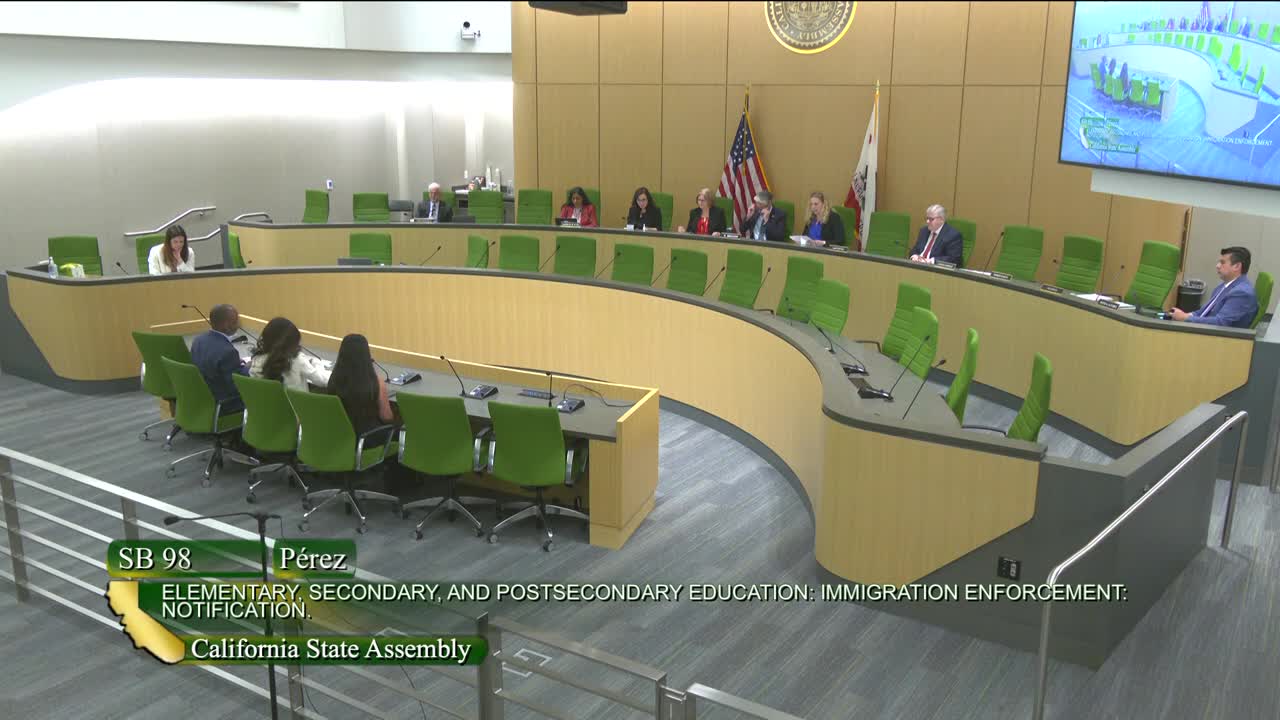 12MIN
Assembly Standing Committee on Education
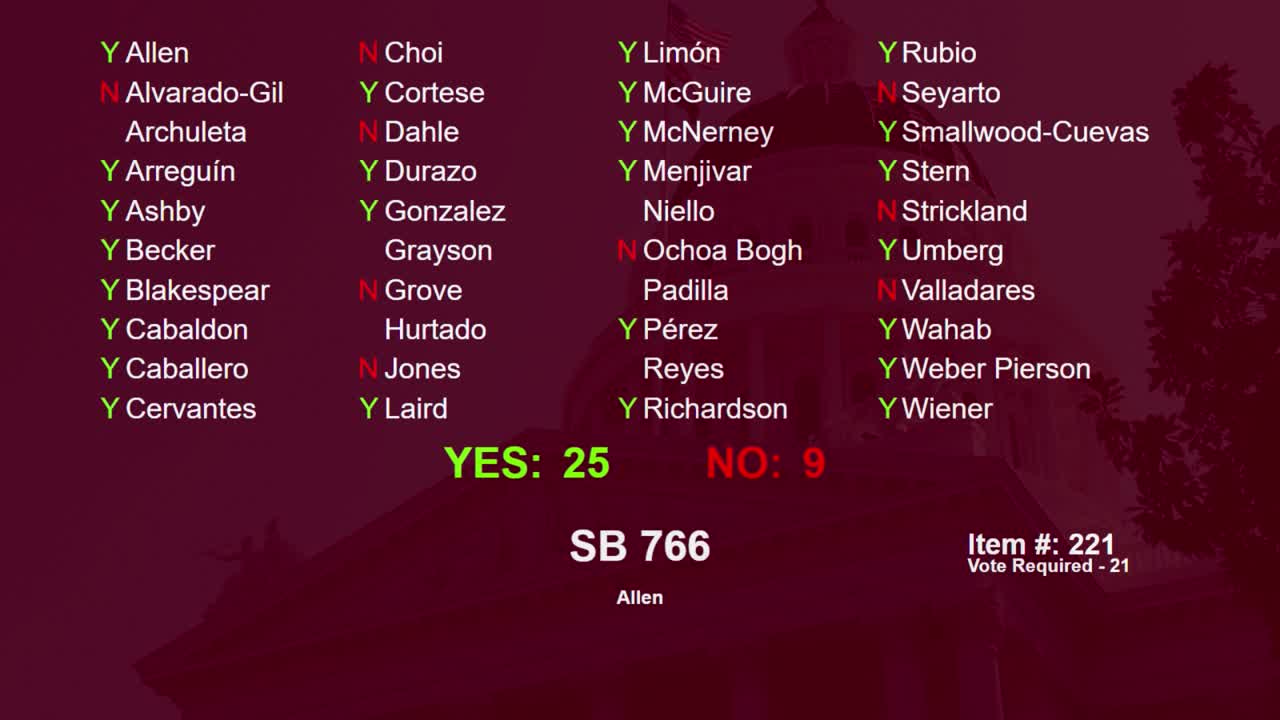 5MIN
Senate Floor
 35MIN
Senate Standing Committee on Judiciary
 35MIN
Senate Standing Committee on Education
Bill Author