AB 1577: CalFood Program: CalFood Account.
- Session Year: 2015-2016
- House: Assembly
- Latest Version Date: 2016-09-21
Existing law requires the State Department of Social Services to establish and administer the State Emergency Food Assistance Program (SEFAP), to provide food and funding for the provision of emergency food to food banks, as provided. Existing law creates the State Emergency Food Assistance Program Account and, upon appropriation by the Legislature, allocates the moneys in the account to SEFAP and requires that those moneys be used for the purchase, storage, and transportation of food grown or produced in California and for the departments administrative costs.
This bill would rename the State Emergency Food Assistance Program as the CalFood Program and would rename the State Emergency Food Assistance Program Account as the CalFood Account. The bill would make other conforming changes in this regard.
This bill would incorporate additional changes to Section 18995 of the Welfare and Institutions Code proposed by AB 1747 that would become operative if this bill and AB 1747 are both enacted and this bill is enacted last.
Existing law requires the State Department of Social Services to establish and administer the State Emergency Food Assistance Program (SEFAP), to provide food and funding for the provision of emergency food to food banks, as provided. Existing law creates the State Emergency Food Assistance Program Account and, upon appropriation by the Legislature, allocates the moneys in the account to SEFAP and requires that those moneys be used for the purchase, storage, and transportation of food grown or produced in California and for the departments administrative costs.
This bill would rename the State Emergency Food Assistance Program as the CalFood Program and would rename the State Emergency Food Assistance Program Account as the CalFood Account. The bill would make other conforming changes in this regard.
This bill would incorporate additional changes to Section 18995 of the Welfare and Institutions Code proposed by AB 1747 that would become operative if this bill and AB 1747 are both enacted and this bill is enacted last.
Existing law requires the State Department of Social Services to establish and administer the State Emergency Food Assistance Program (SEFAP), to provide food and funding for the provision of emergency food to food banks, as provided. Existing law creates the State Emergency Food Assistance Program Account and, upon appropriation by the Legislature, would allocate allocates the moneys in the account to SEFAP and require requires that those moneys be used for the purchase, storage, and transportation of food grown or produced in California and for the departments administrative costs.
This bill would rename the State Emergency Food Assistance Program as the CalFood Program and would rename the State Emergency Food Assistance Program Account as the CalFood Account. The bill would make other conforming changes in this regard.
This bill would incorporate additional changes to Section 18995 of the Welfare and Institutions Code proposed by AB 1747 that would become operative if this bill and AB 1747 are both enacted and this bill is enacted last.
(1)The Personal Income Tax Law and the Corporation Tax Law allow various credits against the taxes imposed by those laws, including, for taxable years beginning on or after January 1, 2012, and before January 1, 2017, a credit for a qualified taxpayer, defined as a person responsible for planting a crop, managing the crop, and harvesting the crop from the land, in an amount equal to 10% of the cost that would otherwise be included in, or required to be included in, inventory costs, as specified under federal law, with respect to the donation of fresh fruits or fresh vegetables to a food bank located in California.
This bill, under both laws, would expand the credit to apply to the donation of qualified donation items, defined as raw agricultural products or processed foods. The bill would expand the definition of a qualified taxpayer to also include a person responsible for growing or raising a qualified donation item, or harvesting, packing, or processing a qualified donation item. The bill would modify the credit amount to instead equal 10% of the qualified value, as defined, of the qualified donation items, but not less than an amount that would otherwise be calculated and allowed under existing law. The bill would extend the operation of the credit to taxable years before January 1, 2022, and would require it to be claimed on a timely filed original return. The bill would make various conforming changes and would also make a nonsubstantive change to the personal income tax provision.
(2)Existing law requires the State Department of Social Services to establish and administer the State Emergency Food Assistance Program (SEFAP), to provide food and funding for the provision of emergency food to food banks, as provided. Existing law creates the State Emergency Food Assistance Program Account and, upon appropriation by the Legislature, would allocate the moneys in the account to SEFAP and require that those moneys be used for the purchase, storage, and transportation of food grown or produced in California and for the departments administrative costs.
This bill would rename the State Emergency Food Assistance Program as the CalFood Program and would rename the State Emergency Food Assistance Program Account as the CalFood Account. The bill would make other conforming changes in this regard.
(3)Existing law requires any bill authorizing a new personal or corporation income tax credit to, among other things, contain specific goals, purposes, and objectives that the tax credit will achieve, detailed performance indicators, and data collection requirements.
This bill would include that additional information.
(1)The Personal Income Tax Law and the Corporation Tax Law allow various credits against the taxes imposed by those laws, including, for taxable years beginning on or after January 1, 2012, and before January 1, 2017, a credit for a qualified taxpayer, defined as a person responsible for planting a crop, managing the crop, and harvesting the crop from the land, in an amount equal to 10% of the cost that would otherwise be included in, or required to be included in, inventory costs, as specified under federal law, with respect to the donation of fresh fruits or fresh vegetables to a food bank located in California.
This bill, under both laws, would expand the credit to apply to the donation of qualified donation items, defined as raw agricultural products or processed foods. The bill would expand the definition of a qualified taxpayer to also include a person responsible for growing or raising a qualified donation item, or harvesting, packing, or processing a qualified donation item. The bill would modify the credit amount to instead equal 10% of the qualified value, as defined, of the qualified donation items, but not less than an amount that would otherwise be calculated and allowed under existing law. The bill would extend the operation of the credit to taxable years before January 1, 2019, 2022, and would require it to be claimed on a timely filed original return. The bill would make various conforming changes and would also make a nonsubstantive change to the personal income tax provision.
(2)Existing law requires the State Department of Social Services to establish and administer the State Emergency Food Assistance Program (SEFAP), to provide food and funding for the provision of emergency food to food banks, as provided. Existing law creates the State Emergency Food Assistance Program Account and, upon appropriation by the Legislature, would allocate the moneys in the account to SEFAP and require that those moneys be used for the purchase, storage, and transportation of food grown or produced in California and for the departments administrative costs.
This bill would rename the State Emergency Food Assistance Program as the CalFood Program and would rename the State Emergency Food Assistance Program Account as the CalFood Account. The bill would make other conforming changes in this regard.
(3)Existing law requires any bill authorizing a new personal or corporation income tax credit to, among other things, contain specific goals, purposes, and objectives that the tax credit will achieve, detailed performance indicators, and data collection requirements.
This bill would include that additional information.
(1)The Personal Income Tax Law and the Corporation Tax Law allow various credits against the taxes imposed by those laws, including, for taxable years beginning on or after January 1, 2012, and before January 1, 2017, a credit for a qualified taxpayers, taxpayer, defined as the a person responsible for planting a crop, managing the crop, and harvesting the crop from the land, in an amount equal to 10% of the cost that would otherwise be included in, or required to be included in, inventory costs, as specified under federal law, with respect to the donation of fresh fruits or fresh vegetables to a food bank located in California.
This bill, under both laws, would expand the credit to apply to the donation of qualified donation items, defined as raw agricultural products or processed foods. The bill would expand the definition of a qualified taxpayer to also include the a person responsible for growing or raising a qualified donation item, or harvesting, packing, or processing a qualified donation item. The bill would modify the credit amount to instead equal 15% of the qualified value, as defined, of the qualified donation items, but not less than an amount that would otherwise be calculated and allowed under existing law. The bill would extend the operation of the credit to taxable years before January 1, 2022, 2019, and would require it to be claimed on a timely filed original return. The bill would make various conforming changes and would also make a nonsubstantive change to the personal income tax provision.
(2)Existing law requires the State Department of Social Services to establish and administer the State Emergency Food Assistance Program (SEFAP), to provide food and funding for the provision of emergency food to food banks, as provided. Existing law creates the State Emergency Food Assistance Program Account and would, and, upon appropriation by the Legislature, would allocate the moneys in the account to SEFAP and require that those moneys be used for the purchase, storage, and transportation of food grown or produced in California and for the departments administrative costs.
This bill would rename the State Emergency Food Assistance Program (SEFAP) as the CalFood Program and would rename the State Emergency Food Assistance Program Account as the CalFood Account. The bill would make other conforming changes in this regard.
(3)Existing law requires any bill authorizing a new personal or corporation income tax credit to, among other things, contain specific goals, purposes, and objectives that the tax credit will achieve, detailed performance indicators, and data collection requirements.
This bill would include that additional information.
(1)The Personal Income Tax Law and the Corporation Tax Law allow various credits against the taxes imposed by those laws, including, for taxable years beginning on or after January 1, 2012, and before January 1, 2017, a credit for qualified taxpayers, defined as the person responsible for planting a crop, managing the crop, and harvesting the crop from the land, in an amount equal to 10% of the cost that would otherwise be included in, or required to be included in, inventory costs, as specified under federal law, with respect to the donation of fresh fruits or fresh vegetables to a food bank located in California.
This bill, under both laws, would expand the credit to apply to the donation of qualified donation items, defined as raw agricultural products or processed foods. The bill would expand the definition of qualified taxpayer to also include the person responsible for growing or raising a qualified donation item, or harvesting, packing, or processing a qualified donation item. The bill would modify the credit amount to instead equal 15% of the qualified value, as defined, of the qualified donation items, but not less than an amount that would otherwise be calculated and allowed under existing law. The bill would extend the operation of the credit to taxable years before January 1, 2022, and would require it to be claimed on a timely filed return. The bill would make various conforming changes and would also make a nonsubstantive change to the personal income tax provision.
(2)Existing law requires the State Department of Social Services to establish and administer the State Emergency Food Assistance Program (SEFAP), to provide food and funding for the provision of emergency food to food banks, as provided. Existing law creates the State Emergency Food Assistance Program Account and would, upon appropriation by the Legislature, would allocate the moneys in the account to SEFAP and require that those moneys be used for the purchase, storage, and transportation of food grown or produced in California and for the departments administrative costs.
This bill would rename the State Emergency Food Assistance Program (SEFAP) as the CalFood Program and would rename the State Emergency Food Assistance Program Account as the CalFood Account. The bill would make other conforming changes in this regard.
(1)The Personal Income Tax Law and the Corporation Tax Law allow various credits against the taxes imposed by those laws, including, for taxable years beginning on or after January 1, 2012, and before January 1, 2017, a credit for qualified taxpayers, defined as the person responsible for planting a crop, managing the crop, and harvesting the crop from the land, in an amount equal to 10% of the cost that would otherwise be included in, or required to be included in, inventory costs, as specified under federal law, with respect to the donation of fresh fruits or fresh vegetables to a food bank located in California.
This bill, under both laws, would expand the credit to apply to the donation of qualified donation items, defined as raw or processed agricultural products or processed foods. The bill would expand the definition of qualified taxpayer to also include the person responsible for growing or raising a qualified donation item, or harvesting, packing, or processing a qualified donation item. The bill would modify the credit amount to instead equal 20% 15% of the qualified value, as defined, of the qualified donation items, but not less than an amount that would otherwise be calculated and allowed under existing law. The bill would extend the operation of the credit to taxable years before January 1, 2024. 2022, and would require it to be claimed on a timely filed return. The bill would make various conforming changes and would also make a nonsubstantive change to the personal income tax provision.
(2)Existing law requires the State Department of Social Services to establish and administer the State Emergency Food Assistance Program (SEFAP), to provide food and funding for the provision of emergency food to food banks, as provided. Existing law creates the State Emergency Food Assistance Program Account and would, upon appropriation by the Legislature, would allocate the moneys in the account to SEFAP and require that those moneys be used for the purchase, storage, and transportation of food grown or produced in California and for the departments administrative costs.
This bill would rename the State Emergency Food Assistance Program (SEFAP) as the CalFood Program and would rename the State Emergency Food Assistance Program Account as the CalFood Account. The bill would make other conforming changes in this regard.
(1)The Personal Income Tax Law and the Corporation Tax Law allow various credits against the taxes imposed by those laws, including, for taxable years beginning on or after January 1, 2012, and before January 1, 2017, a credit for qualified taxpayers, defined as the person responsible for planting a crop, managing the crop, and harvesting the crop from the land, in an amount equal to 10% of the cost that would otherwise be included in, or required to be included in, inventory costs, as specified under federal law, with respect to the donation of fresh fruits or fresh vegetables to a food bank located in California.
This bill, under both laws, would expand the credit to apply to the donation of qualified donation items, defined as raw or processed agricultural products. The bill would expand the definition of qualified taxpayer to also include the person responsible for growing or raising a qualified donation item, or harvesting, packing, or processing a qualified donation item. The bill would modify the credit amount to instead equal 20% of the qualified value, as defined, of the qualified donation items, but not less than an amount that would otherwise be calculated and allowed under existing law. The bill would extend the operation of the credit to taxable years before January 1, 2024. The bill would make various conforming changes and would also make a nonsubstantive change to the personal income tax provision.
(2)Existing law requires the State Department of Social Services to establish and administer the State Emergency Food Assistance Program (SEFAP), to provide food and funding for the provision of emergency food to food banks, as provided. Existing law creates the State Emergency Food Assistance Program Account and would, upon appropriation by the Legislature, would allocate the moneys in the account to SEFAP and require that those moneys be used for the purchase, storage, and transportation of food grown or produced in California and for the departments administrative costs.
This bill would rename the State Emergency Food Assistance Program (SEFAP) as the CalFood Program and would rename the State Emergency Food Assistance Program Account as the CalFood Account. The bill would make other conforming changes in this regard.
(a)On and after January 1, 2017, the State Emergency Food Assistance Program (SEFAP), administered by the State Department of Social Services, shall be renamed as the CalFood Program. The CalFood Program shall provide food and funding for the provision of emergency food to food banks established pursuant to the federal Emergency Food Assistance Program (7 C.F.R. Parts 250 and 251) whose ongoing primary function is to facilitate the distribution of food to low-income households.
(b)The CalFood Account is hereby established in the Emergency Food Assistance Program Fund established pursuant to Section 18852 of the Revenue and Taxation Code, and may receive federal funds and voluntary donations or contributions.
(c)Notwithstanding Section 18853 of the Revenue and Taxation Code, the following shall apply:
(1)All moneys received by the CalFood Account shall, upon appropriation by the Legislature, be allocated to the State Department of Social Services for allocation to the CalFood Program and, with the exception of those contributions made pursuant to Section 18851 of the Revenue and Taxation Code and funds received through Parts 250 and 251 of Title 7 of the Code of Federal Regulations, shall be used for the purchase, storage, and transportation of food grown or produced in California. Storage and transportation expenditures shall not exceed 10 percent of the CalFood Program funds annual budget.
(2)Notwithstanding paragraph (1), funds received by the CalFood Account shall, upon appropriation by the Legislature, be allocated to the State Department of Social Services for allocation to the CalFood Program as described in paragraph (1), and shall, in part, be used to pay for the departments administrative costs associated with the administration of the CalFood Program.
SEC. 2.5.Section 18995 of the Welfare and Institutions Code is amended to read:18995.(a)On and after January 1, 2017, the State Emergency Food Assistance Program (SEFAP), administered by the State Department of Social Services, shall be renamed as the CalFood Program. The CalFood Program shall provide food and funding for the provision of emergency food to food banks established pursuant to the federal Emergency Food Assistance Program (7 C.F.R. Parts 250 and 251) whose ongoing primary function is to facilitate the distribution of food to low-income households.
(b)(1)The CalFood Account is hereby established in the Emergency Food Assistance Program Fund established pursuant to Section 18852 of the Revenue and Taxation Code, and may receive federal funds and voluntary donations or contributions.
(2)Notwithstanding Section 18853 of the Revenue and Taxation Code, the following shall apply:
(A)All moneys received by the CalFood Account shall, upon appropriation by the Legislature, be allocated to the State Department of Social Services for allocation to the CalFood Program and, with the exception of those contributions made pursuant to Section 18851 of the Revenue and Taxation Code and funds received through Parts 250 and 251 of Title 7 of the Code of Federal Regulations, shall be used for the purchase, storage, and transportation of food grown or produced in California. Storage and transportation expenditures shall not exceed 10 percent of the CalFood Program funds annual budget.
(B)Notwithstanding subparagraph (A), funds received by the CalFood Account shall, upon appropriation by the Legislature, be allocated to the State Department of Social Services for allocation to the CalFood Program as described in subparagraph (A), and shall, in part, be used to pay for the departments administrative costs associated with the administration of the CalFood Program.
(c)(1)The Public Higher Education Pantry Assistance Program Account is hereby established in the Emergency Food Assistance Program Fund established pursuant to Section 18852 of the Revenue and Taxation Code.
(2)Notwithstanding Section 18853 of the Revenue and Taxation Code, funds in the Public Higher Education Pantry Assistance Program Account shall, upon appropriation by the Legislature, be allocated to the State Department of Social Services for allocation to food banks established pursuant to Parts 250 and 251 of Title 7 of the Code of Federal Regulations that meet both of the following criteria:
(A)The primary function of the food bank is the distribution of food to low-income households.
(B)The food bank has identified specific costs associated with supporting on-campus pantry and hunger relief efforts serving low-income students.
SEC. 3.Section 2.5 of this bill incorporates amendments to Section 18995 of the Welfare and Institutions Code proposed by both this bill and Assembly Bill 1747. It shall only become operative if (1) both bills are enacted and become effective on or before January 1, 2017, (2) each bill amends Section 18995 of the Welfare and Institutions Code, and (3) this bill is enacted after Assembly Bill 1747, in which case Section 2 of this bill shall not become operative.
(a)On and after January 1, 2017, the State Emergency Food Assistance Program (SEFAP), administered by the State Department of Social Services, shall be renamed as the CalFood Program. The CalFood Program shall provide food and funding for the provision of emergency food to food banks established pursuant to the federal Emergency Food Assistance Program (7 C.F.R. Parts 250 and 251) whose ongoing primary function is to facilitate the distribution of food to low-income households.
(b)The CalFood Account is hereby established in the Emergency Food Assistance Program Fund established pursuant to Section 18852 of the Revenue and Taxation Code, and may receive federal funds and voluntary donations or contributions.
(c)Notwithstanding Section 18853 of the Revenue and Taxation Code, the following shall apply:
(1)All moneys received by the CalFood Account shall, upon appropriation by the Legislature, be allocated to the State Department of Social Services for allocation to the CalFood Program and, with the exception of those contributions made pursuant to Section 18851 of the Revenue and Taxation Code and funds received through Parts 250 and 251 of Title 7 of the Code of Federal Regulations, shall be used for the purchase, storage, and transportation of food grown or produced in California. Storage and transportation expenditures shall not exceed 10 percent of the CalFood Program funds annual budget.
(2)Notwithstanding paragraph (1), funds received by the CalFood Account shall, upon appropriation by the Legislature, be allocated to the State Department of Social Services for allocation to the CalFood Program as described in paragraph (1), and shall, in part, be used to pay for the departments administrative costs associated with the administration of the CalFood Program.
SEC. 2.5.Section 18995 of the Welfare and Institutions Code is amended to read:18995.(a)On and after January 1, 2017, the State Emergency Food Assistance Program (SEFAP), administered by the State Department of Social Services, shall be renamed as the CalFood Program. The CalFood Program shall provide food and funding for the provision of emergency food to food banks established pursuant to the federal Emergency Food Assistance Program (7 C.F.R. Parts 250 and 251) whose ongoing primary function is to facilitate the distribution of food to low-income households.
(b)(1)The CalFood Account is hereby established in the Emergency Food Assistance Program Fund established pursuant to Section 18852 of the Revenue and Taxation Code, and may receive federal funds and voluntary donations or contributions.
(2)Notwithstanding Section 18853 of the Revenue and Taxation Code, the following shall apply:
(A)All moneys received by the CalFood Account shall, upon appropriation by the Legislature, be allocated to the State Department of Social Services for allocation to the CalFood Program and, with the exception of those contributions made pursuant to Section 18851 of the Revenue and Taxation Code and funds received through Parts 250 and 251 of Title 7 of the Code of Federal Regulations, shall be used for the purchase, storage, and transportation of food grown or produced in California. Storage and transportation expenditures shall not exceed 10 percent of the CalFood Program funds annual budget.
(B)Notwithstanding subparagraph (A), funds received by the CalFood Account shall, upon appropriation by the Legislature, be allocated to the State Department of Social Services for allocation to the CalFood Program as described in subparagraph (A), and shall, in part, be used to pay for the departments administrative costs associated with the administration of the CalFood Program.
(c)(1)The Public Higher Education Pantry Assistance Program Account is hereby established in the Emergency Food Assistance Program Fund established pursuant to Section 18852 of the Revenue and Taxation Code.
(2)Notwithstanding Section 18853 of the Revenue and Taxation Code, funds in the Public Higher Education Pantry Assistance Program Account shall, upon appropriation by the Legislature, be allocated to the State Department of Social Services for allocation to food banks established pursuant to Parts 250 and 251 of Title 7 of the Code of Federal Regulations that meet both of the following criteria:
(A)The primary function of the food bank is the distribution of food to low-income households.
(B)The food bank has identified specific costs associated with supporting on-campus pantry and hunger relief efforts serving low-income students.
SEC. 3.Section 2.5 of this bill incorporates amendments to Section 18995 of the Welfare and Institutions Code proposed by both this bill and Assembly Bill 1747. It shall only become operative if (1) both bills are enacted and become effective on or before January 1, 2017, (2) each bill amends Section 18995 of the Welfare and Institutions Code, and (3) this bill is enacted after Assembly Bill 1747, in which case Section 2 of this bill shall not become operative.
(a)On and after January 1, 2017, the State Emergency Food Assistance Program (SEFAP), administered by the State Department of Social Services, shall be renamed as the CalFood Program. The CalFood Program shall provide food and funding for the provision of emergency food to food banks established pursuant to the federal Emergency Food Assistance Program (7 C.F.R. Parts 250 and 251) whose ongoing primary function is to facilitate the distribution of food to low-income households.
(b)The CalFood Account is hereby established in the Emergency Food Assistance Program Fund established pursuant to Section 18852 of the Revenue and Taxation Code, and may receive federal funds and voluntary donations or contributions.
(c)Notwithstanding Section 18853 of the Revenue and Taxation Code, the following shall apply:
(1)All moneys received by the CalFood Account shall, upon appropriation by the Legislature, be allocated to the State Department of Social Services for allocation to the CalFood Program and, with the exception of those contributions made pursuant to Section 18851 of the Revenue and Taxation Code and funds received through Parts 250 and 251 of Title 7 of the Code of Federal Regulations, shall be used for the purchase, storage, and transportation of food grown or produced in California. Storage and transportation expenditures shall not exceed 10 percent of the CalFood Program funds annual budget.
(2)Notwithstanding paragraph (1), funds received by the CalFood Account shall, upon appropriation by the Legislature, be allocated to the State Department of Social Services for allocation to the CalFood Program as described in paragraph (1), and shall, in part, be used to pay for the departments administrative costs associated with the administration of the CalFood Program.
SEC. 2.5.Section 18995 of the Welfare and Institutions Code is amended to read:18995.(a)On and after January 1, 2012, the State Department of Social Services shall establish and administer the State Emergency Food Assistance Program (SEFAP). The SEFAP 2017, the State Emergency Food Assistance Program (SEFAP), administered by the State Department of Social Services, shall be renamed as the CalFood Program. The CalFood Program shall provide food and funding for the provision of emergency food to food banks established pursuant to the federal Emergency Food Assistance Program (7 C.F.R. Parts 250 and 251) whose ongoing primary function is to facilitate the distribution of food to low-income households.
(b)(1)The State Emergency Food Assistance Program CalFood Account is hereby established in the Emergency Food Assistance Program Fund established pursuant to Section 18852 of the Revenue and Taxation Code, and may receive federal funds and voluntary donations or contributions.
(c)
(2)Notwithstanding Section 18853 of the Revenue and Taxation Code, the following shall apply:
(1)
(A)All moneys received by the State Emergency Food Assistance Program CalFood Account shall, upon appropriation by the Legislature, be allocated to the State Department of Social Services for allocation to the SEFAP CalFood Program and, with the exception of those contributions made pursuant to Section 18851 of the Revenue and Taxation Code and funds received through Parts 250 and 251 of Title 7 of the Code of Federal Regulations, shall be used for the purchase, storage, and transportation of food grown or produced in California. Storage and transportation expenditures shall not exceed 10 percent of the SEFAP CalFood Program funds annual budget.
(2)
(B)Notwithstanding paragraph (1), subparagraph (A), funds received by the State Emergency Food Assistance Program CalFood Account shall, upon appropriation by the Legislature, be allocated to the State Department of Social Services for allocation to the SEFAP CalFood Program as described in paragraph (1), subparagraph (A), and shall, in part, be used to pay for the departments administrative costs associated with the administration of the SEFAP. CalFood Program.
(c)(1)The Public Higher Education Pantry Assistance Program Account is hereby established in the Emergency Food Assistance Program Fund established pursuant to Section 18852 of the Revenue and Taxation Code.
(2)Notwithstanding Section 18853 of the Revenue and Taxation Code, funds in the Public Higher Education Pantry Assistance Program Account shall, upon appropriation by the Legislature, be allocated to the State Department of Social Services for allocation to food banks established pursuant to Parts 250 and 251 of Title 7 of the Code of Federal Regulations that meet both of the following criteria:
(A)The primary function of the food bank is the distribution of food to low-income households.
(B)The food bank has identified specific costs associated with supporting on-campus pantry and hunger relief efforts serving low-income students.
SEC. 3.Section 2.5 of this bill incorporates amendments to Section 18995 of the Welfare and Institutions Code proposed by both this bill and Assembly Bill 1747. It shall only become operative if (1) both bills are enacted and become effective on or before January 1, 2017, (2) each bill amends Section 18995 of the Welfare and Institutions Code, and (3) this bill is enacted after Assembly Bill 1747, in which case Section 2 of this bill shall not become operative.
(a)In the case of a qualified taxpayer that donates to a food bank any qualified donation items that are accepted by that food bank located in California under Chapter 5 (commencing with Section 58501) of Part 1 of Division 21 of the Food and Agricultural Code, for taxable years beginning on or after January 1, 2012, and before January 1, 2022, there shall be allowed, without regard to the taxpayers method of accounting, as a credit against the net tax (as defined by Section 17039), an amount equal to 10 percent of the qualified value of the qualified donation items, but in no event shall this amount be less than the amount that otherwise would have been calculated and allowed under this section as added by Chapter 503 of the Statutes of 2011.
(b)For the purposes of this section, the following definitions shall apply:
(1)Qualified donation item means fresh fruits or fresh vegetables and the following raw agricultural products or processed foods:
(A)All of the following:
(i)Fruits, nuts, or vegetables as defined in Section 42510 of the Food and Agricultural Code.
(ii)Meat food product as defined in Section 18665 of the Food and Agricultural Code.
(iii)Poultry as defined in Section 18675 of the Food and Agricultural Code.
(iv)Eggs as defined in Section 75027 of the Food and Agricultural Code.
(v)Fish as defined in Section 58609 of the Food and Agricultural Code.
(B)All of the following food as defined in Section 109935 of the Health and Safety Code:
(i)Rice.
(ii)Beans.
(iii)Fruit, nuts, and vegetables in canned, frozen, dried, dehydrated, and 100-percent juice forms.
(iv)Any cheese, milk, yogurt, butter, or dehydrated milk meeting the requirements in Division 15 (commencing with Section 32501) of the Food and Agricultural Code.
(v)Infant formula subject to Section 114094.5 of the Health and Safety Code.
(vi)Vegetable oil and olive oil.
(vii)Soup, pasta sauce, and salsa.
(viii)Bread and pasta.
(ix)Canned meats and canned seafood.
(2)Qualified taxpayer means the person responsible for planting a crop, managing the crop, harvesting the crop from land, growing or raising a qualified donation item, or harvesting, packing, or processing a qualified donation item.
(3)Qualified value means either of the following:
(A)The qualified value shall be calculated by using the weighted average wholesale sale price based on the qualified taxpayers total like grade wholesale sales of the donated item sold within the calendar month of the qualified taxpayers donation.
(B)If no wholesale sales of the donated item have occurred in the calendar month of the qualified taxpayers donation, the qualified value shall be equal to the nearest regional wholesale market price for the calendar month of the donation based upon the same grade products as published by the United States Department of Agricultures Agricultural Marketing Service, or its successor.
(c)If the credit allowed by this section is claimed by the qualified taxpayer, any deduction otherwise allowed under this part for that amount of the cost paid or incurred by the qualified taxpayer that is eligible for the credit shall be reduced by the amount of the credit provided in subdivision (a).
(d)The donor shall provide to the food bank the qualified value of the donation items and information regarding the origin of where the donation items were grown, processed, or both grown and processed. Upon receipt and acceptance of the donation items, the food bank shall provide a certificate to the donor. The certificate shall contain a statement signed and dated by a person authorized by the food bank that the donation items are accepted under Chapter 5 (commencing with Section 58501) of Part 1 of Division 21 of the Food and Agricultural Code. The certificate shall also contain the type, grade, and quantity of items donated, the name of the donor or donors, the name and address of the food bank, and, as provided by the donor, the origin of the donated items, and the qualified value of the donated items, as described in subdivision (a). Upon the request of the Franchise Tax Board, the qualified taxpayer shall provide a copy of the certification to the Franchise Tax Board.
(e)The credit allowed by this section may be claimed only on a timely filed original return.
(f)In the case where the credit allowed by this section exceeds the net tax, the excess may be carried over to reduce the net tax in the following year, and for the six succeeding years if necessary, until the credit has been exhausted.
(g)Using the information available to the Franchise Tax Board from the certificates required under subdivision (d) and subdivision (d) of Section 23688, the Franchise Tax Board shall report to the Legislature on or before December 1, 2014, and each December 1 thereafter until the inoperative date specified in paragraph (2) of subdivision (h), regarding the utilization of the credit authorized by this section and Section 23688. The Franchise Tax Board shall also include in the report the estimated value of the qualified donation items, the origin of the qualified donation items, and the month the donation was made.
(h)(1)A report required to be submitted pursuant to subdivision (g) shall be submitted in compliance with Section 9795 of the Government Code.
(2)The requirement for submitting a report imposed under subdivision (g) is inoperative on January 1, 2021, pursuant to Section 10231.5 of the Government Code.
(i)This section is repealed on December 1, 2022.
SEC. 2.Section 23688 of the Revenue and Taxation Code is amended to read:23688.(a)In the case of a qualified taxpayer that donates to a food bank any qualified donation items that are accepted by that food bank located in California under Chapter 5 (commencing with Section 58501) of Part 1 of Division 21 of the Food and Agricultural Code, for taxable years beginning on or after January 1, 2012, and before January 1, 2022, there shall be allowed, without regard to the taxpayers method of accounting, as a credit against the tax (as defined by Section 23036), an amount equal to 10 percent of the qualified value of the qualified donation items, but in no event shall this amount be less than the amount that otherwise would have been calculated and allowed under this section as added by Chapter 503 of the Statutes of 2011.
(b)For the purposes of this section, the following definitions shall apply:
(1)Qualified donation item means fresh fruits or fresh vegetables and the following raw agricultural products or processed foods:
(A)All of the following:
(i)Fruits, nuts, or vegetables as defined in Section 42510 of the Food and Agricultural Code.
(ii)Meat food product as defined in Section 18665 of the Food and Agricultural Code.
(iii)Poultry as defined in Section 18675 of the Food and Agricultural Code.
(iv)Eggs as defined in Section 75027 of the Food and Agricultural Code.
(v)Fish as defined in Section 58609 of the Food and Agricultural Code.
(B)All of the following food as defined in Section 109935 of the Health and Safety Code:
(i)Rice.
(ii)Beans.
(iii)Fruit, nuts, and vegetables in canned, frozen, dried, dehydrated, and 100-percent juice forms.
(iv)Any cheese, milk, yogurt, butter, or dehydrated milk meeting the requirements in Division 15 (commencing with Section 32501) of the Food and Agricultural Code.
(v)Infant formula subject to Section 114094.5 of the Health and Safety Code.
(vi)Vegetable oil and olive oil.
(vii)Soup, pasta sauce, and salsa.
(viii)Bread and pasta.
(ix)Canned meats and canned seafood.
(2)Qualified taxpayer means the person responsible for planting a crop, managing the crop, harvesting the crop from land, growing or raising a qualified donation item, or harvesting, packing, or processing a qualified donation item.
(3)Qualified value means either of the following:
(A)The qualified value shall be calculated by using the weighted average wholesale sale price based on the qualified taxpayers total like grade wholesale sales of the donated item sold within the calendar month of the qualified taxpayers donation.
(B)If no wholesale sales of the donated item have occurred in the calendar month of the qualified taxpayers donation, the qualified value shall be equal to the nearest regional wholesale market price for the calendar month of the donation based upon the same grade products as published by the United States Department of Agricultures Agricultural Marketing Service, or its successor.
(c)If the credit allowed by this section is claimed by the qualified taxpayer, any deduction otherwise allowed under this part for that amount of the cost paid or incurred by the qualified taxpayer that is eligible for the credit shall be reduced by the amount of the credit provided in subdivision (a).
(d)The donor shall provide to the food bank the qualified value of the donation items and information regarding the origin of where the donation items were grown, processed, or both grown and processed. Upon receipt and acceptance of the donation items, the food bank shall provide a certificate to the donor. The certificate shall contain a statement signed and dated by a person authorized by the food bank that the donation items are accepted under Chapter 5 (commencing with Section 58501) of Part 1 of Division 21 of the Food and Agricultural Code. The certificate shall also contain the type, grade, and quantity of items donated, the name of the donor or donors, the name and address of the food bank, and, as provided by the donor, the origin of the donated items, and the qualified value of the donated items, as described in subdivision (a). Upon the request of the Franchise Tax Board, the qualified taxpayer shall provide a copy of the certification to the Franchise Tax Board.
(e)The credit allowed by this section may be claimed only on a timely filed original return.
(f)In the case where the credit allowed by this section exceeds the tax, the excess may be carried over to reduce the tax in the following year, and for the six succeeding years if necessary, until the credit has been exhausted.
(g)This section is repealed on December 1, 2022.
SEC. 3.SECTION 1.The heading of Chapter 14.5 (commencing with Section 18995) of Part 6 of Division 9 of the Welfare and Institutions Code is amended to read:14.5.The CalFood ProgramSEC. 4.SEC. 2.Section 18995 of the Welfare and Institutions Code is amended to read:18995.(a)On and after January 1, 2017, the State Emergency Food Assistance Program (SEFAP), administered by the State Department of Social Services, shall be renamed as the CalFood Program. The CalFood Program shall provide food and funding for the provision of emergency food to food banks established pursuant to the federal Emergency Food Assistance Program (7 C.F.R. Parts 250 and 251) whose ongoing primary function is to facilitate the distribution of food to low-income households.
(b)The CalFood Account is hereby established in the Emergency Food Assistance Program Fund established pursuant to Section 18852 of the Revenue and Taxation Code, and may receive federal funds and voluntary donations or contributions.
(c)Notwithstanding Section 18853 of the Revenue and Taxation Code, the following shall apply:
(1)All moneys received by the CalFood Account shall, upon appropriation by the Legislature, be allocated to the State Department of Social Services for allocation to the CalFood Program and, with the exception of those contributions made pursuant to Section 18851 of the Revenue and Taxation Code and funds received through Parts 250 and 251 of Title 7 of the Code of Federal Regulations, shall be used for the purchase, storage, and transportation of food grown or produced in California. Storage and transportation expenditures shall not exceed 10 percent of the CalFood Program funds annual budget.
(2)Notwithstanding paragraph (1), funds received by the CalFood Account shall, upon appropriation by the Legislature, be allocated to the State Department of Social Services for allocation to the CalFood Program as described in paragraph (1), and shall, in part, be used to pay for the departments administrative costs associated with the administration of the CalFood Program.
SEC. 5.For the purposes of complying with Section 41 of the Revenue and Taxation Code, with respect to Sections 17053.88 and 23688 of the Revenue and Taxation Code, the Legislature finds and declares as follows:
(a)Specific goal, purpose, and objective: increase the variety of donated raw agricultural products or processed foods.
(b)Performance indicator: types of qualified items donated.
(c)Data collection requirements and baseline measurements:
(1)The baseline measurements include the current types of donated raw agricultural products or processed foods.
(2)Data to collect includes the types of raw agricultural products or processed foods donated after the tax credit is put in place.
(a)In the case of a qualified taxpayer that donates to a food bank any qualified donation items that are accepted by that food bank located in California under Chapter 5 (commencing with Section 58501) of Part 1 of Division 21 of the Food and Agricultural Code, for taxable years beginning on or after January 1, 2012, and before January 1, 2019, 2022, there shall be allowed, without regard to the taxpayers method of accounting, as a credit against the net tax (as defined by Section 17039), an amount equal to 10 percent of the cost that would otherwise be included in inventory costs under Section 263A of the Internal Revenue Code, relating to capitalization and inclusion of inventory costs of certain expenses, or that would be required to be included in inventory costs under Section 263A of the Internal Revenue Code, but for the exception contained in Section 263A(d) of the Internal Revenue Code, relating to exception for farming businesses, with respect to those qualified donation items. 10 percent of the qualified value of the qualified donation items, but in no event shall this amount be less than the amount that otherwise would have been calculated and allowed under this section as added by Chapter 503 of the Statutes of 2011.
(b)For the purposes of this section, the following definitions shall apply:
(1)Qualified donation item means fresh fruits or fresh vegetables and the following raw agricultural products or processed foods:
(A)All of the following:
(i)Fruits, nuts, or vegetables as defined in Section 42510 of the Food and Agricultural Code.
(ii)Meat food product as defined in Section 18665 of the Food and Agricultural Code.
(iii)Poultry as defined in Section 18675 of the Food and Agricultural Code.
(iv)Eggs as defined in Section 75027 of the Food and Agricultural Code.
(v)Fish as defined in Section 58609 of the Food and Agricultural Code.
(B)All of the following food as defined in Section 109935 of the Health and Safety Code:
(i)Rice.
(ii)Beans.
(iii)Fruit, nuts, and vegetables in canned, frozen, dried, dehydrated, and 100-percent juice forms.
(iv)Any cheese, milk, yogurt, butter, or dehydrated milk meeting the requirements in Division 15 (commencing with Section 32501) of the Food and Agricultural Code.
(v)Infant formula subject to Section 114094.5 of the Health and Safety Code.
(vi)Vegetable oil and olive oil.
(vii)Soup, pasta sauce, and salsa.
(viii)Bread and pasta.
(ix)Canned meats and canned seafood.
(2)Qualified taxpayer means the person responsible for planting a crop, managing the crop, harvesting the crop from land, growing or raising a qualified donation item, or harvesting, packing, or processing a qualified donation item.
(3)Qualified value means either of the following:
(A)The qualified value shall be calculated by using the weighted average wholesale sale price based on the qualified taxpayers total like grade wholesale sales of the donated item sold within the calendar month of the qualified taxpayers donation.
(B)If no wholesale sales of the donated item have occurred in the calendar month of the qualified taxpayers donation, the qualified value shall be equal to the nearest regional wholesale market price for the calendar month of the donation based upon the same grade products as published by the United States Department of Agricultures Agricultural Marketing Service, or its successor.
(c)If the credit allowed by this section is claimed by the qualified taxpayer, any deduction otherwise allowed under this part for that amount of the cost paid or incurred by the qualified taxpayer that is eligible for the credit shall be reduced by the amount of the credit provided in subdivision (a).
(d)The donor shall provide to the food bank the estimated qualified value of the donation items and information regarding the origin of where the donation items were grown, processed, or both grown and processed. Upon receipt and acceptance of the donation items, the food bank shall provide a certificate to the donor. The certificate shall contain a statement signed and dated by a person authorized by the food bank that the donation items are accepted under Chapter 5 (commencing with Section 58501) of Part 1 of Division 21 of the Food and Agricultural Code. The certificate shall also contain the type, grade, and quantity of items donated, the name of the donor or donors, the name and address of the food bank, and, as provided by the donor, the origin of the donated items, and the estimated qualified value of the donated items, as described in subdivision (a). Upon the request of the Franchise Tax Board, the qualified taxpayer shall provide a copy of the certification to the Franchise Tax Board.
(e)The credit allowed by this section may be claimed only on a timely filed original return.
(f)In the case where the credit allowed by this section exceeds the net tax, the excess may be carried over to reduce the net tax in the following year, and for the six succeeding years if necessary, until the credit has been exhausted.
(g)Using the information available to the Franchise Tax Board from the certificates required under subdivision (d) and subdivision (d) of Section 23688, the Franchise Tax Board shall report to the Legislature on or before December 1, 2014, and each December 1 thereafter until the inoperative date specified in paragraph (2) of subdivision (h), regarding the utilization of the credit authorized by this section and Section 23688. The Franchise Tax Board shall also include in the report the estimated value of the qualified donation items, the origin of the qualified donation items, and the month the donation was made.
(h)(1)A report required to be submitted pursuant to subdivision (g) shall be submitted in compliance with Section 9795 of the Government Code.
(2)The requirement for submitting a report imposed under subdivision (g) is inoperative on January 1, 2018, 2021, pursuant to Section 10231.5 of the Government Code.
(i)This section is repealed on December 1, 2019. 2022.
SEC. 2.Section 23688 of the Revenue and Taxation Code is amended to read:23688.(a)In the case of a qualified taxpayer that donates to a food bank any qualified donation items that are accepted by that food bank located in California under Chapter 5 (commencing with Section 58501) of Part 1 of Division 21 of the Food and Agricultural Code, for taxable years beginning on or after January 1, 2012, and before January 1, 2019, 2022, there shall be allowed, without regard to the taxpayers method of accounting, as a credit against the tax (as defined by Section 23036), an amount equal to 10 percent of the cost that would otherwise be included in inventory costs under Section 263A of the Internal Revenue Code, relating to capitalization and inclusion of inventory costs of certain expenses, or that would be required to be included in inventory costs under Section 263A of the Internal Revenue Code, but for the exception contained in Section 263A(d) of the Internal Revenue Code, relating to exceptions for farming businesses, with respect to those qualified donation items. 10 percent of the qualified value of the qualified donation items, but in no event shall this amount be less than the amount that otherwise would have been calculated and allowed under this section as added by Chapter 503 of the Statutes of 2011.
(b)For the purposes of this section, the following definitions shall apply:
(1)Qualified donation item means fresh fruits or fresh vegetables and the following raw agricultural products or processed foods:
(A)All of the following:
(i)Fruits, nuts, or vegetables as defined in Section 42510 of the Food and Agricultural Code.
(ii)Meat food product as defined in Section 18665 of the Food and Agricultural Code.
(iii)Poultry as defined in Section 18675 of the Food and Agricultural Code.
(iv)Eggs as defined in Section 75027 of the Food and Agricultural Code.
(v)Fish as defined in Section 58609 of the Food and Agricultural Code.
(B)All of the following food as defined in Section 109935 of the Health and Safety Code:
(i)Rice.
(ii)Beans.
(iii)Fruit, nuts, and vegetables in canned, frozen, dried, dehydrated, and 100-percent juice forms.
(iv)Any cheese, milk, yogurt, butter, or dehydrated milk meeting the requirements in Division 15 (commencing with Section 32501) of the Food and Agricultural Code.
(v)Infant formula subject to Section 114094.5 of the Health and Safety Code.
(vi)Vegetable oil and olive oil.
(vii)Soup, pasta sauce, and salsa.
(viii)Bread and pasta.
(ix)Canned meats and canned seafood.
(2)Qualified taxpayer means the person responsible for planting a crop, managing the crop, harvesting the crop from land, growing or raising a qualified donation item, or harvesting, packing, or processing a qualified donation item.
(3)Qualified value means either of the following:
(A)The qualified value shall be calculated by using the weighted average wholesale sale price based on the qualified taxpayers total like grade wholesale sales of the donated item sold within the calendar month of the qualified taxpayers donation.
(B)If no wholesale sales of the donated item have occurred in the calendar month of the qualified taxpayers donation, the qualified value shall be equal to the nearest regional wholesale market price for the calendar month of the donation based upon the same grade products as published by the United States Department of Agricultures Agricultural Marketing Service, or its successor.
(c)If the credit allowed by this section is claimed by the qualified taxpayer, any deduction otherwise allowed under this part for that amount of the cost paid or incurred by the qualified taxpayer that is eligible for the credit shall be reduced by the amount of the credit provided in subdivision (a).
(d)The donor shall provide to the food bank the estimated qualified value of the donation items and information regarding the origin of where the donation items were grown, processed, or both grown and processed. Upon receipt and acceptance of the donation items, the food bank shall provide a certificate to the donor. The certificate shall contain a statement signed and dated by a person authorized by the food bank that the donation items are accepted under Chapter 5 (commencing with Section 58501) of Part 1 of Division 21 of the Food and Agricultural Code. The certificate shall also contain the type, grade, and quantity of items donated, the name of the donor or donors, the name and address of the food bank, and, as provided by the donor, the origin of the donated items, and the estimated qualified value of the donated items, as described in subdivision (a). Upon the request of the Franchise Tax Board, the qualified taxpayer shall provide a copy of the certification to the Franchise Tax Board.
(e)The credit allowed by this section may be claimed only on a timely filed original return.
(f)In the case where the credit allowed by this section exceeds the tax, the excess may be carried over to reduce the tax in the following year, and for the six succeeding years if necessary, until the credit has been exhausted.
(g)This section is repealed on December 1, 2019. 2022.
SEC. 3.The heading of Chapter 14.5 (commencing with Section 18995) of Part 6 of Division 9 of the Welfare and Institutions Code is amended to read:14.5.The CalFood ProgramSEC. 4.Section 18995 of the Welfare and Institutions Code is amended to read:18995.(a)On and after January 1, 2017, the State Emergency Food Assistance Program (SEFAP), administered by the State Department of Social Services, shall be renamed as the CalFood Program. The CalFood Program shall provide food and funding for the provision of emergency food to food banks established pursuant to the federal Emergency Food Assistance Program (7 C.F.R. Parts 250 and 251) whose ongoing primary function is to facilitate the distribution of food to low-income households.
(b)The CalFood Account is hereby established in the Emergency Food Assistance Program Fund established pursuant to Section 18852 of the Revenue and Taxation Code, and may receive federal funds and voluntary donations or contributions.
(c)Notwithstanding Section 18853 of the Revenue and Taxation Code, the following shall apply:
(1)All moneys received by the CalFood Account shall, upon appropriation by the Legislature, be allocated to the State Department of Social Services for allocation to the CalFood Program and, with the exception of those contributions made pursuant to Section 18851 of the Revenue and Taxation Code and funds received through Parts 250 and 251 of Title 7 of the Code of Federal Regulations, shall be used for the purchase, storage, and transportation of food grown or produced in California. Storage and transportation expenditures shall not exceed 10 percent of the CalFood Program funds annual budget.
(2)Notwithstanding paragraph (1), funds received by the CalFood Account shall, upon appropriation by the Legislature, be allocated to the State Department of Social Services for allocation to the CalFood Program as described in paragraph (1), and shall, in part, be used to pay for the departments administrative costs associated with the administration of the CalFood Program.
SEC. 5.For the purposes of complying with Section 41 of the Revenue and Taxation Code, with respect to Sections 17053.88 and 23688 of the Revenue and Taxation Code, the Legislature finds and declares as follows:
(a)Specific goal, purpose, and objective: increase the variety of donated raw agricultural products or processed foods.
(b)Performance indicator: types of qualified items donated.
(c)Data collection requirements and baseline measurements:
(1)The baseline measurements include the current types of donated raw agricultural products or processed foods.
(2)Data to collect includes the types of raw agricultural products or processed foods donated after the tax credit is put in place.
(a)In the case of a qualified taxpayer that donates to a food bank any qualified donation items that are accepted by that food bank located in California under Chapter 5 (commencing with Section 58501) of Part 1 of Division 21 of the Food and Agricultural Code, for taxable years beginning on or after January 1, 2012, and before January 1, 2022, 2019, there shall be allowed, without regard to the taxpayers method of accounting, as a credit against the net tax (as defined by Section 17039), an amount equal to 15 percent of the qualified value of the qualified donation items, but in no event shall this amount be less than the amount that otherwise would have been calculated and allowed under this section as added by Chapter 503 of the Statutes of 2011. 10 percent of the cost that would otherwise be included in inventory costs under Section 263A of the Internal Revenue Code, relating to capitalization and inclusion of inventory costs of certain expenses, or that would be required to be included in inventory costs under Section 263A of the Internal Revenue Code, but for the exception contained in Section 263A(d) of the Internal Revenue Code, relating to exception for farming businesses, with respect to those qualified donation items.
(b)For the purposes of this section, the following definitions shall apply:
(1)Qualified donation item means fresh fruits or fresh vegetables and the following raw agricultural products or processed foods:
(A)All of the following:
(i)Fruits, nuts, or vegetables as defined in Section 42510 of the Food and Agricultural Code.
(ii)Meat food product as defined in Section 18665 of the Food and Agricultural Code.
(iii)Poultry as defined in Section 18675 of the Food and Agricultural Code.
(iv)Eggs as defined in Section 75027 of the Food and Agricultural Code.
(v)Fish as defined in Section 58609 of the Food and Agricultural Code.
(B)All of the following food as defined in Section 109935 of the Health and Safety Code:
(i)Rice.
(ii)Beans.
(iii)Fruit, nuts, and vegetables in canned, frozen, dried, dehydrated, and 100-percent juice forms.
(iv)Any cheese, milk, yogurt, butter, or dehydrated milk meeting the requirements in Division 15 (commencing with Section 32501) of the Food and Agricultural Code.
(v)Infant formula subject to Section 114094.5 of the Health and Safety Code.
(vi)Vegetable oil and olive oil.
(vii)Soup, pasta sauce, and salsa.
(viii)Bread and pasta.
(ix)Canned meats and canned seafood.
(2)Qualified taxpayer means the person responsible for planting a crop, managing the crop, harvesting the crop from land, growing or raising a qualified donation item, or harvesting, packing, or processing a qualified donation item.
(3)Qualified value means either of the following:
(A)The qualified value shall be calculated by using the weighted average wholesale sale price based on the qualified taxpayers total like grade wholesale sales of the donated item sold within the calendar month of the qualified taxpayers donation.
(B)If no wholesale sales of the donated item have occurred in the calendar month of the qualified taxpayers donation, the qualified value shall be equal to the nearest regional wholesale market price for the calendar month of the donation based upon the same grade products as published by the United States Department of Agricultures Agricultural Marketing Service, or its successor.
(c)If the credit allowed by this section is claimed by the qualified taxpayer, any deduction otherwise allowed under this part for that amount of the cost paid or incurred by the qualified taxpayer that is eligible for the credit shall be reduced by the amount of the credit provided in subdivision (a).
(d)The donor shall provide to the food bank the qualified estimated value of the donation items and information regarding the origin of where the donation items were grown, processed, or both grown and processed. Upon receipt and acceptance of the donation items, the food bank shall provide a certificate to the donor. The certificate shall contain a statement signed and dated by a person authorized by the food bank that the donation items are accepted under Chapter 5 (commencing with Section 58501) of Part 1 of Division 21 of the Food and Agricultural Code. The certificate shall also contain the type, grade, and quantity of items donated, the name of the donor or donors, the name and address of the food bank, and, as provided by the donor, the origin of the donated items, and the qualified estimated value of the donated items, as described in subdivision (a). Upon the request of the Franchise Tax Board, the qualified taxpayer shall provide a copy of the certification to the Franchise Tax Board.
(e)The credit allowed by this section may be claimed only on a timely filed original return.
(f)In the case where the credit allowed by this section exceeds the net tax, the excess may be carried over to reduce the net tax in the following year, and for the six succeeding years if necessary, until the credit has been exhausted.
(g)Using the information available to the Franchise Tax Board from the certificates required under subdivision (d) and subdivision (d) of Section 23688, the Franchise Tax Board shall report to the Legislature on or before December 1, 2014, and each December 1 thereafter until the inoperative date specified in paragraph (2) of subdivision (h), regarding the utilization of the credit authorized by this section and Section 23688. The Franchise Tax Board shall also include in the report the estimated value of the qualified donation items, the origin of the qualified donation items, and the month the donation was made.
(h)(1)A report required to be submitted pursuant to subdivision (g) shall be submitted in compliance with Section 9795 of the Government Code.
(2)The requirement for submitting a report imposed under subdivision (g) is inoperative on January 1, 2021, 2018, pursuant to Section 10231.5 of the Government Code.
(i)This section shall be is repealed on December 1, 2022. 2019.
SEC. 2.Section 23688 of the Revenue and Taxation Code is amended to read:23688.(a)In the case of a qualified taxpayer that donates to a food bank any qualified donation items that are accepted by that food bank located in California under Chapter 5 (commencing with Section 58501) of Part 1 of Division 21 of the Food and Agricultural Code, for taxable years beginning on or after January 1, 2012, and before January 1, 2022, 2019, there shall be allowed, without regard to the taxpayers method of accounting, as a credit against the tax (as defined by Section 23036), an amount equal to 15 percent of the qualified value of the qualified donation items, but in no event shall this amount be less than the amount that otherwise would have been calculated and allowed under this section as added by Chapter 503 of the Statutes of 2011. 10 percent of the cost that would otherwise be included in inventory costs under Section 263A of the Internal Revenue Code, relating to capitalization and inclusion of inventory costs of certain expenses, or that would be required to be included in inventory costs under Section 263A of the Internal Revenue Code, but for the exception contained in Section 263A(d) of the Internal Revenue Code, relating to exceptions for farming businesses, with respect to those qualified donation items.
(b)For the purposes of this section, the following definitions shall apply:
(1)Qualified donation item means fresh fruits or fresh vegetables and the following raw agricultural products or processed foods:
(A)All of the following:
(i)Fruits, nuts, or vegetables as defined in Section 42510 of the Food and Agricultural Code.
(ii)Meat food product as defined in Section 18665 of the Food and Agricultural Code.
(iii)Poultry as defined in Section 18675 of the Food and Agricultural Code.
(iv)Eggs as defined in Section 75027 of the Food and Agricultural Code.
(v)Fish as defined in Section 58609 of the Food and Agricultural Code.
(B)All of the following food as defined in Section 109935 of the Health and Safety Code:
(i)Rice.
(ii)Beans.
(iii)Fruit, nuts, and vegetables in canned, frozen, dried, dehydrated, and 100-percent juice forms.
(iv)Any cheese, milk, yogurt, butter, or dehydrated milk meeting the requirements in Division 15 (commencing with Section 32501) of the Food and Agricultural Code.
(v)Infant formula subject to Section 114094.5 of the Health and Safety Code.
(vi)Vegetable oil and olive oil.
(vii)Soup, pasta sauce, and salsa.
(viii)Bread and pasta.
(ix)Canned meats and canned seafood.
(2)Qualified taxpayer means the person responsible for planting a crop, managing the crop, harvesting the crop from land, growing or raising a qualified donation item, or harvesting, packing, or processing a qualified donation item.
(3)Qualified value means either of the following:
(A)The qualified value shall be calculated by using the weighted average wholesale sale price based on the qualified taxpayers total like grade wholesale sales of the donated item sold within the calendar month of the qualified taxpayers donation.
(B)If no wholesale sales of the donated item have occurred in the calendar month of the qualified taxpayers donation, the qualified value shall be equal to the nearest regional wholesale market price for the calendar month of the donation based upon the same grade products as published by the United States Department of Agricultures Agricultural Marketing Service, or its successor.
(c)If the credit allowed by this section is claimed by the qualified taxpayer, any deduction otherwise allowed under this part for that amount of the cost paid or incurred by the qualified taxpayer that is eligible for the credit shall be reduced by the amount of the credit provided in subdivision (a).
(d)The donor shall provide to the food bank the qualified estimated value of the donation items and information regarding the origin of where the donation items were grown, processed, or both grown and processed. Upon receipt and acceptance of the donation items, the food bank shall provide a certificate to the donor. The certificate shall contain a statement signed and dated by a person authorized by the food bank that the donation items are accepted under Chapter 5 (commencing with Section 58501) of Part 1 of Division 21 of the Food and Agricultural Code. The certificate shall also contain the type, grade, and quantity of items donated, the name of the donor or donors, the name and address of the food bank, and, as provided by the donor, the origin of the donated items, and the qualified estimated value of the donated items, as described in subdivision (a). Upon the request of the Franchise Tax Board, the qualified taxpayer shall provide a copy of the certification to the Franchise Tax Board.
(e)The credit allowed by this section may be claimed only on a timely filed original return.
(f)In the case where the credit allowed by this section exceeds the tax, the excess may be carried over to reduce the tax in the following year, and for the six succeeding years if necessary, until the credit has been exhausted.
(g)This section shall be is repealed on December 1, 2022. 2019.
SEC. 3.The heading of Chapter 14.5 (commencing with Section 18995) of Part 6 of Division 9 of the Welfare and Institutions Code is amended to read:14.5.The CalFood ProgramSEC. 4.Section 18995 of the Welfare and Institutions Code is amended to read:18995.(a)On and after January 1, 2017, the State Emergency Food Assistance Program (SEFAP), administered by the State Department of Social Services, shall be renamed as the CalFood Program. The CalFood Program shall provide food and funding for the provision of emergency food to food banks established pursuant to the federal Emergency Food Assistance Program (7 C.F.R. Parts 250 and 251) whose ongoing primary function is to facilitate the distribution of food to low-income households.
(b)The CalFood Account is hereby established in the Emergency Food Assistance Program Fund established pursuant to Section 18852 of the Revenue and Taxation Code, and may receive federal funds and voluntary donations or contributions.
(c)Notwithstanding Section 18853 of the Revenue and Taxation Code, the following shall apply:
(1)All moneys received by the CalFood Account shall, upon appropriation by the Legislature, be allocated to the State Department of Social Services for allocation to the CalFood Program and, with the exception of those contributions made pursuant to Section 18851 of the Revenue and Taxation Code and funds received through Parts 250 and 251 of Title 7 of the Code of Federal Regulations, shall be used for the purchase, storage, and transportation of food grown or produced in California. Storage and transportation expenditures shall not exceed 10 percent of the CalFood Program funds annual budget.
(2)Notwithstanding paragraph (1), funds received by the CalFood Account shall, upon appropriation by the Legislature, be allocated to the State Department of Social Services for allocation to the CalFood Program as described in paragraph (1), and shall, in part, be used to pay for the departments administrative costs associated with the administration of the CalFood Program.
SEC. 5.For the purposes of complying with Section 41 of the Revenue and Taxation Code, with respect to Sections 17053.88 and 23688 of the Revenue and Taxation Code, the Legislature finds and declares as follows:
(a)Specific goal, purpose, and objective: increase the variety of donated raw agricultural products or processed foods.
(b)Performance indicator: types of qualified items donated.
(c)Data collection requirements and baseline measurements:
(1)The baseline measurements include the current types of donated raw agricultural products or processed foods.
(2)Data to collect includes the types of raw agricultural products or processed foods donated after the tax credit is put in place.
(a)In the case of a qualified taxpayer that donates to a food bank any qualified donation items that are accepted by that food bank located in California under Chapter 5 (commencing with Section 58501) of Part 1 of Division 21 of the Food and Agricultural Code, for taxable years beginning on or after January 1, 2012, and before January 1, 2022, there shall be allowed, without regard to the taxpayers method of accounting, as a credit against the net tax (as defined by Section 17039), an amount equal to 15 percent of the qualified value of the qualified donation items, but in no event shall this amount be less than the amount that otherwise would have been calculated and allowed under this section as added by Chapter 503 of the Statutes of 2011.
(b)For the purposes of this section, the following definitions shall apply:
(1)Qualified donation item means fresh fruits or fresh vegetables and the following raw agricultural products or processed foods:
(A)All of the following:
(i)Fruits, nuts, or vegetables as defined in Section 42510 of the Food and Agricultural Code.
(ii)Meat food product as defined in Section 18665 of the Food and Agricultural Code.
(iii)Poultry as defined in Section 18675 of the Food and Agricultural Code.
(iv)Eggs as defined in Section 75027 of the Food and Agricultural Code.
(v)Fish as defined in Section 58609 of the Food and Agricultural Code.
(B)All of the following food as defined in Section 109935 of the Health and Safety Code:
(i)Rice.
(ii)Beans.
(iii)Fruit, nuts, and vegetables in canned, frozen, dried, dehydrated, and 100-percent juice forms.
(iv)Any cheese, milk, yogurt, butter, or dehydrated milk meeting the requirements in Division 15 (commencing with Section 32501) of the Food and Agricultural Code.
(v)Infant formula subject to Section 114094.5 of the Health and Safety Code.
(vi)Vegetable oil and olive oil.
(vii)Soup, pasta sauce, and salsa.
(viii)Bread and pasta.
(ix)Canned meats and canned seafood.
(2)Qualified taxpayer means the person responsible for planting a crop, managing the crop, harvesting the crop from land, growing or raising a qualified donation item, or harvesting, packing, or processing a qualified donation item.
(3)Qualified value means either of the following:
(A)The qualified value shall be calculated by using the weighted average wholesale sale price based on the qualified taxpayers total like grade wholesale sales of the donated item sold within the calendar month of the qualified taxpayers donation.
(B)If no wholesale sales of the donated item have occurred in the calendar month of the qualified taxpayers donation, the qualified value shall be equal to the nearest regional wholesale market price for the calendar month of the donation based upon the same grade products as published by the United States Department of Agricultures Agricultural Marketing Service, or its successor.
(c)If the credit allowed by this section is claimed by the qualified taxpayer, any deduction otherwise allowed under this part for that amount of the cost paid or incurred by the qualified taxpayer that is eligible for the credit shall be reduced by the amount of the credit provided in subdivision (a).
(d)The donor shall provide to the food bank the qualified value of the donation items and information regarding the origin of where the donation items were grown, processed, or both grown and processed. Upon receipt and acceptance of the donation items, the food bank shall provide a certificate to the donor. The certificate shall contain a statement signed and dated by a person authorized by the food bank that the donation items are accepted under Chapter 5 (commencing with Section 58501) of Part 1 of Division 21 of the Food and Agricultural Code. The certificate shall also contain the type, grade, and quantity of items donated, the name of the donor or donors, the name and address of the food bank, and, as provided by the donor, the origin of the donated items, and the qualified value of the donated items, as described in subdivision (a). Upon the request of the Franchise Tax Board, the qualified taxpayer shall provide a copy of the certification to the Franchise Tax Board.
(e)The credit allowed by this section may be claimed only on a timely filed return.
(f)In the case where the credit allowed by this section exceeds the net tax, the excess may be carried over to reduce the net tax in the following year, and for the six succeeding years if necessary, until the credit has been exhausted.
(g)Using the information available to the Franchise Tax Board from the certificates required under subdivision (d) and subdivision (d) of Section 23688, the Franchise Tax Board shall report to the Legislature on or before December 1, 2014, and each December 1 thereafter until the inoperative date specified in paragraph (2) of subdivision (h), regarding the utilization of the credit authorized by this section and Section 23688. The Franchise Tax Board shall also include in the report the estimated value of the qualified donation items, the origin of the qualified donation items, and the month the donation was made.
(h)(1)A report required to be submitted pursuant to subdivision (g) shall be submitted in compliance with Section 9795 of the Government Code.
(2)The requirement for submitting a report imposed under subdivision (g) is inoperative on January 1, 2021, pursuant to Section 10231.5 of the Government Code.
(i)This section shall be repealed on December 1, 2022.
SEC. 2.Section 23688 of the Revenue and Taxation Code is amended to read:23688.(a)In the case of a qualified taxpayer that donates to a food bank any qualified donation items that are accepted by that food bank located in California under Chapter 5 (commencing with Section 58501) of Part 1 of Division 21 of the Food and Agricultural Code, for taxable years beginning on or after January 1, 2012, and before January 1, 2022, there shall be allowed, without regard to the taxpayers method of accounting, as a credit against the tax (as defined by Section 23036), an amount equal to 15 percent of the qualified value of the qualified donation items, but in no event shall this amount be less than the amount that otherwise would have been calculated and allowed under this section as added by Chapter 503 of the Statutes of 2011.
(b)For the purposes of this section, the following definitions shall apply:
(1)Qualified donation item means fresh fruits or fresh vegetables and the following raw agricultural products or processed foods:
(A)All of the following:
(i)Fruits, nuts, or vegetables as defined in Section 42510 of the Food and Agricultural Code.
(ii)Meat food product as defined in Section 18665 of the Food and Agricultural Code.
(iii)Poultry as defined in Section 18675 of the Food and Agricultural Code.
(iv)Eggs as defined in Section 75027 of the Food and Agricultural Code.
(v)Fish as defined in Section 58609 of the Food and Agricultural Code.
(B)All of the following food as defined in Section 109935 of the Health and Safety Code:
(i)Rice.
(ii)Beans.
(iii)Fruit, nuts, and vegetables in canned, frozen, dried, dehydrated, and 100-percent juice forms.
(iv)Any cheese, milk, yogurt, butter, or dehydrated milk meeting the requirements in Division 15 (commencing with Section 32501) of the Food and Agricultural Code.
(v)Infant formula subject to Section 114094.5 of the Health and Safety Code.
(vi)Vegetable oil and olive oil.
(vii)Soup, pasta sauce, and salsa.
(viii)Bread and pasta.
(ix)Canned meats and canned seafood.
(2)Qualified taxpayer means the person responsible for planting a crop, managing the crop, harvesting the crop from land, growing or raising a qualified donation item, or harvesting, packing, or processing a qualified donation item.
(3)Qualified value means either of the following:
(A)The qualified value shall be calculated by using the weighted average wholesale sale price based on the qualified taxpayers total like grade wholesale sales of the donated item sold within the calendar month of the qualified taxpayers donation.
(B)If no wholesale sales of the donated item have occurred in the calendar month of the qualified taxpayers donation, the qualified value shall be equal to the nearest regional wholesale market price for the calendar month of the donation based upon the same grade products as published by the United States Department of Agricultures Agricultural Marketing Service, or its successor.
(c)If the credit allowed by this section is claimed by the qualified taxpayer, any deduction otherwise allowed under this part for that amount of the cost paid or incurred by the qualified taxpayer that is eligible for the credit shall be reduced by the amount of the credit provided in subdivision (a).
(d)The donor shall provide to the food bank the qualified value of the donation items and information regarding the origin of where the donation items were grown, processed, or both grown and processed. Upon receipt and acceptance of the donation items, the food bank shall provide a certificate to the donor. The certificate shall contain a statement signed and dated by a person authorized by the food bank that the donation items are accepted under Chapter 5 (commencing with Section 58501) of Part 1 of Division 21 of the Food and Agricultural Code. The certificate shall also contain the type, grade, and quantity of items donated, the name of the donor or donors, the name and address of the food bank, and, as provided by the donor, the origin of the donated items, and the qualified value of the donated items, as described in subdivision (a). Upon the request of the Franchise Tax Board, the qualified taxpayer shall provide a copy of the certification to the Franchise Tax Board.
(e)The credit allowed by this section may be claimed only on a timely filed return.
(f)In the case where the credit allowed by this section exceeds the tax, the excess may be carried over to reduce the tax in the following year, and for the six succeeding years if necessary, until the credit has been exhausted.
(g)This section shall be repealed on December 1, 2022.
SEC. 3.The heading of Chapter 14.5 (commencing with Section 18995) of Part 6 of Division 9 of the Welfare and Institutions Code is amended to read:14.5.The CalFood ProgramSEC. 4.Section 18995 of the Welfare and Institutions Code is amended to read:18995.(a)On and after January 1, 2017, the State Emergency Food Assistance Program (SEFAP), administered by the State Department of Social Services, shall be renamed as the CalFood Program. The CalFood Program shall provide food and funding for the provision of emergency food to food banks established pursuant to the federal Emergency Food Assistance Program (7 C.F.R. Parts 250 and 251) whose ongoing primary function is to facilitate the distribution of food to low-income households.
(b)The CalFood Account is hereby established in the Emergency Food Assistance Program Fund established pursuant to Section 18852 of the Revenue and Taxation Code, and may receive federal funds and voluntary donations or contributions.
(c)Notwithstanding Section 18853 of the Revenue and Taxation Code, the following shall apply:
(1)All moneys received by the CalFood Account shall, upon appropriation by the Legislature, be allocated to the State Department of Social Services for allocation to the CalFood Program and, with the exception of those contributions made pursuant to Section 18851 of the Revenue and Taxation Code and funds received through Parts 250 and 251 of Title 7 of the Code of Federal Regulations, shall be used for the purchase, storage, and transportation of food grown or produced in California. Storage and transportation expenditures shall not exceed 10 percent of the CalFood Program funds annual budget.
(2)Notwithstanding paragraph (1), funds received by the CalFood Account shall, upon appropriation by the Legislature, be allocated to the State Department of Social Services for allocation to the CalFood Program as described in paragraph (1), and shall, in part, be used to pay for the departments administrative costs associated with the administration of the CalFood Program.
(a)In the case of a qualified taxpayer that donates to a food bank any qualified donation items that are accepted by that food bank located in California under Chapter 5 (commencing with Section 58501) of Part 1 of Division 21 of the Food and Agricultural Code, for taxable years beginning on or after January 1, 2012, and before January 1, 2024, 2022, there shall be allowed, without regard to the taxpayers method of accounting, as a credit against the net tax (as defined by Section 17039), an amount equal to 20 15 percent of the qualified value of the qualified donation items, but in no event shall this amount be less than the amount that otherwise would have been calculated and allowed under this section as added by Chapter 503 of the Statutes of 2011.
(b)For purposes of this section, the following definitions shall apply:
(1)Qualified donation item means fresh fruits or fresh vegetables and the following raw agricultural products or processed agricultural products: foods:
(A)All of the following:
(i)Fruits, nuts, or vegetables as defined in Section 42510 of the Food and Agricultural Code.
(ii)Meat food product as defined in Section 18665 of the Food and Agricultural Code.
(iii)Poultry as defined in Section 18675 of the Food and Agricultural Code.
(iv)Eggs as defined in Section 75027 of the Food and Agricultural Code.
(v)Fish as defined in Section 58609 of the Food and Agricultural Code.
(B)All of the following food as defined in Section 109935 of the Health and Safety Code:
(i)Rice.
(ii)Beans.
(iii)Fruit, nuts, and vegetables in canned, frozen, dried, dehydrated, and 100 percent 100-percent juice forms.
(iv)Cheese, milk (cow or goat), yogurt, butter, dehydrated milk, and infant formula from licensed sources.
(iv)Any cheese, milk, yogurt, butter, or dehydrated milk meeting the requirements in Division 15 (commencing with Section 32501) of the Food and Agricultural Code.
(v)Infant formula subject to Section 114094.5 of the Health and Safety Code.
(v)
(vi)Vegetable oil and olive oil.
(vi)Shelf stable ready-to-eat products, limited to soup, pasta sauce, ketchup, salsa, and salad dressings.
(vii)Bread, pasta, or cereal.
(vii)Soup, pasta sauce, and salsa.
(viii)Bread and pasta.
(viii)
(ix)Canned meats and canned seafood.
(2)Qualified taxpayer means the person responsible for planting a crop, managing the crop, harvesting the crop from land, growing or raising a qualified donation item, or harvesting, packing, or processing a qualified donation item.
(3)Qualified value means either of the following:
(A)The qualified value shall be calculated by using the weighted average wholesale sale price based on the qualified taxpayers total like grade wholesale sales of the donated item sold within the calendar month of the qualified taxpayers donation.
(B)If no wholesale sales of the donated item have occurred in the calendar month of the qualified taxpayers donation, the qualified value shall be equal to the nearest regional wholesale market price for the calendar month of the donation based upon the same grade products as published by the United States Department of Agricultures Agricultural Marketing Service, or its successor. This subparagraph does not apply if the United States Department of Agricultures Agricultural Marketing Service or its successor requires payment for use of their services.
(c)If the credit allowed by this section is claimed by the qualified taxpayer, any deduction otherwise allowed under this part for that amount of the cost paid or incurred by the qualified taxpayer that is eligible for the credit shall be reduced by the amount of the credit provided in subdivision (a).
(d)The donor shall provide to the food bank the qualified value of the donation items and information regarding the origin of where the donation items were grown, processed, or both grown and processed. Upon receipt and acceptance of the donation items, the food bank shall provide a certificate to the donor. The certificate shall contain a statement signed and dated by a person authorized by the food bank that the donation items are accepted under Chapter 5 (commencing with Section 58501) of Part 1 of Division 21 of the Food and Agricultural Code. The certificate shall also contain the type, grade, and quantity of items donated, the name of the donor or donors, the name and address of the food bank, and, as provided by the donor, the origin of the donated items, and the qualified value of the donated items, as described in subdivision (a). Upon the request of the Franchise Tax Board, the qualified taxpayer shall provide a copy of the certification to the Franchise Tax Board.
(e)The credit allowed by this section may be claimed only on a timely filed return.
(e)
(f)In the case where the credit allowed by this section exceeds the net tax, the excess may be carried over to reduce the net tax in the following year, and for the six succeeding years if necessary, until the credit has been exhausted.
(f)
(g)Using the information available to the Franchise Tax Board from the certificates required under subdivision (d) and subdivision (d) of Section 23688, the Franchise Tax Board shall report to the Legislature on or before December 1, 2014, and each December 1 thereafter until the inoperative date specified in paragraph (2) of subdivision (g), (h), regarding the utilization of the credit authorized by this section and Section 23688. The Franchise Tax Board shall also include in the report the estimated value of the qualified donation items, the origin of the qualified donation items, and the month the donation was made.
(g)
(h)(1)A report required to be submitted pursuant to subdivision (f) (g) shall be submitted in compliance with Section 9795 of the Government Code.
(2)The requirement for submitting a report imposed under subdivision (f) (g) is inoperative on January 1, 2023, 2021, pursuant to Section 10231.5 of the Government Code.
(h)
(i)This section shall be repealed on December 1, 2024. 2022.
SEC. 2.Section 23688 of the Revenue and Taxation Code is amended to read:23688.(a)In the case of a qualified taxpayer that donates to a food bank any qualified donation items that are accepted by that food bank located in California under Chapter 5 (commencing with Section 58501) of Part 1 of Division 21 of the Food and Agricultural Code, for taxable years beginning on or after January 1, 2012, and before January 1, 2024, 2022, there shall be allowed, without regard to the taxpayers method of accounting, as a credit against the tax (as defined by Section 23036), an amount equal to 20 15 percent of the qualified value of the qualified donation items, but in no event shall this amount be less than the amount that otherwise would have been calculated and allowed under this section as added by Chapter 503 of the Statutes of 2011.
(b)For purposes of this section, the following definitions shall apply:
(1)Qualified donation item means fresh fruits or fresh vegetables and the following raw agricultural products or processed agricultural products: foods:
(A)All of the following:
(i)Fruits, nuts, or vegetables as defined in Section 42510 of the Food and Agricultural Code.
(ii)Meat food product as defined in Section 18665 of the Food and Agricultural Code.
(iii)Poultry as defined in Section 18675 of the Food and Agricultural Code.
(iv)Eggs as defined in Section 75027 of the Food and Agricultural Code.
(v)Fish as defined in Section 58609 of the Food and Agricultural Code.
(B)All of the following food as defined in Section 109935 of the Health and Safety Code:
(i)Rice.
(ii)Beans.
(iii)Fruit, nuts, and vegetables in canned, frozen, dried, dehydrated, and 100 percent 100-percent juice forms.
(iv)Cheese, milk (cow or goat), yogurt, butter, dehydrated milk, and infant formula from licensed sources.
(iv)Any cheese, milk, yogurt, butter, or dehydrated milk meeting the requirements in Division 15 (commencing with Section 32501) of the Food and Agricultural Code.
(v)Infant formula subject to Section 114094.5 of the Health and Safety Code.
(v)
(vi)Vegetable oil and olive oil.
(vi)Shelf stable ready-to-eat products, limited to soup, pasta sauce, ketchup, salsa, and salad dressings.
(vii)Bread, pasta, or cereal.
(vii)Soup, pasta sauce, and salsa.
(viii)Bread and pasta.
(viii)
(ix)Canned meats and canned seafood.
(2)Qualified taxpayer means the person responsible for planting a crop, managing the crop, harvesting the crop from land, growing or raising a qualified donation item, or harvesting, packing, or processing a qualified donation item.
(3)Qualified value means either of the following:
(A)The qualified value shall be calculated by using the weighted average wholesale sale price based on the qualified taxpayers total like grade wholesale sales of the donated item sold within the calendar month of the qualified taxpayers donation.
(B)If no wholesale sales of the donated item have occurred in the calendar month of the qualified taxpayers donation, the qualified value shall be equal to the nearest regional wholesale market price for the calendar month of the donation based upon the same grade products as published by the United States Department of Agricultures Agricultural Marketing Service, or its successor. This subparagraph does not apply if the United States Department of Agricultures Agricultural Marketing Service or its successor requires payment for use of their services.
(c)If the credit allowed by this section is claimed by the qualified taxpayer, any deduction otherwise allowed under this part for that amount of the cost paid or incurred by the qualified taxpayer that is eligible for the credit shall be reduced by the amount of the credit provided in subdivision (a).
(d)The donor shall provide to the food bank the qualified value of the donation items and information regarding the origin of where the donation items were grown, processed, or both grown and processed. Upon receipt and acceptance of the donation items, the food bank shall provide a certificate to the donor. The certificate shall contain a statement signed and dated by a person authorized by the food bank that the donation items are accepted under Chapter 5 (commencing with Section 58501) of Part 1 of Division 21 of the Food and Agricultural Code. The certificate shall also contain the type, grade, and quantity of items donated, the name of the donor or donors, the name and address of the food bank, and, as provided by the donor, the origin of the donated items, and the qualified value of the donated items, as described in subdivision (a). Upon the request of the Franchise Tax Board, the qualified taxpayer shall provide a copy of the certification to the Franchise Tax Board.
(e)The credit allowed by this section may be claimed only on a timely filed return.
(e)
(f)In the case where the credit allowed by this section exceeds the tax, the excess may be carried over to reduce the tax in the following year, and for the six succeeding years if necessary, until the credit has been exhausted.
(f)
(g)This section shall be repealed on December 1, 2024. 2022.
SEC. 3.The heading of Chapter 14.5 (commencing with Section 18995) of Part 6 of Division 9 of the Welfare and Institutions Code is amended to read:14.5.The CalFood ProgramSEC. 4.Section 18995 of the Welfare and Institutions Code is amended to read:18995.(a)On and after January 1, 2017, the State Emergency Food Assistance Program (SEFAP), administered by the State Department of Social Services, shall be renamed as the CalFood Program. The CalFood Program shall provide food and funding for the provision of emergency food to food banks established pursuant to the federal Emergency Food Assistance Program (7 C.F.R. Parts 250 and 251) whose ongoing primary function is to facilitate the distribution of food to low-income households.
(b)The CalFood Account is hereby established in the Emergency Food Assistance Program Fund established pursuant to Section 18852 of the Revenue and Taxation Code, and may receive federal funds and voluntary donations or contributions.
(c)Notwithstanding Section 18853 of the Revenue and Taxation Code, the following shall apply:
(1)All moneys received by the CalFood Account shall, upon appropriation by the Legislature, be allocated to the State Department of Social Services for allocation to the CalFood Program and, with the exception of those contributions made pursuant to Section 18851 of the Revenue and Taxation Code and funds received through Parts 250 and 251 of Title 7 of the Code of Federal Regulations, shall be used for the purchase, storage, and transportation of food grown or produced in California. Storage and transportation expenditures shall not exceed 10 percent of the CalFood Program funds annual budget.
(2)Notwithstanding paragraph (1), funds received by the CalFood Account shall, upon appropriation by the Legislature, be allocated to the State Department of Social Services for allocation to the CalFood Program as described in paragraph (1), and shall, in part, be used to pay for the departments administrative costs associated with the administration of the CalFood Program.
(a)In the case of a qualified taxpayer who that donates fresh fruits or fresh vegetables to a food bank any qualified donation items that are accepted by that food bank located in California under Chapter 5 (commencing with Section 58501) of Part 1 of Division 21 of the Food and Agricultural Code, for taxable years beginning on or after January 1, 2012, and before January 1, 2017, 2024, there shall be allowed, without regard to the taxpayers method of accounting, as a credit against the net tax (as defined by Section 17039), an amount equal to 10 percent of the cost that would otherwise be included in inventory costs under Section 263A of the Internal Revenue Code, or that would be required to be included in inventory costs under Section 263A of the Internal Revenue Code, but for the exception for farming businesses contained in Section 263A(d) of the Internal Revenue Code, with respect to those fresh fruits or fresh vegetables. 20 percent of the qualified value of the qualified donation items, but in no event shall this amount be less than the amount that otherwise would have been calculated and allowed under this section as added by Chapter 503 of the Statutes of 2011.
(b)For purposes of this section, qualified taxpayer means section, the following definitions shall apply:
(1)Qualified donation item means fresh fruits or fresh vegetables and the following raw or processed agricultural products:
(A)All of the following:
(i)Fruits, nuts, or vegetables as defined in Section 42510 of the Food and Agricultural Code.
(ii)Meat food product as defined in Section 18665 of the Food and Agricultural Code.
(iii)Poultry as defined in Section 18675 of the Food and Agricultural Code.
(iv)Eggs as defined in Section 75027 of the Food and Agricultural Code.
(v)Fish as defined in Section 58609 of the Food and Agricultural Code.
(B)All of the following food as defined in Section 109935 of the Health and Safety Code:
(i)Rice.
(ii)Beans.
(iii)Fruit, nuts, and vegetables in canned, frozen, dried, dehydrated, and 100 percent juice forms.
(iv)Cheese, milk (cow or goat), yogurt, butter, dehydrated milk, and infant formula from licensed sources.
(v)Vegetable oil and olive oil.
(vi)Shelf stable ready-to-eat products, limited to soup, pasta sauce, ketchup, salsa, and salad dressings.
(vii)Bread, pasta, or cereal.
(viii)Canned meats and canned seafood.
(2)Qualified taxpayer means the person responsible for planting a crop, managing the crop, and harvesting the crop from land. land, growing or raising a qualified donation item, or harvesting, packing, or processing a qualified donation item.
(3)Qualified value means either of the following:
(A)The qualified value shall be calculated by using the weighted average wholesale sale price based on the qualified taxpayers total wholesale sales of the donated item sold within the calendar month of the qualified taxpayers donation.
(B)If no wholesale sales of the donated item have occurred in the calendar month of the qualified taxpayers donation, the qualified value shall be equal to the nearest regional wholesale market price for the calendar month of the donation based upon the same grade products as published by the United States Department of Agricultures Agricultural Marketing Service, or its successor. This subparagraph does not apply if the United States Department of Agricultures Agricultural Marketing Service or its successor requires payment for use of their services.
(c)If the credit allowed by this section is claimed by the qualified taxpayer, any deduction otherwise allowed under this part for that amount of the cost paid or incurred by the qualified taxpayer that is eligible for the credit shall be reduced by the amount of the credit provided in subdivision (a).
(d)The donor shall provide to the nonprofit organization food bank the estimated qualified value of the donated fresh fruits or fresh vegetables donation items and information regarding the origin of where the donated fruits or vegetables were grown, and upon donation items were grown, processed, or both grown and processed. Upon receipt and acceptance of the donated fresh fruits or fresh vegetables, the nonprofit organization donation items, the food bank shall provide a certificate to the donor. The certificate shall contain a statement signed and dated by a person authorized by that organization that the product is donated the food bank that the donation items are accepted under Chapter 5 (commencing with Section 58501) of Part 1 of Division 21 of the Food and Agricultural Code. The certificate shall also contain the type type, grade, and quantity of product items donated, the name of the donor or donors, the name and address of the donee nonprofit organization, food bank, and, as provided by the donor, the estimated value of the donated fresh fruits or fresh vegetables and its origins. the origin of the donated items, and the qualified value of the donated items, as described in subdivision (a). Upon the request of the Franchise Tax Board, the qualified taxpayer shall provide a copy of the certification to the Franchise Tax Board.
(e)In the case where the credit allowed by this section exceeds the net tax, the excess may be carried over to reduce the net tax in the following year, and for the six succeeding years if necessary, until the credit has been exhausted.
(f)Using the information available to the Franchise Tax Board from the certificates required under subdivision (d) and subdivision (d) of Section 23688, the Franchise Tax Board shall report to the Legislature on or before December 1, 2014, and each December 1 thereafter until the inoperative date specified in paragraph (2) of subdivision (g), regarding the utilization of the credit authorized by this section and Section 23688.The 23688. The Franchise Tax Board shall also include in the report the estimated value of the fresh fruits and fresh vegetables donated, the county in which the products originated, qualified donation items, the origin of the qualified donation items, and the month the donation was made.
(g)(1)A report required to be submitted pursuant to subdivision (f) shall be submitted in compliance with Section 9795 of the Government Code.
(2)The requirement for submitting a report imposed under subdivision (f) is inoperative on January 1, 2016, 2023, pursuant to Section 10231.5 of the Government Code.
(h)This section shall remain in effect only until be repealed on December 1, 2017, and as of that date is repealed. 2024.
SEC. 2.Section 23688 of the Revenue and Taxation Code is amended to read:23688.(a)In the case of a qualified taxpayer who that donates fresh fruits or fresh vegetables to a food bank any qualified donation items that are accepted by that food bank located in California under Chapter 5 (commencing with Section 58501) of Part 1 of Division 21 of the Food and Agricultural Code, for taxable years beginning on or after January 1, 2012, and before January 1, 2017, 2024, there shall be allowed, without regard to the taxpayers method of accounting, as a credit against the tax (as defined by Section 23036), an amount equal to 10 percent of the cost that would otherwise be included in inventory costs under Section 263A of the Internal Revenue Code, or that would be required to be included in inventory costs under Section 263A of the Internal Revenue Code, but for the exception for farming businesses contained in Section 263A(d) of the Internal Revenue Code, with respect to those fresh fruits or fresh vegetables. 20 percent of the qualified value of the qualified donation items, but in no event shall this amount be less than the amount that otherwise would have been calculated and allowed under this section as added by Chapter 503 of the Statutes of 2011.
(b)For purposes of this section, qualified taxpayer the following definitions shall apply:
(1)Qualified donation item means fresh fruits or fresh vegetables and the following raw or processed agricultural products:
(A)All of the following:
(i)Fruits, nuts, or vegetables as defined in Section 42510 of the Food and Agricultural Code.
(ii)Meat food product as defined in Section 18665 of the Food and Agricultural Code.
(iii)Poultry as defined in Section 18675 of the Food and Agricultural Code.
(iv)Eggs as defined in Section 75027 of the Food and Agricultural Code.
(v)Fish as defined in Section 58609 of the Food and Agricultural Code.
(B)All of the following food as defined in Section 109935 of the Health and Safety Code:
(i)Rice.
(ii)Beans.
(iii)Fruit, nuts, and vegetables in canned, frozen, dried, dehydrated, and 100 percent juice forms.
(iv)Cheese, milk (cow or goat), yogurt, butter, dehydrated milk, and infant formula from licensed sources.
(v)Vegetable oil and olive oil.
(vi)Shelf stable ready-to-eat products, limited to soup, pasta sauce, ketchup, salsa, and salad dressings.
(vii)Bread, pasta, or cereal.
(viii)Canned meats and canned seafood.
(2)Qualified taxpayer means the person responsible for planting a crop, managing the crop, and harvesting the crop from land. land, growing or raising a qualified donation item, or harvesting, packing, or processing a qualified donation item.
(3)Qualified value means either of the following:
(A)The qualified value shall be calculated by using the weighted average wholesale sale price based on the qualified taxpayers total wholesale sales of the donated item sold within the calendar month of the qualified taxpayers donation.
(B)If no wholesale sales of the donated item have occurred in the calendar month of the qualified taxpayers donation, the qualified value shall be equal to the nearest regional wholesale market price for the calendar month of the donation based upon the same grade products as published by the United States Department of Agricultures Agricultural Marketing Service, or its successor. This subparagraph does not apply if the United States Department of Agricultures Agricultural Marketing Service or its successor requires payment for use of their services.
(c)If the credit allowed by this section is claimed by the qualified taxpayer, any deduction otherwise allowed under this part for that amount of the cost paid or incurred by the qualified taxpayer that is eligible for the credit shall be reduced by the amount of the credit provided in subdivision (a).
(d)The donor shall provide to the nonprofit organization food bank the estimated qualified value of the donated fresh fruits or fresh vegetables donation items and information regarding the origin of where the donated fruits or vegetables donation items were grown, and upon processed, or both grown and processed. Upon receipt and acceptance of the donated fresh fruits or fresh vegetables, the nonprofit organization donation items, the food bank shall provide a certificate to the donor. The certificate shall contain a statement signed and dated by a person authorized by that organization that the product is donated the food bank that the donation items are accepted under Chapter 5 (commencing with Section 58501) of Part 1 of Division 21 of the Food and Agricultural Code. The certificate shall also contain the type type, grade, and quantity of product items donated, the name of the donor or donors, the name and address of the donee nonprofit organization, food bank, and, as provided by the donor, the estimated value of the donated fresh fruits or fresh vegetables and its origins. the origin of the donated items, and the qualified value of the donated items, as described in subdivision (a). Upon the request of the Franchise Tax Board, the qualified taxpayer shall provide a copy of the certification to the Franchise Tax Board.
(e)In the case where the credit allowed by this section exceeds the tax, the excess may be carried over to reduce the tax in the following year, and for the six succeeding years if necessary, until the credit has been exhausted.
(f)This section shall remain in effect only until be repealed on December 1, 2017, and as of that date is repealed. 2024.
SEC. 3.The heading of Chapter 14.5 (commencing with Section 18995) of Part 6 of Division 9 of the Welfare and Institutions Code is amended to read:14.5.The State Emergency Food Assistance CalFood ProgramSEC. 4.Section 18995 of the Welfare and Institutions Code is amended to read:18995.(a)On and after January 1, 2012, the State Department of Social Services shall establish and administer 2017, the State Emergency Food Assistance Program (SEFAP). (SEFAP), administered by the State Department of Social Services, shall be renamed as the CalFood Program. The SEFAP CalFood Program shall provide food and funding for the provision of emergency food to food banks established pursuant to the federal Emergency Food Assistance Program (7 C.F.R. Parts 250 and 251) whose ongoing primary function is to facilitate the distribution of food to low-income households.
(b)The State Emergency Food Assistance Program CalFood Account is hereby established in the Emergency Food Assistance Program Fund established pursuant to Section 18852 of the Revenue and Taxation Code, and may receive federal funds and voluntary donations or contributions.
(c)Notwithstanding Section 18853 of the Revenue and Taxation Code, the following shall apply:
(1)All moneys received by the State Emergency Food Assistance Program CalFood Account shall, upon appropriation by the Legislature, be allocated to the State Department of Social Services for allocation to the SEFAP CalFood Program and, with the exception of those contributions made pursuant to Section 18851 of the Revenue and Taxation Code and funds received through Parts 250 and 251 of Title 7 of the Code of Federal Regulations, shall be used for the purchase, storage, and transportation of food grown or produced in California. Storage and transportation expenditures shall not exceed 10 percent of the SEFAP CalFood Program funds annual budget.
(2)Notwithstanding paragraph (1), funds received by the State Emergency Food Assistance Program CalFood Account shall, upon appropriation by the Legislature, be allocated to the State Department of Social Services for allocation to the SEFAP CalFood Program as described in paragraph (1), and shall, in part, be used to pay for the departments administrative costs associated with the administration of the SEFAP. CalFood Program.
|
Date
|
Status
|
|---|---|
| Aug 4, 2016 | Ordered to third reading. |
| Jun 1, 2016 | Read third time. Passed. Ordered to the Senate. (Ayes 80. Noes 0.) |
| Jun 2, 2016 | In Senate. Read first time. To Com. on RLS. for assignment. |
| Jun 9, 2016 | Referred to Com. on GOV. & F. |
| Jun 13, 2016 | From committee chair, with author's amendments: Amend, and re-refer to committee. Read second time, amended, and re-referred to Com. on GOV. & F. |
| Jun 22, 2016 | From committee: Do pass and re-refer to Com. on APPR. with recommendation: To Consent Calendar. (Ayes 6. Noes 0.) (June 22). Re-referred to Com. on APPR. |
| Aug 1, 2016 | From committee: Be placed on second reading file pursuant to Senate Rule 28.8 and ordered to consent calendar. |
| Aug 2, 2016 | Read second time. Ordered to Consent Calendar. |
| Aug 4, 2016 | From Consent Calendar. |
| Jun 1, 2016 | Read third time. Passed. Ordered to the Senate. (Ayes 80. Noes 0. Page 5085.) |
| Aug 10, 2016 | Read third time and amended. Ordered to second reading. |
| Aug 11, 2016 | Read second time. Ordered to third reading. |
| Aug 22, 2016 | Read third time. Passed. Ordered to the Assembly. |
| Aug 22, 2016 | Read third time. Passed. Ordered to the Assembly. (Ayes 39. Noes 0. Page 5242.). |
| Aug 23, 2016 | In Assembly. Concurrence in Senate amendments pending. May be considered on or after August 25 pursuant to Assembly Rule 77. |
| Aug 25, 2016 | Senate amendments concurred in. To Engrossing and Enrolling. |
| Aug 25, 2016 | Senate amendments concurred in. To Engrossing and Enrolling. (Ayes 79. Noes 0. Page 6287.). |
| Sep 2, 2016 | Enrolled and presented to the Governor at 12 p.m. |
| Apr 26, 2016 | From committee: Amend, and do pass as amended and re-refer to Com. on APPR. (Ayes 9. Noes 0.) (April 18). |
| Jan 5, 2016 | From printer. May be heard in committee February 4. |
| Feb 1, 2016 | Referred to Com. on REV. & TAX. |
| Feb 3, 2016 | From committee chair, with author's amendments: Amend, and re-refer to Com. on REV. & TAX. Read second time and amended. |
| Feb 4, 2016 | Re-referred to Com. on REV. & TAX. |
| Mar 9, 2016 | From committee chair, with author's amendments: Amend, and re-refer to Com. on REV. & TAX. Read second time and amended. |
| Mar 10, 2016 | In committee: Hearing postponed by committee. |
| Mar 10, 2016 | Re-referred to Com. on REV. & TAX. |
| Apr 18, 2016 | In committee: Set, first hearing. Referred to REV. & TAX. suspense file. |
| Jan 4, 2016 | Read first time. To print. |
| Apr 27, 2016 | Read second time and amended. |
| Apr 28, 2016 | Re-referred to Com. on APPR. |
| May 4, 2016 | In committee: Set, first hearing. Referred to APPR. suspense file. |
| May 27, 2016 | From committee: Amend, and do pass as amended. (Ayes 20. Noes 0.) (May 27). |
| May 27, 2016 | Read second time and amended. Ordered returned to second reading. |
| May 31, 2016 | Read second time. Ordered to third reading. |
| Jun 1, 2016 | Read third time. Passed. Ordered to the Senate. |
|
Date
|
Description
|
Location
|
Votes
|
|
|---|---|---|---|---|
| Aug 25, 2016 | AB 1577 EGGMAN Concurrence in Senate Amendments | Assembly Floor |
Passed |
|
| Aug 22, 2016 | Assembly 3rd Reading AB1577 Eggman By Berryhill | Senate Floor |
Passed |
|
| Jun 22, 2016 | Do pass, but first be re-referred to the Committee on [Appropriations] with the recommendation: To Consent Calendar | Senate Standing Committee on Governance and Finance |
Passed |
|
| Jun 1, 2016 | AB 1577 EGGMAN Assembly Third Reading | Assembly Floor |
Passed |
|
| May 27, 2016 | Do pass as amended. | Assembly Standing Committee on Appropriations |
Passed |
|
| Apr 18, 2016 | Do pass as amended and be re-referred to the Committee on [Appropriations] | Assembly Standing Committee on Revenue and Taxation |
Passed |
This list shows positions taken on this bill by organizations on the date displayed, which is linked to the original source.
Positions by individuals are not included.
|
Organization
|
Position
|
Date
|
|---|---|---|
| Alameda County Community Food Bank | ** Support | Aug 22, 2016 |
| American Academy Of Pediatrics, California | ** Support | Aug 22, 2016 |
| California Association Of Food Banks | ** Support | Aug 22, 2016 |
| California Bean Shippers Association | ** Support | Aug 22, 2016 |
| California Cattleman's Association | ** Support | Aug 22, 2016 |
| California Citrus Mutual | ** Support | Aug 22, 2016 |
| California Farm Bureau Federation | ** Support | Aug 22, 2016 |
| California Fresh Fruit Association | ** Support | Aug 22, 2016 |
| California Grocers Association | ** Support | Aug 22, 2016 |
| California League of Food Processors | ** Support | Aug 22, 2016 |
| California Pan-Ethnic Health Network | ** Support | Aug 22, 2016 |
| California Taxpayers' Association | ** Support | Aug 22, 2016 |
| Californians Against Waste | ** Support | Aug 22, 2016 |
| Community Action Agency of Butte County | ** Support | Aug 22, 2016 |
| Community Action Agency of San Bernardino County | ** Support | Aug 22, 2016 |
| Community Action Agency, Butte County | ** Support | Jun 1, 2016 |
| Community Action Agency, San Bernardino County | ** Support | Jun 1, 2016 |
| Community Action Partnership of Orange County | ** Support | Aug 22, 2016 |
| Community Alliance With Family Farmers | ** Support | Aug 22, 2016 |
| Community Food Bank | ** Support | Aug 22, 2016 |
| FABBRI | ** Support | Aug 22, 2016 |
| Feeding America, San Diego | ** Support | Aug 22, 2016 |
| FIND Food Bank | ** Support | Aug 22, 2016 |
| Food Access | ** Support | Aug 22, 2016 |
| Food Bank Coalition of San Luis Obispo County | ** Support | Aug 22, 2016 |
| Food Bank of Contra Costa and Solano | ** Support | Aug 22, 2016 |
| Food Bank of Santa Cruz County | ** Support | Aug 22, 2016 |
| Foodlink for Tulare County | ** Support | Aug 22, 2016 |
| Grimmway Enterprise, Inc. | ** Support | Aug 22, 2016 |
| HMC Farms | ** Support | Aug 22, 2016 |
| Hunger Action of Los Angeles | ** Support | Aug 22, 2016 |
| Hunger Advocacy Network | ** Support | Aug 22, 2016 |
| Imperial Valley Food Bank | ** Support | Aug 22, 2016 |
| International Grape Management, LLC | ** Support | Aug 22, 2016 |
| Jacobs & Cushman | ** Support | Aug 22, 2016 |
| Jacobs & Cushman San Diego Food Bank | ** Support | Jun 1, 2016 |
| Los Angeles Regional Food Bank | ** Support | Aug 22, 2016 |
| MAZON | ** Support | Jun 1, 2016 |
| MAZON - A Jewish Response to Hunger | ** Support | Aug 22, 2016 |
| McClarty Farms | ** Support | Aug 22, 2016 |
| Mendocino Food and Nutrition Program | ** Support | Aug 22, 2016 |
| Napa Valley Food Bank | ** Support | Aug 22, 2016 |
| National Resources for Defense Council | ** Support | Jun 1, 2016 |
| Natural Resources Defense Council | ** Support | Aug 22, 2016 |
| Orange County Food Access Coalition | ** Support | Jun 1, 2016 |
| Orange County Food Bank | ** Support | Jun 1, 2016 |
| Page O | ** Support | Jun 1, 2016 |
| Page P | ** Support | Jun 1, 2016 |
| Page Q | ** Support | Jun 1, 2016 |
| Page R | ** Support | Jun 1, 2016 |
| Page S | ** Support | Jun 1, 2016 |
| POM Wonderful, LLC | ** Support | Aug 22, 2016 |
| Prime Time | ** Support | Aug 22, 2016 |
| Redwood Empire Food Bank | ** Support | Aug 22, 2016 |
| Sacramento Food Bank & Family Services | ** Support | Aug 22, 2016 |
| San Diego Food Bank | ** Support | Aug 22, 2016 |
| San Diego Hunger Coalition | ** Support | Aug 22, 2016 |
| Second Harvest Food Bank, Orange County | ** Support | Jun 1, 2016 |
| Second Harvest Food Bank, Santa Cruz County | ** Support | Jun 1, 2016 |
| SF-Marin Food Bank | ** Support | Aug 22, 2016 |
| Sharp Healthcare | ** Support | Aug 22, 2016 |
| St. Anthony's | ** Support | Jun 1, 2016 |
| St. Anthony's Foundation | ** Support | Aug 22, 2016 |
| Sun World International, LLC | ** Support | Aug 22, 2016 |
| The HMC Group Marketing, Inc. | ** Support | Aug 22, 2016 |
| The Resource Connection Food Bank | ** Support | Aug 22, 2016 |
| Vessey & Company | ** Support | Aug 22, 2016 |
| Western Agricultural Processors Association | ** Support | Aug 22, 2016 |
| Western Growers Association | ** Support | Aug 22, 2016 |
| Western United Dairymen | ** Support | Aug 22, 2016 |
| Westside Food Bank | ** Support | Aug 22, 2016 |
| Wonderful Citrus, LLC | ** Support | Aug 22, 2016 |
| Wonderful Orchards LLC | ** Support | Aug 22, 2016 |
| Wonderful Pistachios and Almonds, LLC | ** Support | Aug 22, 2016 |
| Yolo Food Bank | ** Support | Aug 22, 2016 |
CONCURRENCE IN SENATE AMENDMENTS
CSA1 Bill Id:AB 1577
Author:(Eggman)
As Amended Ver:August 10, 2016
Majority vote
ASSEMBLY: | 80-0 | (June 1, 2016) | SENATE: | 39-0 | (August 22, 2016) |
Original Committee Reference: REV. & TAX.
SUMMARY: Renames the State Emergency Food Assistance Program (SEFAP) as the CalFood Program and the SEFAP Account as the CalFood Account.
The Senate amendments:
- Strike provisions that would have expanded the existing tax credit program under the Personal Income Tax (PIT) Law and Corporation Tax (CT) Law for contributions of qualified donation items to a food bank and extended the program until January 1, 2022.
- Add chaptering out language with AB 1747 (Weber) of the current legislative session.
EXISTING LAW:
- Requires the State Department of Social Services (DSS) to establish and administer the SEFAP to provide food and funding for the provision of emergency food to food banks.
- Establishes the SEFAP Account from which money is allocated, upon appropriation by the Legislature, to DSS for allocation to the SEFAP to be used for the purchase, storage, and transportation of food grown or produced in California.
AS PASSED BY THE ASSEMBLY, this bill:
- Broadened the definition of a "qualified taxpayer" to include persons responsible for growing or raising a qualified donation item, or harvesting, packing, or processing a qualified donation item.
- Expanded the definition of "qualified donation item" (QDI) to include, in addition to fresh fruits and vegetables, the following raw agricultural products and processed foods, as specified:
- "Fruit, nuts or vegetables" as defined in Food and Agricultural Code (F&AC) Section 42510;
- "Meat food product" as defined in F&AC Section 18665;
- "Poultry" as defined in F&AC Section 18675;
- "Eggs" as defined in F&AC Section 75027;
- "Fish" as defined in F&AC Section 58609; and,
- All of the following food items as defined in Health and Safety Code (H&SC) Section 109935:
- Rice;
- Beans;
- Fruit, nuts, and vegetables in canned, frozen, dried, dehydrated, and 100% juice forms;
- Any cheese, milk, yogurt, butter, or dehydrated milk meeting the requirements in Division 15 (commencing with Section 32501) of the F∾
- Vegetable oil and olive oil;
- Soup, pasta sauce, and salsa;
- Infant formula subject to H&SC Section 114094.5;
- Bread and pasta; and,
- Canned meats and canned seafood.
- Provided that the allowed credit would be calculated, not according to inventory costs, but rather as 10% of the qualified value of the QDI.
- Defined "qualified value" as either of the following:
- The weighted average wholesale sale price based on the qualified taxpayer's total like grade wholesale sales of the donated item sold within the calendar month of the qualified taxpayer's donation; or,
- The nearest regional wholesale market price for the calendar month of the donation based upon the same grade products as published by the United States Department of Agriculture's Agricultural Marketing Service, or its successor. This qualified value may be used only if no wholesale sales of the donated item have occurred in the calendar month of the qualified taxpayer's donation.
- Provided that the credit amount may not be less than what would otherwise be available as per existing law - AB 152 (Fuentes), Chapter 503, of the Statutes of 2011.
- Required the donor to provide the food bank the qualified value and information regarding where the donation items were grown and/or processed.
- Provided that, upon receipt and acceptance of the donations, the food bank is required to sign and provide to the donor a certificate, which shall include certain information, as specified, including the acceptance, grade, origin and qualified value of the donated items.
- Required the Franchise Tax Board to include in its annual report to the Legislature, among other things, the estimated value and the origin of the QDIs.
- Required a qualified taxpayer to claim the credit only on a timely filed original return.
- Extended the tax credit program until January 1, 2022, and repealed it on December 1, 2022.
- Renamed the SEFAP as the CalFood Program, effective on or after January 1, 2017.
- Specified the goals, purpose and objective of this tax credit program as well as the performance indicators, data collection requirements and baseline measurements, as required by Revenue and Taxation Code Section 41.
FISCAL EFFECT: According to the Senate Appropriations Committee, pursuant to Senate Rule 77.2, negligible state costs.
COMMENTS:
- Food Banks and Food Insecurity. According to the California Association of Food Banks' (CAFB) Web site, California has a food insecurity rate of 13.5%, translating into 5.2 million Californians, or on average one out of seven people in California, not knowing from where their next meal will come. All the more troubling is that the child food insecurity rate is 25.1%, meaning that 2.3 million children, or more than one in four children in California, may go to bed hungry each night.
In 2011, a state tax credit program was enacted into law to allow a qualified taxpayer, under both the PIT and CT laws, a tax credit in an amount equal to 10% of the inventory costs of the fresh fruits or fresh vegetables donated to food banks located in California. (AB 152 (Fuentes), Chapter 503, Statutes of 2011.) AB 152 also created a direct grant program, SEFAP, to provide food and funding to food banks. According to the CAFB, each $1 million appropriated to the SEFAP would enable California food banks to offer roughly five million meals to individuals. Furthermore, SEFAP funds must be used to purchase and distribute foods grown or produced in California, benefiting California's agricultural sector.
- Purpose of This Bill. As originally approved by the Assembly, this bill revised and extended the state tax credit program for taxpayers donating fresh fruits and vegetables to food banks. However, these provisions were incorporated into the enacted fiscal year 2016-17 California State Budget. As such, this bill was amended to delete its tax provisions, with only the provisions of this bill that rename the SEFAP program remaining.
According to the author, it is necessary to rename the SEFAP to prevent confusion with the California Food Assistance Program (CFAP), which sound identical when pronounced as acronyms. Renaming the SEFAP as the CalFood Program would better align it with the standard naming convention for other California programs, such as CalWORKS and CalFresh, while further conveying the intent of the program.
Analysis Prepared by: Oksana Jaffe, Irene Ho / REV. & TAX. / (916) 319-2098 FN: 0004087
: Click here to enter text.
Office of Senate Floor Analyses (916) 651-1520 Fax: (916) 327-4478 | AB 1577 |
THIRD READING
Bill No: AB 1577
Amended: 8/10/16 in Senate
SENATE GOVERNANCE & FIN. COMMITTEE: 6-0, 6/22/16
AYES: Hertzberg, Nguyen, Beall, Hernandez, Moorlach, Pavley
NO VOTE RECORDED: Lara
SENATE APPROPRIATIONS COMMITTEE: Senate Rule 28.8
ASSEMBLY FLOOR: 80-0, 6/1/16 - See last page for vote
SUBJECT: CalFood Program: CalFood Account
DIGEST: This bill changes the name of the Emergency Food Assistance Program to the CalFood Program.
Senate Floor Amendments of 8/10/16 resolve conflicts with AB 1747 (Weber).
Existing law:
- Directs the California Department of Social Services to administer the Emergency Food Assistance Program (EFAP) which provides United States Department of Agriculture (USDA) commodities to a network of food banks for distribution to eligible individuals and households within their service area.
- Creates the Emergency Food for Families voluntary contribution fund on California’s personal income tax return, where individuals can donate funds to supplement EFAP (AB 152, Fuentes, Chapter 502, Statutes of 2011).
This bill renames EFAP as the CalFood Program.
Background
As approved by the Assembly, AB 1577 revised and extended California’s Personal Income and Corporation Tax credit for taxpayers donating food to food banks. These provisions were incorporated into the recently approved Budget Act in AB 1609 (Committee on Budget). As such, the author amended AB 1577 to delete its tax provisions, leaving only the renaming of EFAP.
FISCAL EFFECT: Appropriation: Fiscal Com.: Local:
Alameda County Community Food Bank
American Academy of Pediatrics, California
California Association of Food Banks
California Bean Shippers Association
California Cattleman's Association
California Citrus Mutual
California Farm Bureau Federation
California Fresh Fruit Association
California Grocers Association
California League of Food Processors
California Pan-Ethnic Health Network
California Taxpayers Association
Californians Against Waste
Community Action Agency of Butte County
Community Action Agency of San Bernardino County
Community Action Partnership of Orange County
Community Alliance with Family Farmers
Community Food Bank
FABBRI
Feeding America, San Diego
FIND Food Bank
Food Access
Food Bank Coalition of San Luis Obispo County
Food Bank of Contra Costa and Solano
Food Bank of Santa Cruz County
Food for People, the Food Bank for Humboldt County
Foodlink for Tulare County
Grimmway Enterprise, Inc.
HMC Farms
Hunger Action of Los Angeles
Hunger Advocacy Network
Imperial Valley Food Bank
International Grape Management, LLC
Jacobs & Cushman
Los Angeles Regional Food Bank
MAZON - A Jewish Response to Hunger
McClarty Farms
Mendocino Food and Nutrition Program
Napa Valley Food Bank
Natural Resources Defense Council
POM Wonderful, LLC
Prime Time
Redwood Empire Food Bank
Sacramento Food Bank & Family Services
San Diego Food Bank
San Diego Hunger Coalition
SF-Marin Food Bank
Sharp Healthcare
St. Anthony's Foundation
Sun World International, LLC
The HMC Group Marketing, Inc.
The Resource Connection Food Bank
Vessey & Company
Western Agricultural Processors Association
Western Growers Association
Western United Dairymen
Westside Food Bank
Wonderful Citrus, LLC
Wonderful Orchards, LLC
Wonderful Pistachios and Almonds, LLC
Yolo Food Bank
None received
ARGUMENTS IN SUPPORT: According to the author, “AB 1577 renames the State Emergency Food Assistance Program (SEFAP) to prevent confusion with the California Food Assistance Program (CFAP), which sound identical when pronounced as acronyms. This change aligns SEFAP with the standard naming convention of our California programs, such as CalWORKS and CalFresh. CalFood follows this convention while reflecting the intent of the program.”
ASSEMBLY FLOOR: 80-0, 6/1/16
AYES: Achadjian, Alejo, Travis Allen, Arambula, Atkins, Baker, Bigelow, Bloom, Bonilla, Bonta, Brough, Brown, Burke, Calderon, Campos, Chang, Chau, Chávez, Chiu, Chu, Cooley, Cooper, Dababneh, Dahle, Daly, Dodd, Eggman, Frazier, Beth Gaines, Gallagher, Cristina Garcia, Eduardo Garcia, Gatto, Gipson, Gomez, Gonzalez, Gordon, Gray, Grove, Hadley, Harper, Roger Hernández, Holden, Irwin, Jones, Jones-Sawyer, Kim, Lackey, Levine, Linder, Lopez, Low, Maienschein, Mathis, Mayes, McCarty, Medina, Melendez, Mullin, Nazarian, Obernolte, O'Donnell, Olsen, Patterson, Quirk, Ridley-Thomas, Rodriguez, Salas, Santiago, Steinorth, Mark Stone, Thurmond, Ting, Wagner, Waldron, Weber, Wilk, Williams, Wood, Rendon
Prepared by: Colin Grinnell / GOV. & F. / (916) 651-4119
8/12/16 13:21:57
**** END ****
Office of Senate Floor Analyses (916) 651-1520 Fax: (916) 327-4478 | AB 1577 |
THIRD READING
Bill No: AB 1577
Amended: 6/13/16 in Senate
SENATE GOVERNANCE & FIN. COMMITTEE: 6-0, 6/22/16
AYES: Hertzberg, Nguyen, Beall, Hernandez, Moorlach, Pavley
NO VOTE RECORDED: Lara
SENATE APPROPRIATIONS COMMITTEE: Senate Rule 28.8
ASSEMBLY FLOOR: 80-0, 6/1/16 - See last page for vote
SUBJECT: CalFood Program: CalFood Account
DIGEST: This bill changes the name of the Emergency Food Assistance Program to the CalFood Program.
Existing law:
- Directs the California Department of Social Services to administer the Emergency Food Assistance Program (EFAP) which provides United States Department of Agriculture (USDA) commodities to a network of food banks for distribution to eligible individuals and households within their service area.
- Creates the Emergency Food for Families voluntary contribution fund on California’s personal income tax return, where individuals can donate funds to supplement EFAP (AB 152, Fuentes, Chapter 502, Statutes of 2011).
This bill renames EFAP as the CalFood Program.
Background
As approved by the Assembly, AB 1577 revised and extended California’s Personal Income and Corporation Tax credit for taxpayers donating food to food banks. These provisions were incorporated into the recently approved Budget Act in AB 1609 (Committee on Budget). As such, the author amended AB 1577 to delete its tax provisions, leaving only the renaming of EFAP.
FISCAL EFFECT: Appropriation: No Fiscal Com.: Yes Local: No
Alameda County Community Food Bank
American Academy of Pediatrics, California
California Association of Food Banks
California Bean Shippers Association
California Cattleman's Association
California Citrus Mutual
California Farm Bureau Federation
California Fresh Fruit Association
California Grocers Association
California League of Food Processors
California Pan-Ethnic Health Network
California Taxpayers Association
Californians Against Waste
Community Action Agency of Butte County
Community Action Agency of San Bernardino County
Community Action Partnership of Orange County
Community Alliance with Family Farmers
Community Food Bank
FABBRI
Feeding America, San Diego
FIND Food Bank
Food Access
Food Bank Coalition of San Luis Obispo County
Food Bank of Contra Costa and Solano
Food Bank of Santa Cruz County
Food for People, the Food Bank for Humboldt County
Foodlink for Tulare County
Grimmway Enterprise, Inc.
HMC Farms
Hunger Action of Los Angeles
Hunger Advocacy Network
Imperial Valley Food Bank
International Grape Management, LLC
Jacobs & Cushman
Los Angeles Regional Food Bank
MAZON - A Jewish Response to Hunger
McClarty Farms
Mendocino Food and Nutrition Program
Napa Valley Food Bank
Natural Resources Defense Council
POM Wonderful, LLC
Prime Time
Redwood Empire Food Bank
Sacramento Food Bank & Family Services
San Diego Food Bank
San Diego Hunger Coalition
SF-Marin Food Bank
Sharp Healthcare
St. Anthony's Foundation
Sun World International, LLC
The HMC Group Marketing, Inc.
The Resource Connection Food Bank
Vessey & Company
Western Agricultural Processors Association
Western Growers Association
Western United Dairymen
Westside Food Bank
Wonderful Citrus, LLC
Wonderful Orchards, LLC
Wonderful Pistachios and Almonds, LLC
Yolo Food Bank
None received
ARGUMENTS IN SUPPORT: According to the author, “AB 1577 renames the State Emergency Food Assistance Program (SEFAP) to prevent confusion with the California Food Assistance Program (CFAP), which sound identical when pronounced as acronyms. This change aligns SEFAP with the standard naming convention of our California programs, such as CalWORKS and CalFresh. CalFood follows this convention while reflecting the intent of the program.”
ASSEMBLY FLOOR: 80-0, 6/1/16
AYES: Achadjian, Alejo, Travis Allen, Arambula, Atkins, Baker, Bigelow, Bloom, Bonilla, Bonta, Brough, Brown, Burke, Calderon, Campos, Chang, Chau, Chávez, Chiu, Chu, Cooley, Cooper, Dababneh, Dahle, Daly, Dodd, Eggman, Frazier, Beth Gaines, Gallagher, Cristina Garcia, Eduardo Garcia, Gatto, Gipson, Gomez, Gonzalez, Gordon, Gray, Grove, Hadley, Harper, Roger Hernández, Holden, Irwin, Jones, Jones-Sawyer, Kim, Lackey, Levine, Linder, Lopez, Low, Maienschein, Mathis, Mayes, McCarty, Medina, Melendez, Mullin, Nazarian, Obernolte, O'Donnell, Olsen, Patterson, Quirk, Ridley-Thomas, Rodriguez, Salas, Santiago, Steinorth, Mark Stone, Thurmond, Ting, Wagner, Waldron, Weber, Wilk, Williams, Wood, Rendon
Prepared by: Colin Grinnell / GOV. & F. / (916) 651-4119
8/4/16 11:36:49
**** END ****
Office of Senate Floor Analyses (916) 651-1520 Fax: (916) 327-4478 | AB 1577 |
CONSENT
Bill No: AB 1577
Amended: 6/13/16 in Senate
SENATE GOVERNANCE & FIN. COMMITTEE: 6-0, 6/22/16
AYES: Hertzberg, Nguyen, Beall, Hernandez, Moorlach, Pavley
NO VOTE RECORDED: Lara
SENATE APPROPRIATIONS COMMITTEE: Senate Rule 28.8
ASSEMBLY FLOOR: 80-0, 6/1/16 - See last page for vote
SUBJECT: CalFood Program: CalFood Account
DIGEST: This bill changes the name of the Emergency Food Assistance Program to the CalFood Program.
Existing law:
- Directs the California Department of Social Services to administer the Emergency Food Assistance Program (EFAP) which provides United States Department of Agriculture (USDA) commodities to a network of food banks for distribution to eligible individuals and households within their service area.
- Creates the Emergency Food for Families voluntary contribution fund on California’s personal income tax return, where individuals can donate funds to supplement EFAP (AB 152, Fuentes, Chapter 502, Statutes of 2011).
This bill renames EFAP as the CalFood Program.
Background
As approved by the Assembly, AB 1577 revised and extended California’s Personal Income and Corporation Tax credit for taxpayers donating food to food banks. These provisions were incorporated into the recently approved Budget Act in AB 1609 (Committee on Budget). As such, the author amended AB 1577 to delete its tax provisions, leaving only the renaming of EFAP.
FISCAL EFFECT: Appropriation: Fiscal Com.: Local:
Alameda County Community Food Bank
American Academy of Pediatrics, California
California Association of Food Banks
California Bean Shippers Association
California Cattleman's Association
California Citrus Mutual
California Farm Bureau Federation
California Fresh Fruit Association
California Grocers Association
California League of Food Processors
California Pan-Ethnic Health Network
California Taxpayers Association
Californians Against Waste
Community Action Agency of Butte County
Community Action Agency of San Bernardino County
Community Action Partnership of Orange County
Community Alliance with Family Farmers
Community Food Bank
FABBRI
Feeding America, San Diego
FIND Food Bank
Food Access
Food Bank Coalition of San Luis Obispo County
Food Bank of Contra Costa and Solano
Food Bank of Santa Cruz County
Food for People, the Food Bank for Humboldt County
Foodlink for Tulare County
Grimmway Enterprise, Inc.
HMC Farms
Hunger Action of Los Angeles
Hunger Advocacy Network
Imperial Valley Food Bank
International Grape Management, LLC
Jacobs & Cushman
Los Angeles Regional Food Bank
MAZON - A Jewish Response to Hunger
McClarty Farms
Mendocino Food and Nutrition Program
Napa Valley Food Bank
Natural Resources Defense Council
POM Wonderful, LLC
Prime Time
Redwood Empire Food Bank
Sacramento Food Bank & Family Services
San Diego Food Bank
San Diego Hunger Coalition
SF-Marin Food Bank
Sharp Healthcare
St. Anthony's Foundation
Sun World International, LLC
The HMC Group Marketing, Inc.
The Resource Connection Food Bank
Vessey & Company
Western Agricultural Processors Association
Western Growers Association
Western United Dairymen
Westside Food Bank
Wonderful Citrus, LLC
Wonderful Orchards, LLC
Wonderful Pistachios and Almonds, LLC
Yolo Food Bank
None received
ARGUMENTS IN SUPPORT: According to the author, “AB 1577 renames the State Emergency Food Assistance Program (SEFAP) to prevent confusion with the California Food Assistance Program (CFAP), which sound identical when pronounced as acronyms. This change aligns SEFAP with the standard naming convention of our California programs, such as CalWORKS and CalFresh. CalFood follows this convention while reflecting the intent of the program.”
ASSEMBLY FLOOR: 80-0, 6/1/16
AYES: Achadjian, Alejo, Travis Allen, Arambula, Atkins, Baker, Bigelow, Bloom, Bonilla, Bonta, Brough, Brown, Burke, Calderon, Campos, Chang, Chau, Chávez, Chiu, Chu, Cooley, Cooper, Dababneh, Dahle, Daly, Dodd, Eggman, Frazier, Beth Gaines, Gallagher, Cristina Garcia, Eduardo Garcia, Gatto, Gipson, Gomez, Gonzalez, Gordon, Gray, Grove, Hadley, Harper, Roger Hernández, Holden, Irwin, Jones, Jones-Sawyer, Kim, Lackey, Levine, Linder, Lopez, Low, Maienschein, Mathis, Mayes, McCarty, Medina, Melendez, Mullin, Nazarian, Obernolte, O'Donnell, Olsen, Patterson, Quirk, Ridley-Thomas, Rodriguez, Salas, Santiago, Steinorth, Mark Stone, Thurmond, Ting, Wagner, Waldron, Weber, Wilk, Williams, Wood, Rendon
Prepared by: Colin Grinnell / GOV. & F. / (916) 651-4119
8/3/16 18:45:39
**** END ****
SENATE COMMITTEE ON GOVERNANCE AND FINANCE
Senator Robert M. Hertzberg, Chair
2015 - 2016 Regular
Bill No: | AB 1577 | Hearing Date: | 6/22/16 |
Author: | Eggman | Tax Levy: | No |
Version: | 6/13/16 | Fiscal: | Yes |
Consultant: | Grinnell | ||
CalFood Program: CalFood Account
Renames the Emergency Food Assistance Program as the CalFood Program.
Background
Administered by the California Department of Social Services, the Emergency Food Assistance Program (EFAP) provides United States Department of Agriculture (USDA) commodities to a network of food banks for distribution to eligible individuals and households within their service area. To be eligible for USDA commodities, a recipient or household must reside in the geographical area being served and meet established income guidelines. In the 1970s and early 1980s, USDA accumulated large quantities of surplus dairy products, grains, and honey, through the USDA price support system. President Reagan authorized the distribution by food banks to low-income individuals. Subsequently, Congress authorized the Temporary Emergency Food Assistance Program (TEFAP) in the Jobs Bill and provided states with administrative funds to manage and distribute the commodities. In 1990, Congress changed the name to the Emergency Food Assistance Program. The program was designed to both reduce federal food inventories and storage costs while assisting the needy. In 1992, Governor Wilson created a program through executive order to deliver surplus produce food banks and similar agencies in California.
Under EFAP, USDA foods available to state distributing agencies, based on the number of unemployed persons and the number of people with incomes below the poverty level in the state. States provide the food to local agencies that they have selected, usually food banks, which in turn distribute the food to local organizations, such as soup kitchens and food pantries that directly serve the public. States also provide the food to other types of local organizations, such as community action agencies, which distribute the foods directly to needy households.
In California, EFAP supplements the nutritional needs of program-eligible individuals and households, and operates under federal guidelines, with 49 sites serving all 58 counties. Program-eligible recipients may receive commodities through congregate feeding sites which serve meals, or through distribution sites, which distribute food for household consumption. EFAP funds are supplemented by the Emergency Food for Families voluntary contribution fund, where individuals can donate funds using their Personal Income Tax returns (AB 152, Fuentes, 2011). Advocates for food banks and agricultural organizations want to change the name of EFAP to the CalFood program.
Proposed Law
Assembly Bill 1577 renames the Emergency Food Assistance Program as the CalFood Program. The measure deletes references to EFAP, and replaces them with CalFood.
State Revenue Impact
No estimate.
Comments
1. Purpose of the bill. According to the author, “AB 1577 renames the State Emergency Food Assistance Program (SEFAP) to prevent confusion with the California Food Assistance Program (CFAP), which sound identical when pronounced as acronyms. This change aligns SEFAP with the standard naming convention of our California programs, such as CalWORKS and CalFresh. CalFood follows this convention while reflecting the intent of the program.”
2. Recent amendments. As approved by the Assembly, AB 1577 revised and extended California’s Personal Income and Corporation Tax credit for taxpayers donating food to food banks. These provisions were incorporated into the recently approved Budget Act in AB 1609 (Committee on Budget). As such, the author amended AB 1577 to delete its tax provisions, leaving only the renaming of EFAP.
Assembly Actions
Assembly Revenue and Taxation 9-0
Assembly Appropriations 20-0
Assembly Floor 80-0
Support and Opposition
(6/15/16)
Support: Alameda County Community Food Bank; American Academy of Pediatrics, California; California Association of Food Banks; California Bean Shippers Association; California Cattleman's Association; California Citrus Mutual; California Farm Bureau Federation; California Fresh Fruit Association; California Grocers Association; California League of Food Processors; California Pan-Ethnic Health Network; California Taxpayers Association; Californians Against Waste; Community Action Agency of Butte County; Community Action Agency of San Bernardino County; Community Action Partnership of Orange County; Community Alliance with Family Farmers; Community Food Bank; FABBRI; Feeding America, San Diego; FIND Food Bank; Food Access; Food Bank Coalition of San Luis Obispo County; Food Bank of Contra Costa and Solano; Food Bank of Santa Cruz County; Food for People, the Food Bank for Humboldt County; Foodlink for Tulare County; Grimmway Enterprise, Inc.; HMC Farms; Hunger Action of Los Angeles ; Hunger Advocacy Network; Imperial Valley Food Bank; International Grape Management, LLC; Jacobs & Cushman; San Diego Food Bank; Los Angeles Regional Food Bank; MAZON - A Jewish Response to Hunger; McClarty Farms; Mendocino Food and Nutrition Program; Napa Valley Food Bank; National Resources Defense Council; POM Wonderful , LLC; Prime Time; Redwood Empire Food Bank; Sacramento Food Bank & Family Services; San Diego Food Bank; San Diego Hunger Coalition; SF-Marin Food Bank; Sharp Healthcare; St. Anthony's Foundation; Sun World International, LLC; The HMC Group Marketing, Inc.; The Resource Connection Food Bank; Vessey & Company; Western Agricultural Processors Association; Western Growers Association; Western United Dairymen; Westside Food Bank; Wonderful Citrus, LLC; Wonderful Orchards, LLC; Wonderful Pistachios and Almonds, LLC; Yolo Food Bank.
Opposition: None received.
-- END --
ASSEMBLY THIRD READING
ATR Bill Id:AB 1577
Author:(Eggman)
As Amended Ver:May 27, 2016
Majority vote
Committee | Votes | Ayes | Noes |
Revenue & Taxation | 9-0 | Ridley-Thomas, Brough, Dababneh, Gipson, Mullin, O'Donnell, Patterson, Quirk, Wagner | |
Appropriations | 20-0 | Gonzalez, Bigelow, Bloom, Bonilla, Bonta, Calderon, Chang, Daly, Eggman, Gallagher, Eduardo Garcia, Roger Hernández, Holden, Jones, Obernolte, Quirk, Santiago, Wagner, Weber, Wood |
|
SUMMARY: Expands the existing tax credit program under the Personal Income Tax (PIT) Law and Corporation Tax (CT) Law for contributions of qualified donation items to a food bank and extends the program until January 1, 2022. Specifically, this bill:
- Broadens the definition of a "qualified taxpayer" (QT) to include persons responsible for growing or raising a qualified donation item, or harvesting, packing, or processing a qualified donation item.
- Expands the definition of "qualified donation item" (QDI) to include, in addition to fresh fruits and vegetables, the following raw agricultural products and processed foods, as specified:
- "Fruit, nuts or vegetables" as defined in Food and Agricultural Code (F&AC) Section 42510;
- "Meat food product" as defined in F&AC Section 18665;
- "Poultry" as defined in F&AC Section 18675;
- "Eggs" as defined in F&AC Section 75027;
- "Fish" as defined in F&AC Section 58609; and,
- All of the following food items as defined in Health and Safety Code (H&SC) Section 109935:
- Rice;
- Beans;
- Fruit, nuts, and vegetables in canned, frozen, dried, dehydrated, and 100% juice forms;
- Any cheese, milk, yogurt, butter, or dehydrated milk meeting the requirements in Division 15 (commencing with Section 32501) of the F∾
- Vegetable oil and olive oil;
- Soup, pasta sauce, and salsa;
- Infant formula subject to H&SC Section 114094.5;
- Bread and pasta; and,
- Canned meats and canned seafood.
- Provides that the allowed credit would be calculated, not according to inventory costs, but rather as 10% of the qualified value of the QDI.
- Defines "qualified value" as either of the following:
- The weighted average wholesale sale price based on the qualified taxpayer's total like grade wholesale sales of the donated item sold within the calendar month of the qualified taxpayer's donation; or,
- The nearest regional wholesale market price for the calendar month of the donation based upon the same grade products as published by the United States Department of Agriculture's Agricultural Marketing Service, or its successor. This qualified value may be used only if no wholesale sales of the donated item have occurred in the calendar month of the qualified taxpayer's donation.
- Provides that the credit amount may not be less than what would otherwise be available as per existing law - Chapter 503, of the Statutes of 2011.
- Requires the donor to provide the food bank the qualified value and information regarding where the donation items were grown and/or processed.
- Upon receipt and acceptance of the donations, the food bank is required to sign and provide to the donor a certificate, which shall include certain information, as specified, including the acceptance, grade, origin and qualified value of the donated items.
- Requires the Franchise Tax Board to include in its annual report to the Legislature, among other things, the estimated value and the origin of the QDIs.
- Requires a qualified taxpayer to claim the credit only on a timely filed original return.
- Extends the tax credit program until January 1, 2022, and repeals it on December 1, 2022.
- Renames the State Emergency Food Assistance Program (SEFAP) as the CalFood Program (CFP), effective on or after January 1, 2017.
- Specifies the goals, purpose and objective of this tax credit program as well as the performance indicators, data collection requirements and baseline measurements, as required by Revenue and Taxation Code Section 41.
EXISTING LAW:
- Allows a tax credit, under PIT law and the CT law, to qualified taxpayers (defined as the person(s) responsible for planting a crop, managing the crop, and harvesting the crop from the land) in an amount equal to 10% of the cost that would otherwise be included in, or required to be included in, inventory costs, as specified under federal law, with respect to the donation of fresh fruits or fresh vegetables to food banks located in California.
- Authorizes a deduction for charitable contributions, subject to certain limitations that depend on the type of taxpayer, the property contributed and the donee organization. The deduction amount for charitable contributions of inventory is generally limited to the taxpayer's basis in the inventory, usually its cost. The amount of deduction for corporate taxpayers may not exceed 10% of the corporation's net income.
- Requires the State Department of Social Services to establish and administer the SEFAP to provide food and funding to food banks.
- Applies performance measurement standards to any new tax credit under either the PIT or CT Law if enacted by a bill introduced on or after January 1, 2015. Specifically, existing law requires the all of the following:
- Specific goals, purposes, and objectives that the tax credit will achieve:
- Detailed performance indicators for the Legislature to use when measuring whether the tax credit meets the goals, purposes, and objectives stated in the bill; and,
- Data collection requirements to enable the Legislature to determine whether the tax credit is meeting, failing to meet, or exceeding those specific goals, purposes, and objectives, including a requirement to specify both of the following:
- The baseline data, to be collected and remitted in each year the credit is effective, for the Legislature to measure the change in performance indicators; and,
- The taxpayers, state agencies, or other entities required to collect and remit data.
FISCAL EFFECT: According to the Assembly Appropriations Committee, estimated annual General Fund revenue loss of $400,000, $900,000, and $1.9 million in Fiscal Year (FY) 2016-17, FY 2017-18, and FY 2018-19, respectively.
COMMENTS:
- Author's Statement: The Author has provided the following statement in support of this bill:
California is the leader agricultural producer in the [United States] U.S., yet many Californians still suffer from hunger and poor nutrition. AB 1577 will broaden the existing state tax credit offered to agricultural producers for donations to qualified California non-profits, such as food banks. It expands the list of eligible products to include other fresh items and a limited set of core shelf-stable items. It also moves the tax credit to 15% of the donated items' wholesale value, and extends the sunset of this program to 2022.
- Existing Tax Credit: Food Banks and Food Insecurity. According to the California Association of Food Banks' (CAFBs) Web site, California is ranked 19th for food insecurity in the nation with a food insecurity rate of 16.2%, translating into 6.1 million Californians with, on average, one out of six people in California not knowing from where their next meal will come. All the more troubling is that the child food insecurity rate is 26.3%, meaning 2.4 million, or more than 1 in 4 children, in California may go to bed hungry each night. In 2011, a state tax credit program was enacted into law to allow a qualified taxpayer, under both the PIT and CT laws, a tax credit in an amount equal to 10% of the inventory costs of the fresh fruits or fresh vegetables donated to food banks located in California. (AB 152 (Fuentes), Chapter 503, Statutes of 2011.)
- Tax Credit vs. Grant Program. Each year, more and more interest groups are seeking ways to increase funding through alternative means, such as tax check-offs and tax credits. However, as the Department of Finance notes in its annual Tax Expenditure Report, there are several key differences between tax expenditures and direct expenditures. First, tax expenditures are reviewed less frequently than direct expenditures once they are put in place, which can offer taxpayers greater certainty but can also result in tax expenditures remaining a part of the tax code in perpetuity without demonstrating any public benefit. Second, there is generally no control over the amount of revenue losses associated with any given tax expenditure. Finally, while a new tax expenditure measure may be enacted by a simple majority vote, it generally takes a two-thirds' vote to rescind an existing tax expenditure. This effectively results in a "one-way ratchet" whereby tax expenditures can be conferred by majority vote, but cannot be rescinded, irrespective of their efficacy, without a supermajority vote.
Although well intentioned, this bill represents an attempt to use the tax code to accomplish a public policy objective that may be more efficiently addressed through a direct outlay of state funds. To this end, this bill proposes to deliver a tax subsidy to taxpayers that donate fresh produce as well as processed foods to food banks. However, a direct grant program – funding the SEFA program - may be a better vehicle to achieve these goals. According to the California Association of Food Banks, each $1 million appropriated to the SEFA program, which provides food and funding to food banks, would enable California food banks to offer roughly five million meals to individuals. Furthermore, SEFAP funds must be used to purchase and distribute foods grown or produced in California, benefiting California's agricultural sector. In contrast, this bill would allow the tax credit for foods produced or grown outside of California, benefitting out-of-state producers. Finally, the existing infrastructure within the California Department of Social Services may be used efficiently to administer the SEFA program.
Analysis Prepared by: Oksana Jaffe / REV. & TAX. / (916) 319-2098 FN: 0003198
ASSEMBLY THIRD READING
ATR Bill Id:AB 1577
Author:(Eggman)
As Amended Ver:May 27, 2016
Majority vote
Committee | Votes | Ayes | Noes |
Revenue & Taxation | 9-0 | Ridley-Thomas, Brough, Dababneh, Gipson, Mullin, O'Donnell, Patterson, Quirk, Wagner | |
Appropriations | 20-0 | Gonzalez, Bigelow, Bloom, Bonilla, Bonta, Calderon, Chang, Daly, Eggman, Gallagher, Eduardo Garcia, Roger Hernández, Holden, Jones, Obernolte, Quirk, Santiago, Wagner, Weber, Wood |
|
SUMMARY: Expands the existing tax credit program under the Personal Income Tax (PIT) Law and Corporation Tax (CT) Law for contributions of qualified donation items to a food bank and extends the program until January 1, 2022. Specifically, this bill:
- Broadens the definition of a "qualified taxpayer" (QT) to include persons responsible for growing or raising a qualified donation item, or harvesting, packing, or processing a qualified donation item.
- Expands the definition of "qualified donation item" (QDI) to include, in addition to fresh fruits and vegetables, the following raw agricultural products and processed foods, as specified:
- "Fruit, nuts or vegetables" as defined in Food and Agricultural Code (F&AC) Section 42510;
- "Meat food product" as defined in F&AC Section 18665;
- "Poultry" as defined in F&AC Section 18675;
- "Eggs" as defined in F&AC Section 75027;
- "Fish" as defined in F&AC Section 58609; and,
- All of the following food items as defined in Health and Safety Code (H&SC) Section 109935:
- Rice;
- Beans;
- Fruit, nuts, and vegetables in canned, frozen, dried, dehydrated, and 100% juice forms;
- Any cheese, milk, yogurt, butter, or dehydrated milk meeting the requirements in Division 15 (commencing with Section 32501) of the F∾
- Vegetable oil and olive oil;
- Soup, pasta sauce, and salsa;
- Infant formula subject to H&SC Section 114094.5;
- Bread and pasta; and,
- Canned meats and canned seafood.
- Provides that the allowed credit would be calculated, not according to inventory costs, but rather as 10% of the qualified value of the QDI.
- Defines "qualified value" as either of the following:
- The weighted average wholesale sale price based on the qualified taxpayer's total like grade wholesale sales of the donated item sold within the calendar month of the qualified taxpayer's donation; or,
- The nearest regional wholesale market price for the calendar month of the donation based upon the same grade products as published by the United States Department of Agriculture's Agricultural Marketing Service, or its successor. This qualified value may be used only if no wholesale sales of the donated item have occurred in the calendar month of the qualified taxpayer's donation.
- Provides that the credit amount may not be less than what would otherwise be available as per existing law - Chapter 503, of the Statutes of 2011.
- Requires the donor to provide the food bank the qualified value and information regarding where the donation items were grown and/or processed.
- Upon receipt and acceptance of the donations, the food bank is required to sign and provide to the donor a certificate, which shall include certain information, as specified, including the acceptance, grade, origin and qualified value of the donated items.
- Requires the Franchise Tax Board to include in its annual report to the Legislature, among other things, the estimated value and the origin of the QDIs.
- Requires a qualified taxpayer to claim the credit only on a timely filed original return.
- Extends the tax credit program until January 1, 2022, and repeals it on December 1, 2022.
- Renames the State Emergency Food Assistance Program (SEFAP) as the CalFood Program (CFP), effective on or after January 1, 2017.
- Specifies the goals, purpose and objective of this tax credit program as well as the performance indicators, data collection requirements and baseline measurements, as required by Revenue and Taxation Code Section 41.
EXISTING LAW:
- Allows a tax credit, under PIT law and the CT law, to qualified taxpayers (defined as the person(s) responsible for planting a crop, managing the crop, and harvesting the crop from the land) in an amount equal to 10% of the cost that would otherwise be included in, or required to be included in, inventory costs, as specified under federal law, with respect to the donation of fresh fruits or fresh vegetables to food banks located in California.
- Authorizes a deduction for charitable contributions, subject to certain limitations that depend on the type of taxpayer, the property contributed and the donee organization. The deduction amount for charitable contributions of inventory is generally limited to the taxpayer's basis in the inventory, usually its cost. The amount of deduction for corporate taxpayers may not exceed 10% of the corporation's net income.
- Requires the State Department of Social Services to establish and administer the SEFAP to provide food and funding to food banks.
- Applies performance measurement standards to any new tax credit under either the PIT or CT Law if enacted by a bill introduced on or after January 1, 2015. Specifically, existing law requires the all of the following:
- Specific goals, purposes, and objectives that the tax credit will achieve:
- Detailed performance indicators for the Legislature to use when measuring whether the tax credit meets the goals, purposes, and objectives stated in the bill; and,
- Data collection requirements to enable the Legislature to determine whether the tax credit is meeting, failing to meet, or exceeding those specific goals, purposes, and objectives, including a requirement to specify both of the following:
- The baseline data, to be collected and remitted in each year the credit is effective, for the Legislature to measure the change in performance indicators; and,
- The taxpayers, state agencies, or other entities required to collect and remit data.
FISCAL EFFECT: According to the Assembly Appropriations Committee, estimated annual General Fund revenue loss of $400,000, $900,000, and $1.9 million in Fiscal Year (FY) 2016-17, FY 2017-18, and FY 2018-19, respectively.
COMMENTS:
- Author's Statement: The Author has provided the following statement in support of this bill:
California is the leader agricultural producer in the [United States] U.S., yet many Californians still suffer from hunger and poor nutrition. AB 1577 will broaden the existing state tax credit offered to agricultural producers for donations to qualified California non-profits, such as food banks. It expands the list of eligible products to include other fresh items and a limited set of core shelf-stable items. It also moves the tax credit to 15% of the donated items' wholesale value, and extends the sunset of this program to 2022.
- Existing Tax Credit: Food Banks and Food Insecurity. According to the California Association of Food Banks' (CAFBs) Web site, California is ranked 19th for food insecurity in the nation with a food insecurity rate of 16.2%, translating into 6.1 million Californians with, on average, one out of six people in California not knowing from where their next meal will come. All the more troubling is that the child food insecurity rate is 26.3%, meaning 2.4 million, or more than 1 in 4 children, in California may go to bed hungry each night. In 2011, a state tax credit program was enacted into law to allow a qualified taxpayer, under both the PIT and CT laws, a tax credit in an amount equal to 10% of the inventory costs of the fresh fruits or fresh vegetables donated to food banks located in California. (AB 152 (Fuentes), Chapter 503, Statutes of 2011.)
- Tax Credit vs. Grant Program. Each year, more and more interest groups are seeking ways to increase funding through alternative means, such as tax check-offs and tax credits. However, as the Department of Finance notes in its annual Tax Expenditure Report, there are several key differences between tax expenditures and direct expenditures. First, tax expenditures are reviewed less frequently than direct expenditures once they are put in place, which can offer taxpayers greater certainty but can also result in tax expenditures remaining a part of the tax code in perpetuity without demonstrating any public benefit. Second, there is generally no control over the amount of revenue losses associated with any given tax expenditure. Finally, while a new tax expenditure measure may be enacted by a simple majority vote, it generally takes a two-thirds' vote to rescind an existing tax expenditure. This effectively results in a "one-way ratchet" whereby tax expenditures can be conferred by majority vote, but cannot be rescinded, irrespective of their efficacy, without a supermajority vote.
Although well intentioned, this bill represents an attempt to use the tax code to accomplish a public policy objective that may be more efficiently addressed through a direct outlay of state funds. To this end, this bill proposes to deliver a tax subsidy to taxpayers that donate fresh produce as well as processed foods to food banks. However, a direct grant program – funding the SEFA program - may be a better vehicle to achieve these goals. According to the California Association of Food Banks, each $1 million appropriated to the SEFA program, which provides food and funding to food banks, would enable California food banks to offer roughly five million meals to individuals. Furthermore, SEFAP funds must be used to purchase and distribute foods grown or produced in California, benefiting California's agricultural sector. In contrast, this bill would allow the tax credit for foods produced or grown outside of California, benefitting out-of-state producers. Finally, the existing infrastructure within the California Department of Social Services may be used efficiently to administer the SEFA program.
Analysis Prepared by: Oksana Jaffe / REV. & TAX. / (916) 319-2098 FN: 0003198
Date of Hearing: May 4, 2016
ASSEMBLY COMMITTEE ON APPROPRIATIONS
Lorena Gonzalez, Chair
ABPCA Bill Id:AB 1577
Author:(Eggman) – As Amended Ver:April 27, 2016
Policy Committee: | Revenue and Taxation | Vote: | 9 - 0 |
|
|
Urgency: No State Mandated Local Program: No Reimbursable: No
SUMMARY:
This bill expands the existing tax credit program under the Personal Income Tax (PIT) Law and Corporation Tax (CT) Law for contributions of qualified donation items to a food bank, and extends the program until January 1, 2019. Specifically, this bill:
- Broadens the definition of a "qualified taxpayer" (QT) to include persons responsible for growing or raising a qualified donation item, or harvesting, packing, or processing a qualified donation item.
- Expands the definition of "qualified donation item" (QDI) to include, in addition to fresh fruits and vegetables, raw agricultural products and processed foods, as specified.
- Requires the FTB to include in its annual report to the Legislature, among other things, the estimated value and the origin of the QDIs by January 1, 2018.
- Upon receipt and acceptance of the donations, the food bank is required to sign and provide to the donor a certificate, which must include certain information, as specified, including the acceptance, grade, origin and qualified value of the donated items.
- Requires a qualified taxpayer to claim the credit only on a timely filed return.
- Extends the tax credit program until January 1, 2019, and repeals it on December 1, 2019.
- Renames the State Emergency Food Assistance Program (SEFAP) as the CalFood Program (CFP), effective on or after January 1, 2017.
FISCAL EFFECT:
Estimated GF revenue loss of $750,000 in FY 2017-18.
COMMENTS:
- Purpose. According to supporters, AB 1577 will help expand access to nutritious food and strengthen the existing credit.
- Background. In 2011, a state tax credit program was enacted into law to allow a qualified taxpayer, under both the PIT and CT laws, a tax credit in an amount equal to 10% of the inventory costs of the fresh fruits or fresh vegetables donated to food banks located in California.
- Bill history. This bill was amended in the Assembly Revenue and Taxation Committee. Those amendments included:
- Reversing a proposed modification to how the credit would be calculated. The previous version of the bill changed the credit to be 15% of the qualified value of the donated items, which would be largely based on wholesale prices. Committee amendments reverted the credit to its current design, which is that the credit is worth 10% of inventory costs. These amendments reduced the fiscal exposure.
- Moving the sunset year from 2022 to 2019.
- Veto of similar legislation: This bill follows AB 515 (Eggman) of 2015, which was similar to the introduced version of AB 1577 prior to policy committee amendments. AB 515 was vetoed by the Governor, with the following message:
“Despite strong revenue performance over the past few years, the state's budget has remained precariously balanced due to unexpected costs and the provision of new services. Now, without the extension of the managed care organization tax that I called for in special session, next year's budget faces the prospect of over $1 billion in cuts.
Given these financial uncertainties, I cannot support providing additional tax credits that will make balancing the state's budget even more difficult. Tax credits, like new spending on programs, need to be considered comprehensively as part of the budget deliberations.”
Analysis Prepared by: Luke Reidenbach / APPR. / (916) 319-2081
Date of Hearing: April 18, 2016
ASSEMBLY COMMITTEE ON REVENUE AND TAXATION
Sebastian Ridley-Thomas, Chair
ABPCA Bill Id:AB 1577 (
Author:Eggman) – As Amended Ver:March 9, 2016
Majority vote. Fiscal committee.
SUBJECT: Income taxes: credits: food bank donations
SUMMARY: Expands the existing tax credit program under the Personal Income Tax (PIT) Law and Corporation Tax (CT) Law for contributions of qualified donation items to a food bank and extends the program until January 1, 2022. Specifically, this bill:
- Broadens the definition of a "qualified taxpayer" (QT) to include persons responsible for growing or raising a qualified donation item, or harvesting, packing, or processing a qualified donation item.
- Expands the definition of "qualified donation item" (QDI) to include, in addition to fresh fruits and vegetables, the following raw agricultural products and processed foods, as specified:
- "Fruit, nuts or vegetables" as defined in Food and Agricultural Code (F&AC) Section 42510;
- "Meat food product" as defined in F&AC Section 18665;
- "Poultry" as defined in F&AC Section 18675;
- "Eggs" as defined in F&AC Section 75027;
- "Fish" as defined in F&AC Section 58609; and,
- All of the following food items as defined in Health and Safety Code (H&SC) Section 109935:
- Rice;
- Beans;
- Fruit, nuts, and vegetables in canned, frozen, dried, dehydrated, and 100-percent juice forms;
- Any cheese, milk, yogurt, butter, or dehydrated milk meeting the requirements in Division 15 (commencing with Section 32501) of the F∾
- Vegetable oil and olive oil;
- Soup, pasta sauce, and salsa;
- Infant formula subject to Section 114094.5 of the H≻
- Bread and pasta; and,
- Canned meats and canned seafood.
- Increases the allowed credit percentage from 10% to 15%.
- Provides that the allowed credit would be calculated, not according to inventory costs, but rather as 15% of the qualified value of the QDI.
- Defines "qualified value" as either of the following:
- The weighted average wholesale sale price based on the qualified taxpayer's total like grade wholesale sales of the donated item sold within the calendar month of the qualified taxpayer's donation; or,
- The nearest regional wholesale market price for the calendar month of the donation based upon the same grade products as published by the United States Department of Agriculture's Agricultural Marketing Service, or its successor. This qualified value may be used only if no wholesale sales of the donated item have occurred in the calendar month of the qualified taxpayer's donation.
- Provides that the credit amount may not be less than what would otherwise be available as per existing law - Chapter 503, of the Statutes of 2011.
- Requires the donor to provide the food bank the qualified value and information regarding where the donation items were grown and/or processed.
- Upon receipt and acceptance of the donations, the food bank is required to sign and provide to the donor a certificate, which shall include certain information, as specified, including the acceptance, grade, origin and qualified value of the donated items.
- Requires the FTB to include in its annual report to the Legislature, among other things, the estimated value and the origin of the QDIs.
- Requires a qualified taxpayer to claim the credit only on a timely filed return.
- Extends the tax credit program until January 1, 2022, and repeals it on December 1, 2022.
- Renames the State Emergency Food Assistance Program (SEFAP) as the CalFood Program (CFP), effective on or after January 1, 2017.
EXISTING LAW:
- Allows a tax credit, under PIT law and the CT law, to qualified taxpayers (defined as the person(s) responsible for planting a crop, managing the crop, and harvesting the crop from the land) in an amount equal to 10% of the cost that would otherwise be included in, or required to be included in, inventory costs, as specified under federal law, with respect to the donation of fresh fruits or fresh vegetables to food banks located in California. (Chapter 503, Statutes of 2011.)
- Authorizes a deduction for charitable contributions, subject to certain limitations that depend on the type of taxpayer, the property contributed and the donee organization. The deduction amount for charitable contributions of inventory is generally limited to the taxpayer's basis in the inventory, usually its cost. The amount of deduction for corporate taxpayers may not exceed 10% of the corporation's net income.
- Requires the State Department of Social Services to establish and administer the SEFAP to provide food and funding to food banks.
- Allows corporations that are members of the same unitary combined reporting group to assign "eligible" credits to other members of the group. An "eligible" credit is any credit earned by the taxpayers in a taxable year beginning on or after July 1, 2008, or any credit earned in any taxable year beginning before July 1, 2008, that was eligible to be carried forward to the first taxable year beginning on or after July 1, 2008. The credit assignment is made by an irrevocable election. The assignor and assignee taxpayers must be members of the same combined reporting for the taxable year in which the credit is earned and the taxable year the credit is assigned.
- Applies performance measurement standards to any new tax credit under either the PIT or CT Law if enacted by a bill introduced on or after January 1, 2015. Specifically, existing law requires the all of the following:
- Specific goals, purposes, and objectives that the tax credit will achieve:
- Detailed performance indicators for the Legislature to use when measuring whether the tax credit meets the goals, purposes, and objectives stated in the bill; and,
- Data collection requirements to enable the Legislature to determine whether the tax credit is meeting, failing to meet, or exceeding those specific goals, purposes, and objectives, including a requirement to specify both of the following:
- The baseline data, to be collected and remitted in each year the credit is effective, for the Legislature to measure the change in performance indicators; and,
- The taxpayers, state agencies, or other entities required to collect and remit data
- The baseline data, to be collected and remitted in each year the credit is effective, for the Legislature to measure the change in performance indicators; and,
FISCAL EFFECT: The Franchise Tax Board (FTB) estimates that this bill will reduce General Fund revenue by $0.6 million in fiscal year (FY) 2016-17, $1.3 million in FY 2017-18, and $1.6 million in 2018-19.
COMMENTS:
- Author's Statement: The Author has provided the following statement in support of this bill:
"California is the leader agricultural producer in the U.S., yet many Californians still suffer from hunger and poor nutrition. AB 1577 will broaden the existing state tax credit offered to agricultural producers for donations to qualified California non-profits, such as food banks. It expands the list of eligible products to include other fresh items and a limited set of core shelf-stable items. It also moves the tax credit to 15% of the donated items' wholesale value, and extends the sunset of this program to 2022."
- Existing Tax Credit: Food Banks and Food Insecurity. According to the California Association of Food Banks' (CAFBs) Web site, California is ranked 19th for food insecurity in the nation with a food insecurity rate of 16.2%, translating into 6.1 million Californians with, on average, one out of six people in California not knowing from where their next meal will come. All the more troubling is that the child food insecurity rate is 26.3%, meaning 2.4 million, or more than 1 in 4 children, in California may go to bed hungry each night.
In 2011, a state tax credit program was enacted into law to allow a qualified taxpayer, under both the PIT and CT laws, a tax credit in an amount equal to 10% of the inventory costs of the fresh fruits or fresh vegetables donated to food banks located in California. (Chapter 503, Statutes of 2011.) - Tax Credit vs. Grant Program. Each year, more and more interest groups are seeking ways to increase funding through alternative means, such as tax check-offs and tax credits. However, as the Department of Finance notes in its annual Tax Expenditure Report, there are several key differences between tax expenditures and direct expenditures. First, tax expenditures are reviewed less frequently than direct expenditures once they are put in place, which can offer taxpayers greater certainty but can also result in tax expenditures remaining a part of the tax code in perpetuity without demonstrating any public benefit. Second, there is generally no control over the amount of revenue losses associated with any given tax expenditure. Finally, the vote requirements for direct expenditures and tax expenditures are different. While it takes a two-thirds' vote to make a budgetary appropriation, a tax expenditure measure can be enacted by a simple majority vote. It should also be noted that once enacted, it generally takes a two-thirds vote to rescind an existing tax expenditure. This effectively results in a "one-way ratchet" whereby tax expenditures can be conferred by majority vote, but cannot be rescinded, irrespective of their efficacy, without a supermajority vote.
Although well intentioned, this bill represents an attempt to use the tax code to accomplish a public policy objective that may be more efficiently addressed through a direct outlay of state funds. To this end, this bill proposes to deliver a tax subsidy to taxpayers that donate fresh produce as well as processed foods to food banks. The FTB staff estimates that this bill would eventually result in an annual GF revenue loss of $1.6 million. However, it is unknown how many meals food banks would be able to provide in exchange for this GF revenue loss. While this credit is limited in scope and fiscal impact, and focuses only on food donated, it is unclear whether the tax code is the best way to subsidize food banks and whether these growers would donate the food without the credit.
The Committee may wish to consider whether a direct grant program – funding the SEFA program - would be a better vehicle to achieve these goals. According to the California Association of Food Banks, each $1 million appropriated to the SEFA program, which provides food and funding to food banks, would enable California food banks to provide roughly five million meals. Furthermore, SEFAP funds must be used to purchase and distribute foods grown or produced in California, benefiting California's agricultural sector. In contrast, this bill would allow the 15% tax credit for foods produced or grown outside of California, benefitting out-of-state producers. Finally, the existing infrastructure within the California Department of Social Services may be used efficiently to administer the SEFA program. - Tax Credit vs. Tax Deduction. In contrast to a deduction, the value of a tax credit to a taxpayer is the same, regardless of the tax rate. Thus, a tax credit is generally more appealing to taxpayers. Furthermore, charitable deductions allowed to corporate taxpayers are limited to 10% of the taxpayer's net income and thus a tax credit for the same donations will be more valuable to a corporate taxpayer.
- 10% vis-à-vis 15%: What Exactly Is Being Incentivized? This bill proposes a generous 15% tax credit, broadens the scope of what would be considered a QDI, and redefines how the product is to be valued. However, increasing the allowable credit percentage may not be necessary; at the very least, it may be premature. Since this bill expands the applicable QDIs and the definition of a qualified taxpayer, donations should theoretically increase simply because of the wider pool of both participants and products. Moreover, in some cases, a qualified taxpayer may be more inclined to contribute a QDI simply because he/she is not able to turn a profit by selling his/her products. In those instances, receiving the current 10% credit would be enough of an incentive. Receiving a larger credit may go beyond what is needed to encourage the desired outcome. Finally, increasing the "incentive" available for food donations does little to help a qualified taxpayer who is unable to navigate the cumbersome regulatory fields to become eligible in the first place. Data from the National Restaurant Association shows that 83% of restaurants that made charitable contributions do so by already donating food to individuals or charitable organizations. The California Grocers Association also highlights its existing partnership with the California Association of Food Banks, sharing success stories on its Web site of grocery retailers and local food banks working together to help alleviate hunger.
Alternatively, funding could potentially be more efficiently utilized by incentivizing other related programs, such as gleaning[1] or regulating the disposal of unsold food by grocery stores[2]. Gleaning entails collecting leftover crops from farmer's fields after they have been commercially harvested or where it is not economically profitable to harvest. For these reasons, the Committee may wish to consider maintaining the existing 10% tax credit percentage.
- On Operative Dates. Tax credits are generally used to encourage socially beneficial behavior, to provide relief to taxpayers who incur specified expenses, or to influence behavior (including business practices). Tax incentives are typically enacted to encourage specific taxpayer behavior that presumably would not take place absent the credit.
As currently drafted, this bill's proposed changes to the existing tax credit program would most likely apply to taxable years prior to January 1, 2017. If this expanded credit program is indeed interpreted to apply retroactively, newly qualified taxpayers would be able to file amended tax returns with the FTB to claim refunds for the previously paid income taxes. Consequently, this bill would be providing a credit for behavior that had already occurred before the bill's enactment. In other words, this bill would give a tax break for decisions made before the credit becomes law, thereby providing an unanticipated benefit instead of an incentive. To address this issue, the Committee may wish to amend this bill to allow the expanded tax credit to newly qualified taxpayers only for donations made in taxable years beginning on or after January 1, 2017. - Original vs. Amended Tax Returns and Prior Donations. This bill does not require a taxpayer to claim the credit on a timely original return, meaning a taxpayer could donate food without the knowledge of the credit and then amend past tax returns to claim the credit. The purpose of this tax credit is to incentivize behavior, not reward individuals who are engaging in behavior they would have otherwise engaged in the absence of the tax subsidy. Given the policy implications of rewarding taxpayers for the behavior that has already occurred, the Committee may wish to amend this bill to provide that the credit may be claimed only on the timely filed original returns (similar to the requirement included in AB 515 (Eggman)).
- R&TC Section 41. SB 1335 (Leno), Chapter 845, Statutes of 2014 added R&TC Section 41, which recognized that the Legislature should apply the same level of review used for government spending programs to tax preference programs, including tax credits. Thus, Section 41 requires any bill that is introduced on or after January 1, 2015 and allows a new PIT credit to contain specific goals, purposes, and objectives that the tax credit will achieve. In addition, Section 41 requires detailed performance indicators for the Legislature to use when measuring whether the tax credit meets the goals, purposes, and objectives so-identified.
While this bill does not create a new tax credit program per se, it does substantially expand the existing one. Thus, the Committee may wish to consider amendments to articulate the specific goal, purpose or objective of the bill. Performance indicators are critical in measuring the effectiveness of the tax credit, especially in light of the increased credit amount.
- Qualified Taxpayers Outside California. This bill provides that a credit equal to 15% of the qualified value will be given to qualified taxpayers that donate QDIs to food banks in California. However, whereas the donee must be in California, qualified taxpayers outside of California would be able to claim the credit as long as they meet the applicable requirements. Therefore, it is possible that GF money may be used to subsidize qualified taxpayers with most of their operations located outside of California. The Committee may wish to consider whether the benefits of potentially increasing the amount of donated food outweighs the costs of subsidizing producers located, and economic activities performed, outside of California.
- Definition of "Qualified Taxpayer." Under existing tax credit program, a qualified taxpayer is defined as a person responsible for planting a crop, managing the crop, and harvesting the crop from the land. In analyzing the bill that implemented the existing program - AB 152 (Fuentes), Chapter 503, Statutes of 2011 - the FTB noted the following implementation consideration with regard to the definition of "qualified taxpayer":
"The definition of a qualified taxpayer as the person responsible for planting a crop, managing the crop, and harvesting the crop from land is silent on requiring the person to be engaged in the business of farming and specifying that the crop is the source of the donated fresh fruits or fresh vegetables. As a result, "qualified taxpayer" could be more interpreted more broadly than originally intended."
This bill's provision mirrors the definition of a qualified taxpayer used in AB 152 that created the program, with additional language expanding the definition to persons "harvesting, packing, or processing a qualified donation item." The Committee may wish to consider whether the existing definition of "qualified taxpayer" may have unintended consequences (especially, considering the bill's considerable expansion of the existing credit).
- Related Legislation: AB 515 (Eggman) is substantially similar to this bill and was vetoed. In his veto message, the Governor Brown noted that despite "strong revenue performance over the past few years, the state's budget has remained precariously balanced due to unexpected costs and the provision of new services," and that tax credits, "like new spending on programs, need to be considered comprehensively as part of the budget deliberations."
- Prior Legislation: AB 152 (Fuentes), Chapter 503, Statues of 2011, created the existing 10% tax credit for donations of fresh fruits and vegetables to a qualified nonprofit entity and required the State Department of Social Services to establish and administer a State Emergency Food Assistance Program, as specified.
REGISTERED SUPPORT / OPPOSITION:
Support
Alameda County Community Food Bank
American Academy of Pediatrics, California
California Bean Shippers Association
California Cattlemen's Association
California Citrus Mutual
California Farm Bureau
California Fresh Fruit Association
California League of Food Processors
California Pan-Ethnic Health Network
California Taxpayers Association
Californians Against Waste
California Grocers Association
Community Action Agency, San Bernardino County
Community Action Agency, Butte County
Community Action Partnership of Orange County
Community Alliance with Family Farmers
Community Food Bank
FABBRI
Feeding America, San Diego
FIND Food Bank
Food Access
Food Bank Coalition of San Luis Obispo County
Food Bank of Contra Costa and Solano
Food Bank of Santa Cruz County
Food for People, the Food Bank for Humboldt County
FoodLink for Tulare County
Grimmway Enterprise, Inc.
HMC Farms
Hunger Action Los Angeles
Imperial Valley Food Bank
International Grape Management, LLC
Jacobs & Cushman San Diego Food Bank
Los Angeles Regional Food Bank
MAZON
McClarty Farms
Mendocino Food and Nutrition Program
Napa Valley Food Bank
National Resources for Defense Council
Orange County Food Access Coalition
Orange County Food Bank
Prime Time
Redwood Empire Food Bank
San Diego Hunger Coalition
San Diego Food Bank
Sacramento Food Bank & Family Services
Second Harvest Food Bank, Orange County
Second Harvest Food Bank, Santa Cruz County
Second Harvest Food Bank, San Joaquin & Stanislaus Counties
SF-Marin Food Bank
Sharp HealthCare
St. Anthony's
Sun World International, LLC
The HMC Group Marketing, Inc.
The Resource Connection Food Bank
Vessey & Company
Western Agricultural Processors Association
Western Growers Association
Western United Dairymen
Westside Food Bank
Wonderful Orchards, LLC
Wonderful Citrus LLC
Wonderful Pistachios and Almonds LLC
POM Wonderful LLC
Yolo Food Bank
Opposition
None on file
Analysis Prepared by: Oksana Jaffe / REV. & TAX. / (916) 319-2098
In Europe, leaders from governments, the food industry, and NGOs work together to find solutions to the problem of food waste and food loss. Some innovative ways of addressing this problem include increasing amount of produce gleaned from farms and recovered from markets. ↑
Supermarkets in France have been banned from throwing away unsold food by law. The stores are now required to donate unwanted food to charities and food banks. ↑
Discussed in Hearing
View Older Hearings
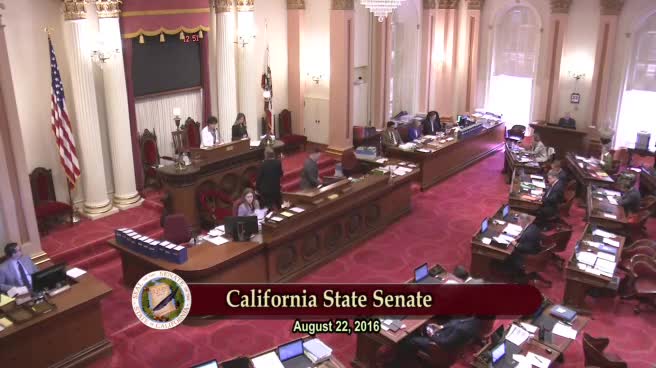

Bill Author

Bill Co-Author(s):