AB 1719: Pupil instruction: cardiopulmonary resuscitation.
- Session Year: 2015-2016
- House: Assembly
- Latest Version Date: 2016-09-24
(1)Existing law authorizes a school district or school to provide a comprehensive program in first aid or cardiopulmonary resuscitation training, or both, to pupils and employees in accordance with specified guidelines. Existing law requires each pupil completing grade 12 to satisfy certain requirements as a condition of receiving a diploma of graduation from high school. These requirements include the completion of designated coursework in grades 9 to 12, inclusive. Existing law authorizes a governing board of a school district to adopt other coursework requirements.
This bill would require, commencing with the 201819 school year, the governing board of a school district or the governing body of a charter school that requires a course in health education for graduation from high school to include instruction in performing compression-only cardiopulmonary resuscitation, as provided. The bill would encourage those entities to provide to pupils general information on the use and importance of an automated external defibrillator. The bill would require the State Department of Education to provide guidance on how to implement these provisions, including, but not limited to, who may provide instruction.
(2)Existing law provides that no local agency, entity of state or local government, or other public or private organization that sponsors, authorizes, supports, finances, or supervises the training of citizens in cardiopulmonary resuscitation shall be liable for any civil damages alleged to result from such training programs.
Existing law provides that no person who is certified to instruct in cardiopulmonary resuscitation by either the American Heart Association or the American Red Cross shall be liable for any civil damages alleged to result from the acts or omissions of an individual who received instruction on cardiopulmonary resuscitation by that certified instructor.
This bill would provide that a local agency, entity of state or local government, or other public or private organization that sponsors, authorizes, supports, finances, or supervises, and a public employee who provides or facilitates, the instruction of pupils in compression-only cardiopulmonary resuscitation or the use of an automated external defibrillator pursuant to the bill shall not be liable for any civil damages alleged to result from the acts or omissions of an individual who received such instruction, except as provided.
(1)Existing law authorizes a school district or school to provide a comprehensive program in first aid or cardiopulmonary resuscitation training, or both, to pupils and employees in accordance with specified guidelines. Existing law requires the adopted course of study for grades 7 to 12, inclusive, to include courses in specified areas of study. Existing law requires each pupil completing grade 12 to satisfy certain requirements as a condition of receiving a diploma of graduation from high school. These requirements include the completion of designated coursework in grades 9 to 12, inclusive. Existing law authorizes a governing board of a school district to adopt other coursework requirements.
This bill would require, commencing with the 201819 school year, the governing board of a school district, and district or the governing body of a charter school, offering instruction to pupils in grades 9 to 12, inclusive, school that requires a course in health education for graduation from high school to provide include instruction in performing compression-only cardiopulmonary resuscitation as part of a course required to be offered, resuscitation, as provided. The bill would require this instruction to be provided to a pupil only one time. The bill would encourage those entities to provide to pupils general information on the use and importance of an automated external defibrillator. The bill would require the State Department of Education to provide guidance on how to implement these provisions, including, but not limited to, who may provide instruction. The bill would also make conforming changes to a related code section. By imposing additional requirements on school districts and charter schools, the bill would impose a state-mandated local program.
(2)Existing law provides that no local agency, entity of state or local government, or other public or private organization that sponsors, authorizes, supports, finances, or supervises the training of citizens in cardiopulmonary resuscitation shall be liable for any civil damages alleged to result from such training programs.
Existing law provides that no person who is certified to instruct in cardiopulmonary resuscitation by either the American Heart Association or the American Red Cross shall be liable for any civil damages alleged to result from the acts or omissions of an individual who received instruction on cardiopulmonary resuscitation by that certified instructor.
This bill would provide that a local agency, entity of state or local government, or other public or private organization that sponsors, authorizes, supports, finances, or supervises, and a public employee who provides or facilitates, the instruction of pupils in compression-only cardiopulmonary resuscitation or the use of an automated external defibrillator pursuant to the bill shall not be liable for any civil damages alleged to result from the acts or omissions of an individual who received such instruction, except as provided.
(3)The California Constitution requires the state to reimburse local agencies and school districts for certain costs mandated by the state. Statutory provisions establish procedures for making that reimbursement.
This bill would provide that, if the Commission on State Mandates determines that the bill contains costs mandated by the state, reimbursement for those costs shall be made pursuant to these statutory provisions.
(1)Existing law authorizes a school district or school to provide a comprehensive program in first aid or cardiopulmonary resuscitation training, or both, to pupils and employees in accordance with specified guidelines. Existing law requires the adopted course of study for grades 7 to 12, inclusive, to include courses in specified areas of study.
This bill would require, commencing with the 201819 school year, the governing board of a school district, and the governing body of a charter school, offering instruction to pupils in grades 9 to 12, inclusive, to provide instruction in performing compression-only cardiopulmonary resuscitation as part of a course required to be offered, as provided. The bill would require this instruction to be provided to a pupil only one time. The bill would encourage those entities to provide to pupils general information on the use and importance of an automated external defibrillator. The bill would require the State Department of Education to provide guidance on how to implement these provisions, including, but not limited to, who may provide instruction. The bill would also make conforming changes to a related code section. By imposing additional requirements on school districts and charter schools, the bill would impose a state-mandated local program.
(2)Existing law provides that no local agency, entity of state or local government, or other public or private organization that sponsors, authorizes, supports, finances, or supervises the training of citizens in cardiopulmonary resuscitation shall be liable for any civil damages alleged to result from such training programs.
Existing law provides that no person who is certified to instruct in cardiopulmonary resuscitation by either the American Heart Association or the American Red Cross shall be liable for any civil damages alleged to result from the acts or omissions of an individual who received instruction on cardiopulmonary resuscitation by that certified instructor.
This bill would provide that a local agency, entity of state or local government, or other public or private organization that sponsors, authorizes, supports, finances, or supervises, and a public employee who provides or facilitates, the instruction of pupils in compression-only cardiopulmonary resuscitation or the use of an automated external defibrillator pursuant to the bill shall not be liable for any civil damages alleged to result from the acts or omissions of an individual who received such instruction. instruction, except as provided.
(3)The California Constitution requires the state to reimburse local agencies and school districts for certain costs mandated by the state. Statutory provisions establish procedures for making that reimbursement.
This bill would provide that, if the Commission on State Mandates determines that the bill contains costs mandated by the state, reimbursement for those costs shall be made pursuant to these statutory provisions.
(1)Existing law authorizes a school district or school to provide a comprehensive program in first aid or cardiopulmonary resuscitation training, or both, to pupils and employees in accordance with specified guidelines. Existing law establishes a list of courses that a pupil in a school district is required to complete in grades 9 to 12, inclusive, in order to receive a diploma of graduation from high school. Existing law requires the adopted course of study for grades 7 to 12, inclusive, to include courses in specified areas of study.
This bill would require, commencing with the 201819 school year, the governing board of a school district, and the governing body of a charter school, offering instruction to pupils in grades 9 to 12, inclusive, to provide instruction on in performing compression-only cardiopulmonary resuscitation as part of a course required to be offered, as provided. The bill would encourage those entities to provide to pupils general information on the use and importance of an automated external defibrillator. The bill would require the State Department of Education to provide guidance on how to implement these provisions, including, but not limited to, who may provide instruction. The bill would also make conforming changes to a related code section. By imposing additional requirements on school districts and charter schools, the bill would impose a state-mandated local program.
(2)Existing law provides that no local agency, entity of state or local government, or other public or private organization that sponsors, authorizes, supports, finances, or supervises the training of citizens in cardiopulmonary resuscitation shall be liable for any civil damages alleged to result from such training programs.
(2)Existing
Existing law provides that no person who is certified to instruct in cardiopulmonary resuscitation by either the American Heart Association or the American Red Cross shall be liable for any civil damages alleged to result from the acts or omissions of an individual who received instruction on cardiopulmonary resuscitation by that certified instructor.
This bill would provide that no a local agency, entity of state or local government, or other public or private organization that sponsors, authorizes, supports, finances, or supervises, and a public school teacher employee who instructs provides or facilitates, the instruction of pupils in compression-only cardiopulmonary resuscitation using an instructional program based on national evidence-based emergency cardiovascular care guidelines for the performance of cardiopulmonary resuscitation or the use of an automated external defibrillator pursuant to the bill shall not be liable for any civil damages alleged to result from the acts or omissions of a pupil an individual who received instruction on cardiopulmonary resuscitation by that teacher. such instruction.
(3)The California Constitution requires the state to reimburse local agencies and school districts for certain costs mandated by the state. Statutory provisions establish procedures for making that reimbursement.This bill would provide that, if the Commission on State Mandates determines that the bill contains costs mandated by the state, reimbursement for those costs shall be made pursuant to these statutory provisions.
Existing
(1)Existing law authorizes a school district or school to provide a comprehensive program in first aid or cardiopulmonary resuscitation training, or both, to pupils and employees in accordance with specified guidelines. Existing law establishes a list of courses that a pupil in a school district is required to complete in grades 9 to 12, inclusive, in order to receive a diploma of graduation from high school.
This bill would require, commencing with the 201718 201819 school year, the governing board of a school district, and the governing body of a charter school, offering instruction to pupils in grades 9 to 12, inclusive, to provide instruction on performing cardiopulmonary resuscitation as part of a required course, course required to be offered, as provided. The bill would encourage those entities to provide to pupils general information on the use and importance of an automated external defibrillator. The bill would require the State Department of Education to provide guidance on how to implement these provisions, including, but not limited to, who may provide instruction. The bill would also make conforming changes to a related code section. By imposing additional requirements on school districts and charter schools, the bill would impose a state-mandated local program.
(2)Existing law provides that no person who is certified to instruct in cardiopulmonary resuscitation by either the American Heart Association or the American Red Cross shall be liable for any civil damages alleged to result from the acts or omissions of an individual who received instruction on cardiopulmonary resuscitation by that certified instructor.
This bill would provide that no public school teacher who instructs pupils in cardiopulmonary resuscitation using an instructional program based on national evidence-based emergency cardiovascular care guidelines for the performance of cardiopulmonary resuscitation shall be liable for any civil damages alleged to result from the acts or omissions of a pupil who received instruction on cardiopulmonary resuscitation by that teacher.
The
(3)The California Constitution requires the state to reimburse local agencies and school districts for certain costs mandated by the state. Statutory provisions establish procedures for making that reimbursement.
This bill would provide that, if the Commission on State Mandates determines that the bill contains costs mandated by the state, reimbursement for those costs shall be made pursuant to these statutory provisions.
Existing law authorizes a school district or school to provide a comprehensive program in first aid or cardiopulmonary resuscitation training, or both, to pupils and employees in accordance with specified guidelines. Existing law establishes a list of courses that a pupil in a school district is required to complete in grades 9 to 12, inclusive, in order to receive a diploma of graduation from high school.
This bill would require, commencing with the 201718 academic year, the governing board of a school district, and the governing body of a charter school, offering instruction to pupils in grades 9 to 12, inclusive, to provide instruction on performing cardiopulmonary resuscitation and the use of an automated external defibrillator as part of a course required for graduation, course, as provided. The bill would encourage those entities to provide to pupils general information on the use and importance of an automated external defibrillator. The bill would require the State Department of Education to provide guidance on how to implement these provisions, including, but not limited to, who may provide instruction. The bill would also make conforming changes to a related code section. By imposing additional requirements on school districts and charter schools, the bill would impose a state-mandated local program.
The California Constitution requires the state to reimburse local agencies and school districts for certain costs mandated by the state. Statutory provisions establish procedures for making that reimbursement.
This bill would provide that, if the Commission on State Mandates determines that the bill contains costs mandated by the state, reimbursement for those costs shall be made pursuant to these statutory provisions.
Existing law authorizes a school district or school to provide a comprehensive program in first aid or cardiopulmonary resuscitation training, or both, to pupils and employees in accordance with specified guidelines. Existing law establishes a list of courses that a pupil in a school district is required to complete in grades 9 to 12, inclusive, in order to receive a diploma of graduation from high school.
This bill would require, commencing with the 201718 academic year, the governing board of a school district, and the governing body of a charter school, offering instruction to pupils in grades 9 to 12, inclusive, to provide instruction on performing cardiopulmonary resuscitation and the use of an automated external defibrillator as part of a course required for graduation, as provided. The bill would also make conforming changes to a related code section. By imposing additional requirements on school districts and charter schools, the bill would impose a state-mandated local program.
The California Constitution requires the state to reimburse local agencies and school districts for certain costs mandated by the state. Statutory provisions establish procedures for making that reimbursement.
This bill would provide that, if the Commission on State Mandates determines that the bill contains costs mandated by the state, reimbursement for those costs shall be made pursuant to these statutory provisions.
(a)If the governing board of a school district or the governing body of a charter school requires a course in health education for graduation from high school, the governing board of a school district or the governing body of a charter school shall include, commencing with the 201819 school year, instruction in performing compression-only cardiopulmonary resuscitation (CPR). This instruction shall include both of the following:
(1)An instructional program based on national evidence-based emergency cardiovascular care guidelines for the performance of compression-only CPR, such as those developed by the American Heart Association or the American Red Cross.
(2)Instruction to pupils relative to the psychomotor skills necessary to perform compression-only CPR. For purposes of this paragraph, psychomotor skills means skills that pupils are required to perform as hands-on practice to support cognitive learning.
(b)Before the commencement of the 201718 school year, the department shall provide guidance on how to implement this section, including, but not limited to, who may provide instruction pursuant to this section.
(c)The governing board of a school district or the governing body of a charter school is encouraged to provide to pupils general information on the use and importance of an automated external defibrillator (AED). The physical presence of an AED in the classroom is not required.
(d)The governing board of a school district or the governing body of a charter school may adopt policies to implement this section.
(e)(1)The governing board of a school district or the governing body of a charter school providing instruction in performing compression-only CPR or information on the use of an AED pursuant to this section is encouraged to use the most cost-effective means possible to implement that requirement.
(2)This section shall not be construed to require the governing board of a school district or the governing body of a charter school to make any purchases, including, but not limited to, purchasing an AED.
(f)(1)A local agency, entity of state or local government, or other public or private organization that sponsors, authorizes, supports, finances, or supervises the instruction of pupils in compression-only CPR or the use of an AED pursuant to this section shall not be liable for any civil damages alleged to result from the acts or omissions of an individual who received such instruction.
(2)A public employee who provides or facilitates the instruction of pupils in compression-only CPR or the use of an AED pursuant to this section shall not be liable for any civil damages alleged to result from the acts or omissions of an individual who received such instruction.
(3)This subdivision shall not be construed to grant immunity from civil damages to any person who provides or facilitates the instruction of pupils in compression-only CPR or the use of an AED in a manner that constitutes gross negligence or willful or wanton misconduct.
The adopted course of study shall provide instruction at the appropriate elementary and secondary grade levels and subject areas in personal and public safety and accident prevention, including emergency first aid instruction, instruction in hemorrhage control, treatment for poisoning, resuscitation techniques, and cardiopulmonary resuscitation when appropriate equipment is available or when instruction is required pursuant to Section 51225.6; fire prevention; the protection and conservation of resources, including the necessity for the protection of our environment; and health, including venereal disease and the effects of alcohol, narcotics, drugs, and tobacco upon the human body. The health instruction may include prenatal care for pregnant women and violence as a public health issue.
SEC. 2.SECTION 1.Section 51225.6 is added to the Education Code, to read:51225.6.(a)Commencing with the 201819 school year, If the governing board of a school district, and district or the governing body of a charter school, offering instruction to pupils in grades 9 to 12, inclusive, shall provide school requires a course in health education for graduation from high school, the governing board of a school district or the governing body of a charter school shall include, commencing with the 201819 school year, instruction in performing compression-only cardiopulmonary resuscitation (CPR) as part of a course offered in any of grades 9 to 12, inclusive, that is required pursuant to this article or that is required by the governing board of a school district pursuant to paragraph (2) of subdivision (a) of Section 51225.3. (CPR). This instruction shall be provided to a pupil only one time and shall include both of the following:
(1)An instructional program based on national evidence-based emergency cardiovascular care guidelines for the performance of compression-only CPR, such as those developed by the American Heart Association or the American Red Cross.
(2)Instruction to pupils relative to the psychomotor skills necessary to perform compression-only CPR. For purposes of this paragraph, psychomotor skills means skills that pupils are required to perform as hands-on practice to support cognitive learning.
(b)Before the commencement of the 201718 school year, the department shall provide guidance on how to implement this section, including, but not limited to, who may provide instruction pursuant to this section.
(c)The governing board of a school district or the governing body of a charter school is encouraged to provide to pupils general information on the use and importance of an automated external defibrillator (AED). The physical presence of an AED in the classroom is not required.
(d)The governing board of a school district or the governing body of a charter school may adopt policies to implement this section.
(e)(1)The governing board of a school district or the governing body of a charter school providing instruction in performing compression-only CPR or information on the use of an AED pursuant to this section is encouraged to use the most cost-effective means possible to implement that requirement.
(2)This section shall not be construed to require the governing board of a school district or the governing body of a charter school to make any purchases, including, but not limited to, purchasing an AED.
(f)(1)A local agency, entity of state or local government, or other public or private organization that sponsors, authorizes, supports, finances, or supervises the instruction of pupils in compression-only CPR or the use of an AED pursuant to this section shall not be liable for any civil damages alleged to result from the acts or omissions of an individual who received such instruction.
(2)A public employee who provides or facilitates the instruction of pupils in compression-only CPR or the use of an AED pursuant to this section shall not be liable for any civil damages alleged to result from the acts or omissions of an individual who received such instruction.
(3)This subdivision shall not be construed to grant immunity from civil damages to any person who provides or facilitates the instruction of pupils in compression-only CPR or the use of an AED in a manner that constitutes gross negligence or willful or wanton misconduct.
SEC. 3.If the Commission on State Mandates determines that this act contains costs mandated by the state, reimbursement to local agencies and school districts for those costs shall be made pursuant to Part 7 (commencing with Section 17500) of Division 4 of Title 2 of the Government Code.
The adopted course of study shall provide instruction at the appropriate elementary and secondary grade levels and subject areas in personal and public safety and accident prevention, including emergency first aid instruction, instruction in hemorrhage control, treatment for poisoning, resuscitation techniques, and cardiopulmonary resuscitation when appropriate equipment is available or when instruction is required pursuant to Section 51225.6; fire prevention; the protection and conservation of resources, including the necessity for the protection of our environment; and health, including venereal disease and the effects of alcohol, narcotics, drugs, and tobacco upon the human body. The health instruction may include prenatal care for pregnant women and violence as a public health issue.
SEC. 2.Section 51225.6 is added to the Education Code, to read:51225.6.(a)Commencing with the 201819 school year, the governing board of a school district, and the governing body of a charter school, offering instruction to pupils in grades 9 to 12, inclusive, shall provide instruction in performing compression-only cardiopulmonary resuscitation (CPR) as part of a course offered in any of grades 9 to 12, inclusive, that is required pursuant to this article. article or that is required by the governing board of a school district pursuant to paragraph (2) of subdivision (a) of Section 51225.3. This instruction shall be provided to a pupil only one time and shall include both of the following:
(1)An instructional program based on national evidence-based emergency cardiovascular care guidelines for the performance of compression-only CPR, such as those developed by the American Heart Association or the American Red Cross.
(2)Instruction to pupils relative to the psychomotor skills necessary to perform compression-only CPR. For purposes of this paragraph, psychomotor skills means skills that pupils are required to perform as hands-on practice to support cognitive learning.
(b)Before the commencement of the 201718 school year, the department shall provide guidance on how to implement this section, including, but not limited to, who may provide instruction pursuant to this section.
(c)The governing board of a school district or the governing body of a charter school is encouraged to provide to pupils general information on the use and importance of an automated external defibrillator (AED). The physical presence of an AED in the classroom is not required.
(d)The governing board of a school district or the governing body of a charter school may adopt policies to implement this section.
(e)(1)The governing board of a school district or the governing body of a charter school providing instruction in performing compression-only CPR or information on the use of an AED pursuant to this section is encouraged to use the most cost-effective means possible to implement that requirement.
(2)This section shall not be construed to require the governing board of a school district or the governing body of a charter school to make any purchases, including, but not limited to, purchasing an AED.
(f)(1)A local agency, entity of state or local government, or other public or private organization that sponsors, authorizes, supports, finances, or supervises the instruction of pupils in compression-only CPR or the use of an AED pursuant to this section shall not be liable for any civil damages alleged to result from the acts or omissions of an individual who received such instruction.
(2)A public employee who provides or facilitates the instruction of pupils in compression-only CPR or the use of an AED pursuant to this section shall not be liable for any civil damages alleged to result from the acts or omissions of an individual who received such instruction.
(3)This subdivision shall not be construed to grant immunity from civil damages to any person who provides or facilitates the instruction of pupils in compression-only CPR or the use of an AED in a manner that constitutes gross negligence or willful or wanton misconduct.
SEC. 3.If the Commission on State Mandates determines that this act contains costs mandated by the state, reimbursement to local agencies and school districts for those costs shall be made pursuant to Part 7 (commencing with Section 17500) of Division 4 of Title 2 of the Government Code.
(a)In order to encourage citizens to participate in emergency medical services training programs and to render emergency medical services to fellow citizens, no person who has completed a basic cardiopulmonary resuscitation course that complies with the standards adopted by the American Heart Association or the American Red Cross for cardiopulmonary resuscitation and emergency cardiac care, and who, in good faith, renders emergency cardiopulmonary resuscitation at the scene of an emergency shall be liable for any civil damages as a result of any acts or omissions by such person rendering the emergency care.
(b)This section shall not be construed to grant immunity from civil damages to any person whose conduct in rendering such emergency care constitutes gross negligence.
(c)In order to encourage local agencies and other organizations to train citizens in cardiopulmonary resuscitation techniques, no local agency, entity of state or local government, or other public or private organization that sponsors, authorizes, supports, finances, or supervises the training of citizens in cardiopulmonary resuscitation shall be liable for any civil damages alleged to result from such training programs.
(d)(1)In order to encourage qualified individuals to instruct citizens in cardiopulmonary resuscitation, no person who is certified to instruct in cardiopulmonary resuscitation by either the American Heart Association or the American Red Cross shall be liable for any civil damages alleged to result from the acts or omissions of an individual who received instruction on cardiopulmonary resuscitation by that certified instructor.
(2)(A)No public school teacher who instructs pupils in cardiopulmonary resuscitation using an instructional program based on national evidence-based emergency cardiovascular care guidelines for the performance of cardiopulmonary resuscitation, such as the guidelines developed by the American Heart Association or the American Red Cross, shall be liable for any civil damages alleged to result from the acts or omissions of a pupil who received instruction on cardiopulmonary resuscitation by that teacher.
(B)For purposes of this paragraph, public school means a county office of education, school district, state special school, or charter school.
(e)This section shall not be construed to grant immunity from civil damages to any person who renders such emergency care to an individual with the expectation of receiving compensation from the individual for providing the emergency care.
SEC. 2.SECTION 1.Section 51202 of the Education Code is amended to read:51202.The adopted course of study shall provide instruction at the appropriate elementary and secondary grade levels and subject areas in personal and public safety and accident prevention, including emergency first aid instruction, instruction in hemorrhage control, treatment for poisoning, resuscitation techniques, and cardiopulmonary resuscitation when appropriate equipment is available or when instruction is required pursuant to Section 51225.6; fire prevention; the protection and conservation of resources, including the necessity for the protection of our environment; and health, including venereal disease and the effects of alcohol, narcotics, drugs, and tobacco upon the human body. The health instruction may include prenatal care for pregnant women and violence as a public health issue.
SEC. 3.SEC. 2.Section 51225.6 is added to the Education Code, to read:51225.6.(a)Commencing with the 201819 school year, the governing board of a school district, and the governing body of a charter school, offering instruction to pupils in grades 9 to 12, inclusive, shall provide instruction in performing compression-only cardiopulmonary resuscitation (CPR) as part of a course offered in any of grades 9 to 12, inclusive, that is required pursuant to this article. This instruction may consist solely of instruction in compression-only CPR and shall include both of the following:
(1)An instructional program based on national evidence-based emergency cardiovascular care guidelines for the performance of compression-only CPR, such as those developed by the American Heart Association or the American Red Cross.
(2)Training for Instruction to pupils relative to the psychomotor skills necessary to perform compression-only CPR. For purposes of this paragraph, psychomotor skills means skills that pupils are required to perform as hands-on practice to support cognitive learning.
(b)Before the commencement of the 201718 school year, the department shall provide guidance on how to implement this section, including, but not limited to, who may provide instruction pursuant to this section. The department may consider an individual in any of the following categories to provide instruction:
(1)A health care provider licensed pursuant to Division 2 (commencing with Section 500) of the Business and Professions Code, the Osteopathic Initiative Act, as set forth in Chapter 8 (commencing with Section 3600) of Division 2 of the Business and Professions Code, or the Chiropractic Initiative Act, as set forth in Chapter 2 (commencing with Section 1000) of Division 2 of the Business and Professions Code.
(2)A person certified pursuant to the Emergency Medical Services System and the Prehospital Emergency Medical Care Personnel Act (Division 2.5 (commencing with Section 1797) of the Health and Safety Code).
(3)A peace officer, as defined in Section 830 of the Penal Code.
(4)A firefighter, defined as any regularly employed and paid officer, employee, or member of a fire department or fire protection or firefighting agency of the State of California, a city, a county, a city and county, a district, or other public or municipal corporation or political subdivision of this state or member of an emergency reserve unit of a volunteer fire department or fire protection district.
(5)A teacher.
(6)An instructor certified to teach CPR by the American Red Cross or the American Heart Association, or an instructor certified to teach an instructional program that is nationally recognized and based on national evidence-based emergency cardiovascular care guidelines for the performance of CPR.
(7)Any other provider of instruction in performing CPR, as determined by the department.
(c)The governing board of a school district or the governing body of a charter school is encouraged to provide to pupils general information on the use and importance of an automated external defibrillator (AED). The physical presence of an AED in the classroom is not required.
(d)The governing board of a school district or the governing body of a charter school may adopt policies to implement this section.
(e)(1)The governing board of a school district or the governing body of a charter school providing instruction in performing compression-only CPR or information on the use of an AED pursuant to this section is encouraged to use the most cost-effective means possible to implement that requirement.
(2)This section shall not be construed to require the governing board of a school district or the governing body of a charter school to make any purchases, including, but not limited to, purchasing an AED.
(f)An entity providing, or overseeing the provision of, instruction in performing CPR or information on the use of an AED pursuant to this section may be exempt from civil liability, as applicable and except as specified, pursuant to Section 1714.2 or 1714.21 of the Civil Code, respectively.
(f)(1)A local agency, entity of state or local government, or other public or private organization that sponsors, authorizes, supports, finances, or supervises the instruction of pupils in compression-only CPR or the use of an AED pursuant to this section shall not be liable for any civil damages alleged to result from the acts or omissions of an individual who received such instruction.
(2)A public employee who provides or facilitates the instruction of pupils in compression-only CPR or the use of an AED pursuant to this section shall not be liable for any civil damages alleged to result from the acts or omissions of an individual who received such instruction.
(3)This subdivision shall not be construed to grant immunity from civil damages to any person who provides or facilitates the instruction of pupils in compression-only CPR or the use of an AED in a manner that constitutes gross negligence or willful or wanton misconduct.
SEC. 4.SEC. 3.If the Commission on State Mandates determines that this act contains costs mandated by the state, reimbursement to local agencies and school districts for those costs shall be made pursuant to Part 7 (commencing with Section 17500) of Division 4 of Title 2 of the Government Code.
(a)In order to encourage citizens to participate in emergency medical services training programs and to render emergency medical services to fellow citizens, no person who has completed a basic cardiopulmonary resuscitation course which that complies with the standards adopted by the American Heart Association or the American Red Cross for cardiopulmonary resuscitation and emergency cardiac care, and who, in good faith, renders emergency cardiopulmonary resuscitation at the scene of an emergency shall be liable for any civil damages as a result of any acts or omissions by such person rendering the emergency care.
(b)This section shall not be construed to grant immunity from civil damages to any person whose conduct in rendering such emergency care constitutes gross negligence.
(c)In order to encourage local agencies and other organizations to train citizens in cardiopulmonary resuscitation techniques, no local agency, entity of state or local government, or other public or private organization which that sponsors, authorizes, supports, finances, or supervises the training of citizens in cardiopulmonary resuscitation shall be liable for any civil damages alleged to result from such training programs.
(d)(1)In order to encourage qualified individuals to instruct citizens in cardiopulmonary resuscitation, no person who is certified to instruct in cardiopulmonary resuscitation by either the American Heart Association or the American Red Cross shall be liable for any civil damages alleged to result from the acts or omissions of an individual who received instruction on cardiopulmonary resuscitation by that certified instructor.
(2)(A)No public school teacher who instructs pupils in cardiopulmonary resuscitation using an instructional program based on national evidence-based emergency cardiovascular care guidelines for the performance of cardiopulmonary resuscitation, such as the guidelines developed by the American Heart Association or the American Red Cross, shall be liable for any civil damages alleged to result from the acts or omissions of a pupil who received instruction on cardiopulmonary resuscitation by that teacher.
(B)For purposes of this paragraph, public school means a county office of education, school district, state special school, or charter school.
(e)This section shall not be construed to grant immunity from civil damages to any person who renders such emergency care to an individual with the expectation of receiving compensation from the individual for providing the emergency care.
SECTION 1.SEC. 2.Section 51202 of the Education Code is amended to read:51202.The adopted course of study shall provide instruction at the appropriate elementary and secondary grade levels and subject areas in personal and public safety and accident prevention, including emergency first aid instruction, instruction in hemorrhage control, treatment for poisoning, resuscitation techniques, and cardiopulmonary resuscitation when appropriate equipment is available or when instruction is required pursuant to Section 51225.6; fire prevention; the protection and conservation of resources, including the necessity for the protection of our environment; and health, including venereal disease and the effects of alcohol, narcotics, drugs, and tobacco upon the human body. The health instruction may include prenatal care for pregnant women and violence as a public health issue.
SEC. 2.SEC. 3.Section 51225.6 is added to the Education Code, to read:51225.6.(a)Commencing with the 201718 201819 school year, the governing board of a school district, and the governing body of a charter school, offering instruction to pupils in grades 9 to 12, inclusive, shall provide instruction in performing cardiopulmonary resuscitation (CPR) as part of a course offered in any of grades 9 to 12, inclusive, that is required pursuant to this article. This instruction may consist solely of instruction in compression-only CPR and shall include both of the following:
(1)An instructional program based on national evidence-based emergency cardiovascular care guidelines for the performance of CPR, such as those developed by the American Heart Association or the American Red Cross.
(2)Training for pupils relative to the psychomotor skills necessary to perform CPR. For purposes of this paragraph, psychomotor skills means skills that pupils are required to perform as hands-on practice to support cognitive learning.
(b)Before the commencement of the 201718 school year, the department shall provide guidance on how to implement this section, including, but not limited to, who may provide instruction pursuant to this section. The department may consider an individual in any of the following categories to provide instruction:
(1)A health care provider licensed pursuant to Division 2 (commencing with Section 500) of the Business and Professions Code, the Osteopathic Initiative Act, as set forth in Chapter 8 (commencing with Section 3600) of Division 2 of the Business and Professions Code, or the Chiropractic Initiative Act, as set forth in Chapter 2 (commencing with Section 1000) of Division 2 of the Business and Professions Code.
(2)A person certified pursuant to the Emergency Medical Services System and the Prehospital Emergency Medical Care Personnel Act (Division 2.5 (commencing with Section 1797) of the Health and Safety Code).
(3)A peace officer, as defined in Section 830 of the Penal Code.
(4)A firefighter, defined as any regularly employed and paid officer, employee, or member of a fire department or fire protection or firefighting agency of the State of California, a city, a county, a city and county, a district, or other public or municipal corporation or political subdivision of this state or member of an emergency reserve unit of a volunteer fire department or fire protection district.
(5)A teacher.
(6)An instructor certified to teach CPR by the American Red Cross or the American Heart Association, or an instructor certified to teach an instructional program that is nationally recognized and based on national evidence-based emergency cardiovascular care guidelines for the performance of CPR.
(7)Any other provider of instruction in performing CPR, as determined by the department.
(c)The governing board of a school district or the governing body of a charter school is encouraged to provide to pupils general information on the use and importance of an automated external defibrillator (AED). The physical presence of an AED in the classroom is not required.
(d)The governing board of a school district or the governing body of a charter school may adopt regulations policies to implement this section.(e)(1)The governing board of a school district or the governing body of a charter school providing instruction in performing CPR or information on the use of an AED pursuant to this section is encouraged to use the most cost-effective means possible to implement that requirement.(2)This section shall not be construed to require the governing board of a school district or the governing body of a charter school to make any purchases, including, but not limited to, purchasing an AED.
(f)An entity providing, or overseeing the provision of, instruction in performing CPR or information on the use of an AED pursuant to this section may be exempt from civil liability, as applicable and except as specified, pursuant to Section 1714.2 or 1714.21 of the Civil Code, respectively.
SEC. 3.SEC. 4.If the Commission on State Mandates determines that this act contains costs mandated by the state, reimbursement to local agencies and school districts for those costs shall be made pursuant to Part 7 (commencing with Section 17500) of Division 4 of Title 2 of the Government Code.
The adopted course of study shall provide instruction at the appropriate elementary and secondary grade levels and subject areas in personal and public safety and accident prevention, including emergency first aid instruction, instruction in hemorrhage control, treatment for poisoning, resuscitation techniques, and cardiopulmonary resuscitation when appropriate equipment is available or when instruction is required pursuant to Section 51225.6; fire prevention; the protection and conservation of resources, including the necessity for the protection of our environment; and health, including venereal disease and the effects of alcohol, narcotics, drugs, and tobacco upon the human body. The health instruction may include prenatal care for pregnant women and violence as a public health issue.
SEC. 2.Section 51225.6 is added to the Education Code, to read:51225.6.(a)Commencing with the 201718 academic school year, the governing board of a school district, and the governing body of a charter school, offering instruction to pupils in grades 9 to 12, inclusive, shall provide instruction in performing cardiopulmonary resuscitation (CPR) and the use of an automated external defibrillator (AED) as part of a course required for graduation pursuant to paragraph (1) of subdivision (a) Section 51225.3 or a course required by the local governing board of a school district for graduation pursuant to paragraph (2) of subdivision (a) Section 51225.3. this article. This instruction shall include all both of the following:
(1)An instructional program developed by the American Heart Association or the American Red Cross, or an instructional program that is nationally recognized and based on the most current based on national evidence-based emergency cardiovascular care guidelines for the performance of CPR and the use of an AED. CPR, such as those developed by the American Heart Association or the American Red Cross.
(2)Training for pupils relative to the psychomotor skills necessary to perform CPR. For purposes of this paragraph, psychomotor skills means skills that pupils are required to perform as hands-on practice to support cognitive learning.
(3)General information on the use and importance of an AED. The physical presence of an AED in the classroom is not required.
(b)Except as specified in subparagraph (B) of paragraph (5), instruction required Before the commencement of the 201718 school year, the department shall provide guidance on how to implement this section, including, but not limited to, who may provide instruction pursuant to this section may be provided by a person who is certified in CPR and who is any of the following: section. The department may consider an individual in any of the following categories to provide instruction:
(1)A health care provider licensed pursuant to Division 2 (commencing with Section 500) of the Business and Professions Code, the Osteopathic Initiative Act, as set forth in Chapter 8 (commencing with Section 3600) of Division 2 of the Business and Professions Code, or the Chiropractic Initiative Act, as set forth in Chapter 2 (commencing with Section 1000) of Division 2 of the Business and Professions Code.
(2)A person certified pursuant to the Emergency Medical Services System and the Prehospital Emergency Medical Care Personnel Act (Division 2.5 (commencing with Section 1797) of the Health and Safety Code).
(3)A peace officer, as defined in Section 830 of the Penal Code.
(4)A firefighter, defined as any regularly employed and paid officer, employee, or member of a fire department or fire protection or firefighting agency of the State of California, a city, a county, a city and county, a district, or other public or municipal corporation or political subdivision of this state or member of an emergency reserve unit of a volunteer fire department or fire protection district.
(5)(A)A teacher.
(B)A teacher shall not be required to be certified in CPR to facilitate, provide, or oversee instruction pursuant to this section for training that does not provide CPR certification.
(6)An instructor certified to teach CPR by the American Red Cross or the American Heart Association, or an instructor certified to teach an instructional program that is nationally recognized and based on the most current national evidence-based emergency cardiovascular care guidelines for the performance of CPR and the use of an AED. CPR.
(c)If it is in accordance with the laws, rules, or regulations governing his or her profession, a person who provides instruction pursuant to subdivision (b) may apply the hours spent performing instruction toward fulfilling professional requirements for performing community service.
(7)Any other provider of instruction in performing CPR, as determined by the department.
(c)The governing board of a school district or the governing body of a charter school is encouraged to provide to pupils general information on the use and importance of an automated external defibrillator (AED). The physical presence of an AED in the classroom is not required.
(d)The governing board of a school district or the governing body of a charter school may adopt regulations to implement this section.(e)(1)The governing board of a school district or the governing body of a charter school providing instruction in performing CPR or information on the use of an AED pursuant to this section is encouraged to use the most cost-effective means possible to implement that requirement.(2)This section shall not be construed to require the governing board of a school district or the governing body of a charter school to make any purchases, including, but not limited to, purchasing an AED.
(f)An entity providing, or overseeing the provision of, instruction in performing CPR or information on the use of an AED pursuant to this section may be exempt from civil liability, as applicable and except as specified, pursuant to Section 1714.2 or 1714.21 of the Civil Code, respectively.
SEC. 3.If the Commission on State Mandates determines that this act contains costs mandated by the state, reimbursement to local agencies and school districts for those costs shall be made pursuant to Part 7 (commencing with Section 17500) of Division 4 of Title 2 of the Government Code.
The adopted course of study shall provide instruction at the appropriate elementary and secondary grade levels and subject areas in personal and public safety and accident prevention, including emergency first aid instruction, instruction in hemorrhage control, treatment for poisoning, resuscitation techniques, and cardiopulmonary resuscitation when appropriate equipment is available; available or when instruction is required pursuant to Section 51225.6; fire prevention; the protection and conservation of resources, including the necessity for the protection of our environment; and health, including venereal disease and the effects of alcohol, narcotics, drugs, and tobacco upon the human body. The health instruction may include prenatal care for pregnant women and violence as a public health issue.
SEC. 2.Section 51225.6 is added to the Education Code, to read:51225.6.(a)Commencing with the 201718 academic year, the governing board of a school district, and the governing body of a charter school, offering instruction to pupils in grades 9 to 12, inclusive, shall provide instruction in performing cardiopulmonary resuscitation (CPR) and the use of an automated external defibrillator (AED) as part of a course required for graduation pursuant to paragraph (1) of subdivision (a) Section 51225.3 or a course required by the local governing board of a school district for graduation pursuant to paragraph (2) of subdivision (a) Section 51225.3. This instruction shall include all of the following:
(1)An instructional program developed by the American Heart Association or the American Red Cross, or an instructional program that is nationally recognized and based on the most current national evidence-based emergency cardiovascular care guidelines for the performance of CPR and the use of an AED.
(2)Training for pupils relative to the psychomotor skills necessary to perform CPR. For purposes of this paragraph, psychomotor skills means skills that pupils are required to perform as hands-on practice to support cognitive learning.
(3)General information on the use and importance of an AED. The physical presence of an AED in the classroom is not required.
(b)Except as specified in subparagraph (B) of paragraph (5), instruction required pursuant to this section may be provided by a person who is certified in CPR and who is any of the following:
(1)A health care provider licensed pursuant to Division 2 (commencing with Section 500) of the Business and Professions Code, the Osteopathic Initiative Act, as set forth in Chapter 8 (commencing with Section 3600) of Division 2 of the Business and Professions Code, or the Chiropractic Initiative Act, as set forth in Chapter 2 (commencing with Section 1000) of Division 2 of the Business and Professions Code.
(2)A person certified pursuant to the Emergency Medical Services System and the Prehospital Emergency Medical Care Personnel Act (Division 2.5 (commencing with Section 1797) of the Health and Safety Code).
(3)A peace officer, as defined in Section 830 of the Penal Code.
(4)A firefighter, defined as any regularly employed and paid officer, employee, or member of a fire department or fire protection or firefighting agency of the State of California, a city, a county, a city and county, a district, or other public or municipal corporation or political subdivision of this state or member of an emergency reserve unit of a volunteer fire department or fire protection district.
(5)(A)A teacher.
(B)A teacher shall not be required to be certified in CPR to facilitate, provide, or oversee instruction pursuant to this section for training that does not provide CPR certification.
(6)An instructor certified to teach CPR by the American Red Cross or the American Heart Association, or an instructor certified to teach an instructional program that is nationally recognized and based on the most current national evidence-based emergency cardiovascular care guidelines for the performance of CPR and the use of an AED.
(c)If it is in accordance with the laws, rules, or regulations governing his or her profession, a person who provides instruction pursuant to subdivision (b) may apply the hours spent performing instruction toward fulfilling professional requirements for performing community service.
(d)The governing board of a school district or the governing body of a charter school may adopt regulations to implement this section.
(e)(1)The governing board of a school district or the governing body of a charter school providing instruction in performing CPR or the use of an AED pursuant to this section is encouraged to use the most cost-effective means possible to implement that requirement.
(2)This section shall not be construed to require the governing board of a school district or the governing body of a charter school to make any purchases, including, but not limited to, purchasing an AED.
SEC. 3.If the Commission on State Mandates determines that this act contains costs mandated by the state, reimbursement to local agencies and school districts for those costs shall be made pursuant to Part 7 (commencing with Section 17500) of Division 4 of Title 2 of the Government Code.
|
Date
|
Status
|
|---|---|
| May 31, 2016 | Read third time. Passed. Ordered to the Senate. (Ayes 77. Noes 1.) |
| Sep 2, 2016 | Enrolled and presented to the Governor at 12 p.m. |
| Aug 29, 2016 | Senate amendments concurred in. To Engrossing and Enrolling. (Ayes 79. Noes 0. Page 6396.). |
| Aug 29, 2016 | Senate amendments concurred in. To Engrossing and Enrolling. |
| Aug 24, 2016 | In Assembly. Concurrence in Senate amendments pending. May be considered on or after August 26 pursuant to Assembly Rule 77. |
| Aug 18, 2016 | Read third time. Passed. Ordered to the Assembly. (Ayes 38. Noes 0.). |
| Aug 18, 2016 | Read third time. Passed. Ordered to the Assembly. (Ayes 38. Noes 0. Page 5123.). |
| Aug 18, 2016 | Read third time. Passed. Ordered to the Assembly. |
| Aug 16, 2016 | Read second time and amended. Ordered to third reading. |
| Aug 15, 2016 | From committee: Amend, and do pass as amended. (Ayes 7. Noes 0.) (August 11). |
| Aug 1, 2016 | In committee: Referred to APPR. suspense file. |
| Jun 29, 2016 | From committee: Do pass and re-refer to Com. on APPR. (Ayes 7. Noes 0.) (June 28). Re-referred to Com. on APPR. |
| Jun 22, 2016 | Read second time and amended. Re-referred to Com. on JUD. |
| Jun 21, 2016 | From committee: Amend, and do pass as amended and re-refer to Com. on JUD. (Ayes 9. Noes 0.) (June 15). |
| Jun 9, 2016 | Referred to Coms. on ED. and JUD. |
| Jun 1, 2016 | In Senate. Read first time. To Com. on RLS. for assignment. |
| Jan 27, 2016 | Read first time. To print. |
| May 31, 2016 | Read third time. Passed. Ordered to the Senate. (Ayes 77. Noes 1. Page 5021.) |
| May 31, 2016 | Read third time. Passed. Ordered to the Senate. |
| May 27, 2016 | Read second time. Ordered to third reading. |
| May 27, 2016 | From committee: Do pass. (Ayes 20. Noes 0.) (May 27). |
| May 4, 2016 | In committee: Set, first hearing. Referred to APPR. suspense file. |
| Apr 25, 2016 | Re-referred to Com. on APPR. |
| Apr 21, 2016 | Read second time and amended. |
| Apr 20, 2016 | From committee: Amend, and do pass as amended and re-refer to Com. on APPR. (Ayes 10. Noes 0.) (April 19). |
| Apr 12, 2016 | Re-referred to Com. on JUD. |
| Apr 11, 2016 | Read second time and amended. |
| Apr 7, 2016 | From committee: Amend, and do pass as amended and re-refer to Com. on JUD. (Ayes 6. Noes 0.) (April 6). |
| Mar 17, 2016 | Re-referred to Com. on ED. |
| Mar 16, 2016 | From committee chair, with author's amendments: Amend, and re-refer to Com. on ED. Read second time and amended. |
| Feb 18, 2016 | Referred to Com. on ED. |
| Jan 28, 2016 | From printer. May be heard in committee February 27. |
|
Date
|
Description
|
Location
|
Votes
|
|
|---|---|---|---|---|
| Aug 29, 2016 | AB 1719 RODRIGUEZ Concurrence in Senate Amendments | Assembly Floor |
Passed |
|
| Aug 18, 2016 | Assembly 3rd Reading AB1719 Rodriguez By Hill | Senate Floor |
Passed |
|
| Aug 11, 2016 | Do pass as amended | Senate Standing Committee on Appropriations |
Passed |
|
| Aug 1, 2016 | Placed on suspense file | Senate Standing Committee on Appropriations |
Passed |
|
| Jun 28, 2016 | Do pass, but first be re-referred to the Committee on [Appropriations] | Senate Standing Committee on Judiciary |
Passed |
|
| Jun 15, 2016 | Do pass as amended, but first amend, and re-refer to the Committee on [Judiciary] | Senate Standing Committee on Education |
Passed |
|
| May 31, 2016 | AB 1719 RODRIGUEZ Assembly Third Reading | Assembly Floor |
Passed |
|
| May 27, 2016 | Do pass. | Assembly Standing Committee on Appropriations |
Passed |
|
| Apr 19, 2016 | Do pass as amended and be re-referred to the Committee on [Appropriations] | Assembly Standing Committee on Judiciary |
Passed |
|
| Apr 6, 2016 | Do pass as amended and be re-referred to the Committee on [Judiciary] | Assembly Standing Committee on Education |
Passed |
This list shows positions taken on this bill by organizations on the date displayed, which is linked to the original source.
Positions by individuals are not included.
|
Organization
|
Position
|
Date
|
|---|---|---|
| American Academy of Pediatrics | ** Support | Apr 19, 2016 |
| American Federation Of State County And Municipal Employees Afl-Cio | * Support | Jun 15, 2016 |
| American Heart and American Stroke Association | * Support | Jun 28, 2016 |
| American Heart Association | ** Support | Aug 18, 2016 |
| American Medical Response | ** Support | Apr 19, 2016 |
| American Medical Society for Sports Medicine | ** Support | Apr 19, 2016 |
| American Nurses Association | ** Support | Jun 15, 2016 |
| American Red Cross | ** Support | Aug 18, 2016 |
| American Stroke Association | ** Support | Aug 18, 2016 |
| Ash Kalra, Councilmember, City of San Jose | ** Support | Apr 19, 2016 |
| Association of California Healthcare Districts | ** Support | Aug 18, 2016 |
| California Ambulance Association | * Support | Jun 15, 2016 |
| California Association for Health, Physical | ** Support | Apr 19, 2016 |
| California Association For Health, Physical Education, Recreation & Dance | * Support | Jun 15, 2016 |
| California Chapter of the American College of Emergency Physicians | ** Support | Aug 18, 2016 |
| California Nursing Students' Association | ** Support | Aug 18, 2016 |
| California Professional Firefighters | * Support | Jun 15, 2016 |
| California School Boards Association | ** Support | Apr 19, 2016 |
| California School Nurses Organization | ** Support | Apr 6, 2016 |
| California Society of Respiratory Care | ** Support | Apr 19, 2016 |
| California State Firefighters' Association | * Support | Jun 28, 2016 |
| California State PTA | * Support | Jun 28, 2016 |
| City of San Diego Councilmember Marti Emerald | ** Support | Apr 6, 2016 |
| Dignity Health | ** Support | Apr 19, 2016 |
| Education, Recreation and Dance | ** Support | Apr 19, 2016 |
| Learn for Morgan Foundation | ** Support | Apr 19, 2016 |
| Los Angeles Unified School District | ** Support | Apr 19, 2016 |
| Los Angeles, City Of | ** Support | Aug 18, 2016 |
| Mitchell Englander, Councilmember, Los Angeles City Council | ** Support | Apr 19, 2016 |
| Montebello Unified School District | ** Support | Apr 19, 2016 |
| Olivia's Heart Project | ** Support | Apr 19, 2016 |
| Racing Hearts | ** Support | Apr 19, 2016 |
| San Francisco Fire Department | ** Support | Apr 19, 2016 |
| Santa Clara Unified School District | ** Support | Apr 19, 2016 |
| SEIU California State Council | * Support | Jun 28, 2016 |
| Student | * Support | Jun 15, 2016 |
| u None received. | ** Against | Jun 28, 2016 |
CONCURRENCE IN SENATE AMENDMENTS
CSA1 Bill Id:AB 1719
Author:(Rodriguez)
As Amended Ver:August 16, 2016
Majority vote
ASSEMBLY: | 77-1 | (May 31, 2016) | SENATE: | 38-0 | (August 18, 2016) |
Original Committee Reference: ED.
SUMMARY: Requires that, commencing in the 2018-19 school year, school districts and charter schools that require a health course for graduation include instruction in compression-only cardiopulmonary resuscitation (CPR).
The Senate amendments:
- Delete the requirement that all school districts and charter schools provide instruction in compression-only CPR in a required course in grades 9-12, and delete related changes to the adopted course of study.
- Require that if school districts or charter schools choose to require a health course for graduation, it include instruction in compression-only CPR, commencing in the 2018-19 school year.
FISCAL EFFECT: According to Senate Appropriations Committee:
- Unknown local costs and state cost pressure, but potentially in the low millions for school districts and charter schools to implement CPR instruction. This assumes all schools serving grades nine through 12 require a health course for high school graduation. Costs will depend on how schools choose to implement this instruction. Some school districts or charter schools may be able to secure private funding or equipment or materials which would mitigate costs. (Proposition 98)
- The California Department of Education estimates one-time costs of $32,000 General Fund related to a partial position to provide the required guidance on the implementation of CPR instruction.
COMMENTS:
How many districts require a health course for graduation? This bill requires that school districts and charter schools which require a health course for graduation include content on compression-only CPR in those courses. Based on information provided on district Web sites in 2015, five of the ten largest school districts require a course in health for graduation. This includes the Los Angeles Unified School District, the largest district in the state, which graduated 27,000 students in the 2013-14 school year.
CPR training in state health standards and curriculum framework. CPR instruction is part of the state's health content standards and corresponding curriculum framework. The 2008 standards include: "Describing procedures for emergency care and lifesaving, including CPR, first aid, and control of bleeding." This does not mean that all students receive instruction in CPR, as not all districts require a health course for graduation, and compliance with the standards is voluntary. Neither the standards nor the framework mention use of an AED. The health curriculum framework is currently being revised, and is due to be completed by in 2019.
What is "compression-only" CPR training? Compression-only CPR is conventional CPR without mouth-to-mouth resuscitation. According to the American Heart Association, compression-only CPR has been shown to be as effective as conventional CPR for sudden cardiac arrest at home, at work, or in public. Research indicates that this is due to a better willingness to start CPR by bystanders, a low quality of mouth-to-mouth ventilation, and lengthy interruptions of chest compressions during ventilation.
Compression-only CPR involves two steps when a teen or adult collapses: 1) calling 9-1-1, and 2) pushing hard on the center of the person's chest at the rate of 100 compressions per minute. For infants, children, victims of drowning or drug overdose, and people who collapse due to breathing problems, the American Heart Association still recommends CPR with compression and breaths.
Health disparities in CPR training and bystander use. A 2013 study published in the Journal of the American Medical Association found wide disparities in CPR training, and that residents of the communities most in need of training are the least likely to be trained. The study, which examined national training rates, found that counties with the lowest rates of CPR training were more likely to have a higher proportion of African American and Latino residents, more likely to have a lower median household income, and were more likely to be rural (where it may take longer for emergency personnel to arrive).
Other research has demonstrated that low income individuals and African Americans are significantly less likely to receive bystander CPR when they experience sudden cardiac arrest, and that people who experience such an event in predominantly African American, low income neighborhoods are the least likely of all groups to receive bystander CPR treatment. This study attributed this disparity in CPR use to low rates of training in those in communities.
Analysis Prepared by: Tanya Lieberman / ED. / (916) 319-2087 FN: 0004356
Office of Senate Floor Analyses (916) 651-1520 Fax: (916) 327-4478 | AB |
THIRD READING
Bill No: AB 1719
:
SENATE EDUCATION COMMITTEE: 9-0, 6/15/16
AYES: Liu, Block, Hancock, Huff, Leyva, Mendoza, Monning, Pan, Vidak
SENATE JUDICIARY COMMITTEE: 7-0, 6/28/16
AYES: Jackson, Moorlach, Anderson, Hertzberg, Leno, Monning, Wieckowski
SENATE APPROPRIATIONS COMMITTEE: 7-0, 8/11/16
AYES: Lara, Bates, Beall, Hill, McGuire, Mendoza, Nielsen
ASSEMBLY FLOOR: 77-1, 5/31/16 - See last page for vote
SOURCE: American Heart Association/American Stroke Association
American Red Cross
DIGEST: This bill requires school districts and charter schools serving students in grades 9 through 12, commencing with the 2018-19 school year, to include instruction in compression-only cardiopulmonary resuscitation (CPR) if they require a course in health education for graduation from high school.
Existing law:
- Establishes high school graduation requirements, including three years in English, two years in math, and two years of physical education, and permits school districts to establish graduation requirements which exceed those required by the state. (Education Code § 51225.3)
- Requires, through the adopted course of study, that schools provide instruction at the appropriate grade levels on personal and public safety and accident prevention, including emergency first aid instruction, instruction in hemorrhage control, treatment for poisoning, resuscitation techniques, and CPR when appropriate equipment is available. (Education Code § 51202)
- Provides that no person certified to teach CPR by the American Red Cross or the American Heart Association, and no local agency, entity of state or local government, or other public or private organization which sponsors, authorizes, supports, finances, or supervises the training of citizens in CPR can be held liable for any civil damages alleged to result from such training programs. (Civil Code § 1714.2)
- Provides that a person or entity who provides CPR training to a person who renders emergency care is not liable for any civil damages resulting from any acts or omissions of the person rendering the emergency care. (Civil Code § 1714.21)
This bill:
- Requires, commencing with the 2018-19 school year, the governing board of a school district and the governing board of a charter school that requires a course in health education for graduation from high school to include instruction in performing compression-only CPR.
- Provides that the instruction shall include the following:
- An instructional program based on national evidence-based emergency cardiovascular care guidelines for the performance of compression-only CPR, as specified.
- Instruction to students relative to psychomotor skills necessary to perform compression-only CPR.
- Requires the California Department of Education (CDE) to provide guidance on implementing this instruction before the beginning of the 2017-18 school year.
- Encourages the governing board of a school district or the governing board of a charter school to provide students general information on the use and importance of an automated external defibrillator (AED) and provides that the physical presence of an AED in the classroom is not required.
- Authorizes the governing board of a school district or the governing body of a charter school to adopt policies to implement these provisions.
- Encourages the governing board of a school district or governing board of a charter school in providing information in performing compression-only CPR or information on the use of an AED to use the most cost-effective means possible, as specified.
- Provides that a public employee that facilitates the instruction or the local agency, entity of state or local government, or other public or private organization that sponsors, authorizes, supports, finances, or supervises the instruction of students in compression-only CPR or the use of an AED is not liable for any civil damages alleged to result from the acts or omissions of an individual who received such instruction. This immunity from civil damages exists except in a manner that constitutes gross negligence or willful or wanton misconduct.
Comments
Need for the bill. The author’s office indicates that “sudden cardiac arrest is one of the most lethal public health threats in the United States, and sadly only 10% of people who suffer cardiac arrest outside the hospital survive. If no cardiopulmonary resuscitation (CPR) is provided or no defibrillation occurs within three to five minutes of collapse, the chances of survival drop. Effective bystander only CPR provided immediately after sudden cardiac arrest can double or triple a victim's chance of survival. Alarmingly, 70% of Americans may feel helpless to act during a cardiac emergency because they do not know how to perform only cardiopulmonary resuscitation (CPR) and only 32% of cardiac arrest victims get CPR from a bystander. CPR training is sensible and affordable and can easily fit into existing classes. In fact, instruction in CPR and automated external defibrillators (AED) is part of the existing curriculum framework found in the Health Education Content Standards for public schools. AB 1719 seeks to expand upon this current policy and ensure that every high school student in California receives this important, life-saving training."
Compression-only CPR training. Compression-only CPR is conventional CPR without mouth-to-mouth resuscitation. According to the American Heart Association, compression-only CPR has been shown to be as effective as conventional CPR for sudden cardiac arrest at home, at work, or in public. Research indicates that this is due to a better willingness to start CPR by bystanders, a low quality of mouth-to-mouth ventilation and lengthy interruptions of chest compressions during ventilation. Compression-only CPR involves two steps when a teen or adult collapses: 1) calling 9-1-1, and 2) pushing hard on the center of the person's chest at the rate of 100 compressions per minute. For infants, children, victims of drowning or drug overdose, and people who collapse due to breathing problems, the American Heart Association still recommends CPR with compression and breaths.
CPR training in state health standards and curriculum framework. CPR instruction is part of the state's health content standards and corresponding curriculum framework. The 2008 standards include: "Describing procedures for emergency care and lifesaving, including CPR, first aid, and control of bleeding." However, existing law does not require a health course for graduation so not all students receive instruction in CPR.
FISCAL EFFECT: Appropriation: Fiscal Com.: Local: No
According to the Senate Appropriations Committee, this bill will result in unknown local costs and state cost pressure, but potentially in the low millions for school districts and charter schools to implement CPR instruction. This assumes all schools serving grades 9 through 12 require a health course for high school graduation. Costs will depend on how schools choose to implement this instruction. Some school districts or charter schools may be able to secure private funding or equipment or materials which would mitigate costs. (Proposition 98)
The CDE estimates one-time costs of $32,000 General Fund related to a partial position to provide the required guidance on the implementation of CPR instruction.
American Heart Association/American Stroke Association (co-source)
American Red Cross (co-source)
Association of California Healthcare Districts
California Association for Health, Physical Education, Recreation and Dance
California Chapter of the American College of Emergency Physicians
California Nursing Students’ Association
City of Los Angeles
Service Employees International Union
OPPOSITION: (Verified 8/12/16)
None received
ASSEMBLY FLOOR: 77-1, 5/31/16
AYES: Achadjian, Alejo, Travis Allen, Arambula, Atkins, Baker, Bigelow, Bloom, Bonilla, Bonta, Brough, Brown, Burke, Calderon, Campos, Chang, Chau, Chávez, Chiu, Chu, Cooley, Cooper, Dababneh, Dahle, Daly, Dodd, Eggman, Frazier, Gallagher, Cristina Garcia, Eduardo Garcia, Gatto, Gipson, Gomez, Gonzalez, Gordon, Gray, Grove, Roger Hernández, Holden, Irwin, Jones, Jones-Sawyer, Kim, Lackey, Levine, Linder, Lopez, Low, Maienschein, Mathis, Mayes, McCarty, Medina, Melendez, Mullin, Nazarian, Obernolte, O'Donnell, Olsen, Patterson, Quirk, Ridley-Thomas, Rodriguez, Salas, Santiago, Steinorth, Mark Stone, Thurmond, Ting, Wagner, Waldron, Weber, Wilk, Williams, Wood, Rendon
NOES: Harper
NO VOTE RECORDED: Beth Gaines, Hadley
8/17/16 9:07:26
**** END ****
SENATE COMMITTEE ON APPROPRIATIONS
Senator Ricardo Lara, Chair
2015 - 2016 Regular Session
AB 1719 (Rodriguez) - Pupil instruction: cardiopulmonary resuscitation
Version: June 22, 2016 | Policy Vote: ED. 9 - 0, JUD. 7 - 0 |
Urgency: No | Mandate: Yes |
Hearing Date: August 11, 2016 | Consultant: Jillian Kissee |
*********** ANALYSIS ADDENDUM – SUSPENSE FILE ***********
The following information is revised to reflect amendments
adopted by the committee on August 11, 2016
Bill Summary:
This bill requires school districts and charter schools to offer instruction in compression-only cardiopulmonary resuscitation (CPR) to the extent the governing board of a school district or the governing body of a charter school requires a course in health education for graduation from high school.
Fiscal Impact:
- Unknown local costs and state cost pressure, but potentially in the low millions for school districts and charter schools to implement CPR instruction. This assumes all schools serving grades 9 through 12 require a health course for high school graduation. Costs will depend on how schools choose to implement this instruction. Some school districts or charter schools may be able to secure private funding or equipment or materials which would mitigate costs. (Proposition 98)
- The California Department of Education estimates one-time costs of $32,000 General Fund related to a partial position to provide the required guidance on the implementation of CPR instruction.
Committee Amendments:
Remove the mandate.
-- END --
SENATE COMMITTEE ON
Senator Ricardo Lara, Chair
2015 - 2016 Regular Session
AB 1719 (Rodriguez) - Pupil instruction: cardiopulmonary resuscitation
Version: | Policy Vote: |
Urgency: | Mandate: |
Hearing Date: | Consultant: |
This bill meets the criteria for referral to the Suspense File.
Bill Summary:
This bill requires school districts and charter schools serving students in grades 9 through 12 to offer instruction in compression-only cardiopulmonary resuscitation (CPR) as part of a required course, commencing in the 2018-19 school year.
Fiscal Impact:
- Unknown costs, but potentially in the low millions for school districts and charter schools to implement CPR instruction. Costs will depend on how they choose to implement this instruction. School districts would be able to claim for reimbursement of their costs as this instruction is likely to result in a state reimbursable mandate. Whether or not school districts already provide this instruction, all school districts operating grades 9 through 12 will be eligible to submit a claim for reimbursement. Some school districts may be able to secure private funding or equipment or materials which would likely count as offsetting some or all of the district’s costs related to the new state mandate. See staff comments. (Proposition 98)
- The California Department of Education (CDE) estimates one-time costs of $32,000 General Fund related to a partial position to provide the required guidance on the implementation of CPR instruction.
Background:
Existing law:
- Establishes high school graduation requirements, including three years in English, two years in math, and two years of physical education, and permits school districts to establish graduation requirements which exceed those required by the state. (Education Code § 51225.3)
- Requires, through the adopted course of study, that schools provide instruction at the appropriate grade levels on personal and public safety and accident prevention, including emergency first aid instruction, instruction in hemorrhage control, treatment for poisoning, resuscitation techniques, and CPR when appropriate equipment is available. (Education Code § 51202)
- Provides that no person certified to teach CPR by the American Red Cross or the American Heart Association, and no local agency, entity of state or local government, or other public or private organization which sponsors, authorizes, supports, finances, or supervises the training of citizens in cardiopulmonary resuscitation can be held liable for any civil damages alleged to result from such training programs. (Civil Code § 1714.2)
- Provides that a person or entity who provides CPR training to a person who renders emergency care is not liable for any civil damages resulting from any acts or omissions of the person rendering the emergency care. (Civil Code § 1714.21)
Proposed Law:
This bill requires, beginning with the 2018-19 school year, the governing board of a school district, and the governing board of a charter school, offering instruction to students in grades 9 through 12 to provide instruction in performing compression-only CPR as part of a course offered in any of grades 9 through 12 that is required for the course of study in grades 7 through 12 or that is a local high school graduation requirement.
The instruction is required to be provided one time and include the following:
- An instructional program based on national evidence-based emergency cardiovascular care guidelines for the performance of compression-only CPR, as specified.
- Instruction to students relative to psychomotor skills necessary to perform compression-only CPR.
The CDE is required to provide guidance on implementing this instruction before the beginning of the 2017-18 school year.
This bill authorizes the governing board of a school district or the governing board of a charter school to provide to students general information on the use and importance of an automated external defibrillator (AED). It also encourages the governing board of a school district or governing board of a charter school to provide information in performing compression-only CPR or information on the use of an AED in the most cost-effective means possible.
This bill provides that a public employee that facilitates the instruction or the local agency, entity of state or local government, or other public or private organization that sponsors, authorizes, supports, finances, or supervises the instruction of students in compression-only CPR or the use of an AED is not liable for any civil damages alleged to result from the acts or omissions of an individual who received such instruction. This immunity from civil damages exists except in a manner that constitutes gross negligence or willful or wanton misconduct.
Related Legislation:
AB 1748 (Mayes, 2016) authorizes LEAs to provide an emergency opioid antagonist to school nurses or trained personnel to administer an opioid antagonist to a person suffering from an opioid overdose. It also provides for various legal immunities, as specified. AB 1748 is pending in this committee.
Staff Comments:
Though this bill states that it shall not be construed to require the governing board of a school district or the governing body of a charter school to make any purchases, it would be very difficult for a school to implement new instruction without purchasing instructional material and equipment. It would be especially difficult to satisfy the requirement that the instruction include psychomotor skills necessary to perform compression-only CPR. Therefore school districts and charter schools will likely have to purchase instructional material and equipment to implement a meaningful course. It is unclear whether the Commission on State Mandates would deem this activity reimbursable.
Ultimately, costs to implement this bill will depend upon how school districts and charter schools choose to implement this new instruction. Language in the bill suggests the use of instructional programs based on certain guidelines, such as those developed by the American Heart Association. The American Heart Association offers “CPR in Schools Training Kits” which covers CPR, choking relief, and AED skills designed for about 15 students at once. The kit includes such things as mini inflatable manikins, “practice-while-watching” training DVDs, a facilitator guide, a lesson plan and pre- and post-tests, and AED training simulators at a cost of $714.
According to CDE there are about 1.9 million students enrolled in grades 9 through 12, which averages 487,439 per grade. Assuming 30 students to a class, each class required two kits, and each teacher taught five classes (total of 3,249 teachers), statewide costs for the CPR kits would be about $4.6 million. This estimate does not include any new staff a school might need to hire as a result of this bill. This estimate also assumes that instruction could be completed in one class period.
In addition school districts would likely be allowed to claim for reimbursement related to prepping to teach CPR training and actually delivering the instruction. Assuming two hours to prepare and one hour to administer the course, the cost would exceed $1 million.
Staff notes that with the funding enacted in the 2016-17 Budget Act to pay down owed mandate claims the estimated outstanding debt is estimated to be $1.6 billion by the end of the current budget year.
-- END --
Senator Hannah-Beth Jackson, Chair
2015-2016 Regular Session
Bill No: AB 1719 (Author:Rodriguez)
Version: June 22, 2016
Hearing Date: June 28, 2016
Fiscal: Yes
Urgency: No
Consultant: RD
SUBJECT
Pupil instruction: cardiopulmonary resuscitation
DESCRIPTION
This bill, commencing with the 2018-19 school year, would require the governing boards of any school district and any charter school, offering instruction to pupils in grades 9 to 12, inclusive, to provide instruction in performing “compression-only” cardiopulmonary resuscitation (CPR) as part of a course offered in any of grades 9 to 12, as specified, and would encourage these governing boards to provide to pupils general information on the use and importance of an automated external defibrillator (AED). Such instruction would have to be provided to a pupil only one time. This bill would grant immunity from civil liability to any local agency, state or local government entity, or other public or private organization that sponsors, authorizes, supports, finances, or supervises the instruction of pupils in compression-only CPR or the use of an AED pursuant to this bill, as well as any public employee who provides or facilitates the instruction of pupils in compression-only CPR or the use of an AED pursuant to this bill, as specified. Such immunities, however, would not apply in cases of gross negligence or willful or wanton misconduct.
BACKGROUND
In 1999, the Legislature passed and the Governor signed SB 911 (Figueroa, Ch. 163, Stats. 1999) which created a qualified immunity from civil liability for trained persons who use automatic external defibrillators (AEDs[1]) in good faith and without compensation when rendering emergency care or treatment at the scene of an emergency. SB 911 also provided qualified immunity from liability for building owners who installed AEDs as long as they ensured that expected AED users completed a training course. AB 2041 (Vargas, Ch. 718, Stats. 2002) expanded this immunity by repealing the training requirements for good faith users and also relaxing the requirement that building owners must ensure that expected users complete training as a condition of immunity. AB 2041 was enacted with a five-year sunset which was extended another five years to January 1, 2013, by AB 2083 (Vargas, Ch. 85, Stats. 2006). Most recently, SB 1436 (Lowenthal, Ch. 71, Stats. 2012) was enacted to delete the sunset, thereby extending the operation of those provisions indefinitely.
Additionally, in 2005, AB 254 (Nakanishi, Ch. 111, Stats. 2005) amended the above provisions to specify that, if an AED is placed in a public or private K-12 school, the school principal must annually provide school administrators and staff with a brochure describing the proper use of an AED, post similar information next to the AED, and designate trained employees to be available to respond to an emergency that may involve the use of an AED during normal operating hours. In 2014, AB 2217 (Melendez, Ch. 812, Stats. 2012) was enacted to state the intent of the Legislature to encourage all public schools to acquire and maintain at least one AED and allow schools to solicit and receive nonstate funds for that purpose. That bill also provided a qualified immunity for a school district and its employees who use, attempt to use, or do not use an AED to render emergency care or treatment.
Separately, over the years, California law has been amended to permit school districts or county offices of education to provide emergency epinephrine auto-injectors (commonly known as “epi pens”) to trained personnel, and to permit trained personnel to utilize the auto-injectors to provide emergency medical aid to persons suffering from an anaphylactic reaction, as it is not uncommon for children to come into contact with specific allergens (such as bee stings) or accidentally ingest foods they are allergic to at school. (See AB 559 (Wiggins, Ch. 458, Stats. 2001); see also SB 1266 (Huff, Ch. 321, Stats. 2014), which was subsequently enacted to require, as opposed to simply authorize, school districts, county offices of education, and charter schools to provide emergency epinephrine auto-injectors to voluntary, trained personnel who, consistent with existing law, may use the auto-injectors to provide emergency medical aid to persons suffering from an anaphylactic reaction.)
More recently, in 2013, California law was expanded to also permit certain Good Samaritans (specifically, prehospital emergency medical care persons or lay rescuers), to obtain and administer epinephrine auto-injectors to provide emergency medical aid to persons suffering from anaphylactic shock. (SB 669 (Huff, Ch. 725, Stats. 2013).) In doing so, the legislation granted such individuals, acting in good faith and not for compensation, immunity for any civil damages resulting from any acts or omissions in administering the auto-injector to a person who appears to be experiencing anaphylaxis at the scene of an emergency, as long as the person did not act with gross negligence or willful or wanton misconduct, and otherwise complies with certain requirements and standards, including training requirements.
This bill would now require schools offering instruction to pupils in grades 9-12, inclusive, to provide instruction in performing “compression-only” CPR as part of a course at the school. For these purposes, this bill would grant qualified immunities similar to those provided to various individuals in in the AED and epi-pen contexts, above, to: (1) any local agency, entity of state or local government, or other public or private organization that sponsors, authorizes, supports, finances, or supervises the instruction of pupils in compression-only CPR or the use of an AED pursuant to this bill; and (2) any public employee who provides or facilitates the instruction of pupils in compression-only CPR or the use of an AED pursuant to this bill, as specified.
This bill was heard in the Senate Education Committee on June 15, 2016, and passed out on a vote of 9-0.
CHANGES TO EXISTING LAW
Existing law requires school districts, county offices of education, and charter schools to provide emergency epinephrine auto-injectors to school nurses or trained personnel who have volunteered, as specified, and provides that school nurses or trained personnel may use epinephrine auto-injectors to provide emergency medical aid to persons suffering, or reasonably believed to be suffering, from an anaphylactic reaction. Existing law provides for the defense and indemnification of any employees who volunteer under this law, from any and all civil liability, in accordance with, but not limited to, the Government Tort Claims Act, as specified. (Ed. Code Sec. 49414(a), (j).)
Existing law provides that an authorizing physician and surgeon shall not be subject to professional review, be liable in a civil action, or be subject to criminal prosecution for the issuance of a prescription or order, for the above purposes, unless the physician and surgeon’s issuance of the prescription or order constitutes gross negligence or willful or malicious conduct. (Ed. Code Sec. 49414(g)(4).)
Existing law provides that any prehospital emergency medical care person or lay rescuer who administers an epinephrine auto-injector, in good faith and not for compensation, to another person who appears to be experiencing anaphylaxis at the scene of an emergency situation is not liable for any civil damages resulting from his or her acts or omissions in administering the epinephrine auto-injector, if that person has complied with the requirements and standards of the Health and Safety Code, as specified. This protection from civil liability does not apply in a case of personal injury or wrongful death that results from the gross negligence or willful or wanton misconduct of the person who renders emergency care treatment by the use of an epinephrine auto-injector. (Civ. Code Sec. 1714.23(b), (c).)
Existing law provides that a person or entity that acquires an automatic external defibrillator (AED) for emergency use is not liable for any civil damages resulting from any acts or omissions when the AED is used to render emergency care, provided that the person or entity has complied with certain notice, maintenance, and other reasonable care requirements under the Health and Safety Code, as specified. (Civ. Code Sec. 1714.21(d)(1).)
Existing law provides that the qualified immunities described above do not apply in the case of personal injury or wrongful death which results from the gross negligence or willful or wanton misconduct of the person who uses the AED to render emergency care. (Civ. Code Sec. 1714.21(f).)
Existing law establishes high school graduation requirements, including three years in English, two years in math, and two years of physical education, and permits school districts to establish graduation requirements which exceed those required by the state. (Ed. Code Sec. 51225.3.)
Existing law requires, through the adopted course of study, that schools provide instruction at the appropriate grade levels on personal and public safety and accident prevention, including emergency first aid instruction, instruction in hemorrhage control, treatment for poisoning, resuscitation techniques, and CPR when appropriate equipment is available. (Ed. Code Sec. 51202.)
Existing law provides that, in order to encourage citizens to participate in emergency medical services training programs and to render emergency medical services to fellow citizens, no person who has completed a basic CPR course which complies with specified standards adopted by the American Heart Association or the American Red Cross, and who, in good faith, renders emergency CPR at the scene of an emergency, shall be liable for any civil damages as a result of any acts or omissions by such person rendering the emergency care, except where his or her conduct constitutes gross negligence or is provided in exchange for compensation. (Civ. Code Sec. 1714.2(a)-(b), (e).)
Existing law further provides that, in order to encourage local agencies and other organizations to train citizens in CPR techniques, no local agency, entity of state or local government, or other public or private organization which sponsors, authorizes, supports, finances, or supervises the training of citizens in cardiopulmonary resuscitation shall be liable for any civil damages alleged to result from such training programs, except where his or her conduct constitutes gross negligence or is provided in exchange for compensation. Further, in order to encourage qualified individuals to instruct citizens in CPR, no person who is certified to instruct in CPR by either the American Heart Association or the American Red Cross shall be liable for any civil damages alleged to result from the acts or omissions of an individual who received instruction on cardiopulmonary resuscitation by that certified instructor, except where his or her conduct constitutes gross negligence or is provided in exchange for compensation, except where his or her conduct constitutes gross negligence or is provided in exchange for compensation. (Civ. Code Sec. 1714.2(b), (c), (d), (e).)
This bill would, commencing with the 2018–19 school year, require the governing board of a school district, and the governing body of a charter school, offering instruction to pupils in grades 9 to 12, inclusive, to provide instruction in performing compression-only cardiopulmonary resuscitation (CPR) as part of a course offered in any of grades 9 to 12, inclusive, as specified. This instruction shall be provided to a pupil only one time and shall include both of the following:
- an instructional program based on national evidence-based emergency cardiovascular care guidelines for the performance of compression-only CPR, such as those developed by the American Heart Association or the American Red Cross; and
- instruction to pupils relative to the psychomotor skills, as defined, necessary to perform compression-only CPR.
This bill would encourage the governing board of a school district or the governing body of a charter school to provide to pupils general information on the use and importance of an AED, but would specify that the physical presence of an AED in the classroom is not required.
This bill would provide that a local agency, entity of state or local government, or other public or private organization that sponsors, authorizes, supports, finances, or supervises the instruction of pupils in compression-only CPR or the use of an AED pursuant to this section shall not be liable for any civil damages alleged to result from the acts or omissions of an individual who received such instruction.
This bill would also provide that a public employee who provides or facilitates the instruction of pupils in compression-only CPR or the use of an AED pursuant to this section shall not be liable for any civil damages alleged to result from the acts or omissions of an individual who received such instruction.
This bill would provide that neither of the provisions, above, shall be construed to grant immunity from civil damages to any person who provides or facilitates the instruction of pupils in compression-only CPR or the use of an AED in a manner that constitutes gross negligence or willful or wanton misconduct.
COMMENT
1. Stated need for the bill
According to the author:
Sudden cardiac arrest is one of the most lethal public health threats in the United States and sadly, only ten percent of people who suffer cardiac arrest outside the hospital survive. If no CPR is provided or no defibrillation occurs within 3 to 5 minutes of collapse, the chances of survival drop. Effective bystander CPR provided immediately after sudden cardiac arrest can double or triple a victim’s chance of survival. Alarmingly, 70 percent of Americans may feel helpless to act during a cardiac emergency because they do not know how to perform CPR and only 32 percent of cardiac arrest victims get CPR from a bystander.
[ . . . ] Existing law, in order to encourage qualified individuals to instruct citizens in CPR, provides certified instructors with immunity from liability for any civil damages alleged to result from the acts or omissions of the persons they train to perform CPR. (Civil Code Section 1714.2 (d).) Likewise, any person who has completed a basic CPR course and who, in good faith and not for compensation, renders emergency CPR at the scene of an emergency is immune from liability for any civil damages as a result of doing so. (Civil Code 1714.2 (a).)
This bill does not affect the certification requirement for instructors, or the training requirement for rescuers in current law that apply to regular CPR in Civil Code Section 1714.2, above. For compression-only CPR, there is no certification required to teach. According to both the American Heart Association and American Red Cross, compression-only CPR can be taught by anyone as long as they are using an evidence-based instructional program.
AB 1719 requires compression-only instruction in a state or locally required high school course. The bill also includes civil liability protections for a local agency, state or local government entity or public employee who provides or facilitates instruction in compression-only CPR.
In support, the Association of California Health Care Districts writes that “[b]y expanding CPR training to children in grades 9-12, California is ensuring that we add to our pool of Americans that are able to perform life-saving techniques in any situation.”
2. Qualified immunities under this bill follow models used for AEDs and epi-pens
As a general rule, California law provides that everyone is responsible, not only for the result of his or her willful acts, but also for an injury occasioned to another by his or her want of ordinary care or skill in the management of his or her property or person, except so far as the latter has, willfully or by want of ordinary care, brought the injury upon himself or herself. (Civ. Code Sec. 1714(a).) Although immunity provisions are rarely preferable because they, by their nature, prevent an injured party from seeking a particular type of recovery, the Legislature has in limited scenarios approved limited immunity from liability (as opposed to blanket immunities) to promote other policy goals that could benefit the public. Along these lines, this Legislature has on multiple occasions enacted legislation that encourages the use of life saving medications or medical interventions (such as automatic external defibrillators (AEDs), epinephrine auto-injectors (epi-pens), and opioid antagonists) in order to avoid preventable deaths by limiting the liability of “Good Samaritans,” as long as certain minimal requirements are met. In doing so, however, the Legislature has consistently ensured that the qualified immunity does not apply in the case of personal injury or wrongful death which results from the gross negligence or willful or wanton misconduct by the person who renders the care. (See Civ. Code Sec. 1714.21.)
With respect to epi-pens, specifically, as noted in the Background, California law already encourages the use of this life-saving medication to avoid preventable deaths in both schools and in the general public. In this vein, the Civil Code provides certain Good Samaritans—namely, prehospital emergency care persons and lay persons, as defined—acting in good faith and not for compensation, qualified immunity from civil damages for any of their acts or omissions in administering the epi-pen to a person who appears to be suffering from anaphylaxis at the scene of emergency, if the person complies with certain requirements and standards, including training requirements. As mentioned above, this immunity is, however, qualified (i.e., limited), insofar as it does not apply to protect the person from civil damages in any personal injury or wrongful death case involving gross negligence or willful or wanton misconduct in rendering emergency care treatment by use of the auto-injector.
Similarly, California law provides that, in order to encourage local agencies and other organizations to train citizens in CPR techniques, no local agency, entity of state or local government, or other public or private organization which sponsors, authorizes, supports, finances, or supervises the training of citizens in cardiopulmonary resuscitation shall be liable for any civil damages alleged to result from such training programs, except where his or her conduct constitutes gross negligence or is provided in exchange for compensation. Similarly, in order to encourage qualified individuals to instruct citizens in CPR, California law provides that no person who is certified to instruct in CPR by either the American Heart Association or the American Red Cross shall be liable for any civil damages alleged to result from the acts or omissions of an individual who received instruction on cardiopulmonary resuscitation by that certified instructor, except where his or her conduct constitutes gross negligence or is provided in exchange for compensation. (See Civ. Code Sec. 1714.2.)
This bill, modeled upon such statutes, would now add similar protection from civil liability for: (1) any local agency, entity of state or local government, or other public or private organization that sponsors, authorizes, supports, finances, or supervises the instruction of pupils in compression-only CPR or the use of an AED pursuant to this bill shall not be liable for any civil damages alleged to result from the acts or omissions of an individual who received such instruction; and (2) any public employee who provides or facilitates the instruction of pupils in compression-only CPR or the use of an AED pursuant to this bill shall not be liable for any civil damages alleged to result from the acts or omissions of an individual who received such instruction. At the same time, like the previous qualified immunities provided in the context of epi-pens and AEDs, this protection from liability would also specify that the immunity shall not be construed to grant immunity from civil damages to any person who provides or facilitates the instruction of pupils in compression-only CPR or the use of an AED in a manner that constitutes gross negligence or willful or wanton misconduct.
As stated by co-sponsor American Heart Association/American Stroke Association [AHA/ASA], “CPR is already included in California’s Health Education Content Standards and AB 1719 would simply add hand-only psychomotor CPR into a state or local required high school course. There is no certification. Schools have great flexibility on how the training is conducted—from partnering with healthcare professionals or the local fire department as many other states have done, to incorporating the training into a health or [physical education] class.”
By increasing the number of individuals who have received such instruction, the proponents of the bill hope to facilitate the instruction of compression-only CPR in schools to help increase the likelihood that lives will be saved by bystanders. The author asserts that, “[a]ccording to the American Heart Association, 326,000 out-of-hospital sudden cardiac arrests occur each year and only 32 [percent] of those cases receive CPR from a bystander. Sadly, only 10 [percent] survive. [Thirty-three] other states have passed similar legislation. Although it is too soon for quantitative data to show an improvement in sudden cardiac arrest survival rates, there are numerous anecdotal examples of students who have learned CPR in school and saved a life because of the skills they learned.” To this end, AHA/ASA adds that “immediate CPR and defibrillation can more than double a victim’s change of survival. Three to five minutes is a matter of life and death for sudden cardiac arrest victims. Every minute without life-saving CPR and defibrillation, chances of survival decrease 7 [percent] – 10 [percent].” As noted by Dignity Health, in support of the bill, “[g]iven the right way, CPR doubles or triples survival rates. Incorporating hands-only psychomotor CPR into a required high school course could save thousands of lives by filling our communities with young adults trained to give cardiac arrest victims the immediate help they need to survive until EMTs arrive.”
Support: American Federation of State, County and Municipal Employees (AFSCME) AFL-CIO; American Nurses Association\California; Association of California Healthcare Districts; California Ambulance Association; California Association for Health, Physical Education, Recreation and Dance; California Chapter of the American College of Emergency Physicians; California Chapters of the American College of Physicians; California Nursing Students’ Association; California School Nurses Organization; California State PTA; City of Los Angeles; City of Los Angeles – Council President Pro Tempore, Twelfth District, Mitchell Englander; City of San Diego - Council President Pro Tem, Ninth District, Marti Emerald; Dignity Health; League of California Cities; Olivia’s Heart Project; San Francisco Fire Department; Service Employees International Union; numerous individuals
Opposition: None Known
HISTORY
Source: American Heart Association/American Stroke Association; American Red Cross
Related Pending Legislation:
AB 1748 (Mayes, 2016) would, among other things, authorize school nurses or, if the school does not have a school nurse, a person who has received training regarding opioid antagonists, as specified, to immediately administer the medication under certain circumstances. The bill would provide for various immunities, as specified. AB 1748 is also set for hearing before this Committee.
AB 1386 (Low, 2016) would permit “authorized entities,” defined to include both private and government entities, to obtain epinephrine auto-injectors for the use of any one of their employees, volunteers, or agents, who is a lay rescuer, as specified, to render emergency care to another person, and would provide various immunities for these purposes. AB 1386 was recently approved by this Committee.
Prior Legislation: See Background
Prior Vote:
Senate Education Committee (Ayes 9, Noes 0)
Assembly Floor (Ayes 77, Noes 1)
Assembly Appropriations Committee (Ayes 20, Noes 0)
Assembly Judiciary Committee (Ayes 10, Noes 0)
Assembly Education Committee (Ayes 6, Noes 0)
**************
An AED is a medical device which is used to administer an electric shock through the chest wall to the heart after someone suffers cardiac arrest. Built-in computers assess the patient’s heart rhythm, determine whether the person is in cardiac arrest, and signal whether to administer the shock. Audible cues guide the user through the process. ↑
SENATE COMMITTEE ON EDUCATION
Senator Carol Liu, Chair
2015 - 2016 Regular
Bill No:
Author: | Rodriguez | ||
Version: | Hearing Date: June 15, 2016 | ||
Urgency: | Fiscal: | ||
Consultant: | |||
Subject:
NOTE: This bill has been referred to the Committees on Education and Judiciary. A “do pass” motion should include referral to the Committee on Judiciary.
SUMMARY
This bill requires school districts and charter schools serving students in grades 9-12 to offer instruction in compression-only cardiopulmonary resuscitation (CPR) as part of a required course, commencing in the 2018-19 school year.
BACKGROUND
Existing law:
- Establishes high school graduation requirements, including three years in English, two years in math, and two years of physical education, and permits school districts to establish graduation requirements which exceed those required by the state. (Education Code § 51225.3)
- Requires, through the adopted course of study, that schools provide instruction at the appropriate grade levels on personal and public safety and accident prevention, including emergency first aid instruction, instruction in hemorrhage control, treatment for poisoning, resuscitation techniques, and CPR when appropriate equipment is available. (Education Code § 51202)
- Provides that no person certified to teach CPR by the American Red Cross or the American Heart Association, and no local agency, entity of state or local government, or other public or private organization which sponsors, authorizes, supports, finances, or supervises the training of citizens in cardiopulmonary resuscitation can be held liable for any civil damages alleged to result from such training programs. (Civil Code § 1714.2)
- Provides that a person or entity who provides CPR training to a person who renders emergency care is not liable for any civil damages resulting from any acts or omissions of the person rendering the emergency care.
(Civil Code § 1714.21)
ANALYSIS
This bill:
- Requires, starting with the 2018-19 school year, school districts and charter schools to provide instruction in compression-only cardiopulmonary resuscitation (CPR) as part of an existing course for grades 9-12. Specifically, this bill:
- Requires the instruction to include both of the following:
- An instructional program based on national evidence-based emergency cardiovascular care guidelines for the performance of compression-only CPR, such as those developed by the American Heart Association or the American Red Cross.
- Instruction to pupils relative to the psychomotor skills necessary to perform compression-only CPR. Defines “psychomotor skills” as skills that pupils are required to perform as hands-on practice to support cognitive learning.
- Requires the California Department of Education (CDE), prior to the beginning of the 2017-18 school year, to provide guidance on how to implement the instructional requirements of this bill, including, but not limited to, who may provide instruction.
- Encourages school districts and charter schools to provide pupils general information on the use and importance of an automated external defibrillator (AED). Specifies that the physical presence of an AED in the classroom is not required.
- Provides that a school district or charter school may adopt policies to implement the requirements of the bill.
- Encourages a school district or charter school to use the most cost-effective means possible to implement these requirements.
- Provides that a local agency, entity of state or local government, or other public or private organization that sponsors, authorizes, supports, finances, or supervises the instruction of pupils, or an employee who provides or facilitates instruction in compression-only CPR or the use of an AED, shall not be held liable for any civil damages alleged to result from the acts or omissions of an individual who received such instruction.
- Specifies that this liability does not grant immunity from civil damages to any person who provides or facilitates the instruction of pupils in compression-only CPR or the use of an AED in a manner that constitutes gross negligence or willful or wanton misconduct.
STAFF COMMENTS
- Need for the bill. The author’s office indicates that “sudden cardiac arrest is one of the most lethal public health threats in the United States, and sadly only 10% of people who suffer cardiac arrest outside the hospital survive. If no cardiopulmonary resuscitation (CPR) is provided or no defibrillation occurs within three to five minutes of collapse, the chances of survival drop. Effective bystander only CPR provided immediately after sudden cardiac arrest can double or triple a victim's chance of survival. Alarmingly, 70% of Americans may feel helpless to act during a cardiac emergency because they do not know how to perform only cardiopulmonary resuscitation (CPR) and only 32% of cardiac arrest victims get CPR from a bystander. CPR training is sensible and affordable and can easily fit into existing classes. In fact, instruction in CPR and automated external defibrillators (AED) is part of the existing curriculum framework found in the Health Education Content Standards for public schools. AB 1719 seeks to expand upon this current policy and ensure that every high school student in California receives this important, life-saving training."
- Compression-only CPR training? Compression-only CPR is conventional CPR without mouth-to-mouth resuscitation. According to the American Heart Association, compression-only CPR has been shown to be as effective as conventional CPR for sudden cardiac arrest at home, at work, or in public. Research indicates that this is due to a better willingness to start CPR by bystanders, a low quality of mouth-to-mouth ventilation and lengthy interruptions of chest compressions during ventilation. Compression-only CPR involves two steps when a teen or adult collapses: 1) calling 9-1-1, and 2) pushing hard on the center of the person's chest at the rate of 100 compressions per minute. For infants, children, victims of drowning or drug overdose, and people who collapse due to breathing problems, the American Heart Association still recommends CPR with compression and breaths.
- CPR training in state health standards and curriculum framework. CPR instruction is part of the state's health content standards and corresponding curriculum framework. The 2008 standards include: "Describing procedures for emergency care and lifesaving, including CPR, first aid, and control of bleeding." However, existing law does not require a health course for graduation so not all students receive instruction in CPR.
- Impact on core academic courses? Notwithstanding the benefits that may result, by requiring school districts and charter schools to offer the instruction as part of a required course, this bill could have the effect of taking away valuable instructional time from a core academic course and/or high school graduation requirement. Additionally, the bill does not specify whether the instruction would be offered annually for all students or only on a one-time basis. However, the sponsors of this measure, the American Red Cross and the American Heart Association/American Stroke Association indicate that the required instruction would only take approximately 30 minutes of class time. To help mitigate the potential negative impact on the state required courses for graduation and provide additional flexibility, staff recommends an amendment that specifies that the instruction could also be provided as part of a locally required course and that a student only needs to receive the instruction once during his or her tenure in high school.
- Fiscal impact. According to the Assembly Appropriations Committee, this bill would result in Proposition 98/GF state mandated costs, potentially in the low millions, starting in 2017-18, for school districts to provide instruction in compression-only cardiopulmonary resuscitation (CPR) to students in grades 9-12. Actual costs will vary depending on how a district chooses to implement the provisions of the bill. Charter schools will also incur costs to implement the requirements of the bill; however, charter schools are not eligible for mandate reimbursement.
School districts may have access to instruction through in-kind donations from community partners, such as hospitals or fire departments. Other districts may need to provide instruction using existing district staff who will need time to review online training videos and prepare lesson plans. San Francisco Unified School District (SFUSD), for example, was able to provide training through an in-kind donation from the local fire department, however; according to SFUSD, the district dedicated approximately $68,000 towards their hands-on CPR program. There are 420 school districts that serve students in grades 9-12. If one-fourth of these districts needed to make an investment similar to SFUSD, statewide costs would be approximately $7.1 million.
There would also be General Fund administrative costs to California Department of Education (CDE) of approximately $32,000 to provide guidance documents and provide technical assistance to districts and charter schools.
- Related legislation.
AB 1639 (Maienschein, 2016) establishes the Sudden Cardiac Arrest Prevention Act and requires the CDE to make available specified guidelines and materials on sudden cardiac arrest. This bill is scheduled to be heard by this Committee on June 29, 2016.
AB 319 (Rodriguez, 2015) required school districts and charter schools to provide instruction on performing CPR and the use of an automated External Defibrillator (AED) to students in grades 9-12 as part of a course required for graduation. This measure failed passage in the Assembly Appropriations Committee.
AB 2217 (Melendez, Chapter 812, Statutes of 2014) authorizes a school to solicit and receive non-state funds to acquire and maintain an AED, and provides that school districts and their employees are not liable for civil damages resulting from certain uses of an AED.
SUPPORT
American Heart Association/American Stroke Association
American Red Cross
Association of California Healthcare Districts
California Association for Health, Physical Education, Recreation and Dance
City of Los Angeles
Service Employees International Union
OPPOSITION
None received.
-- END --
ASSEMBLY THIRD READING
ATR Bill Id:AB 1719
Author:(Rodriguez)
As Amended Ver:April 21, 2016
Majority vote
Committee | Votes | Ayes | Noes |
Education | 6-0 | O'Donnell, Kim, McCarty, Santiago, Thurmond, Weber | |
Judiciary | 10-0 | Mark Stone, Wagner, Alejo, Chau, Chiu, Gallagher, Cristina Garcia, Holden, Maienschein, Ting | |
Appropriations | 20-0 | Gonzalez, Bigelow, Bloom, Bonilla, Bonta, Calderon, Chang, Daly, Eggman, Gallagher, Eduardo Garcia, Roger Hernández, Holden, Jones, Obernolte, Quirk, Santiago, Wagner, Weber, Wood |
|
SUMMARY: Requires school districts and charter schools serving students in grades 9-12 to offer instruction in cardiopulmonary resuscitation (CPR) as part of a required course, commencing in the 2018-19 school year. Specifically, this bill:
- Requires, commencing with the 2018–19 school year, school districts and charter schools to provide instruction in performing compression-only cardiopulmonary resuscitation (CPR) as part of a required course offered in any of grades 9 to 12.
- Requires that this instruction include:
- An instructional program based on national evidence-based emergency cardiovascular care guidelines for the performance of compression-only CPR, such as those developed by the American Heart Association or the American Red Cross
- Instruction to students the psychomotor skills necessary to perform compression-only CPR. "Psychomotor skills" are defined to mean skills that students are required to perform as hands-on practice to support cognitive learning.
- Requires the California Department of Education (CDE), before the beginning of the 2017–18 school year, to provide guidance on how to implement this requirement, including who may provide the instruction in compression-only CPR.
- Encourages school districts and charter schools to provide students with general information on the use and importance of automated external defibrillators (AEDs). States that the physical presence of an AED in the classroom is not required.
- Authorizes school district governing boards and charter school governing bodies to adopt policies to implement this section.
- Encourages school districts and charter schools to use the most cost-effective means possible to implement the requirements of the bill.
- States that the bill shall not be construed to require the governing board of a school district or the governing body of a charter school to make any purchases.
- States that a local agency, entity of state or local government, or other public or private organization that sponsors, authorizes, supports, finances, or supervises this instruction, or a public employee who provides or facilitates the instruction, pursuant to the requirements of this bill shall not be liable for any civil damages alleged to result from the acts or omissions of an individual who received such instruction.
- States that the requirements of this bill shall not construed to grant immunity from civil damages to any person who provides or facilitates the instruction of pupils in compression-only CPR or the use of an AED in a manner that constitutes gross negligence or willful or wanton misconduct.
- Adds CPR to the adopted course of study in personal and public safety and accident control in elementary and secondary grades.
FISCAL EFFECT: According to the Assembly Appropriations Committee:
- Proposition 98/General Fund state mandated costs, potentially in the low millions, starting in 2017-18, for school districts to provide instruction in compression-only CPR to students in grades 9-12. Actual costs will vary depending on how a district chooses to implement the provisions of the bill. Charter schools will also incur costs to implement the requirements of the bill; however, charter schools are not eligible for mandate reimbursement.
School districts may have access to instruction through in-kind donations from community partners, such as hospitals or fire departments. Other districts may need to provide instruction using existing district staff who will need time to review online training videos and prepare lesson plans. San Francisco Unified School District, for example, was able to provide training through an in-kind donation from the local fire department, however; according to SFUSD, the district dedicated approximately $68,000 towards their compression-only CPR program. There are 420 school districts that serve students in grades 9-12. If one-fourth of these districts needed to make an investment similar to SFUSD, statewide costs would be approximately $7.1 million.
- General Fund administrative costs to CDE of approximately $32,000 to provide guidance documents and provide technical assistance to districts and charter schools.
COMMENTS:
Need for the bill. The author's office states, "Sudden cardiac arrest is one of the most lethal public health threats in the United States, and sadly only 10% of people who suffer cardiac arrest outside the hospital survive. If no CPR is provided or no defibrillation occurs within three to five minutes of collapse, the chances of survival drop. Effective bystander CPR provided immediately after sudden cardiac arrest can double or triple a victim's chance of survival. Alarmingly, 70% of Americans may feel helpless to act during a cardiac emergency because they do not know how to perform CPR and only 32% of cardiac arrest victims get CPR from a bystander. CPR training is sensible and affordable and can easily fit into existing classes. In fact, instruction in CPR and AED is part of the Health curriculum framework and content standards. AB 1719 seeks to expand upon this current policy and ensure that every high school student in California receives this important, life-saving training."
What is "compression-only" CPR training? Compression-only CPR is conventional CPR without mouth-to-mouth resuscitation. According to the American Heart Association, compression-only CPR has been shown to be as effective as conventional CPR for sudden cardiac arrest at home, at work, or in public. Research indicates that this is due to a better willingness to start CPR by bystanders, a low quality of mouth-to-mouth ventilation, and lengthy interruptions of chest compressions during ventilation.
Compression-only CPR involves two steps when a teen or adult collapses: 1) calling 9-1-1, and 2) pushing hard on the center of the person's chest at the rate of 100 compressions per minute. For infants, children, victims of drowning or drug overdose, and people who collapse due to breathing problems, the American Heart Association still recommends CPR with compression and breaths.
Health disparities in CPR training and bystander use. A 2013 study published in the Journal of the American Medical Association found wide disparities in CPR training, and that residents of the communities most in need of training are the least likely to be trained. The study, which examined national training rates, found that counties with the lowest rates of CPR training were more likely to have a higher proportion of African American and Latino residents, more likely to have a lower median household income, and were more likely to be rural (where it may take longer for emergency personnel to arrive).
Other research has demonstrated that low income individuals and African Americans are significantly less likely to receive bystander CPR when they experience sudden cardiac arrest, and that people who experience such an event in predominantly African American, low income neighborhoods are the least likely of all groups to receive bystander CPR treatment. This study attributed this disparity in CPR use to low rates of training in those in communities.
CPR training in state health standards and curriculum framework. CPR instruction is part of the state's health content standards and corresponding curriculum framework. The 2008 standards include: "Describing procedures for emergency care and lifesaving, including CPR, first aid, and control of bleeding." This does not mean that all students receive instruction in CPR, as not all districts require a health course for graduation, and compliance with the standards is not mandatory. Neither the standards nor the framework mention use of an AED.
CPR high school graduation requirements in other states. According to the American Heart Association, 26 other states have adopted CPR training as a high school graduation requirement. Among the larger states are Texas, New York, Virginia, North Carolina, Georgia, and New Jersey.
Analysis Prepared by: Tanya Lieberman / ED. / (916) 319-2087 FN: 0003187
Date of Hearing: May 4, 2016
ASSEMBLY COMMITTEE ON APPROPRIATIONS
Lorena Gonzalez, Chair
ABPCA Bill Id:AB 1719
Author:(Rodriguez) – As Amended Ver:April 21, 2016
Policy Committee: | Education | Vote: | 6 - 0 |
Judiciary | 10 - 0 | ||
|
|
Urgency: No State Mandated Local Program: Yes Reimbursable: Yes
SUMMARY:
This bill requires, starting with the 2018-19 school year, school districts and charter schools to provide instruction in compression-only cardiopulmonary resuscitation (CPR) as part of an existing course of study for grades 9-12. Specifically, this bill:
- Requires the instruction to include both of the following:
- An instructional program based on national evidence-based emergency cardiovascular care guidelines for the performance of compression-only CPR, such as those developed by the American Heart Association or the American Red Cross.
- Instruction to pupils relative to the psychomotor skills necessary to perform compression-only CPR. Defines “psychomotor skills” as skills that pupils are required to perform as hands-on practice to support cognitive learning.
- Requires the California Department of Education (CDE), prior to the beginning of the 2017-18 school year, to provide guidance on how to implement the instructional requirements of this bill, including, but not limited to, who may provide instruction.
- Encourages school districts and charter schools to provide pupils general information on the use and importance of an automated external defibrillator (AED). Specifies the physical presence of an AED in the classroom is not required.
- Authorizes a school district or charter school to adopt policies to implement the requirements of the bill and encourage local education agencies to use the most cost-effective means possible to implement these requirements.
- Provides a local agency, entity of state or local government, or other public or private organization that sponsors, authorizes, supports, finances, or supervises the instruction of pupils, or an employee who provides or facilitates instruction in compression-only CPR or the use of an AED, cannot be held liable for any civil damages alleged to result from the acts or omissions of an individual who received such instruction. Specifies that this liability does not grant immunity from civil damages to any person who provides or facilitates the instruction of pupils in compression-only CPR or the use of an AED in a manner that constitutes gross negligence or willful or wanton misconduct.
FISCAL EFFECT:
- Proposition 98/GF state mandated costs, potentially in the low millions, starting in 2017-18, for school districts to provide instruction in compression-only CPR to students in grades 9-12. Actual costs will vary depending on how a district chooses to implement the provisions of the bill. Charter schools will also incur costs to implement the requirements of the bill; however, charter schools are not eligible for mandate reimbursement.
School districts may have access to instruction through in-kind donations from community partners, such as hospitals or fire departments. Other districts may need to provide instruction using existing district staff who will need time to review online training videos and prepare lesson plans. San Francisco Unified School District, for example, was able to provide training through an in-kind donation from the local fire department, however; according to SFUSD, the district dedicated approximately $68,000 towards their hands-on CPR program. There are 420 school districts that serve students in grades 9-12. If one-fourth of these districts needed to make an investment similar to SFUSD, statewide costs would be approximately $7.1 million.
- General Fund administrative costs to CDE of approximately $32,000 to provide guidance documents and provide technical assistance to districts and charter schools.
COMMENTS:
- Purpose. School districts are currently authorized, but not required, to offer a comprehensive course of study on first aid and CPR, based on standards that are at least equivalent to the standards currently used by the American Red Cross or the American Heart Association. Further, schools are required to provide instruction at the appropriate grade levels on personal and public safety and accident prevention, including emergency first aid instruction, instruction in hemorrhage control, treatment for poisoning, resuscitation techniques, and CPR when appropriate equipment is available.
This bill expands current policy to require every high school student in California to receive instruction in performing compression-only cardiopulmonary resuscitation (CPR).
- Background. Compression-only CPR, or "hands only" CPR, is conventional CPR without mouth-to-mouth resuscitation. According to the American Heart Association, hands-only CPR has been shown to be as effective as conventional CPR for sudden cardiac arrest at home, at work, or in public. Research indicates that this is due to a better willingness to start CPR by bystanders, a low quality of mouth-to-mouth ventilation, and a detrimental effect of too-long interruptions of chest compressions during ventilation.
- Prior legislation. AB 319 (Rodriguez) of 2015 required school districts and charter schools to provide instruction on performing CPR and the use of an AED to students in grades 9-12 as part of a course required for graduation. This bill was held on the Suspense file in this committee.
Analysis Prepared by: Misty Feusahrens / APPR. / (916) 319-2081
Date of Hearing: April 19, 2016
ASSEMBLY COMMITTEE ON JUDICIARY
Mark Stone, Chair
ABPCA Bill Id:AB 1719
Author:(Rodriguez) – As Amended Ver:April 11, 2016
As Proposed to be Amended
SUBJECT: PUPIL INSTRUCTION: CARDIOPULMONARY RESUSCITATION
KEY ISSUE: should school districts and public employees who facilitate instruction on compression-only CPR in high schools be immune from any civil damages alleged to result from the acts or omissions of an individual who received such instruction?
SYNOPSIS
Sudden cardiac arrest is a leading cause of death in the United States. According to the American Heart Association, there are between approximately 236,000 and 325,000 out-of-hospital incidents of sudden cardiac arrest in the United States each year. Survival rates (defined as being discharged alive from the hospital) vary widely by region, but the overall average rate of survival is estimated to be 7.6 percent to 7.9 percent. However, effective bystander CPR provided immediately after sudden cardiac arrest can double or triple the likelihood that a victim will survive. The odds of surviving sudden cardiac arrest are 2.4 times higher for those who received any form of bystander CPR with or without ventilation.
Existing law, in order to encourage qualified individuals to instruct citizens in CPR, provides certified instructors with immunity from liability for any civil damages alleged to result from the acts or omissions of the persons they train to perform CPR. In order to encourage training and use of emergency CPR, this bill, as proposed to be amended, requires compression-only CPR training as a standard part of high school curriculum. It also provides immunity to school districts, public employees that facilitate instruction of students in compression-only CPR or use of an AED pursuant to the bill. This bill does not affect the certification requirement for instructors, or the training requirement for rescuers in current law that apply to regular CPR. The author and sponsors of this bill assert that such training is not necessary for compression-only CPR, which can be taught by video and volunteer (non-certified) instructors. The author and sponsors reasonably argue that compression-only CPR instruction in schools should not be subject to such rigorous training and certification requirements of regular CPR. In response to an inquiry from this Committee about whether there are any known cases of injuries attributable to compression-only CPR, the author and sponsors say they are unaware of even a single case. However, they have many examples of students who have saved lives by performing compression-only CPR after receiving instruction in schools.
This bill recently passed the Education Committee by a vote of 6-0 (with one Member not voting). It is co-sponsored by the American Heart Association and the American Red Cross. It is supported by a large number of education and health organizations and has no opposition.
SUMMARY: Requires compression-only CPR training as a standard part of high school curriculum and provides immunity to school districts, public employees that facilitate instruction of students in compression-only CPR or use of an AED pursuant to the bill. Specifically, this bill:
- Provides that, commencing with the 2018–19 school year, the governing board of a school district, and the governing body of a charter school, offering instruction to pupils in grades 9 to 12, inclusive, shall provide instruction in performing compression-only cardiopulmonary resuscitation (CPR) as part of a required high school curriculum and requires the instruction to include both of the following:
- An instructional program based on national evidence-based emergency cardiovascular care guidelines for the performance of compression-only CPR, such as those developed by the American Heart Association or the American Red Cross.
- Instruction to pupils relative to the psychomotor skills necessary to perform compression-only CPR.
- Requires that before the commencement of the 2017–18 school year, the California Department of Education to provide guidance on how to implement this section, including, but not limited to, who may provide instruction pursuant to this section.
- Encourages the governing board of a school district or the governing body of a charter school to provide to pupils general information on the use and importance of an automated external defibrillator (AED) and specifies that the physical presence of an AED in the classroom is not required.
- Provides that no local agency, entity of state or local government, or other public or private organization that sponsors, authorizes, supports, finances, or supervises the instruction of students in compression-only CPR or use of an AED shall be liable for any civil damages alleged to result from the acts or omissions of an individual who received such instruction.
- Provides that a public employee who facilitates instruction of students in compression-only CPR or use of an AED pursuant to this section shall not be liable for any civil damages alleged to result from the acts or omissions of an individual who received such instruction.
- Provides that the bill shall not be construed to grant immunity from civil damages to any person who provides or facilitates instruction of students in compression-only CPR or use of an AED in a manner that constitutes gross negligence or willful or wanton misconduct.
EXISTING LAW:
- Provides that everyone is responsible, not only for the result of his or her willful acts, but also for an injury occasioned to another by his or her want of ordinary care or skill in the management of his or her property or person, except so far as the latter has, willfully or by want of ordinary care, brought the injury upon himself or herself. (Civil Code Section 1714 (a).)
- Provides that a person who in good faith, and not for compensation, renders emergency medical or nonmedical care at the scene of an emergency shall not be liable for any civil damages resulting from any act or omission. (Health and Safety Code Section 1799.102 (a).)
- Provides that a public employee is not liable for an injury resulting from his act or omission where the act or omission was the result of the exercise of the discretion vested in him, whether or not such discretion was abused. (Government Code Section 820.2.)
- Provides that any person who has completed a basic cardiopulmonary resuscitation course that complies with the standards adopted by the American Heart Association or the American Red Cross for cardiopulmonary resuscitation and emergency cardiac care, and who, in good faith, renders emergency cardiopulmonary resuscitation at the scene of an emergency shall not be liable for any civil damages as a result of any acts or omissions by such person rendering the emergency care. (Civil Code Section 1714.2 (a).)
- Provides that no local agency, entity of state or local government, or other public or private organization which sponsors, authorizes, supports, finances, or supervises the training of citizens in cardiopulmonary resuscitation shall be liable for any civil damages alleged to result from such training programs. (Civil Code Section 1714.2 (c).)
FISCAL EFFECT: As currently in print this bill is keyed fiscal.
COMMENTS: Sudden cardiac arrest is a leading cause of death in the United States. According to the American Heart Association, there are between approximately 236,000 and 325,000 out-of-hospital incidents of sudden cardiac arrest in the United States each year. Survival rates (defined as being discharged alive from the hospital) vary widely by region, but the overall average survival rate is estimated to be only 7.6 percent to 7.9 percent.
Sudden cardiac arrest (SCA) occurs when electrical impulses in the heart become rapid or chaotic, which causes the heart to suddenly stop beating. Within a few seconds, the victim’s heart stops beating; blood stops circulating; oxygen stops flowing to the brain; and the victim stops breathing. If no CPR is provided (or no defibrillation occurs) within 3 to 5 minutes of the incident, the chances of survival drop significantly. However, effective bystander CPR provided immediately after sudden cardiac arrest can double or triple the likelihood of the victim’s survival. According to one study, the odds of a favorable 30-day neurological outcome associated for out of hospital SCA victims was 2.4 times higher for those who received any form of bystander CPR with or without ventilation. (Cave et al, AHA Circulation (2011), Importance of Training in Cardiopulmonary Resuscitation and Automated External Defibrillation in Schools: A Science Advisory From the American Heart Association, Vol. 123: pp 691-706. http://circ.ahajournals.org/) Unfortunately, approximately 70 percent of Americans feel helpless to act during a cardiac emergency because they do not know how to perform CPR. (Ibid.)
How Compression-only CPR and its Training Programs Differ from Regular CPR. Compression-only CPR is CPR without mouth-to-mouth resuscitation. According to the author and co-sponsors, it is an easy-to-learn method of CPR that has been proven to be, as mentioned above, as effective as conventional CPR. Compression-only CPR training is much more simple and easy to learn than regular CPR. According to materials provided by the author and co-sponsors, it can be delivered in one of three ways: traditional instructor-led courses, traditional peer-led courses, and video-based, self-directed training. And a live instructor is not required.
A facilitator is typically present when self-directed video-based training is used in a group setting. These methods have been compared in the literature. Peer-led and video-based training have been shown to be at least as effective as traditional instructor-led courses. All 3 methods have been successfully implemented in schools.
Skills testing can be performed by a skills evaluator (as is assumed in this example) or by use of an authorized computerized manikin system. . . . Some advantages have been noted for peer-led and videobased training that are worth consideration when planning a school program. Peer-led training generally reduces the demand for instructors, which can simplify logistics and reduce costs. Likewise, self-directed video-based training eliminates the need for CPR instructors. Some of these programs, such as the video-based training kit . . . have the additional advantage of a short training time (22 minutes) and can be used at home by others.
Nevertheless, instruction on the technique to perform compression-only CPR is important. According to the American Heart Association:
The quality, depth, and rate of compressions and the duration of interruptions to compressions have a direct impact on outcome of cardiac arrest. . . . Performance of high-quality chest compressions should therefore be the core psychomotor skill taught in any CPR training program, with emphasis on correct depth and rate, full chest recoil, and minimal interruptions in compressions. When teaching hands-only CPR for adults who have suddenly collapsed, providing high-quality chest compressions is the only psychomotor skill that needs to be taught.
Compression-only CPR, according to the author and sponsors, is also far less intimidating for bystanders to perform in an emergency. According to the American Heart Association, those who have not been trained in CPR within the last five years stated that they would be more likely to perform compression-only CPR than conventional CPR for an adult who collapses suddenly. (Cave et al, supra.)
Experience with Compression-only CPR in California Schools. The Placentia Yorba Linda Unified School District became the first school district in California to require compression-only CPR training in high school after a 17 year-old student at a district high school suffered sudden cardiac arrest at tennis practice and died. The district has provided this instruction to all 9th grade students through a locally-required health course and has purchased CPR Anytime kits, which include manikins. Compression-only CPR (with AED instruction) is required for high school graduation for all students in the district.
In 2015, the San Francisco Unified School District began requiring CPR instruction for all high school students. The San Francisco Fire Department has partnered with the district to provide instruction to the students free of charge for the first three years. According to the author and sponsors, 27 states have passed legislation to teach some form of CPR instruction in high schools.
Immunity Provisions for Volunteers who Provide Emergency Medical Care in Schools. Existing state law provides qualified immunity to school personnel who volunteer to be trained to administer emergency medical assistance in some circumstances. It also requires the employers of these volunteers - a school district, county office of education, or charter school –to provide them with legal defense and indemnification for any and all civil liability associated with providing emergency medical care. For example, school personnel who agree to be trained to use an epinephrine auto-injector (Education Code Section 49414 (j)); epilepsy anti-seizure medication (Education Code Section 49414.7 (i)); or an automated external defibrillator (AED) (Education Code Section 49417 (b)) have immunity from civil liability for the administration of emergency medical assistance, as well as the right to defense by the employer; and the right to indemnification. The only exceptions (which makes the immunity “qualified”) are cases in which personal injury or wrongful death results from gross negligence or willful or wanton misconduct on the part of the person who uses, attempts to use, or maliciously fails to render emergency care or treatment. (See, for example, Education Code Section 49417 (d).) The rationale for these provisions in the Education Code is presumably to encourage volunteers, who otherwise are not required to provide medical care, to be trained and provide care when needed.
This is similar to the rationale in the Civil Code for providing immunity to persons who are not otherwise required to provide training, be trained, or administer CPR. Such immunity is intended to “encourage citizens to participate in emergency medical services training programs and to render emergency medical services to fellow citizens” (Civil Code Section 1714.2 (a)).
CPR Immunity Provisions in Current Law Differ From the Immunity Provisions in this bill Because “Training” Programs are Different. Existing law, in order to encourage qualified individuals to instruct citizens in CPR, provides certified instructors with immunity from liability for any civil damages alleged to result from the acts or omissions of the persons they train to perform CPR. (Civil Code Section 1714.2 (d).) Likewise, any person who has completed a basic CPR course and who, in good faith and not for compensation, renders emergency CPR at the scene of an emergency is immune from liability for any civil damages as a result of doing so. (Civil Code 1714.2 (a).) The Legislature clearly intended for individuals who perform CPR to be fully and competently trained, at least in order to have qualified immunity for doing so.
This bill does not affect the certification requirement for instructors, or the training requirement for rescuers in current law that apply to regular CPR in Civil Code Section 1714.2, above. The author and sponsors of this bill assert that such training is not necessary for compression-only CPR, which can be taught by video and volunteer (non-certified) instructors, so compression-only CPR instruction in schools should not be subject to such rigorous training and certification requirements.
In response to an inquiry from this Committee about whether there are any known cases of injuries attributable to compression-only CPR, the author and sponsors say they are unaware of even a single case. However, they have many examples of students who have saved lives by performing CPR after receiving instruction in schools. For example:
- Washington Teens Save Stranger by Giving CPR. On April 15, 2015 in Tulalip, Washington, Hailey Enick and Jasmine Daniels sprang into action after they came across an unconscious man in a McDonald's parking lot. When the girls arrived, they saw that no one had started chest compressions. The high school freshman had recently learned CPR in their health class. They took turns doing the compressions until EMTs arrived and saved his life. The EMTs said if they hadn’t started chest compressions the man would not have survived. (http://abcnews.go.com/Health/washington-teens-save-stranger-giving-cpr/story?id=30227460)
- Missouri Teen Credited With Saving Baby’s Life at Wal-Mart. On November 17, 2014 in Missouri, while shopping in Walmart, 17 year-old Abby Snodgrass saw a crowd gather around a mother whose infant had stopped breathing. No one else knew CPR, so Abby pushed through the onlookers and performed it herself. She learned CPR in her health class in high school. The local fire chief said had it not been for Abby’s bravery, the baby may not have survived. (http://ktla.com/2014/11/17/missouri-teen-credited-with-saving-babys-life-at-wal-mart/)
- Teens give girl life-saving CPR on school bus. On March 21, 2016 in Gwinnett County, Georgia, Ismael Olvera and Rebecca Goodrich, both high school students, saved Ismael’s 15 year-old sister’s life after she stopped breathing on a school bus. Ismael and Rebecca did chest compressions along with mouth-to-mouth resuscitation. They continued CPR until paramedics arrived. Gwinnett County school officials shared the story as an example of the importance of CPR. (http://www.ajc.com/news/news/local-education/teens-give-girl-life-saving-cpr-on-school-bus/nqp62/)
- Student learns CPR at airport, saves fellow student 2 days later. On April 8, 2015, college student Matt Lickenbrock saved the life of a fellow student who had collapsed when he performed CPR on the other student. He had learned hands-only CPR two days earlier from a kiosk at the Dallas/Fort Worth International Airport during a three-hour layover there. He practiced for about 10 to 15 minutes until he got a perfect score. Two days later at school he was able to use his skills to save a life. (http://wishtv.com/2016/03/10/student-learns-cpr-at-airport-saves-fellow-student-2-days-later/)
- Forestville teen saves dad’s life. On October 2014, 13 year-old Lewis Griffith of Forestville, California, saved the life of his father, Steve Griffith, after he suffered a heart attack. He used compression-only CPR, a technique he learned from a class at Forestville Academy. He learned CPR in his P.E. class. He said he knew to put one hand on top of the other and aim for the center of his dad’s chest. He began pushing down to the beat of the old disco favorite “Stayin’ Alive” and didn’t stop until Forestville firefighters arrived and took over. ( http://www.pressdemocrat.com/news/2904853-181/forestville-teen-saves-dads-life)
Given the distinction between compression-only CPR and regular CPR, and the lack of evidence that anyone has ever been injured as a result of a person performing, or attempting to perform compression-only CPR (and considering the life-saving potential demonstrated by the examples, above), it seems reasonable to have different immunity provisions for the two types of CPR. As proposed to be amended, this bill will offer “qualified immunity” (which does not immunize against gross negligence, or wanton and willful misconduct) to the following: (1) government agencies and non-profit organizations that instruct students in compression-only CPR, and (2) public employees who facilitate instruction in compression-only CPR. These provisions appear to adequately protect the public from the risk of injury, while promoting the public policy of widespread and effective compression-only CPR training.
Any Issue of Liability for Students who Perform Compression-only CPR is Fully Addressed by the "Good Samaritan" Law. In 2009, California adopted a so-called "Good Samaritan" statute. (The term refers to the parable in the Gospel of Luke about the "lowly" Samaritan who came to the aid of a stranger left for dead while supposedly more upstanding citizens ignored the cries of the dying man.) California's Good Samaritan statute (Health & Safety Code Section 1799.102) grants qualified immunity to any person who renders medical or non-medical aid in an emergency, so long as that person acts in good faith and not for compensation, and so long as that person's conduct is not grossly negligent or willful or wanton.
It is difficult to imagine a situation in which a person who was instructed in the use of compression-only CPR, as envisioned by this bill would have any liability for performing, attempting, or failing to perform compression-only CPR on a person experiencing sudden cardiac arrest. Given the likelihood of the person dying without any medical intervention, it is virtually impossible to imagine a scenario in which a lay rescuer could even theoretically be liable for his or her performance or non-performance of chest compressions. But if such an unlikely situation were to hypothetically arise, the lay rescuer would be protected from liability under the Good Samaritan statute. Given the fact that Health & Safety Code Section 1799.102 provides immunity from liability, an express immunity provision for student rescuers is unnecessary. Considering that this bill deals only with the issue of compression-only CPR instructional programs in schools, an express immunity provision for students seems inappropriate.
Author’s Proposed Amendments. In order to clarify that the provisions of the bill only apply to compression-only CPR, prevent confusion over the issue of whether CPR instructors need to be certified in order to instruct students on compression-only CPR, and specify the individuals who are protected from liability for damages alleged to result from compression-only CPR instruction, the author has agreed to the following amendments:
- Strike out SECTION ONE in its entirety
- Amend SECTION THREE as follows:
51225.6. (a) Commencing with the 2018–19 school year, the governing board of a school district, and the governing body of a charter school, offering instruction to pupils in grades 9 to 12, inclusive, shall provide instruction in performing compression-only cardiopulmonary resuscitation (CPR) as part of a course offered in any of grades 9 to 12, inclusive, that is required pursuant to this article. This instruction may consist solely of instruction in compression-only CPR and shall include both of the following:
(1) An instructional program based on national evidence-based emergency cardiovascular care guidelines for the performance of compression-only CPR, such as those developed by the American Heart Association or the American Red Cross.
(2) Training for Instruction to pupils relative to the psychomotor skills necessary to perform compression-only CPR. For purposes of this paragraph, “psychomotor skills” means skills that pupils are required to perform as hands-on practice to support cognitive learning.
(b) Before the commencement of the 2017–18 school year, the department shall provide guidance on how to implement this section, including, but not limited to, who may provide instruction pursuant to this section. The department may consider an individual in any of the following categories to provide instruction:
(1) A health care provider licensed pursuant to Division 2 (commencing with Section 500) of the Business and Professions Code, the Osteopathic Initiative Act, as set forth in Chapter 8 (commencing with Section 3600) of Division 2 of the Business and Professions Code, or the Chiropractic Initiative Act, as set forth in Chapter 2 (commencing with Section 1000) of Division 2 of the Business and Professions Code.
(2) A person certified pursuant to the Emergency Medical Services System and the Prehospital Emergency Medical Care Personnel Act (Division 2.5 (commencing with Section 1797) of the Health and Safety Code).
(3) A peace officer, as defined in Section 830 of the Penal Code.
(4) A firefighter, defined as any regularly employed and paid officer, employee, or member of a fire department or fire protection or firefighting agency of the State of California, a city, a county, a city and county, a district, or other public or municipal corporation or political subdivision of this state or member of an emergency reserve unit of a volunteer fire department or fire protection district.
(5) A teacher.
(6) An instructor certified to teach CPR by the American Red Cross or the American Heart Association, or an instructor certified to teach an instructional program that is nationally recognized and based on national evidence-based emergency cardiovascular care guidelines for the performance of CPR.
(7) Any other provider of instruction in performing CPR.
(c) The governing board of a school district or the governing body of a charter school is encouraged to provide to pupils general information on the use and importance of an automated external defibrillator (AED). The physical presence of an AED in the classroom is not required.
(d) The governing board of a school district or the governing body of a charter school may adopt policies to implement this section.
(e) (1) The governing board of a school district or the governing body of a charter school providing instruction in performing compression-only CPR or information on the use of an AED pursuant to this section is encouraged to use the most cost-effective means possible to implement that requirement.
(2) This section shall not be construed to require the governing board of a school district or the governing body of a charter school to make any purchases, including, but not limited to, purchasing an AED.
(f) An entity providing, or overseeing the provision of, instruction in performing CPR or information on the use of an AED pursuant to this section may be exempt from civil liability, as applicable and except as specified, pursuant to Section 1714.2 or 1714.21 of the Civil Code, respectively.
(1) No local agency, entity of state or local government, or other public or private organization that sponsors, authorizes, supports, finances, or supervises the instruction of students in compression-only CPR or the use of an AED shall be liable for any civil damages alleged to result from the acts or omissions of an individual who received such instruction.
(2) A public employee who facilitates instruction of students in compression-only CPR or the use of an AED pursuant to this section shall not be liable for any civil damages alleged to result from the acts or omissions of an individual who received such instruction.
(3) This section shall not be construed to grant immunity from civil damages to any person who provides or facilitates instruction of students in compression-only CPR or the use of an AED in a manner that constitutes gross negligence or willful or wanton misconduct.
RECENT SIMILAR LEGISLATION: AB 319 (Rodriguez, 2015) would have required school districts and charter schools to provide instruction on performing CPR and the use of an AED to students in grades 9-12 as part of a course required for graduation. This bill was not heard by this Committee and was held in the Assembly Appropriations Committee.
AB 939 (Melendez, 2013) would have stated the intent of the Legislature to encourage all public schools to acquire and maintain at least one AED, and would have authorized a public school to solicit and receive non-state funds to acquire and maintain an AED. This bill died in the Senate Appropriations Committee.
AB 1639 (Maienschein) provides additional information, training, and emergency intervention protocols at schools in order to reduce the risk of sudden cardiac arrest (SCA) among students, specifically requiring coaches to remove athletes with symptoms of SCA from competition. Passed by this Committee and in Assembly Appropriations.
SB 1346 (Lowenthal, Chapter 71, Statutes of 2012), extended indefinitely the minimum training standards and immunity from civil damages in connection with the use of AEDs.
SB 63 (Price) of the 2011-12 Session would have required all public high schools to acquire and maintain at least one AED. This bill died in the Senate Appropriations Committee.
REGISTERED SUPPORT / OPPOSITION:
Support
American Heart Association (co-sponsor)
American Red Cross (co-sponsor)
California Chapter of the American College of Emergency Physicians (CA-ACEP)
American Academy of Pediatrics
American Medical Response
American Medical Society for Sports Medicine
Ash Kalra, Councilmember, City of San Jose
Association of California Healthcare Districts
California Association for Health, Physical
Education, Recreation and Dance
California Ambulance Association
California School Boards Association
California Society of Respiratory Care
Dignity Health
El Camino Children and Family Services
Learn for Morgan Foundation
Los Angeles Unified School District
Marti Emerald, Council President Pro Tem, City of San Diego
Mitchell Englander, Councilmember, Los Angeles City Council
Montebello Unified School District
Olivia’s Heart Project
Racing Hearts
San Francisco Fire Department
Santa Clara Unified School District
Numerous Individuals
Opposition
None on file
Analysis Prepared by: Alison Merrilees / JUD. / (916) 319-2334
Date of Hearing: April 6, 2016
ASSEMBLY COMMITTEE ON EDUCATION
Patrick O'Donnell, Chair
ABPCA Bill Id:AB 1719 (
Author:Rodriguez) – As Amended Ver:March 16, 2016
SUBJECT: Pupil instruction: cardiopulmonary resuscitation
SUMMARY: Requires school districts and charter schools serving students in grades 9-12 to offer instruction in cardiopulmonary resuscitation (CPR) as part of a required course. Specifically, this bill:
- Requires, commencing with the 2017-18 school year, the governing board bodies of school districts and charter schools which offer instruction in grades 9-12, to provide instruction on performing CPR in a required course.
- Requires that this instruction include both of the following:
- an instructional program based on national evidence-based emergency cardiovascular care guidelines for the performance of CPR, such as those developed by the American Heart Association or the American Red Cross training for students relative to the psychomotor skills necessary to perform CPR.
- Defines “psychomotor skills” as skills that students are required to perform as hands-on practice to support cognitive learning
- Requires, before the start of the 2017-18 school year, the California Department of Education (CDE) to provide guidance on how to implement the requirements of the bill, including the individuals who may provide instruction.
- States that the CDE may consider an individual in any of the following categories to provide instruction:
- a licensed health care provider
- an emergency medical technician
- a peace officer
- a firefighter
- a teacher
- an instructor certified to teach CPR by the American Red Cross or the American Heart Association, or an instructor certified to teach an instructional program that is nationally recognized and based on national evidence-based emergency cardiovascular care guidelines for the performance of CPR
- any other provider of instruction in performing CPR, as determined by the CDE
- Encourages the providing of general information on the use and importance of an automated external defibrillator (AED). States that the physical presence of an AED in the classroom is not required.
- States that the governing board of a school district or the governing body of a charter school may adopt regulations to implement the requirements of the bill.
- Encourages the governing board of a school district or the governing body of a charter school providing instruction in performing CPR or information on the use of an AED to use the most cost-effective means possible to implement that requirement.
- States that the act shall not be construed to require the governing board of a school district or the governing body of a charter school to make any purchases, including purchasing an AED.
- States that an entity providing, or overseeing the provision of, instruction in performing CPR or information on the use of an AED pursuant to this section may be exempt from civil liability, as applicable and except as specified.
- Adds CPR to the adopted course of study in personal and public safety and accident control in elementary and secondary grades.
EXISTING LAW:
- Establishes high school graduation requirements, including two years of physical education, and permits school districts to establish graduation requirements which exceed those of the state. Existing law does not require a health course for graduation.
- Allows school districts to offer a comprehensive course of study on first aid and CPR and requires that it be based on standards that are at least equivalent to the standards currently used by the American Red Cross or the American Heart Association.
- Requires, through the adopted course of study, that schools provide instruction at the appropriate grade levels on personal and public safety and accident prevention, including emergency first aid instruction, instruction in hemorrhage control, treatment for poisoning, resuscitation techniques, and CPR when appropriate equipment is available.
- States (Civil Code § 1714.2) that no person certified to teach CPR by the American Red Cross or the American Heart Association, and no local agency, entity of state or local government, or other public or private organization which sponsors, authorizes, supports, finances, or supervises the training of citizens in cardiopulmonary resuscitation can be held liable for any civil damages alleged to result from such training programs.
- States (Civil Code § 1714.21) that a person or entity who provides CPR and AED training to a person who renders emergency care is not liable for any civil damages resulting from any acts or omissions of the person rendering the emergency care.
- Requires (Health and Safety Code § 1797.196) that when an AED is placed in a public or private K–12 school, the principal follow specified posting and notice requirements, and designate trained employees to be available to respond to an emergency that may involve the use of an AED during normal operating hours.
FISCAL EFFECT: This bill has been keyed a state-mandated local program by the Office of Legislative Counsel.
COMMENTS:
Need for the bill. The author’s office states, “Sudden cardiac arrest is one of the most lethal public health threats in the United States, and sadly only ten percent of people who suffer cardiac arrest outside the hospital survive. If no CPR is provided or no defibrillation occurs within 3 to 5 minutes of collapse, the chances of survival drop. Effective bystander CPR provided immediately after sudden cardiac arrest can double or triple a victim’s chance of survival. Alarmingly, 70 percent of Americans may feel helpless to act during a cardiac emergency because they do not know how to perform CPR and only 32 percent of cardiac arrest victims get CPR from a bystander.
CPR training is sensible and affordable and can easily fit into existing classes. In fact, instruction in CPR and AED is part of the Health curriculum framework and content standards. AB 1719 seeks to expand upon this current policy and ensure that every high school student in California receives this important, life-saving training.”
What is “hands-only” or “compression-only” CPR training? Hands-only CPR, also known as compression-only CPR, is conventional CPR without mouth-to-mouth resuscitation. According to the American Heart Association, hands-only CPR has been shown to be as effective as conventional CPR for sudden cardiac arrest at home, at work, or in public. Research indicates that this is due to a better willingness to start CPR by bystanders, a low quality of mouth-to-mouth ventilation, and a detrimental effect of too-long interruptions of chest compressions during ventilation.
Hands-only CPR involves two steps when a teen or adult collapses: 1) calling 9-1-1, and 2) pushing hard on the center of the person’s chest at the rate of 100 compressions per minute – roughly the same as the beat in the Bee Gees 1977 song “Stayin’ Alive.” For infants, children, victims of drowning or drug overdose, and people who collapse due to breathing problems, the American Heart Association still recommends CPR with compression and breaths.
The author indicates that instruction in hands-only CPR would be sufficient to meet the requirements of this bill, but this is not indicated by the current language of the measure. Staff recommends that this bill be amended to state that instruction in compression-only CPR meets the instructional requirements of the bill.
Health disparities in CPR training and bystander use. A 2013 study published in the Journal of the American Medical Association found wide disparities in CPR training, and that residents of the communities most in need of training are the least likely to be trained. The study, which examined national training rates, found that counties with the lowest rates of CPR training were more likely to have a higher proportion of African American and Latino residents, more likely to have a lower median household income, and were more likely to be rural (where it may take longer for emergency personnel to arrive).
Other research has demonstrated that low income individuals and African Americans are significantly less likely to receive bystander CPR when they experience sudden cardiac arrest, and that people who experience such an event in predominantly African American, low income neighborhoods are the least likely of all groups to receive bystander CPR treatment. This study attributed this disparity in CPR use to low rates of training in those in communities.
CPR high school graduation requirements in other states. According to the American Heart Association, twenty six other states have adopted CPR training as a high school graduation requirement. Among the larger states are Texas, New York, Virginia, North Carolina, Georgia, and New Jersey.
Most states which require instruction to be provided in a required class have given districts between two and three years “lead time” for implementation, or when requiring completion of training by individual students, have made the requirement effective with a future incoming class of 9th graders. Under the current requirements of the bill, which will become effective on January 1, 2017, the CDE would have to provide guidance, and schools would have to be prepared to provide instruction, by the beginning of the 2017-18 school year. As this does not appear to provide enough time for implementation, staff recommends that the bill be amended to make the requirements of the bill effective for the 2018-19 school year. Staff also recommends clarifying amendments stating that 1) the required course in which CPR instruction is to take place is a course offered in any of grades 9-12, and 2) change “regulations” to “policies” which could be adopted by school boards in implementing the requirements of the bill.
Local capacity and instructional time required to provide training. Approximately 400,000 students graduate from California high schools each year. Under the requirements of this bill, students would receive instruction in CPR in a course they are required to take. This raises a question regarding the capacity of school districts – both in terms of instructors and instructional time – to meet the requirements of the bill.
This bill requires the CDE to provide guidance on how to implement the requirements of the bill, including who may provide instruction, and states that the CDE may consider specified individuals, including health care providers, emergency medical technicians, peace officers and firefighters, teachers, and CPR instructors.
The American Red Cross and the American Heart Association offer a “CPR for Students” course which involves 30 minutes of instruction. The author expects that schools would meet the requirements of this bill by offering that course. Since the training could be completed in as little as 30 minutes sometime over the course of four years of instruction, it would not appear to place an undue burden on instructional time for individual students.
CPR training in state health standards and curriculum framework. CPR instruction is part of the state’s health content standards and corresponding curriculum framework. The 2008 standards include: “Describing procedures for emergency care and lifesaving, including CPR, first aid, and control of bleeding.” As the author notes, this does not mean that all students receive instruction in CPR, as not all districts require a health course for graduation, and compliance with the standards is not mandatory. Neither the standards nor the framework mention use of an AED.
The current health framework is out of date and not aligned to the state’s 2008 health content standards. The CDE had been preparing a revision of the framework, with expected adoption by the State Board of Education in 2013, when in 2009 all work on framework revisions was suspended due to state budget shortfalls resulting from the economic recession. Last year the CDE submitted a budget change proposal for the continuous funding of the work of the Instructional Quality Commission (which develops the frameworks) which was not included in the 2016-17 Governor’s Budget. The CDE has resubmitted this proposal.
Placentia-Yorba Linda Unified School District makes hands-only CPR training part of course required for graduation. After the tragic loss of two high school students in 2006 and 2014 to sudden cardiac arrest, the Placentia-Yorba Linda Unified School District in 2015 became the first known district in the state to make ‘hands only” CPR/AED instruction part of a course required for high school graduation. The district has provided this instruction to all 9th grade students through a locally-required health course and purchased CPR Anytime kits, which include manikins, for use in the program. Equipment for four high schools with an enrollment of approximately 8,000 students (total enrollment, not graduating class) required an expenditure of approximately $10,000 by the district, $8000 of which was paid for by privately-raised funds. The district expects these kits to last at least five years before needing replacement.
According to the American Heart Association, in 2015 the San Francisco Unified School District also announced that it would make CPR training a graduation requirement commencing in the 2015-16 school year.
Amendments regarding liability. The author intends to adopt amendments in this Committee which would require that teachers who instruct students in providing CPR using an instructional program based on national evidence-based emergency cardiovascular care guidelines for the performance of CPR not be liable for any civil damages resulting from any acts or omissions of those students when they render emergency care. Issues of liability are outside of the jurisdiction of this Committee, so staff recommends the adoption of these amendments and that a “do pass as amended” motion on this bill include a referral to the Committee on Rules” for re-referral to the appropriate policy committee.
Related legislation. AB 1639 (Maienschein) of this Session, as heard by this Committee, establishes the Sudden Cardiac Arrest Prevention Act; requires the CDE to make available specified guidelines and materials on sudden cardiac arrest; requires pupils and parents to sign informational materials before athletic participation; requires training of coaches; and sets requirements for action in the event a pupil experiences specified symptoms. This bill is pending in the Assembly Judiciary Committee.
AB 319 (Rodriguez) of this Session would have required school districts and charter schools to provide instruction on performing CPR and the use of an AED to students in grades 9-12 as part of a course required for graduation. This bill was held in the Assembly Appropriations Committee.
AB 2217 (Melendez, Chapter 812, Statutes of 2014), authorizes a public school to solicit and receive non-state funds to acquire and maintain an AED, and provides that school districts and their employees are not liable for civil damages resulting from certain uses of an AED.
AB 939 (Melendez) of the 2013-14 Session would have stated the intent of the Legislature to encourage all public schools to acquire and maintain at least one AED, and would have authorized a public school to solicit and receive non-state funds to acquire and maintain an AED. This bill died in the Senate Appropriations Committee.
SB 1346 (Lowenthal, Chapter 71, Statutes of 2012), extended indefinitely the minimum training standards and immunity from civil damages in connection with the use of AEDs. This measure was not heard by the Assembly Education Committee.
SB 63 (Price) of the 2011-12 Session would have required all public high schools to acquire and maintain at least one AED. This bill died in the Senate Appropriations Committee.
REGISTERED SUPPORT / OPPOSITION:
Support
American Heart Association (co-sponsor)
American Red Cross (co-sponsor)
American Medical Response
American Medical Society for Sports Medicine
American Stroke Association
Association of California Healthcare Districts
California Association for Health, Physical Education, Recreation and Dance
California Chapter of the American College of Emergency Physicians
California School Nurses Organization
City of San Jose Councilmember Ash Kalra
City of San Diego Councilmember Marti Emerald
Dignity Health
El Camino Children & Family Services, Inc. Board of Directors
Montebello Unified School District
Olivia's Heart Project
Racing Hearts
Santa Clara Unified School District
Numerous individuals
Opposition
None received
Analysis Prepared by: Tanya Lieberman / ED. / (916) 319-2087
Discussed in Hearing
 1MIN
Assembly Floor
 2MIN
Senate Floor
 5MIN
Senate Standing Committee on Judiciary
 12MIN
Senate Standing Committee on Education
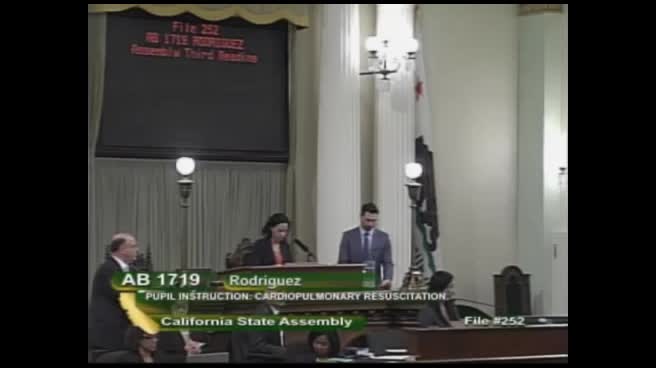 2MIN
Assembly Floor
 4MIN
Assembly Standing Committee on Judiciary
 17MIN
Assembly Standing Committee on Education
Bill Author









