AB 319: Pupil instruction: cardiopulmonary resuscitation.
- Session Year: 2015-2016
- House: Assembly
- Latest Version Date: 2015-04-30
Existing law authorizes a school district or school to provide a comprehensive program in first aid or cardiopulmonary resuscitation training, or both, to pupils and employees in accordance with specified guidelines.
This bill would instead require a school district or school to provide a comprehensive program in first aid and cardiopulmonary resuscitation training to pupils and employees in accordance with specified guidelines, thereby imposing a state-mandated local program.
Existing law establishes a list of courses that a pupil in a school district is required to complete in grades 9 to 12, inclusive, in order to receive a diploma of graduation from high school, including 2 courses in physical education unless exempted.
This bill would require require, commencing with the 201718 academic year, the governing board of a school district, and the governing body of a charter school, offering instruction to pupils in grades 9 to 12, inclusive, to provide instruction on performing cardiopulmonary resuscitation and the use of an automated external defibrillator as part of a physical education course or another course required for graduation, as provided. The bill would also make conforming changes to a related code section. By imposing additional requirements on school districts and charter schools, the bill would impose a state-mandated local program.
The California Constitution requires the state to reimburse local agencies and school districts for certain costs mandated by the state. Statutory provisions establish procedures for making that reimbursement.
This bill would provide that, if the Commission on State Mandates determines that the bill contains costs mandated by the state, reimbursement for those costs shall be made pursuant to these statutory provisions.
Existing law authorizes a school district or school to provide a comprehensive program in first aid or cardiopulmonary resuscitation training, or both, to pupils and employees in accordance with specified guidelines.
This bill would instead require a school district or school to provide a comprehensive program in first aid and cardiopulmonary resuscitation training to pupils and employees in accordance with specified guidelines, thereby imposing a state-mandated local program.
Existing law establishes a list of courses that a pupil in a school district is required to complete in grades 9 to 12, inclusive, in order to receive a diploma of graduation from high school, including 2 courses in physical education unless exempted.
This bill would require the governing board of a school district, and the governing body of a charter school, offering instruction to pupils in grades 9 to 12, inclusive, to provide instruction on performing cardiopulmonary resuscitation and the use of an automated external defibrillator as part of a physical education course or another course required for graduation, as provided. The bill would also make conforming changes to a related code section. By imposing additional requirements on school districts and charter schools, the bill would impose a state-mandated local program.
The California Constitution requires the state to reimburse local agencies and school districts for certain costs mandated by the state. Statutory provisions establish procedures for making that reimbursement.
This bill would provide that, if the Commission on State Mandates determines that the bill contains costs mandated by the state, reimbursement for those costs shall be made pursuant to these statutory provisions.
(a)(1)The Legislature finds and declares all of the following:
(A)Sudden cardiac arrest is the leading cause of death in the United States.
(B)Less than 8 percent of people who suffer cardiac arrest outside the hospital survive.
(C)Effective bystander cardiopulmonary resuscitation (CPR) provided immediately after sudden cardiac arrest can double or triple a victims chance of survival, but only 32 percent of cardiac arrest victims get CPR from a bystander.
(2)In enacting this section, it is the intent of the Legislature to save lives by giving high school pupils the opportunity to develop psychomotor CPR skills.
(b)A school district or school, individually or jointly with another school district or school, shall provide a comprehensive program in first aid and CPR training to pupils and employees. The program shall be developed using the following guidelines:
(1)The school district or school collaborates with existing local resources, including, but not limited to, parent teacher associations, hospitals, school nurses, fire departments, and other local agencies that promote safety, to make first aid and CPR training available to the pupils and employees of the school district or school.
(2)Each school district that develops a program, or the school district that has jurisdiction over a school that develops a program, compiles a list of resources for CPR information, to be distributed to all of the schools in the district.
(3)The first aid and CPR training are based on standards that are at least equivalent to the standards currently used by the American Red Cross or the American Heart Association.
SEC. 2.SECTION 1.Section 51202 of the Education Code is amended to read:51202.The adopted course of study shall provide instruction at the appropriate elementary and secondary grade levels and subject areas in personal and public safety and accident prevention, including emergency first aid instruction, instruction in hemorrhage control, treatment for poisoning, resuscitation techniques, and cardiopulmonary resuscitation when appropriate equipment is available or when required pursuant to Section 51225.6; fire prevention; the protection and conservation of resources, including the necessity for the protection of our environment; and health, including venereal disease and the effects of alcohol, narcotics, drugs, and tobacco upon the human body. The health instruction may include prenatal care for pregnant women and violence as a public health issue.
SEC. 3.SEC. 2.Section 51225.6 is added to the Education Code, to read:51225.6.(a)The Commencing with the 201718 academic year, the governing board of a school district, and the governing body of a charter school, offering instruction to pupils in grades 9 to 12, inclusive, shall provide instruction in performing cardiopulmonary resuscitation (CPR) and the use of an automated external defibrillator (AED) as part of a physical education course or another course required for graduation. graduation pursuant to paragraph (1) of subdivision (a) Section 51225.3, or a course required by the local governing board of a school district for graduation pursuant to paragraph (2) of subdivision (a) Section 51225.3. This instruction shall include all of the following:
(1)An instructional program developed by the American Heart Association or the American Red Cross, or an instructional program that is nationally recognized and based on the most current national evidence-based emergency cardiovascular care guidelines for the performance of CPR and the use of an AED.
(2)Training for pupils relative to the psychomotor skills necessary to perform CPR. For purposes of this paragraph, psychomotor skills means skills that pupils are required to perform as hands-on practice to support cognitive learning. Pupils receiving online instruction to satisfy the requirements of this section shall not be required to perform hands-on practice.
(3)General information on the use and importance of an AED. The physical presence of an AED in the classroom is not required.
(b)Except as specified in subparagraph (B) of paragraph (5), instruction required pursuant to this section may be provided by a person who is certified in CPR and who is any of the following:
(1)A health care provider licensed pursuant to Division 2 (commencing with Section 500) of the Business and Professions Code, the Osteopathic Initiative Act, as set forth in Chapter 8 (commencing with Section 3600) of Division 2 of the Business and Professions Code, or the Chiropractic Initiative Act, as set forth in Chapter 2 (commencing with Section 1000) of Division 2 of the Business and Professions Code.
(2)A person certified pursuant to the Emergency Medical Services System and the Prehospital Emergency Medical Care Personnel Act (Division 2.5 (commencing with Section 1797) of the Health and Safety Code).
(3)A peace officer, as defined in Section 830 of the Penal Code.
(4)A firefighter, defined as any regularly employed and paid officer, employee, or member of a fire department or fire protection or firefighting agency of the State of California, a city, a county, a city and county, a district, or other public or municipal corporation or political subdivision of this state or member of an emergency reserve unit of a volunteer fire department or fire protection district.
(5)(A)A teacher.
(B)A teacher shall not be required to be certified in CPR to facilitate, provide, or oversee instruction pursuant to this section for training that does not provide CPR certification.
(6)An instructor certified to teach CPR by the American Red Cross or the American Heart Association, or an instructor certified to teach an instructional program that is nationally recognized and based on the most current national evidence-based emergency cardiovascular care guidelines for the performance of CPR and the use of an AED.
(c)If it is in accordance with the laws, rules, or regulations governing his or her profession, a person who provides instruction pursuant to subdivision (b) may apply the hours spent performing instruction toward fulfilling professional requirements for performing community service.
(d)The governing board of a school district or the governing body of a charter school may adopt regulations to implement this section.
SEC. 4.SEC. 3.If the Commission on State Mandates determines that this act contains costs mandated by the state, reimbursement to local agencies and school districts for those costs shall be made pursuant to Part 7 (commencing with Section 17500) of Division 4 of Title 2 of the Government Code.
(A)Sudden cardiac arrest is the leading cause of death in the United States.
(B)Less than 8 percent of people who suffer cardiac arrest outside the hospital survive.
(C)Effective bystander cardiopulmonary resuscitation (CPR) provided immediately after sudden cardiac arrest can double or triple a victims chance of survival, but only 32 percent of cardiac arrest victims get CPR from a bystander.
(2)In enacting this section, it is the intent of the Legislature to save lives by giving high school pupils the opportunity to develop psychomotor CPR skills.
(b)A school district or school, individually or jointly with another school district or school, may shall provide a comprehensive program in first aid or cardiopulmonary resuscitation (CPR) training, or both, and CPR training to pupils and employees. The program shall be developed using the following guidelines:
(1)The school district or school collaborates with existing local resources, including, but not limited to, parent teacher associations, hospitals, school nurses, fire departments, and other local agencies that promote safety, to make first aid or CPR training, or both, and CPR training available to the pupils and employees of the school district or school.
(2)Each school district that develops a program, or the school district that has jurisdiction over a school that develops a program, compiles a list of resources for first aid or CPR information, to be distributed to all of the schools in the district.
(3)The first aid and CPR training are based on standards that are at least equivalent to the standards currently used by the American Red Cross or the American Heart Association.
SEC. 2.Section 51202 of the Education Code is amended to read:51202.The adopted course of study shall provide instruction at the appropriate elementary and secondary grade levels and subject areas in personal and public safety and accident prevention, including emergency first aid instruction, instruction in hemorrhage control, treatment for poisoning, resuscitation techniques, and cardiopulmonary resuscitation when appropriate equipment is available; available or when required pursuant to Section 51225.6; fire prevention; the protection and conservation of resources, including the necessity for the protection of our environment; and health, including venereal disease and the effects of alcohol, narcotics, drugs, and tobacco upon the human body. The health instruction may include prenatal care for pregnant women and violence as a public health issue.
SEC. 3.Section 51225.6 is added to the Education Code, to read:51225.6.(a)The governing board of a school district, and the governing body of a charter school, offering instruction to pupils in grades 9 to 12, inclusive, shall provide instruction in performing cardiopulmonary resuscitation (CPR) and the use of an automated external defibrillator (AED) as part of a physical education course or another course required for graduation. This instruction shall include all of the following:
(1)An instructional program developed by the American Heart Association or the American Red Cross, or an instructional program that is nationally recognized and based on the most current national evidence-based emergency cardiovascular care guidelines for the performance of CPR and the use of an AED.
(2)Training for pupils relative to the psychomotor skills necessary to perform CPR. For purposes of this paragraph, psychomotor skills means skills that pupils are required to perform as hands-on practice to support cognitive learning. Pupils receiving online instruction to satisfy the requirements of this section shall not be required to perform hands-on practice.
(3)General information on the use and importance of an AED. The physical presence of an AED in the classroom is not required.
(b)Except as specified in subparagraph (B) of paragraph (5), instruction required pursuant to this section may be provided by a person who is certified in CPR and who is any of the following:
(1)A health care provider licensed pursuant to Division 2 (commencing with Section 500) of the Business and Professions Code, the Osteopathic Initiative Act, as set forth in Chapter 8 (commencing with Section 3600) of Division 2 of the Business and Professions Code, or the Chiropractic Initiative Act, as set forth in Chapter 2 (commencing with Section 1000) of Division 2 of the Business and Professions Code.
(2)A person certified pursuant to the Emergency Medical Services System and the Prehospital Emergency Medical Care Personnel Act (Division 2.5 (commencing with Section 1797) of the Health and Safety Code).
(3)A peace officer, as defined in Section 830 of the Penal Code.
(4)A firefighter, defined as any regularly employed and paid officer, employee, or member of a fire department or fire protection or firefighting agency of the State of California, a city, a county, a city and county, a district, or other public or municipal corporation or political subdivision of this state or member of an emergency reserve unit of a volunteer fire department or fire protection district.
(5)(A)A teacher.
(B)A teacher shall not be required to be certified in CPR to facilitate, provide, or oversee instruction pursuant to this section for training that does not provide CPR certification.
(c)If it is in accordance with the laws, rules, or regulations governing his or her profession, a person who provides instruction pursuant to subdivision (b) may apply the hours spent performing instruction toward fulfilling professional requirements for performing community service.
(d)The governing board of a school district or the governing body of a charter school may adopt regulations to implement this section.
SEC. 4.If the Commission on State Mandates determines that this act contains costs mandated by the state, reimbursement to local agencies and school districts for those costs shall be made pursuant to Part 7 (commencing with Section 17500) of Division 4 of Title 2 of the Government Code.
|
Date
|
Status
|
|---|---|
| Feb 13, 2015 | Read first time. To print. |
| Feb 17, 2015 | From printer. May be heard in committee March 19. |
| Feb 23, 2015 | Referred to Com. on ED. |
| Apr 29, 2015 | From committee: Amend, and do pass as amended and re-refer to Com. on APPR. (Ayes 6. Noes 1.) (April 22). |
| Apr 30, 2015 | Read second time and amended. |
| May 4, 2015 | Re-referred to Com. on APPR. |
| May 6, 2015 | In committee: Set, first hearing. Referred to APPR. suspense file. |
| May 28, 2015 | In committee: Held under submission. |
| Jan 31, 2016 | Died pursuant to Article IV, Sec. 10(c) of the Constitution. |
| Feb 1, 2016 | From committee: Filed with the Chief Clerk pursuant to Joint Rule 56. |
|
Date
|
Description
|
Location
|
Votes
|
|
|---|---|---|---|---|
| Apr 22, 2015 | Do pass as amended and be re-referred to the Committee on [Appropriations] | Assembly Standing Committee on Education |
Passed |
This list shows positions taken on this bill by organizations on the date displayed, which is linked to the original source.
Positions by individuals are not included.
|
Organization
|
Position
|
Date
|
|---|---|---|
| Alameda County Board of Supervisors | ** Support | Apr 22, 2015 |
| American College of Emergency Physicians, California Chapter | ** Support | Apr 22, 2015 |
| American Heart Association | * Support | Apr 22, 2015 |
| American Heart Association | * Indeterminate | Apr 22, 2015 |
| American Heart Association, Orange County | * Indeterminate | Apr 22, 2015 |
| American Medical Response in Los Angeles County | * Indeterminate | Apr 22, 2015 |
| American Medical Response in the Antelope Valley | * Indeterminate | Apr 22, 2015 |
| American Red Cross | * Support | Apr 22, 2015 |
| American Red Cross | * Indeterminate | Apr 22, 2015 |
| California Ambulance Association | ** Support | Apr 22, 2015 |
| California Hospital Association | ** Support | Apr 22, 2015 |
| California Professional Firefighters | ** Support | Apr 22, 2015 |
| Csac Excess Insurance Authority | ** Against | Apr 22, 2015 |
| Derrick Faison Foundation | ** Support | Apr 22, 2015 |
| Emergency Nurses Association of California | ** Support | Apr 22, 2015 |
| Eric Paredes Save a Life Foundation | ** Support | Apr 22, 2015 |
| Placentia-Yorba Linda Unified School District | * Indeterminate | Apr 22, 2015 |
| Placentia-Yorba Linda Unified School District | * Support | Apr 22, 2015 |
| Sierra Delta Chapter of the American Red Cross | * Indeterminate | Apr 22, 2015 |
| Travis R. Roy Sudden Cardiac Arrest Fund | ** Support | Apr 22, 2015 |
AB 319
Page 2
Date of Hearing: May 6, 2015
ASSEMBLY COMMITTEE ON APPROPRIATIONS
Jimmy Gomez, Chair
AB 319
(Rodriguez) – As Amended April 30, 2015
Policy Committee: |
Education |
Vote: |
6 - 1 |
|
|
|
|
|
|
|
|
Urgency: No State Mandated Local Program: Yes Reimbursable: Yes
SUMMARY:
This bill requires, starting in the 2017-18 school year, school districts and charter schools offering instruction to pupils in grades 9 to 12, inclusive, to provide instruction in performing cardiopulmonary resuscitation (CPR) and the use of an automated external defibrillator (AED) as part of a physical education (PE) course or another course required for graduation. Specifically, this bill:
Requires instruction in CPR and AED use to include all of the following:
An instructional program developed by the American Heart Association or the American Red Cross, or an instructional program that is nationally recognized and based on the most current national evidence-based emergency cardiovascular care guidelines for the performance of CPR and the use of an AED.
Training for pupils relative to the psychomotor skills necessary to perform CPR. For purposes of this paragraph, “psychomotor skills” means skills that pupils are required to perform as hands-on practice to support cognitive learning.
General information on the use and importance of an AED. The physical presence of an AED in the classroom is not required.
Allows instruction to be provided by a person who is certified in CPR who is any of the following: a licensed health care provider; an emergency medical technician; a peace officer; a firefighter; an instructor certified to teach CPR by the American Red Cross, American Heart Association or nationally recognized instructional program, as specified; or a teacher. Specifies a teacher shall not be required to be certified in CPR to facilitate, provide, or oversee instruction for training, provided that the training does not provide CPR certification.
Authorizes a person who provides this instruction to apply the hours spent performing instruction toward fulfilling professional community service requirements, as specified.
FISCAL EFFECT:
Proposition 98/GF state mandated costs in the low millions, starting in 2017-18, for school districts to provide training equipment and materials, student safety equipment and teacher training for CPR/AED. Actual costs will depend on whether school districts currently provide CPR instruction and instruction on the use of AEDs, if the district has access to free equipment and instruction through community organizations, and the number of students who will receive the instruction.
Most students in California take PE in ninth grade. In 2013–14, there were 491,493 students enrolled in ninth grade. These students attended more than 1,305 high schools throughout the state. Assuming 30 students per PE class, CPR and AED instruction would need to be provided to at least 16,383 classes of ninth graders per year.
COMMENTS:
Purpose. Current high school graduation requirements include two years of physical education, though school districts are permitted to establish graduation requirements that exceed those of the state. Existing law does not require a health course for graduation. School districts are currently authorized, but not required, to offer a comprehensive course of study on first aid and CPR, based on standards that are at least equivalent to the standards currently used by the American Red Cross or the American Heart Association. Further, schools are required to provide instruction at the appropriate grade levels on personal and public safety and accident prevention, including emergency first aid instruction, instruction in hemorrhage control, treatment for poisoning, resuscitation techniques, and CPR when appropriate equipment is available.
This bill seeks to expand upon this current policy and require every high school student in California receive instruction in performing cardiopulmonary resuscitation (CPR), and the use of an automated external defibrillator (AED), as part of a physical education course or another course required for graduation.
Analysis Prepared by: Misty Feusahrens / APPR. / (916) 319-2081
AB 319
Page 5
Date of Hearing: April 22, 2015
ASSEMBLY COMMITTEE ON EDUCATION
Patrick O'Donnell, Chair
AB 319
(Rodriguez) – As Introduced February 13, 2015
SUBJECT: Pupil instruction: cardiopulmonary resuscitation
SUMMARY: Requires that school districts and charter schools provide instruction on performing cardiopulmonary resuscitation (CPR) and the use of an automated external defibrillator (AED) to students in grades 9-12 as part of a course required for graduation. Specifically, this bill:
Makes findings and declarations regarding the importance of CPR.
Requires, by changing a voluntary section to a mandate, that schools or school districts provide first aid and CPR training to students and employees.
Requires that school districts and charter schools provide to students in grades 9-12 instruction on performing CPR and the use of an AED as part of a physical education course or another course required for graduation.
Requires the instruction to include:
An instructional program developed by the American Heart Association or the American Red Cross, or one that is nationally recognized and based on the most current national evidence-based emergency care guidelines on those topics
Training on the psychomotor skills (defined as hands-on and cognitive) necessary to perform CPR. Permits students receiving online instruction to be exempt from performing hands-on practice
General information on the use and importance of an AED. States that the physical presence of an AED in the classroom is not required
Allows instruction to be provided by a person who is certified in CPR who is any of the following:
A licensed health care provider
An emergency medical technician
A peace officer
A firefighter
A teacher
States that a teacher shall not be required to be certified in CPR to facilitate, provide, or oversee instruction for training, provided that the training does not provide CPR certification.
States that, if it is in accordance with the laws, rules, or regulations governing his or her profession, a person who provides this instruction may apply the hours spent performing instruction toward fulfilling professional community service requirements.
States that the governing board of a school district or the governing body of a charter school may adopt regulations to implement this section.
EXISTING LAW:
Establishes high school graduation requirements, including two years of physical education, and permits school districts to establish graduation requirements which exceed those of the state. Existing law does not require a health course for graduation.
Allows school districts to offer a comprehensive course of study on first aid and CPR and requires that it be based on standards that are at least equivalent to the standards currently used by the American Red Cross or the American Heart Association.
Requires, through the adopted course of study, that schools provide instruction at the appropriate grade levels on personal and public safety and accident prevention, including emergency first aid instruction, instruction in hemorrhage control, treatment for poisoning, resuscitation techniques, and CPR when appropriate equipment is available.
States (Civil Code § 1714.2) that no person certified to teach CPR by the American Red Cross or the American Heart Association, and no local agency, entity of state or local government, or other public or private organization which sponsors, authorizes, supports, finances, or supervises the training of citizens in cardiopulmonary resuscitation can be held liable for any civil damages alleged to result from such training programs.
States (Civil Code § 1714.21) that a person or entity who provides CPR and AED training to a person who renders emergency care is not liable for any civil damages resulting from any acts or omissions of the person rendering the emergency care.
Requires (Health and Safety Code § 1797.196) that when an AED is placed in a public or private K–12 school, the principal follow specified posting and notice requirements, and designate trained employees to be available to respond to an emergency that may involve the use of an AED during normal operating hours.
FISCAL EFFECT: This bill has been keyed a state-mandated local program by the Office of Legislative Counsel.
COMMENTS:
Need for the bill. The author’s office states, “Sudden cardiac arrest is one of the most lethal public health threats in the United States, and sadly only ten percent of people who suffer cardiac arrest outside the hospital survive. If no CPR is provided or no defibrillation occurs within 3 to 5 minutes of collapse, the chances of survival drop. Effective bystander CPR provided immediately after sudden cardiac arrest can double or triple a victim’s chance of survival. Alarmingly, 70 percent of Americans may feel helpless to act during a cardiac emergency because they do not know how to perform CPR and only 32 percent of cardiac arrest victims get CPR from a bystander.
CPR training is sensible and affordable and can easily fit into existing classes. In fact, instruction in CPR and AED is part of the existing Health curriculum framework and content standards. AB 319 seeks to expand upon this current policy and ensure that every high school student in California receives this important, life-saving training.”
What is “Hands Only” CPR training? This bill requires that students receive training in a method of CPR known as “Hands-Only CPR.” Hands-on CPR is conventional CPR without mouth-to-mouth resuscitation. According to the American Heart Association, Hands-Only CPR has been shown to be as effective as conventional CPR for sudden cardiac arrest at home, at work or in public.
Hands-only CPR involves two steps when a teen or adult collapses: 1) calling 9-1-1, and 2) pushing hard on the center of the person’s chest at the rate of 100 compressions per minute – roughly the same as the beat in the Bee Gees 1977 hit song “Stayin’ Alive.” For infants, children, victims of drowning or drug overdose, and people who collapse due to breathing problems, the American Heart Association still recommends CPR with compression and breaths.
The American Red Cross and the American Heart Association offer a “CPR for Students” course which involves 30 minutes of instruction. The author expects that schools would meet the requirements of this bill by offering that course.
Health disparities in CPR training and bystander use. A 2013 study published in the Journal of the American Medical Association found wide disparities in CPR training, and that residents of the communities most in need of training are the least likely to be trained. The study, which examined national training rates, found that counties with the lowest rates of CPR training were more likely to have a higher proportion of African American and Latino residents, more likely to have a lower median household income, and were more likely to be rural (where it may take longer for emergency personnel to arrive).
Other research has demonstrated that low income individuals and African Americans are significantly less likely to receive bystander CPR when they experience sudden cardiac arrest, and that people who experience such an event in predominantly African American, low income neighborhoods are the least likely of all groups to receive bystander CPR treatment. This study attributed this disparity in CPR use to low rates of training in those in communities.
CPR/AED graduation requirements in 21 other states. According to the American Heart Association, twenty one other states have adopted CPR training as a high school graduation requirement, totaling about 1.2 million trained high school graduates per year. Among the larger states are Texas, Georgia, Virginia, North Carolina, and New Jersey.
Most states which require instruction to be provided in a required class have given districts between two and three years “lead time” for implementation, or when requiring completion of training by individual students, have made the requirement effective with a future incoming class of 9th graders.
As written, this bill would become effective half-way through the 2015-16 academic year. Based on the experience of other states, as well and the resources required to implement such a requirement, staff recommends that the bill be amended to push back the effective dates of these requirements to the 2017-18 academic year.
Local capacity to provide training. Approximately 400,000 students graduate from California high schools each year. Under the requirements of this bill, each one would receive CPR/AED training through a class they must take to graduate. This raises a question regarding the capacity of school districts to provide the instruction at sufficient scale to serve this number of students annually.
This bill allows teachers who are not certified in CPR/AED to provide this instruction, provided that they use the materials produced by The American Red Cross or American Heart Association, or equivalent, and that the training is not for the purpose of certifying students. All other providers would need to be certified. Since the teachers of courses in which this instruction would occur (most likely Health or Physical Education) would not be required to be certified, it would appear that it is possible to instruct all students. Since the training could be completed in as little as 30 minutes sometime over the course of four years of instruction, it would not appear to place an undue burden on instructional time.
CPR (but not AED) training in state health standards and curriculum frameworks. CPR instruction is part of the state’s health content standards and corresponding curriculum framework. The 2008 standards include: “Describing procedures for emergency care and lifesaving, including CPR, first aid, and control of bleeding.” Neither the standards of framework mention use of an AED. As the author notes, this does not mean that all students receive this instruction, as not all districts require a health course for graduation, and compliance with the standards is not mandatory.
Placentia-Yorba Linda Unified School District makes hands-only CPR training part of course required for graduation. After the tragic loss of two high school students in 2006 and 2014 to sudden cardiac arrest, the Placentia-Yorba Linda Unified School District in 2015 became the first known district in the state to make ‘hands only” CPR/AED instruction part of a course required for high school graduation. The district has provided this instruction to all 9th grade students through a locally-required health course and purchased CPR Anytime kits, which include manikins, for use in the program. Equipment for four high schools with an enrollment of approximately 8,000 students (total enrollment, not graduating class) required an expenditure of approximately $10,000 by the district, $8000 of which was paid for by privately-raised funds. The district expects these kits to last at least five years before needing replacement.
Recommended amendments. To meet the author’s intent and provide clarity, staff recommends the following amendments:
Staff recommends that this bill be amended to strike Section 1 of this bill. This section of the bill requires, by changing the section from voluntary to mandatory, that schools train students and employees in first aid and CPR. The author indicates that his intent is to make CPR/AED training part of a course required for graduation (as other provisions of this bill do), not require training for staff in CPR and first aid.
Staff recommends that this bill be amended to allow certified instructors from non-profit organizations such as the American Red Cross and the American Heart Association to provide the training required by this bill.
Staff recommends a clarifying amendment which would specify that the instruction could be provided in a course required to meet either state graduation requirements or locally-adopted graduation requirements. This would clarify that in addition to courses required by the state for graduation, the instruction could be provided in a health or other course which a school district has made a local graduation requirement.
Staff recommends that the bill be amended to strike references to online instruction, to clarify that “hands on” training is required.
As noted above, staff recommends that the bill be amended to push back the effective dates of these requirements to the 2017-18 academic year.
Previous legislation. AB 2217 (Melendez, Chapter 812, Statutes of 2014), authorizes a public school to solicit and receive non-state funds to acquire and maintain an AED, and provides that school districts and their employees are not liable for civil damages resulting from certain uses of an AED.
AB 939 (Melendez) of the 2013-14 Session would have stated the intent of the Legislature to encourage all public schools to acquire and maintain at least one AED, and would have authorized a public school to solicit and receive non-state funds to acquire and maintain an AED. This bill died in the Senate Appropriations Committee.
SB 1346 (Lowenthal, Chapter 71, Statutes of 2012), extended indefinitely, the minimum training standards and immunity from civil damages in connection with the use of AEDs. This measure was not heard by the Assembly Education Committee.
SB 63 (Price) of the 2011-12 Session would have required all public high schools to acquire and maintain at least one AED. This bill died in the Senate Appropriations Committee.
REGISTERED SUPPORT / OPPOSITION:
Support
American Heart Association (sponsor)
American Red Cross (sponsor)
Alameda County Board of Supervisors
American College of Emergency Physicians, California Chapter
California Ambulance Association
California Hospital Association
California Professional Firefighters
Derrick Faison Foundation
Emergency Nurses Association of California
Eric Paredes Save a Life Foundation
Placentia-Yorba Linda Unified School District
Travis R. Roy Sudden Cardiac Arrest Fund
1 individual
Opposition
CSAC Excess Insurance Authority (unless amended)
1 individual
Analysis Prepared by: Tanya Lieberman / ED. / (916) 319-2087
Discussed in Hearing
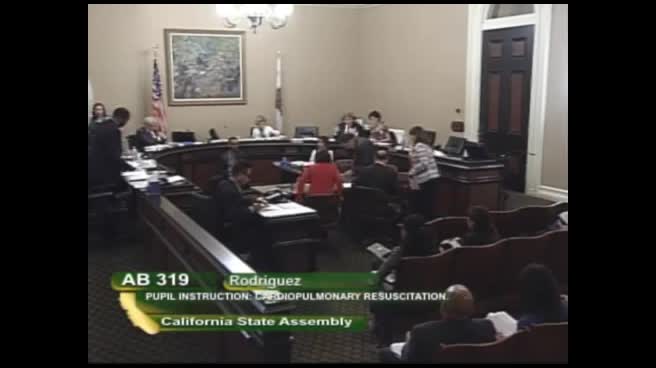 16MIN
Assembly Standing Committee on Education
Bill Author











