AB 914: Toll facilities: County of San Bernardino.
- Session Year: 2015-2016
- House: Assembly
- Latest Version Date: 2015-10-09
Existing law provides for the Department of Transportation and local authorities, with respect to highways under their respective jurisdictions, to authorize or permit exclusive or preferential use of highway lanes for high-occupancy vehicles (HOVs). Existing law authorizes the development and implementation of a value-pricing program consisting of high-occupancy toll (HOT) lanes in various corridors under certain circumstances, pursuant to which vehicles that do not meet the vehicle occupancy requirements for use of an HOV lane may use the lane upon payment of a toll.
This bill would authorize the San Bernardino County Transportation Commission to conduct, administer, and operate a value-pricing program, that may include HOT lanes or other toll facilities in the Interstate Highway Routes 10 and 15 in the County of San Bernardino and, with the agreement of affected transportation agencies, specified extensions and connections into the Counties of Los Angeles and Riverside. The bill would require the toll revenues to be spent for specified transportation purposes and would authorize the commission to issue revenue bonds payable from toll revenues. The bill would require the commission to report to the Legislative Analyst on specified matters within 3 years of commencement of revenue collection from the value-pricing program. The bill would enact other related provisions.
This bill would become operative only if AB 194 is also enacted and becomes operative on or before January 1, 2016.
Existing law provides for the Department of Transportation and local authorities, with respect to highways under their respective jurisdictions, to authorize or permit exclusive or preferential use of highway lanes for high-occupancy vehicles (HOVs). Existing law authorizes the development and implementation of a value-pricing program consisting of high-occupancy toll (HOT) lanes in various corridors under certain circumstances, pursuant to which vehicles that do not meet the vehicle occupancy requirements for use of an HOV lane may use the lane upon payment of a toll.
This bill would authorize the San Bernardino County Transportation Commission to conduct, administer, and operate a value-pricing program that includes HOT lanes and other toll facilities on Interstate Highway Routes 10 and 15 in the County of San Bernardino and, with the agreement of affected transportation agencies, specified extensions and connections into the Counties of Los Angeles and Riverside. The bill would require the toll revenues to be spent for specified transportation purposes and would authorize the commission to issue revenue bonds payable from toll revenues. The bill would require the commission to report to the Legislative Analyst on specified matters within 3 years of commencement of revenue collection from the value-pricing program. The bill would enact other related provisions.
Existing law provides for the Department of Transportation and local authorities, with respect to highways under their respective jurisdictions, to authorize or permit exclusive or preferential use of highway lanes for high-occupancy vehicles (HOVs). Existing law authorizes the development and implementation of a value-pricing program consisting of high-occupancy toll (HOT) lanes in various corridors under certain circumstances, pursuant to which vehicles that do not meet the vehicle occupancy requirements for use of an HOV lane may use the lane upon payment of a toll.
This bill would authorize the San Bernardino County Transportation Commission to construct and operate certain transportation facilities, as defined, conduct, administer, and operate a value-pricing program that includes HOT lanes and other toll facilities on Interstate Highway Routes 10 and 15, as toll facilities 15 in the County of San Bernardino and, with the agreement of affected transportation agencies, in specified extensions and connections into the Counties of Los Angeles and Riverside. The bill would require the toll revenues to be spent for specified transportation purposes and would authorize the commission to issue revenue bonds payable from toll revenues. The bill would require the commission to report to the Legislative Analyst on specified matters within 3 years of commencement of toll revenue collection on a facility constructed under the bill from the value-pricing program. The bill would enact other related provisions.
Existing law authorizes the Department of Motor Vehicles to issue decals to not more than 70,000 vehicles meeting certain air quality standards, and provides that vehicles with these air quality decals may use high-occupancy vehicle lanes without meeting the applicable vehicle occupancy requirements. Existing law generally provides that the vehicles with air quality decals are not exempt from tolls on state-owned toll bridges or certain other toll facilities.
This bill would provide that vehicles with air quality decals would not be exempt from tolls on toll facilities implemented in the County of San Bernardino or adjoining counties under this bill.
Existing law provides for the Department of Transportation and local authorities, with respect to highways under their respective jurisdictions, to authorize or permit exclusive or preferential use of highway lanes for high-occupancy vehicles (HOVs). Existing law authorizes the development and implementation of high-occupancy toll (HOT) lanes under certain circumstances, pursuant to which vehicles that do not meet the vehicle occupancy requirements for use of an HOV lane may use the lane upon payment of a toll.
This bill would authorize the San Bernardino County Transportation Commission to construct and operate certain transportation facilities, as defined, on State Interstate Highway Routes 10 and 15, as toll facilities in the County of San Bernardino and, with the agreement of affected transportation agencies, in the Counties of Los Angeles and Riverside. The bill would require the toll revenues to be spent for specified transportation purposes and would authorize the commission to issue revenue bonds payable from toll revenues. The bill would require the commission to report to the Legislative Analyst on specified matters within 3 years of commencement of toll collection on a facility constructed under the bill. The bill would enact other related provisions.
Existing law authorizes the Department of Motor Vehicles to issue decals to not more than 70,000 vehicles meeting certain air quality standards, and provides that vehicles with these air quality decals may use high-occupancy vehicle lanes without meeting the applicable vehicle occupancy requirements. Existing law generally provides that the vehicles with air quality decals are not exempt from tolls on state-owned toll bridges or certain other toll facilities.
This bill would provide that vehicles with air quality decals would not be exempt from tolls on toll facilities implemented in the County of San Bernardino or adjoining counties under this bill.
Existing law provides for the Department of Transportation and local authorities, with respect to highways under their respective jurisdictions, to authorize or permit exclusive or preferential use of highway lanes for high-occupancy vehicles (HOVs). Existing law authorizes the development and implementation of high-occupancy toll (HOT) lanes under certain circumstances, pursuant to which vehicles that do not meet the vehicle occupancy requirements for use of an HOV lane may use the lane upon payment of a toll.
This bill would authorize the San Bernardino County Transportation Commission to construct and operate certain transportation facilities, as defined, on State Highway Routes 10 and 15, as toll facilities in the County of San Bernardino and, with the agreement of affected transportation agencies, in the Counties of Los Angeles and Riverside. The bill would require the toll revenues to be spent for specified transportation purposes and would authorize the commission to issue revenue bonds payable from toll revenues. The bill would require the commission to report to the Legislative Analyst on specified matters within 3 years of commencement of toll collection on a facility constructed under the bill. The bill would enact other related provisions.
Existing law authorizes the Department of Motor Vehicles to issue decals to not more than 70,000 vehicles meeting certain air quality standards, and provides that vehicles with these air quality decals may use high-occupancy vehicle lanes without meeting the applicable vehicle occupancy requirements. Existing law generally provides that the vehicles with air quality decals are not exempt from tolls on state-owned toll bridges or certain other toll facilities.
This bill would provide that vehicles with air quality decals would not be exempt from tolls on toll facilities implemented in the County of San Bernardino or adjoining counties under this bill.
(a)(1)Notwithstanding Sections 149 and 30800 of this code, and Section 21655.5 of the Vehicle Code, the San Bernardino County Transportation Commission, created pursuant to Section 130054 of the Public Utilities Code, may conduct, administer, and operate a value-pricing program in the Interstate 10 and Interstate 15 corridors in the County of San Bernardino. The value-pricing program may include high-occupancy toll lanes or other toll facilities. The San Bernardino County Transportation Commission may also extend the program to include the approaching and departing connectors on Interstate 10 extending into the County of Los Angeles, as designated by an agreement with the Los Angeles County Metropolitan Transportation Authority, and the connection to the Interstate 15 express lanes project in the County of Riverside, as designated by an agreement with the Riverside County Transportation Commission. The San Bernardino County Transportation Commission may exercise its existing powers of eminent domain pursuant to Section 130220.5 of the Public Utilities Code to acquire property necessary to carry out the purposes of the value-pricing program.
(2)The value-pricing program authorized pursuant to paragraph (1) may only be implemented upon a determination that the program and the resulting facilities will improve the performance of the affected corridors. Improved performance may be demonstrated by factors that include, but are not limited to, increased passenger throughput or improved travel times. The San Bernardino County Transportation Commission shall make the determination required by this paragraph in a public meeting prior to operation of the value-pricing program.
(3)The San Bernardino County Transportation Commission shall have the authority to set, levy, and collect tolls, user fees, or other similar charges payable for the use of the toll facilities in the County of San Bernardino, and any other incidental or related fees or charges, and to collect those revenues, in a manner determined by the San Bernardino County Transportation Commission, in amounts as required for the following expenditures relative to the program and for the purposes of paragraph (4):
(A)Development, including the costs of design, construction, right-of-way acquisition, and utilities adjustment.
(B)Operations and maintenance, including, but not limited to, insurance, collection, and enforcement of tolls, fees, and charges.
(C)Repair, rehabilitation, and reconstruction.
(D)Indebtedness incurred and internal loans and advances, including related financial costs.
(E)Administration, which shall not exceed 3 percent of the revenues of toll facilities and associated transportation facilities.
(F)Reserves for the purposes described in subparagraphs (A) to (E), inclusive.
(4)All revenue generated pursuant to paragraph (3) in excess of the expenditure needs of that paragraph shall be used exclusively for the benefit of the transportation corridors included in the value-pricing program created pursuant to this section. These excess revenue expenditures shall be described in an excess revenue expenditure plan developed in consultation with the department and adopted and periodically updated by the board of directors of the San Bernardino County Transportation Commission and may include, but need not be limited to, the following eligible expenditures:
(A)Expenditures to enhance transit service designed to reduce traffic congestion within the transportation corridors included in the value-pricing program created pursuant to this section. Eligible expenditures include, but are not limited to, transit operating assistance, the acquisition of transit vehicles, and transit capital improvements otherwise eligible to be funded under the state transportation improvement program pursuant to Section 164.
(B)Expenditures to make operational or capacity improvements designed to reduce traffic congestion or improve the flow of traffic in the transportation corridors included in the value-pricing program created pursuant to this section. Eligible expenditures include, but are not limited to, any phase of project delivery to make capital improvements to on ramps, off ramps, connector roads, roadways, bridges, or other structures that are necessary for or related to the tolled or nontolled transportation facilities in the transportation corridors included in the value-pricing program created pursuant to this section.
(5)To the extent the San Bernardino County Transportation Commission plans to extend the value-pricing program into the Counties of Los Angeles or Riverside, it shall enter into an agreement with the Los Angeles County Metropolitan Transportation Authority or the Riverside County Transportation Commission, as applicable, subject to approval of the board of directors of the San Bernardino County Transportation Commission and the board of directors of the affected entity. If the value-pricing program developed and operated by the San Bernardino County Transportation Commission connects to, or is near, similar toll facilities constructed and operated by the Los Angeles County Metropolitan Transportation Authority or the Riverside County Transportation Commission, the respective entities shall enter into an agreement providing for the coordination of the toll facilities operated by each entity.
(b)(1) The San Bernardino County Transportation Commission shall carry out the program in cooperation with the Department of the California Highway Patrol pursuant to an agreement that addresses all matters related to enforcement on state highway system facilities in connection with the value-pricing program, and with the department pursuant to an agreement that addresses all matters related to the design, construction, maintenance, and operation of state highway system facilities in connection with the value-pricing program, including, but not limited to, financing, repair, rehabilitation, and reconstruction.
(2)The San Bernardino County Transportation Commission shall be responsible for reimbursing the department and the Department of the California Highway Patrol for costs related to the toll facility pursuant to an agreement between the San Bernardino County Transportation Commission and the department and between the San Bernardino County Transportation Commission and the Department of the California Highway Patrol.
(c)Single-occupant vehicles that are certified or authorized by the San Bernardino County Transportation Commission for entry into, and use of, the high-occupancy toll lanes implemented pursuant to this section are exempt from Section 21655.5 of the Vehicle Code, and the driver shall not be in violation of the Vehicle Code because of that entry and use.
(d)(1)The San Bernardino County Transportation Commission may issue bonds at any time to finance any costs necessary to implement the program established pursuant to this section and any expenditures provided for in paragraphs (3) and (4) of subdivision (a), payable from the revenues generated from the program and any other sources of revenues available to the San Bernardino County Transportation Commission that may be used for these purposes, including, but not limited to, sales tax revenue, development impact fees, or state and federal grants.
(2)The maximum bonded indebtedness that may be outstanding at any one time shall not exceed an amount that may be serviced from the projected revenues available as described in paragraph (1).
(3)The bonds shall bear interest at a rate or rates not exceeding the maximum allowable by law, payable at intervals determined by the San Bernardino County Transportation Commission.
(4)Any bond issued pursuant to this subdivision shall contain on its face a statement to the following effect:
Neither the full faith and credit nor the taxing power of the State of California is pledged to the payment of principal of, or interest on, this bond.
(5)Bonds shall be issued pursuant to a resolution of the governing board of the San Bernardino County Transportation Commission adopted by a majority vote of its governing board. The resolution or bond authorizing instrument shall state all of the following:
(A)The purposes for which the proposed debt is to be incurred.
(B)The estimated cost of accomplishing those purposes.
(C)The amount of the principal of the indebtedness.
(D)The maximum term of the bonds and the maximum interest rate.
(E)The denomination or denominations of the bonds, which shall not be less than five thousand dollars ($5,000).
(F)The form of the bonds.
(e)Not later than three years after the San Bernardino County Transportation Commission first collects revenues from the program authorized by this section, the San Bernardino County Transportation Commission shall submit a report to the Legislative Analyst on its findings, conclusions, and recommendations concerning the program. The report shall include an analysis of the effect of the transportation facilities on the adjacent mixed-flow lanes and any comments submitted by the department and the Department of the California Highway Patrol regarding operation of the transportation facilities.
(f)This section shall not prevent the department or any local agency from constructing improvements in the transportation corridors that compete with the program, and the San Bernardino County Transportation Commission shall not be entitled to compensation for the adverse effects on toll revenue due to those competing improvements.
(g)If any provision of this section or the application thereof is held invalid, that invalidity shall not affect other provisions or applications of this section that can be given effect without the invalid provision or application, and to this extent the provisions are severable.
(h)Nothing in this section shall authorize the conversion of any existing nontoll or nonuser-fee lanes into tolled or user-fee lanes, except that a high-occupancy vehicle lane may be converted into a high-occupancy toll lane.
SEC. 2.This act shall become operative only if Assembly Bill 194 of the 201516 Regular Session is also enacted and becomes operative on or before January 1, 2016.
(a)(1)Notwithstanding Sections 149 and 30800 of this code, and Section 21655.5 of the Vehicle Code, the San Bernardino County Transportation Commission, created pursuant to Section 130054 of the Public Utilities Code, may conduct, administer, and operate a value-pricing program in the Interstate 10 and Interstate 15 corridors in the County of San Bernardino. The value-pricing program may include high-occupancy toll lanes or other toll facilities. The San Bernardino County Transportation Commission may also extend the program to include the approaching and departing connectors on Interstate 10 extending into the County of Los Angeles, as designated by an agreement with the Los Angeles County Metropolitan Transportation Authority, and the connection to the Interstate 15 express lanes project in the County of Riverside, as designated by an agreement with the Riverside County Transportation Commission. The San Bernardino County Transportation Commission may exercise its existing powers of eminent domain pursuant to Section 130220.5 of the Public Utilities Code to acquire property necessary to carry out the purposes of the value-pricing program.
(2)The value-pricing program authorized pursuant to paragraph (1) may only be implemented upon a determination that the program and the resulting facilities will improve the performance of the affected corridors. Improved performance may be demonstrated by factors that include, but are not limited to, increased passenger throughput or improved travel times. The San Bernardino County Transportation Commission shall make the determination required by this paragraph in a public meeting prior to operation of the value-pricing program.
(3)The San Bernardino County Transportation Commission shall have the authority to set, levy, and collect tolls, user fees, or other similar charges payable for the use of the toll facilities in the County of San Bernardino, and any other incidental or related fees or charges, and to collect those revenues, in a manner determined by the San Bernardino County Transportation Commission, in amounts as required for the following expenditures relative to the program and for the purposes of paragraph (4):
(A)Capital outlay, Development, including the costs of design, construction, right-of-way acquisition, and utilities adjustment.
(B)Operations and maintenance, including, but not limited to, insurance, collection, and enforcement of tolls, fees, and charges.
(C)Repair and rehabilitation. Repair, rehabilitation, and reconstruction.
(D)Indebtedness incurred and internal loans and advances, including related financial costs.
(E)Reserves.
(F)
(E)Administration, which shall not exceed 3 percent of the revenues of toll facilities and associated transportation facilities.
(F)Reserves for the purposes described in subparagraphs (A) to (E), inclusive.
(4)All revenue generated pursuant to paragraph (3) in excess of the expenditure needs of that paragraph shall be used exclusively for the benefit of the transportation corridors included in the value-pricing program created pursuant to this section. These excess revenue expenditures shall be described in an excess revenue expenditure plan developed in consultation with the department and adopted and periodically updated by the board of directors of the San Bernardino County Transportation Commission and may include, but need not be limited to, the following eligible expenditures:
(A)Expenditures to enhance transit service designed to reduce traffic congestion within the transportation corridors included in the value-pricing program created pursuant to this section. Eligible expenditures include, but are not limited to, transit operating assistance, the acquisition of transit vehicles, and transit capital improvements otherwise eligible to be funded under the state transportation improvement program pursuant to Section 164.
(B)Expenditures to make operational or capacity improvements designed to reduce traffic congestion or improve the flow of traffic in the transportation corridors included in the value-pricing program created pursuant to this section. Eligible expenditures include, but are not limited to, any phase of project delivery to make capital improvements to on ramps, off ramps, connector roads, roadways, bridges, or other structures that are necessary for or related to the tolled or nontolled transportation facilities in the transportation corridors included in the value-pricing program created pursuant to this section.
(5)To the extent the San Bernardino County Transportation Commission plans to extend the value-pricing program into the Counties of Los Angeles or Riverside, it shall enter into an agreement with the Los Angeles County Metropolitan Transportation Authority or the Riverside County Transportation Commission, as applicable, subject to approval of the board of directors of the San Bernardino County Transportation Commission and the board of directors of the affected entity. If the value-pricing program developed and operated by the San Bernardino County Transportation Commission connects to, or is near, similar toll facilities constructed and operated by the Los Angeles County Metropolitan Transportation Authority or the Riverside County Transportation Commission, the respective entities shall enter into an agreement providing for the coordination of the toll facilities operated by each entity.
(b)(1) The San Bernardino County Transportation Commission shall carry out the program in cooperation with the Department of the California Highway Patrol pursuant to an agreement that addresses all matters related to enforcement on state highway system facilities in connection with the value-pricing program, and with the department pursuant to a cooperative an agreement that addresses all matters related to the design, construction, maintenance, and operation of state highway system facilities in connection with the value-pricing program. program, including, but not limited to, financing, repair, rehabilitation, and reconstruction.
(2)The San Bernardino County Transportation Commission shall be responsible for reimbursing the department and the Department of the California Highway Patrol for costs related to the toll facility pursuant to an agreement between the San Bernardino County Transportation Commission and the department and between the San Bernardino County Transportation Commission and the Department of the California Highway Patrol.
(c)Single-occupant vehicles that are certified or authorized by the San Bernardino County Transportation Commission for entry into, and use of, the high-occupancy toll lanes implemented pursuant to this section are exempt from Section 21655.5 of the Vehicle Code, and the driver shall not be in violation of the Vehicle Code because of that entry and use.
(d)Agreements between the San Bernardino County Transportation Commission, the department, and the Department of the California Highway Patrol shall identify the respective obligations, liabilities, and responsibilities of each entity. The agreements shall provide for reimbursement of state agencies, from revenues generated by the program or other funding sources that are not otherwise available to state agencies for transportation-related projects, or for costs incurred in connection with the implementation or operation of the program.
(e)
(d)(1)The San Bernardino County Transportation Commission may issue bonds at any time to finance any costs necessary to implement the program established pursuant to this section and any expenditures provided for in paragraphs (3) and (4) of subdivision (a), payable from the revenues generated from the program and any other sources of revenues available to the commission San Bernardino County Transportation Commission that may be used for these purposes, including, but not limited to, sales tax revenue, development impact fees, or state and federal grants.
(2)The maximum bonded indebtedness that may be outstanding at any one time shall not exceed an amount that may be serviced from the projected revenues available as described in paragraph (1).
(3)The bonds shall bear interest at a rate or rates not exceeding the maximum allowable by law, payable at intervals determined by the commission. San Bernardino County Transportation Commission.
(4)Any bond issued pursuant to this subdivision shall contain on its face a statement to the following effect:
Neither the full faith and credit nor the taxing power of the State of California is pledged to the payment of principal of, or interest on, this bond.
(5)Bonds shall be issued pursuant to a resolution of the governing board of the commission San Bernardino County Transportation Commission adopted by a majority vote of its governing board. The resolution or bond authorizing instrument shall state all of the following:
(A)The purposes for which the proposed debt is to be incurred.
(B)The estimated cost of accomplishing those purposes.
(C)The amount of the principal of the indebtedness.
(D)The maximum term of the bonds and the maximum interest rate.
(E)The denomination or denominations of the bonds, which shall not be less than five thousand dollars ($5,000).
(F)The form of the bonds.
(f)
(e)Not later than three years after the San Bernardino County Transportation Commission first collects revenues from the program authorized by this section, the commission San Bernardino County Transportation Commission shall submit a report to the Legislative Analyst on its findings, conclusions, and recommendations concerning the program. The report shall include an analysis of the effect of the transportation facilities on the adjacent mixed-flow lanes and any comments submitted by the department and the Department of the California Highway Patrol regarding operation of the transportation facilities.
(g)
(f)This section shall not prevent the department or any local agency from constructing improvements in the transportation corridors that compete with the program, and the San Bernardino County Transportation Commission shall not be entitled to compensation for the adverse effects on toll revenue due to those competing improvements.
(h)
(g)If any provision of this section or the application thereof is held invalid, that invalidity shall not affect other provisions or applications of this section that can be given effect without the invalid provision or application, and to this extent the provisions are severable.
(i)
(h)Nothing in this section shall authorize the conversion of any existing nontoll or nonuser-fee lanes into tolled or user-fee lanes, except that a high-occupancy vehicle lane may be converted into a high-occupancy toll lane.
(a)(1)Notwithstanding Sections 149 and 30800 of this code, and Section 21655.5 of the Vehicle Code, the San Bernardino County Transportation Commission, created pursuant to Section 130054 of the Public Utilities Code, may conduct, administer, and operate a value-pricing program in the Interstate 10 and Interstate 15 corridors in the County of San Bernardino. The value-pricing program may include high-occupancy toll lanes or other toll facilities. The San Bernardino County Transportation Commission may also extend the program to include the approaching and departing connectors on Interstate 10 extending into the County of Los Angeles, as designated by an agreement with the Los Angeles County Metropolitan Transportation Authority, and the connection to the Interstate 15 express lanes project in the County of Riverside, as designated by an agreement with the Riverside County Transportation Commission. The San Bernardino County Transportation Commission may exercise its existing powers of eminent domain pursuant to Section 130220.5 of the Public Utilities Code to acquire property necessary to carry out the purposes of the value-pricing program.
(2)The value-pricing program authorized pursuant to paragraph (1) may only be implemented upon a determination that the program and the resulting facilities will improve the performance of the affected corridors. Improved performance may be demonstrated by factors that include, but are not limited to, increased passenger throughput or improved travel times. The San Bernardino County Transportation Commission shall make the determination required by this paragraph in a public meeting prior to operation of the value-pricing program.
(2)
(3)The San Bernardino County Transportation Commission shall have the authority to set, levy, and collect tolls, user fees, or other similar charges payable for the use of the toll facilities in the County of San Bernardino, and any other incidental or related fees or charges, and to collect those revenues, in a manner determined by the commission San Bernardino County Transportation Commission, in amounts as required for the following expenditures relative to the program and for the purposes of paragraph (3): (4):
(A)Capital outlay, including the costs of design, construction, right-of-way acquisition, and utilities adjustment.
(B)Operations and maintenance, including, but not limited to, insurance, collection, and enforcement of tolls, fees, and charges.
(C)Repair and rehabilitation.
(D)Indebtedness incurred and internal loans and advances, including related financial costs.
(E)Reserves.
(F)Administration, which shall not exceed 3 percent of the revenues of toll facilities and associated transportation facilities.
(3)
(4)All revenue generated pursuant to paragraph (2) (3) in excess of the expenditure needs of that paragraph shall be used exclusively for the benefit of the transportation corridors included in the value-pricing program created pursuant to this section. These excess revenue expenditures shall be described in an excess revenue expenditure plan adopted and periodically updated by the board of directors of the San Bernardino County Transportation Commission and may include, but need not be limited to, the following eligible expenditures:
(A)Expenditures to enhance transit service designed to reduce traffic congestion within the transportation corridors in the County of San Bernardino included in the value-pricing program created pursuant to this section. Eligible expenditures include, but are not limited to, transit operating assistance, the acquisition of transit vehicles, and transit capital improvements otherwise eligible to be funded under the state transportation improvement program pursuant to Section 164.
(B)Expenditures to make operational or capacity improvements designed to reduce traffic congestion or improve the flow of traffic in the transportation corridors in the County of San Bernardino included in the value-pricing program created pursuant to this section. Eligible expenditures include, but are not limited to, any phase of project delivery to make capital improvements to on ramps, off ramps, connector roads, roadways, bridges, or other structures that are necessary for or related to the tolled or nontolled transportation facilities in the transportation corridors in the County of San Bernardino included in the value-pricing program created pursuant to this section.
(4)
(5)To the extent the San Bernardino County Transportation Commission plans to extend the value-pricing program into the Counties of Los Angeles or Riverside, it shall enter into an agreement with the Los Angeles County Metropolitan Transportation Authority or the Riverside County Transportation Commission, as applicable, subject to approval of the board of directors of the San Bernardino County Transportation Commission and the board of directors of the affected entity. If the value-pricing program developed and operated by the San Bernardino County Transportation Commission connects to, or is near, similar toll facilities constructed and operated by the Los Angeles County Metropolitan Transportation Authority or the Riverside County Transportation Commission, the respective entities shall enter into an agreement providing for the coordination of the toll facilities operated by each entity.
(b)The San Bernardino County Transportation Commission shall carry out the program in cooperation with the department pursuant to a cooperative agreement that addresses all matters related to the design, construction, maintenance, and operation of state highway system facilities in connection with the value-pricing program.
(c)Single-occupant vehicles that are certified or authorized by the San Bernardino County Transportation Commission for entry into, and use of, the high-occupancy toll lanes implemented pursuant to this section are exempt from Section 21655.5 of the Vehicle Code, and the driver shall not be in violation of the Vehicle Code because of that entry and use.
(d)Agreements between the San Bernardino County Transportation Commission, the department, and the Department of the California Highway Patrol shall identify the respective obligations, liabilities, and responsibilities of each entity. The agreements shall provide for reimbursement of state agencies, from revenues generated by the program or other funding sources that are not otherwise available to state agencies for transportation-related projects, or for costs incurred in connection with the implementation or operation of the program.
(e)(1)The San Bernardino County Transportation Commission may issue bonds at any time to finance any costs necessary to implement the program established pursuant to this section and any expenditures provided for in paragraphs (2) and (3) and (4) of subdivision (a), payable from the revenues generated from the program and any other sources of revenues available to the commission that may be used for these purposes, including, but not limited to, sales tax revenue, development impact fees, or state and federal grants.
(2)The maximum bonded indebtedness that may be outstanding at any one time shall not exceed an amount that may be serviced from the projected revenues available as described in paragraph (1).
(3)The bonds shall bear interest at a rate or rates not exceeding the maximum allowable by law, payable at intervals determined by the commission.
(4)Any bond issued pursuant to this subdivision shall contain on its face a statement to the following effect:
Neither the full faith and credit nor the taxing power of the State of California is pledged to the payment of principal of, or interest on, this bond.
(5)Bonds shall be issued pursuant to a resolution of the governing board of the commission adopted by a majority vote of its governing board. The resolution or bond authorizing instrument shall state all of the following:
(A)The purposes for which the proposed debt is to be incurred.
(B)The estimated cost of accomplishing those purposes.
(C)The amount of the principal of the indebtedness.
(D)The maximum term of the bonds and the maximum interest rate.
(E)The denomination or denominations of the bonds, which shall not be less than five thousand dollars ($5,000).
(F)The form of the bonds.
(f)Not later than three years after the San Bernardino County Transportation Commission first collects revenues from the program authorized by this section, the commission shall submit a report to the Legislative Analyst on its findings, conclusions, and recommendations concerning the program. The report shall include an analysis of the effect of the transportation facilities on the adjacent mixed-flow lanes and any comments submitted by the department and the Department of the California Highway Patrol regarding operation of the transportation facilities.
(g)This section shall not prevent the department or any local agency from constructing improvements in the transportation corridors that compete with the program, and the San Bernardino County Transportation Commission shall not be entitled to compensation for the adverse effects on toll revenue due to those competing improvements.
(h)If any provision of this section or the application thereof is held invalid, that invalidity shall not affect other provisions or applications of this section that can be given effect without the invalid provision or application, and to this extent the provisions are severable.
(i)Nothing in this section shall authorize the conversion of any existing nontoll or nonuser-fee lanes into tolled or user-fee lanes, except that a high-occupancy vehicle lane may be converted into a high-occupancy toll lane.
(a)For the purposes of this section, the following terms shall have the following meanings:
(1)Transportation corridors means Interstate Highway Routes 10 and 15 in the County of San Bernardino, including approaches and departures to and from, and direct connectors between, the two highways.
(2)Transportation corridor connectors means the approaching and departing connectors on Interstate Highway Route 10 extending into the County of Los Angeles, as designated by agreement with the Los Angeles County Metropolitan Transportation Authority, and the connection to the Interstate Highway Route 15 express lanes project in the County of Riverside, as designated by agreement with the Riverside County Transportation Commission.
(3)Transportation facilities means toll lanes, high-occupancy toll lanes, high-occupancy vehicle lanes, lanes or improvements where tolls may be levied and may vary according to levels of congestion or according to the type or occupancy of the vehicle, improvements or lanes utilizing a combination of those options, and approaches to those lanes and facilities incidental to or related to the lanes or the operation of the lanes.
(b)
149.11.(a)(1)Notwithstanding Sections 149 and 30800 of this code, and Section 21655.5 of the Vehicle Code, the San Bernardino County Transportation Commission Commission, created pursuant to Section 130054 of the Public Utilities Code, may finance, plan, develop, design, construct, reconstruct, rehabilitate, improve, acquire, administer, maintain, lease, and operate transportation facilities in the transportation corridors and the transportation corridor connectors. The commission may acquire property for the transportation facilities and transportation corridor connectors pursuant to Section 130220.5 of the Public Utilities Code conduct, administer, and operate a value-pricing program in the Interstate 10 and Interstate 15 corridors in the County of San Bernardino. The value-pricing program may include high-occupancy toll lanes or other toll facilities. The San Bernardino County Transportation Commission may also extend the program to include the approaching and departing connectors on Interstate 10 extending into the County of Los Angeles, as designated by an agreement with the Los Angeles County Metropolitan Transportation Authority, and the connection to the Interstate 15 express lanes project in the County of Riverside, as designated by an agreement with the Riverside County Transportation Commission. The San Bernardino County Transportation Commission may exercise its existing powers of eminent domain pursuant to Section 130220.5 of the Public Utilities Code to acquire property necessary to carry out the purposes of the value-pricing program.
(2)The San Bernardino County Transportation Commission shall have the authority to set, levy, and collect tolls, user fees, or other similar charges payable for the use of the transportation toll facilities in the County of San Bernardino, and any other incidental or related fees or charges, and to collect those revenues, in a manner determined by the commission, in amounts as required for the following expenditures relative to the transportation facilities in the transportation corridors and transportation corridor connectors program and for the purposes of paragraph (3):
(A)Capital outlay, including the costs of design, construction, right-of-way acquisition, and utilities adjustment.
(B)Operations and maintenance, including, but not limited to, insurance, collection, and enforcement of tolls, fees, and charges.
(C)Repair and rehabilitation.
(D)Indebtedness incurred and internal loans and advances, including related financial costs.
(E)Reserves.
(F)Administration, which shall not exceed 3 percent of the revenues of toll facilities and associated transportation facilities.
(3)All revenue generated pursuant to paragraph (2) in excess of the expenditure needs of that paragraph shall be used exclusively for the benefit of the transportation corridors. These excess revenue expenditures shall be described in an excess revenue expenditure plan adopted and periodically updated by the board of directors of the San Bernardino County Transportation Commission and may include, but need not be limited to, the following eligible expenditures:
(A)Expenditures to enhance transit service designed to reduce traffic congestion within the transportation corridors in the County of San Bernardino. Eligible expenditures include, but are not limited to, transit operating assistance, the acquisition of transit vehicles, and transit capital improvements otherwise eligible to be funded under the state transportation improvement program pursuant to Section 164.
(B)Expenditures to make operational or capacity improvements designed to reduce traffic congestion or improve the flow of traffic in the transportation corridors in the County of San Bernardino. Eligible expenditures include, but are not limited to, any phase of project delivery to make capital improvements to on ramps, off ramps, connector roads, roadways, bridges, or other structures that are necessary for or related to the tolled or nontolled transportation facilities in the transportation corridors in the County of San Bernardino.
(4)To the extent the San Bernardino County Transportation Commission plans to construct or operate transportation facilities or transportation corridor connectors in extend the value-pricing program into the Counties of Los Angeles or Riverside, it shall enter into an agreement with the Los Angeles County Metropolitan Transportation Authority or the Riverside County Transportation Commission, as applicable, subject to approval of the board of directors of the San Bernardino County Transportation Commission and the board of directors of the affected entity.
(5)If the transportation facilities constructed entity. If the value-pricing program developed and operated by the San Bernardino County Transportation Commission connect connects to, or are is near, similar toll facilities constructed and operated by the Los Angeles County Metropolitan Transportation Authority or the Riverside County Transportation Commission, the respective entities shall enter into an agreement providing for the coordination of the toll facilities operated by each entity.
(c)
(b)The San Bernardino County Transportation Commission shall carry out the program in cooperation with the department pursuant to a cooperative agreement that addresses all matters related to the design, construction, maintenance, and operation of state highway system facilities in connection with the transportation facilities value-pricing program.
(d)
(c)Single-occupant vehicles that are certified or authorized by the San Bernardino County Transportation Commission for entry into, and use of, the transportation facilities high-occupancy toll lanes implemented pursuant to this section are exempt from Section 21655.5 of the Vehicle Code, and the driver shall not be in violation of the Vehicle Code because of that entry and use.
(e)
(d)Agreements between the San Bernardino County Transportation Commission, the department, and the Department of the California Highway Patrol shall identify the respective obligations, liabilities, and responsibilities of each entity. The agreements shall provide for reimbursement of state agencies, from revenues generated by the transportation facility program or other funding sources that are not otherwise available to state agencies for transportation-related projects, or for costs incurred in connection with the implementation or operation of the transportation facilities program.
(f)
(e)(1)The San Bernardino County Transportation Commission may issue bonds at any time to finance any costs necessary to implement the transportation facilities program established pursuant to this section and any expenditures provided for in paragraphs (2) and (3) of subdivision (b) (a), payable from the revenues generated from the transportation facilities program and any other sources of revenues available to the commission that may be used for these purposes, including, but not limited to, sales tax revenue, development impact fees, or state and federal grants.
(2)The maximum bonded indebtedness that may be outstanding at any one time shall not exceed an amount that may be serviced from the projected revenues available as described in paragraph (1).
(3)The bonds shall bear interest at a rate or rates not exceeding the maximum allowable by law, payable at intervals determined by the commission.
(4)Any bond issued pursuant to this subdivision shall contain on its face a statement to the following effect:
Neither the full faith and credit nor the taxing power of the State of California is pledged to the payment of principal of, or interest on, this bond.
(5)Bonds shall be issued pursuant to a resolution of the governing board of the commission adopted by a majority vote of its governing board. The resolution or bond authorizing instrument shall state all of the following:
(A)The purposes for which the proposed debt is to be incurred.
(B)The estimated cost of accomplishing those purposes.
(C)The amount of the principal of the indebtedness.
(D)The maximum term of the bonds and the maximum interest rate.
(E)The denomination or denominations of the bonds, which shall not be less than five thousand dollars ($5,000).
(F)The form of the bonds.
(g)
(f)Not later than three years after the San Bernardino County Transportation Commission first collects revenues from any of the transportation facilities the program authorized by this section, the commission shall submit a report to the Legislative Analyst on its findings, conclusions, and recommendations concerning the transportation facilities program. The report shall include an analysis of the effect of the transportation facilities on the adjacent mixed-flow lanes and any comments submitted by the department and the Department of the California Highway Patrol regarding operation of the transportation facilities.
(h)
(g)This section shall not prevent the department or any local agency from constructing improvements in the transportation corridors that compete with the transportation facilities program, and the San Bernardino County Transportation Commission shall not be entitled to compensation for the adverse effects on toll revenue due to those competing improvements.
(i)
(h)If any provision of this section or the application thereof is held invalid, that invalidity shall not affect other provisions or applications of this section that can be given effect without the invalid provision or application, and to this extent the provisions are severable.
(j)
(i)Nothing in this section shall authorize the conversion of any existing nontoll or nonuser-fee lanes into tolled or user-fee lanes, except that a high-occupancy vehicle lane may be converted into a transportation facility, as defined in paragraph (3) of subdivision (a). high-occupancy toll lane.
SEC. 2.Section 5205.5 of the Vehicle Code is amended to read:5205.5.(a)For purposes of implementing Section 21655.9, the department shall make available for issuance, for a fee determined by the department to be sufficient to reimburse the department for the actual costs incurred pursuant to this section, distinctive decals, labels, and other identifiers that clearly distinguish the following vehicles from other vehicles:
(1)A vehicle that meets Californias super ultra-low emission vehicle (SULEV) standard for exhaust emissions and the federal inherently low-emission vehicle (ILEV) evaporative emission standard, as defined in Part 88 (commencing with Section 88.101-94) of Title 40 of the Code of Federal Regulations.
(2)A vehicle that was produced during the 2004 model-year or earlier and meets Californias ultra-low emission vehicle (ULEV) standard for exhaust emissions and the federal ILEV standard.
(3)A vehicle that meets Californias enhanced advanced technology partial zero-emission vehicle (enhanced AT PZEV) standard or transitional zero-emission vehicle (TZEV) standard.
(b)The department shall include a summary of the provisions of this section on each motor vehicle registration renewal notice, or on a separate insert, if space is available and the summary can be included without incurring additional printing or postage costs.
(c)The Department of Transportation shall remove individual HOV lanes, or portions of those lanes, during periods of peak congestion from the access provisions provided in subdivision (a), following a finding by the Department of Transportation as follows:
(1)The lane, or portion thereof, exceeds a level of service C, as discussed in subdivision (b) of Section 65089 of the Government Code.
(2)The operation or projected operation of the vehicles described in subdivision (a) in these lanes, or portions thereof, will significantly increase congestion.
(3)The finding shall also demonstrate the infeasibility of alleviating the congestion by other means, including, but not limited to, reducing the use of the lane by noneligible vehicles or further increasing vehicle occupancy.
(d)The State Air Resources Board shall publish and maintain a listing of all vehicles eligible for participation in the programs described in this section. The board shall provide that listing to the department.
(e)(1)For purposes of subdivision (a), the Department of the California Highway Patrol and the department, in consultation with the Department of Transportation, shall design and specify the placement of the decal, label, or other identifier on the vehicle. Each decal, label, or other identifier issued for a vehicle shall display a unique number, which number shall be printed on, or affixed to, the vehicle registration.
(2)Decals, labels, or other identifiers designed pursuant to this subdivision for a vehicle described in paragraph (3) of subdivision (a) shall be distinguishable from the decals, labels, or other identifiers that are designed for vehicles described in paragraphs (1) and (2) of subdivision (a).
(f)(1)Except as provided in paragraph (2), for purposes of paragraph (3) of subdivision (a), the department shall issue no more than 70,000 distinctive decals, labels, or other identifiers that clearly distinguish a vehicle specified in paragraph (3) of subdivision (a).
(2)The department may issue a decal, label, or other identifier for a vehicle that satisfies all of the following conditions:
(A)The vehicle is of a type identified in paragraph (3) of subdivision (a).
(B)The owner of the vehicle is the owner of a vehicle for which a decal, label, or other identifier described in paragraph (1) was previously issued and that vehicle for which the decal, label, or other identifier was previously issued is determined by the department, on the basis of satisfactory proof submitted by the owner to the department, to be a nonrepairable vehicle or a total loss salvage vehicle.
(C)The owner of the vehicle applied for a decal, label, or other identifier pursuant to this paragraph within six months of the date on which the vehicle for which a decal, label, or other identifier was previously issued is declared to be a nonrepairable vehicle or a total loss salvage vehicle.
(g)If the Metropolitan Transportation Commission, serving as the Bay Area Toll Authority, grants toll-free and reduced-rate passage on toll bridges under its jurisdiction to a vehicle pursuant to Section 30102.5 of the Streets and Highways Code, it shall also grant the same toll-free and reduced-rate passage to a vehicle displaying an identifier issued by the department pursuant to paragraph (1) or (2) of subdivision (a).
(h)(1)Notwithstanding Section 21655.9, and except as provided in paragraph (2), a vehicle described in subdivision (a) that displays a decal, label, or identifier issued pursuant to this section shall be granted a toll-free or reduced-rate passage in high-occupancy toll lanes as described in Section 149.7 of the Streets and Highways Code unless prohibited by federal law.
(2)(A)Paragraph (1) does not apply to the imposition of a toll imposed for passage on a toll road or toll highway, that is not a high-occupancy toll lane as described in Section 149.7 of the Streets and Highways Code.
(B)On or before March 1, 2014, paragraph (1) does not apply to the imposition of a toll imposed for passage in lanes designated for tolls pursuant to the federally supported value pricing and transit development demonstration program operated pursuant to Section 149.9 of the Streets and Highways Code for State Highway Route 10 or 110.
(C)Paragraph (1) does not apply to the imposition of a toll imposed for passage on a transportation facility for which tolls are imposed pursuant to Section 149.11 of the Streets and Highways Code.
(D)Paragraph (1) does not apply to the imposition of a toll charged for crossing a state-owned bridge.
(i)If the Director of Transportation determines that federal law does not authorize the state to allow vehicles that are identified by distinctive decals, labels, or other identifiers on vehicles described in subdivision (a) to use highway lanes or highway access ramps for high-occupancy vehicles regardless of vehicle occupancy, the Director of Transportation shall submit a notice of that determination to the Secretary of State.
(j)This section shall become inoperative on January 1, 2019, or the date the federal authorization pursuant to Section 166 of Title 23 of the United States Code expires, or the date the Secretary of State receives the notice described in subdivision (i), whichever occurs first, and, as of January 1, 2019, is repealed, unless a later enacted statute, that becomes operative on or before January 1, 2019, deletes or extends the dates on which it becomes inoperative and is repealed.
(a)For the purposes of this section, the following terms shall have the following meanings:
(1)Transportation corridors means State Interstate Highway Routes 10 and 15 in the County of San Bernardino, including approaches and departures to and from, and direct connectors between, the two highways.
(2)Transportation corridor connectors means the approaching and departing connectors on State Interstate Highway Route 10 extending into the County of Los Angeles, as designated by agreement with the Los Angeles County Metropolitan Transportation Authority, and the connection to the State Interstate Highway Route 15 express lanes project in the County of Riverside, as designated by agreement with the Riverside County Transportation Commission.
(3)Transportation facilities means toll lanes, high-occupancy toll lanes, high-occupancy vehicle lanes, lanes or improvements where tolls may be levied and may vary according to levels of congestion or according to the type or occupancy of the vehicle, improvements or lanes utilizing a combination of those options, and approaches to those lanes and facilities incidental to or related to the lanes or the operation of the lanes.
(b)(1)Notwithstanding Sections 149 and 30800 of this code, and Section 21655.5 of the Vehicle Code, the San Bernardino County Transportation Commission may finance, plan, develop, design, construct, reconstruct, rehabilitate, improve, acquire, administer, maintain, lease, and operate transportation facilities in the transportation corridors and the transportation corridor connectors. The commission may acquire property for the transportation facilities and transportation corridor connectors pursuant to Section 130220.5 of the Public Utilities Code.
(2)The San Bernardino County Transportation Commission shall have the authority to set, levy, and collect tolls, user fees, or other similar charges payable for the use of the transportation facilities in the County of San Bernardino, and any other incidental or related fees or charges, and to collect those revenues, in a manner determined by the commission, in amounts as required for the following expenditures relative to the transportation facilities in the transportation corridors and transportation corridor connectors and for the purposes of paragraph (3):
(A)Capital outlay, including the costs of design, construction, right-of-way acquisition, and utilities adjustment.
(B)Operations and maintenance, including, but not limited to, insurance, collection, and enforcement of tolls, fees, and charges.
(C)Repair and rehabilitation.
(D)Indebtedness incurred and internal loans and advances, including related financial costs.
(E)Reserves.
(F)Administration, which shall not exceed 3 percent of the revenues of toll facilities and associated transportation facilities.
(3)All revenue generated pursuant to paragraph (2) in excess of the expenditure needs of that paragraph shall be used exclusively for the benefit of the transportation corridors. These excess revenue expenditures shall be described in an excess revenue expenditure plan adopted and periodically updated by the board of directors of the San Bernardino County Transportation Commission and may include, but need not be limited to, the following eligible expenditures:
(A)Expenditures to enhance transit service designed to reduce traffic congestion within the transportation corridors in the County of San Bernardino. Eligible expenditures include, but are not limited to, transit operating assistance, the acquisition of transit vehicles, and transit capital improvements otherwise eligible to be funded under the state transportation improvement program pursuant to Section 164.
(B)Expenditures to make operational or capacity improvements designed to reduce traffic congestion or improve the flow of traffic in the transportation corridors in the County of San Bernardino. Eligible expenditures include, but are not limited to, any phase of project delivery to make capital improvements to on ramps, off ramps, connector roads, roadways, bridges, or other structures that are necessary for or related to the tolled or nontolled transportation facilities in the transportation corridors in the County of San Bernardino.
(4)To the extent the San Bernardino County Transportation Commission plans to construct or operate transportation facilities or transportation corridor connectors in the Counties of Los Angeles or Riverside, it shall enter into an agreement with the Los Angeles County Metropolitan Transportation Authority or the Riverside County Transportation Commission, as applicable, subject to approval of the board of directors of the San Bernardino County Transportation Commission and the board of directors of the affected entity.
(5)If the transportation facilities constructed and operated by the San Bernardino County Transportation Commission connect to, or are near, similar toll facilities constructed and operated by the Los Angeles County Metropolitan Transportation Authority or the Riverside County Transportation Commission, the respective entities shall enter into an agreement providing for the coordination of the toll facilities operated by each entity.
(c)The San Bernardino County Transportation Commission shall carry out the program in cooperation with the department pursuant to a cooperative agreement that addresses all matters related to the design, construction, maintenance, and operation of state highway system facilities in connection with the transportation facilities.
(d)Single-occupant vehicles that are certified or authorized by the San Bernardino County Transportation Commission for entry into, and use of, the high-occupancy toll lanes transportation facilities implemented pursuant to this section are exempt from Section 21655.5 of the Vehicle Code, and the driver shall not be in violation of the Vehicle Code because of that entry and use.
(e)Agreements between the San Bernardino County Transportation Commission, the department, and the Department of the California Highway Patrol shall identify the respective obligations, liabilities, and responsibilities of each entity. The agreements shall provide for reimbursement of state agencies, from revenues generated by the transportation facility or other funding sources that are not otherwise available to state agencies for transportation-related projects, or for costs incurred in connection with the implementation or operation of the transportation facilities.
(f)(1)The San Bernardino County Transportation Commission may issue bonds at any time to finance any costs necessary to implement the transportation facilities established pursuant to this section and any expenditures provided for in paragraphs (2) and (3) of subdivision (b), payable from the revenues generated from the transportation facilities and any other sources of revenues available to the commission that may be used for these purposes, including, but not limited to, sales tax revenue, development impact fees, or state and federal grants.
(2)The maximum bonded indebtedness that may be outstanding at any one time shall not exceed an amount that may be serviced from the projected revenues available as described in paragraph (1).
(3)The bonds shall bear interest at a rate or rates not exceeding the maximum allowable by law, payable at intervals determined by the commission.
(4)Any bond issued pursuant to this subdivision shall contain on its face a statement to the following effect:
Neither the full faith and credit nor the taxing power of the State of California is pledged to the payment of principal of, or interest on, this bond.
(5)Bonds shall be issued pursuant to a resolution of the governing board of the commission adopted by a majority vote of its governing board. The resolution or bond authorizing instrument shall state all of the following:
(A)The purposes for which the proposed debt is to be incurred.
(B)The estimated cost of accomplishing those purposes.
(C)The amount of the principal of the indebtedness.
(D)The maximum term of the bonds and the maximum interest rate.
(E)The denomination or denominations of the bonds, which shall not be less than five thousand dollars ($5,000).
(F)The form of the bonds.
(g)Not later than three years after the San Bernardino County Transportation Commission first collects revenues from any of the transportation facilities authorized by this section, the commission shall submit a report to the Legislative Analyst on its findings, conclusions, and recommendations concerning the transportation facilities. The report shall include an analysis of the effect of the transportation facilities on the adjacent mixed-flow lanes and any comments submitted by the department and the Department of the California Highway Patrol regarding operation of the transportation facilities.
(h)This section shall not prevent the department or any local agency from constructing improvements in the transportation corridors that compete with the transportation facilities, and the San Bernardino County Transportation Commission shall not be entitled to compensation for the adverse effects on toll revenue due to those competing improvements.
(i)If any provision of this section or the application thereof is held invalid, that invalidity shall not affect other provisions or applications of this section that can be given effect without the invalid provision or application, and to this extent the provisions are severable.
(j)Nothing in this section shall authorize the conversion of any existing nontoll or nonuser-fee lanes into tolled or user-fee lanes, except that a high-occupancy vehicle lane may be converted into a transportation facility, as defined in paragraph (3) of subdivision (a).
SEC. 2.Section 5205.5 of the Vehicle Code is amended to read:5205.5.(a)For purposes of implementing Section 21655.9, the department shall make available for issuance, for a fee determined by the department to be sufficient to reimburse the department for the actual costs incurred pursuant to this section, distinctive decals, labels, and other identifiers that clearly distinguish the following vehicles from other vehicles:
(1)A vehicle that meets Californias super ultra-low emission vehicle (SULEV) standard for exhaust emissions and the federal inherently low-emission vehicle (ILEV) evaporative emission standard, as defined in Part 88 (commencing with Section 88.101-94) of Title 40 of the Code of Federal Regulations.
(2)A vehicle that was produced during the 2004 model-year or earlier and meets Californias ultra-low emission vehicle (ULEV) standard for exhaust emissions and the federal ILEV standard.
(3)A vehicle that meets Californias enhanced advanced technology partial zero-emission vehicle (enhanced AT PZEV) standard or transitional zero-emission vehicle (TZEV) standard.
(b)The department shall include a summary of the provisions of this section on each motor vehicle registration renewal notice, or on a separate insert, if space is available and the summary can be included without incurring additional printing or postage costs.
(c)The Department of Transportation shall remove individual HOV lanes, or portions of those lanes, during periods of peak congestion from the access provisions provided in subdivision (a), following a finding by the Department of Transportation as follows:
(1)The lane, or portion thereof, exceeds a level of service C, as discussed in subdivision (b) of Section 65089 of the Government Code.
(2)The operation or projected operation of the vehicles described in subdivision (a) in these lanes, or portions thereof, will significantly increase congestion.
(3)The finding shall also demonstrate the infeasibility of alleviating the congestion by other means, including, but not limited to, reducing the use of the lane by noneligible vehicles or further increasing vehicle occupancy.
(d)The State Air Resources Board shall publish and maintain a listing of all vehicles eligible for participation in the programs described in this section. The board shall provide that listing to the department.
(e)(1)For purposes of subdivision (a), the Department of the California Highway Patrol and the department, in consultation with the Department of Transportation, shall design and specify the placement of the decal, label, or other identifier on the vehicle. Each decal, label, or other identifier issued for a vehicle shall display a unique number, which number shall be printed on, or affixed to, the vehicle registration.
(2)Decals, labels, or other identifiers designed pursuant to this subdivision for a vehicle described in paragraph (3) of subdivision (a) shall be distinguishable from the decals, labels, or other identifiers that are designed for vehicles described in paragraphs (1) and (2) of subdivision (a).
(f)(1)Except as provided in paragraph (2), for purposes of paragraph (3) of subdivision (a), the department shall issue no more than 70,000 distinctive decals, labels, or other identifiers that clearly distinguish a vehicle specified in paragraph (3) of subdivision (a).
(2)The department may issue a decal, label, or other identifier for a vehicle that satisfies all of the following conditions:
(A)The vehicle is of a type identified in paragraph (3) of subdivision (a).
(B)The owner of the vehicle is the owner of a vehicle for which a decal, label, or other identifier described in paragraph (1) was previously issued and that vehicle for which the decal, label, or other identifier was previously issued is determined by the department, on the basis of satisfactory proof submitted by the owner to the department, to be a nonrepairable vehicle or a total loss salvage vehicle.
(C)The owner of the vehicle applied for a decal, label, or other identifier pursuant to this paragraph within six months of the date on which the vehicle for which a decal, label, or other identifier was previously issued is declared to be a nonrepairable vehicle or a total loss salvage vehicle.
(g)If the Metropolitan Transportation Commission, serving as the Bay Area Toll Authority, grants toll-free and reduced-rate passage on toll bridges under its jurisdiction to a vehicle pursuant to Section 30102.5 of the Streets and Highways Code, it shall also grant the same toll-free and reduced-rate passage to a vehicle displaying an identifier issued by the department pursuant to paragraph (1) or (2) of subdivision (a).
(h)(1)Notwithstanding Section 21655.9, and except as provided in paragraph (2), a vehicle described in subdivision (a) that displays a decal, label, or identifier issued pursuant to this section shall be granted a toll-free or reduced-rate passage in high-occupancy toll lanes as described in Section 149.7 of the Streets and Highways Code unless prohibited by federal law.
(2)(A)Paragraph (1) does not apply to the imposition of a toll imposed for passage on a toll road or toll highway, that is not a high-occupancy toll lane as described in Section 149.7 of the Streets and Highways Code.
(B)On or before March 1, 2014, paragraph (1) does not apply to the imposition of a toll imposed for passage in lanes designated for tolls pursuant to the federally supported value pricing and transit development demonstration program operated pursuant to Section 149.9 of the Streets and Highways Code for State Highway Route 10 or 110.
(C)Paragraph (1) does not apply to the imposition of a toll imposed for passage on a transportation facility for which tolls are imposed pursuant to Section 149.11 of the Streets and Highways Code.
(D)Paragraph (1) does not apply to the imposition of a toll charged for crossing a state-owned bridge.
(i)If the Director of Transportation determines that federal law does not authorize the state to allow vehicles that are identified by distinctive decals, labels, or other identifiers on vehicles described in subdivision (a) to use highway lanes or highway access ramps for high-occupancy vehicles regardless of vehicle occupancy, the Director of Transportation shall submit a notice of that determination to the Secretary of State.
(j)This section shall become inoperative on January 1, 2019, or the date the federal authorization pursuant to Section 166 of Title 23 of the United States Code expires, or the date the Secretary of State receives the notice described in subdivision (i), whichever occurs first, and, as of January 1, 2019, is repealed, unless a later enacted statute, that becomes operative on or before January 1, 2019, deletes or extends the dates on which it becomes inoperative and is repealed.
(a)For the purposes of this section, the following terms shall have the following meanings:
(1)Transportation corridors means State Highway Routes 10 and 15 in the County of San Bernardino, including approaches and departures to and from, and direct connectors between, the two highways.
(2)Transportation corridor connectors means the approaching and departing connectors on State Highway Route 10 extending into the County of Los Angeles, as designated by agreement with the Los Angeles County Metropolitan Transportation Authority, and the connection to the State Highway Route 15 express lanes project in the County of Riverside, as designated by agreement with the Riverside County Transportation Commission.
(3)Transportation facilities means toll lanes, high-occupancy toll lanes, high-occupancy vehicle lanes, lanes or improvements where tolls may be levied and may vary according to levels of congestion or according to the type or occupancy of the vehicle, improvements or lanes utilizing a combination of those options, and approaches to those lanes and facilities incidental to or related to the lanes or the operation of the lanes.
(b)(1)Notwithstanding Sections 149 and 30800 of this code, and Section 21655.5 of the Vehicle Code, the San Bernardino County Transportation Commission may finance, plan, develop, design, construct, reconstruct, rehabilitate, improve, acquire, administer, maintain, lease, and operate transportation facilities in the transportation corridors and the transportation corridor connectors. The commission may acquire property for the transportation facilities and transportation corridor connectors pursuant to Section 130220.5 of the Public Utilities Code.
(2)The San Bernardino County Transportation Commission shall have the authority to set, levy, and collect tolls, user fees, or other similar charges payable for the use of the transportation facilities in the County of San Bernardino, and any other incidental or related fees or charges, and to collect those revenues, in a manner determined by the commission, in amounts as required for the following expenditures relative to the transportation facilities in the transportation corridors and transportation corridor connectors and for the purposes of paragraph (3):
(A)Capital outlay, including the costs of design, construction, right-of-way acquisition, and utilities adjustment.
(B)Operations and maintenance, including, but not limited to, insurance, collection, and enforcement of tolls, fees, and charges.
(C)Repair and rehabilitation.
(D)Indebtedness incurred and internal loans and advances, including related financial costs.
(E)Reserves.
(F)Administration, which shall not exceed 3 percent of the revenues of toll facilities and associated transportation facilities.
(3)All revenue generated pursuant to paragraph (2) in excess of the expenditure needs of that paragraph shall be used exclusively for the benefit of the transportation corridors. These excess revenue expenditures shall be described in an excess revenue expenditure plan adopted and periodically updated by the board of directors of the San Bernardino County Transportation Commission and may include, but need not be limited to, the following eligible expenditures:
(A)Expenditures to enhance transit service designed to reduce traffic congestion within the transportation corridors in the County of San Bernardino. Eligible expenditures include, but are not limited to, transit operating assistance, the acquisition of transit vehicles, and transit capital improvements otherwise eligible to be funded under the state transportation improvement program pursuant to Section 164.
(B)Expenditures to make operational or capacity improvements designed to reduce traffic congestion or improve the flow of traffic in the transportation corridors in the County of San Bernardino. Eligible expenditures include, but are not limited to, any phase of project delivery to make capital improvements to on ramps, off ramps, connector roads, roadways, bridges, or other structures that are necessary for or related to the tolled or nontolled transportation facilities in the transportation corridors in the County of San Bernardino.
(4)To the extent the San Bernardino County Transportation Commission plans to construct or operate transportation facilities in the Counties of Los Angeles or Riverside, it shall enter into an agreement with the Los Angeles County Metropolitan Transportation Authority or the Riverside County Transportation Commission, as applicable, subject to approval of the board of directors of the San Bernardino County Transportation Commission and the board of directors of the affected entity.
(5)If the transportation facilities constructed and operated by the San Bernardino County Transportation Commission connect to, or are near, similar toll facilities constructed and operated by the Los Angeles County Metropolitan Transportation Authority or the Riverside County Transportation Commission, the respective entities shall enter into an agreement providing for the coordination of the toll facilities operated by each entity.
(c)The San Bernardino County Transportation Commission shall carry out the program in cooperation with the department pursuant to a cooperative agreement that addresses all matters related to the design, construction, maintenance, and operation of state highway system facilities in connection with the transportation facilities.
(d)Single-occupant vehicles that are certified or authorized by the San Bernardino County Transportation Commission for entry into, and use of, the high-occupancy toll lanes implemented pursuant to this section are exempt from Section 21655.5 of the Vehicle Code, and the driver shall not be in violation of the Vehicle Code because of that entry and use.
(e)Agreements between the San Bernardino County Transportation Commission, the department, and the Department of the California Highway Patrol shall identify the respective obligations, liabilities, and responsibilities of each entity. The agreements shall provide for reimbursement of state agencies, from revenues generated by the transportation facility or other funding sources that are not otherwise available to state agencies for transportation-related projects, or for costs incurred in connection with the implementation or operation of the transportation facilities.
(f)(1)The San Bernardino County Transportation Commission may issue bonds at any time to finance any costs necessary to implement the transportation facilities established pursuant to this section and any expenditures provided for in paragraphs (2) and (3) of subdivision (b), payable from the revenues generated from the transportation facilities and any other sources of revenues available to the commission that may be used for these purposes, including, but not limited to, sales tax revenue, development impact fees, or state and federal grants.
(2)The maximum bonded indebtedness that may be outstanding at any one time shall not exceed an amount that may be serviced from the projected revenues available as described in paragraph (1).
(3)The bonds shall bear interest at a rate or rates not exceeding the maximum allowable by law, payable at intervals determined by the commission.
(4)Any bond issued pursuant to this subdivision shall contain on its face a statement to the following effect:
Neither the full faith and credit nor the taxing power of the State of California is pledged to the payment of principal of, or interest on, this bond.
(5)Bonds shall be issued pursuant to a resolution of the governing board of the commission adopted by a majority vote of its governing board. The resolution or bond authorizing instrument shall state all of the following:
(A)The purposes for which the proposed debt is to be incurred.
(B)The estimated cost of accomplishing those purposes.
(C)The amount of the principal of the indebtedness.
(D)The maximum term of the bonds and the maximum interest rate.
(E)The denomination or denominations of the bonds, which shall not be less than five thousand dollars ($5,000).
(F)The form of the bonds.
(g)Not later than three years after the San Bernardino County Transportation Commission first collects revenues from any of the transportation facilities authorized by this section, the commission shall submit a report to the Legislative Analyst on its findings, conclusions, and recommendations concerning the transportation facilities. The report shall include an analysis of the effect of the transportation facilities on the adjacent mixed-flow lanes and any comments submitted by the department and the Department of the California Highway Patrol regarding operation of the transportation facilities.
(h)This section shall not prevent the department or any local agency from constructing improvements in the transportation corridors that compete with the transportation facilities, and the San Bernardino County Transportation Commission shall not be entitled to compensation for the adverse effects on toll revenue due to those competing improvements.
(i)If any provision of this section or the application thereof is held invalid, that invalidity shall not affect other provisions or applications of this section that can be given effect without the invalid provision or application, and to this extent the provisions are severable.
SEC. 2.Section 5205.5 of the Vehicle Code is amended to read:5205.5.(a)For purposes of implementing Section 21655.9, the department shall make available for issuance, for a fee determined by the department to be sufficient to reimburse the department for the actual costs incurred pursuant to this section, distinctive decals, labels, and other identifiers that clearly distinguish the following vehicles from other vehicles:
(1)A vehicle that meets Californias super ultra-low emission vehicle (SULEV) standard for exhaust emissions and the federal inherently low-emission vehicle (ILEV) evaporative emission standard, as defined in Part 88 (commencing with Section 88.101-94) of Title 40 of the Code of Federal Regulations.
(2)A vehicle that was produced during the 2004 model-year or earlier and meets Californias ultra-low emission vehicle (ULEV) standard for exhaust emissions and the federal ILEV standard.
(3)A vehicle that meets Californias enhanced advanced technology partial zero-emission vehicle (enhanced AT PZEV) standard or transitional zero-emission vehicle (TZEV) standard.
(b)The department shall include a summary of the provisions of this section on each motor vehicle registration renewal notice, or on a separate insert, if space is available and the summary can be included without incurring additional printing or postage costs.
(c)The Department of Transportation shall remove individual HOV lanes, or portions of those lanes, during periods of peak congestion from the access provisions provided in subdivision (a), following a finding by the Department of Transportation as follows:
(1)The lane, or portion thereof, exceeds a level of service C, as discussed in subdivision (b) of Section 65089 of the Government Code.
(2)The operation or projected operation of the vehicles described in subdivision (a) in these lanes, or portions thereof, will significantly increase congestion.
(3)The finding shall also demonstrate the infeasibility of alleviating the congestion by other means, including, but not limited to, reducing the use of the lane by noneligible vehicles or further increasing vehicle occupancy.
(d)The State Air Resources Board shall publish and maintain a listing of all vehicles eligible for participation in the programs described in this section. The board shall provide that listing to the department.
(e)(1)For purposes of subdivision (a), the Department of the California Highway Patrol and the department, in consultation with the Department of Transportation, shall design and specify the placement of the decal, label, or other identifier on the vehicle. Each decal, label, or other identifier issued for a vehicle shall display a unique number, which number shall be printed on, or affixed to, the vehicle registration.
(2)Decals, labels, or other identifiers designed pursuant to this subdivision for a vehicle described in paragraph (3) of subdivision (a) shall be distinguishable from the decals, labels, or other identifiers that are designed for vehicles described in paragraphs (1) and (2) of subdivision (a).
(f)(1)Except as provided in paragraph (2), for purposes of paragraph (3) of subdivision (a), the department shall issue no more than 70,000 distinctive decals, labels, or other identifiers that clearly distinguish a vehicle specified in paragraph (3) of subdivision (a).
(2)The department may issue a decal, label, or other identifier for a vehicle that satisfies all of the following conditions:
(A)The vehicle is of a type identified in paragraph (3) of subdivision (a).
(B)The owner of the vehicle is the owner of a vehicle for which a decal, label, or other identifier described in paragraph (1) was previously issued and that vehicle for which the decal, label, or other identifier was previously issued is determined by the department, on the basis of satisfactory proof submitted by the owner to the department, to be a nonrepairable vehicle or a total loss salvage vehicle.
(C)The owner of the vehicle applied for a decal, label, or other identifier pursuant to this paragraph within six months of the date on which the vehicle for which a decal, label, or other identifier was previously issued is declared to be a nonrepairable vehicle or a total loss salvage vehicle.
(g)If the Metropolitan Transportation Commission, serving as the Bay Area Toll Authority, grants toll-free and reduced-rate passage on toll bridges under its jurisdiction to a vehicle pursuant to Section 30102.5 of the Streets and Highways Code, it shall also grant the same toll-free and reduced-rate passage to a vehicle displaying an identifier issued by the department pursuant to paragraph (1) or (2) of subdivision (a).
(h)(1)Notwithstanding Section 21655.9, and except as provided in paragraph (2), a vehicle described in subdivision (a) that displays a decal, label, or identifier issued pursuant to this section shall be granted a toll-free or reduced-rate passage in high-occupancy toll lanes as described in Section 149.7 of the Streets and Highways Code unless prohibited by federal law.
(2)(A)Paragraph (1) does not apply to the imposition of a toll imposed for passage on a toll road or toll highway, that is not a high-occupancy toll lane as described in Section 149.7 of the Streets and Highways Code.
(B)On or before March 1, 2014, paragraph (1) does not apply to the imposition of a toll imposed for passage in lanes designated for tolls pursuant to the federally supported value pricing and transit development demonstration program operated pursuant to Section 149.9 of the Streets and Highways Code for State Highway Route 10 or 110.
(C)Paragraph (1) does not apply to the imposition of a toll imposed for passage on a transportation facility for which tolls are imposed pursuant to Section 149.11 of the Streets and Highways Code.
(C)
(D)Paragraph (1) does not apply to the imposition of a toll charged for crossing a state-owned bridge.
(i)If the Director of Transportation determines that federal law does not authorize the state to allow vehicles that are identified by distinctive decals, labels, or other identifiers on vehicles described in subdivision (a) to use highway lanes or highway access ramps for high-occupancy vehicles regardless of vehicle occupancy, the Director of Transportation shall submit a notice of that determination to the Secretary of State.
(j)This section shall become inoperative on January 1, 2019, or the date the federal authorization pursuant to Section 166 of Title 23 of the United States Code expires, or the date the Secretary of State receives the notice described in subdivision (i), whichever occurs first, and, as of January 1, 2019, is repealed, unless a later enacted statute, that becomes operative on or before January 1, 2019, deletes or extends the dates on which it becomes inoperative and is repealed.
|
Date
|
Status
|
|---|---|
| Sep 11, 2015 | In Assembly. Concurrence in Senate amendments pending. |
| Jul 13, 2015 | From committee: Do pass. (Ayes 5. Noes 2.) (July 13). |
| Jul 14, 2015 | Read second time. Ordered to third reading. |
| Sep 3, 2015 | Read third time and amended. Ordered to second reading. |
| Sep 4, 2015 | Read second time. Ordered to third reading. |
| Sep 4, 2015 | Read third time and amended. Ordered to second reading. |
| Sep 8, 2015 | Read second time. Ordered to third reading. |
| Sep 11, 2015 | Assembly Rule 63 suspended. |
| Sep 11, 2015 | Assembly Rule 63 suspended. (Page 3169.) |
| Jun 30, 2015 | Read second time and amended. Re-referred to Com. on APPR. |
| Sep 11, 2015 | Read third time. Passed. Ordered to the Assembly. |
| Sep 11, 2015 | Read third time. Passed. Ordered to the Assembly. (Ayes 33. Noes 4. Page 2740.). |
| Sep 11, 2015 | Senate amendments concurred in. To Engrossing and Enrolling. |
| Sep 11, 2015 | Senate amendments concurred in. To Engrossing and Enrolling. (Ayes 73. Noes 5. Page 3172.). |
| Sep 11, 2015 | Senate amendments concurred in. To Engrossing and Enrolling. (Ayes 73. Noes 5.). |
| Sep 23, 2015 | Enrolled and presented to the Governor at 4 p.m. |
| Oct 9, 2015 | Approved by the Governor. |
| Oct 9, 2015 | Chaptered by Secretary of State - Chapter 702, Statutes of 2015. |
| May 13, 2015 | From committee: Do pass. To Consent Calendar. (Ayes 17. Noes 0.) (May 13). |
| Feb 27, 2015 | From printer. May be heard in committee March 29. |
| Mar 16, 2015 | Referred to Com. on TRANS. |
| Apr 6, 2015 | In committee: Set, first hearing. Hearing canceled at the request of author. |
| Apr 8, 2015 | From committee chair, with author's amendments: Amend, and re-refer to Com. on TRANS. Read second time and amended. |
| Apr 9, 2015 | Re-referred to Com. on TRANS. |
| Apr 28, 2015 | From committee: Amend, and do pass as amended and re-refer to Com. on APPR. (Ayes 15. Noes 0.) (April 27). |
| Apr 29, 2015 | Read second time and amended. |
| Apr 30, 2015 | Re-referred to Com. on APPR. |
| Feb 26, 2015 | Read first time. To print. |
| May 14, 2015 | Read second time. Ordered to Consent Calendar. |
| May 22, 2015 | From Consent Calendar. |
| May 22, 2015 | Ordered to third reading. |
| May 28, 2015 | In Senate. Read first time. To Com. on RLS. for assignment. |
| May 28, 2015 | Read third time. Passed. Ordered to the Senate. (Ayes 69. Noes 7. Page 1632.) |
| Jun 11, 2015 | Referred to Com. on T. & H. |
| Jun 29, 2015 | From committee: Amend, and do pass as amended and re-refer to Com. on APPR. (Ayes 10. Noes 0.) (June 23). |
|
Date
|
Description
|
Location
|
Votes
|
|
|---|---|---|---|---|
| Sep 11, 2015 | AB 914 BROWN Concurrence in Senate Amendments | Assembly Floor |
Passed |
|
| Sep 11, 2015 | Assembly 3rd Reading AB914 Brown By Leyva | Senate Floor |
Passed |
|
| Jul 13, 2015 | Do pass | Senate Standing Committee on Appropriations |
Passed |
|
| Jun 23, 2015 | Do pass as amended, but first amend, and re-refer to the Committee on [Appropriations] | Senate Standing Committee on Transportation and Housing |
Passed |
|
| May 28, 2015 | AB 914 BROWN Assembly Third Reading | Assembly Floor |
Passed |
|
| May 13, 2015 | Do pass. To Consent Calendar. | Assembly Standing Committee on Appropriations |
Passed |
|
| Apr 27, 2015 | Do pass as amended and be re-referred to the Committee on [Appropriations] | Assembly Standing Committee on Transportation |
Passed |
This list shows positions taken on this bill by organizations on the date displayed, which is linked to the original source.
Positions by individuals are not included.
|
Organization
|
Position
|
Date
|
|---|---|---|
| American Council of Engineering Companies of California | ** Support | Sep 11, 2015 |
| California Apartment Association | * Support | Apr 27, 2015 |
| California Asphalt Pavement Association | ** Support | Sep 11, 2015 |
| City Of Ontario | ** Support | Sep 11, 2015 |
| City of Rancho Cucamomga, San Bernardino Associated Governments | * Support | Apr 27, 2015 |
| Inland Action | ** Support | Sep 11, 2015 |
| Inland Empire Chapter of Women in Transportation | ** Support | Sep 11, 2015 |
| Los Angeles County Metropolitan Transportation Authority | * Support | Apr 27, 2015 |
| Mobility 21 | ** Support | Sep 11, 2015 |
| One Private Citizen | ** Against | Apr 27, 2015 |
| Orange County Business Council | ** Support | Sep 11, 2015 |
| Riverside County Transportation Commission | ** Support | Sep 11, 2015 |
| San Bernardino Associated Governments | ** Support | Sep 11, 2015 |
| San Diego Association Of Governments | ** Support | Sep 11, 2015 |
| Self Help Counties Coalition | ** Support | Sep 11, 2015 |
| Southern California Association Of Governments | ** Support | Sep 11, 2015 |
| Toll Free IE | * Against | Apr 27, 2015 |
AB 914
Page 2
(Without Reference to File)
CONCURRENCE IN SENATE AMENDMENTS
AB 914
(Brown)
As Amended September 4, 2015
Majority vote
ASSEMBLY: |
69-7 |
(May 28, 2015) |
SENATE: |
|
(September 11, 2015) |
(vote not available)
Original Committee Reference: TRANS.
SUMMARY: Grants the San Bernardino County Transportation Commission (Commission) authority to develop high-occupancy toll (HOT) lanes and other facilities, under certain conditions.
The Senate amendments:
Limit the authority for the Commission to operate toll facilities only if the program will improve the performance of the affected corridor.
Provide technical clarifications regarding toll revenue expenditures.
Clarify the Commission's responsibility to enter into agreements with the California Highway Patrol (CHP) and to reimburse the CHP as well as the California Department of Transportation (Caltrans) for costs related to the toll facility.
Make enactment of the bill contingent upon enactment of AB 194 (Frazier) of the current legislative session, which establishes a process whereby regional transportation agencies or Caltrans may develop toll facilities.
FISCAL EFFECT: According to the Senate Appropriations Committee:
Unknown costs and revenue gains for the Commission to develop and operate HOT lanes and express lanes (local funds). For illustrative purposes, HOT lanes administered by the Los Angeles Metropolitan Transportation Agency generate approximately $17 million annually.
Caltrans costs for ongoing maintenance and CHP costs for ongoing enforcement of new toll lane facilities would be fully recovered from toll revenues, pursuant to required agreements with the Commission.
COMMENTS: Value-priced toll facilities (e.g., HOT lanes) are increasingly being implemented in metropolitan areas around the state and the nation, primarily to deal with increased congestion. HOT lanes allow single-occupant or lower-occupancy vehicles to use a high-occupancy vehicle (HOV) lane for a fee while maintaining free or reduced travel to qualifying HOVs. Although value-pricing programs should be primarily a congestion management tool, they may have the added benefit of generating net revenue that can be put back into the corridor from which it was generated for additional improvements or other benefits.
San Bernardino Associated Governments (SANBAG), which is also legally organized as the Commission, is sponsoring this bill. The agency is responsible for cooperative regional planning and furthering an efficient multi-modal transportation system countywide. As the county transportation commission, SANBAG supports freeway construction projects, regional and local road improvements, train and bus transportation, railroad crossings, call boxes, ridesharing, congestion management efforts and long-term planning studies. SANBAG also administers Measure I, the half-cent transportation sales tax approved by county voters in 1989.
SANBAG is proposing two projects for which it is seeking authority to impose tolls:
The proposed Interstate 10 (I-10) Corridor Project consists of improving all or a portion of the existing 35-mile stretch of I-10 from the City of Pomona to the City of Redlands. As a major regional east-west freeway corridor, I-10 is heavily used by travelers between Los Angeles and San Bernardino Counties and it is also a major truck route between southern California and the rest of the nation.
The proposed I-15 Corridor Project consists of improvements on the 35-mile stretch of I-15 in San Bernardino County. As a major regional north-south freeway corridor, I-15 is heavily used by commuters and recreational travelers, and is also a major goods-movement corridor.
SANBAG hopes to have statutory authority in place to develop toll facilities (including HOT lanes) before it begins the process of applying for financing under the federal Transportation Infrastructure Finance and Innovation Act (TIFIA). The TIFIA program provides federal credit assistance in the form of direct loans, loan guarantees, and standby lines of credit to finance surface transportation projects of national and regional significance. In the case of HOT lanes, the federal government requires legal authority to be established prior to beginning the process of applying for TIFIA financing.
According to the author, the I-10 and I-15 corridors are increasingly urbanized, making continued expansion a challenge. The author notes that these particular corridors are amongst the most congested in the state, and are likely to become even more congested as San Bernardino County's population is expected to grow from 2.1 million to 3.4 million by 2050. The author is pursuing this bill to provide an alternative way of managing congestion to serve the growing needs of the area.
Supporters believe this bill will give the Commission the tools its needs to better manage its existing congestion as well as accommodate future growth in these commuter and trade corridors. This bill is opposed by one individual who objects to the imposition of debt that will be needed to finance the value-pricing program.
There is no opposition on file.
Analysis Prepared by: Janet Dawson / TRANS. / (916) 319-2093 FN: 0002310
AB 914
Page 6
|
Office of Senate Floor Analyses (916) 651-1520 Fax: (916) 327-4478 |
THIRD READING
Bill No: AB 914
Amended: 9/4/15 in Senate
SENATE TRANS. & HOUSING COMMITTEE: 10-0, 6/23/15
AYES: Beall, Cannella, Allen, Gaines, Galgiani, Leyva, McGuire, Mendoza, Roth, Wieckowski
NO VOTE RECORDED: Bates
SENATE APPROPRIATIONS COMMITTEE: 5-2, 7/13/15
AYES: Lara, Beall, Hill, Leyva, Mendoza
NOES: Bates, Nielsen
ASSEMBLY FLOOR: 69-7, 5/28/15 - See last page for vote
SUBJECT: Toll facilities: County of San Bernardino
DIGEST: This bill authorizes the San Bernardino County Transportation Commission to conduct, administer, and operate a value-pricing program on Interstate 10 and Interstate 15 in San Bernardino County.
Senate Floor Amendments of 9/4/15 insert contingent enactment language, requiring both this bill and AB 194 (Frazier, 2015) to be enacted for either bill to become law.
Senate Floor Amendments of 9/3/15 clarify what state department agreements are necessary in order for the San Bernardino County Transportation Commission to operate its proposed value pricing program.
Existing law:
Restricts the state and regional transportation agencies from collecting tolls on public highways without explicit statutory authority. For example, in 1989, the Legislature authorized the California Department of Transportation (Caltrans) to enter into contractual agreements with private entities for the construction and operation of toll roads. The toll facility on State Route 91 in Orange County is a result of this authorization.
Authorizes a particular type of toll facility, called high-occupancy toll (HOT) lane facilities, in Alameda, San Diego, and Santa Clara counties. An agency operating a HOT lane essentially sells excess capacity in undersubscribed high-occupancy vehicle lanes to single-occupant vehicle drivers by charging a toll. HOT lanes typically employ a pricing method known as value pricing or congestion pricing. Under this scheme, the amount of the toll varies in accordance with the level of congestion in that particular lane, such that as congestion increases, so too will the toll amount. As the price to use the lane goes up, fewer people presumably will choose to use it, thereby reducing demand for the facility and maintaining free-flow travel conditions. With this mechanism, an agency can ensure that operation of the toll facility does not undermine the intended benefits of promoting carpooling with access to the faster high-occupancy vehicle lane.
Authorizes, in addition to the three counties with specific HOT lane authority, regional transportation agencies to apply to the California Transportation Commission (CTC) to develop and operate HOT lanes until 2012. This authority limited CTC to approving up to four HOT lane projects, two in Northern California and two in Southern California. The CTC approved HOT lane facilities in the San Francisco Bay Area, Los Angeles County, and Riverside County under this provision.
Creates the San Bernardino County Transportation Commission (also known as San Bernardino Association of Governments or SANBAG) to oversee transportation planning and coordination in the county.
This bill:
Authorizes SANBAG to conduct, administer, and operate a value-pricing program on Interstate 10 and Interstate 15 in San Bernardino County, including HOT lanes or other toll facilities.
Authorizes SANBAG to set and levy tolls in amounts to cover at least the following expenses:
Capital outlay, including design, right-of-way acquisition, and construction.
Operations and maintenance of the facilities.
Repair and rehabilitation.
Indebtedness, including related financial costs.
Reserves.
Administration, not to exceed 3% of the revenues.
Requires SANBAG to use any excess revenues exclusively for the benefit of the corridors and to adopt an expenditure plan describing how it plans to spend excess revenue.
Requires agreements between SANBAG, Caltrans, and the California Highway Patrol.
Requires SANBAG to enter into agreements with neighboring counties providing for the coordination of the toll facilities operated by each county, and to develop the projects pursuant to a cooperative agreement with Caltrans.
Authorizes SANBAG to issue bonds to finance the projects pursuant to a majority vote of its governing board.
Requires SANBAG to submit a report to the Legislative Analyst’s Office not later than three years after beginning toll collection that summarizes its findings, conclusions, and recommendations relating to the value-pricing program.
Becomes law only if AB 194 also becomes law.
Comments
Purpose. According to the author, the Inland Empire is the fastest growing region in Southern California. As a result, the Interstate 10 and Interstate 15 corridors are amongst the most congested in the state, seeing up to 260,000 and 223,000 vehicles per day respectively. In 2045, these volumes are expected to reach 668,500 vehicles per day combined, a 38% increase.
These routes are also utilized as important goods movement corridors, seeing up to 47,500 trucks per day combined. The author argues that alternative ways of managing congestion must be utilized to serve the growing needs in this area. This bill — by authorizing SANBAG to establish an express lane program — will work to meet these growing needs and help alleviate congestion.
HOT lanes vs. express lanes. While similar, HOT lanes and express lanes are at the heart very different. HOT lanes are high-occupancy vehicle lanes that, when not fully subscribed by high-occupancy vehicles, can be accessed by single-occupant vehicles for a toll. Express lanes, on the other hand, are toll roads that may allow high-occupancy vehicles access for a reduced rate or no toll. HOT lanes are designed to maximize passenger throughput; if successful then a HOT lane collects few tolls and moves the most people through a corridor. Express lanes are more focused on raising revenues through tolls, resulting in moving more vehicles through a corridor, and not necessarily more people.
According to SANBAG, with this authority it intends to convert roughly eight miles of an existing high-occupancy vehicle lane to a HOT lane and then construct 62 miles of additional tolled express lanes. While the planning process isn’t complete, SANBAG suggests that it may only allow reduced-rate access to its express lanes for vehicles with three or more occupants. Some would argue that this type of scheme does not really encourage carpooling, but does ensure more capacity for single-occupant toll payers and therefore more revenue generation.
Studies show that building more lanes to increase the number of vehicles through a corridor does not ultimately reduce congestion but instead inevitably induces more demand for the facility. This higher vehicle throughput can lead to expansive land use characterized by sprawl. Alternatively, focusing on better corridor management and the effective throughput of people and goods can lead to less environmental impacts and better land management, consistent with the Legislature’s priorities of the last 15 years.
Related/Prior Legislation
AB 194 (Frazier, 2015) extends indefinitely CTC’s authority to administratively authorize HOT lanes and expands the authority to include other toll facilities. AB 194 provides an avenue for SANBAG to seek authority to develop a value-pricing program. However, AB 194 could not practically be implemented in time to give SANBAG the statutory authority it needs to apply for federal financing programs in a timely manner; hence SANBAG is seeking the standalone authority in this bill. AB 194 is currently pending on the Senate Floor.
FISCAL EFFECT: Appropriation: No Fiscal Com.: Yes Local: No
According to the Senate Appropriations Committee:
Unknown costs and revenue gains for SANBAG to develop and operate HOT lanes and express lanes (local funds). For illustrative purposes, HOT lanes administered by the Los Angeles Metropolitan Transportation Agency generate approximately $17 million annually.
Caltrans costs for ongoing maintenance and California Highway Patrol costs for ongoing enforcement of new toll lane facilities would be fully recovered from toll revenues, pursuant to required agreements with SANBAG.
American Council of Engineering Companies of California
California Asphalt Pavement Association
City of Ontario
City of San Bernardino
CH2MHILL
Inland Empire Chapter of Women in Transportation
Inland Action
Mobility 21
Orange County Business Council
Riverside County Transportation Commission
San Bernardino Associated Governments
San Diego Association of Governments
Self Help Counties Coalition
Southern California Association of Governments
None received
AYES: Alejo, Travis Allen, Baker, Bigelow, Bonilla, Bonta, Brown, Burke, Calderon, Campos, Chang, Chau, Chávez, Chiu, Chu, Cooley, Cooper, Dababneh, Dahle, Daly, Dodd, Eggman, Frazier, Beth Gaines, Gallagher, Cristina Garcia, Eduardo Garcia, Gipson, Gomez, Gordon, Gray, Hadley, Roger Hernández, Holden, Irwin, Jones, Jones-Sawyer, Lackey, Linder, Lopez, Low, Maienschein, Mathis, Mayes, McCarty, Medina, Melendez, Mullin, Nazarian, Obernolte, O'Donnell, Olsen, Patterson, Perea, Quirk, Rendon, Ridley-Thomas, Rodriguez, Santiago, Steinorth, Mark Stone, Thurmond, Ting, Wagner, Waldron, Wilk, Williams, Wood, Atkins
NOES: Brough, Gatto, Gonzalez, Harper, Levine, Salas, Weber
NO VOTE RECORDED: Achadjian, Bloom, Grove, Kim
Prepared by: Eric Thronson / T. & H. / (916) 651-4121
9/8/15 20:56:30
**** END ****
AB 914
Page 6
|
Office of Senate Floor Analyses (916) 651-1520 Fax: (916) 327-4478 |
THIRD READING
Bill No: AB 914
Amended: 6/30/15 in Senate
SENATE TRANS. & HOUSING COMMITTEE: 10-0, 6/23/15
AYES: Beall, Cannella, Allen, Gaines, Galgiani, Leyva, McGuire, Mendoza, Roth, Wieckowski
NO VOTE RECORDED: Bates
SENATE APPROPRIATIONS COMMITTEE: 5-2, 7/13/15
AYES: Lara, Beall, Hill, Leyva, Mendoza
NOES: Bates, Nielsen
ASSEMBLY FLOOR: 69-7, 5/28/15 - See last page for vote
SUBJECT: Toll facilities: County of San Bernardino
DIGEST: This bill authorizes the San Bernardino County Transportation Commission to conduct, administer, and operate a value-pricing program on Interstate 10 and Interstate 15 in San Bernardino County.
Existing law:
Restricts, generally, the state and regional transportation agencies from collecting tolls on public highways without explicit statutory authority. For example, in 1989, the Legislature authorized the California Department of Transportation (Caltrans) to enter into contractual agreements with private entities for the construction and operation of toll roads. The toll facility on State Route 91 in Orange County is a result of this authorization.
Authorizes, specifically, a particular type of toll facility, called high-occupancy toll (HOT) lane facilities, in Alameda, San Diego, and Santa Clara counties. An agency operating a HOT lane essentially sells excess capacity in undersubscribed high-occupancy vehicle lanes to single-occupant vehicle drivers by charging a toll. HOT lanes typically employ a pricing method known as value pricing or congestion pricing. Under this scheme, the amount of the toll varies in accordance with the level of congestion in that particular lane, such that as congestion increases, so too will the toll amount. As the price to use the lane goes up, fewer people presumably will choose to use it, thereby reducing demand for the facility and maintaining free-flow travel conditions. With this mechanism, an agency can ensure that operation of the toll facility does not undermine the intended benefits of promoting carpooling with access to the faster high-occupancy vehicle lane.
Authorizes, in addition to the three counties with specific HOT lane authority, regional transportation agencies to apply to the California Transportation Commission (CTC) to develop and operate HOT lanes until 2012. This authority limited CTC to approving up to four HOT lane projects, two in Northern California and two in Southern California. The CTC approved HOT lane facilities in the San Francisco Bay Area, Los Angeles County, and Riverside County under this provision.
Creates the San Bernardino County Transportation Commission (also known as San Bernardino Association of Governments or SANBAG) to oversee transportation planning and coordination in the county.
This bill:
Authorizes SANBAG to conduct, administer, and operate a value-pricing program on Interstate 10 and Interstate 15 in San Bernardino County, including HOT lanes or other toll facilities.
Authorizes SANBAG to set and levy tolls in amounts to cover at least the following expenses:
Capital outlay, including design, right-of-way acquisition, and construction.
Operations and maintenance of the facilities.
Repair and rehabilitation.
Indebtedness, including related financial costs.
Reserves.
Administration, not to exceed 3% of the revenues.
Requires SANBAG to use any excess revenues exclusively for the benefit of the corridors and to adopt an expenditure plan describing how it plans to spend excess revenue.
Requires SANBAG to enter into agreements with neighboring counties providing for the coordination of the toll facilities operated by each county, and to develop the projects pursuant to a cooperative agreement with Caltrans.
Authorizes SANBAG to issue bonds to finance the projects pursuant to a majority vote of its governing board.
Requires SANBAG to submit a report to the Legislative Analyst not later than three years after beginning toll collection that summarizes its findings, conclusions, and recommendations relating to the value-pricing program.
Comments
Purpose. According to the author, the Inland Empire is the fastest growing region in Southern California. As a result, the Interstate 10 and Interstate 15 corridors are amongst the most congested in the state, seeing up to 260,000 and 223,000 vehicles per day respectively. In 2045, these volumes are expected to reach 668,500 vehicles per day combined, a 38% increase.
These routes are also utilized as important goods movement corridors, seeing up to 47,500 trucks per day combined. The author argues that alternative ways of managing congestion must be utilized to serve the growing needs in this area. This bill — by authorizing SANBAG to establish an express lane program — will work to meet these growing needs and help alleviate congestion.
HOT lanes vs. express lanes. While similar, HOT lanes and express lanes are at the heart very different. HOT lanes are high-occupancy vehicle lanes that, when not fully subscribed by high-occupancy vehicles, can be accessed by single-occupant vehicles for a toll. Express lanes, on the other hand, are toll roads that may allow high-occupancy vehicles access for a reduced rate or no toll. HOT lanes are designed to maximize passenger throughput; if successful then a HOT lane collects few tolls and moves the most people through a corridor. Express lanes are more focused on raising revenues through tolls, resulting in moving more vehicles through a corridor, and not necessarily more people.
According to SANBAG, with this authority it intends to convert roughly eight miles of an existing high-occupancy vehicle lane to a HOT lane and then construct 62 miles of additional tolled express lanes. While the planning process isn’t complete, SANBAG suggests that it may only allow reduced-rate access to its express lanes for vehicles with three or more occupants. Some would argue that this type of scheme does not really encourage carpooling, but does ensure more capacity for single-occupant toll payers and therefore more revenue generation.
Studies show that building more lanes to increase the number of vehicles through a corridor does not ultimately reduce congestion but instead inevitably induces more demand for the facility. This higher vehicle throughput can lead to expansive land use characterized by sprawl. Alternatively, focusing on better corridor management and the effective throughput of people and goods can lead to less environmental impacts and better land management, consistent with the Legislature’s priorities of the last 15 years.
Related Legislation
AB 194 (Frazier, 2015) extends indefinitely CTC’s authority to administratively authorize HOT lanes and expands the authority to include other toll facilities. AB 194 provides an avenue for SANBAG to seek authority to develop a value-pricing program. However, AB 194 could not practically be implemented in time to give SANBAG the statutory authority it needs to apply for federal financing programs in a timely manner; hence SANBAG is seeking the standalone authority in this bill. AB 194 is currently pending in the Senate Appropriations Committee.
FISCAL EFFECT: Appropriation: No Fiscal Com.: Yes Local: No
According to the Senate Appropriations Committee:
Unknown costs and revenue gains for San Bernardino County Transportation Commission to develop and operate HOT lanes and express lanes (local funds). For illustrative purposes, HOT lanes administered by the Los Angeles Metropolitan Transportation Agency generate approximately $17 million annually.
Caltrans costs for ongoing maintenance and California Highway Patrol costs for ongoing enforcement of new toll lane facilities would be fully recovered from toll revenues, pursuant to required agreements with San Bernardino County Transportation Commission.
American Council of Engineering Companies of California
California Asphalt Pavement Association
CH2MHILL
City of Ontario
City of San Bernardino
Inland Action
Inland Empire Chapter of Women in Transportation
Mobility 21
Orange County Business Council
Riverside County Transportation Commission
San Bernardino Associated Governments
San Diego Association of Governments
Self Help Counties Coalition
Southern California Association of Governments
OPPOSITION: (Verified 7/14/15)
None received
AYES: Alejo, Travis Allen, Baker, Bigelow, Bonilla, Bonta, Brown, Burke, Calderon, Campos, Chang, Chau, Chávez, Chiu, Chu, Cooley, Cooper, Dababneh, Dahle, Daly, Dodd, Eggman, Frazier, Beth Gaines, Gallagher, Cristina Garcia, Eduardo Garcia, Gipson, Gomez, Gordon, Gray, Hadley, Roger Hernández, Holden, Irwin, Jones, Jones-Sawyer, Lackey, Linder, Lopez, Low, Maienschein, Mathis, Mayes, McCarty, Medina, Melendez, Mullin, Nazarian, Obernolte, O'Donnell, Olsen, Patterson, Perea, Quirk, Rendon, Ridley-Thomas, Rodriguez, Santiago, Steinorth, Mark Stone, Thurmond, Ting, Wagner, Waldron, Wilk, Williams, Wood, Atkins
NOES: Brough, Gatto, Gonzalez, Harper, Levine, Salas, Weber
NO VOTE RECORDED: Achadjian, Bloom, Grove, Kim
Prepared by: Eric Thronson / T. & H. / (916) 651-4121
7/15/15 16:57:59
**** END ****
AB 914 (Brown) Page 3 of 3
SENATE COMMITTEE ON APPROPRIATIONS
Senator Ricardo Lara, Chair
2015 - 2016 Regular Session
AB 914 (Brown) - Toll facilities: County of San Bernardino
|
|
Version: June 30, 2015 |
Policy Vote: T. & H. 10 - 0 |
Urgency: No |
Mandate: No |
Hearing Date: July 13, 2015 |
Consultant: Mark McKenzie |
This bill does not meet the criteria for referral to the Suspense File.
Bill Summary:
SB 914 would authorize the San Bernardino County Transportation Commission (SBCTC) to conduct, administer, and operate a value-pricing program on Interstate 10 (I-10) and Interstate 15 (I-15) in San Bernardino County.
Fiscal Impact:
Unknown costs and revenue gains for SBCTC to develop and operate HOT lanes and express lanes (local funds). For illustrative purposes, High-Occupancy Toll (HOT) lanes administered by the Los Angeles Metropolitan Transportation Agency generate approximately $17 million annually.
Department of Transportation (Caltrans) costs for ongoing maintenance and California Highway Patrol (CHP) costs for ongoing enforcement of new toll lane facilities would be fully recovered from toll revenues, pursuant to required agreements with SBCTC.
Background:
HOT lanes allow single-occupancy vehicles to use designated High-Occupancy Vehicle (HOV) lanes at certain times of the day for a fee. They are designed to accomplish four main goals: (1) increase the use of HOV lanes; (2) relieve traffic congestion in other lanes; (3) fund new transportation projects; and (4) test the concept of “value pricing programs,” whereby the toll varies depending on the time of day and level of congestion. Another value-pricing model is express lanes, which are toll roads that may allow high-occupancy vehicles to access the lanes for free or at a reduced toll.
Existing law authorizes the San Diego Association of Governments (SANDAG), the Santa Clara Valley Transportation Authority, and the Alameda County Transportation Commission to construct and operate HOT lanes. AB 1467 (Nunez), Ch. 32/2006, established a HOT lane demonstration program that authorized regional transportation entities to submit applications to the California Transportation Commission (CTC) until January 1, 2012 for the development and operation of HOT lanes. AB 1467 required the Legislature to select HOT lane projects by enacting legislation, and limited the authorization to four projects, two each in southern and northern California. The CTC's role is limited to establishing eligibility criteria, determining whether a particular project is eligible, holding public hearings in both northern and southern California on each eligible application, and submitting eligible applications to the Legislature for approval or rejection. The CTC subsequently approved HOT lane facilities in the San Francisco Bay Area, Los Angeles County, and Riverside County. Existing law requires toll revenues generated from HOT lanes and express toll lanes to be expended within the corridor of the managed lanes.
Proposed Law:
AB 914 would authorize the San Bernardino County Transportation Commission to conduct, administer, and operate a value-pricing program, including HOT lanes or other toll facilities, on the I-10 and I-15 corridors in San Bernardino County, upon a determination in a public meeting that the program will improve the performance of the affected corridors, as specified. The bill would also do the following:
Authorize SBCTC to set, levy, and collect tolls or other charges to pay for capital outlay expenditures, operations and maintenance, repair and rehabilitation, indebtedness and financing costs, and administration (up to 3% of toll revenues).
Require SBCTC to use any excess revenues exclusively for the benefit of the respective corridors pursuant to a specified expenditure plan adopted by the board.
Require SBCTC to enter into cooperative agreements with neighboring counties, to the extent the facilities extend into those counties and connect to, or are near, similar toll facilities, and to develop the projects pursuant to a cooperative agreement with Caltrans.
Require agreements between SBCTC and Caltrans and CHP, respectively, to provide for reimbursements from toll revenues for costs incurred in connection with the implementation or operation of the program.
Authorize SBCTC to issue bonds to finance any costs related to the projects, payable from toll revenues and other available revenues, as specified. The bonds must contain a statement that neither the full faith and credit nor the taxing power of the State of California is pledged to the payment of the bonds.
Require SBCTC to submit a report to the Legislative Analyst’s Office within three years after first collecting tolls on its findings, conclusions, and recommendations concerning the value-pricing program and facilities.
Specify that the bill does not authorize the conversion of any non-tolled lanes into tolled lanes, except that existing HOV lanes may be converted to HOT lanes.
Related Legislation:
AB 194 (Frazier), currently pending in the Senate Transportation and Housing Committee, would permanently extend the authority for CTC to approve the development and operation of HOT lanes, and expand the authority to include other toll facilities. AB 194 is similar to SB 983 (Hernandez), which was held on the Assembly Appropriations Committee’s Suspense File last year.
Staff Comments:
This bill is intended to provide authority for SBCTC to develop toll facilities along all or a portion of 35 miles of I-10 between the Cities of Pomona and Redlands, and a 35-mile stretch of I-15 from the Riverside County line to US Route 395 to improve the movement of people and goods along the heavily-traveled corridors. The authority would allow SBCTC to apply for financing under the under the federal Transportation Infrastructure Finance and Innovation Act (TIFIA). The TIFIA program provides federal credit assistance in the form of direct loans, loan guarantees, and standby lines of credit to finance surface transportation projects of national and regional significance. In the case of HOT lanes, the federal government requires legal authority to be established prior to beginning the process of applying for TIFIA financing.
-- END --
AB 914 (Brown) Page 6 of 6
SENATE COMMITTEE ON TRANSPORTATION AND HOUSING
Senator Jim Beall, Chair
2015 - 2016 Regular
Bill No: AB 914 Hearing Date: 6/23/2015
Author: |
Brown |
||
Version: |
4/29/2015 |
||
Urgency: |
No |
Fiscal: |
Yes |
Consultant: |
Eric Thronson |
||
SUBJECT: Toll facilities: County of San Bernardino
DIGEST: This bill authorizes the San Bernardino County Transportation Commission to conduct, administer, and operate a value-pricing program on Interstate 10 and Interstate 15 in San Bernardino County.
ANALYSIS:
Existing law:
Generally restricts the state and regional transportation agencies from collecting tolls on public highways without explicit statutory authority. For example, in 1989, the Legislature authorized the California Department of Transportation (Caltrans) to enter into contractual agreements with private entities for the construction and operation of toll roads. The toll facility on State Route 91 in Orange County is a result of this authorization.
Specifically authorizes a particular type of toll facility, called high-occupancy toll (HOT) lane facilities, in Alameda, San Diego, and Santa Clara counties. An agency operating a HOT lane essentially sells excess capacity in undersubscribed high-occupancy vehicle lanes to single-occupant vehicle drivers by charging a toll. HOT lanes typically employ a pricing method known as value pricing or congestion pricing. Under this scheme, the amount of the toll varies in accordance with the level of congestion in that particular lane, such that as congestion increases, so too will the toll amount. As the price to use the lane goes up, fewer people presumably will choose to use it, thereby reducing demand for the facility and maintaining free-flow travel conditions. With this mechanism, an agency can ensure that operation of the toll facility does not undermine the intended benefits of promoting carpooling with access to the faster high-occupancy vehicle lane.
In addition to the three counties with specific HOT lane authority, existing law authorized regional transportation agencies to apply to the California Transportation Commission (CTC) to develop and operate HOT lanes until 2012. This authority limited CTC to approving up to four HOT lane projects, two in Northern California and two in Southern California. The CTC approved HOT lane facilities in the San Francisco Bay Area, Los Angeles County, and Riverside County under this provision.
Creates the San Bernardino County Transportation Commission (also known as San Bernardino Association of Governments or SANBAG) to oversee transportation planning and coordination in the county.
This bill:
Authorizes SANBAG to conduct, administer, and operate a value-pricing program on Interstate 10 and Interstate 15 in San Bernardino County, including HOT lanes or other toll facilities.
Authorizes SANBAG to set and levy tolls in amounts to cover at least the following expenses:
Capital outlay including design, right-of-way acquisition, and construction.
Operations and maintenance of the facilities.
Repair and rehabilitation.
Indebtedness, including related financial costs.
Reserves.
Administration, not to exceed 3% of the revenues.
Requires SANBAG to use any excess revenues exclusively for the benefit of the corridors and to adopt an expenditure plan describing how it plans to spend excess revenue.
Requires SANBAG to enter into agreements with neighboring counties providing for the coordination of the toll facilities operated by each county, and to develop the projects pursuant to a cooperative agreement with Caltrans.
Authorizes SANBAG to issue bonds to finance the projects pursuant to a majority vote of its governing board.
Requires SANBAG to submit a report to the Legislative Analyst not later than three years after beginning toll collection that summarizes its findings, conclusions, and recommendations relating to the value-pricing program.
COMMENTS:
Purpose. According to the author, the Inland Empire is the fastest growing region in Southern California. As a result, the Interstate 10 and Interstate 15 corridors are amongst the most congested in the state, seeing up to 260,000 and 223,000 vehicles per day respectively. In 2045, these volumes are expected to reach 668,500 vehicles per day combined, a 38% increase.
These routes are also utilized as important goods movement corridors, seeing up to 47,500 trucks per day combined. The author argues that alternative ways of managing congestion must be utilized to serve the growing needs in this area. This bill — by authorizing SANBAG to establish an express lane program — will work to meet these growing needs and help alleviate congestion.
Similar legislation. AB 194 (Frazier) extends indefinitely CTC’s authority to administratively authorize HOT lanes and expands the authority to include other toll facilities. If enacted, AB 194 could provide an avenue for SANBAG to seek authority to develop a value-pricing program. However, AB 194 could not practically be implemented in time to give SANBAG the statutory authority it needs to apply for federal financing programs in a timely manner; hence SANBAG is seeking the standalone authority in this bill.
HOT lanes vs. express lanes. While similar, HOT lanes and express lanes are at the heart very different. HOT lanes are high-occupancy vehicle lanes that, when not fully subscribed by high-occupancy vehicles, can be accessed by single-occupant vehicles for a toll. Express lanes, on the other hand, are toll roads that may allow high-occupancy vehicles access for a reduced rate or no toll. HOT lanes are designed to maximize passenger throughput; if successful then a HOT lane collects few tolls and moves the most people through a corridor. Express lanes are more focused on raising revenues through tolls, resulting in moving more vehicles through a corridor, and not necessarily more people.
According to SANBAG, with this authority it intends to convert roughly 8 miles of an existing high-occupancy vehicle lane to a HOT lane and then construct 62 miles of additional tolled express lanes. While the planning process isn’t complete, SANBAG suggests that it may only allow reduced-rate access to its express lanes for vehicles with three or more occupants. Some would argue that this type of scheme does not really encourage carpooling, but does ensure more capacity for single-occupant toll payers and therefore more revenue generation.
Studies show that building more lanes to increase the number of vehicles through a corridor does not ultimately reduce congestion but instead inevitably induces more demand for the facility. This higher vehicle throughput can lead to expansive land use characterized by sprawl. Alternatively, focusing on better corridor management and the effective throughput of people and goods can lead to less environmental impacts and better land management, consistent with the Legislature’s priorities of the last 15 years. In order to try to partially mitigate this concern, the committee and author may wish to amend the bill to require SANBAG to make a determination that their tolling program will improve corridor performance in ways such as increased passenger throughput or improved travel times.
Technical amendments.
Page 3, line 40, strike “commission” and replace with “San Bernardino County Transportation Commission”
Page 4, line 16, following “corridors” add “included in the value pricing program created by this section.”
Page 4, lines 23 and 24, strike “in the County of San Bernardino” and replace with “included in the value pricing program created by this section.”
Page 4, line 31, strike “in the County of San Bernardino” and replace with “included in the value pricing program created by this section.”
Page 4, lines 36 and 37, strike “in the County of San Bernardino” and replace with “included in the value pricing program created by this section.”
Related Legislation:
AB 2250 (Daly, Chapter 500, Statutes of of 2014) — required any revenue generated in toll lanes to be used in the corridor in which it was generated.
SB 983 (Hernández, 2014) — was similar to AB 194. SB 983 was held in the Assembly Appropriations Committee.
SB 1298 (Hernández, Chapter 531, Statutes of 2014) — repealed and recast specific authority for the Los Angeles County Metropolitan Transportation Authority to operate a value-pricing and transit development program, including HOT lanes on State Routes 10 and 110.
AB 1467 (Nunez, Chapter 32, Statutes of 2005) — originally granted authority to the CTC to review regional transportation agencies’ applications for HOT lanes, for up to four projects, until January 1, 2012.
AB 2032 (Dutra, Chapter 418 of 2004) — authorized HOT lane facilities in Alameda, San Diego, and Santa Clara counties.
AB 713 (Goldsmith, Chapter 962, Statutes of 1993) — authorized a HOT lane facility in San Diego County.
Assembly Votes:
Floor: 69-7
Appr: 17-0
Trans: 15-0
FISCAL EFFECT: Appropriation: No Fiscal Com.: Yes Local: No
POSITIONS: (Communicated to the committee before noon on Wednesday,
July 17, 2015.)
SUPPORT:
American Council of Engineering Companies of California
California Asphalt Pavement Association
City of Ontario
City of San Bernardino
CH2MHILL
Inland Empire Chapter of Women in Transportation
Inland Action
Mobility 21
Orange County Business Council
Riverside County Transportation Commission
San Bernardino Associated Governments
San Diego Association of Governments
Self Help Counties Coalition
Southern California Association of Governments
OPPOSITION:
None received
-- END --
AB 914
Page 3
ASSEMBLY THIRD READING
AB 914
(Brown)
As Amended April 29, 2015
Majority vote
Committee |
Votes |
Ayes |
Noes |
Transportation |
15-0 |
Frazier, Achadjian, Baker, Bloom, Chu, Daly, Dodd, Eduardo Garcia, Gomez, Linder, Medina, Melendez, Nazarian, O'Donnell, Santiago |
|
Appropriations |
17-0 |
Gomez, Bigelow, Bloom, Bonta, Calderon, Chang, Daly, Eggman, Gallagher, Eduardo Garcia, Holden, Jones, Quirk, Rendon, Wagner, Weber, Wood |
|
SUMMARY: Grants the San Bernardino County Transportation Commission (Commission) authority to develop high-occupancy toll (HOT) lanes and other facilities, under certain conditions. Specifically, this bill:
Authorizes the Commission, notwithstanding specific provisions of existing law related to preferential lanes and tolling, to conduct, administer, and operate a value-pricing program in the Interstate 10 (I-10) and Interstate 15 (I-15) corridors in San Bernardino County; provides that the value-pricing program may include HOT lanes or other toll facilities.
Allows the Commission to extend the value-pricing program to include the approaching and departing connectors on I-10 into Los Angeles County and on I-15 into Riverside County pursuant to agreements with the county transportation commission in those counties.
Grants the Commission the power of eminent domain for purposes related to the value-pricing program.
Grants the Commission authority to set, levy, and collect tolls, user fees, or similar charges to use the toll facilities in San Bernardino County. Also grants the Commission the authority to collect any other incidental or related fees or charges in a manner determined by the Commission and in the amount required for the following expenditures in the corridors in San Bernardino County:
Capital outlay, including design, construction, right-of-way acquisition, and utilities adjustment;
Operations and maintenance;
Repair and rehabilitation;
Loans, advances, and related financial costs;
Reserves; and
Administration, not to exceed 3% of the toll revenues.
Directs any excess revenues to be used pursuant to an expenditure plan adopted by the Commission's governing board and to the benefit of the corridors, including the following:
To enhance transit service designed to reduce traffic congestion within the corridors in San Bernardino County, including transit operating assistance, acquisition of transit vehicles, and transit capital improvements; and
To make operations or capacity improvements to reduce traffic congestion or improve the flow of traffic in the toll or non-tolled segments of the corridors.
Requires the Commission to carry out the value-pricing program authorized by these provisions in cooperation with the California Department of Transportation (Caltrans) pursuant to a cooperative agreement.
Authorizes the Commission to issue bonds to finance any costs related to implementing the value-pricing program and other capital outlay, operations, maintenance, repair, rehabilitation, indebtedness, reserve set aside, and administration purposes related to the corridors; also allows the Commission to issue bonds for purposes otherwise identified in the expenditure plan.
Limits bond indebtedness to no more than may be serviced from projected revenues generated by the value-pricing program.
Provides that bonds may be issued pursuant to a resolution adopted by a majority vote of the Commission's governing board.
Requires San Bernardino Associated Governments (SANBAG) to report to the Legislative Analyst on its findings, conclusions, and recommendations concerning the value-pricing program.
Explicitly provides that this bill does not limit the authority of Caltrans or any local agency to construct improvements in the corridors that compete with the Commission's value-pricing program.
Provides that the bill's provisions are severable.
Declares that the provisions of this bill do not authorize the conversion of any existing non-tolled or nonuser-fee lanes, except than a high-occupancy vehicle (HOV) lane may be converted to an HOT lane.
FISCAL EFFECT: According to the Assembly Appropriations Committee, any costs to the commission are non-reimbursable, as they would be incurred only to the extent the commission elects to exercise the authority provided in the bill. Any costs to the Caltrans would be absorbable within existing resources.
COMMENTS: Value-priced toll facilities (e.g., HOT lanes) are increasingly being implemented in metropolitan areas around the state and the nation, primarily to deal with increased congestion. HOT lanes allow single-occupant or lower-occupancy vehicles to use an HOV lane for a fee while maintaining free or reduced travel to qualifying HOVs. Although value-pricing programs should be primarily a congestion management tool, they may have the added benefit of generating net revenue that can be put back into the corridor from which it was generated for additional improvements or other benefits.
SANBAG, which is also legally organized as the Commission, is sponsoring this bill. The agency is responsible for cooperative regional planning and furthering an efficient multi-modal transportation system countywide. As the county transportation commission, SANBAG supports freeway construction projects, regional and local road improvements, train and bus transportation, railroad crossings, call boxes, ridesharing, congestion management efforts and long-term planning studies. SANBAG also administers Measure I, the half-cent transportation sales tax approved by county voters in 1989.
SANBAG is proposing two projects for which it is seeking authority to impose tolls:
The proposed I-10 Corridor Project consists of improving all or a portion of the existing 35-mile stretch of I-10 from the City of Pomona to the City of Redlands. As a major regional east-west freeway corridor, I-10 is heavily used by travelers between Los Angeles and San Bernardino counties and it is also a major truck route between southern California and the rest of the nation.
The proposed I-15 Corridor Project consists of improvements on the 35-mile stretch of I-15 in San Bernardino County. As a major regional north-south freeway corridor, I-15 is heavily used by commuters and recreational travelers, and is also a major goods-movement corridor.
SANBAG hopes to have statutory authority in place to develop toll facilities (including HOT lanes) before it begins the process of applying for financing under the federal Transportation Infrastructure Finance and Innovation Act (TIFIA). The TIFIA program provides federal credit assistance in the form of direct loans, loan guarantees, and standby lines of credit to finance surface transportation projects of national and regional significance. In the case of HOT lanes, the federal government requires legal authority to be established prior to beginning the process of applying for TIFIA financing.
According to the author, the I-10 and I-15 corridors are increasingly urbanized, making continued expansion a challenge. The author notes that these particular corridors are amongst the most congested in the state, and are likely to become even more congested as San Bernardino County's population is expected to grow from 2.1 million to 3.4 million by 2050. The author is pursuing this bill to provide an alternative way of managing congestion to serve the growing needs of the area.
Supporters believe this bill will give the Commission the tools its needs to better manage its existing congestion as well as accommodate future growth in these commuter and trade corridors. This bill is opposed by one individual who objects to the imposition of debt that will be needed to finance the value-pricing program.
Please see the policy committee analysis for a full discussion of this bill.
Analysis Prepared by: Janet Dawson / TRANS. / (916) 319-2093 FN: 0000515
AB 914
Page 2
Date of Hearing: May 13, 2015
ASSEMBLY COMMITTEE ON APPROPRIATIONS
Jimmy Gomez, Chair
AB 914
(Brown) – As Amended April 29, 2015
Policy Committee: |
Transportation |
Vote: |
15 - 0 |
|
|
|
|
|
|
|
|
Urgency: No State Mandated Local Program: No Reimbursable: No
SUMMARY:
This bill authorizes the San Bernardino County Transportation Commission to operate a value-pricing program on the Interstate 10 and Interstate 15 corridors within the county. Specifically, this bill:
Authorizes the commission to levy and collect tolls for construction, operation, and maintenance expenditures related to the value-pricing program, and requires any excess revenues generated by the program to benefit the two corridors pursuant to an expenditure plan adopted by the commission.
Requires the commission to carry out the program in cooperation with the Caltrans pursuant to a cooperative agreement as specified.
Requires the commission, within three years after first collecting tolls, to report to the Legislative Analyst on its findings, conclusions, and recommendations concerning the transportation facilities.
Declares that the provisions of this bill do not authorize the conversion of any existing non-tolled or nonuser-fee lanes, except than a high-occupancy vehicle (HOV) lane may be converted to a high-occupancy toll (HOT) lane.
FISCAL EFFECT:
Any costs to the commission are nonreimbursable, as they would be incurred only to the extent the commission elects to exercise the authority provided in the bill. Any costs to the Caltrans would be absorbable within existing resources.
COMMENTS:
Background. Value-priced toll facilities (e.g., HOT lanes) are increasingly being implemented in metropolitan areas around the state and the nation, primarily to deal with increased congestion. HOT lanes allow single-occupant or lower-occupancy vehicles to use an HOV lane for a fee while maintaining free or reduced travel to qualifying HOVs. Although value-pricing programs should be primarily a congestion management tool, they may have the added benefit of generating net revenue that can be put back into the corridor from which it was generated for additional improvements or other benefits.
Purpose. The San Bernardino Association of Governments (SANBAG), which is also legally organized as the county transportation commission, is proposing two projects for which it is seeking authority to impose tolls:
The proposed I-10 Corridor Project consists of improving all or a portion of the existing 35-mile stretch of I-10 from the City of Pomona to the City of Redlands. As a major regional east-west freeway corridor, I-10 is heavily used by travelers between Los Angeles and San Bernardino counties and it is also a major truck route between southern California and the rest of the nation.
The proposed I-15 Corridor Project consists of improvements on the 35-mile stretch of I-15 in San Bernardino County. As a major regional north-south freeway corridor, I-15 is heavily used by commuters and recreational travelers, and is also a major goods-movement corridor.
SANBAG hopes to have statutory authority in place to develop toll facilities (including HOT lanes) before it begins the process of applying for financing under the federal Transportation Infrastructure Finance and Innovation Act (TIFIA). The TIFIA program provides federal credit assistance in the form of direct loans, loan guarantees, and standby lines of credit to finance surface transportation projects of national and regional significance. In the case of HOT lanes, the federal government requires legal authority to be established prior to beginning the process of applying for TIFIA financing.
This bill is similar to prior legislation providing similar authority for HOT lane facilities in Alameda, San Diego, and Santa Clara counties.
Analysis Prepared by: Chuck Nicol / APPR. / (916) 319-2081
AB 914
Page 6
Date of Hearing: April 27, 2015
ASSEMBLY COMMITTEE ON TRANSPORTATION
Jim Frazier, Chair
AB 914
(Brown) – As Amended April 8, 2015
SUBJECT: Toll facilities: County of San Bernardino
SUMMARY: Grants the San Bernardino County Transportation Commission (Commission) authority to develop HOT lanes and other facilities, under certain conditions. Specifically, this bill:
Defines key terms, most notably:
"Transportation corridors" to mean Interstate 10 (I-10) and Interstate 15 (I-15) in San Bernardino County, including related approaches and connectors.
"Transportation facilities" to mean toll lanes, high-occupancy toll (HOT) lanes, high-occupancy vehicle (HOV) lanes, lanes or improvements where tolls may be levied and may vary according to levels of congestion or according to the type or occupancy of a vehicle, improvements or lanes utilizing a combination of those options, and related approaches.
Authorizes the Commission, notwithstanding specific provisions of existing law related to preferential lanes and tolling, to finance, plan, develop, design, construct, reconstruct, rehabilitate, improve, acquire, administer, maintain, lease, and operate transportation facilities, as defined, in the I-10 and I-15 corridors and connectors (corridors).
Grants the Commission the power of eminent domain for purposes related to the transportation facilities.
Grants the Commission authority to set, levy, and collect tolls, user fees, or similar charges to use the transportation facilities in San Bernardino County. Also grants the Commission the authority to collect any other incidental or related fees or charges in a manner determined by the Commission and in the amount required for the following expenditures in the corridors in San Bernardino County:
Capital outlay, including design, construction, right-of-way acquisition, and utilities adjustment;
Operations and maintenance;
Repair and rehabilitation;
Loans, advances, and related financial costs;
Reserves; and
Administration, not to exceed 3 percent of the toll revenues.
Directs any excess revenues to be used pursuant to an expenditure plan adopted by the Commission's governing board and to the benefit of the corridors, including the following:
To enhance transit service designed to reduce traffic congestion within the corridors in San Bernardino County, including transit operating assistance, acquisition of transit vehicles, and transit capital improvements; and
To make operations or capacity improvements to reduce traffic congestion or improve the flow of traffic in the toll or non-tolled segments of the corridors.
Requires the Commission, to the extent it plans to construct or operate transportation facilities or related connectors in Los Angeles County and Riverside County, to enter into agreements with the county transportation commission in those counties.
Requires the Commission to carry out the program authorized by these provisions in cooperation with the California Department of Transportation (Caltrans) pursuant to a cooperative agreement.
Authorizes the Commission to issue bonds to finance any costs related to implementing the transportation facilities and other capital outlay, operations, maintenance, repair, rehabilitation, indebtedness, reserve set aside, and administration purposes related to the corridors; also allows the commission to issue bonds for purposes otherwise identified in the expenditure plan.
Limits bond indebtedness to no more than may be serviced from projected revenues generated by the transportation facilities.
Provides that bonds may be issued pursuant to a resolution adopted by a majority vote of the Commission's governing board.
Requires SANBAG to report to the Legislative Analyst on its findings, conclusions, and recommendations concerning the transportation facilities.
Explicitly provides that this bill does not limit the authority of Caltrans or any local agency to construct improvements in the corridors that compete with the commission's transportation facilities.
Provides that the bill's provisions are severable.
Declares that the provisions of this bill do not authorize the conversion of any existing non-tolled or nonuser-fee lanes, except than an HOV lane may be converted to a HOT lane.
Explicitly provides that the commission is not required to grant clean air vehicles (i.e., those with white or green HOV access decals) toll-free or reduce-rate passage on its transportation facilities authorized by this bill.
EXISTING LAW:
Specifically authorizes HOT lane facilities in Alameda, San Diego, and Santa Clara counties.
Until January 1, 2012, authorized any regional transportation agency to apply to California Transportation Commission (CTC) for authority to develop and operate HOT lanes.
Limited CTC to approving no more than four applications: two in northern California and two in southern California. (CTC approved HOT lane facilities in the San Francisco Bay Area, Los Angeles County, and Riverside County under this provision.)
Designates the San Bernardino Associated Governments (SANBAG) as the county transportation commission and establishes its membership as follows:
Five members of the San Bernardino County Board of Supervisors;
The Mayor of the City of San Bernardino;
One member from each of the other incorporated cities of San Bernardino County, who shall be a mayor or a city councilman; and
One nonvoting member appointed by the Governor.
Requires that clean air vehicles displaying white or green HOV access decals be granted toll-free or reduced-rate passage in HOT lanes. This requirement does not extend to toll lanes that are not HOT lanes.
FISCAL EFFECT: Unknown
COMMENTS: Value-priced toll facilities (e.g.,
HOT lanes) are increasingly being implemented in metropolitan areas around the state and the nation, primarily to deal with increased congestion. HOT lanes allow single-occupant or lower-occupancy vehicles to use a HOV lane for a fee while maintaining free or reduced travel to qualifying HOVs. Although value-pricing programs should be primarily a congestion management tool, they may have the added benefit of generating net revenue that can be put back into the corridor from which it was generated for additional improvements or other benefits.
The San Diego Association of Governments (SANDAG) was the first agency to be granted authority to operate a HOT lane, on I-15 [AB 713 (Goldsmith), Chapter 962, Statutes of 1993]. Subsequently, AB 2032 (Dutra), Chapter 418, Statutes of 2004, authorized HOT lane facilities in Alameda, San Diego, and Santa Clara counties. With the successful implementation of these programs (which were all originally authorized as demonstration programs then later extended indefinitely), the Legislature delegated responsibility for approving toll facilities under certain conditions to the CTC [AB 1467 (Nunez), Chapter 32, Statutes of 2005] until January 1, 2012.
SANBAG, which is also legally organized as the Commission, is sponsoring AB 914. The agency is responsible for cooperative regional planning and furthering an efficient multi-modal transportation system countywide. As the county transportation commission, SANBAG supports freeway construction projects, regional and local road improvements, train and bus transportation, railroad crossings, call boxes, ridesharing, congestion management efforts and long-term planning studies. SANBAG also administers Measure I, the half-cent transportation sales tax approved by county voters in 1989.
SANBAG is proposing two projects for which it is seeking authority to impose tolls:
The proposed I-10 Corridor Project consists of improving all or a portion of the existing 35-mile stretch of I-10 from the City of Pomona to the City of Redlands. As a major regional east-west freeway corridor, I-10 is heavily used by travelers between Los Angeles and San Bernardino counties and it is also a major truck route between southern California and the rest of the nation.
The proposed I-15 Corridor Project consists of improvements on the 35-mile stretch of I-15 in San Bernardino County. As a major regional north-south freeway corridor, I-15 is heavily used by commuters and recreational travelers, and is also a major goods-movement corridor.
SANBAG hopes to have statutory authority in place to develop toll facilities (including HOT lanes) before it begins the process of applying for financing under the federal Transportation Infrastructure Finance and Innovation Act (TIFIA). The TIFIA program provides federal credit assistance in the form of direct loans, loan guarantees, and standby lines of credit to finance surface transportation projects of national and regional significance. In the case of HOT lanes, the federal government requires legal authority to be established prior to beginning the process of applying for TIFIA financing.
According to the author, the I-10 and I-15 corridors are increasingly urbanized, making continued expansion a challenge. The author notes that these particular corridors are amongst the most congested in the state, and are likely to become even more congested as San Bernardino County's population is expected to grow from 2.1 million to 3.4 million by 2050. The author is pursuing AB 914 to provide an alternative way of managing congestion to serve the growing needs of the area.
Supporters believe AB 914 will give the Commission the tools its needs to better manage its existing congestion as well as accommodate future growth in these commuter and trade corridors.
The bill is opposed by one individual who objects to the imposition of debt that will be needed to finance the value-pricing program.
Committee concerns and suggested amendments:
AB 914 grants significantly broader authorities than has been included in previous legislation authorizing value-pricing programs. For example, previous legislation granted regional transportation agencies the authority to conduct, administer, develop, and operate toll facilities. AB 914, on the other hand, includes authority for the commission to construct, reconstruct, rehabilitate, improve, acquire, maintain, and lease transportation facilities, potentially including non-tolled facilities. This scope of authority is too broad and should be pared down to focus on activities related specifically to establishing a value-pricing program for the two corridors.
Similarly, the types of projects that the bill authorizes include HOV lanes or other lanes or improvement that may (or may not) include tolls. The Commission already has broad authority to do this type of work. It would be confusing to grant duplicative authority in this bill. Consequently, AB 914 should be narrowed to authorize SANBAG to develop and operate the value-pricing program generally and not specific elements, some of which it already has the authority to do (such as, additional lanes of improvement).
Last year, the Legislature passed and the Governor signed AB 1721 (Linder), Chapter 526, Statutes of 2014, that allows HOT lane operators to impose a reduced rate for clean air vehicles displaying a green or white HOV access decal. Previous to AB 1721, these vehicles were required to be granted toll-free passage. The intent behind AB 1721 was to balance the state's interests in incentivizing the purchase clean air vehicles with the needs of HOT lane operators to manage financial risks associated with having to offer free or reduced toll rates to these vehicles.
AB 914 exempts the toll facilities in SANBAG entirely from these provisions. As a result, clean air vehicles with green or white HOV access decals in San Bernardino would not enjoy the benefits of free or reduced toll rates. This is inconsistent with the Legislature's action just last session and stifles the state's policies goals related to incentivizing purchase of clean air vehicles.
The author intends to request author's amendments in committee to address these concerns by:
Recasting the tolling authority to reflect a value-pricing program, rather than individual components that would in sum comprise a program; and
Striking provisions dealing with toll-free or reduce-rate passage for clean air vehicles, thereby leaving the Commission to comply with existing law pursuant to last year's AB 1721.
Related legislation: AB 194 (Frazier) extends indefinitely CTC's authority to administratively authorize high-occupancy toll (HOT) lanes and expands the authority to include other toll facilities. AB 194 passed out of this committee on a vote of 14-1 and is currently in Appropriations. If AB 194 is successfully enacted, it could provide an avenue for the Commission to seek authority to develop a value-pricing program. However, AB 194 could not practically be implemented in time to give the Commission the statutory authority it needs to apply for TIFIA financing in a timely manner; hence the Commission is seeking the standalone authority in this bill.
Previous legislation: AB 1721 (Linder), Chapter 526, Statutes of 2014, allowed clean air vehicles displaying a white or green HOV access decal to be charged a reduced rate in HOT lanes.
AB 2250 (Daly), Chapter 500, Statutes of 2014, required any revenue generated in managed lanes to be used in the corridor in which it was generated.
SB 983 (Hernández) of 2014 was similar to this bill. SB 983 passed out of this committee but was held in the Assembly Appropriations Committee on the suspense file.
SB 1298 (Hernández), Chapter 531, Statutes of 2014, repealed and recast specific authority for the Los Angeles County Metropolitan Transportation Authority to operate a value-pricing and transit development program, including HOT lanes on State Routes 10 and 110.
AB 1467 (Nunez), Chapter 32, Statutes of 2005, originally granted authority to the CTC to review regional transportation agencies' applications for HOT lanes, for up to four projects, until January 1, 2012.
AB
2032 (Dutra), Chapter 418, Statutes of 2004, authorized HOT lane
facilities in Alameda,
San Diego, and Santa Clara counties.
AB 713 (Goldsmith), Chapter 962, Statutes of 1993, granted SANDAG authority to operate a HOT lane on I-15.
REGISTERED SUPPORT / OPPOSITION:
Support
San Bernardino Associated Governments (sponsor)
American Council of Engineering Companies of California
California Asphalt Pavement Association
CH2MHill
City of Ontario
City of San Bernardino
Inland Empire Chapter of Women In Transportation
Mobility 21
Orange County Business Council
San Diego Association of Governments
Self-Help Counties Coalition
Southern California Association of Governments
Opposition
One private citizen
Analysis Prepared by: Janet Dawson / TRANS. / (916) 319-2093
Discussed in Hearing
 47SEC
Assembly Floor
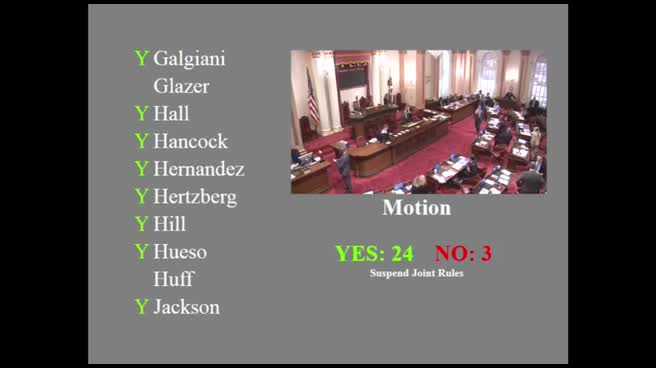 3MIN
Senate Floor
 9MIN
Senate Standing Committee on Appropriations
 5MIN
Senate Standing Committee on Transportation and Housing
 3MIN
Assembly Floor
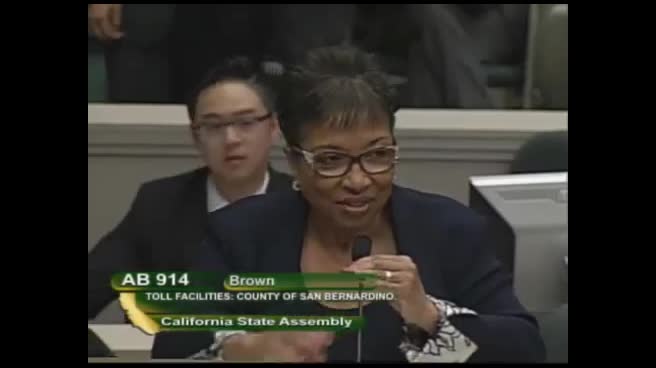 8MIN
Assembly Standing Committee on Transportation
Bill Author

Bill Co-Author(s):