AB 1008: Employment discrimination: conviction history.
- Session Year: 2017-2018
- House: Assembly
- Latest Version Date: 2017-10-14
Existing law, the California Fair Employment and Housing Act (FEHA), prohibits an employer from engaging in various defined forms of discriminatory employment practices.
Existing law prohibits an employer, whether a public agency or private individual or corporation, from asking an applicant for employment to disclose, or from utilizing as a factor in determining any condition of employment, information concerning an arrest or detention that did not result in a conviction, or information concerning a referral or participation in, any pretrial or posttrial diversion program, except as specified. Existing law also prohibits a state or local agency from asking an applicant for employment to disclose information regarding a criminal conviction, except as specified, until the agency has determined the applicant meets the minimum employment qualifications for the position.
This bill would repeal the prohibition on a state or local agency from asking an applicant for employment to disclose information regarding a criminal conviction, as described above. The bill would, instead, provide it is an unlawful employment practice under FEHA for an employer with 5 or more employees to include on any application for employment any question that seeks the disclosure of an applicants conviction history, to inquire into or consider the conviction history of an applicant until that applicant has received a conditional offer, and, when conducting a conviction history background check, to consider, distribute, or disseminate information related to specified prior arrests, diversions, and convictions.
This bill would also require an employer who intends to deny an applicant a position of employment solely or in part because of the applicants conviction history to make an individualized assessment of whether the applicants conviction history has a direct and adverse relationship with the specific duties of the job, and to consider certain topics when making that assessment. The bill would require an employer who makes a preliminary decision to deny employment based on that individualized assessment to provide the applicant written notification of the decision. The bill would require the notification to contain specified information. The bill would grant an applicant 5 business days to respond to that notification before the employer may make a final decision. If the applicant notifies the employer in writing that he or she disputes the accuracy of the conviction history and is obtaining evidence to support that assertion, the bill would grant the applicant an additional 5 business days to respond to the notice. The bill would require an employer to consider information submitted by the applicant before making a final decision. The bill would require an employer who has made a final decision to deny employment to the applicant to notify the applicant in writing of specified topics. The bill would exempt specified positions of employment from the provisions of the bill.
Existing law, the California Fair Employment and Housing Act (FEHA), prohibits an employer from engaging in various defined forms of discriminatory employment practices.
Existing law prohibits an employer, whether a public agency or private individual or corporation, from asking an applicant for employment to disclose, or from utilizing as a factor in determining any condition of employment, information concerning an arrest or detention that did not result in a conviction, or information concerning a referral or participation in, any pretrial or posttrial diversion program, except as specified. Existing law also prohibits a state or local agency from asking an applicant for employment to disclose information regarding a criminal conviction, except as specified, until the agency has determined the applicant meets the minimum employment qualifications for the position.
This bill would repeal the prohibition on a state or local agency from asking an applicant for employment to disclose information regarding a criminal conviction, as described above. The bill would, instead, provide it is an unlawful employment practice under FEHA for an employer with 5 or more employees to include on any application for employment any question that seeks the disclosure of an applicants conviction history, to inquire into or consider the conviction history of an applicant until that applicant has received a conditional offer, and, when conducting a conviction history background check, to consider, distribute, or disseminate information related to specified prior arrests, diversions, and convictions.
This bill would also require an employer who intends to deny an applicant a position of employment solely or in part because of the applicants prior conviction of a crime history to make an individualized assessment of whether the applicants conviction history has a direct and adverse relationship with the specific duties of the job, and to consider certain topics when making that assessment. The bill would require an employer who makes a preliminary decision to deny employment based on that individualized assessment to provide the applicant written notification of the decision. The bill would require the notification to contain specified information. The bill would grant an applicant 5 business days to respond to that notification before the employer may make a final decision. If the applicant notifies the employer in writing that he or she disputes the accuracy of the conviction history and is obtaining evidence to support that assertion, the bill would grant the applicant an additional 5 business days to respond to the notice. The bill would require an employer to consider information submitted by the applicant before making a final decision. The bill would require an employer who has made a final decision to deny employment to the applicant to notify the applicant in writing of specified topics. The bill would exempt specified positions of employment from the provisions of the bill.
Existing law, the California Fair Employment and Housing Act (FEHA), prohibits an employer from engaging in various defined forms of discriminatory employment practices.
Existing law prohibits an employer, whether a public agency or private individual or corporation, from asking an applicant for employment to disclose, or from utilizing as a factor in determining any condition of employment, information concerning an arrest or detention that did not result in a conviction, or information concerning a referral or participation in, any pretrial or posttrial diversion program, except as specified. Existing law also prohibits a state or local agency from asking an applicant for employment to disclose information regarding a criminal conviction, except as specified, until the agency has determined the applicant meets the minimum employment qualifications for the position.
This bill would repeal the prohibition on a state or local agency from asking an applicant for employment to disclose information regarding a criminal conviction, as described above. The bill would, instead, provide it is an unlawful employment practice under FEHA for an employer with 5 or more employees to include on any application for employment any question that seeks the disclosure of an applicants criminal conviction history, to inquire into or consider the conviction history of an applicant until that applicant has received a conditional offer, and, when conducting a conviction history background check, to consider, distribute, or disseminate information related to specified prior arrests, diversions, and convictions.
This bill would also require an employer who intends to deny an applicant a position of employment solely or in part because of the applicants prior conviction of a crime to make an individualized assessment of whether the applicants conviction history has a direct and adverse relationship with the specific duties of the job, and to consider certain topics when making that assessment. The bill would require an employer who makes a preliminary decision to deny employment based on that individualized assessment to provide the applicant written notification of the decision. The bill would require the notification to contain specified information. The bill would grant an applicant 5 business days to respond to that notification before the employer may make a final decision. If the applicant notifies the employer in writing that he or she disputes the accuracy of the conviction history and is obtaining evidence to support that assertion, the bill would grant the applicant an additional 5 business days to respond to the notice. The bill would require an employer to consider information submitted by the applicant before making a final decision. The bill would require an employer who has made a final decision to deny employment to the applicant to notify the applicant in writing of specified topics. The bill would exempt specified positions of employment from the provisions of the bill.
Existing law, the California Fair Employment and Housing Act (FEHA), prohibits an employer from engaging in various defined forms of discriminatory employment practices.
Existing law prohibits an employer, whether a public agency or private individual or corporation, from asking an applicant for employment to disclose, or from utilizing as a factor in determining any condition of employment, information concerning an arrest or detention that did not result in a conviction, or information concerning a referral or participation in, any pretrial or postural posttrial diversion program, except as specified. Existing law also prohibits a state or local agency from asking an applicant for employment to disclose information regarding a criminal conviction, except as specified, until the agency has determined the applicant meets the minimum employment qualifications for the position.
This bill would repeal the prohibition on a state or local agency from asking an applicant for employment to disclose information regarding a criminal conviction, as described above. The bill would, instead, provide it is an unlawful employment practice under FEHA for an employer with 5 or more employees to include on any application for employment any question that seeks the disclosure of an applicants criminal history, to inquire into or consider the conviction history of an applicant until that applicant has received a conditional offer, and, when conducting a conviction history background check, to consider, distribute, or disseminate specified information related to specified prior criminal convictions, except as provided. arrests, diversions, and convictions.
This bill would also require an employer who intends to deny an application applicant a position of employment solely or in part because of the applicants prior conviction of a crime to make an individualized assessment of whether the applicants conviction history has a direct and adverse relationship with the specific duties of the job, and to consider certain topics when making that assessment. The bill would require that, if an employer who makes a preliminary determination decision to deny employment based on that individualized assessment to deny the applicant employment, the employer must notify to provide the applicant of the reasons for that preliminary written notification of the decision. The bill would require the notification to contain specified information. The bill would authorize grant an applicant 5 business days to respond to that notification within 10 days with information that challenges the accuracy of the information in the notification or that includes specified mitigation or rehabilitation evidence. before the employer may make a final decision. If the applicant notifies the employer in writing that he or she disputes the accuracy of the conviction history and is obtaining evidence to support that assertion, the bill would grant the applicant an additional 5 business days to respond to the notice. The bill would require an employer to consider information submitted by the applicant before making a final decision. The bill would require an employer who has made a final decision to deny employment to the applicant to notify the applicant in writing of specified topics. The bill would exempt specified positions of employment from the provisions of the bill.
Existing law, the California Fair Employment and Housing Act (FEHA), prohibits an employer from engaging in various defined forms of discriminatory employment practices.
Existing law prohibits an employer, whether a public agency or private individual or corporation, from asking an applicant for employment to disclose, or from utilizing as a factor in determining any condition of employment, information concerning an arrest or detention that did not result in a conviction, or information concerning a referral or participation in, any pretrial or postural diversion program, except as specified. Existing law also prohibits a state or local agency from asking an applicant for employment to disclose information regarding a criminal conviction, except as specified, until the agency has determined the applicant meets the minimum employment qualifications for the position.
This bill would repeal the prohibition on a state or local agency from asking an applicant for employment to disclose information regarding a criminal conviction, as described above. The bill would, instead, provide it is an unlawful employment practice under FEHA for an employer to include on any application for employment any question that seeks the disclosure of an applicants criminal history, to inquire into or consider the conviction history of an applicant until that applicant has received a conditional offer, and, when conducting a conviction history background check, to consider, distribute, or disseminate specified information related to prior criminal convictions, except as provided.
This bill would also require an employer who intends to deny an application a position of employment solely or in part because of the applicants prior conviction of a crime to make an individualized assessment of whether the applicants conviction history has a direct and adverse relationship with the specific duties of the job, and to consider certain topics when making that assessment. The bill would require that, if an employer makes a preliminary determination based on that individualized assessment to deny the applicant employment, the employer must notify the applicant of the reasons for that preliminary decision. The bill would authorize an applicant to respond to that notification within 10 days with information that challenges the accuracy of the information in the notification or that includes specified mitigation or rehabilitation evidence. The bill would require an employer to consider information submitted by the applicant before making a final decision. The bill would require an employer who has made a final decision to deny employment to the applicant to notify the applicant in writing of specified topics. The bill would exempt specified positions of employment from the provisions of the bill.
Existing law, the California Fair Employment and Housing Act, Act (FEHA), prohibits an employer from engaging in various defined forms of discriminatory employment practices.
Existing law prohibits an employer, whether a public agency or private individual or corporation, from asking an applicant for employment to disclose, or from utilizing as a factor in determining any condition of employment, information concerning an arrest or detention that did not result in a conviction, or information concerning a referral or participation in, any pretrial or postural diversion program, except as specified. Existing law also prohibits a state or local agency from asking an applicant for employment to disclose information regarding a criminal conviction, except as specified, until the agency has determined the applicant meets the minimum employment qualifications for the position.
This bill would repeal the prohibition on a state or local agency from asking an applicant for employment to disclose information regarding a criminal conviction, as described above. The bill would, instead, provide it is an unlawful employment practice under FEHA for an employer to include on any application for employment any question that seeks the disclosure of an applicants criminal history, to inquire into or consider the conviction history of an applicant until that applicant has received a conditional offer, and, when conducting a conviction history background check, to consider, distribute, or disseminate specified information related to prior criminal convictions, except as provided.
This bill would also require an employer who intends to deny an application a position of employment solely or in part because of the applicants prior conviction of a crime to make an individualized assessment of whether the applicants conviction history has a direct and adverse relationship with the specific duties of the job, and to consider certain topics when making that assessment. The bill would require that, if an employer makes a preliminary determination based on that individualized assessment to deny the applicant employment, the employer must notify the applicant of the reasons for that preliminary decision. The bill would authorize an applicant to respond to that notification within 10 days with information that challenges the accuracy of the information in the notification or that includes specified mitigation or rehabilitation evidence. The bill would require an employer to consider information submitted by the applicant before making a final decision. The bill would require an employer who has made a final decision to deny employment to the applicant to notify the applicant in writing of specified topics. The bill would exempt specified positions of employment from the provisions of the bill.
Existing law, the California Fair Employment and Housing Act, prohibits an employer from engaging in various defined forms of discriminatory employment practices.
Existing law prohibits an employer, whether a public agency or private individual or corporation, from asking an applicant for employment to disclose, or from utilizing as a factor in determining any condition of employment, information concerning an arrest or detention that did not result in a conviction, or information concerning a referral or participation in, any pretrial or postural diversion program, except as specified.
This bill would provide it is an unlawful employment practice for an employer to include on any application for employment any question that seeks the disclosure of an applicants criminal history, to inquire into or consider the conviction history of an applicant until that applicant has received a conditional offer, and, when conducting a conviction history background check, to consider, distribute, or disseminate specified information related to prior criminal convictions, except as provided.
This bill would also require an employer who intends to deny an application a position of employment solely or in part because of the applicants prior conviction of a crime to make an individualized assessment of whether the applicants conviction history has a direct and adverse relationship with the specific duties of the job, and to consider certain topics when making that assessment. The bill would require that, if an employer makes a preliminary determination based on that individualized assessment to deny the applicant employment, the employer must notify the applicant of the reasons for that preliminary decision. The bill would authorize an applicant to respond to that notification within 10 days with information that challenges the accuracy of the information in the notification or that includes specified mitigation or rehabilitation evidence. The bill would require an employer to consider information submitted by the applicant before making a final decision. The bill would require an employer who has made a final decision to deny employment to the applicant to notify the applicant in writing of specified topics.
The Legislature finds and declares all of the following:
(a)In 2013, the State of California passed historic legislation to reduce barriers to employment for people with conviction histories, and to decrease unemployment in communities with concentrated numbers of people with conviction histories, recognizing that these barriers are matters of statewide concern. The Ban the Box law passed in 2013 applied to state agencies, all cities and counties, including charter cities and charter counties, and special districts.
(b)In 2015, President Obama directed all federal agencies to Ban the Box and refrain from asking applicants about their convictions on the initial job application.
(c)Nationwide, 29 states and over 150 cities and counties have adopted a Ban the Box law, and over 300 companies have signed the White House Fair Chance hiring pledge.
(d)Nine states and 15 major cities, including Los Angeles and San Francisco, have adopted fair chance hiring laws that cover both public and private sector employers. Over 20 percent of the United States population now lives in a state or locality that prohibits private employers from inquiring into an applicants record at the start of the hiring process.
(e)Since 2013, when Assembly Bill 218 was signed into law, five states have adopted fair chance hiring laws that cover private employers, Connecticut, Illinois, New Jersey, Oregon, and Vermont, as well as several major cities, including Baltimore, New York City, Philadelphia, and Austin, Texas.
(f)Roughly seven million Californians, or nearly one in three adults, have an arrest or conviction record that can significantly undermine their efforts to obtain gainful employment.
(g)Experts have found that employment is essential to helping formerly incarcerated people support themselves and their families, that a job develops prosocial behavior, strengthens community ties, enhances self-esteem, and improves mental health, all of which reduce recidivism. These effects are strengthened the longer the person holds the job, and especially when it pays more than minimum wage.
(h)Experts have found that people with conviction records have lower rates of turnover and higher rates of promotion on the job and that the personal contact with potential employees can reduce the negative stigma of a conviction by approximately 15 percent.
SEC. 2.Section 12952 is added to the Government Code, to read:12952.(a)Except as provided in subdivision (d), it is an unlawful employment practice for an employer with five or more employees to do any of the following:
(1)To include on any application for employment, before the employer makes a conditional offer of employment to the applicant, any question that seeks the disclosure of an applicants conviction history.
(2)To inquire into or consider the conviction history of the applicant, including any inquiry about conviction history on any employment application, until after the employer has made a conditional offer of employment to the applicant.
(3)To consider, distribute, or disseminate information about any of the following while conducting a conviction history background check in connection with any application for employment:
(A)Arrest not followed by conviction, except in the circumstances as permitted in paragraph (1) of subdivision (a) and subdivision (f) of Section 432.7 of the Labor Code.
(B)Referral to or participation in a pretrial or posttrial diversion program.
(C)Convictions that have been sealed, dismissed, expunged, or statutorily eradicated pursuant to law.
(4)To interfere with, restrain, or deny the exercise of, or the attempt to exercise, any right provided under this section.
(b)This section shall not be construed to prevent an employer from conducting a conviction history background check not in conflict with the provisions of subdivision (a).
(c)(1)(A)An employer that intends to deny an applicant a position of employment solely or in part because of the applicants conviction history shall make an individualized assessment of whether the applicants conviction history has a direct and adverse relationship with the specific duties of the job that justify denying the applicant the position. In making the assessment described in this paragraph, the employer shall consider all of the following:
(i)The nature and gravity of the offense or conduct.
(ii)The time that has passed since the offense or conduct and completion of the sentence.
(iii)The nature of the job held or sought.
(B)An employer may, but is not required to, commit the results of this individualized assessment to writing.
(2)If the employer makes a preliminary decision that the applicants conviction history disqualifies the applicant from employment, the employer shall notify the applicant of this preliminary decision in writing. That notification may, but is not required to, justify or explain the employers reasoning for making the preliminary decision. The notification shall contain all of the following:
(A)Notice of the disqualifying conviction or convictions that are the basis for the preliminary decision to rescind the offer.
(B)A copy of the conviction history report, if any.
(C)An explanation of the applicants right to respond to the notice of the employers preliminary decision before that decision becomes final and the deadline by which to respond. The explanation shall inform the applicant that the response may include submission of evidence challenging the accuracy of the conviction history report that is the basis for rescinding the offer, evidence of rehabilitation or mitigating circumstances, or both.
(3)The applicant shall have at least five business days to respond to the notice provided to the applicant under paragraph (2) before the employer may make a final decision. If, within the five business days, the applicant notifies the employer in writing that the applicant disputes the accuracy of the conviction history report that was the basis for the preliminary decision to rescind the offer and that the applicant is taking specific steps to obtain evidence supporting that assertion, then the applicant shall have five additional business days to respond to the notice.
(4)The employer shall consider information submitted by the applicant pursuant to paragraph (3) before making a final decision.
(5)If an employer makes a final decision to deny an application solely or in part because of the applicants conviction history, the employer shall notify the applicant in writing of all the following:
(A)The final denial or disqualification. The employer may, but is not required to, justify or explain the employers reasoning for making the final denial or disqualification.
(B)Any existing procedure the employer has for the applicant to challenge the decision or request reconsideration.
(C)The right to file a complaint with the department.
(d)This section does not apply in any of the following circumstances:
(1)To a position for which a state or local agency is otherwise required by law to conduct a conviction history background check.
(2)To a position with a criminal justice agency, as defined in Section 13101 of the Penal Code.
(3)To a position as a Farm Labor Contractor, as described in Section 1685 of the Labor Code.
(4)To a position where an employer or agent thereof is required by any state, federal, or local law to conduct criminal background checks for employment purposes or to restrict employment based on criminal history. For purposes of this paragraph, federal law shall include rules or regulations promulgated by a self-regulatory organization as defined in Section 3(a)(26) of the Securities Exchange Act of 1934, as amended by 124 Stat. 1652 (Public Law 111-203), pursuant to the authority in Section 19(b) of the Securities Exchange Act of 1934, as amended by 124 Stat. 1652 (Public Law 111-203).
(e)The remedies under this section shall be in addition to and not in derogation of all other rights and remedies that an applicant may have under any other law, including any local ordinance.
(f)For purposes of this section:
(1)Conviction has the same meaning as defined in paragraphs (1) and (3) of subdivision (a) of Section 432.7 of the Labor Code.
(2)Notwithstanding paragraph (1), the term conviction history includes:
(A)An arrest not resulting in conviction only in the specific, limited circumstances described in subdivision (f) of Section 432.7 of the Labor Code, when an employer at a health facility, as defined in Section 1250 of the Health and Safety Code, may ask an applicant for certain positions about specified types of arrests.
(B)An arrest for which an individual is out on bail or his or her own recognizance pending trial.
SEC. 3.Section 432.9 of the Labor Code is repealed.The Legislature finds and declares all of the following:
(a)In 2013, the State of California passed historic legislation to reduce barriers to employment for people with conviction histories, and to decrease unemployment in communities with concentrated numbers of people with conviction histories, recognizing that these barriers are matters of statewide concern. The Ban the Box law passed in 2013 applied to state agencies, all cities and counties, including charter cities and charter counties, and special districts.
(b)In 2015, President Obama directed all federal agencies to Ban the Box and refrain from asking applicants about their convictions on the initial job application.
(c)Nationwide, 29 states and over 150 cities and counties have adopted a Ban the Box law, and over 300 companies have signed the White House Fair Chance hiring pledge.
(d)Nine states and 15 major cities, including Los Angeles and San Francisco, have adopted fair chance hiring laws that cover both public and private sector employers. Over 20 percent of the United States population now lives in a state or locality that prohibits private employers from inquiring into an applicants record at the start of the hiring process.
(e)Since 2013, when Assembly Bill 218 was signed into law, five states have adopted fair chance hiring laws that cover private employers, Connecticut, Illinois, New Jersey, Oregon, and Vermont, as well as several major cities, including Baltimore, New York City, Philadelphia, and Austin, Texas.
(f)Roughly seven million Californians, or nearly one in three adults, have an arrest or conviction record that can significantly undermine their efforts to obtain gainful employment.
(g)Experts have found that employment is essential to helping formerly incarcerated people support themselves and their families, that a job develops prosocial behavior, strengthens community ties, enhances self-esteem, and improves mental health, all of which reduce recidivism. These effects are strengthened the longer the person holds the job, and especially when it pays more than minimum wage.
(h)Experts have found that people with conviction records have lower rates of turnover and higher rates of promotion on the job and that the personal contact with potential employees can reduce the negative stigma of a conviction by approximately 15 percent.
SEC. 2.Section 12952 is added to the Government Code, to read:12952.(a)Except as provided in subdivision (d), it is an unlawful employment practice for an employer with five or more employees to do any of the following:
(1)To include on any application for employment, before the employer makes a conditional offer of employment to the applicant, any question that seeks the disclosure of an applicants conviction history.
(2)To inquire into or consider the conviction history of the applicant, including any inquiry about conviction history on any employment application, until after the employer has made a conditional offer of employment to the applicant.
(3)To consider, distribute, or disseminate information about any of the following while conducting a conviction history background check in connection with any application for employment:
(A)Arrest not followed by conviction, except that an employer at a health facility, as defined in Section 1250 of the Health and Safety Code, may ask an applicant for employment for this information only in the specific, limited circumstances described in the circumstances as permitted in paragraph (1) of subdivision (a) and subdivision (f) of Section 432.7 of the Labor Code.
(B)Referral to or participation in a pretrial or posttrial diversion program.
(C)Convictions that have been sealed, dismissed, expunged, or statutorily eradicated pursuant to law.
(4)To interfere with, restrain, or deny the exercise of, or the attempt to exercise, any right provided under this section.
(b)This section shall not be construed to prevent an employer from conducting a conviction history background check not in conflict with the provisions of subdivision (a).
(c)(1)(A)An employer that intends to deny an applicant a position of employment solely or in part because of the applicants prior conviction of a crime history shall make an individualized assessment of whether the applicants conviction history has a direct and adverse relationship with the specific duties of the job that justify denying the applicant the position. In making the assessment described in this paragraph, the employer shall consider all of the following:
(i)The nature and gravity of the offense or conduct.
(ii)The time that has passed since the offense or conduct and completion of the sentence.
(iii)The nature of the job held or sought.
(B)An employer may, but is not required to, commit the results of this individualized assessment to writing.
(2)If the employer makes a preliminary decision that the applicants conviction history disqualifies the applicant from employment, the employer shall notify the applicant of this preliminary decision in writing. That notification may, but is not required to, justify or explain the employers reasoning for making the preliminary decision. The notification shall contain all of the following:
(A)Notice of the disqualifying conviction or convictions that are the basis for the preliminary decision to rescind the offer.
(B)A copy of the conviction history report, if any.
(C)An explanation of the applicants right to respond to the notice of the employers preliminary decision before that decision becomes final and the deadline by which to respond. The explanation shall inform the applicant that the response may include submission of evidence challenging the accuracy of the conviction history report that is the basis for rescinding the offer, evidence of rehabilitation or mitigating circumstances, or both.
(3)The applicant shall have at least five business days to respond to the notice provided to the applicant under paragraph (2) before the employer may make a final decision. If, within the five business days, the applicant notifies the employer in writing that the applicant disputes the accuracy of the conviction history report that was the basis for the preliminary decision to rescind the offer and that the applicant is taking specific steps to obtain evidence supporting that assertion, then the applicant shall have five additional business days to respond to the notice.
(4)The employer shall consider information submitted by the applicant pursuant to paragraph (3) before making a final decision.
(5)If an employer makes a final decision to deny an application solely or in part because of the applicants prior conviction of a crime, history, the employer shall notify the applicant in writing of all the following:
(A)The final denial or disqualification. The employer may, but is not required to, justify or explain the employers reasoning for making the final denial or disqualification.
(B)Any existing procedure the employer has for the applicant to challenge the decision or request reconsideration.
(C)The right to file a complaint with the department.
(d)This section does not apply in any of the following circumstances:
(1)To a position for which a state or local agency is otherwise required by law to conduct a conviction history background check.
(2)To a position with a criminal justice agency, as defined in Section 13101 of the Penal Code.
(3)To a position as a Farm Labor Contractor, as described in Section 1685 of the Labor Code.
(4)To a position where an employer or agent thereof is required by any state, federal, or local law to conduct criminal background checks for employment purposes or to restrict employment based on criminal history. For purposes of this paragraph, federal law shall include rules or regulations promulgated by a self-regulatory organization as defined in Section 3(a)(26) of the Securities Exchange Act of 1934, as amended by 124 Stat. 1652 (Public Law 111-203), pursuant to the authority in Section 19(b) of the Securities Exchange Act of 1934, as amended by 124 Stat. 1652 (Public Law 111-203).
(e)The remedies under this section shall be in addition to and not in derogation of all other rights and remedies that an applicant may have under any other law, including any local ordinance.
(f)(1)For purposes of this section, conviction section:
(1)Conviction has the same meaning as defined in paragraphs (1) and (3) of subdivision (a) of Section 432.7 of the Labor Code.
(2)Notwithstanding paragraph (1), the term conviction history includes an includes:
(A)An arrest not resulting in conviction only in the specific, limited circumstances described in subdivision (f) of Section 432.7 of the Labor Code, when an employer at a health facility, as defined in Section 1250 of the Health and Safety Code, may ask an applicant for certain positions about specified types of arrests.
(B)An arrest for which an individual is out on bail or his or her own recognizance pending trial.
SEC. 3.Section 432.9 of the Labor Code is repealed.The Legislature finds and declares all of the following:
(a)In 2013, the State of California passed historic legislation to reduce barriers to employment for people with conviction histories, and to decrease unemployment in communities with concentrated numbers of people with conviction histories, recognizing that these barriers are matters of statewide concern. The Ban the Box law passed in 2013 applied to state agencies, all cities and counties, including charter cities and charter counties, and special districts.
(b)In 2015, President Obama directed all federal agencies to Ban the Box and refrain from asking applicants about their convictions on the initial job application.
(c)Nationwide, 24 29 states and over 150 cities and counties have adopted a Ban the Box law, and over 300 companies have signed the White House Fair Chance hiring pledge.
(d)Nine states and 15 major cities, including Los Angeles and San Francisco, have adopted fair chance hiring laws that cover both public and private sector employers. Over 20 percent of the United States population now lives in a state or locality that prohibits private employers from inquiring into an applicants record at the start of the hiring process.
(e)Since 2013, when Assembly Bill 218 was signed into law, five states have adopted fair chance hiring laws that cover private employers, Connecticut, Illinois, New Jersey, Oregon, and Vermont, as well as several major cities, including Baltimore, New York City, Philadelphia, and Austin, Texas.
(f)Roughly seven million Californians, or nearly one in three adults, have an arrest or conviction record that can significantly undermine their efforts to obtain gainful employment.
(g)Experts have found that employment is essential to helping formerly incarcerated people support themselves and their families, that a job develops prosocial behavior, strengthens community ties, enhances self-esteem, and improves mental health, all of which reduce recidivism. These effects are strengthened the longer the person holds the job, and especially when it pays more than minimum wage.
(h)Experts have found that people with criminal conviction records have lower rates of turnover and higher rates of promotion on the job and that the personal contact with potential employees can reduce the negative stigma of a conviction by approximately 15 percent.
SEC. 2.Section 12952 is added to the Government Code, to read:12952.(a)Except as provided in subdivision (d), it is an unlawful employment practice for an employer with five or more employees to do any of the following:
(1)To include on any application for employment employment, before the employer makes a conditional offer of employment to the applicant, any question that seeks the disclosure of an applicants criminal conviction history.
(2)To inquire into or consider the conviction history of the applicant, including any inquiry about conviction history on any employment application, until after the applicant employer has received made a conditional offer. offer of employment to the applicant.
(3)To consider, distribute, or disseminate information about any of the following while conducting a conviction history background check in connection with any application for employment:
(A)Arrest not followed by conviction. conviction, except that an employer at a health facility, as defined in Section 1250 of the Health and Safety Code, may ask an applicant for employment for this information only in the specific, limited circumstances described in subdivision (f) of Section 432.7 of the Labor Code.
(B)Referral to or participation in a pretrial or posttrial diversion program.
(C)Convictions that have been sealed, dismissed, expunged, or statutorily eradicated pursuant to law.
(4)To interfere with, restrain, or deny the exercise of, or the attempt to exercise, any right provided under this section.
(b)This section shall not be construed to prevent an employer from conducting a conviction history background check not in conflict with the provisions of subdivision (a).
(c)(1)(A)An employer that intends to deny an applicant a position of employment solely or in part because of the applicants prior conviction of a crime shall make an individualized assessment of whether the applicants conviction history has a direct and adverse relationship with the specific duties of the job that justify denying the applicant the position. In making the assessment described in this paragraph, the employer shall consider all of the following:
(i)The nature and gravity of the offense or conduct.
(ii)The time that has passed since the offense or conduct and completion of the sentence.
(iii)The nature of the job held or sought.
(B)An employer may, but is not required to, commit the results of this individualized assessment to writing.
(2)If the employer makes a preliminary decision that the applicants conviction history disqualifies the applicant from employment, the employer shall notify the applicant of this preliminary decision in writing. That notification may, but is not required to, justify or explain the employers reasoning for making the preliminary decision. The notification shall contain all of the following:
(A)An identification Notice of the disqualifying conviction or convictions that are the basis for the preliminary decision to rescind the offer.
(B)A copy of the conviction history report, if any.
(C)An explanation of the applicants right to respond to the notice of the employers preliminary decision before that decision becomes final and the deadline by which to respond. The explanation shall inform the applicant that the response may include submission of evidence challenging the accuracy of the conviction history report that is the basis for rescinding the offer, evidence of rehabilitation or mitigating circumstances, or both.
(3)The applicant shall have at least five business days to respond to the notice provided to the applicant under paragraph (2) before the employer may make a final decision. If, within the five business days, the applicant notifies the employer in writing that the applicant disputes the accuracy of the conviction history report that was the basis for the preliminary decision to rescind the offer and that the applicant is taking specific steps to obtain evidence supporting that assertion, then the applicant shall have five additional business days to respond to the notice.
(4)The employer shall consider information submitted by the applicant pursuant to paragraph (3) before making a final decision.
(5)If an employer makes a final decision to deny an application solely or in part because of the applicants prior conviction of a crime, the employer shall notify the applicant in writing of all the following:
(A)The final denial or disqualification. The employer may, but is not required to, justify or explain the employers reasoning for making the final denial or disqualification.
(B)Any existing procedure the employer has for the applicant to challenge the decision or request reconsideration.
(C)The right to file a complaint with the department.
(d)This section does not apply in any of the following circumstances:
(1)To a position for which a state or local agency is otherwise required by law to conduct a conviction history background check.
(2)To a position with a criminal justice agency, as defined in Section 13101 of the Penal Code.
(3)To a position as a Farm Labor Contractor, as described in Section 1685 of the Labor Code.
(4)To a position where an employer or agent thereof is required by any state, federal, or local law to conduct criminal background checks for employment purposes or to restrict employment based on criminal history. For purposes of this paragraph, federal law shall include rules or regulations promulgated by a self-regulatory organization as defined in Section 3(a)(26) of the Securities Exchange Act of 1934, as amended by 124 Stat. 1652 (Public Law 111-203), pursuant to the authority in Section 19(b) of the Securities Exchange Act of 1934, as amended by 124 Stat. 1652 (Public Law 111-203).
(e)The remedies under this section shall be in addition to and not in derogation of all other rights and remedies that an applicant may have under any other law, including any local ordinance.
(f)(1)For purposes of this section, conviction has the same meaning as defined in paragraphs (1) and (3) of subdivision (a) of Section 432.7 of the Labor Code.
(2)Notwithstanding paragraph (1), the term conviction history includes an arrest not resulting in conviction only in the specific, limited circumstances described in subdivision (f) of Section 432.7 of the Labor Code, when an employer at a health facility, as defined in Section 1250 of the Health and Safety Code, may ask an applicant for certain positions about specified types of arrests.
SEC. 3.Section 432.9 of the Labor Code is repealed.The Legislature finds and declares all of the following:
(a)In 2013, the State of California passed historic legislation to reduce barriers to employment for people with conviction histories, and to decrease unemployment in communities with concentrated numbers of people with conviction histories, recognizing that these barriers are matters of statewide concern. The Ban the Box law passed in 2013 applied to state agencies, all cities and counties, including charter cities and charter counties, and special districts.
(b)In 2015, President Obama directed all federal agencies to Ban the Box and refrain from asking applicants about their convictions on the initial job application.
(c)Nationwide, 24 states and over 150 cities and counties have adopted a Ban the Box law, and over 300 companies have signed the White House Fair Chance hiring pledge.
(d)Nine states and 15 major cities, including Los Angeles and San Francisco, have adopted fair chance hiring laws that cover both public and private sector employers. Over 20 percent of the United States population now lives in a state or locality that prohibits private employers from inquiring into an applicants record at the start of the hiring process.
(e)Since 2013, when Assembly Bill 218 was signed into law, five states have adopted fair chance hiring laws that cover private employers, Connecticut, Illinois, New Jersey, Oregon, and Vermont, as well as several major cities, including Baltimore, New York City, Philadelphia, and Austin, Texas.
(f)Roughly seven million Californians, or nearly one in three adults, have an arrest or conviction record that can significantly undermine their efforts to obtain gainful employment.
(g)Experts have found that employment is essential to helping formerly incarcerated people support themselves and their families, that a job develops prosocial behavior, strengthens community ties, enhances self-esteem, and improves mental health, all of which reduce recidivism. These effects are strengthened the longer the person holds the job, and especially when it pays more than minimum wage.
(h)Experts have found that people with criminal records have lower rates of turnover and higher rates of promotion on the job and that the personal contact with potential employees can reduce the negative stigma of a conviction by approximately 15 percent.
SEC. 2.Section 12952 is added to the Government Code, to read:12952.(a)Except as provided in subdivision (d), it is an unlawful employment practice for an employer with five or more employees to do any of the following:
(1)To include on any application for employment any question that seeks the disclosure of an applicants criminal history.
(2)To inquire into or consider the conviction history of the applicant, including any inquiry about conviction history on any employment application, until after the applicant has received a conditional offer.
(3)In To consider, distribute, or disseminate information about any of the following while conducting a conviction history background check in connection with any application for employment, to consider, distribute, or disseminate information on any of the following: employment:
(A)Arrest not followed by conviction.
(B)Referral to or participation in a pretrial or posttrial diversion program.
(C)Convictions that have been sealed, dismissed, expunged, or statutorily eradicated pursuant to law.
(D)Misdemeanor convictions for which no jail sentence can be imposed, or infractions.(E)Misdemeanor convictions for which three years have passed since the date of conviction, excluding any period of incarceration, or felony convictions for which seven years have passed since the date of conviction, excluding any period of incarceration.(4)To interfere with, restrain, or deny the exercise of, or the attempt to exercise, any right provided under this section.
(b)This section shall not be construed to prevent an employer from conducting a conviction history background check not in conflict with the provisions of subdivision (a).
(c)(1)(A)An employer that intends to deny an applicant a position of employment solely or in part because of the applicants prior conviction of a crime shall make an individualized assessment of whether the applicants conviction history has a direct and adverse relationship with the specific duties of the job that justify denying the applicant the position. In making the assessment described in this paragraph, the employer shall consider all of the following:
(i)The nature and gravity of the offense or conduct.
(ii)The time that has passed since the offense or conduct and completion of the sentence.
(iii)The nature of the job held or sought.
(B)In making the individualized assessment described in this paragraph, the employer shall be consistent with the Equal Employment Opportunity Commissions Consideration of Arrest and Conviction Records in Employment Decisions Under Title VII of the Civil Rights Act of 1964 (April 2012) and the regulations of the department.(B)An employer may, but is not required to, commit the results of this individualized assessment to writing.
(2)If the employer makes a preliminary decision that the applicants conviction history disqualifies him or her the applicant from employment, the employer shall notify the applicant of this preliminary decision in writing. That notification may, but is not required to, justify or explain the employers reasoning for making the preliminary decision. The notification shall contain all of the following:
(A)Identify the conviction item that is the basis for the potential denial or disqualification.(A)An identification of the conviction or convictions that are the basis for the preliminary decision to rescind the offer.
(B)Provide a A copy of the conviction history report, if any.
(C)Provide notice of the applicants right to respond as described in this section, and time limit to respond. That notice shall inform the applicant that his or her response may include information that challenges the accuracy of any information provided in the notice, or the submission of evidence of rehabilitation or mitigating circumstances, or both.(C)An explanation of the applicants right to respond to the notice of the employers preliminary decision before that decision becomes final and the deadline by which to respond. The explanation shall inform the applicant that the response may include submission of evidence challenging the accuracy of the conviction history report that is the basis for rescinding the offer, evidence of rehabilitation or mitigating circumstances, or both.
(3)The applicant shall have at least 10 five business days to respond to the notice provided to the applicant under paragraph (2) before the employer may make a final decision. If, within the five business days, the applicant notifies the employer in writing that the applicant disputes the accuracy of the conviction history report that was the basis for the preliminary decision to rescind the offer and that the applicant is taking specific steps to obtain evidence supporting that assertion, then the applicant shall have five additional business days to respond to the notice.
(4)The employer shall consider information submitted by the applicant pursuant to paragraph (3) before making a final decision.
(5)If an employer makes a final decision to deny an application solely or in part because of the applicants prior conviction of a crime, the employer shall notify the applicant in writing of all the following:
(A)The final denial or disqualification. The employer may, but is not required to, justify or explain the employers reasoning for making the final denial or disqualification.
(B)Any existing procedure the employer has for the applicant to challenge the decision or request reconsideration.
(C)The right to file a complaint with the department.
(d)This section does not apply in any of the following circumstances:
(1)To a position for which a state or local agency is otherwise required by law to conduct a conviction history background check.
(2)To a position with a criminal justice agency, as defined in Section 13101 of the Penal Code.
(3)To a position as a Farm Labor Contractor, as described in Section 1685 of the Labor Code.
(4)To a position where an employer or agent thereof is required to take an action pursuant to by any state, federal, or local law that requires to conduct criminal background checks for employment purposes or restricts to restrict employment based on criminal history. For purposes of this paragraph, federal law shall include rules or regulations promulgated by a self-regulatory organization as defined in Section 3(a)(26) of the Securities Exchange Act of 1934, as amended by 124 Stat. 1652 (Public Law 111-203), pursuant to the authority in Section 19(b) of the Securities Exchange Act of 1934, as amended by 124 Stat. 1652 (Public Law 111-203).
(e)The remedies under this section shall be in addition to and not in derogation of all other rights and remedies that an applicant may have under any other law, including any local ordinance.
SEC. 3.Section 432.9 of the Labor Code is repealed.The Legislature finds and declares all of the following:
(a)In 2013, the State of California passed historic legislation to reduce barriers to employment for people with conviction histories, and to decrease unemployment in communities with concentrated numbers of people with conviction histories, recognizing that these barriers are matters of statewide concern. The Ban the Box law passed in 2013 applied to state agencies, all cities and counties, including charter cities and charter counties, and special districts.
(b)In 2015, President Obama directed all federal agencies to Ban the Box and refrain from asking applicants about their convictions on the initial job application.
(c)Nationwide, 24 states and over 150 cities and counties have adopted a Ban the Box law, and over 300 companies have signed the White House Fair Chance hiring pledge.
(d)Nine states and 15 major cities, including Los Angeles and San Francisco, have adopted fair chance hiring laws that cover both public and private sector employers. Over 20 percent of the United States population now lives in a state or locality that prohibits private employers from inquiring into an applicants record at the start of the hiring process.
(e)Since 2013, when Assembly Bill 218 was signed into law, five states have adopted fair chance hiring laws that cover private employers, Connecticut, Illinois, New Jersey, Oregon, and Vermont, as well as several major cities, including Baltimore, New York City, Philadelphia, and Austin, Texas.
(f)Roughly seven million Californians, or nearly one in three adults, have an arrest or conviction record that can significantly undermine their efforts to obtain gainful employment.
(g)Experts have found that employment is essential to helping formerly incarcerated people support themselves and their families, that a job develops prosocial behavior, strengthens community ties, enhances self-esteem, and improves mental health, all of which reduce recidivism. These effects are strengthened the longer the person holds the job, and especially when it pays more than minimum wage.
(h)Experts have found that people with criminal records have lower rates of turnover and higher rates of promotion on the job and that the personal contact with potential employees can reduce the negative stigma of a conviction by approximately 15 percent.
SEC. 2.Section 12952 is added to the Government Code, to read:12952.(a)Except as provided in subdivision (d), it is an unlawful employment practice for an employer to do any of the following:
(1)To include on any application for employment any question that seeks the disclosure of an applicants criminal history.
(2)To inquire into or consider the conviction history of the applicant, including any inquiry about conviction history on any employment application, until after the applicant has received a conditional offer.
(3)In conducting a conviction history background check in connection with any application for employment, to consider, distribute, or disseminate information on any of the following:
(A)Arrest not followed by conviction.
(B)Referral to or participation in a pretrial or posttrial diversion program.
(C)Convictions that have been sealed, dismissed, expunged, or statutorily eradicated pursuant to law.
(D)Misdemeanor convictions for which no jail sentence can be imposed, or infractions.
(E)Misdemeanor convictions for which three years have passed since the date of conviction conviction, excluding any period of incarceration, or felony convictions for which seven years have passed since the date of conviction. conviction, excluding any period of incarceration.
(4)To interfere with, restrain, or deny the exercise of, or the attempt to exercise, any right provided under this section.
(b)This section shall not be construed to prevent an employer from conducting a conviction history background check not in conflict with the provisions of subdivision (a).
(c)(1)(A)An employer that intends to deny an applicant a position of employment solely or in part because of the applicants prior conviction of a crime must shall make an individualized assessment of whether the applicants conviction history has a direct and adverse relationship with the specific duties of the job that justify denying the applicant the position. In making the assessment described in this paragraph, the employer shall at least consider all of the following:
(i)The nature and gravity of the offense or conduct.
(ii)The time that has passed since the offense or conduct and completion of the sentence.
(iii)The nature of the job held or sought.
(B)In making the individualized assessment described in this paragraph, the employer shall be consistent with the Equal Employment Opportunity Commissions Consideration of Arrest and Conviction Records in Employment Decisions Under Title VII of the Civil Rights Act of 1964 (April 2012) and the regulations of the Department. department.
(2)If the employer makes a preliminary decision that the applicants conviction history disqualifies him or her from employment, the employer shall notify the applicant of this preliminary decision in writing. That notification shall contain all of the following:
(A)Identify the conviction item that is the basis for the potential denial or disqualification.
(B)Provide a copy of the conviction history report, if any.
(C)Provide examples of mitigation or rehabilitation evidence that the applicant may voluntarily provide.(D)(C)Provide notice of the applicants right to respond as described in this section, and time limit to respond. That notice shall inform the applicant that his or her response may include information that challenges the accuracy of any information provided in the notice, or the submission of evidence of rehabilitation or mitigating circumstances, or both.
(3)The applicant shall have at least 10 business days to respond to the notice provided to the applicant under paragraph (2) before the employer may make a final decision. That response may include information that challenges the accuracy of any information provided in the notice, or the submission of mitigation or rehabilitation evidence, or both. Evidence of mitigation or rehabilitation may be established by any of the following:
(A)Evidence showing that at least one year has elapsed since release from any correctional institution without subsequent conviction of a crime.(B)Evidence showing compliance with terms and conditions of probation or parole.(C)Any other evidence of mitigation or rehabilitation and present fitness provided, including, but not limited to, letters of reference.(4)The employer shall consider information submitted by the applicant pursuant to paragraph (3) before making a final decision.
(5)If an employer makes a final decision to deny an application solely or in part because of the applicants prior conviction of a crime, the employer shall notify the applicant in writing of all the following:
(A)The final denial or disqualification.
(B)Any existing procedure the employer has for the applicant to challenge the decision or request reconsideration.
(C)Whether the applicant may be eligible for other employment or occupation with the employer.(D)The earliest date the applicant may reapply for a position of employment.(E)(C)The right to file a complaint with the department.
(d)This section does not apply in any of the following circumstances:
(1)To a position for which a state or local agency is otherwise required by law to conduct a conviction history background check.
(2)To a position with a criminal justice agency, as defined in Section 13101 of the Penal Code.
(3)To a position as a Farm Labor Contractor, as described in Section 1685 of the Labor Code.
(4)To a position where an employer or agent thereof is required to take an action pursuant to any state, federal, or local law that requires criminal background checks for employment purposes or restricts employment based on criminal history. For purposes of this paragraph, federal law shall include rules or regulations promulgated by a self-regulatory organization as defined in Section 3(a)(26) of the Securities Exchange Act of 1934, as amended by 124 Stat. 1652 (Public Law 111-203), pursuant to the authority in Section 19(b) of the Securities Exchange Act of 1934, as amended by 124 Stat. 1652 (Public Law 111-203).
(e)The remedies under this section shall be in addition to and not in derogation of all other rights and remedies that an applicant may have under any other law, including any local ordinance.
SEC. 3.Section 432.9 of the Labor Code is repealed.The Legislature finds and declares all of the following:
(a)In 2013, the State of California passed historic legislation to reduce barriers to employment for people with conviction histories, and to decrease unemployment in communities with concentrated numbers of people with conviction histories, recognizing that these barriers are matters of statewide concern. The Ban the Box law passed in 2013 applied to state agencies, all cities and counties, including charter cities and charter counties, and special districts.
(b)In 2015, President Obama directed all federal agencies to Ban the Box and refrain from asking applicants about their convictions on the initial job application.
(c)Nationwide, 24 states and over 150 cities and counties have adopted a Ban the Box law, and over 300 companies have signed the White House Fair Chance hiring pledge.
(d)Nine states and 15 major cities, including Los Angeles and San Francisco, have adopted fair chance hiring laws that cover both public and private sector employers. Over 20 percent of the United States population now lives in a state or locality that prohibits private employers from inquiring into an applicants record at the start of the hiring process.
(e)Since 2013, when Assembly Bill 218 was signed into law, five states have adopted fair chance hiring laws that cover private employers, Connecticut, Illinois, New Jersey, Oregon, and Vermont, as well as several major cities, including Baltimore, New York City, Philadelphia, and Austin, Texas.
(f)Roughly seven million Californians, or nearly one in three adults, have an arrest or conviction record that can significantly undermine their efforts to obtain gainful employment.
(g)Experts have found that employment is essential to helping formerly incarcerated people support themselves and their families, that a job develops prosocial behavior, strengthens community ties, enhances self-esteem, and improves mental health, all of which reduce recidivism. These effects are strengthened the longer the person holds the job, and especially when it pays more than minimum wage.
(h)Experts have found that people with criminal records have lower rates of turnover and higher rates of promotion on the job and that the personal contact with potential employees can reduce the negative stigma of a conviction by approximately 15 percent.
SEC. 2.Section 12952 is added to the Government Code, to read:12952.(a)Except as provided in subdivision (d), it is an unlawful employment practice for an employer to do any of the following:
(1)To include on any application for employment any question that seeks the disclosure of an applicants criminal history.
(2)To inquire into or consider the conviction history of the applicant, including any inquiry about conviction history on any employment application, until after the applicant has received a conditional offer.
(3)In conducting a conviction history background check in connection with any application for employment, to consider, distribute, or disseminate information on any of the following:
(A)Arrest not followed by conviction.
(B)Referral to or participation in a pretrial or posttrial diversion program.
(C)Convictions that have been sealed, dismissed, expunged, or statutorily eradicated pursuant to law.
(D)Misdemeanor convictions for which no jail sentence can be imposed, or infractions.
(E)Misdemeanor convictions for which three years have passed since the date of conviction or felony convictions for which seven years have passed since the date of conviction.
(4)To interfere with, restrain, or deny the exercise of, or the attempt to exercise, any right provided under this section.
(b)This section shall not be construed to prevent an employer from conducting a conviction history background check not in conflict with the provisions of subdivision (a).
(c)(1)(A)An employer that intends to deny an applicant a position of employment solely or in part because of the applicants prior conviction of a crime must make an individualized assessment of whether the applicants conviction history has a direct and adverse relationship with the specific duties of the job that justify denying the applicant the position. In making the assessment described in this paragraph, the employer shall at least consider all of the following:
(i)The nature and gravity of the offense or conduct.
(ii)The time that has passed since the offense or conduct and completion of the sentence.
(iii)The nature of the job held or sought.
(B)In making the individualized assessment described in this paragraph, the employer shall be consistent with the Equal Employment Opportunity Commissions Consideration of Arrest and Conviction Records in Employment Decisions Under Title VII of the Civil Rights Act of 1964 (April 2012) and the regulations of the Department.
(2)If the employer makes a preliminary decision that the applicants conviction history disqualifies him or her from employment, the employer shall notify the applicant of this preliminary decision in writing. That notification shall contain all of the following:
(A)Identify the conviction item that is the basis for the potential denial or disqualification.
(B)Provide a copy of the conviction history report, if any.
(C)Provide examples of mitigation or rehabilitation evidence that the applicant may voluntarily provide.
(D)Provide notice of the applicants right to respond as described in this section, and time limit to respond.
(3)The applicant shall have at least 10 business days to respond to the notice provided to the applicant under paragraph (2) before the employer may make a final decision. That response may include information that challenges the accuracy of any information provided in the notice, or the submission of mitigation or rehabilitation evidence, or both. Evidence of mitigation or rehabilitation may be established by any of the following:
(A)Evidence showing that at least one year has elapsed since release from any correctional institution without subsequent conviction of a crime.
(B)Evidence showing compliance with terms and conditions of probation or parole.
(C)Any other evidence of mitigation or rehabilitation and present fitness provided, including, but not limited to, letters of reference.
(4)The employer shall consider information submitted by the applicant pursuant to paragraph (3) before making a final decision.
(5)If an employer makes a final decision to deny an application solely or in part because of the applicants prior conviction of a crime, the employer shall notify the applicant in writing of all the following:
(A)The final denial or disqualification.
(B)Any existing procedure the employer has to challenge the decision or request reconsideration.
(C)Whether the applicant may be eligible for other employment or occupation with the employer.
(D)The earliest date the applicant may reapply for a position of employment.
(E)The right to file a complaint with the department.
(d)(1)This section does not apply in any of the following circumstances:
(A)(1)To a position for which a state or local agency is otherwise required by law to conduct a conviction history background check.
(B)(2)To a position with a criminal justice agency, as defined in Section 13101 of the Penal Code.
(2)With regard to a position that federal or state law prohibits the employer from hiring an applicant who has been convicted of a particular crime, this section shall apply as follows:(A)Notwithstanding paragraphs (1) and (2) of subdivision (a), an employer may inquire, before a conditional offer is made, as to the conviction history of an applicant for only the particular crime that federal or state law prohibits the employer from hiring the applicant into that position, but the employer shall not inquire as to or consider the conviction history of the applicant for any other crime.(B)An employer is not required to comply with paragraph (3) of subdivision (a) for that position only to the extent that federal or state law requires the employer to consider, distribute, or disseminate the information described in paragraph (3) of subdivision (a) for that position.(C)An employer is not required to comply with paragraph (1) of subdivision (c) for that position. In that instance, the employer shall inform the applicant, in the notice described in paragraph (2) of subdivision (c), that a federal or state law prohibits the employer from hiring the applicant because of his or her conviction history.(3)To a position as a Farm Labor Contractor, as described in Section 1685 of the Labor Code.
(4)To a position where an employer or agent thereof is required to take an action pursuant to any state, federal, or local law that requires criminal background checks for employment purposes or restricts employment based on criminal history. For purposes of this paragraph, federal law shall include rules or regulations promulgated by a self-regulatory organization as defined in Section 3(a)(26) of the Securities Exchange Act of 1934, as amended by 124 Stat. 1652 (Public Law 111-203), pursuant to the authority in Section 19(b) of the Securities Exchange Act of 1934, as amended by 124 Stat. 1652 (Public Law 111-203).
(e)The remedies under this section shall be in addition to and not in derogation of all other rights and remedies that an applicant may have under any other law, including any local ordinance.
SEC. 3.Section 432.9 of the Labor Code is repealed.The Legislature finds and declares all of the following:
(a)In 2013, the State of California passed historic legislation to reduce barriers to employment for people with conviction histories, and to decrease unemployment in communities with concentrated numbers of people with conviction histories, recognizing that these barriers are matters of statewide concern. The Ban the Box law passed in 2013 applied to state agencies, all cities and counties, including charter cities and charter counties, and special districts.
(b)In 2015, President Obama directed all federal agencies to Ban the Box and refrain from asking applicants about their convictions on the initial job application.
(c)Nationwide, 24 states and over 150 cities and counties have adopted a Ban the Box law, and over 300 companies have signed the White House Fair Chance hiring pledge.
(d)Nine states and 15 major cities, including Los Angeles and San Francisco, have adopted fair chance hiring laws that cover both public and private sector employers. Over 20 percent of the United States population now lives in a state or locality that prohibits private employers from inquiring into an applicants record at the start of the hiring process.
(e)Since 2013, when Assembly Bill 218 was signed into law, five states have adopted fair chance hiring laws that cover private employers, Connecticut, Illinois, New Jersey, Oregon, and Vermont, as well as several major cities, including Baltimore, New York City, Philadelphia, and Austin, Texas.
(f)Roughly seven million Californians, or nearly one in three adults, have an arrest or conviction record that can significantly undermine their efforts to obtain gainful employment.
(g)Experts have found that employment is essential to helping formerly incarcerated people support themselves and their families, that a job develops prosocial behavior, strengthens community ties, enhances self-esteem, and improves mental health, all of which reduce recidivism. These effects are strengthened the longer the person holds the job, and especially when it pays more than minimum wage.
(h)Experts have found that people with criminal records have lower rates of turnover and higher rates of promotion on the job and that the personal contact with potential employees can reduce the negative stigma of a conviction by approximately 15 percent.
SEC. 2.Section 12952 is added to the Government Code, to read:12952.(a)Except as provided in subdivision (b), (d), it is an unlawful employment practice for an employer to do any of the following:
(1)To include on any application for employment any question that seeks the disclosure of an applicants criminal history.
(2)To inquire into or consider the conviction history of the applicant, including any inquiry about conviction history on any employment application, until after the applicant has received a conditional offer.
(3)In conducting a conviction history background check in connection with any application for employment, to consider, distribute, or disseminate information on any of the following:
(A)Arrest not followed by conviction.
(B)Referral to or participation in a pretrial or posttrial diversion program.
(C)Convictions that have been sealed, dismissed, expunged, or statutorily eradicated pursuant to law.
(D)Misdemeanor convictions for which no jail sentence can be imposed, or infractions.
(E)Misdemeanor convictions for which three years have passed since the date of conviction or felony convictions for which seven years have passed since the date of conviction.
(4)To interfere with, restrain, or deny the exercise of, or the attempt to exercise, any right provided under this section.
(b)This section shall not apply to a position for which a state or local agency is otherwise required by law to conduct a conviction history background check, or to any position within a criminal justice agency, as that term is defined in Section 13101 of the Penal Code.(c)(b)This section shall not be construed to prevent a state or local agency an employer from conducting a conviction history background check not in conflict with the provisions of subdivision (a).
(d)(c)(1)(A)An employer that intends to deny an applicant a position of employment solely or in part because of the applicants prior conviction of a crime must make an individualized assessment of whether the applicants conviction history has a direct and adverse relationship with the specific duties of the job that justify denying the applicant the position. In making the assessment described in this paragraph, the employer shall at least consider all of the following:
(i)The nature and gravity of the offense or conduct.
(ii)The time that has passed since the offense or conduct and completion of the sentence.
(iii)The nature of the job held or sought.
(B)In making the individualized assessment described in this paragraph, the employer shall be consistent with the Equal Employment Opportunity Commissions Consideration of Arrest and Conviction Records in Employment Decisions Under Title VII of the Civil Rights Act of 1964 (April 2012) and the regulations of the Department.
(2)If the employer makes a preliminary decision that the applicants conviction history disqualifies him or her from employment, the employer shall notify the applicant of this preliminary decision in writing. That notification shall contain all of the following:
(A)Identify the conviction item that is the basis for the potential denial or disqualification.
(B)Provide a copy of the conviction history report, if any.
(C)Provide examples of mitigation or rehabilitation evidence that the applicant may voluntarily provide.
(D)Provide notice of the applicants right to respond as described in this section, and time limit to respond.
(3)The applicant shall have at least 10 business days to respond to the notice provided to the applicant under paragraph (2) before the employer may make a final decision. That response may include information that challenges the accuracy of any information provided in the notice, or the submission of mitigation or rehabilitation evidence, or both. Evidence of mitigation or rehabilitation may be established by any of the following:
(A)Evidence showing that at least one year has elapsed since release from any correctional institution without subsequent conviction of a crime.
(B)Evidence showing compliance with terms and conditions of probation or parole.
(C)Any other evidence of mitigation or rehabilitation and present fitness provided, including, but not limited to, letters of reference.
(4)The employer shall consider information submitted by the applicant pursuant to paragraph (3) before making a final decision. Consistent with the standards set forth in subdivision (b), the employer shall not disqualify an applicant from the employment if the applicant showed evidence of mitigation or rehabilitation.
(5)If an employer makes a final decision to deny an application solely or in part because of the applicants prior conviction of a crime, the employer shall notify the applicant in writing of all the following:
(A)The final denial or disqualification.
(B)Any existing procedure the employer has to challenge the decision or request reconsideration.
(C)Whether the applicant may be eligible for other employment or occupation with the employer.
(D)The earliest date the applicant may reapply for a position of employment.
(E)The right to file a compliant complaint with the department.
(d)(1)This section does not apply in any of the following circumstances:
(A)To a position for which a state or local agency is otherwise required by law to conduct a conviction history background check.
(B)To a position with a criminal justice agency, as defined in Section 13101 of the Penal Code.
(2)With regard to a position that federal or state law prohibits the employer from hiring an applicant who has been convicted of a particular crime, this section shall apply as follows:
(A)Notwithstanding paragraphs (1) and (2) of subdivision (a), an employer may inquire, before a conditional offer is made, as to the conviction history of an applicant for only the particular crime that federal or state law prohibits the employer from hiring the applicant into that position, but the employer shall not inquire as to or consider the conviction history of the applicant for any other crime.
(B)An employer is not required to comply with paragraph (3) of subdivision (a) for that position only to the extent that federal or state law requires the employer to consider, distribute, or disseminate the information described in paragraph (3) of subdivision (a) for that position.
(C)An employer is not required to comply with paragraph (1) of subdivision (c) for that position. In that instance, the employer shall inform the applicant, in the notice described in paragraph (2) of subdivision (c), that a federal or state law prohibits the employer from hiring the applicant because of his or her conviction history.
(e)The remedies under this section shall be in addition to and not in derogation of all other rights and remedies that an applicant may have under any other law, including any local ordinance.
SEC. 3.Section 432.9 of the Labor Code is repealed.432.9.(a)A state or local agency shall not ask an applicant for employment to disclose, orally or in writing, information concerning the conviction history of the applicant, including any inquiry about conviction history on any employment application, until the agency has determined the applicant meets the minimum employment qualifications, as stated in any notice issued for the position.(b)This section shall not apply to a position for which a state or local agency is otherwise required by law to conduct a conviction history background check, to any position within a criminal justice agency, as that term is defined in Section 13101 of the Penal Code, or to any individual working on a temporary or permanent basis for a criminal justice agency on a contract basis or on loan from another governmental entity.(c)This section shall not be construed to prevent a state or local agency from conducting a conviction history background check after complying with all of the provisions of subdivision (a).(d)As used in this section, state agency means any state office, officer, department, division, bureau, board, commission, or agency.(e)As used in this section, local agency means any county, city, city and county, including a charter city or county, or any special district.(f)Section 433 does not apply to this section.(g)This section shall become operative on July 1, 2014.The Legislature finds and declares all of the following:
(a)In 2013, the State of California passed historic legislation to reduce barriers to employment for people with conviction histories, and to decrease unemployment in communities with concentrated numbers of people with conviction histories, recognizing that these barriers are matters of statewide concern. The Ban the Box law passed in 2013 applied to state agencies, all cities and counties, including charter cities and charter counties, and special districts.
(b)In 2015, President Obama directed all federal agencies to Ban the Box and refrain from asking applicants about their convictions on the initial job application.
(c)Nationwide, 24 states and over 150 cities and counties have adopted a Ban the Box law, and over 300 companies have signed the White House Fair Chance hiring pledge.
(d)Nine states and 15 major cities, including Los Angeles and San Francisco, have adopted fair chance hiring laws that cover both public and private sector employers. Over 20 percent of the United States population now lives in a state or locality that prohibits private employers from inquiring into an applicants record at the start of the hiring process.
(e)Since 2013, when Assembly Bill 218 was signed into law, five states have adopted fair chance hiring laws that cover private employers, Connecticut, Illinois, New Jersey, Oregon, and Vermont, as well as several major cities, including Baltimore, New York City, Philadelphia, and Austin, Texas.
(f)Roughly seven million Californians, or nearly one in three adults, have an arrest or conviction record that can significantly undermine their efforts to obtain gainful employment.
(g)Experts have found that employment is essential to helping formerly incarcerated people support themselves and their families, that a job develops prosocial behavior, strengthens community ties, enhances self-esteem, and improves mental health, all of which reduce recidivism. These effects are strengthened the longer the person holds the job, and especially when it pays more than minimum wage.
(h)Experts have found that people with criminal records have lower rates of turnover and higher rates of promotion on the job and that the personal contact with potential employees can reduce the negative stigma of a conviction by approximately 15 percent.
SEC. 2.Section 12952 is added to the Government Code, to read:12952.(a)Except as provided in subdivision (b), it is an unlawful employment practice for an employer to do any of the following:
(1)To include on any application for employment any question that seeks the disclosure of an applicants criminal history.
(2)To inquire into or consider the conviction history of the applicant, including any inquiry about conviction history on any employment application, until after the applicant has received a conditional offer.
(3)In conducting a conviction history background check in connection with any application for employment, to consider, distribute, or disseminate information on any of the following:
(A)Arrest not followed by conviction.
(B)Referral to or participation in a pretrial or posttrial diversion program.
(C)Convictions that have been sealed, dismissed, expunged, or statutorily eradicated pursuant to law.
(D)Misdemeanor convictions for which no jail sentence can be imposed, or infractions.
(E)Misdemeanor convictions for which three years have passed since the date of conviction or felony convictions for which seven years have passed since the date of conviction.
(4)To interfere with, restrain, or deny the exercise of, or the attempt to exercise, any right provided under this section.
(b)This section shall not apply to a position for which a state or local agency is otherwise required by law to conduct a conviction history background check, or to any position within a criminal justice agency, as that term is defined in Section 13101 of the Penal Code.
(c)This section shall not be construed to prevent a state or local agency from conducting a conviction history background check not in conflict with the provisions of subdivision (a).
(d)(1)(A)An employer that intends to deny an applicant a position of employment solely or in part because of the applicants prior conviction of a crime must make an individualized assessment of whether the applicants conviction history has a direct and adverse relationship with the specific duties of the job that justify denying the applicant the position. In making the assessment described in this paragraph, the employer shall at least consider all of the following:
(i)The nature and gravity of the offense or conduct.
(ii)The time that has passed since the offense or conduct and completion of the sentence.
(iii)The nature of the job held or sought.
(B)In making the individualized assessment described in this paragraph, the employer shall be consistent with the Equal Employment Opportunity Commissions Consideration of Arrest and Conviction Records in Employment Decisions Under Title VII of the Civil Rights Act of 1964 (April 2012) and the regulations of the Department.
(2)If the employer makes a preliminary decision that the applicants conviction history disqualifies him or her from employment, the employer shall notify the applicant of this preliminary decision in writing. That notification shall contain all of the following:
(A)Identify the conviction item that is the basis for the potential denial or disqualification.
(B)Provide a copy of the conviction history report, if any.
(C)Provide examples of mitigation or rehabilitation evidence that the applicant may voluntarily provide.
(D)Provide notice of the applicants right to respond as described in this section, and time limit to respond.
(3)The applicant shall have at least 10 business days to respond to the notice provided to the applicant under paragraph (2) before the employer may make a final decision. That response may include information that challenges the accuracy of any information provided in the notice, or the submission of mitigation or rehabilitation evidence, or both. Evidence of mitigation or rehabilitation may be established by any of the following:
(A)Evidence showing that at least one year has elapsed since release from any correctional institution without subsequent conviction of a crime.
(B)Evidence showing compliance with terms and conditions of probation or parole.
(C)Any other evidence of mitigation or rehabilitation and present fitness provided, including, but not limited to, letters of reference.
(4)The employer shall consider information submitted by the applicant pursuant to paragraph (3) before making a final decision. Consistent with the standards set forth in subdivision (b), the employer shall not disqualify an applicant from the employment if the applicant showed evidence of mitigation or rehabilitation.
(5)If an employer makes a final decision to deny an application solely or in part because of the applicants prior conviction of a crime, the employer shall notify the applicant in writing of all the following:
(A)The final denial or disqualification.
(B)Any existing procedure the employer has to challenge the decision or request reconsideration.
(C)Whether the applicant may be eligible for other employment or occupation with the employer.
(D)The earliest date the applicant may reapply for a position of employment.
(E)The right to file a compliant with the department.
(e)The remedies under this section shall be in addition to and not in derogation of all other rights and remedies that an applicant may have under any other law, including any local ordinance.
|
Date
|
Status
|
|---|---|
| Oct 14, 2017 | Chaptered by Secretary of State - Chapter 789, Statutes of 2017. |
| Oct 14, 2017 | Approved by the Governor. |
| Sep 26, 2017 | Enrolled and presented to the Governor at 3 p.m. |
| Sep 15, 2017 | Senate amendments concurred in. To Engrossing and Enrolling. |
| Sep 14, 2017 | In Assembly. Concurrence in Senate amendments pending. |
| Sep 13, 2017 | Read third time. Passed. Ordered to the Assembly. |
| Sep 11, 2017 | Read second time. Ordered to third reading. |
| Sep 8, 2017 | Read third time and amended. Ordered to second reading. |
| Sep 5, 2017 | Read second time. Ordered to third reading. |
| Sep 1, 2017 | From committee: Amend, and do pass as amended. (Ayes 5. Noes 2.) (September 1). |
| Aug 21, 2017 | In committee: Referred to APPR. suspense file. |
| Jul 18, 2017 | Read second time and amended. Re-referred to Com. on APPR. |
| Jul 17, 2017 | From committee: Amend, and do pass as amended and re-refer to Com. on APPR. (Ayes 5. Noes 1.) (July 11). |
| Jun 28, 2017 | From committee: Do pass and re-refer to Com. on JUD. (Ayes 3. Noes 1.) (June 28). Re-referred to Com. on JUD. |
| Jun 20, 2017 | From committee chair, with author's amendments: Amend, and re-refer to committee. Read second time, amended, and re-referred to Com. on L. & I.R. |
| Jun 14, 2017 | Referred to Coms. on L. & I.R. and JUD. |
| Jun 5, 2017 | In Senate. Read first time. To Com. on RLS. for assignment. |
| Jun 1, 2017 | Read third time. Passed. Ordered to the Senate. (Ayes 41. Noes 33. Page 2071.) |
| May 30, 2017 | Read second time and amended. Ordered returned to second reading. |
| May 26, 2017 | From committee: Amend, and do pass as amended. (Ayes 11. Noes 6.) (May 26). |
| May 17, 2017 | In committee: Set, first hearing. Referred to APPR. suspense file. |
| May 3, 2017 | From committee: Do pass and re-refer to Com. on APPR. (Ayes 5. Noes 2.) (May 3). Re-referred to Com. on APPR. |
| May 2, 2017 | Re-referred to Com. on L. & E. |
| May 1, 2017 | From committee chair, with author's amendments: Amend, and re-refer to Com. on L. & E. Read second time and amended. |
| Mar 9, 2017 | Referred to Com. on L. & E. |
| Feb 17, 2017 | From printer. May be heard in committee March 19. |
| Feb 16, 2017 | Read first time. To print. |
|
Date
|
Description
|
Location
|
Votes
|
|
|---|---|---|---|---|
| Sep 15, 2017 | AB 1008 MCCARTY Concurrence in Senate Amendments | Assembly Floor |
Passed |
|
| Sep 13, 2017 | Assembly 3rd Reading AB1008 McCarty et al. By Bradford | Senate Floor |
Passed |
|
| Sep 1, 2017 | Do pass as amended | Senate Standing Committee on Appropriations |
Passed |
|
| Aug 21, 2017 | Placed on suspense file | Senate Standing Committee on Appropriations |
Passed |
|
| Jul 11, 2017 | Do pass as amended, but first amend, and re-refer to the Committee on [Appropriations] | Senate Standing Committee on Judiciary |
Passed |
|
| Jun 28, 2017 | Do pass, but first be re-referred to the Committee on [Judiciary] | Senate Standing Committee on Labor and Industrial Relations |
Passed |
|
| Jun 1, 2017 | AB 1008 MCCARTY Assembly Third Reading | Assembly Floor |
Passed |
|
| May 26, 2017 | Do pass as amended. | Assembly Standing Committee on Appropriations |
Passed |
|
| May 3, 2017 | Do pass and be re-referred to the Committee on [Appropriations] | Assembly Standing Committee on Labor and Employment |
Passed |
This list shows positions taken on this bill by organizations on the date displayed, which is linked to the original source.
Positions by individuals are not included.
|
Organization
|
Position
|
Date
|
|---|---|---|
| 55 Individuals | ** Support | Sep 12, 2017 |
| 5C Prison Abolition Club | ** Support | Sep 12, 2017 |
| 67-individuals | ** Support | Jun 26, 2017 |
| A New Way of Life Re-Entry Project | ** Support | Sep 12, 2017 |
| Air Conditioning Sheet Metal Association | ** Against | May 30, 2017 |
| Alameda County Board of Supervisors | ** Support | Sep 12, 2017 |
| All of Us or None | ** Support | Sep 12, 2017 |
| Alliance for Boys and Men of Color | ** Support | Sep 12, 2017 |
| Alliance San Diego | ** Support | Sep 12, 2017 |
| American Civil Liberties Union of California | ** Support | Sep 12, 2017 |
| American Friends Service Committee | ** Support | Sep 12, 2017 |
| American Insurance Association | ** Against | Sep 4, 2017 |
| American Petroleum and Convenience Store Association | ** Against | Sep 4, 2017 |
| American Staffing Association | * Indeterminate | May 3, 2017 |
| Anti-Recidivism Coalition | ** Support | Sep 12, 2017 |
| Asian Americans Advancing Justice-California | ** Support | Sep 12, 2017 |
| Assembly Floor: 41-33, 6 | ** Against | Sep 12, 2017 |
| Associated General Contractors | ** Against | May 30, 2017 |
| Association of California Healthcare Districts | ** Against | Sep 12, 2017 |
| Association Of California Water Agencies | ** Against | Sep 12, 2017 |
| Av East Kern Second Chance | ** Support | Sep 12, 2017 |
| Backgrounds Online | * Against | Jun 28, 2017 |
| BizFed | ** Against | Sep 12, 2017 |
| Black Women Organized for Political Action | ** Support | Sep 12, 2017 |
| Building and Construction Trades Council of Alameda County | ** Support | May 30, 2017 |
| Cala Restaurant | ** Support | Sep 12, 2017 |
| California Ambulance Association | ** Against | Sep 4, 2017 |
| California Apartment Association | ** Against | Sep 12, 2017 |
| California Association For Health Services At Home | ** Against | Sep 4, 2017 |
| California Association Of Joint Powers Authorities | ** Against | Sep 12, 2017 |
| California Association Of Local Conservation Corps | ** Support | Sep 12, 2017 |
| California Association Of Winegrape Growers | ** Against | Sep 12, 2017 |
| California Attractions and Parks Association, Inc. | ** Against | Sep 12, 2017 |
| California Bankers Association | ** Against | May 30, 2017 |
| California Cable & Telecommunications Association | ** Against | Sep 12, 2017 |
| California Chamber Of Commerce | ** Against | Sep 4, 2017 |
| California Chapters of American Fire Sprinkler Association | ** Against | Sep 4, 2017 |
| California Chapters of the National Electrical Contractors Association | ** Against | May 30, 2017 |
| California Community Banking Network | ** Against | May 30, 2017 |
| California Credit Union League | ** Against | May 30, 2017 |
| California Employment Lawyers Association | ** Support | Sep 12, 2017 |
| California Farm Bureau Federation | ** Against | Sep 4, 2017 |
| California Farm Confederation | * Against Unless Amend | May 3, 2017 |
| California Framing Contractors Association | ** Against | Sep 12, 2017 |
| California Hotel and Lodging Association | ** Against | Sep 12, 2017 |
| California Labor Federation, Afl-Cio | ** Support | Sep 12, 2017 |
| California Legislative Black Caucus | ** Support | Sep 12, 2017 |
| California Manufacturers And Technology Association | ** Against | Sep 4, 2017 |
| California Mortgage Bankers Association | ** Against | May 30, 2017 |
| California Professional Association Of Specialty Contractors | ** Against | Sep 12, 2017 |
| California Restaurant Association | ** Against | Sep 12, 2017 |
| California Retailers Association | ** Against | Sep 4, 2017 |
| California Special Districts Association | ** Against | Sep 4, 2017 |
| California State Association Of Counties | ** Against | Sep 12, 2017 |
| California State Council of SHRM | ** Against | Sep 12, 2017 |
| Californians for Safety and Justice | ** Support | Sep 12, 2017 |
| Center for Living and Learning | ** Support | May 30, 2017 |
| Center on Juvenile and Criminal Justice | ** Support | Sep 12, 2017 |
| Center on Policy Initiatives | ** Support | Sep 12, 2017 |
| CHIRLA-Coalition for Humane Immigrant Rights | * Indeterminate | Jul 11, 2017 |
| City and County of San Francisco | ** Support | Sep 12, 2017 |
| City Of Oakland | ** Support | Sep 12, 2017 |
| City of Richmond | ** Support | Sep 12, 2017 |
| Civil Justice Association Of California | ** Against | Sep 12, 2017 |
| claremont colleges prison abolition club | ** Support | Sep 12, 2017 |
| Construction Employers Association | ** Against | May 30, 2017 |
| Consumer Attorneys Of California | ** Support | May 30, 2017 |
| Contra Costa County Defenders Association | ** Support | May 30, 2017 |
| Councilmember Abel Guillen, City of Oakland | ** Support | May 30, 2017 |
| Councilmember Desley Brooks, City of Oakland | ** Support | May 30, 2017 |
| Critical Resistance Oakland Chapter | ** Support | May 30, 2017 |
| East Bay Community Law Center | ** Support | Sep 12, 2017 |
| Ella Baker Center For Human Rights | ** Support | Sep 12, 2017 |
| Equal Justice Society | ** Support | Sep 12, 2017 |
| Eric Garcetti, Mayor, City of Los Angeles | ** Support | Sep 12, 2017 |
| Essie Justice Group | ** Support | May 30, 2017 |
| Fathers and Families of San Joaquin | ** Support | Sep 12, 2017 |
| Filipino Bar Association of Northern California | ** Support | Sep 12, 2017 |
| flintridge center | ** Support | Sep 12, 2017 |
| Gary Farwell, Esq. | ** Support | May 30, 2017 |
| Give Something Back Workplace Solutions | ** Support | Sep 12, 2017 |
| Greater Sacramento Urban League | ** Support | Sep 12, 2017 |
| Greenlining Institute | ** Support | Sep 12, 2017 |
| Harm Reduction Services | ** Support | Sep 12, 2017 |
| Impact Justice | ** Support | Sep 12, 2017 |
| Independent Roofing Contractors of California, Inc. | ** Against | Sep 4, 2017 |
| Inland Empire Fair Chance Coalition | ** Support | Sep 12, 2017 |
| Kp Public Affairs | * Against Unless Amend | May 3, 2017 |
| La Para TransLatinas | ** Support | May 30, 2017 |
| LA Voice | ** Support | Sep 12, 2017 |
| lawyers' committee for civil rights | ** Support | Sep 12, 2017 |
| League Of California Cities | ** Against | Sep 12, 2017 |
| Legal Services for Prisoners with Children | ** Support | Sep 12, 2017 |
| Los Angeles Black Worker Center | ** Support | May 30, 2017 |
| Mexican American Legal Defense and Educational Fund | ** Support | Sep 12, 2017 |
| Motivating Individual Leadership for Public Advancement | ** Support | Sep 12, 2017 |
| National Association of Social Workers-California Chapter | ** Support | Sep 12, 2017 |
| National Center for Youth Law | ** Support | Sep 12, 2017 |
| National Employment Law Center | ** Support | Jun 26, 2017 |
| National Employment Law Project | ** Support | Sep 12, 2017 |
| National Federation Of Independent Business | ** Against | Sep 12, 2017 |
| New Way of Life Reentry Project | ** Support | May 30, 2017 |
| Northern California Allied Trades | ** Against | May 30, 2017 |
| Northern California Community Loan Fund | ** Support | Sep 12, 2017 |
| Official Police Garages of Los Angeles | ** Against | Sep 4, 2017 |
| Oppose Unless Amended | ** Against | May 30, 2017 |
| Pacific Advocacy Group | * Against Unless Amend | May 3, 2017 |
| Partnership for Working Families | ** Support | May 30, 2017 |
| Peace and Freedom Party Legislative Committee | * Support | Jul 11, 2017 |
| PICO California | ** Support | Sep 12, 2017 |
| Plumbing-Heating-Cooling Contractors Association of California | ** Against | Sep 4, 2017 |
| Policy Link | ** Support | Sep 12, 2017 |
| Prison Law Office | ** Support | Sep 12, 2017 |
| Prisoner Reentry Network | ** Support | May 30, 2017 |
| Project Rebound | ** Support | Sep 12, 2017 |
| Project WHAT! | ** Support | May 30, 2017 |
| REDF | ** Support | Sep 12, 2017 |
| Richmond City Council | ** Support | May 30, 2017 |
| Riverside Temple Beth El | ** Support | Sep 12, 2017 |
| Rubicon Programs | ** Support | Sep 12, 2017 |
| Rural County Representatives of California | ** Against | Sep 12, 2017 |
| San Diego | ** Against | Sep 4, 2017 |
| San Francisco District Attorney, George Gascon | ** Support | May 30, 2017 |
| San Francisco Office of Labor Standards Enforcement | ** Support | May 30, 2017 |
| San Francisco Public Defender | ** Support | Sep 12, 2017 |
| School Employees Association of California | ** Support | Sep 12, 2017 |
| Securities Industry And Financial Markets Association | ** Against | May 30, 2017 |
| Seeker'S Guild | ** Support | Sep 12, 2017 |
| Service Employees International Union Local 1000 | ** Support | Sep 12, 2017 |
| showing up for racial justice-peninsula chapter | ** Support | Sep 12, 2017 |
| showing up for racial justice-sacramento | ** Support | Sep 12, 2017 |
| Silicon Valley De-Bug | ** Support | Sep 12, 2017 |
| Sin Barras | ** Support | Sep 12, 2017 |
| Solano County Office of the Alternate Public Defender | ** Support | May 30, 2017 |
| Southern California Contractors Association | ** Against | May 30, 2017 |
| Stanford University Program in Public Policy | ** Support | Jun 26, 2017 |
| The W. Haywood Burns Institute | ** Support | May 30, 2017 |
| Time for Change Foundation | ** Support | Sep 12, 2017 |
| United Contractors | ** Against | May 30, 2017 |
| United Food and Commercial Workers | ** Support | Jun 26, 2017 |
| W. Hayward Burns Institute | ** Support | Sep 12, 2017 |
| Wall and Ceiling Alliance | ** Against | May 30, 2017 |
| western center on law and poverty | ** Support | Sep 12, 2017 |
| Western Electrical Contractors Association | ** Against | Sep 4, 2017 |
| Western Growers Association | ** Against | Sep 4, 2017 |
| Western States Trucking Association | ** Against | Sep 12, 2017 |
| Wine Institute | ** Against | Sep 4, 2017 |
| Women's Foundation of California | ** Support | Sep 12, 2017 |
| Worksafe | ** Support | Sep 12, 2017 |
| Youth ALIVE! | ** Support | May 30, 2017 |
| Youth Justice Coalition | ** Support | May 30, 2017 |
CONCURRENCE IN SENATE AMENDMENTS
CSA1 Bill Id:AB 1008
Author:(McCarty, et al.)
As Amended Ver:September 8, 2017
Majority vote
ASSEMBLY: | 41-33 | (June 1, 2017) | SENATE: | 27-13 | (September 13, 2017) |
Original Committee Reference: L. & E.
SUMMARY: Prohibits an employer, with certain exceptions, from inquiring about or considering a job applicant's conviction history prior to a conditional offer of employment, and sets requirements regarding the consideration of conviction histories in employment decisions.
The Senate amendments
- Apply the requirements of the bill to employers of five or more employees.
- Strike the provisions of the bill that prohibit an employer from considering, distributing or disseminating information about any of the following while conducting a conviction history background check in connection with any application for employment:
- Misdemeanor convictions for which no jail sentence can be imposed, or infractions
- Misdemeanor convictions for which three years have passed since the date of conviction or felony convictions for which seven years have passed since the date of the conviction.
- Strike the provision of the bill that required individualized assessments to be consistent with specified Equal Employment Opportunity Commission and Department of Fair Employment and Housing guidance.
- Remove the provision of the bill that require an employer to justify or explain an employer's reasoning for making the preliminary decision that the applicant's conviction history disqualifies the applicant from employment.
- Provide the applicant with five business days to respond to the notice that the applicant's employment offer has been rescinded due to prior criminal history before an employer may make a final decision.
- Provide that, if, within the five business days, the applicant notifies the employer in writing that the applicant disputes the accuracy of the conviction history report that was the basis for the preliminary decision to rescind the offer of employment and that the applicant is taking specific steps to obtain evidence supporting that assertion, then the applicant shall have five additional business days to respond to the notice.
EXISTING LAW:
- Prohibits an employer, under the provisions of the Fair Employment and Housing Act (FEHA), from engaging in various forms of discriminatory employment practices including refusing to hire or employ a person because of race, religious creed, color, national origin, ancestry, physical disability, mental disability, medical condition, genetic information, marital status, sex, gender, gender identity, gender expression, age, sexual orientation, or military and veteran status.
- Prohibits an employer, whether a public agency or private individual or corporation, from asking an applicant for employment to disclose, or from utilizing as a factor in determining any condition of employment, information concerning an arrest or detention that did not result in a conviction, or information concerning a referral or participation in, any pre-trial or post-trial diversion program, except as specified.
- Prohibits an employer, whether a public agency or private individual or corporation, from asking an applicant for employment about a non-felony conviction, that is two or more years old, for possession of marijuana.
- Prohibits a state or local agency from asking an applicant for employment to disclose information regarding a criminal conviction, except as specified, until the agency has determined the applicant meets the minimum employment qualifications for the position.
- Restricts the use, with certain exceptions, of credit information for employment purposes.
- Prohibits private employers from requiring applicants to submit to polygraph, lie detector, or similar tests as a condition of employment.
FISCAL EFFECT: According to the Senate Appropriations Committee, this bill will increase costs at the Department of Fair Employment and Housing for increased administrative and investigatory workload. The specific amount of the increase would, in turn, depend on the number of complaints filed as a result of the bill, which is unknown. The precise amount of the bill's resulting cost increase is thus also unknown, but could be up to roughly $2 million annually (General Fund).
COMMENTS: According to the author, numerous job applications include a question regarding the applicant's conviction history. This automatically disqualifies many from being considered for employment. As such, the author believes that having to disclose a felony or misdemeanor conviction on a job application can automatically disqualify applicants from the job without notice from the employer or explanation from the applicant. The author states that the intent of this bill is to give applicants with a criminal record the opportunity to be judged on their qualifications not their criminal histories.
The author notes that after a conditional offer has been made there is nothing preventing an employer from conducting a background check. The author argues that increased access to employment for people with conviction histories is essential to helping formerly incarcerated people support themselves and their families, strengthen communities, boost the economy, and reduce recidivism.
Analysis Prepared by: Jennifer Richard / L. & E. / (916) 319-2091 FN: 0002296
Office of Senate Floor Analyses (916) 651-1520 Fax: (916) 327-4478 | AB |
THIRD READING
Bill No: AB 1008
:
SENATE LABOR & IND. REL. COMMITTEE: 3-1, 6/28/17
AYES: Bradford, Atkins, Jackson
NOES: Stone
NO VOTE RECORDED: Mitchell
SENATE JUDICIARY COMMITTEE: 5-1, 7/11/17
AYES: Jackson, Hertzberg, Monning, Stern, Wieckowski
NOES: Anderson
NO VOTE RECORDED: Moorlach
SENATE APPROPRIATIONS COMMITTEE: 5-2, 9/1/17
AYES: Lara, Beall, Bradford, Hill, Wiener
NOES: Bates, Nielsen
ASSEMBLY FLOOR: 41-33, 6/1/17 - See last page for vote
SUBJECT: Employment discrimination: conviction history
Legal Services for Prisoners with Children
National Employment Law Project
Time for Change Foundation
DIGEST:
This bill prohibits an employer, with certain exceptions, from inquiring about or considering a job applicant’s conviction history prior to a conditional offer of employment, and sets requirements regarding the consideration of conviction histories in employment decisions.
Senate Floor Amendments of 9/8/17 expand the scope of inquiry that employers may make of a job applicant after a conditional offer of employment has been made. Specifically, employers may consider information related to an applicant’s conviction history including arrests not followed by conviction, but only in the circumstances when an applicant is out on bail or released on their own recognizance pending trial. The amendments also add Senator Bradford as a principal coauthor. Finally, the amendments make several clarifying and technical changes.
Existing law:
- Prohibits an employer, under the provisions of the Fair Employment and Housing Act (FEHA), from engaging in various forms of discriminatory employment practices including refusing to hire or employ a person because of race, religious creed, color, national origin, ancestry, physical disability, mental disability, medical condition, genetic information, marital status, sex, gender, gender identity, gender expression, age, sexual orientation, or military and veteran status (Government Code §12940).
- Prohibits an employer, whether a public agency or private individual or corporation, from asking an applicant for employment to disclose, or from utilizing as a factor in determining any condition of employment, information concerning an arrest or detention that did not result in a conviction, or information concerning a referral or participation in, any pre-trial or post-trial diversion program, except as specified (Labor Code §432.7).
- Prohibits an employer, whether a public agency or private individual or corporation, from asking an applicant for employment about a non-felony conviction, that is two or more years old, for possession of marijuana (Labor Code §432.8).
- Prohibits a state or local agency from asking an applicant for employment to disclose information regarding a criminal conviction, except as specified, until the agency has determined the applicant meets the minimum employment qualifications for the position (Labor Code §432.9).
- Restricts the use, with certain exceptions, of credit information for employment purposes (Labor Code §1024.5).
- Prohibits private employers from requiring applicants to submit to polygraph, lie detector, or similar tests as a condition of employment (Labor Code §432.2).
This bill:
- Repeals Labor Code §432.9 provisions that prohibit a state or local agency from asking an applicant for employment to disclose information regarding a criminal conviction, except as specified, until the agency has determined the applicant meets the minimum employment qualifications for the position.
- Provides that, under FEHA, it is an unlawful employment practice for an employer with five or more employees to:
- Include on any application for employment, any question that seeks the disclosure of an applicant’s conviction history before the employer makes a conditional offer of employment.
- Inquire into or consider the conviction history of an applicant until that applicant has received a conditional offer.
- Consider, distribute, or disseminate specified information related to prior criminal convictions when conducting a conviction history background check, except as provided. Among others, these prohibitions include:
- Arrests not followed by conviction, except for those applicants for employment at health facilities where duties would include regular access to patients or drugs and medication, and also in those cases when an applicant is out on bail or released on their own recognizance pending trial.
- Referral to or participation in a pre- or post-trial diversion program.
- Convictions that have been sealed, dismissed, expunged, or statutorily eradicated pursuant to law.
- Requires an employer who intends to deny any applicant a position of employment solely or in part because of the applicant’s prior conviction history, to make an individualized assessment of whether the applicant’s conviction history has a direct and adverse relationship with the specific duties of the job, and to consider certain topics when making that assessment. Those topics include:
- The nature and gravity of the offense or conduct.
- The time that has passed since the offense or conduct and completion of the sentence.
- The nature of the job held or sought.
- Stipulates that, if an employer makes a preliminary determination based on that individualized assessment to deny the applicant employment, the employer must notify the applicant of the decision in writing. The notification must:
- Give notice of the disqualifying conviction(s) that is/are the basis for the preliminary rescinding of an employment offer.
- Provide a copy of the conviction history report, if any.
- Provide notice of the applicant’s right to respond, including challenging the accuracy of any information provided in the notice, or submitting evidence of rehabilitation or mitigating circumstances.
- Authorizes an applicant to respond within five business days to that notification before an employer makes a final decision. Within that timeframe, if the applicant intends to dispute the accuracy of their disqualifying conviction history, they will have five additional business days to respond.
- Requires an employer to consider information submitted by the applicant before making a final decision.
- Obliges an employer who has made a final decision to deny employment to an applicant, based solely or in-part because of their conviction history, to notify the applicant in writing of this denial and any procedure the employer has for the applicant to challenge the decision or request reconsideration, and of their right to file a complaint with the Department of Fair Employment and Housing.
- States the provisions of the bill do not apply to:
- Positions with a criminal justice agency, as defined in Penal Code §13101.
- Positions for which a state or local agency is otherwise required by law to conduct a conviction history background check.
- Farm Labor Contractors as defined in Labor Code §1685.
- Positions where an employer is required to take an action pursuant to federal, state, or local law, as specified, that requires criminal background checks or restricts employment based on criminal history.
- Defines a conviction as a plea, verdict, or finding of guilt, regardless of whether a sentence is imposed by the court.
- States that a “conviction history” does not include arrests not resulting in conviction, except regarding employment at health facilities where duties would include regular access to patients or drugs and medication, and also in those cases when an applicant is out on bail or released on their own recognizance pending trial, in which case an employer may inquire applicants about certain types of arrests.
Comments
Need for this bill? According to the author, numerous job applications include a question regarding the applicant’s conviction history. This automatically disqualifies many from being considered for employment. As such, the author believes that having to disclose a felony or misdemeanor conviction on a job application can automatically disqualify applicants from the job without notice from the employer or explanation from the applicant. The author states that the intent of AB 1008 is to give applicants with a criminal record the opportunity to be judged on their qualifications not their criminal histories.
The author notes that after a conditional offer has been made there is nothing preventing an employer from conducting a background check. The author argues that increased access to employment for people with conviction histories is essential to helping formerly incarcerated people support themselves and their families, strengthen communities, boost the economy, and reduce recidivism.
FISCAL EFFECT: Appropriation: Fiscal Com.: Local:
According to the Senate Appropriations Committee, this bill will increase costs at the Department of Fair Employment and Housing for increased administrative and investigatory workload. The specific amount of the increase would, in turn, depend on the number of complaints filed as a result of the bill, which is unknown. The precise amount of the bill’s resulting cost increase is thus also unknown, but could be up to roughly $2 million annually (General Fund).
All of Us or None (co-source)
Legal Services for Prisoners with Children (co-source)
National Employment Law Project (co-source)
Time for Change Foundation (co-source)
5C Prison Abolition Club
A New Way of Life Re-Entry Project
Alameda County Board of Supervisors
Alliance for Boys and Men of Color
Alliance San Diego
American Civil Liberties Union of California
American Friends Service Committee
Anti-Recidivism Coalition
Asian Americans Advancing Justice-California
AV East Kern Second Chance
Black Women Organized for Political Action
Cala Restaurant
California Association of Local Conservation Corps
California Employment Lawyers Association
California Labor Federation, AFL-CIO
California Legislative Black Caucus
Californians for Safety and Justice
Center on Juvenile and Criminal Justice
Center on Policy Initiatives
City and County of San Francisco
City and County of San Francisco, Office of the District Attorney
City of Oakland
City of Richmond
Claremont Colleges Prison Abolition Club
Critical Resistance
East Bay Community Law Center
Ella Baker Center for Human Rights
Equal Justice Society
Fathers and Families of San Joaquin
Filipino Bar Association of Northern California
Flintridge Center
Eric Garcetti, Mayor, City of Los Angeles
Give Something Back Workplace Solutions
Greater Sacramento Urban League
Greenlining Institute
Harm Reduction Services
Impact Justice
Inland Empire Fair Chance Coalition
Danielle Jones, Attorney at Law, Stanford Community Law Clinic
LA Voice
Lawyers’ Committee for Civil Rights
Mexican American Legal Defense and Educational Fund
Motivating Individual Leadership for Public Advancement
Joe Nation, Professor of the Practice of Public Policy, Stanford University Program in Public Policy
National Association of Social Workers-California Chapter
National Center for Youth Law
Northern California Community Loan Fund
PICO California
Policy Link
Prison Law Office
Project Rebound
REDF
Riverside County Alliance for Boys and Men of Color
Riverside Temple Beth El
Rubicon Programs
San Francisco Public Defender
School Employees Association of California
Seeker’s Guild
Service Employees International Union Local 1000
Showing Up For Racial Justice-Peninsula Chapter
Showing Up For Racial Justice-Sacramento
Silicon Valley De-Bug
Sin Barras
United Food and Commercial Workers – Western States Council
W. Hayward Burns Institute
Western Center on Law and Poverty
Women’s Foundation of California
Worksafe
55 individuals
OPPOSITION: (Verified 9/12/17)
Association of California Healthcare Districts
Association of California Water Agencies
BizFed
California Apartment Association
California Association of Joint Powers Authorities
California Association of Winegrape Growers
California Attractions and Parks Association, Inc.
California Cable & Telecommunications Association
California Framing Contractors Association
California Hotel and Lodging Association
California Professional Association of Specialty Contractors
California Restaurant Association
California State Association of Counties
California State Council of SHRM
Civil Justice Association of California
League of California Cities
National Federation of Independent Business
Rural County Representatives of California
Western States Trucking Association
ARGUMENTS IN SUPPORT: Proponents state that African Americans and Latinos face deep and persistent levels of discrimination at all phases of the criminal justice system which means a disproportionate amount of arrests and convictions for members of these groups. As a result, they have diminished access to jobs and economic security. Proponents declare that studies have shown that ban-the-box laws measurably increase the number of people with records who are interviewed and hired, which, in turn, increase public safety and boost the economy in the same communities that are often hardest hit by unemployment.
Finally proponents argue that barriers to employment reduce public safety and economic health. They contend that employment is the most important factor in reducing recidivism. They go on to state that when those with criminal records are held back from employment, governments are deprived of potential productivity, additional tax revenue, while conversely having to spend more on the criminal justice system because of increased recidivism.
ARGUMENTS IN OPPOSITION: Opponents state that they are concerned that AB 1008 jeopardizes the safety of the workplace and puts employers in an untenable liability predicament. If an employer does not believe the applicant is qualified for the position based upon their criminal background, the employer would face costly litigation under FEHA for an unlawful employment practice with the threat of significant damages including punitive damages.
Conversely, if an employer hires an applicant who has been convicted of a serious felony and the applicant commits a crime against another employee or member of the public, the employer faces the risk of liability for negligent hiring and retention. Opponents add that AB 1008 creates new liabilities and obligations that would allow for new lawsuits, but that it will also hamstring business’ ability to fill a position quickly.
ASSEMBLY FLOOR: 41-33, 6/1/17
AYES: Aguiar-Curry, Bloom, Bocanegra, Bonta, Burke, Calderon, Chau, Chiu, Chu, Dababneh, Daly, Eggman, Friedman, Cristina Garcia, Eduardo Garcia, Gipson, Gloria, Gomez, Gonzalez Fletcher, Holden, Jones-Sawyer, Kalra, Levine, Limón, Low, McCarty, Medina, Mullin, Nazarian, Quirk, Reyes, Ridley-Thomas, Rodriguez, Rubio, Santiago, Mark Stone, Thurmond, Ting, Weber, Wood, Rendon
NOES: Acosta, Travis Allen, Arambula, Baker, Bigelow, Brough, Caballero, Cervantes, Chávez, Chen, Cunningham, Dahle, Flora, Fong, Gallagher, Gray, Grayson, Harper, Irwin, Kiley, Lackey, Maienschein, Mathis, Mayes, Melendez, Muratsuchi, Obernolte, Patterson, Quirk-Silva, Salas, Steinorth, Voepel, Waldron
NO VOTE RECORDED: Berman, Choi, Cooley, Cooper, Frazier, O'Donnell
9/12/17 11:34:14
**** END ****
Office of Senate Floor Analyses (916) 651-1520 Fax: (916) 327-4478 | AB |
THIRD READING
Bill No: AB 1008
:
SENATE LABOR & IND. REL. COMMITTEE: 3-1, 6/28/17
AYES: Bradford, Atkins, Jackson
NOES: Stone
NO VOTE RECORDED: Mitchell
SENATE JUDICIARY COMMITTEE: 5-1, 7/11/17
AYES: Jackson, Hertzberg, Monning, Stern, Wieckowski
NOES: Anderson
NO VOTE RECORDED: Moorlach
SENATE APPROPRIATIONS COMMITTEE: 5-2, 9/1/17
AYES: Lara, Beall, Bradford, Hill, Wiener
NOES: Bates, Nielsen
ASSEMBLY FLOOR: 41-33, 6/1/17 - See last page for vote
SUBJECT: Employment discrimination: prior conviction history
Legal Services for Prisoners with Children
National Employment Law Project
Time for Change Foundation
DIGEST:
This bill prohibits an employer, with certain exceptions, from inquiring about or considering a job applicant’s conviction history prior to a conditional offer of employment, and sets requirements regarding the consideration of conviction histories in employment decisions.
Existing law:
- Prohibits an employer, under the provisions of the Fair Employment and Housing Act (FEHA), from engaging in various forms of discriminatory employment practices including refusing to hire or employ a person because of race, religious creed, color, national origin, ancestry, physical disability, mental disability, medical condition, genetic information, marital status, sex, gender, gender identity, gender expression, age, sexual orientation, or military and veteran status (Government Code §12940).
- Prohibits an employer, whether a public agency or private individual or corporation, from asking an applicant for employment to disclose, or from utilizing as a factor in determining any condition of employment, information concerning an arrest or detention that did not result in a conviction, or information concerning a referral or participation in, any pre-trial or post-trial diversion program, except as specified (Labor Code §432.7).
- Prohibits an employer, whether a public agency or private individual or corporation, from asking an applicant for employment about a non-felony conviction, that is two or more years old, for possession of marijuana (Labor Code §432.8).
- Prohibits a state or local agency from asking an applicant for employment to disclose information regarding a criminal conviction, except as specified, until the agency has determined the applicant meets the minimum employment qualifications for the position (Labor Code §432.9).
- Restricts the use, with certain exceptions, of credit information for employment purposes (Labor Code §1024.5).
- Prohibits private employers from requiring applicants to submit to polygraph, lie detector, or similar tests as a condition of employment (Labor Code §432.2).
This bill:
- Repeals Labor Code §432.9 provisions that prohibit a state or local agency from asking an applicant for employment to disclose information regarding a criminal conviction, except as specified, until the agency has determined the applicant meets the minimum employment qualifications for the position.
- Provides that, under FEHA, it is an unlawful employment practice for an employer with five or more employees to:
- Include on any application for employment, any question that seeks the disclosure of an applicant’s conviction history before the employer makes a conditional offer of employment.
- Inquire into or consider the conviction history of an applicant until that applicant has received a conditional offer.
- Consider, distribute, or disseminate specified information related to prior criminal convictions when conducting a conviction history background check, except as provided. Among others, these prohibitions include:
- Arrests not followed by conviction, except for those applicants for employment at health facilities where duties would include regular access to patients or drugs and medication.
- Referral to or participation in a pre- or post-trial diversion program.
- Convictions that have been sealed, dismissed, expunged, or statutorily eradicated pursuant to law.
- Requires an employer who intends to deny any applicant a position of employment solely or in part because of the applicant’s prior conviction of a crime, to make an individualized assessment of whether the applicant’s conviction history has a direct and adverse relationship with the specific duties of the job, and to consider certain topics when making that assessment. Those topics include:
- The nature and gravity of the offense or conduct.
- The time that has passed since the offense or conduct and completion of the sentence.
- The nature of the job held or sought.
- Stipulates that, if an employer makes a preliminary determination based on that individualized assessment to deny the applicant employment, the employer must notify the applicant of the decision in writing. The notification must:
- Give notice of the disqualifying conviction(s) that is/are the basis for the preliminary rescinding of an employment offer.
- Provide a copy of the conviction history report, if any.
- Provide notice of the applicant’s right to respond, including challenging the accuracy of any information provided in the notice, or submitting evidence of rehabilitation or mitigating circumstances.
- Authorizes an applicant to respond within five business days to that notification before an employer makes a final decision. Within that timeframe, if the applicant intends to dispute the accuracy of their disqualifying conviction history, they will have five additional business days to respond.
- Requires an employer to consider information submitted by the applicant before making a final decision.
- Obliges an employer who has made a final decision to deny employment to an applicant, based solely or in-part because of the conviction history, to notify the applicant in writing of this denial and any procedure the employer has for the applicant to challenge the decision or request reconsideration, and of their right to file a complaint with the Department of Fair Employment and Housing.
- States the provisions of the bill do not apply to:
- Positions with a criminal justice agency, as defined in Penal Code §13101.
- Positions for which a state or local agency is otherwise required by law to conduct a conviction history background check.
- Farm Labor Contractors as defined in Labor Code §1685.
- Positions where an employer is required to take an action pursuant to federal, state, or local law, as specified, that requires criminal background checks or restricts employment based on criminal history.
- Defines a conviction as a plea, verdict, or finding of guilt, regardless of whether a sentence is imposed by the court.
- States that a “conviction history” does not include arrests not resulting in conviction, except regarding employment at health facilities where duties would include regular access to patients or drugs and medication, in which case an employer may inquire applicants about certain types of arrests.
Comments
Need for this bill? According to the author, numerous job applications include a question regarding the applicant’s conviction history. This automatically disqualifies many from being considered for employment. As such, the author believes that having to disclose a felony or misdemeanor conviction on a job application can automatically disqualify applicants from the job without notice from the employer or explanation from the applicant. The author states that the intent of AB 1008 is to give applicants with a criminal record the opportunity to be judged on their qualifications not their criminal histories.
The author notes that after a conditional offer has been made there is nothing preventing an employer from conducting a background check. The author argues that increased access to employment for people with conviction histories is essential to helping formerly incarcerated people support themselves and their families, strengthen communities, boost the economy, and reduce recidivism.
FISCAL EFFECT: Appropriation: Fiscal Com.: Local:
According to the Senate Appropriations Committee, this bill will increase costs at the Department of Fair Employment and Housing for increased administrative and investigatory workload. The specific amount of the increase would, in turn, depend on the number of complaints filed as a result of the bill, which is unknown. The precise amount of the bill’s resulting cost increase is thus also unknown, but could be up to roughly $2 million annually (General Fund).
All of Us or None (co-source)
Legal Services for Prisoners with Children (co-source)
National Employment Law Project (co-source)
Time for Change Foundation (co-source)
5C Prison Abolition Club
A New Way of Life Re-Entry Project
Alameda County Board of Supervisors
Alliance for Boys and Men of Color
Alliance San Diego
American Civil Liberties Union of California
American Friends Service Committee
Anti-Recidivism Coalition
Asian Americans Advancing Justice-California
AV East Kern Second Chance
Black Women Organized for Political Action
Cala Restaurant
California Association of Local Conservation Corps
California Employment Lawyers Association
California Labor Federation, AFL-CIO
California Legislative Black Caucus
Californians for Safety and Justice
Center on Juvenile and Criminal Justice
Center on Policy Initiatives
City and County of San Francisco
City and County of San Francisco, Office of the District Attorney
City of Oakland
City of Richmond
Claremont Colleges Prison Abolition Club
Critical Resistance
East Bay Community Law Center
Ella Baker Center for Human Rights
Equal Justice Society
Fathers and Families of San Joaquin
Filipino Bar Association of Northern California
Flintridge Center
Eric Garcetti, Mayor, City of Los Angeles
Give Something Back Workplace Solutions
Greater Sacramento Urban League
Greenlining Institute
Harm Reduction Services
Impact Justice
Inland Empire Fair Chance Coalition
Danielle Jones, Attorney at Law, Stanford Community Law Clinic
LA Voice
Lawyers’ Committee for Civil Rights
Mexican American Legal Defense and Educational Fund
Motivating Individual Leadership for Public Advancement
Joe Nation, Professor of the Practice of Public Policy, Stanford University Program in Public Policy
National Association of Social Workers-California Chapter
National Center for Youth Law
Northern California Community Loan Fund
PICO California
Policy Link
Prison Law Office
Project Rebound
REDF
Riverside County Alliance for Boys and Men of Color
Riverside Temple Beth El
Rubicon Programs
San Francisco Public Defender
School Employees Association of California
Seeker’s Guild
Service Employees International Union Local 1000
Showing Up For Racial Justice-Peninsula Chapter
Showing Up For Racial Justice-Sacramento
Silicon Valley De-Bug
Sin Barras
United Food and Commercial Workers – Western States Council
W. Hayward Burns Institute
Western Center on Law and Poverty
Women’s Foundation of California
Worksafe
55 individuals
OPPOSITION: (Verified 8/31/17)
Associated Builders and Contractors – Southern and Central California Chapters
Association of California Healthcare Districts
Association of California Water Agencies
American Insurance Association
American Petroleum and Convenience Store Association
BizFed
California Ambulance Association
California Apartment Association
California Association for Health Services at Home
California Association of Joint Powers Authorities
California Association of Winegrape Growers
California Attractions and Parks Association, Inc.
California Cable & Telecommunications Association
California Chamber of Commerce
California Chapters of American Fire Sprinkler Association
California Farm Bureau Federation
California Framing Contractors Association
California Hotel and Lodging Association
California Manufacturers and Technology Association
California Professional Association of Specialty Contractors
California Restaurant Association
California Retailers Association
California Special Districts Association
California State Association of Counties
California State Council of SHRM
Civil Justice Association of California
Independent Roofing Contractors of California, Inc.
League of California Cities
National Federation of Independent Business
Official Police Garages of Los Angeles
Plumbing-Heating-Cooling Contractors Association of California
Rural County Representatives of California
San Diego
Western Electrical Contractors Association
Western Growers Association
Western States Trucking Association
Wine Institute
ARGUMENTS IN SUPPORT: Proponents state that African Americans and Latinos face deep and persistent levels of discrimination at all phases of the criminal justice system which means a disproportionate amount of arrests and convictions for members of these groups. As a result, they have diminished access to jobs and economic security. Proponents declare that studies have shown that ban-the-box laws measurably increase the number of people with records who are interviewed and hired, which, in turn, increase public safety and boost the economy in the same communities that are often hardest hit by unemployment.
Finally proponents argue that barriers to employment reduce public safety and economic health. They contend that employment is the most important factor in reducing recidivism. They go on to state that when those with criminal records are held back from employment, governments are deprived of potential productivity, additional tax revenue, while conversely having to spend more on the criminal justice system because of increased recidivism.
ARGUMENTS IN OPPOSITION: Opponents state that they are concerned that AB 1008 jeopardizes the safety of the workplace and puts employers in an untenable liability predicament. If an employer does not believe the applicant is qualified for the position based upon their criminal background, the employer would face costly litigation under FEHA for an unlawful employment practice with the threat of significant damages including punitive damages.
Conversely, if an employer hires an applicant who has been convicted of a serious felony and the applicant commits a crime against another employee or member of the public, the employer faces the risk of liability for negligent hiring and retention. Opponents add that AB 1008 creates new liabilities and obligations that would allow for new lawsuits, but that it will also hamstring business’ ability to fill a position quickly.
ASSEMBLY FLOOR: 41-33, 6/1/17
AYES: Aguiar-Curry, Bloom, Bocanegra, Bonta, Burke, Calderon, Chau, Chiu, Chu, Dababneh, Daly, Eggman, Friedman, Cristina Garcia, Eduardo Garcia, Gipson, Gloria, Gomez, Gonzalez Fletcher, Holden, Jones-Sawyer, Kalra, Levine, Limón, Low, McCarty, Medina, Mullin, Nazarian, Quirk, Reyes, Ridley-Thomas, Rodriguez, Rubio, Santiago, Mark Stone, Thurmond, Ting, Weber, Wood, Rendon
NOES: Acosta, Travis Allen, Arambula, Baker, Bigelow, Brough, Caballero, Cervantes, Chávez, Chen, Cunningham, Dahle, Flora, Fong, Gallagher, Gray, Grayson, Harper, Irwin, Kiley, Lackey, Maienschein, Mathis, Mayes, Melendez, Muratsuchi, Obernolte, Patterson, Quirk-Silva, Salas, Steinorth, Voepel, Waldron
NO VOTE RECORDED: Berman, Choi, Cooley, Cooper, Frazier, O'Donnell
9/4/17 12:33:37
**** END ****
SENATE COMMITTEE ON
Senator Ricardo Lara, Chair
2017 - 2018 Regular Session
AB 1008 (McCarty) - Employment discrimination: prior criminal history
Version: | Policy Vote: |
Urgency: | Mandate: |
Hearing Date: | Consultant: |
*********** ANALYSIS ADDENDUM – SUSPENSE FILE ***********
The following information is revised to reflect amendments
adopted by the committee on September 1, 2017
Bill Summary:
AB 1008 would direct employers to follow specified procedures if they wish to consider job applicants’ criminal history as part of a hiring process.
Fiscal Impact:
This bill would increase costs at the Department of Fair Employment and Housing (DFEH) for increased administrative and investigatory workload. The specific amount of the increase would, in turn, depend on the number of complaints filed as a result of the bill, which is unknown. The precise amount of the bill’s resulting cost increase is thus also unknown, but could be up to roughly $2 million annually (General Fund).
Author Amendments:
Provide for a specified exception for health facilities and make clarifying changes.
-- END --
SENATE COMMITTEE ON APPROPRIATIONS
Senator Ricardo Lara, Chair
2017 - 2018 Regular Session
AB 1008 (McCarty) - Employment discrimination: prior criminal history
Version: July 18, 2017 | Policy Vote: L. & I.R. 3 - 1, JUD. 5 - 1 |
Urgency: No | Mandate: No |
Hearing Date: August 21, 2017 | Consultant: Robert Ingenito |
This bill meets the criteria for referral to the Suspense File.
Bill Summary:
AB 1008 would direct employers to follow specified procedures if they wish to consider job applicants’ criminal history as part of a hiring process.
Fiscal Impact:
This bill would increase costs at the Department of Fair Employment and Housing (DFEH) for increased administrative and investigatory workload. The specific amount of the increase would, in turn, depend on the number of complaints filed as a result of the bill, which is unknown. The precise amount of the bill’s resulting cost increase is thus also unknown, but could be up to roughly $2 million annually (General Fund). (See Staff Comments).
Background:
The Equal Employment Opportunity Commission (EEOC) enforces Title VII of the Civil Rights Act of 1964 (Title VII), which prohibits employment discrimination based on race, color, religion, sex or national origin. Reports indicate that there are roughly 2.2 million Americans currently imprisoned; additionally, more than 600,000 inmates are released from federal and state prisons annually, and another 11.4 million individuals circulate through local jails. About 70 million Americans (including eight million Californians) have some sort of criminal record, representing nearly one-in-three working-age Americans.
According to EEOC, as many as 92 percent of employers subject their applicants to criminal background checks. Some employers ask applicants whether they have been convicted of any crimes up front on the application and turn away anyone who checks the box. Others run background checks and reject anyone who turns up with a criminal history without further review.
Thus, getting a job with a criminal record can be very difficult. The refusal to consider job applicants with a criminal history creates a perpetual cycle. Specifically, individuals who have been involved in criminal activity can attempt to refocus their lives on productive, non-criminal endeavors, but face slim employment prospects, potentially increasing recidivism. Men and people of color are disproportionately impacted. Specifically, the EEOC reports that one in every 17 white men will be incarcerated at some point in their lifetimes. That figure for Latino men is one in six; for African-American men it is one in three.
Proposed Law:
This bill would, among other things, do the following:
- Repeal provisions in current law that prohibit a state or local agency from asking an applicant for employment to disclose information regarding a criminal conviction, except as specified, until the agency has determined the applicant meets the minimum employment qualifications for the position.
- Provide that, under the Fair Employment and Housing Act, it is an unlawful employment practice for an employer with five or more employees to:
- Include on any application for employment any question that seeks the disclosure of an applicant’s criminal history.
- Inquire into or consider the conviction history of an applicant until that applicant has received a conditional offer.
- Consider, distribute, or disseminate specified information about any of the following while conducting a conviction history background check in connection with any application for employment.
- Require an employer who intends to deny any applicant a position of employment solely or in part because of the applicant’s prior conviction of a crime, to make an individualized assessment of whether the applicant’s conviction history has a direct and adverse relationship with the specific duties of the job, and to consider specified topics when making that assessment.
- Require that, if an employer makes a preliminary determination that the applicant’s conviction history is grounds for disqualification from employment, the employer must notify the applicant of the reasons for that preliminary decision, and provide specified information.
- Authorize an applicant to respond within five business days to that notification before an employer makes a final decision. If, within the five business days, the applicant notifies the employer in writing that the applicant disputes the accuracy of the conviction history report that was the basis for the preliminary decision to rescind the offer and that the applicant is taking specific steps to obtain evidence supporting that assertion, then the applicant shall have five additional business days to respond to the notice.
- Require an employer to consider information submitted by the applicant before making a final decision.
- Require an employer who has made a final decision to deny employment to the applicant, based solely or in-part because of the conviction history, to notify the applicant in writing and provide specified information.
- State the provisions of the bill do not apply with respect to specified positions.
Related Legislation:
- SB 393 (Lara, 2017) would permit people to petition to have arrests that did not lead to a conviction sealed from public view on their criminal records, subject to specified exceptions. This bill is currently pending before the Assembly Appropriations Committee.
- AB 1650 (Jones-Sawyer, Chapter 880, Statutes of 2014) required construction contractors bidding for state contracts to certify that they will not ask applicants for onsite construction-related employment to disclose information concerning his or her conviction history on or at the time of an initial employment application, with specified exceptions.
Staff Comments:
This bill would reduce the barriers to employment for those with a criminal history. The key cost driver associated with this bill would be the number of complaints DFEH receives. Based on data from other states that have enacted similar legislation, statistical inference suggests that DFEH could receive roughly 1,300 complaints per year, resulting in increased implantation costs that could total up to roughly $2 million annually. The number of complaints could be higher in the near-term, before employers transition to the bill’s requirements.
-- END --
Senator Hannah-Beth Jackson, Chair
2017-2018 Regular Session
Bill No: AB 1008 (Author:McCarty)
Version: June 20, 2017
Hearing Date: July 11, 2017
Fiscal: Yes
Urgency: No
Consultant: TSG
SUBJECT
Employment discrimination: prior criminal history
DESCRIPTION
This is a so-called “ban the box” or “fair chance” measure that would direct employers to follow certain procedures if they wish to consider job applicants’ criminal history as part of a hiring process. Subject to exceptions for certain job types necessitating extra security protocols, the bill in print would: (1) prohibit public and private employers from inquiring about or checking into a job applicant’s criminal history until after a conditional job offer is made; (2) prohibit employers from considering specified aspects of a criminal history, including minor offenses, older offenses, expunged convictions, and arrests not leading to a conviction, among other things; (3) require employers who decide to rescind a conditional offer based on criminal history to make an individualized assessment of the nexus between that criminal history and the job duties in question; (4) require employers to provide a written preliminary decision notice to applicants they have decided to reject based on criminal history; (5) provide applicants rejected on the basis of criminal history with an opportunity to challenge that determination and provide mitigating evidence.
BACKGROUND
There are approximately 2.2 million Americans imprisoned today. Each year more than 600,000 inmates are released from federal and state prisons. Another 11.4 million individuals circulate through local jails. Around 70 million Americans, including around eight million Californians, have some sort of criminal record. This amounts to almost one-in-three working-age Americans.
Getting a job with a criminal record can be very difficult. According to the U.S. Equal Employment Opportunity Commission (EEOC), as many as 92 percent of employers subject their applicants to criminal background checks. Some employers ask applicants whether they have been convicted of any crimes up front on the application and turn away anyone who checks the box. Others run background checks and reject anyone who turns up with a criminal history without further review.
The refusal to consider job applicants with a criminal history perpetuates a vicious cycle: folks who have been involved in criminal activity seek to come clean and refocus their lives on productive, non-criminal endeavors, but find it nearly impossible to land employment. Unable to earn a steady income and excluded from the dignity and social inclusion that a job confers, people with criminal histories sometimes drift back toward criminal endeavors, resulting in increased recidivism.
Since the criminal justice system disproportionately affects men and people of color, the barriers to employment caused by criminal history also impact men and people of color disproportionately. The EEOC reports that one in every 17 white men will be incarcerated at some point in their lifetimes. That figure for Latino men is one in six; for African-American men it is one in three.
This bill seeks to reduce the barriers to employment for those with a criminal history and to blunt somewhat the particularly negative impact those barriers have had on communities of color by enacting certain procedural safeguards in the hiring process intended to focus the employer on the true merits of the candidate for the job, rather than on any criminal history the candidate may possess.
AB 1008 passed out of the Senate Committee on Labor and Industrial Relations on a 3 to 1 vote.
CHANGES TO EXISTING LAW
Existing law states that an unlawful employment practice based on disparate impact is established… if a complaining party demonstrates that an employer uses a particular employment practice that causes a disparate impact on the basis of race, color, religion, sex, or national origin and the respondent fails to demonstrate that the challenged practice is job related for the position in question and consistent with business necessity… (42 U.S.C. Sec. 2000e-2(k)(1)(A)(i).)
Existing law sets forth three factors that are relevant to the assessment of whether exclusion of a job candidate is job related and consistent with business necessity: (1) the nature and gravity of the offense; (2) the time that has passed since the offense or conduct and/or completion of the sentence; and (3) the nature of the job held or sought. (Green v. Missouri Pac. R.R. Co. (8th Cir. 1977) 549 F.2d 1158, 1160.)
Existing law prohibits an employer, under the provisions of the Fair Employment and Housing Act (FEHA), from engaging in various forms of discriminatory employment practices including refusing to hire or employ a person because of race, religious creed, color, national origin, ancestry, physical disability, mental disability, medical condition, genetic information, marital status, sex, gender, gender identity, gender expression, age, sexual orientation, or military and veteran status. (Gov. Code Sec. 12940.)
Existing law prohibits an employer, whether a public agency or private individual or corporation, from asking an applicant for employment to disclose, or from utilizing as a factor in determining any condition of employment, information concerning an arrest or detention that did not result in a conviction, or information concerning a referral or participation in, any pre-trial or post-trial diversion program, except as specified. (Lab. Code Sec. 432.7.)
Existing law prohibits an employer, whether a public agency or private individual or corporation, from asking an applicant for employment about a non-felony conviction, that is two or more years old, for possession of marijuana. (Lab. Code Sec. 432.8.)
Existing law prohibits a state or local agency from asking an applicant for employment to disclose information regarding a criminal conviction, except as specified, until the agency has determined the applicant meets the minimum employment qualifications for the position. (Lab. Code Sec. 432.9.)
Existing law restricts the use, with certain exceptions, of credit information for employment purposes. (Lab. Code Sec. 1024.5.)
Existing law holds that a company policy that denies employment to all individuals convicted of any offense has a disparate impact based on race and thus violated federal civil rights law. (Green v. Missouri Pac. R.R. Co. (8th Cir. 1975) 523 F.2d 1290, 1298-99.)
Existing law requires an employer who rejects an applicant based on a criminal record obtained from the California Department of Justice to provide the applicant with a copy of the record relied upon. (Pen. Code Sec. 11105(t).)
This bill would make a series of Legislative findings regarding: a) California’s recent enactment of bills reducing barriers to employment for people with criminal histories; b) the existence of other state and federal initiatives of a similar nature; c) the prevalence of criminal histories among the California population; d) the importance and positive effect of employment on formerly incarcerated individuals; e) the success of people with criminal records in the workplace.
This bill would provide that, under FEHA, it is an unlawful employment practice for an employer to: (a) include on any application for employment any question that seeks the disclosure of an applicant’s criminal history; or (b) inquire into or consider the conviction history of an applicant until after that applicant has received a conditional offer.
This bill would forbid employers to consider, distribute or disseminate information about any of the following while conducting a criminal history background check: (a) arrests not followed by conviction; (b) referral to or participation in a pre or post trial diversion program; (c) convictions that have been sealed, dismissed, expunged, or statutorily eradicated pursuant to law; (d) misdemeanors for which no jail time can be imposed, or infractions; (e) misdemeanor convictions for which three years have passed since the date of conviction, excluding any period of incarceration; and (f) felony convictions for which seven years have passed since the date of conviction, excluding any period of incarceration.
This bill would require an employer who intends to rescind a conditional offer of employment solely or in part because of the applicant’s prior conviction of a crime, to make an individualized assessment of whether the applicant’s conviction history has a direct and adverse relationship with the specific duties of the job, including consideration of: a) the nature and gravity of the offense or conduct; b) the time that has passed since the offense or conduct and completion of the sentence; c) the nature of the job held or sought. The assessment must be consistent with Equal Employment Opportunity Commission (EEOC) guidance and California Department of Fair Employment and Housing regulations on this subject.
This bill would require that, if an employer makes a preliminary determination based on that individualized assessment to deny the applicant employment, the employer must notify the applicant of the decision and: (a) identify the conviction item that is the basis for the potential denial or disqualification; (b) provide a copy of the conviction history report, if any; (c) provide notice of the applicant’s right to respond; including to challenge the accuracy of any information provided in the notice, or to submit evidence of rehabilitation or mitigating circumstances.
This bill would give the applicant 10 business days to respond to the notice of preliminary decisions before an employer makes a final decision.
This bill would require an employer to consider information submitted by the applicant before making a final decision.
This bill would require an employer who has made a final decision to rescind the conditional offer of employment, based solely or in-part because of the conviction history, to notify the applicant in writing about: (a) the final decision; (b) any procedure the employer has for the applicant to challenge the decision or request reconsideration; and (c) the applicant’s right to file a complaint with the Department of Fair Employment and Housing.
This bill would exempt the following jobs from its requirements: (a) positions with a criminal justice agency, as defined in Penal Code Section 13101; (b) positions for which a state or local agency is otherwise required by law to conduct a conviction history background check; (c) Farm Labor Contractors as defined in Labor Code Section 1685; (d) positions where an employer is required to take an action pursuant to federal, state, or local law, as specified, that requires criminal background checks or restricts employment based on criminal history.
COMMENT
1. Stated need for the bill
According to the author:
AB 1008 aims to give millions of Californian’s with a conviction history a fair chance at employment. The need for these laws is great. Roughly eight million Californians— nearly one in three adults—have an arrest or conviction record. Increased access to employment for people with conviction histories is essential to helping formerly incarcerated people support themselves and their families, strengthening communities and boosting the economy, and reducing recidivism.
In support, the Anti-Recidivism Coalition writes:
Overwhelmingly, ex-offenders, particularly younger ex-offenders, have tenuous relationships to the labor market. […] [E]xisting barriers to employment and successful reintegration are further exacerbated by existing policies and hiring practices that disqualify ex-offenders from pursuing certain positions, acquiring licenses, and even obtaining stable housing.
In support, the Center on Juvenile and Criminal Justice writes:
[AB 1008’s] protections are necessary for workers, their families, and the health of the California economy. Roughly eight million Californians and half of all children have at least one parent with a record. Ban the box laws measurably increase the number of people with records who are interview and hired, which, in turn, increases public safety and boosts the economy.
2. Expressed concerns with the bill
In opposition to the bill, a coalition of government and public entity associations writes:
Unfortunately, this bill fails to ensure sufficient safeguards for vulnerable populations or to protect public resources due to the requirements related to hiring decisions. Local agencies serve vulnerable populations, process sensitive information, and are entrusted with handling taxpayer dollars. Employees in the fields ranging from social work to hospital care to finances and budget undergo a background check in order to protect the needs of local residents who rely on those local services. […] [AB 1008] places local agencies in an incredibly difficult position. They may either prepare for a near-term threat of litigation for rejecting an applicant, who, by their assessment, was not qualified, or prepare for the later threat of potential liability for hiring an individual that may impose harm on other employees or the public or place sensitive information and public funds at risk.
In further opposition, the California Chamber of Commerce and various industry associations write:
[E]mployers are still concerned that certain convictions, even if seven years have passed, may still present serious concerns regarding the duties the individual may perform during employment. For example, under this mandate, an amusement park, private health care facilities, transit drivers, etc. all who have positions with access to vulnerable populations such as children and the elderly, would not be allowed to inquire into whether an application had any felony convictions for sexual assault of abuse of minors, if an individual was convicted more than seven years ago minus some time spent in incarceration.[…] Furthermore […] we still believe the bill presents some potential pitfalls for employers with legal liability.
3. Growing trend toward implementation of “ban the box” measures
As an indication that AB 1008 is in keeping with policies being adopted on a widespread basis, the author points to several recent, related federal, state, and local initiatives.
At the federal level, former President Obama directed all federal agencies to refrain from asking applicants about their convictions on the initial job application in 2015. In addition, the Obama Administration convinced over 300 companies to sign the White House Fair Chance Business Pledge last year. At the state level, the author asserts that 28 states, including California, have enacted “ban the box” policies that prohibit government employers from inquiring about criminal history at the initial application phase of the hiring process. An additional nine states have extended this rule to private sector employers, as AB 1008 would do in California.
On the local level, the author counts nine states and 15 major cities, including Los Angeles and San Francisco, that have adopted fair-chance hiring laws applicable to both the public and private sectors. As a result of state and local actions, over 20 percent of the United States’ population now lives in a state or locality where private employers are prohibited from inquiring into an applicant’s record at the start of the hiring process.
4. What the bill does and where that differs from existing law
The bill has three main elements, all subject to exceptions for jobs that have unique security concerns of one kind or another. Taken together, these elements lay out a comprehensive procedure for employers to follow when they wish to consider candidates’ criminal history as part of the hiring process. While the proposed procedure brings them all together in a new multi-step process, many of the requirements within that procedure are existing law.
The first feature of the bill is to prohibit private employers from asking about criminal background or doing criminal background checks until after they have made a conditional offer of employment. Similar, though not identical, rules already apply to the public sector in California (Lab. Code Sec. 432.9), but this bill would extend those rules to the private sector. The purpose of this provision is both to ensure that employers at least consider candidates with criminal records, and to allow all candidates for a job to make a first impression without the stigma that a criminal record sometimes creates in the prospective employer’s mind.
The second feature of the bill is a blanket prohibition on the consideration of certain parts of a person’s criminal background in making hiring decisions: (A) arrest not followed by conviction; (B) referral to or participation in a pretrial or posttrial diversion program; (C) convictions that have been sealed, dismissed, expunged, or statutorily eradicated pursuant to law; (D) misdemeanor convictions for which no jail sentence can be imposed, or infractions; (E) misdemeanor convictions for which three years have passed since the date of conviction, excluding any period of incarceration, or felony convictions for which seven years have passed since the date of conviction, excluding any period of incarceration. Since employers are already forbidden from considering the first three categories under Labor Code Section 432.7(a)(1), the primary effect of this part of the bill would be to outlaw the consideration of older misdemeanor and felony convictions.
The third feature of the bill sets forth a procedure for employers to follow when an employer has made a conditional offer, runs a criminal background history check, and finds the sorts of more recent convictions that this bill would still permit the employer to consider. Under that circumstance, before deciding to rescind the conditional offer, the employer would have to make an individualized assessment of the nexus between the conviction or convictions on which the rejection will be based and an aspect of the job. The employer is supposed to think about things like how serious the offense was, how long ago it happened, and the nature of the job.
This type of individualized assessment is already required by federal and state employment discrimination laws in circumstances in which the applicant is a member of a protected class that is disparately impacted by criminal history. For instance, with regard to Black and Latino applicants, because of disparate rates of incarceration, federal courts, the EEOC, and DFEH have ruled that employment policies that reject such applicants with criminal records across the board may constitute unlawful employment discrimination, unless the employer can demonstrate that such a policy is job related and consistent with a business necessity. (See Green v. Missouri Pac. R.R. Co. (8th Cir. 1977) 549 F.2d 1158, 1160; contra EEOC v. Carolina Freight Carriers Corp. (S.D. Fla. Oct. 26, 1989) 723 F. Supp. 734, 752.) In fact, the bill in print incorporates EEOC guidance and DFEH regulations by reference. It indicates to employers that their individualized assessment should be consistent with both. (See Comment 7, below, for discussion of those guidelines and regulations.) AB 1008 differs from the existing law in applying the individualized assessment requirement to all applicants, not just those in a protected class who can demonstrate disparate impact in the criminal justice system.
While the language of this part of the bill is mandatory (the employer “shall” make the individualized assessment), as a practical matter, the requirement will act as more of a guideline. There is no indication of how long or thoughtful the employer’s assessment must be and no obvious way to prove whether or not the employer actually undertook it. However, wise human resource managers may very well take up a practice of contemporaneously memorializing the deliberations behind the individualized assessment, so as to avoid leaving the content of that assessment up to speculation later. Regardless, the practical effect of the provision is to encourage employers to think about whether their inclination to rescind an offer to someone based on criminal history is genuinely related to the demands of the job, or instead relates to something else that the employer could, on second thought, see beyond.
If, after making the individualized assessment, the employer decides to rescind the conditional offer, the employer must so notify the applicant. The employer has to indicate the conviction or convictions that form the basis for the decision, provide a copy of the criminal history report, and let the applicant know that the applicant may challenge the accuracy of the criminal history report or submit evidence of mitigation or rehabilitation. To a large degree, these steps are already required of an employer. If the California Department of Justice provides the criminal history report that will form the basis of an adverse employment decision, for example, the employer must provide a copy of that report under existing law. (Pen. Code 11105(t).) Similarly, if the criminal history report emanates from a commercial source, the employer must provide a copy of the report to the applicant. The purpose of these rules is to allow employees a chance to correct any inaccuracies in the reports. Notably, such commercial background checks are limited to the past seven years in any event. (Civ. Code Sec. 1786.18.)
Finally, under the bill in print, the applicant would have 10 days to respond to the notice of preliminary decision. If the applicant does respond, the employer must consider whatever is submitted and must then notify the applicant of the employer’s final decision. Here again, the requirement imposed by AB 1008 is consistent with what EEOC guidelines suggest is necessary to comply with federal employment discrimination law, but AB 1008 would impose it whenever the employer has given a conditional offer and then preliminarily rescinded it, whereas the EEOC guidelines apply only to applicants in protected classes that can show disparate impact from the criminal justice system. The underlying intent is to provide all applicants with criminal history every opportunity to demonstrate that their criminal history should not be disqualifying.
5. Jobs covered by the exceptions
Certain types of jobs would be entirely exempt from the requirements of this bill. By and large, those job types fall into two categories: jobs for which a clean criminal record is required by law and jobs with duties that justify heightened concern about specific criminal history. In the case of the former, it would be inefficient for everyone involved to proceed all the way to an offer, since the absence of a criminal history, or at least criminal history of a certain kind, is an absolute prerequisite for hire. With regard to the latter, the nature of the jobs in question makes it irresponsible for the employer to overlook certain criminal history, even acknowledging that past behavior is not necessarily at all indicative of future behavior.
6. Major California cities that have enacted similar laws
Two of California’s largest cities, Los Angeles and San Francisco, already have local “ban the box” ordinances that operate much the way the law proposed by this bill would.
San Francisco’s Fair Chance Ordinance (FCO) went into effect on August 3, 2014. It applies to both the housing and employment contexts and is enforced by local government agencies. Although it applies only to employers with 20 or more employees worldwide and all employers who contract with the City, the San Francisco ordinance is similar in many respects to what AB 1008 proposes. One key difference is that employers may inquire about conviction history after a live interview of the applicant. Another difference is that the San Francisco ordinance prohibits consideration of all convictions that are more than seven years old.
Committee staff is unaware of any statistical documentation of the impact of San Francisco’s ordinance in terms of boosting employment rates for people with criminal histories. According to San Francisco’s office of Labor Standards Enforcement, however, the program has been well received by employers and employees alike thus far. Employers have “typically expressed support for the intent of the FCO, even if their own practices may have fallen short.” Covered workers have given “positive feedback” and the Office reports helping several people to get their jobs back.
Los Angeles recently enacted its Fair Chance Initiative for Hiring Ordinance (FCIHO). Los Angeles’ ordinance is also quite similar to what AB 1008 proposes, although it only applies to employers with 10 or more employees and it does not place any limitation on how far back into the past an employer may look for convictions to consider. Since the Los Angeles ordinance will only have been in effect 10 days when this bill is heard before this Committee, however, it is too soon to draw any conclusions from that city’s experience.
7. The EEOC guidance and DFEH regulations
The U.S. Equal Employment Opportunity Commission (EEOC) issued guidelines regarding the interaction between criminal background checks in the hiring process and federal employment discrimination law. While these are just guidelines and, as such, of limited legal effect, the guidelines are themselves based on statutes and caselaw. This bill is highly consistent with the guidelines; indeed, the language is identical in several parts. However, the EEOC guidelines provide some interpretive detail and examples that help illuminate, in particular, what an employer should consider when determining whether a sufficient individualized nexus exists between an applicant’s criminal history and the job duties so as to establish a business necessity.
California’s Department of Fair Employment and Housing (DFEH) has also promulgated regulations on the same subject. (2 C.C.R. Sec. 11017.1.) These regulations have much in common with the EEOC guidelines and the content of AB 1008.
AB 1008 incorporates both the EEOC guidelines and the DFEH regulations by reference. Since all three contain very similar language and concepts, however, the incorporation by reference does not significantly change or expand what is on the face of AB 1008. Nonetheless, both may be of additional help to employers in understanding their rights and responsibilities under the law.
8. Amendments
The author proposes to take amendments in Committee that will make the following changes to the bill:
- it will only apply to businesses with five or more employees (like FEHA);
- employers will be able to consider all misdemeanor and felony convictions;
- employees will only get 5 days (not ten) to respond to a preliminary notice of offer rescission;
- employers will not have to provide any written explanation or justification of their decision not to hire someone; and
- employers that are legally required to conduct criminal background checks will be exempt.
The specific amendments are:
Amendment 1
On page 3, on line 39, after “employer” insert:
with five or more employees
Amendment 2
On page 4, in line 7, strike out “In” and insert:
To consider, distribute, or disseminate information about any of the following while
Amendment 3
On page 4, in lines 8 and 9, strike out “employment, to consider, distribute, or disseminate information on any of the following” and insert:
employment
Amendment 4
On page 4, strike out lines 15 through 21 inclusive
Amendment 5
On page 4, strike out lines 39 and 40 and insert:
(B) An employer may, but is not required to, commit the results of this individualized assessment to writing.
Amendment 6
On page 5, strike out lines 1 through 4, inclusive
Amendment 7
On page 5, in line 6, strike out “him or her” and insert:
the applicant
Amendment 8
On page 5, in line 8, after “notification” insert:
may, but is not required to, justify or explain the employer’s reasoning for making the preliminary decision. The notification
Amendment 9
On page 5, in lines 10 and 11, strike out “Identify the conviction item that is the basis for the potential denial or disqualification.” and insert:
An identification of the conviction or convictions that are the basis for the preliminary decision to rescind the offer.
Amendment 10
On page 5, in line 12, strike out “Provide a” and insert
A
Amendment 11
On page 5, in lines 16 through 21, strike out “Provide notice of the applicant’s right to respond as described in this section, and time limit to respond. That notice shall inform the applicant that his or her response may include information that challenges the accuracy of any information provided in the notice, or the submission of evidence of rehabilitation or mitigating circumstances, or both.” and insert:
An explanation of the applicant’s right to respond to the notice of the employer’s preliminary decision before that decision becomes final and the deadline by which to respond. The explanation shall inform the applicant that the response may include submission of evidence challenging the accuracy of the conviction history report that is the basis for rescinding the offer, evidence of rehabilitation or mitigating circumstances, or both.
Amendment 12
On page 5, in line 22, strike out “10” and insert:
5
Amendment 13
On page 5, in line 24, after “decision.” insert:
If, within the five business days, the applicant notifies the employer in writing that the applicant disputes the accuracy of the conviction history report that was the basis for the preliminary decision to rescind the offer and that the applicant is taking specific steps to obtain evidence supporting that assertion, then the applicant shall have 5 additional business days to respond to the notice.
Amendment 14
On page 6, in line 3, after “disqualification.” insert:
The employer may, but is not required to, justify or explain the employer’s reasoning for making the final denial or disqualification.
Amendment 15
On page 6, in line 21, strike out “to take an action pursuant to” and insert:
by
Amendment 16
On page 6, in lines 21 and 22, strike out “that requires” and insert:
to conduct
Amendment 17
On page 6 in line 23, strike out “restricts” and insert:
to restrict
Support: Alameda County Board of Supervisors; All of Us or None; Alliance for Boys and Men of Color; Alliance San Diego; American Civil Liberties Union of California; American Friends Service Committee; Anti-Recidivism Coalition; Asian Americans Advancing Justice-California; AV East Kern Second Chance; Black Women Organized for Political Action; Cala Restaurant; California Association of Local Conservation Corps; California Employment Lawyers Association; California Labor Federation, AFL-CIO; California Legislative Black Caucus; Californians for Safety and Justice; Center on Juvenile and Criminal Justice; Center on Policy Initiatives; City and County of San Francisco; City and County of San Francisco, Office of the District Attorney; City of Oakland; City of Richmond; Claremont Colleges Prison Abolition Club; Critical Resistance; East Bay Community Law Center; Ella Baker Center for Human Rights; Equal Justice Society; Fathers and Families of San Joaquin; Filipino Bar Association of Northern California; Flintridge Center; Eric Garcetti, Mayor, City of Los Angeles; Give Something Back Workplace Solutions; Greater Sacramento Urban League; Greenlining Institute; Harm Reduction Services; Impact Justice; Inland Empire Fair Chance Coalition; Danielle Jones, Attorney at Law, Stanford Community Law Clinic; LA Voice; Lawyers’ Committee for Civil Rights; Legal Services for Prisoners with Children; Mexican American Legal Defense and Educational Fund; Motivating Individual Leadership for Public Advancement; Joe Nation, Professor of the Practice of Public Policy, Stanford University Program in Public Policy; National Association of Social Workers-California Chapter; National Center for Youth Law; A New Way of Life Re-Entry Project; Northern California Community Loan Fund; PICO California; Policy Link; Prison Law Office; Project Rebound; REDF; Riverside County Alliance for Boys and Men of Color; Riverside Temple Beth El; Rubicon Programs; San Francisco Public Defender; School Employees Association of California; Seeker’s Guild; Service Employees International Union Local 1000; Showing Up For Racial Justice-Peninsula Chapter; Showing Up For Racial Justice-Sacramento; Silicon Valley De-Bug; Sin Barras; Time for Change Foundation; United Food and Commercial Workers – Western States Council; the W. Hayward Burns Institute; Western Center on Law and Poverty; the Women’s Foundation of California; Worksafe; 5C Prison Abolition Club; 55 individuals
Opposition: The Association of California Healthcare Districts; the Association of California Water Agencies; American Insurance Association; American Petroleum and Convenience Store Association; BizFed; California Ambulance Association; California Apartment Association; California Association for Health Services at Home; California Association of Joint Powers Authorities; California Association of Winegrape Growers; California Attractions and Parks Association, Inc.; California Cable & Telecommunications Association; California Chamber of Commerce; California Chapters of American Fire Sprinkler Association; California Farm Bureau Federation; California Framing Contractors Association; California Hotel and Lodging Association; California Manufacturers and Technology Association; California Professional Association of Specialty Contractors; California Restaurant Association; California Retailers Association; California Special Districts Association; California State Association of Counties; California State Council of SHRM; Civil Justice Association of California; Independent Roofing Contractors of California, Inc.; League of California Cities; National Federation of Independent Business; Official Police Garages of Los Angeles; Plumbing-Heating-Cooling Contractors Association of California; Rural County Representatives of California; San Diego, Southern California, and Central California Chapters of Associated Builders and Contractors; Western Electrical Contractors Association; Western Growers Association; Western States Trucking Association; Wine Institute
HISTORY
Source: All of Us or None; Legal Services for Prisoners with Children; National Employment Law Project; and Time for Change Foundation
Related Pending Legislation: SB 393 (Lara, 2017) would permit people to petition to have arrests that did not lead to a conviction sealed from public view on their criminal records, subject to specified exceptions. This bill is currently pending before the Assembly Committee on the Judiciary.
Prior Legislation:
AB 1650 (Jones-Sawyer, Chapter 880, Statutes of 2014) required construction contractors bidding for state contracts to certify that they will not ask applicants for onsite construction-related employment to disclose information concerning his or her conviction history on or at the time of an initial employment application, with specified exceptions.
AB 218 (Dickinson, Chapter 699, Statutes of 2013) prohibited a state or local agency from asking an applicant to disclose information regarding a criminal conviction, except as specified, until the agency has determined the applicant meets the minimum employment qualifications for the position.
AB 870 (Jones-Sawyer, 2013) would have prohibited the state from contracting with a person or entity that asks an applicant for employment to disclose, orally or in writing, information concerning the conviction history of the applicant, including an inquiry about conviction history on an employment application, until the employer has determined that the applicant meets the minimum employment qualifications, subject to specified exceptions. AB 870 died on the Appropriations suspense file.
SB 530 (Wright, Chapter 721, Statutes of 2013) provided that a potential employer may not ask for, seek, or utilize as a factor in determining any condition of employment, information about a conviction that has been judicially dismissed or ordered sealed.
Prior Vote:
Senate Labor and Industrial Relations Committee (Ayes 3, Noes 1)
Assembly Floor (Ayes 41, Noes 33)
Assembly Appropriations Committee (Ayes 11, Noes 6)
Assembly Labor and Employment Committee (Ayes 5, Noes 2)
**************
SENATE COMMITTEE ON LABOR AND INDUSTRIAL RELATIONS
Senator Steven Bradford, Chair
2017 - 2018 Regular
Bill No: AB 1008 Hearing Date: June 28, 2017
Author: | McCarty | ||
Version: | June 20, 2017 | ||
Urgency: | No | Fiscal: | Yes |
Consultant: | Brandon Seto | ||
Subject: Employment discrimination: prior criminal history
KEY ISSUE
Should the Legislature prohibit an employer from inquiring about or considering a job applicant’s criminal history prior to a conditional offer of employment, and set requirements regarding the consideration of criminal histories in employment decisions?
ANALYSIS
Existing law
- Prohibits an employer, under the provisions of the Fair Employment and Housing Act (FEHA), from engaging in various forms of discriminatory employment practices including refusing to hire or employ a person because of race, religious creed, color, national origin, ancestry, physical disability, mental disability, medical condition, genetic information, marital status, sex, gender, gender identity, gender expression, age, sexual orientation, or military and veteran status (Government Code §12940).
- Prohibits an employer, whether a public agency or private individual or corporation, from asking an applicant for employment to disclose, or from utilizing as a factor in determining any condition of employment, information concerning an arrest or detention that did not result in a conviction, or information concerning a referral or participation in, any pre-trial or post-trial diversion program, except as specified (Labor Code §432.7).
- Prohibits an employer, whether a public agency or private individual or corporation, from asking an applicant for employment about a non-felony conviction, that is two or more years old, for possession of marijuana (Labor Code §432.8).
- Prohibits a state or local agency from asking an applicant for employment to disclose information regarding a criminal conviction, except as specified, until the agency has determined the applicant meets the minimum employment qualifications for the position (Labor Code §432.9).
- Restricts the use, with certain exceptions, of credit information for employment purposes (Labor Code §1024.5).
- Prohibits private employers from requiring applicants to submit to polygraph, lie detector, or similar tests as a condition of employment (Labor Code §432.2).
This Bill
- Repeals Labor Code §432.9 provisions that prohibit a state or local agency from asking an applicant for employment to disclose information regarding a criminal conviction, except as specified, until the agency has determined the applicant meets the minimum employment qualifications for the position.
- Provides that, under FEHA, it is an unlawful employment practice for an employer to:
- Include on any application for employment any question that seeks the disclosure of an applicant’s criminal history.
- Inquire into or consider the conviction history of an applicant until that applicant has received a conditional offer.
- Consider, distribute, or disseminate specified information related to prior criminal convictions when conducting a conviction history background check, except as provided. Among others, these prohibitions include misdemeanor convictions for which three years have passed since the date of conviction, excluding any time spent incarcerated, and seven years for felony convictions, subject to the same conditions.
- Requires an employer who intends to deny any applicant a position of employment solely or in part because of the applicant’s prior conviction of a crime, to make an individualized assessment of whether the applicant’s conviction history has a direct and adverse relationship with the specific duties of the job, and to consider certain topics when making that assessment. Those topics include:
- The nature and gravity of the offense or conduct.
- The time that has passed since the offense or conduct and completion of the sentence.
- The nature of the job held or sought.
This assessment must be consistent with Equal Employment Opportunity Commission (EEOC) guidance on this subject.
- Requires that, if an employer makes a preliminary determination based on that individualized assessment to deny the applicant employment, the employer must notify the applicant of the reasons for that preliminary decision.
- Authorizes an applicant to respond within 10 business days to that notification before an employer makes a final decision.
- Requires an employer to consider information submitted by the applicant before making a final decision.
- Requires an employer who has made a final decision to deny employment to the applicant, based solely or in-part because of the conviction history, to notify the applicant in writing of this denial and any procedure the employer has for the applicant to challenge the decision or request reconsideration or the right to file a complaint with the Department of Fair Employment and Housing.
- States the provisions of the bill do not apply to:
- Positions with a criminal justice agency, as defined in Penal Code §13101.
- Positions for which a state or local agency is otherwise required by law to conduct a conviction history background check.
- Farm Labor Contractors as defined in Labor Code §1685.
- Positions where an employer is required to take an action pursuant to federal, state, or local law, as specified, that requires criminal background checks or restricts employment based on criminal history.
COMMENTS
1. Brief Background on “Ban the box” or “Fair Chance” Hiring Practices
“Ban the box” refers to the concept of restricting or eliminating inquiries that may be made of job applicants regarding their criminal conviction history. This concept is also known as “fair chance” hiring/employment practices. The rationale behind this idea is that many job applicants are summarily rejected as soon as it is discovered that they had a criminal conviction history, however minor or far in their past it may have been. This in turn may lead to these applicants having few opportunities for gainful employment and thus potentially put them and society at risk.
Previously, California has enacted so-called “ban the box” legislation with the passage of AB 218 in 2013. The bill required that state and local agencies determine a job applicant’s minimum qualifications before obtaining and considering information regarding the applicant’s conviction history.
Twenty-five states and over 150 localities throughout the United States have adopted some form of “ban the box” legislation. In 2015, President Obama ordered all federal agencies to refrain from asking applicants about their convictions on their initial job application. Furthermore, in 2016, more than 300 companies signed onto the White House Fair Chance Business Pledge to adopt these fair chance practices.
Currently, approximately 2.2 million Americans are incarcerated. Each year, more than 600,000 inmates are released from federal and state prisons, and another 11.4 million individuals circulate through local jails. Around 70 million Americans, including around eight million Californians, have some sort of criminal record which amounts to almost one in three Americans of working age.
While many governments have taken steps to adopt fair chance hiring practices, these laws are less prevalent in the private sector. However, nine states and fifteen major cities, including Los Angeles and San Francisco, have expanded their fair chance laws to cover private-sector employers in addition to the public sector.
2. Need for this bill?
According to the author, numerous job applications include a question regarding the applicant’s conviction history. This automatically disqualifies many from being considered for employment. The author states that approximately one in three adults in California have a conviction or arrest in their history.
As such, the author believes that having to disclose a felony or misdemeanor conviction on a job application can automatically disqualify applicants from the job without notice from the employer or explanation from the applicant. The author states that the intent of AB 1008 is to give applicants with a criminal record the opportunity to be judged on their qualifications not their criminal histories.
The author contends that removing the question about applicants’ conviction history from a job application and delaying any inquiry on this matter until a conditional offer has been made allows the employer to base their decision solely on the applicant’s qualifications and experience. The author notes that after a conditional offer has been made there is nothing preventing an employer from conducting a background check. The employer has the right to deny a position if there is “business necessity” meaning direct conflict between the conviction history and the position sought.
The author argues that increased access to employment for people with conviction histories is essential to helping formerly incarcerated people support themselves and their families, strengthen communities, boost the economy, and reduce recidivism. Furthermore, the author adds that the timing of an employer inquiry into conviction history is crucial, as personal contact can reduce the negative stigma of a conviction and increase a person’s likelihood of being viewed as more than just his or her record. The author concludes that tailoring hiring practices to reduce such stigmas and offer individuals with records a fair shot at employment is crucial for building healthy workplaces and communities.
3. A Note on Federal Guidance
AB 1008’s current language includes a requirement that “In making the individualized assessment…the employer shall be consistent with the Equal Employment Opportunity Commission’s Consideration of Arrest and Conviction Records in Employment Decisions Under Title VII of the Civil Rights Act of 1964 (April 2012).” This refers to EEOC Enforcement Guidance 915.002 of April 25, 2012, which concludes that an employer's use of an individual's criminal history in making employment decisions may, in some instances, violate the prohibition against employment discrimination under Title VII of the Civil Rights Act of 1964.
The guidance states that this may be a violation insofar as the consideration of criminal history results in disparate and often negative treatment and impact for individuals of a protected group under the Act. On this matter, the guidance focuses on discrimination based on race and nation origin and after examining these issues, it lays out best practices for employers.
While such issues and practices are of undoubtable merit, there remains an issue with tethering any legislation to guidance, as is the case here. Guidance is not law, and aside from the fact that it represents the opinions and evaluations of the law from organizations like the EEOC, guidance can be rescinded or altered, perhaps dramatically, depending upon the administration currently in control of the executive branch of the government at the federal, state, or local level. As such, the nature of the guidance, or even the existence of the guidance is potentially highly-uncertain and variable. Because of this fact, the author may want to consider removing or revising this provision to untether it from EEOC guidance.
4. Proponent Arguments:
Proponents believe that the protections in AB1008 are of paramount importance to California workers, their families, and the state’s economy. Furthermore, proponents point out that African Americans and Latinos face deep and persistent levels of discrimination at all phases of the criminal justice system which means a disproportionate amount of arrests and convictions for members of these groups. As a result, they will have least access to jobs and economic security.
Additionally, proponents state that half of all children have at least one parent with a record. They argue that incarceration decreases family income, even after release, and that upward mobility is significantly diminished for people with criminal conviction records, which limit the economic opportunity for future generations. Proponents declare that studies have shown that ban-the-box laws measurably increase the number of people with records who are interviewed and hired, which, in turn, increase public safety and boosts the economy in the same communities that are often hardest hit by unemployment.
Finally proponents argue that barriers to employment reduce public safety and economic health. They contend that employment is the most important factor in reducing recidivism. They go on to state that when those with criminal records are held back from employment, governments are deprived of potential productivity, additional tax revenue, while conversely having to spend more on the criminal justice system because of increased recidivism.
5. Opponent Arguments:
Opponents state that that they are concerned that AB 1008 jeopardizes the safety of the workplace and puts employers in an untenable liability predicament. If an employer does not believe the applicant is qualified for the position based upon their criminal background, the employer would face costly litigation under the Fair Employment and Housing Act (FEHA) for an unlawful employment practice with the threat of significant damages including punitive damages.
Conversely, if an employer hires an applicant who has been convicted of a serious felony and the applicant commits a crime against another employee or member of the public, the employer faces the risk of liability for negligent hiring and retention. Opponents argue that under AB 1008, employers are forced to choose one path of litigation over another, which is an unfair predicament.
Opponents believe this bill fails to ensure sufficient safeguards for vulnerable populations or to protect public resources in the requirements related to hiring decisions. They go on to state that AB 1008 adds yet another layer of obligations and administrative burdens that would further confuse an already complicated area of law. They add that AB 1008 creates new liabilities and obligations that would allow for new lawsuits, but that it will also hamstring business’ ability to fill a position quickly.
6. Double Referral:
This bill has been double-referred and, if approved by this committee, will be sent to the Senate Judiciary Committee for a hearing.
7. Prior Legislation:
AB 1650 (Jones-Sawyer), Chapter 880, Statutes of 2014 provides that state contractors must determine an on-site construction-related job applicant's minimum qualifications before obtaining and considering information regarding the applicant's criminal conviction history.
AB 218 (Dickinson), Chapter 699, Statutes of 2013 prohibits a state or local agency from asking an employment applicant to disclose information concerning their conviction history until the agency has determined the applicant meets the minimum employment qualifications for the position. Exempts employment positions for which a state or local agency is required by law to conduct a conviction history background check, criminal justice agency positions, and individuals working for a criminal justice agency on a contract basis or on-loan from another governmental entity.
SB 530 (Wright), Chapter 721, Statutes of 2013 provides that a potential employer may not ask for, seek, or utilize as a factor in determining any condition of employment, information about a conviction that has been judicially dismissed or ordered sealed.
SUPPORT
National Employment Law Center (Co-Sponsor)
A New Way of Life Re-Entry Project
Alliance for Boys and Men of Color
Alliance San Diego
American Civil Liberties Union of California
Anti-Recidivism Coalition
Asian Americans Advancing Justice-California
California Association of Local Conservation Corps
California Labor Federation, AFL-CIO
Californians for Safety and Justice
Canter on Juvenile and Criminal Justice
Center on Policy Initiatives
City and County of San Francisco, Office of the District Attorney
Claremont Colleges Prison Abolition Club
East Bay Community Law Center
Ella Baker Center for Human Rights
Equal Justice Society
Flintridge Center
Impact Justice
LA Voice
Lawyers’ Committee for Civil Rights
Legal Services for Prisoners with Children
Mayor Eric Garcetti, City of Los Angeles
Motivating Individual Leadership for Public Advancement
National Association of Social Workers-California Chapter
National Center for Youth Law
Northern California Community Loan Fund
PICO California
Policy Link
Project Rebound
REDF
Riverside County Alliance for Boys and Men of Color
Riverside Temple Beth El
Rubicon Programs
San Francisco Public Defender
School Employees Association of California
Service Employees International Union
Showing Up For Racial Justice-Peninsula CHapter
Showing Up For Racial Justice-Sacramento
Silicon Valley De-Bug
Sin Barras
Stanford University Program in Public Policy
The Greenlining Institute
Time for Change Foundation
United Food and Commercial Workers
Western Center on Law and Poverty
Worksafe
67-individuals
OPPOSITION
American Insurance Association
American Petroleum and Convenience Store Association
California Ambulance Association
California Apartment Association
California Association for Health Services at Home
California Association of Winegrape Growers
California Attractions and Parks Association, Inc.
California Cable & Telecommunications Association
California Chamber of Commerce
California Chapters of American Fire Sprinkler Association
California Farm Bureau Federation
California Framing Contractors Association
California Hotel and Lodging Association
California Manufacturers and Technology Association
California Professional Association of Specialty Contractors
California Restaurant Association
California Retailers Association
California Special Districts Association
California State Council of SHRM
Civil Justice Association of California
Independent Roofing Contractors of California, Inc.
National Federation of Independent Business
Official Police Garages of Los Angeles
Plumbing-Heating-Cooling Contractors Association of California
San Diego, Southern California, and Central California Chapters of Associated Builders and Contractors
Western Electrical Contractors Association
Western Growers Association
Western States Trucking Association
Wine Institute
-- END --
Date of Hearing: May 3, 2017
ASSEMBLY COMMITTEE ON LABOR AND EMPLOYMENT
Tony Thurmond, Chair
ABPCA Bill Id:AB 1008 (
Author:McCarty) – As Amended Ver:May 1, 2017
SUBJECT: Employment discrimination: prior criminal history
SUMMARY: Prohibits and employer from inquiring about or considering a job applicant’s criminal history prior to a conditional offer of employment, except as provided, and sets forth requirements for the consideration of criminal histories in employment decisions. Specifically, this bill:
- Repeals Labor Code provisions that prohibit a state or local agency from asking an applicant for employment to disclose information regarding a criminal conviction, except as specified, until the agency has determined the applicant meets the minimum employment qualifications for the position.
- Provides it is an unlawful employment practice under the Fair Employment and Housing Act (FEHA) for an employer to:
- Include on any application for employment any question that seeks the disclosure of an applicant’s criminal history;
- Inquire into or consider the conviction history of an applicant until that applicant has received a conditional offer; and
- Consider, distribute, or disseminate specified information related to prior criminal convictions when conducting a conviction history background check, except as provided.
- Requires an employer who intends to deny any applicant a position of employment solely or in part because of the applicant’s prior conviction of a crime to make an individualized assessment of whether the applicant’s conviction history has a direct and adverse relationship with the specific duties of the job, and to consider certain topics when making that assessment. Those topics include:
- The nature and gravity of the offense or conduct.
- The time that has passed since the offense or conduct and completion of the sentence.
- The nature of the job held or sought.
- Requires that, if an employer makes a preliminary determination based on that individualized assessment to deny the applicant employment, the employer must notify the applicant of the reasons for that preliminary decision.
- Authorizes an applicant to respond to that notification within 10 days with information that challenges the accuracy of the information in the notification or that includes specified mitigation or rehabilitation evidence. Evidence of mitigation or rehabilitation may be established by any of the following:
- Evidence showing that at least one year has elapsed since release from any correctional institution without subsequent conviction of a crime.
- Evidence showing compliance with terms and conditions of probation or parole
- Any other evidence of mitigation or rehabilitation and present fitness provided, including, but not limited to, letters of reference.
- Requires an employer to consider information submitted by the applicant before making a final decision.
- Requires an employer who has made a final decision to deny employment to the applicant to notify the applicant in writing of specified topics.
- Exempts a position with a criminal justice agency, as defined in Section 13101 of the Penal Code.
- Exempts a position for which a state or local agency is otherwise required by law to conduct a conviction history background check, if an employer inquiries, before a conditional offer is made, as to the conviction history of an applicant for only the particular crime that federal or state law prohibits the employer from hiring the applicant into that position.
EXISTING LAW:
- Prohibits an employer, under the provisions of FEHA, from engaging in various defined forms of discriminatory employment practices. (Government Code Section 12940)
- Prohibits an employer, whether a public agency or private individual or corporation, from asking an applicant for employment to disclose, or from utilizing as a factor in determining any condition of employment, information concerning an arrest or detention that did not result in a conviction, or information concerning a referral or participation in, any pretrial or postural diversion program, except as specified. (Labor Code Section 432.7)
- Prohibits an employer, whether a public agency or private individual or corporation, from asking an applicant for employment about a non-felony conviction for possession of marijuana that is two or more years old. (Labor Code Section 432.8)
- Prohibits a state or local agency from asking an applicant for employment to disclose information regarding a criminal conviction, except as specified, until the agency has determined the applicant meets the minimum employment qualifications for the position. (Labor Code Section 432.9)
- Restricts the use, with some exceptions, of credit information for employment purposes. (Labor Code Section 1024.5)
- Prohibits employers from requiring applicants to submit to polygraph, lie detector, or similar tests as a condition of employment. (Labor Code Section 432.2)
FISCAL EFFECT: Unknown
COMMENTS: According to the author, “Roughly eight million Californians— nearly one in three adults—have an arrest or conviction record. Increased access to employment for people with conviction histories is essential to helping formerly incarcerated people support themselves and their families, strengthening communities and boosting the economy, and reducing recidivism. The evidence is also clear that ban-the-box laws contribute to a marked increase in hiring of people with records. One multi-year study observed that an employed person with a conviction history had a 16% recidivism rate compared to a 52.3% recidivism rate by those lacking employment. The timing of an employer inquiry into conviction history is crucial: personal contact can reduce the negative stigma of a conviction and increase a person’s likelihood of being viewed as more than just his or her record and ultimately hired. Tailoring hiring practices to reduce such stigma and offer workers with records a fair shot at employment is crucial for building healthy workplaces and communities.”
Additionally, research shows that consideration of prior criminal conviction history may have a disparate impact upon communities of color. In written comments submitted to the Fair Employment and Housing Council (FEHC) in 2016, noted employment economist, Dr. Marc Bendick asserts that in California deep and persistent racial and ethnic disparities in the criminal justice system documented in state-wide data support the conclusion that criminal background checks for employment have a significant adverse impact on the state’s African Americans and Latinos that is far too robust to have arisen by chance alone. Bendick continues that there are robust and consistent disparities in the representation of both African Americans and Latinos, compared to non-Latino whites, in the state’s criminal justice system. Specifically, the research shows: for every white Californian who is arrested for a felony, roughly four African Americans and one and a half Latinos are arrested for the same level of charge; for every white Californian who is arrested for a misdemeanor, over three African Americans and one and a third Latinos are arrested for that level of charge; and for every white Californian who is incarcerated, nearly 11 African Americans and two and a half Latinos are incarcerated in a California prison.
2012 Equal Employment Opportunity Commission Guidance
Recognizing these observable racial disparities in the criminal justice system at the national level, the federal Equal Employment Opportunity Commission (EEOC) issued “Enforcement Guidance on the Consideration of Arrest and Conviction Records in Employment Decisions Under Title VII of the Civil Rights Act of 1964” (2012 Guidance).
The 2012 Guidance does not prohibit employers from using criminal records, but outlines best practices that the EEOC advises employers to follow, including a recommendation that employers, among other things: remove from employment applications the question that asks job applicants to self-disclose their criminal record; not make an employment decision based solely on the fact of an arrest record; and conduct an “individualized assessment” before rejecting an applicant or terminating an employee because of conviction.
2017 FEHC Regulations
On March 27, 2017, the Office of Administrative Law approved the FEHC’s “Consideration of Criminal History in Employment Decision Regulations.” Those regulations which become operative on July 1, 2017 identified ways in which employers can face liability when using a candidate’s criminal history in hiring and other employment decisions.
In many ways, the FEHC regulations mirror the EEOC’s 2012 Guidance. Specifically, the regulations do not prohibit a California employer from considering criminal information. Moreover, even though one’s status as an “ex-offender” is not considered a protected characteristic under California law or Title VII, the regulations allow a candidate to bring a discrimination claim, if the employer’s use of conviction records results in an “adverse impact” on those in protected classes, such as race, national origin and gender.
Adverse Impact
The FEHC regulations prohibit an employer from considering criminal history in employment decisions if doing so will result in an adverse impact on individuals within a protected class. This theory of discrimination may result from the administration of a facially-neutral policy or procedure; specifically, criminal history screening policies that disproportionately affect members of protected classes.
According to the FEHC regulations, a candidate bears the threshold burden of proving that an employer’s criminal background screening policy has an adverse impact on a protected class. Adverse impact can be proven by using conviction statistics or by offering other evidence that establishes an adverse impact. State- or national-level statistics showing substantial disparities in the conviction records of one or more protected characteristics are presumptively sufficient to establish an adverse impact. However, an employer may rebut this presumption by offering evidence showing that there is reason to expect a different result after accounting for any particularized circumstances, such as the geographic area covering the applicant or employee pool, the particular types of convictions being considered, or the specific job at issue.
Job Related and Consistent With Business Necessity
Similar to the defense of a disparate impact theory of liability under Title VII, the FEHC regulations state that if a candidate can establish an adverse impact, the burden will shift to the employer to prove that its conviction policy is job-related and consistent with business necessity. In this regard, the employer must show that its policy bears a “demonstrable relationship to successful performance on the job and in the workplace and measure the person’s fitness for the specific position(s), not merely to evaluate the person in the abstract.”
To make this showing, an employer must establish that the policy or practice is appropriately tailored to the position at issue, taking into account certain factors, derived from Green v. Missouri Pacific Railroad, 549 F.2d 1158 (8th Cir. 1975). Those factors are: the nature and gravity of the offense or conduct, the time that has passed since the offense or conduct and/or completion of the sentence, and the nature of the job held or sought.
Proving that a Policy of Considering Conviction History is Appropriately Tailored
The regulations detail the ways in which an employer may prove that a policy or practice of considering conviction history in employment decisions is appropriately tailored to the job at issue, depending on whether the employer has a “bright-line” conviction disqualification rule or conducts an individualized assessment of the conviction.
To prove that a policy or practice of considering conviction history in employment decisions is appropriately tailored to the job for which it is used as an evaluation factor an employer is required to either:
- Demonstrate that any “bright-line” conviction disqualification or consideration (that is, one that does not consider individualized circumstances) can properly distinguish between applicants or employees that do and do not pose an unacceptable level of risk and that the convictions being used to disqualify, or otherwise adversely impact the status of the employee or applicant, have a direct and specific negative bearing on the person's ability to perform the duties or responsibilities necessarily related to the employment position. Bright-line conviction disqualification or consideration policies or practices that include conviction-related information that is seven or more years old are subject to a rebuttable presumption that they are not sufficiently tailored to meet the job-related and consistent with business necessity affirmative defense; or
- Conduct an individualized assessment of the circumstances and qualifications of the applicants or employees excluded by the conviction screen. An individualized assessment must involve notice to the adversely impacted employees or applicants (before any adverse action is taken) that they have been screened out because of a criminal conviction; a reasonable opportunity for the individuals to demonstrate that the exclusion should not be applied due to their particular circumstances; and consideration by the employer as to whether the additional information provided by the individuals or otherwise obtained by the employer warrants an exception to the exclusion and shows that the policy as applied to the employees or applicants is not job-related and consistent with business necessity.
Less Discriminatory Policy or Practice
If an employer can meet its burden of proving that its policy or practice of considering conviction history is job-related and consistent with business necessity, the candidate still may be able to prevail if he or she can demonstrate there is a less discriminatory policy or practice that serves the employer’s goals as effectively as the challenged policy or practice. The regulations give as examples a more narrowly targeted list of convictions or another form of inquiry that evaluates job qualification or risk as accurately without significantly increasing the cost or burden on the employer.
Notice Requirements
Regardless of whether an employer utilizes a bright line policy or conducts individualized assessments, before an employer may take an adverse action such as declining to hire, discharging, laying off, or declining to promote an adversely impacted individual based on conviction history obtained by a source other than the applicant or employee (e.g. through a credit report or internally generated research), the employer must give the impacted individual notice of the disqualifying conviction and a reasonable opportunity to present evidence that the information is factually inaccurate. If the applicant or employee establishes that the record is factually inaccurate, then that record cannot be considered in the employment decision.
Exemptions
The FEHC regulations recognize that some employers are subject to federal or state laws or regulations that (1) prohibit individuals with certain criminal records from holding certain positions or (2) mandate a screening process employers are required or permitted to utilize before employing individuals in such positions. The regulations note also that some federal and state laws and regulations make criminal history a determining factor in eligibility for occupational licenses. In these situations, compliance with these laws or regulations will constitute a rebuttable defense to an adverse impact claim under California law.
Intentional Discrimination
The regulations address the subject of intentional or “disparate treatment” discrimination. Specifically, the FEHC reiterates the long-standing rule that it is unlawful for an employer to treat applicants or employees differently when considering conviction history if such treatment is substantially motivated by a protected characteristic.
Local Ordinances
San Francisco
In February 2014, the San Francisco Board of Supervisors unanimously passed the Fair Chance Ordinance and Mayor Ed Lee signed it into law on March 4, 2014. The Ordinance is codified as Article 49 of the San Francisco Police Code and Chapter 12T of the San Francisco Administrative Code. The Ordinance became operative on August 13, 2014, on which date employers were required to begin complying with the law. The law applies to a) Employees and job applicants at private employers with 20 or more employees worldwide; b) Employees and job applicants of City service contractors and leaseholders, regardless of company size.
Specifically the San Francisco ordinance requires:
- Questions about arrest or conviction records on job applications are prohibited.
- Employers may not ask about arrest and conviction inquiries until after a live interview.
- Certain areas of inquiry are off-limits at any point: arrests not leading to conviction; diversions and deferrals of judgement; dismissed or expunged convictions; juvenile adjudications; convictions older than 7 years; and infractions.
- The Ordinance specifies that the employer may only consider directly-related convictions.
- The employer must provide notice of rights and conduct an individual assessment prior to any denial; allow a specified time to correct or explain; and allow submission of evidence.
- Employers are required to maintain records documenting compliance.
- The law provides for graduated penalties and authorizes the enforcing agency to file a civil action.
Los Angeles
In December 2016, the City of Los Angeles enacted the Fair Chance Initiative Ordinance, a "ban the box" law that significantly restricts employers when conducting a criminal background check or taking adverse employment action because of an applicant's criminal history. The Los Angeles City ordinance takes effect on January 22, 2017, with penalties and fines imposed starting July 1, 2017. That ordinance requires, employers of 10 or more doing business in the city of Los Angeles to do the following:
- State in all advertisements and solicitations (both internal and external) that they will consider qualified applications with criminal histories in a manner consistent with the ordinance.
- Post a notice of the ordinance in a conspicuous place at every workplace and job site in the City.
- Refrain from asking applicants about their criminal history until after a conditional offer is made.
- If, after a conditional offer has been made, the employer conducts a criminal background check that discloses criminal history information unfavorable to the applicant, employers must still perform "a written assessment that effectively links the specific aspects of the criminal history with risks inherent in the job sought by the applicant. The employer must consider various factors, including the nature and gravity of the offense, time that has elapsed, and nature of the job sought.
- Before taking any adverse action, the employer must also engage in the "Fair Chance Process," which involves: providing the applicant written notification of the adverse employment action; providing a copy of the written assessment described above; and providing any other information or documentation supporting the proposed adverse action. The employer then must allow the applicant five business days to provide additional information or documentation regarding the accuracy of the criminal history results or mitigating factors. If the applicant provides correcting or mitigating information, the employer must conduct another written assessment and inform the applicant of its decision with a copy of that written assessment.
Under the Los Angeles Fair Chance Initiative Ordinance, penalties and fines will be imposed up to $500 for the first violation, $1,000 for the second, and $2,000 for subsequent violations. The law also has anti-retaliation provisions.
Arguments in Support
The National Employment Law Project (NELP) writes, “AB 1008 would prevent conviction history information from coloring an employer’s first impression of job applicants. Importantly, the bill does not prohibit employers from running a background check. Instead, AB 1008 would require employers to delay background checks until later in the job application process, after a candidate has the opportunity to explain his or her qualifications for the job. Delaying a background check ensures that the employer assesses the candidate without the stigma a conviction record overshadowing his or her personality, education, and accomplishments.”
NELP continues, “Barriers to employment further reduce our public safety and economic health. Studies show that employment is the single most important factor for reducing recidivism. Moreover, the reduced output of goods and services resulting from the un- and under-employment of people with records is estimated to have cost the United States between $78 and $87 billion in 2014 gross domestic product (GDP)… While banning the box is not a silver bullet for eliminating harmful and unnecessary collateral consequences of a record, it’s an important step toward removing the debilitating stigma of a conviction record and expanding employment opportunities for those with conviction histories, which, in turn, enables those with records to move forward with their lives.”
Legal Services for Prisoners with Children writes, “By enacting AB 1008, California will join the growing number of states and localities where private employers are prohibited from inquiring into an applicant’s record at the start of the hiring process… Consistent with the 2013 guidance of the U.S. Equal Employment Opportunity Commission and the new California Fair Employment and Housing Council regulations, AB 1008 would also require an employer to conduct an individualized assessment, including consideration of whether the applicant’s conviction history has a direct relationship to specific duties of the job, and other reasonable factors to limit the severe discriminatory impact of employment background checks on people of color.”
Arguments in Opposition
The California Chamber of Commerce and other organizations write that they are concerned that this measure jeopardizes the safety of the workplace and puts employers in an untenable liability predicament. They argue that this measure “places employers in a difficult position of making a subjective determination regarding an individual with whom they have likely just met, as to whether that individual poses a potential safety risk based upon any evidence of ‘mitigation.’ This places employers in an untenable legal predicament. If the employer does not believe the applicant is qualified for the position based upon the criminal background, the employer faces costly litigation under the Fair Employment and Housing Act (FEHA) as an unlawful employment practice with the threat of significant damages including punitive damages. Conversely, if the employer hires the applicant who has been convicted of a serious felony and the applicant commits a crime against another employee or member of the public, the employer faces the risk of liability for negligent hiring and retention. Under AB 1008, employers are forced to choose one path of litigation over another, which is an unfair predicament.”
The California Chamber of Commerce and others continue, “AB 1008 also imposes several new procedural and notification requirements in the bill that could be amended to ease administration and make the hiring process more efficient.”
The California State Association of Counties (CSAC) and others write, “Unfortunately, this bill fails to ensure sufficient safeguards for vulnerable populations or protect public resources in the requirements related to hiring decisions.” CSAC and others continue, “Local agencies serve vulnerable populations, process sensitive information, and are entrusted with handling taxpayer dollars. Employees in the fields ranging from social work to hospital care to finances and budget undergo a background check in order to protect the needs of local residents who rely on those local services…. AB 1008 expands current hiring requirements related to background checks significantly, delays hiring schedules, and opens the door to liability and litigation.”
CSAC and others assert, “Many local agencies throughout the state have adopted hiring practices that promote and encourage the consideration of job applicants that have a prior criminal history. Unfortunately, AB 1008 removes the discretion of local agencies to design an employment policy that works locally. AB 1008 instead offers a one-size-fits-all approach that adds layers of possible liability and litigation while posing greater risk for the public as well.”
Prior Legislation
AB 1650 (Jones-Sawyer), Chapter 880, Statutes of 2014. Provides that state contractors must determine an on-site construction-related job applicant's minimum qualifications before obtaining and considering information regarding the applicant's criminal conviction history.
AB 218 (Dickinson), Chapter 699, Statutes of 2013. Prohibits a state or local agency from asking an employment applicant to disclose information concerning the applicant’s conviction history until the agency has determined the applicant meets the minimum employment qualifications as stated in any notice issued for the employment position. Exempts employment positions for which a state or local agency is required by law to conduct a conviction history background check, criminal justice agency positions, and individuals working for a criminal justice agency on a contract basis or on loan from another governmental entity.
SB 530 (Wright), Chapter 721, Statutes of 2013. Provides that a potential employer may not ask for, seek, or utilize as a factor in determining any condition of employment, information about a conviction that has been judicially dismissed or ordered sealed, as specified.
REGISTERED SUPPORT / OPPOSITION:
Support
Alliance for Boys and Men of Color
Alliance San Diego
American Civil Liberties Union of California
American Friends Service Committee
Anti-Recidivism Coalition
Asian Americans Advancing Justice-California
Black Women Organized for Political Action
Building and Construction Trades Council of Alameda County
California Association of Lcoal Conservation Corps
California Employment Lawyers Association
California Labor Federation, AFL-CIO
Center for Living and Learning
City of Oakland
Consumer Attorneys of California
Contra Costa County Defenders Association
Councilmember Abel Guillen, City of Oakland
Councilmember Desley Brooks, City of Oakland
Critical Resistance Oakland Chapter
El/La Para TransLatinas
Equal Justice Society
Essie Justice Group
Fathers & Families of San Joaquin
Filipino Bar Association of Northern California
Gary Farwell, Esq.
Greenlining Institute
Harm Reduction Services
Inland Empire Fair Chance Coalition
Legal Services for Prisoners with Children (cosponsor)
Los Angeles Black Worker Center
Mayor Eric Garcetti, City of Los Angeles
Motivating Individual Leadership for Public Advancement
National Association of Social Workers, CA Chapter
National Center for Youth Law
National Employment Law Project (cosponsor)
New Way of Life Reentry Project
Partnership for Working Families
PolicyLink
Prison Law Office
Prisoner Reentry Network
Project WHAT!
REDF
Richmond City Council
Riverside Temple Beth El
San Francisco District Attorney, George Gascon
San Francisco Office of Labor Standards Enforcement
San Francisco Public Defender
Silicon Valley De-Bug
Sin Barras
Solano County Office of the Alternate Public Defender
Stanford University Program in Public Policy
The W. Haywood Burns Institute
Time for Change Foundation
Western Center on Law and Poverty
Women's Foundation of California
Youth ALIVE!
Youth Justice Coalition
Opposition
Association of California Healthcare districts
BizFed, Los Angeles County Business Federation
California Association of Joint Powers Authorities
California Special Districts Association
California State Association of Counties
League of California Cities
Rural County Representatives of California
Oppose Unless Amended
Air Conditioning Sheet Metal Association
American Insurance Association
American Petroleum and Convenience Store Association
Associated General Contractors
California Ambulance Association
California Apartment Association
California Association for Health Services at Home
California Association of Sheet Metal and Air Conditioning Contractors
California Association of Winegrape Growers
California Attractions and Parks Association, Inc.
California Bankers Association
California Chamber of Commerce
California Chapters of American Fire Sprinkler Association
California Chapters of the National Electrical Contractors Association
California Community Banking Network
California Credit Union League
California Farm Bureau Federation
California Framing Contractors Association
California Hotel and Lodging Association
California Legislative Conference of the Plumbing, Heating and Piping Industry
California Mortgage Bankers Association
California Professional Association of Specialty Contractors
California Restaurant Association
California Retailers Association
California Special Districts Association
Civil Justice Association of California
Construction Employers Association
Independent Roofing Contractors of California, Inc.
National Federation of Independent Business
Northern California Allied Trades
Official Police Garages of Los Angeles
Plumbing-Heating-Cooling Contractors Association of California
San Diego, Southern California, and Central California Chapters of Associated Builders and Contractors
Securities Industry and Financial Markets Association
Southern California Contractors Association
United Contractors
Wall and Ceiling Alliance
Western Electrical Contractors Association
Western Growers Association
Wine Institute
Analysis Prepared by: Jennifer Richard / L. & E. /
ASSEMBLY THIRD READING
ATR Bill Id:AB 1008
Author:(McCarty, et al.)
As Amended Ver:May 30, 2017
Majority vote
Committee | Votes | Ayes | Noes |
Labor | 5-2 | Thurmond, Gonzalez Fletcher, Jones-Sawyer, Kalra, McCarty | Flora, Harper |
Appropriations | 11-6 | Gonzalez Fletcher, Bloom, Bocanegra, Bonta, Calderon, McCarty, Quirk, Friedman, Eduardo Garcia, Muratsuchi, Reyes | Bigelow, Brough, Fong, Gallagher, Gray, Obernolte |
SUMMARY: Places conditions on when an employer can inquire about a job applicant's criminal history or use that applicant's criminal history as a factor in denying employment. Specifically, this bill:
- States that it is unlawful practice under the Fair Employment and Housing Act for an employer to include questions about an applicant's criminal history on a job application or inquire into or consider the criminal history of the applicant until after a conditional offer has been made.
- Requires an employer who intends to deny a job applicant because of his or her prior conviction to make an individualized assessment of whether this conviction history has an adverse relationship with the specific duties of the job, and to consider certain topics when making that assessment. If the employer still makes a decision to deny the applicant employment, the employer must notify the applicant of the reasons and the applicant has 10 days to respond with certain specified information.
- Exempts from the provisions of this bill positions with a criminal justice agency and positions that require background checks as part of federal, state, or local laws, including farm labor contractors.
- Repeals the prohibition in the Labor Code on a state or local agency asking an applicant for employment to disclose information regarding a criminal conviction, as specified.
EXISTING LAW:
- Prohibits an employer, whether a public agency or private individual or corporation, from asking an applicant for employment to disclose, or from utilizing as a factor in determining any condition of employment, information concerning an arrest or detention that did not result in a conviction, or information concerning a referral or participation in, any pretrial or postural diversion program, except as specified.
- Prohibits a state or local agency from asking an applicant for employment to disclose information regarding a criminal conviction, except as specified, until the agency has determined the applicant meets the minimum employment qualifications for the position.
FISCAL EFFECT: According to the Assembly Appropriations Committee, unknown costs to the California Department of Fair Employment and Housing (DFEH) in the hundreds of thousands of dollars. For instance, if DFEH receives approximately 400 additional complaints because of this bill, there would be one-time administrative and staffing costs in excess of $200,000 and ongoing costs in excess of $180,000.
COMMENTS: The author argues, "Roughly eight million Californians— nearly one in three adults—have an arrest or conviction record. Increased access to employment for people with conviction histories is essential to helping formerly incarcerated people support themselves and their families, strengthening communities and boosting the economy, and reducing recidivism. The evidence is also clear that ban-the-box laws contribute to a marked increase in hiring of people with records. One multi-year study observed that an employed person with a conviction history had a 16% recidivism rate compared to a 52.3% recidivism rate by those lacking employment. The timing of an employer inquiry into conviction history is crucial: personal contact can reduce the negative stigma of a conviction and increase a person's likelihood of being viewed as more than just his or her record and ultimately hired. Tailoring hiring practices to reduce such stigma and offer workers with records a fair shot at employment is crucial for building healthy workplaces and communities."
See policy committee analysis for additional information on existing state and local laws and background on recent Fair Employment and Housing Council regulations related to the disparate impact of consideration of prior criminal conviction history on communities of color.
Arguments in Support
The National Employment Law Project (NELP) writes, "AB 1008 would prevent conviction history information from coloring an employer's first impression of job applicants. Importantly, the bill does not prohibit employers from running a background check. Instead, AB 1008 would require employers to delay background checks until later in the job application process, after a candidate has the opportunity to explain his or her qualifications for the job. Delaying a background check ensures that the employer assesses the candidate without the stigma a conviction record overshadowing his or her personality, education, and accomplishments."
Arguments in Opposition
The California Chamber of Commerce and other organizations write that they are concerned that this measure jeopardizes the safety of the workplace and puts employers in an untenable liability predicament. They argue that this measure "places employers in a difficult position of making a subjective determination regarding an individual with whom they have likely just met, as to whether that individual poses a potential safety risk based upon any evidence of 'mitigation.' This places employers in an untenable legal predicament. If the employer does not believe the applicant is qualified for the position based upon the criminal background, the employer faces costly litigation under the Fair Employment and Housing Act as an unlawful employment practice with the threat of significant damages including punitive damages."
Analysis Prepared by: Jennifer Richard / L. & E. / (916) 319-2091 FN: 0000850
Date of Hearing: May 17, 2017
ASSEMBLY COMMITTEE ON APPROPRIATIONS
Lorena Gonzalez Fletcher, Chair
ABPCA Bill Id:AB 1008
Author:(McCarty) – As Amended Ver:May 1, 2017
Policy Committee: | Labor and Employment | Vote: | 5 - 2 |
|
| ||
|
|
Urgency: No State Mandated Local Program: No Reimbursable: No
SUMMARY:
This bill places additional conditions on when an employer can inquire about a job applicant’s criminal history or use that applicant’s criminal history as a factor in denying employment. Specifically, this bill:
- States that it is unlawful practice for an employer to include questions about an applicant’s criminal history on a job application or inquire into or consider the criminal history of the applicant until after a conditional offer has been made.
- Requires an employer who intends to deny a job applicant because of his or her prior conviction to make an individualized assessment of whether this conviction history has an adverse relationship with the specific duties of the job, and to consider certain topics when making that assessment. If the employer still makes a decision to deny the applicant employment, the employer must notify the applicant of the reasons and the applicant has 10 days to respond with certain specified information.
- Exempts from the provisions of this bill certain state and local agency employers or positions with a criminal justice agency, as defined.
FISCAL EFFECT:
Unknown costs to the California Department of Fair Employment and Housing (DFEH) in the hundreds of thousands of dollars. For instance, if DFEH receives approximately 400 additional complaints because of this bill, there would be one-time administrative and staffing costs in excess of $200,000 and ongoing costs in excess of $180,000. However, given the scope of AB 1008’s provisions, it is likely there would be more than 400 additional complaints, but the specific number of new claims is unknown.
COMMENTS:
- Background. Fair Employment and Housing Council (FEHC) regulations around the hiring process and prior criminal convictions are set to take effect in July 2017. These regulations identify ways in which employers can face liability when using a candidate’s criminal history in hiring and other employment decisions. Importantly, these regulations do not prohibit a California employer from considering criminal information in these decisions. Instead, even though one’s status as an “ex-offender” is not considered a protected characteristic under California law, the regulations allow a candidate to bring a discrimination claim if the employer’s use of conviction records results in an “adverse impact” on those in protected classes, such as race, national origin and gender.
- Local Ordinances. San Francisco’s “Fair Chance Ordinance,” which went into effect in 2014, prohibits certain employers from placing prior arrests or convictions questions on job applicants and from certain inquiries about anything except directly-related convictions. Like AB 1008, the Fair Chance Ordinance requires employers to conduct an individual assessment prior to any denial because of a past conviction and allow the applicant a specified time to correct or explain that information. More recently, Los Angeles’ “Fair Chance Initiative Ordinance”, which took effect in January 2017, significantly restricts employers when conducting a criminal background check or taking adverse employment action because of an applicant's criminal history.
- Purpose. According to supporters, AB 1008 will prevent conviction history information from coloring an employer’s first impression of job applicants. The National Employment Law Project (NELP) notes that AB 1008 does not prohibit employers from running a background check, but it does require employers to delay that step until later in the job application process. NELP argues that this will help a candidate to overcome the initial stigma of a conviction record when applying for jobs.
Analysis Prepared by: Luke Reidenbach / APPR. / (916) 319-2081
Discussed in Hearing
 4MIN
Assembly Floor
 5MIN
Senate Floor
 1H
Senate Standing Committee on Appropriations
 19MIN
Senate Standing Committee on Judiciary
 45MIN
Senate Standing Committee on Labor and Industrial Relations
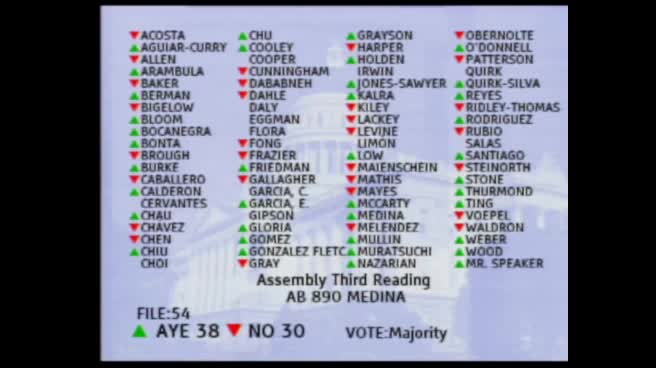 22MIN
Assembly Floor
 1H
Assembly Standing Committee on Appropriations
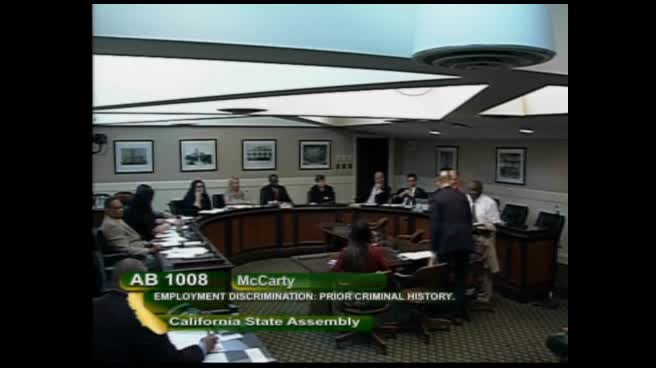 30MIN
Assembly Standing Committee on Labor and Employment





Bill Co-Author(s):
