AB 1863: Personal income tax: deduction: commercial cannabis activity.
- Session Year: 2017-2018
- House: Assembly
- Latest Version Date: 2018-08-23
Existing law, the Medicinal and Adult-Use Cannabis Regulation and Safety Act (MAUCRSA), among other things, consolidates the licensure and regulation of commercial medicinal and adult-use cannabis activities and authorizes persons to conduct specified commercial cannabis activities, as defined, in the state.
The Personal Income Tax Law and the Corporation Tax Law allow various deductions in computing the income that is subject to the taxes imposed by those laws. The Personal Income Tax Law conforms as of a specified date to federal income tax laws with respect to itemized deductions, including business deductions and items not deductible, except as specifically provided. The Corporation Tax Law does not conform to those federal income tax provisions, but specifically provides for deductions for purposes of that law. The Personal Income Tax Law, by conformity to federal income tax laws, disallows a deduction or credit for business expenses of a trade or business whose activities consist of trafficking specified controlled substances, including marijuana.
This bill, for each taxable year beginning on and after January 1, 2018, would specifically provide in the Personal Income Tax Law for nonconformity to that federal law disallowing a deduction or credit for business expenses of a trade or business whose activities consist of trafficking specified controlled substances, only for commercial cannabis activity, as defined under MAUCRSA, by a licensee under MAUCRSA, thus allowing deduction of business expenses for a cannabis trade or business under the Personal Income Tax Law, as provided.
This bill would take effect immediately as a tax levy.
Existing law, the Medicinal and Adult-Use Cannabis Regulation and Safety Act (MAUCRSA), among other things, consolidates the licensure and regulation of commercial medicinal and adult-use cannabis activities and authorizes persons to conduct specified commercial cannabis activities, as defined, in the state.
The Personal Income Tax Law and the Corporation Tax Law allow various deductions in computing the income that is subject to the taxes imposed by those laws. The Personal Income Tax Law conforms as of a specified date to federal income tax laws with respect to itemized deductions, including business deductions and items not deductible, except as specifically provided. The Corporation Tax Law does not conform to those federal income tax provisions, but specifically provides for deductions for purposes of that law. The Personal Income Tax Law, by conformity to federal income tax laws, disallows a deduction or credit for business expenses of a trade or business whose activities consist of trafficking specified controlled substances, including marijuana.
This bill, for each taxable year beginning on and after January 1, 2018, would specifically provide in the Personal Income Tax Law for nonconformity to that federal law disallowing a deduction or credit for business expenses of a trade or business whose activities consist of trafficking specified controlled substances, only for commercial cannabis activity, as defined, authorized defined under MAUCRSA, by a licensee under MAUCRSA, thus allowing deduction of business expenses for a cannabis trade or business under the Personal Income Tax Law, as provided.
This bill would take effect immediately as a tax levy.
Existing law, the Medicinal and Adult-Use Cannabis Regulation and Safety Act (MAUCRSA), among other things, consolidates the licensure and regulation of commercial medicinal and adult-use cannabis activities and authorizes persons to conduct specified commercial cannabis activities, as defined, in the state.
The Personal Income Tax Law and the Corporation Tax Law allow various deductions in computing the income that is subject to the taxes imposed by those laws. The Personal Income Tax Law conforms as of a specified date to federal income tax laws with respect to itemized deductions, including business deductions and items not deductible, except as specifically provided. The Corporation Tax Law does not conform to those federal income tax provisions, but specifically provides for deductions for purposes of that law. The Personal Income Tax Law, by conformity to federal income tax laws, disallows a deduction or credit for business expenses of a trade or business whose activities consist of trafficking specified controlled substances, including marijuana.
This bill, for each taxable year beginning on and after January 1, 2019, 2018, would specifically provide in the Personal Income Tax Law for nonconformity to that federal law disallowing a deduction or credit for business expenses of a trade or business whose activities consist of trafficking specified controlled substances, only for commercial cannabis activity, as defined, authorized under MAUCRSA, by a licensee under MAUCRSA, thus allowing deduction of business expenses for a cannabis trade or business under the Personal Income Tax Law, as provided.
This bill would take effect immediately as a tax levy.
Existing law, the Medicinal and Adult-Use Cannabis Regulation and Safety Act (MAUCRSA), among other things, consolidates the licensure and regulation of commercial medicinal and adult-use cannabis activities and authorizes persons to conduct specified commercial cannabis activities, as defined, in the state.
The Personal Income Tax Law and the Corporation Tax Law allow various deductions in computing the income that is subject to the taxes imposed by those laws. The Personal Income Tax Law conforms as of a specified date to federal income tax laws with respect to itemized deductions, including business deductions and items not deductible, except as specifically provided. The Corporation Tax Law does not conform to those federal income tax provisions, but specifically provides for deductions for purposes of that law. The Personal Income Tax Law, by conformity to federal income tax laws, disallows a deduction or credit for business expenses of a trade or business whose activities consist of trafficking specified controlled substances, including marijuana.
This bill, for each taxable year beginning on and after January 1, 2019, would specifically provide in the Personal Income Tax Law for nonconformity to that federal law disallowing a deduction or credit for business expenses of a trade or business whose activities consist of trafficking specified controlled substances, only for commercial cannabis activity, as defined, authorized under MAUCRSA, thus allowing deduction of business expenses for a cannabis trade or business under the Personal Income Tax Law, as provided.
This bill would take effect immediately as a tax levy.
(a)For each taxable year beginning on or after January 1, 2018, Section 280E of the Internal Revenue Code, relating to expenditures in connection with the illegal sale of drugs, shall not apply to the carrying on of any trade or business that is commercial cannabis activity by a licensee.
(b)For purposes of this section, commercial cannabis activity and licensee shall have the same meanings as set forth in Division 10 (commencing with Section 26000) of the Business and Professions Code.
SEC. 2.This act provides for a tax levy within the meaning of Article IV of the California Constitution and shall go into immediate effect.
(a)For each taxable year beginning on or after January 1, 2018, Section 280E of the Internal Revenue Code, relating to expenditures in connection with the illegal sale of drugs, shall not apply to the carrying on of any trade or business that is commercial cannabis activity, as defined in Division 10 (commencing with Section 26000) of the Business and Professions Code, by a licensee under Division 10 (commencing with Section 26000) of the Business and Professions Code. activity by a licensee.
(b)For purposes of this section, commercial cannabis activity and licensee shall have the same meanings as set forth in Division 10 (commencing with Section 26000) of the Business and Professions Code.
SEC. 2.This act provides for a tax levy within the meaning of Article IV of the California Constitution and shall go into immediate effect.
For each taxable year beginning on or after January 1, 2019, 2018, Section 280E of the Internal Revenue Code, relating to expenditures in connection with the illegal sale of drugs, shall not apply to the carrying on of any trade or business that is commercial cannabis activity, as defined in Division 10 (commencing with Section 26000) of the Business and Professions Code. Code, by a licensee under Division 10 (commencing with Section 26000) of the Business and Professions Code.
SEC. 2.This act provides for a tax levy within the meaning of Article IV of the California Constitution and shall go into immediate effect.
For each taxable year beginning on or after January 1, 2019, Section 280E of the Internal Revenue Code, relating to expenditures in connection with the illegal sale of drugs, shall not apply to the carrying on of any trade or business that is commercial cannabis activity, as defined in Division 10 (commencing with Section 26000) of the Business and Professions Code.
SEC. 2.This act provides for a tax levy within the meaning of Article IV of the California Constitution and shall go into immediate effect.
|
Date
|
Status
|
|---|---|
| Sep 19, 2018 | Vetoed by Governor. |
| Aug 27, 2018 | Enrolled and presented to the Governor at 3 p.m. |
| Aug 22, 2018 | In Assembly. Ordered to Engrossing and Enrolling. |
| Aug 21, 2018 | Read third time. Passed. Ordered to the Assembly. |
| Aug 17, 2018 | From committee: Do pass. (Ayes 5. Noes 2.) (August 16). |
| Aug 13, 2018 | In committee: Referred to APPR. suspense file. |
| Aug 8, 2018 | From committee: Do pass and re-refer to Com. on APPR. (Ayes 6. Noes 0.) (August 8). Re-referred to Com. on APPR. |
| Jun 7, 2018 | Referred to Com. on GOV. & F. |
| May 30, 2018 | In Senate. Read first time. To Com. on RLS. for assignment. |
| May 29, 2018 | Read third time. Passed. Ordered to the Senate. |
| May 25, 2018 | From committee: Do pass. (Ayes 15. Noes 1.) (May 25). |
| May 16, 2018 | In committee: Set, first hearing. Referred to APPR. suspense file. |
| May 9, 2018 | Re-referred to Com. on APPR. |
| May 8, 2018 | Read second time and amended. |
| May 7, 2018 | From committee: Amend, and do pass as amended and re-refer to Com. on APPR. (Ayes 9. Noes 1.) (April 30). |
| Apr 18, 2018 | Re-referred to Com. on REV. & TAX. |
| Apr 17, 2018 | From committee chair, with author's amendments: Amend, and re-refer to Com. on REV. & TAX. Read second time and amended. |
| Mar 22, 2018 | Referred to Com. on REV. & TAX. |
| Jan 12, 2018 | From printer. May be heard in committee February 11. |
| Jan 11, 2018 | Read first time. To print. |
|
Date
|
Description
|
Location
|
Votes
|
|
|---|---|---|---|---|
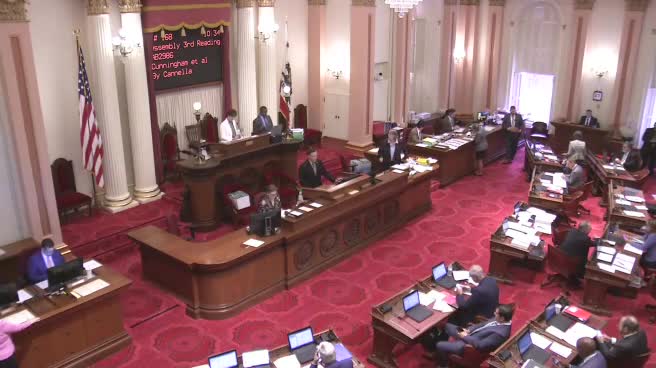
| Aug 21, 2018 | Assembly 3rd Reading AB1863 Jones-Sawyer et al. By McGuire | Senate Floor |
Passed |
|
| Aug 16, 2018 | Do pass | Senate Standing Committee on Appropriations |
Passed |
|
| Aug 13, 2018 | Placed on suspense file | Senate Standing Committee on Appropriations |
Passed |
|
| Aug 8, 2018 | Do pass, but first be re-referred to the Committee on [Appropriations] | Senate Standing Committee on Governance and Finance |
Passed |
|
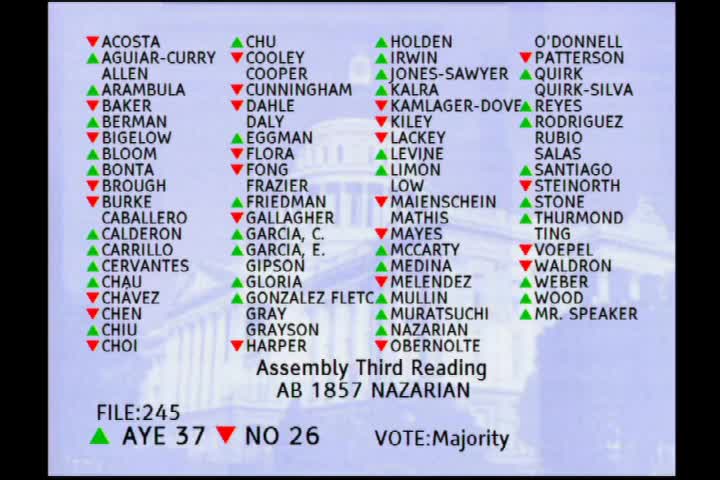
| May 29, 2018 | AB 1863 JONES-SAWYER Assembly Third Reading | Assembly Floor |
Passed |
|
| May 25, 2018 | Do pass. | Assembly Standing Committee on Appropriations |
Passed |
|
| Apr 30, 2018 | Do pass as amended and be re-referred to the Committee on [Appropriations] | Assembly Standing Committee on Revenue and Taxation |
Passed |
This list shows positions taken on this bill by organizations on the date displayed, which is linked to the original source.
Positions by individuals are not included.
|
Organization
|
Position
|
Date
|
|---|---|---|
| calasian chamber | ** Support | Aug 18, 2018 |
| California Cannabis Industry Association | ** Support | Aug 18, 2018 |
| Caliva | ** Support | Aug 18, 2018 |
| Drug Policy Alliance | ** Support | Aug 18, 2018 |
| Long Beach Collectives Association | * Support | Apr 30, 2018 |
| Rural County Representatives of California | ** Support | Aug 18, 2018 |
| San Francisco Chamber of Commerce | ** Support | Aug 18, 2018 |
| southern california coalition | ** Support | Aug 18, 2018 |
| United Cannabis Business Association | ** Support | Aug 18, 2018 |
| Unknown. | ** Against | Aug 6, 2018 |
| Urban Counties of California | ** Support | Aug 18, 2018 |
| We Drop Cannabis Delivery | * Support | Apr 30, 2018 |
| Wedrop | ** Support | Aug 18, 2018 |
GOVERNOR'S VETO
GV Bill Id:AB 1863
Author:(Jones-Sawyer, et al.)
As Enrolled Ver:August 27, 2018
2/3 vote
Committee | Votes | Ayes | Noes |
Revenue & Taxation | 9-1 | Burke, Brough, Bonta, Chu, Gray, McCarty, Mullin, Quirk, Voepel | Melendez |
Appropriations | 15-1 | Gonzalez Fletcher, Bloom, Bonta, Calderon, Carrillo, Chau, Eggman, Fong, Friedman, Gallagher, Eduardo Garcia, Nazarian, Obernolte, Quirk, Reyes | Bigelow |
ASSEMBLY: | 64-11 | (May 29, 2018) | SENATE: | 29-6 | (August 21, 2018) |
SUMMARY: Allows, under the Personal Income Tax (PIT) Law, the deduction of ordinary and necessary business expenses attributable to a licensee's commercial cannabis activity. Specifically, this bill:
- Amends the PIT Law to provide that Internal Revenue Code (IRC) Section 280E, relating to expenditures in connection with the illegal sale of drugs, shall not apply to the carrying on of any trade or business that is commercial cannabis activity, as defined, by a licensee under the Medicinal and Adult-Use Cannabis Regulation and Safety Act (MAUCRSA).
- Applies to taxable years beginning on or after January 1, 2018.
- Takes immediate effect as a tax levy.
EXISTING FEDERAL LAW:
- Provides that no deduction or credit shall be allowed for any amount paid or incurred in carrying on a trade or business if such trade or business consists of trafficking in controlled substances, as specified.
- Prohibits the manufacture, possession, sale, or distribution of marijuana. Congress enacted the Controlled Substances Act (CSA) as part of the Comprehensive Drug Abuse Prevention and Control Act of 1970. The CSA sets forth five "schedules" of specified drugs and other substances designated "controlled substances." For a drug or other substance to be designated as a "Schedule I" controlled substance, it must be found that the substance "has a high potential for abuse" and has "no currently accepted medical use in treatment in the United States". Federal law lists marijuana as a Schedule I controlled substance, deemed to have no accepted medical use.
EXISTING STATE LAW:
- Authorizes the consumption of nonmedicinal cannabis by individuals over 21 years of age, referred to as adult-use cannabis, under the Control, Regulate and Tax Adult Use of Marijuana Act of 2016.
- Consolidates the licensure and regulation of commercial medicinal and adult-use cannabis activities under MAUCRSA.
- Defines "commercial cannabis activity" to include the cultivation, possession, manufacture, distribution, processing, storing, laboratory testing, packaging, labeling, transportation, delivery, or sale of cannabis and cannabis products, as specified.
- Allows, under both the PIT Law and the Corporation Tax (CT) Law various deductions in computing the income subject to tax. The PIT Law conforms, as of a specified date, to federal income tax laws with respect to itemized deductions, including business deductions and items not deductible, except as specifically provided. By conforming to federal law, the PIT Law disallows a deduction or credit for business expenses of a trade or business whose activities consist of trafficking specified controlled substances, including marijuana.
FISCAL EFFECT: According to the Senate Appropriations Committee, the Franchise Tax Board (FTB) indicates that the revenue loss resulting from this bill is interminable because this bill lacks the historical data required to develop a reliable estimate. However, the annual revenue loss resulting from this bill would likely be in the tens of millions of dollars annually. The FTB’s administration costs would be minor and absorbable.
COMMENTS:
- The author has provided the following statement in support of this bill:
The cannabis industry has multiple barriers to entry – limited access to banking, compliance with complex state regulations and a high tax burden. In addition to those challenges, the federal government continues to treat this state-legalized industry as a criminal activity. The Internal Revenue Code Section 280E prohibits cannabis businesses from deducting ordinary business expenses from their federal taxes resulting in higher taxes compared to other industries. At the state level, our tax laws conform to the Section 280E and disallow cannabis businesses from deducting business expenses from their state taxes as well. AB 1863 will allow cannabis businesses to be taxed in the same manner as businesses in other industries, for the purpose of state taxes.
- Committee Staff Comments:
- An overview of federal law: Under IRC Section 280E, no deduction or credit is allowed for any amount paid or incurred during the taxable year in carrying on a trade or business if such trade or business consists of trafficking in controlled substances prohibited by federal or state law. The federal CSA, in turn, lists cannabis as a Schedule I controlled substance. As a result, a business that sells cannabis is barred from deducting what would otherwise be ordinary and necessary business expenses and may only deduct costs of goods sold in determining taxable income.
- An overview of state law: Under state law, the treatment of income and ordinary and necessary business expenses from commercial cannabis activities differs depending on whether the taxpayer is subject to the PIT Law or the CT Law.
- CT Law treatment: For corporations, including statutory cooperatives, California has standalone law. As such, the automatic denial of deductions specified by IRC Section 280E does not apply. An entity taxed as a corporation under the CT Law that is involved in commercial cannabis activities is allowed to deduct its ordinary and necessary business expenses and cost of goods sold, assuming the entity has adequate substantiating records.
- PIT Law treatment: The PIT Law, however, conforms to IRC Section 280E. Therefore, California follows the federal treatment of cannabis sales, and disallows a deduction for ordinary and necessary business expenses.
- This bill: This bill is designed to equalize the treatment of taxpayers subject to the CT Law and the PIT Law by allowing taxpayers subject to the PIT Law to deduct their ordinary and necessary business expenses related to licensed commercial cannabis activities.
- Federalism and conformity: Conforming state tax law to federal law to reduce differences between the two generally benefits both taxpayers and tax enforcement agencies alike by reducing confusion and making tax preparation easier. As such, the state should generally conform to federal law whenever possible unless doing so is inconsistent with the state's policy priorities or results in fiscal losses necessitating undesired cuts to public services. Cannabis businesses are arguably unique because they operate legally under California law, but are barred by federal law. As a result, California's conformity to a federal law that disallows deductions for cannabis businesses is inconsistent with California's clear goal of authorizing well-regulated, adult-use cannabis activities. Additionally, to the extent cannabis businesses filing under the CT Law can deduct business expenses, disallowing the same deduction for businesses filing under the PIT Law is unfair and arguably irrational. However, as marijuana remains a Schedule I substance under federal law, critics may content that providing beneficial tax treatment to any cannabis business constitutes the encouragement of federal crimes.
- Credits too: This bill's decoupling from IRC Section 280E not only affects deductions, but would also allow cannabis businesses filing under the PIT Law to claim credits that are available to other businesses as well.
This bill would allow licensed commercial cannabis businesses to deduct their business expenses under the state's personal income tax law, effective beginning tax year 2018.
The bill seeks to apply equal tax treatment to licensed cannabis in this state, regardless of whether they organize under the personal income tax or corporate income tax law. Given the cost to the General Fund, this proposal is best evaluated as part of the budget process.
Analysis Prepared by: Carlos Anguiano - M. David Ruff / REV. & TAX. / (916) 319-2098 FN: 0005367
Office of Senate Floor Analyses (916) 651-1520 Fax: (916) 327-4478 | AB |
THIRD READING
Bill No: AB 1863
:
SENATE GOVERNANCE & FIN. COMMITTEE: 6-0, 8/8/18
AYES: McGuire, Beall, Hernandez, Hertzberg, Lara, Moorlach
NO VOTE RECORDED: Nguyen
SENATE APPROPRIATIONS COMMITTEE: 5-2, 8/16/18
AYES: Portantino, Beall, Bradford, Hill, Wiener
NOES: Bates, Nielsen
ASSEMBLY FLOOR: 64-11, 5/29/18 - See last page for vote
SOURCE: California Cannabis Industry Association
DIGEST:
This bill allows taxpayers subject to Personal Income Tax Law to deduct ordinary and necessary business expenses attributable to commercial cannabis activity by a licensee.
Existing federal law:
- Provides that no deduction or credit shall be allowed for any amount paid or incurred in carrying on a trade or business if such trade or business consists of trafficking in controlled substances, as specified in Internal Revenue Code (IRC) Section 280E.
- Prohibits the manufacture, possession, sale, or distribution of marijuana.
- Classifies marijuana as a "Schedule I" controlled substance under the Controlled Substances Act (CSA) of 1970. For a drug or other substance to be designated as “Schedule I”, it must be found that the substance "has a high potential for abuse" and has "no currently accepted medical use in treatment in the United States."
Existing state law:
- Authorizes the consumption of nonmedicinal cannabis by individuals over 21 years of age, referred to as adult-use cannabis, under the Control, Regulate and Tax Adult Use of Marijuana Act of 2016.
- Consolidates the licensure and regulation of commercial medicinal and adult-use cannabis activities under the Medicinal and Adult-Use Cannabis Regulation and Safety Act (MAUCRSA).
- Defines "commercial cannabis activity" to include the cultivation, possession, manufacture, distribution, processing, storing, laboratory testing, packaging, labeling, transportation, delivery, or sale of cannabis and cannabis products, as specified.
- Allows, under both the Personal Income Tax (PIT) Law and the Corporation Tax (CT) Law various deductions—including the business expense deduction— and credits in computing the income subject to tax.
- Conforms, as of a specified date, the PIT Law to federal income tax laws with respect to itemized deductions, including business deductions and items not deductible, except as specifically provided.
- Denies business deductions or credits for cannabis businesses subject to the PIT Law due to conformity with federal tax law, specifically IRC Section 280E.
This bill:
- Amends the PIT Law to provide that IRC Section 280E, relating to expenditures in connection with the illegal sale of drugs, shall not apply to the carrying on of any trade or business that is commercial cannabis activity, as defined under MAUCRSA, by a licensee.
- Applies to taxable years beginning on or after January 1, 2018.
Background
Federal law prohibits the manufacture, possession, sale, or distribution of cannabis. In 1970, Congress enacted the Controlled Substances Act (CSA), which sets forth five schedules of specified drugs. For a drug to be designated a Schedule I controlled substance, CSA states the substance must have “a high potential for abuse," and have "no currently accepted medical use” in the United States. Federal law lists cannabis as a Schedule I controlled substance.
In 1996, California voters approved Proposition 215, known as the Compassionate Use Act of 1996 (CUA). Under CUA, qualified patients and primary caregivers were allowed to obtain and use medical cannabis. In 2015, the Legislature enacted the Medical Marijuana Regulation and Safety Act (MMRSA), which comprised a package of legislation that comprehensively regulated many aspects of medical cannabis including cultivation, manufacturing, transportation, distribution, sale, and product safety. In 2016, several bills made slight changes to MMRSA, including renaming the Act the Medical Cannabis Regulation and Safety Act.
On November 8th, 2016, California voters approved Proposition 64—the Control, Regulate and Tax Adult Use of Marijuana Act (Act)—which legalized the recreational use of cannabis by adults age 21 and older. The Act provides for the licensure and regulation of commercial adult marijuana activities by various state agencies. Less than a year later in June 2017, the Legislature enacted SB 94 (Committee on Budget and Fiscal Review, 2017), which integrated MMRSA with the Act to create the Medicinal and Adult Use Cannabis Regulation and Safety Act (MAUCRSA). Among other things, MAUCRSA consolidated the licensure and regulation of commercial medicinal and adult-use cannabis activities.
In 1981, the U.S. Tax Court heard the case of Edmonson v. Commissioner, in which a drug dealer claimed deductions for cost of goods sold and business expenses, such as mileage and air fare on his federal tax return. The Court determined that most of the expenses qualified as ordinary and necessary business expense deductions. In response, Congress enacted the Tax Equity and Fiscal Responsibility Act, which added §280E to the Internal Revenue Code. IRC §280E prohibits taxpayers from deducting or claiming credits for any amounts paid or incurred in carrying on any trade or business if such trade or business consists of trafficking in controlled substances. Since cannabis is classified as a Schedule I drug, a business that sells cannabis—even if for medical reasons—cannot deduct ordinary and necessary business expenses for federal tax purposes.
California’s PIT Law conforms to IRC §280E. Thus, cannabis businesses subject to personal income tax—such as a sole proprietorship or a partnership—cannot deduct their business expenses for state tax purposes. IRC §280E will cease to apply to cannabis only when Congress reclassifies the drug at the federal level.
Unlike California’s PIT, California’s CT is standalone law, which means the automatic denial of deductions specified by IRC §280E does not apply for state tax purposes. This allows cannabis businesses subject to the corporation tax to deduct necessary business expenses despite cannabis’s classification at the federal level.
California does have an additional law that further denies deductions—such as the cost of goods sold deduction—for PIT and CT taxpayers that are directly derived from illegal activities. However, the law only applies if the taxpayer was determined to be engaged in criminal profiteering, including drug trafficking, and found to be engaged in these activities through a final determination in a criminal proceeding (AB 1369, Gatto, 2011).
FISCAL EFFECT: Appropriation: Fiscal Com.: Local:
According to the Senate Appropriations Committee:
- “The Franchise Tax Board (FTB) indicates that the revenue loss resulting from this bill is interminable, because it lacks the historical data required to develop a reliable estimate. However, the annual revenue loss resulting from the bill would likely be in the tens of millions of dollars annually…FTB’s administration costs would be minor and absorbable.”
California Cannabis Industry Association (source)
CalAsian Chamber
CMG/Caliva
Drug Policy Alliance
San Francisco Chamber of Commerce
Southern California Coalition
Rural County Representatives of California
WeDrop
Urban Counties of California
United Cannabis Business Association
OPPOSITION: (Verified 8/17/18)
None received
ARGUMENTS IN SUPPORT: According to the author, “The cannabis industry has multiple barriers to entry – limited access to banking, compliance with complex state regulations and a high tax burden. In addition to those challenges, the federal government continues to treat this state-legalized industry as criminal activity. The Internal Revenue Code Section 280E prohibits cannabis businesses from deducting ordinary business expenses from their federal taxes, resulting in higher taxes compared to other industries. At the state level, our tax laws conform to the Section 280E and disallow cannabis businesses from deducting business expenses from their state taxes as well. AB 1863 will allow cannabis businesses to be taxed in the same manner as businesses in other industries, for the purpose of state taxes.”
ASSEMBLY FLOOR: 64-11, 5/29/18
AYES: Acosta, Aguiar-Curry, Arambula, Berman, Bloom, Bonta, Brough, Burke, Caballero, Calderon, Carrillo, Cervantes, Chau, Chen, Chiu, Chu, Cooley, Cooper, Cunningham, Dahle, Daly, Eggman, Flora, Fong, Frazier, Friedman, Gallagher, Cristina Garcia, Eduardo Garcia, Gipson, Gloria, Gonzalez Fletcher, Gray, Grayson, Holden, Irwin, Jones-Sawyer, Kalra, Kamlager-Dove, Lackey, Levine, Limón, Low, Maienschein, Mayes, McCarty, Medina, Mullin, Nazarian, Obernolte, O'Donnell, Quirk, Quirk-Silva, Reyes, Rodriguez, Rubio, Santiago, Steinorth, Mark Stone, Thurmond, Ting, Weber, Wood, Rendon
NOES: Travis Allen, Baker, Bigelow, Chávez, Choi, Harper, Melendez, Patterson, Salas, Voepel, Waldron
NO VOTE RECORDED: Kiley, Mathis, Muratsuchi
8/18/18 14:14:27
**** END ****
SENATE COMMITTEE ON
Senator Anthony Portantino, Chair
2017 - 2018 Regular Session
AB 1863 (Jones-Sawyer) - Personal income tax: deduction: commercial cannabis activity
Version: | Policy Vote: |
Urgency: | Mandate: |
Hearing Date: | Consultant: |
This bill meets the criteria for referral to the Suspense File.
Bill Summary:
AB 1863 would allow taxpayers subject to the personal income tax to deduct ordinary and necessary business attributable to commercial cannabis activity.
Fiscal Impact:
The Franchise Tax Board (FTB) indicates that the revenue loss resulting from this bill is interminable, because it lacks the historical data required to develop a reliable estimate. However, the annual revenue loss resulting from the bill would likely be in the tens of millions of dollars annually (General Fund, see Staff Comments). FTB’s administration costs would be minor and absorbable.
Background:
Tax expenditure programs (TEPs) are special tax provisions that reduce the amount of revenues the “basic” tax system would otherwise generate in order to provide (1) benefits to certain groups of taxpayers, and/or (2) incentives to encourage certain types of behavior and activities, such as charitable giving. Specifically, current law provides for, among other things, various income and corporation tax credits and deductions, as well as exemptions from the sales and use tax. The Department of Finance is required to publish a list of TEPs (currently totaling several hundred), which currently total $61 billion annually.
Federal law prohibits the manufacture, possession, sale, or distribution of cannabis, which is listed as a Schedule I controlled substance under the Controlled Substances Act (CSA). On August 29, 2013, the U.S. Department of Justice (DOJ) issued guidance to federal prosecutors regarding cannabis enforcement under the CSA, referred to as the "Cole Memo.” The Cole Memo reiterated DOJ 's commitment to enforcing the CSA consistent with Congress' determination that cannabis is a dangerous drug that provides a significant source of revenue to large-scale criminal enterprises, gangs, and cartels. Specifically, the Cole Memo instructed DOJ attorneys and law enforcement officials to focus on the following eight enforcement priorities: (1) preventing the distribution of cannabis to minors, (2) preventing revenue from cannabis sales from going to criminal enterprises, gangs, and cartels, (3) preventing the diversion of cannabis from states where it is legal under state law to other states where it is illegal, (4) preventing state-authorized cannabis activity from being used as a cover or pretext for the trafficking of other illegal drugs or other illegal activity, (5) preventing violence and the use of firearms in the cultivation and distribution of cannabis, (6) preventing drugged driving and the exacerbation of other adverse public health consequences associated with cannabis use, (7) preventing the growing of cannabis on public lands and the attendant public safety and environmental dangers posed by cannabis production on public lands, and (8) preventing cannabis possession or use on federal property.
The Cole Memo’s priorities guide DOJ 's enforcement of the CSA. While the Cole Memo's guidance was issued in response to recent cannabis legalization initiatives in other states, it applies to all DOJ cannabis enforcement nationwide.
Prior to 1996, both federal and state law prohibited the possession, possession with intent to sell, cultivation, sale, transportation, importation, or furnishing of cannabis. However, in 1996, California voters approved Proposition 215, known as the Compassionate Use Act of 1996 (CUA). CUA allowed qualified patients and primary caregivers to obtain and use medical cannabis. The Legislature clarified CUA by enacting SB 420 (Vasconcellos, 2003), which exempted qualified patients and caregivers from prosecution for using, or collectively or cooperatively cultivating medical cannabis, and established a medical cannabis card program for patients to use on a voluntary basis. SB 420 provides a safe harbor for qualified patients regarding the amount of cannabis they may possess and the number of plants they may maintain. It also protects patients with valid identification cards from both arrest and criminal liability for possession, transportation, delivery, or cultivation of cannabis.
In 2015, the Legislature enacted the Medical Marijuana Regulation and Safety Act (MMRSA), a package of legislation that comprehensively regulates many aspects of medical cannabis including cultivation, manufacturing, transportation, distribution, sale, and product safety. In 2016, several bills made slight changes to the MMRSA, including renaming the Act the Medical Cannabis Regulation and Safety Act (MCRSA). Among other provisions, MCRSA creates the Bureau of Medical Cannabis Regulation (the Bureau) within the Department of Consumer Affairs to oversee and enforce the state’s medical cannabis regulations in collaboration with the Board of Equalization (BOE), the California Department of Public Health, and the California Department of Food and Agriculture (CDFA).
In November, 2016, California voters approved the Control, Regulate and Tax Adult Use of Marijuana Act (Act), which legalized the recreation use of cannabis by adults age 21 and older (Proposition 64). The initiative establishes 19 different license categories, including many established by the MCRSA. However, licenses for adult cannabis use facilities are distinct from those for medical facilities issued under MCRSA.
Additionally, the Legislature recently repealed the MCRSA, but included many of its provisions into the new Medicinal and Adult-Use Cannabis Regulation and Safety Act, and renamed the Bureau as the Bureau of Cannabis Control (SB 94, Committee on Budget and Fiscal Review, 2017). SB 94 seeks to establish a single system of administration for cannabis laws in California to reflect the enactment of Proposition 64.
Existing federal and state law provides that all income, from whatever source derived, is included in a taxpayer's gross income, including income obtained from illegal business activities, actual crimes, or unethical or immoral business practices. State and federal law generally allow business taxpayers to deduct from income any ordinary and necessary business expenses.
Current federal law (IRC §280E) prohibits a taxpayer from deducting or claiming a credit for any amount paid or incurred in carrying on any trade or business if such trade or business consists of trafficking in controlled substances within the meaning of Schedule I and II of the CSA. California’s personal income tax conforms to federal law, but not the Corporation Tax. California has additional law that further denies deductions for personal income and corporation taxpayers that are directly derived from illegal activities, including for costs of goods sold, but only if the taxpayer was determined to be engaged in criminal profiteering, including drug trafficking (AB 1369, Gatto, 2011). However, the law expressly states that a taxpayer must be found to be engaged in these activities through a final determination in a criminal proceeding, or a proceeding in which the state, county, city or other political subdivision was a party.
Consequently, a business that sells marijuana, even if for medical reasons, cannot deduct ordinary and necessary business expenses from federal tax like a normal business, and can only do so for state purposes if the firm is a corporation. Instead, the marijuana business pays state and federal taxes based on their income for federal purposes, but can claim a deduction for the costs of goods sold. IRC §280E will only cease to apply to cannabis businesses if and when Congress changes the classification of cannabis to no longer be classified as a Schedule I or Schedule II controlled substance.
Proposed Law: This bill would allow taxpayers to deduct ordinary and necessary business expenses related to commercial cannabis activity. It would (1) amend state personal income tax law to decouple from IRC §280E for businesses that are “commercial cannabis activity” and conducted by a licensee, and (2) be effective beginning with taxable year 2018.
Related Legislation: AB 420 (Wood, 2017) was substantially similar to this bill, and held under submission on the Suspense File of this Committee.
Staff Comments:
FTB research staff identified a review article issued by the University of California Agricultural Issues Centers (AIC) that examined six different studies on the cannabis market and its potential market size. The AIC review article indicated that the retail cannabis market in the State could be valued between $4 and $11 billion. FTB assumes that applicable business expenses are 20 percent of sales; thus, every $1 billion in retail sales would result in an additional $200 million in deductions. Moreover, at a six percent tax rate, the revenue loss would be $13 million per $1 billion of retail sales. Because the size of the cannabis market is unknown, the revenue loss resulting from this this bill is indeterminable, but likely in the tens of millions of dollars annually.
-- END --
SENATE COMMITTEE ON GOVERNANCE AND FINANCE
Senator Mike McGuire, Chair
2017 - 2018 Regular
Bill No: | AB 1863 | Hearing Date: | 8/8/18 |
Author: | Jones-Sawyer | Tax Levy: | Yes |
Version: | 5/8/18 | Fiscal: | Yes |
Consultant: | Brown | ||
Personal income tax: deduction: commercial cannabis activity
Allows taxpayers subject to personal income tax law to deduct ordinary and necessary business expenses attributable to commercial cannabis activity.
Background
Tax expenditures. California law allows various income tax credits, deductions, exemptions, and exclusions. The Legislature enacts such tax incentives to compensate taxpayers for incurring certain expenses, such as child adoption, and/or to influence certain behavior, such as charitable giving. The Legislature uses tax incentives to encourage taxpayers to do something that but for the tax credit, they would otherwise not do. The Department of Finance is required to annually publish a list of tax expenditures, currently totaling around $61.3 billion per year.
Above the line deductions. Both federal and state laws allow for the deduction of certain expenses from gross income when calculating adjusted gross income (AGI). Some examples include moving expenses, education loans, certain ordinary and necessary trade and business expenses, and alimony. These are known as “above the line” deductions or “adjustments.” Unlike other deductions, such as charitable deductions and mortgage interest deductions, all taxpayers with these types of expenses may take the corresponding deduction. In other words, the taxpayer does not need to itemize their deductions to obtain the benefit of that particular deduction.
Federal law relating to cannabis. Federal law prohibits the manufacture, possession, sale, or distribution of cannabis. In 1970, Congress enacted the Controlled Substances Act (CSA), which sets forth five schedules of specified drugs. For a drug to be designated a Schedule I controlled substance, CSA states the substance must have “a high potential for abuse," and have "no currently accepted medical use” in the United States. Federal law lists cannabis as a Schedule I controlled substance.
State law relating to cannabis. In 1996, California voters approved Proposition 215, known as the Compassionate Use Act of 1996 (CUA). Under CUA, qualified patients with specified illnesses, and their primary caregivers, cannot be prosecuted for possessing or cultivating medical cannabis upon the written or oral recommendation or approval of an attending physician. In other words, CUA allowed qualified patients and primary caregivers to obtain and use medical cannabis.
The Legislature clarified CUA by enacting SB 420 (Vasconcellos, 2003). SB 420 exempts qualified patients and caregivers from prosecution for using or cultivating medical cannabis. It also protects patients with valid identification cards from both arrest and criminal liability for possession, transportation, delivery, or cultivation of cannabis. The industry remained largely unregulated at the state level until 2015, when the Legislature enacted the Medical Marijuana Regulation and Safety Act (MMRSA). MMRSA comprised a package of legislation that comprehensively regulated many aspects of medical cannabis including cultivation, manufacturing, transportation, distribution, sale, and product safety. In 2016, several bills made slight changes to MMRSA, including renaming the Act the Medical Cannabis Regulation and Safety Act.
On November 8th, 2016, California voters approved Proposition 64—the Control, Regulate and Tax Adult Use of Marijuana Act (Act)—which legalized the recreational use of cannabis by adults age 21 and older. The Act provides for the licensure and regulation of commercial adult marijuana activities by various state agencies.
The Act imposes a cannabis excise tax upon purchasers of cannabis or cannabis products sold in this state, equal to 15% of the retail sale’s gross receipts. The initiative establishes a cultivation tax as well at the following rates:
- $9.25 per dry-weight ounce on cannabis flowers, and
- $2.75 per dry-weight ounce on cannabis leaves.
State and local governments also impose sales and use taxes on cannabis, on top of the excise tax and the cultivation tax. The sales and use tax is based upon the retailer's gross receipts. The state sales and use tax rate is equal to 7.25%, and local rates generally add up to an additional 2%, and even more in some jurisdictions.
Less than a year later in June 2017, the Legislature enacted SB 94 (Committee on Budget and Fiscal Review, 2017), which integrated MMRSA with the Act to create the Medicinal and Adult Use Cannabis Regulation and Safety Act (MAUCRSA). Among other things, MAUCRSA consolidated the licensure and regulation of commercial medicinal and adult-use cannabis activities.
Less than a year later in June 2017, the Legislature enacted SB 94 (Committee on Budget and Fiscal Review, 2017), which integrated MMRSA with the Act to create the Medicinal and Adult Use Cannabis Regulation and Safety Act (MAUCRSA). Among other things, MAUCRSA consolidated the licensure and regulation of commercial medicinal and adult-use cannabis activities.
Internal Revenue Code Sec. 280E. In 1981, the U.S. Tax Court heard the case of Edmonson v. Commissioner, in which a drug dealer claimed deductions for cost of goods sold and business expenses, such as mileage, air fare, and packaging costs, among others, on his federal tax return. The Court determined that most of the expenses qualified as ordinary and necessary business expense deductions. In response, Congress enacted the Tax Equity and Fiscal Responsibility Act, which added §280E to the Internal Revenue Code. §280E prohibits taxpayers from deducting or claiming credits for any amounts paid or incurred in carrying on any trade or business if such trade or business consists of trafficking in controlled substances. Since cannabis is classified as a Schedule I drug, a business that sells cannabis—even if for medical reasons—cannot deduct ordinary and necessary business expenses for federal tax purposes.
California’s personal income tax conforms to IRC §280E. Thus, cannabis businesses subject to personal income tax—such as a sole proprietorship or a partnership—cannot deduct their business expenses for state tax purposes. IRC §280E will cease to apply to cannabis only when Congress reclassifies the drug at the federal level.
Unlike California’s personal income tax, California’s corporation tax is standalone law, which means the automatic denial of deductions specified by IRC §280E does not apply for state tax purposes. This allows cannabis businesses subject to the corporation tax to deduct necessary business expenses despite cannabis’s classification at the federal level.
California does have an additional law that further denies deductions—such as the cost of goods sold deduction—for both personal income and corporation taxpayers that are directly derived from illegal activities. However, the law only applies if the taxpayer was determined to be engaged in criminal profiteering, including drug trafficking, and found to be engaged in these activities through a final determination in a criminal proceeding (AB 1369, Gatto, 2011).
The author would like to extend cannabis businesses subject to the personal income tax the same opportunities that cannabis businesses subject to the corporation tax currently receive.
Proposed Law
Assembly Bill 1863 allows taxpayers to deduct ordinary and necessary business expenses related to commercial cannabis activity . AB 1863 amends state personal income tax law to decouple from IRC §280E for businesses that are “commercial cannabis activity” and conducted by a licensee. AB 1863 applies to taxable years beginning on or after January 1st, 2018.
State Revenue Impact
No estimate.
Comments
1. Purpose of the bill. According to the author, “The cannabis industry has multiple barriers to entry – limited access to banking, compliance with complex state regulations and a high tax burden. In addition to those challenges, the federal government continues to treat this state-legalized industry as criminal activity. The Internal Revenue Code Section 280E prohibits cannabis businesses from deducting ordinary business expenses from their federal taxes, resulting in higher taxes compared to other industries. At the state level, our tax laws conform to the Section 280E and disallow cannabis businesses from deducting business expenses from their state taxes as well. AB 1863 will allow cannabis businesses to be taxed in the same manner as businesses in other industries, for the purpose of state taxes.”
2. Conformity. In general, state conformity with federal law promotes greater simplicity and eases the burden of administering complex tax law. The state should generally conform to federal law whenever possible, unless doing so is inconsistent with its policy priorities, or results in fiscal losses that necessitate cuts in public services or increased taxes. Cannabis businesses are unique because Proposition 64 and MAUCRSA allow them to operate legally under state law even though they remain illegal under federal law. As a result, California conforming to a federal law that disallows deductions for criminal business is inconsistent with Proposition 64 and MAUCRSA. Furthermore, allowing cannabis businesses subject to corporation tax to deduct business expenses while disallowing cannabis businesses subject to personal income tax to not deduct businesses expenses for the exact same activity is unfair. The Committee may wish to consider the merits of tax conformity for businesses operating amid a conflict between federal and state law.
3. Credits. Decoupling personal income tax law from IRC §280E would also allow cannabis businesses filing under the personal income tax to claim credits that apply to other businesses. As a result, cannabis businesses can claim any tax credit under California law if they qualify. Credits that are available to every other legal business operating in California—such as the California Competes Tax Credit and the New Employment Credit—would now be available to cannabis businesses that operate under the personal income tax law. Furthermore, cannabis businesses subject to corporation tax are already allowed to claim these credits. AB 1863 provides cannabis businesses subject to personal income tax the same opportunity to claim tax credits as any other legal operating business in California. The Committee may wish to consider the benefit for cannabis businesses subject to personal income tax and the potential increase in tax credits claimed.
4. Related legislation. AB 420 (Wood, 2017) is substantially similar to AB 1863. The Senate Governance and Finance Committee approved AB 420 by a 6 to 1 vote, but it was subsequently held on suspense in the Senate Appropriations Committee.
Assembly Actions
Assembly Revenue and Taxation 9-1
Assembly Appropriations 15-1
Assembly Floor 64-11
Support and Opposition
(8/6/18)
Support: California Cannabis Industry Association (Sponsor); California Asian Pacific Chamber of Commerce; Rural county Representatives of California; United Cannabis Business Association; Southern California Coalition; Drug Policy Alliance; San Francisco Chamber of Commerce; WeDrop; and CMG/Caliva.
Opposition: Unknown.
-- END --
ASSEMBLY THIRD READING
ATR Bill Id:AB 1863
Author:(Jones-Sawyer, et al.)
As Amended Ver:May 8, 2018
Majority vote. Tax Levy
Committee | Votes | Ayes | Noes |
Revenue & Taxation | 9-1 | Burke, Brough, Bonta, Chu, Gray, McCarty, Mullin, Quirk, Voepel | Melendez |
Appropriations | 15-1 | Gonzalez Fletcher, Bloom, Bonta, Calderon, Carrillo, Chau, Eggman, Fong, Friedman, Gallagher, Eduardo Garcia, Nazarian, Obernolte, Quirk, Reyes | Bigelow |
SUMMARY: Allows, under the Personal Income Tax (PIT) Law, the deduction of ordinary and necessary business expenses attributable to a licensee's commercial cannabis activity. Specifically, this bill:
- Amends the PIT Law to provide that Internal Revenue Code (IRC) Section 280E, relating to expenditures in connection with the illegal sale of drugs, shall not apply to the carrying on of any trade or business that is commercial cannabis activity, as defined, by a licensee under the Medicinal and Adult-Use Cannabis Regulation and Safety Act (MAUCRSA).
- Applies to taxable years beginning on or after January 1, 2018.
- Takes immediate effect as a tax levy.
EXISTING FEDERAL LAW:
- Provides that no deduction or credit shall be allowed for any amount paid or incurred in carrying on a trade or business if such trade or business consists of trafficking in controlled substances, as specified.
- Prohibits the manufacture, possession, sale, or distribution of marijuana. Congress enacted the Controlled Substances Act (CSA) as part of the Comprehensive Drug Abuse Prevention and Control Act of 1970. The CSA sets forth five "schedules" of specified drugs and other substances designated "controlled substances." For a drug or other substance to be designated as a "Schedule I" controlled substance, it must be found that the substance "has a high potential for abuse" and has "no currently accepted medical use in treatment in the United States". Federal law lists marijuana as a Schedule I controlled substance, deemed to have no accepted medical use.
EXISTING STATE LAW:
- Authorizes the consumption of nonmedicinal cannabis by individuals over 21 years of age, referred to as adult-use cannabis, under the Control, Regulate and Tax Adult Use of Marijuana Act of 2016.
- Consolidates the licensure and regulation of commercial medicinal and adult-use cannabis activities under MAUCRSA.
- Defines "commercial cannabis activity" to include the cultivation, possession, manufacture, distribution, processing, storing, laboratory testing, packaging, labeling, transportation, delivery, or sale of cannabis and cannabis products, as specified.
- Allows, under both the PIT Law and the Corporation Tax (CT) Law various deductions in computing the income subject to tax. The PIT Law conforms, as of a specified date, to federal income tax laws with respect to itemized deductions, including business deductions and items not deductible, except as specifically provided. By conforming to federal law, the PIT Law disallows a deduction or credit for business expenses of a trade or business whose activities consist of trafficking specified controlled substances, including marijuana.
FISCAL EFFECT: According to the Assembly Appropriations Committee, significant General Fund revenue loss, likely in the tens of millions of dollars, each year.
COMMENTS:
- The author has provided the following statement in support of this bill:
The cannabis industry has multiple barriers to entry – limited access to banking, compliance with complex state regulations and a high tax burden. In addition to those challenges, the federal government continues to treat this state-legalized industry as a criminal activity. The Internal Revenue Code Section 280E prohibits cannabis businesses from deducting ordinary business expenses from their federal taxes resulting in higher taxes compared to other industries. At the state level, our tax laws conform to the Section 280E and disallow cannabis businesses from deducting business expenses from their state taxes as well. AB 1863 will allow cannabis businesses to be taxed in the same manner as businesses in other industries, for the purpose of state taxes.
- Committee Staff Comments:
- An overview of federal law: Under IRC Section 280E, no deduction or credit is allowed for any amount paid or incurred during the taxable year in carrying on a trade or business if such trade or business consists of trafficking in controlled substances prohibited by federal or state law. The federal CSA, in turn, lists cannabis as a Schedule I controlled substance. As a result, a business that sells cannabis is barred from deducting what would otherwise be ordinary and necessary business expenses and may only deduct costs of goods sold in determining taxable income.
- An overview of state law: Under state law, the treatment of income and ordinary and necessary business expenses from commercial cannabis activities differs depending on whether the taxpayer is subject to the PIT Law or the CT Law.
- CT Law treatment: For corporations, including statutory cooperatives, California has standalone law. As such, the automatic denial of deductions specified by IRC Section 280E does not apply. An entity taxed as a corporation under the CT Law that is involved in commercial cannabis activities is allowed to deduct its ordinary and necessary business expenses and cost of goods sold, assuming the entity has adequate substantiating records.
- PIT Law treatment: The PIT Law, however, conforms to IRC Section 280E. Therefore, California follows the federal treatment of cannabis sales, and disallows a deduction for ordinary and necessary business expenses.
- This bill: This bill is designed to equalize the treatment of taxpayers subject to the CT Law and the PIT Law by allowing taxpayers subject to the PIT Law to deduct their ordinary and necessary business expenses related to licensed commercial cannabis activities.
- Federalism and conformity: Conforming state tax law to federal law to reduce differences between the two generally benefits both taxpayers and tax enforcement agencies alike by reducing confusion and making tax preparation easier. As such, the state should generally conform to federal law whenever possible unless doing so is inconsistent with the state's policy priorities or results in fiscal losses necessitating undesired cuts to public services. Cannabis businesses are arguably unique because they operate legally under California law, but are barred by federal law. As a result, California's conformity to a federal law that disallows deductions for cannabis businesses is inconsistent with California's clear goal of authorizing well-regulated, adult-use cannabis activities. Additionally, to the extent cannabis businesses filing under the CT Law can deduct business expenses, disallowing the same deduction for businesses filing under the PIT Law is unfair and arguably irrational. However, as marijuana remains a Schedule I substance under federal law, critics may content that providing beneficial tax treatment to any cannabis business constitutes the encouragement of federal crimes.
- Credits too: This bill's decoupling from IRC Section 280E not only affects deductions, but would also allow cannabis businesses filing under the PIT Law to claim credits that are available to other businesses as well.
Analysis Prepared by: M. David Ruff / REV. & TAX. / (916) 319-2098 FN: 0003097
Date of Hearing: May 16, 2018
ASSEMBLY COMMITTEE ON APPROPRIATIONS
Lorena Gonzalez Fletcher, Chair
ABPCA Bill Id:AB 1863
Author:(Jones-Sawyer) – As Amended Ver:May 8, 2018
Policy Committee: | Revenue and Taxation | Vote: | 9 - 1 |
|
| ||
|
|
Urgency: No State Mandated Local Program: No Reimbursable: No
SUMMARY:
This bill allows, under the Personal Income Tax (PIT) Law, the deduction of ordinary and necessary businesses expenses attributable to a licensee’s commercial cannabis activity.
FISCAL EFFECT:
Significant General Fund revenue loss, likely in the tens of millions of dollars, each year.
COMMENTS:
- Background. State and federal law generally allow business taxpayers to deduct from income any ordinary and necessary business expenses. Ordinary expenses are costs typical or common in the relevant industry or trade, and necessary expenses are costs deemed helpful and appropriate for the business. Common examples of these expenses include office equipment or office rent.
Under federal law, no deduction or credit is allowed for ordinary and necessary expenses incurred in carrying on a trade or business if such trade or business consists of trafficking in controlled substances prohibited by federal or state law. Because the federal Controlled Substances Act lists cannabis as a Schedule I controlled substances, businesses that sell cannabis are barred from deducting what would otherwise be ordinary and necessary business expenses.
State law conforms to federal law under PIT Law, but not under Corporation Tax (CT) Law. Under CT Law, California allows corporations to deduct their ordinary and necessary business expenses.
- Purpose. According to the author, AB 1863 will allow cannabis businesses to be taxed in the same manner as businesses in other industries.
- Recent legislation. AB 420 (Wood), of the 2017-18 Legislative Session, contains provisions substantially similar to this bill. AB 420 (Wood) was held on the Senate Appropriations Committee's Suspense File.
Analysis Prepared by: Luke Reidenbach / APPR. / (916) 319-2081
Date of Hearing: April 30, 2018
ASSEMBLY COMMITTEE ON REVENUE AND TAXATION
Autumn R. Burke, Chairwoman
ABPCA Bill Id:AB 1863 (
Author:Jones-Sawyer) – As Amended Ver:April 17, 2018
Majority vote. Tax levy. Fiscal committee.
SUBJECT: Personal income tax: deduction: commercial cannabis activity
SUMMARY: Allows, under the Personal Income Tax (PIT) Law, the deduction of ordinary and necessary business expenses attributable to a licensee's commercial cannabis activity. Specifically, this bill:
- Amends the PIT Law to provide that Internal Revenue Code (IRC) Section 280E, relating to expenditures in connection with the illegal sale of drugs, shall not apply to the carrying on of any trade or business that is commercial cannabis activity, as defined, by a licensee under the Medicinal and Adult-Use Cannabis Regulation and Safety Act (MAUCRSA).
- Applies to taxable years beginning on or after January 1, 2018.
- Takes immediate effect as a tax levy.
EXISTING FEDERAL LAW:
- Provides that no deduction or credit shall be allowed for any amount paid or incurred in carrying on a trade or business if such trade or business consists of trafficking in controlled substances, as specified. (IRC Section 280E.)
- Prohibits the manufacture, possession, sale, or distribution of marijuana. Congress enacted the Controlled Substances Act (CSA) as part of the Comprehensive Drug Abuse Prevention and Control Act of 1970. The CSA sets forth five "schedules" of specified drugs and other substances designated "controlled substances." For a drug or other substance to be designated as a "Schedule I" controlled substance, it must be found that the substance "has a high potential for abuse" and has "no currently accepted medical use in treatment in the United States". Federal law lists marijuana as a Schedule I controlled substance, deemed to have no accepted medical use.
EXISTING STATE LAW:
- Authorizes the consumption of nonmedicinal cannabis by individuals over 21 years of age, referred to as adult-use cannabis, under the Control, Regulate and Tax Adult Use of Marijuana Act of 2016.
- Consolidates the licensure and regulation of commercial medicinal and adult-use cannabis activities under MAUCRSA.
- Defines "commercial cannabis activity" to include the cultivation, possession, manufacture, distribution, processing, storing, laboratory testing, packaging, labeling, transportation, delivery, or sale of cannabis and cannabis products, as specified.
- Allows, under both the PIT Law and the Corporation Tax (CT) Law various deductions in computing the income subject to tax. The PIT Law conforms, as of a specified date, to federal income tax laws with respect to itemized deductions, including business deductions and items not deductible, except as specifically provided. By conforming to federal law, the PIT Law disallows a deduction or credit for business expenses of a trade or business whose activities consist of trafficking specified controlled substances, including marijuana.
FISCAL EFFECT: Unknown
COMMENTS:
- The author has provided the following statement in support of this bill:
The cannabis industry has multiple barriers to entry – limited access to banking, compliance with complex state regulations and a high tax burden. In addition to those challenges, the federal government continues to treat this state-legalized industry as a criminal activity. The Internal Revenue Code Section 280E prohibits cannabis businesses from deducting ordinary business expenses from their federal taxes resulting in higher taxes compared to other industries. At the state level, our tax laws conform to the Section 280E and disallow cannabis businesses from deducting business expenses from their state taxes as well. AB 1863 will allow cannabis businesses to be taxed in the same manner as businesses in other industries, for the purpose of state taxes.
- This bill is sponsored by the California Cannabis Industry Association, which notes the following:
CCIA fully supports the need to reduce the tax burden on licensed cannabis businesses and strongly believes that such efforts will reduce illicit operations. By adhering to the Medicinal and Adult Use Cannabis Regulation and Safety Act (MAUCRSA), enacted last year, licensed cannabis businesses are paying significantly higher taxes and fees than their unlicensed competitors. The ability for these businesses to deduct their business expenses from their gross income will encourage compliance with California's new cannabis laws.
- This bill is supported by both the Rural County Representatives of California and the Urban Counties of California, which note:
In 2015, the Legislature enacted the Medical Cannabis Regulation and Safety Act, and in 2016, the voters approved Proposition 64 legalizing cannabis for adult use. These two pieces of legislation levy a cultivation tax, a sales and use tax and provide strict environmental, public safety, and public health standards for licensed cannabis businesses in California. Legal cannabis businesses operating under these new standards and regulations will be subject to significant taxes, fees and compliance standards. Meanwhile, there will inevitably be a significant number of cannabis entities that continue to operate in an illegal manner per state law. In order for California's new cannabis laws to be successful, legal businesses must be able to successfully compete with black market operators as the cannabis industry in California has operated in an unregulated market, or in the case of medical cannabis, a quasi-legal market, for decades.
- The FTB has identified the following implementation concern in its staff analysis of this bill:
If this bill is enacted in late September or October of 2018, the department would have developed the forms and instructions for the 2018 taxable year. Thus, the department may incur additional costs to develop alternative forms and instructions in the short time frame necessary to ensure they are available for taxpayers to comply with the reporting requirement.
- Committee Staff Comments:
- An overview of federal law: Under IRC Section 280E, no deduction or credit is allowed for any amount paid or incurred during the taxable year in carrying on a trade or business if such trade or business consists of trafficking in controlled substances prohibited by federal or state law. The federal CSA, in turn, lists cannabis as a Schedule I controlled substance. As a result, a business that sells cannabis is barred from deducting what would otherwise be ordinary and necessary business expenses and may only deduct costs of goods sold in determining taxable income.
- An overview of state law: Under state law, the treatment of income and ordinary and necessary business expenses from commercial cannabis activities differs depending on whether the taxpayer is subject to the PIT Law or the CT Law.
- CT Law treatment: For corporations, including statutory cooperatives, California has standalone law. As such, the automatic denial of deductions specified by IRC Section 280E does not apply. An entity taxed as a corporation under the CT Law that is involved in commercial cannabis activities is allowed to deduct its ordinary and necessary business expenses and cost of goods sold, assuming the entity has adequate substantiating records.
- PIT Law treatment: The PIT Law, however, conforms to IRC Section 280E. Therefore, California follows the federal treatment of cannabis sales, and disallows a deduction for ordinary and necessary business expenses.
- This bill: This bill is designed to equalize the treatment of taxpayers subject to the CT Law and the PIT Law by allowing taxpayers subject to the PIT Law to deduct their ordinary and necessary business expenses related to licensed commercial cannabis activities.
- Federalism and conformity: Conforming state tax law to federal law to reduce differences between the two generally benefits both taxpayers and tax enforcement agencies alike by reducing confusion and making tax preparation easier. As such, the state should generally conform to federal law whenever possible unless doing so is inconsistent with the state's policy priorities or results in fiscal losses necessitating undesired cuts to public services. Cannabis businesses are arguably unique because they operate legally under California law, but barred by federal law. As a result, California's conformity to a federal law that disallows deductions for cannabis businesses is inconsistent with California's clear goal of authorizing well-regulated, adult-use cannabis activities. Additionally, to the extent cannabis businesses filing under the CT Law can deduct business expenses, disallowing the same deduction for businesses filing under the PIT Law is unfair and arguably irrational. However, as marijuana remains a Schedule I substance under federal law, critics may content that providing beneficial tax treatment to any cannabis business constitutes the encouragement of federal crimes.
- Credits too: This bill’s decoupling from IRC Section 280E not only affects deductions, but would also allow cannabis businesses filing under the PIT Law to claim credits that are available to other businesses as well.
- Potential clarifying amendment: This bill defines both "commercial cannabis activity" and "licensee" by reference to Division 10 of the Business and Professions Code (i.e., MAUCRSA). Thus, to eliminate redundant references, it may be preferable to modify this bill's language as follows:
For each taxable year beginning on or after January 1, 2018, Section 280E of the Internal Revenue Code, relating to expenditures in connection with the illegal sale of drugs, shall not apply to the carrying on of any trade or business that is commercial cannabis activity, by a licensee. For purposes of this section, "commercial cannabis activity" and "licensee" shall have the same meanings as set forth in as defined in Division 10 (commencing with Section 26000) of the Business and Professions Code, by a licensee under Division 10 (commencing with Section 26000) of the Business and Professions Code.
- Related legislation: AB 420 (Wood) contains provisions substantially similar to this bill. AB 420 (Wood) was held on the Senate Appropriations Committee's Suspense File.
REGISTERED SUPPORT / OPPOSITION:
Support
California Cannabis Industry Association (Sponsor)
Rural County Representatives of California
Urban Counties of California
Opposition
None on file
Analysis Prepared by: M. David Ruff / REV. & TAX. / (916) 319-2098
Discussed in Hearing
 2MIN
Senate Floor
 1H
Senate Standing Committee on Appropriations
 7MIN
Senate Standing Committee on Governance and Finance
 1MIN
Assembly Floor
 4MIN
Assembly Standing Committee on Revenue and Taxation





Bill Co-Author(s):