AB 23: Educational programs: single gender schools and classes.
- Session Year: 2017-2018
- House: Assembly
- Latest Version Date: 2017-10-11
Existing law authorizes the governing board of a school district to initiate and carry on any program or activity, or to otherwise act in any manner which is not in conflict or inconsistent with, or preempted by, any law and which is not in conflict with the purposes for which school districts are established.
Existing law prohibits discrimination against a person on the basis of, among other things, gender in any program or activity conducted by an educational institution that receives, or benefits from, state financial assistance or enrolls pupils who receive state student financial aid.
This bill, until January 1, 2025, would authorize a school district with an average daily attendance of 400,000 or more pupils to maintain any single gender schools and classes that were enrolling pupils as of July 1, 2017, if certain requirements are met. The bill would authorize a charter school authorized by a school district with an average daily attendance of 400,000 or more pupils that was operating as a single gender school or with single gender classes as of July 1, 2017, to be maintained as a single gender school or to maintain single gender classes, if those same requirements are met. The bill would require a school district that maintains a single gender school or class, and a charter school maintained as a single gender school or that maintains a single gender class to conduct certain evaluations at least once every 2 years, and to report the findings of those evaluations to the State Department of Education and specified legislative committees. The bill would require the department to order corrective action, as specified, if the department finds that a single gender school or class fails to comply with certain federal requirements.
This bill would declare that it is to take effect immediately as an urgency statute.
Existing law authorizes the governing board of a school district to initiate and carry on any program or activity, or to otherwise act in any manner which is not in conflict or inconsistent with, or preempted by, any law and which is not in conflict with the purposes for which school districts are established.
Existing law prohibits discrimination against a person on the basis of, among other things, gender in any program or activity conducted by an educational institution that receives, or benefits from, state financial assistance or enrolls pupils who receive state student financial aid.
This bill, until January 1, 2025, would authorize a school district with an average daily attendance of 400,000 or more pupils to maintain any single gender schools and classes that were enrolling pupils as of July 1, 2017, if certain requirements are met. The bill would authorize a charter school authorized by a school district with an average daily attendance of 400,000 or more pupils that was enrolling pupils operating as a single gender school or with single gender classes as of July 1, 2017, to be maintained as a single gender school or to maintain single gender classes, if those same requirements are met. The bill would require a school district that maintains a single gender school or class, and a charter school maintained as a single gender school or that maintains a single gender class to conduct certain evaluations at least once every 2 years, and to report the findings of those evaluations to the State Department of Education and specified legislative committees. The bill would require the department to order corrective action, as specified, if the evaluations demonstrate department finds that a single gender school or class fails to comply with certain federal requirements.
This bill would declare that it is to take effect immediately as an urgency statute.
Existing law authorizes the governing board of a school district to initiate and carry on any program or activity, or to otherwise act in any manner which is not in conflict or inconsistent with, or preempted by, any law and which is not in conflict with the purposes for which school districts are established.
Existing law prohibits discrimination against a person on the basis of, among other things, gender in any program or activity conducted by an educational institution that receives, or benefits from, state financial assistance or enrolls pupils who receive state student financial aid.
This bill, until January 1, 2025, would authorize a school district with an average daily attendance of 400,000 or more pupils to establish maintain any single gender schools and instructional programs, and classes that were enrolling pupils as of July 1, 2017, if certain requirements are met. The bill would authorize a charter school authorized by a school district with an average daily attendance of 400,000 or more pupils that was enrolling pupils as of July 1, 2017, to be established maintained as a single gender school or to establish single gender instructional programs, maintain single gender classes, if certain those same requirements are met. The bill would require a school district that establishes maintains a single gender school or instructional program, class, and a charter school established maintained as a single gender school or that establishes maintains a single gender instructional program, class to conduct certain evaluations at least once every 2 years, and to report the findings of those evaluations to the Senate Committee on Education and the Assembly Committee on Education. the State Department of Education and specified legislative committees. The bill would require the department to order corrective action, as specified, if the evaluations demonstrate that a single gender school or class fails to comply with certain federal requirements.
This bill would declare that it is to take effect immediately as an urgency statute.
Existing law authorizes the governing board of a school district to initiate and carry on any program or activity, or to otherwise act in any manner which is not in conflict or inconsistent with, or preempted by, any law and which is not in conflict with the purposes for which school districts are established.
Existing law prohibits discrimination against a person on the basis of, among other things, gender in any program or activity conducted by an educational institution that receives, or benefits from, state financial assistance or enrolls pupils who receive state student financial aid.
This bill bill, until January 1, 2025, would authorize a local educational agency school district with an average daily attendance of 400,000 or more pupils to establish single gender schools and instructional programs programs, and a charter school authorized by a school district with an average daily attendance of 400,000 or more pupils to be established as a single gender school or to establish single gender instructional programs, if certain requirements are met. The bill would require a local educational agency school district that establishes a single gender school or instructional program program, and a charter school established as a single gender school or that establishes a single gender instructional program, to conduct an evaluation certain evaluations at least once every 2 years, as specified. and to report the findings of those evaluations to the Senate Committee on Education and the Assembly Committee on Education.
This bill would declare that it is to take effect immediately as an urgency statute.
Existing law authorizes the governing board of a school district to initiate and carry on any program or activity, or to otherwise act in any manner, which manner which is not in conflict or inconsistent with, or preempted by, any law and which is not in conflict with the purposes for which school districts are established.
Existing law prohibits discrimination against a person on the basis of, among other things, gender in any program or activity conducted by an educational institution that receives, or benefits from, state financial assistance or enrolls pupils who receive state student financial aid.
This bill would authorize a local educational agency to implement establish single gender academies schools and instructional programs if certain requirements are met. The bill would require a local educational agency that implements establishes a single gender academy school or instructional program to conduct an evaluation at least once every 2 years, as specified.
This bill would declare that it is to take effect immediately as an urgency statute.
Existing law authorizes the governing board of a school district to initiate and carry on any program or activity, or to otherwise act in any manner, which is not in conflict or inconsistent with, or preempted by, any law and which is not in conflict with the purposes for which school districts are established.
Existing law prohibits discrimination against a person on the basis of, among other things, gender in any program or activity conducted by an educational institution that receives, or benefits from, state financial assistance or enrolls pupils who receive state student financial aid.
This bill would authorize a local educational agency to implement single gender academies and instructional programs if certain requirements are met. The bill would require a local educational agency that implements a single gender academy or instructional program to conduct an evaluation at least once every 2 years, as specified.
This bill would declare that it is to take effect immediately as an urgency statute.
The Legislature finds and declares that there are existing single gender schools and classes in California that may assist the state in evaluating whether or not single gender education aligned with Title IX of the Education Amendments of 1972 (20 U.S.C. Sec. 1681 et seq.) is beneficial to pupils.
232.2.(a)(1)Notwithstanding Section 220 as it relates to discrimination on the basis of gender, and subdivisions (a) and (b) of Section 221.5, a school district with an average daily attendance of 400,000 or more pupils may maintain any single gender schools and classes that were enrolling pupils as of July 1, 2017, provided that the governing board of the school district has adopted a policy that addresses how the school district will ensure compliance with Title IX regulations (34 C.F.R. Part 106), as they read on October 25, 2006.
(2)Notwithstanding Section 220 as it relates to discrimination on the basis of gender, and subdivisions (a) and (b) of Section 221.5, a charter school authorized by a school district with an average daily attendance of 400,000 or more pupils may be maintained as a single gender school or may maintain single gender classes, only if, as of July 1, 2017, the school operated as a single gender school or operated single gender classes, provided that the governing body of the charter school has adopted a policy that addresses how the charter school will ensure compliance with Title IX regulations (34 C.F.R. Part 106), as they read on October 25, 2006.
(3)(A)A school continuing to operate as a single gender school pursuant to this section shall not have a total pupil enrollment exceeding 700 pupils.
(B)A coeducational school maintaining existing single gender classes pursuant to this section shall not have a total pupil enrollment exceeding 1,000 pupils. This subparagraph shall not apply for single gender classes authorized pursuant to subdivision (b) of Section 221.5 or of the kinds described in paragraphs (1) to (4), inclusive, of subdivision (a) of Section 106.34 of Title 34 of the Code of Federal Regulations.
(4)Any corrective action ordered by the department before July 1, 2017, and applicable to a school maintained under this section shall remain in effect.
(b)A policy adopted pursuant to subdivision (a) shall include, but not necessarily be limited to, all of the following requirements:
(1)The single gender aspect of the school or classes will serve an important school district or charter school objective to do either of the following:
(A)Improve the educational achievement of its pupils through the school districts or charter schools overall established policy to provide diverse educational opportunities, provided that the single gender nature of the school or classes is substantially related to achieving that objective.
(B)Meet the particular, identified educational needs of its pupils, provided that the single gender nature of the school or classes is substantially related to achieving that objective.
(2)The school district or charter school will implement its objective in an evenhanded manner.
(3)Pupil enrollment in a single gender school or classes will be voluntary.
(4)(A)Except as provided in subparagraph (B), the school district or charter school will provide to pupils of both genders a substantially equal coeducational class, extracurricular activity, or program in the same subject.
(B)Subparagraph (A) shall not apply to a nonvocational charter school that is a single school that is not part of a network or chain of charter schools or a charter school management organization that has more than one school.
232.4.(a)A school district that maintains an existing single gender school or classes or a charter school that is an existing single gender school or that continues existing single gender classes, pursuant to Section 232.2, shall conduct the following evaluations at least once every two years:
(1)An evaluation of whether the single gender aspect of the school or classes is based upon genuine justifications and does not rely on overly broad generalizations about the different talents, capacities, or preferences of either gender and that the single gender nature of the school or classes is substantially related to the achievement of the important objective for the school or classes.
(2)An evaluation that examines whether the single gender school or class has been effective as compared to coeducational schools.
(3)An evaluation of the impact of the single gender school or class on pupils who identify as lesbian, gay, bisexual, transgender, questioning, or gender nonconforming.
(b)The metrics that the school district or charter school will use to evaluate the single gender school or class shall be included in the policy adopted pursuant to subdivision (a) of Section 232.2, and the evidence in the evaluation shall include, but need not be limited to, the evidence described in the United States Department of Educations Office for Civil Rights Questions and Answers on Title IX and Single-Sex Elementary and Secondary Classes and Extracurricular Activities of December 1, 2014.
(c)The school district or charter school shall submit the findings of the evaluations required pursuant to subdivision (a) to the Senate Committee on Education, the Assembly Committee on Education, the Assembly Committee on Judiciary, the Senate Committee on Judiciary, and the department. In the event that the department finds that one or more of the single gender schools or single gender classes fail to comply with the requirements of Title IX regulations (34 C.F.R. Part 106), as they read on October 25, 2006, the department shall order corrective action up to and including requiring that the school or classes become coeducational.
(d)Except as otherwise provided in this article and subdivision (b) of Section 221.5, no public elementary or secondary school, including a charter school, shall operate as a single gender school or with single gender classes. This subdivision does not prohibit the operation of single gender classes of the kinds described in paragraphs (1) to (4), inclusive, of subdivision (a) of Section 106.34 of Title 34 of the Code of Federal Regulations.
232.6.This article shall remain in effect only until January 1, 2025, and as of that date is repealed.
SEC. 2.This act is an urgency statute necessary for the immediate preservation of the public peace, health, or safety within the meaning of Article IV of the California Constitution and shall go into immediate effect. The facts constituting the necessity are:
In order to authorize on a pilot basis, at the earliest possible time, the continuation of existing single gender schools and classes that serve important school district and charter school objectives, it is necessary that this act take effect immediately.
The Legislature finds and declares that there are existing single gender schools and classes in California that may assist the state in evaluating whether or not single gender education aligned with Title IX of the Education Amendments of 1972 (20 U.S.C. Sec. 1681 et seq.) is beneficial to pupils.
232.2.(a)(1)Notwithstanding Section 220 as it relates to discrimination on the basis of gender, and subdivisions (a) and (b) of Section 221.5, a school district with an average daily attendance of 400,000 or more pupils may maintain any single gender schools and classes that were enrolling pupils as of July 1, 2017, provided that, by no later than July 1, 2018, that the governing board of the school district adopts has adopted a policy that addresses how the school district will ensure compliance with Title IX regulations (34 C.F.R. Part 106), as they read on October 25, 2006.
(2)Notwithstanding Section 220 as it relates to discrimination on the basis of gender, and subdivisions (a) and (b) of Section 221.5, a charter school authorized by a school district with an average daily attendance of 400,000 or more pupils may be maintained as a single gender school or may maintain single gender classes, only if, as of July 1, 2017, the school operated as a single gender school or operated single gender classes, provided that the governing body of the charter school adopts has adopted a policy by no later than July 1, 2018, that addresses how the charter school will ensure compliance with Title IX regulations (34 C.F.R. Part 106), as they read on October 25, 2006.
(3)No (A)A school continuing to operate as a single gender school under pursuant to this section shall not have a total pupil enrollment exceeding 700 pupils. No
(B)A coeducational school maintaining existing single gender classes pursuant to this section shall not have a total pupil enrollment exceeding 1,000 pupils. This subparagraph shall not apply for single gender classes authorized pursuant to subdivision (b) of Section 221.5 or of the kinds described in paragraphs (1) to (4), inclusive, of subdivision (a) of Section 106.34 of Title 34 of the Code of Federal Regulations.
(4)Any corrective action ordered by the department before July 1, 2017, and applicable to a school maintained under this section shall remain in effect.
(b)A policy adopted pursuant to subdivision (a) shall include, but not necessarily be limited to, all of the following requirements:
(1)The single gender aspect of the school or classes will serve an important school district or charter school objective to do either of the following:
(A)Improve the educational achievement of its pupils through the school districts or charter schools overall established policy to provide diverse educational opportunities, provided that the single gender nature of the school or classes is substantially related to achieving that objective.
(B)Meet the particular, identified educational needs of its pupils, provided that the single gender nature of the school or classes is substantially related to achieving that objective.
(2)The school district or charter school will implement its objective in an evenhanded manner.
(3)Pupil enrollment in a single gender school or classes will be voluntary.
(4)(A)Except as provided in subparagraph (B), the school district or charter school will provide to pupils of both genders a substantially equal coeducational class, extracurricular activity, or program in the same subject.
(B)Subparagraph (A) shall not apply to a nonvocational charter school that is a single school that is not part of a network or chain of charter schools or a charter school management organization that has more than one school.
232.4.(a)A school district that maintains an existing single gender school or classes or a charter school that is an existing single gender school or that continues existing single gender classes, pursuant to Section 232.2, shall conduct the following evaluations at least once every two years:
(1)An evaluation of whether the single gender aspect of the school or classes is based upon genuine justifications and does not rely on overly broad generalizations about the different talents, capacities, or preferences of either gender and that the single gender nature of the school or classes is substantially related to the achievement of the important objective for the school or classes.
(2)An evaluation that examines whether the single gender school or class has been effective as compared to coeducational schools.
(3)An evaluation of the impact of the single gender school or class on pupils who identify as lesbian, gay, bisexual, transgender, questioning, or gender nonconforming.
(b)The metrics that the school district or charter school will use to evaluate the single gender school or class shall be included in the policy adopted pursuant to subdivision (a) of Section 232.2, and the evidence in the evaluation shall include, but need not be limited to, the evidence described in the United States Department of Educations Office for Civil Rights Questions and Answers on Title IX and Single-Sex Elementary and Secondary Classes and Extracurricular Activities of December 1, 2014.
(c)The school district or charter school shall submit the findings of the evaluations required pursuant to subdivision (a) to the Senate Committee on Education, the Assembly Committee on Education, the Assembly Committee on Judiciary, the Senate Committee on Judiciary, and the department. In the event that the evaluations demonstrate department finds that one or more of the single gender schools or single gender classes fail to comply with the requirements of Title IX regulations (34 C.F.R. Part 106), as they read on October 25, 2006, the department shall order corrective action up to and including requiring that the school or classes become coeducational.
(d)Except as otherwise provided in this article, article and subdivision (b) of Section 221.5, no public elementary or secondary school, including a charter school, shall operate as a single gender school or with single gender classes. This subdivision does not prohibit the operation of single gender classes of the kinds described in paragraphs (1) to (4), inclusive, of subdivision (a) of Section 106.34 of Title 34 of the Code of Federal Regulations.
232.6.This article shall remain in effect only until January 1, 2025, and as of that date is repealed.
SEC. 2.This act is an urgency statute necessary for the immediate preservation of the public peace, health, or safety within the meaning of Article IV of the California Constitution and shall go into immediate effect. The facts constituting the necessity are:
In order to authorize on a pilot basis, at the earliest possible time, the continuation of existing single gender schools and classes that serve important school district and charter school objectives, it is necessary that this act take effect immediately.
The Legislature finds and declares that there is a need to increase the diversity of Californias public educational offerings by making are existing single gender schools and instructional programs available to pupils of each gender who, because of their unique educational needs, will benefit from classes in California that may assist the state in evaluating whether or not single gender education that is aligned with Title IX of the Education Amendments of 1972 (20 U.S.C. Sec. 1681 et seq.). seq.) is beneficial to pupils.
232.2.(a)(1)Notwithstanding Section 220 as it relates to discrimination on the basis of gender, and subdivisions (a) and (b) of Section 221.5, a school district with an average daily attendance of 400,000 or more pupils may establish maintain any single gender schools and instructional programs pursuant to a policy adopted by classes that were enrolling pupils as of July 1, 2017, provided that, by no later than July 1, 2018, the governing board of the school district adopts a policy that addresses how the school district will ensure compliance with Title IX regulations (34 C.F.R. Part 106), as they read on October 25, 2006.
(2)Notwithstanding Section 220 as it relates to discrimination on the basis of gender, and subdivisions (a) and (b) of Section 221.5, a charter school authorized by a school district with an average daily attendance of 400,000 or more pupils may be established maintained as a single gender school or may establish maintain single gender instructional programs pursuant to a policy adopted by classes, only if, as of July 1, 2017, the school operated as a single gender school or operated single gender classes, provided that the governing body of the charter school adopts a policy by no later than July 1, 2018, that addresses how the charter school will ensure compliance with Title IX regulations (34 C.F.R. Part 106), as they read on October 25, 2006.
(3)No school continuing to operate as a single gender school under this section shall have a total pupil enrollment exceeding 700 pupils. No coeducational school maintaining existing single gender classes shall have a total pupil enrollment exceeding 1,000 pupils.
(4)Any corrective action ordered by the department and applicable to a school maintained under this section shall remain in effect.
(b)A policy adopted pursuant to subdivision (a) shall include, but not necessarily be limited to, all of the following requirements:
(1)The single gender aspect of the school or instructional program classes will serve an important school district or charter school objective to do either of the following:
(A)Improve the educational achievement of its pupils through the school districts or charter schools overall established policy to provide diverse educational opportunities, provided that the single gender nature of the school or instructional program classes is substantially related to achieving that objective.
(B)Meet the particular, identified educational needs of its pupils, provided that the single gender nature of the school or instructional program classes is substantially related to achieving that objective.
(2)The school district or charter school will implement its objective in an evenhanded manner.
(3)Pupil enrollment in a single gender school or instructional program classes will be voluntary.
(4)(A)Except as provided in subparagraph (B), the school district or charter school will provide to pupils of both genders a substantially equal coeducational class, extracurricular activity, or program in the same subject.
(B)Subparagraph (A) shall not apply to a nonvocational charter school that is a single school that is not part of a network or chain of charter schools or a charter school management organization that has more than one school.
232.4.(a)A school district that establishes a maintains an existing single gender school or instructional program, classes or a charter school that is established as a an existing single gender school or that establishes a continues existing single gender instructional program, classes, pursuant to Section 232.2 232.2, shall conduct the following evaluations at least once every two years:
(1)An evaluation to ensure that of whether the single gender aspect of the school or program classes is based upon genuine justifications and does not rely on overly broad generalizations about the different talents, capacities, or preferences of either gender and that the single gender nature of the school or program classes is substantially related to the achievement of the important objective for the school or program. classes.
(2)An evaluation that examines whether the single gender school or instructional program class has been effective as compared to coeducational schools.
(3)An evaluation of the impact of the single gender school or instructional program class on pupils who identify as lesbian, gay, bisexual, transgender, questioning, or gender nonconforming.
(b)The metrics that the school district or charter school will use to evaluate the single gender school or class shall be included in the policy adopted pursuant to subdivision (a) of Section 232.2, and the evidence in the evaluation shall include, but need not be limited to, the evidence described in the United States Department of Educations Office for Civil Rights Questions and Answers on Title IX and Single-Sex Elementary and Secondary Classes and Extracurricular Activities of December 1, 2014.
(b)(c)The school district or charter school shall submit the findings of the evaluations required pursuant to subdivision (a) to the Senate Committee on Education and Education, the Assembly Committee on Education. Education, the Assembly Committee on Judiciary, the Senate Committee on Judiciary, and the department. In the event that the evaluations demonstrate that one or more of the single gender schools or single gender classes fail to comply with the requirements of Title IX regulations (34 C.F.R. Part 106), as they read on October 25, 2006, the department shall order corrective action up to and including requiring that the school or classes become coeducational.
(d)Except as otherwise provided in this article, no public elementary or secondary school, including a charter school, shall operate as a single gender school or with single gender classes.
232.6.This article shall remain in effect only until January 1, 2025, and as of that date is repealed.
SEC. 2.This act is an urgency statute necessary for the immediate preservation of the public peace, health, or safety within the meaning of Article IV of the California Constitution and shall go into immediate effect. The facts constituting the necessity are:
In order to authorize, authorize on a pilot basis, at the earliest possible time, the use of continuation of existing single gender schools and instructional programs classes that serve important school district and charter school objectives, it is necessary that this act take effect immediately.
The Legislature finds and declares that there is a need to increase the diversity of Californias public educational offerings by making single gender schools and instructional programs available to pupils of each gender who, because of their unique educational needs, will benefit from single gender education that is aligned with Title IX of the Education Amendments of 1972 (20 U.S.C. Sec. 1681 et seq.).
232.2.(a)(1)Notwithstanding Section 220 as it relates to discrimination on the basis of gender, a local educational agency school district with an average daily attendance of 400,000 or more pupils may establish single gender schools and instructional programs pursuant to a policy adopted by the governing board of the local educational agency, or the governing body if the local educational agency is a charter school, school district that addresses how the local educational agency school district will ensure compliance with Title IX regulations (34 C.F.R. Part 106), as they read on October 25, 2006, including, 2006.
(2)Notwithstanding Section 220 as it relates to discrimination on the basis of gender, a charter school authorized by a school district with an average daily attendance of 400,000 or more pupils may be established as a single gender school or may establish single gender instructional programs pursuant to a policy adopted by the governing body of the charter school that addresses how the charter school will ensure compliance with Title IX regulations (34 C.F.R. Part 106), as they read on October 25, 2006.
(b)A policy adopted pursuant to subdivision (a) shall include, but not necessarily be limited to, all of the following requirements:
(a)(1)The single gender aspect of the school or instructional program will serve an important local educational agency school district or charter school objective to do either of the following:
(1)(A)Improve the educational achievement of its pupils through the local educational agencys school districts or charter schools overall established policy to provide diverse educational opportunities, provided that the single gender nature of the school or instructional program is substantially related to achieving that objective.
(2)(B)Meet the particular, identified educational needs of its pupils, provided that the single gender nature of the school or instructional program is substantially related to achieving that objective.
(b)(2)The local educational agency school district or charter school will implement its objective in an evenhanded manner.
(c)(3)Pupil enrollment in a single gender school or instructional program will be voluntary.
(d) (1)(4)(A)Except as provided in paragraph (2), subparagraph (B), the local educational agency school district or charter school will provide to pupils of both genders a substantially equal coeducational class, extracurricular activity, or program in the same subject.
(2)Paragraph (1)(B)Subparagraph (A) shall not apply to a nonvocational charter school that is a single school local educational agency that is not part of a network or chain of charter schools or a charter school management organization that has more than one school.
232.4.(a)A local educational agency school district that establishes a single gender school or instructional program program, or a charter school that is established as a single gender school or that establishes a single gender instructional program, pursuant to Section 232.2 shall conduct an evaluation the following evaluations at least once every two years years:
(1)An evaluation to ensure that the single gender aspect of the school or program is based upon genuine justifications and does not rely on overly broad generalizations about the different talents, capacities, or preferences of either gender and that the single gender nature of the school or program is substantially related to the achievement of the important objective for the school or program.
(2)An evaluation that examines whether the single gender school or instructional program has been effective as compared to coeducational schools.
(3)An evaluation of the impact of the single gender school or instructional program on pupils who identify as lesbian, gay, bisexual, transgender, questioning, or gender nonconforming.
(b)The school district or charter school shall submit the findings of the evaluations required pursuant to subdivision (a) to the Senate Committee on Education and the Assembly Committee on Education.
232.6.This article shall remain in effect only until January 1, 2025, and as of that date is repealed.
SEC. 2.This act is an urgency statute necessary for the immediate preservation of the public peace, health, or safety within the meaning of Article IV of the California Constitution and shall go into immediate effect. The facts constituting the necessity are:
In order to authorize, at the earliest possible time, the use of single gender schools and instructional programs that serve important local educational agency school district and charter school objectives, it is necessary that this act take effect immediately.
(a)The Legislature finds and declares that there is a need to increase the diversity of Californias public educational offerings by making single gender academies schools and instructional programs available to pupils of each gender who, because of their unique educational needs, will benefit from single gender education that is aligned with Title IX of the Education Amendments of 1972 (20 U.S.C. Sec. 1681 et seq.).
(b)It is the intent of the Legislature that single gender academies and instructional programs shall be tailored to the differing needs and learning styles of boys as a group and girls as a group.232.2.A Notwithstanding Section 220 as it relates to discrimination on the basis of gender, a local educational agency may implement establish single gender academies schools and instructional programs if pursuant to a policy adopted by the governing board of the local educational agency, or the governing body if the local educational agency is a charter school, that addresses how the local educational agency will ensure compliance with Title IX regulations (34 C.F.R. Part 106), as they read on October 25, 2006, including, but not necessarily limited to, all of the following requirements are met: requirements:
(a)The single gender aspect of the academy school or instructional program serves will serve an important local educational agency objective. objective to do either of the following:
(1)Improve the educational achievement of its pupils through the local educational agencys overall established policy to provide diverse educational opportunities, provided that the single gender nature of the school or instructional program is substantially related to achieving that objective.
(2)Meet the particular, identified educational needs of its pupils, provided that the single gender nature of the school or instructional program is substantially related to achieving that objective.
(b)The local educational agency implements will implement its objective in an evenhanded manner.
(c)Pupil enrollment in a single gender academy school or instructional program is will be voluntary.
(d)The (1)Except as provided in paragraph (2), the local educational agency provides will provide to pupils of both genders a substantially equal coeducational class, extracurricular activity, or program in the same subject.
(2)Paragraph (1) shall not apply to a nonvocational charter school that is a single school local educational agency that is not part of a network or chain of charter schools or a charter school management organization that has more than one school.
232.4.A local educational agency that implements establishes a single gender academy school or instructional program pursuant to Section 232.2 shall conduct an evaluation at least once every two years to ensure that the single gender aspect of the academy school or program is based upon genuine justifications and does not rely on overly broad generalizations about the different talents, capacities, or preferences of either gender and that the single gender nature of the academy school or program is substantially related to the achievement of the important objective for the academy school or program.
SEC. 2.This act is an urgency statute necessary for the immediate preservation of the public peace, health, or safety within the meaning of Article IV of the California Constitution and shall go into immediate effect. The facts constituting the necessity are:
In order to authorize, at the earliest possible time, the use of single gender academies schools and instructional programs that serve important local educational agency objectives, it is necessary that this act take effect immediately.
(a)The Legislature finds and declares that there is a need to increase the diversity of Californias public educational offerings by making single gender academies and instructional programs available to pupils of each gender who, because of their unique educational needs, will benefit from single gender education that is aligned with Title IX of the Education Amendments of 1972 (20 U.S.C. Sec. 1681 et seq.).
(b)It is the intent of the Legislature that single gender academies and instructional programs shall be tailored to the differing needs and learning styles of boys as a group and girls as a group.
232.2.A local educational agency may implement single gender academies and instructional programs if all of the following requirements are met:
(a)The single gender aspect of the academy or instructional program serves an important local educational agency objective.
(b)The local educational agency implements its objective in an evenhanded manner.
(c)Pupil enrollment in a single gender academy or instructional program is voluntary.
(d)The local educational agency provides to pupils of both genders a substantially equal coeducational class, extracurricular activity, or program in the same subject.
232.4.A local educational agency that implements a single gender academy or instructional program pursuant to Section 232.2 shall conduct an evaluation at least once every two years to ensure that the single gender aspect of the academy or program is based upon genuine justifications and does not rely on overly broad generalizations about the different talents, capacities, or preferences of either gender and that the single gender nature of the academy or program is substantially related to the achievement of the important objective for the academy or program.
SEC. 2.This act is an urgency statute necessary for the immediate preservation of the public peace, health, or safety within the meaning of Article IV of the California Constitution and shall go into immediate effect. The facts constituting the necessity are:
In order to authorize authorize, at the earliest possible time, the use of single gender academies and instructional programs that serve important local educational agency objectives at the earliest possible time, objectives, it is necessary that this act take effect immediately.
(a)The Legislature finds and declares that there is a need to increase the diversity of Californias public educational offerings by making single gender academies and instructional programs available to pupils of each gender who, because of their unique educational needs, will benefit from single gender education that is aligned with Title IX of the Education Amendments of 1972 (20 U.S.C. Sec. 1681 et seq.).
(b)It is the intent of the Legislature that single gender academies and instructional programs shall be tailored to the differing needs and learning styles of boys as a group and girls as a group.
232.2.A local educational agency may implement single gender academies and instructional programs if all of the following requirements are met:
(a)The single gender aspect of the academy or instructional program serves an important local educational agency objective.
(b)The local educational agency implements its objective in an evenhanded manner.
(c)Pupil enrollment in a single gender academy or instructional program is voluntary.
(d)The local educational agency provides to pupils of both genders a substantially equal coeducational class, extracurricular activity, or program in the same subject.
232.4.A local educational agency that implements a single gender academy or instructional program pursuant to Section 232.2 shall conduct an evaluation at least once every two years to ensure that the single gender aspect of the academy or program is based upon genuine justifications and does not rely on overly broad generalizations about the different talents, capacities, or preferences of either gender and that the single gender nature of the academy or program is substantially related to the achievement of the important objective for the academy or program.
SEC. 2.This act is an urgency statute necessary for the immediate preservation of the public peace, health, or safety within the meaning of Article IV of the California Constitution and shall go into immediate effect. The facts constituting the necessity are:
In order to authorize the use of single gender academies and instructional programs that serve important local educational agency objectives at the earliest possible time, it is necessary that this act take effect immediately.
|
Date
|
Status
|
|---|---|
| Oct 11, 2017 | Chaptered by Secretary of State - Chapter 654, Statutes of 2017. |
| Oct 11, 2017 | Approved by the Governor. |
| Sep 18, 2017 | Enrolled and presented to the Governor at 4 p.m. |
| Sep 11, 2017 | Senate amendments concurred in. To Engrossing and Enrolling. |
| Sep 7, 2017 | In Assembly. Concurrence in Senate amendments pending. May be considered on or after September 9 pursuant to Assembly Rule 77. |
| Sep 7, 2017 | Read third time. Urgency clause adopted. Passed. Ordered to the Assembly. |
| Aug 31, 2017 | Read second time. Ordered to third reading. |
| Aug 30, 2017 | Read third time and amended. Ordered to second reading. |
| Aug 29, 2017 | Read second time. Ordered to third reading. |
| Aug 28, 2017 | From committee: Be ordered to second reading pursuant to Senate Rule 28.8. |
| Aug 23, 2017 | Re-referred to Com. on APPR. pursuant to Joint Rule 10.5. |
| Aug 22, 2017 | Read second time and amended. Ordered to third reading. |
| Aug 21, 2017 | From committee: Amend, and do pass as amended. (Ayes 7. Noes 0.) (July 18). |
| Jul 5, 2017 | From committee: Do pass and re-refer to Com. on JUD. (Ayes 5. Noes 0.) (July 5). Re-referred to Com. on JUD. |
| Jun 21, 2017 | Referred to Coms. on ED. and JUD. |
| Jun 5, 2017 | In Senate. Read first time. To Com. on RLS. for assignment. |
| Jun 1, 2017 | Read third time. Urgency clause adopted. Passed. Ordered to the Senate. (Ayes 72. Noes 1. Page 2036.). |
| May 30, 2017 | Read third time and amended. Ordered to third reading. (Ayes 47. Noes 22. Page 1854.) |
| Mar 28, 2017 | Read second time. Ordered to third reading. |
| Mar 27, 2017 | Read second time and amended. Ordered returned to second reading. |
| Mar 23, 2017 | From committee: Amend, and do pass as amended. (Ayes 6. Noes 0.) (March 15). |
| Feb 1, 2017 | Re-referred to Com. on ED. |
| Jan 31, 2017 | From committee chair, with author's amendments: Amend, and re-refer to Com. on ED. Read second time and amended. |
| Jan 19, 2017 | Referred to Com. on ED. |
| Dec 6, 2016 | From printer. May be heard in committee January 5. |
| Dec 5, 2016 | Read first time. To print. |
|
Date
|
Description
|
Location
|
Votes
|
|
|---|---|---|---|---|
| Sep 11, 2017 | AB 23 RIDLEY-THOMAS Concurrence in Senate Amendments | Assembly Floor |
Passed |
|
| Sep 7, 2017 | Assembly 3rd Reading AB23 Ridley-Thomas et al. By Mitchell Urgency Clause | Senate Floor |
Passed |
|
| Jul 18, 2017 | Do pass as amended | Senate Standing Committee on Judiciary |
Passed |
|
| Jul 5, 2017 | Do pass, but first be re-referred to the Committee on [Judiciary] | Senate Standing Committee on Education |
Passed |
|
| Jun 1, 2017 | AB 23 RIDLEY-THOMAS Third Reading Urgency | Assembly Floor |
Passed |
|
| May 30, 2017 | AB 23 RIDLEY-THOMAS Third Reading Urgency Amendment Set #1 | Assembly Floor |
Passed |
|
| Mar 15, 2017 | Do pass as amended. | Assembly Standing Committee on Education |
Passed |
This list shows positions taken on this bill by organizations on the date displayed, which is linked to the original source.
Positions by individuals are not included.
|
Organization
|
Position
|
Date
|
|---|---|---|
| african american policy forum | ** Against | Aug 31, 2017 |
| American Association of University Women | ** Against | Aug 31, 2017 |
| American Civil Liberties Union of California | ** Against | Aug 31, 2017 |
| California Department of Education | * Against | Mar 15, 2017 |
| California National Organization For Women | ** Against | Aug 31, 2017 |
| California School Boards Association | ** Support | Aug 31, 2017 |
| Diane Halpern, Professor Emerita, Claremont McKenna College | ** Against | Mar 13, 2017 |
| Family Coalition | ** Against | Jul 3, 2017 |
| Feminist Majority Foundation | ** Against | Aug 31, 2017 |
| Gala | * Support | Jul 18, 2017 |
| Genders & Sexualities Alliance Network | ** Against | Aug 31, 2017 |
| Los Angeles Unified School District | ** Support | Aug 31, 2017 |
| NAACP, California State Conference | ** Support | Aug 31, 2017 |
| National Center for Lesbian Rights | ** Against | Aug 31, 2017 |
| national coalition of girls' schools | ** Support | Aug 31, 2017 |
| National Women's Political Caucus | ** Against | Aug 31, 2017 |
| Our Family Coalition | ** Against | Aug 31, 2017 |
| Pen + Pixels | ** Against | Mar 13, 2017 |
| Public Counsel | ** Against | Aug 31, 2017 |
| Technet-Technology Network | * Support | Jul 18, 2017 |
| Transgender Law Center | ** Against | Aug 31, 2017 |
| Women's Foundation of California | ** Against | Aug 31, 2017 |
CONCURRENCE IN SENATE AMENDMENTS
CSA1 Bill Id:AB 23
Author:(Ridley-Thomas)
As Amended Ver:August 30, 2017
2/3 vote. Urgency
ASSEMBLY: | 72-1 | (June 1, 2017) | SENATE: | 40-0 | (September 7, 2017) |
Original Committee Reference: ED.
SUMMARY: Authorizes a school district with an average daily attendance (ADA) of 400,000 or more to maintain any single gender schools and classes that were enrolling pupils as of July 1, 2017, provided specified conditions are met.
The Senate amendments:
- Narrow the bill by striking the authorization to establish new single gender schools and classes and instead authorize existing single gender schools and classes to continue.
- Limit the size of a single gender school to 700 pupils and limit the size of a coeducational school maintaining single gender classes to 1,000 pupils.
- Prohibit the establishment of new single gender schools and classes in California.
- Require that the metrics used to evaluate the single gender school or class include the evidence described in "Questions and Answers on Title IX and Single-Sex Elementary and Secondary Classes and Extracurricular Activities" published December 1, 2014 by the United State Department of Education Office for Civil Rights.
- Require the California Department of Education (CDE) to take corrective action, up to and including requiring the school or classes to become coeducational, if a biannual evaluation demonstrates that a single gender school or class fails to comply with Title IX regulations as they read on October 25, 2006.
- Exempt from the restrictions of this bill those single gender classes that are otherwise permitted under existing state and federal law, including:
- Contact sports in physical education classes;
- Ability grouping in physical education classes;
- Human sexuality classes; and
- Choruses.
- Make other conforming and nonsubstantive changes.
EXISTING LAW:
Federal law:
- Prohibits discrimination on the basis of sex in any federally funded educational program or activity (Title IX of the Education Amendments of 1972).
- Makes an exception to the general prohibition against sex discrimination for non-vocational classes or extracurricular activities in an elementary or secondary school if:
- Each single-sex class or extracurricular activity is based on the recipient's important objective to:
- Improve educational achievement of its students, through a recipient's overall established policy to provide diverse educational opportunities, provided that the single-sex nature of the class or extracurricular activity is substantially related to achieving that objective; or
- Meet the particular, identified educational needs of its students, provided that the single-sex nature of the class or extracurricular activity is substantially related to achieving that objective.
- The school implements its objective in an evenhanded manner;
- Student enrollment in a single-sex class or extracurricular activity is completely voluntary; and
- The recipient provides to all other pupils, including pupils of the excluded sex, a substantially equal coeducational class or extracurricular activity in the same subject or activity (34 Code of Federal Regulations 106.34).
- Provides an exception to d) for a non-vocational public charter school that is a single school local educational agency under state law.
- Each single-sex class or extracurricular activity is based on the recipient's important objective to:
State law: Prohibits discrimination on the basis of disability, gender, gender identity, gender expression, nationality, race or ethnicity, religion, or sexual orientation in any program or activity conducted by an educational institution that receives, or benefits from, state financial assistance or enrolls pupils who receive state student financial aid (Education Code Section 220).
FISCAL EFFECT: Unknown
COMMENTS: As it left the Assembly, this bill authorized a school district with at least 400,000 ADA to establish single gender schools or classes, subject to specified requirements. Only one district—the Los Angeles Unified School District (LAUSD)—meets this definition. The Senate amendments narrow the bill by authorizing LAUSD to maintain existing single gender schools and classes but not to establish new ones.
To be maintained, a single gender class or school must meet the following requirements:
- The single gender aspect of the academy or instructional program serves an important local educational agency (LEA) objective;
- The LEA implements its objective in an evenhanded manner;
- Pupil enrollment in a single gender academy or instructional program is voluntary; and
- The LEA provides to pupils of both genders a substantially equal coeducational class, extracurricular activity, or program in the same subject.
- The school shall continue any corrective action ordered by the CDE.
This bill also requires a district that maintains a single gender school to conduct an evaluation of the school at least once every two years for compliance with the requirements listed above.
Analysis Prepared by: Rick Pratt / ED. / (916) 319-2087 FN: 0001611
Office of Senate Floor Analyses (916) 651-1520 Fax: (916) 327-4478 | AB |
THIRD READING
Bill No: AB 23
Amended: 8/30/17 in Senate
SENATE EDUCATION COMMITTEE: 5-0, 7/5/17
AYES: Allen, Wilk, Galgiani, Pan, Vidak
NO VOTE RECORDED: Leyva, Mendoza
SENATE JUDICIARY COMMITTEE: 7-0, 7/18/17
AYES: Jackson, Moorlach, Anderson, Hertzberg, Monning, Stern, Wieckowski
SENATE APPROPRIATIONS COMMITTEE: Senate Rule 28.8
ASSEMBLY FLOOR: 72-1, 6/1/17 - See last page for vote
SOURCE: Los Angeles Unified School District
DIGEST:
This bill, an urgency measure, authorizes school districts with an average daily attendance (ADA) of at least 400,000 students, and charter schools authorized by a school district with at least 400,000 students, to maintain single gender schools and classes, subject to specified conditions.
Senate Floor Amendments of 8/30/17 clarify that the bill’s provision prohibiting single gender schools or classes not specifically authorized by the bill does not apply to single gender classes for contact sports in physical education classes, ability grouping in physical education classes, human sexuality classes, choruses, and comprehensive sexual health education and HIV prevention education. The amendments also delete the July 1, 2018 policy adoption deadline and instead require the policy to already have been adopted and make other technical, nonsubstantive changes.
Existing federal law:
- Prohibits discrimination on the basis of sex in any federally funded educational program or activity. (Title IX of the Education Amendments of 1972; Title 20, United States Code, § 1681)
- Makes an exception to the general prohibition against sex discrimination for non-vocational classes or extracurricular activities in an elementary or secondary school if all of the following conditions are met:
- Each single-sex class or extracurricular activity is based on the recipient's important objective to do either of the following:
- Improve educational achievement of its students, through a recipient's overall established policy to provide diverse educational opportunities, provided that the single-sex nature of the class or extracurricular activity is substantially related to achieving that objective.
- Meet the particular, identified educational needs of its students, provided that the single-sex nature of the class or extracurricular activity is substantially related to achieving that objective.
- The school implements its objective in an evenhanded manner.
- Student enrollment in a single-sex class or extracurricular activity is completely voluntary.
- The recipient provides to all other students, including students of the excluded sex, a substantially equal coeducational class or extracurricular activity in the same subject or activity. (Title 34, Code of Federal Regulations, § 106.34)
- Each single-sex class or extracurricular activity is based on the recipient's important objective to do either of the following:
- Identifies factors the United State Department of Education will consider, either individually or in the aggregate as appropriate, in determining whether schools are substantially equal. (34 CFR §106.34)
Existing state law:
- Prohibits discrimination on the basis of disability, gender, gender identity, gender expression, nationality, race or ethnicity, religion, or sexual orientation in any program or activity conducted by an educational institution that receives, or benefits from, state financial assistance or enrolls pupils who receive state student financial aid. (Education Code § 220)
- States that it is the policy of the state for elementary and secondary school classes and courses, including nonacademic and elective classes and courses, to be conducted without regard to the sex of the pupil enrolled in these classes and courses. (EC § 221.5)
- Prohibits a school district from preventing a pupil from enrolling in any class or course on the basis of the sex of the pupil, except for specified health education related courses. (EC § 221.5)
- Prohibits a local agency and its educational institutions from providing any course or otherwise carrying out any of its educational programs or activities separately on the basis of sex, sexual orientation, gender, ethnic group identification, race, ancestry, national origin, religion, color, or mental or physical disability or requiring or refusing participation therein by any of its students on such basis. (Title 5, California Code of Regulations, § 4940)
- Prohibits the state from discriminating against, or granting preferential treatment to, any individual or group on the basis of race, sex, color, ethnicity, or national origin in the operation of public employment, public education, or public contracting. (Article 1, §31, California Constitution)
This bill, an urgency measure, authorizes school districts with an ADA of at least 400,000 students, and charter schools authorized by a school district with at least 400,000 students, to maintain single gender schools and classes, subject to specified conditions. Specifically, this bill:
- Authorizes a school district that has an ADA of at least 400,000 to maintain any single gender schools and classes that were enrolling pupils as of July 1, 2017, provided that the governing board of the school district has adopted a policy that addresses how the school district will ensure compliance with federal Title IX regulations.
- Authorizes a charter school that has been authorized by a school district with at least 400,000 ADA to be maintained as a single gender schools or maintain single gender classes only if as of July 1, 2017, the school operated as a single gender school or operated single gender classes, provided that the governing body of the charter school has adopted a policy that addresses how the charter school will ensure compliance with Title IX regulations.
- Prohibits any school continuing to operate as a single gender school from having a total pupil enrollment exceeding 700 pupils and any coeducational school maintaining existing single gender classes from having a total pupil enrollment exceeding 1,000 pupils, except for specified single gender classes.
- Requires any corrective action ordered by the California Department of Education (CDE) that is applicable to a school maintained pursuant to these provisions to remain in effect.
- Requires the policy to be adopted to meet all of the following requirements:
- The single gender aspect of the school or classes serves an important school district or charter school objective to do either of the following:
- Improve the educational achievement of its pupils through the school district’s or charter school’s overall established policy to provide diverse educational opportunities, provided that the single gender nature of the school or classes is substantially related to achieving that objective.
- Meet the particular, identified educational needs of its pupils, provided that the single gender nature of the school or classes is substantially related to achieving that objective.
- The school district or charter school implements its objective in an evenhanded manner.
- Pupil enrollment in a single gender school or classes is voluntary.
- The school district or charter school provides to pupils of both genders a substantially equal coeducational class, extracurricular activity, or program in the same subject.
- The metrics that the school district or charter school will use to evaluate the single gender school or class.
- The single gender aspect of the school or classes serves an important school district or charter school objective to do either of the following:
- Requires a school district maintains an existing single gender school or classes, and a charter school that is an existing single gender school or continues an existing single gender classes, to conduct an evaluation at least once every two years of whether the single gender aspect of the school or classes is based upon genuine justifications and does not rely on overly broad generalizations about the different talents, capacities, or preferences of either gender and that the single gender nature of the school or classes is substantially related to the achievement of the important objective for the school or classes.
- Requires the evaluation to include:
- An examination of whether the single gender school or classes has been effective as compared to coeducational schools.
- An evaluation of the impact of the single gender school or classes on pupils who identify as lesbian, gay, bisexual, transgender, questioning, or gender nonconforming.
- Requires the evidence in the evaluation shall include, but not be limited to, the evidence described in the United States Department of Education’s Office for Civil Rights “Questions and Answers on Title IX and Single-Sex Elementary and Secondary Classes and Extracurricular Activities” of December 1, 2014.
- Requires the evaluation to be submitted to the Assembly and Senate committees on education and judiciary, and the CDE.
- Requires the CDE, in the event that it finds that one or more of the single gender schools or single gender classes fail to comply with the requirements of the Title IX regulations, to order corrective action up to and including requiring that the school or classes become coeducational.
- Prohibits public elementary or secondary schools, including charter schools, from operating as a single gender school or with single gender classes, except as authorized by this bill’s provisions, but specifies that this prohibition does not apply to single gender classes for contact sports in physical education classes, ability grouping in physical education classes, human sexuality classes, choruses, and comprehensive sexual health education and HIV prevention education.
- Sunsets these provisions as of January 1, 2025.
Comments
- The research on single-gender schools is mixed. Some studies indicate that students in single-gender schools perform better academically than students in coeducational schools, some support the superiority of coeducational schools, and some find no difference. The National Association for Single Sex Public Education summarizes several studies that support the advantages of single-gender schools in terms of academic achievement as well as other outcomes, such as improved socialization. On the other hand, another review of research concludes that single-gender schools are based on an "overinflated claim of gender differences" that is not supported by the research and that can reinforce gender stereotypes and biases. A meta-analysis of 184 studies reported in the Psychological Bulletin concluded that "Results from the highest quality studies, then, do not support the view that [single-gender] schooling provides benefits compared with [coeducational] schooling." The sponsor of this bill provided the Senate Education Committee with a review of the research prepared by the U. S. Department of Education. That review found that a "preponderance of studies…yields results lending support to [single-gender] schooling," while a "limited number…provide evidence favoring [coeducational] schooling." Other studies found no difference.
- Prior pilot program. The 1996 education budget trailer bill appropriated $5 million to establish the California Single-Gender Academies Pilot Program. The program provided start-up funding for 10 pairs of single-gender schools (each pair consisted of one school for boys and one for girls) at the rate of $500,000 per pair. Grant recipients were authorized to expend the funds over a two-and-a-half period. Although the budget provided funding for 10 pairs of schools, the CDE received and funded only six proposals for six pairs, or a total of 12 schools. In the next year, the Governor proposed to re-appropriate $2 million for second-year funding for the established schools and another $3 million to expand the program. A staff analysis by the Senate Budget Subcommittee #1 on Education questioned the need to appropriate funds for the ongoing costs of the established schools when the pilot program was intended to provide only start-up funding. Moreover, allocating funds on a per-school basis, rather than a per-student basis, resulted in large differences in the amount of funding per student, which ranged from $8,000 per student for one district to $2,700 in another. The staff analysis also noted that the grant funds tended to be used for on-going, rather than start-up costs and were typically used for purposes that are not unique to a single gender environment. For these reasons, the Governor's request was denied and the pilot program was not funded further.
The only evaluation of the pilot program was conducted with support from the Ford and Spencer Foundations and was reported in 2001. According to the report, four pairs of schools closed after two years and one more closed the next year. It is not known when the last pair of schools closed. The report states that the program was hampered by implementation challenges: "[Recipients] had very little time to think about the plan for the single gender academies, engage the support of constituencies, recruit qualified teachers, and advertise the new schooling option for students." The report also concluded that "single gender academies were not sustainable under California's policy framework." Specifically, "Most district administrators, concerned about improved literacy, high stakes accountability, and Title IX threats, were quick to terminate their support for single-sex schools."
- Increased options consistent with local control. In recent years, the state has transitioned to the Local Control Funding Formula and the utilization of local control and accountability plans to empower local school boards with the ability to tailor important educational decisions to the unique circumstances of their schools and communities. Moreover, local school districts increasingly face competition from both charter schools and private schools for students. Single gender schools, while commonly available at the private level, are not typically available in California school districts. While this bill essentially only applies to the Los Angeles Unified School District, it could provide the Legislature with some indication of the level of interest in single gender schools at the public level, which could in turn enable school districts to retain students that they might otherwise lose to a private school, thus affording parents greater educational options and making public school districts more competitive in an increasingly diverse educational environment.
FISCAL EFFECT: Appropriation: Fiscal Com.: Local:
Los Angeles Unified School District (source)
California School Boards Association
NAACP, California State Conference
National Coalition of Girls’ Schools
OPPOSITION: (Verified 8/28/17)
American Association of University Women
American Civil Liberties Union of California
California National Organization for Women
Feminist Majority Foundation
Genders & Sexualities Alliance Network
National Center for Lesbian Rights
National Women’s Political Caucus
Our Family Coalition
Public Counsel
Transgender Law Center
Women’s Foundation of California
ASSEMBLY FLOOR: 72-1, 6/1/17
AYES: Acosta, Aguiar-Curry, Arambula, Baker, Berman, Bigelow, Bloom, Bocanegra, Bonta, Brough, Caballero, Cervantes, Chau, Chávez, Chen, Chu, Cooley, Cooper, Cunningham, Dababneh, Dahle, Daly, Eggman, Flora, Fong, Frazier, Friedman, Gallagher, Cristina Garcia, Eduardo Garcia, Gipson, Gloria, Gomez, Gonzalez Fletcher, Gray, Grayson, Holden, Irwin, Jones-Sawyer, Kiley, Lackey, Levine, Limón, Low, Maienschein, Mathis, Mayes, McCarty, Medina, Melendez, Mullin, Muratsuchi, Nazarian, Obernolte, O'Donnell, Patterson, Quirk, Quirk-Silva, Ridley-Thomas, Rodriguez, Rubio, Salas, Santiago, Steinorth, Mark Stone, Thurmond, Ting, Voepel, Waldron, Weber, Wood, Rendon
NOES: Travis Allen
NO VOTE RECORDED: Burke, Calderon, Chiu, Choi, Harper, Kalra, Reyes
8/31/17 17:00:40
Senator Hannah-Beth Jackson, Chair
2017-2018 Regular Session
Bill No: AB 23 (Author:Ridley-Thomas)
Version: May 30, 2017
Hearing Date: July 18, 2017
Fiscal: No
Urgency: Yes
Consultant: TSG
SUBJECT
Educational programs: single gender schools and instructional programs
DESCRIPTION
This bill would permit public schools in school districts with an average daily attendance of 400,000 or more to establish gender segregated schools and instructional programs. Establishment of the gender segregated schools or programs would be dependent on the adoption of policies addressing compliance with federal prohibitions on gender-based discrimination and would be subject to a biannual evaluation requirement.
BACKGROUND
Women are significantly underrepresented in the Science, Technology, Engineering, and Math (STEM) professions. A 2001 U.S. Department of Commerce Report found that while women make up nearly half of the U.S. labor force, they constitute only 25 percent of all STEM professionals. In January of this year, the National Center for Science and Engineering Statistics (NCSES) issued a report showing that while women had largely achieved parity with men when it comes to educational achievement in science and engineering – women have earned about half of all science and engineering bachelor’s degrees awarded since the 1990s – when it comes to STEM jobs, men are still overrepresented.[1] The NCSES study also found the lack of diversity in STEM fields to be pronounced along racial and ethnic lines.
Frustrated by the ongoing educational achievement gap more generally, and by the lack of diversity in the STEM professions in particular, educators, parents, activists, and leaders have been searching earnestly for new ideas. One branch of that search has led to the resurrection of gender segregated schools as a possible solution. There are a wide variety of justifications given for why gender segregated schools might improve STEM outcomes. Some have advanced theories like “brain based” science that ostensibly shows differences in how boys’ and girl’s brains develop. Others point to more sociological arguments that adolescent girls, in the presence of boys, begin to shy away from demonstrating their math and science capabilities during adolescence. Regardless of the intellectual underpinning, the common impetus behind support for gender segregated schooling is the core belief that separating students into all boys’ and all girls’ environments will improve the educational outcomes for both, particularly as they relate to the STEM fields.
In California, this line of thinking and activism has led to the creation of at least three schools in the Los Angeles Unified School District (LAUSD) – the Young Oak Kim Academy (YOKA), the Girls Academic Leadership Academy (GALA), and the Boys Academic Leadership Academy (BALA). GALA operates as an all girls school with a STEM focus. BALA is scheduled to open this fall as an all boys school. It, too, will focus on STEM. YOKA has operated for several years as a coeducational school with gender segregated STEM classes. (See Comment 4, below, for details about YOKA, GALA, and BALA.)
While LAUSD has sanctioned the existence of these schools, a cloud of legal uncertainty hangs over them. Since 1972, the federal law commonly known as “Title IX” has prohibited discrimination on the basis of sex in education programs that receive federal funds. Though federal regulations interpreting Title IX have allowed for some gender segregated schooling and classes under very limited circumstances, one of the LAUSD schools has faced allegations that its program failed to meet those requirements. Moreover, California’s Constitution and laws arguably go further than the Title IX regulations in limiting gender segregated schools. Against that legal backdrop, the legal viability of the LAUSD’s gender segregated schools has been in question.
This bill seeks to provide six years of legislative approval to gender segregated schools and instructional programs in LAUSD, so long as those programs align with the requirements of Title IX, and subject to biannual evaluation requirements. In this way, the bill would remove at least part of the legal cloud over these LAUSD schools.
CHANGES TO EXISTING LAW
Existing law prohibits a state from denying equal protection of the laws to any person within its jurisdiction. (U.S. Const., amend 14, Sec. 1.)
Existing law requires that gender based government action must demonstrate an exceedingly persuasive justification that does not rely on overbroad generalizations about the different talents, capacities, or preferences of males and females. (United States v. Virginia (1996) 518 U.S. 515.)
Existing law prohibits discrimination on the basis of sex in any federally funded educational program or activity. (20 U.S.C. Sec. 1681 et seq.)
Existing law makes an exception to the general prohibition against sex discrimination for non-vocational classes or extracurricular activities in an elementary or secondary school if: (a) each single-sex class or extracurricular activity is based on the recipient's important objective to: (i) improve educational achievement of its students, through a recipient's overall established policy to provide diverse educational opportunities, provided that the single-sex nature of the class or extracurricular activity is substantially related to achieving that objective; or (ii) meet the particular, identified educational needs of its students, provided that the single-sex nature of the class or extracurricular activity is substantially related to achieving that objective; (b) the school implements its objective in an evenhanded manner; (c) student enrollment in a single-sex class or extracurricular activity is completely voluntary; and (d) the recipient provides to all other students, including students of the excluded sex, a substantially equal coeducational class or extracurricular activity in the same subject or activity, unless the school is a non-vocational public charter school that is a single school local education agency under state law. (34 C.F.R. 106.34.)
Existing law prohibits state or local governments, including school districts, from discriminating against, or granting preferential treatment to, any individual or group on the basis of race, sex, color, ethnicity, or national origin in the operation of public education, however bona fide qualifications based on sex which are reasonably necessary to the normal operation of public education are permissible (Cal. Const. art. 1, Secs. 31(a) and (c).)
Existing law prohibits discrimination on the basis of disability, gender, gender identity, gender expression, nationality, race or ethnicity, religion, or sexual orientation in any program or activity conducted by an educational institution that receives, or benefits from, state financial assistance or enrolls pupils who receive state student financial aid (Ed. Code Sec. 220).
Existing law provides that it is the policy of the state that elementary and secondary school classes and courses, including nonacademic and elective classes and courses, be conducted without regard to the sex of the pupil enrolled in these classes and courses. (Ed. Cod. Sec. 221.5(a).)
Existing law provides that a school district shall not provide any course separately on the basis of sex. (5 C.C.R. Sec. 4090(a).)
This bill would find and declare that there is a need to increase the diversity of California’s public educational offerings by making single gender academies and instructional programs available; that each gender has unique educational needs; and that, because of those unique needs, each gender will benefit from single sex education that is aligned with federal laws prohibiting discrimination in public schools.
This bill would authorize California public school districts with an average daily attendance of 400,000 or more pupils to establish single gender schools and instructional programs if the district adopts a policy that includes all of the following requirements: (a) the single gender aspect of the school or instructional program serves an important district objective; (b) the district implements its objective in an evenhanded manner; (c) pupil enrollment in a single gender school or instructional program is voluntary; and, (d) the district provides to pupils of both genders a substantially equal coeducational class, extracurricular activity, or program in the same subject.
This bill would permit a public California charter school authorized by a school district with an average daily pupil attendance of 400,000 or more to be established as a single gender school or to operate single gender instructional programs, so long as the governing body of the charter school adopts a policy that includes all of the following requirements: (a) the single gender aspect of the charter school or its instructional program serves an important charter school objective; (b) the charter school implements its objective in an evenhanded manner; (c) pupil enrollment in the single gender charter school is voluntary; and, (d) the charter school provides to pupils of both genders a substantially equal coeducational class, extracurricular activity, or program in the same subject, unless it is a single, non-vocational charter school that is not part of a network or chain of charter schools or a charter school management organization that has more than one school.
This bill would require any school district or charter school that establishes a single gender school or instructional program to conduct and submit to the Senate and Assembly Committees on Education the following evaluations at least once every two years: (a) to ensure that the single gender aspect of the school or program is based upon genuine justifications and does not rely on overly broad generalizations about the different talents, capacities, or preferences of either gender and that the single gender nature of the academy or program is substantially related to the achievement of the important objective for the academy or program; (b) whether the single gender school or instructional program has been effective as compared to coeducational schools; (c) the impact of the single gender school or instructional program on pupils who identify as lesbian, gay, bisexual, transgender, questioning or gender nonconforming.
This bill would go into effect immediately, as an urgency measure, if enacted, and would sunset as of January 1, 2025.
COMMENT
1. Stated need for the bill
According to the author:
AB 23 provides the students of the Los Angeles Unified School District innovative alternates to the current public education programs offered if certain criteria are met. One example of these alternatives is the Girls Academic Leadership Academy’s (GALA). GALA’s objective is to decrease the achievement gap for female students in Science Technology, Engineering, and Math (STEM) related fields. GALA focuses on developing the skills and confidence to major in a STEM field while in college ultimately earning a degree that results in a high paying job in the STEM field. These educational programs keep students engaged while preparing them to reach their full potential. Single gender private and charter schools have been successful and it’s time for our public schools to offer more choices for our students.
In support, the Los Angeles Unified School District writes:
[…][W]e are committed to finding multiple pathways that allow our students to find their voice and passion and provide an opportunity to explore their unique talents. However, many students are not able to find their voice and fail to reach their potential. Young girls in particular, especially in the fields of Science, Technology, Engineering and Math (STEM) don’t feel they belong whether it be social norms that tell them they don’t or the lack of role models they identify with. […]
Assembly Bill 23 seeks to provide the underrepresented population in the STEM fields a voice and a safe environment whereby they can grow and develop their unique skills. In addition Assembly Bill 23 will provide our community with yet another option that will meet their needs. Ultimately, Assembly Bill 23 will provide a pathway from high school through college which will lead to a career that allows these amazing students to reach their fullest potential.
2. Expressed concerns about the bill
In opposition to the bill, the National Women’s Political Caucus of California writes:
[T]he most insidious problem with this bill is that it fosters a false and dangerous “solution” to the student achievement issues that, while they may be related to gender, are not solved by ignoring the real need for gender equity for all students in our public schools.
Educators can create safe, nurturing school environments in which bullying, harassment, over-concern with the opinions of the other sex, and other barriers to learning are reduced or eliminated. First, it takes understanding and enforcing the laws against discrimination based on sex. Beyond that, it requires supporting the kind of professional development and educational practices that allow each child to succeed and to thrive in a world where the sexes co-exist. The more we resort to separating boys and girls, the more we send the message that we cannot create gender-equitable schools in which all students learn together and support each other. That is a huge mistake. (Emphasis in original.)
In further opposition to the bill, the Transgender Law Center writes:
AB 23 will hurt LGBTQ youth, gender non-conforming youth, and youth who do not identify on the gender binary (who identify as neither male nor female, both, or something else). Transgender students who transition will likely be forced to change schools. Non-binary students will not have their identities recognized or respected. Requiring an evaluation of the impact on LGBTQ students – with no provisions as to what, exactly, must be evaluated, or what the consequences of the findings might be – does nothing to stop the harmful effects single gender schools will have on LGBTQ youth.
3. Districts to which this bill would apply:
This bill would permit school districts with average daily attendance of 400,000 or more to establish gender segregated schools and instructional programs.
Currently, the average daily attendance at California’s three largest school districts is, according to the California Department of Education, as follows:
Rank | District | Enrollment |
1 | Los Angeles Unified | 639,337 |
2 | San Diego Unified | 129,380 |
3 | Long Beach Unified | 77,812 |
The data makes it clear that this bill’s provisions would only apply to the Los Angeles Unified School District for the foreseeable future.
4. GALA, BALA, and YOKA
Discussion of this bill has centered primarily on three schools in the LAUSD that operate, or will soon open, with STEM-focused, gender segregated programs.
The Girls Academic Leadership Academy (GALA) is located in Los Angeles. The school opened in August 2016 with grades 6 and 9, and plans to grow a grade per year to become a full SPAN (grades 6-12) school by the 2019-20 school year. GALA identifies itself as LAUSD’s first all-girls school and welcomes “all girls within the (LAUSD) who are committed to a highly rigorous, college preparatory curriculum focused on science, technology, engineering and math (STEM).” The school’s mission statement indicates that “an achievement and participation gap exists in LAUSD between female and male students in STEM related disciplines; that women are underrepresented in STEM-related fields and careers; that a gender segregated academy increases the diversity of California’s public educational offering, and that research shows that an all-girls school has a significant impact on the academic achievement and self-confidence of young women,” and establishes the goal of providing “a highly rigorous college preparatory STEM- focused education in an all-girls environment based on voluntary enrollment that fosters academic excellence, ethical leadership, and intellectual curiosity.”
The Boys Academic Leadership Academy (BALA) is also located in Los Angeles and will open for the 2017-18 school year with grades 6 and 7. Its vision is to “provide boys with a clear pathway to college in the fields of mathematics, science, engineering, and technology.” The school’s website states that “The essence of BALA’s STEM-focused school and its mission to address the underachievement of young men of color is dependent upon a single-gender model. Without a single-sex environment, the essence of the BALA educational program would be undermined, and the achievement gap that currently exists in the District’s coeducational schools will be unaddressed. BALA seeks to increase interest, participation, and achievement of young men of color in STEM-related fields in an environment that research has shown will improve boys’ academic achievement. Accordingly, single-gender admission is reasonably necessary to effectuate the goals and the normal operations of BALA.”[2]
Finally, Young Oak Kim Academy (YOKA), also in Los Angeles, identifies itself as a co-ed middle school “devoted to instructing boys and girls in a single-gender environment for core subjects,” with a focus on STEM subjects. The school opened in 2009 to serve children in grades 6 through 8. The American Civil Liberties Union filed a complaint with LAUSD alleging that YOKA violated state law and Title IX by separating students for almost all purposes and for doing so on the basis of “brain-based research” indicating that boys and girls learn differently. LAUSD initially upheld the YOKA program against the ACLU’s complaint, but in May 2016, the California Department of Education overturned part of the LAUSD’s decision and ordered YOKA to integrate all but its STEM classes.
5. Does gender segregated education improve academic performance or increase professional opportunity?
The impact of gender segregated schooling has been studied extensively. It is possible to find results that support the idea that gender segregated schools lead to better outcomes for female students. The National Coalition of Girls Schools, for example, points to three studies[3] that it claims found, among other things, that students attending girls’ schools are “more likely to have an experience supporting their learning,” more likely to report higher aspirations and motivation, and have more “favorable outcomes” in math, science, and computer skills, than girls in coed schools.
In general however, the data seems to be more mixed or inconclusive, particularly when the studies attempt to isolate the effect of gender segregated schooling alone. A 2014 meta-analysis that took into account numerous studies done on gender segregated education summarized its conclusions as follows:
Overall, does [single-sex] schooling confer the advantages claimed by its proponents? According to this meta-analysis, the answer appears to be no, or not much. When one looks at the results for the controlled studies (i.e. those that used the best research methods), [single-sex] schooling generally produced only trivial advantages over [coeducational] […]. There is little evidence of an advantage of [single-sex] schooling for girls or boys for any of the outcomes.”[4]
Echoing this same basic finding, a group of 11 “academic researchers who study gender development” wrote the Committee to oppose this bill, saying that:
Unlike many educational experiments, gender-segregated schooling has already been rigorously researched. Every comprehensive review that has compared single-sex and coeducational schooling has failed to support the primary rationale for AB-23, the belief that gender separation actually improves students’ academic achievement. […]
In other words, it is a myth that students learn better or achieve more in their careers due to education in single-gender schools. This is not to deny that there are some great single-sex schools in the U.S., just as there are great coeducational schools. But the research has repeatedly shown that the reason for the excellence of some single-sex schools is NOT due to gender composition but to their many other advantages including: financial resources, strong community support, select student body, pro-academic culture, and the quality of the teachers and facilities. (Emphasis in the original.)
There is also some evidence to suggest that gender segregated education may have negative impacts on students’ educational outcomes and personal development. Even if it can be successfully designed to avoid reinforcing gender stereotypes, segregation by gender necessarily eliminates interaction between students of different genders. Indeed, that is a big part of the point. There is some research that suggests, however, that interactions between boys and girls in the school setting may have beneficial effects.[5] They may also better prepare students for what they will confront in the professional world, outside of the confines of school.
6. California’s 1990s experiment with gender segregated education
In the late 1990s, California launched a Single-Gender Academies Pilot Program. The program initially provided $5 million in start-up funding for gender-segregated elementary or secondary schools. As originally envisioned, the program was to have 10 pairs of gender segregated schools, each consisting of one boys’ school and one girls’ school. Only six proposals materialized, however, so only 12 gender segregated schools were ever established under the program. Later proposals to extend further funding to the schools failed and within a few short years, all of the gender segregated schools had closed or converted to coeducational formats.
In 2001, researchers from UC Berkeley, the University of Toronto and UC San Diego undertook an evaluation of the pilot program with support from the Ford and Spencer Foundations. That report made a series of findings, several of which criticized the program on the basis that gender segregation resulted in – or at least failed to avoid – bias. Perhaps tellingly, this bias crept in despite the fact that the programs went out of their way to comply with Title IX. For example, the researchers concluded that
[e]ducators were careful to comply with the state legislation and Title IX, which both required equal access to educational opportunity for boys and girls. Most educators presumed that providing these same resources to boys and girls would lead to equal outcomes. However, most educators did not adequately reflect upon the hidden or overt gender biases (to the disadvantage of both boys and girls) that often existed in their organizational, pedagogical, and curricular practices.[6]
The report also found that “traditional gender stereotypes were often reinforced in the single-gender academies. Boys tended to be taught in a more regimented, traditional, and individualistic fashion, and girls in more nurturing, cooperative, and open environments.”[7]
There appears to be general acknowledgement that California’s 1990s experiment with gender segregated education was a failure. Opinions differ, however, about what lessons to draw from that failure. Opponents of AB 23 tend to focus on the fact that the 1990s project showed no improvements in student achievement while apparently reinforcing gender stereotypes. Proponents of AB 23 tend to highlight the apparently limited forethought and support that went into the 1990s pilot schools. This contrasts, they insist, with the care that has gone into the design of schools like GALA, BALA, and YOKA.
7. Title IX requirements for gender segregated schools
Title IX states that: “[n]o person in the United States shall, on the basis of sex, be excluded from participation in, be denied the benefits of, or be subjected to discrimination under any education program or activity receiving Federal financial assistance…” (8 U.S.C. Sec. 6181(a).)
In 2006, during a revival in interest in gender segregated education, the federal government issued a new set of regulations interpreting Title IX. These regulations explicitly permitted elementary and secondary public schools to operate single-gender classes, subject to certain restrictions. First, participation in the single-gender classes has to be voluntary. Second, there must be a “substantially equal” coeducational opportunity available to students. Third, the gender segregated program has to be justified by either a “diversity” or an “educational needs” rationale. Finally, to be compliant with Title IX, gender segregated programs must conduct regular evaluations to ensure that they are not relying on overly broad generalizations about gender and to check whether the gender segregation aspect of the program is achieving the justification on which the program was established. (34 C.F.R. 106.34(b).)
The federal regulations also address the requirement for operation of a gender segregated public school. Such a school may be established, so long as students of the excluded sex may attend a “substantially equal single-sex school or coeducational school.” (34 C.F.R. 106.34(c).)
These regulations remain in effect today and AB 23 directly mirrors many of their provisions, including the evaluation requirements. The bill in print does not, however, discuss what evidence LAUSD will rely on in performing the evaluation. While the federal regulations do not directly address this point, either, a set of guidelines issued by the United States Department of Education in 2014 does elaborate. Specifically, the guidelines state that “[b]ecause the biennial evaluations must show that the single-sex nature of the class results in achievement of, or progress toward, the recipient’s important objective, a comparison between the students in the single-sex class and the substantially equal coeducational class is appropriate.” (Questions and Answers on Title IX and Single-Sex Elementary and Secondary Classes and Extracurricular Activities (Dec. 1, 2014) United States Department of Education Office for Civil Rights, p. 23.)
This gets at what appears to be at the heart of Title IX’s requirements as they relate to gender segregated schooling: the fact that a gender segregated school produces great results is not a legally sufficient basis on which to maintain its gender-segregation. Instead, the district or school sponsoring the gender segregated school or class has to show that it is achieving great results because of the gender segregation, rather than because of other factors like class size, resources, and parental involvement. In other words, to comply with Title IX, there has to be a strong and specific nexus between the school’s success and the fact that the school is gender-segregated and the school has to be able to show evidence demonstrating that nexus.
Using these Title IX standards (and appealing also to the Equal Protection Clause of the United States’ Constitution) the American Civil Liberties Union and others have filed multiple complaints and lawsuits against a variety of gender segregated schools and programs across the country, including the case against YOKA. Although in several instances, these challenges have led to school closures or reversions to coeducation formats, the federal courts have also clearly rejected the premise that Title IX or the federal Equal Protection Clause bars single-gender education in all circumstances. (See, e.g. A.N.A. ex rel. S.F.A. v. Breckinridge Cnty. Bd. Of Educ. (W.D. Ky. 2011) 833 F. Supp.2d 673, 678 (“Supreme Court has never held that separating students by race – or offering a single-sex public institutions is per se unconstitutional”); Doe v. Wood Cnty. Bd. Of Educ. (S.D.W.Va. 2012) 888 F.Supp.2d. 771, 778 (“Unlike the separation of public school students by race, the separation of students by sex does not give rise to a finding of constitutional injury as a matter of law”).)
8. Other legal and constitutional considerations
- Do Title IX and its regulations preempt state law in this area?
Whenever federal and state laws conflict, the federal law governs. (U.S. Const., art. VI.) “Under the Supremacy Clause, from which our pre-emption doctrine is derived, any state law, however clearly within a State’s acknowledged power, which interferes with or is contrary to federal law, must yield.” (Gade v. National Solid Waste Management Association (1992) 505 U.S. 88, 108.) With this in mind, some proponents of gender segregated education have suggested that Title IX and the federal regulations interpreting it supersede any barriers that California state law or even the State Constitution might otherwise pose to gender segregated education. In other words, proponents of this view believe that because federal law permits gender segregated education in some circumstances, California law is powerless to limit it any further.
In many contexts, however, federal law simply sets a minimal threshold of legal protection. States cannot fall below that threshold, but they are welcome to go beyond it if they wish. The United States Department of Education’s Office of Civil Rights has concluded that single-gender education is such a context: “[s]tate and local rules cannot limit or override the requirements of Federal laws, including Title IX and its regulations, but States and localities may have constitutions, laws, or regulations that impose additional limitations regarding the offering of single-sex classes.” (Questions and Answers on Title IX and Single-Sex Elementary and Secondary Classes and Extracurricular Activities (Dec. 1, 2014) United States Department of Education Office for Civil Rights, p. 2.) If this is correct, then California state law and the California Constitution may impose greater limitations on gender-segregated schooling than Title IX does, up to and including prohibiting it altogether.
- Do gender segregated schools violate the Education Code?
California Education Code Section 220 states, in relevant part: “No person shall be subjected to discrimination on the basis of… gender, gender identity, [or] gender expression… in any program or activity conducted by an educational institution that receives or benefits from, state financial assistance or enrolls pupils who receive state student financial aid.” The content is derived from Title IX and mirrors some parts of Title IX’s language. In fact, California Education Code Section 201(g) goes on to express the intent of the Legislature that state educational equity laws “shall be interpreted as consistent with… Title IX.” However, that subdivision contains an exception for circumstances in which California law “may grant more protections or impose additional obligations” from those contained in Title IX.
Arguably, California Education Code Section 221.5 goes further than Title IX in restricting gender segregated schooling. Subdivision (a) of that Section reads: “[i]t is the policy of the state that elementary and secondary school classes and courses, including nonacademic and elective classes and courses, be conducted, without regard to the sex of the pupil enrolled in these classes and courses.” Subdivision (b) goes on to state that: “[a] school district shall not prohibit a pupil from enrolling in any class or course on the basis of the sex of the pupil,” except in specified cases such as sexual health and HIV/AIDS prevention classes. The plain language of these statutes seems to prohibit gender-segregating schooling. That was the conclusion of the California Department of Education upon reviewing the single-gender STEM program at YOKA. It found that “there is no specific exception in the Education Code for single-sex education based on an ‘important objective/substantial justification’ as in the federal regulations. […] [LAUSD’s] conclusion that YOKA is compliant with state law is inconsistent with law.” (Decision of Second Appeal No. UCP-2015-10-172 (May 19, 2016) Education Equity UCP Appeals Office, p. 7.)
- Do gender segregated schools violate the California Constitution?
The Equal Protection Clause in California’s state constitution is quite similar to its federal counterpart. It reads: “[a] person may not be… denied equal protection of the laws.” (Cal. Const., art. 1, Sec. 7.) As it relates to gender discrimination, however, the California courts have ruled that the state Equal Protection Clause provides greater protection than the federal one. Whereas the federal courts generally apply intermediate scrutiny to gender-based legal classifications, California courts review such classifications under strict scrutiny. (In re Marriage Cases (2008) 43 Cal. 4th 757, 843.) Under that standard, laws that treat people differently on the basis of gender must be narrowly tailored to meet a compelling government interest. Arguably, therefore, California courts would give less leeway to gender segregated public schools, and perhaps deem them unconstitutional entirely.
In additional to the State Constitution’s Equal Protection Clause, gender-segregated schools may run afoul of the State Constitution’s prohibition on affirmative action programs. That provision, added to the California Constitution by voter approval of Proposition 209 in 2006, establishes that: “[t]he state shall not discriminate against, or grant preferential treatment to, any individual or group on the basis of race, sex, color, ethnicity, or national origin in the operation of public employment, public education, or public contracting.” (Cal. Const., art. 1, Sec. 31(a).)
In the context of the YOKA appeal, LAUSD pointed out that the section of the California Constitution that corresponds to Proposition 209 contains an exception for “bona fide qualifications based on sex that are reasonably necessary to the normal operation of… public education.” The California Department of Education rejected the argument that this exception permits gender segregated schools to operate. Committee staff is unaware of any recorded cases in which the California courts have weighed in on this point specifically, thought they have ruled that public school districts must comply with Proposition 209 generally. (Friery v. L.A. Unified Sch. Dist. (2002, 9th Cir.) 300 F3d 1120).
In summary, while federal law evidently permits gender-segregated schooling under certain restricted circumstances, existing California statutory and constitutional law may place even tighter restrictions on gender segregated education, or even prohibit it altogether. On the other hand, California’s 1990s pilot of single-gender schools and the existence of the LAUSD programs that are at the heart of this bill suggest that, as a practical matter, the State has made some room for gender segregated schools, at least on a trial basis.
9. Amendments
To provide legislative authorization to the existing LAUSD gender segregated schools, including BALA, and give them a statutory basis on which to continue as pilot programs without sanctioning the further proliferation of any other gender segregated schools in California, the author may wish to consider the following amendments, to be addressed in Committee. In summary form, these amendments would:
- limit the authorization of gender segregated schools in California to a pilot consisting of those LAUSD schools already operating or planning to operate on a single gender basis and which were enrolling students as of July 1, 2017;
- restrict the growth of those schools to a maximum attendance of 700 pupils;
- prohibit the establishment of any other public gender-segregated schools or classes in California;
- require the pilot schools, or the districts approving them, to adopt metrics by which to evaluate the school’s success or failure and the relationship of that success or failure to the gender segregated nature of the instruction;
- require the pilot schools to include, in their biennial evaluations, the evidence called for by the U.S. Department of Education’s 2014 guidance on operating single-sex schools in compliance with Title IX;
- empower the California Department of Education to order corrective action, up to and including ordering gender re-integration of the school, in the event that the evaluation evidence demonstrates lack of compliance with the requirements of Title IX; and
- shorten the sunset provision from 2025 to 2021.
The specific amendments are:
Amendment 1
On page 2, in lines 7 through 9, inclusive, strike out “is a need to increase the diversity of California’s public educational offerings by making” and insert:
are existing
Amendment 2
On page 2, in lines 9 through 11, inclusive, strike out “instructional programs available to pupils of each gender who, because of their unique educational needs, will benefit from” and insert:
classes in California that may assist the State in evaluating whether or not
Amendment 3
On page 2, in lines 11 and 12, strike out “that is”
Amendment 4
On page 2, in line 13, strike out “seq.).” and insert:
seq.) is beneficial for pupils.
Amendment 5
On page 2, in line 15, after “gender,” insert:
and subdivisions (a) and (b) of Section 221.5,
Amendment 6
On page 2, in line 17, strike out “establish” and insert:
maintain any
Amendment 7
On page 2, in lines 17 and 18, strike out “instructional programs pursuant to a policy adopted by” and insert:
classes that were enrolling students as of July 1, 2017 provide that, by no later than July 1, 2018,
Amendment 8
On page 2, in line 20, after “district” insert:
adopts a policy
Amendment 9
On page 3, in line 4, strike out “gender,” insert:
gender and subdivisions (a) and (b) of Section 221.5,
Amendment 10
On page 3, in line 6, strike out “established” and insert:
maintained
Amendment 11
On page 3, in line 6, strike out “establish” and insert:
maintain
Amendment 12
On page 3, in lines 7 and 8, strike out “instructional programs pursuant to a policy adopted by” and insert:
classes, only if, as of July 1, 2017, the school operated as a single gender school or operated single gender instructional classes and provided that
Amendment 13
On page 3, in line 8, after “school” insert:
adopts a policy by no later than July 1, 2018,
Amendment 14
On page 3, after line 10 insert:
(3) No school maintaining existing single gender classes or continuing to operate as a single gender school under this section shall have a total student enrollment exceeding 700 pupils.
(4) Any corrective action ordered by the California Department of Education and applicable to a school maintained under this section shall remain in effect.
Amendment 15
On page 3, in lines 14 and 15, strike out “instructional program” and insert:
classes
Amendment 16
On page 3, in line 22, strike out “instructional program” and insert:
classes
Amendment 17
On page 3, in lines 26 and 27, strike out “instructional program” and insert:
classes
Amendment 18
On page 3, in lines 32 and 33, strike out “instructional program” and insert:
classes
Amendment 19
On page 4, in line 6, strike out “establishes” and insert:
maintains an existing
Amendment 20
On page 4, in lines 6 and 7, strike out “instructional program” and insert:
classes
Amendment 21
On page 4, in line 7, strike out “established as a” and insert:
an existing
Amendment 22
On page 4, in line 8, strike out “establishes” and insert:
continues existing
Amendment 23
On page 4, in line 8, strike out “instructional program,” and insert:
classes
Amendment 24
On page 4, in line 9, strike out “232.2” and insert:
232.2,
Amendment 25
On page 4, in line 11, strike out “to ensure that” and insert:
of whether
Amendment 26
On page 4, in line 12, strike out “program” and insert:
classes
Amendment 27
On page 4, in line 15, strike out “program” and insert:
classes
Amendment 28
On page 4, in line 16, strike out “program” and insert:
classes
Amendment 29
On page 4, in line 18, strike out “instructional program” and insert:
class
Amendment 30
On page 4, in line 21, strike out “instructional program” and insert:
class
Amendment 31
On page 4, after line 22, insert:
(b) The metrics that the district or charter school will use to evaluate the single gender school or class shall be included in the policy adopted pursuant to subdivision (a) and the evidence in the evaluation shall include, but need not be limited to, the evidence described in the United States Department of Education’s Office of Civil Rights Enforcement “Questions and Answers on Title IX and Single-Sex Elementary and Secondary Classes and Extracurricular Activities” of December 1, 2014.
Amendment 31
On page 4, in line 23, strike out “(b)” and insert:
(c)
Amendment 32
On page 4, in line 25, strike out “Education and” and insert:
Education,
Amendment 33
On page 4, in line 26, strike out “Education.” and insert:
Education, the Assembly Committee on Judiciary, the Senate Committee on Judiciary, and the California Department of Education. In the event that the evaluations demonstrate that one or more of the single-gender schools or single gender classes fails to comply with the requirements of the Title IX regulations as they read on October 25, 2006, the California Department of Education shall order corrective action up to and including requiring that the school or classes become coeducational.
(d) Except as otherwise provided for in this section, no public elementary or secondary school, including a charter school, shall operate as a single-gender school or with single-gender classes.
Amendment 34
On page 4, in line 28, strike out “2025” and insert:
2021
Amendment 35
On page 4, in line 33, strike out “authorize,” and insert:
authorize on a pilot basis,
Amendment 36
On page 4, in line 33, strike out “use of” and insert:
continuation of existing
Amendment 37
On page 4, in line 34, strike out “instructional program” and insert:
classes
Support: California School Boards Association; National Association for the Advancement of Colored Persons, California State Conference; National Coalition of Girls’ Schools; two individuals
Opposition: African American Policy Forum; American Association of University Women of California; American Civil Liberties Union of California; California National Organization for Women; Family Coalition; Feminist Majority Foundation; Genders & Sexualities Alliance Network; National Center for Lesbian Rights; National Organization for Women; National Women’s Political Caucus; Our Family Coalition; Public Counsel; Transgender Law Center; Women’s Foundation of California
HISTORY
Source: Los Angeles Unified School District
Related Pending Legislation: None known
Prior Legislation:
SB 416 (Huff, Chapter 538, Statutes of 2015) repealed the Single Gender Academies Pilot Program Act.
AB 3488 (Ducheny, Chapter 204, Statutes of 1996) enacted the Single Gender Academies Pilot Program Act providing for grant funding for single gender academies subject to the following requirements: (a) voluntary enrollment; (b) equal access/opportunities for boys’ and girl’s academies; (c) equal curricula; and (d) a plan for evaluating results.
Prior Vote:
Senate Education Committee (Ayes 5, Noes 0)
Assembly Floor (Ayes 72, Noes 1)
Assembly Floor (Ayes 47, Noes 22)
Assembly Education Committee (Ayes 6, Noes 0)
**************
NCSES Publishes Latest Women, Minorities, and Persons with Disabilities in Science and Engineering Report (Jan. 31, 2017) <https://www.nsf.gov/news/news_summ.jsp?cntn_id=190946> (as of July 13, 2017.) ↑
Our Program: Vision and Mission, Boys Academic Leadership Academy <https://boysacademicleadership-lausd-ca.schoolloop.com/ourprogram> (as of July 12, 2017). ↑
A 2014 High School Survey of Student Engagement, a 2009 UCLA Higher Education Research Institute study, and a 2008 U.S. Department of Education comprehensive review of research. ↑
Pahlke, Hyde, and Allison, The Effects of Single-Sex Compared with Coeducational Schooling on Students’ Performance and Attitudes: a Meta-Analysis (2014) 140 Psychological Bulletin 1042, 1064. ↑
See, e.g. Martin, Fabes, Hanish, et al, “Using an Intergroup Contact Approach to Improve Gender Relationships” in Rutland, Nesdale and Brown, Handbook of Group Processes in Children and Adolescents (2016); and Hoxby, “The Power of Peers: How Does the Makeup of a Classroom Influence Achievement?” Education Next, 2(2), Summer 2002. ↑
Datnow, Hubbard, and Woody, Is Single Gender Schooling Viable in the Public Sector? Lessons from California’s Pilot Program (May 20, 2001) Ford Foundation and Spencer Foundation, p. 7. ↑
Id. at p. 8. ↑
SENATE COMMITTEE ON EDUCATION
Senator Benjamin Allen, Chair
2017 - 2018 Regular
Bill No: AB 23 Hearing Date: July 5, 2017
Author: | |||
Version: | May 30, 2017 | ||
Urgency: | Yes | Fiscal: | No |
Consultant: | Brandon Darnell | ||
Subject: Educational programs: single gender schools and instructional programs
NOTE: This bill has been double referred to the Committee on Education and the Committee on Judiciary. A "do pass" motion should include referral to the Committee on Judiciary.
SUMMARY
This bill, an urgency measure, authorizes school districts with an average daily attendance of at least 400,000 students, and charter schools authorized by a school district with at least 400,000 students, to implement single gender schools and instructional programs, subject to specified conditions.
BACKGROUND
Existing federal law:
1) Prohibits discrimination on the basis of sex in any federally funded educational program or activity. (Title IX of the Education Amendments of 1972; Title 20, United States Code, § 1681)
2) Makes an exception to the general prohibition against sex discrimination for non-vocational classes or extracurricular activities in an elementary or secondary school if all of the following conditions are met:
a) Each single-sex class or extracurricular activity is based on the recipient's important objective to do either of the following:
i) Improve educational achievement of its students, through a recipient's overall established policy to provide diverse educational opportunities, provided that the single-sex nature of the class or extracurricular activity is substantially related to achieving that objective.
ii) Meet the particular, identified educational needs of its students, provided that the single-sex nature of the class or extracurricular activity is substantially related to achieving that objective.
b) The school implements its objective in an evenhanded manner.
c) Student enrollment in a single-sex class or extracurricular activity is completely voluntary.
d) The recipient provides to all other students, including students of the excluded sex, a substantially equal coeducational class or extracurricular activity in the same subject or activity. (Title 34, Code of Federal Regulations, § 106.34)
3) Provides that, in order to comply with (2)(a)(ii) above, a recipient may be required to provide a substantially equal single-sex class or extracurricular activity for students of the excluded sex. (34 CFR §106.34)
4) Requires a recipient that operates a public non-vocational elementary or secondary school that excludes from admission any students, on the basis of sex, to provide students of the excluded sex a substantially equal single-sex school or coeducational school, but exempts from this requirement a non-vocational public charter school that is a single school local educational agency under state law. (34 CFR §106.34)
5) Identifies factors the United State Department of Education will consider, either individually or in the aggregate as appropriate, in determining whether schools are substantially equal, including, but not limited to, the following factors:
a) The policies and criteria of admission.
b) The educational benefits provided, including the quality, range, and content of the curriculum and other services and the quality and availability of books, instructional materials, and technology.
c) The quality and range of extracurricular offerings.
d) The qualifications of faculty and staff.
e) Geographic accessibility.
f) The quality, accessibility, and availability of facilities and resources.
g) Intangible features, such as reputation of faculty. (34 CFR §106.34)
Existing state law:
- Prohibits discrimination on the basis of disability, gender, gender identity, gender expression, nationality, race or ethnicity, religion, or sexual orientation in any program or activity conducted by an educational institution that receives, or benefits from, state financial assistance or enrolls pupils who receive state student financial aid. (Education Code § 220)
- States that it is the policy of the state for elementary and secondary school classes and courses, including nonacademic and elective classes and courses, to be conducted without regard to the sex of the pupil enrolled in these classes and courses. (EC § 221.5)
- Prohibits a school district from preventing a pupil from enrolling in any class or course on the basis of the sex of the pupil, except for specified health education related courses. (EC § 221.5)
- Prohibits a school district from requiring a pupil of one sex to enroll in a particular class or course, unless the same class or course is also required of a pupil of the opposite sex. (EC § 221.5)
- Prohibits a local agency and its educational institutions from providing any course or otherwise carrying out any of its educational programs or activities separately on the basis of sex, sexual orientation, gender, ethnic group identification, race, ancestry, national origin, religion, color, or mental or physical disability or requiring or refusing participation therein by any of its students on such basis.
(Title 5, California Code of Regulations, § 4940)
6) Prohibits the state from discriminating against, or granting preferential treatment to, any individual or group on the basis of race, sex, color, ethnicity, or national origin in the operation of public employment, public education, or public contracting. (Article 1, §31, California Constitution)
ANALYSIS
This bill, an urgency measure, authorizes school districts with an average daily attendance (ADA) of at least 400,000 students, and charter schools authorized by a school district with at least 400,000 students, to implement single gender schools and instructional programs, subject to specified conditions. Specifically, this bill:
1) Makes Legislative findings and declarations regarding the need to increase the diversity of California’s public educational offerings by making single gender schools and instructional programs available to pupils of each gender who, because of their unique educational needs, will benefit from single gender education that is aligned with Title IX.
2) Authorizes a school district that has an ADA of at least 400,000 or a charter school that has been authorized by a school district with at least 400,000 ADA to establish single gender schools and instructional programs pursuant to a policy adopted by the governing board or body that addresses how the school district or charter school will ensure compliance with federal Title IX regulations.
3) Requires the policy to meet all of the following requirements:
a) The single gender aspect of the school or instructional program serves an important school district or charter school objective to do either of the following:
i) Improve the educational achievement of its pupils through the school district’s or charter school’s overall established policy to provide diverse educational opportunities, provided that the single gender nature of the school or instructional program is substantially related to achieving that objective.
ii) Meet the particular, identified educational needs of its pupils, provided that the single gender nature of the school or instructional program is substantially related to achieving that objective.
b) The school district or charter school implements its objective in an evenhanded manner.
c) Pupil enrollment in a single gender school or instructional program is voluntary.
d) The school district or charter school provides to pupils of both genders a substantially equal coeducational class, extracurricular activity, or program in the same subject, unless the charter school is a nonvocational charter school that is a single school that is not part of a network or chain of charter schools or a charter school management organization that has more than one school.
3) Requires a school district or charter school that implements a single gender school or instructional program to conduct an evaluation at least once every two years to ensure that the single gender aspect of the school or program is based upon genuine justifications and does not rely on overly broad generalizations about the different talents, capacities, or preferences of either gender and that the single gender nature of the school or program is substantially related to the achievement of the important objective for the academy or program.
4) Requires the evaluation to include:
a) An examination of whether the single gender school or instructional program has been effective as compared to coeducational schools.
b) An evaluation of the impact of the single gender school or instructional program on pupils who identify as lesbian, gay, bisexual, transgender, questioning, or gender nonconforming.
5) Requires the evaluation to be submitted to the Assembly and Senate committees on education.
6) Sunsets these provisions as of January 1, 2025.
STAFF COMMENTS
1) Need for the bill. According to the author, “On April 14, 2015, the Los Angeles Unified School District Board of Education conditionally approved the establishment of Girls Academic Leadership Academy (GALA) conditioned upon the granting of a waiver from the State Board of Education for the operation of a single gender school. On the same date, the Board approved the submission of a waiver to the State Board of Education (SBE) to allow for the operation of a single gender school. Girls Academic Leadership Academy’s (GALA’s) single gender admissions policy is designed to reduce the achievement and participation gap between male students and female students in STEM areas. GALA’s highly rigorous college preparatory curriculum will provide girls with a clear pathway to college in the STEM field with the expectation that female students will graduate from GALA with a strong, confident, and independent voice, with collaborative and compassionate leadership skills, and with a sense of self and community. Title IX of the Education Amendments of 1972 (“Title IX”), has a permissive clause to allow the establishment of single gender public elementary or secondary schools. Since California law contains nondiscrimination provisions in the Education Code, the District submitted a waiver request in the event it is necessary. On June 18, 2015, the California Department of Education’s Waiver Office sent written notification that upon review of the waiver request, the California Department of Education (CDE) and the SBE staff do not find that the District has provided a need for a waiver and that Los Angeles Unified School District must ensure that the school complies with state and federal statutory and constitutional requirements regarding nondiscrimination.”
2) The research on single-gender schools is mixed. Some studies indicate that students in single-gender schools perform better academically than students in coeducational schools, some support the superiority of coeducational schools, and some find no difference. The National Association for Single Sex Public Education (NASSPE) summarizes several studies that support the advantages of single-gender schools in terms of academic achievement as well as other outcomes, such as improved socialization. On the other hand, another review of research concludes that single-gender schools are based on an "overinflated claim of gender differences" that is not supported by the research and that can reinforce gender stereotypes and biases. A meta-analysis of 184 studies reported in the Psychological Bulletin concluded that "Results from the highest quality studies, then, do not support the view that [single-gender] schooling provides benefits compared with [coeducational] schooling."
The sponsor of this bill provided committee staff with a review of the research prepared by the U. S. Department of Education. That review found that a "preponderance of studies…yields results lending support to [single-gender] schooling," while a "limited number…provide evidence favoring [coeducational] schooling." Other studies found no difference. However, the review found that the studies suffered from a "dearth of quality…across all outcomes." Specifically, many studies had "conceptual or interpretive flaws," "lacked well-developed hypotheses," and had hypotheses that "were often not linked directly to the outcomes being studied."
3) Availability to transgender and gender nonconforming students. Existing law requires a student to be permitted to participate in sex-segregated school programs and activities, consistent with his or her gender identity, irrespective of the gender listed on the pupil’s records. This bill requires an evaluation of the impact of the single gender school or instructional program on pupils who identify as lesbian, gay, bisexual, transgender, questioning, or gender nonconforming. Additionally, according to a school board report on the Girls Academic Leadership Academy, its admissions policy is required to ensure that biologically male students who identify as female are admitted to the school.
4) Prior pilot program. In his 1996 State of the State address, Governor Pete Wilson called for the creation of single gender academies. Later that year, the education budget trailer bill appropriated $5 million to establish the California Single-Gender Academies Pilot Program. The program provided start-up funding for 10 pairs of single-gender schools (each pair consisted of one school for boys and one for girls) at the rate of $500,000 per pair. Grant recipients were authorized to expend the funds over a two-and-a-half period. Although the budget provided funding for 10 pairs of schools, the California Department of Education (CDE) received and funded only six proposals for six pairs, or a total of 12 schools. In the next year, the Governor proposed to re-appropriate $2 million for second-year funding for the established schools and another $3 million to expand the program. A staff analysis of the budget request by the Senate Budget Subcommittee #1 on Education questioned the need to appropriate funds for the ongoing costs of the established schools when the pilot program was intended to provide only start-up funding. Moreover, allocating funds on a per-school basis, rather than a per-student basis, resulted in large differences in the amount of funding per student, which ranged from $8,000 per student for one district to $2,700 per student in another. The staff analysis also noted that the grant funds tended to be used for on-going, rather than start-up costs and were typically used for purposes that are not unique to a single gender environment. For these reasons, the Governor's request was denied and no further funding was provided for the pilot program.
The only evaluation of the pilot program was conducted with support from the Ford and Spencer Foundations and was reported in 2001. According to the report, four pairs of schools closed after two years and one more closed the next year. It is not known when the last pair of schools closed. The report states that the program was hampered by implementation challenges: "[Recipients] had very little time to think about the plan for the single gender academies, engage the support of constituencies, recruit qualified teachers, and advertise the new schooling option for students." The report also concluded that "single gender academies were not sustainable under California's policy framework." Specifically, "Most district administrators, concerned about improved literacy, high stakes accountability, and Title IX threats, were quick to terminate their support for single-sex schools."
5) Reinforcing gender stereotypes? That same report on California’s pilot program also found that “educators attended to perceived gender-based needs of students by adjusting their instructional methods accordingly. Because boys were perceived to be talkative and active, they were likely to be taught in traditional classroom environments that were characterized by stricter discipline, a competitive atmosphere, and more physical activities. This compared strikingly to the kinder, gentler environment offered the girls who were viewed as more studious, collaborative, and well-behaved.” Moreover, the report also found that “while girls were taught they had broad choices in life, they were also applauded for being feminine and for being concerned about their appearance. Boys were told they should be able to cry but conversely, they were told that they should learn to be strong men and take care of their wives. In most cases, traditional gender role stereotypes were reinforced, and gender was portrayed in an essentialist manner.”
While the author accurately states that this bill is a means to ensure that the Girls Academic Leadership Academy (GALA) has state authorization to operate as a single gender school, the bill would also ensure that that Los Angeles Unified School District’s Young Oak Kim Academy (Kim Academy), which has separate boys and girls academies, could also continue to operate. However, the Kim Academy has been subject to an appeal to the California Department of Education, which issued a corrective action that required LAUSD to bring the school into compliance with federal and state law regarding gender discrimination. While staff is unaware of any specific concerns regarding the design of GALA, the complaint involving the Kim Academy alleged, and LAUSD’s findings of fact confirm, that the Kim Academy was designed, in part, on research and data on boys’ and girls’ academic performance and learning differences. This bill would require an evaluation to ensure that the single gender aspect of the school or program is based upon genuine justifications and does not rely on overly broad generalizations about the different talents, capacities, or preferences of either gender. The committee may wish to consider the extent to which authorizing public single gender schools could lead to the reinforcement of gender stereotypes.
6) Increased options consistent with local control. In recent years, the state has transitioned to the Local Control Funding Formula (LCFF) and the utilization of local control and accountability plans to empower local school boards with the ability to tailor important educational decisions to the unique circumstances of their schools and communities. Moreover, local school districts increasingly face competition from both charter schools and private schools for students. Each student that school district loses to an unaffiliated charter school or to a private school is one less student that a school district is able to claim for purposes of the LCFF. Single gender schools, while commonly available at the private level, are not typically available in California school districts. While this bill would essentially only apply to the Los Angeles Unified School District, it could provide the Legislature with some indication of the level of interest in single gender schools at the public level, which could in turn enable school districts to retain students in their district that they might otherwise lose to a private school, thus affording parents greater educational options and making public school districts more competitive in an increasingly diverse educational environment.
7) Related Legislation. AB 716 (O’Donnell, 2017) would create a grant program, administered by the Superintendent of Public Instruction and contingent on funds being made available for its purpose, to assist school districts with startup costs for establishing magnet schools.
SUPPORT
California School Boards Association
Los Angeles Unified School District
National Association for the Advancement of Colored Persons, California State Conference
National Coalition of Girls’ Schools
OPPOSITION
African American Policy Forum
American Association of University Women
American Civil Liberties Union
California National Organization for Women
Family Coalition
Feminist Majority Foundation
Genders & Sexualities Alliance Network
National Center for Lesbian Rights
National Women’s Political Caucus
Public Counsel
Transgender Law Center
Women’s Foundation of California
-- END --
ASSEMBLY THIRD READING
ATR Bill Id:AB 23
Author:(Ridley-Thomas)
As Amended Ver:May 30, 2017
2/3 vote. Urgency
Committee | Votes | Ayes | Noes |
Education | 6-0 | O'Donnell, Chávez, Kiley, McCarty, Thurmond, Weber |
SUMMARY: Authorizes specified school districts and charter schools to implement single gender schools and instructional programs, subject to specified conditions. Specifically, this bill:
- Makes findings and declarations regarding the need to increase the diversity of California's public educational offerings through single gender schools and instructional programs.
- Authorizes a school district that has an average daily attendance (ADA) of at least 400,000 or a charter school that has been authorized by a school district with at least 400,000 ADA to establish single gender schools and instructional programs if all of the following requirements are met:
- The single gender aspect of the school or instructional program serves an important LEA objective;
- The district or charter school implements its objective in an evenhanded manner;
- Pupil enrollment in a single gender school or instructional program is voluntary; and
- The district or charter school provides to pupils of both genders a substantially equal coeducational class, extracurricular activity, or program in the same subject.
- Requires a district or charter school that implements a single gender school or instructional program to conduct an evaluation at least once every two years to ensure that the single gender aspect of the school or program is based upon genuine justifications and does not rely on overly broad generalizations about the different talents, capacities, or preferences of either gender and that the single gender nature of the school or program is substantially related to the achievement of the important objective for the academy or program.
- Requires the evaluation to include:
- An examination of whether the single gender school or instructional program has been effective as compared to coeducational schools; and
- An evaluation of the impact of the single gender school or instructional program on pupils who identify as lesbian, gay, bisexual, transgender, questioning, or gender nonconforming.
- Requires the evaluation to be submitted to the Assembly and Senate committees on education.
- Establishes a sunset date of January 1, 2025.
FISCAL EFFECT: This bill is keyed non-fiscal by the Legislative Counsel.
COMMENTS:
Purpose of the bill. This bill is sponsored by the Los Angeles Unified School District (LAUSD), which has established an all-girl school called the Girls Academic Leadership Academy (GALA). GALA focuses on a curriculum centered on Science, Technology, Engineering, and Math (STEM) and is designed to correct the historic under enrollment of girls in STEM courses. GALA opened in August 2016.
The LAUSD governing board approved the establishment of GALA on the condition that the district receives a waiver from the State Board of Education (SBE) to operate a single gender school. The waiver request was denied in a letter dated May 19, 2016 on the basis that (1) the LAUSD failed to make the case that it needed to offer single-gender classes for all core academics in order to achieve its STEM objective and (2) single-gender schools violate Education Code Section 220, even if they may be permitted by Title IX.
The purpose of this bill is to establish a new section in the Education Code that specifically permits the establishment of single-gender schools and instructional programs, provided the school or instructional program complies with the criteria contained in Title IX for the establishment of such schools.
Arguments in support. The LAUSD, the sponsor of this bill, argues that it is needed to enable it to offer single-gender schools to address the problem of girls being under-enrolled in STEM courses. The district argues that "Young girls in particular, especially in the fields of [STEM] don't feel they belong whether it be social norms that tell them they don't or the lack of role models they identify with." Supporters also argue that the bill "provides districts with the ability to implement an alternate education program that has a potential to keep students engaged in school."
Arguments in opposition. Opponents express concerns on legal, educational, and social grounds. Legally, they argue that a single-gender school can be in compliance with Title IX but still be in violation of the California and U. S. constitutions. They state that, in United States v. Virginia, the U. S. Supreme Court rejected single-gender education that is based on differences between "typical" male or female students or learning differences. Educationally, opponents argue that single-gender education is based on a "pseudoscience of single-sex schooling," and is not supported by "quality" studies academic achievement or brain research. Socially, opponents argue that research shows that single-gender education reinforces and increases gender stereotyping. In addition, single-gender education can be harmful to LGBTQ students, who may not fit into perceived male-female learning differences and modalities.
Analysis Prepared by: Rick Pratt / ED. / (916) 319-2087 FN: 0000761
ASSEMBLY THIRD READING
ATR Bill Id:AB 23
Author:(Ridley-Thomas)
As Amended Ver:March 27, 2017
2/3 vote. Urgency
Committee | Votes | Ayes | Noes |
Education | 6-0 | O'Donnell, Chávez, Kiley, McCarty, Thurmond, Weber |
SUMMARY: Authorizes a local education agency (LEA) to implement single gender academies and instructional programs if all of the following requirements are met:
- The single gender aspect of the academy or instructional program serves an important LEA objective;
- The LEA implements its objective in an evenhanded manner;
- Pupil enrollment in a single gender academy or instructional program is voluntary; and
- The LEA provides to pupils of both genders a substantially equal coeducational class, extracurricular activity, or program in the same subject.
Also requires a LEA that implements a single gender academy or instructional program to conduct an evaluation at least once every two years to ensure that the single gender aspect of the academy or program is based upon genuine justifications and does not rely on overly broad generalizations about the different talents, capacities, or preferences of either gender and that the single gender nature of the academy or program is substantially related to the achievement of the important objective for the academy or program.
Analysis Prepared by: Rick Pratt / ED. / (916) 319-2087 FN: 0000063
Date of Hearing: March 15, 2017
ASSEMBLY COMMITTEE ON EDUCATION
Patrick O'Donnell, Chair
ABPCA Bill Id:AB 23 (
Author:Ridley-Thomas) – As Amended Ver:January 31, 2017
SUBJECT: Educational programs: single gender academies and instructional programs
SUMMARY: Authorizes local education agencies (LEAs) to implement single gender academies and instructional programs, subject to specified conditions. Specifically, this bill:
- Makes findings and declarations regarding the need to increase the diversity of California's public educational offerings through single gender academies and instructional programs.
- Expresses the intent of the Legislature that single gender academies and instructional programs shall be tailored to the differing needs and learning styles of boys as a group and girls as a group.
- Authorizes a LEA to implement single gender academies and instructional programs if all of the following requirements are met:
- The single gender aspect of the academy or instructional program serves an important LEA objective;
- The LEA implements its objective in an evenhanded manner;
- Pupil enrollment in a single gender academy or instructional program is voluntary; and
- The LEA provides to pupils of both genders a substantially equal coeducational class, extracurricular activity, or program in the same subject.
- Requires a LEA that implements a single gender academy or instructional program to conduct an evaluation at least once every two years to ensure that the single gender aspect of the academy or program is based upon genuine justifications and does not rely on overly broad generalizations about the different talents, capacities, or preferences of either gender and that the single gender nature of the academy or program is substantially related to the achievement of the important objective for the academy or program.
EXISTING LAW:
Federal law:
- Prohibits discrimination on the basis of sex in any federally funded educational program or activity (Title IX of the Education Amendments of 1972).
- Makes an exception to the general prohibition against sex discrimination for non-vocational classes or extracurricular activities in an elementary or secondary school if:
- Each single-sex class or extracurricular activity is based on the recipient's important objective to:
- Improve educational achievement of its students, through a recipient's overall established policy to provide diverse educational opportunities, provided that the single-sex nature of the class or extracurricular activity is substantially related to achieving that objective; or
- Meet the particular, identified educational needs of its students, provided that the single-sex nature of the class or extracurricular activity is substantially related to achieving that objective.
- The school implements its objective in an evenhanded manner;
- Student enrollment in a single-sex class or extracurricular activity is completely voluntary; and
- The recipient provides to all other students, including students of the excluded sex, a substantially equal coeducational class or extracurricular activity in the same subject or activity (34 CFR 106.34).
- Provides an exception to d) for a non-vocational public charter school that is a single school local educational agency under state law.
- Each single-sex class or extracurricular activity is based on the recipient's important objective to:
State law:
- Prohibits discrimination on the basis of disability, gender, gender identity, gender expression, nationality, race or ethnicity, religion, or sexual orientation in any program or activity conducted by an educational institution that receives, or benefits from, state financial assistance or enrolls pupils who receive state student financial aid (EC §220).
FISCAL EFFECT: This bill is non-fiscal
COMMENTS:
Purpose of the bill. This bill is sponsored by the Los Angeles Unified School District (LAUSD), which has established an all-girl school called the Girls Academic Leadership Academy (GALA). GALA focuses on a curriculum centered on Science, Technology, Engineering, and Math (STEM) and is designed to correct the historic under enrollment of girls in STEM courses. GALA opened in August 2016.
The LAUSD governing board approved the establishment of GALA on the condition that the district receives a waiver from the State Board of Education (SBE) to operate a single gender school. The waiver request was denied in a letter dated May 19, 2016 on the basis that (1) the LAUSD failed to make the case that it needed to offer single-gender classes for all core academics in order to achieve its STEM objective and (2) single-gender schools violate Education Code §220, even if they may be permitted by Title IX.
The purpose of this bill is to establish a new section in the Education Code that specifically permits the establishment of single-gender schools and instructional programs, provided the school or instructional program complies with the criteria contained in Title IX for the establishment of such schools.
The research on single-gender schools is mixed. Some studies indicate that students in single-gender schools perform better academically than students in coeducational schools, some support the superiority of coeducational schools, and some find no difference. The National Association for Single Sex Public Education (NASSPE) summarizes several studies that support the advantages of single-gender schools in terms of academic achievement as well as other outcomes, such as improved socialization.[1] On the other hand, another review of research concludes that single-gender schools are based on an "overinflated claim of gender differences" that is not supported by the research and that can reinforce gender stereotypes and biases.[2] A meta-analysis of 184 studies reported in the Psychological Bulletin concluded that "Results from the highest quality studies, then, do not support the view that [single-gender] schooling provides benefits compared with [coeducational] schooling."[3]
The sponsor of this bill provided committee staff with a review of the research prepared by the U. S. Department of Education.[4] That review found that a "preponderance of studies…yields results lending support to [single-gender] schooling," while a "limited number…provide evidence favoring [coeducational] schooling." Other studies found no difference. However, the review found that the studies suffered from a "dearth of quality…across all outcomes." Specifically, many studies had "conceptual or interpretive flaws," "lacked well-developed hypotheses," and had hypotheses that "were often not linked directly to the outcomes being studied."
Prior pilot program. In his 1996 State of the State address, Governor Pete Wilson called for the creation of single gender academies. Later that year, the education budget trailer bill appropriated $5 million to establish the California Single-Gender Academies Pilot Program. The program provided start-up funding for 10 pairs of single-gender schools (each pair consisted of one school for boys and one for girls) at the rate of $500,000 per pair. Grant recipients were authorized to expend the funds over a two-and-a-half period. Although the budget provided funding for 10 pairs of schools, the CDE received and funded only six proposals for six pairs, or a total of 12 schools.
In the next year, the Governor proposed to re-appropriate $2 million for second-year funding for the established schools and another $3 million to expand the program. A staff analysis of the budget request by the Senate Budget Subcommittee #1 on Education questioned the need to appropriate funds for the ongoing costs of the established schools when the pilot program was intended to provide only start-up funding. Moreover, allocating funds on a per-school basis, rather than a per-student basis, resulted in large differences in the amount of funding per student, which ranged from $8,000 per student for one district to $2,700 per student in another. The staff analysis also noted that the grant funds tended to be used for on-going, rather than start-up costs and were typically used for purposes that are not unique to a single gender environment. For these reasons, the Governor's request was denied and no further funding was provided for the pilot program.
The only evaluation of the pilot program was conducted with support from the Ford and Spencer Foundations and was reported in 2001.[5] According to the report, four pairs of schools closed after two years and one more closed the next year. It is not known when the last pair of schools closed. The report states that the program was hampered by implementation challenges: "[Recipients] had very little time to think about the plan for the single gender academies, engage the support of constituencies, recruit qualified teachers, and advertise the new schooling option for students." The report also concluded that "single gender academies were not sustainable under California's policy framework." Specifically, "Most district administrators, concerned about improved literacy, high stakes accountability, and Title IX threats, were quick to terminate their support for single-sex schools."
Gender equity and gender stereotyping. The Ford Foundation report also considered the impact of single-gender schools on gender equity and gender stereotyping. They found that the teachers and schools in the pilot program attempted to achieve gender equity by offering the same curriculum to boys and girls. But they also found that instructional practices were different, based on perceived differences in learning styles and modalities between boys and girls and questioned whether single gender instruction accommodates gender differences or reinforces gender stereotypes.
Arguments in support. The LAUSD, the sponsor of this bill, argues that it is needed to enable it to offer single-gender schools to address the problem of girls being under-enrolled in STEM courses. The district argues that "Young girls in particular, especially in the fields of [STEM] don't feel they belong whether it be social norms that tell them they don't or the lack of role models they identify with." Supporters also argue that the bill "provides districts with the ability to implement an alternate education program that has a potential to keep students engaged in school."
Arguments in opposition. Opponents express concerns on legal, educational, and social grounds. Legally, they argue that a single-gender school can be in compliance with Title IX but still be in violation of the California and U. S. constitutions. They state that, in United States v. Virginia, the U. S. Supreme Court rejected single-gender education that is based on differences between "typical" male or female students or learning differences.
Educationally, opponents argue that single-gender education is based on a "pseudoscience of single-sex schooling," and is not supported by "quality" studies academic achievement or brain research.
Socially, opponents argue that research shows that single-gender education reinforces and increases gender stereotyping. In addition, single-gender education can be harmful to LGBTQ students, who may not fit into perceived male-female learning differences and modalities.
Recommended amendments. Should the committee vote to pass this bill, staff recommends the following amendments:
- Replace "academies" with "schools" to be consistent with Education Code terminology.
- Add "notwithstanding" language to avoid a potential conflict with Education Code §220 as it relates to gender discrimination.
- Authorize an LEA to "establish" rather than "implement" a single gender school.
- Require the LEA governing board or body to establish a policy that addresses how the single gender school will comply with specified Title IX regulations.
- Add language from Title IX regulations that specifies how a single gender school should serve important LEA objectives.
- Add language, consistent with Title IX, that exempts non-vocational charter schools from the requirement to offer substantially equal programs to the excluded sex, provided the charter school is not a part of a network of charter schools that operates more than one school.
Staff recommends also that the bill be amended to strike intent language stating that "single gender academies and instructional programs shall be tailored to the differing needs and learning styles of boys as a group and girls as a group," because it can be construed as reinforcing gender stereotypes.
REGISTERED SUPPORT / OPPOSITION:
Support
California School Boards Association
Los Angeles Unified School District
Opposition
American Civil Liberties Union of California
Diane Halpern, Professor Emerita, Claremont McKenna College
Genders & Sexualities Alliance Network
National Center for Lesbian Rights
National Women's Political Caucus of California
Pen + Pixels
Analysis Prepared by: Rick Pratt / ED. / (916) 319-2087
http://www.singlesexschools.org/research-grain.htm ↑
Janet Shibley Hyde, "The Gender Similarities Hypothesis." American Psychologist, Vol. 60, No. 6 (2005). ↑
Erin Phlke, et al., "The Effects of Single-Sex Compared with Coeducational Schooling on Students' Performance and Attitudes: A Meta-Analysis." Psychological Bulletin, Vol. 140, No. 4 (2014). ↑
"Single-Sex Versus Coeducational Schooling: A Systemic Review." U. S. Department of Education, Office of Planning, Evaluation and Policy Development, Doc # 2005-01 (2005). ↑
Amanda Datnow, Lea Hubbard, Elisabeth Woody, "Is Single Gender Schooling Viable in the Public Sector? Lessons from California's Pilot Program. Final Report." Ford Foundation (2001). ↑
Discussed in Hearing
 1MIN
Assembly Floor
 4MIN
Senate Floor
 35MIN
Senate Standing Committee on Judiciary
 1H
Senate Standing Committee on Education
 11MIN
Assembly Floor
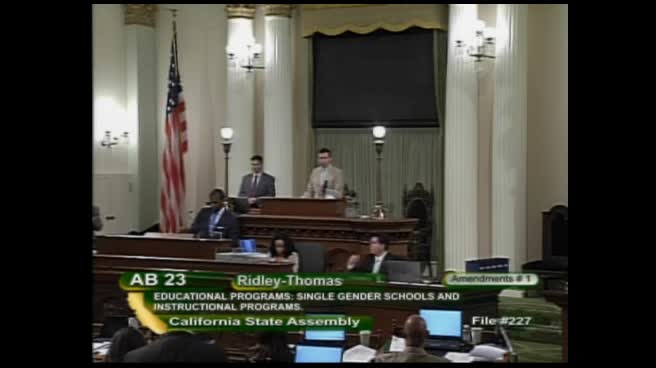 1MIN
Assembly Floor
 46MIN
Assembly Standing Committee on Education
Bill Author


