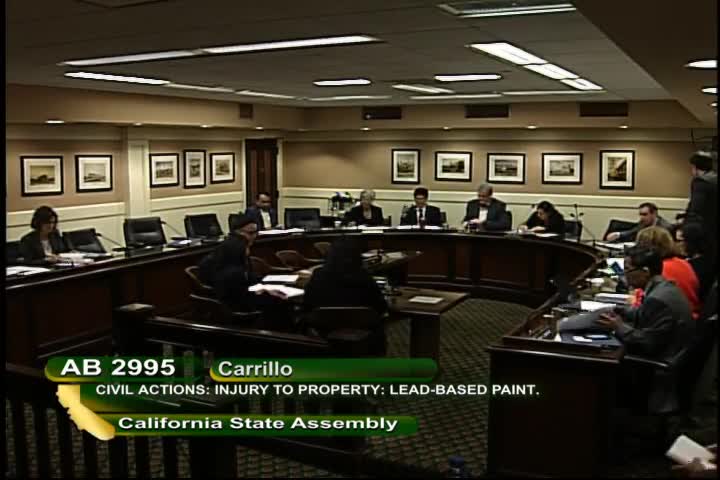
AB 2995: Civil actions: injury to property: lead-based paint.
- Session Year: 2017-2018
- House: Assembly
- Latest Version Date: 2018-05-02
Existing law provides that an injury to property consists in depriving its owner of the benefit of it, which is done by taking, withholding, deteriorating, or destroying it. Existing law requires an action seeking relief based on an injury to property to be commenced within 3 years after the time that the cause of action has accrued.
This bill would provide that the presence of lead paint on the surfaces of a residence or other building constitutes a physical injury to property. The bill would provide that an action to recover damages for that injury would not accrue until three years from the date the aggrieved party has actual knowledge of the presence of lead-based paint in or on that property, as specified. The bill would provide that receipt or knowledge of disclosures that residences built before 1978 are presumed to contain lead-based paint are not alone sufficient to establish that knowledge. The bill would make related findings and declarations. The bill would make these provisions retroactive. The bill would make these provisions severable.
Existing law provides that an injury to property consists in depriving its owner of the benefit of it, which is done by taking, withholding, deteriorating, or destroying it. Existing law requires an action seeking relief based on an injury to property to be commenced within 3 years after the time that the cause of action has accrued.
This bill would provide that the presence of lead paint on the surfaces of a residence or other building constitutes a physical injury to property. The bill would provide that an action to recover damages for that injury would not accrue until the aggrieved party has actual knowledge of the presence of lead-based paint in or on that property, as specified. The bill would make related findings and declarations. The bill would make these provisions retroactive. The bill would make these provisions severable.
Existing law prescribes the manner in which contracts may be created. Under existing law, certain contracts are invalid unless the contract, or some note or memorandum of the contract, is in writing and subscribed by the party to be charged.This bill would make nonsubstantive changes to those provisions.Existing law prescribes the manner in which contracts may be created. Under existing law, certain contracts are invalid unless the contract, or some note or memorandum of the contract, is in writing and subscribed by the party to be charged.
This bill would make nonsubstantive changes to those provisions.
The Legislature finds and declares all of the following:
(a)Lead is highly toxic.
(b)At high levels of exposure, lead causes seizures, comas, brain swelling, and death.
(c)At low levels of exposure, lead causes decreased IQ, difficulty with problem solving, memory impairment, attention-related disorders, and anti-social behavior.
(d)Exposure to lead causes serious health harms that are irreversible and cumulative. As the American Academy of Pediatrics explained in 2016, [n]o treatments have been shown to be effective in ameliorating the permanent developmental effects of lead toxicity.
(e)Young children are especially susceptible to lead exposure due to their smaller size, the vulnerability of their developing nervous systems, and their high rates of lead absorption.
(f)Government agencies and health organizations, including the Centers for Disease Control and Prevention, the World Health Organization, and the American Academy of Pediatrics, agree that there is no safe level of lead exposure.
(g)Once applied to the surface of a residence or other building, lead-based paint becomes a permanent feature of that residence or other building until that paint has been abated.
(h)Deteriorating lead-based paint on the surfaces of a building or residenceespecially high-friction surfaces like windows and doorsposes a serious health hazard to any young child who enters or lives in that building or residence.
(i)Studies indicate that lead-based paint is the source of approximately 70 percent of childhood exposure to lead.
(j)Virtually all government agencies, scientists, and public health officials agree that lead-based paint on residential surfaces is the predominant source of lead exposure in young children.
(k)Each year, the State of California identifies tens of thousands of young children in California whose health has been irreversibly harmed due to lead exposure; these children represent the minimum number of children in California whose health has been irreversibly harmed due to lead exposure.
(l)The economic costs of childhood lead exposure are substantial. These costs include (1) health care costs associated with health problems caused by lead exposure; (2) special education costs incurred due to slower development, lower educational success, and behavioral problems caused by lead exposure; (3) loss of tax revenue due to decreased lifetime earnings resulting from decreased intelligence caused by lead exposure; and (4) costs of criminal activity connected to lead exposure. According to the American Academy of Pediatrics, the estimated annual cost of childhood lead exposure in the United States is fifty billion dollars ($50,000,000,000).
(m)The substantial economic costs of childhood lead exposure fall disproportionately on state and local governments in California. Because young children who suffer from lead exposure are often poor, their health and special education costs are typically borne by state and local governments. Likewise, many of the economic costs of criminal behavior closely connected to lead exposure are shouldered by these governments. Finally, the costs to state and local governments in California from childhood lead exposure are exacerbated by the loss of tax revenues due to loss of income associated with childhood lead exposure.
(n)As the American Academy of Pediatrics explained in 2016, the only way to prevent the serious and irreversible health harms associated with childhood lead exposure caused by lead-based paint is to abate that paint before a young child is exposed to it. For every $1 dollar invested to reduce lead hazards in housing units, society would benefit by an estimated $17 to $221, a cost-benefit ratio that is comparable to the cost-benefit ratio for childhood vaccines.
(o)In 2017, the California Court of Appeals, in People v. Conagra Products Grocery Company (2017) 17 Cal.App.5th 51, upheld a 2014 trial court ruling that, with respect to residences constructed before 1951, certain lead paint manufacturers caused lead-based paint to be applied on certain residential surfaces by promoting that paint for use on those surfaces, even thought they knew that it would pose a serious risk of harm to children.
SEC. 2.Section 28.1 is added to the Code of Civil Procedure, to read:28.1.The presence of lead-based paint on the surfaces of a residence or other building constitutes a physical injury to property.
SEC. 3.Section 338.2 is added to the Civil Code of Civil Procedure, to read:338.2.A (a)In a civil action to recover damages for injury to property due to the presence of lead-based paint does not accrue until paint, the time for commencement of the action shall be three years from the date the aggrieved party has actual knowledge of the presence of lead-based paint in or on that property. Receipt
(b)Receipt or knowledge of disclosures that residences built before 1978 are presumed to contain lead-based paint are not alone sufficient to establish actual knowledge of the presence of lead-based paint. This subdivision shall have retroactive and prospective effect.
SEC. 4.This act shall have retroactive and prospective effect.SEC. 5.SEC. 4.The provisions of this act are severable. If any provision of this act or its application is held invalid, that invalidity shall not affect other provisions or applications that can be given effect without the invalid provision or application.
The Legislature finds and declares all of the following:
(a)Lead is highly toxic.
(b)At high levels of exposure, lead causes seizures, comas, brain swelling, and death.
(c)At low levels of exposure, lead causes decreased IQ, difficulty with problem solving, memory impairment, attention-related disorders, and anti-social behavior.
(d)Exposure to lead causes serious health harms that are irreversible and cumulative. As the American Academy of Pediatrics explained in 2016, [n]o treatments have been shown to be effective in ameliorating the permanent developmental effects of lead toxicity.
(e)Young children are especially susceptible to lead exposure due to their smaller size, the vulnerability of their developing nervous systems, and their high rates of lead absorption.
(f)Government agencies and health organizations, including the Centers for Disease Control and Prevention, the World Health Organization, and the American Academy of Pediatrics, agree that there is no safe level of lead exposure.
(g)Once applied to the surface of a residence or other building, lead-based paint becomes a permanent feature of that residence or other building until that paint has been abated.
(h)Deteriorating lead-based paint on the surfaces of a building or residenceespecially high-friction surfaces like windows and doorsposes a serious health hazard to any young child who enters or lives in that building or residence.
(i)Studies indicate that lead-based paint is the source of approximately 70 percent of childhood exposure to lead.
(j)Virtually all government agencies, scientists, and public health officials agree that lead-based paint on residential surfaces is the predominant source of lead exposure in young children.
(k)Each year, the State of California identifies tens of thousands of young children in California whose health has been irreversibly harmed due to lead exposure; these children represent the minimum number of children in California whose health has been irreversibly harmed due to lead exposure.
(l)The economic costs of childhood lead exposure are substantial. These costs include (1) health care costs associated with health problems caused by lead exposure; (2) special education costs incurred due to slower development, lower educational success, and behavioral problems caused by lead exposure; (3) loss of tax revenue due to decreased lifetime earnings resulting from decreased intelligence caused by lead exposure; and (4) costs of criminal activity connected to lead exposure. According to the American Academy of Pediatrics, the estimated annual cost of childhood lead exposure in the United States is fifty billion dollars ($50,000,000,000).
(m)The substantial economic costs of childhood lead exposure fall disproportionately on state and local governments in California. Because young children who suffer from lead exposure are often poor, their health and special education costs are typically borne by state and local governments. Likewise, many of the economic costs of criminal behavior closely connected to lead exposure are shouldered by these governments. Finally, the costs to state and local governments in California from childhood lead exposure are exacerbated by the loss of tax revenues due to loss of income associated with childhood lead exposure.
(n)As the American Academy of Pediatrics explained in 2016, the only way to prevent the serious and irreversible health harms associated with childhood lead exposure caused by lead-based paint is to abate that paint before a young child is exposed to it. For every $1 dollar invested to reduce lead hazards in housing units, society would benefit by an estimated $17 to $221, a cost-benefit ratio that is comparable to the cost-benefit ratio for childhood vaccines.
(o)In 2017, the California Court of Appeals, in People v. Conagra Products Grocery Company (2017) 17 Cal.App.5th 51, upheld a 2014 trial court ruling that, with respect to residences constructed before 1951, certain lead paint manufacturers caused lead-based paint to be applied on certain residential surfaces by promoting that paint for use on those surfaces, even thought they knew that it would pose a serious risk of harm to children.
SEC. 2.Section 28.1 is added to the Code of Civil Procedure, to read:28.1.The presence of lead-based paint on the surfaces of a residence or other building constitutes a physical injury to property.
SEC. 3.Section 338.2 is added to the Civil Code, to read:338.2.A civil action to recover damages for injury to property due to the presence of lead-based paint does not accrue until the aggrieved party has actual knowledge of the presence of lead-based paint in or on that property. Receipt or knowledge of disclosures that residences built before 1978 are presumed to contain lead-based paint are not alone sufficient to establish actual knowledge of the presence of lead-based paint.
SEC. 4.This act shall have retroactive and prospective effect.
SEC. 5.The provisions of this act are severable. If any provision of this act or its application is held invalid, that invalidity shall not affect other provisions or applications that can be given effect without the invalid provision or application.
SECTION 1.Section 1624 of the Civil Code is amended to read:1624.(a)The following contracts are invalid, unless they, or some note or memorandum thereof, are in writing and subscribed by the party to be charged or by the partys agent:(1)An agreement that by its terms is not to be performed within a year from the making thereof.(2)A special promise to answer for the debt, default, or miscarriage of another, except in the cases provided for in Section 2794.(3)An agreement to lease for a period longer than one year, or to sell real property, or to sell an interest therein; such an agreement, if made by an agent of the party sought to be charged, is invalid, unless the authority of the agent is in writing, subscribed by the party sought to be charged.(4)An agreement authorizing or employing an agent, broker, or any other person to purchase or sell real estate, or to lease real estate for a longer period than one year, or to procure, introduce, or find a purchaser or seller of real estate or a lessee or lessor of real estate if the lease is for a longer period than one year, for compensation or a commission.(5)An agreement that by its terms is not to be performed during the lifetime of the promisor.(6)An agreement by a purchaser of real property to pay an indebtedness secured by a mortgage or deed of trust upon the property purchased, unless assumption of the indebtedness by the purchaser is specifically provided for in the conveyance of the property.(7)A contract, promise, undertaking, or commitment to loan money or to grant or extend credit, in an amount greater than one hundred thousand dollars ($100,000), not primarily for personal, family, or household purposes, made by a person engaged in the business of lending or arranging for the lending of money or extending credit. For purposes of this section, a contract, promise, undertaking, or commitment to loan money secured solely by residential property consisting of one to four dwelling units shall be deemed to be for personal, family, or household purposes.(b)Notwithstanding paragraph (1) of subdivision (a):(1)An agreement or contract that is valid in other respects and is otherwise enforceable is not invalid for lack of a note, memorandum, or other writing and is enforceable by way of action or defense, provided that the agreement or contract is a qualified financial contract as defined in paragraph (2) and one of the following apply:(A)There is, as provided in paragraph (3), sufficient evidence to indicate that a contract has been made.(B)The parties thereto by means of a prior or subsequent written contract, have agreed to be bound by the terms of the qualified financial contract from the time they reached agreement (by telephone, by exchange of electronic messages, or otherwise) on those terms.(2)For purposes of this subdivision, a qualified financial contract means an agreement as to which each party thereto is other than a natural person and that is any of the following:(A)For the purchase and sale of foreign exchange, foreign currency, bullion, coin, or precious metals on a forward, spot, next-day value or other basis.(B)A contract (other than a contract for the purchase of a commodity for future delivery on, or subject to the rules of, a contract market or board of trade) for the purchase, sale, or transfer of any commodity or any similar good, article, service, right, or interest that is presently or in the future becomes the subject of a dealing in the forward contract trade, or any product or byproduct thereof, with a maturity date more than two days after the date the contract is entered into.(C)For the purchase and sale of currency, or interbank deposits denominated in United States dollars.(D)For a currency option, currency swap, or cross-currency rate swap.(E)For a commodity swap or a commodity option (other than an option contract traded on, or subject to the rules of, a contract market or board of trade).(F)For a rate swap, basis swap, forward rate transaction, or an interest rate option.(G)For a security-index swap or option, or a security or securities price swap or option.(H)An agreement that involves any other similar transaction relating to a price or index (including, without limitation, any transaction or agreement involving any combination of the foregoing, any cap, floor, collar, or similar transaction with respect to a rate, commodity price, commodity index, security or securities price, security index, other price index, or loan price).(I)An option with respect to any of the foregoing.(3)There is sufficient evidence that a contract has been made in any of the following circumstances:(A)There is evidence of an electronic communication (including, without limitation, the recording of a telephone call or the tangible written text produced by computer retrieval), admissible in evidence under the laws of this state, sufficient to indicate that in the communication a contract was made between the parties.(B)A confirmation in writing sufficient to indicate that a contract has been made between the parties and sufficient against the sender is received by the party against whom enforcement is sought no later than the fifth business day after the contract is made (or any other period of time that the parties may agree in writing) and the sender does not receive, on or before the third business day after receipt (or the other period of time that the parties may agree in writing), written objection to a material term of the confirmation. For purposes of this subparagraph, a confirmation or an objection thereto is received at the time there has been an actual receipt by an individual responsible for the transaction or, if earlier, at the time there has been constructive receipt, which is the time actual receipt by that individual would have occurred if the receiving party, as an organization, had exercised reasonable diligence. For the purposes of this subparagraph, a business day is a day on which both parties are open and transacting business of the kind involved in that qualified financial contract that is the subject of confirmation.(C)The party against whom enforcement is sought admits in its pleading, testimony, or otherwise in court that a contract was made.(D)There is a note, memorandum, or other writing sufficient to indicate that a contract has been made, signed by the party against whom enforcement is sought or by its authorized agent or broker.For purposes of this paragraph, evidence of an electronic communication indicating the making in that communication of a contract, or a confirmation, admission, note, memorandum, or writing is not insufficient because it omits or incorrectly states one or more material terms agreed upon, as long as the evidence provides a reasonable basis for concluding that a contract was made.(4)For purposes of this subdivision, the tangible written text produced by telex, telefacsimile, computer retrieval, or other process by which electronic signals are transmitted by telephone or otherwise shall constitute a writing, and any symbol executed or adopted by a party with the present intention to authenticate a writing shall constitute a signing. The confirmation and notice of objection referred to in subparagraph (B) of paragraph (3) may be communicated by means of telex, telefacsimile, computer, or other similar process by which electronic signals are transmitted by telephone or otherwise, provided that a party claiming to have communicated in that manner shall, unless the parties have otherwise agreed in writing, have the burden of establishing actual or constructive receipt by the other party as set forth in subparagraph (B) of paragraph (3).(c)This section does not apply to leases subject to Division 10 (commencing with Section 10101) of the Commercial Code.(d)An electronic message of an ephemeral nature that is not designed to be retained or to create a permanent record, including, but not limited to, a text message or instant message format communication, is insufficient under this title to constitute a contract to convey real property, in the absence of a written confirmation that conforms to the requirements of subparagraph (B) of paragraph (3) of subdivision (b).(a)The following contracts are invalid, unless they, or some note or memorandum thereof, are in writing and subscribed by the party to be charged or by the partys agent:
(1)An agreement that by its terms is not to be performed within a year from the making thereof.
(2)A special promise to answer for the debt, default, or miscarriage of another, except in the cases provided for in Section 2794.
(3)An agreement for the leasing for a longer period than one year, or for the sale of to lease for a period longer than one year, or to sell real property, or of to sell an interest therein; such an agreement, if made by an agent of the party sought to be charged, is invalid, unless the authority of the agent is in writing, subscribed by the party sought to be charged.
(4)An agreement authorizing or employing an agent, broker, or any other person to purchase or sell real estate, or to lease real estate for a longer period than one year, or to procure, introduce, or find a purchaser or seller of real estate or a lessee or lessor of real estate where if the lease is for a longer period than one year, for compensation or a commission.
(5)An agreement that by its terms is not to be performed during the lifetime of the promisor.
(6)An agreement by a purchaser of real property to pay an indebtedness secured by a mortgage or deed of trust upon the property purchased, unless assumption of the indebtedness by the purchaser is specifically provided for in the conveyance of the property.
(7)A contract, promise, undertaking, or commitment to loan money or to grant or extend credit, in an amount greater than one hundred thousand dollars ($100,000), not primarily for personal, family, or household purposes, made by a person engaged in the business of lending or arranging for the lending of money or extending credit. For purposes of this section, a contract, promise, undertaking, or commitment to loan money secured solely by residential property consisting of one to four dwelling units shall be deemed to be for personal, family, or household purposes.
(b)Notwithstanding paragraph (1) of subdivision (a):
(1)An agreement or contract that is valid in other respects and is otherwise enforceable is not invalid for lack of a note, memorandum, or other writing and is enforceable by way of action or defense, provided that the agreement or contract is a qualified financial contract as defined in paragraph (2) and one of the following apply:
(A)There is, as provided in paragraph (3), sufficient evidence to indicate that a contract has been made.
(B)The parties thereto by means of a prior or subsequent written contract, have agreed to be bound by the terms of the qualified financial contract from the time they reached agreement (by telephone, by exchange of electronic messages, or otherwise) on those terms.
(2)For purposes of this subdivision, a qualified financial contract means an agreement as to which each party thereto is other than a natural person and that is any of the following:
(A)For the purchase and sale of foreign exchange, foreign currency, bullion, coin, or precious metals on a forward, spot, next-day value or other basis.
(B)A contract (other than a contract for the purchase of a commodity for future delivery on, or subject to the rules of, a contract market or board of trade) for the purchase, sale, or transfer of any commodity or any similar good, article, service, right, or interest that is presently or in the future becomes the subject of a dealing in the forward contract trade, or any product or byproduct thereof, with a maturity date more than two days after the date the contract is entered into.
(C)For the purchase and sale of currency, or interbank deposits denominated in United States dollars.
(D)For a currency option, currency swap, or cross-currency rate swap.
(E)For a commodity swap or a commodity option (other than an option contract traded on, or subject to the rules of, a contract market or board of trade).
(F)For a rate swap, basis swap, forward rate transaction, or an interest rate option.
(G)For a security-index swap or option, or a security or securities price swap or option.
(H)An agreement that involves any other similar transaction relating to a price or index (including, without limitation, any transaction or agreement involving any combination of the foregoing, any cap, floor, collar, or similar transaction with respect to a rate, commodity price, commodity index, security or securities price, security index, other price index, or loan price).
(I)An option with respect to any of the foregoing.
(3)There is sufficient evidence that a contract has been made in any of the following circumstances:
(A)There is evidence of an electronic communication (including, without limitation, the recording of a telephone call or the tangible written text produced by computer retrieval), admissible in evidence under the laws of this state, sufficient to indicate that in the communication a contract was made between the parties.
(B)A confirmation in writing sufficient to indicate that a contract has been made between the parties and sufficient against the sender is received by the party against whom enforcement is sought no later than the fifth business day after the contract is made (or any other period of time that the parties may agree in writing) and the sender does not receive, on or before the third business day after receipt (or the other period of time that the parties may agree in writing), written objection to a material term of the confirmation. For purposes of this subparagraph, a confirmation or an objection thereto is received at the time there has been an actual receipt by an individual responsible for the transaction or, if earlier, at the time there has been constructive receipt, which is the time actual receipt by that individual would have occurred if the receiving party, as an organization, had exercised reasonable diligence. For the purposes of this subparagraph, a business day is a day on which both parties are open and transacting business of the kind involved in that qualified financial contract that is the subject of confirmation.
(C)The party against whom enforcement is sought admits in its pleading, testimony, or otherwise in court that a contract was made.
(D)There is a note, memorandum, or other writing sufficient to indicate that a contract has been made, signed by the party against whom enforcement is sought or by its authorized agent or broker.
For purposes of this paragraph, evidence of an electronic communication indicating the making in that communication of a contract, or a confirmation, admission, note, memorandum, or writing is not insufficient because it omits or incorrectly states one or more material terms agreed upon, as long as the evidence provides a reasonable basis for concluding that a contract was made.
(4)For purposes of this subdivision, the tangible written text produced by telex, telefacsimile, computer retrieval, or other process by which electronic signals are transmitted by telephone or otherwise shall constitute a writing, and any symbol executed or adopted by a party with the present intention to authenticate a writing shall constitute a signing. The confirmation and notice of objection referred to in subparagraph (B) of paragraph (3) may be communicated by means of telex, telefacsimile, computer, or other similar process by which electronic signals are transmitted by telephone or otherwise, provided that a party claiming to have communicated in that manner shall, unless the parties have otherwise agreed in writing, have the burden of establishing actual or constructive receipt by the other party as set forth in subparagraph (B) of paragraph (3).
(c)This section does not apply to leases subject to Division 10 (commencing with Section 10101) of the Commercial Code.
(d)An electronic message of an ephemeral nature that is not designed to be retained or to create a permanent record, including, but not limited to, a text message or instant message format communication, is insufficient under this title to constitute a contract to convey real property, in the absence of a written confirmation that conforms to the requirements of subparagraph (B) of paragraph (3) of subdivision (b).
|
Date
|
Status
|
|---|---|
| May 31, 2018 | Read third time. Refused passage. |
| May 3, 2018 | Read second time. Ordered to third reading. |
| May 2, 2018 | Read second time and amended. Ordered returned to second reading. |
| May 1, 2018 | From committee: Amend, and do pass as amended. (Ayes 7. Noes 2.) (May 1). |
| Apr 2, 2018 | Re-referred to Com. on JUD. |
| Mar 22, 2018 | Referred to Com. on JUD. |
| Feb 17, 2018 | From printer. May be heard in committee March 19. |
| Feb 16, 2018 | Read first time. To print. |
|
Date
|
Description
|
Location
|
Votes
|
|
|---|---|---|---|---|
| May 31, 2018 | AB 2995 CARRILLO Assembly Third Reading | Assembly Floor |
Failed |
|
| May 1, 2018 | Do pass as amended. | Assembly Standing Committee on Judiciary |
Passed |
This list shows positions taken on this bill by organizations on the date displayed, which is linked to the original source.
Positions by individuals are not included.
|
Organization
|
Position
|
Date
|
|---|---|---|
| A. Philip Randolph Institute - San Francisco | ** Support | Apr 29, 2018 |
| American Coatings Association | ** Against | Apr 29, 2018 |
| American Codings Association | * Against | May 1, 2018 |
| American Insurance Corporation | ** Against | Apr 29, 2018 |
| Bay Area Legal Aid | ** Support | Apr 29, 2018 |
| Board of Supervisors Santa Clara County | * Support | May 1, 2018 |
| Brightline Defense Project | ** Support | Apr 29, 2018 |
| California Chamber Of Commerce | * Support | May 1, 2018 |
| California League Of Conservation Voters | ** Support | Apr 29, 2018 |
| California Manufacturers & Technology Association | * Against | May 1, 2018 |
| California Paint Council | ** Against | Apr 29, 2018 |
| Children's Advocacy Institute | ** Support | Apr 29, 2018 |
| City and County of San Francisco | ** Support | Apr 29, 2018 |
| City of Emeryville | * Support | May 1, 2018 |
| City Of Oakland | * Support | May 1, 2018 |
| Civil Justice Association Of California | ** Against | Apr 29, 2018 |
| Clean Water Action | ** Support | Apr 29, 2018 |
| Clinica Monsenor Oscar A. Romero | ** Support | Apr 29, 2018 |
| Community Youth Center | ** Support | Apr 29, 2018 |
| Consumer Attorneys in California | * Support | May 1, 2018 |
| Consumer Federation Of California | ** Support | Apr 29, 2018 |
| County of Los Angeles Board of Supervisors | * Support | May 1, 2018 |
| Environmental Working Group | * Support | May 1, 2018 |
| Household and Commercial Products Association | ** Against | Apr 29, 2018 |
| intercity struggle | ** Support | Apr 29, 2018 |
| Los Angeles County | ** Support | Apr 29, 2018 |
| Santa Clara County | ** Support | Apr 29, 2018 |
| Smartoakland | ** Support | Apr 29, 2018 |
ASSEMBLY THIRD READING
ATR Bill Id:AB 2995
Author:(Carrillo)
As Amended Ver:May 2, 2018
Majority vote
Committee | Votes | Ayes | Noes |
Judiciary | 7-2 | Mark Stone, Chau, Chiu, Gonzalez Fletcher, Holden, Kalra, Reyes | Cunningham, Kiley |
SUMMARY: Defines lead-based paint on a residence or other building as a physical injury to property, and provides that civil actions to recover damages to property due to the presence of lead-based paint do not accrue until the aggrieved party has actual knowledge of the lead-based paint. Specifically, this bill:
- Defines the presence of lead-based paint on the surfaces of a residence or other building as a physical injury to property.
- Provides that in any civil action to recover damages for injury to property due to the presence of lead-based paint, the time for commencement of the action shall be three years from the date the aggrieved party has actual knowledge of the presence of lead-based paint in or on that property.
- Establishes that the receipt or knowledge of disclosures that residences built before 1978 are presumed to contain lead-based paint are not alone sufficient to establish actual knowledge of the presence of lead-based paint, and specifies that this provision shall have retroactive and prospective effect.
- Makes a number of Legislative findings and declarations.
- Contains a severability clause, stating that if any provision of this act or its application is held invalid, that invalidity shall not affect other provisions or applications that can be given effect without the invalid provision or application.
FISCAL EFFECT: None
COMMENTS: In 2017, an appellate court concluded that three lead-based paint manufacturers were responsible for the health hazards of lead paint in many homes in California, and upheld a lower court order that these companies pay $1.15 billion into a fund for abatement of these hazards in homes across the state. (People v. ConAgra Grocery Products Co. (2017) 17 Cal.App.5th 51.) Shortly after the California Supreme Court declined to review the decision on appeal, thus finalizing the issue and removing any doubt as to the culpability of the paint companies, the defendant paint companies announced they would be sponsoring a ballot initiative, proposed for the November 2018 election, which would vacate the court's decision to hold paint manufacturers liable for cleaning up the lead paint crisis in California and instead create a taxpayer-funded bond for abatement. This bill, like several others before the legislature this session, seeks to ensure robust lead paint abatement in California through the abatement program created by the judgment and by other means, to help homeowners sue to recover costs from lead paint manufacturers, if necessary.
This bill classifies the presence of lead-based paint in a home or building as a physical injury to the property, enabling property owners to sue for the cost of abating or removing lead paint to prevent further harm or risk to the health of those living there, particularly children. Secondly, the bill establishes a three-year statute of limitations for a lawsuit seeking to recover damages for injury to property due to the presence of lead paint in or on the property. Finally, the bill clarifies that authority to file such an action is not retroactively applied without limit, but only that the actual knowledge standard established by the bill is retroactive, as well as prospective.
Establishing physical injury to property removes barriers to certain tort claims that may help prevent children from being harmed or further harmed. The evidence that lead-based paint is harmful to the health of human beings is overwhelming and well-established. As recited in the bill's findings and declarations, exposure to lead causes serious health harms that are irreversible and cumulative, and the American Academy of Pediatrics stated in 2016 that, "[n]o treatments have been shown to be effective in ameliorating the permanent developmental effects of lead toxicity" [citation omitted.] However, the extent to which the presence of lead-based paint is an injury to a building is less certain, and has been contested in recent litigation.
In County of Santa Clara v. Atlantic Richfield Co. (2006) 137 Cal.App.4th 292, plaintiffs brought several causes of action, including strict liability and negligence, against defendant paint companies alleging that their negligent manufacturing, production, marketing, and other conduct had caused injuries and damage to plaintiffs, including property damage. The court reasoned that "economic loss alone, without physical injury, does not amount to the type of 'damage' that will cause a negligence or strict liability cause of action to accrue" and that in such a case, "'the compensable injury must be physical harm to persons or property, not mere economic loss.'" (Id, at p. 318, citing Zamora v. Shell Oil (1997) 55 Cal.App.4th 204, 210.) The court was not persuaded by plaintiff's allegations that subsequent deterioration of lead paint amounted to physical injury of the property, and ultimately dismissed their negligence and strict liability cause of actions for failing to accrue under the applicable statutes of limitation.
Proponents further note that nothing prevents the Legislature from determining that, as a matter of public policy, it is necessary to modify rules of liability in order to respond to the pervasive presence of lead-paint in buildings in California, and the serious risk to public health that arises as a result, which proponents believe can be directly attributed to the harmful conduct of lead-paint companies over the years.
According to the author, this bill is essentially adopts the minority position taken by Chief Justice Ronald George in Aas v. Superior Court (2000) 24 Cal.4th 627, as applied to lead paint. In his concurring and dissenting opinion, the Chief Justice asked "Why should a homeowner have to wait for a personal tragedy to occur in order to recover damages to repair known serious building code safety defects caused by negligent construction?" In rejecting adherence to the economic loss doctrine (restricting a homeowner's ability to recover repair costs in a negligence action), the Chief Justice reasoned that:
It obviously is preferable to pay a relatively few dollars at an early date to correct a serious safety risk that may cost millions or billions of dollars to redress if the inhabitants of dwellings are forced to wait for disaster to strike and for death, personal injury, or physical property damage to ensue. . . I conclude, consistent with California authority and with the courts of other jurisdictions, that a homeowner may maintain a cause of action in negligence to recover the costs of correcting the most significant building safety code violations conceded in this litigation, but that have not yet manifested themselves in physical damage to the property or resulted in personal injury.
As applied to lead paint, this bill would follow a similar approach outlined in the Chief Justice's minority opinion in Aas and allow property owners greater leeway to sue (for example, to pursue a negligence cause of action) to recover costs of abating lead paint without necessarily waiting for their children to be harmed by exposure to lead paint. It accomplishes this simply by building upon existing principles and codifying that the presence of lead-based paint on the surfaces of a residence or other building constitutes a physical injury to property.
The Discovery Rule and statutes of limitation in toxic tort cases. To address the potential unfairness of a typical statute of limitations, California courts have long applied a "discovery rule" to toxic tort cases, holding that the statute of limitations begins to run only after the plaintiff "knew or reasonably should have known of the facts constituting wrongful conduct." (Hopkins v. Dow Corning Corporation (1994) 33 F.3d 1116, 1120.) This ensures that plaintiffs can recover even if their exposure to an environmental toxic has a latency period that lasts well beyond the typical two-year statute of limitations. Many statutes of limitation in the California Code of Civil Procedure (CCP) have been modified to reflect this discovery standard as well. (See CCP Section 340.8.) While this rule provides significant leeway to plaintiffs to seek recovery upon discovering the harm, California courts have strictly construed the "should have known" requirements of the law to require that "a plaintiff is under a duty to reasonably investigate…a suspicion of wrongdoing coupled with a knowledge of harm and its cause will commence the statute of limitations." (Jolly v. Eli Lilly & Co. (1988) 44 Cal. 3d 1103, 1112.) The duty to investigate requires a plaintiff to demonstrate that they were unable to discover the cause of their harm sooner, despite exercising reasonable diligence. (Saliter v. Pierce Bros. Mortuaries (1978) 81 Cal.App. 3d 292.) In response to opposition concerns that this bill proposes an unlimited statute of limitations for lead paint contamination, the bill was recently amended to reflect the author's intent to adopt a three-year statute of limitations for a lawsuit regarding an injury to real property.
This bill seeks to limit the plaintiff's duty to investigate lead paint contamination. As recently amended, this bill seeks to avoid the duty to investigate by stating that the statute of limitations period only begins to run when the plaintiff has "actual knowledge" of the injury to their property caused by the presence of lead paint. As noted above, courts hold that the statute of limitations begins to run when the plaintiff knew or should have known of their claim. Furthermore, plaintiffs have an affirmative duty to seek out information related to their harms. Given that existing law requires any property sale to include a general notice that any home constructed before 1978 is presumed to contain lead paint (Civil Code Section 1102 et seq.), but for an actual knowledge standard, one could be held to have a duty to begin investigating the specific circumstances of their home upon moving in. Imposing an actual knowledge standard effectively eliminates this duty. As applied, an actual knowledge standard limits the ability to impart knowledge onto the plaintiff except when "the circumstances are such that the [one] 'must have known' and not 'should have known'." (Romero v. Superior Court (2001) 89 Cal.App.4th 1068, 1082.)
Notice is not enough. As noted above, existing law requires a provision to be inserted into the standard disclosure form provided with the sale of real property, saying that all homes built before 1978 are presumed to contain lead paint. As recently amended, this bill provides that receipt of this notice is not sufficient to impart actual knowledge of lead paint onto the homeowner. This policy is wise on two fronts. First, the unfortunate reality is that most homeowners are unlikely to read the disclosure, which is just one of many lengthy and complicated notice forms provided to home buyers at the time of sale. The information regarding lead paint is provided on page 18 of the sixth edition of the model disclosure document, is listed after disclosures related to the risks of floods, fires, earthquakes, insects and other pests, sex offenders, and methamphetamine labs. To insist that such a disclosure would cut-off a potential lawsuit for lead paint does not seem just. Furthermore, simply receiving notice does not confirm that one's property is in fact contaminated with lead paint. Legal notice notwithstanding, the average homeowner is more likely to treat this notice as a "for your information" type statement than as something that conveys actual knowledge of the existence of lead paint. Recent amendments also clarify that the author's intent is not to apply retroactivity provisions to the bill as a whole, but only the notice provisions should apply retroactively. This is appropriate because it would be unfair for a person receiving the notice in 2019 to have the benefit of the presumption against actual notice, but that a person receiving the notice in 2018 would be held to have actual knowledge.
Supporters of the bill argue that it will hold paint manufacturers accountable for the harm caused by lead-based paint in homes and will ensure that paint companies don't push their liability onto homeowners. By classifying lead-based paint in certain homes as a physical injury to those properties, the bill will help homeowners remove lead-based paint from their homes by allowing them to sue for the cost of abatement. Additionally, organizations in favor of the bill argue that cleaning up lead paint will prevent future generations from harmful health impacts. Writing in support, several organizations also note that the bill would change the starting date of the statute of limitations to commence when a homeowner discovers lead-based paint – a change that will expand the timeframe for legal recourse, which is severely limited under current law since it would start at the time of purchase.
Opponents contend that, in extending liability to include injury to property (instead of to injury to a person), the measure goes beyond anything currently in law in the United States. Since this measure would define the presence of lead-based paint as a physical injury to property, opponents believe the bill would categorize all homes with a drop of lead-based paint as injured property, regardless of whether that paint poses any risk. In a combined letter of opposition to this bill and AB 2074, several opposing organizations argue that the two bills in concert set a troubling precedent for all types of consumer products sold in the state.
Analysis Prepared by: Sandra Nakagawa and Anthony Lew / JUD. / (916) 319-2334 FN: 0002792
Date of Hearing: May 1, 2018
ASSEMBLY COMMITTEE ON JUDICIARY
Mark Stone, Chair
ABPCA Bill Id:AB 2995
Author:(Carrillo) – As Amended Ver:March 22, 2018
As Proposed to be Amended
SUBJECT: CIVIL ACTIONS: INJURY TO PROPERTY: LEAD-BASED PAINT
KEY ISSUES:
- due to its harmful effects on the health of children, SHould steps be taken to enable property owners to sue for the costs of abating lead paint without having to prove that the paint caused ACTUAL harm in order to minimize and prevent the risk of any child being harmed or further harmed in the future?
- should a civil action to recover damages for injury to property due to lead-based paint be required to commence within three years from the date the aggrieved party has actual knowledge of the lead-based paint in or on the property?
- should it be retroactively and prospectively established that MANDATORY disclosures of LEAD PAINT IN PRE-1978 RESIDENCES are NOT alone SUFFICIENT TO ESTABLISH ACTUAL KNOWLEDGE of the presence of lead-Based paint?
SYNOPSIS
Every year thousands of California children are subject to irreversible harm from lead exposure. Despite the fact that consumer lead-based paint has been banned in the U.S. since 1978, it continues to present a serious risk to human health and well-being. According to the Legislative Analysist’s Office, about 60% of houses in California were built before 1978 and are presumed to have lead-based paint. A recent court decision found several manufacturers of lead-based paints to be liable for creating a public nuisance across 10 jurisdictions due to their efforts to sell, manufacture, distribute, and promote lead-based paint despite having actual or constructive knowledge that the paint presented a hazard to human health. The three paint manufacturers named in the case were ordered to pay $1.15 billion into a fund to inspect for and abate lead paint in all homes constructed up through 1980, though an appellate court later ruled that the manufacturers were only liable for lead-based paint in homes built before 1951.
This bill, like several others introduced in the legislature this session, seeks to ensure robust lead paint abatement in California, through the abatement program created by the judgment and by other means to help homeowners sue to recover abatement costs from lead paint manufacturers, if necessary. Specifically, this bill classifies the presence of lead-based paint in a home or building as a physical injury to the property, enabling property owners to sue for the cost of abating or removing lead paint to prevent further harm or risk to the health of those living there, particularly children. Secondly, as proposed to be amended, the bill establishes a three-year statute of limitations for a lawsuit seeking to recover damages for injury to property due to the presence of lead paint in or on the property. Finally, proposed amendments clarify that the authority to file such an action is not retroactively applied without limit, but only that the actual knowledge standard established by the bill is retroactive, as well as prospective. Supporters of the bill, including consumer advocates and local governments, argue that the bill is needed to hold paint manufacturers accountable for the harm caused by lead-based paint and to help homeowners remove lead-based paint from their homes before their children or others experience further harm. The bill is opposed by paint companies, the Chamber of Commerce, and other business associations who object to any expansion of liability in this area, and express concern about setting precedent for any new theories of liability for other consumer products, particularly any theory not based on traditional notions of direct causation by an individually identified defendant.
SUMMARY: Defines lead-based paint on a residence or other building as a physical injury to property, and provides that civil actions to recover damages to property due to the presence of lead-based paint do not accrue until the aggrieved party has actual knowledge of the lead-based paint. Specifically, this bill:
- Defines the presence of lead-based paint on the surfaces of a residence or other building as a physical injury to property.
- Provides that in any civil action to recover damages for injury to property due to the presence of lead-based paint, the time for commencement of the action shall be three years from the date the aggrieved party has actual knowledge of the presence of lead-based paint in or on that property.
- Establishes that the receipt or knowledge of disclosures that residences built before 1978 are presumed to contain lead-based paint are not alone sufficient to establish actual knowledge of the presence of lead-based paint, and specifies that this provision shall have retroactive and prospective effect.
- Makes a number of Legislative findings and declarations, including the following:
- Exposure to lead causes serious health harms that are irreversible and cumulative. As the American Academy of Pediatrics explained in 2016, “[n]o treatments have been shown to be effective in ameliorating the permanent developmental effects of lead toxicity.”
- Deteriorating lead-based paint on the surfaces of a building or residence—especially high-friction surfaces like windows and doors—poses a serious health hazard to any young child who enters or lives in that building or residence.
- Each year, the State of California identifies tens of thousands of young children in California whose health has been irreversibly harmed due to lead exposure; these children represent the minimum number of children in California whose health has been irreversibly harmed due to lead exposure.
- As the American Academy of Pediatrics explained in 2016, the only way to prevent the serious and irreversible health harms associated with childhood lead exposure caused by lead-based paint is to abate that paint before a young child is exposed to it: “For every $1 dollar invested to reduce lead hazards in housing units, society would benefit by an estimated $17 to $221, a cost-benefit ratio that is comparable to the cost-benefit ratio for childhood vaccines.”
- Contains a severability clause, stating that if any provision of this act or its application is held invalid, that invalidity shall not affect other provisions or applications that can be given effect without the invalid provision or application.
EXISTING LAW:
- Provides that an injury to property consists in depriving its owner of the benefit of it, which is done by taking, withholding, deteriorating, or destroying it. (Code of Civil Procedure Section 28.)
- Provides a three-year statute of limitations for bringing a civil action to recover due to trespass upon or injury to property. (Civil Code of Procedure Section 338 (b).)
- Specifies that the commencement of civil actions shall begin within five years after the time of discovery for several environmental law violations. (Civil Code of Procedure Section 338.1)
- Defines a lead hazard in a human habitable building to include deteriorating lead paint, lead-contaminated dust, lead-contaminated soil, or a disturbance lead paint without containment. Further provides that any residence with a lead hazard is in violation of the code. (Health and Safety Code Section 17920.10.)
FISCAL EFFECT: As currently in print this bill is keyed non-fiscal.
COMMENTS: In 2017, an appellate court concluded that three paint manufacturers were responsible for the health hazards of lead paint in many homes in California, and upheld a lower court order that they pay for abatement of these hazards. (People v. ConAgra Grocery Products Co. (2017) 17 Cal.App.5th 51.) This bill, like several others introduced in the legislature this session, seeks to ensure robust lead paint abatement in California, through the abatement program created by the judgment and by other means to help homeowners sue to recover abatement costs from lead paint manufacturers, if necessary. These bills also address issues raised by a subsequent ballot initiative, proposed for the November 2018 election and sponsored by the lead paint companies, which would vacate the court’s decision to hold paint manufacturers liable for cleaning up the lead paint crisis in California and instead create a taxpayer-funded bond for abatement.
This bill classifies the presence of lead-based paint in a home or building as a physical injury to the property, enabling property owners to sue for the cost of abating or removing lead paint to prevent further harm or risk to the health of those living there, particularly children. Secondly, as proposed to be amended, the bill establishes a three-year statute of limitations for a lawsuit seeking to recover damages for injury to property due to the presence of lead paint in or on the property. Finally, proposed amendments clarify that authority to file such an action is not retroactively applied without limit, but only that the actual knowledge standard established by the bill is retroactive, as well as prospective.
Pervasive, ongoing threats to health and safety posed by lead-based paint in California: A short background. Lead poisoning in children is a common, pervasive phenomenon in California and across the nation. According to the Centers for Disease Control and Prevention (CDC), there is no safe blood lead level identified for children. The CDC estimates that approximately 2.6% of U.S. children aged 1 - 5 years old have high levels of lead in their blood (blood lead levels ≥ 5 micrograms per deciliter (µg/dL)). Childhood lead exposure most often occurs because of aging lead-based paint. Like all paint, lead-based paint inevitably deteriorates: it flakes, chips, and turns to dust and can contaminate the air, soil, floors and other surfaces in the home. This is particularly true of lead paint on windows, doors, and other friction surfaces. Because children are especially likely to play on the ground and put things in their mouths, lead paint presents a larger risk for them than it does for adults living in the same space.
Exposure to lead can seriously harm a child’s health, including by damaging the brain and nervous system, slowing growth and development, and causing learning and behavior problems, hearing, and speech problems. Even a slight elevation in blood lead levels can reduce IQ and stunt development. Decreased intelligence in children and increased blood pressure in adults are among the more serious non-carcinogenic effects of lead. Warnings about the tendency for children to gnaw on painted surfaces and become poisoned with lead were common in medical journals by the 1920s. By the 1930s, parents were warned to avoid using lead-based decorative materials in nurseries and bedrooms. Yet by most accounts, the industry kept promoting residential lead paint by advertising its durability.
In 1948, the Baltimore Public Health Department observed an increase in childhood lead poisoning, primarily in communities living in neglected row houses which contained massive amounts of peeling and flaking lead paint. Health inspectors found that children were eating lead from peeling and chipping lead-based paint in that city’s housing, and in response, the Baltimore Public Health Department issued the country’s first ban on interior lead-based paint in 1951. This would be followed in 1978 with the U.S. Consumer Product Safety Commission prohibiting all consumer uses of lead-based paint across the country. Additionally, in California, since 1987 lead has been listed under Proposition 65 as a substance that can cause reproductive damage and birth defects, and has been listed as a chemical known to cause cancer since 1992.
Lead-based paint in California is also responsible for ongoing economic and social costs. Despite the federal ban on consumer uses for lead-based paints in 1978, millions of existing structures across the state still contain lead paint. According to the Legislative Analysist’s Office, about 60% of houses in California were built before 1978 and are presumed to have lead-based paint in them. Removal costs an estimated $8-$15 a square foot, which means removing all lead from a house of 1,200-2,000 square feet could run as much as $9,600-$30,000, according to RealtyTimes.com.
Establishing physical injury to property removes barriers to certain tort claims that may help prevent children from being harmed or further harmed. The evidence that lead-based paint is harmful to the health of human beings is overwhelming and well-established. As recited in the bill's findings and declarations, exposure to lead causes serious health harms that are irreversible and cumulative, and the American Academy of Pediatrics stated in 2016 that, “[n]o treatments have been shown to be effective in ameliorating the permanent developmental effects of lead toxicity” [citation omitted.] However, the extent to which the presence of lead-based paint is an injury to a building is less certain, and has been contested in recent litigation.
In County of Santa Clara v. Atlantic Richfield Co. (2006) 137 Cal.App.4th 292, plaintiffs brought several causes of action, including strict liability and negligence, against defendant paint companies alleging that their negligent manufacturing, production, marketing, and other conduct had caused injuries and damage to plaintiffs, including property damage. The court reasoned that "economic loss alone, without physical injury, does not amount to the type of 'damage' that will cause a negligence or strict liability cause of action to accrue" and that in such a case, “'the compensable injury must be physical harm to persons or property, not mere economic loss.'” (Id, at p. 318, citing Zamora v. Shell Oil (1997) 55 Cal.App.4th 204, 210.) The court was not persuaded by plaintiff's allegations that subsequent deterioration of lead paint amounted to physical injury of the property, and ultimately dismissed their negligence and strict liability cause of actions for failing to accrue under the applicable statutes of limitation.
According to the author:
AB 2995 empowers California homeowners to defend themselves and their children from the debilitating effects of lead paint in their homes. This bill clearly classifies the presence of lead-based paint in a home or building as a physical injury to the property. We can begin to rectify the widespread harm that lead paint has done and continues to do by providing property owners with the right tools to offset the cost of abating or removing lead paint before it further degrades the health of California’s residents.
Existing law, CCP Section 28, provides that an injury to property "consists in depriving its owner of the benefit of it, which is done by taking, withholding, deteriorating, or destroying it." Recognizing that this definition of "injury to property" is unnecessarily limiting when applied in the lead-paint context, this bill expressly provides in the CCP that the presence of lead-based paint on the surfaces of a residence or other building constitutes a physical injury to property.
Opponents of the bill, including the Chamber of Commerce and California Paint Council, object to the bill extending liability to an injury to property, not just personal injury. They contend that this provision in the bill will "automatically define every home in California with a drop of lead-based paint as an injured property, regardless of whether actual lead-based paint risks exist." Opponents are particularly concerned that this provision establishes the basis for liability outlined in a different bill, AB 2074.
In response, proponents note that this bill exists independently of AB 2074, and that neither bill requires the other bill to be passed in order to have effect. AB 2074 applies a risk contribution theory of liability to any action to recover damages for injury to person or property. Unlike AB 2074, this bill only addresses injury to property, so even if this bill does not become law, AB 2074 would allow an individual to utilize the risk contribution theory in a personal injury claim. Conversely, proponents note that if AB 2074 doesn’t pass, this bill would still allow plaintiffs to bring claims for injury to property, just not under a risk contribution theory of liability.
Proponents further note that nothing prevents the Legislature from determining that, as a matter of public policy, it is necessary to modify rules of liability in order to respond to the pervasive presence of lead-paint in buildings in California, and the serious risk to public health that arises as a result, which proponents believe can be directly attributed to the harmful conduct of lead-paint companies over the years.
According to the author, this bill is not an ill-considered or never-before-seen scheme to expand liability, but essentially adopts the minority position taken by Chief Justice Ronald George in Aas v. Superior Court (2000) 24 Cal.4th 627, as applied to lead paint. In his concurring and dissenting opinion, the Chief Justice asked "Why should a homeowner have to wait for a personal tragedy to occur in order to recover damages to repair known serious building code safety defects caused by negligent construction?" In rejecting adherence to the economic loss doctrine (restricting a homeowner's ability to recover repair costs in a negligence action), the Chief Justice reasoned that:
It obviously is preferable to pay a relatively few dollars at an early date to correct a serious safety risk that may cost millions or billions of dollars to redress if the inhabitants of dwellings are forced to wait for disaster to strike and for death, personal injury, or physical property damage to ensue. . . I conclude, consistent with California authority and with the courts of other jurisdictions, that a homeowner may maintain a cause of action in negligence to recover the costs of correcting the most significant building safety code violations conceded in this litigation, but that have not yet manifested themselves in physical damage to the property or resulted in personal injury.
As applied to lead paint, this bill would follow a similar approach outlined in the Chief Justice's minority opinion in Aas and allow property owners greater leeway to sue (for example, to pursue a negligence cause of action) to recover costs of abating lead paint without necessarily waiting for their children to be harmed by exposure to lead paint. It accomplishes this simply by building upon existing principles and codifying that the presence of lead-based paint on the surfaces of a residence or other building constitutes a physical injury to property.
The Discovery Rule and statutes of limitation in toxic tort cases. Statutes of limitations have historically been utilized to ensure efficiency and accuracy in litigation, forcing plaintiffs to quickly bring claims when evidence can be preserved and witnesses can accurately recall facts. For traditional torts this model works well, the harm occurs in a readily identifiable incident, the perpetrator is easily identified, and the causal mechanism is relatively clear. In cases related to harms that are the result of exposure to an environmental toxic, the traditional approach to statutes of limitations breaks down. Cases related to exposure related to an environmental toxic have two unique characteristics not typically found in other torts; first environmental exposure cases typically have long latency periods between the exposure to the toxic and the eventual harmful impact, and secondly, there is typically uncertainty regarding the causal relationship between the environmental toxic and the plaintiff’s harm. (Green, The Paradox of Statutes of Limitations in Toxic Substances Litigation (1988) 76 Cal. Law Rev. 965, 973.)
To address the potential unfairness of a typical statute of limitations, California courts have long applied a “discovery rule” to toxic tort cases, holding that the statute of limitations begins to run only after the plaintiff “knew or reasonably should have known of the facts constituting wrongful conduct.” (Hopkins v. Dow Corning Corporation (1994) 33 F.3d 1116, 1120.) This ensures that plaintiffs can recover even if their exposure to an environmental toxic has a latency period that lasts well beyond the typical two-year statute of limitations. Many statutes of limitation in the California Code of Civil Procedure have been modified to reflect this discovery standard as well. (See Code of Civil Procedure Section 340.8.) While this rule provides significant leeway to plaintiffs to seek recovery upon discovering the harm, California courts have strictly construed the “should have known” requirements of the law to require that “a plaintiff is under a duty to reasonably investigate…a suspicion of wrongdoing coupled with a knowledge of harm and its cause will commence the statute of limitations.” (Jolly v. Eli Lilly & Co. (1988) 44 Cal. 3d 1103, 1112.) The duty to investigate requires a plaintiff to demonstrate that they were unable to discover the cause of their harm sooner, despite exercising reasonable diligence. (Saliter v. Pierce Bros. Mortuaries (1978) 81 Cal.App. 3d 292.)
Adopting a three-year statute of limitations for lead paint contamination to property. In opposition to this measure, the California Chamber of Commerce and a coalition of paint manufacturers, argue that this bill proposes an unlimited statute of limitations for lead paint contamination. In response, the author contends that this is not the intent and that the bill is intended to adopt the three-year statute of limitations for a lawsuit regarding an injury to real property. To clarify the actual statute of limitations being proposed by this bill, the author proposes to amend the proposed Section 338.2 to split the statute of limitations language from the constructive notice provisions and clarify that a three-year statute of limitations applies. Accordingly, as proposed to be amended, the new Section 338.2 (a) would be added to the Code of Civil Procedure to read as follows:
(a) In any civil action to recover damages for injury to property due to the presence of lead-based paint, the time for commencement of the action shall be three years from the date does not accrue until the aggrieved party has actual knowledge of the presence of lead-based paint in or on that property.
This bill seeks to limit the plaintiff’s duty to investigate lead paint contamination. This bill, as proposed to be amended, seeks to avoid the duty to investigate by stating that the statute of limitations period only begins to run when the plaintiff has “actual knowledge” of the injury to their property caused by the presence of lead paint. As noted above, courts hold that the statute of limitations begins to run when the plaintiff knew or should have known of their claim. Furthermore, plaintiffs have an affirmative duty to seek out information related to their harms. Given that existing law requires any property sale to include a general notice that any home constructed before 1978 is presumed to contain lead paint (Civil Code Section 1102 et seq.), but for an actual knowledge standard, one could be held to have a duty to begin investigating the specific circumstances of their home upon moving in. Imposing an actual knowledge standard effectively eliminates this duty. As applied, an actual knowledge standard limits the ability to impart knowledge onto the plaintiff except when “the circumstances are such that the [one] ‘must have known’ and not ‘should have known’.” (Romero v. Superior Court (2001) 89 Cal.App.4th 1068, 1082.)
Notice is not enough. As noted above, existing law requires a provision to be inserted into the standard disclosure form provided with the sale of real property, saying that all homes built before 1978 are presumed to contain lead paint. As proposed to be amended, this bill provides that receipt of this notice is not sufficient to impart actual knowledge of lead paint onto the homeowner. This policy is wise on two fronts. First, the unfortunate reality is that most homeowners are unlikely to read the disclosure, which is just one of many lengthy and complicated notice forms provided to home buyers at the time of sale. The information regarding lead paint is provided on page 18 of the sixth edition of the model disclosure document, is listed after disclosures related to the risks of floods, fires, earthquakes, insects and other pests, sex offenders, and methamphetamine labs. To insist that such a disclosure would cut-off a potential lawsuit for lead paint does not seem just. Furthermore, simply receiving notice does not confirm that one’s property is in fact contaminated with lead paint. Legal notice notwithstanding, the average homeowner is more likely to treat this notice as a “for your information” type statement than as something that conveys actual knowledge of the existence of lead paint.
The author notes that the notice provisions should apply retroactively, and that it would be unfair for a person receiving the notice in 2019 to have the benefit of the presumption against actual notice, but that a person receiving the notice in 2018 would be held to have actual knowledge. However, as currently in print, the retroactivity provisions apply to the bill as a whole. The author states that this was not the original intent of these provisions and proposes amendments to clarify that only the notice provisions are retroactive. Accordingly, as proposed to be amended, the new subdivision (b) of the proposed Section 338.2 of the Code of Civil Procedure would read as follows:
(b) Receipt or knowledge of disclosures that residences built before 1978 are presumed to contain lead-based paint are not alone sufficient to establish actual knowledge of the presence of lead-based paint. This subdivision shall have retroactive and prospective effect.
Additional conforming amendments will delete current Section Four of the bill in its entirety.
Judgment against Lead-Based Paint Manufacturers. In 2000, a complaint was filed on behalf of the People of the State of California against three major paint manufacturers for promoting lead paint for use in homes, despite knowing that the product was highly toxic. The case was filed by Santa Clara County, and nine other cities and counties subsequently joined the litigation: the County of Alameda, the City of Oakland, the City and County of San Francisco, the City of San Diego, the County of Los Angeles, the County of Monterey, the County of San Mateo, the County of Solano, and the County of Ventura. Collectively, there are 18.7 million individuals living in the 10 jurisdictions which brought the case, which represent approximately 46.9% of the population of California.
The trial court issued its order in 2014, finding that Sherwin-Williams, ConAgra, and NL Industries (collectively, the "manufacturers") had created a public nuisance by promoting lead paint for interior use, despite their knowledge of the substantial harms that would result. The public nuisance created by these manufacturers consists of the collective presence of lead paint in the interiors of homes in the ten cities and counties of the state. The three paint manufacturers were ordered to pay $1.15 billion into a fund to abate lead paint in all homes constructed up through 1980, though a later Court of Appeal decision reduced the scope of the abatement to only include pre-1951 residences. (People v. ConAgra Grocery Products Co. (2017) 17 Cal.App.5th 51.) The court did not find that lead paint on any individual property is a public nuisance, and thus no individual home was declared a public nuisance.
ARGUMENTS IN SUPPORT: Supporters of the bill argue that it will hold paint manufacturers accountable for the harm caused by lead-based paint in homes and will ensure that paint companies don’t push their liability onto homeowners. By classifying lead-based paint in certain homes as a physical injury to those properties, the bill will help homeowners remove lead-based paint from their homes by allowing them to sue for the cost of abatement. Additionally, organizations in favor of the bill argue that cleaning up lead paint will prevent future generations from harmful health impacts. Writing in support, several organizations also note that the bill would change the starting date of the statute of limitations to commence when a homeowner discovers lead-based paint – a change that will expand the timeframe for legal recourse, which is severely limited under current law since it would start at the time of purchase.
ARGUMENTS IN OPPOSITION: Opponents of AB 2995 contend that the bill, as currently in print, would lead to thousands of lawsuits in which entities could be held retroactively liable for harms they are not responsible for. Proposed amendments to the bill seek to address this concern by establishing a three-year statute of limitations for cases involving injury to property.
Additionally, the opposing organizations argue that, in extending liability to include injury to property (instead of to injury to a person), the measure goes beyond anything currently in law in the United States. In a combined letter of opposition to another bill that is also pending in the Assembly this session, AB 2074 (Bonta), several organizations argue that the two bills in concert set a troubling precedent for all types of consumer products sold in the state. Since this measure would define the presence of lead-based paint as a physical injury to property, opponents believe the bill would categorize all homes with a drop of lead-based paint as injured property, regardless of whether that paint poses any risk.
Pending Related Legislation: Lead-based paint is still in many California homes built before 1978 and continues to present a serious threat to public health. This year a package of legislation has been introduced to address various issues on lead-based paint, including liability, abatement, and the legal classification of lead-based paint. The package includes the following bills:
AB 2073 (Chiu) provides immunity from liability to property owners who participate in a lead paint abatement program if they are sued for recovery of costs associated with such a program. AB 2074 (Bonta) codifies a "risk contribution" theory of liability which allows those poisoned by lead-based paint, who are unable to identify the exact manufacturer of the lead paint pigment, a new avenue to litigate cases they may not otherwise be able to litigate. AB 2803 (Limon) provides that residential lead-based paint interferes with a public right while also establishing that a party may be liable for public nuisance if it promoted lead-based paint with actual or constructive knowledge that it was hazardous. Additionally, AB 2803 establishes that an aggrieved party does not need to identify the specific party which caused the injury, but instead may infer causation from other evidence. All three of the bills are being heard in the Assembly Judiciary Committee on the same day as this bill.
AB 2934 (Stone) would allow the California Department of Public Health to contract with counties to certify lead paint inspectors in order to help fill a shortage of inspectors to help bring homes up to safe standards. Additional qualified, lead paint inspectors will be needed as work proceeds to remove toxic paint from homes under the judgement. AB 2934 is currently on the Assembly Floor. AB 3009 (Quirk) would enact a fee on paint manufacturers for all paint sold in the state and would create a fund for residents of single-family or multi-family dwellings to abate lead-based paint in their homes. This measure will only be enacted if the proposed ballot proposition removing liability for paint manufacturers passes in November of 2018. AB 3009 is currently in the Assembly Revenue and Tax Committee.
REGISTERED SUPPORT / OPPOSITION:
Support
A. Philip Randolph Institute – San Francisco
Bay Area Legal Aid
Brightline Defense Project
California League of Conservation Voters
City and County of San Francisco
City of Oakland
Children’s Advocacy Institute
Clean Water Action
Clinica Monseñor Oscar A. Romero
Community Youth Center
Consumer Federation of California
Environmental Working Group
InterCity Struggle
Los Angeles County
Santa Clara County
SmartOakland
Opposition
American Coatings Association
American Insurance Corporation
California Chamber of Commerce
California Manufacturers and Technology Association
California Paint Council
Civil Justice Association of California
Household and Commercial Products Association
Analysis Prepared by: Nick Liedtke and Anthony Lew / JUD. / (916) 319-2334
Discussed in Hearing
View Older Hearings