AB 699: Educational equity: immigration and citizenship status.
- Session Year: 2017-2018
- House: Assembly
- Latest Version Date: 2017-10-05
Existing law states the policy of the State of California to afford all persons in public schools, regardless of their disability, gender, gender identity, gender expression, nationality, race or ethnicity, religion, sexual orientation, or any other specified characteristic, equal rights and opportunities in the educational institutions of the state. Existing law prohibits discrimination on the basis of those specific characteristics in any program or activity conducted by an educational institution that receives, or benefits from, state financial assistance or enrolls pupils who receive state student financial aid. Existing law requires the State Department of Education to assess whether local educational agencies have taken certain actions related to educational equity, including adopting a policy that prohibits, and adopting a process for receiving and investigating complaints of, discrimination, harassment, intimidation, and bullying based on those actual or perceived specified characteristics.
This bill would expressly include immigration status in the specified characteristics for purposes of those provisions.
This bill would prohibit school officials and employees of a school district, county office of education, or charter school, except as required by state or federal law or as required to administer a state or federally supported educational program, from collecting information or documents regarding citizenship or immigration status of pupils or their family members. The bill would require the superintendent of a school district, the superintendent of a county office of education, and the principal of a charter school, as applicable, to report to the respective governing board or body of the local educational agency in a timely manner any requests for information or access to a schoolsite by an officer or employee of a law enforcement agency for the purpose of enforcing the immigration laws in a manner that ensures the confidentiality and privacy of any potentially identifying information. The bill would encourage a school, when an employee of the school is aware that a pupils parent or guardian is not available to care for the pupil, to work with parents or guardians to update the emergency contact information and not to contact Child Protective Services to arrange for the pupils care unless the school is unable to arrange for care through the use of emergency contact information or instructions provided by the pupils parent or guardian. The bill would require the governing board or body of a local educational agency to perform specified actions relating to pupils and immigration status, including, among others, providing information to parents and guardians, as appropriate, regarding their childrens right to a free public education, regardless of immigration status or religious beliefs. The bill would require the Attorney General, by April 1, 2018, in consultation with appropriate stakeholders, to publish model policies limiting assistance with immigration enforcement at public schools, to the fullest extent possible consistent with federal and state law, and ensuring that public schools remain safe and accessible to all California residents, regardless of immigration status. The bill would require the Attorney General to, at a minimum, consider specified issues when developing the model policies. The bill would require all local educational agencies to adopt the model policies, or equivalent policies, by July 1, 2018. By imposing additional duties on local educational agencies, the bill would impose a state-mandated local program.
The California Constitution requires the state to reimburse local agencies and school districts for certain costs mandated by the state. Statutory provisions establish procedures for making that reimbursement.
This bill would provide that, if the Commission on State Mandates determines that the bill contains costs mandated by the state, reimbursement for those costs shall be made pursuant to the statutory provisions noted above.
Existing law states the policy of the State of California to afford all persons in public schools, regardless of their disability, gender, gender identity, gender expression, nationality, race or ethnicity, religion, sexual orientation, or any other specified characteristic, equal rights and opportunities in the educational institutions of the state. Existing law prohibits discrimination on the basis of those specific characteristics in any program or activity conducted by an educational institution that receives, or benefits from, state financial assistance or enrolls pupils who receive state student financial aid. Existing law requires the State Department of Education to assess whether local educational agencies have taken certain actions related to educational equity, including adopting a policy that prohibits, and adopting a process for receiving and investigating complaints of, discrimination, harassment, intimidation, and bullying based on those actual or perceived specified characteristics.
This bill would expressly include immigration status in the specified characteristics for purposes of those provisions.
Commencing with the 201920 fiscal year, this
This bill would prohibit school officials and employees of a school district, county office of education, or charter school, except as required by state law, or federal law or as required to administer a state or federally supported educational program, from collecting information or documents about the immigration or regarding citizenship or immigration status of pupils or their family members or allowing an officer or employee of United States Immigration and Customs Enforcement (ICE) to enter a schoolsite without providing valid identification, a written statement of purpose, and a valid judicial warrant, as defined, and receiving approval from the superintendent of the school district or his or her designee, the superintendent of the county office of education or his or her designee, or the principal of the charter school or his or her designee, as applicable. The bill would require the local educational agency, if the officer or employee of ICE meets those requirements, to limit access to facilities where pupils are not present. members. The bill would require the superintendent of a school district, the superintendent of a county office of education, and the principal of a charter school, as applicable, to report to the respective governing board or body of the local educational agency in a timely manner any requests for information or access to a schoolsite by an officer or employee of ICE a law enforcement agency for the purpose of enforcing the immigration laws in a manner that ensures the confidentiality and privacy of any potentially identifying information, and would encourage the local educational agency to consult with legal counsel upon receipt of a judicial warrant. The bill would require the superintendent of each school district and county office of education or his or her designee, and the principal of each charter school or his or her designee, as applicable, to determine the process that his or her respective employees, including schoolsite employees, should follow when an officer or employee of ICE enters a schoolsite or applicable office and to inform those employees of that process through normal channels of communication. information. The bill would encourage a school, when an employee of the school is aware that a pupils parent or guardian is not available to care for the pupil, to work with parents or guardians to update the emergency contact information and not to contact Child Protective Services to arrange for the pupils care unless the school is unable to arrange for care through the use of emergency contact information or instructions provided by the pupils parent or guardian. The bill would require the governing board or body of a local educational agency to perform specified actions relating to pupils and immigration status, including, among others, providing information to parents and guardians, as appropriate, regarding their childrens right to a free public education, regardless of immigration status or religious beliefs. The bill would require the Attorney General, by April 1, 2018, in consultation with appropriate stakeholders, to publish model policies limiting assistance with immigration enforcement at public schools, to the fullest extent possible consistent with federal and state law, and ensuring that public schools remain safe and accessible to all California residents, regardless of immigration status. The bill would require the Attorney General to, at a minimum, consider specified issues when developing the model policies. The bill would require all local educational agencies to adopt the model policies, or equivalent policies, by July 1, 2018. By imposing additional duties on local educational agencies, the bill would impose a state-mandated local program.
The California Constitution requires the state to reimburse local agencies and school districts for certain costs mandated by the state. Statutory provisions establish procedures for making that reimbursement.
This bill would provide that, if the Commission on State Mandates determines that the bill contains costs mandated by the state, reimbursement for those costs shall be made pursuant to the statutory provisions noted above.
Existing law states the policy of the State of California to afford all persons in public schools, regardless of their disability, gender, gender identity, gender expression, nationality, race or ethnicity, religion, sexual orientation, or any other specified characteristic, equal rights and opportunities in the educational institutions of the state. Existing law prohibits discrimination on the basis of those specific characteristics in any program or activity conducted by an educational institution that receives, or benefits from, state financial assistance or enrolls pupils who receive state student financial aid. Existing law requires the State Department of Education to assess whether local educational agencies have taken certain actions related to educational equity, including adopting a policy that prohibits, and adopting a process for receiving and investigating complaints of, discrimination, harassment, intimidation, and bullying based on those actual or perceived specified characteristics.
This bill would expressly include immigration status in the specified characteristics for purposes of those provisions. The
Commencing with the 201920 fiscal year, this bill would prohibit school officials and employees of a school district, county office of education, or charter school, except as required by state law, from collecting information or documents about the immigration or citizenship status of pupils or their family members or allowing an officer or employee of United States Immigration and Customs Enforcement (ICE) to enter a schoolsite without providing valid identification, a written statement of purpose, and a valid judicial warrant, as defined, and receiving approval from the superintendent of the school district or his or her designee, the superintendent of the county office of education or his or her designee, or the principal of the charter school or his or her designee, as applicable. The bill would require the local educational agency, if the officer or employee of ICE meets those requirements, to limit access to facilities where pupils are not present. The bill would require the superintendent of a school district, the superintendent of a county office of education, and the principal of a charter school, as applicable, to report to the respective governing board or body of the local educational agency in a timely manner any requests for information or access to a schoolsite by an officer or employee of ICE in a manner that ensures the confidentiality and privacy of any potentially identifying information, and would encourage the local educational agency to consult with legal counsel upon receipt of a judicial warrant. The bill would require the superintendent of each school district and county office of education or his or her designee, and the principal of each charter school or his or her designee, as applicable, to determine the process that his or her respective employees, including schoolsite employees, should follow when an officer or employee of ICE enters a schoolsite or applicable office and to inform those employees of that process through normal channels of communication. The bill would encourage a school, when an employee of the school is aware that a pupils parent or guardian is not available to care for the pupil, to work with parents or guardians to update the emergency contact information and not to contact Child Protective Services to arrange for the pupils care unless the school is unable to arrange for care through the use of emergency contact information or instructions provided by the pupils parent or guardian. The bill would require the governing board or body of a local educational agency to perform specified actions relating to pupils and immigration status, including, among others, providing information to parents and guardians, as appropriate, regarding their childrens right to a free public education, regardless of immigration status or religious beliefs. By imposing additional duties on local educational agencies, the bill would impose a state-mandated local program.
The California Constitution requires the state to reimburse local agencies and school districts for certain costs mandated by the state. Statutory provisions establish procedures for making that reimbursement.
This bill would provide that, if the Commission on State Mandates determines that the bill contains costs mandated by the state, reimbursement for those costs shall be made pursuant to the statutory provisions noted above.
Existing law states the policy of the State of California to afford all persons in public schools, regardless of their disability, gender, gender identity, gender expression, nationality, race or ethnicity, religion, sexual orientation, or any other specified characteristic, equal rights and opportunities in the educational institutions of the state. Existing law prohibits discrimination on the basis of those specific characteristics in any program or activity conducted by an educational institution that receives, or benefits from, state financial assistance or enrolls pupils who receive state student financial aid. Existing law requires the State Department of Education to assess whether local educational agencies have taken certain actions related to educational equity, including adopting a policy that prohibits, and adopting a process for receiving and investigating complaints of, discrimination, harassment, intimidation, and bullying based on those actual or perceived specified characteristics.
This bill would expressly include immigration status in the specified characteristics for purposes of those provisions. The bill would prohibit school officials and employees of a school district, county office of education, or charter school, except as required by state law, from collecting information or documents about the immigration or citizenship status of pupils or their family members or allowing an officer or employee of United States Immigration and Customs Enforcement (ICE) to enter a schoolsite without providing valid identification, a written statement of purpose, and a valid judicial warrant, as defined, and receiving approval from the superintendent of the school district or his or her designee, the superintendent of the county office of education or his or her designee, or the principal of the charter school or his or her designee, as applicable. The bill would require the local educational agency, if the officer or employee of ICE meets those requirements, to limit access to facilities where pupils are not present. The bill would require the superintendent of a school district, the superintendent of a county office of education, and the principal of a charter school, as applicable, to report to the respective governing board or body of the local educational agency in a timely manner any requests for information or access to a schoolsite by an officer or employee of ICE in a manner that ensures the confidentiality and privacy of any potentially identifying information. information, and would encourage the local educational agency to consult with legal counsel upon receipt of a judicial warrant. The bill would require the superintendent of each school district and county office of education or his or her designee, and the principal of each charter school or his or her designee, as applicable, to determine the process that his or her respective employees, including schoolsite employees, should follow when an officer or employee of ICE enters a schoolsite or applicable office and to inform those employees of that process through normal channels of communication. The bill would encourage a school, when an employee of the school is aware that a pupils parent or guardian is not available to care for the pupil, to work with parents or guardians to update the emergency contact information and not to contact Child Protective Services to arrange for the pupils care unless the school is unable to arrange for care through the use of emergency contact information or instructions provided by the pupils parent or guardian. The bill would require the governing board or body of a local educational agency to perform specified actions relating to pupils and immigration status, including, among others, providing information to parents and guardians, as appropriate, regarding their childrens right to a free public education, regardless of immigration status or religious beliefs. By imposing additional duties on local educational agencies, the bill would impose a state-mandated local program.
The California Constitution requires the state to reimburse local agencies and school districts for certain costs mandated by the state. Statutory provisions establish procedures for making that reimbursement.
This bill would provide that, if the Commission on State Mandates determines that the bill contains costs mandated by the state, reimbursement for those costs shall be made pursuant to the statutory provisions noted above.
Existing law states the policy of the State of California to afford all persons in public schools, regardless of their disability, gender, gender identity, gender expression, nationality, race or ethnicity, religion, sexual orientation, or any other specified characteristic, equal rights and opportunities in the educational institutions of the state. Existing law prohibits discrimination on the basis of those specific characteristics in any program or activity conducted by an educational institution that receives, or benefits from, state financial assistance or enrolls pupils who receive state student financial aid. Existing law requires the State Department of Education to assess whether local educational agencies have taken certain actions related to educational equity, including adopting a policy that prohibits, and adopting a process for receiving and investigating complaints of, discrimination, harassment, intimidation, and bullying based on those actual or perceived specified characteristics.
This bill would expressly include immigration status in the specified characteristics for purposes of those provisions. The bill would prohibit school officials and employees of a school district, county office of education, or charter school, except as required by state law, from collecting information or documents about the immigration status of pupils or their family members or allowing an officer or employee of United States Immigration and Customs Enforcement (ICE) to enter a schoolsite without providing valid identification, a written statement of purpose, a valid judicial warrant or court order, warrant, as defined, and receiving approval from the superintendent of the school district, district or his or her designee, the superintendent of the county office of education, education or his or her designee, or the principal of the charter school, school or his or her designee, as applicable. The bill would require the local educational agency, if the officer or employee of ICE meets those requirements, to limit access to facilities where pupils are not present. The bill would require the superintendent of a school district, the superintendent of a county office of education, and the principal of a charter school, as applicable, to report to the respective governing board or body of the local educational agency in a timely manner any requests for information or access to a schoolsite by an officer or employee of ICE in a manner that ensures the confidentiality and privacy of any potentially identifying information. The bill would encourage a school, when an employee of the school is aware that a pupils parent or guardian is not available to care for the pupil, to work with parents or guardians to update the emergency contact information and not to contact Child Protective Services to arrange for the pupils care unless the school is unable to arrange for care through the use of emergency contact information or instructions provided by the pupils parent or guardian. The bill would require the governing board or body of a local educational agency to perform specified actions relating to pupils and immigration status, including, among others, providing appropriate counseling to pupils who may be affected by enforcement activities of immigration agents. information to parents and guardians, as appropriate, regarding their childrens right to a free public education, regardless of immigration status or religious beliefs. By imposing additional duties on local educational agencies, the bill would impose a state-mandated local program.
The California Constitution requires the state to reimburse local agencies and school districts for certain costs mandated by the state. Statutory provisions establish procedures for making that reimbursement.
This bill would provide that, if the Commission on State Mandates determines that the bill contains costs mandated by the state, reimbursement for those costs shall be made pursuant to the statutory provisions noted above.
Existing law states the policy of the State of California to afford all persons in public schools, regardless of their disability, gender, gender identity, gender expression, nationality, race or ethnicity, religion, sexual orientation, or any other specified characteristic, equal rights and opportunities in the educational institutions of the state. Existing law prohibits discrimination on the basis of those specific characteristics in any program or activity conducted by an educational institution that receives, or benefits from, state financial assistance or enrolls pupils who receive state student financial aid. Existing law requires the State Department of Education to assess whether local educational agencies have taken certain actions related to educational equity, including adopting a policy that prohibits, and adopting a process for receiving and investigating complaints of, discrimination, harassment, intimidation, and bullying based on those actual or perceived specified characteristics.
This bill would expressly include immigration status in the specified characteristics for purposes of those provisions. The bill would prohibit school officials and employees of a school district, county office of education, or a charter school, except as required by state law, from collecting information or documents about the immigration status of pupils or their family members or allowing an officer or employee of United States Immigration and Customs Enforcement (ICE) to enter a schoolsite without providing valid identification, a written statement of purpose, a valid judicial warrant or court order, and receiving approval from the superintendent of the school district, the superintendent of the county office of education, or the principal of the charter school, as applicable. The bill would require the local educational agency, if the officer or employee of ICE meets those requirements, to limit access to facilities where pupils are not present. The bill would require the superintendent of a school district, the superintendent of a county office of education, and the principal of a charter school, as applicable, to report to the respective governing board or body of the local educational agency in a timely manner any requests for information or access to a schoolsite by an officer or employee of ICE in a manner that ensures the confidentiality and privacy of any potentially identifying information. The bill would encourage a school, when an employee of the school is aware that a pupils parent or guardian is not available to care for the pupil, to work with parents or guardians to update the emergency contact information and not to contact Child Protective Services to arrange for the pupils care unless the school is unable to arrange for care through the use of emergency contact information or instructions provided by the pupils parent or guardian. The bill would require the governing board or body of a local educational agency to perform specified actions relating to pupils and immigration status, including, among others, providing appropriate counseling to pupils who may be affected by enforcement activities of immigration agents. By imposing additional duties on local educational agencies, the bill would impose a state-mandated local program.
The California Constitution requires the state to reimburse local agencies and school districts for certain costs mandated by the state. Statutory provisions establish procedures for making that reimbursement.
This bill would provide that, if the Commission on State Mandates determines that the bill contains costs mandated by the state, reimbursement for those costs shall be made pursuant to the statutory provisions noted above.
Existing law states the policy of the State of California to afford all persons in public schools, regardless of their disability, gender, gender identity, gender expression, nationality, race or ethnicity, religion, sexual orientation, or any other specified characteristic, equal rights and opportunities in the educational institutions of the state. Existing law prohibits discrimination on the basis of those specific characteristics in any program or activity conducted by an educational institution that receives, or benefits from, state financial assistance or enrolls pupils who receive state student financial aid. Existing law requires the State Department of Education to assess whether local educational agencies have taken certain actions related to educational equity, including adopting a policy that prohibits, and adopting a process for receiving and investigating complaints of, discrimination, harassment, intimidation, and bullying based on those actual or perceived specified characteristics.
This bill would include immigration status in the specified characteristics for purposes of those provisions. The bill would prohibit school officials and employees, employees of a school district, county office of education, or a charter school, except as required by state law, from collecting information or documents about the immigration status of pupils or their family members or allowing an officer or employee of United States Immigration and Customs Enforcement (ICE) to enter a schoolsite without providing valid identification, a written statement of purpose, a valid judicial warrant or court order, and receiving approval from the principal or district superintendent. the superintendent of the school district, the superintendent of the county office of education, or the principal of the charter school, as applicable. The bill would require the local educational agency, if the officer or employee of ICE meets those requirements, to limit access to facilities where pupils are not present. The bill would require the superintendent of a school district, the superintendent of a county office of education, and the principal of a charter school, as applicable, to report to the respective governing board or body of the local educational agency in a timely manner any requests for information or access to a schoolsite by an officer or employee of ICE in a manner that ensures the confidentiality and privacy of any potentially identifying information. The bill would encourage a school, when an employee of the school is aware that a pupils parent or guardian is not available to care for the pupil, to work with parents or guardians to update the emergency contact information and not to contact Child Protective Services to arrange for the pupils care unless the school is unable to arrange for care through the use of emergency contact information or instructions provided by the pupils parent or guardian. The bill would require the governing board of a school district or body of a local educational agency to perform specified actions relating to pupils and immigration status, including, among others, providing appropriate counseling to pupils who may be affected by enforcement activities of immigration agents. By imposing additional duties on school districts, local educational agencies, the bill would impose a state-mandated local program.
The California Constitution requires the state to reimburse local agencies and school districts for certain costs mandated by the state. Statutory provisions establish procedures for making that reimbursement.
This bill would provide that, if the Commission on State Mandates determines that the bill contains costs mandated by the state, reimbursement for those costs shall be made pursuant to the statutory provisions noted above.
Existing law states the policy of the State of California to afford all persons in public schools, regardless of their disability, gender, gender identity, gender expression, nationality, race or ethnicity, religion, sexual orientation, or any other specified characteristic, equal rights and opportunities in the educational institutions of the state. Existing law prohibits discrimination on the basis of those specific characteristics in any program or activity conducted by an educational institution that receives, or benefits from, state financial assistance or enrolls pupils who receive state student financial aid. Existing law requires the State Department of Education to assess whether local educational agencies have taken certain actions related to educational equity, including adopting a policy that prohibits, and adopting a process for receiving and investigating complaints of, discrimination, harassment, intimidation, and bullying based on those actual or perceived specified characteristics.
This bill would include immigration status in the specified characteristics for purposes of those provisions. The bill would prohibit school officials and employees, except as required by state law, from collecting information or documents about the immigration status of pupils or their family members or allowing an officer or employee of United States Immigration and Customs Enforcement to enter a schoolsite without providing valid identification, a statement of purpose, and receiving approval from the principal or district superintendent. The bill would encourage a school, when an employee of the school is aware that a pupils parent or guardian is not available to care for the pupil, not to contact Child Protective Services to arrange for the pupils care unless the school is unable to arrange for care through the use of emergency contact information or instructions provided by the pupils parent or guardian. The bill would require the governing board of a school district to perform specified actions relating to pupils and immigration status, including, among others, providing appropriate counseling to pupils who may be affected by enforcement activities of immigration agents. By imposing additional duties on school districts, the bill would impose a state-mandated local program.
The California Constitution requires the state to reimburse local agencies and school districts for certain costs mandated by the state. Statutory provisions establish procedures for making that reimbursement.
This bill would provide that, if the Commission on State Mandates determines that the bill contains costs mandated by the state, reimbursement for those costs shall be made pursuant to the statutory provisions noted above.
The Legislature finds and declares all of the following:
(a)The United States was founded on the principles of freedom and opportunity and is a refuge for the oppressed, the persecuted, and those looking for a better life. We honor the attainment of education for the betterment of the individual and the community.
(b)In June 1982, the United States Supreme Court issued Plyler v. Doe (457 U.S. 202), a landmark decision holding that states cannot constitutionally deny students a free public education based on immigration status. The Supreme Court found that any resources that might be saved from excluding undocumented children from public schools were far outweighed by the harms imposed on society at large from denying these students an education.
(c)For more than 30 years, Plyler v. Doe has ensured equal access to education for children regardless of immigration status, but anti-immigrant sentiment continues to threaten that right, including states and localities passing measures and adopting unofficial policies that violate the spirit of the United States Supreme Courts decision.
(d)Nowhere else in the nation has been more enriched by the contributions of immigrants than California, which is home to more foreign-born residents than anywhere else in the country. Immigrants play a vital role in all sectors of our states economy and are valuable and essential members of the California community.
(e)Almost one in three Californians is foreign born and one in two children in California has at least one immigrant parent.
(f)Children are entitled to a public education while in California, regardless of immigration status. With adequate protections in place, we will show that we are willing to take the steps necessary to ensure that our students have every opportunity to continue their education without fear or undue risk.
(g)A positive school climate is one in which students, educators, and staff feel safe, welcomed, supported, and connected. Studies show that healthy school climates contribute to academic achievement and other positive outcomes for students. In an effort to create a positive school climate, California schools must take steps to protect the integrity of their learning environments for all children.
(h)With great risks of changes to approaches to immigration policies and enforcement at the federal level, it is more important than ever for California to work to protect students and ensure that, regardless of their immigration status, they may continue to take advantage of the education to which they are entitled, free from intimidation or risk of a loss of access to resources and programs that other students enjoy.
(i)The amendment of Sections 200, 220, and 234.1 of the Education Code made by this act does not constitute a change in, but is declaratory of, existing law.
SEC. 2.Section 200 of the Education Code is amended to read:200.It is the policy of the State of California to afford all persons in public schools, regardless of their disability, gender, gender identity, gender expression, nationality, race or ethnicity, religion, sexual orientation, or any other characteristic that is contained in the definition of hate crimes set forth in Section 422.55 of the Penal Code, including immigration status, equal rights, and opportunities in the educational institutions of the state. The purpose of this chapter is to prohibit acts that are contrary to that policy and to provide remedies therefor.
SEC. 3.Section 220 of the Education Code is amended to read:220.No person shall be subjected to discrimination on the basis of disability, gender, gender identity, gender expression, nationality, race or ethnicity, religion, sexual orientation, or any other characteristic that is contained in the definition of hate crimes set forth in Section 422.55 of the Penal Code, including immigration status, in any program or activity conducted by an educational institution that receives, or benefits from, state financial assistance, or enrolls pupils who receive state student financial aid.
SEC. 4.Section 234.1 of the Education Code is amended to read:234.1.The department, pursuant to subdivision (b) of Section 64001, shall monitor adherence to the requirements of Chapter 5.3 (commencing with Section 4900) of Division 1 of Title 5 of the California Code of Regulations and this chapter as part of its regular monitoring and review of local educational agencies, commonly known as the Categorical Program Monitoring process. The department shall assess whether local educational agencies have done all of the following:
(a)Adopted a policy that prohibits discrimination, harassment, intimidation, and bullying based on the actual or perceived characteristics set forth in Section 422.55 of the Penal Code, including immigration status, and Section 220 of this code, and disability, gender, gender identity, gender expression, nationality, race or ethnicity, religion, sexual orientation, or association with a person or group with one or more of these actual or perceived characteristics. The policy shall include a statement that the policy applies to all acts related to school activity or school attendance occurring within a school under the jurisdiction of the superintendent of the school district.
(b)Adopted a process for receiving and investigating complaints of discrimination, harassment, intimidation, and bullying based on any of the actual or perceived characteristics set forth in Section 422.55 of the Penal Code, including immigration status, and Section 220 of this code, and disability, gender, gender identity, gender expression, nationality, race or ethnicity, religion, sexual orientation, or association with a person or group with one or more of these actual or perceived characteristics. The complaint process shall include, but not be limited to, all of the following:
(1)A requirement that, if school personnel witness an act of discrimination, harassment, intimidation, or bullying, they shall take immediate steps to intervene when safe to do so.
(2)A timeline to investigate and resolve complaints of discrimination, harassment, intimidation, or bullying that shall be followed by all schools under the jurisdiction of the school district.
(3)An appeal process afforded to the complainant should he or she disagree with the resolution of a complaint filed pursuant to this section.
(4)All forms developed pursuant to this process shall be translated pursuant to Section 48985.
(c)Publicized antidiscrimination, anti-harassment, anti-intimidation, and antibullying policies adopted pursuant to subdivision (a), including information about the manner in which to file a complaint, to pupils, parents, employees, agents of the governing board, and the general public. The information shall be translated pursuant to Section 48985.
(d)(1)Provided, incident to the publicizing described in subdivision (c), to certificated schoolsite employees who serve pupils in any of grades 7 to 12, inclusive, who are employed by the local educational agency, information on existing schoolsite and community resources related to the support of lesbian, gay, bisexual, transgender, and questioning (LGBTQ) pupils, or related to the support of pupils who may face bias or bullying on the basis of religious affiliation, or perceived religious affiliation.
(2)As used in this subdivision, both of the following apply:
(A)Schoolsite resources may include, but are not limited to, peer support or affinity clubs and organizations, safe spaces for LGBTQ or other at-risk pupils, counseling services, staff who have received antibias or other training aimed at supporting these pupils or who serve as designated support to these pupils, health and other curriculum materials that are inclusive of, and relevant to, these pupils, online training developed pursuant to Section 32283.5, and other policies adopted pursuant to this article, including related complaint procedures.
(B)Community resources may include, but are not limited to, community-based organizations that provide support to LGBTQ or other at-risk pupils and their families, and physical and mental health providers with experience or training in treating or supporting these pupils.
(e)Posted the policy established pursuant to subdivision (a) in all schools and offices, including staff lounges and pupil government meeting rooms.
(f)Maintained documentation of complaints and their resolution for a minimum of one review cycle.
(g)Ensured that complainants are protected from retaliation and that the identity of a complainant alleging discrimination, harassment, intimidation, or bullying remains confidential, as appropriate.
(h)Identified a responsible local educational agency officer for ensuring school district or county office of education compliance with the requirements of Chapter 5.3 (commencing with Section 4900) of Division 1 of Title 5 of the California Code of Regulations and this chapter.
(i)Nothing in this section shall be construed to require school employees to engage with religious institutions in the course of identifying community support resources pursuant to this section.
SEC. 5.Article 5.7 (commencing with Section 234.7) is added to Chapter 2 of Part 1 of Division 1 of Title 1 of the Education Code, to read:5.7.Pupil Protections Relating to Immigration and Citizenship Status234.7.(a)Except as required by state or federal law or as required to administer a state or federally supported educational program, school officials and employees of a local educational agency shall not collect information or documents regarding citizenship or immigration status of pupils or their family members.
(b)The superintendent of a school district, the superintendent of a county office of education, and the principal of a charter school, as applicable, shall report to the respective governing board or body of the local educational agency in a timely manner any requests for information or access to a schoolsite by an officer or employee of a law enforcement agency for the purpose of enforcing the immigration laws in a manner that ensures the confidentiality and privacy of any potentially identifying information.
(c)If an employee of a school is aware that a pupils parent or guardian is not available to care for the pupil, the school shall first exhaust any parental instruction relating to the pupils care in the emergency contact information it has for the pupil to arrange for the pupils care. A school is encouraged to work with parents or guardians to update the emergency contact information and not to contact Child Protective Services to arrange for the pupils care unless the school is unable to arrange for care through the use of emergency contact information or other information or instructions provided by the parent or guardian.
(d)The governing board or body of a local educational agency shall do both of the following:
(1)Provide information to parents and guardians, as appropriate, regarding their childrens right to a free public education, regardless of immigration status or religious beliefs. This information shall include information relating to know your rights immigration enforcement established by the Attorney General and may be provided in the annual notification to parents and guardians pursuant to Section 48980 or any other cost-effective means determined by the local educational agency.
(2)Educate pupils about the negative impact of bullying other pupils based on their actual or perceived immigration status or their religious beliefs and customs.
(e)Nothing in this section prohibits the governing board or body of a local educational agency from establishing stronger standards and protections.
(f)(1)The Attorney General, by April 1, 2018, in consultation with the appropriate stakeholders, shall publish model policies limiting assistance with immigration enforcement at public schools, to the fullest extent possible consistent with federal and state law, and ensuring that public schools remain safe and accessible to all California residents, regardless of immigration status. The Attorney General shall, at a minimum, consider all of the following issues when developing the model policies:
(A)Procedures related to requests for access to school grounds for purposes related to immigration enforcement.
(B)Procedures for local educational agency employees to notify the superintendent of the school district or his or her designee, the superintendent of the county office of education or his or her designee, or the principal of the charter school or his or her designee, as applicable, if an individual requests or gains access to school grounds for purposes related to immigration enforcement.
(C)Procedures for responding to requests for personal information about pupils or their family members for purposes of immigration enforcement.
(2)Notwithstanding the rulemaking provisions of the Administrative Procedure Act (Chapter 3.5 (commencing with Section 11340) of Part 1 of Division 3 of Title 2 of the Government Code), the Department of Justice may implement, interpret, or make specific this section without taking any regulatory action.
(g)All local educational agencies shall adopt the model policies developed pursuant to subdivision (f), or equivalent policies, by July 1, 2018.
(h)For purposes of this section, local educational agency means a school district, county office of education, or charter school.
SEC. 6.If the Commission on State Mandates determines that this act contains costs mandated by the state, reimbursement to local agencies and school districts for those costs shall be made pursuant to Part 7 (commencing with Section 17500) of Division 4 of Title 2 of the Government Code.
The Legislature finds and declares all of the following:
(a)The United States was founded on the principles of freedom and opportunity and is a refuge for the oppressed, the persecuted, and those looking for a better life. We honor the attainment of education for the betterment of the individual and the community.
(b)In June 1982, the United States Supreme Court issued Plyler v. Doe (457 U.S. 202), a landmark decision holding that states cannot constitutionally deny students a free public education based on immigration status. The Supreme Court found that any resources that might be saved from excluding undocumented children from public schools were far outweighed by the harms imposed on society at large from denying these students an education.
(c)For more than 30 years, Plyler v. Doe has ensured equal access to education for children regardless of immigration status, but anti-immigrant sentiment continues to threaten that right, including states and localities passing measures and adopting unofficial policies that violate the spirit of the United States Supreme Courts decision.
(d)Nowhere else in the nation has been more enriched by the contributions of immigrants than California, which is home to more foreign-born residents than anywhere else in the country. Immigrants play a vital role in all sectors of our states economy and are valuable and essential members of the California community.
(e)Almost one in three Californians is foreign born and one in two children in California has at least one immigrant parent.
(f)Children are entitled to a public education while in California, regardless of immigration status. With adequate protections in place, we will show that we are willing to take the steps necessary to ensure that our students have every opportunity to continue their education without fear or undue risk.
(g)A positive school climate is one in which students, educators, and staff feel safe, welcomed, supported, and connected. Studies show that healthy school climates contribute to academic achievement and other positive outcomes for students. In an effort to create a positive school climate, California schools must take steps to protect the integrity of their learning environments for all children.
(h)With great risks of changes to approaches to immigration policies and enforcement at the federal level, it is more important than ever for California to work to protect students and ensure that, regardless of their immigration status, they may continue to take advantage of the education to which they are entitled, free from intimidation or risk of a loss of access to resources and programs that other students enjoy.
(i)The amendment of Sections 200, 220, and 234.1 of the Education Code made by this act does not constitute a change in, but is declaratory of, existing law.
SEC. 2.Section 200 of the Education Code is amended to read:200.It is the policy of the State of California to afford all persons in public schools, regardless of their disability, gender, gender identity, gender expression, nationality, race or ethnicity, religion, sexual orientation, or any other characteristic that is contained in the definition of hate crimes set forth in Section 422.55 of the Penal Code, including immigration status, equal rights, and opportunities in the educational institutions of the state. The purpose of this chapter is to prohibit acts that are contrary to that policy and to provide remedies therefor.
SEC. 3.Section 220 of the Education Code is amended to read:220.No person shall be subjected to discrimination on the basis of disability, gender, gender identity, gender expression, nationality, race or ethnicity, religion, sexual orientation, or any other characteristic that is contained in the definition of hate crimes set forth in Section 422.55 of the Penal Code, including immigration status, in any program or activity conducted by an educational institution that receives, or benefits from, state financial assistance assistance, or enrolls pupils who receive state student financial aid.
SEC. 4.Section 234.1 of the Education Code is amended to read:234.1.The department, pursuant to subdivision (b) of Section 64001, shall monitor adherence to the requirements of Chapter 5.3 (commencing with Section 4900) of Division 1 of Title 5 of the California Code of Regulations and this chapter as part of its regular monitoring and review of local educational agencies, commonly known as the Categorical Program Monitoring process. The department shall assess whether local educational agencies have done all of the following:
(a)Adopted a policy that prohibits discrimination, harassment, intimidation, and bullying based on the actual or perceived characteristics set forth in Section 422.55 of the Penal Code, including immigration status, and Section 220 of this code, and disability, gender, gender identity, gender expression, nationality, race or ethnicity, religion, sexual orientation, or association with a person or group with one or more of these actual or perceived characteristics. The policy shall include a statement that the policy applies to all acts related to school activity or school attendance occurring within a school under the jurisdiction of the superintendent of the school district.
(b)Adopted a process for receiving and investigating complaints of discrimination, harassment, intimidation, and bullying based on any of the actual or perceived characteristics set forth in Section 422.55 of the Penal Code, including immigration status, and Section 220 of this code, and disability, gender, gender identity, gender expression, nationality, race or ethnicity, religion, sexual orientation, or association with a person or group with one or more of these actual or perceived characteristics. The complaint process shall include, but not be limited to, all of the following:
(1)A requirement that, if school personnel witness an act of discrimination, harassment, intimidation, or bullying, they shall take immediate steps to intervene when safe to do so.
(2)A timeline to investigate and resolve complaints of discrimination, harassment, intimidation, or bullying that shall be followed by all schools under the jurisdiction of the school district.
(3)An appeal process afforded to the complainant should he or she disagree with the resolution of a complaint filed pursuant to this section.
(4)All forms developed pursuant to this process shall be translated pursuant to Section 48985.
(c)Publicized antidiscrimination, anti-harassment, anti-intimidation, and antibullying policies adopted pursuant to subdivision (a), including information about the manner in which to file a complaint, to pupils, parents, employees, agents of the governing board, and the general public. The information shall be translated pursuant to Section 48985.
(d)(1)Provided, incident to the publicizing described in subdivision (c), to certificated schoolsite employees who serve pupils in any of grades 7 to 12, inclusive, who are employed by the local educational agency, information on existing schoolsite and community resources related to the support of lesbian, gay, bisexual, transgender, and questioning (LGBTQ) pupils, or related to the support of pupils who may face bias or bullying on the basis of religious affiliation, or perceived religious affiliation.
(2)As used in this subdivision, both of the following apply:
(A)Schoolsite resources may include, but are not limited to, peer support or affinity clubs and organizations, safe spaces for LGBTQ or other at-risk pupils, counseling services, staff who have received antibias or other training aimed at supporting these pupils or who serve as designated support to these pupils, health and other curriculum materials that are inclusive of, and relevant to, these pupils, online training developed pursuant to Section 32283.5, and other policies adopted pursuant to this article, including related complaint procedures.
(B)Community resources may include, but are not limited to, community-based organizations that provide support to LGBTQ or other at-risk pupils and their families, and physical and mental health providers with experience or training in treating or supporting these pupils.
(e)Posted the policy established pursuant to subdivision (a) in all schools and offices, including staff lounges and pupil government meeting rooms.
(f)Maintained documentation of complaints and their resolution for a minimum of one review cycle.
(g)Ensured that complainants are protected from retaliation and that the identity of a complainant alleging discrimination, harassment, intimidation, or bullying remains confidential, as appropriate.
(h)Identified a responsible local educational agency officer for ensuring school district or county office of education compliance with the requirements of Chapter 5.3 (commencing with Section 4900) of Division 1 of Title 5 of the California Code of Regulations and this chapter.
(i)Nothing in this section shall be construed to require school employees to engage with religious institutions in the course of identifying community support resources pursuant to this section.
SEC. 5.Article 5.7 (commencing with Section 234.7) is added to Chapter 2 of Part 1 of Division 1 of Title 1 of the Education Code, to read:5.7.Pupil Protections Relating to Immigration and Citizenship Status234.7.(a)(1)Except as required by state law, or federal law or as required to administer a state or federally supported educational program, school officials and employees of a local educational agency shall not do either of the following:
(A)Collect shall not collect information or documents about the immigration or regarding citizenship or immigration status of pupils or their family members.
(B)Allow an officer or employee of United States Immigration and Customs Enforcement (ICE) to enter a schoolsite for any purpose without providing valid identification, a written statement of purpose, and a valid judicial warrant, and receiving approval from the superintendent of the school district or his or her designee, the superintendent of the county office of education or his or her designee, or the principal of the charter school or his or her designee, as applicable.(2)If an officer or employee of ICE meets all of the requirements set forth in subparagraph (B) of paragraph (1), the local educational agency shall limit access to facilities where pupils are not present.(b)(1)The superintendent of a school district, the superintendent of a county office of education, and the principal of a charter school, as applicable, shall report to the respective governing board or body of the local educational agency in a timely manner any requests for information or access to a schoolsite by an officer or employee of ICE a law enforcement agency for the purpose of enforcing the immigration laws in a manner that ensures the confidentiality and privacy of any potentially identifying information, and is encouraged to consult with legal counsel upon receipt of a judicial warrant. information.
(2)The superintendent of each school district or his or her designee, the superintendent of each county office of education or his or her designee, and the principal of each charter school or his or her designee, as applicable, shall do both of the following:(A)Determine the process that his or her respective school district, county office of education, and charter school employees, as applicable, including schoolsite employees, should follow when an officer or employee of ICE enters a schoolsite or office of the school district, county office of education, or charter school, as applicable, including whom the employee should contact for proper instructions.(B)Inform all of their respective employees of the process established in subparagraph (A) through normal channels of communication.(c)If an employee of a school is aware that a pupils parent or guardian is not available to care for the pupil, the school shall first exhaust any parental instruction relating to the pupils care in the emergency contact information it has for the pupil to arrange for the pupils care. A school is encouraged to work with parents or guardians to update the emergency contact information and not to contact Child Protective Services to arrange for the pupils care unless the school is unable to arrange for care through the use of emergency contact information or other information or instructions provided by the parent or guardian.
(d)The governing board or body of a local educational agency shall do both of the following:
(1)Provide information to parents and guardians, as appropriate, regarding their childrens right to a free public education, regardless of immigration status or religious beliefs. This information shall include written know your rights information relating to know your rights immigration enforcement and include contact information for not-for-profit organizations that provide legal assistance to immigrants established by the Attorney General and may be provided in the annual notification to parents and guardians pursuant to Section 48980 or any other cost-effective means determined by the local educational agency.
(2)Educate pupils about the negative impact of bullying other pupils based on their actual or perceived immigration status or their religious beliefs and customs.
(e)Nothing in this section prohibits the governing board or body of a local educational agency from establishing stronger standards and protections.
(f)(1)The Attorney General, by April 1, 2018, in consultation with the appropriate stakeholders, shall publish model policies limiting assistance with immigration enforcement at public schools, to the fullest extent possible consistent with federal and state law, and ensuring that public schools remain safe and accessible to all California residents, regardless of immigration status. The Attorney General shall, at a minimum, consider all of the following issues when developing the model policies:
(A)Procedures related to requests for access to school grounds for purposes related to immigration enforcement.
(B)Procedures for local educational agency employees to notify the superintendent of the school district or his or her designee, the superintendent of the county office of education or his or her designee, or the principal of the charter school or his or her designee, as applicable, if an individual requests or gains access to school grounds for purposes related to immigration enforcement.
(C)Procedures for responding to requests for personal information about pupils or their family members for purposes of immigration enforcement.
(2)Notwithstanding the rulemaking provisions of the Administrative Procedure Act (Chapter 3.5 (commencing with Section 11340) of Part 1 of Division 3 of Title 2 of the Government Code), the Department of Justice may implement, interpret, or make specific this section without taking any regulatory action.
(g)All local educational agencies shall adopt the model policies developed pursuant to subdivision (f), or equivalent policies, by July 1, 2018.
(f)(h)For purposes of this section, the following terms have the following meanings:
(1)Judicial warrant means a warrant based on probable cause and issued by a federal judge or a federal magistrate judge that authorizes federal immigration authorities to take into custody the person who is the subject of the warrant.(2)Local this section, local educational agency means a school district, county office of education, or charter school.
234.8.This article shall become operative commencing with the 201920 fiscal year.SEC. 6.If the Commission on State Mandates determines that this act contains costs mandated by the state, reimbursement to local agencies and school districts for those costs shall be made pursuant to Part 7 (commencing with Section 17500) of Division 4 of Title 2 of the Government Code.
The Legislature finds and declares all of the following:
(a)The United States was founded on the principles of freedom and opportunity and is a refuge for the oppressed, the persecuted, and those looking for a better life. We honor the attainment of education for the betterment of the individual and the community.
(b)In June 1982, the United States Supreme Court issued Plyler v. Doe (457 U.S. 202), a landmark decision holding that states cannot constitutionally deny students a free public education based on immigration status. The Supreme Court found that any resources that might be saved from excluding undocumented children from public schools were far outweighed by the harms imposed on society at large from denying these students an education.
(c)For more than 30 years, Plyler v. Doe has ensured equal access to education for children regardless of immigration status, but anti-immigrant sentiment continues to threaten that right, including states and localities passing measures and adopting unofficial policies that violate the spirit of the United States Supreme Courts decision.
(d)Nowhere else in the nation has been more enriched by the contributions of immigrants than California, which is home to more foreign-born residents than anywhere else in the country. Immigrants play a vital role in all sectors of our states economy and are valuable and essential members of the California community.
(e)Almost one in three Californians is foreign born and one in two children in California has at least one immigrant parent.
(f)Children are entitled to a public education while in California, regardless of immigration status. With adequate protections in place, we will show that we are willing to take the steps necessary to ensure that our students have every opportunity to continue their education without fear or undue risk.
(g)A positive school climate is one in which students, educators, and staff feel safe, welcomed, supported, and connected. Studies show that healthy school climates contribute to academic achievement and other positive outcomes for students. In an effort to create a positive school climate, California schools must take steps to protect the integrity of their learning environments for all children.
(h)With great risks of changes to approaches to immigration policies and enforcement at the federal level, it is more important than ever for California to work to protect students and ensure that, regardless of their immigration status, they may continue to take advantage of the education to which they are entitled, free from intimidation or risk of a loss of access to resources and programs that other students enjoy.
(i)The amendment of Sections 200, 220, and 234.1 of the Education Code made by this act does not constitute a change in, but is declaratory of, existing law.
SEC. 2.Section 200 of the Education Code is amended to read:200.It is the policy of the State of California to afford all persons in public schools, regardless of their disability, gender, gender identity, gender expression, nationality, race or ethnicity, religion, sexual orientation, or any other characteristic that is contained in the definition of hate crimes set forth in Section 422.55 of the Penal Code, including immigration status, equal rights, and opportunities in the educational institutions of the state. The purpose of this chapter is to prohibit acts that are contrary to that policy and to provide remedies therefor.
SEC. 3.Section 220 of the Education Code is amended to read:220.No person shall be subjected to discrimination on the basis of disability, gender, gender identity, gender expression, nationality, race or ethnicity, religion, sexual orientation, or any other characteristic that is contained in the definition of hate crimes set forth in Section 422.55 of the Penal Code, including immigration status, in any program or activity conducted by an educational institution that receives, or benefits from, state financial assistance or enrolls pupils who receive state student financial aid.
SEC. 4.Section 234.1 of the Education Code is amended to read:234.1.The department, pursuant to subdivision (b) of Section 64001, shall monitor adherence to the requirements of Chapter 5.3 (commencing with Section 4900) of Division 1 of Title 5 of the California Code of Regulations and this chapter as part of its regular monitoring and review of local educational agencies, commonly known as the Categorical Program Monitoring process. The department shall assess whether local educational agencies have done all of the following:
(a)Adopted a policy that prohibits discrimination, harassment, intimidation, and bullying based on the actual or perceived characteristics set forth in Section 422.55 of the Penal Code, including immigration status, and Section 220 of this code, and disability, gender, gender identity, gender expression, nationality, race or ethnicity, religion, sexual orientation, or association with a person or group with one or more of these actual or perceived characteristics. The policy shall include a statement that the policy applies to all acts related to school activity or school attendance occurring within a school under the jurisdiction of the superintendent of the school district.
(b)Adopted a process for receiving and investigating complaints of discrimination, harassment, intimidation, and bullying based on any of the actual or perceived characteristics set forth in Section 422.55 of the Penal Code, including immigration status, and Section 220 of this code, and disability, gender, gender identity, gender expression, nationality, race or ethnicity, religion, sexual orientation, or association with a person or group with one or more of these actual or perceived characteristics. The complaint process shall include, but not be limited to, all of the following:
(1)A requirement that, if school personnel witness an act of discrimination, harassment, intimidation, or bullying, they shall take immediate steps to intervene when safe to do so.
(2)A timeline to investigate and resolve complaints of discrimination, harassment, intimidation, or bullying that shall be followed by all schools under the jurisdiction of the school district.
(3)An appeal process afforded to the complainant should he or she disagree with the resolution of a complaint filed pursuant to this section.
(4)All forms developed pursuant to this process shall be translated pursuant to Section 48985.
(c)Publicized antidiscrimination, anti-harassment, anti-intimidation, and antibullying policies adopted pursuant to subdivision (a), including information about the manner in which to file a complaint, to pupils, parents, employees, agents of the governing board, and the general public. The information shall be translated pursuant to Section 48985.
(d)(1)Provided, incident to the publicizing described in subdivision (c), to certificated schoolsite employees who serve pupils in any of grades 7 to 12, inclusive, who are employed by the local educational agency, information on existing schoolsite and community resources related to the support of lesbian, gay, bisexual, transgender, and questioning (LGBTQ) pupils, or related to the support of pupils who may face bias or bullying on the basis of religious affiliation, or perceived religious affiliation.
(2)As used in this subdivision, both of the following apply:
(A)Schoolsite resources may include, but are not limited to, peer support or affinity clubs and organizations, safe spaces for LGBTQ or other at-risk pupils, counseling services, staff who have received antibias or other training aimed at supporting these pupils or who serve as designated support to these pupils, health and other curriculum materials that are inclusive of, and relevant to, these pupils, online training developed pursuant to Section 32283.5, and other policies adopted pursuant to this article, including related complaint procedures.
(B)Community resources may include, but are not limited to, community-based organizations that provide support to LGBTQ or other at-risk pupils and their families, and physical and mental health providers with experience or training in treating or supporting these pupils.
(e)Posted the policy established pursuant to subdivision (a) in all schools and offices, including staff lounges and pupil government meeting rooms.
(f)Maintained documentation of complaints and their resolution for a minimum of one review cycle.
(g)Ensured that complainants are protected from retaliation and that the identity of a complainant alleging discrimination, harassment, intimidation, or bullying remains confidential, as appropriate.
(h)Identified a responsible local educational agency officer for ensuring school district or county office of education compliance with the requirements of Chapter 5.3 (commencing with Section 4900) of Division 1 of Title 5 of the California Code of Regulations and this chapter.
(i)Nothing in this section shall be construed to require school employees to engage with religious institutions in the course of identifying community support resources pursuant to this section.
SEC. 5.Article 5.7 (commencing with Section 234.7) is added to Chapter 2 of Part 1 of Division 1 of Title 1 of the Education Code, to read:5.7.Pupil Protections Relating to Immigration and Citizenship Status234.7.(a)(1)Except as required by state law, school officials and employees of a local educational agency shall not do either of the following:
(A)Collect information or documents about the immigration or citizenship status of pupils or their family members.
(B)Allow an officer or employee of United States Immigration and Customs Enforcement (ICE) to enter a schoolsite for any purpose without providing valid identification, a written statement of purpose, and a valid judicial warrant, and receiving approval from the superintendent of the school district or his or her designee, the superintendent of the county office of education or his or her designee, or the principal of the charter school or his or her designee, as applicable.
(2)If an officer or employee of ICE meets all of the requirements set forth in subparagraph (B) of paragraph (1), the local educational agency shall limit access to facilities where pupils are not present.
(b)(1)The superintendent of a school district, the superintendent of a county office of education, and the principal of a charter school, as applicable, shall report to the respective governing board or body of the local educational agency in a timely manner any requests for information or access to a schoolsite by an officer or employee of ICE in a manner that ensures the confidentiality and privacy of any potentially identifying information, and is encouraged to consult with legal counsel upon receipt of a judicial warrant.
(2)The superintendent of each school district or his or her designee, the superintendent of each county office of education or his or her designee, and the principal of each charter school or his or her designee, as applicable, shall do both of the following:
(A)Determine the process that his or her respective school district, county office of education, and charter school employees, as applicable, including schoolsite employees, should follow when an officer or employee of ICE enters a schoolsite or office of the school district, county office of education, or charter school, as applicable, including whom the employee should contact for proper instructions.
(B)Inform all of their respective employees of the process established in subparagraph (A) through normal channels of communication.
(c)If an employee of a school is aware that a pupils parent or guardian is not available to care for the pupil, the school shall first exhaust any parental instruction relating to the pupils care in the emergency contact information it has for the pupil to arrange for the pupils care. A school is encouraged to work with parents or guardians to update the emergency contact information and not to contact Child Protective Services to arrange for the pupils care unless the school is unable to arrange for care through the use of emergency contact information or other information or instructions provided by the parent or guardian.
(d)The governing board or body of a local educational agency shall do both of the following:
(1)Provide information to parents and guardians, as appropriate, regarding their childrens right to a free public education, regardless of immigration status or religious beliefs. This information shall include written know your rights information relating to immigration enforcement and include contact information for not-for-profit organizations that provide legal assistance to immigrants and may be provided in the annual notification to parents and guardians pursuant to Section 48980 or any other cost-effective means determined by the local educational agency.
(2)Educate pupils about the negative impact of bullying other pupils based on their actual or perceived immigration status or their religious beliefs and customs.
(e)Nothing in this section prohibits the governing board or body of a local educational agency from establishing stronger standards and protections.
(f)For purposes of this section, the following terms have the following meanings:
(1)Judicial warrant means a warrant based on probable cause and issued by a federal judge or a federal magistrate judge that authorizes federal immigration authorities to take into custody the person who is the subject of the warrant.
(2)Local educational agency means a school district, county office of education, or charter school.
234.8.This article shall become operative commencing with the 201920 fiscal year.
SEC. 6.If the Commission on State Mandates determines that this act contains costs mandated by the state, reimbursement to local agencies and school districts for those costs shall be made pursuant to Part 7 (commencing with Section 17500) of Division 4 of Title 2 of the Government Code.
The Legislature finds and declares all of the following:
(a)The United States was founded on the principles of freedom and opportunity and is a refuge for the oppressed, the persecuted, and those looking for a better life. We honor the attainment of education for the betterment of the individual and the community.
(b)In June 1982, the United States Supreme Court issued Plyler v. Doe (457 U.S. 202), a landmark decision holding that states cannot constitutionally deny students a free public education based on immigration status. The Supreme Court found that any resources that might be saved from excluding undocumented children from public schools were far outweighed by the harms imposed on society at large from denying these students an education.
(c)For more than 30 years, Plyler v. Doe has ensured equal access to education for children regardless of immigration status, but anti-immigrant sentiment continues to threaten that right, including states and localities passing measures and adopting unofficial policies that violate the spirit of the United States Supreme Courts decision.
(d)Nowhere else in the nation has been more enriched by the contributions of immigrants than California, which is home to more foreign-born residents than anywhere else in the country. Immigrants play a vital role in all sectors of our states economy and are valuable and essential members of the California community.
(e)Almost one in three Californians is foreign born and one in two children in California has at least one immigrant parent.
(f)Children are entitled to a public education while in California, regardless of immigration status. With adequate protections in place, we will show that we are willing to take the steps necessary to ensure that our students have every opportunity to continue their education without fear or undue risk.
(g)A positive school climate is one in which students, educators, and staff feel safe, welcomed, supported, and connected. Studies show that healthy school climates contribute to academic achievement and other positive outcomes for students. In an effort to create a positive school climate, California schools must take steps to protect the integrity of their learning environments for all children.
(h)With great risks of changes to approaches to immigration policies and enforcement at the federal level, it is more important than ever for California to work to protect students and ensure that, regardless of their immigration status, they may continue to take advantage of the education to which they are entitled, free from intimidation or risk of a loss of access to resources and programs that other students enjoy.
(i)The amendment of Sections 200, 220, and 234.1 of the Education Code made by this act does not constitute a change in, but is declaratory of, existing law.
SEC. 2.Section 200 of the Education Code is amended to read:200.It is the policy of the State of California to afford all persons in public schools, regardless of their disability, gender, gender identity, gender expression, nationality, race or ethnicity, religion, sexual orientation, or any other characteristic that is contained in the definition of hate crimes set forth in Section 422.55 of the Penal Code, including immigration status, equal rights, and opportunities in the educational institutions of the state. The purpose of this chapter is to prohibit acts that are contrary to that policy and to provide remedies therefor.
SEC. 3.Section 220 of the Education Code is amended to read:220.No person shall be subjected to discrimination on the basis of disability, gender, gender identity, gender expression, nationality, race or ethnicity, religion, sexual orientation, or any other characteristic that is contained in the definition of hate crimes set forth in Section 422.55 of the Penal Code, including immigration status, in any program or activity conducted by an educational institution that receives, or benefits from, state financial assistance or enrolls pupils who receive state student financial aid.
SEC. 4.Section 234.1 of the Education Code is amended to read:234.1.The department, pursuant to subdivision (b) of Section 64001, shall monitor adherence to the requirements of Chapter 5.3 (commencing with Section 4900) of Division 1 of Title 5 of the California Code of Regulations and this chapter as part of its regular monitoring and review of local educational agencies, commonly known as the Categorical Program Monitoring process. The department shall assess whether local educational agencies have done all of the following:
(a)Adopted a policy that prohibits discrimination, harassment, intimidation, and bullying based on the actual or perceived characteristics set forth in Section 422.55 of the Penal Code, including immigration status, and Section 220 of this code, and disability, gender, gender identity, gender expression, nationality, race or ethnicity, religion, sexual orientation, or association with a person or group with one or more of these actual or perceived characteristics. The policy shall include a statement that the policy applies to all acts related to school activity or school attendance occurring within a school under the jurisdiction of the superintendent of the school district.
(b)Adopted a process for receiving and investigating complaints of discrimination, harassment, intimidation, and bullying based on any of the actual or perceived characteristics set forth in Section 422.55 of the Penal Code, including immigration status, and Section 220 of this code, and disability, gender, gender identity, gender expression, nationality, race or ethnicity, religion, sexual orientation, or association with a person or group with one or more of these actual or perceived characteristics. The complaint process shall include, but not be limited to, all of the following:
(1)A requirement that, if school personnel witness an act of discrimination, harassment, intimidation, or bullying, they shall take immediate steps to intervene when safe to do so.
(2)A timeline to investigate and resolve complaints of discrimination, harassment, intimidation, or bullying that shall be followed by all schools under the jurisdiction of the school district.
(3)An appeal process afforded to the complainant should he or she disagree with the resolution of a complaint filed pursuant to this section.
(4)All forms developed pursuant to this process shall be translated pursuant to Section 48985.
(c)Publicized antidiscrimination, anti-harassment, anti-intimidation, and antibullying policies adopted pursuant to subdivision (a), including information about the manner in which to file a complaint, to pupils, parents, employees, agents of the governing board, and the general public. The information shall be translated pursuant to Section 48985.
(d)(1)Provided, incident to the publicizing described in subdivision (c), to certificated schoolsite employees who serve pupils in any of grades 7 to 12, inclusive, who are employed by the local educational agency, information on existing schoolsite and community resources related to the support of lesbian, gay, bisexual, transgender, and questioning (LGBTQ) pupils, or related to the support of pupils who may face bias or bullying on the basis of religious affiliation, or perceived religious affiliation.
(2)As used in this subdivision, both of the following apply:
(A)Schoolsite resources may include, but are not limited to, peer support or affinity clubs and organizations, safe spaces for LGBTQ or other at-risk pupils, counseling services, staff who have received antibias or other training aimed at supporting these pupils or who serve as designated support to these pupils, health and other curriculum materials that are inclusive of, and relevant to, these pupils, online training developed pursuant to Section 32283.5, and other policies adopted pursuant to this article, including related complaint procedures.
(B)Community resources may include, but are not limited to, community-based organizations that provide support to LGBTQ or other at-risk pupils and their families, and physical and mental health providers with experience or training in treating or supporting these pupils.
(e)Posted the policy established pursuant to subdivision (a) in all schools and offices, including staff lounges and pupil government meeting rooms.
(f)Maintained documentation of complaints and their resolution for a minimum of one review cycle.
(g)Ensured that complainants are protected from retaliation and that the identity of a complainant alleging discrimination, harassment, intimidation, or bullying remains confidential, as appropriate.
(h)Identified a responsible local educational agency officer for ensuring school district or county office of education compliance with the requirements of Chapter 5.3 (commencing with Section 4900) of Division 1 of Title 5 of the California Code of Regulations and this chapter.
(i)Nothing in this section shall be construed to require school employees to engage with religious institutions in the course of identifying community support resources pursuant to this section.
SEC. 5.Article 5.7 (commencing with Section 234.7) is added to Chapter 2 of Part 1 of Division 1 of Title 1 of the Education Code, to read:5.7.Pupil Protections Relating to Immigration and Citizenship Status234.7.(a)(1)Except as required by state law, school officials and employees of a local educational agency shall not do either of the following:
(1)(A)Collect information or documents about the immigration or citizenship status of pupils or their family members.
(2)(B)Allow an officer or employee of United States Immigration and Customs Enforcement (ICE) to enter a schoolsite for any purpose without providing valid identification, a written statement of purpose, and a valid judicial warrant, and receiving approval from the superintendent of the school district or his or her designee, the superintendent of the county office of education or his or her designee, or the principal of the charter school or his or her designee, as applicable.
(b)(1) If(2)If an officer or employee of ICE meets all of the requirements set forth in paragraph (2) of subdivision (a), subparagraph (B) of paragraph (1), the local educational agency shall limit access to facilities where pupils are not present.
(2)(b)(1)The superintendent of a school district, the superintendent of a county office of education, and the principal of a charter school, as applicable, shall report to the respective governing board or body of the local educational agency in a timely manner any requests for information or access to a schoolsite by an officer or employee of ICE in a manner that ensures the confidentiality and privacy of any potentially identifying information. information, and is encouraged to consult with legal counsel upon receipt of a judicial warrant.
(2)The superintendent of each school district or his or her designee, the superintendent of each county office of education or his or her designee, and the principal of each charter school or his or her designee, as applicable, shall do both of the following:
(A)Determine the process that his or her respective school district, county office of education, and charter school employees, as applicable, including schoolsite employees, should follow when an officer or employee of ICE enters a schoolsite or office of the school district, county office of education, or charter school, as applicable, including whom the employee should contact for proper instructions.
(B)Inform all of their respective employees of the process established in subparagraph (A) through normal channels of communication.
(c)If an employee of a school is aware that a pupils parent or guardian is not available to care for the pupil, the school shall first exhaust any parental instruction relating to the pupils care in the emergency contact information it has for the pupil to arrange for the pupils care. A school is encouraged to work with parents or guardians to update the emergency contact information and not to contact Child Protective Services to arrange for the pupils care unless the school is unable to arrange for care through the use of emergency contact information or other information or instructions provided by the parent or guardian.(d)The governing board or body of a local educational agency shall do both of the following:(1)Provide information to parents and guardians, as appropriate, regarding their childrens right to a free public education, regardless of immigration status or religious beliefs. This information shall include written know your rights information relating to immigration enforcement and include referrals to reputable community and legal organizations that offer contact information for not-for-profit organizations that provide legal assistance to immigrants and may be provided in the annual notification to parents and guardians pursuant to Section 48980 or any other cost-effective means determined by the local educational agency.
(2)Educate pupils about the negative impact of bullying other pupils based on their actual or perceived immigration status or their religious beliefs and customs.
(e)Nothing in this section prohibits the governing board or body of a local educational agency from establishing stronger standards and protections.(f)For purposes of this section, the following terms have the following meanings:(1)Judicial warrant means a warrant based on probable cause and issued by a federal judge or a federal magistrate judge that authorizes federal immigration authorities to take into custody the person who is the subject of the warrant.
(2)Local educational agency means a school district, county office of education, or charter school.
SEC. 6.If the Commission on State Mandates determines that this act contains costs mandated by the state, reimbursement to local agencies and school districts for those costs shall be made pursuant to Part 7 (commencing with Section 17500) of Division 4 of Title 2 of the Government Code.
The Legislature finds and declares all of the following:
(a)The United States was founded on the principles of freedom and opportunity and is a refuge for the oppressed, the persecuted, and those looking for a better life. We honor the attainment of education for the betterment of the individual and the community.
(b)In June 1982, the United States Supreme Court issued Plyler v. Doe (457 U.S. 202), a landmark decision holding that states cannot constitutionally deny students a free public education based on immigration status. The Supreme Court found that any resources that might be saved from excluding undocumented children from public schools were far outweighed by the harms imposed on society at large from denying these students an education.
(c)For more than 30 years, Plyler v. Doe has ensured equal access to education for children regardless of immigration status, but anti-immigrant sentiment continues to threaten that right, including states and localities passing measures and adopting unofficial policies that violate the spirit of the United States Supreme Courts decision.
(d)Nowhere else in the nation has been more enriched by the contributions of immigrants than California, which is home to more foreign-born residents than anywhere else in the country. Immigrants play a vital role in all sectors of our states economy and are valuable and essential members of the California community.
(e)Almost one in three Californians is foreign born and one in two children in California has at least one immigrant parent.
(f)Children are entitled to a public education while in California, regardless of immigration status. With adequate protections in place, we will show that we are willing to take the steps necessary to ensure that our students have every opportunity to continue their education without fear or undue risk.
(g)A positive school climate is one in which students, educators, and staff feel safe, welcomed, supported, and connected. Studies show that healthy school climates contribute to academic achievement and other positive outcomes for students. In an effort to create a positive school climate, California schools must take steps to protect the integrity of their learning environments for all children.
(h)With great risks of changes to approaches to immigration policies and enforcement at the federal level, it is more important than ever for California to work to protect students and ensure that, regardless of their immigration status, they may continue to take advantage of the education to which they are entitled, free from intimidation or risk of a loss of access to resources and programs that other students enjoy.
(i)The amendment of Sections 200, 220, and 234.1 of the Education Code made by this act does not constitute a change in, but is declaratory of, existing law.
SEC. 2.Section 200 of the Education Code is amended to read:200.It is the policy of the State of California to afford all persons in public schools, regardless of their disability, gender, gender identity, gender expression, nationality, race or ethnicity, religion, sexual orientation, or any other characteristic that is contained in the definition of hate crimes set forth in Section 422.55 of the Penal Code, including immigration status, equal rights, and opportunities in the educational institutions of the state. The purpose of this chapter is to prohibit acts that are contrary to that policy and to provide remedies therefor.
SEC. 3.Section 220 of the Education Code is amended to read:220.No person shall be subjected to discrimination on the basis of disability, gender, gender identity, gender expression, nationality, race or ethnicity, religion, sexual orientation, or any other characteristic that is contained in the definition of hate crimes set forth in Section 422.55 of the Penal Code, including immigration status, in any program or activity conducted by an educational institution that receives, or benefits from, state financial assistance or enrolls pupils who receive state student financial aid.
SEC. 4.Section 234.1 of the Education Code is amended to read:234.1.The department, pursuant to subdivision (b) of Section 64001, shall monitor adherence to the requirements of Chapter 5.3 (commencing with Section 4900) of Division 1 of Title 5 of the California Code of Regulations and this chapter as part of its regular monitoring and review of local educational agencies, commonly known as the Categorical Program Monitoring process. The department shall assess whether local educational agencies have done all of the following:
(a)Adopted a policy that prohibits discrimination, harassment, intimidation, and bullying based on the actual or perceived characteristics set forth in Section 422.55 of the Penal Code, including immigration status, and Section 220 of this code, and disability, gender, gender identity, gender expression, nationality, race or ethnicity, religion, sexual orientation, or association with a person or group with one or more of these actual or perceived characteristics. The policy shall include a statement that the policy applies to all acts related to school activity or school attendance occurring within a school under the jurisdiction of the superintendent of the school district.
(b)Adopted a process for receiving and investigating complaints of discrimination, harassment, intimidation, and bullying based on any of the actual or perceived characteristics set forth in Section 422.55 of the Penal Code, including immigration status, and Section 220 of this code, and disability, gender, gender identity, gender expression, nationality, race or ethnicity, religion, sexual orientation, or association with a person or group with one or more of these actual or perceived characteristics. The complaint process shall include, but not be limited to, all of the following:
(1)A requirement that, if school personnel witness an act of discrimination, harassment, intimidation, or bullying, they shall take immediate steps to intervene when safe to do so.
(2)A timeline to investigate and resolve complaints of discrimination, harassment, intimidation, or bullying that shall be followed by all schools under the jurisdiction of the school district.
(3)An appeal process afforded to the complainant should he or she disagree with the resolution of a complaint filed pursuant to this section.
(4)All forms developed pursuant to this process shall be translated pursuant to Section 48985.
(c)Publicized antidiscrimination, anti-harassment, anti-intimidation, and antibullying policies adopted pursuant to subdivision (a), including information about the manner in which to file a complaint, to pupils, parents, employees, agents of the governing board, and the general public. The information shall be translated pursuant to Section 48985.
(d)(1)Provided, incident to the publicizing described in subdivision (c), to certificated schoolsite employees who serve pupils in any of grades 7 to 12, inclusive, who are employed by the local educational agency, information on existing schoolsite and community resources related to the support of lesbian, gay, bisexual, transgender, and questioning (LGBTQ) pupils, or related to the support of pupils who may face bias or bullying on the basis of religious affiliation, or perceived religious affiliation.
(2)As used in this subdivision, both of the following apply:
(A)Schoolsite resources may include, but are not limited to, peer support or affinity clubs and organizations, safe spaces for LGBTQ or other at-risk pupils, counseling services, staff who have received antibias or other training aimed at supporting these pupils or who serve as designated support to these pupils, health and other curriculum materials that are inclusive of, and relevant to, these pupils, online training developed pursuant to Section 32283.5, and other policies adopted pursuant to this article, including related complaint procedures.
(B)Community resources may include, but are not limited to, community-based organizations that provide support to LGBTQ or other at-risk pupils and their families, and physical and mental health providers with experience or training in treating or supporting these pupils.
(e)Posted the policy established pursuant to subdivision (a) in all schools and offices, including staff lounges and pupil government meeting rooms.
(f)Maintained documentation of complaints and their resolution for a minimum of one review cycle.
(g)Ensured that complainants are protected from retaliation and that the identity of a complainant alleging discrimination, harassment, intimidation, or bullying remains confidential, as appropriate.
(h)Identified a responsible local educational agency officer for ensuring school district or county office of education compliance with the requirements of Chapter 5.3 (commencing with Section 4900) of Division 1 of Title 5 of the California Code of Regulations and this chapter.
(i)Nothing in this section shall be construed to require school employees to engage with religious institutions in the course of identifying community support resources pursuant to this section.
SEC. 5.Article 5.7 (commencing with Section 234.7) is added to Chapter 2 of Part 1 of Division 1 of Title 1 of the Education Code, to read:5.7.Pupil Protections Relating to Immigration Status234.7.(a)Except as required by state law, school officials and employees of a local educational agency shall not do either of the following:
(1)Collect information or documents about the immigration status of pupils or their family members.
(2)Allow an officer or employee of United States Immigration and Customs Enforcement (ICE) to enter a schoolsite for any purpose without providing valid identification, a written statement of purpose, a valid judicial warrant or court order, warrant, and receiving approval from the superintendent of the school district, district or his or her designee, the superintendent of the county office of education, education or his or her designee, or the principal of the charter school, school or his or her designee, as applicable.
(b)(1)If an officer or employee of ICE meets all of the requirements set forth in paragraph (2) of subdivision (a), the local educational agency shall limit access to facilities where pupils are not present.
(2)The superintendent of a school district, the superintendent of a county office of education, and the principal of a charter school, as applicable, shall report to the respective governing board or body of the local educational agency in a timely manner any requests for information or access to a schoolsite by an officer or employee of ICE in a manner that ensures the confidentiality and privacy of any potentially identifying information.
(c)If an employee of a school is aware that a pupils parent or guardian is not available to care for the pupil, the school shall first exhaust any parental instruction relating to the pupils care in the emergency contact information it has for the pupil to arrange for the pupils care. A school is encouraged to work with parents or guardians to update the emergency contact information and not to contact Child Protective Services to arrange for the pupils care unless the school is unable to arrange for care through the use of emergency contact information or other information or instructions provided by the parent or guardian.
(d)The governing board or body of a local educational agency shall do all both of the following:
(1)Provide appropriate counseling to pupils who may be affected by enforcement activities of immigration agents that occur at a pupils home, in a pupils community, or at the place of employment of a pupils parent or guardian.(2)(1)Provide information to parents and guardians, as appropriate, regarding their childrens right to a free public education, regardless of immigration status or religious beliefs. This information shall include written know your rights information relating to immigration enforcement and include referrals to reputable community and legal organizations that offer assistance to immigrants. immigrants and may be provided in the annual notification to parents and guardians pursuant to Section 48980 or any other cost-effective means determined by the local educational agency.
(3)(2)Educate pupils about the negative impact of bullying other pupils based on their actual or perceived immigration status or their religious beliefs and customs.
(e)Nothing in this section prohibits the governing board or body of a local educational agency from establishing stronger standards and protections.
(f)For purposes of this section, local the following terms have the following meanings:
(1)Judicial warrant means a warrant based on probable cause and issued by a federal judge or a federal magistrate judge that authorizes federal immigration authorities to take into custody the person who is the subject of the warrant.
(2)Local educational agency means a school district, county office of education, or charter school.
SEC. 6.If the Commission on State Mandates determines that this act contains costs mandated by the state, reimbursement to local agencies and school districts for those costs shall be made pursuant to Part 7 (commencing with Section 17500) of Division 4 of Title 2 of the Government Code.
The Legislature finds and declares all of the following:
(a)The United States was founded on the principles of freedom and opportunity and is a refuge for the oppressed, the persecuted, and those looking for a better life. We honor the attainment of education for the betterment of the individual and the community.
(b)In June 1982, the United States Supreme Court issued Plyler v. Doe (457 U.S. 202), a landmark decision holding that states cannot constitutionally deny students a free public education based on immigration status. The Supreme Court found that any resources that might be saved from excluding undocumented children from public schools were far outweighed by the harms imposed on society at large from denying these students an education.
(c)For more than 30 years, Plyler v. Doe has ensured equal access to education for children regardless of immigration status, but anti-immigrant sentiment continues to threaten that right, including states and localities passing measures and adopting unofficial policies that violate the spirit of the United States Supreme Courts decision.
(d)Nowhere else in the nation has been more enriched by the contributions of immigrants than California, which is home to more foreign-born residents than anywhere else in the country. Immigrants play a vital role in all sectors of our states economy and are valuable and essential members of the California community.
(e)Almost one in three Californians is foreign born and one in two children in California has at least one immigrant parent.
(f)Children are entitled to a public education while in California, regardless of immigration status. With adequate protections in place, we will show that we are willing to take the steps necessary to ensure that our students have every opportunity to continue their education without fear or undue risk.
(g)A positive school climate is one in which students, educators, and staff feel safe, welcomed, supported, and connected. Studies show that healthy school climates contribute to academic achievement and other positive outcomes for students. In an effort to create a positive school climate, California schools must take steps to protect the integrity of their learning environments for all children.
(h)With great risks of changes to approaches to immigration policies and enforcement at the federal level, it is more important than ever for California to work to protect students and ensure that, regardless of their immigration status, they may continue to take advantage of the education to which they are entitled, free from intimidation or risk of a loss of access to resources and programs that other students enjoy.
(i)The amendment of Sections 200, 220, and 234.1 of the Education Code made by this act does not constitute a change in, but is declaratory of, existing law.
SEC. 2.Section 200 of the Education Code is amended to read:200.It is the policy of the State of California to afford all persons in public schools, regardless of their disability, gender, gender identity, gender expression, nationality, race or ethnicity, immigration status, religion, sexual orientation, or any other characteristic that is contained in the definition of hate crimes set forth in Section 422.55 of the Penal Code, including immigration status, equal rights, and opportunities in the educational institutions of the state. The purpose of this chapter is to prohibit acts that are contrary to that policy and to provide remedies therefor.
SEC. 3.Section 220 of the Education Code is amended to read:220.No person shall be subjected to discrimination on the basis of disability, gender, gender identity, gender expression, nationality, race or ethnicity, immigration status, religion, sexual orientation, or any other characteristic that is contained in the definition of hate crimes set forth in Section 422.55 of the Penal Code Code, including immigration status, in any program or activity conducted by an educational institution that receives, or benefits from, state financial assistance or enrolls pupils who receive state student financial aid.
SEC. 4.Section 234.1 of the Education Code is amended to read:234.1.The department, pursuant to subdivision (b) of Section 64001, shall monitor adherence to the requirements of Chapter 5.3 (commencing with Section 4900) of Division 1 of Title 5 of the California Code of Regulations and this chapter as part of its regular monitoring and review of local educational agencies, commonly known as the Categorical Program Monitoring process. The department shall assess whether local educational agencies have done all of the following:
(a)Adopted a policy that prohibits discrimination, harassment, intimidation, and bullying based on the actual or perceived characteristics set forth in Section 422.55 of the Penal Code Code, including immigration status, and Section 220 of this code, and disability, gender, gender identity, gender expression, nationality, race or ethnicity, immigration status, religion, sexual orientation, or association with a person or group with one or more of these actual or perceived characteristics. The policy shall include a statement that the policy applies to all acts related to school activity or school attendance occurring within a school under the jurisdiction of the superintendent of the school district.
(b)Adopted a process for receiving and investigating complaints of discrimination, harassment, intimidation, and bullying based on any of the actual or perceived characteristics set forth in Section 422.55 of the Penal Code Code, including immigration status, and Section 220 of this code, and disability, gender, gender identity, gender expression, nationality, race or ethnicity, immigration status, religion, sexual orientation, or association with a person or group with one or more of these actual or perceived characteristics. The complaint process shall include, but not be limited to, all of the following:
(1)A requirement that, if school personnel witness an act of discrimination, harassment, intimidation, or bullying, they shall take immediate steps to intervene when safe to do so.
(2)A timeline to investigate and resolve complaints of discrimination, harassment, intimidation, or bullying that shall be followed by all schools under the jurisdiction of the school district.
(3)An appeal process afforded to the complainant should he or she disagree with the resolution of a complaint filed pursuant to this section.
(4)All forms developed pursuant to this process shall be translated pursuant to Section 48985.
(c)Publicized antidiscrimination, anti-harassment, anti-intimidation, and antibullying policies adopted pursuant to subdivision (a), including information about the manner in which to file a complaint, to pupils, parents, employees, agents of the governing board, and the general public. The information shall be translated pursuant to Section 48985.
(d)(1)Provided, incident to the publicizing described in subdivision (c), to certificated schoolsite employees who serve pupils in any of grades 7 to 12, inclusive, who are employed by the local educational agency, information on existing schoolsite and community resources related to the support of lesbian, gay, bisexual, transgender, and questioning (LGBTQ) pupils, or related to the support of pupils who may face bias or bullying on the basis of religious affiliation, or perceived religious affiliation.
(2)As used in this subdivision, both of the following apply:
(A)Schoolsite resources may include, but are not limited to, peer support or affinity clubs and organizations, safe spaces for LGBTQ or other at-risk pupils, counseling services, staff who have received antibias or other training aimed at supporting these pupils or who serve as designated support to these pupils, health and other curriculum materials that are inclusive of, and relevant to, these pupils, online training developed pursuant to Section 32283.5, and other policies adopted pursuant to this article, including related complaint procedures.
(B)Community resources may include, but are not limited to, community-based organizations that provide support to LGBTQ or other at-risk pupils and their families, and physical and mental health providers with experience or training in treating or supporting these pupils.
(e)Posted the policy established pursuant to subdivision (a) in all schools and offices, including staff lounges and pupil government meeting rooms.
(f)Maintained documentation of complaints and their resolution for a minimum of one review cycle.
(g)Ensured that complainants are protected from retaliation and that the identity of a complainant alleging discrimination, harassment, intimidation, or bullying remains confidential, as appropriate.
(h)Identified a responsible local educational agency officer for ensuring school district or county office of education compliance with the requirements of Chapter 5.3 (commencing with Section 4900) of Division 1 of Title 5 of the California Code of Regulations and this chapter.
(i)Nothing in this section shall be construed to require school employees to engage with religious institutions in the course of identifying community support resources pursuant to this section.
SEC. 5.Article 5.7 (commencing with Section 234.7) is added to Chapter 2 of Part 1 of Division 1 of Title 1 of the Education Code, to read:5.7.Pupil Protections Relating to Immigration Status234.7.(a)Except as required by state law, school officials and employees of a local educational agency shall not do either of the following:
(1)Collect information or documents about the immigration status of pupils or their family members.
(2)Allow an officer or employee of United States Immigration and Customs Enforcement (ICE) to enter a schoolsite for any purpose without providing valid identification, a written statement of purpose, a valid judicial warrant or court order, and receiving approval from the superintendent of the school district, the superintendent of the county office of education, or the principal of the charter school, as applicable.
(b)(1)If an officer or employee of ICE meets all of the requirements set forth in paragraph (2) of subdivision (a), the local educational agency shall limit access to facilities where pupils are not present.
(2)The superintendent of a school district, the superintendent of a county office of education, and the principal of a charter school, as applicable, shall report to the respective governing board or body of the local educational agency in a timely manner any requests for information or access to a schoolsite by an officer or employee of ICE in a manner that ensures the confidentiality and privacy of any potentially identifying information.
(c)If an employee of a school is aware that a pupils parent or guardian is not available to care for the pupil, the school shall first exhaust any parental instruction relating to the pupils care in the emergency contact information it has for the pupil to arrange for the pupils care. A school is encouraged to work with parents or guardians to update the emergency contact information and not to contact Child Protective Services to arrange for the pupils care unless the school is unable to arrange for care through the use of emergency contact information or other information or instructions provided by the parent or guardian.
(d)The governing board or body of a local educational agency shall do all the following:
(1)Provide appropriate counseling to pupils who may be affected by enforcement activities of immigration agents that occur at a pupils home, in a pupils community, or at the place of employment of a pupils parent or guardian.
(2)Provide information to parents and guardians, as appropriate, regarding their childrens right to a free public education, regardless of immigration status or religious beliefs. This information shall include written know your rights information relating to immigration enforcement and include referrals to reputable community and legal organizations that offer assistance to immigrants.
(3)Educate pupils about the negative impact of bullying other pupils based on their actual or perceived immigration status or their religious beliefs and customs.
(e)Nothing in this section prohibits the governing board or body of a local educational agency from establishing stronger standards and protections.
(f)For purposes of this section, local educational agency means a school district, county office of education, or charter school.
SEC. 6.If the Commission on State Mandates determines that this act contains costs mandated by the state, reimbursement to local agencies and school districts for those costs shall be made pursuant to Part 7 (commencing with Section 17500) of Division 4 of Title 2 of the Government Code.
The Legislature finds and declares all of the following:
(a)The United States was founded on the principles of freedom and opportunity and is a refuge for the oppressed, the persecuted, and those looking for a better life. We honor the attainment of education for the betterment of the individual and the community.
(b)In June 1982, the United States Supreme Court issued Plyler v. Doe (457 U.S. 202), a landmark decision holding that states cannot constitutionally deny students a free public education based on immigration status. The Supreme Court found that any resources that might be saved from excluding undocumented children from public schools were far outweighed by the harms imposed on society at large from denying these students an education.
(c)For more than 30 years, Plyler v. Doe has ensured equal access to education for children regardless of immigration status, but anti-immigrant sentiment continues to threaten that right, including states and localities passing measures and adopting unofficial policies that violate the spirit of the United States Supreme Courts decision.
(d)Nowhere else in the nation has been more enriched by the contributions of immigrants than California, which is home to more foreign-born residents than anywhere else in the country. Immigrants play a vital role in all sectors of our states economy and are valuable and essential members of the California community.
(e)Almost one in three Californians is foreign born and one in two children in California has at least one immigrant parent.
(f)Children are entitled to a public education while in California, regardless of immigration status. With adequate protections in place, we will show that we are willing to take the steps necessary to ensure that our students have every opportunity to continue their education without fear or undue risk.
(g)A positive school climate is one in which students, educators, and staff feel safe, welcomed, supported, and connected. Studies show that healthy school climates contribute to academic achievement and other positive outcomes for students. In an effort to create a positive school climate, California schools must take steps to protect the integrity of their learning environments for all children.
(h)With great risks of changes to approaches to immigration policies and enforcement at the federal level, it is more important than ever for California to work to protect students and ensure that, regardless of their immigration status, they may continue to take advantage of the education to which they are entitled, free from intimidation or risk of a loss of access to resources and programs that other students enjoy.
SEC. 2.Section 200 of the Education Code is amended to read:200.It is the policy of the State of California to afford all persons in public schools, regardless of their disability, gender, gender identity, gender expression, nationality, race or ethnicity, immigration status, religion, sexual orientation, or any other characteristic that is contained in the definition of hate crimes set forth in Section 422.55 of the Penal Code, equal rights and opportunities in the educational institutions of the state. The purpose of this chapter is to prohibit acts that are contrary to that policy and to provide remedies therefor.
SEC. 3.Section 220 of the Education Code is amended to read:220.No person shall be subjected to discrimination on the basis of disability, gender, gender identity, gender expression, nationality, race or ethnicity, immigration status, religion, sexual orientation, or any other characteristic that is contained in the definition of hate crimes set forth in Section 422.55 of the Penal Code in any program or activity conducted by an educational institution that receives, or benefits from, state financial assistance or enrolls pupils who receive state student financial aid.
SEC. 4.Section 234.1 of the Education Code is amended to read:234.1.The department, pursuant to subdivision (b) of Section 64001, shall monitor adherence to the requirements of Chapter 5.3 (commencing with Section 4900) of Division 1 of Title 5 of the California Code of Regulations and this chapter as part of its regular monitoring and review of local educational agencies, commonly known as the Categorical Program Monitoring process. The department shall assess whether local educational agencies have done all of the following:
(a)Adopted a policy that prohibits discrimination, harassment, intimidation, and bullying based on the actual or perceived characteristics set forth in Section 422.55 of the Penal Code and Section 220 of this code, and disability, gender, gender identity, gender expression, nationality, race or ethnicity, immigration status, religion, sexual orientation, or association with a person or group with one or more of these actual or perceived characteristics. The policy shall include a statement that the policy applies to all acts related to school activity or school attendance occurring within a school under the jurisdiction of the superintendent of the school district.
(b)Adopted a process for receiving and investigating complaints of discrimination, harassment, intimidation, and bullying based on any of the actual or perceived characteristics set forth in Section 422.55 of the Penal Code and Section 220 of this code, and disability, gender, gender identity, gender expression, nationality, race or ethnicity, immigration status, religion, sexual orientation, or association with a person or group with one or more of these actual or perceived characteristics. The complaint process shall include, but not be limited to, all of the following:
(1)A requirement that, if school personnel witness an act of discrimination, harassment, intimidation, or bullying, they shall take immediate steps to intervene when safe to do so.
(2)A timeline to investigate and resolve complaints of discrimination, harassment, intimidation, or bullying that shall be followed by all schools under the jurisdiction of the school district.
(3)An appeal process afforded to the complainant should he or she disagree with the resolution of a complaint filed pursuant to this section.
(4)All forms developed pursuant to this process shall be translated pursuant to Section 48985.
(c)Publicized antidiscrimination, anti-harassment, anti-intimidation, and antibullying policies adopted pursuant to subdivision (a), including information about the manner in which to file a complaint, to pupils, parents, employees, agents of the governing board, and the general public. The information shall be translated pursuant to Section 48985.
(d)(1)Provided, incident to the publicizing described in subdivision (c), to certificated schoolsite employees who serve pupils in any of grades 7 to 12, inclusive, who are employed by the local educational agency, information on existing schoolsite and community resources related to the support of lesbian, gay, bisexual, transgender, and questioning (LGBTQ) pupils, or related to the support of pupils who may face bias or bullying on the basis of religious affiliation, or perceived religious affiliation.
(2)As used in this subdivision, both of the following apply:
(A)Schoolsite resources may include, but are not limited to, peer support or affinity clubs and organizations, safe spaces for LGBTQ or other at-risk pupils, counseling services, staff who have received antibias or other training aimed at supporting these pupils or who serve as designated support to these pupils, health and other curriculum materials that are inclusive of, and relevant to, these pupils, online training developed pursuant to Section 32283.5, and other policies adopted pursuant to this article, including related complaint procedures.
(B)Community resources may include, but are not limited to, community-based organizations that provide support to LGBTQ or other at-risk pupils and their families, and physical and mental health providers with experience or training in treating or supporting these pupils.
(e)Posted the policy established pursuant to subdivision (a) in all schools and offices, including staff lounges and pupil government meeting rooms.
(f)Maintained documentation of complaints and their resolution for a minimum of one review cycle.
(g)Ensured that complainants are protected from retaliation and that the identity of a complainant alleging discrimination, harassment, intimidation, or bullying remains confidential, as appropriate.
(h)Identified a responsible local educational agency officer for ensuring school district or county office of education compliance with the requirements of Chapter 5.3 (commencing with Section 4900) of Division 1 of Title 5 of the California Code of Regulations and this chapter.
(i)Nothing in this section shall be construed to require school employees to engage with religious institutions in the course of identifying community support resources pursuant to this section.
SEC. 5.Article 5.7 (commencing with Section 234.7) is added to Chapter 2 of Part 1 of Division 1 of Title 1 of the Education Code, to read:5.7.Pupil Protections Relating to Immigration Status234.7.(a)Except as required by state law, school officials and employees of a local educational agency shall not do either of the following:
(1)Collect information or documents about the immigration status of pupils or their family members.
(2)Allow an officer or employee of United States Immigration and Customs Enforcement (ICE) to enter a schoolsite for any purpose without providing valid identification, a written statement of purpose, a valid judicial warrant or court order, and receiving approval from the principal of the school or the superintendent of the school district. district, the superintendent of the county office of education, or the principal of the charter school, as applicable.
(b)(1)If an officer or employee of ICE meets all of the requirements set forth in paragraph (2) of subdivision (a), the local educational agency shall limit access to facilities where pupils are not present.
(2)The superintendent of a school district, the superintendent of a county office of education, and the principal of a charter school, as applicable, shall report to the respective governing board or body of the local educational agency in a timely manner any requests for information or access to a schoolsite by an officer or employee of ICE in a manner that ensures the confidentiality and privacy of any potentially identifying information.
(b)(c)If an employee of a school is aware that a pupils parent or guardian is not available to care for the pupil, the school shall first comply with exhaust any parental instruction relating to the pupils care. If there is no parental instruction, the school shall exhaust care in the emergency contact information it has for the pupil to arrange for the pupils care. A school is encouraged to work with parents or guardians to update the emergency contact information and not to contact Child Protective Services to arrange for the pupils care unless the school is unable to arrange for care through the use of emergency contact information or other information or instructions provided by the parent or guardian.
(c)(d)The governing board or body of a school district local educational agency shall do all the following:
(1)Provide appropriate counseling to pupils who may be affected by enforcement activities of immigration agents that occur at a pupils home, in a pupils community, or at the place of employment of a pupils parent or guardian.
(2)Provide information to parents and guardians guardians, as appropriate, regarding their childrens right to a free public education, regardless of immigration status or religious beliefs. This information shall include written know your rights information relating to immigration enforcement and include referrals to reputable community and legal organizations that offer assistance to immigrants.
(3)Educate pupils about the negative impact of bullying other pupils based on their actual or perceived immigration status or their religious beliefs and customs.
(e)Nothing in this section prohibits the governing board or body of a local educational agency from establishing stronger standards and protections.
(f)For purposes of this section, local educational agency means a school district, county office of education, or charter school.
SEC. 6.If the Commission on State Mandates determines that this act contains costs mandated by the state, reimbursement to local agencies and school districts for those costs shall be made pursuant to Part 7 (commencing with Section 17500) of Division 4 of Title 2 of the Government Code.
The Legislature finds and declares all of the following:
(a)The United States was founded on the principles of freedom and opportunity and is a refuge for the oppressed, the persecuted, and those looking for a better life. We honor the attainment of education for the betterment of the individual and the community.
(b)In June 1982, the United States Supreme Court issued Plyler v. Doe (457 U.S. 202), a landmark decision holding that states cannot constitutionally deny students a free public education based on immigration status. The Supreme Court found that any resources that might be saved from excluding undocumented children from public schools were far outweighed by the harms imposed on society at large from denying these students an education.
(c)For more than 30 years, Plyler v. Doe has ensured equal access to education for children regardless of immigration status, but anti-immigrant sentiment continues to threaten that right, including states and localities passing measures and adopting unofficial policies that violate the spirit of the United States Supreme Courts decision.
(d)Nowhere else in the nation has been more enriched by the contributions of immigrants than California, which is home to more foreign-born residents than anywhere else in the country. Immigrants play a vital role in all sectors of our states economy and are valuable and essential members of the California community.
(e)Almost one in three Californians is foreign born and one in two children in California has at least one immigrant parent.
(f)Children are entitled to a public education while in California, regardless of immigration status. With adequate protections in place, we will show that we are willing to take the steps necessary to ensure that our students have every opportunity to continue their education without fear or undue risk.
(g)A positive school climate is one in which students, educators, and staff feel safe, welcomed, supported, and connected. Studies show that healthy school climates contribute to academic achievement and other positive outcomes for students. In an effort to create a positive school climate, California schools must take steps to protect the integrity of their learning environments for all children.
(h)With great risks of changes to approaches to immigration policies and enforcement at the federal level, it is more important than ever for California to work to protect students and ensure that, regardless of their immigration status, they may continue to take advantage of the education to which they are entitled, free from intimidation or risk of a loss of access to resources and programs that other students enjoy.
SEC. 2.Section 200 of the Education Code is amended to read:200.It is the policy of the State of California to afford all persons in public schools, regardless of their disability, gender, gender identity, gender expression, nationality, race or ethnicity, immigration status, religion, sexual orientation, or any other characteristic that is contained in the definition of hate crimes set forth in Section 422.55 of the Penal Code, equal rights and opportunities in the educational institutions of the state. The purpose of this chapter is to prohibit acts that are contrary to that policy and to provide remedies therefor.
SEC. 3.Section 220 of the Education Code is amended to read:220.No person shall be subjected to discrimination on the basis of disability, gender, gender identity, gender expression, nationality, race or ethnicity, immigration status, religion, sexual orientation, or any other characteristic that is contained in the definition of hate crimes set forth in Section 422.55 of the Penal Code in any program or activity conducted by an educational institution that receives, or benefits from, state financial assistance or enrolls pupils who receive state student financial aid.
SEC. 4.Section 234.1 of the Education Code is amended to read:234.1.The department, pursuant to subdivision (b) of Section 64001, shall monitor adherence to the requirements of Chapter 5.3 (commencing with Section 4900) of Division 1 of Title 5 of the California Code of Regulations and this chapter as part of its regular monitoring and review of local educational agencies, commonly known as the Categorical Program Monitoring process. The department shall assess whether local educational agencies have done all of the following:
(a)Adopted a policy that prohibits discrimination, harassment, intimidation, and bullying based on the actual or perceived characteristics set forth in Section 422.55 of the Penal Code and Section 220 of this code, and disability, gender, gender identity, gender expression, nationality, race or ethnicity, immigration status, religion, sexual orientation, or association with a person or group with one or more of these actual or perceived characteristics. The policy shall include a statement that the policy applies to all acts related to school activity or school attendance occurring within a school under the jurisdiction of the superintendent of the school district.
(b)Adopted a process for receiving and investigating complaints of discrimination, harassment, intimidation, and bullying based on any of the actual or perceived characteristics set forth in Section 422.55 of the Penal Code and Section 220 of this code, and disability, gender, gender identity, gender expression, nationality, race or ethnicity, immigration status, religion, sexual orientation, or association with a person or group with one or more of these actual or perceived characteristics. The complaint process shall include, but not be limited to, all of the following:
(1)A requirement that, if school personnel witness an act of discrimination, harassment, intimidation, or bullying, they shall take immediate steps to intervene when safe to do so.
(2)A timeline to investigate and resolve complaints of discrimination, harassment, intimidation, or bullying that shall be followed by all schools under the jurisdiction of the school district.
(3)An appeal process afforded to the complainant should he or she disagree with the resolution of a complaint filed pursuant to this section.
(4)All forms developed pursuant to this process shall be translated pursuant to Section 48985.
(c)Publicized antidiscrimination, anti-harassment, anti-intimidation, and antibullying policies adopted pursuant to subdivision (a), including information about the manner in which to file a complaint, to pupils, parents, employees, agents of the governing board, and the general public. The information shall be translated pursuant to Section 48985.
(d)(1)Provided, incident to the publicizing described in subdivision (c), to certificated schoolsite employees who serve pupils in any of grades 7 to 12, inclusive, who are employed by the local educational agency, information on existing schoolsite and community resources related to the support of lesbian, gay, bisexual, transgender, and questioning (LGBTQ) pupils, or related to the support of pupils who may face bias or bullying on the basis of religious affiliation, or perceived religious affiliation.
(2)As used in this subdivision, both of the following apply:
(A)Schoolsite resources may include, but are not limited to, peer support or affinity clubs and organizations, safe spaces for LGBTQ or other at-risk pupils, counseling services, staff who have received antibias or other training aimed at supporting these pupils or who serve as designated support to these pupils, health and other curriculum materials that are inclusive of, and relevant to, these pupils, online training developed pursuant to Section 32283.5, and other policies adopted pursuant to this article, including related complaint procedures.
(B)Community resources may include, but are not limited to, community-based organizations that provide support to LGBTQ or other at-risk pupils and their families, and physical and mental health providers with experience or training in treating or supporting these pupils.
(e)Posted the policy established pursuant to subdivision (a) in all schools and offices, including staff lounges and pupil government meeting rooms.
(f)Maintained documentation of complaints and their resolution for a minimum of one review cycle.
(g)Ensured that complainants are protected from retaliation and that the identity of a complainant alleging discrimination, harassment, intimidation, or bullying remains confidential, as appropriate.
(h)Identified a responsible local educational agency officer for ensuring school district or county office of education compliance with the requirements of Chapter 5.3 (commencing with Section 4900) of Division 1 of Title 5 of the California Code of Regulations and this chapter.
(i)Nothing in this section shall be construed to require school employees to engage with religious institutions in the course of identifying community support resources pursuant to this section.
SEC. 5.Article 5.7 (commencing with Section 234.7) is added to Chapter 2 of Part 1 of Division 1 of Title 1 of the Education Code, to read:5.7.Pupil Protections Relating to Immigration Status234.7.(a)Except as required by state law, school officials and employees shall not do either of the following:
(1)Collect information or documents about the immigration status of pupils or their family members.
(2)Allow an officer or employee of United States Immigration and Customs Enforcement to enter a schoolsite without providing valid identification, a statement of purpose, and receiving approval from the principal of the school or the superintendent of the school district.
(b)If an employee of a school is aware that a pupils parent or guardian is not available to care for the pupil, the school shall first comply with any parental instruction relating to the pupils care. If there is no parental instruction, the school shall exhaust the emergency contact information it has for the pupil to arrange for the pupils care. A school is encouraged not to contact Child Protective Services to arrange for the pupils care unless the school is unable to arrange for care through the use of emergency contact information or other information or instructions provided by the parent or guardian.
(c)The governing board of a school district shall do all the following:
(1)Provide appropriate counseling to pupils who may be affected by enforcement activities of immigration agents that occur at a pupils home, in a pupils community, or at the place of employment of a pupils parent or guardian.
(2)Provide information to parents and guardians regarding their childrens right to a free public education, regardless of immigration status or religious beliefs.
(3)Educate pupils about the negative impact of bullying other pupils based on their actual or perceived immigration status or their religious beliefs and customs.
SEC. 6.If the Commission on State Mandates determines that this act contains costs mandated by the state, reimbursement to local agencies and school districts for those costs shall be made pursuant to Part 7 (commencing with Section 17500) of Division 4 of Title 2 of the Government Code.
|
Date
|
Status
|
|---|---|
| Oct 5, 2017 | Chaptered by Secretary of State - Chapter 493, Statutes of 2017. |
| Oct 5, 2017 | Approved by the Governor. |
| Sep 26, 2017 | Enrolled and presented to the Governor at 3 p.m. |
| Sep 15, 2017 | Senate amendments concurred in. To Engrossing and Enrolling. |
| Sep 14, 2017 | In Assembly. Concurrence in Senate amendments pending. |
| Sep 13, 2017 | Read third time. Passed. Ordered to the Assembly. |
| Sep 11, 2017 | Read second time. Ordered to third reading. |
| Sep 8, 2017 | Read third time and amended. Ordered to second reading. |
| Sep 5, 2017 | Read second time. Ordered to third reading. |
| Sep 1, 2017 | From committee: Amend, and do pass as amended. (Ayes 5. Noes 2.) (September 1). |
| Aug 21, 2017 | In committee: Referred to APPR. suspense file. |
| Jul 12, 2017 | From committee: Do pass and re-refer to Com. on APPR. (Ayes 7. Noes 0.) (July 12). Re-referred to Com. on APPR. |
| Jul 3, 2017 | From committee chair, with author's amendments: Amend, and re-refer to committee. Read second time, amended, and re-referred to Com. on ED. |
| Jun 28, 2017 | From committee: Do pass and re-refer to Com. on ED. (Ayes 4. Noes 1.) (June 27). Re-referred to Com. on ED. |
| Jun 14, 2017 | Referred to Coms. on JUD. and ED. |
| Jun 5, 2017 | In Senate. Read first time. To Com. on RLS. for assignment. |
| Jun 1, 2017 | Read third time. Passed. Ordered to the Senate. (Ayes 60. Noes 13. Page 2070.) |
| May 30, 2017 | Read second time and amended. Ordered returned to second reading. |
| May 26, 2017 | From committee: Amend, and do pass as amended. (Ayes 12. Noes 4.) (May 26). |
| May 3, 2017 | In committee: Set, first hearing. Referred to APPR. suspense file. |
| Apr 25, 2017 | Re-referred to Com. on APPR. |
| Apr 24, 2017 | Read second time and amended. |
| Apr 20, 2017 | From committee: Amend, and do pass as amended and re-refer to Com. on APPR. (Ayes 10. Noes 1.) (April 18). |
| Apr 6, 2017 | From committee: Do pass and re-refer to Com. on JUD. (Ayes 5. Noes 1.) (April 5). Re-referred to Com. on JUD. |
| Mar 29, 2017 | Re-referred to Com. on ED. |
| Mar 28, 2017 | From committee chair, with author's amendments: Amend, and re-refer to Com. on ED. Read second time and amended. |
| Mar 2, 2017 | Referred to Coms. on ED. and JUD. |
| Feb 16, 2017 | From printer. May be heard in committee March 18. |
| Feb 15, 2017 | Read first time. To print. |
|
Date
|
Description
|
Location
|
Votes
|
|
|---|---|---|---|---|
| Sep 15, 2017 | AB 699 O'DONNELL Concurrence in Senate Amendments | Assembly Floor |
Passed |
|
| Sep 13, 2017 | Assembly 3rd Reading AB699 O'Donnell et al. By Mendoza | Senate Floor |
Passed |
|
| Sep 1, 2017 | Do pass as amended | Senate Standing Committee on Appropriations |
Passed |
|
| Aug 21, 2017 | Placed on suspense file | Senate Standing Committee on Appropriations |
Passed |
|
| Jul 12, 2017 | Do pass, but first be re-referred to the Committee on [Appropriations] | Senate Standing Committee on Education |
Passed |
|
| Jun 27, 2017 | Do pass, but first be re-referred to the Committee on [Education] | Senate Standing Committee on Judiciary |
Passed |
|
| Jun 1, 2017 | AB 699 O'DONNELL Assembly Third Reading | Assembly Floor |
Passed |
|
| May 26, 2017 | Do pass as amended. | Assembly Standing Committee on Appropriations |
Passed |
|
| Apr 18, 2017 | Do pass as amended and be re-referred to the Committee on [Appropriations] | Assembly Standing Committee on Judiciary |
Passed |
|
| Apr 5, 2017 | Do pass and be re-referred to the Committee on [Judiciary] | Assembly Standing Committee on Education |
Passed |
This list shows positions taken on this bill by organizations on the date displayed, which is linked to the original source.
Positions by individuals are not included.
|
Organization
|
Position
|
Date
|
|---|---|---|
| Abriendo Puertas | ** Support | Sep 11, 2017 |
| Advancement Project | ** Support | Sep 11, 2017 |
| Alliance for Boys and Men of Color | ** Support | Sep 11, 2017 |
| Alliance San Diego | ** Support | Sep 11, 2017 |
| American Academy of Pediatrics | ** Support | Sep 11, 2017 |
| Anti-Defamation League | ** Support | Sep 11, 2017 |
| Asian Americans Advancing Justice California | ** Support | Sep 11, 2017 |
| Asian Law Alliance | ** Support | Sep 11, 2017 |
| Asian Pacific Policy and Planning Council | ** Support | Sep 11, 2017 |
| Association Of California School Administrators | ** Support | Sep 11, 2017 |
| Bay Area Community Resources | ** Support | Sep 11, 2017 |
| CABE | * Support | Jul 12, 2017 |
| California Association For The Gifted | ** Support | Sep 11, 2017 |
| California Calls | ** Support | Apr 15, 2017 |
| California Charter Schools Association | ** Support | Sep 11, 2017 |
| California Coalition Against Sexual Assault | ** Support | Sep 11, 2017 |
| California Federation Of Teachers | ** Support | Sep 11, 2017 |
| California Nurses Association | ** Support | Sep 11, 2017 |
| California School Based Health Alliance | ** Support | Sep 11, 2017 |
| California School Boards Association | * Support | Jul 12, 2017 |
| California State Parent-Teachers Association | ** Support | Apr 15, 2017 |
| California State PTA | ** Support | Sep 11, 2017 |
| California Teachers Association | ** Support | Sep 11, 2017 |
| California Young Democrats | ** Support | Sep 11, 2017 |
| CaliforniaHealth + Advocates | ** Support | Sep 11, 2017 |
| Californians for Justice | ** Support | Sep 11, 2017 |
| Californians Together | * Support | Jul 12, 2017 |
| Central American Resource Center | ** Support | Sep 11, 2017 |
| Children Now | ** Support | Sep 11, 2017 |
| Children'S Defense Fund | ** Support | Sep 11, 2017 |
| City of Long Beach | ** Support | Sep 11, 2017 |
| Clergy and Laity United for Economic Justice | ** Support | Sep 11, 2017 |
| Coleman Advocates for Children and Youth | ** Support | Sep 11, 2017 |
| College for All Coalition | ** Support | Sep 11, 2017 |
| Common Sense Kids Action | ** Support | Sep 11, 2017 |
| Community Coalition | ** Support | Sep 11, 2017 |
| Council of Mexican Federations | ** Support | Sep 11, 2017 |
| Courage Campaign | ** Support | Sep 11, 2017 |
| Empowering Pacific Islander Communities | ** Support | Sep 11, 2017 |
| Families In Schools | ** Support | Sep 11, 2017 |
| Genders & Sexualities Alliance Network | ** Support | Sep 11, 2017 |
| InnerCity Struggle | ** Support | Sep 11, 2017 |
| innovated public schools | ** Support | Sep 11, 2017 |
| Japanese Community Youth Council | ** Support | Sep 11, 2017 |
| Jewish Public Affairs Committee Of California | ** Support | Sep 11, 2017 |
| Khmer Girls in Action | ** Support | Sep 11, 2017 |
| Korean Resource Center | ** Support | Sep 11, 2017 |
| Koreatown Immigrant Workers Alliance | ** Support | Apr 15, 2017 |
| LA County Department of Children | * Support | Apr 18, 2017 |
| Latina | ** Support | Apr 15, 2017 |
| Latino and Latina Roundtable | ** Support | Sep 11, 2017 |
| Latino Roundtable | ** Support | Apr 15, 2017 |
| Latinos in Action California | ** Support | Sep 11, 2017 |
| Lawyers Committee for Civil Rights | * Support | Jul 12, 2017 |
| Legal Advocates for Children and Youth | ** Support | Sep 11, 2017 |
| Long Beach Immigrant Rights Coalition | ** Support | Sep 11, 2017 |
| los angeles community college districts | ** Support | Sep 11, 2017 |
| los angles college faculty guild | ** Support | Sep 11, 2017 |
| los rios community college districts | ** Support | Sep 11, 2017 |
| Muslim Public Affairs Council | ** Support | Sep 11, 2017 |
| NAACP Pomona | * Support | Jul 12, 2017 |
| National Association of Social Workers | ** Support | Sep 11, 2017 |
| National Center for Youth Law | ** Support | Sep 11, 2017 |
| national employment law project national immigration law center | ** Support | Sep 11, 2017 |
| National Immigration Law Center | ** Support | Apr 15, 2017 |
| National Lawyers Guild, Los Angeles | ** Support | Apr 15, 2017 |
| National Nurses United | ** Support | Sep 11, 2017 |
| Nikkei Progressives | ** Support | Sep 11, 2017 |
| oca greater los angeles | ** Support | Sep 11, 2017 |
| OCA-Greater Los Angeles | ** Support | Apr 15, 2017 |
| Opening Doors | ** Support | Apr 15, 2017 |
| Orange County Asian and Pacific Islander Community Alliance | ** Support | Sep 11, 2017 |
| Our Family Coalition | ** Support | Sep 11, 2017 |
| peralta community college districts | ** Support | Sep 11, 2017 |
| pilipino workers center | ** Support | Sep 11, 2017 |
| Pomona High School | * Support | Jul 12, 2017 |
| Public Advocates | ** Support | Sep 11, 2017 |
| related and prior legislation. | ** Support | Jul 11, 2017 |
| Sacramento City Unified School District | * Indeterminate | Jul 12, 2017 |
| San Diego Community College Districts | ** Support | Sep 11, 2017 |
| san francisco community college districts | ** Support | Sep 11, 2017 |
| San Francisco Unified School District | ** Support | Sep 11, 2017 |
| San Jose Evergreen Community College District | ** Support | Sep 11, 2017 |
| San Jose Unified School District | * Support | Jul 12, 2017 |
| Santa Clara County Office Of Education | ** Support | Sep 11, 2017 |
| Service Employees International Union | ** Support | Sep 11, 2017 |
| Services, Immigrant Rights and Education Network | ** Support | Sep 11, 2017 |
| Southeast Asia Resource Action Center | ** Support | Sep 11, 2017 |
| The Education Trust-West | ** Support | Sep 11, 2017 |
| the national lawyers guild, los angeles | ** Support | Sep 11, 2017 |
| UPLIFT | ** Support | Sep 11, 2017 |
| Youth Alive | ** Support | Sep 11, 2017 |
| Youth Justice Coalition | ** Support | Sep 11, 2017 |
CONCURRENCE IN SENATE AMENDMENTS
CSA1 Bill Id:AB 699
Author:(O'Donnell, et al.)
As Amended Ver:September 8, 2017
Majority vote
ASSEMBLY: | 60-13 | (June 1, 2017) | SENATE: | 31-6 | (September 13, 2017) |
Original Committee Reference: ED.
SUMMARY: Requires the Attorney General (AG) to publish model policies limiting assistance with immigration enforcement at public schools, requires local educational agencies (LEAs) to adopt the model policies or equivalent polices, and provides education and support to immigrant students and their families. Specifically, this bill:
- Specifies that it is the policy of the State of California to afford all persons in public schools equal rights and opportunities in the educational institutions of the state regardless of specified characteristics, including immigration status as set forth in the definition of hate crimes pursuant to Penal Code Section 422.55.
- Clarifies that the prohibition of discrimination on the basis of specified characteristics includes immigration status as set forth in the definition of hate crimes pursuant to Penal Code Section 422.55.
- Clarifies that the Safe Place to Learn Act, a requirement for the California Department of Education (CDE) to monitor LEAs' compliance with adoption of a policy that prohibits discrimination, harassment, intimidation and bullying based on specified characteristics, includes immigration status as set forth in the definition of hate crimes pursuant to Penal Code Section 422.55
- Prohibits school officials and employees of a LEA, except as required from state or federal law, or as required to administer a state or federally supported educational program, from collecting information or documents regarding citizenship or immigration status of pupils or their family members.
- Requires the superintendent of a school district, the superintendent of a county office of education (COE), and the principal of a charter school, as applicable, to report to the respective governing board or body of the LEA in a timely manner any requests for information or access to a schoolsite by an officer or employee of a law enforcement agency for the purpose of enforcing the immigration laws in a manner that ensures the confidentiality and privacy of any potentially identifying information.
- Provides that if an employee of a school is aware that a pupil's parent or guardian is not available to care for the pupil, the school shall first exhaust any parental instruction relating to the pupil's care in the emergency contact information it has for the pupil to arrange for the pupil's care. Encourages a school to work with parents or guardians to update the emergency contact information and not to contact Child Protective Services to arrange for the pupil's care unless the school is unable to arrange for care through the use of emergency contact information or other information or instructions provided by the parent or guardian.
- Requires the governing board or body of a LEA to do all the following:
- Provide information to parents and guardians, as appropriate, regarding their children's right to a free public education, regardless of immigration status or religious beliefs. This information relating to "know your rights" immigration enforcement established by the AG and may be provided in the annual notification to parents and guardians pursuant to Section 48980 or any other cost-effective means determined by the LEA.
- Educate pupils about the negative impact of bullying other pupils based on their actual or perceived immigration status or their religious beliefs and customs.
- Specifies that nothing in this bill prohibits the governing board or body of a LEA from establishing stronger standards and protections.
- Requires the AG, by April 1, 2018, in consultation with the appropriate stakeholders, to publish model policies limiting assistance with immigration enforcement at public schools, to the fullest extent possible consistent with federal and state law, and ensure that public schools remain safe and accessible to all California residents, regardless of immigration status. Requires the AG to, at a minimum, consider all of the following issues when developing the model policies:
- Procedures related to requests for access to school grounds for purposes related to immigration enforcement.
- Procedures for LEA employees to notify the superintendent of the school district or his or her designee, the superintendent of the COE or his or her designee, or the principal of the charter school or his or her designee, as applicable, if an individual requests or gains access to school grounds for purposes related to immigration enforcement.
- Procedures for responding to requests for personal information about pupils or their family members for purposes of immigration enforcement.
- Specifies that notwithstanding the rulemaking provisions of the Administrative Procedure Act (Chapter 3.5 (commencing with Section 11340) of Part 1 of Division 3 of Title 2 of the Government Code), the Department of Justice may implement, interpret, or make specific this section without taking any regulatory action.
- Requires all LEAs to adopt the model policies developed the AG or equivalent policies, by July 1, 2018.
- Specifies that for purposes of this bill, "local educational agency" means a school district, COE, or charter school.
- Finds and declares that the 1982 United States (U.S.) Supreme Court decision, Plyler v. Doe, holds that states cannot constitutionally deny students a free public education based on immigration status, that California is enriched by the contributions of immigrants, and that with risks of changes to immigration policies, it is more important than ever for California to work to protect students and ensure that they may continue to take advantage of the education to which they are entitled, free from intimidation.
- Further finds and declares that the amendment of Sections 200, 220, and 234.1 of the Education Code made by this bill does not constitute a change in, but is declaratory of, existing law.
The Senate amendments:
- Strike the provisions prohibiting school officials and employees from allowing an officer or employee of United States Immigration and Customs Enforcement (ICE) to enter a schoolsite without receiving approval from the school district or county superintendent or the principal of a charter school, as specified.
- Strike the provision limiting an officer or employee of ICE access to facilities where pupils are not present.
- Add additional exceptions to the provision prohibiting school officials and employees of LEAs from collecting information regarding citizenship and immigration status of pupils or their families.
- Add the provisions requiring the AG to develop model policies for schools and requiring LEAs to adopt the model policies or equivalent policies.
- Revise the provision requiring LEAs to provide written "know your rights" information and include contact information for not-for-profit organizations that provide legal assistance to immigrants and instead require LEAs to provide "know your rights" on immigration enforcement established by the AG.
FISCAL EFFECT: According to the Senate Appropriations Committee:
- State reimbursable mandated costs, potentially ranging from the millions to tens of millions of dollars in Proposition 98 General Fund, for LEAs to implement the required policies and procedures on how to respond to federal immigration enforcement activities and to ensure that students are educated about the negative impact of bullying based on immigration status or religious beliefs.
- The CDE estimates General Fund costs of up to $245,000 to perform Education Equity reviews, update its Education Equity Monitoring Instrument and training, and provide technical assistance and guidance to LEAs.
- The Department of Justice indicates unquantifiable but potentially significant General Fund costs for an increase in workload resulting from investigations of and enforcement actions against educational institutions. There could also be legal defense activities for lawsuits brought against the state, the Superintendent of Public Instruction, and the CDE. However, the volume of complaints that the Department of Justice expects to receive is unknown at this time.
COMMENTS: In January, President Trump issued executive orders limiting entry into the United States by individuals from certain countries while expanding immigration enforcement activities by hiring more border patrol agents and heightening efforts to secure and deport undocumented immigrants. The media has reported incidences of parents being detained in the presence of their children and of ICE agents trailing parents dropping children off at school. Legal and civil rights organizations have reported that some parents are keeping their children at home and out of school due to fear of raids.
According to the author, this bill was introduced to ensure that students are able to attend school without fear. The author states, "There is no place for ICE in our classrooms. We don't want armed federal agents entering schools and endangering students and staff. All children have a right to be educated and to receive that education in a safe environment, whether they were born in the United States or in another country."
Federal policy. Since 1993, the Department of Homeland Security, formerly called the Immigration and Naturalization Service, has had a policy to "attempt to avoid apprehension of persons and to tightly control investigative operations on the premises of schools, places of worship, funerals and other religious ceremonies." In 2011, the Department of Homeland Security reaffirmed ICE policy of avoiding enforcement actions at "sensitive locations" such as schools and churches, unless "exigent circumstances exist," law enforcement actions lead to a sensitive location, or prior approval is obtained. In 2007, National Council of La Raza expressed concerns that as guidelines, these directives are not binding, and that there is no mechanism to hold ICE accountable for compliance. The same holds true today. In February, two immigrants were arrested after leaving a church-run shelter in Virginia, even though churches are considered a sensitive location. Moreover, President Trump has shown willingness to expand the speed of deportation and scope of immigration enforcement activities. There are concerns that he will continue to do so.
Right to public education. The U.S. Supreme Court, in a 1982 decision, Plyler v. Doe, upheld the right of undocumented children to free public education. The lawsuit stemmed from a 1975 Texas law that authorized school districts to deny enrollment of children and withhold state funds for the education of children not legally admitted to the U.S. The Supreme Court argued that the denial of public education would be a violation of the U.S. Constitution's Fourteenth Amendment, which does not allow states to deprive any person of life, liberty, or property, without due process of law; nor deny to any person within its jurisdiction the equal protection of the laws.
In 1994, Proposition 187 was a statewide initiative that would have prohibited public health, social services, and education to undocumented immigrants and would have required law enforcement, teachers, social service and health care workers to verify a person's immigration status. A federal judge found the initiative unconstitutional.
Guidelines for school staff. This bill clarifies that existing state policy and law prohibiting discrimination based on specified characteristics includes immigration status, as set forth in the Penal Code. This bill also requires the AG, by April 1, 2018, to publish model policies, in consultation with stakeholders, which limits assistance with immigration enforcement at public schools to the fullest extent consistent with state and federal law. The policies may include procedures related to requests for access to school grounds or requests for personal information about pupils or their family members for the purposes of immigration enforcement. LEAs are required to adopt the policies or equivalent polices by July 1, 2018.
Collection of information. The bill prohibits school employees of LEAs from collecting information regarding the citizenship or immigration status of pupils or their families. In March, the Lawyers' Committee for Civil Rights and the California Rural Legal Assistance (CRLA) reviewed enrollment policies and procedures of school districts statewide and found that 75 districts in 35 counties inquire about a student's citizenship status, date a student entered the United States, or social security number. One school district in northern California asks for a student's immigration number if the answer to whether the student is a citizen is "no". In a press release, Cynthia Rice, CRLA's Director of Litigation, Advocacy & Training, stated, "Asking about and collecting this information when parents are simply trying to enroll their children in school is clearly unlawful and creates fear, anxiety and can deter parents from enrolling their children in school."
This bill prohibits the collection of information regarding citizen or immigration status of pupils and their families, except as required by state or federal law or as required by a state or federal educational program (e.g., funding programs that provide support to refugees). This is consistent with recommendations by State Superintendent of Schools Tom Torlakson, numerous advocacy organizations, and resolutions adopted by school district governing boards.
Student and family support. This bill requires LEAs to provide education and support to students and their parents, including informing parents of the their children's right to receive public education and ensuring that students are in the care of individuals preferred by parents, as identified in the LEA's emergency contact form, before being referred to social services, in the event a parent is not available. The bill further encourages LEAs to work with parents to ensure that the emergency contact forms are updated.
Bullying and harassment. News of students teasing and bullying other students perceived to be undocumented immigrants or based on their religious customs and beliefs have surfaced throughout the state and across the country. Through a survey shortly after the November elections, the Southern Poverty Law Center identified over 200 incidents of harassment and intimidation across the country, with schools commonly cited as locations where harassment and intimidation occurred. In Redding, a student reportedly handed out mock deportation letters to Latino students. In Sacramento, a principal of a K-8 school had to advise students not to say things that were racist and hateful. This bill requires LEAs to educate students about the negative effects of bullying other kids because of their actual or perceived immigration status. Under the Safe Place to Learn Act, the CDE is required to monitor a LEA's compliance with the requirement to adopt a policy prohibiting discrimination based on specified characteristics and establish procedures for reporting and addressing bullying and harassment based on those characteristics. This bill clarifies that those policies and procedures include immigration status, as set forth in the Penal Code.
Analysis Prepared by: Sophia Kwong Kim / ED. / (916) 319-2087 FN: 0002267
Office of Senate Floor Analyses (916) 651-1520 Fax: (916) 327-4478 | AB |
THIRD READING
Bill No: AB 699
Amended: 9/8/17 in Senate
SENATE JUDICIARY COMMITTEE: 4-1, 6/27/17
AYES: Jackson, Hertzberg, Stern, Wieckowski
NOES: Anderson
NO VOTE RECORDED: Moorlach, Monning
SENATE EDUCATION COMMITTEE: 7-0, 7/12/17
AYES: Allen, Wilk, Galgiani, Leyva, Mendoza, Pan, Vidak
SENATE APPROPRIATIONS COMMITTEE: 5-2, 9/1/17
AYES: Lara, Beall, Bradford, Hill, Wiener
NOES: Bates, Nielsen
ASSEMBLY FLOOR: 60-13, 6/1/17 - See last page for vote
DIGEST:
This bill emphasizes that discrimination based on immigration status is prohibited within California’s K-12 public schools and requires schools to take additional affirmative steps to eliminate such discrimination. In addition, this bill directs the Attorney General to publish, and schools to adopt, policies for limiting assistance with immigration enforcement at public schools to the minimum consistent with federal and state law.
Senate Floor Amendments of 9/8/17 eliminate the specific requirements regarding how school officials and employees had to respond to the presence of federal immigration enforcement agents on school grounds. Prior to these amendments, the bill instructed school officials and employees not to allow immigration enforcement officers onto school grounds unless the officers presented valid identification, a written statement of purpose, and a valid judicial warrant.
Instead, the bill now provides that the Attorney General shall develop model policies for how schools should respond to these scenarios so as to limit their assistance to the immigration enforcement officials to the fullest extent consistent with state and federal law. Schools are then required to adopt these policies or their equivalents by July 1, 2018.
Existing law:
- Provides that all children have a constitutional right to attend public school regardless of their immigration status. (Plyler v. Doe (1982) 457 U.S. 202.)
- Establishes the Donohoe Higher Education Act, stating that the public elementary and secondary schools, the California Community Colleges, the California State University, the University of California, and independent institutions of higher education share goals designed to provide educational opportunity and success to the broadest possible range of our citizens, and shall provide the following:
- access to education and the opportunity for educational success, for all qualified Californians;
- quality teaching and programs of excellence for their students;
- educational equity not only through a diverse and representative student body and faculty but also through educational environments in which each person, regardless of race, gender, gender identity, gender expression, sexual orientation, age, disability, or economic circumstances, has a reasonable chance to fully develop his or her potential. (Ed. Code Sec. 66010 et seq.)
- Makes it the policy of the State of California to afford all persons in public schools, regardless of their disability, gender, gender identity, gender expression, nationality, race or ethnicity, religion, sexual orientation, or any other characteristic that is contained in the definition of hate crimes set forth in Section 422.55 of the Penal Code, equal rights and opportunities in the educational institutions of the state. (Ed. Code Sec. 200.)
- Guarantees all pupils the right to participate fully in the educational process, free from discrimination and harassment, and declares that California’s public schools have an affirmative obligation to combat racism, sexism, and other forms of bias, and a responsibility to provide equal educational opportunity. (Ed. Code Sec. 201.)
- Declares that no person shall be subjected to discrimination on the basis of disability, gender, gender identity, gender expression, nationality, race or ethnicity, religion, sexual orientation, or any other characteristic that is contained in the definition of hate crimes set forth in Section 422.55 of the Penal Code in any program or activity conducted by an educational institution that receives, or benefits from, state financial assistance or enrolls pupils who receive state student financial aid. (Ed. Code Sec. 220.)
- Prohibits a school district, county office of education, or charter school from collecting or soliciting social security numbers or the last four digits of social security numbers from pupils or their parents or guardians unless otherwise required to do so by state or federal law. (Ed. Code Sec. 49076.7(b).)
This bill:
- Makes a series of findings, summarized and condensed, as follows:
- California welcomes immigrants;
- all California children are legally entitled to a public education, regardless of immigration status;
- discrimination on the basis of immigration status in public schools is already prohibited by California law; this bill’s explicit inclusion of “immigration status” among the categories protected from discrimination in California public schools is therefore declaratory of existing law.
- Inserts the phrase “including immigration status” into Sections 200, 220, and 234.1 of the California Education Code, thus codifying existing law to the effect that discrimination based on immigration status is prohibited in the California public schools.
- Prohibits school officials and employees of a local educational agency (i.e. a school district, COE, or charter school) from collecting information or documents about the immigration status of pupils or their family members except as required by state law, federal law, or to administer a state or federally supported educational program.
- Instructs school officials and employees to limit the access of an ICE official providing the documentation and receiving the approval required by this bill, to facilities where pupils are not present.
- Requires the superintendent of a school district, the superintendent of a COE, and the principal of a charter school, as applicable, to report to the respective governing board or body of the LEA in a timely manner any requests for information or access to a schoolsite by an officer or employee of ICE in a manner that ensures the confidentiality and privacy of any potentially identifying information.
- Provides that if an employee of a school is aware that a pupil’s parent or guardian is not available to care for the pupil, the school shall first exhaust any parental instruction relating to the pupil’s care in the emergency contact information it has for the pupil to arrange for the pupil’s care. This bill also encourages a school to work with parents or guardians to update the emergency contact information and not to contact Child Protective Services to arrange for the pupil’s care unless the school is unable to arrange for care through the use of emergency contact information or other information or instructions provided by the parent or guardian.
- Requires the governing board or body of an LEA to do all the following:
- provide appropriate counseling to pupils who may be affected by enforcement activities of immigration agents that occur at a pupil’s home, in a pupil’s community, or at the place of employment of a pupil’s parent or guardian;
- provide information to parents and guardians, as appropriate, regarding their children’s right to a free public education, regardless of immigration status or religious beliefs. This information shall include written “know your rights” established by the Attorney General; and
- educate pupils about the negative impact of bullying other pupils based on their actual or perceived immigration status or their religious beliefs and customs.
- Specifies that it does not prohibit the governing board or body of an LEA from establishing stronger standards and protections than those contained in the bill.
- Directs the Attorney General, in consultation with stakeholders, to publish model policies for limiting assistance with immigration enforcement at public schools to the fullest extent possible consistent with federal and state law and ensuring that public schools remain safe and accessible. Sets a deadline of April 1, 2018 for the development of these model policies.
- Requires all LEAs to adopt the model policies or their equivalent by July 1, 2018.
In spite of occasional efforts to undermine it, the right of all children to attend public schools, regardless of immigration status, is firmly entrenched in law. The U.S. Supreme Court first laid down this principle in its landmark decision, Plyler v. Doe (1982) 457 U.S. 202. Subsequently, California voters attempted to restrict the ability of undocumented students to attend California public schools when they passed Proposition 187 in 1994. Applying, among other things, the holding in Plyer v. Doe, the federal courts first enjoined and then ultimately approved a settlement striking down this aspect of Proposition 187. (League of United Latin Am. Citizens v. Wilson (C.D. Cal. Nov. 20, 1995) 908 F. Supp. 755.; League of United Latin Am. Citizens v. Wilson (C.D. Cal. Nov. 14, 1997) 997 F. Supp. 1244.) Since that time, public opinion has largely shifted toward the viewpoint that all children are welcome to learn in California’s public schools.[1]
Nonetheless, at least two challenges remain. First, through local enrollment policies and collection of information, some California schools continue to inquire about the immigration status of students and their family members. Proponents of this bill assert that such inquiries have a chilling effect on students’ full and equal participation in school, because the very inquiry itself suggests that immigration status is relevant in some way to how a student will be treated and the legitimacy of the students’ presence. While there are sometimes important and appropriate reasons why a school would want to know about the immigration status of a student or the student’s family members, one recent study of California school enrollment procedures showed that many districts ask about and record information relevant to the immigration status of their students even when that information does not serve a legitimate legal purpose.[2]
Second, the possibility that federal immigration authorities will come onto school grounds to detain undocumented students or family members casts a shadow of fear over all California students. This distracts students from the task of learning. It also creates an atmosphere of personal insecurity that may undermine students’ development, behavior, well-being, and performance in school. (See Comment 5, below, for more detailed discussion of the documented impact of immigration enforcement on students.) This problem existed previously as well, but the Trump administration’s decision to target nearly all undocumented individuals for enforcement action, rather than prioritizing only those accused or convicted of serious crimes,[3] has greatly exacerbated the fear pervading families and communities that include undocumented members. As demographic data demonstrates, the phrase families and communities that include undocumented members describes much of California.[4]
This bill seeks to ensure that all California children have full, equal, and secure access to public education by: (1) emphasizing existing California law to the effect that discrimination on the grounds of immigration status is prohibited in California’s public education system; (2) instructing school officials not to collect immigration status information about students and their family members; and (3) directing the Attorney General to develop, and schools to adopt, policies for limiting assistance with immigration enforcement at public schools to the minimum required by law.
FISCAL EFFECT: Appropriation: Fiscal Com.: Local:
According to the Senate Appropriations Committee:
- State reimbursable mandated costs, potentially ranging from the millions to tens of millions of dollars in Proposition 98 General Fund, for LEAs to implement the required policies and procedures on how to respond to federal immigration enforcement activities and to ensure that students are educated about the negative impact of bullying based on immigration status or religious beliefs.
- The California Department of Education (CDE) estimates General Fund costs of up to $245,000 to perform Education Equity reviews, update its Education Equity Monitoring Instrument and training, and provide technical assistance and guidance to LEAs.
- The Department of Justice (DOJ) indicates unquantifiable but potentially significant General Fund costs for an increase in workload resulting from investigations of and enforcement actions against educational institutions. There could also be legal defense activities for lawsuits brought against the state, the Superintendent of Public Instruction, and the CDE. However, the volume of complaints that the DOJ expects to receive is unknown at this time.
Abriendo Puertas
Advancement Project
Alliance for Boys and Men of Color
Alliance San Diego
American Academy of Pediatrics
Anti-Defamation League
Asian Americans Advancing Justice California
Asian Law Alliance
Asian Pacific Policy and Planning Council
Association of California School Administrators
Bay Area Community Resources
California Association for the Gifted
California Charter Schools Association
California Coalition Against Sexual Assault
California Federation of Teachers
California Nurses Association
California School Based Health Alliance
California State PTA
California Teachers Association
California Young Democrats
CaliforniaHealth + Advocates
Californians for Justice
Central American Resource Center
Children Now
Children’s Defense Fund
City of Long Beach
Clergy and Laity United for Economic Justice
Coleman Advocates for Children and Youth
College for All Coalition
Common Sense Kids Action
Community Coalition
Council of Mexican Federations
Courage Campaign
Empowering Pacific Islander Communities
Families in Schools
Genders & Sexualities Alliance Network
Innercity Struggle
Innovated Public Schools
Japanese Community Youth Council
Jewish Public Affairs Committee of California
Khmer Girls in Action
Korean Resource Center
Latino and Latina Roundtable
Latinos in Action California
Lawyers’ Committee for Civil Rights of San Francisco Bay Area
Legal Advocates for Children and Youth
Long Beach Immigrant Rights Coalition
Los Angeles Community College Districts
Los Angles College Faculty Guild
Los Rios Community College Districts
Muslim Public Affairs Council
National Association for the Advancement of Colored People Pomona Valley Branch
National Association of Social Workers
National Center for Youth Law
National Employment Law Project
National Immigration Law Center
National Nurses United
Nikkei Progressives
OCA Greater Los Angeles
Orange County Asian and Pacific Islander Community Alliance
Our Family Coalition
Peralta Community College Districts
Pilipino Workers Center
Public Advocates
San Diego Community College Districts
San Francisco Community College Districts
San Francisco Unified School District
San José Evergreen Community College District
Santa Clara County Office of Education
Service Employees International Union (SEIU)
Services, Immigrant Rights and Education Network
Southeast Asia Resource Action Center
The Education Trust-West
The National Lawyers Guild, Los Angeles
UPLIFT
Youth Alive
Youth Justice Coalition
OPPOSITION: (Verified 9/11/17)
None received
ARGUMENTS IN SUPPORT: According to the author:
ICE agents do not belong in our classrooms. All children have a right to be educated and to receive that education in a safe environment, no matter where they were born. Many of my students were undocumented immigrants. I know firsthand that students cannot learn if they feel fear. This bill is about addressing those fears. Children should not be afraid to come to school and parents should not be afraid to send their children to school.
In support, the California Teachers Association writes:
Regardless of immigration status of students or their parents, every student has the right to a free public education free from harassment. California has always been a place for dreamers and we support safe-haven schools and sanctuary cities that reflect and embrace the diversity of our students and their families, as well as the rich language and cultural assets they bring to our communities.
In further support, the American Academy of Pediatrics writes:
It is our strongly held belief that all children should be afforded the right to attend school without fearing for their safety. Parents should be able to attend school events and parent-teacher conferences, pick up and drop off their children at school, and volunteer in their children’s classrooms without concern that their families will be torn apart as a result. Subjecting California families to programs and policies that threaten these central functions of parenting could pose innumerable, grave consequences to the social, psychological, and physical well-being of children.
ASSEMBLY FLOOR: 60-13, 6/1/17
AYES: Aguiar-Curry, Arambula, Baker, Berman, Bloom, Bocanegra, Bonta, Burke, Caballero, Calderon, Cervantes, Chau, Chávez, Chiu, Chu, Cooley, Cooper, Cunningham, Dababneh, Daly, Eggman, Frazier, Friedman, Cristina Garcia, Eduardo Garcia, Gipson, Gloria, Gomez, Gonzalez Fletcher, Gray, Grayson, Holden, Irwin, Jones-Sawyer, Kalra, Lackey, Levine, Limón, Low, Maienschein, McCarty, Medina, Mullin, Muratsuchi, Nazarian, O'Donnell, Quirk, Quirk-Silva, Reyes, Ridley-Thomas, Rodriguez, Rubio, Salas, Santiago, Mark Stone, Thurmond, Ting, Weber, Wood, Rendon
NOES: Travis Allen, Bigelow, Brough, Chen, Dahle, Flora, Harper, Kiley, Mathis, Melendez, Obernolte, Voepel, Waldron
NO VOTE RECORDED: Acosta, Choi, Fong, Gallagher, Mayes, Patterson, Steinorth
9/11/17 20:00:53
**** END ****
Baldassere, Bonner, Kordas, and Lopes, PPIC Statewide Survey: Californians and Education (April 2017) Public Policy Institute of California, p. 4 <http://www.ppic.org/content/pubs/survey/S_417MBS.pdf> (as of June 18, 2017). ↑
See Complaint Concerning Discriminatory Enrollment Practices Denying Immigrant Youth Their Right to Enroll in School (Mar. 27, 2017) California Rural Legal Assistance, Inc. and Lawyers Committee for Civil Rights <http://www.crla.org/sites/all/files/u6/2017/pr/BecerraResCmplnt.pdf> (as of June 18, 0217.) ↑
Compare Johnson, Policies for the Apprehension, Detention and Removal of Undocumented Immigrants (Nov. 20, 2014) U.S. Department of Homeland Security <https://www.dhs.gov/sites/default/files/
publications/14_1120_memo_prosecutorial_discretion.pdf> (as of June 18, 2017), with Kelly, Enforcement of the Immigration Laws to Serve the National Interest (Feb. 20, 2017) U.S. Department of Homeland Security p.2 < https://www.dhs.gov/sites/default/files/publications/17_0220_S1_Enforcement-of-the-Immigration-Laws-to-Serve-the-National-Interest.pdf> (as of June 18, 2017). ↑
Hayes and Hill, Just the Facts: Undocumented Immigrants in California (March 2017) Public Policy Institute of California <http://www.ppic.org/main/publication_show.asp?i=818> (as of June 18, 2017). ↑
Office of Senate Floor Analyses (916) 651-1520 Fax: (916) 327-4478 | AB |
THIRD READING
Bill No: AB 699
Amended: 9/1/17 in Senate
SENATE JUDICIARY COMMITTEE: 4-1, 6/27/17
AYES: Jackson, Hertzberg, Stern, Wieckowski
NOES: Anderson
NO VOTE RECORDED: Moorlach, Monning
SENATE EDUCATION COMMITTEE: 7-0, 7/12/17
AYES: Allen, Wilk, Galgiani, Leyva, Mendoza, Pan, Vidak
SENATE APPROPRIATIONS COMMITTEE: 5-2, 9/1/17
AYES: Lara, Beall, Bradford, Hill, Wiener
NOES: Bates, Nielsen
ASSEMBLY FLOOR: 60-13, 6/1/17 - See last page for vote
DIGEST:
This bill emphasizes that discrimination based on immigration status is prohibited within California’s K-12 public schools and requires schools to take additional affirmative steps to eliminate such discrimination. In addition, this bill provides instructions to public school officials on how to respond to the possibility that federal immigration officers may attempt to conduct enforcement actions on or around school grounds. The provisions of this bill become operative commencing with the 2019-20 fiscal year.
Existing law:
- Provides that all children have a constitutional right to attend public school regardless of their immigration status. (Plyler v. Doe (1982) 457 U.S. 202.)
- Establishes the Donohoe Higher Education Act, stating that the public elementary and secondary schools, the California Community Colleges, the California State University, the University of California, and independent institutions of higher education share goals designed to provide educational opportunity and success to the broadest possible range of our citizens, and shall provide the following:
- access to education and the opportunity for educational success, for all qualified Californians;
- quality teaching and programs of excellence for their students;
- educational equity not only through a diverse and representative student body and faculty but also through educational environments in which each person, regardless of race, gender, gender identity, gender expression, sexual orientation, age, disability, or economic circumstances, has a reasonable chance to fully develop his or her potential. (Ed. Code Sec. 66010 et seq.)
- Makes it the policy of the State of California to afford all persons in public schools, regardless of their disability, gender, gender identity, gender expression, nationality, race or ethnicity, religion, sexual orientation, or any other characteristic that is contained in the definition of hate crimes set forth in Section 422.55 of the Penal Code, equal rights and opportunities in the educational institutions of the state. (Ed. Code Sec. 200.)
- Guarantees all pupils the right to participate fully in the educational process, free from discrimination and harassment, and declares that California’s public schools have an affirmative obligation to combat racism, sexism, and other forms of bias, and a responsibility to provide equal educational opportunity. (Ed. Code Sec. 201.)
- Declares that no person shall be subjected to discrimination on the basis of disability, gender, gender identity, gender expression, nationality, race or ethnicity, religion, sexual orientation, or any other characteristic that is contained in the definition of hate crimes set forth in Section 422.55 of the Penal Code in any program or activity conducted by an educational institution that receives, or benefits from, state financial assistance or enrolls pupils who receive state student financial aid. (Ed. Code Sec. 220.)
- Prohibits a school district, county office of education, or charter school from collecting or soliciting social security numbers or the last four digits of social security numbers from pupils or their parents or guardians unless otherwise required to do so by state or federal law. (Ed. Code Sec. 49076.7(b).)
This bill:
- Makes a series of findings, summarized and condensed, as follows:
- California welcomes immigrants;
- all California children are legally entitled to a public education, regardless of immigration status;
- discrimination on the basis of immigration status in public schools is already prohibited by California law; this bill’s explicit inclusion of “immigration status” among the categories protected from discrimination in California public schools is therefore declaratory of existing law.
- Inserts the phrase “including immigration status” into Sections 200, 220, and 234.1 of the California Education Code, thus codifying existing law to the effect that discrimination based on immigration status is prohibited in the California public schools.
- Prohibits school officials and employees of a local educational agency (i.e. a school district, COE, or charter school) from collecting information or documents about the immigration status of pupils or their family members except as required by state law.
- Prohibits school officials and employees from allowing an officer or employee of United States Immigration and Customs Enforcement (ICE) to enter a schoolsite for any purpose without providing valid identification, providing a written statement of purpose, providing a valid judicial warrant or court order, and receiving approval from the superintendent of the school district, the superintendent of the county office of education (COE), or the principal of the charter school, as applicable.
- Instructs school officials and employees to limit the access of an ICE official providing the documentation and receiving the approval required by this bill, to facilities where pupils are not present.
- Requires the superintendent of a school district, the superintendent of a COE, and the principal of a charter school, as applicable, to report to the respective governing board or body of the LEA in a timely manner any requests for information or access to a schoolsite by an officer or employee of ICE in a manner that ensures the confidentiality and privacy of any potentially identifying information. Also requires schools officials to develop and communicate to all school personnel what steps to take in the event that immigration enforcement officers present themselves at a schoolsite.
- Provides that if an employee of a school is aware that a pupil’s parent or guardian is not available to care for the pupil, the school shall first exhaust any parental instruction relating to the pupil’s care in the emergency contact information it has for the pupil to arrange for the pupil’s care. This bill also encourages a school to work with parents or guardians to update the emergency contact information and not to contact Child Protective Services to arrange for the pupil’s care unless the school is unable to arrange for care through the use of emergency contact information or other information or instructions provided by the parent or guardian.
- Requires the governing board or body of an LEA to do all the following:
- provide appropriate counseling to pupils who may be affected by enforcement activities of immigration agents that occur at a pupil’s home, in a pupil’s community, or at the place of employment of a pupil’s parent or guardian;
- provide information to parents and guardians, as appropriate, regarding their children’s right to a free public education, regardless of immigration status or religious beliefs. This information shall include written “know your rights” information relating to immigration enforcement and include referrals to reputable community and legal organizations that offer assistance to immigrants; and
- educate pupils about the negative impact of bullying other pupils based on their actual or perceived immigration status or their religious beliefs and customs.
- Specifies that it does not prohibit the governing board or body of an LEA from establishing stronger standards and protections than those contained in the bill.
- Becomes operative commencing with the 2019-20 fiscal year.
In spite of occasional efforts to undermine it, the right of all children to attend public schools, regardless of immigration status, is firmly entrenched in law. The U.S. Supreme Court first laid down this principle in its landmark decision, Plyler v. Doe (1982) 457 U.S. 202. Subsequently, California voters attempted to restrict the ability of undocumented students to attend California public schools when they passed Proposition 187 in 1994. Applying, among other things, the holding in Plyer v. Doe, the federal courts first enjoined and then ultimately approved a settlement striking down this aspect of Proposition 187. (League of United Latin Am. Citizens v. Wilson (C.D. Cal. Nov. 20, 1995) 908 F. Supp. 755.; League of United Latin Am. Citizens v. Wilson (C.D. Cal. Nov. 14, 1997) 997 F. Supp. 1244.) Since that time, public opinion has largely shifted toward the viewpoint that all children are welcome to learn in California’s public schools.[1]
Nonetheless, at least two challenges remain. First, through local enrollment policies and collection of information, some California schools continue to inquire about the immigration status of students and their family members. Proponents of this bill assert that such inquiries have a chilling effect on students’ full and equal participation in school, because the very inquiry itself suggests that immigration status is relevant in some way to how a student will be treated and the legitimacy of the students’ presence. While there are sometimes important and appropriate reasons why a school would want to know about the immigration status of a student or the student’s family members, one recent study of California school enrollment procedures showed that many districts ask about and record information relevant to the immigration status of their students even when that information does not serve a legitimate legal purpose.[2]
Second, the possibility that federal immigration authorities will come onto school grounds to detain undocumented students or family members casts a shadow of fear over all California students. This distracts students from the task of learning. It also creates an atmosphere of personal insecurity that may undermine students’ development, behavior, well-being, and performance in school. (See Comment 5, below, for more detailed discussion of the documented impact of immigration enforcement on students.) This problem existed previously as well, but the Trump administration’s decision to target nearly all undocumented individuals for enforcement action, rather than prioritizing only those accused or convicted of serious crimes,[3] has greatly exacerbated the fear pervading families and communities that include undocumented members. As demographic data demonstrates, the phrase families and communities that include undocumented members describes much of California.[4]
This bill seeks to ensure that all California children have full, equal, and secure access to public education by: (1) emphasizing existing California law to the effect that discrimination on the grounds of immigration status is prohibited in California’s public education system; (2) instructing school officials not to collect immigration status information about students and their family members; and (3) setting out the steps that school officials should take in the event that federal immigration officers attempt to carry out immigration enforcement action on school grounds.
FISCAL EFFECT: Appropriation: Fiscal Com.: Local:
According to the Senate Appropriations Committee:
- State reimbursable mandated costs, potentially ranging from the millions to tens of millions of dollars in Proposition 98 General Fund, for LEAs to implement the required policies and procedures on how to respond to federal immigration enforcement activities and to ensure that students are educated about the negative impact of bullying based on immigration status or religious beliefs.
- The California Department of Education (CDE) estimates General Fund costs of up to $245,000 to perform Education Equity reviews, update its Education Equity Monitoring Instrument and training, and provide technical assistance and guidance to LEAs.
- The Department of Justice (DOJ) indicates unquantifiable but potentially significant General Fund costs for an increase in workload resulting from investigations of and enforcement actions against educational institutions. There could also be legal defense activities for lawsuits brought against the state, the Superintendent of Public Instruction, and the CDE. However, the volume of complaints that the DOJ expects to receive is unknown at this time.
Abriendo Puertas
Advancement Project
Alliance for Boys and Men of Color
Alliance San Diego
American Academy of Pediatrics
Anti-Defamation League
Asian Americans Advancing Justice California
Asian Law Alliance
Asian Pacific Policy and Planning Council
Association of California School Administrators
Bay Area Community Resources
California Association for the Gifted
California Charter Schools Association
California Coalition Against Sexual Assault
California Federation of Teachers
California Nurses Association
California School Based Health Alliance
California State PTA
California Teachers Association
California Young Democrats
CaliforniaHealth + Advocates
Californians for Justice
Central American Resource Center
Children Now
Children’s Defense Fund
City of Long Beach
Clergy and Laity United for Economic Justice
Coleman Advocates for Children and Youth
College for All Coalition
Common Sense Kids Action
Community Coalition
Council of Mexican Federations
Courage Campaign
Empowering Pacific Islander Communities
Families in Schools
Genders & Sexualities Alliance Network
Innercity Struggle
Innovated Public Schools
Japanese Community Youth Council
Jewish Public Affairs Committee of California
Khmer Girls in Action
Korean Resource Center
Latino and Latina Roundtable
Latinos in Action California
Lawyers’ Committee for Civil Rights of San Francisco Bay Area
Legal Advocates for Children and Youth
Long Beach Immigrant Rights Coalition
Los Angeles Community College Districts
Los Angles College Faculty Guild
Los Rios Community College Districts
Muslim Public Affairs Council
National Association for the Advancement of Colored People Pomona Valley Branch
National Association of Social Workers
National Center for Youth Law
National Employment Law Project
National Immigration Law Center
National Nurses United
Nikkei Progressives
OCA Greater Los Angeles
Orange County Asian and Pacific Islander Community Alliance
Our Family Coalition
Peralta Community College Districts
Pilipino Workers Center
Public Advocates
San Diego Community College Districts
San Francisco Community College Districts
San Francisco Unified School District
San José Evergreen Community College District
Santa Clara County Office of Education
Service Employees International Union (SEIU)
Services, Immigrant Rights and Education Network
Southeast Asia Resource Action Center
The Education Trust-West
The National Lawyers Guild, Los Angeles
UPLIFT
Youth Alive
Youth Justice Coalition
None received
ARGUMENTS IN SUPPORT: According to the author:
ICE agents do not belong in our classrooms. All children have a right to be educated and to receive that education in a safe environment, no matter where they were born. Many of my students were undocumented immigrants. I know firsthand that students cannot learn if they feel fear. This bill is about addressing those fears. Children should not be afraid to come to school and parents should not be afraid to send their children to school.
In support, the California Teachers Association writes:
Regardless of immigration status of students or their parents, every student has the right to a free public education free from harassment. California has always been a place for dreamers and we support safe-haven schools and sanctuary cities that reflect and embrace the diversity of our students and their families, as well as the rich language and cultural assets they bring to our communities.
In further support, the American Academy of Pediatrics writes:
It is our strongly held belief that all children should be afforded the right to attend school without fearing for their safety. Parents should be able to attend school events and parent-teacher conferences, pick up and drop off their children at school, and volunteer in their children’s classrooms without concern that their families will be torn apart as a result. Subjecting California families to programs and policies that threaten these central functions of parenting could pose innumerable, grave consequences to the social, psychological, and physical well-being of children.
ASSEMBLY FLOOR: 60-13, 6/1/17
AYES: Aguiar-Curry, Arambula, Baker, Berman, Bloom, Bocanegra, Bonta, Burke, Caballero, Calderon, Cervantes, Chau, Chávez, Chiu, Chu, Cooley, Cooper, Cunningham, Dababneh, Daly, Eggman, Frazier, Friedman, Cristina Garcia, Eduardo Garcia, Gipson, Gloria, Gomez, Gonzalez Fletcher, Gray, Grayson, Holden, Irwin, Jones-Sawyer, Kalra, Lackey, Levine, Limón, Low, Maienschein, McCarty, Medina, Mullin, Muratsuchi, Nazarian, O'Donnell, Quirk, Quirk-Silva, Reyes, Ridley-Thomas, Rodriguez, Rubio, Salas, Santiago, Mark Stone, Thurmond, Ting, Weber, Wood, Rendon
NOES: Travis Allen, Bigelow, Brough, Chen, Dahle, Flora, Harper, Kiley, Mathis, Melendez, Obernolte, Voepel, Waldron
NO VOTE RECORDED: Acosta, Choi, Fong, Gallagher, Mayes, Patterson, Steinorth
9/3/17 17:41:13
**** END ****
Baldassere, Bonner, Kordas, and Lopes, PPIC Statewide Survey: Californians and Education (April 2017) Public Policy Institute of California, p. 4 <http://www.ppic.org/content/pubs/survey/S_417MBS.pdf> (as of June 18, 2017). ↑
See Complaint Concerning Discriminatory Enrollment Practices Denying Immigrant Youth Their Right to Enroll in School (Mar. 27, 2017) California Rural Legal Assistance, Inc. and Lawyers Committee for Civil Rights <http://www.crla.org/sites/all/files/u6/2017/pr/BecerraResCmplnt.pdf> (as of June 18, 0217.) ↑
Compare Johnson, Policies for the Apprehension, Detention and Removal of Undocumented Immigrants (Nov. 20, 2014) U.S. Department of Homeland Security <https://www.dhs.gov/sites/default/files/
publications/14_1120_memo_prosecutorial_discretion.pdf> (as of June 18, 2017), with Kelly, Enforcement of the Immigration Laws to Serve the National Interest (Feb. 20, 2017) U.S. Department of Homeland Security p.2 < https://www.dhs.gov/sites/default/files/publications/17_0220_S1_Enforcement-of-the-Immigration-Laws-to-Serve-the-National-Interest.pdf> (as of June 18, 2017). ↑
Hayes and Hill, Just the Facts: Undocumented Immigrants in California (March 2017) Public Policy Institute of California <http://www.ppic.org/main/publication_show.asp?i=818> (as of June 18, 2017). ↑
SENATE COMMITTEE ON APPROPRIATIONS
Senator Ricardo Lara, Chair
2017 - 2018 Regular Session
AB 699 (O'Donnell) - Educational equity: immigration and citizenship status
Version: July 3, 2017 | Policy Vote: JUD. 4 - 1, ED. 7 - 0 |
Urgency: No | Mandate: Yes |
Hearing Date: September 1, 2017 | Consultant: Lenin Del Castillo |
Bill Summary:
This bill establishes various policies and procedures for local educational agencies (LEA) on how to respond to federal immigration enforcement activities on or around school grounds. This bill also provides that discrimination based on immigration status is prohibited within California’s K-12 public schools.
*********** ANALYSIS ADDENDUM – SUSPENSE FILE ***********
The following information is revised to reflect amendments
adopted by the committee on September 1, 2017
Fiscal Impact:
- State reimbursable mandated costs, potentially ranging from the millions to tens of millions of dollars in Proposition 98 General Fund, for LEAs to implement the required policies and procedures on how to respond to federal immigration enforcement activities and to ensure that students are educated about the negative impact of bullying based on immigration status or religious beliefs.
- The California Department of Education (CDE) estimates General Fund costs of up to $245,000 to perform Education Equity reviews, update its Education Equity Monitoring Instrument and training, and provide technical assistance and guidance to LEAs.
- The Department of Justice (DOJ) indicates unquantifiable but potentially significant General Fund costs for an increase in workload resulting from investigations of and enforcement actions against educational institutions. There could also be legal defense activities for lawsuits brought against the state, the Superintendent of Public Instruction, and the CDE. However, the volume of complaints that the DOJ expects to receive is unknown at this time.
Committee Amendments:
Delay implementation of the bill’s provisions until July 1, 2019.
-- END --
SENATE COMMITTEE ON APPROPRIATIONS
Senator Ricardo Lara, Chair
2017 - 2018 Regular Session
AB 699 (O'Donnell) - Educational equity: immigration and citizenship status
Version: July 3, 2017 | Policy Vote: JUD. 4 - 1, ED. 7 - 0 |
Urgency: No | Mandate: Yes |
Hearing Date: August 21, 2017 | Consultant: Lenin Del Castillo |
This bill meets the criteria for referral to the Suspense File.
Bill Summary:
This bill establishes various policies and procedures for local educational agencies (LEA) on how to respond to federal immigration enforcement activities on or around school grounds. This bill also provides that discrimination based on immigration status is prohibited within California’s K-12 public schools.
Fiscal Impact:
- State reimbursable mandated costs, potentially in the tens of millions of dollars in Proposition 98 General Fund, for LEAs to implement the required policies and procedures on how to respond to federal immigration enforcement activities and to ensure that students are educated about the negative impact of bullying based on immigration status or religious beliefs.
- The California Department of Education (CDE) estimates General Fund costs of up to $245,000 to perform Education Equity reviews, update its Education Equity Monitoring Instrument and training, and provide technical assistance and guidance to LEAs.
- The Department of Justice (DOJ) indicates unquantifiable but potentially significant General Fund costs for an increase in workload resulting from investigations of and enforcement actions against educational institutions. There could also be legal defense activities for lawsuits brought against the state, the Superintendent of Public Instruction, and the CDE. However, the volume of complaints that the DOJ expects to receive is unknown at this time.
Background:
Existing law prohibits the discrimination on the basis of disability, gender, gender identity, gender expression, nationality, race or ethnicity, religion, sexual orientation, or any other characteristic that is contained in the definition of hate crimes set forth in Section 422.55 of the Penal Code in any program or activity conducted by an educational institution that receives, or benefits from, state financial assistance or enrolls pupils who receive state student financial aid.
Existing law also establishes the Safe Place to Learn Act which requires the California Department of Education to assess whether LEAs have adopted a policy prohibiting discrimination, harassment, intimidation, and bullying based on specified characteristics, and established a process for receiving and investigating complaints of discrimination, harassment, intimidation and bullying based on those protected characteristics.
Proposed Law:
This bill prohibits school officials and employees of a LEA from collecting information or documents about the immigration or citizenship status of students or their family members, and allowing an officer or employee of United States Immigration and Customs Enforcement (ICE) to enter a school site for any purpose without providing valid identification, a written statement of purpose, a valid judicial warrant, and a written receipt of approval from the superintendent of the school district, the superintendent of the county office of education, or the principal of the charter school or their respective designees. This bill provides that if an ICE official meets these requirements, LEAs shall limit access to facilities where pupils are not present.
Further, this bill requires the superintendent of each school district, the superintendent of each county office of education and the principal of each charter school to do all of the following:
- Report to the respective governing board or body of the LEA in a timely manner any requests for information or access to a school site by an ICE official in a manner that ensures the confidentiality and privacy of any potentially identifying information and is encouraged to consult with legal counsel upon receipt of a judicial warrant.
- Determine the process that his or her respective school district, county office of education, and charter school employees should follow when an ICE official enters a school site or office of the school district, county office of education, or charter school, as applicable, including whom the employee should contact for proper instructions.
- Inform all employees of the process through established channels of communication.
This bill requires the governing board or body of a LEA to provide information to parents and guardians, as appropriate, regarding their children’s right to free public education, regardless of immigration status or religious beliefs, as described, and educate students about the negative impact of bullying other students based on their actual or perceived immigration status or their religious beliefs and customs.
This bill provides that if a school employee is aware that a student’s parent or guardian is not available to care for a student, the school is required to first exhaust any parental instruction relating to the student’s care in the emergency contact information, as specified.
This bill specifies that nothing in the bill prohibits the governing board or body of a LEA from establishing stronger standards and protections. This bill also inserts the phrase “including immigration status” into Sections 200, 220, and 234.1 of the California Education Code, thus codifying that discrimination, based on immigration status, is prohibited in California public schools.
This bill states various legislative findings and declarations relative to the immigrant community in California and emphasizes that a student is entitled to a free public education regardless of his or her immigration status.
Related Legislation:
AB 21 (Kalra, 2017) would provide rules and guidance to the students, staff, and employees of California’s public colleges and universities regarding how to respond to possible interactions with federal immigration officials. AB 21 will also be heard by this Committee on August 21, 2017.
SB 54 (De León, 2017) would limit state and local law enforcement agencies, including school police, involvement in immigration enforcement and ensures that eligible individuals are able to seek services from and engage with state agencies without regard to their immigration status. SB 54 is pending in the Assembly Appropriations Committee.
Staff Comments:
This bill is likely to impose a reimbursable state mandate on LEAs for the various policies and procedures that would be required with responding to federal immigration enforcement activities. Reimbursable activities include requirements for districts to report to the governing board any requests for information or access to school sites by ICE officers and determine a process that employees should follow when an ICE officer enters a school site or the district office. Additionally, the bill requires school governing boards to ensure that information provided to parents includes specified information regarding a child’s right to a free public education regardless of immigration status or religious beliefs, which may be provided through the existing annual notification process. Further, the bill requires LEAs to ensure that pupils are educated about the negative impact of bullying based on actual or perceived immigration status or religious beliefs. The language is ambiguous and may be implemented in a variety of ways. To the extent that school districts would need to provide additional professional development to teachers and modify their curriculum to provide this instruction in the classroom, the costs could be significant. Assuming an average of $50,000 in training and professional development costs for each of the 1,000 LEAs in the state, this requirement alone could be in the tens of millions of dollars.
-- END --
SENATE COMMITTEE ON EDUCATION
Senator Benjamin Allen, Chair
2017 - 2018 Regular
Bill No: AB 699 Hearing Date: July 12, 2017
Author: | |||
Version: | July 3, 2017 | ||
Urgency: | No | Fiscal: | Yes |
Consultant: | Olgalilia Ramirez | ||
Subject: Educational equity: immigration status
SUMMARY
This bill provides instructions to local educational agencies (LEA) on how to respond to federal immigration enforcement activities on or around school grounds. This bill also emphasizes that discrimination based on immigration status is prohibited within California’s K-12 public schools.
BACKGROUND
Existing law:
- Holds that it is the policy of the State of California to afford all persons in public schools, regardless of their disability, gender, gender identity, gender expression, nationality, race or ethnicity, religion, sexual orientation, or any other protected characteristic that is reflected in the definition of hate crimes set forth in Section 422.55 of the Penal Code, equal rights and opportunities in the educational institutions of the state. (Education Code (EC) § 200)
- Prohibits the discrimination on the basis of disability, gender, gender identity, gender expression, nationality, race or ethnicity, religion, sexual orientation, or any other characteristic that is contained in the definition of hate crimes set forth in Section 422.55 of the Penal Code in any program or activity conducted by an educational institution that receives, or benefits from, state financial assistance or enrolls pupils who receive state student financial aid. (EC § 220)
- Establishes the Safe Place to Learn Act which requires the California Department of Education to assess whether LEAs have adopted a policy prohibiting discrimination, harassment, intimidation, and bullying based on specified characteristics, and established a process for receiving and investigating complaints of discrimination, harassment, intimidation and bullying based on those protected characteristics. (EC § 234.1)
ANALYSIS
This bill:
- Prohibits school officials and employees of a LEA from doing either of the following:
- Collect information or documents about the immigration or citizenship
status of students or their family members.
- Allow an officer or employee of United States Immigration and Customs
Enforcement (ICE) to enter a schoolsite for any purpose without providing valid identification, a written statement of purpose, a valid judicial warrant, and a written receipt of approval from the superintendent of the school district, the superintendent of the county office of education, or the principal of the charter school or their respective designees.
- Provides that if an ICE official meets the requirement in b) above, local educational agencies (LEAs) shall limit access to facilities where pupils are not present.
- Requires the superintendent of each school district, the superintendent of each county office of education and the principal of each charter school to do all of the following:
- Report to the respective governing board or body of the LEA in a timely
manner any requests for information or access to a schoolsite by an ICE official in a manner that ensures the confidentiality and privacy of any potentially identifying information and is encouraged to consult with legal counsel upon receipt of a judicial warrant.
- Determine the process that his or her respective school district, county
office of education, and charter school employees should follow when an ICE official enters a schoolsite or office of the school district, county office of education, or charter school, as applicable, including whom the employee should contact for proper instructions.
- Inform all employees of the process established in b) above through
established channels of communication.
- Requires the governing board or body of a LEA to do both of the following:
- Provide information to parents and guardians, as appropriate, regarding
their children’s right to free public education, regardless of immigration status or religious beliefs, as described.
- Educate students about the negative impact of bullying other students
based on their actual or perceived immigration status or their religious beliefs and customs.
- Provides that if a school employee is aware that a student’s parent or guardian is not available to care for a student, the school is required to first exhaust any parental instruction relating to the student’s care in the emergency contact information, as specified.
- Specifies that nothing in this bill prohibits the governing board or body of a LEA from establishing stronger standards and protections.
- Inserts the phrase “including immigration status” into Sections 200, 220, and 234.1 of the California Education Code, thus codifying existing law to the effect that discrimination, based on immigration status is prohibited in California public schools.
- States various legislative findings and declarations relative to the immigrant community in California and emphasizes that a student is entitled to a free public education regardless of his or her immigration status.
- Defines various terms for purposes of this bill.
STAFF COMMENTS
- Need for the bill. According to the author, “all children have a constitutional right to be educated and to receive that education in a safe environment, no matter where they are born. Existing law is silent on the process for entry of immigration and customs enforcement (ICE) agents on school campuses. With the issuance of Executive Orders by President Trump targeting undocumented immigrants and immigrants from certain countries, there is increased fear by students and their families of raids and increased targets by ICE agents, including those taking place at or near schoolsties. There are reports from community organizations that parents are keeping students from school for this reason. The U.S. Supreme Court, in a 1982 decision, Plyler v.Doe, upheld the right of undocumented children to free public education. Children should be able to learn without fear and disruptions.
A review of school district enrollment procedures by the Lawyers’ Committee for Civil Rights and the California Rural Legal Assistance found numerous school districts that inquire about a student’s immigration or citizenship status and request social security numbers, which may deter parents and guardians from enrolling students in school. These types of questions are not necessary to determine where a student attends school and may instead act as a deterrent for parents to enroll their children in school.”
This bill seeks to establish minimum protections for students and their families that will mitigate the impacts of possible immigration enforcement activities on schoolsites by requiring local educational agencies to create and follow specified procedures. This measure also aims to prohibit school staff from collecting information or documents regarding the immigration or citizenship status of students or their families.
- Undocumented students in K-12 schools. The U.S. Supreme Court in, Plyer v. Doe, 457 U.S. 202 (1982), held that public schools were prohibited from denying immigrant students access to a public education. In May 1975, the Texas Legislature revised its education laws to withhold from local school districts any state funds for the education of children who were not "legally admitted" into the United States. The 1975 revision also authorized local school districts to deny enrollment in their public schools to children not "legally admitted" to the country. In 1982, the U.S. Supreme Court struck down the state law denying funding for education to children who were illegal immigrants and ruled, that public schools could not deny immigrant students access to a public education. The U.S. Supreme Court found that the Texas policy was in violation of the Equal Protection Clause of the Fourteenth Amendment.
In California Proposition 187 was a 1994 statewide ballot initiative designed to prohibit “illegal immigrants,” from using social services, health care, and public education in the State of California. Although passed by the voters, Proposition 187 was ultimately preempted by federal law in the case of League of United Latin American Citizens v. Wilson, C.D.Cal. 1997, 997 F. Supp. 1244.
- Collection of private information by school districts.
Under current law, a school district, county office of education, or charter school is prohibited from collecting or soliciting social security numbers or the last four digits of social security numbers from students or their parents unless otherwise required by state or federal law. A recent report by the Lawyers’ Committee for Civil Rights and the California Rural Legal Assistance (CRLA) noted that, “there is simply no state or federal statute or regulation that requires collection of this information for enrollment.” The report found that despite the legal protections afforded to immigrant children, 75 California school districts openly inquire about a student’s citizenship status and/or social security number. These school districts are located throughout the state in the counties of Alameda, Butte County, Calaveras, Contra Costa, El Dorado, Fresno, Humboldt, Imperial, Kern, Kings, Lassen, Los Angeles, Madera, Marin, Mendocino, Modoc, Napa, Nevada, Riverside, Sacramento, San Benito, San Diego, San Joaquin, San Mateo, Santa Barbara, Santa Clara, Santa Cruz, Shasta, Siskiyou, Solano, Sonoma, Stanislaus, Sutter, Tulare and Tuolumne.
The statewide collection of this information may discourage California families who are vulnerable to deportation from enrolling their children in school. This bill directly prohibits school officials and employees of a local educational agency from collecting information or documents about the immigration or citizenship status of students or their family members.
- Guidance for schools when parents are detained or deported. A November 2011 report prepared by the Applied Research Center (Center) estimated that 5,100 children nationwide whose parents were either detained or deported are living in foster care. The Center’s report, “Shattered Families: The Perilous Intersection of Immigration Enforcement and the Child Welfare System,” predicted that approximately 1.25 percent of all children in foster care have parents who have been detained or deported. Using that rate, approximately 700 California children currently in the foster care system may belong to a parent who has been detained or deported. This bill provides that if a school employee is aware that a student’s parent is not available to care for the student, a school is required to first exhaust any parental instruction relating to the student’s care in their absence. The bill’s provisions also encourage a school not to contact Child Protective Services to arrange for the students care unless the school is unable to arrange for care using the emergency contact information or other information or instructions provided by the parent.
- Bullying and harassment activities. According to a letter issued by the State Superintendent of Public Instruction (SPI), since the presidential election, reports of bullying, harassment, and intimidation of K-12 students based on immigration status, religious, or ethnic identification are on the rise. This bill proposes to require local educational agencies (LEAs) to educate students about the negative impact of bullying other students based on their actual or perceived immigration status or their religious beliefs and customs.
- Support for undocumented students by education leaders. Earlier this year, the new Trump administration issued two executive orders about increased border security and stricter enforcement of immigration laws. These actions at the federal level regarding immigration enforcement activity have put K-12 families and college students on edge.
In response, the leaders of California’s public postsecondary institutions and the State SPI Tom Torlakson issued written statements and implemented policies to address growing concerns on college campuses and school site. The SPI in a letter to County and District Superintendents, Charter School Administrators and Principals stated that California schools are not and will not become agents of the U.S. Customs and Immigration Enforcement. Instead, schools will remain safe places for learning and teaching for all students regardless of immigration status. Additionally, the California Community College Chancellor, University of California President and California State University Chancellor in a joint letter called upon President Trump to preserve Deferred Action for Childhood Arrivals (DACA) and defend the right of all students to obtain a higher education in California. The statements made by the SPI and others appear to be consistent with the intent of this bill.
- Undocumented students in Higher Education. The state has demonstrated a willingness to invest in college students regardless of their immigrations status who have attended and graduated from California K-12 schools by qualifying them for state aid programs and resident tuition at California public postsecondary institutions. In addition to these policies, enactment of federal DACA under the Obama administration made college graduation more attainable for undocumented students in California. AB 21 (Karla, 2017) like this bill, would require the public higher education institutions and certain independent colleges and universities to establish policies and actions that safeguard against immigration enforcement activities on campuses.
- Related and prior legislation.
AB 21 (Kalra, 2017) would provide rules and guidance to the students, staff, and employees of California’s public colleges and universities regarding how to respond to possible interactions with federal immigration officials. AB 21 was heard by this committee on July 28th and subsequently approved by a vote of 5-2.
SB 54 (De León, 2017) would limit state and local law enforcement agencies, including school police, involvement in immigration enforcement and ensures that eligible individuals are able to seek services from and engage with state agencies without regard to their immigration status. SB 54 is currently pending consideration before the Assembly Judiciary Committee.
AB 132 (Mendoza, 2009) would have prohibited school officials and employees from collecting information or documents and from inquiring about the immigration status of pupils or their family members, except as required by federal or state law. AB 132 would also have encouraged the school to comply with certain procedures relating to procuring child care for the pupil if an employee of a school is aware that a pupil’s parent or guardian is not available to care for the pupil. Finally, the bill would have encouraged schools to provide counseling services for pupils affected by enforcement activities of immigration agents, as specified. AB 132 was vetoed by Governor Schwarzenegger whose veto message read:
“This bill is unnecessary since the California Constitution already prohibits the state from discriminating against, or granting preferential treatment to, any individual or group on the basis of race, sex, color, ethnicity, or national origin in the operation of public employment, public education, or public contracting. The Constitution also states that all students and staff have the inalienable right to attend campuses which are safe, secure, and peaceful. Therefore, a codified policy statement is unnecessary.”
SUPPORT
Abriendo Puertas
Advancement Project
Alliance for Boys and Men of Color
Alliance San Diego
American Academy of Pediatrics
Anti-Defamation League
Asian Americans Advancing Justice California
Asian Law Alliance
Asian Pacific Policy and Planning Council
Association of California School Administrators
Bay Area Community Resources
California Association for the Gifted
California Charter Schools Association
California Coalition Against Sexual Assault
California Federation of Teachers
California Nurses Association
California School Based Health Alliance
California State PTA
California Teachers Association
California Young Democrats
CaliforniaHealth + Advocates
Californians for Justice
Central American Resource Center
Children Now
Children’s Defense Fund
City of Long Beach
Clergy and Laity United for Economic Justice
Coleman Advocates for Children and Youth
College for All Coalition
Common Sense Kids Action
Community Coalition
Council of Mexican Federations
Courage Campaign
Empowering Pacific Islander Communities
Families in Schools
Genders & Sexualities Alliance Network
Innercity Struggle
Innovated Public Schools
Japanese Community Youth Council
Jewish Public Affairs Committee of California
Khmer Girls in Action
Korean Resource Center
Latino and Latina Roundtable
Latinos in Action California
Lawyers’ Committee for Civil Rights of San Francisco Bay Area
Legal Advocates for Children and Youth
Long Beach Immigrant Rights Coalition
Los Angeles Community College Districts
Los Angles College Faculty Guild
Los Rios Community College Districts
Muslim Public Affairs Council
National Association for the Advancement of Colored People Pomona Valley Branch
National Association of Social Workers
National Center for Youth Law
National Employment Law Project
National Immigration Law Center
National Nurses United
Nikkei Progressives
OCA Greater Los Angeles
Orange County Asian and Pacific Islander Community Alliance
Our Family Coalition
Peralta Community College Districts
Pilipino Workers Center
Public Advocates
San Diego Community College Districts
San Francisco Community College Districts
San Francisco Unified School District
San José Evergreen Community College District
Santa Clara County Office of Education
Service Employees International Union (SEIU)
Services, Immigrant Rights and Education Network
Southeast Asia Resource Action Center
The Education Trust-West
The National Lawyers Guild, Los Angeles
UPLIFT
Youth Alive
Youth Justice Coalition
OPPOSITION
None received
-- END --
Senator Hannah-Beth Jackson, Chair
2017-2018 Regular Session
Bill No: AB 699 (Author:O'Donnell)
Version: May 30, 2017
Hearing Date: June 27, 2017
Fiscal: Yes
Urgency: No
Consultant: TSG
SUBJECT
Educational equity: immigration status
DESCRIPTION
This bill would emphasize that discrimination based on immigration status is prohibited within California’s K-12 public schools. In addition, this bill would provide instructions to public school officials on how to respond to the possibility that federal immigration officers may attempt to conduct enforcement actions on or around school grounds.
BACKGROUND
In spite of occasional efforts to undermine it, the right of all children to attend public schools, regardless of immigration status, is firmly entrenched in law. The U.S. Supreme Court first laid down this principle in its landmark decision, Plyler v. Doe (1982) 457 U.S. 202. Subsequently, California voters attempted to restrict the ability of undocumented students to attend California public schools when they passed Proposition 187 in 1994. Applying, among other things, the holding in Plyer v. Doe, the federal courts first enjoined and then ultimately approved a settlement striking down this aspect of Proposition 187. (League of United Latin Am. Citizens v. Wilson (C.D. Cal. Nov. 20, 1995) 908 F. Supp. 755.; League of United Latin Am. Citizens v. Wilson (C.D. Cal. Nov. 14, 1997) 997 F. Supp. 1244.) Since that time, public opinion has largely shifted toward the viewpoint that all children are welcome to learn in California’s public schools.[1]
Nonetheless, at least two challenges remain. First, through local enrollment policies and collection of information, some California schools continue to inquire about the immigration status of students and their family members. Proponents of this bill assert that such inquiries have a chilling effect on students’ full and equal participation in school, because the very inquiry itself suggests that immigration status is relevant in some way to how a student will be treated and the legitimacy of the students’ presence. While there are sometimes important and appropriate reasons why a school would want to know about the immigration status of a student or the student’s family members, one recent study of California school enrollment procedures showed that many districts ask about and record information relevant to the immigration status of their students even when that information does not serve a legitimate legal purpose.[2]
Second, the possibility that federal immigration authorities will come onto school grounds to detain undocumented students or family members casts a shadow of fear over all California students. This distracts students from the task of learning. It also creates an atmosphere of personal insecurity that may undermine students’ development, behavior, well-being, and performance in school. (See Comment 5, below, for more detailed discussion of the documented impact of immigration enforcement on students.) This problem existed previously as well, but the Trump administration’s decision to target nearly all undocumented individuals for enforcement action, rather than prioritizing only those accused or convicted of serious crimes,[3] has greatly exacerbated the fear pervading families and communities that include undocumented members. As demographic data demonstrates, the phrase families and communities that include undocumented members describes much of California.[4]
This bill seeks to ensure that all California children have full, equal, and secure access to public education by: (1) emphasizing existing California law to the effect that discrimination on the grounds of immigration status is prohibited in California’s public education system; (2) instructing school officials not to collect immigration status information about students and their family members; and (3) setting out the steps that school officials should take in the event that federal immigration officers attempt to carry out immigration enforcement action on school grounds.
CHANGES TO EXISTING LAW
Existing law provides that all children have a constitutional right to attend public school regardless of their immigration status. (Plyler v. Doe (1982) 457 U.S. 202.)
Existing law establishes the Donohoe Higher Education Act, stating that the public elementary and secondary schools, the California Community Colleges, the California State University, the University of California, and independent institutions of higher education share goals designed to provide educational opportunity and success to the broadest possible range of our citizens, and shall provide the following:
- access to education and the opportunity for educational success, for all qualified Californians;
- quality teaching and programs of excellence for their students;
- educational equity not only through a diverse and representative student body and faculty but also through educational environments in which each person, regardless of race, gender, gender identity, gender expression, sexual orientation, age, disability, or economic circumstances, has a reasonable chance to fully develop his or her potential. (Ed. Code Sec. 66010 et seq.)
Existing law makes it the policy of the State of California to afford all persons in public schools, regardless of their disability, gender, gender identity, gender expression, nationality, race or ethnicity, religion, sexual orientation, or any other characteristic that is contained in the definition of hate crimes set forth in Section 422.55 of the Penal Code, equal rights and opportunities in the educational institutions of the state. (Ed. Code Sec. 200.)
Existing law guarantees all pupils the right to participate fully in the educational process, free from discrimination and harassment, and declares that California’s public schools have an affirmative obligation to combat racism, sexism, and other forms of bias, and a responsibility to provide equal educational opportunity. (Ed. Code Sec. 201.)
Existing law declares that no person shall be subjected to discrimination on the basis of disability, gender, gender identity, gender expression, nationality, race or ethnicity, religion, sexual orientation, or any other characteristic that is contained in the definition of hate crimes set forth in Section 422.55 of the Penal Code in any program or activity conducted by an educational institution that receives, or benefits from, state financial assistance or enrolls pupils who receive state student financial aid. (Ed. Code Sec. 220.)
Existing law prohibits a school district, county office of education, or charter school from collecting or soliciting social security numbers or the last four digits of social security numbers from pupils or their parents or guardians unless otherwise required to do so by state or federal law. (Ed. Code Sec. 49076.7(b).)
This bill would make a series of findings, summarized and condensed, as follows:
- California welcomes immigrants;
- all California children are legally entitled to a public education, regardless of immigration status;
- discrimination on the basis of immigration status in public schools is already prohibited by California law; this bill’s explicit inclusion of “immigration status” among the categories protected from discrimination in California public schools is therefore declaratory of existing law.
This bill would insert the phrase “including immigration status” into Sections 200, 220, and 234.1 of the California Education Code, thus codifying existing law to the effect that discrimination based on immigration status is prohibited in the California public schools.
This bill would prohibit school officials and employees of a local educational agency (i.e. a school district, COE, or charter school) from collecting information or documents about the immigration status of pupils or their family members except as required by state law.
This bill would prohibit school officials and employees from allowing an officer or employee of United States Immigration and Customs Enforcement (ICE) to enter a schoolsite for any purpose without providing valid identification, providing a written statement of purpose, providing a valid judicial warrant or court order, and receiving approval from the superintendent of the school district, the superintendent of the county office of education (COE), or the principal of the charter school, as applicable.
This bill would instruct school officials and employees to limit the access of an ICE official providing the documentation and receiving the approval required by this bill, to facilities where pupils are not present.
This bill would require the superintendent of a school district, the superintendent of a COE, and the principal of a charter school, as applicable, to report to the respective governing board or body of the LEA in a timely manner any requests for information or access to a schoolsite by an officer or employee of ICE in a manner that ensures the confidentiality and privacy of any potentially identifying information.
This bill would provide that if an employee of a school is aware that a pupil’s parent or guardian is not available to care for the pupil, the school shall first exhaust any parental instruction relating to the pupil’s care in the emergency contact information it has for the pupil to arrange for the pupil’s care. The bill would also encourage a school to work with parents or guardians to update the emergency contact information and not to contact Child Protective Services to arrange for the pupil’s care unless the school is unable to arrange for care through the use of emergency contact information or other information or instructions provided by the parent or guardian.
This bill would require the governing board or body of an LEA to do all the following:
- provide appropriate counseling to pupils who may be affected by enforcement activities of immigration agents that occur at a pupil’s home, in a pupil’s community, or at the place of employment of a pupil’s parent or guardian;
- provide information to parents and guardians, as appropriate, regarding their children’s right to a free public education, regardless of immigration status or religious beliefs. This information shall include written “know your rights” information relating to immigration enforcement and include referrals to reputable community and legal organizations that offer assistance to immigrants; and
- educate pupils about the negative impact of bullying other pupils based on their actual or perceived immigration status or their religious beliefs and customs.
This bill would specify that it does not prohibit the governing board or body of an LEA from establishing stronger standards and protections than those contained in the bill.
COMMENT
1. Stated need for the bill
According to the author:
ICE agents do not belong in our classrooms. All children have a right to be educated and to receive that education in a safe environment, no matter where they were born. Many of my students were undocumented immigrants. I know firsthand that students cannot learn if they feel fear. This bill is about addressing those fears. Children should not be afraid to come to school and parents should not be afraid to send their children to school.
In support, the California Teachers Association writes:
Regardless of immigration status of students or their parents, every student has the right to a free public education free from harassment. California has always been a place for dreamers and we support safe-haven schools and sanctuary cities that reflect and embrace the diversity of our students and their families, as well as the rich language and cultural assets they bring to our communities.
In further support, the American Academy of Pediatrics writes:
It is our strongly held belief that all children should be afforded the right to attend school without fearing for their safety. Parents should be able to attend school events and parent-teacher conferences, pick up and drop off their children at school, and volunteer in their children’s classrooms without concern that their families will be torn apart as a result. Subjecting California families to programs and policies that threaten these central functions of parenting could pose innumerable, grave consequences to the social, psychological, and physical well-being of children.
2. Evidence and examples of the problems the bill purports to address
- Unnecessary immigration status inquiries at schools
Under existing federal law and associated policy directives, public schools are not supposed to collect information about the immigration status of their students.[5] Relatedly, schools also are not supposed to require students to submit social security numbers, which can be used as evidence relating to immigration status. (Ed. Code Sec.
49076.7(b).)
Yet, according to “an extensive review” of the actual enrollment forms and procedures used by California public schools:
Notwithstanding the clear legal protections afforded to immigrant children, we have found that many school districts have placed clear barriers with respect to the constitutional right of these children to enroll in school. Our review of school district enrollment policies and practices statewide reveals that certain districts openly inquire about a student’s citizenship status and/or their social security number. Asking for a social security is often a proxy for seeking information regarding immigration status. Exclusion or other burdens imposed on individuals who lack immediate access to a social security number disparately affects individuals based on their national origin and is unlawful unless justified by a legitimate purpose.[6]
This bill would further underline these existing legal requirements by prohibiting school officials and employees from collecting information about immigration status of pupils or family members except as required by state law.
- Harassment at school based on actual or perceived immigration status
According to the Mexican American Legal Defense and Education Fund: “in the weeks following the [2016] presidential election, there have been hundreds of reported instances of harassment in schools, many of which have been based on a student’s actual or perceived immigration status.”[7] California State Superintendent of Schools, Tom Torlakson, has also noted this trend: “[u]nfortunately, since the [2016] presidential election, reports of bullying, harassment, and intimidation of K-12 students based on immigration status, religious, or ethnic identification are on the rise.”[8]
This bill would attempt to address such incidents by requiring the governing board or body of a local educational agency to educate pupils about the negative impact of bullying other pupils based on their actual or perceived immigration status or their religious beliefs and customs.
- ICE enforcement at or around schools
On March 2, 2017, ICE agents pulled over and detained a father in Los Angeles, moments after he dropped off one of his children at school.[9] The details of the detention strongly suggest that the ICE agents followed the father from the schoolsite.
This is the only recent, publicly reported incident of ICE activity at or focused on a public school in California. Back in late 2007 and early 2008, however, there were multiple reports of ICE agents conducting raids at or around schoolsites throughout California.[10]
This bill would attempt to address the possibility of further ICE activity at or around California public schoolsites by providing instructions to school officials and employees about how to respond. Specifically, the bill directs school officials and employees not to let ICE agents onto school grounds unless the agent produces valid identification, a valid judicial warrant, provides a written statement of purpose, and gets approval from top district or school leadership figures.
3. Federal supremacy clause considerations
Whenever federal and state laws conflict, the federal law governs. (U.S. Const., art. VI.) “Under the Supremacy Clause, from which our pre-emption doctrine is derived, any state law, however clearly within a State’s acknowledged power, which interferes with or is contrary to federal law, must yield.” (Gade v. National Solid Waste Management Association (1992) 505 U.S. 88, 108.)
U.S. Supreme Court precedent identifies three types of pre-emption: express, field, and conflict. Express pre-emption applies where Congress explicitly states that a federal statute is intended to pre-empt state legislation. Field pre-emption occurs when federal legislation is so pervasive in an area of law that Congress has left no room for the states to supplement it. Conflict pre-emption takes place when a state and federal statute are so at odds that it is impossible to comply with both at once. (Chemerinsky, Constitutional Law Principles and Policy, Fifth Edition, p. 414.)
While this bill requires California public school officials and employees to take certain steps in response to the presence of federal immigration officers on school grounds, none of the actions required are expressly preempted by federal law, conflict with federal law, or make it impossible to comply with federal law. Federal immigration officers would have to show a valid judicial warrant before school officials and employees could let those federal immigration officers onto the school grounds, but such a requirement does not conflict with federal law and it does not prevent federal law from being enforced. The requirement merely requires immigration agents to demonstrate to school officials that they have legal authority for their actions before proceeding.
4. ICE sensitive locations policy
Immigration enforcement activity at or focused on places like schools where people conduct civic business or go for critical services has a chilling effect on access to those locations. In recognition of this chilling effect, in October of 2011, the U.S. Department of Homeland Security implemented a policy “designed to ensure that these enforcement actions do not occur at nor are focused on sensitive locations,” including schools.[11] Only very narrow exceptions apply, such as when immigration officers are in hot pursuit of someone who represents an imminent danger to others.
As of June 18, 2017, ICE’s website confirms that the sensitive location policy remains in effect. However, the policy is internal to ICE and not required by any law. ICE is free to discard it at any time. Moreover, several incidents in the past months appear to suggest that ICE agents interpret the policy loosely or may not feel bound by it at all. For example:
- Early in the morning of February 8, 2017, ICE agents staked out an overnight homeless shelter near Alexandria, Virginia. The shelter is housed in the basement of the Rising Hope Mission Church. On the morning in question, ICE agents waited across the street from the church. When homeless men began emerging from the church basement and crossed the street, the ICE agents detained a group of Latino men, forcing them to stand against a wall and interrogating them. Ultimately, several of the homeless men were placed in ICE vehicles and driven away from the scene.[12]
- On February 22, 2017, ICE agents entered a Dallas, Texas hospital and re-detained a woman, the mother of two, who had been diagnosed with a brain tumor just eleven days earlier. The woman had been in an ICE detention facility until she was taken to the hospital because of severe head pain. Witnesses stated that the ICE agents bound the woman by her hands and feet upon removing her. According to ICE, the woman no longer needed hospitalization and would continue to receive medical care through the detention facility. Under public pressure, the woman was later released from detention on bond.[13]
- On March 1, 2017, ICE agents detained a 22 year old moments after she spoke critically about immigration enforcement policy at a public press conference outside the Jackson, Mississippi City Hall. The young woman had previously been registered with the Deferred Action for Childhood Arrivals (DACA) program, but her status had expired. She had been unable to put together the $495 its costs to renew DACA status until shortly before she was detained and her application was still pending. According to reports, ICE agents followed the woman’s car away from the press conference and subsequently pulled her over.[14]
These incidents, and the incident involving the father who had just dropped off his daughter at a Los Angeles school, suggest that, as a practical matter, ICE’s sensitive locations policy is not a guarantee that ICE will stay away from schools.
5. Impact of immigration enforcement actions on California’s youth
Immigration enforcement separates children from their parents. In the worst case scenario, in which there is no other related adult available to care for them, the children will end up in California’s foster care system. The resulting trauma to the children (not to mention the parents) is emotionally and psychologically devastating.
There are significant public costs as well. In the short term, each foster care placement costs California taxpayers roughly $26,000 per year. According to a 2011 Urban League study, around six percent of the children in foster care in Los Angeles and San Diego counties were there because their parents had been detained or deported. That’s 1,397 youth from just those counties alone, suggesting that the annual cost of caring for children separated from their parents because of immigration detention or deportation easily exceeds $35 million. In the longer term, if these youth become homeless and incarcerated at rates that are statistically consistent with current foster care outcomes, the results will be devastating for the youth and exceedingly costly to society overall.
To help try to reduce the frequency with which this tragic and costly scenario plays out, this bill would require schools to take steps to avoid it. Specifically, the bill calls upon schools not to contact Child Protective Services to arrange for the care of a pupil whose parents or guardians have been detained by immigration authorities. Instead, the bill would direct schools to exhaust any parental instructions about emergency care for the pupil. So as to increase the chance that these plans successfully avoid the unnecessary placement of children in foster care, the bill would also encourage schools to work with parents and guardians to update the emergency contact information on file for all students.
Even when the children of detained or deported Californians do not end up in foster care, however, studies show that the impacts are still quite negative and severe. A 2010 Urban Institute study found that widespread changes in child behavior after family members were detained or deported. “In the short term, six months or less after a raid or other arrest, about two-thirds of children experience changes in eating and sleeping habits. More than half of children in our study cried more often and were more afraid, and more than a third were more anxious, withdrawn, clingy, angry, or aggressive.” These psychological impacts were especially pronounced when immigration officers conducted the enforcement action at the family’s home.
Even when no immigration enforcement action takes places, the looming threat of separation hangs over California children whose parents are susceptible to immigration enforcement. Not only does this lead to a constant state of fear for the children, it also has a chilling effect on the children’s access to services that impacts their growth and development. “Afraid of being apprehended and separated, families avoid interacting with officials in social service agencies, even when this means denying children the social, medical and educational services they need and are entitled to.”
Of particular relevance to this bill, however, at least one study of the impact of immigration enforcement activity on youth showed that although some children missed a few days of school when nearby ICE activity was reported, the educational performance of children separated from parents by deportation or detention does not seem to have been affected negatively. The report’s authors speculated that this otherwise anomalous outcome may be the result of the fact that children generally view their schools as safe spaces.[15]
Support: Abriendo Puertas – Opening Doors; Advancement Project; Alliance of Boys and Men of Color; Alliance San Diego; American Academy of Pediatrics; Anti-Defamation League; Asian Americans Advancing Justice; Asian Law Alliance; Association of California School Administrators; Bay Area Community Resources; California Association for the Gifted; California Calls; California Charter Schools Association; California Coalition Against Sexual Assault; California Federation of Teachers; California Nurses Association; California School-Based Health Alliance; California State PTA; California Teachers Association; California Young Democrats; Californians for Justice; Central American Resource Center/Centro de Recursos Centroamericanos; Children Now; Children’s Defense Fund – California; City of Long Beach; Clergy and Laity for Economic Justice; College for All Coalition; Coleman Advocates for Children & Youth; Common Sense Kids Action; Community Coalition; Courage Campaign; The Education Trust - West; Empowering Pacific Islander Communities; Families in Schools; Genders & Sexualities Alliance Network; Innercity Struggle; Japanese Community Youth Council; Jewish Public Affairs Committee of California; Khmer Girls in Action; Koreatown Immigrant Workers Alliance; The Latina/Latino Roundtable of the San Gabriel and Pomona Valley; Latino Coalition for a Healthy California; Latinos in Action California; Lawyers Committee for Civil Rights of the San Francisco Bay Area; Legal Advocates for Children & Youth; Legal Services for Children; The Long Beach Immigrant Rights Coalition; Los Angeles United Methodist Urban Foundation; Muslim Public Affairs Council; National Association for the Advancement of Colored People – Pomona Valley Branch; National Association of Social Workers – California Chapter; National Council of La Raza; National Center for Youth Law; National Employment Law Project; National Immigration Law Center; National Lawyers Guild - Los Angeles Chapter; Nikkei Progressives; OCA - Greater Los Angeles; Our Family Coalition; Orange County Asian and Pacific Islander Community Alliance; Orange County Equality Coalition; Philipino Workers Center of Southern California; Public Advocates; San Francisco Unified School District; SEIU California; Services, Immigrant Rights, & Education Network; Southeast Asia Resource Action Center; Uplift; Women For: Orange County; Youth Alive!; Youth Justice Coalition
Opposition: None known
HISTORY
Source: Author
Related Pending Legislation:
AB 21 (Kalra, 2017) would provide rules and guidance to the students, staff, and employees of California’s public colleges and universities regarding how to respond to possible interactions with federal immigration officials. AB 21 is currently pending consideration before the Senate Committee on Education.
SB 54 (De León, 2017) would restrict the participation of state and local law enforcement agencies in federal immigration enforcement to the minimum necessary to comply with state and federal law. SB 54 would also direct the California Attorney General to publish model policies limiting assistance with immigration enforcement to the fullest extent possible consistent with federal and state law at public schools, among other places, so as to ensure that they remain safe and accessible to all California residents, regardless of immigration status. SB 54 further requires all public schools to implement the model policy, or an equivalent policy. SB 54 is currently pending consideration before the Assembly Committee on the Judiciary
Prior Legislation:
AB 132 (Mendoza, 2009) would have prohibited school officials and employees from collecting information or documents and from inquiring about the immigration status of pupils or their family members, except as required by federal or state law. The bill would also have encouraged the school to comply with certain procedures relating to procuring child care for the pupil, if an employee of a school is aware that a pupil’s parent or guardian is not available to care for the pupil. Finally, the bill would have encouraged schools to provide counseling services for pupils affected by enforcement activities of immigration agents, as specified. AB 132 was vetoed by Governor Schwarzenegger on the grounds that it was duplicative of existing law.
Prior Vote:
Assembly Floor (Ayes 60, Noes 13)
Assembly Appropriations Committee (Ayes 12, Noes 4)
Assembly Judiciary Committee (Ayes 10, Noes 1)
Assembly Education Committee (Ayes 5, Noes 1)
**************
Baldassere, Bonner, Kordas, and Lopes, PPIC Statewide Survey: Californians and Education (April 2017) Public Policy Institute of California, p. 4 <http://www.ppic.org/content/pubs/survey/S_417MBS.pdf> (as of June 18, 2017). ↑
See Complaint Concerning Discriminatory Enrollment Practices Denying Immigrant Youth Their Right to Enroll in School (Mar. 27, 2017) California Rural Legal Assistance, Inc. and Lawyers Committee for Civil Rights <http://www.crla.org/sites/all/files/u6/2017/pr/BecerraResCmplnt.pdf> (as of June 18, 0217.) ↑
Compare Johnson, Policies for the Apprehension, Detention and Removal of Undocumented Immigrants (Nov. 20, 2014) U.S. Department of Homeland Security <https://www.dhs.gov/sites/default/files/
publications/14_1120_memo_prosecutorial_discretion.pdf> (as of June 18, 2017), with Kelly, Enforcement of the Immigration Laws to Serve the National Interest (Feb. 20, 2017) U.S. Department of Homeland Security p.2 < https://www.dhs.gov/sites/default/files/publications/17_0220_S1_Enforcement-of-the-Immigration-Laws-to-Serve-the-National-Interest.pdf> (as of June 18, 2017). ↑
Hayes and Hill, Just the Facts: Undocumented Immigrants in California (March 2017) Public Policy Institute of California <http://www.ppic.org/main/publication_show.asp?i=818> (as of June 18, 2017). ↑
Dear Colleague Letter: School Enrollment Procedures (May 8, 2014) United States Department of Education Office of Civil Rights Enforcement, p. 2 <http://www2.ed.gov/about/offices/list/ocr/
letters/colleague-201405.pdf> (as of June 18, 2017). ↑
Complaint Concerning Discriminatory Enrollment Practices Denying Immigrant Youth Their Right to Enroll in School (Mar. 27, 2017) California Rural Legal Assistance, Inc. and Lawyers Committee for Civil Rights, p. 3 <http://www.crla.org/sites/all/files/u6/2017/pr/BecerraResCmplnt.pdf> (as of June 18, 0217.) ↑
School Bullying and Harassment Based on Actual or Perceived Race, Ethnicity, National Origin, or Immigration Status, Mexican American Legal Defense and Education Fund <https://maldef.org/
assets/pdf/21317_MALDEF_NEA_on_Bullying_Schools.pdf> (as of June 18, 2017). ↑
Torlakson, Public Schools Remain Safe Havens for California’s Students (Dec. 21, 2016) <http://www.cde.ca.gov/nr/el/le/yr16ltr1221.asp> (as of June 18, 2017). ↑
Castillo, Immigrant Arrested by ICE After Dropping Daughter Off at School, Sending Shockwaves Through Neighborhood (Mar. 3, 2017) Los Angeles Times <http://www.latimes.com/local/lanow/la-me-immigration-school-20170303-story.html> (as of June 18, 2017). ↑
See, e.g., Johnson, Oakland Unified School District Reaffirms Sanctuary City Status (Jan. 3, 2017) East Bay Express <https://www.eastbayexpress.com/oakland/tk-web/Content?oid=5072546> (as of June 19, 2017). ↑
Morton, Enforcement Actions at or Focused on Sensitive Locations (October 24, 2011) United States Immigration and Customs Enforcement, p. 1-2 <https://www.ice.gov/doclib/ero-outreach/pdf/10029.2-policy.pdf> (as of Mar. 5, 2017). ↑
Carey, ICE Agents Arrest Men Leaving Fairfax County Church Shelter (Feb. 15, 2017) NBC4 Washington <http://www.nbcwashington.com/news/local/ICE-Agents-Arrest-Men-Leaving-Alexandria-Church-Shelter-413889013.html> (as of June 22, 2017). ↑
Guerrero, Undocumented ICE Detainee with Brain Tumor Forcibly Removed from North Texas Hospital: Lawyer (Feb. 23, 2017) NBC5 Dallas Fort Worth < http://www.nbcdfw.com/news/local/Undocumented-Woman-with-Brain-Tumor-Removed-from-North-Texas-Hospital-414651843.html> (as of June 22, 2017). ↑
Lynch, DREAMer Speaks Out on Immigration, Gets Arrested by ICE (Mar. 2, 2017) CNN <http://www.cnn.com/2017/03/01/us/dreamer-arrested-jackson-mississippi/> (as of June 22, 2017). ↑
Facing Our Future: Children in the Aftermath of Immigration Enforcement (2010) The Urban Institute p. 49 <https://www.prisonlegalnews.org/media/publications/urban_institute_facing_our_future_
report_on_children_and_immigration_enforcement_2010.pdf> (as of June 19, 2017). ↑
ASSEMBLY THIRD READING
ATR Bill Id:
Author:(O'Donnell and Chiu)
As Amended Ver:May 30, 2017
Majority vote
Committee | Votes | Ayes | Noes |
Education | 5-1 | O'Donnell, Chávez, Gloria, McCarty, Weber | Kiley |
Judiciary | 10-1 | Mark Stone, Cunningham, Chau, Chiu, Cristina Garcia, Holden, Kalra, Maienschein, Reyes, Ting | Kiley |
Appropriations | 12-4 | Gonzalez Fletcher, Bloom, Bocanegra, Bonta, Calderon, McCarty, Quirk, Friedman, Eduardo Garcia, Gray, Muratsuchi, Reyes | Bigelow, Brough, Gallagher, Obernolte |
SUMMARY: Prohibits a school official or employee of a local educational agency (LEA) from collecting information regarding the immigration status of pupils and their families or allowing an officer of the United States Immigration and Customs Enforcement (ICE) to enter a schoolsite without meeting specified requirements. Provides education and support to immigrant students and their families. Specifically, this bill:
- Specifies that it is the policy of the State of California to afford all persons in public schools equal rights and opportunities in the educational institutions of the state regardless of specified characteristics, including immigration status as set forth in the definition of hate crimes pursuant to Section 422.55 of the Penal Code.
- Clarifies that the prohibition of discrimination on the basis of specified characteristics includes immigration status as set forth in the definition of hate crimes pursuant to Section 422.55 of the Penal Code.
- Clarifies that the Safe Place to Learn Act, a requirement for the California Department of Education (CDE) to monitor LEAs' compliance with adoption of a policy that prohibits discrimination, harassment, intimidation and bullying based on specified characteristics, includes immigration status as set forth in the definition of hate crimes pursuant to Section 422.55 of the Penal Code.
- Prohibits school officials and employees of a LEA from doing the following:
- Collect information or documents about the immigration status of pupils or their family members.
- Allow an officer or employee of ICE to enter a schoolsite for any purpose without providing valid identification, a written statement of purpose, a valid judicial warrant, and receiving approval from the superintendent of the school district, the superintendent of the county office of education (COE), or the principal of the charter school, or their designees, as applicable.
- Specifies that if an officer or employee of ICE meets all of the requirements set forth in (4) (b), the local educational agency shall limit access to facilities where pupils are not present.
- Requires the superintendent of a school district, the superintendent of a COE, and the principal of a charter school, as applicable, to report to the respective governing board or body of the LEA in a timely manner any requests for information or access to a schoolsite by an officer or employee of ICE in a manner that ensures the confidentiality and privacy of any potentially identifying information.
- Provides that if an employee of a school is aware that a pupil's parent or guardian is not available to care for the pupil, the school shall first exhaust any parental instruction relating to the pupil's care in the emergency contact information it has for the pupil to arrange for the pupil's care. Encourages a school to work with parents or guardians to update the emergency contact information and not to contact Child Protective Services to arrange for the pupil's care unless the school is unable to arrange for care through the use of emergency contact information or other information or instructions provided by the parent or guardian.
- Requires the governing board or body of a LEA to do all the following:
- Provide information to parents and guardians, as appropriate, regarding their children's right to a free public education, regardless of immigration status or religious beliefs. This information shall include written "know your rights" information relating to immigration enforcement and include referrals to reputable community and legal organizations that offer assistance to immigrants and may be provided in the annual notification to parents and guardians pursuant to Section 48980 or any other cost-effective means determined by the LEA.
- Educate pupils about the negative impact of bullying other pupils based on their actual or perceived immigration status or their religious beliefs and customs.
- Specifies that nothing in this bill prohibits the governing board or body of a LEA from establishing stronger standards and protections.
- Establishes the following definitions:
- "Local educational agency" means a school district, COE, or charter school.
- "Judicial warrant" means a warrant based on probable cause and issued by a federal judge or a federal magistrate judge that authorizes federal immigration authorities to take into custody the person who is the subject of the warrant.
- Finds and declares that the 1982 U.S. Supreme Court decision, Plyler v. Doe, holds that states cannot constitutionally deny students a free public education based on immigration status, that California is enriched by the contributions of immigrants, and that with risks of changes to immigration policies, it is more important than ever for California to work to protect students and ensure that they may continue to take advantage of the education to which they are entitled, free from intimidation.
- Further finds and declares that the amendment of Sections 200, 220, and 234.1 of the Education Code made by this bill does not constitute a change in, but is declaratory of, existing law.
FISCAL EFFECT: According to the Assembly Appropriations Committee:
- Ongoing costs of $230,000 General Fund to the CDE to monitor compliance with the Safe Place to Learn Act and comply with the timely requests of this bill.
- Potential reimbursable mandate costs in the hundreds of thousands, should the Commission on State Mandates determine this is a reimbursable mandate. LEA's will have flexibility to provide parents and guardian's annual notice of their children's right to a free public education and most LEA's already have programming to educate pupils on the negative impact of bullying.
COMMENTS: In January, President Trump issued executive orders limiting entry into the United States by individuals from certain countries while expanding immigration enforcement activities by hiring more border patrol agents and heightening efforts to secure and deport undocumented immigrants. The media has reported incidences of parents being detained in the presence of their children and of ICE agents trailing parents dropping children off at school. Legal and civil rights organizations have reported that some parents are keeping their children at home and out of school due to fear of raids.
According to the author, this bill was introduced to ensure that students are able to attend school without fear. The author states, "There is no place for ICE in our classrooms. We don't want armed federal agents entering schools and endangering students and staff. All children have a right to be educated and to receive that education in a safe environment, whether they were born in the United States or in another country."
Federal policy. Since 1993, the Department of Homeland Security, formerly called the Immigration and Naturalization Service, has had a policy to "attempt to avoid apprehension of persons and to tightly control investigative operations on the premises of schools, places of worship, funerals and other religious ceremonies." In 2011, the Department of Homeland Security reaffirmed ICE policy of avoiding enforcement actions at "sensitive locations" such as schools and churches, unless "exigent circumstances exist," law enforcement actions lead to a sensitive location, or prior approval is obtained. In 2007, National Council of La Raza expressed concerns that as guidelines, these directives are not binding, and that there is no mechanism to hold ICE accountable for compliance. The same holds true today. In February, two immigrants were arrested after leaving a church-run shelter in Virginia, even though churches are considered a sensitive location. Moreover, President Trump has shown willingness to expand the speed of deportation and scope of immigration enforcement activities. There are concerns that he will continue to do so.
Right to public education. The U.S. Supreme Court, in a 1982 decision, Plyler v. Doe, upheld the right of undocumented children to free public education. The lawsuit stemmed from a 1975 Texas law that authorized school districts to deny enrollment of children and withhold state funds for the education of children not legally admitted to the U.S. The Supreme Court argued that the denial of public education would be a violation of the U.S. Constitution's Fourteenth Amendment, which does not allow states to deprive any person of life, liberty, or property, without due process of law; nor deny to any person within its jurisdiction the equal protection of the laws.
In 1994, Proposition 187 was a statewide initiative that would have prohibited public health, social services, and education to undocumented immigrants and would have required law enforcement, teachers, social service and health care workers to verify a person's immigration status. A federal judge found the initiative unconstitutional.
Guidelines for school staff. This bill clarifies that existing state policy and law prohibiting discrimination based on specified characteristics includes immigration status, as set forth in the Penal Code, and establishes guidelines for school staff regarding entry onto schoolsites by ICE officials, including ensuring that there is a written judicial warrant and approval has been granted by a school district or county superintendent or principal of a charter school or their designees.
The bill prohibits school employees of LEAs from collecting information about the immigration status of pupils or their families. Recently, the Lawyers' Committee for Civil Rights and the California Rural Legal Assistance (CRLA) reviewed enrollment policies and procedures of school districts statewide and found that 75 districts in 35 counties inquire about a student's citizenship status, date a student entered the United States, or social security number. One school district in northern California asks for a student's immigration number if the answer to whether the student is a citizen is "no". In a press release, Cynthia Rice, CRLA's Director of Litigation, Advocacy & Training, stated, "Asking about and collecting this information when parents are simply trying to enroll their children in school is clearly unlawful and creates fear, anxiety and can deter parents from enrolling their children in school."
The provisions in this bill will prohibit such practices and are consistent with guidance from the State Superintendent of Schools Tom Torlakson as well as numerous advocacy organizations and resolutions adopted by school district governing boards.
Student and family support. This bill requires LEAs to provide education and support to students and their parents, including informing parents of the their children's right to receive public education and ensuring that students are in the care of individuals preferred by parents, as identified in the LEA's emergency contact form, before being referred to social services, in the event a parent is not available. The bill further encourages LEAs to work with parents to ensure that the emergency contact forms are updated.
Bullying and harassment. News of students teasing and bullying other students perceived to be undocumented immigrants or based on their religious customs and beliefs have surfaced throughout the state and across the country. Through a survey shortly after the November elections, the Southern Poverty Law Center identified over 200 incidents of harassment and intimidation across the country, with schools commonly cited as locations where harassment and intimidation occurred. In Redding, a student reportedly handed out mock deportation letters to Latino students. In Sacramento, a principal of a K-8 school had to advise students not to say things that were racist and hateful. This bill requires LEAs to educate students about the negative effects of bullying other kids because of their actual or perceived immigration status. Under the Safe Place to Learn Act, the CDE is required to monitor a LEA's compliance with the requirement to adopt a policy prohibiting discrimination based on specified characteristics and establish procedures for reporting and addressing bullying and harassment based on those characteristics. This bill clarifies that those policies and procedures include immigration status, as set forth in the Penal Code.
Analysis Prepared by: Sophia Kwong Kim / ED. / (916) 319-2087 FN: 0000842
Date of Hearing: May 3, 2017
ASSEMBLY COMMITTEE ON APPROPRIATIONS
Lorena Gonzalez Fletcher, Chair
ABPCA Bill Id:AB 699
Author:(O'Donnell) – As Amended Ver:April 24, 2017
Policy Committee: | Education | Vote: | 5 - 1 |
Judiciary | 10 - 1 | ||
|
|
Urgency: No State Mandated Local Program: Yes Reimbursable: Yes
SUMMARY:
This bill establishes various policies and protections to be implemented by public schools in California that safeguard against immigration enforcement activities on school campuses. Specifically, this bill:
- Prohibits school officials and employees of a local educational agency (LEA) (i.e. a school district, COE, or charter school) from doing the following:
- Collecting information or documents about the immigration status of pupils or their family members.
- Allowing an officer or employee of United States Immigration and Customs Enforcement (ICE) to enter a schoolsite for any purpose without providing valid identification, a written statement of purpose, a valid judicial warrant or court order, and receiving approval from the superintendent of the school district, the superintendent of the county office of education (COE), or the principal of the charter school, as applicable.
- Requires the superintendent of a school district, the superintendent of a COE, and the principal of a charter school, as applicable, to report to the respective governing board or body of the LEA in a timely manner any requests for information or access to a schoolsite by an officer or employee of ICE in a manner that ensures the confidentiality and privacy of any potentially identifying information.
- Provides that if an employee of a school is aware that a pupil’s parent or guardian is not available to care for the pupil, the school will first exhaust any parental instruction relating to the pupil’s care in the emergency contact information it has for the pupil to arrange for the pupil’s care. Encourages a school to work with parents or guardians to update the emergency contact information and not to contact Child Protective Services to arrange for the pupil’s care unless the school is unable to arrange for care through the use of emergency contact information or other information or instructions provided by the parent or guardian.
- Requires the governing board or body of an LEA to do all the following:
- Provide appropriate counseling to pupils who may be affected by enforcement activities of immigration agents that occur at a pupil’s home, in a pupil’s community, or at the place of employment of a pupil’s parent or guardian.
- Provide information to parents and guardians, as appropriate, regarding their children’s right to a free public education, regardless of immigration status or religious beliefs. This information must include written “know your rights” information relating to immigration enforcement and include referrals to reputable community and legal organizations that offer assistance to immigrants.
- Educate pupils about the negative impact of bullying other pupils based on their actual or perceived immigration status or their religious beliefs and customs.
- Specifies that nothing in this bill prohibits the governing board or body of a LEA from establishing stronger standards and protections.
- Amends the Safe Place to Learn Act to add immigration status to the list of characteristics that form the basis for a LEA's policy that prohibits discrimination, harassment, intimidation, and bullying of a pupil based on such characteristics. Requires CDE to monitor compliance by LEAs in adopting such a policy.
FISCAL EFFECT:
- On-going cost of $230,000 GF to the California Department of Education to monitor compliance with the Safe Place to Learn Act and comply with the timely requests of this bill.
- Potential reimbursable mandate costs in the millions, should the Commission on State Mandates determine this is a reimbursable mandate. LEA’s will have substantial new workload due to this bill. Substantial cost will be incurred with LEA’s providing counseling to pupils who may be affected by enforcement activities of immigration agents that occur at a pupil’s home, in a pupil’s community, or at the place of employment of a pupil’s parent or guardian. As an example, the Los Angeles Unified School District (LAUSD) has approximately, 200,000 students that have at least one parent that is undocumented—this number does not include siblings, other family members or community members with whom the pupil interacts. The cost of providing counseling at a clinic or wellness center is on average $3,000 per student. Alternatively, a full-time Psychiatric Social Worker that is certified to provide services to 400 students at a school earns $130,000 annually. Assuming a quarter of the LAUSD students, with at least one parent that is undocumented and requires counseling, this could result in $16.3 million and $150 million in reimbursable costs.
COMMENTS:
- Background. Existing federal law provides that, notwithstanding any other provision of federal, state, or local law, a federal, state, or local government entity or official may not prohibit, or in any way restrict, any government entity or official from sending to, or receiving from, the Immigration and Naturalization Service information regarding the citizenship or immigration status, lawful or unlawful, of any individual. This includes prohibiting or restricting information regarding the immigration status, lawful or unlawful, of any individual. Federal law also prohibits schools from disclosing information contained in a student's education records to a third party without the student's written consent, except in certain circumstances, including in order to comply with a court order or lawfully issued subpoena.
Existing state law establishes the Donohoe Higher Education Act, stating that the public elementary and secondary schools, the California Community Colleges (CCCs), the California State University (CSU), the University of California (UC), and independent institutions of higher education share goals designed to provide educational opportunity and success to the broadest possible range of our citizens. State law also declares that it is the policy of the State of California to afford all persons in public schools, regardless of their disability, gender, gender identity, gender expression, nationality, race or ethnicity, religion, sexual orientation, or any other characteristic that is contained in the definition of hate crimes. Additionally, all pupils have right to participate fully in the educational process, free from discrimination and harassment, and declares that California’s public schools have an affirmative obligation to combat racism, sexism, and other forms of bias, and a responsibility to provide equal educational opportunity.
- Purpose. According to the author, “With the issuance of Executive Orders by President Trump targeting undocumented immigrants and immigrants from certain countries, there is increased fear by students and their families of raids and increased targets by ICE agents, including those taking place at or near schoolsites. There are reports from community organizations that parents are keeping students from school for this reason. ICE agents do not belong in our classrooms. All children have a constitutional right to be educated and to receive that education in a safe environment, no matter where they are born. We do not want armed federal officers entering our schools and endangering our students and staff. AB 699 provides guidance to school staff on the process for allowing ICE agents to enter a schoolsite, and directs school staff not to collect information or documents regarding the immigration status of pupils or their families.”
- Related Legislation. SB 257 (Lara) requires a school district to admit a student, whose parent or parents were residents of this state and have been deported, regardless of his or her current residency. The bill is pending in the Senate Education Committee.
AB 21 (Kalra) requires or calls upon California's higher education institutions, including UC, CSU, and CCCs, to the fullest extent consistent with federal law, to refrain from releasing certain information regarding the immigration status of students, faculty, and staff of the communities served by these campuses. AB 21 is being heard by this Committee today.
Analysis Prepared by: Daisy Gonzales / APPR. / (916) 319-2081
Date of Hearing:
ASSEMBLY COMMITTEE ON
, Chair
ABPCA Bill Id:
Author:( and Chiu) – As Ver:
As Proposed to be Amended
SUBJECT:
KEY ISSUE: SHOULD additional measures be taken to ensure that public schools in california are safe and equitable learning environments for all students, regardless of their immigration status, and are safeguarded against immigration enforcement actions on their sites?
SYNOPSIS
According to the author, the recent Executive Orders by President Trump targeting undocumented immigrants have, not surprisingly, increased fear among students and their families that they will be the subject of increased enforcement actions by federal Immigration and Customs Enforcement (ICE) agents, including actions taking place at or near school sites. Education and immigrant organizations that support this bill report that parents are keeping students home from school for this reason, and point to recent news accounts that suggest ICE authorities may no longer be observing the "Secure Locations" policy as closely as they have in past years—a policy that established a presumption against enforcement actions at schools, hospitals, and churches, and other locations.
This bill seeks to establish various policies and protections to be implemented by public and charter schools in California that safeguard against immigration enforcement activities on school campuses and promote a safe and equitable learning environment for all students, regardless of their immigration status. Among other things, the bill seeks to provide direction to school officials and LEAs by creating rules for the place, manner, and procedure for ICE officials seeking to enter a public schoolsite. Under this bill, school officials must not allow an officer or employee of ICE to enter a schoolsite for any purpose, without first providing valid identification, a written statement of purpose, a valid judicial warrant or court order, and having received approval from the superintendent of the school district. In addition, the bill prohibits school officials from collecting information or documents about the immigration status of pupils or their family members—a practice documented in a recent investigation as currently being used in 75 school districts statewide in violation of local, state, and federal requirements. The bill also establishes other educational and supportive measures for students and their families, including counseling to students who may be directly affected by immigration enforcement activities. Proposed author's amendments to the bill clarify the author's intent to underscore that discrimination in public schools based on immigration status continues to be prohibited. The bill is supported by over 50 organizations, including immigrant advocates, educational policy groups, and civil rights lawyers. This bill previously was approved by the Assembly Education Committee by a vote of 5-1, and has no known opposition.
SUMMARY: Establishes various policies and protections to be implemented by public schools in California that safeguard against immigration enforcement activities on school campuses. Specifically, this bill:
- Prohibits school officials and employees of a local educational agency (LEA) (i.e. a school district, COE, or charter school) from doing the following:
- Collecting information or documents about the immigration status of pupils or their family members.
- Allowing an officer or employee of United States Immigration and Customs Enforcement (ICE) to enter a schoolsite for any purpose without providing valid identification, a written statement of purpose, a valid judicial warrant or court order, and receiving approval from the superintendent of the school district, the superintendent of the county office of education (COE), or the principal of the charter school, as applicable.
- Specifies that if an officer or employee of ICE meets all of the requirements set forth in (b), the local educational agency shall limit access to facilities where pupils are not present.
- Requires the superintendent of a school district, the superintendent of a COE, and the principal of a charter school, as applicable, to report to the respective governing board or body of the LEA in a timely manner any requests for information or access to a schoolsite by an officer or employee of ICE in a manner that ensures the confidentiality and privacy of any potentially identifying information.
- Provides that if an employee of a school is aware that a pupil’s parent or guardian is not available to care for the pupil, the school shall first exhaust any parental instruction relating to the pupil’s care in the emergency contact information it has for the pupil to arrange for the pupil’s care. Encourages a school to work with parents or guardians to update the emergency contact information and not to contact Child Protective Services to arrange for the pupil’s care unless the school is unable to arrange for care through the use of emergency contact information or other information or instructions provided by the parent or guardian.
- Requires the governing board or body of a LEA to do all the following:
- Provide appropriate counseling to pupils who may be affected by enforcement activities of immigration agents that occur at a pupil’s home, in a pupil’s community, or at the place of employment of a pupil’s parent or guardian.
- Provide information to parents and guardians, as appropriate, regarding their children’s right to a free public education, regardless of immigration status or religious beliefs. This information shall include written “know your rights” information relating to immigration enforcement and include referrals to reputable community and legal organizations that offer assistance to immigrants.
- Educate pupils about the negative impact of bullying other pupils based on their actual or perceived immigration status or their religious beliefs and customs.
- Specifies that nothing in this bill prohibits the governing board or body of a LEA from establishing stronger standards and protections.
- Clarifies that it is the policy of the State of California to afford all persons in public schools equal rights and opportunities in the educational institutions of the state, regardless of their immigration status, and finds and declares that this is declarative of existing law.
- Amends the Safe Place to Learn Act to add immigration status to the list of characteristics that form the basis for a LEA's policy that prohibits discrimination, harassment, intimidation, and bullying of a pupil based on such characteristics. Requires CDE to monitor compliance by LEAs in adopting such a policy.
- Makes Legislative findings and declarations, including that with risks of changes to immigration policies, it is more important than ever for California to work to protect students and ensure that they may continue to take advantage of the education to which they are entitled, free from intimidation.
EXISTING FEDERAL LAW:
- Provides that, notwithstanding any other provision of federal, state, or local law, a federal, state, or local government entity or official may not prohibit, or in any way restrict, any government entity or official from sending to, or receiving from, the Immigration and Naturalization Service information regarding the citizenship or immigration status, lawful or unlawful, of any individual. (8 U.S.C. 1373 (a).)
- Provides that, notwithstanding any other provision of federal, state, or local law, no person or agency may prohibit, or in any way restrict, a federal, state, or local government entity from doing any of the following with respect to information regarding the immigration status, lawful or unlawful, of any individual: (a) sending such information to, or requesting or receiving such information from, the Immigration and Naturalization Service; (b) maintaining such information; and (c) exchanging such information with any other federal, state, or local government entity. (8 U.S.C. 1373 (b).)
- Pursuant to the Family Educational Rights and Privacy Act (FERPA), generally prohibits schools from disclosing information contained in a student's education records to a third party without the student's written consent, except in certain circumstances, including in order to comply with a judicial order or lawfully issued subpoena. (20 U.S.C. Sec. 1232g (a).)
- Pursuant to the Tenth Amendment, limits the power of Congress to regulate by directly compelling states to enact and enforce a federal regulatory program. (New York v. United States (1992) 505 U.S. 144, 161.)
- Provides that all children have a constitutional right to attend public school regardless of their immigration status. (Plyler v. Doe (1982) 457 U.S. 202.)
EXISTING STATE LAW:
- Establishes the Donohoe Higher Education Act, stating that the public elementary and secondary schools, the California Community Colleges, the California State University, the University of California, and independent institutions of higher education share goals designed to provide educational opportunity and success to the broadest possible range of our citizens, and shall provide the following:
- Access to education and the opportunity for educational success, for all qualified Californians.
- Quality teaching and programs of excellence for their students.
- Educational equity not only through a diverse and representative student body and faculty but also through educational environments in which each person, regardless of race, gender, gender identity, gender expression, sexual orientation, age, disability, or economic circumstances, has a reasonable chance to fully develop his or her potential. (Education Code Section 66010 et seq. All further references are to the Education Code unless otherwise stated.)
- Declares that it is the policy of the State of California to afford all persons in public schools, regardless of their disability, gender, gender identity, gender expression, nationality, race or ethnicity, religion, sexual orientation, or any other characteristic that is contained in the definition of hate crimes set forth in Section 422.55 of the Penal Code, equal rights and opportunities in the educational institutions of the state. (Section 200.)
- Guarantees all pupils the right to participate fully in the educational process, free from discrimination and harassment, and declares that California’s public schools have an affirmative obligation to combat racism, sexism, and other forms of bias, and a responsibility to provide equal educational opportunity. (Section 201.)
- Declares that no person shall be subjected to discrimination on the basis of disability, gender, gender identity, gender expression, nationality, race or ethnicity, religion, sexual orientation, or any other characteristic that is contained in the definition of hate crimes set forth in Section 422.55 of the Penal Code in any program or activity conducted by an educational institution that receives, or benefits from, state financial assistance or enrolls pupils who receive state student financial aid. (Section 220.)
- Prohibits a school district, county office of education, or charter school from collecting or soliciting social security numbers or the last four digits of social security numbers from pupils or their parents or guardians unless otherwise required to do so by state or federal law. (Education Code Section 49076.7 (b).)
FISCAL EFFECT: As currently in print this bill is keyed fiscal.
COMMENTS: On January 25, 2017, President Trump issued Executive Order 13767 (82 FR 8793), titled "Border Security and Immigration Enforcement Improvements," which, among other things, calls for the immediate detainment and deportation of illegal immigrants and directs the U.S. Customs and Border Protection to hire 5,000 additional border patrol agents. EO 13767 clearly places a large number of California residents at greater risk of being deported, with little firm guidance about what measures are likely to be implemented in order to carry out its dictates.
In the face of such uncertainty, this bill seeks to ensure that all K-12 students in California have safe, inclusive, and equitable learning environments, regardless of their immigration status and without the unreasonable fear of immigration enforcement in the classroom, or on campus. According to the author:
With the issuance of Executive Orders by President Trump targeting undocumented immigrants and immigrants from certain countries, there is increased fear by students and their families of raids and increased targets by ICE agents, including those taking place at or near schoolsites. There are reports from community organizations that parents are keeping students from school for this reason. ICE agents do not belong in our classrooms. All children have a constitutional right to be educated and to receive that education in a safe environment, no matter where they are born. We do not want armed federal officers entering our schools and endangering our students and staff.
AB 699 provides guidance to school staff on the process for allowing ICE agents to enter a schoolsite, and directs school staff not to collect information or documents regarding the immigration status of pupils or their families.
Background on ICE Sensitive Locations Memo. Since at least 2007, ICE has considered schools to be sensitive locations where the pursuit or arrest of targeted persons should be avoided, absent a threat to security. In a March 14, 2007 letter from Karyn Lang, Director of ICE, to Rep. Zoe Lofgren (CA), the Director wrote: "Arresting fugitives at schools, hospitals, or places of worship is strongly discouraged, unless the alien poses an immediate threat to national security or the community. Officers are required to obtain consent before they enter private residences or non-public areas of business." (Letter available at: https://www.publiccounsel.net/iiu/wp-content/uploads/sites/15/2014/07/ICE-Warrants-Practice-Advisory.pdf).
In 2011, this policy was the subject of an official ICE memorandum setting forth more concrete rules regarding enforcement actions by ICE officers and agents "at or focused on sensitive locations," including hospitals, churches, and schools (hereafter "ICE Sensitive Locations Memo" or "memo".) The broad definition of "schools" under the memo includes pre-schools, primary schools, secondary schools, post-secondary schools up to and including colleges and universities, and other institutions of learning such as vocational or trade schools. More specifically, the memo states that it is intended to ensure that ICE enforcement actions do not occur at sensitive locations, unless one of the following applies: 1) exigent circumstances exist (e.g. a threat to national security; imminent risk of death, violence or harm to persons or property; the immediate arrest or pursuit of a dangerous felon or suspect); 2) other law enforcement actions have led ICE to a sensitive location, as specified; or 3) prior approval is obtained. Enforcement actions covered by the memo are arrests, interviews, searches, and surveillance for the purpose of immigration enforcement only; however the memo does not apply to other actions such as obtaining records or documents, providing notice to employees at the location, or engaging in Student and Exchange Visitor Program (SEVP) compliance and certification visits. (U.S. Immigration and Customs Enforcement, Enforcement Actions at or Focused on Sensitive Locations, Oct. 24, 2011. Available at: https://www.ice.gov/ doclib/ero-outreach/pdf/10029.2-policy.pdf).
It is important to note that the Sensitive Locations memo only creates a presumption against ICE enforcement action in schools; that while it directs ICE officers and agent "to make substantial efforts to avoid unnecessarily alarming local communities" when operating around sensitive locations, it does not categorically bar enforcement operations when exigent circumstances and other immediate needs arise, as specified. Under the new presidential administration, many advocates fear that ICE could abandon the memo altogether and establish a different policy in its place that is even less respectful of schools and sensitive locations. Even without officially abandoning the policy, proponents contend, there are troubling examples to suggest that ICE may be starting to disregard the memo as a matter of practice. For example, a Los Angeles-area father who was detained by ICE in March 2017, within sight of his daughter just after dropping her off at school. (Andrea Castillo, "Immigrant arrested by ICE after dropping daughter off at school, sending shockwaves through neighborhood." Los Angeles Times, March 3, 2017. Available at http://www.latimes.com/local/lanow/la-me-immigration-school-20170303-story.html.) For these reasons, proponents believe this bill is needed to protect and support immigrant students because of the increasing fear and uncertainty surrounding ICE enforcement polices generally, and particularly if ICE enforcement efforts further encroach upon school sites.
Rules and procedure for entry of immigration authorities at school sites. According to the author, existing state law is silent on the process for entry of ICE agents onto public school sites. The author notes that unlike college campuses, which are generally open to the public with multiple routes of entry, public schools for K-12 students are typically enclosed and visitors are required to check in at the main office upon arriving at the school site. As a practical matter, university administrators may not be able to prevent or control the entry of individuals into the public space of the campus, and there is less of a reasonable expectation of privacy in an open public space, such as a college campus. By contrast, public schools have long employed rules governing the initial entry of visitors onto the site, and to the extent that less of a public school site is accessible to the public, there is also a higher expectation of privacy in those areas.
This bill seeks to provide direction to school officials and LEAs by creating rules for the place, manner, and procedure for ICE officials seeking to enter a public schoolsite. The bill effectively compels schools to have a policy providing that in order for an officer or employee of ICE to enter a schoolsite for any purpose, the officer must first provide valid identification, a written statement of purpose, a valid judicial warrant or court order, and receive approval from the superintendent of the school district (or the superintendent of the county office of education (COE) or the principal of the charter school, as applicable.) According to the author, this restriction is simply meant to ensure that such persons check in at the main office of the school where school officials can inquire and verify whether they have proper identification and approval from the superintendent. Where the visit involves enforcement pursuant to a valid warrant, this bill would facilitate the ability of the superintendent or other applicable official, perhaps in conjunction with the school district's attorney, to review the warrant before matters proceed further. If there is no valid warrant justifying the intrusion on campus, then this procedure helps prevent "unnecessarily alarming" the rest of the school community. If the agent or official has a warrant or court order and meets these requirements, then the bill also provides that the school officials shall limit access to facilities where students are not present.
Prohibition of collecting information about students' immigration status. On March 27, 2017, the Lawyers’ Committee for Civil Rights of the San Francisco Bay Area (LCCR) and California Rural Legal Assistance (CRLA) sent a letter to California’s Attorney General Xavier Becerra requesting that he use the power of his office to investigate practices used by certain school districts that discriminatorily impact students and families based on their national origin by requiring immigration and citizenship information at enrollment. (Available at: http://www.crla.org/sites/all/files/u6/2017/pr/BecerraResCmplnt.pdf.) This request was the result of an investigation by the two groups in which they reviewed the enrollment policies and procedures of school districts statewide and identified 75 districts in 35 different counties that openly inquire about a student’s citizenship status or social security number during the school registration process. Perhaps the most striking example was one Northern Californian school district that asks for a student’s immigration number if the answer to a previous question indicates that the student is not a citizen.
These procedures are unlawful and violate federal law, state law, and in many cases, their own district policies. Existing law already guarantees that all children have a constitutional right to attend public school, regardless of their immigration status, as held by the U.S. Supreme Court in Plyler v. Doe (1982) 457 U.S. 202, and there is simply no reason for a school to ask for that information during enrollment procedures. As LCCR and CRLA explain in their letter to the Attorney General:
Asking for a social security is often a proxy for seeking information regarding immigration status. Exclusion or other burdens imposed on individuals who lack immediate access to a social security number disparately affects individuals based on their national origin and is unlawful unless justified by a legitimate purpose. No legitimate purpose can be articulated for requiring a social security number at enrollment as Educ. Code § 49076.7(b) expressly provides that: “A school district, county office of education, or charter school shall not collect or solicit social security numbers or the last four digits of social security numbers from pupils or their parents or guardians unless otherwise required to do so by state or federal law.” There simply is no state or federal statute or regulation that requires collection of this information for enrollment. Therefore, districts that do so violate this Education Code section. (LCCR and CRLA, Letter to Attorney General Xavier Becerra, March 27, 2017, p.3.)
In a press release, Cynthia Rice, CRLA’s Director of Litigation, Advocacy & Training, stated, “Asking about and collecting this information when parents are simply trying to enroll their children in school is clearly unlawful and creates fear, anxiety and can deter parents from enrolling their children in school.”
Accordingly, this bill expressly prohibits school officials and employees of LEAs from collecting information or documents about the immigration status of pupils or their family members, except as required by state law. According to the author, this prohibition will prohibit the practices described in the recent LCCR and CRLA report and is consistent with guidance from the State Superintendent of Schools, Tom Torlakson, as well as numerous advocacy organizations and resolutions adopted by school district governing boards.
Proposed author's amendments clarify that discrimination based on immigration status is already unlawful. Existing law, Education Code Section 200, declares that it is the policy of the State of California to afford all persons in public schools equal rights and opportunities in the educational institutions of the state, regardless of their disability, gender, gender identity, gender expression, nationality, race or ethnicity, religion, sexual orientation, or any other characteristic that is contained in the definition of hate crimes set forth in Section 422.55 of the Penal Code. As currently in print, the bill would expressly include immigration status in that list of protected characteristics.
A closer look at Penal Code Section 422.55 reveals that the definition of "hate crime" includes the characteristic of nationality, and the following section, Section 422.56, defines nationality to include citizenship, country of origin, and national origin, for the purpose of Section 422.55. Discrimination based on citizenship, of course, is the defining characteristic of deportation and immigration enforcement efforts addressed by this bill. The author wishes to avoid the negative implication that by adding immigration status to the list of characteristics in Sections 200 and 220, such discrimination is currently permitted because it is not already expressly prohibited. In order to clarify that discrimination based on immigration status is already unlawful in public schools and that this bill is simply making this fact more transparent, the author proposes appropriate technical amendments to Sections 200 and 220 accompanied by a Legislative finding that those amendments are declaratory of existing law.
Educational and supportive measures for students and their families. News of students teasing and bullying other students be of their perceived undocumented status, or based on their religious customs and beliefs, have surfaced throughout the state and across the country. In November of 2016, the Southern Poverty Law Center identified over 200 incidents of harassment and intimidation across the country, with schools commonly cited as locations where harassment and intimidation occurred. According to the author, a Redding student reportedly handed out mock deportation letters to Latino students; and in Sacramento, a principal of a K-8 school had to advise students not to say things that were racist and hateful.
This bill requires LEAs to educate students about the negative effects of bullying other kids because of their actual or perceived immigration status. Under the Safe Place to Learn Act, the CDE is required to monitor a LEA’s compliance with the requirement to adopt a policy prohibiting discrimination based on specified characteristics and establish procedures for reporting and addressing bullying and harassment based on those characteristics. This bill adds immigration status to those policies and procedures.
In addition, this bill requires LEAs to provide information and support to students and their parents, including information about children’s right to receive public education, the availability of counseling to students affected by enforcement activities, and procedures to ensure that students are in the care of individuals preferred by parents, as identified in the LEA’s emergency contact form, before being referred to social services, in the event a parent is not available. The bill further encourages LEAs to work with parents to ensure that the emergency contact forms are updated.
Overlap with Senate Bill 54. Senate Bill 54 (De Leon), among other things, prohibits state and local law enforcement agencies and school police and security departments from using agency or department money, facility, property, equipment or personnel to investigate, interrogate, detain, detect or arrest persons for immigration enforcement purposes, as specified. SB 54 is currently awaiting referral at the Assembly Desk.
At the time of this analysis, SB 54 also contained language requiring the Attorney General to "publish model policies limiting assistance with immigration enforcement to the fullest extent possible consistent with federal and state law at public schools [and other public facilities]. . . ensuring that they remain safe and accessible to all California residents, regardless of immigration status." In addition, SB 54 provides that "All public schools, health facilities operated by the state or a political subdivision of the state, and courthouses shall implement the model policy, or an equivalent policy." This bill will ultimately need to be reconciled with SB 54 to the extent that they require different policies.
Other related pending legislation. SB 257 (Lara), pending in the Senate Education Committee, requires a school district to admit a student, whose parent or parents were residents of this state and have been deported, regardless of his or her current residency.
AB 21 (Kalra) requires or calls upon California's higher education institutions, including UC, CSU, and Community Colleges, to the fullest extent consistent with federal law, to refrain from releasing certain information regarding the immigration status of students, faculty, and staff of the communities served by these campuses. AB 21 is being heard by this Committee concurrently with this bill.
ARGUMENTS IN SUPPORT: The bill is supported by over 50 organizations, including immigrant advocates, educational policy groups, and civil rights lawyers. Among them, the Advancement Project writes in support:
All students – including undocumented students -- should be able to learn in safe and equitable environments. The United States Supreme Court held in Plyer v. Doe (1982) that no public school district has a basis to deny children access to education based on their immigration status. It is also the policy of the State of California to provide all students with equal rights and opportunities to an education. Even with those strong protections in place, our students are still not safe and their families are constantly targeted.
AB 699 is an important legislation that would provide critical protections and supports for immigrant students, including: prohibiting the collection of information regarding the immigration status of pupils or their family members; refusing school site access to ICE agents for any purpose unless there is a judicial warrant or court order; requiring schools to comply with parental instructions relating to their children’s care; providing counseling services to students affected by immigration enforcement, detention, and deportations; and educating students about the negative impact of bullying based on actual or perceived immigration status or religious beliefs.
Education is the foundation upon which we build our future. It is more imperative now than ever to protect the rights of all students to learn. AB 699 seeks [to ensure] that our students, regardless of their immigration status are well protected, so they can focus on learning, not on the next ICE raid.
REGISTERED SUPPORT / OPPOSITION:
Support
California Teachers Association (co-sponsor)
College For All Coalition (co-sponsor)
Abriendo Puertas/Opening Doors
Advancement Project
Alliance San Diego
American Academy of Pediatrics
Anti-Defamation League
Asian Americans Advancing Justice – CA
Asian Law Alliance
Asian Pacific Policy and Planning Council
California Calls
California Coalition Against Sexual Assault
California Federation of Teachers
California Nurses Association/National Nurses United
California School-Based Health Alliance
California School Boards Association (if amended)
California State Parent-Teachers Association
Californians for Justice
Central American Resource Center-LA
Children’s Defense Fund - CA
Children Now
City of Long Beach
CLUE: Clergy and Laity United for Economic Justice
Common Sense Kids Action
Community Coalition
Courage Campaign
Education Trust-West
Empowering Pacific Islander Communities
Families in Schools
Genders & Sexualities Alliance Network
InnerCity Struggle
Japanese Community Youth Council
Koreatown Immigrant Workers Alliance
Latina/Latino Roundtable
Latinos in Action California
Lawyers’ Committee for Civil Rights
Legal Advocates for Children and Youth
Long Beach Immigrant Rights Coalition
Muslim Public Affairs Council
National Association for the Advancement of Colored People, Pomona Valley Branch
National Association of Social Workers
National Center for Youth Law
National Employment Law Project
National Immigration Law Center
National Lawyers Guild, Los Angeles
Nikkei Progressives
OCA-Greater Los Angeles
Orange County Asian and Pacific Islander Community Alliance
Our Family Coalition
Public Advocates
Services, Immigrant Rights and Education Network
Southeast Asia Resource Action Center
UPLIFT
Youth Alive!
Youth Justice Coalition
Opposition
None on file
Analysis Prepared by:
Date of Hearing: April 5, 2017
ASSEMBLY COMMITTEE ON EDUCATION
Patrick O'Donnell, Chair
ABPCA Bill Id:AB 699 (
Author:O'Donnell and Chiu) – As Amended Ver:March 28, 2017
SUBJECT: Educational equity: immigration status
SUMMARY: Prohibits discrimination based on immigrant status and provides education and support to immigrant students and their families. Specifically, this bill:
- Specifies that it is the policy of the State of California to afford all persons in public schools equal rights and opportunities in the educational institutions of the state regardless of their immigration status.
- Adds, to the Safe Place to Learn Act, a requirement for the California Department of Education (CDE) to monitor local education agencies’ (LEAs’) compliance with adoption of a policy that prohibits discrimination, harassment, intimidation and bullying based on characteristics that include immigration status of a pupil.
- Prohibits school officials and employees of a LEA from doing the following:
- Collect information or documents about the immigration status of pupils or their family members.
- Allow an officer or employee of United States Immigration and Customs Enforcement (ICE) to enter a schoolsite for any purpose without providing valid identification, a written statement of purpose, a valid judicial warrant or court order, and receiving approval from the superintendent of the school district, the superintendent of the county office of education (COE), or the principal of the charter school, as applicable.
- Specifies that if an officer or employee of ICE meets all of the requirements set forth in (b), the local educational agency shall limit access to facilities where pupils are not present.
- Requires the superintendent of a school district, the superintendent of a COE, and the principal of a charter school, as applicable, to report to the respective governing board or body of the LEA in a timely manner any requests for information or access to a schoolsite by an officer or employee of ICE in a manner that ensures the confidentiality and privacy of any potentially identifying information.
- Provides that if an employee of a school is aware that a pupil’s parent or guardian is not available to care for the pupil, the school shall first exhaust any parental instruction relating to the pupil’s care in the emergency contact information it has for the pupil to arrange for the pupil’s care. Encourages a school to work with parents or guardians to update the emergency contact information and not to contact Child Protective Services to arrange for the pupil’s care unless the school is unable to arrange for care through the use of emergency contact information or other information or instructions provided by the parent or guardian.
- Requires the governing board or body of a LEA to do all the following:
- Provide appropriate counseling to pupils who may be affected by enforcement activities of immigration agents that occur at a pupil’s home, in a pupil’s community, or at the place of employment of a pupil’s parent or guardian.
- Provide information to parents and guardians, as appropriate, regarding their children’s right to a free public education, regardless of immigration status or religious beliefs. This information shall include written “know your rights” information relating to immigration enforcement and include referrals to reputable community and legal organizations that offer assistance to immigrants.
- Educate pupils about the negative impact of bullying other pupils based on their actual or perceived immigration status or their religious beliefs and customs.
- Specifies that nothing in this bill prohibits the governing board or body of a LEA from establishing stronger standards and protections.
- Defines, for the purposes of this bill, “local educational agency” as a school district, COE, or charter school.
- Finds and declares that the 1982 U.S. Supreme Court decision, Plyler v. Doe, holds that states cannot constitutionally deny students a free public education based on immigration status, that California is enriched by the contributions of immigrants, and that with risks of changes to immigration policies, it is more important than ever for California to work to protect students and ensure that they may continue to take advantage of the education to which they are entitled, free from intimidation.
EXISTING LAW:
- States that it is the policy of the State of California to afford all persons in public schools, regardless of their disability, gender, gender identity, gender expression, nationality, race or ethnicity, religion, sexual orientation, or any other characteristic that is contained in the definition of hate crimes set forth in Section 422.55 of the Penal Code, equal rights and opportunities in the educational institutions of the state. (Education Code (EC) Section 200)
- Prohibits the discrimination on the basis of disability, gender, gender identity, gender expression, nationality, race or ethnicity, religion, sexual orientation, or any other characteristic that is contained in the definition of hate crimes set forth in Section 422.55 of the Penal Code in any program or activity conducted by an educational institution that receives, or benefits from, state financial assistance or enrolls pupils who receive state student financial aid. (EC Section 220)
- Establishes the Safe Place to Learn Act which requires the CDE to assess whether LEAs have adopted a policy prohibiting discrimination, harassment, intimidation, and bullying based on specified characteristics, and established a process for receiving and investigating complaints of discrimination, harassment, intimidation and bullying based on those characteristics. (EC Section 234.1)
FISCAL EFFECT: The Legislative Counsel has keyed this bill as a state-mandated local program.
COMMENTS: In January, President Trump issued executive orders limiting entry into the United States by individuals from certain countries while expanding immigration enforcement activities by hiring more border patrol agents and heightening efforts to secure and deport undocumented immigrants. The media has reported incidences of parents being detained in the presence of their children and of ICE agents trailing parents dropping children off at school. Legal and civil rights organizations have reported that some parents are keeping their children at home and out of school due to fear of raids.
According to the author, this bill was introduced to ensure that students are able to attend school without fear. The author states, “There is no place for ICE in our classrooms. We don’t want armed federal agents entering schools and endangering students and staff. All children have a right to be educated and to receive that education in a safe environment, whether they were born in the United States or in another country.”
Impact on children and schools. This is not the first time the state has experienced increased activity by ICE. In 2007, ICE agents targeted worksite enforcement investigations. An October 2007 report commissioned by the National Council of La Raza (NCLR)[1] found that in 2007, almost 5,000 arrests were made nationally. These arrests impacted not only the children of those detained, many of whom were born in the U.S. and are citizens, but also the surrounding communities where the arrests took place.
The NCLR reported incidences of ICE engaging in intimidation and enforcement tactics near public schools and Head Start programs. Head Start staff in other states reported sightings of federal agents parked near migrant Head Start centers during drop-off and pick up times. Parents were fearful of leaving their homes to take children to school or to child care centers. There were reports of ICE agents removing children from schools following arrests of their parents.
A six-year-old U.S. citizen, Kebin Reyes, and his father were apprehended in 2007 at their San Rafael home and kept in detention for 10 hours. The American Civil Liberties Union (ACLU) filed a lawsuit on the child's behalf. In a 2007 press release, staff attorney Julia Harumi Mass with the ACLU of Northern California, said, “ICE’s treatment of children is not in line with American values of decency and fairness. In addition to Kebin’s case, we have heard reports of children left without care after their parents are detained, immigration agents targeting areas around elementary schools, and children too upset to participate in class after witnessing early morning raids in their communities. The human cost of these tactics is unacceptable.” Co-counsel Howard Slavitt added that "Kebin thought he was in jail – this was clearly a traumatic incident for him. There was no reason for his arrest, and no explanation that Kebin's family can offer him. That's because the arrest was arbitrary and irrational. Over six weeks have passed, and Kebin is still having nightmares." The ACLU reported similar raids in Marin, Contra Costa County, San Francisco, Redwood City, Van Nuys, and Santa Cruz.
Federal policy. Since 1993, the Department of Homeland Security, formerly called the Immigration and Naturalization Service, has had a policy to "attempt to avoid apprehension of persons and to tightly control investigative operations on the premises of schools, places of worship, funerals and other religious ceremonies." In 2011, the Department of Homeland Security reaffirmed ICE policy of avoiding enforcement actions at “sensitive locations” such as schools and churches, unless “exigent circumstances exist,” law enforcement actions lead to a sensitive location, or prior approval is obtained. In 2007, NCLR expressed concerns that as guidelines, these directives are not binding, and that there is no mechanism to hold ICE accountable for compliance. The same holds true today. In February, two immigrants were arrested after leaving a church-run shelter in Virginia, even though churches are considered a sensitive location. Moreover, President Trump has shown willingness to expand the speed of deportation and scope of immigration enforcement activities. There are concerns that he will continue to do so.
Right to public education. The U.S. Supreme Court, in a 1982 decision, Plyler v. Doe, upheld the right of undocumented children to free public education. The lawsuit stemmed from a 1975 Texas law that authorized school districts to deny enrollment of children and withhold state funds for the education of children not legally admitted to the U.S. The Supreme Court argued that the denial of public education would be a violation of the U.S. Constitution's Fourteenth Amendment, which does not allow states to deprive any person of life, liberty, or property, without due process of law; nor deny to any person within its jurisdiction the equal protection of the laws.
In 1994, Proposition 187 was a statewide initiative that would have prohibited public health, social services, and education to undocumented immigrants and would have required law enforcement, teachers, social service and health care workers to verify a person's immigration status. A federal judge found the initiative unconstitutional.
Guidelines for school staff. This bill adds to existing state policy and law the prohibition to discriminate based on immigration status and establishes guidelines for school staff for entry onto schoolsites by ICE officials, including ensuring that there is a written judicial warrant or a court order and approval has been granted by a school district or county superintendent and principal of a charter school.
The bill prohibits school employees of LEAs from collecting information about the immigration status of pupils or their families. Recently, the Lawyers’ Committee for Civil Rights and the California Rural Legal Assistance (CRLA) reviewed enrollment policies and procedures of school districts statewide and found that 75 districts in 35 counties inquire about a student’s citizenship status, date a student entered the United States, or social security number. One school district in northern California asks for a student’s immigration number if the answer to whether the student is a citizen is “no”. In a press release, Cynthia Rice, CRLA’s Director of Litigation, Advocacy & Training, stated, “Asking about and collecting this information when parents are simply trying to enroll their children in school is clearly unlawful and creates fear, anxiety and can deter parents from enrolling their children in school.”
The provisions in this bill will prohibit such practices and are consistent with guidance from the State Superintendent of Schools Tom Torlakson as well as numerous advocacy organizations and resolutions adopted by school district governing boards.
Student and family support. This bill requires LEAs to provide education and support to students and their parents, including informing parents of the their children’s right to receive public education, providing counseling to students affected by enforcement activities, and ensuring that students are in the care of individuals preferred by parents, as identified in the LEA’s emergency contact form, before being referred to social services, in the event a parent is not available. The bill further encourages LEAs to work with parents to ensure that the emergency contact forms are updated.
Bullying and harassment. News of students teasing and bullying other students perceived to be undocumented immigrants or based on their religious customs and beliefs have surfaced throughout the state and across the country. Through a survey shortly after the November elections, the Southern Poverty Law Center identified over 200 incidents of harassment and intimidation across the country, with schools commonly cited as locations where harassment and intimidation occurred. In Redding, a student reportedly handed out mock deportation letters to Latino students. In Sacramento, a principal of a K-8 school had to advise students not to say things that were racist and hateful. This bill requires LEAs to educate students about the negative effects of bullying other kids because of their actual or perceived immigration status. Under the Safe Place to Learn Act, the CDE is required to monitor a LEA’s compliance with the requirement to adopt a policy prohibiting discrimination based on specified characteristics and establish procedures for reporting and addressing bullying and harassment based on those characteristics. This bill adds immigration status to those policies and procedures.
Arguments in Support. The Lawyers’ Committee for Civil Rights supports the bill and states, “We are pleased to write in support of AB 699, a bill to ensure that all K-12 students have safe, inclusive, and equitable learning environments regardless of their immigration status or religious beliefs. AB 699 upholds the fundamental constitutional right of all California students to attend our public schools.”
Related legislation. SB 54 (De León), pending on the Senate Floor, prohibits, among others, any state local law enforcement agencies and school police and security departments from making agency or department databases, including databases maintained for the agency or department by private vendors, or the information therein other than information regarding an individual’s citizenship or immigration status, available to anyone or any entity for the purpose of immigration enforcement.
SB 257 (Lara), pending in the Senate Education Committee, requires a school district to admit a student, whose parent or parents were residents of this state and have been deported, regardless of his or her current residency.
AB 23 (Kalra), pending in the Assembly Judiciary Committee, requires the California State University Trustees, the governing boards of California Community Colleges districts, and each independent institution of higher education that are qualifying institutions for purposes of the Cal Grant Program, and requests the University of California Regents, to the fullest extent consistent with federal law, to refrain from releasing certain information regarding the immigration status of students, faculty, and staff of, or other members of the communities served by these campuses.
Prior legislation. AB 132 (Mendoza), vetoed by Governor Schwarzenegger in 2009, states that it is the policy of the state that immigration agents not interfere with the education of pupils in school and specifies that school officials and employees shall not collect information or documents or inquire about the immigration status of pupils or their family members.
REGISTERED SUPPORT / OPPOSITION:
Support
California Teachers Association (co-sponsor)
College For All Coalition (co-sponsor)
Abriendo Puertas/Opening Doors
Advancement Project
Alliance San Diego
American Academy of Pediatrics
Anti-Defamation League
Asian Americans Advancing Justice – CA
Asian Law Alliance
Asian Pacific Policy and Planning Council
California Calls
California Coalition Against Sexual Assault
California Nurses Association/National Nurses United
California School-Based Health Alliance
California School Boards Association (if amended)
Californians for Justice
Central American Resource Center-LA
Children’s Defense Fund - CA
Children Now
City of Long Beach
CLUE: Clergy and Laity United for Economic Justice
Common Sense Kids Action
Community Coalition
Courage Campaign
Empowering Pacific Islander Communities
Genders & Sexualities Alliance Network
InnerCity Struggle
Japanese Community Youth Council
Koreatown Immigrant Workers Alliance
Latina/Latino Roundtable
Latinos in Action California
Lawyers’ Committee for Civil Rights
Legal Advocates for Children and Youth
Long Beach Immigrant Rights Coalition
Muslim Public Affairs Council
National Association for the Advancement of Colored People, Pomona Valley Branch
National Center for Youth Law
National Employment Law Project
National Immigration Law Center
National Lawyers Guild, Los Angeles
Nikkei Progressives
OCA-Greater Los Angeles
Orange County Asian and Pacific Islander Community Alliance
Our Family Coalition
Public Advocates
Services, Immigrant Rights and Education Network
Southeast Asia Resource Action Center
UPLIFT
Youth Alive!
Youth Justice Coalition
Opposition
None on file
Analysis Prepared by: Sophia Kwong Kim / ED. / (916) 319-2087
"Paying the Price: The Impact of Immigration Raids on America's Children," The Urban Institute, October 2007 ↑
Discussed in Hearing
 2MIN
Assembly Floor
 2MIN
Senate Floor
 1H
Senate Standing Committee on Appropriations
 10MIN
Senate Standing Committee on Education
 8MIN
Senate Standing Committee on Judiciary
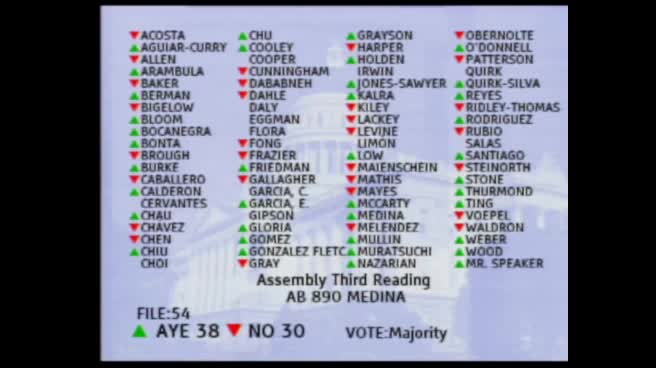 2MIN
Assembly Floor
 1H
Assembly Standing Committee on Appropriations
 15MIN