SB 1083: Resource family approval.
- Session Year: 2017-2018
- House: Senate
- Latest Version Date: 2018-09-29
(1)Existing law provides for the implementation of the resource family approval program, which replaces the multiple processes for licensing foster family homes, certifying foster homes by foster family agencies, approving relatives and nonrelative extended family members as foster care providers, and approving guardians and adoptive families. Existing law requires foster care providers to have resource family approval by December 31, 2019, and makes existing foster care certifications, licenses, and approvals inoperative as of that date, except as specified. Existing law requires public and private child placement agencies to provide existing foster care providers with certain information regarding the resource family approval program, including, among other things, notice that in order to care for a foster child, resource family approval is required by December 31, 2019.
This bill would extend the deadline by which foster care providers are required to have resource family approval to December 31, 2020, and extend the operation of current certifications, licenses, and approvals until that date. The bill would authorize an applicant who withdraws a resource family application before its approval or denial to resubmit the application within 12 months, as provided. The bill would also require public and private placing agencies to provide existing foster care providers with the information regarding the resource family approval program as described above, including the revised deadline, by July 1, 2019.
The bill would make conforming changes to existing law to reflect the extension of the resource family approval deadline described above, thereby making certain foster care placements made prior to January 1, 2021, eligible for Aid to Families with Dependent Children-Foster Care payments, Emergency Child Care Bridge Program for Foster Children payments, and respite care.
(2)Existing law authorizes a county to place a child with a resource family applicant who has successfully completed the home environment assessment prior to the completion of a permanency assessment only if a compelling reason for the placement exists based on the needs of the child. Existing law, in these cases, requires the permanency assessment to be completed within 90 days of placement, unless good cause exists. Existing law requires the county to document extenuating circumstances for any delay in those cases, generate a timeframe for the completion of the permanency assessment, and report specified information to the State Department of Social Services regarding these delays.
The bill would instead require that the permanency assessment be completed within 90 days of any application to become a resource family, unless good cause exists, and would further expand the above-mentioned county duties to instances in which a child is placed with a resource family applicant on an emergency basis, as specified.
(3)Existing law requires that preferential consideration be given to a request by a relative of a child who has been adjudged a dependent of the juvenile court for placement of the child with the relative, as specified. Existing law requires the county social worker, in determining whether placement with a relative is appropriate, to consider certain factors, including the safety of the relatives home. Existing law requires the relatives home to first be assessed for safety and for the relative to be subject to a specified criminal records clearance in order for the relative to be considered appropriate to receive placement of a child on an emergency basis.
This bill would require the same safety assessment and criminal records clearance to be conducted in order for a relative to be considered appropriate to receive placement of a child following a disposition hearing.
(4)By increasing the duties of county officials, this bill would impose a state-mandated local program.
(5)This bill would incorporate additional changes to Sections 1517 and 1517.1 of the Health and Safety Code and Sections 16519.5 and 18360 of the Welfare and Institutions Code proposed by AB 1930 to be operative only if this bill and AB 1930 are enacted and this bill is enacted last.
(6)The California Constitution requires the state to reimburse local agencies and school districts for certain costs mandated by the state. Statutory provisions establish procedures for making that reimbursement.
This bill would provide that no reimbursement is required by this act for a specified reason.
(1)Existing law provides for the implementation of the resource family approval program, which replaces the multiple processes for licensing foster family homes, certifying foster homes by foster family agencies, approving relatives and nonrelative extended family members as foster care providers, and approving guardians and adoptive families. Existing law requires foster care providers to have resource family approval by December 31, 2019, and makes existing foster care certifications, licenses, and approvals inoperative as of that date, except as specified. Existing law requires public and private child placement agencies to provide existing foster care providers with certain information regarding the resource family approval program, including, among other things, notice that in order to care for a foster child, resource family approval is required by December 31, 2019. Existing law defines a resource family as an individual or family that has successfully met both home environment assessment standards and permanency assessment criteria, as specified, necessary for providing care for a child placed by a public or private child placement agency by court order, or voluntarily placed by a parent or legal guardian.
This bill would remove children voluntarily placed by a parent or legal guardian from the resource family approval process. The bill would extend the deadline by which foster care providers are required to have resource family approval to December 31, 2020, and extend the operation of current certifications, licenses, and approvals until that date. The bill would authorize an applicant who withdraws a resource family application before its approval or denial to resubmit the application within 12 months, as provided. The bill would also require public and private placing agencies to provide existing foster care providers with the information regarding the resource family approval program information as described above, including the revised deadline, by July 1, 2019.
The bill would make conforming changes to existing law to reflect the extension of the resource family approval deadline described above, thereby making certain foster care placements made prior to January 1, 2021, eligible for Aid to Families with Dependent Children-Foster Care payments, Emergency Child Care Bridge Program for Foster Children payments, and respite care.
(2)Existing law authorizes a county to place a child with a resource family applicant who has successfully completed the home environment assessment prior to the completion of a permanency assessment only if a compelling reason for the placement exists based on the needs of the child. Existing law, in these cases, requires the permanency assessment to be completed within 90 days of placement, unless good cause exists. Existing law requires the county to document extenuating circumstances for any delay in those cases, generate a timeframe for the completion of the permanency assessment, and report specified information to the State Department of Social Services regarding these delays.
The bill would instead require that the permanency assessment be completed within 90 days of any application to become a resource family, unless good cause exists, and would further expand the above-mentioned county duties to instances in which a child is placed with a resource family applicant on an emergency basis, as specified.
(3)Existing law provides that a child may be adjudged to be a dependent of the juvenile court because of abuse or neglect, and that after this determination, the court is required to hear evidence on the question of the proper disposition to be made of the child. Existing law requires that before determining the appropriate disposition, the court receive in evidence, among other things, the social study of the child made by the social worker and evaluation made by a child advocate appointed by the court. Existing law further prescribes the information that is required to be included in that social study or evaluation.Existing law requires the status of every dependent child in foster care to be reviewed periodically, as determined by the court, but no less frequently than once every 6 months. As part of the periodic review, existing law requires each supplemental report filed by the social worker to include a factual discussion of specified considerations regarding the custody and care of the child.This bill would additionally require the social worker or child advocate to include in the social study, supplemental report, or evaluation whether funding and supplemental payments are being provided for the care and supervision of the child, as specified, and, if not, the reasons for the lack of funding and the anticipated timeframe for funding to be provided. The bill would also require the social study, supplemental report, or evaluation to include status updates on pending resource family approvals, as specified, and, for resource family approvals that have been pending for more than 90 days, the reasons for the delay and what efforts the social worker has made to address the delay. The bill would authorize the court to set a hearing within 14 calendar days to review the progress of the approval if the court determines that there is no good cause for the delay.(4)Existing law establishes the state-funded Kinship Guardianship Assistance Payment (Kin-GAP) Program to provide state-funded aid on behalf of a child in kinship care who satisfies certain requirements, including that he or she has been residing for at least 6 consecutive months in the approved home of the prospective relative guardian, as specified.This bill would additionally require that the child be currently residing in the home of a prospective relative guardian who was approved prior to December 31, 2020, or who has been approved as a resource family concurrently or subsequently to the establishment of the kinship guardianship.(5)(3)Existing law requires that preferential consideration be given to a request by a relative of a child who has been adjudged a dependent of the juvenile court for placement of the child with the relative, as specified. Existing law requires the county social worker, in determining whether placement with a relative is appropriate, to consider certain factors, including the safety of the relatives home. Existing law requires the relatives home to first be assessed for safety and for the relative to be subject to a specified criminal records clearance in order for the relative to be considered appropriate to receive placement of a child on an emergency basis.
This bill would require the same safety assessment and criminal records clearance to be conducted in order for a relative to be considered appropriate to receive placement of a child following a disposition hearing.
(6)(4)By increasing the duties of county officials, this bill would impose a state-mandated local program.
(5)This bill would incorporate additional changes to Sections 1517 and 1517.1 of the Health and Safety Code and Sections 16519.5 and 18360 of the Welfare and Institutions Code proposed by AB 1930 to be operative only if this bill and AB 1930 are enacted and this bill is enacted last.
(7)(6)The California Constitution requires the state to reimburse local agencies and school districts for certain costs mandated by the state. Statutory provisions establish procedures for making that reimbursement.
This bill would provide that no reimbursement is required by this act for a specified reason.
(1)Existing law provides for the implementation of the resource family approval process, program, which replaces the multiple processes for licensing foster family homes, certifying foster homes by foster family agencies, approving relatives and nonrelative extended family members as foster care providers, and approving guardians and adoptive families. Existing law requires foster care providers to have resource family approval by December 31, 2019, and makes existing foster care certifications, licenses, and approvals inoperative as of that date, except as specified. Existing law requires public and private child placement agencies to provide existing foster care providers with certain information regarding the resource family approval program, including, among other things, notice that in order to care for a foster child, resource family approval is required by December 31, 2019. Existing law defines a resource family as an individual or family that has successfully met both home environment assessment standards and permanency assessment criteria, as specified, necessary for providing care for a child placed by a public or private child placement agency by court order, or voluntarily placed by a parent or legal guardian.
This bill would, among other things, would remove children voluntarily placed by a parent or legal guardian from the resource family approval process. The bill would extend the deadline by which foster care providers are required to have resource family approval to December 31, 2020, and extend the operation of current certifications, licenses, and approvals until that date. The bill would also require public and private placing agencies to provide existing foster care providers with the information regarding the resource family approval program information as described above, including the revised deadline, by July 1, 2019.
Existing law authorizes a certified family home, licensed foster family home, or approved relative or nonrelative extended family member who had a child in placement at any time between January 1, 2017, and December 31, 2017, inclusive, to be approved as a resource family on the date of successful completion of a psychosocial assessment.The bill would instead require a certified family home, licensed foster family home, or approved relative or nonrelative extended family member who had a child in placement at any time between January 1, 2017, and December 31, 2018, inclusive, to be deemed a resource family as of January 1, 2019, would remove the psychosocial assessment requirement for those placements, and would require the certified family home, licensed foster family home, or approved relative or nonrelative extended family member to comply with a specified criminal record clearance prior to being deemed a resource family. The bill would also require a certified family home, licensed foster family home, or approved relative or nonrelative extended family member to complete an approved adoptive home study prior to any final order of adoption.(2)Existing law authorizes a county to place a child with a resource family applicant who has successfully completed the home environment assessment prior to the completion of a permanency assessment only if a compelling reason for the placement exists based on the needs of the child. Existing law, in these cases, requires the permanency assessment to be completed within 90 days of placement, unless good cause exists. Existing law requires the county to document extenuating circumstances for any delay in those cases, generate a timeframe for the completion of the permanency assessment, and report specified information to the State Department of Social Services regarding these delays.
The bill would instead require that the permanency assessment be completed within 90 days of any application to become a resource family, unless good cause exists, and would further expand the above-mentioned county duties to instances in which a child is placed with a resource family applicant on an emergency basis, as specified.
(3)Existing law provides that a child may be adjudged to be a dependent of the juvenile court because of abuse or neglect, and that after this determination, the court is required to hear evidence on the question of the proper disposition to be made of the child. Existing law requires that before determining the appropriate disposition, the court receive in evidence, among other things, the social study of the child made by the social worker and evaluation made by a child advocate appointed by the court. Existing law further prescribes the information that is required to be included in that social study or evaluation.
Existing law requires the status of every dependent child in foster care to be reviewed periodically, as determined by the court, but no less frequently than once every 6 months. As part of the periodic review, existing law requires each supplemental report filed by the social worker to include a factual discussion of specified considerations regarding the custody and care of the child.
This bill would additionally require the social worker or child advocate to include in the social study, supplemental report, or evaluation whether funding and supplemental payments are being provided for the care and supervision of the child, as specified, and, if not, the reasons for the lack of funding and the anticipated timeframe for funding to be provided. The bill would also require the social study, supplemental report, or evaluation to include status updates on pending resource family approvals, as specified, and, for resource family approvals that have been pending for more than 90 days, the reasons for the delay and what efforts the social worker has made to address the delay. The bill would authorize the court to set a hearing within 14 calendar days to review the progress of the approval if the court determines that there is no good cause for the delay.
(4)Existing law establishes the state-funded Kinship Guardianship Assistance Payment (Kin-GAP) Program to provide state-funded aid on behalf of a child in kinship care who satisfies certain requirements, including that he or she has been residing for at least 6 consecutive months in the approved home of the prospective relative guardian, as specified.
This bill would additionally require that the child is be currently residing in the home of a prospective relative guardian who was approved prior to December 31, 2019, 2020, or who has been approved as a resource family concurrently or subsequently to the establishment of the kinship guardianship.
(5)Existing law requires that preferential consideration be given to a request by a relative of a child who has been adjudged a dependent of the juvenile court for placement of the child with the relative, as specified. Existing law requires the county social worker, in determining whether placement with a relative is appropriate, to consider certain factors, including the safety of the relatives home. Existing law requires the relatives home to first be assessed for safety and for the relative to be subject to a specified criminal records clearance in order for the relative to be considered appropriate to receive placement of a child on an emergency basis.
This bill would require the same safety assessment and criminal records clearance to be conducted in order for a relative to be considered appropriate to receive placement of a child following a disposition hearing.
(6)By increasing the duties of county officials, this bill would impose a state-mandated local program.
(7)The California Constitution requires the state to reimburse local agencies and school districts for certain costs mandated by the state. Statutory provisions establish procedures for making that reimbursement.
This bill would provide that no reimbursement is required by this act for a specified reason.
(1)Existing law provides for the implementation of the resource family approval process, which replaces the multiple processes for licensing foster family homes, certifying foster homes by foster family agencies, approving relatives and nonrelative extended family members as foster care providers, and approving guardians and adoptive families. Existing law defines a resource family as an individual or family that has successfully met both home environment assessment standards and permanency assessment criteria, as specified, necessary for providing care for a child placed by a public or private child placement agency by court order, or voluntarily placed by a parent or legal guardian.
This bill would, among other things, remove children voluntarily placed by a parent or legal guardian from the resource family approval process.
Existing law authorizes a certified family home, licensed foster family home, or approved relative or nonrelative extended family member who had a child in placement at any time between January 1, 2017, and December 31, 2017, inclusive, to be approved as a resource family on the date of successful completion of a psychosocial assessment.
The bill would instead require a certified family home, licensed foster family home, or approved relative or nonrelative extended family member who had a child in placement at any time between January 1, 2017, and December 31, 2018, inclusive, to be deemed a resource family as of January 1, 2019, would remove the psychosocial assessment requirement for those placements, and would require the certified family home, licensed foster family home, or approved relative or nonrelative extended family member to comply with a specified criminal record clearance prior to being deemed a resource family. The bill would also require a certified family home, licensed foster family home, or approved relative or nonrelative extended family member to complete an approved adoptive home study prior to any final order of adoption.
Existing law requires the permanency assessment to be completed within 90 days of placement of a child in a home with a resource family applicant who has successfully completed the home environment assessment prior to completion of a permanency assessment, unless good cause exists. Existing(2)Existing law authorizes a county to place a child with a resource family applicant who has successfully completed the home environment assessment prior to the completion of a permanency assessment only if a compelling reason for the placement exists based on the needs of the child. Existing law, in these cases, requires the permanency assessment to be completed within 90 days of placement, unless good cause exists. Existing law requires the county to document extenuating circumstances for any delay in those cases, generate a timeframe for the completion of the permanency assessment, and report specified information to the State Department of Social Services regarding these delays.
The bill would instead require that the permanency assessment be completed within 90 days of any application to become a resource family, unless good cause exists, and would further expand the above-mentioned county duties to any application with a permanency assessment that goes beyond 90 days. instances in which a child is placed with a resource family applicant on an emergency basis, as specified.
(2)(3)Existing law provides that a child may be adjudged to be a dependent of the juvenile court because of abuse or neglect, and that after this determination, the court is required to hear evidence on the question of the proper disposition to be made of the child. Existing law requires that before determining the appropriate disposition, the court receive in evidence, among other things, the social study of the child made by the social worker and evaluation made by a child advocate appointed by the court. Existing law further prescribes the information that is required to be included in that social study or evaluation.
Existing law requires the status of every dependent child in foster care to be reviewed periodically, as determined by the court, but no less frequently than once every 6 months. As part of the periodic review, existing law requires each supplemental report filed by the social worker to include a factual discussion of specified considerations regarding the custody and care of the child.
This bill would additionally require the social worker or child advocate to include in the social study, supplemental report, or evaluation the amount of funding whether funding and supplemental payments are being provided for the care and supervision of the child, as specified, and if resource family approval is pending for a potential resource family for the child, an update on the status of the approval, as specified. If the resource family approval has been pending for more than 90 days, the bill would require the reasons for the delay and what efforts have been made by the social worker to address the delay to be included in the social study, supplemental report, or evaluation. and, if not, the reasons for the lack of funding and the anticipated timeframe for funding to be provided. The bill would also require the social study, supplemental report, or evaluation to include status updates on pending resource family approvals, as specified, and, for resource family approvals that have been pending for more than 90 days, the reasons for the delay and what efforts the social worker has made to address the delay. The bill would authorize the court to set a hearing within 14 calendar days to review the progress of the approval if the court determines that there is no good cause for the delay.
(3)(4)Existing law establishes the state-funded Kinship Guardian Guardianship Assistance Payment (Kin-GAP) program Program to provide state-funded aid on behalf of a child in kinship care who satisfies certain requirements, including that he or she has been residing for at least 6 consecutive months in the approved home of the prospective relative guardian, as specified.
This bill would additionally require that the child is currently residing in the home of a prospective relative guardian who was approved prior to December 31, 2019, or who has been approved as a resource family concurrently or subsequently to the establishment of the kinship guardianship.
(4)By increasing the duties of county officials, this bill would impose a state-mandated local program.(5)Existing law requires that preferential consideration be given to a request by a relative of a child who has been adjudged a dependent of the juvenile court for placement of the child with the relative, as specified. Existing law requires the county social worker, in determining whether placement with a relative is appropriate, to consider certain factors, including the safety of the relatives home. Existing law requires the relatives home to first be assessed for safety and for the relative to be subject to a specified criminal records clearance in order for the relative to be considered appropriate to receive placement of a child on an emergency basis.
This bill would require the same safety assessment and criminal records clearance to be conducted in order for a relative to be considered appropriate to receive placement of a child following a disposition hearing.
(6)By increasing the duties of county officials, this bill would impose a state-mandated local program.
(5)(7)The California Constitution requires the state to reimburse local agencies and school districts for certain costs mandated by the state. Statutory provisions establish procedures for making that reimbursement.
This bill would provide that no reimbursement is required by this act for a specified reason.
(1)Existing law provides for the implementation of the resource family approval process, which replaces the multiple processes for licensing foster family homes, certifying foster homes by foster family agencies, approving relatives and nonrelative extended family members as foster care providers, and approving guardians and adoptive families. Existing law defines a resource family as an individual or family that has successfully met both home environment assessment standards and permanency assessment criteria, as specified, necessary for providing care for a child placed by a public or private child placement agency by court order, or voluntarily placed by a parent or legal guardian.
This bill would, among other things, remove children voluntarily placed by a parent or legal guardian from the resource family approval process.
Existing law authorizes a certified family home, licensed foster family home home, or an approved relative or nonrelative extended family member who had a child in placement at any time between January 1, 2017, and December 31, 2017, inclusive, to be approved as a resource family on the date of successful completion of a psychosocial assessment.
The bill would instead authorize require a certified family home, licensed foster family home home, or an approved relative or nonrelative extended family member who had a child in placement at any time between January 1, 2017, and December 31, 2018, inclusive, to be approved as deemed a resource family as of January 1, 2019, and would remove the psychosocial assessment requirement for those placements. placements, and would require the certified family home, licensed foster family home, or approved relative or nonrelative extended family member to comply with a specified criminal record clearance prior to being deemed a resource family.
Existing law requires the permanency assessment to be completed within 90 days of placement of a child in a home with a resource family applicant who has successfully completed the home environment assessment prior to completion of a permanency assessment, unless good cause exists. Existing law requires the county to document extenuating circumstances for any delay in those cases, generate a timeframe for the completion of the permanency assessment, and report specified information to the State Department of Social Services regarding these delays.
The bill would instead require that the permanency assessment be completed within 90 days of any application to become a resource family, unless good cause exists, and would further expand the above-mentioned county duties to any application with a permanency assessment that goes beyond 90 days.
(2)Existing law provides that a child may be adjudged to be a dependent of the juvenile court because of abuse or neglect, and that after this determination, the court is required to hear evidence on the question of the proper disposition to be made of the child. Existing law requires that before determining the appropriate disposition, the court receive in evidence, among other things, the social study of the child made by the social worker and evaluation made by a child advocate appointed by the court. Existing law further prescribes the information that is required to be included in that social study or evaluation.
Existing law requires the status of every dependent child in foster care to be reviewed periodically, as determined by the court, but no less frequently than once every 6 months. As part of the periodic review, existing law requires each supplemental report filed by the social worker to include a factual discussion of specified considerations regarding the custody and care of the child.
This bill would additionally require the social worker or child advocate to include in the social study, supplemental report, or evaluation the amount of funding being provided for the care and supervision of the child, as specified, and if resource family approval is pending for a potential resource family for the child, an update on the status of the approval, as specified. If the resource family approval has been pending for more than 90 days, the bill would require the reasons for the delay and what efforts have been made by the social worker to address the delay. delay to be included in the social study, supplemental report, or evaluation. The bill would authorize the court to set a hearing within 14 calendar days to review the progress of the approval if the court determines that there is no good cause for the delay.
(3)Existing law establishes the state-funded Kinship Guardian Assistance Payment (Kin-GAP) program to provide state-funded aid on behalf of a child in kinship care who satisfies certain requirements, including that he or she has been residing for at least 6 consecutive months in the approved home of the prospective relative guardian, as specified.
This bill would additionally require that the child is currently residing in the home of a prospective relative guardian who was approved prior to December 31, 2019, or who has been approved as a resource family concurrently or subsequently to the establishment of the kinship guardianship.
(4)By increasing the duties of county officials, this bill would impose a state-mandated local program.
(5)The California Constitution requires the state to reimburse local agencies and school districts for certain costs mandated by the state. Statutory provisions establish procedures for making that reimbursement.
This bill would provide that no reimbursement is required by this act for a specified reason.
(1)Existing law provides for the implementation of the resource family approval process, which replaces the multiple processes for licensing foster family homes, certifying foster homes by foster family agencies, approving relatives and nonrelative extended family members as foster care providers, and approving guardians and adoptive families. Existing law defines a resource family as an individual or family that has successfully met both home environment assessment standards and permanency assessment criteria, as specified, necessary for providing care for a child placed by a public or private child placement agency by court order, or voluntarily placed by a parent or legal guardian.
This bill would, among other things, remove children voluntarily placed by a parent or legal guardian from the resource family approval process.
Existing law authorizes a licensed foster family home or an approved relative or nonrelative extended family member who had a child in placement at any time between January 1, 2017, and December 31, 2017, inclusive, to be approved as a resource family on the date of successful completion of a psychosocial assessment.
The bill would instead authorize a licensed foster family home or an approved relative or nonrelative extended family member who had a child in placement at any time between January 1, 2017, and December 31, 2018, inclusive, to be approved as a resource family as of January 1, 2019, and would remove the psychosocial assessment requirement for those placements.
Existing law requires the permanency assessment to be completed within 90 days of placement of a child in a home with a resource family applicant who has successfully completed the home environment assessment prior to completion of a permanency assessment, unless good cause exists. Existing law requires the county to document extenuating circumstances for any delay in those cases, generate a timeframe for the completion of the permanency assessment, and report specified information to the State Department of Social Services regarding these delays.
The bill would instead require that the permanency assessment be completed within 90 days of any application to become a resource family, unless good cause exists, and would further expand the above-mentioned county duties to any application with a permanency assessment that goes beyond 90 days.
(2)Existing law provides that a child may be adjudged to be a dependent of the juvenile court because of abuse or neglect, and that after this determination, the court is required to hear evidence on the question of the proper disposition to be made of the child. Existing law requires that before determining the appropriate disposition, the court receive in evidence, among other things, the social study of the child made by the social worker and evaluation made by a child advocate appointed by the court. Existing law further prescribes the information that is required to be included in that social study or evaluation.
Existing law requires the status of every dependent child in foster care to be reviewed periodically, as determined by the court, but no less frequently than once every 6 months. As part of the periodic review, existing law requires each supplemental report filed by the social worker to include a factual discussion of specified considerations regarding the custody and care of the child.
This bill would additionally require the social worker or child advocate to include in the social study, supplemental report, or evaluation the amount of funding being provided for the care and supervision of the child, as specified, and if resource family approval is pending for a potential resource family for the child, an update on the status of the approval, as specified. If the resource family approval has been pending for more than 90 days, the bill would require the reasons for the delay and what efforts have been made by the social worker to address the delay. The bill would authorize the court to set a hearing within 14 calendar days to review the progress of the approval if the court determines that there is no good cause for the delay.
(3)Existing law establishes the state-funded Kinship Guardian Assistance Payment (Kin-GAP) program to provide state-funded aid on behalf of a child in kinship care who satisfies certain requirements, including that he or she has been residing for at least 6 consecutive months in the approved home of the prospective relative guardian, as specified.
This bill would additionally require that the child is currently residing in the home of a prospective relative guardian who was approved prior to December 31, 2019, or who has been approved as a resource family concurrently or subsequently to the establishment of the kinship guardianship.
(4)By increasing the duties of county officials, this bill would impose a state-mandated local program.
(5)The California Constitution requires the state to reimburse local agencies and school districts for certain costs mandated by the state. Statutory provisions establish procedures for making that reimbursement.
This bill would provide that no reimbursement is required by this act for a specified reason.
(a)(1)Pursuant to subdivision (a) of Section 16519.5 of the Welfare and Institutions Code, the State Department of Social Services shall implement a unified, family friendly, and child-centered resource family approval process to replace the existing multiple processes for licensing foster family homes, certifying foster homes by licensed foster family agencies, approving relatives and nonrelative extended family members as foster care providers, and approving guardians and adoptive families.
(2)For purposes of this section, a resource family means an individual or family that has successfully met both the home environment assessment and the permanency assessment criteria, as set forth in Section 16519.5 of the Welfare and Institutions Code, necessary for providing care for a child placed by a public or private child placement agency by court order, or voluntarily placed by a parent or legal guardian.
(3)There is no fundamental right to approval as a resource family.
(4)(A)A resource family shall be considered eligible to provide foster care for children in out-of-home placement and shall be considered approved for adoption and guardianship.
(B)Notwithstanding subparagraph (A), a foster family agency may approve a resource family to care for a specific child, as specified in the written directives or regulations adopted pursuant to Section 16519.5 of the Welfare and Institutions Code.
(5)For purposes of this chapter, resource family approval means that the applicant or resource family successfully meets the home environment assessment and permanency assessment standards adopted pursuant to subdivision (d) of Section 16519.5 of the Welfare and Institutions Code. This approval is in lieu of a certificate of approval issued by a licensed foster family agency pursuant to subdivision (b) of Section 1506.
(6)Approval of a resource family does not guarantee an initial, continued, or adoptive placement of a child with a resource family. Approval of a resource family does not guarantee the establishment of a legal guardianship of a child with a resource family.
(7)(A)Notwithstanding paragraphs (1) to (6), inclusive, a foster family agency shall cease any further review of an application if the applicant has had a previous application denial within the preceding year by the department or county, or if the applicant has had a previous rescission, revocation, or exemption denial or exemption rescission by the department or county within the preceding two years.
(B)Notwithstanding subparagraph (A), a foster family agency may continue to review an application if it has determined that the reasons for the previous denial, rescission, or revocation were due to circumstances and conditions that either have been corrected or are no longer in existence.
(C)If an individual was excluded from a resource family home or facility licensed by the department, a foster family agency shall cease review of the individuals application unless the excluded individual has been reinstated pursuant to subdivision (g) of Section 16519.6 of the Welfare and Institutions Code or Section 1569.53, subdivision (h) of Section 1558, subdivision (h) of Section 1569.58, or subdivision (h) of Section 1596.8897 of this code.
(D)The cessation of review shall not constitute a denial of the application for purposes of this section, Section 16519.5 of the Welfare and Institutions Code, or any other law.
(E)For purposes of this section, the date of a previous denial, rescission, revocation, exemption denial or exemption rescission, or exclusion shall be either of the following:
(i)The effective date of a final decision or order upholding a notice of action or exclusion order.
(ii)The date on the notice of the decision to deny, rescind, revoke, or exclude if the notice was not appealed or otherwise constitutes a final decision.
(8)A resource family shall meet the approval standards set forth in Section 16519.5 of the Welfare and Institutions Code, comply with the written directives or regulations adopted pursuant to Section 16519.5 of the Welfare and Institutions Code, and comply with other applicable federal and state laws in order to maintain approval.
(9)A resource family may be approved by a county child welfare department or probation department pursuant to Section 16519.5 of the Welfare and Institutions Code or by a foster family agency pursuant to this section.
(10)A resource family shall not be licensed to operate a residential facility, as defined in Section 1502, a residential care facility for the elderly, as defined in Section 1569.2, or a residential care facility for persons with chronic life-threatening illnesses, as defined in Section 1568.01, on the same premises used as the residence of the resource family.
(11)(A)An applicant who withdraws an application prior to its approval or denial may resubmit the application within 12 months of the withdrawal.
(B)Nothing in this paragraph shall preclude a foster family agency from requiring an applicant to complete an application activity, even if that activity was previously completed.
(b)(1)A foster family agency that approves resource families shall comply with the provisions of this section.
(2)Notwithstanding any other law, a foster family agency shall require its applicants and resource families to meet the resource family approval standards set forth in Section 16519.5 of the Welfare and Institutions Code, the written directives or regulations adopted thereto, and other applicable laws prior to approval and in order to maintain approval.
(3)A foster family agency shall be responsible for all of the following:
(A)Complying with the applicable provisions of this chapter, the regulations for foster family agencies, the resource family approval standards and requirements set forth in Article 2 (commencing with Section 16519.5) of Chapter 5 of Part 4 of Division 9 of the Welfare and Institutions Code, and the applicable written directives or regulations adopted thereto by the department.
(B)Implementing the requirements for the resource family approval and utilizing standardized documentation established by the department.
(C)Ensuring staff have the education, experience, and core competencies necessary to participate in the assessment and evaluation of an applicant or resource family.
(D)Taking the following actions, as applicable:
(i)(I)Approving or denying resource family applications, including preparing a written evaluation of an applicants capacity to foster, adopt, or provide legal guardianship of a child based on all of the information gathered through the resource family application and assessment processes.
(II)The applicants preference to provide a specific level of permanency, including adoption, guardianship, or, in the case of a relative, placement with a fit and willing relative, shall not be a basis to deny an application.
(ii)Rescinding approvals of resource families.
(E)Providing to the department a log of resource families that were approved or had approval rescinded during the month by the 10th day of the following month.
(F)(i)Updating resource family approval annually and as necessary to address any changes that have occurred in the resource familys circumstances, including, but not limited to, moving to a new home location or commencing operation of a family day care home, as defined in Section 1596.78.
(ii)A foster family agency shall conduct an announced inspection of a resource family home during the annual update, and as necessary to address any changes specified in clause (i), to ensure that the resource family is conforming to all applicable laws and the written directives or regulations adopted pursuant to Section 16519.5 of the Welfare and Institutions Code.
(G)Monitoring resource families through all of the following:
(i)Ensuring that social workers who identify a condition in the home that may not meet the resource family approval standards while in the course of a routine visit to children subsequently placed with a resource family take appropriate action as needed.
(ii)Requiring resource families to meet the approval standards set forth in Section 16519.5 of the Welfare and Institutions Code and to comply with the written directives or regulations adopted thereto, other applicable laws, and corrective action plans as necessary to correct identified deficiencies. If corrective action is not completed as specified in the plan, the foster family agency or the department may rescind the approval of the resource family or take other administrative action in accordance with applicable law or the written directives or regulations adopted pursuant to Section 16519.5 of the Welfare and Institutions Code.
(iii)Requiring resource families to report to the foster family agency any incidents, as specified in the written directives or regulations adopted pursuant to Section 16519.5 of the Welfare and Institutions Code.
(iv)Inspecting resource family homes as often as necessary to ensure the quality of care provided.
(H)Performing corrective action as required by the department.
(I)Submitting information and data that the department determines is necessary to study, monitor, and prepare the report specified in paragraph (6) of subdivision (f) of Section 16519.5 of the Welfare and Institutions Code.
(J)(i)Ensuring applicants and resource families meet the training requirements, and, if applicable, the specialized training requirements set forth in Section 16519.5 of the Welfare and Institutions Code.
(ii)Nothing in this section shall preclude a foster family agency from requiring training in excess of the requirements in this section.
(4)A foster family agency may cooperatively match a child who is under the care, custody, and control of a county with a resource family for initial placement.
(c)In addition to subdivision (f) of Section 16519.5 of the Welfare and Institutions Code, the State Department of Social Services shall be responsible for all of the following:
(1)Requiring foster family agencies to monitor resource families, including, but not limited to, inspecting resource family homes, developing and monitoring resource family corrective action plans to correct identified deficiencies, and rescinding resource family approval if compliance with a corrective action plan is not achieved.
(2)Investigating all complaints regarding a resource family approved by a foster family agency and taking any action it deems necessary. This shall include investigating any incidents reported about a resource family indicating that the approval standard is not being maintained. Complaint investigations shall be conducted in accordance with the written directives or regulations adopted pursuant to Section 16519.5 of the Welfare and Institutions Code. A foster family agency shall not conduct an internal investigation regarding an incident report or complaint against a resource family that interferes with an investigation being conducted by the department.
(3)Rescinding approvals of a resource family approved by a foster family agency.
(4)Excluding a resource family parent or applicant or other individual from presence in any resource family home or licensed community care facility consistent with the established standard, from being a member of the board of directors, an executive director, or an officer of a licensed community care facility, or prohibiting a licensed community care facility from employing the resource family parent or other individual, if appropriate.
(5)Issuing a temporary suspension order that suspends the resource family approval prior to a hearing, when urgent action is needed to protect a child from physical or mental abuse, abandonment, or any other substantial threat to health or safety.
(6)Providing a resource family parent, applicant, excluded individual, or individual who is the subject of a criminal record exemption decision with due process pursuant to Section 16519.6 of the Welfare and Institutions Code if the department has ordered a foster family agency to deny a resource family application or rescind the approval of a resource family, has excluded an individual, or has denied or rescinded a criminal record exemption.
(d)(1)The department may enter and inspect the home of a resource family approved by a foster family agency to secure compliance with the resource family approval standards, investigate a complaint or incident, or ensure the quality of care provided.
(2)Upon a finding of noncompliance, the department may require a foster family agency to deny a resource family application, rescind the approval of a resource family, or take other action the department may deem necessary for the protection of a child placed with the resource family.
(A)If the department requires a foster family agency to deny an application, rescind the approval of a resource family, or take another action, the department shall serve an order of denial or rescission, or another order, that notifies the resource family or applicant and foster family agency of the basis of the departments action and of the resource familys or applicants right to a hearing.
(B)The departments order of the application denial, rescission of the approval, or another action shall remain in effect until the hearing is completed and the department has made a final determination on the merits.
(C)A foster family agencys failure to comply with the departments order to deny an application or rescind the approval of a resource family, or another order, by placing or retaining a child in care shall be grounds for disciplining the foster family agency pursuant to Section 1550.
(e)Nothing in this section or in Article 2 (commencing with Section 16519.5) of Chapter 5 of Part 4 of Division 9 of the Welfare and Institutions Code limits the authority of the department to inspect, evaluate, investigate a complaint or incident, or initiate a disciplinary action against a foster family agency pursuant to this chapter or to take any action it may deem necessary for the health and safety of children placed with the foster family agency.
(f)(1)The applicable certification and oversight processes shall continue to be administered for foster homes certified by a foster family agency prior to January 1, 2017, or as specified in paragraph (2), until the certification is revoked or forfeited by operation of law pursuant to this subdivision.
(2)Notwithstanding paragraph (3), a foster family agency shall approve or deny all certified family home applications received on or before December 31, 2016, in accordance with this chapter.
(3)On and after January 1, 2017, a foster family agency shall not accept applications to certify foster homes and shall approve resource families in lieu of certifying foster homes.
(4)No later than July 1, 2019, each foster family agency shall provide the following information to its certified family homes:
(A)A detailed description of the resource family approval program.
(B)Notification that, in order to care for a foster child, resource family approval is required by December 31, 2020.
(C)Notification that a certificate of approval shall be forfeited by operation of law, as specified in paragraph (8).
(5)The following shall apply to all certified family homes:
(A)A certified family home with an approved adoptive home study, completed prior to January 1, 2018, shall be deemed to be a resource family.
(B)A certified family home that had a child in placement at any time between January 1, 2017, and December 31, 2017, inclusive, may be approved as a resource family on the date of successful completion of a psychosocial assessment pursuant to Section 16519.5 of the Welfare and Institutions Code.
(C)A certified family home that provided county-authorized respite services at any time between January 1, 2017, and December 31, 2017, inclusive, may be approved as a resource family on the date of successful completion of a psychosocial assessment pursuant to Section 16519.5 of the Welfare and Institutions Code.
(6)A foster family agency may provide supportive services to all certified family homes with a child in placement to assist with the resource family transition and to minimize placement disruptions.
(7)An individual who is approved as a resource family pursuant to subparagraph (B) or (C) of paragraph (5) shall be fingerprinted pursuant to Section 8712 of the Family Code upon filing an application for adoption.
(8)All certificates of approval for certified family homes shall be forfeited by operation of law on December 31, 2020, except as provided in this paragraph:
(A)All certified family homes that did not have a child in placement or did not provide county-authorized respite services at any time between January 1, 2017, and December 31, 2017, inclusive, shall forfeit the certificate of approval by operation of law on January 1, 2018.
(B)For certified family homes with a pending resource family application on December 31, 2020, the certificate of approval shall be forfeited by operation of law upon approval as a resource family. If approval is denied, forfeiture by operation of law shall occur on the date of completion of any proceedings required by law to ensure due process.
(C)A certificate of approval shall be forfeited by operation of law upon approval as a resource family.
(g)A foster family agency may obtain any arrest or conviction records or reports from any law enforcement agency as necessary to the performance of its duties, as provided in this section.
(h)A foster family agency may review and discuss with an applicant the data contained in the statewide child welfare database, and provided to the foster family agency by a county, that is pertinent to conducting a psychosocial assessment, as specified in the written directives or regulations adopted pursuant to Section 16519.5 of the Welfare and Institutions Code.
SEC. 1.5.Section 1517 of the Health and Safety Code is amended to read:1517.(a)(1)Pursuant to subdivision (a) of Section 16519.5 of the Welfare and Institutions Code, the State Department of Social Services shall implement a unified, family friendly, and child-centered resource family approval process to replace the existing multiple processes for licensing foster family homes, certifying foster homes by licensed foster family agencies, approving relatives and nonrelative extended family members as foster care providers, and approving guardians and adoptive families.
(2)For purposes of this chapter, a resource family means an individual or family that has successfully met both the home environment assessment and the permanency assessment criteria, as set forth in Section 16519.5 of the Welfare and Institutions Code, necessary for providing care for a child placed by a public or private child placement agency by court order, or voluntarily placed by a parent or legal guardian.
(3)There is no fundamental right to approval as a resource family.
(4)(A)A resource family shall be considered eligible to provide foster care for children in out-of-home placement and shall be considered approved for adoption and guardianship.
(B)Notwithstanding subparagraph (A), a foster family agency may approve a resource family to care for a specific child, as specified in the written directives or regulations adopted pursuant to Section 16519.5 of the Welfare and Institutions Code.
(5)For purposes of this chapter, resource family approval means that the applicant or resource family successfully meets the home environment assessment and permanency assessment standards adopted pursuant to subdivision (d) of Section 16519.5 of the Welfare and Institutions Code. This approval is in lieu of a certificate of approval issued by a licensed foster family agency pursuant to subdivision (b) of Section 1506.
(6)Approval of a resource family does not guarantee an initial, continued, or adoptive placement of a child with a resource family. Approval of a resource family does not guarantee the establishment of a legal guardianship of a child with a resource family.
(7)(A)Notwithstanding paragraphs (1) to (6), inclusive, a foster family agency shall cease any further review of an application if the applicant has had a previous application denial within the preceding year by the department or county, or if the applicant has had a previous rescission, revocation, or exemption denial or exemption rescission by the department or county within the preceding two years.
(B)If an individual was excluded from a resource family home or facility licensed by the department, a foster family agency shall cease review of the individuals application unless the excluded individual has been reinstated pursuant to subdivision (g) of Section 16519.6 of the Welfare and Institutions Code or Section 1569.53, subdivision (h) of Section 1558, subdivision (h) of Section 1569.58, or subdivision (h) of Section 1596.8897 of this code.
(C)The cessation of review shall not constitute a denial of the application for purposes of this section, Section 16519.5 of the Welfare and Institutions Code, or any other law.
(D)For purposes of this section, the date of a previous denial, rescission, revocation, exemption denial or exemption rescission, or exclusion shall be either of the following:
(i)The effective date of a final decision or order upholding a notice of action or exclusion order.
(ii)The date on the notice of the decision to deny, rescind, revoke, or exclude if the notice was not appealed or otherwise constitutes a final decision.
(8)A resource family shall meet the approval standards set forth in Section 16519.5 of the Welfare and Institutions Code, comply with the written directives or regulations adopted pursuant to Section 16519.5 of the Welfare and Institutions Code, and comply with other applicable federal and state laws in order to maintain approval.
(9)A resource family may be approved by a county child welfare department or probation department pursuant to Section 16519.5 of the Welfare and Institutions Code or by a foster family agency pursuant to this section.
(10)A resource family shall not be licensed to operate a residential facility, as defined in Section 1502, a residential care facility for the elderly, as defined in Section 1569.2, or a residential care facility for persons with chronic life-threatening illnesses, as defined in Section 1568.01, on the same premises used as the residence of the resource family.
(11)(A)An applicant who withdraws an application prior to its approval or denial may resubmit the application within 12 months of the withdrawal.
(B)Nothing in this paragraph shall preclude a foster family agency from requiring an applicant to complete an application activity, even if that activity was previously completed.
(b)(1)A foster family agency that approves resource families shall comply with the provisions of this section.
(2)Notwithstanding any other law, a foster family agency shall require its applicants and resource families to meet the resource family approval standards set forth in Section 16519.5 of the Welfare and Institutions Code, the written directives or regulations adopted thereto, and other applicable laws prior to approval and in order to maintain approval.
(3)A foster family agency shall be responsible for all of the following:
(A)Complying with the applicable provisions of this chapter, the regulations for foster family agencies, the resource family approval standards and requirements set forth in Article 2 (commencing with Section 16519.5) of Chapter 5 of Part 4 of Division 9 of the Welfare and Institutions Code, and the applicable written directives or regulations adopted thereto by the department.
(B)Implementing the requirements for the resource family approval and utilizing standardized documentation established by the department.
(C)Ensuring staff have the education, experience, and core competencies necessary to participate in the assessment and evaluation of an applicant or resource family.
(D)Taking the following actions, as applicable:
(i)(I)Approving or denying resource family applications, including preparing a written report that evaluates the applicants capacity to foster, adopt, or provide legal guardianship of a child based on all of the information gathered through the resource family application and assessment processes.
(II)The applicants preference to provide a specific level of permanency, including adoption, guardianship, or, in the case of a relative, placement with a fit and willing relative, shall not be a basis to deny an application.
(ii)Rescinding approvals of resource families.
(E)Providing to the department a log of resource families that were approved or had approval rescinded during the month by the 10th day of the following month.
(F)(i)Updating resource family approval annually and as necessary to address any changes that have occurred in the resource familys circumstances, including, but not limited to, moving to a new home location or commencing operation of a family day care home, as defined in Section 1596.78.
(ii)A foster family agency shall conduct an announced inspection of a resource family home during the annual update, and as necessary to address any changes specified in clause (i), to ensure that the resource family is conforming to all applicable laws and the written directives or regulations adopted pursuant to Section 16519.5 of the Welfare and Institutions Code.
(G)Monitoring resource families through all of the following:
(i)Ensuring that social workers who identify a condition in the home that may not meet the resource family approval standards while in the course of a routine visit to children subsequently placed with a resource family take appropriate action as needed.
(ii)Requiring resource families to meet the approval standards set forth in Section 16519.5 of the Welfare and Institutions Code and to comply with the written directives or regulations adopted thereto, other applicable laws, and corrective action plans as necessary to correct identified deficiencies. If corrective action is not completed as specified in the plan, the foster family agency or the department may rescind the approval of the resource family or take other administrative action in accordance with applicable law or the written directives or regulations adopted pursuant to Section 16519.5 of the Welfare and Institutions Code.
(iii)Requiring resource families to report to the foster family agency any incidents, as specified in the written directives or regulations adopted pursuant to Section 16519.5 of the Welfare and Institutions Code.
(iv)Inspecting resource family homes as often as necessary to ensure the quality of care provided.
(H)Performing corrective action as required by the department.
(I)Submitting information and data that the department determines is necessary to study, monitor, and prepare the report specified in paragraph (6) of subdivision (f) of Section 16519.5 of the Welfare and Institutions Code.
(J)(i)Ensuring applicants and resource families meet the training requirements, and, if applicable, the specialized training requirements set forth in Section 16519.5 of the Welfare and Institutions Code.
(ii)Nothing in this section shall preclude a foster family agency from requiring training in excess of the requirements in this section.
(4)A foster family agency may cooperatively match a child who is under the care, custody, and control of a county with a resource family for initial placement.
(c)In addition to subdivision (f) of Section 16519.5 of the Welfare and Institutions Code, the State Department of Social Services shall be responsible for all of the following:
(1)Requiring foster family agencies to monitor resource families, including, but not limited to, inspecting resource family homes, developing and monitoring resource family corrective action plans to correct identified deficiencies, and rescinding resource family approval if compliance with a corrective action plan is not achieved.
(2)Investigating all complaints regarding a resource family approved by a foster family agency and taking any action it deems necessary. This shall include investigating any incidents reported about a resource family indicating that the approval standard is not being maintained. Complaint investigations shall be conducted in accordance with the written directives or regulations adopted pursuant to Section 16519.5 of the Welfare and Institutions Code. A foster family agency shall not conduct an internal investigation regarding an incident report or complaint against a resource family that interferes with an investigation being conducted by the department.
(3)Rescinding approvals of a resource family approved by a foster family agency.
(4)Excluding a resource family parent or applicant or other individual from presence in any resource family home or licensed community care facility consistent with the established standard, from being a member of the board of directors, an executive director, or an officer of a licensed community care facility, or prohibiting a licensed community care facility from employing the resource family parent or other individual, if appropriate.
(5)Issuing a temporary suspension order that suspends the resource family approval prior to a hearing, when urgent action is needed to protect a child from physical or mental abuse, abandonment, or any other substantial threat to health or safety.
(6)Providing a resource family parent, applicant, excluded individual, or individual who is the subject of a criminal record exemption denial or rescission with due process pursuant to this chapter and subdivisions (g) to (n), inclusive, of Section 16519.6 of the Welfare and Institutions Code if the department has ordered a foster family agency to deny a resource family application or rescind the approval of a resource family, has excluded an individual, has denied or rescinded a criminal record exemption, or has taken other administrative action.
(d)(1)The department may enter and inspect the home of a resource family approved by a foster family agency to secure compliance with the resource family approval standards, investigate a complaint or incident, or ensure the quality of care provided.
(2)Upon a finding of noncompliance, the department may require a foster family agency to deny a resource family application, rescind the approval of a resource family, or take other action the department may deem necessary for the protection of a child placed with the resource family.
(A)If the department requires a foster family agency to deny an application, rescind the approval of a resource family, or take another action, the department shall serve an order of denial or rescission, or another order, that notifies the resource family or applicant and foster family agency of the basis of the departments action and of the resource familys or applicants right to a hearing.
(B)(i)Except as otherwise specified in this section, a hearing conducted pursuant to this section shall be conducted in accordance with Section 1551.
(ii)Notwithstanding the time for hearings set forth in this chapter, a hearing conducted pursuant to this section shall be held within the timelines specified in subdivisions (f) to (h), inclusive, of Section 16519.6 of the Welfare and Institutions Code.
(iii)Consistent with subdivision (h) of Section 16519.6 of the Welfare and Institutions Code and notwithstanding Section 1550.5, proceedings regarding the temporary suspension of a resource family approval shall not include an interim hearing.
(C)The departments order of the application denial, rescission of the approval, or another action shall remain in effect until the hearing is completed and the department has made a final determination on the merits.
(D)A foster family agencys failure to comply with the departments order to deny an application or rescind the approval of a resource family, or another order, by placing or retaining a child in care shall be grounds for disciplining the foster family agency pursuant to Section 1550.
(e)Nothing in this section or in Article 2 (commencing with Section 16519.5) of Chapter 5 of Part 4 of Division 9 of the Welfare and Institutions Code limits the authority of the department to inspect, evaluate, investigate a complaint or incident, or initiate a disciplinary action against a foster family agency pursuant to this chapter or to take any action it may deem necessary for the health and safety of children placed with the foster family agency.
(f)(1)The applicable certification and oversight processes shall continue to be administered for foster homes certified by a foster family agency prior to January 1, 2017, or as specified in paragraph (2), until the certification is revoked or forfeited by operation of law pursuant to this subdivision.
(2)Notwithstanding paragraph (3), a foster family agency shall approve or deny all certified family home applications received on or before December 31, 2016, in accordance with this chapter.
(3)On and after January 1, 2017, a foster family agency shall not accept applications to certify foster homes and shall approve resource families in lieu of certifying foster homes.
(4)No later than July 1, 2019, each foster family agency shall provide the following information to its certified family homes:
(A)A detailed description of the resource family approval program.
(B)Notification that, in order to care for a foster child, resource family approval is required by December 31, 2020.
(C)Notification that a certificate of approval shall be forfeited by operation of law, as specified in paragraph (8).
(5)The following shall apply to all certified family homes:
(A)A certified family home with an approved adoptive home study, completed prior to January 1, 2018, shall be deemed to be a resource family.
(B)A certified family home that had a child in placement at any time between January 1, 2017, and December 31, 2017, inclusive, may be approved as a resource family on the date of successful completion of a family evaluation pursuant to Section 16519.5 of the Welfare and Institutions Code.
(C)A certified family home that provided county-authorized respite services at any time between January 1, 2017, and December 31, 2017, inclusive, may be approved as a resource family on the date of successful completion of a family evaluation pursuant to Section 16519.5 of the Welfare and Institutions Code.
(6)A foster family agency may provide supportive services to all certified family homes with a child in placement to assist with the resource family transition and to minimize placement disruptions.
(7)An individual who is approved as a resource family pursuant to subparagraph (B) or (C) of paragraph (5) shall be fingerprinted pursuant to Section 8712 of the Family Code upon filing an application for adoption.
(8)All certificates of approval for certified family homes shall be forfeited by operation of law on December 31, 2020, except as provided in this paragraph:
(A)All certified family homes that did not have a child in placement or did not provide county-authorized respite services at any time between January 1, 2017, and December 31, 2017, inclusive, shall forfeit the certificate of approval by operation of law on January 1, 2018.
(B)For certified family homes with a pending resource family application on December 31, 2020, the certificate of approval shall be forfeited by operation of law upon approval as a resource family. If approval is denied, forfeiture by operation of law shall occur on the date of completion of any proceedings required by law to ensure due process.
(C)A certificate of approval shall be forfeited by operation of law upon approval as a resource family.
(g)A foster family agency may obtain any arrest or conviction records or reports from any law enforcement agency as necessary to the performance of its duties, as provided in this section.
(h)A foster family agency may review and discuss with an applicant the data contained in the statewide child welfare database, and provided to the foster family agency by a county, that is pertinent to conducting a family evaluation, as specified in the written directives or regulations adopted pursuant to Section 16519.5 of the Welfare and Institutions Code.
SEC. 2.Section 1517.1 of the Health and Safety Code is amended to read:1517.1.(a)(1)Pursuant to subdivision (a) of Section 16519.5 of the Welfare and Institutions Code, the State Department of Social Services shall implement a unified, family friendly, and child-centered resource family approval process to replace the existing multiple processes for licensing foster family homes, certifying foster homes by licensed foster family agencies, approving relatives and nonrelative extended family members as foster care providers, and approving guardians and adoptive families.
(2)For purposes of this section, a resource family means an individual or family that has successfully met both the home environment assessment and the permanency assessment criteria, as set forth in Section 16519.5 of the Welfare and Institutions Code, necessary for providing care for a child placed by a public or private child placement agency by court order, or voluntarily placed by a parent or legal guardian.
(b)(1)The applicable licensure and oversight processes shall continue to be administered for foster family homes licensed prior to January 1, 2017, or as specified in paragraph (2), until the license is revoked or forfeited by operation of law pursuant to this section or Section 1524 of the Health and Safety Code.
(2)The department shall approve or deny all foster family home license applications received on or before December 31, 2016, in accordance with this chapter.
(3)On and after January 1, 2017, the department shall not accept applications to license foster family homes.
(4)The following shall apply to all foster family homes:
(A)A foster family home with an approved adoptive home study, completed prior to January 1, 2018, shall be deemed to be a resource family.
(B)A certified family home that had a child in placement at any time between January 1, 2017, and December 31, 2017, inclusive, may be approved as a resource family on the date of successful completion of a psychosocial assessment pursuant to Section 16519.5 of the Welfare and Institutions Code.
(C)A foster family home that provided county-authorized respite services at any time between January 1, 2017, and December 31, 2017, inclusive, may be approved as a resource family on the date of successful completion of a psychosocial assessment pursuant to Section 16519.5 of the Welfare and Institutions Code.
(5)An individual who is approved as a resource family pursuant to subparagraph (B) or (C) of paragraph (4) shall be fingerprinted pursuant to Section 8712 of the Family Code upon filing an application for adoption.
(6)All foster family home licenses shall be forfeited by operation of law on December 31, 2020, except as provided in this paragraph or Section 1524.
(A)All licensed foster family homes that did not have a child in placement or did not provide county-authorized respite services at any time between January 1, 2017, and December 31, 2017, inclusive, shall forfeit the license by operation of law on January 1, 2018.
(B)For foster family home licensees who have pending resource family applications on December 31, 2020, the foster family home license shall be forfeited by operation of law upon approval as a resource family. If approval is denied, forfeiture by operation of law shall occur on the date of completion of any proceedings required by law to ensure due process.
(C)A foster family home license shall be forfeited by operation of law upon approval as a resource family.
SEC. 2.5.Section 1517.1 of the Health and Safety Code is amended to read:1517.1.(a)(1)Pursuant to subdivision (a) of Section 16519.5 of the Welfare and Institutions Code, the State Department of Social Services shall implement a unified, family friendly, and child-centered resource family approval process to replace the existing multiple processes for licensing foster family homes, certifying foster homes by licensed foster family agencies, approving relatives and nonrelative extended family members as foster care providers, and approving guardians and adoptive families.
(2)For purposes of this section, a resource family means an individual or family that has successfully met both the home environment assessment and the permanency assessment criteria, as set forth in Section 16519.5 of the Welfare and Institutions Code, necessary for providing care for a child placed by a public or private child placement agency by court order, or voluntarily placed by a parent or legal guardian.
(b)(1)The applicable licensure and oversight processes shall continue to be administered for foster family homes licensed prior to January 1, 2017, or as specified in paragraph (2), until the license is revoked or forfeited by operation of law pursuant to this section or Section 1524.
(2)The department shall approve or deny all foster family home license applications received on or before December 31, 2016, in accordance with this chapter.
(3)On and after January 1, 2017, the department shall not accept applications to license foster family homes.
(4)The following shall apply to all foster family homes:
(A)A foster family home with an approved adoptive home study, completed prior to January 1, 2018, shall be deemed to be a resource family.
(B)A certified family home that had a child in placement at any time between January 1, 2017, and December 31, 2017, inclusive, may be approved as a resource family on the date of successful completion of a family evaluation pursuant to Section 16519.5 of the Welfare and Institutions Code.
(C)A foster family home that provided county-authorized respite services at any time between January 1, 2017, and December 31, 2017, inclusive, may be approved as a resource family on the date of successful completion of a family evaluation pursuant to Section 16519.5 of the Welfare and Institutions Code.
(5)An individual who is approved as a resource family pursuant to subparagraph (B) or (C) of paragraph (4) shall be fingerprinted pursuant to Section 8712 of the Family Code upon filing an application for adoption.
(6)All foster family home licenses shall be forfeited by operation of law on December 31, 2020, except as provided in this paragraph or Section 1524.
(A)All licensed foster family homes that did not have a child in placement or did not provide county-authorized respite services at any time between January 1, 2017, and December 31, 2017, inclusive, shall forfeit the license by operation of law on January 1, 2018.
(B)For foster family home licensees who have pending resource family applications on December 31, 2020, the foster family home license shall be forfeited by operation of law upon approval as a resource family. If approval is denied, forfeiture by operation of law shall occur on the date of completion of any proceedings required by law to ensure due process.
(C)A foster family home license shall be forfeited by operation of law upon approval as a resource family.
SEC. 3.Section 11402 of the Welfare and Institutions Code is amended to read:11402.In order to be eligible for AFDC-FC, a child or nonminor dependent shall be placed in one of the following:
(a)Prior to January 1, 2021:
(1)The approved home of a relative, provided the child or youth is otherwise eligible for federal financial participation in the AFDC-FC payment.
(2)The approved home of a nonrelative extended family member, as described in Section 362.7.
(3)The licensed family home of a nonrelative.
(b)The approved home of a resource family, as defined in Section 16519.5, if either of the following is true:
(1)The caregiver is a nonrelative.
(2)The caregiver is a relative, and the child or youth is otherwise eligible for federal financial participation in the AFDC-FC payment.
(c)A small family home, as defined in paragraph (6) of subdivision (a) of Section 1502 of the Health and Safety Code.
(d)A housing unit, as described in Section 1559.110 of the Health and Safety Code, certified by a licensed transitional housing placement provider, as defined in paragraph (12) of subdivision (a) of Section 1502 of the Health and Safety Code and subdivision (r) of Section 11400.
(e)An approved supervised independent living setting for nonminor dependents, as described in subdivision (w) of Section 11400.
(f)A licensed foster family agency, as defined in subdivision (g) of Section 11400 and paragraph (4) of subdivision (a) of Section 1502 of the Health and Safety Code, for placement into a certified or approved home used exclusively by the foster family agency.
(g)A short-term residential therapeutic program, as defined in subdivision (ad) of Section 11400 and paragraph (18) of subdivision (a) of Section 1502 of the Health and Safety Code.
(h)An out-of-state group home that meets the requirements of paragraph (2) of subdivision (c) of Section 11460, provided that the placement worker, in addition to complying with all other statutory requirements for placing a child or youth in an out-of-state group home, documents that the requirements of Section 7911.1 of the Family Code have been met.
(i)A community treatment facility, as defined in paragraph (8) of subdivision (a) of Section 1502 of the Health and Safety Code, and as set forth in Article 5 (commencing with Section 4094) of Chapter 3 of Part 1 of Division 4.
(j)A community care facility licensed pursuant to Chapter 3 (commencing with Section 1500) of Division 2 of the Health and Safety Code and vendored by a regional center pursuant to Section 56004 of Title 17 of the California Code of Regulations.
(k)The home of a nonrelated legal guardian or the home of a former nonrelated legal guardian when the guardianship of a child or youth who is otherwise eligible for AFDC-FC has been dismissed due to the child or youth attaining 18 years of age.
(l)A dormitory or other designated housing of a postsecondary educational institution in which a minor dependent who is enrolled at the postsecondary educational institution is living independently, as described in Section 11402.7.
SEC. 4.Section 11461.6 of the Welfare and Institutions Code is amended to read:11461.6.(a)The Emergency Child Care Bridge Program for Foster Children is hereby established, to be implemented at the discretion of each county, for the purpose of stabilizing foster children with families at the time of placement by providing a time-limited payment or voucher for child care following the childs placement, or for a child whose parent is in foster care, and by providing the family with a child care navigator to assist the family in accessing long-term subsidized child care.
(b)The Emergency Child Care Bridge Program for Foster Children shall be administered by county welfare departments that choose to participate in the program.
(c)(1)As determined by the county welfare department, and consistent with guidance issued jointly by the State Department of Social Services and the State Department of Education, counties may establish local priorities and may either provide payment directly to the family or child care provider, or contract with a local alternative payment program to distribute vouchers for child care.
(2)Counties that elect to provide payment directly to a family or child care provider shall pay commensurate with the regional market rates, as described in Section 8357 of the Education Code.
(3)For counties that elect to contract with a local alternative payment agency, as described in Section 8220 of the Education Code, to distribute child care vouchers, the vouchers shall be in an amount commensurate with the regional market rates, as described in Section 8357 of the Education Code and the contract shall not displace, or result in the reduction of, an existing contract with a current local alternative payment program.
(d)(1)Participating county welfare departments shall determine eligibility of a child for the Emergency Child Care Bridge Program for Foster Children using the criteria outlined in paragraphs (2) and (3).
(2)Family placements eligible to receive payment or a voucher for child care include all of the following:
(A)Approved resource families, as defined in Section 16519.5 and Section 1517 of the Health and Safety Code, and families that have a child placed with them in an emergency or for a compelling reason, as described in Section 16519.5.
(B)Prior to January 1, 2021, licensed foster family homes or certified family homes.
(C)Prior to January 1, 2021, approved homes of relatives, as defined in Section 319, or nonrelative extended family members, as described in Section 362.7.
(D)Parents under the jurisdiction of the juvenile court, including, but not limited to, nonminor dependent parents.
(3)A participating county welfare department may provide a payment or voucher if work or school responsibilities preclude resource families from being at home when the child for whom they have care and responsibility is not in school or for periods when the family, as described in paragraph (2), is required to participate, without the child, in activities associated with parenting a child that are beyond the scope of ordinary parental duties, including, but not limited to, attendance at administrative or judicial reviews, case conferences, and family training.
(e)Each child receiving a monthly child care payment or voucher shall be provided with a child care navigator, pursuant to paragraph (5) of subdivision (a) of Section 8212 of the Education Code, who shall work directly with the childs family, social worker, and the child and family team to assist in accessing child care at the time of placement as well as long-term, subsidized child care for the child, as necessary.
(f)Each child receiving a monthly child care payment or voucher shall be eligible to receive the payment or voucher for up to six months. If the child and family access long-term, subsidized child care prior to the end of the six-month period covered by the payment or voucher, eligibility for the monthly payment or voucher shall terminate upon enrollment in long-term, subsidized child care.
(g)Eligibility for the monthly payment or voucher may be extended beyond the initial six-month period for an additional six-month period, not to exceed 12 months in total, at the discretion of the county welfare department, if the child and family have been unable to access long-term, subsidized child care during the initial six-month period.
(h)The department shall seek all federal approvals necessary to claim federal reimbursement under Title IV-E of the federal Social Security Act in order to maximize state and local funding for child care.
(i)This section shall not be interpreted to create an entitlement to child care payment or voucher.
(j)The program established pursuant to this section is intended to complement county child welfare agency efforts to recruit, retain, and support resource families as described in Section 16003.5, and any funding provided to counties pursuant to this section shall supplement those county activities to support the goals of Chapter 773 of the Statutes of 2015 and Chapter 612 of the Statutes of 2016.
(k)This section shall become operative on January 1, 2018.
SEC. 5.Section 16501.01 of the Welfare and Institutions Code is amended to read:16501.01.(a)A county may arrange for respite care for a child or nonminor dependent supervised by the county, which may be provided by any of the following:
(1)Prior to January 1, 2021, a licensed foster family home or certified family home.
(2)Prior to January 1, 2021, the approved home of a relative, as defined in Section 319, or nonrelative extended family member, as described in Section 362.7.
(3)An approved resource family, as defined in Section 16519.5 of this code and Section 1517 of the Health and Safety Code.
(4)At the option of a county, a respite care provider certified by the county pursuant to subdivision (b).
(b)A county electing to certify respite care providers shall do all of the following:
(1)Ensure an inspection of the home and grounds of the prospective respite care provider, consistent with standards developed under the resource family approval program, to determine that the home and grounds are free of conditions that may pose an undue risk to the health and safety of a child or nonminor dependent.
(2)Secure and evaluate the criminal record of the prospective respite care provider and all adults residing in the home pursuant to Section 1522 of the Health and Safety Code. The prospective respite care provider and all adults residing in the home shall obtain a criminal record clearance or exemption prior to certification. A nonminor dependent shall not be subject to criminal background clearances pursuant to Sections 1522 and 1522.1 of the Health and Safety Code for the purpose of certifying a prospective respite care provider.
(3)Check if the prospective respite care provider is listed in the Child Abuse Central Index and investigate any substantiated reports pursuant to Section 1522.1 of the Health and Safety Code.
(4)Determine whether the prospective respite care provider is willing and able to provide respite care to a child or nonminor dependent, taking into consideration the age, maturity, behavioral tendencies, mental and physical health, medications, abilities and limitations, and developmental level of, and court orders for, a child or nonminor dependent.
(5)Require the prospective respite care provider to complete the training specified in paragraph (13) of subdivision (g) of Section 16519.5.
(c)Notwithstanding the requirements of subdivision (b), when the need for respite care is unanticipated and the proposed respite care provider is a relative of the child, as defined in Section 319, or nonrelative extended family member, as defined in Section 362.7, and the proposed respite care provider has an established relationship with the child, nonminor dependent, or caregiver and it is in the best interest of the child or nonminor dependent, the county electing to certify respite care providers shall do all of the following:
(1)Cause a state-level criminal records check to be conducted by an appropriate government agency through the California Law Enforcement Telecommunications System pursuant to Section 16504.5 and assess the results consistent with Section 361.4.
(2)Check if the relative or nonrelative extended family member is listed in the Child Abuse Central Index and investigate any substantiated reports pursuant to Section 1522.1 of the Health and Safety Code.
(3)Determine whether the proposed respite care provider is willing and able to provide respite care to a child or nonminor dependent, taking into consideration the age, maturity, behavioral tendencies, mental and physical health, medications, abilities and limitations, and developmental level of, and court orders for, a child or nonminor dependent.
(4)Permit a proposed respite care provider who has not completed the required training to provide respite care to a child or nonminor dependent.
(d)Nothing in this section shall prohibit a county from requiring that a respite care provider meet additional standards in order to be certified as a respite care provider by the county.
(e)Unless otherwise prohibited by the childs social worker, probation officer, or court order, nothing in this section shall prohibit a resource family from arranging for a babysitter or alternative caregiver to provide, on an occasional basis, care and supervision to a child placed in the home.
(f)(1)A home certified as a respite care provider shall not be an eligible placement for a child who is the subject of a voluntary placement agreement, has been adjudged a dependent child of the juvenile court pursuant to Section 300, or as to whom a petition has been filed under Section 325.
(2)A home certified as a respite care provider shall not be eligible to receive AFDC-FC or Approved Relative Caregiver funding. Nothing in this paragraph shall prevent a county from using other available funds to support respite care services.
(g)Until regulations are adopted, the department may implement this section through the issuance of written directives that shall have the same force and effect as regulations. Any directive affecting Article 1 (commencing with Section 700) of Chapter 7 of Division 1 of Title 11 of the California Code of Regulations shall be approved by the Department of Justice. The directives shall be exempt from the rulemaking provisions of the Administrative Procedure Act (Chapter 3.5 (commencing with Section 11340) of Part 1 of Division 3 of Title 2 of the Government Code).
SEC. 6.Section 16507.5 of the Welfare and Institutions Code is amended to read:16507.5.(a)(1)When a minor is separated, or is in the process of being separated, from the minors family under the provisions of a voluntary placement agreement, the county welfare department or a licensed private or public adoption agency social worker shall make any and all reasonable and necessary provisions for the care, supervision, custody, conduct, maintenance, and support of the minor, including medical treatment.
(2)Responsibility for placement and care of the minor shall be with the social worker who may place the minor in any of the following:
(A)The home of a relative or the home of a nonrelative extended family member, as described in Section 362.7, that has been assessed pursuant to Section 361.4.
(B)The home of a resource family, as defined in Section 16519.5.
(C)A suitable licensed community care facility.
(D)With a foster family agency to be placed in a suitable licensed home or other family home which has been certified by the agency as meeting licensing standards.
(E)A home or facility in accordance with the federal Indian Child Welfare Act.
(b)The granting of a community care license or approval status does not entitle the caregiver to the placement of a specific child or children. Placement is based on the childs needs and best interests.
SEC. 7.Section 16519.5 of the Welfare and Institutions Code is amended to read:16519.5.(a)The State Department of Social Services, in consultation with county child welfare agencies, foster parent associations, and other interested community parties, shall implement a unified, family friendly, and child-centered resource family approval process to replace the existing multiple processes for licensing foster family homes, certifying foster homes by licensed foster family agencies, approving relatives and nonrelative extended family members as foster care providers, and approving guardians and adoptive families.
(b)(1)Counties shall be selected to participate on a voluntary basis as early implementation counties for the purpose of participating in the initial development of the approval process. Early implementation counties shall be selected according to criteria developed by the department in consultation with the County Welfare Directors Association of California. In selecting the five early implementation counties, the department shall promote diversity among the participating counties in terms of size and geographic location.
(2)Additional counties may participate in the early implementation of the program upon authorization by the department.
(3)The State Department of Social Services shall be responsible for all of the following:
(A)Selecting early implementation counties, based on criteria established by the department in consultation with the County Welfare Directors Association of California.
(B)Establishing timeframes for participating counties to submit an implementation plan, enter into terms and conditions for early implementation participation in the program, train appropriate staff, and accept applications from resource families.
(C)Entering into terms and conditions for early implementation participation in the program by counties.
(4)Counties participating in the early implementation of the program shall be responsible for all of the following:
(A)Submitting an implementation plan.
(B)Entering into terms and conditions for early implementation participation in the program.
(C)Consulting with the county probation department in the development of the implementation plan.
(D)Training appropriate staff.
(E)Accepting applications from resource families within the timeframes established by the department.
(5)(A)Approved relatives and nonrelative extended family members, licensed foster family homes, or approved adoptive homes that have completed the license or approval process prior to statewide implementation of the program shall not be considered part of the program. The otherwise applicable assessment and oversight processes shall continue to be administered for families and facilities not included in the program.
(B)Upon implementation of the program in a county, that county shall not accept new applications for the licensure of foster family homes, the approval of relative and nonrelative extended family members, or the approval of prospective guardians and adoptive homes.
(6)The department may waive regulations that pose a barrier to the early implementation and operation of this program. The waiver of any regulations by the department pursuant to this section shall apply to only those counties or foster family agencies participating in the early implementation of the program and only for the duration of the program.
(7)This subdivision shall become inoperative on January 1, 2017.
(c)(1)For the purposes of this article, resource family means an individual or family that has successfully met both the home environment assessment standards and the permanency assessment criteria adopted pursuant to subdivision (d) necessary for providing care for a child placed by a public or private child placement agency by court order, or voluntarily placed by a parent or legal guardian. A resource family shall demonstrate all of the following:
(A)An understanding of the safety, permanence, and well-being needs of children who have been victims of child abuse and neglect, and the capacity and willingness to meet those needs, including the need for protection, and the willingness to make use of support resources offered by the agency, or a support structure in place, or both.
(B)An understanding of childrens needs and development, effective parenting skills or knowledge about parenting, and the capacity to act as a reasonable, prudent parent in day-to-day decisionmaking.
(C)An understanding of his or her role as a resource family and the capacity to work cooperatively with the agency and other service providers in implementing the childs case plan.
(D)The financial ability within the household to ensure the stability and financial security of the family. An applicant who will rely on the funding described in subdivision (l) to meet additional household expenses incurred due to the placement of a child shall not, for this reason, be denied approval as a resource family.
(E)An ability and willingness to provide a family setting that promotes normal childhood experiences that serves the needs of the child.
(2)For purposes of this article, and unless otherwise specified, references to a child shall include a nonminor dependent and nonminor former dependent or ward, as defined in subdivision (v) and paragraph (1) of subdivision (aa) of Section 11400.
(3)There is no fundamental right to approval as a resource family. Emergency placement of a child pursuant to Section 309 or 361.45, or placement with a resource family applicant pursuant to subdivision (e), does not entitle an applicant approval as a resource family.
(4)(A)A resource family shall be considered eligible to provide foster care for children in out-of-home placement and shall be considered approved for adoption and guardianship.
(B)Notwithstanding subparagraph (A), a county may approve a resource family to care for a specific child, as specified in the written directives or regulations adopted pursuant to this section.
(5)For purposes of this article, resource family approval means that the applicant or resource family successfully meets the home environment assessment and permanency assessment standards. This approval is in lieu of a foster family home license issued pursuant to Chapter 3 (commencing with Section 1500) of Division 2 of the Health and Safety Code, a certificate of approval issued by a licensed foster family agency, as described in subdivision (b) of Section 1506 of the Health and Safety Code, relative or nonrelative extended family member approval, guardianship approval, and the adoption home study approval.
(6)Approval of a resource family does not guarantee an initial, continued, or adoptive placement of a child with a resource family or with a relative or nonrelative extended family member. Approval of a resource family does not guarantee the establishment of a legal guardianship of a child with a resource family.
(7)(A)Notwithstanding paragraphs (1) to (6), inclusive, the county shall, consistent with Sections 1520.3 and 1558.1 of the Health and Safety Code, cease any further review of an application if the applicant has had a previous application denial by the department or a county within the preceding year, or if the applicant has had a previous rescission, revocation, or exemption denial or exemption rescission by the department or a county within the preceding two years.
(B)Notwithstanding subparagraph (A), the county may continue to review an application if it has determined that the reasons for the previous denial, rescission, or revocation were due to circumstances and conditions that either have been corrected or are no longer in existence. If an individual was excluded from a resource family home or facility licensed by the department, the county shall cease review of the individuals application unless the excluded individual has been reinstated pursuant to subdivision (g) of Section 16519.6 of this code or pursuant to Section 1569.53, subdivision (h) of Section 1558, subdivision (h) of Section 1569.58, or subdivision (h) of Section 1596.8897, of the Health and Safety Code. The cessation of review shall not constitute a denial of the application for purposes of this section or any other law.
(C)For purposes of this section, the date of a previous denial, rescission, revocation, exemption denial or exemption rescission, or exclusion shall be either of the following:
(i)The effective date of a final decision or order upholding a notice of action or exclusion order.
(ii)The date on the notice of the decision to deny, rescind, revoke, or exclude if the notice was not appealed or otherwise constitutes a final decision.
(8)A resource family shall meet the approval standards set forth in this section, comply with the written directives or regulations adopted pursuant to this section, and comply with other applicable laws in order to maintain approval.
(9)A resource family may be approved by a county child welfare department or a probation department pursuant to this section or by a foster family agency pursuant to Section 1517 of the Health and Safety Code.
(10)A resource family shall not be licensed to operate a residential facility, as defined in Section 1502 of the Health and Safety Code, a residential care facility for the elderly, as defined in Section 1569.2 of the Health and Safety Code, or a residential care facility for persons with chronic life-threatening illnesses, as defined in Section 1568.01 of the Health and Safety Code, on the same premises used as the residence of the resource family.
(11)(A)An applicant who withdraws an application prior to its approval or denial may resubmit the application within 12 months of the withdrawal.
(B)Nothing in this paragraph shall preclude a county from requiring an applicant to complete an application activity, even if that activity was previously completed.
(d)(1)The department shall adopt standards pertaining to the home environment and permanency assessments of a resource family.
(2)Resource family home environment assessment standards shall include, but not be limited to, all of the following:
(A)(i)(I)A criminal record clearance of each applicant and all adults residing in, or regularly present in, the home, and not exempted from fingerprinting, as set forth in subdivision (b) of Section 1522 of the Health and Safety Code, pursuant to Section 8712 of the Family Code, utilizing a check of the Child Abuse Central Index pursuant to Section 1522.1 of the Health and Safety Code, and receipt of a fingerprint-based state and federal criminal offender record information search response. The criminal history information shall include subsequent notifications pursuant to Section 11105.2 of the Penal Code.
(II)Consideration of any substantiated allegations of child abuse or neglect against the applicant and any other adult residing in, or regularly present in, the home pursuant to Section 1522.1 of the Health and Safety Code.
(III)If the criminal records check indicates that the person has been convicted of an offense described in subparagraph (A) of paragraph (2) of subdivision (g) of Section 1522 of the Health and Safety Code, home approval shall be denied. If the criminal records check indicates that the person has been convicted of an offense described in subparagraph (B) or (C) of paragraph (2) of subdivision (g) of Section 1522 of the Health and Safety Code, the home shall not be approved unless a criminal records exemption has been granted under subclause (IV).
(IV)If the resource family parent, applicant, or any other person specified in subclause (I) has been convicted of a crime other than a minor traffic violation or arrested for an offense specified in subdivision (e) of Section 1522 of the Health and Safety Code, except for the civil penalty language, the criminal background check provisions specified in subdivisions (d) through (f) of Section 1522 of the Health and Safety Code shall apply. Exemptions from the criminal records clearance requirements set forth in this section may be granted by the department or the county, if that county has been granted permission by the department to issue criminal records exemptions pursuant to Section 361.4, using the exemption criteria currently used for foster care licensing, as specified in subdivision (g) of Section 1522 of the Health and Safety Code.
(ii)For public foster family agencies approving resource families, the criminal records clearance process set forth in clause (i) shall be utilized.
(iii)For private foster family agencies approving resource families, the criminal records clearance process set forth in clause (i) shall be utilized, but the Department of Justice shall disseminate a fitness determination resulting from the federal criminal offender record information search.
(B)A home and grounds evaluation to ensure the health and safety of children.
(C)In addition to the foregoing requirements, the resource family home environment assessment standards shall also require the following:
(i)That the applicant demonstrates an understanding about the rights of children in care and his or her responsibility to safeguard those rights.
(ii)That the total number of children residing in the home of a resource family shall be no more than the total number of children the resource family can properly care for, regardless of status, and shall not exceed six children, unless exceptional circumstances that are documented in the foster childs case file exist to permit a resource family to care for more children, including, but not limited to, the need to place siblings together.
(iii)That the applicant understands his or her responsibilities with respect to acting as a reasonable and prudent parent, and maintaining the least restrictive environment that serves the needs of the child.
(3)The resource family permanency assessment standards shall include, but not be limited to, all of the following:
(A)Caregiver training, as described in subdivisions (g) and (h).
(B)A psychosocial assessment of an applicant, which shall include the results of a risk assessment.
(i)When the applicant is a relative or nonrelative extended family member to an identified child, the psychosocial assessment shall consider the nature of the relationship between the relative or nonrelative extended family member and the child. The relative or nonrelative extended family members expressed desire to only care for a specific child or children shall not be a reason to deny the approval.
(ii)A caregiver risk assessment shall include, but not be limited to, physical and mental health, alcohol and other substance use and abuse, family and domestic violence, and the factors listed in paragraph (1) of subdivision (c).
(iii)A county may review and discuss data contained in the statewide child welfare database with an applicant for purposes of conducting a psychosocial assessment, as specified in the written directives or regulations adopted pursuant to this section.
(C)Completion of any other activities that relate to the ability of an applicant or a resource family to achieve permanency with a child.
(4)(A)For a child placed on an emergency basis with a family that has successfully completed the home environmental assessment, the permanency assessment shall be completed within 90 days of the application to become a resource family, unless good cause exists based upon the needs of the child.
(B)If additional time is needed to complete the permanency assessment, the county shall document the extenuating circumstances for the delay and generate a timeframe for the completion of the permanency assessment.
(C)The county shall report to the department, on a quarterly basis, the number of families with emergency placements whose permanency assessment goes beyond 90 days and summarize the reasons for these delays.
(e)(1)A county may place a child with a resource family applicant who has successfully completed the home environment assessment prior to completion of a permanency assessment only if a compelling reason for the placement exists based on the needs of the child.
(A)The permanency assessment shall be completed within 90 days of the childs placement in the home, unless good cause exists based upon the needs of the child.
(B)If additional time is needed to complete the permanency assessment, the county shall document the extenuating circumstances for the delay and generate a timeframe for the completion of the permanency assessment.
(C)The county shall report to the department, on a quarterly basis, the number of families with a child in an approved home whose permanency assessment goes beyond 90 days and summarize the reasons for these delays.
(2)For any placement made pursuant to this subdivision, AFDC-FC funding shall not be available until approval of the resource family has been completed.
(3)Any child placed under this subdivision shall be afforded all the rights set forth in Section 16001.9 and in the written directives or regulations adopted pursuant to this section.
(4)Nothing in this section shall limit the countys authority to inspect the home of a resource family applicant as often as necessary to ensure the quality of care provided.
(5)This subdivision does not limit the countys obligation under law to assess and give placement consideration to relatives and nonrelative extended family members and to place a child pursuant to Section 309, 361.3, or 361.45.
(f)The State Department of Social Services shall be responsible for all of the following:
(1)(A)Until regulations are adopted, administering the program through the issuance of written directives that shall have the same force and effect as regulations. Any directive affecting Article 1 (commencing with Section 700) of Chapter 7 of Division 1 of Title 11 of the California Code of Regulations shall be approved by the Department of Justice. The directives shall be exempt from the rulemaking provisions of the Administrative Procedure Act (Chapter 3.5 (commencing with Section 11340)) of Part 1 of Division 3 of Title 2 of the Government Code.
(B)Adopting, amending, or repealing, in accordance with Chapter 4.5 (commencing with Section 11400) of Part 1 of Division 3 of Title 2 of the Government Code, any reasonable rules, regulations, and standards that may be necessary or proper to carry out the purposes and intent of this article and to enable the department to exercise the powers and perform the duties conferred upon it by this section, consistent with the laws of this state.
(2)Approving and requiring the use of a single standard for resource family approval.
(3)Adopting and requiring the use of standardized documentation for the home environment and permanency assessments of resource families.
(4)Adopting core competencies for county staff to participate in the assessment and evaluation of an applicant or resource family.
(5)Requiring counties to monitor county-approved resource families, including, but not limited to, both of the following:
(A)Investigating complaints regarding resource families.
(B)Developing and monitoring resource family corrective action plans to correct identified deficiencies and to rescind resource family approval if compliance with corrective action plans is not achieved.
(6)Ongoing oversight and monitoring of county systems and operations including all of the following:
(A)Reviewing the countys implementation plan and implementation of the program.
(B)Reviewing an adequate number of county-approved resource families in each county to ensure that approval standards are being properly applied. The review shall include case file documentation, and may include onsite inspection of individual resource families. The review shall occur on an annual basis, and more frequently if the department becomes aware that a county is experiencing a disproportionate number of complaints against individual resource family homes.
(C)Reviewing county reports of serious complaints and incidents involving resource families, as determined necessary by the department. The department may conduct an independent review of the complaint or incident and change the findings depending on the results of its investigation.
(D)Investigating unresolved complaints against counties.
(E)Requiring corrective action of counties that are not in full compliance with this section.
(7)Updating the Legislature on the early implementation phase of the program, including the status of implementation, successes, and challenges during the early implementation phase, and relevant available data, including resource family satisfaction.
(8)Excluding a resource family parent, applicant, or other individual from presence in any resource family home, consistent with the established standard for any of the reasons specified in Section 16519.61.
(9)Implementing due process procedures, including, but not limited to, all of the following:
(A)Providing a statewide fair hearing process for application denials, rescissions of approval, exclusion actions, or criminal record exemption denials or rescissions by a county or the department.
(B)Providing an excluded individual with due process pursuant to Section 16519.6.
(C)Amending the departments applicable state hearing procedures and regulations or using the Administrative Procedure Act, when applicable, as necessary for the administration of the program.
(g)Counties shall be responsible for all of the following:
(1)Submitting an implementation plan and consulting with the county probation department in the development of the implementation plan.
(2)Complying with the written directives or regulations adopted pursuant to this section.
(3)Implementing the requirements for resource family approval and utilizing standardized documentation established by the department.
(4)Training appropriate staff, including ensuring staff have the education and experience or core competencies necessary to participate in the assessment and evaluation of an applicant or resource family.
(5)(A)Taking the following actions, as applicable, for any of the reasons specified in Section 16519.61:
(i)(I)Approving or denying resource family applications, including preparing a written evaluation of an applicants capacity to foster, adopt, and provide legal guardianship of a child based on all of the information gathered through the resource family application and assessment processes.
(II)The applicants preference to provide a specific level of permanency, including adoption, guardianship, or, in the case of a relative, placement with a fit and willing relative, shall not be a basis to deny an application.
(ii)Rescinding approvals of resource families.
(iii)When applicable, referring a case to the department for an action to exclude a resource family parent, applicant, or other individual from presence in any resource family home, consistent with the established standard.
(iv)Issuing a temporary suspension order that suspends the resource family approval prior to a hearing when, in the opinion of the court, urgent action is needed to protect a child from physical or mental abuse, abandonment, or any other substantial threat to health or safety. The county shall serve the resource family with the temporary suspension order and a copy of available discovery in the possession of the county, including, but not limited to, affidavits, declarations, names of witnesses, and other evidence upon which the county relied in issuing the temporary suspension order. The temporary suspension order shall be served upon the resource family with a notice of action, and if the matter is to be heard before the Office of Administrative Hearings, an accusation. The temporary suspension order shall list the effective date on the order.
(v)Granting, denying, or rescinding criminal record exemptions.
(B)Providing a resource family parent, applicant, or individual who is the subject of a criminal record exemption decision with due process pursuant to Section 16519.6.
(C)Notifying the department of any decisions denying an application for resource family approval, rescinding the approval of a resource family, or denying or rescinding a criminal record exemption and, if applicable, notifying the department of the results of an administrative action.
(6)(A)Updating resource family approval annually and as necessary to address any changes that have occurred in the resource familys circumstances, including, but not limited to, moving to a new home location or commencing operation of a family day care home, as defined in Section 1596.78 of the Health and Safety Code.
(B)A county shall conduct an announced inspection of a resource family home during the annual update, and as necessary to address any changes specified in subparagraph (A), in order to ensure that the resource family is conforming to all applicable laws and the written directives or regulations adopted pursuant to this section.
(7)Monitoring resource families through all of the following:
(A)Ensuring that social workers who identify a condition in the home that may not meet the approval standards set forth in subdivision (d) while in the course of a routine visit to children placed with a resource family take appropriate action as needed.
(B)Requiring resource families to meet the approval standards set forth in this section and to comply with the written directives or regulations adopted pursuant to this section, other applicable laws, and corrective action plans as necessary to correct identified deficiencies. If corrective action is not completed, as specified in the plan, the county may rescind the resource family approval.
(C)Requiring resource families to report to the county child welfare agency any incidents consistent with the reporting requirements for licensed foster family homes.
(D)Inspecting resource family homes as often as necessary to ensure the quality of care provided.
(8)(A)Investigating all complaints against a resource family and taking action as necessary, including, but not limited to, investigating any incidents reported about a resource family indicating that the approval standard is not being maintained and inspecting the resource family home.
(B)The childs social worker shall not conduct the investigation into the complaint received concerning a family providing services under the standards required by subdivision (d). To the extent that adequate resources are available, complaints shall be investigated by a worker who did not conduct the home environment or psychosocial assessment or prepare the written report determining approval of the resource family.
(C)Upon conclusion of the complaint investigation, the final disposition shall be reviewed and approved by a supervising staff member.
(D)The department shall be notified of any serious incidents or serious complaints or any incident that falls within the definition of Section 11165.5 of the Penal Code. If those incidents or complaints result in an investigation, the department shall also be notified as to the status and disposition of that investigation.
(9)Performing corrective action as required by the department.
(10)Assessing county performance in related areas of the California Child and Family Services Review System, and remedying problems identified.
(11)Submitting information and data that the department determines is necessary to study, monitor, and prepare the report specified in paragraph (6) of subdivision (f).
(12)Ensuring resource family applicants and resource families have the necessary knowledge, skills, and abilities to support children in foster care by completing caregiver training. The training should include a curriculum that supports the role of a resource family in parenting vulnerable children and should be ongoing in order to provide resource families with information on trauma-informed practices and requirements and other topics within the foster care system.
(13)Ensuring that a resource family applicant completes a minimum of 12 hours of preapproval caregiver training. The training shall include, but not be limited to, all of the following courses:
(A)An overview of the child protective and probation systems.
(B)The effects of trauma, including grief and loss, and child abuse and neglect, on child development and behavior, and methods to behaviorally support children impacted by that trauma or child abuse and neglect.
(C)Positive discipline and the importance of self-esteem.
(D)Health issues in foster care.
(E)Accessing services and supports to address education needs, physical, mental, and behavioral health, and substance use disorders, including culturally relevant services.
(F)The rights of a child in foster care, and the resource familys responsibility to safeguard those rights, including the right to have fair and equal access to all available services, placement, care, treatment, and benefits, and to not be subjected to discrimination or harassment on the basis of actual or perceived race, ethnic group identification, ancestry, national origin, color, religion, sex, sexual orientation, gender identity, mental or physical disability, or HIV status.
(G)Cultural needs of children, including instruction on cultural competency and sensitivity, and related best practices for providing adequate care for children or youth across diverse ethnic and racial backgrounds, as well as children or youth identifying as lesbian, gay, bisexual, or transgender.
(H)Basic instruction on existing laws and procedures regarding the safety of foster youth at school.
(I)Permanence, well-being, and education needs of children.
(J)Child and adolescent development, including sexual orientation, gender identity, and expression.
(K)The role of resource families, including working cooperatively with the child welfare or probation agency, the childs family, and other service providers implementing the case plan.
(L)The role of a resource family on the child and family team as defined in paragraph (4) of subdivision (a) of Section 16501.
(M)A resource familys responsibility to act as a reasonable and prudent parent, as described in subdivision (c) of Section 1522.44 of the Health and Safety Code, and to provide a family setting that promotes normal childhood experiences and that serves the needs of the child.
(N)An overview of the specialized training identified in subdivision (h).
(O)The information described in subdivision (i) of Section 16521.5. The program may use the curriculum created pursuant to subdivision (h), and described in subdivision (i), of Section 16521.5.
(14)Ensuring resource families complete a minimum of eight hours of caregiver training annually, a portion of which shall be from subparagraph (M) of paragraph (13) and from one or more of the other topics listed in paragraph (13).
(h)In addition to any training required by this section, a county may require a resource family or applicant to receive relevant specialized training for the purpose of preparing the resource family to meet the needs of a particular child in care. This training may include, but is not limited to, the following:
(1)Understanding how to use best practices for providing care and supervision to commercially sexually exploited children.
(2)Understanding how to use best practices for providing care and supervision to lesbian, gay, bisexual, and transgender children.
(3)Understanding the requirements and best practices regarding psychotropic medications, including, but not limited to, court authorization, benefits, uses, side effects, interactions, assistance with self-administration, misuse, documentation, storage, and metabolic monitoring of children prescribed psychotropic medications.
(4)Understanding the federal Indian Child Welfare Act (25 U.S.C. Sec. 1901 et seq.), its historical significance, the rights of children covered by the act, and the best interests of Indian children, including the role of the caregiver in supporting culturally appropriate, child-centered practices that respect Native American history, culture, retention of tribal membership, and connection to the tribal community and traditions.
(5)Understanding how to use best practices for providing care and supervision to nonminor dependents.
(6)Understanding how to use best practices for providing care and supervision to children with special health care needs.
(7)Understanding the different permanency options and the services and benefits associated with the options.
(i)Nothing in this section shall preclude a county from requiring training in excess of the requirements in this section.
(j)(1)Resource families who move home locations shall retain their resource family status pending the outcome of the update conducted pursuant to paragraph (6) of subdivision (g).
(2)(A)If a resource family moves from one county to another county, the department, or the county to which a resource family has moved, shall submit a written request to the Department of Justice to transfer the individuals subsequent arrest notification, as specified in subdivision (h) of Section 1522 of the Health and Safety Code.
(B)A request to transfer a subsequent arrest notification shall contain all prescribed data elements and format protocols pursuant to a written agreement between the department and the Department of Justice.
(3)Subject to the requirements in paragraph (1), the resource family shall continue to be approved for guardianship and adoption. Nothing in this subdivision shall limit a county, foster family agency, or adoption agency from determining that the family is not approved for guardianship or adoption based on changes in the familys circumstances or psychosocial assessment.
(k)Implementation of the program shall be contingent upon the continued availability of federal Social Security Act Title IV-E (42 U.S.C. Sec. 670) funds for costs associated with placement of children with resource families assessed and approved under the program.
(l)A child placed with a resource family is eligible for the resource family basic rate, pursuant to Sections 11253.45, 11460, 11461, and 11463, and subdivision (l) of Section 11461.3, at the childs assessed level of care.
(m)Sharing ratios for nonfederal expenditures for all costs associated with activities related to the approval of relatives and nonrelative extended family members shall be in accordance with Section 10101.
(n)The Department of Justice shall charge fees sufficient to cover the cost of initial or subsequent criminal offender record information and Child Abuse Central Index searches, processing, or responses, as specified in this section.
(o)Except as provided, resource families shall be exempt from both of the following:
(1)Licensure requirements set forth under the California Community Care Facilities Act (Chapter 3 (commencing with Section 1500) of Division 2 of the Health and Safety Code), and all regulations promulgated thereto.
(2)Relative and nonrelative extended family member approval requirements as those approval requirements existed prior to January 1, 2017.
(p)(1)Early implementation counties shall be authorized to continue through December 31, 2016. The program shall be implemented by each county on or before January 1, 2017.
(2)(A)(i)On and after January 1, 2017, a county to which the department has delegated its licensing authority pursuant to Section 1511 of the Health and Safety Code shall approve resource families in lieu of licensing foster family homes.
(ii)Notwithstanding clause (i), the existing licensure and oversight processes shall continue to be administered for foster family homes licensed prior to January 1, 2017, or as specified in subparagraph (C), until the license is revoked or forfeited by operation of law pursuant to Section 1517.1 of the Health and Safety Code.
(B)(i)On and after January 1, 2017, a county shall approve resource families in lieu of approving relative and nonrelative extended family members.
(ii)Notwithstanding clause (i), the existing approval and oversight processes shall continue to be administered for relatives and nonrelative extended family members approved prior to January 1, 2017, or as specified in subparagraph (C), until the approval is revoked or forfeited by operation of law pursuant to this section.
(C)Notwithstanding subparagraph (D), a county shall approve or deny all applications for foster family home licenses and requests for relative or nonrelative extended family member approvals received on or before December 31, 2016, in accordance with Chapter 3 (commencing with Section 1500) of Division 2 of the Health and Safety Code or provisions providing for the approval of relatives or nonrelative extended family members, as applicable.
(D)On and after January 1, 2017, a county shall not accept applications for foster family home licenses or requests to approve relatives or nonrelative extended family members.
(3)No later than July 1, 2019, each county shall provide the following information to all licensed foster family homes and approved relatives and nonrelative extended family members licensed or approved by the county:
(A)A detailed description of the resource family approval program.
(B)Notification that, in order to care for a foster child, resource family approval is required by December 31, 2020.
(C)Notification that a foster family home license and an approval of a relative or nonrelative extended family member shall be forfeited by operation of law, as specified in paragraph (8).
(4)The following shall apply to all licensed foster family homes and approved relative and nonrelative extended family members:
(A)A licensed foster family home or an approved relative or nonrelative extended family member with an approved adoptive home study completed prior to January 1, 2018, shall be deemed to be a resource family.
(B)A licensed foster family home or an approved relative or nonrelative extended family member who had a child in placement at any time between January 1, 2017, and December 31, 2017, inclusive, may be approved as a resource family on the date of successful completion of a psychosocial assessment.
(C)A licensed foster family home that provided county-authorized respite services at any time between January 1, 2017, and December 31, 2017, inclusive, may be approved as a resource family on the date of successful completion of a psychosocial assessment.
(5)A county may provide supportive services to all licensed foster family homes, relatives, and nonrelative extended family members with a child in placement to assist with the resource family transition and to minimize placement disruptions.
(6)(A)In order to approve a licensed foster family home or approved relative or nonrelative extended family member as a resource family pursuant to paragraph (4), a county shall submit a written request to the Department of Justice to transfer any subsequent arrest and Child Abuse Central Index notifications, as specified in subdivision (h) of Section 1522 of the Health and Safety Code.
(B)A request to transfer a subsequent arrest notification shall contain all prescribed data elements and format protocols pursuant to a written agreement between the department and the Department of Justice.
(7)An individual who is a member of a resource family approved pursuant to subparagraph (B) or (C) of paragraph (4) shall be fingerprinted pursuant to Section 8712 of the Family Code upon filing an application for adoption.
(8)All foster family licenses and approvals of relatives and nonrelative extended family members shall be forfeited by operation of law on December 31, 2020, except as provided in this paragraph or Section 1524 of the Health and Safety Code:
(A)All licensed foster family homes that did not have a child in placement or did not provide county-authorized respite services at any time between January 1, 2017, and December 31, 2017, inclusive, shall forfeit the license by operation of law on January 1, 2018.
(B)For foster family home licensees and approved relatives or nonrelative extended family members who have a pending resource family application on December 31, 2020, the foster family home license or relative and nonrelative extended family member approval shall be forfeited by operation of law upon approval as a resource family. If approval is denied, forfeiture by operation of law shall occur on the date of completion of any proceedings required by law to ensure due process.
(C)A foster family home license shall be forfeited by operation of law, pursuant to Section 1517.1 of the Health and Safety Code, upon approval as a resource family.
(D)Approval as a relative or nonrelative extended family member shall be forfeited by operation of law upon approval as a resource family.
(q)On and after January 1, 2017, all licensed foster family agencies shall approve resource families in lieu of certifying foster homes, as set forth in Section 1517 of the Health and Safety Code.
(r)The department may establish participation conditions, and select and authorize foster family agencies that voluntarily submit implementation plans and revised plans of operation in accordance with requirements established by the department, to approve resource families in lieu of certifying foster homes.
(1)Notwithstanding any other law, a participating foster family agency shall require resource families to meet and maintain the resource family approval standards and requirements set forth in this chapter and in the written directives adopted hereto prior to approval and in order to maintain approval.
(2)A participating foster family agency shall implement the resource family approval program pursuant to Section 1517 of the Health and Safety Code.
(3)Nothing in this section shall be construed to limit the authority of the department to inspect, evaluate, or investigate a complaint or incident, or initiate a disciplinary action against a foster family agency pursuant to Article 5 (commencing with Section 1550) of Chapter 3 of Division 2 of the Health and Safety Code, or to take any action it may deem necessary for the health and safety of children placed with the foster family agency.
(4)The department may adjust the foster family agency AFDC-FC rate pursuant to Section 11463 for implementation of this subdivision.
(5)This subdivision shall become inoperative on January 1, 2017.
(s)The department or a county is authorized to obtain any arrest or conviction records or reports from any court or law enforcement agency as necessary to the performance of its duties, as provided in this section or subdivision (e) of Section 1522 of the Health and Safety Code.
(t)A resource family approved pursuant to this section shall forfeit its approval concurrent with resource family approval by a foster family agency.
SEC. 7.5.Section 16519.5 of the Welfare and Institutions Code is amended to read:16519.5.(a)The State Department of Social Services, in consultation with county child welfare agencies, foster parent associations, and other interested community parties, shall implement a unified, family friendly, and child-centered resource family approval process to replace the existing multiple processes for licensing foster family homes, certifying foster homes by licensed foster family agencies, approving relatives and nonrelative extended family members as foster care providers, and approving guardians and adoptive families.
(b)(1)Counties shall be selected to participate on a voluntary basis as early implementation counties for the purpose of participating in the initial development of the approval process. Early implementation counties shall be selected according to criteria developed by the department in consultation with the County Welfare Directors Association of California. In selecting the five early implementation counties, the department shall promote diversity among the participating counties in terms of size and geographic location.
(2)Additional counties may participate in the early implementation of the program upon authorization by the department.
(3)The State Department of Social Services shall be responsible for all of the following:
(A)Selecting early implementation counties, based on criteria established by the department in consultation with the County Welfare Directors Association of California.
(B)Establishing timeframes for participating counties to submit an implementation plan, enter into terms and conditions for early implementation participation in the program, train appropriate staff, and accept applications from resource families.
(C)Entering into terms and conditions for early implementation participation in the program by counties.
(4)Counties participating in the early implementation of the program shall be responsible for all of the following:
(A)Submitting an implementation plan.
(B)Entering into terms and conditions for early implementation participation in the program.
(C)Consulting with the county probation department in the development of the implementation plan.
(D)Training appropriate staff.
(E)Accepting applications from resource families within the timeframes established by the department.
(5)(A)Approved relatives and nonrelative extended family members, licensed foster family homes, or approved adoptive homes that have completed the license or approval process prior to statewide implementation of the program shall not be considered part of the program. The otherwise applicable assessment and oversight processes shall continue to be administered for families and facilities not included in the program.
(B)Upon implementation of the program in a county, that county shall not accept new applications for the licensure of foster family homes, the approval of relative and nonrelative extended family members, or the approval of prospective guardians and adoptive homes.
(6)The department may waive regulations that pose a barrier to the early implementation and operation of this program. The waiver of any regulations by the department pursuant to this section shall apply to only those counties or foster family agencies participating in the early implementation of the program and only for the duration of the program.
(7)This subdivision shall become inoperative on January 1, 2017.
(c)(1)For purposes of this article, resource family means an individual or family that has successfully met both the home environment assessment standards and the permanency assessment criteria adopted pursuant to subdivision (d) necessary for providing care for a child placed by a public or private child placement agency by court order, or voluntarily placed by a parent or legal guardian. A resource family shall demonstrate all of the following:
(A)An understanding of the safety, permanence, and well-being needs of children who have been victims of child abuse and neglect, and the capacity and willingness to meet those needs, including the need for protection, and the willingness to make use of support resources offered by the agency, or a support structure in place, or both.
(B)An understanding of childrens needs and development, effective parenting skills or knowledge about parenting, and the capacity to act as a reasonable, prudent parent in day-to-day decisionmaking.
(C)An understanding of his or her role as a resource family and the capacity to work cooperatively with the agency and other service providers in implementing the childs case plan.
(D)The financial ability within the household to ensure the stability and financial security of the family. An applicant who will rely on the funding described in subdivision (l) to meet additional household expenses incurred due to the placement of a child shall not, for this reason, be denied approval as a resource family.
(E)An ability and willingness to provide a family setting that promotes normal childhood experiences that serves the needs of the child.
(2)For purposes of this article, and unless otherwise specified, references to a child shall include a nonminor dependent and nonminor former dependent or ward, as defined in subdivision (v) and paragraph (1) of subdivision (aa) of Section 11400.
(3)There is no fundamental right to approval as a resource family. Emergency placement of a child pursuant to Section 309 or 361.45, or placement with a resource family applicant pursuant to subdivision (e), does not entitle an applicant approval as a resource family.
(4)(A)A resource family shall be considered eligible to provide foster care for children in out-of-home placement and shall be considered approved for adoption and guardianship.
(B)Notwithstanding subparagraph (A), a county may approve a resource family to care for a specific child, as specified in the written directives or regulations adopted pursuant to this section.
(5) For purposes of this article, resource family approval means that the applicant or resource family successfully meets the home environment assessment and permanency assessment standards. This approval is in lieu of a foster family home license issued pursuant to Chapter 3 (commencing with Section 1500) of Division 2 of the Health and Safety Code, a certificate of approval issued by a licensed foster family agency, as described in subdivision (b) of Section 1506 of the Health and Safety Code, relative or nonrelative extended family member approval, guardianship approval, and the adoption home study approval.
(6)Approval of a resource family does not guarantee an initial, continued, or adoptive placement of a child with a resource family or with a relative or nonrelative extended family member. Approval of a resource family does not guarantee the establishment of a legal guardianship of a child with a resource family.
(7)(A)Notwithstanding paragraphs (1) to (6), inclusive, the county shall, consistent with Sections 1520.3 and 1558.1 of the Health and Safety Code, cease any further review of an application if the applicant has had a previous application denial by the department or a county within the preceding year, or if the applicant has had a previous rescission, revocation, or exemption denial or exemption rescission by the department or a county within the preceding two years.
(B)Notwithstanding subparagraph (A), the county may continue to review an application if it has determined that the reasons for the previous denial, rescission, or revocation were due to circumstances and conditions that either have been corrected or are no longer in existence. If an individual was excluded from a resource family home or facility licensed by the department, the county shall cease review of the individuals application unless the excluded individual has been reinstated pursuant to subdivision (g) of Section 16519.6 of this code or pursuant to Section 1569.53, subdivision (h) of Section 1558, subdivision (h) of Section 1569.58, or subdivision (h) of Section 1596.8897, of the Health and Safety Code.
(C)(i)The county may cease any further review of an application if, after written notice to the applicant, the applicant fails to complete an application without good faith effort and within 30 days of the date of the notice, as specified in the written directives or regulations adopted pursuant to this section.
(ii)Clause (i) does not apply if a child is placed with the applicant pursuant to Section 309 or 361.45, or paragraph (1) of subdivision (e) of Section 16519.5.
(D)The cessation of an application review pursuant to this paragraph shall not constitute a denial of the application for purposes of this section or any other law.
(E)For purposes of this section, the date of a previous denial, rescission, revocation, exemption denial or exemption rescission, or exclusion shall be either of the following:
(i)The effective date of a final decision or order upholding a notice of action or exclusion order.
(ii)The date on the notice of the decision to deny, rescind, revoke, or exclude if the notice was not appealed or otherwise constitutes a final decision.
(8)A resource family shall meet the approval standards set forth in this section, comply with the written directives or regulations adopted pursuant to this section, and comply with other applicable laws in order to maintain approval.
(9)A resource family may be approved by a county child welfare department or a probation department pursuant to this section or by a foster family agency pursuant to Section 1517 of the Health and Safety Code.
(10)A resource family shall not be licensed to operate a residential facility, as defined in Section 1502 of the Health and Safety Code, a residential care facility for the elderly, as defined in Section 1569.2 of the Health and Safety Code, or a residential care facility for persons with chronic life-threatening illnesses, as defined in Section 1568.01 of the Health and Safety Code, on the same premises used as the residence of the resource family.
(11)(A)An applicant who withdraws an application prior to its approval or denial may resubmit the application within 12 months of the withdrawal.
(B)Nothing in this paragraph shall preclude a county from requiring an applicant to complete an application activity, even if that activity was previously completed.
(d)(1)The department shall adopt standards pertaining to the home environment and permanency assessments of a resource family.
(2)Resource family home environment assessment standards shall include, but not be limited to, all of the following:
(A)(i)(I)A criminal record clearance of each applicant and all adults residing in, or regularly present in, the home, and not exempted from fingerprinting, as set forth in subdivision (b) of Section 1522 of the Health and Safety Code, pursuant to Section 8712 of the Family Code, utilizing a check of the Child Abuse Central Index pursuant to Section 1522.1 of the Health and Safety Code, and receipt of a fingerprint-based state and federal criminal offender record information search response. The criminal history information shall include subsequent notifications pursuant to Section 11105.2 of the Penal Code.
(II)Consideration of any substantiated allegations of child abuse or neglect against the applicant and any other adult residing in, or regularly present in, the home pursuant to Section 1522.1 of the Health and Safety Code.
(III)If the criminal records check indicates that the person has been convicted of an offense described in subparagraph (A) of paragraph (2) of subdivision (g) of Section 1522 of the Health and Safety Code, home approval shall be denied. If the criminal records check indicates that the person has been convicted of an offense described in subparagraph (B) or (C) of paragraph (2) of subdivision (g) of Section 1522 of the Health and Safety Code, the home shall not be approved unless a criminal records exemption has been granted pursuant to subclause (IV).
(IV)If the resource family parent, applicant, or any other person specified in subclause (I) has been convicted of a crime other than a minor traffic violation or arrested for an offense specified in subdivision (e) of Section 1522 of the Health and Safety Code, except for the civil penalty language, the criminal background check provisions specified in subdivisions (d) through (f) of Section 1522 of the Health and Safety Code shall apply. Exemptions from the criminal records clearance requirements set forth in this section may be granted by the department or the county, if that county has been granted permission by the department to issue criminal records exemptions pursuant to Section 361.4, using the exemption criteria currently used for foster care licensing, as specified in subdivision (g) of Section 1522 of the Health and Safety Code.
(V)If it is determined, on the basis of the fingerprint images and related information submitted to the Department of Justice, that subsequent to obtaining a criminal record clearance or exemption from disqualification, the person has been convicted of, or is awaiting trial for, a sex offense against a minor, or has been convicted for an offense specified in Section 243.4, 273a, 273ab, 273d, 273g, or 368 of the Penal Code, or a felony, the department or county shall notify the resource family to act immediately to remove or bar the person from entering the resource familys home. The department or county, as applicable, may subsequently grant an exemption from disqualification pursuant to subdivision (g) of Section 1522 of the Health and Safety Code. If the conviction or arrest was for another crime, the resource family shall, upon notification by the department or county, act immediately to either remove or bar the person from entering the resource familys home, or require the person to seek an exemption from disqualification pursuant to subdivision (g) of Section 1522 of the Health and Safety Code. The department or county, as applicable, shall determine if the person shall be allowed to remain in the home until a decision on the exemption from disqualification is rendered.
(ii)For public foster family agencies approving resource families, the criminal records clearance process set forth in clause (i) shall be utilized.
(iii)For private foster family agencies approving resource families, the criminal records clearance process set forth in clause (i) shall be utilized, but the Department of Justice shall disseminate a fitness determination resulting from the federal criminal offender record information search.
(B)A home and grounds evaluation to ensure the health and safety of children.
(C)In addition to the foregoing requirements, the resource family home environment assessment standards shall also require the following:
(i)That the applicant demonstrates an understanding of the rights of children in care and his or her responsibility to safeguard those rights.
(ii)That the total number of children residing in the home of a resource family shall be no more than the total number of children the resource family can properly care for, regardless of status, and shall not exceed six children, unless exceptional circumstances that are documented in the foster childs case file exist to permit a resource family to care for more children, including, but not limited to, the need to place siblings together.
(iii)That the applicant understands his or her responsibilities with respect to acting as a reasonable and prudent parent, and maintaining the least restrictive environment that serves the needs of the child.
(3)The resource family permanency assessment standards shall include, but not be limited to, all of the following:
(A)Caregiver training, as described in subdivisions (g) and (h).
(B)A family evaluation, which shall include, but not be limited to, interviews of an applicant to assess the applicants personal history, family dynamic, and need for support or resources, and a risk assessment.
(i)When the applicant is a relative or nonrelative extended family member to an identified child, the family evaluation shall consider the nature of the relationship between the relative or nonrelative extended family member and the child. The relative or nonrelative extended family members expressed desire to only care for a specific child or children shall not be a reason to deny the approval.
(ii)A caregiver risk assessment shall include, but not be limited to, physical and mental health, alcohol and other substance use and abuse, family and domestic violence, and the factors listed in paragraph (1) of subdivision (c).
(iii)A county may review and discuss data contained in the statewide child welfare database with an applicant for purposes of conducting a family evaluation, as specified in the written directives or regulations adopted pursuant to this section.
(C)Completion of any other activities that relate to the ability of an applicant or a resource family to achieve permanency with a child.
(4)(A)For a child placed on an emergency basis with a family that has successfully completed the home environmental assessment, the permanency assessment shall be completed within 90 days of the application to become a resource family, unless good cause exists based upon the needs of the child.
(B)If additional time is needed to complete the permanency assessment, the county shall document the extenuating circumstances for the delay and generate a timeframe for the completion of the permanency assessment.
(C)The county shall report to the department, on a quarterly basis, the number of families with emergency placements whose permanency assessment goes beyond 90 days and summarize the reasons for these delays.
(e)(1)A county may place a child with a resource family applicant who has successfully completed the home environment assessment prior to completion of a permanency assessment only if a compelling reason for the placement exists based on the needs of the child.
(A)The permanency assessment and the written report described in paragraph (5) of subdivision (g) shall be completed within 90 days of the childs placement in the home, unless good cause exists.
(B)If additional time is needed to comply with subparagraph (A), the county shall document the extenuating circumstances for the delay and generate a timeframe for the completion of the permanency assessment.
(C)The county shall report to the department, on a quarterly basis, the number of applicants for whom the requirements of subparagraph (A) exceed 90 days and summarize the reasons for these delays.
(2)The home environment, permanency assessments, and the written report described in paragraph (5) of subdivision (g) shall be completed within 90 days of a childs placement with a relative or nonrelative extended family member pursuant to Section 309 or 361.45, unless good cause exists.
(3)For any placement made pursuant to this subdivision, AFDC-FC funding shall not be available until approval of the resource family has been completed.
(4)Any child placed pursuant to this subdivision shall be afforded all the rights set forth in Section 16001.9.
(5)This section shall not limit the countys authority to inspect the home of a resource family applicant as often as necessary to ensure the quality of care provided.
(6)This subdivision does not limit the countys obligation under law to assess and give placement consideration to relatives and nonrelative extended family members and to place a child pursuant to Section 309, 361.3, or 361.45.
(f)The State Department of Social Services shall be responsible for all of the following:
(1)(A)Until regulations are adopted, administering the program through the issuance of written directives that shall have the same force and effect as regulations. Any directive affecting Article 1 (commencing with Section 700) of Chapter 7 of Division 1 of Title 11 of the California Code of Regulations shall be approved by the Department of Justice. The directives shall be exempt from the rulemaking provisions of the Administrative Procedure Act (Chapter 3.5 (commencing with Section 11340)) of Part 1 of Division 3 of Title 2 of the Government Code.
(B)Adopting, amending, or repealing, in accordance with Chapter 4.5 (commencing with Section 11400) of Part 1 of Division 3 of Title 2 of the Government Code, any reasonable rules, regulations, and standards that may be necessary or proper to carry out the purposes and intent of this article and to enable the department to exercise the powers and perform the duties conferred upon it by this section, consistent with the laws of this state.
(2)Approving and requiring the use of a single standard for resource family approval.
(3)Adopting and requiring the use of standardized documentation for the home environment and permanency assessments of resource families.
(4)Adopting core competencies for county staff to participate in the assessment and evaluation of an applicant or resource family.
(5)Requiring counties to monitor county-approved resource families, including, but not limited to, both of the following:
(A)Investigating complaints regarding resource families.
(B)Developing and monitoring resource family corrective action plans to correct identified deficiencies and to rescind resource family approval if compliance with corrective action plans is not achieved.
(6)Ongoing oversight and monitoring of county systems and operations including all of the following:
(A)Reviewing the countys implementation plan and implementation of the program.
(B)Reviewing an adequate number of county-approved resource families in each county to ensure that approval standards are being properly applied. The review shall include case file documentation and may include onsite inspection of individual resource families. The review shall occur on an annual basis and more frequently if the department becomes aware that a county is experiencing a disproportionate number of complaints against individual resource family homes.
(C)Reviewing county reports of serious complaints and incidents involving resource families, as determined necessary by the department. The department may conduct an independent review of the complaint or incident and change the findings depending on the results of its investigation.
(D)Investigating unresolved complaints against counties.
(E)Requiring corrective action of counties that are not in full compliance with this section.
(7)Updating the Legislature on the early implementation phase of the program, including the status of implementation, successes, and challenges during the early implementation phase, and relevant available data, including resource family satisfaction.
(8)Excluding a resource family parent, applicant, or other individual from presence in any resource family home, consistent with the established standard for any of the reasons specified in Section 16519.61.
(9)Implementing due process procedures, including, but not limited to, all of the following:
(A)Providing a statewide fair hearing process for application denials, rescissions of approval, exclusion actions, or criminal record exemption denials or rescissions by a county or the department.
(B)Providing an excluded individual with due process pursuant to Section 16519.6.
(C)Amending the departments applicable state hearing procedures and regulations or using the Administrative Procedure Act, when applicable, as necessary for the administration of the program.
(g)Counties shall be responsible for all of the following:
(1)Submitting an implementation plan and consulting with the county probation department in the development of the implementation plan.
(2)Complying with the written directives or regulations adopted pursuant to this section.
(3)Implementing the requirements for resource family approval and utilizing standardized documentation established by the department.
(4)Training appropriate staff, including ensuring staff have the education and experience or core competencies necessary to participate in the assessment and evaluation of an applicant or resource family.
(5)(A)Taking the following actions, as applicable, for any of the reasons specified in Section 16519.61:
(i)(I)Approving or denying resource family applications, including preparing a written report that evaluates an applicants capacity to foster, adopt, and provide legal guardianship of a child based on all of the information gathered through the resource family application and assessment processes.
(II)The applicants preference to provide a specific level of permanency, including adoption, guardianship, or, in the case of a relative, placement with a fit and willing relative, shall not be a basis to deny an application.
(ii)Rescinding approvals of resource families.
(iii)When applicable, referring a case to the department for an action to exclude a resource family parent, applicant, or other individual from presence in any resource family home, consistent with the established standard.
(iv)Issuing a temporary suspension order that suspends the resource family approval prior to a hearing when, in the opinion of the county, urgent action is needed to protect a child from physical or mental abuse, abandonment, or any other substantial threat to health or safety. The county shall serve the resource family with the temporary suspension order and a copy of available discovery in the possession of the county, including, but not limited to, affidavits, declarations, names of witnesses, and other evidence upon which the county relied in issuing the temporary suspension order. The temporary suspension order shall be served upon the resource family with a notice of action, and if the matter is to be heard before the Office of Administrative Hearings, an accusation. The temporary suspension order shall list the effective date on the order.
(v)Granting, denying, or rescinding criminal record exemptions.
(B)Providing a resource family parent, applicant, or individual who is the subject of a criminal record exemption denial or rescission with due process pursuant to Section 16519.6.
(C)Notifying the department of any decisions denying an application for resource family approval, rescinding the approval of a resource family, or denying or rescinding a criminal record exemption and, if applicable, notifying the department of the results of an administrative action.
(6)(A)Updating resource family approval annually and as necessary to address any changes that have occurred in the resource familys circumstances, including, but not limited to, moving to a new home location or commencing operation of a family day care home, as defined in Section 1596.78 of the Health and Safety Code.
(B)A county shall conduct an announced inspection of a resource family home during the annual update, and as necessary to address any changes specified in subparagraph (A), in order to ensure that the resource family is conforming to all applicable laws and the written directives or regulations adopted pursuant to this section.
(7)Monitoring resource families through all of the following:
(A)Ensuring that social workers who identify a condition in the home that may not meet the approval standards set forth in subdivision (d) while in the course of a routine visit to children placed with a resource family take appropriate action as needed.
(B)Requiring resource families to meet the approval standards set forth in this section and to comply with the written directives or regulations adopted pursuant to this section, other applicable laws, and corrective action plans as necessary to correct identified deficiencies. If corrective action is not completed, as specified in the plan, the county may rescind the resource family approval.
(C)Requiring resource families to report to the county child welfare agency any incidents consistent with the reporting requirements for licensed foster family homes.
(D)Inspecting resource family homes as often as necessary to ensure the quality of care provided.
(8)(A)Investigating all complaints against a resource family and taking action as necessary, including, but not limited to, investigating any incidents reported about a resource family indicating that the approval standard is not being maintained and inspecting the resource family home.
(B)The childs social worker shall not conduct the investigation into the complaint received concerning a family providing services pursuant to the standards required by subdivision (d). To the extent that adequate resources are available, complaints shall be investigated by a worker who did not conduct the home environment assessment or family evaluation or prepare the written report determining approval of the resource family.
(C)Upon conclusion of the complaint investigation, the final disposition shall be reviewed and approved by a supervising staff member.
(D)The department shall be notified of any serious incidents or serious complaints or any incident that falls within the definition of Section 11165.5 of the Penal Code. If those incidents or complaints result in an investigation, the department shall also be notified as to the status and disposition of that investigation.
(9)Performing corrective action as required by the department.
(10)Assessing county performance in related areas of the California Child and Family Services Review System, and remedying problems identified.
(11)Submitting information and data that the department determines is necessary to study, monitor, and prepare the update specified in paragraph (7) of subdivision (f).
(12)Ensuring resource family applicants and resource families have the necessary knowledge, skills, and abilities to support children in foster care by completing caregiver training. The training should include a curriculum that supports the role of a resource family in parenting vulnerable children and should be ongoing in order to provide resource families with information on trauma-informed practices and requirements and other topics within the foster care system.
(13)Ensuring that a resource family applicant completes a minimum of 12 hours of preapproval caregiver training. The training shall include, but not be limited to, all of the following courses:
(A)An overview of the child protective and probation systems.
(B)The effects of trauma, including grief and loss, and child abuse and neglect, on child development and behavior, and methods to behaviorally support children impacted by that trauma or child abuse and neglect.
(C)Positive discipline and the importance of self-esteem.
(D)Health issues in foster care.
(E)Accessing services and supports to address education needs, physical, mental, and behavioral health, and substance use disorders, including culturally relevant services.
(F)The rights of a child in foster care and the resource familys responsibility to safeguard those rights, including the right to have fair and equal access to all available services, placement, care, treatment, and benefits, and to not be subjected to discrimination or harassment on the basis of actual or perceived race, ethnic group identification, ancestry, national origin, color, religion, sex, sexual orientation, gender identity, mental or physical disability, or HIV status.
(G)Cultural needs of children, including instruction on cultural competency and sensitivity, and related best practices for providing adequate care for children or youth across diverse ethnic and racial backgrounds, as well as children or youth identifying as lesbian, gay, bisexual, or transgender.
(H)Basic instruction on existing laws and procedures regarding the safety of foster youth at school.
(I)Permanence, well-being, and education needs of children.
(J)Child and adolescent development, including sexual orientation, gender identity, and expression.
(K)The role of resource families, including working cooperatively with the child welfare or probation agency, the childs family, and other service providers implementing the case plan.
(L)The role of a resource family on the child and family team as defined in paragraph (4) of subdivision (a) of Section 16501.
(M)A resource familys responsibility to act as a reasonable and prudent parent, as described in subdivision (c) of Section 1522.44 of the Health and Safety Code, and to provide a family setting that promotes normal childhood experiences and that serves the needs of the child.
(N)An overview of the specialized training identified in subdivision (h).
(O)The information described in subdivision (i) of Section 16521.5. The program may use the curriculum created pursuant to subdivision (h), and described in subdivision (i), of Section 16521.5.
(14)Ensuring resource families complete a minimum of eight hours of caregiver training annually, a portion of which shall be from subparagraph (M) of paragraph (13) and from one or more of the other topics listed in paragraph (13).
(h)In addition to any training required by this section, a county may require a resource family or applicant to receive relevant specialized training for the purpose of preparing the resource family to meet the needs of a particular child in care. This training may include, but is not limited to, the following:
(1)Understanding how to use best practices for providing care and supervision to commercially sexually exploited children.
(2)Understanding how to use best practices for providing care and supervision to lesbian, gay, bisexual, and transgender children.
(3)Understanding the requirements and best practices regarding psychotropic medications, including, but not limited to, court authorization, benefits, uses, side effects, interactions, assistance with self-administration, misuse, documentation, storage, and metabolic monitoring of children prescribed psychotropic medications.
(4)Understanding the federal Indian Child Welfare Act (25 U.S.C. Sec. 1901 et seq.), its historical significance, the rights of children covered by the act, and the best interests of Indian children, including the role of the caregiver in supporting culturally appropriate, child-centered practices that respect Native American history, culture, retention of tribal membership, and connection to the tribal community and traditions.
(5)Understanding how to use best practices for providing care and supervision to nonminor dependents.
(6)Understanding how to use best practices for providing care and supervision to children with special health care needs.
(7)Understanding the different permanency options and the services and benefits associated with the options.
(i)This section shall not preclude a county from requiring training in excess of the requirements in this section.
(j)(1)Resource families who move home locations shall retain their resource family status pending the outcome of the update conducted pursuant to paragraph (6) of subdivision (g).
(2)(A)If a resource family moves from one county to another county, the department, or the county to which a resource family has moved, shall submit a written request to the Department of Justice to transfer the individuals subsequent arrest notification, as specified in subdivision (h) of Section 1522 of the Health and Safety Code.
(B)A request to transfer a subsequent arrest notification shall contain all prescribed data elements and format protocols pursuant to a written agreement between the department and the Department of Justice.
(3)Subject to the requirements in paragraph (1), the resource family shall continue to be approved for guardianship and adoption. This subdivision shall not limit a county, foster family agency, or adoption agency from determining that the family is not approved for guardianship or adoption based on changes in the familys circumstances or family evaluation.
(k)Implementation of the program shall be contingent upon the continued availability of federal Social Security Act Title IV-E (42 U.S.C. Sec. 670) funds for costs associated with placement of children with resource families assessed and approved pursuant to the program.
(l)A child placed with a resource family is eligible for the resource family basic rate, pursuant to Sections 11253.45, 11460, 11461, and 11463, and subdivision (l) of Section 11461.3, at the childs assessed level of care.
(m)Sharing ratios for nonfederal expenditures for all costs associated with activities related to the approval of relatives and nonrelative extended family members shall be in accordance with Section 10101.
(n)The Department of Justice shall charge fees sufficient to cover the cost of initial or subsequent criminal offender record information and Child Abuse Central Index searches, processing, or responses, as specified in this section.
(o)Except as provided, resource families shall be exempt from both of the following:
(1)Licensure requirements established pursuant to the California Community Care Facilities Act (Chapter 3 (commencing with Section 1500) of Division 2 of the Health and Safety Code) and all regulations promulgated to implement the act.
(2)Relative and nonrelative extended family member approval requirements as those approval requirements existed prior to January 1, 2017.
(p)(1)Early implementation counties shall be authorized to continue through December 31, 2016. The program shall be implemented by each county on or before January 1, 2017.
(2)(A)(i)On and after January 1, 2017, a county to which the department has delegated its licensing authority pursuant to Section 1511 of the Health and Safety Code shall approve resource families in lieu of licensing foster family homes.
(ii)Notwithstanding clause (i), the existing licensure and oversight processes shall continue to be administered for foster family homes licensed prior to January 1, 2017, or as specified in subparagraph (C), until the license is revoked or forfeited by operation of law pursuant to Section 1517.1 of the Health and Safety Code.
(B)(i)On and after January 1, 2017, a county shall approve resource families in lieu of approving relative and nonrelative extended family members.
(ii)Notwithstanding clause (i), the existing approval and oversight processes shall continue to be administered for relatives and nonrelative extended family members approved prior to January 1, 2017, or as specified in subparagraph (C), until the approval is revoked or forfeited by operation of law pursuant to this section.
(C)Notwithstanding subparagraph (D), a county shall approve or deny all applications for foster family home licenses and requests for relative or nonrelative extended family member approvals received on or before December 31, 2016, in accordance with Chapter 3 (commencing with Section 1500) of Division 2 of the Health and Safety Code or provisions providing for the approval of relatives or nonrelative extended family members, as applicable.
(D)On and after January 1, 2017, a county shall not accept applications for foster family home licenses or requests to approve relatives or nonrelative extended family members.
(3)No later than July 1, 2019, each county shall provide the following information to all licensed foster family homes and approved relatives and nonrelative extended family members licensed or approved by the county:
(A)A detailed description of the resource family approval program.
(B)Notification that, in order to care for a foster child, resource family approval is required by December 31, 2020.
(C)Notification that a foster family home license and an approval of a relative or nonrelative extended family member shall be forfeited by operation of law, as specified in paragraph (8).
(4)The following shall apply to all licensed foster family homes and approved relative and nonrelative extended family members:
(A)A licensed foster family home or an approved relative or nonrelative extended family member with an approved adoptive home study completed prior to January 1, 2018, shall be deemed to be a resource family.
(B)A licensed foster family home or an approved relative or nonrelative extended family member who had a child in placement at any time between January 1, 2017, and December 31, 2017, inclusive, may be approved as a resource family on the date of successful completion of a family evaluation.
(C)A licensed foster family home that provided county-authorized respite services at any time between January 1, 2017, and December 31, 2017, inclusive, may be approved as a resource family on the date of successful completion of a family evaluation.
(5)A county may provide supportive services to all licensed foster family homes, relatives, and nonrelative extended family members with a child in placement to assist with the resource family transition and to minimize placement disruptions.
(6)(A)In order to approve a licensed foster family home or approved relative or nonrelative extended family member as a resource family pursuant to paragraph (4), a county shall submit a written request to the Department of Justice to transfer any subsequent arrest and Child Abuse Central Index notifications, as specified in subdivision (h) of Section 1522 of the Health and Safety Code.
(B)A request to transfer a subsequent arrest notification shall contain all prescribed data elements and format protocols pursuant to a written agreement between the department and the Department of Justice.
(7)An individual who is a member of a resource family approved pursuant to subparagraph (B) or (C) of paragraph (4) shall be fingerprinted pursuant to Section 8712 of the Family Code upon filing an application for adoption.
(8)All foster family licenses and approvals of relatives and nonrelative extended family members shall be forfeited by operation of law on December 31, 2020, except as provided in this paragraph or Section 1524 of the Health and Safety Code:
(A)All licensed foster family homes that did not have a child in placement or did not provide county-authorized respite services at any time between January 1, 2017, and December 31, 2017, inclusive, shall forfeit the license by operation of law on January 1, 2018.
(B)For foster family home licensees and approved relatives or nonrelative extended family members who have a pending resource family application on December 31, 2020, the foster family home license or relative and nonrelative extended family member approval shall be forfeited by operation of law upon approval as a resource family. If approval is denied, forfeiture by operation of law shall occur on the date of completion of any proceedings required by law to ensure due process.
(C)A foster family home license shall be forfeited by operation of law, pursuant to Section 1517.1 of the Health and Safety Code, upon approval as a resource family.
(D)Approval as a relative or nonrelative extended family member shall be forfeited by operation of law upon approval as a resource family.
(q)On and after January 1, 2017, all licensed foster family agencies shall approve resource families in lieu of certifying foster homes, as set forth in Section 1517 of the Health and Safety Code.
(r)The department may establish participation conditions, and select and authorize foster family agencies that voluntarily submit implementation plans and revised plans of operation in accordance with requirements established by the department, to approve resource families in lieu of certifying foster homes.
(1)Notwithstanding any other law, a participating foster family agency shall require resource families to meet and maintain the resource family approval standards and requirements set forth in this chapter and in the written directives adopted consistent with the chapter prior to approval and in order to maintain approval.
(2)A participating foster family agency shall implement the resource family approval program pursuant to Section 1517 of the Health and Safety Code.
(3)This section shall not be construed to limit the authority of the department to inspect, evaluate, or investigate a complaint or incident, or initiate a disciplinary action against a foster family agency pursuant to Article 5 (commencing with Section 1550) of Chapter 3 of Division 2 of the Health and Safety Code, or to take any action it may deem necessary for the health and safety of children placed with the foster family agency.
(4)The department may adjust the foster family agency AFDC-FC rate pursuant to Section 11463 for implementation of this subdivision.
(5)This subdivision shall become inoperative on January 1, 2017.
(s)The department or a county is authorized to obtain any arrest or conviction records or reports from any court or law enforcement agency as necessary to the performance of its duties, as provided in this section or subdivision (e) of Section 1522 of the Health and Safety Code.
(t)A resource family approved pursuant to this section shall forfeit its approval concurrent with resource family approval by a foster family agency.
SEC. 8.Section 18360 of the Welfare and Institutions Code is amended to read:18360.As used in this chapter, the following terms have the following meanings:
(a)Client support staff means professional and paraprofessional staff or contractors who meet the experience and education requirements of paragraphs (2), (3), and (4) of subdivision (c) of Section 18360.10, and are operating within the scope of practice of their license or certification, to provide support and services to the eligible child and other individuals, as approved by the placing agency and informed by the child and family team, as defined in paragraph (4) of subdivision (a) of Section 16501, or the individualized health care plan team, as defined in subdivision (d) of Section 17710.
(b)Eligible child means a child or nonminor dependent in foster care who has intensive needs, including, but not limited to, medical, therapeutic, or behavioral needs.
(c)Intensive services foster care means a licensed foster family agency model or public delivery model of home-based family care for eligible children whose needs for safety, permanency, and well-being require specially trained resource parents and intensive professional and paraprofessional services and support in order to remain in a home-based setting, or to avoid or exit congregate care in a short-term residential therapeutic program, group home, or out-of-state residential center.
(d)Intensive services foster care resource family means a resource family, as defined in Section 16519.5 of this code or Section 1517 of the Health and Safety Code and, until December 31, 2020, a licensed foster family home or a certified family home of a licensed foster family agency that has met the training requirements in this chapter or is in the process of completing training pursuant to paragraph (5) of subdivision (b) of Section 18360.10.
(e)Intensive services foster care resource parent means a foster parent of an intensive services foster care resource family.
(f)Licensed foster family agency model means an intensive services foster care program operated by a private nonprofit agency or a county that is licensed as a foster family agency.
(g)Public delivery model means an intensive services foster care program directly operated by a county as a governmental program.
(h)Urgent placement needs means immediate and extenuating circumstances requiring immediate placement with an intensive services foster care resource parent, as determined by the county placing agency based on the level of care rate protocol.
SEC. 8.5.Section 18360 of the Welfare and Institutions Code is amended to read:18360.As used in this chapter, the following terms have the following meanings:
(a)Client support staff means professional and paraprofessional staff or contractors who meet the experience and education requirements of paragraphs (2), (3), and (4) of subdivision (c) of Section 18360.10, and are operating within the scope of practice of their license or certification, to provide support and services to the eligible child and other individuals, as approved by the placing agency and informed by the child and family team, as defined in paragraph (4) of subdivision (a) of Section 16501, or the individualized health care plan team, as defined in subdivision (d) of Section 17710.
(b)Eligible child means a child or nonminor dependent in foster care who has intensive needs, including, but not limited to, medical, therapeutic, or behavioral needs.
(c)Intensive services foster care means a licensed foster family agency model or public delivery model of home-based family care for eligible children whose needs for safety, permanency, and well-being require specially trained resource parents and intensive professional and paraprofessional services and support in order to remain in a home-based setting, or to avoid or exit congregate care in a short-term residential therapeutic program, group home, or out-of-state residential center.
(d)Intensive services foster care resource family means a resource family, as defined in Section 16519.5 of this code or Section 1517 of the Health and Safety Code and, until December 31, 2020, a licensed foster family home or a certified family home of a licensed foster family agency, or, before January 1, 2020, the approved home of a relative or nonrelative extended family member, that has met the training requirements in this chapter or is in the process of completing training pursuant to paragraph (5) of subdivision (b) of Section 18360.10.
(e)Intensive services foster care resource parent means a foster parent of an intensive services foster care resource family.
(f)Licensed foster family agency model means an intensive services foster care program operated by a private nonprofit agency or a county that is licensed as a foster family agency.
(g)Public delivery model means an intensive services foster care program directly operated by a county as a governmental program.
(h)Urgent placement needs means immediate and extenuating circumstances requiring immediate placement with an intensive services foster care resource parent, as determined by the county placing agency based on the level of care rate protocol.
SEC. 9.(a)Section 1.5 of this bill incorporates amendments to Section 1517 of the Health and Safety Code proposed by both this bill and Assembly Bill 1930. That section of this bill shall only become operative if (1) both bills are enacted and become effective on or before January 1, 2019, (2) each bill amends Section 1517 of the Health and Safety Code, and (3) this bill is enacted after Assembly Bill 1930, in which case Section 1 of this bill shall not become operative.
(b)Section 2.5 of this bill incorporates amendments to Section 1517.1 of the Health and Safety Code proposed by both this bill and Assembly Bill 1930. That section of this bill shall only become operative if (1) both bills are enacted and become effective on or before January 1, 2019, (2) each bill amends Section 1517.1 of the Health and Safety Code, and (3) this bill is enacted after Assembly Bill 1930, in which case Section 2 of this bill shall not become operative.
(c)Section 7.5 of this bill incorporates amendments to Section 16519.5 of the Welfare and Institutions Code proposed by both this bill and Assembly Bill 1930. That section of this bill shall only become operative if (1) both bills are enacted and become effective on or before January 1, 2019, (2) each bill amends Section 16519.5 of the Welfare and Institutions Code, and (3) this bill is enacted after Assembly Bill 1930, in which case Section 7 of this bill shall not become operative.
(d)Section 8.5 of this bill incorporates amendments to Section 18360 of the Welfare and Institutions Code proposed by both this bill and Assembly Bill 1930. That section of this bill shall only become operative if (1) both bills are enacted and become effective on or before January 1, 2019, (2) each bill amends Section 18360 of the Welfare and Institutions Code, and (3) this bill is enacted after Assembly Bill 1930, in which case Section 8 of this bill shall not become operative.
SEC. 10.To the extent that this act has an overall effect of increasing the costs already borne by a local agency for programs or levels of service mandated by the 2011 Realignment Legislation within the meaning of Section 36 of Article XIII of the California Constitution, it shall apply to local agencies only to the extent that the state provides annual funding for the cost increase. Any new program or higher level of service provided by a local agency pursuant to this act above the level for which funding has been provided shall not require a subvention of funds by the state or otherwise be subject to Section 6 of Article XIIIB of the California Constitution.
(a)(1)Pursuant to subdivision (a) of Section 16519.5 of the Welfare and Institutions Code, the State Department of Social Services shall implement a unified, family friendly, and child-centered resource family approval process to replace the existing multiple processes for licensing foster family homes, certifying foster homes by licensed foster family agencies, approving relatives and nonrelative extended family members as foster care providers, and approving guardians and adoptive families.
(2)For purposes of this section, a resource family means an individual or family that has successfully met both the home environment assessment and the permanency assessment criteria, as set forth in Section 16519.5 of the Welfare and Institutions Code, necessary for providing care for a child placed by a public or private child placement agency by court order. order, or voluntarily placed by a parent or legal guardian.
(3)There is no fundamental right to approval as a resource family.
(4)(A)A resource family shall be considered eligible to provide foster care for children in out-of-home placement and shall be considered approved for adoption and guardianship.
(B)Notwithstanding subparagraph (A), a foster family agency may approve a resource family to care for a specific child, as specified in the written directives or regulations adopted pursuant to Section 16519.5 of the Welfare and Institutions Code.
(5)For purposes of this chapter, resource family approval means that the applicant or resource family successfully meets the home environment assessment and permanency assessment standards adopted pursuant to subdivision (d) of Section 16519.5 of the Welfare and Institutions Code. This approval is in lieu of a certificate of approval issued by a licensed foster family agency pursuant to subdivision (b) of Section 1506.
(6)Approval of a resource family does not guarantee an initial, continued, or adoptive placement of a child with a resource family. Approval of a resource family does not guarantee the establishment of a legal guardianship of a child with a resource family.
(7)(A)Notwithstanding paragraphs (1) to (6), inclusive, a foster family agency shall cease any further review of an application if the applicant has had a previous application denial within the preceding year by the department or county, or if the applicant has had a previous rescission, revocation, or exemption denial or exemption rescission by the department or county within the preceding two years.
(B)Notwithstanding subparagraph (A), a foster family agency may continue to review an application if it has determined that the reasons for the previous denial, rescission, or revocation were due to circumstances and conditions that either have been corrected or are no longer in existence.
(C)If an individual was excluded from a resource family home or facility licensed by the department, a foster family agency shall cease review of the individuals application unless the excluded individual has been reinstated pursuant to subdivision (g) of Section 16519.6 of the Welfare and Institutions Code or Section 1569.53, subdivision (h) of Section 1558, subdivision (h) of Section 1569.58, or subdivision (h) of Section 1596.8897 of this code.
(D)The cessation of review shall not constitute a denial of the application for purposes of this section, Section 16519.5 of the Welfare and Institutions Code, or any other law.
(E)For purposes of this section, the date of a previous denial, rescission, revocation, exemption denial or exemption rescission, or exclusion shall be either of the following:
(i)The effective date of a final decision or order upholding a notice of action or exclusion order.
(ii)The date on the notice of the decision to deny, rescind, revoke, or exclude if the notice was not appealed or otherwise constitutes a final decision.
(8)A resource family shall meet the approval standards set forth in Section 16519.5 of the Welfare and Institutions Code, comply with the written directives or regulations adopted pursuant to Section 16519.5 of the Welfare and Institutions Code, and comply with other applicable federal and state laws in order to maintain approval.
(9)A resource family may be approved by a county child welfare department or probation department pursuant to Section 16519.5 of the Welfare and Institutions Code or by a foster family agency pursuant to this section.
(10)A resource family shall not be licensed to operate a residential facility, as defined in Section 1502, a residential care facility for the elderly, as defined in Section 1569.2, or a residential care facility for persons with chronic life-threatening illnesses, as defined in Section 1568.01, on the same premises used as the residence of the resource family.
(11)(A)An applicant who withdraws an application prior to its approval or denial may resubmit the application within 12 months of the withdrawal.
(B)Nothing in this paragraph shall preclude a foster family agency from requiring an applicant to complete an application activity, even if that activity was previously completed.
(b)(1)A foster family agency that approves resource families shall comply with the provisions of this section.
(2)Notwithstanding any other law, a foster family agency shall require its applicants and resource families to meet the resource family approval standards set forth in Section 16519.5 of the Welfare and Institutions Code, the written directives or regulations adopted thereto, and other applicable laws prior to approval and in order to maintain approval.
(3)A foster family agency shall be responsible for all of the following:
(A)Complying with the applicable provisions of this chapter, the regulations for foster family agencies, the resource family approval standards and requirements set forth in Article 2 (commencing with Section 16519.5) of Chapter 5 of Part 4 of Division 9 of the Welfare and Institutions Code, and the applicable written directives or regulations adopted thereto by the department.
(B)Implementing the requirements for the resource family approval and utilizing standardized documentation established by the department.
(C)Ensuring staff have the education, experience, and core competencies necessary to participate in the assessment and evaluation of an applicant or resource family.
(D)Taking the following actions, as applicable:
(i)(I)Approving or denying resource family applications, including preparing a written evaluation of an applicants capacity to foster, adopt, or provide legal guardianship of a child based on all of the information gathered through the resource family application and assessment processes.
(II)The applicants preference to provide a specific level of permanency, including adoption, guardianship, or, in the case of a relative, placement with a fit and willing relative, shall not be a basis to deny an application.
(ii)Rescinding approvals of resource families.
(E)Providing to the department a log of resource families that were approved or had approval rescinded during the month by the 10th day of the following month.
(F)(i)Updating resource family approval annually and as necessary to address any changes that have occurred in the resource familys circumstances, including, but not limited to, moving to a new home location or commencing operation of a family day care home, as defined in Section 1596.78.
(ii)A foster family agency shall conduct an announced inspection of a resource family home during the annual update, and as necessary to address any changes specified in clause (i), to ensure that the resource family is conforming to all applicable laws and the written directives or regulations adopted pursuant to Section 16519.5 of the Welfare and Institutions Code.
(G)Monitoring resource families through all of the following:
(i)Ensuring that social workers who identify a condition in the home that may not meet the resource family approval standards while in the course of a routine visit to children subsequently placed with a resource family take appropriate action as needed.
(ii)Requiring resource families to meet the approval standards set forth in Section 16519.5 of the Welfare and Institutions Code and to comply with the written directives or regulations adopted thereto, other applicable laws, and corrective action plans as necessary to correct identified deficiencies. If corrective action is not completed as specified in the plan, the foster family agency or the department may rescind the approval of the resource family or take other administrative action in accordance with applicable law or the written directives or regulations adopted pursuant to Section 16519.5 of the Welfare and Institutions Code.
(iii)Requiring resource families to report to the foster family agency any incidents, as specified in the written directives or regulations adopted pursuant to Section 16519.5 of the Welfare and Institutions Code.
(iv)Inspecting resource family homes as often as necessary to ensure the quality of care provided.
(H)Performing corrective action as required by the department.
(I)Submitting information and data that the department determines is necessary to study, monitor, and prepare the report specified in paragraph (6) of subdivision (f) of Section 16519.5 of the Welfare and Institutions Code.
(J)(i)Ensuring applicants and resource families meet the training requirements, and, if applicable, the specialized training requirements set forth in Section 16519.5 of the Welfare and Institutions Code.
(ii)Nothing in this section shall preclude a foster family agency from requiring training in excess of the requirements in this section.
(4)A foster family agency may cooperatively match a child who is under the care, custody, and control of a county with a resource family for initial placement.
(c)In addition to subdivision (f) of Section 16519.5 of the Welfare and Institutions Code, the State Department of Social Services shall be responsible for all of the following:
(1)Requiring foster family agencies to monitor resource families, including, but not limited to, inspecting resource family homes, developing and monitoring resource family corrective action plans to correct identified deficiencies, and rescinding resource family approval if compliance with a corrective action plan is not achieved.
(2)Investigating all complaints regarding a resource family approved by a foster family agency and taking any action it deems necessary. This shall include investigating any incidents reported about a resource family indicating that the approval standard is not being maintained. Complaint investigations shall be conducted in accordance with the written directives or regulations adopted pursuant to Section 16519.5 of the Welfare and Institutions Code. A foster family agency shall not conduct an internal investigation regarding an incident report or complaint against a resource family that interferes with an investigation being conducted by the department.
(3)Rescinding approvals of a resource family approved by a foster family agency.
(4)Excluding a resource family parent or applicant or other individual from presence in any resource family home or licensed community care facility consistent with the established standard, from being a member of the board of directors, an executive director, or an officer of a licensed community care facility, or prohibiting a licensed community care facility from employing the resource family parent or other individual, if appropriate.
(5)Issuing a temporary suspension order that suspends the resource family approval prior to a hearing, when urgent action is needed to protect a child from physical or mental abuse, abandonment, or any other substantial threat to health or safety.
(6)Providing a resource family parent, applicant, excluded individual, or individual who is the subject of a criminal record exemption decision with due process pursuant to Section 16519.6 of the Welfare and Institutions Code if the department has ordered a foster family agency to deny a resource family application or rescind the approval of a resource family, has excluded an individual, or has denied or rescinded a criminal record exemption.
(d)(1)The department may enter and inspect the home of a resource family approved by a foster family agency to secure compliance with the resource family approval standards, investigate a complaint or incident, or ensure the quality of care provided.
(2)Upon a finding of noncompliance, the department may require a foster family agency to deny a resource family application, rescind the approval of a resource family, or take other action the department may deem necessary for the protection of a child placed with the resource family.
(A)If the department requires a foster family agency to deny an application, rescind the approval of a resource family, or take another action, the department shall serve an order of denial or rescission, or another order, that notifies the resource family or applicant and foster family agency of the basis of the departments action and of the resource familys or applicants right to a hearing.
(B)The departments order of the application denial, rescission of the approval, or another action shall remain in effect until the hearing is completed and the department has made a final determination on the merits.
(C)A foster family agencys failure to comply with the departments order to deny an application or rescind the approval of a resource family, or another order, by placing or retaining a child in care shall be grounds for disciplining the foster family agency pursuant to Section 1550.
(e)Nothing in this section or in Article 2 (commencing with Section 16519.5) of Chapter 5 of Part 4 of Division 9 of the Welfare and Institutions Code limits the authority of the department to inspect, evaluate, investigate a complaint or incident, or initiate a disciplinary action against a foster family agency pursuant to this chapter or to take any action it may deem necessary for the health and safety of children placed with the foster family agency.
(f)(1)The applicable certification and oversight processes shall continue to be administered for foster homes certified by a foster family agency prior to January 1, 2017, or as specified in paragraph (2), until the certification is revoked or forfeited by operation of law pursuant to this subdivision.
(2)Notwithstanding paragraph (3), a foster family agency shall approve or deny all certified family home applications received on or before December 31, 2016, in accordance with this chapter.
(3)On and after January 1, 2017, a foster family agency shall not accept applications to certify foster homes and shall approve resource families in lieu of certifying foster homes.
(4)No later than July 1, 2019, each foster family agency shall provide the following information to its certified family homes:
(A)A detailed description of the resource family approval program.
(B)Notification that, in order to care for a foster child, resource family approval is required by December 31, 2020.
(C)Notification that a certificate of approval shall be forfeited by operation of law, as specified in paragraph (8).
(5)The following shall apply to all certified family homes:
(A)A certified family home with an approved adoptive home study, completed prior to January 1, 2018, shall be deemed to be a resource family.
(B)A certified family home that had a child in placement at any time between January 1, 2017, and December 31, 2017, inclusive, may be approved as a resource family on the date of successful completion of a psychosocial assessment pursuant to Section 16519.5 of the Welfare and Institutions Code.
(C)A certified family home that provided county-authorized respite services at any time between January 1, 2017, and December 31, 2017, inclusive, may be approved as a resource family on the date of successful completion of a psychosocial assessment pursuant to Section 16519.5 of the Welfare and Institutions Code.
(6)A foster family agency may provide supportive services to all certified family homes with a child in placement to assist with the resource family transition and to minimize placement disruptions.
(7)An individual who is approved as a resource family pursuant to subparagraph (B) or (C) of paragraph (5) shall be fingerprinted pursuant to Section 8712 of the Family Code upon filing an application for adoption.
(8)All certificates of approval for certified family homes shall be forfeited by operation of law on December 31, 2020, except as provided in this paragraph:
(A)All certified family homes that did not have a child in placement or did not provide county-authorized respite services at any time between January 1, 2017, and December 31, 2017, inclusive, shall forfeit the certificate of approval by operation of law on January 1, 2018.
(B)For certified family homes with a pending resource family application on December 31, 2020, the certificate of approval shall be forfeited by operation of law upon approval as a resource family. If approval is denied, forfeiture by operation of law shall occur on the date of completion of any proceedings required by law to ensure due process.
(C)A certificate of approval shall be forfeited by operation of law upon approval as a resource family.
(g)A foster family agency may obtain any arrest or conviction records or reports from any law enforcement agency as necessary to the performance of its duties, as provided in this section.
(h)A foster family agency may review and discuss with an applicant the data contained in the statewide child welfare database, and provided to the foster family agency by a county, that is pertinent to conducting a psychosocial assessment, as specified in the written directives or regulations adopted pursuant to Section 16519.5 of the Welfare and Institutions Code.
SEC. 1.5.Section 1517 of the Health and Safety Code is amended to read:1517.(a)(1)Pursuant to subdivision (a) of Section 16519.5 of the Welfare and Institutions Code, the State Department of Social Services shall implement a unified, family friendly, and child-centered resource family approval process to replace the existing multiple processes for licensing foster family homes, certifying foster homes by licensed foster family agencies, approving relatives and nonrelative extended family members as foster care providers, and approving guardians and adoptive families.
(2)For purposes of this section, chapter, a resource family means an individual or family that has successfully met both the home environment assessment and the permanency assessment criteria, as set forth in Section 16519.5 of the Welfare and Institutions Code, necessary for providing care for a child placed by a public or private child placement agency by court order, or voluntarily placed by a parent or legal guardian.
(3)There is no fundamental right to approval as a resource family.
(4)(A)A resource family shall be considered eligible to provide foster care for children in out-of-home placement and shall be considered approved for adoption and guardianship.
(B)Notwithstanding subparagraph (A), a foster family agency may approve a resource family to care for a specific child child, as specified in the written directives or regulations adopted pursuant to Section 16519.5 of the Welfare and Institutions Code.
(5)For purposes of this chapter, resource family approval means that the applicant or resource family successfully meets the home environment assessment and permanency assessment standards adopted pursuant to subdivision (d) of Section 16519.5 of the Welfare and Institutions Code. This approval is in lieu of a certificate of approval issued by a licensed foster family agency pursuant to subdivision (b) of Section 1506.
(6)Approval of a resource family does not guarantee an initial, continued, or adoptive placement of a child with a resource family. Approval of a resource family does not guarantee the establishment of a legal guardianship of a child with a resource family.
(7)(A)Notwithstanding paragraphs (1) to (6), inclusive, a foster family agency shall cease any further review of an application if the applicant has had a previous application denial within the preceding year by the department or county, or if the applicant has had a previous rescission, revocation, or exemption denial or exemption rescission by the department or county within the preceding two years.
(B)Notwithstanding subparagraph (A), a foster family agency may continue to review an application if it has determined that the reasons for the previous denial, rescission, or revocation were due to circumstances and conditions that either have been corrected or are no longer in existence. (C)(B)If an individual was excluded from a resource family home or facility licensed by the department, a foster family agency shall cease review of the individuals application unless the excluded individual has been reinstated pursuant to subdivision (g) of Section 16519.6 of the Welfare and Institutions Code or Section 1569.53, subdivision (h) of Section 1558, subdivision (h) of Section 1569.58, or subdivision (h) of Section 1596.8897 of this code.
(D)(C)The cessation of review shall not constitute a denial of the application for purposes of this section, Section 16519.5 of the Welfare and Institutions Code, or any other law.
(E)(D)For purposes of this section, the date of a previous denial, rescission, revocation, exemption denial or exemption rescission, or exclusion shall be either of the following:
(i)The effective date of a final decision or order upholding a notice of action or exclusion order.
(ii)The date on the notice of the decision to deny, rescind, revoke, or exclude if the notice was not appealed or otherwise constitutes a final decision.
(8)A resource family shall meet the approval standards set forth in Section 16519.5 of the Welfare and Institutions Code, comply with the written directives or regulations adopted pursuant to Section 16519.5 of the Welfare and Institutions Code, and comply with other applicable federal and state laws in order to maintain approval.
(9)A resource family may be approved by a county child welfare department or probation department pursuant to Section 16519.5 of the Welfare and Institutions Code or by a foster family agency pursuant to this section.
(10)A resource family shall not be licensed to operate a residential facility, as defined in Section 1502, a residential care facility for the elderly, as defined in Section 1569.2, or a residential care facility for persons with chronic life-threatening illnesses, as defined in Section 1568.01, on the same premises used as the residence of the resource family.
(11)(A)An applicant who withdraws an application prior to its approval or denial may resubmit the application within 12 months of the withdrawal.
(B)Nothing in this paragraph shall preclude a foster family agency from requiring an applicant to complete an application activity, even if that activity was previously completed.
(b)(1)A foster family agency that approves resource families shall comply with the provisions of this section.
(2)Notwithstanding any other law, a foster family agency shall require its applicants and resource families to meet the resource family approval standards set forth in Section 16519.5 of the Welfare and Institutions Code, the written directives or regulations adopted thereto, and other applicable laws prior to approval and in order to maintain approval.
(3)A foster family agency shall be responsible for all of the following:
(A)Complying with the applicable provisions of this chapter, the regulations for foster family agencies, the resource family approval standards and requirements set forth in Article 2 (commencing with Section 16519.5) of Chapter 5 of Part 4 of Division 9 of the Welfare and Institutions Code, and the applicable written directives or regulations adopted thereto by the department.
(B)Implementing the requirements for the resource family approval and utilizing standardized documentation established by the department.
(C)Ensuring staff have the education, experience, and core competencies necessary to participate in the assessment and evaluation of an applicant or resource family.
(D)Taking the following actions, as applicable:
(i)(I)Approving or denying resource family applications, including preparing a written evaluation of an report that evaluates the applicants capacity to foster, adopt, or provide legal guardianship of a child based on all of the information gathered through the resource family application and assessment processes.
(II)The applicants preference to provide a specific level of permanency, including adoption, guardianship, or, in the case of a relative, placement with a fit and willing relative, shall not be a basis to deny an application.
(ii)Rescinding approvals of resource families.
(E)Providing to the department a log of resource families that were approved or had approval rescinded during the month by the 10th day of the following month.
(F)(i)Updating resource family approval annually and as necessary to address any changes that have occurred in the resource familys circumstances, including, but not limited to, moving to a new home location or commencing operation of a family day care home, as defined in Section 1596.78.
(ii)A foster family agency shall conduct an announced inspection of a resource family home during the annual update, and as necessary to address any changes specified in clause (i), to ensure that the resource family is conforming to all applicable laws and the written directives or regulations adopted pursuant to Section 16519.5 of the Welfare and Institutions Code.
(G)Monitoring resource families through all of the following:
(i)Ensuring that social workers who identify a condition in the home that may not meet the resource family approval standards while in the course of a routine visit to children subsequently placed with a resource family take appropriate action as needed.
(ii)Requiring resource families to meet the approval standards set forth in Section 16519.5 of the Welfare and Institutions Code and to comply with the written directives or regulations adopted thereto, other applicable laws, and corrective action plans as necessary to correct identified deficiencies. If corrective action is not completed as specified in the plan, the foster family agency or the department may rescind the approval of the resource family or take other administrative action in accordance with applicable law or the written directives or regulations adopted pursuant to Section 16519.5 of the Welfare and Institutions Code.
(iii)Requiring resource families to report to the foster family agency any incidents incidents, as specified in the written directives or regulations adopted pursuant to Section 16519.5 of the Welfare and Institutions Code.
(iv)Inspecting resource family homes as often as necessary to ensure the quality of care provided.
(H)Performing corrective action as required by the department.
(I)Submitting information and data that the department determines is necessary to study, monitor, and prepare the report specified in paragraph (6) of subdivision (f) of Section 16519.5 of the Welfare and Institutions Code.
(J)(i)Ensuring applicants and resource families meet the training requirements, and, if applicable, the specialized training requirements set forth in Section 16519.5 of the Welfare and Institutions Code.
(ii)Nothing in this section shall preclude a foster family agency from requiring training in excess of the requirements in this section.
(4)A foster family agency may cooperatively match a child who is under the care, custody, and control of a county with a resource family for initial placement.
(c)In addition to subdivision (f) of Section 16519.5 of the Welfare and Institutions Code, the State Department of Social Services shall be responsible for all of the following:
(1)Requiring foster family agencies to monitor resource families, including, but not limited to, inspecting resource family homes, developing and monitoring resource family corrective action plans to correct identified deficiencies, and rescinding resource family approval if compliance with a corrective action plan is not achieved.
(2)Investigating all complaints regarding a resource family approved by a foster family agency and taking any action it deems necessary. This shall include investigating any incidents reported about a resource family indicating that the approval standard is not being maintained. Complaint investigations shall be conducted in accordance with the written directives or regulations adopted pursuant to Section 16519.5 of the Welfare and Institutions Code. A foster family agency shall not conduct an internal investigation regarding an incident report or complaint against a resource family that interferes with an investigation being conducted by the department.
(3)Rescinding approvals of a resource family approved by a foster family agency.
(4)Excluding a resource family parent or applicant or other individual from presence in any resource family home or licensed community care facility consistent with the established standard, from being a member of the board of directors, an executive director, or an officer of a licensed community care facility, or prohibiting a licensed community care facility from employing the resource family parent or other individual, if appropriate.
(5)Issuing a temporary suspension order that suspends the resource family approval prior to a hearing, when urgent action is needed to protect a child from physical or mental abuse, abandonment, or any other substantial threat to health or safety.
(6)Providing a resource family parent, applicant, excluded individual, or individual who is the subject of a criminal record exemption decision denial or rescission with due process pursuant to this chapter and subdivisions (g) to (n), inclusive, of Section 16519.6 of the Welfare and Institutions Code if the department has ordered a foster family agency to deny a resource family application or rescind the approval of a resource family, has excluded an individual, or has denied or rescinded a criminal record exemption. exemption, or has taken other administrative action.
(d)(1)The department may enter and inspect the home of a resource family approved by a foster family agency to secure compliance with the resource family approval standards, investigate a complaint or incident, or ensure the quality of care provided.
(2)Upon a finding of noncompliance, the department may require a foster family agency to deny a resource family application, rescind the approval of a resource family, or take other action the department may deem necessary for the protection of a child placed with the resource family.
(A)If the department requires a foster family agency to deny an application, rescind the approval of a resource family, or take another action, the department shall serve an order of denial or rescission, or another order, that notifies the resource family or applicant and foster family agency of the basis of the departments action and of the resource familys or applicants right to a hearing.
(B)(i)Except as otherwise specified in this section, a hearing conducted pursuant to this section shall be conducted in accordance with Section 1551.
(ii)Notwithstanding the time for hearings set forth in this chapter, a hearing conducted pursuant to this section shall be held within the timelines specified in subdivisions (f) to (h), inclusive, of Section 16519.6 of the Welfare and Institutions Code.
(iii)Consistent with subdivision (h) of Section 16519.6 of the Welfare and Institutions Code and notwithstanding Section 1550.5, proceedings regarding the temporary suspension of a resource family approval shall not include an interim hearing.
(B)(C)The departments order of the application denial, rescission of the approval, or another action shall remain in effect until the hearing is completed and the department has made a final determination on the merits.
(C)(D)A foster family agencys failure to comply with the departments order to deny an application or rescind the approval of a resource family, or another order, by placing or retaining a child in care shall be grounds for disciplining the foster family agency pursuant to Section 1550.
(e)Nothing in this section or in Article 2 (commencing with Section 16519.5) of Chapter 5 of Part 4 of Division 9 of the Welfare and Institutions Code limits the authority of the department to inspect, evaluate, investigate a complaint or incident, or initiate a disciplinary action against a foster family agency pursuant to this chapter or to take any action it may deem necessary for the health and safety of children placed with the foster family agency.
(f)(1)The applicable certification and oversight processes shall continue to be administered for foster homes certified by a foster family agency prior to January 1, 2017, or as specified in paragraph (2), until the certification is revoked or forfeited by operation of law pursuant to this subdivision.
(2)Notwithstanding paragraph (3), a foster family agency shall approve or deny all certified family home applications received on or before December 31, 2016, in accordance with this chapter.
(3)On and after January 1, 2017, a foster family agency shall not accept applications to certify foster homes and shall approve resource families in lieu of certifying foster homes.
(4)No later than July 1, 2017, 2019, each foster family agency shall provide the following information to its certified family homes:
(A)A detailed description of the resource family approval program.
(B)Notification that, in order to care for a foster child, resource family approval is required by December 31, 2019. 2020.
(C)Notification that a certificate of approval shall be forfeited by operation of law law, as specified in paragraph (8).
(5)The following shall apply to all certified family homes:
(A)A certified family home with an approved adoptive home study, completed prior to January 1, 2018, shall be deemed to be a resource family.
(B)A certified family home that had a child in placement at any time between January 1, 2017, and December 31, 2017, inclusive, may be approved as a resource family on the date of successful completion of a psychosocial assessment family evaluation pursuant to Section 16519.5 of the Welfare and Institutions Code.
(C)A certified family home that provided county authorized county-authorized respite services at any time between January 1, 2017, and December 31, 2017, inclusive, may be approved as a resource family on the date of successful completion of a psychosocial assessment family evaluation pursuant to Section 16519.5 of the Welfare and Institutions Code.
(6)A foster family agency may provide supportive services to all certified family homes with a child in placement to assist with the resource family transition and to minimize placement disruptions.
(7)An individual who is approved as a resource family pursuant to subparagraph (B) or (C) of paragraph (5) shall be fingerprinted pursuant to Section 8712 of the Family Code upon filing an application for adoption.
(8)All certificates of approval for certified family homes shall be forfeited by operation of law on December 31, 2019, 2020, except as provided in this paragraph:
(A)All certified family homes that did not have a child in placement or did not provide county authorized county-authorized respite services at any time between January 1, 2017, and December 31, 2017, inclusive, shall forfeit the certificate of approval by operation of law on January 1, 2018.
(B)For certified family homes with a pending resource family application on December 31, 2019, 2020, the certificate of approval shall be forfeited by operation of law upon approval as a resource family. If approval is denied, forfeiture by operation of law shall occur on the date of completion of any proceedings required by law to ensure due process.
(C)A certificate of approval shall be forfeited by operation of law upon approval as a resource family.
(g)A foster family agency may obtain any arrest or conviction records or reports from any law enforcement agency as necessary to the performance of its duties, as provided in this section.
(h)A foster family agency may review and discuss with an applicant the data contained in the statewide child welfare database, and provided to the foster family agency by a county, that is pertinent to conducting a psychosocial assessment, family evaluation, as specified in the written directives or regulations adopted pursuant to Section 16519.5 of the Welfare and Institutions Code.
SEC. 2.Section 1517.1 of the Health and Safety Code is amended to read:1517.1.(a)(1)Pursuant to subdivision (a) of Section 16519.5 of the Welfare and Institutions Code, the State Department of Social Services shall implement a unified, family friendly, and child-centered resource family approval process to replace the existing multiple processes for licensing foster family homes, certifying foster homes by licensed foster family agencies, approving relatives and nonrelative extended family members as foster care providers, and approving guardians and adoptive families.
(2)For purposes of this section, a resource family means an individual or family that has successfully met both the home environment assessment and the permanency assessment criteria, as set forth in Section 16519.5 of the Welfare and Institutions Code, necessary for providing care for a child placed by a public or private child placement agency by court order. order, or voluntarily placed by a parent or legal guardian.
(b)(1)The applicable licensure and oversight processes shall continue to be administered for foster family homes licensed prior to January 1, 2017, or as specified in paragraph (2), until the license is revoked or forfeited by operation of law pursuant to this section or Section 1524 of the Health and Safety Code.
(2)The department shall approve or deny all foster family home license applications received on or before December 31, 2016, in accordance with this chapter.
(3)On and after January 1, 2017, the department shall not accept applications to license foster family homes.
(4)The following shall apply to all foster family homes:
(A)A foster family home with an approved adoptive home study, completed prior to January 1, 2018, shall be deemed to be a resource family.
(B)A certified family home that had a child in placement at any time between January 1, 2017, and December 31, 2017, inclusive, may be approved as a resource family on the date of successful completion of a psychosocial assessment pursuant to Section 16519.5 of the Welfare and Institutions Code.
(C)A foster family home that provided county-authorized respite services at any time between January 1, 2017, and December 31, 2017, inclusive, may be approved as a resource family on the date of successful completion of a psychosocial assessment pursuant to Section 16519.5 of the Welfare and Institutions Code.
(5)An individual who is approved as a resource family pursuant to subparagraph (B) or (C) of paragraph (4) shall be fingerprinted pursuant to Section 8712 of the Family Code upon filing an application for adoption.
(6)All foster family home licenses shall be forfeited by operation of law on December 31, 2020, except as provided in this paragraph or Section 1524.
(A)All licensed foster family homes that did not have a child in placement or did not provide county-authorized respite services at any time between January 1, 2017, and December 31, 2017, inclusive, shall forfeit the license by operation of law on January 1, 2018.
(B)For foster family home licensees who have pending resource family applications on December 31, 2020, the foster family home license shall be forfeited by operation of law upon approval as a resource family. If approval is denied, forfeiture by operation of law shall occur on the date of completion of any proceedings required by law to ensure due process.
(C)A foster family home license shall be forfeited by operation of law upon approval as a resource family.
SEC. 2.5.Section 1517.1 of the Health and Safety Code is amended to read:1517.1.(a)(1)Pursuant to subdivision (a) of Section 16519.5 of the Welfare and Institutions Code, the State Department of Social Services shall implement a unified, family friendly, and child-centered resource family approval process to replace the existing multiple processes for licensing foster family homes, certifying foster homes by licensed foster family agencies, approving relatives and nonrelative extended family members as foster care providers, and approving guardians and adoptive families.
(2)For purposes of this section, a resource family means an individual or family that has successfully met both the home environment assessment and the permanency assessment criteria, as set forth in Section 16519.5 of the Welfare and Institutions Code, necessary for providing care for a child placed by a public or private child placement agency by court order, or voluntarily placed by a parent or legal guardian.
(b)(1)The applicable licensure and oversight processes shall continue to be administered for foster family homes licensed prior to January 1, 2017, or as specified in paragraph (2), until the license is revoked or forfeited by operation of law pursuant to this section or Section 1524 of the Health and Safety Code. 1524.
(2)The department shall approve or deny all foster family home license applications received on or before December 31, 2016, in accordance with this chapter.
(3)On and after January 1, 2017, the department shall not accept applications to license foster family homes.
(4)The following shall apply to all foster family homes:
(A)A foster family home with an approved adoptive home study, completed prior to January 1, 2018, shall be deemed to be a resource family.
(B)A foster certified family home that had a child in placement for at any length of time between January 1, 2017, and December 31, 2017, inclusive, may be approved as a resource family on the date of successful completion of a psychosocial assessment family evaluation pursuant to Section 16519.5 of the Welfare and Institutions Code.
(C)A foster family home that provided county authorized county-authorized respite services at any time between January 1, 2017, and December 31, 2017, inclusive, may be approved as a resource family on the date of successful completion of a psychosocial assessment family evaluation pursuant to Section 16519.5 of the Welfare and Institutions Code.
(5)An individual who is approved as a resource family pursuant to subparagraph (B) or (C) of paragraph (4) shall be fingerprinted pursuant to Section 8712 of the Family Code upon filing an application for adoption.
(6)All foster family home licenses shall be forfeited by operation of law on December 31, 2019, 2020, except as provided in this paragraph or Section 1524.
(A)All licensed foster family homes that did not have a child in placement or did not provide county authorized county-authorized respite services at any time between January 1, 2017, and December 31, 2017, inclusive, shall forfeit the license by operation of law on January 1, 2018.
(B)For foster family home licensees who have pending resource family applications on December 31, 2019, 2020, the foster family home license shall be forfeited by operation of law upon approval as a resource family. If approval is denied, forfeiture by operation of law shall occur on the date of completion of any proceedings required by law to ensure due process.
(C)A foster family home license shall be forfeited by operation of law upon approval as a resource family.
SEC. 3.Section 358.1 of the Welfare and Institutions Code is amended to read:358.1.Each social study or evaluation made by a social worker or child advocate appointed by the court, required to be received in evidence pursuant to Section 358, shall include, but not be limited to, a factual discussion of each of the following subjects:(a)Whether the county welfare department or social worker has considered either of the following:(1)Child protective services, as defined in Chapter 5 (commencing with Section 16500) of Part 4 of Division 9, as a possible solution to the problems at hand, and has offered these services to qualified parents if appropriate under the circumstances.(2)Whether the child can be returned to the custody of his or her parent who is enrolled in a certified substance abuse treatment facility that allows a dependent child to reside with his or her parent.(b)What plan, if any, for return of the child to his or her parents and for achieving legal permanence for the child if efforts to reunify fail, is recommended to the court by the county welfare department or probation officer.(c)Whether the best interests of the child will be served by granting reasonable visitation rights with the child to his or her grandparents, in order to maintain and strengthen the childs family relationships.(d)(1)Whether the child has siblings under the courts jurisdiction, and, if any siblings exist, all of the following:(A)The nature of the relationship between the child and his or her siblings.(B)The appropriateness of developing or maintaining the sibling relationships pursuant to Section 16002.(C)If the siblings are not placed together in the same home, why the siblings are not placed together and what efforts are being made to place the siblings together, or why those efforts are not appropriate.(D)If the siblings are not placed together, all of the following:(i)The frequency and nature of the visits between the siblings.(ii)If there are visits between the siblings, whether the visits are supervised or unsupervised. If the visits are supervised, a discussion of the reasons why the visits are supervised, and what needs to be accomplished in order for the visits to be unsupervised.(iii)If there are visits between the siblings, a description of the location and length of the visits.(iv)Any plan to increase visitation between the siblings.(E)The impact of the sibling relationships on the childs placement and planning for legal permanence.(2)The factual discussion shall include a discussion of indicators of the nature of the childs sibling relationships, including, but not limited to, whether the siblings were raised together in the same home, whether the siblings have shared significant common experiences or have existing close and strong bonds, whether either sibling expresses a desire to visit or live with his or her sibling, as applicable, and whether ongoing contact is in the childs best emotional interest.(e)If the parent or guardian is unwilling or unable to participate in making an educational decision for his or her child, or if other circumstances exist that compromise the ability of the parent or guardian to make educational decisions for the child, the county welfare department or social worker shall consider whether the right of the parent or guardian to make educational decisions for the child should be limited. If the study or evaluation makes that recommendation, it shall identify whether there is a responsible adult available to make educational decisions for the child pursuant to Section 361.(f)Whether the child appears to be a person who is eligible to be considered for further court action to free the child from parental custody and control.(g)Whether the parent has been advised of his or her option to participate in adoption planning, including the option to enter into a postadoption contact agreement as described in Section 8616.5 of the Family Code, and to voluntarily relinquish the child for adoption if an adoption agency is willing to accept the relinquishment.(h)The appropriateness of any relative placement pursuant to Section 361.3. However, this consideration may not be cause for continuance of the dispositional hearing.(i)Whether the caregiver desires, and is willing, to provide legal permanency for the child if reunification is unsuccessful.(j)Whether funding is being provided for the care and supervision of the child and whether any supplemental payments are being provided on behalf of the child, such as specialized care increments, the dual agency rate, or infant supplement. If funding is not being provided for the care and supervision of the child, the study or evaluation shall indicate the reasons for the lack of funding and the anticipated timeframe for funding to be provided.(k)(1)If resource family approval is pending, an update on the status of the approval, including, but not limited to, which components of the required home environment assessment and permanency assessment have been completed, which components are still pending, and the anticipated date by which the assessments will be completed.(2)If resource family approval has been pending for more than 90 days, the reasons for the delay and what efforts have been made by the social worker to address the delay. If the court determines that there is no good cause for the delay, the court may set a hearing within 14 calendar days to review the progress of the approval. The court may also set an order to show cause hearing.(l)For an Indian child, in consultation with the Indian childs tribe, whether tribal customary adoption is an appropriate permanent plan for the child if reunification is unsuccessful.(m)On and after the date that the director executes a declaration pursuant to Section 11217, whether the child has been placed in an approved relatives home under a voluntary placement agreement for a period not to exceed 180 days, the parent or guardian is not interested in additional family maintenance or family reunification services, and the relative desires and is willing to be appointed the childs legal guardian.SEC. 4.Section 360 of the Welfare and Institutions Code is amended to read:360.After receiving and considering the evidence on the proper disposition of the case, the juvenile court may enter judgment as follows:(a)(1)Notwithstanding any other law, if the court finds that the child is a person described by Section 300, and the parent has advised the court that the parent is not interested in family maintenance or family reunification services, it may, in addition to, or in lieu of, adjudicating the child a dependent child of the court, order a legal guardianship, appoint a legal guardian, and issue letters of guardianship, if the court determines that a guardianship is in the best interest of the child, provided the parent and the child agree to the guardianship, unless the childs age or physical, emotional, or mental condition prevents the childs meaningful response. The court shall advise the parent and the child that no reunification services will be provided as a result of the establishment of a guardianship. The proceeding for the appointment of a guardian shall be in the juvenile court.(2)Any application for termination of guardianship shall be filed in juvenile court in a form, as may be developed by the Judicial Council pursuant to Section 68511 of the Government Code. Sections 366.4 and 388 shall apply to this order of guardianship.(3)A person shall not be appointed a legal guardian under this section until an assessment, as specified in subdivision (g) of Section 361.5, is read and considered by the court and reflected in the minutes of the court. (4)On and after the date that the director executes a declaration pursuant to Section 11217, if the court appoints a relative caregiver as the childs legal guardian, the child has been in the care of that relative for a period of six consecutive months under a voluntary placement agreement, and the child otherwise meets the conditions for federal financial participation, the child shall be eligible for aid under the Kin-GAP Program, as provided in Article 4.7 (commencing with Section 11385) of Chapter 2 of Part 3 of Division 9. The nonfederally eligible child placed with a relative caregiver who is appointed as the childs legal guardian shall be eligible for aid under the state-funded Kin-GAP Program, as provided for in Article 4.5 (commencing with Section 11360) of Chapter 2 of Part 3 of Division 9.(5)The person responsible for preparing the assessment may be called and examined by any party to the guardianship proceeding.(b)If the court finds that the child is a person described by Section 300, it may, without adjudicating the child a dependent child of the court, order that services be provided to keep the family together and place the child and the childs parent or guardian under the supervision of the social worker for a time period consistent with Section 301.(c)If the family subsequently is unable or unwilling to cooperate with the services being provided, the social worker may file a petition with the juvenile court pursuant to Section 332 alleging that a previous petition has been sustained and that disposition pursuant to subdivision (b) has been ineffective in ameliorating the situation requiring the child welfare services. Upon hearing the petition, the court shall order either that the petition shall be dismissed or that a new disposition hearing shall be held pursuant to subdivision (d).(d)If the court finds that the child is a person described by Section 300, it may order and adjudge the child to be a dependent child of the court.SEC. 5.Section 361.3 of the Welfare and Institutions Code is amended to read:361.3.(a)In any case in which a child is removed from the physical custody of his or her parents pursuant to Section 361, preferential consideration shall be given to a request by a relative of the child for placement of the child with the relative, regardless of the relatives immigration status. In determining whether placement with a relative is appropriate, the county social worker and court shall consider, but shall not be limited to, consideration of all the following factors:(1)The best interest of the child, including special physical, psychological, educational, medical, or emotional needs.(2)The wishes of the parent, the relative, and child, if appropriate.(3)The provisions of Part 6 (commencing with Section 7950) of Division 12 of the Family Code regarding relative placement.(4)Placement of siblings and half siblings in the same home, unless that placement is found to be contrary to the safety and well-being of any of the siblings, as provided in Section 16002.(5)The good moral character of the relative and any other adult living in the home, including whether any individual residing in the home has a prior history of violent criminal acts or has been responsible for acts of child abuse or neglect.(6)The nature and duration of the relationship between the child and the relative, and the relatives desire to care for, and to provide legal permanency for, the child if reunification is unsuccessful.(7)The ability of the relative to do the following:(A)Provide a safe, secure, and stable environment for the child.(B)Exercise proper and effective care and control of the child.(C)Provide a home and the necessities of life for the child.(D)Protect the child from his or her parents.(E)Facilitate court-ordered reunification efforts with the parents.(F)Facilitate visitation with the childs other relatives.(G)Facilitate implementation of all elements of the case plan.(H)(i)Provide legal permanence for the child if reunification fails.(ii)However, any finding made with respect to the factor considered pursuant to this subparagraph and pursuant to subparagraph (G) shall not be the sole basis for precluding preferential placement with a relative.(I)Arrange for appropriate and safe child care, as necessary.(8)(A)The safety of the relatives home. For a relative to be considered appropriate to receive placement of a child pursuant to this section, either on an emergency basis or following the disposition hearing, the relatives home shall first be assessed pursuant to the process and standards described in Section 361.4.(B)In this regard, the Legislature declares that a physical disability, such as blindness or deafness, is no bar to the raising of children, and a county social workers determination as to the ability of a disabled relative to exercise care and control should center upon whether the relatives disability prevents him or her from exercising care and control. The court shall order the parent to disclose to the county social worker the names, residences, and any other known identifying information of any maternal or paternal relatives of the child. This inquiry shall not be construed, however, to guarantee that the child will be placed with any person so identified. The county social worker shall initially contact the relatives given preferential consideration for placement to determine if they desire the child to be placed with them. Those desiring placement shall be assessed according to the factors enumerated in this subdivision. The county social worker shall document these efforts in the social study prepared pursuant to Section 358.1. The court shall authorize the county social worker, while assessing these relatives for the possibility of placement, to disclose to the relative, as appropriate, the fact that the child is in custody, the alleged reasons for the custody, and the projected likely date for the childs return home or placement for adoption or legal guardianship. However, this investigation shall not be construed as good cause for continuance of the dispositional hearing conducted pursuant to Section 358.(b)In any case in which more than one relative requests preferential consideration pursuant to this section, each relative shall be considered under the factors enumerated in subdivision (a). Consistent with the legislative intent for children to be placed immediately with a relative, this section does not limit the county social workers ability to place a child in the home of a relative or a nonrelative extended family member pending the consideration of other relatives who have requested preferential consideration.(c)For purposes of this section:(1)Preferential consideration means that the relative seeking placement shall be the first placement to be considered and investigated.(2)Relative means an adult who is related to the child by blood, adoption, or affinity within the fifth degree of kinship, including stepparents, stepsiblings, and all relatives whose status is preceded by the words great, great-great, or grand, or the spouse of any of these persons even if the marriage was terminated by death or dissolution.(d)Subsequent to the hearing conducted pursuant to Section 358, whenever a new placement of the child must be made, consideration for placement shall again be given as described in this section to relatives who have not been found to be unsuitable and who will fulfill the childs reunification or permanent plan requirements. In addition to the factors described in subdivision (a), the county social worker shall consider whether the relative has established and maintained a relationship with the child.(e)If the court does not place the child with a relative who has been considered for placement pursuant to this section, the court shall state for the record the reasons placement with that relative was denied.(f)(1)With respect to a child who satisfies the criteria set forth in paragraph (2), the department and any licensed adoption agency may search for a relative and furnish identifying information relating to the child to that relative if it is believed the childs welfare will be promoted thereby.(2)Paragraph (1) shall apply if both of the following conditions are satisfied:(A)The child was previously a dependent of the court.(B)The child was previously adopted and the adoption has been disrupted, set aside pursuant to Section 9100 or 9102 of the Family Code, or the child has been released into the custody of the department or a licensed adoption agency by the adoptive parent or parents.(3)As used in this subdivision, relative includes a member of the childs birth family and nonrelative extended family members, regardless of whether the parental rights were terminated, provided that both of the following are true:(A)No appropriate potential caretaker is known to exist from the childs adoptive family, including nonrelative extended family members of the adoptive family.(B)The child was not the subject of a voluntary relinquishment by the birth parents pursuant to Section 8700 of the Family Code or Section 1255.7 of the Health and Safety Code.SEC. 6.Section 366.1 of the Welfare and Institutions Code is amended to read:366.1.Each supplemental report required to be filed pursuant to Section 366 shall include, but not be limited to, a factual discussion of each of the following subjects:(a)Whether the county welfare department social worker has considered either of the following:(1)Child protective services, as defined in Chapter 5 (commencing with Section 16500) of Part 4 of Division 9, as a possible solution to the problems at hand, and has offered those services to qualified parents, if appropriate under the circumstances.(2)Whether the child can be returned to the custody of his or her parent who is enrolled in a certified substance abuse treatment facility that allows a dependent child to reside with his or her parent.(b)What plan, if any, for the return and maintenance of the child in a safe home is recommended to the court by the county welfare department social worker.(c)Whether the subject child appears to be a person who is eligible to be considered for further court action to free the child from parental custody and control.(d)What actions, if any, have been taken by the parent to correct the problems that caused the child to be made a dependent child of the court.(e)If the parent or guardian is unwilling or unable to participate in making an educational decision for his or her child, or if other circumstances exist that compromise the ability of the parent or guardian to make educational decisions for the child, the county welfare department or social worker shall consider whether the right of the parent or guardian to make educational decisions for the child should be limited. If the supplemental report makes that recommendation, the report shall identify whether there is a responsible adult available to make educational decisions for the child pursuant to Section 361.(f)(1)The health and education of the minor, including a copy of the complete health and education summary as required under Section 16010, including the name and contact information of the person or persons currently holding the right to make educational decisions for the child.(2)In instances in which it is determined that disclosure pursuant to paragraph (1) of the contact information of the person or persons currently holding the right to make educational decisions for the child poses a threat to the health and safety of that individual or those individuals, that contact information shall be redacted or withheld from the health and education summary within the supplemental report described in this section.(g)(1)Whether the child has any siblings under the courts jurisdiction, and, if any siblings exist, all of the following:(A)The nature of the relationship between the child and his or her siblings.(B)The appropriateness of developing or maintaining the sibling relationships pursuant to Section 16002.(C)If the siblings are not placed together in the same home, why the siblings are not placed together and what efforts are being made to place the siblings together, or why those efforts are not appropriate.(D)If the siblings are not placed together, all of the following:(i)The frequency and nature of the visits between the siblings.(ii)If there are visits between the siblings, whether the visits are supervised or unsupervised. If the visits are supervised, a discussion of the reasons why the visits are supervised, and what needs to be accomplished in order for the visits to be unsupervised.(iii)If there are visits between the siblings, a description of the location and length of the visits.(iv)Any plan to increase visitation between the siblings.(E)The impact of the sibling relationships on the childs placement and planning for legal permanence.(2)The factual discussion shall include a discussion of indicators of the nature of the childs sibling relationships, including, but not limited to, whether the siblings were raised together in the same home, whether the siblings have shared significant common experiences or have existing close and strong bonds, whether either sibling expresses a desire to visit or live with his or her sibling, as applicable, and whether ongoing contact is in the childs best emotional interests.(h)Whether a child who is 10 years of age or older and who has been in an out-of-home placement for six months or longer has relationships with individuals other than the childs siblings that are important to the child, consistent with the childs best interests, and actions taken to maintain those relationships. The social worker shall ask every child who is 10 years of age or older and who has been in an out-of-home placement for six months or longer to identify any individuals other than the childs siblings who are important to the child, consistent with the childs best interest. The social worker may ask any other child to provide that information, as appropriate.(i)The implementation and operation of the amendments to subdivision (h) enacted at the 200506 Regular Session shall be subject to appropriation through the budget process and by phase, as provided in Section 366.35.(j)Whether funding is being provided for the care and supervision of the child and whether any supplemental payments are being provided on behalf of the child, such as specialized care increments, the dual agency rate, or infant supplement. If funding is not being provided for the care and supervision of the child, the report shall indicate the reasons for the lack of funding and the anticipated timeframe for funding to be provided.(k)(1)If resource family approval is pending, an update on the status of the approval, including, but not limited to, which components of the required home environment assessment and permanency assessment have been completed, which components are still pending, and the anticipated date by which the assessments will be completed.(2)If resource family approval has been pending for more than 90 days, the reasons for the delay and what efforts have been made by the social worker to address the delay. If the court determines that there is no good cause for the delay, the court may set a hearing within 14 calendar days to review the progress of the approval. The court may also set an order to show cause hearing.SEC. 7.Section 11363 of the Welfare and Institutions Code is amended to read:11363.(a)Aid in the form of state-funded Kin-GAP shall be provided under this article on behalf of any child under 18 years of age and to any eligible youth under 19 years of age, as provided in Section 11403, who satisfies all of the following conditions:(1)Has been adjudged a dependent child of the juvenile court pursuant to Section 300, or, effective October 1, 2006, a ward of the juvenile court pursuant to Section 601 or 602.(2)Has been residing for at least six consecutive months in the home of the prospective relative guardian while under the jurisdiction of the juvenile court or a voluntary placement agreement.(3)Is currently residing in the home of a relative who was approved prior to December 31, 2020, or who has been granted approval as a resource family concurrently or subsequently to the establishment of the kinship guardianship.(4)Has had a kinship guardianship established pursuant to Section 360 or 366.26.(5)Has had his or her dependency jurisdiction terminated after January 1, 2000, pursuant to Section 366.3, or his or her wardship terminated pursuant to subdivision (e) of Section 728, concurrently or subsequently to the establishment of the kinship guardianship.(b)If the conditions specified in subdivision (a) are met and, subsequent to the termination of dependency jurisdiction, any parent or person having an interest files with the juvenile court a petition pursuant to Section 388 to change, modify, or set aside an order of the court, Kin-GAP payments shall continue unless and until the juvenile court, after holding a hearing, orders the child removed from the home of the guardian, terminates the guardianship, or maintains dependency jurisdiction after the court concludes the hearing on the petition filed under Section 388.(c)A child or nonminor former dependent or ward shall be eligible for Kin-GAP payments if he or she meets one of the following age criteria:(1)He or she is under 18 years of age.(2)He or she is under 21 years of age and has a physical or mental disability that warrants the continuation of assistance.(3)Through December 31, 2011, he or she satisfies the conditions of Section 11403, and on and after January 1, 2012, he or she satisfies the conditions of Section 11403.01.(4)He or she satisfies the conditions as described in subdivision (d).(d)Commencing January 1, 2012, state-funded Kin-GAP payments shall continue for youths who have attained 18 years of age and who are under 19 years of age, if they reached 16 years of age before the Kin-GAP negotiated agreement payments commenced, and as described in Section 10103.5. Effective January 1, 2013, Kin-GAP payments shall continue for youths who have attained 18 years of age and are under 20 years of age, if they reached 16 years of age before the Kin-GAP negotiated agreement payments commenced, and as described in Section 10103.5. Effective January 1, 2014, Kin-GAP payments shall continue for youths who have attained 18 years of age and are under 21 years of age, if they reached 16 years of age before the Kin-GAP negotiated agreement payments commenced. To be eligible for continued payments, the youth shall satisfy one or more of the conditions specified in paragraphs (1) to (5), inclusive, of subdivision (b) of Section 11403.(e)Termination of the guardianship with a kinship guardian shall terminate eligibility for Kin-GAP unless the conditions in Section 11403 apply; provided, however, that if an alternate guardian or coguardian is appointed pursuant to Section 366.3 who is also a kinship guardian, the alternate or coguardian shall be entitled to receive Kin-GAP on behalf of the child pursuant to this article. A new period of six months of placement with the alternate guardian or coguardian shall not be required if that alternate guardian or coguardian has been assessed pursuant to Sections 361.3 and 361.4, and the court terminates dependency jurisdiction. If a nonminor former dependent is receiving Kin-GAP after 18 years of age and the nonminor former dependents former guardian dies, the nonminor former dependent may petition the court for a hearing pursuant to Section 388.1.SEC. 3.Section 11402 of the Welfare and Institutions Code is amended to read:11402.In order to be eligible for AFDC-FC, a child or nonminor dependent shall be placed in one of the following:
(a)Prior to January 1, 2020: 2021:
(1)The approved home of a relative, provided the child or youth is otherwise eligible for federal financial participation in the AFDC-FC payment.
(2)The approved home of a nonrelative extended family member, as described in Section 362.7.
(3)The licensed family home of a nonrelative.
(b)The approved home of a resource family, as defined in Section 16519.5, if either of the following is true:
(1)The caregiver is a nonrelative.
(2)The caregiver is a relative, and the child or youth is otherwise eligible for federal financial participation in the AFDC-FC payment.
(c)A small family home, as defined in paragraph (6) of subdivision (a) of Section 1502 of the Health and Safety Code.
(d)A housing unit, as described in Section 1559.110 of the Health and Safety Code, certified by a licensed transitional housing placement provider, as defined in paragraph (12) of subdivision (a) of Section 1502 of the Health and Safety Code and subdivision (r) of Section 11400.
(e)An approved supervised independent living setting for nonminor dependents, as described in subdivision (w) of Section 11400.
(f)A licensed foster family agency, as defined in subdivision (g) of Section 11400 and paragraph (4) of subdivision (a) of Section 1502 of the Health and Safety Code, for placement into a certified or approved home used exclusively by the foster family agency.
(g)A short-term residential therapeutic program, as defined in subdivision (ad) of Section 11400 and paragraph (18) of subdivision (a) of Section 1502 of the Health and Safety Code.
(h)An out-of-state group home that meets the requirements of paragraph (2) of subdivision (c) of Section 11460, provided that the placement worker, in addition to complying with all other statutory requirements for placing a child or youth in an out-of-state group home, documents that the requirements of Section 7911.1 of the Family Code have been met.
(i)A community treatment facility, as defined in paragraph (8) of subdivision (a) of Section 1502 of the Health and Safety Code, and as set forth in Article 5 (commencing with Section 4094) of Chapter 3 of Part 1 of Division 4.
(j)A community care facility licensed pursuant to Chapter 3 (commencing with Section 1500) of Division 2 of the Health and Safety Code and vendored by a regional center pursuant to Section 56004 of Title 17 of the California Code of Regulations.
(k)The home of a nonrelated legal guardian or the home of a former nonrelated legal guardian when the guardianship of a child or youth who is otherwise eligible for AFDC-FC has been dismissed due to the child or youth attaining 18 years of age.
(l)A dormitory or other designated housing of a postsecondary educational institution in which a minor dependent who is enrolled at the postsecondary educational institution is living independently, as described in Section 11402.7.
SEC. 4.Section 11461.6 of the Welfare and Institutions Code is amended to read:11461.6.(a)The Emergency Child Care Bridge Program for Foster Children is hereby established, to be implemented at the discretion of each county, for the purpose of stabilizing foster children with families at the time of placement by providing a time-limited payment or voucher for child care following the childs placement, or for a child whose parent is in foster care, and by providing the family with a child care navigator to assist the family in accessing long-term subsidized child care.
(b)The Emergency Child Care Bridge Program for Foster Children shall be administered by county welfare departments that choose to participate in the program.
(c)(1)As determined by the county welfare department, and consistent with guidance issued jointly by the State Department of Social Services and the State Department of Education, counties may establish local priorities and may either provide payment directly to the family or child care provider, or contract with a local alternative payment program to distribute vouchers for child care.
(2)Counties that elect to provide payment directly to a family or child care provider shall pay commensurate with the regional market rates, as described in Section 8357 of the Education Code.
(3)For counties that elect to contract with a local alternative payment agency, as described in Section 8220 of the Education Code, to distribute child care vouchers, the vouchers shall be in an amount commensurate with the regional market rates, as described in Section 8357 of the Education Code and the contract shall not displace, or result in the reduction of, an existing contract with a current local alternative payment program.
(d)(1)Participating county welfare departments shall determine eligibility of a child for the Emergency Child Care Bridge Program for Foster Children using the criteria outlined in paragraphs (2) and (3).
(2)Family placements eligible to receive payment or a voucher for child care include all of the following:
(A)Approved resource families, as defined in Section 16519.5 and Section 1517 of the Health and Safety Code, and families that have a child placed with them in an emergency or for a compelling reason, as described in Section 16519.5.
(B)Prior to January 1, 2020, 2021, licensed foster family homes or certified family homes.
(C)Prior to January 1, 2020, 2021, approved homes of relatives, as defined in Section 319, or nonrelative extended family members, as described in Section 362.7.
(D)Parents under the jurisdiction of the juvenile court, including, but not limited to, nonminor dependent parents.
(3)A participating county welfare department may provide a payment or voucher if work or school responsibilities preclude resource families from being at home when the child for whom they have care and responsibility is not in school or for periods when the family, as described in paragraph (2), is required to participate, without the child, in activities associated with parenting a child that are beyond the scope of ordinary parental duties, including, but not limited to, attendance at administrative or judicial reviews, case conferences, and family training.
(e)Each child receiving a monthly child care payment or voucher shall be provided with a child care navigator, pursuant to paragraph (5) of subdivision (a) of Section 8212 of the Education Code, who shall work directly with the childs family, social worker, and the child and family team to assist in accessing child care at the time of placement as well as long-term, subsidized child care for the child, as necessary.
(f)Each child receiving a monthly child care payment or voucher shall be eligible to receive the payment or voucher for up to six months. If the child and family access long-term, subsidized child care prior to the end of the six-month period covered by the payment or voucher, eligibility for the monthly payment or voucher shall terminate upon enrollment in long-term, subsidized child care.
(g)Eligibility for the monthly payment or voucher may be extended beyond the initial six-month period for an additional six-month period, not to exceed 12 months in total, at the discretion of the county welfare department, if the child and family have been unable to access long-term, subsidized child care during the initial six-month period.
(h)The department shall seek all federal approvals necessary to claim federal reimbursement under Title IVE of the federal Social Security Act in order to maximize state and local funding for child care.
(i)This section shall not be interpreted to create an entitlement to child care payment or voucher.
(j)The program established pursuant to this section is intended to complement county child welfare agency efforts to recruit, retain, and support resource families as described in Section 16003.5, and any funding provided to counties pursuant to this section shall supplement those county activities to support the goals of Chapter 773 of the Statutes of 2015 and Chapter 612 of the Statutes of 2016.
(k)This section shall become operative on January 1, 2018.
SEC. 5.Section 16501.01 of the Welfare and Institutions Code is amended to read:16501.01.(a)A county may arrange for respite care for a child or nonminor dependent supervised by the county, which may be provided by any of the following:
(1)Prior to January 1, 2020, 2021, a licensed foster family home or certified family home.
(2)Prior to January 1, 2020, 2021, the approved home of a relative, as defined in Section 319, or nonrelative extended family member, as described in Section 362.7.
(3)An approved resource family, as defined in Section 16519.5 of this code and Section 1517 of the Health and Safety Code.
(4)At the option of a county, a respite care provider certified by the county pursuant to subdivision (b).
(b)A county electing to certify respite care providers shall do all of the following:
(1)Ensure an inspection of the home and grounds of the prospective respite care provider, consistent with standards developed under the resource family approval program, to determine that the home and grounds are free of conditions that may pose an undue risk to the health and safety of a child or nonminor dependent.
(2)Secure and evaluate the criminal record of the prospective respite care provider and all adults residing in the home pursuant to Section 1522 of the Health and Safety Code. The prospective respite care provider and all adults residing in the home shall obtain a criminal record clearance or exemption prior to certification. A nonminor dependent shall not be subject to criminal background clearances pursuant to Sections 1522 and 1522.1 of the Health and Safety Code for the purpose of certifying a prospective respite care provider.
(3)Check if the prospective respite care provider is listed in the Child Abuse Central Index and investigate any substantiated reports pursuant to Section 1522.1 of the Health and Safety Code.
(4)Determine whether the prospective respite care provider is willing and able to provide respite care to a child or nonminor dependent, taking into consideration the age, maturity, behavioral tendencies, mental and physical health, medications, abilities and limitations, and developmental level of, and court orders for, a child or nonminor dependent.
(5)Require the prospective respite care provider to complete the training specified in paragraph (13) of subdivision (g) of Section 16519.5.
(c)Notwithstanding the requirements of subdivision (b), when the need for respite care is unanticipated and the proposed respite care provider is a relative of the child, as defined in Section 319, or nonrelative extended family member, as defined in Section 362.7, and the proposed respite care provider has an established relationship with the child, nonminor dependent, or caregiver and it is in the best interest of the child or nonminor dependent, the county electing to certify respite care providers shall do all of the following:
(1)Cause a state-level criminal records check to be conducted by an appropriate government agency through the California Law Enforcement Telecommunications System pursuant to Section 16504.5 and assess the results consistent with Section 361.4.
(2)Check if the relative or nonrelative extended family member is listed in the Child Abuse Central Index and investigate any substantiated reports pursuant to Section 1522.1 of the Health and Safety Code.
(3)Determine whether the proposed respite care provider is willing and able to provide respite care to a child or nonminor dependent, taking into consideration the age, maturity, behavioral tendencies, mental and physical health, medications, abilities and limitations, and developmental level of, and court orders for, a child or nonminor dependent.
(4)Permit a proposed respite care provider who has not completed the required training to provide respite care to a child or nonminor dependent.
(d)Nothing in this section shall prohibit a county from requiring that a respite care provider meet additional standards in order to be certified as a respite care provider by the county.
(e)Unless otherwise prohibited by the childs social worker, probation officer, or court order, nothing in this section shall prohibit a resource family from arranging for a babysitter or alternative caregiver to provide, on an occasional basis, care and supervision to a child placed in the home.
(f)(1)A home certified as a respite care provider shall not be an eligible placement for a child who is the subject of a voluntary placement agreement, has been adjudged a dependent child of the juvenile court pursuant to Section 300, or as to whom a petition has been filed under Section 325.
(2)A home certified as a respite care provider shall not be eligible to receive AFDC-FC or Approved Relative Caregiver funding. Nothing in this paragraph shall prevent a county from using other available funds to support respite care services.
(g)Until regulations are adopted, the department may implement this section through the issuance of written directives that shall have the same force and effect as regulations. Any directive affecting Article 1 (commencing with Section 700) of Chapter 7 of Division 1 of Title 11 of the California Code of Regulations shall be approved by the Department of Justice. The directives shall be exempt from the rulemaking provisions of the Administrative Procedure Act (Chapter 3.5 (commencing with Section 11340) of Part 1 of Division 3 of Title 2 of the Government Code).
SEC. 8.SEC. 6.Section 16507.5 of the Welfare and Institutions Code is amended to read:16507.5.(a)(1)When a minor is separated, or is in the process of being separated, from the minors family under the provisions of a voluntary placement agreement, the county welfare department or a licensed private or public adoption agency social worker shall make any and all reasonable and necessary provisions for the care, supervision, custody, conduct, maintenance, and support of the minor, including medical treatment.
(2)Responsibility for placement and care of the minor shall be with the social worker who may place the minor in any of the following:
(A)The home of a relative or the home of a nonrelative extended family member, as described in Section 362.7, that has been assessed pursuant to Section 361.4.
(B)The home of a resource family, as defined in Section 16519.5.
(C)A suitable licensed community care facility.
(D)With a foster family agency to be placed in a suitable licensed home or other family home which has been certified by the agency as meeting licensing standards.
(E)A home or facility in accordance with the federal Indian Child Welfare Act.
(b)The granting of a community care license or approval status does not entitle the caregiver to the placement of a specific child or children. Placement is based on the childs needs and best interests.
(c)Upon placement in the home of a relative or nonrelative extended family member under the provisions of a voluntary placement agreement, the county welfare department shall require the relative or nonrelative extended family member to submit an application for approval as a resource family and initiate the home environment assessment no later than five business days after the placement. Thereafter, the county welfare department shall evaluate and approve or deny the home pursuant to Section 16519.5.SEC. 9.SEC. 7.Section 16519.5 of the Welfare and Institutions Code is amended to read:16519.5.(a)The State Department of Social Services, in consultation with county child welfare agencies, foster parent associations, and other interested community parties, shall implement a unified, family friendly, and child-centered resource family approval process to replace the existing multiple processes for licensing foster family homes, certifying foster homes by licensed foster family agencies, approving relatives and nonrelative extended family members as foster care providers, and approving guardians and adoptive families.
(b)(1)Counties shall be selected to participate on a voluntary basis as early implementation counties for the purpose of participating in the initial development of the approval process. Early implementation counties shall be selected according to criteria developed by the department in consultation with the County Welfare Directors Association of California. In selecting the five early implementation counties, the department shall promote diversity among the participating counties in terms of size and geographic location.
(2)Additional counties may participate in the early implementation of the program upon authorization by the department.
(3)The State Department of Social Services shall be responsible for all of the following:
(A)Selecting early implementation counties, based on criteria established by the department in consultation with the County Welfare Directors Association of California.
(B)Establishing timeframes for participating counties to submit an implementation plan, enter into terms and conditions for early implementation participation in the program, train appropriate staff, and accept applications from resource families.
(C)Entering into terms and conditions for early implementation participation in the program by counties.
(4)Counties participating in the early implementation of the program shall be responsible for all of the following:
(A)Submitting an implementation plan.
(B)Entering into terms and conditions for early implementation participation in the program.
(C)Consulting with the county probation department in the development of the implementation plan.
(D)Training appropriate staff.
(E)Accepting applications from resource families within the timeframes established by the department.
(5)(A)Approved relatives and nonrelative extended family members, licensed foster family homes, or approved adoptive homes that have completed the license or approval process prior to statewide implementation of the program shall not be considered part of the program. The otherwise applicable assessment and oversight processes shall continue to be administered for families and facilities not included in the program.
(B)Upon implementation of the program in a county, that county shall not accept new applications for the licensure of foster family homes, the approval of relative and nonrelative extended family members, or the approval of prospective guardians and adoptive homes.
(6)The department may waive regulations that pose a barrier to the early implementation and operation of this program. The waiver of any regulations by the department pursuant to this section shall apply to only those counties or foster family agencies participating in the early implementation of the program and only for the duration of the program.
(7)This subdivision shall become inoperative on January 1, 2017.
(c)(1)For the purposes of this article, resource family means an individual or family that has successfully met both the home environment assessment standards and the permanency assessment criteria adopted pursuant to subdivision (d) necessary for providing care for a child placed by a public or private child placement agency by court order, or voluntarily placed by a parent or legal guardian. A resource family shall demonstrate all of the following:
(A)An understanding of the safety, permanence, and well-being needs of children who have been victims of child abuse and neglect, and the capacity and willingness to meet those needs, including the need for protection, and the willingness to make use of support resources offered by the agency, or a support structure in place, or both.
(B)An understanding of childrens needs and development, effective parenting skills or knowledge about parenting, and the capacity to act as a reasonable, prudent parent in day-to-day decisionmaking.
(C)An understanding of his or her role as a resource family and the capacity to work cooperatively with the agency and other service providers in implementing the childs case plan.
(D)The financial ability within the household to ensure the stability and financial security of the family. An applicant who will rely on the funding described in subdivision (l) to meet additional household expenses incurred due to the placement of a child shall not, for this reason, be denied approval as a resource family.
(E)An ability and willingness to provide a family setting that promotes normal childhood experiences that serves the needs of the child.
(2)For purposes of this article, and unless otherwise specified, references to a child shall include a nonminor dependent and nonminor former dependent or ward, as defined in subdivision (v) and paragraph (1) of subdivision (aa) of Section 11400.
(3)There is no fundamental right to approval as a resource family. Emergency placement of a child pursuant to Section 309 or 361.45, or placement with a resource family applicant pursuant to subdivision (e), does not entitle an applicant approval as a resource family.
(4)(A)A resource family shall be considered eligible to provide foster care for children in out-of-home placement and shall be considered approved for adoption and guardianship.
(B)Notwithstanding subparagraph (A), a county may approve a resource family to care for a specific child, as specified in the written directives or regulations adopted pursuant to this section.
(5)For purposes of this article, resource family approval means that the applicant or resource family successfully meets the home environment assessment and permanency assessment standards. This approval is in lieu of a foster family home license issued pursuant to Chapter 3 (commencing with Section 1500) of Division 2 of the Health and Safety Code, a certificate of approval issued by a licensed foster family agency, as described in subdivision (b) of Section 1506 of the Health and Safety Code, relative or nonrelative extended family member approval, guardianship approval, and the adoption home study approval.
(6)Approval of a resource family does not guarantee an initial, continued, or adoptive placement of a child with a resource family or with a relative or nonrelative extended family member. Approval of a resource family does not guarantee the establishment of a legal guardianship of a child with a resource family.
(7)(A)Notwithstanding paragraphs (1) to (6), inclusive, the county shall, consistent with Sections 1520.3 and 1558.1 of the Health and Safety Code, cease any further review of an application if the applicant has had a previous application denial by the department or a county within the preceding year, or if the applicant has had a previous rescission, revocation, or exemption denial or exemption rescission by the department or a county within the preceding two years.
(B)Notwithstanding subparagraph (A), the county may continue to review an application if it has determined that the reasons for the previous denial, rescission, or revocation were due to circumstances and conditions that either have been corrected or are no longer in existence. If an individual was excluded from a resource family home or facility licensed by the department, the county shall cease review of the individuals application unless the excluded individual has been reinstated pursuant to subdivision (g) of Section 16519.6 of this code or pursuant to Section 1569.53, subdivision (h) of Section 1558, subdivision (h) of Section 1569.58, or subdivision (h) of Section 1596.8897, of the Health and Safety Code. The cessation of review shall not constitute a denial of the application for purposes of this section or any other law.
(C)For purposes of this section, the date of a previous denial, rescission, revocation, exemption denial or exemption rescission, or exclusion shall be either of the following:
(i)The effective date of a final decision or order upholding a notice of action or exclusion order.
(ii)The date on the notice of the decision to deny, rescind, revoke, or exclude if the notice was not appealed or otherwise constitutes a final decision.
(8)A resource family shall meet the approval standards set forth in this section, comply with the written directives or regulations adopted pursuant to this section, and comply with other applicable laws in order to maintain approval.
(9)A resource family may be approved by a county child welfare department or a probation department pursuant to this section or by a foster family agency pursuant to Section 1517 of the Health and Safety Code.
(10)A resource family shall not be licensed to operate a residential facility, as defined in Section 1502 of the Health and Safety Code, a residential care facility for the elderly, as defined in Section 1569.2 of the Health and Safety Code, or a residential care facility for persons with chronic life-threatening illnesses, as defined in Section 1568.01 of the Health and Safety Code, on the same premises used as the residence of the resource family.
(11)An individual or a family who applies to become a resource family and subsequently withdraws an application may reinstate that application at the point at which the application was withdrawn if the reinstatement is within 12 months of the withdrawal. The county shall update any necessary information or application components related to health and safety.(11)(A)An applicant who withdraws an application prior to its approval or denial may resubmit the application within 12 months of the withdrawal.
(B)Nothing in this paragraph shall preclude a county from requiring an applicant to complete an application activity, even if that activity was previously completed.
(d)(1)The department shall adopt standards pertaining to the home environment and permanency assessments of a resource family.
(2)Resource family home environment assessment standards shall include, but not be limited to, all of the following:
(A)(i)(I)A criminal record clearance of each applicant and all adults residing in, or regularly present in, the home, and not exempted from fingerprinting, as set forth in subdivision (b) of Section 1522 of the Health and Safety Code, pursuant to Section 8712 of the Family Code, utilizing a check of the Child Abuse Central Index pursuant to Section 1522.1 of the Health and Safety Code, and receipt of a fingerprint-based state and federal criminal offender record information search response. The criminal history information shall include subsequent notifications pursuant to Section 11105.2 of the Penal Code.
(II)Consideration of any substantiated allegations of child abuse or neglect against the applicant and any other adult residing in, or regularly present in, the home pursuant to Section 1522.1 of the Health and Safety Code.
(III)If the criminal records check indicates that the person has been convicted of an offense described in subparagraph (A) of paragraph (2) of subdivision (g) of Section 1522 of the Health and Safety Code, home approval shall be denied. If the criminal records check indicates that the person has been convicted of an offense described in subparagraph (B) or (C) of paragraph (2) of subdivision (g) of Section 1522 of the Health and Safety Code, the home shall not be approved unless a criminal records exemption has been granted under subclause (IV).
(IV)If the resource family parent, applicant, or any other person specified in subclause (I) has been convicted of a crime other than a minor traffic violation or arrested for an offense specified in subdivision (e) of Section 1522 of the Health and Safety Code, except for the civil penalty language, the criminal background check provisions specified in subdivisions (d) through (f) of Section 1522 of the Health and Safety Code shall apply. Exemptions from the criminal records clearance requirements set forth in this section may be granted by the department or the county, if that county has been granted permission by the department to issue criminal records exemptions pursuant to Section 361.4, using the exemption criteria currently used for foster care licensing, as specified in subdivision (g) of Section 1522 of the Health and Safety Code.
(ii)For public foster family agencies approving resource families, the criminal records clearance process set forth in clause (i) shall be utilized.
(iii)For private foster family agencies approving resource families, the criminal records clearance process set forth in clause (i) shall be utilized, but the Department of Justice shall disseminate a fitness determination resulting from the federal criminal offender record information search.
(B)A home and grounds evaluation to ensure the health and safety of children.
(C)In addition to the foregoing requirements, the resource family home environment assessment standards shall also require the following:
(i)That the applicant demonstrates an understanding about the rights of children in care and his or her responsibility to safeguard those rights.
(ii)That the total number of children residing in the home of a resource family shall be no more than the total number of children the resource family can properly care for, regardless of status, and shall not exceed six children, unless exceptional circumstances that are documented in the foster childs case file exist to permit a resource family to care for more children, including, but not limited to, the need to place siblings together.
(iii)That the applicant understands his or her responsibilities with respect to acting as a reasonable and prudent parent, and maintaining the least restrictive environment that serves the needs of the child.
(3)The resource family permanency assessment standards shall include, but not be limited to, all of the following:
(A)Caregiver training, as described in subdivisions (g) and (h).
(B)A psychosocial assessment of an applicant, which shall include the results of a risk assessment.
(i)When the applicant is a relative or nonrelative extended family member to an identified child, the psychosocial assessment shall consider the nature of the relationship between the relative or nonrelative extended family member and the child. The relative or nonrelative extended family members expressed desire to only care for a specific child or children shall not be a reason to deny the approval.
(ii)A caregiver risk assessment shall include, but not be limited to, physical and mental health, alcohol and other substance use and abuse, family and domestic violence, and the factors listed in paragraph (1) of subdivision (c).
(iii)A county may review and discuss data contained in the statewide child welfare database with an applicant for purposes of conducting a psychosocial assessment, as specified in the written directives or regulations adopted pursuant to this section.
(C)Completion of any other activities that relate to the ability of an applicant or a resource family to achieve permanency with a child.
(4)(A)For a child placed on an emergency basis with a family that has successfully completed the home environmental assessment, the permanency assessment shall be completed within 90 days of the application to become a resource family, unless good cause exists based upon the needs of the child.
(B)If additional time is needed to complete the permanency assessment, the county shall document the extenuating circumstances for the delay and generate a timeframe for the completion of the permanency assessment.
(C)The county shall report to the department, on a quarterly basis, the number of families with emergency placements whose permanency assessment goes beyond 90 days and summarize the reasons for these delays.
(e)(1)A county may place a child with a resource family applicant who has successfully completed the home environment assessment prior to completion of a permanency assessment only if a compelling reason for the placement exists based on the needs of the child.
(A)The permanency assessment shall be completed within 90 days of the childs placement in the home, unless good cause exists based upon the needs of the child.
(B)If additional time is needed to complete the permanency assessment, the county shall document the extenuating circumstances for the delay and generate a timeframe for the completion of the permanency assessment.
(C)The county shall report to the department, on a quarterly basis, the number of families with a child in an approved home whose permanency assessment goes beyond 90 days and summarize the reasons for these delays.
(2)For any placement made pursuant to this subdivision, AFDC-FC funding shall not be available until approval of the resource family has been completed.
(3)Any child placed under this subdivision shall be afforded all the rights set forth in Section 16001.9 and in the written directives or regulations adopted pursuant to this section.
(4)Nothing in this section shall limit the countys authority to inspect the home of a resource family applicant as often as necessary to ensure the quality of care provided.
(5)This subdivision does not limit the countys obligation under law to assess and give placement consideration to relatives and nonrelative extended family members and to place a child pursuant to Section 309, 361.3, or 361.45.
(f)The State Department of Social Services shall be responsible for all of the following:
(1)(A)Until regulations are adopted, administering the program through the issuance of written directives that shall have the same force and effect as regulations. Any directive affecting Article 1 (commencing with Section 700) of Chapter 7 of Division 1 of Title 11 of the California Code of Regulations shall be approved by the Department of Justice. The directives shall be exempt from the rulemaking provisions of the Administrative Procedure Act (Chapter 3.5 (commencing with Section 11340)) of Part 1 of Division 3 of Title 2 of the Government Code.
(B)Adopting, amending, or repealing, in accordance with Chapter 4.5 (commencing with Section 11400) of Part 1 of Division 3 of Title 2 of the Government Code, any reasonable rules, regulations, and standards that may be necessary or proper to carry out the purposes and intent of this article and to enable the department to exercise the powers and perform the duties conferred upon it by this section, consistent with the laws of this state.
(2)Approving and requiring the use of a single standard for resource family approval.
(3)Adopting and requiring the use of standardized documentation for the home environment and permanency assessments of resource families.
(4)Adopting core competencies for county staff to participate in the assessment and evaluation of an applicant or resource family.
(5)Requiring counties to monitor county-approved resource families, including, but not limited to, both of the following:
(A)Investigating complaints regarding resource families.
(B)Developing and monitoring resource family corrective action plans to correct identified deficiencies and to rescind resource family approval if compliance with corrective action plans is not achieved.
(6)Ongoing oversight and monitoring of county systems and operations including all of the following:
(A)Reviewing the countys implementation plan and implementation of the program.
(B)Reviewing an adequate number of county-approved resource families in each county to ensure that approval standards are being properly applied. The review shall include case file documentation, and may include onsite inspection of individual resource families. The review shall occur on an annual basis, and more frequently if the department becomes aware that a county is experiencing a disproportionate number of complaints against individual resource family homes.
(C)Reviewing county reports of serious complaints and incidents involving resource families, as determined necessary by the department. The department may conduct an independent review of the complaint or incident and change the findings depending on the results of its investigation.
(D)Investigating unresolved complaints against counties.
(E)Requiring corrective action of counties that are not in full compliance with this section.
(7)Updating the Legislature on the early implementation phase of the program, including the status of implementation, successes, and challenges during the early implementation phase, and relevant available data, including resource family satisfaction.
(8)Excluding a resource family parent, applicant, or other individual from presence in any resource family home, consistent with the established standard for any of the reasons specified in Section 16519.61.
(9)Implementing due process procedures, including, but not limited to, all of the following:
(A)Providing a statewide fair hearing process for application denials, rescissions of approval, exclusion actions, or criminal record exemption denials or rescissions by a county or the department.
(B)Providing an excluded individual with due process pursuant to Section 16519.6.
(C)Amending the departments applicable state hearing procedures and regulations or using the Administrative Procedure Act, when applicable, as necessary for the administration of the program.
(g)Counties shall be responsible for all of the following:
(1)Submitting an implementation plan and consulting with the county probation department in the development of the implementation plan.
(2)Complying with the written directives or regulations adopted pursuant to this section.
(3)Implementing the requirements for resource family approval and utilizing standardized documentation established by the department.
(4)Training appropriate staff, including ensuring staff have the education and experience or core competencies necessary to participate in the assessment and evaluation of an applicant or resource family.
(5)(A)Taking the following actions, as applicable, for any of the reasons specified in Section 16519.61:
(i)(I)Approving or denying resource family applications, including preparing a written evaluation of an applicants capacity to foster, adopt, and provide legal guardianship of a child based on all of the information gathered through the resource family application and assessment processes.
(II)The applicants preference to provide a specific level of permanency, including adoption, guardianship, or, in the case of a relative, placement with a fit and willing relative, shall not be a basis to deny an application.
(ii)Rescinding approvals of resource families.
(iii)When applicable, referring a case to the department for an action to exclude a resource family parent, applicant, or other individual from presence in any resource family home, consistent with the established standard.
(iv)Issuing a temporary suspension order that suspends the resource family approval prior to a hearing when, in the opinion of the court, urgent action is needed to protect a child from physical or mental abuse, abandonment, or any other substantial threat to health or safety. The county shall serve the resource family with the temporary suspension order and a copy of available discovery in the possession of the county, including, but not limited to, affidavits, declarations, names of witnesses, and other evidence upon which the county relied in issuing the temporary suspension order. The temporary suspension order shall be served upon the resource family with a notice of action, and if the matter is to be heard before the Office of Administrative Hearings, an accusation. The temporary suspension order shall list the effective date on the order.
(v)Granting, denying, or rescinding criminal record exemptions.
(B)Providing a resource family parent, applicant, or individual who is the subject of a criminal record exemption decision with due process pursuant to Section 16519.6.
(C)Notifying the department of any decisions denying an application for resource family approval, rescinding the approval of a resource family, or denying or rescinding a criminal record exemption and, if applicable, notifying the department of the results of an administrative action.
(6)(A)Updating resource family approval annually and as necessary to address any changes that have occurred in the resource familys circumstances, including, but not limited to, moving to a new home location or commencing operation of a family day care home, as defined in Section 1596.78 of the Health and Safety Code.
(B)A county shall conduct an announced inspection of a resource family home during the annual update, and as necessary to address any changes specified in subparagraph (A), in order to ensure that the resource family is conforming to all applicable laws and the written directives or regulations adopted pursuant to this section.
(7)Monitoring resource families through all of the following:
(A)Ensuring that social workers who identify a condition in the home that may not meet the approval standards set forth in subdivision (d) while in the course of a routine visit to children placed with a resource family take appropriate action as needed.
(B)Requiring resource families to meet the approval standards set forth in this section and to comply with the written directives or regulations adopted pursuant to this section, other applicable laws, and corrective action plans as necessary to correct identified deficiencies. If corrective action is not completed, as specified in the plan, the county may rescind the resource family approval.
(C)Requiring resource families to report to the county child welfare agency any incidents consistent with the reporting requirements for licensed foster family homes.
(D)Inspecting resource family homes as often as necessary to ensure the quality of care provided.
(8)(A)Investigating all complaints against a resource family and taking action as necessary, including, but not limited to, investigating any incidents reported about a resource family indicating that the approval standard is not being maintained and inspecting the resource family home.
(B)The childs social worker shall not conduct the investigation into the complaint received concerning a family providing services under the standards required by subdivision (d). To the extent that adequate resources are available, complaints shall be investigated by a worker who did not conduct the home environment or psychosocial assessment or prepare the written report determining approval of the resource family.
(C)Upon conclusion of the complaint investigation, the final disposition shall be reviewed and approved by a supervising staff member.
(D)The department shall be notified of any serious incidents or serious complaints or any incident that falls within the definition of Section 11165.5 of the Penal Code. If those incidents or complaints result in an investigation, the department shall also be notified as to the status and disposition of that investigation.
(9)Performing corrective action as required by the department.
(10)Assessing county performance in related areas of the California Child and Family Services Review System, and remedying problems identified.
(11)Submitting information and data that the department determines is necessary to study, monitor, and prepare the report specified in paragraph (6) of subdivision (f).
(12)Ensuring resource family applicants and resource families have the necessary knowledge, skills, and abilities to support children in foster care by completing caregiver training. The training should include a curriculum that supports the role of a resource family in parenting vulnerable children and should be ongoing in order to provide resource families with information on trauma-informed practices and requirements and other topics within the foster care system.
(13)Ensuring that a resource family applicant completes a minimum of 12 hours of preapproval caregiver training. The training shall include, but not be limited to, all of the following courses:
(A)An overview of the child protective and probation systems.
(B)The effects of trauma, including grief and loss, and child abuse and neglect, on child development and behavior, and methods to behaviorally support children impacted by that trauma or child abuse and neglect.
(C)Positive discipline and the importance of self-esteem.
(D)Health issues in foster care.
(E)Accessing services and supports to address education needs, physical, mental, and behavioral health, and substance use disorders, including culturally relevant services.
(F)The rights of a child in foster care, and the resource familys responsibility to safeguard those rights, including the right to have fair and equal access to all available services, placement, care, treatment, and benefits, and to not be subjected to discrimination or harassment on the basis of actual or perceived race, ethnic group identification, ancestry, national origin, color, religion, sex, sexual orientation, gender identity, mental or physical disability, or HIV status.
(G)Cultural needs of children, including instruction on cultural competency and sensitivity, and related best practices for providing adequate care for children or youth across diverse ethnic and racial backgrounds, as well as children or youth identifying as lesbian, gay, bisexual, or transgender.
(H)Basic instruction on existing laws and procedures regarding the safety of foster youth at school.
(I)Permanence, well-being, and education needs of children.
(J)Child and adolescent development, including sexual orientation, gender identity, and expression.
(K)The role of resource families, including working cooperatively with the child welfare or probation agency, the childs family, and other service providers implementing the case plan.
(L)The role of a resource family on the child and family team as defined in paragraph (4) of subdivision (a) of Section 16501.
(M)A resource familys responsibility to act as a reasonable and prudent parent, as described in subdivision (c) of Section 1522.44 of the Health and Safety Code, and to provide a family setting that promotes normal childhood experiences and that serves the needs of the child.
(N)An overview of the specialized training identified in subdivision (h).
(O)The information described in subdivision (i) of Section 16521.5. The program may use the curriculum created pursuant to subdivision (h), and described in subdivision (i), of Section 16521.5.
(14)Ensuring resource families complete a minimum of eight hours of caregiver training annually, a portion of which shall be from subparagraph (M) of paragraph (13) and from one or more of the other topics listed in paragraph (13).
(h)In addition to any training required by this section, a county may require a resource family or applicant to receive relevant specialized training for the purpose of preparing the resource family to meet the needs of a particular child in care. This training may include, but is not limited to, the following:
(1)Understanding how to use best practices for providing care and supervision to commercially sexually exploited children.
(2)Understanding how to use best practices for providing care and supervision to lesbian, gay, bisexual, and transgender children.
(3)Understanding the requirements and best practices regarding psychotropic medications, including, but not limited to, court authorization, benefits, uses, side effects, interactions, assistance with self-administration, misuse, documentation, storage, and metabolic monitoring of children prescribed psychotropic medications.
(4)Understanding the federal Indian Child Welfare Act (25 U.S.C. Sec. 1901 et seq.), its historical significance, the rights of children covered by the act, and the best interests of Indian children, including the role of the caregiver in supporting culturally appropriate, child-centered practices that respect Native American history, culture, retention of tribal membership, and connection to the tribal community and traditions.
(5)Understanding how to use best practices for providing care and supervision to nonminor dependents.
(6)Understanding how to use best practices for providing care and supervision to children with special health care needs.
(7)Understanding the different permanency options and the services and benefits associated with the options.
(i)Nothing in this section shall preclude a county from requiring training in excess of the requirements in this section.
(j)(1)Resource families who move home locations shall retain their resource family status pending the outcome of the update conducted pursuant to paragraph (6) of subdivision (g).
(2)(A)If a resource family moves from one county to another county, the department, or the county to which a resource family has moved, shall submit a written request to the Department of Justice to transfer the individuals subsequent arrest notification, as specified in subdivision (h) of Section 1522 of the Health and Safety Code.
(B)A request to transfer a subsequent arrest notification shall contain all prescribed data elements and format protocols pursuant to a written agreement between the department and the Department of Justice.
(3)Subject to the requirements in paragraph (1), the resource family shall continue to be approved for guardianship and adoption. Nothing in this subdivision shall limit a county, foster family agency, or adoption agency from determining that the family is not approved for guardianship or adoption based on changes in the familys circumstances or psychosocial assessment.
(k)Implementation of the program shall be contingent upon the continued availability of federal Social Security Act Title IV-E (42 U.S.C. Sec. 670) funds for costs associated with placement of children with resource families assessed and approved under the program.
(l)A child placed with a resource family is eligible for the resource family basic rate, pursuant to Sections 11253.45, 11460, 11461, and 11463, and subdivision (l) of Section 11461.3, at the childs assessed level of care.
(m)Sharing ratios for nonfederal expenditures for all costs associated with activities related to the approval of relatives and nonrelative extended family members shall be in accordance with Section 10101.
(n)The Department of Justice shall charge fees sufficient to cover the cost of initial or subsequent criminal offender record information and Child Abuse Central Index searches, processing, or responses, as specified in this section.
(o)Except as provided, resource families shall be exempt from both of the following:
(1)Licensure requirements set forth under the California Community Care Facilities Act (Chapter 3 (commencing with Section 1500) of Division 2 of the Health and Safety Code), and all regulations promulgated thereto.
(2)Relative and nonrelative extended family member approval requirements as those approval requirements existed prior to January 1, 2017.
(p)(1)Early implementation counties shall be authorized to continue through December 31, 2016. The program shall be implemented by each county on or before January 1, 2017.
(2)(A)(i)On and after January 1, 2017, a county to which the department has delegated its licensing authority pursuant to Section 1511 of the Health and Safety Code shall approve resource families in lieu of licensing foster family homes.
(ii)Notwithstanding clause (i), the existing licensure and oversight processes shall continue to be administered for foster family homes licensed prior to January 1, 2017, or as specified in subparagraph (C), until the license is revoked or forfeited by operation of law pursuant to Section 1517.1 of the Health and Safety Code.
(B)(i)On and after January 1, 2017, a county shall approve resource families in lieu of approving relative and nonrelative extended family members.
(ii)Notwithstanding clause (i), the existing approval and oversight processes shall continue to be administered for relatives and nonrelative extended family members approved prior to January 1, 2017, or as specified in subparagraph (C), until the approval is revoked or forfeited by operation of law pursuant to this section.
(C)Notwithstanding subparagraph (D), a county shall approve or deny all applications for foster family home licenses and requests for relative or nonrelative extended family member approvals received on or before December 31, 2016, in accordance with Chapter 3 (commencing with Section 1500) of Division 2 of the Health and Safety Code or provisions providing for the approval of relatives or nonrelative extended family members, as applicable.
(D)On and after January 1, 2017, a county shall not accept applications for foster family home licenses or requests to approve relatives or nonrelative extended family members.
(3)No later than July 1, 2019, each county shall provide the following information to all licensed foster family homes and approved relatives and nonrelative extended family members licensed or approved by the county:
(A)A detailed description of the resource family approval program.
(B)Notification that, in order to care for a foster child, resource family approval is required by December 31, 2020.
(C)Notification that a foster family home license and an approval of a relative or nonrelative extended family member shall be forfeited by operation of law, as specified in paragraph (8).
(4)The following shall apply to all licensed foster family homes and approved relative and nonrelative extended family members:
(A)A licensed foster family home or an approved relative or nonrelative extended family member with an approved adoptive home study completed prior to January 1, 2018, shall be deemed to be a resource family.
(B)A licensed foster family home or an approved relative or nonrelative extended family member who had a child in placement at any time between January 1, 2017, and December 31, 2017, inclusive, may be approved as a resource family on the date of successful completion of a psychosocial assessment.
(C)A licensed foster family home that provided county-authorized respite services at any time between January 1, 2017, and December 31, 2017, inclusive, may be approved as a resource family on the date of successful completion of a psychosocial assessment.
(5)A county may provide supportive services to all licensed foster family homes, relatives, and nonrelative extended family members with a child in placement to assist with the resource family transition and to minimize placement disruptions.
(6)(A)In order to approve a licensed foster family home or approved relative or nonrelative extended family member as a resource family pursuant to paragraph (4), a county shall submit a written request to the Department of Justice to transfer any subsequent arrest and Child Abuse Central Index notifications, as specified in subdivision (h) of Section 1522 of the Health and Safety Code.
(B)A request to transfer a subsequent arrest notification shall contain all prescribed data elements and format protocols pursuant to a written agreement between the department and the Department of Justice.
(7)An individual who is a member of a resource family approved pursuant to subparagraph (B) or (C) of paragraph (4) shall be fingerprinted pursuant to Section 8712 of the Family Code upon filing an application for adoption.
(8)All foster family licenses and approvals of relatives and nonrelative extended family members shall be forfeited by operation of law on December 31, 2020, except as provided in this paragraph or Section 1524 of the Health and Safety Code:
(A)All licensed foster family homes that did not have a child in placement or did not provide county-authorized respite services at any time between January 1, 2017, and December 31, 2017, inclusive, shall forfeit the license by operation of law on January 1, 2018.
(B)For foster family home licensees and approved relatives or nonrelative extended family members who have a pending resource family application on December 31, 2020, the foster family home license or relative and nonrelative extended family member approval shall be forfeited by operation of law upon approval as a resource family. If approval is denied, forfeiture by operation of law shall occur on the date of completion of any proceedings required by law to ensure due process.
(C)A foster family home license shall be forfeited by operation of law, pursuant to Section 1517.1 of the Health and Safety Code, upon approval as a resource family.
(D)Approval as a relative or nonrelative extended family member shall be forfeited by operation of law upon approval as a resource family.
(q)On and after January 1, 2017, all licensed foster family agencies shall approve resource families in lieu of certifying foster homes, as set forth in Section 1517 of the Health and Safety Code.
(r)The department may establish participation conditions, and select and authorize foster family agencies that voluntarily submit implementation plans and revised plans of operation in accordance with requirements established by the department, to approve resource families in lieu of certifying foster homes.
(1)Notwithstanding any other law, a participating foster family agency shall require resource families to meet and maintain the resource family approval standards and requirements set forth in this chapter and in the written directives adopted hereto prior to approval and in order to maintain approval.
(2)A participating foster family agency shall implement the resource family approval program pursuant to Section 1517 of the Health and Safety Code.
(3)Nothing in this section shall be construed to limit the authority of the department to inspect, evaluate, or investigate a complaint or incident, or initiate a disciplinary action against a foster family agency pursuant to Article 5 (commencing with Section 1550) of Chapter 3 of Division 2 of the Health and Safety Code, or to take any action it may deem necessary for the health and safety of children placed with the foster family agency.
(4)The department may adjust the foster family agency AFDC-FC rate pursuant to Section 11463 for implementation of this subdivision.
(5)This subdivision shall become inoperative on January 1, 2017.
(s)The department or a county is authorized to obtain any arrest or conviction records or reports from any court or law enforcement agency as necessary to the performance of its duties, as provided in this section or subdivision (e) of Section 1522 of the Health and Safety Code.
(t)A resource family approved pursuant to this section shall forfeit its approval concurrent with resource family approval by a foster family agency.
SEC. 7.5.Section 16519.5 of the Welfare and Institutions Code is amended to read:16519.5.(a)The State Department of Social Services, in consultation with county child welfare agencies, foster parent associations, and other interested community parties, shall implement a unified, family friendly, and child-centered resource family approval process to replace the existing multiple processes for licensing foster family homes, certifying foster homes by licensed foster family agencies, approving relatives and nonrelative extended family members as foster care providers, and approving guardians and adoptive families.
(b)(1)Counties shall be selected to participate on a voluntary basis as early implementation counties for the purpose of participating in the initial development of the approval process. Early implementation counties shall be selected according to criteria developed by the department in consultation with the County Welfare Directors Association. Association of California. In selecting the five early implementation counties, the department shall promote diversity among the participating counties in terms of size and geographic location.
(2)Additional counties may participate in the early implementation of the program upon authorization by the department.
(3)The State Department of Social Services shall be responsible for all of the following:
(A)Selecting early implementation counties, based on criteria established by the department in consultation with the County Welfare Directors Association. Association of California.
(B)Establishing timeframes for participating counties to submit an implementation plan, enter into terms and conditions for early implementation participation in the program, train appropriate staff, and accept applications from resource families.
(C)Entering into terms and conditions for early implementation participation in the program by counties.
(4)Counties participating in the early implementation of the program shall be responsible for all of the following:
(A)Submitting an implementation plan.
(B)Entering into terms and conditions for early implementation participation in the program.
(C)Consulting with the county probation department in the development of the implementation plan.
(D)Training appropriate staff.
(E)Accepting applications from resource families within the timeframes established by the department.
(5)(A)Approved relatives and nonrelative extended family members, licensed foster family homes, or approved adoptive homes that have completed the license or approval process prior to statewide implementation of the program shall not be considered part of the program. The otherwise applicable assessment and oversight processes shall continue to be administered for families and facilities not included in the program.
(B)Upon implementation of the program in a county, that county shall not accept new applications for the licensure of foster family homes, the approval of relative and nonrelative extended family members, or the approval of prospective guardians and adoptive homes.
(6)The department may waive regulations that pose a barrier to the early implementation and operation of this program. The waiver of any regulations by the department pursuant to this section shall apply to only those counties or foster family agencies participating in the early implementation of the program and only for the duration of the program.
(7)This subdivision shall become inoperative on January 1, 2017.
(c)(1)For the purposes of this article, resource family means an individual or family that has successfully met both the home environment assessment standards and the permanency assessment criteria adopted pursuant to subdivision (d) necessary for providing care for a child placed by a public or private child placement agency by court order, or voluntarily placed by a parent or legal guardian. A resource family shall demonstrate all of the following:
(A)An understanding of the safety, permanence, and well-being needs of children who have been victims of child abuse and neglect, and the capacity and willingness to meet those needs, including the need for protection, and the willingness to make use of support resources offered by the agency, or a support structure in place, or both.
(B)An understanding of childrens needs and development, effective parenting skills or knowledge about parenting, and the capacity to act as a reasonable, prudent parent in day-to-day decisionmaking.
(C)An understanding of his or her role as a resource family and the capacity to work cooperatively with the agency and other service providers in implementing the childs case plan.
(D)The financial ability within the household to ensure the stability and financial security of the family. An applicant who will rely on the funding described in subdivision (l) to meet additional household expenses incurred due to the placement of a child shall not, for this reason, be denied approval as a resource family.
(E)An ability and willingness to provide a family setting that promotes normal childhood experiences that serves the needs of the child.
(2)For purposes of this article, and unless otherwise specified, references to a child shall include a nonminor dependent and nonminor former dependent or ward ward, as defined in subdivision (v) and paragraph (1) of subdivision (aa) of Section 11400.
(3)There is no fundamental right to approval as a resource family. Emergency placement of a child pursuant to Section 309 or 361.45, or placement with a resource family applicant pursuant to subdivision (e), does not entitle an applicant approval as a resource family.
(4)(A)A resource family shall be considered eligible to provide foster care for children in out-of-home placement and shall be considered approved for adoption and guardianship.
(B)Notwithstanding subparagraph (A), a county may approve a resource family to care for a specific child child, as specified in the written directives or regulations adopted pursuant to this section.
(5) For purposes of this article, resource family approval means that the applicant or resource family successfully meets the home environment assessment and permanency assessment standards. This approval is in lieu of a foster family home license issued pursuant to Chapter 3 (commencing with Section 1500) of Division 2 of the Health and Safety Code, a certificate of approval issued by a licensed foster family agency, as described in subdivision (b) of Section 1506 of the Health and Safety Code, relative or nonrelative extended family member approval, guardianship approval, and the adoption home study approval.
(6)Approval of a resource family does not guarantee an initial, continued, or adoptive placement of a child with a resource family or with a relative or nonrelative extended family member. Approval of a resource family does not guarantee the establishment of a legal guardianship of a child with a resource family.
(7)(A)Notwithstanding paragraphs (1) to (6), inclusive, the county shall, consistent with Sections 1520.3 and 1558.1 of the Health and Safety Code, cease any further review of an application if the applicant has had a previous application denial by the department or a county within the preceding year, or if the applicant has had a previous rescission, revocation, or exemption denial or exemption rescission by the department or a county within the preceding two years.
(B)Notwithstanding subparagraph (A), the county may continue to review an application if it has determined that the reasons for the previous denial, rescission, or revocation were due to circumstances and conditions that either have been corrected or are no longer in existence. If an individual was excluded from a resource family home or facility licensed by the department, the county shall cease review of the individuals application unless the excluded individual has been reinstated pursuant to subdivision (g) of Section 16519.6 of this code or pursuant to Section 1569.53, subdivision (h) of Section 1558, subdivision (h) of Section 1569.58, or subdivision (h) of Section 1596.8897, of the Health and Safety Code. The cessation of review shall not constitute a denial of the application for purposes of this section or any other law.
(C)(i)The county may cease any further review of an application if, after written notice to the applicant, the applicant fails to complete an application without good faith effort and within 30 days of the date of the notice, as specified in the written directives or regulations adopted pursuant to this section.
(ii)Clause (i) does not apply if a child is placed with the applicant pursuant to Section 309 or 361.45, or paragraph (1) of subdivision (e) of Section 16519.5.
(D)The cessation of an application review pursuant to this paragraph shall not constitute a denial of the application for purposes of this section or any other law.
(C)(E)For purposes of this section, the date of a previous denial, rescission, revocation, exemption denial or exemption rescission, or exclusion shall be either of the following:
(i)The effective date of a final decision or order upholding a notice of action or exclusion order.
(ii)The date on the notice of the decision to deny, rescind, revoke, or exclude if the notice was not appealed or otherwise constitutes a final decision.
(8)A resource family shall meet the approval standards set forth in this section, comply with the written directives or regulations adopted pursuant to this section, and comply with other applicable laws in order to maintain approval.
(9)A resource family may be approved by a county child welfare department or a probation department pursuant to this section or by a foster family agency pursuant to Section 1517 of the Health and Safety Code.
(10)A resource family shall not be licensed to operate a residential facility, as defined in Section 1502 of the Health and Safety Code, a residential care facility for the elderly, as defined in Section 1569.2 of the Health and Safety Code, or a residential care facility for persons with chronic life-threatening illnesses, as defined in Section 1568.01 of the Health and Safety Code, on the same premises used as the residence of the resource family.
(11)(A)An applicant who withdraws an application prior to its approval or denial may resubmit the application within 12 months of the withdrawal.
(B)Nothing in this paragraph shall preclude a county from requiring an applicant to complete an application activity, even if that activity was previously completed.
(d)(1)The department shall adopt standards pertaining to the home environment and permanency assessments of a resource family.
(2)Resource family home environment assessment standards shall include, but not be limited to, all of the following:
(A)(i)(I)A criminal record clearance of each applicant and all adults residing in, or regularly present in, the home, and not exempted from fingerprinting, as set forth in subdivision (b) of Section 1522 of the Health and Safety Code, pursuant to Section 8712 of the Family Code, utilizing a check of the Child Abuse Central Index pursuant to Section 1522.1 of the Health and Safety Code, and receipt of a fingerprint-based state and federal criminal offender record information search response. The criminal history information shall include subsequent notifications pursuant to Section 11105.2 of the Penal Code.
(II)Consideration of any substantiated allegations of child abuse or neglect against the applicant and any other adult residing in, or regularly present in, the home pursuant to Section 1522.1 of the Health and Safety Code.
(III) If the criminal records check indicates that the person has been convicted of an offense described in subparagraph (A) of paragraph (2) of subdivision (g) of Section 1522 of the Health and Safety Code, home approval shall be denied. If the criminal records check indicates that the person has been convicted of an offense described in subparagraph (B) or (C) of paragraph (2) of subdivision (g) of Section 1522 of the Health and Safety Code, the home shall not be approved unless a criminal records exemption has been granted under pursuant to subclause (IV).
(IV)If the resource family parent, applicant, or any other person specified in subclause (I) has been convicted of a crime other than a minor traffic violation or arrested for an offense specified in subdivision (e) of Section 1522 of the Health and Safety Code, except for the civil penalty language, the criminal background check provisions specified in subdivisions (d) through (f) of Section 1522 of the Health and Safety Code shall apply. Exemptions from the criminal records clearance requirements set forth in this section may be granted by the department or the county, if that county has been granted permission by the department to issue criminal records exemptions pursuant to Section 361.4, using the exemption criteria currently used for foster care licensing licensing, as specified in subdivision (g) of Section 1522 of the Health and Safety Code.
(V)If it is determined, on the basis of the fingerprint images and related information submitted to the Department of Justice, that subsequent to obtaining a criminal record clearance or exemption from disqualification, the person has been convicted of, or is awaiting trial for, a sex offense against a minor, or has been convicted for an offense specified in Section 243.4, 273a, 273ab, 273d, 273g, or 368 of the Penal Code, or a felony, the department or county shall notify the resource family to act immediately to remove or bar the person from entering the resource familys home. The department or county, as applicable, may subsequently grant an exemption from disqualification pursuant to subdivision (g) of Section 1522 of the Health and Safety Code. If the conviction or arrest was for another crime, the resource family shall, upon notification by the department or county, act immediately to either remove or bar the person from entering the resource familys home, or require the person to seek an exemption from disqualification pursuant to subdivision (g) of Section 1522 of the Health and Safety Code. The department or county, as applicable, shall determine if the person shall be allowed to remain in the home until a decision on the exemption from disqualification is rendered.
(ii)For public foster family agencies approving resource families, the criminal records clearance process set forth in clause (i) shall be utilized.
(iii)For private foster family agencies approving resource families, the criminal records clearance process set forth in clause (i) shall be utilized, but the Department of Justice shall disseminate a fitness determination resulting from the federal criminal offender record information search.
(B)A home and grounds evaluation to ensure the health and safety of children.
(C)In addition to the foregoing requirements, the resource family home environment assessment standards shall also require the following:
(i)That the applicant demonstrates an understanding about of the rights of children in care and his or her responsibility to safeguard those rights.
(ii)That the total number of children residing in the home of a resource family shall be no more than the total number of children the resource family can properly care for, regardless of status, and shall not exceed six children, unless exceptional circumstances that are documented in the foster childs case file exist to permit a resource family to care for more children, including, but not limited to, the need to place siblings together.
(iii)That the applicant understands his or her responsibilities with respect to acting as a reasonable and prudent parent, and maintaining the least restrictive environment that serves the needs of the child.
(3)The resource family permanency assessment standards shall include, but not be limited to, all of the following:
(A)Caregiver training, as described in subdivisions (g) and (h).
(B) A psychosocial assessment of an applicant, which shall include the results of family evaluation, which shall include, but not be limited to, interviews of an applicant to assess the applicants personal history, family dynamic, and need for support or resources, and a risk assessment.
(i)When the applicant is a relative or nonrelative extended family member to an identified child, the psychosocial assessment family evaluation shall consider the nature of the relationship between the relative or nonrelative extended family member and the child. The relative or nonrelative extended family members expressed desire to only care for a specific child or children shall not be a reason to deny the approval.
(ii)A caregiver risk assessment shall include, but not be limited to, physical and mental health, alcohol and other substance use and abuse, family and domestic violence, and the factors listed in paragraph (1) of subdivision (c).
(iii)A county may review and discuss data contained in the statewide child welfare database with an applicant for purposes of conducting a psychosocial assessment family evaluation, as specified in the written directives or regulations adopted pursuant to this section.
(C)Completion of any other activities that relate to the ability of an applicant or a resource family to achieve permanency with a child.
(4)(A) For a child placed on an emergency basis with a family that has successfully completed the home environmental assessment, the permanency assessment shall be completed within 90 days of the application to become a resource family, unless good cause exists based upon the needs of the child.
(B)If additional time is needed to complete the permanency assessment, the county shall document the extenuating circumstances for the delay and generate a timeframe for the completion of the permanency assessment.
(C)The county shall report to the department, on a quarterly basis, the number of families with emergency placements whose permanency assessment goes beyond 90 days and summarize the reasons for these delays.
(e)(1)A county may place a child with a resource family applicant who has successfully completed the home environment assessment prior to completion of a permanency assessment only if a compelling reason for the placement exists based on the needs of the child.
(A)The permanency assessment and the written report described in paragraph (5) of subdivision (g) shall be completed within 90 days of the childs placement in the home, unless good cause exists based upon the needs of the child. exists.
(B)If additional time is needed to complete the permanency assessment, comply with subparagraph (A), the county shall document the extenuating circumstances for the delay and generate a timeframe for the completion of the permanency assessment.
(C)The county shall report to the department department, on a quarterly basis basis, the number of families with a child in an approved home whose permanency assessment goes beyond applicants for whom the requirements of subparagraph (A) exceed 90 days and summarize the reasons for these delays.
(2)The home environment, permanency assessments, and the written report described in paragraph (5) of subdivision (g) shall be completed within 90 days of a childs placement with a relative or nonrelative extended family member pursuant to Section 309 or 361.45, unless good cause exists.
(2)(3)For any placement made pursuant to this subdivision, AFDC-FC funding shall not be available until approval of the resource family has been completed.
(3)(4)Any child placed under pursuant to this subdivision shall be afforded all the rights set forth in Section 16001.9 and in the written directives or regulations adopted pursuant to this section. 16001.9.
(4)(5)Nothing in this This section shall not limit the countys authority to inspect the home of a resource family applicant as often as necessary to ensure the quality of care provided.
(5)(6)This subdivision does not limit the countys obligation under law to assess and give placement consideration to relatives and nonrelative extended family members and to place a child pursuant to Section 309, 361.3, or 361.45.
(f)The State Department of Social Services shall be responsible for all of the following:
(1)(A)Until regulations are adopted, administering the program through the issuance of written directives that shall have the same force and effect as regulations. Any directive affecting Article 1 (commencing with Section 700) of Chapter 7 of Division 1 of Title 11 of the California Code of Regulations shall be approved by the Department of Justice. The directives shall be exempt from the rulemaking provisions of the Administrative Procedure Act (Chapter 3.5 (commencing with Section 11340)) of Part 1 of Division 3 of Title 2 of the Government Code.
(B)Adopting, amending, or repealing, in accordance with Chapter 4.5 (commencing with Section 11400) of Part 1 of Division 3 of Title 2 of the Government Code, any reasonable rules, regulations, and standards that may be necessary or proper to carry out the purposes and intent of this article and to enable the department to exercise the powers and perform the duties conferred upon it by this section, consistent with the laws of this state.
(2)Approving and requiring the use of a single standard for resource family approval.
(3)Adopting and requiring the use of standardized documentation for the home environment and permanency assessments of resource families.
(4)Adopting core competencies for county staff to participate in the assessment and evaluation of an applicant or resource family.
(5)Requiring counties to monitor county-approved resource families, including, but not limited to, both of the following:
(A)Investigating complaints regarding resource families.
(B)Developing and monitoring resource family corrective action plans to correct identified deficiencies and to rescind resource family approval if compliance with corrective action plans is not achieved.
(6)Ongoing oversight and monitoring of county systems and operations including all of the following:
(A)Reviewing the countys implementation plan and implementation of the program.
(B)Reviewing an adequate number of county-approved resource families in each county to ensure that approval standards are being properly applied. The review shall include case file documentation, documentation and may include onsite inspection of individual resource families. The review shall occur on an annual basis, basis and more frequently if the department becomes aware that a county is experiencing a disproportionate number of complaints against individual resource family homes.
(C)Reviewing county reports of serious complaints and incidents involving resource families, as determined necessary by the department. The department may conduct an independent review of the complaint or incident and change the findings depending on the results of its investigation.
(D)Investigating unresolved complaints against counties.
(E)Requiring corrective action of counties that are not in full compliance with this section.
(7)Updating the Legislature on the early implementation phase of the program, including the status of implementation, successes, and challenges during the early implementation phase, and relevant available data, including resource family satisfaction.
(8)Excluding a resource family parent, applicant, or other individual from presence in any resource family home, consistent with the established standard for any of the reasons specified in Section 16519.61.
(9)Implementing due process procedures, including, but not limited to, all of the following:
(A)Providing a statewide fair hearing process for application denials, rescissions of approval, exclusion actions, or criminal record exemption denials or rescissions by a county or the department.
(B)Providing an excluded individual with due process pursuant to Section 16519.6.
(C)Amending the departments applicable state hearing procedures and regulations or using the Administrative Procedure Act, when applicable, as necessary for the administration of the program.
(g)Counties shall be responsible for all of the following:
(1)Submitting an implementation plan and consulting with the county probation department in the development of the implementation plan.
(2)Complying with the written directives or regulations adopted pursuant to this section.
(3)Implementing the requirements for resource family approval and utilizing standardized documentation established by the department.
(4)Training appropriate staff, including ensuring staff have the education and experience or core competencies necessary to participate in the assessment and evaluation of an applicant or resource family.
(5)(A)Taking the following actions, as applicable, for any of the reasons specified in Section 16519.61:
(i)(I)Approving or denying resource family applications, including preparing a written evaluation of report that evaluates an applicants capacity to foster, adopt, and provide legal guardianship of a child based on all of the information gathered through the resource family application and assessment processes.
(II)The applicants preference to provide a specific level of permanency, including adoption, guardianship, or, in the case of a relative, placement with a fit and willing relative, shall not be a basis to deny an application.
(ii)Rescinding approvals of resource families.
(iii)When applicable, referring a case to the department for an action to exclude a resource family parent, applicant, or other individual from presence in any resource family home, consistent with the established standard.
(iv)Issuing a temporary suspension order that suspends the resource family approval prior to a hearing when, in the opinion of the court, county, urgent action is needed to protect a child from physical or mental abuse, abandonment, or any other substantial threat to health or safety. The county shall serve the resource family with the temporary suspension order and a copy of available discovery in the possession of the county, including, but not limited to, affidavits, declarations, names of witnesses, and other evidence upon which the county relied in issuing the temporary suspension order. The temporary suspension order shall be served upon the resource family with a notice of action, and if the matter is to be heard before the Office of Administrative Hearings, an accusation. The temporary suspension order shall list the effective date on the order.
(v)Granting, denying, or rescinding criminal record exemptions.
(B)Providing a resource family parent, applicant, or individual who is the subject of a criminal record exemption decision denial or rescission with due process pursuant to Section 16519.6.
(C)Notifying the department of any decisions denying an application for resource family approval, rescinding the approval of a resource family, or denying or rescinding a criminal record exemption and, if applicable, notifying the department of the results of an administrative action.
(6)(A)Updating resource family approval annually and as necessary to address any changes that have occurred in the resource familys circumstances, including, but not limited to, moving to a new home location or commencing operation of a family day care home, as defined in Section 1596.78 of the Health and Safety Code.
(B)A county shall conduct an announced inspection of a resource family home during the annual update, and as necessary to address any changes specified in subparagraph (A), in order to ensure that the resource family is conforming to all applicable laws and the written directives or regulations adopted pursuant to this section.
(7)Monitoring resource families through all of the following:
(A)Ensuring that social workers who identify a condition in the home that may not meet the approval standards set forth in subdivision (d) while in the course of a routine visit to children placed with a resource family take appropriate action as needed.
(B)Requiring resource families to meet the approval standards set forth in this section and to comply with the written directives or regulations adopted pursuant to this section, other applicable laws, and corrective action plans as necessary to correct identified deficiencies. If corrective action is not completed completed, as specified in the plan, the county may rescind the resource family approval.
(C)Requiring resource families to report to the county child welfare agency any incidents consistent with the reporting requirements for licensed foster family homes.
(D)Inspecting resource family homes as often as necessary to ensure the quality of care provided.
(8)(A)Investigating all complaints against a resource family and taking action as necessary, including, but not limited to, investigating any incidents reported about a resource family indicating that the approval standard is not being maintained and inspecting the resource family home.
(B)The childs social worker shall not conduct the investigation into the complaint received concerning a family providing services under pursuant to the standards required by subdivision (d). To the extent that adequate resources are available, complaints shall be investigated by a worker who did not conduct the home environment or psychosocial assessment or family evaluation or prepare the written report determining approval of the resource family.
(C)Upon conclusion of the complaint investigation, the final disposition shall be reviewed and approved by a supervising staff member.
(D)The department shall be notified of any serious incidents or serious complaints or any incident that falls within the definition of Section 11165.5 of the Penal Code. If those incidents or complaints result in an investigation, the department shall also be notified as to the status and disposition of that investigation.
(9)Performing corrective action as required by the department.
(10)Assessing county performance in related areas of the California Child and Family Services Review System, and remedying problems identified.
(11)Submitting information and data that the department determines is necessary to study, monitor, and prepare the report update specified in paragraph (6) (7) of subdivision (f).
(12)Ensuring resource family applicants and resource families have the necessary knowledge, skills, and abilities to support children in foster care by completing caregiver training. The training should include a curriculum that supports the role of a resource family in parenting vulnerable children and should be ongoing in order to provide resource families with information on trauma-informed practices and requirements and other topics within the foster care system.
(13)Ensuring that a resource family applicant completes a minimum of 12 hours of preapproval caregiver training. The training shall include, but not be limited to, all of the following courses:
(A)An overview of the child protective and probation systems.
(B)The effects of trauma, including grief and loss, and child abuse and neglect, on child development and behavior, and methods to behaviorally support children impacted by that trauma or child abuse and neglect.
(C)Positive discipline and the importance of self-esteem.
(D)Health issues in foster care.
(E)Accessing services and supports to address education needs, physical, mental, and behavioral health, and substance use disorders, including culturally relevant services.
(F)The rights of a child in foster care, care and the resource familys responsibility to safeguard those rights, including the right to have fair and equal access to all available services, placement, care, treatment, and benefits, and to not be subjected to discrimination or harassment on the basis of actual or perceived race, ethnic group identification, ancestry, national origin, color, religion, sex, sexual orientation, gender identity, mental or physical disability, or HIV status.
(G)Cultural needs of children, including instruction on cultural competency and sensitivity, and related best practices for providing adequate care for children or youth across diverse ethnic and racial backgrounds, as well as children or youth identifying as lesbian, gay, bisexual, or transgender.
(H)Basic instruction on existing laws and procedures regarding the safety of foster youth at school.
(I)Permanence, well-being, and education needs of children.
(J)Child and adolescent development, including sexual orientation, gender identity, and expression.
(K)The role of resource families, including working cooperatively with the child welfare or probation agency, the childs family, and other service providers implementing the case plan.
(L)The role of a resource family on the child and family team as defined in paragraph (4) of subdivision (a) of Section 16501.
(M)A resource familys responsibility to act as a reasonable and prudent parent, as described in subdivision (c) of Section 1522.44 of the Health and Safety Code, and to provide a family setting that promotes normal childhood experiences and that serves the needs of the child.
(N)An overview of the specialized training identified in subdivision (h).
(O)The information described in subdivision (i) of Section 16521.5. The program may use the curriculum created pursuant to subdivision (h), and described in subdivision (i), of Section 16521.5.
(14)Ensuring resource families complete a minimum of eight hours of caregiver training annually, a portion of which shall be from subparagraph (M) of paragraph (13) and from one or more of the other topics listed in paragraph (13).
(h)In addition to any training required by this section, a county may require a resource family or applicant to receive relevant specialized training for the purpose of preparing the resource family to meet the needs of a particular child in care. This training may include, but is not limited to, the following:
(1)Understanding how to use best practices for providing care and supervision to commercially sexually exploited children.
(2)Understanding how to use best practices for providing care and supervision to lesbian, gay, bisexual, and transgender children.
(3)Understanding the requirements and best practices regarding psychotropic medications, including, but not limited to, court authorization, benefits, uses, side effects, interactions, assistance with self-administration, misuse, documentation, storage, and metabolic monitoring of children prescribed psychotropic medications.
(4)Understanding the federal Indian Child Welfare Act (25 U.S.C. Sec. 1901 et seq.), its historical significance, the rights of children covered by the act, and the best interests of Indian children, including the role of the caregiver in supporting culturally appropriate, child-centered practices that respect Native American history, culture, retention of tribal membership, and connection to the tribal community and traditions.
(5)Understanding how to use best practices for providing care and supervision to nonminor dependents.
(6)Understanding how to use best practices for providing care and supervision to children with special health care needs.
(7)Understanding the different permanency options and the services and benefits associated with the options.
(i)Nothing in this This section shall not preclude a county from requiring training in excess of the requirements in this section.
(j)(1)Resource families who move home locations shall retain their resource family status pending the outcome of the update conducted pursuant to paragraph (6) of subdivision (g).
(2)(A)If a resource family moves from one county to another county, the department, or the county to which a resource family has moved, shall submit a written request to the Department of Justice to transfer the individuals subsequent arrest notification, as specified in subdivision (h) of Section 1522 of the Health and Safety Code.
(B)A request to transfer a subsequent arrest notification shall contain all prescribed data elements and format protocols pursuant to a written agreement between the department and the Department of Justice.
(3)Subject to the requirements in paragraph (1), the resource family shall continue to be approved for guardianship and adoption. Nothing in this This subdivision shall not limit a county, foster family agency, or adoption agency from determining that the family is not approved for guardianship or adoption based on changes in the familys circumstances or psychosocial assessment. family evaluation.
(k)Implementation of the program shall be contingent upon the continued availability of federal Social Security Act Title IV-E (42 U.S.C. Sec. 670) funds for costs associated with placement of children with resource families assessed and approved under pursuant to the program.
(l)A child placed with a resource family is eligible for the resource family basic rate, pursuant to Sections 11253.45, 11460, 11461, and 11463, and subdivision (l) of Section 11461.3, at the childs assessed level of care.
(m)Sharing ratios for nonfederal expenditures for all costs associated with activities related to the approval of relatives and nonrelative extended family members shall be in accordance with Section 10101.
(n)The Department of Justice shall charge fees sufficient to cover the cost of initial or subsequent criminal offender record information and Child Abuse Central Index searches, processing, or responses, as specified in this section.
(o)Except as provided, resource families shall be exempt from both of the following:
(1)Licensure requirements set forth under established pursuant to the California Community Care Facilities Act (Chapter 3 (commencing with Section 1500) of Division 2 of the Health and Safety Code), Code) and all regulations promulgated thereto. to implement the act.
(2)Relative and nonrelative extended family member approval requirements as those approval requirements existed prior to January 1, 2017.
(p)(1)Early implementation counties shall be authorized to continue through December 31, 2016. The program shall be implemented by each county on or before January 1, 2017.
(2)(A)(i)On and after January 1, 2017, a county to which the department has delegated its licensing authority pursuant to Section 1511 of the Health and Safety Code shall approve resource families in lieu of licensing foster family homes.
(ii)Notwithstanding clause (i), the existing licensure and oversight processes shall continue to be administered for foster family homes licensed prior to January 1, 2017, or as specified in subparagraph (C), until the license is revoked or forfeited by operation of law pursuant to Section 1517.1 of the Health and Safety Code.
(B)(i)On and after January 1, 2017, a county shall approve resource families in lieu of approving relative and nonrelative extended family members.
(ii)Notwithstanding clause (i), the existing approval and oversight processes shall continue to be administered for relatives and nonrelative extended family members approved prior to January 1, 2017, or as specified in subparagraph (C), until the approval is revoked or forfeited by operation of law pursuant to this section.
(C)Notwithstanding subparagraph (D), a county shall approve or deny all applications for foster family home licenses and requests for relative or nonrelative extended family member approvals received on or before December 31, 2016, in accordance with Chapter 3 (commencing with Section 1500) of Division 2 of the Health and Safety Code or provisions providing for the approval of relatives or nonrelative extended family members, as applicable.
(D)On and after January 1, 2017, a county shall not accept applications for foster family home licenses or requests to approve relatives or nonrelative extended family members.
(3)No later than July 1, 2017, 2019, each county shall provide the following information to all licensed foster family homes and approved relatives and nonrelative extended family members licensed or approved by the county:
(A)A detailed description of the resource family approval program.
(B)Notification that, in order to care for a foster child, resource family approval is required by December 31, 2019. 2020.
(C)Notification that a foster family home license and an approval of a relative or nonrelative extended family member shall be forfeited by operation of law law, as specified in paragraph (8).
(4)The following shall apply to all licensed foster family homes and approved relative and nonrelative extended family members:
(A)A licensed foster family home or an approved relative or nonrelative extended family member with an approved adoptive home study completed prior to January 1, 2018, shall be deemed to be a resource family.
(B)A licensed foster family home or an approved relative or nonrelative extended family member who had a child in placement at any time between January 1, 2017, and December 31, 2017, inclusive, may be approved as a resource family on the date of successful completion of a psychosocial assessment. family evaluation.
(C)A licensed foster family home that provided county-authorized respite services at any time between January 1, 2017, and December 31, 2017, inclusive, may be approved as a resource family on the date of successful completion of a psychosocial assessment. family evaluation.
(5)A county may provide supportive services to all licensed foster family homes, relatives, and nonrelative extended family members with a child in placement to assist with the resource family transition and to minimize placement disruptions.
(6)(A)In order to approve a licensed foster family home or approved relative or nonrelative extended family member as a resource family pursuant to paragraph (4), a county shall submit a written request to the Department of Justice to transfer any subsequent arrest and Child Abuse Central Index notifications, as specified in subdivision (h) of Section 1522 of the Health and Safety Code.
(B)A request to transfer a subsequent arrest notification shall contain all prescribed data elements and format protocols pursuant to a written agreement between the department and the Department of Justice.
(7)An individual who is a member of a resource family approved pursuant to subparagraph (B) or (C) of paragraph (4) shall be fingerprinted pursuant to Section 8712 of the Family Code upon filing an application for adoption.
(8)All foster family licenses and approvals of relatives and nonrelative extended family members shall be forfeited by operation of law on December 31, 2019, 2020, except as provided in this paragraph or Section 1524 of the Health and Safety Code:
(A)All licensed foster family homes that did not have a child in placement or did not provide county-authorized respite services at any time between January 1, 2017, and December 31, 2017, inclusive, shall forfeit the license by operation of law on January 1, 2018.
(B)For foster family home licensees and approved relatives or nonrelative extended family members who have a pending resource family application on December 31, 2019, 2020, the foster family home license or relative and nonrelative extended family member approval shall be forfeited by operation of law upon approval as a resource family. If approval is denied, forfeiture by operation of law shall occur on the date of completion of any proceedings required by law to ensure due process.
(C)A foster family home license shall be forfeited by operation of law, pursuant to Section 1517.1 of the Health and Safety Code, upon approval as a resource family.
(D)Approval as a relative or nonrelative extended family member shall be forfeited by operation of law upon approval as a resource family.
(q)On and after January 1, 2017, all licensed foster family agencies shall approve resource families in lieu of certifying foster homes, as set forth in Section 1517 of the Health and Safety Code.
(r)The department may establish participation conditions, and select and authorize foster family agencies that voluntarily submit implementation plans and revised plans of operation in accordance with requirements established by the department, to approve resource families in lieu of certifying foster homes.
(1)Notwithstanding any other law, a participating foster family agency shall require resource families to meet and maintain the resource family approval standards and requirements set forth in this chapter and in the written directives adopted hereto consistent with the chapter prior to approval and in order to maintain approval.
(2)A participating foster family agency shall implement the resource family approval program pursuant to Section 1517 of the Health and Safety Code.
(3)Nothing in this This section shall not be construed to limit the authority of the department to inspect, evaluate, or investigate a complaint or incident, or initiate a disciplinary action against a foster family agency pursuant to Article 5 (commencing with Section 1550) of Chapter 3 of Division 2 of the Health and Safety Code, or to take any action it may deem necessary for the health and safety of children placed with the foster family agency.
(4)The department may adjust the foster family agency AFDC-FC rate pursuant to Section 11463 for implementation of this subdivision.
(5)This subdivision shall become inoperative on January 1, 2017.
(s)The department or a county is authorized to obtain any arrest or conviction records or reports from any court or law enforcement agency as necessary to the performance of its duties, as provided in this section or subdivision (e) of Section 1522 of the Health and Safety Code.
(t)A resource family approved pursuant to this section shall forfeit its approval concurrent with resource family approval by a foster family agency.
SEC. 8.Section 18360 of the Welfare and Institutions Code is amended to read:18360.As used in this chapter, the following terms have the following meanings:
(a)Client support staff means professional and paraprofessional staff or contractors who meet the experience and education requirements of paragraphs (2), (3), and (4) of subdivision (c) of Section 18360.10, and are operating within the scope of practice of their license or certification, to provide support and services to the eligible child and other individuals, as approved by the placing agency and informed by the child and family team, as defined in paragraph (4) of subdivision (a) of Section 16501, or the individualized health care plan team, as defined in subdivision (d) of Section 17710.
(b)Eligible child means a child or nonminor dependent in foster care who has intensive needs, including, but not limited to, medical, therapeutic, or behavioral needs.
(c)Intensive services foster care means a licensed foster family agency model or public delivery model of home-based family care for eligible children whose needs for safety, permanency, and well-being require specially trained resource parents and intensive professional and paraprofessional services and support in order to remain in a home-based setting, or to avoid or exit congregate care in a short-term residential therapeutic program, group home, or out-of-state residential center.
(d)Intensive services foster care resource family means a resource family, as defined in Section 16519.5 of this code or Section 1517 of the Health and Safety Code and, until December 31, 2019, 2020, a licensed foster family home or a certified family home of a licensed foster family agency that has met the training requirements in this chapter or is in the process of completing training pursuant to paragraph (5) of subdivision (b) of Section 18360.10.
(e)Intensive services foster care resource parent means a foster parent of an intensive services foster care resource family.
(f)Licensed foster family agency model means an intensive services foster care program operated by a private nonprofit agency or a county that is licensed as a foster family agency.
(g)Public delivery model means an intensive services foster care program directly operated by a county as a governmental program.
(h)Urgent placement needs means immediate and extenuating circumstances requiring immediate placement with an intensive services foster care resource parent, as determined by the county placing agency based on the level of care rate protocol.
SEC. 8.5.Section 18360 of the Welfare and Institutions Code is amended to read:18360.As used in this chapter, the following terms have the following meanings:
(a)Client support staff means professional and paraprofessional staff or contractors who meet the experience and education requirements of paragraphs (2), (3), and (4) of subdivision (c) of Section 18360.10, and are operating within the scope of practice of their license or certification, to provide support and services to the eligible child and other individuals, as approved by the placing agency and informed by the child and family team, as defined in paragraph (4) of subdivision (a) of Section 16501, or the individualized health care plan team, as defined in subdivision (d) of Section 17710.
(b)Eligible child means a child or nonminor dependent in foster care who has intensive needs, including, but not limited to, medical, therapeutic, or behavioral needs.
(c)Intensive services foster care means a licensed foster family agency model or public delivery model of home-based family care for eligible children whose needs for safety, permanency, and well-being require specially trained resource parents and intensive professional and paraprofessional services and support in order to remain in a home-based setting, or to avoid or exit congregate care in a short-term residential therapeutic program, group home, or out-of-state residential center.
(d)Intensive services foster care resource family means a resource family, as defined in Section 16519.5 of this code or Section 1517 of the Health and Safety Code and, until December 31, 2019, 2020, a licensed foster family home or a certified family home of a licensed foster family agency agency, or, before January 1, 2020, the approved home of a relative or nonrelative extended family member, that has met the training requirements in this chapter or is in the process of completing training pursuant to paragraph (5) of subdivision (b) of Section 18360.10.
(e)Intensive services foster care resource parent means a foster parent of an intensive services foster care resource family.
(f)Licensed foster family agency model means an intensive services foster care program operated by a private nonprofit agency or a county that is licensed as a foster family agency.
(g)Public delivery model means an intensive services foster care program directly operated by a county as a governmental program.
(h)Urgent placement needs means immediate and extenuating circumstances requiring immediate placement with an intensive services foster care resource parent, as determined by the county placing agency based on the level of care rate protocol.
SEC. 9.(a)Section 1.5 of this bill incorporates amendments to Section 1517 of the Health and Safety Code proposed by both this bill and Assembly Bill 1930. That section of this bill shall only become operative if (1) both bills are enacted and become effective on or before January 1, 2019, (2) each bill amends Section 1517 of the Health and Safety Code, and (3) this bill is enacted after Assembly Bill 1930, in which case Section 1 of this bill shall not become operative.
(b)Section 2.5 of this bill incorporates amendments to Section 1517.1 of the Health and Safety Code proposed by both this bill and Assembly Bill 1930. That section of this bill shall only become operative if (1) both bills are enacted and become effective on or before January 1, 2019, (2) each bill amends Section 1517.1 of the Health and Safety Code, and (3) this bill is enacted after Assembly Bill 1930, in which case Section 2 of this bill shall not become operative.
(c)Section 7.5 of this bill incorporates amendments to Section 16519.5 of the Welfare and Institutions Code proposed by both this bill and Assembly Bill 1930. That section of this bill shall only become operative if (1) both bills are enacted and become effective on or before January 1, 2019, (2) each bill amends Section 16519.5 of the Welfare and Institutions Code, and (3) this bill is enacted after Assembly Bill 1930, in which case Section 7 of this bill shall not become operative.
(d)Section 8.5 of this bill incorporates amendments to Section 18360 of the Welfare and Institutions Code proposed by both this bill and Assembly Bill 1930. That section of this bill shall only become operative if (1) both bills are enacted and become effective on or before January 1, 2019, (2) each bill amends Section 18360 of the Welfare and Institutions Code, and (3) this bill is enacted after Assembly Bill 1930, in which case Section 8 of this bill shall not become operative.
SEC. 10.To the extent that this act has an overall effect of increasing the costs already borne by a local agency for programs or levels of service mandated by the 2011 Realignment Legislation within the meaning of Section 36 of Article XIII of the California Constitution, it shall apply to local agencies only to the extent that the state provides annual funding for the cost increase. Any new program or higher level of service provided by a local agency pursuant to this act above the level for which funding has been provided shall not require a subvention of funds by the state or otherwise be subject to Section 6 of Article XIIIB of the California Constitution.
(a)(1)Pursuant to subdivision (a) of Section 16519.5 of the Welfare and Institutions Code, the State Department of Social Services shall implement a unified, family friendly, and child-centered resource family approval process to replace the existing multiple processes for licensing foster family homes, certifying foster homes by licensed foster family agencies, approving relatives and nonrelative extended family members as foster care providers, and approving guardians and adoptive families.
(2)For purposes of this section, a resource family means an individual or family that has successfully met both the home environment assessment and the permanency assessment criteria, as set forth in Section 16519.5 of the Welfare and Institutions Code, necessary for providing care for a child placed by a public or private child placement agency by court order.
(3)There is no fundamental right to approval as a resource family.
(4)(A)A resource family shall be considered eligible to provide foster care for children in out-of-home placement and shall be considered approved for adoption and guardianship.
(B)Notwithstanding subparagraph (A), a foster family agency may approve a resource family to care for a specific child, as specified in the written directives or regulations adopted pursuant to Section 16519.5 of the Welfare and Institutions Code.
(5)For purposes of this chapter, resource family approval means that the applicant or resource family successfully meets the home environment assessment and permanency assessment standards adopted pursuant to subdivision (d) of Section 16519.5 of the Welfare and Institutions Code. This approval is in lieu of a certificate of approval issued by a licensed foster family agency pursuant to subdivision (b) of Section 1506.
(6)Approval of a resource family does not guarantee an initial, continued, or adoptive placement of a child with a resource family. Approval of a resource family does not guarantee the establishment of a legal guardianship of a child with a resource family.
(7)(A)Notwithstanding paragraphs (1) to (6), inclusive, a foster family agency shall cease any further review of an application if the applicant has had a previous application denial within the preceding year by the department or county, or if the applicant has had a previous rescission, revocation, or exemption denial or exemption rescission by the department or county within the preceding two years.
(B)Notwithstanding subparagraph (A), a foster family agency may continue to review an application if it has determined that the reasons for the previous denial, rescission, or revocation were due to circumstances and conditions that either have been corrected or are no longer in existence.
(C)If an individual was excluded from a resource family home or facility licensed by the department, a foster family agency shall cease review of the individuals application unless the excluded individual has been reinstated pursuant to subdivision (g) of Section 16519.6 of the Welfare and Institutions Code or Section 1569.53, subdivision (h) of Section 1558, subdivision (h) of Section 1569.58, or subdivision (h) of Section 1596.8897 of this code.
(D)The cessation of review shall not constitute a denial of the application for purposes of this section, Section 16519.5 of the Welfare and Institutions Code, or any other law.
(E)For purposes of this section, the date of a previous denial, rescission, revocation, exemption denial or exemption rescission, or exclusion shall be either of the following:
(i)The effective date of a final decision or order upholding a notice of action or exclusion order.
(ii)The date on the notice of the decision to deny, rescind, revoke, or exclude if the notice was not appealed or otherwise constitutes a final decision.
(8)A resource family shall meet the approval standards set forth in Section 16519.5 of the Welfare and Institutions Code, comply with the written directives or regulations adopted pursuant to Section 16519.5 of the Welfare and Institutions Code, and comply with other applicable federal and state laws in order to maintain approval.
(9)A resource family may be approved by a county child welfare department or probation department pursuant to Section 16519.5 of the Welfare and Institutions Code or by a foster family agency pursuant to this section.
(10)A resource family shall not be licensed to operate a residential facility, as defined in Section 1502, a residential care facility for the elderly, as defined in Section 1569.2, or a residential care facility for persons with chronic life-threatening illnesses, as defined in Section 1568.01, on the same premises used as the residence of the resource family.
(b)(1)A foster family agency that approves resource families shall comply with the provisions of this section.
(2)Notwithstanding any other law, a foster family agency shall require its applicants and resource families to meet the resource family approval standards set forth in Section 16519.5 of the Welfare and Institutions Code, the written directives or regulations adopted thereto, and other applicable laws prior to approval and in order to maintain approval.
(3)A foster family agency shall be responsible for all of the following:
(A)Complying with the applicable provisions of this chapter, the regulations for foster family agencies, the resource family approval standards and requirements set forth in Article 2 (commencing with Section 16519.5) of Chapter 5 of Part 4 of Division 9 of the Welfare and Institutions Code, and the applicable written directives or regulations adopted thereto by the department.
(B)Implementing the requirements for the resource family approval and utilizing standardized documentation established by the department.
(C)Ensuring staff have the education, experience, and core competencies necessary to participate in the assessment and evaluation of an applicant or resource family.
(D)Taking the following actions, as applicable:
(i)(I)Approving or denying resource family applications, including preparing a written evaluation of an applicants capacity to foster, adopt, or provide legal guardianship of a child based on all of the information gathered through the resource family application and assessment processes.
(II)The applicants preference to provide a specific level of permanency, including adoption, guardianship, or, in the case of a relative, placement with a fit and willing relative, shall not be a basis to deny an application.
(ii)Rescinding approvals of resource families.
(E)Providing to the department a log of resource families that were approved or had approval rescinded during the month by the 10th day of the following month.
(F)(i)Updating resource family approval annually and as necessary to address any changes that have occurred in the resource familys circumstances, including, but not limited to, moving to a new home location or commencing operation of a family day care home, as defined in Section 1596.78.
(ii)A foster family agency shall conduct an announced inspection of a resource family home during the annual update, and as necessary to address any changes specified in clause (i), to ensure that the resource family is conforming to all applicable laws and the written directives or regulations adopted pursuant to Section 16519.5 of the Welfare and Institutions Code.
(G)Monitoring resource families through all of the following:
(i)Ensuring that social workers who identify a condition in the home that may not meet the resource family approval standards while in the course of a routine visit to children subsequently placed with a resource family take appropriate action as needed.
(ii)Requiring resource families to meet the approval standards set forth in Section 16519.5 of the Welfare and Institutions Code and to comply with the written directives or regulations adopted thereto, other applicable laws, and corrective action plans as necessary to correct identified deficiencies. If corrective action is not completed as specified in the plan, the foster family agency or the department may rescind the approval of the resource family or take other administrative action in accordance with applicable law or the written directives or regulations adopted pursuant to Section 16519.5 of the Welfare and Institutions Code.
(iii)Requiring resource families to report to the foster family agency any incidents, as specified in the written directives or regulations adopted pursuant to Section 16519.5 of the Welfare and Institutions Code.
(iv)Inspecting resource family homes as often as necessary to ensure the quality of care provided.
(H)Performing corrective action as required by the department.
(I)Submitting information and data that the department determines is necessary to study, monitor, and prepare the report specified in paragraph (6) of subdivision (f) of Section 16519.5 of the Welfare and Institutions Code.
(J)(i)Ensuring applicants and resource families meet the training requirements, and, if applicable, the specialized training requirements set forth in Section 16519.5 of the Welfare and Institutions Code.
(ii)Nothing in this section shall preclude a foster family agency from requiring training in excess of the requirements in this section.
(4)A foster family agency may cooperatively match a child who is under the care, custody, and control of a county with a resource family for initial placement.
(c)In addition to subdivision (f) of Section 16519.5 of the Welfare and Institutions Code, the State Department of Social Services shall be responsible for all of the following:
(1)Requiring foster family agencies to monitor resource families, including, but not limited to, inspecting resource family homes, developing and monitoring resource family corrective action plans to correct identified deficiencies, and rescinding resource family approval if compliance with a corrective action plan is not achieved.
(2)Investigating all complaints regarding a resource family approved by a foster family agency and taking any action it deems necessary. This shall include investigating any incidents reported about a resource family indicating that the approval standard is not being maintained. Complaint investigations shall be conducted in accordance with the written directives or regulations adopted pursuant to Section 16519.5 of the Welfare and Institutions Code. A foster family agency shall not conduct an internal investigation regarding an incident report or complaint against a resource family that interferes with an investigation being conducted by the department.
(3)Rescinding approvals of a resource family approved by a foster family agency.
(4)Excluding a resource family parent or applicant or other individual from presence in any resource family home or licensed community care facility consistent with the established standard, from being a member of the board of directors, an executive director, or an officer of a licensed community care facility, or prohibiting a licensed community care facility from employing the resource family parent or other individual, if appropriate.
(5)Issuing a temporary suspension order that suspends the resource family approval prior to a hearing, when urgent action is needed to protect a child from physical or mental abuse, abandonment, or any other substantial threat to health or safety.
(6)Providing a resource family parent, applicant, excluded individual, or individual who is the subject of a criminal record exemption decision with due process pursuant to Section 16519.6 of the Welfare and Institutions Code if the department has ordered a foster family agency to deny a resource family application or rescind the approval of a resource family, has excluded an individual, or has denied or rescinded a criminal record exemption.
(d)(1)The department may enter and inspect the home of a resource family approved by a foster family agency to secure compliance with the resource family approval standards, investigate a complaint or incident, or ensure the quality of care provided.
(2)Upon a finding of noncompliance, the department may require a foster family agency to deny a resource family application, rescind the approval of a resource family, or take other action the department may deem necessary for the protection of a child placed with the resource family.
(A)If the department requires a foster family agency to deny an application, rescind the approval of a resource family, or take another action, the department shall serve an order of denial or rescission, or another order, that notifies the resource family or applicant and foster family agency of the basis of the departments action and of the resource familys or applicants right to a hearing.
(B)The departments order of the application denial, rescission of the approval, or another action shall remain in effect until the hearing is completed and the department has made a final determination on the merits.
(C)A foster family agencys failure to comply with the departments order to deny an application or rescind the approval of a resource family, or another order, by placing or retaining a child in care shall be grounds for disciplining the foster family agency pursuant to Section 1550.
(e)Nothing in this section or in Article 2 (commencing with Section 16519.5) of Chapter 5 of Part 4 of Division 9 of the Welfare and Institutions Code limits the authority of the department to inspect, evaluate, investigate a complaint or incident, or initiate a disciplinary action against a foster family agency pursuant to this chapter or to take any action it may deem necessary for the health and safety of children placed with the foster family agency.
(f)(1)The applicable certification and oversight processes shall continue to be administered for foster homes certified by a foster family agency prior to January 1, 2017, or as specified in paragraph (2), until the certification is revoked or forfeited by operation of law pursuant to this subdivision.
(2)Notwithstanding paragraph (3), a foster family agency shall approve or deny all certified family home applications received on or before December 31, 2016, in accordance with this chapter.
(3)On and after January 1, 2017, a foster family agency shall not accept applications to certify foster homes and shall approve resource families in lieu of certifying foster homes.
(4)No later than July 1, 2017, 2019, each foster family agency shall provide the following information to its certified family homes:
(A)A detailed description of the resource family approval program.
(B)Notification that, in order to care for a foster child, resource family approval is required by December 31, 2019. 2020.
(C)Notification that a certificate of approval shall be forfeited by operation of law, as specified in paragraph (8).
(5)The following shall apply to all certified family homes:
(A)A certified family home with an approved adoptive home study, completed prior to January 1, 2018, shall be deemed to be a resource family.
(B)(i)A certified family home that had a child in placement at any time between January 1, 2017, and December 31, 2018, inclusive, shall be deemed a resource family as of January 1, 2019.(ii)Prior to being deemed a resource family, a certified family home that does not have current placement of a child as of January 1, 2019, shall comply with the criminal record clearance requirements set forth in Section 16519.5 of the Welfare and Institutions Code as part of an approval update with the subsequent foster family agency, including the submission of fingerprints pursuant to Section 1522.(iii)Notwithstanding subparagraph (A) of paragraph (4) of subdivision (a) and subparagraph (A) of paragraph (4) of subdivision (c) of Section 16519.5 of the Welfare and Institutions Code, a certified family home deemed a resource family pursuant to this subparagraph shall complete an approved adoptive home study prior to any final order of adoption.(B)A certified family home that had a child in placement at any time between January 1, 2017, and December 31, 2017, inclusive, may be approved as a resource family on the date of successful completion of a psychosocial assessment pursuant to Section 16519.5 of the Welfare and Institutions Code.
(C)A certified family home that provided county-authorized respite services at any time between January 1, 2017, and December 31, 2017, inclusive, may be approved as a resource family on the date of successful completion of a psychosocial assessment pursuant to Section 16519.5 of the Welfare and Institutions Code.
(6)A foster family agency may provide supportive services to all certified family homes with a child in placement to assist with the resource family transition and to minimize placement disruptions.
(7)An individual who is approved as a resource family pursuant to subparagraph (B) or (C) of paragraph (5) shall be fingerprinted pursuant to Section 8712 of the Family Code upon filing an application for adoption.
(8)All certificates of approval for certified family homes shall be forfeited by operation of law on December 31, 2019, 2020, except as provided in this paragraph:
(A)All certified family homes that did not have a child in placement or did not provide county-authorized respite services at any time between January 1, 2017, and December 31, 2017, inclusive, shall forfeit the certificate of approval by operation of law on January 1, 2018.
(B)For certified family homes with a pending resource family application on December 31, 2019, 2020, the certificate of approval shall be forfeited by operation of law upon approval as a resource family. If approval is denied, forfeiture by operation of law shall occur on the date of completion of any proceedings required by law to ensure due process.
(C)A certificate of approval shall be forfeited by operation of law upon approval as a resource family.
(g)A foster family agency may obtain any arrest or conviction records or reports from any law enforcement agency as necessary to the performance of its duties, as provided in this section.
(h)A foster family agency may review and discuss with an applicant the data contained in the statewide child welfare database, and provided to the foster family agency by a county, that is pertinent to conducting a psychosocial assessment, as specified in the written directives or regulations adopted pursuant to Section 16519.5 of the Welfare and Institutions Code.
SEC. 2.Section 1517.1 of the Health and Safety Code is amended to read:1517.1.(a)(1)Pursuant to subdivision (a) of Section 16519.5 of the Welfare and Institutions Code, the State Department of Social Services shall implement a unified, family friendly, and child-centered resource family approval process to replace the existing multiple processes for licensing foster family homes, certifying foster homes by licensed foster family agencies, approving relatives and nonrelative extended family members as foster care providers, and approving guardians and adoptive families.
(2)For purposes of this section, a resource family means an individual or family that has successfully met both the home environment assessment and the permanency assessment criteria, as set forth in Section 16519.5 of the Welfare and Institutions Code, necessary for providing care for a child placed by a public or private child placement agency by court order.
(b)(1)The applicable licensure and oversight processes shall continue to be administered for foster family homes licensed prior to January 1, 2017, or as specified in paragraph (2), until the license is revoked or forfeited by operation of law pursuant to this section or Section 1524 of the Health and Safety Code.
(2)The department shall approve or deny all foster family home license applications received on or before December 31, 2016, in accordance with this chapter.
(3)On and after January 1, 2017, the department shall not accept applications to license foster family homes.
(4)The following shall apply to all foster family homes:
(A)A foster family home with an approved adoptive home study, completed prior to January 1, 2018, shall be deemed to be a resource family.
(B)(i)A foster family home that had a child in placement for any length of time between January 1, 2017, and December 31, 2018, inclusive, shall be deemed a resource family as of January 1, 2019.(ii)Prior to being deemed a resource family, a foster family home that does not have current placement of a child as of January 1, 2019, shall comply with the criminal record clearance requirements set forth in Section 16519.5 of the Welfare and Institutions Code as part of an approval update with the county, including the submission of fingerprints pursuant to Section 1522. (iii)Notwithstanding subparagraph (A) of paragraph (4) of subdivision (a) of Section 1517 and subdivision (c) of Section 16519.5 of the Welfare and Institutions Code, a foster family home deemed a resource family pursuant to this subparagraph shall complete an approved adoptive home study prior to any final order of adoption.(C)A foster family home that has had a successful history as a foster family home, but that did not have placement of a child in the home between January 1, 2017, and December 31, 2018, inclusive, may be deemed a resource family as of January 1, 2019, at the discretion of the county, if the foster family home complies with the criminal record clearance requirements set forth in Section 16519.5 of the Welfare and Institutions Code as part of an approval update with the county, including the submission of fingerprints pursuant to Section 1522. Notwithstanding subparagraph (A) of paragraph (4) of subdivision (a) of Section 1517 and subdivision (c) of Section 16519.5 of the Welfare and Institutions Code, a foster family home deemed a resource family pursuant to this subparagraph shall complete an approved adoptive home study prior to any final order of adoption.(B)A certified family home that had a child in placement at any time between January 1, 2017, and December 31, 2017, inclusive, may be approved as a resource family on the date of successful completion of a psychosocial assessment pursuant to Section 16519.5 of the Welfare and Institutions Code.
(D)(C)A foster family home that provided county-authorized respite services at any time between January 1, 2017, and December 31, 2017, inclusive, may be approved as a resource family on the date of successful completion of a psychosocial assessment pursuant to Section 16519.5 of the Welfare and Institutions Code.
(5)An individual who is approved as a resource family pursuant to subparagraph (B) or (C) of paragraph (4) shall be fingerprinted pursuant to Section 8712 of the Family Code upon filing an application for adoption.
(6)All foster family home licenses shall be forfeited by operation of law on December 31, 2019, 2020, except as provided in this paragraph or Section 1524.
(A)All licensed foster family homes that did not have a child in placement or did not provide county-authorized respite services at any time between January 1, 2017, and December 31, 2017, inclusive, shall forfeit the license by operation of law on January 1, 2018.
(B)For foster family home licensees who have pending resource family applications on December 31, 2019, 2020, the foster family home license shall be forfeited by operation of law upon approval as a resource family. If approval is denied, forfeiture by operation of law shall occur on the date of completion of any proceedings required by law to ensure due process.
(C)A foster family home license shall be forfeited by operation of law upon approval as a resource family.
SEC. 3.Section 358.1 of the Welfare and Institutions Code is amended to read:358.1.Each social study or evaluation made by a social worker or child advocate appointed by the court, required to be received in evidence pursuant to Section 358, shall include, but not be limited to, a factual discussion of each of the following subjects:
(a)Whether the county welfare department or social worker has considered either of the following:
(1)Child protective services, as defined in Chapter 5 (commencing with Section 16500) of Part 4 of Division 9, as a possible solution to the problems at hand, and has offered these services to qualified parents if appropriate under the circumstances.
(2)Whether the child can be returned to the custody of his or her parent who is enrolled in a certified substance abuse treatment facility that allows a dependent child to reside with his or her parent.
(b)What plan, if any, for return of the child to his or her parents and for achieving legal permanence for the child if efforts to reunify fail, is recommended to the court by the county welfare department or probation officer.
(c)Whether the best interests of the child will be served by granting reasonable visitation rights with the child to his or her grandparents, in order to maintain and strengthen the childs family relationships.
(d)(1)Whether the child has siblings under the courts jurisdiction, and, if any siblings exist, all of the following:
(A)The nature of the relationship between the child and his or her siblings.
(B)The appropriateness of developing or maintaining the sibling relationships pursuant to Section 16002.
(C)If the siblings are not placed together in the same home, why the siblings are not placed together and what efforts are being made to place the siblings together, or why those efforts are not appropriate.
(D)If the siblings are not placed together, all of the following:
(i)The frequency and nature of the visits between the siblings.
(ii)If there are visits between the siblings, whether the visits are supervised or unsupervised. If the visits are supervised, a discussion of the reasons why the visits are supervised, and what needs to be accomplished in order for the visits to be unsupervised.
(iii)If there are visits between the siblings, a description of the location and length of the visits.
(iv)Any plan to increase visitation between the siblings.
(E)The impact of the sibling relationships on the childs placement and planning for legal permanence.
(2)The factual discussion shall include a discussion of indicators of the nature of the childs sibling relationships, including, but not limited to, whether the siblings were raised together in the same home, whether the siblings have shared significant common experiences or have existing close and strong bonds, whether either sibling expresses a desire to visit or live with his or her sibling, as applicable, and whether ongoing contact is in the childs best emotional interest.
(e)If the parent or guardian is unwilling or unable to participate in making an educational decision for his or her child, or if other circumstances exist that compromise the ability of the parent or guardian to make educational decisions for the child, the county welfare department or social worker shall consider whether the right of the parent or guardian to make educational decisions for the child should be limited. If the study or evaluation makes that recommendation, it shall identify whether there is a responsible adult available to make educational decisions for the child pursuant to Section 361.
(f)Whether the child appears to be a person who is eligible to be considered for further court action to free the child from parental custody and control.
(g)Whether the parent has been advised of his or her option to participate in adoption planning, including the option to enter into a postadoption contact agreement as described in Section 8616.5 of the Family Code, and to voluntarily relinquish the child for adoption if an adoption agency is willing to accept the relinquishment.
(h)The appropriateness of any relative placement pursuant to Section 361.3. However, this consideration may not be cause for continuance of the dispositional hearing.
(i)Whether the caregiver desires, and is willing, to provide legal permanency for the child if reunification is unsuccessful.
(j)Whether funding is being provided for the care and supervision of the child and whether any supplemental payments are being provided on behalf of the child, such as specialized care increments, the dual agency rate, or infant supplement. If funding is not being provided for the care and supervision of the child, the study or evaluation shall indicate the reasons for the lack of funding and the anticipated timeframe for funding to be provided.
(k)(1)If resource family approval is pending, an update on the status of the approval, including, but not limited to, which components of the required home environment assessment and permanency assessment have been completed, which components are still pending, and the anticipated date by which the assessments will be completed.
(2)If resource family approval has been pending for more than 90 days, the reasons for the delay and what efforts have been made by the social worker to address the delay. If the court determines that there is no good cause for the delay, the court may set a hearing within 14 calendar days to review the progress of the approval. The court may also set an order to show cause hearing.
(l)For an Indian child, in consultation with the Indian childs tribe, whether tribal customary adoption is an appropriate permanent plan for the child if reunification is unsuccessful.
(m)On and after the date that the director executes a declaration pursuant to Section 11217, whether the child has been placed in an approved relatives home under a voluntary placement agreement for a period not to exceed 180 days, the parent or guardian is not interested in additional family maintenance or family reunification services, and the relative desires and is willing to be appointed the childs legal guardian.
SEC. 4.Section 360 of the Welfare and Institutions Code is amended to read:360.After receiving and considering the evidence on the proper disposition of the case, the juvenile court may enter judgment as follows:
(a)(1)Notwithstanding any other law, if the court finds that the child is a person described by Section 300, and the parent has advised the court that the parent is not interested in family maintenance or family reunification services, it may, in addition to, or in lieu of, adjudicating the child a dependent child of the court, order a legal guardianship, appoint a legal guardian, and issue letters of guardianship, if the court determines that a guardianship is in the best interest of the child, provided the parent and the child agree to the guardianship, unless the childs age or physical, emotional, or mental condition prevents the childs meaningful response. The court shall advise the parent and the child that no reunification services will be provided as a result of the establishment of a guardianship. The proceeding for the appointment of a guardian shall be in the juvenile court.
(2)Any application for termination of guardianship shall be filed in juvenile court in a form, as may be developed by the Judicial Council pursuant to Section 68511 of the Government Code. Sections 366.4 and 388 shall apply to this order of guardianship.
(3)A person shall not be appointed a legal guardian under this section until an assessment, as specified in subdivision (g) of Section 361.5, is read and considered by the court and reflected in the minutes of the court.
(4)On and after the date that the director executes a declaration pursuant to Section 11217, if the court appoints a relative caregiver as the childs legal guardian, the child has been in the care of that relative for a period of six consecutive months under a voluntary placement agreement, and the child otherwise meets the conditions for federal financial participation, the child shall be eligible for aid under the Kin-GAP Program, as provided in Article 4.7 (commencing with Section 11385) of Chapter 2 of Part 3 of Division 9. The nonfederally eligible child placed with a relative caregiver who is appointed as the childs legal guardian shall be eligible for aid under the state-funded Kin-GAP Program, as provided for in Article 4.5 (commencing with Section 11360) of Chapter 2 of Part 3 of Division 9.
(5)The person responsible for preparing the assessment may be called and examined by any party to the guardianship proceeding.
(b)If the court finds that the child is a person described by Section 300, it may, without adjudicating the child a dependent child of the court, order that services be provided to keep the family together and place the child and the childs parent or guardian under the supervision of the social worker for a time period consistent with Section 301.
(c)If the family subsequently is unable or unwilling to cooperate with the services being provided, the social worker may file a petition with the juvenile court pursuant to Section 332 alleging that a previous petition has been sustained and that disposition pursuant to subdivision (b) has been ineffective in ameliorating the situation requiring the child welfare services. Upon hearing the petition, the court shall order either that the petition shall be dismissed or that a new disposition hearing shall be held pursuant to subdivision (d).
(d)If the court finds that the child is a person described by Section 300, it may order and adjudge the child to be a dependent child of the court.
SEC. 5.Section 361.3 of the Welfare and Institutions Code is amended to read:361.3.(a)In any case in which a child is removed from the physical custody of his or her parents pursuant to Section 361, preferential consideration shall be given to a request by a relative of the child for placement of the child with the relative, regardless of the relatives immigration status. In determining whether placement with a relative is appropriate, the county social worker and court shall consider, but shall not be limited to, consideration of all the following factors:
(1)The best interest of the child, including special physical, psychological, educational, medical, or emotional needs.
(2)The wishes of the parent, the relative, and child, if appropriate.
(3)The provisions of Part 6 (commencing with Section 7950) of Division 12 of the Family Code regarding relative placement.
(4)Placement of siblings and half siblings in the same home, unless that placement is found to be contrary to the safety and well-being of any of the siblings, as provided in Section 16002.
(5)The good moral character of the relative and any other adult living in the home, including whether any individual residing in the home has a prior history of violent criminal acts or has been responsible for acts of child abuse or neglect.
(6)The nature and duration of the relationship between the child and the relative, and the relatives desire to care for, and to provide legal permanency for, the child if reunification is unsuccessful.
(7)The ability of the relative to do the following:
(A)Provide a safe, secure, and stable environment for the child.
(B)Exercise proper and effective care and control of the child.
(C)Provide a home and the necessities of life for the child.
(D)Protect the child from his or her parents.
(E)Facilitate court-ordered reunification efforts with the parents.
(F)Facilitate visitation with the childs other relatives.
(G)Facilitate implementation of all elements of the case plan.
(H)(i)Provide legal permanence for the child if reunification fails.
(ii)However, any finding made with respect to the factor considered pursuant to this subparagraph and pursuant to subparagraph (G) shall not be the sole basis for precluding preferential placement with a relative.
(I)Arrange for appropriate and safe child care, as necessary.
(8)(A)The safety of the relatives home. For a relative to be considered appropriate to receive placement of a child pursuant to this section, either on an emergency basis or following the disposition hearing, the relatives home shall first be assessed pursuant to the process and standards described in Section 361.4.
(B)In this regard, the Legislature declares that a physical disability, such as blindness or deafness, is no bar to the raising of children, and a county social workers determination as to the ability of a disabled relative to exercise care and control should center upon whether the relatives disability prevents him or her from exercising care and control. The court shall order the parent to disclose to the county social worker the names, residences, and any other known identifying information of any maternal or paternal relatives of the child. This inquiry shall not be construed, however, to guarantee that the child will be placed with any person so identified. The county social worker shall initially contact the relatives given preferential consideration for placement to determine if they desire the child to be placed with them. Those desiring placement shall be assessed according to the factors enumerated in this subdivision. The county social worker shall document these efforts in the social study prepared pursuant to Section 358.1. The court shall authorize the county social worker, while assessing these relatives for the possibility of placement, to disclose to the relative, as appropriate, the fact that the child is in custody, the alleged reasons for the custody, and the projected likely date for the childs return home or placement for adoption or legal guardianship. However, this investigation shall not be construed as good cause for continuance of the dispositional hearing conducted pursuant to Section 358.
(b)In any case in which more than one relative requests preferential consideration pursuant to this section, each relative shall be considered under the factors enumerated in subdivision (a). Consistent with the legislative intent for children to be placed immediately with a relative, this section does not limit the county social workers ability to place a child in the home of a relative or a nonrelative extended family member pending the consideration of other relatives who have requested preferential consideration.
(c)For purposes of this section:
(1)Preferential consideration means that the relative seeking placement shall be the first placement to be considered and investigated.
(2)Relative means an adult who is related to the child by blood, adoption, or affinity within the fifth degree of kinship, including stepparents, stepsiblings, and all relatives whose status is preceded by the words great, great-great, or grand, or the spouse of any of these persons even if the marriage was terminated by death or dissolution.
(d)Subsequent to the hearing conducted pursuant to Section 358, whenever a new placement of the child must be made, consideration for placement shall again be given as described in this section to relatives who have not been found to be unsuitable and who will fulfill the childs reunification or permanent plan requirements. In addition to the factors described in subdivision (a), the county social worker shall consider whether the relative has established and maintained a relationship with the child.
(e)If the court does not place the child with a relative who has been considered for placement pursuant to this section, the court shall state for the record the reasons placement with that relative was denied.
(f)(1)With respect to a child who satisfies the criteria set forth in paragraph (2), the department and any licensed adoption agency may search for a relative and furnish identifying information relating to the child to that relative if it is believed the childs welfare will be promoted thereby.
(2)Paragraph (1) shall apply if both of the following conditions are satisfied:
(A)The child was previously a dependent of the court.
(B)The child was previously adopted and the adoption has been disrupted, set aside pursuant to Section 9100 or 9102 of the Family Code, or the child has been released into the custody of the department or a licensed adoption agency by the adoptive parent or parents.
(3)As used in this subdivision, relative includes a member of the childs birth family and nonrelative extended family members, regardless of whether the parental rights were terminated, provided that both of the following are true:
(A)No appropriate potential caretaker is known to exist from the childs adoptive family, including nonrelative extended family members of the adoptive family.
(B)The child was not the subject of a voluntary relinquishment by the birth parents pursuant to Section 8700 of the Family Code or Section 1255.7 of the Health and Safety Code.
SEC. 6.Section 366.1 of the Welfare and Institutions Code is amended to read:366.1.Each supplemental report required to be filed pursuant to Section 366 shall include, but not be limited to, a factual discussion of each of the following subjects:
(a)Whether the county welfare department social worker has considered either of the following:
(1)Child protective services, as defined in Chapter 5 (commencing with Section 16500) of Part 4 of Division 9, as a possible solution to the problems at hand, and has offered those services to qualified parents, if appropriate under the circumstances.
(2)Whether the child can be returned to the custody of his or her parent who is enrolled in a certified substance abuse treatment facility that allows a dependent child to reside with his or her parent.
(b)What plan, if any, for the return and maintenance of the child in a safe home is recommended to the court by the county welfare department social worker.
(c)Whether the subject child appears to be a person who is eligible to be considered for further court action to free the child from parental custody and control.
(d)What actions, if any, have been taken by the parent to correct the problems that caused the child to be made a dependent child of the court.
(e)If the parent or guardian is unwilling or unable to participate in making an educational decision for his or her child, or if other circumstances exist that compromise the ability of the parent or guardian to make educational decisions for the child, the county welfare department or social worker shall consider whether the right of the parent or guardian to make educational decisions for the child should be limited. If the supplemental report makes that recommendation, the report shall identify whether there is a responsible adult available to make educational decisions for the child pursuant to Section 361.
(f)(1)The health and education of the minor, including a copy of the complete health and education summary as required under Section 16010, including the name and contact information of the person or persons currently holding the right to make educational decisions for the child.
(2)In instances in which it is determined that disclosure pursuant to paragraph (1) of the contact information of the person or persons currently holding the right to make educational decisions for the child poses a threat to the health and safety of that individual or those individuals, that contact information shall be redacted or withheld from the health and education summary within the supplemental report described in this section.
(g)(1)Whether the child has any siblings under the courts jurisdiction, and, if any siblings exist, all of the following:
(A)The nature of the relationship between the child and his or her siblings.
(B)The appropriateness of developing or maintaining the sibling relationships pursuant to Section 16002.
(C)If the siblings are not placed together in the same home, why the siblings are not placed together and what efforts are being made to place the siblings together, or why those efforts are not appropriate.
(D)If the siblings are not placed together, all of the following:
(i)The frequency and nature of the visits between the siblings.
(ii)If there are visits between the siblings, whether the visits are supervised or unsupervised. If the visits are supervised, a discussion of the reasons why the visits are supervised, and what needs to be accomplished in order for the visits to be unsupervised.
(iii)If there are visits between the siblings, a description of the location and length of the visits.
(iv)Any plan to increase visitation between the siblings.
(E)The impact of the sibling relationships on the childs placement and planning for legal permanence.
(2)The factual discussion shall include a discussion of indicators of the nature of the childs sibling relationships, including, but not limited to, whether the siblings were raised together in the same home, whether the siblings have shared significant common experiences or have existing close and strong bonds, whether either sibling expresses a desire to visit or live with his or her sibling, as applicable, and whether ongoing contact is in the childs best emotional interests.
(h)Whether a child who is 10 years of age or older and who has been in an out-of-home placement for six months or longer has relationships with individuals other than the childs siblings that are important to the child, consistent with the childs best interests, and actions taken to maintain those relationships. The social worker shall ask every child who is 10 years of age or older and who has been in an out-of-home placement for six months or longer to identify any individuals other than the childs siblings who are important to the child, consistent with the childs best interest. The social worker may ask any other child to provide that information, as appropriate.
(i)The implementation and operation of the amendments to subdivision (h) enacted at the 200506 Regular Session shall be subject to appropriation through the budget process and by phase, as provided in Section 366.35.
(j)Whether funding is being provided for the care and supervision of the child and whether any supplemental payments are being provided on behalf of the child, such as specialized care increments, the dual agency rate, or infant supplement. If funding is not being provided for the care and supervision of the child, the report shall indicate the reasons for the lack of funding and the anticipated timeframe for funding to be provided.
(k)(1)If resource family approval is pending, an update on the status of the approval, including, but not limited to, which components of the required home environment assessment and permanency assessment have been completed, which components are still pending, and the anticipated date by which the assessments will be completed.
(2)If resource family approval has been pending for more than 90 days, the reasons for the delay and what efforts have been made by the social worker to address the delay. If the court determines that there is no good cause for the delay, the court may set a hearing within 14 calendar days to review the progress of the approval. The court may also set an order to show cause hearing.
SEC. 7.Section 11363 of the Welfare and Institutions Code is amended to read:11363.(a)Aid in the form of state-funded Kin-GAP shall be provided under this article on behalf of any child under 18 years of age and to any eligible youth under 19 years of age, as provided in Section 11403, who satisfies all of the following conditions:
(1)Has been adjudged a dependent child of the juvenile court pursuant to Section 300, or, effective October 1, 2006, a ward of the juvenile court pursuant to Section 601 or 602.
(2)Has been residing for at least six consecutive months in the home of the prospective relative guardian while under the jurisdiction of the juvenile court or a voluntary placement agreement.
(3)Is currently residing in the home of a relative who was approved prior to December 31, 2019, 2020, or who has been granted approval as a resource family concurrently or subsequently to the establishment of the kinship guardianship.
(4)Has had a kinship guardianship established pursuant to Section 360 or 366.26.
(5)Has had his or her dependency jurisdiction terminated after January 1, 2000, pursuant to Section 366.3, or his or her wardship terminated pursuant to subdivision (e) of Section 728, concurrently or subsequently to the establishment of the kinship guardianship.
(b)If the conditions specified in subdivision (a) are met and, subsequent to the termination of dependency jurisdiction, any parent or person having an interest files with the juvenile court a petition pursuant to Section 388 to change, modify, or set aside an order of the court, Kin-GAP payments shall continue unless and until the juvenile court, after holding a hearing, orders the child removed from the home of the guardian, terminates the guardianship, or maintains dependency jurisdiction after the court concludes the hearing on the petition filed under Section 388.
(c)A child or nonminor former dependent or ward shall be eligible for Kin-GAP payments if he or she meets one of the following age criteria:
(1)He or she is under 18 years of age.
(2)He or she is under 21 years of age and has a physical or mental disability that warrants the continuation of assistance.
(3)Through December 31, 2011, he or she satisfies the conditions of Section 11403, and on and after January 1, 2012, he or she satisfies the conditions of Section 11403.01.
(4)He or she satisfies the conditions as described in subdivision (d).
(d)Commencing January 1, 2012, state-funded Kin-GAP payments shall continue for youths who have attained 18 years of age and who are under 19 years of age, if they reached 16 years of age before the Kin-GAP negotiated agreement payments commenced, and as described in Section 10103.5. Effective January 1, 2013, Kin-GAP payments shall continue for youths who have attained 18 years of age and are under 20 years of age, if they reached 16 years of age before the Kin-GAP negotiated agreement payments commenced, and as described in Section 10103.5. Effective January 1, 2014, Kin-GAP payments shall continue for youths who have attained 18 years of age and are under 21 years of age, if they reached 16 years of age before the Kin-GAP negotiated agreement payments commenced. To be eligible for continued payments, the youth shall satisfy one or more of the conditions specified in paragraphs (1) to (5), inclusive, of subdivision (b) of Section 11403.
(e)Termination of the guardianship with a kinship guardian shall terminate eligibility for Kin-GAP unless the conditions in Section 11403 apply; provided, however, that if an alternate guardian or coguardian is appointed pursuant to Section 366.3 who is also a kinship guardian, the alternate or coguardian shall be entitled to receive Kin-GAP on behalf of the child pursuant to this article. A new period of six months of placement with the alternate guardian or coguardian shall not be required if that alternate guardian or coguardian has been assessed pursuant to Sections 361.3 and 361.4, and the court terminates dependency jurisdiction. If a nonminor former dependent is receiving Kin-GAP after 18 years of age and the nonminor former dependents former guardian dies, the nonminor former dependent may petition the court for a hearing pursuant to Section 388.1.
SEC. 8.Section 16507.5 of the Welfare and Institutions Code is amended to read:16507.5.(a)(1)When a minor is separated, or is in the process of being separated, from the minors family under the provisions of a voluntary placement agreement, the county welfare department or a licensed private or public adoption agency social worker shall make any and all reasonable and necessary provisions for the care, supervision, custody, conduct, maintenance, and support of the minor, including medical treatment.
(2)Responsibility for placement and care of the minor shall be with the social worker who may place the minor in any of the following:
(A)The home of a relative or the home of a nonrelative extended family member, as described in Section 362.7, that has been assessed pursuant to Section 361.4.
(B)The home of a resource family, as defined in Section 16519.5.
(C)A suitable licensed community care facility.
(D)With a foster family agency to be placed in a suitable licensed home or other family home which has been certified by the agency as meeting licensing standards.
(E)A home or facility in accordance with the federal Indian Child Welfare Act.
(b)The granting of a community care license or approval status does not entitle the caregiver to the placement of a specific child or children. Placement is based on the childs needs and best interests.
(c)Upon placement in the home of a relative or nonrelative extended family member under the provisions of a voluntary placement agreement, the county welfare department shall require the relative or nonrelative extended family member to submit an application for approval as a resource family and initiate the home environment assessment no later than five business days after the placement. Thereafter, the county welfare department shall evaluate and approve or deny the home pursuant to Section 16519.5.
SEC. 9.Section 16519.5 of the Welfare and Institutions Code is amended to read:16519.5.(a)The State Department of Social Services, in consultation with county child welfare agencies, foster parent associations, and other interested community parties, shall implement a unified, family friendly, and child-centered resource family approval process to replace the existing multiple processes for licensing foster family homes, certifying foster homes by licensed foster family agencies, approving relatives and nonrelative extended family members as foster care providers, and approving guardians and adoptive families.
(b)(1)Counties shall be selected to participate on a voluntary basis as early implementation counties for the purpose of participating in the initial development of the approval process. Early implementation counties shall be selected according to criteria developed by the department in consultation with the County Welfare Directors Association of California. In selecting the five early implementation counties, the department shall promote diversity among the participating counties in terms of size and geographic location.
(2)Additional counties may participate in the early implementation of the program upon authorization by the department.
(3)The State Department of Social Services shall be responsible for all of the following:
(A)Selecting early implementation counties, based on criteria established by the department in consultation with the County Welfare Directors Association of California.
(B)Establishing timeframes for participating counties to submit an implementation plan, enter into terms and conditions for early implementation participation in the program, train appropriate staff, and accept applications from resource families.
(C)Entering into terms and conditions for early implementation participation in the program by counties.
(4)Counties participating in the early implementation of the program shall be responsible for all of the following:
(A)Submitting an implementation plan.
(B)Entering into terms and conditions for early implementation participation in the program.
(C)Consulting with the county probation department in the development of the implementation plan.
(D)Training appropriate staff.
(E)Accepting applications from resource families within the timeframes established by the department.
(5)(A)Approved relatives and nonrelative extended family members, licensed foster family homes, or approved adoptive homes that have completed the license or approval process prior to statewide implementation of the program shall not be considered part of the program. The otherwise applicable assessment and oversight processes shall continue to be administered for families and facilities not included in the program.
(B)Upon implementation of the program in a county, that county shall not accept new applications for the licensure of foster family homes, the approval of relative and nonrelative extended family members, or the approval of prospective guardians and adoptive homes.
(6)The department may waive regulations that pose a barrier to the early implementation and operation of this program. The waiver of any regulations by the department pursuant to this section shall apply to only those counties or foster family agencies participating in the early implementation of the program and only for the duration of the program.
(7)This subdivision shall become inoperative on January 1, 2017.
(c)(1)For the purposes of this article, resource family means an individual or family that has successfully met both the home environment assessment standards and the permanency assessment criteria adopted pursuant to subdivision (d) necessary for providing care for a child placed by a public or private child placement agency by court order, or voluntarily placed by a parent or legal guardian. A resource family shall demonstrate all of the following:
(A)An understanding of the safety, permanence, and well-being needs of children who have been victims of child abuse and neglect, and the capacity and willingness to meet those needs, including the need for protection, and the willingness to make use of support resources offered by the agency, or a support structure in place, or both.
(B)An understanding of childrens needs and development, effective parenting skills or knowledge about parenting, and the capacity to act as a reasonable, prudent parent in day-to-day decisionmaking.
(C)An understanding of his or her role as a resource family and the capacity to work cooperatively with the agency and other service providers in implementing the childs case plan.
(D)The financial ability within the household to ensure the stability and financial security of the family. An applicant who will rely on the funding described in subdivision (l) to meet additional household expenses incurred due to the placement of a child shall not, for this reason, be denied approval as a resource family.
(E)An ability and willingness to provide a family setting that promotes normal childhood experiences that serves the needs of the child.
(2)For purposes of this article, and unless otherwise specified, references to a child shall include a nonminor dependent and nonminor former dependent or ward, as defined in subdivision (v) and paragraph (1) of subdivision (aa) of Section 11400.
(3)There is no fundamental right to approval as a resource family. Emergency placement of a child pursuant to Section 309 or 361.45, or placement with a resource family applicant pursuant to subdivision (e), does not entitle an applicant approval as a resource family.
(4)(A)A resource family shall be considered eligible to provide foster care for children in out-of-home placement and shall be considered approved for adoption and guardianship.
(B)Notwithstanding subparagraph (A), a county may approve a resource family to care for a specific child, as specified in the written directives or regulations adopted pursuant to this section.
(5)For purposes of this article, resource family approval means that the applicant or resource family successfully meets the home environment assessment and permanency assessment standards. This approval is in lieu of a foster family home license issued pursuant to Chapter 3 (commencing with Section 1500) of Division 2 of the Health and Safety Code, a certificate of approval issued by a licensed foster family agency, as described in subdivision (b) of Section 1506 of the Health and Safety Code, relative or nonrelative extended family member approval, guardianship approval, and the adoption home study approval.
(6)Approval of a resource family does not guarantee an initial, continued, or adoptive placement of a child with a resource family or with a relative or nonrelative extended family member. Approval of a resource family does not guarantee the establishment of a legal guardianship of a child with a resource family.
(7)(A)Notwithstanding paragraphs (1) to (6), inclusive, the county shall, consistent with Sections 1520.3 and 1558.1 of the Health and Safety Code, cease any further review of an application if the applicant has had a previous application denial by the department or a county within the preceding year, or if the applicant has had a previous rescission, revocation, or exemption denial or exemption rescission by the department or a county within the preceding two years.
(B)Notwithstanding subparagraph (A), the county may continue to review an application if it has determined that the reasons for the previous denial, rescission, or revocation were due to circumstances and conditions that either have been corrected or are no longer in existence. If an individual was excluded from a resource family home or facility licensed by the department, the county shall cease review of the individuals application unless the excluded individual has been reinstated pursuant to subdivision (g) of Section 16519.6 of this code or pursuant to Section 1569.53, subdivision (h) of Section 1558, subdivision (h) of Section 1569.58, or subdivision (h) of Section 1596.8897, of the Health and Safety Code. The cessation of review shall not constitute a denial of the application for purposes of this section or any other law.
(C)For purposes of this section, the date of a previous denial, rescission, revocation, exemption denial or exemption rescission, or exclusion shall be either of the following:
(i)The effective date of a final decision or order upholding a notice of action or exclusion order.
(ii)The date on the notice of the decision to deny, rescind, revoke, or exclude if the notice was not appealed or otherwise constitutes a final decision.
(8)A resource family shall meet the approval standards set forth in this section, comply with the written directives or regulations adopted pursuant to this section, and comply with other applicable laws in order to maintain approval.
(9)A resource family may be approved by a county child welfare department or a probation department pursuant to this section or by a foster family agency pursuant to Section 1517 of the Health and Safety Code.
(10)A resource family shall not be licensed to operate a residential facility, as defined in Section 1502 of the Health and Safety Code, a residential care facility for the elderly, as defined in Section 1569.2 of the Health and Safety Code, or a residential care facility for persons with chronic life-threatening illnesses, as defined in Section 1568.01 of the Health and Safety Code, on the same premises used as the residence of the resource family.
(11)An individual or a family who applies to become a resource family and subsequently withdraws an application may reinstate that application at the point at which the application was withdrawn if the reinstatement is within 12 months of the withdrawal. The county shall update any necessary information or application components related to health and safety.
(d)(1)The department shall adopt standards pertaining to the home environment and permanency assessments of a resource family.
(2)Resource family home environment assessment standards shall include, but not be limited to, all of the following:
(A)(i)(I)A criminal record clearance of each applicant and all adults residing in, or regularly present in, the home, and not exempted from fingerprinting, as set forth in subdivision (b) of Section 1522 of the Health and Safety Code, pursuant to Section 8712 of the Family Code, utilizing a check of the Child Abuse Central Index pursuant to Section 1522.1 of the Health and Safety Code, and receipt of a fingerprint-based state and federal criminal offender record information search response. The criminal history information shall include subsequent notifications pursuant to Section 11105.2 of the Penal Code.
(II)Consideration of any substantiated allegations of child abuse or neglect against the applicant and any other adult residing in, or regularly present in, the home pursuant to Section 1522.1 of the Health and Safety Code.
(III)If the criminal records check indicates that the person has been convicted of an offense described in subparagraph (A) of paragraph (2) of subdivision (g) of Section 1522 of the Health and Safety Code, home approval shall be denied. If the criminal records check indicates that the person has been convicted of an offense described in subparagraph (B) or (C) of paragraph (2) of subdivision (g) of Section 1522 of the Health and Safety Code, the home shall not be approved unless a criminal records exemption has been granted under subclause (IV).
(IV)If the resource family parent, applicant, or any other person specified in subclause (I) has been convicted of a crime other than a minor traffic violation or arrested for an offense specified in subdivision (e) of Section 1522 of the Health and Safety Code, except for the civil penalty language, the criminal background check provisions specified in subdivisions (d) through (f) of Section 1522 of the Health and Safety Code shall apply. Exemptions from the criminal records clearance requirements set forth in this section may be granted by the department or the county, if that county has been granted permission by the department to issue criminal records exemptions pursuant to Section 361.4, using the exemption criteria currently used for foster care licensing, as specified in subdivision (g) of Section 1522 of the Health and Safety Code.
(ii)For public foster family agencies approving resource families, the criminal records clearance process set forth in clause (i) shall be utilized.
(iii)For private foster family agencies approving resource families, the criminal records clearance process set forth in clause (i) shall be utilized, but the Department of Justice shall disseminate a fitness determination resulting from the federal criminal offender record information search.
(B)A home and grounds evaluation to ensure the health and safety of children.
(C)In addition to the foregoing requirements, the resource family home environment assessment standards shall also require the following:
(i)That the applicant demonstrates an understanding about the rights of children in care and his or her responsibility to safeguard those rights.
(ii)That the total number of children residing in the home of a resource family shall be no more than the total number of children the resource family can properly care for, regardless of status, and shall not exceed six children, unless exceptional circumstances that are documented in the foster childs case file exist to permit a resource family to care for more children, including, but not limited to, the need to place siblings together.
(iii)That the applicant understands his or her responsibilities with respect to acting as a reasonable and prudent parent, and maintaining the least restrictive environment that serves the needs of the child.
(3)The resource family permanency assessment standards shall include, but not be limited to, all of the following:
(A)Caregiver training, as described in subdivisions (g) and (h).
(B)A psychosocial assessment of an applicant, which shall include the results of a risk assessment.
(i)When the applicant is a relative or nonrelative extended family member to an identified child, the psychosocial assessment shall consider the nature of the relationship between the relative or nonrelative extended family member and the child. The relative or nonrelative extended family members expressed desire to only care for a specific child or children shall not be a reason to deny the approval.
(ii)A caregiver risk assessment shall include, but not be limited to, physical and mental health, alcohol and other substance use and abuse, family and domestic violence, and the factors listed in paragraph (1) of subdivision (c).
(iii)A county may review and discuss data contained in the statewide child welfare database with an applicant for purposes of conducting a psychosocial assessment, as specified in the written directives or regulations adopted pursuant to this section.
(C)Completion of any other activities that relate to the ability of an applicant or a resource family to achieve permanency with a child.
(4)(A)For a child placed on an emergency basis with a family that has successfully completed the home environmental assessment, the permanency assessment shall be completed within 90 days of the application to become a resource family, unless good cause exists based upon the needs of the child.
(B)If additional time is needed to complete the permanency assessment, the county shall document the extenuating circumstances for the delay and generate a timeframe for the completion of the permanency assessment.
(C)The county shall report to the department, on a quarterly basis, the number of families with emergency placements whose permanency assessment goes beyond 90 days and summarize the reasons for these delays.
(e)(1)A county may place a child with a resource family applicant who has successfully completed the home environment assessment prior to completion of a permanency assessment only if a compelling reason for the placement exists based on the needs of the child.
(A)The permanency assessment shall be completed within 90 days of the childs placement in the home, unless good cause exists based upon the needs of the child.
(B)If additional time is needed to complete the permanency assessment, the county shall document the extenuating circumstances for the delay and generate a timeframe for the completion of the permanency assessment.
(C)The county shall report to the department, on a quarterly basis, the number of families with a child in an approved home whose permanency assessment goes beyond 90 days and summarize the reasons for these delays.
(2)For any placement made pursuant to this subdivision, AFDC-FC funding shall not be available until approval of the resource family has been completed.
(3)Any child placed under this subdivision shall be afforded all the rights set forth in Section 16001.9 and in the written directives or regulations adopted pursuant to this section.
(4)Nothing in this section shall limit the countys authority to inspect the home of a resource family applicant as often as necessary to ensure the quality of care provided.
(5)This subdivision does not limit the countys obligation under law to assess and give placement consideration to relatives and nonrelative extended family members and to place a child pursuant to Section 309, 361.3, or 361.45.
(f)The State Department of Social Services shall be responsible for all of the following:
(1)(A)Until regulations are adopted, administering the program through the issuance of written directives that shall have the same force and effect as regulations. Any directive affecting Article 1 (commencing with Section 700) of Chapter 7 of Division 1 of Title 11 of the California Code of Regulations shall be approved by the Department of Justice. The directives shall be exempt from the rulemaking provisions of the Administrative Procedure Act (Chapter 3.5 (commencing with Section 11340)) of Part 1 of Division 3 of Title 2 of the Government Code.
(B)Adopting, amending, or repealing, in accordance with Chapter 4.5 (commencing with Section 11400) of Part 1 of Division 3 of Title 2 of the Government Code, any reasonable rules, regulations, and standards that may be necessary or proper to carry out the purposes and intent of this article and to enable the department to exercise the powers and perform the duties conferred upon it by this section, consistent with the laws of this state.
(2)Approving and requiring the use of a single standard for resource family approval.
(3)Adopting and requiring the use of standardized documentation for the home environment and permanency assessments of resource families.
(4)Adopting core competencies for county staff to participate in the assessment and evaluation of an applicant or resource family.
(5)Requiring counties to monitor county-approved resource families, including, but not limited to, both of the following:
(A)Investigating complaints regarding resource families.
(B)Developing and monitoring resource family corrective action plans to correct identified deficiencies and to rescind resource family approval if compliance with corrective action plans is not achieved.
(6)Ongoing oversight and monitoring of county systems and operations including all of the following:
(A)Reviewing the countys implementation plan and implementation of the program.
(B)Reviewing an adequate number of county-approved resource families in each county to ensure that approval standards are being properly applied. The review shall include case file documentation, and may include onsite inspection of individual resource families. The review shall occur on an annual basis, and more frequently if the department becomes aware that a county is experiencing a disproportionate number of complaints against individual resource family homes.
(C)Reviewing county reports of serious complaints and incidents involving resource families, as determined necessary by the department. The department may conduct an independent review of the complaint or incident and change the findings depending on the results of its investigation.
(D)Investigating unresolved complaints against counties.
(E)Requiring corrective action of counties that are not in full compliance with this section.
(7)Updating the Legislature on the early implementation phase of the program, including the status of implementation, successes, and challenges during the early implementation phase, and relevant available data, including resource family satisfaction.
(8)Excluding a resource family parent, applicant, or other individual from presence in any resource family home, consistent with the established standard for any of the reasons specified in Section 16519.61.
(9)Implementing due process procedures, including, but not limited to, all of the following:
(A)Providing a statewide fair hearing process for application denials, rescissions of approval, exclusion actions, or criminal record exemption denials or rescissions by a county or the department.
(B)Providing an excluded individual with due process pursuant to Section 16519.6.
(C)Amending the departments applicable state hearing procedures and regulations or using the Administrative Procedure Act, when applicable, as necessary for the administration of the program.
(g)Counties shall be responsible for all of the following:
(1)Submitting an implementation plan and consulting with the county probation department in the development of the implementation plan.
(2)Complying with the written directives or regulations adopted pursuant to this section.
(3)Implementing the requirements for resource family approval and utilizing standardized documentation established by the department.
(4)Training appropriate staff, including ensuring staff have the education and experience or core competencies necessary to participate in the assessment and evaluation of an applicant or resource family.
(5)(A)Taking the following actions, as applicable, for any of the reasons specified in Section 16519.61:
(i)(I)Approving or denying resource family applications, including preparing a written evaluation of an applicants capacity to foster, adopt, and provide legal guardianship of a child based on all of the information gathered through the resource family application and assessment processes.
(II)The applicants preference to provide a specific level of permanency, including adoption, guardianship, or, in the case of a relative, placement with a fit and willing relative, shall not be a basis to deny an application.
(ii)Rescinding approvals of resource families.
(iii)When applicable, referring a case to the department for an action to exclude a resource family parent, applicant, or other individual from presence in any resource family home, consistent with the established standard.
(iv)Issuing a temporary suspension order that suspends the resource family approval prior to a hearing when, in the opinion of the court, urgent action is needed to protect a child from physical or mental abuse, abandonment, or any other substantial threat to health or safety. The county shall serve the resource family with the temporary suspension order and a copy of available discovery in the possession of the county, including, but not limited to, affidavits, declarations, names of witnesses, and other evidence upon which the county relied in issuing the temporary suspension order. The temporary suspension order shall be served upon the resource family with a notice of action, and if the matter is to be heard before the Office of Administrative Hearings, an accusation. The temporary suspension order shall list the effective date on the order.
(v)Granting, denying, or rescinding criminal record exemptions.
(B)Providing a resource family parent, applicant, or individual who is the subject of a criminal record exemption decision with due process pursuant to Section 16519.6.
(C)Notifying the department of any decisions denying an application for resource family approval, rescinding the approval of a resource family, or denying or rescinding a criminal record exemption and, if applicable, notifying the department of the results of an administrative action.
(6)(A)Updating resource family approval annually and as necessary to address any changes that have occurred in the resource familys circumstances, including, but not limited to, moving to a new home location or commencing operation of a family day care home, as defined in Section 1596.78 of the Health and Safety Code.
(B)A county shall conduct an announced inspection of a resource family home during the annual update, and as necessary to address any changes specified in subparagraph (A), in order to ensure that the resource family is conforming to all applicable laws and the written directives or regulations adopted pursuant to this section.
(7)Monitoring resource families through all of the following:
(A)Ensuring that social workers who identify a condition in the home that may not meet the approval standards set forth in subdivision (d) while in the course of a routine visit to children placed with a resource family take appropriate action as needed.
(B)Requiring resource families to meet the approval standards set forth in this section and to comply with the written directives or regulations adopted pursuant to this section, other applicable laws, and corrective action plans as necessary to correct identified deficiencies. If corrective action is not completed, as specified in the plan, the county may rescind the resource family approval.
(C)Requiring resource families to report to the county child welfare agency any incidents consistent with the reporting requirements for licensed foster family homes.
(D)Inspecting resource family homes as often as necessary to ensure the quality of care provided.
(8)(A)Investigating all complaints against a resource family and taking action as necessary, including, but not limited to, investigating any incidents reported about a resource family indicating that the approval standard is not being maintained and inspecting the resource family home.
(B)The childs social worker shall not conduct the investigation into the complaint received concerning a family providing services under the standards required by subdivision (d). To the extent that adequate resources are available, complaints shall be investigated by a worker who did not conduct the home environment or psychosocial assessment or prepare the written report determining approval of the resource family.
(C)Upon conclusion of the complaint investigation, the final disposition shall be reviewed and approved by a supervising staff member.
(D)The department shall be notified of any serious incidents or serious complaints or any incident that falls within the definition of Section 11165.5 of the Penal Code. If those incidents or complaints result in an investigation, the department shall also be notified as to the status and disposition of that investigation.
(9)Performing corrective action as required by the department.
(10)Assessing county performance in related areas of the California Child and Family Services Review System, and remedying problems identified.
(11)Submitting information and data that the department determines is necessary to study, monitor, and prepare the report specified in paragraph (6) of subdivision (f).
(12)Ensuring resource family applicants and resource families have the necessary knowledge, skills, and abilities to support children in foster care by completing caregiver training. The training should include a curriculum that supports the role of a resource family in parenting vulnerable children and should be ongoing in order to provide resource families with information on trauma-informed practices and requirements and other topics within the foster care system.
(13)Ensuring that a resource family applicant completes a minimum of 12 hours of preapproval caregiver training. The training shall include, but not be limited to, all of the following courses:
(A)An overview of the child protective and probation systems.
(B)The effects of trauma, including grief and loss, and child abuse and neglect, on child development and behavior, and methods to behaviorally support children impacted by that trauma or child abuse and neglect.
(C)Positive discipline and the importance of self-esteem.
(D)Health issues in foster care.
(E)Accessing services and supports to address education needs, physical, mental, and behavioral health, and substance use disorders, including culturally relevant services.
(F)The rights of a child in foster care, and the resource familys responsibility to safeguard those rights, including the right to have fair and equal access to all available services, placement, care, treatment, and benefits, and to not be subjected to discrimination or harassment on the basis of actual or perceived race, ethnic group identification, ancestry, national origin, color, religion, sex, sexual orientation, gender identity, mental or physical disability, or HIV status.
(G)Cultural needs of children, including instruction on cultural competency and sensitivity, and related best practices for providing adequate care for children or youth across diverse ethnic and racial backgrounds, as well as children or youth identifying as lesbian, gay, bisexual, or transgender.
(H)Basic instruction on existing laws and procedures regarding the safety of foster youth at school.
(I)Permanence, well-being, and education needs of children.
(J)Child and adolescent development, including sexual orientation, gender identity, and expression.
(K)The role of resource families, including working cooperatively with the child welfare or probation agency, the childs family, and other service providers implementing the case plan.
(L)The role of a resource family on the child and family team as defined in paragraph (4) of subdivision (a) of Section 16501.
(M)A resource familys responsibility to act as a reasonable and prudent parent, as described in subdivision (c) of Section 1522.44 of the Health and Safety Code, and to provide a family setting that promotes normal childhood experiences and that serves the needs of the child.
(N)An overview of the specialized training identified in subdivision (h).
(O)The information described in subdivision (i) of Section 16521.5. The program may use the curriculum created pursuant to subdivision (h), and described in subdivision (i), of Section 16521.5.
(14)Ensuring resource families complete a minimum of eight hours of caregiver training annually, a portion of which shall be from subparagraph (M) of paragraph (13) and from one or more of the other topics listed in paragraph (13).
(h)In addition to any training required by this section, a county may require a resource family or applicant to receive relevant specialized training for the purpose of preparing the resource family to meet the needs of a particular child in care. This training may include, but is not limited to, the following:
(1)Understanding how to use best practices for providing care and supervision to commercially sexually exploited children.
(2)Understanding how to use best practices for providing care and supervision to lesbian, gay, bisexual, and transgender children.
(3)Understanding the requirements and best practices regarding psychotropic medications, including, but not limited to, court authorization, benefits, uses, side effects, interactions, assistance with self-administration, misuse, documentation, storage, and metabolic monitoring of children prescribed psychotropic medications.
(4)Understanding the federal Indian Child Welfare Act (25 U.S.C. Sec. 1901 et seq.), its historical significance, the rights of children covered by the act, and the best interests of Indian children, including the role of the caregiver in supporting culturally appropriate, child-centered practices that respect Native American history, culture, retention of tribal membership, and connection to the tribal community and traditions.
(5)Understanding how to use best practices for providing care and supervision to nonminor dependents.
(6)Understanding how to use best practices for providing care and supervision to children with special health care needs.
(7)Understanding the different permanency options and the services and benefits associated with the options.
(i)Nothing in this section shall preclude a county from requiring training in excess of the requirements in this section.
(j)(1)Resource families who move home locations shall retain their resource family status pending the outcome of the update conducted pursuant to paragraph (6) of subdivision (g).
(2)(A)If a resource family moves from one county to another county, the department, or the county to which a resource family has moved, shall submit a written request to the Department of Justice to transfer the individuals subsequent arrest notification, as specified in subdivision (h) of Section 1522 of the Health and Safety Code.
(B)A request to transfer a subsequent arrest notification shall contain all prescribed data elements and format protocols pursuant to a written agreement between the department and the Department of Justice.
(3)Subject to the requirements in paragraph (1), the resource family shall continue to be approved for guardianship and adoption. Nothing in this subdivision shall limit a county, foster family agency, or adoption agency from determining that the family is not approved for guardianship or adoption based on changes in the familys circumstances or psychosocial assessment.
(k)Implementation of the program shall be contingent upon the continued availability of federal Social Security Act Title IV-E (42 U.S.C. Sec. 670) funds for costs associated with placement of children with resource families assessed and approved under the program.
(l)A child placed with a resource family is eligible for the resource family basic rate, pursuant to Sections 11253.45, 11460, 11461, and 11463, and subdivision (l) of Section 11461.3, at the childs assessed level of care.
(m)Sharing ratios for nonfederal expenditures for all costs associated with activities related to the approval of relatives and nonrelative extended family members shall be in accordance with Section 10101.
(n)The Department of Justice shall charge fees sufficient to cover the cost of initial or subsequent criminal offender record information and Child Abuse Central Index searches, processing, or responses, as specified in this section.
(o)Except as provided, resource families shall be exempt from both of the following:
(1)Licensure requirements set forth under the California Community Care Facilities Act (Chapter 3 (commencing with Section 1500) of Division 2 of the Health and Safety Code), and all regulations promulgated thereto.
(2)Relative and nonrelative extended family member approval requirements as those approval requirements existed prior to January 1, 2017.
(p)(1)Early implementation counties shall be authorized to continue through December 31, 2016. The program shall be implemented by each county on or before January 1, 2017.
(2)(A)(i)On and after January 1, 2017, a county to which the department has delegated its licensing authority pursuant to Section 1511 of the Health and Safety Code shall approve resource families in lieu of licensing foster family homes.
(ii)Notwithstanding clause (i), the existing licensure and oversight processes shall continue to be administered for foster family homes licensed prior to January 1, 2017, or as specified in subparagraph (C), until the license is revoked or forfeited by operation of law pursuant to Section 1517.1 of the Health and Safety Code.
(B)(i)On and after January 1, 2017, a county shall approve resource families in lieu of approving relative and nonrelative extended family members.
(ii)Notwithstanding clause (i), the existing approval and oversight processes shall continue to be administered for relatives and nonrelative extended family members approved prior to January 1, 2017, or as specified in subparagraph (C), until the approval is revoked or forfeited by operation of law pursuant to this section.
(C)Notwithstanding subparagraph (D), a county shall approve or deny all applications for foster family home licenses and requests for relative or nonrelative extended family member approvals received on or before December 31, 2016, in accordance with Chapter 3 (commencing with Section 1500) of Division 2 of the Health and Safety Code or provisions providing for the approval of relatives or nonrelative extended family members, as applicable.
(D)On and after January 1, 2017, a county shall not accept applications for foster family home licenses or requests to approve relatives or nonrelative extended family members.
(3)No later than July 1, 2017, 2019, each county shall provide the following information to all licensed foster family homes and approved relatives and nonrelative extended family members licensed or approved by the county:
(A)A detailed description of the resource family approval program.
(B)Notification that, in order to care for a foster child, resource family approval is required by December 31, 2019. 2020.
(C)Notification that a foster family home license and an approval of a relative or nonrelative extended family member shall be forfeited by operation of law, as specified in paragraph (8).
(4)The following shall apply to all licensed foster family homes and approved relative and nonrelative extended family members:
(A)A licensed foster family home or an approved relative or nonrelative extended family member with an approved adoptive home study completed prior to January 1, 2018, shall be deemed to be a resource family.
(B)(i)A licensed foster family home or an approved relative or nonrelative extended family member who had a child in placement at any time between January 1, 2017, and December 31, 2018, inclusive, shall be deemed a resource family as of January 1, 2019.(ii)Notwithstanding subdivision (c), an individual deemed a resource family pursuant to this subdivision shall complete an approved adoptive home study prior to any final order of adoption.(B)A licensed foster family home or an approved relative or nonrelative extended family member who had a child in placement at any time between January 1, 2017, and December 31, 2017, inclusive, may be approved as a resource family on the date of successful completion of a psychosocial assessment.
(C)A licensed foster family home that provided county-authorized respite services at any time between January 1, 2017, and December 31, 2017, inclusive, may be approved as a resource family on the date of successful completion of a psychosocial assessment.
(5)A county may provide supportive services to all licensed foster family homes, relatives, and nonrelative extended family members with a child in placement to assist with the resource family transition and to minimize placement disruptions.
(6)(A)In order to approve a licensed foster family home or approved relative or nonrelative extended family member as a resource family pursuant to paragraph (4), a county shall submit a written request to the Department of Justice to transfer any subsequent arrest and Child Abuse Central Index notifications, as specified in subdivision (h) of Section 1522 of the Health and Safety Code.
(B)A request to transfer a subsequent arrest notification shall contain all prescribed data elements and format protocols pursuant to a written agreement between the department and the Department of Justice.
(7)An individual who is a member of a resource family approved pursuant to subparagraph (B) or (C) of paragraph (4) shall be fingerprinted pursuant to Section 8712 of the Family Code upon filing an application for adoption.
(8)All foster family licenses and approvals of relatives and nonrelative extended family members shall be forfeited by operation of law on December 31, 2019, 2020, except as provided in this paragraph or Section 1524 of the Health and Safety Code:
(A)All licensed foster family homes that did not have a child in placement or did not provide county-authorized respite services at any time between January 1, 2017, and December 31, 2017, inclusive, shall forfeit the license by operation of law on January 1, 2018.
(B)For foster family home licensees and approved relatives or nonrelative extended family members who have a pending resource family application on December 31, 2019, 2020, the foster family home license or relative and nonrelative extended family member approval shall be forfeited by operation of law upon approval as a resource family. If approval is denied, forfeiture by operation of law shall occur on the date of completion of any proceedings required by law to ensure due process.
(C)A foster family home license shall be forfeited by operation of law, pursuant to Section 1517.1 of the Health and Safety Code, upon approval as a resource family.
(D)Approval as a relative or nonrelative extended family member shall be forfeited by operation of law upon approval as a resource family.
(q)On and after January 1, 2017, all licensed foster family agencies shall approve resource families in lieu of certifying foster homes, as set forth in Section 1517 of the Health and Safety Code.
(r)The department may establish participation conditions, and select and authorize foster family agencies that voluntarily submit implementation plans and revised plans of operation in accordance with requirements established by the department, to approve resource families in lieu of certifying foster homes.
(1)Notwithstanding any other law, a participating foster family agency shall require resource families to meet and maintain the resource family approval standards and requirements set forth in this chapter and in the written directives adopted hereto prior to approval and in order to maintain approval.
(2)A participating foster family agency shall implement the resource family approval program pursuant to Section 1517 of the Health and Safety Code.
(3)Nothing in this section shall be construed to limit the authority of the department to inspect, evaluate, or investigate a complaint or incident, or initiate a disciplinary action against a foster family agency pursuant to Article 5 (commencing with Section 1550) of Chapter 3 of Division 2 of the Health and Safety Code, or to take any action it may deem necessary for the health and safety of children placed with the foster family agency.
(4)The department may adjust the foster family agency AFDC-FC rate pursuant to Section 11463 for implementation of this subdivision.
(5)This subdivision shall become inoperative on January 1, 2017.
(s)The department or a county is authorized to obtain any arrest or conviction records or reports from any court or law enforcement agency as necessary to the performance of its duties, as provided in this section or subdivision (e) of Section 1522 of the Health and Safety Code.
(t)A resource family approved pursuant to this section shall forfeit its approval concurrent with resource family approval by a foster family agency.
SEC. 10.To the extent that this act has an overall effect of increasing the costs already borne by a local agency for programs or levels of service mandated by the 2011 Realignment Legislation within the meaning of Section 36 of Article XIII of the California Constitution, it shall apply to local agencies only to the extent that the state provides annual funding for the cost increase. Any new program or higher level of service provided by a local agency pursuant to this act above the level for which funding has been provided shall not require a subvention of funds by the state or otherwise be subject to Section 6 of Article XIIIB of the California Constitution.
(a)(1)Pursuant to subdivision (a) of Section 16519.5 of the Welfare and Institutions Code, the State Department of Social Services shall implement a unified, family friendly, and child-centered resource family approval process to replace the existing multiple processes for licensing foster family homes, certifying foster homes by licensed foster family agencies, approving relatives and nonrelative extended family members as foster care providers, and approving guardians and adoptive families.
(2)For purposes of this section, a resource family means an individual or family that has successfully met both the home environment assessment and the permanency assessment criteria, as set forth in Section 16519.5 of the Welfare and Institutions Code, necessary for providing care for a child placed by a public or private child placement agency by court order.
(3)There is no fundamental right to approval as a resource family.
(4)(A)A resource family shall be considered eligible to provide foster care for children in out-of-home placement and shall be considered approved for adoption and guardianship.
(B)Notwithstanding subparagraph (A), a foster family agency may approve a resource family to care for a specific child, as specified in the written directives or regulations adopted pursuant to Section 16519.5 of the Welfare and Institutions Code.
(5)For purposes of this chapter, resource family approval means that the applicant or resource family successfully meets the home environment assessment and permanency assessment standards adopted pursuant to subdivision (d) of Section 16519.5 of the Welfare and Institutions Code. This approval is in lieu of a certificate of approval issued by a licensed foster family agency pursuant to subdivision (b) of Section 1506.
(6)Approval of a resource family does not guarantee an initial, continued, or adoptive placement of a child with a resource family. Approval of a resource family does not guarantee the establishment of a legal guardianship of a child with a resource family.
(7)(A)Notwithstanding paragraphs (1) to (6), inclusive, a foster family agency shall cease any further review of an application if the applicant has had a previous application denial within the preceding year by the department or county, or if the applicant has had a previous rescission, revocation, or exemption denial or exemption rescission by the department or county within the preceding two years.
(B)Notwithstanding subparagraph (A), a foster family agency may continue to review an application if it has determined that the reasons for the previous denial, rescission, or revocation were due to circumstances and conditions that either have been corrected or are no longer in existence.
(C)If an individual was excluded from a resource family home or facility licensed by the department, a foster family agency shall cease review of the individuals application unless the excluded individual has been reinstated pursuant to subdivision (g) of Section 16519.6 of the Welfare and Institutions Code or Section 1569.53, subdivision (h) of Section 1558, subdivision (h) of Section 1569.58, or subdivision (h) of Section 1596.8897 of this code.
(D)The cessation of review shall not constitute a denial of the application for purposes of this section, Section 16519.5 of the Welfare and Institutions Code, or any other law.
(E)For purposes of this section, the date of a previous denial, rescission, revocation, exemption denial or exemption rescission, or exclusion shall be either of the following:
(i)The effective date of a final decision or order upholding a notice of action or exclusion order.
(ii)The date on the notice of the decision to deny, rescind, revoke, or exclude if the notice was not appealed or otherwise constitutes a final decision.
(8)A resource family shall meet the approval standards set forth in Section 16519.5 of the Welfare and Institutions Code, comply with the written directives or regulations adopted pursuant to Section 16519.5 of the Welfare and Institutions Code, and comply with other applicable federal and state laws in order to maintain approval.
(9)A resource family may be approved by a county child welfare department or probation department pursuant to Section 16519.5 of the Welfare and Institutions Code or by a foster family agency pursuant to this section.
(10)A resource family shall not be licensed to operate a residential facility, as defined in Section 1502, a residential care facility for the elderly, as defined in Section 1569.2, or a residential care facility for persons with chronic life-threatening illnesses, as defined in Section 1568.01, on the same premises used as the residence of the resource family.
(b)(1)A foster family agency that approves resource families shall comply with the provisions of this section.
(2)Notwithstanding any other law, a foster family agency shall require its applicants and resource families to meet the resource family approval standards set forth in Section 16519.5 of the Welfare and Institutions Code, the written directives or regulations adopted thereto, and other applicable laws prior to approval and in order to maintain approval.
(3)A foster family agency shall be responsible for all of the following:
(A)Complying with the applicable provisions of this chapter, the regulations for foster family agencies, the resource family approval standards and requirements set forth in Article 2 (commencing with Section 16519.5) of Chapter 5 of Part 4 of Division 9 of the Welfare and Institutions Code, and the applicable written directives or regulations adopted thereto by the department.
(B)Implementing the requirements for the resource family approval and utilizing standardized documentation established by the department.
(C)Ensuring staff have the education, experience, and core competencies necessary to participate in the assessment and evaluation of an applicant or resource family.
(D)Taking the following actions, as applicable:
(i)(I)Approving or denying resource family applications, including preparing a written evaluation of an applicants capacity to foster, adopt, or provide legal guardianship of a child based on all of the information gathered through the resource family application and assessment processes.
(II)The applicants preference to provide a specific level of permanency, including adoption, guardianship, or, in the case of a relative, placement with a fit and willing relative, shall not be a basis to deny an application.
(ii)Rescinding approvals of resource families.
(E)Providing to the department a log of resource families that were approved or had approval rescinded during the month by the 10th day of the following month.
(F)(i)Updating resource family approval annually and as necessary to address any changes that have occurred in the resource familys circumstances, including, but not limited to, moving to a new home location or commencing operation of a family day care home, as defined in Section 1596.78.
(ii)A foster family agency shall conduct an announced inspection of a resource family home during the annual update, and as necessary to address any changes specified in clause (i), to ensure that the resource family is conforming to all applicable laws and the written directives or regulations adopted pursuant to Section 16519.5 of the Welfare and Institutions Code.
(G)Monitoring resource families through all of the following:
(i)Ensuring that social workers who identify a condition in the home that may not meet the resource family approval standards while in the course of a routine visit to children subsequently placed with a resource family take appropriate action as needed.
(ii)Requiring resource families to meet the approval standards set forth in Section 16519.5 of the Welfare and Institutions Code and to comply with the written directives or regulations adopted thereto, other applicable laws, and corrective action plans as necessary to correct identified deficiencies. If corrective action is not completed as specified in the plan, the foster family agency or the department may rescind the approval of the resource family or take other administrative action in accordance with applicable law or the written directives or regulations adopted pursuant to Section 16519.5 of the Welfare and Institutions Code.
(iii)Requiring resource families to report to the foster family agency any incidents, as specified in the written directives or regulations adopted pursuant to Section 16519.5 of the Welfare and Institutions Code.
(iv)Inspecting resource family homes as often as necessary to ensure the quality of care provided.
(H)Performing corrective action as required by the department.
(I)Submitting information and data that the department determines is necessary to study, monitor, and prepare the report specified in paragraph (6) of subdivision (f) of Section 16519.5 of the Welfare and Institutions Code.
(J)(i)Ensuring applicants and resource families meet the training requirements, and, if applicable, the specialized training requirements set forth in Section 16519.5 of the Welfare and Institutions Code.
(ii)Nothing in this section shall preclude a foster family agency from requiring training in excess of the requirements in this section.
(4)A foster family agency may cooperatively match a child who is under the care, custody, and control of a county with a resource family for initial placement.
(c)In addition to subdivision (f) of Section 16519.5 of the Welfare and Institutions Code, the State Department of Social Services shall be responsible for all of the following:
(1)Requiring foster family agencies to monitor resource families, including, but not limited to, inspecting resource family homes, developing and monitoring resource family corrective action plans to correct identified deficiencies, and rescinding resource family approval if compliance with a corrective action plan is not achieved.
(2)Investigating all complaints regarding a resource family approved by a foster family agency and taking any action it deems necessary. This shall include investigating any incidents reported about a resource family indicating that the approval standard is not being maintained. Complaint investigations shall be conducted in accordance with the written directives or regulations adopted pursuant to Section 16519.5 of the Welfare and Institutions Code. A foster family agency shall not conduct an internal investigation regarding an incident report or complaint against a resource family that interferes with an investigation being conducted by the department.
(3)Rescinding approvals of a resource family approved by a foster family agency.
(4)Excluding a resource family parent or applicant or other individual from presence in any resource family home or licensed community care facility consistent with the established standard, from being a member of the board of directors, an executive director, or an officer of a licensed community care facility, or prohibiting a licensed community care facility from employing the resource family parent or other individual, if appropriate.
(5)Issuing a temporary suspension order that suspends the resource family approval prior to a hearing, when urgent action is needed to protect a child from physical or mental abuse, abandonment, or any other substantial threat to health or safety.
(6)Providing a resource family parent, applicant, excluded individual, or individual who is the subject of a criminal record exemption decision with due process pursuant to Section 16519.6 of the Welfare and Institutions Code if the department has ordered a foster family agency to deny a resource family application or rescind the approval of a resource family, has excluded an individual, or has denied or rescinded a criminal record exemption.
(d)(1)The department may enter and inspect the home of a resource family approved by a foster family agency to secure compliance with the resource family approval standards, investigate a complaint or incident, or ensure the quality of care provided.
(2)Upon a finding of noncompliance, the department may require a foster family agency to deny a resource family application, rescind the approval of a resource family, or take other action the department may deem necessary for the protection of a child placed with the resource family.
(A)If the department requires a foster family agency to deny an application, rescind the approval of a resource family, or take another action, the department shall serve an order of denial or rescission, or another order, that notifies the resource family or applicant and foster family agency of the basis of the departments action and of the resource familys or applicants right to a hearing.
(B)The departments order of the application denial, rescission of the approval, or another action shall remain in effect until the hearing is completed and the department has made a final determination on the merits.
(C)A foster family agencys failure to comply with the departments order to deny an application or rescind the approval of a resource family, or another order, by placing or retaining a child in care shall be grounds for disciplining the foster family agency pursuant to Section 1550.
(e)Nothing in this section or in Article 2 (commencing with Section 16519.5) of Chapter 5 of Part 4 of Division 9 of the Welfare and Institutions Code limits the authority of the department to inspect, evaluate, investigate a complaint or incident, or initiate a disciplinary action against a foster family agency pursuant to this chapter or to take any action it may deem necessary for the health and safety of children placed with the foster family agency.
(f)(1)The applicable certification and oversight processes shall continue to be administered for foster homes certified by a foster family agency prior to January 1, 2017, or as specified in paragraph (2), until the certification is revoked or forfeited by operation of law pursuant to this subdivision.
(2)Notwithstanding paragraph (3), a foster family agency shall approve or deny all certified family home applications received on or before December 31, 2016, in accordance with this chapter.
(3)On and after January 1, 2017, a foster family agency shall not accept applications to certify foster homes and shall approve resource families in lieu of certifying foster homes.
(4)No later than July 1, 2017, each foster family agency shall provide the following information to its certified family homes:
(A)A detailed description of the resource family approval program.
(B)Notification that, in order to care for a foster child, resource family approval is required by December 31, 2019.
(C)Notification that a certificate of approval shall be forfeited by operation of law, as specified in paragraph (8).
(5)The following shall apply to all certified family homes:
(A)A certified family home with an approved adoptive home study, completed prior to January 1, 2018, shall be deemed to be a resource family.
(B)(i)A certified family home that had a child in placement at any time between January 1, 2017, and December 31, 2018, inclusive, shall be deemed a resource family as of January 1, 2019.
(ii)Prior to being deemed a resource family, a certified family home that does not have current placement of a child as of January 1, 2019, shall comply with the criminal record clearance requirements set forth in Section 16519.5 of the Welfare and Institutions Code as part of an approval update with the subsequent foster family agency, including the submission of fingerprints pursuant to Section 1522.
(iii)Notwithstanding subparagraph (A) of paragraph (4) of subdivision (a), (a) and subparagraph (A) of paragraph (4) of subdivision (c) of Section 16519.5 of the Welfare and Institutions Code, a certified family home deemed a resource family pursuant to this subparagraph shall complete an adoption assessment, as described in Section 361.5 of the Welfare and Institutions Code, approved adoptive home study prior to any final order of adoption.
(C)A certified family home that provided county-authorized respite services at any time between January 1, 2017, and December 31, 2017, inclusive, may be approved as a resource family on the date of successful completion of a psychosocial assessment pursuant to Section 16519.5 of the Welfare and Institutions Code.
(6)A foster family agency may provide supportive services to all certified family homes with a child in placement to assist with the resource family transition and to minimize placement disruptions.
(7)An individual who is approved as a resource family pursuant to subparagraph (B) or (C) of paragraph (5) shall be fingerprinted pursuant to Section 8712 of the Family Code upon filing an application for adoption.
(8)All certificates of approval for certified family homes shall be forfeited by operation of law on December 31, 2019, except as provided in this paragraph:
(A)All certified family homes that did not have a child in placement or did not provide county-authorized respite services at any time between January 1, 2017, and December 31, 2017, inclusive, shall forfeit the certificate of approval by operation of law on January 1, 2018.
(B)For certified family homes with a pending resource family application on December 31, 2019, the certificate of approval shall be forfeited by operation of law upon approval as a resource family. If approval is denied, forfeiture by operation of law shall occur on the date of completion of any proceedings required by law to ensure due process.
(C)A certificate of approval shall be forfeited by operation of law upon approval as a resource family.
(g)A foster family agency may obtain any arrest or conviction records or reports from any law enforcement agency as necessary to the performance of its duties, as provided in this section.
(h)A foster family agency may review and discuss with an applicant the data contained in the statewide child welfare database, and provided to the foster family agency by a county, that is pertinent to conducting a psychosocial assessment, as specified in the written directives or regulations adopted pursuant to Section 16519.5 of the Welfare and Institutions Code.
SEC. 2.Section 1517.1 of the Health and Safety Code is amended to read:1517.1.(a)(1)Pursuant to subdivision (a) of Section 16519.5 of the Welfare and Institutions Code, the State Department of Social Services shall implement a unified, family friendly, and child-centered resource family approval process to replace the existing multiple processes for licensing foster family homes, certifying foster homes by licensed foster family agencies, approving relatives and nonrelative extended family members as foster care providers, and approving guardians and adoptive families.
(2)For purposes of this section, a resource family means an individual or family that has successfully met both the home environment assessment and the permanency assessment criteria, as set forth in Section 16519.5 of the Welfare and Institutions Code, necessary for providing care for a child placed by a public or private child placement agency by court order.
(b)(1)The applicable licensure and oversight processes shall continue to be administered for foster family homes licensed prior to January 1, 2017, or as specified in paragraph (2), until the license is revoked or forfeited by operation of law pursuant to this section or Section 1524 of the Health and Safety Code.
(2)The department shall approve or deny all foster family home license applications received on or before December 31, 2016, in accordance with this chapter.
(3)On and after January 1, 2017, the department shall not accept applications to license foster family homes.
(4)The following shall apply to all foster family homes:
(A)A foster family home with an approved adoptive home study, completed prior to January 1, 2018, shall be deemed to be a resource family.
(B)(i)A foster family home that had a child in placement for any length of time between January 1, 2017, and December 31, 2018, inclusive, shall be deemed a resource family as of January 1, 2019.
(ii)Prior to being deemed a resource family, a foster family home that does not have current placement of a child as of January 1, 2019, shall comply with the criminal record clearance requirements set forth in Section 16519.5 of the Welfare and Institutions Code as part of an approval update with the county, including the submission of fingerprints pursuant to Section 1522.
(iii)Notwithstanding subparagraph (A) of paragraph (4) of subdivision (a) of Section 1517, 1517 and subdivision (c) of Section 16519.5 of the Welfare and Institutions Code, a foster family home deemed a resource family pursuant to this subparagraph shall complete an adoption assessment, as described in Section 361.5 of the Welfare and Institutions Code, approved adoptive home study prior to any final order of adoption.
(C)A foster family home that has had a successful history as a foster family home, but that did not have placement of a child in the home between January 1, 2017, and December 31, 2018, inclusive, may be deemed a resource family as of January 1, 2019, at the discretion of the county, if the foster family home complies with the criminal record clearance requirements set forth in Section 16519.5 of the Welfare and Institutions Code as part of an approval update with the county, including the submission of fingerprints pursuant to Section 1522. Notwithstanding subparagraph (A) of paragraph (4) of subdivision (a) of Section 1517 and subdivision (c) of Section 16519.5 of the Welfare and Institutions Code, a foster family home deemed a resource family pursuant to this subparagraph shall complete an approved adoptive home study prior to any final order of adoption.
(D)A foster family home that provided county-authorized respite services at any time between January 1, 2017, and December 31, 2017, inclusive, may be approved as a resource family on the date of successful completion of a psychosocial assessment pursuant to Section 16519.5 of the Welfare and Institutions Code.
(5)An individual who is approved as a resource family pursuant to subparagraph (B) or (C) of paragraph (4) shall be fingerprinted pursuant to Section 8712 of the Family Code upon filing an application for adoption.
(6)All foster family home licenses shall be forfeited by operation of law on December 31, 2019, except as provided in this paragraph or Section 1524.
(A)All licensed foster family homes that did not have a child in placement or did not provide county-authorized respite services at any time between January 1, 2017, and December 31, 2017, inclusive, shall forfeit the license by operation of law on January 1, 2018.
(B)For foster family home licensees who have pending resource family applications on December 31, 2019, the foster family home license shall be forfeited by operation of law upon approval as a resource family. If approval is denied, forfeiture by operation of law shall occur on the date of completion of any proceedings required by law to ensure due process.
(C)A foster family home license shall be forfeited by operation of law upon approval as a resource family.
SEC. 3.Section 358.1 of the Welfare and Institutions Code is amended to read:358.1.Each social study or evaluation made by a social worker or child advocate appointed by the court, required to be received in evidence pursuant to Section 358, shall include, but not be limited to, a factual discussion of each of the following subjects:
(a)Whether the county welfare department or social worker has considered either of the following:
(1)Child protective services, as defined in Chapter 5 (commencing with Section 16500) of Part 4 of Division 9, as a possible solution to the problems at hand, and has offered these services to qualified parents if appropriate under the circumstances.
(2)Whether the child can be returned to the custody of his or her parent who is enrolled in a certified substance abuse treatment facility that allows a dependent child to reside with his or her parent.
(b)What plan, if any, for return of the child to his or her parents and for achieving legal permanence for the child if efforts to reunify fail, is recommended to the court by the county welfare department or probation officer.
(c)Whether the best interests of the child will be served by granting reasonable visitation rights with the child to his or her grandparents, in order to maintain and strengthen the childs family relationships.
(d)(1)Whether the child has siblings under the courts jurisdiction, and, if any siblings exist, all of the following:
(A)The nature of the relationship between the child and his or her siblings.
(B)The appropriateness of developing or maintaining the sibling relationships pursuant to Section 16002.
(C)If the siblings are not placed together in the same home, why the siblings are not placed together and what efforts are being made to place the siblings together, or why those efforts are not appropriate.
(D)If the siblings are not placed together, all of the following:
(i)The frequency and nature of the visits between the siblings.
(ii)If there are visits between the siblings, whether the visits are supervised or unsupervised. If the visits are supervised, a discussion of the reasons why the visits are supervised, and what needs to be accomplished in order for the visits to be unsupervised.
(iii)If there are visits between the siblings, a description of the location and length of the visits.
(iv)Any plan to increase visitation between the siblings.
(E)The impact of the sibling relationships on the childs placement and planning for legal permanence.
(2)The factual discussion shall include a discussion of indicators of the nature of the childs sibling relationships, including, but not limited to, whether the siblings were raised together in the same home, whether the siblings have shared significant common experiences or have existing close and strong bonds, whether either sibling expresses a desire to visit or live with his or her sibling, as applicable, and whether ongoing contact is in the childs best emotional interest.
(e)If the parent or guardian is unwilling or unable to participate in making an educational decision for his or her child, or if other circumstances exist that compromise the ability of the parent or guardian to make educational decisions for the child, the county welfare department or social worker shall consider whether the right of the parent or guardian to make educational decisions for the child should be limited. If the study or evaluation makes that recommendation, it shall identify whether there is a responsible adult available to make educational decisions for the child pursuant to Section 361.
(f)Whether the child appears to be a person who is eligible to be considered for further court action to free the child from parental custody and control.
(g)Whether the parent has been advised of his or her option to participate in adoption planning, including the option to enter into a postadoption contact agreement as described in Section 8616.5 of the Family Code, and to voluntarily relinquish the child for adoption if an adoption agency is willing to accept the relinquishment.
(h)The appropriateness of any relative placement pursuant to Section 361.3. However, this consideration may not be cause for continuance of the dispositional hearing.
(i)Whether the caregiver desires, and is willing, to provide legal permanency for the child if reunification is unsuccessful.
(j)The amount of funding being provided for the care and supervision of the child, including any supplemental payments being provided on behalf of the child inclusive of specialized care increments, the dual agency rate, or infant supplement; and the source of the payment, including funding from the Aid to Families with Dependent Children-Foster Care program, the emergency assistance program, the Approved Relative Caregiver Funding Program, or any other source of funding.(j)Whether funding is being provided for the care and supervision of the child and whether any supplemental payments are being provided on behalf of the child, such as specialized care increments, the dual agency rate, or infant supplement. If funding is not being provided for the care and supervision of the child, the study or evaluation shall indicate the reasons for the lack of funding and the anticipated timeframe for funding to be provided.
(k)(1)If resource family approval is pending, an update on the status of the approval, including, but not limited to, which components of the required home environment assessment and permanency assessment have been completed, which components are still pending, and the anticipated date by which the assessments will be completed.
(2)If resource family approval has been pending for more than 90 days, the reasons for the delay and what efforts have been made by the social worker to address the delay. If the court determines that there is no good cause for the delay, the court may set a hearing within 14 calendar days to review the progress of the approval. The court may also set an order to show cause hearing.
(l)For an Indian child, in consultation with the Indian childs tribe, whether tribal customary adoption is an appropriate permanent plan for the child if reunification is unsuccessful.
(m)On and after the date that the director executes a declaration pursuant to Section 11217, whether the child has been placed in an approved relatives home under a voluntary placement agreement for a period not to exceed 180 days, the parent or guardian is not interested in additional family maintenance or family reunification services, and the relative desires and is willing to be appointed the childs legal guardian.
SEC. 4.Section 360 of the Welfare and Institutions Code is amended to read:360.After receiving and considering the evidence on the proper disposition of the case, the juvenile court may enter judgment as follows:
(a)(1)Notwithstanding any other law, if the court finds that the child is a person described by Section 300, and the parent has advised the court that the parent is not interested in family maintenance or family reunification services, it may, in addition to, or in lieu of, adjudicating the child a dependent child of the court, order a legal guardianship, appoint a legal guardian, and issue letters of guardianship, if the court determines that a guardianship is in the best interest of the child, provided the parent and the child agree to the guardianship, unless the childs age or physical, emotional, or mental condition prevents the childs meaningful response. The court shall advise the parent and the child that no reunification services will be provided as a result of the establishment of a guardianship. The proceeding for the appointment of a guardian shall be in the juvenile court.
(2)Any application for termination of guardianship shall be filed in juvenile court in a form, as may be developed by the Judicial Council pursuant to Section 68511 of the Government Code. Sections 366.4 and 388 shall apply to this order of guardianship.
(3)A person shall not be appointed a legal guardian under this section until an assessment, as specified in subdivision (g) of Section 361.5, is read and considered by the court and reflected in the minutes of the court.
(4)On and after the date that the director executes a declaration pursuant to Section 11217, if the court appoints a relative caregiver as the childs legal guardian, the child has been in the care of that relative for a period of six consecutive months under a voluntary placement agreement, and the child otherwise meets the conditions for federal financial participation, the child shall be eligible for aid under the Kin-GAP Program, as provided in Article 4.7 (commencing with Section 11385) of Chapter 2 of Part 3 of Division 9. The nonfederally eligible child placed with a relative caregiver who is appointed as the childs legal guardian shall be eligible for aid under the state-funded Kin-GAP Program, as provided for in Article 4.5 (commencing with Section 11360) of Chapter 2 of Part 3 of Division 9.
(5)The person responsible for preparing the assessment may be called and examined by any party to the guardianship proceeding.
(b)If the court finds that the child is a person described by Section 300, it may, without adjudicating the child a dependent child of the court, order that services be provided to keep the family together and place the child and the childs parent or guardian under the supervision of the social worker for a time period consistent with Section 301.
(c)If the family subsequently is unable or unwilling to cooperate with the services being provided, the social worker may file a petition with the juvenile court pursuant to Section 332 alleging that a previous petition has been sustained and that disposition pursuant to subdivision (b) has been ineffective in ameliorating the situation requiring the child welfare services. Upon hearing the petition, the court shall order either that the petition shall be dismissed or that a new disposition hearing shall be held pursuant to subdivision (d).
(d)If the court finds that the child is a person described by Section 300, it may order and adjudge the child to be a dependent child of the court.
SEC. 5.Section 361.3 of the Welfare and Institutions Code is amended to read:361.3.(a)In any case in which a child is removed from the physical custody of his or her parents pursuant to Section 361, preferential consideration shall be given to a request by a relative of the child for placement of the child with the relative, regardless of the relatives immigration status. In determining whether placement with a relative is appropriate, the county social worker and court shall consider, but shall not be limited to, consideration of all the following factors:
(1)The best interest of the child, including special physical, psychological, educational, medical, or emotional needs.
(2)The wishes of the parent, the relative, and child, if appropriate.
(3)The provisions of Part 6 (commencing with Section 7950) of Division 12 of the Family Code regarding relative placement.
(4)Placement of siblings and half siblings in the same home, unless that placement is found to be contrary to the safety and well-being of any of the siblings, as provided in Section 16002.
(5)The good moral character of the relative and any other adult living in the home, including whether any individual residing in the home has a prior history of violent criminal acts or has been responsible for acts of child abuse or neglect.
(6)The nature and duration of the relationship between the child and the relative, and the relatives desire to care for, and to provide legal permanency for, the child if reunification is unsuccessful.
(7)The ability of the relative to do the following:
(A)Provide a safe, secure, and stable environment for the child.
(B)Exercise proper and effective care and control of the child.
(C)Provide a home and the necessities of life for the child.
(D)Protect the child from his or her parents.
(E)Facilitate court-ordered reunification efforts with the parents.
(F)Facilitate visitation with the childs other relatives.
(G)Facilitate implementation of all elements of the case plan.
(H)(i)Provide legal permanence for the child if reunification fails.
(ii)However, any finding made with respect to the factor considered pursuant to this subparagraph and pursuant to subparagraph (G) shall not be the sole basis for precluding preferential placement with a relative.
(I)Arrange for appropriate and safe child care, as necessary.
(8)(A)The safety of the relatives home. The county social worker or court may place the child pursuant to this section with a relative who has not yet been approved as a resource family following an assessment For a relative to be considered appropriate to receive placement of a child pursuant to this section, either on an emergency basis or following the disposition hearing, the relatives home shall first be assessed pursuant to the process and standards described in Section 361.4.
(B)In this regard, the Legislature declares that a physical disability, such as blindness or deafness, is no bar to the raising of children, and a county social workers determination as to the ability of a disabled relative to exercise care and control should center upon whether the relatives disability prevents him or her from exercising care and control. The court shall order the parent to disclose to the county social worker the names, residences, and any other known identifying information of any maternal or paternal relatives of the child. This inquiry shall not be construed, however, to guarantee that the child will be placed with any person so identified. The county social worker shall initially contact the relatives given preferential consideration for placement to determine if they desire the child to be placed with them. Those desiring placement shall be assessed according to the factors enumerated in this subdivision. The county social worker shall document these efforts in the social study prepared pursuant to Section 358.1. The court shall authorize the county social worker, while assessing these relatives for the possibility of placement, to disclose to the relative, as appropriate, the fact that the child is in custody, the alleged reasons for the custody, and the projected likely date for the childs return home or placement for adoption or legal guardianship. However, this investigation shall not be construed as good cause for continuance of the dispositional hearing conducted pursuant to Section 358.
(b)In any case in which more than one relative requests preferential consideration pursuant to this section, each relative shall be considered under the factors enumerated in subdivision (a). Consistent with the legislative intent for children to be placed immediately with a relative, this section does not limit the county social workers ability to place a child in the home of a relative or a nonrelative extended family member pending the consideration of other relatives who have requested preferential consideration.
(c)For purposes of this section:
(1)Preferential consideration means that the relative seeking placement shall be the first placement to be considered and investigated.
(2)Relative means an adult who is related to the child by blood, adoption, or affinity within the fifth degree of kinship, including stepparents, stepsiblings, and all relatives whose status is preceded by the words great, great-great, or grand, or the spouse of any of these persons even if the marriage was terminated by death or dissolution.
(d)Subsequent to the hearing conducted pursuant to Section 358, whenever a new placement of the child must be made, consideration for placement shall again be given as described in this section to relatives who have not been found to be unsuitable and who will fulfill the childs reunification or permanent plan requirements. In addition to the factors described in subdivision (a), the county social worker shall consider whether the relative has established and maintained a relationship with the child.
(e)If the court does not place the child with a relative who has been considered for placement pursuant to this section, the court shall state for the record the reasons placement with that relative was denied.
(f)(1)With respect to a child who satisfies the criteria set forth in paragraph (2), the department and any licensed adoption agency may search for a relative and furnish identifying information relating to the child to that relative if it is believed the childs welfare will be promoted thereby.
(2)Paragraph (1) shall apply if both of the following conditions are satisfied:
(A)The child was previously a dependent of the court.
(B)The child was previously adopted and the adoption has been disrupted, set aside pursuant to Section 9100 or 9102 of the Family Code, or the child has been released into the custody of the department or a licensed adoption agency by the adoptive parent or parents.
(3)As used in this subdivision, relative includes a member of the childs birth family and nonrelative extended family members, regardless of whether the parental rights were terminated, provided that both of the following are true:
(A)No appropriate potential caretaker is known to exist from the childs adoptive family, including nonrelative extended family members of the adoptive family.
(B)The child was not the subject of a voluntary relinquishment by the birth parents pursuant to Section 8700 of the Family Code or Section 1255.7 of the Health and Safety Code.
SEC. 6.Section 366.1 of the Welfare and Institutions Code is amended to read:366.1.Each supplemental report required to be filed pursuant to Section 366 shall include, but not be limited to, a factual discussion of each of the following subjects:
(a)Whether the county welfare department social worker has considered either of the following:
(1)Child protective services, as defined in Chapter 5 (commencing with Section 16500) of Part 4 of Division 9, as a possible solution to the problems at hand, and has offered those services to qualified parents, if appropriate under the circumstances.
(2)Whether the child can be returned to the custody of his or her parent who is enrolled in a certified substance abuse treatment facility that allows a dependent child to reside with his or her parent.
(b)What plan, if any, for the return and maintenance of the child in a safe home is recommended to the court by the county welfare department social worker.
(c)Whether the subject child appears to be a person who is eligible to be considered for further court action to free the child from parental custody and control.
(d)What actions, if any, have been taken by the parent to correct the problems that caused the child to be made a dependent child of the court.
(e)If the parent or guardian is unwilling or unable to participate in making an educational decision for his or her child, or if other circumstances exist that compromise the ability of the parent or guardian to make educational decisions for the child, the county welfare department or social worker shall consider whether the right of the parent or guardian to make educational decisions for the child should be limited. If the supplemental report makes that recommendation, the report shall identify whether there is a responsible adult available to make educational decisions for the child pursuant to Section 361.
(f)(1)The health and education of the minor, including a copy of the complete health and education summary as required under Section 16010, including the name and contact information of the person or persons currently holding the right to make educational decisions for the child.
(2)In instances in which it is determined that disclosure pursuant to paragraph (1) of the contact information of the person or persons currently holding the right to make educational decisions for the child poses a threat to the health and safety of that individual or those individuals, that contact information shall be redacted or withheld from the health and education summary within the supplemental report described in this section.
(g)(1)Whether the child has any siblings under the courts jurisdiction, and, if any siblings exist, all of the following:
(A)The nature of the relationship between the child and his or her siblings.
(B)The appropriateness of developing or maintaining the sibling relationships pursuant to Section 16002.
(C)If the siblings are not placed together in the same home, why the siblings are not placed together and what efforts are being made to place the siblings together, or why those efforts are not appropriate.
(D)If the siblings are not placed together, all of the following:
(i)The frequency and nature of the visits between the siblings.
(ii)If there are visits between the siblings, whether the visits are supervised or unsupervised. If the visits are supervised, a discussion of the reasons why the visits are supervised, and what needs to be accomplished in order for the visits to be unsupervised.
(iii)If there are visits between the siblings, a description of the location and length of the visits.
(iv)Any plan to increase visitation between the siblings.
(E)The impact of the sibling relationships on the childs placement and planning for legal permanence.
(2)The factual discussion shall include a discussion of indicators of the nature of the childs sibling relationships, including, but not limited to, whether the siblings were raised together in the same home, whether the siblings have shared significant common experiences or have existing close and strong bonds, whether either sibling expresses a desire to visit or live with his or her sibling, as applicable, and whether ongoing contact is in the childs best emotional interests.
(h)Whether a child who is 10 years of age or older and who has been in an out-of-home placement for six months or longer has relationships with individuals other than the childs siblings that are important to the child, consistent with the childs best interests, and actions taken to maintain those relationships. The social worker shall ask every child who is 10 years of age or older and who has been in an out-of-home placement for six months or longer to identify any individuals other than the childs siblings who are important to the child, consistent with the childs best interest. The social worker may ask any other child to provide that information, as appropriate.
(i)The implementation and operation of the amendments to subdivision (h) enacted at the 200506 Regular Session shall be subject to appropriation through the budget process and by phase, as provided in Section 366.35.
(j)The amount of funding being provided for the care and supervision of the child, including any supplemental payments being provided on behalf of the child inclusive of specialized care increments, the dual agency rate, or infant supplement; and the source of the payment, including funding from the Aid to Families with Dependent Children-Foster Care program, the emergency assistance program, the Approved Relative Caregiver Funding Program, or any other source of funding.(j)Whether funding is being provided for the care and supervision of the child and whether any supplemental payments are being provided on behalf of the child, such as specialized care increments, the dual agency rate, or infant supplement. If funding is not being provided for the care and supervision of the child, the report shall indicate the reasons for the lack of funding and the anticipated timeframe for funding to be provided.
(k)(1)If resource family approval is pending, an update on the status of the approval, including, but not limited to, which components of the required home environment assessment and permanency assessment have been completed, which components are still pending, and the anticipated date by which the assessments will be completed.
(2)If resource family approval has been pending for more than 90 days, the reasons for the delay and what efforts have been made by the social worker to address the delay. If the court determines that there is no good cause for the delay, the court may set a hearing within 14 calendar days to review the progress of the approval. The court may also set an order to show cause hearing.
SEC. 7.Section 11363 of the Welfare and Institutions Code is amended to read:11363.(a)Aid in the form of state-funded Kin-GAP shall be provided under this article on behalf of any child under 18 years of age and to any eligible youth under 19 years of age, as provided in Section 11403, who satisfies all of the following conditions:
(1)Has been adjudged a dependent child of the juvenile court pursuant to Section 300, or, effective October 1, 2006, a ward of the juvenile court pursuant to Section 601 or 602.
(2)Has been residing for at least six consecutive months in the home of the prospective relative guardian while under the jurisdiction of the juvenile court or a voluntary placement agreement.
(3)Is currently residing in the home of a relative who was approved prior to December 31, 2019, or who has been granted approval as a resource family concurrently or subsequently to the establishment of the kinship guardianship.
(4)Has had a kinship guardianship established pursuant to Section 360 or 366.26.
(5)Has had his or her dependency jurisdiction terminated after January 1, 2000, pursuant to Section 366.3, or his or her wardship terminated pursuant to subdivision (e) of Section 728, concurrently or subsequently to the establishment of the kinship guardianship.
(b)If the conditions specified in subdivision (a) are met and, subsequent to the termination of dependency jurisdiction, any parent or person having an interest files with the juvenile court a petition pursuant to Section 388 to change, modify, or set aside an order of the court, Kin-GAP payments shall continue unless and until the juvenile court, after holding a hearing, orders the child removed from the home of the guardian, terminates the guardianship, or maintains dependency jurisdiction after the court concludes the hearing on the petition filed under Section 388.
(c)A child or nonminor former dependent or ward shall be eligible for Kin-GAP payments if he or she meets one of the following age criteria:
(1)He or she is under 18 years of age.
(2)He or she is under 21 years of age and has a physical or mental disability that warrants the continuation of assistance.
(3)Through December 31, 2011, he or she satisfies the conditions of Section 11403, and on and after January 1, 2012, he or she satisfies the conditions of Section 11403.01.
(4)He or she satisfies the conditions as described in subdivision (d).
(d)Commencing January 1, 2012, state-funded Kin-GAP payments shall continue for youths who have attained 18 years of age and who are under 19 years of age, if they reached 16 years of age before the Kin-GAP negotiated agreement payments commenced, and as described in Section 10103.5. Effective January 1, 2013, Kin-GAP payments shall continue for youths who have attained 18 years of age and are under 20 years of age, if they reached 16 years of age before the Kin-GAP negotiated agreement payments commenced, and as described in Section 10103.5. Effective January 1, 2014, Kin-GAP payments shall continue for youths who have attained 18 years of age and are under 21 years of age, if they reached 16 years of age before the Kin-GAP negotiated agreement payments commenced. To be eligible for continued payments, the youth shall satisfy one or more of the conditions specified in paragraphs (1) to (5), inclusive, of subdivision (b) of Section 11403.
(e)Termination of the guardianship with a kinship guardian shall terminate eligibility for Kin-GAP unless the conditions in Section 11403 apply; provided, however, that if an alternate guardian or coguardian is appointed pursuant to Section 366.3 who is also a kinship guardian, the alternate or coguardian shall be entitled to receive Kin-GAP on behalf of the child pursuant to this article. A new period of six months of placement with the alternate guardian or coguardian shall not be required if that alternate guardian or coguardian has been assessed pursuant to Sections 361.3 and 361.4, and the court terminates dependency jurisdiction. If a nonminor former dependent is receiving Kin-GAP after 18 years of age and the nonminor former dependents former guardian dies, the nonminor former dependent may petition the court for a hearing pursuant to Section 388.1.
SEC. 8.Section 16507.5 of the Welfare and Institutions Code is amended to read:16507.5.(a)(1)When a minor is separated, or is in the process of being separated, from the minors family under the provisions of a voluntary placement agreement, the county welfare department or a licensed private or public adoption agency social worker shall make any and all reasonable and necessary provisions for the care, supervision, custody, conduct, maintenance, and support of the minor, including medical treatment.
(2)Responsibility for placement and care of the minor shall be with the social worker who may place the minor in any of the following:
(A)The home of a relative or the home of a nonrelative extended family member, as described in Section 362.7, that has been assessed pursuant to Section 361.4.
(B)The home of a resource family, as defined in Section 16519.5.
(C)A suitable licensed community care facility.
(D)With a foster family agency to be placed in a suitable licensed home or other family home which has been certified by the agency as meeting licensing standards.
(E)A home or facility in accordance with the federal Indian Child Welfare Act.
(b)The granting of a community care license or approval status does not entitle the caregiver to the placement of a specific child or children. Placement is based on the childs needs and best interests.
(c)Upon placement in the home of a relative or nonrelative extended family member under the provisions of a voluntary placement agreement, the county welfare department shall require the relative or nonrelative extended family member to submit an application for approval as a resource family and initiate the home environment assessment no later than five business days after the placement. Thereafter, the county welfare department shall evaluate and approve or deny the home pursuant to Section 16519.5.
SEC. 9.Section 16519.5 of the Welfare and Institutions Code is amended to read:16519.5.(a)The State Department of Social Services, in consultation with county child welfare agencies, foster parent associations, and other interested community parties, shall implement a unified, family friendly, and child-centered resource family approval process to replace the existing multiple processes for licensing foster family homes, certifying foster homes by licensed foster family agencies, approving relatives and nonrelative extended family members as foster care providers, and approving guardians and adoptive families.
(b)(1)Counties shall be selected to participate on a voluntary basis as early implementation counties for the purpose of participating in the initial development of the approval process. Early implementation counties shall be selected according to criteria developed by the department in consultation with the County Welfare Directors Association. Association of California. In selecting the five early implementation counties, the department shall promote diversity among the participating counties in terms of size and geographic location.
(2)Additional counties may participate in the early implementation of the program upon authorization by the department.
(3)The State Department of Social Services shall be responsible for all of the following:
(A)Selecting early implementation counties, based on criteria established by the department in consultation with the County Welfare Directors Association. Association of California.
(B)Establishing timeframes for participating counties to submit an implementation plan, enter into terms and conditions for early implementation participation in the program, train appropriate staff, and accept applications from resource families.
(C)Entering into terms and conditions for early implementation participation in the program by counties.
(4)Counties participating in the early implementation of the program shall be responsible for all of the following:
(A)Submitting an implementation plan.
(B)Entering into terms and conditions for early implementation participation in the program.
(C)Consulting with the county probation department in the development of the implementation plan.
(D)Training appropriate staff.
(E)Accepting applications from resource families within the timeframes established by the department.
(5)(A)Approved relatives and nonrelative extended family members, licensed foster family homes, or approved adoptive homes that have completed the license or approval process prior to statewide implementation of the program shall not be considered part of the program. The otherwise applicable assessment and oversight processes shall continue to be administered for families and facilities not included in the program.
(B)Upon implementation of the program in a county, that county shall not accept new applications for the licensure of foster family homes, the approval of relative and nonrelative extended family members, or the approval of prospective guardians and adoptive homes.
(6)The department may waive regulations that pose a barrier to the early implementation and operation of this program. The waiver of any regulations by the department pursuant to this section shall apply to only those counties or foster family agencies participating in the early implementation of the program and only for the duration of the program.
(7)This subdivision shall become inoperative on January 1, 2017.
(c)(1)For the purposes of this article, resource family means an individual or family that has successfully met both the home environment assessment standards and the permanency assessment criteria adopted pursuant to subdivision (d) necessary for providing care for a child placed by a public or private child placement agency by court order, or voluntarily placed by a parent or legal guardian. A resource family shall demonstrate all of the following:
(A)An understanding of the safety, permanence, and well-being needs of children who have been victims of child abuse and neglect, and the capacity and willingness to meet those needs, including the need for protection, and the willingness to make use of support resources offered by the agency, or a support structure in place, or both.
(B)An understanding of childrens needs and development, effective parenting skills or knowledge about parenting, and the capacity to act as a reasonable, prudent parent in day-to-day decisionmaking.
(C)An understanding of his or her role as a resource family and the capacity to work cooperatively with the agency and other service providers in implementing the childs case plan.
(D)The financial ability within the household to ensure the stability and financial security of the family. An applicant who will rely on the funding described in subdivision (l) to meet additional household expenses incurred due to the placement of a child shall not, for this reason, be denied approval as a resource family.
(E)An ability and willingness to provide a family setting that promotes normal childhood experiences that serves the needs of the child.
(2)For purposes of this article, and unless otherwise specified, references to a child shall include a nonminor dependent and nonminor former dependent or ward, as defined in subdivision (v) and paragraph (1) of subdivision (aa) of Section 11400.
(3)There is no fundamental right to approval as a resource family. Emergency placement of a child pursuant to Section 309 or 361.45, or placement with a resource family applicant pursuant to subdivision (e), does not entitle an applicant approval as a resource family.
(4)(A)A resource family shall be considered eligible to provide foster care for children in out-of-home placement and shall be considered approved for adoption and guardianship.
(B)Notwithstanding subparagraph (A), a county may approve a resource family to care for a specific child, as specified in the written directives or regulations adopted pursuant to this section.
(5)For purposes of this article, resource family approval means that the applicant or resource family successfully meets the home environment assessment and permanency assessment standards. This approval is in lieu of a foster family home license issued pursuant to Chapter 3 (commencing with Section 1500) of Division 2 of the Health and Safety Code, a certificate of approval issued by a licensed foster family agency, as described in subdivision (b) of Section 1506 of the Health and Safety Code, relative or nonrelative extended family member approval, guardianship approval, and the adoption home study approval.
(6)Approval of a resource family does not guarantee an initial, continued, or adoptive placement of a child with a resource family or with a relative or nonrelative extended family member. Approval of a resource family does not guarantee the establishment of a legal guardianship of a child with a resource family.
(7)(A)Notwithstanding paragraphs (1) to (6), inclusive, the county shall, consistent with Sections 1520.3 and 1558.1 of the Health and Safety Code, cease any further review of an application if the applicant has had a previous application denial by the department or a county within the preceding year, or if the applicant has had a previous rescission, revocation, or exemption denial or exemption rescission by the department or a county within the preceding two years.
(B)Notwithstanding subparagraph (A), the county may continue to review an application if it has determined that the reasons for the previous denial, rescission, or revocation were due to circumstances and conditions that either have been corrected or are no longer in existence. If an individual was excluded from a resource family home or facility licensed by the department, the county shall cease review of the individuals application unless the excluded individual has been reinstated pursuant to subdivision (g) of Section 16519.6 of this code or pursuant to Section 1569.53, subdivision (h) of Section 1558, subdivision (h) of Section 1569.58, or subdivision (h) of Section 1596.8897, of the Health and Safety Code. The cessation of review shall not constitute a denial of the application for purposes of this section or any other law.
(C)For purposes of this section, the date of a previous denial, rescission, revocation, exemption denial or exemption rescission, or exclusion shall be either of the following:
(i)The effective date of a final decision or order upholding a notice of action or exclusion order.
(ii)The date on the notice of the decision to deny, rescind, revoke, or exclude if the notice was not appealed or otherwise constitutes a final decision.
(8)A resource family shall meet the approval standards set forth in this section, comply with the written directives or regulations adopted pursuant to this section, and comply with other applicable laws in order to maintain approval.
(9)A resource family may be approved by a county child welfare department or a probation department pursuant to this section or by a foster family agency pursuant to Section 1517 of the Health and Safety Code.
(10)A resource family shall not be licensed to operate a residential facility, as defined in Section 1502 of the Health and Safety Code, a residential care facility for the elderly, as defined in Section 1569.2 of the Health and Safety Code, or a residential care facility for persons with chronic life-threatening illnesses, as defined in Section 1568.01 of the Health and Safety Code, on the same premises used as the residence of the resource family.
(11)An individual or a family who applies to become a resource family and subsequently withdraws an application may reinstate that application at the point at which the application was withdrawn if the reinstatement is within 12 months of the withdrawal and the individual or family complies with the criminal record clearance requirements set forth in subdivision (d) as part of an approval update with the county or subsequent foster family agency, including the submission of fingerprints pursuant to Section 1522 of the Health and Safety Code. withdrawal. The county shall update any necessary information or application components related to health and safety.
(d)(1)The department shall adopt standards pertaining to the home environment and permanency assessments of a resource family.
(2)Resource family home environment assessment standards shall include, but not be limited to, all of the following:
(A)(i)(I)A criminal record clearance of each applicant and all adults residing in, or regularly present in, the home, and not exempted from fingerprinting, as set forth in subdivision (b) of Section 1522 of the Health and Safety Code, pursuant to Section 8712 of the Family Code, utilizing a check of the Child Abuse Central Index pursuant to Section 1522.1 of the Health and Safety Code, and receipt of a fingerprint-based state and federal criminal offender record information search response. The criminal history information shall include subsequent notifications pursuant to Section 11105.2 of the Penal Code.
(II)Consideration of any substantiated allegations of child abuse or neglect against the applicant and any other adult residing in, or regularly present in, the home pursuant to Section 1522.1 of the Health and Safety Code.
(III)If the criminal records check indicates that the person has been convicted of an offense described in subparagraph (A) of paragraph (2) of subdivision (g) of Section 1522 of the Health and Safety Code, home approval shall be denied. If the criminal records check indicates that the person has been convicted of an offense described in subparagraph (B) or (C) of paragraph (2) of subdivision (g) of Section 1522 of the Health and Safety Code, the home shall not be approved unless a criminal records exemption has been granted under subclause (IV).
(IV)If the resource family parent, applicant, or any other person specified in subclause (I) has been convicted of a crime other than a minor traffic violation or arrested for an offense specified in subdivision (e) of Section 1522 of the Health and Safety Code, except for the civil penalty language, the criminal background check provisions specified in subdivisions (d) through (f) of Section 1522 of the Health and Safety Code shall apply. Exemptions from the criminal records clearance requirements set forth in this section may be granted by the department or the county, if that county has been granted permission by the department to issue criminal records exemptions pursuant to Section 361.4, using the exemption criteria currently used for foster care licensing, as specified in subdivision (g) of Section 1522 of the Health and Safety Code.
(ii)For public foster family agencies approving resource families, the criminal records clearance process set forth in clause (i) shall be utilized.
(iii)For private foster family agencies approving resource families, the criminal records clearance process set forth in clause (i) shall be utilized, but the Department of Justice shall disseminate a fitness determination resulting from the federal criminal offender record information search.
(B)A home and grounds evaluation to ensure the health and safety of children.
(C)In addition to the foregoing requirements, the resource family home environment assessment standards shall also require the following:
(i)That the applicant demonstrates an understanding about the rights of children in care and his or her responsibility to safeguard those rights.
(ii)That the total number of children residing in the home of a resource family shall be no more than the total number of children the resource family can properly care for, regardless of status, and shall not exceed six children, unless exceptional circumstances that are documented in the foster childs case file exist to permit a resource family to care for more children, including, but not limited to, the need to place siblings together.
(iii)That the applicant understands his or her responsibilities with respect to acting as a reasonable and prudent parent, and maintaining the least restrictive environment that serves the needs of the child.
(3)The resource family permanency assessment standards shall include, but not be limited to, all of the following:
(A)Caregiver training, as described in subdivisions (g) and (h).
(B)A psychosocial assessment of an applicant, which shall include the results of a risk assessment.
(i)When the applicant is a relative or nonrelative extended family member to an identified child, the psychosocial assessment shall consider the nature of the relationship between the relative or nonrelative extended family member and the child. The relative or nonrelative extended family members expressed desire to only care for a specific child or children shall not be a reason to deny the approval.
(ii)A caregiver risk assessment shall include, but not be limited to, physical and mental health, alcohol and other substance use and abuse, family and domestic violence, and the factors listed in paragraph (1) of subdivision (c).
(iii)A county may review and discuss data contained in the statewide child welfare database with an applicant for purposes of conducting a psychosocial assessment, as specified in the written directives or regulations adopted pursuant to this section.
(C)Completion of any other activities that relate to the ability of an applicant or a resource family to achieve permanency with a child.
(4)(A)The For a child placed on an emergency basis with a family that has successfully completed the home environmental assessment, the permanency assessment shall be completed within 90 days of the application to become a resource family, unless good cause exists based upon the needs of the child.
(B)If additional time is needed to complete the permanency assessment, the county shall document the extenuating circumstances for the delay and generate a timeframe for the completion of the permanency assessment.
(C)The county shall report to the department, on a quarterly basis, the number of families with emergency placements whose permanency assessment goes beyond 90 days and summarize the reasons for these delays.
(e)(1)A county may place a child with a resource family applicant who has successfully completed the home environment assessment prior to completion of a permanency assessment only if a compelling reason for the placement exists based on the needs of the child.
(A)The permanency assessment shall be completed within 90 days of the childs placement in the home, unless good cause exists based upon the needs of the child.
(B)If additional time is needed to complete the permanency assessment, the county shall document the extenuating circumstances for the delay and generate a timeframe for the completion of the permanency assessment.
(C)The county shall report to the department, on a quarterly basis, the number of families with a child in an approved home whose permanency assessment goes beyond 90 days and summarize the reasons for these delays.
(2)For any placement made pursuant to this subdivision, AFDC-FC funding shall not be available until approval of the resource family has been completed.
(3)Any child placed under this subdivision shall be afforded all the rights set forth in Section 16001.9 and in the written directives or regulations adopted pursuant to this section.
(4)Nothing in this section shall limit the countys authority to inspect the home of a resource family applicant as often as necessary to ensure the quality of care provided.
(5)This subdivision does not limit the countys obligation under law to assess and give placement consideration to relatives and nonrelative extended family members and to place a child pursuant to Section 309, 361.3, or 361.45.
(f)The State Department of Social Services shall be responsible for all of the following:
(1)(A)Until regulations are adopted, administering the program through the issuance of written directives that shall have the same force and effect as regulations. Any directive affecting Article 1 (commencing with Section 700) of Chapter 7 of Division 1 of Title 11 of the California Code of Regulations shall be approved by the Department of Justice. The directives shall be exempt from the rulemaking provisions of the Administrative Procedure Act (Chapter 3.5 (commencing with Section 11340)) of Part 1 of Division 3 of Title 2 of the Government Code.
(B)Adopting, amending, or repealing, in accordance with Chapter 4.5 (commencing with Section 11400) of Part 1 of Division 3 of Title 2 of the Government Code, any reasonable rules, regulations, and standards that may be necessary or proper to carry out the purposes and intent of this article and to enable the department to exercise the powers and perform the duties conferred upon it by this section, consistent with the laws of this state.
(2)Approving and requiring the use of a single standard for resource family approval.
(3)Adopting and requiring the use of standardized documentation for the home environment and permanency assessments of resource families.
(4)Adopting core competencies for county staff to participate in the assessment and evaluation of an applicant or resource family.
(5)Requiring counties to monitor county-approved resource families, including, but not limited to, both of the following:
(A)Investigating complaints regarding resource families.
(B)Developing and monitoring resource family corrective action plans to correct identified deficiencies and to rescind resource family approval if compliance with corrective action plans is not achieved.
(6)Ongoing oversight and monitoring of county systems and operations including all of the following:
(A)Reviewing the countys implementation plan and implementation of the program.
(B)Reviewing an adequate number of county-approved resource families in each county to ensure that approval standards are being properly applied. The review shall include case file documentation, and may include onsite inspection of individual resource families. The review shall occur on an annual basis, and more frequently if the department becomes aware that a county is experiencing a disproportionate number of complaints against individual resource family homes.
(C)Reviewing county reports of serious complaints and incidents involving resource families, as determined necessary by the department. The department may conduct an independent review of the complaint or incident and change the findings depending on the results of its investigation.
(D)Investigating unresolved complaints against counties.
(E)Requiring corrective action of counties that are not in full compliance with this section.
(7)Updating the Legislature on the early implementation phase of the program, including the status of implementation, successes, and challenges during the early implementation phase, and relevant available data, including resource family satisfaction.
(8)Excluding a resource family parent, applicant, or other individual from presence in any resource family home, consistent with the established standard for any of the reasons specified in Section 16519.61.
(9)Implementing due process procedures, including, but not limited to, all of the following:
(A)Providing a statewide fair hearing process for application denials, rescissions of approval, exclusion actions, or criminal record exemption denials or rescissions by a county or the department.
(B)Providing an excluded individual with due process pursuant to Section 16519.6.
(C)Amending the departments applicable state hearing procedures and regulations or using the Administrative Procedure Act, when applicable, as necessary for the administration of the program.
(g)Counties shall be responsible for all of the following:
(1)Submitting an implementation plan and consulting with the county probation department in the development of the implementation plan.
(2)Complying with the written directives or regulations adopted pursuant to this section.
(3)Implementing the requirements for resource family approval and utilizing standardized documentation established by the department.
(4)Training appropriate staff, including ensuring staff have the education and experience or core competencies necessary to participate in the assessment and evaluation of an applicant or resource family.
(5)(A)Taking the following actions, as applicable, for any of the reasons specified in Section 16519.61:
(i)(I)Approving or denying resource family applications, including preparing a written evaluation of an applicants capacity to foster, adopt, and provide legal guardianship of a child based on all of the information gathered through the resource family application and assessment processes.
(II)The applicants preference to provide a specific level of permanency, including adoption, guardianship, or, in the case of a relative, placement with a fit and willing relative, shall not be a basis to deny an application.
(ii)Rescinding approvals of resource families.
(iii)When applicable, referring a case to the department for an action to exclude a resource family parent, applicant, or other individual from presence in any resource family home, consistent with the established standard.
(iv)Issuing a temporary suspension order that suspends the resource family approval prior to a hearing when, in the opinion of the court, urgent action is needed to protect a child from physical or mental abuse, abandonment, or any other substantial threat to health or safety. The county shall serve the resource family with the temporary suspension order and a copy of available discovery in the possession of the county, including, but not limited to, affidavits, declarations, names of witnesses, and other evidence upon which the county relied in issuing the temporary suspension order. The temporary suspension order shall be served upon the resource family with a notice of action, and if the matter is to be heard before the Office of Administrative Hearings, an accusation. The temporary suspension order shall list the effective date on the order.
(v)Granting, denying, or rescinding criminal record exemptions.
(B)Providing a resource family parent, applicant, or individual who is the subject of a criminal record exemption decision with due process pursuant to Section 16519.6.
(C)Notifying the department of any decisions denying an application for resource family approval, rescinding the approval of a resource family, or denying or rescinding a criminal record exemption and, if applicable, notifying the department of the results of an administrative action.
(6)(A)Updating resource family approval annually and as necessary to address any changes that have occurred in the resource familys circumstances, including, but not limited to, moving to a new home location or commencing operation of a family day care home, as defined in Section 1596.78 of the Health and Safety Code.
(B)A county shall conduct an announced inspection of a resource family home during the annual update, and as necessary to address any changes specified in subparagraph (A), in order to ensure that the resource family is conforming to all applicable laws and the written directives or regulations adopted pursuant to this section.
(7)Monitoring resource families through all of the following:
(A)Ensuring that social workers who identify a condition in the home that may not meet the approval standards set forth in subdivision (d) while in the course of a routine visit to children placed with a resource family take appropriate action as needed.
(B)Requiring resource families to meet the approval standards set forth in this section and to comply with the written directives or regulations adopted pursuant to this section, other applicable laws, and corrective action plans as necessary to correct identified deficiencies. If corrective action is not completed, as specified in the plan, the county may rescind the resource family approval.
(C)Requiring resource families to report to the county child welfare agency any incidents consistent with the reporting requirements for licensed foster family homes.
(D)Inspecting resource family homes as often as necessary to ensure the quality of care provided.
(8)(A)Investigating all complaints against a resource family and taking action as necessary, including, but not limited to, investigating any incidents reported about a resource family indicating that the approval standard is not being maintained and inspecting the resource family home.
(B)The childs social worker shall not conduct the investigation into the complaint received concerning a family providing services under the standards required by subdivision (d). To the extent that adequate resources are available, complaints shall be investigated by a worker who did not conduct the home environment or psychosocial assessment or prepare the written report determining approval of the resource family.
(C)Upon conclusion of the complaint investigation, the final disposition shall be reviewed and approved by a supervising staff member.
(D)The department shall be notified of any serious incidents or serious complaints or any incident that falls within the definition of Section 11165.5 of the Penal Code. If those incidents or complaints result in an investigation, the department shall also be notified as to the status and disposition of that investigation.
(9)Performing corrective action as required by the department.
(10)Assessing county performance in related areas of the California Child and Family Services Review System, and remedying problems identified.
(11)Submitting information and data that the department determines is necessary to study, monitor, and prepare the report specified in paragraph (6) of subdivision (f).
(12)Ensuring resource family applicants and resource families have the necessary knowledge, skills, and abilities to support children in foster care by completing caregiver training. The training should include a curriculum that supports the role of a resource family in parenting vulnerable children and should be ongoing in order to provide resource families with information on trauma-informed practices and requirements and other topics within the foster care system.
(13)Ensuring that a resource family applicant completes a minimum of 12 hours of preapproval caregiver training. The training shall include, but not be limited to, all of the following courses:
(A)An overview of the child protective and probation systems.
(B)The effects of trauma, including grief and loss, and child abuse and neglect, on child development and behavior, and methods to behaviorally support children impacted by that trauma or child abuse and neglect.
(C)Positive discipline and the importance of self-esteem.
(D)Health issues in foster care.
(E)Accessing services and supports to address education needs, physical, mental, and behavioral health, and substance use disorders, including culturally relevant services.
(F)The rights of a child in foster care, and the resource familys responsibility to safeguard those rights, including the right to have fair and equal access to all available services, placement, care, treatment, and benefits, and to not be subjected to discrimination or harassment on the basis of actual or perceived race, ethnic group identification, ancestry, national origin, color, religion, sex, sexual orientation, gender identity, mental or physical disability, or HIV status.
(G)Cultural needs of children, including instruction on cultural competency and sensitivity, and related best practices for providing adequate care for children or youth across diverse ethnic and racial backgrounds, as well as children or youth identifying as lesbian, gay, bisexual, or transgender.
(H)Basic instruction on existing laws and procedures regarding the safety of foster youth at school.
(I)Permanence, well-being, and education needs of children.
(J)Child and adolescent development, including sexual orientation, gender identity, and expression.
(K)The role of resource families, including working cooperatively with the child welfare or probation agency, the childs family, and other service providers implementing the case plan.
(L)The role of a resource family on the child and family team as defined in paragraph (4) of subdivision (a) of Section 16501.
(M)A resource familys responsibility to act as a reasonable and prudent parent, as described in subdivision (c) of Section 1522.44 of the Health and Safety Code, and to provide a family setting that promotes normal childhood experiences and that serves the needs of the child.
(N)An overview of the specialized training identified in subdivision (h).
(O)The information described in subdivision (i) of Section 16521.5. The program may use the curriculum created pursuant to subdivision (h), and described in subdivision (i), of Section 16521.5.
(14)Ensuring resource families complete a minimum of eight hours of caregiver training annually, a portion of which shall be from subparagraph (M) of paragraph (13) and from one or more of the other topics listed in paragraph (13).
(h)In addition to any training required by this section, a county may require a resource family or applicant to receive relevant specialized training for the purpose of preparing the resource family to meet the needs of a particular child in care. This training may include, but is not limited to, the following:
(1)Understanding how to use best practices for providing care and supervision to commercially sexually exploited children.
(2)Understanding how to use best practices for providing care and supervision to lesbian, gay, bisexual, and transgender children.
(3)Understanding the requirements and best practices regarding psychotropic medications, including, but not limited to, court authorization, benefits, uses, side effects, interactions, assistance with self-administration, misuse, documentation, storage, and metabolic monitoring of children prescribed psychotropic medications.
(4)Understanding the federal Indian Child Welfare Act (25 U.S.C. Sec. 1901 et seq.), its historical significance, the rights of children covered by the act, and the best interests of Indian children, including the role of the caregiver in supporting culturally appropriate, child-centered practices that respect Native American history, culture, retention of tribal membership, and connection to the tribal community and traditions.
(5)Understanding how to use best practices for providing care and supervision to nonminor dependents.
(6)Understanding how to use best practices for providing care and supervision to children with special health care needs.
(7)Understanding the different permanency options and the services and benefits associated with the options.
(i)Nothing in this section shall preclude a county from requiring training in excess of the requirements in this section.
(j)(1)Resource families who move home locations shall retain their resource family status pending the outcome of the update conducted pursuant to paragraph (6) of subdivision (g).
(2)(A)If a resource family moves from one county to another county, the department, or the county to which a resource family has moved, shall submit a written request to the Department of Justice to transfer the individuals subsequent arrest notification, as specified in subdivision (h) of Section 1522 of the Health and Safety Code.
(B)A request to transfer a subsequent arrest notification shall contain all prescribed data elements and format protocols pursuant to a written agreement between the department and the Department of Justice.
(3)Subject to the requirements in paragraph (1), the resource family shall continue to be approved for guardianship and adoption. Nothing in this subdivision shall limit a county, foster family agency, or adoption agency from determining that the family is not approved for guardianship or adoption based on changes in the familys circumstances or psychosocial assessment.
(k)Implementation of the program shall be contingent upon the continued availability of federal Social Security Act Title IV-E (42 U.S.C. Sec. 670) funds for costs associated with placement of children with resource families assessed and approved under the program.
(l)A child placed with a resource family is eligible for the resource family basic rate, pursuant to Sections 11253.45, 11460, 11461, and 11463, and subdivision (l) of Section 11461.3, at the childs assessed level of care.
(m)Sharing ratios for nonfederal expenditures for all costs associated with activities related to the approval of relatives and nonrelative extended family members shall be in accordance with Section 10101.
(n)The Department of Justice shall charge fees sufficient to cover the cost of initial or subsequent criminal offender record information and Child Abuse Central Index searches, processing, or responses, as specified in this section.
(o)Except as provided, resource families shall be exempt from both of the following:
(1)Licensure requirements set forth under the California Community Care Facilities Act (Chapter 3 (commencing with Section 1500) of Division 2 of the Health and Safety Code), and all regulations promulgated thereto.
(2)Relative and nonrelative extended family member approval requirements as those approval requirements existed prior to January 1, 2017.
(p)(1)Early implementation counties shall be authorized to continue through December 31, 2016. The program shall be implemented by each county on or before January 1, 2017.
(2)(A)(i)On and after January 1, 2017, a county to which the department has delegated its licensing authority pursuant to Section 1511 of the Health and Safety Code shall approve resource families in lieu of licensing foster family homes.
(ii)Notwithstanding clause (i), the existing licensure and oversight processes shall continue to be administered for foster family homes licensed prior to January 1, 2017, or as specified in subparagraph (C), until the license is revoked or forfeited by operation of law pursuant to Section 1517.1 of the Health and Safety Code.
(B)(i)On and after January 1, 2017, a county shall approve resource families in lieu of approving relative and nonrelative extended family members.
(ii)Notwithstanding clause (i), the existing approval and oversight processes shall continue to be administered for relatives and nonrelative extended family members approved prior to January 1, 2017, or as specified in subparagraph (C), until the approval is revoked or forfeited by operation of law pursuant to this section.
(C)Notwithstanding subparagraph (D), a county shall approve or deny all applications for foster family home licenses and requests for relative or nonrelative extended family member approvals received on or before December 31, 2016, in accordance with Chapter 3 (commencing with Section 1500) of Division 2 of the Health and Safety Code or provisions providing for the approval of relatives or nonrelative extended family members, as applicable.
(D)On and after January 1, 2017, a county shall not accept applications for foster family home licenses or requests to approve relatives or nonrelative extended family members.
(3)No later than July 1, 2017, each county shall provide the following information to all licensed foster family homes and approved relatives and nonrelative extended family members licensed or approved by the county:
(A)A detailed description of the resource family approval program.
(B)Notification that, in order to care for a foster child, resource family approval is required by December 31, 2019.
(C)Notification that a foster family home license and an approval of a relative or nonrelative extended family member shall be forfeited by operation of law, as specified in paragraph (8).
(4)The following shall apply to all licensed foster family homes and approved relative and nonrelative extended family members:
(A)A licensed foster family home or an approved relative or nonrelative extended family member with an approved adoptive home study completed prior to January 1, 2018, shall be deemed to be a resource family.
(B)(1)(i)A licensed foster family home or an approved relative or nonrelative extended family member who had a child in placement at any time between January 1, 2017, and December 31, 2018, inclusive, shall be deemed a resource family as of January 1, 2019.
(2)(ii)Notwithstanding subdivision (c), an individual deemed a resource family pursuant to this subdivision shall complete an adoption assessment, as described in Section 361.5, approved adoptive home study prior to any final order of adoption.
(C)A licensed foster family home that provided county-authorized respite services at any time between January 1, 2017, and December 31, 2017, inclusive, may be approved as a resource family on the date of successful completion of a psychosocial assessment.
(5)A county may provide supportive services to all licensed foster family homes, relatives, and nonrelative extended family members with a child in placement to assist with the resource family transition and to minimize placement disruptions.
(6)(A)In order to approve a licensed foster family home or approved relative or nonrelative extended family member as a resource family pursuant to paragraph (4), a county shall submit a written request to the Department of Justice to transfer any subsequent arrest and Child Abuse Central Index notifications, as specified in subdivision (h) of Section 1522 of the Health and Safety Code.
(B)A request to transfer a subsequent arrest notification shall contain all prescribed data elements and format protocols pursuant to a written agreement between the department and the Department of Justice.
(7)An individual who is a member of a resource family approved pursuant to subparagraph (B) or (C) of paragraph (4) shall be fingerprinted pursuant to Section 8712 of the Family Code upon filing an application for adoption.
(8)All foster family licenses and approvals of relatives and nonrelative extended family members shall be forfeited by operation of law on December 31, 2019, except as provided in this paragraph or Section 1524 of the Health and Safety Code:
(A)All licensed foster family homes that did not have a child in placement or did not provide county-authorized respite services at any time between January 1, 2017, and December 31, 2017, inclusive, shall forfeit the license by operation of law on January 1, 2018.
(B)For foster family home licensees and approved relatives or nonrelative extended family members who have a pending resource family application on December 31, 2019, the foster family home license or relative and nonrelative extended family member approval shall be forfeited by operation of law upon approval as a resource family. If approval is denied, forfeiture by operation of law shall occur on the date of completion of any proceedings required by law to ensure due process.
(C)A foster family home license shall be forfeited by operation of law, pursuant to Section 1517.1 of the Health and Safety Code, upon approval as a resource family.
(D)Approval as a relative or nonrelative extended family member shall be forfeited by operation of law upon approval as a resource family.
(q)On and after January 1, 2017, all licensed foster family agencies shall approve resource families in lieu of certifying foster homes, as set forth in Section 1517 of the Health and Safety Code.
(r)The department may establish participation conditions, and select and authorize foster family agencies that voluntarily submit implementation plans and revised plans of operation in accordance with requirements established by the department, to approve resource families in lieu of certifying foster homes.
(1)Notwithstanding any other law, a participating foster family agency shall require resource families to meet and maintain the resource family approval standards and requirements set forth in this chapter and in the written directives adopted hereto prior to approval and in order to maintain approval.
(2)A participating foster family agency shall implement the resource family approval program pursuant to Section 1517 of the Health and Safety Code.
(3)Nothing in this section shall be construed to limit the authority of the department to inspect, evaluate, or investigate a complaint or incident, or initiate a disciplinary action against a foster family agency pursuant to Article 5 (commencing with Section 1550) of Chapter 3 of Division 2 of the Health and Safety Code, or to take any action it may deem necessary for the health and safety of children placed with the foster family agency.
(4)The department may adjust the foster family agency AFDC-FC rate pursuant to Section 11463 for implementation of this subdivision.
(5)This subdivision shall become inoperative on January 1, 2017.
(s)The department or a county is authorized to obtain any arrest or conviction records or reports from any court or law enforcement agency as necessary to the performance of its duties, as provided in this section or subdivision (e) of Section 1522 of the Health and Safety Code.
(t)A resource family approved pursuant to this section shall forfeit its approval concurrent with resource family approval by a foster family agency.
SEC. 10.To the extent that this act has an overall effect of increasing the costs already borne by a local agency for programs or levels of service mandated by the 2011 Realignment Legislation within the meaning of Section 36 of Article XIII of the California Constitution, it shall apply to local agencies only to the extent that the state provides annual funding for the cost increase. Any new program or higher level of service provided by a local agency pursuant to this act above the level for which funding has been provided shall not require a subvention of funds by the state or otherwise be subject to Section 6 of Article XIIIB of the California Constitution.
(a)(1)Pursuant to subdivision (a) of Section 16519.5 of the Welfare and Institutions Code, the State Department of Social Services shall implement a unified, family friendly, and child-centered resource family approval process to replace the existing multiple processes for licensing foster family homes, certifying foster homes by licensed foster family agencies, approving relatives and nonrelative extended family members as foster care providers, and approving guardians and adoptive families.
(2)For purposes of this section, a resource family means an individual or family that has successfully met both the home environment assessment and the permanency assessment criteria, as set forth in Section 16519.5 of the Welfare and Institutions Code, necessary for providing care for a child placed by a public or private child placement agency by court order.
(3)There is no fundamental right to approval as a resource family.
(4)(A)A resource family shall be considered eligible to provide foster care for children in out-of-home placement and shall be considered approved for adoption and guardianship.
(B)Notwithstanding subparagraph (A), a foster family agency may approve a resource family to care for a specific child, as specified in the written directives or regulations adopted pursuant to Section 16519.5 of the Welfare and Institutions Code.
(5)For purposes of this chapter, resource family approval means that the applicant or resource family successfully meets the home environment assessment and permanency assessment standards adopted pursuant to subdivision (d) of Section 16519.5 of the Welfare and Institutions Code. This approval is in lieu of a certificate of approval issued by a licensed foster family agency pursuant to subdivision (b) of Section 1506.
(6)Approval of a resource family does not guarantee an initial, continued, or adoptive placement of a child with a resource family. Approval of a resource family does not guarantee the establishment of a legal guardianship of a child with a resource family.
(7)(A)Notwithstanding paragraphs (1) to (6), inclusive, a foster family agency shall cease any further review of an application if the applicant has had a previous application denial within the preceding year by the department or county, or if the applicant has had a previous rescission, revocation, or exemption denial or exemption rescission by the department or county within the preceding two years.
(B)Notwithstanding subparagraph (A), a foster family agency may continue to review an application if it has determined that the reasons for the previous denial, rescission, or revocation were due to circumstances and conditions that either have been corrected or are no longer in existence.
(C)If an individual was excluded from a resource family home or facility licensed by the department, a foster family agency shall cease review of the individuals application unless the excluded individual has been reinstated pursuant to subdivision (g) of Section 16519.6 of the Welfare and Institutions Code or Section 1569.53, subdivision (h) of Section 1558, subdivision (h) of Section 1569.58, or subdivision (h) of Section 1596.8897 of this code.
(D)The cessation of review shall not constitute a denial of the application for purposes of this section, Section 16519.5 of the Welfare and Institutions Code, or any other law.
(E)For purposes of this section, the date of a previous denial, rescission, revocation, exemption denial or exemption rescission, or exclusion shall be either of the following:
(i)The effective date of a final decision or order upholding a notice of action or exclusion order.
(ii)The date on the notice of the decision to deny, rescind, revoke, or exclude if the notice was not appealed or otherwise constitutes a final decision.
(8)A resource family shall meet the approval standards set forth in Section 16519.5 of the Welfare and Institutions Code, comply with the written directives or regulations adopted pursuant to Section 16519.5 of the Welfare and Institutions Code, and comply with other applicable federal and state laws in order to maintain approval.
(9)A resource family may be approved by a county child welfare department or probation department pursuant to Section 16519.5 of the Welfare and Institutions Code or by a foster family agency pursuant to this section.
(10)A resource family shall not be licensed to operate a residential facility, as defined in Section 1502, a residential care facility for the elderly, as defined in Section 1569.2, or a residential care facility for persons with chronic life-threatening illnesses, as defined in Section 1568.01, on the same premises used as the residence of the resource family.
(b)(1)A foster family agency that approves resource families shall comply with the provisions of this section.
(2)Notwithstanding any other law, a foster family agency shall require its applicants and resource families to meet the resource family approval standards set forth in Section 16519.5 of the Welfare and Institutions Code, the written directives or regulations adopted thereto, and other applicable laws prior to approval and in order to maintain approval.
(3)A foster family agency shall be responsible for all of the following:
(A)Complying with the applicable provisions of this chapter, the regulations for foster family agencies, the resource family approval standards and requirements set forth in Article 2 (commencing with Section 16519.5) of Chapter 5 of Part 4 of Division 9 of the Welfare and Institutions Code, and the applicable written directives or regulations adopted thereto by the department.
(B)Implementing the requirements for the resource family approval and utilizing standardized documentation established by the department.
(C)Ensuring staff have the education, experience, and core competencies necessary to participate in the assessment and evaluation of an applicant or resource family.
(D)Taking the following actions, as applicable:
(i)(I)Approving or denying resource family applications, including preparing a written evaluation of an applicants capacity to foster, adopt, or provide legal guardianship of a child based on all of the information gathered through the resource family application and assessment processes.
(II)The applicants preference to provide a specific level of permanency, including adoption, guardianship, or, in the case of a relative, placement with a fit and willing relative, shall not be a basis to deny an application.
(ii)Rescinding approvals of resource families.
(E)Providing to the department a log of resource families that were approved or had approval rescinded during the month by the 10th day of the following month.
(F)(i)Updating resource family approval annually and as necessary to address any changes that have occurred in the resource familys circumstances, including, but not limited to, moving to a new home location or commencing operation of a family day care home, as defined in Section 1596.78.
(ii)A foster family agency shall conduct an announced inspection of a resource family home during the annual update, and as necessary to address any changes specified in clause (i), to ensure that the resource family is conforming to all applicable laws and the written directives or regulations adopted pursuant to Section 16519.5 of the Welfare and Institutions Code.
(G)Monitoring resource families through all of the following:
(i)Ensuring that social workers who identify a condition in the home that may not meet the resource family approval standards while in the course of a routine visit to children subsequently placed with a resource family take appropriate action as needed.
(ii)Requiring resource families to meet the approval standards set forth in Section 16519.5 of the Welfare and Institutions Code and to comply with the written directives or regulations adopted thereto, other applicable laws, and corrective action plans as necessary to correct identified deficiencies. If corrective action is not completed as specified in the plan, the foster family agency or the department may rescind the approval of the resource family or take other administrative action in accordance with applicable law or the written directives or regulations adopted pursuant to Section 16519.5 of the Welfare and Institutions Code.
(iii)Requiring resource families to report to the foster family agency any incidents, as specified in the written directives or regulations adopted pursuant to Section 16519.5 of the Welfare and Institutions Code.
(iv)Inspecting resource family homes as often as necessary to ensure the quality of care provided.
(H)Performing corrective action as required by the department.
(I)Submitting information and data that the department determines is necessary to study, monitor, and prepare the report specified in paragraph (6) of subdivision (f) of Section 16519.5 of the Welfare and Institutions Code.
(J)(i)Ensuring applicants and resource families meet the training requirements, and, if applicable, the specialized training requirements set forth in Section 16519.5 of the Welfare and Institutions Code.
(ii)Nothing in this section shall preclude a foster family agency from requiring training in excess of the requirements in this section.
(4)A foster family agency may cooperatively match a child who is under the care, custody, and control of a county with a resource family for initial placement.
(c)In addition to subdivision (f) of Section 16519.5 of the Welfare and Institutions Code, the State Department of Social Services shall be responsible for all of the following:
(1)Requiring foster family agencies to monitor resource families, including, but not limited to, inspecting resource family homes, developing and monitoring resource family corrective action plans to correct identified deficiencies, and rescinding resource family approval if compliance with a corrective action plan is not achieved.
(2)Investigating all complaints regarding a resource family approved by a foster family agency and taking any action it deems necessary. This shall include investigating any incidents reported about a resource family indicating that the approval standard is not being maintained. Complaint investigations shall be conducted in accordance with the written directives or regulations adopted pursuant to Section 16519.5 of the Welfare and Institutions Code. A foster family agency shall not conduct an internal investigation regarding an incident report or complaint against a resource family that interferes with an investigation being conducted by the department.
(3)Rescinding approvals of a resource family approved by a foster family agency.
(4)Excluding a resource family parent or applicant or other individual from presence in any resource family home or licensed community care facility consistent with the established standard, from being a member of the board of directors, an executive director, or an officer of a licensed community care facility, or prohibiting a licensed community care facility from employing the resource family parent or other individual, if appropriate.
(5)Issuing a temporary suspension order that suspends the resource family approval prior to a hearing, when urgent action is needed to protect a child from physical or mental abuse, abandonment, or any other substantial threat to health or safety.
(6)Providing a resource family parent, applicant, excluded individual, or individual who is the subject of a criminal record exemption decision with due process pursuant to Section 16519.6 of the Welfare and Institutions Code if the department has ordered a foster family agency to deny a resource family application or rescind the approval of a resource family, has excluded an individual, or has denied or rescinded a criminal record exemption.
(d)(1)The department may enter and inspect the home of a resource family approved by a foster family agency to secure compliance with the resource family approval standards, investigate a complaint or incident, or ensure the quality of care provided.
(2)Upon a finding of noncompliance, the department may require a foster family agency to deny a resource family application, rescind the approval of a resource family, or take other action the department may deem necessary for the protection of a child placed with the resource family.
(A)If the department requires a foster family agency to deny an application, rescind the approval of a resource family, or take another action, the department shall serve an order of denial or rescission, or another order, that notifies the resource family or applicant and foster family agency of the basis of the departments action and of the resource familys or applicants right to a hearing.
(B)The departments order of the application denial, rescission of the approval, or another action shall remain in effect until the hearing is completed and the department has made a final determination on the merits.
(C)A foster family agencys failure to comply with the departments order to deny an application or rescind the approval of a resource family, or another order, by placing or retaining a child in care shall be grounds for disciplining the foster family agency pursuant to Section 1550.
(e)Nothing in this section or in Article 2 (commencing with Section 16519.5) of Chapter 5 of Part 4 of Division 9 of the Welfare and Institutions Code limits the authority of the department to inspect, evaluate, investigate a complaint or incident, or initiate a disciplinary action against a foster family agency pursuant to this chapter or to take any action it may deem necessary for the health and safety of children placed with the foster family agency.
(f)(1)The applicable certification and oversight processes shall continue to be administered for foster homes certified by a foster family agency prior to January 1, 2017, or as specified in paragraph (2), until the certification is revoked or forfeited by operation of law pursuant to this subdivision.
(2)Notwithstanding paragraph (3), a foster family agency shall approve or deny all certified family home applications received on or before December 31, 2016, in accordance with this chapter.
(3)On and after January 1, 2017, a foster family agency shall not accept applications to certify foster homes and shall approve resource families in lieu of certifying foster homes.
(4)No later than July 1, 2017, each foster family agency shall provide the following information to its certified family homes:
(A)A detailed description of the resource family approval program.
(B)Notification that, in order to care for a foster child, resource family approval is required by December 31, 2019.
(C)Notification that a certificate of approval shall be forfeited by operation of law, as specified in paragraph (8).
(5)The following shall apply to all certified family homes:
(A)A certified family home with an approved adoptive home study, completed prior to January 1, 2018, shall be deemed to be a resource family.
(B)(i)A certified family home that had a child in placement at any time between January 1, 2017, and December 31, 2017, inclusive, may be approved as a resource family on the date of successful completion of a psychosocial assessment pursuant to Section 16519.5 of the Welfare and Institutions Code. 2018, inclusive, shall be deemed a resource family as of January 1, 2019.
(ii)Prior to being deemed a resource family, a certified family home that does not have current placement of a child as of January 1, 2019, shall comply with the criminal record clearance requirements set forth in Section 16519.5 of the Welfare and Institutions Code as part of an approval update with the subsequent foster family agency, including the submission of fingerprints pursuant to Section 1522.
(iii)Notwithstanding subparagraph (A) of paragraph (4) of subdivision (a), a certified family home deemed a resource family pursuant to this subparagraph shall complete an adoption assessment, as described in Section 361.5 of the Welfare and Institutions Code, prior to any final order of adoption.
(C)A certified family home that provided county-authorized respite services at any time between January 1, 2017, and December 31, 2017, inclusive, may be approved as a resource family on the date of successful completion of a psychosocial assessment pursuant to Section 16519.5 of the Welfare and Institutions Code.
(6)A foster family agency may provide supportive services to all certified family homes with a child in placement to assist with the resource family transition and to minimize placement disruptions.
(7)An individual who is approved as a resource family pursuant to subparagraph (B) or (C) of paragraph (5) shall be fingerprinted pursuant to Section 8712 of the Family Code upon filing an application for adoption.
(8)All certificates of approval for certified family homes shall be forfeited by operation of law on December 31, 2019, except as provided in this paragraph:
(A)All certified family homes that did not have a child in placement or did not provide county-authorized respite services at any time between January 1, 2017, and December 31, 2017, inclusive, shall forfeit the certificate of approval by operation of law on January 1, 2018.
(B)For certified family homes with a pending resource family application on December 31, 2019, the certificate of approval shall be forfeited by operation of law upon approval as a resource family. If approval is denied, forfeiture by operation of law shall occur on the date of completion of any proceedings required by law to ensure due process.
(C)A certificate of approval shall be forfeited by operation of law upon approval as a resource family.
(g)A foster family agency may obtain any arrest or conviction records or reports from any law enforcement agency as necessary to the performance of its duties, as provided in this section.
(h)A foster family agency may review and discuss with an applicant the data contained in the statewide child welfare database, and provided to the foster family agency by a county, that is pertinent to conducting a psychosocial assessment, as specified in the written directives or regulations adopted pursuant to Section 16519.5 of the Welfare and Institutions Code.
SEC. 2.Section 1517.1 of the Health and Safety Code is amended to read:1517.1.(a)(1)Pursuant to subdivision (a) of Section 16519.5 of the Welfare and Institutions Code, the State Department of Social Services shall implement a unified, family friendly, and child-centered resource family approval process to replace the existing multiple processes for licensing foster family homes, certifying foster homes by licensed foster family agencies, approving relatives and nonrelative extended family members as foster care providers, and approving guardians and adoptive families.
(2)For purposes of this section, a resource family means an individual or family that has successfully met both the home environment assessment and the permanency assessment criteria, as set forth in Section 16519.5 of the Welfare and Institutions Code, necessary for providing care for a child placed by a public or private child placement agency by court order.
(b)(1)The applicable licensure and oversight processes shall continue to be administered for foster family homes licensed prior to January 1, 2017, or as specified in paragraph (2), until the license is revoked or forfeited by operation of law pursuant to this section or Section 1524 of the Health and Safety Code.
(2)The department shall approve or deny all foster family home license applications received on or before December 31, 2016, in accordance with this chapter.
(3)On and after January 1, 2017, the department shall not accept applications to license foster family homes.
(4)The following shall apply to all foster family homes:
(A)A foster family home with an approved adoptive home study, completed prior to January 1, 2018, shall be deemed to be a resource family.
(B)(i)A foster family home that had a child in placement for any length of time between January 1, 2017, and December 31, 2018, inclusive, shall be deemed a resource family as of January 1, 2019.
(ii)Prior to being deemed a resource family, a foster family home that does not have current placement of a child as of January 1, 2019, shall comply with the criminal record clearance requirements set forth in Section 16519.5 of the Welfare and Institutions Code as part of an approval update with the county, including the submission of fingerprints pursuant to Section 1522.
(ii)(iii)Notwithstanding Section 1517, an individual a foster family home deemed a resource family pursuant to this subparagraph shall complete an adoption assessment, as described in Section 361.5 of the welfare Welfare and Institutions Code, prior to any final order of adoption.
(C)A foster family home that has had a successful history as a foster family home, but that did not have placement of a child in the home between January 1, 2017, and December 31, 2018, inclusive, may be deemed a resource family as of January 1, 2019, at the discretion of the county, if the foster family home complies with the criminal record clearance requirements set forth in Section 16519.5 of the Welfare and Institutions Code as part of an approval update with the county, including the submission of fingerprints pursuant to Section 1522.
(C)(D)A foster family home that provided county-authorized respite services at any time between January 1, 2017, and December 31, 2017, inclusive, may be approved as a resource family on the date of successful completion of a psychosocial assessment pursuant to Section 16519.5 of the Welfare and Institutions Code.
(5)An individual who is approved as a resource family pursuant to subparagraph (B) or (C) of paragraph (4) shall be fingerprinted pursuant to Section 8712 of the Family Code upon filing an application for adoption.
(6)All foster family home licenses shall be forfeited by operation of law on December 31, 2019, except as provided in this paragraph or Section 1524.
(A)All licensed foster family homes that did not have a child in placement or did not provide county-authorized respite services at any time between January 1, 2017, and December 31, 2017, inclusive, shall forfeit the license by operation of law on January 1, 2018.
(B)For foster family home licensees who have pending resource family applications on December 31, 2019, the foster family home license shall be forfeited by operation of law upon approval as a resource family. If approval is denied, forfeiture by operation of law shall occur on the date of completion of any proceedings required by law to ensure due process.
(C)A foster family home license shall be forfeited by operation of law upon approval as a resource family.
SEC. 3.Section 358.1 of the Welfare and Institutions Code is amended to read:358.1.Each social study or evaluation made by a social worker or child advocate appointed by the court, required to be received in evidence pursuant to Section 358, shall include, but not be limited to, a factual discussion of each of the following subjects:
(a)Whether the county welfare department or social worker has considered either of the following:
(1)Child protective services, as defined in Chapter 5 (commencing with Section 16500) of Part 4 of Division 9, as a possible solution to the problems at hand, and has offered these services to qualified parents if appropriate under the circumstances.
(2)Whether the child can be returned to the custody of his or her parent who is enrolled in a certified substance abuse treatment facility that allows a dependent child to reside with his or her parent.
(b)What plan, if any, for return of the child to his or her parents and for achieving legal permanence for the child if efforts to reunify fail, is recommended to the court by the county welfare department or probation officer.
(c)Whether the best interests of the child will be served by granting reasonable visitation rights with the child to his or her grandparents, in order to maintain and strengthen the childs family relationships.
(d)(1)Whether the child has siblings under the courts jurisdiction, and, if any siblings exist, all of the following:
(A)The nature of the relationship between the child and his or her siblings.
(B)The appropriateness of developing or maintaining the sibling relationships pursuant to Section 16002.
(C)If the siblings are not placed together in the same home, why the siblings are not placed together and what efforts are being made to place the siblings together, or why those efforts are not appropriate.
(D)If the siblings are not placed together, all of the following:
(i)The frequency and nature of the visits between the siblings.
(ii)If there are visits between the siblings, whether the visits are supervised or unsupervised. If the visits are supervised, a discussion of the reasons why the visits are supervised, and what needs to be accomplished in order for the visits to be unsupervised.
(iii)If there are visits between the siblings, a description of the location and length of the visits.
(iv)Any plan to increase visitation between the siblings.
(E)The impact of the sibling relationships on the childs placement and planning for legal permanence.
(2)The factual discussion shall include a discussion of indicators of the nature of the childs sibling relationships, including, but not limited to, whether the siblings were raised together in the same home, whether the siblings have shared significant common experiences or have existing close and strong bonds, whether either sibling expresses a desire to visit or live with his or her sibling, as applicable, and whether ongoing contact is in the childs best emotional interest.
(e)If the parent or guardian is unwilling or unable to participate in making an educational decision for his or her child, or if other circumstances exist that compromise the ability of the parent or guardian to make educational decisions for the child, the county welfare department or social worker shall consider whether the right of the parent or guardian to make educational decisions for the child should be limited. If the study or evaluation makes that recommendation, it shall identify whether there is a responsible adult available to make educational decisions for the child pursuant to Section 361.
(f)Whether the child appears to be a person who is eligible to be considered for further court action to free the child from parental custody and control.
(g)Whether the parent has been advised of his or her option to participate in adoption planning, including the option to enter into a postadoption contact agreement as described in Section 8616.5 of the Family Code, and to voluntarily relinquish the child for adoption if an adoption agency is willing to accept the relinquishment.
(h)The appropriateness of any relative placement pursuant to Section 361.3. However, this consideration may not be cause for continuance of the dispositional hearing.
(i)Whether the caregiver desires, and is willing, to provide legal permanency for the child if reunification is unsuccessful.
(j)The amount of funding being provided for the care and supervision of the child, including any supplemental payments being provided on behalf of the child inclusive of specialized care increments, the dual agency rate, or infant supplement; and the source of the payment, including funding from the Aid to Families with Dependent Children-Foster Care program, the emergency assistance program, the Approved Relative Caregiver Funding Program, or any other source of funding.
(k)(1)If resource family approval is pending, the report shall include an update on the status of the approval, including, but not limited to, which components of the required home environment assessment and permanency assessment have been completed, which components are still pending, and the anticipated date by which the assessments will be completed.
(2)If resource family approval has been pending for more than 90 days, the report shall document the reasons for the delay and what efforts have been made by the social worker to address the delay. If the court determines that there is no good cause for the delay, the court may set a hearing within 14 calendar days to review the progress of the approval. The court may also set an order to show cause hearing.
(l)For an Indian child, in consultation with the Indian childs tribe, whether tribal customary adoption is an appropriate permanent plan for the child if reunification is unsuccessful.
(m)On and after the date that the director executes a declaration pursuant to Section 11217, whether the child has been placed in an approved relatives home under a voluntary placement agreement for a period not to exceed 180 days, the parent or guardian is not interested in additional family maintenance or family reunification services, and the relative desires and is willing to be appointed the childs legal guardian.
SEC. 4.Section 360 of the Welfare and Institutions Code is amended to read:360.After receiving and considering the evidence on the proper disposition of the case, the juvenile court may enter judgment as follows:
(a)(1)Notwithstanding any other law, if the court finds that the child is a person described by Section 300, and the parent has advised the court that the parent is not interested in family maintenance or family reunification services, it may, in addition to, or in lieu of, adjudicating the child a dependent child of the court, order a legal guardianship, appoint a legal guardian, and issue letters of guardianship, if the court determines that a guardianship is in the best interest of the child, provided the parent and the child agree to the guardianship, unless the childs age or physical, emotional, or mental condition prevents the childs meaningful response. The court shall advise the parent and the child that no reunification services will be provided as a result of the establishment of a guardianship. The proceeding for the appointment of a guardian shall be in the juvenile court.
(2)Any application for termination of guardianship shall be filed in juvenile court in a form, as may be developed by the Judicial Council pursuant to Section 68511 of the Government Code. Sections 366.4 and 388 shall apply to this order of guardianship.
(3)A person shall not be appointed a legal guardian under this section until an assessment, as specified in subdivision (g) of Section 361.5, is read and considered by the court and reflected in the minutes of the court.
(4)On and after the date that the director executes a declaration pursuant to Section 11217, if the court appoints a relative caregiver as the childs legal guardian, the child has been in the care of that relative for a period of six consecutive months under a voluntary placement agreement, and the child otherwise meets the conditions for federal financial participation, the child shall be eligible for aid under the Kin-GAP Program, as provided in Article 4.7 (commencing with Section 11385) of Chapter 2 of Part 3 of Division 9. The nonfederally eligible child placed with a relative caregiver who is appointed as the childs legal guardian shall be eligible for aid under the state-funded Kin-GAP Program, as provided for in Article 4.5 (commencing with Section 11360) of Chapter 2 of Part 3 of Division 9.
(5)The person responsible for preparing the assessment may be called and examined by any party to the guardianship proceeding.
(b)If the court finds that the child is a person described by Section 300, it may, without adjudicating the child a dependent child of the court, order that services be provided to keep the family together and place the child and the childs parent or guardian under the supervision of the social worker for a time period consistent with Section 301.
(c)If the family subsequently is unable or unwilling to cooperate with the services being provided, the social worker may file a petition with the juvenile court pursuant to Section 332 alleging that a previous petition has been sustained and that disposition pursuant to subdivision (b) has been ineffective in ameliorating the situation requiring the child welfare services. Upon hearing the petition, the court shall order either that the petition shall be dismissed or that a new disposition hearing shall be held pursuant to subdivision (d).
(d)If the court finds that the child is a person described by Section 300, it may order and adjudge the child to be a dependent child of the court.
SEC. 5.Section 361.3 of the Welfare and Institutions Code is amended to read:361.3.(a)In any case in which a child is removed from the physical custody of his or her parents pursuant to Section 361, preferential consideration shall be given to a request by a relative of the child for placement of the child with the relative, regardless of the relatives immigration status. In determining whether placement with a relative is appropriate, the county social worker and court shall consider, but shall not be limited to, consideration of all the following factors:
(1)The best interest of the child, including special physical, psychological, educational, medical, or emotional needs.
(2)The wishes of the parent, the relative, and child, if appropriate.
(3)The provisions of Part 6 (commencing with Section 7950) of Division 12 of the Family Code regarding relative placement.
(4)Placement of siblings and half siblings in the same home, unless that placement is found to be contrary to the safety and well-being of any of the siblings, as provided in Section 16002.
(5)The good moral character of the relative and any other adult living in the home, including whether any individual residing in the home has a prior history of violent criminal acts or has been responsible for acts of child abuse or neglect.
(6)The nature and duration of the relationship between the child and the relative, and the relatives desire to care for, and to provide legal permanency for, the child if reunification is unsuccessful.
(7)The ability of the relative to do the following:
(A)Provide a safe, secure, and stable environment for the child.
(B)Exercise proper and effective care and control of the child.
(C)Provide a home and the necessities of life for the child.
(D)Protect the child from his or her parents.
(E)Facilitate court-ordered reunification efforts with the parents.
(F)Facilitate visitation with the childs other relatives.
(G)Facilitate implementation of all elements of the case plan.
(H)(i)Provide legal permanence for the child if reunification fails.
(ii)However, any finding made with respect to the factor considered pursuant to this subparagraph and pursuant to subparagraph (G) shall not be the sole basis for precluding preferential placement with a relative.
(I)Arrange for appropriate and safe child care, as necessary.
(8)(A)The safety of the relatives home. The county social worker or court may place the child pursuant to this section with a relative who has not yet been approved as a resource family following an assessment pursuant to the process and standards described in Section 361.4.
(B)In this regard, the Legislature declares that a physical disability, such as blindness or deafness, is no bar to the raising of children, and a county social workers determination as to the ability of a disabled relative to exercise care and control should center upon whether the relatives disability prevents him or her from exercising care and control. The court shall order the parent to disclose to the county social worker the names, residences, and any other known identifying information of any maternal or paternal relatives of the child. This inquiry shall not be construed, however, to guarantee that the child will be placed with any person so identified. The county social worker shall initially contact the relatives given preferential consideration for placement to determine if they desire the child to be placed with them. Those desiring placement shall be assessed according to the factors enumerated in this subdivision. The county social worker shall document these efforts in the social study prepared pursuant to Section 358.1. The court shall authorize the county social worker, while assessing these relatives for the possibility of placement, to disclose to the relative, as appropriate, the fact that the child is in custody, the alleged reasons for the custody, and the projected likely date for the childs return home or placement for adoption or legal guardianship. However, this investigation shall not be construed as good cause for continuance of the dispositional hearing conducted pursuant to Section 358.
(b)In any case in which more than one relative requests preferential consideration pursuant to this section, each relative shall be considered under the factors enumerated in subdivision (a). Consistent with the legislative intent for children to be placed immediately with a relative, this section does not limit the county social workers ability to place a child in the home of a relative or a nonrelative extended family member pending the consideration of other relatives who have requested preferential consideration.
(c)For purposes of this section:
(1)Preferential consideration means that the relative seeking placement shall be the first placement to be considered and investigated.
(2)Relative means an adult who is related to the child by blood, adoption, or affinity within the fifth degree of kinship, including stepparents, stepsiblings, and all relatives whose status is preceded by the words great, great-great, or grand, or the spouse of any of these persons even if the marriage was terminated by death or dissolution.
(d)Subsequent to the hearing conducted pursuant to Section 358, whenever a new placement of the child must be made, consideration for placement shall again be given as described in this section to relatives who have not been found to be unsuitable and who will fulfill the childs reunification or permanent plan requirements. In addition to the factors described in subdivision (a), the county social worker shall consider whether the relative has established and maintained a relationship with the child.
(e)If the court does not place the child with a relative who has been considered for placement pursuant to this section, the court shall state for the record the reasons placement with that relative was denied.
(f)(1)With respect to a child who satisfies the criteria set forth in paragraph (2), the department and any licensed adoption agency may search for a relative and furnish identifying information relating to the child to that relative if it is believed the childs welfare will be promoted thereby.
(2)Paragraph (1) shall apply if both of the following conditions are satisfied:
(A)The child was previously a dependent of the court.
(B)The child was previously adopted and the adoption has been disrupted, set aside pursuant to Section 9100 or 9102 of the Family Code, or the child has been released into the custody of the department or a licensed adoption agency by the adoptive parent or parents.
(3)As used in this subdivision, relative includes a member of the childs birth family and nonrelative extended family members, regardless of whether the parental rights were terminated, provided that both of the following are true:
(A)No appropriate potential caretaker is known to exist from the childs adoptive family, including nonrelative extended family members of the adoptive family.
(B)The child was not the subject of a voluntary relinquishment by the birth parents pursuant to Section 8700 of the Family Code or Section 1255.7 of the Health and Safety Code.
SEC. 6.Section 366.1 of the Welfare and Institutions Code is amended to read:366.1.Each supplemental report required to be filed pursuant to Section 366 shall include, but not be limited to, a factual discussion of each of the following subjects:
(a)Whether the county welfare department social worker has considered either of the following:
(1)Child protective services, as defined in Chapter 5 (commencing with Section 16500) of Part 4 of Division 9, as a possible solution to the problems at hand, and has offered those services to qualified parents, if appropriate under the circumstances.
(2)Whether the child can be returned to the custody of his or her parent who is enrolled in a certified substance abuse treatment facility that allows a dependent child to reside with his or her parent.
(b)What plan, if any, for the return and maintenance of the child in a safe home is recommended to the court by the county welfare department social worker.
(c)Whether the subject child appears to be a person who is eligible to be considered for further court action to free the child from parental custody and control.
(d)What actions, if any, have been taken by the parent to correct the problems that caused the child to be made a dependent child of the court.
(e)If the parent or guardian is unwilling or unable to participate in making an educational decision for his or her child, or if other circumstances exist that compromise the ability of the parent or guardian to make educational decisions for the child, the county welfare department or social worker shall consider whether the right of the parent or guardian to make educational decisions for the child should be limited. If the supplemental report makes that recommendation, the report shall identify whether there is a responsible adult available to make educational decisions for the child pursuant to Section 361.
(f)(1)The health and education of the minor, including a copy of the complete health and education summary as required under Section 16010, including the name and contact information of the person or persons currently holding the right to make educational decisions for the child.
(2)In instances where in which it is determined that disclosure pursuant to paragraph (1) of the contact information of the person or persons currently holding the right to make educational decisions for the child poses a threat to the health and safety of that individual or those individuals, that contact information shall be redacted or withheld from the health and education summary within the supplemental report described in this section.
(g)(1)Whether the child has any siblings under the courts jurisdiction, and, if any siblings exist, all of the following:
(A)The nature of the relationship between the child and his or her siblings.
(B)The appropriateness of developing or maintaining the sibling relationships pursuant to Section 16002.
(C)If the siblings are not placed together in the same home, why the siblings are not placed together and what efforts are being made to place the siblings together, or why those efforts are not appropriate.
(D)If the siblings are not placed together, all of the following:
(i)The frequency and nature of the visits between the siblings.
(ii)If there are visits between the siblings, whether the visits are supervised or unsupervised. If the visits are supervised, a discussion of the reasons why the visits are supervised, and what needs to be accomplished in order for the visits to be unsupervised.
(iii)If there are visits between the siblings, a description of the location and length of the visits.
(iv)Any plan to increase visitation between the siblings.
(E)The impact of the sibling relationships on the childs placement and planning for legal permanence.
(2)The factual discussion shall include a discussion of indicators of the nature of the childs sibling relationships, including, but not limited to, whether the siblings were raised together in the same home, whether the siblings have shared significant common experiences or have existing close and strong bonds, whether either sibling expresses a desire to visit or live with his or her sibling, as applicable, and whether ongoing contact is in the childs best emotional interests.
(h)Whether a child who is 10 years of age or older and who has been in an out-of-home placement for six months or longer has relationships with individuals other than the childs siblings that are important to the child, consistent with the childs best interests, and actions taken to maintain those relationships. The social worker shall ask every child who is 10 years of age or older and who has been in an out-of-home placement for six months or longer to identify any individuals other than the childs siblings who are important to the child, consistent with the childs best interest. The social worker may ask any other child to provide that information, as appropriate.
(i)The implementation and operation of the amendments to subdivision (h) enacted at the 200506 Regular Session shall be subject to appropriation through the budget process and by phase, as provided in Section 366.35.
(j)The amount of funding being provided for the care and supervision of the child, including any supplemental payments being provided on behalf of the child inclusive of specialized care increments, the dual agency rate, or infant supplement; and the source of the payment, including funding from the Aid to Families with Dependent Children-Foster Care program, the emergency assistance program, the Approved Relative Caregiver Funding Program, or any other source of funding.
(k)(1)If resource family approval is pending, the report shall include an update on the status of the approval, including, but not limited to, which components of the required home environment assessment and permanency assessment have been completed, which components are still pending, and the anticipated date by which the assessments will be completed.
(2)If resource family approval has been pending for more than 90 days, the report shall document the reasons for the delay and what efforts have been made by the social worker to address the delay. If the court determines that there is no good cause for the delay, the court may set a hearing within 14 calendar days to review the progress of the approval. The court may also set an order to show cause hearing.
SEC. 7.Section 11363 of the Welfare and Institutions Code is amended to read:11363.(a)Aid in the form of state-funded Kin-GAP shall be provided under this article on behalf of any child under 18 years of age and to any eligible youth under 19 years of age, as provided in Section 11403, who satisfies all of the following conditions:
(1)Has been adjudged a dependent child of the juvenile court pursuant to Section 300, or, effective October 1, 2006, a ward of the juvenile court pursuant to Section 601 or 602.
(2)Has been residing for at least six consecutive months in the home of the prospective relative guardian while under the jurisdiction of the juvenile court or a voluntary placement agreement.
(3)Is currently residing in the home of a relative who was approved prior to December 31, 2019, or who has been granted approval as a resource family concurrently or subsequently to the establishment of the kinship guardianship.
(4)Has had a kinship guardianship established pursuant to Section 360 or 366.26.
(5)Has had his or her dependency jurisdiction terminated after January 1, 2000, pursuant to Section 366.3, or his or her wardship terminated pursuant to subdivision (e) of Section 728, concurrently or subsequently to the establishment of the kinship guardianship.
(b)If the conditions specified in subdivision (a) are met and, subsequent to the termination of dependency jurisdiction, any parent or person having an interest files with the juvenile court a petition pursuant to Section 388 to change, modify, or set aside an order of the court, Kin-GAP payments shall continue unless and until the juvenile court, after holding a hearing, orders the child removed from the home of the guardian, terminates the guardianship, or maintains dependency jurisdiction after the court concludes the hearing on the petition filed under Section 388.
(c)A child or nonminor former dependent or ward shall be eligible for Kin-GAP payments if he or she meets one of the following age criteria:
(1)He or she is under 18 years of age.
(2)He or she is under 21 years of age and has a physical or mental disability that warrants the continuation of assistance.
(3)Through December 31, 2011, he or she satisfies the conditions of Section 11403, and on and after January 1, 2012, he or she satisfies the conditions of Section 11403.01.
(4)He or she satisfies the conditions as described in subdivision (d).
(d)Commencing January 1, 2012, state-funded Kin-GAP payments shall continue for youths who have attained 18 years of age and who are under 19 years of age, if they reached 16 years of age before the Kin-GAP negotiated agreement payments commenced, and as described in Section 10103.5. Effective January 1, 2013, Kin-GAP payments shall continue for youths who have attained 18 years of age and are under 20 years of age, if they reached 16 years of age before the Kin-GAP negotiated agreement payments commenced, and as described in Section 10103.5. Effective January 1, 2014, Kin-GAP payments shall continue for youths who have attained 18 years of age and are under 21 years of age, if they reached 16 years of age before the Kin-GAP negotiated agreement payments commenced. To be eligible for continued payments, the youth shall satisfy one or more of the conditions specified in paragraphs (1) to (5), inclusive, of subdivision (b) of Section 11403.
(e)Termination of the guardianship with a kinship guardian shall terminate eligibility for Kin-GAP unless the conditions in Section 11403 apply; provided, however, that if an alternate guardian or coguardian is appointed pursuant to Section 366.3 who is also a kinship guardian, the alternate or coguardian shall be entitled to receive Kin-GAP on behalf of the child pursuant to this article. A new period of six months of placement with the alternate guardian or coguardian shall not be required if that alternate guardian or coguardian has been assessed pursuant to Sections 361.3 and 361.4, and the court terminates dependency jurisdiction. If a nonminor former dependent is receiving Kin-GAP after 18 years of age and the nonminor former dependents former guardian dies, the nonminor former dependent may petition the court for a hearing pursuant to Section 388.1.
SEC. 8.Section 16507.5 of the Welfare and Institutions Code is amended to read:16507.5.(a)(1)When a minor is separated, or is in the process of being separated, from the minors family under the provisions of a voluntary placement agreement, the county welfare department or a licensed private or public adoption agency social worker shall make any and all reasonable and necessary provisions for the care, supervision, custody, conduct, maintenance, and support of the minor, including medical treatment.
(2)Responsibility for placement and care of the minor shall be with the social worker who may place the minor in any of the following:
(A)The approved home of a relative or the approved home of a nonrelative extended family member, as described in Section 362.7, that has been assessed pursuant to Section 361.4.
(B)The approved home of a resource family, as defined in Section 16519.5.
(C)A suitable licensed community care facility.
(D)With a foster family agency to be placed in a suitable licensed home or other family home which has been certified by the agency as meeting licensing standards.
(E)A home or facility in accordance with the federal Indian Child Welfare Act.
(b)The granting of a community care license or approval status does not entitle the caregiver to the placement of a specific child or children. Placement is based on the childs needs and best interests.
(c)Upon placement in the home of a relative or nonrelative extended family member under the provisions of a voluntary placement agreement, the county welfare department shall require the relative or nonrelative extended family member to submit an application for approval as a resource family and initiate the home environment assessment no later than five business days after the placement. Thereafter, the county welfare department shall evaluate and approve or deny the home pursuant to Section 16519.5.
SEC. 9.Section 16519.5 of the Welfare and Institutions Code is amended to read:16519.5.(a)The State Department of Social Services, in consultation with county child welfare agencies, foster parent associations, and other interested community parties, shall implement a unified, family friendly, and child-centered resource family approval process to replace the existing multiple processes for licensing foster family homes, certifying foster homes by licensed foster family agencies, approving relatives and nonrelative extended family members as foster care providers, and approving guardians and adoptive families.
(b)(1)Counties shall be selected to participate on a voluntary basis as early implementation counties for the purpose of participating in the initial development of the approval process. Early implementation counties shall be selected according to criteria developed by the department in consultation with the County Welfare Directors Association. In selecting the five early implementation counties, the department shall promote diversity among the participating counties in terms of size and geographic location.
(2)Additional counties may participate in the early implementation of the program upon authorization by the department.
(3)The State Department of Social Services shall be responsible for all of the following:
(A)Selecting early implementation counties, based on criteria established by the department in consultation with the County Welfare Directors Association.
(B)Establishing timeframes for participating counties to submit an implementation plan, enter into terms and conditions for early implementation participation in the program, train appropriate staff, and accept applications from resource families.
(C)Entering into terms and conditions for early implementation participation in the program by counties.
(4)Counties participating in the early implementation of the program shall be responsible for all of the following:
(A)Submitting an implementation plan.
(B)Entering into terms and conditions for early implementation participation in the program.
(C)Consulting with the county probation department in the development of the implementation plan.
(D)Training appropriate staff.
(E)Accepting applications from resource families within the timeframes established by the department.
(5)(A)Approved relatives and nonrelative extended family members, licensed foster family homes, or approved adoptive homes that have completed the license or approval process prior to statewide implementation of the program shall not be considered part of the program. The otherwise applicable assessment and oversight processes shall continue to be administered for families and facilities not included in the program.
(B)Upon implementation of the program in a county, that county shall not accept new applications for the licensure of foster family homes, the approval of relative and nonrelative extended family members, or the approval of prospective guardians and adoptive homes.
(6)The department may waive regulations that pose a barrier to the early implementation and operation of this program. The waiver of any regulations by the department pursuant to this section shall apply to only those counties or foster family agencies participating in the early implementation of the program and only for the duration of the program.
(7)This subdivision shall become inoperative on January 1, 2017.
(c)(1)For the purposes of this article, resource family means an individual or family that has successfully met both the home environment assessment standards and the permanency assessment criteria adopted pursuant to subdivision (d) necessary for providing care for a child placed by a public or private child placement agency by court order, or voluntarily placed by a parent or legal guardian. A resource family shall demonstrate all of the following:
(A)An understanding of the safety, permanence, and well-being needs of children who have been victims of child abuse and neglect, and the capacity and willingness to meet those needs, including the need for protection, and the willingness to make use of support resources offered by the agency, or a support structure in place, or both.
(B)An understanding of childrens needs and development, effective parenting skills or knowledge about parenting, and the capacity to act as a reasonable, prudent parent in day-to-day decisionmaking.
(C)An understanding of his or her role as a resource family and the capacity to work cooperatively with the agency and other service providers in implementing the childs case plan.
(D)The financial ability within the household to ensure the stability and financial security of the family. An applicant who will rely on the funding described in subdivision (l) to meet additional household expenses incurred due to the placement of a child shall not, for this reason, be denied approval as a resource family.
(E)An ability and willingness to provide a family setting that promotes normal childhood experiences that serves the needs of the child.
(2)For purposes of this article, and unless otherwise specified, references to a child shall include a nonminor dependent and nonminor former dependent or ward, as defined in subdivision (v) and paragraph (1) of subdivision (aa) of Section 11400.
(3)There is no fundamental right to approval as a resource family. Emergency placement of a child pursuant to Section 309 or 361.45, or placement with a resource family applicant pursuant to subdivision (e), does not entitle an applicant approval as a resource family.
(4)(A)A resource family shall be considered eligible to provide foster care for children in out-of-home placement and shall be considered approved for adoption and guardianship.
(B)Notwithstanding subparagraph (A), a county may approve a resource family to care for a specific child, as specified in the written directives or regulations adopted pursuant to this section.
(5) For purposes of this article, resource family approval means that the applicant or resource family successfully meets the home environment assessment and permanency assessment standards. This approval is in lieu of a foster family home license issued pursuant to Chapter 3 (commencing with Section 1500) of Division 2 of the Health and Safety Code, a certificate of approval issued by a licensed foster family agency, as described in subdivision (b) of Section 1506 of the Health and Safety Code, relative or nonrelative extended family member approval, guardianship approval, and the adoption home study approval.
(6)Approval of a resource family does not guarantee an initial, continued, or adoptive placement of a child with a resource family or with a relative or nonrelative extended family member. Approval of a resource family does not guarantee the establishment of a legal guardianship of a child with a resource family.
(7)(A)Notwithstanding paragraphs (1) to (6), inclusive, the county shall, consistent with Sections 1520.3 and 1558.1 of the Health and Safety Code, cease any further review of an application if the applicant has had a previous application denial by the department or a county within the preceding year, or if the applicant has had a previous rescission, revocation, or exemption denial or exemption rescission by the department or a county within the preceding two years.
(B)Notwithstanding subparagraph (A), the county may continue to review an application if it has determined that the reasons for the previous denial, rescission, or revocation were due to circumstances and conditions that either have been corrected or are no longer in existence. If an individual was excluded from a resource family home or facility licensed by the department, the county shall cease review of the individuals application unless the excluded individual has been reinstated pursuant to subdivision (g) of Section 16519.6 of this code or pursuant to Section 1569.53, subdivision (h) of Section 1558, subdivision (h) of Section 1569.58, or subdivision (h) of Section 1596.8897, of the Health and Safety Code. The cessation of review shall not constitute a denial of the application for purposes of this section or any other law.
(C)For purposes of this section, the date of a previous denial, rescission, revocation, exemption denial or exemption rescission, or exclusion shall be either of the following:
(i)The effective date of a final decision or order upholding a notice of action or exclusion order.
(ii)The date on the notice of the decision to deny, rescind, revoke, or exclude if the notice was not appealed or otherwise constitutes a final decision.
(8)A resource family shall meet the approval standards set forth in this section, comply with the written directives or regulations adopted pursuant to this section, and comply with other applicable laws in order to maintain approval.
(9)A resource family may be approved by a county child welfare department or a probation department pursuant to this section or by a foster family agency pursuant to Section 1517 of the Health and Safety Code.
(10)A resource family shall not be licensed to operate a residential facility, as defined in Section 1502 of the Health and Safety Code, a residential care facility for the elderly, as defined in Section 1569.2 of the Health and Safety Code, or a residential care facility for persons with chronic life-threatening illnesses, as defined in Section 1568.01 of the Health and Safety Code, on the same premises used as the residence of the resource family.
(11)An individual or a family who applies to become a resource family and subsequently withdraws an application may reinstate that application at the point at which the application was withdrawn if the reinstatement is within 12 months of the withdrawal. withdrawal and the individual or family complies with the criminal record clearance requirements set forth in subdivision (d) as part of an approval update with the county or subsequent foster family agency, including the submission of fingerprints pursuant to Section 1522 of the Health and Safety Code.
(d)(1)The department shall adopt standards pertaining to the home environment and permanency assessments of a resource family.
(2)Resource family home environment assessment standards shall include, but not be limited to, all of the following:
(A)(i)(I)A criminal record clearance of each applicant and all adults residing in, or regularly present in, the home, and not exempted from fingerprinting, as set forth in subdivision (b) of Section 1522 of the Health and Safety Code, pursuant to Section 8712 of the Family Code, utilizing a check of the Child Abuse Central Index pursuant to Section 1522.1 of the Health and Safety Code, and receipt of a fingerprint-based state and federal criminal offender record information search response. The criminal history information shall include subsequent notifications pursuant to Section 11105.2 of the Penal Code.
(II)Consideration of any substantiated allegations of child abuse or neglect against the applicant and any other adult residing in, or regularly present in, the home pursuant to Section 1522.1 of the Health and Safety Code.
(III) If the criminal records check indicates that the person has been convicted of an offense described in subparagraph (A) of paragraph (2) of subdivision (g) of Section 1522 of the Health and Safety Code, home approval shall be denied. If the criminal records check indicates that the person has been convicted of an offense described in subparagraph (B) or (C) of paragraph (2) of subdivision (g) of Section 1522 of the Health and Safety Code, the home shall not be approved unless a criminal records exemption has been granted under subclause (IV).
(IV)If the resource family parent, applicant, or any other person specified in subclause (I) has been convicted of a crime other than a minor traffic violation or arrested for an offense specified in subdivision (e) of Section 1522 of the Health and Safety Code, except for the civil penalty language, the criminal background check provisions specified in subdivisions (d) through (f) of Section 1522 of the Health and Safety Code shall apply. Exemptions from the criminal records clearance requirements set forth in this section may be granted by the department or the county, if that county has been granted permission by the department to issue criminal records exemptions pursuant to Section 361.4, using the exemption criteria currently used for foster care licensing, as specified in subdivision (g) of Section 1522 of the Health and Safety Code.
(ii)For public foster family agencies approving resource families, the criminal records clearance process set forth in clause (i) shall be utilized.
(iii)For private foster family agencies approving resource families, the criminal records clearance process set forth in clause (i) shall be utilized, but the Department of Justice shall disseminate a fitness determination resulting from the federal criminal offender record information search.
(B)A home and grounds evaluation to ensure the health and safety of children.
(C)In addition to the foregoing requirements, the resource family home environment assessment standards shall also require the following:
(i)That the applicant demonstrates an understanding about the rights of children in care and his or her responsibility to safeguard those rights.
(ii)That the total number of children residing in the home of a resource family shall be no more than the total number of children the resource family can properly care for, regardless of status, and shall not exceed six children, unless exceptional circumstances that are documented in the foster childs case file exist to permit a resource family to care for more children, including, but not limited to, the need to place siblings together.
(iii)That the applicant understands his or her responsibilities with respect to acting as a reasonable and prudent parent, and maintaining the least restrictive environment that serves the needs of the child.
(3)The resource family permanency assessment standards shall include, but not be limited to, all of the following:
(A)Caregiver training, as described in subdivisions (g) and (h).
(B) A psychosocial assessment of an applicant, which shall include the results of a risk assessment.
(i)When the applicant is a relative or nonrelative extended family member to an identified child, the psychosocial assessment shall consider the nature of the relationship between the relative or nonrelative extended family member and the child. The relative or nonrelative extended family members expressed desire to only care for a specific child or children shall not be a reason to deny the approval.
(ii)A caregiver risk assessment shall include, but not be limited to, physical and mental health, alcohol and other substance use and abuse, family and domestic violence, and the factors listed in paragraph (1) of subdivision (c).
(iii)A county may review and discuss data contained in the statewide child welfare database with an applicant for purposes of conducting a psychosocial assessment, as specified in the written directives or regulations adopted pursuant to this section.
(C)Completion of any other activities that relate to the ability of an applicant or a resource family to achieve permanency with a child.
(4)(A)The permanency assessment shall be completed within 90 days of the application to become a resource family, unless good cause exists based upon the needs of the child.
(B)If additional time is needed to complete the permanency assessment, the county shall document the extenuating circumstances for the delay and generate a timeframe for the completion of the permanency assessment.
(C)The county shall report to the department, on a quarterly basis, the number of families whose permanency assessment goes beyond 90 days and summarize the reasons for these delays.
(e)(1)A county may place a child with a resource family applicant who has successfully completed the home environment assessment prior to completion of a permanency assessment only if a compelling reason for the placement exists based on the needs of the child.
(2)For any placement made pursuant to this subdivision, AFDC-FC funding shall not be available until approval of the resource family has been completed.
(3)Any child placed under this subdivision shall be afforded all the rights set forth in Section 16001.9 and in the written directives or regulations adopted pursuant to this section.
(4)Nothing in this section shall limit the countys authority to inspect the home of a resource family applicant as often as necessary to ensure the quality of care provided.
(5)This subdivision does not limit the countys obligation under law to assess and give placement consideration to relatives and nonrelative extended family members and to place a child pursuant to Section 309, 361.3, or 361.45.
(f)The State Department of Social Services shall be responsible for all of the following:
(1)(A)Until regulations are adopted, administering the program through the issuance of written directives that shall have the same force and effect as regulations. Any directive affecting Article 1 (commencing with Section 700) of Chapter 7 of Division 1 of Title 11 of the California Code of Regulations shall be approved by the Department of Justice. The directives shall be exempt from the rulemaking provisions of the Administrative Procedure Act (Chapter 3.5 (commencing with Section 11340)) of Part 1 of Division 3 of Title 2 of the Government Code.
(B)Adopting, amending, or repealing, in accordance with Chapter 4.5 (commencing with Section 11400) of Part 1 of Division 3 of Title 2 of the Government Code, any reasonable rules, regulations, and standards that may be necessary or proper to carry out the purposes and intent of this article and to enable the department to exercise the powers and perform the duties conferred upon it by this section, consistent with the laws of this state.
(2)Approving and requiring the use of a single standard for resource family approval.
(3)Adopting and requiring the use of standardized documentation for the home environment and permanency assessments of resource families.
(4)Adopting core competencies for county staff to participate in the assessment and evaluation of an applicant or resource family.
(5)Requiring counties to monitor county-approved resource families, including, but not limited to, both of the following:
(A)Investigating complaints regarding resource families.
(B)Developing and monitoring resource family corrective action plans to correct identified deficiencies and to rescind resource family approval if compliance with corrective action plans is not achieved.
(6)Ongoing oversight and monitoring of county systems and operations including all of the following:
(A)Reviewing the countys implementation plan and implementation of the program.
(B)Reviewing an adequate number of county-approved resource families in each county to ensure that approval standards are being properly applied. The review shall include case file documentation, and may include onsite inspection of individual resource families. The review shall occur on an annual basis, and more frequently if the department becomes aware that a county is experiencing a disproportionate number of complaints against individual resource family homes.
(C)Reviewing county reports of serious complaints and incidents involving resource families, as determined necessary by the department. The department may conduct an independent review of the complaint or incident and change the findings depending on the results of its investigation.
(D)Investigating unresolved complaints against counties.
(E)Requiring corrective action of counties that are not in full compliance with this section.
(7)Updating the Legislature on the early implementation phase of the program, including the status of implementation, successes, and challenges during the early implementation phase, and relevant available data, including resource family satisfaction.
(8)Excluding a resource family parent, applicant, or other individual from presence in any resource family home, consistent with the established standard for any of the reasons specified in Section 16519.61.
(9)Implementing due process procedures, including, but not limited to, all of the following:
(A)Providing a statewide fair hearing process for application denials, rescissions of approval, exclusion actions, or criminal record exemption denials or rescissions by a county or the department.
(B)Providing an excluded individual with due process pursuant to Section 16519.6.
(C)Amending the departments applicable state hearing procedures and regulations or using the Administrative Procedure Act, when applicable, as necessary for the administration of the program.
(g)Counties shall be responsible for all of the following:
(1)Submitting an implementation plan and consulting with the county probation department in the development of the implementation plan.
(2)Complying with the written directives or regulations adopted pursuant to this section.
(3)Implementing the requirements for resource family approval and utilizing standardized documentation established by the department.
(4)Training appropriate staff, including ensuring staff have the education and experience or core competencies necessary to participate in the assessment and evaluation of an applicant or resource family.
(5)(A)Taking the following actions, as applicable, for any of the reasons specified in Section 16519.61:
(i)(I)Approving or denying resource family applications, including preparing a written evaluation of an applicants capacity to foster, adopt, and provide legal guardianship of a child based on all of the information gathered through the resource family application and assessment processes.
(II)The applicants preference to provide a specific level of permanency, including adoption, guardianship, or, in the case of a relative, placement with a fit and willing relative, shall not be a basis to deny an application.
(ii)Rescinding approvals of resource families.
(iii)When applicable, referring a case to the department for an action to exclude a resource family parent, applicant, or other individual from presence in any resource family home, consistent with the established standard.
(iv)Issuing a temporary suspension order that suspends the resource family approval prior to a hearing when, in the opinion of the court, urgent action is needed to protect a child from physical or mental abuse, abandonment, or any other substantial threat to health or safety. The county shall serve the resource family with the temporary suspension order and a copy of available discovery in the possession of the county, including, but not limited to, affidavits, declarations, names of witnesses, and other evidence upon which the county relied in issuing the temporary suspension order. The temporary suspension order shall be served upon the resource family with a notice of action, and if the matter is to be heard before the Office of Administrative Hearings, an accusation. The temporary suspension order shall list the effective date on the order.
(v)Granting, denying, or rescinding criminal record exemptions.
(B)Providing a resource family parent, applicant, or individual who is the subject of a criminal record exemption decision with due process pursuant to Section 16519.6.
(C)Notifying the department of any decisions denying an application for resource family approval, rescinding the approval of a resource family, or denying or rescinding a criminal record exemption and, if applicable, notifying the department of the results of an administrative action.
(6)(A)Updating resource family approval annually and as necessary to address any changes that have occurred in the resource familys circumstances, including, but not limited to, moving to a new home location or commencing operation of a family day care home, as defined in Section 1596.78 of the Health and Safety Code.
(B)A county shall conduct an announced inspection of a resource family home during the annual update, and as necessary to address any changes specified in subparagraph (A), in order to ensure that the resource family is conforming to all applicable laws and the written directives or regulations adopted pursuant to this section.
(7)Monitoring resource families through all of the following:
(A)Ensuring that social workers who identify a condition in the home that may not meet the approval standards set forth in subdivision (d) while in the course of a routine visit to children placed with a resource family take appropriate action as needed.
(B)Requiring resource families to meet the approval standards set forth in this section and to comply with the written directives or regulations adopted pursuant to this section, other applicable laws, and corrective action plans as necessary to correct identified deficiencies. If corrective action is not completed, as specified in the plan, the county may rescind the resource family approval.
(C)Requiring resource families to report to the county child welfare agency any incidents consistent with the reporting requirements for licensed foster family homes.
(D)Inspecting resource family homes as often as necessary to ensure the quality of care provided.
(8)(A)Investigating all complaints against a resource family and taking action as necessary, including, but not limited to, investigating any incidents reported about a resource family indicating that the approval standard is not being maintained and inspecting the resource family home.
(B)The childs social worker shall not conduct the investigation into the complaint received concerning a family providing services under the standards required by subdivision (d). To the extent that adequate resources are available, complaints shall be investigated by a worker who did not conduct the home environment or psychosocial assessment or prepare the written report determining approval of the resource family.
(C)Upon conclusion of the complaint investigation, the final disposition shall be reviewed and approved by a supervising staff member.
(D)The department shall be notified of any serious incidents or serious complaints or any incident that falls within the definition of Section 11165.5 of the Penal Code. If those incidents or complaints result in an investigation, the department shall also be notified as to the status and disposition of that investigation.
(9)Performing corrective action as required by the department.
(10)Assessing county performance in related areas of the California Child and Family Services Review System, and remedying problems identified.
(11)Submitting information and data that the department determines is necessary to study, monitor, and prepare the report specified in paragraph (6) of subdivision (f).
(12)Ensuring resource family applicants and resource families have the necessary knowledge, skills, and abilities to support children in foster care by completing caregiver training. The training should include a curriculum that supports the role of a resource family in parenting vulnerable children and should be ongoing in order to provide resource families with information on trauma-informed practices and requirements and other topics within the foster care system.
(13)Ensuring that a resource family applicant completes a minimum of 12 hours of preapproval caregiver training. The training shall include, but not be limited to, all of the following courses:
(A)An overview of the child protective and probation systems.
(B)The effects of trauma, including grief and loss, and child abuse and neglect, on child development and behavior, and methods to behaviorally support children impacted by that trauma or child abuse and neglect.
(C)Positive discipline and the importance of self-esteem.
(D)Health issues in foster care.
(E)Accessing services and supports to address education needs, physical, mental, and behavioral health, and substance use disorders, including culturally relevant services.
(F)The rights of a child in foster care, and the resource familys responsibility to safeguard those rights, including the right to have fair and equal access to all available services, placement, care, treatment, and benefits, and to not be subjected to discrimination or harassment on the basis of actual or perceived race, ethnic group identification, ancestry, national origin, color, religion, sex, sexual orientation, gender identity, mental or physical disability, or HIV status.
(G)Cultural needs of children, including instruction on cultural competency and sensitivity, and related best practices for providing adequate care for children or youth across diverse ethnic and racial backgrounds, as well as children or youth identifying as lesbian, gay, bisexual, or transgender.
(H)Basic instruction on existing laws and procedures regarding the safety of foster youth at school.
(I)Permanence, well-being, and education needs of children.
(J)Child and adolescent development, including sexual orientation, gender identity, and expression.
(K)The role of resource families, including working cooperatively with the child welfare or probation agency, the childs family, and other service providers implementing the case plan.
(L)The role of a resource family on the child and family team as defined in paragraph (4) of subdivision (a) of Section 16501.
(M)A resource familys responsibility to act as a reasonable and prudent parent, as described in subdivision (c) of Section 1522.44 of the Health and Safety Code, and to provide a family setting that promotes normal childhood experiences and that serves the needs of the child.
(N)An overview of the specialized training identified in subdivision (h).
(O)The information described in subdivision (i) of Section 16521.5. The program may use the curriculum created pursuant to subdivision (h), and described in subdivision (i), of Section 16521.5.
(14)Ensuring resource families complete a minimum of eight hours of caregiver training annually, a portion of which shall be from subparagraph (M) of paragraph (13) and from one or more of the other topics listed in paragraph (13).
(h)In addition to any training required by this section, a county may require a resource family or applicant to receive relevant specialized training for the purpose of preparing the resource family to meet the needs of a particular child in care. This training may include, but is not limited to, the following:
(1)Understanding how to use best practices for providing care and supervision to commercially sexually exploited children.
(2)Understanding how to use best practices for providing care and supervision to lesbian, gay, bisexual, and transgender children.
(3)Understanding the requirements and best practices regarding psychotropic medications, including, but not limited to, court authorization, benefits, uses, side effects, interactions, assistance with self-administration, misuse, documentation, storage, and metabolic monitoring of children prescribed psychotropic medications.
(4)Understanding the federal Indian Child Welfare Act (25 U.S.C. Sec. 1901 et seq.), its historical significance, the rights of children covered by the act, and the best interests of Indian children, including the role of the caregiver in supporting culturally appropriate, child-centered practices that respect Native American history, culture, retention of tribal membership, and connection to the tribal community and traditions.
(5)Understanding how to use best practices for providing care and supervision to nonminor dependents.
(6)Understanding how to use best practices for providing care and supervision to children with special health care needs.
(7)Understanding the different permanency options and the services and benefits associated with the options.
(i)Nothing in this section shall preclude a county from requiring training in excess of the requirements in this section.
(j)(1)Resource families who move home locations shall retain their resource family status pending the outcome of the update conducted pursuant to paragraph (6) of subdivision (g).
(2)(A)If a resource family moves from one county to another county, the department, or the county to which a resource family has moved, shall submit a written request to the Department of Justice to transfer the individuals subsequent arrest notification, as specified in subdivision (h) of Section 1522 of the Health and Safety Code.
(B)A request to transfer a subsequent arrest notification shall contain all prescribed data elements and format protocols pursuant to a written agreement between the department and the Department of Justice.
(3)Subject to the requirements in paragraph (1), the resource family shall continue to be approved for guardianship and adoption. Nothing in this subdivision shall limit a county, foster family agency, or adoption agency from determining that the family is not approved for guardianship or adoption based on changes in the familys circumstances or psychosocial assessment.
(k)Implementation of the program shall be contingent upon the continued availability of federal Social Security Act Title IV-E (42 U.S.C. Sec. 670) funds for costs associated with placement of children with resource families assessed and approved under the program.
(l)A child placed with a resource family is eligible for the resource family basic rate, pursuant to Sections 11253.45, 11460, 11461, and 11463, and subdivision (l) of Section 11461.3, at the childs assessed level of care.
(m)Sharing ratios for nonfederal expenditures for all costs associated with activities related to the approval of relatives and nonrelative extended family members shall be in accordance with Section 10101.
(n)The Department of Justice shall charge fees sufficient to cover the cost of initial or subsequent criminal offender record information and Child Abuse Central Index searches, processing, or responses, as specified in this section.
(o)Except as provided, resource families shall be exempt from both of the following:
(1)Licensure requirements set forth under the California Community Care Facilities Act (Chapter 3 (commencing with Section 1500) of Division 2 of the Health and Safety Code), and all regulations promulgated thereto.
(2)Relative and nonrelative extended family member approval requirements as those approval requirements existed prior to January 1, 2017.
(p)(1)Early implementation counties shall be authorized to continue through December 31, 2016. The program shall be implemented by each county on or before January 1, 2017.
(2)(A)(i)On and after January 1, 2017, a county to which the department has delegated its licensing authority pursuant to Section 1511 of the Health and Safety Code shall approve resource families in lieu of licensing foster family homes.
(ii)Notwithstanding clause (i), the existing licensure and oversight processes shall continue to be administered for foster family homes licensed prior to January 1, 2017, or as specified in subparagraph (C), until the license is revoked or forfeited by operation of law pursuant to Section 1517.1 of the Health and Safety Code.
(B)(i)On and after January 1, 2017, a county shall approve resource families in lieu of approving relative and nonrelative extended family members.
(ii)Notwithstanding clause (i), the existing approval and oversight processes shall continue to be administered for relatives and nonrelative extended family members approved prior to January 1, 2017, or as specified in subparagraph (C), until the approval is revoked or forfeited by operation of law pursuant to this section.
(C)Notwithstanding subparagraph (D), a county shall approve or deny all applications for foster family home licenses and requests for relative or nonrelative extended family member approvals received on or before December 31, 2016, in accordance with Chapter 3 (commencing with Section 1500) of Division 2 of the Health and Safety Code or provisions providing for the approval of relatives or nonrelative extended family members, as applicable.
(D)On and after January 1, 2017, a county shall not accept applications for foster family home licenses or requests to approve relatives or nonrelative extended family members.
(3)No later than July 1, 2017, each county shall provide the following information to all licensed foster family homes and approved relatives and nonrelative extended family members licensed or approved by the county:
(A)A detailed description of the resource family approval program.
(B)Notification that, in order to care for a foster child, resource family approval is required by December 31, 2019.
(C)Notification that a foster family home license and an approval of a relative or nonrelative extended family member shall be forfeited by operation of law, as specified in paragraph (8).
(4)The following shall apply to all licensed foster family homes and approved relative and nonrelative extended family members:
(A)A licensed foster family home or an approved relative or nonrelative extended family member with an approved adoptive home study completed prior to January 1, 2018, shall be deemed to be a resource family.
(B)(1)A licensed foster family home or an approved relative or nonrelative extended family member who had a child in placement at any time between January 1, 2017, and December 31, 2018, inclusive, shall be deemed a resource family as of January 1, 2019.
(2)Notwithstanding subdivision (c), an individual deemed a resource family pursuant to this subdivision shall complete an adoption assessment, as described in Section 361.5, prior to any final order of adoption.
(C)A licensed foster family home that provided county-authorized respite services at any time between January 1, 2017, and December 31, 2017, inclusive, may be approved as a resource family on the date of successful completion of a psychosocial assessment.
(5)A county may provide supportive services to all licensed foster family homes, relatives, and nonrelative extended family members with a child in placement to assist with the resource family transition and to minimize placement disruptions.
(6)(A)In order to approve a licensed foster family home or approved relative or nonrelative extended family member as a resource family pursuant to paragraph (4), a county shall submit a written request to the Department of Justice to transfer any subsequent arrest and Child Abuse Central Index notifications, as specified in subdivision (h) of Section 1522 of the Health and Safety Code.
(B)A request to transfer a subsequent arrest notification shall contain all prescribed data elements and format protocols pursuant to a written agreement between the department and the Department of Justice.
(7)An individual who is a member of a resource family approved pursuant to subparagraph (B) or (C) of paragraph (4) shall be fingerprinted pursuant to Section 8712 of the Family Code upon filing an application for adoption.
(8)All foster family licenses and approvals of relatives and nonrelative extended family members shall be forfeited by operation of law on December 31, 2019, except as provided in this paragraph or Section 1524 of the Health and Safety Code:
(A)All licensed foster family homes that did not have a child in placement or did not provide county-authorized respite services at any time between January 1, 2017, and December 31, 2017, inclusive, shall forfeit the license by operation of law on January 1, 2018.
(B)For foster family home licensees and approved relatives or nonrelative extended family members who have a pending resource family application on December 31, 2019, the foster family home license or relative and nonrelative extended family member approval shall be forfeited by operation of law upon approval as a resource family. If approval is denied, forfeiture by operation of law shall occur on the date of completion of any proceedings required by law to ensure due process.
(C)A foster family home license shall be forfeited by operation of law, pursuant to Section 1517.1 of the Health and Safety Code, upon approval as a resource family.
(D)Approval as a relative or nonrelative extended family member shall be forfeited by operation of law upon approval as a resource family.
(q)On and after January 1, 2017, all licensed foster family agencies shall approve resource families in lieu of certifying foster homes, as set forth in Section 1517 of the Health and Safety Code.
(r)The department may establish participation conditions, and select and authorize foster family agencies that voluntarily submit implementation plans and revised plans of operation in accordance with requirements established by the department, to approve resource families in lieu of certifying foster homes.
(1)Notwithstanding any other law, a participating foster family agency shall require resource families to meet and maintain the resource family approval standards and requirements set forth in this chapter and in the written directives adopted hereto prior to approval and in order to maintain approval.
(2)A participating foster family agency shall implement the resource family approval program pursuant to Section 1517 of the Health and Safety Code.
(3)Nothing in this section shall be construed to limit the authority of the department to inspect, evaluate, or investigate a complaint or incident, or initiate a disciplinary action against a foster family agency pursuant to Article 5 (commencing with Section 1550) of Chapter 3 of Division 2 of the Health and Safety Code, or to take any action it may deem necessary for the health and safety of children placed with the foster family agency.
(4)The department may adjust the foster family agency AFDC-FC rate pursuant to Section 11463 for implementation of this subdivision.
(5)This subdivision shall become inoperative on January 1, 2017.
(s)The department or a county is authorized to obtain any arrest or conviction records or reports from any court or law enforcement agency as necessary to the performance of its duties, as provided in this section or subdivision (e) of Section 1522 of the Health and Safety Code.
(t)A resource family approved pursuant to this section shall forfeit its approval concurrent with resource family approval by a foster family agency.
SEC. 10.To the extent that this act has an overall effect of increasing the costs already borne by a local agency for programs or levels of service mandated by the 2011 Realignment Legislation within the meaning of Section 36 of Article XIII of the California Constitution, it shall apply to local agencies only to the extent that the state provides annual funding for the cost increase. Any new program or higher level of service provided by a local agency pursuant to this act above the level for which funding has been provided shall not require a subvention of funds by the state or otherwise be subject to Section 6 of Article XIIIB of the California Constitution.
(a)(1)Pursuant to subdivision (a) of Section 16519.5 of the Welfare and Institutions Code, the State Department of Social Services shall implement a unified, family friendly, and child-centered resource family approval process to replace the existing multiple processes for licensing foster family homes, certifying foster homes by licensed foster family agencies, approving relatives and nonrelative extended family members as foster care providers, and approving guardians and adoptive families.
(2)For purposes of this section, a resource family means an individual or family that has successfully met both the home environment assessment and the permanency assessment criteria, as set forth in Section 16519.5 of the Welfare and Institutions Code, necessary for providing care for a child placed by a public or private child placement agency by court order, or voluntarily placed by a parent or legal guardian. order.
(3)There is no fundamental right to approval as a resource family.
(4)(A)A resource family shall be considered eligible to provide foster care for children in out-of-home placement and shall be considered approved for adoption and guardianship.
(B)Notwithstanding subparagraph (A), a foster family agency may approve a resource family to care for a specific child child, as specified in the written directives or regulations adopted pursuant to Section 16519.5 of the Welfare and Institutions Code.
(5)For purposes of this chapter, resource family approval means that the applicant or resource family successfully meets the home environment assessment and permanency assessment standards adopted pursuant to subdivision (d) of Section 16519.5 of the Welfare and Institutions Code. This approval is in lieu of a certificate of approval issued by a licensed foster family agency pursuant to subdivision (b) of Section 1506.
(6)Approval of a resource family does not guarantee an initial, continued, or adoptive placement of a child with a resource family. Approval of a resource family does not guarantee the establishment of a legal guardianship of a child with a resource family.
(7)(A)Notwithstanding paragraphs (1) to (6), inclusive, a foster family agency shall cease any further review of an application if the applicant has had a previous application denial within the preceding year by the department or county, or if the applicant has had a previous rescission, revocation, or exemption denial or exemption rescission by the department or county within the preceding two years.
(B)Notwithstanding subparagraph (A), a foster family agency may continue to review an application if it has determined that the reasons for the previous denial, rescission, or revocation were due to circumstances and conditions that either have been corrected or are no longer in existence.
(C)If an individual was excluded from a resource family home or facility licensed by the department, a foster family agency shall cease review of the individuals application unless the excluded individual has been reinstated pursuant to subdivision (g) of Section 16519.6 of the Welfare and Institutions Code or Section 1569.53, subdivision (h) of Section 1558, subdivision (h) of Section 1569.58, or subdivision (h) of Section 1596.8897 of this code.
(D)The cessation of review shall not constitute a denial of the application for purposes of this section, Section 16519.5 of the Welfare and Institutions Code, or any other law.
(E)For purposes of this section, the date of a previous denial, rescission, revocation, exemption denial or exemption rescission, or exclusion shall be either of the following:
(i)The effective date of a final decision or order upholding a notice of action or exclusion order.
(ii)The date on the notice of the decision to deny, rescind, revoke, or exclude if the notice was not appealed or otherwise constitutes a final decision.
(8)A resource family shall meet the approval standards set forth in Section 16519.5 of the Welfare and Institutions Code, comply with the written directives or regulations adopted pursuant to Section 16519.5 of the Welfare and Institutions Code, and comply with other applicable federal and state laws in order to maintain approval.
(9)A resource family may be approved by a county child welfare department or probation department pursuant to Section 16519.5 of the Welfare and Institutions Code or by a foster family agency pursuant to this section.
(10)A resource family shall not be licensed to operate a residential facility, as defined in Section 1502, a residential care facility for the elderly, as defined in Section 1569.2, or a residential care facility for persons with chronic life-threatening illnesses, as defined in Section 1568.01, on the same premises used as the residence of the resource family.
(b)(1)A foster family agency that approves resource families shall comply with the provisions of this section.
(2)Notwithstanding any other law, a foster family agency shall require its applicants and resource families to meet the resource family approval standards set forth in Section 16519.5 of the Welfare and Institutions Code, the written directives or regulations adopted thereto, and other applicable laws prior to approval and in order to maintain approval.
(3)A foster family agency shall be responsible for all of the following:
(A)Complying with the applicable provisions of this chapter, the regulations for foster family agencies, the resource family approval standards and requirements set forth in Article 2 (commencing with Section 16519.5) of Chapter 5 of Part 4 of Division 9 of the Welfare and Institutions Code, and the applicable written directives or regulations adopted thereto by the department.
(B)Implementing the requirements for the resource family approval and utilizing standardized documentation established by the department.
(C)Ensuring staff have the education, experience, and core competencies necessary to participate in the assessment and evaluation of an applicant or resource family.
(D)Taking the following actions, as applicable:
(i)(I)Approving or denying resource family applications, including preparing a written evaluation of an applicants capacity to foster, adopt, or provide legal guardianship of a child based on all of the information gathered through the resource family application and assessment processes.
(II)The applicants preference to provide a specific level of permanency, including adoption, guardianship, or, in the case of a relative, placement with a fit and willing relative, shall not be a basis to deny an application.
(ii)Rescinding approvals of resource families.
(E)Providing to the department a log of resource families that were approved or had approval rescinded during the month by the 10th day of the following month.
(F)(i)Updating resource family approval annually and as necessary to address any changes that have occurred in the resource familys circumstances, including, but not limited to, moving to a new home location or commencing operation of a family day care home, as defined in Section 1596.78.
(ii)A foster family agency shall conduct an announced inspection of a resource family home during the annual update, and as necessary to address any changes specified in clause (i), to ensure that the resource family is conforming to all applicable laws and the written directives or regulations adopted pursuant to Section 16519.5 of the Welfare and Institutions Code.
(G)Monitoring resource families through all of the following:
(i)Ensuring that social workers who identify a condition in the home that may not meet the resource family approval standards while in the course of a routine visit to children subsequently placed with a resource family take appropriate action as needed.
(ii)Requiring resource families to meet the approval standards set forth in Section 16519.5 of the Welfare and Institutions Code and to comply with the written directives or regulations adopted thereto, other applicable laws, and corrective action plans as necessary to correct identified deficiencies. If corrective action is not completed as specified in the plan, the foster family agency or the department may rescind the approval of the resource family or take other administrative action in accordance with applicable law or the written directives or regulations adopted pursuant to Section 16519.5 of the Welfare and Institutions Code.
(iii)Requiring resource families to report to the foster family agency any incidents incidents, as specified in the written directives or regulations adopted pursuant to Section 16519.5 of the Welfare and Institutions Code.
(iv)Inspecting resource family homes as often as necessary to ensure the quality of care provided.
(H)Performing corrective action as required by the department.
(I)Submitting information and data that the department determines is necessary to study, monitor, and prepare the report specified in paragraph (6) of subdivision (f) of Section 16519.5 of the Welfare and Institutions Code.
(J)(i)Ensuring applicants and resource families meet the training requirements, and, if applicable, the specialized training requirements set forth in Section 16519.5 of the Welfare and Institutions Code.
(ii)Nothing in this section shall preclude a foster family agency from requiring training in excess of the requirements in this section.
(4)A foster family agency may cooperatively match a child who is under the care, custody, and control of a county with a resource family for initial placement.
(c)In addition to subdivision (f) of Section 16519.5 of the Welfare and Institutions Code, the State Department of Social Services shall be responsible for all of the following:
(1)Requiring foster family agencies to monitor resource families, including, but not limited to, inspecting resource family homes, developing and monitoring resource family corrective action plans to correct identified deficiencies, and rescinding resource family approval if compliance with a corrective action plan is not achieved.
(2)Investigating all complaints regarding a resource family approved by a foster family agency and taking any action it deems necessary. This shall include investigating any incidents reported about a resource family indicating that the approval standard is not being maintained. Complaint investigations shall be conducted in accordance with the written directives or regulations adopted pursuant to Section 16519.5 of the Welfare and Institutions Code. A foster family agency shall not conduct an internal investigation regarding an incident report or complaint against a resource family that interferes with an investigation being conducted by the department.
(3)Rescinding approvals of a resource family approved by a foster family agency.
(4)Excluding a resource family parent or applicant or other individual from presence in any resource family home or licensed community care facility consistent with the established standard, from being a member of the board of directors, an executive director, or an officer of a licensed community care facility, or prohibiting a licensed community care facility from employing the resource family parent or other individual, if appropriate.
(5)Issuing a temporary suspension order that suspends the resource family approval prior to a hearing, when urgent action is needed to protect a child from physical or mental abuse, abandonment, or any other substantial threat to health or safety.
(6)Providing a resource family parent, applicant, excluded individual, or individual who is the subject of a criminal record exemption decision with due process pursuant to Section 16519.6 of the Welfare and Institutions Code if the department has ordered a foster family agency to deny a resource family application or rescind the approval of a resource family, has excluded an individual, or has denied or rescinded a criminal record exemption.
(d)(1)The department may enter and inspect the home of a resource family approved by a foster family agency to secure compliance with the resource family approval standards, investigate a complaint or incident, or ensure the quality of care provided.
(2)Upon a finding of noncompliance, the department may require a foster family agency to deny a resource family application, rescind the approval of a resource family, or take other action the department may deem necessary for the protection of a child placed with the resource family.
(A)If the department requires a foster family agency to deny an application, rescind the approval of a resource family, or take another action, the department shall serve an order of denial or rescission, or another order, that notifies the resource family or applicant and foster family agency of the basis of the departments action and of the resource familys or applicants right to a hearing.
(B)The departments order of the application denial, rescission of the approval, or another action shall remain in effect until the hearing is completed and the department has made a final determination on the merits.
(C)A foster family agencys failure to comply with the departments order to deny an application or rescind the approval of a resource family, or another order, by placing or retaining a child in care shall be grounds for disciplining the foster family agency pursuant to Section 1550.
(e)Nothing in this section or in Article 2 (commencing with Section 16519.5) of Chapter 5 of Part 4 of Division 9 of the Welfare and Institutions Code limits the authority of the department to inspect, evaluate, investigate a complaint or incident, or initiate a disciplinary action against a foster family agency pursuant to this chapter or to take any action it may deem necessary for the health and safety of children placed with the foster family agency.
(f)(1)The applicable certification and oversight processes shall continue to be administered for foster homes certified by a foster family agency prior to January 1, 2017, or as specified in paragraph (2), until the certification is revoked or forfeited by operation of law pursuant to this subdivision.
(2)Notwithstanding paragraph (3), a foster family agency shall approve or deny all certified family home applications received on or before December 31, 2016, in accordance with this chapter.
(3)On and after January 1, 2017, a foster family agency shall not accept applications to certify foster homes and shall approve resource families in lieu of certifying foster homes.
(4)No later than July 1, 2017, each foster family agency shall provide the following information to its certified family homes:
(A)A detailed description of the resource family approval program.
(B)Notification that, in order to care for a foster child, resource family approval is required by December 31, 2019.
(C)Notification that a certificate of approval shall be forfeited by operation of law law, as specified in paragraph (8).
(5)The following shall apply to all certified family homes:
(A)A certified family home with an approved adoptive home study, completed prior to January 1, 2018, shall be deemed to be a resource family.
(B)A certified family home that had a child in placement at any time between January 1, 2017, and December 31, 2017, inclusive, may be approved as a resource family on the date of successful completion of a psychosocial assessment pursuant to Section 16519.5 of the Welfare and Institutions Code.
(C)A certified family home that provided county authorized county-authorized respite services at any time between January 1, 2017, and December 31, 2017, inclusive, may be approved as a resource family on the date of successful completion of a psychosocial assessment pursuant to Section 16519.5 of the Welfare and Institutions Code.
(6)A foster family agency may provide supportive services to all certified family homes with a child in placement to assist with the resource family transition and to minimize placement disruptions.
(7)An individual who is approved as a resource family pursuant to subparagraph (B) or (C) of paragraph (5) shall be fingerprinted pursuant to Section 8712 of the Family Code upon filing an application for adoption.
(8)All certificates of approval for certified family homes shall be forfeited by operation of law on December 31, 2019, except as provided in this paragraph:
(A)All certified family homes that did not have a child in placement or did not provide county authorized county-authorized respite services at any time between January 1, 2017, and December 31, 2017, inclusive, shall forfeit the certificate of approval by operation of law on January 1, 2018.
(B)For certified family homes with a pending resource family application on December 31, 2019, the certificate of approval shall be forfeited by operation of law upon approval as a resource family. If approval is denied, forfeiture by operation of law shall occur on the date of completion of any proceedings required by law to ensure due process.
(C)A certificate of approval shall be forfeited by operation of law upon approval as a resource family.
(g)A foster family agency may obtain any arrest or conviction records or reports from any law enforcement agency as necessary to the performance of its duties, as provided in this section.
(h)A foster family agency may review and discuss with an applicant the data contained in the statewide child welfare database, and provided to the foster family agency by a county, that is pertinent to conducting a psychosocial assessment, as specified in the written directives or regulations adopted pursuant to Section 16519.5 of the Welfare and Institutions Code.
SEC. 2.Section 1517.1 of the Health and Safety Code is amended to read:1517.1.(a)(1)Pursuant to subdivision (a) of Section 16519.5 of the Welfare and Institutions Code, the State Department of Social Services shall implement a unified, family friendly, and child-centered resource family approval process to replace the existing multiple processes for licensing foster family homes, certifying foster homes by licensed foster family agencies, approving relatives and nonrelative extended family members as foster care providers, and approving guardians and adoptive families.
(2)For purposes of this section, a resource family means an individual or family that has successfully met both the home environment assessment and the permanency assessment criteria, as set forth in Section 16519.5 of the Welfare and Institutions Code, necessary for providing care for a child placed by a public or private child placement agency by court order, or voluntarily placed by a parent or legal guardian. order.
(b)(1)The applicable licensure and oversight processes shall continue to be administered for foster family homes licensed prior to January 1, 2017, or as specified in paragraph (2), until the license is revoked or forfeited by operation of law pursuant to this section or Section 1524 of the Health and Safety Code.
(2)The department shall approve or deny all foster family home license applications received on or before December 31, 2016, in accordance with this chapter.
(3)On and after January 1, 2017, the department shall not accept applications to license foster family homes.
(4)The following shall apply to all foster family homes:
(A)A foster family home with an approved adoptive home study, completed prior to January 1, 2018, shall be deemed to be a resource family.
(B)(i)A foster family home that had a child in placement for any length of time between January 1, 2017, and December 31, 2017, inclusive, may be approved as a resource family on the date of successful completion of a psychosocial assessment pursuant to Section 16519.5 of the Welfare and Institutions Code. 2018, inclusive, shall be deemed a resource family as of January 1, 2019.
(ii)Notwithstanding Section 1517, an individual deemed a resource family pursuant to this subparagraph shall complete an adoption assessment, as described in Section 361.5 of the welfare and Institutions Code, prior to any final order of adoption.
(C)A foster family home that provided county authorized county-authorized respite services at any time between January 1, 2017, and December 31, 2017, inclusive, may be approved as a resource family on the date of successful completion of a psychosocial assessment pursuant to Section 16519.5 of the Welfare and Institutions Code.
(5)An individual who is approved as a resource family pursuant to subparagraph (B) or (C) of paragraph (4) shall be fingerprinted pursuant to Section 8712 of the Family Code upon filing an application for adoption.
(6)All foster family home licenses shall be forfeited by operation of law on December 31, 2019, except as provided in this paragraph or Section 1524.
(A)All licensed foster family homes that did not have a child in placement or did not provide county authorized county-authorized respite services at any time between January 1, 2017, and December 31, 2017, inclusive, shall forfeit the license by operation of law on January 1, 2018.
(B)For foster family home licensees who have pending resource family applications on December 31, 2019, the foster family home license shall be forfeited by operation of law upon approval as a resource family. If approval is denied, forfeiture by operation of law shall occur on the date of completion of any proceedings required by law to ensure due process.
(C)A foster family home license shall be forfeited by operation of law upon approval as a resource family.
SEC. 3.Section 358.1 of the Welfare and Institutions Code is amended to read:358.1.Each social study or evaluation made by a social worker or child advocate appointed by the court, required to be received in evidence pursuant to Section 358, shall include, but not be limited to, a factual discussion of each of the following subjects:
(a)Whether the county welfare department or social worker has considered either of the following:
(1)Child protective services, as defined in Chapter 5 (commencing with Section 16500) of Part 4 of Division 9, as a possible solution to the problems at hand, and has offered these services to qualified parents if appropriate under the circumstances.
(2)Whether the child can be returned to the custody of his or her parent who is enrolled in a certified substance abuse treatment facility that allows a dependent child to reside with his or her parent.
(b)What plan, if any, for return of the child to his or her parents and for achieving legal permanence for the child if efforts to reunify fail, is recommended to the court by the county welfare department or probation officer.
(c)Whether the best interests of the child will be served by granting reasonable visitation rights with the child to his or her grandparents, in order to maintain and strengthen the childs family relationships.
(d)(1)Whether the child has siblings under the courts jurisdiction, and, if any siblings exist, all of the following:
(A)The nature of the relationship between the child and his or her siblings.
(B)The appropriateness of developing or maintaining the sibling relationships pursuant to Section 16002.
(C)If the siblings are not placed together in the same home, why the siblings are not placed together and what efforts are being made to place the siblings together, or why those efforts are not appropriate.
(D)If the siblings are not placed together, all of the following:
(i)The frequency and nature of the visits between the siblings.
(ii)If there are visits between the siblings, whether the visits are supervised or unsupervised. If the visits are supervised, a discussion of the reasons why the visits are supervised, and what needs to be accomplished in order for the visits to be unsupervised.
(iii)If there are visits between the siblings, a description of the location and length of the visits.
(iv)Any plan to increase visitation between the siblings.
(E)The impact of the sibling relationships on the childs placement and planning for legal permanence.
(2)The factual discussion shall include a discussion of indicators of the nature of the childs sibling relationships, including, but not limited to, whether the siblings were raised together in the same home, whether the siblings have shared significant common experiences or have existing close and strong bonds, whether either sibling expresses a desire to visit or live with his or her sibling, as applicable, and whether ongoing contact is in the childs best emotional interest.
(e)If the parent or guardian is unwilling or unable to participate in making an educational decision for his or her child, or if other circumstances exist that compromise the ability of the parent or guardian to make educational decisions for the child, the county welfare department or social worker shall consider whether the right of the parent or guardian to make educational decisions for the child should be limited. If the study or evaluation makes that recommendation, it shall identify whether there is a responsible adult available to make educational decisions for the child pursuant to Section 361.
(f)Whether the child appears to be a person who is eligible to be considered for further court action to free the child from parental custody and control.
(g)Whether the parent has been advised of his or her option to participate in adoption planning, including the option to enter into a postadoption contact agreement as described in Section 8616.5 of the Family Code, and to voluntarily relinquish the child for adoption if an adoption agency is willing to accept the relinquishment.
(h)The appropriateness of any relative placement pursuant to Section 361.3. However, this consideration may not be cause for continuance of the dispositional hearing.
(i)Whether the caregiver desires, and is willing, to provide legal permanency for the child if reunification is unsuccessful.
(j)The amount of funding being provided for the care and supervision of the child, including any supplemental payments being provided on behalf of the child inclusive of specialized care increments, the dual agency rate, or infant supplement; and the source of the payment, including funding from the Aid to Families with Dependent Children-Foster Care program, the emergency assistance program, the Approved Relative Caregiver Funding Program, or any other source of funding.
(k)(1)If resource family approval is pending, the report shall include an update on the status of the approval, including, but not limited to, which components of the required home environment assessment and permanency assessment have been completed, which components are still pending, and the anticipated date by which the assessments will be completed.
(2)If resource family approval has been pending for more than 90 days, the report shall document the reasons for the delay and what efforts have been made by the social worker to address the delay. If the court determines that there is no good cause for the delay, the court may set a hearing within 14 calendar days to review the progress of the approval. The court may also set an order to show cause hearing.
(j)(l)For an Indian child, in consultation with the Indian childs tribe, whether tribal customary adoption is an appropriate permanent plan for the child if reunification is unsuccessful.
(k)(m)On and after the date that the director executes a declaration pursuant to Section 11217, whether the child has been placed in an approved relatives home under a voluntary placement agreement for a period not to exceed 180 days, the parent or guardian is not interested in additional family maintenance or family reunification services, and the relative desires and is willing to be appointed the childs legal guardian.
SEC. 4.Section 360 of the Welfare and Institutions Code is amended to read:360.After receiving and considering the evidence on the proper disposition of the case, the juvenile court may enter judgment as follows:
(a)(1)Notwithstanding any other provision of law, if the court finds that the child is a person described by Section 300 300, and the parent has advised the court that the parent is not interested in family maintenance or family reunification services, it may, in addition to to, or in lieu of of, adjudicating the child a dependent child of the court, order a legal guardianship, appoint a legal guardian, and issue letters of guardianship, if the court determines that a guardianship is in the best interest of the child, provided the parent and the child agree to the guardianship, unless the childs age or physical, emotional, or mental condition prevents the childs meaningful response. The court shall advise the parent and the child that no reunification services will be provided as a result of the establishment of a guardianship. The proceeding for the appointment of a guardian shall be in the juvenile court.
Any(2)Any application for termination of guardianship shall be filed in juvenile court in a form form, as may be developed by the Judicial Council pursuant to Section 68511 of the Government Code. Sections 366.4 and 388 shall apply to this order of guardianship.
No(3)A person shall not be appointed a legal guardian under this section until an assessment assessment, as specified in subdivision (g) of Section 361.5 361.5, is read and considered by the court and reflected in the minutes of the court.
On(4)On and after the date that the director executes a declaration pursuant to Section 11217, if the court appoints an approved a relative caregiver as the childs legal guardian, the child has been in the care of that approved relative for a period of six consecutive months under a voluntary placement agreement, and the child otherwise meets the conditions for federal financial participation, the child shall be eligible for aid under the Kin-GAP Program Program, as provided in Article 4.7 (commencing with Section 11385) of Chapter 2. 2 of Part 3 of Division 9. The nonfederally eligible child placed with an approved a relative caregiver who is appointed as the childs legal guardian shall be eligible for aid under the state-funded Kin-GAP Program, as provided for in Article 4.5 (commencing with Section 11360) of Chapter 2. 2 of Part 3 of Division 9.
The(5)The person responsible for preparing the assessment may be called and examined by any party to the guardianship proceeding.
(b)If the court finds that the child is a person described by Section 300, it may, without adjudicating the child a dependent child of the court, order that services be provided to keep the family together and place the child and the childs parent or guardian under the supervision of the social worker for a time period consistent with Section 301.
(c)If the family subsequently is unable or unwilling to cooperate with the services being provided, the social worker may file a petition with the juvenile court pursuant to Section 332 alleging that a previous petition has been sustained and that disposition pursuant to subdivision (b) has been ineffective in ameliorating the situation requiring the child welfare services. Upon hearing the petition, the court shall order either that the petition shall be dismissed or that a new disposition hearing shall be held pursuant to subdivision (d).
(d)If the court finds that the child is a person described by Section 300, it may order and adjudge the child to be a dependent child of the court.
SEC. 5.Section 361.3 of the Welfare and Institutions Code is amended to read:361.3.(a)In any case in which a child is removed from the physical custody of his or her parents pursuant to Section 361, preferential consideration shall be given to a request by a relative of the child for placement of the child with the relative, regardless of the relatives immigration status. In determining whether placement with a relative is appropriate, the county social worker and court shall consider, but shall not be limited to, consideration of all the following factors:
(1)The best interest of the child, including special physical, psychological, educational, medical, or emotional needs.
(2)The wishes of the parent, the relative, and child, if appropriate.
(3)The provisions of Part 6 (commencing with Section 7950) of Division 12 of the Family Code regarding relative placement.
(4)Placement of siblings and half siblings in the same home, unless that placement is found to be contrary to the safety and well-being of any of the siblings, as provided in Section 16002.
(5)The good moral character of the relative and any other adult living in the home, including whether any individual residing in the home has a prior history of violent criminal acts or has been responsible for acts of child abuse or neglect.
(6)The nature and duration of the relationship between the child and the relative, and the relatives desire to care for, and to provide legal permanency for, the child if reunification is unsuccessful.
(7)The ability of the relative to do the following:
(A)Provide a safe, secure, and stable environment for the child.
(B)Exercise proper and effective care and control of the child.
(C)Provide a home and the necessities of life for the child.
(D)Protect the child from his or her parents.
(E)Facilitate court-ordered reunification efforts with the parents.
(F)Facilitate visitation with the childs other relatives.
(G)Facilitate implementation of all elements of the case plan.
(H)(i)Provide legal permanence for the child if reunification fails.
(ii)However, any finding made with respect to the factor considered pursuant to this subparagraph and pursuant to subparagraph (G) shall not be the sole basis for precluding preferential placement with a relative.
(I)Arrange for appropriate and safe child care, as necessary.
(8)(A)The safety of the relatives home. For a relative to be considered appropriate to receive placement of a child under this section on an emergency basis, the relatives home shall first be assessed The county social worker or court may place the child pursuant to this section with a relative who has not yet been approved as a resource family following an assessment pursuant to the process and standards described in Section 361.4.
(B)In this regard, the Legislature declares that a physical disability, such as blindness or deafness, is no bar to the raising of children, and a county social workers determination as to the ability of a disabled relative to exercise care and control should center upon whether the relatives disability prevents him or her from exercising care and control. The court shall order the parent to disclose to the county social worker the names, residences, and any other known identifying information of any maternal or paternal relatives of the child. This inquiry shall not be construed, however, to guarantee that the child will be placed with any person so identified. The county social worker shall initially contact the relatives given preferential consideration for placement to determine if they desire the child to be placed with them. Those desiring placement shall be assessed according to the factors enumerated in this subdivision. The county social worker shall document these efforts in the social study prepared pursuant to Section 358.1. The court shall authorize the county social worker, while assessing these relatives for the possibility of placement, to disclose to the relative, as appropriate, the fact that the child is in custody, the alleged reasons for the custody, and the projected likely date for the childs return home or placement for adoption or legal guardianship. However, this investigation shall not be construed as good cause for continuance of the dispositional hearing conducted pursuant to Section 358.
(b)In any case in which more than one relative requests preferential consideration pursuant to this section, each relative shall be considered under the factors enumerated in subdivision (a). Consistent with the legislative intent for children to be placed immediately with a relative, this section does not limit the county social workers ability to place a child in the home of a relative or a nonrelative extended family member pending the consideration of other relatives who have requested preferential consideration.
(c)For purposes of this section:
(1)Preferential consideration means that the relative seeking placement shall be the first placement to be considered and investigated.
(2)Relative means an adult who is related to the child by blood, adoption, or affinity within the fifth degree of kinship, including stepparents, stepsiblings, and all relatives whose status is preceded by the words great, great-great, or grand, or the spouse of any of these persons even if the marriage was terminated by death or dissolution.
(d)Subsequent to the hearing conducted pursuant to Section 358, whenever a new placement of the child must be made, consideration for placement shall again be given as described in this section to relatives who have not been found to be unsuitable and who will fulfill the childs reunification or permanent plan requirements. In addition to the factors described in subdivision (a), the county social worker shall consider whether the relative has established and maintained a relationship with the child.
(e)If the court does not place the child with a relative who has been considered for placement pursuant to this section, the court shall state for the record the reasons placement with that relative was denied.
(f)(1)With respect to a child who satisfies the criteria set forth in paragraph (2), the department and any licensed adoption agency may search for a relative and furnish identifying information relating to the child to that relative if it is believed the childs welfare will be promoted thereby.
(2)Paragraph (1) shall apply if both of the following conditions are satisfied:
(A)The child was previously a dependent of the court.
(B)The child was previously adopted and the adoption has been disrupted, set aside pursuant to Section 9100 or 9102 of the Family Code, or the child has been released into the custody of the department or a licensed adoption agency by the adoptive parent or parents.
(3)As used in this subdivision, relative includes a member of the childs birth family and nonrelative extended family members, regardless of whether the parental rights were terminated, provided that both of the following are true:
(A)No appropriate potential caretaker is known to exist from the childs adoptive family, including nonrelative extended family members of the adoptive family.
(B)The child was not the subject of a voluntary relinquishment by the birth parents pursuant to Section 8700 of the Family Code or Section 1255.7 of the Health and Safety Code.
SEC. 6.Section 366.1 of the Welfare and Institutions Code is amended to read:366.1.Each supplemental report required to be filed pursuant to Section 366 shall include, but not be limited to, a factual discussion of each of the following subjects:
(a)Whether the county welfare department social worker has considered either of the following:
(1)Child protective services, as defined in Chapter 5 (commencing with Section 16500) of Part 4 of Division 9, as a possible solution to the problems at hand, and has offered those services to qualified parents, if appropriate under the circumstances.
(2)Whether the child can be returned to the custody of his or her parent who is enrolled in a certified substance abuse treatment facility that allows a dependent child to reside with his or her parent.
(b)What plan, if any, for the return and maintenance of the child in a safe home is recommended to the court by the county welfare department social worker.
(c)Whether the subject child appears to be a person who is eligible to be considered for further court action to free the child from parental custody and control.
(d)What actions, if any, have been taken by the parent to correct the problems that caused the child to be made a dependent child of the court.
(e)If the parent or guardian is unwilling or unable to participate in making an educational decision for his or her child, or if other circumstances exist that compromise the ability of the parent or guardian to make educational decisions for the child, the county welfare department or social worker shall consider whether the right of the parent or guardian to make educational decisions for the child should be limited. If the supplemental report makes that recommendation, the report shall identify whether there is a responsible adult available to make educational decisions for the child pursuant to Section 361.
(f)(1)The health and education of the minor, including a copy of the complete health and education summary as required under Section 16010, including the name and contact information of the person or persons currently holding the right to make educational decisions for the child.
(2)In instances where it is determined that disclosure pursuant to paragraph (1) of the contact information of the person or persons currently holding the right to make educational decisions for the child poses a threat to the health and safety of that individual or those individuals, that contact information shall be redacted or withheld from the health and education summary within the supplemental report described in this section.
(g)(1)Whether the child has any siblings under the courts jurisdiction, and, if any siblings exist, all of the following:
(A)The nature of the relationship between the child and his or her siblings.
(B)The appropriateness of developing or maintaining the sibling relationships pursuant to Section 16002.
(C)If the siblings are not placed together in the same home, why the siblings are not placed together and what efforts are being made to place the siblings together, or why those efforts are not appropriate.
(D)If the siblings are not placed together, all of the following:
(i)The frequency and nature of the visits between the siblings.
(ii)If there are visits between the siblings, whether the visits are supervised or unsupervised. If the visits are supervised, a discussion of the reasons why the visits are supervised, and what needs to be accomplished in order for the visits to be unsupervised.
(iii)If there are visits between the siblings, a description of the location and length of the visits.
(iv)Any plan to increase visitation between the siblings.
(E)The impact of the sibling relationships on the childs placement and planning for legal permanence.
(2)The factual discussion shall include a discussion of indicators of the nature of the childs sibling relationships, including, but not limited to, whether the siblings were raised together in the same home, whether the siblings have shared significant common experiences or have existing close and strong bonds, whether either sibling expresses a desire to visit or live with his or her sibling, as applicable, and whether ongoing contact is in the childs best emotional interests.
(h)Whether a child who is 10 years of age or older and who has been in an out-of-home placement for six months or longer has relationships with individuals other than the childs siblings that are important to the child, consistent with the childs best interests, and actions taken to maintain those relationships. The social worker shall ask every child who is 10 years of age or older and who has been in an out-of-home placement for six months or longer to identify any individuals other than the childs siblings who are important to the child, consistent with the childs best interest. The social worker may ask any other child to provide that information, as appropriate.
(i)The implementation and operation of the amendments to subdivision (h) enacted at the 200506 Regular Session shall be subject to appropriation through the budget process and by phase, as provided in Section 366.35.
(j)The amount of funding being provided for the care and supervision of the child, including any supplemental payments being provided on behalf of the child inclusive of specialized care increments, the dual agency rate, or infant supplement; and the source of the payment, including funding from the Aid to Families with Dependent Children-Foster Care program, the emergency assistance program, the Approved Relative Caregiver Funding Program, or any other source of funding.
(k)(1)If resource family approval is pending, the report shall include an update on the status of the approval, including, but not limited to, which components of the required home environment assessment and permanency assessment have been completed, which components are still pending, and the anticipated date by which the assessments will be completed.
(2)If resource family approval has been pending for more than 90 days, the report shall document the reasons for the delay and what efforts have been made by the social worker to address the delay. If the court determines that there is no good cause for the delay, the court may set a hearing within 14 calendar days to review the progress of the approval. The court may also set an order to show cause hearing.
SEC. 7.Section 11363 of the Welfare and Institutions Code is amended to read:11363.(a)Aid in the form of state-funded Kin-GAP shall be provided under this article on behalf of any child under 18 years of age and to any eligible youth under 19 years of age age, as provided in Section 11403, who satisfies all of the following conditions:
(1)Has been adjudged a dependent child of the juvenile court pursuant to Section 300, or, effective October 1, 2006, a ward of the juvenile court pursuant to Section 601 or 602.
(2)Has been residing for at least six consecutive months in the approved home of the prospective relative guardian while under the jurisdiction of the juvenile court or a voluntary placement agreement.
(3)Is currently residing in the home of a relative who was approved prior to December 31, 2019, or who has been granted approval as a resource family concurrently or subsequently to the establishment of the kinship guardianship.
(3)(4)Has had a kinship guardianship established pursuant to Section 360 or 366.26.
(4)(5)Has had his or her dependency jurisdiction terminated after January 1, 2000, pursuant to Section 366.3, or his or her wardship terminated pursuant to subdivision (e) of Section 728, concurrently or subsequently to the establishment of the kinship guardianship.
(b)If the conditions specified in subdivision (a) are met and, subsequent to the termination of dependency jurisdiction, any parent or person having an interest files with the juvenile court a petition pursuant to Section 388 to change, modify, or set aside an order of the court, Kin-GAP payments shall continue unless and until the juvenile court, after holding a hearing, orders the child removed from the home of the guardian, terminates the guardianship, or maintains dependency jurisdiction after the court concludes the hearing on the petition filed under Section 388.
(c)A child or nonminor former dependent or ward shall be eligible for Kin-GAP payments if he or she meets one of the following age criteria:
(1)He or she is under 18 years of age.
(2)He or she is under 21 years of age and has a physical or mental disability that warrants the continuation of assistance.
(3)Through December 31, 2011, he or she satisfies the conditions of Section 11403, and on and after January 1, 2012, he or she satisfies the conditions of Section 11403.01.
(4)He or she satisfies the conditions as described in subdivision (d).
(d)Commencing January 1, 2012, state-funded Kin-GAP payments shall continue for youths who have attained 18 years of age and who are under 19 years of age, if they reached 16 years of age before the Kin-GAP negotiated agreement payments commenced, and as described in Section 10103.5. Effective January 1, 2013, Kin-GAP payments shall continue for youths who have attained 18 years of age and are under 20 years of age, if they reached 16 years of age before the Kin-GAP negotiated agreement payments commenced, and as described in Section 10103.5. Effective January 1, 2014, Kin-GAP payments shall continue for youths who have attained 18 years of age and are under 21 years of age, if they reached 16 years of age before the Kin-GAP negotiated agreement payments commenced. To be eligible for continued payments, the youth shall satisfy one or more of the conditions specified in paragraphs (1) to (5), inclusive, of subdivision (b) of Section 11403.
(e)Termination of the guardianship with a kinship guardian shall terminate eligibility for Kin-GAP unless the conditions in Section 11403 apply; provided, however, that if an alternate guardian or coguardian is appointed pursuant to Section 366.3 who is also a kinship guardian, the alternate or coguardian shall be entitled to receive Kin-GAP on behalf of the child pursuant to this article. A new period of six months of placement with the alternate guardian or coguardian shall not be required if that alternate guardian or coguardian has been assessed pursuant to Sections 361.3 and 361.4 361.4, and the court terminates dependency jurisdiction. When If a nonminor former dependent is receiving Kin-GAP after 18 years of age and the nonminor former dependents former guardian dies, the nonminor former dependent may petition the court for a hearing pursuant to Section 388.1.
SEC. 8.Section 16507.5 of the Welfare and Institutions Code is amended to read:16507.5.(a)(1)When a minor is separated separated, or is in the process of being separated separated, from the minors family under the provisions of a voluntary placement agreement, the county welfare department or a licensed private or public adoption agency social worker shall make any and all reasonable and necessary provisions for the care, supervision, custody, conduct, maintenance, and support of the minor, including medical treatment.
Responsibility(2)Responsibility for placement and care of the minor shall be with the social worker who may place the minor in any of the following:
(1)(A)The approved home of a relative or the approved home of a nonrelative extended family member member, as described in Section 362.7. 362.7, that has been assessed pursuant to Section 361.4.
(2)(B)The approved home of a resource family family, as defined in Section 16519.5.
(3)(C)A suitable licensed community care facility.
(4)(D)With a foster family agency to be placed in a suitable licensed home or other family home which has been certified by the agency as meeting licensing standards.
(5)(E)A home or facility in accordance with the federal Indian Child Welfare Act.
(b)The granting of a community care license or approval status does not entitle the caregiver to the placement of a specific child or children. Placement is based on the childs needs and best interests.
SEC. 9.Section 16519.5 of the Welfare and Institutions Code is amended to read:16519.5.(a)The State Department of Social Services, in consultation with county child welfare agencies, foster parent associations, and other interested community parties, shall implement a unified, family friendly, and child-centered resource family approval process to replace the existing multiple processes for licensing foster family homes, certifying foster homes by licensed foster family agencies, approving relatives and nonrelative extended family members as foster care providers, and approving guardians and adoptive families.
(b)(1)Counties shall be selected to participate on a voluntary basis as early implementation counties for the purpose of participating in the initial development of the approval process. Early implementation counties shall be selected according to criteria developed by the department in consultation with the County Welfare Directors Association. In selecting the five early implementation counties, the department shall promote diversity among the participating counties in terms of size and geographic location.
(2)Additional counties may participate in the early implementation of the program upon authorization by the department.
(3)The State Department of Social Services shall be responsible for all of the following:
(A)Selecting early implementation counties, based on criteria established by the department in consultation with the County Welfare Directors Association.
(B)Establishing timeframes for participating counties to submit an implementation plan, enter into terms and conditions for early implementation participation in the program, train appropriate staff, and accept applications from resource families.
(C)Entering into terms and conditions for early implementation participation in the program by counties.
(4)Counties participating in the early implementation of the program shall be responsible for all of the following:
(A)Submitting an implementation plan.
(B)Entering into terms and conditions for early implementation participation in the program.
(C)Consulting with the county probation department in the development of the implementation plan.
(D)Training appropriate staff.
(E)Accepting applications from resource families within the timeframes established by the department.
(5)(A)Approved relatives and nonrelative extended family members, licensed foster family homes, or approved adoptive homes that have completed the license or approval process prior to statewide implementation of the program shall not be considered part of the program. The otherwise applicable assessment and oversight processes shall continue to be administered for families and facilities not included in the program.
(B)Upon implementation of the program in a county, that county shall not accept new applications for the licensure of foster family homes, the approval of relative and nonrelative extended family members, or the approval of prospective guardians and adoptive homes.
(6)The department may waive regulations that pose a barrier to the early implementation and operation of this program. The waiver of any regulations by the department pursuant to this section shall apply to only those counties or foster family agencies participating in the early implementation of the program and only for the duration of the program.
(7)This subdivision shall become inoperative on January 1, 2017.
(c)(1)For the purposes of this article, resource family means an individual or family that has successfully met both the home environment assessment standards and the permanency assessment criteria adopted pursuant to subdivision (d) necessary for providing care for a child placed by a public or private child placement agency by court order, or voluntarily placed by a parent or legal guardian. A resource family shall demonstrate all of the following:
(A)An understanding of the safety, permanence, and well-being needs of children who have been victims of child abuse and neglect, and the capacity and willingness to meet those needs, including the need for protection, and the willingness to make use of support resources offered by the agency, or a support structure in place, or both.
(B)An understanding of childrens needs and development, effective parenting skills or knowledge about parenting, and the capacity to act as a reasonable, prudent parent in day-to-day decisionmaking.
(C)An understanding of his or her role as a resource family and the capacity to work cooperatively with the agency and other service providers in implementing the childs case plan.
(D)The financial ability within the household to ensure the stability and financial security of the family. An applicant who will rely on the funding described in subdivision (l) to meet additional household expenses incurred due to the placement of a child shall not, for this reason, be denied approval as a resource family.
(E)An ability and willingness to provide a family setting that promotes normal childhood experiences that serves the needs of the child.
(2)For purposes of this article, and unless otherwise specified, references to a child shall include a nonminor dependent and nonminor former dependent or ward ward, as defined in subdivision (v) and paragraph (1) of subdivision (aa) of Section 11400.
(3)There is no fundamental right to approval as a resource family. Emergency placement of a child pursuant to Section 309 or 361.45, or placement with a resource family applicant pursuant to subdivision (e), does not entitle an applicant approval as a resource family.
(4)(A)A resource family shall be considered eligible to provide foster care for children in out-of-home placement and shall be considered approved for adoption and guardianship.
(B)Notwithstanding subparagraph (A), a county may approve a resource family to care for a specific child child, as specified in the written directives or regulations adopted pursuant to this section.
(5) For purposes of this article, resource family approval means that the applicant or resource family successfully meets the home environment assessment and permanency assessment standards. This approval is in lieu of a foster family home license issued pursuant to Chapter 3 (commencing with Section 1500) of Division 2 of the Health and Safety Code, a certificate of approval issued by a licensed foster family agency, as described in subdivision (b) of Section 1506 of the Health and Safety Code, relative or nonrelative extended family member approval, guardianship approval, and the adoption home study approval.
(6)Approval of a resource family does not guarantee an initial, continued, or adoptive placement of a child with a resource family or with a relative or nonrelative extended family member. Approval of a resource family does not guarantee the establishment of a legal guardianship of a child with a resource family.
(7)(A)Notwithstanding paragraphs (1) to (6), inclusive, the county shall, consistent with Sections 1520.3 and 1558.1 of the Health and Safety Code, cease any further review of an application if the applicant has had a previous application denial by the department or a county within the preceding year, or if the applicant has had a previous rescission, revocation, or exemption denial or exemption rescission by the department or a county within the preceding two years.
(B)Notwithstanding subparagraph (A), the county may continue to review an application if it has determined that the reasons for the previous denial, rescission, or revocation were due to circumstances and conditions that either have been corrected or are no longer in existence. If an individual was excluded from a resource family home or facility licensed by the department, the county shall cease review of the individuals application unless the excluded individual has been reinstated pursuant to subdivision (g) of Section 16519.6 of this code or pursuant to Section 1569.53, subdivision (h) of Section 1558, subdivision (h) of Section 1569.58, or subdivision (h) of Section 1596.8897, of the Health and Safety Code. The cessation of review shall not constitute a denial of the application for purposes of this section or any other law.
(C)For purposes of this section, the date of a previous denial, rescission, revocation, exemption denial or exemption rescission, or exclusion shall be either of the following:
(i)The effective date of a final decision or order upholding a notice of action or exclusion order.
(ii)The date on the notice of the decision to deny, rescind, revoke, or exclude if the notice was not appealed or otherwise constitutes a final decision.
(8)A resource family shall meet the approval standards set forth in this section, comply with the written directives or regulations adopted pursuant to this section, and comply with other applicable laws in order to maintain approval.
(9)A resource family may be approved by a county child welfare department or a probation department pursuant to this section or by a foster family agency pursuant to Section 1517 of the Health and Safety Code.
(10)A resource family shall not be licensed to operate a residential facility, as defined in Section 1502 of the Health and Safety Code, a residential care facility for the elderly, as defined in Section 1569.2 of the Health and Safety Code, or a residential care facility for persons with chronic life-threatening illnesses, as defined in Section 1568.01 of the Health and Safety Code, on the same premises used as the residence of the resource family.
(11)An individual or a family who applies to become a resource family and subsequently withdraws an application may reinstate that application at the point at which the application was withdrawn if the reinstatement is within 12 months of the withdrawal.
(d)(1)The department shall adopt standards pertaining to the home environment and permanency assessments of a resource family.
(2)Resource family home environment assessment standards shall include, but not be limited to, all of the following:
(A)(i)(I)A criminal record clearance of each applicant and all adults residing in, or regularly present in, the home, and not exempted from fingerprinting, as set forth in subdivision (b) of Section 1522 of the Health and Safety Code, pursuant to Section 8712 of the Family Code, utilizing a check of the Child Abuse Central Index pursuant to Section 1522.1 of the Health and Safety Code, and receipt of a fingerprint-based state and federal criminal offender record information search response. The criminal history information shall include subsequent notifications pursuant to Section 11105.2 of the Penal Code.
(II)Consideration of any substantiated allegations of child abuse or neglect against the applicant and any other adult residing in, or regularly present in, the home pursuant to Section 1522.1 of the Health and Safety Code.
(III) If the criminal records check indicates that the person has been convicted of an offense described in subparagraph (A) of paragraph (2) of subdivision (g) of Section 1522 of the Health and Safety Code, home approval shall be denied. If the criminal records check indicates that the person has been convicted of an offense described in subparagraph (B) or (C) of paragraph (2) of subdivision (g) of Section 1522 of the Health and Safety Code, the home shall not be approved unless a criminal records exemption has been granted under subclause (IV).
(IV)If the resource family parent, applicant, or any other person specified in subclause (I) has been convicted of a crime other than a minor traffic violation or arrested for an offense specified in subdivision (e) of Section 1522 of the Health and Safety Code, except for the civil penalty language, the criminal background check provisions specified in subdivisions (d) through (f) of Section 1522 of the Health and Safety Code shall apply. Exemptions from the criminal records clearance requirements set forth in this section may be granted by the department or the county, if that county has been granted permission by the department to issue criminal records exemptions pursuant to Section 361.4, using the exemption criteria currently used for foster care licensing licensing, as specified in subdivision (g) of Section 1522 of the Health and Safety Code.
(ii)For public foster family agencies approving resource families, the criminal records clearance process set forth in clause (i) shall be utilized.
(iii)For private foster family agencies approving resource families, the criminal records clearance process set forth in clause (i) shall be utilized, but the Department of Justice shall disseminate a fitness determination resulting from the federal criminal offender record information search.
(B)A home and grounds evaluation to ensure the health and safety of children.
(C)In addition to the foregoing requirements, the resource family home environment assessment standards shall also require the following:
(i)That the applicant demonstrates an understanding about the rights of children in care and his or her responsibility to safeguard those rights.
(ii)That the total number of children residing in the home of a resource family shall be no more than the total number of children the resource family can properly care for, regardless of status, and shall not exceed six children, unless exceptional circumstances that are documented in the foster childs case file exist to permit a resource family to care for more children, including, but not limited to, the need to place siblings together.
(iii)That the applicant understands his or her responsibilities with respect to acting as a reasonable and prudent parent, and maintaining the least restrictive environment that serves the needs of the child.
(3)The resource family permanency assessment standards shall include, but not be limited to, all of the following:
(A)Caregiver training, as described in subdivisions (g) and (h).
(B) A psychosocial assessment of an applicant, which shall include the results of a risk assessment.
(i)When the applicant is a relative or nonrelative extended family member to an identified child, the psychosocial assessment shall consider the nature of the relationship between the relative or nonrelative extended family member and the child. The relative or nonrelative extended family members expressed desire to only care for a specific child or children shall not be a reason to deny the approval.
(ii)A caregiver risk assessment shall include, but not be limited to, physical and mental health, alcohol and other substance use and abuse, family and domestic violence, and the factors listed in paragraph (1) of subdivision (c).
(iii)A county may review and discuss data contained in the statewide child welfare database with an applicant for purposes of conducting a psychosocial assessment assessment, as specified in the written directives or regulations adopted pursuant to this section.
(C)Completion of any other activities that relate to the ability of an applicant or a resource family to achieve permanency with a child.
(4)(A)The permanency assessment shall be completed within 90 days of the application to become a resource family, unless good cause exists based upon the needs of the child.
(B)If additional time is needed to complete the permanency assessment, the county shall document the extenuating circumstances for the delay and generate a timeframe for the completion of the permanency assessment.
(C)The county shall report to the department, on a quarterly basis, the number of families whose permanency assessment goes beyond 90 days and summarize the reasons for these delays.
(e)(1)A county may place a child with a resource family applicant who has successfully completed the home environment assessment prior to completion of a permanency assessment only if a compelling reason for the placement exists based on the needs of the child.
(A)The permanency assessment shall be completed within 90 days of the childs placement in the home, unless good cause exists based upon the needs of the child.(B)If additional time is needed to complete the permanency assessment, the county shall document the extenuating circumstances for the delay and generate a timeframe for the completion of the permanency assessment. (C)The county shall report to the department on a quarterly basis the number of families with a child in an approved home whose permanency assessment goes beyond 90 days and summarize the reasons for these delays.(2)For any placement made pursuant to this subdivision, AFDC-FC funding shall not be available until approval of the resource family has been completed.
(3)Any child placed under this subdivision shall be afforded all the rights set forth in Section 16001.9 and in the written directives or regulations adopted pursuant to this section.
(4)Nothing in this section shall limit the countys authority to inspect the home of a resource family applicant as often as necessary to ensure the quality of care provided.
(5)This subdivision does not limit the countys obligation under law to assess and give placement consideration to relatives and nonrelative extended family members and to place a child pursuant to Section 309, 361.3, or 361.45.
(f)The State Department of Social Services shall be responsible for all of the following:
(1)(A)Until regulations are adopted, administering the program through the issuance of written directives that shall have the same force and effect as regulations. Any directive affecting Article 1 (commencing with Section 700) of Chapter 7 of Division 1 of Title 11 of the California Code of Regulations shall be approved by the Department of Justice. The directives shall be exempt from the rulemaking provisions of the Administrative Procedure Act (Chapter 3.5 (commencing with Section 11340)) of Part 1 of Division 3 of Title 2 of the Government Code.
(B)Adopting, amending, or repealing, in accordance with Chapter 4.5 (commencing with Section 11400) of Part 1 of Division 3 of Title 2 of the Government Code, any reasonable rules, regulations, and standards that may be necessary or proper to carry out the purposes and intent of this article and to enable the department to exercise the powers and perform the duties conferred upon it by this section, consistent with the laws of this state.
(2)Approving and requiring the use of a single standard for resource family approval.
(3)Adopting and requiring the use of standardized documentation for the home environment and permanency assessments of resource families.
(4)Adopting core competencies for county staff to participate in the assessment and evaluation of an applicant or resource family.
(5)Requiring counties to monitor county-approved resource families, including, but not limited to, both of the following:
(A)Investigating complaints regarding resource families.
(B)Developing and monitoring resource family corrective action plans to correct identified deficiencies and to rescind resource family approval if compliance with corrective action plans is not achieved.
(6)Ongoing oversight and monitoring of county systems and operations including all of the following:
(A)Reviewing the countys implementation plan and implementation of the program.
(B)Reviewing an adequate number of county-approved resource families in each county to ensure that approval standards are being properly applied. The review shall include case file documentation, and may include onsite inspection of individual resource families. The review shall occur on an annual basis, and more frequently if the department becomes aware that a county is experiencing a disproportionate number of complaints against individual resource family homes.
(C)Reviewing county reports of serious complaints and incidents involving resource families, as determined necessary by the department. The department may conduct an independent review of the complaint or incident and change the findings depending on the results of its investigation.
(D)Investigating unresolved complaints against counties.
(E)Requiring corrective action of counties that are not in full compliance with this section.
(7)Updating the Legislature on the early implementation phase of the program, including the status of implementation, successes, and challenges during the early implementation phase, and relevant available data, including resource family satisfaction.
(8)Excluding a resource family parent, applicant, or other individual from presence in any resource family home, consistent with the established standard for any of the reasons specified in Section 16519.61.
(9)Implementing due process procedures, including, but not limited to, all of the following:
(A)Providing a statewide fair hearing process for application denials, rescissions of approval, exclusion actions, or criminal record exemption denials or rescissions by a county or the department.
(B)Providing an excluded individual with due process pursuant to Section 16519.6.
(C)Amending the departments applicable state hearing procedures and regulations or using the Administrative Procedure Act, when applicable, as necessary for the administration of the program.
(g)Counties shall be responsible for all of the following:
(1)Submitting an implementation plan and consulting with the county probation department in the development of the implementation plan.
(2)Complying with the written directives or regulations adopted pursuant to this section.
(3)Implementing the requirements for resource family approval and utilizing standardized documentation established by the department.
(4)Training appropriate staff, including ensuring staff have the education and experience or core competencies necessary to participate in the assessment and evaluation of an applicant or resource family.
(5)(A)Taking the following actions, as applicable, for any of the reasons specified in Section 16519.61:
(i)(I)Approving or denying resource family applications, including preparing a written evaluation of an applicants capacity to foster, adopt, and provide legal guardianship of a child based on all of the information gathered through the resource family application and assessment processes.
(II)The applicants preference to provide a specific level of permanency, including adoption, guardianship, or, in the case of a relative, placement with a fit and willing relative, shall not be a basis to deny an application.
(ii)Rescinding approvals of resource families.
(iii)When applicable, referring a case to the department for an action to exclude a resource family parent, applicant, or other individual from presence in any resource family home, consistent with the established standard.
(iv)Issuing a temporary suspension order that suspends the resource family approval prior to a hearing when, in the opinion of the court, urgent action is needed to protect a child from physical or mental abuse, abandonment, or any other substantial threat to health or safety. The county shall serve the resource family with the temporary suspension order and a copy of available discovery in the possession of the county, including, but not limited to, affidavits, declarations, names of witnesses, and other evidence upon which the county relied in issuing the temporary suspension order. The temporary suspension order shall be served upon the resource family with a notice of action, and if the matter is to be heard before the Office of Administrative Hearings, an accusation. The temporary suspension order shall list the effective date on the order.
(v)Granting, denying, or rescinding criminal record exemptions.
(B)Providing a resource family parent, applicant, or individual who is the subject of a criminal record exemption decision with due process pursuant to Section 16519.6.
(C)Notifying the department of any decisions denying an application for resource family approval, rescinding the approval of a resource family, or denying or rescinding a criminal record exemption and, if applicable, notifying the department of the results of an administrative action.
(6)(A)Updating resource family approval annually and as necessary to address any changes that have occurred in the resource familys circumstances, including, but not limited to, moving to a new home location or commencing operation of a family day care home, as defined in Section 1596.78 of the Health and Safety Code.
(B)A county shall conduct an announced inspection of a resource family home during the annual update, and as necessary to address any changes specified in subparagraph (A), in order to ensure that the resource family is conforming to all applicable laws and the written directives or regulations adopted pursuant to this section.
(7)Monitoring resource families through all of the following:
(A)Ensuring that social workers who identify a condition in the home that may not meet the approval standards set forth in subdivision (d) while in the course of a routine visit to children placed with a resource family take appropriate action as needed.
(B)Requiring resource families to meet the approval standards set forth in this section and to comply with the written directives or regulations adopted pursuant to this section, other applicable laws, and corrective action plans as necessary to correct identified deficiencies. If corrective action is not completed completed, as specified in the plan, the county may rescind the resource family approval.
(C)Requiring resource families to report to the county child welfare agency any incidents consistent with the reporting requirements for licensed foster family homes.
(D)Inspecting resource family homes as often as necessary to ensure the quality of care provided.
(8)(A)Investigating all complaints against a resource family and taking action as necessary, including, but not limited to, investigating any incidents reported about a resource family indicating that the approval standard is not being maintained and inspecting the resource family home.
(B)The childs social worker shall not conduct the investigation into the complaint received concerning a family providing services under the standards required by subdivision (d). To the extent that adequate resources are available, complaints shall be investigated by a worker who did not conduct the home environment or psychosocial assessment or prepare the written report determining approval of the resource family.
(C)Upon conclusion of the complaint investigation, the final disposition shall be reviewed and approved by a supervising staff member.
(D)The department shall be notified of any serious incidents or serious complaints or any incident that falls within the definition of Section 11165.5 of the Penal Code. If those incidents or complaints result in an investigation, the department shall also be notified as to the status and disposition of that investigation.
(9)Performing corrective action as required by the department.
(10)Assessing county performance in related areas of the California Child and Family Services Review System, and remedying problems identified.
(11)Submitting information and data that the department determines is necessary to study, monitor, and prepare the report specified in paragraph (6) of subdivision (f).
(12)Ensuring resource family applicants and resource families have the necessary knowledge, skills, and abilities to support children in foster care by completing caregiver training. The training should include a curriculum that supports the role of a resource family in parenting vulnerable children and should be ongoing in order to provide resource families with information on trauma-informed practices and requirements and other topics within the foster care system.
(13)Ensuring that a resource family applicant completes a minimum of 12 hours of preapproval caregiver training. The training shall include, but not be limited to, all of the following courses:
(A)An overview of the child protective and probation systems.
(B)The effects of trauma, including grief and loss, and child abuse and neglect, on child development and behavior, and methods to behaviorally support children impacted by that trauma or child abuse and neglect.
(C)Positive discipline and the importance of self-esteem.
(D)Health issues in foster care.
(E)Accessing services and supports to address education needs, physical, mental, and behavioral health, and substance use disorders, including culturally relevant services.
(F)The rights of a child in foster care, and the resource familys responsibility to safeguard those rights, including the right to have fair and equal access to all available services, placement, care, treatment, and benefits, and to not be subjected to discrimination or harassment on the basis of actual or perceived race, ethnic group identification, ancestry, national origin, color, religion, sex, sexual orientation, gender identity, mental or physical disability, or HIV status.
(G)Cultural needs of children, including instruction on cultural competency and sensitivity, and related best practices for providing adequate care for children or youth across diverse ethnic and racial backgrounds, as well as children or youth identifying as lesbian, gay, bisexual, or transgender.
(H)Basic instruction on existing laws and procedures regarding the safety of foster youth at school.
(I)Permanence, well-being, and education needs of children.
(J)Child and adolescent development, including sexual orientation, gender identity, and expression.
(K)The role of resource families, including working cooperatively with the child welfare or probation agency, the childs family, and other service providers implementing the case plan.
(L)The role of a resource family on the child and family team as defined in paragraph (4) of subdivision (a) of Section 16501.
(M)A resource familys responsibility to act as a reasonable and prudent parent, as described in subdivision (c) of Section 1522.44 of the Health and Safety Code, and to provide a family setting that promotes normal childhood experiences and that serves the needs of the child.
(N)An overview of the specialized training identified in subdivision (h).
(O)The information described in subdivision (i) of Section 16521.5. The program may use the curriculum created pursuant to subdivision (h), and described in subdivision (i), of Section 16521.5.
(14)Ensuring resource families complete a minimum of eight hours of caregiver training annually, a portion of which shall be from subparagraph (M) of paragraph (13) and from one or more of the other topics listed in paragraph (13).
(h)In addition to any training required by this section, a county may require a resource family or applicant to receive relevant specialized training for the purpose of preparing the resource family to meet the needs of a particular child in care. This training may include, but is not limited to, the following:
(1)Understanding how to use best practices for providing care and supervision to commercially sexually exploited children.
(2)Understanding how to use best practices for providing care and supervision to lesbian, gay, bisexual, and transgender children.
(3)Understanding the requirements and best practices regarding psychotropic medications, including, but not limited to, court authorization, benefits, uses, side effects, interactions, assistance with self-administration, misuse, documentation, storage, and metabolic monitoring of children prescribed psychotropic medications.
(4)Understanding the federal Indian Child Welfare Act (25 U.S.C. Sec. 1901 et seq.), its historical significance, the rights of children covered by the act, and the best interests of Indian children, including the role of the caregiver in supporting culturally appropriate, child-centered practices that respect Native American history, culture, retention of tribal membership, and connection to the tribal community and traditions.
(5)Understanding how to use best practices for providing care and supervision to nonminor dependents.
(6)Understanding how to use best practices for providing care and supervision to children with special health care needs.
(7)Understanding the different permanency options and the services and benefits associated with the options.
(i)Nothing in this section shall preclude a county from requiring training in excess of the requirements in this section.
(j)(1)Resource families who move home locations shall retain their resource family status pending the outcome of the update conducted pursuant to paragraph (6) of subdivision (g).
(2)(A)If a resource family moves from one county to another county, the department, or the county to which a resource family has moved, shall submit a written request to the Department of Justice to transfer the individuals subsequent arrest notification, as specified in subdivision (h) of Section 1522 of the Health and Safety Code.
(B)A request to transfer a subsequent arrest notification shall contain all prescribed data elements and format protocols pursuant to a written agreement between the department and the Department of Justice.
(3)Subject to the requirements in paragraph (1), the resource family shall continue to be approved for guardianship and adoption. Nothing in this subdivision shall limit a county, foster family agency, or adoption agency from determining that the family is not approved for guardianship or adoption based on changes in the familys circumstances or psychosocial assessment.
(k)Implementation of the program shall be contingent upon the continued availability of federal Social Security Act Title IV-E (42 U.S.C. Sec. 670) funds for costs associated with placement of children with resource families assessed and approved under the program.
(l)A child placed with a resource family is eligible for the resource family basic rate, pursuant to Sections 11253.45, 11460, 11461, and 11463, and subdivision (l) of Section 11461.3, at the childs assessed level of care.
(m)Sharing ratios for nonfederal expenditures for all costs associated with activities related to the approval of relatives and nonrelative extended family members shall be in accordance with Section 10101.
(n)The Department of Justice shall charge fees sufficient to cover the cost of initial or subsequent criminal offender record information and Child Abuse Central Index searches, processing, or responses, as specified in this section.
(o)Except as provided, resource families shall be exempt from both of the following:
(1)Licensure requirements set forth under the California Community Care Facilities Act (Chapter 3 (commencing with Section 1500) of Division 2 of the Health and Safety Code), and all regulations promulgated thereto.
(2)Relative and nonrelative extended family member approval requirements as those approval requirements existed prior to January 1, 2017.
(p)(1)Early implementation counties shall be authorized to continue through December 31, 2016. The program shall be implemented by each county on or before January 1, 2017.
(2)(A)(i)On and after January 1, 2017, a county to which the department has delegated its licensing authority pursuant to Section 1511 of the Health and Safety Code shall approve resource families in lieu of licensing foster family homes.
(ii)Notwithstanding clause (i), the existing licensure and oversight processes shall continue to be administered for foster family homes licensed prior to January 1, 2017, or as specified in subparagraph (C), until the license is revoked or forfeited by operation of law pursuant to Section 1517.1 of the Health and Safety Code.
(B)(i)On and after January 1, 2017, a county shall approve resource families in lieu of approving relative and nonrelative extended family members.
(ii)Notwithstanding clause (i), the existing approval and oversight processes shall continue to be administered for relatives and nonrelative extended family members approved prior to January 1, 2017, or as specified in subparagraph (C), until the approval is revoked or forfeited by operation of law pursuant to this section.
(C)Notwithstanding subparagraph (D), a county shall approve or deny all applications for foster family home licenses and requests for relative or nonrelative extended family member approvals received on or before December 31, 2016, in accordance with Chapter 3 (commencing with Section 1500) of Division 2 of the Health and Safety Code or provisions providing for the approval of relatives or nonrelative extended family members, as applicable.
(D)On and after January 1, 2017, a county shall not accept applications for foster family home licenses or requests to approve relatives or nonrelative extended family members.
(3)No later than July 1, 2017, each county shall provide the following information to all licensed foster family homes and approved relatives and nonrelative extended family members licensed or approved by the county:
(A)A detailed description of the resource family approval program.
(B)Notification that, in order to care for a foster child, resource family approval is required by December 31, 2019.
(C)Notification that a foster family home license and an approval of a relative or nonrelative extended family member shall be forfeited by operation of law law, as specified in paragraph (8).
(4)The following shall apply to all licensed foster family homes and approved relative and nonrelative extended family members:
(A)A licensed foster family home or an approved relative or nonrelative extended family member with an approved adoptive home study completed prior to January 1, 2018, shall be deemed to be a resource family.
(B)(1)A licensed foster family home or an approved relative or nonrelative extended family member who had a child in placement at any time between January 1, 2017, and December 31, inclusive, may be approved as a resource family on the date of successful completion of a psychosocial assessment. 2018, inclusive, shall be deemed a resource family as of January 1, 2019.
(2)Notwithstanding subdivision (c), an individual deemed a resource family pursuant to this subdivision shall complete an adoption assessment, as described in Section 361.5, prior to any final order of adoption.
(C)A licensed foster family home that provided county-authorized respite services at any time between January 1, 2017, and December 31, 2017, inclusive, may be approved as a resource family on the date of successful completion of a psychosocial assessment.
(5)A county may provide supportive services to all licensed foster family homes, relatives, and nonrelative extended family members with a child in placement to assist with the resource family transition and to minimize placement disruptions.
(6)(A)In order to approve a licensed foster family home or approved relative or nonrelative extended family member as a resource family pursuant to paragraph (4), a county shall submit a written request to the Department of Justice to transfer any subsequent arrest and Child Abuse Central Index notifications, as specified in subdivision (h) of Section 1522 of the Health and Safety Code.
(B)A request to transfer a subsequent arrest notification shall contain all prescribed data elements and format protocols pursuant to a written agreement between the department and the Department of Justice.
(7)An individual who is a member of a resource family approved pursuant to subparagraph (B) or (C) of paragraph (4) shall be fingerprinted pursuant to Section 8712 of the Family Code upon filing an application for adoption.
(8)All foster family licenses and approvals of relatives and nonrelative extended family members shall be forfeited by operation of law on December 31, 2019, except as provided in this paragraph or Section 1524 of the Health and Safety Code:
(A)All licensed foster family homes that did not have a child in placement or did not provide county-authorized respite services at any time between January 1, 2017, and December 31, 2017, inclusive, shall forfeit the license by operation of law on January 1, 2018.
(B)For foster family home licensees and approved relatives or nonrelative extended family members who have a pending resource family application on December 31, 2019, the foster family home license or relative and nonrelative extended family member approval shall be forfeited by operation of law upon approval as a resource family. If approval is denied, forfeiture by operation of law shall occur on the date of completion of any proceedings required by law to ensure due process.
(C)A foster family home license shall be forfeited by operation of law, pursuant to Section 1517.1 of the Health and Safety Code, upon approval as a resource family.
(D)Approval as a relative or nonrelative extended family member shall be forfeited by operation of law upon approval as a resource family.
(q)On and after January 1, 2017, all licensed foster family agencies shall approve resource families in lieu of certifying foster homes, as set forth in Section 1517 of the Health and Safety Code.
(r)The department may establish participation conditions, and select and authorize foster family agencies that voluntarily submit implementation plans and revised plans of operation in accordance with requirements established by the department, to approve resource families in lieu of certifying foster homes.
(1)Notwithstanding any other law, a participating foster family agency shall require resource families to meet and maintain the resource family approval standards and requirements set forth in this chapter and in the written directives adopted hereto prior to approval and in order to maintain approval.
(2)A participating foster family agency shall implement the resource family approval program pursuant to Section 1517 of the Health and Safety Code.
(3)Nothing in this section shall be construed to limit the authority of the department to inspect, evaluate, or investigate a complaint or incident, or initiate a disciplinary action against a foster family agency pursuant to Article 5 (commencing with Section 1550) of Chapter 3 of Division 2 of the Health and Safety Code, or to take any action it may deem necessary for the health and safety of children placed with the foster family agency.
(4)The department may adjust the foster family agency AFDC-FC rate pursuant to Section 11463 for implementation of this subdivision.
(5)This subdivision shall become inoperative on January 1, 2017.
(s)The department or a county is authorized to obtain any arrest or conviction records or reports from any court or law enforcement agency as necessary to the performance of its duties, as provided in this section or subdivision (e) of Section 1522 of the Health and Safety Code.
(t)A resource family approved pursuant to this section shall forfeit its approval concurrent with resource family approval by a foster family agency.
SEC. 10.To the extent that this act has an overall effect of increasing the costs already borne by a local agency for programs or levels of service mandated by the 2011 Realignment Legislation within the meaning of Section 36 of Article XIII of the California Constitution, it shall apply to local agencies only to the extent that the state provides annual funding for the cost increase. Any new program or higher level of service provided by a local agency pursuant to this act above the level for which funding has been provided shall not require a subvention of funds by the state or otherwise be subject to Section 6 of Article XIIIB of the California Constitution.
|
Date
|
Status
|
|---|---|
| Sep 29, 2018 | Chaptered by Secretary of State. Chapter 935, Statutes of 2018. |
| Sep 29, 2018 | Approved by the Governor. |
| Sep 10, 2018 | Enrolled and presented to the Governor at 4 p.m. |
| Aug 30, 2018 | Assembly amendments concurred in. (Ayes 39. Noes 0.) Ordered to engrossing and enrolling. |
| Aug 30, 2018 | Ordered to special consent calendar. |
| Aug 29, 2018 | In Senate. Concurrence in Assembly amendments pending. |
| Aug 29, 2018 | Read third time. Passed. Ordered to the Senate. |
| Aug 21, 2018 | Read second time. Ordered to third reading. |
| Aug 20, 2018 | Read second time and amended. Ordered to second reading. |
| Aug 16, 2018 | From committee: Do pass as amended. (Ayes 12. Noes 0.) (August 16). |
| Aug 8, 2018 | August 8 set for first hearing. Placed on suspense file. |
| Jul 3, 2018 | Read second time and amended. Re-referred to Com. on APPR. |
| Jul 2, 2018 | From committee: Do pass as amended and re-refer to Com. on APPR. (Ayes 7. Noes 0.) (June 26). |
| Jun 7, 2018 | Referred to Com. on HUM. S. |
| May 31, 2018 | In Assembly. Read first time. Held at Desk. |
| May 30, 2018 | Read third time. Passed. (Ayes 38. Noes 0.) Ordered to the Assembly. |
| May 29, 2018 | Read second time. Ordered to third reading. |
| May 25, 2018 | From committee: Do pass as amended. (Ayes 7. Noes 0.) (May 25). |
| May 18, 2018 | Set for hearing May 25. |
| Apr 30, 2018 | April 30 hearing: Placed on APPR. suspense file. |
| Apr 20, 2018 | Set for hearing April 30. |
| Apr 18, 2018 | April 23 hearing postponed by committee. |
| Apr 13, 2018 | Set for hearing April 23. |
| Apr 11, 2018 | From committee: Do pass and re-refer to Com. on APPR. (Ayes 6. Noes 0.) (April 10). Re-referred to Com. on APPR. |
| Apr 2, 2018 | From committee with author's amendments. Read second time and amended. Re-referred to Com. on HUMAN S. |
| Feb 27, 2018 | Set for hearing April 10. |
| Feb 22, 2018 | Referred to Com. on HUMAN S. |
| Feb 13, 2018 | From printer. May be acted upon on or after March 15. |
| Feb 12, 2018 | Introduced. Read first time. To Com. on RLS. for assignment. To print. |
|
Date
|
Description
|
Location
|
Votes
|
|
|---|---|---|---|---|
| Aug 30, 2018 | Unfinished Business SB1083 Mitchell et al. Concurrence | Senate Floor |
Passed |
|
| Aug 29, 2018 | SB 1083 Mitchell Senate Third Reading By STONE | Assembly Floor |
Passed |
|
| Aug 16, 2018 | Do pass as amended. | Assembly Standing Committee on Appropriations |
Passed |
|
| Jun 26, 2018 | Do pass as amended and be re-referred to the Committee on [Appropriations] | Assembly Standing Committee on Human Services |
Passed |
|
| May 30, 2018 | Senate 3rd Reading SB1083 Mitchell et al. | Senate Floor |
Passed |
|
| May 25, 2018 | Do pass as amended | Senate Standing Committee on Appropriations |
Passed |
|
| Apr 30, 2018 | Placed on suspense file | Senate Standing Committee on Appropriations |
Passed |
|
| Apr 10, 2018 | Do pass, but first be re-referred to the Committee on [Appropriations] | Senate Standing Committee on Human Services |
Passed |
This list shows positions taken on this bill by organizations on the date displayed, which is linked to the original source.
Positions by individuals are not included.
|
Organization
|
Position
|
Date
|
|---|---|---|
| A New Way of Life Reentry Project | ** Support | Aug 30, 2018 |
| Alliance for Children's Rights | ** Support | Aug 30, 2018 |
| ASPIRANET | ** Support | Aug 30, 2018 |
| California Alliance of Caregivers | ** Support | Aug 30, 2018 |
| California Coalition For Youth | ** Support | Aug 30, 2018 |
| California County Welfare Directors Association | * Support | Jun 26, 2018 |
| California Court Appointed Special Advocate Association | ** Support | Aug 30, 2018 |
| California Lawyers Assoc., Exec. Comm., Family Law Section | ** Support | Jun 25, 2018 |
| Casa de Amparo | ** Support | Aug 30, 2018 |
| Children Now | ** Support | Aug 30, 2018 |
| Children's Law Center | ** Support | Aug 30, 2018 |
| Children's Loss Center of California | * Support | Apr 10, 2018 |
| Coalition of California Welfare Rights Organization | * Support | Jun 26, 2018 |
| East Bay Children's Law Offices | ** Support | Aug 30, 2018 |
| First Place for Youth | ** Support | Aug 30, 2018 |
| Foster Care Counts | ** Support | Aug 30, 2018 |
| Foster Parent Alliance Of Marin | ** Support | Aug 30, 2018 |
| Grandparents As Parents | ** Support | Aug 30, 2018 |
| Hillsides | ** Support | Aug 30, 2018 |
| John Burton Advocates for Youth | ** Support | Aug 30, 2018 |
| Law Foundation of Silicon Valley | ** Support | Aug 30, 2018 |
| Lincoln | ** Support | Aug 30, 2018 |
| Lincoln Families | * Support | Apr 10, 2018 |
| Los Angeles LGBT Center | ** Support | Aug 30, 2018 |
| None | * Support | Apr 10, 2018 |
| OC Kinship & Support Org. | ** Support | Jun 25, 2018 |
| Parent Voices California | * Support | Jun 26, 2018 |
| Partners For Children South La | ** Support | Aug 30, 2018 |
| Partners For Children, South La | ** Support | Apr 6, 2018 |
| Public Counsel | ** Support | Aug 30, 2018 |
| Rock- Raising Our Children'S Kids | ** Support | Aug 30, 2018 |
| South Bay Center For Counseling Thrive La | ** Support | Aug 30, 2018 |
| The Law Foundation Of Silicone Valley | ** Support | Apr 6, 2018 |
| Ymca Kinship Support Program | ** Support | Aug 30, 2018 |
Office of Senate Floor Analyses (916) 651-1520 Fax: (916) 327-4478 | SB |
UNFINISHED BUSINESS
Bill No: SB 1083
:
SENATE HUMAN SERVICES COMMITTEE: 6-0, 4/10/18
AYES: Wiener, Glazer, Leyva, McGuire, Nguyen, Portantino
NO VOTE RECORDED: Berryhill
SENATE APPROPRIATIONS COMMITTEE: 7-0, 5/25/18
AYES: Lara, Bates, Beall, Bradford, Hill, Nielsen, Wiener
SENATE FLOOR: 38-0, 5/30/18
AYES: Allen, Anderson, Atkins, Bates, Beall, Berryhill, Bradford, Cannella, Dodd, Fuller, Gaines, Galgiani, Glazer, Hernandez, Hertzberg, Hill, Hueso, Jackson, Lara, Leyva, McGuire, Mitchell, Monning, Moorlach, Morrell, Newman, Nguyen, Nielsen, Pan, Portantino, Roth, Skinner, Stern, Stone, Vidak, Wieckowski, Wiener, Wilk
NO VOTE RECORDED: De León
ASSEMBLY FLOOR: Not available
SOURCE: Alliance for Children’s Rights
Children’s Law Center
DIGEST:
This bill makes certain changes to the resource family approval (RFA) process related to foster family homes that have not yet been approved as resource family homes.
Assembly Amendments
clarify the timelines, ensuring that all caregivers are subject to the same approval process under RFA, as well as ensuring adequate time for the approval of existing caregivers so as to prevent unnecessary removal of children from their care. Additional amendments avoid chaptering conflicts with AB 1930 (Mark Stone).
- Establishes a state and local system of child welfare services, including foster care, for children who have been adjudged by the court to be at risk or have been abused or neglected, as specified. (WIC 202)
- States that the purpose of foster care law is to provide maximum safety and protection for children who are currently being physically, sexually, or emotionally abused, neglected, or exploited, and to ensure the safety, protection, and physical and emotional well-being of children who are at risk of harm. (WIC 300.2)
- Requires a social worker to, within 30 days, conduct an investigation to identify and locate all grandparents, parents of a sibling of the child, and other relevant family members, as specified, and provide those individuals with certain information related to the removal of the child from his or her parent's or parents' custody. (WIC 309(e))
- States the intent of the Legislature to preserve and strengthen a child's family ties whenever possible and to reunify a foster youth with his or her biological family whenever possible, or to provide a permanent placement alternative, such as adoption or guardianship. (WIC 16000)
- Requires the standards for the resource family home environment assessment to include certain factors, including, but not limited to: a criminal record clearance, as specified, home and grounds evaluation to ensure the health and safety of children, and a requirement that the applicant demonstrates an understanding about the rights of children in care, among others. (WIC 16519.5(d))
- Permits a licensed foster family home or approved relative or nonrelative with a child in placement at any time between January 1, 2017, and December 31, 2017, to be approved as a resource family upon the date of a successful completion of a psychosocial assessment. (WIC 16519.5(p)(4)(B))
- Permits a foster family home that had a child in placement for any length of time between January 1, 2017, and December 31 2017, to be approved as a resource family on the date of successful completion of a psychosocial assessment, as defined. (WIC 1517.1(B))
- Deems a resource family as eligible to provide foster care for children in out-of-home placement and requires that family to be considered approved for adoption and guardianship. (WIC 16519.5(c)(4)(A), HSC 1517(a)(4)(A))
- Requires a foster family home be approved as a resource family no later than December 31, 2019. (HSC 1517(a)(4)(B), HSC 1517.1(b)(2))
This bill:
- Allows a resource family applicant who withdraws an application prior to its approval or denial to submit the reapplication within 12 months of withdrawal, and further maintains the ability of a foster family agency to require an applicant to complete an application activity, even if the activity was previously completed.
- Extends from July 1, 2017, to July 1, 2019, the date by which: (a) a foster family agency must provide certain information to its certified family homes; and (b) a county must provide certain information to licensed family homes, and approved relatives and nonrelated extended family members (NREFMs).
- Stipulates that, in certain required notification of caregivers, the notice shall include a deadline of December 31, 2020, for resource family approval, which is a year extension of the deadline of December 31, 2019, contained in current law.
- Extends from December 31, 2019, to December 31, 2020, the date by which all certificates of approval for certified family homes, all foster family home licenses, and licenses for a certified family home or a foster family home licensee with a pending resource family application must be forfeited.
- Extends from January 1, 2020,to January 1, 2021, the following, as specified:
- The date by which a child or nonminor dependent living in certain placements, as specified, are eligible for Aid to Families with Dependent Children- Foster Care (AFDC-FC);
- The period during which licensed foster family homes, certified family homes, and approved relative family homes are eligible for Emergency Child Care Bridge Program for Foster Children child care vouchers or payments; and
- The authority for a county to arrange for respite care provided by a licensed foster family home, certified family home, or approved home of a relative or nonrelative extended family member.
- Deletes the requirement that a minor who is separated or is in the process of being separated from his or her family under the provisions of a voluntary agreement be placed in an approved home of a relative, nonrelative extended family member, or resource family, and instead allows a minor to be placed in a placement, regardless of whether the placement has been approved as a resource family, as specified.
- Allows a resource family applicant who withdraws an application prior to its approval or denial to submit the reapplication within 12 months of withdrawal, and further maintains the ability of a county to require an applicant to complete an application activity, even if that activity was previously completed.
- Requires, for a child who is placed on an emergency basis with a family that has successfully completed the home environmental assessment, the permanency assessment to be completed within 90 days of the application to become a resource family, unless good cause exists.
- Instructs the county, if additional time is needed to complete the permanency assessment, to document the reasons for the delay and provide a timeframe for the completion of the permanency assessment.
- Requires the county to report on a quarterly basis the number of families with emergency placements whose permanency assessment extends beyond 90 days and the reasons for those delays.
- Makes amendments to avoid chaptering conflicts with AB 1930 (Mark Stone) of the current legislative session.
- Makes technical and conforming changes
Background
Purpose of this bill. The RFA process was enacted statewide in January 2017 as part of a larger statewide foster care reform effort. However, according to the author, the RFA approval takes far longer than the statutorily required 90 days to complete, with many families waiting six months or longer for approval.
The author states that the delay causes financial hardship for relatives and NREFMs who accept placement of a child prior to approval, but are not eligible for funding supports until the approval is complete. The author states the delay exacerbates existing hardships to the point that the approval process is a deterrent to recruiting and retaining families for permanent placements. “This runs contrary to the fundamental goals of the recently implemented Continuum of Care Reform which seeks to ensure that every child is placed with a caring family and raised in a stable home,” according to the author.
The author also states that children who cannot access pre-approval placements with relatives often end up in temporary housing arrangements that are not sustainable. “Group homes are currently in a phase-out process that is scheduled to complete in December 2018. Group homes are the last place a child should linger; and foster homes, which are exceedingly in short supply, cannot endure another deterrent,” according to the author.
RFA process. Concurrent with the implementation of Continuum of Care Reform was the statewide expansion of a pilot project known as the RFA process. RFA is intended to eliminate multiple approval processes for foster parents and adoptive parents. Statewide adoption of RFA was driven by stories of families who were approved for foster care and then found unfit to be adoptive parents during a more thorough psychosocial assessment after having the child in their home for months or years. RFA requires a single, “unified, family friendly and child-centered process.”
Under RFA, all prospective foster parents must be approved prior to receiving foster care funding, a process that includes a background check, multiple in-person interviews with a social worker, clearance of the family home, completion of 12 hours of foster parent training and the completed psychosocial assessment, which is also called the family evaluation.
For non-relative caregivers, the RFA process must be completed prior to placement of a child in the home. For relatives and NREFMs, children may be placed on an emergency basis once essential checks have been cleared. However, federal and state foster care payments may not be issued until the entire process is completed.
CDSS estimates the RFA process will be completed within 90 days, however many counties have struggled to clear applications in that time frame and describe lengthy backlogs. Caseworkers describe delays of family approvals of six or nine months, or more. Statewide, according to CDSS, there were 16,263 applications for RFA and 4,163 approvals between January 1 and December 20, 2017. [For more information on the RFA process, see the Senate Human Services Committee analysis of this bill.]
Preference for Relative Placements. Federal and state laws establish a preference for placing foster children with relatives. To receive federal foster care and adoption funding under Title IV-E of the Social Security Act, states must “consider giving preference to an adult relative over a nonrelated caregiver when determining placement for a child, provided that the relative caregiver meets all relevant state child protection standards.” Other federal statute requires that when a child is removed from home, known relatives must be located, contacted and told about the child’s removal within 30 days.
California law (WIC 361.3) requires that preferential consideration shall be given to a request by a relative of the child for placement with the relative, regardless of the relative’s immigration status. State law also specifies that the following relatives shall be given preferential consideration for the placement of the child: an adult who is a grandparent, aunt, uncle, or sibling. The requirements of a relative who accepts placement of a child in their home are the same as those for licensed foster parents.
Voluntary Placements. A child may be placed voluntarily into the foster care system if the parents have requested help from the county’s child welfare agency and signed a voluntary placement agreement. During the six months allowed for voluntary placement, the child is eligible for foster care support payments. If a social worker determines that the child will remain in placement longer than 180 days, the county must file a petition for removal under child welfare laws. This bill would exempt voluntary placement caregivers from the requirement to be RFA-approved, but would require the RFA process to begin upon placement of a child in a home.
FISCAL EFFECT: Appropriation: No Fiscal Com.: Yes Local: Yes
According to the Assembly Appropriations Committee, negligible state costs.
Alliance for Children’s Rights (co-source)
Children’s Law Center (co-source)
A New Way of Life Reentry Project
Aspiranet
California Alliance of Caregivers
California Coalition for Youth
California Court Appointed Special Advocate Association
Casa de Amparo
Children Now
East Bay Children’s Law Offices
First Place for Youth
Foster Care Counts
Foster Parent Alliance of Marin
Grandparents As Parents
Hillsides
John Burton Advocates for Youth
Law Foundation of Silicon Valley
Lincoln
Los Angeles County Bar Association Independent Juvenile Defender Program
Los Angeles LGBT Center
Partners for Children South LA
Public Counsel
ROCK- Raising Our Children’s Kids
South Bay Center for Counseling Thrive LA
YMCA Kinship Support Program
OPPOSITION: (Verified 8/29/18)
None received
8/30/18 0:05:59
**** END ****
SENATE THIRD READING
STR Bill Id:SB 1083
Author:(Mitchell)
As Amended Ver:August 20, 2018
Majority vote
SENATE VOTE: 38-0
Committee | Votes | Ayes | Noes |
Human Services | 7-0 | Rubio, Choi, Arambula, Maienschein, Reyes, Mark Stone, Thurmond | |
Appropriations | 12-0 | Gonzalez Fletcher, Bloom, Bonta, Calderon, Carrillo, Chau, Eggman, Friedman, Eduardo Garcia, Nazarian, Quirk, Reyes |
|
SUMMARY: Makes certain changes to the parameters of resource family approval related to foster family homes that have not yet been approved as resource family homes.
Specifically, this bill:
- Allows a resource family applicant who withdraws an application prior to its approval or denial to submit the reapplication within 12 months of withdrawal, and further maintains the ability of a foster family agency to require an applicant to complete an application activity, even if the activity was previously completed.
- Extends from July 1, 2017, to July 1, 2019, the date by which:
- A foster family agency must provide certain information to its certified family homes; and
- A county must provide certain information to licensed family homes, and approved relatives and nonrelated extended family members (NREFMs).
- Stipulates that, in certain required notification of caregivers, the notice shall include a deadline of December 31, 2020, for resource family approval, which is a year extension of the deadline of December 31, 2019, contained in current law.
- Extends from December 31, 2019, to December 31, 2020, the date by which all certificates of approval for certified family homes, all foster family home licenses, and licenses for a certified family home or a foster family home licensee with a pending resource family application must be forfeited
- Extends from January 1, 2020,to January 1, 2021, the following, as specified:
- The date by which a child or nonminor dependent living in certain placements, as specified, are eligible for Aid to Families with Dependent Children- Foster Care (AFDC-FC);
- the period during which licensed foster family homes, certified family homes, and approved relative family homes are eligible for Emergency Child Care Bridge Program for Foster Children child care vouchers or payments; and
- the authority for a county to arrange for respite care provided by a licensed foster family home, certified family home, or approved home of a relative or nonrelative extended family member.
- Deletes the requirement that a minor who is separated or is in the process of being separated from his or her family under the provisions of a voluntary agreement be placed in an approved home of a relative, nonrelative extended family member, or resource family, and instead allows a minor to be placed in a placement, regardless of whether the placement has been approved as a resource family, as specified.
- Allows a resource family applicant who withdraws an application prior to its approval or denial to submit the reapplication within 12 months of withdrawal, and further maintains the ability of a county to require an applicant to complete an application activity, even if that activity was previously completed.
- Requires, for a child who is placed on an emergency basis with a family that has successfully completed the home environmental assessment, the permanency assessment to be completed within 90 days of the application to become a resource family, unless good cause exists.
- Instructs the county, if additional time is needed to complete the permanency assessment, to document the reasons for the delay and provide a timeframe for the completion of the permanency assessment.
- Requires the county to report on a quarterly basis the number of families with emergency placements whose permanency assessment extends beyond 90 days and the reasons for those delays.
- Makes amendments to avoid chaptering conflicts with AB 1930 (Mark Stone) of the current legislative session.
- Makes technical and conforming changes.
EXISTING LAW:
- Establishes a state and local system of child welfare services, including foster care, for children who have been adjudged by the court to be at risk or have been abused or neglected, as specified. (Welfare and Institutions Code Section (WIC) 202)
- States that the purpose of foster care law is to provide maximum safety and protection for children who are currently being physically, sexually, or emotionally abused, neglected, or exploited, and to ensure the safety, protection, and physical and emotional well-being of children who are at risk of harm. (WIC 300.2)
- Requires a social worker to, within 30 days, conduct an investigation to identify and locate all grandparents, parents of a sibling of the child, and other relevant family members, as specified, and provide those individuals with certain information related to the removal of the child from his or her parent's or parents' custody. (WIC 309(e))
- States the intent of the Legislature to preserve and strengthen a child's family ties whenever possible and to reunify a foster youth with his or her biological family whenever possible, or to provide a permanent placement alternative, such as adoption or guardianship. (WIC 16000)
- Requires the standards for the resource family home environment assessment to include certain factors, including, but not limited to: a criminal record clearance, as specified, home and grounds evaluation to ensure the health and safety of children, and a requirement that the applicant demonstrates an understanding about the rights of children in care, among others. (WIC 16519.5(d))
- Permits a licensed foster family home or approved relative or nonrelative with a child in placement at any time between January 1, 2017, and December 31, 2017, to be approved as a resource family upon the date of a successful completion of a psychosocial assessment. (WIC 16519.5(p)(4)(B))
- Permits a foster family home that had a child in placement for any length of time between January 1, 2017, and December 31 2017, to be approved as a resource family on the date of successful completion of a psychosocial assessment, as defined. (WIC 1517.1(B))
- Deems a resource family as eligible to provide foster care for children in out-of-home placement and requires that family to be considered approved for adoption and guardianship. (WIC 16519.5(c)(4)(A), Health and Safety Code Section (HSC) 1517(a)(4)(A))
- Requires a foster family home be approved as a resource family no later than December 31, 2019. (HSC 1517(a)(4)(B), HSC 1517.1(b)(2))
FISCAL EFFECT: According to the Assembly Appropriations Committee on August 8, 2018, this bill may result in negligible state costs.
COMMENTS:
Child Welfare Services: The primary objective of California's Child Welfare Services (CWS) system is to protect children from abuse and neglect while also providing for their health, safety, and overall well-being. When it is determined that a child is at risk of abuse, neglect, or abandonment, county juvenile courts hold legal jurisdiction and the CWS system appoints a social worker in order to best serve the needs of the child. Through CWS, multiple opportunities arise for the judicial system to evaluate, review and determine the custody of the child, or determine the best out of home placement for the youth. Together, the judicial system and the child's social worker work to ensure that the best possible services are provided to the child. The CWS system also, when appropriate, works to reunite children who have been removed from the custody of their parents or guardians with individuals they consider to be family. Historically it has been the practice of the child welfare system to place children who are removed from the custody of his or her parents with relatives and nonrelative family members in order to maintain a child's familial ties. California's child welfare system currently serves over 60,000 children and youth.
Continuum of Care Reform (CCR): In response to a growing consensus among child welfare advocates at both the national and state level, DSS sponsored AB 403 (Stone), Chapter 773, Statutes of 2015, which reformed placement and treatment options for youth in foster care. Called "Continuum of Care Reform," the legislation sought to improve outcomes for children and youth served by California's Child Welfare System by reducing the reliance on congregate care as a placement option for foster youth. CCR reforms work to ensure that youth in foster care have their day-to-day physical, mental, and emotional needs met, and that they have the opportunity to grow up in permanent and supportive homes in order to grow into self-sufficient and successful adults. In 2016, AB 1997 (Stone), Chapter 612, Statutes of 2016, and in 2017, AB 404 (Stone), Chapter 732, Statutes of 2017, were signed into law and adopted changes to further facilitate implementation of CCR efforts.
Resource Family Approval (RFA): process and requirements: AB 340 (Hancock), Chapter 464, Statutes of 2007, authorized the Department of Social Services (DSS) to implement the RFA program, which is a unified, family-friendly, and child-centered resource family approval process that combines elements of foster parent licensing, relative approval, and approvals for adoption and guardianship process. Initially, five counties, including San Luis Obispo, Kings, Santa Barbara, Santa Clara, and San Francisco, were selected to implement the RFA program between November 2013 and August 2014. Between January and July of 2016, an additional 9 counties volunteered to implement RFA, and on January 1, 2017, through CCR efforts, RFA was implemented statewide. The RFA process includes a psychosocial assessment, home environment check, and training for all resource families, including relatives, in order to prepare families to better meet the needs of vulnerable children in the foster care system. RFA also allows for more direct routes to permanency for foster youth as the RFA process includes elements of adoption and guardianship processes and works to better meet the needs of foster youth as California continues to implement CCR reforms and move away from placing vulnerable youth in congregate care settings. To both maintain a child's familial ties and to accomplish the goal of CCR to reduce the number of children placed in group care settings, a focus on placement with relatives as resource families has increased in recent years.
Emergency placement of youth with relatives: Oftentimes youth are placed with relatives on an emergency basis and current law allows a youth to be placed with a relative prior to the relative completing the permanency assessment if certain conditions are met, including if: a relative has successfully completed a home environment assessment, received criminal records check clearance, and there is a compelling reason related to the unique needs or best interest of the child. While current law requires the permanency assessment be completed within 90 days of the child being placed in the home, advocates, county welfare agencies, and DSS acknowledge that there currently exists a significant backlog of resource family approvals, with some caseworkers reporting delays of six to nine months. In March 2018, the Senate Human Services Committee conducted an oversight hearing on CCR implementation during which the backlog of RFA approval was discussed. In the background paper for the hearing, the Senate Human Services Committee reported, based on an analysis of DSS data by the Legislative Analyst's Office, that, across the state and as of February 2018, since RFA went statewide on January 1, 2017, 16,263 RFA applications were received and 6,667 RFA applications were taking longer than 90 days to approve; of those, 1,795 were approved after 90 days, however 4,872 remained pending after 90 days, based on data from DSS and the Legislative Analyst's Office.
Short-term, interim funding for emergency caregivers: While a youth may be placed with a relative who has not yet been RFA approved, foster care payments for the youth are not available until after the permanency assessment is completed. This lack of funding, coupled with the length of time it can take to be fully approved as a resource family, places a significant financial burden on relatives who are emergency caregivers. To address this issue, on March 30, 2018, DSS released all-county letter 18-33 in order to notify county child welfare agencies and probation agencies about the provisions of interim funding for emergency caregivers in order to offset the financial burden of relatives who are caring for children placed with them on an emergency basis. AB 110 (Budget Committee), Chapter 8, Statutes of 2018, required each county to provide payments to emergency caregivers in the amount equal to the basic level rate paid to resource families. The requirement to pay emergency caregivers the basic rate, and the funding allocated for this purpose, will remain in effect through June 30, 2018.
Need for this bill: According to the author, "The Resource Family Approval process was developed with the intention to be a family-friendly and child-centered caregiver approval process that eliminated duplication of existing processes to approve families. However, in practice, RFA has been afflicted with bureaucratic hurdles that have delayed support services to relatives and nonrelated extended family as they work through the process, leading to major delays in placing children with caregivers.
[This bill] addresses hurdles in the RFA process to ensure that it is implemented in a manner and timeframe that is supportive of caregivers and youth in foster care."
RELATED LEGISLATION:
AB 2183 (Rubio) of 2018, would have provided funding to emergency caregivers who have applications under the RFA program, would have required counties to initiate funding to relatives or NREFMs immediately following the placement of a child, and would have allowed a county to approve an individual or family as a resource family prior to the completion of a permanency assessment. It was held in the Assembly Appropriations Committee.
AB 110 (Budget Committee), Chapter 8, Statutes of 2018, provided interim funding for emergency caregivers through June 30, 2018, in order to mitigate the financial burden on families with whom children are placed on an emergency basis.
AB 1930 (Stone) of the current legislative session, will further Continuum of Care Reform efforts made by AB 403, AB 1997, and AB 404. It is currently awaiting hearing in the Senate Judiciary Committee.
AB 404 (Stone), Chapter 732, Statutes of 2017, furthered Continuum of Care Reform efforts made by AB 403 and AB 1997.
AB 1997 (Stone), Chapter 612, Statutes of 2016, furthered Continuum of Care Reform efforts made by AB 403.
AB 403 (Stone), Chapter 773, Statutes of 2015, implemented Continuum of Care Reform recommendations to better serve children and youth in California's child welfare services system.
AB 1808 (Budget Committee), Chapter, 269, Statutes of 2006, extended the provisions of the Kin-GAP program to probation youth exiting the delinquency system to live with a related guardian.
Analysis Prepared by: Kelsy Castillo / HUM. S. / (916) 319-2089 FN: 0004544
Date of Hearing: August 8, 2018
ASSEMBLY COMMITTEE ON APPROPRIATIONS
Lorena Gonzalez Fletcher, Chair
SBPCA Bill Id:SB 1083
Author:(Mitchell) – As Amended Ver:July 3, 2018
Policy Committee: | Human Services | Vote: | 7 - 0 |
|
| ||
|
|
Urgency: No State Mandated Local Program: Yes Reimbursable: No
SUMMARY:
This bill changes the parameters of resource family approval (RFA) related to foster family homes that have not yet been approved as resource family homes, placement requirements for the Kinship Guardian Assistance Program (Kin-GAP), and voluntary placement agreements, among other components.
FISCAL EFFECT:
- Estimated ongoing annual costs to the Department of Social Services (DSS) in the low millions of dollars (GF) for approximately 200 to 300 eligible guardianship cases entering state Kin-GAP instead of Fed-GAP. As Fed-GAP was realigned under 2011 Realignment, whereas Kin-GAP is a non-realigned program, the state does not share in the cost of Fed-GAP, but assumes 79% of the cost under Kin-GAP. Assuming an average monthly payment of $882 per case, the annual cost of transferring cases from the federal to the state program would range from $1.6 million to $2.5 million.
- Unknown costs, likely in the millions (GF) to DSS for new court report and hearing requirements reimbursable under Proposition 30, and increased potential for court-imposed penalties on counties if the courts find against a county at the "order to show cause" hearings related to RFA approval statutes.
Proposition 30 (November 2012) eliminated any potential mandate funding liability for any new program or higher level of service mandated on local agencies related to realigned programs, including child welfare services and foster care. Rather, legislation enacted after September 30, 2012, that has an overall effect of increasing the costs already borne by a local agency for programs or levels of service mandated by realignment only apply to local agencies to the extent that the state provides annual funding for the cost increase.
COMMENTS:
- Purpose. This bill seeks to reduce RFA burdens for between 20,000 and 30,000 foster caregivers who have had a child placed with them in 2017 or 2018. According to the author:
The RFA process was developed with the intention to be a family-friendly and child-centered caregiver approval process that eliminated duplication of existing processes to approve families. However, in practice, RFA has been afflicted with bureaucratic hurdles that have delayed support services to relatives and nonrelated extended family as they work through the process, leading to major delays in placing children with caregivers.
[This bill] addresses hurdles in the RFA process to ensure that it is implemented in a manner and timeframe that is supportive of caregivers and youth in foster care.
- Background. About 60,000 children are in California’s foster care system. The state sets overarching policy, but each county is tasked with assessing children’s situations, identifying needs, and crafting a plan to ensure their well-being. Growing concern over a host of poor outcomes for foster youth in group care settings led California in 2015 to pass landmark legislation to reform the foster care system. The Continuum of Care Reform (CCR) effort simultaneously institutes reforms to better focus care on the needs of each child, ensure families are heard and considered, and ensure that the community system of foster care has adequate supports to care for children with higher needs.
Federal and state laws establish a preference for placing foster children with relatives. When a child is removed from home, known relatives must be located, contacted, and told about the child’s removal within 30 days. The RFA process was expanded statewide and implemented in January 2017, concurrent with the implementation of CCR. RFA is intended to eliminate multiple approval processes for foster and adoptive parents.
According to the author, the RFA process often takes far longer than the statutorily required 90 days, with many families waiting six months or longer for approval. This delay also delays the funding supports for relatives who accept placement of a child prior to approval because federal and state payments may not be issued until the entire process is complete.
AB 110 (Committee on Budget), Chapter 8, Statutes of 2018, provided interim funding for emergency caregivers through June 30, 2018, in order to mitigate the financial burden on families with whom children are placed on an emergency basis. AB 1811 (Committee on Budget, Chapter 35, Statutes of 2018) provided a long-term funding solution.
Kin-GAP provides support to relative caregivers who prefer to become legal guardians rather than adopting a child as an option for exiting the child welfare system to “permanency.” KinGAP was established in 2000 and expanded in 2006 to allow participation of children who are under probation supervision. Kin-GAP provides both cash aid and Medi-Cal benefits to eligible children. The subsidy is equal to the basic foster care rate. Eligibility for Kin-GAP is set by statute. It requires the child to have resided with the relative caregiver for at least six consecutive months in a court-ordered placement prior to the establishment of Kin-GAP, requires the relative caregiver to establish legal guardianship and requires that the juvenile court case be dismissed.
This bill complements ongoing CCR efforts.
- Related Legislation.
AB 2183 (Rubio), of this legislative session, would have provided funding to emergency caregivers who have applications under the RFA program, among other items. It was held on this committee’s Suspense File.
AB 1930 (Stone), of this Legislative Session, furthers Continuum of Care reform efforts. That bill is pending in the Senate Appropriations Committee.
Analysis Prepared by: Jennifer Swenson / APPR. / (916) 319-2081
Date of Hearing: June 26, 2018
ASSEMBLY COMMITTEE ON HUMAN SERVICES
Blanca Rubio, Chair
SBPCA Bill Id:SB 1083
Author:(Mitchell) – As Amended Ver:May 25, 2018
SENATE VOTE: 38-0
SUBJECT: Resource family approval
SUMMARY: Makes certain changes to the parameters of resource family approval related to foster family homes that have not yet been approved as resource family homes, placement requirements for the Kinship Guardian Assistance Program (Kin-GAP), and voluntary placement agreements, among other components.
Specifically, this bill:
- Deletes from the definition of “resource family” the requirement that resource families meet the criteria necessary to provide services to a youth placed voluntarily by a parent or legal guardian.
- Makes the following changes to requirements for foster family homes who had a child in care in calendar year 2017:
- Expands the applicable period of time for caregivers with a child in care to include caregivers who had a child in care anytime in calendar year 2018, and requires, rather than permits, counties to deem those families approved as resource families, with an effective date of January 1, 2019;
- Deletes the requirement that those families successfully complete a psychosocial assessment, as specified;
- Requires a foster family home that does not have a current placement of a child as of January 1, 2019, prior to being deemed a resource family, to comply with certain criminal record clearance requirements, including the submission of fingerprints, as part of an approval update with the subsequent foster family agency, as specified; and
- Requires a foster family home deemed a resource family to complete an approved adoptive home study prior to any final order of adoption, as specified.
- Allows a county, at its discretion, to approve a foster family home if the home has a successful history as a foster family home, but did not have a placement of a child between January 1, 2017, and December 31, 2018, inclusive, if certain criminal record requirements are met, but stipulates that any such home must complete an approved adoptive home study prior to any final order of adoption, as specified.
- Requires each social study or evaluation made by a social worker or court-appointed child advocate, and each supplemental report to be filed, to, as specified:
- include whether funding is being provided for the care and supervision of the child and whether any supplemental payments are being provided on behalf of the child;
- indicate, if funding is not being provided for the care and supervision of the child, the reasons for the lack of funding and the expected timeline by which funding will be provided;
- Include, if resource family approval is pending, an update on the status of the approval and the anticipated date by which certain assessments will be completed; and
- Include, if resource family approval has been pending for more than 90 days, the reasons for the delay, and what efforts have been made by a social worker to address the delay.
- Allows the court, in instances where resource family approval has been pending for more than 90 days and if the court determines that there is no good cause for the delay, to set a hearing within 14 calendar days to review the progress of the approval, and further, allows the court to set an order to show cause hearing.
- Deletes the requirement that a child be placed in an “approved” home for six consecutive months in order to receive Kin-GAP payments, and instead allows a child placed in a relative’s home that is pending resource family approval for six consecutive months as eligible to receive Kin-GAP payments.
- Allows placement of a child with a relative on an emergency basis to occur following a disposition hearing.
- Includes a child under 18 or any eligible youth under 19 years of age who is currently residing in the home of a relative who was approved prior to December 31, 2019, or who has been granted approval as a resource family concurrently or subsequently to the establishment of the kinship guardianship among those who are eligible to receive state-funded Kin-GAP.
- Instructs the county welfare department, upon placement of a child in the home of a relative or nonrelative extended family member (NREFM) under the provisions of a voluntary placement agreement, to require the relative or NREFM to submit an application for approval as a resource family and, no later than five business days after the placement, initiate the home environment assessment, and further requires the county welfare department to evaluate and approve or deny the home, as specified.
- Allows an individual or family who applies to become a resource family and later withdraws an application to reinstate that application at the point at which the application was withdrawn if the individual or family elects to reinstate the application within 12 months of the withdrawal, and further, requires the county to update any necessary information or health and safety-related information.
- Requires, for a child who is placed on an emergency basis with a family that has successfully completed the home environmental assessment, the permanency assessment to be completed within 90 days of the application to become a resource family, unless good cause exists.
- Instructs the county, if additional time is needed to complete the permanency assessment, to document the reasons for the delay and provide a timeframe for the completion of the permanency assessment.
- Requires the county to report on a quarterly basis the number of families with emergency placements whose permanency assessment extends beyond 90 days and the reasons for those delays.
- Deems a licensed foster family home, an approved relative, or NREFM, who had a child in placement at any time between January 1, 2017, and December 31, 2018, as a resource family as of January 1, 2019.
- Requires an individual deemed a resource family under the provisions of this bill to complete an approved adoptive home study prior to any final order of adoption.
- Makes technical changes.
EXISTING LAW:
- Establishes a state and local system of child welfare services, including foster care, for children who have been adjudged by the court to be at risk or have been abused or neglected, as specified. (WIC 202)
- States that the purpose of foster care law is to provide maximum safety and protection for children who are currently being physically, sexually, or emotionally abused, neglected, or exploited, and to ensure the safety, protection, and physical and emotional well-being of children who are at risk of harm. (WIC 300.2)
- Requires a social worker to, within 30 days, conduct an investigation to identify and locate all grandparents, parents of a sibling of the child, and other relevant family members, as specified, and provide those individuals with certain information related to the removal of the child from his or her parent’s or parents’ custody. (WIC 309 (e))
- Requires a social worker or court-appointed child advocate to provide the court with a factual discussion of specified topics for consideration at a child’s dispositional hearing. Among the topics is a factual discussion of whether the child can be returned to his or her parents, the relationship between the child and any siblings, the appropriateness of any relative placement, and other questions. (WIC 358, et seq.)
- Establishes the Kinship Guardianship Assistance Payment Program (Kin-GAP) in order to enhance family preservation by ensuring that youth are in long-term, stable placements with relatives, as specified. (WIC 11360, et seq.)
- States the intent of the Legislature to preserve and strengthen a child’s family ties whenever possible and to reunify a foster youth with his or her biological family whenever possible, or to provide a permanent placement alternative, such as adoption or guardianship. (WIC 16000)
- Establishes an option for a voluntary placement agreement for no longer than six months, except as specified, under which a caregiver is permitted to receive foster care payments to care for a child who has been temporarily placed under the jurisdiction of the child welfare system, as specified. (WIC 16507.3 et seq.)
- Requires the standards for the resource family home environment assessment to include certain factors, including, but not limited to: a criminal record clearance, as specified, home and grounds evaluation to ensure the health and safety of children, and a requirement that the applicant demonstrates an understanding about the rights of children in care, among others. (WIC 16519.5 (d))
- Permits a licensed foster family home or approved relative or nonrelative with a child in placement at any time between January 1, 2017 and December 31, 2017, to be approved as a resource family upon the date of a successful completion of a psychosocial assessment. (WIC 16519.5 (p)(4)(B))
- Permits a foster family home that had a child in placement for any length of time between January 1, 2017, and December 31 2017 to be approved as a resource family on the date of successful completion of a psychosocial assessment, as defined. (WIC 1517.1 (B))
- Requires individuals in community care facilities, including adults responsible for administration or direct supervision of staff, any person, other than a client, residing in the facility, and any staff person, volunteer, or employee who has contact with clients, among others, to obtain either a criminal record clearance or a criminal record exemption from the Department of Social Services (DSS) before his or her initial presence in a community care facility or certified family home. (HSC 1522 (a))
- Deems a resource family as eligible to provide foster care for children in out-of-home placement and requires that family to be considered approved for adoption and guardianship. (WIC 16519.5 (c)(4)(A), HSC 1517 (a)(4)(A))
- Requires a foster family home be approved as a resource family no later than December 31, 2019. (HSC 1517 (a)(4)(B), HSC 1517.1 (b)(2))
FISCAL EFFECT: According to the Senate Appropriations Committee on May 25, 2018, this bill may result in unknown potentially significant costs to DSS (General Fund) for increased caseworker workload by expanding the reporting requirements necessary in the court report prior to a dispositional hearing or a supplemental report prior to a periodic review hearing.
COMMENTS:
Child Welfare Services: The primary objective of California’s Child Welfare Services (CWS) system is to protect children from abuse and neglect while also providing for their health, safety, and overall well-being. When it is determined that a child is at risk of abuse, neglect, or abandonment, county juvenile courts hold legal jurisdiction and the CWS system appoints a social worker in order to best serve the needs of the child. Through CWS, multiple opportunities arise for the judicial system to evaluate, review and determine the custody of the child, or determine the best out of home placement for the youth. Together, the judicial system and the child’s social worker work to ensure that the best possible services are provided to the child. The CWS system also, when appropriate, works to reunite children who have been removed from the custody of their parents or guardians with individuals they consider to be family. Historically it has been the practice of the child welfare system to place children who are removed from the custody of his or her parents with relatives and nonrelative family members in order to maintain a child’s familial ties. California’s child welfare system currently serves over 60,000 children and youth.
Continuum of Care Reform (CCR): In response to a growing consensus among child welfare advocates at both the national and state level, DSS sponsored AB 403 (Stone), Chapter 773, Statutes of 2015, which reformed placement and treatment options for youth in foster care. Called “Continuum of Care Reform,” the legislation sought to improve outcomes for children and youth served by California’s Child Welfare System by reducing the reliance on congregate care as a placement option for foster youth. CCR reforms work to ensure that youth in foster care have their day-to-day physical, mental, and emotional needs met, and that they have the opportunity to grow up in permanent and supportive homes in order to grow into self-sufficient and successful adults. In 2016, AB 1997 (Stone), Chapter 612, Statutes of 2016, and in 2017, AB 404 (Stone), Chapter 732, Statutes of 2017, were signed into law and adopted changes to further facilitate implementation of CCR efforts.
Resource Family Approval: process and requirements: AB 340 (Hancock), Chapter 464, Statutes of 2007, authorized DSS to implement the RFA program, which is a unified, family-friendly, and child-centered resource family approval process that combines elements of foster parent licensing, relative approval, and approvals for adoption and guardianship process. Initially, five counties, including San Luis Obispo, Kings, Santa Barbara, Santa Clara, and San Francisco, were selected to implement the RFA program between November 2013 and August 2014. Between January and July of 2016, an additional 9 counties volunteered to implement RFA, and on January 1, 2017, through CCR efforts, RFA was implemented statewide. The RFA process includes a psychosocial assessment, home environment check, and training for all resource families, including relatives, in order to prepare families to better meet the needs of vulnerable children in the foster care system. RFA also allows for more direct routes to permanency for foster youth as the RFA process includes elements of adoption and guardianship processes and works to better meet the needs of foster youth as California continues to implement CCR reforms and move away from placing vulnerable youth in congregate care settings. To both maintain a child’s familial ties and to accomplish the goal of CCR to reduce the number of children placed in group care settings, a focus on placement with relatives as resource families has increased in recent years.
Emergency placement of youth with relatives: Oftentimes youth are placed with relatives on an emergency basis and current law allows a youth to be placed with a relative prior to the relative completing the permanency assessment if certain conditions are met, including if: a relative has successfully completed a home environment assessment, received criminal records check clearance, and there is a compelling reason related to the unique needs or best interest of the child. While current law requires the permanency assessment be completed within 90 days of the child being placed in the home, advocates, county welfare agencies, and DSS acknowledge that there currently exists a significant backlog of resource family approvals, with some caseworkers reporting delays of six to nine months. In March 2018, the Senate Human Services Committee conducted an oversight hearing on CCR implementation during which the backlog of RFA approval was discussed. In the background paper for the hearing, the Senate Human Services Committee reported, based on an analysis of DSS data by the Legislative Analyst’s Office, that, across the state and as of February 2018, since RFA went statewide on January 1, 2017, 16,263 RFA applications were received and 6,667 RFA applications were taking longer than 90 days to approve; of those, 1,795 were approved after 90 days, however 4,872 remained pending after 90 days, based on data from DSS and the Legislative Analyst’s Office.
Short-term, interim funding for emergency caregivers: While a youth may be placed with a relative who has not yet been RFA approved, foster care payments for the youth are not available until after the permanency assessment is completed. This lack of funding, coupled with the length of time it can take to be fully approved as a resource family, places a significant financial burden on relatives who are emergency caregivers. To address this issue, on March 30, 2018, DSS released all-county letter 18-33 in order to notify county child welfare agencies and probation agencies about the provisions of interim funding for emergency caregivers in order to offset the financial burden of relatives who are caring for children placed with them on an emergency basis. AB 110 (Assembly Committee on Budget), Chapter 8, Statutes of 2018, required each county to provide payments to emergency caregivers in the amount equal to the basic level rate paid to resource families. The requirement to pay emergency caregivers the basic rate, and the funding allocated for this purpose, will remain in effect through June 30, 2018.
Voluntary placement agreements: Voluntary placement agreements allow a child to be eligible for foster care support payments for no more than six months, and are used when a parent is unable to care for a child, such as when a parent is recovering from surgery or is incarcerated. The agreements are used when no other adults are available to care for the child. If it is determined that a child will need to remain in care for more than six months, social workers must utilize existing court processes to adjudicate the child as a dependent of the juvenile court. The provisions of this bill would exempt voluntary placement caregivers from needing to be approved as a resource family as a condition of placing a child in the caregiver’s home.
Kinship Guardian Assistance Payments (Kin-GAP): Kin-GAP is a cash aid program aimed at supporting foster children who have been placed in long-term foster care with a relative caregiver. SB 1901 (McPherson), Chapter 1055, statutes of 1998, provided a compromise between monthly foster care payments that foster youth are entitled to and the desire of some caregivers for a greater sense of permanency and autonomy over living arrangements by allowing youth to remain eligible for monthly payments equal to the county foster care family home rate, while also providing the freedom of a permanent placement. The Kin-GAP program was later extended to children whose juvenile court wardship is terminated in favor of guardianship with a relative caregiver through AB 1808 (Assembly Committee on Budget), Chapter 75, Statutes of 2006. Kinship consists of both Medi-Cal benefits and cash aid, and is provided as income directly to the foster child rather than the caregiver.
Need for this bill: According to the author, “The Resource Family Approval process was developed with the intention to be a family-friendly and child-centered caregiver approval process that eliminated duplication of existing processes to approve families. However, in practice, RFA has been afflicted with bureaucratic hurdles that have delayed support services to relatives and nonrelated extended family as they work through the process, leading to major delays in placing children with caregivers.
[This bill] addresses hurdles in the RFA process to ensure that it is implemented in a manner and timeframe that is supportive of caregivers and youth in foster care.”
Staff comments: Current law requires existing foster family homes to be certified as resource family homes no later than December 31, 2019. As previously discussed, while current law requires the resource family approval process be completed within 90 days, there exists a significant backlog of caregivers who have been awaiting approval for far longer than 90 days. In order to address the backlog of approvals for caregivers as it relates to the December 31, 2019 deadline, the provisions of this bill propose to deem existing foster family homes with whom a child is placed between January 1, 2017, and December 31, 2018, as resource families without subjecting those homes to existing RFA requirements, such as the completion of a psychosocial assessment. The provisions of this bill would therefore exempt certain caregivers with whom youth are placed during a specific timeframe from the requirements of the resource family approval process and which all other caregivers are subject to. Therefore, in order to ensure that all caregivers are subject to the same approval process under RFA, as well as ensure adequate time for the approval of existing caregivers so as to prevent the unnecessary removal of children from their care, committee staff recommends the following amendments:
- On page 11 of the bill, beginning on line 7, make the following changes:
7
(4) No later than July 1, 2017 2019, each foster family agency shall
8
provide the following information to its certified family homes:
9
(A) A detailed description of the resource family approval
10
program.
11
(B) Notification that, in order to care for a foster child, resource
12
family approval is required by December 31, 2019 2020.
- On page 11 of the bill, delete lines 19 through 35, inclusive, and revert to current law by inserting the following:
(B) A certified family home that had a child in placement at any time between January 1, 2017 and December 31, 2017, inclusive, may be approved as a resource family on the date of successful completion of a psychosocial assessment pursuant to Section 16519.5 of the Welfare and Institutions Code.
- On page 12 of the bill, on line 12, make the following changes:
11
(8) All certificates of approval for certified family homes shall
12
be forfeited by operation of law on December 31, 2019 2020, except as
13
provided in this paragraph:
- On page 12 of the bill, on line 20, make the following changes:
19
(B) For certified family homes with a pending resource family
20
application on December 31, 2019 2020, the certificate of approval shall
21
be forfeited by operation of law upon approval as a resource family.
22
If approval is denied, forfeiture by operation of law shall occur on
23
the date of completion of any proceedings required by law to ensure
24
due process.
- On page 13 of the bill, delete lines 27 through 40, inclusive, and on page 14 of the bill, delete lines 1 through 17, inclusive, and revert to current law by inserting the following:
(B) A certified family home that had child in placement for any length of time between January 1, 2017, and December 31, 2017, inclusive, may be approved as a resource family on the date of successful completion of a psychosocial assessment pursuant to Section 16519.5 of the Welfare and Institutions Code.
- On page 14 of the bill, on line 29, make the following changes:
28
(6) All foster family home licenses shall be forfeited by
29
operation of law on December 31, 2019 2020, except as provided in this
30
paragraph or Section 1524.
- On page 14 of the bill, on line 37, make the following changes:
36
(B) For foster family home licensees who have pending resource
37
family applications on December 31, 2019 2020, the foster family home
38
license shall be forfeited by operation of law upon approval as a
39
resource family. If approval is denied, forfeiture by operation of
P15 1
law shall occur on the date of completion of any proceedings
2
required by law to ensure due process.
RELATED LEGISLATION:
AB 2183 (Rubio), 2018, would have provided funding to emergency caregivers who have applications under the RFA program, would have required counties to initiate funding to relatives or NREFMs immediately following the placement of a child, and would have allowed a county to approve an individual or family as a resource family prior to the completion of a permanency assessment. It was held in the Assembly Appropriations Committee.
AB 110 (Assembly Committee on Budget), Chapter 8, Statutes of 2018, provided interim funding for emergency caregivers through June 30, 2018, in order to mitigate the financial burden on families with whom children are placed on an emergency basis.
AB 1930 (Stone), 2018, will further Continuum of Care Reform efforts made by AB 403, AB 1997, and AB 404. It is currently awaiting hearing in the Senate Judiciary Committee.
AB 404 (Stone), Chapter 732, Statutes of 2017, furthered Continuum of Care Reform efforts made by AB 403 and AB 1997.
AB 1997 (Stone), Chapter 612, Statutes of 2016, furthered Continuum of Care Reform efforts made by AB 403.
AB 403 (Stone), Chapter 773, Statutes of 2015, implemented Continuum of Care Reform recommendations to better serve children and youth in California’s child welfare services system.
AB 1808 (Assembly Committee on Budget), Chapter, 269, Statutes of 2006, extended the provisions of the Kin-GAP program to probation youth exiting the delinquency system to live with a related guardian.
REGISTERED SUPPORT / OPPOSITION:
Support
Alliance for Children’s Rights co-sponsor
Aspiranet
California Alliance of Caregivers
California Coalition for Youth
California Court Appointed Special Advocate Association
California Lawyers Assoc., Exec. Comm., Family Law Section
Children’s Law Center, sponsor
First Place for Youth
Foster Care Counts
Grandparents As Parents
John Burton Advocates for Youth
Law Foundation of Silicon Valley
Los Angeles County Bar Association Independent Juvenile Defender Program
OC Kinship & Support Org.
Partners for Children South LA
Public Counsel
South Bay Center for Counseling Thrive LA
Opposition
None on file.
Analysis Prepared by: Kelsy Castillo / HUM. S. / (916) 319-2089
Office of Senate Floor Analyses (916) 651-1520 Fax: (916) 327-4478 | SB 1083 |
THIRD READING
Bill No: SB 1083
Amended: 5/25/18
SENATE HUMAN SERVICES COMMITTEE: 6-0, 4/10/18
AYES: Wiener, Glazer, Leyva, McGuire, Nguyen, Portantino
NO VOTE RECORDED: Berryhill
SENATE APPROPRIATIONS COMMITTEE: 7-0, 5/25/18
AYES: Lara, Bates, Beall, Bradford, Hill, Nielsen, Wiener
SUBJECT: Resource family approval
SOURCE: Alliance for Children’s Rights
Children’s Law Center
DIGEST:
This bill requires an expansion of the number of foster caregivers who are grandfathered into the resource family approval (RFA) process, as specified, and removes the requirement for a psychosocial assessment from the approval of these caregivers. This bill also requires that a permanency assessment be completed within 90 days of RFA application, unless good cause exists, authorizes the court to set additional hearings to review the progress of delayed approvals, and makes other changes to the RFA process, as provided.
Existing law:
- Requires a social worker or court-appointed child advocate to provide the court with a factual discussion of specified topics for consideration at a child’s dispositional hearing. Among the topics is a factual discussion of whether the child can be returned to his or her parents, the relationship between the child and any siblings, the appropriateness of any relative placement, and other questions. (WIC 358, et seq.)
- Permits a court to order a legal guardianship, as defined, provided the parent and the child agree to the guardianship, as specified. Requires the court to advise the parent and the child that no reunification services will be provided if a guardianship is established. (WIC 360)
- Requires that preferential consideration for placement of a child shall be given to a request by a relative of the child for placement of the child with the relative, regardless of the relative’s immigration status. (WIC 361.3.)
- Requires that a relative’s home first be assessed for safety and for the relative to be subject to a specified criminal records clearance in order for the relative to be considered appropriate to receive placement of a child on an emergency basis. (WIC 361.3(8)(a))
- Requires the status of each child in foster care to be reviewed periodically, as specified, and requires a supplemental court report to be filed for various hearings, and to include factual discussions of the child’s plan for permanency, whether sibling relationships are being maintained and other information, as specified. (WIC 366, 366.1)
- Defines a resource family to be an individual or family that has successfully met both the home environment assessment and the permanency assessment criteria, as defined, necessary for providing care for a child placed by a public or private child placement agency by court order, or voluntarily placed by a parent or legal guardian. (WIC 1517, 1517.1)
- Permits a foster family home that had a child in placement for any length of time between January 1, 2017, and December 31, 2017 to be approved as a resource family on the date of successful completion of a psychosocial assessment, as defined. (WIC 1517.1 (B))
- Establishes an option for a voluntary placement agreement not to exceed six months, except as specified, under which a caregiver may receive foster care payments to care for a child who has been temporarily placed under the jurisdiction of the child welfare system, under specified guidelines. (WIC 16507.3 et seq.)
- Establishes the RFA process to be a unified, family friendly, and child-centered process to replace the existing multiple processes for licensing foster family homes, certifying foster homes by licensed foster family agencies, approving relatives and nonrelative extended family members (NREFM) as foster care providers, and approving guardians and adoptive families. (WIC 16519.5 (a))
- Permits a county to place a child with a resource family applicant who has successfully completed the home environment assessment prior to completion of the permanency assessment only if a compelling reason exists and requires the following: (a) the permanency assessment shall be completed within 90 days of the child’s placement in the home, unless good cause exists based upon the needs of the child; (b) if additional time is needed to complete the permanency assessment, the county shall document the extenuating circumstances for the delay and generate a timeframe for the completion of the permanency assessment, and (c) the county shall report to the California Department of Social Services (CDSS) on a quarterly basis the number of families with a child in an approved home whose permanency assessment goes beyond 90 days and summarize the reasons for these delays. (WIC 16519.5 (e)(1))
- Prohibits payment of foster care funds until approval of the resource family has been completed. (WIC 16519.5 (e)(2))
- Requires existing certified and licensed caregivers to become RFA approved no later than December 31, 2019. (WIC 16519.5 (p))
- Requires a licensed foster family home or an approved relative or nonrelative extended family member with an approved adoptive home study completed prior to January 1, 2018, to be deemed to be a resource family. (WIC 16519.5 (p)(4))
- Permits a licensed foster family home or approved relative or nonrelative with a child in placement at any time between January 1, 2017, and December 31, 2017, to be approved as a resource family upon the date of a successful completion of a psychosocial assessment. (WIC 16519.5 (p)(4)(B))
- Establishes a program of Kinship Guardianship Assistance Payment (Kin-GAP) to provide funding on behalf of foster youth who enter into guardianship agreements with the court, under specified circumstances. Requires that the child be in placement with the guardian for a minimum of six months prior to the establishment of the guardianship and termination of the child welfare case. (WIC 11363)
This bill:
- Removes the requirement for a caregiver of a child in a voluntary placement to become RFA approved, and adds the requirement to assess a home as an emergency placement, as specified, for voluntary placements of a child with family or NREFM.
- Expands the grandfathering clause in current statute which permits foster caregivers who had a child in care in 2017 to be deemed RFA approved as follows: (a) expands the length of time for caregivers with a child in care to include caregivers who had a child in care in 2018, (b) requires counties to deem such families RFA approved, instead of permitting them to be deemed so, (c) deletes the requirement for such families to successfully complete a psychosocial assessment, (d) requires caregivers who did not have current placement of a child as of January 1, 2019, to comply with a criminal record clearance, including the submission of fingerprints, and (e) requires that caregivers who are deemed resource families must complete an approved adoptive home study, as specified, prior to any final order of adoption.
- Grants a county the discretion to approve a foster family home, if the home has had a successful history as a foster family home but did not have placement of a child between January 1, 2017, and December 31, 2018, upon completion of a new criminal record clearance.
- Adds a requirement to document the following information in the court report that is required prior to a dispositional hearing or a supplemental report prior to a periodic review hearing:
- Whether funding is being provided for the care and supervision of the child and whether any supplemental payments are being provided on behalf of the child, such as specialized care increments, the dual agency rate, or infant supplement. If funding is not being provided for the care and supervision of the child, the study or evaluation shall indicate the reasons for the lack of funding and the anticipated timeframe for funding to be provided.
- If RFA is pending, an update on the status of the approval, including, but not limited to, which components of the required home environment assessment and permanency assessment have been completed, which components are still pending, and the anticipated date by which the assessments will be completed.
- If RFA has been pending for more than 90 days, the reasons for the delay and what efforts have been made by the social worker to address the delay.
- Permits the court, if a court determines that there is no good cause for the delay, to set a hearing within 14 calendar days to review the progress of the approval. Additionally authorizes the court to set an order to show cause hearing.
- Provides that for a relative to be considered appropriate to receive placement of a child, either on an emergency basis or following a disposition hearing, the safety of the relative’s home shall first be assessed and a criminal record clearance shall be completed.
- Deletes the requirement for a child to be placed with an “approved” caregiver for six consecutive months in order to be eligible for aid under the Kin-GAP program, thus permitting the time a child is placed in the home pending RFA approval to count toward the six-month requirement.
- Adds to the eligibility requirements for Kin-GAP the option to include a child who is currently residing in the home of a relative who was approved prior to December 31, 2019, or who has been granted approval as a resource family concurrently or subsequently to the establishment of the kinship guardianship.
- Requires that the voluntary caregiver submit an application for RFA upon the child’s placement in their home, and that the county initiate a home environment assessment no later than five business days after the placement of a child under a voluntary placement agreement.
- Authorizes an individual or a family who applies to become a resource family and subsequently withdraws an application to reinstate that application at the point at which the application was withdrawn if the reinstatement is within 12 months of the withdrawal. The county is required to update any necessary information or application components related to health and safety.
- Requires that, for a child placed on an emergency basis, the permanency assessment for a resource family applicant that has successfully completed the home environmental assessment to be completed within 90 days of the application to become a resource family, unless good cause exists based upon the needs of the child. If additional time is needed to complete the permanency assessment, the county shall document the extenuating circumstances for the delay and generate a timeframe for the completion of the permanency assessment.
- Requires the county to report to CDSS, on a quarterly basis, the number of families with emergency placements whose permanency assessment goes beyond 90 days and summarize the reasons for these delays.
Background
Purpose of this bill. The RFA process was enacted statewide in January 2017 as part of a larger statewide foster care reform effort. However, according to the author, the RFA approval takes far longer than the statutorily required 90 days to complete, with many families waiting six months or longer for approval.
The author states that the delay causes financial hardship for relatives and NREFMs who accept placement of a child prior to approval, but are not eligible for funding supports until the approval is complete. The author states the delay exacerbates existing hardships to the point that the approval process is a deterrent to recruiting and retaining families for permanent placements. “This runs contrary to the fundamental goals of the recently implemented Continuum of Care Reform which seeks to ensure that every child is placed with a caring family and raised in a stable home,” according to the author.
The author also states that children who cannot access pre-approval placements with relatives often end up in temporary housing arrangements that are not sustainable. “Group homes are currently in a phase-out process that is scheduled to complete in December 2018. Group homes are the last place a child should linger; and foster homes, which are exceedingly in short supply, cannot endure another deterrent,” according to the author.
RFA process. Concurrent with the implementation of Continuum of Care Reform was the statewide expansion of a pilot project known as the RFA process. RFA is intended to eliminate multiple approval processes for foster parents and adoptive parents. Statewide adoption of RFA was driven by stories of families who were approved for foster care and then found unfit to be adoptive parents during a more thorough psychosocial assessment after having the child in their home for months or years. RFA requires a single, “unified, family friendly and child-centered process.”
Under RFA, all prospective foster parents must be approved prior to receiving foster care funding, a process that includes a background check, multiple in-person interviews with a social worker, clearance of the family home, completion of 12 hours of foster parent training and the completed psychosocial assessment, which is also called the family evaluation.
For non-relative caregivers, the RFA process must be completed prior to placement of a child in the home. For relatives and NREFMs, children may be placed on an emergency basis once essential checks have been cleared. However, federal and state foster care payments may not be issued until the entire process is completed.
CDSS estimates the RFA process will be completed within 90 days, however many counties have struggled to clear applications in that time frame and describe lengthy backlogs. Caseworkers describe delays of family approvals of six or nine months, or more. Statewide, according to CDSS, there were 16,263 applications for RFA and 4,163 approvals between January 1 and December 20, 2017. [For more information on the RFA process, see the Senate Human Services Committee analysis of this bill.]
Preference for Relative Placements. Federal and state laws establish a preference for placing foster children with relatives. To receive federal foster care and adoption funding under Title IV-E of the Social Security Act, states must “consider giving preference to an adult relative over a nonrelated caregiver when determining placement for a child, provided that the relative caregiver meets all relevant state child protection standards.” Other federal statute requires that when a child is removed from home, known relatives must be located, contacted and told about the child’s removal within 30 days.
California law (WIC 361.3) requires that preferential consideration shall be given to a request by a relative of the child for placement with the relative, regardless of the relative’s immigration status. State law also specifies that the following relatives shall be given preferential consideration for the placement of the child: an adult who is a grandparent, aunt, uncle, or sibling. The requirements of a relative who accepts placement of a child in their home are the same as those for licensed foster parents.
Voluntary Placements. A child may be placed voluntarily into the foster care system if the parents have requested help from the county’s child welfare agency and signed a voluntary placement agreement. During the six months allowed for voluntary placement, the child is eligible for foster care support payments. If a social worker determines that the child will remain in placement longer than 180 days, the county must file a petition for removal under child welfare laws. This bill would exempt voluntary placement caregivers from the requirement to be RFA-approved, but would require the RFA process to begin upon placement of a child in a home.
FISCAL EFFECT: Appropriation: No Fiscal Com.: Yes Local: Yes
According to the Senate Appropriations Committee, this bill presents unknown potentially significant costs to CDSS (GF) for increased caseworker workload by expanding the reporting requirements necessary in the court report prior to a dispositional hearing or a supplemental report prior to a periodic review hearing.
Alliance for Children’s Rights (co-source)
Children’s Law Center (co-source)
A New Way of Life Reentry Project
Aspiranet
California Alliance of Caregivers
California Coalition for Youth
California Court Appointed Special Advocate Association
Casa de Amparo
Children Now
East Bay Children’s Law Offices
First Place for Youth
Foster Care Counts
Foster Parent Alliance of Marin
Grandparents As Parents
Hillsides
John Burton Advocates for Youth
Law Foundation of Silicon Valley
Lincoln
Los Angeles County Bar Association Independent Juvenile Defender Program
Los Angeles LGBT Center
Partners for Children South LA
Public Counsel
ROCK- Raising Our Children’s Kids
South Bay Center for Counseling Thrive LA
YMCA Kinship Support Program
OPPOSITION: (Verified 5/25/18)
None received
Prepared by: Marisa Shea / HUMAN S. / (916) 651-1520
5/29/18 11:05:03
SENATE COMMITTEE ON
Senator Ricardo Lara, Chair
2017 - 2018 Regular Session
SB 1083 (Mitchell) - Resource family approval
Version: | Policy Vote: |
Urgency: | Mandate: |
Hearing Date: | Consultant: |
Bill Summary:
SB 1083 would require an expansion of the number of foster caregivers who are grandfathered in to the resource family approval (RFA) process, as specified, and removes the requirement for a psychosocial assessment from approval of these caregivers. The bill would also reinstate the requirement for a separate adoption assessment to take place for these families. It would require that a permanency assessment be completed within 90 days of application and that a social worker document in court reports the reason for any delay in approval. This bill would also authorize the court to set additional hearings to review the progress of a delayed approval.
*********** ANALYSIS ADDENDUM – SUSPENSE FILE ***********
The following information is revised to reflect amendments
adopted by the committee on May 25, 2018
Fiscal Impact:
Unknown potentially significant costs to the Department of Social Services (GF) for increased caseworker workload by expanding the reporting requirements necessary in the court report prior to a dispositional hearing or a supplemental report prior to a periodic review hearing.
Proposition 30 (November 2012) eliminated any potential mandate funding liability for any new program or higher level of service mandated on local agencies related to realigned programs, including child welfare services and foster care. Rather, legislation enacted after September 30, 2012, that has an overall effect of increasing the costs already borne by a local agency for programs or levels of service mandated by realignment only apply to local agencies to the extent that the state provides annual funding for the cost increase. Local agencies are not obligated to provide programs or levels of service required by legislation above the level for which funding has been provided.
Author Amendments:
Clarify the information required to be disclosed on a court report. Clarify that placements with a relative can occur after a disposition hearing. Clarify that the county has the authority to update any necessary information on an application that is being continued after having been withdrawn for less than 12 months. Narrow the 90-day permanency assessment timeline to emergency placements. Make technical changes.
-- END --
SENATE COMMITTEE ON
Senator Ricardo Lara, Chair
2017 - 2018 Regular Session
SB 1083 (Mitchell) - Resource family approval
Version: | Policy Vote: |
Urgency: | Mandate: |
Hearing Date: | Consultant: |
This bill meets the criteria for referral to the Suspense File.
Bill Summary:
SB 1083 would require an expansion of the number of foster caregivers who are grandfathered in to the resource family approval (RFA) process, as specified, and removes the requirement for a psychosocial assessment from approval of these caregivers. The bill would also reinstate the requirement for a separate adoption assessment to take place for these families. It would require that a permanency assessment be completed within 90 days of application and that a social worker document in court reports the reason for any delay in approval. This bill would also authorize the court to set additional hearings to review the progress of a delayed approval.
Fiscal Impact:
Unknown significant costs to the Department of Social Services (GF) for the following:
- Increased caseload for the Kin-GAP program as some cases will be eligible earlier by no longer requiring a caregiver to be an RFA approved caregiver. This caseload is expected to be relatively small.
- Increased caseworker workload by expanding the reporting requirements necessary in the court report prior to a dispositional hearing or a supplemental report prior to a periodic review hearing.
Proposition 30 (November 2012) eliminated any potential mandate funding liability for any new program or higher level of service mandated on local agencies related to realigned programs, including child welfare services and foster care. Rather, legislation enacted after September 30, 2012, that has an overall effect of increasing the costs already borne by a local agency for programs or levels of service mandated by realignment only apply to local agencies to the extent that the state provides annual funding for the cost increase. Local agencies are not obligated to provide programs or levels of service required by legislation above the level for which funding has been provided.
Background:
Federal and state laws establish a preference for placing foster children with relatives and that when a child is removed from home, known relatives must be located, contacted, and told about the child’s removal within 30 days. The RFA process was expanded statewide and implemented in January 2017, concurrent with the implementation of continuum of care reform (CCR). RFA is intended to eliminate multiple approval processes for foster and adoptive parents.
A permanency assessment to place a child with a resource family applicant is required to be completed within 90 days of the child’s placement in the home. All prospective foster parents must be approved prior to receiving foster care funding – a process that includes a background check, multiple in-person interviews, clearance of the family home, completion of 12 hours of foster parent training, and a psychosocial assessment.
For non-relative caregivers, the RFA process must be completed prior to placement of a child in the home. For relatives and nonrelative extended family members (NREFMs), children may be placed on an emergency basis once essential checks have been cleared. However, according to the bill’s author, the RFA process often takes far longer than the statutorily required 90 days, with many families waiting six months or longer for approval. This delay also delays the funding supports for relatives and NREFMs who accept placement of a child prior to approval because federal and state payments may not be issued until the entire process is complete.
An emergency trailer bill, signed into law on March 13, 2018, requires at least 90 days of payments be made to caregivers who already have a child placed in their homes on an emergency basis while RF approval is pending. That temporary payment patch expires July 1, 2018, and the Legislature has directed CDSS to identify another method to ensure that families receive payment while RFA is pending.
Proposed Law:
This bill would, among other things:
- Remove the requirement for a caregiver of a child in a voluntary placement to become RFA approved and add the requirement to assess a home as an emergency placement for voluntary placements of a child with a family or NREFM;
- Require that the voluntary caregiver submit an application for RFA upon the child’s placement in their home and that the county initiate a home environment assessment no later than five business days after the placement of a child under a voluntary placement agreement;
- Expand the grandfathering clause statute which permits foster caregivers who had a child in care in 2017 to be deemed RFA approved as follows:
- Expand the length of time for caregivers with a child in care to include caregivers who had a child in care in 2018;
- Require counties to deem such families RFA approved, instead of permitting them to be deemed so;
- Delete the requirement for such families to successfully complete a psychosocial assessment;
- Require caregivers who did not have current placement of a child as of January 1, 2019, to comply with a criminal record clearance, including the submission of fingerprints;
- Require that caregivers who are deemed resource families must complete an adoption assessment prior to any final order of adoption;
- Grant a county the discretion to approve a foster family home, if the home has had a successful history as a foster family home but did not have placement of a child between January 1, 2017, and December 31, 2018, upon completion of a new criminal record clearance;
- Add a requirement to document specified information in the court report that is required prior to a dispositional hearing or a supplemental report prior to a periodic review hearing;
- Permit the courts to set a hearing within 14 calendar day to review the progress of the approval if a court determines that there is no good cause for the delay. The court would also be authorized to set an order to show cause hearing;
- Clarify that a county social worker or court may place a child with a relative who has not yet been approved as a resource family following an assessment of the home, as specified;
- Delete the requirement for a child to be placed with an “approved” caregiver for six consecutive months in order to be eligible for aid under the Kin-GAP program, thus permitting the time a child is placed in the home pending RFA approval to count toward the six-month requirement;
- Add to the eligibility requirement for Kin-GAP the option to include a child who is currently residing in the home of a relative who was approved prior to December 31, 2019, or who has been granted approval as a resource family concurrently or subsequently to the establishment of the kinship guardianship;
- Authorize an individual or a family who applies to become a resource family and subsequently withdraws an application to reinstate that application at the point at which the application was withdrawn I f the reinstatement is within 12 months of the withdrawal, providing the individual or family complies with a criminal record clearance, as specified;
- Require the permanency assessment for a resource family applicant to be completed within 90 days of the application to become a resource family, unless good cause exists based upon the needs of the child and makes conforming changes.
Related Legislation:
AB 110 (Committee on Budget, Chapter 8, Statutes of 2018) requires counties to provide an emergency assistance payment or Approved Relative Caregiver payment to an emergency caregiver who is caring for a child or nonminor dependent placed in the caregiver’s home, as specified. The bill makes payments available through June 30, 2018, if specified conditions are met, and sunsets these provisions on July 1, 2018.
AB 404 (Mark Stone, Chapter 732, Statutes of 2017) is a follow up to AB 403. It made various changes to the RFA process, including the means to transfer a RFA, remove a resource family from inactive status and other substantive and technical changes.
AB 1997 (Stone, Chapter 612, Statutes of 2016) was a cleanup bill for the original CCR enactment. It included requirement for mental health certification of STRTPs, made modifications to the RFA process, and required payment of a basic rate to all families regardless of approval process.
AB 403 (Stone, Chapter 773, Statutes of 2015) implemented CCR to better serve children and youth in California’s child welfare services system and also required statewide implementation of the RFA process.
-- END --
SENATE COMMITTEE ON HUMAN SERVICES
Senator Wiener, Chair
2017 - 2018 Regular
Bill No: SB 1083
Author: | Mitchell | ||
Version: | April 2, 2018 | Hearing Date: | April 10, 2018 |
Urgency: | No | Fiscal: | Yes |
Consultant: | Mareva Brown | ||
Subject: Resource family approval
SUMMARY
This bill requires expansion of the number of foster caregivers who are grandfathered into the resource family approval (RFA) process, as specified, and removes the requirement for a psychosocial assessment from approval of these caregivers. It reinstates the requirement for a separate adoption assessment to take place for these families. It requires that a permanency assessment be completed within 90 days of application and that a social worker document in court reports the reason for any delay in approval. The bill authorizes the court to set additional hearings to review the progress of a delayed approval, and makes other changes to the RFA process.
ABSTRACT
Existing law:
- Establishes the RFA process to be a unified, family friendly, and child-centered RFA process to replace the existing multiple processes for licensing foster family homes, certifying foster homes by licensed foster family agencies, approving relatives and nonrelative extended family members (NREFM) as foster care providers, and approving guardians and adoptive families. (WIC 16519.5 (a))
- Defines a resource family to be an individual or family that has successfully met both the home environment assessment and the permanency assessment criteria, as defined, necessary for providing care for a child placed by a public or private child placement agency by court order, or voluntarily placed by a parent or legal guardian. (WIC 1517, WIC 1517.1)
- Permits a county to place a child with a resource family applicant who has successfully completed the home environment assessment prior to completion of the permanency assessment if a compelling reason exists and requires the following: (WIC 16519.5 (e)(1))
- The permanency assessment shall be completed within 90 days of the child’s placement in the home, unless good cause exists based upon the needs of the child.
- If additional time is needed to complete the permanency assessment, the county shall document the extenuating circumstances for the delay and generate a timeframe for the completion of the permanency assessment.
- The county shall report to the California Department of Social Services (CDSS) on a quarterly basis the number of families with a child in an approved home whose permanency assessment goes beyond 90 days and summarize the reasons for these delays.
- Prohibits payment of foster care funds until approval of the resource family has been completed. (WIC 16519.5 (e)(2))
- Requires existing certified and licensed caregivers to become RFA approved no later than December 31, 2019. (WIC 16519.5 (p))
- Requires a licensed foster family home or an approved relative or nonrelative extended family member with an approved adoptive home study completed prior to January 1, 2018, to be deemed to be a resource family. (WIC 16519.5 (p)(4))
- Permits a licensed foster family home or approved relative or nonrelative with a child in placement at any time between January 1, 2017 and December 31, 2017, to be approved as a resource family upon the date of a successful completion of a psychosocial assessment. (WIC 16519.5 (p)(4)(B))
- Permits a foster family home that had a child in placement for any length of time between January 1, 2017, and December 31 2017 to be approved as a resource family on the date of successful completion of a psychosocial assessment, as defined. (WIC 1517.1 (B))
- Requires a social worker or court-appointed child advocate to provide the court with a factual discussion of specified topics for consideration at a child’s dispositional hearing. Among the topics is a factual discussion of whether the child can be returned to his or her parents, the relationship between the child and any siblings, the appropriateness of any relative placement, and other questions. (WIC 358, et seq.)
- Permits a court to order a legal guardianship, as defined, provided the parent and the child agree to the guardianship, as specified. Requires the court to advise the parent and the child that no reunification services will be provided if a guardianship is established. (WIC 360)
- Requires that preferential consideration for placement of a child shall be given to a request by a relative of the child for placement of the child with the relative, regardless of the relative’s immigration status. Further requires that the county social worker and court shall consider, but shall not be limited to, consideration a number of factors, including the safety of the relative’s home in making placement decisions. (WIC 361.3.)
- Requires the status of each child in foster care to be reviewed periodically, as specified, and requires a supplemental court report to be filed for various hearings, and to include factual discussions of the child’s plan for permanency, whether sibling relationships are being maintained and other information, as specified. (WIC 366, WIC 366.1)
- Establishes a program of Kinship Guardianship Assistance Payment (Kin-GAP) to provide funding on behalf of foster youth who enter into guardianship agreements with the court, under specified circumstances. Requires that the child be in placement with the guardian for a minimum of 6 months prior to the establishment of the guardianship and termination of the child welfare case. (WIC 11363)
- Establishes an option for a voluntary placement agreement not to exceed six months, except as specified, under which a caregiver may receive foster care payments to care for a child who has been temporarily placed under the jurisdiction of the child welfare system, under specified guidelines. (WIC 16507.3 et seq.)
This bill:
- Removes the requirement for a caregiver of a child in a voluntary placement to become RFA approved, and adds the requirement to assess a home as an emergency placement, as specified, for voluntary placements of a child with family or NREFM.
- Requires that the voluntary caregiver submit an application for RFA upon the child’s placement in their home, and that the county initiate a home environment assessment no later than five business days after the placement of a child under a voluntary placement agreement.
- Expands the grandfathering clause in current statute which permits foster caregivers who had a child in care in 2017 to be deemed RFA approved as follows:
- Expands the length of time for caregivers with a child in care to include caregivers who had a child in care in 2018.
- Requires counties to deem such families RFA approved, instead of permitting them to be deemed so.
- Deletes the requirement for such families to successfully complete a psychosocial assessment.
- Requires caregivers who did not have current placement of a child as of January 1, 2019 to comply with a criminal record clearance, including the submission of fingerprints.
- Requires that caregivers who are deemed resource families must complete an adoption assessment, as specified, prior to any final order of adoption.
- Grants a county the discretion to approve a foster family home, if the home has had a successful history as a foster family home but did not have placement of a child between January 1, 2017 and December 31, 2018, upon completion of a new criminal record clearance.
- Adds a requirement to document the following information in the court report that is required prior to a dispositional hearing or a supplemental report prior to a periodic review hearing:
- The amount of funding being provided for the care and supervision of the child, including any supplemental payments being provided on behalf of the child inclusive of specialized care increments, the dual agency rate, or infant supplement; and the source of the payment, as specified.
- If RFA is pending, an update on the status of the approval, including, but not limited to, which components of the required home environment assessment and permanency assessment have been completed, which components are still pending, and the anticipated date by which the assessments will be completed.
- If RFA has been pending for more than 90 days, the reasons for the delay and what efforts have been made by the social worker to address the delay.
- If a court determines that there is no good cause for the delay, permits the court to set a hearing within 14 calendar days to review the progress of the approval. Additionally authorizes the court to set an order to show cause hearing.
- Clarifies that a county social worker or court may place a child with a relative who has not yet been approved as a resource family following an assessment of the home, as specified.
- Deletes the requirement for a child to be placed with an “approved” caregiver for six consecutive months in order to be eligible for aid under the Kin-GAP program, thus permitting the time a child is placed in the home pending RFA approval to count toward the six-month requirement.
- Adds to the eligibility requirements for Kin-GAP the option to include a child who is currently residing in the home of a relative who was approved prior to December 31, 2019, or who has been granted approval as a resource family concurrently or subsequently to the establishment of the kinship guardianship.
- Authorizes an individual or a family who applies to become a resource family and subsequently withdraws an application to reinstate that application at the point at which the application was withdrawn if the reinstatement is within 12 months of the withdrawal, providing the individual or family complies with a criminal record clearance, including the submission of fingerprints, as specified.
- Requires the permanency assessment for a resource family applicant to be completed within 90 days of the application to become a resource family, unless good cause exists based upon the needs of the child and makes conforming changes.
FISCAL IMPACT
This bill has not been analyzed by a fiscal committee.
BACKGROUND AND DISCUSSION
Purpose of the bill:
The RFA process was enacted statewide in January 2017 as part of a larger statewide foster care reform effort. However, according to the author, the RFA approval takes far longer than the statutorily required 90 days to complete, with many families waiting six months or longer for approval.
The author states that the delay causes financial hardship for relatives and NREFMs who accept placement of a child prior to approval, but are not eligible for funding supports until the approval is complete. The author states the delay exacerbates existing hardships to the point that the approval process is a deterrent to recruiting and retaining families for permanent placements. “This runs contrary to the fundamental goals of the recently implemented Continuum of Care Reform which seeks to ensure that every child is placed with a caring family and raised in a stable home,” according to the author.
The author also states that children who cannot access pre-approval placements with relatives often end up in temporary housing arrangements that are not sustainable. “Group homes are currently in a phase-out process that is scheduled to complete in December 2018. Group homes are the last place a child should linger; and foster homes, which are exceedingly in short supply, cannot endure another deterrent,” according to the author.
Background
About 60,000 children are in California’s foster care system. The state sets overarching policy, however, each county is tasked with assessing children’s situations, identifying needs and crafting a plan to ensure their well-being. Growing concern over a host of poor outcomes for foster youth in group care settings led California in 2015 to pass landmark legislation to reform the foster care system. The Continuum of Care Reform (CCR) effort simultaneously institutes reforms to better focus care on the needs of each child, ensure families are heard and considered, and to ensure that the community system of foster care has adequate supports to care for children with higher needs, so they do not have to “fail up” for more intensive treatment and support.
Having an adequate supply of home-based placements, particularly with families who are capable of caring for children with high needs, has been an ongoing challenge. Historically, services have not been readily accessible to enable family caregivers to care for children at risk of group home placement. Under CCR, the state is seeking to eliminate the practice of placing children into lower levels of group homes because beds were available there, and to increase the usage of and support to family caregivers.
Preference for Relative Placements
Federal and state laws establish a preference for placing foster children with relatives. To receive federal foster care and adoption funding under Title IV-E of the Social Security Act, states must “consider giving preference to an adult relative over a nonrelated caregiver when determining placement for a child, provided that the relative caregiver meets all relevant state child protection standards.” Other federal statute requires that when a child is removed from home, known relatives must be located, contacted and told about the child’s removal within 30 days.
California law (WIC 361.3) requires that preferential consideration shall be given to a request by a relative of the child for placement with the relative, regardless of the relative’s immigration status. State law also specifies that the following relatives shall be given preferential consideration for the placement of the child: an adult who is a grandparent, aunt, uncle, or sibling. The requirements of a relative who accepts placement of a child in their home are the same as those for licensed foster parents.
Resource Family Approval (RFA) process
Concurrent with the implementation of CCR was the statewide expansion of a pilot project known as the RFA process. RFA is intended to eliminate multiple approval processes for foster parents and adoptive parents. Statewide adoption of RFA was driven by stories of families who were approved for foster care and then found unfit to be adoptive parents during a more thorough psychosocial assessment after having the child in their home for months or years. RFA requires a single, “unified, family friendly and child-centered process.”
Under RFA, all prospective foster parents must be approved prior to receiving foster care funding, a process that includes a background check, multiple in-person interviews with a social worker, clearance of the family home, completion of 12 hours of foster parent training and the completed psychosocial assessment, which is also called the family evaluation.
The psychosocial assessment requires a minimum of two face-to-face interviews with the primary caregivers and a minimum of one interview with other adults, children, nonminor dependents and others who are living in the home. At least one of the interviews must take place in the caregiver’s home in order to observe the family environment. During the evaluation, the social worker must gather information about the caretaker’s motivation to become a resource family, including any relationship with the child being considered for placement, as well as the caregiver’s childhood experiences, risk factors including alcohol or substance abuse, history of domestic violence and mental health. The interviewer also must discuss the applicant’s employment, financial situation, understanding of legal and financial responsibilities to a foster child, capacity to work cooperatively with the placing agency, birth parents, extended family and other service providers, as well as other evaluative questions.
For non-relative caregivers, the RFA process must be completed prior to placement of a child in the home. For relatives and NREFMs, children may be placed on an emergency basis once essential checks have been cleared. However, federal and state foster care payments may not be issued until the entire process is completed.
CDSS estimates the RFA process will be completed within 90 days, however many counties have struggled to clear applications in that time frame and describe lengthy backlogs. Caseworkers describe delays of family approvals of six or nine months, or more. For relative caregivers, especially in lower-income families, or those with multiple foster children, these delays can result in children being returned to the county for placement elsewhere.
Los Angeles County has been especially impacted by RFA. According to their data, just 5 percent of 1,005 RFA applications were approved within the required 90 days between January 1, 2017 and January 31, 2018. Meanwhile, 52 percent of RFA applications had been pending longer than 180 days, or six months.
Statewide, according to CDSS, there were 16,263 applications for RFA and 4,163 approvals between January 1 and December 20, 2017. The chart below provides more detail.
Statewide (44 counties) | Number | Percentage |
Total RFA applications received | 16,263 | 100% |
Pending RFA applications | 8,831 | 54% |
RFA approvals | 4,163 | 26% |
Withdrawn applications | 3,140 | 19% |
RFA denials | 101 | 1% |
RFA applications taking longer than 90 days | 6,667 | 41% |
Approved after 90 days | 1,795 | 11% |
Remain pending after 90 days | 4,872 | 30% |
Source: Legislative Analyst’s Office using data from CDSS, February 2018
An urgency trailer bill, signed into law on March 13, 2018 requires at least 90 days of payments be made to caregivers who already have a child placed in their homes on an emergency basis while RFA approval is pending. That temporary payment patch expires on July 1, 2018, and the Legislature has directed CDSS to identify another method to ensure families receive payment while RFA is pending. Three other bills are pending in the Legislature this year to modify the RFA process.
This bill would deem foster caregivers who have had children in their care in 2017 or 2018 to be RFA approved without requiring a completed RFA process. For foster parents who do not have a child in their homes currently, a renewed fingerprint background check would be required. According to CDSS and this bill’s sponsor, between 20,000 and 30,000 existing caregivers would be deemed RFA approved under this bill. Of that number, about 11,400 are relatives or nonrelated extended family members, according to CDSS.
Voluntary Placements
A child may be placed voluntarily into the foster care system if the parents have requested help from the county’s child welfare agency and signed a voluntary placement agreement. During the six months allowed for voluntary placement, the child is eligible for foster care support payments. If a social worker determines that the child will remain in placement longer than 180 days, the county must file a petition for removal under child welfare laws.
Voluntarily placements may be used when a parent is temporarily unable to care for a child and there are no other adults who are willing or able to take care of the child. An example of this may be a recovery from surgery or other medical need. According to CDSS, about 5,600 children were placed under voluntary status on January 1, 2018, who would be affected by this bill. This category includes children who are in the family reunification or permanent placement status. This bill would exempt voluntary placement caregivers from the requirement to be RFA-approved, but would require the RFA process to begin upon placement of a child in a home.
Kinship Guardianship Assistance Payment (Kin-GAP)
Kin-GAP provides support to relative caregivers who prefer to become legal guardians rather than adopting a child as an option for exiting the child welfare system to “permanency.” KinGAP was established in 2000, and expanded in 2006 to allow participation of children who are under probation supervision. Kin-GAP provides both cash aid and Medi-Cal benefits to eligible children. The subsidy is equal to the basic foster care rate. Eligibility for Kin-GAP is set by statute (WIC 361.3). It requires the child to have resided with the relative caregiver for at least six consecutive months in a court-ordered placement prior to the establishment of Kin-GAP, requires the relative caregiver to establish legal guardianship and requires that the juvenile court case be dismissed.
Related legislation:
AB 110 (Committee on Budget, Chapter 8, Statutes of 2018) requires counties to provide an emergency assistance payment or Approved Relative Caregiver payment to an emergency caregiver who is caring for a child or nonminor dependent placed in the caregiver’s home, as specified. The bill makes payments available through June 30, 2018, if specified conditions are met, and sunsets these provisions on July 1, 2018.
AB 404 (Mark Stone, Chapter 732, Statutes of 2017) is a follow up to AB 403 which established Intensive Services Foster Care for children with high needs, and created an option to license respite caregivers. It made various changes to the RFA process, including the means to transfer a RFA, remove a resource family from inactive status and other substantive and technical changes.
AB 403 (Mark Stone, Chapter 773, Statutes of 2015) established the RFA process as a statewide requirement and required all homes be approved under RFA as of January 1, 2017.
COMMENTS
A key goal of CCR is to expand family-based foster care and to increase the placement of children with relatives and NREFMs. However, implementation of the RFA process has been cumbersome, with many counties lagging far behind the 90-day approval deadline. In February, CDSS released new RFA approval guidelines, which are intended to streamline the process for counties to make it simpler to complete the approval in 90 days. Budget trailer bill, AB 110 (Committee on Budget, Chapter 8, Statutes of 2018), passed this session provides a temporary funding patch for caregivers who have a child placed in their home while approval is pending.
This bill attempts to reduce the time to RFA approval and to avoid the RFA process for between 20,000 and 30,000 foster caregivers who have had a child placed with them in 2017 or 2018. In doing so, this bill reinstates the delayed adoption study for current foster families that RFA was designed to eliminate.
POSITIONS
Support:
The Alliance for Children’s Rights (Co-Sponsor)
Children’s Law Center (Co-Sponsor)
A New Way of Life Reentry Project
Aspiranet
California Alliance of Caregivers
California Coalition for Youth
California Court Appointed Special Advocate Association
Casa de Amparo
Children Now
East Bay Children’s Law Offices
First Place for Youth
Foster Care Counts
Foster Parent Alliance of Marin
Grandparents As Parents
Hillsides
John Burton Advocates for Youth
Lincoln
Los Angeles County Bar Association Independent Juvenile Defender Program
Los Angeles LGBT Center
Partners for Children, South LA
Public Counsel
ROCK- Raising Our Children’s Kids
South Bay Center for Counseling Thrive LA
The Alliance for Children’s Rights
The Law Foundation of Silicone Valley
YMCA Kinship Support Program
Oppose:
None received
-- END --
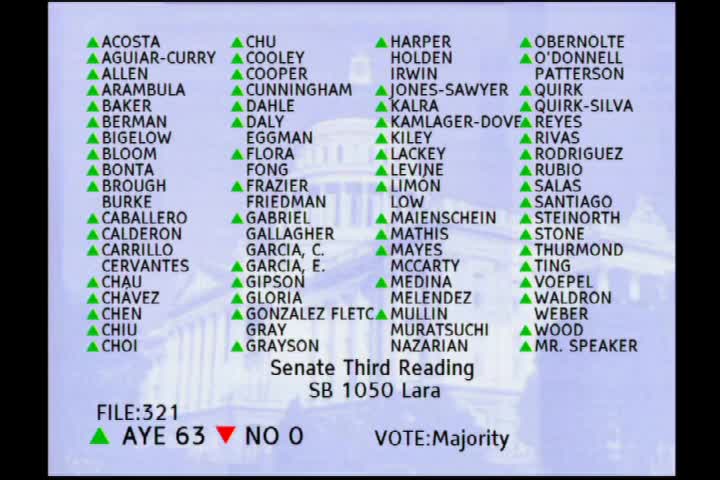

Bill Author

Bill Co-Author(s):
