SB 823: Alcohol and drug treatment abuse recovery and treatment facilities.
- Session Year: 2017-2018
- House: Senate
- Latest Version Date: 2018-09-26
Existing law grants the authority to license adult alcoholism or drug abuse recovery or treatment facilities to the State Department of Health Care Services. Under existing law, no person or entity may operate such a facility without licensure by the department.
This bill would require the department to adopt specified standards for these facilities as minimum requirements for licensure. The bill would authorize the department to implement, interpret, or make specific this requirement by means of plan or provider bulletins or similar instructions until regulations are adopted and would require the department to adopt the regulations by January 1, 2023.
Existing law grants the authority to license adult alcoholism or drug abuse recovery or treatment facilities to the State Department of Health Care Services. Under existing law, no person or entity may operate such a facility without licensure by the department.
This bill would require the department to adopt specified standards for these facilities as minimum requirements for licensure.
Existing state law defines and regulates consumer credit reports and permits a consumer to place a security freeze on his or her credit report by making a request in writing by certified mail to a consumer credit reporting agency. Existing law requires a consumer credit reporting agency to place a security freeze on a consumers credit report no later than 3 business days after receiving a written request from the consumer.This bill would authorize the request to place a security freeze to be made via an Internet Web site or mobile software application. The bill would require a consumer credit reporting agency to initiate placement, or the temporary lift or removal, of the freeze with other consumer credit reporting agencies that compile and maintain files on consumers on a nationwide basis, unless the consumer elects not to have the security freeze applied to other credit reporting agencies. The bill would require a consumer credit reporting agency to have a prominent link on the homepage of its Internet Web site and a link in its mobile software application titled Freeze or Unfreeze Your Credit through which a consumer can request placement, temporary lift, or removal of a freeze placed on the consumers credit report. The bill would require a consumer credit reporting agency to place, temporarily lift, or remove a security freeze received in writing by mail within one business day after having received the request, or, if received or via an Internet Web site or mobile software application, within 15 minutes after authenticating the request.Existing law permits a consumer credit reporting agency to charge a fee of no more than $10 to a consumer for the placement of a freeze, the removal of the freeze, the temporary lift of the freeze for a period of time, or the temporary lift of the freeze for a specific party, regarding access to a consumer credit report, except as specified.This bill would prohibit a consumer credit reporting agency from charging these fees. The bill would also make other conforming changes.Existing state law defines and regulates consumer credit reports and permits a consumer to place a security freeze on his or her credit report by making a request in writing by certified mail to a consumer credit reporting agency. Existing law requires a consumer credit reporting agency to place a security freeze on a consumers credit report no later than 3 business days after receiving a written request from the consumer.
This bill would authorize the request to place a security freeze to be made via an Internet Web site or mobile software application. The bill would require a consumer credit reporting agency to initiate placement, or the temporary lift or removal, of the freeze with other consumer credit reporting agencies that compile and maintain files on consumers on a nationwide basis, unless the consumer elects not to have the security freeze applied to other credit reporting agencies. The bill would require a consumer credit reporting agency to have a prominent link on the homepage of its Internet Web site and a link in its mobile software application titled Freeze or Unfreeze Your Credit through which a consumer can request placement, temporary lift, or removal of a freeze placed on the consumers credit report. The bill would require a consumer credit reporting agency to place, temporarily lift, or remove a security freeze received in writing by mail within one business day after having received the request, or, if received or via an Internet Web site or mobile software application, within 15 minutes after receiving authenticating the request.
Existing law permits a consumer credit reporting agency to charge a fee of no more than $10 to a consumer for the placement of a freeze, the removal of the freeze, the temporary lift of the freeze for a period of time, or the temporary lift of the freeze for a specific party, regarding access to a consumer credit report, except as specified.
This bill would prohibit a consumer credit reporting agency from charging these fees. The bill would also make other conforming changes.
Existing state law defines and regulates consumer credit reports and permits a consumer to place a security freeze on his or her credit report by making a request in writing by certified mail to a consumer credit reporting agency. Existing law requires a consumer credit reporting agency to place a security freeze on a consumers credit report no later than three 3 business days after receiving a written request from the consumer.
This bill would authorize the request to place a security freeze to be made via an Internet Web site or mobile software application. The bill would require a consumer credit reporting agency to initiate placement placement, or the temporary lift or removal, of the freeze with other consumer credit reporting agencies that compile and maintain files on consumers on a nationwide basis, unless the consumer elects not to have the security freeze applied to other credit reporting agencies. The bill would require a consumer credit reporting agency to have a prominent link on the homepage of its Internet Web site and its mobile software application titled Freeze or Unfreeze Your Credit though through which a consumer can request placement, temporary lift, or removal of a freeze placed on the consumers credit report. The bill would require a consumer credit reporting agency to place, temporarily lift, or remove a security freeze received in writing by mail within one business day after having received the request, or, if received or via an Internet Web site or mobile software application, within 15 minutes after receiving the request.
Existing law permits a consumer credit reporting agency to charge a fee of no more than $10 to a consumer for the placement of a freeze, the removal of the freeze, the temporary lift of the freeze for a period of time, or the temporary lift of the freeze for a specific party, regarding access to a consumer credit report, except as specified.
This bill would prohibit a consumer credit reporting agency from charging these fees. The bill would also make other conforming changes.
Existing state law defines and regulates consumer credit reports and permits a consumer to place a security freeze on his or her credit report by making a request in writing by certified mail to a consumer credit reporting agency. Existing law requires a consumer credit reporting agency to place a security freeze on a consumers credit report no later than three business days after receiving a written request from the consumer.
This bill would also authorize the request to place a security freeze to be made via an Internet Web site. site or mobile software application. The bill would also require a consumer credit reporting agency to initiate placement of the freeze with other consumer credit reporting agencies that compile and maintain files on consumers on a nationwide basis, unless the consumer elects not to have the security freeze applied to other credit reporting agencies. The bill would require a consumer credit reporting agency to have a prominent link on the homepage of its Internet Web site and its mobile software application titled Freeze or Unfreeze Your Credit though which a consumer can request placement, temporary lift, or removal of a freeze placed on the consumers credit report. The bill would require a consumer credit reporting agency to place, temporarily lift, or remove a security freeze received in writing by mail within one business day after having received the request, or, if received via an Internet Web site or mobile software application, within 15 minutes after receiving the request.
Existing law permits a consumer credit reporting agency to charge a fee of no more than $10 to a consumer for the placement of a freeze, the removal of the freeze, the temporary lift of the freeze for a period of time, or the temporary lift of the freeze for a specific party, regarding access to a consumer credit report, except as specified.
This bill would prohibit a consumer credit reporting agency from charging these fees. The bill would also make other conforming changes.
Existing state law defines and regulates consumer credit reports and permits a consumer to place a security freeze on his or her credit report by making a request in writing by certified mail to a consumer credit reporting agency.
This bill would also authorize the request to place a security freeze to be made via an Internet Web site. The bill would also require a consumer credit reporting agency to initiate placement of the freeze with other consumer credit reporting agencies that compile and maintain files on consumers on a nationwide basis, unless the consumer elects not to have the security freeze applied to other credit reporting agencies.
Existing law permits a consumer credit reporting agency to charge a fee of no more than $10 to a consumer for the placement of a freeze, the removal of the freeze, the temporary lift of the freeze for a period of time, or the temporary lift of the freeze for a specific party, regarding access to a consumer credit report, except as specified.
This bill would prohibit a consumer credit reporting agency from charging these fees. The bill would also make other conforming changes.
(a)The department shall adopt the American Society of Addiction Medicine treatment criteria, or an equivalent evidence-based standard, as the minimum standard of care for licensed facilities and shall require a licensee to maintain those standards with respect to the level of care to be provided by the licensee.
(b)The department may implement, interpret, or make specific this section by means of plan or provider bulletins or similar instructions until regulations are adopted. The department shall adopt regulations by January 1, 2023.
The department shall adopt the American Society of Addiction Medicine treatment criteria, or an equivalent evidence-based standard, as the minimum standard of care for licensed facilities and shall require licensees a licensee to maintain those standards. standards with respect to the level of care to be provided by the licensee.
The department shall adopt the American Society of Addiction Medicine treatment criteria, or an equivalent evidence-based standard, as the minimum standard of care for licensed facilities and shall require licensees to maintain those standards.
SECTION 1.Section 1785.11.2 of the Civil Code is amended to read:1785.11.2.(a)(1)A consumer may elect to place a security freeze on his or her credit report by making a request in writing by mail or via an Internet Web site or mobile software application to a consumer credit reporting agency. Security freeze means a notice placed in a consumers credit report, at the request of the consumer, and subject to certain exceptions, that prohibits the consumer credit reporting agency from releasing the consumers credit report or any information from it, without the express authorization of the consumer. If a security freeze is in place, information from a consumers credit report shall not be released to a third party without prior express authorization from the consumer.(2)If a consumer requests that a security freeze be placed on his or her credit report by a consumer credit reporting agency, the consumer credit reporting agency shall initiate placement of the freeze with other consumer credit reporting agencies that compile and maintain files on consumers on a nationwide basis, unless the consumer elects not to have the security freeze applied to other credit reporting agencies. A consumer credit reporting agency shall not charge a fee to a consumer who selects this option.(3) This subdivision does not prevent a consumer credit reporting agency from advising a third party that a security freeze is in effect with respect to the consumers credit report.(b)A consumer credit reporting agency shall place a security freeze on a consumers credit report no later than one business day after receiving a written request from another consumer credit reporting agency or the consumer by mail, or no later than 15 minutes after authenticating a request from another credit reporting agency or from the consumer received via an Internet Web site or mobile software application.(c)The consumer credit reporting agency shall send a written confirmation of the security freeze to the consumer within 10 business days after receiving a request from the consumer or another consumer credit reporting agency and shall provide the consumer with a unique personal identification number or password to be used by the consumer when providing authorization for the release of his or her credit for a specific party or period of time. If a consumer elects to have the consumer credit reporting agency initiate security freezes at other agencies pursuant to paragraph (2) of subdivision (a), only the consumer credit reporting agency in contact with the consumer shall be required to provide a unique personal identification number or password.(d)If the consumer wishes to allow his or her credit report to be accessed for a specific party or period of time while a freeze is in place, he or she shall contact the consumer credit reporting agency, that he or she requested place the security freeze pursuant to paragraph (1) of subdivision (a), request that the freeze be temporarily lifted at one or all consumer credit reporting agencies, and provide the following:(1)Proper identification, as defined in subdivision (c) of Section 1785.15.(2)The unique personal identification number or password provided by the credit reporting agency pursuant to subdivision (c).(3)The proper information regarding the third party who is to receive the credit report or the time period for which the report shall be available to users of the credit report.(e)A consumer credit reporting agency that receives a request from a consumer or another credit reporting agency to temporarily lift a freeze on a credit report pursuant to subdivision (d) shall comply with the request no later than one business day after receiving the request by mail, or within 15 minutes after authenticating a request received via an Internet Web site or mobile software application.(f)A consumer credit reporting agency shall have a prominent link on the homepage of its Internet Web site and a link in its mobile software application titled Freeze or Unfreeze Your Credit through which a consumer can request placement, temporary lift, or removal of a freeze placed on the consumers credit report.(g)A consumer credit reporting agency shall remove or temporarily lift a freeze placed on a consumers credit report only in the following cases:(1)Upon consumer request, pursuant to subdivision (d) or (j).(2)If the consumers credit report was frozen due to a material misrepresentation of fact by the consumer. If a consumer credit reporting agency intends to remove a freeze upon a consumers credit report pursuant to this paragraph, the consumer credit reporting agency shall notify the consumer in writing prior to removing the freeze on the consumers credit report.(h)A third party who requests access to a consumer credit report in connection with an application for credit or any other use may treat the application as incomplete if a security freeze is in effect and the consumer does not allow his or her credit report to be accessed for that specific party or period of time.(i)If a consumer requests a security freeze, the consumer credit reporting agency shall disclose the process of placing and temporarily lifting a freeze and the process for allowing access to information from the consumers credit report for a specific party or period of time while the freeze is in place.(j)A security freeze shall remain in place until the consumer requests that the security freeze be removed. A consumer credit reporting agency shall remove a security freeze within one business day of receiving a request for removal from the consumer or from another consumer credit reporting agency in writing via mail, or within 15 minutes of authenticating a request for removal from another consumer credit reporting agency or from the consumer received via an Internet Web site or mobile software application if the consumer provides both of the following to the consumer credit reporting agency from which he or she requested placement of the security freeze pursuant to paragraph (1) of subdivision (a):(1)Proper identification, as defined in subdivision (c) of Section 1785.15.(2)The unique personal identification number or password provided by the credit reporting agency pursuant to subdivision (c).(k)A consumer credit reporting agency shall require proper identification, as defined in subdivision (c) of Section 1785.15, of the person making a request to place or remove a security freeze.(l)The provisions of this section do not apply to the use of a consumer credit report by any of the following:(1)(A)(i)A person or entity with which the consumer has or had, prior to any assignment, an account or contract, including a demand deposit account, or to which the consumer issued a negotiable instrument, for the purpose of reviewing the account or collecting the financial obligation owing for the account, contract, or negotiable instrument.(ii)A subsidiary, affiliate, or agent of a person or entity described in clause (i), an assignee of a financial obligation owing by the consumer to such a person or entity, or a prospective assignee of a financial obligation owing by the consumer to such a person or entity in conjunction with the proposed purchase of the financial obligation, for the purpose of reviewing the account or collecting the financial obligation owing for the account, contract, or negotiable instrument.(B)For purposes of this paragraph, reviewing the account includes activities related to account maintenance, monitoring, credit line increases, and account upgrades and enhancements.(2)A subsidiary, affiliate, agent, assignee, or prospective assignee of a person to whom access has been granted under subdivision (d) for purposes of facilitating the extension of credit or other permissible use.(3)Any state or local agency, law enforcement agency, trial court, or private collection agency acting pursuant to a court order, warrant, or subpoena.(4)A child support agency acting pursuant to Chapter 2 (commencing with Section 17400) of Division 17 of the Family Code or Title IV-D of the Social Security Act (42 U.S.C. et seq.).(5)The State Department of Health Care Services or its agents or assigns acting to investigate Medi-Cal fraud.(6)The Franchise Tax Board or its agents or assigns acting to investigate or collect delinquent taxes or unpaid court orders or to fulfill any of its other statutory responsibilities.(7)The use of credit information for the purposes of prescreening as provided for by the federal Fair Credit Reporting Act.(8)Any person or entity administering a credit file monitoring subscription service to which the consumer has subscribed.(9)Any person or entity for the purpose of providing a consumer with a copy of his or her credit report upon the consumers request.(m)A consumer credit reporting agency shall not charge a fee to a consumer for the placement of a freeze, the removal of the freeze, the temporary lift of the freeze for a period of time, or the temporary lift of the freeze for a specific party, regarding access to a consumer credit report.(n)Regardless of the existence of a security freeze, a consumer reporting agency may disclose public record information lawfully obtained by, or for, the consumer reporting agency from an open public record to the extent otherwise permitted by law. This subdivision does not prohibit a consumer reporting agency from electing to apply a valid security freeze to the entire contents of a credit report.SEC. 2.Section 1785.15 of the Civil Code is amended to read:1785.15.(a)A consumer credit reporting agency shall supply files and information required under Section 1785.10 during normal business hours and on reasonable notice. In addition to the disclosure provided by this chapter and any disclosures received by the consumer, the consumer has the right to request and receive all of the following:(1)Either a decoded written version of the file or a written copy of the file, including all information in the file at the time of the request, with an explanation of any code used.(2)A credit score for the consumer, the key factors, and the related information, as defined in and required by Section 1785.15.1.(3)A record of all inquiries, by recipient, that result in the provision of information concerning the consumer in connection with a credit transaction not initiated by the consumer and that were received by the consumer credit reporting agency in the 12-month period immediately preceding the request for disclosure under this section.(4)The recipients, including end users specified in Section 1785.22, of any consumer credit report on the consumer which the consumer credit reporting agency has furnished:(A)For employment purposes within the two-year period preceding the request.(B)For any other purpose within the 12-month period preceding the request.Identification for purposes of this paragraph shall include the name of the recipient or, if applicable, the fictitious business name under which the recipient does business disclosed in full. If requested by the consumer, the identification shall also include the address of the recipient.(b)Files maintained on a consumer shall be disclosed promptly as follows:(1)In person, at the location where the consumer credit reporting agency maintains the trained personnel required by subdivision (d), if he or she appears in person and furnishes proper identification.(2)By mail, if the consumer makes a written request with proper identification for a copy of the file or a decoded written version of that file to be sent to the consumer at a specified address. A disclosure pursuant to this paragraph shall be deposited in the United States mail, postage prepaid, within five business days after the consumers written request for the disclosure is received by the consumer credit reporting agency. Consumer credit reporting agencies complying with requests for mailings under this section shall not be liable for disclosures to third parties caused by mishandling of mail after the mailings leave the consumer credit reporting agencies.(3)A summary of all information contained in files on a consumer and required to be provided by Section 1785.10 shall be provided by telephone, if the consumer has made a written request, with proper identification for telephone disclosure.(4)Information in a consumers file required to be provided in writing under this section may also be disclosed in another form if authorized by the consumer and if available from the consumer credit reporting agency. For this purpose, a consumer may request disclosure in person pursuant to Section 1785.10, by telephone upon disclosure of proper identification by the consumer, by electronic means if available from the consumer credit reporting agency, or by any other reasonable means that is available from the consumer credit reporting agency.(c)Proper identification, as used in subdivision (b) means that information generally deemed sufficient to identify a person. Only if the consumer is unable to reasonably identify himself or herself with the information described above may a consumer credit reporting agency require additional information concerning the consumers employment and personal or family history in order to verify his or her identity.(d)The consumer credit reporting agency shall provide trained personnel to explain to the consumer any information furnished to him or her pursuant to Section 1785.10.(e)The consumer shall be permitted to be accompanied by one other person of his or her choosing, who shall furnish reasonable identification. A consumer credit reporting agency may require the consumer to furnish a written statement granting permission to the consumer credit reporting agency to discuss the consumers file in that persons presence.(f)Any written disclosure by a consumer credit reporting agency to any consumer pursuant to this section shall include a written summary of all rights the consumer has under this title and, in the case of a consumer credit reporting agency that compiles and maintains consumer credit reports on a nationwide basis, a toll-free telephone number that the consumer can use to communicate with the consumer credit reporting agency. The written summary of rights required under this subdivision is sufficient if in substantially the following form:You have a right to obtain a copy of your credit file from a consumer credit reporting agency. You may be charged a reasonable fee not exceeding eight dollars ($8). There is no fee, however, if you have been turned down for credit, employment, insurance, or a rental dwelling because of information in your credit report within the preceding 60 days. The consumer credit reporting agency must provide someone to help you interpret the information in your credit file.You have a right to dispute inaccurate information by contacting the consumer credit reporting agency directly. However, neither you nor any credit repair company or credit service organization has the right to have accurate, current, and verifiable information removed from your credit report. Under the federal Fair Credit Reporting Act, the consumer credit reporting agency must remove accurate, negative information from your report only if it is over seven years old. Bankruptcy information can be reported for 10 years.If you have notified a consumer credit reporting agency in writing that you dispute the accuracy of information in your file, the consumer credit reporting agency must then, within 30 business days, reinvestigate and modify or remove inaccurate information. The consumer credit reporting agency may not charge a fee for this service. Any pertinent information and copies of all documents you have concerning an error should be given to the consumer credit reporting agency.If reinvestigation does not resolve the dispute to your satisfaction, you may send a brief statement to the consumer credit reporting agency to keep in your file, explaining why you think the record is inaccurate. The consumer credit reporting agency must include your statement about disputed information in a report it issues about you.You have a right to receive a record of all inquiries relating to a credit transaction initiated in 12 months preceding your request. This record shall include the recipients of any consumer credit report.You may request in writing that the information contained in your file not be provided to a third party for marketing purposes.You have a right to place a security alert in your credit report, which will warn anyone who receives information in your credit report that your identity may have been used without your consent. Recipients of your credit report are required to take reasonable steps, including contacting you at the telephone number you may provide with your security alert, to verify your identity prior to lending money, extending credit, or completing the purchase, lease, or rental of goods or services. The security alert may prevent credit, loans, and services from being approved in your name without your consent. However, you should be aware that taking advantage of this right may delay or interfere with the timely approval of any subsequent request or application you make regarding a new loan, credit, mortgage, or cellular phone or other new account, including an extension of credit at point of sale. If you place a security alert on your credit report, you have a right to obtain a free copy of your credit report at the time the 90-day security alert period expires. A security alert may be requested by calling the following toll-free telephone number: (Insert applicable toll-free telephone number). California consumers also have the right to obtain a security freeze.You have a right to place a security freeze on your credit report, which will prohibit a consumer credit reporting agency from releasing any information in your credit report without your express authorization. A security freeze must be requested in writing by mail. The security freeze is designed to prevent credit, loans, and services from being approved in your name without your consent. However, you should be aware that using a security freeze to take control over who gets access to the personal and financial information in your credit report may delay, interfere with, or prohibit the timely approval of any subsequent request or application you make regarding a new loan, credit, mortgage, or cellular phone or other new account, including an extension of credit at point of sale. When you place a security freeze on your credit report, you will be provided a personal identification number or password to use if you choose to remove the freeze on your credit report or authorize the release of your credit report for a specific party or period of time after the freeze is in place. To provide that authorization you must contact the consumer credit reporting agency and provide all of the following:(1)The personal identification number or password.(2)Proper identification to verify your identity.(3)The proper information regarding the third party who is to receive the credit report or the period of time for which the report shall be available to users of the credit report.A consumer credit reporting agency must authorize the release of your credit report no later than three business days after receiving the above information.A security freeze does not apply when you have an existing account and a copy of your report is requested by your existing creditor or its agents or affiliates for certain types of account review, collection, fraud control, or similar activities.If you are actively seeking credit, you should understand that the procedures involved in lifting a security freeze may slow your application for credit. You should plan ahead and lift a freeze, either completely if you are shopping around, or specifically for a certain creditor, before applying for new credit.A consumer credit reporting agency may not charge a fee to a consumer for placing, lifting, removing, or replacing a security freeze.You have a right to bring civil action against anyone, including a consumer credit reporting agency, who improperly obtains access to a file, knowingly or willfully misuses file data, or fails to correct inaccurate file data.If you are a victim of identity theft and provide to a consumer credit reporting agency a copy of a valid police report or a valid investigative report made by a Department of Motor Vehicles investigator with peace officer status describing your circumstances, the following shall apply:(1)You have a right to have any information you list on the report as allegedly fraudulent promptly blocked so that the information cannot be reported. The information will be unblocked only if (A) the information you provide is a material misrepresentation of the facts, (B) you agree that the information is blocked in error, or (C) you knowingly obtained possession of goods, services, or moneys as a result of the blocked transactions. If blocked information is unblocked, you will be promptly notified.(2)You have a right to receive, free of charge and upon request, one copy of your credit report each month for up to 12 consecutive months.(a)(1)A consumer may elect to place a security freeze on his or her credit report by making a request in writing by mail or via an Internet Web site or mobile software application to a consumer credit reporting agency. Security freeze means a notice placed in a consumers credit report, at the request of the consumer, and subject to certain exceptions, that prohibits the consumer credit reporting agency from releasing the consumers credit report or any information from it, without the express authorization of the consumer. If a security freeze is in place, information from a consumers credit report shall not be released to a third party without prior express authorization from the consumer.
(2)If a consumer requests that a security freeze be placed on his or her credit report by a consumer credit reporting agency, the consumer credit reporting agency shall initiate placement of the freeze with other consumer credit reporting agencies that compile and maintain files on consumers on a nationwide basis, unless the consumer elects not to have the security freeze applied to other credit reporting agencies. A consumer credit reporting agency shall not charge a fee to a consumer who selects this option.
(3) This subdivision does not prevent a consumer credit reporting agency from advising a third party that a security freeze is in effect with respect to the consumers credit report.
(b)A consumer credit reporting agency shall place a security freeze on a consumers credit report no later than one business day after receiving a written request from another consumer credit reporting agency or the consumer by mail, or no later than 15 minutes after receiving a authenticating a request from another credit reporting agency or from the consumer received via an Internet Web site or mobile software application.
(c)The consumer credit reporting agency shall send a written confirmation of the security freeze to the consumer within 10 business days after receiving a request from the consumer or another consumer credit reporting agency and shall provide the consumer with a unique personal identification number or password to be used by the consumer when providing authorization for the release of his or her credit for a specific party or period of time. If a consumer elects to have the consumer credit reporting agency initiate security freezes at other agencies pursuant to paragraph (2) of subdivision (a), only the consumer credit reporting agency in contact with the consumer shall be required to provide a unique personal identification number or password.
(d)If the consumer wishes to allow his or her credit report to be accessed for a specific party or period of time while a freeze is in place, he or she shall contact the consumer credit reporting agency, that he or she requested place the security freeze pursuant to paragraph (1) of subdivision (a), request that the freeze be temporarily lifted at one or all consumer credit reporting agencies, and provide the following:
(1)Proper identification, as defined in subdivision (c) of Section 1785.15.
(2)The unique personal identification number or password provided by the credit reporting agency pursuant to subdivision (c).
(3)The proper information regarding the third party who is to receive the credit report or the time period for which the report shall be available to users of the credit report.
(e)A consumer credit reporting agency that receives a request from a consumer or another credit reporting agency to temporarily lift a freeze on a credit report pursuant to subdivision (d) shall comply with the request no later than one business day after receiving the request by mail, or within 15 minutes after receiving the request authenticating a request received via an Internet Web site or mobile software application.
(f)A consumer credit reporting agency shall have a prominent link on the homepage of its Internet Web site and a link in its mobile software application titled Freeze or Unfreeze Your Credit through which a consumer can request placement, temporary lift, or removal of a freeze placed on the consumers credit report.
(g)A consumer credit reporting agency shall remove or temporarily lift a freeze placed on a consumers credit report only in the following cases:
(1)Upon consumer request, pursuant to subdivision (d) or (j).
(2)If the consumers credit report was frozen due to a material misrepresentation of fact by the consumer. If a consumer credit reporting agency intends to remove a freeze upon a consumers credit report pursuant to this paragraph, the consumer credit reporting agency shall notify the consumer in writing prior to removing the freeze on the consumers credit report.
(h)A third party who requests access to a consumer credit report in connection with an application for credit or any other use may treat the application as incomplete if a security freeze is in effect and the consumer does not allow his or her credit report to be accessed for that specific party or period of time.
(i)If a consumer requests a security freeze, the consumer credit reporting agency shall disclose the process of placing and temporarily lifting a freeze and the process for allowing access to information from the consumers credit report for a specific party or period of time while the freeze is in place.
(j)A security freeze shall remain in place until the consumer requests that the security freeze be removed. A consumer credit reporting agency shall remove a security freeze within one business day of receiving a request for removal from the consumer or from another consumer credit reporting agency in writing via mail, or within 15 minutes of receiving a request authenticating a request for removal from another consumer credit reporting agency or from the consumer received via an Internet Web site or mobile software application if the consumer provides both of the following to the consumer credit reporting agency from which he or she requested placement of the security freeze pursuant to paragraph (1) of subdivision (a):
(1)Proper identification, as defined in subdivision (c) of Section 1785.15.
(2)The unique personal identification number or password provided by the credit reporting agency pursuant to subdivision (c).
(k)A consumer credit reporting agency shall require proper identification, as defined in subdivision (c) of Section 1785.15, of the person making a request to place or remove a security freeze.
(l)The provisions of this section do not apply to the use of a consumer credit report by any of the following:
(1)(A)(i)A person or entity with which the consumer has or had, prior to any assignment, an account or contract, including a demand deposit account, or to which the consumer issued a negotiable instrument, for the purpose of reviewing the account or collecting the financial obligation owing for the account, contract, or negotiable instrument.
(ii)A subsidiary, affiliate, or agent of a person or entity described in clause (i), an assignee of a financial obligation owing by the consumer to such a person or entity, or a prospective assignee of a financial obligation owing by the consumer to such a person or entity in conjunction with the proposed purchase of the financial obligation, for the purpose of reviewing the account or collecting the financial obligation owing for the account, contract, or negotiable instrument.
(B)For purposes of this paragraph, reviewing the account includes activities related to account maintenance, monitoring, credit line increases, and account upgrades and enhancements.
(2)A subsidiary, affiliate, agent, assignee, or prospective assignee of a person to whom access has been granted under subdivision (d) for purposes of facilitating the extension of credit or other permissible use.
(3)Any state or local agency, law enforcement agency, trial court, or private collection agency acting pursuant to a court order, warrant, or subpoena.
(4)A child support agency acting pursuant to Chapter 2 (commencing with Section 17400) of Division 17 of the Family Code or Title IV-D of the Social Security Act (42 U.S.C. et seq.).
(5)The State Department of Health Care Services or its agents or assigns acting to investigate Medi-Cal fraud.
(6)The Franchise Tax Board or its agents or assigns acting to investigate or collect delinquent taxes or unpaid court orders or to fulfill any of its other statutory responsibilities.
(7)The use of credit information for the purposes of prescreening as provided for by the federal Fair Credit Reporting Act.
(8)Any person or entity administering a credit file monitoring subscription service to which the consumer has subscribed.
(9)Any person or entity for the purpose of providing a consumer with a copy of his or her credit report upon the consumers request.
(m)A consumer credit reporting agency shall not charge a fee to a consumer for the placement of a freeze, the removal of the freeze, the temporary lift of the freeze for a period of time, or the temporary lift of the freeze for a specific party, regarding access to a consumer credit report.
(n)Regardless of the existence of a security freeze, a consumer reporting agency may disclose public record information lawfully obtained by, or for, the consumer reporting agency from an open public record to the extent otherwise permitted by law. This subdivision does not prohibit a consumer reporting agency from electing to apply a valid security freeze to the entire contents of a credit report.
SEC. 2.Section 1785.15 of the Civil Code is amended to read:1785.15.(a)A consumer credit reporting agency shall supply files and information required under Section 1785.10 during normal business hours and on reasonable notice. In addition to the disclosure provided by this chapter and any disclosures received by the consumer, the consumer has the right to request and receive all of the following:
(1)Either a decoded written version of the file or a written copy of the file, including all information in the file at the time of the request, with an explanation of any code used.
(2)A credit score for the consumer, the key factors, and the related information, as defined in and required by Section 1785.15.1.
(3)A record of all inquiries, by recipient, that result in the provision of information concerning the consumer in connection with a credit transaction not initiated by the consumer and that were received by the consumer credit reporting agency in the 12-month period immediately preceding the request for disclosure under this section.
(4)The recipients, including end users specified in Section 1785.22, of any consumer credit report on the consumer which the consumer credit reporting agency has furnished:
(A)For employment purposes within the two-year period preceding the request.
(B)For any other purpose within the 12-month period preceding the request.
Identification for purposes of this paragraph shall include the name of the recipient or, if applicable, the fictitious business name under which the recipient does business disclosed in full. If requested by the consumer, the identification shall also include the address of the recipient.
(b)Files maintained on a consumer shall be disclosed promptly as follows:
(1)In person, at the location where the consumer credit reporting agency maintains the trained personnel required by subdivision (d), if he or she appears in person and furnishes proper identification.
(2)By mail, if the consumer makes a written request with proper identification for a copy of the file or a decoded written version of that file to be sent to the consumer at a specified address. A disclosure pursuant to this paragraph shall be deposited in the United States mail, postage prepaid, within five business days after the consumers written request for the disclosure is received by the consumer credit reporting agency. Consumer credit reporting agencies complying with requests for mailings under this section shall not be liable for disclosures to third parties caused by mishandling of mail after the mailings leave the consumer credit reporting agencies.
(3)A summary of all information contained in files on a consumer and required to be provided by Section 1785.10 shall be provided by telephone, if the consumer has made a written request, with proper identification for telephone disclosure.
(4)Information in a consumers file required to be provided in writing under this section may also be disclosed in another form if authorized by the consumer and if available from the consumer credit reporting agency. For this purpose, a consumer may request disclosure in person pursuant to Section 1785.10, by telephone upon disclosure of proper identification by the consumer, by electronic means if available from the consumer credit reporting agency, or by any other reasonable means that is available from the consumer credit reporting agency.
(c)Proper identification, as used in subdivision (b) means that information generally deemed sufficient to identify a person. Only if the consumer is unable to reasonably identify himself or herself with the information described above may a consumer credit reporting agency require additional information concerning the consumers employment and personal or family history in order to verify his or her identity.
(d)The consumer credit reporting agency shall provide trained personnel to explain to the consumer any information furnished to him or her pursuant to Section 1785.10.
(e)The consumer shall be permitted to be accompanied by one other person of his or her choosing, who shall furnish reasonable identification. A consumer credit reporting agency may require the consumer to furnish a written statement granting permission to the consumer credit reporting agency to discuss the consumers file in that persons presence.
(f)Any written disclosure by a consumer credit reporting agency to any consumer pursuant to this section shall include a written summary of all rights the consumer has under this title and, in the case of a consumer credit reporting agency that compiles and maintains consumer credit reports on a nationwide basis, a toll-free telephone number that the consumer can use to communicate with the consumer credit reporting agency. The written summary of rights required under this subdivision is sufficient if in substantially the following form:
You have a right to obtain a copy of your credit file from a consumer credit reporting agency. You may be charged a reasonable fee not exceeding eight dollars ($8). There is no fee, however, if you have been turned down for credit, employment, insurance, or a rental dwelling because of information in your credit report within the preceding 60 days. The consumer credit reporting agency must provide someone to help you interpret the information in your credit file.
You have a right to dispute inaccurate information by contacting the consumer credit reporting agency directly. However, neither you nor any credit repair company or credit service organization has the right to have accurate, current, and verifiable information removed from your credit report. Under the federal Fair Credit Reporting Act, the consumer credit reporting agency must remove accurate, negative information from your report only if it is over seven years old. Bankruptcy information can be reported for 10 years.
If you have notified a consumer credit reporting agency in writing that you dispute the accuracy of information in your file, the consumer credit reporting agency must then, within 30 business days, reinvestigate and modify or remove inaccurate information. The consumer credit reporting agency may not charge a fee for this service. Any pertinent information and copies of all documents you have concerning an error should be given to the consumer credit reporting agency.
If reinvestigation does not resolve the dispute to your satisfaction, you may send a brief statement to the consumer credit reporting agency to keep in your file, explaining why you think the record is inaccurate. The consumer credit reporting agency must include your statement about disputed information in a report it issues about you.
You have a right to receive a record of all inquiries relating to a credit transaction initiated in 12 months preceding your request. This record shall include the recipients of any consumer credit report.
You may request in writing that the information contained in your file not be provided to a third party for marketing purposes.
You have a right to place a security alert in your credit report, which will warn anyone who receives information in your credit report that your identity may have been used without your consent. Recipients of your credit report are required to take reasonable steps, including contacting you at the telephone number you may provide with your security alert, to verify your identity prior to lending money, extending credit, or completing the purchase, lease, or rental of goods or services. The security alert may prevent credit, loans, and services from being approved in your name without your consent. However, you should be aware that taking advantage of this right may delay or interfere with the timely approval of any subsequent request or application you make regarding a new loan, credit, mortgage, or cellular phone or other new account, including an extension of credit at point of sale. If you place a security alert on your credit report, you have a right to obtain a free copy of your credit report at the time the 90-day security alert period expires. A security alert may be requested by calling the following toll-free telephone number: (Insert applicable toll-free telephone number). California consumers also have the right to obtain a security freeze.
You have a right to place a security freeze on your credit report, which will prohibit a consumer credit reporting agency from releasing any information in your credit report without your express authorization. A security freeze must be requested in writing by mail. The security freeze is designed to prevent credit, loans, and services from being approved in your name without your consent. However, you should be aware that using a security freeze to take control over who gets access to the personal and financial information in your credit report may delay, interfere with, or prohibit the timely approval of any subsequent request or application you make regarding a new loan, credit, mortgage, or cellular phone or other new account, including an extension of credit at point of sale. When you place a security freeze on your credit report, you will be provided a personal identification number or password to use if you choose to remove the freeze on your credit report or authorize the release of your credit report for a specific party or period of time after the freeze is in place. To provide that authorization you must contact the consumer credit reporting agency and provide all of the following:
(1)The personal identification number or password.
(2)Proper identification to verify your identity.
(3)The proper information regarding the third party who is to receive the credit report or the period of time for which the report shall be available to users of the credit report.
A consumer credit reporting agency must authorize the release of your credit report no later than three business days after receiving the above information.
A security freeze does not apply when you have an existing account and a copy of your report is requested by your existing creditor or its agents or affiliates for certain types of account review, collection, fraud control, or similar activities.
If you are actively seeking credit, you should understand that the procedures involved in lifting a security freeze may slow your application for credit. You should plan ahead and lift a freeze, either completely if you are shopping around, or specifically for a certain creditor, before applying for new credit.
A consumer credit reporting agency may not charge a fee to a consumer for placing, lifting, removing, or replacing a security freeze.
You have a right to bring civil action against anyone, including a consumer credit reporting agency, who improperly obtains access to a file, knowingly or willfully misuses file data, or fails to correct inaccurate file data.
If you are a victim of identity theft and provide to a consumer credit reporting agency a copy of a valid police report or a valid investigative report made by a Department of Motor Vehicles investigator with peace officer status describing your circumstances, the following shall apply:
(1)You have a right to have any information you list on the report as allegedly fraudulent promptly blocked so that the information cannot be reported. The information will be unblocked only if (A) the information you provide is a material misrepresentation of the facts, (B) you agree that the information is blocked in error, or (C) you knowingly obtained possession of goods, services, or moneys as a result of the blocked transactions. If blocked information is unblocked, you will be promptly notified.
(2)You have a right to receive, free of charge and upon request, one copy of your credit report each month for up to 12 consecutive months.
(a)(1)A consumer may elect to place a security freeze on his or her credit report by making a request in writing by mail or via an Internet Web site or mobile software application to a consumer credit reporting agency. Security freeze means a notice placed in a consumers credit report, at the request of the consumer, and subject to certain exceptions, that prohibits the consumer credit reporting agency from releasing the consumers credit report or any information from it, without the express authorization of the consumer. If a security freeze is in place, information from a consumers credit report shall not be released to a third party without prior express authorization from the consumer.
(2)If a consumer requests that a security freeze be placed on his or her credit report by a consumer credit reporting agency, the consumer credit reporting agency shall initiate placement of the freeze with other consumer credit reporting agencies that compile and maintain files on consumers on a nationwide basis, unless the consumer elects not to have the security freeze applied to other credit reporting agencies. A consumer credit reporting agency shall not charge a fee to a consumer who selects this option.
(3) This subdivision does not prevent a consumer credit reporting agency from advising a third party that a security freeze is in effect with respect to the consumers credit report.
(b)A consumer credit reporting agency shall place a security freeze on a consumers credit report no later than one business day after receiving a written request from another consumer credit reporting agency or the consumer by mail, or no later than 15 minutes after receiving a request from another credit reporting agency or from the consumer via an Internet Web site or mobile software application.
(c)The consumer credit reporting agency shall send a written confirmation of the security freeze to the consumer within 10 business days after receiving a request from the consumer or another consumer credit reporting agency and shall provide the consumer with a unique personal identification number or password to be used by the consumer when providing authorization for the release of his or her credit for a specific party or period of time. If a consumer elects to have the consumer credit reporting agency initiate security freezes at other agencies pursuant to paragraph (2) of subdivision (a), only the consumer credit reporting agency in contact with the consumer shall be required to provide a unique personal identification number or password.
(d)If the consumer wishes to allow his or her credit report to be accessed for a specific party or period of time while a freeze is in place, he or she shall contact the consumer credit reporting agency, that he or she requested place the security freeze pursuant to paragraph (1) of subdivision (a), request that the freeze be temporarily lifted at one or all consumer credit reporting agencies, and provide the following:
(1)Proper identification, as defined in subdivision (c) of Section 1785.15.
(2)The unique personal identification number or password provided by the credit reporting agency pursuant to subdivision (c).
(3)The proper information regarding the third party who is to receive the credit report or the time period for which the report shall be available to users of the credit report.
(e)A consumer credit reporting agency that receives a request from a consumer or another credit reporting agency to temporarily lift a freeze on a credit report pursuant to subdivision (d) shall comply with the request no later than one business day after receiving the request by mail, or within 15 minutes after receiving the request via an Internet Web site or mobile software application.
(f)A consumer credit reporting agency shall have a prominent link on the homepage of its Internet Web site and its mobile software application titled Freeze or Unfreeze Your Credit though through which a consumer can request placement, temporary lift, or removal of a freeze placed on the consumers credit report.
(g)A consumer credit reporting agency shall remove or temporarily lift a freeze placed on a consumers credit report only in the following cases:
(1)Upon consumer request, pursuant to subdivision (d) or (j).
(2)If the consumers credit report was frozen due to a material misrepresentation of fact by the consumer. If a consumer credit reporting agency intends to remove a freeze upon a consumers credit report pursuant to this paragraph, the consumer credit reporting agency shall notify the consumer in writing prior to removing the freeze on the consumers credit report.
(h)A third party who requests access to a consumer credit report in connection with an application for credit or any other use may treat the application as incomplete if a security freeze is in effect and the consumer does not allow his or her credit report to be accessed for that specific party or period of time.
(i)If a consumer requests a security freeze, the consumer credit reporting agency shall disclose the process of placing and temporarily lifting a freeze and the process for allowing access to information from the consumers credit report for a specific party or period of time while the freeze is in place.
(j)A security freeze shall remain in place until the consumer requests that the security freeze be removed. A consumer credit reporting agency shall remove a security freeze within one business day of receiving a request for removal from the consumer or from another consumer credit reporting agency in writing via mail, or within 15 minutes of receiving a request for removal from another consumer credit reporting agency or from the consumer via an Internet Web site or mobile software application if the consumer provides both of the following to the consumer credit reporting agency from which he or she requested placement of the security freeze pursuant to paragraph (1) of subdivision (a):
(1)Proper identification, as defined in subdivision (c) of Section 1785.15.
(2)The unique personal identification number or password provided by the credit reporting agency pursuant to subdivision (c).
(k)A consumer credit reporting agency shall require proper identification, as defined in subdivision (c) of Section 1785.15, of the person making a request to place or remove a security freeze.
(l)The provisions of this section do not apply to the use of a consumer credit report by any of the following:
(1)(A)(i)A person or entity with which the consumer has or had, prior to any assignment, an account or contract, including a demand deposit account, or to which the consumer issued a negotiable instrument, for the purpose of reviewing the account or collecting the financial obligation owing for the account, contract, or negotiable instrument.
(ii)A subsidiary, affiliate, or agent of a person or entity described in clause (i), an assignee of a financial obligation owing by the consumer to such a person or entity, or a prospective assignee of a financial obligation owing by the consumer to such a person or entity in conjunction with the proposed purchase of the financial obligation, for the purpose of reviewing the account or collecting the financial obligation owing for the account, contract, or negotiable instrument.
(B)For purposes of this paragraph, reviewing the account includes activities related to account maintenance, monitoring, credit line increases, and account upgrades and enhancements.
(2)A subsidiary, affiliate, agent, assignee, or prospective assignee of a person to whom access has been granted under subdivision (d) for purposes of facilitating the extension of credit or other permissible use.
(3)Any state or local agency, law enforcement agency, trial court, or private collection agency acting pursuant to a court order, warrant, or subpoena.
(4)A child support agency acting pursuant to Chapter 2 (commencing with Section 17400) of Division 17 of the Family Code or Title IV-D of the Social Security Act (42 U.S.C. et seq.).
(5)The State Department of Health Care Services or its agents or assigns acting to investigate Medi-Cal fraud.
(6)The Franchise Tax Board or its agents or assigns acting to investigate or collect delinquent taxes or unpaid court orders or to fulfill any of its other statutory responsibilities.
(7)The use of credit information for the purposes of prescreening as provided for by the federal Fair Credit Reporting Act.
(8)Any person or entity administering a credit file monitoring subscription service to which the consumer has subscribed.
(9)Any person or entity for the purpose of providing a consumer with a copy of his or her credit report upon the consumers request.
(m)A consumer credit reporting agency shall not charge a fee to a consumer for the placement of a freeze, the removal of the freeze, the temporary lift of the freeze for a period of time, or the temporary lift of the freeze for a specific party, regarding access to a consumer credit report.
(n)Regardless of the existence of a security freeze, a consumer reporting agency may disclose public record information lawfully obtained by, or for, the consumer reporting agency from an open public record to the extent otherwise permitted by law. This subdivision does not prohibit a consumer reporting agency from electing to apply a valid security freeze to the entire contents of a credit report.
SEC. 2.Section 1785.15 of the Civil Code is amended to read:1785.15.(a)A consumer credit reporting agency shall supply files and information required under Section 1785.10 during normal business hours and on reasonable notice. In addition to the disclosure provided by this chapter and any disclosures received by the consumer, the consumer has the right to request and receive all of the following:
(1)Either a decoded written version of the file or a written copy of the file, including all information in the file at the time of the request, with an explanation of any code used.
(2)A credit score for the consumer, the key factors, and the related information, as defined in and required by Section 1785.15.1.
(3)A record of all inquiries, by recipient, that result in the provision of information concerning the consumer in connection with a credit transaction not initiated by the consumer and that were received by the consumer credit reporting agency in the 12-month period immediately preceding the request for disclosure under this section.
(4)The recipients, including end users specified in Section 1785.22, of any consumer credit report on the consumer which the consumer credit reporting agency has furnished:
(A)For employment purposes within the two-year period preceding the request.
(B)For any other purpose within the 12-month period preceding the request.
Identification for purposes of this paragraph shall include the name of the recipient or, if applicable, the fictitious business name under which the recipient does business disclosed in full. If requested by the consumer, the identification shall also include the address of the recipient.
(b)Files maintained on a consumer shall be disclosed promptly as follows:
(1)In person, at the location where the consumer credit reporting agency maintains the trained personnel required by subdivision (d), if he or she appears in person and furnishes proper identification.
(2)By mail, if the consumer makes a written request with proper identification for a copy of the file or a decoded written version of that file to be sent to the consumer at a specified address. A disclosure pursuant to this paragraph shall be deposited in the United States mail, postage prepaid, within five business days after the consumers written request for the disclosure is received by the consumer credit reporting agency. Consumer credit reporting agencies complying with requests for mailings under this section shall not be liable for disclosures to third parties caused by mishandling of mail after the mailings leave the consumer credit reporting agencies.
(3)A summary of all information contained in files on a consumer and required to be provided by Section 1785.10 shall be provided by telephone, if the consumer has made a written request, with proper identification for telephone disclosure.
(4)Information in a consumers file required to be provided in writing under this section may also be disclosed in another form if authorized by the consumer and if available from the consumer credit reporting agency. For this purpose, a consumer may request disclosure in person pursuant to Section 1785.10, by telephone upon disclosure of proper identification by the consumer, by electronic means if available from the consumer credit reporting agency, or by any other reasonable means that is available from the consumer credit reporting agency.
(c)Proper identification, as used in subdivision (b) means that information generally deemed sufficient to identify a person. Only if the consumer is unable to reasonably identify himself or herself with the information described above may a consumer credit reporting agency require additional information concerning the consumers employment and personal or family history in order to verify his or her identity.
(d)The consumer credit reporting agency shall provide trained personnel to explain to the consumer any information furnished to him or her pursuant to Section 1785.10.
(e)The consumer shall be permitted to be accompanied by one other person of his or her choosing, who shall furnish reasonable identification. A consumer credit reporting agency may require the consumer to furnish a written statement granting permission to the consumer credit reporting agency to discuss the consumers file in that persons presence.
(f)Any written disclosure by a consumer credit reporting agency to any consumer pursuant to this section shall include a written summary of all rights the consumer has under this title and, in the case of a consumer credit reporting agency that compiles and maintains consumer credit reports on a nationwide basis, a toll-free telephone number that the consumer can use to communicate with the consumer credit reporting agency. The written summary of rights required under this subdivision is sufficient if in substantially the following form:
You have a right to obtain a copy of your credit file from a consumer credit reporting agency. You may be charged a reasonable fee not exceeding eight dollars ($8). There is no fee, however, if you have been turned down for credit, employment, insurance, or a rental dwelling because of information in your credit report within the preceding 60 days. The consumer credit reporting agency must provide someone to help you interpret the information in your credit file.
You have a right to dispute inaccurate information by contacting the consumer credit reporting agency directly. However, neither you nor any credit repair company or credit service organization has the right to have accurate, current, and verifiable information removed from your credit report. Under the Federal federal Fair Credit Reporting Act, the consumer credit reporting agency must remove accurate, negative information from your report only if it is over seven years old. Bankruptcy information can be reported for 10 years.
If you have notified a consumer credit reporting agency in writing that you dispute the accuracy of information in your file, the consumer credit reporting agency must then, within 30 business days, reinvestigate and modify or remove inaccurate information. The consumer credit reporting agency may not charge a fee for this service. Any pertinent information and copies of all documents you have concerning an error should be given to the consumer credit reporting agency.
If reinvestigation does not resolve the dispute to your satisfaction, you may send a brief statement to the consumer credit reporting agency to keep in your file, explaining why you think the record is inaccurate. The consumer credit reporting agency must include your statement about disputed information in a report it issues about you.
You have a right to receive a record of all inquiries relating to a credit transaction initiated in 12 months preceding your request. This record shall include the recipients of any consumer credit report.
You may request in writing that the information contained in your file not be provided to a third party for marketing purposes.
You have a right to place a security alert in your credit report, which will warn anyone who receives information in your credit report that your identity may have been used without your consent. Recipients of your credit report are required to take reasonable steps, including contacting you at the telephone number you may provide with your security alert, to verify your identity prior to lending money, extending credit, or completing the purchase, lease, or rental of goods or services. The security alert may prevent credit, loans, and services from being approved in your name without your consent. However, you should be aware that taking advantage of this right may delay or interfere with the timely approval of any subsequent request or application you make regarding a new loan, credit, mortgage, or cellular phone or other new account, including an extension of credit at point of sale. If you place a security alert on your credit report, you have a right to obtain a free copy of your credit report at the time the 90-day security alert period expires. A security alert may be requested by calling the following toll-free telephone number: (Insert applicable toll-free telephone number). California consumers also have the right to obtain a security freeze.
You have a right to place a security freeze on your credit report, which will prohibit a consumer credit reporting agency from releasing any information in your credit report without your express authorization. A security freeze must be requested in writing by mail. The security freeze is designed to prevent credit, loans, and services from being approved in your name without your consent. However, you should be aware that using a security freeze to take control over who gets access to the personal and financial information in your credit report may delay, interfere with, or prohibit the timely approval of any subsequent request or application you make regarding a new loan, credit, mortgage, or cellular phone or other new account, including an extension of credit at point of sale. When you place a security freeze on your credit report, you will be provided a personal identification number or password to use if you choose to remove the freeze on your credit report or authorize the release of your credit report for a specific party or period of time after the freeze is in place. To provide that authorization you must contact the consumer credit reporting agency and provide all of the following:
(1)The personal identification number or password.
(2)Proper identification to verify your identity.
(3)The proper information regarding the third party who is to receive the credit report or the period of time for which the report shall be available to users of the credit report.
A consumer credit reporting agency must authorize the release of your credit report no later than three business days after receiving the above information.
A security freeze does not apply when you have an existing account and a copy of your report is requested by your existing creditor or its agents or affiliates for certain types of account review, collection, fraud control, or similar activities.
If you are actively seeking credit, you should understand that the procedures involved in lifting a security freeze may slow your application for credit. You should plan ahead and lift a freeze, either completely if you are shopping around, or specifically for a certain creditor, before applying for new credit.
A consumer credit reporting agency may not charge a fee to a consumer for placing, lifting, removing, or replacing a security freeze.
You have a right to bring civil action against anyone, including a consumer credit reporting agency, who improperly obtains access to a file, knowingly or willfully misuses file data, or fails to correct inaccurate file data.
If you are a victim of identity theft and provide to a consumer credit reporting agency a copy of a valid police report or a valid investigative report made by a Department of Motor Vehicles investigator with peace officer status describing your circumstances, the following shall apply:
(1)You have a right to have any information you list on the report as allegedly fraudulent promptly blocked so that the information cannot be reported. The information will be unblocked only if (A) the information you provide is a material misrepresentation of the facts, (B) you agree that the information is blocked in error, or (C) you knowingly obtained possession of goods, services, or moneys as a result of the blocked transactions. If blocked information is unblocked, you will be promptly notified.
(2)You have a right to receive, free of charge and upon request, one copy of your credit report each month for up to 12 consecutive months.
(a)(1)A consumer may elect to place a security freeze on his or her credit report by making a request in writing by mail or via an Internet Web site or mobile software application to a consumer credit reporting agency. Security freeze means a notice placed in a consumers credit report, at the request of the consumer, and subject to certain exceptions, that prohibits the consumer credit reporting agency from releasing the consumers credit report or any information from it, without the express authorization of the consumer. If a security freeze is in place, information from a consumers credit report shall not be released to a third party without prior express authorization from the consumer.
(2)If a consumer requests that a security freeze be placed on his or her credit report by a consumer credit reporting agency, the consumer credit reporting agency shall initiate placement of the freeze with other consumer credit reporting agencies that compile and maintain files on consumers on a nationwide basis, unless the consumer elects not to have the security freeze applied to other credit reporting agencies. A consumer credit reporting agency shall not charge a fee to a consumer who selects this option.
(3) This subdivision does not prevent a consumer credit reporting agency from advising a third party that a security freeze is in effect with respect to the consumers credit report.
(b)A consumer credit reporting agency shall place a security freeze on a consumers credit report no later than three business days one business day after receiving a written request from the consumer by mail or mail, or no later than 15 minutes after receiving a request from the consumer via an Internet Web site from the consumer. or mobile software application.
(c)The consumer credit reporting agency shall send a written confirmation of the security freeze to the consumer within 10 business days and shall provide the consumer with a unique personal identification number or password to be used by the consumer when providing authorization for the release of his or her credit for a specific party or period of time. If a consumer elects to have the consumer credit reporting agency initiate security freezes at other agencies pursuant to paragraph (2) of subdivision (a), only the consumer credit reporting agency in contact with the consumer shall be required to provide a unique personal identification number or password.
(d)If the consumer wishes to allow his or her credit report to be accessed for a specific party or period of time while a freeze is in place, he or she shall contact the consumer credit reporting agency, that he or she requested place the security freeze pursuant to paragraph (1) of subdivision (a), request that the freeze be temporarily lifted at one or all consumer credit reporting agencies, and provide the following:
(1)Proper identification, as defined in subdivision (c) of Section 1785.15.
(2)The unique personal identification number or password provided by the credit reporting agency pursuant to subdivision (c).
(3)The proper information regarding the third party who is to receive the credit report or the time period for which the report shall be available to users of the credit report.
(e)A consumer credit reporting agency that receives a request from a consumer or another credit reporting agency to temporarily lift a freeze on a credit report pursuant to subdivision (d) shall comply with the request no later than three business days one business day after receiving the request. request by mail, or within 15 minutes after receiving the request via an Internet Web site or mobile software application.
(f)A consumer credit reporting agency may develop procedures involving the use of telephone, fax, the Internet, or other electronic media to receive and process a request from a consumer to temporarily lift a freeze on a credit report pursuant to subdivision (d) in an expedited manner. shall have a prominent link on the homepage of its Internet Web site and its mobile software application titled Freeze or Unfreeze Your Credit though which a consumer can request placement, temporary lift, or removal of a freeze placed on the consumers credit report.
(g)A consumer credit reporting agency shall remove or temporarily lift a freeze placed on a consumers credit report only in the following cases:
(1)Upon consumer request, pursuant to subdivision (d) or (j).
(2)If the consumers credit report was frozen due to a material misrepresentation of fact by the consumer. If a consumer credit reporting agency intends to remove a freeze upon a consumers credit report pursuant to this paragraph, the consumer credit reporting agency shall notify the consumer in writing prior to removing the freeze on the consumers credit report.
(h)A third party who requests access to a consumer credit report in connection with an application for credit or any other use may treat the application as incomplete if a security freeze is in effect and the consumer does not allow his or her credit report to be accessed for that specific party or period of time.
(i)If a consumer requests a security freeze, the consumer credit reporting agency shall disclose the process of placing and temporarily lifting a freeze and the process for allowing access to information from the consumers credit report for a specific party or period of time while the freeze is in place.
(j)A security freeze shall remain in place until the consumer requests that the security freeze be removed. A consumer credit reporting agency shall remove a security freeze within three business days one business day of receiving a request for removal from the consumer or from another consumer credit reporting agency in writing via mail, or within 15 minutes of receiving a request for removal from the consumer via an Internet Web site or mobile software application if the consumer provides both of the following to the consumer credit reporting agency from which he or she requested placement of the security freeze pursuant to paragraph (1) of subdivision (a):
(1)Proper identification, as defined in subdivision (c) of Section 1785.15.
(2)The unique personal identification number or password provided by the credit reporting agency pursuant to subdivision (c).
(k)A consumer credit reporting agency shall require proper identification, as defined in subdivision (c) of Section 1785.15, of the person making a request to place or remove a security freeze.
(l)The provisions of this section do not apply to the use of a consumer credit report by any of the following:
(1)(A)(i)A person or entity with which the consumer has or had, prior to any assignment, an account or contract, including a demand deposit account, or to which the consumer issued a negotiable instrument, for the purpose of reviewing the account or collecting the financial obligation owing for the account, contract, or negotiable instrument.
(ii)A subsidiary, affiliate, or agent of a person or entity described in clause (i), an assignee of a financial obligation owing by the consumer to such a person or entity, or a prospective assignee of a financial obligation owing by the consumer to such a person or entity in conjunction with the proposed purchase of the financial obligation, for the purpose of reviewing the account or collecting the financial obligation owing for the account, contract, or negotiable instrument.
(B)For purposes of this paragraph, reviewing the account includes activities related to account maintenance, monitoring, credit line increases, and account upgrades and enhancements.
(2)A subsidiary, affiliate, agent, assignee, or prospective assignee of a person to whom access has been granted under subdivision (d) for purposes of facilitating the extension of credit or other permissible use.
(3)Any state or local agency, law enforcement agency, trial court, or private collection agency acting pursuant to a court order, warrant, or subpoena.
(4)A child support agency acting pursuant to Chapter 2 (commencing with Section 17400) of Division 17 of the Family Code or Title IV-D of the Social Security Act (42 U.S.C. et seq.).
(5)The State Department of Health Care Services or its agents or assigns acting to investigate Medi-Cal fraud.
(6)The Franchise Tax Board or its agents or assigns acting to investigate or collect delinquent taxes or unpaid court orders or to fulfill any of its other statutory responsibilities.
(7)The use of credit information for the purposes of prescreening as provided for by the federal Fair Credit Reporting Act.
(8)Any person or entity administering a credit file monitoring subscription service to which the consumer has subscribed.
(9)Any person or entity for the purpose of providing a consumer with a copy of his or her credit report upon the consumers request.
(m)A consumer credit reporting agency shall not charge a fee to a consumer for the placement of a freeze, the removal of the freeze, the temporary lift of the freeze for a period of time, or the temporary lift of the freeze for a specific party, regarding access to a consumer credit report.
(n)Regardless of the existence of a security freeze, a consumer reporting agency may disclose public record information lawfully obtained by, or for, the consumer reporting agency from an open public record to the extent otherwise permitted by law. This subdivision does not prohibit a consumer reporting agency from electing to apply a valid security freeze to the entire contents of a credit report.
SEC. 2.Section 1785.15 of the Civil Code is amended to read:1785.15.(a)A consumer credit reporting agency shall supply files and information required under Section 1785.10 during normal business hours and on reasonable notice. In addition to the disclosure provided by this chapter and any disclosures received by the consumer, the consumer has the right to request and receive all of the following:
(1)Either a decoded written version of the file or a written copy of the file, including all information in the file at the time of the request, with an explanation of any code used.
(2)A credit score for the consumer, the key factors, and the related information, as defined in and required by Section 1785.15.1.
(3)A record of all inquiries, by recipient, that result in the provision of information concerning the consumer in connection with a credit transaction not initiated by the consumer and that were received by the consumer credit reporting agency in the 12-month period immediately preceding the request for disclosure under this section.
(4)The recipients, including end users specified in Section 1785.22, of any consumer credit report on the consumer which the consumer credit reporting agency has furnished:
(A)For employment purposes within the two-year period preceding the request.
(B)For any other purpose within the 12-month period preceding the request.
Identification for purposes of this paragraph shall include the name of the recipient or, if applicable, the fictitious business name under which the recipient does business disclosed in full. If requested by the consumer, the identification shall also include the address of the recipient.
(b)Files maintained on a consumer shall be disclosed promptly as follows:
(1)In person, at the location where the consumer credit reporting agency maintains the trained personnel required by subdivision (d), if he or she appears in person and furnishes proper identification.
(2)By mail, if the consumer makes a written request with proper identification for a copy of the file or a decoded written version of that file to be sent to the consumer at a specified address. A disclosure pursuant to this paragraph shall be deposited in the United States mail, postage prepaid, within five business days after the consumers written request for the disclosure is received by the consumer credit reporting agency. Consumer credit reporting agencies complying with requests for mailings under this section shall not be liable for disclosures to third parties caused by mishandling of mail after the mailings leave the consumer credit reporting agencies.
(3)A summary of all information contained in files on a consumer and required to be provided by Section 1785.10 shall be provided by telephone, if the consumer has made a written request, with proper identification for telephone disclosure.
(4)Information in a consumers file required to be provided in writing under this section may also be disclosed in another form if authorized by the consumer and if available from the consumer credit reporting agency. For this purpose, a consumer may request disclosure in person pursuant to Section 1785.10, by telephone upon disclosure of proper identification by the consumer, by electronic means if available from the consumer credit reporting agency, or by any other reasonable means that is available from the consumer credit reporting agency.
(c)Proper identification, as used in subdivision (b) means that information generally deemed sufficient to identify a person. Only if the consumer is unable to reasonably identify himself or herself with the information described above may a consumer credit reporting agency require additional information concerning the consumers employment and personal or family history in order to verify his or her identity.
(d)The consumer credit reporting agency shall provide trained personnel to explain to the consumer any information furnished him or her pursuant to Section 1785.10.
(e)The consumer shall be permitted to be accompanied by one other person of his or her choosing, who shall furnish reasonable identification. A consumer credit reporting agency may require the consumer to furnish a written statement granting permission to the consumer credit reporting agency to discuss the consumers file in that persons presence.
(f)Any written disclosure by a consumer credit reporting agency to any consumer pursuant to this section shall include a written summary of all rights the consumer has under this title and, in the case of a consumer credit reporting agency that compiles and maintains consumer credit reports on a nationwide basis, a toll-free telephone number that the consumer can use to communicate with the consumer credit reporting agency. The written summary of rights required under this subdivision is sufficient if in substantially the following form:
You have a right to obtain a copy of your credit file from a consumer credit reporting agency. You may be charged a reasonable fee not exceeding eight dollars ($8). There is no fee, however, if you have been turned down for credit, employment, insurance, or a rental dwelling because of information in your credit report within the preceding 60 days. The consumer credit reporting agency must provide someone to help you interpret the information in your credit file.
You have a right to dispute inaccurate information by contacting the consumer credit reporting agency directly. However, neither you nor any credit repair company or credit service organization has the right to have accurate, current, and verifiable information removed from your credit report. Under the Federal Fair Credit Reporting Act, the consumer credit reporting agency must remove accurate, negative information from your report only if it is over seven years old. Bankruptcy information can be reported for 10 years.
If you have notified a consumer credit reporting agency in writing that you dispute the accuracy of information in your file, the consumer credit reporting agency must then, within 30 business days, reinvestigate and modify or remove inaccurate information. The consumer credit reporting agency may not charge a fee for this service. Any pertinent information and copies of all documents you have concerning an error should be given to the consumer credit reporting agency.
If reinvestigation does not resolve the dispute to your satisfaction, you may send a brief statement to the consumer credit reporting agency to keep in your file, explaining why you think the record is inaccurate. The consumer credit reporting agency must include your statement about disputed information in a report it issues about you.
You have a right to receive a record of all inquiries relating to a credit transaction initiated in 12 months preceding your request. This record shall include the recipients of any consumer credit report.
You may request in writing that the information contained in your file not be provided to a third party for marketing purposes.
You have a right to place a security alert in your credit report, which will warn anyone who receives information in your credit report that your identity may have been used without your consent. Recipients of your credit report are required to take reasonable steps, including contacting you at the telephone number you may provide with your security alert, to verify your identity prior to lending money, extending credit, or completing the purchase, lease, or rental of goods or services. The security alert may prevent credit, loans, and services from being approved in your name without your consent. However, you should be aware that taking advantage of this right may delay or interfere with the timely approval of any subsequent request or application you make regarding a new loan, credit, mortgage, or cellular phone or other new account, including an extension of credit at point of sale. If you place a security alert on your credit report, you have a right to obtain a free copy of your credit report at the time the 90-day security alert period expires. A security alert may be requested by calling the following toll-free telephone number: (Insert applicable toll-free telephone number). California consumers also have the right to obtain a security freeze.
You have a right to place a security freeze on your credit report, which will prohibit a consumer credit reporting agency from releasing any information in your credit report without your express authorization. A security freeze must be requested in writing by mail. The security freeze is designed to prevent credit, loans, and services from being approved in your name without your consent. However, you should be aware that using a security freeze to take control over who gets access to the personal and financial information in your credit report may delay, interfere with, or prohibit the timely approval of any subsequent request or application you make regarding a new loan, credit, mortgage, or cellular phone or other new account, including an extension of credit at point of sale. When you place a security freeze on your credit report, you will be provided a personal identification number or password to use if you choose to remove the freeze on your credit report or authorize the release of your credit report for a specific party or period of time after the freeze is in place. To provide that authorization you must contact the consumer credit reporting agency and provide all of the following:
(1)The personal identification number or password.
(2)Proper identification to verify your identity.
(3)The proper information regarding the third party who is to receive the credit report or the period of time for which the report shall be available to users of the credit report.
A consumer credit reporting agency must authorize the release of your credit report no later than three business days after receiving the above information.
A security freeze does not apply when you have an existing account and a copy of your report is requested by your existing creditor or its agents or affiliates for certain types of account review, collection, fraud control, or similar activities.
If you are actively seeking credit, you should understand that the procedures involved in lifting a security freeze may slow your application for credit. You should plan ahead and lift a freeze, either completely if you are shopping around, or specifically for a certain creditor, before applying for new credit.
A consumer credit reporting agency may not charge a fee to a consumer for placing, lifting, removing, or replacing a security freeze.
You have a right to bring civil action against anyone, including a consumer credit reporting agency, who improperly obtains access to a file, knowingly or willfully misuses file data, or fails to correct inaccurate file data.
If you are a victim of identity theft and provide to a consumer credit reporting agency a copy of a valid police report or a valid investigative report made by a Department of Motor Vehicles investigator with peace officer status describing your circumstances, the following shall apply:
(1)You have a right to have any information you list on the report as allegedly fraudulent promptly blocked so that the information cannot be reported. The information will be unblocked only if (A) the information you provide is a material misrepresentation of the facts, (B) you agree that the information is blocked in error, or (C) you knowingly obtained possession of goods, services, or moneys as a result of the blocked transactions. If blocked information is unblocked, you will be promptly notified.
(2)You have a right to receive, free of charge and upon request, one copy of your credit report each month for up to 12 consecutive months.
(a)(1)A consumer may elect to place a security freeze on his or her credit report by making a request in writing by mail or via an Internet Web site to a consumer credit reporting agency. Security freeze means a notice placed in a consumers credit report, at the request of the consumer, and subject to certain exceptions, that prohibits the consumer credit reporting agency from releasing the consumers credit report or any information from it it, without the express authorization of the consumer. If a security freeze is in place, information from a consumers credit report may shall not be released to a third party without prior express authorization from the consumer. This subdivision does not prevent a consumer credit reporting agency from advising a third party that a security freeze is in effect with respect to the consumers credit report.
(2)If a consumer requests that a security freeze be placed on his or her credit report by a consumer credit reporting agency, the consumer credit reporting agency shall initiate placement of the freeze with other consumer credit reporting agencies that compile and maintain files on consumers on a nationwide basis, unless the consumer elects not to have the security freeze applied to other credit reporting agencies. A consumer credit reporting agency shall not charge a fee to a consumer who selects this option.
(3) This subdivision does not prevent a consumer credit reporting agency from advising a third party that a security freeze is in effect with respect to the consumers credit report.
(b)A consumer credit reporting agency shall place a security freeze on a consumers credit report no later than three business days after receiving a written request by mail or via an Internet Web site from the consumer.
(c)The consumer credit reporting agency shall send a written confirmation of the security freeze to the consumer within 10 business days and shall provide the consumer with a unique personal identification number or password to be used by the consumer when providing authorization for the release of his or her credit for a specific party or period of time. If a consumer elects to have the consumer credit reporting agency initiate security freezes at other agencies pursuant to paragraph (2) of subdivision (a), only the consumer credit reporting agency in contact with the consumer shall be required to provide a unique personal identification number or password.
(d)If the consumer wishes to allow his or her credit report to be accessed for a specific party or period of time while a freeze is in place, he or she shall contact the consumer credit reporting agency, that he or she requested place the security freeze pursuant to paragraph (1) of subdivision (a), request that the freeze be temporarily lifted, lifted at one or all consumer credit reporting agencies, and provide the following:
(1)Proper identification, as defined in subdivision (c) of Section 1785.15.
(2)The unique personal identification number or password provided by the credit reporting agency pursuant to subdivision (c).
(3)The proper information regarding the third party who is to receive the credit report or the time period for which the report shall be available to users of the credit report.
(e)A consumer credit reporting agency that receives a request from a consumer or another credit reporting agency to temporarily lift a freeze on a credit report pursuant to subdivision (d) shall comply with the request no later than three business days after receiving the request.
(f)A consumer credit reporting agency may develop procedures involving the use of telephone, fax, the Internet, or other electronic media to receive and process a request from a consumer to temporarily lift a freeze on a credit report pursuant to subdivision (d) in an expedited manner.
(g)A consumer credit reporting agency shall remove or temporarily lift a freeze placed on a consumers credit report only in the following cases:
(1)Upon consumer request, pursuant to subdivision (d) or (j).
(2)If the consumers credit report was frozen due to a material misrepresentation of fact by the consumer. If a consumer credit reporting agency intends to remove a freeze upon a consumers credit report pursuant to this paragraph, the consumer credit reporting agency shall notify the consumer in writing prior to removing the freeze on the consumers credit report.
(h)A third party who requests access to a consumer credit report in connection with an application for credit or any other use may treat the application as incomplete if a security freeze is in effect and the consumer does not allow his or her credit report to be accessed for that specific party or period of time.
(i)If a consumer requests a security freeze, the consumer credit reporting agency shall disclose the process of placing and temporarily lifting a freeze and the process for allowing access to information from the consumers credit report for a specific party or period of time while the freeze is in place.
(j)A security freeze shall remain in place until the consumer requests that the security freeze be removed. A consumer credit reporting agency shall remove a security freeze within three business days of receiving a request for removal from the consumer or from another consumer credit reporting agency if the consumer provides both of the following: following to the consumer credit reporting agency from which he or she requested placement of the security freeze pursuant to paragraph (1) of subdivision (a):
(1)Proper identification, as defined in subdivision (c) of Section 1785.15.
(2)The unique personal identification number or password provided by the credit reporting agency pursuant to subdivision (c).
(k)A consumer credit reporting agency shall require proper identification, as defined in subdivision (c) of Section 1785.15, of the person making a request to place or remove a security freeze.
(l)The provisions of this section do not apply to the use of a consumer credit report by any of the following:
(1)(A)(i)A person or entity with which the consumer has or had, prior to any assignment, an account or contract, including a demand deposit account, or to which the consumer issued a negotiable instrument, for the purpose of reviewing the account or collecting the financial obligation owing for the account, contract, or negotiable instrument.
(ii)A subsidiary, affiliate, or agent of a person or entity described in clause (i), an assignee of a financial obligation owing by the consumer to such a person or entity, or a prospective assignee of a financial obligation owing by the consumer to such a person or entity in conjunction with the proposed purchase of the financial obligation, for the purpose of reviewing the account or collecting the financial obligation owing for the account, contract, or negotiable instrument.
(B)For purposes of this paragraph, reviewing the account includes activities related to account maintenance, monitoring, credit line increases, and account upgrades and enhancements.
(2)A subsidiary, affiliate, agent, assignee, or prospective assignee of a person to whom access has been granted under subdivision (d) for purposes of facilitating the extension of credit or other permissible use.
(3)Any state or local agency, law enforcement agency, trial court, or private collection agency acting pursuant to a court order, warrant, or subpoena.
(4)A child support agency acting pursuant to Chapter 2 (commencing with Section 17400) of Division 17 of the Family Code or Title IV-D of the Social Security Act (42 U.S.C. et seq.).
(5)The State Department of Health Care Services or its agents or assigns acting to investigate Medi-Cal fraud.
(6)The Franchise Tax Board or its agents or assigns acting to investigate or collect delinquent taxes or unpaid court orders or to fulfill any of its other statutory responsibilities.
(7)The use of credit information for the purposes of prescreening as provided for by the federal Fair Credit Reporting Act.
(8)Any person or entity administering a credit file monitoring subscription service to which the consumer has subscribed.
(9)Any person or entity for the purpose of providing a consumer with a copy of his or her credit report upon the consumers request.
(m)(1)Except as provided in paragraph (2), this title does not prevent a consumer credit reporting agency from charging a fee of no more than ten dollars ($10) A consumer credit reporting agency shall not charge a fee to a consumer for the placement of each a freeze, the removal of the freeze, the temporary lift of the freeze for a period of time, or the temporary lift of the freeze for a specific party, regarding access to a consumer credit report, except that a consumer credit reporting agency may not charge a fee to a victim of identity theft who has submitted a valid police report or valid Department of Motor Vehicles investigative report that alleges a violation of Section 530.5 of the Penal Code. report.
(2)With respect to a consumer who is 65 years of age or older and who has provided identification confirming his or her age, a consumer credit reporting agency shall not charge a fee for the placement of an initial security freeze, but may charge a fee not to exceed five dollars ($5) for the removal of the freeze, the temporary lift of the freeze for a period of time, the temporary lift of the freeze for a specific party, or replacing the freeze.(n)Regardless of the existence of a security freeze, a consumer reporting agency may disclose public record information lawfully obtained by, or for, the consumer reporting agency from an open public record to the extent otherwise permitted by law. This subdivision does not prohibit a consumer reporting agency from electing to apply a valid security freeze to the entire contents of a credit report.
SEC. 2.Section 1785.15 of the Civil Code is amended to read:1785.15.(a)A consumer credit reporting agency shall supply files and information required under Section 1785.10 during normal business hours and on reasonable notice. In addition to the disclosure provided by this chapter and any disclosures received by the consumer, the consumer has the right to request and receive all of the following:
(1)Either a decoded written version of the file or a written copy of the file, including all information in the file at the time of the request, with an explanation of any code used.
(2)A credit score for the consumer, the key factors, and the related information, as defined in and required by Section 1785.15.1.
(3)A record of all inquiries, by recipient, that result in the provision of information concerning the consumer in connection with a credit transaction not initiated by the consumer and that were received by the consumer credit reporting agency in the 12-month period immediately preceding the request for disclosure under this section.
(4)The recipients, including end users specified in Section 1785.22, of any consumer credit report on the consumer which the consumer credit reporting agency has furnished:
(A)For employment purposes within the two-year period preceding the request.
(B)For any other purpose within the 12-month period preceding the request.
Identification for purposes of this paragraph shall include the name of the recipient or, if applicable, the fictitious business name under which the recipient does business disclosed in full. If requested by the consumer, the identification shall also include the address of the recipient.
(b)Files maintained on a consumer shall be disclosed promptly as follows:
(1)In person, at the location where the consumer credit reporting agency maintains the trained personnel required by subdivision (d), if he or she appears in person and furnishes proper identification.
(2)By mail, if the consumer makes a written request with proper identification for a copy of the file or a decoded written version of that file to be sent to the consumer at a specified address. A disclosure pursuant to this paragraph shall be deposited in the United States mail, postage prepaid, within five business days after the consumers written request for the disclosure is received by the consumer credit reporting agency. Consumer credit reporting agencies complying with requests for mailings under this section shall not be liable for disclosures to third parties caused by mishandling of mail after the mailings leave the consumer credit reporting agencies.
(3)A summary of all information contained in files on a consumer and required to be provided by Section 1785.10 shall be provided by telephone, if the consumer has made a written request, with proper identification for telephone disclosure.
(4)Information in a consumers file required to be provided in writing under this section may also be disclosed in another form if authorized by the consumer and if available from the consumer credit reporting agency. For this purpose, a consumer may request disclosure in person pursuant to Section 1785.10, by telephone upon disclosure of proper identification by the consumer, by electronic means if available from the consumer credit reporting agency, or by any other reasonable means that is available from the consumer credit reporting agency.
(c)Proper identification, as used in subdivision (b) means that information generally deemed sufficient to identify a person. Only if the consumer is unable to reasonably identify himself or herself with the information described above may a consumer credit reporting agency require additional information concerning the consumers employment and personal or family history in order to verify his or her identity.
(d)The consumer credit reporting agency shall provide trained personnel to explain to the consumer any information furnished him or her pursuant to Section 1785.10.
(e)The consumer shall be permitted to be accompanied by one other person of his or her choosing, who shall furnish reasonable identification. A consumer credit reporting agency may require the consumer to furnish a written statement granting permission to the consumer credit reporting agency to discuss the consumers file in that persons presence.
(f)Any written disclosure by a consumer credit reporting agency to any consumer pursuant to this section shall include a written summary of all rights the consumer has under this title and, in the case of a consumer credit reporting agency that compiles and maintains consumer credit reports on a nationwide basis, a toll-free telephone number that the consumer can use to communicate with the consumer credit reporting agency. The written summary of rights required under this subdivision is sufficient if in substantially the following form:
You have a right to obtain a copy of your credit file from a consumer credit reporting agency. You may be charged a reasonable fee not exceeding eight dollars ($8). There is no fee, however, if you have been turned down for credit, employment, insurance, or a rental dwelling because of information in your credit report within the preceding 60 days. The consumer credit reporting agency must provide someone to help you interpret the information in your credit file.
You have a right to dispute inaccurate information by contacting the consumer credit reporting agency directly. However, neither you nor any credit repair company or credit service organization has the right to have accurate, current, and verifiable information removed from your credit report. Under the Federal Fair Credit Reporting Act, the consumer credit reporting agency must remove accurate, negative information from your report only if it is over seven years old. Bankruptcy information can be reported for 10 years.
If you have notified a consumer credit reporting agency in writing that you dispute the accuracy of information in your file, the consumer credit reporting agency must then, within 30 business days, reinvestigate and modify or remove inaccurate information. The consumer credit reporting agency may not charge a fee for this service. Any pertinent information and copies of all documents you have concerning an error should be given to the consumer credit reporting agency.
If reinvestigation does not resolve the dispute to your satisfaction, you may send a brief statement to the consumer credit reporting agency to keep in your file, explaining why you think the record is inaccurate. The consumer credit reporting agency must include your statement about disputed information in a report it issues about you.
You have a right to receive a record of all inquiries relating to a credit transaction initiated in 12 months preceding your request. This record shall include the recipients of any consumer credit report.
You may request in writing that the information contained in your file not be provided to a third party for marketing purposes.
You have a right to place a security alert in your credit report, which will warn anyone who receives information in your credit report that your identity may have been used without your consent. Recipients of your credit report are required to take reasonable steps, including contacting you at the telephone number you may provide with your security alert, to verify your identity prior to lending money, extending credit, or completing the purchase, lease, or rental of goods or services. The security alert may prevent credit, loans, and services from being approved in your name without your consent. However, you should be aware that taking advantage of this right may delay or interfere with the timely approval of any subsequent request or application you make regarding a new loan, credit, mortgage, or cellular phone or other new account, including an extension of credit at point of sale. If you place a security alert on your credit report, you have a right to obtain a free copy of your credit report at the time the 90-day security alert period expires. A security alert may be requested by calling the following toll-free telephone number: (Insert applicable toll-free telephone number). California consumers also have the right to obtain a security freeze.
You have a right to place a security freeze on your credit report, which will prohibit a consumer credit reporting agency from releasing any information in your credit report without your express authorization. A security freeze must be requested in writing by mail. The security freeze is designed to prevent credit, loans, and services from being approved in your name without your consent. However, you should be aware that using a security freeze to take control over who gets access to the personal and financial information in your credit report may delay, interfere with, or prohibit the timely approval of any subsequent request or application you make regarding a new loan, credit, mortgage, or cellular phone or other new account, including an extension of credit at point of sale. When you place a security freeze on your credit report, you will be provided a personal identification number or password to use if you choose to remove the freeze on your credit report or authorize the release of your credit report for a specific party or period of time after the freeze is in place. To provide that authorization you must contact the consumer credit reporting agency and provide all of the following:
(1)The personal identification number or password.
(2)Proper identification to verify your identity.
(3)The proper information regarding the third party who is to receive the credit report or the period of time for which the report shall be available to users of the credit report.
A consumer credit reporting agency must authorize the release of your credit report no later than three business days after receiving the above information.
A security freeze does not apply when you have an existing account and a copy of your report is requested by your existing creditor or its agents or affiliates for certain types of account review, collection, fraud control, or similar activities.
If you are actively seeking credit, you should understand that the procedures involved in lifting a security freeze may slow your application for credit. You should plan ahead and lift a freeze, either completely if you are shopping around, or specifically for a certain creditor, before applying for new credit.
A consumer credit reporting agency may not charge a fee to a consumer for placing or removing a security freeze if the consumer is a victim of identity theft and submits a copy of a valid police report or valid Department of Motor Vehicles investigative report. A person 65 years of age or older with proper identification shall not be charged a fee for placing an initial security freeze, but may be charged a fee of no more than five dollars ($5) for placing, lifting, removing, or replacing a security freeze. All other consumers may be charged a fee of no more than ten dollars ($10) for each of these steps.
You have a right to bring civil action against anyone, including a consumer credit reporting agency, who improperly obtains access to a file, knowingly or willfully misuses file data, or fails to correct inaccurate file data.
If you are a victim of identity theft and provide to a consumer credit reporting agency a copy of a valid police report or a valid investigative report made by a Department of Motor Vehicles investigator with peace officer status describing your circumstances, the following shall apply:
(1)You have a right to have any information you list on the report as allegedly fraudulent promptly blocked so that the information cannot be reported. The information will be unblocked only if (A) the information you provide is a material misrepresentation of the facts, (B) you agree that the information is blocked in error, or (C) you knowingly obtained possession of goods, services, or moneys as a result of the blocked transactions. If blocked information is unblocked, you will be promptly notified.
(2)You have a right to receive, free of charge and upon request, one copy of your credit report each month for up to 12 consecutive months.
|
Date
|
Status
|
|---|---|
| Sep 26, 2018 | Chaptered by Secretary of State. Chapter 781, Statutes of 2018. |
| Sep 26, 2018 | Approved by the Governor. |
| Sep 11, 2018 | Enrolled and presented to the Governor at 4 p.m. |
| Aug 31, 2018 | Assembly amendments concurred in. (Ayes 38. Noes 0.) Ordered to engrossing and enrolling. |
| Aug 31, 2018 | From committee: That the Assembly amendments be concurred in. (Ayes 9. Noes 0.) |
| Aug 31, 2018 | From committee: Be re-referred to Com. on HEALTH pursuant to Senate Rule 29.10(d) . (Ayes 5. Noes 0.) Re-referred to Com. on HEALTH. |
| Aug 31, 2018 | Re-referred to Com. on RLS. pursuant to Senate Rule 29.10(d). |
| Aug 30, 2018 | In Senate. Concurrence in Assembly amendments pending. |
| Aug 30, 2018 | Read third time. Passed. Ordered to the Senate. |
| Aug 20, 2018 | Read second time. Ordered to third reading. |
| Aug 16, 2018 | From committee: Do pass. (Ayes 17. Noes 0.) (August 16). |
| Aug 8, 2018 | August 8 set for first hearing. Placed on suspense file. |
| Jul 2, 2018 | Read second time and amended. Re-referred to Com. on APPR. |
| Jun 28, 2018 | From committee: Do pass as amended and re-refer to Com. on APPR. (Ayes 15. Noes 0.) (June 26). |
| Jun 21, 2018 | From committee with author's amendments. Read second time and amended. Re-referred to Com. on HEALTH. |
| Jun 21, 2018 | From committee: Be re-referred to Com. on HEALTH. (Ayes 9. Noes 0.) (June 21). Re-referred to Com. on HEALTH. |
| Jun 18, 2018 | Re-referred to Com. on RLS. pursuant to Assembly Rule 96. |
| Jun 18, 2018 | From committee with author's amendments. Read second time and amended. Re-referred to Com. on B. & F. |
| Jun 6, 2018 | June 11 hearing postponed by committee. |
| May 23, 2018 | From committee with author's amendments. Read second time and amended. Re-referred to Com. on B. & F. |
| Apr 30, 2018 | Referred to Coms. on B. & F. and P. & C.P. |
| Apr 23, 2018 | In Assembly. Read first time. Held at Desk. |
| Apr 23, 2018 | Read third time. Passed. (Ayes 28. Noes 7.) Ordered to the Assembly. |
| Apr 12, 2018 | Read second time and amended. Ordered to third reading. |
| Apr 11, 2018 | From committee: Do pass as amended. (Ayes 5. Noes 1.) (April 10). |
| Mar 22, 2018 | Set for hearing April 10. |
| Mar 5, 2018 | From committee with author's amendments. Read second time and amended. Re-referred to Com. on JUD. |
| Jan 16, 2018 | Referred to Com. on JUD. |
| Jan 4, 2018 | From printer. May be acted upon on or after February 3. |
| Jan 3, 2018 | Introduced. Read first time. To Com. on RLS. for assignment. To print. |
|
Date
|
Description
|
Location
|
Votes
|
|
|---|---|---|---|---|
| Aug 31, 2018 | Unfinished Business SB823 Hill Concurrence | Senate Floor |
Passed |
|
| Aug 31, 2018 | That the Assembly amendments be concurred in | Senate Standing Committee on Health |
Passed |
|
| Aug 30, 2018 | SB 823 Hill Senate Third Reading By WOOD | Assembly Floor |
Passed |
|
| Aug 16, 2018 | Do pass. | Assembly Standing Committee on Appropriations |
Passed |
|
| Jun 26, 2018 | Do pass as amended and be re-referred to the Committee on [Appropriations] | Assembly Standing Committee on Health |
Passed |
|
| Jun 21, 2018 | Be re-referred to the Committee on [Health] | Assembly Standing Committee on Rules |
Passed |
|
| Apr 23, 2018 | Senate 3rd Reading SB823 Hill et al. | Senate Floor |
Passed |
|
| Apr 10, 2018 | Do pass as amended | Senate Standing Committee on Judiciary |
Passed |
This list shows positions taken on this bill by organizations on the date displayed, which is linked to the original source.
Positions by individuals are not included.
|
Organization
|
Position
|
Date
|
|---|---|---|
| California District Attorneys Association | ** Support | Apr 13, 2018 |
| California Low-Income Consumer Coalition | ** Support | Apr 13, 2018 |
| California Society Of Addiction Medicine | * Support | Aug 31, 2018 |
| California Watchdog | * Support | Aug 31, 2018 |
| CALPIRG | ** Support | Apr 13, 2018 |
| Consumer Action | ** Support | Apr 13, 2018 |
| Consumer Attorneys Of California | * Support | Aug 31, 2018 |
| Consumer Data Industry Association | ** Against | Apr 13, 2018 |
| Consumer Federation Of California | ** Support | Apr 13, 2018 |
| Consumer Watchdog | ** Support | Aug 31, 2018 |
| Consumers Union | ** Support | Apr 13, 2018 |
| Department Of Finance | ** Against | Aug 31, 2018 |
| East Bay Community Law Center | ** Support | Apr 13, 2018 |
| Housing and Economic Rights Advocates | ** Support | Apr 13, 2018 |
| Jacksonville Area Legal Aid | ** Support | Apr 13, 2018 |
| National Consumer Law Center | ** Support | Apr 13, 2018 |
| New Economics for Women | ** Support | Apr 13, 2018 |
| Privacy Rights Clearinghouse | ** Support | Apr 13, 2018 |
| Privacy Times | ** Support | Apr 13, 2018 |
| SEIU California State Council | * Support | Aug 31, 2018 |
| Service Employees International Union | * Support | Aug 31, 2018 |
| Shatterproof | * Support | Aug 31, 2018 |
| western center on law and poverty | ** Support | Apr 13, 2018 |
SENATE COMMITTEE ON HEALTH
Senator Dr. Richard Pan, Chair
BILL NO: SB 823
AUTHOR: | Hill | ||
VERSION: | July 2, 2018 | ||
HEARING DATE: | August 31, 2018 | ||
CONSULTANT: | Reyes Diaz | ||
PURSUANT TO SENATE RULE 29.10
SUBJECT: Alcohol and drug treatment abuse recovery and treatment facilities.
SUMMARY:
Requires the Department of Health Care Services to adopt the American Society of Addiction Medicine treatment criteria, as specified, as the minimum standard of care for licensed residential alcoholism or drug abuse recovery or treatment facilities.
Existing law:
- Requires the Department of Health Care Services (DHCS) to license residential alcoholism or drug abuse recovery or treatment facilities (RTFs) that provide 24-hour residential non-medical services to adults who are recovering from problems related to alcohol, drug, or alcohol and drug misuse or abuse, and who need alcohol, drug, or alcohol and drug recovery, treatment, or detoxification services. [HSC §11834.01, et seq.]
- Requires RTF licensees to provide at least one of the following nonmedical services: recovery, treatment, or detoxification services. Requires DHCS to adopt regulations requiring records and procedures appropriate for the type of service provided. Provides that the records and procedures can include all of the following: admission criteria; intake process; assessments; recovery, treatment, or detoxification planning; referral; documentation of provision of recovery, treatment, or detoxification services; discharge and continuing care planning; or, indicators of recovery, treatment, or detoxification outcomes. [HSC §11834.26]
- Grants DHCS the authority to implement a program certification procedure for alcohol and other drug treatment recovery services and to develop standards and regulations for the alcohol and other drug treatment recovery services describing the minimal level of service quality required of the service providers to qualify for and obtain state certification. [HSC §11830.1]
- Permits DHCS’s director to temporarily suspend any license, as specified, when DHCS’s director determines the action is necessary to protect residents of the RTF from physical and mental abuse, abandonment, or any other substantial threat to health and safety, as specified. [HSC §11834.36]
This bill:
- Requires DHCS to adopt the American Society of Addiction Medicine (ASAM) treatment criteria, or an equivalent evidence-based standard, as the minimum standard of care for licensed RTFs.
- Requires a licensed RTF to maintain those standards with respect to the level of care to be provided by the licensed RTF.
- Permits DHCS to implement, interpret, or make specific the provisions in this bill by means of plan or provider bulletins or similar instructions until regulations are adopted. Requires DHCS to adopt regulations by January 1, 2023.
FISCAL EFFECT:
According to the Assembly Appropriations Committee, potential increased oversight and enforcement staff costs to DHCS, potentially in the hundreds of thousands of dollars General Fund, to ensure compliance and provide technical assistance to ensure ASAM standards are implemented in licensed treatment facilities. Costs may vary depending upon compliance, the level of technical assistance needed, and whether implementation of this new requirement is funded as an enforcement priority.
PRIOR VOTES:
Assembly Floor: | 80 - 0 |
Assembly Appropriations Committee: | 17 - 0 |
Assembly Health Committee: | 15 - 0 |
COMMENTS:
- Author’s statement. According to the author, licensed addiction treatment centers vary in their level of service provided. Patients, families, and insurers who utilize and pay for these facilities need to know that the state has assured that they are providing fact based, evidence proven treatment in the facility. Currently, there are two levels of licensure/certification provided to these centers in California and neither requires evidence-based treatment. By requiring a nationally recognized evidence-based treatment criteria as a requirement of licensure like the ASAM treatment criteria, we will assure that these patients will be receiving the best care available and will not be subject to expensive anecdotal treatment options with no proven efficacy.
- RTFs. RTFs licensed by DHCS, based on what is commonly referred to as the social model, provide recovery, treatment, or detoxification services. (The Department of Public Health licenses medical model RTFs known as chemical dependency recovery hospitals.) The services provided by these social model RTFs include group and individual counseling, educational sessions, and alcoholism or drug abuse recovery and treatment planning. Social model RTFs are allowed to provide clients first aid and emergency care, and since the passage of AB 848 (Stone, Chapter 744, Statutes of 2015) RTFs can apply to DHCS for an additional license to provide incidental medical services by a licensed physician and surgeon or other health care practitioner, as specified. DHCS licenses about 1,020 RTFs. As part of their licensing functions, DHCS conducts reviews of licensed RTFs at least once every two years, or as necessary; checks for compliance with statute and regulations to ensure the health and safety of clients; investigates all complaints; and has the authority to suspend or revoke an RTF’s license for a violation of statute or regulations.
- ASAM. Founded in 1954, ASAM is a professional medical society representing over 5,000 physicians, clinicians, and associated professionals in the field of addiction medicine. According to ASAM's Web site, the ASAM criteria, formerly known as the ASAM patient placement criteria, is the result of a collaboration that began in the 1980s to define one national set of criteria for providing outcome-oriented and results-based care in the treatment of addiction. Today, the criteria have become widely used for placement, continued stay, and transfer/discharge of patients with addiction and co-occurring conditions. ASAM’s criteria are required in over 30 states. ASAM has established five main levels in a continuum of care for substance use disorder (SUD) treatment:
- Level 0.5: Early intervention services;
- Level 1: Outpatient services;
- Level 2: Intensive outpatient/partial hospitalization services (Level 2 is subdivided
into levels 2.1 and 2.5);
- Level 3: Residential/Inpatient services (Level 3 is subdivided into levels 3.1, 3.3, 3.5,
and 3.7); and,
- Level 4: Medically managed intensive inpatient services.
“Continuum of care” refers to a treatment system in which clients enter treatment at a level appropriate to their needs and then step up to more intense treatment, or down to less intense treatment, as needed. These levels should be thought of not as discrete levels of care but rather as points in a continuum of treatment services. In addition to the levels of care described by ASAM, outpatient treatment can be broken down into four sequential stages that clients work through, regardless of the level of care at which they enter treatment: treatment engagement; early recovery; maintenance; and community support.
- Drug Medi-Cal Organized Delivery System (DMC-ODS) Waiver. On August 13, 2015, DHCS announced that the Centers for Medicare and Medicaid Services (CMS) approved California’s DMC-ODS Waiver. Counties participating in the DMC-ODS waiver program administer, or arrange for, SUD treatment for Medi-Cal beneficiaries. The DMC-ODS demonstration will be elective for five years. The DMC-ODS waiver provides a continuum of care modeled after the ASAM criteria for SUD treatment services. CMS requires all residential providers to meet the ASAM requirements and obtain a DHCS-issued ASAM designation. According to the a state Department of Finance (DOF) analysis, the 2018 Budget Act estimates that 40 counties will begin operating under the DMC-ODS pilot by July 2019, and 95% of California’s population reside within those counties.
- Related legislation. SB 992 (Hernandez) requires programs licensed or certified by DHCS to disclose certain business relationships, including those with unlicensed sober living homes. Makes changes to current law for RTFs to improve client treatment and provide DHCS more oversight authority over RTFs. SB 992 has been enrolled and presented to the Governor.
SB 1228 (Lara) prohibits specified persons, programs, or entities, including, among others, a RTF, or an employee of an RTF, from giving or receiving remuneration or anything of value for the referral of a person who is seeking alcoholism or drug abuse recovery and treatment services, as specified. SB 1228 is pending concurrence in Assembly amendments on the Senate Floor.
AB 3162 (Friedman) makes various changes to current law regarding RTFs licensed by the DHCS, including: making initial licenses provisional for one year; requiring services offered by the RTF to be specified on the license and provided within the licensed RTF, as specified; and, increasing civil penalties for the violation of licensing law. AB 3162 Senate amendments were concurred in on the Assembly Floor by a vote of 79-1 on August 29, 2018
- Prior legislation. SB 1268 (Bradford of 2018) was identical to SB 1228. SB 1268 was held on the Assembly Appropriations Committee suspense file.
- Support. Supporters of this bill argue that current licensed RTFs vary in their level of service but do not require evidence-based treatment. Supporters argue that by requiring nationally recognized, evidence-based criteria, the state can assure that patients will receive the best care available, and will not be subject to expensive anecdotal treatment options with no proven efficacy.
- Opposition. Department of Finance (DOF) argues that the 2018 Budget Act does not include funding for the purposes in this bill, and to the extent new requirements or services contribute to overall increased county costs, the state would be responsible for the non-federal share of the cost increase. DOF further states it is unclear whether the bill’s intent might also be met through the existing efforts of DHCS to implement the DMC-ODS pilot program.
SUPPORT AND OPPOSITION:
Support: California Society of Addiction Medicine
Consumer Watchdog
Service Employees International Union
Shatterproof
Oppose: Department of Finance
-- END --
Office of Senate Floor Analyses (916) 651-1520 Fax: (916) 327-4478 | SB |
UNFINISHED BUSINESS
Bill No: SB 823
:
PRIOR SENATE VOTES NOT RELEVANT
SENATE HEALTH COMMITTEE: 9-0, 8/31/18 (Pursuant to Senate Rule 29.10)
AYES: Pan, Nguyen, Beall, Hernandez, Leyva, Mitchell, Monning, Nielsen, Roth
ASSEMBLY FLOOR: 80-0, 8/30/18 - See last page for vote
DIGEST:
This bill requires the Department of Health Care Services (DHCS) to adopt the American Society of Addiction Medicine treatment criteria, as specified, as the minimum standard of care for licensed residential alcoholism or drug abuse recovery or treatment facilities (RTFs).
Assembly Amendments
gut this bill and amend it to require DHCS to adopt specified treatment criteria for its licensed RTFs, as specified.
Existing law:
- Requires DHCS to license residential alcoholism or drug abuse RTFs that
provide 24-hour residential non-medical services to adults who are recovering from problems related to alcohol, drug, or alcohol and drug misuse or abuse, and who need alcohol, drug, or alcohol and drug recovery, treatment, or detoxification services. [HSC §11834.01, et seq.]
- Requires RTF licensees to provide at least one of the following nonmedical services: recovery, treatment, or detoxification services. Requires DHCS to adopt regulations requiring records and procedures appropriate for the type of service provided. Provides that the records and procedures can include all of the following: admission criteria; intake process; assessments; recovery, treatment, or detoxification planning; referral; documentation of provision of recovery, treatment, or detoxification services; discharge and continuing care planning; or, indicators of recovery, treatment, or detoxification outcomes. [HSC §11834.26]
- Grants DHCS the authority to implement a program certification procedure for alcohol and other drug treatment recovery services and to develop standards and regulations for the alcohol and other drug treatment recovery services describing the minimal level of service quality required of the service providers to qualify for and obtain state certification. [HSC §11830.1]
- Permits DHCS’s director to temporarily suspend any license, as specified, when DHCS’s director determines the action is necessary to protect residents of the RTF from physical and mental abuse, abandonment, or any other substantial threat to health and safety, as specified. [HSC §11834.36]
This bill:
- Requires DHCS to adopt the American Society of Addiction Medicine (ASAM) treatment criteria, or an equivalent evidence-based standard, as the minimum standard of care for licensed RTFs.
- Requires a licensed RTF to maintain those standards with respect to the level of care to be provided by the licensed RTF.
- Permits DHCS to implement, interpret, or make specific the provisions in this bill by means of plan or provider bulletins or similar instructions until regulations are adopted. Requires DHCS to adopt regulations by January 1, 2023.
Background
- RTFs. RTFs licensed by DHCS, based on what is commonly referred to as the social model, provide recovery, treatment, or detoxification services. (The Department of Public Health licenses medical model RTFs known as chemical dependency recovery hospitals.) The services provided by these social model RTFs include group and individual counseling, educational sessions, and alcoholism or drug abuse recovery and treatment planning. Social model RTFs are allowed to provide clients first aid and emergency care, and since the passage of AB 848 (Stone, Chapter 744, Statutes of 2015) RTFs can apply to DHCS for an additional license to provide incidental medical services by a licensed physician and surgeon or other health care practitioner, as specified. DHCS licenses about 1,020 RTFs. As part of their licensing functions, DHCS conducts reviews of licensed RTFs at least once every two years, or as necessary; checks for compliance with statute and regulations to ensure the health and safety of clients; investigates all complaints; and has the authority to suspend or revoke an RTF’s license for a violation of statute or regulations.
- ASAM. Founded in 1954, ASAM is a professional medical society representing over 5,000 physicians, clinicians, and associated professionals in the field of addiction medicine. According to ASAM's Web site, the ASAM criteria, formerly known as the ASAM patient placement criteria, is the result of a collaboration that began in the 1980s to define one national set of criteria for providing outcome-oriented and results-based care in the treatment of addiction. Today, the criteria have become widely used for placement, continued stay, and transfer/discharge of patients with addiction and co-occurring conditions. ASAM’s criteria are required in over 30 states. ASAM has established five main levels in a continuum of care for substance use disorder (SUD) treatment:
- Level 0.5: Early intervention services;
- Level 1: Outpatient services;
- Level 2: Intensive outpatient/partial hospitalization services (Level 2 is subdivided into levels 2.1 and 2.5);
- Level 3: Residential/Inpatient services (Level 3 is subdivided into levels 3.1, 3.3, 3.5, and 3.7); and,
- Level 4: Medically managed intensive inpatient services.
“Continuum of care” refers to a treatment system in which clients enter treatment at a level appropriate to their needs and then step up to more intense treatment, or down to less intense treatment, as needed. These levels should be thought of not as discrete levels of care but rather as points in a continuum of treatment services. In addition to the levels of care described by ASAM, outpatient treatment can be broken down into four sequential stages that clients work through, regardless of the level of care at which they enter treatment: treatment engagement; early recovery; maintenance; and community support.
- Drug Medi-Cal Organized Delivery System (DMC-ODS) Waiver. On August 13, 2015, DHCS announced that the Centers for Medicare and Medicaid Services (CMS) approved California’s DMC-ODS Waiver. Counties participating in the DMC-ODS waiver program administer, or arrange for, SUD treatment for Medi-Cal beneficiaries. The DMC-ODS demonstration will be elective for five years. The DMC-ODS waiver provides a continuum of care modeled after the ASAM criteria for SUD treatment services. CMS requires all residential providers to meet the ASAM requirements and obtain a DHCS-issued ASAM designation. According to a state Department of Finance (DOF) analysis, the 2018 Budget Act estimates that 40 counties will begin operating under the DMC-ODS pilot by July 2019, and 95% of California’s population reside within those counties.
Comments
According to the author, licensed addiction treatment centers vary in their level of service provided. Patients, families, and insurers who utilize and pay for these facilities need to know that the state has assured that they are providing fact based, evidence proven treatment in the facility. Currently, there are two levels of licensure/certification provided to these centers in California and neither requires evidence-based treatment. By requiring a nationally recognized evidence-based treatment criteria as a requirement of licensure like the ASAM treatment criteria, we will assure that these patients will be receiving the best care available and will not be subject to expensive anecdotal treatment options with no proven efficacy.
FISCAL EFFECT: Appropriation: Fiscal Com.: Local:
According to the Assembly Appropriations Committee, potential increased oversight and enforcement staff costs to DHCS, potentially in the hundreds of thousands of dollars General Fund, to ensure compliance and provide technical assistance to ensure ASAM standards are implemented in licensed treatment facilities. Costs may vary depending upon compliance, the level of technical assistance needed, and whether implementation of this new requirement is funded as an enforcement priority.
California Society of Addiction Medicine
Consumer Watchdog
Service Employees International Union
Shatterproof
OPPOSITION: (Verified 8/30/18)
Department of Finance
ARGUMENTS IN SUPPORT: Supporters of this bill argue that current licensed RTFs vary in their level of service but do not require evidence-based treatment. Supporters argue that by requiring nationally recognized, evidence-based criteria, the state can assure that patients will receive the best care available, and will not be subject to expensive anecdotal treatment options with no proven efficacy.
ARGUMENTS IN OPPOSITION: DOF argues that the 2018 Budget Act does not include funding for the purposes in this bill, and to the extent new requirements or services contribute to overall increased county costs, the state would be responsible for the non-federal share of the cost increase. DOF further states it is unclear whether the bill’s intent might also be met through the existing efforts of DHCS to implement the DMC-ODS pilot program.
ASSEMBLY FLOOR: 80-0, 8/30/18
AYES: Acosta, Aguiar-Curry, Travis Allen, Arambula, Baker, Berman, Bigelow, Bloom, Bonta, Brough, Burke, Caballero, Calderon, Carrillo, Cervantes, Chau, Chávez, Chen, Chiu, Choi, Chu, Cooley, Cooper, Cunningham, Dahle, Daly, Eggman, Flora, Fong, Frazier, Friedman, Gabriel, Gallagher, Cristina Garcia, Eduardo Garcia, Gipson, Gloria, Gonzalez Fletcher, Gray, Grayson, Harper, Holden, Irwin, Jones-Sawyer, Kalra, Kamlager-Dove, Kiley, Lackey, Levine, Limón, Low, Maienschein, Mathis, Mayes, McCarty, Medina, Melendez, Mullin, Muratsuchi, Nazarian, Obernolte, O'Donnell, Patterson, Quirk, Quirk-Silva, Reyes, Rivas, Rodriguez, Rubio, Salas, Santiago, Steinorth, Mark Stone, Thurmond, Ting, Voepel, Waldron, Weber, Wood, Rendon
8/31/18 14:07:43
SENATE THIRD READING
STR Bill Id:SB 823
Author:(Hill)
As Amended Ver:July 2, 2018
Majority vote
SENATE VOTE: 28-7
Committee | Votes | Ayes | Noes |
Health | 15-0 | Wood, Mayes, Aguiar-Curry, Bigelow, Bonta, Burke, Carrillo, Flora, Limón, McCarty, Nazarian, Rodriguez, Santiago, Thurmond, Waldron | |
Appropriations | 17-0 | Gonzalez Fletcher, Bigelow, Bloom, Bonta, Brough, Calderon, Carrillo, Chau, Eggman, Fong, Friedman, Gallagher, Eduardo Garcia, Nazarian, Obernolte, Quirk, Reyes |
SUMMARY: Requires the Department of Health Care Services (DHCS) to adopt the American Society of Addiction Medicine (ASAM) treatment criteria, or an equivalent evidence-based standard, as the minimum standard of care for licensed adult alcoholism or drug abuse recovery or treatment facilities (licensed treatment facilities) and requires a licensee to maintain those standards with respect to the level of care to be provided by the licensee.
FISCAL EFFECT: According to the Assembly Appropriations Committee, potential increased oversight and enforcement staff costs to DHCS, potentially in the hundreds of thousands of dollars General Fund, to ensure compliance and provide technical assistance to ensure ASAM standards are implemented in licensed treatment facilities. Costs may vary depending upon compliance, the level of technical assistance needed, and whether implementation of this new requirement is funded as an enforcement priority.
COMMENTS: According to the author, licensed treatment facilities vary in their level of service provided. Patients, families, and insurers who utilize and pay for these facilities need to know that the State has assured that they are providing fact based, evidence proven treatment in the facility. The author states that currently there are two levels of licensure/certification provided to these facilities in California and neither requires evidence-based treatment. The author concludes that by requiring nationally recognized evidence-based treatment criteria as a requirement of licensure like the ASAM treatment criteria, we will assure that these patients will be receiving the best care available and will not be subject to expensive anecdotal treatment options with no proven efficacy.
DHCS has sole authority to license facilities that have seven or more treatment beds and provide 24-hour residential nonmedical services to eligible adults who are recovering from problems related to alcohol or other drug misuse or abuse. Licensure is required when at least one of the following services is provided: detoxification; group sessions; individual sessions; educational sessions; or, alcoholism or other drug abuse recovery or treatment planning. Additionally, facilities may be subject to other types of permits, clearances, business taxes, or local fees that may be required by the cities or counties in which the facilities are located. Many facilities licensed by DHCS are also certified by DHCS. Certification by DHCS identifies those facilities which exceed minimum levels of service quality and are in substantial compliance with State program standards, specifically the Alcohol and/or Other Drug Certification Standards. DHCS does not license alcohol and drug residential treatment programs with six or less beds, known as "sober living homes."
ASAM, founded in 1954, is a professional medical society representing over 5000 physicians, clinicians and associated professionals in the field of addiction medicine. According to ASAM's Website, the ASAM criteria, formerly known as the ASAM patient placement criteria, is the result of a collaboration that began in the 1980s to define one national set of criteria for providing outcome-oriented and results-based care in the treatment of addiction. Today the criteria have become the most widely used and comprehensive set of guidelines for placement, continued stay and transfer/discharge of patients with addiction and co-occurring conditions. ASAM's criteria are required in over 30 states.
The author requests to amend this bill to include language requiring DHCS to adopt regulations by a specific date and permitting DHCS, until that date, to implement the provisions of the bill by means of plan or provider bulletins, or similar instructions.
Shatterproof states in support of this bill that it is important that families, patients, and insurers have confidence that the treatment they receive while at these treatment facilities is legitimate and based on sound research. Shatterproof argues that California is home to thousands of drug and alcohol treatment facilities and it's essential people get treatment based upon current science, not outdated beliefs. This starts with setting standards of care based upon research. According to Shatterproof, there are hundreds of millions of dollars' worth of federal and state research not being used in treatment facilities across the country, but California lawmakers can do something to stop this travesty. Shatterproof concludes this bill will set an example for the rest of the country in how treatment facilities must follow a standard of care and encourages the adoption of these guidelines.
Consumer Watchdog states in support that it is essential that patients receive evidence-based care, like any other disease and there is currently no such requirement in California.
There is no known opposition to this bill.
Analysis Prepared by: Paula Villescaz / HEALTH / (916) 319-2097 FN: 0004191
Date of Hearing: August 8, 2018
ASSEMBLY COMMITTEE ON APPROPRIATIONS
Lorena Gonzalez Fletcher, Chair
SBPCA Bill Id:SB 823
Author:(Hill) – As Amended Ver:July 2, 2018
Policy Committee: | Health | Vote: | 15 - 0 |
Urgency: No State Mandated Local Program: No Reimbursable: No
SUMMARY:
This bill requires the Department of Health Care Services (DHCS) to adopt the American Society of Addiction Medicine (ASAM) treatment criteria, or an equivalent evidence-based standard, as the minimum standard of care for licensed adult alcoholism or drug abuse recovery or treatment facilities; requires a licensee to maintain those standards; and requires the adoption of regulations by January 1, 2023, and allows the department to provide implementing guidance prior to regulations.
FISCAL EFFECT:
Potential increased oversight and enforcement staff costs to DHCS, potentially in the hundreds of thousands of dollars GF, annually to ensure compliance and provide technical assistance to ensure ASAM standards are implemented in licensed facilities. Costs may vary depending upon compliance, the level of technical assistance needed, and whether implementation of this new requirement is funded as an enforcement priority.
COMMENTS:
- Purpose. This bill intends to require evidence-based substance use disorder (SUD) treatment. Shatterproof, the sponsor of this bill, states in support it is important that families, patients, and insurers have confidence that the treatment they receive while at these treatment facilities is legitimate and based on sound research.
- ASAM. ASAM is a professional medical society representing clinicians and professionals in the field of addiction medicine. ASAM criteria have become the most widely used and comprehensive set of guidelines for placement, continued stay, and transfer or discharge of patients with addiction and co-occurring conditions. There is precedent for using ASAM criteria as a standard in the Medi-Cal program. Counties, which provide or contract for the provision of SUD treatment for Medi-Cal enrollees, are currently implementing a Drug Medi-Cal Organized Delivery System (DMC-ODS) opt-in Medi-Cal waiver program, wherein participating counties are required to provide access to a full continuum of SUD benefits modeled after treatment levels described in the ASAM Criteria.
- Staff Comment. Since ASAM does not appear to establish a standard of care, but instead describes how patients should be placed in one of five broad levels of care, the author may wish to consider making a distinction between and clarifying the relationship between ASAM criteria and evidence-based standards of care. For instance, ASAM criteria describes outpatient services as one level of care, but there are various types of outpatient services to which an evidence-based standard could be applied.
Analysis Prepared by: Lisa Murawski / APPR. / (916) 319-2081
Date of Hearing: June 26, 2018
ASSEMBLY COMMITTEE ON HEALTH
Jim Wood, Chair
SBPCA Bill Id:SB 823
Author:(Hill) – As Amended Ver:June 21, 2018
SENATE VOTE: Not relevant.
SUBJECT: Alcohol and drug treatment abuse recovery and treatment facilities.
SUMMARY: Requires the Department of Health Care Services (DHCS) to adopt the American Society of Addiction Medicine (ASAM) treatment criteria, or an equivalent evidence-based standard, as the minimum standard of care for licensed adult alcoholism or drug abuse recovery or treatment facilities (licensed treatment facilities) and requires a licensee to maintain those standards with respect to the level of care to be provided by the licensee.
EXISTING LAW:
- Establishes the Medi-Cal program as California’s Medicaid program, administered by the DHCS, which provides comprehensive health care coverage for low-income individuals.
- Establishes the Drug Medi-Cal (DMC) program, which authorizes DHCS to enter into contracts with each county for various alcohol and drug treatment services for Medi-Cal beneficiaries.
- Establishes DHCS to license adult alcoholism or drug abuse recovery or treatment facilities. Permits new licenses to be issued for a period of two years, and requires DHCS to conduct onsite program visits for compliance at least once during the two year licensing period.
- Defines “alcoholism or drug abuse recovery or treatment facility” as any premise, place, or building that provides 24-hour residential nonmedical services to adults who are recovering from problems related to alcohol, drug, or alcohol and drug misuse or abuse, and who need alcohol, drug, or alcohol and drug recovery treatment or detoxification services.
- Establishes requirements for application for licensure of a licensed treatment facility, requires DHCS to terminate licensure if these requirements are not met, and authorizes DHCS to deny a license of applicants that do not demonstrate an ability to comply with specified requirements.
- Grants DHCS the authority to implement a program certification procedure for alcohol and other drug treatment recovery services and to develop standards and regulations for the alcohol and other drug treatment recovery services describing the minimal level of service quality required of the service providers to qualify for and obtain state certification.
- Gives DHCS the sole authority to determine the qualifications, including the appropriate skills, education, training, and experience, of personnel working within alcoholism or drug abuse recovery and treatment programs licensed, certified, or funded by DHCS.
- Requires DHCS to require individuals that are providing counseling services be registered with or certified by an organization approved by DHCS to register and certify counselors.
- Prohibits DHCS from approving a certifying organization that does not, prior to registering or certifying an individual as a counselor, contact other DHCS-approved certifying organizations to determine whether the individual has ever had their certification revoked.
- Requires, if a counselor’s registration or certification has been previously revoked, the certifying organization to deny the request for registration and to send the counselor a written notice of denial.
- Defines a substance use disorder (SUD) counselor as a person who is certified as an alcohol or other drug counselor by an approved certifying organization and who provides services or treatment at a licensed adult alcoholism or drug abuse recovery or treatment facility (licensed treatment facility).
FISCAL EFFECT: This bill has been substantially amended and has not yet been analyzed by a fiscal committee.
COMMENTS:
- PURPOSE OF THIS BILL. According to the author, licensed treatment facilities vary in their level of service provided. Patients, families, and insurers who utilize and pay for these facilities need to know that the State has assured that they are providing fact based, evidence proven treatment in the facility. The author states that currently there are two levels of licensure/certification provided to these facilities in California and neither require evidence-based treatment. The author concludes that by requiring nationally recognized evidence-based treatment criteria as a requirement of licensure like the ASAM treatment criteria, we will assure that these patients will be receiving the best care available and will not be subject to expensive anecdotal treatment options with no proven efficacy.
- BACKGROUND. Licensed treatment facilities provide 24-hour non-medical care and specialize in providing services to chemically dependent adults who do not require treatment in an acute-care medical facility on an inpatient, intensive outpatient, outpatient, and partial hospitalization basis. These facilities range in size from six-bed facilities in residential neighborhoods to centers that accommodate more than 100 beds. The basic services provided by facilities include group, individual and educational sessions, alcoholism or drug abuse, recovery and treatment planning. Detoxification services are also provided and are defined as services to support and assist an individual in the alcohol and/or drug withdrawal process and to explore plans for continued treatment. These services can be provided by a variety of health care providers such as alcohol and drug counselors, mental health therapists, social workers, psychologists, nurses, and physicians.
- Treatment Facility Licensing and Certification. DHCS has sole authority to license facilities that have seven or more treatment beds and provide 24-hour residential nonmedical services to eligible adults who are recovering from problems related to alcohol or other drug misuse or abuse. Licensure is required when at least one of the following services is provided: detoxification; group sessions; individual sessions; educational sessions; or, alcoholism or other drug abuse recovery or treatment planning. Additionally, facilities may be subject to other types of permits, clearances, business taxes, or local fees that may be required by the cities or counties in which the facilities are located. Many facilities licensed by DHCS are also certified by DHCS. Certification by DHCS identifies those facilities which exceed minimum levels of service quality and are in substantial compliance with State program standards, specifically the Alcohol and/or Other Drug Certification Standards. DHCS does not license alcohol and drug residential treatment programs with six or less beds, known as "sober living homes."
- ASAM. ASAM, founded in 1954, is a professional medical society representing over 5000 physicians, clinicians and associated professionals in the field of addiction medicine. According to ASAM's Website, the ASAM criteria, formerly known as the ASAM patient placement criteria, is the result of a collaboration that began in the 1980s to define one national set of criteria for providing outcome-oriented and results-based care in the treatment of addiction. Today the criteria have become the most widely used and comprehensive set of guidelines for placement, continued stay and transfer/discharge of patients with addiction and co-occurring conditions. ASAM's criteria are required in over 30 states. ASAM's criteria uses six dimensions for assessment:
- Acute Intoxication and/or Withdrawal Potential: Assessment for intoxication and/or withdrawal management;
- Biomedical Conditions and Complications: Assess and treat co-occurring physical health conditions or complications;
- Emotional, Behavioral or Cognitive Conditions and Complications: Assess and treat co-occurring diagnostic or sub-diagnostic mental health conditions or complications;
- Readiness to Change: Assess stage of readiness to change;
- Relapse, Continued Use or Continued Problem Potential: Assess readiness for relapse prevention services and teach where appropriate;
- Recovery Environment: Assess need for specific individualized family or significant other, housing, financial, vocational, educational, legal, transportation, childcare services.
- DMC Organized Delivery System Waiver (DMC-ODS). The DMC-ODS is a voluntary pilot program that offers California counties the opportunity to expand access to high-quality care for Medi-Cal enrollees with SUD, with some counties including telehealth services. The goal of the DMC-ODS is to demonstrate how organized SUD care improves beneficiary health outcomes, while decreasing system-wide health care costs. Counties that choose to participate in the DMC-ODS are required to provide access to a full continuum of SUD benefits modeled after the ASAM Criteria. Counties must opt-in to participate in the program. While there is a list of required services participating counties must provide, the medication assisted therapy (MAT) services are optional. According to DHCS' website, 40 counties have submitted DMC-ODS Waiver applications, and 19 counties have had their plans approved by DHCS. This approach is expected to provide eligible enrollees with access to the care and services they need for a sustainable and successful recovery. Critical elements of the DMC-ODS are:
- Provides a continuum of care modeled after the ASAM Criteria for SUD treatment services;
- Increases local control and accountability with greater administrative oversight;
- Creates utilization controls to improve care and efficient use of resources;
- Increases program oversight and integrity;
- Provides more intensive services for the criminal justice population;
- Requires evidence-based practices in substance abuse treatment; and,
- Increases coordination with other systems of care including physical and mental health.
- Treatment Facility Licensing and Certification. DHCS has sole authority to license facilities that have seven or more treatment beds and provide 24-hour residential nonmedical services to eligible adults who are recovering from problems related to alcohol or other drug misuse or abuse. Licensure is required when at least one of the following services is provided: detoxification; group sessions; individual sessions; educational sessions; or, alcoholism or other drug abuse recovery or treatment planning. Additionally, facilities may be subject to other types of permits, clearances, business taxes, or local fees that may be required by the cities or counties in which the facilities are located. Many facilities licensed by DHCS are also certified by DHCS. Certification by DHCS identifies those facilities which exceed minimum levels of service quality and are in substantial compliance with State program standards, specifically the Alcohol and/or Other Drug Certification Standards. DHCS does not license alcohol and drug residential treatment programs with six or less beds, known as "sober living homes."
- AUTHOR'S AMENDMENT. The author requests to amend this bill to include language requiring DHCS to adopt regulations by a specific date and permitting DHCS, until that date, to implement the provisions of the bill by means of plan or provider bulletins, or similar instructions.
- SUPPORT. Shatterproof states in support of this bill that it is important that families, patients, and insurers have confidence that the treatment they receive while at these treatment facilities is legitimate and based on sound research. Shatterproof argues that California is home to thousands of drug and alcohol treatment facilities and it’s essential people get treatment based upon current science, not outdated beliefs. This starts with setting standards of care based upon research. According to Shatterproof, there are hundreds of millions of dollars’ worth of federal and state research not being used in treatment facilities across the country, but California lawmakers can do something to stop this travesty. Shatterproof concludes this bill will set an example for the rest of the country in how treatment facilities must follow a standard of care and encourages the adoption of these guidelines.
Consumer Watchdog states in support that it is essential that patients receive evidence-based care, like any other disease and there is currently no such requirement in California.
- RELATED LEGISLATION.
- SB 1268 (Bradford) would prohibit licensed or certified alcoholism or drug abuse recovery treatment programs, an owner, partner, officer, or director, or a shareholder who holds an interest of at least 10% in a treatment program, or a person employed by, or working for, a treatment program, including registered and certified counselors and licensed professionals providing counseling services, from giving or receiving remuneration or anything of value for the referral of a person who is seeking alcoholism or drug abuse recovery and treatment services. SB 1268 is pending in the Assembly Health Committee.
- AB 2804 (Waldron) would specify legislative intent to establish one-year and five-year plans aimed at expanding the SUD treatment workforce in California to aid in the treatment of alcohol and drug abuse. AB 2804 was held under submission in the Assembly Appropriations Committee.
- AB 2214 (Rodriguez) establishes a voluntary certification process for recovery residences and would require specified entities or persons who direct individuals into substance use treatment, or a judge or parole board, to first refer a person to a residence listed as a certified recovery residence. AB 2214 was held under submission in the Assembly Appropriations Committee.
- AB 700 (Jones-Sawyer) of 2017 establishes classifications for SUD counselor certification, registrants, and interns using federal recommendations. AB 700 was amended on June 4, 2018 to another subject and the provisions dealing with SUD counselor certification were removed.
- PREVIOUS LEGISLATION.
- SB 570 (DeSaulnier) of 2014 would have established a licensing and certification system for alcohol and drug abuse counselors to be administered by DHCS. AB 570 was held in the Senate Appropriations Committee.
- AB 2007 (Williams) of 2012 would have established a licensing and certification system for SUD counselors to be administered by the Department of Public Health. AB 2007 was held in Assembly Health Committee.
- SB 1203 (DeSaulnier) of 2010 would have instituted a licensing and certification structure for alcohol and other drug counselors by Department of Alcohol and Drug Programs (DADP). SB 1203 was held in the Assembly Rules Committee.
- AB 239 (DeSaulnier) of 2008, would have established two categories of licensed alcoholism and drug abuse counselors for persons licensed to practice alcoholism and drug abuse counseling under clinical supervision, and persons licensed to conduct an independent practice of alcoholism and drug abuse counseling, and to provide supervision to other counselors, both to be overseen by the Department of Consumer Affairs Board of Behavioral Sciences. AB 239 was vetoed by Governor Arnold Schwarzenegger who stated, in his veto message, that he was directing DADP to craft a uniform standard for all alcohol and drug counselors whether in private practice or in facilities.
REGISTERED SUPPORT / OPPOSITION:
Support
Consumer Watchdog
Shatterproof
Opposition
None on file.
Analysis Prepared by: Paula Villescaz / HEALTH / (916) 319-2097
Office of Senate Floor Analyses (916) 651-1520 Fax: (916) 327-4478 | SB |
THIRD READING
Bill No: SB 823
:
SENATE JUDICIARY COMMITTEE: 5-1, 4/10/18
AYES: Jackson, Hertzberg, Monning, Stern, Wieckowski
NOES: Anderson
NO VOTE RECORDED: Moorlach
DIGEST:
This bill provides consumers a more expedient and accessible process for placing a security freeze on their credit report through consumer credit reporting agencies by, in part, prohibiting fees for placing, temporarily lifting, replacing, or removing such freezes; requiring prominent links be provided by the agencies for quick, electronic control over these actions; shortening the time line for these actions; and requiring agencies to ensure these actions are also taken with other agencies when the consumer so elects.
Existing law:
- Requires, through the California Consumer Credit Reporting Agencies Act (Civ. Code Sec. 1785.1 et seq.) and the Federal Fair Credit Reporting Act (15 U.S.C. Sec. 1681 et seq.), consumer credit reporting agencies to adopt reasonable procedures for meeting the needs of commerce for consumer credit, personnel, insurance, hiring of a dwelling unit, and other information in a manner which is fair and equitable to the consumer, with regard to the confidentiality, accuracy, relevancy, and proper utilization of such information. (Civ. Code Sec. 1785.1(d); 15 U.S.C. Sec. 1681(b).)
- Provides that a consumer may elect to place a security alert in their credit report by making a request in writing or by telephone to a consumer credit reporting agency. “Security alert” is defined as a notice placed in a consumer’s credit report, at the request of the consumer, that notifies a recipient of the credit report that the consumer’s identity may have been used without the consumer’s consent to fraudulently obtain goods or services in the consumer’s name. Each consumer credit reporting agency shall maintain a toll–free telephone number to accept security alert requests from consumers 24 hours a day, seven days a week, and shall place the alert within five business days of receiving the request. (Civ. Code Sec. 1785.11.1.)
- Permits a consumer to place a security freeze on the consumer’s credit report by making a request in writing by mail to a consumer credit reporting agency. “Security freeze” means a notice placed in a consumer’s credit report, at the request of the consumer, and subject to certain exceptions, that prohibits the consumer credit reporting agency from releasing the consumer’s credit report or any information from it without the express authorization of the consumer. If a security freeze is in place, information from a consumer’s credit report may not be released to a third party without prior express authorization from the consumer. This provision does not prevent a consumer credit reporting agency from advising a third party that a security freeze is in effect with respect to the consumer’s credit report. (Civ. Code Sec. 1785.11.2(a).)
- Requires a credit reporting agency to place a security freeze on a consumer’s credit report within three business days after receiving the consumer’s request. (Civ. Code Sec. 1785.11.2(b).)
- Requires a credit reporting agency to send a written confirmation of the security freeze to the consumer within 10 business days. The credit reporting agency must also provide the consumer with a unique personal identification number or password to be used by the consumer when he or she authorizes the release of his or her information for a specific party or period of time. (Civ. Code Sec. 1785.11.2(c).)
- Permits a consumer to allow his or her credit report to be accessed for a specific party or period of time while a freeze is in place and requires the consumer to provide specified information to the credit reporting agency so that the freeze may be temporarily lifted. (Civ. Code Sec. 1785.11.2(d).)
- Requires a credit reporting agency that receives a consumer’s request to temporarily lift a freeze to comply with that request within three business days. (Civ. Code Sec. 1785.11.2(e).)
- Authorizes a consumer credit reporting agency to develop procedures involving the use of telephone, fax, the Internet, or other electronic media to receive and process a request from a consumer to temporarily lift a freeze on a credit report in an expedited manner. (Civ. Code Sec. 1785.11.2(f).)
- Provides that a credit reporting agency may remove or temporarily lift a freeze only upon the consumer’s request or if the consumer’s credit report was frozen due to a material misrepresentation of fact by the consumer, in which case the credit reporting agency must notify the consumer before removing the freeze. (Civ. Code Sec. 1785.11.2(g).)
- Requires a security freeze to remain in place until the consumer requests that the security freeze be removed. A consumer credit reporting agency shall remove a security freeze within three business days of receiving a request for removal from the consumer if the consumer provides specified information. (Civ. Code Sec. 1785.11.2(j).)
- Requires that a security freeze must remain in place until the consumer requests that it be removed. If a consumer requests that the freeze be removed and provides specified information, a credit reporting agency must comply with that request within three business days of receiving the request for removal. (Civ. Code Sec. 1785.11.2(j).)
- Provides that a credit reporting agency must require proper identification, as defined, of a consumer making a request to place or remove a security freeze. (Civ. Code Sec. 1785.11.2(k).)
- Provides that the above provisions do not prevent a consumer credit reporting agency from charging a fee of no more than ten dollars ($10) to a consumer for the placement of each freeze, the removal of the freeze, the temporary lift of the freeze for a period of time, or the temporary lift of the freeze for a specific party, regarding access to a consumer credit report, except that a consumer credit reporting agency may not charge a fee to a victim of identity theft who has submitted specified information. However, for consumers proving they are 65 years of age or older, a consumer credit reporting agency shall not charge a fee for the placement of an initial security freeze, but may charge a fee not to exceed five dollars ($5) for the removal of the freeze, the temporary lift of the freeze for a period of time, the temporary lift of the freeze for a specific party, or replacing the freeze. (Civ. Code Sec. 1785.11.2(m).)
- Provides that specified written disclosures by a consumer credit reporting agency to any consumer shall include a written summary of specified rights the consumer has and, in the case of a consumer credit reporting agency that compiles and maintains consumer credit reports on a nationwide basis, a toll-free telephone number that the consumer can use to communicate with the consumer credit reporting agency. Existing law provides a safe harbor disclosure satisfying this requirement, including language regarding what charges can be made by a consumer credit reporting agency in connection with placing, lifting, removing, or replacing a security freeze. (Civ. Code Sec. 1785.15(f).)
This bill:
- Allows consumers to place security freezes on their credit reports via an Internet Web site or mobile software application, in addition to making the request in writing by mail. The consumer credit reporting agency is required to place the freeze within one business day if received by mail or no later than 15 minutes after the request if made via an Internet Web site or mobile software application.
- Provides that if a consumer requests that a security freeze be placed on the consumer’s credit report by a consumer credit reporting agency, the consumer credit reporting agency shall initiate placement of the freeze with other consumer credit reporting agencies that compile and maintain files on consumers on a nationwide basis, unless the consumer elects not to have the security freeze applied to other credit reporting agencies. The other agencies are not required to provide a unique personal identification number or password. A consumer credit reporting agency is prohibited from charging a fee to a consumer who selects this option.
- Requires a consumer credit reporting agency that receives a request to lift a freeze on a credit report, either temporarily or permanently, to comply with the request within one business day if the request is received by mail, or within 15 minutes if the request is received via an Internet Web site or mobile software application, if the consumer provides certain specified information. Otherwise the freeze stays in place.
- Requires consumer credit reporting agencies to have a prominent link on the homepage of their Internet Web sites and their mobile software application through which a consumer can request placement, temporary lift, or removal of a credit freeze. The link must be titled “Freeze or Unfreeze Your Credit.”
- Prohibits a consumer credit reporting agency from charging a fee to a consumer for the placement of a freeze, the removal of the freeze, the temporary lift of the freeze for a period of time, or the temporary lift of the freeze for a specific party, regarding access to a consumer credit report. It also updates the required disclosure consumer credit reporting agencies must provide consumers to reflect these changes.
Background
There is evidence that the massive hack of personal information at Equifax has led to extensive identity theft with the thieves using the stolen information to apply for mortgages, credit cards, and student loans. The information is also being used to tap into bank accounts, to file insurance claims, and to incur massive debts on behalf of affected consumers. A nation-wide class action suit has been filed against Equifax, Allen et al. v. Equifax, which alleges the company “failed spectacularly” in its legal responsibilities to protect consumers’ confidential data. It also alleges that the company failed to take steps to upgrade its security protocols, such as installing a remedial patch provided by a software maker, and then delayed informing consumers about the breach, thereby preventing them from taking steps to minimize the damage.
In the wake of the breach, there was a flood of information on what consumers could do to protect themselves. Equifax offered consumers free credit monitoring with controversial terms of use. The Federal Trade Commission’s Web site provided consumers a list of recommended steps, including checking credit reports, closely monitoring accounts, and filing taxes early. In addition, the site recommended consumers consider placing a credit freeze on their files. A credit freeze makes it harder for someone to open a new account in the consumer’s name.
Under existing California law, consumers can request in writing by mail that each consumer credit reporting agency place a credit freeze on their credit reports for a fee. This bill provides consumers a much easier and quicker path to placing, temporarily lifting, replacing, or removing freezes on their credit reports. This bill prohibits fees for such services, provides an electronic path to accomplishing these actions, and creates a “one-stop shop” that requires a consumer credit reporting agency to initiate placement of a credit freeze with other agencies when a consumer so wishes.
Comments
According to the author:
Alarming data breaches of personal information have become all too common and it doesn’t make sense to force Californians to pay to protect their credit. Credit agencies are involved in so many aspects of our lives – from buying a car and purchasing a home, to simply signing a new cell phone contract. The agencies possess our most sensitive information, and they shouldn’t profit from consumers’ efforts to protect their personal and financial data.
Consumers should be able to control the access to their credit information free of charge. Fraud and identity theft can hurt every segment of our economy – but the greatest damage befalls the consumer. Californians should have the right to protect themselves from being victimized by these crimes.
Protecting consumers from the consequences of identity theft
In 2001, California became the first state in the nation to give consumers the right to place a “freeze” on their credit reports, which prohibits a consumer credit reporting agency (CCRA) from releasing a consumer’s credit report without the express authorization of the consumer while the freeze is in place. (See SB 168 (Bowen, Chapter 720, Statutes of 2001).) Freezes placed on credit reports can be a useful tool in frustrating the ability of identity thieves to open new lines of credit using another person’s stolen identity. Since that time, all 50 states have followed California’s lead and enacted security freeze legislation, limiting disclosure of consumers’ credit reports. Under current law, security freezes are available to any consumer with a credit report, but individuals who have never had credit in their names, such as children, may not have a credit report on file for which a freeze could be placed.
However, currently, consumers must pay fees for these freezes, can only request them by mail, and must wait three days. This bill streamlines the process and makes it more accessible to consumers.
First, it requires CCRAs to have a prominent link on their Internet homepage and mobile software application through which a consumer can request placement, temporary lift, or removal of a freeze placed on the consumer’s credit report. This allows consumers to quickly and easily place these freezes when concerned about possible identity theft. Also important, this allows consumers to lift the freeze easily in the event they need to access their credit. The major CCRAs already provide the ability to carry out these actions through their Web sites.
Along these same lines, the bill shortens the time line within which the CCRA will have to carry out the relevant action, i.e., freezing, lifting, or removing a freeze. Whereas under current law, CCRAs generally have three days from receiving a written request within which to carry out the action, this bill shortens that time frame to one business day. For requests that are made via an Internet Web site or mobile application, CCRAs have 15 minutes within which to carry out the relevant action. This latter provision is similar to a Virginia law, Virginia Code section 59.1-444.2, which requires CCRAs to temporarily lift credit freezes within 15 minutes of receiving an electronic request from a consumer.
In addition, this bill eliminates the fees that CCRAs are currently authorized to charge consumers. Given that CCRAs are compiling these stockpiles of data on consumers without their express permission, there should arguably be no charge for consumers to place a freeze on those reports, especially when concerns about identity theft or unlawful use of consumers’ personal information is created by the CCRAs’ own conduct. In such situations, it is manifestly unfair to allow CCRAs to profit from fees charged to consumers to place and manage freezes on their credit reports when the CCRAs have created the need for such actions through negligence or intentional misconduct. Other jurisdictions, such as South Carolina and the District of Columbia, already prohibit fees for placing, lifting, or removing credit freezes. (See TransUnion, Credit Freeze Information by State <https://www. transunion.com/credit-freeze/credit-freeze-information-by-state (as of Apr. 12, 2018).)
Finally, this bill creates a veritable “one-stop shop” for consumers seeking to place, temporarily lift, replace, or remove a freeze on their credit reports. The bill requires a CCRA to initiate placement of a freeze with other CCRAs that compile and maintain files on consumers on a nationwide basis, unless the consumer elects not to have the security freeze applied to other CCRAs. It also provides for the lifting of the freeze with all CCRAs to be initiated through the initial CCRA.
This allows consumers to quickly ensure these actions are taken across the major CCRAs rather than requiring a consumer to carry out these requests with each individual CCRA. Given the risks presented by identity theft, it is arguably sound public policy to provide consumers thorough and efficient control over their credit reports. In addition, there is already some precedent for the relaying of information from one CCRA to the others. Federal law provides consumers the right to request a CCRA to place a fraud alert in their credit file if they suspect identity theft. (15 U.S.C. Sec. 1681c-1.) The statute also requires the CCRA receiving such a request to “refer the information regarding the fraud alert . . . to each of the other consumer reporting agencies.” (Id.) The CCRAs are required to develop and maintain procedures for such referrals. (15 U.S.C. Sec. 1681s(f).) Therefore, CCRAs likely already have the capability and systems to implement the “one-stop shop” provisions included in this bill.
FISCAL EFFECT: Appropriation: Fiscal Com.: Local:
California District Attorneys Association
California Low-Income Consumer Coalition
CALPIRG
Consumer Action
Consumer Attorneys of California
Consumer Federation of California
Consumers Union
East Bay Community Law Center
Housing and Economic Rights Advocates
Jacksonville Area Legal Aid
National Consumer Law Center
New Economics for Women
Privacy Rights Clearinghouse
Privacy Times
Western Center on Law and Poverty
One individual
OPPOSITION: (Verified 4/12/18)
Consumer Data Industry Association
ARGUMENTS IN SUPPORT: A coalition of consumer advocacy, public interest, and legal services groups writes in support of the bill: “The credit bureaus collect consumer data without permission, and they profit by selling this information to other businesses, yet they provide very few choices or protections to consumers in return. California should once again lead the way in protecting consumer privacy by ensuring that all consumers have free and convenient tools for protecting their most sensitive personal information.”
ARGUMENTS IN OPPOSITION: The Consumer Data Industry Association has expressed some concerns with the bill. It asserts that “[m]obile credit freeze applications are too new” to mandate their use. The association also contends that the 15-minute timelines interfere with “fraud prevention standards” and request it be replaced with a five-day deadline.
4/13/18 9:56:20
**** END ****
Senator Hannah-Beth Jackson, Chair
2017-2018 Regular Session
Bill No: SB 823 (Author:Hill)
Version: March 5, 2018
Hearing Date: April 10, 2018
Fiscal: No
Urgency: No
Consultant: CK
SUBJECT
Consumer credit reports: security freezes
DESCRIPTION
This bill would provide consumers a more expedient and accessible process for placing a security freeze on their credit report through consumer credit reporting agencies by, in part, prohibiting fees for placing, temporarily lifting, replacing, or removing such freezes; requiring prominent links be provided by the agencies for quick, electronic control over these actions; shortening the time line for these actions; and requiring agencies to ensure these actions are also taken with other agencies when the consumer so elects.
BACKGROUND
”If you have a credit report, there’s a good chance that you’re one of the 143 million American consumers whose sensitive personal information was exposed in a data breach at Equifax, one of the nation’s three major credit reporting agencies.” (Seena Gressin, The Equifax Data Breach: What to Do (Sep. 9, 2017) Federal Trade Commission <https://www.consumer.ftc.gov/blog/2017/09/equifax-data-breach-what-do> (as of Mar. 29, 2018).) The infamous breach at Equifax lasted at least several months in 2017. The hackers involved were able to access people’s names, Social Security numbers, birth dates, addresses, and driver’s license numbers. Over 200,000 consumers also had their credit card numbers stolen.
There is evidence that the massive hack of personal information has led to extensive identity theft with the thieves using the stolen information to apply for mortgages, credit cards, and student loans. The information is also being used to tap into bank accounts, to file insurance claims, and to incur massive debts on behalf of affected consumers. A nation-wide class action suit has been filed against Equifax, Allen et al. v. Equifax, which alleges the company “failed spectacularly” in its legal responsibilities to protect consumers’ confidential data. It also alleges that the company failed to take steps to upgrade its security protocols, such as installing a remedial patch provided by a software maker, and then delayed informing consumers about the breach, thereby preventing them from taking steps to minimize the damage.
In the wake of the breach, there was a flood of information on what consumers could do to protect themselves. Equifax offered consumers free credit monitoring with controversial terms of use. The Federal Trade Commission’s Web site provided consumers a list of recommended steps, including checking credit reports, monitoring accounts more closely, and filing taxes early. In addition, the site recommended consumers consider placing a credit freeze on their files. A credit freeze makes it harder for someone to open a new account in the consumer’s name.
Under existing California law, consumers can request in writing by mail that each consumer credit reporting agency place a credit freeze on their credit reports for a fee. This bill would provide consumers a much easier and quicker path to placing, temporarily lifting, replacing, or removing freezes on their credit reports. This bill would prohibit fees for such services, provide an electronic path to accomplishing these actions, and create a “one-stop shop” that requires a consumer credit reporting agency to initiate placement of a credit freeze with other agencies when a consumer so wishes.
CHANGES TO EXISTING LAW
Existing law, the California Consumer Credit Reporting Agencies Act (Civ. Code Sec. 1785.1 et seq.) and the Federal Fair Credit Reporting Act (15 U.S.C. Sec. 1681 et seq.), require consumer credit reporting agencies to adopt reasonable procedures for meeting the needs of commerce for consumer credit, personnel, insurance, hiring of a dwelling unit, and other information in a manner which is fair and equitable to the consumer, with regard to the confidentiality, accuracy, relevancy, and proper utilization of such information. (Civ. Code Sec. 1785.1(d); 15 U.S.C. Sec. 1681(b).)
Existing law provides that a consumer may elect to place a security alert in their credit report by making a request in writing or by telephone to a consumer credit reporting agency. “Security alert” is defined as a notice placed in a consumer’s credit report, at the request of the consumer, that notifies a recipient of the credit report that the consumer’s identity may have been used without the consumer’s consent to fraudulently obtain goods or services in the consumer’s name. Each consumer credit reporting agency shall maintain a toll–free telephone number to accept security alert requests from consumers 24 hours a day, seven days a week, and shall place the alert within five business days of receiving the request. (Civ. Code Sec. 1785.11.1.)
Existing law permits a consumer to place a security freeze on the consumer’s credit report by making a request in writing by mail to a consumer credit reporting agency. “Security freeze” means a notice placed in a consumer’s credit report, at the request of the consumer, and subject to certain exceptions, that prohibits the consumer credit reporting agency from releasing the consumer’s credit report or any information from it without the express authorization of the consumer. If a security freeze is in place, information from a consumer’s credit report may not be released to a third party without prior express authorization from the consumer. This provision does not prevent a consumer credit reporting agency from advising a third party that a security freeze is in effect with respect to the consumer’s credit report. (Civ. Code Sec. 1785.11.2(a).)
Existing law requires a credit reporting agency to place a security freeze on a consumer’s credit report within three business days after receiving the consumer’s request. (Civ. Code Sec. 1785.11.2(b).)
Existing law requires a credit reporting agency to send a written confirmation of the security freeze to the consumer within 10 business days. The credit reporting agency must also provide the consumer with a unique personal identification number or password to be used by the consumer when he or she authorizes the release of his or her information for a specific party or period of time. (Civ. Code Sec. 1785.11.2(c).)
Existing law permits a consumer to allow his or her credit report to be accessed for a specific party or period of time while a freeze is in place and requires the consumer to provide specified information to the credit reporting agency so that the freeze may be temporarily lifted. (Civ. Code Sec. 1785.11.2(d).)
Existing law requires a credit reporting agency that receives a consumer’s request to temporarily lift a freeze to comply with that request within three business days. (Civ. Code Sec. 1785.11.2(e).)
Existing law authorizes a consumer credit reporting agency to develop procedures involving the use of telephone, fax, the Internet, or other electronic media to receive and process a request from a consumer to temporarily lift a freeze on a credit report in an expedited manner. (Civ. Code Sec. 1785.11.2(f).)
Existing law provides that a credit reporting agency may remove or temporarily lift a freeze only upon the consumer’s request or if the consumer’s credit report was frozen due to a material misrepresentation of fact by the consumer, in which case the credit reporting agency must notify the consumer before removing the freeze. (Civ. Code Sec. 1785.11.2(g).)
Existing law requires a security freeze to remain in place until the consumer requests that the security freeze be removed. A consumer credit reporting agency shall remove a security freeze within three business days of receiving a request for removal from the consumer if the consumer provides specified information. (Civ. Code Sec. 1785.11.2(j).)
Existing law requires that a security freeze must remain in place until the consumer requests that it be removed. If a consumer requests that the freeze be removed and provides specified information, a credit reporting agency must comply with that request within three business days of receiving the request for removal. (Civ. Code Sec. 1785.11.2(j).)
Existing law provides that a credit reporting agency must require proper identification, as defined, of a consumer making a request to place or remove a security freeze. (Civ. Code Sec. 1785.11.2(k).)
Existing law provides that the above provisions do not prevent a consumer credit reporting agency from charging a fee of no more than ten dollars ($10) to a consumer for the placement of each freeze, the removal of the freeze, the temporary lift of the freeze for a period of time, or the temporary lift of the freeze for a specific party, regarding access to a consumer credit report, except that a consumer credit reporting agency may not charge a fee to a victim of identity theft who has submitted specified information. However, for consumers proving they are 65 years of age or older, a consumer credit reporting agency shall not charge a fee for the placement of an initial security freeze, but may charge a fee not to exceed five dollars ($5) for the removal of the freeze, the temporary lift of the freeze for a period of time, the temporary lift of the freeze for a specific party, or replacing the freeze. (Civ. Code Sec. 1785.11.2(m).)
Existing law provides that specified written disclosures by a consumer credit reporting agency to any consumer shall include a written summary of specified rights the consumer has and, in the case of a consumer credit reporting agency that compiles and maintains consumer credit reports on a nationwide basis, a toll-free telephone number that the consumer can use to communicate with the consumer credit reporting agency. Existing law provides a safe harbor disclosure satisfying this requirement, including language regarding what charges can be made by a consumer credit reporting agency in connection with placing, lifting, removing, or replacing a security freeze. (Civ. Code Sec. 1785.15(f).)
This bill would allow consumers to place security freezes on their credit reports via an Internet Web site or mobile software application, in addition to making the request in writing by mail. The consumer credit reporting agency would be required to place the freeze within one business day if received by mail or no later than 15 minutes after the request if made via an Internet Web site or mobile software application.
This bill would provide that if a consumer requests that a security freeze be placed on the consumer’s credit report by a consumer credit reporting agency, the consumer credit reporting agency shall initiate placement of the freeze with other consumer credit reporting agencies that compile and maintain files on consumers on a nationwide basis, unless the consumer elects not to have the security freeze applied to other credit reporting agencies. The other agencies would not be required to provide a unique personal identification number or password. A consumer credit reporting agency would be prohibited from charging a fee to a consumer who selects this option.
This bill would require a consumer credit reporting agency that receives a request to lift a freeze on a credit report, either temporarily or permanently, to comply with the request within one business day if the request is received by mail, or within 15 minutes if the request is received via an Internet Web site or mobile software application, if the consumer provides certain specified information. Otherwise the freeze would stay in place.
This bill would require consumer credit reporting agencies to have a prominent link on the homepage of their Internet Web sites and their mobile software application through which a consumer can request placement, temporary lift, or removal of a credit freeze. The link must be titled “Freeze or Unfreeze Your Credit.”
This bill would prohibit a consumer credit reporting agency from charging a fee to a consumer for the placement of a freeze, the removal of the freeze, the temporary lift of the freeze for a period of time, or the temporary lift of the freeze for a specific party, regarding access to a consumer credit report. It would also update the required disclosure consumer credit reporting agencies must provide consumers to reflect these changes.
COMMENT
1. Stated need for the bill
According to the author:
Alarming data breaches of personal information have become all too common and it doesn’t make sense to force Californians to pay to protect their credit. Credit agencies are involved in so many aspects of our lives – from buying a car and purchasing a home, to simply signing a new cell phone contract. The agencies possess our most sensitive information, and they shouldn’t profit from consumers’ efforts to protect their personal and financial data.
Consumers should be able to control the access to their credit information free of charge. Fraud and identity theft can hurt every segment of our economy – but the greatest damage befalls the consumer. Californians should have the right to protect themselves from being victimized by these crimes.
2. Protecting consumers from the consequences of identity theft
A credit file is a report detailing a consumer’s credit history, compiled by a consumer credit reporting agency (CCRA) such as Experian, Trans Union, or Equifax. The file contains information such as annual income, outstanding debt, bill-paying history, the number, types, and age of accounts, current and previous addresses, and the consumer’s Social Security number. Under federal law, a CCRA may disclose information contained in a credit report to current and prospective creditors, insurers, employers, provided the consumer has authorized the disclosure, and others who have a “legitimate business need” in connection with a business transaction initiated by the consumer. (15 U.S.C. Sec. 1681b.) Federal law requires CCRAs to give consumers one free credit report each year. (15 U.S.C. Sec. 1681j.)
In 2001, California became the first state in the nation to give consumers the right to place a “freeze” on their credit reports, which prohibits a CCRA from releasing a consumer’s credit report without the express authorization of the consumer while the freeze is in place. (See SB 168 [Bowen, Ch. 720, Stats. 2001].) Freezes placed on credit reports can be a useful tool in frustrating the ability of identity thieves to open new lines of credit using another person’s stolen identity. Since that time, all 50 states have followed California’s lead and enacted security freeze legislation, limiting disclosure of consumers’ credit reports. Under current law, security freezes are available to any consumer with a credit report, but individuals who have never had credit in their names, such as children, may not have a credit report on file for which a freeze could be placed.
However, currently, consumers must pay fees for these freezes, can only request them by mail, and must wait three days. This bill would streamline the process and make it more accessible to consumers.
First, it would require CCRAs to have a prominent link on the homepage of their Internet Web site and mobile software application through which a consumer can request placement, temporary lift, or removal of a freeze placed on the consumer’s credit report. This would allow consumers to quickly and easily place these freezes when they are concerned about possible identity theft. Also important, this allows consumers to lift the freeze easily in the event they need to access their credit. The major CCRAs already provide the ability to carry out these actions through their Web sites.
Along these same lines, the bill would shorten the time line within which the CCRA will have to carry out the relevant action, i.e., freezing, lifting, or removing a freeze. Whereas under current law, CCRAs generally have three days from receiving a written request within which to carry out the action, this bill would shorten that time frame to one business day. For requests that are made via an Internet Web site or mobile application, CCRAs would have 15 minutes within which to carry out the relevant action. This latter provision is similar to a Virginia law, Virginia Code section 59.1-444.2, which requires CCRAs to temporarily lift credit freezes within 15 minutes of receiving an electronic request from a consumer.
In addition, this bill would eliminate the fees that CCRAs are currently authorized to charge consumers. Given that CCRAs are compiling these stockpiles of data on consumers without their express permission, there should arguably be no charge for consumers to place a freeze on those reports, especially when concerns about identity theft or unlawful use of consumers’ personal information is created by the CCRAs’ own conduct. In such situations, it would be manifestly unfair to allow CCRAs to profit from fees charged to consumers to place and manage freezes on their credit reports when the CCRAs have created the need for such actions through negligence or intentional misconduct. Other jurisdictions, such as South Carolina and the District of Columbia, already prohibit fees for placing, lifting, or removing credit freezes. (See TransUnion, Credit Freeze Information by State <https://www.transunion.com/credit-freeze/credit-freeze-information-by-state> (as of Mar. 30, 2018).)
Finally, this bill would also create a veritable “one-stop shop” for consumers seeking to place, temporarily lift, replace, or remove a freeze on their credit reports. The bill would require a CCRA to initiate placement of a freeze with other CCRAs that compile and maintain files on consumers on a nationwide basis, unless the consumer elects not to have the security freeze applied to other credit reporting agencies. It also provides for the lifting of the freeze with all CCRAs to be initiated through the initial CCRA.
This would allow consumers to quickly ensure these actions are taken across the major CCRAs rather than requiring a consumer to carry out these requests with each individual CCRA. Given the risks presented by identity theft, it is arguably sound public policy to provide consumers thorough and efficient control over their credit reports. In addition, there is already some precedent for the relaying of information from one CCRA to the others. Federal law provides consumers the right to request a CCRA to place a fraud alert in their credit file if they suspect identity theft. (15 U.S.C. Sec. 1681c-1.) The statute also requires the CCRA receiving such a request to “refer the information regarding the fraud alert . . . to each of the other consumer reporting agencies.” (Id.) The CCRAs are required to develop and maintain procedures for such referrals. (15 U.S.C. Sec. 1681s(f).) Therefore, CCRAs likely already have the capability and systems to implement the “one-stop shop” provisions included in this bill.
3. Support
A coalition of consumer advocacy, public interest, and legal services groups writes in support of the bill that “California needs to update existing law to make it easier for consumers to use credit freezes, especially in light of the unprecedented data breach at Equifax last year.” The groups argue:
The credit bureaus collect consumer data without permission, and they profit by selling this information to other businesses, yet they provide very few choices or protections to consumers in return. California should once again lead the way in protecting consumer privacy by ensuring that all consumers have free and convenient tools for protecting their most sensitive personal information.
Also in support, the Consumer Attorneys of California writes that this bill is “an important consumer protection measure” that “creates a seamless process” for freezing a credit report.
There is no known opposition; however, the Consumer Data Industry Association has expressed some concerns with the bill. It asserts that “[m]obile credit freeze applications are too new” to mandate their use. The association also contends that the 15-minute timelines interfere with “fraud prevention standards” and request it be replaced with a five-day deadline.
4. Possible confusion with the procedures required by this bill
There are several provisions within the bill that may benefit from the following clarifying amendments.
First, the timeline for placing a credit freeze provided in subdivision (b) does not seem to apply if a CCRA is informed of the request to place a freeze by another CCRA, rather than directly by the consumer, pursuant to subdivision (a)(2). For example, for a request to temporarily lift a freeze, the timeline is laid out in subdivision (e). To address this issue, the following amendments are suggested:
Suggested Amendments:
On page 3, in line 8, after “from” insert:
“another consumer credit reporting agency or”
On page 3, in line 10, after “request” insert:
“from another credit reporting agency, or”
Second, it is also unclear whether the requirement in subdivision (c) to provide written confirmation within 10 days would apply to a CCRA that is not contacted directly by the consumer to place a freeze but by another CCRA. To address this issue, the following amendment is suggested:
Suggested Amendment:
On page 3, in line 14, after “days” insert:
“after receiving a request from the consumer or another credit reporting agency”
Finally, although the requirement to remove a freeze within one business day applies in subdivision (j) to requests by mail from both the consumer and another CCRA, the requirement to remove the freeze within 15 minutes of a request received via Internet Web site or mobile software application applies only to requests made by the consumer. Therefore, to effectuate the stated intent of the author, the following amendment is suggested:
Suggested Amendment:
On page 4, in line 40, after “from” insert:
“another credit reporting agency or from”
One other point of possible confusion is that the bill does not appear to apply a time period within which a CCRA must relay a consumer’s request to place, temporarily lift, or remove a credit freeze to the other CCRAs. The author may wish to consider what a reasonable timeframe for such notice would be. It is possible that courts would simply apply a reasonableness standard to the requirement where the statute is silent.
Support: California Low-Income Consumer Coalition; CALPIRG; Consumer Action; Consumer Attorneys of California; Consumer Federation of California; Consumers Union; East Bay Community Law Center; Housing and Economic Rights Advocates; Jacksonville Area Legal Aid; National Consumer Law Center; New Economics for Women; Privacy Rights Clearinghouse; Privacy Times; Western Center on Law and Poverty
Opposition: None Known
HISTORY
Source: Author
Related Pending Legislation: AB 608 (Irwin, 2017) would prohibit consumer credit reporting agencies from charging fees in connection with placing or removing security freezes for protected consumers, defined as individuals who are under 16, incapacitated, or under a county welfare or county probation department’s jurisdiction. This bill is currently in the Senate Judiciary Committee.
Prior Legislation:
AB 2374 (Hernández, Ch. 645, Stats. 2012) prohibited credit reporting agencies from charging specified consumers any fee for the initial placement of a security freeze, but authorized such agencies to charge a fee of up to $5 for lifting, removing, or replacing a security freeze.
AB 372 (Salas, Ch. 151, Stats. 2008) permitted a credit reporting agency to charge a fee of no more than $5 to a consumer 65 years of age or older and no more than $10 to other consumers for a request for a security freeze, removal of the freeze, or temporary lifting of the freeze for a period of time or for a specific party.
AB 2043 (Banking and Finance Committee, Ch. 521, Stats. 2006) authorized specified business entities that become the victims of identity theft to utilize debt relief protections available to natural persons who are victimized by identity theft.
AB 1294 (Wiggins, Ch. 287, Stats. 2003) required a debt collector to stop collecting a consumer’s debt if an alleged debtor provides the collector with specified information showing that the debtor is a victim of identity theft, as specified.
SB 168 (Bowen, Ch. 720, Stats. 2001) gave California consumers the right to place a freeze on their credit reports, which, while in place, prohibits a credit reporting agency from releasing the consumer’s credit report without the express authorization of the consumer.
AB 156 (Murray, Ch. 768, Stats. 1997) formally recognized identity theft as a crime, providing that it is a misdemeanor for a person to willfully obtain personal identifying information of another and use that information to obtain, or attempt to obtain, credit, goods, or services in the name of another person without the consent of that person.
**************
Discussed in Hearing
 4MIN
Senate Standing Committee on Health
 2MIN
Senate Floor
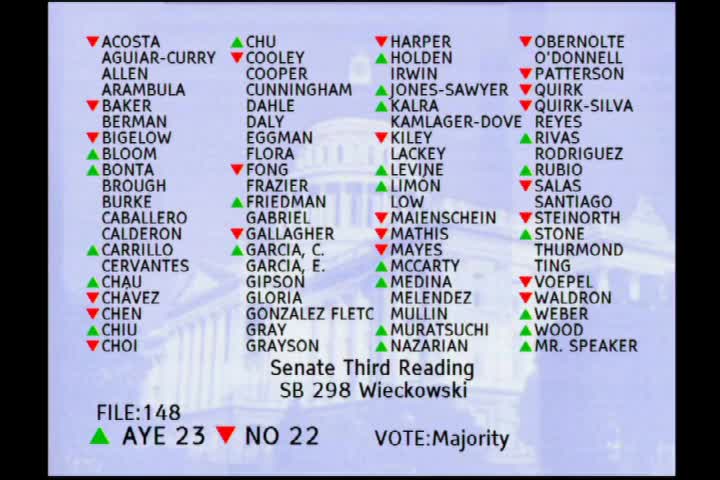 1MIN
Assembly Floor
 1H
Assembly Standing Committee on Appropriations
 8MIN
Senate Floor
 21MIN
Senate Standing Committee on Judiciary
Bill Author

Bill Co-Author(s):








