AB 1127: Teachers: professional development: Bilingual Teacher Professional Development Program: eligibility.
- Session Year: 2023-2024
- House: Assembly
- Latest Version Date: 2023-10-13
Current Status:
Passed
(2023-10-13: Chaptered by Secretary of State - Chapter 830, Statutes of 2023.)
Introduced
In Committee
First Chamber
In Committee
Second Chamber
Enacted
What does this bill do?
This bill widens eligibility for the State’s Bilingual Teacher Professional Development Program by exempting people enrolled in or who completed bilingual teacher education programs in classroom languages like Arabic, Cantonese, Mandarin, Spanish, Tagalog, and Vietnamese from some of the usual teacher requirements. It also extends the deadline for grant recipients’ final program report by one year, to January 1, 2030.
The summary is provided by generative AI which can make mistakes. For original language, please view the details in the table below.
(1)Existing law establishes the Bilingual Teacher Professional Development Program, administered by the State Department of Education, in consultation with the Commission on Teacher Credentialing, for teachers seeking to provide instruction in bilingual and multilingual settings. Existing law, for the 202324 fiscal year, appropriates $20,000,000 from the General Fund to the Superintendent of Public Instruction for purposes of the program, to be available for grants totaling $4,000,000 each fiscal year, from the 202324 fiscal year to the 202728 fiscal year, inclusive, as provided.
Existing law requires the department to allocate grant funding to eligible local educational agencies, including county offices of education, school districts, charter schools, or a consortia of local educational agencies for purposes of providing professional development services to teachers or paraprofessionals who satisfy specified requirements, but exempts participants who are currently enrolled in, or have completed, the Asian Language Bilingual Teacher Education Program from those requirements that apply to teachers.
This bill would also exempt participants who are currently enrolled in, or have completed, programs to support bilingual teacher education in languages in the classroom, such as Arabic, Cantonese, Mandarin, Spanish, Tagalog, and Vietnamese, and other languages, as represented in an instructional program, from those specified requirements that apply to teachers. By expanding the scope of eligibility for purposes of an appropriation, the bill would make an appropriation.
(2)Existing requires Bilingual Teacher Professional Development Program grant recipients to provide to the department, by July 1, 2026, a preliminary report, and, by January 1, 2029, a final report, on the number of participants who were issued bilingual authorizations, the number of previously authorized teachers who have participated in the program and subsequently returned to bilingual teaching assignments, and the number of teachers who are still working at least 50% of the time in a bilingual setting.
This bill would extend the deadline for the final report by one year to January 1, 2030.
(3)Funds appropriated by this bill would be applied toward the minimum funding requirements for school districts and community college districts imposed by Section 8 of Article XVI of the California Constitution.
Existing law establishes the Bilingual Teacher Professional Development Program, administered by the State Department of Education in consultation with the Commission on Teacher Credentialing, for teachers seeking to provide instruction in bilingual and multilingual settings. Existing law provides that the purpose of the grant program is to ensure that California can meet the demand for bilingual teachers necessary for the implementation of dual language and other bilingual education programs, as authorized by the California Education for a Global Economy Initiative, and to ensure California is able to meet the demand in preparing bilingual education teachers. Existing law requires the department to issue a minimum of 5 grants to applicants through a competitive process and to allocate grant funding to eligible local educational agencies for purposes of providing professional development services to teachers or paraprofessionals. Existing law requires grant recipients to provide a final report on specified information related to the program to the department by January 1, 2022. Existing law provides that the project performance period for the grant program is January 1, 2018, to June 30, 2021, inclusive.This bill would provide that it is also the purpose of the grant program to increase bilingual teachers in multiple languages to staff bilingual classrooms, such as Spanish, Vietnamese, Mandarin, Cantonese, Tagalog, and Arabic classrooms, and other languages, as represented in instructional programs. The bill would require the department to meet quarterly with grant recipients to share promising practices and resources, and to resolve issues of implementation. The bill would instead require grant recipients to report specified information related to the program to the department by January 1, 2029, and would revise the project performance period to January 1, 2024, to June 30, 2029, inclusive.Existing law establishes the Bilingual Teacher Professional Development Program, administered by the State Department of Education in consultation with the Commission on Teacher Credentialing, for teachers seeking to provide instruction in bilingual and multilingual settings. Existing law provides that the purpose of the grant program is to ensure that California can meet the demand for bilingual teachers necessary for the implementation of dual language and other bilingual education programs, as authorized by the California Education for a Global Economy Initiative, and to ensure California is able to meet the demand in preparing bilingual education teachers. Existing law requires the department to issue a minimum of 5 grants to applicants through a competitive process and to allocate grant funding to eligible local educational agencies for purposes of providing professional development services to teachers or paraprofessionals. Existing law requires grant recipients to provide a final report on specified information related to the program to the department by January 1, 2022. Existing law provides that the project performance period for the grant program is January 1, 2018, to June 30, 2021, inclusive.
This bill would provide that it is also the purpose of the grant program to increase bilingual teachers in multiple languages to staff bilingual classrooms, such as Spanish, Vietnamese, Mandarin, Cantonese, Tagalog, and Arabic classrooms, and other languages, as represented in instructional programs. The bill would require the department to meet quarterly with grant recipients to share promising practices and resources, and to resolve issues of implementation. The bill would instead require grant recipients to report specified information related to the program to the department by January 1, 2029, and would revise the project performance period to January 1, 2024, to June 30, 2029, inclusive.
(a)The Bilingual Teacher Professional Development Program shall be administered by the department in consultation with the Commission on Teacher Credentialing. The department shall issue grants to applicants through a competitive process.
(b)(1)The department shall allocate grant funding to eligible local educational agencies, including county offices of education, school districts, charter schools, or a consortia of local educational agencies for purposes of providing professional development services to teachers or paraprofessionals who satisfy the requirements of subdivision (c). Grant recipients may partner with community colleges, public or private four-year institutions of postsecondary education, and professional organizations or nonprofit organizations with English learner expertise.
(2)The department shall issue a minimum of five grants under the program.
(c)(1)A teacher shall be eligible for professional development services pursuant to subdivision (b) if the teacher possesses a teaching credential or an education specialist credential authorizing the holder to teach pupils with exceptional needs, and does either of the following:
(A)Possesses an authorization to provide instruction to English learners pursuant to Section 44253.3, 44253.4, or 44253.7, and has provided instruction solely in English-only classrooms for three years or more.
(B)Is fluent in a language other than English, and seeks an authorization pursuant to Section 44253.3, 44253.4, or 44253.7 to provide instruction to English learners.
(2)A school paraprofessional employee shall be eligible for professional development services if the employee is fluent in a language other than English, seeks to work with English learners or in a bilingual program, and intends to enter a pathway to become a credentialed teacher who holds a bilingual authorization.
(3)Notwithstanding paragraph (1), participants who are currently enrolled in, or have completed, the Asian Language Bilingual Teacher Education Program shall be eligible for professional development services.
(4)Notwithstanding paragraph (1), participants who are currently enrolled in, or have completed, programs to support bilingual teacher education in languages in the classroom, such as Arabic, Cantonese, Mandarin, Spanish, Tagalog, and Vietnamese, and other languages, as represented in an instructional program, shall be eligible for professional development services.
(d)In selecting a grant recipient pursuant to subdivision (b), the department shall ensure that an applicant indicates how it plans to increase the number of teachers who obtain a bilingual authorization as a result of participation in the program and increase the number of teachers with a bilingual authorization who return to teaching in a bilingual or multilingual setting.
(e)In awarding funding to eligible applicants pursuant to subdivision (b), the department shall adopt criteria demonstrating an applicants ability to provide professional development services. The adopted criteria shall include, but are not limited to, all of the following:
(1)Demonstrated commitment to bilingual and multilingual education and bilingual teacher development.
(2)Demonstrated capability to fully prepare teachers to obtain bilingual authorizations and to improve or update a teachers knowledge and skills relating to biliteracy, English language acquisition, English language development, pupil assessment in English and other languages, and instruction in the components of a high-quality bilingual or multilingual education program.
(3)The availability of bilingual education staff with demonstrated experience and knowledge of bilingual and multilingual education for purposes of providing professional development programs.
(4)Demonstrated management and support services necessary to efficiently and effectively use funding provided under subdivision (b) to help meet the demand for bilingual teachers.
(5)Matching funds, or other in-kind matching resources, offered by the applicant in support of a professional development program funded pursuant to this article.
(6)Capacity to conduct an evaluation of a professional development program offered by the applicant for the purpose of identifying areas of strength, areas requiring improvement, and recommendations for making improvement.
(f)The department shall ensure grant recipients selected for purposes of this article, to the maximum extent possible, are balanced with regard to geographic regions and urban and rural settings.
(g)The department shall meet quarterly with grant recipients to share promising practices and resources, and to resolve issues of implementation.
(h)(1)By January 1, 2022, grant recipients awarded funds appropriated pursuant to Section 85 of Chapter 15 of the Statutes of 2017 shall provide a final report to the department on the number of participants who were issued bilingual authorizations, the number of previously authorized teachers who have participated in the program and subsequently returned to bilingual teaching assignments, and the number of teachers who are still working at least 50 percent of the time in a bilingual setting.
(2)The project performance period for Bilingual Teacher Professional Development grant funds appropriated pursuant to Section 85 of Chapter 15 of the Statutes of 2017 is January 1, 2018, to June 30, 2021, inclusive.
(i)(1)By July 1, 2026, grant recipients awarded funds appropriated pursuant to Section 119 of Chapter 48 of the Statutes of 2023 shall provide a preliminary report, and, by January 1, 2030, a final report, to the department on the number of participants who were issued bilingual authorizations, the number of previously authorized teachers who have participated in the program and subsequently returned to bilingual teaching assignments, and the number of teachers who are still working at least 50 percent of the time in a bilingual setting.
(2)The project performance period for Bilingual Teacher Professional Development grant funds appropriated pursuant to Section 119 of Chapter 48 of the Statutes of 2023 is January 1, 2024, to June 30, 2029, inclusive.
(a)The Bilingual Teacher Professional Development Program shall be administered by the department in consultation with the Commission on Teacher Credentialing. The department shall issue grants to applicants through a competitive process.
(b)(1)The department shall allocate grant funding to eligible local educational agencies, including county offices of education, school districts, charter schools, or a consortia of local educational agencies for purposes of providing professional development services to teachers or paraprofessionals who satisfy the requirements of subdivision (c). Grant recipients may partner with community colleges, public or private four-year institutions of postsecondary education, and professional organizations or nonprofit organizations with English learner expertise.
(2)The department shall issue a minimum of five grants under the program.
(c)(1)A teacher shall be eligible for professional development services pursuant to subdivision (b) if the teacher possesses a teaching credential or an education specialist credential authorizing the holder to teach pupils with exceptional needs, and does either of the following:
(A)Possesses an authorization to provide instruction to English learners pursuant to Section 44253.3, 44253.4, or 44253.7, and has provided instruction solely in English-only classrooms for three years or more.
(B)Is fluent in a language other than English, and seeks an authorization pursuant to Section 44253.3, 44253.4, or 44253.7 to provide instruction to English learners.
(2)A school paraprofessional employee shall be eligible for professional development services if the employee is fluent in a language other than English, seeks to work with English learners or in a bilingual program, and intends to enter a pathway to become a credentialed teacher who holds a bilingual authorization.
(3)Notwithstanding paragraph (1), participants who are currently enrolled in, or have completed, the Asian Language Bilingual Teacher Education Program shall be eligible for professional development services.
(4)Notwithstanding paragraph (1), participants who are currently enrolled in, or have completed, programs to support bilingual teacher education in languages in the classroom, such as Arabic, Cantonese, Mandarin, Spanish, Tagalog, and Vietnamese, and other languages, as represented in an instructional program, shall be eligible for professional development services.
(d)In selecting a grant recipient pursuant to subdivision (b), the department shall ensure that an applicant indicates how it plans to increase the number of teachers who obtain a bilingual authorization as a result of participation in the program and increase the number of teachers with a bilingual authorization who return to teaching in a bilingual or multilingual setting.
(e)In awarding funding to eligible applicants pursuant to subdivision (b), the department shall adopt criteria demonstrating an applicants ability to provide professional development services. The adopted criteria shall include, but are not limited to, all of the following:
(1)Demonstrated commitment to bilingual and multilingual education and bilingual teacher development.
(2)Demonstrated capability to fully prepare teachers to obtain bilingual authorizations and to improve or update a teachers knowledge and skills relating to biliteracy, English language acquisition, English language development, pupil assessment in English and other languages, and instruction in the components of a high-quality bilingual or multilingual education program.
(3)The availability of bilingual education staff with demonstrated experience and knowledge of bilingual and multilingual education for purposes of providing professional development programs.
(4)Demonstrated management and support services necessary to efficiently and effectively use funding provided under subdivision (b) to help meet the demand for bilingual teachers.
(5)Matching funds, or other in-kind matching resources, offered by the applicant in support of a professional development program funded pursuant to this article.
(6)Capacity to conduct an evaluation of a professional development program offered by the applicant for the purpose of identifying areas of strength, areas requiring improvement, and recommendations for making improvement.
(f)The department shall ensure grant recipients selected for purposes of this article, to the maximum extent possible, are balanced with regard to geographic regions and urban and rural settings.
(g)The department shall meet quarterly with grant recipients to share promising practices and resources, and to resolve issues of implementation.
(h)(1)By January 1, 2022, grant recipients awarded funds appropriated pursuant to Section 85 of Chapter 15 of the Statutes of 2017 shall provide a final report to the department on the number of participants who were issued bilingual authorizations, the number of previously authorized teachers who have participated in the program and subsequently returned to bilingual teaching assignments, and the number of teachers who are still working at least 50 percent of the time in a bilingual setting.
(2)The project performance period for Bilingual Teacher Professional Development grant funds appropriated pursuant to Section 85 of Chapter 15 of the Statutes of 2017 is January 1, 2018, to June 30, 2021, inclusive.
(i)(1)By July 1, 2026, grant recipients awarded funds appropriated pursuant to Section 119 of the act that added this subdivision Chapter 48 of the Statutes of 2023 shall provide a preliminary report, and, by January 1, 2029, 2030, a final report, to the department on the number of participants who were issued bilingual authorizations, the number of previously authorized teachers who have participated in the program and subsequently returned to bilingual teaching assignments, and the number of teachers who are still working at least 50 percent of the time in a bilingual setting.
(2)The project performance period for Bilingual Teacher Professional Development grant funds appropriated pursuant to Section 119 of the act that added this subdivision Chapter 48 of the Statutes of 2023 is January 1, 2024, to June 30, 2029, inclusive.
SECTION 1.Section 52201 of the Education Code is amended to read:52201.(a)(1)The purpose of the grant program established under this article is to ensure that California can meet the demand for bilingual teachers necessary for the implementation of dual language and other bilingual education programs as authorized by the California Education for a Global Economy Initiative, approved by the voters as Proposition 58 at the November 8, 2016, statewide general election, and to ensure California is able to meet the demand in preparing bilingual education teachers.(2)Additionally, the creation of Universal Transitional Kindergarten has created a need for increased capacity of bilingual teachers in order to develop English and home language proficiency of dual language learners in the programs described in paragraph (1). The purpose of this grant program shall also be to increase bilingual teachers in multiple languages to staff bilingual classrooms, such as Spanish, Vietnamese, Mandarin, Cantonese, Tagalog, and Arabic classrooms, and other languages, as represented in instructional programs.(b)The Legislature hereby establishes the Bilingual Teacher Professional Development Program for teachers seeking to provide instruction in bilingual and multilingual settings.SEC. 2.Section 52202 of the Education Code is amended to read:52202.(a)The Bilingual Teacher Professional Development Program shall be administered by the department in consultation with the Commission on Teacher Credentialing. The department shall issue grants to applicants through a competitive process.(b)(1)The department shall allocate grant funding to eligible local educational agencies, including county offices of education, school districts, charter schools, or a consortia of local educational agencies for purposes of providing professional development services to teachers or paraprofessionals who satisfy the requirements of subdivision (c). Grant recipients may partner with community colleges, public or private four-year institutions of postsecondary education, and professional organizations or nonprofit organizations with English learner expertise.(2)The department shall issue a minimum of five grants under the program.(c)(1)A teacher shall be eligible for professional development services pursuant to subdivision (b) if the teacher possesses a teaching credential or an education specialist credential authorizing the holder to teach pupils with exceptional needs, and does either of the following:(A)Possesses an authorization to provide instruction to English learners pursuant to Section 44253.3, 44253.4, or 44253.7, and has provided instruction solely in English-only classrooms for three years or more.(B)Is fluent in a language other than English, and seeks an authorization pursuant to Section 44253.3, 44253.4, or 44253.7 to provide instruction to English learners.(2)A school paraprofessional employee shall be eligible for professional development services if the employee is fluent in a language other than English, seeks to work with English learners or in a bilingual program, and intends to enter a pathway to become a credentialed teacher who holds a bilingual authorization.(d)In selecting a grant recipient pursuant to subdivision (b), the department shall ensure that an applicant indicates how it plans to increase the number of teachers who obtain a bilingual authorization as a result of participation in the program and increase the number of teachers with a bilingual authorization who return to teaching in a bilingual or multilingual setting.(e)In awarding funding to eligible applicants pursuant to subdivision (b), the department shall adopt criteria demonstrating an applicants ability to provide professional development services. The adopted criteria shall include, but are not limited to, all of the following:(1)Demonstrated commitment to bilingual and multilingual education and bilingual teacher development.(2)Demonstrated capability to fully prepare teachers to obtain bilingual authorizations and to improve or update a teachers knowledge and skills relating to biliteracy, English language acquisition, English language development, pupil assessment in English and other languages, and instruction in the components of a high-quality bilingual or multilingual education program.(3)The availability of bilingual education staff with demonstrated experience and knowledge of bilingual and multilingual education for purposes of providing professional development programs.(4)Demonstrated management and support services necessary to efficiently and effectively use funding provided under subdivision (b) to help meet the demand for bilingual teachers.(5)Matching funds, or other in-kind matching resources, offered by the applicant in support of a professional development program funded pursuant to this article.(6)Capacity to conduct an evaluation of a professional development program offered by the applicant for the purpose of identifying areas of strength, areas requiring improvement, and recommendations for making improvement.(f)The department shall ensure grant recipients selected for purposes of this article, to the maximum extent possible, are balanced with regard to geographic regions and urban and rural settings.(g)The department shall meet quarterly with grant recipients to share promising practices and resources, and to resolve issues of implementation.(h)By January 1, 2029, grant recipients shall report to the department on the number of participants who were issued bilingual authorizations, the number of previously authorized teachers who have participated in the program and subsequently returned to bilingual teaching assignments, and the number of teachers who are still working at least 50 percent of the time in a bilingual setting.(i)The project performance period for the Bilingual Teacher Professional Development grant is January 1, 2024, to June 30, 2029, inclusive.(a)(1)The purpose of the grant program established under this article is to ensure that California can meet the demand for bilingual teachers necessary for the implementation of dual language and other bilingual education programs as authorized by the California Education for a Global Economy Initiative, approved by the voters as Proposition 58 at the November 8, 2016, statewide general election, and to ensure California is able to meet the demand in preparing bilingual education teachers.
(2)Additionally, the creation of Universal Transitional Kindergarten has created a need for increased capacity of bilingual teachers in order to develop English and home language proficiency of dual language learners in the programs described in paragraph (1). The purpose of this grant program shall also be to increase bilingual teachers in multiple languages to staff bilingual classrooms, such as Spanish, Vietnamese, Mandarin, Cantonese, Tagalog, and Arabic classrooms, and other languages, as represented in instructional programs.
(b)The Legislature hereby establishes the Bilingual Teacher Professional Development Program for teachers seeking to provide instruction in bilingual and multilingual settings.
SEC. 2.Section 52202 of the Education Code is amended to read:52202.(a)The Bilingual Teacher Professional Development Program shall be administered by the department in consultation with the Commission on Teacher Credentialing. The department shall issue grants to applicants through a competitive process.
(b)(1)The department shall allocate grant funding to eligible local educational agencies, including county offices of education, school districts, charter schools, or a consortia of local educational agencies for purposes of providing professional development services to teachers or paraprofessionals who satisfy the requirements of subdivision (c). Grant recipients may partner with community colleges, public or private four-year institutions of postsecondary education, and professional organizations or nonprofit organizations with English learner expertise.
(2)The department shall issue a minimum of five grants under the program.
(c)(1)A teacher shall be eligible for professional development services pursuant to subdivision (b) if the teacher possesses a teaching credential or an education specialist credential authorizing the holder to teach pupils with exceptional needs, and does either of the following:
(A)Possesses an authorization to provide instruction to English learners pursuant to Section 44253.3, 44253.4, or 44253.7, and has provided instruction solely in English-only classrooms for three years or more.
(B)Is fluent in a language other than English, and seeks an authorization pursuant to Section 44253.3, 44253.4, or 44253.7 to provide instruction to English learners.
(2)A school paraprofessional employee shall be eligible for professional development services if the employee is fluent in a language other than English, seeks to work with English learners or in a bilingual program, and intends to enter a pathway to become a credentialed teacher who holds a bilingual authorization.
(d)In selecting a grant recipient pursuant to subdivision (b), the department shall ensure that an applicant indicates how it plans to increase the number of teachers who obtain a bilingual authorization as a result of participation in the program and increase the number of teachers with a bilingual authorization who return to teaching in a bilingual or multilingual setting.
(e)In awarding funding to eligible applicants pursuant to subdivision (b), the department shall adopt criteria demonstrating an applicants ability to provide professional development services. The adopted criteria shall include, but are not limited to, all of the following:
(1)Demonstrated commitment to bilingual and multilingual education and bilingual teacher development.
(2)Demonstrated capability to fully prepare teachers to obtain bilingual authorizations and to improve or update a teachers knowledge and skills relating to biliteracy, English language acquisition, English language development, pupil assessment in English and other languages, and instruction in the components of a high-quality bilingual or multilingual education program.
(3)The availability of bilingual education staff with demonstrated experience and knowledge of bilingual and multilingual education for purposes of providing professional development programs.
(4)Demonstrated management and support services necessary to efficiently and effectively use funding provided under subdivision (b) to help meet the demand for bilingual teachers.
(5)Matching funds, or other in-kind matching resources, offered by the applicant in support of a professional development program funded pursuant to this article.
(6)Capacity to conduct an evaluation of a professional development program offered by the applicant for the purpose of identifying areas of strength, areas requiring improvement, and recommendations for making improvement.
(f)The department shall ensure grant recipients selected for purposes of this article, to the maximum extent possible, are balanced with regard to geographic regions and urban and rural settings.
(g)The department shall meet quarterly with grant recipients to share promising practices and resources, and to resolve issues of implementation.
(g)(h)By January 1, 2022, 2029, grant recipients shall provide a final report to the department on the number of participants who were issued bilingual authorizations, the number of previously authorized teachers who have participated in the program and subsequently returned to bilingual teaching assignments, and the number of teachers who are still working at least 50 percent of the time in a bilingual setting.
(h)(i)The project performance period for the Bilingual Teacher Professional Development grant is January 1, 2018, 2024, to June 30, 2021, 2029, inclusive.
REVISIONS: HeadingLines 2 and 3.|
Date
|
Status
|
|---|---|
| Oct 13, 2023 | Chaptered by Secretary of State - Chapter 830, Statutes of 2023. |
| Oct 13, 2023 | Approved by the Governor. |
| Sep 21, 2023 | Enrolled and presented to the Governor at 3:30 p.m. |
| Sep 14, 2023 | Senate amendments concurred in. To Engrossing and Enrolling. (Ayes 80. Noes 0. Page 3551.). |
| Sep 13, 2023 | In Assembly. Concurrence in Senate amendments pending. |
| Sep 13, 2023 | Read third time. Passed. Ordered to the Assembly. (Ayes 39. Noes 0. Page 2767.). |
| Sep 8, 2023 | Ordered to special consent calendar. |
| Sep 5, 2023 | Read second time. Ordered to third reading. |
| Sep 1, 2023 | Read second time and amended. Ordered returned to second reading. |
| Sep 1, 2023 | From committee: Amend, and do pass as amended. (Ayes 7. Noes 0.) (September 1). |
| Jul 3, 2023 | In committee: Referred to APPR suspense file. |
| Jun 21, 2023 | From committee: Do pass and re-refer to Com. on APPR with recommendation: To Consent Calendar. (Ayes 7. Noes 0.) (June 21). Re-referred to Com. on APPR. |
| Jun 7, 2023 | Referred to Com. on ED. |
| May 26, 2023 | In Senate. Read first time. To Com. on RLS. for assignment. |
| May 25, 2023 | Read third time. Passed. Ordered to the Senate. (Ayes 77. Noes 0. Page 1761.) |
| May 18, 2023 | Read second time. Ordered to third reading. |
| May 18, 2023 | From committee: Do pass. (Ayes 15. Noes 0.) (May 18). |
| Apr 19, 2023 | In committee: Set, first hearing. Referred to APPR. suspense file. |
| Mar 23, 2023 | From committee: Do pass and re-refer to Com. on APPR. with recommendation: To Consent Calendar. (Ayes 7. Noes 0.) (March 22). Re-referred to Com. on APPR. |
| Mar 23, 2023 | Coauthors revised. |
| Mar 2, 2023 | Referred to Com. on ED. |
| Feb 16, 2023 | From printer. May be heard in committee March 18. |
| Feb 15, 2023 | Read first time. To print. |
|
Date
|
Description
|
Location
|
Votes
|
|
|---|---|---|---|---|
| Sep 14, 2023 | AB 1127 Reyes Concurrence in Senate Amendments | Assembly Floor |
Passed |
|
| Sep 13, 2023 | Special Consent AB1127 Reyes et al. By Ashby | Senate Floor |
Passed |
|
| Sep 1, 2023 | Do pass as amended | Senate Standing Committee on Appropriations |
Passed |
|
| Jul 3, 2023 | Placed on suspense file | Senate Standing Committee on Appropriations |
Passed |
|
| Jun 21, 2023 | Do pass, but first be re-referred to the Committee on [Appropriations] with the recommendation: To Consent Calendar | Senate Standing Committee on Education |
Passed |
|
| May 25, 2023 | AB 1127 Reyes Assembly Third Reading | Assembly Floor |
Passed |
|
| May 18, 2023 | Do pass. | Assembly Standing Committee on Appropriations |
Passed |
|
| Mar 22, 2023 | Do pass and be re-referred to the Committee on [Appropriations] with recommendation: To Consent Calendar | Assembly Standing Committee on Education |
Passed |
This list shows positions taken on this bill by organizations on the date displayed, which is linked to the original source.
Positions by individuals are not included.
|
Organization
|
Position
|
Date
|
|---|---|---|
| California Association For Bilingual Education | ** Support | |
| Californians Together | ** Support | |
| Catalyst California | ** Support | |
| Los Angeles County Office Of Education | ** Support | |
| Los Angeles Unified School District | ** Support | |
| Public Advocates | ** Support | |
| State Superintendent of Public Instruction Tony Thurmond | ** Support | |
| The Education Trust West | ** Support | |
| United LA | ** Support |
CONCURRENCE IN SENATE AMENDMENTS
CSA1 Bill Id:AB 1127
Author:(Reyes and McCarty)
As Amended Ver:September 1, 2023
Majority vote
SUMMARY
Extends the deadline for the submission of a final report on the Bilingual Teacher Professional Development Program (BTPDP) from 2029 to 2030, and states that specified program participants are eligible for professional development services.
Senate Amendments
- Change the deadline for the submission of a final report on the Bilingual Teacher Professional Development Program (BTPDP) from 2029 to 2030.
- State that participants who are currently enrolled in, or have completed, programs to support bilingual teacher education in languages in the classroom, such as Arabic, Cantonese, Mandarin, Spanish, Tagalog, and Vietnamese, and other languages, as represented in an instructional program, shall be eligible for professional development services.
- Incorporate changes made to this program in SB 114 (Committee on Budget and Fiscal Review), Chapter 48, Statutes of 2023, the education budget trailer bill.
COMMENTS
- BTPDP program results. The 2017 state budget provided $10 million for the BTPDP. According to the CDE, eight grants of approximately $625,000 were awarded through the program.
- According to the CDE, this program increased the number of teachers issued bilingual teaching authorizations, the number of teachers previously authorized who participate in the program and subsequently returned to bilingual teaching assignments, administrators seeking a bilingual authorization and inclusion in professional learning, and paraprofessionals that received a teaching credential and bilingual authorization. A report on the BTPDP provided by the CDE indicates that:
- Over 400 teachers have received their bilingual authorization;
- Over 200 teachers and preservice students are still working on their teaching credential and bilingual authorization;
- Over 3,000 teachers and other school personnel were supported through professional learning, community outreach events, coaching, and enrollment in university level courses in bilingual education;
- Over 500 paraprofessionals were supported to receive professional learning, coursework towards earning their teaching credential, and support towards earning a bilingual authorization. Some of the programs supported professional learning only and others supported higher education coursework towards a degree and/or authorization;
- Over 1,000 administrators and other school staff participated in professional learning, some of whom earned their bilingual authorization as a result;
- Over 500 previously authorized teachers participated in professional learning and support services with the intention to remain in or return to a bilingual setting; and
- Over 200 previously authorized teachers specifically returned to a bilingual setting as a result of participating in this program.
- According to the CDE, other program outcomes included:
- New dual language immersion programs and strands were established;
- New partnerships to support professional learning for smaller language groups and for rural, small-sized, and medium-sized school districts were established;
- Professional development initiatives were established, including communities of practice, site visits, bilingual instructional rounds for administrators, and paraprofessional and administrator training programs; and
- There was increased focus on the Seal of Biliteracy through recruitment and employment opportunities.
According to the CDE, although the grantees demonstrated high levels of success, each of them mentioned that they could expand their work and outreach further if there were additional funds to continue this program or another one very similar to this one. Each of the grantees have participants still in the process of furthering their education, professional learning, and interest in continuing this program. They also report having new participants interested in participating if new funding becomes available.
According to the Author
"California not only faces a teacher shortage, but a bilingual teacher shortage. If we do not address these two critical issues simultaneously, over 1.1 million English learners in our state will be left without the support they need to succeed. This important measure will ensure some of our most vulnerable students are not left out of the teacher shortage solution."
Arguments in Support
Californians Together writes, "AB 1127 updates the BTPDP by recognizing the creation of Universal Transitional Kindergarten (UTK) and the impact its expansion is having on California's need for more bilingual teachers for our students in preschool or UTK, while creating a new timeline for grant recipients to report the number of participants affected by the program by 2029. According to a March 2021 study by the Learning Policy Institute (LPI), California continues to experience an ongoing teacher shortage, exacerbated by the COVID-19 pandemic, resulting in more under-prepared teachers teaching California students who would benefit from this program. LPI highlights California's difficulty in finding teachers for special education, math, science, and bilingual education – categories that have historically had teacher shortages. Compounding the current shortage of bilingual teachers is the interest in and growth of bilingual and dual-language immersion programs in California schools due to the passage of Proposition 58 in 2016, which was supported by 73.52% of voters. Districts across the state are also scrambling for bilingual teachers in multiple languages to staff bilingual classrooms where other languages are taught. This need is specifically seen in California's top five languages (Spanish, Vietnamese, Arabic, Cantonese, and Filipino), as well as a number of other languages. The BTPDP program would increase the capacity of bilingual teachers, thereby supporting LEAs in their quest to hire bilingual teachers for their bilingual and dual-language immersion programs. This is a "win-win" situation for all – for our students, for parents seeking bilingual programs for their children, and for our LEAs."
Arguments in Opposition
None on file
FISCAL COMMENTS
According to the Senate Appropriations Committee, SB 114 (Budget and Fiscal Review Committee), Chapter 48, Statutes of 2023, the education budget trailer bill, includes an appropriation of $20 million from the General Fund for purposes of the BTPDP. These funds would be available for grants totaling $4 million for each fiscal year from 2023–24 to 2027–28.
VOTES:
ASM EDUCATION: 7-0-0
YES: Muratsuchi, Megan Dahle, Juan Carrillo, Hoover, Lee, McCarty, Quirk-Silva
ASM APPROPRIATIONS: 15-0-1
YES: Holden, Megan Dahle, Bryan, Calderon, Wendy Carrillo, Dixon, Mike Fong, Hart, Lowenthal, Mathis, Papan, Pellerin, Sanchez, Weber, Ortega
ABS, ABST OR NV: Robert Rivas
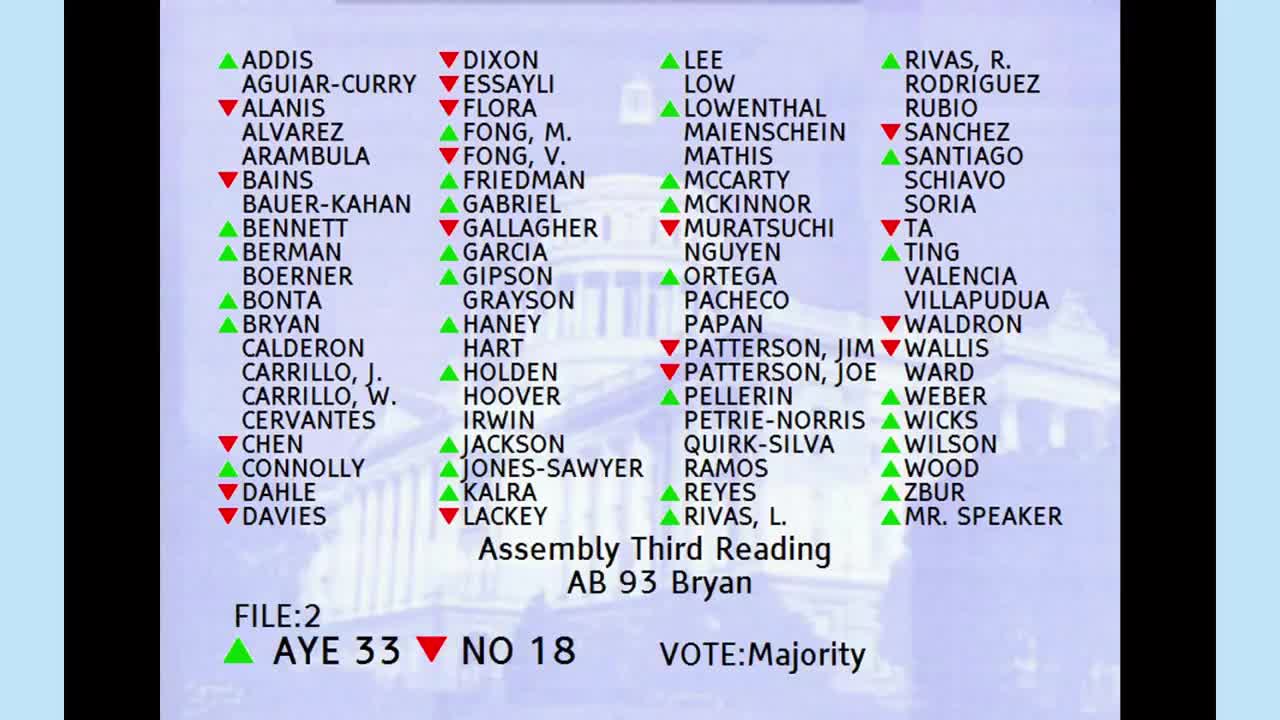
ASSEMBLY FLOOR: 77-0-3
YES: Addis, Alanis, Alvarez, Arambula, Bains, Bauer-Kahan, Bennett, Berman, Boerner, Bonta, Bryan, Calderon, Juan Carrillo, Wendy Carrillo, Cervantes, Chen, Connolly, Megan Dahle, Davies, Dixon, Essayli, Flora, Mike Fong, Vince Fong, Friedman, Gabriel, Gallagher, Garcia, Gipson, Grayson, Haney, Hart, Holden, Hoover, Irwin, Jackson, Jones‑Sawyer, Kalra, Lackey, Lee, Low, Lowenthal, Maienschein, McCarty, McKinnor, Muratsuchi, Stephanie Nguyen, Ortega, Pacheco, Jim Patterson, Joe Patterson, Pellerin, Petrie‑Norris, Quirk-Silva, Ramos, Reyes, Luz Rivas, Robert Rivas, Rodriguez, Blanca Rubio, Sanchez, Santiago, Schiavo, Soria, Ta, Ting, Valencia, Villapudua, Waldron, Wallis, Ward, Weber, Wicks, Wilson, Wood, Zbur, Rendon
ABS, ABST OR NV: Aguiar-Curry, Mathis, Papan
SENATE FLOOR: 39-0-1
YES: Allen, Alvarado-Gil, Archuleta, Ashby, Atkins, Becker, Blakespear, Bradford, Cortese, Dahle, Dodd, Durazo, Eggman, Glazer, Gonzalez, Grove, Hurtado, Jones, Laird, Limón, McGuire, Menjivar, Min, Newman, Nguyen, Niello, Ochoa Bogh, Padilla, Portantino, Roth, Rubio, Seyarto, Skinner, Smallwood-Cuevas, Stern, Umberg, Wahab, Wiener, Wilk
ABS, ABST OR NV: Caballero
UPDATED
VERSION: September 1, 2023
CONSULTANT: Tanya Lieberman / ED. / (916) 319-2087 FN: 0002263
SENATE RULES COMMITTEE Office of Senate Floor Analyses (916) 651-1520 Fax: (916) 327-4478 | AB 1127 |
THIRD READING
Bill No: AB 1127
Author: Reyes (D) and McCarty (D), et al.
Introduced: 9/1/23 in Senate
Vote: 21
SENATE EDUCATION COMMITTEE: 7-0, 6/21/23
AYES: Newman, Ochoa Bogh, Cortese, Glazer, McGuire, Smallwood-Cuevas, Wilk
SENATE APPROPRIATIONS COMMITTEE: 7-0, 9/1/23
AYES: Portantino, Jones, Ashby, Bradford, Seyarto, Wahab, Wiener
ASSEMBLY FLOOR: 77-0, 5/25/23 - See last page for vote
SUBJECT: Teachers: professional development: Bilingual Teacher Professional Development Program: eligibility
SOURCE: State Superintendent of Public Instruction Tony Thurmond
California Association for Bilingual Education
Californians Together
DIGEST:
This bill makes specified changes to the Bilingual Teacher Professional Development Program (BTPDP).
ANALYSIS:
Existing law:
- Establishes the Bilingual Teacher Professional Development Program, administered by California Department of Education (CDE), in consultation with CTC, for teachers seeking to provide instruction in bilingual and multilingual settings. For the 2023–24 fiscal year, appropriates $20,000,000 from the General Fund to the Superintendent of Public Instruction (SPI) for purposes of the program, to be available for grants totaling $4,000,000 each fiscal year, from the 2023–24 fiscal year to the 2027–28 fiscal year, inclusive, as provided.
- Requires CDE to allocate grant funding to eligible local educational agencies, including county offices of education, school districts, charter schools, or a consortia of local educational agencies for purposes of providing professional development services to teachers or paraprofessionals who satisfy specified requirements, but exempts participants who are currently enrolled in, or have completed, the Asian Language Bilingual Teacher Education Program from those requirements that apply to teachers.
- Requires Bilingual Teacher Professional Development Program grant recipients to provide to the CDE, by July 1, 2026, a preliminary report, and, by January 1, 2029, a final report, on the number of participants who were issued bilingual authorizations, the number of previously authorized teachers who have participated in the program and subsequently returned to bilingual teaching assignments, and the number of teachers who are still working at least 50% of the time in a bilingual setting.
This bill makes changes to the Bilingual Teacher Professional Development Program as follows:
- Exempts participants who are currently enrolled in, or have completed, programs to support bilingual teacher education in languages in the classroom, such as Arabic, Cantonese, Mandarin, Spanish, Tagalog, Vietnamese, and other languages, as represented in an instructional program, from specified requirements that apply to teachers.
- Extends the deadline for the final report by one year, to January 1, 2030.
Comments
- Need for the bill. According to the author, “California not only faces a teacher shortage, but a bilingual teacher shortage. If we do not address these two critical issues simultaneously, over 1.1 million English learners in our state will be left without the support they need to succeed. This important measure will ensure some of our most vulnerable students are not left out of the teacher shortage solution.”
- Results from the first grant cycle of this program. The 2017 state budget provided $10 million for the BTPDP (AB 99, Committee on Budget, Chapter 15, Statutes of 2017). According to the CDE, eight grants of approximately $625,000 were awarded through the program.
According to the CDE, this program increased the number of teachers issued bilingual teaching authorizations, the number of teachers previously authorized who participate in the program and subsequently returned to bilingual teaching assignments, administrators seeking a bilingual authorization and inclusion in professional learning, and paraprofessionals that received a teaching credential and bilingual authorization. A report on the BTPDP provided by the CDE indicates the following:
- Over 400 teachers have received their bilingual authorization.
- Over 200 teachers and preservice students are still working on their teaching credential and bilingual authorization.
- Over 3,000 teachers and other school personnel were supported through professional learning, community outreach events, coaching, and enrollment in university level courses in bilingual education.
- Over 500 paraprofessionals were supported to receive professional learning, coursework towards earning their teaching credential, and support towards earning a bilingual authorization. Some of the programs supported professional learning only and others supported higher education coursework towards a degree and/or authorization.
- Over 1,000 administrators and other school staff participated in professional learning, some of whom earned their bilingual authorization as a result.
- Over 500 previously authorized teachers participated in professional learning and support services with the intention to remain in or return to a bilingual setting.
- Over 200 previously authorized teachers specifically returned to a bilingual setting as a result of participating in this program.
According to the CDE, although the grantees demonstrated high levels of success, each of them mentioned that they could expand their work and outreach further if there were additional funds to continue this program or another one very similar to this one. Each of the grantees have participants still in the process of furthering their education, professional learning, and interest in continuing this program. They also report having new participants interested in participating if new funding becomes available.
FISCAL EFFECT: Appropriation: Yes Fiscal Com.: Yes Local: No
According to the Senate Appropriations Committee, Chapter 48, Statutes of 2023 (SB 114, Committee on Budget and Fiscal Review), the education budget trailer bill, includes an appropriation of $20 million from the General Fund for purposes of the BTPDP. These funds would be available for grants totaling $4 million for each fiscal year from 2023–24 to 2027–28.
SUPPORT: (Verified 9/1/23)
State Superintendent of Public Instruction Tony Thurmond (co-source)
California Association for Bilingual Education (co-source)
Californians Together (co-source)
Catalyst California
Los Angeles County Office of Education
Los Angeles Unified School District
Public Advocates
The Education Trust – West
United LA
OPPOSITION: (Verified 9/1/23)
None received
ARGUMENTS IN SUPPORT: Californians Together writes, “AB 1127 updates the BTPDP by recognizing the creation of Universal Transitional Kindergarten (UTK) and the impact its expansion is having on California’s need for more bilingual teachers for our students in preschool or UTK, while creating a new timeline for grant recipients to report the number of participants affected by the program by 2029. According to a March 2021 study by the Learning Policy Institute (LPI), California continues to experience an ongoing teacher shortage, exacerbated by the COVID-19 pandemic, resulting in more under-prepared teachers teaching California students who would benefit from this program. LPI highlights California’s difficulty in finding teachers for special education, math, science, and bilingual education—categories that have historically had teacher shortages. Compounding the current shortage of bilingual teachers is the interest in and growth of bilingual and dual-language immersion programs in California schools due to the passage of Proposition 58 in 2016, which was supported by 73.52 percent of voters. Districts across the state are also scrambling for bilingual teachers in multiple languages to staff bilingual classrooms where other languages are taught. This need is specifically seen in California’s top five languages (Spanish, Vietnamese, Arabic, Cantonese, and Filipino), as well as a number of other languages. The BTPDP program would increase the capacity of bilingual teachers, thereby supporting LEAs in their quest to hire bilingual teachers for their bilingual and dual-language immersion programs. This is a “win-win” situation for all—for our students, for parents seeking bilingual programs for their children, and for our LEAs.”
ASSEMBLY FLOOR: 77-0, 5/25/23
AYES: Addis, Alanis, Alvarez, Arambula, Bains, Bauer-Kahan, Bennett, Berman, Boerner, Bonta, Bryan, Calderon, Juan Carrillo, Wendy Carrillo, Cervantes, Chen, Connolly, Megan Dahle, Davies, Dixon, Essayli, Flora, Mike Fong, Vince Fong, Friedman, Gabriel, Gallagher, Garcia, Gipson, Grayson, Haney, Hart, Holden, Hoover, Irwin, Jackson, Jones-Sawyer, Kalra, Lackey, Lee, Low, Lowenthal, Maienschein, McCarty, McKinnor, Muratsuchi, Stephanie Nguyen, Ortega, Pacheco, Jim Patterson, Joe Patterson, Pellerin, Petrie-Norris, Quirk-Silva, Ramos, Reyes, Luz Rivas, Robert Rivas, Rodriguez, Blanca Rubio, Sanchez, Santiago, Schiavo, Soria, Ta, Ting, Valencia, Villapudua, Waldron, Wallis, Ward, Weber, Wicks, Wilson, Wood, Zbur, Rendon
NO VOTE RECORDED: Aguiar-Curry, Mathis, Papan
Prepared by: Ian Johnson / ED. / (916) 651-4105
9/2/23 14:46:03
**** END ****
SENATE COMMITTEE ON
Senator Anthony Portantino, Chair
2023 - 2024 Regular Session
AB 1127 (Reyes) - Teachers: professional development: Bilingual Teacher Professional Development Program
Version: | Policy Vote: |
Urgency: | Mandate: |
Hearing Date: | Consultant: |
Bill Summary:
This bill extends the performance and reporting period for the Bilingual Teacher Professional Development Program (BTPDP) from 2024 to 2029, and requires the California Department of Education (CDE), when administering the BTPDP, to meet quarterly with grant recipients to share promising practices and resources.
*********** ANALYSIS ADDENDUM – SUSPENSE FILE ***********
The following information is revised to reflect amendments
adopted by the committee on September 1, 2023
Fiscal Impact:
Chapter 48, Statutes of 2023 (SB 114, Committee on Budget and Fiscal Review), the education budget trailer bill, includes an appropriation of $20 million from the General Fund for purposes of the BTPDP. These funds would be available for grants totaling $4 million for each fiscal year from 2023–24 to 2027–28.
Author Amendments:
Allow participants who are enrolled in or have completed other programs that support bilingual teachers to be eligible for funding and makes conforming changes to the budget.
Committee Amendments:
Extends the date for grant recipients to provide the final report to the department to January 1, 2030 to conform to the education omnibus trailer bill.
-- END --
SENATE COMMITTEE ON
Senator Anthony Portantino, Chair
2023 - 2024 Regular Session
AB 1127 (Reyes) - Teachers: professional development: Bilingual Teacher Professional Development Program
Version: | Policy Vote: |
Urgency: | Mandate: |
Hearing Date: | Consultant: |
Bill Summary:
This bill extends the performance and reporting period for the Bilingual Teacher Professional Development Program (BTPDP) from 2024 to 2029, and requires the California Department of Education (CDE), when administering the BTPDP, to meet quarterly with grant recipients to share promising practices and resources.
Fiscal Impact:
By extending the performance period for the BTPDP, this bill could result in Proposition 98 General Fund cost pressure in the low tens of millions for the state to fund it. The program was previously funded at $10 million in the 2017-18 fiscal year. Staff notes that the SB 114 (Committee on Budget and Fiscal Review, 2023), the education budget trailer bill, proposes an appropriation of $20 million from the General Fund for purposes of the BTPDP. These funds would be available for grants totaling $4 million for each fiscal year from 2023–24 to 2027–28.
The CDE estimates General Fund costs of approximately $316,000 each year to administer the program.
Background:
Existing law establishes the BTPDP, to be administered by the CDE, in consultation with the Commission on Teacher Credentialing (CTC). The law requires the CDE to issue grants to applicants through a competitive process to eligible local educational agencies (LEAs), including county offices of education (COEs), school districts, charter schools, and consortia of LEAs, for purposes of providing professional development services to teachers or paraprofessionals. The project performance period for the program is from January 1, 2018 to June 30, 2021.
Existing law makes the following individuals eligible for support under the program:
- Teachers possessing a teaching credential or an education specialist credential and who either possess an authorization to provide instruction to English learners and have provided instruction solely in English-only classrooms for three years or more; or are fluent in a language other than English, and are seeking a bilingual authorization; and
- Paraprofessionals who are fluent in a language other than English, and who seek to work with English learners or in a bilingual program, and who intend to enter a pathway to become a credentialed teacher who holds a bilingual authorization.
Existing law requires the CDE to ensure that an applicant indicates how it plans to increase the number of teachers who obtain a bilingual authorization as a result of participation in the program and increase the number of teachers with a bilingual authorization who return to teaching in a bilingual or multilingual setting.
Proposed Law:
This bill extends the project performance period for the BTPDP grant, from January 1, 2024 to June 30, 2029. It also extends the dates, from January 1, 2024 to June 30, 2029, by which BTPDP grant recipients must report to the CDE on the number of participants who were issued bilingual authorizations, the number of previously authorized teachers who have participated in the program and subsequently returned to bilingual teaching assignments, and the number of teachers who are still working at least 50% of the time in a bilingual setting.
This bill requires the CDE, when administering the BTPDP, to meet quarterly with grant recipients to share promising practices and resources, and to resolve issues of implementation.
Related Legislation:
AB 99 (Committee on Budget, Chapter 15, Statutes of 2017) established the BTPDP and required CDE to allocate $10 million in grant funding to local educational agencies for purposes of providing professional development services to specified teachers and paraprofessionals to provide instruction to English learners.
SB 952 (Limon, 2021-22) would have revised and recasted an existing three-year competitive dual language grant program administered by CDE. SB 952 was held in the Assembly Appropriations Committee.
Staff Comments:
As part of the 2017 budget package, AB 99 (Committee on Budget, Chapter 15, Statutes of 2017) provided $10 million for the BTPDP. According to the CDE, eight grants of approximately $625,000 were awarded through the program. By extending the performance period for the program, this bill could result in similar Proposition 98 General Fund costs for the state to fund it.
-- END --
SENATE COMMITTEE ON EDUCATION
Senator Josh Newman, Chair
2023 - 2024 Regular
Bill No: AB 1127 Hearing Date: June 21, 2023
Author: | |||
Version: | February 15, 2023 | ||
Urgency: | No | Fiscal: | Yes |
Consultant: | Ian Johnson | ||
Subject: Teachers: professional development: Bilingual Teacher Professional Development Program
SUMMARY
This bill extends the performance and reporting period for the Bilingual Teacher Professional Development Program (BTPDP) from 2024 to 2029, and requires the California Department of Education (CDE), when administering the BTPDP, to meet quarterly with grant recipients to share promising practices and resources.
BACKGROUND
Existing law:
- Establishes the BTPDP, to be administered by the CDE, in consultation with the Commission on Teacher Credentialing (CTC). Requires the CDE to issue grants to applicants through a competitive process. Establishes the project performance period for the BTPDP as January 1, 2018, to June 30, 2021. (Education Code (EC) 52202)
- Requires the CDE to allocate grant funding to eligible local educational agencies (LEAs), including county offices of education (COEs), school districts, charter schools, and consortia of LEAs, for purposes of providing professional development services to teachers or paraprofessionals. Requires the CDE to issue a minimum of five grants under the program.
- Makes the following individuals eligible for support under the program:
- Teachers possessing a teaching credential or an education specialist credential and who either:
- Possess an authorization to provide instruction to English learners and have provided instruction solely in English-only classrooms for three years or more; or
- Are fluent in a language other than English, and are seeking a bilingual authorization; and
- Paraprofessionals who are fluent in a language other than English, and who seek to work with English learners or in a bilingual program, and who intend to enter a pathway to become a credentialed teacher who holds a bilingual authorization.
- Requires the CDE to ensure that an applicant indicates how it plans to increase the number of teachers who obtain a bilingual authorization as a result of participation in the program and increase the number of teachers with a bilingual authorization who return to teaching in a bilingual or multilingual setting.
- Requires grant recipients, by January 1, 2022, to provide a final report to the CDE on the number of participants who were issued bilingual authorizations, the number of previously authorized teachers who have participated in the program and subsequently returned to bilingual teaching assignments, and the number of teachers who are still working at least 50% of the time in a bilingual setting.
- Requires that public schools ensure that students obtain English language proficiency. Requires school districts to solicit parent and community input in developing language acquisition programs. Requires instruction to ensure English acquisition as rapidly and effectively as possible. Authorizes school districts to establish dual–language immersion programs for both native and non–native English speakers. (EC 305)
- Establishes authorizations for teachers to teach English learners in their primary languages. (EC 44253.4)
- Requires the CTC to develop objective and verifiable standards for an authorization for bilingual-cross-cultural competence for holders of an appropriate credential, certificate, authorization, or permit who will be serving English learners. (EC 44253.7)
- Requires that candidates for the bilingual authorization, by oral and written examination, or by completing an approved program that consists of coursework or a combination of coursework and examinations, demonstrate all of the following:
- Competence in both the oral and written skills of a language other than English;
- Competence in both the oral and written skills in the English language. States that a passing score on the reading and writing portions of the basic skills proficiency test satisfies the written skills portion of this requirement;
- Knowledge and understanding of the cultural and historical heritage of the limited-English-proficient individuals to be served; and
- Ability to perform the services the candidate is certified or authorized to perform in English and in a language other than English. (EC 44253.7)
- Authorizes a teacher who possesses a credential or permit and is able to present a valid out-of-state credential or certificate that authorizes the instruction of English language learners or to teach in a bilingual setting in students’ primary language to qualify for the authorization by submitting an application and fee to the CTC.
- Establishes the Bilingual Teacher Training Assistance Program (BTTP), administered by the CDE in consultation with the CTC and representatives of bilingual educators, for teachers who are granted waivers and who are enrolled and participating in a program leading to a bilingual specialist credential or a certificate of competence for bilingual-crosscultural competence. (EC 52180)
ANALYSIS
This bill:
- Extends the project performance period for the BTPDP grant, from January 1, 2024 to June 30, 2029.
- Extends the dates, from January 1, 2024 to June 30, 2029, by which BTPDP grant recipients must report to the CDE on the number of participants who were issued bilingual authorizations, the number of previously authorized teachers who have participated in the program and subsequently returned to bilingual teaching assignments, and the number of teachers who are still working at least 50% of the time in a bilingual setting.
- Requires the CDE, when administering the BTPDP, to meet quarterly with grant recipients to share promising practices and resources, and to resolve issues of implementation.
STAFF COMMENTS
- Need for the bill. According to the author, “California not only faces a teacher shortage, but a bilingual teacher shortage. If we do not address these two critical issues simultaneously, over 1.1 million English learners in our state will be left without the support they need to succeed. This important measure will ensure some of our most vulnerable students are not left out of the teacher shortage solution.”
- Results from the first grant cycle of this program. The 2017 state budget provided $10 million for the BTPDP (AB 99, Committee on Budget, Chapter 15, Statutes of 2017). According to the CDE, eight grants of approximately $625,000 were awarded through the program.
According to the CDE, this program increased the number of teachers issued bilingual teaching authorizations, the number of teachers previously authorized who participate in the program and subsequently returned to bilingual teaching assignments, administrators seeking a bilingual authorization and inclusion in professional learning, and paraprofessionals that received a teaching credential and bilingual authorization. A report on the BTPDP provided by the CDE indicates the following:
- Over 400 teachers have received their bilingual authorization.
- Over 200 teachers and preservice students are still working on their teaching credential and bilingual authorization.
- Over 3,000 teachers and other school personnel were supported through professional learning, community outreach events, coaching, and enrollment in university level courses in bilingual education.
- Over 500 paraprofessionals were supported to receive professional learning, coursework towards earning their teaching credential, and support towards earning a bilingual authorization. Some of the programs supported professional learning only and others supported higher education coursework towards a degree and/or authorization.
- Over 1,000 administrators and other school staff participated in professional learning, some of whom earned their bilingual authorization as a result.
- Over 500 previously authorized teachers participated in professional learning and support services with the intention to remain in or return to a bilingual setting.
- Over 200 previously authorized teachers specifically returned to a bilingual setting as a result of participating in this program.
According to the CDE, although the grantees demonstrated high levels of success, each of them mentioned that they could expand their work and outreach further if there were additional funds to continue this program or another one very similar to this one. Each of the grantees have participants still in the process of furthering their education, professional learning, and interest in continuing this program. They also report having new participants interested in participating if new funding becomes available.
- Arguments in support. Californians Together writes, “AB 1127 updates the BTPDP by recognizing the creation of Universal Transitional Kindergarten (UTK) and the impact its expansion is having on California’s need for more bilingual teachers for our students in preschool or UTK, while creating a new timeline for grant recipients to report the number of participants affected by the program by 2029. According to a March 2021 study by the Learning Policy Institute (LPI), California continues to experience an ongoing teacher shortage, exacerbated by the COVID-19 pandemic, resulting in more under-prepared teachers teaching California students who would benefit from this program. LPI highlights California’s difficulty in finding teachers for special education, math, science, and bilingual education—categories that have historically had teacher shortages. Compounding the current shortage of bilingual teachers is the interest in and growth of bilingual and dual-language immersion programs in California schools due to the passage of Proposition 58 in 2016, which was supported by 73.52 percent of voters. Districts across the state are also scrambling for bilingual teachers in multiple languages to staff bilingual classrooms where other languages are taught. This need is specifically seen in California’s top five languages (Spanish, Vietnamese, Arabic, Cantonese, and Filipino), as well as a number of other languages. The BTPDP program would increase the capacity of bilingual teachers, thereby supporting LEAs in their quest to hire bilingual teachers for their bilingual and dual-language immersion programs. This is a “win-win” situation for all—for our students, for parents seeking bilingual programs for their children, and for our LEAs.”
SUPPORT
State Superintendent of Public Instruction Tony Thurmond (co-sponsor)
California Association for Bilingual Education (co-sponsor)
Californians Together (co-sponsor)
Catalyst California
Los Angeles County Office of Education
Los Angeles Unified School District
Public Advocates Inc.
The Education Trust - West
OPPOSITION
None received
-- END --
ASSEMBLY THIRD READING
ATR Bill Id:AB 1127
Author:(Reyes and McCarty)
As Introduced Ver:February 15, 2023
Majority vote
SUMMARY
Extends the project performance and reporting period for the Bilingual Teacher Professional Development Program (BTPDP) from 2024 to 2029, and requires the California Department of Education (CDE), when administering the BTPDP, to meet quarterly with grant recipients to share promising practices and resources.
Major Provisions
- Extends the project performance period for the BTPDP grant, from January 1, 2024, to June 30, 2029.
- Extends the dates by which grant recipients under the BTPDP, from January 1, 2024, to June 30, 2029, must report to the CDE on the number of participants who were issued bilingual authorizations, the number of previously authorized teachers who have participated in the program and subsequently returned to bilingual teaching assignments, and the number of teachers who are still working at least 50% of the time in a bilingual setting.
- Requires the CDE, when administering the BTPDP, to meet quarterly with grant recipients to share promising practices and resources, and to resolve issues of implementation.
COMMENTS
BTPDP program results. The 2017 state budget provided $10 million for the BTPDP. According to the CDE, eight grants of approximately $625,000 were awarded through the program.
According to the CDE, this program increased the number of teachers issued bilingual teaching authorizations, the number of teachers previously authorized who participate in the program and subsequently returned to bilingual teaching assignments, administrators seeking a bilingual authorization and inclusion in professional learning, and paraprofessionals that received a teaching credential and bilingual authorization. A report on the BTPDP provided by the CDE indicates that:
- Over 400 teachers have received their bilingual authorization;
- Over 200 teachers and preservice students are still working on their teaching credential and bilingual authorization;
- Over 3,000 teachers and other school personnel were supported through professional learning, community outreach events, coaching, and enrollment in university level courses in bilingual education;
- Over 500 paraprofessionals were supported to receive professional learning, coursework towards earning their teaching credential, and support towards earning a bilingual authorization. Some of the programs supported professional learning only and others supported higher education coursework towards a degree and/or authorization;
- Over 1,000 administrators and other school staff participated in professional learning, some of whom earned their bilingual authorization as a result;
- Over 500 previously authorized teachers participated in professional learning and support services with the intention to remain in or return to a bilingual setting; and
- Over 200 previously authorized teachers specifically returned to a bilingual setting as a result of participating in this program.
According to the CDE, other program outcomes included:
- New dual language immersion programs and strands were established;
- New partnerships to support professional learning for smaller language groups and for rural, small-sized, and medium-sized school districts were established;
- Professional development initiatives were established, including communities of practice, site visits, bilingual instructional rounds for administrators, and paraprofessional and administrator training programs; and
- There was increased focus on the Seal of Biliteracy through recruitment and employment opportunities.
According to the CDE, although the grantees demonstrated high levels of success, each of them mentioned that they could expand their work and outreach further if there were additional funds to continue this program or another one very similar to this one. Each of the grantees have participants still in the process of furthering their education, professional learning, and interest in continuing this program. They also report having new participants interested in participating if new funding becomes available.
According to the Author
"California not only faces a teacher shortage, but a bilingual teacher shortage. If we do not address these two critical issues simultaneously, over 1.1 million English learners in our state will be left without the support they need to succeed. This important measure will ensure some of our most vulnerable students are not left out of the teacher shortage solution"
Arguments in Support
Californians Together writes, "AB 1127 updates the BTPDP by recognizing the creation of Universal Transitional Kindergarten (UTK) and the impact its expansion is having on California's need for more bilingual teachers for our students in preschool or UTK, while creating a new timeline for grant recipients to report the number of participants affected by the program by 2029. According to a March 2021 study by the Learning Policy Institute (LPI), California continues to experience an ongoing teacher shortage, exacerbated by the COVID-19 pandemic, resulting in more under-prepared teachers teaching California students who would benefit from this program. LPI highlights California's difficulty in finding teachers for special education, math, science, and bilingual education – categories that have historically had teacher shortages. Compounding the current shortage of bilingual teachers is the interest in and growth of bilingual and dual-language immersion programs in California schools due to the passage of Proposition 58 in 2016, which was supported by 73.52 percent of voters. Districts across the state are also scrambling for bilingual teachers in multiple languages to staff bilingual classrooms where other languages are taught. This need is specifically seen in California's top five languages (Spanish, Vietnamese, Arabic, Cantonese, and Filipino), as well as a number of other languages. The BTPDP program would increase the capacity of bilingual teachers, thereby supporting LEAs in their quest to hire bilingual teachers for their bilingual and dual-language immersion programs. This is a "win-win" situation for all – for our students, for parents seeking bilingual programs for their children, and for our LEAs."
Arguments in Opposition
None on file
FISCAL COMMENTS
According to the Assembly Appropriations Committee:
- One-time Proposition 98 General Fund costs of an undefined amount to fund the extension of BTPDP.
According to a support letter from the Superintendent of Public Instruction (SPI), one of the bill's co-sponsors, "We are seeking a budget appropriation of $20 million to reinstate this critical program."
- One-time General Fund costs of about $316,000 for CDE for several staff to administer the BTPDP.
VOTES
ASM EDUCATION: 7-0-0
YES: Muratsuchi, Megan Dahle, Juan Carrillo, Hoover, Lee, McCarty, Quirk-Silva
ASM APPROPRIATIONS: 15-0-1
YES: Holden, Megan Dahle, Bryan, Calderon, Wendy Carrillo, Dixon, Mike Fong, Hart, Lowenthal, Mathis, Papan, Pellerin, Sanchez, Weber, Ortega
ABS, ABST OR NV: Robert Rivas
UPDATED
VERSION: February 15, 2023
CONSULTANT: Tanya Lieberman / ED. / (916) 319-2087 FN: 0000864
Date of Hearing: April 19, 2023
ASSEMBLY COMMITTEE ON APPROPRIATIONS
Chris Holden, Chair
ABPCA Bill Id:AB 1127
Author:(Reyes) – As Introduced Ver:February 15, 2023
Policy Committee: | Education | Vote: | 7 - 0 |
|
| ||
|
|
Urgency: No State Mandated Local Program: No Reimbursable: No
SUMMARY:
This bill extends the Bilingual Teacher Professional Development Program (BTPDP) by five and a half years and updates and makes changes to the California Department of Education’s (CDE) administration of the program.
Specifically, this bill:
- Extends the project performance period for BTPDP, from January 1, 2024, to June 30, 2029.
- Extends, from January 1, 2024, to June 30, 2029, the dates by which grant recipients under BTPDP must report to CDE on the number of participants who were issued bilingual authorizations, the number of previously authorized teachers who have participated in the program and subsequently returned to bilingual teaching assignments, and the number of teachers who are still working at least 50% of the time in a bilingual setting.
- Requires CDE to meet quarterly with grant recipients to share promising practices and resources, and to resolve issues of implementation.
FISCAL EFFECT:
- One-time Proposition 98 General Fund costs of an undefined amount to fund the extension of BTPDP.
According to a support letter from the Superintendent of Public Instruction (SPI), one of the bill’s co-sponsors, “We are seeking a budget appropriation of $20 million to reinstate this critical program.”
- One-time General Fund costs of about $316,000 for CDE for several staff to administer BTPDP.
COMMENTS:
- Purpose. According to one of the bill’s co-sponsors, Californians Together:
According to a March 2021 study by the Learning Policy Institute (LPI), California continues to experience an ongoing teacher shortage, exacerbated by the COVID-19 pandemic, resulting in more under-prepared teachers teaching California students who would benefit from this program. LPI highlights California’s difficulty in finding teachers for special education, math, science, and bilingual education—categories that have historically had teacher shortages. Compounding the current shortage of bilingual teachers is the interest in and growth of bilingual and dual-language immersion programs in California schools due to the passage of Proposition 58 in 2016, which was supported by 73.52 percent of voters. Districts across the state are also scrambling for bilingual teachers in multiple languages to staff bilingual classrooms where other languages are taught. This need is specifically seen in California’s top five languages (Spanish, Vietnamese, Arabic, Cantonese, and Filipino), as well as a number of other languages. The BTPDP program would increase the capacity of bilingual teachers, thereby supporting LEAs in their quest to hire bilingual teachers for their bilingual and dual-language immersion programs. This is a “win-win” situation for all—for our students, for parents seeking bilingual programs for their children, and for our LEAs.
- Background. AB 99 (Committee on Budget), Chapter 15, Statutes of 2017, established BTPDP and required CDE to allocate $10 million in grant funding to local educational agencies for purposes of providing professional development services to specified teachers and paraprofessionals to provide instruction to English learners. CDE awarded eight grants of approximately $625,000. According to CDE, the program was successful in increasing the number of teachers issued bilingual teaching authorizations and in preparing other school staff to support English learners.
- Prior Legislation. SB 952 (Limon), of the 2021-22 Legislative Session, would have revised and recast an existing three-year competitive dual language grant program administered by CDE. SB 952 was held on this committee’s suspense file.
Analysis Prepared by: Natasha Collins / APPR. / (916) 319-2081
Date of Hearing: March 22, 2023
ASSEMBLY COMMITTEE ON EDUCATION
Al Muratsuchi, Chair
ABPCA Bill Id:AB 1127 (
Author:Reyes) – As Introduced Ver:February 15, 2023
SUBJECT: Teachers: professional development: Bilingual Teacher Professional Development Program
SUMMARY: Extends the project performance and reporting period for the Bilingual Teacher Professional Development Program (BTPDP) from 2024 to 2029, and requires the California Department of Education (CDE), when administering the BTPDP, to meet quarterly with grant recipients to share promising practices and resources. Specifically, this bill:
- Extends the project performance period for the BTPDP grant, from January 1, 2024 to June 30, 2029.
- Extends the dates by which grant recipients under the BTPDP, from January 1, 2024 to June 30, 2029, by which BTPDP grant recipients must report to the CDE on the number of participants who were issued bilingual authorizations, the number of previously authorized teachers who have participated in the program and subsequently returned to bilingual teaching assignments, and the number of teachers who are still working at least 50% of the time in a bilingual setting.
- Requires the CDE, when administering the BTPDP, to meet quarterly with grant recipients to share promising practices and resources, and to resolve issues of implementation.
EXISTING LAW:
- Establishes the BTPDP, to be administered by the CDE, in consultation with the Commission on Teacher Credentialing (CTC). Requires the CDE to issue grants to applicants through a competitive process. Establishes the project performance period for the BTPDP as January 1, 2018, to June 30, 2021. (Education Code (EC) 52202)
- Requires the CDE to allocate grant funding to eligible local educational agencies (LEAs), including county offices of education (COEs), school districts, charter schools, and consortia of LEAs, for purposes of providing professional development services to teachers or paraprofessionals. Requires the CDE to issue a minimum of five grants under the program.
- Makes the following individuals eligible for support under the program:
- Teachers possessing a teaching credential or an education specialist credential and who either:
- Possess an authorization to provide instruction to English learners and have provided instruction solely in English-only classrooms for three years or more; or
- Are fluent in a language other than English, and are seeking a bilingual authorization; and
- Paraprofessionals who are fluent in a language other than English, and who seek to work with English learners or in a bilingual program, and who intend to enter a pathway to become a credentialed teacher who holds a bilingual authorization.
- Requires the CDE to ensure that an applicant indicates how it plans to increase the number of teachers who obtain a bilingual authorization as a result of participation in the program and increase the number of teachers with a bilingual authorization who return to teaching in a bilingual or multilingual setting.
- Requires grant recipients, by January 1, 2022, to provide a final report to the CDE on the number of participants who were issued bilingual authorizations, the number of previously authorized teachers who have participated in the program and subsequently returned to bilingual teaching assignments, and the number of teachers who are still working at least 50% of the time in a bilingual setting.
- Requires, through initiative statute, that public schools ensure that students obtain English language proficiency. Requires school districts to solicit parent and community input in developing language acquisition programs. Requires instruction to ensure English acquisition as rapidly and effectively as possible. Authorizes school districts to establish dual–language immersion programs for both native and non–native English speakers. (EC 305)
- Establishes authorizations for teachers to teach English learners in their primary languages. (EC 44253.4)
- Requires the CTC to develop objective and verifiable standards for an authorization for bilingual-cross-cultural competence for holders of an appropriate credential, certificate, authorization, or permit who will be serving English learners. (EC 44253.7)
- Requires that candidates for the bilingual authorization, by oral and written examination, or by completing an approved program that consists of coursework or a combination of coursework and examinations, demonstrate all of the following:
- Competence in both the oral and written skills of a language other than English;
- Competence in both the oral and written skills in the English language. States that a passing score on the reading and writing portions of the basic skills proficiency test satisfies the written skills portion of this requirement;
- Knowledge and understanding of the cultural and historical heritage of the limited-English-proficient individuals to be served; and
- Ability to perform the services the candidate is certified or authorized to perform in English and in a language other than English. (EC 44253.7)
- Authorizes a teacher who possesses a credential or permit and is able to present a valid out-of-state credential or certificate that authorizes the instruction of English language learners or to teach in a bilingual setting in students’ primary language to qualify for the authorization by submitting an application and fee to the CTC.
- Establishes the Bilingual Teacher Training Assistance Program (BTTP), administered by the CDE in consultation with the CTC and representatives of bilingual educators, for teachers who are granted waivers and who are enrolled and participating in a program leading to a bilingual specialist credential or a certificate of competence for bilingual-crosscultural competence. (EC 52180)
FISCAL EFFECT: Unknown
COMMENTS:
Need for the bill. The author states, “California not only faces a teacher shortage, but a bilingual teacher shortage. If we do not address these two critical issues simultaneously, over 1.1 million English learners in our state will be left without the support they need to succeed. This important measure will ensure some of our most vulnerable students are not left out of the teacher shortage solution.”
BTPDP program results. The 2017 state budget provided $10 million for the BTPDP (AB 99, Chapter 15, Statutes of 2017). According to the CDE, eight grants of approximately $625,000 were awarded through the program.
According to the CDE, this program increased the number of teachers issued bilingual teaching authorizations, the number of teachers previously authorized who participate in the program and subsequently returned to bilingual teaching assignments, administrators seeking a bilingual authorization and inclusion in professional learning, and paraprofessionals that received a teaching credential and bilingual authorization. A report on the BTPDP provided by the CDE indicates that:
- Over 400 teachers have received their bilingual authorization.
- Over 200 teachers and preservice students are still working on their teaching credential and bilingual authorization.
- Over 3,000 teachers and other school personnel were supported through professional learning, community outreach events, coaching, and enrollment in university level courses in bilingual education.
- Over 500 paraprofessionals were supported to receive professional learning, coursework towards earning their teaching credential, and support towards earning a bilingual authorization. Some of the programs supported professional learning only and others supported higher education coursework towards a degree and/or authorization.
- Over 1,000 administrators and other school staff participated in professional learning, some of whom earned their bilingual authorization as a result.
- Over 500 previously authorized teachers participated in professional learning and support services with the intention to remain in or return to a bilingual setting.
- Over 200 previously authorized teachers specifically returned to a bilingual setting as a result of participating in this program.
According to the CDE, other program outcomes included:
- New dual language immersion programs and strands were established.
- New partnerships to support professional learning for smaller language groups and for rural, small-sized, and medium-sized school districts were established.
- Professional development initiatives were established, including communities of practice, site visits, bilingual instructional rounds for administrators, and paraprofessional and administrator training programs.
- There was increased focus on the Seal of Biliteracy through recruitment and employment opportunities.
According to the CDE, although the grantees demonstrated high levels of success, each of them mentioned that they could expand their work and outreach further if there were additional funds to continue this program or another one very similar to this one. Each of the grantees have participants still in the process of furthering their education, professional learning, and interest in continuing this program. They also report having new participants interested in participating if new funding becomes available.
Bilingual authorizations increasing, still lag demand. According to data provided by the CTC, there has been an increase in recent years in the issuance of bilingual authorizations, as shown in the chart below.
In spite of this increase, CTC data show that demand remains higher than supply of bilingual authorized teachers. Below is data showing the number of bilingual authorization waivers and permits, which reflect the number of documents issued to those working but not yet fully prepared:
Arguments in support. Californians Together writes, “AB 1127 updates the BTPDP by recognizing the creation of Universal Transitional Kindergarten (UTK) and the impact its expansion is having on California’s need for more bilingual teachers for our students in preschool or UTK, while creating a new timeline for grant recipients to report the number of participants affected by the program by 2029. According to a March 2021 study by the Learning Policy Institute (LPI), California continues to experience an ongoing teacher shortage, exacerbated by the COVID-19 pandemic, resulting in more under-prepared teachers teaching California students who would benefit from this program. LPI highlights California’s difficulty in finding teachers for special education, math, science, and bilingual education—categories that have historically had teacher shortages. Compounding the current shortage of bilingual teachers is the interest in and growth of bilingual and dual-language immersion programs in California schools due to the passage of Proposition 58 in 2016, which was supported by 73.52 percent of voters. Districts across the state are also scrambling for bilingual teachers in multiple languages to staff bilingual classrooms where other languages are taught. This need is specifically seen in California’s top five languages (Spanish, Vietnamese, Arabic, Cantonese, and Filipino), as well as a number of other languages. The BTPDP program would increase the capacity of bilingual teachers, thereby supporting LEAs in their quest to hire bilingual teachers for their bilingual and dual-language immersion programs. This is a “win-win” situation for all—for our students, for parents seeking bilingual programs for their children, and for our LEAs.”
Related legislation. SB 952 (Limon) of the 2021-22 Session would have revised and recasted an existing three-year competitive dual language grant program administered by the California Department of Education (CDE) for schools. This bill was held in the Assembly Appropriations Committee.
AB 2514 (Thurmond), Chapter 763, Statutes of 2018, establishes the Pathways to Success Grant Program, for the purpose of providing grants for the establishment and expansion of dual language immersion programs, developmental bilingual programs for English learners, and early learning dual language learners programs.
AB 130 (Committee on Budget), Chapter 44, Statutes of 2021, appropriated $10 million for a dual language immersion grant program, to award 25 one-time grants over a period of 3 fiscal years to eligible entities to expand or establish dual language immersion programs.
AB 1363 (L. Rivas), Chapter 498, Statutes of 2021, requires the Superintendent of Public Instruction (SPI) to develop procedures for providers to identify and report data on dual language learners enrolled in the state preschool program.
AB 1012 (Reyes) of the 2019-20 Session would have required, upon appropriations for this purpose, the CDE to provide grants to LEAs for, among other purposes, professional learning for child development providers so that they can support the development of dual language learners. This bill was held in the Assembly Appropriations Committee.
SB 594 (Rubio) of the 2019-20 Session would have established the California English Learner Roadmap Initiative, for the purpose of awarding grants to build capacity for implementation of the EL Roadmap, including the EL Roadmap at every level of the statewide system of support, and establishing connections to the local control and accountability plan and Title III plan, among other goals. This bill was held in the Assembly Education Committee.
AB 952 (Reyes) of the 2017-18 Session, as it passed this Committee, would have established the Bilingual Teacher Professional Development Program and requires the CDE to allocate grant funding for purposes of providing professional development services to specified teachers and paraprofessionals to provide instruction to English learners. Most of the contents of the bill as it passed this Committee were included in AB 99, the trailer bill to the Budget Act of 2017 (see below). As it was sent to the Governor, this bill would have required the CTC to establish a process to identify short-term, high-quality pathways to address the shortage of bilingual education teachers. This bill was vetoed by Governor Brown, who stated:
California recently provided funds to support teachers and paraprofessionals interested in becoming bilingual teachers. This past spring the Commission awarded one-time grants to higher education institutions that sought to create or improve four-year integrated teacher education programs, including for bilingual teachers. Before making additional investments on this matter I believe it's wise to first assess the success of our current programs.
AB 99 (Committee on Budget), Chapter 15, Statutes of 2017, establishes the BTPDP and requires the CDE to allocate grant funding for purposes of providing professional development services to specified teachers and paraprofessionals to provide instruction to English learners.
REGISTERED SUPPORT / OPPOSITION:
Support
California Association for Bilingual Education (co-sponsor)
Californians Together (co-sponsor)
Superintendent of Public Instruction Tony Thurmond (co-sponsor)
Opposition
None on file
Analysis Prepared by: Tanya Lieberman / ED. / (916) 319-2087
Discussed in Hearing
View Older Hearings