AB 1128: Personal Income Tax Law: young child tax credit: qualifying child.
- Session Year: 2023-2024
- House: Assembly
- Latest Version Date: 2023-04-12
Current Status:
Failed
(2024-02-01: From committee: Filed with the Chief Clerk pursuant to Joint Rule 56.)
Introduced
In Committee
First Chamber
In Committee
Second Chamber
Enacted
What does this bill do?
Beginning in 2023, this bill removes the rule that a child must be younger than six to qualify for California’s Young Child Tax Credit and instead uses the same child definition as the state’s earned income tax credit, which may allow more families to claim the credit. The credit amount, phaseout rules, and refunds for any excess credit remain as provided, with excess paid from the Tax Relief and Refund Account.
The summary is provided by generative AI which can make mistakes. For original language, please view the details in the table below.
The Personal Income Tax Law, in modified conformity with federal income tax law, allows an earned income tax credit against the taxes imposed under that law to an eligible individual that is equal to that portion of the earned income tax credit allowed by federal law as determined by the earned income tax credit adjustment factor, as specified, and allows a payment from the Tax Relief and Refund Account for an allowable credit in excess of tax liability.
The Personal Income Tax Law also allows a young child tax credit against the taxes imposed under that law to a qualified taxpayer in a specified amount multiplied by the earned income tax credit adjustment factor, and allows a payment from the Tax Relief and Refund Account for an amount in excess of tax liability. Existing law defines qualified taxpayer for this purpose to include an eligible individual, as defined, who has a qualifying child, defined to be a child younger than 6 years of age as of the last day of the taxable year, and who meets other specified criteria.
This bill would remove the requirement that a qualifying child has to be younger than 6 years of age as of the last day of the taxable year. By increasing the payments from the Tax Relief and Refund Account, a continuously appropriated fund, the bill would make an appropriation.
This bill would additionally state the intent of the Legislature to enact subsequent legislation that would allow taxpayers the option to choose to receive advance and periodic payments for the California Earned Income Tax Credit and the Young Child Tax Credit, and would state the intent of the Legislature to ensure those advance and periodic payments are not considered income or assets for purposes of determining eligibility for, or benefits pursuant to, any state or federal public assistance programs, as specified.The Personal Income Tax Law, in modified conformity with federal income tax law, allows an earned income tax credit against the taxes imposed under that law to an eligible individual that is equal to that portion of the earned income tax credit allowed by federal law as determined by the earned income tax credit adjustment factor, as specified, and allows a payment from the Tax Relief and Refund Account for an allowable credit in excess of tax liability.
The Personal Income Tax Law also allows a young child tax credit against the taxes imposed under that law to a qualified taxpayer in a specified amount multiplied by the earned income tax credit adjustment factor, and allows a payment from the Tax Relief and Refund Account for an amount in excess of tax liability. Existing law defines qualified taxpayer for this purpose to include an eligible individual, as defined, who has a qualifying child, defined to be a child younger than 6 years of age as of the last day of the taxable year, and who meets other specified criteria.
This bill would remove the requirement that a qualifying child has to be younger than 6 years of age as of the last day of the taxable year. By increasing the payments from the Tax Relief and Refund Account, a continuously appropriated fund, the bill would make an appropriation.
This bill would additionally state the intent of the Legislature to enact subsequent legislation that would allow taxpayers the option to choose to receive advance and periodic payments for the California Earned Income Tax Credit and the Young Child Tax Credit, and would state the intent of the Legislature to ensure those advance and periodic payments are not considered income or assets for purposes of determining eligibility for, or benefits pursuant to, any state or federal public assistance programs, as specified.
(a)(1)For each taxable year beginning on or after January 1, 2019, there shall be allowed against the net tax, as defined by Section 17039, a young child tax credit to a qualified taxpayer, in an amount as determined under paragraph (2).
(2)(A)(i)The amount of the young child tax credit shall be equal to one thousand one hundred seventy-six dollars ($1,176), multiplied by the earned income tax credit adjustment factor for the taxable year as specified for in Section 17052.
(ii)The amount of the young child tax credit specified under clause (i) shall be recomputed annually in the same manner as the recomputation of income tax brackets under subdivision (h) of Section 17041.
(B)The young child tax credit allowable in any taxable year to any qualified taxpayer shall be limited to the maximum amount specified in clause (i) of subparagraph (A) as recomputed under clause (ii) of subparagraph (A).
(C)(i)The young child tax credit shall be reduced by twenty dollars ($20) for each one hundred dollars ($100), or fraction thereof, by which the qualified taxpayers earned income, as defined in Section 17052, exceeds the threshold amount. For purposes of this section, the threshold amount shall be twenty-five thousand dollars ($25,000).
(ii)(I)For each taxable year beginning on or after January 1, 2022, and before January 1, 2023, the twenty dollars ($20) in clause (i) shall be recomputed annually in the same manner as the recomputation of income tax brackets under subdivision (h) of Section 17041, except that the resulting products shall be rounded off to the nearest cent.
(II)For taxable years beginning after the taxable year in which the minimum wage, as defined in paragraph (1) of subdivision (b) of Section 1182.12 of the Labor Code, is set at fifteen dollars ($15) per hour, the amount calculated under subclause (I) shall substitute for the twenty dollars ($20) in clause (i).
(iii)For taxable years beginning after the taxable year in which the minimum wage, as defined in paragraph (1) of subdivision (b) of Section 1182.12 of the Labor Code, is set at fifteen dollars ($15) per hour, the threshold amount in this subparagraph shall be recomputed annually in the same manner as the recomputation of income tax brackets under subdivision (h) of Section 17041.
(D)The young child tax credit authorized by this section shall only be operative for taxable years for which resources are authorized in the annual Budget Act for the Franchise Tax Board to oversee and audit returns associated with the credit allowed under Section 17052.
(b)(1)Qualified taxpayer means an eligible individual who has at least one qualifying child and who satisfies either of the following:
(A)Has been allowed a tax credit under Section 17052.
(B)Meets all of the following requirements:
(i)Would otherwise have been allowed a tax credit under Section 17052, but has earned income, as defined in Section 32(c)(2) of the Internal Revenue Code, as modified by Section 17052, of zero dollars ($0) or less.
(ii)Does not have net losses in excess of thirty thousand dollars ($30,000) in the taxable year.
(iii)Does not have wages, salaries, tips, and other employee compensation in excess of thirty thousand dollars ($30,000) in the taxable year.
(2)For each taxable year beginning on or after January 1, 2022, the amounts specified under clauses (ii) and (iii) of subparagraph(B) subparagraph (B) shall be recomputed annually in the same manner as the recomputation of income tax brackets under subdivision (h) of Section 17041.
(c)(1)For each taxable year before January 1, 2023, qualifying child shall have the same meaning as under Section 17052, except that the child shall be younger than six years of age as of the last day of the taxable year.
(2)For each taxable year beginning on or after January 1, 2023, qualifying child shall have the same meaning as under Section 17052.
(d)(1)The Franchise Tax Board may prescribe rules, guidelines, procedures, or other guidance to carry out the purposes of this section. Chapter 3.5 (commencing with Section 11340) of Part 1 of Division 3 of Title 2 of the Government Code shall not apply to any rule, guideline, or procedure prescribed by the Franchise Tax Board pursuant to this section.
(2)(A)The Franchise Tax Board may prescribe any regulations necessary or appropriate to carry out the purposes of this section, including any regulations to prevent improper claims from being filed or improper payments from being made with respect to net earnings from self-employment.
(B)The adoption of any regulations pursuant to subparagraph (A) may be adopted as emergency regulations in accordance with the rulemaking provisions of the Administrative Procedure Act (Chapter 3.5 (commencing with Section 11340) of Part 1 of Division 3 of Title 2 of the Government Code) and shall be deemed an emergency and necessary for the immediate preservation of the public peace, health and safety, or general welfare. Notwithstanding Chapter 3.5 (commencing with Section 11340) of Part 1 of Division 3 of Title 2 of the Government Code, these emergency regulations shall not be subject to the review and approval of the Office of Administrative Law. The regulations shall become effective immediately upon filing with the Secretary of State, and shall remain in effect until revised or repealed by the Franchise Tax Board.
(e)If the amount allowable as a credit under this section exceeds the tax liability computed under this part for the taxable year, the excess shall be credited against other amounts due, if any, and the balance, if any, shall be paid from the Tax Relief and Refund Account and refunded to the qualified taxpayer.
(f)Notwithstanding any other law, amounts refunded pursuant to this section shall be treated in the same manner as the federal earned income refund for the purpose of determining eligibility to receive benefits under Division 9 (commencing with Section 10000) of the Welfare and Institutions Code or amounts of those benefits.
(g)(1)In accordance with Section 41, the purpose of the Young Child Tax Credit is to reduce poverty among Californias poorest working families and young children. To measure whether the credit achieves its intended purpose, the Franchise Tax Board shall annually prepare a written report on the following:
(A)The number of tax returns claiming the credit.
(B)The number of qualifying children represented on tax returns claiming the credit.
(C)The average credit amount on tax returns claiming the credit.
(2)The Franchise Tax Board shall provide the written report to the Senate Committee on Budget and Fiscal Review, the Assembly Committee on Budget, the Senate and Assembly Committees on Appropriations, the Senate Committee on Governance and Finance, the Assembly Committee on Revenue and Taxation, and the Senate and Assembly Committees on Human Services.
(h)The Legislature finds and declares that, to the extent they are otherwise qualified for a credit under this section, undocumented persons are eligible for the tax credit authorized by this section within the meaning of subsection (d) of Section 1621 of Title 8 of the United States Code.
(i)The amendments made to this section by the act adding this subdivision shall apply for taxable years beginning on or after January 1, 2022, except as provided in subparagraph (C) of paragraph (2) of subdivision (a).
SEC. 2.(a)It is the intent of the Legislature to enact subsequent legislation that would allow advance and periodic payments for the California Earned Income Tax Credit and the Young Child Tax Credit, and would allow those advance and periodic payments to be at the option of the taxpayer.(b)It is also the intent of the Legislature to ensure advance and periodic payments is not considered income or assets for purposes of determining eligibility for, or benefits pursuant to, any state or federal public assistance programs, or result any other negative consequences for the taxpayer, that would not occur if the taxpayer selected an annual payment. REVISIONS: HeadingLine 3.(a)(1)For each taxable year beginning on or after January 1, 2019, there shall be allowed against the net tax, as defined by Section 17039, a young child tax credit to a qualified taxpayer, in an amount as determined under paragraph (2).
(2)(A)(i)The amount of the young child tax credit shall be equal to one thousand one hundred seventy-six dollars ($1,176), multiplied by the earned income tax credit adjustment factor for the taxable year as specified for in Section 17052.
(ii)The amount of the young child tax credit specified under clause (i) shall be recomputed annually in the same manner as the recomputation of income tax brackets under subdivision (h) of Section 17041.
(B)The young child tax credit allowable in any taxable year to any qualified taxpayer shall be limited to the maximum amount specified in clause (i) of subparagraph (A) as recomputed under clause (ii) of subparagraph (A).
(C)(i)The young child tax credit shall be reduced by twenty dollars ($20) for each one hundred dollars ($100), or fraction thereof, by which the qualified taxpayers earned income, as defined in Section 17052, exceeds the threshold amount. For purposes of this section, the threshold amount shall be twenty-five thousand dollars ($25,000).
(ii)(I)For each taxable year beginning on or after January 1, 2022, and before January 1, 2023, the twenty dollars ($20) in clause (i) shall be recomputed annually in the same manner as the recomputation of income tax brackets under subdivision (h) of Section 17041, except that the resulting products shall be rounded off to the nearest cent.
(II)For taxable years beginning after the taxable year in which the minimum wage, as defined in paragraph (1) of subdivision (b) of Section 1182.12 of the Labor Code, is set at fifteen dollars ($15) per hour, the amount calculated under subclause (I) shall substitute for the twenty dollars ($20) in clause (i).
(iii)For taxable years beginning after the taxable year in which the minimum wage, as defined in paragraph (1) of subdivision (b) of Section 1182.12 of the Labor Code, is set at fifteen dollars ($15) per hour, the threshold amount in this subparagraph shall be recomputed annually in the same manner as the recomputation of income tax brackets under subdivision (h) of Section 17041.
(D)The young child tax credit authorized by this section shall only be operative for taxable years for which resources are authorized in the annual Budget Act for the Franchise Tax Board to oversee and audit returns associated with the credit allowed under Section 17052.
(b)(1)Qualified taxpayer means an eligible individual who has at least one qualifying child and who satisfies either of the following:
(A)Has been allowed a tax credit under Section 17052.
(B)Meets all of the following requirements:
(i)Would otherwise have been allowed a tax credit under Section 17052, but has earned income, as defined in Section 32(c)(2) of the Internal Revenue Code, as modified by Section 17052, of zero dollars ($0) or less.
(ii)Does not have net losses in excess of thirty thousand dollars ($30,000) in the taxable year.
(iii)Does not have wages, salaries, tips, and other employee compensation in excess of thirty thousand dollars ($30,000) in the taxable year.
(2)For each taxable year beginning on or after January 1, 2022, the amounts specified under clauses (ii) and (iii) of subparagraph(B) shall be recomputed annually in the same manner as the recomputation of income tax brackets under subdivision (h) of Section 17041.
(c)Qualifying (1)For each taxable year before January 1, 2023, qualifying child shall have the same meaning as under Section 17052, except that the child shall be younger than six years of age as of the last day of the taxable year.
(2)For each taxable year beginning on or after January 1, 2023, qualifying child shall have the same meaning as under Section 17052.
(d)(1)The Franchise Tax Board may prescribe rules, guidelines, procedures, or other guidance to carry out the purposes of this section. Chapter 3.5 (commencing with Section 11340) of Part 1 of Division 3 of Title 2 of the Government Code shall not apply to any rule, guideline, or procedure prescribed by the Franchise Tax Board pursuant to this section.
(2)(A)The Franchise Tax Board may prescribe any regulations necessary or appropriate to carry out the purposes of this section, including any regulations to prevent improper claims from being filed or improper payments from being made with respect to net earnings from self-employment.
(B)The adoption of any regulations pursuant to subparagraph (A) may be adopted as emergency regulations in accordance with the rulemaking provisions of the Administrative Procedure Act (Chapter 3.5 (commencing with Section 11340) of Part 1 of Division 3 of Title 2 of the Government Code) and shall be deemed an emergency and necessary for the immediate preservation of the public peace, health and safety, or general welfare. Notwithstanding Chapter 3.5 (commencing with Section 11340) of Part 1 of Division 3 of Title 2 of the Government Code, these emergency regulations shall not be subject to the review and approval of the Office of Administrative Law. The regulations shall become effective immediately upon filing with the Secretary of State, and shall remain in effect until revised or repealed by the Franchise Tax Board.
(e)If the amount allowable as a credit under this section exceeds the tax liability computed under this part for the taxable year, the excess shall be credited against other amounts due, if any, and the balance, if any, shall be paid from the Tax Relief and Refund Account and refunded to the qualified taxpayer.
(f)Notwithstanding any other law, amounts refunded pursuant to this section shall be treated in the same manner as the federal earned income refund for the purpose of determining eligibility to receive benefits under Division 9 (commencing with Section 10000) of the Welfare and Institutions Code or amounts of those benefits.
(g)(1)In accordance with Section 41, the purpose of the Young Child Tax Credit is to reduce poverty among Californias poorest working families and young children. To measure whether the credit achieves its intended purpose, the Franchise Tax Board shall annually prepare a written report on the following:
(A)The number of tax returns claiming the credit.
(B)The number of qualifying children represented on tax returns claiming the credit.
(C)The average credit amount on tax returns claiming the credit.
(2)The Franchise Tax Board shall provide the written report to the Senate Committee on Budget and Fiscal Review, the Assembly Committee on Budget, the Senate and Assembly Committees on Appropriations, the Senate Committee on Governance and Finance, the Assembly Committee on Revenue and Taxation, and the Senate and Assembly Committees on Human Services.
(h)The Legislature finds and declares that, to the extent they are otherwise qualified for a credit under this section, undocumented persons are eligible for the tax credit authorized by this section within the meaning of subsection (d) of Section 1621 of Title 8 of the United States Code.
(i)The amendments made to this section by the act adding this subdivision shall apply for taxable years beginning on or after January 1, 2022, except as provided in subparagraph (C) of paragraph (2) of subdivision (a).
SEC. 2.(a)It is the intent of the Legislature to enact subsequent legislation that would allow advance and periodic payments for the California Earned Income Tax Credit and the Young Child Tax Credit, and would allow those advance and periodic payments to be at the option of the taxpayer.
(b)It is also the intent of the Legislature to ensure advance and periodic payments is not considered income or assets for purposes of determining eligibility for, or benefits pursuant to, any state or federal public assistance programs, or result any other negative consequences for the taxpayer, that would not occur if the taxpayer selected an annual payment.
|
Date
|
Status
|
|---|---|
| Feb 1, 2024 | From committee: Filed with the Chief Clerk pursuant to Joint Rule 56. |
| Jan 31, 2024 | Died pursuant to Art. IV, Sec. 10(c) of the Constitution. |
| May 18, 2023 | Coauthors revised. |
| May 18, 2023 | In committee: Held under submission. |
| May 18, 2023 | Joint Rule 62(a), file notice suspended. (Page 1580.) |
| May 17, 2023 | In committee: Set, first hearing. Referred to APPR. suspense file. |
| Apr 25, 2023 | From committee: Do pass and re-refer to Com. on APPR. (Ayes 10. Noes 0.) (April 24). Re-referred to Com. on APPR. |
| Apr 17, 2023 | Re-referred to Com. on REV. & TAX. |
| Apr 12, 2023 | From committee chair, with author's amendments: Amend, and re-refer to Com. on REV. & TAX. Read second time and amended. |
| Apr 11, 2023 | In committee: Set, first hearing. Referred to REV. & TAX. suspense file. |
| Mar 2, 2023 | Referred to Com. on REV. & TAX. |
| Feb 16, 2023 | From printer. May be heard in committee March 18. |
| Feb 15, 2023 | Read first time. To print. |
|
Date
|
Description
|
Location
|
Votes
|
|
|---|---|---|---|---|
| Apr 24, 2023 | Do pass and be re-referred to the Committee on [Appropriations] | Assembly Standing Committee on Revenue and Taxation |
Passed |
This list shows positions taken on this bill by organizations on the date displayed, which is linked to the original source.
Positions by individuals are not included.
|
Organization
|
Position
|
Date
|
|---|---|---|
| All Home | ** Support | |
| California Catholic Conference | ** Support | |
| California Immigrant Policy Center | ** Support | |
| ChildrenS Institute | ** Support | |
| County of Santa Barbara | ** Support | |
| Economic Security Project Action | ** Support | |
| Friends Committee On Legislation Of California | ** Support | |
| Glide | ** Support | |
| Golden State Opportunity Foundation | * Support | Apr 10, 2023 |
| Grace Institute - End Child Poverty in Ca | ** Support | |
| John Burton Advocates for Youth | ** Support | |
| Latino Community Foundation | ** Support | |
| Lincoln Families | ** Support | |
| National Association Of Social Workers, California Chapter | ** Support | |
| NextGen California | ** Support | |
| Orange County United Way | ** Support | |
| San Francisco-Marin Food Bank | ** Support | |
| The Children's Partnership | ** Support | |
| The United Way of Greater Los Angeles | ** Support | |
| united way bay area | ** Support | |
| United Way of Ventura County | ** Support | |
| United Ways Of California | ** Support | |
| Universal Income Project | ** Support | |
| Women'S Foundation California | ** Support | |
| Young Invincibles | ** Support |
Date of Hearing: May 17, 2023
ASSEMBLY COMMITTEE ON APPROPRIATIONS
Chris Holden, Chair
ABPCA Bill Id:AB 1128
Author:(Santiago) – As Amended Ver:April 12, 2023
Policy Committee: | Revenue and Taxation | Vote: | 10 - 0 |
|
| ||
|
|
Urgency: No State Mandated Local Program: No Reimbursable: No
SUMMARY:
This bill expands the number of taxpayers eligible for the California Young Child Tax Credit (YCTC) by repealing the limitation that a qualifying child must be younger than six years old.
FISCAL EFFECT:
- General Fund (GF) revenue loss of approximately $490 million in fiscal year (FY) 2023-24, $500 million in FY 2024-25, and $500 million in FY 2025-26. By increasing payments from the Tax Relief and Refund Account, a continuously appropriated fund, this bill makes an appropriation.
- GF costs of an unknown, but potentially significant, amount to the Franchise Tax Board (FTB) to reprogram systems, revise forms, and conduct taxpayer outreach for an expanded YCTC.
COMMENTS:
- Purpose. The author notes the federal Child Tax Credit has expired and is unlikely to be renewed, but child poverty across California remains an urgent emergency. The author asserts the California Earned Income Tax Credit (CalEITC) and YCTC are proven tools for fighting poverty, but with inflation increasing costs of essential goods and services, “YCTC expansion can provide families a significant boost out of poverty and the support they need to build a pathway to financial stability.” This bill is sponsored by United Ways of California in coordination with the CalEITC Coalition, which consists of community-based faith, labor, youth, and immigrant organizations.
- CalEITC Expansion. In 2016, California began offering its own CalEITC program, modeled off the federal EITC, to put money back in the pockets of low-income, working families who file a tax return. The Budget Act of 2019 significantly expanded the CalEITC by more than doubling spending on the existing credit from $400 million to $1 billion and raising the number of households receiving the credit to three million. The Budget Act of 2019 also enacted the YCTC to provide an additional $1,000 credit for every family who qualifies for the CalEITC and has at least one child younger than age six. The Budget Act of 2020 subsequently extended the CalEITC to undocumented taxpayers who file using an Individual Taxpayer Identification Number. Most recently, the Budget Act of 2022 extended the YCTC to zero-income filers and created a Foster Youth Tax Credit (FYTC) providing a $1,000 credit to young adults who were in the foster care system. This bill further extends the YCTC by repealing the qualifying child’s age limitation, thus allowing CalEITC recipients with qualifying children age six or older to also claim the YCTC.
- Related Legislation. AB 1002 (Irwin) authorizes a qualified individual to claim the CalEITC, YCTC, or FYTC on a form that does not require filing an individual income tax return. AB 1002 is pending on this committee’s suspense file.
AB 1498 (Gipson) increases, upon appropriation, the minimum CalEITC amount to $355. AB 1498 is pending hearing in this committee.
SB 565 (Caballero) requires FTB to provide a free tax return preparation program that utilizes the pre-population of data so a taxpayer eligible for the CalEITC can complete and e-file their state personal income tax return. SB 565 is pending on the Senate Committee on Appropriations’ suspense file.
- Prior Legislation. AB 2589 (Santiago), of the 2021-22 Legislative Session, would have, upon appropriation, increased the YCTC to $2,000, extended the YCTC to zero-income filers, and set a minimum CalEITC amount of $255. AB 2589’s hearing in the Senate Committee on Governance and Finance was cancelled at the request of the author.
Analysis Prepared by: Irene Ho / APPR. / (916) 319-2081
Date of Hearing: April 24, 2023
ASSEMBLY COMMITTEE ON REVENUE AND TAXATION
Jacqui Irwin, Chair
ABPCA Bill Id:AB 1128 (
Author:Santiago) – As Amended Ver:April 12, 2023
SUSPENSE
2/3 vote. Fiscal committee.
SUBJECT: Personal Income Tax Law: young child tax credit: qualifying child
SUMMARY: Expands the number of taxpayers eligible for the California Young Child Tax Credit (YCTC) by removing the requirement that a qualifying child must be younger than 6 years of age as of the last day of the taxable year. Specifically, this bill provides, for taxable years beginning on or after January 1, 2023, that the term "qualifying child", for purposes of the YCTC, shall have the same meaning as is used for determining eligibility for the California Earned Income Tax Credit (CalEITC).
EXISTING FEDERAL LAW:
- Allows a Child Tax Credit (CTC) for taxpayers with income below $200,000 for individual filers and $400,000 for joint filers a credit of up to $2,000 for every dependent from ages 0 to 16, and up to $500 for dependents 17 and older. Up to $1,400 of the credit is refundable for filers with at least $2,500 of earned income. (Internal Revenue Code (IRC) Section 24.)
- Allows a refundable Earned Income Tax Credit (EITC) for certain low-income individuals who have earned income and meet certain requirements. (IRC Section 32.)
- Defines "qualifying child" as an individual that satisfies all of the following:
- Is a child of the taxpayer or a descendant of such a child, or a brother, sister, stepbrother, or stepsister of the taxpayer or a descendant of any such relative;
- Has the same principal place of abode as the taxpayer for more than one-half of such taxable year;
- Has not attained the age of 19 at the close of the calendar year or is a student who has not attained the age of 24 as of the close of such calendar year;
- Has not provided over one-half of such individual's own support for the calendar year in which the taxable year of the taxpayer begins; and,
- Has not filed a joint return (other than only for a claim of refund) with the individual's spouse for the taxable year beginning in the calendar year in which the taxable year of the taxpayer begins. (IRC Section 32(c).)
- Provides that the age requirements for a "qualifying child" are waived for individuals who are permanently and totally disabled. (IRC Section 32(c)(3).)
- Defines "qualifying child" as an individual that satisfies all of the following:
EXISTING STEATE LAW:
- Allows, for each taxable year beginning on or after January 1, 2015, in modified conformity with federal law, a CalEITC against the Personal Income Tax (PIT). The CalEITC is a refundable credit based on the taxpayer's amount of federal EITC multiplied by California's "adjustment factor." The adjustment factor equals zero unless otherwise specified in the Budget Act. Additionally, the CalEITC is only operative for taxable years when the Budget Act authorizes resources for the Franchise Tax Board (FTB) to oversee and audit returns associated with the credit. (Revenue and Taxation Code (R&TC) Section 17052.)
- Provides, for each taxable year beginning on or after January 1, 2019, the YCTC under the PIT. To qualify for the credit, a taxpayer must have a child under the age of 6 at the end of the taxable year and the taxpayer must have been allowed a CalEITC. The credit may be allowed up to $1,000 reduced by $20 for each $100 (or fraction thereof) that the taxpayer's income exceeds $25,000. (R&TC Section 17052.1.)
FISCAL EFFECT: The FTB estimates General Fund revenue losses of $490 million in fiscal year (FY) 2023-24, $500 million FY 2024-25, and $500 million FY 2025-26.
COMMENTS:
- The author has provided the following statement in support of this bill:
The Child Tax Credit has expired and a renewal on a federal level is unlikely. Child poverty across California is an urgent emergency and our state must take action. Unfortunately, Black and Latino children experienced the highest percentage point increase in poverty – 5.9% and 7.1%. Without the restoration of the expanded federal Child Tax Credit, an estimated 1.7 million California children are at risk of falling back into poverty. California has an opportunity to provide financial support to these low-income families who are at risk. Both the CalEITC and YCTC are proven tools for fighting poverty and building a prosperous and equitable future.
Although these credits provide Californians earning less than $30,000 with critical aid, families with children older than six years do not qualify for the YCTC to receive that extra financial support. With inflation increasing costs of essential goods and services, it is imperative to give hardworking families financial support to stay afloat. The YCTC expansion can provide families a significant boost out of poverty and the support they need to build a pathway to financial stability.
- United Way of California, the sponsor of this measure, writes, in part:
Currently, over 600,000 children live in families that receive the YCTC and have benefited from the credit. If the YCTC were expanded to match eligibility requirements for the CalEITC, an additional 700,000 families and over 1 million children would become eligible to benefit from the program. Tax credits like the YCTC are one of California’s best tools to help alleviate poverty, stimulate local economies and businesses, and act as a frontline defense against the deepest risks of economic downturn. Now that the federal CTC expansion has expired, the California State Legislature can and must do more to help struggling families. AB 1128 is critical to tackling California’s poverty crisis and provides essential assistance to families and individuals who are struggling to afford basic necessities.
- This bill is supported by the Latino Community Foundation, which notes, in part:
The YCTC is one of the state tax credits that all income-eligible Californians can claim, regardless of their immigration status. Expanding this credit promotes racial and gender equity by targeting cash to workers of color and immigrants, who are frequently blocked from economic opportunities and forced into low-paying jobs that fail to provide economic security. Expanding credit eligibility is especially needed in the Latino community—in fact, one in four Latino children lives in poverty, a rate significantly higher than for children overall.
- Committee Staff Comments:
- What does this bill do? This bill removes the age cap for the YCTC and replaces the definition of "qualifying child" for the YCTC with the same definition that is used for purposes of the CalEITC. In other words, if a taxpayer receives additional amounts under the CalEITC because they claim one or more qualifying children on their tax return, this bill would also allow that taxpayer an additional credit under the YCTC.
- Who benefits from this bill? This bill would primarily benefit qualified low-income taxpayers with at least one child over the age of six who claim the CalEITC. By eliminating the age requirement for the YCTC, this bill would ensure that individuals who previously claimed the YCTC but whose child or children are now older than six could continue to receive the credit. Some individuals in poverty with children who could stand to benefit from this change, however, may not file taxes at all because they do not earn enough to trigger the filing requirement. This is a persistent challenge with both the Federal EITC and CalEITC where otherwise eligible individuals do not receive the benefit that is intended for them.
- Background on CalEITC and YCTC: California and the federal government have adopted anti-poverty EITC programs for both adults and children in lower income working families. The programs' primary purpose is to lift people out of poverty and encourage labor market participation by providing additional tax benefits for those who earn wages or compensation from employment or entrepreneur business operations. The EITCs, unlike other anti-poverty programs, are administered through the tax system and require the filing of a tax return with the federal government and California to claim the credits.
To qualify for the CalEITC, taxpayers must:
- Have taxable earned income, which are W-2 wages, self-employment income, and other types of income with California withholdings;
- Have a valid social security number (SSN) or individual taxpayer identification number (ITIN) for all eligible persons;
- Live in California for more than half the year; and,
- Not use married/registered domestic partner (RDP) if filing separately unless an exception applies.
For the 2022 taxable year, taxpayers received a CalEITC amount based on the following chart:
Source: FTB.[1]
For taxable years beginning on or after January 1, 2019, existing state law also provides a refundable YCTC for a qualified taxpayer, as specified. The amount of the YCTC is equal to $1,176, multiplied by the earned income tax credit adjustment factor specified for CalEITC. The maximum credit is limited to $1,000 per taxable year.
The credit amount is reduced by $20 for every $100 by which the qualified taxpayer's earned income exceeds the threshold amount, initially set at $25,000. For purposes of the YCTC, the following terms and phrases are defined:
- "Qualified taxpayer" is an eligible individual who has been allowed the CalEITC and has at least one qualifying child; and,
- "Qualifying child" has the same meaning as under the CalEITC, except that the child must be younger than six years old as of the last day of the taxable year. (R&TC Section 17052.1.)
- Federal Child Tax Credit: The American Rescue Plan (ARP), signed into law by President Biden in March 2021, significantly expanded tax credits that apply to many lower income and middle-income filers, including the Federal EITC, the CTC, and the Child and Dependent Care Expenses Credit. The ARP made two significant changes to the EITC for 2021 only: (i) increased the credit amounts available to childless workers, and (ii) broadened the age range for eligible filers from 24 to 65 years old to 19 and over.[2]
Source: Legislative Analyst's Office (LAO).
In addition to the EITC expansion, the ARP also significantly expanded the CTC. Prior to the ARP, the CTC provided filers with income below $200,000 ($400,000 for joint filers) a credit of up to $2,000 for every dependent from ages 0 to 16, and up to $500 for dependents 17 and older. Up to $1,400 of the credit was refundable for filers with at least $2,500 of earned income.
The ARP expanded the CTC for 2021 only: For single filers with income of up to $75,000 ($112,500 for heads of household, $150,000 for joint filers), the maximum credit rose to $3,600 for dependents from ages 0 to 5 and $3,000 for dependents ages 6 to 17. The increased benefit amount phased out up to an income of $95,000 ($132,500 for heads of household, $170,000 for joint filers). For 2021 only, the credit amount was fully refundable for all eligible filers regardless of their earned income amounts. The ARP directed the federal Internal Revenue Service to pay one-twelfth of eligible filers' credit amounts each month from July to December 2021.
- Suggested amendment: To avoid confusion and increase awareness among taxpayers who would be eligible, the author may wish to consider removing the word "young" from the name of the credit.
- Related legislation:
- AB 441 (Haney) requires the FTB to establish a program for making advance periodic payments for individuals who are estimated to qualify for at least $300 in aggregate tax credits under the CalEITC, YCTC, and Foster Youth Tax Credit, as specified. AB 441 has been referred to this Committee's Suspense File.
- AB 1498 (Gipson) increases, subject to an appropriation by the Legislature, the minimum credit amount for CalEITC recipients to $355, as specified. AB 1498 is currently on this Committee's Suspense File, and set for a vote in this Committee today.
- Prior legislation:
- AB 2589 (Santiago), of the 2021-22 Legislative Session, would have, upon appropriation by the Legislature, expanded the YCTC from $1,000 per household with children six years old or younger to $2,000 for every CalEITC eligible dependent, allowed qualified taxpayers who earned no income for the taxable year to receive the YCTC, and set a minimum amount of CalEITC for any eligible tax filer at $255. AB 2589 was not heard by the Senate Governance and Finance Committee.
- SB 860 (Rubio), of the 2021-22 Legislative Session, would have allowed qualified taxpayers who earned no income for the taxable year to receive the YCTC. SB 860 was not heard by this Committee.
- SB 691 (Rubio), of the 2021-22 Legislative Session, would have increased the amount of the CalEITC for taxpayers who file using an ITIN and modified the calculation of the YCTC to allow those taxpayers who would have otherwise qualified, except they did not receive the EITC by earning $1 or more in earned income, to qualify for the YCTC. SB 691 was held on the Senate Appropriations Committee's Suspense File.
REGISTERED SUPPORT / OPPOSITION:
Support
All Home
California Catholic Conference
California Immigrant Policy Center
Children's Institute
County of Santa Barbara
Economic Security Project Action
Friends Committee on Legislation of California
Glide
Grace Institute - End Child Poverty in CA
John Burton Advocates for Youth
Latino Community Foundation
Lincoln Families
National Association of Social Workers, California Chapter
NextGen California
Orange County United Way
San Francisco-Marin Food Bank
The Children's Partnership
The United Way of Greater Los Angeles
United Way Bay Area
United Way of Ventura County
United Ways of California (UWCA)
Universal Income Project
Women's Foundation California
Young Invincibles
Opposition
None on file
Analysis Prepared by: Wesley Whitaker / REV. & TAX. / (916) 319-2098
"California Earned Income Tax Credit and Young Child Tax Credit (2022)." FTB. https://www.ftb.ca.gov/file/personal/credits/california-earned-income-tax-credit.html ↑
Garosi, Justin. "Tax Credit Expansions in the American Rescue Plan." Legislative Analyst's Office (LAO). April 13, 2021. https://lao.ca.gov/Publications/Report/4410. ↑
Date of Hearing: April 10, 2023
ASSEMBLY COMMITTEE ON REVENUE AND TAXATION
Jacqui Irwin, Chair
ABPCA Bill Id:AB 1128 (
Author:Santiago) – As Introduced Ver:February 15, 2023
2/3 vote. Fiscal committee.
SUBJECT: Personal Income Tax Law: young child tax credit: qualifying child
SUMMARY: Expands the number of taxpayers eligible for the California Young Child Tax Credit (YCTC) by removing the requirement that a qualifying child must be younger than 6 years of age as of the last day of the taxable year. Specifically, this bill:
- Provides, for taxable years beginning on or after January 1, 2023, that the term "qualifying child", for purposes of the YCTC, shall have the same meaning as is used for determining eligibility for the California Earned Income Tax Credit (CalEITC).
- States the intent of the Legislature to do both of the following:
- Enact subsequent legislation that would allow advance and periodic payments for the CalEITC and the YCTC, and would allow those advance and periodic payments to be at the option of the taxpayer; and,
- Ensure advance and periodic payments are not considered income or assets for purposes of determining eligibility for, or benefits pursuant to, any state or federal public assistance programs, or result in any other negative consequences for the taxpayer, that would not occur if the taxpayer selected an annual payment.
EXISTING FEDERAL LAW:
- Allows a Child Tax Credit (CTC) for taxpayers with income below $200,000 for individual filers and $400,000 for joint filers a credit of up to $2,000 for every dependent from ages 0 to 16, and up to $500 for dependents 17 and older. Up to $1,400 of the credit is refundable for filers with at least $2,500 of earned income. (Internal Revenue Code (IRC) Section 24.)
- Allows a refundable Earned Income Tax Credit (EITC) for certain low-income individuals who have earned income and meet certain requirements. (IRC Section 32.)
- Defines "qualifying child" as an individual that satisfies all of the following:
- Is a child of the taxpayer or a descendant of such a child, or a brother, sister, stepbrother, or stepsister of the taxpayer or a descendant of any such relative;
- Has the same principal place of abode as the taxpayer for more than one-half of such taxable year;
- Has not attained the age of 19 at the close of the calendar year or is a student who has not attained the age of 24 as of the close of such calendar year;
- Has not provided over one-half of such individual's own support for the calendar year in which the taxable year of the taxpayer begins; and,
- Has not filed a joint return (other than only for a claim of refund) with the individual's spouse for the taxable year beginning in the calendar year in which the taxable year of the taxpayer begins. (IRC Section 32(c).)
- Provides that the age requirements for a "qualifying child" are waived for individuals who are permanently and totally disabled. (IRC Section 32(c)(3).)
- Defines "qualifying child" as an individual that satisfies all of the following:
EXISTING STEATE LAW:
- Allows, for each taxable year beginning on or after January 1, 2015, in modified conformity with federal law, a CalEITC against the Personal Income Tax (PIT). The CalEITC is a refundable credit based on the taxpayer's amount of federal EITC multiplied by California's "adjustment factor." The adjustment factor equals zero unless otherwise specified in the Budget Act. Additionally, the CalEITC is only operative for taxable years when the Budget Act authorizes resources for the Franchise Tax Board (FTB) to oversee and audit returns associated with the credit. (Revenue and Taxation Code (R&TC) Section 17052.)
- Provides, for each taxable year beginning on or after January 1, 2019, the YCTC under the PIT. To qualify for the credit, a taxpayer must have a child under the age of 6 at the end of the taxable year and the taxpayer must have been allowed a CalEITC. The credit may be allowed up to $1,000 reduced by $20 for each $100 (or fraction thereof) that the taxpayer's income exceeds $25,000. (R&TC Section 17052.1.)
FISCAL EFFECT: The FTB estimates General Fund revenue losses of $490 million in fiscal year (FY) 2023-24, $500 million FY 2024-25, and $500 million FY 2025-26.
COMMENTS:
- The author has provided the following statement in support of this bill:
The Child Tax Credit has expired and a renewal on a federal level is unlikely. Child poverty across California is an urgent emergency and our state must take action. Unfortunately, Black and Latino children experienced the highest percentage point increase in poverty – 5.9% and 7.1%. Without the restoration of the expanded federal Child Tax Credit, an estimated 1.7 million California children are at risk of falling back into poverty. California has an opportunity to provide financial support to these low-income families who are at risk. Both the CalEITC and YCTC are proven tools for fighting poverty and building a prosperous and equitable future.
Although these credits provide Californians earning less than $30,000 with critical aid, families with children older than six years do not qualify for the YCTC to receive that extra financial support. With inflation increasing costs of essential goods and services, it is imperative to give hardworking families financial support to stay afloat. The YCTC expansion can provide families a significant boost out of poverty and the support they need to build a pathway to financial stability.
- United Way of California, the sponsor of this measure, writes, in part:
Currently, over 600,000 children live in families that receive the YCTC and have benefited from the credit. If the YCTC were expanded to match eligibility requirements for the CalEITC, an additional 700,000 families and over 1 million children would become eligible to benefit from the program. Tax credits like the YCTC are one of California’s best tools to help alleviate poverty, stimulate local economies and businesses, and act as a frontline defense against the deepest risks of economic downturn. Now that the federal CTC expansion has expired, the California State Legislature can and must do more to help struggling families. AB 1128 is critical to tackling California’s poverty crisis and provides essential assistance to families and individuals who are struggling to afford basic necessities.
- This bill is supported by the Latino Community Foundation, which notes, in part:
The YCTC is one of the state tax credits that all income-eligible Californians can claim, regardless of their immigration status. Expanding this credit promotes racial and gender equity by targeting cash to workers of color and immigrants, who are frequently blocked from economic opportunities and forced into low-paying jobs that fail to provide economic security. Expanding credit eligibility is especially needed in the Latino community—in fact, one in four Latino children lives in poverty, a rate significantly higher than for children overall.
- Committee Staff Comments:
- What does this bill do? This bill removes the age cap for the YCTC and replaces the definition of "qualifying child" for the YCTC with the same definition that is used for purposes of the CalEITC. In other words, if a taxpayer receives additional amounts under the CalEITC because they claim one or more qualifying children on their tax return, this bill would also allow that taxpayer an additional credit under the YCTC.
- Who benefits from this bill? This bill would primarily benefit qualified low-income taxpayers with at least one child over the age of six who claim the CalEITC. By eliminating the age requirement for the YCTC, this bill would ensure that individuals who previously claimed the YCTC but whose child or children are now older than six could continue to receive the credit. Some individuals in poverty with children who could stand to benefit from this change, however, may not file taxes at all because they do not earn enough to trigger the filing requirement. This is a persistent challenge with both the Federal EITC and CalEITC where otherwise eligible individuals do not receive the benefit that is intended for them.
- Background on CalEITC and YCTC: California and the federal government have adopted anti-poverty EITC programs for both adults and children in lower income working families. The programs' primary purpose is to lift people out of poverty and encourage labor market participation by providing additional tax benefits for those who earn wages or compensation from employment or entrepreneur business operations. The EITCs, unlike other anti-poverty programs, are administered through the tax system and require the filing of a tax return with the federal government and California to claim the credits.
To qualify for the CalEITC, taxpayers must:
- Have taxable earned income, which are W-2 wages, self-employment income, and other types of income with California withholdings;
- Have a valid social security number (SSN) or individual taxpayer identification number (ITIN) for all eligible persons;
- Live in California for more than half the year; and,
- Not use married/registered domestic partner (RDP) if filing separately unless an exception applies.
For the 2022 taxable year, taxpayers received a CalEITC amount based on the following chart:
Source: FTB.[1]
For taxable years beginning on or after January 1, 2019, existing state law also provides a refundable YCTC for a qualified taxpayer, as specified. The amount of the YCTC is equal to $1,176, multiplied by the earned income tax credit adjustment factor specified for CalEITC. The maximum credit is limited to $1,000 per taxable year.
The credit amount is reduced by $20 for every $100 by which the qualified taxpayer's earned income exceeds the threshold amount, initially set at $25,000. For purposes of the YCTC, the following terms and phrases are defined:
- "Qualified taxpayer" is an eligible individual who has been allowed the CalEITC and has at least one qualifying child; and,
- "Qualifying child" has the same meaning as under the CalEITC, except that the child must be younger than six years old as of the last day of the taxable year. (R&TC Section 17052.1.)
- Federal Child Tax Credit: The American Rescue Plan (ARP), signed into law by President Biden in March 2021, significantly expanded tax credits that apply to many lower income and middle-income filers, including the Federal EITC, the CTC, and the Child and Dependent Care Expenses Credit. The ARP made two significant changes to the EITC for 2021 only: (i) increased the credit amounts available to childless workers, and (ii) broadened the age range for eligible filers from 24 to 65 years old to 19 and over.[2]
Source: Legislative Analyst's Office (LAO).
In addition to the EITC expansion, the ARP also significantly expanded the CTC. Prior to the ARP, the CTC provided filers with income below $200,000 ($400,000 for joint filers) a credit of up to $2,000 for every dependent from ages 0 to 16, and up to $500 for dependents 17 and older. Up to $1,400 of the credit was refundable for filers with at least $2,500 of earned income.
The ARP expanded the CTC for 2021 only: For single filers with income of up to $75,000 ($112,500 for heads of household, $150,000 for joint filers), the maximum credit rose to $3,600 for dependents from ages 0 to 5 and $3,000 for dependents ages 6 to 17. The increased benefit amount phased out up to an income of $95,000 ($132,500 for heads of household, $170,000 for joint filers). For 2021 only, the credit amount was fully refundable for all eligible filers regardless of their earned income amounts. The ARP directed the federal Internal Revenue Service to pay one-twelfth of eligible filers' credit amounts each month from July to December 2021.
- Suggested amendments: To avoid confusion, the author may wish to consider removing the word "young" from the name of the credit. Further, in addition to expanding access to the YCTC, this bill includes intent language that may be unnecessary in light of other legislation currently pending before this Committee. The author's office is working on amendments to delete these provisions.
- Related legislation:
- AB 441 (Haney) requires the FTB to establish a program for making advance periodic payments for individuals who are estimated to qualify for at least $300 in aggregate tax credits under the CalEITC, YCTC, and Foster Youth Tax Credit, as specified. AB 441 will be heard by this Committee today.
- AB 1498 (Gipson) increases, subject to an appropriation by the Legislature, the minimum credit amount for CalEITC recipients to $355, as specified. AB 1498 is currently pending hearing by this Committee.
- Prior legislation:
- AB 2589 (Santiago), of the 2021-22 Legislative Session, would have, upon appropriation by the Legislature, expanded the YCTC from $1,000 per household with children six years old or younger to $2,000 for every CalEITC eligible dependent, allowed qualified taxpayers who earned no income for the taxable year to receive the YCTC, and set a minimum amount of CalEITC for any eligible tax filer at $255. AB 2589 was not heard by the Senate Governance and Finance Committee.
- SB 860 (Rubio), of the 2021-22 Legislative Session, would have allowed qualified taxpayers who earned no income for the taxable year to receive the YCTC. SB 860 was not heard by this Committee.
- SB 691 (Rubio), of the 2021-22 Legislative Session, would have increased the amount of the CalEITC for taxpayers who file using an ITIN and modified the calculation of the YCTC to allow those taxpayers who would have otherwise qualified, except they did not receive the EITC by earning $1 or more in earned income, to qualify for the YCTC. SB 691 was held on the Senate Appropriations Committee's Suspense File.
REGISTERED SUPPORT / OPPOSITION:
Support
All Home
California Catholic Conference
California Immigrant Policy Center
Children's Institute
County of Santa Barbara
Economic Security Project Action
Friends Committee on Legislation of California
Glide
Grace Institute - End Child Poverty in CA
John Burton Advocates for Youth
Latino Community Foundation
National Association of Social Workers, California Chapter
NextGen California
Orange County United Way
San Francisco-Marin Food Bank
The Children's Partnership
The United Way of Greater Los Angeles
United Way Bay Area
United Way of Ventura County
United Ways of California (UWCA)
Universal Income Project
Women's Foundation California
Young Invincibles
Opposition
None on file
Analysis Prepared by: Wesley Whitaker / REV. & TAX. / (916) 319-2098
"California Earned Income Tax Credit and Young Child Tax Credit (2022)." FTB. https://www.ftb.ca.gov/file/personal/credits/california-earned-income-tax-credit.html ↑
Garosi, Justin. "Tax Credit Expansions in the American Rescue Plan." Legislative Analyst's Office (LAO). April 13, 2021. https://lao.ca.gov/Publications/Report/4410. ↑
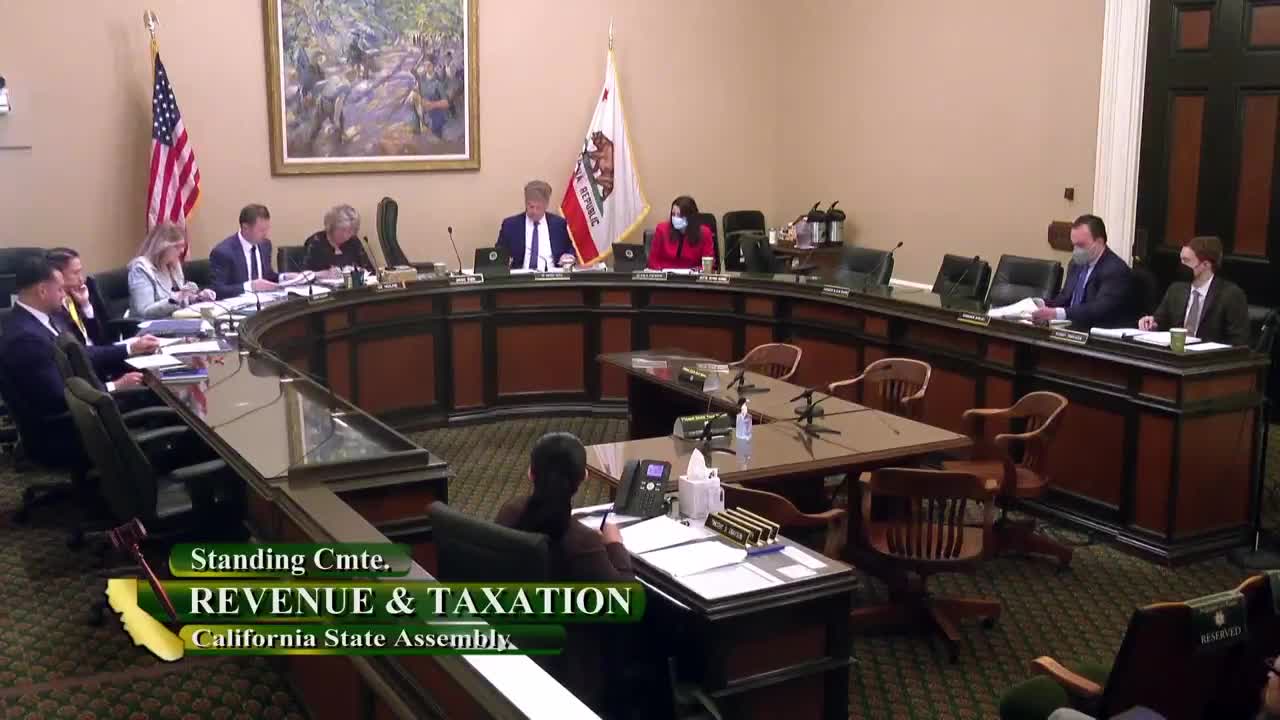
Discussed in Hearing
 8MIN
Assembly Standing Committee on Revenue and Taxation
Bill Author