AB 1132: Solar energy systems: permit fees.
- Session Year: 2023-2024
- House: Assembly
- Latest Version Date: 2023-10-07
Current Status:
Passed
(2023-10-07: Chaptered by Secretary of State - Chapter 357, Statutes of 2023.)
Introduced
In Committee
First Chamber
In Committee
Second Chamber
Enacted
What does this bill do?
This bill extends until 2034 the statewide limits on permit fees that cities and counties may charge for residential and commercial solar energy systems. Local governments may only charge higher fees if they adopt a written finding and resolution showing the fees match the actual cost to issue the permit and will help speed up approval.
The summary is provided by generative AI which can make mistakes. For original language, please view the details in the table below.
Existing law, for purposes of governing property rights, defines a solar energy system as specified to include any solar collector or other solar energy device whose primary purpose is to provide for the collection, storage, and distribution of solar energy for space heating, space cooling, electric generation, or water heating. Existing law prescribes and limits permit fees that a city or county may charge for a residential and commercial solar energy system. Existing law repeals these provisions on January 1, 2025.
This bill would extend that repeal date to January 1, 2034. By extending the operation of the requirements imposed on a city or county in connection with those solar energy systems, the bill would impose a state-mandated local program.
The California Constitution requires the state to reimburse local agencies and school districts for certain costs mandated by the state. Statutory provisions establish procedures for making that reimbursement.
This bill would provide that no reimbursement is required by this act for a specified reason.
(a)For a residential solar energy system:
(1)A city, county, city and county, or charter city shall not charge a residential permit fee that exceeds the estimated reasonable cost of providing the service for which the fee is charged. Except as provided in paragraph (2), for photovoltaic systems, that fee shall not exceed four hundred fifty dollars ($450) plus fifteen dollars ($15) per kilowatt for each kilowatt above 15kW. Except as provided in paragraph (2), for thermal systems, that fee shall not exceed four hundred fifty dollars ($450) plus fifteen dollars ($15) per kilowatt thermal for each kilowatt thermal above 10kWth.
(2)Notwithstanding paragraph (1), a city, county, city and county, or charter city may charge a residential permit fee for a solar energy system that exceeds the fees specified in paragraph (1) if the city, county, city and county, or charter city, as part of a written finding and an adopted resolution or ordinance, provides substantial evidence of the reasonable cost to issue the permit.
(b)For a commercial solar energy system:
(1)A city, county, city and county, or charter city shall not charge a commercial permit fee that exceeds the estimated reasonable cost of providing the service for which the fee is charged. Except as provided in paragraph (2), for photovoltaic systems, the fee shall not exceed one thousand dollars ($1,000) for systems up to 50kW plus seven dollars ($7) per kilowatt for each kilowatt between 51kW and 250kW, plus five dollars ($5) per kilowatt for each kilowatt above 250kW. Except as provided in paragraph (2), for thermal systems, the fee shall not exceed one thousand dollars ($1,000) for systems up to 30kWth, plus seven dollars ($7) per kilowatt thermal for each kilowatt thermal between 30kWth and 260kWth, plus five dollars ($5) per kilowatt thermal for each kilowatt thermal above 260kWth.
(2)Notwithstanding paragraph (1), a city, county, city and county, or charter city may charge a commercial permit fee for a solar energy system that exceeds the applicable fee specified in paragraph (1) if the city, county, city and county, or charter city, as part of a written finding and an adopted resolution or ordinance, provides substantial evidence of the reasonable cost to issue the permit.
(c)A written finding adopted pursuant to paragraph (2) of subdivision (a) or (b) shall include all of the following:
(1)A determination that the municipality has adopted appropriate ordinances, permit fees, and processes to streamline the submittal and approval of permits for solar energy systems pursuant to the practices and policies in state guidelines, the checklists and standard plans in the California Solar Permitting Guidebook, and model ordinances.
(2)A calculation related to the administrative cost of issuing a solar permit that includes consideration of any reduction in costs to issue the permit or inspect a solar energy system pursuant to Section 65850.5.
(3)A description of how the higher fee will result in a quick and streamlined approval process.
(d)For purposes of this section, administrative costs means the costs incurred in connection with the review, approval, and issuance of the permit, and the hourly site inspection and followup costs, and may also include an amortization of the costs incurred in connection with producing a written finding and adopting an ordinance or resolution pursuant to subdivision (a) or (b).
(e)For purposes of this section, residential permit fee means the sum of all charges levied by a city, county, city and county, or charter city in connection with the application for a solar energy system that is installed on the property of a single- or two-family dwelling.
(f)For purposes of this section, commercial permit fee means the sum of all charges levied by a city, county, city and county, or charter city in connection with the application for a commercial solar energy system, including, but not limited to, a solar energy system that is installed on the property of multifamily housing that has more than two family dwellings.
(g)For purposes of this section, solar energy system has the same meaning as defined in Section 801.5 of the Civil Code.
(h)It is the intent of the Legislature that a city, county, city and county, or charter city that meets the obligations of subdivisions (a) and (b) receive priority access to state funds for the purposes of distributed energy generation planning, permitting, training, or implementation.
(i)Nothing in this section precludes a city, county, city and county, or charter city from conducting a plan check to confirm the safety of a solar energy system pursuant to Section 65850.5 and the California Building Standards Code (Title 24 of the California Code of Regulations).
(j)This section shall remain in effect only until January 1, 2034, and as of that date is repealed.
SEC. 2.No reimbursement is required by this act pursuant to Section 6 of Article XIIIB of the California Constitution because a local agency or school district has the authority to levy service charges, fees, or assessments sufficient to pay for the program or level of service mandated by this act, within the meaning of Section 17556 of the Government Code.
(a)For a residential solar energy system:
(1)A city, county, city and county, or charter city shall not charge a residential permit fee that exceeds the estimated reasonable cost of providing the service for which the fee is charged. Except as provided in paragraph (2), for photovoltaic systems, that fee shall not exceed four hundred fifty dollars ($450) plus fifteen dollars ($15) per kilowatt for each kilowatt above 15kW. Except as provided in paragraph (2), for thermal systems, that fee shall not exceed four hundred fifty dollars ($450) plus fifteen dollars ($15) per kilowatt thermal for each kilowatt thermal above 10kWth.
(2)Notwithstanding paragraph (1), a city, county, city and county, or charter city may charge a residential permit fee for a solar energy system that exceeds the fees specified in paragraph (1) if the city, county, city and county, or charter city, as part of a written finding and an adopted resolution or ordinance, provides substantial evidence of the reasonable cost to issue the permit.
(b)For a commercial solar energy system:
(1)A city, county, city and county, or charter city shall not charge a commercial permit fee that exceeds the estimated reasonable cost of providing the service for which the fee is charged. Except as provided in paragraph (2), for photovoltaic systems, the fee shall not exceed one thousand dollars ($1,000) for systems up to 50kW plus seven dollars ($7) per kilowatt for each kilowatt between 51kW and 250kW, plus five dollars ($5) per kilowatt for each kilowatt above 250kW. Except as provided in paragraph (2), for thermal systems, the fee shall not exceed one thousand dollars ($1,000) for systems up to 30kWth, plus seven dollars ($7) per kilowatt thermal for each kilowatt thermal between 30kWth and 260kWth, plus five dollars ($5) per kilowatt thermal for each kilowatt thermal above 260kWth.
(2)Notwithstanding paragraph (1), a city, county, city and county, or charter city may charge a commercial permit fee for a solar energy system that exceeds the applicable fee specified in paragraph (1) if the city, county, city and county, or charter city, as part of a written finding and an adopted resolution or ordinance, provides substantial evidence of the reasonable cost to issue the permit.
(c)A written finding adopted pursuant to paragraph (2) of subdivision (a) or (b) shall include all of the following:
(1)A determination that the municipality has adopted appropriate ordinances, permit fees, and processes to streamline the submittal and approval of permits for solar energy systems pursuant to the practices and policies in state guidelines, the checklists and standard plans in the California Solar Permitting Guidebook, and model ordinances.
(2)A calculation related to the administrative cost of issuing a solar permit that includes consideration of any reduction in costs to issue the permit or inspect a solar energy system pursuant to Section 65850.5.
(3)A description of how the higher fee will result in a quick and streamlined approval process.
(d)For purposes of this section, administrative costs means the costs incurred in connection with the review, approval, and issuance of the permit, and the hourly site inspection and followup costs, and may also include an amortization of the costs incurred in connection with producing a written finding and adopting an ordinance or resolution pursuant to subdivision (a) or (b).
(e)For purposes of this section, residential permit fee means the sum of all charges levied by a city, county, city and county, or charter city in connection with the application for a solar energy system that is installed on the property of a single- or two-family dwelling.
(f)For purposes of this section, commercial permit fee means the sum of all charges levied by a city, county, city and county, or charter city in connection with the application for a commercial solar energy system, including, but not limited to, a solar energy system that is installed on the property of multifamily housing that has more than two family dwellings.
(g)For purposes of this section, solar energy system has the same meaning as defined in Section 801.5 of the Civil Code.
(h)It is the intent of the Legislature that a city, county, city and county, or charter city that meets the obligations of subdivisions (a) and (b) receive priority access to state funds for the purposes of distributed energy generation planning, permitting, training, or implementation.
(i)Nothing in this section precludes a city, county, city and county, or charter city from conducting a plan check to confirm the safety of a solar energy system pursuant to Section 65850.5 and the California Building Standards Code (Title 24 of the California Code of Regulations).
(j)This section shall remain in effect only until January 1, 2025, 2034, and as of that date is repealed.
SEC. 2.No reimbursement is required by this act pursuant to Section 6 of Article XIIIB of the California Constitution because a local agency or school district has the authority to levy service charges, fees, or assessments sufficient to pay for the program or level of service mandated by this act, within the meaning of Section 17556 of the Government Code.
REVISIONS: HeadingLine 2.|
Date
|
Status
|
|---|---|
| Oct 7, 2023 | Chaptered by Secretary of State - Chapter 357, Statutes of 2023. |
| Oct 7, 2023 | Approved by the Governor. |
| Sep 13, 2023 | Enrolled and presented to the Governor at 3 p.m. |
| Sep 6, 2023 | In Assembly. Ordered to Engrossing and Enrolling. |
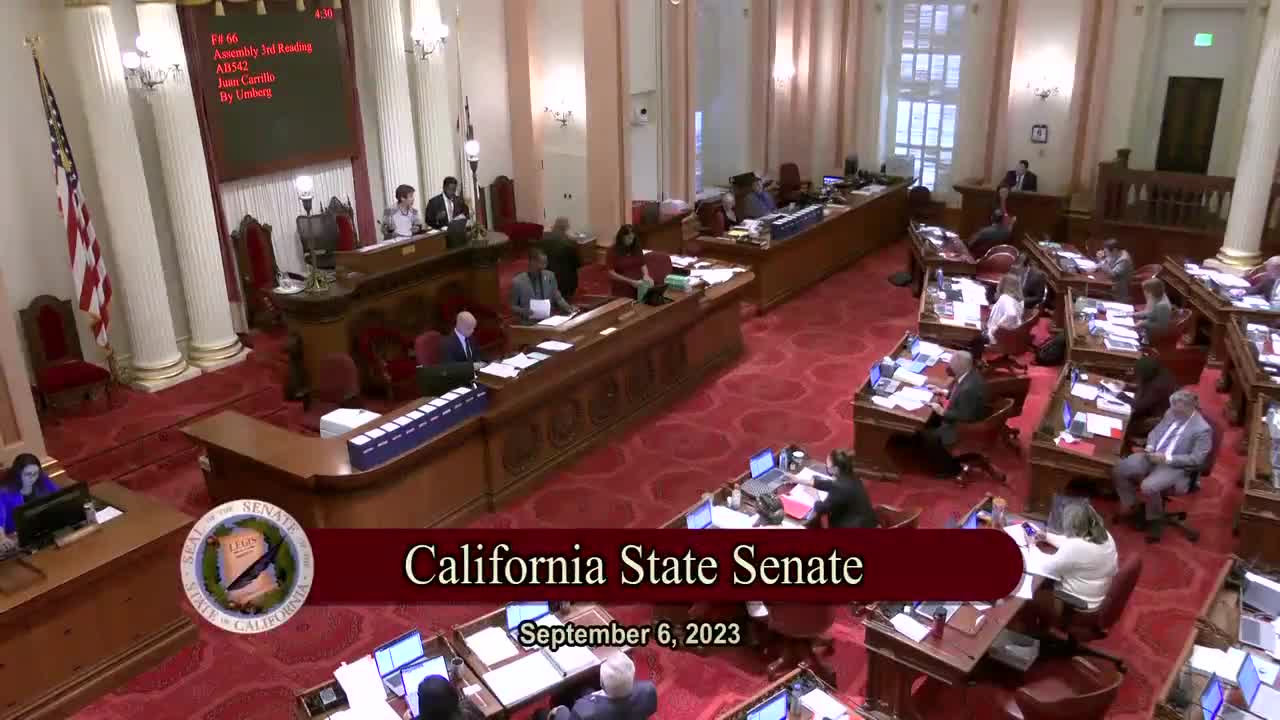
| Sep 6, 2023 | Read third time. Passed. Ordered to the Assembly. (Ayes 40. Noes 0. Page 2423.). |
| Jun 27, 2023 | Read second time. Ordered to third reading. |
| Jun 26, 2023 | From committee: Be ordered to second reading pursuant to Senate Rule 28.8. |
| Jun 7, 2023 | From committee: Do pass and re-refer to Com. on APPR. (Ayes 7. Noes 0.) (June 7). Re-referred to Com. on APPR. |
| May 10, 2023 | Referred to Com. on GOV. & F. |
| Apr 27, 2023 | In Senate. Read first time. To Com. on RLS. for assignment. |
| Apr 27, 2023 | Read third time. Passed. Ordered to the Senate. (Ayes 79. Noes 0. Page 1366.) |
| Apr 20, 2023 | Read second time. Ordered to Consent Calendar. |
| Apr 19, 2023 | From committee: Do pass. To Consent Calendar. (Ayes 14. Noes 0.) (April 19). |
| Mar 29, 2023 | From committee: Do pass and re-refer to Com. on APPR. (Ayes 8. Noes 0.) (March 29). Re-referred to Com. on APPR. |
| Mar 29, 2023 | Coauthors revised. |
| Mar 2, 2023 | Referred to Com. on L. GOV. |
| Feb 16, 2023 | From printer. May be heard in committee March 18. |
| Feb 15, 2023 | Read first time. To print. |
|
Date
|
Description
|
Location
|
Votes
|
|
|---|---|---|---|---|
| Sep 6, 2023 | Assembly 3rd Reading AB1132 Friedman et al. By Becker | Senate Floor |
Passed |
|
| Jun 7, 2023 | Do pass, but first be re-referred to the Committee on [Appropriations] | Senate Standing Committee on Governance and Finance |
Passed |
|
| Apr 27, 2023 | AB 1132 Friedman Consent Calendar Second Day Regular Session | Assembly Floor |
Passed |
|
| Apr 19, 2023 | Do pass. To Consent Calendar. | Assembly Standing Committee on Appropriations |
Passed |
|
| Mar 29, 2023 | Do pass and be re-referred to the Committee on [Appropriations] | Assembly Standing Committee on Local Government |
Passed |
This list shows positions taken on this bill by organizations on the date displayed, which is linked to the original source.
Positions by individuals are not included.
|
Organization
|
Position
|
Date
|
|---|---|---|
| ADT Solar | * Support | Mar 29, 2023 |
| California Building Officials | ** Against | |
| California Solar & Storage Association | ** Support | |
| GAF Energy | * Support | Mar 29, 2023 |
| London & Gonzalez Advocacy | * Support | Mar 29, 2023 |
| Nielsen Merksamer Parrinello Gross & Leoni, LLP | * Support | Mar 29, 2023 |
| Tesla Inc. | * Support | Jun 7, 2023 |
SENATE RULES COMMITTEE Office of Senate Floor Analyses (916) 651-1520 Fax: (916) 327-4478 | AB 1132 |
THIRD READING
Bill No: AB 1132
Author: Friedman (D) and Connolly (D), et al.
Introduced: 2/15/23
Vote: 21
SENATE GOVERNANCE & FIN. COMMITTEE: 7-0, 6/7/23
AYES: Caballero, Seyarto, Blakespear, Durazo, Glazer, Skinner, Wiener
NO VOTE RECORDED: Dahle
SENATE APPROPRIATIONS COMMITTEE: Senate Rule 28.8
ASSEMBLY FLOOR: 79-0, 4/27/23 (Consent) - See last page for vote
SUBJECT: Solar energy systems: permit fees
SOURCE: California Solar & Storage Association
DIGEST:
This bill extends the cap on what a city or county may charge for a permit to install a residential and commercial solar energy system from January 1, 2025, to January 1, 2034.
ANALYSIS:
Existing law:
- Caps the permit fee for a residential solar system and thermal solar system at $450 (plus $15 per kilowatt (kW) for each kW above 15kW) and $1,000 (plus $7 kW for each kW between 51kW and 250 kW, and $5 per kW for each kW above 250 kW) for a commercial system.
- States the cap does not apply when local governments make a written finding and adopt a resolution or ordinance showing substantial evidence of the need to charge more than what the cap allows to issue the permit.
- Sunsets on January 1, 2025.
This bill extends the fee cap on what a city or county may charge for a permit to install a residential or commercial solar energy system from January 1, 2025, to January 1, 2034.
Background
Over the past decade or so, the Legislature has approved a series of bills limiting the fees a city or county can charge for a permit to install a residential or commercial solar energy system.
The first was SB 1222 (Leno, Chapter 614, Statutes of 2012), which capped the fee at $500 (plus $15 per kW for each kW above 15kW) for a residential system and $1,000 (plus $7 kW for each kW between 51kW and 250 kW, and $5 per kW for each kW above 250 kW) for a commercial system. SB 1222 disconnected the cap when local governments made a written finding and adopted a resolution or ordinance showing substantial evidence of the need to charge more than what the cap allows to issue the permit. SB 1222 contained a sunset date of January 1, 2018.
AB 1414 (Friedman, Chapter 849, Statutes of 2017) extended the sunset to January 1, 2025, reduced the residential solar fee cap to $450 and expanded the cap to include solar thermal systems. The bill maintained the permit fee cap of $1,000 on commercial rooftop solar energy systems, but also expanded the cap to include solar thermal systems. Like SB 1222, AB 1414 continued to allow a city or a county to charge a permit fee above the cap if the city or county makes a written finding and adopts a resolution or ordinance providing substantial evidence of the need to charge more than what the cap allows to issue the permit.
Comments
- Purpose of the bill. According to the author, “AB 1132 will continue efforts to increase the development of solar, needed for the state to meet its greenhouse gas reduction goals and build a reliable electric grid.
“In 2017, I authored AB 1414, which extended the cap on the fees local building departments could charge to issue solar permits. However, the initial price cap on permit fees set by AB 1414 is set to expire on January 1, 2025. It is important that we extend this date since only 10 percent of properties in California have solar—a figure that needs to grow further to ensure our goals are met. If the state does not extend the deadline, homeowners and business owners will fall under the risk of having to pay excessive fees that are outside their reach.
“Thus, AB 1132, is a step forward to ensuring California meets its clean energy goals by making solar accessible across all communities and income levels. Given the sunset date of AB 1414, there is a clear urgency to pass AB 1132.”
- Permitting 101. Under the law, local governments can only look at whether a proposed solar energy system meets all the health and safety requirements of local, state, and federal law. If the local official makes a finding, based on substantial evidence, that the solar energy system could have a specific, adverse impact upon the public health and safety, the local agency may require the applicant to apply for a use permit.
In general, state law prohibits local agencies from charging permit fees that go beyond the reasonable cost of providing the service. Money from the permit fees can only be used to defray the cost of permit processing and enforcement – it cannot be used for general fund purposes.
This bill continues the existing $450 and $1,000 caps on permits for rooftop solar installations for residential and commercial systems, respectively, until January 1, 2034. This bill maintains the language in current law allowing a local government to exceed those caps if it makes a written finding and adopts a resolution or ordinance providing substantial evidence that it needs to charge more than the $450/$1,000 caps would otherwise allow.
- Mandate. The California Constitution requires the state to reimburse local governments for the costs of new or expanded state mandated local programs. Because AB 1132 extends cap on permitting fees for solar energy projects, Legislative Counsel states this bill imposes a new state mandate. This bill states no reimbursement is necessary under this bill because local agencies have the authority to levy service charges, fees, or assessments sufficient to pay for the program or level of service mandated by this bill.
FISCAL EFFECT: Appropriation: No Fiscal Com.: Yes Local: Yes
SUPPORT: (Verified 6/26/23)
California Solar & Storage Association (source)
OPPOSITION: (Verified 6/26/23)
California Building Officials
ARGUMENTS IN SUPPORT: According to the California Solar & Storage Association:
Currently, only 10 percent of properties in California have solar, a figure that needs to grow rapidly for the state to meet its clean energy goals. While many homes, businesses, non-profits, schools, churches, and other buildings install solar for environmental reasons, the price tag must also be reasonable. Prior to SB 1222, high permitting fees were pushing solar outside the budgets for many homeowners and other property owners. Since SB 1222 established the caps on solar permitting fees, solar has become attainable for more Californians. AB 1132 is needed to keep solar permitting fees reasonable and keep solar growing.
ARGUMENTS IN OPPOSITION: According to the California Building Officials:
Under existing law, The Solar Rights Act of 1978 protects a homeowner’s right to install a solar energy system on their property. Additionally, … AB 1124 (2021) further reduced the amount of money local enforcement agencies are allowed to charge to collect reimbursement for these complex solar energy systems. Although the bill allowed jurisdictions to charge above the fee cap if they could provide evidence that increasing the fees is necessary for administrative review time, several of our jurisdictions have struggled with meeting the costs of permit review.
Local jurisdictions can increase fees and provide a fee study to local government on why it is necessary to increase fees, however, given the local dynamics of some communities, CALBO members have expressed concerns that they are not able to get approval for the increased fees in their respective jurisdictions since AB 1124 became law. As a result, some jurisdictions have been subsidizing permit reviews of these highly complex systems. By extending the sunset date of these fee caps without any inflationary adjustments in statute, the number of jurisdictions subsidizing solar permits may continue to increase in California. As a result, CALBO requests an amendment that builds in some kind of inflationary adjustment such as the consumer price index so member jurisdictions that are not able to go beyond the current fee caps can further support staff and local building departments at the local level.
ASSEMBLY FLOOR: 79-0, 4/27/23
AYES: Addis, Aguiar-Curry, Alanis, Alvarez, Arambula, Bains, Bauer-Kahan, Bennett, Berman, Boerner, Bonta, Bryan, Calderon, Juan Carrillo, Wendy Carrillo, Cervantes, Chen, Connolly, Megan Dahle, Davies, Dixon, Essayli, Flora, Mike Fong, Vince Fong, Friedman, Gabriel, Gallagher, Garcia, Gipson, Grayson, Haney, Hart, Holden, Hoover, Irwin, Jackson, Jones-Sawyer, Kalra, Lackey, Lee, Low, Lowenthal, Maienschein, Mathis, McCarty, McKinnor, Muratsuchi, Stephanie Nguyen, Ortega, Pacheco, Papan, Joe Patterson, Pellerin, Petrie-Norris, Quirk-Silva, Ramos, Reyes, Luz Rivas, Robert Rivas, Rodriguez, Blanca Rubio, Sanchez, Santiago, Schiavo, Soria, Ta, Ting, Valencia, Villapudua, Waldron, Wallis, Ward, Weber, Wicks, Wilson, Wood, Zbur, Rendon
NO VOTE RECORDED: Jim Patterson
Prepared by: Evan Goldberg / GOV. & F. / (916) 651-4119
6/28/23 11:05:22
**** END ****
SENATE COMMITTEE ON GOVERNANCE AND FINANCE
Senator Anna M. Caballero, Chair
2023 - 2024 Regular
Bill No: | AB 1132 | Hearing Date: | 6/7/23 |
Author: | Friedman | Tax Levy: | No |
Version: | 2/15/23 | Fiscal: | Yes |
Consultant: | Goldberg | ||
Solar energy systems: permit fees
Extends the cap on what a city or county may charge for a permit to install a residential and commercial solar energy system from January 1, 2025, to January 1, 2034.
Background
Over the past decade or so, the Legislature has approved a series of bills limiting the fees a city or county can charge for a permit to install a residential or commercial solar energy system.
The first was SB 1222 (Leno, 2012), which capped the fee at $500 (plus $15 per kilowatt (kW) for each kW above 15kW) for a residential system and $1,000 (plus $7 kW for each kW between 51kW and 250 kW, and $5 per kW for each kW above 250 kW) for a commercial system. SB 1222 disconnected the cap when local governments made a written finding and adopted a resolution or ordinance showing substantial evidence of the need to charge more than what the cap allows to issue the permit. SB 1222 contained a sunset date of January 1, 2018.
AB 1414 (Friedman, 2017) extended the sunset to January 1, 2025, reduced the residential solar fee cap to $450 and expanded the cap to include solar thermal systems. The bill maintained the permit fee cap of $1,000 on commercial rooftop solar energy systems, but also expanded the cap to include solar thermal systems. Like SB 1222, AB 1414 continued to allow a city or a county to charge a permit fee above the cap if the city or county makes a written finding and adopts a resolution or ordinance providing substantial evidence of the need to charge more than what the cap allows to issue the permit.
The California Solar & Storage Association argues AB 1132 is needed to keep solar permitting fees reasonable and keep solar growing in California, where only about 10% of the properties in the state have a solar energy system.
Proposed Law
Assembly Bill 1132 extends the fee cap on what a city or county may charge for a permit to install a residential or commercial solar energy system from January 1, 2025, to January 1, 2034.
State Revenue Impact
No estimate.
Comments
1. Purpose of the bill. According to the author, “AB 1132 will continue efforts to increase the development of solar, needed for the state to meet its greenhouse gas reduction goals and build a reliable electric grid.
“In 2017, I authored AB 1414, which extended the cap on the fees local building departments could charge to issue solar permits. However, the initial price cap on permit fees set by AB 1414 is set to expire on January 1, 2025. It is important that we extend this date since only 10 percent of properties in California have solar—a figure that needs to grow further to ensure our goals are met. If the state does not extend the deadline, homeowners and business owners will fall under the risk of having to pay excessive fees that are outside their reach.
“Thus, AB 1132, is a step forward to ensuring California meets its clean energy goals by making solar accessible across all communities and income levels. Given the sunset date of AB 1414, there is a clear urgency to pass AB 1132.”
2. Permitting 101. Under the law, local governments can only look at whether a proposed solar energy system meets all the health and safety requirements of local, state, and federal law. If the local official makes a finding, based on substantial evidence, that the solar energy system could have a specific, adverse impact upon the public health and safety, the local agency may require the applicant to apply for a use permit.
In general, state law prohibits local agencies from charging permit fees that go beyond the reasonable cost of providing the service. Money from the permit fees can only be used to defray the cost of permit processing and enforcement – it cannot be used for general fund purposes.
This bill continues the existing $450 and $1,000 caps on permits for rooftop solar installations for residential and commercial systems, respectively, until January 1, 2034. The bill maintains the language in current law allowing a local government to exceed those caps if it makes a written finding and adopts a resolution or ordinance providing substantial evidence that it needs to charge more than the $450/$1,000 caps would otherwise allow.
3. What’s the rush? The current cap on the solar installation permit fees doesn’t expire until January 1, 2025, more than 18 months from now. The Committee may wish to consider if it is premature to extend the cap for an additional 9 years – more than 10 years from the time this bill is considered.
4. Mandate. The California Constitution requires the state to reimburse local governments for the costs of new or expanded state mandated local programs. Because AB 1132 extends cap on permitting fees for solar energy projects, Legislative Counsel states the bill imposes a new state mandate. The measure states no reimbursement is necessary under the bill because local agencies have the authority to levy service charges, fees, or assessments sufficient to pay for the program or level of service mandated by the bill.
Assembly Actions
Assembly Local Government Committee: 8-0
Assembly Appropriations Committee: 14-0
Assembly Floor: 79-0
Support and Opposition
(6/2/23)
Support: California Solar & Storage Association (Sponsor)
Opposition: California Building Officials
-- END --
Date of Hearing: April 19, 2023
ASSEMBLY COMMITTEE ON APPROPRIATIONS
Chris Holden, Chair
ABPCA Bill Id:AB 1132
Author:(Friedman) – As Introduced Ver:February 15, 2023
Policy Committee: | Local Government | Vote: | 8 - 0 |
|
| ||
|
|
Urgency: No State Mandated Local Program: Yes Reimbursable: No
SUMMARY:
This bill extends the sunset date on the limits on permit fees a city or county may charge for residential and commercial solar energy systems, from January 1, 2025, to January 1, 2034.
FISCAL EFFECT:
- Negligible state costs.
- Although this bill contains the local fee disclaimer indicating a local agency may impose a fee or service charge sufficient to cover its mandated costs, this bill extends the existing law cap on these fees. To the extent the capped permit fees are insufficient to cover a local agency’s costs, local costs would continue to be subsidized, through January 1, 2034, from the local agency’s General Fund, unless a city or county provides a written finding and adopts a resolution or ordinance providing substantial evidence the reasonable cost to issue a permit exceeds the statutory cap, in which case a city or county may charge a higher fee sufficient to cover it costs.
COMMENTS:
- Purpose. According to the author:
[This bill] will extend efforts to increase the development of solar, needed for the state to meet its greenhouse gas reduction goals and build a reliable electric grid. In 2017, I authored AB 1414, which extended the cap on the fees local building departments could charge to issue solar permits. The price cap on permit fees set by AB 1414 is set to expire on January 1, 2025. It is vital that we extend this date since only 10 percent of properties in California have solar—a figure that needs to grow further to ensure clean energy goals are met. If the state does not extend the deadline, homeowners and business owners will fall under the risk of having to pay excessive fees that are outside their reach.
- Background. The California Legislature enacted the Solar Rights Act in 1978 to protect a homeowner’s right to install a solar energy system by limiting a homeowner association's ability to object to such installations through its covenants, conditions and restrictions (CC&Rs). The Solar Rights Act allows CC&Rs to include provisions that impose reasonable restrictions on solar energy systems.
AB 2473 (Wolk), Chapter 789, Statutes of 2004, updated the Solar Rights Act by specifying standards for what constitutes "significant" increases in solar energy system costs or decreases in those systems' efficiency. The bill also declared solar energy system installation a matter of statewide concern and made a local government's grant of permission to install a solar energy system ministerial rather than discretionary.
The Legislature has subsequently approved a series of bills limiting the fees a city or county may charge for solar energy systems, including SB 1222 (Leno), Chapter 614, Statutes of 2012, that limited permit fees for rooftop solar systems and contained a January 1, 2018, sunset date, and AB 1414 (Friedman), Chapter 849, Statutes of 2017, that reduced the maximum permit fees, applied the caps to broader range of solar energy systems, and extended the sunset date to January 1, 2025.
This bill further extends the sunset date on the permit fee caps to January 1, 2034.
Analysis Prepared by: Jennifer Swenson / APPR. / (916) 319-2081
Date of Hearing: March 29, 2023
ASSEMBLY COMMITTEE ON LOCAL GOVERNMENT
Cecilia Aguiar-Curry, Chair
ABPCA Bill Id:AB 1132 (
Author:Friedman) – As Introduced Ver:February 15, 2023
SUBJECT: Solar energy systems: permit fees.
SUMMARY: Extends the sunset date on provisions of law that limit the permit fees a city or county can charge for solar energy systems, from January 1, 2025, to January 1, 2034.
FISCAL EFFECT: This bill is fiscal and contains a state-mandated local program.
COMMENTS:
- Background. The California Legislature enacted the Solar Rights Act in 1978 to protect a homeowner’s right to install a solar energy system by limiting a homeowner association's ability to object to such installations through its covenants, conditions and restrictions (CC&Rs). The Solar Rights Act allows CC&Rs to include provisions that impose reasonable restrictions on solar energy systems. Reasonable restrictions include those that: do not significantly increase the cost of the solar system; do not significantly decrease the system’s efficiency or specified performance; and, allow for an alternative system of comparable cost, efficiency and benefits. “Significant” is further defined as those restrictions that increase the system’s cost by more than 20% or decrease the system’s efficiency by more than 20%.
AB 2473 (Wolk), Chapter 789, Statutes of 2004, updated the Solar Rights Act by specifying standards for what constitutes “significant” increases in solar energy system costs or decreases in those systems’ efficiency. The bill also made changes to the permitting process for solar energy systems.
- Permitting Process. Existing law limits review of an application to install solar energy system to the building official’s review of whether it meets all health and safety requirements of local, state, and federal law. The requirements of local law are limited to those standards and regulations necessary to ensure that the solar energy system will not have a specific, adverse impact upon the public health or safety. However, if the building official of the city or county makes a finding, based on substantial evidence, that the solar energy system could have a specific, adverse impact upon the public health and safety, the city or county may require the applicant to apply for a use permit.
A city or county cannot deny an application for a use permit to install a solar energy system unless it makes written findings based upon substantial evidence in the record that the proposed installation would have a specific, adverse impact upon the public health or safety, and there is no feasible method to satisfactorily mitigate or avoid the specific, adverse impact. The findings must include the basis for the rejection of potential feasible alternatives of preventing the adverse impact.
- Local Permit Fees. Current law prohibits local agencies from charging fees for permit processing and inspection that exceed the reasonable cost of providing the service for which the fee is charged. Fee revenue must only be used to defray the cost of permit processing and enforcement and cannot be used for general revenue purposes.
Proposition 26 amended Article XIII C of the California Constitution to broaden the definition of what constitutes a tax to include many payments previously considered fees or charges. The language of Proposition 26 lists seven exceptions to what constitutes a local tax, including three that are relevant to this bill:
- A charge imposed for a specific benefit conferred or privilege granted directly to the payer that is not provided to those not charged, and which does not exceed the reasonable costs to the local government of conferring the benefit or granting the privilege.
- A charge imposed for a specific government service or product provided directly to the payer that is not provided to those not charged, and which does not exceed the reasonable costs to the local government of providing the service or product.
- A charge imposed for the reasonable regulatory costs to a local government for issuing licenses and permits, performing investigations, inspections, and audits, enforcing agricultural marketing orders, and the administrative enforcement and adjudication thereof.
Proposition 26 also added the following language regarding the burden of proof: “The local government bears the burden of proving by a preponderance of the evidence that a levy, charge, or other exaction is not a tax, that the amount is not more than necessary to cover the reasonable costs of governmental activity, and that the manner in which those costs are allocated to a payor bear a fair or reasonable relationship to the payor’s burdens on, or benefits received from, the governmental activity.”
- Solar Energy System Permit Fees. The Legislature has approved a series of bills limiting the fees that a city or county can charge for solar energy systems:
- SB 1222 (Leno), Chapter 614, Statutes of 2012. SB 1222 placed caps on the amount of permit fees a city or county can charge for residential or commercial rooftop solar energy systems. For a residential rooftop solar energy system, a city or county was precluded from charging a permit fee that exceeded $500 (plus $15 per kW for each kW above 15kW). SB 1222 bill also prohibited, for a commercial rooftop solar energy system, a city or county from charging a permit fee that exceeded $1,000 for systems up to 50kW (plus $7 kW for each kW between 51kW and 250 kW, and $5 per kW for each kW above 250 kW). These caps were limited specifically to rooftop photovoltaic (PV) systems, and did not apply to PV systems installed elsewhere on a building, or to solar thermal systems.
SB 1222 allowed a city or county to charge permit fees exceeding these caps, provided the city or county made a written finding and adopted a resolution or ordinance showing substantial evidence of the reasonable cost to issue the permit. SB 1222 contained a sunset date of January 1, 2018.
- AB 1414 (Friedman), Chapter 849, Statues of 2017. AB 1414 made a number of additional changes to these permit fee caps. It reduced the fee cap to $450 and applied the cap beyond rooftop solar PV installations only, to include any PV systems and solar thermal systems, with specified size limitations. The bill maintained the permit fee cap of $1,000 on commercial rooftop solar energy systems, but applied the cap beyond rooftop solar PV installations to include PV systems generally and solar thermal systems, also with specified size limitations.
AB 1414 continued to allow a city or a county to charge a permit fee that exceeds the specified caps if the city or county makes a written finding and adopts a resolution or ordinance that provides substantial evidence of the reasonable cost to issue the permit. However, this bill required additional elements in the written finding.
AB 1414 also amended the meaning of “solar energy system” to specify that a solar energy system includes any PV device or technology that is integrated into a building, including, but not limited to, PV windows, siding, and roofing shingles or tiles. The bill also added an explicit cross-reference to this amended definition (which is contained in Civil Code § 801.5) to the code section containing the permit fee caps (Government Code § 66015), thereby explicitly applying the permit fee caps to this expanded definition of “solar energy system.”
AB 1414 extended the sunset date in SB 1222, from January 1, 2018, to January 1, 2025.
- AB 1124 (Friedman), Chapter 235, Statutes of 2021. Among other provisions, this bill again revised the definition of “solar energy system” to additionally include any structural design feature by eliminating the provision that the structural design feature be a feature of a building. The bill added the following structural design features in the definition of “solar energy system,” regardless of whether the feature is on the ground or on a building:
- Solar racking.
- Solar mounting.
- Elevated solar support structures, including, but not limited to, solar carports, shade structures, awnings, canopies, and patio covers. This includes both the aboveground superstructure and associated foundation elements that support solar energy devices or collectors.
- AB 1124 (Friedman), Chapter 235, Statutes of 2021. Among other provisions, this bill again revised the definition of “solar energy system” to additionally include any structural design feature by eliminating the provision that the structural design feature be a feature of a building. The bill added the following structural design features in the definition of “solar energy system,” regardless of whether the feature is on the ground or on a building:
The bill specified that a solar energy system must be designed to serve one utility retail customer on the same property, more than one utility retail customer on the same property, one utility retail customer on the same, adjacent, or contiguous properties, or more than one utility retail customer on the same, adjacent or contiguous properties. The solar energy system must not be designed for procurement of electricity by an electric utility.
The bill also revised several additional definitions, including:
- “Commercial permit fee” to mean the sum of all charges levied by a city or county in connection with the application for a commercial solar energy system, including, but not limited to, a solar energy system that is installed on the property of multifamily housing that has more than two family dwellings.
- “Residential permit fee” to mean the sum of all charges levied by a city or county in connection with the application for a solar energy system that is installed on the property of a single- or two-family dwelling.
- Author’s Statement and Bill Summary. According to the author, “AB 1132 will extend efforts to increase the development of solar, needed for the state to meet its greenhouse gas reduction goals and build a reliable electric grid. In 2017, I authored AB 1414, which extended the cap on the fees local building departments could charge to issue solar permits until 2025. AB 1124 expanded this progress, and expanded the definition of solar energy systems to include all forms of solar (including carports, shade structures, etc.) whether mounted on a roof or directly to the ground. This bill also defined commercial permit fees to include the sum of all fees charged by the jurisdiction, to ensure fees are reasonable and within reach for homes and businesses.
“However, the initial price cap on permit fees set by AB 1414 is set to expire on January 1, 2025. It is vital that we extend this date since only 10 percent of properties in California have solar—a figure that needs to grow further to ensure clean energy goals are met. If the state does not extend the deadline, homeowners and business owners will fall under the risk of having to pay excessive fees that are outside their reach. This bill, AB 1132, is crucial, in ensuring that solar is accessible across all communities and income levels, which would ensure California reaches its clean energy goals. Given the sunset date of AB 1414, there is a clear urgency to pass AB 1132.”
This bill extends the sunset date on provisions of law that limit the permit fees a city or county can charge for solar energy systems, from January 1, 2025, to January 1, 2034. This bill is sponsored by the California Solar and Storage Association.
- Policy Consideration. The Committee may wish to consider the following: the existing sunset date in provisions of law that limit the permit fees a city or county can charge for solar energy systems is January 1, 2025. The Committee may wish to consider whether this bill’s sunset extension is premature.
- Previous Legislation. AB 1124 (Friedman), Chapter 235, Statutes of 2021, revised the definition of "solar energy system" as that term is used for the purpose of local permitting of such systems, including the allowable fees a local agency may charge, and clarified the permit fees local agencies may charge for commercial and residential solar energy systems.
AB 2700 (Friedman) of 2020 was substantially similar to AB 1124. AB 2700 was held in this Committee.
AB 1414 (Friedman), Chapter 849, Statutes of 2017, reduced the maximum permit fee a city or a county may charge for residential rooftop solar energy systems, applied these caps and commercial permit fee caps to a broader range of solar energy systems, and made additional changes to existing law governing permit fees for rooftop solar energy systems.
AB 2188 (Muratsuchi), Chapter 521, Statutes of 2014, required every city and county to adopt an ordinance that creates an expedited, streamlined permitting process for small residential rooftop solar energy systems.
SB 1222 (Leno), Chapter 614, Statues of 2012, limited the fees that cities and counties charge for permits related to the installation of rooftop solar energy systems.
AB 2473 (Wolk), Chapter 789, Statutes of 2004, required cities and counties to permit the installation of solar energy systems by right if the system meets specified requirements, and redefined the term “significantly” in regard to restrictions on solar systems that raise costs or decrease efficiency.
- Arguments in Support. According to the California Solar and Storage Association, sponsor of this bill, “Before a property can install solar panels, the local building department must provide the property with a permit. Building departments generally charge fees to provide the permit. In 2012, SB 1222 capped the fees building departments can charge for a permit for five years. The caps were based on the size of the solar system, and building departments could exceed the caps by passing an ordinance justifying the high fees. In 2017, AB 1414 extended the cap another seven years. This bill, AB 1132, would extend the cap another nine years.
“Currently, only 10 percent of properties in California have solar, a figure that needs to grow rapidly for the state to meet its clean energy goals. While many homes, businesses, non-profits, schools, churches, and other buildings install solar for environmental reasons, the price tag must also be reasonable. Prior to SB 1222, high permitting fees were pushing solar outside the budgets for many homeowners and other property owners. Since SB 1222 established the caps on solar permitting fees, solar has become attainable for more Californians. AB 1132 is needed to keep solar permitting fees reasonable and keep solar growing.”
- Arguments in Opposition. None on file.
REGISTERED SUPPORT / OPPOSITION:
Support
California Solar and Storage Association
Opposition
None on file
Analysis Prepared by: Angela Mapp / L. GOV. / (916) 319-3958
Discussed in Hearing
 1MIN
Senate Floor
 9MIN
Senate Standing Committee on Governance and Finance
 3MIN



