AB 1248: Local redistricting: independent redistricting commissions.
- Session Year: 2023-2024
- House: Assembly
- Latest Version Date: 2023-09-18
Current Status:
Failed
(2024-02-01: Consideration of Governor's veto stricken from file.)
Introduced
In Committee
First Chamber
In Committee
Second Chamber
Enacted
Existing law generally requires county boards of supervisors, city councils, and the governing boards of school districts, community college districts, and other special districts, if those bodies are elected using district-based elections, to adopt new boundaries for the districts following each federal decennial census. Notwithstanding that requirement, existing law authorizes a local jurisdiction other than a charter city to establish an independent redistricting commission to adopt new boundaries for the local jurisdictions districts.
This bill would require a county, general law city, charter city, or charter city and county that contains over 300,000 residents, and a school district or community college district that contains over 500,000 residents, to establish an independent redistricting commission to adopt district boundaries after each federal decennial census. The bill would require a county, general law city, charter city, or charter city or county with over 300,000 residents, and a school district or community college district with over 500,000 residents, that does not enact an ordinance, resolution, or charter amendment establishing an independent redistricting commission by January 1, 2030, and January 1 of every subsequent year ending in 0, to establish a 14-member independent redistricting commission according to specified procedures, including procedures for the random selection of the members of the commission from among applicants meeting certain qualifications. By requiring certain local jurisdictions to establish independent redistricting commissions to adopt district boundaries, the bill would impose a state-mandated local program.
The bill would prohibit a member of an independent redistricting commission from communicating with any individual or organization regarding redistricting matters, except as provided. The bill would require the State Auditor to provide the contact information of any applicant to serve on the Citizens Redistricting Commission, which is responsible for adjusting the boundary lines of the congressional, legislative, and State Board of Equalization districts, to any city or county that has established an independent or hybrid redistricting commission, provided that the applicant has consented to share this information and the city or county has requested to receive this information, and to inform those applicants of opportunities to serve on an independent or hybrid redistricting commission. The bill would require the State Auditor to establish a database and create and advertise a process for this exchange of information.
Under existing law, independent redistricting commissions have been established for the Counties of Los Angeles, San Diego, Riverside, Fresno, and Kern.
The bill would exempt the Counties of Los Angeles, San Diego, Riverside, Fresno, and Kern from the bills provisions requiring a county with over 300,000 residents to establish an independent redistricting commission, unless the existing law provisions establishing independent redistricting commissions for those counties are repealed or invalidated. The bill also would exempt a charter city with a population of at least 2,500,000 people from the bills provisions if specified conditions are met, including if both this bill and Senate Bill 52 are enacted and if the city complies with certain provisions in Senate Bill 52 that require such cities to establish independent redistricting commissions.
This bill would incorporate additional changes to Section 23003 of the Elections Code proposed by Assembly Bill 764 to be operative only if this bill and Assembly Bill 764 are enacted and this bill is enacted last.
The bill would include findings that changes proposed by this bill address a matter of statewide concern rather than a municipal affair and, therefore, apply to all cities, including charter cities.
The California Constitution requires the state to reimburse local agencies and school districts for certain costs mandated by the state. Statutory provisions establish procedures for making that reimbursement.
This bill would provide that, if the Commission on State Mandates determines that the bill contains costs mandated by the state, reimbursement for those costs shall be made pursuant to the statutory provisions noted above.
Existing law generally requires county boards of supervisors, city councils, and the governing boards of school districts, community college districts, and other special districts, if those bodies are elected using district-based elections, to adopt new boundaries for the districts following each federal decennial census. Notwithstanding that requirement, existing law authorizes a local jurisdiction other than a charter city to establish an independent redistricting commission to adopt new boundaries for the local jurisdictions districts.
This bill would require a county, general law city, charter city, or charter city and county that contains over 300,000 residents, and a school district or community college district that contains over 500,000 residents, to establish an independent redistricting commission to adopt district boundaries after each federal decennial census. The bill would require a county, general law city, charter city, or charter city or county with over 300,000 residents, and a school district or community college district with over 500,000 residents, that does not enact an ordinance, resolution, or charter amendment establishing an independent redistricting commission by January 1, 2030, and January 1 of every subsequent year ending in 0, to establish a 14-member independent redistricting commission according to specified procedures, including procedures for the random selection of the members of the commission from among applicants meeting certain qualifications. By requiring certain local jurisdictions to establish independent redistricting commissions to adopt district boundaries, the bill would impose a state-mandated local program.
The bill would prohibit a member of an independent redistricting commission from communicating with any individual or organization regarding redistricting matters, except as provided. The bill would require the State Auditor to provide the contact information of any applicant to serve on the Citizens Redistricting Commission, which is responsible for adjusting the boundary lines of the congressional, legislative, and State Board of Equalization districts, to any city or county that has established an independent or hybrid redistricting commission commission, provided that the applicant has consented to share this information and the city or county has requested to receive this information, and to inform those applicants of opportunities to serve on an independent or hybrid redistricting commission. The bill would require the State Auditor to establish a database and create and advertise a process for this exchange of information.
Under existing law, independent redistricting commissions have been established for the Counties of Los Angeles, San Diego, Riverside, Fresno, and Kern.
The bill would exempt the Counties of Los Angeles, San Diego, Riverside, Fresno, and Kern from the bills provisions requiring a county with over 300,000 residents to establish an independent redistricting commission, unless the existing law provisions establishing independent redistricting commissions for those counties are repealed or invalidated. The bill also would exempt a charter city with a population of at least 2,500,000 people from the bills provisions if specified conditions are met, including if both this bill and Senate Bill 52 are enacted and if the city complies with certain provisions in Senate Bill 52 that require such cities to establish independent redistricting commissions.
The bill would include findings that changes proposed by this bill address a matter of statewide concern rather than a municipal affair and, therefore, apply to all cities, including charter cities.
The California Constitution requires the state to reimburse local agencies and school districts for certain costs mandated by the state. Statutory provisions establish procedures for making that reimbursement.
This bill would provide that, if the Commission on State Mandates determines that the bill contains costs mandated by the state, reimbursement for those costs shall be made pursuant to the statutory provisions noted above.
Existing law generally requires county boards of supervisors, city councils, and the governing boards of school districts, community college districts, and other special districts, if those bodies are elected using district-based elections, to adopt new boundaries for the districts following each federal decennial census. Notwithstanding that requirement, existing law authorizes a local jurisdiction other than a charter city to establish an independent redistricting commission to adopt new boundaries for the local jurisdictions districts.
This bill would require a county, general law city, charter city, or charter city and county that contains over 300,000 residents, and a school district or community college district that contains over 500,000 residents, to establish an independent redistricting commission to adopt district boundaries after each federal decennial census. The bill would require a county, general law city, charter city, or charter city or county with over 300,000 residents, and a school district or community college district with over 500,000 residents, that does not enact an ordinance, resolution, or charter amendment establishing an independent redistricting commission by January 1, 2030, and January 1 of every subsequent year ending in 0, to establish a 14-member independent redistricting commission according to specified procedures, including procedures for the random selection of the members of the commission from among applicants meeting certain qualifications. By requiring certain local jurisdictions to establish independent redistricting commissions to adopt district boundaries, the bill would impose a state-mandated local program.
The bill would prohibit a member of an independent redistricting commission from communicating with any individual or organization regarding redistricting matters, except as provided. The bill would require the State Auditor to provide the contact information of any applicant to serve on the Citizens Redistricting Commission, which is responsible for adjusting the boundary lines of the congressional, legislative, and State Board of Equalization districts, to any city or county that has established an independent or hybrid redistricting commission and to inform those applicants of opportunities to serve on an independent or hybrid redistricting commission.
Under existing law, independent redistricting commissions have been established for the Counties of Los Angeles, San Diego, Riverside, Fresno, and Kern.
The bill would exempt the Counties of Los Angeles, San Diego, Riverside, Fresno, and Kern from the bills provisions requiring a county with over 300,000 residents to establish an independent redistricting commission, unless the existing law provisions establishing independent redistricting commissions for those counties are repealed or invalidated.
The bill would include findings that changes proposed by this bill address a matter of statewide concern rather than a municipal affair and, therefore, apply to all cities, including charter cities.
The California Constitution requires the state to reimburse local agencies and school districts for certain costs mandated by the state. Statutory provisions establish procedures for making that reimbursement.
This bill would provide that, if the Commission on State Mandates determines that the bill contains costs mandated by the state, reimbursement for those costs shall be made pursuant to the statutory provisions noted above.
Existing law generally requires county boards of supervisors, city councils, and the governing boards of school districts, community college districts, and other special districts, if those bodies are elected using district-based elections, to adopt new boundaries for the districts following each federal decennial census. Notwithstanding that requirement, existing law authorizes a local jurisdiction other than a charter city to establish an independent redistricting commission to adopt new boundaries for the local jurisdictions districts.
This bill would require a county, general law city, charter city, or charter city and county that contains over 300,000 residents, and a school district or community college district that contains over 500,000 residents, to establish an independent redistricting commission to adopt district boundaries after each federal decennial census. The bill would require a county, general law city, charter city, or charter city or county with over 300,000 residents, and a school district or community college district with over 500,000 residents, that does not enact an ordinance, resolution, or charter amendment establishing an independent redistricting commission by March January 1, 2030, and March January 1 of every subsequent year ending in 0, to establish a 14-member independent redistricting commission according to specified procedures, including procedures for the random selection of the members of the commission from among applicants meeting certain qualifications. By requiring certain local jurisdictions to establish independent redistricting commissions to adopt district boundaries, the bill would impose a state-mandated local program.
The bill would prohibit a member of an independent redistricting commission from communicating with any individual or organization regarding redistricting matters, except as provided. The bill would require the State Auditor to provide the contact information of any applicant to serve on the Citizens Redistricting Commission, which is responsible for adjusting the boundary lines of the congressional, legislative, and State Board of Equalization districts, to any city or county that has established an independent or hybrid redistricting commission and to inform those applicants of opportunities to serve on an independent or hybrid redistricting commission.
Under existing law, independent redistricting commissions have been established for the Counties of Los Angeles, San Diego, Riverside, Fresno, and Kern.
The bill would exempt the Counties of Los Angeles, San Diego, Riverside, Fresno, and Kern from the bills provisions requiring a county with over 300,000 residents to establish an independent redistricting commission, unless the existing law provisions establishing independent redistricting commissions for those counties are repealed or invalidated.
The bill would include findings that changes proposed by this bill address a matter of statewide concern rather than a municipal affair and, therefore, apply to all cities, including charter cities.
The California Constitution requires the state to reimburse local agencies and school districts for certain costs mandated by the state. Statutory provisions establish procedures for making that reimbursement.
This bill would provide that, if the Commission on State Mandates determines that the bill contains costs mandated by the state, reimbursement for those costs shall be made pursuant to the statutory provisions noted above.
Existing law generally requires county boards of supervisors, city councils, and the governing boards of school districts, community college districts, and other special districts, if those bodies are elected using district-based elections, to adopt new boundaries for the districts following each federal decennial census. Notwithstanding that requirement, existing law authorizes a local jurisdiction other than a charter city to establish an independent redistricting commission to adopt new boundaries for the local jurisdictions districts.
This bill would require a county, general law city, charter city, school district, or community college district or charter city and county that contains over 300,000 residents residents, and a school district or community college district that contains over 500,000 residents, to establish an independent redistricting commission to adopt district boundaries after each federal decennial census. The bill would require a county, city, general law city, charter city, or charter city or county school district, or community college district with over 300,000 residents residents, and a school district or community college district with over 500,000 residents, that does not enact an ordinance, resolution, or charter amendment establishing an independent redistricting commission by March 1, 2030, and March 1 of every subsequent year ending in 0, to establish a 14-member independent redistricting commission according to specified procedures, including procedures for the random selection of the members of the commission from among applicants meeting certain qualifications. By requiring certain local jurisdictions to establish independent redistricting commissions to adopt district boundaries, the bill would impose a state-mandated local program.
The bill would prohibit a member of an independent redistricting commission from communicating with any individual or organization regarding redistricting matters, except as provided. The bill would require the State Auditor to provide the contact information of any applicant to serve on the Citizens Redistricting Commission, which is responsible for adjusting the boundary lines of the congressional, legislative, and State Board of Equalization districts, to any city or county that has established an independent or hybrid redistricting commission and to inform those applicants of opportunities to serve on an independent or hybrid redistricting commission.
Under existing law, independent redistricting commissions have been established for the Counties of Los Angeles, San Diego, Riverside, Fresno, and Kern.
The bill would exempt the Counties of Los Angeles, San Diego, Riverside, Fresno, and Kern from the bills provisions requiring a county with over 300,000 residents to establish an independent redistricting commission, unless the existing law provisions establishing independent redistricting commissions for those counties are repealed or invalidated.
The bill would include findings that changes proposed by this bill address a matter of statewide concern rather than a municipal affair and, therefore, apply to all cities, including charter cities.
The California Constitution requires the state to reimburse local agencies and school districts for certain costs mandated by the state. Statutory provisions establish procedures for making that reimbursement.
This bill would provide that, if the Commission on State Mandates determines that the bill contains costs mandated by the state, reimbursement for those costs shall be made pursuant to the statutory provisions noted above.
Existing law generally requires county boards of supervisors, city councils, and the governing boards of school districts, community college districts, and other special districts, if those bodies are elected using district-based elections, to adopt new boundaries for the districts following each federal decennial census. Notwithstanding that requirement, existing law authorizes a local jurisdiction other than a charter city to establish an independent redistricting commission to adopt new boundaries for the local jurisdictions districts.
This bill would require a county, general law city, charter city, school district, or community college district that contains over 300,000 residents to establish an independent redistricting commission to adopt district boundaries after each federal decennial census. The bill would require a county, city, school district, or community college district with over 300,000 residents that does not enact an ordinance, resolution, or charter amendment establishing an independent redistricting commission by March 1, 2030, and March 1 of every subsequent year ending in 0, to establish a 14-member independent redistricting commission according to specified procedures, including procedures for the random selection of the members of the commission from among applicants meeting certain qualifications. By requiring certain local jurisdictions to establish independent redistricting commissions to adopt district boundaries, the bill would impose a state-mandated local program.
The bill would prohibit a member of an independent redistricting commission from communicating with any individual or organization regarding redistricting matters, except as provided. The bill would require the State Auditor to provide the contact information of any applicant to serve on the Citizens Redistricting Commission, which is responsible for adjusting the boundary lines of the congressional, legislative, and State Board of Equalization districts, to any city or county that has established an independent or hybrid redistricting commission and to inform those applicants of opportunities to serve on an independent or hybrid redistricting commission.
Under existing law, independent redistricting commissions have been established for the Counties of Los Angeles, San Diego, Riverside, Fresno, and Kern.
The bill would exempt the Counties of Los Angeles, San Diego, Riverside, Fresno, and Kern from the bills provisions requiring a county with over 300,000 residents to establish an independent redistricting commission, unless the existing law provisions establishing independent redistricting commissions for those counties are repealed or invalidated.
The bill would include findings that changes proposed by this bill address a matter of statewide concern rather than a municipal affair and, therefore, apply to all cities, including charter cities.
The California Constitution requires the state to reimburse local agencies and school districts for certain costs mandated by the state. Statutory provisions establish procedures for making that reimbursement.
This bill would provide that, if the Commission on State Mandates determines that the bill contains costs mandated by the state, reimbursement for those costs shall be made pursuant to the statutory provisions noted above.
The Legislature finds and declares all of the following:
(a)To maintain a healthy democracy in California, it is important that communities are fairly and equitably represented.
(b)The State of California has a strong state interest in ensuring that cities, counties, and other jurisdictions follow a fair and equitable redistricting process to ensure representation of communities, and thus redistricting is not solely a municipal affair.
(c)The State of California has a strong state interest in the integrity of elections throughout the state, and a fair and equitable redistricting process ensures the integrity of elections.
(d)In the 2020 redistricting cycle and historically, observations of the redistricting process in California jurisdictions conducted by independent redistricting commissions indicate independent redistricting commissions lead to better outcomes for communities in terms of fairness, transparency, public engagement, and representation.
(e)Independent redistricting commissions help thwart threats of minority vote dilution.
(f)Political appointment of commissioners has been found to create potential conflicts of interest and opportunity for corruption of the redistricting process.
SEC. 2.Section 8545.7 is added to the Government Code, to read:8545.7.(a)The State Auditor shall provide the contact information of any applicant to serve as a commissioner on the Citizens Redistricting Commission established pursuant to Article XXI of the California Constitution, who has consented to the sharing of this information, to any city or county that has established an independent or hybrid redistricting commission and requests applicant contact information from the State Auditor.
(b)After an applicant is no longer being actively considered for appointment to the Citizens Redistricting Commission, the State Auditor shall inform that applicant of opportunities to serve on an independent or hybrid redistricting commission for any city or county of which the applicant is a resident, if the independent or hybrid redistricting commission has requested applicant contact information pursuant to subdivision (a), and shall provide an internet link to the database established pursuant to subdivision (e).
(c)The State Auditor is encouraged to also provide specific information about opportunities to serve on local independent or hybrid redistricting commissions for jurisdictions other than cities or counties to an applicant who is no longer being actively considered for appointment to the Citizens Redistricting Commission, provided that such local independent or hybrid redistricting commissions have requested that the State Auditor provide this information in accordance with the process established in subdivision (d).
(d)For purposes of complying with this section, the State Auditor shall create and advertise a process whereby established local hybrid and independent redistricting commissions may request applicant contact information pursuant to subdivision (a) and may furnish application and other informational materials to be provided to potential interested applicants pursuant to subdivisions (b) and (c), including geographic information that may be requested by the State Auditor to determine jurisdictional boundaries.
(e)At least three months before the application period to serve on the Citizens Redistricting Commission opens, the State Auditor shall establish a database of all local hybrid and independent redistricting commissions in the state that have requested applicant contact information, or have provided application or other informational materials, pursuant to any of the provisions of this section. An internet link to that public database, provided to potential applicants, shall be sufficient to comply with the provisions of subdivisions (b) and (c).
SEC. 3.Section 23000 of the Elections Code is amended to read:23000.For purposes of this chapter, the following terms have the following meanings:
(a)Advisory redistricting commission means a body that recommends to a legislative body placement of the district boundaries for that legislative body.
(b)Family member means a spouse, parent, sibling, child, or in-law.
(c)Hybrid redistricting commission means a body that recommends to a legislative body two or more maps for the placement of the district boundaries for that legislative body, where the legislative body must adopt one of those maps without modification, except as may be required to comply with state or federal law.
(d)Independent redistricting commission means a body, other than a legislative body, that is empowered to adopt the district boundaries of a legislative body.
(e)Legislative body means a county board of supervisors, a city council of a general law city or charter city, a governing board of a school district, a governing board of a community college district, or an elected governing board of a special district.
(f)Local jurisdiction means a county, general law or charter city, school district, community college district, or special district.
(g)Redistricting means either districting or redistricting.
(h)Spouse means a spouse or registered domestic partner.
SEC. 4.Section 23000.5 is added to the Elections Code, to read:23000.5.(a)This chapter applies to a local jurisdiction in which the legislative body is elected using a method in which the candidate must reside within an election district that is a divisible part of the local jurisdiction.
(b)This chapter does not apply to any of the following:
(1)The County of Los Angeles, unless Chapter 6.3 (commencing with Section 21530), or a commission established pursuant to that chapter, is repealed or invalidated by a court.
(2)The County of San Diego, unless Chapter 6.5 (commencing with Section 21550), or a commission established pursuant to that chapter, is repealed or invalidated by a court.
(3)The County of Riverside, unless Chapter 6.4 (commencing with Section 21540), or a commission established pursuant to that chapter, is repealed or invalidated by a court.
(4)The County of Fresno, unless Chapter 6.7 (commencing with Section 21560), or a commission established pursuant to that chapter, is repealed or invalidated by a court.
(5)The County of Kern, unless Chapter 6.8 (commencing with Section 21570), or a commission established pursuant to that chapter, is repealed or invalidated by a court.
SEC. 4.5.Section 23000.5 is added to the Elections Code, to read:23000.5.(a)This chapter applies to a local jurisdiction in which the legislative body is elected using a method in which the candidate must reside within an election district that is a divisible part of the local jurisdiction.
(b)This chapter does not apply to any of the following:
(1)The County of Los Angeles, unless Chapter 6.3 (commencing with Section 21530), or a commission established pursuant to that chapter, is repealed or invalidated by a court.
(2)The County of San Diego, unless Chapter 6.5 (commencing with Section 21550), or a commission established pursuant to that chapter, is repealed or invalidated by a court.
(3)The County of Riverside, unless Chapter 6.4 (commencing with Section 21540), or a commission established pursuant to that chapter, is repealed or invalidated by a court.
(4)The County of Fresno, unless Chapter 6.7 (commencing with Section 21560), or a commission established pursuant to that chapter, is repealed or invalidated by a court.
(5)The County of Kern, unless Chapter 6.8 (commencing with Section 21570), or a commission established pursuant to that chapter, is repealed or invalidated by a court.
(6)A charter city with a population of at least 2,500,000 people, if that city has established an independent redistricting commission in its city charter, whose members are not directly appointed by the city council or an elected official of the city, or if the city has an independent redistricting commission pursuant to Article 3 (commencing with Section 21700) of Chapter 7.
SEC. 5.Section 23001 of the Elections Code is amended to read:23001.A local jurisdiction, except for a jurisdiction that is required to create an independent redistricting commission pursuant to Section 23001.5, may establish by resolution, ordinance, or charter amendment an independent redistricting commission, a hybrid redistricting commission, or an advisory redistricting commission composed of residents of the local jurisdiction to change the legislative bodys district boundaries or to recommend to the legislative body changes to those district boundaries.
SEC. 6.Section 23001.5 is added to the Elections Code, to read:23001.5.(a)(1)A county with more than 300,000 residents on July 1, 2029, and on July 1 of every subsequent year ending in the number nine, other than a charter city and county, shall establish an independent redistricting commission composed of residents of the county to adopt the countys supervisorial district boundaries after each federal decennial census. The county shall establish the commission not later than 250 days before the deadline to adopt supervisorial district boundaries.
(2)If a county required to establish an independent redistricting commission pursuant to paragraph (1) does not enact an ordinance, resolution, or charter amendment establishing an independent redistricting commission by January 1, 2030, and by January 1 of every subsequent year ending in the number zero, the county shall establish an independent redistricting commission pursuant to Section 23005.
(b)(1)A general law city, charter city, or charter city and county with more than 300,000 residents on July 1, 2029, and on July 1 of every subsequent year ending in the number nine, or a school district or community college district with more than 500,000 residents on July 1, 2029, and on July 1 of each subsequent year ended in the number nine, shall establish an independent redistricting commission composed of residents of the local jurisdiction, or contract with a county commission pursuant to Section 23004, to adopt the local jurisdictions district boundaries after each federal decennial census. The general law city, charter city, charter city and county, school district, or community college district shall establish the commission not later than 250 days before the deadline to adopt the local jurisdictions district boundaries.
(2)If a general law city, charter city, charter city and county, school district, or community college district does not enact an ordinance, resolution, or charter amendment establishing an independent redistricting commission by January 1, 2030, and by January 1 of every subsequent year ending in the number zero, or contract with a county commission pursuant to Section 23004, the general law city, charter city, charter city and county, school district, or community college district shall establish an independent redistricting commission pursuant to Section 23006.
(c)Subdivisions (a) and (b) do not apply to a local jurisdiction that, before January 1, 2023, has enacted by ordinance, resolution, or charter amendment an independent redistricting commission for which no commissioners are directly appointed by the legislative body or any elected official of the local jurisdiction.
(d)(1)For purposes of subdivisions (a) and (b), the latest available estimate of a county or citys population by the Department of Finance, pursuant to Section 2227 of the Revenue and Taxation Code or a successor statute, on July 1 of each year ending in the number nine is determinative.
(2)The Department of Finance shall prepare a population estimate for each school district and community college district by May 1 in each year ending in the number nine. This estimate of a school districts population or community college districts population shall be determinative for the purposes of subdivision (b).
SEC. 7.Section 23003 of the Elections Code is amended to read:23003.(a)This section applies to hybrid redistricting commissions, and to independent redistricting commissions, including independent redistricting commissions established by an ordinance, resolution, or charter amendment of the local jurisdiction, as described in Section 23001.5, and independent redistricting commissions established pursuant to Section 23005 or Section 23006.
(b)(1)Notwithstanding any other law, the local jurisdiction may prescribe the manner in which members are appointed to the commission, provided that the jurisdiction uses an application process open to all eligible residents and provided that the commissioners are not directly appointed by the legislative body or an elected official of the local jurisdiction.
(2)Paragraph (1) does not apply to a local jurisdiction required to establish an independent redistricting commission pursuant to Section 23005 or Section 23006.
(c)A person shall not be appointed to serve on the commission if the person or any family member of the person has been elected or appointed to, or been a candidate for, an elective office of the local jurisdiction in the eight years preceding the persons application.
(d)A person shall not be appointed to serve on the commission if either of the following applies:
(1)The person or the persons spouse has done any of the following in the eight years preceding the persons application:
(A)Served as an officer of, employee of, or paid consultant to, a campaign committee or a candidate for elective office of the local jurisdiction.
(B)Served as an officer of, employee of, or paid consultant to, a political party or as an elected or appointed member of a political party central committee.
(C)Served as a staff member or a consultant to, or who has contracted with, a currently serving elected officer of the local jurisdiction.
(D)Been registered to lobby the local jurisdiction.
(E)Contributed five hundred dollars ($500) or more in a year to any candidate for an elective office of the local jurisdiction. The local jurisdiction may adjust this amount by the cumulative change in the California Consumer Price Index, or its successor, in every year ending in zero.
(2)A family member of the person, other than the persons spouse, has done any of the following in the four years preceding the persons application:
(A)Served as an officer of, employee of, or paid consultant to, a campaign committee or a candidate for elective office of the local jurisdiction.
(B)Served as an officer of, employee of, or paid consultant to, a political party or as an elected or appointed member of a political party central committee.
(C)Served as a staff member of or consultant to, or has contracted with, a currently serving elected officer of the local jurisdiction.
(D)Been registered to lobby the local jurisdiction.
(E)Contributed five hundred dollars ($500) or more in a year to any candidate for an elective office of the local jurisdiction. The local jurisdiction may adjust this amount by the cumulative change in the California Consumer Price Index, or its successor, in every year ending in zero.
(e)A member of the commission shall not do any of the following:
(1)While serving on the commission, endorse, work for, volunteer for, or make a campaign contribution to, a candidate for an elective office of the local jurisdiction.
(2)Be a candidate for an elective office of the local jurisdiction if any of the following is true:
(A)Less than five years has elapsed since the date of the members appointment to the commission.
(B)The election for that office will be conducted using district boundaries that were adopted by the commission on which the member served, and those district boundaries have not been subsequently readopted by a commission after the end of the members term on the commission.
(C)The election for that office will be conducted using district boundaries that were adopted by a legislative body pursuant to a recommendation by the commission on which the member served, and those district boundaries have not been subsequently readopted by a legislative body pursuant to a recommendation by a commission after the end of the members term on the commission.
(3)For four years commencing with the date of the persons appointment to the commission:
(A)Accept employment as a staff member of, or consultant to, an elected official or candidate for elective office of the local jurisdiction.
(B)Receive a noncompetitively bid contract with the local jurisdiction.
(C)Register as a lobbyist for the local jurisdiction.
(4)For two years commencing with the date of the persons appointment to the commission, accept an appointment to an office of the local jurisdiction.
(f)The commission shall not be comprised entirely of members who are registered to vote with the same political party preference.
(g)Each member of the commission shall be a designated employee in the conflict of interest code for the commission pursuant to Article 3 (commencing with Section 87300) of Chapter 7 of Title 9 of the Government Code.
(h)The commission is subject to the Ralph M. Brown Act (Chapter 9 (commencing with Section 54950) of Part 1 of Division 2 of Title 5 of the Government Code) and the California Public Records Act (Division 10 (commencing with Section 7920.000) of Title 1 of the Government Code).
(i)The commission shall be subject to the same redistricting deadlines, requirements, procedures, criteria, and restrictions that would otherwise apply to a legislative body. A local jurisdiction may also impose additional requirements and restrictions on the commission, on members of the commission, or on applicants to the commission in excess of those prescribed by this section.
(j)The commission shall publish a map of the proposed new district boundaries and make that map available to the public for at least seven days before that map may be adopted. The commission shall hold at least three public hearings preceding the hearing at which the new boundaries are adopted, or the number of public hearings that would otherwise apply to the legislative body for which district boundaries are being drawn, whichever is greater.
(k)The commission shall not draw districts for the purpose of favoring or discriminating against a political party or an incumbent or political candidate.
(l)District boundaries adopted by an independent redistricting commission or adopted by a legislative body from recommendations provided by a hybrid redistricting commission, shall not be altered by the legislative body or the commission until after the next federal decennial census occurs, unless those boundaries have been invalidated by a final judgment or order of a court of competent jurisdiction, or as may be necessary to account for changes to a jurisdictions territory, including changes through annexation or consolidation.
(m)For the purposes of subdivisions (c) and (d), local jurisdiction does not include a local jurisdiction that contracts with a county independent redistricting commission pursuant to Section 23004.
SEC. 7.5.Section 23003 of the Elections Code is amended to read:23003.(a)This section applies to hybrid redistricting commissions, and to independent redistricting commissions, including independent redistricting commissions established by an ordinance, resolution, or charter amendment of the local jurisdiction, as described in Section 23001.5, and independent redistricting commissions established pursuant to Section 23005 or Section 23006.
(b)(1)Notwithstanding any other law, the local jurisdiction may prescribe the manner in which members are appointed to the commission, provided that the jurisdiction uses an application process open to all eligible residents and provided that the commissioners are not appointed by the legislative body or an elected official of the local jurisdiction.
(2)Paragraph (1) does not apply to a local jurisdiction required to establish an independent redistricting commission pursuant to Section 23005 or Section 23006.
(c)A person shall not be appointed to serve on the commission if the person or any family member of the person has been elected or appointed to, or been a candidate for, an elective office of the local jurisdiction in the eight years preceding the persons application.
(d)A person shall not be appointed to serve on the commission if either of the following applies:
(1)The person or the persons spouse has done any of the following in the eight years preceding the persons application:
(A)Served as an officer of, employee of, or paid consultant to, a campaign committee or a candidate for elective office of the local jurisdiction.
(B)Served as an officer of, employee of, or paid consultant to, a political party or as an elected or appointed member of a political party central committee.
(C)Served as a staff member or a consultant to, or who has contracted with, a currently serving elected officer of the local jurisdiction.
(D)Been registered to lobby the local jurisdiction.
(E)Contributed five hundred dollars ($500) or more in a year to any candidate for an elective office of the local jurisdiction. The local jurisdiction may adjust this amount by the cumulative change in the California Consumer Price Index, or its successor, in every year ending in zero.
(2)A family member of the person, other than the persons spouse, has done any of the following in the four years preceding the persons application:
(A)Served as an officer of, employee of, or paid consultant to, a campaign committee or a candidate for elective office of the local jurisdiction.
(B)Served as an officer of, employee of, or paid consultant to, a political party or as an elected or appointed member of a political party central committee.
(C)Served as a staff member of or consultant to, or has contracted with, a currently serving elected officer of the local jurisdiction.
(D)Been registered to lobby the local jurisdiction.
(E)Contributed five hundred dollars ($500) or more in a year to any candidate for an elective office of the local jurisdiction. The local jurisdiction may adjust this amount by the cumulative change in the California Consumer Price Index, or its successor, in every year ending in zero.
(e)A member of the commission shall not do any of the following:
(1)While serving on the commission, endorse, work for, volunteer for, or make a campaign contribution to, a candidate for an elective office of the local jurisdiction.
(2)Be a candidate for an elective office of the local jurisdiction if any of the following is true:
(A)Less than five years has elapsed since the date of the members appointment to the commission.
(B)The election for that office will be conducted using district boundaries that were adopted by the commission on which the member served, and those district boundaries have not been subsequently readopted by a commission after the end of the members term on the commission.
(C)The election for that office will be conducted using district boundaries that were adopted by a legislative body pursuant to a recommendation by the commission on which the member served, and those district boundaries have not been subsequently readopted by a legislative body pursuant to a recommendation by a commission after the end of the members term on the commission.
(3)For four years commencing with the date of the persons appointment to the commission:
(A)Accept employment as a staff member of, or consultant to, an elected official or candidate for elective office of the local jurisdiction.
(B)Receive a noncompetitively bid contract with the local jurisdiction.
(C)Register as a lobbyist for the local jurisdiction.
(4)For two years commencing with the date of the persons appointment to the commission, accept an appointment to an office of the local jurisdiction.
(f)The commission shall not be comprised entirely of members who are registered to vote with the same political party preference.
(g)Each member of the commission shall be a designated employee in the conflict of interest code for the commission pursuant to Article 3 (commencing with Section 87300) of Chapter 7 of Title 9 of the Government Code.
(h)The commission is subject to the Ralph M. Brown Act (Chapter 9 (commencing with Section 54950) of Part 1 of Division 2 of Title 5 of the Government Code) and the California Public Records Act (Division 10 (commencing with Section 7920.000) of Title 1 of the Government Code).
(i)The commission shall be subject to the same redistricting deadlines, requirements, procedures, criteria, and restrictions that would otherwise apply to a legislative body. A local jurisdiction may also impose additional requirements and restrictions on the commission, on members of the commission, or on applicants to the commission in excess of those prescribed by this section.
(j)The commission shall publish a map of the proposed new district boundaries and make that map available to the public for at least seven days before that map may be adopted. The commission shall hold at least three public hearings preceding the hearing at which the new boundaries are adopted, or the number of public hearings that would otherwise apply to the legislative body for which district boundaries are being drawn, whichever is greater.
(k)The commission shall not draw districts for the purpose of favoring or discriminating against a political party or an incumbent or political candidate.
(l)District boundaries adopted by an independent redistricting commission or adopted by a legislative body from recommendations provided by a hybrid redistricting commission, shall not be altered by the legislative body or the commission until after the next federal decennial census occurs, unless those boundaries have been invalidated by a final judgment or order of a court of competent jurisdiction, or as may be necessary to account for changes to a jurisdictions territory, including changes through annexation or consolidation.
(m)For the purposes of subdivisions (c) and (d), local jurisdiction does not include a local jurisdiction that contracts with a county independent redistricting commission pursuant to Section 23004.
SEC. 8.Section 23003.5 is added to the Elections Code, to read:23003.5.(a)(1)A member of an independent redistricting commission established pursuant to subdivision (a) or subdivision (b) of Section 23001.5 shall not communicate with any individual or organization regarding redistricting matters outside of a public meeting. This subdivision does not restrict the commission from communicating with the staff of the legislative body of the local jurisdiction regarding administrative matters of the commission.
(2)This subdivision does not restrict a commissioner from directly communicating with another commissioner, commission staff, legal counsel, or consultants retained by the commission.
(b)A member of an independent redistricting commission established pursuant to subdivision (a) or subdivision (b) of Section 23001.5 shall receive a stipend, in an amount to be determined by the local jurisdiction, for each day in which they attend any meeting of the commission or any meeting of a committee or subcommittee of the commission, of which committee or subcommittee they are a member and which committee or subcommittee meeting is conducted for the purpose of carrying out the powers and duties of the commission.
(c)A local jurisdiction shall provide for reasonable funding and staffing of a commission established pursuant to subdivision (a) or subdivision (b) of Section 23001.5.
(d)This section applies to independent redistricting commissions established by an ordinance, resolution, or charter amendment of the local jurisdiction, as described in Section 23001.5, and independent redistricting commissions established pursuant to Section 23005 or Section 23006.
SEC. 9.Section 23004 of the Elections Code is amended to read:23004.A local jurisdiction, except for a county, may contract with a county in which the local jurisdiction is partially or wholly located that has established an independent redistricting commission to have that commission adopt the local jurisdictions election district boundaries. The county independent redistricting commission shall hold at least three public hearings in the local jurisdiction before adopting those boundaries, or the number of public hearings that would otherwise apply to the legislative body for which district boundaries are being drawn, whichever is greater.
SEC. 10.Section 23005 is added to the Elections Code, to read:23005.(a)In each county required to establish an independent redistricting commission pursuant to paragraph (2) of subdivision (a) of Section 23001.5, in the year following the year in which the decennial federal census is taken, the commission shall adjust the boundary lines of the supervisorial districts in accordance with this section.
(b)(1)The selection process is designed to produce a commission that is independent from the influence of the board of supervisors and reasonably representative of the countys diversity.
(2)The county shall recruit eligible residents to apply to serve on the commission. The county shall request the assistance of neighborhood associations, community groups, civic organizations, and civil rights organizations to encourage eligible residents to apply to serve on the commission in a manner that promotes a qualified commissioner applicant pool that is large and reflective of the diversity of the county.
(c)(1)The commission shall consist of 14 members and 2 alternates.
(2)At least one commission member shall reside in each of the existing supervisorial districts.
(3)Alternates may fully participate in commission deliberations but shall not vote and shall not be counted towards the establishment of a quorum. Alternates are subject to the same terms of office, qualifications, restrictions, and standards of conduct as other commissioners.
(d)Each commission member shall meet all of the following qualifications in addition to those listed in Section 23003:
(1)Be a resident of the county.
(2)Possess a history of civic engagement and participation.
(3)Possess experience that demonstrates analytical skills relevant to the redistricting process and voting rights, and possess an ability to comprehend and apply the applicable state and federal legal requirements.
(4)Possess experience that demonstrates an ability to be impartial.
(5)Possess experience that demonstrates an appreciation for the diverse demographics and geography of the county.
(e)An interested person meeting the qualifications specified in subdivision (d) and Section 23003 may submit an application to the selection entity to be considered for membership on the commission. The selection entity shall review the applications and eliminate applicants who do not meet the specified qualifications.
(f)(1)The selection entity shall make public the number of qualified applicants and provide the demographic data of the qualified applicants by aggregated percentages.
(2)If the pool of applicants does not have a sufficient number of qualified applicants, or sufficiently represent the local jurisdictions local diversity, as determined by the selection entity, the selection entity shall reopen the application period for at least 30 days and conduct additional outreach.
(3)From the pool of qualified applicants, the selection entity shall select 40 of the most qualified applicants, taking into account the requirements described in subdivision (d). The selection entity shall make public the names of the 40 most qualified applicants for at least 30 days. The selection entity shall not communicate with a member of the board of supervisors, or an agent for a member of the board of supervisors, about any matter related to the nomination process or applicants before the publication of the list of the 40 most qualified applicants.
(4)During the period described in paragraph (2) or (3), the selection entity may eliminate any of the previously selected applicants if the selection entity becomes aware that the applicant does not meet the qualifications specified in subdivision (d).
(g)(1)After complying with the requirements of subdivision (f), the selection entity shall create a subpool for each of the five existing supervisorial districts.
(2)(A)At a regularly scheduled meeting of the county board of supervisors, the Auditor-Controller of the county or clerk of the county board of supervisors shall conduct a random drawing to select one commissioner from each of the five subpools established by the selection entity.
(B)After completing the random drawing pursuant to subparagraph (A), at the same meeting of the county board of supervisors, the Auditor-Controller or clerk of the county board of supervisors shall conduct a random drawing from all of the remaining applicants, without respect to subpools, to select three additional commissioners.
(3)(A)The eight selected commissioners shall review the remaining names in the subpools of applicants and shall appoint six additional applicants and two alternates to the commission.
(B)The six appointees and two alternates shall be chosen based on relevant experience, analytical skills, and ability to be impartial, and to ensure that the commission reflects the countys diversity, including racial, ethnic, geographic, and gender diversity. However, formulas or specific ratios shall not be applied for this purpose.
(h)The county board of supervisors shall prescribe the selection entity used to appoint members to the commission from any of the following options:
(1)The civil grand jury of the county, as described in Title 4 (commencing with Section 888) of Part 2 of the Penal Code.
(2)A panel of three retired judges appointed by the chief judge of the superior court of the county.
(3)The county elections official.
(4)The clerk of the county board of supervisors.
(i)A member of the commission shall apply this chapter in a manner that is impartial and that reinforces public confidence in the integrity of the redistricting process.
(j)The term of office of each member of the commission expires upon the appointment of the first member of the succeeding commission.
(k)Nine members of the commission shall constitute a quorum. Nine or more affirmative votes shall be required for any official action.
(l)(1)The commission may remove one of its members in the event of substantial neglect of duty, gross misconduct in office, or inability to discharge the duties of office. Removal shall require nine or more affirmative votes from the other members, after the member was served written notice and provided an opportunity to respond.
(2)In the case of a vacancy in the commission that occurs prior to the applicable redistricting deadline, the commission shall select one alternate commissioner to fill the vacancy as a voting member. If no alternate exists, the vacancy shall be filled by the commission from the pool of qualified applicants within 30 days after the vacancy occurs.
SEC. 11.Section 23006 is added to the Elections Code, to read:23006.(a)In each general law city, charter city, charter city and county, school district, or community college district required to establish an independent redistricting commission pursuant to Section 23001.5, in the year following the year in which the decennial federal census is taken, the commission shall adjust the boundary lines of the districts of the legislative body in accordance with this section.
(b)(1)The selection process is designed to produce a commission that is independent from the influence of the legislative body and reasonably representative of the local jurisdictions diversity.
(2)The local jurisdiction shall recruit eligible residents to apply to serve on the commission. The local jurisdiction shall request the assistance of neighborhood associations, community groups, civic organizations, and civil rights organizations to encourage eligible residents to apply to serve on the commission in a manner that promotes a qualified commissioner applicant pool that is large and reflective of the diversity of the local jurisdiction.
(c)(1)The commission shall consist of 14 members and 2 alternates.
(2)Alternates may fully participate in commission deliberations but shall not vote and shall not be counted towards the establishment of a quorum. Alternates are subject to the same terms of office, qualifications, restrictions, and standards of conduct as other commissioners.
(d)Each commission member shall meet all of the following qualifications in addition to those listed in Section 23003:
(1)Be a resident of the local jurisdiction.
(2)Possess a history of civic engagement and participation.
(3)Possess experience that demonstrates analytical skills relevant to the redistricting process and voting rights, and possess an ability to comprehend and apply the applicable state and federal legal requirements.
(4)Possess experience that demonstrates an ability to be impartial.
(5)Possess experience that demonstrates an appreciation for the diverse demographics and geography of the local jurisdiction.
(e)An interested person meeting the qualifications specified may submit an application to the selection entity to be considered for membership on the commission. The selection entity shall review the applications and eliminate applicants who do not meet the specified qualifications in Section 23003.
(f)(1)The selection entity shall make public the number of qualified applicants and provide the demographic data of the qualified applicants by aggregated percentages.
(2)If the pool of applicants does not have a sufficient number of qualified applicants, or sufficiently represent the local jurisdictions local diversity, as determined by the selection entity, the selection entity shall reopen the application period for at least 30 days and conduct additional outreach.
(3)From the pool of qualified applicants, the selection entity shall select 40 of the most qualified applicants, taking into account the requirements described in subdivision (d). The selection entity shall make public the names of the 40 most qualified applicants for at least 30 days. The selection entity shall not communicate with a member of the legislative body, or an agent for a member of the legislative body, about any matter related to the nomination process or applicants before the publication of the list of the 40 most qualified applicants.
(4)During the period described in paragraph (2) or (3), the selection entity may eliminate any of the previously selected applicants if the selection entity becomes aware that the applicant does not meet the qualifications specified in subdivision (d).
(g)(1)In jurisdictions that have a legislative body with eight members or fewer, the selection entity shall create a subpool for each of the existing districts of the local jurisdiction from the pool of qualified applicants.
(2)(A)At a public meeting, the selection entity shall conduct a random drawing to select one commissioner from each of the subpools established by the selection entity.
(B)(i)The commissioners selected pursuant to subparagraph (A) shall review the remaining names in the subpools of applicants and shall appoint additional commissioners and alternates as necessary to create a commission with 14 members and 2 alternates.
(ii)Commissioners appointed pursuant to this subparagraph shall be appointed by the randomly selected commissioners based on relevant experience, analytical skills, and ability to be impartial, and to ensure that the commission reflects the local jurisdictions diversity, including racial, ethnic, geographic, and gender diversity. However, formulas or specific ratios shall not be applied for this purpose.
(h)(1)If a jurisdiction has a legislative body with more than eight existing districts, the selection entity shall conduct a random drawing from the pool of qualified applicants to select eight commissioners. Of the eight commissioners selected pursuant to this paragraph, not more than one commissioner shall reside in each of the existing districts of the local jurisdiction. If an applicant whose name is drawn resides in the same existing district as a person whose name has already been drawn as part of the random drawing, that applicant shall be not be seated as a commissioner pursuant to this paragraph, and another name shall be drawn from the pool. An applicant whose name is drawn but who is not seated as a commissioner pursuant to this paragraph shall be eligible to be appointed to the commission pursuant to paragraph (2).
(2)The commissioners selected pursuant to paragraph (1) shall appoint additional commissioners and alternates to create a commission with 14 members and 2 alternates. Commissioners appointed pursuant to this subparagraph shall be appointed by the selected commissioners based on relevant experience, analytical skills, and ability to be impartial, and to ensure that the commission reflects the countys diversity, including racial, ethnic, geographic, and gender diversity. However, formulas or specific ratios shall not be applied for this purpose. For the purpose of achieving geographic diversity, the selected commissioners shall consider appointing applicants who reside in existing legislative body districts that are not already represented among the selected commissioners.
(i)(1)A general law city, charter city, charter city and county, school district, or community college district shall prescribe, through their legislative process, the selection entity used to appoint members to the commission from any of the following options:
(A)The local jurisdictions ethics commission, if one exists.
(B)A committee or commission with a holistic view of the local jurisdictions governance process, including, but not limited to, an elections commission or charter review commission, if one exists.
(C)A panel consisting of one representative each from three of the following:
(i)The local jurisdictions ethics commission.
(ii)A committee or commission with a holistic view of the local jurisdictions governance process.
(iii)The controller, city attorney, city clerk, or city treasurer, if these offices are not elective offices.
(iv)A retired judge appointed by the chief judge of the superior court of the county in which a plurality of the local jurisdictions population is located.
(v)The civil grand jury of the county in which a plurality of the local jurisdictions population is located.
(2)If neither of the options in subparagraphs (A) or (B) of paragraph (1) exists within the jurisdiction, and if at least three of the options in subparagraph (C) of paragraph (1) do not exist within the jurisdiction, the legislative body shall prescribe the selection entity used to appoint members to the commission from any of the following options.
(A)For cities, a panel consisting of the city attorney, city clerk, and city treasurer, if these offices exist and are not elective offices.
(B)A panel of three retired judges appointed by the chief judge of the superior court of the county in which a plurality of the local jurisdictions population is located.
(C)The civil grand jury of the county in which a plurality of the local jurisdictions population is located.
(j)A member of the commission shall apply this chapter in a manner that is impartial and that reinforces public confidence in the integrity of the redistricting process.
(k)The term of office of each member of the commission expires upon the appointment of the first member of the succeeding commission.
(l)Nine members of the commission shall constitute a quorum. Nine or more affirmative votes shall be required for any official action.
(m)(1)The commission may remove one of its members in the event of substantial neglect of duty, gross misconduct in office, or inability to discharge the duties of office. Removal shall require nine or more affirmative votes from the other members, after the member was served written notice and provided an opportunity to respond.
(2)In the case of a vacancy in the commission that occurs prior to the applicable redistricting deadline, the commission shall select one alternate commissioner to fill the vacancy as a voting member. If no alternate exists, the vacancy shall be filled by the commission from the pool of qualified applicants within 30 days after the vacancy occurs.
SEC. 12.The Legislature finds and declares that Sections 3 to 11, inclusive, of this act address a matter of statewide concern rather than a municipal affair as that term is used in Section 5 of Article XI of the California Constitution. Therefore, Sections 3 to 11, inclusive, of this act apply to all cities, including charter cities.
SEC. 13.If the Commission on State Mandates determines that this act contains costs mandated by the state, reimbursement to local agencies and school districts for those costs shall be made pursuant to Part 7 (commencing with Section 17500) of Division 4 of Title 2 of the Government Code.
SEC. 14.Section 4.5 of this bill shall only become operative if (1) both this bill and Senate Bill 52 are enacted and become effective on or before January 1, 2024, and (2) Senate Bill 52 adds Article 3 (commencing with Section 21700) to Chapter 7 of Division 21 of the Elections Code, in which case Section 4 of this bill shall not become operative.
SEC. 15.Section 7.5 of this bill incorporates amendments to Section 23003 of the Elections Code proposed by both this bill and Assembly Bill 764. That section shall only become operative if (1) both bills are enacted and become effective on or before January 1, 2024, (2) each bill amends Section 23003 of the Elections Code, and (3) this bill is enacted after Assembly Bill 764, in which case Section 7 of this bill shall not become operative.
The Legislature finds and declares all of the following:
(a)To maintain a healthy democracy in California, it is important that communities are fairly and equitably represented.
(b)The State of California has a strong state interest in ensuring that cities, counties, and other jurisdictions follow a fair and equitable redistricting process to ensure representation of communities, and thus redistricting is not solely a municipal affair.
(c)The State of California has a strong state interest in the integrity of elections throughout the state, and a fair and equitable redistricting process ensures the integrity of elections.
(d)In the 2020 redistricting cycle and historically, observations of the redistricting process in California jurisdictions conducted by independent redistricting commissions indicate independent redistricting commissions lead to better outcomes for communities in terms of fairness, transparency, public engagement, and representation.
(e)Independent redistricting commissions help thwart threats of minority vote dilution.
(f)Political appointment of commissioners has been found to create potential conflicts of interest and opportunity for corruption of the redistricting process.
SEC. 2.Section 8545.7 is added to the Government Code, to read:8545.7.(a)The State Auditor shall provide the contact information of any applicant to serve as a commissioner on the Citizens Redistricting Commission established pursuant to Article XXI of the California Constitution, who has consented to the sharing of this information, to any city or county that has established an independent or hybrid redistricting commission and requests applicant contact information from the State Auditor.
(b)After an applicant is no longer being actively considered for appointment to the Citizens Redistricting Commission, the State Auditor shall inform that applicant of opportunities to serve on an independent or hybrid redistricting commission for any city or county of which the applicant is a resident, if the independent or hybrid redistricting commission has requested applicant contact information pursuant to subdivision (a), and shall provide an internet link to the database established pursuant to subdivision (e).
(c)The State Auditor is encouraged to also provide specific information about opportunities to serve on local independent or hybrid redistricting commissions for jurisdictions other than cities or counties to an applicant who is no longer being actively considered for appointment to the Citizens Redistricting Commission, provided that such local independent or hybrid redistricting commissions have requested that the State Auditor provide this information in accordance with the process established in subdivision (d).
(d)For purposes of complying with this section, the State Auditor shall create and advertise a process whereby established local hybrid and independent redistricting commissions may request applicant contact information pursuant to subdivision (a) and may furnish application and other informational materials to be provided to potential interested applicants pursuant to subdivisions (b) and (c), including geographic information that may be requested by the State Auditor to determine jurisdictional boundaries.
(e)At least three months before the application period to serve on the Citizens Redistricting Commission opens, the State Auditor shall establish a database of all local hybrid and independent redistricting commissions in the state that have requested applicant contact information, or have provided application or other informational materials, pursuant to any of the provisions of this section. An internet link to that public database, provided to potential applicants, shall be sufficient to comply with the provisions of subdivisions (b) and (c).
SEC. 3.Section 23000 of the Elections Code is amended to read:23000.For purposes of this chapter, the following terms have the following meanings:
(a)Advisory redistricting commission means a body that recommends to a legislative body placement of the district boundaries for that legislative body.
(b)Family member means a spouse, parent, sibling, child, or in-law.
(c)Hybrid redistricting commission means a body that recommends to a legislative body two or more maps for the placement of the district boundaries for that legislative body, where the legislative body must adopt one of those maps without modification, except as may be required to comply with state or federal law.
(d)Independent redistricting commission means a body, other than a legislative body, that is empowered to adopt the district boundaries of a legislative body.
(e)Legislative body means a county board of supervisors, a city council of a general law city or charter city, a governing board of a school district, a governing board of a community college district, or an elected governing board of a special district.
(f)Local jurisdiction means a county, general law or charter city, school district, community college district, or special district.
(g)Redistricting means either districting or redistricting.
(h)Spouse means a spouse or registered domestic partner.
SEC. 4.Section 23000.5 is added to the Elections Code, to read:23000.5.(a)This chapter applies to a local jurisdiction in which the legislative body is elected using a method in which the candidate must reside within an election district that is a divisible part of the local jurisdiction.
(b)This chapter does not apply to any of the following:
(1)The County of Los Angeles, unless Chapter 6.3 (commencing with Section 21530), or a commission established pursuant to that chapter, is repealed or invalidated by a court.
(2)The County of San Diego, unless Chapter 6.5 (commencing with Section 21550), or a commission established pursuant to that chapter, is repealed or invalidated by a court.
(3)The County of Riverside, unless Chapter 6.4 (commencing with Section 21540), or a commission established pursuant to that chapter, is repealed or invalidated by a court.
(4)The County of Fresno, unless Chapter 6.7 (commencing with Section 21560), or a commission established pursuant to that chapter, is repealed or invalidated by a court.
(5)The County of Kern, unless Chapter 6.8 (commencing with Section 21570), or a commission established pursuant to that chapter, is repealed or invalidated by a court.
SEC. 4.5.Section 23000.5 is added to the Elections Code, to read:23000.5.(a)This chapter applies to a local jurisdiction in which the legislative body is elected using a method in which the candidate must reside within an election district that is a divisible part of the local jurisdiction.
(b)This chapter does not apply to any of the following:
(1)The County of Los Angeles, unless Chapter 6.3 (commencing with Section 21530), or a commission established pursuant to that chapter, is repealed or invalidated by a court.
(2)The County of San Diego, unless Chapter 6.5 (commencing with Section 21550), or a commission established pursuant to that chapter, is repealed or invalidated by a court.
(3)The County of Riverside, unless Chapter 6.4 (commencing with Section 21540), or a commission established pursuant to that chapter, is repealed or invalidated by a court.
(4)The County of Fresno, unless Chapter 6.7 (commencing with Section 21560), or a commission established pursuant to that chapter, is repealed or invalidated by a court.
(5)The County of Kern, unless Chapter 6.8 (commencing with Section 21570), or a commission established pursuant to that chapter, is repealed or invalidated by a court.
(6)A charter city with a population of at least 2,500,000 people, if that city has established an independent redistricting commission in its city charter, whose members are not directly appointed by the city council or an elected official of the city, or if the city has an independent redistricting commission pursuant to Article 3 (commencing with Section 21700) of Chapter 7.
SEC. 5.Section 23001 of the Elections Code is amended to read:23001.A local jurisdiction, except for a jurisdiction that is required to create an independent redistricting commission pursuant to Section 23001.5, may establish by resolution, ordinance, or charter amendment an independent redistricting commission, a hybrid redistricting commission, or an advisory redistricting commission composed of residents of the local jurisdiction to change the legislative bodys district boundaries or to recommend to the legislative body changes to those district boundaries.
SEC. 6.Section 23001.5 is added to the Elections Code, to read:23001.5.(a)(1)A county with more than 300,000 residents on July 1, 2029, and on July 1 of every subsequent year ending in the number nine, other than a charter city and county, shall establish an independent redistricting commission composed of residents of the county to adopt the countys supervisorial district boundaries after each federal decennial census. The county shall establish the commission not later than 250 days before the deadline to adopt supervisorial district boundaries.
(2)If a county required to establish an independent redistricting commission pursuant to paragraph (1) does not enact an ordinance, resolution, or charter amendment establishing an independent redistricting commission by January 1, 2030, and by January 1 of every subsequent year ending in the number zero, the county shall establish an independent redistricting commission pursuant to Section 23005.
(b)(1)A general law city, charter city, or charter city and county with more than 300,000 residents on July 1, 2029, and on July 1 of every subsequent year ending in the number nine, or a school district or community college district with more than 500,000 residents on July 1, 2029, and on July 1 of each subsequent year ended in the number nine, shall establish an independent redistricting commission composed of residents of the local jurisdiction, or contract with a county commission pursuant to Section 23004, to adopt the local jurisdictions district boundaries after each federal decennial census. The general law city, charter city, charter city and county, school district, or community college district shall establish the commission not later than 250 days before the deadline to adopt the local jurisdictions district boundaries.
(2)If a general law city, charter city, charter city and county, school district, or community college district does not enact an ordinance, resolution, or charter amendment establishing an independent redistricting commission by January 1, 2030, and by January 1 of every subsequent year ending in the number zero, or contract with a county commission pursuant to Section 23004, the general law city, charter city, charter city and county, school district, or community college district shall establish an independent redistricting commission pursuant to Section 23006.
(c)Subdivisions (a) and (b) do not apply to a local jurisdiction that, before January 1, 2023, has enacted by ordinance, resolution, or charter amendment an independent redistricting commission for which no commissioners are directly appointed by the legislative body or any elected official of the local jurisdiction.
(d)(1)For purposes of subdivisions (a) and (b), the latest available estimate of a county or citys population by the Department of Finance, pursuant to Section 2227 of the Revenue and Taxation Code or a successor statute, on July 1 of each year ending in the number nine is determinative.
(2)The Department of Finance shall prepare a population estimate for each school district and community college district by May 1 in each year ending in the number nine. This estimate of a school districts population or community college districts population shall be determinative for the purposes of subdivision (b).
SEC. 7.Section 23003 of the Elections Code is amended to read:23003.(a)This section applies to hybrid redistricting commissions, and to independent redistricting commissions, including independent redistricting commissions established by an ordinance, resolution, or charter amendment of the local jurisdiction, as described in Section 23001.5, and independent redistricting commissions established pursuant to Section 23005 or Section 23006.
(b)(1)Notwithstanding any other law, the local jurisdiction may prescribe the manner in which members are appointed to the commission, provided that the jurisdiction uses an application process open to all eligible residents and provided that the commissioners are not directly appointed by the legislative body or an elected official of the local jurisdiction.
(2)Paragraph (1) does not apply to a local jurisdiction required to establish an independent redistricting commission pursuant to Section 23005 or Section 23006.
(c)A person shall not be appointed to serve on the commission if the person or any family member of the person has been elected or appointed to, or been a candidate for, an elective office of the local jurisdiction in the eight years preceding the persons application.
(d)A person shall not be appointed to serve on the commission if either of the following applies:
(1)The person or the persons spouse has done any of the following in the eight years preceding the persons application:
(A)Served as an officer of, employee of, or paid consultant to, a campaign committee or a candidate for elective office of the local jurisdiction.
(B)Served as an officer of, employee of, or paid consultant to, a political party or as an elected or appointed member of a political party central committee.
(C)Served as a staff member or a consultant to, or who has contracted with, a currently serving elected officer of the local jurisdiction.
(D)Been registered to lobby the local jurisdiction.
(E)Contributed five hundred dollars ($500) or more in a year to any candidate for an elective office of the local jurisdiction. The local jurisdiction may adjust this amount by the cumulative change in the California Consumer Price Index, or its successor, in every year ending in zero.
(2)A family member of the person, other than the persons spouse, has done any of the following in the four years preceding the persons application:
(A)Served as an officer of, employee of, or paid consultant to, a campaign committee or a candidate for elective office of the local jurisdiction.
(B)Served as an officer of, employee of, or paid consultant to, a political party or as an elected or appointed member of a political party central committee.
(C)Served as a staff member of or consultant to, or has contracted with, a currently serving elected officer of the local jurisdiction.
(D)Been registered to lobby the local jurisdiction.
(E)Contributed five hundred dollars ($500) or more in a year to any candidate for an elective office of the local jurisdiction. The local jurisdiction may adjust this amount by the cumulative change in the California Consumer Price Index, or its successor, in every year ending in zero.
(e)A member of the commission shall not do any of the following:
(1)While serving on the commission, endorse, work for, volunteer for, or make a campaign contribution to, a candidate for an elective office of the local jurisdiction.
(2)Be a candidate for an elective office of the local jurisdiction if any of the following is true:
(A)Less than five years has elapsed since the date of the members appointment to the commission.
(B)The election for that office will be conducted using district boundaries that were adopted by the commission on which the member served, and those district boundaries have not been subsequently readopted by a commission after the end of the members term on the commission.
(C)The election for that office will be conducted using district boundaries that were adopted by a legislative body pursuant to a recommendation by the commission on which the member served, and those district boundaries have not been subsequently readopted by a legislative body pursuant to a recommendation by a commission after the end of the members term on the commission.
(3)For four years commencing with the date of the persons appointment to the commission:
(A)Accept employment as a staff member of, or consultant to, an elected official or candidate for elective office of the local jurisdiction.
(B)Receive a noncompetitively bid contract with the local jurisdiction.
(C)Register as a lobbyist for the local jurisdiction.
(4)For two years commencing with the date of the persons appointment to the commission, accept an appointment to an office of the local jurisdiction.
(f)The commission shall not be comprised entirely of members who are registered to vote with the same political party preference.
(g)Each member of the commission shall be a designated employee in the conflict of interest code for the commission pursuant to Article 3 (commencing with Section 87300) of Chapter 7 of Title 9 of the Government Code.
(h)The commission is subject to the Ralph M. Brown Act (Chapter 9 (commencing with Section 54950) of Part 1 of Division 2 of Title 5 of the Government Code) and the California Public Records Act (Division 10 (commencing with Section 7920.000) of Title 1 of the Government Code).
(i)The commission shall be subject to the same redistricting deadlines, requirements, procedures, criteria, and restrictions that would otherwise apply to a legislative body. A local jurisdiction may also impose additional requirements and restrictions on the commission, on members of the commission, or on applicants to the commission in excess of those prescribed by this section.
(j)The commission shall publish a map of the proposed new district boundaries and make that map available to the public for at least seven days before that map may be adopted. The commission shall hold at least three public hearings preceding the hearing at which the new boundaries are adopted, or the number of public hearings that would otherwise apply to the legislative body for which district boundaries are being drawn, whichever is greater.
(k)The commission shall not draw districts for the purpose of favoring or discriminating against a political party or an incumbent or political candidate.
(l)District boundaries adopted by an independent redistricting commission or adopted by a legislative body from recommendations provided by a hybrid redistricting commission, shall not be altered by the legislative body or the commission until after the next federal decennial census occurs, unless those boundaries have been invalidated by a final judgment or order of a court of competent jurisdiction, or as may be necessary to account for changes to a jurisdictions territory, including changes through annexation or consolidation.
(m)For the purposes of subdivisions (c) and (d), local jurisdiction does not include a local jurisdiction that contracts with a county independent redistricting commission pursuant to Section 23004.
SEC. 7.5.Section 23003 of the Elections Code is amended to read:23003.(a)This section applies to hybrid redistricting commissions commissions, and to independent redistricting commissions. commissions, including independent redistricting commissions established by an ordinance, resolution, or charter amendment of the local jurisdiction, as described in Section 23001.5, and independent redistricting commissions established pursuant to Section 23005 or Section 23006.
(b)(1)Notwithstanding any other law, the local jurisdiction may prescribe the manner in which members are appointed to the commission, provided that the jurisdiction uses an application process open to all eligible residents and provided that the commissioners are not directly appointed by the legislative body or an elected official of the local jurisdiction.
(2)Paragraph (1) does not apply to a local jurisdiction required to establish an independent redistricting commission pursuant to Section 23005 or Section 23006.
(c)A person shall not be appointed to serve on the commission if the person or any family member of the person has been elected or appointed to, or been a candidate for, an elective office of the local jurisdiction in the eight years preceding the persons application.
(d)A person shall not be appointed to serve on the commission if either of the following applies:
(1)The person or the persons spouse has done any of the following in the eight years preceding the persons application:
(A)Served as an officer of, employee of, or paid consultant to, a campaign committee or a candidate for elective office of the local jurisdiction.
(B)Served as an officer of, employee of, or paid consultant to, a political party or as an elected or appointed member of a political party central committee.
(C)Served as a staff member or a consultant to, or who has contracted with, a currently serving elected officer of the local jurisdiction.
(D)Been registered to lobby the local jurisdiction.
(E)Contributed five hundred dollars ($500) or more in a year to any candidate for an elective office of the local jurisdiction. The local jurisdiction may adjust this amount by the cumulative change in the California Consumer Price Index, or its successor, in every year ending in zero.
(2)A family member of the person, other than the persons spouse, has done any of the following in the four years preceding the persons application:
(A)Served as an officer of, employee of, or paid consultant to, a campaign committee or a candidate for elective office of the local jurisdiction.
(B)Served as an officer of, employee of, or paid consultant to, a political party or as an elected or appointed member of a political party central committee.
(C)Served as a staff member of or consultant to, or has contracted with, a currently serving elected officer of the local jurisdiction.
(D)Been registered to lobby the local jurisdiction.
(E)Contributed five hundred dollars ($500) or more in a year to any candidate for an elective office of the local jurisdiction. The local jurisdiction may adjust this amount by the cumulative change in the California Consumer Price Index, or its successor, in every year ending in zero.
(e)A member of the commission shall not do any of the following:
(1)While serving on the commission, endorse, work for, volunteer for, or make a campaign contribution to, a candidate for an elective office of the local jurisdiction.
(2)Be a candidate for an elective office of the local jurisdiction if any of the following is true:
(A)Less than five years has elapsed since the date of the members appointment to the commission.
(B)The election for that office will be conducted using district boundaries that were adopted by the commission on which the member served, and those district boundaries have not been subsequently readopted by a commission after the end of the members term on the commission.
(C)The election for that office will be conducted using district boundaries that were adopted by a legislative body pursuant to a recommendation by the commission on which the member served, and those district boundaries have not been subsequently readopted by a legislative body pursuant to a recommendation by a commission after the end of the members term on the commission.
(3)For four years commencing with the date of the persons appointment to the commission:
(A)Accept employment as a staff member of, or consultant to, an elected official or candidate for elective office of the local jurisdiction.
(B)Receive a noncompetitively bid contract with the local jurisdiction.
(C)Register as a lobbyist for the local jurisdiction.
(4)For two years commencing with the date of the persons appointment to the commission, accept an appointment to an office of the local jurisdiction.
(f)The commission shall not be comprised entirely of members who are registered to vote with the same political party preference.
(g)Each member of the commission shall be a designated employee in the conflict of interest code for the commission pursuant to Article 3 (commencing with Section 87300) of Chapter 7 of Title 9 of the Government Code.
(h)The commission is subject to the Ralph M. Brown Act (Chapter 9 (commencing with Section 54950) of Part 1 of Division 2 of Title 5 of the Government Code) and the California Public Records Act (Division 10 (commencing with Section 7920.000) of Title 1 of the Government Code).
(i)The commission shall be subject to the same redistricting deadlines, requirements, procedures, criteria, and restrictions that would otherwise apply to a legislative body. A local jurisdiction may also impose additional requirements and restrictions on the commission, on members of the commission, or on applicants to the commission in excess of those prescribed by this section.
(j)The commission shall publish a map of the proposed new district boundaries and make that map available to the public for at least seven days before that map may be adopted. The commission shall hold at least three public hearings preceding the hearing at which the new boundaries are adopted. adopted, or the number of public hearings that would otherwise apply to the legislative body for which district boundaries are being drawn, whichever is greater.
(k)The commission shall not draw districts for the purpose of favoring or discriminating against a political party or an incumbent or political candidate.
(l)District boundaries adopted by an independent redistricting commission or adopted by a legislative body from recommendations provided by a hybrid redistricting commission, shall not be altered by the legislative body or the commission until after the next federal decennial census occurs, unless those boundaries have been invalidated by a final judgment or order of a court of competent jurisdiction. jurisdiction, or as may be necessary to account for changes to a jurisdictions territory, including changes through annexation or consolidation.
(m)For the purposes of subdivisions (c) and (d), local jurisdiction does not include a local jurisdiction that contracts with a county independent redistricting commission pursuant to Section 23004.
SEC. 8.Section 23003.5 is added to the Elections Code, to read:23003.5.(a)(1)A member of an independent redistricting commission established pursuant to subdivision (a) or subdivision (b) of Section 23001.5 shall not communicate with any individual or organization regarding redistricting matters outside of a public meeting. This subdivision does not restrict the commission from communicating with the staff of the legislative body of the local jurisdiction regarding administrative matters of the commission.
(2)This subdivision does not restrict a commissioner from directly communicating with another commissioner, commission staff, legal counsel, or consultants retained by the commission.
(b)A member of an independent redistricting commission established pursuant to subdivision (a) or subdivision (b) of Section 23001.5 shall receive a stipend, in an amount to be determined by the local jurisdiction, for each day in which they attend any meeting of the commission or any meeting of a committee or subcommittee of the commission, of which committee or subcommittee they are a member and which committee or subcommittee meeting is conducted for the purpose of carrying out the powers and duties of the commission.
(c)A local jurisdiction shall provide for reasonable funding and staffing of a commission established pursuant to subdivision (a) or subdivision (b) of Section 23001.5.
(d)This section applies to independent redistricting commissions established by an ordinance, resolution, or charter amendment of the local jurisdiction, as described in Section 23001.5, and independent redistricting commissions established pursuant to Section 23005 or Section 23006.
SEC. 9.Section 23004 of the Elections Code is amended to read:23004.A local jurisdiction, except for a county, may contract with a county in which the local jurisdiction is partially or wholly located that has established an independent redistricting commission to have that commission adopt the local jurisdictions election district boundaries. The county independent redistricting commission shall hold at least three public hearings in the local jurisdiction before adopting those boundaries, or the number of public hearings that would otherwise apply to the legislative body for which district boundaries are being drawn, whichever is greater.
SEC. 10.Section 23005 is added to the Elections Code, to read:23005.(a)In each county required to establish an independent redistricting commission pursuant to paragraph (2) of subdivision (a) of Section 23001.5, in the year following the year in which the decennial federal census is taken, the commission shall adjust the boundary lines of the supervisorial districts in accordance with this section.
(b)(1)The selection process is designed to produce a commission that is independent from the influence of the board of supervisors and reasonably representative of the countys diversity.
(2)The county shall recruit eligible residents to apply to serve on the commission. The county shall request the assistance of neighborhood associations, community groups, civic organizations, and civil rights organizations to encourage eligible residents to apply to serve on the commission in a manner that promotes a qualified commissioner applicant pool that is large and reflective of the diversity of the county.
(c)(1)The commission shall consist of 14 members and 2 alternates.
(2)At least one commission member shall reside in each of the existing supervisorial districts.
(3)Alternates may fully participate in commission deliberations but shall not vote and shall not be counted towards the establishment of a quorum. Alternates are subject to the same terms of office, qualifications, restrictions, and standards of conduct as other commissioners.
(d)Each commission member shall meet all of the following qualifications in addition to those listed in Section 23003:
(1)Be a resident of the county.
(2)Possess a history of civic engagement and participation.
(3)Possess experience that demonstrates analytical skills relevant to the redistricting process and voting rights, and possess an ability to comprehend and apply the applicable state and federal legal requirements.
(4)Possess experience that demonstrates an ability to be impartial.
(5)Possess experience that demonstrates an appreciation for the diverse demographics and geography of the county.
(e)An interested person meeting the qualifications specified in subdivision (d) and Section 23003 may submit an application to the selection entity to be considered for membership on the commission. The selection entity shall review the applications and eliminate applicants who do not meet the specified qualifications.
(f)(1)The selection entity shall make public the number of qualified applicants and provide the demographic data of the qualified applicants by aggregated percentages.
(2)If the pool of applicants does not have a sufficient number of qualified applicants, or sufficiently represent the local jurisdictions local diversity, as determined by the selection entity, the selection entity shall reopen the application period for at least 30 days and conduct additional outreach.
(3)From the pool of qualified applicants, the selection entity shall select 40 of the most qualified applicants, taking into account the requirements described in subdivision (d). The selection entity shall make public the names of the 40 most qualified applicants for at least 30 days. The selection entity shall not communicate with a member of the board of supervisors, or an agent for a member of the board of supervisors, about any matter related to the nomination process or applicants before the publication of the list of the 40 most qualified applicants.
(4)During the period described in paragraph (2) or (3), the selection entity may eliminate any of the previously selected applicants if the selection entity becomes aware that the applicant does not meet the qualifications specified in subdivision (d).
(g)(1)After complying with the requirements of subdivision (f), the selection entity shall create a subpool for each of the five existing supervisorial districts.
(2)(A)At a regularly scheduled meeting of the county board of supervisors, the Auditor-Controller of the county or clerk of the county board of supervisors shall conduct a random drawing to select one commissioner from each of the five subpools established by the selection entity.
(B)After completing the random drawing pursuant to subparagraph (A), at the same meeting of the county board of supervisors, the Auditor-Controller or clerk of the county board of supervisors shall conduct a random drawing from all of the remaining applicants, without respect to subpools, to select three additional commissioners.
(3)(A)The eight selected commissioners shall review the remaining names in the subpools of applicants and shall appoint six additional applicants and two alternates to the commission.
(B)The six appointees and two alternates shall be chosen based on relevant experience, analytical skills, and ability to be impartial, and to ensure that the commission reflects the countys diversity, including racial, ethnic, geographic, and gender diversity. However, formulas or specific ratios shall not be applied for this purpose.
(h)The county board of supervisors shall prescribe the selection entity used to appoint members to the commission from any of the following options:
(1)The civil grand jury of the county, as described in Title 4 (commencing with Section 888) of Part 2 of the Penal Code.
(2)A panel of three retired judges appointed by the chief judge of the superior court of the county.
(3)The county elections official.
(4)The clerk of the county board of supervisors.
(i)A member of the commission shall apply this chapter in a manner that is impartial and that reinforces public confidence in the integrity of the redistricting process.
(j)The term of office of each member of the commission expires upon the appointment of the first member of the succeeding commission.
(k)Nine members of the commission shall constitute a quorum. Nine or more affirmative votes shall be required for any official action.
(l)(1)The commission may remove one of its members in the event of substantial neglect of duty, gross misconduct in office, or inability to discharge the duties of office. Removal shall require nine or more affirmative votes from the other members, after the member was served written notice and provided an opportunity to respond.
(2)In the case of a vacancy in the commission that occurs prior to the applicable redistricting deadline, the commission shall select one alternate commissioner to fill the vacancy as a voting member. If no alternate exists, the vacancy shall be filled by the commission from the pool of qualified applicants within 30 days after the vacancy occurs.
SEC. 11.Section 23006 is added to the Elections Code, to read:23006.(a)In each general law city, charter city, charter city and county, school district, or community college district required to establish an independent redistricting commission pursuant to Section 23001.5, in the year following the year in which the decennial federal census is taken, the commission shall adjust the boundary lines of the districts of the legislative body in accordance with this section.
(b)(1)The selection process is designed to produce a commission that is independent from the influence of the legislative body and reasonably representative of the local jurisdictions diversity.
(2)The local jurisdiction shall recruit eligible residents to apply to serve on the commission. The local jurisdiction shall request the assistance of neighborhood associations, community groups, civic organizations, and civil rights organizations to encourage eligible residents to apply to serve on the commission in a manner that promotes a qualified commissioner applicant pool that is large and reflective of the diversity of the local jurisdiction.
(c)(1)The commission shall consist of 14 members and 2 alternates.
(2)Alternates may fully participate in commission deliberations but shall not vote and shall not be counted towards the establishment of a quorum. Alternates are subject to the same terms of office, qualifications, restrictions, and standards of conduct as other commissioners.
(d)Each commission member shall meet all of the following qualifications in addition to those listed in Section 23003:
(1)Be a resident of the local jurisdiction.
(2)Possess a history of civic engagement and participation.
(3)Possess experience that demonstrates analytical skills relevant to the redistricting process and voting rights, and possess an ability to comprehend and apply the applicable state and federal legal requirements.
(4)Possess experience that demonstrates an ability to be impartial.
(5)Possess experience that demonstrates an appreciation for the diverse demographics and geography of the local jurisdiction.
(e)An interested person meeting the qualifications specified may submit an application to the selection entity to be considered for membership on the commission. The selection entity shall review the applications and eliminate applicants who do not meet the specified qualifications in Section 23003.
(f)(1)The selection entity shall make public the number of qualified applicants and provide the demographic data of the qualified applicants by aggregated percentages.
(2)If the pool of applicants does not have a sufficient number of qualified applicants, or sufficiently represent the local jurisdictions local diversity, as determined by the selection entity, the selection entity shall reopen the application period for at least 30 days and conduct additional outreach.
(3)From the pool of qualified applicants, the selection entity shall select 40 of the most qualified applicants, taking into account the requirements described in subdivision (d). The selection entity shall make public the names of the 40 most qualified applicants for at least 30 days. The selection entity shall not communicate with a member of the legislative body, or an agent for a member of the legislative body, about any matter related to the nomination process or applicants before the publication of the list of the 40 most qualified applicants.
(4)During the period described in paragraph (2) or (3), the selection entity may eliminate any of the previously selected applicants if the selection entity becomes aware that the applicant does not meet the qualifications specified in subdivision (d).
(g)(1)In jurisdictions that have a legislative body with eight members or fewer, the selection entity shall create a subpool for each of the existing districts of the local jurisdiction from the pool of qualified applicants.
(2)(A)At a public meeting, the selection entity shall conduct a random drawing to select one commissioner from each of the subpools established by the selection entity.
(B)(i)The commissioners selected pursuant to subparagraph (A) shall review the remaining names in the subpools of applicants and shall appoint additional commissioners and alternates as necessary to create a commission with 14 members and 2 alternates.
(ii)Commissioners appointed pursuant to this subparagraph shall be appointed by the randomly selected commissioners based on relevant experience, analytical skills, and ability to be impartial, and to ensure that the commission reflects the local jurisdictions diversity, including racial, ethnic, geographic, and gender diversity. However, formulas or specific ratios shall not be applied for this purpose.
(h)(1)If a jurisdiction has a legislative body with more than eight existing districts, the selection entity shall conduct a random drawing from the pool of qualified applicants to select eight commissioners. Of the eight commissioners selected pursuant to this paragraph, not more than one commissioner shall reside in each of the existing districts of the local jurisdiction. If an applicant whose name is drawn resides in the same existing district as a person whose name has already been drawn as part of the random drawing, that applicant shall be not be seated as a commissioner pursuant to this paragraph, and another name shall be drawn from the pool. An applicant whose name is drawn but who is not seated as a commissioner pursuant to this paragraph shall be eligible to be appointed to the commission pursuant to paragraph (2).
(2)The commissioners selected pursuant to paragraph (1) shall appoint additional commissioners and alternates to create a commission with 14 members and 2 alternates. Commissioners appointed pursuant to this subparagraph shall be appointed by the selected commissioners based on relevant experience, analytical skills, and ability to be impartial, and to ensure that the commission reflects the countys diversity, including racial, ethnic, geographic, and gender diversity. However, formulas or specific ratios shall not be applied for this purpose. For the purpose of achieving geographic diversity, the selected commissioners shall consider appointing applicants who reside in existing legislative body districts that are not already represented among the selected commissioners.
(i)(1)The legislative body of the A general law city, charter city, charter city and county, school district, or community college district shall prescribe prescribe, through their legislative process, the selection entity used to appoint members to the commission from any of the following options:
(A)The local jurisdictions ethics commission, if one exists.
(B)A committee or commission with a holistic view of the local jurisdictions governance process, including, but not limited to, an elections commission or charter review commission, if one exists.
(C)A panel consisting of one representative each from three of the following:
(i)The local jurisdictions ethics commission.
(ii)A committee or commission with a holistic view of the local jurisdictions governance process.
(iii)The controller, city attorney, city clerk, or city treasurer, if these offices are not elective offices.
(iv)A retired judge appointed by the chief judge of the superior court of the county in which a plurality of the local jurisdictions population is located.
(v)The civil grand jury of the county in which a plurality of the local jurisdictions population is located.
(2)If neither of the options in subparagraphs (A) or (B) of paragraph (1) exists within the jurisdiction, and if at least three of the options in subparagraph (C) of paragraph (1) do not exist within the jurisdiction, the legislative body shall prescribe the selection entity used to appoint members to the commission from any of the following options.
(A)For cities, a panel consisting of the city attorney, city clerk, and city treasurer, if these offices exist and are not elective offices.
(B)A panel of three retired judges appointed by the chief judge of the superior court of the county in which a plurality of the local jurisdictions population is located.
(C)The civil grand jury of the county in which a plurality of the local jurisdictions population is located.
(j)A member of the commission shall apply this chapter in a manner that is impartial and that reinforces public confidence in the integrity of the redistricting process.
(k)The term of office of each member of the commission expires upon the appointment of the first member of the succeeding commission.
(l)Nine members of the commission shall constitute a quorum. Nine or more affirmative votes shall be required for any official action.
(m)(1)The commission may remove one of its members in the event of substantial neglect of duty, gross misconduct in office, or inability to discharge the duties of office. Removal shall require nine or more affirmative votes from the other members, after the member was served written notice and provided an opportunity to respond.
(2)In the case of a vacancy in the commission that occurs prior to the applicable redistricting deadline, the commission shall select one alternate commissioner to fill the vacancy as a voting member. If no alternate exists, the vacancy shall be filled by the commission from the pool of qualified applicants within 30 days after the vacancy occurs.
SEC. 12.The Legislature finds and declares that Sections 3 to 11, inclusive, of this act address a matter of statewide concern rather than a municipal affair as that term is used in Section 5 of Article XI of the California Constitution. Therefore, Sections 3 to 11, inclusive, of this act apply to all cities, including charter cities.
SEC. 13.If the Commission on State Mandates determines that this act contains costs mandated by the state, reimbursement to local agencies and school districts for those costs shall be made pursuant to Part 7 (commencing with Section 17500) of Division 4 of Title 2 of the Government Code.
SEC. 14.Section 4.5 of this bill shall only become operative if (1) both this bill and Senate Bill 52 are enacted and become effective on or before January 1, 2024, and (2) Senate Bill 52 adds Article 3 (commencing with Section 21700) to Chapter 7 of Division 21 of the Elections Code, in which case Section 4 of this bill shall not become operative.
SEC. 15.Section 7.5 of this bill incorporates amendments to Section 23003 of the Elections Code proposed by both this bill and Assembly Bill 764. That section shall only become operative if (1) both bills are enacted and become effective on or before January 1, 2024, (2) each bill amends Section 23003 of the Elections Code, and (3) this bill is enacted after Assembly Bill 764, in which case Section 7 of this bill shall not become operative.
The Legislature finds and declares all of the following:
(a)To maintain a healthy democracy in California, it is important that communities are fairly and equitably represented.
(b)The State of California has a strong state interest in ensuring that cities, counties, and other jurisdictions follow a fair and equitable redistricting process to ensure representation of communities, and thus redistricting is not solely a municipal affair.
(c)The State of California has a strong state interest in the integrity of elections throughout the state, and a fair and equitable redistricting process ensures the integrity of elections.
(d)In the 2020 redistricting cycle and historically, observations of the redistricting process in California jurisdictions conducted by independent redistricting commissions indicate independent redistricting commissions lead to better outcomes for communities in terms of fairness, transparency, public engagement, and representation.
(e)Independent redistricting commissions help thwart threats of minority vote dilution.
(f)Political appointment of commissioners has been found to create potential conflicts of interest and opportunity for corruption of the redistricting process.
SEC. 2.Section 8545.7 is added to the Government Code, to read:8545.7.(a)The State Auditor shall provide the contact information of any applicant to serve as a commissioner on the Citizens Redistricting Commission established pursuant to Article XXI of the California Constitution Constitution, who has consented to the sharing of this information, to any city or county that has established an independent or hybrid redistricting commission. commission and requests applicant contact information from the State Auditor.
(b)After an applicant is no longer being actively considered for appointment to the Citizens Redistricting Commission, the State Auditor shall inform that applicant of opportunities to serve on an independent or hybrid redistricting commission for any city or county of which the applicant is a resident, if any, the independent or hybrid redistricting commission has requested applicant contact information pursuant to subdivision (a), and shall provide an internet link to the application, where available. database established pursuant to subdivision (e).
(c)At least three months before the application period to serve on the Citizens Redistricting Commission opens, the State Auditor shall make a good faith effort to identify all local hybrid and independent redistricting commissions in the state. (d)(c)The State Auditor is encouraged to also provide specific information about opportunities to serve on local independent or hybrid redistricting commissions for jurisdictions other than cities or counties to an applicant who is no longer being actively considered for appointment to the Citizens Redistricting Commission if the State Auditor can determine than an applicant likely resides in those jurisdictions. Commission, provided that such local independent or hybrid redistricting commissions have requested that the State Auditor provide this information in accordance with the process established in subdivision (d).
(d)For purposes of complying with this section, the State Auditor shall create and advertise a process whereby established local hybrid and independent redistricting commissions may request applicant contact information pursuant to subdivision (a) and may furnish application and other informational materials to be provided to potential interested applicants pursuant to subdivisions (b) and (c), including geographic information that may be requested by the State Auditor to determine jurisdictional boundaries.
(e)At least three months before the application period to serve on the Citizens Redistricting Commission opens, the State Auditor shall establish a database of all local hybrid and independent redistricting commissions in the state that have requested applicant contact information, or have provided application or other informational materials, pursuant to any of the provisions of this section. An internet link to that public database, provided to potential applicants, shall be sufficient to comply with the provisions of subdivisions (b) and (c).
SEC. 3.Section 23000 of the Elections Code is amended to read:23000.For purposes of this chapter, the following terms have the following meanings:
(a)Advisory redistricting commission means a body that recommends to a legislative body placement of the district boundaries for that legislative body.
(b)Family member means a spouse, parent, sibling, child, or in-law.
(c)Hybrid redistricting commission means a body that recommends to a legislative body two or more maps for the placement of the district boundaries for that legislative body, where the legislative body must adopt one of those maps without modification, except as may be required to comply with state or federal law.
(d)Independent redistricting commission means a body, other than a legislative body, that is empowered to adopt the district boundaries of a legislative body.
(e)Legislative body means a county board of supervisors, a city council of a general law city or charter city, a governing board of a school district, a governing board of a community college district, or an elected governing board of a special district.
(f)Local jurisdiction means a county, general law or charter city, school district, community college district, or special district.
(g)Redistricting means either districting or redistricting.
(h)Spouse means a spouse or registered domestic partner.
SEC. 4.Section 23000.5 is added to the Elections Code, to read:23000.5.(a)This chapter applies to a local jurisdiction in which the legislative body is elected using a method in which the candidate must reside within an election district that is a divisible part of the local jurisdiction.
(b)This chapter does not apply to any of the following:
(1)The County of Los Angeles, unless Chapter 6.3 (commencing with Section 21530), or a commission established pursuant to that chapter, is repealed or invalidated by a court.
(2)The County of San Diego, unless Chapter 6.5 (commencing with Section 21550), or a commission established pursuant to that chapter, is repealed or invalidated by a court.
(3)The County of Riverside, unless Chapter 6.4 (commencing with Section 21540), or a commission established pursuant to that chapter, is repealed or invalidated by a court.
(4)The County of Fresno, unless Chapter 6.7 (commencing with Section 21560), or a commission established pursuant to that chapter, is repealed or invalidated by a court.
(5)The County of Kern, unless Chapter 6.8 (commencing with Section 21570), or a commission established pursuant to that chapter, is repealed or invalidated by a court.
SEC. 4.5.Section 23000.5 is added to the Elections Code, to read:23000.5.(a)This chapter applies to a local jurisdiction in which the legislative body is elected using a method in which the candidate must reside within an election district that is a divisible part of the local jurisdiction.
(b)This chapter does not apply to any of the following:
(1)The County of Los Angeles, unless Chapter 6.3 (commencing with Section 21530), or a commission established pursuant to that chapter, is repealed or invalidated by a court.
(2)The County of San Diego, unless Chapter 6.5 (commencing with Section 21550), or a commission established pursuant to that chapter, is repealed or invalidated by a court.
(3)The County of Riverside, unless Chapter 6.4 (commencing with Section 21540), or a commission established pursuant to that chapter, is repealed or invalidated by a court.
(4)The County of Fresno, unless Chapter 6.7 (commencing with Section 21560), or a commission established pursuant to that chapter, is repealed or invalidated by a court.
(5)The County of Kern, unless Chapter 6.8 (commencing with Section 21570), or a commission established pursuant to that chapter, is repealed or invalidated by a court.
(6)A charter city with a population of at least 2,500,000 people, if that city has established an independent redistricting commission in its city charter, whose members are not directly appointed by the city council or an elected official of the city, or if the city has an independent redistricting commission pursuant to Article 3 (commencing with Section 21700) of Chapter 7.
SEC. 5.Section 23001 of the Elections Code is amended to read:23001.A local jurisdiction, except for a jurisdiction that is required to create an independent redistricting commission pursuant to Section 23001.5, may establish by resolution, ordinance, or charter amendment an independent redistricting commission, a hybrid redistricting commission, or an advisory redistricting commission composed of residents of the local jurisdiction to change the legislative bodys district boundaries or to recommend to the legislative body changes to those district boundaries.
SEC. 6.Section 23001.5 is added to the Elections Code, to read:23001.5.(a)(1)A county with more than 300,000 residents on July 1, 2029, and on July 1 of every subsequent year ending in the number nine, other than a charter city and county, shall establish an independent redistricting commission composed of residents of the county to adopt the countys supervisorial district boundaries after each federal decennial census. The county shall establish the commission not later than 250 days before the deadline to adopt supervisorial district boundaries.
(2)If a county required to establish an independent redistricting commission pursuant to paragraph (1) does not enact an ordinance, resolution, or charter amendment establishing an independent redistricting commission by January 1, 2030, and by January 1 of every subsequent year ending in the number zero, the county shall establish an independent redistricting commission pursuant to Section 23005.
(b)(1)A general law city, charter city, or charter city and county with more than 300,000 residents on July 1, 2029, and on July 1 of every subsequent year ending in the number nine, or a school district or community college district with more than 500,000 residents on July 1, 2029, and on July 1 of each subsequent year ended in the number nine, shall establish an independent redistricting commission composed of residents of the local jurisdiction, or contract with a county commission pursuant to Section 23004, to adopt the local jurisdictions district boundaries after each federal decennial census. The general law city, charter city, charter city and county, school district, or community college district shall establish the commission not later than 250 days before the deadline to adopt the local jurisdictions district boundaries.
(2)If a general law city, charter city, charter city and county, school district, or community college district does not enact an ordinance, resolution, or charter amendment establishing an independent redistricting commission by January 1, 2030, and by January 1 of every subsequent year ending in the number zero, or contract with a county commission pursuant to Section 23004, the general law city, charter city, charter city and county, school district, or community college district shall establish an independent redistricting commission pursuant to Section 23006.
(c)Subdivisions (a) and (b) do not apply to a local jurisdiction that, before January 1, 2023, has enacted by ordinance, resolution, or charter amendment an independent redistricting commission for which no commissioners are directly appointed by the board legislative body or any elected official of the local jurisdiction.
(d)(1)For purposes of subdivisions (a) and (b), the latest available estimate of a county or citys population by the Department of Finance, pursuant to Section 2227 of the Revenue and Taxation Code or a successor statute, on July 1 of each year ending in the number nine is determinative.
(2)The Department of Finance shall prepare a population estimate for each school district and community college district by May 1 in each year ending in the number nine. This estimate of a school districts population or community college districts population shall be determinative for the purposes of subdivision (b).
SEC. 7.Section 23003 of the Elections Code is amended to read:23003.(a)This section applies to hybrid redistricting commissions, and to independent redistricting commissions, including independent redistricting commissions established by an ordinance, resolution, or charter amendment of the local jurisdiction, as described in Section 23001.5, and independent redistricting commissions established pursuant to Section 23005 or Section 23006.
(b)(1)Notwithstanding any other law, the local jurisdiction may prescribe the manner in which members are appointed to the commission, provided that the jurisdiction uses an application process open to all eligible residents and provided that the commissioners are not directly appointed by the legislative body or an elected official of the local jurisdiction.
(2)Paragraph (1) does not apply to a local jurisdiction required to establish an independent redistricting commission pursuant to Section 23005 or Section 23006.
(c)A person shall not be appointed to serve on the commission if the person or any family member of the person has been elected or appointed to, or been a candidate for, an elective office of the local jurisdiction in the eight years preceding the persons application.
(d)A person shall not be appointed to serve on the commission if either of the following applies:
(1)The person or the persons spouse has done any of the following in the eight years preceding the persons application:
(A)Served as an officer of, employee of, or paid consultant to, a campaign committee or a candidate for elective office of the local jurisdiction.
(B)Served as an officer of, employee of, or paid consultant to, a political party or as an elected or appointed member of a political party central committee.
(C)Served as a staff member or a consultant to, or who has contracted with, a currently serving elected officer of the local jurisdiction.
(D)Been registered to lobby the local jurisdiction.
(E)Contributed five hundred dollars ($500) or more in a year to any candidate for an elective office of the local jurisdiction. The local jurisdiction may adjust this amount by the cumulative change in the California Consumer Price Index, or its successor, in every year ending in zero.
(2)A family member of the person, other than the persons spouse, has done any of the following in the four years preceding the persons application:
(A)Served as an officer of, employee of, or paid consultant to, a campaign committee or a candidate for elective office of the local jurisdiction.
(B)Served as an officer of, employee of, or paid consultant to, a political party or as an elected or appointed member of a political party central committee.
(C)Served as a staff member of or consultant to, or has contracted with, a currently serving elected officer of the local jurisdiction.
(D)Been registered to lobby the local jurisdiction.
(E)Contributed five hundred dollars ($500) or more in a year to any candidate for an elective office of the local jurisdiction. The local jurisdiction may adjust this amount by the cumulative change in the California Consumer Price Index, or its successor, in every year ending in zero.
(e)A member of the commission shall not do any of the following:
(1)While serving on the commission, endorse, work for, volunteer for, or make a campaign contribution to, a candidate for an elective office of the local jurisdiction.
(2)Be a candidate for an elective office of the local jurisdiction if any of the following is true:
(A)Less than five years has elapsed since the date of the members appointment to the commission.
(B)The election for that office will be conducted using district boundaries that were adopted by the commission on which the member served, and those district boundaries have not been subsequently readopted by a commission after the end of the members term on the commission.
(C)The election for that office will be conducted using district boundaries that were adopted by a legislative body pursuant to a recommendation by the commission on which the member served, and those district boundaries have not been subsequently readopted by a legislative body pursuant to a recommendation by a commission after the end of the members term on the commission.
(3)For four years commencing with the date of the persons appointment to the commission:
(A)Accept employment as a staff member of, or consultant to, an elected official or candidate for elective office of the local jurisdiction.
(B)Receive a noncompetitively bid contract with the local jurisdiction.
(C)Register as a lobbyist for the local jurisdiction.
(4)For two years commencing with the date of the persons appointment to the commission, accept an appointment to an office of the local jurisdiction.
(f)The commission shall not be comprised entirely of members who are registered to vote with the same political party preference.
(g)Each member of the commission shall be a designated employee in the conflict of interest code for the commission pursuant to Article 3 (commencing with Section 87300) of Chapter 7 of Title 9 of the Government Code.
(h)The commission is subject to the Ralph M. Brown Act (Chapter 9 (commencing with Section 54950) of Part 1 of Division 2 of Title 5 of the Government Code) and the California Public Records Act (Division 10 (commencing with Section 7920.000) of Title 1 of the Government Code).
(i)The commission shall be subject to the same redistricting deadlines, requirements, procedures, criteria, and restrictions that would otherwise apply to a legislative body. A local jurisdiction may also impose additional requirements and restrictions on the commission, on members of the commission, or on applicants to the commission in excess of those prescribed by this section.
(j)The commission shall publish a map of the proposed new district boundaries and make that map available to the public for at least seven days before that map may be adopted. The commission shall hold at least three public hearings preceding the hearing at which the new boundaries are adopted, or the number of public hearings that would otherwise apply to the legislative body for which district boundaries are being drawn, whichever is greater.
(k)The commission shall not draw districts for the purpose of favoring or discriminating against a political party or an incumbent or political candidate.
(l)District boundaries adopted by an independent redistricting commission or adopted by a legislative body from recommendations provided by a hybrid redistricting commission, shall not be altered by the legislative body or the commission until after the next federal decennial census occurs, unless those boundaries have been invalidated by a final judgment or order of a court of competent jurisdiction, or as may be necessary to account for changes to a jurisdictions territory, including changes through annexation or consolidation.
(m)For the purposes of subdivisions (c) and (d), local jurisdiction does not include a local jurisdiction that contracts with a county independent redistricting commission pursuant to Section 23004.
SEC. 8.Section 23003.5 is added to the Elections Code, to read:23003.5.(a)(1)A member of an independent redistricting commission established pursuant to subdivision (a) or subdivision (b) of Section 23001.5 shall not communicate with any individual or organization regarding redistricting matters outside of a public meeting. This subdivision does not restrict the commission from communicating with the staff of the legislative body of the local jurisdiction regarding administrative matters of the commission.
(2)This subdivision does not restrict a commissioner from directly communicating with another commissioner, commission staff, legal counsel, or consultants retained by the commission.
(b)A member of an independent redistricting commission established pursuant to subdivision (a) or subdivision (b) of Section 23001.5 shall receive a stipend, in an amount to be determined by the local jurisdiction, for each day in which they attend any meeting of the commission or any meeting of a committee or subcommittee of the commission, of which committee or subcommittee they are a member and which committee or subcommittee meeting is conducted for the purpose of carrying out the powers and duties of the commission.
(c)A local jurisdiction shall provide for reasonable funding and staffing of a commission established pursuant to subdivision (a) or subdivision (b) of Section 23001.5.
(d)This section applies to independent redistricting commissions established by an ordinance, resolution, or charter amendment of the local jurisdiction, as described in Section 23001.5, and independent redistricting commissions established pursuant to Section 23005 or Section 23006.
SEC. 9.Section 23004 of the Elections Code is amended to read:23004.A local jurisdiction, except for a county, may contract with a county in which the local jurisdiction is partially or wholly located that has established an independent redistricting commission to have that commission adopt the local jurisdictions election district boundaries. The county independent redistricting commission shall hold at least three public hearings in the local jurisdiction before adopting those boundaries, or the number of public hearings that would otherwise apply to the legislative body for which district boundaries are being drawn, whichever is greater.
SEC. 10.Section 23005 is added to the Elections Code, to read:23005.(a)In each county required to establish an independent redistricting commission pursuant to paragraph (2) of subdivision (a) of Section 23001.5, in the year following the year in which the decennial federal census is taken, the commission shall adjust the boundary lines of the supervisorial districts in accordance with this section.
(b)(1)The selection process is designed to produce a commission that is independent from the influence of the board of supervisors and reasonably representative of the countys diversity.
(2)The county shall recruit eligible residents to apply to serve on the commission. The county shall request the assistance of neighborhood associations, community groups, civic organizations, and civil rights organizations to encourage eligible residents to apply to serve on the commission in a manner that promotes a qualified commissioner applicant pool that is large and reflective of the diversity of the county.
(c)(1)The commission shall consist of 14 members and 2 alternates.
(2)At least one commission member shall reside in each of the existing supervisorial districts.
(3)Alternates may fully participate in commission deliberations but shall not vote and shall not be counted towards the establishment of a quorum. Alternates are subject to the same terms of office, qualifications, restrictions, and standards of conduct as other commissioners.
(d)Each commission member shall meet all of the following qualifications in addition to those listed in Section 23003:
(1)Be a resident of the county.
(2)Possess a history of civic engagement and participation.
(3)Possess experience that demonstrates analytical skills relevant to the redistricting process and voting rights, and possess an ability to comprehend and apply the applicable state and federal legal requirements.
(4)Possess experience that demonstrates an ability to be impartial.
(5)Possess experience that demonstrates an appreciation for the diverse demographics and geography of the county.
(e)An interested person meeting the qualifications specified in subdivision (d) and Section 23003 may submit an application to the selection entity to be considered for membership on the commission. The selection entity shall review the applications and eliminate applicants who do not meet the specified qualifications.
(f)(1)The selection entity shall make public the number of qualified applicants and provide the demographic data of the qualified applicants by aggregated percentages.
(2)If the pool of applicants does not have a sufficient number of qualified applicants, or sufficiently represent the local jurisdictions local diversity, as determined by the selection entity, the selection entity shall reopen the application period for at least 30 days and conduct additional outreach.
(3)From the pool of qualified applicants, the selection entity shall select 40 of the most qualified applicants, taking into account the requirements described in subdivision (d). The selection entity shall make public the names of the 40 most qualified applicants for at least 30 days. The selection entity shall not communicate with a member of the board of supervisors, or an agent for a member of the board of supervisors, about any matter related to the nomination process or applicants before the publication of the list of the 40 most qualified applicants.
(4)During the period described in paragraph (2) or (3), the selection entity may eliminate any of the previously selected applicants if the selection entity becomes aware that the applicant does not meet the qualifications specified in subdivision (d).
(g)(1)After complying with the requirements of subdivision (f), the selection entity shall create a subpool for each of the five existing supervisorial districts.
(2)(A)At a regularly scheduled meeting of the county board of supervisors, the Auditor-Controller of the county or clerk of the county board of supervisors shall conduct a random drawing to select one commissioner from each of the five subpools established by the selection entity.
(B)After completing the random drawing pursuant to subparagraph (A), at the same meeting of the county board of supervisors, the Auditor-Controller or clerk of the county board of supervisors shall conduct a random drawing from all of the remaining applicants, without respect to subpools, to select three additional commissioners.
(3)(A)The eight selected commissioners shall review the remaining names in the subpools of applicants and shall appoint six additional applicants and two alternates to the commission.
(B)The six appointees and two alternates shall be chosen based on relevant experience, analytical skills, and ability to be impartial, and to ensure that the commission reflects the countys diversity, including racial, ethnic, geographic, and gender diversity. However, formulas or specific ratios shall not be applied for this purpose.
(h)The county board of supervisors shall prescribe the selection entity used to appoint members to the commission from any of the following options:
(1)The civil grand jury of the county, as described in Title 4 (commencing with Section 888) of Part 2 of the Penal Code.
(2)A panel of three retired judges appointed by the chief judge of the superior court of the county.
(3)The county elections official.
(4)The clerk of the county board of supervisors.
(i)A member of the commission shall apply this chapter in a manner that is impartial and that reinforces public confidence in the integrity of the redistricting process.
(j)The term of office of each member of the commission expires upon the appointment of the first member of the succeeding commission.
(k)Nine members of the commission shall constitute a quorum. Nine or more affirmative votes shall be required for any official action.
(l)(1)The commission may remove one of its members in the event of substantial neglect of duty, gross misconduct in office, or inability to discharge the duties of office. Removal shall require nine or more affirmative votes from the other members, after the member was served written notice and provided an opportunity to respond.
(2)In the case of a vacancy in the commission that occurs prior to the applicable redistricting deadline, the commission shall select one alternate commissioner to fill the vacancy as a voting member. If no alternate exists, the vacancy shall be filled by the commission from the pool of qualified applicants within 30 days after the vacancy occurs.
SEC. 11.Section 23006 is added to the Elections Code, to read:23006.(a)In each general law city, charter city, charter city and county, school district, or community college district required to establish an independent redistricting commission pursuant to Section 23001.5, in the year following the year in which the decennial federal census is taken, the commission shall adjust the boundary lines of the districts of the legislative body in accordance with this section.
(b)(1)The selection process is designed to produce a commission that is independent from the influence of the legislative body and reasonably representative of the local jurisdictions diversity.
(2)The local jurisdiction shall recruit eligible residents to apply to serve on the commission. The local jurisdiction shall request the assistance of neighborhood associations, community groups, civic organizations, and civil rights organizations to encourage eligible residents to apply to serve on the commission in a manner that promotes a qualified commissioner applicant pool that is large and reflective of the diversity of the local jurisdiction.
(c)(1)The commission shall consist of 14 members and 2 alternates.
(2)Alternates may fully participate in commission deliberations but shall not vote and shall not be counted towards the establishment of a quorum. Alternates are subject to the same terms of office, qualifications, restrictions, and standards of conduct as other commissioners.
(d)Each commission member shall meet all of the following qualifications in addition to those listed in Section 23003:
(1)Be a resident of the local jurisdiction.
(2)Possess a history of civic engagement and participation.
(3)Possess experience that demonstrates analytical skills relevant to the redistricting process and voting rights, and possess an ability to comprehend and apply the applicable state and federal legal requirements.
(4)Possess experience that demonstrates an ability to be impartial.
(5)Possess experience that demonstrates an appreciation for the diverse demographics and geography of the local jurisdiction.
(e)An interested person meeting the qualifications specified may submit an application to the selection entity to be considered for membership on the commission. The selection entity shall review the applications and eliminate applicants who do not meet the specified qualifications in Section 23003.
(f)(1)The selection entity shall make public the number of qualified applicants and provide the demographic data of the qualified applicants by aggregated percentages.
(2)If the pool of applicants does not have a sufficient number of qualified applicants, or sufficiently represent the local jurisdictions local diversity, as determined by the selection entity, the selection entity shall reopen the application period for at least 30 days and conduct additional outreach.
(3)From the pool of qualified applicants, the selection entity shall select 40 of the most qualified applicants, taking into account the requirements described in subdivision (d). The selection entity shall make public the names of the 40 most qualified applicants for at least 30 days. The selection entity shall not communicate with a member of the legislative body, or an agent for a member of the legislative body, about any matter related to the nomination process or applicants before the publication of the list of the 40 most qualified applicants.
(4)During the period described in paragraph (2) or (3), the selection entity may eliminate any of the previously selected applicants if the selection entity becomes aware that the applicant does not meet the qualifications specified in subdivision (d).
(g)(1)In jurisdictions that have a legislative body with eight members or fewer, the selection entity shall create a subpool for each of the existing districts of the local jurisdiction from the pool of qualified applicants.
(2)(A)At a public meeting, the selection entity shall conduct a random drawing to select one commissioner from each of the subpools established by the selection entity.
(B)(i)The commissioners selected pursuant to subparagraph (A) shall review the remaining names in the subpools of applicants and shall appoint additional commissioners and alternates as necessary to create a commission with 14 members and 2 alternates.
(ii)Commissioners appointed pursuant to this subparagraph shall be appointed by the randomly selected commissioners based on relevant experience, analytical skills, and ability to be impartial, and to ensure that the commission reflects the local jurisdictions diversity, including racial, ethnic, geographic, and gender diversity. However, formulas or specific ratios shall not be applied for this purpose.
(h)(1)If a jurisdiction has a legislative body with more than eight existing districts, the selection entity shall conduct a random drawing from the pool of qualified applicants to select eight commissioners. Of the eight commissioners selected pursuant to this paragraph, not more than one commissioner shall reside in each of the existing districts of the local jurisdiction. If an applicant whose name is drawn resides in the same existing district as a person whose name has already been drawn as part of the random drawing, that applicant shall be not be seated as a commissioner pursuant to this paragraph, and another name shall be drawn from the pool. An applicant whose name is drawn but who is not seated as a commissioner pursuant to this paragraph shall be eligible to be appointed to the commission pursuant to paragraph (2).
(2)The commissioners selected pursuant to paragraph (1) shall appoint additional commissioners and alternates to create a commission with 14 members and 2 alternates. Commissioners appointed pursuant to this subparagraph shall be appointed by the selected commissioners based on relevant experience, analytical skills, and ability to be impartial, and to ensure that the commission reflects the countys diversity, including racial, ethnic, geographic, and gender diversity. However, formulas or specific ratios shall not be applied for this purpose. For the purpose of achieving geographic diversity, the selected commissioners shall consider appointing applicants who reside in existing legislative body districts that are not already represented among the selected commissioners.
(i)(1)The legislative body of the general law city, charter city, charter city and county, school district, or community college district shall prescribe the selection entity used to appoint members to the commission according to the following order of priority: from any of the following options:
(1)(A)The local jurisdictions ethics commission, if one exists.
(2)(B)A committee or commission with a holistic view of the local jurisdictions governance process, including, but not limited to, an elections commission or charter review commission, if one exists.
(C)A panel consisting of one representative each from three of the following:
(i)The local jurisdictions ethics commission.
(ii)A committee or commission with a holistic view of the local jurisdictions governance process.
(iii)The controller, city attorney, city clerk, or city treasurer, if these offices are not elective offices.
(iv)A retired judge appointed by the chief judge of the superior court of the county in which a plurality of the local jurisdictions population is located.
(v)The civil grand jury of the county in which a plurality of the local jurisdictions population is located.
(2)If neither of the options in subparagraphs (A) or (B) of paragraph (1) exists within the jurisdiction, and if at least three of the options in subparagraph (C) of paragraph (1) do not exist within the jurisdiction, the legislative body shall prescribe the selection entity used to appoint members to the commission from any of the following options.
(3)(A)For cities, a panel consisting of the city attorney, city clerk, and city treasurer, if these offices exist and are not elective offices.
(4)(B)A panel of three retired judges appointed by the chief judge of the superior court of the county in which a plurality of the local jurisdictions population is located.
(5)(C)The civil grand jury of the county in which a plurality of the local jurisdictions population is located.
(j)A member of the commission shall apply this chapter in a manner that is impartial and that reinforces public confidence in the integrity of the redistricting process.
(k)The term of office of each member of the commission expires upon the appointment of the first member of the succeeding commission.
(l)Nine members of the commission shall constitute a quorum. Nine or more affirmative votes shall be required for any official action.
(m)(1)The commission may remove one of its members in the event of substantial neglect of duty, gross misconduct in office, or inability to discharge the duties of office. Removal shall require nine or more affirmative votes from the other members, after the member was served written notice and provided an opportunity to respond.
(2)In the case of a vacancy in the commission that occurs prior to the applicable redistricting deadline, the commission shall select one alternate commissioner to fill the vacancy as a voting member. If no alternate exists, the vacancy shall be filled by the commission from the pool of qualified applicants within 30 days after the vacancy occurs.
SEC. 12.The Legislature finds and declares that Sections 3 to 11, inclusive, of this act address a matter of statewide concern rather than a municipal affair as that term is used in Section 5 of Article XI of the California Constitution. Therefore, Sections 3 to 11, inclusive, of this act apply to all cities, including charter cities.
SEC. 13.If the Commission on State Mandates determines that this act contains costs mandated by the state, reimbursement to local agencies and school districts for those costs shall be made pursuant to Part 7 (commencing with Section 17500) of Division 4 of Title 2 of the Government Code.
SEC. 14.Section 4.5 of this bill shall only become operative if (1) both this bill and Senate Bill 52 are enacted and become effective on or before January 1, 2024, and (2) Senate Bill 52 adds Article 3 (commencing with Section 21700) to Chapter 7 of Division 21 of the Elections Code, in which case Section 4 of this bill shall not become operative.
The Legislature finds and declares all of the following:
(a)To maintain a healthy democracy in California, it is important that communities are fairly and equitably represented.
(b)The State of California has a strong state interest in ensuring that cities, counties, and other jurisdictions follow a fair and equitable redistricting process to ensure representation of communities, and thus redistricting is not solely a municipal affair.
(c)The State of California has a strong state interest in the integrity of elections throughout the state, and a fair and equitable redistricting process ensures the integrity of elections.
(d)In the 2020 redistricting cycle and historically, observations of the redistricting process in California jurisdictions conducted by independent redistricting commissions indicate independent redistricting commissions lead to better outcomes for communities in terms of fairness, transparency, public engagement, and representation.
(e)Independent redistricting commissions help thwart threats of minority vote dilution.
(f)Political appointment of commissioners has been found to create potential conflicts of interest and opportunity for corruption of the redistricting process.
SEC. 2.Section 8545.7 is added to the Government Code, to read:8545.7.(a)The State Auditor shall provide the contact information of any applicant to serve as a commissioner on the Citizens Redistricting Commission established pursuant to Article XXI of the California Constitution to any city or county that has established an independent or hybrid redistricting commission.
(b)After an applicant is no longer being actively considered for appointment to the Citizens Redistricting Commission, the State Auditor shall inform that applicant of opportunities to serve on an independent or hybrid redistricting commission for any city or county of which the applicant is a resident, if any, and provide an internet link to the application, where available.
(c)At least three months before the application period to serve on the Citizens Redistricting Commission opens, the State Auditor shall make a good faith effort to identify all local hybrid and independent redistricting commissions in the state.
(d)The State Auditor is encouraged to also provide specific information about opportunities to serve on local independent or hybrid redistricting commissions for jurisdictions other than cities or counties to an applicant who is no longer being actively considered for appointment to the Citizens Redistricting Commission if the State Auditor can determine than an applicant likely resides in those jurisdictions.
SEC. 3.Section 23000 of the Elections Code is amended to read:23000.For purposes of this chapter, the following terms have the following meanings:
(a)Advisory redistricting commission means a body that recommends to a legislative body placement of the district boundaries for that legislative body.
(b)Family member means a spouse, parent, sibling, child, or in-law.
(c)Hybrid redistricting commission means a body that recommends to a legislative body two or more maps for the placement of the district boundaries for that legislative body, where the legislative body must adopt one of those maps without modification, except as may be required to comply with state or federal law.
(d)Independent redistricting commission means a body, other than a legislative body, that is empowered to adopt the district boundaries of a legislative body.
(e)Legislative body means a county board of supervisors, a city council of a general law city or charter city, a governing board of a school district, a governing board of a community college district, or an elected governing board of a special district.
(f)Local jurisdiction means a county, general law or charter city, school district, community college district, or special district.
(g)Redistricting means either districting or redistricting.
(h)Spouse means a spouse or registered domestic partner.
SEC. 4.Section 23000.5 is added to the Elections Code, to read:23000.5.(a)This chapter applies to a local jurisdiction in which the legislative body is elected by or from districts. using a method in which the candidate must reside within an election district that is a divisible part of the local jurisdiction.
(b)This chapter does not apply to any of the following:
(1)The County of Los Angeles, unless Chapter 6.3 (commencing with Section 21530), or a commission established pursuant to that chapter, is repealed or invalidated by a court.
(2)The County of San Diego, unless Chapter 6.5 (commencing with Section 21550), or a commission established pursuant to that chapter, is repealed or invalidated by a court.
(3)The County of Riverside, unless Chapter 6.4 (commencing with Section 21540), or a commission established pursuant to that chapter, is repealed or invalidated by a court.
(4)The County of Fresno, unless Chapter 6.7 (commencing with Section 21560), or a commission established pursuant to that chapter, is repealed or invalidated by a court.
(5)The County of Kern, unless Chapter 6.8 (commencing with Section 21570), or a commission established pursuant to that chapter, is repealed or invalidated by a court.
SEC. 5.Section 23001 of the Elections Code is amended to read:23001.A local jurisdiction, except for a jurisdiction that is required to create an independent redistricting commission pursuant to Section 23001.5, may establish by resolution, ordinance, or charter amendment an independent redistricting commission, a hybrid redistricting commission, or an advisory redistricting commission composed of residents of the local jurisdiction to change the legislative bodys district boundaries or to recommend to the legislative body changes to those district boundaries.
SEC. 6.Section 23001.5 is added to the Elections Code, to read:23001.5.(a)(1)A county with more than 300,000 residents on July 1, 2029, and on July 1 of every subsequent year ending in the number nine, other than a charter city and county, shall establish an independent redistricting commission composed of residents of the county to adopt the countys supervisorial district boundaries after each federal decennial census. The county shall establish the commission not later than 250 days before the deadline to adopt supervisorial district boundaries.
(2)If a county required to establish an independent redistricting commission pursuant to paragraph (1) does not enact an ordinance, resolution, or charter amendment establishing an independent redistricting commission by January 1, 2030, and by January 1 of every subsequent year ending in the number zero, the county shall establish an independent redistricting commission pursuant to Section 23005.
(b)(1)A general law city, charter city, or charter city and county with more than 300,000 residents on July 1, 2029, and on July 1 of every subsequent year ending in the number nine, or a school district or community college district with more than 500,000 residents on July 1, 2029, and on July 1 of each subsequent year ended in the number nine, shall establish an independent redistricting commission composed of residents of the local jurisdiction, or contract with a county commission pursuant to Section 23004, to adopt the local jurisdictions district boundaries after each federal decennial census. The general law city, charter city, charter city and county, school district, or community college district shall establish the commission not later than 250 days before the deadline to adopt the local jurisdictions district boundaries.
(2)If a general law city, charter city, charter city and county, school district, or community college district does not enact an ordinance, resolution, or charter amendment establishing an independent redistricting commission by January 1, 2030, and by January 1 of every subsequent year ending in the number zero, or contract with a county commission pursuant to Section 23004, the general law city, charter city, charter city and county, school district, or community college district shall establish an independent redistricting commission pursuant to Section 23006.
(c)Subdivisions (a) and (b) do not apply to a local jurisdiction that, before January 1, 2023, has enacted by ordinance, resolution, or charter amendment an independent redistricting commission for which no commissioners are directly appointed by the board or any elected official of the local jurisdiction.
(d)(1)For purposes of subdivisions (a) and (b), the latest available estimate of a county or citys population by the Department of Finance, pursuant to Section 2227 of the Revenue and Taxation Code or a successor statute, on July 1 of each year ending in the number nine is determinative.
(2)The Department of Finance shall prepare a population estimate for each school district and community college district by May 1 in each year ending in the number nine. This estimate of a school districts population or community college districts population shall be determinative for the purposes of subdivision (b).
SEC. 7.Section 23003 of the Elections Code is amended to read:23003.(a)This section applies to hybrid redistricting commissions, and to independent redistricting commissions, including independent redistricting commissions established by an ordinance, resolution, or charter amendment of the local jurisdiction, as described in Section 23001.5, and independent redistricting commissions established pursuant to Section 23005 or Section 23006.
(b)(1)Notwithstanding any other law, the local jurisdiction may prescribe the manner in which members are appointed to the commission, provided that the jurisdiction uses an application process open to all eligible residents and provided that the commissioners are not directly appointed by the legislative body or an elected official of the local jurisdiction.
(2)Paragraph (1) does not apply to a local jurisdiction required to establish an independent redistricting commission pursuant to Section 23005 or Section 23006.
(c)A person shall not be appointed to serve on the commission if the person or any family member of the person has been elected or appointed to, or been a candidate for, an elective office of the local jurisdiction in the eight years preceding the persons application.
(d)A person shall not be appointed to serve on the commission if either of the following applies:
(1)The person or the persons spouse has done any of the following in the eight years preceding the persons application:
(A)Served as an officer of, employee of, or paid consultant to, a campaign committee or a candidate for elective office of the local jurisdiction.
(B)Served as an officer of, employee of, or paid consultant to, a political party or as an elected or appointed member of a political party central committee.
(C)Served as a staff member or a consultant to, or who has contracted with, a currently serving elected officer of the local jurisdiction.
(D)Been registered to lobby the local jurisdiction.
(E)Contributed five hundred dollars ($500) or more in a year to any candidate for an elective office of the local jurisdiction. The local jurisdiction may adjust this amount by the cumulative change in the California Consumer Price Index, or its successor, in every year ending in zero.
(2)A family member of the person, other than the persons spouse, has done any of the following in the four years preceding the persons application:
(A)Served as an officer of, employee of, or paid consultant to, a campaign committee or a candidate for elective office of the local jurisdiction.
(B)Served as an officer of, employee of, or paid consultant to, a political party or as an elected or appointed member of a political party central committee.
(C)Served as a staff member of or consultant to, or has contracted with, a currently serving elected officer of the local jurisdiction.
(D)Been registered to lobby the local jurisdiction.
(E)Contributed five hundred dollars ($500) or more in a year to any candidate for an elective office of the local jurisdiction. The local jurisdiction may adjust this amount by the cumulative change in the California Consumer Price Index, or its successor, in every year ending in zero.
(e)A member of the commission shall not do any of the following:
(1)While serving on the commission, endorse, work for, volunteer for, or make a campaign contribution to, a candidate for an elective office of the local jurisdiction.
(2)Be a candidate for an elective office of the local jurisdiction if any of the following is true:
(A)Less than five years has elapsed since the date of the members appointment to the commission.
(B)The election for that office will be conducted using district boundaries that were adopted by the commission on which the member served, and those district boundaries have not been subsequently readopted by a commission after the end of the members term on the commission.
(C)The election for that office will be conducted using district boundaries that were adopted by a legislative body pursuant to a recommendation by the commission on which the member served, and those district boundaries have not been subsequently readopted by a legislative body pursuant to a recommendation by a commission after the end of the members term on the commission.
(3)For four years commencing with the date of the persons appointment to the commission:
(A)Accept employment as a staff member of, or consultant to, an elected official or candidate for elective office of the local jurisdiction.
(B)Receive a noncompetitively bid contract with the local jurisdiction.
(C)Register as a lobbyist for the local jurisdiction.
(4)For two years commencing with the date of the persons appointment to the commission, accept an appointment to an office of the local jurisdiction.
(f)The commission shall not be comprised entirely of members who are registered to vote with the same political party preference.
(g)Each member of the commission shall be a designated employee in the conflict of interest code for the commission pursuant to Article 3 (commencing with Section 87300) of Chapter 7 of Title 9 of the Government Code.
(h)The commission is subject to the Ralph M. Brown Act (Chapter 9 (commencing with Section 54950) of Part 1 of Division 2 of Title 5 of the Government Code) and the California Public Records Act (Division 10 (commencing with Section 7920.000) of Title 1 of the Government Code).
(i)The commission shall be subject to the same redistricting deadlines, requirements, procedures, criteria, and restrictions that would otherwise apply to a legislative body. A local jurisdiction may also impose additional requirements and restrictions on the commission, on members of the commission, or on applicants to the commission in excess of those prescribed by this section.
(j)The commission shall publish a map of the proposed new district boundaries and make that map available to the public for at least seven days before that map may be adopted. The commission shall hold at least three public hearings preceding the hearing at which the new boundaries are adopted, or the number of public hearings that would otherwise apply to the legislative body for which district boundaries are being drawn, whichever is greater.
(k)The commission shall not draw districts for the purpose of favoring or discriminating against a political party or an incumbent or political candidate.
(l)District boundaries adopted by an independent redistricting commission or adopted by a legislative body from recommendations provided by a hybrid redistricting commission, shall not be altered by the legislative body or the commission until after the next federal decennial census occurs, unless those boundaries have been invalidated by a final judgment or order of a court of competent jurisdiction, or as may be necessary to account for changes to a jurisdictions territory, including changes through annexation or consolidation.
(m)For the purposes of subdivisions (c) and (d), local jurisdiction does not include a local jurisdiction that contracts with a county independent redistricting commission pursuant to Section 23004.
SEC. 8.Section 23003.5 is added to the Elections Code, to read:23003.5.(a)(1)A member of an independent redistricting commission established pursuant to subdivision (a) or subdivision (b) of Section 23001.5 shall not communicate with any individual or organization regarding redistricting matters outside of a public meeting. This subdivision does not restrict the commission from communicating with the staff of the legislative body of the local jurisdiction regarding administrative matters of the commission.
(2)This subdivision does not restrict a commissioner from directly communicating with another commissioner, commission staff, legal counsel, or consultants retained by the commission.
(b)A member of an independent redistricting commission established pursuant to subdivision (a) or subdivision (b) of Section 23001.5 shall receive a stipend, in an amount to be determined by the local jurisdiction, for each day in which they attend any meeting of the commission or any meeting of a committee or subcommittee of the commission, of which committee or subcommittee they are a member and which committee or subcommittee meeting is conducted for the purpose of carrying out the powers and duties of the commission.
(c)A local jurisdiction shall provide for reasonable funding and staffing of a commission established pursuant to subdivision (a) or subdivision (b) of Section 23001.5.
(d)This section applies to independent redistricting commissions established by an ordinance, resolution, or charter amendment of the local jurisdiction, as described in Section 23001.5, and independent redistricting commissions established pursuant to Section 23005 or Section 23006.
SEC. 9.Section 23004 of the Elections Code is amended to read:23004.A local jurisdiction, except for a county, may contract with a county in which the local jurisdiction is partially or wholly located that has established an independent redistricting commission to have that commission adopt the local jurisdictions election district boundaries. The county independent redistricting commission shall hold at least three public hearings in the local jurisdiction before adopting those boundaries, or the number of public hearings that would otherwise apply to the legislative body for which district boundaries are being drawn, whichever is greater.
SEC. 10.Section 23005 is added to the Elections Code, to read:23005.(a)In each county required to establish an independent redistricting commission pursuant to paragraph (2) of subdivision (a) of Section 23001.5, in the year following the year in which the decennial federal census is taken, the commission shall adjust the boundary lines of the supervisorial districts in accordance with this section.
(b)(1)The selection process is designed to produce a commission that is independent from the influence of the board of supervisors and reasonably representative of the countys diversity.
(2)The county shall recruit eligible residents to apply to serve on the commission. The county shall request the assistance of neighborhood associations, community groups, civic organizations, and civil rights organizations to encourage eligible residents to apply to serve on the commission in a manner that promotes a qualified commissioner applicant pool that is large and reflective of the diversity of the county.
(c)(1)The commission shall consist of 14 members and 2 alternates.
(2)At least one commission member shall reside in each of the existing supervisorial districts.
(3)Alternates may fully participate in commission deliberations but shall not vote and shall not be counted towards the establishment of a quorum. Alternates are subject to the same terms of office, qualifications, restrictions, and standards of conduct as other commissioners.
(d)Each commission member shall meet all of the following qualifications in addition to those listed in Section 23003:
(1)Be a resident of the county.
(2)Possess a history of civic engagement and participation.
(3)Possess experience that demonstrates analytical skills relevant to the redistricting process and voting rights, and possess an ability to comprehend and apply the applicable state and federal legal requirements.
(4)Possess experience that demonstrates an ability to be impartial.
(5)Possess experience that demonstrates an appreciation for the diverse demographics and geography of the county.
(e)An interested person meeting the qualifications specified in subdivision (d) and Section 23003 may submit an application to the selection entity to be considered for membership on the commission. The selection entity shall review the applications and eliminate applicants who do not meet the specified qualifications.
(f)(1)The selection entity shall make public the number of qualified applicants and provide the demographic data of the qualified applicants by aggregated percentages.
(2)If the pool of applicants does not have a sufficient number of qualified applicants, or sufficiently represent the local jurisdictions local diversity, as determined by the selection entity, the selection entity shall reopen the application period for at least 30 days and conduct additional outreach.
(3)From the pool of qualified applicants, the selection entity shall select 40 of the most qualified applicants, taking into account the requirements described in subdivision (d). The selection entity shall make public the names of the 40 most qualified applicants for at least 30 days. The selection entity shall not communicate with a member of the board of supervisors, or an agent for a member of the board of supervisors, about any matter related to the nomination process or applicants before the publication of the list of the 40 most qualified applicants.
(4)During the period described in paragraph (2) or (3), the selection entity may eliminate any of the previously selected applicants if the selection entity becomes aware that the applicant does not meet the qualifications specified in subdivision (d).
(g)(1)After complying with the requirements of subdivision (f), the selection entity shall create a subpool for each of the five existing supervisorial districts.
(2)(A)At a regularly scheduled meeting of the county board of supervisors, the Auditor-Controller of the county or clerk of the county board of supervisors shall conduct a random drawing to select one commissioner from each of the five subpools established by the selection entity.
(B)After completing the random drawing pursuant to subparagraph (A), at the same meeting of the county board of supervisors, the Auditor-Controller or clerk of the county board of supervisors shall conduct a random drawing from all of the remaining applicants, without respect to subpools, to select three additional commissioners.
(3)(A)The eight selected commissioners shall review the remaining names in the subpools of applicants and shall appoint six additional applicants and two alternates to the commission.
(B)The six appointees and two alternates shall be chosen based on relevant experience, analytical skills, and ability to be impartial, and to ensure that the commission reflects the countys diversity, including racial, ethnic, geographic, and gender diversity. However, formulas or specific ratios shall not be applied for this purpose.
(h)The county board of supervisors shall prescribe the selection entity used to appoint members to the commission from any of the following options:
(1)The civil grand jury of the county, as described in Title 4 (commencing with Section 888) of Part 2 of the Penal Code.
(2)A panel of three retired judges appointed by the chief judge of the superior court of the county.
(3)The county elections official.
(4)The clerk of the county board of supervisors.
(i)A member of the commission shall apply this chapter in a manner that is impartial and that reinforces public confidence in the integrity of the redistricting process.
(j)The term of office of each member of the commission expires upon the appointment of the first member of the succeeding commission.
(k)Nine members of the commission shall constitute a quorum. Nine or more affirmative votes shall be required for any official action.
(l)(1)The commission may remove one of its members in the event of substantial neglect of duty, gross misconduct in office, or inability to discharge the duties of office. Removal shall require nine or more affirmative votes from the other members, after the member was served written notice and provided an opportunity to respond.
(2)In the case of a vacancy in the commission that occurs prior to the applicable redistricting deadline, the commission shall select one alternate commissioner to fill the vacancy as a voting member. If no alternate exists, the vacancy shall be filled by the commission from the pool of qualified applicants within 30 days after the vacancy occurs.
SEC. 11.Section 23006 is added to the Elections Code, to read:23006.(a)In each general law city, charter city, charter city and county, school district, or community college district required to establish an independent redistricting commission pursuant to Section 23001.5, in the year following the year in which the decennial federal census is taken, the commission shall adjust the boundary lines of the districts of the legislative body in accordance with this section.
(b)(1)The selection process is designed to produce a commission that is independent from the influence of the legislative body and reasonably representative of the local jurisdictions diversity.
(2)The local jurisdiction shall recruit eligible residents to apply to serve on the commission. The local jurisdiction shall request the assistance of neighborhood associations, community groups, civic organizations, and civil rights organizations to encourage eligible residents to apply to serve on the commission in a manner that promotes a qualified commissioner applicant pool that is large and reflective of the diversity of the local jurisdiction.
(c)(1)The commission shall consist of 14 members and 2 alternates.
(2)Alternates may fully participate in commission deliberations but shall not vote and shall not be counted towards the establishment of a quorum. Alternates are subject to the same terms of office, qualifications, restrictions, and standards of conduct as other commissioners.
(d)Each commission member shall meet all of the following qualifications in addition to those listed in Section 23003:
(1)Be a resident of the local jurisdiction.
(2)Possess a history of civic engagement and participation.
(3)Possess experience that demonstrates analytical skills relevant to the redistricting process and voting rights, and possess an ability to comprehend and apply the applicable state and federal legal requirements.
(4)Possess experience that demonstrates an ability to be impartial.
(5)Possess experience that demonstrates an appreciation for the diverse demographics and geography of the local jurisdiction.
(e)An interested person meeting the qualifications specified may submit an application to the selection entity to be considered for membership on the commission. The selection entity shall review the applications and eliminate applicants who do not meet the specified qualifications in Section 23003.
(f)(1)The selection entity shall make public the number of qualified applicants and provide the demographic data of the qualified applicants by aggregated percentages.
(2)If the pool of applicants does not have a sufficient number of qualified applicants, or sufficiently represent the local jurisdictions local diversity, as determined by the selection entity, the selection entity shall reopen the application period for at least 30 days and conduct additional outreach.
(3)From the pool of qualified applicants, the selection entity shall select 40 of the most qualified applicants, taking into account the requirements described in subdivision (d). The selection entity shall make public the names of the 40 most qualified applicants for at least 30 days. The selection entity shall not communicate with a member of the legislative body, or an agent for a member of the legislative body, about any matter related to the nomination process or applicants before the publication of the list of the 40 most qualified applicants.
(4)During the period described in paragraph (2) or (3), the selection entity may eliminate any of the previously selected applicants if the selection entity becomes aware that the applicant does not meet the qualifications specified in subdivision (d).
(g)(1)In jurisdictions that have a legislative body with eight members or fewer, the selection entity shall create a subpool for each of the existing districts of the local jurisdiction from the pool of qualified applicants.
(2)(A)At a public meeting, the selection entity shall conduct a random drawing to select one commissioner from each of the subpools established by the selection entity.
(B)(i)The commissioners selected pursuant to subparagraph (A) shall review the remaining names in the subpools of applicants and shall appoint additional commissioners and alternates as necessary to create a commission with 14 members and 2 alternates.
(ii)Commissioners appointed pursuant to this subparagraph shall be appointed by the randomly selected commissioners based on relevant experience, analytical skills, and ability to be impartial, and to ensure that the commission reflects the local jurisdictions diversity, including racial, ethnic, geographic, and gender diversity. However, formulas or specific ratios shall not be applied for this purpose.
(h)(1)If a jurisdiction has a legislative body with more than eight existing districts, the selection entity shall conduct a random drawing from the pool of qualified applicants to select eight commissioners. Of the eight commissioners selected pursuant to this paragraph, not more than one commissioner shall reside in each of the existing districts of the local jurisdiction. If an applicant whose name is drawn resides in the same existing district as a person whose name has already been drawn as part of the random drawing, that applicant shall be not be seated as a commissioner pursuant to this paragraph, and another name shall be drawn from the pool. An applicant whose name is drawn but who is not seated as a commissioner pursuant to this paragraph shall be eligible to be appointed to the commission pursuant to paragraph (2).
(2)The commissioners selected pursuant to paragraph (1) shall appoint additional commissioners and alternates to create a commission with 14 members and 2 alternates. Commissioners appointed pursuant to this subparagraph shall be appointed by the selected commissioners based on relevant experience, analytical skills, and ability to be impartial, and to ensure that the commission reflects the countys diversity, including racial, ethnic, geographic, and gender diversity. However, formulas or specific ratios shall not be applied for this purpose. For the purpose of achieving geographic diversity, the selected commissioners shall consider appointing applicants who reside in existing legislative body districts that are not already represented among the selected commissioners.
(i)The legislative body of the general law city, charter city, charter city and county, school district, or community college district shall prescribe the selection entity used to appoint members to the commission according to the following order of priority:
(1)The local jurisdictions ethics commission, if one exists.
(2)A committee or commission with a holistic view of the local jurisdictions governance process, including, but not limited to, an elections commission or charter review commission, if one exists.
(3)For cities, a panel consisting of the city attorney, city clerk, and city treasurer, if these offices exist and are not elective offices.
(4)A panel of three retired judges appointed by the chief judge of the superior court of the county in which a plurality of the local jurisdictions population is located.
(5)The civil grand jury of the county in which a plurality of the local jurisdictions population is located.
(j)A member of the commission shall apply this chapter in a manner that is impartial and that reinforces public confidence in the integrity of the redistricting process.
(k)The term of office of each member of the commission expires upon the appointment of the first member of the succeeding commission.
(l)Nine members of the commission shall constitute a quorum. Nine or more affirmative votes shall be required for any official action.
(m)(1)The commission may remove one of its members in the event of substantial neglect of duty, gross misconduct in office, or inability to discharge the duties of office. Removal shall require nine or more affirmative votes from the other members, after the member was served written notice and provided an opportunity to respond.
(2)In the case of a vacancy in the commission that occurs prior to the applicable redistricting deadline, the commission shall select one alternate commissioner to fill the vacancy as a voting member. If no alternate exists, the vacancy shall be filled by the commission from the pool of qualified applicants within 30 days after the vacancy occurs.
SEC. 12.The Legislature finds and declares that Sections 3 to 11, inclusive, of this act address a matter of statewide concern rather than a municipal affair as that term is used in Section 5 of Article XI of the California Constitution. Therefore, Sections 3 to 11, inclusive, of this act apply to all cities, including charter cities.
SEC. 13.If the Commission on State Mandates determines that this act contains costs mandated by the state, reimbursement to local agencies and school districts for those costs shall be made pursuant to Part 7 (commencing with Section 17500) of Division 4 of Title 2 of the Government Code.
The Legislature finds and declares all of the following:
(a)To maintain a healthy democracy in California, it is important that communities are fairly and equitably represented.
(b)The State of California has a strong state interest in ensuring that cities, counties, and other jurisdictions follow a fair and equitable redistricting process to ensure representation of communities, and thus redistricting is not solely a municipal affair.
(c)The State of California has a strong state interest in the integrity of elections throughout the state, and a fair and equitable redistricting process ensures the integrity of elections.
(d)In the 2020 redistricting cycle and historically, observations of the redistricting process in California jurisdictions conducted by independent redistricting commissions indicate independent redistricting commissions lead to better outcomes for communities in terms of fairness, transparency, public engagement, and representation.
(e)Independent redistricting commissions help thwart threats of minority vote dilution.
(f)Political appointment of commissioners has been found to create potential conflicts of interest and opportunity for corruption of the redistricting process.
SEC. 2.Section 8545.7 is added to the Government Code, to read:8545.7.(a)The State Auditor shall provide the contact information of any applicant to serve as a commissioner on the Citizens Redistricting Commission established pursuant to Article XXI of the California Constitution to any city or county that has established an independent or hybrid redistricting commission.
(b)After an applicant is no longer being actively considered for appointment to the Citizens Redistricting Commission, the State Auditor shall inform that applicant of opportunities to serve on an independent or hybrid redistricting commission for any city or county of which the applicant is a resident, if any, and provide an internet link to the application, where available.
(c)At least three months before the application period to serve on the Citizens Redistricting Commission opens, the State Auditor shall make a good faith effort to identify all local hybrid and independent redistricting commissions in the state.
(d)The State Auditor is encouraged to also provide specific information about opportunities to serve on local independent or hybrid redistricting commissions for jurisdictions other than cities or counties to an applicant who is no longer being actively considered for appointment to the Citizens Redistricting Commission if the State Auditor can determine than an applicant likely resides in those jurisdictions.
SEC. 3.Section 23000 of the Elections Code is amended to read:23000.For purposes of this chapter, the following terms have the following meanings:
(a)Advisory redistricting commission means a body that recommends to a legislative body placement of the district boundaries for that legislative body.
(b)Family member means a spouse, parent, sibling, child, or in-law.
(c)Hybrid redistricting commission means a body that recommends to a legislative body two or more maps for the placement of the district boundaries for that legislative body, where the legislative body must adopt one of those maps without modification, except as may be required to comply with state or federal law.
(d)Independent redistricting commission means a body, other than a legislative body, that is empowered to adopt the district boundaries of a legislative body.
(e)Legislative body means a county board of supervisors, a city council of a general law city or charter city, a governing board of a school district, a governing board of a community college district, or an elected governing board of a special district.
(f)Local jurisdiction means a county, general law or charter city, school district, community college district, or special district.
(g)Redistricting means either districting or redistricting.
(h)Spouse means a spouse or registered domestic partner.
SEC. 4.Section 23000.5 is added to the Elections Code, to read:23000.5.(a)This chapter applies to a local jurisdiction in which the legislative body is elected by or from districts.
(b)This chapter does not apply to any of the following:
(1)The County of Los Angeles, unless Chapter 6.3 (commencing with Section 21530), or a commission established pursuant to that chapter, is repealed or invalidated by a court.
(2)The County of San Diego, unless Chapter 6.5 (commencing with Section 21550), or a commission established pursuant to that chapter, is repealed or invalidated by a court.
(3)The County of Riverside, unless Chapter 6.4 (commencing with Section 21540), or a commission established pursuant to that chapter, is repealed or invalidated by a court.
(4)The County of Fresno, unless Chapter 6.7 (commencing with Section 21560), or a commission established pursuant to that chapter, is repealed or invalidated by a court.
(5)The County of Kern, unless Chapter 6.8 (commencing with Section 21570), or a commission established pursuant to that chapter, is repealed or invalidated by a court.
SEC. 5.Section 23001 of the Elections Code is amended to read:23001.A local jurisdiction, except for a jurisdiction that is required to create an independent redistricting commission pursuant to Section 23001.5, may establish by resolution, ordinance, or charter amendment an independent redistricting commission, a hybrid redistricting commission, or an advisory redistricting commission composed of residents of the local jurisdiction to change the legislative bodys district boundaries or to recommend to the legislative body changes to those district boundaries.
SEC. 6.Section 23001.5 is added to the Elections Code, to read:23001.5.(a)(1)A county with more than 300,000 residents on July 1, 2029, and on July 1 of every subsequent year ending in the number nine, other than a charter city and county, shall establish an independent redistricting commission composed of residents of the county to adopt the countys supervisorial district boundaries after each federal decennial census. The county shall establish the commission not later than 250 days before the deadline to adopt supervisorial district boundaries.
(2)If a county required to establish an independent redistricting commission pursuant to paragraph (1) does not enact an ordinance, resolution, or charter amendment establishing an independent redistricting commission by March January 1, 2030, and by March January 1 of every subsequent year ending in the number zero, the county shall establish an independent redistricting commission pursuant to Section 23005.
(b)(1)A general law city, charter city, or charter city and county with more than 300,000 residents on July 1, 2029, and on July 1 of every subsequent year ending in the number nine, or a school district or community college district with more than 500,000 residents on July 1, 2029, and on July 1 of each subsequent year ended in the number nine, shall establish an independent redistricting commission composed of residents of the local jurisdiction, or contract with a county commission pursuant to Section 23004, to adopt the local jurisdictions district boundaries after each federal decennial census. The general law city, charter city, charter city and county, school district, or community college district shall establish the commission not later than 250 days before the deadline to adopt the local jurisdictions district boundaries.
(2)If a general law city, charter city, charter city and county, school district, or community college district does not enact an ordinance, resolution, or charter amendment establishing an independent redistricting commission by March January 1, 2030, and by March January 1 of every subsequent year ending in the number zero, or contract with a county commission pursuant to Section 23004, the general law city, charter city, charter city and county, school district, or community college district shall establish an independent redistricting commission pursuant to Section 23006.
(c)Subdivisions (a) and (b) do not apply to a local jurisdiction that, before January 1, 2023, established has enacted by ordinance, resolution, or charter amendment an independent redistricting commission for which no commissioners are directly appointed by the board or any elected official of the local jurisdiction.
(d)(1)For purposes of subdivisions (a) and (b), the latest available estimate of a county or citys population by the Department of Finance, pursuant to Section 2227 of the Revenue and Taxation Code or a successor statute, on July 1 of each year ending in the number nine is determinative.
(2)The Department of Finance shall prepare a population estimate for each school district and community college district by May 1 in each year ending in the number nine. This estimate of a school districts population or community college districts population shall be determinative for the purposes of subdivision (b).
SEC. 7.Section 23003 of the Elections Code is amended to read:23003.(a)This section applies to hybrid redistricting commissions, and to independent redistricting commissions, including independent redistricting commissions established by an ordinance, resolution, or charter amendment of the local jurisdiction, as described in Section 23001.5, and independent redistricting commissions established pursuant to Section 23005 or Section 23006.
(b)(1)Notwithstanding any other law, the local jurisdiction may prescribe the manner in which members are appointed to the commission, provided that the jurisdiction uses an application process open to all eligible residents and provided that the commissioners are not directly appointed by the legislative body or an elected official of the local jurisdiction.
(2)Paragraph (1) does not apply to a local jurisdiction required to establish an independent redistricting commission pursuant to Section 23005 or Section 23006.
(c)A person shall not be appointed to serve on the commission if the person or any family member of the person has been elected or appointed to, or been a candidate for, an elective office of the local jurisdiction in the eight years preceding the persons application.
(d)A person shall not be appointed to serve on the commission if either of the following applies:
(1)The person or the persons spouse has done any of the following in the eight years preceding the persons application:
(A)Served as an officer of, employee of, or paid consultant to, a campaign committee or a candidate for elective office of the local jurisdiction.
(B)Served as an officer of, employee of, or paid consultant to, a political party or as an elected or appointed member of a political party central committee.
(C)Served as a staff member or a consultant to, or who has contracted with, a currently serving elected officer of the local jurisdiction.
(D)Been registered to lobby the local jurisdiction.
(E)Contributed five hundred dollars ($500) or more in a year to any candidate for an elective office of the local jurisdiction. The local jurisdiction may adjust this amount by the cumulative change in the California Consumer Price Index, or its successor, in every year ending in zero.
(2)A family member of the person, other than the persons spouse, has done any of the following in the four years preceding the persons application:
(A)Served as an officer of, employee of, or paid consultant to, a campaign committee or a candidate for elective office of the local jurisdiction.
(B)Served as an officer of, employee of, or paid consultant to, a political party or as an elected or appointed member of a political party central committee.
(C)Served as a staff member of or consultant to, or has contracted with, a currently serving elected officer of the local jurisdiction.
(D)Been registered to lobby the local jurisdiction.
(E)Contributed five hundred dollars ($500) or more in a year to any candidate for an elective office of the local jurisdiction. The local jurisdiction may adjust this amount by the cumulative change in the California Consumer Price Index, or its successor, in every year ending in zero.
(e)A member of the commission shall not do any of the following:
(1)While serving on the commission, endorse, work for, volunteer for, or make a campaign contribution to, a candidate for an elective office of the local jurisdiction.
(2)Be a candidate for an elective office of the local jurisdiction if any of the following is true:
(A)Less than five years has elapsed since the date of the members appointment to the commission.
(B)The election for that office will be conducted using district boundaries that were adopted by the commission on which the member served, and those district boundaries have not been subsequently readopted by a commission after the end of the members term on the commission.
(C)The election for that office will be conducted using district boundaries that were adopted by a legislative body pursuant to a recommendation by the commission on which the member served, and those district boundaries have not been subsequently readopted by a legislative body pursuant to a recommendation by a commission after the end of the members term on the commission.
(3)For four years commencing with the date of the persons appointment to the commission:
(A)Accept employment as a staff member of, or consultant to, an elected official or candidate for elective office of the local jurisdiction.
(B)Receive a noncompetitively bid contract with the local jurisdiction.
(C)Register as a lobbyist for the local jurisdiction.
(4)For two years commencing with the date of the persons appointment to the commission, accept an appointment to an office of the local jurisdiction.
(f)The commission shall not be comprised entirely of members who are registered to vote with the same political party preference.
(g)Each member of the commission shall be a designated employee in the conflict of interest code for the commission pursuant to Article 3 (commencing with Section 87300) of Chapter 7 of Title 9 of the Government Code.
(h)The commission is subject to the Ralph M. Brown Act (Chapter 9 (commencing with Section 54950) of Part 1 of Division 2 of Title 5 of the Government Code) and the California Public Records Act (Division 10 (commencing with Section 7920.000) of Title 1 of the Government Code).
(i)The commission shall be subject to the same redistricting deadlines, requirements, procedures, criteria, and restrictions that would otherwise apply to a legislative body. A local jurisdiction may also impose additional requirements and restrictions on the commission, on members of the commission, or on applicants to the commission in excess of those prescribed by this section.
(j)The commission shall publish a map of the proposed new district boundaries and make that map available to the public for at least seven days before that map may be adopted. The commission shall hold at least three public hearings preceding the hearing at which the new boundaries are adopted, or the number of public hearings that would otherwise apply to the legislative body for which district boundaries are being drawn, whichever is greater.
(k)The commission shall not draw districts for the purpose of favoring or discriminating against a political party or an incumbent or political candidate.
(l)District boundaries adopted by an independent redistricting commission or adopted by a legislative body from recommendations provided by a hybrid redistricting commission, shall not be altered by the legislative body or the commission until after the next federal decennial census occurs, unless those boundaries have been invalidated by a final judgment or order of a court of competent jurisdiction, or as may be necessary to account for changes to a jurisdictions territory, including changes through annexation or consolidation.
(m)For the purposes of subdivisions (c) and (d), local jurisdiction does not include a local jurisdiction that contracts with a county independent redistricting commission pursuant to Section 23004.
SEC. 8.Section 23003.5 is added to the Elections Code, to read:23003.5.(a)(1)A member of an independent redistricting commission established pursuant to subdivision (a) or subdivision (b) of Section 23001.5 shall not communicate with any individual or organization regarding redistricting matters outside of a public meeting. This subdivision does not restrict the commission from communicating with the staff of the legislative body of the local jurisdiction regarding administrative matters of the commission.
(2)This subdivision does not restrict a commissioner from directly communicating with another commissioner, commission staff, legal counsel, or consultants retained by the commission.
(b)A member of an independent redistricting commission established pursuant to subdivision (a) or subdivision (b) of Section 23001.5 shall receive a stipend, in an amount to be determined by the local jurisdiction, for each day in which they attend any meeting of the commission or any meeting of a committee or subcommittee of the commission, of which committee or subcommittee they are a member and which committee or subcommittee meeting is conducted for the purpose of carrying out the powers and duties of the commission.
(c)A local jurisdiction shall provide for reasonable funding and staffing of a commission established pursuant to subdivision (a) or subdivision (b) of Section 23001.5.
(d)This section applies to independent redistricting commissions established by an ordinance, resolution, or charter amendment of the local jurisdiction, as described in Section 23001.5, and independent redistricting commissions established pursuant to Section 23005 or Section 23006.
SEC. 9.Section 23004 of the Elections Code is amended to read:23004.A local jurisdiction, except for a county, may contract with a county in which the local jurisdiction is partially or wholly located that has established an independent redistricting commission to have that commission adopt the local jurisdictions election district boundaries. The county independent redistricting commission shall hold at least three public hearings in the local jurisdiction before adopting those boundaries, or the number of public hearings that would otherwise apply to the legislative body for which district boundaries are being drawn, whichever is greater.
SEC. 10.Section 23005 is added to the Elections Code, to read:23005.(a)In each county required to establish an independent redistricting commission pursuant to paragraph (2) of subdivision (a) of Section 23001.5, in the year following the year in which the decennial federal census is taken, the commission shall adjust the boundary lines of the supervisorial districts in accordance with this section.
(b)(1)The selection process is designed to produce a commission that is independent from the influence of the board of supervisors and reasonably representative of the countys diversity.
(2)The county shall recruit eligible residents to apply to serve on the commission. The county shall request the assistance of neighborhood associations, community groups, civic organizations, and civil rights organizations to encourage eligible residents to apply to serve on the commission in a manner that promotes a qualified commissioner applicant pool that is large and reflective of the diversity of the county.
(c)(1)The commission shall consist of 14 members and 2 alternates.
(2)At least one commission member shall reside in each of the existing supervisorial districts.
(3)Alternates may fully participate in commission deliberations but shall not vote and shall not be counted towards the establishment of a quorum. Alternates are subject to the same terms of office, qualifications, restrictions, and standards of conduct as other commissioners.
(d)Each commission member shall meet all of the following qualifications in addition to those listed in Section 23003:
(1)Be a resident of the county.
(2)Possess a history of civic engagement and participation.
(3)Possess experience that demonstrates analytical skills relevant to the redistricting process and voting rights, and possess an ability to comprehend and apply the applicable state and federal legal requirements.
(4)Possess experience that demonstrates an ability to be impartial.
(5)Possess experience that demonstrates an appreciation for the diverse demographics and geography of the county.
(e)An interested person meeting the qualifications specified in subdivision (d) and Section 23003 may submit an application to the selection entity to be considered for membership on the commission. The selection entity shall review the applications and eliminate applicants who do not meet the specified qualifications.
(f)(1)From The selection entity shall make public the number of qualified applicants and provide the demographic data of the qualified applicants by aggregated percentages.
(2)If the pool of applicants does not have a sufficient number of qualified applicants, or sufficiently represent the local jurisdictions local diversity, as determined by the selection entity, the selection entity shall reopen the application period for at least 30 days and conduct additional outreach.
(3)From the pool of qualified applicants, the selection entity shall select 60 40 of the most qualified applicants, taking into account the requirements described in subdivision (d). The selection entity shall make public the names of the 60 40 most qualified applicants for at least 30 days. The selection entity shall not communicate with a member of the board of supervisors, or an agent for a member of the board of supervisors, about any matter related to the nomination process or applicants before the publication of the list of the 60 40 most qualified applicants.
(2)(4)During the period described in paragraph (1), (2) or (3), the selection entity may eliminate any of the previously selected applicants if the selection entity becomes aware that the applicant does not meet the qualifications specified in subdivision (d).
(g)(1)After complying with the requirements of subdivision (f), the selection entity shall create a subpool for each of the five existing supervisorial districts.
(2)(A)At a regularly scheduled meeting of the county board of supervisors, the Auditor-Controller of the county or clerk of the county board of supervisors shall conduct a random drawing to select one commissioner from each of the five subpools established by the selection entity.
(B)After completing the random drawing pursuant to subparagraph (A), at the same meeting of the county board of supervisors, the Auditor-Controller or clerk of the county board of supervisors shall conduct a random drawing from all of the remaining applicants, without respect to subpools, to select three additional commissioners.
(3)(A)The eight selected commissioners shall review the remaining names in the subpools of applicants and shall appoint six additional applicants and two alternates to the commission.
(B)The six appointees and two alternates shall be chosen based on relevant experience, analytical skills, and ability to be impartial, and to ensure that the commission reflects the countys diversity, including racial, ethnic, geographic, and gender diversity. However, formulas or specific ratios shall not be applied for this purpose.
(h)The county board of supervisors shall prescribe the selection entity used to appoint members to the commission from any of the following options:
(1)The civil grand jury of the county, as described in Title 4 (commencing with Section 888) of Part 2 of the Penal Code.
(2)A panel of three retired judges appointed by the chief judge of the superior court of the county.
(3)The county elections official.
(4)The clerk of the county board of supervisors.
(i)A member of the commission shall apply this chapter in a manner that is impartial and that reinforces public confidence in the integrity of the redistricting process.
(j)The term of office of each member of the commission expires upon the appointment of the first member of the succeeding commission.
(k)Nine members of the commission shall constitute a quorum. Nine or more affirmative votes shall be required for any official action.
(l)(1)The commission may remove one of its members in the event of substantial neglect of duty, gross misconduct in office, or inability to discharge the duties of office. Removal shall require nine or more affirmative votes from the other members, after the member was served written notice and provided an opportunity to respond.
(2)In the case of a vacancy in the commission that occurs prior to the applicable redistricting deadline, the commission shall select one alternate commissioner to fill the vacancy as a voting member. If no alternate exists, the vacancy shall be filled by the commission from the pool of qualified applicants within 30 days after the vacancy occurs.
SEC. 11.Section 23006 is added to the Elections Code, to read:23006.(a)In each general law city, charter city, charter city and county, school district, or community college district required to establish an independent redistricting commission pursuant to Section 23001.5, in the year following the year in which the decennial federal census is taken, the commission shall adjust the boundary lines of the districts of the legislative body in accordance with this section.
(b)(1)The selection process is designed to produce a commission that is independent from the influence of the legislative body and reasonably representative of the local jurisdictions diversity.
(2)The local jurisdiction shall recruit eligible residents to apply to serve on the commission. The local jurisdiction shall request the assistance of neighborhood associations, community groups, civic organizations, and civil rights organizations to encourage eligible residents to apply to serve on the commission in a manner that promotes a qualified commissioner applicant pool that is large and reflective of the diversity of the local jurisdiction.
(c)(1)The commission shall consist of 14 members and 2 alternates.
(2)Alternates may fully participate in commission deliberations but shall not vote and shall not be counted towards the establishment of a quorum. Alternates are subject to the same terms of office, qualifications, restrictions, and standards of conduct as other commissioners.
(d)Each commission member shall meet all of the following qualifications in addition to those listed in Section 23003:
(1)Be a resident of the local jurisdiction.
(2)Possess a history of civic engagement and participation.
(3)Possess experience that demonstrates analytical skills relevant to the redistricting process and voting rights, and possess an ability to comprehend and apply the applicable state and federal legal requirements.
(4)Possess experience that demonstrates an ability to be impartial.
(5)Possess experience that demonstrates an appreciation for the diverse demographics and geography of the local jurisdiction.
(e)An interested person meeting the qualifications specified may submit an application to the selection entity to be considered for membership on the commission. The selection entity shall review the applications and eliminate applicants who do not meet the specified qualifications in Section 23003.
(f)(1)In The selection entity shall make public the number of qualified applicants and provide the demographic data of the qualified applicants by aggregated percentages.
(2)If the pool of applicants does not have a sufficient number of qualified applicants, or sufficiently represent the local jurisdictions local diversity, as determined by the selection entity, the selection entity shall reopen the application period for at least 30 days and conduct additional outreach.
(3)From the pool of qualified applicants, the selection entity shall select 40 of the most qualified applicants, taking into account the requirements described in subdivision (d). The selection entity shall make public the names of the 40 most qualified applicants for at least 30 days. The selection entity shall not communicate with a member of the legislative body, or an agent for a member of the legislative body, about any matter related to the nomination process or applicants before the publication of the list of the 40 most qualified applicants.
(4)During the period described in paragraph (2) or (3), the selection entity may eliminate any of the previously selected applicants if the selection entity becomes aware that the applicant does not meet the qualifications specified in subdivision (d).
(g)(1)In jurisdictions that have a legislative body with eight members or fewer, the selection entity shall create a subpool for each of the existing districts of the local jurisdiction from the pool of qualified applicants.
(2)(A)At a public meeting, the selection entity shall conduct a random drawing to select one commissioner from each of the subpools established by the selection entity.
(B)(i)The commissioners selected pursuant to subparagraph (A) shall review the remaining names in the subpools of applicants and shall appoint additional commissioners and alternates as necessary to create a commission with 14 members and 2 alternates.
(ii)Commissioners appointed pursuant to this subparagraph shall be appointed by the randomly selected commissioners based on relevant experience, analytical skills, and ability to be impartial, and to ensure that the commission reflects the local jurisdictions diversity, including racial, ethnic, geographic, and gender diversity. However, formulas or specific ratios shall not be applied for this purpose.
(g)(h)(1)If a jurisdiction has a legislative body with more than eight existing districts, the selection entity shall conduct a random drawing from the pool of qualified applicants to select eight commissioners. Of the eight commissioners selected pursuant to this paragraph, not more than one commissioner shall reside in each of the existing districts of the local jurisdiction. If an applicant whose name is drawn resides in the same existing district as a person whose name has already been drawn as part of the random drawing, that applicant shall be not be seated as a commissioner pursuant to this paragraph, and another name shall be drawn from the pool. An applicant whose name is drawn but who is not seated as a commissioner pursuant to this paragraph shall be eligible to be appointed to the commission pursuant to paragraph (2).
(2)The commissioners selected pursuant to paragraph (1) shall appoint additional commissioners and alternates to create a commission with 14 members and 2 alternates. Commissioners appointed pursuant to this subparagraph shall be appointed by the selected commissioners based on relevant experience, analytical skills, and ability to be impartial, and to ensure that the commission reflects the countys diversity, including racial, ethnic, geographic, and gender diversity. However, formulas or specific ratios shall not be applied for this purpose. For the purpose of achieving geographic diversity, the selected commissioners shall consider appointing applicants who reside in existing legislative body districts that are not already represented among the selected commissioners.
(h)(i)The legislative body of the general law city, charter city, charter city and county, school district, or community college district shall prescribe the selection entity used to appoint members to the commission according to the following order of priority:
(1)The local jurisdictions ethics commission, if one exists.
(2)A committee or commission with a holistic view of the local jurisdictions governance process, including, but not limited to, an elections commission or charter review commission, if one exists.
(3)For cities, a panel consisting of the city attorney, city clerk, and city treasurer, if these offices exist and are not elective offices.
(4)A panel of three retired judges appointed by the chief judge of the superior court of the county in which a plurality of the local jurisdictions population is located.
(5)The civil grand jury of the county in which a plurality of the local jurisdictions population is located.
(i)(j)A member of the commission shall apply this chapter in a manner that is impartial and that reinforces public confidence in the integrity of the redistricting process.
(j)(k)The term of office of each member of the commission expires upon the appointment of the first member of the succeeding commission.
(k)(l)Nine members of the commission shall constitute a quorum. Nine or more affirmative votes shall be required for any official action.
(m)(1)The commission may remove one of its members in the event of substantial neglect of duty, gross misconduct in office, or inability to discharge the duties of office. Removal shall require nine or more affirmative votes from the other members, after the member was served written notice and provided an opportunity to respond.
(2)In the case of a vacancy in the commission that occurs prior to the applicable redistricting deadline, the commission shall select one alternate commissioner to fill the vacancy as a voting member. If no alternate exists, the vacancy shall be filled by the commission from the pool of qualified applicants within 30 days after the vacancy occurs.
SEC. 12.The Legislature finds and declares that Sections 3 to 11, inclusive, of this act address a matter of statewide concern rather than a municipal affair as that term is used in Section 5 of Article XI of the California Constitution. Therefore, Sections 3 to 11, inclusive, of this act apply to all cities, including charter cities.
SEC. 13.If the Commission on State Mandates determines that this act contains costs mandated by the state, reimbursement to local agencies and school districts for those costs shall be made pursuant to Part 7 (commencing with Section 17500) of Division 4 of Title 2 of the Government Code.
The Legislature finds and declares all of the following:
(a)To maintain a healthy democracy in California, it is important that communities are fairly and equitably represented.
(b)The State of California has a strong state interest in ensuring that cities, counties, and other jurisdictions follow a fair and equitable redistricting process to ensure representation of communities, and thus redistricting is not solely a municipal affair.
(c)The State of California has a strong state interest in the integrity of elections throughout the state, and a fair and equitable redistricting process ensures the integrity of elections.
(d)In the 2020 redistricting cycle and historically, observations of the redistricting process in California jurisdictions conducted by independent redistricting commissions indicate independent redistricting commissions lead to better outcomes for communities in terms of fairness, transparency, public engagement, and representation.
(e)Independent redistricting commissions help thwart threats of minority vote dilution.
(f)Political appointment of commissioners has been found to create potential conflicts of interest and opportunity for corruption of the redistricting process.
SEC. 2.Section 8545.7 is added to the Government Code, to read:8545.7.(a)The State Auditor shall provide the contact information of any applicant to serve as a commissioner on the Citizens Redistricting Commission established pursuant to Article XXI of the California Constitution to any city or county that has established an independent or hybrid redistricting commission.
(b)After an applicant is no longer being actively considered for appointment to the Citizens Redistricting Commission, the State Auditor shall inform that applicant of opportunities to serve on an independent or hybrid redistricting commission for any city or county of which the applicant is a resident, if any, and provide an internet link to the application, where available.
(c)At least three months before the application period to serve on the Citizens Redistricting Commission opens, the State Auditor shall make a good faith effort to identify all local hybrid and independent redistricting commissions in the state.
(d)The State Auditor is encouraged to also provide specific information about opportunities to serve on local independent or hybrid redistricting commissions for jurisdictions other than cities or counties to an applicant who is no longer being actively considered for appointment to the Citizens Redistricting Commission if the State Auditor can determine than an applicant likely resides in those jurisdictions.
SEC. 3.Section 23000 of the Elections Code is amended to read:23000.For purposes of this chapter, the following terms have the following meanings:
(a)Advisory redistricting commission means a body that recommends to a legislative body placement of the district boundaries for that legislative body.
(b)Family member means a spouse, parent, sibling, child, or in-law.
(c)Hybrid redistricting commission means a body that recommends to a legislative body two or more maps for the placement of the district boundaries for that legislative body, where the legislative body must adopt one of those maps without modification, except as may be required to comply with state or federal law.
(d)Independent redistricting commission means a body, other than a legislative body, that is empowered to adopt the district boundaries of a legislative body.
(e)Legislative body means a county board of supervisors, a city council of a general law city or charter city, a governing board of a school district, a governing board of a community college district, or an elected governing board of a special district.
(f)Local jurisdiction means a county, general law or charter city, school district, community college district, or special district.
(g)Redistricting means either districting or redistricting.
(h)Spouse means a spouse or registered domestic partner.
SEC. 4.Section 23000.5 is added to the Elections Code, to read:23000.5.(a)This chapter applies to a local jurisdiction in which the legislative body is elected by or from districts.
(b)This chapter does not apply to any of the following:
(1)The County of Los Angeles, unless Chapter 6.3 (commencing with Section 21530), or a commission established pursuant to that chapter, is repealed or invalidated by a court.
(2)The County of San Diego, unless Chapter 6.5 (commencing with Section 21550), or a commission established pursuant to that chapter, is repealed or invalidated by a court.
(3)The County of Riverside, unless Chapter 6.4 (commencing with Section 21540), or a commission established pursuant to that chapter, is repealed or invalidated by a court.
(4)The County of Fresno, unless Chapter 6.7 (commencing with Section 21560), or a commission established pursuant to that chapter, is repealed or invalidated by a court.
(5)The County of Kern, unless Chapter 6.8 (commencing with Section 21570), or a commission established pursuant to that chapter, is repealed or invalidated by a court.
SEC. 5.Section 23001 of the Elections Code is amended to read:23001.A local jurisdiction, except for a jurisdiction that is required to create an independent redistricting commission pursuant to Section 23001.5, may establish by resolution, ordinance, or charter amendment an independent redistricting commission, a hybrid redistricting commission, or an advisory redistricting commission composed of residents of the local jurisdiction to change the legislative bodys district boundaries or to recommend to the legislative body changes to those district boundaries.
SEC. 6.Section 23001.5 is added to the Elections Code, to read:23001.5.(a)(1)A county with more than 300,000 residents on July 1, 2029, and on July 1 of every subsequent year ending in the number nine, other than a charter city and county, shall establish an independent redistricting commission composed of residents of the county to adopt the countys supervisorial district boundaries after each federal decennial census. The county shall establish the commission not later than 250 days before the deadline to adopt supervisorial district boundaries.
(2)If a county required to establish an independent redistricting commission pursuant to paragraph (1) does not enact an ordinance, resolution, or charter amendment establishing an independent redistricting commission by March 1, 2030, and by March 1 of every subsequent year ending in the number zero, the county shall establish an independent redistricting commission pursuant to Section 23005.
(b)(1)A general law city, charter city, or charter city and county, school district, or community college district county with more than 300,000 residents on July 1, 2029, and on July 1 of every subsequent year ending in the number nine, or a school district or community college district with more than 500,000 residents on July 1, 2029, and on July 1 of each subsequent year ended in the number nine, shall establish an independent redistricting commission composed of residents of the local jurisdiction, or contract with a county commission pursuant to Section 23004, to adopt the local jurisdictions district boundaries after each federal decennial census. The general law city, charter city, charter city and county, school district, or community college district shall establish the commission not later than 250 days before the deadline to adopt the local jurisdictions district boundaries.
(2)If a general law city, charter city, charter city and county, school district, or community college district does not enact an ordinance, resolution, or charter amendment establishing an independent redistricting commission by March 1, 2030, and by March 1 of every subsequent year ending in the number zero, or contract with a county commission pursuant to Section 23004, the general law city, charter city, charter city and county, school district, or community college district shall establish an independent redistricting commission pursuant to Section 23006.
(c)Subdivisions (a) and (b) do not apply to a local jurisdiction that, before January 1, 2023, established an independent redistricting commission for which no commissioners are directly appointed by the board or any elected official of the local jurisdiction.
(d)(1)For purposes of subdivisions (a) and (b), the latest available estimate of a county or citys population by the Department of Finance, pursuant to Section 2227 of the Revenue and Taxation Code or a successor statute, on July 1 of each year ending in the number nine is determinative.
(2)The Department of Finance shall prepare a population estimate for each school district and community college district by May 1 in each year ending in the number nine. This estimate of a school districts population or community college districts population shall be determinative for the purposes of subdivision (b).
SEC. 7.Section 23003 of the Elections Code is amended to read:23003.(a)This section applies to hybrid redistricting commissions, and to independent redistricting commissions, including independent redistricting commissions established by an ordinance, resolution, or charter amendment of the local jurisdiction, as described in Section 23001.5, and independent redistricting commissions established pursuant to Section 23005 or Section 23006.
(b)(1)Notwithstanding any other law, the local jurisdiction may prescribe the manner in which members are appointed to the commission, provided that the jurisdiction uses an application process open to all eligible residents and provided that the commissioners are not directly appointed by the legislative body or an elected official of the local jurisdiction.
(2)Paragraph (1) does not apply to a local jurisdiction required to establish an independent redistricting commission pursuant to Section 23005 or Section 23006.
(c)A person shall not be appointed to serve on the commission if the person or any family member of the person has been elected or appointed to, or been a candidate for, an elective office of the local jurisdiction in the eight years preceding the persons application.
(d)A person shall not be appointed to serve on the commission if either of the following applies:
(1)The person or the persons spouse has done any of the following in the eight years preceding the persons application:
(A)Served as an officer of, employee of, or paid consultant to, a campaign committee or a candidate for elective office of the local jurisdiction.
(B)Served as an officer of, employee of, or paid consultant to, a political party or as an elected or appointed member of a political party central committee.
(C)Served as a staff member or a consultant to, or who has contracted with, a currently serving elected officer of the local jurisdiction.
(D)Been registered to lobby the local jurisdiction.
(E)Contributed five hundred dollars ($500) or more in a year to any candidate for an elective office of the local jurisdiction. The local jurisdiction may adjust this amount by the cumulative change in the California Consumer Price Index, or its successor, in every year ending in zero.
(2)A family member of the person, other than the persons spouse, has done any of the following in the four years preceding the persons application:
(A)Served as an officer of, employee of, or paid consultant to, a campaign committee or a candidate for elective office of the local jurisdiction.
(B)Served as an officer of, employee of, or paid consultant to, a political party or as an elected or appointed member of a political party central committee.
(C)Served as a staff member of or consultant to, or has contracted with, a currently serving elected officer of the local jurisdiction.
(D)Been registered to lobby the local jurisdiction.
(E)Contributed five hundred dollars ($500) or more in a year to any candidate for an elective office of the local jurisdiction. The local jurisdiction may adjust this amount by the cumulative change in the California Consumer Price Index, or its successor, in every year ending in zero.
(e)A member of the commission shall not do any of the following:
(1)While serving on the commission, endorse, work for, volunteer for, or make a campaign contribution to, a candidate for an elective office of the local jurisdiction.
(2)Be a candidate for an elective office of the local jurisdiction if any of the following is true:
(A)Less than five years has elapsed since the date of the members appointment to the commission.
(B)The election for that office will be conducted using district boundaries that were adopted by the commission on which the member served, and those district boundaries have not been subsequently readopted by a commission after the end of the members term on the commission.
(C)The election for that office will be conducted using district boundaries that were adopted by a legislative body pursuant to a recommendation by the commission on which the member served, and those district boundaries have not been subsequently readopted by a legislative body pursuant to a recommendation by a commission after the end of the members term on the commission.
(3)For four years commencing with the date of the persons appointment to the commission:
(A)Accept employment as a staff member of, or consultant to, an elected official or candidate for elective office of the local jurisdiction.
(B)Receive a noncompetitively bid contract with the local jurisdiction.
(C)Register as a lobbyist for the local jurisdiction.
(4)For two years commencing with the date of the persons appointment to the commission, accept an appointment to an office of the local jurisdiction.
(f)The commission shall not be comprised entirely of members who are registered to vote with the same political party preference.
(g)Each member of the commission shall be a designated employee in the conflict of interest code for the commission pursuant to Article 3 (commencing with Section 87300) of Chapter 7 of Title 9 of the Government Code.
(h)The commission is subject to the Ralph M. Brown Act (Chapter 9 (commencing with Section 54950) of Part 1 of Division 2 of Title 5 of the Government Code) and the California Public Records Act (Division 10 (commencing with Section 7920.000) of Title 1 of the Government Code).
(i)The commission shall be subject to the same redistricting deadlines, requirements, procedures, criteria, and restrictions that would otherwise apply to a legislative body. A local jurisdiction may also impose additional requirements and restrictions on the commission, on members of the commission, or on applicants to the commission in excess of those prescribed by this section.
(j)The commission shall publish a map of the proposed new district boundaries and make that map available to the public for at least seven days before that map may be adopted. The commission shall hold at least three public hearings preceding the hearing at which the new boundaries are adopted, or the number of public hearings that would otherwise apply to the legislative body for which district boundaries are being drawn, whichever is greater.
(k)The commission shall not draw districts for the purpose of favoring or discriminating against a political party or an incumbent or political candidate.
(l)District boundaries adopted by an independent redistricting commission or adopted by a legislative body from recommendations provided by a hybrid redistricting commission, shall not be altered by the legislative body or the commission until after the next federal decennial census occurs, unless those boundaries have been invalidated by a final judgment or order of a court of competent jurisdiction, or as may be necessary to account for changes to a jurisdictions territory, including changes through annexation or consolidation.
(m)For the purposes of subdivisions (c) and (d), local jurisdiction does not include a local jurisdiction that contracts with a county independent redistricting commission pursuant to Section 23004.
SEC. 8.Section 23003.5 is added to the Elections Code, to read:23003.5.(a)(1)A member of an independent redistricting commission established pursuant to subdivision (a) or subdivision (b) of Section 23001.5 shall not communicate with any individual or organization regarding redistricting matters outside of a public meeting. This subdivision does not restrict the commission from communicating with the staff of the legislative body of the local jurisdiction regarding administrative matters of the commission.
(2)This subdivision does not restrict a commissioner from directly communicating with another commissioner, commission staff, legal counsel, or consultants retained by the commission.
(b)A member of an independent redistricting commission established pursuant to subdivision (a) or subdivision (b) of Section 23001.5 shall receive a stipend, in an amount to be determined by the local jurisdiction, for each day in which they attend any meeting of the commission or any meeting of a committee or subcommittee of the commission, of which committee or subcommittee they are a member and which committee or subcommittee meeting is conducted for the purpose of carrying out the powers and duties of the commission.
(c)A local jurisdiction shall provide for reasonable funding and staffing of a commission established pursuant to subdivision (a) or subdivision (b) of Section 23001.5.
(d)This section applies to independent redistricting commissions established by an ordinance, resolution, or charter amendment of the local jurisdiction, as described in Section 23001.5, and independent redistricting commissions established pursuant to Section 23005 or Section 23006.
SEC. 9.Section 23004 of the Elections Code is amended to read:23004.A local jurisdiction, except for a county, may contract with a county in which the local jurisdiction is partially or wholly located that has established an independent redistricting commission to have that commission adopt the local jurisdictions election district boundaries. The county independent redistricting commission shall hold at least three public hearings in the local jurisdiction before adopting those boundaries, or the number of public hearings that would otherwise apply to the legislative body for which district boundaries are being drawn, whichever is greater.
SEC. 10.Section 23005 is added to the Elections Code, to read:23005.(a)In each county required to establish an independent redistricting commission pursuant to paragraph (2) of subdivision (a) of Section 23001.5, in the year following the year in which the decennial federal census is taken, the commission shall adjust the boundary lines of the supervisorial districts in accordance with this section.
(b)(1)The selection process is designed to produce a commission that is independent from the influence of the board of supervisors and reasonably representative of the countys diversity.
(2)The county shall recruit eligible residents to apply to serve on the commission. The county shall request the assistance of neighborhood associations, community groups, civic organizations, and civil rights organizations to encourage eligible residents to apply to serve on the commission in a manner that promotes a qualified commissioner applicant pool that is large and reflective of the diversity of the county.
(c)(1)The commission shall consist of 14 members and 2 alternates.
(2)At least one commission member shall reside in each of the existing supervisorial districts, to the extent feasible given the number of existing districts.
(3)Alternates may fully participate in commission deliberations but shall not vote and shall not be counted towards the establishment of a quorum. Alternates are subject to the same terms of office, qualifications, restrictions, and standards of conduct as other commissioners.
(d)Each commission member shall meet all of the following qualifications in addition to those listed in Section 23003:
(1)Be a resident of the county.
(2)Possess a history of civic engagement and participation.
(3)Possess experience that demonstrates analytical skills relevant to the redistricting process and voting rights, and possess an ability to comprehend and apply the applicable state and federal legal requirements.
(4)Possess experience that demonstrates an ability to be impartial.
(5)Possess experience that demonstrates an appreciation for the diverse demographics and geography of the county.
(e)An interested person meeting the qualifications specified in subdivision (d) and Section 23003 may submit an application to the selection entity to be considered for membership on the commission. The selection entity shall review the applications and eliminate applicants who do not meet the specified qualifications.
(f)(1)From the pool of qualified applicants, the selection entity shall select 60 of the most qualified applicants, taking into account the requirements described in subdivision (d). The selection entity shall make public the names of the 60 most qualified applicants for at least 30 days. The selection entity shall not communicate with a member of the board of supervisors, or an agent for a member of the board of supervisors, about any matter related to the nomination process or applicants before the publication of the list of the 60 most qualified applicants.
(2)During the period described in paragraph (1), the selection entity may eliminate any of the previously selected applicants if the selection entity becomes aware that the applicant does not meet the qualifications specified in subdivision (d).
(g)(1)After complying with the requirements of subdivision (f), the selection entity shall create a subpool for each of the five existing supervisorial districts.
(2)(A)At a regularly scheduled meeting of the county board of supervisors, the Auditor-Controller of the county or clerk of the county board of supervisors shall conduct a random drawing to select one commissioner from each of the five subpools established by the selection entity.
(B)After completing the random drawing pursuant to subparagraph (A), at the same meeting of the county board of supervisors, the Auditor-Controller or clerk of the county board of supervisors shall conduct a random drawing from all of the remaining applicants, without respect to subpools, to select three additional commissioners.
(3)(A)The eight selected commissioners shall review the remaining names in the subpools of applicants and shall appoint six additional applicants and two alternates to the commission.
(B)The six appointees and two alternates shall be chosen based on relevant experience, analytical skills, and ability to be impartial, and to ensure that the commission reflects the countys diversity, including racial, ethnic, geographic, and gender diversity. However, formulas or specific ratios shall not be applied for this purpose.
(4)(A)If a county has move than five existing supervisorial districts, the selection entity shall create a subpool for each of the existing supervisorial districts and conduct a random drawing to select one commissioner from each of the subpools established, to the extent feasible given the number of existing supervisorial districts.(B)The commissioners selected pursuant to subparagraph (A) shall appoint additional commissioners as necessary to create a 14-member commission. Commissioners appointed pursuant to this subparagraph shall be appointed by the selected commissioners based on relevant experience, analytical skills, and ability to be impartial, and to ensure that the commission reflects the countys diversity, including racial, ethnic, geographic, and gender diversity. However, formulas or specific ratios shall not be applied for this purpose.(h)The county board of supervisors shall prescribe the selection entity used to appoint members to the commission from any of the following options:
(1)The civil grand jury of the county, as described in Title 4 (commencing with Section 888) of Part 2 of the Penal Code Code.
(2)A panel of three retired judges appointed by the chief judge of the superior court of the county.
(3)The county elections official.
(4)The clerk of the county board of supervisors.
(i)A member of the commission shall apply this chapter in a manner that is impartial and that reinforces public confidence in the integrity of the redistricting process.
(j)The term of office of each member of the commission expires upon the appointment of the first member of the succeeding commission.
(k)Nine members of the commission shall constitute a quorum. Nine or more affirmative votes shall be required for any official action.
SEC. 11.Section 23006 is added to the Elections Code, to read:23006.(a)In each general law city, charter city, charter city and county, school district, or community college district required to establish an independent redistricting commission pursuant to Section 23001.5, in the year following the year in which the decennial federal census is taken, the commission shall adjust the boundary lines of the districts of the legislative body in accordance with this section.
(b)(1)The selection process is designed to produce a commission that is independent from the influence of the legislative body and reasonably representative of the local jurisdictions diversity.
(2)The local jurisdiction shall recruit eligible residents to apply to serve on the commission. The local jurisdiction shall request the assistance of neighborhood associations, community groups, civic organizations, and civil rights organizations to encourage eligible residents to apply to serve on the commission in a manner that promotes a qualified commissioner applicant pool that is large and reflective of the diversity of the local jurisdiction.
(c)(1)The commission shall consist of 14 members and 2 alternates.
(2)At least one commission member shall reside in each of the existing districts of the legislative body, to the extent feasible given the number of existing districts.(3)(2)Alternates may fully participate in commission deliberations but shall not vote and shall not be counted towards the establishment of a quorum. Alternates are subject to the same terms of office, qualifications, restrictions, and standards of conduct as other commissioners.
(d)Each commission member shall meet all of the following qualifications in addition to those listed in Section 23003:
(1)Be a resident of the local jurisdiction.
(2)Possess a history of civic engagement and participation.
(3)Possess experience that demonstrates analytical skills relevant to the redistricting process and voting rights, and possess an ability to comprehend and apply the applicable state and federal legal requirements.
(4)Possess experience that demonstrates an ability to be impartial.
(5)Possess experience that demonstrates an appreciation for the diverse demographics and geography of the local jurisdiction.
(e)An interested person meeting the qualifications specified may submit an application to the selection entity to be considered for membership on the commission. The selection entity shall review the applications and eliminate applicants who do not meet the specified qualifications in Section 23003.
(f)(1)From the pool of qualified applicants, In jurisdictions that have a legislative body with eight members or fewer, the selection entity shall create a subpool for each of the existing districts of the local jurisdiction, to the extent feasible given the number of existing districts. jurisdiction from the pool of qualified applicants.
(2)(A)At a public meeting, the selection entity shall conduct a random drawing to select one commissioner from each of the subpools established by the selection entity.
(B)(i)The commissioners selected pursuant to subparagraph (A) shall review the remaining names in the subpools of applicants and shall appoint additional commissioners and alternates as necessary to create a 14-member commission. commission with 14 members and 2 alternates.
(ii)Commissioners appointed pursuant to this subparagraph shall be appointed by the randomly selected commissioners based on relevant experience, analytical skills, and ability to be impartial, and to ensure that the commission reflects the local jurisdictions diversity, including racial, ethnic, geographic, and gender diversity. However, formulas or specific ratios shall not be applied for this purpose.
(g)(1)If a jurisdiction has a legislative body with more than eight existing districts, the selection entity shall conduct a random drawing from the pool of qualified applicants to select eight commissioners. Of the eight commissioners selected pursuant to this paragraph, not more than one commissioner shall reside in each of the existing districts of the local jurisdiction. If an applicant whose name is drawn resides in the same existing district as a person whose name has already been drawn as part of the random drawing, that applicant shall be not be seated as a commissioner pursuant to this paragraph, and another name shall be drawn from the pool. An applicant whose name is drawn but who is not seated as a commissioner pursuant to this paragraph shall be eligible to be appointed to the commission pursuant to paragraph (2).
(2)The commissioners selected pursuant to paragraph (1) shall appoint additional commissioners and alternates to create a commission with 14 members and 2 alternates. Commissioners appointed pursuant to this subparagraph shall be appointed by the selected commissioners based on relevant experience, analytical skills, and ability to be impartial, and to ensure that the commission reflects the countys diversity, including racial, ethnic, geographic, and gender diversity. However, formulas or specific ratios shall not be applied for this purpose. For the purpose of achieving geographic diversity, the selected commissioners shall consider appointing applicants who reside in existing legislative body districts that are not already represented among the selected commissioners.
(g)(h)The legislative body of the general law city, charter city, charter city and county, school district, or community college district shall prescribe the selection entity used to appoint members to the commission according to the following order of priority:
(1)The local jurisdictions ethics commission, if one exists.
(2)A committee or commission with a holistic view of the local jurisdictions governance process, including, but not limited to, an elections commission or charter review commission, if one exists.
(3)For cities, a panel consisting of the city attorney, city clerk, and city treasurer, if these offices exist and are not elective offices.
(4)A panel of three retired judges appointed by the chief judge of the superior court of the county in which a plurality of the local jurisdictions population is located.
(5)The civil grand jury of the county in which a plurality of the local jurisdictions population is located.
(h)(i)A member of the commission shall apply this chapter in a manner that is impartial and that reinforces public confidence in the integrity of the redistricting process.
(i)(j)The term of office of each member of the commission expires upon the appointment of the first member of the succeeding commission.
(j)(k)Nine members of the commission shall constitute a quorum. Nine or more affirmative votes shall be required for any official action.
SEC. 12.The Legislature finds and declares that Sections 3 to 11, inclusive, of this act address a matter of statewide concern rather than a municipal affair as that term is used in Section 5 of Article XI of the California Constitution. Therefore, Sections 3 to 11, inclusive, of this act apply to all cities, including charter cities.
SEC. 13.If the Commission on State Mandates determines that this act contains costs mandated by the state, reimbursement to local agencies and school districts for those costs shall be made pursuant to Part 7 (commencing with Section 17500) of Division 4 of Title 2 of the Government Code.
The Legislature finds and declares all of the following:
(a)To maintain a healthy democracy in California, it is important that communities are fairly and equitably represented.
(b)The State of California has a strong state interest in ensuring that cities, counties, and other jurisdictions follow a fair and equitable redistricting process to ensure representation of communities, and thus redistricting is not solely a municipal affair.
(c)The State of California has a strong state interest in the integrity of elections throughout the state, and a fair and equitable redistricting process ensures the integrity of elections.
(d)In the 2020 redistricting cycle and historically, observations of the redistricting process in California jurisdictions conducted by independent redistricting commissions indicate independent redistricting commissions lead to better outcomes for communities in terms of fairness, transparency, public engagement, and representation.
(e)Independent redistricting commissions help thwart threats of minority vote dilution.
(f)Political appointment of commissioners has been found to create potential conflicts of interest and opportunity for corruption of the redistricting process.
SEC. 2.Section 8545.7 is added to the Government Code, to read:8545.7.(a)The State Auditor shall provide the contact information of any applicant to serve as a commissioner on the Citizens Redistricting Commission established pursuant to Article XXI of the California Constitution to any city or county that has established an independent or hybrid redistricting commission.
(b)After an applicant is no longer being actively considered for appointment to the Citizens Redistricting Commission, the State Auditor shall inform that applicant of opportunities to serve on an independent or hybrid redistricting commission for any city or county of which the applicant is a resident, if any, and provide an internet link to the application, where available.
(c)At least three months before the application period to serve on the Citizens Redistricting Commission opens, the State Auditor shall make a good faith effort to identify all local hybrid and independent redistricting commissions in the state.
(d)The State Auditor is encouraged to also provide specific information about opportunities to serve on local independent or hybrid redistricting commissions for jurisdictions other than cities or counties to an applicant who is no longer being actively considered for appointment to the Citizens Redistricting Commission if the State Auditor can determine than an applicant likely resides in those jurisdictions.
SEC. 3.Section 23000 of the Elections Code is amended to read:23000.For purposes of this chapter, the following terms have the following meanings:
(a)Advisory redistricting commission means a body that recommends to a legislative body placement of the district boundaries for that legislative body.
(b)Family member means a spouse, parent, sibling, child, or in-law.
(c)Hybrid redistricting commission means a body that recommends to a legislative body two or more maps for the placement of the district boundaries for that legislative body, where the legislative body must adopt one of those maps without modification, except as may be required to comply with state or federal law.
(d)Independent redistricting commission means a body, other than a legislative body, that is empowered to adopt the district boundaries of a legislative body.
(e)Legislative body means a county board of supervisors, a city council of a general law city or charter city, a governing board of a school district, a governing board of a community college district, or an elected governing board of a special district.
(f)Local jurisdiction means a county, general law or charter city, school district, community college district, or special district. Local jurisdiction does not include a charter city.
(g)Redistricting means either districting or redistricting.
(h)Spouse means a spouse or registered domestic partner.
SEC. 4.Section 23000.5 is added to the Elections Code, to read:23000.5.(a)This chapter applies to a local jurisdiction in which the legislative body is elected by or from districts.
(b)This chapter does not apply to any of the following:
(1)The County of Los Angeles, unless Chapter 6.3 (commencing with Section 21530), or a commission established pursuant to that chapter, is repealed or invalidated by a court.
(2)The County of San Diego, unless Chapter 6.5 (commencing with Section 21550), or a commission established pursuant to that chapter, is repealed or invalidated by a court.
(3)The County of Riverside, unless Chapter 6.4 (commencing with Section 21540), or a commission established pursuant to that chapter, is repealed or invalidated by a court.
(4)The County of Fresno, unless Chapter 6.7 (commencing with Section 21560), or a commission established pursuant to that chapter, is repealed or invalidated by a court.
(5)The County of Kern, unless Chapter 6.8 (commencing with Section 21570), or a commission established pursuant to that chapter, is repealed or invalidated by a court.
SEC. 5.Section 23001 of the Elections Code is amended to read:23001.A local jurisdiction jurisdiction, except for a jurisdiction that is required to create an independent redistricting commission pursuant to Section 23001.5, may establish by resolution, ordinance, or charter amendment an independent redistricting commission, a hybrid redistricting commission, or an advisory redistricting commission composed of residents of the local jurisdiction to change the legislative bodys district boundaries or to recommend to the legislative body changes to those district boundaries.
SEC. 6.Section 23001.5 is added to the Elections Code, to read:23001.5.(a)(1)A county with more than 300,000 residents on July 1, 2029, and on July 1 of every subsequent year ending in the number nine, shall establish an independent redistricting commission composed of residents of the county to adopt the countys supervisorial district boundaries after each federal decennial census.
(2)If a county required to establish an independent redistricting commission pursuant to paragraph (1) does not enact an ordinance, resolution, or charter amendment establishing an independent redistricting commission by March 1, 2030, and by March 1 of every subsequent year ending in the number zero, the county shall establish an independent redistricting commission pursuant to Section 23005.
(b)(1)A general law city, charter city, charter city and county, school district, or community college district with more than 300,000 residents on July 1, 2029, and on July 1 of every subsequent year ending in the number nine, shall establish an independent redistricting commission composed of residents of the local jurisdiction, or contract with a county commission pursuant to Section 23004, to adopt the local jurisdictions district boundaries after each federal decennial census.
(2)If a general law city, charter city, charter city and county, school district, or community college district does not enact an ordinance, resolution, or charter amendment establishing an independent redistricting commission by March 1, 2030, and by March 1 of every subsequent year ending in the number zero, or contract with a county commission pursuant to Section 23004, the general law city, charter city, charter city and county, school district, or community college district shall establish an independent redistricting commission pursuant to Section 23006.
(c)Subdivisions (a) and (b) do not apply to a local jurisdiction that, before January 1, 2023, established an independent redistricting commission for which no commissioners are directly appointed by the board or any elected official of the local jurisdiction.
(d)(1)For purposes of subdivisions (a) and (b), the latest available estimate of a county or citys population by the Department of Finance, pursuant to Section 2227 of the Revenue and Taxation Code or a successor statute, on July 1 of each year ending in the number nine is determinative.
(2)The Department of Finance shall prepare a population estimate for each school district and community college district by May 1 in each year ending in the number nine. This estimate of a school districts population or community college districts population shall be determinative for the purposes of subdivision (b).
SEC. 7.Section 23003 of the Elections Code is amended to read:23003.(a)This section applies to hybrid redistricting commissions and commissions, and to independent redistricting commissions. commissions, including independent redistricting commissions established by an ordinance, resolution, or charter amendment of the local jurisdiction, as described in Section 23001.5, and independent redistricting commissions established pursuant to Section 23005 or Section 23006.
(b)(1)Notwithstanding any other law, the local jurisdiction may prescribe the manner in which members are appointed to the commission, provided that the jurisdiction uses an application process open to all eligible residents and provided that the commissioners are not directly appointed by the legislative body or an elected official of the local jurisdiction.
(2)Paragraph (1) does not apply to a local jurisdiction required to establish an independent redistricting commission pursuant to Section 23005 or Section 23006.
(c)A person shall not be appointed to serve on the commission if the person or any family member of the person has been elected or appointed to, or been a candidate for, an elective office of the local jurisdiction in the eight years preceding the persons application.
(d)A person shall not be appointed to serve on the commission if either of the following applies:
(1)The person or the persons spouse has done any of the following in the eight years preceding the persons application:
(A)Served as an officer of, employee of, or paid consultant to, a campaign committee or a candidate for elective office of the local jurisdiction.
(B)Served as an officer of, employee of, or paid consultant to, a political party or as an elected or appointed member of a political party central committee.
(C)Served as a staff member or a consultant to, or who has contracted with, a currently serving elected officer of the local jurisdiction.
(D)Been registered to lobby the local jurisdiction.
(E)Contributed five hundred dollars ($500) or more in a year to any candidate for an elective office of the local jurisdiction. The local jurisdiction may adjust this amount by the cumulative change in the California Consumer Price Index, or its successor, in every year ending in zero.
(2)A family member of the person, other than the persons spouse, has done any of the following in the four years preceding the persons application:
(A)Served as an officer of, employee of, or paid consultant to, a campaign committee or a candidate for elective office of the local jurisdiction.
(B)Served as an officer of, employee of, or paid consultant to, a political party or as an elected or appointed member of a political party central committee.
(C)Served as a staff member of or consultant to, or has contracted with, a currently serving elected officer of the local jurisdiction.
(D)Been registered to lobby the local jurisdiction.
(E)Contributed five hundred dollars ($500) or more in a year to any candidate for an elective office of the local jurisdiction. The local jurisdiction may adjust this amount by the cumulative change in the California Consumer Price Index, or its successor, in every year ending in zero.
(e)A member of the commission shall not do any of the following:
(1)While serving on the commission, endorse, work for, volunteer for, or make a campaign contribution to, a candidate for an elective office of the local jurisdiction.
(2)Be a candidate for an elective office of the local jurisdiction if any of the following is true:
(A)Less than five years has elapsed since the date of the members appointment to the commission.
(B)The election for that office will be conducted using district boundaries that were adopted by the commission on which the member served, and those district boundaries have not been subsequently readopted by a commission after the end of the members term on the commission.
(C)The election for that office will be conducted using district boundaries that were adopted by a legislative body pursuant to a recommendation by the commission on which the member served, and those district boundaries have not been subsequently readopted by a legislative body pursuant to a recommendation by a commission after the end of the members term on the commission.
(3)For four years commencing with the date of the persons appointment to the commission:
(A)Accept employment as a staff member of, or consultant to, an elected official or candidate for elective office of the local jurisdiction.
(B)Receive a noncompetitively bid contract with the local jurisdiction.
(C)Register as a lobbyist for the local jurisdiction.
(4)For two years commencing with the date of the persons appointment to the commission, accept an appointment to an office of the local jurisdiction.
(f)The commission shall not be comprised entirely of members who are registered to vote with the same political party preference.
(g)Each member of the commission shall be a designated employee in the conflict of interest code for the commission pursuant to Article 3 (commencing with Section 87300) of Chapter 7 of Title 9 of the Government Code.
(h)The commission is subject to the Ralph M. Brown Act (Chapter 9 (commencing with Section 54950) of Part 1 of Division 2 of Title 5 of the Government Code) and the California Public Records Act (Division 10 (commencing with Section 7920.000) of Title 1 of the Government Code).
(i)The commission shall be subject to the same redistricting deadlines, requirements, procedures, criteria, and restrictions that would otherwise apply to a legislative body. A local jurisdiction may also impose additional requirements and restrictions on the commission, on members of the commission, or on applicants to the commission in excess of those prescribed by this section.
(j)The commission shall publish a map of the proposed new district boundaries and make that map available to the public for at least seven days before that map may be adopted. The commission shall hold at least three public hearings preceding the hearing at which the new boundaries are adopted. adopted, or the number of public hearings that would otherwise apply to the legislative body for which district boundaries are being drawn, whichever is greater.
(k)The commission shall not draw districts for the purpose of favoring or discriminating against a political party or an incumbent or political candidate.
(l)District boundaries adopted by an independent redistricting commission or adopted by a legislative body from recommendations provided by a hybrid redistricting commission, shall not be altered by the legislative body or the commission until after the next federal decennial census occurs, unless those boundaries have been invalidated by a final judgment or order of a court of competent jurisdiction. jurisdiction, or as may be necessary to account for changes to a jurisdictions territory, including changes through annexation or consolidation.
(m)For the purposes of subdivisions (c) and (d), local jurisdiction does not include a local jurisdiction that contracts with a county independent redistricting commission pursuant to Section 23004.
SEC. 8.Section 23003.5 is added to the Elections Code, to read:23003.5.(a)(1)A member of an independent redistricting commission established pursuant to subdivision (a) or subdivision (b) of Section 23001.5 shall not communicate with any individual or organization regarding redistricting matters outside of a public meeting. This subdivision does not restrict the commission from communicating with the staff of the legislative body of the local jurisdiction regarding administrative matters of the commission.
(2)This subdivision does not restrict a commissioner from directly communicating with another commissioner, commission staff, legal counsel, or consultants retained by the commission.
(b)A member of an independent redistricting commission established pursuant to subdivision (a) or subdivision (b) of Section 23001.5 shall receive a stipend, in an amount to be determined by the local jurisdiction, for each day in which they attend any meeting of the commission or any meeting of a committee or subcommittee of the commission, of which committee or subcommittee they are a member and which committee or subcommittee meeting is conducted for the purpose of carrying out the powers and duties of the commission.
(c)A local jurisdiction shall provide for reasonable funding and staffing of a commission established pursuant to subdivision (a) or subdivision (b) of Section 23001.5.
(d)This section applies to independent redistricting commissions established by an ordinance, resolution, or charter amendment of the local jurisdiction, as described in Section 23001.5, and independent redistricting commissions established pursuant to Section 23005 or Section 23006.
SEC. 9.Section 23004 of the Elections Code is amended to read:23004.A local jurisdiction, except for a county, may contract with a county in which the local jurisdiction is partially or wholly located that has established an independent redistricting commission to have that commission adopt the local jurisdictions election district boundaries. The county independent redistricting commission shall hold at least three public hearings in the local jurisdiction before adopting those boundaries. boundaries, or the number of public hearings that would otherwise apply to the legislative body for which district boundaries are being drawn, whichever is greater.
SEC. 10.Section 23005 is added to the Elections Code, to read:23005.(a)In each county required to establish an independent redistricting commission pursuant to paragraph (2) of subdivision (a) of Section 23001.5, in the year following the year in which the decennial federal census is taken, the commission shall adjust the boundary lines of the supervisorial districts in accordance with this section.
(b)(1)The selection process is designed to produce a commission that is independent from the influence of the board of supervisors and reasonably representative of the countys diversity.
(2)The county shall recruit eligible residents to apply to serve on the commission. The county shall request the assistance of neighborhood associations, community groups, civic organizations, and civil rights organizations to encourage eligible residents to apply to serve on the commission in a manner that promotes a qualified commissioner applicant pool that is large and reflective of the diversity of the county.
(c)(1)The commission shall consist of 14 members and 2 alternates.
(2)At least one commission member shall reside in each of the existing supervisorial districts, to the extent feasible given the number of existing districts.
(3)Alternates may fully participate in commission deliberations but shall not vote and shall not be counted towards the establishment of a quorum. Alternates are subject to the same terms of office, qualifications, restrictions, and standards of conduct as other commissioners.
(d)Each commission member shall meet all of the following qualifications in addition to those listed in Section 23003:
(1)Be a resident of the county.
(2)Possess a history of civic engagement and participation.
(3)Possess experience that demonstrates analytical skills relevant to the redistricting process and voting rights, and possess an ability to comprehend and apply the applicable state and federal legal requirements.
(4)Possess experience that demonstrates an ability to be impartial.
(5)Possess experience that demonstrates an appreciation for the diverse demographics and geography of the county.
(e)An interested person meeting the qualifications specified in subdivision (d) and Section 23003 may submit an application to the selection entity to be considered for membership on the commission. The selection entity shall review the applications and eliminate applicants who do not meet the specified qualifications.
(f)(1)From the pool of qualified applicants, the selection entity shall select 60 of the most qualified applicants, taking into account the requirements described in subdivision (d). The selection entity shall make public the names of the 60 most qualified applicants for at least 30 days. The selection entity shall not communicate with a member of the board of supervisors, or an agent for a member of the board of supervisors, about any matter related to the nomination process or applicants before the publication of the list of the 60 most qualified applicants.
(2)During the period described in paragraph (1), the selection entity may eliminate any of the previously selected applicants if the selection entity becomes aware that the applicant does not meet the qualifications specified in subdivision (d).
(g)(1)After complying with the requirements of subdivision (f), the selection entity shall create a subpool for each of the five existing supervisorial districts.
(2)(A)At a regularly scheduled meeting of the county board of supervisors, the Auditor-Controller of the county or clerk of the county board of supervisors shall conduct a random drawing to select one commissioner from each of the five subpools established by the selection entity.
(B)After completing the random drawing pursuant to subparagraph (A), at the same meeting of the county board of supervisors, the Auditor-Controller or clerk of the county board of supervisors shall conduct a random drawing from all of the remaining applicants, without respect to subpools, to select three additional commissioners.
(3)(A)The eight selected commissioners shall review the remaining names in the subpools of applicants and shall appoint six additional applicants to the commission.
(B)The six appointees shall be chosen based on relevant experience, analytical skills, and ability to be impartial, and to ensure that the commission reflects the countys diversity, including racial, ethnic, geographic, and gender diversity. However, formulas or specific ratios shall not be applied for this purpose.
(4)(A)If a county has move than five existing supervisorial districts, the selection entity shall create a subpool for each of the existing supervisorial districts and conduct a random drawing to select one commissioner from each of the subpools established, to the extent feasible given the number of existing supervisorial districts.
(B)The commissioners selected pursuant to subparagraph (A) shall appoint additional commissioners as necessary to create a 14-member commission. Commissioners appointed pursuant to this subparagraph shall be appointed by the selected commissioners based on relevant experience, analytical skills, and ability to be impartial, and to ensure that the commission reflects the countys diversity, including racial, ethnic, geographic, and gender diversity. However, formulas or specific ratios shall not be applied for this purpose.
(h)The county board of supervisors shall prescribe the selection entity used to appoint members to the commission from any of the following options:
(1)The civil grand jury of the county, as described in Title 4 (commencing with Section 888) of Part 2 of the Penal Code
(2)A panel of three retired judges appointed by the chief judge of the superior court of the county.
(3)The county elections official.
(4)The clerk of the county board of supervisors.
(i)A member of the commission shall apply this chapter in a manner that is impartial and that reinforces public confidence in the integrity of the redistricting process.
(j)The term of office of each member of the commission expires upon the appointment of the first member of the succeeding commission.
(k)Nine members of the commission shall constitute a quorum. Nine or more affirmative votes shall be required for any official action.
SEC. 11.Section 23006 is added to the Elections Code, to read:23006.(a)In each general law city, charter city, charter city and county, school district, or community college district required to establish an independent redistricting commission pursuant to Section 23001.5, in the year following the year in which the decennial federal census is taken, the commission shall adjust the boundary lines of the districts of the legislative body in accordance with this section.
(b)(1)The selection process is designed to produce a commission that is independent from the influence of the legislative body and reasonably representative of the local jurisdictions diversity.
(2)The local jurisdiction shall recruit eligible residents to apply to serve on the commission. The local jurisdiction shall request the assistance of neighborhood associations, community groups, civic organizations, and civil rights organizations to encourage eligible residents to apply to serve on the commission in a manner that promotes a qualified commissioner applicant pool that is large and reflective of the diversity of the local jurisdiction.
(c)(1)The commission shall consist of 14 members and 2 alternates.
(2)At least one commission member shall reside in each of the existing districts of the legislative body, to the extent feasible given the number of existing districts.
(3)Alternates may fully participate in commission deliberations but shall not vote and shall not be counted towards the establishment of a quorum. Alternates are subject to the same terms of office, qualifications, restrictions, and standards of conduct as other commissioners.
(d)Each commission member shall meet all of the following qualifications in addition to those listed in Section 23003:
(1)Be a resident of the local jurisdiction.
(2)Possess a history of civic engagement and participation.
(3)Possess experience that demonstrates analytical skills relevant to the redistricting process and voting rights, and possess an ability to comprehend and apply the applicable state and federal legal requirements.
(4)Possess experience that demonstrates an ability to be impartial.
(5)Possess experience that demonstrates an appreciation for the diverse demographics and geography of the local jurisdiction.
(e)An interested person meeting the qualifications specified may submit an application to the selection entity to be considered for membership on the commission. The selection entity shall review the applications and eliminate applicants who do not meet the specified qualifications in Section 23003.
(f)(1)From the pool of qualified applicants, the selection entity shall create a subpool for each of the existing districts of the local jurisdiction, to the extent feasible given the number of existing districts.
(2)(A)At a public meeting, the selection entity shall conduct a random drawing to select one commissioner from each of the subpools established by the selection entity.
(B)(i)The commissioners selected pursuant to subparagraph (A) shall review the remaining names in the subpools of applicants and shall appoint additional commissioners as necessary to create a 14-member commission.
(ii)Commissioners appointed pursuant to this subparagraph shall be appointed by the randomly selected commissioners based on relevant experience, analytical skills, and ability to be impartial, and to ensure that the commission reflects the local jurisdictions diversity, including racial, ethnic, geographic, and gender diversity. However, formulas or specific ratios shall not be applied for this purpose.
(g)The legislative body of the general law city, charter city, charter city and county, school district, or community college district shall prescribe the selection entity used to appoint members to the commission according to the following order of priority:
(1)The local jurisdictions ethics commission, if one exists.
(2)A committee or commission with a holistic view of the local jurisdictions governance process, including, but not limited to, an elections commission or charter review commission, if one exists.
(3)For cities, a panel consisting of the city attorney, city clerk, and city treasurer, if these offices exist and are not elective offices.
(4)A panel of three retired judges appointed by the chief judge of the superior court of the county in which a plurality of the local jurisdictions population is located.
(5)The civil grand jury of the county in which a plurality of the local jurisdictions population is located.
(h)A member of the commission shall apply this chapter in a manner that is impartial and that reinforces public confidence in the integrity of the redistricting process.
(i)The term of office of each member of the commission expires upon the appointment of the first member of the succeeding commission.
(j)Nine members of the commission shall constitute a quorum. Nine or more affirmative votes shall be required for any official action.
SEC. 12.The Legislature finds and declares that Sections 3 to 11, inclusive, of this act address a matter of statewide concern rather than a municipal affair as that term is used in Section 5 of Article XI of the California Constitution. Therefore, Sections 3 to 11, inclusive, of this act apply to all cities, including charter cities.
SEC. 13.If the Commission on State Mandates determines that this act contains costs mandated by the state, reimbursement to local agencies and school districts for those costs shall be made pursuant to Part 7 (commencing with Section 17500) of Division 4 of Title 2 of the Government Code.
REVISIONS: HeadingLine 3.|
Date
|
Status
|
|---|---|
| Feb 1, 2024 | Consideration of Governor's veto stricken from file. |
| Jan 3, 2024 | Consideration of Governor's veto pending. |
| Oct 7, 2023 | Vetoed by Governor. |
| Sep 21, 2023 | Enrolled and presented to the Governor at 3:30 p.m. |
| Sep 13, 2023 | Senate amendments concurred in. To Engrossing and Enrolling. (Ayes 62. Noes 16. Page 3364.). |
| Sep 12, 2023 | In Assembly. Concurrence in Senate amendments pending. |
| Sep 12, 2023 | Read third time. Passed. Ordered to the Assembly. (Ayes 30. Noes 7. Page 2627.). |
| Sep 11, 2023 | Read second time. Ordered to third reading. |
| Sep 7, 2023 | Read third time and amended. Ordered to second reading. |
| Sep 5, 2023 | Read second time. Ordered to third reading. |
| Sep 1, 2023 | Read second time and amended. Ordered returned to second reading. |
| Sep 1, 2023 | From committee: Amend, and do pass as amended. (Ayes 5. Noes 2.) (September 1). |
| Aug 21, 2023 | In committee: Referred to APPR suspense file. |
| Aug 14, 2023 | From committee chair, with author's amendments: Amend, and re-refer to committee. Read second time, amended, and re-referred to Com. on APPR. |
| Aug 2, 2023 | In committee: Set, first hearing. Hearing canceled at the request of author. |
| Jul 13, 2023 | From committee: Do pass and re-refer to Com. on APPR. (Ayes 5. Noes 2.) (July 12). Re-referred to Com. on APPR. |
| Jul 6, 2023 | From committee: Do pass and re-refer to Com. on GOV. & F. (Ayes 6. Noes 1.) (July 5). Re-referred to Com. on GOV. & F. |
| Jun 20, 2023 | In committee: Set, first hearing. Hearing canceled at the request of author. |
| Jun 13, 2023 | From committee chair, with author's amendments: Amend, and re-refer to committee. Read second time, amended, and re-referred to Com. on E. & C.A. |
| Jun 7, 2023 | Referred to Coms. on E. & C.A. and GOV. & F. |
| May 31, 2023 | In Senate. Read first time. To Com. on RLS. for assignment. |
| May 30, 2023 | Read third time. Passed. Ordered to the Senate. (Ayes 61. Noes 17. Page 1931.) |
| May 22, 2023 | Read second time. Ordered to third reading. |
| May 18, 2023 | Read second time and amended. Ordered returned to second reading. |
| May 18, 2023 | From committee: Amend, and do pass as amended. (Ayes 11. Noes 4.) (May 18). |
| May 10, 2023 | In committee: Set, first hearing. Referred to APPR. suspense file. |
| Apr 27, 2023 | From committee: Do pass and re-refer to Com. on APPR. (Ayes 6. Noes 2.) (April 26). Re-referred to Com. on APPR. |
| Apr 19, 2023 | From committee: Do pass and re-refer to Com. on L. GOV. (Ayes 5. Noes 1.) (April 19). Re-referred to Com. on L. GOV. |
| Apr 19, 2023 | Coauthors revised. |
| Mar 2, 2023 | Referred to Coms. on ELECTIONS and L. GOV. |
| Feb 17, 2023 | From printer. May be heard in committee March 19. |
| Feb 16, 2023 | Read first time. To print. |
|
Date
|
Description
|
Location
|
Votes
|
|
|---|---|---|---|---|
| Sep 13, 2023 | AB 1248 Bryan Concurrence in Senate Amendments | Assembly Floor |
Passed |
|
| Sep 12, 2023 | Assembly 3rd Reading AB1248 Bryan et al. By Allen | Senate Floor |
Passed |
|
| Sep 1, 2023 | Do pass as amended | Senate Standing Committee on Appropriations |
Passed |
|
| Aug 21, 2023 | Placed on suspense file | Senate Standing Committee on Appropriations |
Passed |
|
| Jul 12, 2023 | Do pass, but first be re-referred to the Committee on [Appropriations] | Senate Standing Committee on Governance and Finance |
Passed |
|
| Jul 5, 2023 | Do pass, but first be re-referred to the Committee on [Governance and Finance] | Senate Standing Committee on Elections and Constitutional Amendments |
Passed |
|
| May 30, 2023 | AB 1248 Bryan Assembly Third Reading | Assembly Floor |
Passed |
|
| May 18, 2023 | Do pass as amended. | Assembly Standing Committee on Appropriations |
Passed |
|
| Apr 26, 2023 | Do pass and be re-referred to the Committee on [Appropriations] | Assembly Standing Committee on Local Government |
Passed |
|
| Apr 19, 2023 | Do pass and be re-referred to the Committee on [Local Government] | Assembly Standing Committee on Elections |
Passed |
This list shows positions taken on this bill by organizations on the date displayed, which is linked to the original source.
Positions by individuals are not included.
|
Organization
|
Position
|
Date
|
|---|---|---|
| AAPIs For Civic Empowerment - Education Fund | ** Support | |
| Aclu California Action | ** Support | |
| Alameda County Coalition for Fair Redistricting | * Support | Apr 19, 2023 |
| Alameda County Coalition for Fair Redistricting | ** Support | |
| Alameda Cty Coalition for Fair Redistricting | * Support | Jul 5, 2023 |
| Alliance San Diego | ** Support | |
| American Federation Of State, County, And Municipal Employees, Afl-Cio | ** Support | |
| Asian Americans Advancing Justice Asian Law Caucus | ** Support | |
| Buen Vecino | ** Support | |
| California Black Power Network | ** Support | |
| California Common Cause | ** Support | |
| California Democratic Party | ** Support | |
| California Environmental Voters | ** Support | |
| California State Association Of Counties | ** Against | |
| Catalyst California | * Support | Apr 26, 2023 |
| Central Coast Alliance United for a Sustainable Economy | ** Support | |
| City of Culver City | * Support | Jul 5, 2023 |
| City Of Sacramento | * Support | Jul 5, 2023 |
| City of San Francisco | * Support | Jul 5, 2023 |
| City of San Jose | * Support | Jul 5, 2023 |
| Communities for a New California Education Fund | * Support | Apr 26, 2023 |
| Communities United for Restorative Youth Justice | ** Support | |
| Community Health Councils | ** Support | |
| Contra Costa County | ** Against | |
| Courage California | ** Support | |
| Dolores Huerta Foundation | ** Support | |
| Ella Baker Center For Human Rights | ** Support | |
| Empowering Pacific Islander Communities | ** Support | |
| Faculty Association Of California Community Colleges | ** Support | |
| Fresno County Board of Supervisors | ** Against | |
| Hurst Brooks Espinosa LLC | * Against Unless Amend | Jul 12, 2023 |
| Indivisible Ca: Statestrong | ** Support | |
| Initiate Justice | * Support | Apr 26, 2023 |
| Inland Empire Immigrant Youth Collective | ** Support | |
| Inland Empire United | * Support | Jul 5, 2023 |
| Inland Equity Partnership | ** Support | |
| League Of Women Voters Of California | ** Support | |
| Los Angeles County Democratic Party | ** Support | |
| OC Action | * Support | Apr 26, 2023 |
| Orange County Environmental Justice | * Support | Apr 19, 2023 |
| Rancho Palos Verdes | * Support | Jul 5, 2023 |
| Rising Communities | ** Support | |
| Rural County Representatives of California | ** Against | |
| San Francisco Rising | ** Support | |
| San Joaquin Valley Democratic Club | * Support | Jul 5, 2023 |
| Santa Monica Democratic Club | ** Support | |
| Santa Monica Democratic Club | * Support | Apr 19, 2023 |
| Silicon Valley Community Foundation | ** Support | |
| south bay people power | ** Support | |
| Urban Counties of California | ** Against | |
| Voices for Progress | * Support | Jul 5, 2023 |
GOVERNOR'S VETO
GV Bill Id:AB 1248
Author:(Bryan)
As Enrolled Ver:September 18, 2023
2/3 vote
SUMMARY
Requires a county or city with more than 300,000 residents, or a school district or community college district with more than 500,000 residents, to establish an independent redistricting commission (IRC) to adopt district boundaries after each federal decennial census.
Senate Amendments
- Permit an IRC formed pursuant to this bill to remove one of its members for substantial neglect of duty, gross misconduct, or inability to discharge the duties of office and establish a process for filling a vacancy on an IRC, as specified.
- Require the State Auditor to establish a database of local redistricting commissions that have requested the contact information of applicants to the state redistricting commission. Require the Auditor to provide the contact information of an applicant to a local commission if the applicant has consented to the sharing of that information, is no longer being considered for appointment to the state commission, and is a resident of the jurisdiction of the local commission, as specified.
- Establish a process for reopening of applications to an IRC if the pool of applicants does not have a sufficient number of qualified applicants or does not represent the diversity of the jurisdiction, as specified.
- Require a selection entity to screen applicants for each local IRC established pursuant to this bill, and to create a pool of the 40 most qualified applicants. Modify the options that a city, city and county, or school or community college district may choose as the selection entity.
- Provide that this bill does not apply to a charter city with a population of at least 2.5 million if SB 52 (Durazo) of the current legislative session is signed into law, and if the city has established an IRC in its city charter or pursuant to SB 52, as specified.
- Add double-jointing language to avoid chaptering problems with AB 764 (Bryan) of the current legislative session.
- Make other minor, technical, and clarifying changes.
Governor's Veto Message
"This bill requires a city or county with more than 300,000 residents, or a school district or community college district with more than 500,000 residents, to establish an independent redistricting commission.
"While I share the author's goal of ensuring community control over the redistricting process, this bill creates a state-reimbursable mandate in the tens of millions and should therefore be considered in the annual budget process.
"In partnership with the Legislature, we enacted a budget that closed a shortfall of more than $30 billion through balanced solutions that avoided deep program cuts and protected education, health care, climate, public safety, and social service programs that are relied on by millions of Californians. This year, however, the Legislature sent me bills outside of this budget process that, if all enacted, would add nearly $19 billion of unaccounted costs in the budget, of which $11 billion would be ongoing.
"With our state facing continuing economic risk and revenue uncertainty, it is important to remain disciplined when considering bills with significant fiscal implications, such as this measure.
COMMENTS
"Redistricting" is the process by which the boundaries of districts of a governmental body are adjusted. Redistricting generally occurs at the beginning of each decade following the decennial federal census, when new district lines are adopted based on the census data so that the populations of each district of a governmental body are roughly equal.
The authority to establish district boundaries for a local jurisdiction generally is held by the governing body. Prior to 2017, state law generally permitted a county or a city to create an advisory redistricting commission (described in state law at the time as a "committee" of residents of the jurisdiction), but did not expressly permit local jurisdictions to create commissions that had the authority to establish district boundaries. In 2016, the Legislature passed and the Governor signed SB 1108 (Allen), Chapter 784, Statutes of 2016, which permits a county or a general law city to establish a redistricting commission, subject to certain conditions. SB 1018 (Allen), Chapter 462, Statutes of 2018, built upon SB 1108 by allowing all local governmental entities to establish redistricting commissions, and by modifying some of the rules governing local redistricting commissions.
Separately, the Legislature has enacted a number of bills to require specified counties to establish redistricting commissions. SB 958 (Lara), Chapter 781, Statutes of 2016, required the establishment of a Citizens Redistricting Commission in Los Angeles County. Similarly, AB 801 (Weber), Chapter 711, Statutes of 2017, required the establishment of a Citizens Redistricting Commission in San Diego County. These commissions were in place for redistricting following the 2020 federal decennial census.
Last year, the Legislature approved AB 1307 (Cervantes), Chapter 403, Statutes of 2022, which creates a Citizens Redistricting Commission in Riverside County, AB 2030 (Arambula), Chapter 407, Statutes of 2022, which creates a Citizens Redistricting Commission in Fresno County, and AB 2494 (Salas), Chapter 411, Statutes of 2022, which creates a Citizens Redistricting Commission in Kern County, as specified. All of those commissions will be created for the next redistricting process following the 2030 census.
Although this bill requires specified local government bodies to establish IRCs to adopt district boundaries following each federal decennial census, this bill does not mandate that those bodies use a specific model of IRC as long as the commission that a local government body creates meets all the requirements of an IRC as provided under existing law. Local jurisdictions would still have the ability to decide the size of the IRC, the manner in which members are appointed (provided that commissioners are not directly appointed by local elected officials), and the timeline for formation. Local jurisdictions would also be able to establish additional qualifications for members of the IRC. If a jurisdiction is required to have an IRC under this bill, and it fails to create its own IRC by January 1 of a year ending in zero, then that jurisdiction would be required to establish an IRC pursuant to a default structure specified in this bill.
SB 139 (Allen) of 2019 would have required a county with a population of 400,000 or more to establish an IRC to adopt the county supervisorial districts after each federal decennial census, as specified, but it was vetoed by Governor Newsom.
The Senate amendments to this bill add processes for removing members of and filling vacancies on an IRC, and provide that this bill will not affect specified charter cities if SB 52 (Durazo) becomes law and requires those cities to have an IRC, among other changes. This bill, as amended in the Senate, is generally consistent with prior Assembly actions.
Please see the policy committee analysis for a complete discussion of this bill.
According to the Author
"AB 1248 ensures community control over the redistricting process. The bill would require a county, general law city, and charter city that contains over 300,000 residents to establish an independent redistricting commission to adopt district boundaries. School districts and community college districts that contain over 500,000 residents will also establish an independent redistricting commission to adopt district boundaries. These localities will have until March 1, 2030 to establish an independent redistricting commission that meets local needs and adheres to best practices of independence and transparency. Voters and communities should have the right to choose their elected representatives, rather than the elected officials choosing their voters. [IRCs] are a proven and effective tool to ensure that the redistricting process respects and fairly represents communities, neighborhoods, and shared interests. This bill would ensure independence, transparency and best practices in the vital task of drawing district lines."
Arguments in Support
The co-sponsors of this bill, Asian Americans Advancing Justice-Southern California, California Common Cause, and the League of Women Voters of California, wrote in support of a prior version of this bill, "California has been recognized nationally for bringing independent, nonpartisan redistricting to our state redistricting process…IRCs have also been used successfully at the local level in California. Four counties, 14 cities, and one school district successfully used IRCs in the 2020 redistricting cycle. Three additional counties will use IRCs for the first time in 2030 due to legislative efforts following the 2020 redistricting cycle. However, while local jurisdictions have the statutorily granted ability to create their own IRCs, most jurisdictions have not done so. Self-interested incumbents simply do not have an incentive to cede their own authority to gerrymander districts to protect themselves, their majority, and/or their political party…AB 1248 will help Californians build a strong, fair, and more representative local democracy."
Arguments in Opposition
The California State Association of Counties, Rural County Representatives of California, and Urban Counties of California all have an "oppose unless amended" position on this bill. In a joint letter to a prior version of this bill, the organizations wrote, "AB 1248 does not provide the necessary resources for counties to execute a successful independent redistricting commission process. To that end, we continue to urge amendments to the bill that ensure counties are fully reimbursed for costs and incorporate more robust statutory and technical assistance supports to ensure that local agencies are able to effectively deliver on the promise of independent redistricting…In general, the state should provide additional guidance to counties and the corresponding commissions in the statute in areas where there is a lack of clarity and provide some avenue for technical assistance…Without such direction, counties and their commissions will be left to make decisions about managing the commission process on their own, informed only by the practices of their peers or their own best judgment. While counties are capable of addressing such uncertainties in the normal course of business, the 'independent' nature of these commissions make it inherently difficult to have confidence as to where the line between independence and not exists."
FISCAL COMMENTS
According to the Senate Appropriations Committee:
- By requiring specified local agencies to provide funding and staffing for the creation and operation of IRCs, as specified, this bill creates a state-mandated local program. To the extent the Commission on State Mandates determines that the provisions of this bill create a new program or impose a higher level of service on such local agencies, they could claim reimbursement of those costs (General Fund). The magnitude of these costs is unknown, but likely in the millions of dollars on a decennial basis.
- The Office of the State Auditor indicates that it would incur one-time General Fund costs of $2.3 million to $2.8 million to implement the provisions of this bill, with additional costs on a decennial basis.
- The bill would result in General Fund decennial costs to the Department of Finance (DOF) of an unknown, but likely significant, magnitude to prepare a population estimate for each school district and community college district. DOF's Demographics Research Unit would need to acquire detailed housing unit datasets from a vendor to help generate these estimates.
VOTES
ASM ELECTIONS: 5-1-2
YES: Bryan, Bennett, Lee, Pellerin, Blanca Rubio
NO: Lackey
ABS, ABST OR NV: Essayli, Low
ASM LOCAL GOVERNMENT: 6-2-0
YES: Aguiar-Curry, Boerner, Pacheco, Ramos, Robert Rivas, Wilson
NO: Dixon, Waldron
ASM APPROPRIATIONS: 11-4-1
YES: Holden, Bryan, Calderon, Wendy Carrillo, Mike Fong, Hart, Lowenthal, Papan, Pellerin, Weber, Ortega
NO: Megan Dahle, Dixon, Mathis, Sanchez
ABS, ABST OR NV: Robert Rivas
ASSEMBLY FLOOR: 61-17-2
YES: Addis, Aguiar-Curry, Alvarez, Arambula, Bains, Bauer-Kahan, Bennett, Berman, Boerner, Bonta, Bryan, Calderon, Juan Carrillo, Wendy Carrillo, Cervantes, Connolly, Mike Fong, Friedman, Gabriel, Garcia, Gipson, Grayson, Haney, Hart, Holden, Irwin, Jackson, Jones-Sawyer, Kalra, Lee, Low, Lowenthal, Maienschein, McCarty, McKinnor, Muratsuchi, Ortega, Pacheco, Papan, Pellerin, Petrie-Norris, Quirk-Silva, Ramos, Reyes, Luz Rivas, Robert Rivas, Rodriguez, Blanca Rubio, Santiago, Schiavo, Soria, Ting, Valencia, Villapudua, Ward, Weber, Wicks, Wilson, Wood, Zbur, Rendon
NO: Alanis, Chen, Megan Dahle, Davies, Dixon, Essayli, Flora, Vince Fong, Gallagher, Hoover, Lackey, Mathis, Jim Patterson, Sanchez, Ta, Waldron, Wallis
ABS, ABST OR NV: Stephanie Nguyen, Joe Patterson
SENATE FLOOR: 30-7-3
YES: Allen, Archuleta, Ashby, Atkins, Becker, Blakespear, Bradford, Cortese, Dodd, Durazo, Eggman, Glazer, Gonzalez, Hurtado, Laird, Limón, McGuire, Menjivar, Min, Newman, Padilla, Portantino, Roth, Rubio, Skinner, Smallwood-Cuevas, Stern, Umberg, Wahab, Wiener
NO: Dahle, Jones, Nguyen, Niello, Ochoa Bogh, Seyarto, Wilk
ABS, ABST OR NV: Alvarado-Gil, Caballero, Grove
ASSEMBLY FLOOR: 62-16-2
YES: Addis, Aguiar-Curry, Alvarez, Arambula, Bains, Bauer-Kahan, Bennett, Berman, Boerner, Bonta, Bryan, Calderon, Juan Carrillo, Wendy Carrillo, Cervantes, Connolly, Mike Fong, Friedman, Gabriel, Garcia, Gipson, Grayson, Haney, Hart, Holden, Irwin, Jackson, Jones-Sawyer, Kalra, Lee, Low, Lowenthal, Maienschein, McCarty, McKinnor, Muratsuchi, Stephanie Nguyen, Ortega, Pacheco, Papan, Pellerin, Petrie-Norris, Quirk-Silva, Ramos, Rendon, Reyes, Luz Rivas, Rodriguez, Blanca Rubio, Santiago, Schiavo, Soria, Ting, Valencia, Villapudua, Ward, Weber, Wicks, Wilson, Wood, Zbur, Robert Rivas
NO: Alanis, Megan Dahle, Davies, Dixon, Essayli, Flora, Vince Fong, Gallagher, Hoover, Lackey, Mathis, Jim Patterson, Sanchez, Ta, Waldron, Wallis
ABS, ABST OR NV: Chen, Joe Patterson
UPDATED
VERSION: September 18, 2023
CONSULTANT: Ethan Jones / ELECTIONS / (916) 319-2094 FN: 0002473
CONCURRENCE IN SENATE AMENDMENTS
CSA1 Bill Id:AB 1248
Author:(Bryan)
As Amended Ver:September 7, 2023
Majority vote
SUMMARY
Requires a county or city with more than 300,000 residents, or a school district or community college district with more than 500,000 residents, to establish an independent redistricting commission (IRC) to adopt district boundaries after each federal decennial census.
Senate Amendments
- Permit an IRC formed pursuant to this bill to remove one of its members for substantial neglect of duty, gross misconduct, or inability to discharge the duties of office and establish a process for filling a vacancy on an IRC, as specified.
- Require the State Auditor to establish a database of local redistricting commissions that have requested the contact information of applicants to the state redistricting commission. Require the Auditor to provide the contact information of an applicant to a local commission if the applicant has consented to the sharing of that information, is no longer being considered for appointment to the state commission, and is a resident of the jurisdiction of the local commission, as specified.
- Establish a process for reopening of applications to an IRC if the pool of applicants does not have a sufficient number of qualified applicants or does not represent the diversity of the jurisdiction, as specified.
- Require a selection entity to screen applicants for each local IRC established pursuant to this bill, and to create a pool of the 40 most qualified applicants. Modify the options that a city, city and county, or school or community college district may choose as the selection entity.
- Provide that this bill does not apply to a charter city with a population of at least 2.5 million if SB 52 (Durazo) of the current legislative session is signed into law, and if the city has established an IRC in its city charter or pursuant to SB 52, as specified.
- Add double-jointing language to avoid chaptering problems with AB 764 (Bryan) of the current legislative session.
- Make other minor, technical, and clarifying changes.
COMMENTS
"Redistricting" is the process by which the boundaries of districts of a governmental body are adjusted. Redistricting generally occurs at the beginning of each decade following the decennial federal census, when new district lines are adopted based on the census data so that the populations of each district of a governmental body are roughly equal.
The authority to establish district boundaries for a local jurisdiction generally is held by the governing body. Prior to 2017, state law generally permitted a county or a city to create an advisory redistricting commission (described in state law at the time as a "committee" of residents of the jurisdiction), but did not expressly permit local jurisdictions to create commissions that had the authority to establish district boundaries. In 2016, the Legislature passed and the Governor signed SB 1108 (Allen), Chapter 784, Statutes of 2016, which permits a county or a general law city to establish a redistricting commission, subject to certain conditions. SB 1018 (Allen), Chapter 462, Statutes of 2018, built upon SB 1108 by allowing all local governmental entities to establish redistricting commissions, and by modifying some of the rules governing local redistricting commissions.
Separately, the Legislature has enacted a number of bills to require specified counties to establish redistricting commissions. SB 958 (Lara), Chapter 781, Statutes of 2016, required the establishment of a Citizens Redistricting Commission in Los Angeles County. Similarly, AB 801 (Weber), Chapter 711, Statutes of 2017, required the establishment of a Citizens Redistricting Commission in San Diego County. These commissions were in place for redistricting following the 2020 federal decennial census.
Last year, the Legislature approved AB 1307 (Cervantes), Chapter 403, Statutes of 2022, which creates a Citizens Redistricting Commission in Riverside County, AB 2030 (Arambula), Chapter 407, Statutes of 2022, which creates a Citizens Redistricting Commission in Fresno County, and AB 2494 (Salas), Chapter 411, Statutes of 2022, which creates a Citizens Redistricting Commission in Kern County, as specified. All of those commissions will be created for the next redistricting process following the 2030 census.
Although this bill requires specified local government bodies to establish IRCs to adopt district boundaries following each federal decennial census, this bill does not mandate that those bodies use a specific model of IRC as long as the commission that a local government body creates meets all the requirements of an IRC as provided under existing law. Local jurisdictions would still have the ability to decide the size of the IRC, the manner in which members are appointed (provided that commissioners are not directly appointed by local elected officials), and the timeline for formation. Local jurisdictions would also be able to establish additional qualifications for members of the IRC. If a jurisdiction is required to have an IRC under this bill, and it fails to create its own IRC by January 1 of a year ending in zero, then that jurisdiction would be required to establish an IRC pursuant to a default structure specified in this bill.
SB 139 (Allen) of 2019 would have required a county with a population of 400,000 or more to establish an IRC to adopt the county supervisorial districts after each federal decennial census, as specified, but it was vetoed by Governor Newsom.
The Senate amendments to this bill add processes for removing members of and filling vacancies on an IRC, and provide that this bill will not affect specified charter cities if SB 52 (Durazo) becomes law and requires those cities to have an IRC, among other changes. This bill, as amended in the Senate, is generally consistent with prior Assembly actions.
Please see the policy committee analysis for a complete discussion of this bill.
According to the Author
"AB 1248 ensures community control over the redistricting process. The bill would require a county, general law city, and charter city that contains over 300,000 residents to establish an independent redistricting commission to adopt district boundaries. School districts and community college districts that contain over 500,000 residents will also establish an independent redistricting commission to adopt district boundaries. These localities will have until March 1, 2030 to establish an independent redistricting commission that meets local needs and adheres to best practices of independence and transparency. Voters and communities should have the right to choose their elected representatives, rather than the elected officials choosing their voters. [IRCs] are a proven and effective tool to ensure that the redistricting process respects and fairly represents communities, neighborhoods, and shared interests. This bill would ensure independence, transparency and best practices in the vital task of drawing district lines."
Arguments in Support
The co-sponsors of this bill, Asian Americans Advancing Justice-Southern California, California Common Cause, and the League of Women Voters of California, wrote in support of a prior version of this bill, "California has been recognized nationally for bringing independent, nonpartisan redistricting to our state redistricting process…IRCs have also been used successfully at the local level in California. Four counties, 14 cities, and one school district successfully used IRCs in the 2020 redistricting cycle. Three additional counties will use IRCs for the first time in 2030 due to legislative efforts following the 2020 redistricting cycle. However, while local jurisdictions have the statutorily granted ability to create their own IRCs, most jurisdictions have not done so. Self-interested incumbents simply do not have an incentive to cede their own authority to gerrymander districts to protect themselves, their majority, and/or their political party…AB 1248 will help Californians build a strong, fair, and more representative local democracy."
Arguments in Opposition
The California State Association of Counties, Rural County Representatives of California, and Urban Counties of California all have an "oppose unless amended" position on this bill. In a joint letter to a prior version of this bill, the organizations wrote, "AB 1248 does not provide the necessary resources for counties to execute a successful independent redistricting commission process. To that end, we continue to urge amendments to the bill that ensure counties are fully reimbursed for costs and incorporate more robust statutory and technical assistance supports to ensure that local agencies are able to effectively deliver on the promise of independent redistricting…In general, the state should provide additional guidance to counties and the corresponding commissions in the statute in areas where there is a lack of clarity and provide some avenue for technical assistance…Without such direction, counties and their commissions will be left to make decisions about managing the commission process on their own, informed only by the practices of their peers or their own best judgment. While counties are capable of addressing such uncertainties in the normal course of business, the 'independent' nature of these commissions make it inherently difficult to have confidence as to where the line between independence and not exists."
FISCAL COMMENTS
According to the Senate Appropriations Committee:
- By requiring specified local agencies to provide funding and staffing for the creation and operation of IRCs, as specified, this bill creates a state-mandated local program. To the extent the Commission on State Mandates determines that the provisions of this bill create a new program or impose a higher level of service on such local agencies, they could claim reimbursement of those costs (General Fund). The magnitude of these costs is unknown, but likely in the millions of dollars on a decennial basis.
- The Office of the State Auditor indicates that it would incur one-time General Fund costs of $2.3 million to $2.8 million to implement the provisions of this bill, with additional costs on a decennial basis.
- The bill would result in General Fund decennial costs to the Department of Finance (DOF) of an unknown, but likely significant, magnitude to prepare a population estimate for each school district and community college district. DOF's Demographics Research Unit would need to acquire detailed housing unit datasets from a vendor to help generate these estimates.
VOTES:
ASM ELECTIONS: 5-1-2
YES: Bryan, Bennett, Lee, Pellerin, Blanca Rubio
NO: Lackey
ABS, ABST OR NV: Essayli, Low
ASM LOCAL GOVERNMENT: 6-2-0
YES: Aguiar-Curry, Boerner, Pacheco, Ramos, Robert Rivas, Wilson
NO: Dixon, Waldron
ASM APPROPRIATIONS: 11-4-1
YES: Holden, Bryan, Calderon, Wendy Carrillo, Mike Fong, Hart, Lowenthal, Papan, Pellerin, Weber, Ortega
NO: Megan Dahle, Dixon, Mathis, Sanchez
ABS, ABST OR NV: Robert Rivas
ASSEMBLY FLOOR: 61-17-2
YES: Addis, Aguiar-Curry, Alvarez, Arambula, Bains, Bauer-Kahan, Bennett, Berman, Boerner, Bonta, Bryan, Calderon, Juan Carrillo, Wendy Carrillo, Cervantes, Connolly, Mike Fong, Friedman, Gabriel, Garcia, Gipson, Grayson, Haney, Hart, Holden, Irwin, Jackson, Jones-Sawyer, Kalra, Lee, Low, Lowenthal, Maienschein, McCarty, McKinnor, Muratsuchi, Ortega, Pacheco, Papan, Pellerin, Petrie-Norris, Quirk-Silva, Ramos, Reyes, Luz Rivas, Robert Rivas, Rodriguez, Blanca Rubio, Santiago, Schiavo, Soria, Ting, Valencia, Villapudua, Ward, Weber, Wicks, Wilson, Wood, Zbur, Rendon
NO: Alanis, Chen, Megan Dahle, Davies, Dixon, Essayli, Flora, Vince Fong, Gallagher, Hoover, Lackey, Mathis, Jim Patterson, Sanchez, Ta, Waldron, Wallis
ABS, ABST OR NV: Stephanie Nguyen, Joe Patterson
UPDATED
VERSION: September 7, 2023
CONSULTANT: Ethan Jones / ELECTIONS / (916) 319-2094 FN: 0002181
SENATE RULES COMMITTEE Office of Senate Floor Analyses (916) 651-1520 Fax: (916) 327-4478 | AB 1248 |
THIRD READING
Bill No: AB 1248
Author: Bryan (D), et al.
Amended: 9/7/23 in Senate
Vote: 21
SENATE ELECTIONS & C.A. COMMITTEE: 6-1, 7/5/23
AYES: Glazer, Allen, McGuire, Menjivar, Newman, Umberg
NOES: Nguyen
SENATE GOVERNANCE & FIN. COMMITTEE: 5-2, 7/12/23
AYES: Caballero, Blakespear, Durazo, Glazer, Skinner
NOES: Seyarto, Dahle
NO VOTE RECORDED: Wiener
SENATE APPROPRIATIONS COMMITTEE: 5-2, 9/1/23
AYES: Portantino, Ashby, Bradford, Wahab, Wiener
NOES: Jones, Seyarto
ASSEMBLY FLOOR: 61-17, 5/30/23 - See last page for vote
SUBJECT: Local redistricting: independent redistricting commissions
SOURCE: Asian Americans Advancing Justice – SoCal
California Common Cause
League of Women Voters of California
DIGEST:
This bill requires a county or city with more than 300,000 residents, or a school district or community college district with more than 500,000 residents, to establish an independent redistricting commission (IRC) to adopt district boundaries after each federal decennial census.
Senate Floor Amendments of 9/7/23 clarify that a legislative body required to appoint members to a redistricting commission use their legislative process to prescribe the selection entity to appoint members and address a chaptering conflict with AB 764 (Bryan, 2023).
ANALYSIS:
Existing law:
- Authorizes a county, general law city, school district, community college district, or special district to establish an IRC, or an advisory or hybrid redistricting commission, subject to certain conditions.
- Defines the following terms related to local redistricting commissions:
- “Advisory redistricting commission” to mean a body that recommends to a legislative body placement of the district boundaries for that legislative body.
- “Hybrid redistricting commission” to mean a body that recommends to a legislative body two or more maps for the placement of the district boundaries for that legislative body, where the legislative body must adopt one of those maps without modification, except as may be required to comply with state or federal law.
- “Independent redistricting commission” to mean a body, other than a legislative body, that is empowered to adopt the district boundaries for a legislative body.
- Places the following requirements and restrictions on local IRCs and hybrid redistricting commissions:
- Allows a local jurisdiction to prescribe the manner in which members are appointed to the commission, provided that the application process is open to all eligible residents and provided that commissioners are not directly appointed by the legislative body or an elected official of the jurisdiction.
- Establishes various restrictions for an individual, or a family member of the individual, preceding service, during service, and following service on an IRC or hybrid redistricting commission, as specified.
- Prohibits an IRC or hybrid redistricting commission from being comprised entirely of members who are registered to vote with the same political party preference.
- Permits specified local jurisdictions that are partially or wholly located within a county that has established an IRC to contract with that county to have that IRC adopt the district boundaries for the local jurisdiction if certain conditions are met.
- Establishes the California Citizens Redistricting Commission (CCRC), and requires it to adjust the boundary lines of the congressional, State Senatorial, Assembly, and Board of Equalization (BOE) districts in the year following the year in which the national census is taken under the direction of Congress at the beginning of each decade, as specified.
- Establishes Citizens Redistricting Commissions in Fresno, Kern, Los Angeles, Riverside, and San Diego counties, and charges the commissions with adjusting the boundaries of supervisorial districts after each decennial federal census, as specified.
This bill:
- Requires a county, city, or city and county with more than 300,000 residents, or a school district or community college district with more than 500,000 residents, on July 1 of a year ending in the number nine, to establish an IRC composed of residents of the local jurisdiction to adopt the district boundaries for the jurisdiction's governing body after each federal decennial census, as specified. Allows a city, school district, or community college district to contract with the IRC for a county in which the local jurisdiction is partially or wholly located to adopt the district boundaries for the local jurisdiction's governing body.
- Applies to a local jurisdiction in which the legislative body is elected using a method in which the candidate must reside within an election district that is a divisible part of the local jurisdiction. Provides that this bill’s requirements do not apply to counties that have an IRC pursuant to specified county IRCs established in existing law. Provides that this bill’s requirements do not apply for charter cities with a population of at least 2.5 million people if that city has established an IRC with members not directly appointed by the city council or an elected officer of the city or if the city has an IRC pursuant to state statute, as specified and if certain conditions are met.
- Requires a county, city, city and county, school district, or community college district that is required to establish an IRC or contract with a county IRC that does not do so by January 1 of a year ending in the number zero, to establish an IRC using a method prescribed by this bill, as specified.
- Provides that IRCs and hybrid redistricting commissions be subject to specified redistricting criteria and public meeting/hearing requirements.
- Requires the State Auditor to provide the contact information of any applicant to serve as a commissioner on the CCRC who has consented to the sharing of their information to any city or county that has established an independent or hybrid redistricting commission and requests applicant contact information from the State Auditor. Requires the State Auditor to notify CCRC applicants of opportunities to serve on such redistricting commissions in counties or cities where the applicant is a resident, as specified. Encourages the State Auditor to notify CCRC applicants about opportunities to serve on local independent or hybrid redistricting commissions for jurisdictions other than cities or counties, if certain conditions are met and as specified.
- Requires population estimates prepared by the Department of Finance (DOF) to be used to determine whether a local jurisdiction must establish an IRC under this bill, as specified.
- Makes existing law governing the formation and operation of local IRCs, hybrid redistricting commissions, and advisory redistricting commissions applicable to commissions formed by charter cities. Specifies that the provisions of this bill related to local redistricting address a matter of statewide concern rather than a municipal affair, and therefore specifies that those provisions are applicable to charter cities.
- Makes various findings and declarations.
- Makes clarifying, technical, and conforming changes.
Background
California Citizens Redistricting Commission. Proposition 11, which was approved by the voters at the 2008 statewide general election, created the CCRC, and gave it the responsibility for establishing district lines for Assembly, Senate, and BOE. Proposition 11 also modified the criteria to be used when drawing district lines. Two years later, California voters approved Proposition 20, which gave the CCRC the responsibility for establishing lines for California's congressional districts, and made other changes to the procedures and criteria to be used by the CCRC. The CCRC consists of 14 registered voters, including five Democrats, five Republicans, and four others, all of whom are chosen according to procedures specified in Proposition 11. The CCRC adopted district lines for the Legislature, Congress, and the BOE in the 2011 following the release of 2010 census data, and again in 2021 following the release of 2020 census data.
Affected Jurisdictions. According to DOF data, the following counties and cities have populations of 300,000 or more, and would be required to establish IRCs for 2030:
Counties: Alameda, Contra Costa, Fresno, Kern, Los Angeles, Monterey, Orange, Placer, Riverside, Sacramento, San Bernardino, San Diego, San Francisco, San Joaquin, San Mateo, Santa Barbara, Santa Clara, Solano, Sonoma, Stanislaus, Tulare, and Ventura.
This bill exempts those counties from the requirement to create IRCs provided that the provisions of existing law requiring IRCs in those counties remains in effect. San Francisco is a charter city and county, and would be subject to this bill’s requirements that apply to cities, rather than those that apply to counties. Based on current population growth rates, Merced County may also have a population of 300,000 or more by July 1, 2029, and thus would be required to establish an IRC under this bill.
Cities: Anaheim, Bakersfield, Fresno, Irvine, Long Beach, Los Angeles, Oakland, Riverside, Sacramento, San Diego, San Francisco, San Jose, and Stockton.
Based on data from the United States Census Bureau, the following school districts appear to have populations of 500,000 or more, and would be required to establish IRCs for 2030 if their trustees are elected using a method in which the candidate must reside within an election district that is a divisible part of the local jurisdiction: East Side Union High School District, Kern High School District, Long Beach Unified School District, Los Angeles Unified School District, San Francisco Unified School District, and San Diego Unified School District.
According to data provided by the sponsors of this bill, for community college districts, the following districts appear to have populations of 500,000 or more, and would be required to establish IRCs for 2030 under this bill: Los Angeles, Los Rios, Contra Costa, State Center, San Diego, South Orange County, Riverside, Kern, Mt. San Jacinto, North Orange County, San Jose-Evergreen, Chaffey, Ventura County, San Joaquin Delta, Mt. San Antonio, San Mateo, Coast, Chabot-Las Positas, Peralta, Yosemite, San Bernardino, Rancho Santiago, Sierra Joint, El Camino, Long Beach, and Southwestern. It should be noted that these districts vary in how they elected their trustees and could be elected by-district, elected by-district in the primary and by the entire district in the general election, or from a district and elected by voters of the entire district.
Comments
According to the author, this bill ensures community control over the redistricting process. This bill requires a county, general law city, and charter city that contains over 300,000 residents to establish an independent redistricting commission to adopt district boundaries. School district and community college district that contain over 500,000 residents will also establish an independent redistricting commission to adopt district boundaries. These localities will have until March 1, 2030, to establish an independent redistricting commission that meets local needs and adheres to best practices of independence and transparency.
Voters and communities should have the right to choose their elected representatives, rather than the elected officials choosing their voters. IRCs are a proven and effective tool to ensure that the redistricting process respects and fairly represents communities, neighborhoods, and shared interests. This bill ensures independence, transparency and best practices in the vital task of drawing district lines.
FISCAL EFFECT: Appropriation: No Fiscal Com.: Yes Local: Yes
According to the Senate Appropriations Committee:
- By requiring specified local agencies to provide funding and staffing for the creation and operation of IRCs, as specified, this bill creates a state-mandated local program. To the extent the Commission on State Mandates determines that the provisions of this bill create a new program or impose a higher level of service on such local agencies, they could claim reimbursement of those costs (General Fund). The magnitude of these costs is unknown, but likely in the millions of dollars on a decennial basis.
- The Office of the State Auditor indicates that it would incur one-time General Fund costs of $2.3 million to $2.8 million to implement the provisions of the bill, with additional costs on a decennial basis.
- This bill would result in General Fund decennial costs to the Department of Finance (DOF) of an unknown, but likely significant, magnitude to prepare a population estimate for each school district and community college district. DOF’s Demographics Research Unit would need to acquire detailed housing unit datasets from a vendor to help generate these estimates.
SUPPORT: (Verified 9/8/23)
Asian Americans Advancing Justice – SoCal (co-source)
California Common Cause (co-source)
League of Women Voters of California (co-source)
AAPIs for Civic Empowerment – Education Fund
ACLU California Action
Alameda County Coalition for Fair Redistricting
American Federation of State, County, and Municipal Employees, AFL-CIO
Asian Americans Advancing Justice – Asian Law Caucus
Buen Vecino
California Black Power Network
California Democratic Party
California Environmental Voters
Central Coast Alliance United for a Sustainable Economy
Communities United for Restorative Youth Justice
Courage California
Dolores Huerta Foundation
Ella Baker Center for Human Rights
Empowering Pacific Islander Communities
Faculty Association of California Community Colleges
Indivisible CA: StateStrong
Inland Equity Partnership
Los Angeles County Democratic Party
Rising Communities
Santa Monica Democratic Club
Silicon Valley Community Foundation
South Bay People Power
One individual
OPPOSITION: (Verified 9/8/23)
California State Association of Counties
Contra Costa County
Fresno County Board of Supervisors
Rural County Representatives of California
Urban Counties of California
ASSEMBLY FLOOR: 61-17, 5/30/23
AYES: Addis, Aguiar-Curry, Alvarez, Arambula, Bains, Bauer-Kahan, Bennett, Berman, Boerner, Bonta, Bryan, Calderon, Juan Carrillo, Wendy Carrillo, Cervantes, Connolly, Mike Fong, Friedman, Gabriel, Garcia, Gipson, Grayson, Haney, Hart, Holden, Irwin, Jackson, Jones-Sawyer, Kalra, Lee, Low, Lowenthal, Maienschein, McCarty, McKinnor, Muratsuchi, Ortega, Pacheco, Papan, Pellerin, Petrie-Norris, Quirk-Silva, Ramos, Reyes, Luz Rivas, Robert Rivas, Rodriguez, Blanca Rubio, Santiago, Schiavo, Soria, Ting, Valencia, Villapudua, Ward, Weber, Wicks, Wilson, Wood, Zbur, Rendon
NOES: Alanis, Chen, Megan Dahle, Davies, Dixon, Essayli, Flora, Vince Fong, Gallagher, Hoover, Lackey, Mathis, Jim Patterson, Sanchez, Ta, Waldron, Wallis
NO VOTE RECORDED: Stephanie Nguyen, Joe Patterson
Prepared by: Scott Matsumoto / E. & C.A. / (916) 651-4106
9/11/23 17:43:18
**** END ****
SENATE RULES COMMITTEE Office of Senate Floor Analyses (916) 651-1520 Fax: (916) 327-4478 | AB 1248 |
THIRD READING
Bill No: AB 1248
Author: Bryan (D), et al.
Amended: 9/1/23 in Senate
Vote: 21
SENATE ELECTIONS & C.A. COMMITTEE: 6-1, 7/5/23
AYES: Glazer, Allen, McGuire, Menjivar, Newman, Umberg
NOES: Nguyen
SENATE GOVERNANCE & FIN. COMMITTEE: 5-2, 7/12/23
AYES: Caballero, Blakespear, Durazo, Glazer, Skinner
NOES: Seyarto, Dahle
NO VOTE RECORDED: Wiener
SENATE APPROPRIATIONS COMMITTEE: 5-2, 9/1/23
AYES: Portantino, Ashby, Bradford, Wahab, Wiener
NOES: Jones, Seyarto
ASSEMBLY FLOOR: 61-17, 5/30/23 - See last page for vote
SUBJECT: Local redistricting: independent redistricting commissions
SOURCE: Asian Americans Advancing Justice – SoCal
California Common Cause
League of Women Voters of California
DIGEST:
This bill requires a county or city with more than 300,000 residents, or a school district or community college district with more than 500,000 residents, to establish an independent redistricting commission (IRC) to adopt district boundaries after each federal decennial census.
ANALYSIS:
Existing law:
- Authorizes a county, general law city, school district, community college district, or special district to establish an IRC, or an advisory or hybrid redistricting commission, subject to certain conditions.
- Defines the following terms related to local redistricting commissions:
- “Advisory redistricting commission” to mean a body that recommends to a legislative body placement of the district boundaries for that legislative body.
- “Hybrid redistricting commission” to mean a body that recommends to a legislative body two or more maps for the placement of the district boundaries for that legislative body, where the legislative body must adopt one of those maps without modification, except as may be required to comply with state or federal law.
- “Independent redistricting commission” to mean a body, other than a legislative body, that is empowered to adopt the district boundaries for a legislative body.
- Places the following requirements and restrictions on local IRCs and hybrid redistricting commissions:
- Allows a local jurisdiction to prescribe the manner in which members are appointed to the commission, provided that the application process is open to all eligible residents and provided that commissioners are not directly appointed by the legislative body or an elected official of the jurisdiction.
- Establishes various restrictions for an individual, or a family member of the individual, preceding service, during service, and following service on an IRC or hybrid redistricting commission, as specified.
- Prohibits an IRC or hybrid redistricting commission from being comprised entirely of members who are registered to vote with the same political party preference.
- Permits specified local jurisdictions that are partially or wholly located within a county that has established an IRC to contract with that county to have that IRC adopt the district boundaries for the local jurisdiction if certain conditions are met.
- Establishes the California Citizens Redistricting Commission (CCRC), and requires it to adjust the boundary lines of the congressional, State Senatorial, Assembly, and Board of Equalization (BOE) districts in the year following the year in which the national census is taken under the direction of Congress at the beginning of each decade, as specified.
- Establishes Citizens Redistricting Commissions in Fresno, Kern, Los Angeles, Riverside, and San Diego counties, and charges the commissions with adjusting the boundaries of supervisorial districts after each decennial federal census, as specified.
This bill:
- Requires a county, city, or city and county with more than 300,000 residents, or a school district or community college district with more than 500,000 residents, on July 1 of a year ending in the number nine, to establish an IRC composed of residents of the local jurisdiction to adopt the district boundaries for the jurisdiction's governing body after each federal decennial census, as specified. Allows a city, school district, or community college district to contract with the IRC for a county in which the local jurisdiction is partially or wholly located to adopt the district boundaries for the local jurisdiction's governing body.
- Applies to a local jurisdiction in which the legislative body is elected using a method in which the candidate must reside within an election district that is a divisible part of the local jurisdiction. Provides that this bill’s requirements do not apply to counties that have an IRC pursuant to specified county IRCs established in existing law. Provides that this bill’s requirements do not apply for charter cities with a population of at least 2.5 million people if that city has established an IRC with members not directly appointed by the city council or an elected officer of the city or if the city has an IRC pursuant to state statute, as specified and if certain conditions are met.
- Requires a county, city, city and county, school district, or community college district that is required to establish an IRC or contract with a county IRC that does not do so by January 1 of a year ending in the number zero, to establish an IRC using a method prescribed by this bill, as specified.
- Provides that IRCs and hybrid redistricting commissions be subject to specified redistricting criteria and public meeting/hearing requirements.
- Requires the State Auditor to provide the contact information of any applicant to serve as a commissioner on the CCRC who has consented to the sharing of their information to any city or county that has established an independent or hybrid redistricting commission and requests applicant contact information from the State Auditor. Requires the State Auditor to notify CCRC applicants of opportunities to serve on such redistricting commissions in counties or cities where the applicant is a resident, as specified. Encourages the State Auditor to notify CCRC applicants about opportunities to serve on local independent or hybrid redistricting commissions for jurisdictions other than cities or counties, if certain conditions are met and as specified.
- Requires population estimates prepared by the Department of Finance (DOF) to be used to determine whether a local jurisdiction must establish an IRC under this bill, as specified.
- Makes existing law governing the formation and operation of local IRCs, hybrid redistricting commissions, and advisory redistricting commissions applicable to commissions formed by charter cities. Specifies that the provisions of this bill related to local redistricting address a matter of statewide concern rather than a municipal affair, and therefore specifies that those provisions are applicable to charter cities.
- Makes various findings and declarations.
- Makes clarifying, technical, and conforming changes.
Background
California Citizens Redistricting Commission. Proposition 11, which was approved by the voters at the 2008 statewide general election, created the CCRC, and gave it the responsibility for establishing district lines for Assembly, Senate, and BOE. Proposition 11 also modified the criteria to be used when drawing district lines. Two years later, California voters approved Proposition 20, which gave the CCRC the responsibility for establishing lines for California's congressional districts, and made other changes to the procedures and criteria to be used by the CCRC. The CCRC consists of 14 registered voters, including five Democrats, five Republicans, and four others, all of whom are chosen according to procedures specified in Proposition 11. The CCRC adopted district lines for the Legislature, Congress, and the BOE in the 2011 following the release of 2010 census data, and again in 2021 following the release of 2020 census data.
Affected Jurisdictions. According to DOF data, the following counties and cities have populations of 300,000 or more, and would be required to establish IRCs for 2030:
Counties: Alameda, Contra Costa, Fresno, Kern, Los Angeles, Monterey, Orange, Placer, Riverside, Sacramento, San Bernardino, San Diego, San Francisco, San Joaquin, San Mateo, Santa Barbara, Santa Clara, Solano, Sonoma, Stanislaus, Tulare, and Ventura. This bill exempts those counties from the requirement to create IRCs provided that the provisions of existing law requiring IRCs in those counties remains in effect. San Francisco is a charter city and county, and would be subject to this bill’s requirements that apply to cities, rather than those that apply to counties. Based on current population growth rates, Merced County may also have a population of 300,000 or more by July 1, 2029, and thus would be required to establish an IRC under this bill.
Cities: Anaheim, Bakersfield, Fresno, Irvine, Long Beach, Los Angeles, Oakland, Riverside, Sacramento, San Diego, San Francisco, San Jose, and Stockton.
Based on data from the United States Census Bureau, the following school districts appear to have populations of 500,000 or more, and would be required to establish IRCs for 2030 if their trustees are elected using a method in which the candidate must reside within an election district that is a divisible part of the local jurisdiction: East Side Union High School District, Kern High School District, Long Beach Unified School District, Los Angeles Unified School District, San Francisco Unified School District, and San Diego Unified School District.
According to data provided by the sponsors of this bill, for community college districts, the following districts appear to have populations of 500,000 or more, and would be required to establish IRCs for 2030 under this bill: Los Angeles, Los Rios, Contra Costa, State Center, San Diego, South Orange County, Riverside, Kern, Mt. San Jacinto, North Orange County, San Jose-Evergreen, Chaffey, Ventura County, San Joaquin Delta, Mt. San Antonio, San Mateo, Coast, Chabot-Las Positas, Peralta, Yosemite, San Bernardino, Rancho Santiago, Sierra Joint, El Camino, Long Beach, and Southwestern. It should be noted that these districts vary in how they elected their trustees and could be elected by-district, elected by-district in the primary and by the entire district in the general election, or from a district and elected by voters of the entire district.
Comments
According to the author, AB 1248 ensures community control over the redistricting process. This bill requires a county, general law city, and charter city that contains over 300,000 residents to establish an independent redistricting commission to adopt district boundaries. School district and community college district that contain over 500,000 residents will also establish an independent redistricting commission to adopt district boundaries. These localities will have until March 1, 2030, to establish an independent redistricting commission that meets local needs and adheres to best practices of independence and transparency.
Voters and communities should have the right to choose their elected representatives, rather than the elected officials choosing their voters. IRCs are a proven and effective tool to ensure that the redistricting process respects and fairly represents communities, neighborhoods, and shared interests. This bill ensures independence, transparency and best practices in the vital task of drawing district lines.
FISCAL EFFECT: Appropriation: No Fiscal Com.: Yes Local: Yes
According to the Senate Appropriations Committee:
- By requiring specified local agencies to provide funding and staffing for the creation and operation of IRCs, as specified, this bill creates a state-mandated local program. To the extent the Commission on State Mandates determines that the provisions of this bill create a new program or impose a higher level of service on such local agencies, they could claim reimbursement of those costs (General Fund). The magnitude of these costs is unknown, but likely in the millions of dollars on a decennial basis.
- The Office of the State Auditor indicates that it would incur one-time General Fund costs of $2.3 million to $2.8 million to implement the provisions of the bill, with additional costs on a decennial basis.
- This bill would result in General Fund decennial costs to the Department of Finance (DOF) of an unknown, but likely significant, magnitude to prepare a population estimate for each school district and community college district. DOF’s Demographics Research Unit would need to acquire detailed housing unit datasets from a vendor to help generate these estimates.
SUPPORT: (Verified 9/1/23)
Asian Americans Advancing Justice – SoCal (co-source)
California Common Cause (co-source)
League of Women Voters of California (co-source)
AAPIs for Civic Empowerment – Education Fund
ACLU California Action
Alameda County Coalition for Fair Redistricting
American Federation of State, County, and Municipal Employees, AFL-CIO
Asian Americans Advancing Justice – Asian Law Caucus
Buen Vecino
California Black Power Network
California Democratic Party
California Environmental Voters
Central Coast Alliance United for a Sustainable Economy
Communities United for Restorative Youth Justice
Courage California
Dolores Huerta Foundation
Ella Baker Center for Human Rights
Empowering Pacific Islander Communities
Faculty Association of California Community Colleges
Indivisible CA: StateStrong
Inland Equity Partnership
Los Angeles County Democratic Party
Rising Communities
Santa Monica Democratic Club
Silicon Valley Community Foundation
South Bay People Power
One individual
OPPOSITION: (Verified 9/1/23)
California State Association of Counties
Fresno County Board of Supervisors
Rural County Representatives of California
Urban Counties of California
ASSEMBLY FLOOR: 61-17, 5/30/23
AYES: Addis, Aguiar-Curry, Alvarez, Arambula, Bains, Bauer-Kahan, Bennett, Berman, Boerner, Bonta, Bryan, Calderon, Juan Carrillo, Wendy Carrillo, Cervantes, Connolly, Mike Fong, Friedman, Gabriel, Garcia, Gipson, Grayson, Haney, Hart, Holden, Irwin, Jackson, Jones-Sawyer, Kalra, Lee, Low, Lowenthal, Maienschein, McCarty, McKinnor, Muratsuchi, Ortega, Pacheco, Papan, Pellerin, Petrie-Norris, Quirk-Silva, Ramos, Reyes, Luz Rivas, Robert Rivas, Rodriguez, Blanca Rubio, Santiago, Schiavo, Soria, Ting, Valencia, Villapudua, Ward, Weber, Wicks, Wilson, Wood, Zbur, Rendon
NOES: Alanis, Chen, Megan Dahle, Davies, Dixon, Essayli, Flora, Vince Fong, Gallagher, Hoover, Lackey, Mathis, Jim Patterson, Sanchez, Ta, Waldron, Wallis
NO VOTE RECORDED: Stephanie Nguyen, Joe Patterson
Prepared by: Scott Matsumoto / E. & C.A. / (916) 651-4106
9/5/23 9:42:37
**** END ****
SENATE COMMITTEE ON APPROPRIATIONS
Senator Anthony Portantino, Chair
2023 - 2024 Regular Session
AB 1248 (Bryan) - Local redistricting: independent redistricting commissions
Version: August 14, 2023 | Policy Vote: E. & C.A. 6 - 1, GOV. & F. 5 - 2 |
Urgency: No | Mandate: Yes |
Hearing Date: September 1, 2023 | Consultant: Robert Ingenito |
Bill Summary:
AB 1248 would require a county or city with more than 300,000 residents, or a school district or community college district with more than 500,000 residents, to establish an independent redistricting commission (IRC), as specified.
*********** ANALYSIS ADDENDUM – SUSPENSE FILE ***********
The following information is revised to reflect amendments
adopted by the committee on September 1, 2023
Fiscal Impact:
- By requiring specified local agencies to provide funding and staffing for the creation and operation of IRCs, as specified, this bill creates a state-mandated local program. To the extent the Commission on State Mandates determines that the provisions of this bill create a new program or impose a higher level of service on such local agencies, they could claim reimbursement of those costs (General Fund). The magnitude of these costs is unknown, but likely in the millions of dollars on a decennial basis.
- The Office of the State Auditor indicates that it would incur one-time General Fund costs of $2.3 million to $2.8 million to implement the provisions of the bill, with additional costs on a decennial basis.
- The bill would result in General Fund decennial costs to the Department of Finance (DOF) of an unknown, but likely significant, magnitude to prepare a population estimate for each school district and community college district. DOF’s Demographics Research Unit would need to acquire detailed housing unit datasets from a vendor to help generate these estimates.
Author Amendments:
- Require the State Auditor to establish a database and create/advertise for the exchange of contact information of redistricting commission members/applicants, as specified.
- Exempt a charter city with a population of at least 2.5 million, if that city has established a redistricting commission in its city charter, whose members are not directly appointed by the city council or an elected official of the city, or if the city has an independent redistricting commission, as specified.
-- END --
SENATE COMMITTEE ON
Senator Anthony Portantino, Chair
2023 - 2024 Regular Session
AB 1248 (Bryan) - Local redistricting: independent redistricting commissions
Version: | Policy Vote: |
Urgency: | Mandate: |
Hearing Date: | Consultant: |
Bill Summary:
AB 1248 would require a county or city with more than 300,000 residents, or a school district or community college district with more than 500,000 residents, to establish an independent redistricting commission (IRC), as specified.
Fiscal Impact:
- By requiring specified local agencies to provide funding and staffing for the creation and operation of IRCs, as specified, this bill creates a state-mandated local program. To the extent the Commission on State Mandates determines that the provisions of this bill create a new program or impose a higher level of service on such local agencies, they could claim reimbursement of those costs (General Fund). The magnitude of these costs is unknown, but likely in the millions of dollars on a decennial basis.
- The Office of the State Auditor indicates that it would incur one-time General Fund costs of $2.3 million to $2.8 million to implement the provisions of the bill, with additional costs on a decennial basis (See Staff Comments).
- The bill would result in General Fund decennial costs to the Department of Finance (DOF) of an unknown, but likely significant, magnitude to prepare a population estimate for each school district and community college district. DOF’s Demographics Research Unit would need to acquire detailed housing unit datasets from a vendor to help generate these estimates.
Background:
In 2008, California voters approved Proposition 11, which amended the California Constitution to transfer the power to redraw electoral district boundaries for seats in Legislature to an independent 14-member citizen’s redistricting commission. Current law requires the board of supervisors of each county, following the census every 10 years, to adjust the boundaries of any or all of the supervisorial districts of the county so that the districts are as nearly equal in populations as possible and comply with the applicable provisions of the federal Voting Rights Act. The Board must adopt supervisorial district boundaries using specified criteria:
Until recently, state law allowed a county board of supervisors to appoint an advisory committee to study and make recommendations on changes to supervisorial boundaries. However, because the Constitution specifically says that “Charter counties are subject to statutes that relate to apportioning population of governing body districts,” charter counties couldn’t create citizens redistricting commissions to redraw supervisorial districts until state law was amended to specifically authorize them to do so. In 2016, with the passage of SB 1108 (Allen), the Legislature repealed the authorization to appoint advisory committees and instead allowed a county or general law city to establish a commission to either change the boundaries of the districts or recommend to the governing body changes to the boundaries of the districts.
Overall, seven counties have established county independent redistricting commissions: Los Angeles, Santa Barbara, San Diego, San Francisco, Riverside, Fresno and Kern.
Proposed Law:
This bill would, among other things, do the following:
- Require a county, general law city, charter city, or charter city and county that contains over 300,000 residents, and a school district or community college district that contains over 500,000 residents, to establish an independent redistricting commission to adopt district boundaries after each federal decennial census.
- Require a county, general law city, charter city, or charter city or county with over 300,000 residents, and a school district or community college district with over 500,000 residents, that does not enact an ordinance, resolution, or charter amendment establishing an independent redistricting commission by January 1, 2030, and January 1 of every subsequent year ending in 0, to establish a 14-member independent redistricting commission according to specified procedures, including procedures for the random selection of the members of the commission from among applicants meeting certain qualifications.
- Prohibit a member of an independent redistricting commission from communicating with any individual or organization regarding redistricting matters, except as provided.
- Require the State Auditor to provide the contact information of any applicant to serve on the Citizens Redistricting Commission, which is responsible for adjusting the boundary lines of the congressional, legislative, and State Board of Equalization districts, to any city or county that has established an independent or hybrid redistricting commission and to inform those applicants of opportunities to serve on an independent or hybrid redistricting commission.
- Exempt the Counties of Los Angeles, San Diego, Riverside, Fresno, and Kern from the bill’s provisions requiring a county with over 300,000 residents to establish an independent redistricting commission, unless the existing law provisions establishing independent redistricting commissions for those counties are repealed or invalidated.
Related Legislation:
- SB 52 (Durazo) would require an independent redistricting commission for charter cities with a population of at least 2,500,000 people to adjust the district boundaries for the city council, as specified. SB 52 is currently pending in the Assembly Appropriations Committee.
- AB 34 (Valencia) would establish the Citizens Redistricting Commission in Orange County, as specified. The bill is currently pending in this Committee.
- AB 1307 (Cervantes, Chapter 403, Statutes of 2022) created a Citizens Redistricting Commission in Riverside County, as specified.
- AB 2030 (Arambula, Chapter 407, Statutes of 2022) created a Citizens Redistricting Commission in Fresno County, as specified.
- AB 2494 (Salas, Chapter 411, Statutes of 2022) created a Citizens Redistricting Commission in Kern County, as specified.
- AB 849 (Bonta, Chapter 557, Statutes of 2019) revised and standardized redistricting criteria, procedures, and requirements that counties and cities must follow when they adopt or adjust the boundaries of electoral districts used to elect members of the jurisdictions’ governing bodies. AB 1276 (Bonta, Chapter 90, Statutes of 2020) made a number of technical and clarifying changes to law governing local government redistricting that were inadvertently left out of AB 849 (Bonta).
- AB 801 (Weber, Chapter 711, Statutes of 2017) revised the membership of the County of San Diego’s Citizens Redistricting Commission to a 14-member commission charged with adjusting the boundary lines of the districts of the Board of Supervisors.
- SB 958 (Lara, Chapter 781, Statutes of 2016), established an independent Citizens Redistricting Commission in the County of Los Angeles to adjust the boundary lines of the districts of the county’s Board of Supervisors.
- SB 1108 (Allen, Chapter 784, Statutes of 2016) authorized a county or a general law city to establish a redistricting commission.
- SB 1331 (Kehoe, Chapter 508, Statutes of 2012) established an Independent Redistricting Commission in the County of San Diego and stipulated, among other things, that only retired state or federal judges were eligible to serve on the commission.
Staff Comments:
The State Auditor indicates that it would have to identify all local hybrid and IRCs across the State, not just those IRCs established pursuant to this bill. The biggest cost driver to the Auditor result from the hours of review by various levels of staff that would need to occur to identify all local hybrid and independent redistricting commissions in the State, which means reviewing various documents for 58 counties, 482 cities, 939 school districts, 73 community college districts, and between around 3,500-5,000 other special districts. According to the Auditor, the number of special districts impacted by the bill is unclear, and would range from 3,500 to 5,000. Assuming 5,000, the total cost of staff time to conduct these reviews would be $2.5 million. At the lower end of the range, assuming 3,500 special districts, the total cost would be approximately $1.9 million.
In addition to the costs related to IRCs, the bill would require the Auditor to (1) change its existing electronic systems to create zip code and other parameters, and (2) incur data analytics costs to review applications for locations, as well as a geospatial analysis of voting districts. These costs would total $377,000. Finally, the Auditor would likely incur additional costs every 10 years to update its list of IRCs.
In January, 2023, the Commission on State Mandates addressed the mandate claim filed by Los Angeles County resulting from its redistricting commission’s required workload. Specifically, the Commission adopted the County’s cost estimate on consent by a vote of 7-0 during a regularly scheduled hearing on January 27, 2023. The approved amounts were (1) $965,114 - $1,067,809 for the initial test claim period (2018-19 to 2020-21), and $88,777 for 2021-22.
-- END --
SENATE COMMITTEE ON GOVERNANCE AND FINANCE
Senator Anna M. Caballero, Chair
2023 - 2024 Regular
Bill No: | AB 1248 | Hearing Date: | 7/12/23 |
Author: | Bryan | Tax Levy: | No |
Version: | 6/13/23 | Fiscal: | Yes |
Consultant: | Grinnell | ||
Local redistricting: independent redistricting commissions
Requires a general law or charter city, charter city and county, or county with more than 300,000 residents to establish an independent redistricting commission, as specified, to adopt the county’s supervisorial district boundaries after each federal decennial census.
Background
Charter Cities. The California Constitution allows cities and counties that adopt charters to control their own “municipal affairs,” and makes these laws supreme over “all laws inconsistent therewith.” This municipal affairs doctrine grants charter cities broad authority to enact laws governing local matters, including the power to tax for local purposes. In all other matters, charter cities must follow the general, statewide laws.
However, the Constitution does not define “municipal affairs,” so the courts determine whether a topic is a municipal affair or an issue of statewide concern. In California Fed. Savings & Loan Assn. v. City of Los Angeles (1991) 54 Cal.3d 1, 17, the California Supreme Court first laid out an analytical framework to determine whether the state’s or the charter city’s authority prevails:
- First, a court must determine whether the city ordinance at issue regulates an activity that can be characterized as a “municipal affair.”
- Second, the court must satisfy itself that the case presents an actual conflict between local and state law.
- Third, the court must decide whether the state law addresses a matter of “statewide concern.”
- Finally, the court must determine whether the law is “reasonably related to ... resolution” of that concern and “narrowly tailored” to avoid unnecessary interference in local governance.
- If the Court finds the subject of the state statute is one of statewide concern and the statute is reasonably related to its resolution, then the conflicting charter city measure ceases to be a “municipal affair” and the Legislature is not prohibited from addressing the statewide dimension by its own tailored enactments.
Local agency redistricting. State law requires the board of supervisors of each county, or city council of a city, following each decennial federal census, and using data from that census, to adjust the boundaries of any or all of the supervisorial or city council districts so the districts are as nearly equal in populations as possible and comply with the applicable provisions of the federal Voting Rights Act (VRA). Boards of supervisors and city councils must establish district boundaries using the following criteria in the following order:
- To the extent practicable, supervisorial districts must be geographically contiguous.
- To the extent practicable, the geographic integrity of any local neighborhood or local community of interest must be respected in a manner that minimizes its division.
- To the extent practicable, the geographic integrity of a city or census designated place must be respected in a manner that minimizes its division.
- Supervisorial district boundaries should be easily identifiable and understandable by residents. To the extent practicable, supervisorial districts must be bounded by natural and artificial barriers, by streets, or by the boundaries of the county.
- To the extent practicable, and where it does not conflict with the criteria listed above, supervisorial districts must be drawn to encourage geographical compactness in a manner that nearby areas of population are not bypassed in favor of more distant populations.
- Prohibits the county from adopting supervisorial district boundaries for the purpose of favoring or discriminating against a political party.
Special districts electing members by district adjust those boundaries after each decennial census. In adjusting the boundaries of the divisions, the board may give consideration to topography; geography; cohesiveness, contiguity, integrity, and compactness of territory; and community of interests of the division.
Redistricting Commissions. In 2008, California voters approved Proposition 11, which amended the California Constitution to transfer the power to redraw electoral district boundaries for seats in the State Legislature to an independent 14-member citizen’s redistricting commission, known as the California Citizens’ Redistricting Commission (CCRC). The California Constitution provides charter cities, without being bound by state general laws, may control their own municipal affairs, including matters related to the election of their city councils. Using their authority under the constitution’s municipal affairs doctrine, some charter cities have established independent citizen’s commissions to redraw city council district boundaries. Others have appointed advisory committees, which recommend district boundaries to the local agency governing board, while others have created “hybrid commissions” that recommend to a legislative body two or more maps for the placement of the district boundaries for that legislative body, where the legislative body must adopt one of those maps without modification, except as required to comply with state and federal law.
Previously, state law allowed a county board of supervisors to appoint an advisory committee to study and make recommendations on changes to supervisorial boundaries (SB 407, Bradley, 1970). However, because the California Constitution specifically says “Charter counties are subject to statutes that relate to apportioning population of governing body districts,” charter counties couldn’t create citizens redistricting commissions to redraw supervisorial districts until state law was amended to specifically authorize them to do so. In 2016, the Legislature repealed the authorization to appoint advisory committees and instead allowed any county or general law city to establish a commission to either change the boundaries of the districts or recommend to the governing body changes to the boundaries of the districts (SB 1108, Allen, 2016). That measure allowed other local jurisdictions to contract with the independent county commission adopt its election district boundaries.
Because counties couldn’t independently establish redistricting commissions until the passage of SB 1108, the Legislature statutorily authorized redistricting commissions in two counties: San Diego and Los Angeles. In 2012, at the request of San Diego County officials, the Legislature established a redistricting commission in San Diego County and charged it with adjusting the boundaries of supervisorial districts after each decennial federal census (SB 1331, Kehoe).
In 2016, the Legislature established a redistricting commission for Los Angeles County (SB 958, Lara). The Los Angeles County redistricting commission comprises 14 members—one each, chosen at random, from the eight planning areas in Los Angeles County and six additional members chosen by the initial eight members. The final commission membership must reflect the political party membership in the county as a whole. To be eligible to sit on the commission, a person must meet a number of qualifications, such as having consistent voting registration across recent elections and possessing experience that demonstrates their analytical ability and impartiality. SB 958 also imposed requirements on commissioners intended to mitigate conflicts of interest. The redistricting commission must be constituted after each census and adjust the boundaries in accordance with the following parameters in order of priority:
- Districts must comply with the United States Constitution and each district must have reasonably equal population with other districts for the board, except where deviation is required to comply with the federal VRA or allowable by law.
- Districts must comply with the federal VRA.
- Districts must be geographically contiguous.
- The geographic integrity of any city, county, city and county, local neighborhood, or local community of interest, as defined in the bill, must be respected in a manner that minimizes their division to the extent possible without violating other specified criteria.
- To the extent practicable, and where it does not conflict with other specified criteria, districts must be drawn to encourage geographical compactness such that nearby areas of population are not bypassed for more distant populations.
In 2018, the Legislature reformed the San Diego County Commission to import many of the same requirements as SB 958 created for Los Angeles County (AB 801, Weber). Both the Los Angeles and San Diego Commissions approved final maps in their respective counties in December, 2021. Last year, the Legislature enacted AB 1307 (Cervantes), AB 2030 (Arambula), and AB 2494 (Salas), which created independent redistricting commissions almost identical to those applied by SB 958 to Los Angeles County in Riverside, Fresno, and Kern Counties, respectively.
Common Cause wants to require all general law and charter cities, counties, school and community college districts with populations above specific thresholds to create independent redistricting commissions.
Proposed Law
Assembly Bill 1248 requires independent redistricting commissions in the following jurisdictions, composed of residents of those jurisdictions, not later than 250 days before the deadline to adopt their respective governing board electoral boundaries:
- A county, general law city, charter city, or charter city and county with more than 300,000 residents, and
- A unified school district (USD) or community college district (CCD) with more than 500,000 residents.
The bill states a jurisdiction’s population as of July 1, 2029, and each year ending in 9 thereafter, determines whether they’re bound by the bill’s requirement, and makes determinative population estimates from the Department of Finance (DOF) on July 1 of each year ending in the number 9for purposes of applying its population thresholds. DOF must also prepare population estimates for each school district and community college district by May 1 in each year ending in the number 9, which the bill makes determinative for its requirements.
AB 1248 exempts from its provisions:
- A local jurisdiction, other than a county, that contracts with that county’s independent redistricting commission.
- A local jurisdiction that enacts an ordinance, resolution, charter amendments, establishing an independent redistricting commission that conforms to SB 1108 by January 1, 2030, and every ten years thereafter.
- A local jurisdiction with an independent redistricting commission established by ordinance, resolution, or charter amendment before January 1, 2023; however, this exception does not apply if the commission members are directly appointed by members of the local agency governing board.
- Any of the independent redistricting commissions created by the Legislature in Fresno, Kern, Los Angeles, San Diego, and Riverside Counties.
The bill imports the requirements for commission members from SB 1108, amended by SB 1018 (Allen, 2018). As a result, members are ineligible to serve on the commission if they or their spouse engaged in the eight years prior to the formation of the commission, or family member other than their spouse in the four years prior to the formation of the commission:
- Served as an officer of, employee of, or paid consultant to, a campaign committee or a candidate for elective office of the local jurisdiction.
- Served as an officer of, employee of, or paid consultant to, a political party or as an elected or appointed member of a political party central committee.
- Served as a staff member or a consultant to, or who has contracted with, a currently serving elected officer of the local jurisdiction.
- Has been registered to lobby the local jurisdiction.
- Contributed $500 or more in a year to any candidate for an elective office of the local jurisdiction. The local jurisdiction may adjust this amount by the cumulative change in the California Consumer Price Index, or its successor, in every year ending in zero.
AB 1248 also bars commission members from endorsing, working for, volunteering for, or making a campaign contribution to, a candidate for an elective office of the local jurisdiction while serving on the commission. The measure also provides that members cannot be a candidate for an elective office of the local jurisdiction if:
- Less than five years has elapsed since the date of the member’s appointment to the commission.
- The election for that office will be conducted using district boundaries that were adopted by the commission on which the member served, and those district boundaries have not been subsequently readopted by a commission after the end of the member’s term on the commission.
- The election for that office will be conducted using district boundaries that were adopted by a legislative body pursuant to a recommendation by the commission on which the member served, and those district boundaries have not been subsequently readopted by a legislative body pursuant to a recommendation by a commission after the end of the member’s term on the commission.
The measure applies additional prohibitions from SB 1108/SB 1018 that bar members from doing any of the following within four years of the date of the person’s appointment to the commission:
- Accept employment as a staff member of, or consultant to, an elected official or candidate for elective office of the local jurisdiction.
- Receive a non-competitively bid contract with the local jurisdiction.
- Register as a lobbyist for the local jurisdiction.
Additionally, members cannot accept an appointment to an office of the local jurisdiction in the two-year period following the date of appointment.
AB 1248 provides commissions cannot be comprised entirely of members who are registered to vote with the same political party preference. Commission members must be a designated employee for purposes of their jurisdiction’s conflict of interest codes. The measure also states both the Brown Act and the California Public Records Act apply to any independent redistricting commission.
Commissions are also subject to the same redistricting deadlines, requirements, procedures, criteria, and restrictions that would otherwise apply to a legislative body, but may impose additional requirements and restrictions on the commission, its members, or applicants. Commissions must publish proposed new district boundaries and make that map available to the public for at least seven days before adopting it, and hold at least three public hearings before the hearing in which it adopts the map, or the number of public hearings that otherwise applies to the legislative body for which district boundaries are being drawn, whichever is greater. AB 1248 prohibits a commission from drawing districts for the purpose of favoring or discriminating against a political party or an incumbent or political candidate, as well as a legislative body from altering the boundaries drawn by the commission.
AB 1248 applies ex parte communication bans to any independent redistricting commission, limiting members from communicating with any individual or organization regarding redistricting matters outside of a public meeting. However, commission members may communicate with the staff of the legislative body of the local jurisdiction regarding administrative matters, as well as other commissioners, commission staff, legal counsel, or consultants retained by the commission. The bill also requires commission members to be paid a stipend determined by the local jurisdiction for each day they attend a commission meeting, or meeting of a committee or subcommittee of which they are a member. In addition to paying the stipend, the local jurisdiction must also provide reasonable funding and staffing of a commission.
The bill sets the number of commissioners for each commission at 14 (with two alternates), with at least one member per supervisorial district. In addition to the qualifications above, each member must:
- Be a resident of the county,
- Possess a history of civic engagement and education,
- Possess experience that demonstrates analytical skills relevant to the redistricting process and voting rights, and possess an ability to comprehend and apply the applicable state and federal legal requirements,
- Possess experience that demonstrates an ability to be impartial, and
- Possess experience that demonstrates an appreciation for the diverse demographics and geography of the county.
The county must recruit eligible residents to apply to serve on the commission using the assistance of neighborhood associations, community groups, civic organizations, and civil rights organizations to encourage eligible residents to apply to serve on the commission in a manner that promotes a qualified commissioner applicant pool that is large and reflective of the diversity of the county. Interested persons can apply to the selection entity, which the Board of Supervisors designates, and must be either the civil grand jury, a panel of three retired judges appointed by the chief judge of the county superior court, the county elections official, or the county clerk. The selection entity must make public the number of qualified applicants and provide the demographic data of the qualified applicants by aggregated percentages.
The selection entity then chooses the 40 most qualified applicants, taking into account the requirements in the bill, and makes public the names of the applicants for at least 30 days. The selection entity cannot communicate with a member of the board of supervisors, or an agent for a member of the board of supervisors, about any matter related to the nomination process or applicants before the publication of the list of qualified applicants. During the 30 day period, the selection entity may eliminate any of the previously selected applicants if the selection entity becomes aware the applicant does not meet the qualifications of the bill. If that occurs, the selection entity must reopen the applicant period for at least 30 days and conduct additional outreach if the pool of applicants does not have a sufficient number of qualified applicants or does not sufficiently represent the local jurisdiction’s local diversity as determined by the selection entity.
The selection entity then creates a subpool for each of the five existing supervisorial districts. The Auditor-Controller or county clerk then conducts a random drawing at a regularly scheduled meeting of the board of supervisors, to select one commissioner from each of the five subpools established by the county elections official, and to then conduct a random drawing from all of the remaining applicants to select three additional commissioners. The eight selected commissioners then review the remaining names in the subpools of applicants and appoint six additional applicants to the Commission, plus two alternates, chosen based on relevant experience, analytical skills, and ability to be impartial; and to ensure the Commission reflects the county’s diversity, including racial, ethnic, geographic, and gender diversity, provided that formulas or specific ratios are not applied for this purpose.
The bill applies similar requirements on local jurisdictions that are not counties, with the following modifications:
- The selection entity must create a subpool for each of the existing districts of the local jurisdiction from the pool of qualified applicants only in jurisdictions that have a legislative body with eight or fewer members.
- Of the eight commissioners selected, not more than one commissioner shall reside in each of the existing districts of the local jurisdiction. If an applicant whose name is drawn resides in the same existing district as a person whose name has already been drawn as part of the random drawing, another name must be drawn from the pool. An applicant whose name is drawn but resides in the same district as one drawn before can still be appointed to the commission as an at-large member.
- Instead of allowing the local agency governing board to choose one of three entities to be its selection entity, requires the jurisdiction to choose a selection entity in the following order of priority:
- The local jurisdiction’s ethics commission, if one exists.
- A committee or commission with a holistic view of the local jurisdiction’s governance process, including, but not limited to, an elections commission or charter review commission, if one exists.
- For cities, a panel consisting of the city attorney, city clerk, and city treasurer, if these offices exist and are not elective offices.
- A panel of three retired judges appointed by the chief judge of the superior court of the county in which a plurality of the local jurisdiction’s population is located.
- The civil grand jury of the county in which a plurality of the local jurisdiction’s population is located
AB 1248 states the term of office of each member of the commission expires upon the appointment of the first member of the succeeding commission. The commission may remove one of its members in the event of substantial neglect of duty, gross misconduct in office, or inability to discharge the duties of office with nine or more affirmative votes from the other members, after the member was served written notice and provided an opportunity to respond. In the case of a vacancy on the commission that occurs prior to the deadline to establish new districts, the commission must select one of its alternate commissioners to fill the vacancy as a voting member. If no alternate exists, the vacancy shall be filled by the commission from the pool of qualified applicants within 30 days after the vacancy occurs.
AB 1248 also directs the State Auditor to provide the contact information of any applicant to serve as a commissioner on the CCRC to any city or county that has established an independent or hybrid redistricting commission, and to make a good faith effort to identify all independent and hybrid redistricting commissions in the state. The Auditor must also notify CCRC applicants of opportunities to serve on such redistricting commissions in counties or cities where the applicant is a resident, and encourages the Auditor to notify CCRC applicants about opportunities to serve on local independent or hybrid redistricting commissions for jurisdictions other than cities or counties.
The bill makes conforming changes, and contains legislative findings and declarations supporting its purposes, including applying its provisions to charter cities.
State Revenue Impact
No estimate.
Comments
1. Purpose of the bill. According to the author, “AB 1248 ensures community control over the redistricting process. The bill would require a county, general law city, and charter city that contains over 300,000 residents to establish an independent redistricting commission to adopt district boundaries. School district and community college district that contain over 500,000 residents will also establish an independent redistricting commission to adopt district boundaries. These localities will have until March 1, 2030 to establish an independent redistricting commission that meets local needs and adheres to best practices of independence and transparency. Voters and communities should have the right to choose their elected representatives, rather than the elected officials choosing their voters. Independent redistricting commissions (IRCs) are a proven and effective tool to ensure that the redistricting process respects and fairly represents communities, neighborhoods, and shared interests. This bill would ensure independence, transparency and best practices in the vital task of drawing district lines.”
2. Home rule. AB 1248 requires the creation of an independent redistricting commission in any county, city, and school or community college district with more than a specific number of residents. However, counties can already establish redistricting commissions by ordinance under SB 1108—and local voters may do so through their initiative power. The Committee may wish to consider whether redistricting is a decision best made by the Legislature, or local voters and their elected officials.
3. Do it again. SB 139 (Allen, 2019) would have required a county with a population of 400,000 or more to establish an independent redistricting commission to adopt the county supervisorial districts after each federal decennial census, but it was vetoed by Governor Newsom with the following message:
This bill requires a county with more than 400,000 residents to establish an independent redistricting commission tasked with adopting the county's supervisorial districts following each federal decennial census.
While I agree these commissions can be an important tool in preventing gerrymandering, local jurisdictions are already authorized to establish independent, advisory or hybrid redistricting commissions. Moreover, this measure constitutes a clear mandate for which the state may be required to reimburse counties pursuant to the California Constitution and should therefore be considered in the annual budget process.
4. Drawing the line. According to the Senate Elections Committee, based on AB 1248’s population threshold of 300,000, the bill would apply to:
- Alameda, Contra Costa, Monterey, Orange, Placer, Sacramento, San Bernardino, San Diego, San Francisco, San Joaquin, San Mateo, Santa Barbara, Santa Clara, Solano, Sonoma, Stanislaus, Tulare, and Ventura counties. Merced County may also have a population of 300,000 or more by July 1, 2029.this bill.
- The cities of Anaheim, Bakersfield, Fresno, Irvine, Long Beach, Los Angeles, Oakland, Riverside, Sacramento, San Diego, San Francisco, San Jose, Santa Ana, and Stockton.
- Long Beach USD, Los Angeles USD, San Diego USD, and San Francisco USD.
- The CCDs of Los Rios, Contra Costa, State Center, San Diego, South Orange County, Riverside, Kern, Mt. San Jacinto, North Orange County, San Jose-Evergreen, Chaffey, Ventura County, San Joaquin Delta, Mt. San Antonio, San Mateo, Coast, Chabot-Las Positas, Peralta, Yosemite, San Bernardino, Rancho Santiago, Sierra Joint, El Camino, Long Beach, and Southwestern.
Opponents of the measure would prefer AB 1248 only apply to counties of 500,000 or more, given the resources necessary to implement independent commissions. Opponents also argue that the measure does not appropriate funds to pay for implementation, and that no independent study yet exists justifying expanding independent commission to AB 1248’s scale.
5. Stuck in the middle with you. Earlier this year, the Committee approved two measures to create independent redistricting commissions:
- SB 52 (Durazo) creates an independent Citizens Redistricting Commission in a charter city with a population of at least 2,500,000 people, which has a city charter that does not establish an independent redistricting commission responsible for adopting boundaries for all of the council districts of the city. The bill is currently pending in the Assembly Committee on Elections.
- SB 314 (Ashby) creates the Sacramento County Independent Redistricting Commission in a manner that is almost identical to those applied by SB 958 to the Los Angeles.
Additionally, the Committee will consider AB 34 (Valencia) at its July 12th hearing, which establishes an independent redistricting commission in Orange County. AB 1248 exempts other independent redistricting commissions created by the Legislature, but does not yet account for these bills. If all of these measures are enacted without resolving conflicts, Orange Sacramento and Sacramento counties, as well as the City of Los Angeles, would be subject to duplicative and conflicting requirements to create independent redistricting commissions.
6. One but not the same. AB 1248 creates independent redistricting commissions in all general law and charter cities, counties, and schools and community college districts, based largely on the model set by the Legislature when creating the Los Angles commission in SB 958, which was adapted almost identically in subsequent bills for Kern, Fresno, Riverside, and San Diego counties. However, AB 1248’s commissions differ in several ways from previously enacted bills, including among others:
- AB 1248 imposes more duties on counties to implement their independent commissions, including requiring them to recruit eligible residents to apply to serve on the commission, using the assistance of neighborhood associations, community groups, civic organizations, and civil rights organizations to encourage eligible residents to apply to serve on the commission in a manner that promotes a qualified commissioner applicant pool that is large and reflective of the diversity of the county
- AB 1248 does not require the partisan composition of the commissions to be as proportional as possible to the total number of voters who are registered with each political party in the county, as determined by registration at the most recent statewide election. Instead, the bill defaults to the current requirement that not all members be from the same political party.
- AB 1248 allows each board of supervisors to designate a selection entity from a list of three different entities, and other local jurisdictions according to a prioritized list, while previous bills generally use the county elections official or county clerk to screen applicants and select the most qualified applicants.
- Other measures require applicant pools of 60 members, AB 1248 states that selection entities need only identify 40 members.
- AB 1248 requires the appointment of two non-voting alternates.
- AB 1248 does not require commission members to have been registered voters; other bills require member to have been registered for five previous years.
- Previous bills made ineligible for membership on the commission anyone who themselves or whose family member in the last ten years was a candidate for local, state, or federal office representing that county; employee of a local, state, or federal candidate for office representing that county; employee of a local, state or federal official elected in that county, paid consultant for of a political party, appointed member of a political party central committee, or been a registered state of local lobbyist. AB 1248 instead uses criteria from SB 1108, which disqualifies members if they or their spouse engaged in any of the above in the last eight years, or family member other than their spouse in the last four years.
- Additionally, AB 1248 disqualifies from membership anyone who themselves or their spouse made a contribution to a candidate of $500 or more in the last eight years, or whose family member did so in the last four years.
- AB 1248 also contains different restrictions on a commissioner’s employment after serving on the commission.
- The selection entity must make public the number of qualified applicants and provide the demographic data of the qualified applicants by aggregated percentages
- The eight commissioners must consider relevant experience, analytical skills, and ability to be impartial, and to ensure the commission reflects the county’s diversity, including racial, ethnic, geographic, and gender diversity, when selecting the other commissioners and alternates. Other bills direct the first eight commissioners to consider political party preference as well, selecting applicants so the political party preference of the members of the commission so the commission partisan composition is as proportional as possible to the total number of voters who are registered with each political party in the county
- AB 1248 allows the commission to remove one of its members in the event of substantial neglect of duty, gross misconduct in office, or inability to discharge the duties of office with nine or more affirmative votes from the other members, after the member was served written notice and provided an opportunity to respond. While CCRC members can be removed, previous bills do not allow for removal of commission members.
- AB 1248 also allows, the commission to select one of its alternate commissioners to fill any vacancy, or if f no alternate exists, allow the commission to fill it from the pool of qualified applicants within 30 days after the vacancy occurs. Other bills do not provide for filling vacancies.
- Unlike other bills, AB 1248 does not prevent the commission from hiring a consultant who does not meet qualifications for membership on the commission.
6. J.R. 37.4. AB 1248 directs the State Auditor to provide the contact information of any applicant to serve as a commissioner on the CCRC to any city or county that has established an independent or hybrid redistricting commission, and to make a good faith effort to identify all independent and hybrid redistricting commissions in the state. The Auditor must also notify CCRC applicants of opportunities to serve on such redistricting commissions in counties or cities where the applicant is a resident. However, Joint Rule 37.4.provides that:
(a) Notwithstanding any other provision of law, the Joint Legislative Audit Committee shall establish priorities and assign all work to be done by the Bureau of State Audits.
(b) Any bill requiring action by the Bureau of State Audits shall contain an appropriation for the cost of any study or audit.
(c) Any bill or concurrent, joint, Senate, or House resolution assigning a study or audit to the Joint Legislative Audit Committee or to the Bureau of State Audits shall be referred to the respective rules committees. Before the committees may act upon or assign the bill or resolution, they shall obtain an estimate from the Joint Legislative Audit Committee of the amount required to be expended to make the study or audit
The Committee may wish to consider whether AB 1248 requires an estimate and an appropriation to ensure compliance with JR 37.4
8. Mandate. The California Constitution requires the state to reimburse local governments for the costs of new or expanded state mandated local programs. Because AB 1248 imposes additional duties on local officials, Legislative Counsel says that it imposes a new state mandate. The bill requires the state to reimburse local agencies if the Commission on State Mandates determines that the bill imposes a reimbursable mandate.
9. Charter cities. California’s constitutional home rule doctrine is more than 100 years old, and is based on the understanding that charter cities know their own local needs better than the state. However, the doctrine provides city charters regulation of municipal affairs must cede to the Legislature on issues of statewide concern, and that state law is narrowly tailored to the state’s interest. Courts have generally recognized elections are municipal affairs, so the state’s interest would need to be clear. While courts will ultimately determine if AB 1248 preempts charters that contain redistricting procedures, such as the City of Los Angeles, the Committee may wish to consider as a policy matter whether doing so is warranted in this case.
10. Double-referral. The Senate Rules Committee has ordered a double-referral of AB 1248 —first to the Senate Elections & Constitutional Amendments Committee, which has jurisdiction over election procedures, and then to the Senate Governance & Finance Committee which has policy jurisdiction over county governance. The Senate Elections & Constitutional Amendments Committee approved AB 1248 by a vote of 6 to 1 at its July 5, 2023, hearing.
Assembly Actions
Assembly Elections Committee: 5-1
Assembly Local Government Committee: 6-2
Assembly Appropriations Committee: 11-4
Assembly Floor: 61-17
Support and Opposition
(7/7/12)
Support: Asian Americans Advancing Justice-southern California (Sponsor)
Common CAUSE - California (Sponsor)
League of Women Voters California (Sponsor)
Aapis for Civic Empowerment Education Fund
ACLU California Action
Advancing Justice - Asian Law Caucus
Afscme
Alameda County Coalition for Fair Redistricting
California Environmental Voters (formerly Clcv)
Central Coast Alliance United for A Sustainable Economy
Communities United for Restorative Youth Justice (CURYJ)
Community Health Councils
Courage California
Dolores Huerta Foundation
Ella Baker Center for Human Rights
Empowering Pacific Islander Communities (EPIC)
Faculty Association of California Community Colleges
Indivisible CA Statestrong
Inland Equity Partnership
League of Women Voters of California
Los Angeles County Democratic Party
Santa Monica Democratic Club
Silicon Valley Community Foundation
South Bay People Power
One Individual
Opposition: California State Association of Counties (CSAC)
County of Fresno
Rural County Representatives of California (RCRC)
Urban Counties of California (UCC)
-- END --
SENATE COMMITTEE ON
ELECTIONS AND CONSTITUTIONAL AMENDMENTS
Senator Steven Glazer, Chair
2023 - 2024 Regular
Bill No: 1248 Hearing Date: 7/5/23
Author: | Bryan | ||
Version: |
| ||
Urgency: | Fiscal: | ||
Consultant: | |||
Subject:
DIGEST
This bill requires a county or city with more than 300,000 residents, or a school district or community college district with more than 500,000 residents, to establish an independent redistricting commission (IRC) to adopt district boundaries after each federal decennial census.
ANALYSIS
Existing law:
- Authorizes a county, general law city, school district, community college district, or special district to establish an IRC, or an advisory or hybrid redistricting commission, subject to certain conditions.
- Defines the following terms related to local redistricting commissions:
- “Advisory redistricting commission” to mean a body that recommends to a legislative body placement of the district boundaries for that legislative body.
- “Hybrid redistricting commission” to mean a body that recommends to a legislative body two or more maps for the placement of the district boundaries for that legislative body, where the legislative body must adopt one of those maps without modification, except as may be required to comply with state or federal law.
- “Independent redistricting commission” to mean a body, other than a legislative body, that is empowered to adopt the district boundaries for a legislative body.
- Places the following requirements and restrictions on local IRCs and hybrid redistricting commissions:
- Allows a local jurisdiction to prescribe the manner in which members are appointed to the commission, provided that the application process is open to all eligible residents and provided that commissioners are not directly appointed by the legislative body or an elected official of the jurisdiction.
- Establishes various restrictions for an individual, or a family member of the individual, preceding service, during service, and following service on an IRC or hybrid redistricting commission, as specified.
- Prohibits an IRC or hybrid redistricting commission from being comprised entirely of members who are registered to vote with the same political party preference.
- Permits specified local jurisdictions that are partially or wholly located within a county that has established an IRC to contract with that county to have that IRC adopt the district boundaries for the local jurisdiction if certain conditions are met.
- Establishes the California Citizens Redistricting Commission (CCRC), and requires it to adjust the boundary lines of the congressional, State Senatorial, Assembly, and Board of Equalization (BOE) districts in the year following the year in which the national census is taken under the direction of Congress at the beginning of each decade, as specified.
- Establishes Citizens Redistricting Commissions in Fresno, Kern, Los Angeles, Riverside, and San Diego counties, and charges the commissions with adjusting the boundaries of supervisorial districts after each decennial federal census, as specified.
This bill:
- Requires a county, city, or city and county with more than 300,000 residents, or a school district or community college district with more than 500,000 residents, on July 1 of a year ending in the number nine, to establish an IRC composed of residents of the local jurisdiction to adopt the district boundaries for the jurisdiction's governing body after each federal decennial census. Allows a city, school district, or community college district to contract with the IRC for a county in which the local jurisdiction is partially or wholly located to adopt the district boundaries for the local jurisdiction's governing body. Provides that these requirements do not apply to counties that have an IRC pursuant to other provisions of existing state law, or to a local jurisdiction that established an IRC by ordinance, resolution, or charter amendment before January 1, 2023.
- Requires a county, city, city and county, school district, or community college district that is required to establish an IRC or contract with a county IRC, and that does not do so by January 1 of a year ending in the number zero, to establish an IRC as follows:
- Requires the local jurisdiction to recruit eligible residents to apply to serve on the IRC with the assistance of civic and community groups, as specified.
- Requires the IRC to consist of 14 members and 2 alternates, as specified.
- Requires each commissioner to meet all of the following qualifications, in addition to the qualifications that otherwise apply to members of IRCs under existing law:
- Be a resident of the local jurisdiction.
- Possess a history of civic engagement and participation.
- Possess experience that demonstrates analytical skills relevant to redistricting and voting rights, and possess an ability to comprehend and apply applicable legal requirements.
- Possess experience that demonstrates an ability to be impartial.
- Possess experience that demonstrates an appreciation for the diverse demographics and geography of the local jurisdiction.
- Permits an interested person meeting the qualifications to apply to the selection entity to be considered for membership on the IRC. Requires the selection entity to review the applications and eliminate applicants who do not meet the specified qualifications. Requires the selection entity to make public the number of qualified applicants and provide the demographic data of the qualified applicants by aggregated percentages. Requires the selection entity to reopen the applicant period for at least 30 days and conduct additional outreach if the pool of applicants does not have a sufficient number of qualified applicants or does not sufficiently represent the local jurisdiction’s local diversity as determined by the selection entity.
- Requires the selection entity to select 40 of the most qualified applicants, as specified, and to make their names public for at least 30 days. Requires the commissioners to be chosen from this screened pool of 40 applicants.
- Requires a random drawing to select one commissioner from each of the subpools, as specified.
- Provides, in jurisdictions that have a legislative body with eight members or fewer, the selection entity shall create a subpool for each of the existing districts of the local jurisdiction from the pool of qualified applicants.
- Provides if a jurisdiction has a legislative body with more than eight existing districts, the selection entity shall conduct a random drawing from the pool of qualified applicants to select eight commissioners. Provides, of the eight commissioners selected, not more than one commissioner shall reside in each of the existing districts of the local jurisdiction. Provides that if an applicant whose name is drawn resides in the same existing district as a person whose name has already been drawn as part of the random drawing, that applicant shall be not be seated as a commissioner, and another name shall be drawn from the pool, as specified.
- Requires the randomly selected commissioners to review the remaining names in the subpools of applicants and to appoint additional applicants and alternates to the IRC until all remaining positions on the IRC are filled, as specified. Requires the appointees to be chosen based on relevant experience, analytical skills, and ability to be impartial, and to ensure that the IRC reflects the jurisdiction’s diversity, as specified.
- Requires the legislative body of the jurisdiction to prescribe the selection entity used to appoint members to the IRC, as specified.
- Requires a member of the IRC to apply the law in a manner that is impartial and that reinforces public confidence in the integrity of the redistricting process.
- Provides that nine members of the IRC constitute a quorum, and nine or more affirmative votes are required for any official action.
- Permits an IRC to remove one of its members in the event of substantial neglect of duty, gross misconduct in office, or inability to discharge the duties of office. Provides that removal shall require nine or more affirmative votes from the other members after the member was served written notice and provided an opportunity to respond. Requires, in the case of a vacancy in the commission that occurs prior to the applicable redistricting deadline, an IRC select one alternate commissioner to fill the vacancy as a voting member. Requires that if no alternate exists, the vacancy be filled by an IRC from the pool of qualified applicants within 30 days after the vacancy occurs.
- Imposes all of the following requirements and conditions on IRCs created pursuant to this bill:
- Prohibits a member of the IRC from communicating with any individual or organization regarding redistricting matters outside of a public meeting, except for communications with staff of the local jurisdiction regarding administrative matters of the IRC, and communications with another commissioner, staff, legal counsel, or consultants retained by the IRC.
- Requires that members of the IRC receive a stipend, in an amount determined by the local jurisdiction, for each day in which they attend a meeting of the IRC or a committee or subcommittee of the IRC, as specified.
- Requires the local jurisdiction to provide reasonable funding and staffing of the IRC.
- Requires IRCs and hybrid redistricting commissions to be subject to the same redistricting procedures and criteria, and the same requirements for the minimum number of public redistricting hearings, which would otherwise apply to a legislative body.
- Requires, if a local jurisdiction contracts with the IRC for a county, that the county’s IRC must conduct the number of public redistricting hearings in the local jurisdiction that would otherwise apply to the legislative body for that jurisdiction if it were adopting the district boundaries.
- Requires the State Auditor to provide the contact information of any applicant to serve as a commissioner on the CCRC to any city or county that has established an independent or hybrid redistricting commission, and to make a good faith effort to identify all independent and hybrid redistricting commissions in the state. Requires the Auditor to notify CCRC applicants of opportunities to serve on such redistricting commissions in counties or cities where the applicant is a resident, as specified, and encourages the Auditor to notify CCRC applicants about opportunities to serve on local independent or hybrid redistricting commissions for jurisdictions other than cities or counties, as specified.
- Requires the Department of Finance (DOF) to prepare a population estimate for each school district and community college district by May 1 in each year ending in the number nine. Requires population estimates prepared by the DOF to be used to determine whether a local jurisdiction must establish an IRC under this bill.
- Makes existing law governing the formation and operation of local IRCs, hybrid redistricting commissions, and advisory redistricting commissions applicable to commissions formed by charter cities. Specifies that the provisions of this bill related to local redistricting address a matter of statewide concern rather than a municipal affair, and therefore specifies that those provisions are applicable to charter cities.
- Makes various findings and declarations.
- Makes clarifying, technical, and conforming changes.
BACKGROUND
California Citizens Redistricting Commission. Proposition 11, which was approved by the voters at the 2008 statewide general election, created the CCRC, and gave it the responsibility for establishing district lines for Assembly, Senate, and BOE. Proposition 11 also modified the criteria to be used when drawing district lines. Two years later, California voters approved Proposition 20, which gave the CCRC the responsibility for establishing lines for California's congressional districts, and made other changes to the procedures and criteria to be used by the CCRC. The CCRC consists of 14 registered voters, including five Democrats, five Republicans, and four others, all of whom are chosen according to procedures specified in Proposition 11. The CCRC adopted district lines for the Legislature, Congress, and the BOE in the 2011 following the release of 2010 census data, and again in 2021 following the release of 2020 census data.
Local Redistricting Commissions and Previous Legislation. Prior to 2017, state law generally permitted a county or a city to create an advisory redistricting commission (described in state law at the time as a "committee" of residents of the jurisdiction), but did not expressly permit local jurisdictions to create commissions that had the authority to establish district boundaries. Instead, the authority to establish district boundaries for a local jurisdiction generally was held by the governing body. While charter cities could establish redistricting commissions that had the authority to establish district boundaries, charter counties did not have that authority in the absence of express statutory authorization.
In 2016, however, the Legislature passed and the Governor signed SB 1108 (Allen), Chapter 784, Statutes of 2016, which permits a county or a general law city to establish a redistricting commission, subject to certain conditions. SB 1018 (Allen), Chapter 462, Statutes of 2018, built upon SB 1108 by allowing all local governmental entities to establish redistricting commissions, and by modifying some of the rules governing local redistricting commissions.
Separately, the Legislature has enacted a number of bills to require specified counties to establish redistricting commissions. SB 958 (Lara), Chapter 781, Statutes of 2016, required the establishment of a Citizens Redistricting Commission in Los Angeles County. Similarly, AB 801 (Weber), Chapter 711, Statutes of 2017, required the establishment of a Citizens Redistricting Commission in San Diego County. These commissions were in place for redistricting following the 2020 federal decennial census, and drew the district lines for those counties’ supervisorial districts.
Last year, the Legislature approved AB 1307 (Cervantes), Chapter 403, Statutes of 2022, which creates a Citizens Redistricting Commission in Riverside County, AB 2030 (Arambula), Chapter 407, Statutes of 2022, which creates a Citizens Redistricting Commission in Fresno County, and AB 2494 (Salas), Chapter 411, Statutes of 2022, which creates a Citizens Redistricting Commission in Kern County, as specified. All of those commissions will be created for the next redistricting process following the 2030 census.
SB 139 (Allen) of 2019 would have required a county with a population of 400,000 or more to establish an IRC to adopt the county supervisorial districts after each federal decennial census, as specified. Governor Newsom vetoed SB 139 stating, “While I agree these commissions can be an important tool in preventing gerrymandering, local jurisdictions are already authorized to establish independent, advisory or hybrid redistricting commissions. Moreover, this measure constitutes a clear mandate for which the state may be required to reimburse counties pursuant to the California Constitution and should therefore be considered in the annual budget process.”
Affected Jurisdictions. According to the January 1, 2022, population estimates from the DOF, the following counties and cities have populations of 300,000 or more, and would be required to establish IRCs for 2030 under this bill:
Counties: Alameda, Contra Costa, Fresno, Kern, Los Angeles, Monterey, Orange, Placer, Riverside, Sacramento, San Bernardino, San Diego, San Francisco, San Joaquin, San Mateo, Santa Barbara, Santa Clara, Solano, Sonoma, Stanislaus, Tulare, and Ventura. This bill exempts those counties from the requirement to create IRCs provided that the provisions of existing law requiring IRCs in those counties remains in effect. San Francisco is a charter city and county, and would be subject to this bill’s requirements that apply to cities, rather than those that apply to counties. Based on current population growth rates, Merced County may also have a population of 300,000 or more by July 1, 2029, and thus would be required to establish an IRC under this bill.
Cities: Anaheim, Bakersfield, Fresno, Irvine, Long Beach, Los Angeles, Oakland, Riverside, Sacramento, San Diego, San Francisco, San Jose, Santa Ana, and Stockton.
Based on data from the United States Census Bureau, the following school districts appear to have populations of 500,000 or more, and would be required to establish IRCs for 2030 under this bill: Long Beach USD, Los Angeles USD, and San Diego USD. San Francisco USD would be affected if it shifted to district elections.
According to data provided by the sponsors of the bill, for community college districts, the following districts appear to have populations of 500,000 or more, and would be required to establish IRCs for 2030 under this bill: Los Angeles, Los Rios, Contra Costa, State Center, San Diego, South Orange County, Riverside, Kern, Mt. San Jacinto, North Orange County, San Jose-Evergreen, Chaffey, Ventura County, San Joaquin Delta, Mt. San Antonio, San Mateo, Coast, Chabot-Las Positas, Peralta, Yosemite, San Bernardino, Rancho Santiago, Sierra Joint, El Camino, Long Beach, and Southwestern. It should be noted that these districts vary in how they elected their trustees and could be elected by-district, elected by-district in the primary and by the entire district in the general election, or from a district and elected by voters of the entire district.
COMMENTS
- According to the author: AB 1248 ensures community control over the redistricting process. The bill would require a county, general law city, and charter city that contains over 300,000 residents to establish an independent redistricting commission to adopt district boundaries. School district and community college district that contain over 500,000 residents will also establish an independent redistricting commission to adopt district boundaries. These localities will have until March 1, 2030 to establish an independent redistricting commission that meets local needs and adheres to best practices of independence and transparency.
Voters and communities should have the right to choose their elected representatives, rather than the elected officials choosing their voters. Independent redistricting commissions (IRCs) are a proven and effective tool to ensure that the redistricting process respects and fairly represents communities, neighborhoods, and shared interests. This bill would ensure independence, transparency and best practices in the vital task of drawing district lines.
- Local Control Over IRC Design. Although this bill requires specified local government bodies with more than 300,000 residents to establish IRCs to adopt district boundaries following each federal decennial census, this bill does not mandate that those bodies use a specific model of IRC as long as the commission that a local government body creates meets all the requirements of an IRC as provided under existing law. Local jurisdictions would still have the ability to decide the size of the IRC, the manner in which members are appointed to the IRC (provided that commissioners are not directly appointed by local elected officials), and the timeline for the formation of the IRC. Local jurisdictions would also be able to establish additional qualifications for members of the IRC, beyond the qualifications that apply under state law to IRCs more generally. If a jurisdiction is required to have an IRC under this bill, and it fails to create its own IRC by January 1 of a year ending in zero, then that jurisdiction would be required to establish an IRC pursuant to a default structure specified in this bill.
- Default Commission Structure. The default IRC structure and selection process provided in this bill for situations where a jurisdiction does not create its own IRC is loosely modeled after the structure of the CCRC and of IRCs that are required to be formed in Fresno, Kern, Los Angeles, Riverside, and San Diego counties under existing law. There are slight differences between the default IRC for counties and the default IRC for cities, school districts, and community college districts under this bill.
Like the CCRC and IRCs in Fresno, Kern, Los Angeles, Riverside, and San Diego counties, the default IRCs under this bill would consist of 14 members with some commissioners chosen randomly from the pool of applicants and other commissioners appointed by those chosen at random in an effort to ensure that the commission reflects the diversity of the jurisdiction. The qualification requirements for members are also similar (though not identical) to the requirements for members of the IRCs in Fresno, Kern, Los Angeles, Riverside, and San Diego counties.
However, in at least some cases, the default IRC structure provided in this bill may not be compatible with the makeup of certain jurisdictions. For instance, the process for creating the IRC under the default structure provides for commissioners to be selected at random from each existing district of the legislative body of the jurisdiction to the extent feasible given the number of existing districts. The language does not specify a process for how the IRC is to be selected in jurisdictions where it is not feasible to select commissioners at random from each of the existing districts. For example, the number of districts in the jurisdiction exceeds the number of commissioners to be chosen.
Even if it is feasible to select a commissioner from each of the existing legislative districts, it is unclear whether it would be desirable to do so in all circumstances. As described above, the CCRC and the IRCs in Fresno, Kern, Los Angeles, Riverside, and San Diego counties all have a selection process under which some commissioners are chosen at random and other commissioners are appointed by the randomly-selected commissioners. Since there is no guarantee that a random selection process will produce an IRC that is diverse and representative of the jurisdiction, an IRC formation process that requires a portion of commissioners to be appointed allows for the appointing authority to consider the diversity of and representation on the IRC when making the appointments. If few or none of the commissioners are directly appointed, there would be little recourse if the random selection of commissioners resulted in an unrepresentative body.
- Argument in Support. In a letter supporting AB 1248, Courage California stated, in part, the following:
Voters and communities should have the right to choose their elected representatives, rather than the elected officials choosing their voters. Independent redistricting commissions (IRCs) are one tool to ensure that the redistricting process respects and fairly represents communities, neighborhoods, and shared interests.
California has been recognized nationally for bringing independent, nonpartisan redistricting throughout the state. However, while local jurisdictions have the statutorily granted ability to create their own IRCs, most jurisdictions have not. Self-interested political incumbents simply do not have an incentive to cede their own authority to gerrymander to protect themselves and their political party. Unfortunately, this means many communities continue to be subjected to gerrymandering, poor public engagement, and a lack of transparency as incumbents with an inherent conflict of interest determine district boundaries.
- Argument in Opposition. In a letter opposing AB 1248, the California State Association of Counties, Rural County Representatives of California, and Urban Counties of California stated, in part, the following:
While we acknowledge the Legislature’s interest in requiring broad adoption of independent redistricting commissions at the local level, AB 1248 does not provide the necessary resources for counties to execute a successful independent redistricting commission process. To that end, we continue to urge amendments to the bill that ensure counties are fully reimbursed for costs and incorporate more robust statutory and technical assistance supports to ensure that local agencies are able to effectively deliver on the promise of independent redistricting. Additionally, we suggest amendments that would limit the scope of the bill in 2031 to those cities and counties with populations of 500,000 and to incorporate an independent assessment of the 2031 redistricting process in these jurisdictions to better understand the outcomes and impacts faced by local agencies, their independent commissions, and stakeholders before expanding a mandate to convene an independent redistricting commission to additional jurisdictions.
[…]
The promise of local independent redistricting commissions, as outlined in AB 1248, is to “ensure better outcomes for communities, in terms of fairness, transparency, public engagement, and representation.” To successfully achieve this promise, counties need more than a directive to establish a commission. They – and their corresponding commissions – need real, concrete supports from the state, including statutory changes informed by the experiences of counties that have already been through the process, financial resources, and real-time technical assistance. Without this kind of support, we are concerned that counties will be set up for failure and such a failure would only serve to validate public distrust in the redistricting process and in our democratic systems that are already under intense public scrutiny.
- Double Referral. If approved by this committee, AB 1248 will be referred to the Committee on Governance and Finance.
RELATED/PRIOR LEGISLATION
AB 34 (Valencia) of 2023 creates a Citizens Redistricting Commission in Orange County, as specified.
SB 52 (Durazo) of 2023 requires charter cities with a population of 2.5 million people or more to create an independent redistricting commission. The City of Los Angeles is the only city that would be affected by that bill based on current population figures.
SB 314 (Ashby) of 2023 creates a Citizens Redistricting Commission in Sacramento County.
AB 1307 (Cervantes), Chapter 403, Statutes of 2022, created a Citizens Redistricting Commission in Riverside County, as specified.
AB 2030 (Arambula), Chapter 407, Statutes of 2022, created a Citizens Redistricting Commission in Fresno County, as specified.
AB 2494 (Salas), Chapter 411, Statutes of 2022, created a Citizens Redistricting Commission in Kern County, as specified.
AB 849 (Bonta), Chapter 557, Statutes of 2019, revised and standardized redistricting criteria, procedures, and requirements that counties and cities must follow when they adopt or adjust the boundaries of electoral districts used to elect members of the jurisdictions’ governing bodies. AB 1276 (Bonta), Chapter 90, Statutes of 2020, made a number of technical and clarifying changes to law governing local government redistricting that were inadvertently left out of AB 849 (Bonta).
AB 1724 (Salas) of 2019 would have required general law cities and counties to establish independent redistricting commissions that are modeled after the CRC. AB 1724 was held in the Assembly Committee on Elections and Redistricting.
SB 139 (Allen) of 2019 would have required a county with a population of 400,000 or more to establish an independent redistricting commission to adopt the county supervisorial districts after each federal decennial census. SB 139 was vetoed by the Governor with the following message:
This bill requires a county with more than 400,000 residents to establish an independent redistricting commission tasked with adopting the county's supervisorial districts following each federal decennial census.
While I agree these commissions can be an important tool in preventing gerrymandering, local jurisdictions are already authorized to establish independent, advisory or hybrid redistricting commissions. Moreover, this measure constitutes a clear mandate for which the state may be required to reimburse counties pursuant to the California Constitution and should therefore be considered in the annual budget process.
SB 1018 (Allen), Chapter 462, Statutes of 2018, extended the authority to adopt redistricting commissions to school districts, community college districts, and special districts, relaxed some requirements for members of independent commissions, and allowed for hybrid commissions.
AB 801 (Weber), Chapter 711, Statutes of 2017, revised the membership of the County of San Diego’s Citizens Redistricting Commission to a 14-member commission charged with adjusting the boundary lines of the districts of the Board of Supervisors.
SB 958 (Lara), Chapter 781, Statutes of 2016, established an independent Citizens Redistricting Commission in the County of Los Angeles to adjust the boundary lines of the districts of the county’s Board of Supervisors.
SB 1108 (Allen), Chapter 784, Statutes of 2016, authorized a county or a general law city to establish a redistricting commission.
PRIOR ACTION
Assembly Floor: | 61 - 17 |
Assembly Appropriations Committee: | 11 - 4 |
Assembly Committee: | 5 - 1 |
POSITIONS
Sponsor: Asian Americans Advancing Justice – SoCal
California Common Cause
League of Women Voters of California
Support: AAPIs for Civic Empowerment – Education Fund
ACLU California Action
Alameda County Coalition for Fair Redistricting
American Federation of State, County, and Municipal Employees, AFL-CIO
Asian Americans Advancing Justice – Asian Law Caucus
California Environmental Voters
Central Coast Alliance United for a Sustainable Economy
Communities United for Restorative Youth Justice
Courage California
Dolores Huerta Foundation
Ella Baker Center for Human Rights
Empowering Pacific Islander Communities
Faculty Association of California Community Colleges
Indivisible CA: StateStrong
Inland Equity Partnership
Los Angeles County Democratic Party
Rising Communities
Santa Monica Democratic Club
Silicon Valley Community Foundation
South Bay People Power
One individual
Oppose: California State Association of Counties
Fresno County Board of Supervisors
Rural County Representatives of California
Urban Counties of California
-- END --
SENATE COMMITTEE ON
ELECTIONS AND CONSTITUTIONAL AMENDMENTS
Senator Steven Glazer, Chair
2023 - 2024 Regular
Bill No: 1248 Hearing Date: 6/20/23
Author: | Bryan | ||
Version: |
| ||
Urgency: | Fiscal: | ||
Consultant: | |||
Subject:
DIGEST
This bill requires a county or city with more than 300,000 residents, or a school district or community college district with more than 500,000 residents, to establish an independent redistricting commission (IRC) to adopt district boundaries after each federal decennial census.
ANALYSIS
Existing law:
- Authorizes a county, general law city, school district, community college district, or special district to establish an IRC, or an advisory or hybrid redistricting commission, subject to certain conditions.
- Defines the following terms related to local redistricting commissions:
- “Advisory redistricting commission” to mean a body that recommends to a legislative body placement of the district boundaries for that legislative body.
- “Hybrid redistricting commission” to mean a body that recommends to a legislative body two or more maps for the placement of the district boundaries for that legislative body, where the legislative body must adopt one of those maps without modification, except as may be required to comply with state or federal law.
- “Independent redistricting commission” to mean a body, other than a legislative body, that is empowered to adopt the district boundaries for a legislative body.
- Places the following requirements and restrictions on local IRCs and hybrid redistricting commissions:
- Allows a local jurisdiction to prescribe the manner in which members are appointed to the commission, provided that the application process is open to all eligible residents and provided that commissioners are not directly appointed by the legislative body or an elected official of the jurisdiction.
- Establishes various restrictions for an individual, or a family member of the individual, preceding service, during service, and following service on an IRC or hybrid redistricting commission, as specified.
- Prohibits an IRC or hybrid redistricting commission from being comprised entirely of members who are registered to vote with the same political party preference.
- Permits specified local jurisdictions that are partially or wholly located within a county that has established an IRC to contract with that county to have that IRC adopt the district boundaries for the local jurisdiction if certain conditions are met.
- Establishes the California Citizens Redistricting Commission (CCRC), and requires it to adjust the boundary lines of the congressional, State Senatorial, Assembly, and Board of Equalization (BOE) districts in the year following the year in which the national census is taken under the direction of Congress at the beginning of each decade, as specified.
- Establishes Citizens Redistricting Commissions in Fresno, Kern, Los Angeles, Riverside, and San Diego counties, and charges the commissions with adjusting the boundaries of supervisorial districts after each decennial federal census, as specified.
This bill:
- Requires a county, city, or city and county with more than 300,000 residents, or a school district or community college district with more than 500,000 residents, on July 1 of a year ending in the number nine, to establish an IRC composed of residents of the local jurisdiction to adopt the district boundaries for the jurisdiction's governing body after each federal decennial census. Allows a city, school district, or community college district to contract with the IRC for a county in which the local jurisdiction is partially or wholly located to adopt the district boundaries for the local jurisdiction's governing body. Provides that these requirements do not apply to counties that have an IRC pursuant to other provisions of existing state law, or to a local jurisdiction that established an IRC by ordinance, resolution, or charter amendment before January 1, 2023.
- Requires a county, city, city and county, school district, or community college district that is required to establish an IRC or contract with a county IRC, and that does not do so by January 1 of a year ending in the number zero, to establish an IRC as follows:
- Requires the local jurisdiction to recruit eligible residents to apply to serve on the IRC with the assistance of civic and community groups, as specified.
- Requires the IRC to consist of 14 members and 2 alternates.
- Requires at least one commissioner to reside in each of the existing districts of the legislative body, to the extent feasible given the number of existing districts.
- Permits alternates to fully participate in IRC deliberations.
- Requires each commissioner to meet all of the following qualifications, in addition to the qualifications that otherwise apply to members of IRCs under existing law:
- Be a resident of the local jurisdiction.
- Possess a history of civic engagement and participation.
- Possess experience that demonstrates analytical skills relevant to redistricting and voting rights, and possess an ability to comprehend and apply applicable legal requirements.
- Possess experience that demonstrates an ability to be impartial.
- Possess experience that demonstrates an appreciation for the diverse demographics and geography of the local jurisdiction.
- Permits an interested person meeting the qualifications to apply to the selection entity to be considered for membership on the IRC. Requires the selection entity to review the applications and eliminate applicants who do not meet the specified qualifications. Requires the selection entity to make public the number of qualified applicants and provide the demographic data of the qualified applicants by aggregated percentages. Requires the selection entity to reopen the applicant period for at least 30 days and conduct additional outreach if the pool of applicants does not have a sufficient number of qualified applicants or does not sufficiently represent the local jurisdiction’s local diversity as determined by the selection entity.
- In the case of counties, requires the selection entity to select 40 of the most qualified applicants, as specified, and to make their names public for at least 30 days. Requires the commissioners to be chosen from this screened pool of 40 applicants. For all other local jurisdictions, no process for screening of applicants is provided.
- Requires the selection entity to create a subpool of qualified applicants from each of the existing districts of the local jurisdiction, to the extent feasible given the number of existing districts. Requires a random drawing to select one commissioner from each of the subpools, as specified, and to the extent feasible. In the case of a county, requires a drawing to select additional commissioners at random, as specified.
- Requires the randomly selected commissioners to review the remaining names in the subpools of applicants and to appoint additional applicants and alternates to the IRC until all remaining positions on the IRC are filled, as specified. Requires the appointees to be chosen based on relevant experience, analytical skills, and ability to be impartial, and to ensure that the IRC reflects the jurisdiction’s diversity, as specified.
- Requires the legislative body of the jurisdiction to prescribe the selection entity, as specified.
- Requires a member of the IRC to apply the law in a manner that is impartial and that reinforces public confidence in the integrity of the redistricting process.
- Provides that nine members of the IRC constitute a quorum, and nine or more affirmative votes are required for any official action.
- Permits an IRC to remove one of its members in the event of substantial neglect of duty, gross misconduct in office, or inability to discharge the duties of office. Provides that removal shall require nine or more affirmative votes from the other members after the member was served written notice and provided an opportunity to respond. Requires, in the case of a vacancy in the commission that occurs prior to the applicable redistricting deadline, an IRC select one alternate commissioner to fill the vacancy as a voting member. Requires that if no alternate exists, the vacancy be filled by an IRC from the pool of qualified applicants within 30 days after the vacancy occurs.
- Imposes all of the following requirements and conditions on IRCs created pursuant to this bill:
- Prohibits a member of the IRC from communicating with any individual or organization regarding redistricting matters outside of a public meeting, except for communications with staff of the local jurisdiction regarding administrative matters of the IRC, and communications with another commissioner, staff, legal counsel, or consultants retained by the IRC.
- Requires that members of the IRC receive a stipend, in an amount determined by the local jurisdiction, for each day in which they attend a meeting of the IRC or a committee or subcommittee of the IRC, as specified.
- Requires the local jurisdiction to provide reasonable funding and staffing of the IRC.
- Requires IRCs and hybrid redistricting commissions to be subject to the same redistricting procedures and criteria, and the same requirements for the minimum number of public redistricting hearings, which would otherwise apply to a legislative body.
- Requires, if a local jurisdiction contracts with the IRC for a county, that the county’s IRC must conduct the number of public redistricting hearings in the local jurisdiction that would otherwise apply to the legislative body for that jurisdiction if it were adopting the district boundaries.
- Requires the State Auditor to provide the contact information of any applicant to serve as a commissioner on the CCRC to any city or county that has established an independent or hybrid redistricting commission, and to make a good faith effort to identify all independent and hybrid redistricting commissions in the state. Requires the Auditor to notify CCRC applicants of opportunities to serve on such redistricting commissions in counties or cities where the applicant is a resident, as specified, and encourages the Auditor to notify CCRC applicants about opportunities to serve on local independent or hybrid redistricting commissions for jurisdictions other than cities or counties, as specified.
- Requires the Department of Finance (DOF) to prepare a population estimate for each school district and community college district by May 1 in each year ending in the number nine. Requires population estimates prepared by the DOF to be used to determine whether a local jurisdiction must establish an IRC under this bill.
- Makes existing law governing the formation and operation of local IRCs, hybrid redistricting commissions, and advisory redistricting commissions applicable to commissions formed by charter cities. Specifies that the provisions of this bill related to local redistricting address a matter of statewide concern rather than a municipal affair, and therefore specifies that those provisions are applicable to charter cities.
- Makes various findings and declarations.
- Makes clarifying, technical, and conforming changes.
BACKGROUND
California Citizens Redistricting Commission. Proposition 11, which was approved by the voters at the 2008 statewide general election, created the CCRC, and gave it the responsibility for establishing district lines for Assembly, Senate, and BOE. Proposition 11 also modified the criteria to be used when drawing district lines. Two years later, California voters approved Proposition 20, which gave the CCRC the responsibility for establishing lines for California's congressional districts, and made other changes to the procedures and criteria to be used by the CCRC. The CCRC consists of 14 registered voters, including five Democrats, five Republicans, and four others, all of whom are chosen according to procedures specified in Proposition 11. The CCRC adopted district lines for the Legislature, Congress, and the BOE in the 2011 following the release of 2010 census data, and again in 2021 following the release of 2020 census data.
Local Redistricting Commissions and Previous Legislation. Prior to 2017, state law generally permitted a county or a city to create an advisory redistricting commission (described in state law at the time as a "committee" of residents of the jurisdiction), but did not expressly permit local jurisdictions to create commissions that had the authority to establish district boundaries. Instead, the authority to establish district boundaries for a local jurisdiction generally was held by the governing body. While charter cities could establish redistricting commissions that had the authority to establish district boundaries, charter counties did not have that authority in the absence of express statutory authorization.
In 2016, however, the Legislature passed and the Governor signed SB 1108 (Allen), Chapter 784, Statutes of 2016, which permits a county or a general law city to establish a redistricting commission, subject to certain conditions. SB 1018 (Allen), Chapter 462, Statutes of 2018, built upon SB 1108 by allowing all local governmental entities to establish redistricting commissions, and by modifying some of the rules governing local redistricting commissions.
Separately, the Legislature has enacted a number of bills to require specified counties to establish redistricting commissions. SB 958 (Lara), Chapter 781, Statutes of 2016, required the establishment of a Citizens Redistricting Commission in Los Angeles County. Similarly, AB 801 (Weber), Chapter 711, Statutes of 2017, required the establishment of a Citizens Redistricting Commission in San Diego County. These commissions were in place for redistricting following the 2020 federal decennial census, and drew the district lines for those counties’ supervisorial districts.
Last year, the Legislature approved AB 1307 (Cervantes), Chapter 403, Statutes of 2022, which creates a Citizens Redistricting Commission in Riverside County, AB 2030 (Arambula), Chapter 407, Statutes of 2022, which creates a Citizens Redistricting Commission in Fresno County, and AB 2494 (Salas), Chapter 411, Statutes of 2022, which creates a Citizens Redistricting Commission in Kern County, as specified. All of those commissions will be created for the next redistricting process following the 2030 census.
SB 139 (Allen) of 2019 would have required a county with a population of 400,000 or more to establish an IRC to adopt the county supervisorial districts after each federal decennial census, as specified. Governor Newsom vetoed SB 139 stating, “While I agree these commissions can be an important tool in preventing gerrymandering, local jurisdictions are already authorized to establish independent, advisory or hybrid redistricting commissions. Moreover, this measure constitutes a clear mandate for which the state may be required to reimburse counties pursuant to the California Constitution and should therefore be considered in the annual budget process.”
Affected Jurisdictions. According to the January 1, 2022, population estimates from the DOF, the following counties and cities have populations of 300,000 or more, and would be required to establish IRCs for 2030 under this bill:
Counties: Alameda, Contra Costa, Fresno, Kern, Los Angeles, Monterey, Orange, Placer, Riverside, Sacramento, San Bernardino, San Diego, San Francisco, San Joaquin, San Mateo, Santa Barbara, Santa Clara, Solano, Sonoma, Stanislaus, Tulare, and Ventura. This bill exempts those counties from the requirement to create IRCs provided that the provisions of existing law requiring IRCs in those counties remains in effect. San Francisco is a charter city and county, and would be subject to this bill’s requirements that apply to cities, rather than those that apply to counties. Based on current population growth rates, Merced County may also have a population of 300,000 or more by July 1, 2029, and thus would be required to establish an IRC under this bill.
Cities: Anaheim, Bakersfield, Fresno, Irvine, Long Beach, Los Angeles, Oakland, Riverside, Sacramento, San Diego, San Francisco, San Jose, Santa Ana, and Stockton.
Based on data from the United States Census Bureau, the following school districts appear to have populations of 500,000 or more, and would be required to establish IRCs for 2030 under this bill: Long Beach USD, Los Angeles USD, San Diego USD, and San Francisco USD.
According to data provided by the sponsors of the bill, for community college districts, the following districts appear to have populations of 500,000 or more, and would be required to establish IRCs for 2030 under this bill: Los Rios, Contra Costa, State Center, San Diego, South Orange County, Riverside, Kern, Mt. San Jacinto, North Orange County, San Jose-Evergreen, Chaffey, Ventura County, San Joaquin Delta, Mt. San Antonio, San Mateo, Coast, Chabot-Las Positas, Peralta, Yosemite, San Bernardino, Rancho Santiago, Sierra Joint, El Camino, Long Beach, and Southwestern.
COMMENTS
- According to the author: AB 1248 ensures community control over the redistricting process. The bill would require a county, general law city, and charter city that contains over 300,000 residents to establish an independent redistricting commission to adopt district boundaries. School district and community college district that contain over 500,000 residents will also establish an independent redistricting commission to adopt district boundaries. These localities will have until March 1, 2030 to establish an independent redistricting commission that meets local needs and adheres to best practices of independence and transparency.
Voters and communities should have the right to choose their elected representatives, rather than the elected officials choosing their voters. Independent redistricting commissions (IRCs) are a proven and effective tool to ensure that the redistricting process respects and fairly represents communities, neighborhoods, and shared interests. This bill would ensure independence, transparency and best practices in the vital task of drawing district lines.
- Local Control Over IRC Design. Although this bill requires specified local government bodies with more than 300,000 residents to establish IRCs to adopt district boundaries following each federal decennial census, this bill does not mandate that those bodies use a specific model of IRC as long as the commission that a local government body creates meets all the requirements of an IRC as provided under existing law. Local jurisdictions would still have the ability to decide the size of the IRC, the manner in which members are appointed to the IRC (provided that commissioners are not directly appointed by local elected officials), and the timeline for the formation of the IRC. Local jurisdictions would also be able to establish additional qualifications for members of the IRC, beyond the qualifications that apply under state law to IRCs more generally. If a jurisdiction is required to have an IRC under this bill, and it fails to create its own IRC by January 1 of a year ending in zero, then that jurisdiction would be required to establish an IRC pursuant to a default structure specified in this bill.
- Default Commission Structure. The default IRC structure and selection process provided in this bill for situations where a jurisdiction does not create its own IRC is loosely modeled after the structure of the CCRC and of IRCs that are required to be formed in Fresno, Kern, Los Angeles, Riverside, and San Diego counties under existing law. There are slight differences between the default IRC for counties and the default IRC for cities, school districts, and community college districts under this bill.
Like the CCRC and IRCs in Fresno, Kern, Los Angeles, Riverside, and San Diego counties, the default IRCs under this bill would consist of 14 members with some commissioners chosen randomly from the pool of applicants and other commissioners appointed by those chosen at random in an effort to ensure that the commission reflects the diversity of the jurisdiction. The qualification requirements for members are also similar (though not identical) to the requirements for members of the IRCs in Fresno, Kern, Los Angeles, Riverside, and San Diego counties.
However, in at least some cases, the default IRC structure provided in this bill may not be compatible with the makeup of certain jurisdictions. For instance, the process for creating the IRC under the default structure provides for commissioners to be selected at random from each existing district of the legislative body of the jurisdiction to the extent feasible given the number of existing districts. The language does not specify a process for how the IRC is to be selected in jurisdictions where it is not feasible to select commissioners at random from each of the existing districts. For example, the number of districts in the jurisdiction exceeds the number of commissioners to be chosen.
Even if it is feasible to select a commissioner from each of the existing legislative districts, it is unclear whether it would be desirable to do so in all circumstances. As described above, the CCRC and the IRCs in Fresno, Kern, Los Angeles, Riverside, and San Diego counties all have a selection process under which some commissioners are chosen at random and other commissioners are appointed by the randomly-selected commissioners. Since there is no guarantee that a random selection process will produce an IRC that is diverse and representative of the jurisdiction, an IRC formation process that requires a portion of commissioners to be appointed allows for the appointing authority to consider the diversity of and representation on the IRC when making the appointments. If few or none of the commissioners are directly appointed, there would be little recourse if the random selection of commissioners resulted in an unrepresentative body.
- Argument in Support. In a letter supporting AB 1248, Courage California stated, in part, the following:
Voters and communities should have the right to choose their elected representatives, rather than the elected officials choosing their voters. Independent redistricting commissions (IRCs) are one tool to ensure that the redistricting process respects and fairly represents communities, neighborhoods, and shared interests.
California has been recognized nationally for bringing independent, nonpartisan redistricting throughout the state. However, while local jurisdictions have the statutorily granted ability to create their own IRCs, most jurisdictions have not. Self-interested political incumbents simply do not have an incentive to cede their own authority to gerrymander to protect themselves and their political party. Unfortunately, this means many communities continue to be subjected to gerrymandering, poor public engagement, and a lack of transparency as incumbents with an inherent conflict of interest determine district boundaries.
- Argument in Opposition. In a letter opposing AB 1248, the California State Association of Counties, Rural County Representatives of California, and Urban Counties of California stated, in part, the following:
While we acknowledge the Legislature’s interest in requiring broad adoption of independent redistricting commissions at the local level, AB 1248 does not provide the necessary resources for counties to execute a successful independent redistricting commission process. To that end, we continue to urge amendments to the bill that ensure counties are fully reimbursed for costs and incorporate more robust statutory and technical assistance supports to ensure that local agencies are able to effectively deliver on the promise of independent redistricting. Additionally, we suggest amendments that would limit the scope of the bill in 2031 to those cities and counties with populations of 500,000 and to incorporate an independent assessment of the 2031 redistricting process in these jurisdictions to better understand the outcomes and impacts faced by local agencies, their independent commissions, and stakeholders before expanding a mandate to convene an independent redistricting commission to additional jurisdictions.
[…]
The promise of local independent redistricting commissions, as outlined in AB 1248, is to “ensure better outcomes for communities, in terms of fairness, transparency, public engagement, and representation.” To successfully achieve this promise, counties need more than a directive to establish a commission. They – and their corresponding commissions – need real, concrete supports from the state, including statutory changes informed by the experiences of counties that have already been through the process, financial resources, and real-time technical assistance. Without this kind of support, we are concerned that counties will be set up for failure and such a failure would only serve to validate public distrust in the redistricting process and in our democratic systems that are already under intense public scrutiny.
- Double Referral. If approved by this committee, AB 1248 will be referred to the Committee on Governance and Finance.
RELATED/PRIOR LEGISLATION
AB 34 (Valencia) of 2023 creates a Citizens Redistricting Commission in Orange County, as specified.
SB 52 (Durazo) of 2023 requires charter cities with a population of 2.5 million people or more to create an independent redistricting commission. The City of Los Angeles is the only city that would be affected by that bill based on current population figures.
SB 314 (Ashby) of 2023 creates a Citizens Redistricting Commission in Sacramento County.
AB 1307 (Cervantes), Chapter 403, Statutes of 2022, created a Citizens Redistricting Commission in Riverside County, as specified.
AB 2030 (Arambula), Chapter 407, Statutes of 2022, created a Citizens Redistricting Commission in Fresno County, as specified.
AB 2494 (Salas), Chapter 411, Statutes of 2022, created a Citizens Redistricting Commission in Kern County, as specified.
AB 849 (Bonta), Chapter 557, Statutes of 2019, revised and standardized redistricting criteria, procedures, and requirements that counties and cities must follow when they adopt or adjust the boundaries of electoral districts used to elect members of the jurisdictions’ governing bodies. AB 1276 (Bonta), Chapter 90, Statutes of 2020, made a number of technical and clarifying changes to law governing local government redistricting that were inadvertently left out of AB 849 (Bonta).
AB 1724 (Salas) of 2019 would have required general law cities and counties to establish independent redistricting commissions that are modeled after the CRC. AB 1724 was held in the Assembly Committee on Elections and Redistricting.
SB 139 (Allen) of 2019 would have required a county with a population of 400,000 or more to establish an independent redistricting commission to adopt the county supervisorial districts after each federal decennial census. SB 139 was vetoed by the Governor with the following message:
This bill requires a county with more than 400,000 residents to establish an independent redistricting commission tasked with adopting the county's supervisorial districts following each federal decennial census.
While I agree these commissions can be an important tool in preventing gerrymandering, local jurisdictions are already authorized to establish independent, advisory or hybrid redistricting commissions. Moreover, this measure constitutes a clear mandate for which the state may be required to reimburse counties pursuant to the California Constitution and should therefore be considered in the annual budget process.
SB 1018 (Allen), Chapter 462, Statutes of 2018, extended the authority to adopt redistricting commissions to school districts, community college districts, and special districts, relaxed some requirements for members of independent commissions, and allowed for hybrid commissions.
AB 801 (Weber), Chapter 711, Statutes of 2017, revised the membership of the County of San Diego’s Citizens Redistricting Commission to a 14-member commission charged with adjusting the boundary lines of the districts of the Board of Supervisors.
SB 958 (Lara), Chapter 781, Statutes of 2016, established an independent Citizens Redistricting Commission in the County of Los Angeles to adjust the boundary lines of the districts of the county’s Board of Supervisors.
SB 1108 (Allen), Chapter 784, Statutes of 2016, authorized a county or a general law city to establish a redistricting commission.
PRIOR ACTION
Assembly Floor: | 61 - 17 |
Assembly Appropriations Committee: | 11 - 4 |
Assembly Committee: | 5 - 1 |
POSITIONS
Sponsor: Asian Americans Advancing Justice – SoCal
California Common Cause
League of Women Voters of California
Support: AAPIs for Civic Empowerment – Education Fund
ACLU California Action
Alameda County Coalition for Fair Redistricting
American Federation of State, County, and Municipal Employees, AFL-CIO
Asian Americans Advancing Justice – Asian Law Caucus
California Environmental Voters
Communities United for Restorative Youth Justice
Courage California
Dolores Huerta Foundation
Ella Baker Center for Human Rights
Empowering Pacific Islander Communities
Faculty Association of California Community Colleges
Indivisible CA: StateStrong
Inland Equity Partnership
Santa Monica Democratic Club
Silicon Valley Community Foundation
South Bay People Power
Oppose: California State Association of Counties
Rural County Representatives of California
Urban Counties of California
-- END --
ASSEMBLY THIRD READING
ATR Bill Id:AB 1248
Author:(Bryan)
As Amended Ver:May 18, 2023
Majority vote
SUMMARY
Requires a county or city with more than 300,000 residents, or a school district or community college district with more than 500,000 residents, to establish an independent redistricting commission (IRC) to adopt district boundaries after each federal decennial census.
Major Provisions
- Requires a county, city, or city and county with more than 300,000 residents, or a school district or community college district with more than 500,000 residents, on July 1 of a year ending in the number nine, to establish an IRC composed of residents of the local jurisdiction to adopt the district boundaries for the jurisdiction's governing body after each federal decennial census. Allows a city, school district, or community college district to contract with the IRC for a county in which the local jurisdiction is partially or wholly located to adopt the district boundaries for the local jurisdiction's governing body. Provides that these requirements do not apply to counties that have an IRC pursuant to other provisions of existing state law, or to a local jurisdiction that established an IRC before January 1, 2023.
- Requires a county, city, city and county, school district, or community college district that is required to establish an IRC by this bill, and that does not do so by March 1 of a year ending in the number zero, to establish an IRC using a specified selection process.
- Requires the State Auditor to provide the contact information of any applicant to serve as a commissioner on the California Citizens Redistricting Commission (CCRC) to any city or county that has established an independent or hybrid redistricting commission, and to make a good faith effort to identify all independent and hybrid redistricting commissions in the state. Requires the Auditor to notify CCRC applicants of opportunities to serve on redistricting commissions in counties or cities where the applicant is a resident, as specified, and encourages the Auditor to notify CCRC applicants about opportunities to serve on local redistricting commissions for other jurisdictions.
- Requires the Department of Finance (DOF) to prepare a population estimate for each school district and community college district by May 1 in each year ending in the number nine. Requires population estimates prepared by the DOF to be used to determine whether a local jurisdiction must establish an IRC under this bill.
COMMENTS
"Redistricting" is the process by which the boundaries of districts of a governmental body are adjusted. Redistricting generally occurs at the beginning of each decade following the decennial federal census, when new district lines are adopted based on the census data so that the populations of each district of a governmental body are roughly equal.
The authority to establish district boundaries for a local jurisdiction generally is held by the governing body. Prior to 2017, state law generally permitted a county or a city to create an advisory redistricting commission (described in state law at the time as a "committee" of residents of the jurisdiction), but did not expressly permit local jurisdictions to create commissions that had the authority to establish district boundaries. In 2016, the Legislature passed and the Governor signed SB 1108 (Allen), Chapter 784, Statutes of 2016, which permits a county or a general law city to establish a redistricting commission, subject to certain conditions. SB 1018 (Allen), Chapter 462, Statutes of 2018, built upon SB 1108 by allowing all local governmental entities to establish redistricting commissions, and by modifying some of the rules governing local redistricting commissions.
Separately, the Legislature has enacted a number of bills to require specified counties to establish redistricting commissions. SB 958 (Lara), Chapter 781, Statutes of 2016, required the establishment of a Citizens Redistricting Commission in Los Angeles County. Similarly, AB 801 (Weber), Chapter 711, Statutes of 2017, required the establishment of a Citizens Redistricting Commission in San Diego County. These commissions were in place for redistricting following the 2020 federal decennial census.
Last year, the Legislature approved AB 1307 (Cervantes), Chapter 403, Statutes of 2022, which creates a Citizens Redistricting Commission in Riverside County, AB 2030 (Arambula), Chapter 407, Statutes of 2022, which creates a Citizens Redistricting Commission in Fresno County, and AB 2494 (Salas), Chapter 411, Statutes of 2022, which creates a Citizens Redistricting Commission in Kern County, as specified. All of those commissions will be created for the next redistricting process following the 2030 census.
Although this bill requires specified local government bodies to establish IRCs to adopt district boundaries following each federal decennial census, this bill does not mandate that those bodies use a specific model of IRC as long as the commission that a local government body creates meets all the requirements of an IRC as provided under existing law. Local jurisdictions would still have the ability to decide the size of the IRC, the manner in which members are appointed to the IRC (provided that commissioners are not directly appointed by local elected officials), and the timeline for the formation of the IRC. Local jurisdictions would also be able to establish additional qualifications for members of the IRC, beyond the qualifications that apply under state law to IRCs more generally. If a jurisdiction is required to have an IRC under this bill, and it fails to create its own IRC by March 1 of a year ending in zero, then that jurisdiction would be required to establish an IRC pursuant to a default structure specified in this bill.
SB 139 (Allen) of 2019 would have required a county with a population of 400,000 or more to establish an IRC to adopt the county supervisorial districts after each federal decennial census, as specified, but it was vetoed by Governor Newsom.
Please see the policy committee analysis for a complete discussion of this bill.
According to the Author
"AB 1248 ensures community control over the redistricting process. The bill would require a county, general law city, and charter city that contains over 300,000 residents to establish an independent redistricting commission to adopt district boundaries. School districts and community college districts that contain over 500,000 residents will also establish an independent redistricting commission to adopt district boundaries. These localities will have until March 1, 2030 to establish an independent redistricting commission that meets local needs and adheres to best practices of independence and transparency. Voters and communities should have the right to choose their elected representatives, rather than the elected officials choosing their voters. Independent redistricting commissions (IRCs) are a proven and effective tool to ensure that the redistricting process respects and fairly represents communities, neighborhoods, and shared interests. This bill would ensure independence, transparency and best practices in the vital task of drawing district lines."
Arguments in Support
The co-sponsors of this bill, Asian Americans Advancing Justice-Southern California, California Common Cause, and the League of Women Voters of California, wrote in support of a prior version of this bill, "California has been recognized nationally for bringing independent, nonpartisan redistricting to our state redistricting process…IRCs have also been used successfully at the local level in California. Four counties, 14 cities, and one school district successfully used IRCs in the 2020 redistricting cycle. Three additional counties will use IRCs for the first time in 2030 due to legislative efforts following the 2020 redistricting cycle. However, while local jurisdictions have the statutorily granted ability to create their own IRCs, most jurisdictions have not done so. Self-interested incumbents simply do not have an incentive to cede their own authority to gerrymander districts to protect themselves, their majority, and/or their political party…AB 1248 will help Californians build a strong, fair, and more representative local democracy."
Arguments in Opposition
The California State Association of Counties, Rural County Representatives of California, and Urban Counties of California all have an "oppose unless amended" position on this bill. In a joint letter to a prior version of this bill, the organizations wrote, "AB 1248 does not provide the necessary resources for counties to execute a successful independent redistricting commission process. To that end, we respectfully request that AB 1248 be amended to ensure counties are fully reimbursed for costs and incorporate more robust statutory and technical assistance supports to ensure that local agencies are able to effectively deliver on the promise of independent redistricting…In general, the state should provide additional guidance to counties and the corresponding commissions in the statute in areas where there is a lack of clarity and provide some avenue for technical assistance…Without such direction, counties and their commissions will be left to make decisions about managing the commission process on their own, informed only by the practices of their peers or their own best judgment. While counties are capable of addressing such uncertainties in the normal course of business, the 'independent' nature of these commissions make it inherently difficult to have confidence as to where the line between independence and not exists."
FISCAL COMMENTS
According to the Assembly Appropriations Committee:
- By requiring specified local agencies to provide funding and staffing for the creation and operation of IRCs, as specified, this bill creates a state-mandated local program. If the Commission on State Mandates determines the provisions of this bill create a new program or impose a higher level of service for which the state must reimburse local costs, the local agency could claim reimbursement from the state. The magnitude of these costs is unknown, but likely in the hundreds of thousands of dollars per IRC every ten years (General Fund (GF)). This bill will likely result in the creation of over 50 new IRCs.
- One-time costs of approximately $1.9 million to $2.5 million to the State Auditor to identify all local hybrid and IRCs across the state, not just those IRCs established pursuant to this bill. The State Auditor notes the number of special districts is unclear, so the specified range of costs relies on an estimate of 3,500 to 5,000 special districts, respectively. The State Auditor would likely incur additional costs every 10 years to update the list. Additionally, the State Auditor estimates costs of approximately $377,000 to update computer systems to analyze CCRC applications for zip code locations and voting districts to share CCRC applicant contact information with city and county IRCs and inform applicants of city and county IRC opportunities.
- Costs of an unknown, but likely substantive, amount to DOF every 10 years to prepare a population estimate for each school district and community college district (GF). DOF notes its Demographics Research Unit would need to acquire detailed housing unit datasets from a vendor to help generate these estimates. California has 1,018 school districts and 73 community college districts.
VOTES
ASM ELECTIONS: 5-1-2
YES: Bryan, Bennett, Lee, Pellerin, Blanca Rubio
NO: Lackey
ABS, ABST OR NV: Essayli, Low
ASM LOCAL GOVERNMENT: 6-2-0
YES: Aguiar-Curry, Boerner, Pacheco, Ramos, Robert Rivas, Wilson
NO: Dixon, Waldron
ASM APPROPRIATIONS: 11-4-1
YES: Holden, Bryan, Calderon, Wendy Carrillo, Mike Fong, Hart, Lowenthal, Papan, Pellerin, Weber, Ortega
NO: Megan Dahle, Dixon, Mathis, Sanchez
ABS, ABST OR NV: Robert Rivas
UPDATED
VERSION: May 18, 2023
CONSULTANT: Ethan Jones / ELECTIONS / (916) 319-2094 FN: 0000945
Date of Hearing: May 10, 2023
ASSEMBLY COMMITTEE ON APPROPRIATIONS
Chris Holden, Chair
ABPCA Bill Id:AB 1248
Author:(Bryan) – As Introduced Ver:February 16, 2023
Policy Committee: | Elections | Vote: | 5 - 1 |
Local Government | 6 - 2 | ||
|
|
Urgency: No State Mandated Local Program: Yes Reimbursable: Yes
SUMMARY:
This bill requires a city, county, school district, or community college district with over 300,000 residents to establish an independent redistricting commission (IRC).
Specifically, this bill:
- Requires a city, county, school district, or community college district with over 300,000 residents to establish an IRC to adopt the district boundaries for the jurisdiction’s governing body after each decennial census. The local jurisdiction must enact such an ordinance, resolution, or charter amendment by March 1, 2030, and decennially thereafter, to design a unique IRC, or else must otherwise establish a 14-member IRC according to specified procedures. A city, school district, or community college district may contract with the IRC in which the city or district is partially or wholly located to adopt their boundaries.
- Requires the State Auditor to provide the contact information of a person who applied to serve on the Citizens Redistricting Commission (CRC) to a city or county IRC. The State Auditor must inform applicants no longer being actively considered for a CRC appointment of opportunities to serve on an IRC for the city or county of which the applicant is a resident, if applicable, including providing a link to the IRC’s online application. Additionally, the State Auditor must make a good faith effort to identify all IRCs in the state, not just those IRCs established pursuant to this bill, and is encouraged to inform applicants no longer being actively considered for a CRC appointment of non-city-or-county IRC opportunities.
- Requires the Department of Finance (DOF) to prepare a population estimate for each school district and community college district by May 1 in each year ending in the number nine. This estimate, along with existing estimates prepared for cities and counties, will be used to determine whether a local jurisdiction must establish an IRC.
FISCAL EFFECT:
- By requiring specified local agencies to provide funding and staffing for the creation and operation of IRCs, as specified, this bill creates a state-mandated local program. If the Commission on State Mandates determines the provisions of this bill create a new program or impose a higher level of service for which the state must reimburse local costs, the local agency could claim reimbursement from the state. The magnitude of these costs is unknown, but likely in the hundreds of thousands of dollars per IRC every ten years (General Fund (GF)). This bill will likely result in the creation of over 50 new IRCs.
- One-time costs of approximately $1.9 million to $2.5 million to the State Auditor to identify all local hybrid and IRCs across the state, not just those IRCs established pursuant to this bill. The State Auditor notes the number of special districts is unclear, so the specified range of costs relies on an estimate of 3,500 to 5,000 special districts, respectively. The State Auditor would likely incur additional costs every 10 years to update the list. Additionally, the State Auditor estimates costs of approximately $377,000 to update computer systems to analyze CRC applications for zip code locations and voting districts to share CRC applicant contact information with city and county IRCs and inform applicants of city and county IRC opportunities.
- Costs of an unknown, but likely substantive, amount to DOF every 10 years to prepare a population estimate for each school district and community college district (GF). DOF notes its Demographics Research Unit would need to acquire detailed housing unit datasets from a vendor to help generate these estimates. California has 1,018 school districts and 73 community college districts.
COMMENTS:
- Purpose. According to the author:
Voters and communities should have the right to choose their elected representatives, rather than the elected officials choosing their voters. [IRCs] are a proven and effective tool to ensure that the redistricting process respects and fairly represents communities, neighborhoods, and shared interests. This bill would ensure independence, transparency and best practices in the vital task of drawing district lines.
- Support and Opposition. This bill is co-sponsored by Asian Americans Advancing Justice – Southern California, California Common Cause, and League of Women Voters of California, which argue:
[W]hile local jurisdictions have the statutorily granted ability to create their own IRCs, most jurisdictions have not done so. Self-interested incumbents simply do not have an incentive to cede their own authority to gerrymander districts to protect themselves, their majority, and/or their political party.
This bill is also supported by other voting rights and social justice groups.
This bill is opposed, unless amended, by the California State Association of Counties and urban and rural county groups, which argue:
[C]ounties need more than a directive to establish a commission. They – and their corresponding commissions – need real, concrete supports from the state, including statutory changes informed by the experiences of counties that have already been through the process, financial resources, and real-time technical assistance.
- Local Redistricting Commissions. Prior to 2017, counties and general law cities were able to create advisory redistricting commissions, but were not able to create independent commissions with the authority to establish district boundaries. Instead, the authority to establish district boundaries for a local jurisdiction was generally held by the governing body of that jurisdiction.
SB 1108 (Allen), Chapter 784, Statutes of 2016, permitted a county or a general law city to establish an independent redistricting commission, subject to certain conditions. Legislation has also been enacted to require specific counties to establish redistricting commissions – the counties of Los Angeles and San Diego had commissions in place for redistricting following the 2020 decennial census and the counties of Riverside, Fresno, and Kern have commissions in place for redistricting following the 2030 decennial census.
This bill requires a city, county, school district, or community college district with over 300,000 residents to establish an IRC following the 2030 decennial census. According to the Assembly Elections Committee’s analysis of this bill, pursuant to 2022 population estimates, this bill requires 16 counties (exclusive of the five counties already required to establish an IRC), 14 cities, 20 school districts, and 60% of community college districts that elect board members by trustee area to establish IRCs. It is also likely more local jurisdictions will grow to hit the population threshold by July 1, 2029. The jurisdiction can choose to adopt its own IRC design or utilize the default IRC structure specified by this bill. As noted in the Assembly Elections Committee analysis, while this default structure provides an important backstop for jurisdictions that fail to create their own IRCs, refinements to the structure are needed to ensure the structure is broadly compatible with the range of impacted jurisdictions.
- Related Legislation. AB 34 (Valencia) creates a Citizens Redistricting Commission in Orange County. AB 34 is pending hearing in this committee.
AB 764 (Bryan) makes various changes to existing law governing redistricting by counties, cities, special districts, school districts, community college districts, and county boards of education. AB 764 is pending hearing in this committee.
SB 52 (Durazo) requires a city matching the description of the City of Los Angeles to create an independent redistricting commission. SB 52 is pending on the Senate Committee on Appropriations’ suspense file.
SB 314 (Ashby) creates a Citizens Redistricting Commission in Sacramento County. SB 314 is pending on the Senate Committee on Appropriations’ suspense file.
- Prior Legislation. SB 139 (Allen), of the 2019-20 Legislative Session, would have required a county with a population of 400,000 or more to establish an IRC. SB 139 was vetoed by Governor Newsom, who stated:
While I agree these commissions can be an important tool in preventing gerrymandering, local jurisdictions are already authorized to establish independent, advisory or hybrid redistricting commissions. Moreover, this measure constitutes a clear mandate for which the state may be required to reimburse counties pursuant to the California Constitution and should therefore be considered in the annual budget process.
Analysis Prepared by: Irene Ho / APPR. / (916) 319-2081
Date of Hearing: April 26, 2023
ASSEMBLY COMMITTEE ON LOCAL GOVERNMENT
Cecilia Aguiar-Curry, Chair
ABPCA Bill Id:AB 1248 (
Author:Bryan) – As Introduced Ver:February 16, 2023
SUBJECT: Local redistricting: independent redistricting commissions.
SUMMARY: Requires a county, city, school district, or community college district that contains over 300,000 residents to establish an independent redistricting commission (IRC) to adopt district boundaries after each federal decennial census. Specifically, this bill:
- Requires a county, city, city and county, school district, or community college district with more than 300,000 residents on July 1 of a year ending in the number nine to establish an IRC composed of residents of the local jurisdiction to adopt the district boundaries for the jurisdiction’s governing body after each federal decennial census. Allows a city, school district, or community college district to contract with the IRC for a county in which the local jurisdiction is partially or wholly located, as specified, to adopt the district boundaries for the local jurisdiction’s governing body. Provides that these requirements do not apply to Fresno, Kern, Los Angeles, Riverside, and San Diego counties to the extent that those counties have an IRC pursuant to other provisions of existing state law. Provides that these requirements do not apply to a local jurisdiction that established an IRC before January 1, 2023.
- Requires a county, city, city and county, school district, or community college district that is required to establish an IRC or contract with a county IRC, and that does not do so by March 1 of a year ending in the number zero, to establish an IRC as follows:
- Requires the local jurisdiction to recruit eligible residents to apply to serve on the IRC, with the assistance of civic and community groups, as specified.
- Requires the IRC to consist of 14 members and 2 alternates.
- Requires at least one commissioner to reside in each of the existing districts of the legislative body, to the extent feasible given the number of existing districts.
- Permits alternates to fully participate in IRC deliberations.
- Requires at least one commissioner to reside in each of the existing districts of the legislative body, to the extent feasible given the number of existing districts.
- Requires each commissioner to meet all of the following qualifications, in addition to the qualifications that otherwise apply to members of IRCs under existing law:
- Be a resident of the local jurisdiction.
- Possess a history of civic engagement and participation.
- Possess experience that demonstrates analytical skills relevant to redistricting and voting rights, and possess an ability to comprehend and apply applicable legal requirements.
- Possess experience that demonstrates an ability to be impartial.
- Possess experience that demonstrates an appreciation for the diverse demographics and geography of the local jurisdiction.
- Be a resident of the local jurisdiction.
- Permits an interested person meeting the qualifications to apply to the selection entity to be considered for membership on the IRC. Requires the selection entity to review the applications and eliminate applicants who do not meet the specified qualifications.
- In the case of counties, requires the selection entity to select 60 of the most qualified applicants, as specified, and to make their names public for at least 30 days. Requires the commissioners to be chosen from this screened pool of 60 applicants. For all other local jurisdictions, no process for screening of applicants is provided.
- Requires the selection entity to create a subpool of qualified applicants from each of the existing districts of the local jurisdiction, to the extent feasible given the number of existing districts. Requires a random drawing to select one commissioner from each of the subpools, as specified, and to the extent feasible. In the case of a county, requires a drawing to select additional commissioners at random, as specified.
- Requires the randomly selected commissioners to review the remaining names in the subpools of applicants and to appoint additional applicants to the IRC until all remaining positions on the IRC are filled. Requires the appointees to be chosen based on relevant experience, analytical skills, and ability to be impartial, and to ensure that the IRC reflects the jurisdiction’s diversity, as specified.
- Requires the legislative body of the jurisdiction to prescribe the selection entity, as specified.
- Requires a member of the IRC to apply the law in a manner that is impartial and that reinforces public confidence in the integrity of the redistricting process.
- Provides that nine members of the IRC constitute a quorum, and nine or more affirmative votes are required for any official action.
- Requires the local jurisdiction to recruit eligible residents to apply to serve on the IRC, with the assistance of civic and community groups, as specified.
- Imposes all of the following requirements and conditions on IRCs created pursuant to this bill:
- Prohibits a member of the IRC from communicating with any individual or organization regarding redistricting matters outside of a public meeting, except for communications with staff of the local jurisdiction regarding administrative matters of the IRC, and communications with another commissioner, staff, legal counsel, or consultants retained by the IRC.
- Requires that members of the IRC receive a stipend, in an amount determined by the local jurisdiction, for each day in which they attend a meeting of the IRC or a committee or subcommittee of the IRC, as specified.
- Requires the local jurisdiction to provide reasonable funding and staffing of the IRC.
- Prohibits a member of the IRC from communicating with any individual or organization regarding redistricting matters outside of a public meeting, except for communications with staff of the local jurisdiction regarding administrative matters of the IRC, and communications with another commissioner, staff, legal counsel, or consultants retained by the IRC.
- Requires IRCs and hybrid redistricting commissions to be subject to the same redistricting procedures and criteria, and the same requirements for the minimum number of public redistricting hearings, which would otherwise apply to a legislative body.
- Requires, if a local jurisdiction contracts with the IRC for a county, that the county’s IRC must conduct the number of public redistricting hearings in the local jurisdiction that would otherwise apply to the legislative body for that jurisdiction if it were adopting the district boundaries.
- Requires the State Auditor to provide the contact information of any applicant to serve as a commissioner on the California Citizens Redistricting Commission (CCRC) to any city or county that has established an independent or hybrid redistricting commission, and to make a good faith effort to identify all independent and hybrid redistricting commissions in the state. Requires the Auditor to notify CCRC applicants of opportunities to serve on such redistricting commissions in counties or cities where the applicant is a resident, as specified, and encourages the Auditor to notify CCRC applicants about opportunities to serve on local independent or hybrid redistricting commissions for jurisdictions other than cities or counties, as specified.
- Requires the Department of Finance (DOF) to prepare a population estimate for each school district and community college district by May 1 in each year ending in the number nine. Requires population estimates prepared by the DOF to be used to determine whether a local jurisdiction must establish an IRC under this bill.
- Makes existing law governing the formation and operation of local IRCs, hybrid redistricting commissions, and advisory redistricting commissions applicable to commissions formed by charter cities. Specifies that the provisions of this bill related to local redistricting address a matter of statewide concern rather than a municipal affair, and therefore specifies that those provisions are applicable to charter cities.
- Makes various findings and declarations, including the following:
- The State of California has a strong state interest in ensuring that local jurisdictions follow a fair and equitable redistricting process to ensure representation of communities, and thus redistricting is not solely a municipal affair.
- A fair and equitable redistricting process ensures the integrity of elections.
- In the 2020 redistricting cycle and historically, observations of the redistricting process in California jurisdictions indicate IRCs lead to better outcomes for communities in terms of fairness, transparency, public engagement, and representation.
- IRCs help thwart threats of minority vote dilution.
- The State of California has a strong state interest in ensuring that local jurisdictions follow a fair and equitable redistricting process to ensure representation of communities, and thus redistricting is not solely a municipal affair.
- Makes clarifying, technical, and conforming changes.
EXISTING LAW:
- Authorizes a county, general law city, school district, community college district, or special district to establish an IRC, or an advisory or hybrid redistricting commission, subject to certain conditions. (Elections Code §§23000 et seq.)
- Defines the following terms related to local redistricting commissions:
- “Advisory redistricting commission” to mean a body that recommends to a legislative body placement of the district boundaries for that legislative body.
- “Hybrid redistricting commission” to mean a body that recommends to a legislative body two or more maps for the placement of the district boundaries for that legislative body, where the legislative body must adopt one of those maps without modification, except as may be required to comply with state or federal law.
- “Independent redistricting commission” to mean a body, other than a legislative body, that is empowered to adopt the district boundaries for a legislative body. (Elections Code §23000)
- Places the following requirements and restrictions on local IRCs and hybrid redistricting commissions:
- Allows a local jurisdiction to prescribe the manner in which members are appointed to the commission, provided that the application process is open to all eligible residents and provided that commissioners are not directly appointed by the legislative body or an elected official of the jurisdiction.
- Establishes various restrictions for an individual, or a family member of the individual, preceding service, during service, and following service on an IRC or hybrid redistricting commission, as specified.
- Prohibits an IRC or hybrid redistricting commission from being comprised entirely of members who are registered to vote with the same political party preference. (Elections Code §23003)
- Permits specified local jurisdictions that are partially or wholly located within a county that has an established an IRC to contract with that county to have that IRC adopt the district boundaries for the local jurisdiction if certain conditions are met. (Elections Code §23004)
- Establishes the CCRC, and requires it to adjust the boundary lines of the congressional, State Senatorial, Assembly, and Board of Equalization (BOE) districts in the year following the year in which the national census is taken under the direction of Congress at the beginning of each decade, as specified. (California Constitution, Article XXI)
- Establishes Citizens Redistricting Commissions in Fresno, Kern, Los Angeles, Riverside, and San Diego counties, and charges the commissions with adjusting the boundaries of supervisorial districts after each decennial federal census, as specified. (Elections Code §§21530-21535, 21540-21546, 21550-21553, 21560-21565, 21570-51575)
FISCAL EFFECT: This bill is keyed fiscal and contains a state-mandated local program.
COMMENTS:
- Bill Summary. This bill requires a county, city, school district, or community college district that contains over 300,000 residents to establish an IRC to adopt district boundaries after each federal decennial census. A city, school district, or community college district may contract with the IRC for a county in which the local jurisdiction is partially or wholly located to adopt the district boundaries for the local jurisdiction’s governing body. These requirements do not apply to Fresno, Kern, Los Angeles, Riverside, and San Diego counties or to a local jurisdiction that established an IRC before January 1, 2023, as specified.
If a county, city, city and county, school district, or community college district does not establish an IRC or contract with a county IRC by March 1 of a year ending in the number zero, it establish an IRC pursuant to specific requirements outlined in the bill.
This bill also makes existing law governing the formation and operation of local IRCs, hybrid redistricting commissions, and advisory redistricting commissions applicable to commissions formed by charter cities.
This bill is sponsored by Asian Americans Advancing Justice-Southern California, California Common Cause, and the League of Women Voters of California.
- Author’s Statement. According to the author, “AB 1248 ensures community control over the redistricting process. The bill would require a county, general law city, charter city, school district, or community college district that contains over 300,000 residents to establish an independent redistricting commission to adopt district boundaries. These localities will have until March 1, 2030 to establish an independent redistricting commission that meets local needs and adheres to best practices of independence and transparency.
“Voters and communities should have the right to choose their elected representatives, rather than the elected officials choosing their voters. Independent redistricting commissions (IRCs) are a proven and effective tool to ensure that the redistricting process respects and fairly represents communities, neighborhoods, and shared interests. This bill would ensure independence, transparency and best practices in the vital task of drawing district lines.” - Redistricting Overview. “Redistricting” is the process by which the boundaries of districts of a governmental body are adjusted. Redistricting generally occurs at the beginning of each decade following the decennial federal census, when new district lines are adopted based on the census data so that the populations of each district of a governmental body are roughly equal. Over the course of the decade, districts can become significantly unequal in population due to differential growth rates in various locations of a jurisdiction. Redistricting is the way this inequality is corrected.
- California Citizens Redistricting Commission. Proposition 11, which was approved by the voters at the 2008 statewide general election, created the CCRC, and gave it the responsibility for establishing district lines for Assembly, Senate, and BOE. Proposition 11 also modified the criteria to be used when drawing district lines. Two years later, California voters approved Proposition 20, which gave the CCRC the responsibility for establishing lines for California's congressional districts, and made other changes to the procedures and criteria to be used by the CCRC. The CCRC consists of 14 registered voters, including five Democrats, five Republicans, and four others, all of whom are chosen according to procedures specified in Proposition 11. The CCRC adopted district lines for the Legislature, Congress, and the BOE in the 2011 following the release of 2010 census data, and again in 2021 following the release of 2020 census data.
- Local Redistricting Commissions and Previous Legislation. Prior to 2017, state law generally permitted a county or a city to create an advisory redistricting commission (described in state law at the time as a "committee" of residents of the jurisdiction), but did not expressly permit local jurisdictions to create commissions that had the authority to establish district boundaries. Instead, the authority to establish district boundaries for a local jurisdiction generally was held by the governing body. While charter cities could establish redistricting commissions that had the authority to establish district boundaries, charter counties did not have that authority in the absence of express statutory authorization.
In 2016, however, the Legislature passed and the Governor signed SB 1108 (Allen), Chapter 784, Statutes of 2016, which permits a county or a general law city to establish a redistricting commission, subject to certain conditions. SB 1018 (Allen), Chapter 462, Statutes of 2018, built upon SB 1108 by allowing all local governmental entities to establish redistricting commissions, and by modifying some of the rules governing local redistricting commissions.
Separately, the Legislature has enacted a number of bills to require specified counties to establish redistricting commissions. SB 958 (Lara), Chapter 781, Statutes of 2016, required the establishment of a Citizens Redistricting Commission in Los Angeles County. Similarly, AB 801 (Weber), Chapter 711, Statutes of 2017, required the establishment of a Citizens Redistricting Commission in San Diego County. These commissions were in place for redistricting following the 2020 federal decennial census, and drew the district lines for those counties’ supervisorial districts.
Last year, the Legislature approved AB 1307 (Cervantes), Chapter 403, Statutes of 2022, which creates a Citizens Redistricting Commission in Riverside County, AB 2030 (Arambula), Chapter 407, Statutes of 2022, which creates a Citizens Redistricting Commission in Fresno County, and AB 2494 (Salas), Chapter 411, Statutes of 2022, which creates a Citizens Redistricting Commission in Kern County, as specified. All of those commissions will be created for the next redistricting process following the 2030 census.
SB 139 (Allen) of 2019 would have required a county with a population of 400,000 or more to establish an IRC to adopt the county supervisorial districts after each federal decennial census, as specified. Governor Newsom vetoed SB 139 stating, “While I agree these commissions can be an important tool in preventing gerrymandering, local jurisdictions are already authorized to establish independent, advisory or hybrid redistricting commissions. Moreover, this measure constitutes a clear mandate for which the state may be required to reimburse counties pursuant to the California Constitution and should therefore be considered in the annual budget process.” - Affected Jurisdictions. According to the January 1, 2022, population estimates from the DOF, the following counties and cities have populations of 300,000 or more, and would be required to establish IRCs for 2030 under this bill:
Counties: Alameda, Contra Costa, Fresno, Kern, Los Angeles, Monterey, Orange, Placer, Riverside, Sacramento, San Bernardino, San Diego, San Francisco, San Joaquin, San Mateo, Santa Barbara, Santa Clara, Solano, Sonoma, Stanislaus, Tulare, and Ventura. (Counties in italics are already required to have IRCs in accordance with other provisions of state law, as described in more detail below. This bill exempts those counties from the requirement to create IRCs provided that the provisions of existing law requiring IRCs in those counties remains in effect. San Francisco is a charter city and county, and would be subject to this bill’s requirements that apply to cities, rather than those that apply to counties.) Based on current population growth rates, Merced County may also have a population of 300,000 or more by July 1, 2029, and thus would be required to establish an IRC under this bill.
Cities: Anaheim, Bakersfield, Fresno, Irvine, Long Beach, Los Angeles, Oakland, Riverside, Sacramento, San Diego, San Francisco, San Jose, Santa Ana, and Stockton.
Based on data from the United States Census Bureau, the following school districts appear to have populations of 300,000 or more, and would be required to establish IRCs for 2030 under this bill: Anaheim Union High School District (HSD), Antelope Valley Union Joint HSD, Capistrano Unified School District (USD), Chaffey Joint Union HSD, Chula Vista Elementary School District, East Side Union HSD, Elk Grove USD, Fresno USD, Grossmont Union HSD, Huntington Beach Union HSD, Kern HSD, Long Beach USD, Los Angeles USD, Oakland USD, Oxnard Union HSD, Sacramento USD, San Diego USD, San Francisco USD, San Juan USD, and Sweetwater Union HSD.
Finally, based on research by Elections Committee staff, it appears that about 60% of community college districts in the state that elect board members by trustee area have populations of 300,000 or more, and would be required to establish an IRC for 2030.
- Local Control Over IRC Design. Although this bill requires specified local government bodies with more than 300,000 residents to establish IRCs to adopt district boundaries following each federal decennial census, this bill does not mandate that those bodies use a specific model of IRC as long as the commission that a local government body creates meets all the requirements of an IRC as provided under existing law. Local jurisdictions would still have the ability to decide the size of the IRC, the manner in which members are appointed to the IRC (provided that commissioners are not directly appointed by local elected officials), and the timeline for the formation of the IRC. Local jurisdictions would also be able to establish additional qualifications for members of the IRC, beyond the qualifications that apply under state law to IRCs more generally. If a jurisdiction is required to have an IRC under this bill, and it fails to create its own IRC by March 1 of a year ending in zero, then that jurisdiction would be required to establish an IRC pursuant to a default structure specified in this bill.
- Arguments in Support. Asian Americans Advancing Justice-Southern California, California Common Cause, and the League of Women Voters of California, sponsors of this bill, write, “Voters and communities should have the right to choose their elected representatives, rather than the elected officials choosing their voters. Independent redistricting commissions (IRCs) are one tool to ensure that the redistricting process respects and fairly represents communities, neighborhoods, and shared interests.
“California has been recognized nationally for bringing independent, nonpartisan redistricting throughout the state. However, while local jurisdictions have the statutorily granted ability to create their own IRCs, most jurisdictions have not. Self-interested political incumbents simply do not have an incentive to cede their own authority to gerrymander to protect themselves and their political party. Unfortunately, this means many communities continue to be subjected to gerrymandering, poor public engagement, and a lack of transparency as incumbents with an inherent conflict of interest determine district boundaries.
“Examples of gerrymandering and ignoring community testimony could be found in blue areas and red areas alike in this past redistricting cycle. Most notably, leaked audio recordings of councilmembers in Los Angeles revealed, in addition to racist remarks, attempts to intentionally undercut the power of communities of color and renters, and strategically include economic assets into districts, in order to benefit themselves and their allies. The audio recording also revealed elected officials referring to commissioners of the advisory commission as going ‘rogue’ for not simply serving the interests of the elected officials who directly appointed them, highlighting the potential for corruption with direct political appointees.
“While specific scandals highlight the need for reform, this problem is not specific to any one locality, and statewide comprehensive reform is needed. Overall, observational data from local jurisdictions in the 2020 cycle demonstrated that IRCs lead to the most participatory, most inclusive, most transparent, and most fair processes; while the most manipulative, most self-serving, and least participatory processes were all run by sitting incumbents.
Time and time again across the state, local redistricting processes have proven that in order to have the best and fairest outcomes for voters, independent redistricting commissions must be used.
“AB 1248 would specifically require counties, cities, and educational districts with a population over 300,000 people to establish an IRC before March 1, 2030 pursuant to the existing minimum standards and requirements in law, and the redistricting procedures and criteria established by the FAIR MAPS Act. Additionally, commissioners of these IRCs would be prohibited from engaging in ex parte communications, and would be required to receive a stipend in an amount determined by the local jurisdiction.
In the case that a local community failed to establish an IRC by the March deadline, AB 1248 would require them to use a more detailed default commissioner structure of 14 members with 2 alternates, a selection process of commissioners similar to what is used by the CCRC, and specify additional commissioner qualifications.
“The State Auditor would also be required to help connect applicants to the state commission who are no longer being considered with potential local opportunities to serve, in order to promote large and diverse commissioner pools.”
- Arguments in Opposition. The California State Association of Counties, Rural County Representatives of California, and Urban Counties of California write, “While we acknowledge the Legislature’s interest in requiring broad adoption of independent redistricting commissions at the local level, AB 1248 does not provide the necessary resources for counties to execute a successful independent redistricting commission process. To that end, we respectfully request that AB 1248 be amended to ensure counties are fully reimbursed for costs and incorporate more robust statutory and technical assistance supports to ensure that local agencies are able to effectively deliver on the promise of independent redistricting.
“In terms of numbers of affected agencies, AB 1248 applies to counties most broadly. According to the most recent Department of Finance population estimates, the bill would currently apply in 22 counties; removing those counties already subject statutorily to independent redistricting commissions (Fresno, Los Angeles, Kern, Riverside, and San Diego) and those with ordinances establishing their own independent commissions (Santa Barbara), leaves 16 counties subject to the bill. By the 2030 census, it is likely that a couple additional counties could be added to the list. These counties, and likely their city and school counterparts, will be expected to faithfully execute the Legislature’s direction to create, fund, and administer these commissions while at the same time managing their own activities to ensure that the new commissions are in fact independent.
“Balancing the need for appropriate and necessary involvement at the county level with the statutory directive to ensure the commission’s independence is a complex and challenging endeavor and, to date, California law does not contain additional direction to counties or their corresponding commissions nor does the state provide any technical assistance to assist when issues arise. In general, the state should provide additional guidance to counties and the corresponding commissions in the statute in areas where there is a lack of clarity and provide some avenue for technical assistance; this work should be informed by the experiences in Los Angeles, San Diego, and Santa Barbara Counties during the previous redistricting cycle, to ensure consistent practices on issues like contracting for staff, reasonable expectations for covering costs, managing litigation, maintaining a commission, and the like. Without such direction, counties and their commissions will be left to make decisions about managing the commission process on their own, informed only by the practices of their peers or their own best judgment. While counties are capable of addressing such uncertainties in the normal course of business, the ‘independent nature of these commissions make it inherently difficult to have confidence as to where the line between independence and not exists.
“We also reiterate the well-known fact that county elections and redistricting work are under-resourced, from a fiscal and human perspective and that there is a current lack of redistricting professionals available to provide competent assistance at a reasonable cost. The existing shortage of redistricting professionals will be exacerbated by the proposed AB 764, the FAIR MAPS Act of 2023, which will apply to hundreds of local government entities and require significant professional assistance to accomplish. There are simply not enough redistricting attorneys, map drawers, and consultants to go around and counties – and their independent redistricting commissions – will be ill-equipped to assess the expertise of such professionals without assistance. In addition, we are concerned with the capacity to implement this bill in the five rural counties included within the population threshold. The funding disparities, along with staffing and consultant shortages, are often magnified in smaller and more remote counties.
“The promise of local independent redistricting commissions, as outlined in AB 1248, is to ‘ensure better outcomes for communities, in terms of fairness, transparency, public engagement, and representation.’ To successfully achieve this promise, counties need more than a directive to establish a commission. They – and their corresponding commissions – need real, concrete supports from the state, including statutory changes informed by the experiences of counties that have already been through the process, financial resources, and real-time technical assistance. Without this kind of support, we are concerned that counties will be set up for failure and such a failure would only serve to validate public distrust in the redistricting process and in our democratic systems that are already under intense public scrutiny.”
- Related Legislation. AB 34 (Valencia) creates a Citizens Redistricting Commission in Orange County, as specified. AB 34 is pending in this Committee.
AB 764 (Bryan) makes various changes to provisions of state law governing redistricting by counties, cities, special districts, school districts, community college districts, and county boards of education. AB 764 is pending in this Committee.
SB 52 (Durazo) requires charter cities with a population of 2.5 million people or more to create an IRC. AB 52 is pending in the Senate Governance and Finance Committee.
SB 314 (Ashby) creates a Citizens Redistricting Commission in Sacramento County. SB 314 is pending in the Senate Appropriations Committee. - Double Referral. This bill was heard in the Assembly Elections Committee on April 19th and passed with a vote of 5-1.
REGISTERED SUPPORT / OPPOSITION:
Support
Asian Americans Advancing Justice-Southern California [CO-SPONSOR]
California Common Cause [CO-SPONSOR]
League of Women Voters of California [CO-SPONSOR]
Aapis for Civic Empowerment Education Fund
ACLU California Action
AFSCME
Alameda County Coalition for Fair Redistricting
Alliance San Diego
Asian Americans Advancing Justice - Asian Law Caucus
Asian Americans Advancing Justice-southern California
California Common CAUSE
California Environmental Voters (formerly Clcv)
Central Coast Alliance United for A Sustainable Economy
Community Health Councils
Courage California
Dolores Huerta Foundation
Ella Baker Center for Human Rights
Indivisible CA Statestrong
Initiate Justice
Initiate Justice Action
Inland Empire Immigrant Youth Collective
Inland Empire United
Inland Equity Partnership
League of Women Voters California
League of Women Voters of California
OC Action
San Francisco Rising
Santa Monica Democratic Club
The Resistance Northridge-indivisible
Opposition
California State Association of Counties (unless amended)
Rural County Representatives of California (unless amended)
Urban Counties of California (unless amended)
Analysis Prepared by: Angela Mapp / L. GOV. / (916) 319-3958
Date of Hearing: April 19, 2023
ASSEMBLY COMMITTEE ON ELECTIONS
Isaac G. Bryan, Chair
ABPCA Bill Id:AB 1248 (
Author:Bryan) – As Introduced Ver:February 16, 2023
SUBJECT: Local redistricting: independent redistricting commissions.
SUMMARY: Requires a county, city, school district, or community college district that contains over 300,000 residents to establish an independent redistricting commission (IRC) to adopt district boundaries after each federal decennial census. Specifically, this bill:
- Requires a county, city, city and county, school district, or community college district with more than 300,000 residents on July 1 of a year ending in the number nine to establish an IRC composed of residents of the local jurisdiction to adopt the district boundaries for the jurisdiction’s governing body after each federal decennial census. Allows a city, school district, or community college district to contract with the IRC for a county in which the local jurisdiction is partially or wholly located, as specified, to adopt the district boundaries for the local jurisdiction’s governing body. Provides that these requirements do not apply to Fresno, Kern, Los Angeles, Riverside, and San Diego counties to the extent that those counties have an IRC pursuant to other provisions of existing state law. Provides that these requirements do not apply to a local jurisdiction that established an IRC before January 1, 2023.
- Requires a county, city, city and county, school district, or community college district that is required to establish an IRC or contract with a county IRC, and that does not do so by March 1 of a year ending in the number zero, to establish an IRC as follows:
- Requires the local jurisdiction to recruit eligible residents to apply to serve on the IRC, with the assistance of civic and community groups, as specified.
- Requires the IRC to consist of 14 members and 2 alternates.
- Requires at least one commissioner to reside in each of the existing districts of the legislative body, to the extent feasible given the number of existing districts.
- Permits alternates to fully participate in IRC deliberations.
- Requires at least one commissioner to reside in each of the existing districts of the legislative body, to the extent feasible given the number of existing districts.
- Requires each commissioner to meet all of the following qualifications, in addition to the qualifications that otherwise apply to members of IRCs under existing law:
- Be a resident of the local jurisdiction.
- Possess a history of civic engagement and participation.
- Possess experience that demonstrates analytical skills relevant to redistricting and voting rights, and possess an ability to comprehend and apply applicable legal requirements.
- Possess experience that demonstrates an ability to be impartial.
- Possess experience that demonstrates an appreciation for the diverse demographics and geography of the local jurisdiction.
- Be a resident of the local jurisdiction.
- Permits an interested person meeting the qualifications to apply to the selection entity to be considered for membership on the IRC. Requires the selection entity to review the applications and eliminate applicants who do not meet the specified qualifications.
- In the case of counties, requires the selection entity to select 60 of the most qualified applicants, as specified, and to make their names public for at least 30 days. Requires the commissioners to be chosen from this screened pool of 60 applicants. For all other local jurisdictions, no process for screening of applicants is provided.
- Requires the selection entity to create a subpool of qualified applicants from each of the existing districts of the local jurisdiction, to the extent feasible given the number of existing districts. Requires a random drawing to select one commissioner from each of the subpools, as specified, and to the extent feasible. In the case of a county, requires a drawing to select additional commissioners at random, as specified.
- Requires the randomly selected commissioners to review the remaining names in the subpools of applicants and to appoint additional applicants to the IRC until all remaining positions on the IRC are filled. Requires the appointees to be chosen based on relevant experience, analytical skills, and ability to be impartial, and to ensure that the IRC reflects the jurisdiction’s diversity, as specified.
- Requires the legislative body of the jurisdiction to prescribe the selection entity, as specified.
- Requires a member of the IRC to apply the law in a manner that is impartial and that reinforces public confidence in the integrity of the redistricting process.
- Provides that nine members of the IRC constitute a quorum, and nine or more affirmative votes are required for any official action.
- Requires the local jurisdiction to recruit eligible residents to apply to serve on the IRC, with the assistance of civic and community groups, as specified.
- Imposes all of the following requirements and conditions on IRCs created pursuant to this bill:
- Prohibits a member of the IRC from communicating with any individual or organization regarding redistricting matters outside of a public meeting, except for communications with staff of the local jurisdiction regarding administrative matters of the IRC, and communications with another commissioner, staff, legal counsel, or consultants retained by the IRC.
- Requires that members of the IRC receive a stipend, in an amount determined by the local jurisdiction, for each day in which they attend a meeting of the IRC or a committee or subcommittee of the IRC, as specified.
- Requires the local jurisdiction to provide reasonable funding and staffing of the IRC.
- Prohibits a member of the IRC from communicating with any individual or organization regarding redistricting matters outside of a public meeting, except for communications with staff of the local jurisdiction regarding administrative matters of the IRC, and communications with another commissioner, staff, legal counsel, or consultants retained by the IRC.
- Requires IRCs and hybrid redistricting commissions to be subject to the same redistricting procedures and criteria, and the same requirements for the minimum number of public redistricting hearings, which would otherwise apply to a legislative body.
- Requires, if a local jurisdiction contracts with the IRC for a county, that the county’s IRC must conduct the number of public redistricting hearings in the local jurisdiction that would otherwise apply to the legislative body for that jurisdiction if it were adopting the district boundaries.
- Requires the State Auditor to provide the contact information of any applicant to serve as a commissioner on the California Citizens Redistricting Commission (CCRC) to any city or county that has established an independent or hybrid redistricting commission, and to make a good faith effort to identify all independent and hybrid redistricting commissions in the state. Requires the Auditor to notify CCRC applicants of opportunities to serve on such redistricting commissions in counties or cities where the applicant is a resident, as specified, and encourages the Auditor to notify CCRC applicants about opportunities to serve on local independent or hybrid redistricting commissions for jurisdictions other than cities or counties, as specified.
- Requires the Department of Finance (DOF) to prepare a population estimate for each school district and community college district by May 1 in each year ending in the number nine. Requires population estimates prepared by the DOF to be used to determine whether a local jurisdiction must establish an IRC under this bill.
- Makes existing law governing the formation and operation of local IRCs, hybrid redistricting commissions, and advisory redistricting commissions applicable to commissions formed by charter cities. Specifies that the provisions of this bill related to local redistricting address a matter of statewide concern rather than a municipal affair, and therefore specifies that those provisions are applicable to charter cities.
- Makes various findings and declarations, including the following:
- The State of California has a strong state interest in ensuring that local jurisdictions follow a fair and equitable redistricting process to ensure representation of communities, and thus redistricting is not solely a municipal affair.
- A fair and equitable redistricting process ensures the integrity of elections.
- In the 2020 redistricting cycle and historically, observations of the redistricting process in California jurisdictions indicate IRCs lead to better outcomes for communities in terms of fairness, transparency, public engagement, and representation.
- IRCs help thwart threats of minority vote dilution.
- The State of California has a strong state interest in ensuring that local jurisdictions follow a fair and equitable redistricting process to ensure representation of communities, and thus redistricting is not solely a municipal affair.
- Makes clarifying, technical, and conforming changes.
EXISTING LAW:
- Authorizes a county, general law city, school district, community college district, or special district to establish an IRC, or an advisory or hybrid redistricting commission, subject to certain conditions. (Elections Code §§23000 et seq.)
- Defines the following terms related to local redistricting commissions:
- “Advisory redistricting commission” to mean a body that recommends to a legislative body placement of the district boundaries for that legislative body.
- “Hybrid redistricting commission” to mean a body that recommends to a legislative body two or more maps for the placement of the district boundaries for that legislative body, where the legislative body must adopt one of those maps without modification, except as may be required to comply with state or federal law.
- “Independent redistricting commission” to mean a body, other than a legislative body, that is empowered to adopt the district boundaries for a legislative body. (Elections Code §23000)
- Places the following requirements and restrictions on local IRCs and hybrid redistricting commissions:
- Allows a local jurisdiction to prescribe the manner in which members are appointed to the commission, provided that the application process is open to all eligible residents and provided that commissioners are not directly appointed by the legislative body or an elected official of the jurisdiction.
- Establishes various restrictions for an individual, or a family member of the individual, preceding service, during service, and following service on an IRC or hybrid redistricting commission, as specified.
- Prohibits an IRC or hybrid redistricting commission from being comprised entirely of members who are registered to vote with the same political party preference. (Elections Code §23003)
- Permits specified local jurisdictions that are partially or wholly located within a county that has an established an IRC to contract with that county to have that IRC adopt the district boundaries for the local jurisdiction if certain conditions are met. (Elections Code §23004)
- Establishes the CCRC, and requires it to adjust the boundary lines of the congressional, State Senatorial, Assembly, and Board of Equalization (BOE) districts in the year following the year in which the national census is taken under the direction of Congress at the beginning of each decade, as specified. (California Constitution, Article XXI)
- Establishes Citizens Redistricting Commissions in Fresno, Kern, Los Angeles, Riverside, and San Diego counties, and charges the commissions with adjusting the boundaries of supervisorial districts after each decennial federal census, as specified. (Elections Code §§21530-21535, 21540-21546, 21550-21553, 21560-21565, 21570-51575)
FISCAL EFFECT: Unknown. State-mandated local program; contains reimbursement direction.
COMMENTS:
- Purpose of the Bill: According to the author:
AB 1248 ensures community control over the redistricting process. The bill would require a county, general law city, charter city, school district, or community college district that contains over 300,000 residents to establish an independent redistricting commission to adopt district boundaries. These localities will have until March 1, 2030 to establish an independent redistricting commission that meets local needs and adheres to best practices of independence and transparency.
Voters and communities should have the right to choose their elected representatives, rather than the elected officials choosing their voters. Independent redistricting commissions (IRCs) are a proven and effective tool to ensure that the redistricting process respects and fairly represents communities, neighborhoods, and shared interests. This bill would ensure independence, transparency and best practices in the vital task of drawing district lines.
- Redistricting Overview: “Redistricting” is the process by which the boundaries of districts of a governmental body are adjusted. Redistricting generally occurs at the beginning of each decade following the decennial federal census, when new district lines are adopted based on the census data so that the populations of each district of a governmental body are roughly equal. Over the course of the decade, districts can become significantly unequal in population due to differential growth rates in various locations of a jurisdiction. Redistricting is the way this inequality is corrected.
- California Citizens Redistricting Commission: Proposition 11, which was approved by the voters at the 2008 statewide general election, created the CCRC, and gave it the responsibility for establishing district lines for Assembly, Senate, and BOE. Proposition 11 also modified the criteria to be used when drawing district lines. Two years later, California voters approved Proposition 20, which gave the CCRC the responsibility for establishing lines for California's congressional districts, and made other changes to the procedures and criteria to be used by the CCRC. The CCRC consists of 14 registered voters, including five Democrats, five Republicans, and four others, all of whom are chosen according to procedures specified in Proposition 11. The CCRC adopted district lines for the Legislature, Congress, and the BOE in the 2011 following the release of 2010 census data, and again in 2021 following the release of 2020 census data.
- Local Redistricting Commissions and Previous Legislation: Prior to 2017, state law generally permitted a county or a city to create an advisory redistricting commission (described in state law at the time as a "committee" of residents of the jurisdiction), but did not expressly permit local jurisdictions to create commissions that had the authority to establish district boundaries. Instead, the authority to establish district boundaries for a local jurisdiction generally was held by the governing body. While charter cities could establish redistricting commissions that had the authority to establish district boundaries, charter counties did not have that authority in the absence of express statutory authorization.
In 2016, however, the Legislature passed and the Governor signed SB 1108 (Allen), Chapter 784, Statutes of 2016, which permits a county or a general law city to establish a redistricting commission, subject to certain conditions. SB 1018 (Allen), Chapter 462, Statutes of 2018, built upon SB 1108 by allowing all local governmental entities to establish redistricting commissions, and by modifying some of the rules governing local redistricting commissions.
Separately, the Legislature has enacted a number of bills to require specified counties to establish redistricting commissions. SB 958 (Lara), Chapter 781, Statutes of 2016, required the establishment of a Citizens Redistricting Commission in Los Angeles County. Similarly, AB 801 (Weber), Chapter 711, Statutes of 2017, required the establishment of a Citizens Redistricting Commission in San Diego County. These commissions were in place for redistricting following the 2020 federal decennial census, and drew the district lines for those counties’ supervisorial districts.
Last year, the Legislature approved AB 1307 (Cervantes), Chapter 403, Statutes of 2022, which creates a Citizens Redistricting Commission in Riverside County, AB 2030 (Arambula), Chapter 407, Statutes of 2022, which creates a Citizens Redistricting Commission in Fresno County, and AB 2494 (Salas), Chapter 411, Statutes of 2022, which creates a Citizens Redistricting Commission in Kern County, as specified. All of those commissions will be created for the next redistricting process following the 2030 census.
SB 139 (Allen) of 2019 would have required a county with a population of 400,000 or more to establish an IRC to adopt the county supervisorial districts after each federal decennial census, as specified. Governor Newsom vetoed SB 139 stating, “While I agree these commissions can be an important tool in preventing gerrymandering, local jurisdictions are already authorized to establish independent, advisory or hybrid redistricting commissions. Moreover, this measure constitutes a clear mandate for which the state may be required to reimburse counties pursuant to the California Constitution and should therefore be considered in the annual budget process.” - Affected Jurisdictions: According to the January 1, 2022, population estimates from the DOF, the following counties and cities have populations of 300,000 or more, and would be required to establish IRCs for 2030 under this bill:
Counties: Alameda, Contra Costa, Fresno, Kern, Los Angeles, Monterey, Orange, Placer, Riverside, Sacramento, San Bernardino, San Diego, San Francisco, San Joaquin, San Mateo, Santa Barbara, Santa Clara, Solano, Sonoma, Stanislaus, Tulare, and Ventura. (Counties in italics are already required to have IRCs in accordance with other provisions of state law, as described in more detail below. This bill exempts those counties from the requirement to create IRCs provided that the provisions of existing law requiring IRCs in those counties remains in effect. San Francisco is a charter city and county, and would be subject to this bill’s requirements that apply to cities, rather than those that apply to counties.) Based on current population growth rates, Merced County may also have a population of 300,000 or more by July 1, 2029, and thus would be required to establish an IRC under this bill.
Cities: Anaheim, Bakersfield, Fresno, Irvine, Long Beach, Los Angeles, Oakland, Riverside, Sacramento, San Diego, San Francisco, San Jose, Santa Ana, and Stockton.
Based on data from the United States Census Bureau, the following school districts appear to have populations of 300,000 or more, and would be required to establish IRCs for 2030 under this bill: Anaheim Union High School District (HSD), Antelope Valley Union Joint HSD, Capistrano Unified School District (USD), Chaffey Joint Union HSD, Chula Vista Elementary School District, East Side Union HSD, Elk Grove USD, Fresno USD, Grossmont Union HSD, Huntington Beach Union HSD, Kern HSD, Long Beach USD, Los Angeles USD, Oakland USD, Oxnard Union HSD, Sacramento USD, San Diego USD, San Francisco USD, San Juan USD, and Sweetwater Union HSD.
Finally, based on research by committee staff, it appears that about 60% of community college districts in the state that elect board members by trustee area have populations of 300,000 or more, and would be required to establish an IRC for 2030.
- Local Control Over IRC Design: Although this bill requires specified local government bodies with more than 300,000 residents to establish IRCs to adopt district boundaries following each federal decennial census, this bill does not mandate that those bodies use a specific model of IRC as long as the commission that a local government body creates meets all the requirements of an IRC as provided under existing law. Local jurisdictions would still have the ability to decide the size of the IRC, the manner in which members are appointed to the IRC (provided that commissioners are not directly appointed by local elected officials), and the timeline for the formation of the IRC. Local jurisdictions would also be able to establish additional qualifications for members of the IRC, beyond the qualifications that apply under state law to IRCs more generally. If a jurisdiction is required to have an IRC under this bill, and it fails to create its own IRC by March 1 of a year ending in zero, then that jurisdiction would be required to establish an IRC pursuant to a default structure specified in this bill.
- Default Commission Structure: The default IRC structure and selection process provided in this bill for situations where a jurisdiction does not create its own IRC is loosely modeled after the structure of the CCRC, and of IRCs that are required to be formed in Fresno, Kern, Los Angeles, Riverside, and San Diego counties under existing law. There are slight differences between the default IRC for counties and the default IRC for cities, school districts, and community college districts under this bill.
Like the CCRC and IRCs in Fresno, Kern, Los Angeles, Riverside, and San Diego counties, the default IRCs under this bill would consist of 14 members, with some commissioners chosen randomly from the pool of applicants, and other commissioners appointed by those chosen at random in an effort to ensure that the commission reflects the diversity of the jurisdiction. The qualification requirements for members are also similar (though not identical) to the requirements for members of the IRCs in Fresno, Kern, Los Angeles, Riverside, and San Diego counties.
In at least some cases, however, the default IRC structure provided in this bill may not be compatible with the makeup of certain jurisdictions. For instance, the process for creating the IRC under the default structure provides for commissioners to be selected at random from each existing district of the legislative body of the jurisdiction to the extent feasible given the number of existing districts. The language does not, however, specify a process for how the IRC is to be selected in jurisdictions where it is not feasible to select commissioners at random from each of the existing districts—if, for example, the number of districts in the jurisdiction exceeds the number of commissioners to be chosen.
Furthermore, even if it is feasible to select a commissioner from each of the existing legislative districts, it is unclear whether it would be desirable to do so in all circumstances. As described above, the CCRC and the IRCs in Fresno, Kern, Los Angeles, Riverside, and San Diego counties all have a selection process under which some commissioners are chosen at random and other commissioners are appointed by the randomly-selected commissioners. Because there is no guarantee that a random selection process will produce an IRC that is diverse and representative of the jurisdiction, an IRC formation process that requires a portion of commissioners to be appointed allows for the appointing authority to consider the diversity of and representation on the IRC when making the appointments. If few or none of the commissioners are directly appointed, however, there would be little recourse if the random selection of commissioners resulted in an unrepresentative body.
Other aspects of the default IRC structure proposed by this bill similarly could be refined to ensure the greatest chance of forming a successful IRC if a local jurisdiction fails to create its own. For instance, the default IRC structure requires that two alternates be appointed so that any vacancies on the IRC can be promptly filled. The bill does not, however, clearly specify how the alternates are selected.
While the default IRC structure contained in this bill provides an important backstop for jurisdictions that fail to create their own IRCs, the author may wish to consider refinements to that structure to ensure that it is broadly compatible with the jurisdictions that would be required to create IRCs by this bill. - Arguments in Support: The co-sponsors of this bill, Asian Americans Advancing Justice-Southern California, California Common Cause, and the League of Women Voters of California, write in support:
California has been recognized nationally for bringing independent, nonpartisan redistricting to our state redistricting process. In 2008, California voters approved Proposition 11, which created the Citizens Redistricting Commission, giving it the responsibility to establish district lines for the State Assembly, State Senate, and the Board of Equalization. In 2010, Proposition 20 extended the Commission's responsibility to include drawing electoral boundaries for U.S. House seats. The Commission has been widely praised, by reformers and academics, as a model of fair, transparent, and nonpartisan redistricting. California’s state redistricting commission has been so successful that it has been copied by other states.
IRCs have also been used successfully at the local level in California. Four counties, 14 cities, and one school district successfully used IRCs in the 2020 redistricting cycle. Three additional counties will use IRCs for the first time in 2030 due to legislative efforts following the 2020 redistricting cycle.
However, while local jurisdictions have the statutorily granted ability to create their own IRCs, most jurisdictions have not done so. Self-interested incumbents simply do not have an incentive to cede their own authority to gerrymander districts to protect themselves, their majority, and/or their political party…
AB 1248 would specifically require counties, cities, and educational districts with populations over 300,000 people to establish an IRC before March 1, 2030… Additionally, commissioners of these IRCs would be prohibited from engaging in ex parte communications, and would be required to receive a stipend in an amount determined by the local jurisdiction. In the case that a local government fails to establish an IRC by the March deadline, AB 1248 would require it to utilize a more detailed default commission structure…
AB 1248 will help Californians build a strong, fair, and more representative local democracy.
- Arguments in Opposition: The California State Association of Counties, Rural County Representatives of California, and Urban Counties of California all have an “oppose unless amended” position on this bill. In a joint letter, the organizations write:
AB 1248 does not provide the necessary resources for counties to execute a successful independent redistricting commission process. To that end, we respectfully request that AB 1248 be amended to ensure counties are fully reimbursed for costs and incorporate more robust statutory and technical assistance supports to ensure that local agencies are able to effectively deliver on the promise of independent redistricting…
In general, the state should provide additional guidance to counties and the corresponding commissions in the statute in areas where there is a lack of clarity and provide some avenue for technical assistance…Without such direction, counties and their commissions will be left to make decisions about managing the commission process on their own, informed only by the practices of their peers or their own best judgment. While counties are capable of addressing such uncertainties in the normal course of business, the “independent” nature of these commissions make it inherently difficult to have confidence as to where the line between independence and not exists.
We also reiterate the well-known fact that county elections and redistricting work are under-resourced, from a fiscal and human perspective and that there is a current lack of redistricting professionals available to provide competent assistance at a reasonable cost. The existing shortage of redistricting professionals will be exacerbated by the proposed AB 764, the FAIR MAPS Act of 2023, which will apply to hundreds of local government entities and require significant professional assistance to accomplish. There are simply not enough redistricting attorneys, map drawers, and consultants to go around and counties – and their independent redistricting commissions – will be ill-equipped to assess the expertise of such professionals without assistance.
- Related Legislation: AB 34 (Valencia), which is also being heard in this committee today, creates a Citizens Redistricting Commission in Orange County, as specified.
AB 764 (Bryan), which is also being heard in this committee today, makes various changes to provisions of state law governing redistricting by counties, cities, special districts, school districts, community college districts, and county boards of education.
SB 52 (Durazo), which is pending in the Senate Elections & Constitutional Amendments Committee, requires charter cities with a population of 2.5 million people or more to create an IRC. The City of Los Angeles is the only City that would be affected by that bill based on current population figures.
SB 314 (Ashby), which is pending in the Senate Appropriations Committee, creates a Citizens Redistricting Commission in Sacramento County. - Double Referral: This bill has been double referred to the Assembly Local Government Committee.
REGISTERED SUPPORT / OPPOSITION:
Support
Asian Americans Advancing Justice-Southern California (Co-Sponsor)
California Common Cause (Co-Sponsor)
League of Women Voters of California (Co-Sponsor)
AAPIs for Civic Empowerment Education Fund
ACLU California Action
AFSCME
Alameda County Coalition for Fair Redistricting
Alliance San Diego
Asian Americans Advancing Justice - Asian Law Caucus
Central Coast Alliance United for a Sustainable Economy
Community Health Councils
Courage California
Dolores Huerta Foundation
Ella Baker Center for Human Rights
Indivisible CA Statestrong
Initiate Justice
Initiate Justice Action
Inland Empire Immigrant Youth Collective
Inland Empire United
Inland Equity Partnership
League of Women Voters California
San Francisco Rising
Santa Monica Democratic Club
The Resistance Northridge-Indivisible
3 individuals
Opposition
California State Association of Counties (unless amended)
Rural County Representatives of California (unless amended)
Urban Counties of California (unless amended)
Analysis Prepared by: Ethan Jones / ELECTIONS / (916) 319-2094
Discussed in Hearing
 2MIN
Assembly Floor
 2MIN
Assembly Floor
 5MIN
Senate Floor
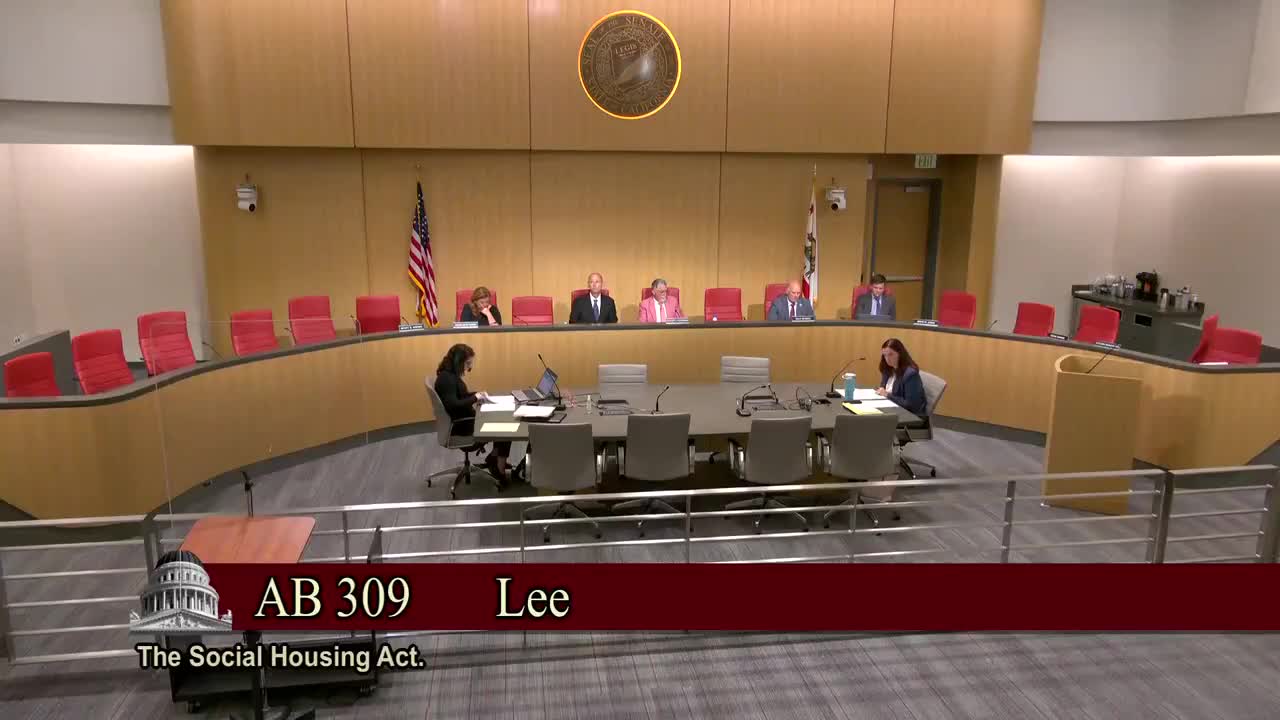 2MIN
Senate Standing Committee on Appropriations
 26MIN
Senate Standing Committee on Governance and Finance
 17MIN
Senate Standing Committee on Elections and Constitutional Amendments
 2MIN
Assembly Floor
 11MIN
Assembly Standing Committee on Local Government
Bill Author