AB 1381: Employment protections: call centers.
- Session Year: 2023-2024
- House: Assembly
- Latest Version Date: 2023-05-18
Current Status:
Failed
(2023-07-05: In committee: Set, second hearing. Hearing canceled at the request of author.)
Introduced
In Committee
First Chamber
In Committee
Second Chamber
Enacted
Existing law generally regulates the wages, hours, and working conditions of people employed in any occupation. Existing law creates the Division of Labor Standards Enforcement, the head of which is the Labor Commissioner. Existing law authorizes the Labor Commissioner to enforce certain notice requirements concerning a mass layoff, relocation, or termination of employees, including call center employees.
Existing law prohibits a call center employer from ordering a relocation of its call center, or one or more of its facilities or operating units within a call center, unless notice of the relocation is provided to the affected employees and the Employment Development Department, local workforce investment board, and the chief elected official of each city and county government within which the termination, relocation, or mass layoff occurs, as specified.
Existing law requires a state agency authorized to enter into contracts relating to public benefit programs, as defined, to only contract for services provided by a call center that directly serves applicants for, recipients of, or enrollees in, those public benefit programs with a contractor that certifies in its bid for the contract that the services provided under the contract and any subcontract performed under that contract, to applicants for, recipients of, or enrollees in, those public benefit programs, will be performed solely with workers employed in California, subject to certain exceptions. Existing law imposes a civil penalty, as provided, for knowingly providing false information in that certification.
This bill would require each state agency, on and after January 1, 2025, that enters a contract with a private entity specifically for call center services work to provide public or customer service for that agency or another state agency to ensure that no later than January 1, 2026, at least 90% of the call center work is conducted in California, except in specified circumstances.
This bill would also require each state agency that enters into a contract with a private entity for programs or other services, including no-fee contracts, in which call center customer support services are work is included but the contract is not specifically for call center support services, work, to prioritize the work being conducted in California. The bill would require each contract to require that no less than 50% of call center jobs be in California. For each new contract, contract extension, or contract renewal on or after January 1, 2027, the bill would require the contract to require that no less than 75% of call center work to be conducted in California. The bill would further require the Department of General Services to establish scoring incentives for those contracts, subject to certain conditions. The bill would create exceptions from these requirements for disasters and overflow work needs, as specified.
Existing law generally regulates the wages, hours, and working conditions of people employed in any occupation. Existing law creates the Division of Labor Standards Enforcement, the head of which is the Labor Commissioner. Existing law authorizes the Labor Commissioner to enforce certain notice requirements concerning a mass layoff, relocation, or termination of employees, including call center employees.
Existing law prohibits a call center employer from ordering a relocation of its call center, or one or more of its facilities or operating units within a call center, unless notice of the relocation is provided to the affected employees and the Employment Development Department, local workforce investment board, and the chief elected official of each city and county government within which the termination, relocation, or mass layoff occurs, as specified.
Existing law requires a state agency authorized to enter into contracts relating to public benefit programs, as defined, to only contract for services provided by a call center that directly serves applicants for, recipients of, or enrollees in, those public benefit programs with a contractor that certifies in its bid for the contract that the services provided under the contract and any subcontract performed under that contract, to applicants for, recipients of, or enrollees in, those public benefit programs, will be performed solely with workers employed in California, subject to certain exceptions. Existing law imposes a civil penalty, as provided, for knowingly providing false information in that certification.
This bill would require each state agency, on and after January 1, 2025, that enters a contract with a private entity specifically for call center services to provide public or customer service for that agency or another state agency to ensure that no later than January 1, 2026, at least 90% of the call center work is conducted in California, except in specified circumstances.
This bill would also require each state agency that enters into a contract with a private entity for programs or other services, including no-fee contracts, in which call center customer support services are included but the contract is not specifically for call center support services, to prioritize the work being conducted in California. The bill would require each contract to require that no less than 50% of call center jobs be in California. For each new contract, contract extension, or contract renewal on or after January 1, 2027, the bill would require the contract to require that no less than 75% of call center work to be conducted in California. The bill would create exceptions from these requirements for disasters and overflow work needs, as specified.
(a)(1)On and after January 1, 2025, each state agency that enters a contract with a private entity specifically for call center services work to provide public or customer service for that state agency or another state agency shall ensure that no later than January 1, 2026, at least 90 percent of the call center work is conducted in California, except as specified in subdivision (b). This paragraph does not apply to contracts entered into before January 1, 2025, and does not apply to contracts for programs or other services that are not call centers.
(2)For each state agency that enters into a contract with a private entity for programs or other services, including no-fee contracts, in which call center customer support services are work is included but the contract is not specifically for call center support services, work, the agency shall prioritize the work being conducted in California. Each contract shall require that no less than 50 percent of call center jobs are to be in California. For each new contract, contract extension, or contract renewal on or after January 1, 2027, the contract shall require no less than 75 percent of call center work to be conducted in California. California, including by using the scoring incentives established by the Department of General Services pursuant to subdivision (b).
(b)The Department of General Services shall establish scoring incentives for the contracts described in paragraph (2) of subdivision (a). The incentive scoring shall award private entities with 50 percent, 75 percent, and 90 percent or more of their contracted call center work associated with the state agency contract, located within the state. The incentive award shall not exceed 5 percent of the overall scoring awarded to a private entity for a contract bid.
(b)(c)(1)Notwithstanding subdivision (a), if a disaster occurs, a private entity that has contracted with the state for call center services work may utilize a call center facility outside of the state until the call centers facility within the state is operational, subject to agreement by the state agency.
(2)Notwithstanding subdivision (a), a private entity that has contracted with the state for call center services work may utilize a call center facility outside of the state for overflow for a period not to exceed 48 hours, or for a period previously approved by the state agency for that contract, to accommodate seasonal needs and avoid unreasonable, short-term costs for the state. Utilizing a call center facility outside of the state for overflow pursuant to this subdivision shall, at the state agencys request, trigger a reassessment of the forecasted volume specified in the contract within a timeframe specified by the agency.
(a)(1)On and after January 1, 2025, each state agency that enters a contract with a private entity specifically for call center services to provide public or customer service for that state agency or another state agency shall ensure that no later than January 1, 2026, at least 90 percent of the call center work is conducted in California, except as specified in subdivision (b). This paragraph does not apply to contracts entered into before January 1, 2025, and does not apply to contracts for programs or other services that are not call centers.
(2)For each state agency that enters into a contract with a private entity for programs or other services, including no-fee contracts, in which call center customer support services are included but the contract is not specifically for call center support services, the agency shall prioritize the work being conducted in California. Each contract shall require that no less than 50 percent of call center jobs are to be in California. For each new contract, contract extension, or contract renewal on or after January 1, 2027, the contract shall require no less than 75 percent of call center work to be conducted in California.
(b)(1)Notwithstanding subdivision (a), if a disaster occurs, a private entity that has contracted with the state for call center services may utilize a call center facility outside of the state until the call centers facility within the state is operational, subject to agreement by the state agency.
(2)Notwithstanding subdivision (a), a private entity that has contracted with the state for call center services may utilize a call center facility outside of the state for overflow for a period not to exceed 48 hours, or for a period previously approved by the state agency for that contract, to accommodate seasonal needs and avoid unreasonable, short-term costs for the state. Utilizing a call center facility outside of the state for overflow pursuant to this subdivision shall, at the state agencys request, trigger a reassessment of the forecasted volume specified in the contract within a timeframe specified by the agency.
|
Date
|
Status
|
|---|---|
| Jul 5, 2023 | In committee: Set, second hearing. Hearing canceled at the request of author. |
| Jun 27, 2023 | In committee: Set, first hearing. Hearing canceled at the request of author. |
| Jun 14, 2023 | Referred to Coms. on G.O. and L., P.E. & R. |
| Jun 1, 2023 | In Senate. Read first time. To Com. on RLS. for assignment. |
| May 31, 2023 | Read third time. Passed. Ordered to the Senate. (Ayes 61. Noes 15. Page 2012.) |
| May 22, 2023 | Read second time. Ordered to third reading. |
| May 18, 2023 | From committee: Amend, and do pass as amended. (Ayes 11. Noes 2.) (May 18). |
| May 18, 2023 | Read second time and amended. Ordered returned to second reading. |
| Apr 19, 2023 | In committee: Set, first hearing. Referred to APPR. suspense file. |
| Mar 22, 2023 | From committee: Do pass and re-refer to Com. on APPR. (Ayes 5. Noes 0.) (March 22). Re-referred to Com. on APPR. |
| Mar 2, 2023 | Referred to Com. on L. & E. |
| Feb 18, 2023 | From printer. May be heard in committee March 20. |
| Feb 17, 2023 | Read first time. To print. |
|
Date
|
Description
|
Location
|
Votes
|
|
|---|---|---|---|---|
| May 31, 2023 | AB 1381 Weber Assembly Third Reading | Assembly Floor |
Passed |
|
| May 18, 2023 | Do pass as amended. | Assembly Standing Committee on Appropriations |
Passed |
|
| Mar 22, 2023 | Do pass and be re-referred to the Committee on [Appropriations] | Assembly Standing Committee on Labor and Employment |
Passed |
This list shows positions taken on this bill by organizations on the date displayed, which is linked to the original source.
Positions by individuals are not included.
|
Organization
|
Position
|
Date
|
|---|---|---|
| California Chamber Of Commerce | ** Against | |
| California Labor Federation | ** Support | |
| Communications Workers of America, District 9 | ** Support | |
| Fidelity Investments | ** Against |
SENATE COMMITTEE ON GOVERNMENTAL ORGANIZATION
Senator Bill Dodd
Chair
2023 - 2024 Regular
Bill No: 1381 Hearing Date: 6/27/2023
Author: | , et al. | ||
Version: | 5/18/2023 Amended | ||
Urgency: | No | Fiscal: | Yes |
Consultant: | Felipe Lopez | ||
SUBJECT: Employment protections: call centers
DIGEST: This bill requires each state agency that enters into a contract with a private entity for call center work to ensure that no later than January 1, 2026, at least 90% of the call center work is conducted in California with specified exemptions. In addition, the bill provides that state contracts with a private entity for programs or services in which call center work is included to prioritize the work being conducted in California, as specified.
ANALYSIS:
Existing law:
- Generally regulates the wages, hours, and working conditions of people employed in any occupation.
- Creates the Division of Labor Standards Enforcement, the head of which is the Commissioner. The stated mission of the Commissioner’s Office is to ensure a just day’s pay in every workplace in the State and to promote economic justice through robust enforcement of labor laws.
- Prohibits an employer from ordering a mass layoff, relocation, or termination, as defined, at a covered establishment, as defined, without giving a written notice of the order to certain parties and entities, including the employees, the Employment Development Department (EDD), and specified local officials.
- Requires a state agency authorized to enter into contracts relating to public benefit programs to only contract for services provided by a call center that directly serves applicants for, recipients of, or enrollees in, those public benefit programs with a contractor that certifies in its bid for the contract that the services provided under the contract and any subcontract will be performed solely with workers employed in California.
- Defines a “call center” to mean a facility or other operation where employees, as their primary function, receive telephone calls or other electronic communication for the purpose of providing customer service or other related functions.
- Prohibits a call center employer from ordering a relocation of its call center, or one or more of its facilities or operating units within a call center, unless notice of the relocation is provided to the affected employees, EDD, local workforce development board, and the chief elected official of each city and county government within which the termination, relocation, or mass layoff occurs.
- Requires a state agency authorized to enter into contracts relating to public benefit programs, as defined, to only contract for services provided by a call center that directly serves applicants for, recipients of, or enrollees in, those public benefit programs with a contractor that certifies in its bid for the contract that the services provided under the contract and any subcontract performed under that contract, to applicants for, recipients of, or enrollees in, those public benefit programs, will be performed solely with workers employed in California, with specified exceptions.
- Grants, through the Small Business Procurement and Contract Act, a five percent bid preference for small businesses and microbusinesses in the award of a contract for goods, services, information technology to the state and in the construction of state facilities.
This bill:
- Requires, on and after January 1, 2025, each state agency that enters a contract with a private entity specifically for call center work to ensure that no later than January 1, 2026, at least 90% of the call center work is conducted in California. This would not apply to contracts entered into before January 1, 2025, and does not apply to contracts for programs or other services that are not call centers.
- Provides that if a disaster occurs, a private entity that has contracted with the state for call center work may utilize a call center facility outside of the state until the call center’s facility within the state is operational, subject to agreement by the state agency.
- Authorizes a private entity to utilize a call center facility outside of the state for overflow for a period not to exceed 48 hours, or for a period previously approved by the state agency for the contract, to accommodate seasonal needs and avoid unreasonable, short-term costs for the state. Utilizing a call center facility outside of the state for overflow, at the state agency’s request, triggers a reassessment of the forecasted volume specified in the contract within a timeframe specified by the agency.
- Provides that each state agency that enters into a contract with a private entity for programs or other services, including no-fee contracts, in which call center work is included but the contract is not specifically for call center work, the agency shall prioritize the work being conducted in California, including the scoring incentives established by this bill.
- Provides that for state contracts with a private entity for programs or other services, including no-fee, contracts, in which call center work is included but not the basis of the contract, the state agency shall prioritize the work being conducted in California, including by using scoring incentives, established by the Department of General Services (DGS), to be awarded to those private entities with 50%, 75%, and 90% or more of the contracted call center work located within the state. The incentive award shall not exceed five percent of the overall scoring awarded to a private entity for a contract bid.
Background
Author Statement. According to the author’s office, “the number of call centers in the state have significantly declined over the last few years by outsourcing jobs out of state or conducting massive layoffs. Call center jobs are an important economic lifeline for many communities in California. This bill supports call center workers, helps retain jobs in California, and continues to incentivize companies to invest locally.”
Declining Workforce. Customer service call centers are a significant source of employment in the United States. However, these types of jobs have been declining in the last decade. For example in 2016, Xerox announced it was expanding its call center workforce in the Philippines by 800 workers, while initiating layoffs of almost 1,000 workers at call centers in Colorado, Louisiana, Maine, North Carolina and Washington.
In addition, in 2012, T-Mobile announced its intentions to close centers in Colorado, Florida, Kansas, Pennsylvania, Oregon, and Texas resulting in the loss of 1,900 jobs. Even more workers were affected by the closings, though some were given the option of moving to different states to work in other call centers.
According to the U.S. Bureau of Labor Statistics, there are over 200,000 customer service representatives in California. This occupation generally requires short term on-the-job training, a high school diploma or equivalent, and no similar prior job experience. Nationally, these jobs are projected to decline over the next decade.
According to the author’s office, “call center jobs should be based in the communities that they serve. Strong state laws are necessary to ensure that call center jobs, of which many in the middle-class rely, are preserved.”
Unclear Implementation of Scoring Incentives. Under current law, non-IT services contracts, which most of these contracts would presumably be, state agencies generally use three methods.
The first, Invitation for Bid (IFB), is generally a written solicitation document used to solicit bid responses where suppliers are asked to provide a bid to the State’s known and detailed, clear requirements. The second, primary Request for Proposal (RFP) is when proposers must meet certain standards in their proposals and the contract is then awarded to the proposal meeting the required standards and having the lowest costs. The third, secondary RFP, is when the state agency evaluates the bids based on weighted scoring or grading system, a substantial portion of which is based on the cost for the services, and the balance of the score is based on an evaluation of the merits of the services being proposed.
Of these IFB and primary RFP’s are awarded to the lowest bidder meeting requirements so there is no point scoring. Any incentives currently in law, for instance the small business incentive, are then calculated as an adjustment to the bid amount in these two methods. Under secondary RFP’s the contract is awarded to the highest-scoring bidder, with points for cost and other factors. In this method, any incentives in current law are generally calculated as percentage of the total score.
According to DGS if state agencies are using IFB’s or primary RFP’s, there is no provision in current law for point scoring. As such, it is unclear how the language in this bill would work in those circumstances with state agencies use IFB’s or primary RFP’s.
Increase Cost to the State. This bill requires state agencies that enter into a contract with a private entity for call center work to ensure that beginning on January 1, 2026, 90% of the call center work is conducted in California. This is likely to result in significant cost to the state for a number of reasons. First, while it is unknown how many private entities would be able to fulfill this requirement, this requirement alone, at a very minimum, reduces the number of entities that will be able to bid for call center work contracts. Any reduction in the number of bidders likely increases the cost of these contracts and thus the cost to taxpayers. More significantly, since at least 90% of the work will be required to be done in California, this will likely result in significant cost for these contracts given California’s higher wages compared to other states.
Second, the bill will likely result in additional costs to state agencies because of the need to monitor and ensure whether more than 10% of call center work is conducted out of state. It is unknown what these costs will be but could be potentially significant. Once again, such a cost will increase the cost to state agencies on these types of contracts. Finally, the scoring incentives established by this bill, ignoring the implementation issues raised, automatically raise the cost of these contracts by up to five percent and again could reduce the number of bidders on these contracts.
Ultimately, supporters will argue that the cost of the bill is outweighed by the benefit of keeping and possibly creating jobs in California. Policymakers must decide if that benefit offsets the likely significant cost that the provisions of this bill is likely to have on the State of California.
Prior/Related Legislation
AB 1601 (Weber, Chapter 752, Statutes of 2022) prohibits a call center employer from ordering the relocation of its call center, as defined, unless 60 days before the order takes effect, the employer gives written notice of the order to affected employees.
AB 1677 (Weber, 2019) would have required that call center employees seeking to relocate jobs to another country give the Commissioner 120 days’ notice and would prohibit employers appearing on the Commissioner’s compiled list from receiving any state grants, guaranteed loans, or tax credits for five years. (Vetoed by Governor Newsom)
AB 2217 (Pan, 2017) would have required call center employers to notify the state and affected employees 60 days before ordering a mass layoff, relocation, or termination and would have allowed customers to request to be transferred to a call center within the United States. (Died on the Senate Inactive File)
FISCAL EFFECT: Appropriation: Fiscal Com.: Local:
SUPPORT:
Communications Workers of America, District 9 (Source)
California Labor Federation
OPPOSITION:
California Chamber of Commerce
Fidelity Investments
ARGUMENTS IN SUPPORT: According to the Communications Workers of America, District 9, “call centers are an important economic lifeline for many communities in the state of California and across the country. Call center work is accessible and provides a path to a career, with many workers spending up to 15, 20, or even 30 years in this line of work. By keeping the work in California, people live in undeserved and marginalized communities are provided long-term career path that does not require higher educations. Losing more jobs in California will not only create a negative impact on the state’s unemployment rate, but it will also create devastating impacts on communities statewide; we must do everything we can to keep call center jobs in California.”
ARGUMENTS IN OPPOSITION: According to Fidelity Investments, “Fidelity currently provides financial and recordkeeping services to numerous public entities in California, most notably the University of California. As part of those contracts, Fidelity provides high trained phone-based customer service employees to support retirement plan participants. By providing bid credits to firms that have call centers in California, AB 1381 will substantially increase the cost to service those contracts, increasing the cost to the state, taxpayers, and individual plan participants saving for their retirement or other long-term goals. Fidelity estimates that the costs of hiring and training employees in California to service our current clients, establish a physical presence in the state, and maintain those employees over ten years could cost over $84 million total. Those additional costs would be passed on to either the state entity or to the individual plan participants coming out of their retirement savings.”
According to the California Chamber of Commerce, “by deprioritizing proposed contracts with call centers outside of California, AB 1381 will increase the cost of service those contracts, increasing the cost to the state and taxpayers. It will also limit competition for those state contracts because entities without call center operations in California would be at a disadvantage and less likely to bid. Additionally, many contracts with the state have contractual requirements that specify how quickly phone calls must be answered. This means that contractors will have to employ more staff than are needed for everyday call center volume in order to ensure they can meet the service level requirements at peak times, further increasing the cost to the state due to high costs of labor in California.”
DUAL REFERRAL: Senate Governmental Organization Committee & Senate Labor, Public Employment, and Retirement Committee
ASSEMBLY THIRD READING
ATR Bill Id:AB 1381
Author:(Weber)
As Amended Ver:May 18, 2023
Majority vote
SUMMARY
Requires, on and after January 1, 2025, each state agency that enters a contract with a private entity for call center work to ensure that no later than January 1, 2026, at least 90% of the call center work is conducted in California with specified exemptions. Provides that state contracts with a private entity for programs or services in which call center work is included shall prioritize the work being conducted in California.
Major Provisions
- Requires, on and after January 1, 2025, each state agency that enters a contract with a private entity for call center work to provide public or customer service for that state agency or another state agency to ensure that no later than January 1, 2026, at least 90% of the call center work is conducted in California, with the following exceptions:
- If a disaster occurs, a private entity that has contracted with the state for call center work may utilize a call center facility outside of the state until the call center's facility within the state is operational, subject to agreement by the state agency.
- A private entity that has contracted with the state for call center work may utilize a call center facility outside of the state for overflow for a period not to exceed 48 hours, or for a period previously approved by the state agency for that contract, to accommodate seasonal needs and avoid unreasonable, short-term costs for the state. Utilizing this exception shall, at the state agency's request, trigger a reassessment of the forecasted volume specified in the contract within a timeframe specified by the agency.
- Provides that for state contracts with a private entity for programs or other services, including no-fee contracts, in which call center work is included but not the basis of the contract, the state agency shall prioritize the work being conducted in California, including by using scoring incentives, established by the Department of General Services, to be awarded to those private entities with 50%, 75%, and 90% or more of the contracted call center work located within the state.
- States that the incentives described in 2), above, shall not exceed 5% of the overall scoring awarded to a private entity for a contract bid.
COMMENTS
According to the United States Bureau of Labor Statistics, there are over 200,000 customer service representatives (equivalent to call center representatives) in California. Their median hourly wage is $21.34 an hour.[1] This occupation generally requires short term on-the-job training, a high school diploma or equivalent, and no similar prior job experience. Nationally, these jobs are projected to decline over the next decade.
According to the Author
"The number of call centers in the state have significantly declined over the last few years by outsourcing jobs out of state or conducting massive layoffs. This bill supports call center workers, helps retain jobs in California, and continue to incentivize companies to invest locally. AB 1381 will retain call center jobs in California by requiring the majority of private contracts state agencies and departments have be local vendors."
In addition, the author points out that this bill will promote economic equity because
"call centers are an important economic lifeline for many communities in the state of California and across the country. Call center work is accessible and provides a path to a career, with many workers spending up to 15, 20, or 30 years in this line of work. By keeping the work in California, people who live in underserved and marginalized communities are provided a long-term career path that does not require the higher education."
Arguments in Support
Communications Workers of America, District 9, sponsor of the bill, states "For many years the state of California used to require all call center customer service jobs to be conducted within the state. Existing law requires any state agency authorized to enter into contracts relating to public benefit programs shall only contract for services provided by a call center that directly serves applicants for, recipients of, or enrollees in, those public benefit programs with a contractor that certifies in its bid for the contract that the services provided under the contract and any subcontract performed under that contract, to applicants for, recipients of, or enrollees in, those public benefit programs, will be performed solely with workers employed in California. (Public Contract Code, Section 12140)
AB 1381 would also require contracts by a state agency or department that are not directly for call center services, but include the provision of call center services, such as no-fee contracts, to receive priority for any proposal that hosts call center jobs within California. For each of these types of contracts no less than 50% of call center jobs must be in California; and for each new contract, contract extension, or contract renewal on or after January 1, 2027, the bill would also require the contract to mandate that no less than 75% of call center work to be conducted in California."
Arguments in Opposition
The California Chamber of Commerce is opposed to the bill and states, "By requiring that firms with state contracts move their call center jobs into California, AB 1381 will increase the cost to service those contracts, increasing the cost to the state and taxpayers. It will also limit competition for those state contracts because entities without call center operations in California would be unlikely to bid. Additionally, many contracts with the state have contractual requirements that specify how quickly phone calls must be answered. This means that contractors will have to employ more staff than are needed for everyday call center volume in order to ensure they can meet the service level requirements at peak times, further increasing the cost to the state due to high costs of labor in California. Currently, contractors can have call center teams cover multiple clients so that the workload can be smoothed out over the year, saving the clients, here state entities and local governments, money. The unintended consequences of AB 1381 are costly and detrimental to California."
FISCAL COMMENTS
According to the Assembly Appropriations Committee:
- Costs of an unknown, but potentially significant amount, to the state if in-state call center requirements result in various state agencies paying more for call center services (General Fund or special fund).
- Generally, contractors are likely to attempt to recover the increased cost of preparing a more complicated bid through their bid prices. The new requirement may also deter some contractors from bidding on state contracts. In cases where a foregone contractor would have been the low bidder, the state will pay more, and remaining contractors may face less competitive pressure when bidding on contracts, thus increasing contract costs. Finally, a state agency will incur enforcement costs upon notice of a contractor's non-compliance with the in-state requirement. If identified issues are not cured, requiring eventual termination of the contract and a solicitation for new bids, the accompanying administrative and legal workload may be significant.
- Costs of an unknown amount to the Department of General Services to establish scoring incentives for contracts not specifically for call center work.
VOTES
ASM LABOR AND EMPLOYMENT: 5-0-2
YES: Kalra, Haney, Ortega, Reyes, Ward
ABS, ABST OR NV: Flora, Chen
ASM APPROPRIATIONS: 11-2-3
YES: Holden, Bryan, Calderon, Wendy Carrillo, Mike Fong, Hart, Lowenthal, Papan, Pellerin, Weber, Ortega
NO: Megan Dahle, Dixon
ABS, ABST OR NV: Mathis, Robert Rivas, Sanchez
UPDATED
VERSION: May 18, 2023
CONSULTANT: Megan Lane / L. & E. / (916) 319-2091 FN: 0000594
Data taken from May 2021. ↑
Date of Hearing: April 19, 2023
ASSEMBLY COMMITTEE ON APPROPRIATIONS
Chris Holden, Chair
ABPCA Bill Id:AB 1381
Author:(Weber) – As Introduced Ver:February 17, 2023
Policy Committee: | Labor and Employment | Vote: | 5 - 0 |
|
| ||
|
|
Urgency: No State Mandated Local Program: No Reimbursable: No
SUMMARY:
This bill requires each state agency entering into a contract beginning January 1, 2025, with a private entity specifically for call center services, to ensure by January 1, 2026, at least 90% of the call center work is conducted in California.
A state agency entering into a contract not specifically for call center services, but for which such services are included, must also prioritize the work being done in California, with no less than 50% of call center jobs in California. A contract including call center services entered into, extended, or renewed on or after January 1, 2027, must require no less than 75% of call center work to be conducted in California.
This bill allows a contractor to utilize a call center facility outside the state if a disaster occurs, subject to agreement by the contracting state agency, or to accommodate overflow for up to 48 hours or a period previously approved by the state agency.
FISCAL EFFECT:
Costs of an unknown, but potentially significant amount, to the state if in-state call center requirements result in various state agencies paying more for call center services (General Fund or special fund).
Generally, contractors are likely to attempt to recover the increased cost of preparing a more complicated bid through their bid prices. The new requirement may also deter some contractors from bidding on state contracts. In cases where a foregone contractor would have been the low bidder, the state will pay more, and remaining contractors may face less competitive pressure when bidding on contracts, thus increasing contract costs. Finally, a state agency will incur enforcement costs upon notice of a contractor’s non-compliance with the in-state requirement. If identified issues are not cured, requiring eventual termination of the contract and a solicitation for new bids, the accompanying administrative and legal workload may be significant.
COMMENTS:
- Purpose. According to the author:
The number of call centers in the state have significantly declined over the last few years by outsourcing jobs out of state or conducting massive layoffs. This bill supports call center workers, helps retain jobs in California, and continues to incentivize companies to invest locally.
- Support and Opposition. This bill is sponsored by the Communications Workers of America, District 9, which argues keeping accessible call center work in California provides underserved and marginalized communities “a long-term career path that does not require higher education.” This bill is also supported by the California Labor Federation.
This bill is opposed by the California Chamber of Commerce, which argues requiring firms with state contracts to move call center jobs into California “will increase the cost to service those contracts, increasing the cost to the state and taxpayers.” For example, contractors could no longer utilize national call center teams covering multiple clients to smooth out California-based workload at peak times.
- In-State Call Center Requirements. Existing law requires a state agency authorized to enter into contracts relating to public benefit programs to obtain certification that a contract for beneficiary call center services will be performed solely by California workers. However, this requirement applies to the CalWORKs, CalFresh, Medi-Cal, Healthy Families, and California Healthcare Eligibility, Enrollment, and Retention System programs only. This bill applies in-state call center requirements across all state agencies. A state contract specifically for call center services must ensure, by January 1, 2026, at least 90% of the work is conducted in California. A state contract for programs or other services, in which call center customer support services are included, must also ensure at least 50% of call center jobs are in California, increasing to at least 75% of call center work for contracts beginning January 1, 2027.
- Clarifying Amendments. As noted in the Committee on Labor and Employment’s analysis of this bill, the author intends to amend this bill to utilize “call center work” as conforming terminology throughout the bill. The author also intends to specify an effective date of January 1, 2025, for this bill’s 50% in-state requirement.
- Prior Legislation. AB 1601 (Weber), Chapter 752, Statutes of 2022, prohibited a call center employer from relocating the call center outside the state, unless notice of relocation is provided to affected employees and specified government entities. AB 1601 originally included in-state call center requirements similar to this bill, but those provisions were stricken upon AB 1601’s passage from the Senate Committee on Appropriations’ suspense file.
Analysis Prepared by: Irene Ho / APPR. / (916) 319-2081
Date of Hearing: March 22, 2023
ASSEMBLY COMMITTEE ON LABOR AND EMPLOYMENT
Ash Kalra, Chair
ABPCA Bill Id:AB 1381 (
Author:Weber) – As Introduced Ver:February 17, 2023
SUBJECT: Employment protections: call centers
SUMMARY: Requires, on and after January 1, 2025, each state agency that enters a contract with a private entity for call center services to ensure that no later than January 1, 2026, at least 90 percent of the call center work is conducted in California with specified exemptions. Provides that state contracts with a private entity for programs or services in which call center customer support services are included shall require that no less than 50 percent of the call center jobs be in state. Specifically, this bill:
- Requires, on and after January 1, 2025, each state agency that enters a contract with a private entity for call center services to provide public or customer service for that state agency or another state agency to ensure that no later than January 1, 2026, at least 90 percent of the call center work is conducted in California, with the following exceptions:
- If a disaster occurs, a private entity that has contracted with the state for call center services may utilize a call center facility outside of the state until the call center’s facility within the state is operational, subject to agreement by the state agency.
- A private entity that has contracted with the state for call center services may utilize a call center facility outside of the state for overflow for a period not to exceed 48 hours, or for a period previously approved by the state agency for that contract, to accommodate seasonal needs and avoid unreasonable, short-term costs for the state. Utilizing this exception shall, at the state agency’s request, trigger a reassessment of the forecasted volume specified in the contract within a timeframe specified by the agency.
- Provides that for state contracts with a private entity for programs or other services, including no-fee contracts, in which call center customer support services are included but not the basis of the contract, the state agency shall require that no less than 50 percent of call center jobs are in California. For each new contract, contract extension, or contract renewal on or after January 1, 2027, the contract shall require no less than 75 percent of call center work to be conducted in California.
EXISTING LAW:
- Authorizes the State Labor Commissioner to enforce certain notice requirements concerning a mass layoff, relocation, or termination of employees. Labor Code § 1406(b).
- Defines a call center to mean a facility or other operation where employees, as their primary function, receive telephone calls or other electronic communication for the purpose of providing customer service or other related functions. Labor Code § 1409 (b)(1).
- Prohibits a call center employer from ordering a relocation of its call center, or one or more of its facilities or operating units within a call center, unless notice of the relocation is provided to the affected employees, the Employment Development Department (EDD), local workforce development board, and the chief elected official of each city and county government within which the termination, relocation, or mass layoff occurs. Labor Code § 1410(a).
- Requires a state agency authorized to enter into contracts relating to public benefit programs, as defined, to only contract for services provided by a call center that directly serves applicants for, recipients of, or enrollees in, those public benefit programs with a contractor that certifies in its bid for the contract that the services provided under the contract and any subcontract performed under that contract, to applicants for, recipients of, or enrollees in, those public benefit programs, will be performed solely with workers employed in California, with specified exceptions. Public Contract Code § 12140.
- Provides a civil penalty for knowingly providing false information in the contractor certification in 4) above. Public Contract Code § 12140.
FISCAL EFFECT: Unknown
COMMENTS: According to the U.S. Bureau of Labor Statistics, there are over 200,000 customer service representatives (equivalent to call center representatives) in California. Their median hourly wage is $21.34 an hour.[1] This occupation generally requires short term on-the-job training, a high school diploma or equivalent, and no similar prior job experience. Nationally, these jobs are projected to decline over the next decade.
According to the author, “The number of call centers in the state have significantly declined over the last few years by outsourcing jobs out of state or conducting massive layoffs. This bill supports call center workers, helps retain jobs in California, and continue to incentivize companies to invest locally. AB 1381 will retain call center jobs in California by requiring the majority of private contracts state agencies and departments have be local vendors.”
In addition, the author points out that this bill will promote economic equity because
“call centers are an important economic lifeline for many communities in the state of California and across the country. Call center work is accessible and provides a path to a career, with many workers spending up to 15, 20, or 30 years in this line of work. By keeping the work in California, people who live in underserved and marginalized communities are provided a long-term career path that does not require the higher education.”
Committee Comments
The author anticipates amending the bill subsequent to this committee to clarify the following in subsection 1412.1(a)(2):
- Contracts covered by this subsection are for call center work and not “call center customer support services.”
- Any reference to “call center jobs” will be changed to “call center work.”
- An effective date of January 1, 2025, will be added to the requirement that no less than 50 percent of the call center work be in state.
Arguments in Support
Communications Workers of America, District 9, sponsor of the bill, states “For many years the state of California used to require all call center customer service jobs to be conducted within the state. Existing law requires any state agency authorized to enter into contracts relating to public benefit programs shall only contract for services provided by a call center that directly serves applicants for, recipients of, or enrollees in, those public benefit programs with a contractor that certifies in its bid for the contract that the services provided under the contract and any subcontract performed under that contract, to applicants for, recipients of, or enrollees in, those public benefit programs, will be performed solely with workers employed in California. (Public Contract Code, § 12140)
AB 1381 would also require contracts by a state agency or department that are not directly for call center services, but include the provision of call center services, such as no-fee contracts, to receive priority for any proposal that hosts call center jobs within California. For each of these types of contracts no less than 50% of call center jobs must be in California; and for each new contract, contract extension, or contract renewal on or after January 1, 2027, the bill would also require the contract to mandate that no less than 75% of call center work to be conducted in California.”
Arguments in Opposition
The California Chamber of Commerce is opposed to the bill and states, “By requiring that firms with state contracts move their call center jobs into California, AB 1381 will increase the cost to service those contracts, increasing the cost to the state and taxpayers. It will also limit competition for those state contracts because entities without call center operations in California would be unlikely to bid. Additionally, many contracts with the state have contractual requirements that specify how quickly phone calls must be answered. This means that contractors will have to employ more staff than are needed for everyday call center volume in order to ensure they can meet the service level requirements at peak times, further increasing the cost to the state due to high costs of labor in California. Currently, contractors can have call center teams cover multiple clients so that the workload can be smoothed out over the year, saving the clients, here state entities and local governments, money. The unintended consequences of AB 1381 are costly and detrimental to California.”
Prior Legislation
AB 1601 (Weber) Chapter 752, Statutes of 2022, authorizes the LC to enforce certain notice requirements concerning a mass layoff, relocation, or termination of employees, including call center employees and prohibits a call center employer from ordering a relocation of its call center, or one or more of its facilities or operating units within a call center, unless notice of the relocation is provided to the affected employees and a number of state and local agencies.
AB 1677 (Weber, S) of 2019 would have required that call center employers seeking to relocate jobs to another country give the Labor Commissioner 120 days’ notice and would prohibit employers appearing on the Commissioner’s compiled list of call center job exporters from receiving any state grants, guaranteed loans, or tax credits for five years. AB 1677 required all state contracted call center work to be performed in California, with certain exceptions. The bill was vetoed by Governor Newsom.
AB 2217 (Pan) of 2012 would have required call center employers to notify the state and affected employees 60 days before ordering a mass layoff, relocation, or termination and would have allowed customers to request to be transferred to a call center within the United States. The bill died in the Assembly Labor and Employment Committee.
REGISTERED SUPPORT / OPPOSITION:
Support
Communications Workers of America, District 9 (Sponsor)
California Labor Federation
Oppose
CalChamber
Analysis Prepared by: Megan Lane / L. & E. /
Data taken from May 2021. ↑
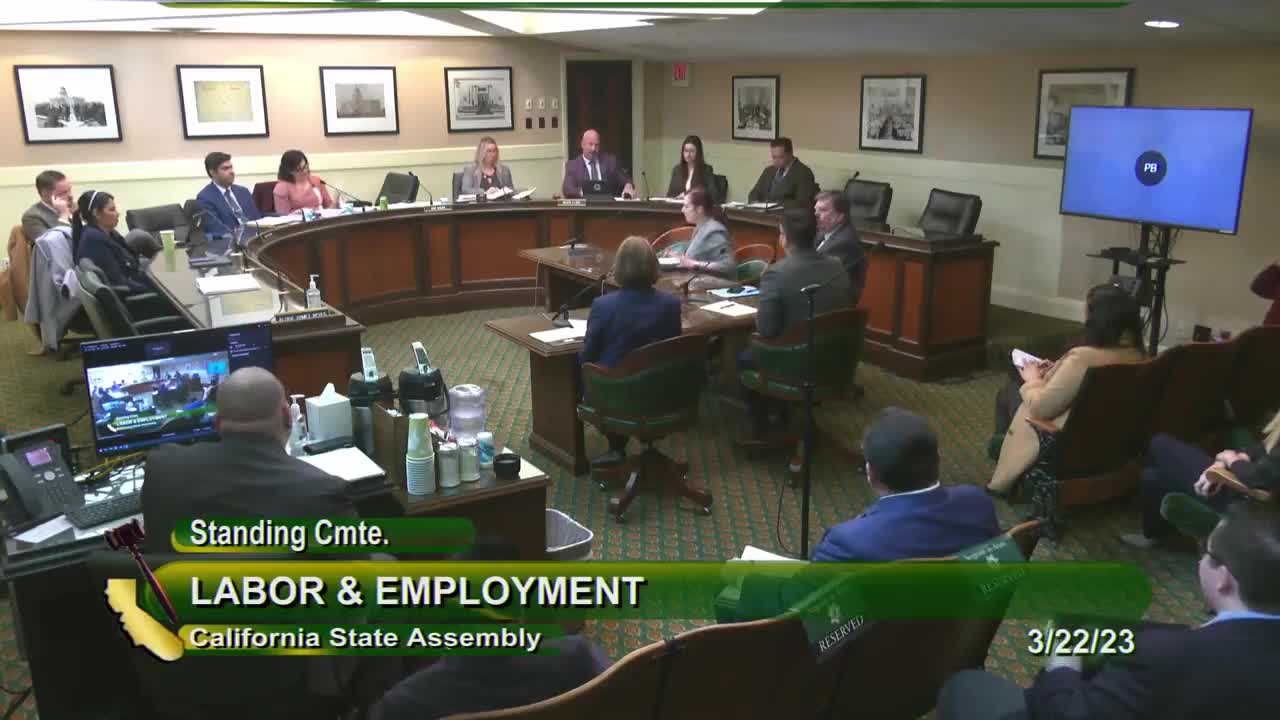
Discussed in Hearing
 7MIN
Assembly Standing Committee on Labor and Employment
Bill Author