AB 2029: Electric vehicle charging stations assessment.
- Session Year: 2023-2024
- House: Assembly
- Latest Version Date: 2024-04-22
Current Status:
Failed
(2024-05-16: In committee: Held under submission.)
Introduced
In Committee
First Chamber
In Committee
Second Chamber
Enacted
What does this bill do?
The bill requires the California Energy Commission to every two years assess whether electric vehicle charging stations installed on or after January 1, 2024 that received state incentives or ratepayer funding meet accessibility requirements for people with disabilities. The review must be done with relevant state and federal agencies, consider the California Building Standards Code (Title 24) and federal accessibility guidance, and be reported to the Legislature alongside the state's electric‑vehicle charging infrastructure updates.
The summary is provided by generative AI which can make mistakes. For original language, please view the details in the table below.
Existing law declares that it is the policy of the state to promote and encourage the use of electric vehicle charging stations and hydrogen-fueling stations and to limit obstacles to their use. Existing law requires the State Energy Resources Conservation and Development Commission (Energy Commission), working with the State Air Resources Board and the Public Utilities Commission, to prepare, and update at least once every 2 years, a statewide assessment of the electric vehicle charging infrastructure needed to support the levels of electric vehicle adoption required for the state to meet its goals of putting at least 5,000,000 zero-emission vehicles on California roads by 2030 and of reducing emissions of greenhouse gases to 40% below 1990 levels by 2030.
This bill would require the Energy Commission, beginning January 1, 2025, to biennially conduct a study on electric vehicle charging stations, as provided. The bill would require the study to adhere to certain criteria, including, among other things, that the study include information on whether electric vehicle charging stations have a feature to call or prompt an attendant to assist the customer with the operation of the electric vehicle charging station equipment and whether electric vehicle charging stations have attendants present to provide assistance. The bill would require the commission to incorporate the information and recommendations required to be included in the study into the statewide assessment of the electric vehicle charging infrastructure described above and to concurrently provide a report of the study to the Legislature, as provided. an assessment, in consultation with applicable state and federal agencies, of the abidance of electric vehicle charging stations, as defined, with electric vehicle charging station-related accessibility requirements and related guidance from relevant state and federal agencies, as provided. The bill would require the biennial assessment to include a biennial report, and would require the Energy Commission to submit the report to the Legislature concurrently with the Energy Commissions updates to the statewide assessment of the electric vehicle charging infrastructure. The bill would repeal these provisions on January 1, 2036.
Existing law declares that it is the policy of the state to promote and encourage the use of electric vehicle charging stations and hydrogen-fueling stations and to limit obstacles to their use. Existing law requires the State Energy Resources Conservation and Development Commission (Energy Commission), working with the State Air Resources Board and the Public Utilities Commission, to prepare, and update at least once every 2 years, a statewide assessment of the electric vehicle charging infrastructure needed to support the levels of electric vehicle adoption required for the state to meet its goals of putting at least 5,000,000 zero-emission vehicles on California roads by 2030 and of reducing emissions of greenhouse gases to 40% below 1990 levels by 2030.
This bill would require the Department of Transportation Energy Commission, beginning January 1, 2025, to biennially conduct a study on public access to electric vehicle charging stations, as provided. The bill would require the study to adhere to certain criteria, including, among other things, that the study include information on whether electric vehicle charging stations have a feature to call or prompt an attendant to assist the customer with the operation of the electric vehicle charging station equipment and whether electric vehicle charging stations have attendants present to provide assistance. The bill would require the department to submit a report based on the study to the Legislature on or before January 1, 2025. commission to incorporate the information and recommendations required to be included in the study into the statewide assessment of the electric vehicle charging infrastructure described above and to concurrently provide a report of the study to the Legislature, as provided. The bill would repeal these provisions on January 1, 2036.
Existing law declares that it is the policy of the state to promote and encourage the use of electric vehicle charging stations and hydrogen-fueling stations and to limit obstacles to their use.
This bill would require the Department of Transportation to conduct a study on public access to electric vehicle charging stations, as provided. The bill would require the department to submit a report based on the study to the Legislature on or before January 1, 2025.
(a)For purposes of this section, the following definitions apply:
(1)Commission means the State Energy Resources Conservation and Development Commission.
(2)Electric vehicle charging station means an electric vehicle charging station that is under state control or operation. installed on or after January 1, 2024, that received an incentive from a state agency or through a charge on ratepayers.
(b)(1)The commission, beginning January 1, 2025, shall biennially conduct a study on electric vehicle charging stations that reports information and recommendations on electric vehicle charging stations, and the commission shall incorporate the information and recommendations into the updates of the statewide assessment of electric vehicle charging infrastructure required pursuant to Section 25229 of the Public Resources Code. The study shall adhere to the following criteria: assess, in consultation with applicable state agencies, including, but not limited to, the Department of General Services and the California Building Standards Commission, and applicable federal agencies, including, but not limited to, the federal Access Board, the abidance of electric vehicle charging stations with electric vehicle charging station-related accessibility requirements, including, but not limited to, the California Building Standards Code (Title 24 of the California Code of Regulations) and related guidance of the California Building Standards Commission, and other guidance from relevant state and federal agencies, including guidance issued after the effective date of this chapter.
(A)The study shall include an analysis of architectural, design, or programmatic barriers that people with mobility, sensory, or other types of disabilities may encounter when trying to access an electric vehicle charging station and recommendations, including legislative recommendations, on how to remove barriers or prevent barriers from occurring.(B)The study shall include, after the commission has worked with applicable state agencies, including, but not limited to, the Department of Transportation, the Department of General Services, and the California Building Standards Commission, any applicable regulations and information on how the reports recommendations, if any, conflict with or would impact those regulations.(C)The study shall include information on whether electric vehicle charging stations have a feature to call or prompt an attendant to assist the customer with the operation of the electric vehicle charging station equipment and whether electric vehicle charging stations have attendants present to provide assistance.(2)The biennial study assessment shall include a biennial report that shall be submitted to the Legislature concurrently with the commissions incorporation of the information and recommendations into the updates of the statewide assessment of the electric vehicle charging infrastructure.
(c)(1)The commission shall submit the report required by subdivision (b) in compliance with Section 9795 of the Government Code.
(2)Pursuant to Section 10231.5 of the Government Code, this chapter shall be repealed on January 1, 2036.
(a)For purposes of this section, the following definitions apply:
(1)Department means the Department of Transportation.(1)Commission means the State Energy Resources Conservation and Development Commission.
(2)Electric vehicle charging station means an electric vehicle charging station that is under state control or operation.
(b)(1)The department commission, beginning January 1, 2025, shall biennially conduct a study on public access to electric vehicle charging stations. The department shall submit a report on its findings from the study to the Legislature on or before January 1, 2025. stations that reports information and recommendations on electric vehicle charging stations, and the commission shall incorporate the information and recommendations into the updates of the statewide assessment of electric vehicle charging infrastructure required pursuant to Section 25229 of the Public Resources Code. The study shall adhere to the following criteria:
(A)The study shall include an analysis of architectural, design, or programmatic barriers that people with mobility, sensory, or other types of disabilities may encounter when trying to access an electric vehicle charging station and recommendations, including legislative recommendations, on how to remove barriers or prevent barriers from occurring.
(B)The study shall include, after the commission has worked with applicable state agencies, including, but not limited to, the Department of Transportation, the Department of General Services, and the California Building Standards Commission, any applicable regulations and information on how the reports recommendations, if any, conflict with or would impact those regulations.
(C)The study shall include information on whether electric vehicle charging stations have a feature to call or prompt an attendant to assist the customer with the operation of the electric vehicle charging station equipment and whether electric vehicle charging stations have attendants present to provide assistance.
(2)The biennial study shall include a biennial report that shall include legislative recommendations on how to improve public access to electric vehicle charging stations based on the departments findings from the study. be submitted to the Legislature concurrently with the commissions incorporation of the information and recommendations into the updates of the statewide assessment of the electric vehicle charging infrastructure.
(c)(1)The department commission shall submit the report required by subdivision (b) in compliance with Section 9795 of the Government Code.
(2)Pursuant to Section 10231.5 of the Government Code, this section chapter shall be repealed on January 1, 2029. 2036.
(a)For purposes of this section, the following definitions apply:
(1)Department means the Department of Transportation.
(2)Electric vehicle charging station means an electric vehicle charging station that is under state control or operation.
(b)(1)The department shall conduct a study on public access to electric vehicle charging stations. The department shall submit a report on its findings from the study to the Legislature on or before January 1, 2025.
(2)The report shall include legislative recommendations on how to improve public access to electric vehicle charging stations based on the departments findings from the study.
(c)(1)The department shall submit the report required by subdivision (b) in compliance with Section 9795 of the Government Code.
(2)Pursuant to Section 10231.5 of the Government Code, this section shall be repealed on January 1, 2029.
|
Date
|
Status
|
|---|---|
| May 16, 2024 | In committee: Held under submission. |
| May 8, 2024 | In committee: Set, first hearing. Referred to APPR. suspense file. |
| Apr 23, 2024 | Re-referred to Com. on APPR. |
| Apr 22, 2024 | Read second time and amended. |
| Apr 18, 2024 | From committee: Amend, and do pass as amended and re-refer to Com. on APPR. with recommendation: To Consent Calendar. (Ayes 16. Noes 0.) (April 17). |
| Mar 19, 2024 | From committee: Do pass and re-refer to Com. on U. & E. (Ayes 13. Noes 0.) (March 19). Re-referred to Com. on U. & E. |
| Mar 12, 2024 | Re-referred to Com. on TRANS. |
| Mar 11, 2024 | From committee chair, with author's amendments: Amend, and re-refer to Com. on TRANS. Read second time and amended. |
| Feb 12, 2024 | Referred to Coms. on TRANS. and U. & E. |
| Feb 2, 2024 | From printer. May be heard in committee March 3. |
| Feb 1, 2024 | Read first time. To print. |
|
Date
|
Description
|
Location
|
Votes
|
|
|---|---|---|---|---|
| Apr 17, 2024 | Do pass as amended, and be re-referred to the Committee on [Appropriations] with recommendation: To Consent Calendar | Assembly Standing Committee on Utilities and Energy |
Passed |
|
| Mar 19, 2024 | Do pass and be re-referred to the Committee on [Utilities and Energy] | Assembly Standing Committee on Transportation |
Passed |
This list shows positions taken on this bill by organizations on the date displayed, which is linked to the original source.
Positions by individuals are not included.
Date of Hearing: May 8, 2024
ASSEMBLY COMMITTEE ON APPROPRIATIONS
Buffy Wicks, Chair
ABPCA Bill Id:AB 2029
Author:(Jackson) – As Amended Ver:April 22, 2024
Policy Committee: | Transportation | Vote: | 13 - 0 |
Utilities and Energy | 16 - 0 | ||
|
|
Urgency: No State Mandated Local Program: No Reimbursable: No
SUMMARY:
This bill requires the Energy Commission, beginning January 1, 2025, and every other year thereafter, and in consultation with applicable state and federal agencies, to assess the abidance of electric vehicle charging (EV) stations with EV charging station-related accessibility requirements. The commission’s assessment is to cover each EV charging station installed on or after January 1, 2024, that received an incentive from a state agency or through a charge on ratepayers. The bill requires the commission to report its assessments to the Legislature concurrent with the commission’s updates of the statewide assessment of the EV charging infrastructure.
FISCAL EFFECT:
This bill will entail work, and therefore costs, to the Energy Commission. The Energy Commission lacks in-house expertise on EV charging station-related accessibility requirements and, therefore, would need to contract with an outside party to conduct statewide inspections of covered EV charging stations to determine abidance with accessibility requirements. It is reasonable to expect these costs to range from the mid hundreds of thousands of dollars to several millions of dollars (Alternative and Renewable Fuels and Vehicle Technology Fund (ARFVTP)).
The Energy Commission estimates it will need to dedicate half the working time of one staff member in the classification of Energy Generation Systems Specialist to, over the course of two years, develop the request for proposal of contracts and to administer the awarding of the resulting contract or contracts, at an annual cost of $100,346 (ARFVTP). The Energy Commission estimates needing an additional $200,000 annually for personnel to administer the resulting contract or contracts, for the life of the contract or contracts (ARFVTP).
In addition, the Energy Commission estimates the cost of the third-party contract to conduct statewide inspections of covered EV charging stations to determine abidance with accessibility requirements would total between $2.4 million and $12.0 million (ARFVTP). The commission bases this estimate on roughly 20,000 chargers to be installed in 2024 using public funds and roughly 40,0000 chargers installed over the same period using ratepayer funds, resulting in between 3,000 and 6,000 EV charging sites, at a cost of between $800 and $2,000 per site inspected.
Costs to other affected state agencies to consult with the Energy Commission should be minor and absorbable.
COMMENTS:
- Purpose. The author intends this bill to provide the Legislature with information it needs to ensure EV charging stations are accessible to all. According to the author:
To truly lead in energy infrastructure, California must prioritize accessibility for all. AB 2029 proposes a crucial step: a comprehensive study of our EV charging station infrastructure. By requesting the Energy Commission's findings in a report to the Legislature, this bill ensures a deeper understanding of the needs of all Californians. It's about making sure that our charging stations are inclusive and usable by everyone who may need them. Let's act now to pave the way for a more accessible and sustainable future
- Background. The state has ambitious goals to expand deployment of EVs. This will mean a dramatic increase in deployment of EV chargers at EV charging stations, too. According to the Energy Commission, there are roughly105,000 public and shared private chargers in California today, and the commission estimates over one million public and shared private chargers are needed to support seven million light-duty EVs in 2030, and more than two million chargers are needed to support the 15 million zero-emission vehicles called for by an executive order issued by the Governor.
Anecdotal evidence and media reporting describe a dismal public charging experience for the drivers of most makes and models of EVs. State law requires the Energy Commission to develop uptime recordkeeping and reporting standards for EV chargers and EV charging stations, applicable to chargers and stations that receive state funding or ratepayer money, and to regularly assess the uptime of EV charging station infrastructure.
The California Building Code includes accessibility requirements applicable to EV chargers and EV charging stations installed in or at public buildings, public accommodations, commercial buildings and public housing. However, there is no statutory requirement that a state agency ensure or confirm compliance with these standards.
The committee is aware of neither support for nor opposition to this bill.
Analysis Prepared by: Jay Dickenson / APPR. / (916) 319-2081
Date of Hearing: April 17, 2024
ASSEMBLY COMMITTEE ON UTILITIES AND ENERGY
Cottie Petrie-Norris, Chair
ABPCA Bill Id:AB 2029 (
Author:Jackson) – As Amended Ver:March 11, 2024
SUBJECT: Electric vehicle charging stations study
SUMMARY: Requires the California Energy Commission (CEC) to prepare an assessment every two years of the barriers that people with mobility, sensory, or other types of disabilities may encounter at electric vehicle (EV) charging stations, and recommendations on how to remove or prevent those barriers.
Specifically, this bill:
- Defines the scope of “EV charging station” to mean those under state control or operation.
- Requires the CEC, beginning January 1, 2025, to incorporate into its biennial statewide assessment of electric vehicle charging infrastructure required pursuant to Section 25229 of the Public Resources Code, a study that includes:
- An analysis of architectural, design, or programmatic barriers that people with mobility, sensory, or other types of disabilities may encounter when trying to access an EV charging station and recommendations, including legislative recommendations, on how to remove barriers or prevent barriers from occurring;
- Information on how the report’s recommendations, if any, may conflict with or impact regulations at applicate state agencies, such as the Department of Transportation, the Department of General Services, and the California Building Standards Commission; and
- Information on whether EV charging stations (EVCS) have a feature to call or prompt an attendant to assist the customer with the operation of the EVCS equipment and whether EVCS have attendants present to provide assistance.
- Requires the CEC to submit the study to the Legislature concurrently with its incorporation into the statewide assessment of the EV charging infrastructure.
- Repeals provisions in this bill on January 1, 2036.
EXISTING LAW:
- Requires the CEC, working with the California Air Resources Board (CARB) and the California Public Utilities Commission (CPUC), to prepare a statewide assessment of EV charging infrastructure needed to support the levels of EV adoption required for the state to meet its goals of putting at least 5 million zero-emission vehicles (ZEVs) on California roads by 2030, and of reducing emission of greenhouse gases (GHGs) to 40% below 1990 levels by 2030. Requires (Public Resources Code § 25229)
- Requires the CEC, in consultation with the CPUC, to develop uptime recordkeeping and reporting standards for EV chargers and charging stations that were installed on or after January 1, 2024 and received an incentive from a state agency or through a charge on ratepayers. Requires the CEC to assess the uptime of charging station infrastructure and equitable access to reliable charging stations in low-, moderate-, and high-income communities. (Public Resources Code § 25231.5)
- Requires service stations to provide refueling service for persons with disabilities and to post a notice of the service provided; and entitles disabled individuals properly displaying a disabled person’s plate or placard, or a disabled veteran’s plate, to request and receive refueling service at gas stations, and not be charged more for service. (Business and Professions Code § 13660)
- Establishes accessibility regulations for EV charging stations, including requirements for location, route to the EV charger, design of the vehicle space, design of the access aisle, identification signs, operable parts, and point-of-sale devices. (Building Code, Title 24, Part 2, Chapter 11B-812)
FISCAL EFFECT: Unknown. This bill is keyed fiscal and will be referred to the Committee on Appropriations for its review.
BACKGROUND:
California zero-emission vehicle (ZEV) goals – California’s transportation sector is currently the largest source of GHG emissions in the state. In the interest of meeting the state’s emissions reduction targets, California has set a goal that 100% of new passenger vehicles sales will be ZEVs by 2035.[1] Meeting the state’s ZEV goals will require a significant increase in the number of light-, medium-, and heavy-duty ZEVs on the road and a drastic increase in the infrastructure to support these vehicles. Cumulative sales of ZEVs, which include EVs, in California reached 1.8 million in the fourth quarter of 2023, with ZEVs accounting for 25% of new car sales.[2]
To support the rapid deployment of ZEVs, in 2018, the governor set a goal of having 250,000 chargers, including 10,000 direct current fast chargers (DCFCs), operating in California by 2025.[3] Subsequently, the Legislature enacted AB 2127 (Ting, Chapter 365, Statutes of 2018), requiring the CEC to conduct an assessment every two years of the EV charging infrastructure, and associated workforce, needed to meet California’s ZEV deployment goals. In the most recent report published in 2024, the CEC projects over 1 million public and shared private chargers are needed to support 7 million light-duty EVs in 2030, and more than 2 million chargers are needed to support 15 million ZEVs anticipated under Executive Order N-79-20.[4] An additional 157,000 chargers are needed to support 180,000 medium- and heavy-duty vehicles anticipated for 2030. At present, California has approximately 105,000 public and shared private chargers, including more than 11,000 DCFCs.[5] This represents an order of magnitude difference between how many chargers are currently operating in California versus how many are needed by 2030.
Accessibility in EV charging – In 2015, the California Division of the State Architect Access Compliance (DSA-AC), housed under the Department of General Services (DGS), began drafting explicit accessibility regulations – scoping and technical provisions – for EVCS. Since being adopted into California’s Building Code in 2017,[6] these requirements are applicable to EVCS installed in or at public buildings, public accommodations, commercial buildings, and public housing. The use of EVCS generally falls into two scenarios: 1) parking style where an EV is left in a parking space to charge – usually for a period of time exceeding 30 minutes – and the driver may stay with the EV or leave the EV to conduct other activities, and 2) drive-up style where the EV driver pulls up next to an EV charger, charges for a short period of time during which the driver often stays with the vehicle, then proceeds forward to depart. Drive-up EVCS are used in a similar fashion to gasoline fueling stations and may allow for queuing of other EVs. The building codes contain similar but distinct requirements for these two types of facilities, specifying for both a minimum number of EVCS that must provide compliant operable parts and point-of-sale devices, clear floor space, ground surfaces, vertical clearance, vehicle spaces, access aisles, identification signs, and surface markings.
The U.S. Access Board is an independent federal agency that issues accessibility guidelines under the American with Disabilities Act (ADA), the Architectural Barriers Act (ABA), the Rehabilitation Act of 1973, and other laws. The ADA covers all public places and commercial facilities, including state and local government spaces. Following the passage of the federal Bipartisan Infrastructure Law, which dedicated funding to the development of a national network of 500,000 EVCS, the U.S. Access Board developed a technical assistance document that reviewed existing requirements and provided recommendations for making EVCS accessible to everyone, including people with disabilities.[7] In this document, the Board highlights some considerations not yet addressed in California’s Building Code, such as: factoring in charger cord length to the positioning of a charger; providing a variety of access aisle locations and charger configurations to serve multiple types of EVs with various vehicle charging inlet locations; and mechanisms to get customer service or help support (which is an existing requirement maintained for chargers that receive(d) funding from the National Electric Vehicle Infrastructure Formula Program)[8]. The Board intends to publish a notice of proposed rulemaking on accessibility guidelines for EV charging stations, but they have not provided a target date for that notice.[9]
COMMENTS:
- Author’s statement. According to the author, “To truly lead in energy infrastructure, California must prioritize accessibility for all. AB 2029 proposes a crucial step: a comprehensive study of our EV charging station infrastructure. By requesting the Energy Commission's findings in a report to the Legislature, this bill ensures a deeper understanding of the needs of all Californians. It's about making sure that our charging stations are inclusive and usable by everyone who may need them. Let's act now to pave the way for a more accessible and sustainable future.”
- Which chargers are we talking about? This bill limits the scope of EV charging stations assessed to those under state control or operation. The Department of General Services (DGS) reports that it has 3,257 charging ports installed at state owned and leased facilities.[10] Of these ports, 363 are publicly accessible. Given how unrepresentative the data extracted from this small population of charging stations likely would be for the broader population of public and shared private charger users, this committee recommends amending the scope of “EV charging stations” to align with those that already have reporting requirements under AB 2061 (Ting, Chapter 345, Statutes of 2022), encompassing EVCS installed on or after January 1, 2024 that received state or ratepayer funding.
- What is not being done already? This bill would require a biennial study of barriers that people with disabilities may encounter when trying to access an EVCS and subsequent recommendations on how to remove or prevent those barriers. This may be duplicative of efforts ongoing at DGS and U.S. Access Board to provide accessibility guidelines and requirements for EVCS. As such, the committee recommends amending the study into a report on the level of abidance to EVCS-related accessibility requirements and guidance, in consultation with applicable state agencies such as DGS and the California Building Standards Commission and federal agencies such as the U.S. Access Board.
Additionally, this bill would require the study to include information on whether charging stations have attendants present to provide assistance and whether the chargers have a feature to call or prompt the attendant. Unlike gas stations where an attendant may be available to assist with refueling vehicles, EVCS are often unattended, according to the U.S. Access Board.7 Since attendants are not required under current state guidelines, it is likely a study on attendant presence would yield little information. Without precluding an evaluation of abidance should attendants be required or encouraged to staff EVCS in the future, the committee recommends striking the provision requiring an evaluation of whether attendants are present at EVCS from this bill.
- Prior legislation.
AB 126 (Reyes and Gonzalez) reauthorized fees that fund the Air Quality Improvement Program, the Clean Transportation Program, and the Enhanced Fleet Modernization Program. Among other changes, required the CEC to, with regards to EVCS installed on or after January 1, 2024 that received state funding or ratepayer money, to adopt tools to increase uptime and recordkeeping at those stations and to set standards for how those stations shall notify customers about their availability and accessibility. Status: Chapter 319, Statutes of 2023.
AB 1529 (Gabriel) would have required the CEC to conduct a statewide assessment on the suitability of gasoline stations for conversion into EV charging stations and the potential barriers to this conversion. Status: Died in Assembly Transportation Committee in January 2024.
AB 2703 (Muratsuchi) would have required the CEC to establish reliability standards for EV chargers that receive state funds; and a program to provide financial assistance to low-income and disadvantaged community members to use EV chargers. Also would have required a recipient of state funding for deployment of a publicly available EV charging station, as a condition of receiving the incentive, to operate the station in compliance with the developed reliability standards. Status: Died in Senate Appropriations Committee in August 2022.
AB 2061 (Ting and Reyes) required the CEC to develop uptime recordkeeping and reporting standards for EVCS that received state funding or ratepayer money and are installed on or after January 1, 2024. Status: Chapter 345, Statutes of 2022.
AB 2127 (Ting) required the CEC to conduct a statewide assessment every two years of EV charging infrastructure needed to support the levels of EV adoption required for the state to meet its goals of putting at least five million zero-emission vehicles (ZEVs) on the road and reducing greenhouse gas (GHG) emissions 40% below 1990 levels by 2030. Status: Chapter 364, Statutes of 2018.
- Double referral. This bill was previously heard in the Assembly Committee on Transportation on March 19, 2024, where it passed 13-0-2.
REGISTERED SUPPORT / OPPOSITION:
Support
None on file.
Opposition
None on file.
Analysis Prepared by: Kathleen Chen / U. & E. / (916) 319-2083
Executive Order N-79-20 ↑
CEC; “New ZEV Sales in California”; https://www.energy.ca.gov/data-reports/energy-almanac/zero-emission-vehicle-and-infrastructure-statistics/new-zev-sales. ↑
Executive Order B-48-18 ↑
CEC; Assembly Bill 2127 Second Electric Vehicle Charging Infrastructure Assessment; February 2024. ↑
CEC; “Electric Vehicle Chargers in California”; https://www.energy.ca.gov/data-reports/energy-almanac/zero-emission-vehicle-and-infrastructure-statistics/electric-vehicle. ↑
Building Code, Title 24, Part 2, Chapter 11B-812 ↑
U.S. Access Board; Design Recommendations for Accessible Electric Vehicle Charging Stations; February 2022. ↑
23 CFR ↑
3014-AA48, Architectural and Transportation Barriers Compliance Board, https://www.reginfo.gov/public/do/eAgendaViewRule?pubId=202310&RIN=3014-AA48. ↑
Per data request to the committee on April 5th, 2024 from DGS. ↑
Date of Hearing: March 19, 2024
ASSEMBLY COMMITTEE ON TRANSPORTATION
Lori D. Wilson, Chair
ABPCA Bill Id:AB 2029 (
Author:Jackson) – As Amended Ver:March 11, 2024
SUBJECT: Electric vehicle charging stations study.
SUMMARY: Requires the California Energy Commission (CEC) to conduct every two years a study of barriers, and potential improvements that people with mobility, sensory, or other types of disabilities may encounter when trying to access an electric vehicle (EV) charging station. Specifically, this bill:
- Beginning January 1, 2025, requires the CEC to conduct a study biennially on accessibility of EV charging stations, and incorporate the information and recommendations into currently required updates of the CEC’s statewide assessment of electric charging infrastructure, and provide a report on this study to the Legislature.
- Requires the study to adhere to the following criteria:
- Include an analysis of any architectural, design, or programmatic barriers that people with mobility, sensory, or other types of disabilities may encounter when trying to access an EV charging station and recommendations, including legislative recommendations, how to remove or prevent those barriers;
- Include information on whether EV charging stations have a feature to call or prompt an attendant to assist the customer with the equipment operation and whether EV charging stations have attendants present to provide assistance; and,
- Requires CEC to work with applicable state agencies, including but not limited to the California Department of Transportation (Caltrans), California Department of General Services (DGS), and the California Building Standards Commission (BSC) to understand the current regulations and applicable regulations and information on how the report’s recommendations, if any, conflict with or would impact those regulations.
- Requires the study to be submitted to the Legislature concurrently with the CEC’s incorporation of the information and recommendations into the updates of the statewide assessment of the EV charging infrastructure.
- Provisions in this bill are repealed on January 1, 2036.
EXISTING LAW:
- Requires CEC, working with the State Air Resources Board (CARB) and the California Public Utilities Commission (CPUC), to prepare a statewide assessment of EV charging infrastructure needed to support the levels of EV adoption required for the state to meet its goals of putting at least 5 million zero-emission vehicles (ZEVs) on California roads by 2030, and of reducing emissions of GHGs to 40% below 1990 levels by 2030. (Public Resources Code (PRC) Section 25229)
- Requires service stations to provide refueling service for persons with disabilities and to post a notice of the service provided. (Business and Professions Code (BPC) 13660)
- Entitles disabled individuals properly displaying a disabled person’s plate or placard, or a disabled veteran’s plate, to request and receive refueling service at gas stations, and not be charged more for service. (BPC 13660)
FISCAL EFFECT: Unknown
COMMENTS: California’s transportation sector is currently the largest source of greenhouse gas (GHG) emissions in the state and, in the interest of meeting the state’s emissions reduction targets, California has set a goal that 100% of new passenger vehicles sales will be ZEVs by 2035. ZEV is an umbrella term encompassing hydrogen fuel cell electric vehicles (FCEV), battery electric vehicles (BEVs), and plug-in hybrid electric vehicles. To meet the state’s ZEV goals will require a significant increase in the number of light-, medium-, and heavy-duty ZEVs on the road and a drastic increase in the infrastructure to support these vehicles. Cumulative sales of ZEVs in California reached 1.8 million in the fourth quarter of 2023, with ZEVs accounting for 25% of new car sales.
Executive Order (EO) N-79-20 establishes the goal that 100% of new passenger vehicles sales in California will be ZEVs by 2035. Increased adoption of battery electric vehicles necessitates a corresponding increase in the supporting charging infrastructure. Deploying more charging stations will increase consumer confidence in locating charging stations and transitioning to battery electric vehicles.
For passenger vehicle charging in 2030, the AB 2127 Electric Vehicle Charging Infrastructure Assessment projects over 700,000 public and shared private chargers are needed to support 5 million ZEVs, and nearly 1.2 million chargers needed to support about 8 million ZEVs anticipated under Executive Order N-79-20. An additional 157,000 chargers are needed to support 180,000 medium- and heavy-duty vehicles anticipated for 2030.
Although statewide data on charging stations’ performance does not exist, anecdotally the charging experience for drivers is unreliable. Drivers face situations where publicly available charging stations charge at far slower speeds than displayed, are broken upon arrival, incorrectly advertised by operators, or fail to charge when plugged in. In 2020, Plug In America surveyed over 4,000 EV owners and 54% reported experiencing problems with public charging, with broken chargers being the most common issue.
EV Charging Assessment. AB 2127 (Ting), Chapter 365, Statutes of 2018 requires CEC to conduct an assessment every two years of the EV charging infrastructure needed to meet California’s ZEV deployment goals. Under existing law, this assessment must consider all the charging infrastructure and other technologies needed to meet these goals and an assessment of the workforce needed to support charging infrastructure deployment.
This bill requires the CEC to evaluate, as part of this assessment, any architectural, design, or programmatic barriers that people with mobility, sensory, or other types of disabilities may encounter when trying to access an electric vehicle charging station and ways to remove or prevent those barriers and whether EV charging stations have a feature to call or prompt an attendant to assist with the operation of the EV charging station equipment. This bill requires the CEC to work with California Building Standards Commission (Cal Green), DGS, and Caltrans to analyze the current regulations and their impact on the report's recommendations regarding accessibility for people with disabilities.
Accessibility in EV Charging. In 2023, the U.S. Department of Transportation found that the American with Disability Act (ADA) standards do not fully address EV technologies. The U.S. Access Board, an independent federal agency that issues accessibility guidelines under the ADA, the Architectural Barriers Act (ABA), the Rehabilitation Act of 1973, and other laws, has provided a technical assistance document to assist in the design and construction of EV charging stations that are accessible to and usable by people with disabilities. The ADA covers entities including state and local governments (Title II) and places of public accommodation and commercial facilities (Title III). Under the ADA, the Access Board issues minimum scoping and technical requirements.
U.S. Access Board recommends that EV chargers designed to serve people who use mobility devices must be located on an accessible route and should provide a vehicle charging space at least 11 feet wide and 20 feet long. The chargers also must provide an adjoining access aisle at least five feet wide, clear floor or ground space at the same level as the vehicle charging space, and be positioned for an unobstructed side reach, and accessible operable parts, including on the charger and connector.
Some examples of EV charging stations that may be covered under the ADA or ABA include those installed at; state or local government offices, public parks, municipal building parking lots, street parking and the public right-of-way, residential housing facilities provided by a state or local government, public EV charging stations provided by a private entity, fleet charging stations used by the federal government, commercial fleet charging stations available to corporate clients, rest stops along the Interstate Highway System.
Additionally, BSC has adopted some accessibility standards for electric vehicle charging stations, which became effective in 2017. These standards include updated definitions, scope for accessibility, and technical requirements.
Given ongoing work at the state and federal level on accessibility standards, this bill may overlap or conflict with the existing regulatory recommendations.
Attendants at EV Charging Stations. Service stations are currently required to provide refueling service to individuals appropriately designated as disabled. If a service station does not provide service for disabled individuals, a placard must be posted indicating so.
Deployment of EV charging stations has been entirely different than that of gasoline fueling service stations. Where gasoline station generally have numerous pumps, EV charging sometimes only has one or two chargers installed in a retail parking lot, or several chargers or more installed in a parking garage. EV charging infrastructure rarely has an attendant or other options for assistance that could be readily available to anyone including a disabled person.
This bill adds a statewide reporting requirement on whether EV charging stations have a call feature and attendant to assist in the use of the charging infrastructure. The Legislature and state may want to consider more broadly which additional service requirements it would like to have associated with EV charging infrastructure before requiring the state to report specifically on the availability of attendants and call features.
Further refinement needed. The federal government is currently working on ADA requirements for EV charging, therefore the requirements of this study may be premature. Additionally, this bill adds reporting complexity by creating a separate report that must be submitted to the Legislature and also incorporated into the state’s assessment of EV charging infrastructure.
According to the author, “To truly lead in energy infrastructure, California must prioritize accessibility for all. AB 2029 proposes a crucial step: a comprehensive study of our EV charging station infrastructure. By requesting the Energy Commission's findings in a report to the Legislature, this bill ensures a deeper understanding of the needs of all Californians. It's about making sure that our charging stations are inclusive and usable by everyone who may need them. Let's act now to pave the way for a more accessible and sustainable future.”
Double referral. This bill will be heard in the Assembly Committee on Utilities and Energy, should it pass this committee.
Previous legislation. AB 2703 (Muratsuchi of 2022), requires a person who receives state funding or other incentives to deploy ZEV infrastructure to agree, as a condition of receiving the incentive, to operate the station in compliance with reliability standards that would be developed by CEC. AB 2703 also requires CEC, upon appropriation by the Legislature, to develop a program to provide financial assistance to low-income and disadvantaged community members to use ZEV infrastructure, micromobility transportation options, and ridesharing services, as specified.
AB 2061 (Ting and Reyes), Chapter 345, Statutes of 2022, requires the CEC to develop uptime recordkeeping and reporting standards for EV chargers and charging stations, as specified, and limits applicability to chargers and stations that receive state funding or ratepayer money.
SB 589 (Hueso), Chapter 732, Statutes of 2021, among other provisions, incorporates workforce development as a resource the CEC must evaluate part of its regular assessment of resources needed to meet state ZEV deployment goals.
SB 129 (Skinner), Chapter 65, Budget Act of 2021, among other provisions, requires CEC to collect data from recipients of ZEV infrastructure funding.
AB 2127 (Ting), Chapter 365, Statutes of 2018, requires the California Energy Commission (CEC) to assess the amount of electric vehicle (EV) infrastructure needed to meet the goals of putting at least five million zero-emission vehicles (ZEVs) on the road and reducing greenhouse gas (GHG) emissions 40% below 1990 levels by 2030.
AB 2806 (Obernolte), of 2017, allows a vehicle with side loading lifts or ramps used for the loading or unloading of disabled persons to park in an on-street parking space that has been designated for the exclusive use of electric vehicle charging.
REGISTERED SUPPORT / OPPOSITION:
Support
None on file
Opposition
None on file
Analysis Prepared by: Julia Kingsley / TRANS. / (916) 319-2093
Discussed in Hearing
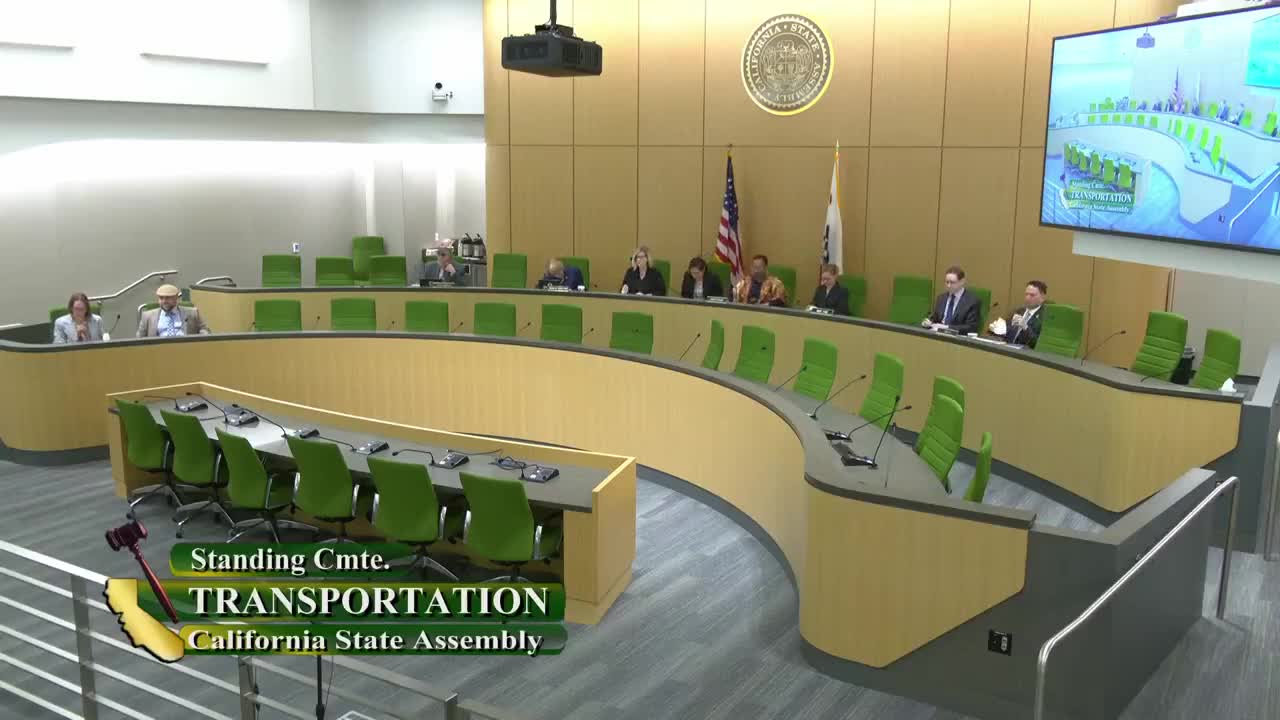 6MIN
Assembly Standing Committee on Transportation
Bill Author

Bill Co-Author(s):
