AB 2704: In-home supportive services: criminal background checks.
- Session Year: 2023-2024
- House: Assembly
- Latest Version Date: 2024-08-28
Current Status:
Failed
(2024-09-14: Vetoed by Governor.)
Introduced
In Committee
First Chamber
In Committee
Second Chamber
Enacted
Existing law establishes the In-Home Supportive Services (IHSS) program, administered by the State Department of Social Services and counties, under which qualified aged, blind, or disabled persons are provided with supportive services in order to permit them to remain in their own homes.
Existing law requires a county to investigate the background of a person who seeks to become a supportive services provider and who is not listed on the registry of a public authority or nonprofit consortium. Existing law also requires a county, by no later than July 1, 2010, to complete a criminal background check for a provider who is providing in-home supportive services prior to October 1, 2009, and who is not listed on a public authority or nonprofit consortium registry, as a condition of the providers continued enrollment in the IHSS program. Existing law requires these investigations to include criminal background checks conducted by the Department of Justice, as specified. Existing law requires these background checks to be conducted at the providers expense.
This bill would instead prohibit a provider or a person who seeks to become a provider from being assessed a fee for any investigation or criminal background check conducted pursuant to the above-described provisions. The bill would also prohibit the Department of Justice from assessing a fee to a county to cover the cost of furnishing the criminal background checks described above. To the extent the bill would create new duties for counties for the provision of criminal background checks, the bill would impose a state-mandated local program.
The California Constitution requires the state to reimburse local agencies and school districts for certain costs mandated by the state. Statutory provisions establish procedures for making that reimbursement.
This bill would provide that, if the Commission on State Mandates determines that the bill contains costs mandated by the state, reimbursement for those costs shall be made pursuant to the statutory provisions noted above.
Existing law establishes the In-Home Supportive Services (IHSS) program, administered by the State Department of Social Services and counties, under which qualified aged, blind, or disabled persons are provided with supportive services in order to permit them to remain in their own homes.
Existing law requires a county to investigate the background of a person who seeks to become a supportive services provider and who is not listed on the registry of a public authority or nonprofit consortium. Existing law also requires a county, by no later than July 1, 2010, to complete a criminal background check for a provider who is providing in-home supportive services prior to October 1, 2009, and who is not listed on a public authority or nonprofit consortium registry, as a condition of the providers continued enrollment in the IHSS program. Existing law requires these investigations to include criminal background checks conducted by the Department of Justice, as specified. Existing law requires these background checks to be conducted at the providers expense.
This bill would instead require these criminal background checks to be conducted at the countys expense. prohibit a provider or a person who seeks to become a provider from being assessed a fee for any investigation or criminal background check conducted pursuant to the above-described provisions. The bill would also prohibit the Department of Justice from assessing a fee to a county to cover the cost of furnishing the criminal background checks described above. To the extent the bill would create new duties for counties for the provision of criminal background checks, the bill would impose a state-mandated local program.
The California Constitution requires the state to reimburse local agencies and school districts for certain costs mandated by the state. Statutory provisions establish procedures for making that reimbursement.
This bill would provide that, if the Commission on State Mandates determines that the bill contains costs mandated by the state, reimbursement for those costs shall be made pursuant to the statutory provisions noted above.
Existing law establishes the In-Home Supportive Services (IHSS) program, administered by the State Department of Social Services and counties, under which qualified aged, blind, or disabled persons are provided with supportive services in order to permit them to remain in their own homes.
Existing law requires a county to investigate the background of a person who seeks to become a supportive services provider and who is not listed on the registry of a public authority or nonprofit consortium. Existing law also requires a county, by no later than July 1, 2010, to complete a criminal background check for a provider who is providing in-home supportive services prior to October 1, 2009, and who is not listed on a public authority or nonprofit consortium registry, as a condition of the providers continued enrollment in the IHSS program. Existing law requires these investigations to include criminal background checks conducted by the Department of Justice, as specified. Existing law requires these background checks to be conducted at the providers expense.
This bill would instead require these criminal background checks to be conducted at the countys expense. To the extent the bill would create new duties for counties for the provision of criminal background checks, the bill would impose a state-mandated local program.
The California Constitution requires the state to reimburse local agencies and school districts for certain costs mandated by the state. Statutory provisions establish procedures for making that reimbursement.
This bill would provide that, if the Commission on State Mandates determines that the bill contains costs mandated by the state, reimbursement for those costs shall be made pursuant to the statutory provisions noted above.
(a)Effective October 1, 2009, a county shall investigate the background of a person who seeks to become a supportive services provider and who is not listed on the registry of a public authority or nonprofit consortium pursuant to Section 12301.6. This investigation shall include criminal background checks conducted by the Department of Justice pursuant to Section 15660. A provider or a person who seeks to become a provider shall not be assessed a fee for any investigation or criminal background check conducted pursuant to this subdivision or subdivision (b).
(b)No later than July 1, 2010, the county shall complete a criminal background check pursuant to subdivision (a) for a provider who is providing in-home supportive services prior to October 1, 2009, and who is not listed on a public authority or nonprofit consortium registry, as a condition of the providers continued enrollment in the IHSS program.
(c)(1)Upon notice from the Department of Justice that a prospective or current provider has been convicted of a criminal offense specified in Section 12305.81, the county shall deny or terminate the applicants request to become a provider of supportive services to any recipient of the In-Home Supportive Services program.
(2)Commencing 90 days after the effective date of the act that adds Section 12305.87, and upon notice from the Department of Justice that an applicant who is subject to the provisions of that section has been convicted of, or incarcerated following conviction for, an offense described in subdivision (b) of that section, the county shall deny the applicants request to become a provider of supportive services to any recipient of in-home supportive services, subject to the individual waiver and exception processes described in that section. An applicant who is denied on the basis of Section 12305.87 shall be informed by the county of the individual waiver and exception processes described in that section.
(3)Notwithstanding any other law, the county shall provide an individual with a copy of their state-level criminal offender record information search response as provided to the county by the Department of Justice if the individual has been denied eligibility to provide supportive services to any recipient of the In-Home Supportive Services program based on this information. The copy of the state-level criminal offender record information search response shall be included with the individuals notice of denial. Along with the notice of denial, the county shall also provide information in plain language on how an individual may contest the accuracy and completeness of, and refute any erroneous or inaccurate information in, their state-level criminal offender record information search response as provided by the Department of Justice as authorized by Section 11126 of the Penal Code. The state-level criminal offender record information search response shall not be modified or altered from its form or content as provided by the Department of Justice.
(4)The department shall develop a written appeal process for the current and prospective providers who are determined ineligible to receive payment for the provision of services under the In-Home Supportive Services program. Notwithstanding any other law, the county shall provide the department with a copy of the state-level criminal offender record information search response as provided to the county by the Department of Justice for any individual who has requested an appeal based upon a denial of eligibility to provide supportive services to any recipient of the In-Home Supportive Services program pursuant to Sections 12305.81 and 12305.87. The state-level criminal offender record information search response shall not be modified or altered from its form or content as provided by the Department of Justice.
(d)Notwithstanding Section 11105 or 11123 of the Penal Code, the Department of Justice shall not assess a fee to a county to cover the cost of furnishing summary criminal history information pursuant to this section.
(e)A county authorized to secure a criminal background check clearance pursuant to this section shall accept a clearance for an individual described in subdivision (a) or (b) who has been deemed eligible by another nonprofit consortium, public authority, or county with criminal background check authority pursuant to either Section 12301.6 or this section, to receive payment for providing services pursuant to this article. Existence of a clearance shall be determined by verification through the case management, information, and payrolling system, that another county, nonprofit consortium, or public authority with criminal background check authority pursuant to Section 12301.6 or this section has deemed the current or prospective provider to be eligible to receive payment for providing services pursuant to this article.
(f)The department shall seek federal financial participation, to the extent possible, to cover any costs associated with this section.
(g)It is the intent of the Legislature to reduce barriers to becoming an IHSS provider by waiving Department of Justice background check fees to keep the total cost minimal and accessible to any person interested in becoming a provider. It is further the intent of the Legislature that vendors also make an effort to keep rolling fees accessible.
SEC. 2.If the Commission on State Mandates determines that this act contains costs mandated by the state, reimbursement to local agencies and school districts for those costs shall be made pursuant to Part 7 (commencing with Section 17500) of Division 4 of Title 2 of the Government Code.
(a)Effective October 1, 2009, a county shall investigate the background of a person who seeks to become a supportive services provider and who is not listed on the registry of a public authority or nonprofit consortium pursuant to Section 12301.6. This investigation shall include criminal background checks conducted by the Department of Justice pursuant to Section 15660. A provider or a person who seeks to become a provider shall not be assessed a fee for any investigation or criminal background check conducted pursuant to this subdivision or subdivision (b).
(b)No later than July 1, 2010, the county shall complete a criminal background check pursuant to subdivision (a) for a provider who is providing in-home supportive services prior to October 1, 2009, and who is not listed on a public authority or nonprofit consortium registry, as a condition of the providers continued enrollment in the IHSS program. Criminal background checks conducted pursuant to subdivision (a) and this subdivision shall be at the countys expense.
(c)(1)Upon notice from the Department of Justice that a prospective or current provider has been convicted of a criminal offense specified in Section 12305.81, the county shall deny or terminate the applicants request to become a provider of supportive services to any recipient of the In-Home Supportive Services program.
(2)Commencing 90 days after the effective date of the act that adds Section 12305.87, and upon notice from the Department of Justice that an applicant who is subject to the provisions of that section has been convicted of, or incarcerated following conviction for, an offense described in subdivision (b) of that section, the county shall deny the applicants request to become a provider of supportive services to any recipient of in-home supportive services, subject to the individual waiver and exception processes described in that section. An applicant who is denied on the basis of Section 12305.87 shall be informed by the county of the individual waiver and exception processes described in that section.
(3)Notwithstanding any other law, the county shall provide an individual with a copy of their state-level criminal offender record information search response as provided to the county by the Department of Justice if the individual has been denied eligibility to provide supportive services to any recipient of the In-Home Supportive Services program based on this information. The copy of the state-level criminal offender record information search response shall be included with the individuals notice of denial. Along with the notice of denial, the county shall also provide information in plain language on how an individual may contest the accuracy and completeness of, and refute any erroneous or inaccurate information in, their state-level criminal offender record information search response as provided by the Department of Justice as authorized by Section 11126 of the Penal Code. The state-level criminal offender record information search response shall not be modified or altered from its form or content as provided by the Department of Justice.
(4)The department shall develop a written appeal process for the current and prospective providers who are determined ineligible to receive payment for the provision of services under the In-Home Supportive Services program. Notwithstanding any other law, the county shall provide the department with a copy of the state-level criminal offender record information search response as provided to the county by the Department of Justice for any individual who has requested an appeal based upon a denial of eligibility to provide supportive services to any recipient of the In-Home Supportive Services program pursuant to Sections 12305.81 and 12305.87. The state-level criminal offender record information search response shall not be modified or altered from its form or content as provided by the Department of Justice.
(d)This section shall not be construed to prohibit the Department of Justice from assessing a fee pursuant to Section 11105 or 11123 of the Penal Code to cover the cost of furnishing summary criminal history information.(d)Notwithstanding Section 11105 or 11123 of the Penal Code, the Department of Justice shall not assess a fee to a county to cover the cost of furnishing summary criminal history information pursuant to this section.
(e)A county authorized to secure a criminal background check clearance pursuant to this section shall accept a clearance for an individual described in subdivision (a) or (b) who has been deemed eligible by another nonprofit consortium, public authority, or county with criminal background check authority pursuant to either Section 12301.6 or this section, to receive payment for providing services pursuant to this article. Existence of a clearance shall be determined by verification through the case management, information, and payrolling system, that another county, nonprofit consortium, or public authority with criminal background check authority pursuant to Section 12301.6 or this section has deemed the current or prospective provider to be eligible to receive payment for providing services pursuant to this article.
(f)The department shall seek federal financial participation, to the extent possible, to cover any costs associated with this section.
SEC. 2.If the Commission on State Mandates determines that this act contains costs mandated by the state, reimbursement to local agencies and school districts for those costs shall be made pursuant to Part 7 (commencing with Section 17500) of Division 4 of Title 2 of the Government Code.
(a)Effective October 1, 2009, a county shall investigate the background of a person who seeks to become a supportive services provider and who is not listed on the registry of a public authority or nonprofit consortium pursuant to Section 12301.6. This investigation shall include criminal background checks conducted by the Department of Justice pursuant to Section 15660.
(b)No later than July 1, 2010, the county shall complete a criminal background check pursuant to subdivision (a) for a provider who is providing in-home supportive services prior to October 1, 2009, and who is not listed on a public authority or nonprofit consortium registry, as a condition of the providers continued enrollment in the IHSS program. Criminal background checks conducted pursuant to subdivision (a) and this subdivision shall be conducted at the providers expense. at the countys expense.
(c)(1)Upon notice from the Department of Justice that a prospective or current provider has been convicted of a criminal offense specified in Section 12305.81, the county shall deny or terminate the applicants request to become a provider of supportive services to any recipient of the In-Home Supportive Services program.
(2)Commencing 90 days after the effective date of the act that adds Section 12305.87, and upon notice from the Department of Justice that an applicant who is subject to the provisions of that section has been convicted of, or incarcerated following conviction for, an offense described in subdivision (b) of that section, the county shall deny the applicants request to become a provider of supportive services to any recipient of in-home supportive services, subject to the individual waiver and exception processes described in that section. An applicant who is denied on the basis of Section 12305.87 shall be informed by the county of the individual waiver and exception processes described in that section.
(3)Notwithstanding any other law, the county shall provide an individual with a copy of his or her their state-level criminal offender record information search response as provided to the county by the Department of Justice if the individual has been denied eligibility to provide supportive services to any recipient of the In-Home Supportive Services program based on this information. The copy of the state-level criminal offender record information search response shall be included with the individuals notice of denial. Along with the notice of denial, the county shall also provide information in plain language on how an individual may contest the accuracy and completeness of, and refute any erroneous or inaccurate information in, his or her their state-level criminal offender record information search response as provided by the Department of Justice as authorized by Section 11126 of the Penal Code. The state-level criminal offender record information search response shall not be modified or altered from its form or content as provided by the Department of Justice.
(4)The department shall develop a written appeal process for the current and prospective providers who are determined ineligible to receive payment for the provision of services under the In-Home Supportive Services program. Notwithstanding any other law, the county shall provide the department with a copy of the state-level criminal offender record information search response as provided to the county by the Department of Justice for any individual who has requested an appeal based upon a denial of eligibility to provide supportive services to any recipient of the In-Home Supportive Services program pursuant to Sections 12305.81 and 12305.87. The state-level criminal offender record information search response shall not be modified or altered from its form or content as provided by the Department of Justice.
(d)This section shall not be construed to prohibit the Department of Justice from assessing a fee pursuant to Section 11105 or 11123 of the Penal Code to cover the cost of furnishing summary criminal history information.
(e)A county authorized to secure a criminal background check clearance pursuant to this section shall accept a clearance for an individual described in subdivision (a) or (b) who has been deemed eligible by another nonprofit consortium, public authority, or county with criminal background check authority pursuant to either Section 12301.6 or this section, to receive payment for providing services pursuant to this article. Existence of a clearance shall be determined by verification through the case management, information, and payrolling system, that another county, nonprofit consortium, or public authority with criminal background check authority pursuant to Section 12301.6 or this section has deemed the current or prospective provider to be eligible to receive payment for providing services pursuant to this article.
(f)The department shall seek federal financial participation, to the extent possible, to cover any costs associated with this section.
SEC. 2.If the Commission on State Mandates determines that this act contains costs mandated by the state, reimbursement to local agencies and school districts for those costs shall be made pursuant to Part 7 (commencing with Section 17500) of Division 4 of Title 2 of the Government Code.
|
Date
|
Status
|
|---|---|
| Sep 14, 2024 | Vetoed by Governor. |
| Sep 3, 2024 | Enrolled and presented to the Governor at 3:30 p.m. |
| Aug 26, 2024 | In Assembly. Ordered to Engrossing and Enrolling. |
| Aug 26, 2024 | Read third time. Passed. Ordered to the Assembly. (Ayes 33. Noes 5.). |
| Aug 19, 2024 | Read second time. Ordered to third reading. |
| Aug 15, 2024 | From committee: Do pass. (Ayes 4. Noes 2.) (August 15). |
| Aug 5, 2024 | In committee: Referred to APPR suspense file. |
| Jul 2, 2024 | From committee: Do pass and re-refer to Com. on APPR. (Ayes 5. Noes 0.) (July 1). Re-referred to Com. on APPR. |
| Jun 5, 2024 | Referred to Com. on HUMAN S. |
| May 24, 2024 | In Senate. Read first time. To Com. on RLS. for assignment. |
| May 23, 2024 | Read third time. Passed. Ordered to the Senate. (Ayes 66. Noes 0. Page 5632.) |
| May 20, 2024 | Read second time. Ordered to third reading. |
| May 16, 2024 | Joint Rule 62(a), file notice suspended. (Page 5215.) |
| May 16, 2024 | From committee: Do pass. (Ayes 12. Noes 1.) (May 16). |
| May 15, 2024 | In committee: Set, first hearing. Referred to APPR. suspense file. |
| Apr 29, 2024 | Re-referred to Com. on APPR. |
| Apr 25, 2024 | Read second time and amended. |
| Apr 24, 2024 | From committee: Amend, and do pass as amended and re-refer to Com. on APPR. (Ayes 5. Noes 0.) (April 23). |
| Apr 3, 2024 | Re-referred to Com. on HUM. S. |
| Apr 2, 2024 | In committee: Set, first hearing. Hearing canceled at the request of author. |
| Apr 2, 2024 | From committee chair, with author's amendments: Amend, and re-refer to Com. on HUM. S. Read second time and amended. |
| Mar 4, 2024 | Referred to Com. on HUM. S. |
| Feb 15, 2024 | From printer. May be heard in committee March 16. |
| Feb 14, 2024 | Read first time. To print. |
|
Date
|
Description
|
Location
|
Votes
|
|
|---|---|---|---|---|
| Aug 26, 2024 | Assembly 3rd Reading AB2704 Zbur et al. By Menjivar | Senate Floor |
Passed |
|
| Aug 15, 2024 | Do pass | Senate Standing Committee on Appropriations |
Passed |
|
| Aug 5, 2024 | Placed on suspense file | Senate Standing Committee on Appropriations |
Passed |
|
| Jul 1, 2024 | Do pass, but first be re-referred to the Committee on [Appropriations] | Senate Standing Committee on Human Services |
Passed |
|
| May 23, 2024 | AB 2704 Zbur Assembly Third Reading | Assembly Floor |
Passed |
|
| May 16, 2024 | Do pass. | Assembly Standing Committee on Appropriations |
Passed |
|
| Apr 23, 2024 | Do pass as amended and be re-referred to the Committee on [Appropriations] | Assembly Standing Committee on Human Services |
Passed |
This list shows positions taken on this bill by organizations on the date displayed, which is linked to the original source.
Positions by individuals are not included.
|
Organization
|
Position
|
Date
|
|---|---|---|
| A New Way of Life Reentry Project | ** Support | |
| Alzheimer'S Association, State Policy Office | ** Support | |
| American Federation of State, County and Municipal Employees, AFL-CIO (co-source | ** Support | |
| California Association Of Public Authorities For Ihss | ** Support | |
| California Ihss Consumer Alliance | ** Support | |
| California State Association Of Counties | ** Support | |
| County Welfare Directors Association Of California (Cwda) | * Support | Jul 1, 2024 |
| Educate. Advocate. | ** Support | |
| Justice in Aging | ** Support | |
| Legal Aid At Work | ** Support | |
| SEIU California | * Support | Jul 1, 2024 |
| UDW/AFSCME Local 3930 | ** Support |
GOVERNOR'S VETO
GV Bill Id:AB 2704
Author:(Zbur)
As Enrolled Ver:August 28, 2024
2/3 vote
SUMMARY
Prohibits an In-Home Supportive Services (IHSS) provider, or an applicant to become a provider, from being assessed a Department of Justice (DOJ) fee for an investigation or criminal background check.
Governor's Veto Message
This bill waives the Department of Justice (DOJ) fees for prospective In-Home Supportive Service (IHSS) providers seeking an investigation or criminal background check, and prohibits the DOJ from assessing a fee to a county for the costs of furnishing clinical history information.
I am supportive of efforts to increase the IHSS workforce and reduce barriers to becoming an IHSS provider. However, this bill would require millions annually from the General Fund to cover DOJ costs for conducting background checks.
In partnership with the Legislature, we enacted a budget that closes a $46.8 billion deficit in 2024-25 and a projected deficit of $27.3 billion in 2025-26 through balanced solutions that avoided deep program cuts to vital services and protected investments in education, health care, climate, public safety, housing, and social service programs that millions of Californians rely on. It is important to remain disciplined when considering bills with significant fiscal implications that are not included in the budget, such as this measure.
COMMENTS
Background: In-Home Supportive Services Program. Eligible low-income individuals in California who are at least 65 years of age, living with disabilities, or blind, may access services through the IHSS program that enable them to remain in their own homes. This saves the state significant money by preventing these individuals from needing a hospital or a long-term care facility. IHSS program providers are paid to assist with personal care services (such as bathing, toileting, and grooming), domestic and related services (meal preparation, housecleaning, and the like), paramedical services, and protective supervision. There are currently over 593,000 Californians who receive IHSS; over 98% of these individuals receive IHSS services as a Medicaid benefit.
The state and counties share responsibility for administering the IHSS program. Each county is obligated to ensure that services are provided to all recipients during each month of the year. According to a 2023 IHSS Budget and Policy Post by the Legislative Analyst's Office,
The effective federal reimbursement rate for IHSS is about 54 percent. The remaining nonfederal share of IHSS costs is covered by the state and counties. Historically, counties paid 35 percent of the nonfederal share of IHSS service costs and 30 percent of the nonfederal share of IHSS administrative costs. Beginning in 2012-13, however, the historical county share-of-cost model was replaced with an IHSS county maintenance-of-effort (MOE), meaning county costs would reflect a set amount of nonfederal IHSS costs as opposed to a certain percent of nonfederal IHSS costs. The state is responsible for covering the remaining nonfederal share of costs not covered by the IHSS county MOE.
Once individuals apply for IHSS, they are assessed by a county social worker for eligibility and need. When an individual is determined eligible for IHSS services by a county social worker, they are authorized for a certain number of hours of care per week. IHSS recipients are responsible for hiring, firing, directing, and supervising their IHSS workers.
Applicants to be IHSS providers must complete an enrollment process, which includes submitting the necessary forms to the county, submitting fingerprint images to the DOJ for a criminal background check, and participating in a provider orientation.
If the criminal background check reveals that a provider applicant has a conviction for, or was incarcerated following a conviction for, specified abuse of a child, abuse of an elder or dependent adult or fraud against a government health care or supportive services program within the past ten years, they cannot become an authorized provider.
If the criminal background check reveals that an applicant to be an IHSS provider was convicted of a violent or serious felony (as specified), a felony offense for which a person is required to register as a sex offender, or a felony offense for fraud against a public social services program within the past 10 years, that applicant can be approved if they obtain an expungement, individual waiver of exclusion, or a general exception.
Prospective IHSS providers are also required to participate in an on-site orientation developed by CDSS and the counties prior to receiving payment for services. As of February 2023, there were 613,410 IHSS providers in California; 95.5% of providers are a relative, spouse, or parent of the recipient, and 55.6% of providers live in the same residence as the recipient, according to data provided by CDSS.
Background Check Process. In California, DOJ is responsible for the statewide criminal record repository. The DOJ contends that criminal background checks prior to employment are to aid in the evaluation of the applicant and that entrusting applicants prior to clear background checks jeopardizes the safety of the workplace. The state requires fingerprinting to be done by a certified fingerprint roller or qualified law enforcement personnel. The DOJ and CDSS maintain a website with approved providers.
The DOJ sets their fee at $32 for IHSS providers (https://oag.ca.gov/fingerprints/locations?county=Sacramento); however, the cost for the vendor performing the Live Scan fingerprinting varies in each county and in which location within the county the Live Scan is performed. For example, in Sacramento County, one UPS store charges an additional $25 and the Rancho Cordova Police Department charges an additional $42. In this scenario, an IHSS applicant could pay anywhere from $57 to $74 depending on the location. (https://oag.ca.gov/fingerprints/locations?county=Sacramento)
After paying the fee, filling out the background check application, and being fingerprinted by a technician, the results are sent to the agency that requested the background check. Processing time varies from a couple of days to months. If there is a criminal record, background checks tend to take longer.
Equity Implications: The Master Plan for Aging reports there are almost five million family caregivers responsible for daily assistance with tasks for parents, spouses, and friends, and 1.7 million of those are caring for someone with Alzheimer's disease or dementia. According to the National Partnership for Women & Families, women, particularly Black, Indigenous, Latino, and Asian-American women, are providing a disproportionately large share of this care while also taking care of their own children. Many of these caregivers go unpaid which results in billions of unpaid labor. This bill is attempting to ease the burden of entry to becoming an IHSS provider. As noted above, getting fingerprinting done can be costly for individuals with, at times, a long wait list to be processed.
According to the Author
"I recognize the critical importance of the In-Home Supportive Services (IHSS) program in providing essential care services to older people and people with disabilities. However, current law places an unjust financial burden on prospective IHSS providers by requiring them to cover their own costs of fingerprinting and criminal background checks. This disproportionately affects low-income individuals, particularly women of color, who make up a significant portion of the IHSS workforce. [This bill] seeks to rectify this inequity by removing the onus on individual providers to pay for their own background checks. By doing so, this bill aims to break down this financial barrier to the IHSS provider workforce and promote greater inclusivity to ensure that individuals who wish to provide essential care services are not deterred by the cost of a background check. [This bill] is a crucial step towards building up this workforce to better improve access to care for our most vulnerable communities."
Arguments in Support
The co-sponsors, AFSCME CA write "[This bill] will shift the monetary responsibility from workers looking to enter the program and prevents the counties from the responsibility of covering those fees to the state. It is unjust to have prospective IHSS providers who will be making just over minimum wage, to be unfairly burdened with the costs of proving their employment status just to be enrolled in the IHSS program. California should be investing in their IHSS program to recruit and retain the critical workforce that provide essential caregiver services for the aged, blind, and disabled individuals in our state.
According to the other co-sponsor, UDW/AFSCME Local 3930, "While the program is aimed at assisting low-income older adults and individuals living with disabilities, a majority of providers themselves may struggle to make ends meet due to the already low wages of the homecare industry. The background check itself is no issue, unintentionally forcing a prospective provider who will be making just over minimum wage to pay for it is the problem. California has a duty to our most vulnerable populations to ensure they are being cared for the way that they need to in order to live, and in order to so our state needs the adequate provider workforce. We see the removal of background check processing fees for IHSS providers as a pivotal first step in improving the provider recruitment process in a time where we're seeing a vast amount of recipient growth in the IHSS program."
Arguments in Opposition
No opposition on file.
FISCAL COMMENTS
According to the Assembly Appropriations Committee on May 14, 2024:
Ongoing General Fund costs to the Department of Justice (DOJ) of an unknown amount, but likely in the low-millions of dollars annually to cover the $32 background check fee for IHSS providers. In 2023, there were over 600,000 IHSS providers in California and approximately 180,000 applicants. Assuming these numbers, costs to DOJ would be $5.76 million.
Potential local costs to counties of an unknown amount to the extent a county must modify its background check procedures. These costs are potentially reimbursable by the state, subject to a determination by the Commission on State Mandates.
VOTES
ASM HUMAN SERVICES: 5-0-2
YES: Lee, Calderon, Gipson, Jackson, Ortega
ABS, ABST OR NV: Essayli, Mathis
ASM APPROPRIATIONS: 12-1-2
YES: Wicks, Arambula, Bryan, Calderon, Wendy Carrillo, Mike Fong, Grayson, Haney, Hart, Jim Patterson, Pellerin, Villapudua
NO: Dixon
ABS, ABST OR NV: Sanchez, Ta
ASSEMBLY FLOOR: 66-0-14
YES: Addis, Aguiar-Curry, Alanis, Alvarez, Arambula, Bains, Bauer-Kahan, Bennett, Berman, Boerner, Bonta, Bryan, Calderon, Juan Carrillo, Wendy Carrillo, Chen, Connolly, Flora, Mike Fong, Vince Fong, Gabriel, Garcia, Gipson, Grayson, Haney, Hart, Hoover, Irwin, Jackson, Jones-Sawyer, Kalra, Lackey, Lee, Low, Lowenthal, Maienschein, McCarty, McKinnor, Muratsuchi, Stephanie Nguyen, Ortega, Pacheco, Papan, Jim Patterson, Joe Patterson, Pellerin, Petrie-Norris, Quirk-Silva, Ramos, Rendon, Reyes, Rodriguez, Santiago, Schiavo, Soria, Ting, Valencia, Villapudua, Waldron, Wallis, Ward, Weber, Wilson, Wood, Zbur, Robert Rivas
ABS, ABST OR NV: Cervantes, Megan Dahle, Davies, Dixon, Essayli, Friedman, Gallagher, Holden, Mathis, Luz Rivas, Blanca Rubio, Sanchez, Ta, Wicks
SENATE FLOOR: 34-5-1
YES: Allen, Alvarado-Gil, Archuleta, Ashby, Atkins, Becker, Blakespear, Bradford, Caballero, Cortese, Dodd, Durazo, Eggman, Glazer, Gonzalez, Hurtado, Laird, Limón, McGuire, Menjivar, Min, Newman, Ochoa Bogh, Padilla, Portantino, Roth, Rubio, Skinner, Smallwood-Cuevas, Stern, Umberg, Wahab, Wiener, Wilk
NO: Dahle, Grove, Jones, Niello, Seyarto
ABS, ABST OR NV: Nguyen
UPDATED
VERSION: August 28, 2024
CONSULTANT: Alexandria Smith / HUM. S. / (916) 319-2089 FN: 0005080
SENATE RULES COMMITTEE Office of Senate Floor Analyses (916) 651-1520 Fax: (916) 327-4478 | AB 2704 |
THIRD READING
Bill No: AB 2704
Author: Zbur (D), et al.
Amended: 4/25/24 in Assembly
Vote: 21
SENATE HUMAN SERVICES COMMITTEE: 5-0, 7/1/24
AYES: Alvarado-Gil, Ochoa Bogh, Blakespear, Limón, Menjivar
SENATE APPROPRIATIONS COMMITTEE: 4-2, 8/15/24
AYES: Caballero, Ashby, Becker, Wahab
NOES: Jones, Seyarto
NO VOTE RECORDED: Bradford
ASSEMBLY FLOOR: 66-0, 5/23/24 - See last page for vote
SUBJECT: In-home supportive services: criminal background checks
SOURCE: American Federation of State, County and Municipal Employees, AFL-CIO
UDW/AFSCME Local 3930
DIGEST:
This bill waives the Department of Justice (DOJ) background check fee for persons seeking to become an in-home support services (IHSS) provider.
ANALYSIS:
Existing law:
- Establishes the IHSS program to provide supportive services to individuals who are aged, blind, or living with disabilities, and who are unable to perform the services themselves or remain safely in their homes without receiving these services. (WIC 12300 et seq.)
- Specifies that supportive services include: domestic services and services related to domestic services, heavy cleaning, personal care services, accompaniment by a provider when needed during necessary travel to health-related appointments or to alternative resource sites, yard hazard abatement, protective supervision, teaching and demonstration directed at reducing the need for other supportive services, and paramedical services which make it possible for the recipient to establish and maintain an independent living arrangement. Provides that personal care services mean all of the following:
- Assistance with ambulation.
- Bathing, oral hygiene, and grooming.
- Dressing.
- Care and assistance with prosthetic devices.
- Bowel, bladder, and menstrual care.
- Repositioning, skin care, range of motion exercises, and transfers.
- Feeding and assurance of adequate fluid intake.
- Respiration.
- Assistance with self-administration of medications. (WIC 12300(b))
- Requires, as a condition of receiving IHSS, an applicant for or recipient of services to obtain a certification from a licensed health care professional, as specified, declaring that the applicant or recipient is unable to perform some activities of daily living (ADLs) independently, and that without services to assist the applicant or recipient with ADLs, the applicant or recipient is at risk of placement in out-of-home care. (WIC 12309.1)
- Requires a county welfare department to assess each IHSS recipient’s continuing monthly need for IHSS at varying intervals as necessary, but at least once every 12 months. Further, requires the results of the assessment to be divided by 4.33 to establish a recipient’s weekly authorized number of hours of IHSS, subject to certain limitations, as specified. (WIC 12301.1(b))
This Bill:
- Provides that persons seeking to become IHSS providers shall not be assessed a fee for any investigation or criminal background check conducted for purposes of becoming an IHSS provider.
- Deletes the requirement that criminal background checks shall be conducted at the provider’s expense.
- Provides that notwithstanding Section 11105 or 11123 of the Penal Code, the Department of Justice shall not assess a fee to a county to cover the cost of furnishing summary criminal history information pursuant to this section.
- States it is the intent of the Legislature to reduce barriers to becoming an IHSS provider by waiving DOJ background check fees to keep the total cost minimal and accessible to any person interested in becoming a provider.
- States it is the intent of the Legislature that vendors also make an effort to keep rolling fees accessible.
Background
California’s Aging Population California is projected to be home to 10.8 million people age 60 and older by 2030. This is nearly twice as many people age 60 and older as there were in 2010. Additionally, by 2030 one out of every four Californians will be older adults. The state is making efforts to meet the needs of this growing population. In January 2021, the Newsom Administration published its Master Plan for Aging, which is intended to be a ten year blue-print for state government, local government, the private sector, and philanthropy to prepare the state for the coming demographic changes and “continue California’s leadership in aging, disability, and equity.” The Master Plan for Aging outlines five goals, twenty-three strategies, and over 100 initiatives. The five goals of the Master Plan are: housing for all ages and stages; health reimagined; inclusion and equity, not isolation; caregiving that works; and affording aging.
IHSS Program and Providers The IHSS program provides in-home assistance to eligible low-income individuals who are disabled, blind, or at least 65 years of age or older to enable recipients to remain safely in their own homes. Currently, over 600,000 individuals are enrolled in the program. Personal care services include feeding, bathing, bowel and bladder care, meal preparation and clean up, laundry, and paramedical care. These services help program recipients avoid or delay more expensive and less desirable institutional care settings. In order to be eligible for IHSS services, an individual must be a California resident, have a Medi-Cal eligibility determination, live at home rather than a facility, and submit a completed Health Care Certification form. Once an application for services is approved and the level of needs is assessed, the individual then hires a provider to provide the authorized services.
CDSS’s website outlines the process for becoming an IHSS provider as a 4-step process: complete and sign the IHSS program provider enrollment form (SOC 426) and return it in person to the County IHSS office or IHSS Public Authority; be fingerprinted and go through a criminal background check by DOJ; attend an IHSS program provider orientation given by the county; and after orientation sign an IHSS Program Provider Enrollment Agreement (SOC 846). CDSS requires these steps be completed within 90 days of beginning the process.
The fingerprinting process involves an individual going to a Live Scan location. There is a Live Scan cost of $49 for the fingerprinting process. Additionally, there is a site “rolling” fee which varies, as every Live Scan site sets its own fee. DOJ maintains a database[1] of LiveScan locations by county with the price for each location. Prices vary widely by county from $100 in San Francisco, $60 in Los Angeles, to $20 in Tuolumne.
In addition to a fingerprinting processing fee and a Live Scan “rolling” fee, there is also a DOJ imposed fee for fingerprints for background checks. Processing fees charged by the DOJ range from $0 to $42 depending on the purpose of the fingerprint submission[2]. IHSS fingerprint submissions cost $32. Purposes for which no fees are charged include:
- Employment: non-profit human resource agency and non-profit youth organization
- Volunteer: small child daycare home volunteer or foster care mentor volunteer
- Certificates, Licenses, Permits: small child daycare home or child residential care home
- Other: emergency child placement
This bill would add IHSS workers as another purpose for which there would be no fee for the fingerprinting processing fee for background checks.
Comments
According to the author, “I recognize the critical importance of the IHSS program in providing essential care services to older people and people with disabilities. However, current law places an unjust financial burden on prospective IHSS providers by requiring them to cover their own costs of fingerprinting and criminal background checks. This disproportionately affects low-income individuals, particularly women of color, who make up a significant portion of the IHSS workforce. AB 2704 seeks to rectify this inequity by removing the onus on individual providers to pay for their own background checks. By doing so, this bill aims to break down this financial barrier to the IHSS provider workforce and promote greater inclusivity to ensure that individuals who wish to provide essential care services are not deterred by the cost of a background check. AB 2704 is a crucial step towards building up this workforce to better improve access to care for our most vulnerable communities.”
Related/Prior Legislation
AB 1533 (Waldron, 2014) would have required, as part of IHSS criminal background checks, for DOJ to request federal summary criminal history information from the Federal Bureau of Investigation (FBI), and to review the information returned from the FBI and provide it to the county, public authority, or nonprofit consortium. AB 1533 was referred to Assembly Human Services Committee but the hearing was canceled at the request of the Author.
AB 930 (Evans, Chapter 649, Statutes of 2011) repealed requirements that IHSS recipients provide fingerprint images and that provider timesheets include spaces for provider and recipient fingerprints; repealed the prohibition against providers using a post office box address to receive their paychecks; and, corrected problems with the provider appeals process.
FISCAL EFFECT: Appropriation: No Fiscal Com.: Yes Local: Yes
According to the Senate Appropriations Committee, The Department of Justice (DOJ) estimates ongoing General Fund costs of $6 million to cover the ongoing revenue loss to the Fingerprint Fees Account, as applicant background checks are normally provided at a cost of $32. The DOJ also estimates one-time costs of $6,000 to make changes to the information technology system (Fingerprint Fees Account). Cost to counties for administration would be potentially reimbursable by the state, subject to a determination by the Commission on State Mandates.
SUPPORT:
American Federation of State, County and Municipal Employees, AFL-CIO (co-source
UDW/AFSCME Local 3930 (co-source)
California Association of Public Authorities for Ihss
California State Association of Counties
Educate. Advocate.
OPPOSITION:
None Received
ASSEMBLY FLOOR: 66-0, 5/23/24
AYES: Addis, Aguiar-Curry, Alanis, Alvarez, Arambula, Bains, Bauer-Kahan, Bennett, Berman, Boerner, Bonta, Bryan, Calderon, Juan Carrillo, Wendy Carrillo, Chen, Connolly, Flora, Mike Fong, Vince Fong, Gabriel, Garcia, Gipson, Grayson, Haney, Hart, Hoover, Irwin, Jackson, Jones-Sawyer, Kalra, Lackey, Lee, Low, Lowenthal, Maienschein, McCarty, McKinnor, Muratsuchi, Stephanie Nguyen, Ortega, Pacheco, Papan, Jim Patterson, Joe Patterson, Pellerin, Petrie-Norris, Quirk-Silva, Ramos, Rendon, Reyes, Rodriguez, Santiago, Schiavo, Soria, Ting, Valencia, Villapudua, Waldron, Wallis, Ward, Weber, Wilson, Wood, Zbur, Robert Rivas
NO VOTE RECORDED: Cervantes, Megan Dahle, Davies, Dixon, Essayli, Friedman, Gallagher, Holden, Mathis, Luz Rivas, Blanca Rubio, Sanchez, Ta, Wicks
Prepared by: Heather Hopkins / HUMAN S. / (916) 651-1524
8/18/24 9:19:31
**** END ****
SENATE COMMITTEE ON APPROPRIATIONS
Senator Anna Caballero, Chair
2023 - 2024 Regular Session
AB 2704 (Zbur) - In-home supportive services: criminal background checks
Version: April 25, 2024 | Policy Vote: HUMAN S. 5 - 0 |
Urgency: No | Mandate: Yes |
Hearing Date: August 5, 2024 | Consultant: Agnes Lee |
Bill Summary:
AB 2704 would prohibit a person who seeks to become an In-Home Supportive Services (IHSS) provider from being assessed a fee for any investigation or criminal background check.
Fiscal Impact:
- The Department of Justice (DOJ) estimates ongoing General Fund costs of
$6 million to cover the ongoing revenue loss to the Fingerprint Fees Account, as applicant background checks are normally provided at a cost of $32. The DOJ also estimates one-time costs of $6,000 to make changes to the information technology system (Fingerprint Fees Account).
- Cost to counties for administration would be potentially reimbursable by the state, subject to a determination by the Commission on State Mandates.
Background:
The IHSS program provides in-home assistance to eligible low-income individuals who are disabled, blind, or at least 65 years of age or older to enable recipients to remain safely in their own homes. Personal care services include feeding, bathing, bowel and bladder care, meal preparation and clean up, laundry, and paramedical care. These services help program recipients avoid or delay more expensive and less desirable institutional care settings. Once an application for IHSS services is approved and the level of needs is assessed, the individual then hires a provider to provide the authorized services.
Current law requires counties to investigate the background of a person who seeks to become an IHSS provider and who is not listed on the registry of a public authority or nonprofit consortium, as specified. The investigation must include criminal background checks conducted by the DOJ. Current law requires criminal background checks to be conducted at the provider’s expense. Current law also authorizes the DOJ to assess a fee to cover the cost of furnishing summary criminal history information.
Proposed Law:
Specific provisions of the bill would:
- Delete the requirement that criminal background checks be conducted at the provider’s expense and instead provide that a provider or a person who seeks to become an IHSS provider cannot be assessed a fee for any investigation or criminal background check.
- Prohibit the DOJ from assessing a fee to a county to cover the cost of furnishing summary criminal history information.
-- END --
SENATE COMMITTEE ON HUMAN SERVICES
Senator Alvarado-Gil, Chair
2023 - 2024 Regular
Bill No: | AB 2704 | ||
Author: | Zbur | ||
Version: | April 25, 2024 | Hearing Date: | July 1, 2024 |
Urgency: | No | Fiscal: | Yes |
Consultant: | Heather Hopkins | ||
Subject: In-home supportive services: criminal background checks
SUMMARY
This bill waives the Department of Justice (DOJ) background check fee for persons seeking to become an in-home support services (IHSS) provider.
ABSTRACT
Existing Law:
- Establishes the IHSS program to provide supportive services to individuals who are aged, blind, or living with disabilities, and who are unable to perform the services themselves or remain safely in their homes without receiving these services. (WIC 12300 et seq.)
- Specifies that supportive services include: domestic services and services related to domestic services, heavy cleaning, personal care services, accompaniment by a provider when needed during necessary travel to health-related appointments or to alternative resource sites, yard hazard abatement, protective supervision, teaching and demonstration directed at reducing the need for other supportive services, and paramedical services which make it possible for the recipient to establish and maintain an independent living arrangement. Provides that personal care services mean all of the following:
- Assistance with ambulation.
- Bathing, oral hygiene, and grooming.
- Dressing.
- Care and assistance with prosthetic devices.
- Bowel, bladder, and menstrual care.
- Repositioning, skin care, range of motion exercises, and transfers.
- Feeding and assurance of adequate fluid intake.
- Respiration.
- Assistance with self-administration of medications. (WIC 12300(b))
- Requires, as a condition of receiving IHSS, an applicant for or recipient of services to obtain a certification from a licensed health care professional, as specified, declaring that the applicant or recipient is unable to perform some activities of daily living (ADLs) independently, and that without services to assist the applicant or recipient with ADLs, the applicant or recipient is at risk of placement in out-of-home care. (WIC 12309.1)
- Requires a county welfare department to assess each IHSS recipient’s continuing monthly need for IHSS at varying intervals as necessary, but at least once every 12 months. Further, requires the results of the assessment to be divided by 4.33 to establish a recipient’s weekly authorized number of hours of IHSS, subject to certain limitations, as specified. (WIC 12301.1(b))
This Bill:
- Provides that persons seeking to become IHSS providers shall not be assessed a fee for any investigation or criminal background check conducted for purposes of becoming an IHSS provider.
- Deletes the requirement that criminal background checks shall be conducted at the provider’s expense.
- Provides that notwithstanding Section 11105 or 11123 of the Penal Code, the Department of Justice shall not assess a fee to a county to cover the cost of furnishing summary criminal history information pursuant to this section.
- States it is the intent of the Legislature to reduce barriers to becoming an IHSS provider by waiving DOJ background check fees to keep the total cost minimal and accessible to any person interested in becoming a provider.
- States it is the intent of the Legislature that vendors also make an effort to keep rolling fees accessible.
FISCAL IMPACT
According to the Assembly Committee on Appropriations analysis, “Ongoing General Fund costs to the DOJ of an unknown amount, but likely in the low-millions of dollars annually to cover the $32 background check fee for IHSS providers. In 2023, there were over 600,000 IHSS providers in California and approximately 180,000 applicants. Assuming these numbers, costs to DOJ would be $5.76 million.
“Potential local costs to counties of an unknown amount to the extent a county must modify its background check procedures. These costs are potentially reimbursable by the state, subject to a determination by the Commission on State Mandates.”
BACKGROUND AND DISCUSSION
Purpose of the Bill:
According to the author, “I recognize the critical importance of the IHSS program in providing essential care services to older people and people with disabilities. However, current law places an unjust financial burden on prospective IHSS providers by requiring them to cover their own costs of fingerprinting and criminal background checks. This disproportionately affects low-income individuals, particularly women of color, who make up a significant portion of the IHSS workforce. AB 2704 seeks to rectify this inequity by removing the onus on individual providers to pay for their own background checks. By doing so, this bill aims to break down this financial barrier to the IHSS provider workforce and promote greater inclusivity to ensure that individuals who wish to provide essential care services are not deterred by the cost of a background check. AB 2704 is a crucial step towards building up this workforce to better improve access to care for our most vulnerable communities.”
California’s Aging Population
California is projected to be home to 10.8 million people age 60 and older by 2030. This is nearly twice as many people age 60 and older as there were in 2010. Additionally, by 2030 one out of every four Californians will be older adults. The state is making efforts to meet the needs of this growing population. In January 2021, the Newsom Administration published its Master Plan for Aging, which is intended to be a ten year blue-print for state government, local government, the private sector, and philanthropy to prepare the state for the coming demographic changes and “continue California’s leadership in aging, disability, and equity.” The Master Plan for Aging outlines five goals, twenty-three strategies, and over 100 initiatives. The five goals of the Master Plan are: housing for all ages and stages; health reimagined; inclusion and equity, not isolation; caregiving that works; and affording aging.
IHSS Program and Providers
The IHSS program provides in-home assistance to eligible low-income individuals who are disabled, blind, or at least 65 years of age or older to enable recipients to remain safely in their own homes. Currently, over 600,000 individuals are enrolled in the program. Personal care services include feeding, bathing, bowel and bladder care, meal preparation and clean up, laundry, and paramedical care. These services help program recipients avoid or delay more expensive and less desirable institutional care settings. In order to be eligible for IHSS services, an individual must be a California resident, have a Medi-Cal eligibility determination, live at home rather than a facility, and submit a completed Health Care Certification form. Once an application for services is approved and the level of needs is assessed, the individual then hires a provider to provide the authorized services.
CDSS’s website outlines the process for becoming an IHSS provider as a 4-step process: complete and sign the IHSS program provider enrollment form (SOC 426) and return it in person to the County IHSS office or IHSS Public Authority; be fingerprinted and go through a criminal background check by DOJ; attend an IHSS program provider orientation given by the county; and after orientation sign an IHSS Program Provider Enrollment Agreement (SOC 846). CDSS requires these steps be completed within 90 days of beginning the process.
The fingerprinting process involves an individual going to a Live Scan location. There is a Live Scan cost of $49 for the fingerprinting process. Additionally, there is a site “rolling” fee which varies, as every Live Scan site sets its own fee. DOJ maintains a database[1] of LiveScan locations by county with the price for each location. Prices vary widely by county from $100 in San Francisco, $60 in Los Angeles, to $20 in Tuolumne.
In addition to a fingerprinting processing fee and a Live Scan “rolling” fee, there is also a DOJ imposed fee for fingerprints for background checks. Processing fees charged by the DOJ range from $0 to $42 depending on the purpose of the fingerprint submission[2]. IHSS fingerprint submissions cost $32. Purposes for which no fees are charged include:
- Employment: non-profit human resource agency and non-profit youth organization
- Volunteer: small child daycare home volunteer or foster care mentor volunteer
- Certificates, Licenses, Permits: small child daycare home or child residential care home
- Other: emergency child placement
This bill would add IHSS workers as another purpose for which there would be no fee for the fingerprinting processing fee for background checks.
Related/Prior Legislation:
AB 1533 (Waldron, 2014) would have required, as part of IHSS criminal background checks, for DOJ to request federal summary criminal history information from the Federal Bureau of Investigation (FBI), and to review the information returned from the FBI and provide it to the county, public authority, or nonprofit consortium. AB 1533 was referred to Assembly Human Services Committee but the hearing was canceled at the request of the Author.
AB 930 (Evans, Chapter 649, Statutes of 2011) repealed requirements that IHSS recipients provide fingerprint images and that provider timesheets include spaces for provider and recipient fingerprints; repealed the prohibition against providers using a post office box address to receive their paychecks; and, corrected problems with the provider appeals process.
COMMENTS
Currently, there are not enough IHSS providers for those who have been approved for IHSS services. A 2021 State Auditor report[3] noted that the number of recipients statewide who did not receive IHSS services in a given month increased from about 33,000 per month on average in 2015 to more than 40,000 in 2019. This problem will only grow as California’s aging population grows.
SEIU 2015, who represents California’s long-term caregivers, reports[4] that in 2022 nearly one million authorized care hours in Fresno County went unused, indicating thousands of people in the county had difficulty finding care providers. SEIU 2015 further reports that 80 percent of IHSS providers in Fresno County are working multiple jobs, and 55 percent have difficulty paying for their own housing. IHSS provider salary is set by each county, with an average hourly salary of $17.46, or about $36,000 a year assuming the provider was working full-time. These low wages contribute to the deficient supply of IHSS providers.
This bill states that those seeking to become IHSS providers would not have to pay the DOJ background check fee. Given the shortage of IHSS providers, this bill, and the cost savings to potential providers, may help to increase the number of individuals becoming IHSS providers and reduce the economic burden on those attempting to become a provider.
PRIOR VOTES
| |
Assembly Floor: | 66 - 0 |
Assembly Appropriations Committee: | 12 - 1 |
Assembly Human Services Committee: | 5 - 0 |
POSITIONS
Support:
American Federation of State, County and Municipal Employees, Afl-cio (Co-Sponsor)
Udw/afscme Local 3930 (Co-Sponsor)
California Association of Public Authorities for Ihss
California State Association of Counties
Educate. Advocate.
Oppose:
None
-- END --
https://oag.ca.gov/fingerprints/locations ↑
https://oag.ca.gov/sites/all/files/agweb/pdfs/fingerprints/forms/fees.pdf ↑
https://information.auditor.ca.gov/reports/2020-109/index.html ↑
https://www.seiu2015.org/fresno-county-ihss-providers-continue-their-fight-for-a-contract-with-livable-wages-and-health-care-2/#:~:text=Currently%2C%20one%20in%20five%20home,county%20having%20difficulty%20finding%20care. ↑
ASSEMBLY THIRD READING
ATR Bill Id:AB 2704
Author:(Zbur)
As Amended Ver:April 25, 2024
Majority vote
SUMMARY
Prohibits an In-Home Supportive Services (IHSS) provider, or an applicant to become a provider, from being assessed a Department of Justice (DOJ) fee for an investigation or criminal background check.
Major Provisions
COMMENTS
Background: In-Home Supportive Services Program. Eligible low-income individuals in California who are at least 65 years of age, living with disabilities, or blind, may access services through the IHSS program that enable them to remain in their own homes. This saves the state significant money by preventing these individuals from needing a hospital or a long-term care facility. IHSS program providers are paid to assist with personal care services (such as bathing, toileting, and grooming), domestic and related services (meal preparation, housecleaning, and the like), paramedical services, and protective supervision. There are currently over 593,000 Californians who receive IHSS; over 98% of these individuals receive IHSS services as a Medicaid benefit.
The state and counties share responsibility for administering the IHSS program. Each county is obligated to ensure that services are provided to all recipients during each month of the year. According to a 2023 IHSS Budget and Policy Post by the Legislative Analyst's Office,
The effective federal reimbursement rate for IHSS is about 54 percent. The remaining nonfederal share of IHSS costs is covered by the state and counties. Historically, counties paid 35 percent of the nonfederal share of IHSS service costs and 30 percent of the nonfederal share of IHSS administrative costs. Beginning in 2012-13, however, the historical county share-of-cost model was replaced with an IHSS county maintenance-of-effort (MOE), meaning county costs would reflect a set amount of nonfederal IHSS costs as opposed to a certain percent of nonfederal IHSS costs. The state is responsible for covering the remaining nonfederal share of costs not covered by the IHSS county MOE.
Once individuals apply for IHSS, they are assessed by a county social worker for eligibility and need. When an individual is determined eligible for IHSS services by a county social worker, they are authorized for a certain number of hours of care per week. IHSS recipients are responsible for hiring, firing, directing, and supervising their IHSS workers.
Applicants to be IHSS providers must complete an enrollment process, which includes submitting the necessary forms to the county, submitting fingerprint images to the DOJ for a criminal background check, and participating in a provider orientation.
If the criminal background check reveals that a provider applicant has a conviction for, or was incarcerated following a conviction for, specified abuse of a child, abuse of an elder or dependent adult or fraud against a government health care or supportive services program within the past ten years, they cannot become an authorized provider.
If the criminal background check reveals that an applicant to be an IHSS provider was convicted of a violent or serious felony (as specified), a felony offense for which a person is required to register as a sex offender, or a felony offense for fraud against a public social services program within the past 10 years, that applicant can be approved if they obtain an expungement, individual waiver of exclusion, or a general exception.
Prospective IHSS providers are also required to participate in an on-site orientation developed by CDSS and the counties prior to receiving payment for services. As of February 2023, there were 613,410 IHSS providers in California; 95.5% of providers are a relative, spouse, or parent of the recipient, and 55.6% of providers live in the same residence as the recipient, according to data provided by CDSS.
Background Check Process. In California, DOJ is responsible for the statewide criminal record repository. The DOJ contends that criminal background checks prior to employment are to aid in the evaluation of the applicant and that entrusting applicants prior to clear background checks jeopardizes the safety of the workplace. The state requires fingerprinting to be done by a certified fingerprint roller or qualified law enforcement personnel. The DOJ and CDSS maintain a website with approved providers.
The DOJ sets their fee at $32 for IHSS providers; however, the cost for the vendor performing the Live Scan fingerprinting varies in each county and in which location within the county the Live Scan is performed. For example, in Sacramento County, one UPS store charges an additional $25 and the Rancho Cordova Police Department charges an additional $42. In this scenario, an IHSS applicant could pay anywhere from $57 to $74 depending on the location. (https://oag.ca.gov/fingerprints/locations?county=Sacramento)
After paying the fee, filling out the background check application, and being fingerprinted by a technician, the results are sent to the agency that requested the background check. Processing time varies from a couple of days to months. If there is a criminal record, background checks tend to take longer.
Equity Implications: The Master Plan for Aging reports there are almost five million family caregivers responsible for daily assistance with tasks for parents, spouses, and friends, and 1.7 million of those are caring for someone with Alzheimer's disease or dementia. According to the National Partnership for Women & Families, women, particularly Black, Indigenous, Latino, and Asian-American women, are providing a disproportionately large share of this care while also taking care of their own children. Many of these caregivers go unpaid which results in billions of unpaid labor. This bill is attempting to ease the burden of entry to becoming an IHSS provider. As noted above, getting fingerprinting done can be costly for individuals with, at times, a long wait list to be processed.
According to the Author
"I recognize the critical importance of the In-Home Supportive Services (IHSS) program in providing essential care services to older people and people with disabilities. However, current law places an unjust financial burden on prospective IHSS providers by requiring them to cover their own costs of fingerprinting and criminal background checks. This disproportionately affects low-income individuals, particularly women of color, who make up a significant portion of the IHSS workforce. [This bill] seeks to rectify this inequity by removing the onus on individual providers to pay for their own background checks. By doing so, this bill aims to break down this financial barrier to the IHSS provider workforce and promote greater inclusivity to ensure that individuals who wish to provide essential care services are not deterred by the cost of a background check. [This bill] is a crucial step towards building up this workforce to better improve access to care for our most vulnerable communities."
Arguments in Support
The co-sponsors, AFSCME CA write "[This bill] will shift the monetary responsibility from workers looking to enter the program and prevents the counties from the responsibility of covering those fees to the state. It is unjust to have prospective IHSS providers who will be making just over minimum wage, to be unfairly burdened with the costs of proving their employment status just to be enrolled in the IHSS program. California should be investing in their IHSS program to recruit and retain the critical workforce that provide essential caregiver services for the aged, blind, and disabled individuals in our state.
According to the other co-sponsor, UDW/AFSCME Local 3930, "While the program is aimed at assisting low-income older adults and individuals living with disabilities, a majority of providers themselves may struggle to make ends meet due to the already low wages of the homecare industry. The background check itself is no issue, unintentionally forcing a prospective provider who will be making just over minimum wage to pay for it is the problem. California has a duty to our most vulnerable populations to ensure they are being cared for the way that they need to in order to live, and in order to so our state needs the adequate provider workforce. We see the removal of background check processing fees for IHSS providers as a pivotal first step in improving the provider recruitment process in a time where we're seeing a vast amount of recipient growth in the IHSS program."
Arguments in Opposition
No opposition on file.
FISCAL COMMENTS
According to the Assembly Appropriations Committee on May 14, 2024:
Ongoing General Fund costs to the Department of Justice (DOJ) of an unknown amount, but likely in the low-millions of dollars annually to cover the $32 background check fee for IHSS providers. In 2023, there were over 600,000 IHSS providers in California and approximately 180,000 applicants. Assuming these numbers, costs to DOJ would be $5.76 million.
Potential local costs to counties of an unknown amount to the extent a county must modify its background check procedures. These costs are potentially reimbursable by the state, subject to a determination by the Commission on State Mandates.
VOTES
ASM HUMAN SERVICES: 5-0-2
YES: Lee, Calderon, Gipson, Jackson, Ortega
ABS, ABST OR NV: Essayli, Mathis
ASM APPROPRIATIONS: 12-1-2
YES: Wicks, Arambula, Bryan, Calderon, Wendy Carrillo, Mike Fong, Grayson, Haney, Hart, Jim Patterson, Pellerin, Villapudua
NO: Dixon
ABS, ABST OR NV: Sanchez, Ta
UPDATED
VERSION: April 25, 2024
CONSULTANT: Alexandria Smith / HUM. S. / (916) 319-2089 FN: 0003228
Date of Hearing: May 15, 2024
ASSEMBLY COMMITTEE ON APPROPRIATIONS
Buffy Wicks, Chair
ABPCA Bill Id:AB 2704
Author:(Zbur) – As Amended Ver:April 25, 2024
Policy Committee: | Human Services | Vote: | 5 - 0 |
|
| ||
|
|
Urgency: No State Mandated Local Program: Yes Reimbursable: Yes
SUMMARY:
This bill prohibits an In-Home Supportive Services (IHSS) provider, or an applicant, from being assessed a Department of Justice (DOJ) fee for an investigation or criminal background check. The bill also prohibits DOJ from assessing a fee to a county to cover these costs.
FISCAL EFFECT:
Ongoing General Fund costs to the Department of Justice (DOJ) of an unknown amount, but likely in the low-millions of dollars annually to cover the $32 background check fee for IHSS providers. In 2023, there were over 600,000 IHSS providers in California and approximately 180,000 applicants. Assuming these numbers, costs to DOJ would be $5.76 million.
Potential local costs to counties of an unknown amount to the extent a county must modify its background check procedures. These costs are potentially reimbursable by the state, subject to a determination by the Commission on State Mandates.
COMMENTS:
- Purpose. According to the author:
While the [IHSS] program is aimed at assisting low-income older adults and individuals living with disabilities, a majority of providers themselves may struggle to make ends meet due to the already low wages of the homecare industry. It is increasingly hard to recruit and retain workers into the IHSS program, and the burden that is costly background check fees presents a barrier to the workforce that primarily employs low-income women of color. Some workforces are able to waive the costs for prospective workers, while others may have billing accounts set up as a means for applicants to complete the background check process. The IHSS program has no such option and instead unjustly places this responsibility on the provider applicant.
California has a duty to our most vulnerable populations to ensure they are being cared for the way that they need to in order to live, and in order to so our state needs the adequate provider workforce. We see the removal of background check processing fees for IHSS providers as a pivotal first step in improving the provider recruitment process in a time where we’re seeing a vast amount of recipient growth in the IHSS program.
- Background. Eligible low-income individuals in California who are at least 65 years of age, living with disabilities, or blind, may access services through the in-home supportive services (IHSS) program that enables them to remain in their own homes. IHSS program providers are paid to assist with personal care services (such as bathing, toileting, and grooming), domestic and related services (meal preparation, housecleaning), paramedical services, and protective supervision. As of February 2023, there were 613,410 IHSS providers in California; 95.5% of providers are a relative, spouse, or parent of the recipient, and 55.6% of providers live in the same residence as the recipient. There are over 593,000 Californians who receive IHSS.
IHSS provider applicants must complete an enrollment process, which includes submitting the necessary forms to the county, submitting fingerprint images to the DOJ for a criminal background check, and participating in a provider orientation. Existing law requires these background checks be conducted at the provider’s expense. In California, DOJ is responsible for the statewide criminal record repository. The state requires fingerprinting be done by a certified fingerprint roller or qualified law enforcement personnel. The DOJ and CDSS maintain a website with approved providers.
The DOJ background check fee for IHHS providers is $32; however, charges by vendors performing Live Scan fingerprinting vary by and within each county, depending on where the Live Scan is performed. This bill waives the $32 fee for IHSS provider applicants. Because the bill prohibits DOJ from charging counties for this cost, the state must cover the cost.
- Related Legislation. AB 3079 (Ting), of this legislative session, exempts background checks for IHSS provider applicants who are relatives of IHSS recipients without satisfactory immigration status and who want to hire a provider of their choice, AB 3079 is pending in this committee.
Analysis Prepared by: Jennifer Swenson / APPR. / (916) 319-2081
Date of Hearing: April 23, 2024
ASSEMBLY COMMITTEE ON HUMAN SERVICES
Alex Lee, Chair
ABPCA Bill Id:AB 2704 (
Author:Zbur) – As Amended Ver:April 2, 2024
SUBJECT: In-home supportive services: criminal background checks
SUMMARY: Prohibits an In-Home Supportive Services (IHSS) provider, or an applicant to become a provider, from being assessed a Department of Justice (DOJ) fee for an investigation or criminal background check.
EXISTING LAW:
- Establishes the IHSS program to provide supportive services to individuals who are aged, blind, or living with disabilities, and who are unable to perform the services themselves or remain safely in their homes without receiving these services. (Welfare and Institutions Code [WIC] 12300 § et seq.)
- Specifies that supportive services include: domestic services and services related to domestic services, heavy cleaning, personal care services, accompaniment by a provider when needed during necessary travel to health-related appointments or to alternative resource sites, yard hazard abatement, protective supervision, teaching and demonstration directed at reducing the need for other supportive services, and paramedical services which make it possible for the recipient to establish and maintain an independent living arrangement. Personal care services are defined as the following:
- Assistance with ambulation;
- Bathing, oral hygiene, and grooming;
- Dressing;
- Care and assistance with prosthetic devices;
- Bowel, bladder, and menstrual care;
- Repositioning, skin care, range of motion exercises, and transfers;
- Feeding and assurance of adequate fluid intake;
- Respiration; and,
- Assistance with self-administration of medications. (WIC § 12300(c))
- Requires all prospective IHSS providers to complete a provider orientation at the time of enrollment as developed by the California Department of Social Services (CDSS) in consultation with counties, which must include at least:
- The requirements to be an eligible IHSS provider;
- A description of the IHSS program;
- The rules, regulations, and provider-related processes and procedures, including timesheets;
- The consequences of committing fraud in the IHSS program; and,
- The Medi-Cal toll-free telephone fraud hotline and website for reporting suspected fraud or abuse in the provision or receipt of supportive services. (WIC § 12301.24)
- Provides that counties may choose to contract with a nonprofit consortium or establish a public authority for the provision of IHSS services. Requires nonprofit consortia and public authorities to, among other things, establish a registry to assist recipients in locating IHSS providers, and to investigate the background and qualifications of potential providers, as specified. (WIC § 12301.6)
- Prohibits a person from being eligible to provide or receive payment for providing IHSS services for 10 years following a conviction for, or incarceration following a conviction for, specified abuse of a child, abuse of an elder or dependent adult or fraud against a government health care or supportive services program. (WIC § 12305.81)
- Requires counties to perform a background check on individuals applying to become IHSS providers, and stipulates circumstances under which individuals shall be excluded from becoming an IHSS provider, as well as circumstances under which such an exclusion might be waived. (WIC §§ 12305.86 -87)
FISCAL EFFECT: Unknown, this bill has not been analyzed by a fiscal committee.
COMMENTS:
Background: In-Home Supportive Services Program. Eligible low-income individuals in California who are at least 65 years of age, living with disabilities, or blind, may access services through the IHSS program that enable them to remain in their own homes. This saves the state significant money by preventing these individuals from needing a hospital or a long-term care facility. IHSS program providers are paid to assist with personal care services (such as bathing, toileting, and grooming), domestic and related services (meal preparation, housecleaning, and the like), paramedical services, and protective supervision. There are currently over 593,000 Californians who receive IHSS; over 98% of these individuals receive IHSS services as a Medicaid benefit.
The state and counties share responsibility for administering the IHSS program. Each county is obligated to ensure that services are provided to all recipients during each month of the year. According to a 2023 IHSS Budget and Policy Post by the Legislative Analyst’s Office,
The effective federal reimbursement rate for IHSS is about 54 percent. The remaining nonfederal share of IHSS costs is covered by the state and counties. Historically, counties paid 35 percent of the nonfederal share of IHSS service costs and 30 percent of the nonfederal share of IHSS administrative costs. Beginning in 2012-13, however, the historical county share-of-cost model was replaced with an IHSS county maintenance-of-effort (MOE), meaning county costs would reflect a set amount of nonfederal IHSS costs as opposed to a certain percent of nonfederal IHSS costs. The state is responsible for covering the remaining nonfederal share of costs not covered by the IHSS county MOE.
Once individuals apply for IHSS, they are assessed by a county social worker for eligibility and need. When an individual is determined eligible for IHSS services by a county social worker, they are authorized for a certain number of hours of care per week. IHSS recipients are responsible for hiring, firing, directing, and supervising their IHSS workers.
Applicants to be IHSS providers must complete an enrollment process, which includes submitting the necessary forms to the county, submitting fingerprint images to the DOJ for a criminal background check, and participating in a provider orientation.
If the criminal background check reveals that a provider applicant has a conviction for, or was incarcerated following a conviction for, specified abuse of a child, abuse of an elder or dependent adult or fraud against a government health care or supportive services program within the past ten years, they cannot become an authorized provider.
If the criminal background check reveals that an applicant to be an IHSS provider was convicted of a violent or serious felony (as specified), a felony offense for which a person is required to register as a sex offender, or a felony offense for fraud against a public social services program within the past 10 years, that applicant can be approved if they obtain an expungement, individual waiver of exclusion, or a general exception.
Prospective IHSS providers are also required to participate in an on-site orientation developed by CDSS and the counties prior to receiving payment for services. As of February 2023, there were 613,410 IHSS providers in California; 95.5% of providers are a relative, spouse, or parent of the recipient, and 55.6% of providers live in the same residence as the recipient, according to data provided by CDSS.
Background Check Process. In California, DOJ is responsible for the statewide criminal record repository. The DOJ contends that criminal background checks prior to employment are to aid in the evaluation of the applicant and that entrusting applicants prior to clear background checks jeopardizes the safety of the workplace. The state requires finger printing to be done by a certified fingerprint roller or qualified law enforcement personnel. The DOJ and CDSS maintain a website with approved providers.
The DOJ sets their fee at $32 for IHSS providers; however, the cost for the vendor performing the Live Scan fingerprinting varies in each county and in which location within the county the Live Scan is performed. For example, in Sacramento County, one UPS store charges an additional $25 and the Rancho Cordova Police Department charges an additional $42. In this scenario, an IHSS applicant could pay anywhere from $57 to $74 depending on the location. (https://oag.ca.gov/fingerprints/locations?county=Sacramento)
After paying the fee, filling out the background check application, and being fingerprinted by a technician, the results are sent to the agency that requested the background check. Processing time varies from a couple of days to months. If there is a criminal record, background checks tend to take longer.
Author’s Statement: According to the Author, “I recognize the critical importance of the In-Home Supportive Services (IHSS) program in providing essential care services to older people and people with disabilities. However, current law places an unjust financial burden on prospective IHSS providers by requiring them to cover their own costs of fingerprinting and criminal background checks. This disproportionately affects low-income individuals, particularly women of color, who make up a significant portion of the IHSS workforce. AB 2704 seeks to rectify this inequity by removing the onus on individual providers to pay for their own background checks. By doing so, this bill aims to break down this financial barrier to the IHSS provider workforce and promote greater inclusivity to ensure that individuals who wish to provide essential care services are not deterred by the cost of a background check. AB 2704 is a crucial step towards building up this workforce to better improve access to care for our most vulnerable communities.”
Equity Implications: The Master Plan for Aging reports there are almost five million family caregivers responsible for daily assistance with tasks for parents, spouses, and friends, and 1.7 million of those are caring for someone with Alzheimer’s disease or dementia. According to the National Partnership for Women & Families, women, particularly Black, Indigenous, Latino, and Asian-American women, are providing a disproportionately large share of this care while also taking care of their own children. Many of these caregivers go unpaid which results in billions of unpaid labor. This bill is working to ease the burden of entry to becoming an IHSS provider. As noted above, getting fingerprinting done can be costly for individuals with, at times, a long wait list to be processed.
Proposed Committee Amendments: The Committee proposes the following amendments to clarify intent:
It is the intent of the Legislature to reduce barriers to becoming an IHSS provider by waiving DOJ background check fees to keep the total cost minimal and accessible to any person interested in becoming a provider. It is further the intent of the Legislature that vendors also make an effort to keep rolling fees accessible.
RELATED AND PRIOR LEGISLATION:
AB 3079 (Ting), of the current legislative session, requires CDSS to implement the necessary automation changes to develop and issue guidance to ensure that individuals without satisfactory immigration status are able to receive IHSS benefits using a provider of their choice, including a provider who is related to the fifth-degree to the recipient; and exempts background checks, as specified. AB 3079 is pending before the Assembly Human Services Committee and is set for a hearing on April 23, 2023.
AB 1533 (Waldron) of 2014, would have required, as part of IHSS criminal background checks, for DOJ to request federal summary criminal history information from the Federal Bureau of Investigation (FBI) , and to review the information returned from the FBI and provide it to the county, public authority, or nonprofit consortium. AB 1533 was set to be heard by the Assembly Human Services Committee but hearing was canceled at the request of the Author.
SB 930 (Evans), Chapter 649, Statutes of 2011, repealed requirements that IHSS recipients provide fingerprint images and that provider timesheets include spaces for provider and recipient fingerprints; repealed the prohibition against providers using a post office box address to receive their paychecks; and, corrected problems with the provider appeals process.
AB 682 (Bonnie Lowenthal) of 2009, would have required CDSS to evaluate existing provisions intended to combat fraud in the IHSS program. AB 682 was held on the Senate Appropriations Committee suspense file.
REGISTERED SUPPORT / OPPOSITION:
Support
AFSCME CA (Co-Sponsor)
UDW/AFSCME Local 3930 (Co-Sponsor)
A New Way of Life Reentry Project
Alzheimer's Association State Policy Office
California IHSS Consumer Alliance
Justice in Aging
Legal Aid At Work
Opposition
County Welfare Directors Association of California
Analysis Prepared by: Alexandria Smith / HUM. S. / (916) 319-2089

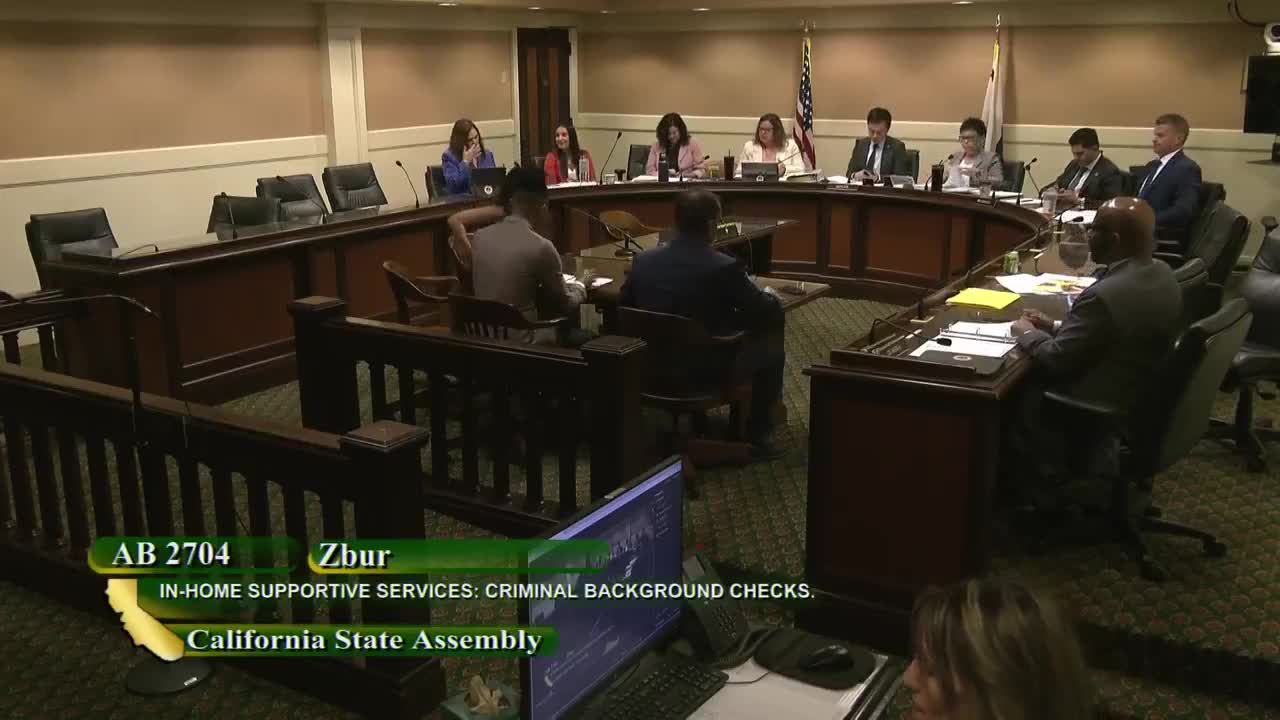
Bill Author

Bill Co-Author(s):
