AB 2803: Campaign expenditures: criminal convictions: fees and costs.
- Session Year: 2023-2024
- House: Assembly
- Latest Version Date: 2024-09-25
Current Status:
Passed
(2024-09-25: Chaptered by Secretary of State - Chapter 576, Statutes of 2024.)
Introduced
In Committee
First Chamber
In Committee
Second Chamber
Enacted
What does this bill do?
The bill bars candidates and elected officials from using campaign funds to pay or reimburse attorneys’ fees, other legal costs, fines, penalties, judgments, or settlements when a criminal case ends in a conviction for felonies listed in Elections Code section 20 (certain election‑related crimes) or for felonies involving fraud. It also requires any convicted candidate or officer who previously used campaign money for other legal costs tied to those criminal claims to repay the campaign for those amounts.
The summary is provided by generative AI which can make mistakes. For original language, please view the details in the table below.
Existing law, the Political Reform Act of 1974, deems all campaign contributions to be held in trust for expenses associated with seeking or holding office, and generally authorizes expenditures associated therewith if they are reasonably related to a political, legislative, or governmental purpose. Existing law prohibits the use of campaign funds to pay or reimburse fines, penalties, judgments, or settlements, except as specified. Existing law provides that the expenditure of campaign funds for attorneys fees and other costs in connection with administrative, civil, or criminal litigation are not related to a political, legislative, or governmental purpose unless the litigation is directly related to activities of a committee that are consistent with its primary objectives or arises directly out of a candidates or elected officers activities, duties, or status as a candidate or elected officer, as specified.
This bill would prohibit campaign funds from being used to reimburse expenditures for attorneys fees and other costs in connection with criminal litigation if the litigation results in a conviction of the candidate or elected officer for a felony involving certain types of offenses, as specified. The bill would prohibit the use of campaign funds to pay or reimburse a candidate or elected officer for a fine, penalty, judgment, or settlement relating to a conviction for a felony involving such specified offenses. The bill would require the candidate or elected officer, if convicted, to reimburse the campaign for all funds used in connection with other legal costs and expenses related to claims of criminal acts.
This bill would incorporate additional changes to Section 89513 of the Government Code proposed by SB 1170 to be operative only if this bill and SB 1170 are enacted and this bill is enacted last.
A violation of the Political Reform Act of 1974 is punishable as a misdemeanor. By expanding the scope of an existing crime, this bill would impose a state-mandated local program.
The California Constitution requires the state to reimburse local agencies and school districts for certain costs mandated by the state. Statutory provisions establish procedures for making that reimbursement.
This bill would provide that no reimbursement is required by this act for a specified reason.
The Political Reform Act of 1974, an initiative measure, provides that the Legislature may amend the act to further the acts purposes upon a 2/3 vote of each house of the Legislature and compliance with specified procedural requirements.
This bill would declare that it furthers the purposes of the act.
Existing law, the Political Reform Act of 1974, deems all campaign contributions to be held in trust for expenses associated with seeking or holding office, and generally authorizes expenditures associated therewith if they are reasonably related to a political, legislative, or governmental purpose. Existing law prohibits the use of campaign funds to pay or reimburse fines, penalties, judgments, or settlements, except as specified. Existing law provides that the expenditure of campaign funds for attorneys fees and other costs in connection with administrative, civil, or criminal litigation are not related to a political, legislative, or governmental purpose unless the litigation is directly related to activities of a committee that are consistent with its primary objectives or arises directly out of a candidates or elected officers activities, duties, or status as a candidate or elected officer, as specified.
This bill would prohibit campaign funds from being used to reimburse expenditures for attorneys fees and other costs in connection with criminal litigation if the litigation results in a conviction of the candidate or elected officer for a felony or an offense that involves moral turpitude, dishonesty, or fraud. involving certain types of offenses, as specified. The bill would prohibit the use of campaign funds to pay or reimburse a candidate or elected officer for a fine, penalty, judgment, or settlement relating to a conviction for a felony or an offense that involves moral turpitude, dishonesty, or fraud. involving such specified offenses. The bill would require the candidate or elected officer, if convicted, to reimburse the campaign for all funds used in connection with other legal costs and expenses related to claims of criminal acts.
A violation of the Political Reform Act of 1974 is punishable as a misdemeanor. By expanding the scope of an existing crime, this bill would impose a state-mandated local program.
The California Constitution requires the state to reimburse local agencies and school districts for certain costs mandated by the state. Statutory provisions establish procedures for making that reimbursement.
This bill would provide that no reimbursement is required by this act for a specified reason.
The Political Reform Act of 1974, an initiative measure, provides that the Legislature may amend the act to further the acts purposes upon a 2/3 vote of each house of the Legislature and compliance with specified procedural requirements.
This bill would declare that it furthers the purposes of the act.
Existing law, the Political Reform Act of 1974, deems all campaign contributions to be held in trust for expenses associated with seeking or holding office, and generally authorizes expenditures associated therewith if they are reasonably related to a political, legislative, or governmental purpose. Existing law prohibits the use of campaign funds to pay or reimburse fines, penalties, judgments, or settlements, except as specified. Existing law provides that the expenditure of campaign funds for attorneys fees and other costs in connection with administrative, civil, or criminal litigation are not related to a political, legislative, or governmental purpose unless the litigation is directly related to activities of a committee that are consistent with its primary objectives or arises directly out of a candidates or elected officers activities, duties, or status as a candidate or elected officer, as specified.
This bill would prohibit campaign funds from being used to reimburse expenditures for attorneys fees and other costs in connection with criminal litigation if the litigation results in a conviction of the candidate or elected officer for a felony or an offense that involves moral turpitude, dishonesty, or fraud. The bill would prohibit the use of campaign funds to pay or reimburse a fine, penalty, judgment, or settlement relating to a conviction for a felony or an offense that involves moral turpitude, dishonesty, or fraud. The bill would require the candidate or elected officer, if convicted, to reimburse the campaign for all funds used in connection with other legal costs and expenses related to claims of criminal acts.
A violation of the Political Reform Act of 1974 is punishable as a misdemeanor. By expanding the scope of an existing crime, this bill would impose a state-mandated local program.
The California Constitution requires the state to reimburse local agencies and school districts for certain costs mandated by the state. Statutory provisions establish procedures for making that reimbursement.
This bill would provide that no reimbursement is required by this act for a specified reason.
The Political Reform Act of 1974, an initiative measure, provides that the Legislature may amend the act to further the acts purposes upon a 2/3 vote of each house of the Legislature and compliance with specified procedural requirements.
This bill would declare that it furthers the purposes of the act.
This section governs the use of campaign funds for the specific expenditures set forth in this section. It is the intent of the Legislature that this section shall guide the interpretation of the standard imposed by Section 89512 as applied to other expenditures not specifically set forth in this section.
(a)(1)Campaign funds shall not be used to pay or reimburse the candidate, the elected officer, or any individual or individuals with authority to approve the expenditure of campaign funds held by a committee, or employees or staff of the committee or the elected officers governmental agency for travel expenses and necessary accommodations except when these expenditures are directly related to a political, legislative, or governmental purpose.
(2)For the purposes of this section, payments or reimbursements for travel and necessary accommodations shall be considered as directly related to a political, legislative, or governmental purpose if the payments would meet standards similar to the standards of the Internal Revenue Service pursuant to Sections 162 and 274 of the Internal Revenue Code for deductions of travel expenses under the federal income tax law.
(3)For the purposes of this section, payments or reimbursement for travel by the household of a candidate or elected officer when traveling to the same destination in order to accompany the candidate or elected officer shall be considered for the same purpose as the candidates or elected officers travel.
(4)Whenever campaign funds are used to pay or reimburse a candidate, elected officer, the candidate or elected officers representative, or a member of the candidates household for travel expenses and necessary accommodations, the expenditure shall be reported as required by Section 84211.
(5)Whenever campaign funds are used to pay or reimburse for travel expenses and necessary accommodations, any mileage credit that is earned or awarded pursuant to an airline bonus mileage program shall be deemed personally earned by or awarded to the individual traveler. The earning or awarding of mileage credit and the redeeming of credit for actual travel are not subject to reporting pursuant to Section 84211.
(b)(1)Campaign funds shall not be used to pay for or reimburse the cost of professional services unless the services are directly related to a political, legislative, or governmental purpose.
(2)Expenditures by a committee to pay for professional services reasonably required by the committee to assist it in the performance of its administrative functions are directly related to a political, legislative, or governmental purpose.
(3)Campaign funds shall not be used to pay health-related expenses for a candidate, elected officer, or any individual or individuals with authority to approve the expenditure of campaign funds held by a committee, or members of their households. Health-related expenses includes, but is not limited to, examinations by physicians, dentists, psychiatrists, psychologists, or counselors and expenses for medications, treatments, medical equipment, hospitalization, health club dues, and special dietary foods. However, campaign funds may be used to pay employer costs of health care benefits of a bona fide employee or independent contractor of the committee.
(c)(1)Campaign funds shall not be used to pay or reimburse fines, penalties, judgments, or settlements, except those resulting from all of the following:
(A)Parking citations incurred in the performance of an activity that was directly related to a political, legislative, or governmental purpose.
(B)Any other action for which payment of attorneys fees from contributions would be permitted pursuant to this title. However, campaign funds shall not be used to pay a fine, penalty, judgment, or settlement relating to an expenditure of campaign funds that resulted in either of the following:
(i)A personal benefit to the candidate or officer if it is determined that the expenditure was not reasonably related to a political, legislative, or governmental purpose.
(ii)A substantial personal benefit to the candidate or officer if it is determined that the expenditure was not directly related to a political, legislative, or governmental purpose.
(2)Campaign funds shall not be used to pay a restitution fine imposed under Section 86 of the Penal Code.
(3)Campaign funds shall not be used to pay or reimburse a candidate or elected officer for a fine, penalty, judgment, or settlement relating to a conviction for a felony described in Section 20 of the Elections Code, or for a felony involving fraud. If a candidate or elected officer uses campaign funds for other legal costs and expenses related to claims of those criminal acts and is convicted, the candidate or elected officer shall reimburse the campaign for all funds used in connection with those other legal costs and expenses.
(d)Campaign funds shall not be used for campaign, business, or casual clothing except specialty clothing that is not suitable for everyday use, including, but not limited to, formal wear, if this attire is to be worn by the candidate or elected officer and is directly related to a political, legislative, or governmental purpose.
(e)(1)Except as otherwise prohibited by law, campaign funds may be used to purchase or reimburse for the costs of purchase of tickets to political fundraising events for the attendance of a candidate, elected officer, or the candidate or elected officers immediate family, or an officer, director, employee, or staff of the committee or the elected officers governmental agency.
(2)Campaign funds shall not be used to pay for or reimburse for the costs of tickets for entertainment or sporting events for the candidate, elected officer, or members of the candidate or elected officers immediate family, or an officer, director, employee, or staff of the committee, unless their attendance at the event is directly related to a political, legislative, or governmental purpose.
(3)The purchase of tickets for entertainment or sporting events for the benefit of persons other than the candidate, elected officer, or the candidate or elected officers immediate family are governed by subdivision (f).
(f)(1)Campaign funds shall not be used to make personal gifts unless the gift is directly related to a political, legislative, or governmental purpose. The refund of a campaign contribution does not constitute the making of a gift.
(2)This section does not prohibit the use of campaign funds to reimburse or otherwise compensate a public employee for services rendered to a candidate or committee while on vacation, leave, or otherwise outside of compensated public time.
(3)An election victory celebration or similar campaign event, or gifts with a total cumulative value of less than two hundred fifty dollars ($250) in a single year made to an individual employee, a committee worker, or an employee of the elected officers agency, are considered to be directly related to a political, legislative, or governmental purpose. For purposes of this paragraph, a gift to a member of a persons immediate family shall be deemed to be a gift to that person.
(g)Campaign funds shall not be used to make loans other than to organizations pursuant to Section 89515, or, unless otherwise prohibited, to a candidate for elective office, political party, or committee.
(h)(1)Campaign funds shall not be used to pay or reimburse a candidate or elected officer for a penalty, judgment, or settlement related to a claim of sexual assault, sexual abuse, or sexual harassment filed against the candidate or elective officer in any civil, criminal, or administrative proceeding. If a candidate or elected officer uses campaign funds for other legal costs and expenses related to claims of those unlawful practices and is held liable for such a violation, the candidate or elected officer shall reimburse the campaign for all funds used in connection with those other legal costs and expenses.
(2)For the purpose of this subdivision, sexual assault and sexual abuse have the same meaning as in Section 11165.1 of the Penal Code and sexual harassment has the same meaning as in subdivision (j) of Section 12940 of the Government Code.
(i)(1)For purposes of this subdivision, childcare expenses include the reasonable costs of professional daycare services, babysitting, nannying services, food and beverages, transportation to and from the location of a childcare services provider, before and after school programs, summer day camps, and preschool. Additional qualifying expenses include costs related to a nurse, home care provider, or other care provider for a disabled dependent child. Childcare expenses do not include private school tuition, medical expenses, tutoring services, or payments to a relative, within the third degree of consanguinity, of a child, unless the relative owns or operates a professional daycare or babysitting service and the cost of the service is no greater than the relative would otherwise charge.
(2)Campaign funds may be used to pay or reimburse a candidate for reasonable and necessary childcare expenses for a dependent child resulting directly from the candidate engaging in campaign activities. For purposes of this paragraph, directly means that the candidate would not have incurred the childcare expenses if the candidate did not engage in the campaign activities.
(3)This section shall not be construed to limit the use of campaign funds to pay for childcare expenses resulting from an officeholder engaging in a campaign activity with both political and legislative or governmental purposes.
SEC. 1.5.Section 89513 of the Government Code is amended to read:89513.This section governs the use of campaign funds for the specific expenditures set forth in this section. It is the intent of the Legislature that this section shall guide the interpretation of the standard imposed by Section 89512 as applied to other expenditures not specifically set forth in this section.
(a)(1)Campaign funds shall not be used to pay or reimburse the candidate, the elected officer, or any individual or individuals with authority to approve the expenditure of campaign funds held by a committee, or employees or staff of the committee or the elected officers governmental agency for travel expenses and necessary accommodations except when these expenditures are directly related to a political, legislative, or governmental purpose.
(2)For the purposes of this section, payments or reimbursements for travel and necessary accommodations shall be considered as directly related to a political, legislative, or governmental purpose if the payments would meet standards similar to the standards of the Internal Revenue Service pursuant to Sections 162 and 274 of the Internal Revenue Code for deductions of travel expenses under the federal income tax law.
(3)For the purposes of this section, payments or reimbursement for travel by the household of a candidate or elected officer when traveling to the same destination in order to accompany the candidate or elected officer shall be considered for the same purpose as the candidates or elected officers travel.
(4)Whenever campaign funds are used to pay or reimburse a candidate, elected officer, the candidates or elected officers representative, or a member of the candidates household for travel expenses and necessary accommodations, the expenditure shall be reported as required by Section 84211.
(5)Whenever campaign funds are used to pay or reimburse for travel expenses and necessary accommodations, any mileage credit that is earned or awarded pursuant to an airline bonus mileage program shall be deemed personally earned by or awarded to the individual traveler. The earning or awarding of mileage credit and the redeeming of credit for actual travel are not subject to reporting pursuant to Section 84211.
(b)(1)Campaign funds shall not be used to pay for or reimburse the cost of professional services unless the services are directly related to a political, legislative, or governmental purpose.
(2)Expenditures by a committee to pay for professional services reasonably required by the committee to assist it in the performance of its administrative functions are directly related to a political, legislative, or governmental purpose.
(3)(A)Campaign funds may be used to pay a candidate for reasonable and necessary mental health care expenses to address mental health issues that have arisen during the campaign or have been adversely impacted by campaign activities if both of the following conditions are satisfied:
(i)The candidate does not have health insurance or their health insurance does not cover the full cost of these mental health care expenses. If the candidates health insurance does not cover the full cost of the mental health care expenses, campaign funds may be used to pay for the portion not covered by health insurance.
(ii)The candidate has experienced at least one of the following categories of underlying campaign-related circumstances or events, which have resulted in the need for mental health care services:
(I)Harassment.
(II)Prejudice.
(III)A threat or other criminal act.
(B)Campaign funds may be used for the purposes described in subparagraph (A) starting 12 months before the date of the election and up to the date that the Secretary of State or local elections official certifies the election results or, for a candidate who is elected to office, up to the date that the candidate is sworn into office.
(C)A candidate who uses campaign funds for mental health care expenses shall report this use on a campaign statement filed pursuant to Section 84211 and shall note on that statement which one or more of the categories enumerated in clause (ii) of subparagraph (A) that they experienced. A candidate shall not be required to provide further detail on the campaign statement as to the underlying campaign-related circumstances or events that gave rise to the need for mental health care services. To use campaign funds for mental health care expenses under this subdivision, it is not necessary for the candidate to have reported the underlying campaign-related circumstances or events to a law enforcement agency or for the circumstances or events to have given rise to civil or criminal proceedings.
(D)For purposes of this subdivision, the following terms have the following meanings:
(i)Threat or other criminal act refers to any threat or other criminal act prohibited by the Penal Code or other statute.
(ii)Harassment means persistent or severe, uninvited behavior, attention, comments, or actions, whether in person, in writing, or in online or virtual settings, that upset, belittle, humiliate, or otherwise cause distress, fear, or discomfort.
(iii)Mental health care expenses refers to expenses for services including therapy, psychological, or psychiatric counseling services, provided in a group or private setting, either virtually or in person, by a professional licensed by the Board of Behavioral Sciences, or an associate accruing the hours for such a license, to address mental health issues.
(iv)Prejudice means behavior, attention, comments, or actions that target a candidate based on a category protected under federal or state antidiscrimination laws, including age, ancestry, color, disability, gender, gender identity, national origin, race, religion, sex, and sexual orientation.
(E)For purposes of the recordkeeping requirements described in Section 84104, a candidate shall maintain records relating to the mental health care services that they receive, including the name, license number, and license type of the mental health care service provider and invoices for services paid for by campaign funds.
(F)Expenditures by a committee to pay for mental health care services pursuant to this paragraph are directly related to a political, legislative, or governmental purpose.
(4)Except as provided in paragraph (3), campaign funds shall not be used to pay health-related expenses for a candidate, elected officer, or any individual or individuals with authority to approve the expenditure of campaign funds held by a committee, or members of their households. Health-related expenses include examinations by physicians or dentists and expenses for medications, treatments, medical equipment, hospitalization, health club dues, and special dietary foods. However, campaign funds may be used to pay employer costs of health care benefits of a bona fide employee or independent contractor of the committee.
(c)(1)Campaign funds shall not be used to pay or reimburse fines, penalties, judgments, or settlements, except those resulting from all of the following:
(A)Parking citations incurred in the performance of an activity that was directly related to a political, legislative, or governmental purpose.
(B)Any other action for which payment of attorneys fees from contributions would be permitted pursuant to this title. However, campaign funds shall not be used to pay a fine, penalty, judgment, or settlement relating to an expenditure of campaign funds that resulted in either of the following:
(i)A personal benefit to the candidate or officer if it is determined that the expenditure was not reasonably related to a political, legislative, or governmental purpose.
(ii)A substantial personal benefit to the candidate or officer if it is determined that the expenditure was not directly related to a political, legislative, or governmental purpose.
(2)Campaign funds shall not be used to pay a restitution fine imposed under Section 86 of the Penal Code.
(3)Campaign funds shall not be used to pay or reimburse a candidate or elected officer for a fine, penalty, judgment, or settlement relating to a conviction for a felony described in Section 20 of the Elections Code, or for a felony involving fraud. If a candidate or elected officer uses campaign funds for other legal costs and expenses related to claims of those criminal acts and is convicted, the candidate or elected officer shall reimburse the campaign for all funds used in connection with those other legal costs and expenses.
(d)Campaign funds shall not be used for campaign, business, or casual clothing except specialty clothing that is not suitable for everyday use, including, but not limited to, formal wear, if this attire is to be worn by the candidate or elected officer and is directly related to a political, legislative, or governmental purpose.
(e)(1)Except as otherwise prohibited by law, campaign funds may be used to purchase or reimburse for the costs of purchase of tickets to political fundraising events for the attendance of a candidate, elected officer, or the candidates or elected officers immediate family, or an officer, director, employee, or staff of the committee or the elected officers governmental agency.
(2)Campaign funds shall not be used to pay for or reimburse for the costs of tickets for entertainment or sporting events for the candidate, elected officer, or members of the candidates or elected officers immediate family, or an officer, director, employee, or staff of the committee, unless their attendance at the event is directly related to a political, legislative, or governmental purpose.
(3)The purchase of tickets for entertainment or sporting events for the benefit of persons other than the candidate, elected officer, or the candidates or elected officers immediate family are governed by subdivision (f).
(f)(1)Campaign funds shall not be used to make personal gifts unless the gift is directly related to a political, legislative, or governmental purpose. The refund of a campaign contribution does not constitute the making of a gift.
(2)This section does not prohibit the use of campaign funds to reimburse or otherwise compensate a public employee for services rendered to a candidate or committee while on vacation, leave, or otherwise outside of compensated public time.
(3)An election victory celebration or similar campaign event, or gifts with a total cumulative value of less than two hundred fifty dollars ($250) in a single year made to an individual employee, a committee worker, or an employee of the elected officers agency, are considered to be directly related to a political, legislative, or governmental purpose. For purposes of this paragraph, a gift to a member of a persons immediate family shall be deemed to be a gift to that person.
(g)Campaign funds shall not be used to make loans other than to organizations pursuant to Section 89515, or, unless otherwise prohibited, to a candidate for elective office, political party, or committee.
(h)(1)Campaign funds shall not be used to pay or reimburse a candidate or elected officer for a penalty, judgment, or settlement related to a claim of sexual assault, sexual abuse, or sexual harassment filed against the candidate or elective officer in any civil, criminal, or administrative proceeding. If a candidate or elected officer uses campaign funds for other legal costs and expenses related to claims of those unlawful practices and is held liable for such a violation, the candidate or elected officer shall reimburse the campaign for all funds used in connection with those other legal costs and expenses.
(2)For the purpose of this subdivision, sexual assault and sexual abuse have the same meaning as in Section 11165.1 of the Penal Code and sexual harassment has the same meaning as in subdivision (j) of Section 12940 of the Government Code.
(i)(1)For purposes of this subdivision, childcare expenses include the reasonable costs of professional daycare services, babysitting, nannying services, food and beverages, transportation to and from the location of a childcare services provider, before and after school programs, summer day camps, and preschool. Additional qualifying expenses include costs related to a nurse, home care provider, or other care provider for a disabled dependent child. Childcare expenses do not include private school tuition, medical expenses, tutoring services, or payments to a relative, within the third degree of consanguinity, of a child, unless the relative owns or operates a professional daycare or babysitting service and the cost of the service is no greater than the relative would otherwise charge.
(2)Campaign funds may be used to pay or reimburse a candidate for reasonable and necessary childcare expenses for a dependent child resulting directly from the candidate engaging in campaign activities. For purposes of this paragraph, directly means that the candidate would not have incurred the childcare expenses if the candidate did not engage in the campaign activities.
(3)This section shall not be construed to limit the use of campaign funds to pay for childcare expenses resulting from an officeholder engaging in a campaign activity with both political and legislative or governmental purposes.
SEC. 2.Section 89514 of the Government Code is amended to read:89514.(a)Expenditures of campaign funds for attorneys fees and other costs in connection with administrative, civil, or criminal litigation are not directly related to a political, legislative, or governmental purpose except where the litigation is directly related to activities of a committee that are consistent with its primary objectives or arises directly out of a committees activities or out of a candidates or elected officers activities, duties, or status as a candidate or elected officer, including, but not limited to, an action to enjoin defamation, defense of an action to enjoin defamation, defense of an action brought for a violation of state or local campaign, disclosure, or election laws, and an action arising from an election contest or recount.
(b)Notwithstanding subdivision (a), campaign funds shall not be used to reimburse expenditures for attorneys fees and other costs in connection with criminal litigation if the litigation results in a conviction of the candidate or elected officer for a felony described in Section 20 of the Elections Code, or for a felony involving fraud.
SEC. 3.Section 1.5 of this bill incorporates amendments to Section 89513 of the Government Code proposed by both this bill and Senate Bill 1170. That section of this bill shall only become operative if (1) both bills are enacted and become effective on or before January 1, 2025, (2) each bill amends Section 89513 of the Government Code, and (3) this bill is enacted after Senate Bill 1170, in which case Section 1 of this bill shall not become operative.
SEC. 4.No reimbursement is required by this act pursuant to Section 6 of Article XIIIB of the California Constitution because the only costs that may be incurred by a local agency or school district will be incurred because this act creates a new crime or infraction, eliminates a crime or infraction, or changes the penalty for a crime or infraction, within the meaning of Section 17556 of the Government Code, or changes the definition of a crime within the meaning of Section 6 of Article XIIIB of the California Constitution.
SEC. 5.The Legislature finds and declares that this bill furthers the purposes of the Political Reform Act of 1974 within the meaning of subdivision (a) of Section 81012 of the Government Code.
This section governs the use of campaign funds for the specific expenditures set forth in this section. It is the intent of the Legislature that this section shall guide the interpretation of the standard imposed by Section 89512 as applied to other expenditures not specifically set forth in this section.
(a)(1)Campaign funds shall not be used to pay or reimburse the candidate, the elected officer, or any individual or individuals with authority to approve the expenditure of campaign funds held by a committee, or employees or staff of the committee or the elected officers governmental agency for travel expenses and necessary accommodations except when these expenditures are directly related to a political, legislative, or governmental purpose.
(2)For the purposes of this section, payments or reimbursements for travel and necessary accommodations shall be considered as directly related to a political, legislative, or governmental purpose if the payments would meet standards similar to the standards of the Internal Revenue Service pursuant to Sections 162 and 274 of the Internal Revenue Code for deductions of travel expenses under the federal income tax law.
(3)For the purposes of this section, payments or reimbursement for travel by the household of a candidate or elected officer when traveling to the same destination in order to accompany the candidate or elected officer shall be considered for the same purpose as the candidates or elected officers travel.
(4)Whenever campaign funds are used to pay or reimburse a candidate, elected officer, the candidate or elected officers representative, or a member of the candidates household for travel expenses and necessary accommodations, the expenditure shall be reported as required by Section 84211.
(5)Whenever campaign funds are used to pay or reimburse for travel expenses and necessary accommodations, any mileage credit that is earned or awarded pursuant to an airline bonus mileage program shall be deemed personally earned by or awarded to the individual traveler. The earning or awarding of mileage credit and the redeeming of credit for actual travel are not subject to reporting pursuant to Section 84211.
(b)(1)Campaign funds shall not be used to pay for or reimburse the cost of professional services unless the services are directly related to a political, legislative, or governmental purpose.
(2)Expenditures by a committee to pay for professional services reasonably required by the committee to assist it in the performance of its administrative functions are directly related to a political, legislative, or governmental purpose.
(3)Campaign funds shall not be used to pay health-related expenses for a candidate, elected officer, or any individual or individuals with authority to approve the expenditure of campaign funds held by a committee, or members of their households. Health-related expenses includes, but is not limited to, examinations by physicians, dentists, psychiatrists, psychologists, or counselors and expenses for medications, treatments, medical equipment, hospitalization, health club dues, and special dietary foods. However, campaign funds may be used to pay employer costs of health care benefits of a bona fide employee or independent contractor of the committee.
(c)(1)Campaign funds shall not be used to pay or reimburse fines, penalties, judgments, or settlements, except those resulting from all of the following:
(A)Parking citations incurred in the performance of an activity that was directly related to a political, legislative, or governmental purpose.
(B)Any other action for which payment of attorneys fees from contributions would be permitted pursuant to this title. However, campaign funds shall not be used to pay a fine, penalty, judgment, or settlement relating to an expenditure of campaign funds that resulted in either of the following:
(i)A personal benefit to the candidate or officer if it is determined that the expenditure was not reasonably related to a political, legislative, or governmental purpose.
(ii)A substantial personal benefit to the candidate or officer if it is determined that the expenditure was not directly related to a political, legislative, or governmental purpose.
(2)Campaign funds shall not be used to pay a restitution fine imposed under Section 86 of the Penal Code.
(3)Campaign funds shall not be used to pay or reimburse a candidate or elected officer for a fine, penalty, judgment, or settlement relating to a conviction for a felony described in Section 20 of the Elections Code, or for a felony involving fraud. If a candidate or elected officer uses campaign funds for other legal costs and expenses related to claims of those criminal acts and is convicted, the candidate or elected officer shall reimburse the campaign for all funds used in connection with those other legal costs and expenses.
(d)Campaign funds shall not be used for campaign, business, or casual clothing except specialty clothing that is not suitable for everyday use, including, but not limited to, formal wear, if this attire is to be worn by the candidate or elected officer and is directly related to a political, legislative, or governmental purpose.
(e)(1)Except as otherwise prohibited by law, campaign funds may be used to purchase or reimburse for the costs of purchase of tickets to political fundraising events for the attendance of a candidate, elected officer, or the candidate or elected officers immediate family, or an officer, director, employee, or staff of the committee or the elected officers governmental agency.
(2)Campaign funds shall not be used to pay for or reimburse for the costs of tickets for entertainment or sporting events for the candidate, elected officer, or members of the candidate or elected officers immediate family, or an officer, director, employee, or staff of the committee, unless their attendance at the event is directly related to a political, legislative, or governmental purpose.
(3)The purchase of tickets for entertainment or sporting events for the benefit of persons other than the candidate, elected officer, or the candidate or elected officers immediate family are governed by subdivision (f).
(f)(1)Campaign funds shall not be used to make personal gifts unless the gift is directly related to a political, legislative, or governmental purpose. The refund of a campaign contribution does not constitute the making of a gift.
(2)This section does not prohibit the use of campaign funds to reimburse or otherwise compensate a public employee for services rendered to a candidate or committee while on vacation, leave, or otherwise outside of compensated public time.
(3)An election victory celebration or similar campaign event, or gifts with a total cumulative value of less than two hundred fifty dollars ($250) in a single year made to an individual employee, a committee worker, or an employee of the elected officers agency, are considered to be directly related to a political, legislative, or governmental purpose. For purposes of this paragraph, a gift to a member of a persons immediate family shall be deemed to be a gift to that person.
(g)Campaign funds shall not be used to make loans other than to organizations pursuant to Section 89515, or, unless otherwise prohibited, to a candidate for elective office, political party, or committee.
(h)(1)Campaign funds shall not be used to pay or reimburse a candidate or elected officer for a penalty, judgment, or settlement related to a claim of sexual assault, sexual abuse, or sexual harassment filed against the candidate or elective officer in any civil, criminal, or administrative proceeding. If a candidate or elected officer uses campaign funds for other legal costs and expenses related to claims of those unlawful practices and is held liable for such a violation, the candidate or elected officer shall reimburse the campaign for all funds used in connection with those other legal costs and expenses.
(2)For the purpose of this subdivision, sexual assault and sexual abuse have the same meaning as in Section 11165.1 of the Penal Code and sexual harassment has the same meaning as in subdivision (j) of Section 12940 of the Government Code.
(i)(1)For purposes of this subdivision, childcare expenses include the reasonable costs of professional daycare services, babysitting, nannying services, food and beverages, transportation to and from the location of a childcare services provider, before and after school programs, summer day camps, and preschool. Additional qualifying expenses include costs related to a nurse, home care provider, or other care provider for a disabled dependent child. Childcare expenses do not include private school tuition, medical expenses, tutoring services, or payments to a relative, within the third degree of consanguinity, of a child, unless the relative owns or operates a professional daycare or babysitting service and the cost of the service is no greater than the relative would otherwise charge.
(2)Campaign funds may be used to pay or reimburse a candidate for reasonable and necessary childcare expenses for a dependent child resulting directly from the candidate engaging in campaign activities. For purposes of this paragraph, directly means that the candidate would not have incurred the childcare expenses if the candidate did not engage in the campaign activities.
(3)This section shall not be construed to limit the use of campaign funds to pay for childcare expenses resulting from an officeholder engaging in a campaign activity with both political and legislative or governmental purposes.
SEC. 1.5.Section 89513 of the Government Code is amended to read:89513.This section governs the use of campaign funds for the specific expenditures set forth in this section. It is the intent of the Legislature that this section shall guide the interpretation of the standard imposed by Section 89512 as applied to other expenditures not specifically set forth in this section.
(a)(1)Campaign funds shall not be used to pay or reimburse the candidate, the elected officer, or any individual or individuals with authority to approve the expenditure of campaign funds held by a committee, or employees or staff of the committee or the elected officers governmental agency for travel expenses and necessary accommodations except when these expenditures are directly related to a political, legislative, or governmental purpose.
(2)For the purposes of this section, payments or reimbursements for travel and necessary accommodations shall be considered as directly related to a political, legislative, or governmental purpose if the payments would meet standards similar to the standards of the Internal Revenue Service pursuant to Sections 162 and 274 of the Internal Revenue Code for deductions of travel expenses under the federal income tax law.
(3)For the purposes of this section, payments or reimbursement for travel by the household of a candidate or elected officer when traveling to the same destination in order to accompany the candidate or elected officer shall be considered for the same purpose as the candidates or elected officers travel.
(4)Whenever campaign funds are used to pay or reimburse a candidate, elected officer, the candidate candidates or elected officers representative, or a member of the candidates household for travel expenses and necessary accommodations, the expenditure shall be reported as required by Section 84211.
(5)Whenever campaign funds are used to pay or reimburse for travel expenses and necessary accommodations, any mileage credit that is earned or awarded pursuant to an airline bonus mileage program shall be deemed personally earned by or awarded to the individual traveler. The earning or awarding of mileage credit and the redeeming of credit for actual travel are not subject to reporting pursuant to Section 84211.
(b)(1)Campaign funds shall not be used to pay for or reimburse the cost of professional services unless the services are directly related to a political, legislative, or governmental purpose.
(2)Expenditures by a committee to pay for professional services reasonably required by the committee to assist it in the performance of its administrative functions are directly related to a political, legislative, or governmental purpose.
(3)(A)Campaign funds may be used to pay a candidate for reasonable and necessary mental health care expenses to address mental health issues that have arisen during the campaign or have been adversely impacted by campaign activities if both of the following conditions are satisfied:
(i)The candidate does not have health insurance or their health insurance does not cover the full cost of these mental health care expenses. If the candidates health insurance does not cover the full cost of the mental health care expenses, campaign funds may be used to pay for the portion not covered by health insurance.
(ii)The candidate has experienced at least one of the following categories of underlying campaign-related circumstances or events, which have resulted in the need for mental health care services:
(I)Harassment.
(II)Prejudice.
(III)A threat or other criminal act.
(B)Campaign funds may be used for the purposes described in subparagraph (A) starting 12 months before the date of the election and up to the date that the Secretary of State or local elections official certifies the election results or, for a candidate who is elected to office, up to the date that the candidate is sworn into office.
(C)A candidate who uses campaign funds for mental health care expenses shall report this use on a campaign statement filed pursuant to Section 84211 and shall note on that statement which one or more of the categories enumerated in clause (ii) of subparagraph (A) that they experienced. A candidate shall not be required to provide further detail on the campaign statement as to the underlying campaign-related circumstances or events that gave rise to the need for mental health care services. To use campaign funds for mental health care expenses under this subdivision, it is not necessary for the candidate to have reported the underlying campaign-related circumstances or events to a law enforcement agency or for the circumstances or events to have given rise to civil or criminal proceedings.
(D)For purposes of this subdivision, the following terms have the following meanings:
(i)Threat or other criminal act refers to any threat or other criminal act prohibited by the Penal Code or other statute.
(ii)Harassment means persistent or severe, uninvited behavior, attention, comments, or actions, whether in person, in writing, or in online or virtual settings, that upset, belittle, humiliate, or otherwise cause distress, fear, or discomfort.
(iii)Mental health care expenses refers to expenses for services including therapy, psychological, or psychiatric counseling services, provided in a group or private setting, either virtually or in person, by a professional licensed by the Board of Behavioral Sciences, or an associate accruing the hours for such a license, to address mental health issues.
(iv)Prejudice means behavior, attention, comments, or actions that target a candidate based on a category protected under federal or state antidiscrimination laws, including age, ancestry, color, disability, gender, gender identity, national origin, race, religion, sex, and sexual orientation.
(E)For purposes of the recordkeeping requirements described in Section 84104, a candidate shall maintain records relating to the mental health care services that they receive, including the name, license number, and license type of the mental health care service provider and invoices for services paid for by campaign funds.
(F)Expenditures by a committee to pay for mental health care services pursuant to this paragraph are directly related to a political, legislative, or governmental purpose.
(3)(4)Campaign Except as provided in paragraph (3), campaign funds shall not be used to pay health-related expenses for a candidate, elected officer, or any individual or individuals with authority to approve the expenditure of campaign funds held by a committee, or members of their households. Health-related expenses includes, but is not limited to, examinations by physicians, dentists, psychiatrists, psychologists, or counselors include examinations by physicians or dentists and expenses for medications, treatments, medical equipment, hospitalization, health club dues, and special dietary foods. However, campaign funds may be used to pay employer costs of health care benefits of a bona fide employee or independent contractor of the committee.
(c)(1)Campaign funds shall not be used to pay or reimburse fines, penalties, judgments, or settlements, except those resulting from either all of the following:
(A)Parking citations incurred in the performance of an activity that was directly related to a political, legislative, or governmental purpose.
(B)Any other action for which payment of attorneys fees from contributions would be permitted pursuant to this title. However, campaign funds shall not be used to pay a fine, penalty, judgment, or settlement relating to an expenditure of campaign funds that resulted in either of the following:
(i)A personal benefit to the candidate or officer if it is determined that the expenditure was not reasonably related to a political, legislative, or governmental purpose.
(ii)A substantial personal benefit to the candidate or officer if it is determined that the expenditure was not directly related to a political, legislative, or governmental purpose.
(2)Campaign funds shall not be used to pay a restitution fine imposed under Section 86 of the Penal Code.
(3)Campaign funds shall not be used to pay or reimburse a candidate or elected officer for a fine, penalty, judgment, or settlement relating to a conviction for a felony described in Section 20 of the Elections Code, or for a felony involving fraud. If a candidate or elected officer uses campaign funds for other legal costs and expenses related to claims of those criminal acts and is convicted, the candidate or elected officer shall reimburse the campaign for all funds used in connection with those other legal costs and expenses.
(d)Campaign funds shall not be used for campaign, business, or casual clothing except specialty clothing that is not suitable for everyday use, including, but not limited to, formal wear, if this attire is to be worn by the candidate or elected officer and is directly related to a political, legislative, or governmental purpose.
(e)(1)Except as otherwise prohibited by law, campaign funds may be used to purchase or reimburse for the costs of purchase of tickets to political fundraising events for the attendance of a candidate, elected officer, or the candidate candidates or elected officers immediate family, or an officer, director, employee, or staff of the committee or the elected officers governmental agency.
(2)Campaign funds shall not be used to pay for or reimburse for the costs of tickets for entertainment or sporting events for the candidate, elected officer, or members of the candidate candidates or elected officers immediate family, or an officer, director, employee, or staff of the committee, unless their attendance at the event is directly related to a political, legislative, or governmental purpose.
(3)The purchase of tickets for entertainment or sporting events for the benefit of persons other than the candidate, elected officer, or the candidate candidates or elected officers immediate family are governed by subdivision (f).
(f)(1)Campaign funds shall not be used to make personal gifts unless the gift is directly related to a political, legislative, or governmental purpose. The refund of a campaign contribution does not constitute the making of a gift.
(2)This section does not prohibit the use of campaign funds to reimburse or otherwise compensate a public employee for services rendered to a candidate or committee while on vacation, leave, or otherwise outside of compensated public time.
(3)An election victory celebration or similar campaign event, or gifts with a total cumulative value of less than two hundred fifty dollars ($250) in a single year made to an individual employee, a committee worker, or an employee of the elected officers agency, are considered to be directly related to a political, legislative, or governmental purpose. For purposes of this paragraph, a gift to a member of a persons immediate family shall be deemed to be a gift to that person.
(g)Campaign funds shall not be used to make loans other than to organizations pursuant to Section 89515, or, unless otherwise prohibited, to a candidate for elective office, political party, or committee.
(h)(1)Campaign funds shall not be used to pay or reimburse a candidate or elected officer for a penalty, judgment, or settlement related to a claim of sexual assault, sexual abuse, or sexual harassment filed against the candidate or elective officer in any civil, criminal, or administrative proceeding. If a candidate or elected officer uses campaign funds for other legal costs and expenses related to claims of those unlawful practices and is held liable for such a violation, the candidate or elected officer shall reimburse the campaign for all funds used in connection with those other legal costs and expenses.
(2)For the purpose of this subdivision, sexual assault and sexual abuse have the same meaning as in Section 11165.1 of the Penal Code and sexual harassment has the same meaning as in subdivision (j) of Section 12940 of the Government Code.
(i)(1)For purposes of this subdivision, childcare expenses include the reasonable costs of professional daycare services, babysitting, nannying services, food and beverages, transportation to and from the location of a childcare services provider, before and after school programs, summer day camps, and preschool. Additional qualifying expenses include costs related to a nurse, home care provider, or other care provider for a disabled dependent child. Childcare expenses do not include private school tuition, medical expenses, tutoring services, or payments to a relative, within the third degree of consanguinity, of a child, unless the relative owns or operates a professional daycare or babysitting service and the cost of the service is no greater than the relative would otherwise charge.
(2)Campaign funds may be used to pay or reimburse a candidate for reasonable and necessary childcare expenses for a dependent child resulting directly from the candidate engaging in campaign activities. For purposes of this paragraph, directly means that the candidate would not have incurred the childcare expenses if the candidate did not engage in the campaign activities.
(3)This section shall not be construed to limit the use of campaign funds to pay for childcare expenses resulting from an officeholder engaging in a campaign activity with both political and legislative or governmental purposes.
SEC. 2.Section 89514 of the Government Code is amended to read:89514.(a)Expenditures of campaign funds for attorneys fees and other costs in connection with administrative, civil, or criminal litigation are not directly related to a political, legislative, or governmental purpose except where the litigation is directly related to activities of a committee that are consistent with its primary objectives or arises directly out of a committees activities or out of a candidates or elected officers activities, duties, or status as a candidate or elected officer, including, but not limited to, an action to enjoin defamation, defense of an action to enjoin defamation, defense of an action brought for a violation of state or local campaign, disclosure, or election laws, and an action arising from an election contest or recount.
(b)Notwithstanding subdivision (a), campaign funds shall not be used to reimburse expenditures for attorneys fees and other costs in connection with criminal litigation if the litigation results in a conviction of the candidate or elected officer for a felony described in Section 20 of the Elections Code, or for a felony involving fraud.
SEC. 3.Section 1.5 of this bill incorporates amendments to Section 89513 of the Government Code proposed by both this bill and Senate Bill 1170. That section of this bill shall only become operative if (1) both bills are enacted and become effective on or before January 1, 2025, (2) each bill amends Section 89513 of the Government Code, and (3) this bill is enacted after Senate Bill 1170, in which case Section 1 of this bill shall not become operative.
SEC. 3.SEC. 4.No reimbursement is required by this act pursuant to Section 6 of Article XIIIB of the California Constitution because the only costs that may be incurred by a local agency or school district will be incurred because this act creates a new crime or infraction, eliminates a crime or infraction, or changes the penalty for a crime or infraction, within the meaning of Section 17556 of the Government Code, or changes the definition of a crime within the meaning of Section 6 of Article XIIIB of the California Constitution.
SEC. 4.SEC. 5.The Legislature finds and declares that this bill furthers the purposes of the Political Reform Act of 1974 within the meaning of subdivision (a) of Section 81012 of the Government Code.
This section governs the use of campaign funds for the specific expenditures set forth in this section. It is the intent of the Legislature that this section shall guide the interpretation of the standard imposed by Section 89512 as applied to other expenditures not specifically set forth in this section.
(a)(1)Campaign funds shall not be used to pay or reimburse the candidate, the elected officer, or any individual or individuals with authority to approve the expenditure of campaign funds held by a committee, or employees or staff of the committee or the elected officers governmental agency for travel expenses and necessary accommodations except when these expenditures are directly related to a political, legislative, or governmental purpose.
(2)For the purposes of this section, payments or reimbursements for travel and necessary accommodations shall be considered as directly related to a political, legislative, or governmental purpose if the payments would meet standards similar to the standards of the Internal Revenue Service pursuant to Sections 162 and 274 of the Internal Revenue Code for deductions of travel expenses under the federal income tax law.
(3)For the purposes of this section, payments or reimbursement for travel by the household of a candidate or elected officer when traveling to the same destination in order to accompany the candidate or elected officer shall be considered for the same purpose as the candidates or elected officers travel.
(4)Whenever campaign funds are used to pay or reimburse a candidate, elected officer, the candidate or elected officers representative, or a member of the candidates household for travel expenses and necessary accommodations, the expenditure shall be reported as required by Section 84211.
(5)Whenever campaign funds are used to pay or reimburse for travel expenses and necessary accommodations, any mileage credit that is earned or awarded pursuant to an airline bonus mileage program shall be deemed personally earned by or awarded to the individual traveler. The earning or awarding of mileage credit and the redeeming of credit for actual travel are not subject to reporting pursuant to Section 84211.
(b)(1)Campaign funds shall not be used to pay for or reimburse the cost of professional services unless the services are directly related to a political, legislative, or governmental purpose.
(2)Expenditures by a committee to pay for professional services reasonably required by the committee to assist it in the performance of its administrative functions are directly related to a political, legislative, or governmental purpose.
(3)Campaign funds shall not be used to pay health-related expenses for a candidate, elected officer, or any individual or individuals with authority to approve the expenditure of campaign funds held by a committee, or members of their households. Health-related expenses includes, but is not limited to, examinations by physicians, dentists, psychiatrists, psychologists, or counselors and expenses for medications, treatments, medical equipment, hospitalization, health club dues, and special dietary foods. However, campaign funds may be used to pay employer costs of health care benefits of a bona fide employee or independent contractor of the committee.
(c)(1)Campaign funds shall not be used to pay or reimburse fines, penalties, judgments, or settlements, except those resulting from all of the following:
(A)Parking citations incurred in the performance of an activity that was directly related to a political, legislative, or governmental purpose.
(B)Any other action for which payment of attorneys fees from contributions would be permitted pursuant to this title. However, campaign funds shall not be used to pay a fine, penalty, judgment, or settlement relating to an expenditure of campaign funds that resulted in either of the following:
(i)A personal benefit to the candidate or officer if it is determined that the expenditure was not reasonably related to a political, legislative, or governmental purpose.
(ii)A substantial personal benefit to the candidate or officer if it is determined that the expenditure was not directly related to a political, legislative, or governmental purpose.
(2)Campaign funds shall not be used to pay a restitution fine imposed under Section 86 of the Penal Code.
(3)Campaign funds shall not be used to pay or reimburse a candidate or elected officer for a fine, penalty, judgment, or settlement relating to a conviction for a felony or an offense that involves moral turpitude, dishonesty, or fraud. described in Section 20 of the Elections Code, or for a felony involving fraud. If a candidate or elected officer uses campaign funds for other legal costs and expenses related to claims of those criminal acts and is convicted, the candidate or elected officer shall reimburse the campaign for all funds used in connection with those other legal costs and expenses.
(d)Campaign funds shall not be used for campaign, business, or casual clothing except specialty clothing that is not suitable for everyday use, including, but not limited to, formal wear, if this attire is to be worn by the candidate or elected officer and is directly related to a political, legislative, or governmental purpose.
(e)(1)Except as otherwise prohibited by law, campaign funds may be used to purchase or reimburse for the costs of purchase of tickets to political fundraising events for the attendance of a candidate, elected officer, or the candidate or elected officers immediate family, or an officer, director, employee, or staff of the committee or the elected officers governmental agency.
(2)Campaign funds shall not be used to pay for or reimburse for the costs of tickets for entertainment or sporting events for the candidate, elected officer, or members of the candidate or elected officers immediate family, or an officer, director, employee, or staff of the committee, unless their attendance at the event is directly related to a political, legislative, or governmental purpose.
(3)The purchase of tickets for entertainment or sporting events for the benefit of persons other than the candidate, elected officer, or the candidate or elected officers immediate family are governed by subdivision (f).
(f)(1)Campaign funds shall not be used to make personal gifts unless the gift is directly related to a political, legislative, or governmental purpose. The refund of a campaign contribution does not constitute the making of a gift.
(2)This section does not prohibit the use of campaign funds to reimburse or otherwise compensate a public employee for services rendered to a candidate or committee while on vacation, leave, or otherwise outside of compensated public time.
(3)An election victory celebration or similar campaign event, or gifts with a total cumulative value of less than two hundred fifty dollars ($250) in a single year made to an individual employee, a committee worker, or an employee of the elected officers agency, are considered to be directly related to a political, legislative, or governmental purpose. For purposes of this paragraph, a gift to a member of a persons immediate family shall be deemed to be a gift to that person.
(g)Campaign funds shall not be used to make loans other than to organizations pursuant to Section 89515, or, unless otherwise prohibited, to a candidate for elective office, political party, or committee.
(h)(1)Campaign funds shall not be used to pay or reimburse a candidate or elected officer for a penalty, judgment, or settlement related to a claim of sexual assault, sexual abuse, or sexual harassment filed against the candidate or elective officer in any civil, criminal, or administrative proceeding. If a candidate or elected officer uses campaign funds for other legal costs and expenses related to claims of those unlawful practices and is held liable for such a violation, the candidate or elected officer shall reimburse the campaign for all funds used in connection with those other legal costs and expenses.
(2)For the purpose of this subdivision, sexual assault and sexual abuse have the same meaning as in Section 11165.1 of the Penal Code and sexual harassment has the same meaning as in subdivision (j) of Section 12940 of the Government Code.
(i)(1)For purposes of this subdivision, childcare expenses include the reasonable costs of professional daycare services, babysitting, nannying services, food and beverages, transportation to and from the location of a childcare services provider, before and after school programs, summer day camps, and preschool. Additional qualifying expenses include costs related to a nurse, home care provider, or other care provider for a disabled dependent child. Childcare expenses do not include private school tuition, medical expenses, tutoring services, or payments to a relative, within the third degree of consanguinity, of a child, unless the relative owns or operates a professional daycare or babysitting service and the cost of the service is no greater than the relative would otherwise charge.
(2)Campaign funds may be used to pay or reimburse a candidate for reasonable and necessary childcare expenses for a dependent child resulting directly from the candidate engaging in campaign activities. For purposes of this paragraph, directly means that the candidate would not have incurred the childcare expenses if the candidate did not engage in the campaign activities.
(3)This section shall not be construed to limit the use of campaign funds to pay for childcare expenses resulting from an officeholder engaging in a campaign activity with both political and legislative or governmental purposes.
SEC. 2.Section 89514 of the Government Code is amended to read:89514.(a)Expenditures of campaign funds for attorneys fees and other costs in connection with administrative, civil, or criminal litigation are not directly related to a political, legislative, or governmental purpose except where the litigation is directly related to activities of a committee that are consistent with its primary objectives or arises directly out of a committees activities or out of a candidates or elected officers activities, duties, or status as a candidate or elected officer, including, but not limited to, an action to enjoin defamation, defense of an action to enjoin defamation, defense of an action brought for a violation of state or local campaign, disclosure, or election laws, and an action arising from an election contest or recount.
(b)Notwithstanding subdivision (a), campaign funds shall not be used to reimburse expenditures for attorneys fees and other costs in connection with criminal litigation if the litigation results in a conviction of the candidate or elected officer for a felony or an offense that involves moral turpitude, dishonesty, or fraud. described in Section 20 of the Elections Code, or for a felony involving fraud.
SEC. 3.No reimbursement is required by this act pursuant to Section 6 of Article XIIIB of the California Constitution because the only costs that may be incurred by a local agency or school district will be incurred because this act creates a new crime or infraction, eliminates a crime or infraction, or changes the penalty for a crime or infraction, within the meaning of Section 17556 of the Government Code, or changes the definition of a crime within the meaning of Section 6 of Article XIIIB of the California Constitution.
SEC. 4.The Legislature finds and declares that this bill furthers the purposes of the Political Reform Act of 1974 within the meaning of subdivision (a) of Section 81012 of the Government Code.
REVISIONS: HeadingLine 2.This section governs the use of campaign funds for the specific expenditures set forth in this section. It is the intent of the Legislature that this section shall guide the interpretation of the standard imposed by Section 89512 as applied to other expenditures not specifically set forth in this section.
(a)(1)Campaign funds shall not be used to pay or reimburse the candidate, the elected officer, or any individual or individuals with authority to approve the expenditure of campaign funds held by a committee, or employees or staff of the committee or the elected officers governmental agency for travel expenses and necessary accommodations except when these expenditures are directly related to a political, legislative, or governmental purpose.
(2)For the purposes of this section, payments or reimbursements for travel and necessary accommodations shall be considered as directly related to a political, legislative, or governmental purpose if the payments would meet standards similar to the standards of the Internal Revenue Service pursuant to Sections 162 and 274 of the Internal Revenue Code for deductions of travel expenses under the federal income tax law.
(3)For the purposes of this section, payments or reimbursement for travel by the household of a candidate or elected officer when traveling to the same destination in order to accompany the candidate or elected officer shall be considered for the same purpose as the candidates or elected officers travel.
(4)Whenever campaign funds are used to pay or reimburse a candidate, elected officer, the candidate or elected officers representative, or a member of the candidates household for travel expenses and necessary accommodations, the expenditure shall be reported as required by Section 84211.
(5)Whenever campaign funds are used to pay or reimburse for travel expenses and necessary accommodations, any mileage credit that is earned or awarded pursuant to an airline bonus mileage program shall be deemed personally earned by or awarded to the individual traveler. The earning or awarding of mileage credit and the redeeming of credit for actual travel are not subject to reporting pursuant to Section 84211.
(b)(1)Campaign funds shall not be used to pay for or reimburse the cost of professional services unless the services are directly related to a political, legislative, or governmental purpose.
(2)Expenditures by a committee to pay for professional services reasonably required by the committee to assist it in the performance of its administrative functions are directly related to a political, legislative, or governmental purpose.
(3)Campaign funds shall not be used to pay health-related expenses for a candidate, elected officer, or any individual or individuals with authority to approve the expenditure of campaign funds held by a committee, or members of their households. Health-related expenses includes, but is not limited to, examinations by physicians, dentists, psychiatrists, psychologists, or counselors and expenses for medications, treatments, medical equipment, hospitalization, health club dues, and special dietary foods. However, campaign funds may be used to pay employer costs of health care benefits of a bona fide employee or independent contractor of the committee.
(c)(1)Campaign funds shall not be used to pay or reimburse fines, penalties, judgments, or settlements, except those resulting from either all of the following:
(A)Parking citations incurred in the performance of an activity that was directly related to a political, legislative, or governmental purpose.
(B)Any other action for which payment of attorneys fees from contributions would be permitted pursuant to this title. However, campaign funds shall not be used to pay a fine, penalty, judgment, or settlement relating to an expenditure of campaign funds that resulted in either of the following:
(i)A personal benefit to the candidate or officer if it is determined that the expenditure was not reasonably related to a political, legislative, or governmental purpose.
(ii)A substantial personal benefit to the candidate or officer if it is determined that the expenditure was not directly related to a political, legislative, or governmental purpose.
(2)Campaign funds shall not be used to pay a restitution fine imposed under Section 86 of the Penal Code.
(3)Campaign funds shall not be used to pay or reimburse a fine, penalty, judgment, or settlement relating to a conviction for a felony or an offense that involves moral turpitude, dishonesty, or fraud. If a candidate or elected officer uses campaign funds for other legal costs and expenses related to claims of those criminal acts and is convicted, the candidate or elected officer shall reimburse the campaign for all funds used in connection with those other legal costs and expenses.
(d)Campaign funds shall not be used for campaign, business, or casual clothing except specialty clothing that is not suitable for everyday use, including, but not limited to, formal wear, if this attire is to be worn by the candidate or elected officer and is directly related to a political, legislative, or governmental purpose.
(e)(1)Except as otherwise prohibited by law, campaign funds may be used to purchase or reimburse for the costs of purchase of tickets to political fundraising events for the attendance of a candidate, elected officer, or the candidate or elected officers immediate family, or an officer, director, employee, or staff of the committee or the elected officers governmental agency.
(2)Campaign funds shall not be used to pay for or reimburse for the costs of tickets for entertainment or sporting events for the candidate, elected officer, or members of the candidate or elected officers immediate family, or an officer, director, employee, or staff of the committee, unless their attendance at the event is directly related to a political, legislative, or governmental purpose.
(3)The purchase of tickets for entertainment or sporting events for the benefit of persons other than the candidate, elected officer, or the candidate or elected officers immediate family are governed by subdivision (f).
(f)(1)Campaign funds shall not be used to make personal gifts unless the gift is directly related to a political, legislative, or governmental purpose. The refund of a campaign contribution does not constitute the making of a gift.
(2)This section does not prohibit the use of campaign funds to reimburse or otherwise compensate a public employee for services rendered to a candidate or committee while on vacation, leave, or otherwise outside of compensated public time.
(3)An election victory celebration or similar campaign event, or gifts with a total cumulative value of less than two hundred fifty dollars ($250) in a single year made to an individual employee, a committee worker, or an employee of the elected officers agency, are considered to be directly related to a political, legislative, or governmental purpose. For purposes of this paragraph, a gift to a member of a persons immediate family shall be deemed to be a gift to that person.
(g)Campaign funds shall not be used to make loans other than to organizations pursuant to Section 89515, or, unless otherwise prohibited, to a candidate for elective office, political party, or committee.
(h)(1)Campaign funds shall not be used to pay or reimburse a candidate or elected officer for a penalty, judgment, or settlement related to a claim of sexual assault, sexual abuse, or sexual harassment filed against the candidate or elective officer in any civil, criminal, or administrative proceeding. If a candidate or elected officer uses campaign funds for other legal costs and expenses related to claims of those unlawful practices and is held liable for such a violation, the candidate or elected officer shall reimburse the campaign for all funds used in connection with those other legal costs and expenses.
(2)For the purpose of this subdivision, sexual assault and sexual abuse have the same meaning as in Section 11165.1 of the Penal Code and sexual harassment has the same meaning as in subdivision (j) of Section 12940 of the Government Code.
(i)(1)For purposes of this subdivision, childcare expenses include the reasonable costs of professional daycare services, babysitting, nannying services, food and beverages, transportation to and from the location of a childcare services provider, before and after school programs, summer day camps, and preschool. Additional qualifying expenses include costs related to a nurse, home care provider, or other care provider for a disabled dependent child. Childcare expenses do not include private school tuition, medical expenses, tutoring services, or payments to a relative, within the third degree of consanguinity, of a child, unless the relative owns or operates a professional daycare or babysitting service and the cost of the service is no greater than the relative would otherwise charge.
(2)Campaign funds may be used to pay or reimburse a candidate for reasonable and necessary childcare expenses for a dependent child resulting directly from the candidate engaging in campaign activities. For purposes of this paragraph, directly means that the candidate would not have incurred the childcare expenses if the candidate did not engage in the campaign activities.
(3)This section shall not be construed to limit the use of campaign funds to pay for childcare expenses resulting from an officeholder engaging in a campaign activity with both political and legislative or governmental purposes.
SEC. 2.Section 89514 of the Government Code is amended to read:89514.(a)Expenditures of campaign funds for attorneys fees and other costs in connection with administrative, civil, or criminal litigation are not directly related to a political, legislative, or governmental purpose except where the litigation is directly related to activities of a committee that are consistent with its primary objectives or arises directly out of a committees activities or out of a candidates or elected officers activities, duties, or status as a candidate or elected officer, including, but not limited to, an action to enjoin defamation, defense of an action to enjoin defamation, defense of an action brought for a violation of state or local campaign, disclosure, or election laws, and an action arising from an election contest or recount.
(b)Notwithstanding subdivision (a), campaign funds shall not be used to reimburse expenditures for attorneys fees and other costs in connection with criminal litigation if the litigation results in a conviction of the candidate or elected officer for a felony or an offense that involves moral turpitude, dishonesty, or fraud.
SEC. 3.No reimbursement is required by this act pursuant to Section 6 of Article XIIIB of the California Constitution because the only costs that may be incurred by a local agency or school district will be incurred because this act creates a new crime or infraction, eliminates a crime or infraction, or changes the penalty for a crime or infraction, within the meaning of Section 17556 of the Government Code, or changes the definition of a crime within the meaning of Section 6 of Article XIIIB of the California Constitution.
SEC. 4.The Legislature finds and declares that this bill furthers the purposes of the Political Reform Act of 1974 within the meaning of subdivision (a) of Section 81012 of the Government Code.
|
Date
|
Status
|
|---|---|
| Sep 25, 2024 | Chaptered by Secretary of State - Chapter 576, Statutes of 2024. |
| Sep 25, 2024 | Approved by the Governor. |
| Sep 13, 2024 | Enrolled and presented to the Governor at 4 p.m. |
| Aug 31, 2024 | Senate amendments concurred in. To Engrossing and Enrolling. (Ayes 71. Noes 1.). |
| Aug 31, 2024 | In Assembly. Concurrence in Senate amendments pending. |
| Aug 31, 2024 | Read third time. Passed. Ordered to the Assembly. (Ayes 39. Noes 0.). |
| Aug 26, 2024 | Read second time. Ordered to third reading. |
| Aug 22, 2024 | Read third time and amended. Ordered to second reading. |
| Aug 6, 2024 | Read second time. Ordered to third reading. |
| Aug 5, 2024 | From committee: Be ordered to second reading pursuant to Senate Rule 28.8. |
| Jul 2, 2024 | From committee: Do pass and re-refer to Com. on APPR. (Ayes 7. Noes 0.) (July 2). Re-referred to Com. on APPR. |
| Jun 17, 2024 | In committee: Set, first hearing. Hearing canceled at the request of author. |
| May 29, 2024 | Referred to Com. on E. & C.A. |
| May 16, 2024 | In Senate. Read first time. To Com. on RLS. for assignment. |
| May 16, 2024 | Read third time. Passed. Ordered to the Senate. (Ayes 71. Noes 0.) |
| May 9, 2024 | Read second time. Ordered to Consent Calendar. |
| May 8, 2024 | From committee: Do pass. To Consent Calendar. (Ayes 15. Noes 0.) (May 8). |
| May 8, 2024 | Coauthors revised. |
| Apr 24, 2024 | From committee: Do pass and re-refer to Com. on APPR. (Ayes 8. Noes 0.) (April 24). Re-referred to Com. on APPR. |
| Apr 17, 2024 | Re-referred to Com. on ELECTIONS. |
| Apr 16, 2024 | From committee chair, with author's amendments: Amend, and re-refer to Com. on ELECTIONS. Read second time and amended. |
| Apr 4, 2024 | In committee: Set, first hearing. Hearing canceled at the request of author. |
| Mar 4, 2024 | Referred to Com. on ELECTIONS. |
| Feb 16, 2024 | From printer. May be heard in committee March 17. |
| Feb 15, 2024 | Read first time. To print. |
|
Date
|
Description
|
Location
|
Votes
|
|
|---|---|---|---|---|
| Aug 31, 2024 | AB 2803 Valencia Concurrence in Senate Amendments | Assembly Floor |
Passed |
|
| Aug 31, 2024 | Assembly 3rd Reading AB2803 Valencia et al. By Menjivar | Senate Floor |
Passed |
|
| Jul 2, 2024 | Do pass, but first be re-referred to the Committee on [Appropriations] | Senate Standing Committee on Elections and Constitutional Amendments |
Passed |
|
| May 16, 2024 | AB 2803 Valencia Consent Calendar Second Day Regular Session | Assembly Floor |
Passed |
|
| May 8, 2024 | Do pass. To Consent Calendar. | Assembly Standing Committee on Appropriations |
Passed |
|
| Apr 24, 2024 | Do pass and be re-referred to the Committee on [Appropriations] | Assembly Standing Committee on Elections |
Passed |
This list shows positions taken on this bill by organizations on the date displayed, which is linked to the original source.
Positions by individuals are not included.
|
Organization
|
Position
|
Date
|
|---|---|---|
| California District Attorneys Association | ** Support | |
| CHISPA | ** Support | |
| City Of Orange | ** Support | |
| City of Santa Ana | ** Support | |
| Consumer Watchdog | ** Support | |
| Orange County Communities Organized for Responsible Development | ** Support | |
| The Kennedy Commission | ** Support |
CONCURRENCE IN SENATE AMENDMENTS
CSA1 Bill Id:AB 2803
Author:(Valencia)
As Amended August 22, 2024
2/3 vote
SUMMARY
Prohibits a candidate or elected officer from using campaign funds to pay or reimburse a fine, penalty, judgment, or settlement, or legal expenses, related to the candidate's or elected officer's conviction of a felony involving fraud or certain public trust crimes, as specified.
Senate Amendments
Add double-jointing language to avoid chaptering problems with SB 1170 (Menjivar) of the current legislative session.
COMMENTS
The Political Reform Act (PRA) strictly regulates the use of campaign funds, and contributions deposited into a campaign account are deemed to be held in trust for expenses associated with the election of a candidate or for expenses associated with holding office. PRA provisions restricting the "personal use" of campaign funds are designed to prevent candidates, elected officials, and others who control the expenditures of campaign funds from benefiting privately from their campaign activities. Therefore, existing law requires expenditures of campaign funds to be reasonably related to a political, legislative, or governmental purpose, or directly related to a political, legislative, or governmental purpose in situations where the expenditure confers a substantial personal benefit on any individual with authority to approve the expenditure of campaign funds. A substantial personal benefit means an expenditure of campaign funds which results in a direct personal benefit with a value of more than $200.
Additionally, the PRA generally provides that attorney's fees and other costs related to administrative, civil, or criminal litigation may be paid with campaign funds if the litigation arises directly out of a candidate's or elected officer's activities, duties, or status as a candidate or elected officer, including an action to halt defamation, defense of an action to halt defamation, defense of an action brought for a violation of state or local campaign, disclosure, or election laws, litigation to secure a place on the ballot, or an election recount. The PRA additionally allows state and local candidates and elective officers to establish a separate account (a legal defense account) to defray attorney's fees and other related legal costs incurred if they are subject to civil, criminal, or administrative proceedings arising directly out of the conduct of an election campaign, the electoral process, or the performance of their governmental activities and duties. However, campaign funds may not be used to pay for fines, penalties, judgments, of settlements relating to an improper use of campaign funds.
SB 71 (Leyva), Chapter 564, Statutes of 2019, further restricted the use of campaign funds by requiring a candidate or elected officer to reimburse any campaign funds or legal defense funds for legal expenses related to a claim of sexual assault, sexual abuse, or sexual harassment against the candidate or officer if the candidate or officer is held liable for the violation. Additionally, SB 71 prohibits the use of campaign funds or legal defense funds to pay penalties or settlements related to a claim of sexual assault, sexual abuse, or sexual harassment by a candidate or elected officer.
This bill adds additional restrictions to the use of campaign funds and prohibits a candidate or elected officer from using campaign funds to pay for or reimburse a fine, penalty, judgement, or settlement, or attorney's fees and other legal costs in connection with litigation that results in a felony conviction involving fraud, or a conviction for a felony involving certain public trust crimes, such as accepting or giving, or offering to give, a bribe; the embezzlement of public money; extortion of theft of public money; perjury; or conspiracy to commit any of those crimes.
California voters passed an initiative, Proposition 9, in 1974 that created the Fair Political Practices Commission and codified significant restrictions and prohibitions on candidates, officeholders, and lobbyists. That initiative is commonly known as the PRA. Amendments to the PRA that are not submitted to the voters, such as those contained in this bill, must further the purposes of the initiative and require a two-thirds vote of both houses of the Legislature.
Please see the policy committee analysis for a full discussion of this bill.
According to the Author
"AB 2803 safeguards donor integrity by explicitly prohibiting candidates and elected officials from utilizing campaign funds for convicted felonies involving public crimes or fraud. The purpose of campaign funds is to support candidates and cover reasonable expenses, including election-related litigations. However, convicted felonies represent significant breaches of the public's trust and must be deemed inappropriate for funding through the use of campaign funds. AB 2803 highlights the importance of holding candidates and elected officials accountable for any crimes committed throughout their candidacy or while serving in public office. This will ensure campaign funds are used for their intended purpose, thereby building public trust and greater accountability."
Arguments in Support
In support of a prior version of this bill, the Consumer Watchdog wrote: "Campaign donations should not fund unethical or fraudulent conduct, and public officials should not have the expectation that they will be able to rely on campaign donations made in good faith by members of the public to pay to defend illegal actions. Examples of this outrageous use of campaign monies can unfortunately be found across the state. Former Anaheim Mayor Harry Sidhu, Senator Ron Calderon from Los Angeles County, and State Senator Leland Yee of San Francisco were all convicted on bribery related charges and used campaign dollars to pay for their legal defense. Public trust in elections and government is damaged with each new story of political corruption, and when public officials use campaign funds to subsidize that corruption it's another twist of the knife. While political reform laws rightly allow campaign funds to be used for defense when a public official's legal troubles arise from performing their official duties, this allowance should not extend to the defense of crimes that betray the integrity of the office."
Arguments in Opposition
None received.
FISCAL COMMENTS
According to the Senate Appropriations Committee, pursuant to Senate Rule 28.8, negligible state costs.
VOTES:
ASM ELECTIONS: 8-0-0
YES: Pellerin, Lackey, Bennett, Berman, Cervantes, Alanis, Low, Jones-Sawyer
ASM APPROPRIATIONS: 15-0-0
YES: Wicks, Sanchez, Arambula, Bryan, Calderon, Wendy Carrillo, Dixon, Mike Fong, Friedman, Haney, Hart, Jim Patterson, Pellerin, Ta, Villapudua
ASSEMBLY FLOOR: 71-0-9
YES: Aguiar-Curry, Alanis, Arambula, Bains, Bauer-Kahan, Bennett, Berman, Boerner, Bonta, Bryan, Calderon, Juan Carrillo, Wendy Carrillo, Chen, Connolly, Davies, Dixon, Essayli, Mike Fong, Friedman, Gabriel, Gallagher, Garcia, Grayson, Haney, Hart, Holden, Hoover, Jackson, Jones-Sawyer, Kalra, Lackey, Lee, Low, Lowenthal, Maienschein, McCarty, McKinnor, Muratsuchi, Stephanie Nguyen, Ortega, Pacheco, Papan, Jim Patterson, Joe Patterson, Pellerin, Petrie-Norris, Quirk-Silva, Ramos, Rendon, Reyes, Luz Rivas, Rodriguez, Blanca Rubio, Sanchez, Santiago, Schiavo, Soria, Ta, Ting, Valencia, Villapudua, Waldron, Wallis, Ward, Weber, Wicks, Wilson, Wood, Zbur, Robert Rivas
ABS, ABST OR NV: Addis, Alvarez, Cervantes, Megan Dahle, Flora, Vince Fong, Gipson, Irwin, Mathis
UPDATED
VERSION: August 22, 2024
CONSULTANT: Nichole Becker / ELECTIONS / (916) 319-2094 FN: 0004698
SENATE RULES COMMITTEE Office of Senate Floor Analyses (916) 651-1520 Fax: (916) 327-4478 | AB 2803 |
THIRD READING
Bill No: AB 2803
Author: Valencia (D), et al.
Amended: 8/22/24 in Senate
Vote: 27
SENATE ELECTIONS & C.A. COMMITTEE: 7-0, 7/2/24
AYES: Blakespear, Nguyen, Allen, Menjivar, Newman, Portantino, Umberg
SENATE APPROPRIATIONS COMMITTEE: Senate Rule 28.8
ASSEMBLY FLOOR: 71-0, 5/16/24 (Consent) - See last page for vote
SUBJECT: Campaign expenditures: criminal convictions: fees and costs
SOURCE: Author
DIGEST:
This bill prohibits a candidate or elected official from using campaign funds to pay or reimburse themselves or anyone else for a fine, penalty, judgment, settlement, or legal expenses related to a felony conviction for fraud or certain public trust crimes.
Senate Floor Amendments of 8/22/24 prevent chaptering out issues with SB 1170 (Menjivar, 2024) should both bills be signed into law.
ANALYSIS:
Existing law:
- Creates the Fair Political Practices Commission (FPPC) and makes it responsible for the impartial, effective administration and implementation of the Political Reform Act (PRA).
- Makes violations of the PRA subject to administrative, civil, and criminal penalties.
- Provides all contributions deposited into a campaign committee account are deemed to be held in trust for expenses associated with the election of the candidate or for expenses associated with holding office.
All spending from the account must be reasonably related to a political, legislative, or governmental purpose. Any spending that confers a substantial personal benefit on anyone authorized to approve the spending of campaign funds must also be directly related to a political, legislative, or governmental purpose.
- Provides generally that attorney’s fees and other costs related to administrative, civil, or criminal litigation may only be paid with campaign funds if the litigation is directly related to the committee’s, elected official’s or candidate’s official activities, duties, or status.
- Authorizes state and local candidates and elected officials to establish a separate legal defense account to defray attorney’s fees and other related legal costs incurred if they are subject to actions related to their status as a candidate or an elected official.
- Prohibits campaign funds from being used to pay a fine, penalty, judgment, or settlement relating to campaign spending that was found to be improper because it resulted in a personal benefit to the candidate or elected official that was not reasonably or directly related to a political, legislative, or governmental purpose.
- Prohibits campaign funds from being used to pay or reimburse a candidate or elected official for a penalty, judgment, or settlement related to a claim of sexual assault, sexual abuse, or sexual harassment. If a candidate or elected official violates this prohibition, they are required to reimburse the campaign for all funds used in connection with those legal costs and expenses.
- Requires an officeholder who is convicted of a felony involving bribery, embezzlement, extortion, perjury or extortion to use their campaign funds solely to pay outstanding campaign debts, the elected officer’s expenses, or to return the funds to contributors. Six months after a conviction becomes final, an office holder must forfeit all remaining campaign funds and those funds are deposited into the state’s General Fund. This provision does not apply to funds held by a ballot measure committee or in a legal defense fund.
- Prohibits a person from being considered a candidate for, or from being elected to, any state or local elective office if they have been convicted of certain felony crimes.
This bill:
- Prohibits campaign funds from being used to pay or reimburse a candidate or elected official for a fine, penalty, judgment, or settlement relating to a conviction involving bribery, embezzlement, extortion, theft, perjury, conspiracy, or any felony involving fraud.
- Prohibits campaign funds from being used to reimburse expenses for attorney’s fees and other costs in connection with the conviction of a candidate or elected official involving bribery, embezzlement, extortion, theft, perjury, conspiracy or any felony involving fraud.
- Includes language to prevent chaptering out issues with SB 1170 (Menjivar, 2024) should both bills be signed into law.
Background
Authorized Use of Campaign Funds. The PRA imposes restrictions on whether and how campaign funds can be used by candidates and elected officials for “personal use,” requiring all campaign spending to be reasonably related to a political, legislative, or governmental purpose. The restrictions are designed to prevent candidates, elected officials, and others who control campaign spending from privately benefiting from their campaign activities.
The PRA also generally provides campaign funds can be used to pay attorney's fees and other costs related to administrative, civil, or criminal litigation if the litigation stems directly from a candidate's or elected officer's activities, duties, or status as a candidate or elected official. Separately, state and local candidates and elective officials can establish a legal defense account to defray attorney's fees and other related legal costs incurred if they are subject to civil, criminal, or administrative proceedings arising directly out of the conduct of an election campaign, the electoral process, or the performance of their governmental activities and duties. However, campaign funds may not be used to pay any fines, penalties, judgments, or settlements relating to an improper use of campaign funds.
Recent Examples of Convictions. As evidence of the need for this bill, the author points to incidents that have occurred in the past several years:
- Last year, former Anaheim Mayor Harry Sidhu pled guilty to federal felony charges of obstructing a federal corruption investigation by destroying evidence and for making false statement to FBI agents. Media articles reported Mr. Sidhu used $300,000 of his campaign funds to pay his legal defense expenses.
- In 2016, former State Senator Ron Calderon was sentenced to three-and-a-half years in federal prison after pleading guilty to federal corruption charges and admitting to accepting tens of thousands of dollars in bribes in exchange for performing official acts as a legislator. Media articles reported Mr. Calderon used $35,000 in campaign funds to pay his legal expenses.
- In 2016, former State Senator Leland Yee was sentenced to five years in prison on racketeering conspiracy charges. Media articles reported Mr. Yee spent $128,000 in campaign funds to pay his legal expenses.
Comments
- According to the Author: “AB 2803 safeguards donor integrity by explicitly prohibiting candidates and elected officials from utilizing campaign funds for convicted felonies involving public crimes or fraud. The purpose of campaign funds is to support candidates and cover reasonable expenses, including election-related litigations. However, convicted felonies represent significant breaches of the public’s trust and must be deemed inappropriate for funding through the use of campaign funds. AB 2803 highlights the importance of holding candidates and elected officials accountable for any crimes committed throughout their candidacy or while serving in public office. This will ensure campaign funds are used for their intended purpose, thereby building public trust and greater accountability.”
- To Narrow, Too Broad, or Just Right? This bill stems from the corruption cases noted above and prohibits a candidate or elected official from using campaign funds to pay or reimburse themselves or someone else for a fine, penalty, judgment, settlement – or any attorney’s fees – related to a conviction involving bribery, embezzlement, extortion, theft, perjury, or conspiracy.
This bill goes beyond those felonies and extends the prohibition on using campaign funds to pay a fine, penalty, judgment, settlement – or any attorney’s fees – related to any felony conviction involving fraud. As a result, a candidate or elected official charged with, for example, insurance fraud, real estate fraud, financial fraud, or mail fraud would not be able to use campaign funds to pay any penalties or attorney’s fees related to the case.
It’s not clear why this bill is restricted to the types of felonies noted above and does not simply apply to all other felony convictions.
This bill does not alter the current law provisions allowing a candidate or elected official to use their campaign funds to pay for legal expenses to defend themselves against charges related to their activities, duties, or status as a candidate or elected official. However, candidates and elected officials are still not permitted to use those funds to pay any fines, penalties, judgements, or settlements associated with those charges.
Related/Prior Legislation
SB 71 (Leyva, Chapter 564, Statutes of 2019) required a candidate or elected official to reimburse any campaign funds or legal defense funds for legal expenses related to sexual assault, sexual abuse, or sexual harassment conviction. The bill also prohibits using campaign funds or legal defense funds to pay penalties or settlements related to sexual assault, sexual abuse, or sexual harassment claims against a candidate or elected official.
SB 1107 (Allen, Chapter 837, Statutes of 2016) limited the use of campaign funds that are held by public officials who have been convicted of various public trust crimes, among other provisions.
FISCAL EFFECT: Appropriation: No Fiscal Com.: Yes Local: Yes
SUPPORT: (Verified 8/22/24)
California District Attorneys Association
Chispa
City of Orange
City of Santa Ana
Consumer Watchdog
Orange County Communities Organized for Responsible Development
The Kennedy Commission
OPPOSITION: (Verified 8/22/24)
None received
ASSEMBLY FLOOR: 71-0, 5/16/24
AYES: Aguiar-Curry, Alanis, Arambula, Bains, Bauer-Kahan, Bennett, Berman, Boerner, Bonta, Bryan, Calderon, Juan Carrillo, Wendy Carrillo, Chen, Connolly, Davies, Dixon, Essayli, Mike Fong, Friedman, Gabriel, Gallagher, Garcia, Grayson, Haney, Hart, Holden, Hoover, Jackson, Jones-Sawyer, Kalra, Lackey, Lee, Low, Lowenthal, Maienschein, McCarty, McKinnor, Muratsuchi, Stephanie Nguyen, Ortega, Pacheco, Papan, Jim Patterson, Joe Patterson, Pellerin, Petrie-Norris, Quirk-Silva, Ramos, Rendon, Reyes, Luz Rivas, Rodriguez, Blanca Rubio, Sanchez, Santiago, Schiavo, Soria, Ta, Ting, Valencia, Villapudua, Waldron, Wallis, Ward, Weber, Wicks, Wilson, Wood, Zbur, Robert Rivas
NO VOTE RECORDED: Addis, Alvarez, Cervantes, Megan Dahle, Flora, Vince Fong, Gipson, Irwin, Mathis
Prepared by: Evan Goldberg / E. & C.A. / (916) 651-4106
8/23/24 21:36:32
**** END ****
SENATE RULES COMMITTEE Office of Senate Floor Analyses (916) 651-1520 Fax: (916) 327-4478 | AB 2803 |
THIRD READING
Bill No: AB 2803
Author: Valencia (D), et al.
Amended: 4/16/24 in Assembly
Vote: 27
SENATE ELECTIONS & C.A. COMMITTEE: 7-0, 7/2/24
AYES: Blakespear, Nguyen, Allen, Menjivar, Newman, Portantino, Umberg
SENATE APPROPRIATIONS COMMITTEE: Senate Rule 28.8
ASSEMBLY FLOOR: 71-0, 5/16/24 (Consent) - See last page for vote
SUBJECT: Campaign expenditures: criminal convictions: fees and costs
SOURCE: Author
DIGEST:
This bill prohibits a candidate or elected official from using campaign funds to pay or reimburse themselves or anyone else for a fine, penalty, judgment, settlement, or legal expenses related to a felony conviction for fraud or certain public trust crimes.
ANALYSIS:
Existing law:
- Creates the Fair Political Practices Commission (FPPC) and makes it responsible for the impartial, effective administration and implementation of the Political Reform Act (PRA).
- Makes violations of the PRA subject to administrative, civil, and criminal penalties.
- Provides all contributions deposited into a campaign committee account are deemed to be held in trust for expenses associated with the election of the candidate or for expenses associated with holding office.
All spending from the account must be reasonably related to a political, legislative, or governmental purpose. Any spending that confers a substantial personal benefit on anyone authorized to approve the spending of campaign funds must also be directly related to a political, legislative, or governmental purpose.
- Provides generally that attorney’s fees and other costs related to administrative, civil, or criminal litigation may only be paid with campaign funds if the litigation is directly related to the committee’s, elected official’s or candidate’s official activities, duties, or status.
- Authorizes state and local candidates and elected officials to establish a separate legal defense account to defray attorney’s fees and other related legal costs incurred if they are subject to actions related to their status as a candidate or an elected official.
- Prohibits campaign funds from being used to pay a fine, penalty, judgment, or settlement relating to campaign spending that was found to be improper because it resulted in a personal benefit to the candidate or elected official that was not reasonably or directly related to a political, legislative, or governmental purpose.
- Prohibits campaign funds from being used to pay or reimburse a candidate or elected official for a penalty, judgment, or settlement related to a claim of sexual assault, sexual abuse, or sexual harassment. If a candidate or elected official violates this prohibition, they are required to reimburse the campaign for all funds used in connection with those legal costs and expenses
- Requires an officeholder who is convicted of a felony involving bribery, embezzlement, extortion, perjury or extortion to use their campaign funds solely to pay outstanding campaign debts, the elected officer’s expenses, or to return the funds to contributors. Six months after a conviction becomes final, an office holder must forfeit all remaining campaign funds and those funds are deposited into the state’s General Fund. This provision does not apply to funds held by a ballot measure committee or in a legal defense fund.
- Prohibits a person from being considered a candidate for, or from being elected to, any state or local elective office if they have been convicted of certain felony crimes.
This bill:
- Prohibits campaign funds from being used to pay or reimburse a candidate or elected official for a fine, penalty, judgment, or settlement relating to a conviction involving bribery, embezzlement, extortion, theft, perjury, conspiracy, or any felony involving fraud.
- Prohibits campaign funds from being used to reimburse expenses for attorney’s fees and other costs in connection with the conviction of a candidate or elected official involving bribery, embezzlement, extortion, theft, perjury, conspiracy or any felony involving fraud.
Background
Authorized Use of Campaign Funds. The PRA imposes restrictions on whether and how campaign funds can be used by candidates and elected officials for “personal use,” requiring all campaign spending to be reasonably related to a political, legislative, or governmental purpose. The restrictions are designed to prevent candidates, elected officials, and others who control campaign spending from privately benefiting from their campaign activities.
The PRA also generally provides campaign funds can be used to pay attorney's fees and other costs related to administrative, civil, or criminal litigation if the litigation stems directly from a candidate's or elected officer's activities, duties, or status as a candidate or elected official. Separately, state and local candidates and elective officials can establish a legal defense account to defray attorney's fees and other related legal costs incurred if they are subject to civil, criminal, or administrative proceedings arising directly out of the conduct of an election campaign, the electoral process, or the performance of their governmental activities and duties. However, campaign funds may not be used to pay any fines, penalties, judgments, or settlements relating to an improper use of campaign funds.
Recent Examples of Convictions. As evidence of the need for this bill, the author points to incidents that have occurred in the past several years:
- Last year, former Anaheim Mayor Harry Sidhu pled guilty to federal felony charges of obstructing a federal corruption investigation by destroying evidence and for making false statement to FBI agents. Media articles reported Mr. Sidhu used $300,000 of his campaign funds to pay his legal defense expenses.
- In 2016, former State Senator Ron Calderon was sentenced to three-and-a-half years in federal prison after pleading guilty to federal corruption charges and admitting to accepting tens of thousands of dollars in bribes in exchange for performing official acts as a legislator. Media articles reported Mr. Calderon used $35,000 in campaign funds to pay his legal expenses.
- In 2016, former State Senator Leland Yee was sentenced to five years in prison on racketeering conspiracy charges. Media articles reported Mr. Yee spent $128,000 in campaign funds to pay his legal expenses.
Comments
- Author’s statement. According to the author, “AB 2803 safeguards donor integrity by explicitly prohibiting candidates and elected officials from utilizing campaign funds for convicted felonies involving public crimes or fraud. The purpose of campaign funds is to support candidates and cover reasonable expenses, including election-related litigations. However, convicted felonies represent significant breaches of the public’s trust and must be deemed inappropriate for funding through the use of campaign funds. AB 2803 highlights the importance of holding candidates and elected officials accountable for any crimes committed throughout their candidacy or while serving in public office. This will ensure campaign funds are used for their intended purpose, thereby building public trust and greater accountability.”
- To Narrow, Too Broad, or Just Right? This bill stems from the corruption cases noted above and prohibits a candidate or elected official from using campaign funds to pay or reimburse themselves or someone else for a fine, penalty, judgment, settlement – or any attorney’s fees – related to a conviction involving bribery, embezzlement, extortion, theft, perjury, or conspiracy.
This bill goes beyond those felonies and extends the prohibition on using campaign funds to pay a fine, penalty, judgment, settlement – or any attorney’s fees – related to any felony conviction involving fraud. As a result, a candidate or elected official charged with, for example, insurance fraud, real estate fraud, financial fraud, or mail fraud would not be able to use campaign funds to pay any penalties or attorney’s fees related to the case.
It’s not clear why this bill is restricted to the types of felonies noted above and does not simply apply to all other felony convictions.
This bill does not alter the current law provisions allowing a candidate or elected official to use their campaign funds to pay for legal expenses to defend themselves against charges related to their activities, duties, or status as a candidate or elected official. However, candidates and elected officials are still not permitted to use those funds to pay any fines, penalties, judgements, or settlements associated with those charges.
Related/Prior Legislation
SB 71 (Leyva, Chapter 564, Statutes of 2019) required a candidate or elected official to reimburse any campaign funds or legal defense funds for legal expenses related to sexual assault, sexual abuse, or sexual harassment conviction. The bill also prohibits using campaign funds or legal defense funds to pay penalties or settlements related to sexual assault, sexual abuse, or sexual harassment claims against a candidate or elected official.
SB 1107 (Allen, Chapter 837,Statutes of 2016) limited the use of campaign funds that are held by public officials who have been convicted of various public trust crimes, among other provisions.
FISCAL EFFECT: Appropriation: No Fiscal Com.: Yes Local: Yes
SUPPORT: (Verified 8/6/24)
California District Attorneys Association
Chispa
City of Orange
City of Santa Ana
Consumer Watchdog
Orange County Communities Organized for Responsible Development
The Kennedy Commission
OPPOSITION: (Verified 8/6/24)
None received
ASSEMBLY FLOOR: 71-0, 5/16/24
AYES: Aguiar-Curry, Alanis, Arambula, Bains, Bauer-Kahan, Bennett, Berman, Boerner, Bonta, Bryan, Calderon, Juan Carrillo, Wendy Carrillo, Chen, Connolly, Davies, Dixon, Essayli, Mike Fong, Friedman, Gabriel, Gallagher, Garcia, Grayson, Haney, Hart, Holden, Hoover, Jackson, Jones-Sawyer, Kalra, Lackey, Lee, Low, Lowenthal, Maienschein, McCarty, McKinnor, Muratsuchi, Stephanie Nguyen, Ortega, Pacheco, Papan, Jim Patterson, Joe Patterson, Pellerin, Petrie-Norris, Quirk-Silva, Ramos, Rendon, Reyes, Luz Rivas, Rodriguez, Blanca Rubio, Sanchez, Santiago, Schiavo, Soria, Ta, Ting, Valencia, Villapudua, Waldron, Wallis, Ward, Weber, Wicks, Wilson, Wood, Zbur, Robert Rivas
NO VOTE RECORDED: Addis, Alvarez, Cervantes, Megan Dahle, Flora, Vince Fong, Gipson, Irwin, Mathis
Prepared by: Evan Goldberg / E. & C.A. / (916) 651-4106
8/7/24 13:38:38
**** END ****
SENATE COMMITTEE ON
ELECTIONS AND CONSTITUTIONAL AMENDMENTS
Senator Catherine Blakespear, Chair
2023 - 2024 Regular
Bill No: AB Hearing Date: 7/2/24
Author: | |||
Version: | 4/16/24 | ||
Urgency: | No | Fiscal: | Yes |
Consultant: | Evan Goldberg | ||
Subject: Campaign expenditures: criminal convictions: fees and costs
DIGEST
This bill prohibits a candidate or elected official from using campaign funds to pay or reimburse themselves or anyone else for a fine, penalty, judgment, settlement, or legal expenses related to a felony conviction for fraud or certain public trust crimes.
ANALYSIS
Existing law:
- Creates the Fair Political Practices Commission (FPPC) and makes it responsible for the impartial, effective administration and implementation of the Political Reform Act (PRA).
- Makes violations of the PRA subject to administrative, civil, and criminal penalties.
- Provides all contributions deposited into a campaign committee account are deemed to be held in trust for expenses associated with the election of the candidate or for expenses associated with holding office.
All spending from the account must be reasonably related to a political, legislative, or governmental purpose. Any spending that confers a substantial personal benefit on anyone authorized to approve the spending of campaign funds must also be directly related to a political, legislative, or governmental purpose.
- Provides generally that attorney’s fees and other costs related to administrative, civil, or criminal litigation may only be paid with campaign funds if the litigation is directly related to the committee’s, elected official’s or candidate’s official activities, duties, or status.
- Authorizes state and local candidates and elected officials to establish a separate legal defense account to defray attorney’s fees and other related legal costs incurred if they are subject to actions related to their status as a candidate or an elected official.
- Prohibits campaign funds from being used to pay a fine, penalty, judgment, or settlement relating to campaign spending that was found to be improper because it resulted in a personal benefit to the candidate or elected official that was not reasonably or directly related to a political, legislative, or governmental purpose.
- Prohibits campaign funds from being used to pay or reimburse a candidate or elected official for a penalty, judgment, or settlement related to a claim of sexual assault, sexual abuse, or sexual harassment. If a candidate or elected official violates this prohibition, they are required to reimburse the campaign for all funds used in connection with those legal costs and expenses
- Requires an officeholder who is convicted of a felony involving bribery, embezzlement, extortion, perjury or extortion to use their campaign funds solely to pay outstanding campaign debts, the elected officer’s expenses, or to return the funds to contributors. Six months after a conviction becomes final, an office holder must forfeit all remaining campaign funds and those funds are deposited into the state’s General Fund. This provision does not apply to funds held by a ballot measure committee or in a legal defense fund.
- Prohibits a person from being considered a candidate for, or from being elected to, any state or local elective office if they have been convicted of certain felony crimes.
This bill:
- Prohibits campaign funds from being used to pay or reimburse a candidate or elected official for a fine, penalty, judgment, or settlement relating to a conviction involving bribery, embezzlement, extortion, theft, perjury, conspiracy, or any felony involving fraud.
- Prohibits campaign funds from being used to reimburse expenses for attorney’s fees and other costs in connection with the conviction of a candidate or elected official involving bribery, embezzlement, extortion, theft, perjury, conspiracy or any felony involving fraud.
BACKGROUND
Authorized Use of Campaign Funds. The PRA imposes restrictions on whether and how campaign funds can be used by candidates and elected officials for “personal use,” requiring all campaign spending to be reasonably related to a political, legislative, or governmental purpose. The restrictions are designed to prevent candidates, elected officials, and others who control campaign spending from privately benefiting from their campaign activities.
The PRA also generally provides campaign funds can be used to pay attorney's fees and other costs related to administrative, civil, or criminal litigation if the litigation stems directly from a candidate's or elected officer's activities, duties, or status as a candidate or elected official. Separately, state and local candidates and elective officials can establish a legal defense account to defray attorney's fees and other related legal costs incurred if they are subject to civil, criminal, or administrative proceedings arising directly out of the conduct of an election campaign, the electoral process, or the performance of their governmental activities and duties. However, campaign funds may not be used to pay any fines, penalties, judgments, or settlements relating to an improper use of campaign funds.
Recent Examples of Convictions. As evidence of the need for this bill, the author points to incidents that have occurred in the past several years:
- Last year, former Anaheim Mayor Harry Sidhu pled guilty to federal felony charges of obstructing a federal corruption investigation by destroying evidence and for making false statement to FBI agents. Media articles reported Mr. Sidhu used $300,000 of his campaign funds to pay his legal defense expenses.
- In 2016, former State Senator Ron Calderon was sentenced to three-and-a-half years in federal prison after pleading guilty to federal corruption charges and admitting to accepting tens of thousands of dollars in bribes in exchange for performing official acts as a legislator. Media articles reported Mr. Calderon used $35,000 in campaign funds to pay his legal expenses.
- In 2016, former State Senator Leland Yee was sentenced to five years in prison on racketeering conspiracy charges. Media articles reported Mr. Yee spent $128,000 in campaign funds to pay his legal expenses.
COMMENTS
- According to the Author: “AB 2803 safeguards donor integrity by explicitly prohibiting candidates and elected officials from utilizing campaign funds for convicted felonies involving public crimes or fraud. The purpose of campaign funds is to support candidates and cover reasonable expenses, including election-related litigations. However, convicted felonies represent significant breaches of the public’s trust and must be deemed inappropriate for funding through the use of campaign funds. AB 2803 highlights the importance of holding candidates and elected officials accountable for any crimes committed throughout their candidacy or while serving in public office. This will ensure campaign funds are used for their intended purpose, thereby building public trust and greater accountability.”
- To Narrow, Too Broad, or Just Right? This bill stems from the corruption cases noted above and prohibits a candidate or elected official from using campaign funds to pay or reimburse themselves or someone else for a fine, penalty, judgment, settlement – or any attorney’s fees – related to a conviction involving bribery, embezzlement, extortion, theft, perjury, or conspiracy.
The bill goes beyond those felonies and extends the prohibition on using campaign funds to pay a fine, penalty, judgment, settlement – or any attorney’s fees – related to any felony conviction involving fraud. As a result, a candidate or elected official charged with, for example, insurance fraud, real estate fraud, financial fraud, or mail fraud would not be able to use campaign funds to pay any penalties or attorney’s fees related to the case.
It’s not clear why the bill is restricted to the types of felonies noted above and does not simply apply to all other felony convictions.
The bill does not alter the current law provisions allowing a candidate or elected official to use their campaign funds to pay for legal expenses to defend themselves against charges related to their activities, duties, or status as a candidate or elected official. However, candidates and elected officials are still not permitted to use those funds to pay any fines, penalties, judgements, or settlements associated with those charges.
RELATED/PRIOR LEGISLATION
SB 71 (Leyva) of 2019 requires a candidate or elected official to reimburse any campaign funds or legal defense funds for legal expenses related to sexual assault, sexual abuse, or sexual harassment conviction. SB 71 also prohibits using campaign funds or legal defense funds to pay penalties or settlements related to sexual assault, sexual abuse, or sexual harassment claims against a candidate or elected official.
SB 1107 (Allen) of 2016 limits the use of campaign funds that are held by public officials who have been convicted of various public trust crimes, among other provisions.
PRIOR ACTION
Assembly Floor: | |
Assembly Appropriations Committee: | |
Assembly Elections Committee: |
POSITIONS
Sponsor: Author
Support: California District Attorneys Association
Chispa
City of Orange
City of Santa Ana
Consumer Watchdog
The Kennedy Commission
Orange County Communities Organized for Responsible Development
Oppose: None received
-- END --
SENATE COMMITTEE ON
ELECTIONS AND CONSTITUTIONAL AMENDMENTS
Senator Catherine Blakespear, Chair
2023 - 2024 Regular
Bill No: 2803 Hearing Date: 6/18/24
Author: | Valencia | ||
Version: |
| ||
Urgency: | Fiscal: | ||
Consultant: | |||
Subject:
DIGEST
This bill prohibits a candidate or elected official from using campaign funds to pay or reimburse themselves or anyone else for a fine, penalty, judgment, settlement, or legal expenses related to a felony conviction for fraud or certain public trust crimes.
ANALYSIS
Existing law:
- Creates the Fair Political Practices Commission (FPPC), and makes it responsible for the impartial, effective administration and implementation of the Political Reform Act (PRA).
- Makes violations of the PRA subject to administrative, civil, and criminal penalties.
- Provides all contributions deposited into a campaign committee account are deemed to be held in trust for expenses associated with the election of the candidate or for expenses associated with holding office.
All spending from the account must be reasonably related to a political, legislative, or governmental purpose. Any spending that confers a substantial personal benefit on anyone authorized to approve the spending of campaign funds must also be directly related to a political, legislative, or governmental purpose.
- Provides generally that attorney’s fees and other costs related to administrative, civil, or criminal litigation may only be paid with campaign funds if the litigation is directly related to the committee’s, elected official’s or candidate’s official activities, duties, or status.
- Authorizes state and local candidates and elected officials to establish a separate legal defense account to defray attorney’s fees and other related legal costs incurred if they are subject to actions related to their status as a candidate or an elected official.
- Prohibits campaign funds from being used to pay a fine, penalty, judgment, or settlement relating to campaign spending that was found to be improper because it resulted in a personal benefit to the candidate or elected official that was not reasonably or directly related to a political, legislative, or governmental purpose.
- Prohibits campaign funds from being used to pay or reimburse a candidate or elected official for a penalty, judgment, or settlement related to a claim of sexual assault, sexual abuse, or sexual harassment. If a candidate or elected official violates this prohibition, they are required to reimburse the campaign for all funds used in connection with those legal costs and expenses
- Requires an officeholder who is convicted of a felony involving bribery, embezzlement, extortion, perjury or extortion to use their campaign funds solely to pay outstanding campaign debts, the elected officer’s expenses, or to return the funds to contributors. Six months after a conviction becomes final, an office holder must forfeit all remaining campaign funds and those funds are deposited into the state’s General Fund. This provision does not apply to funds held by a ballot measure committee or in a legal defense fund.
- Prohibits a person from being considered a candidate for, or from being elected to, any state or local elective office if they have been convicted of certain felony crimes.
This bill:
- Prohibits campaign funds from being used to pay or reimburse a candidate or elected official for a fine, penalty, judgment, or settlement relating to a conviction involving bribery, embezzlement, extortion, theft, perjury, conspiracy, or any felony involving fraud.
- Prohibits campaign funds from being used to reimburse expenses for attorney’s fees and other costs in connection with the conviction of a candidate or elected official involving bribery, embezzlement, extortion, theft, perjury, conspiracy or any felony involving fraud.
BACKGROUND
Authorized Use of Campaign Funds. The PRA imposes restrictions on whether and how campaign funds can be used by candidates and elected officials for “personal use,” requiring all campaign spending to be reasonably related to a political, legislative, or governmental purpose The restrictions are designed to prevent candidates, elected officials, and others who control campaign spending from privately benefiting from their campaign activities.
The PRA also generally provides campaign funds can be used to pay attorney's fees and other costs related to administrative, civil, or criminal litigation if the litigation stems directly from a candidate's or elected officer's activities, duties, or status as a candidate or elected official. Separately, state and local candidates and elective officials can establish a legal defense account to defray attorney's fees and other related legal costs incurred if they are subject to civil, criminal, or administrative proceedings arising directly out of the conduct of an election campaign, the electoral process, or the performance of their governmental activities and duties. However, campaign funds may not be used to pay any fines, penalties, judgments, or settlements relating to an improper use of campaign funds.
Recent Examples of Convictions. As evidence of the need for this bill, the author points to incidents that have occurred in the past several years:
- Last year, former Anaheim Mayor Harry Sidhu pled guilty to federal felony charges of obstructing a federal corruption investigation by destroying evidence and for making false statement to FBI agents. Media articles reported Mr. Sidhu used $300,000 of his campaign funds to pay his legal defense expenses.
- In 2016, former State Senator Ron Calderon was sentenced to three-and-a-half years in federal prison after pleading guilty to federal corruption charges and admitting to accepting tens of thousands of dollars in bribes in exchange for performing official acts as a legislator. Media articles reported Mr. Calderon used $35,000 in campaign funds to pay his legal expenses.
- In 2016, former State Senator Leland Yee was sentenced to five years in prison on racketeering conspiracy charges. Media articles reported Mr. Yee spent $128,000 in campaign funds to pay his legal expenses.
COMMENTS
- According to the Author: “AB 2803 safeguards donor integrity by explicitly prohibiting candidates and elected officials from utilizing campaign funds for convicted felonies involving public crimes or fraud. The purpose of campaign funds is to support candidates and cover reasonable expenses, including election-related litigations. However, convicted felonies represent significant breaches of the public’s trust and must be deemed inappropriate for funding through the use of campaign funds. AB 2803 highlights the importance of holding candidates and elected officials accountable for any crimes committed throughout their candidacy or while serving in public office. This will ensure campaign funds are used for their intended purpose, thereby building public trust and greater accountability.”
- To Narrow, Too Broad Or Just Right? This bill stems from the corruption cases noted above and prohibits a candidate or elected official from using campaign funds to pay or reimburse themselves or someone else for a fine, penalty, judgment, settlement – or any attorney’s fees – related to a conviction involving bribery, embezzlement, extortion, theft, perjury, or conspiracy.
The bill goes beyond those felonies and extends the prohibition to any felony conviction involving fraud. As a result, a candidate or elected official charged with, for example, insurance fraud, real estate fraud, financial fraud, or mail fraud would not be able to use campaign funds to pay any penalties or attorney’s fees.
It’s not clear why the bill is restricted to the types of felonies noted above and does not simply apply to all other felony convictions as well.
The bill does not alter the current law provisions allowing a candidate or elected official to use their campaign funds to pay for legal expenses to defend themselves against charges related to their activities, duties, or status as a candidate or elected official. However, candidates and elected officials are still not permitted to use those funds to pay any fines, penalties, judgements, or settlements associated with those charges.
RELATED/PRIOR LEGISLATION
SB 71 (Leyva) of 2019 requires a candidate or elected official to reimburse any campaign funds or legal defense funds for legal expenses related to sexual assault, sexual abuse, or sexual harassment conviction. SB 71 also prohibits using campaign funds or legal defense funds to pay penalties or settlements related to sexual assault, sexual abuse, or sexual harassment claims against a candidate or elected official.
SB 1107 (Allen) of 2016 limits the use of campaign funds that are held by public officials who have been convicted of various public trust crimes, among other provisions.
PRIOR ACTION
Assembly Floor: | 71 - 0 |
Assembly Appropriations Committee: | 15 - 0 |
Assembly Committee: | 8 - 0 |
POSITIONS
Sponsor: Author
Support: California District Attorneys Association
Chispa
City of Orange
City of Santa Ana
Consumer Watchdog
Orange County Communities Organized for Responsible Development
The Kennedy Commission
Oppose: None received
-- END --
Date of Hearing: May 8, 2024
ASSEMBLY COMMITTEE ON APPROPRIATIONS
Buffy Wicks, Chair
ABPCA Bill Id:AB 2803
Author:(Valencia) – As Amended Ver:April 16, 2024
Policy Committee: | Elections | Vote: | 8 - 0 |
|
| ||
|
|
Urgency: No State Mandated Local Program: Yes Reimbursable: No
SUMMARY:
This bill prohibits the use of campaign funds to pay or reimburse expenditures for a fine, penalty, judgment, settlement, or attorney’s fees and other costs in connection with a candidate’s or elected official’s conviction for certain felonies.
Specified felonies include those involving fraud and those that disqualify a person from elected office, which are accepting, giving, or offering to give a bribe; embezzlement of public money; extortion or theft of public money; perjury; or conspiracy to commit these crimes.
FISCAL EFFECT:
Minor and absorbable costs to the Fair Political Practices Commission for enforcement.
COMMENTS:
- Purpose. According to the author:
The purpose of campaign funds is to support candidates and cover reasonable expenses, including election-related litigations. However, convicted felonies represent significant breaches of the public’s trust and must be deemed inappropriate for funding through the use of campaign funds.
This bill is supported by the California District Attorneys Association, Consumer Watchdog, and cities and community groups based in Orange County.
- Campaign Funds for Legal Defenses. Existing law requires expenditures of campaign funds to be reasonably related to a political, legislative, or governmental purpose, or, directly related to such purposes if the expenditure also confers a substantial personal benefit. Existing law generally allows attorney’s fees and other costs related to administrative, civil, or criminal litigation to be paid with campaign funds if the litigation arises directly out of a candidate’s or elected officer’s activities and status in that role – for example, to halt defamation, defend an action brought for a violation of campaign finance laws, or litigation to secure a place on the ballot.
SB 71 (Leyva), Chapter 564, Statutes of 2019, prohibited the use of campaign funds to pay penalties or settlements related to a claim of sexual assault, abuse, or harassment by a candidate or elected officer, as well as the use of campaign funds to pay legal expenses related to such a claim for which the person is held liable. This bill adds additional restrictions to the use of campaign funds in relation to a felony conviction for fraud or other public trust crimes. As noted in the Assembly Elections Committee’s analysis of this bill, “there are many fraud-related felonies in existing law, such as insurance fraud, real estate fraud, financial fraud, and mail fraud. The author may wish to consider narrowing the bill to apply to certain types of felony-related fraud.”
Analysis Prepared by: Irene Ho / APPR. / (916) 319-2081
Date of Hearing: April 24, 2024
ASSEMBLY COMMITTEE ON ELECTIONS
Gail Pellerin, Chair
ABPCA Bill Id:AB 2803 (
Author:Valencia) – As Amended Ver:April 16, 2024
SUBJECT: Campaign expenditures: criminal convictions: fees and costs.
SUMMARY: Prohibits a candidate or elected officer from using campaign funds to pay or reimburse a fine, penalty, judgment, or settlement, or legal expenses if the candidate or elected officer has been convicted of a felony involving fraud or certain public trust crimes, as specified. Specifically, this bill:
- Prohibits a candidate or elected officer from using campaign funds to pay or reimburse a fine, penalty, judgment, or settlement relating to a conviction for a felony involving accepting or giving, or offering to give, any bribe, the embezzlement of public money, extortion or theft of public money, perjury, or conspiracy to commit any of those crimes, or for a felony involving fraud. Requires a candidate or elected officer who uses campaign funds for other legal costs and expenses related to claims of those criminal acts and is convicted, to reimburse the campaign for all funds used in connection with those other legal costs and expenses.
- Prohibits campaign funds from being used to reimburse expenditures for attorney’s fees and other costs in connection with criminal litigation if the litigation results in a conviction of the candidate or elected officer for a felony involving accepting or giving, or offering to give, any bribe, the embezzlement of public money, extortion or theft of public money, perjury, or conspiracy to commit any of those crimes, or for a felony involving fraud.
EXISTING LAW:
- Creates the Fair Political Practices Commission (FPPC), and makes it responsible for the impartial, effective administration and implementation of the Political Reform Act (PRA). (Government Code §§81000 et seq.)
- Makes violations of the PRA subject to administrative, civil, and criminal penalties. (Government Code §§83116, 91000-91005.5)
- Provides that all contributions deposited into a campaign committee account are deemed to be held in trust for expenses associated with the election of the candidate or for expenses associated with holding office. Provides that an expenditure to seek or hold office is within the lawful execution of this trust if it is reasonably related to a political, legislative, or governmental purpose. Requires expenditures of campaign funds to be reasonably related to a political, legislative, or governmental purpose. Requires an expenditure of campaign funds that confers a substantial personal benefit on any individual with authority to approve the expenditure of campaign funds to be directly related to a political, legislative, or governmental purpose. (Government Code §§89510 et seq.)
- Provides generally that attorney’s fees and other costs related to administrative, civil, or criminal litigation may only be paid with campaign funds if the litigation is directly related to activities of the committee that are consistent with its primary objectives or arises directly out of a committee’s activities or out of a candidate’s or elected officer’s activities, duties, or status as a candidate or elected officer, including, but not limited to, an action to enjoin defamation, defense of an action to enjoin defamation, defense of an action brought for a violation of state or local campaign, disclosure, or election laws, and an action arising from an election contest or recount. (Government Code §89514)
- Authorizes state and local candidates and elective officers to establish a separate account (a legal defense account) to defray attorney’s fees and other related legal costs incurred if they are subject to civil, criminal, or administrative proceedings arising directly out of the conduct of an election campaign, the electoral process, or the performance of their governmental activities and duties. (Government Code §§85304, 85304.5)
- Prohibits an expenditure of campaign funds to pay a fine, penalty, judgment, or settlement relating to an expenditure of campaign funds that was found to be improper because the expenditure resulted in either of the following:
- A personal benefit to the candidate or officer, and the expenditure was not reasonably related to a political, legislative, or governmental purpose; or,
- A substantial personal benefit to the candidate or officer, and the expenditure was not directly related to a political, legislative, or governmental purpose. (Government Code §89513(c)(1))
- Prohibits campaign funds from being used to pay or reimburse a candidate or elected officer for a penalty, judgment, or settlement related to a claim of sexual assault, sexual abuse, or sexual harassment, as defined, filed against the candidate or elective officer in any civil, criminal, or administrative proceeding. Requires, if a candidate or elected officer uses campaign funds for other legal costs and expenses related to claims of those unlawful practices and is held liable for such a violation, to reimburse the campaign for all funds used in connection with those other legal costs and expenses. (Government Code §89513(h))
- Requires a candidate, elected officer, and committee to file specified campaign statements. (Government Code §§84200-84226)
- Requires an officeholder who is convicted of a felony involving accepting or giving, or offering to give, any bribe, the embezzlement of public money, extortion of theft of public money, perjury, or conspiracy to commit any of those crimes, and whose conviction has become final, to use funds held by the officeholder’s candidate controlled committee only for payments of outstanding campaign debts or elected officer’s expenses or the repayment of contributions. Requires an officeholder, six months after the conviction becomes final, to forfeit any remaining funds and deposit the funds into the General Fund. Provides that these provisions do not apply to funds held by a ballot measure committee or in a legal defense fund. (Government Code §89519.5)
- Prohibits a person from being considered a candidate for, or from being elected to, any state or local elective office if the person has been convicted of a felony involving accepting or giving, or offering to give, any bribe, the embezzlement of public money, extortion or theft of public money, perjury, or conspiracy to commit any of those crimes. (Elections Code §20)
FISCAL EFFECT: Unknown. State-mandated local program; contains a crimes and infractions disclaimer.
COMMENTS:
- Purpose of the Bill: According to the author:
AB 2803 safeguards donor integrity by explicitly prohibiting candidates and elected officials from utilizing campaign funds for convicted felonies involving public crimes or fraud. The purpose of campaign funds is to support candidates and cover reasonable expenses, including election-related litigations. However, convicted felonies represent significant breaches of the public’s trust and must be deemed inappropriate for funding through the use of campaign funds. AB 2803 highlights the importance of holding candidates and elected officials accountable for any crimes committed throughout their candidacy or while serving in public office. This will ensure campaign funds are used for their intended purpose, thereby building public trust and greater accountability.
- Authorized Use of Campaign Funds and Previous Legislation: The PRA strictly regulates the use of campaign funds, and contributions deposited into a campaign account are deemed to be held in trust for expenses associated with the election of a candidate or for expenses associated with holding office. PRA provisions restricting the "personal use" of campaign funds are designed to prevent candidates, elected officials, and others who control the expenditures of campaign funds from benefiting privately from their campaign activities. Therefore, existing law requires expenditures of campaign funds to be reasonably related to a political, legislative, or governmental purpose, or directly related to a political, legislative, or governmental purpose in situations where the expenditure confers a substantial personal benefit on any individual with authority to approve the expenditure of campaign funds. A substantial personal benefit means an expenditure of campaign funds which results in a direct personal benefit with a value of more than $200.
Additionally, the PRA generally provides that attorney's fees and other costs related to administrative, civil, or criminal litigation may be paid with campaign funds if the litigation arises directly out of a candidate's or elected officer's activities, duties, or status as a candidate or elected officer, including an action to halt defamation, defense of an action to halt defamation, defense of an action brought for a violation of state or local campaign, disclosure, or election laws, litigation to secure a place on the ballot, or an election recount. The PRA additionally allows state and local candidates and elective officers to establish a separate account (a legal defense account) to defray attorney's fees and other related legal costs incurred if they are subject to civil, criminal, or administrative proceedings arising directly out of the conduct of an election campaign, the electoral process, or the performance of their governmental activities and duties. However, campaign funds may not be used to pay for fines, penalties, judgments, of settlements relating to an improper use of campaign funds.
SB 71 (Leyva), Chapter 564, Statutes of 2019, further restricted the use of campaign funds. Specifically, SB 71 requires a candidate or elected officer to reimburse any campaign funds or legal defense funds for legal expenses related to a claim of sexual assault, sexual abuse, or sexual harassment against the candidate or officer if the candidate or officer is held liable for the violation. Additionally, SB 71 prohibits the use of campaign funds or legal defense funds to pay penalties or settlements related to a claim of sexual assault, sexual abuse, or sexual harassment by a candidate or elected officer.
This bill adds additional restrictions to the use of campaign funds and prohibits a candidate or elected officer from using campaign funds to pay or reimburse for a fine, penalty, judgement, or settlement, or attorney’s fees and other legal costs in connection with litigation that results in a felony conviction involving fraud, or a conviction for a felony involving certain public trust crimes, such as accepting or giving, or offering to give, a bribe; the embezzlement of public money; extortion of theft of public money; perjury; or conspiracy to commit any of those crimes. According to the author, the lack of restrictions related to these type of crimes do not align with the reasonable expectations campaign donors have when it comes to the use of those donations. - Recent Examples of Convictions: As evidence of the need for this bill, the author points to the following incidents, as reported in the media:
- Last year, Harry Sidhu, former Mayor of Anaheim, pled guilty to federal felony charges for obstructing a Federal Bureau of Investigation (FBI) public corruption investigation by destroying evidence and for making false statement to FBI agents. Specifically, Mr. Sidhu was charged with one count of obstruction of justice, one count of wire fraud, and two counts of making false statements to FBI and the Federal Aviation Administration. Media articles report that Mr. Sidhu used $300,000 of his campaign funds to pay his legal defense expenses.
- In 2016, former State Senator Ronald S. Calderon was sentenced to 3.5 years in federal prison after pleading guilty to federal corruption charge and admitting to accepting tens of thousands of dollars in bribes in exchange for performing official acts as a legislator. Media articles reported that $35,000 of campaign funds went to pay fees for his legal expenses.
- In 2016, former State Senator Leland Yee was sentenced to five years in prison on racketeering conspiracy charges. Media reported that $128,000 of campaign funds were spent on attorney’s fees when he was initially indicted on federal corruption charges.
- Other Crimes: As mentioned above, this bill requires a candidate or elected official to reimburse campaign funds used to pay for legal expenses if they are convicted of a felony involving certain public trust crimes or fraud. However, if a candidate or elected official is convicted of a felony involving other crimes they theoretically would be not be required to reimburse the campaign funds they used to pay for their legal expenses if the litigation arose directly from their activities, duties, or status as a candidate or elected officer.
Additionally, there are many fraud-related felonies in existing law, such as insurance fraud, real estate fraud, financial fraud, and mail fraud. The author may wish to consider narrowing the bill to apply to certain types of felony-related fraud. - Arguments in Support: In support of a prior version of this bill, Consumer Watchdog wrote:
Campaign donations should not fund unethical or fraudulent conduct, and public officials should not have the expectation that they will be able to rely on campaign donations made in good faith by members of the public to pay to defend illegal actions.
Examples of this outrageous use of campaign monies can unfortunately be found across the state. Former Anaheim Mayor Harry Sidhu, Senator Ron Calderon from Los Angeles County, and State Senator Leland Yee of San Francisco were all convicted on bribery related charges and used campaign dollars to pay for their legal defense.
Public trust in elections and government is damaged with each new story of political corruption, and when public officials use campaign funds to subsidize that corruption it’s another twist of the knife. While political reform laws rightly allow campaign funds to be used for defense when a public official’s legal troubles arise from performing their official duties, this allowance should not extend to the defense of crimes that betray the integrity of the office.
- Previous Legislation: SB 1107 (Allen), Chapter, Statutes of 2016, limits the use of campaign funds that are held by public officials who have been convicted of various public trust crimes, among other provisions.
- Political Reform Act of 1974: California voters passed an initiative, Proposition 9, in 1974 that created the FPPC and codified significant restrictions and prohibitions on candidates, officeholders and lobbyists. That initiative is commonly known as the PRA. Amendments to the PRA that are not submitted to the voters, such as those contained in this bill, must further the purposes of the initiative and require a two-thirds vote of both houses of the Legislature.
REGISTERED SUPPORT / OPPOSITION:
Support
California District Attorneys Association (prior version)
Chispa (prior version)
City of Orange (prior version)
City of Santa Ana (prior version)
Consumer Watchdog (prior version)
Orange County Communities Organized for Responsible Development (prior version)
The Kennedy Commission (prior version)
Opposition
None on file.
Analysis Prepared by: Nichole Becker / ELECTIONS / (916) 319-2094
Discussed in Hearing
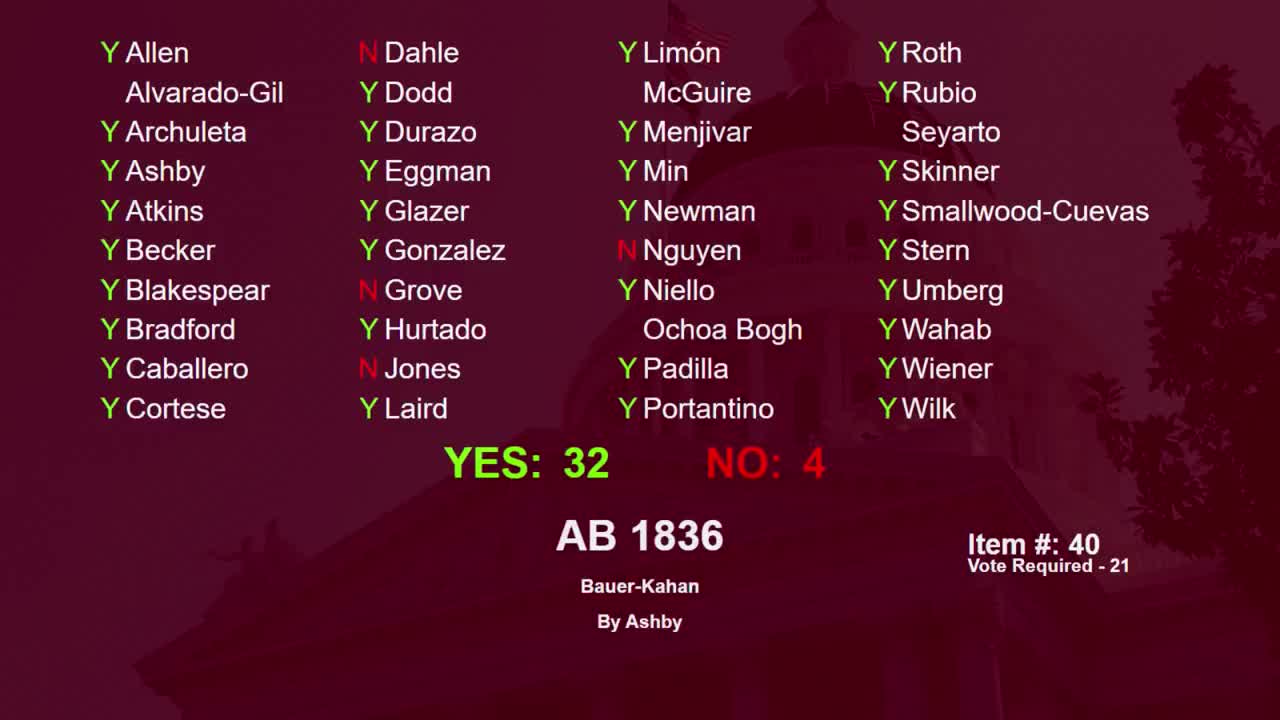 1MIN
Senate Floor
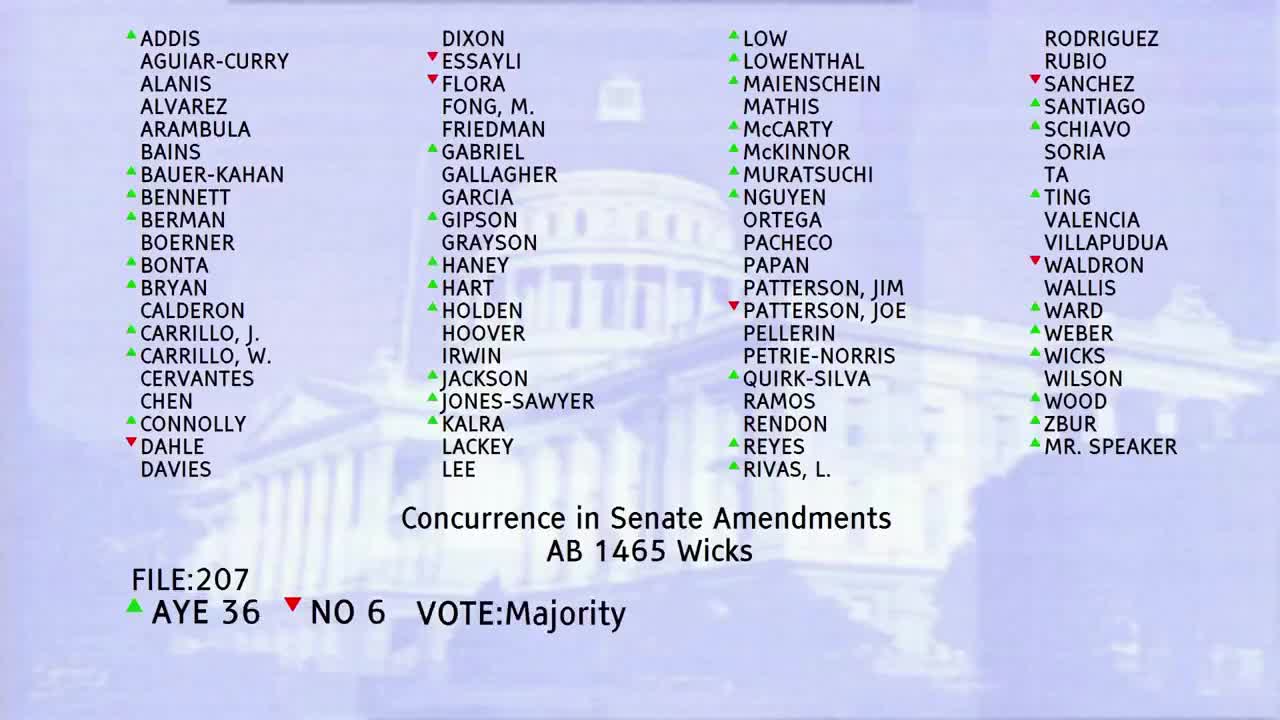 33SEC
Assembly Floor
 2MIN
Senate Standing Committee on Elections and Constitutional Amendments
 6MIN
Assembly Standing Committee on Elections
Bill Author