AB 3239: Political Reform Act of 1974: campaign funds: disclosures.
- Session Year: 2023-2024
- House: Assembly
- Latest Version Date: 2024-03-21
Current Status:
Failed
(2024-07-02: In committee: Set, first hearing. Held without recommendation.)
Introduced
In Committee
First Chamber
In Committee
Second Chamber
Enacted
Under existing law, any expenditure of campaign funds that confers a substantial personal benefit on any individual or individuals with authority to approve the expenditure of campaign funds held by the committee, must be directly related to a political, legislative, or governmental purpose of the committee.
This bill would allow campaign funds to be used to pay or reimburse airline travel expenses related to an emotional support animal belonging to and traveling with an individual whose airline travel may be paid for or reimbursed by campaign funds, as specified.
The Political Reform Act of 1974, an initiative measure, provides that the Legislature may amend the act to further the acts purposes upon a 2/3 vote of each house of the Legislature and compliance with specified procedural requirements.
This bill would declare that it furthers the purposes of the act.
Existing law provides that all parks, public campgrounds, monument sites, landmark sites, and sites of historical interest established or acquired by the state, or which are under its control, constitute the State Park System, with specified exceptions.This bill would make nonsubstantive changes to that provision.Existing law provides that all parks, public campgrounds, monument sites, landmark sites, and sites of historical interest established or acquired by the state, or which are under its control, constitute the State Park System, with specified exceptions.
This bill would make nonsubstantive changes to that provision.
This section governs the use of campaign funds for the specific expenditures set forth in this section. It is the intent of the Legislature that this section shall guide the interpretation of the standard imposed by Section 89512 as applied to other expenditures not specifically set forth in this section.
(a)(1)Campaign funds shall not be used to pay or reimburse the candidate, the elected officer, or any individual or individuals with authority to approve the expenditure of campaign funds held by a committee, or employees or staff of the committee or the elected officers governmental agency for travel expenses and necessary accommodations except when these expenditures are directly related to a political, legislative, or governmental purpose.
(2)For the purposes of this section, payments or reimbursements for travel and necessary accommodations shall be considered as directly related to a political, legislative, or governmental purpose if the payments would meet standards similar to the standards of the Internal Revenue Service pursuant to Sections 162 and 274 of the Internal Revenue Code for deductions of travel expenses under the federal income tax law.
(3)For the purposes of this section, payments or reimbursement for travel by the household of a candidate or elected officer when traveling to the same destination in order to accompany the candidate or elected officer shall be considered for the same purpose as the candidates or elected officers travel.
(4)Whenever campaign funds are used to pay or reimburse a candidate, elected officer, the candidate or elected officers representative, or a member of the candidates household for travel expenses and necessary accommodations, the expenditure shall be reported as required by Section 84211.
(5)Whenever campaign funds are used to pay or reimburse for travel expenses and necessary accommodations, any mileage credit that is earned or awarded pursuant to an airline bonus mileage program shall be deemed personally earned by or awarded to the individual traveler. The earning or awarding of mileage credit and the redeeming of credit for actual travel are not subject to reporting pursuant to Section 84211.
(6)Whenever campaign funds are permitted to be used to pay or reimburse for airline travel expenses and necessary accommodations under this section, such funds may be used to pay or reimburse for airline fees related to an emotional support animal, as defined in Section 122319.5 of the Health and Safety Code, belonging to and traveling with an individual whose airline travel may be paid for or reimbursed by campaign funds under this section. Such payments or reimbursement shall be considered for the same purpose as the candidates or elected officers travel and shall be reported as required by Section 84211.
(b)(1)Campaign funds shall not be used to pay for or reimburse the cost of professional services unless the services are directly related to a political, legislative, or governmental purpose.
(2)Expenditures by a committee to pay for professional services reasonably required by the committee to assist it in the performance of its administrative functions are directly related to a political, legislative, or governmental purpose.
(3)Campaign funds shall not be used to pay health-related expenses for a candidate, elected officer, or any individual or individuals with authority to approve the expenditure of campaign funds held by a committee, or members of their households. Health-related expenses includes, but is not limited to, examinations by physicians, dentists, psychiatrists, psychologists, or counselors and expenses for medications, treatments, medical equipment, hospitalization, health club dues, and special dietary foods. However, campaign funds may be used to pay employer costs of health care benefits of a bona fide employee or independent contractor of the committee.
(c)(1)Campaign funds shall not be used to pay or reimburse fines, penalties, judgments, or settlements, except those resulting from either of the following:
(A)Parking citations incurred in the performance of an activity that was directly related to a political, legislative, or governmental purpose.
(B)Any other action for which payment of attorneys fees from contributions would be permitted pursuant to this title. However, campaign funds shall not be used to pay a fine, penalty, judgment, or settlement relating to an expenditure of campaign funds that resulted in either of the following:
(i)A personal benefit to the candidate or officer if it is determined that the expenditure was not reasonably related to a political, legislative, or governmental purpose.
(ii)A substantial personal benefit to the candidate or officer if it is determined that the expenditure was not directly related to a political, legislative, or governmental purpose.
(2)Campaign funds shall not be used to pay a restitution fine imposed under Section 86 of the Penal Code.
(d)Campaign funds shall not be used for campaign, business, or casual clothing except specialty clothing that is not suitable for everyday use, including, but not limited to, formal wear, if this attire is to be worn by the candidate or elected officer and is directly related to a political, legislative, or governmental purpose.
(e)(1)Except as otherwise prohibited by law, campaign funds may be used to purchase or reimburse for the costs of purchase of tickets to political fundraising events for the attendance of a candidate, elected officer, or the candidate or elected officers immediate family, or an officer, director, employee, or staff of the committee or the elected officers governmental agency.
(2)Campaign funds shall not be used to pay for or reimburse for the costs of tickets for entertainment or sporting events for the candidate, elected officer, or members of the candidate or elected officers immediate family, or an officer, director, employee, or staff of the committee, unless their attendance at the event is directly related to a political, legislative, or governmental purpose.
(3)The purchase of tickets for entertainment or sporting events for the benefit of persons other than the candidate, elected officer, or the candidate or elected officers immediate family are governed by subdivision (f).
(f)(1)Campaign funds shall not be used to make personal gifts unless the gift is directly related to a political, legislative, or governmental purpose. The refund of a campaign contribution does not constitute the making of a gift.
(2)This section does not prohibit the use of campaign funds to reimburse or otherwise compensate a public employee for services rendered to a candidate or committee while on vacation, leave, or otherwise outside of compensated public time.
(3)An election victory celebration or similar campaign event, or gifts with a total cumulative value of less than two hundred fifty dollars ($250) in a single year made to an individual employee, a committee worker, or an employee of the elected officers agency, are considered to be directly related to a political, legislative, or governmental purpose. For purposes of this paragraph, a gift to a member of a persons immediate family shall be deemed to be a gift to that person.
(g)Campaign funds shall not be used to make loans other than to organizations pursuant to Section 89515, or, unless otherwise prohibited, to a candidate for elective office, political party, or committee.
(h)(1)Campaign funds shall not be used to pay or reimburse a candidate or elected officer for a penalty, judgment, or settlement related to a claim of sexual assault, sexual abuse, or sexual harassment filed against the candidate or elective officer in any civil, criminal, or administrative proceeding. If a candidate or elected officer uses campaign funds for other legal costs and expenses related to claims of those unlawful practices and is held liable for such a violation, the candidate or elected officer shall reimburse the campaign for all funds used in connection with those other legal costs and expenses.
(2)For the purpose of this subdivision, sexual assault and sexual abuse have the same meaning as in Section 11165.1 of the Penal Code and sexual harassment has the same meaning as in subdivision (j) of Section 12940 of the Government Code.
(i)(1)For purposes of this subdivision, childcare expenses include the reasonable costs of professional daycare services, babysitting, nannying services, food and beverages, transportation to and from the location of a childcare services provider, before and after school programs, summer day camps, and preschool. Additional qualifying expenses include costs related to a nurse, home care provider, or other care provider for a disabled dependent child. Childcare expenses do not include private school tuition, medical expenses, tutoring services, or payments to a relative, within the third degree of consanguinity, of a child, unless the relative owns or operates a professional daycare or babysitting service and the cost of the service is no greater than the relative would otherwise charge.
(2)Campaign funds may be used to pay or reimburse a candidate for reasonable and necessary childcare expenses for a dependent child resulting directly from the candidate engaging in campaign activities. For purposes of this paragraph, directly means that the candidate would not have incurred the childcare expenses if the candidate did not engage in the campaign activities.
(3)This section shall not be construed to limit the use of campaign funds to pay for childcare expenses resulting from an officeholder engaging in a campaign activity with both political and legislative or governmental purposes.
SEC. 2.The Legislature finds and declares that this bill furthers the purposes of the Political Reform Act of 1974 within the meaning of subdivision (a) of Section 81012 of the Government Code.
SECTION 1.Section 5002 of the Public Resources Code is amended to read:5002.All parks, public campgrounds, monument sites, landmark sites, and sites of historical interest established or acquired by the state, or which are under its control, constitute the State Park System except the sites and grounds known as the State Fair Grounds in the City of Sacramento and Balboa Park in the City of San Diego.All parks, public camp grounds, campgrounds, monument sites, landmark sites, and sites of historical interest established or acquired by the State, state, or which are under its control, constitute the State Park System except the sites and grounds known as the State Fair Grounds in the City of Sacramento, Sacramento and Balboa Park in the City of San Diego.
|
Date
|
Status
|
|---|---|
| Jul 2, 2024 | In committee: Set, first hearing. Held without recommendation. |
| Jun 5, 2024 | Referred to Com. on E. & C.A. |
| May 23, 2024 | In Senate. Read first time. To Com. on RLS. for assignment. |
| May 22, 2024 | Read third time. Passed. Ordered to the Senate. (Ayes 56. Noes 0. Page 5553.) |
| Apr 25, 2024 | Read second time. Ordered to third reading. |
| Apr 24, 2024 | From committee: Do pass. (Ayes 7. Noes 0.) (April 24). |
| Apr 1, 2024 | Re-referred to Com. on ELECTIONS. |
| Mar 21, 2024 | From committee chair, with author's amendments: Amend, and re-refer to Com. on ELECTIONS. Read second time and amended. |
| Mar 21, 2024 | Referred to Com. on ELECTIONS. |
| Feb 17, 2024 | From printer. May be heard in committee March 18. |
| Feb 16, 2024 | Read first time. To print. |
|
Date
|
Description
|
Location
|
Votes
|
|
|---|---|---|---|---|
| May 22, 2024 | AB 3239 Wendy Carrillo Assembly Third Reading | Assembly Floor |
Passed |
|
| Apr 24, 2024 | Do pass. | Assembly Standing Committee on Elections |
Passed |
This list shows positions taken on this bill by organizations on the date displayed, which is linked to the original source.
Positions by individuals are not included.
SENATE COMMITTEE ON
ELECTIONS AND CONSTITUTIONAL AMENDMENTS
Senator Catherine Blakespear, Chair
2023 - 2024 Regular
Bill No: 3239 Hearing Date: 7/2/24
Author: | Wendy Carrillo | ||
Version: |
| ||
Urgency: | Fiscal: | ||
Consultant: | |||
Subject:
DIGEST
This bill allows campaign funds to be used to pay or reimburse airline travel expenses related to an emotional support animal belonging to and traveling with a person whose airline travel may be paid for or reimbursed by campaign funds.
ANALYSIS
Existing law:
- Allows campaign funds to be used to reimburse a candidate, elected official and certain others for money spent on airline travel if the travel is related to a political, legislative, or governmental purpose.
- Allows campaign funds can also be used to pay or reimburse for travel and accommodation expenses of a member of the candidate’s or elected official’s household – which includes their spouse, dependent child, or parents who reside with the candidate or elected official.
- Precludes campaign funds from being used for professional services unless the services are directly related to a political, legislative, or governmental purpose.
- Defines an emotional support animal as an animal that “provides emotional, cognitive, or other similar support to an individual with a disability, and that does not need to be trained or certified.”
- Prevents a health care practitioner from prescribing an emotional support dog for anyone unless the practitioner meet certain requirements
This bill:
- Permits campaign funds to be used to reimburse a candidate, elected official, and certain others for the airline travel expenses and necessary accommodations for an emotional support animal, provided the animal is traveling with a person who is allowed to use campaign funds for airline travel expenses.
- Requires such spending to be reported on the campaign statements candidates, elected officials, and others are required to file.
BACKGROUND
Authorized Use of Campaign Funds. The Political Reform Act (PRA) strictly regulates the use of campaign funds to prevent candidates, elected officials, and others who control the funds from privately benefitting from their campaign activities. Therefore, existing law requires campaign fund spending to be directly or reasonably related to a political, legislative, or governmental purpose.
For instance, campaign funds can be used to pay for travel or accommodations for a candidate or elected official when the spending is directly related to a political, legislative, or governmental purpose. Campaign funds can also be used to pay or reimburse for travel and accommodation expenses of a member of the candidate’s or elected official’s household, such as a spouse, dependent child, or parents who reside with the candidate or elected official.
Service Animals. Under California law, a “service animal” is a dog that has been trained to do work or help a person with a disability – which includes physical, sensory, psychiatric, intellectual, or other mental disability.
The work service animals can perform includes:
- Helping people who are blind or have low vision with navigation and other tasks;
- Alerting people who are deaf or hard of hearing to the presence of people or sounds;
- Providing nonviolent protection or rescue work;
- Pulling a wheelchair;
- Helping a person during a seizure;
- Alerting people to the presence of allergens;
- Retrieving items such as medicine or the telephone;
- Providing physical support and assistance with balance and stability to people with mobility disabilities; and
- Helping people with psychiatric and neurological disabilities by preventing or interrupting impulsive or destructive behaviors.
Emotional Support Animals. Under state law, an "emotional support animal" is not a service animal. Rather, AB 468 (Friedman, 2021) defines an emotional support animal as any animal that provides emotional, cognitive, or other similar support to a person with a disability – and in contrast to a service animal, emotional support animals are not trained to perform any specific acts.
Beyond defining what an emotional support animal is, AB 468 sought to crackdown on the practice of healthcare practitioners essentially “prescribing” an emotional support animal for a person. Prior to changes made by the U.S. Department of Transportation and many airlines, such a prescription could be used to allow an animal to fly free of charge with their owner.
AB 468 prevents a health care practitioner from prescribing an emotional support dog for anyone unless they:
- Possess a valid, active license;
- Are licensed to provide professional services;
- Have a documented, established client-provider relationship with a person for at least 30 days before prescribing an emotional support animal;
- Complete a clinical evaluation of the personal regarding their need for an emotional support animal; and
- Ensure the person knows the penalty for fraudulently representing oneself to be the owner or trainer of any guide, signal, or service dog is a misdemeanor violation of California law.
Airlines and Animals. In 2020, the U.S. Department of Transportation revised its regulation on transporting service animals by air.
Notably, the final rule no longer considers an emotional support animal to be a service animal, meaning airlines can treat an emotional support animal as a pet and can charge an owner who wants their animal to fly with them. Airlines are precluded from charging a person to fly their service animal, provided the animal meets certain requirements.
COMMENTS
- According to the Author: “According to the National Institutes of Health, there is increasing recognition of the therapeutic function pets can play in relation to mental health. The presence of an emotional support animal can cause calming effects to individuals at work, school, and home. AB 3239 would allow campaign funds to be used to pay or reimburse airline travel expenses related to emotional support animals.”
- Potential For Misuse? This measure allows a candidate or an elected official to spend campaign funds to fly an animal they identify as an emotional support animal just as they are able to spend campaign funds to fly their spouse, dependent child, or parents who reside with them.
However, given emotional support animals are not trained or certified, the potential for this measure to be misused by a candidate or elected official who simply wants to provide airline travel to the family pet at the expense of their campaign contributors does exist.
As such, the Committee may wish to consider whether it would be more appropriate to limit this bill’s provisions to animals that have prescribed to a person for emotional support pursuant to the policies established by AB 468.
RELATED/PRIOR LEGISLATION
SB 1170 (Menjivar) allows campaign funds to be used to pay or reimburse a non-incumbent candidate for reasonable and necessary mental healthcare expenses if the candidate does not have health insurance or has been denied coverage for mental healthcare expenses by their health insurance. SB 1170 was approved by this committee on a 6-0 vote on April 30, 2024, and is pending in the Assembly Committee on Appropriations.
AB 2041 (Bonta) expands the ability of a candidate or elected official to spend campaign funds on security-related items. AB 2041 was approved by this committee on a 7-0 vote on June 11, 2024, and is pending on the Senate Committee on Appropriations’ suspense file.
PRIOR ACTIONS
Assembly Floor: 56-0
Assembly Elections Committee: 7-0
POSITIONS
Sponsor: Author
Support: None received
Oppose: None received
-- END --
ASSEMBLY THIRD READING
ATR Bill Id:AB 3239
Author:(Wendy Carrillo)
As Amended Ver:March 21, 2024
2/3 vote
SUMMARY
Permits campaign funds to be used to pay or reimburse airline travel expenses related to an emotional support animal belonging to and traveling with an individual whose travel is authorized to be paid using campaign funds.
Major Provisions
- Permits campaign funds, whenever campaign funds are permitted to be used to pay or reimburse for airline travel expenses and necessary accommodations under the Political Reform Act (PRA), to be used to pay or reimburse for airline fees related to an emotional support animal, as defined in existing law, belonging to and traveling with an individual whose airline travel may be paid for or reimbursed by campaign funds.
- Requires such payments or reimbursement to be considered for the same purpose as a candidate's or elected officer's travel and be reported as required in accordance with existing law.
COMMENTS
Existing law allows campaign funds to be used to pay for travel or accommodations for a candidate or elected officer when the expenditures are directly related to a political, legislative, or governmental purpose. Additionally, existing law authorizes campaign funds to be used to pay or reimburse for travel and accommodation expenses of a member of the candidate's or elected officer's household, such as a spouse, dependent child, or parents who reside with the candidate or elected officer. All expenditures of campaign funds on travel and accommodations are required to be disclosed on periodic campaign disclosure reports, as specified.
This bill permits campaign funds to be used to pay or reimburse airline travel expenses related to an emotional support animal belonging to and traveling with an individual whose travel may be paid for or reimbursed by campaign funds. As written, this bill allows any individual whose travel expenses have been authorized to be paid for or reimbursed by campaign funds to have their emotional support animal's travel expenses paid for by campaign funds. Theoretically, this bill could allow a candidate and a member of a candidate's household who is traveling with the candidate to have their emotional support animals' travel expenses paid with campaign funds. Such a broad expansion of the use of campaign funds could lead to abuse.
California voters passed an initiative, Proposition 9, in 1974 that created the Fair Political Practices Commission and codified significant restrictions and prohibitions on candidates, officeholders, and lobbyists. That initiative is commonly known as the PRA. Amendments to the PRA that are not submitted to the voters, such as those contained in this bill, must further the purposes of the initiative and require a two-thirds vote of both houses of the Legislature.
Please see the policy committee analysis for a full discussion of this bill.
According to the Author
"According to the National Institutes of Health, there is increasing recognition of the therapeutic function pets can play in relation to mental health. The presence of an emotional support animal can cause calming effects to individuals at work, school, and home. [This bill] would allow campaign funds to be used to pay or reimburse airline travel expenses related to emotional support animals."
Arguments in Support
None received.
Arguments in Opposition
None received.
FISCAL COMMENTS
None. This bill is keyed non-fiscal by the Legislative Counsel.
VOTES
ASM ELECTIONS: 7-0-1
YES: Pellerin, Lackey, Berman, Cervantes, Alanis, Low, Jones-Sawyer
ABS, ABST OR NV: Bennett
UPDATED
VERSION: March 21, 2024
CONSULTANT: Nichole Becker / ELECTIONS / (916) 319-2094 FN: 0002800
Date of Hearing: April 24, 2024
ASSEMBLY COMMITTEE ON ELECTIONS
Gail Pellerin, Chair
ABPCA Bill Id:AB 3239 (
Author:Wendy Carrillo) – As Amended Ver:March 21, 2024
SUBJECT: Political Reform Act of 1974: campaign funds: disclosures.
SUMMARY: Permits campaign funds to be used to pay or reimburse airline travel expenses related to an emotional support animal belonging to and traveling with an individual whose travel is authorized to be paid using campaign funds. Specifically, this bill:
- Permits campaign funds, whenever campaign funds are permitted to be used to pay or reimburse for airline travel expenses and necessary accommodations under the Political Reform Act (PRA), to be used to pay or reimburse for airline fees related to an emotional support animal, as defined in existing law, belonging to and traveling with an individual whose airline travel may be paid for or reimbursed by campaign funds.
- Requires such payments or reimbursement to be considered for the same purpose as a candidate’s or elected officer’s travel and be reported as required in accordance with existing law.
EXISTING LAW:
- Creates the Fair Political Practices Commission (FPPC), and makes it responsible for the impartial, effective administration and implementation of the PRA. (Government Code §§81000 et seq.)
- Makes violations of the PRA subject to administrative, civil, and criminal penalties. (Government Code §§83116, 91000-91005.5)
- Provides that all contributions deposited into a campaign committee account are deemed to be held in trust for expenses associated with the election of the candidate or for expenses associated with holding office. Provides that an expenditure to seek or hold office is within the lawful execution of this trust if it is reasonably related to a political, legislative, or governmental purpose. Requires expenditures of campaign funds to be reasonably related to a political, legislative, or governmental purpose. Requires an expenditure of campaign funds that confers a substantial personal benefit on any individual with authority to approve the expenditure of campaign funds to be directly related to a political, legislative, or governmental purpose. (Government Code §§89510 et seq.)
- Authorizes campaign funds to be used to pay or reimburse the candidate, the elected officer, or any individual or individuals with authority to approve the expenditure of campaign funds held by a committee, or employees or staff of the committee or the elected officer’s governmental agency, for travel expenses and necessary accommodations when these expenditures are directly related to a political, legislative, or governmental purpose.
Requires payments or reimbursement for travel by the household of a candidate or elected officer when traveling to the same destination in order to accompany the candidate or elected officer to be considered for the same purpose as the candidate’s or elected officer’s travel. (Government Code §89513)
- Requires an expenditure of campaign funds for travel expenses and necessary accommodations of a candidate, elected officer, the candidate or elected officer’s representative, or a member of the candidate’s household, to be reported on a campaign disclosure report, as specified. (Government Code §89513(a)(4))
- Defines “household” to include the candidate’s or elected officer’s spouse, dependent children, and parents who reside with the candidate or elected officer. (Government Code §89511(b)(4))
- Defines an “emotional support animal” to mean an animal that provides emotional, cognitive, or other similar support to an individual with a disability, and that does not need to be trained or certified. (Health and Safety Code §122319.5)
- Prohibits campaign funds from being used to pay or be reimbursed for health related expenses for a candidate, elected officer, or any individual or individuals with authority to approve the expenditure of campaign funds held by a committee, or members of their households. (Government Code §89513(b)(3))
FISCAL EFFECT: None. This bill is keyed non-fiscal by the Legislative Counsel.
COMMENTS:
- Purpose of the Bill: According to the author:
According to the National Institutes of Health, there is increasing recognition of the therapeutic function pets can play in relation to mental health. The presence of an emotional support animal can cause calming effects to individuals at work, school, and home. AB 3239 would allow campaign funds to be used to pay or reimburse airline travel expenses related to emotional support animals.
- Authorized Use of Campaign Funds and Previous Legislation: The PRA strictly regulates the use of campaign funds, and contributions deposited into a campaign account are deemed to be held in trust for expenses associated with the election of a candidate or for expenses associated with holding office. PRA provisions restricting the "personal use" of campaign funds are designed to prevent candidates, elected officials, and others who control the expenditures of campaign funds from benefiting privately from their campaign activities. Therefore, existing law requires expenditures of campaign funds to be reasonably related to a political, legislative, or governmental purpose, or directly related to a political, legislative, or governmental purpose in situations where the expenditure confers a substantial personal benefit on any individual with authority to approve the expenditure of campaign funds. A substantial personal benefit means an expenditure of campaign funds which results in a direct personal benefit with a value of more than $200.
For instance, existing law allows campaign funds to be used to pay for travel or accommodations for a candidate or elected officer when the expenditures are directly related to a political, legislative, or governmental purpose. Additionally, existing law authorizes campaign funds to be used to pay or reimburse for travel and accommodation expenses of a member of the candidate’s or elected officer’s household, such as a spouse, dependent child, or parents who reside with the candidate or elected officer. All expenditures of campaign funds on travel and accommodations are required to be disclosed on periodic campaign disclosure reports, as specified.
This bill permits campaign funds to be used to pay or reimburse airline travel expenses related to an emotional support animal belonging to and traveling with an individual whose travel may be paid for or reimbursed by campaign funds. As written, this bill allows any individual whose travel expenses have been authorized to be paid for or reimbursed by campaign funds to have their emotional support animal’s travel expenses paid for by campaign funds. Theoretically, this bill could allow a candidate and a member of a candidate’s household who is traveling with the candidate to have their emotional support animals’ travel expenses paid with campaign funds. The committee may wish to consider whether such a broad expansion of the use of campaign funds could lead to abuse.
Research by committee staff did not find any FPPC advice letters opining on whether campaign funds can be used to pay or reimburse the travel expenses of an emotional support animal.
- Emotional Support Animal Definition: This bill cross references an existing Health and Safety Code definition of the term emotional support animal. Specifically, this bill defines an emotional support animal to mean an animal that provides emotional, cognitive, or other similar support to an individual with a disability, and that does not need to be trained or certified. In other words, no certification or training documentation is required to determine that the animal traveling with the individual is an emotional support animal. The committee may wish to consider whether using campaign funds to pay for the travel expenses of an emotional support animal absent a certification requirement could lead to abuse.
- Airlines and Emotional Support Animals: In 2020, the United State Department of Transportation announced that it was revising its Air Carrier Access Act regulation on the transportation of service animals by air to ensure a safe and accessible air transportation system. Notably, the final rule no longer considers an emotional support animal to be a service animal, and permits airlines to treat an emotional support animal as a pet. Although emotional support animals and other pets are not service animals, the rule does not prohibit their transport and an airline may choose to transport them as pets pursuant to its established policy.
Media articles reported that once airline rule changes went into effect, only trained service dogs will be allowed to fly without charge and without being in a carrier and animals that were considered “comfort” or “emotional support” animals — dogs, ducks, rabbits, or others — are no longer allowed on planes without a cost. - Related Legislation: SB 1170 (Menjivar) permits campaign funds to be used to pay or reimburse a non-incumbent candidate for reasonable and necessary mental healthcare expenses if the candidate does not have health insurance or has been denied coverage for mental healthcare expenses by their health insurance, as specified. SB 1170 is set to be heard in the Senate Elections & Constitutional Amendments Committee on April 30, 2024.
AB 2041 (Bonta) authorizes campaign funds to be used for costs related to security expenses, as defined, to protect a candidate, elected officer, or the immediate family or staff of a candidate or elected officer, as specified. AB 2041 passed out of this committee on a 7-0 vote and is pending on the Assembly floor. - Political Reform Act of 1974: California voters passed an initiative, Proposition 9, in 1974 that created the FPPC and codified significant restrictions and prohibitions on candidates, officeholders, and lobbyists. That initiative is commonly known as the PRA. Amendments to the PRA that are not submitted to the voters, such as those contained in this bill, must further the purposes of the initiative and require a two-thirds vote of both houses of the Legislature.
REGISTERED SUPPORT / OPPOSITION:
Support
None on file.
Opposition
None on file.
Analysis Prepared by: Nichole Becker / ELECTIONS / (916) 319-2094
Discussed in Hearing
 1MIN
Senate Standing Committee on Elections and Constitutional Amendments
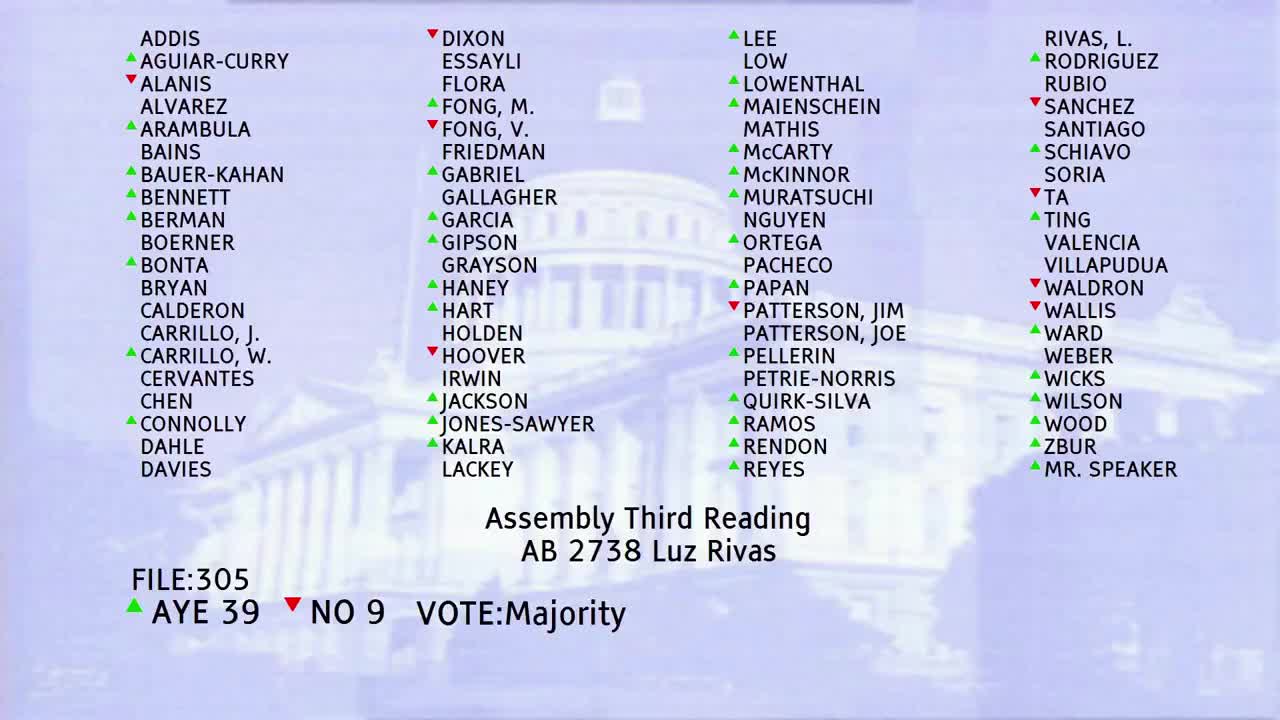 3MIN
Assembly Floor
 3MIN
Assembly Standing Committee on Elections
Bill Author

Bill Co-Author(s):