AB 92: Body armor: prohibition.
- Session Year: 2023-2024
- House: Assembly
- Latest Version Date: 2023-09-26
Current Status:
Passed
(2023-09-26: Chaptered by Secretary of State - Chapter 232, Statutes of 2023.)
Introduced
In Committee
First Chamber
In Committee
Second Chamber
Enacted
What does this bill do?
The bill makes it a misdemeanor (a less serious crime) for anyone who is barred from owning or possessing firearms under California law to buy, own, or wear body armor. It requires courts to tell people about the body‑armor ban when notifying them of a firearm prohibition and to have them give up any body armor unless they get permission. Local police chiefs or sheriffs can grant exceptions with conditions, the person must carry a certified copy of that permission, and officers are shielded from false‑arrest claims when enforcing the ban unless the person has the written permission.
The summary is provided by generative AI which can make mistakes. For original language, please view the details in the table below.
Existing law makes it a felony for a person who has been convicted of a violent felony to purchase, own, or possess body armor. Existing law authorizes a person subject to that prohibition, whose employment, livelihood, or safety is dependent on the ability to legally possess and use body armor, to file a petition for an exception to the prohibition with the chief of police or county sheriff of the jurisdiction in which the person seeks to possess and use the body armor, as provided.
This bill would make it a misdemeanor for a person who is prohibited from possessing a firearm under the laws of this state to purchase, own, or possess body armor, as specified.
The California Constitution requires the state to reimburse local agencies and school districts for certain costs mandated by the state. Statutory provisions establish procedures for making that reimbursement.
This bill would provide that no reimbursement is required by this act for a specified reason.
Existing law makes it a felony for a person who has been convicted of a violent felony to purchase, own, or possess body armor. Existing law authorizes a person subject to that prohibition, whose employment, livelihood, or safety is dependent on the ability to legally possess and use body armor, to file a petition for an exception to the prohibition with the chief of police or county sheriff of the jurisdiction in which the person seeks to possess and use the body armor, as provided.
This bill would make it a misdemeanor for any person to purchase or take possession of body armor, unless they are employed in specified professions. The bill would additionally make it a misdemeanor for a person, firm, or corporation to sell or deliver body armor to any person not engaged in one of those professions. The bill would require a seller to verify that a transferee is from an eligible profession, as specified. The bill would authorize the Department of Justice to expand the list of eligible professions if the duties of the profession may expose an individual engaged in the profession to serious physical injury that may be prevented or mitigated by the wearing of body armor, or if the duties of the profession are necessary to facilitate the lawful purchase, sale, or use of body armor.This bill would make it a misdemeanor for a person who is prohibited from possessing a firearm under the laws of this state to purchase, own, or possess body armor, as specified.
The California Constitution requires the state to reimburse local agencies and school districts for certain costs mandated by the state. Statutory provisions establish procedures for making that reimbursement.
This bill would provide that no reimbursement is required by this act for a specified reason.
Existing law makes it a felony for a person who has been convicted of a violent felony to purchase, own, or possess body armor. Existing law authorizes a person subject to that prohibition, whose employment, livelihood, or safety is dependent on the ability to legally possess and use body armor, to file a petition for an exception to the prohibition with the chief of police or county sheriff of the jurisdiction in which the person seeks to possess and use the body armor, as provided.
This bill would repeal those provisions and instead make it a felony for a person to commit any violent felony while possessing a firearm and in the course of and in furtherance of that crime they wear body armor. The bill would make it a misdemeanor for any person to purchase or take possession of body armor, unless they are employed in specified professions. The bill would additionally make it a misdemeanor for a person, firm, or corporation to sell or deliver body armor to any person not engaged in one of those professions. The bill would require a seller to verify that a transferee is from an eligible profession, as specified. The bill would authorize the Department of Justice to expand the list of eligible professions if the duties of the profession may expose an individual engaged in the profession to serious physical injury that may be prevented or mitigated by the wearing of body armor, or if the duties of the profession are necessary to facilitate the lawful purchase, sale, or use of body armor.
The California Constitution requires the state to reimburse local agencies and school districts for certain costs mandated by the state. Statutory provisions establish procedures for making that reimbursement.
This bill would provide that no reimbursement is required by this act for a specified reason.
(a)A person who has been convicted of a violent felony under the laws of the United States, the State of California, or any other state, government, or country, who purchases, owns, or possesses body armor, as defined in Section 16288, except as authorized under subdivision (c), is guilty of a felony, punishable by imprisonment in state prison for 16 months, or two or three years.
(b)(1)A person who is prohibited from possessing a firearm under the laws of this state, except under Section 29610, who purchases, owns, or possesses body armor, as defined in Section 16288, except as authorized under subdivision (c), is guilty of a misdemeanor.
(2)Upon advising a person of their firearm prohibition, a court shall also advise them of their body armor prohibition pursuant to this section. A person shall relinquish any body armor in their possession.
(c)A person whose employment, livelihood, or safety is dependent on the ability to legally possess and use body armor, who is subject to the prohibition imposed by subdivision (a) due to a prior violent felony conviction, or who is prohibited pursuant to subdivision (b), may file a petition for an exception to this prohibition with the chief of police or county sheriff of the jurisdiction in which that person seeks to possess and use the body armor. The chief of police or sheriff may reduce or eliminate the prohibition, impose conditions on reduction or elimination of the prohibition, or otherwise grant relief from the prohibition as the chief of police or sheriff deems appropriate, based on the following:
(1)A finding that the petitioner is likely to use body armor in a safe and lawful manner.
(2)A finding that the petitioner has a reasonable need for this type of protection under the circumstances.
In making its decision, the chief of police or sheriff shall consider the petitioners continued employment, the interests of justice, any relevant evidence, and the totality of the circumstances. It is the intent of the Legislature that law enforcement officials exercise broad discretion in fashioning appropriate relief under this paragraph in cases in which relief is warranted. However, this paragraph may not be construed to require law enforcement officials to grant relief to any particular petitioner. Relief from this prohibition does not relieve any other person or entity from any liability that might otherwise be imposed.
(d)The chief of police or sheriff shall require, as a condition of granting an exception under subdivision (c), that the petitioner agree to maintain on the petitioners person a certified copy of the law enforcement officials permission to possess and use body armor, including any conditions or limitations.
(e)Law enforcement officials who enforce the prohibition specified in subdivision (a) or (b) against a person who has been granted relief pursuant to subdivision (c) shall be immune from any liability for false arrest arising from the enforcement of this subdivision unless the person has in possession a certified copy of the permission granting the person relief from the prohibition, as required by subdivision (d). This immunity from liability does not relieve any person or entity from any other liability that might otherwise be imposed.
SEC. 2.No reimbursement is required by this act pursuant to Section 6 of Article XIIIB of the California Constitution because the only costs that may be incurred by a local agency or school district will be incurred because this act creates a new crime or infraction, eliminates a crime or infraction, or changes the penalty for a crime or infraction, within the meaning of Section 17556 of the Government Code, or changes the definition of a crime within the meaning of Section 6 of Article XIIIB of the California Constitution.
(a)A person who has been convicted of a violent felony under the laws of the United States, the State of California, or any other state, government, or country, who purchases, owns, or possesses body armor, as defined in Section 16288, except as authorized under subdivision (c), is guilty of a felony, punishable by imprisonment in state prison for 16 months, or two or three years.
(b)(1) A person who is prohibited from possessing a firearm under the laws of this state, who purchases, owns, or possesses body armor, as defined in Section 16288, except as authorized under subdivision (c), is guilty of a misdemeanor.
(2)Upon advising a person of their firearm prohibition, a court shall also advise them of their body armor prohibition pursuant to this section. A person shall relinquish any body armor in their possession in the same manner as outlined for the relevant firearm prohibition. possession.
(c)A person whose employment, livelihood, or safety is dependent on the ability to legally possess and use body armor, who is subject to the prohibition imposed by subdivision (a) due to a prior violent felony conviction, or who is prohibited pursuant to subdivision (b), may file a petition for an exception to this prohibition with the chief of police or county sheriff of the jurisdiction in which that person seeks to possess and use the body armor. The chief of police or sheriff may reduce or eliminate the prohibition, impose conditions on reduction or elimination of the prohibition, or otherwise grant relief from the prohibition as the chief of police or sheriff deems appropriate, based on the following:
(1)A finding that the petitioner is likely to use body armor in a safe and lawful manner.
(2)A finding that the petitioner has a reasonable need for this type of protection under the circumstances.
In making its decision, the chief of police or sheriff shall consider the petitioners continued employment, the interests of justice, any relevant evidence, and the totality of the circumstances. It is the intent of the Legislature that law enforcement officials exercise broad discretion in fashioning appropriate relief under this paragraph in cases in which relief is warranted. However, this paragraph may not be construed to require law enforcement officials to grant relief to any particular petitioner. Relief from this prohibition does not relieve any other person or entity from any liability that might otherwise be imposed.
(d)The chief of police or sheriff shall require, as a condition of granting an exception under subdivision (c), that the petitioner agree to maintain on the petitioners person a certified copy of the law enforcement officials permission to possess and use body armor, including any conditions or limitations.
(e)Law enforcement officials who enforce the prohibition specified in subdivision (a) or (b) against a person who has been granted relief pursuant to subdivision (c) shall be immune from any liability for false arrest arising from the enforcement of this subdivision unless the person has in possession a certified copy of the permission granting the person relief from the prohibition, as required by subdivision (d). This immunity from liability does not relieve any person or entity from any other liability that might otherwise be imposed.
SEC. 2.No reimbursement is required by this act pursuant to Section 6 of Article XIIIB of the California Constitution because the only costs that may be incurred by a local agency or school district will be incurred because this act creates a new crime or infraction, eliminates a crime or infraction, or changes the penalty for a crime or infraction, within the meaning of Section 17556 of the Government Code, or changes the definition of a crime within the meaning of Section 6 of Article XIIIB of the California Constitution.
(a)A person who has been convicted of a violent felony under the laws of the United States, the State of California, or any other state, government, or country, who purchases, owns, or possesses body armor, as defined in Section 16288, except as authorized under subdivision (b), (c), is guilty of a felony, punishable by imprisonment in state prison for 16 months, or two or three years.
(b)(1) A person who is prohibited from possessing a firearm under the laws of this state, who purchases, owns, or possesses body armor, as defined in Section 16288, except as authorized under subdivision (c), is guilty of a misdemeanor.
(2)Upon advising a person of their firearm prohibition, a court shall also advise them of their body armor prohibition pursuant to this section. A person shall relinquish any body armor in their possession in the same manner as outlined for the relevant firearm prohibition.
(b)(c)A person whose employment, livelihood, or safety is dependent on the ability to legally possess and use body armor, who is subject to the prohibition imposed by subdivision (a) due to a prior violent felony conviction, or who is prohibited pursuant to subdivision (b), may file a petition for an exception to this prohibition with the chief of police or county sheriff of the jurisdiction in which that person seeks to possess and use the body armor. The chief of police or sheriff may reduce or eliminate the prohibition, impose conditions on reduction or elimination of the prohibition, or otherwise grant relief from the prohibition as the chief of police or sheriff deems appropriate, based on the following:
(1)A finding that the petitioner is likely to use body armor in a safe and lawful manner.
(2)A finding that the petitioner has a reasonable need for this type of protection under the circumstances.
In making its decision, the chief of police or sheriff shall consider the petitioners continued employment, the interests of justice, any relevant evidence, and the totality of the circumstances. It is the intent of the Legislature that law enforcement officials exercise broad discretion in fashioning appropriate relief under this paragraph in cases in which relief is warranted. However, this paragraph may not be construed to require law enforcement officials to grant relief to any particular petitioner. Relief from this prohibition does not relieve any other person or entity from any liability that might otherwise be imposed.
(c)(d)The chief of police or sheriff shall require, as a condition of granting an exception under subdivision (b), (c), that the petitioner agree to maintain on the petitioners person a certified copy of the law enforcement officials permission to possess and use body armor, including any conditions or limitations.
(d)(e)Law enforcement officials who enforce the prohibition specified in subdivision (a) or (b) against a person who has been granted relief pursuant to subdivision (b), (c) shall be immune from any liability for false arrest arising from the enforcement of this subdivision unless the person has in possession a certified copy of the permission granting the person relief from the prohibition, as required by subdivision (c). (d). This immunity from liability does not relieve any person or entity from any other liability that might otherwise be imposed.
SEC. 2.No reimbursement is required by this act pursuant to Section 6 of Article XIIIB of the California Constitution because the only costs that may be incurred by a local agency or school district will be incurred because this act creates a new crime or infraction, eliminates a crime or infraction, or changes the penalty for a crime or infraction, within the meaning of Section 17556 of the Government Code, or changes the definition of a crime within the meaning of Section 6 of Article XIIIB of the California Constitution.
SECTION 1.Section 16288 of the Penal Code is amended to read:16288.As used in Sections 31360 and 31361, body armor means any bullet-resistant material intended to provide ballistic and trauma protection for the person wearing the body armor.SEC. 2.Section 31361 is added to the Penal Code, to read:31361.(a)A person is guilty of the unlawful purchase of body armor when, not being engaged or employed in an eligible profession, they knowingly purchase or take possession of body armor. This subdivision does not apply to individuals or entities engaged or employed in eligible professions.(b)(1)No person, firm, or corporation shall sell or deliver body armor to any person or entity not engaged or employed in an eligible profession. Before selling or delivering body armor, a person, firm, or corporation shall check proof of engagement in an eligible profession.(2)No sale or delivery of body armor shall be made unless the transferee meets in person with the transferor to accomplish the sale or delivery.(3)For the purposes of paragraph (1), proof of engagement in an eligible profession may be satisfied by submission to the seller of a professional license issued by a federal, state, or local government, employment card or other credential issued by an employer, or in the absence of either of those, submission to the seller of a form approved by the Department of Justice that is notarized, verifying that the purchaser is engaged in an eligible profession.(4)This subdivision does not apply to purchases made by federal, state, or local government agencies for the purpose of furnishing body armor to employees in eligible professions.(c)For the purposes of this section, eligible professions means any of the following:(1)Peace officers.(2)Persons in military service in the state or military or other service for the United States.(3)Federal law enforcement officers.(4)Armored car guards.(5)Security guards.(6)Firefighters.(7)Emergency medical technicians and paramedics.(8)Firearms dealers.(9)Body armor retailers or salespersons.(10)Building safety inspectors.(11)Code enforcement officers.(12)Animal control officers.(13)Private investigators.(14)Journalists.(15)Any profession added by the Department of Justice pursuant to subdivision (d).(d)(1)The Department of Justice may add additional professions pursuant to paragraph (15) of subdivision (c). The department shall add a profession to the list of eligible professions if the duties of the profession may expose an individual engaged in the profession to serious physical injury that may be prevented or mitigated by the wearing of body armor, or if the duties of the profession are necessary to facilitate the lawful purchase, sale, or use of body armor.(2)An individual or entity engaged in a profession in the state that is not on the list of eligible professions may request that the Department of Justice add their profession to the list of eligible professions by filing a request with the Department of Justice in a form and method approved by the department.(e)A violation of this section shall be a misdemeanor, punishable by a fine not to exceed five thousand dollars ($5,000) for a first offense, and not to exceed ten thousand dollars ($10,000) for any subsequent offense.SEC. 3.No reimbursement is required by this act pursuant to Section 6 of Article XIIIB of the California Constitution because the only costs that may be incurred by a local agency or school district will be incurred because this act creates a new crime or infraction, eliminates a crime or infraction, or changes the penalty for a crime or infraction, within the meaning of Section 17556 of the Government Code, or changes the definition of a crime within the meaning of Section 6 of Article XIIIB of the California Constitution.As used in Section 31360, Sections 31360 and 31361, body armor means any bullet-resistant material intended to provide ballistic and trauma protection for the person wearing the body armor.
SEC. 3.Section 31360 is added to the Penal Code, to read:31360.(a)A person is guilty of unlawful wearing of body armor when they commit any violent felony, as defined in subdivision (c) of Section 667.5, while possessing a firearm and in the course of and in furtherance of that crime they wear body armor.(b)SEC. 2.Section 31361 is added to the Penal Code, to read:31361.(a)A person is guilty of the unlawful purchase of body armor when, not being engaged or employed in an eligible profession, they knowingly purchase or take possession of body armor. This subdivision does not apply to individuals or entities engaged or employed in eligible professions.
(c)(b)(1)No person, firm, or corporation shall sell or deliver body armor to any person or entity not engaged or employed in an eligible profession. Before selling or delivering body armor, a person, firm, or corporation shall check proof of engagement in an eligible profession.
(2)No sale or delivery of body armor shall be made unless the transferee meets in person with the transferor to accomplish the sale or delivery.
(3)For the purposes of paragraph (1), proof of engagement in an eligible profession may be satisfied by submission to the seller of a professional license issued by a federal, state, or local government, employment card or other credential issued by an employer, or in the absence of either of those, submission to the seller of a form approved by the Department of Justice that is notarized, verifying that the purchaser is engaged in an eligible profession.
(4)This subdivision does not apply to purchases made by federal, state, or local government agencies for the purpose of furnishing body armor to employees in eligible professions.
(d)(c)For the purposes of this section, eligible professions means any of the following:
(1)Peace officers.
(2)Persons in military service in the state or military or other service for the United States.
(3)Federal law enforcement officers.
(4)Armored car guards.
(5)Security guards.
(6)Firefighters.
(7)Emergency medical technicians and paramedics.
(8)Firearms dealers.
(9)Body armor retailers or salespersons.
(10)Building safety inspectors.
(11)Code enforcement officers.
(12)Animal control officers.
(13)Private investigators.
(14)Journalists.
(12)(15)Any profession added by the Department of Justice pursuant to subdivision (e). (d).
(e)(d)(1)The Department of Justice may add additional professions pursuant to paragraph (12) (15) of subdivision (d). (c). The department shall add a profession to the list of eligible professions if the duties of the profession may expose an individual engaged in the profession to serious physical injury that may be prevented or mitigated by the wearing of body armor, or if the duties of the profession are necessary to facilitate the lawful purchase, sale, or use of body armor.
(2)An individual or entity engaged in a profession in the state that is not on the list of eligible professions may request that the Department of Justice add their profession to the list of eligible professions by filing a request with the Department of Justice in a form and method approved by the department.
(f)(1)A violation of subdivision (a) shall be a felony, punishable by imprisonment in the state prison for 16 months, or two or three years.(2)(e)A violation of subdivision (b) or (c) this section shall be a misdemeanor, punishable by a fine not to exceed five thousand dollars ($5,000) for a first offense, and not to exceed ten thousand dollars ($10,000) for any subsequent offense.
SEC. 4.SEC. 3.No reimbursement is required by this act pursuant to Section 6 of Article XIIIB of the California Constitution because the only costs that may be incurred by a local agency or school district will be incurred because this act creates a new crime or infraction, eliminates a crime or infraction, or changes the penalty for a crime or infraction, within the meaning of Section 17556 of the Government Code, or changes the definition of a crime within the meaning of Section 6 of Article XIIIB of the California Constitution.
(a)A person is guilty of unlawful wearing of body armor when they commit any violent felony, as defined in subdivision (c) of Section 667.5, while possessing a firearm and in the course of and in furtherance of that crime they wear body armor.
(b)A person is guilty of the unlawful purchase of body armor when, not being engaged or employed in an eligible profession, they knowingly purchase or take possession of body armor. This subdivision does not apply to individuals or entities engaged or employed in eligible professions.
(c)(1)No person, firm, or corporation shall sell or deliver body armor to any person or entity not engaged or employed in an eligible profession. Before selling or delivering body armor, a person, firm, or corporation shall check proof of engagement in an eligible profession.
(2)No sale or delivery of body armor shall be made unless the transferee meets in person with the transferor to accomplish the sale or delivery.
(3)For the purposes of paragraph (1), proof of engagement in an eligible profession may be satisfied by submission to the seller of a professional license issued by a federal, state, or local government, employment card or other credential issued by an employer, or in the absence of either of those, submission to the seller of a form approved by the Department of Justice that is notarized, verifying that the purchaser is engaged in an eligible profession.
(4)This subdivision does not apply to purchases made by federal, state, or local government agencies for the purpose of furnishing body armor to employees in eligible professions.
(d)For the purposes of this section, eligible professions means any of the following:
(1)Peace officers.
(2)Persons in military service in the state or military or other service for the United States.
(3)Federal law enforcement officers.
(4)Armored car guards.
(5)Security guards.
(6)Firefighters.
(7)Emergency medical technicians and paramedics.
(8)Firearms dealers.
(9)Body armor retailers or salespersons.
(10)Building safety inspectors.
(11)Code enforcement officers.
(12)Any profession added by the Department of Justice pursuant to subdivision (e).
(e)(1)The Department of Justice may add additional professions pursuant to paragraph (12) of subdivision (d). The department shall add a profession to the list of eligible professions if the duties of the profession may expose an individual engaged in the profession to serious physical injury that may be prevented or mitigated by the wearing of body armor, or if the duties of the profession are necessary to facilitate the lawful purchase, sale, or use of body armor.
(2)An individual or entity engaged in a profession in the state that is not on the list of eligible professions may request that the Department of Justice add their profession to the list of eligible professions by filing a request with the Department of Justice in a form and method approved by the department.
(f)(1)A violation of subdivision (a) shall be a felony, punishable by imprisonment in the state prison for 16 months, or two or three years.
(2)A violation of subdivision (b) or (c) shall be a misdemeanor, punishable by a fine not to exceed five thousand dollars ($5,000) for a first offense, and not to exceed ten thousand dollars ($10,000) for any subsequent offense.
SEC. 4.No reimbursement is required by this act pursuant to Section 6 of Article XIIIB of the California Constitution because the only costs that may be incurred by a local agency or school district will be incurred because this act creates a new crime or infraction, eliminates a crime or infraction, or changes the penalty for a crime or infraction, within the meaning of Section 17556 of the Government Code, or changes the definition of a crime within the meaning of Section 6 of Article XIIIB of the California Constitution.
|
Date
|
Status
|
|---|---|
| Sep 26, 2023 | Chaptered by Secretary of State - Chapter 232, Statutes of 2023. |
| Sep 26, 2023 | Approved by the Governor. |
| Sep 21, 2023 | Enrolled and presented to the Governor at 3:30 p.m. |
| Sep 14, 2023 | Senate amendments concurred in. To Engrossing and Enrolling. (Ayes 62. Noes 12. Page 3533.). |
| Sep 13, 2023 | In Assembly. Concurrence in Senate amendments pending. |
| Sep 13, 2023 | Read third time. Passed. Ordered to the Assembly. (Ayes 30. Noes 7. Page 2728.). |
| Sep 11, 2023 | Read second time. Ordered to third reading. |
| Sep 8, 2023 | Read third time and amended. Ordered to second reading. |
| Sep 5, 2023 | Read second time. Ordered to third reading. |
| Sep 1, 2023 | Read second time and amended. Ordered returned to second reading. |
| Sep 1, 2023 | From committee: Amend, and do pass as amended. (Ayes 5. Noes 2.) (September 1). |
| Jul 3, 2023 | In committee: Referred to APPR suspense file. |
| Jun 20, 2023 | From committee: Do pass and re-refer to Com. on APPR. (Ayes 5. Noes 0.) (June 20). Re-referred to Com. on APPR. |
| May 31, 2023 | Referred to Com. on PUB S. |
| May 23, 2023 | In Senate. Read first time. To Com. on RLS. for assignment. |
| May 22, 2023 | Read third time. Passed. Ordered to the Senate. (Ayes 58. Noes 13. Page 1705.) |
| May 18, 2023 | Read second time. Ordered to third reading. |
| May 18, 2023 | From committee: Do pass. (Ayes 11. Noes 3.) (May 18). |
| Apr 19, 2023 | In committee: Set, first hearing. Referred to APPR. suspense file. |
| Mar 2, 2023 | Re-referred to Com. on APPR. |
| Mar 1, 2023 | Read second time and amended. |
| Feb 28, 2023 | From committee: Amend, and do pass as amended and re-refer to Com. on APPR. (Ayes 7. Noes 0.) (February 28). |
| Feb 22, 2023 | Re-referred to Com. on PUB. S. |
| Feb 21, 2023 | From committee chair, with author's amendments: Amend, and re-refer to Com. on PUB. S. Read second time and amended. |
| Jan 30, 2023 | In committee: Set, first hearing. Hearing canceled at the request of author. |
| Jan 26, 2023 | Referred to Com. on PUB. S. |
| Jan 6, 2023 | From printer. May be heard in committee February 5. |
| Jan 5, 2023 | Read first time. To print. |
|
Date
|
Description
|
Location
|
Votes
|
|
|---|---|---|---|---|
| Sep 14, 2023 | AB 92 Connolly Concurrence in Senate Amendments | Assembly Floor |
Passed |
|
| Sep 13, 2023 | Assembly 3rd Reading AB92 Connolly et al. By Umberg | Senate Floor |
Passed |
|
| Sep 1, 2023 | Do pass as amended | Senate Standing Committee on Appropriations |
Passed |
|
| Jul 3, 2023 | Placed on suspense file | Senate Standing Committee on Appropriations |
Passed |
|
| Jun 20, 2023 | Do pass, but first be re-referred to the Committee on [Appropriations] | Senate Standing Committee on Public Safety |
Passed |
|
| May 22, 2023 | AB 92 Connolly Assembly Third Reading | Assembly Floor |
Passed |
|
| May 18, 2023 | Do pass. | Assembly Standing Committee on Appropriations |
Passed |
|
| Feb 28, 2023 | Do pass as amended and be re-referred to the Committee on [Appropriations] | Assembly Standing Committee on Public Safety |
Passed |
This list shows positions taken on this bill by organizations on the date displayed, which is linked to the original source.
Positions by individuals are not included.
|
Organization
|
Position
|
Date
|
|---|---|---|
| California Public Defenders Association | * Support | Feb 28, 2023 |
| California Public Defenders Association | * Neutral | Feb 28, 2023 |
| California Rifle & Pistol Association | * Against | Feb 28, 2023 |
| California Rifle Pistol Association | * Against | Feb 28, 2023 |
| California School Employees Association | ** Support | |
| Defendingconstitutionalrights.com | ** Against | |
| Friends Committee On Legislation Of California | * Support | Jun 20, 2023 |
| Gun Owners of California | * Against | Feb 28, 2023 |
| National Rifle Association | * Against | Feb 28, 2023 |
| Peace Officers Research Association Of California | ** Support | |
| Riverside County Sheriff's Office | ** Against | |
| Women for American Values and Ethics Action Fund | ** Support |
CONCURRENCE IN SENATE AMENDMENTS
CSA1 Bill Id:AB 92
Author:(Connolly)
As Amended Ver:September 8, 2023
Majority vote
SUMMARY
Prohibits a person from purchasing or possessing body armor if state law prohibits them from possessing a firearm.
Senate Amendments
- Delete the requirement that body armor be relinquished in the same manner as outlined for relinquishment of a firearm.
- Provide that the categorical prohibition barring minors from possessing firearms shall not serve as the sole basis for prohibiting a minor from possessing body armor.
COMMENTS
As passed by the Assembly, this bill:
- Made it a misdemeanor for a person who is prohibited from possessing a firearm under California law to purchase or possess body armor.
- Defined "body armor" as "any bullet-resistant material intended to provide ballistic and trauma protection for the person wearing the body armor."
- Required a court to advise an individual of the body armor prohibition upon advising that person of their firearm prohibition.
- Stated that a person must relinquish any body armor in their possession in the same manner as outlined for the relevant firearm prohibition.
- Allowed a prohibited person to petition a chief of police or sheriff for an exemption if their employment or safety depend on it, as specified.
According to the Author
"Following the horrific shooting in Buffalo, New York last year, the state Legislature there passed restrictions on body armor to keep this military-grade gear out of the hands of violent criminals. Simply put, the widespread availability of military-grade body armor helps mass shooters and criminals kill more people and prolong their rampages. This ongoing and unnecessary epidemic of violence must be stopped, and AB 92 will help protect innocent bystanders and our peace officers.
Arguments in Support
According to the Women For American Values and Ethics, "We write to express WAVE Action Fund's support for a slate of gun safety bills currently being considered by the California State Assembly. WAVE Action Fund is a women-led grassroots organization in Orange County that advocates for safer and healthier communities through legislative advocacy, and gun safety is one of our strongest areas of interest. We are proud that California lawmakers take gun violence seriously, and we appreciate the many gun safety Assembly bills in this session that remove impediments to safe gun ownership and update gun safety laws to include the realities of 21st century life, i.e., ghost guns, private sales, etc. Among the dozens of gun safety bills currently in the Assembly, WAVE would like to express our strong support for the following bills in particular: AB 28 (Gabriel), AB 29 (Gabriiel), AB 92 (Connolly), AB 301 (Bauer-Kahan), AB 725 (Lowenthal), AB 818 (Petrie-Norris), AB 1089 (Gipson), AB 1483 (Valencia)."
Arguments in Opposition
According the Gun Owners of California, "[United States] Supreme Court precedent has ruled in Heller v Washington DC, McDonald v Chicago, Caetano v Massachusetts and most recently in NYSRPA v Bruen, that the right to keep and bear arms is not limited to firearms. Rather, it includes anything that is in common use by the people for lawful purposes (i.e. defense) is protected by the Second Amendment. This includes body armor.
"The Court has held that "the Second Amendment [https://www.law.cornell.edu/constitution/second_amendment] extends, prima facie, to all instruments that constitute bearable arms, even those that were not in existence at the time of the founding," District of Columbia v. Heller, 554 U. S. 570 [https://www.law.cornell.edu/supremecourt/text/554/570], 582 (2008), and that this Second Amendment right is fully applicable to the States," McDonald v. Chicago, 561 U.S. 742 [https://www.law.cornell.edu/supremecourt/text/561/742], 750 (2010). In this case, the Supreme Judicial Court of Massachusetts upheld a Massachusetts law prohibiting the possession of stun guns after examining "whether a stun gun is the type of weapon contemplated by Congress in 1789 as being protected by the Second Amendment." 470 Mass. 774, 777, 26 N. E. 3d 688, 691 (2015).
"Magazines, ammunition, accessories, and body armor fall under the same protection.
"It's important to note that this legislation would criminalize a significant number of people – including parents who have chosen to provide school backpacks with body armor panels for their children in order to provide some level of protection in the tragic event of a school shooting. Further, motorcycle enthusiasts often use articles of clothing constructed with body armor, which can offer significant protection in the case of an accident. Other protective garments are manufactured with body armor, including athletic wear, hats, and denim jeans…"
FISCAL COMMENTS
According to the Senate Appropriations Committee, unknown court workload cost pressures to adjudicate misdemeanor charges that are brought under the provisions of AB 92 (Trial Court Trust Fund, General Fund).
VOTES:
ASM PUBLIC SAFETY: 7-0-1
YES: Jones-Sawyer, Alanis, Bonta, Bryan, Ortega, Santiago, Zbur
ABS, ABST OR NV: Lackey
ASM APPROPRIATIONS: 11-3-2
YES: Holden, Bryan, Calderon, Wendy Carrillo, Mike Fong, Hart, Lowenthal, Papan, Pellerin, Weber, Ortega
NO: Megan Dahle, Mathis, Sanchez
ABS, ABST OR NV: Dixon, Robert Rivas
ASSEMBLY FLOOR: 58-13-9
YES: Addis, Aguiar-Curry, Alanis, Alvarez, Arambula, Bauer-Kahan, Bennett, Berman, Boerner, Bonta, Bryan, Calderon, Juan Carrillo, Wendy Carrillo, Cervantes, Connolly, Davies, Mike Fong, Friedman, Gabriel, Garcia, Gipson, Grayson, Haney, Hart, Holden, Irwin, Jackson, Jones-Sawyer, Kalra, Lee, Low, Lowenthal, Maienschein, McCarty, McKinnor, Stephanie Nguyen, Ortega, Papan, Pellerin, Petrie-Norris, Reyes, Luz Rivas, Robert Rivas, Rodriguez, Blanca Rubio, Santiago, Schiavo, Ting, Valencia, Villapudua, Ward, Weber, Wicks, Wilson, Wood, Zbur, Rendon
NO: Bains, Megan Dahle, Essayli, Flora, Vince Fong, Gallagher, Hoover, Mathis, Joe Patterson, Sanchez, Ta, Waldron, Wallis
ABS, ABST OR NV: Chen, Dixon, Lackey, Muratsuchi, Pacheco, Jim Patterson, Quirk-Silva, Ramos, Soria
SENATE FLOOR: 30-7-3
YES: Allen, Archuleta, Ashby, Atkins, Becker, Blakespear, Bradford, Cortese, Dodd, Durazo, Eggman, Glazer, Gonzalez, Laird, Limón, McGuire, Menjivar, Min, Newman, Padilla, Portantino, Roth, Rubio, Skinner, Smallwood-Cuevas, Stern, Umberg, Wahab, Wiener, Wilk
NO: Dahle, Grove, Hurtado, Jones, Nguyen, Ochoa Bogh, Seyarto
ABS, ABST OR NV: Alvarado-Gil, Caballero, Niello
UPDATED
VERSION: September 1, 2023
CONSULTANT: Mureed Rasool / PUB. S. / (916) 319-3744 FN: 0002333
SENATE RULES COMMITTEE Office of Senate Floor Analyses (916) 651-1520 Fax: (916) 327-4478 | AB 92 |
THIRD READING
Bill No: AB 92
Author: Connolly (D), et al.
Amended: 9/8/23 in Senate
Vote: 21
SENATE PUBLIC SAFETY COMMITTEE: 5-0, 6/20/23
AYES: Wahab, Ochoa Bogh, Bradford, Skinner, Wiener
SENATE APPROPRIATIONS COMMITTEE: 5-2, 9/1/23
AYES: Portantino, Ashby, Bradford, Wahab, Wiener
NOES: Jones, Seyarto
ASSEMBLY FLOOR: 58-13, 5/22/23 - See last page for vote
SUBJECT: Body armor: prohibition
SOURCE: Author
DIGEST:
This bill prohibits an individual from purchasing or possessing body armor if state law prohibits them from possessing a firearm.
Senate Floor Amendments of 9/8/23 clarify that the prohibition above does not apply to juveniles.
ANALYSIS:
Existing law:
- Prohibits violent felons, as defined, from purchasing, owning or possessing body armor. (18 U.S.C. §931.)
- Defines body armor, for the purposes of the prohibition above, as “any product sold or offered for sale, in interstate or foreign commerce, as personal protective body covering intended to protect against gunfire, regardless of whether the product is to be worn alone or is sold as a complement to another product or garment.” (18 U.S.C. § 921 subd. (a)(35).)
- Defines “body vest” and “body shield” in general as “any bullet-resistant material intended to provide ballistic and trauma protection for the wearer or holder.” (Pen. Code, § 16290.)
- Defines “body armor” as “any bullet-resistant material intended to provide ballistic and trauma protection for the person wearing the body armor.” (Pen. Code, § 16288.)
- Provides that a minor shall not possess any firearm, except as specified. (Pen. Code §29610.)
- Provides that any person convicted of a felony under the laws of the United States, the State of California, or any other state, government, or country, or of other specified offenses, or who is addicted to the use of any narcotic drug, and who owns, purchases, receives, or has in possession or under custody or control any firearm is guilty of a felony. (Pen. Code § 29800, subd. (a)(1).)
- Provides that individuals convicted of specified misdemeanors are prohibited from owning, purchasing, receiving or possessing a firearm for 10 years, and that violation of this prohibition is a misdemeanor. (Pen. Code, § 29805, subd. (a)(1).)
- Provides that upon conviction of any offense that renders a person subject to the prohibitions above related to firearms, the person shall relinquish all firearms he or she owns, possesses or has under their custody or control. (Pen. Code, § 29810, subd. (a)(1).)
- Sets forth specific circumstances under which a violation of the prohibitions above is justified, and under which an individual may petition for relief from these prohibitions. (Pen. Code, §29850 – 29865.)
- Prohibits a violent felon from possessing body armor unless their livelihood or safety is dependent on its possession, in which case they can petition their chief of police or sheriff to modify or eliminate the prohibition. (Pen. Code, §§ 31360& 17320.)
- Authorizes a prohibited person whose employment or safety depends on the ability to possess body armor to petition their local chief of police or sheriff for modifications or elimination of the body armor prohibition. (Pen. Code, § 31360, subd. (b).)
- Requires a chief of police or sheriff modifying or eliminating a body armor prohibition order to consider the following:
- Whether the body armor is likely to be used in a safe and lawful manner;
- Whether there is a reasonable need for the type of protection under the circumstances; and;
- The petitioner’s continued employment, the interests of justice, and the totality of the circumstances. (Pen. Code, § 31360, subds. (b)(1) & (2).)
- Provides that a law enforcement official is not required to grant relief from the prohibition against the possession of body armor by a violent felon. (Pen. Code § 31360, subd. (b)(2).)
- Provides that any prohibited person authorized to possess body armor must agree to maintain a certified copy of the law enforcement official’s permission to possess the body armor. (Pen. Code § 31360, subd. (c).)
- Provides immunity from false arrest for law enforcement officials who arrest a petitioner that has been authorized to possess body armor, unless the petitioner did not have a certified copy of their permission. (Pen. Code § 31360, subd. (d).)
- Imposes an enhancement of one, two, or five years for any person who commits a violent felony while wearing a body vest, as defined. (Pen. Code, § 12022.2.)
This bill:
- Makes it a misdemeanor for any person, except a minor, who is prohibited from possessing a firearm under the laws of this state to purchase, own or possess body armor, unless otherwise authorized.
- Provides that upon advising a person of their firearm prohibition, a court shall also advise them of their body armor prohibition.
- Specifies that a person subject to the body armor prohibition shall relinquish any body armor in their possession.
- Authorizes a person prohibited from possessing body armor under its provisions, and whose employment, livelihood, or safety is dependent on the ability to legally possess and use body armor, to petition a chief of police or county sheriff for an exception to the prohibition.
- Provides that law enforcement officials who enforce the prohibition established by this bill against a person who has been granted relief from that prohibition shall be immune from any liability for false arrest from enforcement of the prohibition unless the person has a certified copy of their permission granting relief on their person.
Comments
Existing state and federal law contains a myriad of prohibitions on the possession and attempted purchase of firearms by certain individuals. Under both state and federal law, all felony convictions lead to a lifetime prohibition. California law goes further and imposes a 10-year prohibition on the possession and purchase of firearms for individuals convicted of numerous misdemeanor offenses that involve either violence or threat of violence. Additionally, a person may be prohibited from possessing a firearm due to a protective order, such as a gun violence restraining order (GVRO), or as a condition of probation. Individuals under domestic violence restraining orders are also subject to a prohibition on firearm possession and purchase for the duration of that court order. Additionally, if a person communicates to his or her psychotherapist a serious threat of physical violence against a reasonably-identifiable victim or victims, the person is prohibited from owning or purchasing a firearm for five years, starting from the date the psychotherapist reports to local law enforcement the identity of the person making the threat. If a person is admitted into a facility because that person is a danger to himself, herself, or to others, the person is prohibited from owning or purchasing a firearm for five years.
Existing state and federal law also prohibits violent felons from possessing or purchasing body armor. However, both the state and federal restrictions permit prohibited individuals to petition local law enforcement if their employment, livelihood or safety requires them to wear body armor. Besides these basic restrictions, federal and California state law include very few regulations regarding the purchase and use of body armor, and only two other states, New York and Connecticut, have imposed additional restrictions in recent years.
This bill prohibits persons who are already prohibited from possessing a firearm, for any reason, from possessing body armor, and provides that violation of this prohibition is punishable as a misdemeanor. Additionally, this bill requires a court, upon advising a prohibited individual of their firearm prohibition, to also advise them of their body armor prohibition, and requires that person to relinquish any body armor in their possession in the same manner as they would a firearm. Finally, this bill exempts from its prohibition on the possession of body armor any person whose employment, livelihood or safety is dependent on the ability to legally possess and use body armor, provided that person successfully petitions law enforcement pursuant to the process outlined in existing law.
FISCAL EFFECT: Appropriation: No Fiscal Com.: Yes Local: Yes
According to the Senate Appropriations Committee, unknown court workload cost pressures to adjudicate misdemeanor charges that are brought under the provisions of AB 92 (Trial Court Trust Fund, General Fund).
SUPPORT: (Verified 9/8/23)
California School Employees Association
Peace Officers Research Association of California
Women for American Values and Ethics Action Fund
OPPOSITION: (Verified 9/8/23)
Defendingconstitutionalrights.com
ASSEMBLY FLOOR: 58-13, 5/22/23
AYES: Addis, Aguiar-Curry, Alanis, Alvarez, Arambula, Bauer-Kahan, Bennett, Berman, Boerner, Bonta, Bryan, Calderon, Juan Carrillo, Wendy Carrillo, Cervantes, Connolly, Davies, Mike Fong, Friedman, Gabriel, Garcia, Gipson, Grayson, Haney, Hart, Holden, Irwin, Jackson, Jones-Sawyer, Kalra, Lee, Low, Lowenthal, Maienschein, McCarty, McKinnor, Stephanie Nguyen, Ortega, Papan, Pellerin, Petrie-Norris, Reyes, Luz Rivas, Robert Rivas, Rodriguez, Blanca Rubio, Santiago, Schiavo, Ting, Valencia, Villapudua, Ward, Weber, Wicks, Wilson, Wood, Zbur, Rendon
NOES: Bains, Megan Dahle, Essayli, Flora, Vince Fong, Gallagher, Hoover, Mathis, Joe Patterson, Sanchez, Ta, Waldron, Wallis
NO VOTE RECORDED: Chen, Dixon, Lackey, Muratsuchi, Pacheco, Jim Patterson, Quirk-Silva, Ramos, Soria
Prepared by: Alex Barnett / PUB. S. /
9/11/23 13:40:00
**** END ****
SENATE RULES COMMITTEE Office of Senate Floor Analyses (916) 651-1520 Fax: (916) 327-4478 | AB 92 |
THIRD READING
Bill No: AB 92
Author: Connolly (D), et al.
Amended: 9/1/23 in Senate
Vote: 21
SENATE PUBLIC SAFETY COMMITTEE: 5-0, 6/20/23
AYES: Wahab, Ochoa Bogh, Bradford, Skinner, Wiener
SENATE APPROPRIATIONS COMMITTEE: 5-2, 9/1/23
AYES: Portantino, Ashby, Bradford, Wahab, Wiener
NOES: Jones, Seyarto
ASSEMBLY FLOOR: 58-13, 5/22/23 - See last page for vote
SUBJECT: Body armor: prohibition
SOURCE: Author
DIGEST:
This bill prohibits an individual from purchasing or possessing body armor if state law prohibits them from possessing a firearm.
ANALYSIS:
Existing law:
- Prohibits violent felons, as defined, from purchasing, owning or possessing body armor. (18 U.S.C. §931.)
- Defines body armor, for the purposes of the prohibition above, as “any product sold or offered for sale, in interstate or foreign commerce, as personal protective body covering intended to protect against gunfire, regardless of whether the product is to be worn alone or is sold as a complement to another product or garment.” (18 U.S.C. § 921 subd. (a)(35).)
- Defines “body vest” and “body shield” in general as “any bullet-resistant material intended to provide ballistic and trauma protection for the wearer or holder.” (Pen. Code, § 16290.)
- Defines “body armor” as “any bullet-resistant material intended to provide ballistic and trauma protection for the person wearing the body armor.” (Pen. Code, § 16288.)
- Provides that any person convicted of a felony under the laws of the United States, the State of California, or any other state, government, or country, or of other specified offenses, or who is addicted to the use of any narcotic drug, and who owns, purchases, receives, or has in possession or under custody or control any firearm is guilty of a felony. (Pen. Code § 29800, subd. (a)(1).)
- Provides that individuals convicted of specified misdemeanors are prohibited from owning, purchasing, receiving or possessing a firearm for 10 years, and that violation of this prohibition is a misdemeanor. (Pen. Code, § 29805, subd. (a)(1).)
- Provides that upon conviction of any offense that renders a person subject to the prohibitions above related to firearms, the person shall relinquish all firearms he or she owns, possesses or has under their custody or control. (Pen. Code, § 29810, subd. (a)(1).)
- Sets forth specific circumstances under which a violation of the prohibitions above is justified, and under which an individual may petition for relief from these prohibitions. (Pen. Code, §29850 – 29865.)
- Prohibits a violent felon from possessing body armor unless their livelihood or safety is dependent on its possession, in which case they can petition their chief of police or sheriff to modify or eliminate the prohibition. (Pen. Code, §§ 31360& 17320.)
- Authorizes a prohibited person whose employment or safety depends on the ability to possess body armor to petition their local chief of police or sheriff for modifications or elimination of the body armor prohibition. (Pen. Code, § 31360, subd. (b).)
- Requires a chief of police or sheriff modifying or eliminating a body armor prohibition order to consider the following:
- Whether the body armor is likely to be used in a safe and lawful manner;
- Whether there is a reasonable need for the type of protection under the circumstances; and;
- The petitioner’s continued employment, the interests of justice, and the totality of the circumstances. (Pen. Code, § 31360, subds. (b)(1) & (2).)
- Provides that a law enforcement official is not required to grant relief from the prohibition against the possession of body armor by a violent felon. (Pen. Code § 31360, subd. (b)(2).)
- Provides that any prohibited person authorized to possess body armor must agree to maintain a certified copy of the law enforcement official’s permission to possess the body armor. (Pen. Code § 31360, subd. (c).)
- Provides immunity from false arrest for law enforcement officials who arrest a petitioner that has been authorized to possess body armor, unless the petitioner did not have a certified copy of their permission. (Pen. Code § 31360, subd. (d).)
- Imposes an enhancement of one, two, or five years for any person who commits a violent felony while wearing a body vest, as defined. (Pen. Code, § 12022.2.)
This bill:
- Makes it a misdemeanor for any person who is prohibited from possessing a firearm under the laws of this state to purchase, own or possess body armor, unless otherwise authorized.
- Provides that upon advising a person of their firearm prohibition, a court shall also advise them of their body armor prohibition.
- Specifies that a person subject to the body armor prohibition shall relinquish any body armor in their possession.
- Authorizes a person prohibited from possessing body armor under its provisions, and whose employment, livelihood, or safety is dependent on the ability to legally possess and use body armor, to petition a chief of police or county sheriff for an exception to the prohibition.
- Provides that law enforcement officials who enforce the prohibition established by this bill against a person who has been granted relief from that prohibition shall be immune from any liability for false arrest from enforcement of the prohibition unless the person has a certified copy of their permission granting relief on their person.
Comments
According to the author, “Following the horrific shooting in Buffalo, New York last year, the state Legislature there passed restrictions on body armor to keep this military-grade gear out of the hands of violent criminals. Simply put, the widespread availability of military-grade body armor helps mass shooters and criminals kill more people and prolong their rampages. This ongoing and unnecessary epidemic of violence must be stopped, and AB 92 will help protect innocent bystanders and our peace officers.”
Existing state and federal law contains a myriad of prohibitions on the possession and attempted purchase of firearms by certain individuals. Under both state and federal law, all felony convictions lead to a lifetime prohibition. California law goes further and imposes a 10-year prohibition on the possession and purchase of firearms for individuals convicted of numerous misdemeanor offenses that involve either violence or threat of violence. Additionally, a person may be prohibited from possessing a firearm due to a protective order, such as a gun violence restraining order (GVRO), or as a condition of probation. Individuals under domestic violence restraining orders are also subject to a prohibition on firearm possession and purchase for the duration of that court order. Additionally, if a person communicates to his or her psychotherapist a serious threat of physical violence against a reasonably-identifiable victim or victims, the person is prohibited from owning or purchasing a firearm for five years, starting from the date the psychotherapist reports to local law enforcement the identity of the person making the threat. If a person is admitted into a facility because that person is a danger to himself, herself, or to others, the person is prohibited from owning or purchasing a firearm for five years.
Existing state and federal law also prohibits violent felons from possessing or purchasing body armor. However, both the state and federal restrictions permit prohibited individuals to petition local law enforcement if their employment, livelihood or safety requires them to wear body armor. Besides these basic restrictions, federal and California state law include very few regulations regarding the purchase and use of body armor, and only two other states, New York and Connecticut, have imposed additional restrictions in recent years.
This bill prohibits persons who are already prohibited from possessing a firearm, for any reason, from possessing body armor, and provides that violation of this prohibition is punishable as a misdemeanor. Additionally, this bill requires a court, upon advising a prohibited individual of their firearm prohibition, to also advise them of their body armor prohibition, and requires that person to relinquish any body armor in their possession in the same manner as they would a firearm. Finally, this bill exempts from its prohibition on the possession of body armor any person whose employment, livelihood or safety is dependent on the ability to legally possess and use body armor, provided that person successfully petitions law enforcement pursuant to the process outlined in existing law.
FISCAL EFFECT: Appropriation: No Fiscal Com.: Yes Local: Yes
According to the Senate Appropriations Committee, unknown court workload cost pressures to adjudicate misdemeanor charges that are brought under the provisions of AB 92 (Trial Court Trust Fund, General Fund).
SUPPORT: (Verified 9/1/23)
California School Employees Association
Peace Officers Research Association of California
Women for American Values and Ethics Action Fund
OPPOSITION: (Verified 9/1/23)
Defendingconstitutionalrights.com
ASSEMBLY FLOOR: 58-13, 5/22/23
AYES: Addis, Aguiar-Curry, Alanis, Alvarez, Arambula, Bauer-Kahan, Bennett, Berman, Boerner, Bonta, Bryan, Calderon, Juan Carrillo, Wendy Carrillo, Cervantes, Connolly, Davies, Mike Fong, Friedman, Gabriel, Garcia, Gipson, Grayson, Haney, Hart, Holden, Irwin, Jackson, Jones-Sawyer, Kalra, Lee, Low, Lowenthal, Maienschein, McCarty, McKinnor, Stephanie Nguyen, Ortega, Papan, Pellerin, Petrie-Norris, Reyes, Luz Rivas, Robert Rivas, Rodriguez, Blanca Rubio, Santiago, Schiavo, Ting, Valencia, Villapudua, Ward, Weber, Wicks, Wilson, Wood, Zbur, Rendon
NOES: Bains, Megan Dahle, Essayli, Flora, Vince Fong, Gallagher, Hoover, Mathis, Joe Patterson, Sanchez, Ta, Waldron, Wallis
NO VOTE RECORDED: Chen, Dixon, Lackey, Muratsuchi, Pacheco, Jim Patterson, Quirk-Silva, Ramos, Soria
Prepared by: Alex Barnett / PUB. S. /
9/2/23 14:58:31
**** END ****
SENATE COMMITTEE ON APPROPRIATIONS
Senator Anthony Portantino, Chair
2023 - 2024 Regular Session
AB 92 (Connolly) - Body armor: prohibition
Version: March 1, 2023 | Policy Vote: PUB. S. 5 - 0 |
Urgency: No | Mandate: Yes |
Hearing Date: September 1, 2023 | Consultant: Matthew Fleming |
Bill Summary:
AB 92 would make it a misdemeanor for any person who is prohibited from possessing a firearm under the laws of this state to purchase, own, or possess body armor.
*********** ANALYSIS ADDENDUM – SUSPENSE FILE ***********
The following information is revised to reflect amendments
adopted by the committee on September 1, 2023
Fiscal Impact:
- Unknown court workload cost pressures to adjudicate misdemeanor charges that are brought under the provisions of AB 92 (Trial Court Trust Fund, General Fund).
Author Amendments:
Delete the requirement that body armor be relinquished in the same manner as a firearm following a conviction that results in a firearms and body armor prohibition.
-- END --
SENATE COMMITTEE ON
Senator Anthony Portantino, Chair
2023 - 2024 Regular Session
AB 92 (Connolly) - Body armor: prohibition
Version: | Policy Vote: |
Urgency: | Mandate: |
Hearing Date: | Consultant: |
Bill Summary:
AB 92 would make it a misdemeanor for any person who is prohibited from possessing a firearm under the laws of this state to purchase, own, or possess body armor.
Fiscal Impact:
- Unknown, significant one-time and ongoing costs, likely in the high hundreds of thousands to low millions to the Department of Justice (DOJ) in order to update systems, regulations, and forms, and to otherwise comply with the relinquishment requirement in AB 92 (General Fund).*
- Unknown, potentially significant court workload cost pressures to adjudicate misdemeanor offenses that are brought under the provisions of AB 92 (Trial Court Trust Fund, General Fund).*
* See Staff Comments for additional detail.
Background:
Body armor is a term that refers to vests and other clothing that provides protection against ballistic impacts, such as bullets. According to at least one major national media outlet, National Public Radio, body armor is increasingly being purchased by civilians. (NPR, Sales of body armor are on the rise. Who's buying and why? (Jun. 14, 2022) <https://www.npr.org/2022/06/14/1103935711/body-armor-sales-increase-rise-mass-shootings-bans> [as of Feb. 22, 2023].) As body armor sales in the U.S. has apparently increased, so has the diversity of its purchasers. According to body armor retailers who spoke with NPR, although their customers used to be mainly law enforcement and journalists, there is a growing popularity among individuals who want to wear body armor in everyday life. Although these purchasers commonly include gun owners, one retailer stated that the customer base also tends to be people working night shifts at liquor stores or gas stations.
According to reporting by the Associated Press, over the past forty years at least 21 mass shooters wore body armor, with a majority of those occurring in the past decade. (AP News, Buffalo is latest mass shooting by gunman wearing body armor (May 26, 2022) <https://apnews.com/article/mass-shootings-buffalo-body-armor-f7789ba97dee4d786ac24ec5c642b7ca> [as of Feb. 23, 2023].) Although the database does not show a clear correlation with body armor and the number of victims, it has been posited that body armor could enable attackers to continue to shoot even after taking gunshots from law enforcement, and it is a symbolic way to adhere to societal expectations of what a mass shooting looks like. Most recently, a shooter in Buffalo was wearing body armor and was shot by a security guard, but was not stopped.
Proposed Law:
- Makes it a misdemeanor for a person who is prohibited from possessing a firearm under California law to purchase or possess body armor.
- Defines “body armor” as “any bullet-resistant material intended to provide ballistic and trauma protection for the person wearing the body armor.”
- Requires a court to advise an individual of the body armor prohibition upon advising that person of their firearm prohibition.
- States that a person must relinquish any body armor in their possession in the same manner as outlined for the relevant firearm prohibition.
- Allows a prohibited person to petition a chief of police or sheriff for an exemption if their employment or safety depend on it, as specified.
Related Legislation:
AB 301 (Bauer-Kahan), would prohibit the selling, purchase, or taking possession of body armor unless a person is in an eligible profession. AB 301 will be heard in this Committee today.
Staff Comments:
- As written, AB 92 requires that a person, upon conviction of an offense that results in a firearms prohibition, or otherwise becoming prohibited from possessing a firearm, must relinquish their body armor in a manner consistent with the statutory procedures concerning the relinquishment of a firearm. Those procedures require the use of a specific DOJ form and annotation in the Automated Firearms System. The DOJ may require IT solutions and significant staff resources in order to update its form, regulations, and system in order to include body armor in the existing relinquishment process.
It is unknown how many additional misdemeanor prosecutions will be brought as a result of AB 92. However, misdemeanor charges carry the potential for incarceration and therefore certain defendants’ rights are attached to the proceedings. These include the right to a jury trial and the right to counsel (at public expense if the defendant is unable to afford the costs of representation) which could lead to lengthier and more complex court proceedings. It generally costs about $1,000 to operate a courtroom for one hour. Although courts are not funded on the basis of workload, increased staff time and resources may create a need for increased funding for courts from the General Fund (GF) to perform existing duties. Numerous trial court operations are funded through the imposition and collection of criminal fines and fees. However, the Legislature has reduced and eliminated criminal fines and fees over the past decade. As a result, the 2023-24 May Revision proposes an ongoing annual allocation of $105.1 million from the GF to backfill declining revenue to the Trial Court Trust Fund.
-- END --
SENATE COMMITTEE ON PUBLIC SAFETY
Senator Aisha Wahab, Chair
2023 - 2024 Regular
Bill No: AB 92 Hearing Date: June 20, 2023
Author: | Connolly | ||
Version: | March 1, 2023 | ||
Urgency: | No | Fiscal: | Yes |
Consultant: | AB | ||
Subject: Body armor: prohibition
HISTORY
Source: Author
Prior Legislation: N/A
Support: California School Employees Association; Peace Officers Research Association of California (PORAC); Women for American Values and Ethics Action Fund
Opposition: None known
Assembly Floor Vote: 58 - 13
PURPOSE
The purpose of this bill is to prohibit an individual from purchasing or possessing body armor if state law prohibits them from possessing a firearm.
Existing federal law prohibits violent felons, as defined, from purchasing, owning or possessing body armor. (18 U.S.C. §931.)
Existing federal law defines body armor, for the purposes of the prohibition above, as “any product sold or offered for sale, in interstate or foreign commerce, as personal protective body covering intended to protect against gunfire, regardless of whether the product is to be worn alone or is sold as a complement to another product or garment.” (18 U.S.C. § 921 subd. (a)(35).)
Existing state law defines “body vest” and “body shield” in general as “any bullet-resistant material intended to provide ballistic and trauma protection for the wearer or holder.” (Pen. Code, § 16290.)
Existing law defines “body armor” as “any bullet-resistant material intended to provide ballistic and trauma protection for the person wearing the body armor.” (Pen. Code, § 16288.)
Existing law provides that any person convicted of a felony under the laws of the United States, the State of California, or any other state, government, or country, or of other specified offenses, or who is addicted to the use of any narcotic drug, and who owns, purchases, receives, or has in possession or under custody or control any firearm is guilty of a felony. (Pen. Code § 29800, subd. (a)(1).)
Existing law provides that individuals convicted of specified misdemeanors are prohibited from owning, purchasing, receiving or possessing a firearm for 10 years, and that violation of this prohibition is a misdemeanor. (Pen. Code, § 29805, subd. (a)(1).)
Existing law provides that upon conviction of any offense that renders a person subject to the prohibitions above related to firearms, the person shall relinquish all firearms he or she owns, possesses or has under their custody or control. (Pen. Code, § 29810, subd. (a)(1).)
Existing law sets forth specific circumstances under which a violation of the prohibitions above is justified, and under which an individual may petition for relief from these prohibitions. (Pen. Code, §29850 – 29865.)
Existing law prohibits a violent felon from possessing body armor unless their livelihood or safety is dependent on its possession, in which case they can petition their chief of police or sheriff to modify or eliminate the prohibition. (Pen. Code, §§ 31360& 17320.)
Existing law authorizes a prohibited person whose employment or safety depends on the ability to possess body armor to petition their local chief of police or sheriff for modifications or elimination of the body armor prohibition. (Pen. Code, § 31360, subd. (b).)
Existing law requires a chief of police or sheriff modifying or eliminating a body armor prohibition order to consider the following:
- Whether the body armor is likely to be used in a safe and lawful manner;
- Whether there is a reasonable need for the type of protection under the circumstances; and;
- The petitioner’s continued employment, the interests of justice, and the totality of the circumstances. (Pen. Code, § 31360, subds. (b)(1) & (2).)
Existing law provides that a law enforcement official is not required to grant relief from the prohibition against the possession of body armor by a violent felon. (Pen. Code § 31360, subd. (b)(2).)
Existing law provides that any prohibited person authorized to possess body armor must agree to maintain a certified copy of the law enforcement official’s permission to possess the body armor. (Pen. Code § 31360, subd. (c).)
Existing law provides immunity from false arrest for law enforcement officials who arrest a petitioner that has been authorized to possess body armor, unless the petitioner did not have a certified copy of their permission. (Pen. Code § 31360, subd. (d).)
Existing law imposes an enhancement of one, two, or five years for any person who commits a violent felony while wearing a body vest, as defined. (Pen. Code, § 12022.2.)
This bill makes it a misdemeanor for any person who is prohibited from possessing a firearm under the laws of this state to purchase, own or possess body armor, unless otherwise authorized.
This bill provides that upon advising a person of their firearm prohibition, a court shall also advise them of their body armor prohibition.
This bill specifies that a person subject to the body armor prohibition shall relinquish any body armor in their possession in the same manner as outlined for the relevant firearm prohibition.
This bill authorizes a person prohibited from possessing body armor under its provisions, and whose employment, livelihood, or safety is dependent on the ability to legally possess and use body armor, to petition a chief of police or county sheriff for an exception to the prohibition.
This bill provides that law enforcement officials who enforce the prohibition established by this bill against a person who has been granted relief from that prohibition shall be immune from any liability for false arrest from enforcement of the prohibition unless the person has a certified copy of their permission granting relief on their person.
COMMENTS
- Need for This Bill
According to the Author:
Following the horrific shooting in Buffalo, New York last year, the state Legislature there passed restrictions on body armor to keep this military-grade gear out of the hands of violent criminals. Simply put, the widespread availability of military-grade body armor helps mass shooters and criminals kill more people and prolong their rampages. This ongoing and unnecessary epidemic of violence must be stopped, and AB 92 will help protect innocent bystanders and our peace officers.
- Body Armor and Recent Mass Shootings
The term “body armor” is commonly associated with vests and other body-worn garments and accessories that provide protection against ballistic impacts, i.e. bullets and explosives. There are generally two kinds of body armor, soft body armor and hard body armor. Soft body armor is generally composed of ballistic resistant material that is layered so that when a bullet hits it, the fibers absorb and disperse the bullet’s energy without letting it penetrate through to the wearer. Hard body armor, by contrast refers to plates that can be constructed from ceramics, metal, or other rigid material. There are also variants that combine different types of body armor for greater protection against ballistics as well as stabbing weapons.[1]
Although modern body armor, such as Kevlar vests and similar products, has been commercially available for decades, purchases of body armor by civilians have spiked in recent years. According to a recent reporting by NPR, there is growing popularity among people who want a body shield to wear in everyday life, especially with the advent of new types of body armor that resemble normal clothing and accessories, such as t-shirts and backpacks. One retailer reported a bump in sales of roughly 150% since 2019.[2]
Many attribute the increased sales of body armor to the flock of new customers seeking added protection following the tragic rise in mass shootings across the country. According to the non-partisan research group The Violence Project, over the past forty years at least 21 mass shooters wore body armor, with a majority of those occurring in the past decade. These include many of the most high-profile shootings in recent memory, including the 2012 Sandy Hook shooting and the massacre at a Buffalo supermarket just over a year ago.[3] In the latter incident, a security guard at the supermarket fired at the gunman, but because of the body armor, the shots did not stop him and 10 people were ultimately murdered.[4] Put simply, body armor worn by a mass shooter prolongs these tragic incidents by protecting the perpetrator and giving them time to take more lives before being apprehended.
- Firearm and Body Armor Possession Prohibitions
Existing state and federal law contains a myriad of prohibitions on the possession and attempted purchase of firearms by certain individuals. Under both state and federal law, all felony convictions lead to a lifetime prohibition.[5] California law goes further and imposes a 10-year prohibition on the possession and purchase of firearms for individuals convicted of numerous misdemeanor offenses that involve either violence or threat of violence.[6] Additionally, a person may be prohibited from possessing a firearm due to a protective order, such as a gun violence restraining order (GVRO), or as a condition of probation. Individuals under domestic violence restraining orders are also subject to a prohibition on firearm possession and purchase for the duration of that court order.[7] Additionally, if a person communicates to his or her psychotherapist a serious threat of physical violence against a reasonably-identifiable victim or victims, the person is prohibited from owning or purchasing a firearm for five years, starting from the date the psychotherapist reports to local law enforcement the identity of the person making the threat. If a person is admitted into a facility because that person is a danger to himself, herself, or to others, the person is prohibited from owning or purchasing a firearm for five years.[8]
Existing state and federal law also prohibits violent felons from possessing or purchasing body armor.[9] However, both the state and federal restrictions permit prohibited individuals to petition local law enforcement if their employment, livelihood or safety requires them to wear body armor. Besides these basic restrictions, federal and California state law include very few regulations regarding the purchase and use of body armor, and only two other states, New York and Connecticut, have imposed additional restrictions in recent years.[10]
This bill prohibits persons who are already prohibited from possessing a firearm, for any reason, from possessing body armor, and provides that violation of this prohibition is punishable as a misdemeanor. Additionally, the bill requires a court, upon advising a prohibited individual of their firearm prohibition, to also advise them of their body armor prohibition, and requires that person to relinquish any body armor in their possession in the same manner as they would a firearm. Finally, this bill exempts from its prohibition on the possession of body armor any person whose employment, livelihood or safety is dependent on the ability to legally possess and use body armor, provided that person successfully petitions law enforcement pursuant to the process outlined in existing law.
- Second Amendment Considerations
The Second Amendment to the U.S. Constitution provides, “A well regulated Militia, being necessary to the security of a free State, the right of the people to keep and bear Arms, shall not be infringed.” In District of Columbia v. Heller, the U.S. Supreme Court held that the 2nd Amendment protects a personal right to keep and bear arms for lawful purposes.[11] The Court in has recognized that the right to self-defense “is a basic right, recognized by many legal systems from ancient times to the present day, and in Heller, we held that individual self-defense is ‘the central component’ of the Second Amendment right.”[12]
Heller posited that the Second Amendment, like the First and Fourth Amendments, codified a preexisting right, and only declared that it shall not be infringed. (Heller, supra, 554 U.S. at 592.) Although Heller’s main focus revolved around firearms, it did discuss the meaning of “arms” as used in the Second Amendment. (Id. at 581.) When interpreting the meaning of the word “arms” the court stated:
The 18th-century meaning is no different from the meaning today. The 1773 edition of Samuel Johnson’s dictionary defined ‘arms’ as ‘[w]eapons of offence, or armour [sic] of defence [sic].’ [Citations.] Timothy Cunningham’s important 1771 legal dictionary defined ‘arms’ as ‘anything that a man wears for his defence [sic], or takes into his hands, or useth [sic] in wrath to cast at or strike another.’ [Citations].[13]
Since Heller, the Supreme Court has not opined as to whether body armor is included in the definition of “arms” under the Second Amendment, and lower courts appear to be split on this issue.[14] However, in its latest landmark Second Amendment decision, the Supreme Court reiterated that that amendment “is neither a regulatory straightjacket nor a regulatory blank check” and, “properly interpreted […] allows a ‘variety’ of gun regulations.”[15] Quoting Heller, the Court emphasized:
Like most rights, the right secured by the Second Amendment is not unlimited. From Blackstone through the 19th-century cases, commentators and courts routinely explained that the right was not a right to keep and carry any weapon whatsoever in any manner whatsoever and for whatever purpose. . . . [N]othing in our opinion should be taken to cast doubt on longstanding prohibitions on the possession of firearms by felons and the mentally ill, or laws forbidding the carrying of firearms in sensitive places such as schools and government buildings, or laws imposing conditions and qualifications on the commercial sale of arms.[16]
Although it is likely that, given this opportunity, this Court would classify body armor as ‘arms’ under the Second Amendment, it is also clear that they have respected, and will likely continue to respect, reasonable restrictions on weaponry and related equipment for individuals who have been shown to be a risk to themselves or others, or to public safety generally. Thus, it is unlikely (though always still possible) that this measure runs afoul the Second Amendment.
- Argument in Support
According to the California School Employees Association:
Mass shootings are an epidemic in the United States. According to Every Town for Gun Safety, there have been 290 mass shootings in the U.S. in just the last 13 years, resulting in 1,626 people shot and killed and an additional 1,075 people shot and wounded. In California, 30 mass shootings have occurred in the same time frame resulting in 162 deaths and 76 wounded.
“Body Armor” is defined as a personal protective body covering intended to protect against gunfire, including but not limited to vests carrying steel, ceramic, or polyethylene plates. These protective body coverings allow mass shooters to prolong their violence and destroy more innocent lives. This trend has increased significantly in recent years. The Violence Project, a non-profit that tracks mass shooting trends, found that of the mass shooters who have worn body armor over the past 40 years, a majority of them have happened since 2012. Over the past decade, body armor vests have become an increasingly common tool worn by mass shooters, such as in a Boulder supermarket attack in 2021 that killed ten; the Sutherland Springs church shooting in 2017 that killed 26; the San Bernardino shooting in 2015 that killed 16; and the movie theater shooting in Aurora in 2012 that killed 12.
According to the Public Policy Institute of California, although the State’s mass shooting homicide rate is lower than the national average, mass shooting incidents occur in California every 8.3 days. AB 92 will help protect innocent bystanders and peace officers from future mass shooting events.
-- END –
National Institute of Justice (NIJ). Selection and Application Guide to Ballistic-Resistant Body Armor: For Law Enforcement, Corrections and Public Safety. NIJ Selection and Application Guide-0101.06. (hereafter NIJ Selection Guide) (Dec. 2014.) <https://www.ojp.gov/pdffiles1/nij/247281.pdf ↑
NPR. Sales of body armor are on the rise. Who's buying and why?\ (Jun. 14, 2022) <https://www.npr.org/2022/06/14/1103935711/body-armor-sales-increase-rise-mass-shootings-bans ↑
Id. ; NPR. Body armor, worn by the Buffalo shooter, faces far fewer regulations than guns. (20 May 2022) https://www.npr.org/2022/05/20/1100263364/buffalo-shooter-body-armor-fewer-regulations-than-guns ↑
Slate. Why Stopping a “Bad Guy With a Gun” Keeps Getting Harder. https://slate.com/news-and-politics/2022/05/mass-shootings-body-armor-rise.html ↑
18 U.S.C. § 922(g); Penal Code § 29800 ↑
Penal Code §29805 ↑
Penal Code §29825. ↑
Welfare and Institutions Code §§ 8100, 8103. ↑
18 U.S.C. §931(a); Penal Code § 31360 ↑
For an overview of the New York restrictions, see Body Armor | Department of State (ny.gov); an overview of Connecticut’s body armor law can be found here: Body Armor and Connecticut Law ↑
District of Columbia v. Heller (2008) 554 U.S. 570, 630-31.) ↑
McDonald v. City of Chicago 561 U.S. 742, 767 (2010). ↑
Heller at 581 ↑
United States v. Bonner (2008) U.S. Dist. LEXIS 80765; [holding that it did not interpret Heller to permit felons the ability to possess firearms or body armor.]; U.S. v. Smith (2009) U.S. Dist. LEXIS 93948 at 2 [finding implicitly that under Heller the Second Amendment protects body armor but extend to felons]; U.S. v. Davis 906 F.Supp.2d 545, 552-558; [rejecting a defendant’s contention that the Second Amendment covered body armor]. ↑
N.Y. State Rifle & Pistol Ass'n v. Bruen, 142 S. Ct. 2111, 2162 (2022) ↑
Id. (quoting Heller at 626-627, and McDonald at 786.) ↑
ASSEMBLY THIRD READING
ATR Bill Id:AB 92
Author:(Connolly)
As Amended Ver:March 01, 2023
Majority vote
SUMMARY
Prohibits a person from purchasing or possessing body armor if state law prohibits them from possessing a firearm.
Major Provisions
- Makes it a misdemeanor for a person who is prohibited from possessing a firearm under California law to purchase or possess body armor.
- Defines "body armor" as "any bullet-resistant material intended to provide ballistic and trauma protection for the person wearing the body armor."
- Requires a court to advise an individual of the body armor prohibition upon advising that person of their firearm prohibition.
- States that a person must relinquish any body armor in their possession in the same manner as outlined for the relevant firearm prohibition.
- Allows a prohibited person to petition a chief of police or sheriff for an exemption if their employment or safety depend on it, as specified.
COMMENTS
- Mass Shootings, and Body Armor: According to The Violence Project, over the past 40 years at least 21 mass shooters wore body armor, with a majority of those occurring in the past decade. (AP. Buffalo is latest mass shooting by gunman wearing body armor. (hereafter AP Buffalo Shooting.) (May 26, 2022) <https://apnews.com/article/mass-shootings-buffalo-body-armor-f7789ba97dee4d786ac24ec5c642b7ca> [as of Feb. 23, 2023].) Although the database does not show a clear correlation with body armor and the number of victims, a co-founder of The Violence Project stated that body armor could enable attackers to shoot longer and is a symbolic way to adhere to societal expectations of what a mass shooting looks like. (Id.) Most recently, the shooter in Buffalo was wearing body armor and was in fact shot by a security guard, but was not stopped. (Id.)
This bill would prohibit persons who are prohibited from possessing a firearm from possessing body armor as well. Under California law, a person can be prohibited from possessing a firearm for several reasons including a restraining order, a conviction resulting from certain offenses, and certain mental health episodes. The reason underlying these prohibitions is, in essence, that those individuals have committed acts that demonstrate they are a danger to themselves or others and therefore should not possess a firearm. This bill would extend that reasoning to body armor, while allowing for an exemption in certain scenarios. A person otherwise prohibited from possessing body armor could petition their local chief of police or sheriff for an exemption from the prohibition. The petitioner would have to demonstrate that their employment or safety reasonably depends on the ability to possess body armor and that they would likely use body armor in a safe and lawful manner. However, this bill would still leave open the question of whether the same reasoning behind firearm prohibitions should be applied in the body armor context.
- Related Legislation: AB 301 of the current legislative session, would prohibit the selling, purchase, or taking possession of body armor unless a person is in an eligible profession. AB 301 will be heard in this Committee today.
According to the Author
"Following the horrific shooting in Buffalo, New York last year, the state Legislature there passed restrictions on body armor to keep this military-grade gear out of the hands of violent criminals. Simply put, the widespread availability of military-grade body armor helps mass shooters and criminals kill more people and prolong their rampages. This ongoing and unnecessary epidemic of violence must be stopped, and AB 92 will help protect innocent bystanders and our peace officers."
Arguments in Support
According to the Women For American Values and Ethics, "We write to express WAVE Action Fund's support for a slate of gun safety bills currently being considered by the California State Assembly. WAVE Action Fund is a women-led grassroots organization in Orange County that advocates for safer and healthier communities through legislative advocacy, and gun safety is one of our strongest areas of interest. We are proud that California lawmakers take gun violence seriously, and we appreciate the many gun safety Assembly bills in this session that remove impediments to safe gun ownership and update gun safety laws to include the realities of 21st century life, i.e., ghost guns, private sales, etc. Among the dozens of gun safety bills currently in the Assembly, WAVE would like to express our strong support for the following bills in particular: AB 28 (Gabriel), AB 29 (Gabriiel), AB 92 (Connolly), AB 301 (Bauer-Kahan), AB 725 (Lowenthal), AB 818 (Petrie-Norris), AB 1089 (Gipson), AB 1483 (Valencia).
Arguments in Opposition
According the Gun Owners of California, "U.S. Supreme Court precedent has ruled in Heller v Washington DC, McDonald v Chicago, Caetano v Massachusetts and most recently in NYSRPA v Bruen, that the right to keep and bear arms is not limited to firearms. Rather, it includes anything that is in common use by the people for lawful purposes (i.e. defense) is protected by the Second Amendment. This includes body armor.
"The Court has held that "the Second Amendment [https://www.law.cornell.edu/constitution/second_amendment] extends, prima facie, to all instruments that constitute bearable arms, even those that were not in existence at the time of the founding," District of Columbia v. Heller, 554 U. S. 570 [https://www.law.cornell.edu/supremecourt/text/554/570], 582 (2008), and that this Second Amendment right is fully applicable to the States," McDonald v. Chicago, 561 U.S. 742 [https://www.law.cornell.edu/supremecourt/text/561/742], 750 (2010). In this case, the Supreme Judicial Court of Massachusetts upheld a Massachusetts law prohibiting the possession of stun guns after examining "whether a stun gun is the type of weapon contemplated by Congress in 1789 as being protected by the Second Amendment." 470 Mass. 774, 777, 26 N. E. 3d 688, 691 (2015).
"Magazines, ammunition, accessories, and body armor fall under the same protection.
"It's important to note that this legislation would criminalize a significant number of people – including parents who have chosen to provide school backpacks with body armor panels for their children in order to provide some level of protection in the tragic event of a school shooting. Further, motorcycle enthusiasts often use articles of clothing constructed with body armor, which can offer significant protection in the case of an accident. Other protective garments are manufactured with body armor, including athletic wear, hats, and denim jeans…"
FISCAL COMMENTS
According to the Assembly Appropriations Committee:
- Potential costs of an unknown amount to the Department of Justice (DOJ), due to ambiguity over this bill's relinquishment provisions. If body armor must be relinquished in the same manner to the same entities (local law enforcement agency or licensed firearms dealer) authorized to take in firearms from prohibited persons, DOJ must update existing regulations and forms related to the firearm relinquishment to include body armor. Additionally, it is unclear whether body armor must be tracked in a database similar to prohibited firearms.
- Minor and absorbable costs (Trial Court Trust Fund (TCTF)) to the trial courts in workload associated with providing notice of the body armor prohibition.
- Potential cost pressure (TCTF) in the hundreds of thousands of dollars annually to the trial courts in increased workload given this bill creates a new crime for possession of body armor. A defendant charged with a misdemeanor is entitled to no-cost legal representation and a jury trial. If 15 new crimes are filed annually statewide and proceed to trial resulting in two days of court time, at an estimated cost of approximately $8,000 for an eight-hour court day, the approximate annual cost to the courts is $240,000. Although courts are not funded on the basis of workload, increased pressure on staff and the TCTF may create a need for increased court funding from the General Fund (GF) to perform existing duties. The Governor's 2023-24 state budget already proposes $109.3 million in ongoing GF revenue to continue backfilling the TCTF for expected revenue declines.
- Potential non-reimbursable annual costs in the hundreds of thousands of dollars to low millions of dollars to counties for increased incarceration costs. The average annual cost to incarcerate a defendant in county jail is approximately $29,000. If 10 defendants statewide are sentenced annually to an average of six months in county jail for violating the body armor prohibition, the total cost to counties would be $145,000. California county jails are increasingly overcrowded – particularly since the enactment of the Realignment Act in 2011. Jail overcrowding since 2011 has resulted in court-mandated population caps and increased rates of inmate violence and death. Overcrowding has also resulted in significant state funding for additional jail construction. Although new crimes are not considered reimbursable state mandates pursuant to Proposition 30 (2012), overcrowding in county jails creates cost pressure on the GF because the state has historically granted new funding to counties to offset overcrowding after the 2011 Realignment Act.
VOTES
ASM PUBLIC SAFETY: 7-0-1
YES: Jones-Sawyer, Alanis, Bonta, Bryan, Ortega, Santiago, Zbur
ABS, ABST OR NV: Lackey
ASM APPROPRIATIONS: 11-3-2
YES: Holden, Bryan, Calderon, Wendy Carrillo, Mike Fong, Hart, Lowenthal, Papan, Pellerin, Weber, Ortega
NO: Megan Dahle, Mathis, Sanchez
ABS, ABST OR NV: Dixon, Robert Rivas
UPDATED
VERSION: March 01, 2023
CONSULTANT: Mureed Rasool / PUB. S. / (916) 319-3744 FN: 0000727
Date of Hearing: April 19, 2023
ASSEMBLY COMMITTEE ON APPROPRIATIONS
Chris Holden, Chair
ABPCA Bill Id:AB 92
Author:(Connolly) – As Amended Ver:March 1, 2023
Policy Committee: | Public Safety | Vote: | 7 - 0 |
|
| ||
|
|
Urgency: No State Mandated Local Program: Yes Reimbursable: No
SUMMARY:
This bill prohibits a person from purchasing, owning, or possessing body armor if that person is otherwise prohibited from possessing a firearm.
Specifically, this bill:
- Creates a misdemeanor, punishable by up to six months in county jail, for a person who purchases, owns, or possesses body armor if that person is otherwise prohibited from possessing a firearm in this state.
- Requires a court to advise an individual of the body armor prohibition upon advising that person of their firearm prohibition.
- Requires a prohibited person to relinquish any body armor in their possession in the same manner outlined for the firearm prohibition.
- Allows a prohibited person to petition a chief of police or sheriff for an exemption if the person’s employment or safety depends on body armor, as specified.
FISCAL EFFECT:
- Potential costs of an unknown amount to the Department of Justice (DOJ), due to ambiguity over this bill’s relinquishment provisions. If body armor must be relinquished in the same manner to the same entities (local law enforcement agency or licensed firearms dealer) authorized to take in firearms from prohibited persons, DOJ must update existing regulations and forms related to the firearm relinquishment to include body armor. Additionally, it is unclear whether body armor must be tracked in a database similar to prohibited firearms.
- Minor and absorbable costs (Trial Court Trust Fund (TCTF)) to the trial courts in workload associated with providing notice of the body armor prohibition.
- Potential cost pressure (TCTF) in the hundreds of thousands of dollars annually to the trial courts in increased workload given this bill creates a new crime for possession of body armor. A defendant charged with a misdemeanor is entitled to no-cost legal representation and a jury trial. If 15 new crimes are filed annually statewide and proceed to trial resulting in two days of court time, at an estimated cost of approximately $8,000 for an eight-hour court day, the approximate annual cost to the courts is $240,000. Although courts are not funded on the basis of workload, increased pressure on staff and the TCTF may create a need for increased court funding from the General Fund (GF) to perform existing duties. The Governor’s 2023-24 state budget already proposes $109.3 million in ongoing GF revenue to continue backfilling the TCTF for expected revenue declines.
- Potential non-reimbursable annual costs in the hundreds of thousands of dollars to low millions of dollars to counties for increased incarceration costs. The average annual cost to incarcerate a defendant in county jail is approximately $29,000. If 10 defendants statewide are sentenced annually to an average of six months in county jail for violating the body armor prohibition, the total cost to counties would be $145,000. California county jails are increasingly overcrowded – particularly since the enactment of the Realignment Act in 2011. Jail overcrowding since 2011 has resulted in court-mandated population caps and increased rates of inmate violence and death. Overcrowding has also resulted in significant state funding for additional jail construction. Although new crimes are not considered reimbursable state mandates pursuant to Proposition 30 (2012), overcrowding in county jails creates cost pressure on the GF because the state has historically granted new funding to counties to offset overcrowding after the 2011 Realignment Act.
COMMENTS:
- Purpose. According to the author:
Following the horrific shooting in Buffalo, New York last year, the state Legislature there passed restrictions on body armor to keep this military-grade gear out of the hands of violent criminals. Simply put, the widespread availability of military-grade body armor helps mass shooters and criminals kill more people and prolong their rampages. This ongoing and unnecessary epidemic of violence must be stopped, and AB 92 will help protect innocent bystanders and our peace officers.
- Body Armor. According to the Violence Project, over the past forty years, at least 21 mass shooters wore body armor, with a majority of those shootings occurring in the past decade, including a massacre that killed 12 people and injured dozens more at a crowded movie theater in Aurora, Colorado in 2012, and another in nearby Boulder that left 10 people dead at a supermarket last year. The shooter in Texas’s deadliest mass slaying was also wearing protective gear when he killed more than two dozen people at a church in 2017, as was a radicalized couple who carried out a terror attack in San Bernardino in 2015. This bill prohibits a person who is otherwise prohibited from possessing a firearm from possessing body armor as well. Existing law prevents a person from possessing a firearm for several reasons, including a restraining order, a conviction resulting from certain offenses, and certain mental health episodes.
- Second Amendment. Gun Owners of California (GOC) alleges a body armor prohibition may violate the U.S. Supreme Court’s holding in Heller v. Washington, D.C., and that holding’s progeny. GOC states in its letter of opposition:
The Court has held that “the Second Amendment extends, prima facie, to all instruments that constitute bearable arms, even those that were not in existence at the time of the founding,” District of Columbia v. Heller, 554 U. S. 570, 582 (2008), and that this “Second Amendment right is fully applicable to the States,” McDonald v. Chicago, 561 U. S. 742, 750 (2010). In this case, the Supreme Judicial Court of Massachusetts upheld a Massachusetts law prohibiting the possession of stun guns after examining “whether a stun gun is the type of weapon contemplated by Congress in 1789 as being protected by the Second Amendment.” [Internal citation omitted.] Magazines, ammunition, accessories, and body armor fall under the same protection.
After the Court’s ruling in Bruen v. New York Rifle & Pistol Association (2022) 142 S.Ct. 2111, it is unclear whether the Court’s “firearms origin” standard would prevent states from regulating body armor. However, Heller made clear that regulating criminal conduct is a valid reason to impose firearms restrictions. This bill prohibits only individuals otherwise prohibited from possessing a firearm from possessing body armor.
- Related Legislation. AB 301 (Bauer-Kahan) requires a court to consider evidence of acquisition of body armor when issuing a gun violence restraining order. AB 301 is pending hearing in this committee.
Analysis Prepared by: Irene Ho / APPR. / (916) 319-2081
Date of Hearing: February 28, 2023
Counsel: Mureed Rasool
ASSEMBLY COMMITTEE ON
Reginald Byron Jones-Sawyer, Sr., Chair
ABPCA Bill Id:
Author:() – As Ver:
As Proposed to be Amended in Committee
SUMMARY:
Prohibits a person from purchasing or possessing body armor if state law prohibits them from possessing a firearm. Specifically, this bill:
- Makes it a misdemeanor for a person who is prohibited from possessing a firearm under California law to purchase or possess body armor.
- Defines “body armor” as “any bullet-resistant material intended to provide ballistic and trauma protection for the person wearing the body armor.”
- Requires a court to advise an individual of the body armor prohibition upon advising that person of their firearm prohibition.
- States that a person must relinquish any body armor in their possession in the same manner as outlined for the relevant firearm prohibition.
- Allows a prohibited person to petition a chief of police or sheriff for an exemption if their employment or safety depend on it, as specified.
EXISTING STATE LAW:
- States that all people have inalienable rights among which are enjoying and defending life and liberty. (Cal. Const. Art. I § 1.)
- Defines “body vest” and “body shield” in general as “any bullet-resistant material intended to provide ballistic and trauma protection for the wearer or holder.” (Pen. Code, § 16290.)
- Defines “body armor” as “any bullet-resistant material intended to provide ballistic and trauma protection for the person wearing the body armor.” (Pen. Code, § 16288.)
- Prohibits a violent felon from possessing body armor unless their livelihood or safety is dependent on its possession, in which case they can petition their chief of police or sheriff to modify or eliminate the prohibition. (Pen. Code, §§ 31360& 17320.)
- Authorizes a prohibited person whose employment or safety depends on the ability to possess body armor to petition their local chief of police or sheriff for modifications or elimination of the body armor prohibition. (Pen. Code, § 31360, subd. (b).)
- Requires a chief of police or sheriff modifying or eliminating a body armor prohibition order to consider the following:
- Whether the body armor is likely to be used in a safe and lawful manner;
- Whether there is a reasonable need for the type of protection under the circumstances; and,
- The petitioner’s continued employment, the interests of justice, and the totality of the circumstances. (Pen. Code, § 31360, subds. (b)(1) & (2).)
- Provides that a law enforcement official is not required to grant relief. (Pen. Code § 31360, subd. (b)(2).)
- States that any prohibited person authorized to possess body armor must agree to maintain a certified copy of the law enforcement official’s permission to possess the body armor. (Pen. Code § 31360, subd. (c).)
- Provides immunity from false arrest for law enforcement officials who arrest a petitioner that has been authorized to possess body armor, unless the petitioner did not have a certified copy of their permission. (Pen. Code § 31360, subd. (d).)
- Imposes an enhancement of one, two, or five years for any person who commits a violent felony while wearing a body vest, as defined. (Pen. Code, § 12022.2.)
EXISTING FEDERAL LAW
- Provides that, “A well regulated Militia, being necessary to the security of a free State, the right of the people to keep and bear Arms, shall not be infringed. (U.S. Const. Second Amend.)
- Prohibits states from denying any person equal protection under the law. (U.S. Const. Fourteenth Amend.)
- Prohibits violent felons, as defined, from purchasing, owning, or possessing body armor. (18 U.S.C. § 931.)
- Defines body armor for purposes of this prohibition as “any product sold or offered for sale, in interstate or foreign commerce, as personal protective body covering intended to protect against gunfire, regardless of whether the product is to be worn alone or is sold as a complement to another product or garment.” (18 U.S.C. § 921 subd. (a)(35).)
- Defines body armor for purposes of sentencing enhancements in violent or drug trafficking crimes, in part, as, “personal protective body covering intended to protect against gunfire, regardless of whether the product is to be worn alone or is sold as a complement to another product or garment.” (34 U.S.C. § 10534.)
FISCAL EFFECT:
Unknown
COMMENTS:
- Author's Statement: According to the author, “Following the horrific shooting in Buffalo, New York last year, the state Legislature there passed restrictions on body armor to keep this military-grade gear out of the hands of violent criminals. Simply put, the widespread availability of military-grade body armor helps mass shooters and criminals kill more people and prolong their rampages. This ongoing and unnecessary epidemic of violence must be stopped, and AB 92 will help protect innocent bystanders and our peace officers.”
- Overview of Body Armor: The term “body armor” is commonly associated with vests that provide protection against ballistic impacts, i.e. bullets. (National Institute of Justice (NIJ). Selection and Application Guide to Ballistic-Resistant Body Armor: For Law Enforcement, Corrections and Public Safety. NIJ Selection and Application Guide-0101.06. (hereafter NIJ Selection Guide) (Dec. 2014.) <https://www.ojp.gov/pdffiles1/nij/247281.pdf> [as of Feb. 22, 2023] at p. 4.) There are generally two kinds of body armor, soft body armor and hard body armor. (Id. at 4.) Soft body armor is generally composed of ballistic resistant material that is layered so that when a bullet hits it, the fibers absorb and disperse the bullet’s energy without letting it penetrate through to the wearer. (Id. at 5.) Hard body armor refers to plates that can be constructed from ceramics, metal, or other rigid material. (Id. at 6-7.) There are also variants that combine different types of body armor for greater protection against ballistics as well as stabbing weapons. (Id. at 7.)
Since 1972, the NIJ has established a program through which they set and update standards for minimum performance levels, as well as testing body armor for compliance. (Id. at 8.) The NIJ developed the program to assist protecting officers from firearm deaths in the line of duty. FBI statistics from 1987 through 2015 indicated that 92% of all felonious deaths of law enforcement officers in the line of duty were due to firearms. (NIJ. The Next Revision of the NIJ Performance Standard for Ballistic Resistance of Body Armor, NIJ Standard 0101.07: Changes to Test Methods and Test Threats. (hereafter NIJ Revision) (2018) <https://nij.ojp.gov/topics/articles/next-revision-nij-performance-standard-ballistic-resistance-body-armor-nij-standard> [as of Feb. 23, 2023].) The NIJ has conducted an analysis and found that officers who were wearing body armor when shot were 76% less likely to be killed than those who were not. (Id.)
In recent years, body armor is increasingly being purchased by civilians. (NPR. Sales of body armor are on the rise. Who's buying and why? (hereafter NPR Body Armor Sales) (Jun. 14, 2022) <https://www.npr.org/2022/06/14/1103935711/body-armor-sales-increase-rise-mass-shootings-bans> [as of Feb. 22, 2023].) As body armor’s sales in the U.S. has apparently increased, so has the diversity of its purchasers. (NPR Body Armor Sales.) According to body armor retailers who spoke with NPR, although their customers used to be mainly law enforcement and journalists, there is a growing popularity among individuals who want to wear body armor in everyday life. (Id.) Although these purchasers commonly include gun owners, one retailer stated that the customer base also tends to be people working night shifts at liquor stores or gas stations. (Id.)
Body armor has been evolving from vests to other types of attire. Body armor now takes the shape of covert bullet resistant T-shirts and even backpacks, although their protection ratings vary. (Id.) There are even body armor blazers and vests that have been tested and rated by the NIJ. (Vice. After Every Mass Shooting, Americans Turn to Bogotá's 'Bulletproof Tailor' (Jan. 13, 2016.) <https://www.vice.com/en/article/nz7bbq/after-every-mass-shooting-americans-turn-to-bogotas-bulletproof-tailor> [as of Feb. 23, 2023].) - Mass Shootings, and Body Armor: According to The Violence Project, over the past forty years at least 21 mass shooters wore body armor, with a majority of those occurring in the past decade. (AP. Buffalo is latest mass shooting by gunman wearing body armor. (hereafter AP Buffalo Shooting.) (May 26, 2022) <https://apnews.com/article/mass-shootings-buffalo-body-armor-f7789ba97dee4d786ac24ec5c642b7ca> [as of Feb. 23, 2023].) Although the database does not show a clear correlation with body armor and the number of victims, a co-founder of The Violence Project stated that body armor could enable attackers to shoot longer and is a symbolic way to adhere to societal expectations of what a mass shooting looks like. (Id.) Most recently, the shooter in Buffalo was wearing body armor and was in fact shot by a security guard, but was not stopped. (Id.)
This bill would prohibit persons who are prohibited from possessing a firearm from possessing body armor as well. Under California law, a person can be prohibited from possessing a firearm for several reasons including a restraining order, a conviction resulting from certain offenses, and certain mental health episodes. The reason underlying these prohibitions is, in essence, that those individuals have committed acts that demonstrate they are a danger to themselves or others and therefore should not possess a firearm. This bill would extend that reasoning to body armor, while allowing for an exemption in certain scenarios. A person otherwise prohibited from possessing body armor could petition their local chief of police or sheriff for an exemption from the prohibition. The petitioner would have to demonstrate that their employment or safety reasonably depends on the ability to possess body armor and that they would likely use body armor in a safe and lawful manner. However, this bill would still leave open the question of whether the same reasoning behind firearm prohibitions should be applied in the body armor context.
- The Second Amendment, and Body Armor: Self-defense has historically been recognized as an inherent right. (District of Columbia v. Heller (hereafter Heller) (2008) 554 U.S. 570, 592, 628 [quoting United States v. Cruikshank (1876) 92 U.S. 542, 553]; N.Y. State Rifle & Pistol Ass’n v. Bruen (hereafter Bruen) (2022) 142 S. Ct. 2111, 2157.) The right to self-defense, “is a basic right, recognized by many legal systems from ancient times to the present day, and in Heller, we held that individual self-defense is ‘the central component’ of the Second Amendment right. (McDonald v. City of Chicago (hereafter McDonald) (2010) 561 U.S. 742, 767.)
Heller posited that the Second Amendment, like the First and Fourth Amendments, codified a preexisting right, and only declared that it shall not be infringed. (Heller, supra, 554 U.S. at 592.) Although Heller’s main focus revolved around firearms, it did discuss the meaning of “arms” as used in the Second Amendment. (Id. at 581.) When interpreting the meaning of the word “arms” the court stated:
“The 18th-century meaning is no different from the meaning today. The 1773 edition of Samuel Johnson’s dictionary defined ‘arms’ as ‘[w]eapons of offence, or armour [sic] of defence [sic].’ [Citations.] Timothy Cunningham’s important 1771 legal dictionary defined ‘arms’ as ‘any thing that a man wears for his defence [sic], or takes into his hands, or useth [sic] in wrath to cast at or strike another.’ [Citations].
(Heller, supra, 554 U.S. at 581.)
Since then, the Supreme Court has ruled that a stun gun, although not a firearm, constituted a bearable “arm” and as such was covered by the Second Amendment. (Caetano v. Massachusetts (2016) 577 U.S. 411.) However, the Supreme Court has not further interpreted what “arms” means as used in the Second Amendment. Lower courts seem split in their interpretation as to whether body armor was included in the definition of “arms.” (United States v. Bonner (hereafter Bonner) (2008) U.S. Dist. LEXIS 80765; [holding that it did not interpret Heller to permit felons the ability to possess firearms or body armor.]; U.S. v. Smith (2009) U.S. Dist. LEXIS 93948 at 2 [finding implicitly that under Heller the Second Amendment protects body armor but extend to felons]; U.S. v. Davis 906 F.Supp.2d 545, 552-558; [rejecting a defendant’s contention that the Second Amendment covered body armor].)
In its most recent Second Amendment opinion, the Supreme Court has stated, “that the standard for applying the Second Amendment is as follows: When the Second Amendment’s plain text covers an individual’s conduct, the Constitution presumptively protects that conduct. The government must then justify its regulation by demonstrating that it is consistent with the Nation’s historical tradition of firearm regulation.” (Bruen, supra, 92 U.S. at 15; see also id. at 8 [“To justify its regulation, the government may not simply posit that the regulation promotes an important interest.”].) Because Second Amendment jurisprudence has generally looked to historical firearm traditions, it is unclear what body armor legislation looked like historically. Body armor has been used throughout the centuries, and there are some accounts of it being used during the Civil War. (National Museum of American History. Failed objects: Bullet proof vests and design in the American Civil War. (Apr. 29, 2013.) <https://americanhistory.si.edu/blog/2013/04/failed-objects-bullet-proof-vests-and-design-in-the-american-civil-war.html> [as of Feb. 24, 2023].)
- Equal Protection Questions: The Fourteenth Amendment’s Equal Protection Clause has been described as mandating that all persons in similar situations should be treated alike under the law. (City of Cleburne v. Cleburne Living Ctr. (1985) 473 U.S. 432, 439.) A person claiming that the state has created a classification that affects two or more similarly situated groups must show that the classification was made in an unequal manner. (People v. Valladares (2009) 173 Cal.App.4th 1388, 1398.) If the classification draws a distinction regarding race, national origin, or a fundamental right, it will be given the most exacting scrutiny. (Clark v. Jeter (1988) 486 U.S. 456, 461.) Should that be the case then, “the state has the burden of establishing it has a compelling interest that justifies the law and that the distinctions, or disparate treatment, made by that law are necessary to further its purpose. (People v. McKee (2012) 207 Cal.App.4th 1325, 1335.) If body armor were to fall under the Second Amendment as discussed above, then it possibly could be considered a fundamental right. (McDonald, supra 561 U.S. at 767-68.)
If body armor is not a fundamental right then any statute that treats certain groups different from others, has to be rationally related to a legitimate governmental purpose. (Ibid.) Those classifications bear a strong presumption of validity and anyone seeking to attack the rationality “of the legislative classification have the burden ‘to negative every conceivable basis which might support it.’ ” (F.C.C. v. Beach Communications (1993) 508 U.S. 307, 314-315.)
This bill draws a distinction between individuals who have committed an act that caused them to lose their right to a firearm under state law and those who have not. For the most part, this distinction has survived most constitutional claims in the firearm context. (Heller, supra, 554 U.S. at 626-27; People v. Delacy (2011) 192 Cal.App.4th 1481, 1495.) As the rationale behind the body armor prohibition in this bill mirrors the same rationale for firearm prohibitions, the argument could be made that this would withstand strict scrutiny, as well as a rational basis test. However, being one of the first body armor prohibitions, it remains an open question.
- Argument in Support: None submitted.
- Argument in Opposition: According the Gun Owners of California, “ U.S. Supreme Court precedent has ruled in Heller v Washington DC, McDonald v Chicago, Caetano v Massachusetts and most recently in NYSRPA v Bruen, that the right to keep and bear arms is not limited to firearms. Rather, it includes anything that is in common use by the people for lawful purposes (i.e. defense) is protected by the Second Amendment. This includes body armor.
“The Court has held that “the Second Amendment extends, prima facie, to all instruments that constitute bearable arms, even those that were not in existence at the time of the founding,” District of Columbia v. Heller, 554 U. S. 570, 582 (2008), and that this “Second Amendment right is fully applicable to the States,” McDonald v. Chicago, 561 U. S. 742, 750 (2010). In this case, the Supreme Judicial Court of Massachusetts upheld a Massachusetts law prohibiting the possession of stun guns after examining “whether a stun gun is the type of weapon contemplated by Congress in 1789 as being protected by the Second Amendment.” 470 Mass. 774, 777, 26 N. E. 3d 688, 691 (2015).
“Magazines, ammunition, accessories, and body armor fall under the same protection.
“It’s important to note that this legislation would criminalize a significant number of people – including parents who have chosen to provide school backpacks with body armor panels for their children in order to provide some level of protection in the tragic event of a school shooting. Further, motorcycle enthusiasts often use articles of clothing constructed with body armor, which can offer significant protection in the case of an accident. Other protective garments are manufactured with body armor, including athletic wear, hats, and denim jeans…”
- Related Legislation: AB 301 (Bauer-Kahan), would prohibit the selling, purchase, or taking possession of body armor unless a person is in an eligible profession. AB 301 will be heard in this Committee today.
REGISTERED SUPPORT / OPPOSITION:
Support
None
Opposition
Gun Owners of California, INC.
Riverside County Sheriff's Office
California Public Defenders Association (CPDA)
1 Private Individual
Analysis Prepared by:
Discussed in Hearing
 56SEC
Assembly Floor
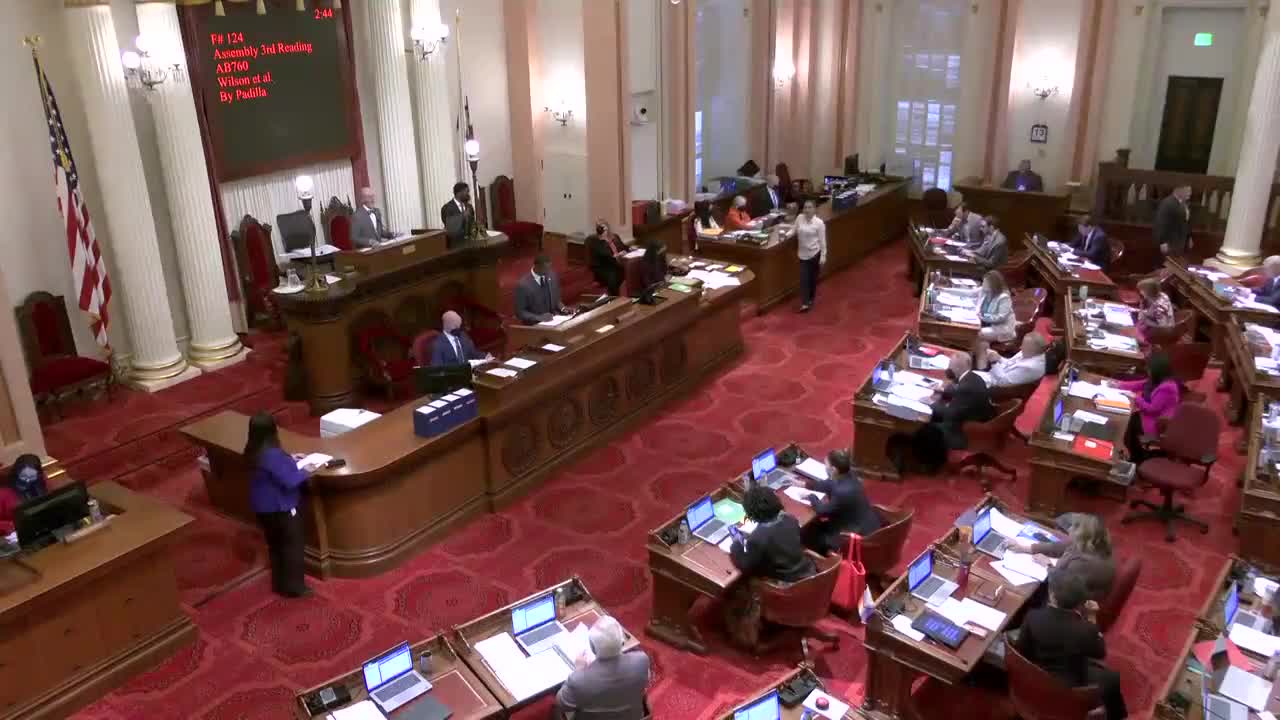 1MIN
Senate Floor
 7MIN
Senate Standing Committee on Public Safety
 1MIN
Assembly Floor
 19MIN
Assembly Standing Committee on Public Safety
 19MIN
Assembly Standing Committee on Public Safety
Bill Author



