SB 237: Controlled substances: fentanyl.
- Session Year: 2023-2024
- House: Senate
- Latest Version Date: 2023-01-24
Current Status:
Failed
(2024-02-01: Returned to Secretary of Senate pursuant to Joint Rule 56.)
Introduced
In Committee
First Chamber
In Committee
Second Chamber
Enacted
What does this bill do?
This bill raises jail terms for people convicted of selling, possessing to sell, transporting, importing, or giving away fentanyl. Possession for sale would carry 4, 5, or 6 years; most sales or distribution would carry 7, 8, or 9 years; and transporting fentanyl between noncontiguous counties would carry 7, 10, or 13 years.
The summary is provided by generative AI which can make mistakes. For original language, please view the details in the table below.
Existing law classifies controlled substances into 5 schedules and places the greatest restrictions and penalties on the use of those substances placed in Schedule I. Opiates, including fentanyl, are classified in Schedule II. Existing law prohibits a person from possessing for sale or purchasing for purposes of sale specified controlled substances, including fentanyl, and punishes a violation of that prohibition by imprisonment in a county jail for 2, 3, or 4 years. Existing law also prohibits transporting, importing into this state, selling, furnishing, administering, or giving away specified controlled substances, including fentanyl, and punishes a violation of that prohibition by imprisonment in a county jail for 3, 4, or 5 years. Existing law also prohibits the trafficking of specified controlled substances, including fentanyl, and punishes a violation of that prohibition by imprisonment in a county jail for 3, 6, or 9 years.
The bill would punish the possession, sale, or purchase for sale of fentanyl by imprisonment in a county jail for 4, 5, or 6 years, the transportation, importation, sale, furnishing, administering, or giving away of fentanyl by imprisonment in a county jail for 7, 8, or 9 years, and the trafficking of fentanyl by imprisonment in a county jail for 7, 10, or 13 years.
By increasing the penalty for a crime, this bill would impose a state-mandated local program.
The California Constitution requires the state to reimburse local agencies and school districts for certain costs mandated by the state. Statutory provisions establish procedures for making that reimbursement.
This bill would provide that no reimbursement is required by this act for a specified reason.
(a)Except as otherwise provided in this division, every person who possesses for sale or purchases for purposes of sale (1) any controlled substance specified in subdivision (b), (c), or (e) of Section 11054, specified in paragraph (14), (15), or (20) of subdivision (d) of Section 11054, or specified in subdivision (b) or (c) of Section 11055, or specified in subdivision (h) of Section 11056, or (2) any controlled substance classified in Schedule III, IV, or V which is a narcotic drug, shall be punished by imprisonment pursuant to subdivision (h) of Section 1170 of the Penal Code for two, three, or four years.
(b)Every person who possesses for sale or purchases for purposes of sale any fentanyl as specified in subdivision (c) of Section 11055 shall be punished by imprisonment pursuant to subdivision (h) of Section 1170 of the Penal Code for four, five, or six years.
SEC. 2.Section 11352 of the Health and Safety Code is amended to read:11352.(a)Except as otherwise provided in this division, every person who transports, imports into this state, sells, furnishes, administers, or gives away, or offers to transport, import into this state, sell, furnish, administer, or give away, or attempts to import into this state or transport (1) any controlled substance specified in subdivision (b), (c), or (e), or paragraph (1) of subdivision (f) of Section 11054, specified in paragraph (14), (15), or (20) of subdivision (d) of Section 11054, or specified in subdivision (b) or (c) of Section 11055, or specified in subdivision (h) of Section 11056, or (2) any controlled substance classified in Schedule III, IV, or V which is a narcotic drug, unless upon the written prescription of a physician, dentist, podiatrist, or veterinarian licensed to practice in this state, shall be punished by imprisonment pursuant to subdivision (h) of Section 1170 of the Penal Code for three, four, or five years.
(b)Notwithstanding the penalty provisions of subdivision (a), any person who transports any controlled substances specified in subdivision (a) within this state from one county to another noncontiguous county shall be punished by imprisonment pursuant to subdivision (h) of Section 1170 of the Penal Code for three, six, or nine years.
(c)(1)Every person who transports, imports into this state, sells, furnishes, administers, or gives away, or offers to transport, import into this state, sell, furnish, administer, or give away, or attempts to import into this state or transport any fentanyl as specified in subdivision (c) of Section 11055 shall be punished by imprisonment pursuant to subdivision (h) of Section 1170 of the Penal Code for seven, eight, or nine years.
(2)Notwithstanding the penalty provisions of paragraph (1), any person who transports any fentanyl within this state from one county to another noncontiguous county shall be punished by imprisonment pursuant to subdivision (h) of Section 1170 of the Penal Code for 7, 10, or 13 years.
(c)(d)For purposes of this section, transports means to transport for sale.
(d)(e)This section does not preclude or limit the prosecution of an individual for aiding and abetting the commission of, or conspiring to commit, or acting as an accessory to, any act prohibited by this section.
SEC. 3.No reimbursement is required by this act pursuant to Section 6 of Article XIIIB of the California Constitution because the only costs that may be incurred by a local agency or school district will be incurred because this act creates a new crime or infraction, eliminates a crime or infraction, or changes the penalty for a crime or infraction, within the meaning of Section 17556 of the Government Code, or changes the definition of a crime within the meaning of Section 6 of Article XIIIB of the California Constitution.
|
Date
|
Status
|
|---|---|
| Feb 1, 2024 | Returned to Secretary of Senate pursuant to Joint Rule 56. |
| Apr 18, 2023 | April 18 set for first hearing. Failed passage in committee. (Ayes 1. Noes 3. Page 802.) Reconsideration granted. |
| Mar 27, 2023 | Set for hearing April 18. |
| Feb 1, 2023 | Referred to Com. on PUB S. |
| Jan 25, 2023 | From printer. May be acted upon on or after February 24. |
| Jan 24, 2023 | Introduced. Read first time. To Com. on RLS. for assignment. To print. |
|
Date
|
Description
|
Location
|
Votes
|
|
|---|---|---|---|---|
| Apr 18, 2023 | [First] hearing set for [04-18-2023]: Failed passage in Committee. Reconsideration granted | Senate Standing Committee on Public Safety |
Passed |
|
| Apr 18, 2023 | Do pass, but first be re-referred to the Committee on [Appropriations] | Senate Standing Committee on Public Safety |
Failed |
This list shows positions taken on this bill by organizations on the date displayed, which is linked to the original source.
Positions by individuals are not included.
|
Organization
|
Position
|
Date
|
|---|---|---|
| Aclu California Action | * Against | Apr 18, 2023 |
| California Attorney's for Criminal Justice | * Against | Apr 18, 2023 |
| California District Attorneys Association | * Support | Apr 18, 2023 |
| California Drug Policy Alliance | * Against | Apr 18, 2023 |
| California Public Defenders Association | * Against | Apr 18, 2023 |
| County of Fresno | * Support | Apr 18, 2023 |
| Ella Baker Center For Human Rights | * Against | Apr 18, 2023 |
| Fresno County Board of Supervisors | * Support | Apr 18, 2023 |
| League Of California Cities | * Support | Apr 18, 2023 |
| Legal Affairs at the Right to Life League | * Support | Apr 18, 2023 |
| Project Eli | * Support | Apr 18, 2023 |
SENATE COMMITTEE ON PUBLIC SAFETY
Senator Aisha Wahab, Chair
2023 - 2024 Regular
Bill No: SB 237 Hearing Date: April 18, 2023
Author: | Grove | ||
Version: | January 24, 2023 | ||
Urgency: | No | Fiscal: | Yes |
Consultant: | SJ | ||
Subject: Controlled substances: fentanyl
HISTORY
Source: Author
Prior Legislation: None
Support: California District Attorneys Association; California State Sheriffs’ Association; California Statewide Law Enforcement Association; City of Fountain Valley; Clovis Police Department; County of Fresno; Crime Victims United; Fentanylsolution.org; Fresno County District Attorney’s Office; Fresno Police Department; High Truths on Drugs and Addiction; Kern County Probation Department; Kern County Prosecutors Association; Kern County Sheriff's Office; Merced County District Attorney’s Office; Peace Officers Research Association of California; Project Eli; Tulare County District Attorney’s Office; 2 individuals
Opposition: California Attorneys for Criminal Justice; California Public Defenders Association; Ella Baker Center for Human Rights; Initiate Justice; San Francisco Public Defender; an individual
PURPOSE
The purpose of this bill is to increase the criminal penalties for several drug-related offenses when the offense involves fentanyl.
Existing law establishes the California Uniform Controlled Substances Act which regulates controlled substances. (Health & Saf. Code, § 11000 et seq.)
Existing law classifies controlled substances into five schedules according to their danger and potential for abuse. (Health & Saf. Code, §§ 11054-11058.)
Existing law classifies fentanyl as a Schedule II controlled substance. (Health & Saf. Code, § 11055, subd.(c)(8).)
Existing law provides the following penalties:
- Possessing for sale or purchasing for purposes of sale of heroin, cocaine, and specified opiates, including fentanyl – 1170(h) felony term of 2, 3, or 4 years (Health & Saf. Code, § 11351.)
- Transporting, importing, selling, furnishing, administering, giving away, etc. of heroin, cocaine, and specified opiates, including fentanyl – 1170(h) felony term of 3, 4, or 5 years (Health & Saf. Code, § 11352.)
- If transporting between noncontiguous counties – 1170(h) felony term of 3, 6, or 9 years (Id.)
This bill provides that the penalty for possessing for sale or purchasing for purposes of sale any fentanyl is imprisonment pursuant to Section 1170(h) for four, five, or six years.
This bill provides that the penalty for transporting, importing into this state, selling, furnishing, administering, or giving away, or offering to transport, import into this state, sell, furnish, administer, or give away, or attempting to import into this state or transport any fentanyl is imprisonment pursuant to Section 1170(h) for seven, eight, or nine years.
This bill provides that the penalty for transporting fentanyl within this state from one county to another noncontiguous county is imprisonment pursuant to Section 1170(h) for seven, ten, or thirteen years.
COMMENTS
- Need For This Bill
According to the author:
Fentanyl is a Schedule II narcotic and according to the United States Sentencing Commission, it is 50 times stronger than heroin and 100 times stronger than morphine. Although originally prescribed by doctors to treat severe pain, fentanyl is often manufactured and distributed through illegal drug markets. Drug cartels and sellers now use fentanyl to increase the potency of heroin and enhance user addiction, often with deadly results.
The California Department of Public Health revealed that in 2021, there were 5,722 fentanyl-related deaths, the second-highest death rate of any state. In 2022, a report conducted by the Office of Governor Newsom found a 594% increase in fentanyl seized at the border compared to the previous year. The report goes on to say that, “[t]here was enough of the drug reaching the state in 2022 to kill every man, woman and child in North America—twice.”
With the surge of fentanyl overdoses on school campuses, California has been focusing on training teachers and parents to use Narcan to save children rather than passing legislation that would prevent the drug from entering schools in the first place.
Fentanyl not only takes a life, but also causes a lifetime of pain and suffering for users, their families and friends. Therefore, aggressive action must be taken to counter the loss of life that will occur in the absence of strong law and order. It is about time we treat fentanyl like the killing machine that it is, and sentence dealers, traffickers, and users according to these standards.
- Background
Fentanyl was synthesized in 1959 and has been used medically since the 1960s. The Centers for Disease Control and Prevention (CDC) website provides this description of fentanyl:
Fentanyl, a synthetic and short-acting opioid analgesic, is 50-100 times more potent than morphine and approved for managing acute or chronic pain associated with advanced cancer…. [M]ost cases of fentanyl-related morbidity and mortality have been linked to illicitly manufactured fentanyl and fentanyl analogs, collectively referred to as non-pharmaceutical fentanyl (NPF). NPF is sold via illicit drug markets for its heroin-like effect and often mixed with heroin and/or cocaine as a combination product—with or without the user’s knowledge—to increase its euphoric effects. While NPF-related overdoses can be reversed with naloxone, a higher dose or multiple number of doses per overdose event may be required …due to the high potency of NPF. (Internal footnotes omitted.) (<http://emergency.cdc.gov/han/han00384.asp> [as of Apr. 10, 2023].)
Legitimate fentanyl, also known as pharmaceutical fentanyl, is prescribed by a physician in a variety of forms, including lozenges, nasal sprays, and transdermal patches. While some pharmaceutical fentanyl is diverted, this is typically done on a small scale and often for personal use. Illicitly-produced fentanyl is primarily manufactured in laboratories in China and Mexico, and then shipped to the U.S. or smuggled across the U.S.-Mexico border. It is distributed in the form of powder or as counterfeit prescription pills.
- DEA Threat Assessment
The DEA regularly publishes an illicit drug “threat assessment” which reviews trends and issues concerning major drugs of abuse. The 2020 Threat Assessment of fentanyl concluded:
… The heroin and fentanyl markets, already intertwined, will continue to grow as traffickers mix heroin with fentanyl to stretch heroin supplies and maximize revenues. Fentanyl and other synthetic opioids will likely continue to contribute to high numbers of drug overdose deaths in the United States in the near term, as fentanyl availability either by itself or mixed in with other drugs—particularly heroin—continues to persist. However, overdose deaths involving heroin alone may stabilize or continue to decline in the near term. The low cost, high potency, and ease of acquisition of fentanyl may encourage heroin users to switch to the drug should future heroin supplies be disrupted. As Mexico is the dominant supplier of heroin entering the United States, additional restrictions or limits on travel across the U.S.-Mexico border due to pandemic concerns will likely impact heroin drug trafficking organizations (DTOs), particularly those using couriers or personal vehicles to smuggle heroin into the United States. Another possibility may be a decrease in the price level for heroin as DTOs and street-level dealers maximize associated profit margins by increasingly mixing fentanyl into distributed heroin. DTOs may come to view heroin as simply an adulterant to fentanyl. Mexican transnational criminal organizations will remain the primary source of supply for heroin and fentanyl smuggled into the United States, using precursors primarily sourced from China, and they will continue to use their extensive infrastructure in both Mexico and the United States to supply lucrative U.S. opioid markets. (Id. at pp. 17-18.)
- Effect of This Bill
Existing law provides the penalty for possession for sale or purchasing for purposes of sale fentanyl is two, three, or four years in a county jail. (Health & Saf. Code, § 11351.) Existing law provides the penalty for transporting, importing, selling, furnishing, administering, giving away, or offering or attempting to do one of those, fentanyl is three, four, or five years in a county jail. (Health & Saf. Code, § 11352.) If fentanyl is being transported between noncontiguous counties, the penalty is three, six, or nine years in a county jail. (Id.)
This bill increases the sentences for each of these offenses when the substance is fentanyl. Specifically, this bill provides that the penalty for possessing for sale or purchasing for purposes of sale any fentanyl is imprisonment in a county jail for four, five, or six years. This bill also provides that the penalty for transporting, importing into this state, selling, furnishing, administering, or giving away, or offering to transport, import into this state, sell, furnish, administer, or give away, or attempting to import into this state or transport any fentanyl as is imprisonment for seven, eight, or nine years. Finally, this bill provides that the penalty for transporting fentanyl within this state from one county to another noncontiguous county is imprisonment in the county jail for seven, ten, or thirteen years.
- Argument in Support
According to the California District Attorneys Association:
[F]entanyl is a synthetic opioid 100 times more potent than morphine. It can be found in methamphetamine, cocaine, heroin, and vaping products, as well as counterfeit pharmaceutical pills such as Xanax, Percocet, hydrocodone, or Oxycodone among others. Statistically, fentanyl was the number one cause of death last year for people ages 18-45, outpacing suicides, automobile accidents, and COVID-19. Fentanyl causes a fatality approximately every 7-8 minutes and is linked to 64% of total drug fatalities in 2021.
This legislation will help address the fentanyl overdose epidemic by making those responsible for illicit sales and furnishing of this deadly drug accountable. As the impact of illegal fentanyl sales is disproportionately felt across our communities, the consequences for sales of this dangerous narcotic should be increased compared to sales and furnishing of other drugs.
- Argument in Opposition
California Public Defenders Association writes:
SB 237 does not require evidence that the accused person knew that the substance they possessed contained fentanyl – meaning that under its auspices people will be sentenced to decades in jail for a crime they did not know they were committing.
At its core, SB 237 relies on a failed War on Drugs mentality and will end up creating far more harm than it would prevent. As California has discovered through painful experience, harsh drug laws do not change demand for drugs, instead only driving up prices (to the benefit of dealers) while imprisoning more and more non-violent people in county jail and state prison.
…
The War on Drugs has had a devastating impact on communities across California. The consequences of poorly constructed drug laws that tried to use jails and prisons to address this public health issue will take decades to unravel. Rather than diminishing the harms of drug misuse, criminalizing people who sell and use drugs amplifies the risk of overdose and diseases, increases stigma and marginalization, and drives people away from needed treatment, health, and harm reduction services.
California voters have signaled, again and again, their distaste for the War on Drugs and their preference for addressing drug problems with a public health approach. … Societal harms associated with drugs are not alleviated by ever longer prison sentences. Rather, these increased penalties impose their own harm, devastating vulnerable communities, particularly communities of color.
-- END --
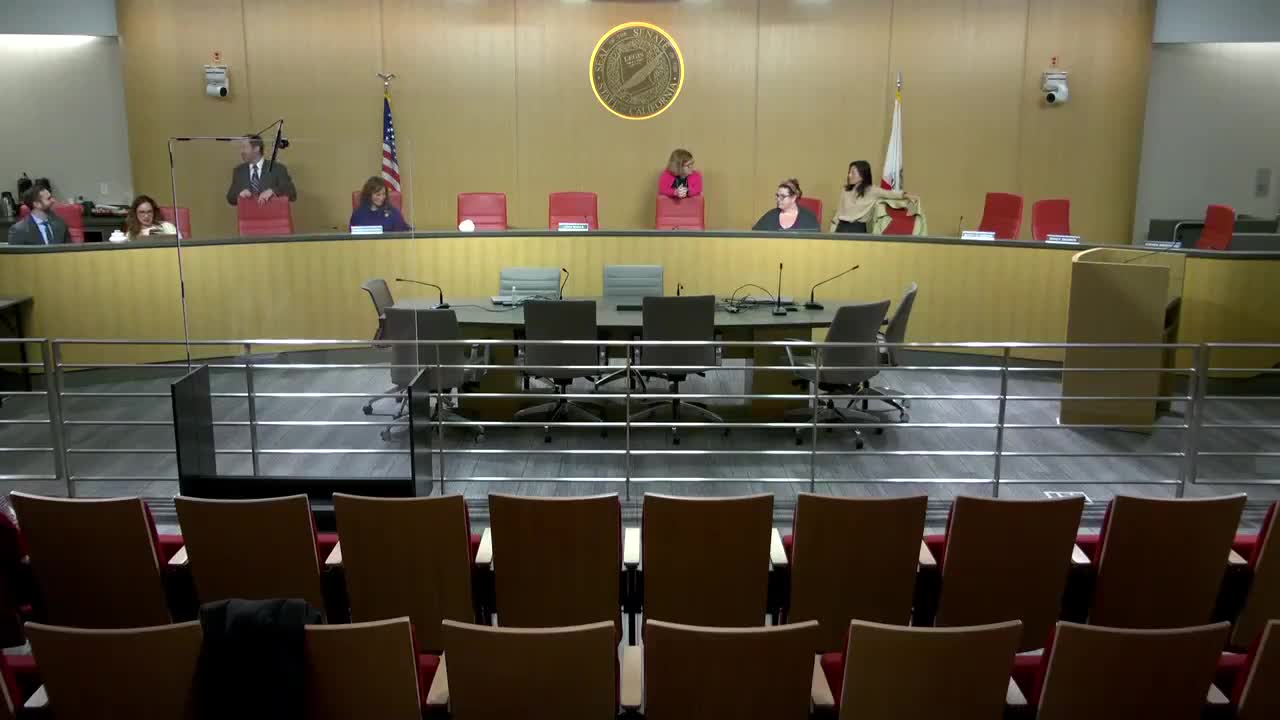
Discussed in Hearing
 27MIN