SB 341: Housing development.
- Session Year: 2023-2024
- House: Senate
- Latest Version Date: 2023-10-11
Current Status:
Passed
(2023-10-11: Chaptered by Secretary of State. Chapter 777, Statutes of 2023.)
Introduced
In Committee
First Chamber
In Committee
Second Chamber
Enacted
Existing law, the Planning and Zoning Law, requires a city or county to adopt a general plan for land use development within its boundaries that includes, among other things, a housing element. The law requires the Department of Housing and Community Development to determine whether the housing element is in substantial compliance with specified provisions of that law. Existing law requires the department to designate jurisdictions as prohousing pursuant to emergency regulations adopted by the department, as prescribed. Existing law awards jurisdictions that are in substantial compliance with specified provisions and that are prohousing additional points or preference in the scoring of applications for specified state programs, including, among others, the Infill Incentive Grant Program of 2007. Existing law authorizes additional bonus points to be awarded to other state programs when already allowable under state law.
Existing law establishes the Infill Infrastructure Grant Program of 2019, which requires the department, upon appropriation of funds by the Legislature, to establish and administer a grant program to allocate those funds to eligible applicants, as defined, to fund capital improvement projects that are an integral part of, or necessary to facilitate the development of, a qualifying infill project, qualifying infill area, or catalytic qualifying infill area pursuant to specified requirements. Existing law requires the department, in its review and ranking of applications for the award of capital improvement project grants, to rank affected qualifying infill areas based on specified priorities.
This bill, with respect to the Infill Infrastructure Grant Program of 2019, would specify that only the qualifying infill area portion of that program must be awarded additional points or preference. This bill would add the qualifying infill area and catalytic qualifying infill area portions of the Infill Infrastructure Grant Program of 2019 as one of the specified state programs for which additional points or preference is awarded. This bill would also make technical changes to the provisions of the programs.
This bill would incorporate additional changes to Section 65589.9 of the Government Code proposed by AB 529 to be operative only if this bill and AB 529 are enacted and this bill is enacted last.
This bill would incorporate additional changes to Section 53559 of the Health and Safety Code proposed by AB 1764 to be operative only if this bill and AB 1764 are enacted and this bill is enacted last.
Existing law, the Planning and Zoning Law, requires a city or county to adopt a general plan for land use development within its boundaries that includes, among other things, a housing element. The law requires the Department of Housing and Community Development to determine whether the housing element is in substantial compliance with specified provisions of that law. Existing law requires the department to designate jurisdictions as prohousing pursuant to emergency regulations adopted by the department, as prescribed. Existing law awards jurisdictions that are in substantial compliance with specified provisions and that are prohousing additional points or preference in the scoring of applications for specified state programs, including, among others, the Affordable Housing and Sustainable Communities Program and the Infill Incentive Grant Program of 2007. Existing law authorizes additional bonus points to be awarded to other state programs when already allowable under state law.
Existing law establishes the Infill Infrastructure Grant Program of 2019, which requires the department, upon appropriation of funds by the Legislature, to establish and administer a grant program to allocate those funds to eligible applicants, as defined, to fund capital improvement projects that are an integral part of, or necessary to facilitate the development of, a qualifying infill project, qualifying infill area, or catalytic qualifying infill area, as those terms are defined, area pursuant to specified requirements. Existing law requires the department, in its review and ranking of applications for the award of capital improvement project grants, to rank affected qualifying infill projects and qualifying infill areas based on specified priorities.
This bill would remove the Affordable Housing and Sustainable Communities program from the list of specified state programs for which additional points or preference is awarded. This bill, with respect to the Infill Infrastructure Grant Program of 2019, would specify that only the qualifying infill area portion of that program must be awarded additional points or preference. This bill would add the qualifying infill area and catalytic qualifying infill area portions of the Infill Infrastructure Grant Program of 2019 as one of the specified state programs for which additional points or preference is awarded. This bill would specify that additional bonus points may be awarded to other state programs for which local governments are the sole or primary applicants when already allowable under state law. This bill would also make technical changes to the provisions of the programs.
This bill would remove qualifying infill projects from the Infill Infrastructure Grant Program of 2019s requirement that the department rank affected qualifying infill areas in its review and ranking of applications for the award of capital improvement project grants. This bill would also make technical changes to the provisions of the programs.Existing law requires the Strategic Growth Council to develop and administer the Affordable Housing and Sustainable Communities Program to reduce greenhouse gas emissions through projects that implement land use, housing, transportation, and agricultural land preservation practices to support infill and compact development, and that support related and coordinated public policy objectives, as specified. Existing law requires the council to develop guidelines and selection criteria for the implementation of the program, as specified.This bill would prohibit these guidelines from disqualifying specified project applicants if the jurisdiction in which the project is proposed to be located has been found by the Department of Housing and Community Development not to be in substantial compliance with specified provisions of the Planning and Zoning Law.Existing law, the Planning and Zoning Law, requires a city or county to adopt a general plan for land use development within its boundaries that includes, among other things, a housing element. The law requires the Department of Housing and Community Development to determine whether the housing element is in substantial compliance with specified provisions of that law. Existing law requires the department to designate jurisdictions as prohousing pursuant to emergency regulations adopted by the department, as prescribed. Existing law awards jurisdictions that are in substantial compliance with specified provisions and that are prohousing additional points or preference in the scoring of applications for specified state programs, including, among others, the Affordable Housing and Sustainable Communities Program and the Infill Incentive Grant Program of 2007. Existing law authorizes additional bonus points to be awarded to other state programs when already allowable under state law.
Existing law establishes the Infill Infrastructure Grant Program of 2019, which requires the department, upon appropriation of funds by the Legislature, to establish and administer a grant program to allocate those funds to eligible applicants, as defined, to fund capital improvement projects that are an integral part of, or necessary to facilitate the development of, a qualifying infill project, qualifying infill area, or catalytic qualifying infill area, as those terms are defined, pursuant to specified requirements. Existing law requires the department, in its review and ranking of applications for the award of capital improvement project grants, to rank affected qualifying infill projects and qualifying infill areas based on specified priorities.
This bill would remove the Affordable Housing and Sustainable Communities program from the list of specified state programs for which additional points or preference is awarded. This bill, with respect to the Infill Infrastructure Grant Program of 2019, would specify that only the qualifying infill area portion of that program must be awarded additional points or preference. This bill would add the qualifying infill area and catalytic qualifying infill area portions of the Infill Infrastructure Grant Program of 2019 as one of the specified state programs for which additional points or preference is awarded. This bill would specify that additional bonus points may be awarded to other state programs for which local governments are the sole or primary applicants when already allowable under state law.
This bill would remove qualifying infill projects from the Infill Infrastructure Grant Program of 2019s requirement that the department rank affected qualifying infill areas in its review and ranking of applications for the award of capital improvement project grants. This bill would also make technical changes to the provisions of the programs.
Existing law requires the Strategic Growth Council to develop and administer the Affordable Housing and Sustainable Communities Program to reduce greenhouse gas emissions through projects that implement land use, housing, transportation, and agricultural land preservation practices to support infill and compact development, and that support related and coordinated public policy objectives, as specified. Existing law requires the council to develop guidelines and selection criteria for the implementation of the program, as specified.
This bill would prohibit these guidelines from disqualifying specified project applicants if the jurisdiction in which the project is proposed to be located has been found by the Department of Housing and Community Development not to be in substantial compliance with specified provisions of the Planning and Zoning Law.
(a)It is the intent of the Legislature to create incentives for jurisdictions that are compliant with housing element requirements and have enacted prohousing local policies. It is the intent of the Legislature that these incentives be in the form of additional points or other preference in the scoring of competitive housing and infrastructure programs. It is the intent of the Legislature that, in adopting regulations related to prohousing local policy criteria, the department shall create criteria that consider the needs of rural, suburban, and urban jurisdictions and how those criteria may differ in those areas.
(b)For award cycles commenced after July 1, 2021, jurisdictions that have adopted a housing element that has been found by the department to be in substantial compliance with the requirements of this article pursuant to Section 65585, and that have been designated prohousing pursuant to subdivision (c) based upon their adoption of prohousing local policies, shall be awarded additional points or preference in the scoring of program applications for the following programs:
(1)The Affordable Housing and Sustainable Communities Program established by Part 1 (commencing with Section 75200) of Division 44 of the Public Resources Code.
(2)The Transformative Climate Communities Program established by Part 4 (commencing with Section 75240) of Division 44 of the Public Resources Code.
(3)The qualifying infill area portion of the Infill Incentive Grant Program of 2007 established by Section 53545.13 of the Health and Safety Code.
(4)The qualifying infill area and catalytic qualifying infill area portions of the Infill Infrastructure Grant Program of 2019 established by Section 53559 of the Health and Safety Code.
(5)Additional bonus points may be awarded to other state programs when already allowable under state law.
(c)The department shall designate jurisdictions as prohousing pursuant to the emergency regulations adopted pursuant to subdivision (d) and report these designations to the Office of Planning and Research, and any other applicable agency or department, annually and upon request.
(d)(1)By July 1, 2021, the department, in collaboration with stakeholders, shall adopt emergency regulations to implement this section.
(2)Notwithstanding Section 11346.1, the emergency regulations adopted pursuant to this subdivision shall remain in effect until the date that permanent regulations to implement this section become effective.
(e)On or before January 1, 2021, and annually thereafter, the department shall publish on its internet website the list of programs included under subdivision (b).
(f)For purposes of this section, the following definitions shall apply:
(1)Compliant housing element means an adopted housing element that has been found to be in substantial compliance with the requirements of this article by the department pursuant to Section 65585.
(2)Prohousing local policies means policies that facilitate the planning, approval, or construction of housing. These policies may include, but are not limited to, the following:
(A)Local financial incentives for housing, including, but not limited to, establishing a local housing trust fund.
(B)Reduced parking requirements for sites that are zoned for residential development.
(C)Adoption of zoning allowing for use by right for residential and mixed-use development.
(D)Zoning more sites for residential development or zoning sites at higher densities than is required to accommodate the minimum existing regional housing need allocation for the current housing element cycle.
(E)Adoption of accessory dwelling unit ordinances or other mechanisms that reduce barriers for property owners to create accessory dwelling units beyond the requirements outlined in Section 65852.2, as determined by the department.
(F)Reduction of permit processing time.
(G)Creation of objective development standards.
(H)Reduction of development impact fees.
(I)Establishment of a Workforce Housing Opportunity Zone, as defined in Section 65620, or a housing sustainability district, as defined in Section 66200.
(J)Preservation of affordable housing units through the extension of existing project-based rental assistance covenants to avoid the displacement of affected tenants and a reduction in available affordable housing units.
SEC. 1.5.Section 65589.9 of the Government Code is amended to read:65589.9.(a)It is the intent of the Legislature to create incentives for jurisdictions that are compliant with housing element requirements and have enacted prohousing local policies. It is the intent of the Legislature that these incentives be in the form of additional points or other preference in the scoring of competitive housing and infrastructure programs. It is the intent of the Legislature that, in adopting regulations related to prohousing local policy criteria, the department shall create criteria that consider the needs of rural, suburban, and urban jurisdictions and how those criteria may differ in those areas.
(b)For award cycles commenced after July 1, 2021, jurisdictions that have adopted a housing element that has been found by the department to be in substantial compliance with the requirements of this article pursuant to Section 65585, and that have been designated prohousing pursuant to subdivision (c) based upon their adoption of prohousing local policies, shall be awarded additional points or preference in the scoring of program applications for the following programs:
(1)The Affordable Housing and Sustainable Communities Program established by Part 1 (commencing with Section 75200) of Division 44 of the Public Resources Code.
(2)The Transformative Climate Communities Program established by Part 4 (commencing with Section 75240) of Division 44 of the Public Resources Code.
(3)The qualifying infill area portion of the Infill Incentive Grant Program of 2007 established by Section 53545.13 of the Health and Safety Code.
(4)The qualifying infill area and catalytic qualifying infill area portions of the Infill Infrastructure Grant Program of 2019 established by Section 53559 of the Health and Safety Code.
(5)Additional bonus points may be awarded to other state programs when already allowable under state law.
(c)The department shall designate jurisdictions as prohousing pursuant to the emergency regulations adopted pursuant to subdivision (d) and report these designations to the Office of Planning and Research, and any other applicable agency or department, annually and upon request.
(d)(1)By July 1, 2021, the department, in collaboration with stakeholders, shall adopt emergency regulations to implement this section.
(2)Notwithstanding Section 11346.1, the emergency regulations adopted pursuant to this subdivision shall remain in effect until the date that permanent regulations to implement this section become effective.
(e)On or before January 1, 2021, and annually thereafter, the department shall publish on its internet website the list of programs included under subdivision (b).
(f)For purposes of this section, the following definitions shall apply:
(1)Adaptive reuse shall have the same meaning as in Section 53559.1 of the Health and Safety Code.
(2)Compliant housing element means an adopted housing element that has been found to be in substantial compliance with the requirements of this article by the department pursuant to Section 65585.
(3)Prohousing local policies means policies that facilitate the planning, approval, or construction of housing. These policies may include, but are not limited to, the following:
(A)Local financial incentives for housing, including, but not limited to, establishing a local housing trust fund.
(B)Reduced parking requirements for sites that are zoned for residential development.
(C)Adoption of zoning allowing for use by right for residential and mixed-use development.
(D)Zoning more sites for residential development or zoning sites at higher densities than is required to accommodate the minimum existing regional housing need allocation for the current housing element cycle.
(E)Adoption of accessory dwelling unit ordinances or other mechanisms that reduce barriers for property owners to create accessory dwelling units beyond the requirements outlined in Section 65852.2, as determined by the department.
(F)Reduction of permit processing time.
(G)Creation of objective development standards.
(H)Reduction of development impact fees.
(I)Establishment of a Workforce Housing Opportunity Zone, as defined in Section 65620, or a housing sustainability district, as defined in Section 66200.
(J)Preservation of affordable housing units through the extension of existing project-based rental assistance covenants to avoid the displacement of affected tenants and a reduction in available affordable housing units.
(K)Facilitation of the conversion or redevelopment of commercial properties into housing, including the adoption of adaptive reuse ordinances or other mechanisms that reduce barriers for these conversions.
SEC. 2.Section 53559 of the Health and Safety Code is amended to read:53559.(a)The Infill Infrastructure Grant Program of 2019 is hereby established to be administered by the department.
(b)Upon appropriation by the Legislature of funds for purposes of this part, the department shall establish and administer a grant program to allocate those funds to selected capital improvement projects that are an integral part of, or necessary to facilitate the development of, a qualifying infill project, qualifying infill area, or catalytic qualifying infill area pursuant to the requirements of this section. The department shall determine amounts, if any, to be made available for qualifying infill projects, qualifying infill areas, or catalytic qualifying infill areas.
(c)(1)Except for funds appropriated or set aside for small jurisdictions for grants pursuant to subdivision (e), the department shall administer a competitive application process for capital improvement projects for large jurisdictions pursuant to this subdivision.
(2)Except for grants for qualifying infill areas or catalytic qualifying infill areas, the department shall do all of the following for grants made pursuant to this subdivision:
(A)Make program funds available at the same time it makes funds, if any, available under the Multifamily Housing Program (Chapter 6.7 (commencing with Section 50675) of Part 2).
(B)Rate and rank applications in a manner consistent with the Multifamily Housing Program (Chapter 6.7 (commencing with Section 50675) of Part 2), except that the department may establish additional point categories for the purposes of rating and ranking applications that seek funding pursuant to this part in addition to those used in the Multifamily Housing Program.
(C)Administer funds in a manner consistent with the Multifamily Housing Program (Chapter 6.7 (commencing with Section 50675) of Part 2).
(D)For purposes of awarding grants pursuant to the competitive application process required by this subdivision, qualifying infill project means a residential or mixed-use residential project located within an urbanized area on a site that has been previously developed, or on a vacant site where at least 75 percent of the perimeter of the site adjoins parcels that are developed with urban uses.
(d)(1)In its review and ranking of applications for the award of capital improvement project grants, the department shall rank the affected qualifying infill areas based on the following priorities:
(A)Project readiness, which shall include all of the following:
(i)A demonstration that the area development can complete environmental review and secure necessary entitlements from the local jurisdiction within a reasonable period of time following the submission of a grant application.
(ii)A demonstration that the eligible applicant can secure sufficient funding commitments derived from sources other than this part for the timely development of a qualifying infill area.
(B)The depth and duration of the affordability of the housing proposed for a qualifying infill area.
(C)The extent to which the average residential densities on the parcels to be developed exceed the density standards contained in paragraph (3) of subdivision (g).
(D)The qualifying infill areas inclusion of, or proximity or accessibility to, a transit station or major transit stop.
(E)The proximity of housing to parks, employment or retail centers, schools, or social services.
(F)The qualifying infill area locations consistency with an adopted sustainable communities strategy pursuant to Section 65080 of the Government Code, alternative planning strategy pursuant to Section 65450 of the Government Code, or other adopted regional growth plan intended to foster efficient land use.
(G)For qualifying infill areas, in awarding funds under the program, the department shall provide additional points or preference to projects located in jurisdictions that are designated prohousing pursuant to subdivision (c) of Section 65589.9 of the Government Code, in the manner determined by the department pursuant to subdivision (d) of Section 65589.9 of the Government Code.
(2)In allocating funds pursuant to this subdivision, the department, to the maximum extent feasible, shall ensure a reasonable geographic distribution of funds.
(3)For purposes of awarding grants pursuant to the competitive application process required by this subdivision or subparagraph (B) of paragraph (2) of subdivision (c), qualifying infill area means a contiguous area located within an urbanized area (i) that has been previously developed, or where at least 75 percent of the perimeter of the area adjoins parcels that are developed with urban uses, and (ii) in which at least one development application has been approved or is pending approval for a residential or mixed-use residential project that meets the definition and criteria in this section for a qualifying infill project.
(e)(1)The department shall administer an over-the-counter application process for grants funded by the allocation specified in the appropriation or paragraph (2) of subdivision (a) of Section 53559.2 for capital improvement projects for small jurisdictions, pursuant to this subdivision.
(2)Eligible applicants shall submit the following information in the application request for funding:
(A)A complete description of the qualifying infill project or qualifying infill area and documentation of how the infill project or infill area meets the requirements of this section.
(B)A complete description of the capital improvement project and requested grant funding for the project, how the project is necessary to support the development of housing, and how it meets the criteria of this section.
(C)Documentation that specifies how the application meets all of the requirements of subdivision (g).
(D)(i)Except as provided in clause (ii), a financial document that shows the gap financing needed for the project.
(ii)For a qualifying infill project located in the unincorporated area of the county, the department shall allow an applicant to meet the requirement described in clause (i) by submitting copies of an application or applications for other sources of state or federal funding for a qualifying infill project.
(E)(i)Except as provided by clause (ii), documentation of all necessary entitlement and permits, and a certification from the applicant that the project is shovel-ready.
(ii)For a qualifying infill project located in the unincorporated area of the county, the department shall allow the applicant to meet the requirement described in clause (i) by submitting a letter of intent from a willing affordable housing developer that has previously completed at least one comparable housing project, certifying that the developer is willing to submit an application to the county for approval by the county of a qualifying infill project within the area in the event that the funding requested pursuant to this subdivision is awarded.
(3)The department may establish a per-unit formula to determine the amount of funds awarded pursuant to this subdivision.
(4)For purposes of awarding grants pursuant to the over-the-counter application process required by this subdivision:
(A)Qualifying infill area means a contiguous area located within an urbanized area that meets either of the following criteria:
(i)The area contains sites included on the inventory of land suitable and available for residential development in the housing element of the applicable city or county general plan pursuant to paragraph (3) of subdivision (a) of Section 65583 of the Government Code, and at least 50 percent of the perimeter of the area shall adjoin parcels that are developed with urban uses.
(ii)The capital improvement project for which funding is requested is necessary, as documented by an environmental review or some other adopted planning document, to make the area suitable and available for residential development, or to allow the area to accommodate housing for additional income levels, and the area otherwise meets the requirements for inclusion on the inventory of land suitable and available for residential development in the housing element of the applicable city or county general plan pursuant to paragraph (3) of subdivision (a) of Section 65583 of the Government Code. At least 50 percent of the perimeter of the area shall adjoin parcels that are developed with urban uses.
(B)Qualifying infill project means a residential or mixed-use residential project located within an urbanized area on a site that has been previously developed, or on a vacant site where at least 50 percent of the perimeter of the site adjoins parcels that are developed with urban uses.
(f)(1)For catalytic qualifying infill areas, grants for small jurisdictions and large jurisdictions shall be provided using a selection process established by the department that meets all of the following requirements:
(A)Applicants shall meet both of the following minimum threshold requirements:
(i)Readiness, which includes both of the following:
(I)A demonstration that the catalytic qualifying infill area development can complete environmental review and secure necessary entitlements from the local jurisdiction within a reasonable period of time following the submission of a grant application.
(II)A demonstration that the eligible applicant has a viable plan to secure sufficient funding, derived from sources other than this part for the timely development of housing within a catalytic qualifying infill area.
(ii)A demonstration of the catalytic qualifying infill area locations consistency with an adopted sustainable communities strategy or alternative planning strategy pursuant to Section 65080 of the Government Code.
(B)The department shall, at a minimum, rank the affected catalytic qualifying infill areas applications for small jurisdictions and large jurisdictions based on the following:
(i)The number of housing units, including affordable units as required in paragraph (2) of subdivision (g) to be developed within the catalytic qualifying infill area.
(ii)The depth and duration of the affordability of the housing proposed for within the catalytic qualifying infill area.
(iii)The extent to which the average residential densities on the parcel or parcels to be developed exceeds the density standards contained in paragraph (3) of subdivision (g).
(iv)The catalytic qualifying infill areas inclusion of, or proximity or accessibility to, a transit station, major transit stop, or other areas yielding significant reductions in vehicle miles traveled.
(v)The proximity of planned housing within the catalytic qualifying infill area used in the calculation of the eligible grant amount to existing or planned parks, employment or retail centers, schools, or social services.
(vi)Existing or planned ordinances and other zoning or building provisions that facilitate adaptive reuse, including, but not limited to, demonstration that, if the existing commercial, office, or retail structure intended for reuse as housing does not occupy the entirety of the underlying parcel, the adaptive reuse project will be permitted to add to the existing building or structure provided that the addition is consistent with the existing or planned zoning of the parcel.
(vii)The extent to which local strategies or programs are in place to prevent the direct or indirect displacement of local community residents and businesses from the area within and surrounding the catalytic qualifying infill area.
(viii)The level of community outreach and engagement in project planning, including efforts to involve disadvantaged communities and low-income residents, particularly local community residents and businesses from the area within and surrounding the catalytic qualifying infill area.
(ix)Inclusion of any publicly owned lands within the designated catalytic qualifying infill area.
(x)Streamlining provisions related to the California Environmental Quality Act (Division 13 (commencing with Section 21000) of the Public Resources Code), including, but not limited to, establishment of streamlined, program-level California Environmental Quality Act analysis and certification of general plans, community plans, specific plans with accompanying environmental impact reports, and related documents and streamlining proposed projects, such as enabling a by-right approval process or by utilizing statutory and categorical exemptions as authorized by applicable law.
(C)Eligible applicants shall submit the following information in the application request for funding:
(i)A complete description of the catalytic qualifying infill area and documentation of how the catalytic qualifying infill area meets the requirements of this section.
(ii)A complete description of the capital improvement project and requested grant funding, how the capital improvement project is necessary to support the development of housing, and how it meets the criteria of this section.
(iii)Documentation that specifies how the application meets all of the requirements of subdivision (g).
(iv)(I)Except as provided in subclause (II), a financial document that shows the gap financing needed for the project.
(II)For a qualifying infill project within a catalytic qualifying infill area located in the unincorporated area of the county, the department shall allow an applicant to meet the requirement described in subclause (I) by submitting copies of an application or applications for other sources of state or federal funding for a qualifying infill project.
(v)(I)Except as provided by subclause (II), documentation of all necessary entitlement and permits, and a certification from the applicant that the capital improvement project is shovel-ready.
(II)For a qualifying infill project within a catalytic qualifying infill area located in the unincorporated area of the county, the department shall allow the applicant to meet the requirement described in subclause (I) by submitting a letter of intent from a willing affordable housing developer that has previously completed at least one comparable housing project, certifying that the developer is willing to submit an application to the county for approval by the county of a qualifying infill project within the area in the event that the funding requested pursuant to this subdivision is awarded.
(2)In allocating funds pursuant to this subdivision, the department, to the maximum extent feasible, shall ensure a reasonable distribution of funds, including consideration of differing population sizes of localities and geographic location. Applications shall be considered and ranked against applications of localities of similar size and scope. For the purposes of this paragraph, the population of a county shall be the population in the unincorporated area.
(3)The department shall report the following information to the relevant fiscal and policy committees of the Legislature by January 1, 2024:
(A)Specific uses of the funds for capital improvement projects.
(B)Locations of awarded catalytic qualifying infill area grants, including both of the following:
(i)Number of awards by geography, including urban and rural.
(ii)The types of buildings adapted to residential use.
(C)Total units to be created within the awarded qualifying infill areas, including anticipated affordability levels.
(D)Data on catalytic qualifying infill area projects funded, such as project sizes, adaptive reuse ordinances adopted, and by-right sites.
(g)A qualifying infill project, qualifying infill area, or catalytic qualifying infill area for which a capital improvement project grant may be awarded pursuant to paragraph (2) of subdivision (c), subdivision (d), subdivision (e), or subdivision (f) shall meet all of the following conditions:
(1)A qualifying infill area or catalytic qualifying infill area shall be located in a city, county, or city and county in which the general plan of the city, county, or city and county has an adopted housing element that has been found by the department, pursuant to Section 65585 of the Government Code, to be in compliance with the requirements of Article 10.6 (commencing with Section 65580) of Chapter 3 of Division 1 of Title 7 of the Government Code. This paragraph does not apply to a qualifying infill project.
(2)Include not less than 15 percent of affordable units, as follows:
(A)For projects that contain both rental and ownership units, units of either or both product types may be included in the calculation of the affordability criteria.
(B)(i)To the extent included in a project grant application, for the purpose of calculating the percentage of affordable units, the department may consider the entire master development in which the development seeking grant funding is included.
(ii)Where applicable, an applicant may include a replacement housing plan to ensure that dwelling units housing persons and families of low or moderate income are not removed from the low- and moderate-income housing market. Residential units to be replaced shall not be counted toward meeting the affordability threshold required for eligibility for funding under this section.
(C)For the purposes of this subdivision, affordable unit means a unit that is made available at an affordable rent, as defined in Section 50053, to a household earning no more than 60 percent of the area median income or at an affordable housing cost, as defined in Section 50052.5, to a household earning no more than 120 percent of the area median income. Rental units shall be subject to a recorded covenant that ensures affordability for at least 55 years. Ownership units shall initially be sold to and occupied by a qualified household, and shall be subject to a recorded covenant that includes either a resale restriction for at least 30 years or equity sharing upon resale.
(3)Include average residential densities on the parcels to be developed that are equal to or greater than the densities described in subparagraph (B) of paragraph (3) of subdivision (c) of Section 65583.2 of the Government Code, except that a project located in a rural area as defined in Section 50199.21 shall include average residential densities on the parcels to be developed of at least 10 units per acre.
(4)Be located in an area designated for mixed-use or residential development pursuant to one of the following:
(A)A general plan adopted pursuant to Section 65300 of the Government Code.
(B)A sustainable communities strategy adopted pursuant to Section 65080 of the Government Code.
(C)A specific plan adopted pursuant to Section 65450 of the Government Code.
(D)A Workforce Housing Opportunity Zone established pursuant to Section 65620 of the Government Code.
(E)A housing sustainability district established pursuant to Section 66201 of the Government Code.
(h)Funds awarded pursuant to this section shall supplement, not supplant, other available funding.
(i)The department shall adopt guidelines for the operation of the grant program. The guidelines shall include performance standards and authorize the reversion of grant awards if the awardee has not substantially met the performance standards.
(1)Performance standards shall include timelines for commencement of construction of a capital improvement project, completion of a capital improvement project, and commencement and completion of associated housing development on an identified infill site, as identified in the qualifying infill project, qualifying infill area, or catalytic qualifying infill area application.
(2)Catalytic qualifying infill area awards may be conditioned upon the local jurisdiction completing any actions to expedite housing development rezoning to accommodate density, completing environmental reviews to support ministerial approvals of housing, and granting fee waivers or other incentives to expedite housing development that were used in qualifying for an award.
(j)The department shall require recipients of funds to report on progress of capital improvement projects, including, but not limited to, substantiation of grant expenditures and housing outcomes, including levels of affordability as provided in the application.
(k)The guidelines may also provide for recapture of grants awarded, but for which development of the related housing units has not progressed in a reasonable period of time from the date of the grant award, as determined by the department. The guidelines shall not be subject to the requirements of Chapter 3.5 (commencing with Section 11340) of Part 1 of Division 3 of Title 2 of the Government Code.
(l)For each fiscal year within the duration of the grant program, the department shall include within the report to the Governor and the Legislature, required by Section 50408, information on its activities relating to the grant program activities related to qualifying infill projects and qualifying infill areas, including small jurisdiction funding activities. The report shall include, but is not limited to, the following information:
(1)A summary of the projects that received grants under the program for each fiscal year that grants were awarded.
(2)The description, location, and estimated date of completion for each project that received a grant award under the program.
(3)An update on the status of each project that received a grant award under the program, and the number of housing units created or facilitated by the program.
(m)Notwithstanding paragraph (3) of subdivision (g), a city with a population greater than 100,000 in a standard metropolitan statistical area or a population of less than 2,000,000 may petition the department for, and the department may grant, an exception to the jurisdictions classification pursuant to subdivisions (d) to (f), inclusive, of Section 65583.2 of the Government Code, if the city believes it is unable to meet the density requirements specified in paragraph (3) of subdivision (g). The city shall submit the petition with its application and shall include the reasons why the city believes the exception is warranted. The city shall provide information supporting the need for the exception, including, but not limited to, any limitations that the city may encounter in meeting the density requirements specified in paragraph (3) of subdivision (g). Any exception shall be for the purposes of this section only. This subdivision shall become inoperative on January 1, 2026.
SEC. 2.5.Section 53559 of the Health and Safety Code is amended to read:53559.(a)The Infill Infrastructure Grant Program of 2019 is hereby established to be administered by the department.
(b)Upon appropriation by the Legislature of funds for purposes of this part, the department shall establish and administer a grant program to allocate those funds to selected capital improvement projects that are an integral part of, or necessary to facilitate the development of, a qualifying infill project, qualifying infill area, or catalytic qualifying infill area pursuant to the requirements of this section. The department shall determine amounts, if any, to be made available for qualifying infill projects, qualifying infill areas, or catalytic qualifying infill areas.
(c)(1)Except for funds appropriated or set aside for small jurisdictions for grants pursuant to subdivision (e), the department shall administer a competitive application process for capital improvement projects for large jurisdictions pursuant to this subdivision.
(2)Except for grants for qualifying infill areas or catalytic qualifying infill areas, the department shall do all of the following for grants made pursuant to this subdivision:
(A)Make program funds available at the same time it makes funds, if any, available under the Multifamily Housing Program (Chapter 6.7 (commencing with Section 50675) of Part 2).
(B)Rate and rank applications in a manner consistent with the Multifamily Housing Program (Chapter 6.7 (commencing with Section 50675) of Part 2), except that the department may establish additional point categories for the purposes of rating and ranking applications that seek funding pursuant to this part in addition to those used in the Multifamily Housing Program.
(C)Administer funds in a manner consistent with the Multifamily Housing Program (Chapter 6.7 (commencing with Section 50675) of Part 2).
(D)For purposes of awarding grants pursuant to the competitive application process required by this subdivision, qualifying infill project means a residential or mixed-use residential project located within an urbanized area on a site that has been previously developed, or on a vacant site where at least 75 percent of the perimeter of the site adjoins parcels that are developed with urban uses.
(d)(1)In its review and ranking of applications for the award of capital improvement project grants, the department shall rank the affected qualifying infill areas based on the following priorities:
(A)Project readiness, which shall include all of the following:
(i)A demonstration that the area development can complete environmental review and secure necessary entitlements from the local jurisdiction within a reasonable period of time following the submission of a grant application.
(ii)A demonstration that the eligible applicant can secure sufficient funding commitments derived from sources other than this part for the timely development of a qualifying infill area.
(B)The depth and duration of the affordability of the housing proposed for a qualifying infill area.
(C)The extent to which the average residential densities on the parcels to be developed exceed the density standards contained in paragraph (3) of subdivision (g).
(D)The qualifying infill areas inclusion of, or proximity or accessibility to, a transit station or major transit stop.
(E)The proximity of housing to parks, employment or retail centers, schools, or social services.
(F)The qualifying infill area locations consistency with an adopted sustainable communities strategy pursuant to Section 65080 of the Government Code, alternative planning strategy pursuant to Section 65450 of the Government Code, or other adopted regional growth plan intended to foster efficient land use.
(G)For qualifying infill areas, in awarding funds under the program, the department shall provide additional points or preference to projects located in jurisdictions that are designated prohousing pursuant to subdivision (c) of Section 65589.9 of the Government Code, in the manner determined by the department pursuant to subdivision (d) of Section 65589.9 of the Government Code.
(2)In allocating funds pursuant to this subdivision, the department, to the maximum extent feasible, shall ensure a reasonable geographic distribution of funds.
(3)For purposes of awarding grants pursuant to the competitive application process required by this subdivision or subparagraph (B) of paragraph (2) of subdivision (c), qualifying infill area means a contiguous area located within an urbanized area (i) that has been previously developed, or where at least 75 percent of the perimeter of the area adjoins parcels that are developed with urban uses, and (ii) in which at least one development application has been approved or is pending approval for a residential or mixed-use residential project that meets the definition and criteria in this section for a qualifying infill project.
(e)(1)The department shall administer an over-the-counter application process for grants funded by the allocation specified in the appropriation or paragraph (2) of subdivision (a) of Section 53559.2 for capital improvement projects for small jurisdictions, pursuant to this subdivision.
(2)Eligible applicants shall submit the following information in the application request for funding:
(A)A complete description of the qualifying infill project or qualifying infill area and documentation of how the infill project or infill area meets the requirements of this section.
(B)A complete description of the capital improvement project and requested grant funding for the project, how the project is necessary to support the development of housing, and how it meets the criteria of this section.
(C)Documentation that specifies how the application meets all of the requirements of subdivision (g).
(D)(i)Except as provided in clause (ii), a financial document that shows the gap financing needed for the project.
(ii)For a qualifying infill project located in the unincorporated area of the county, the department shall allow an applicant to meet the requirement described in clause (i) by submitting copies of an application or applications for other sources of state or federal funding for a qualifying infill project.
(E)(i)Except as provided by clause (ii), documentation of all necessary entitlement and permits, and a certification from the applicant that the project is shovel-ready.
(ii)For a qualifying infill project located in the unincorporated area of the county, the department shall allow the applicant to meet the requirement described in clause (i) by submitting a letter of intent from a willing affordable housing developer that has previously completed at least one comparable housing project, certifying that the developer is willing to submit an application to the county for approval by the county of a qualifying infill project within the area in the event that the funding requested pursuant to this subdivision is awarded.
(3)The department may establish a per-unit formula to determine the amount of funds awarded pursuant to this subdivision.
(4)For purposes of awarding grants pursuant to the over-the-counter application process required by this subdivision:
(A)Qualifying infill area means a contiguous area located within an urbanized area that meets either of the following criteria:
(i)The area contains sites included on the inventory of land suitable and available for residential development in the housing element of the applicable city or county general plan pursuant to paragraph (3) of subdivision (a) of Section 65583 of the Government Code, and at least 50 percent of the perimeter of the area shall adjoin parcels that are developed with urban uses.
(ii)The capital improvement project for which funding is requested is necessary, as documented by an environmental review or some other adopted planning document, to make the area suitable and available for residential development, or to allow the area to accommodate housing for additional income levels, and the area otherwise meets the requirements for inclusion on the inventory of land suitable and available for residential development in the housing element of the applicable city or county general plan pursuant to paragraph (3) of subdivision (a) of Section 65583 of the Government Code. At least 50 percent of the perimeter of the area shall adjoin parcels that are developed with urban uses.
(B)Qualifying infill project means a residential or mixed-use residential project located within an urbanized area on a site that has been previously developed, or on a vacant site where at least 50 percent of the perimeter of the site adjoins parcels that are developed with urban uses.
(f)(1)For catalytic qualifying infill areas, grants for small jurisdictions and large jurisdictions shall be provided using a selection process established by the department that meets all of the following requirements:
(A)Applicants shall meet both of the following minimum threshold requirements:
(i)Readiness, which includes both of the following:
(I)A demonstration that the catalytic qualifying infill area development can complete environmental review and secure necessary entitlements from the local jurisdiction within a reasonable period of time following the submission of a grant application.
(II)A demonstration that the eligible applicant has a viable plan to secure sufficient funding, derived from sources other than this part for the timely development of housing within a catalytic qualifying infill area.
(ii)A demonstration of the catalytic qualifying infill area locations consistency with an adopted sustainable communities strategy or alternative planning strategy pursuant to Section 65080 of the Government Code.
(B)The department shall, at a minimum, rank the affected catalytic qualifying infill areas applications for small jurisdictions and large jurisdictions based on the following:
(i)The number of housing units, including affordable units as required in paragraph (2) of subdivision (g) to be developed within the catalytic qualifying infill area.
(ii)The depth and duration of the affordability of the housing proposed for within the catalytic qualifying infill area.
(iii)The extent to which the average residential densities on the parcel or parcels to be developed exceeds the density standards contained in paragraph (3) of subdivision (g).
(iv)The catalytic qualifying infill areas inclusion of, or proximity or accessibility to, a transit station, major transit stop, or other areas yielding significant reductions in vehicle miles traveled.
(v)The proximity of planned housing within the catalytic qualifying infill area used in the calculation of the eligible grant amount to existing or planned parks, employment or retail centers, schools, or social services.
(vi)Existing or planned ordinances and other zoning or building provisions that facilitate adaptive reuse, including, but not limited to, demonstration that, if the existing commercial, office, or retail structure intended for reuse as housing does not occupy the entirety of the underlying parcel, the adaptive reuse project will be permitted to add to the existing building or structure provided that the addition is consistent with the existing or planned zoning of the parcel.
(vii)The extent to which local strategies or programs are in place to prevent the direct or indirect displacement of local community residents and businesses from the area within and surrounding the catalytic qualifying infill area.
(viii)The level of community outreach and engagement in project planning, including efforts to involve disadvantaged communities and low-income residents, particularly local community residents and businesses from the area within and surrounding the catalytic qualifying infill area.
(ix)Inclusion of any publicly owned lands within the designated catalytic qualifying infill area.
(x)Streamlining provisions related to the California Environmental Quality Act (Division 13 (commencing with Section 21000) of the Public Resources Code), including, but not limited to, establishment of streamlined, program-level California Environmental Quality Act analysis and certification of general plans, community plans, specific plans with accompanying environmental impact reports, and related documents and streamlining proposed projects, such as enabling a by-right approval process or by utilizing statutory and categorical exemptions as authorized by applicable law.
(C)Eligible applicants shall submit the following information in the application request for funding:
(i)A complete description of the catalytic qualifying infill area and documentation of how the catalytic qualifying infill area meets the requirements of this section.
(ii)A complete description of the capital improvement project and requested grant funding, how the capital improvement project is necessary to support the development of housing, and how it meets the criteria of this section.
(iii)Documentation that specifies how the application meets all of the requirements of subdivision (g).
(iv)(I)Except as provided in subclause (II), a financial document that shows the gap financing needed for the project.
(II)For a qualifying infill project within a catalytic qualifying infill area located in the unincorporated area of the county, the department shall allow an applicant to meet the requirement described in subclause (I) by submitting copies of an application or applications for other sources of state or federal funding for a qualifying infill project.
(v)(I)Except as provided by subclause (II), documentation of all necessary entitlement and permits, and a certification from the applicant that the capital improvement project is shovel-ready.
(II)For a qualifying infill project within a catalytic qualifying infill area located in the unincorporated area of the county, the department shall allow the applicant to meet the requirement described in subclause (I) by submitting a letter of intent from a willing affordable housing developer that has previously completed at least one comparable housing project, certifying that the developer is willing to submit an application to the county for approval by the county of a qualifying infill project within the area in the event that the funding requested pursuant to this subdivision is awarded.
(2)In allocating funds pursuant to this subdivision, the department, to the maximum extent feasible, shall ensure a reasonable distribution of funds, including consideration of differing population sizes of localities and geographic location. Applications shall be considered and ranked against applications of localities of similar size and scope. For the purposes of this paragraph, the population of a county shall be the population in the unincorporated area.
(3)The department shall report the following information in its annual report due in 2024, as required by Section 50408:
(A)Specific uses of the funds for capital improvement projects.
(B)Locations of awarded catalytic qualifying infill area grants, including both of the following:
(i)Number of awards by geography, including urban and rural.
(ii)The types of buildings adapted to residential use.
(C)Total units to be created within the awarded qualifying infill areas, including anticipated affordability levels.
(D)Data on catalytic qualifying infill area projects funded, such as project sizes, adaptive reuse ordinances adopted, and by-right sites.
(g)A qualifying infill project, qualifying infill area, or catalytic qualifying infill area for which a capital improvement project grant may be awarded pursuant to paragraph (2) of subdivision (c), subdivision (d), subdivision (e), or subdivision (f) shall meet all of the following conditions:
(1)A qualifying infill area or catalytic qualifying infill area shall be located in a city, county, or city and county in which the general plan of the city, county, or city and county has an adopted housing element that has been found by the department, pursuant to Section 65585 of the Government Code, to be in compliance with the requirements of Article 10.6 (commencing with Section 65580) of Chapter 3 of Division 1 of Title 7 of the Government Code. This paragraph does not apply to a qualifying infill project.
(2)Include not less than 15 percent of affordable units, as follows:
(A)For projects that contain both rental and ownership units, units of either or both product types may be included in the calculation of the affordability criteria.
(B)(i)To the extent included in a project grant application, for the purpose of calculating the percentage of affordable units, the department may consider the entire master development in which the development seeking grant funding is included.
(ii)Where applicable, an applicant may include a replacement housing plan to ensure that dwelling units housing persons and families of low or moderate income are not removed from the low- and moderate-income housing market. Residential units to be replaced shall not be counted toward meeting the affordability threshold required for eligibility for funding under this section.
(C)For the purposes of this subdivision, affordable unit means a unit that is made available at an affordable rent, as defined in Section 50053, to a household earning no more than 60 percent of the area median income or at an affordable housing cost, as defined in Section 50052.5, to a household earning no more than 120 percent of the area median income. Rental units shall be subject to a recorded covenant that ensures affordability for at least 55 years. Ownership units shall initially be sold to and occupied by a qualified household, and shall be subject to a recorded covenant that includes either a resale restriction for at least 30 years or equity sharing upon resale.
(3)Include average residential densities on the parcels to be developed that are equal to or greater than the densities described in subparagraph (B) of paragraph (3) of subdivision (c) of Section 65583.2 of the Government Code, except that a project located in a rural area as defined in Section 50199.21 shall include average residential densities on the parcels to be developed of at least 10 units per acre.
(4)Be located in an area designated for mixed-use or residential development pursuant to one of the following:
(A)A general plan adopted pursuant to Section 65300 of the Government Code.
(B)A sustainable communities strategy adopted pursuant to Section 65080 of the Government Code.
(C)A specific plan adopted pursuant to Section 65450 of the Government Code.
(D)A Workforce Housing Opportunity Zone established pursuant to Section 65620 of the Government Code.
(E)A housing sustainability district established pursuant to Section 66201 of the Government Code.
(h)Funds awarded pursuant to this section shall supplement, not supplant, other available funding.
(i)The department shall adopt guidelines for the operation of the grant program. The guidelines shall include performance standards and authorize the reversion of grant awards if the awardee has not substantially met the performance standards.
(1)Performance standards shall include timelines for commencement of construction of a capital improvement project, completion of a capital improvement project, and commencement and completion of associated housing development on an identified infill site, as identified in the qualifying infill project, qualifying infill area, or catalytic qualifying infill area application.
(2)Catalytic qualifying infill area awards may be conditioned upon the local jurisdiction completing any actions to expedite housing development rezoning to accommodate density, completing environmental reviews to support ministerial approvals of housing, and granting fee waivers or other incentives to expedite housing development that were used in qualifying for an award.
(j)The department shall require recipients of funds to report on progress of capital improvement projects, including, but not limited to, substantiation of grant expenditures and housing outcomes, including levels of affordability as provided in the application.
(k)The guidelines may also provide for recapture of grants awarded, but for which development of the related housing units has not progressed in a reasonable period of time from the date of the grant award, as determined by the department. The guidelines shall not be subject to the requirements of Chapter 3.5 (commencing with Section 11340) of Part 1 of Division 3 of Title 2 of the Government Code.
(l)For each fiscal year within the duration of the grant program, the department shall include within the report to the Governor and the Legislature, required by Section 50408, information on its activities relating to the grant program activities related to qualifying infill projects and qualifying infill areas, including small jurisdiction funding activities. The report shall include, but is not limited to, the following information:
(1)A summary of the projects that received grants under the program for each fiscal year that grants were awarded.
(2)The description, location, and estimated date of completion for each project that received a grant award under the program.
(3)An update on the status of each project that received a grant award under the program, and the number of housing units created or facilitated by the program.
(m)Notwithstanding paragraph (3) of subdivision (g), a city with a population greater than 100,000 in a standard metropolitan statistical area or a population of less than 2,000,000 may petition the department for, and the department may grant, an exception to the jurisdictions classification pursuant to subdivisions (d) to (f), inclusive, of Section 65583.2 of the Government Code, if the city believes it is unable to meet the density requirements specified in paragraph (3) of subdivision (g). The city shall submit the petition with its application and shall include the reasons why the city believes the exception is warranted. The city shall provide information supporting the need for the exception, including, but not limited to, any limitations that the city may encounter in meeting the density requirements specified in paragraph (3) of subdivision (g). Any exception shall be for the purposes of this section only. This subdivision shall become inoperative on January 1, 2026.
SEC. 3.Section 1.5 of this bill incorporates amendments to Section 65589.9 of the Government Code proposed by both this bill and Assembly Bill 529. That section of this bill shall only become operative if (1) both bills are enacted and become effective on or before January 1, 2024, (2) each bill amends Section 65589.9 of the Government Code, and (3) this bill is enacted after Assembly Bill 529, in which case Section 1 of this bill shall not become operative.
SEC. 4.Section 2.5 of this bill incorporates amendments to Section 53559 of the Health and Safety Code proposed by both this bill and Assembly Bill 1764. That section of this bill shall only become operative if (1) both bills are enacted and become effective on or before January 1, 2024, (2) each bill amends Section 53559 of the Health and Safety Code, and (3) this bill is enacted after Assembly Bill 1764, in which case Section 2 of this bill shall not become operative.
(a)It is the intent of the Legislature to create incentives for jurisdictions that are compliant with housing element requirements and have enacted prohousing local policies. It is the intent of the Legislature that these incentives be in the form of additional points or other preference in the scoring of competitive housing and infrastructure programs. It is the intent of the Legislature that, in adopting regulations related to prohousing local policy criteria, the department shall create criteria that consider the needs of rural, suburban, and urban jurisdictions and how those criteria may differ in those areas.
(b)For award cycles commenced after July 1, 2021, jurisdictions that have adopted a housing element that has been found by the department to be in substantial compliance with the requirements of this article pursuant to Section 65585, and that have been designated prohousing pursuant to subdivision (c) based upon their adoption of prohousing local policies, shall be awarded additional points or preference in the scoring of program applications for the following programs:
(1)The Affordable Housing and Sustainable Communities Program established by Part 1 (commencing with Section 75200) of Division 44 of the Public Resources Code.
(2)The Transformative Climate Communities Program established by Part 4 (commencing with Section 75240) of Division 44 of the Public Resources Code.
(3)The qualifying infill area portion of the Infill Incentive Grant Program of 2007 established by Section 53545.13 of the Health and Safety Code.
(4)The qualifying infill area and catalytic qualifying infill area portions of the Infill Infrastructure Grant Program of 2019 established by Section 53559 of the Health and Safety Code.
(5)Additional bonus points may be awarded to other state programs when already allowable under state law.
(c)The department shall designate jurisdictions as prohousing pursuant to the emergency regulations adopted pursuant to subdivision (d) and report these designations to the Office of Planning and Research, and any other applicable agency or department, annually and upon request.
(d)(1)By July 1, 2021, the department, in collaboration with stakeholders, shall adopt emergency regulations to implement this section.
(2)Notwithstanding Section 11346.1, the emergency regulations adopted pursuant to this subdivision shall remain in effect until the date that permanent regulations to implement this section become effective.
(e)On or before January 1, 2021, and annually thereafter, the department shall publish on its internet website the list of programs included under subdivision (b).
(f)For purposes of this section, the following definitions shall apply:
(1)Compliant housing element means an adopted housing element that has been found to be in substantial compliance with the requirements of this article by the department pursuant to Section 65585.
(2)Prohousing local policies means policies that facilitate the planning, approval, or construction of housing. These policies may include, but are not limited to, the following:
(A)Local financial incentives for housing, including, but not limited to, establishing a local housing trust fund.
(B)Reduced parking requirements for sites that are zoned for residential development.
(C)Adoption of zoning allowing for use by right for residential and mixed-use development.
(D)Zoning more sites for residential development or zoning sites at higher densities than is required to accommodate the minimum existing regional housing need allocation for the current housing element cycle.
(E)Adoption of accessory dwelling unit ordinances or other mechanisms that reduce barriers for property owners to create accessory dwelling units beyond the requirements outlined in Section 65852.2, as determined by the department.
(F)Reduction of permit processing time.
(G)Creation of objective development standards.
(H)Reduction of development impact fees.
(I)Establishment of a Workforce Housing Opportunity Zone, as defined in Section 65620, or a housing sustainability district, as defined in Section 66200.
(J)Preservation of affordable housing units through the extension of existing project-based rental assistance covenants to avoid the displacement of affected tenants and a reduction in available affordable housing units.
SEC. 1.5.Section 65589.9 of the Government Code is amended to read:65589.9.(a)It is the intent of the Legislature to create incentives for jurisdictions that are compliant with housing element requirements and have enacted prohousing local policies. It is the intent of the Legislature that these incentives be in the form of additional points or other preference in the scoring of competitive housing and infrastructure programs. It is the intent of the Legislature that, in adopting regulations related to prohousing local policy criteria, the department shall create criteria that consider the needs of rural, suburban, and urban jurisdictions and how those criteria may differ in those areas.
(b)For award cycles commenced after July 1, 2021, jurisdictions that have adopted a housing element that has been found by the department to be in substantial compliance with the requirements of this article pursuant to Section 65585, and that have been designated prohousing pursuant to subdivision (c) based upon their adoption of prohousing local policies, shall be awarded additional points or preference in the scoring of program applications for the following programs:
(1)The Affordable Housing and Sustainable Communities Program established by Part 1 (commencing with Section 75200) of Division 44 of the Public Resources Code.
(2)The Transformative Climate Communities Program established by Part 4 (commencing with Section 75240) of Division 44 of the Public Resources Code.
(3)The qualifying infill area portion of the Infill Incentive Grant Program of 2007 established by Section 53545.13 of the Health and Safety Code.
(4)The qualifying infill area and catalytic qualifying infill area portions of the Infill Infrastructure Grant Program of 2019 established by Section 53559 of the Health and Safety Code.
(4)(5)Additional bonus points may be awarded to other state programs when already allowable under state law.
(c)The department shall designate jurisdictions as prohousing pursuant to the emergency regulations adopted pursuant to subdivision (d) and report these designations to the Office of Planning and Research, and any other applicable agency or department, annually and upon request.
(d)(1)By July 1, 2021, the department, in collaboration with stakeholders, shall adopt emergency regulations to implement this section.
(2)Notwithstanding Section 11346.1, the emergency regulations adopted pursuant to this subdivision shall remain in effect until the date that permanent regulations to implement this section become effective.
(e)On or before January 1, 2021, and annually thereafter, the department shall publish on its internet website the list of programs included under subdivision (b).
(f)For purposes of this section, the following definitions shall apply:
(1)Adaptive reuse shall have the same meaning as in Section 53559.1 of the Health and Safety Code.
(1)(2)Compliant housing element means an adopted housing element that has been found to be in substantial compliance with the requirements of this article by the department pursuant to Section 65585.
(2)(3)Prohousing local policies means policies that facilitate the planning, approval, or construction of housing. These policies may include, but are not limited to, the following:
(A)Local financial incentives for housing, including, but not limited to, establishing a local housing trust fund.
(B)Reduced parking requirements for sites that are zoned for residential development.
(C)Adoption of zoning allowing for use by right for residential and mixed-use development.
(D)Zoning more sites for residential development or zoning sites at higher densities than is required to accommodate the minimum existing regional housing need allocation for the current housing element cycle.
(E)Adoption of accessory dwelling unit ordinances or other mechanisms that reduce barriers for property owners to create accessory dwelling units beyond the requirements outlined in Section 65852.2, as determined by the department.
(F)Reduction of permit processing time.
(G)Creation of objective development standards.
(H)Reduction of development impact fees.
(I)Establishment of a Workforce Housing Opportunity Zone, as defined in Section 65620, or a housing sustainability district, as defined in Section 66200.
(J)Preservation of affordable housing units through the extension of existing project-based rental assistance covenants to avoid the displacement of affected tenants and a reduction in available affordable housing units.
(K)Facilitation of the conversion or redevelopment of commercial properties into housing, including the adoption of adaptive reuse ordinances or other mechanisms that reduce barriers for these conversions.
SEC. 2.Section 53559 of the Health and Safety Code is amended to read:53559.(a)The Infill Infrastructure Grant Program of 2019 is hereby established to be administered by the department.
(b)Upon appropriation by the Legislature of funds for purposes of this part, the department shall establish and administer a grant program to allocate those funds to selected capital improvement projects that are an integral part of, or necessary to facilitate the development of, a qualifying infill project, qualifying infill area, or catalytic qualifying infill area pursuant to the requirements of this section. The department shall determine amounts, if any, to be made available for qualifying infill projects, qualifying infill areas, or catalytic qualifying infill areas.
(c)(1)Except for funds appropriated or set aside for small jurisdictions for grants pursuant to subdivision (e), the department shall administer a competitive application process for capital improvement projects for large jurisdictions pursuant to this subdivision.
(2)Except for grants for qualifying infill areas or catalytic qualifying infill areas, the department shall do all of the following for grants made pursuant to this subdivision:
(A)Make program funds available at the same time it makes funds, if any, available under the Multifamily Housing Program (Chapter 6.7 (commencing with Section 50675) of Part 2).
(B)Rate and rank applications in a manner consistent with the Multifamily Housing Program (Chapter 6.7 (commencing with Section 50675) of Part 2), except that the department may establish additional point categories for the purposes of rating and ranking applications that seek funding pursuant to this part in addition to those used in the Multifamily Housing Program.
(C)Administer funds in a manner consistent with the Multifamily Housing Program (Chapter 6.7 (commencing with Section 50675) of Part 2).
(D)For purposes of awarding grants pursuant to the competitive application process required by this subdivision, qualifying infill project means a residential or mixed-use residential project located within an urbanized area on a site that has been previously developed, or on a vacant site where at least 75 percent of the perimeter of the site adjoins parcels that are developed with urban uses.
(d)(1)In its review and ranking of applications for the award of capital improvement project grants, the department shall rank the affected qualifying infill areas based on the following priorities:
(A)Project readiness, which shall include all of the following:
(i)A demonstration that the area development can complete environmental review and secure necessary entitlements from the local jurisdiction within a reasonable period of time following the submission of a grant application.
(ii)A demonstration that the eligible applicant can secure sufficient funding commitments derived from sources other than this part for the timely development of a qualifying infill area.
(B)The depth and duration of the affordability of the housing proposed for a qualifying infill area.
(C)The extent to which the average residential densities on the parcels to be developed exceed the density standards contained in paragraph (3) of subdivision (g).
(D)The qualifying infill areas inclusion of, or proximity or accessibility to, a transit station or major transit stop.
(E)The proximity of housing to parks, employment or retail centers, schools, or social services.
(F)The qualifying infill area locations consistency with an adopted sustainable communities strategy pursuant to Section 65080 of the Government Code, alternative planning strategy pursuant to Section 65450 of the Government Code, or other adopted regional growth plan intended to foster efficient land use.
(G)For qualifying infill areas, in awarding funds under the program, the department shall provide additional points or preference to projects located in jurisdictions that are designated prohousing pursuant to subdivision (c) of Section 65589.9 of the Government Code, in the manner determined by the department pursuant to subdivision (d) of Section 65589.9 of the Government Code.
(2)In allocating funds pursuant to this subdivision, the department, to the maximum extent feasible, shall ensure a reasonable geographic distribution of funds.
(3)For purposes of awarding grants pursuant to the competitive application process required by this subdivision or subparagraph (B) of paragraph (2) of subdivision (c), qualifying infill area means a contiguous area located within an urbanized area (i) that has been previously developed, or where at least 75 percent of the perimeter of the area adjoins parcels that are developed with urban uses, and (ii) in which at least one development application has been approved or is pending approval for a residential or mixed-use residential project that meets the definition and criteria in this section for a qualifying infill project.
(e)(1)The department shall administer an over-the-counter application process for grants funded by the allocation specified in the appropriation or paragraph (2) of subdivision (a) of Section 53559.2 for capital improvement projects for small jurisdictions, pursuant to this subdivision.
(2)Eligible applicants shall submit the following information in the application request for funding:
(A)A complete description of the qualifying infill project or qualifying infill area and documentation of how the infill project or infill area meets the requirements of this section.
(B)A complete description of the capital improvement project and requested grant funding for the project, how the project is necessary to support the development of housing, and how it meets the criteria of this section.
(C)Documentation that specifies how the application meets all of the requirements of subdivision (g).
(D)(i)Except as provided in clause (ii), a financial document that shows the gap financing needed for the project.
(ii)For a qualifying infill project located in the unincorporated area of the county, the department shall allow an applicant to meet the requirement described in clause (i) by submitting copies of an application or applications for other sources of state or federal funding for a qualifying infill project.
(E)(i)Except as provided by clause (ii), documentation of all necessary entitlement and permits, and a certification from the applicant that the project is shovel-ready.
(ii)For a qualifying infill project located in the unincorporated area of the county, the department shall allow the applicant to meet the requirement described in clause (i) by submitting a letter of intent from a willing affordable housing developer that has previously completed at least one comparable housing project, certifying that the developer is willing to submit an application to the county for approval by the county of a qualifying infill project within the area in the event that the funding requested pursuant to this subdivision is awarded.
(3)The department may establish a per-unit formula to determine the amount of funds awarded pursuant to this subdivision.
(4)For purposes of awarding grants pursuant to the over-the-counter application process required by this subdivision:
(A)Qualifying infill area means a contiguous area located within an urbanized area that meets either of the following criteria:
(i)The area contains sites included on the inventory of land suitable and available for residential development in the housing element of the applicable city or county general plan pursuant to paragraph (3) of subdivision (a) of Section 65583 of the Government Code, and at least 50 percent of the perimeter of the area shall adjoin parcels that are developed with urban uses.
(ii)The capital improvement project for which funding is requested is necessary, as documented by an environmental review or some other adopted planning document, to make the area suitable and available for residential development, or to allow the area to accommodate housing for additional income levels, and the area otherwise meets the requirements for inclusion on the inventory of land suitable and available for residential development in the housing element of the applicable city or county general plan pursuant to paragraph (3) of subdivision (a) of Section 65583 of the Government Code. At least 50 percent of the perimeter of the area shall adjoin parcels that are developed with urban uses.
(B)Qualifying infill project means a residential or mixed-use residential project located within an urbanized area on a site that has been previously developed, or on a vacant site where at least 50 percent of the perimeter of the site adjoins parcels that are developed with urban uses.
(f)(1)For catalytic qualifying infill areas, grants for small jurisdictions and large jurisdictions shall be provided using a selection process established by the department that meets all of the following requirements:
(A)Applicants shall meet both of the following minimum threshold requirements:
(i)Readiness, which includes both of the following:
(I)A demonstration that the catalytic qualifying infill area development can complete environmental review and secure necessary entitlements from the local jurisdiction within a reasonable period of time following the submission of a grant application.
(II)A demonstration that the eligible applicant has a viable plan to secure sufficient funding, derived from sources other than this part for the timely development of housing within a catalytic qualifying infill area.
(ii)A demonstration of the catalytic qualifying infill area locations consistency with an adopted sustainable communities strategy or alternative planning strategy pursuant to Section 65080 of the Government Code.
(B)The department shall, at a minimum, rank the affected catalytic qualifying infill areas applications for small jurisdictions and large jurisdictions based on the following:
(i)The number of housing units, including affordable units as required in paragraph (2) of subdivision (g) to be developed within the catalytic qualifying infill area.
(ii)The depth and duration of the affordability of the housing proposed for within the catalytic qualifying infill area.
(iii)The extent to which the average residential densities on the parcel or parcels to be developed exceeds the density standards contained in paragraph (3) of subdivision (g).
(iv)The catalytic qualifying infill areas inclusion of, or proximity or accessibility to, a transit station, major transit stop, or other areas yielding significant reductions in vehicle miles traveled.
(v)The proximity of planned housing within the catalytic qualifying infill area used in the calculation of the eligible grant amount to existing or planned parks, employment or retail centers, schools, or social services.
(vi)Existing or planned ordinances and other zoning or building provisions that facilitate adaptive reuse, including, but not limited to, demonstration that, if the existing commercial, office, or retail structure intended for reuse as housing does not occupy the entirety of the underlying parcel, the adaptive reuse project will be permitted to add to the existing building or structure provided that the addition is consistent with the existing or planned zoning of the parcel.
(vii)The extent to which local strategies or programs are in place to prevent the direct or indirect displacement of local community residents and businesses from the area within and surrounding the catalytic qualifying infill area.
(viii)The level of community outreach and engagement in project planning, including efforts to involve disadvantaged communities and low-income residents, particularly local community residents and businesses from the area within and surrounding the catalytic qualifying infill area.
(ix)Inclusion of any publicly owned lands within the designated catalytic qualifying infill area.
(x)Streamlining provisions related to the California Environmental Quality Act (Division 13 (commencing with Section 21000) of the Public Resources Code), including, but not limited to, establishment of streamlined, program-level California Environmental Quality Act analysis and certification of general plans, community plans, specific plans with accompanying environmental impact reports, and related documents and streamlining proposed projects, such as enabling a by-right approval process or by utilizing statutory and categorical exemptions as authorized by applicable law.
(C)Eligible applicants shall submit the following information in the application request for funding:
(i)A complete description of the catalytic qualifying infill area and documentation of how the catalytic qualifying infill area meets the requirements of this section.
(ii)A complete description of the capital improvement project and requested grant funding, how the capital improvement project is necessary to support the development of housing, and how it meets the criteria of this section.
(iii)Documentation that specifies how the application meets all of the requirements of subdivision (g).
(iv)(I)Except as provided in subclause (II), a financial document that shows the gap financing needed for the project.
(II)For a qualifying infill project within a catalytic qualifying infill area located in the unincorporated area of the county, the department shall allow an applicant to meet the requirement described in subclause (I) by submitting copies of an application or applications for other sources of state or federal funding for a qualifying infill project.
(v)(I)Except as provided by subclause (II), documentation of all necessary entitlement and permits, and a certification from the applicant that the capital improvement project is shovel-ready.
(II)For a qualifying infill project within a catalytic qualifying infill area located in the unincorporated area of the county, the department shall allow the applicant to meet the requirement described in subclause (I) by submitting a letter of intent from a willing affordable housing developer that has previously completed at least one comparable housing project, certifying that the developer is willing to submit an application to the county for approval by the county of a qualifying infill project within the area in the event that the funding requested pursuant to this subdivision is awarded.
(2)In allocating funds pursuant to this subdivision, the department, to the maximum extent feasible, shall ensure a reasonable distribution of funds, including consideration of differing population sizes of localities and geographic location. Applications shall be considered and ranked against applications of localities of similar size and scope. For the purposes of this paragraph, the population of a county shall be the population in the unincorporated area.
(3)The department shall report the following information to the relevant fiscal and policy committees of the Legislature by January 1, 2024:
(A)Specific uses of the funds for capital improvement projects.
(B)Locations of awarded catalytic qualifying infill area grants, including both of the following:
(i)Number of awards by geography, including urban and rural.
(ii)The types of buildings adapted to residential use.
(C)Total units to be created within the awarded qualifying infill areas, including anticipated affordability levels.
(D)Data on catalytic qualifying infill area projects funded, such as project sizes, adaptive reuse ordinances adopted, and by-right sites.
(g)A qualifying infill project, qualifying infill area, or catalytic qualifying infill area for which a capital improvement project grant may be awarded pursuant to paragraph (2) of subdivision (c), subdivision (d), subdivision (e), or subdivision (f) shall meet all of the following conditions:
(1)A qualifying infill area or catalytic qualifying infill area shall be located in a city, county, or city and county in which the general plan of the city, county, or city and county has an adopted housing element that has been found by the department, pursuant to Section 65585 of the Government Code, to be in compliance with the requirements of Article 10.6 (commencing with Section 65580) of Chapter 3 of Division 1 of Title 7 of the Government Code. This paragraph does not apply to a qualifying infill project.
(2)Include not less than 15 percent of affordable units, as follows:
(A)For projects that contain both rental and ownership units, units of either or both product types may be included in the calculation of the affordability criteria.
(B)(i)To the extent included in a project grant application, for the purpose of calculating the percentage of affordable units, the department may consider the entire master development in which the development seeking grant funding is included.
(ii)Where applicable, an applicant may include a replacement housing plan to ensure that dwelling units housing persons and families of low or moderate income are not removed from the low- and moderate-income housing market. Residential units to be replaced shall not be counted toward meeting the affordability threshold required for eligibility for funding under this section.
(C)For the purposes of this subdivision, affordable unit means a unit that is made available at an affordable rent, as defined in Section 50053, to a household earning no more than 60 percent of the area median income or at an affordable housing cost, as defined in Section 50052.5, to a household earning no more than 120 percent of the area median income. Rental units shall be subject to a recorded covenant that ensures affordability for at least 55 years. Ownership units shall initially be sold to and occupied by a qualified household, and shall be subject to a recorded covenant that includes either a resale restriction for at least 30 years or equity sharing upon resale.
(3)Include average residential densities on the parcels to be developed that are equal to or greater than the densities described in subparagraph (B) of paragraph (3) of subdivision (c) of Section 65583.2 of the Government Code, except that a project located in a rural area as defined in Section 50199.21 shall include average residential densities on the parcels to be developed of at least 10 units per acre.
(4)Be located in an area designated for mixed-use or residential development pursuant to one of the following:
(A)A general plan adopted pursuant to Section 65300 of the Government Code.
(B)A sustainable communities strategy adopted pursuant to Section 65080 of the Government Code.
(C)A specific plan adopted pursuant to Section 65450 of the Government Code.
(D)A Workforce Housing Opportunity Zone established pursuant to Section 65620 of the Government Code.
(E)A housing sustainability district established pursuant to Section 66201 of the Government Code.
(h)Funds awarded pursuant to this section shall supplement, not supplant, other available funding.
(i)The department shall adopt guidelines for the operation of the grant program. The guidelines shall include performance standards and authorize the reversion of grant awards if the awardee has not substantially met the performance standards.
(1)Performance standards shall include timelines for commencement of construction of a capital improvement project, completion of a capital improvement project, and commencement and completion of associated housing development on an identified infill site, as identified in the qualifying infill project, qualifying infill area, or catalytic qualifying infill area application.
(2)Catalytic qualifying infill area awards may be conditioned upon the local jurisdiction completing any actions to expedite housing development rezoning to accommodate density, completing environmental reviews to support ministerial approvals of housing, and granting fee waivers or other incentives to expedite housing development that were used in qualifying for an award.
(j)The department shall require recipients of funds to report on progress of capital improvement projects, including, but not limited to, substantiation of grant expenditures and housing outcomes, including levels of affordability as provided in the application.
(k)The guidelines may also provide for recapture of grants awarded, but for which development of the related housing units has not progressed in a reasonable period of time from the date of the grant award, as determined by the department. The guidelines shall not be subject to the requirements of Chapter 3.5 (commencing with Section 11340) of Part 1 of Division 3 of Title 2 of the Government Code.
(l)For each fiscal year within the duration of the grant program, the department shall include within the report to the Governor and the Legislature, required by Section 50408, information on its activities relating to the grant program activities related to qualifying infill projects and qualifying infill areas, including small jurisdiction funding activities. The report shall include, but is not limited to, the following information:
(1)A summary of the projects that received grants under the program for each fiscal year that grants were awarded.
(2)The description, location, and estimated date of completion for each project that received a grant award under the program.
(3)An update on the status of each project that received a grant award under the program, and the number of housing units created or facilitated by the program.
(m)Notwithstanding paragraph (3) of subdivision (g), a city with a population greater than 100,000 in a standard metropolitan statistical area or a population of less than 2,000,000 may petition the department for, and the department may grant, an exception to the jurisdictions classification pursuant to subdivisions (d) to (f), inclusive, of Section 65583.2 of the Government Code, if the city believes it is unable to meet the density requirements specified in paragraph (3) of subdivision (g). The city shall submit the petition with its application and shall include the reasons why the city believes the exception is warranted. The city shall provide information supporting the need for the exception, including, but not limited to, any limitations that the city may encounter in meeting the density requirements specified in paragraph (3) of subdivision (g). Any exception shall be for the purposes of this section only. This subdivision shall become inoperative on January 1, 2026.
SEC. 2.5.Section 53559 of the Health and Safety Code is amended to read:53559.(a)The Infill Infrastructure Grant Program of 2019 is hereby established to be administered by the department.
(b)Upon appropriation by the Legislature of funds for purposes of this part, the department shall establish and administer a grant program to allocate those funds to selected capital improvement projects that are an integral part of, or necessary to facilitate the development of, a qualifying infill project, qualifying infill area, or catalytic qualifying infill area pursuant to the requirements of this section. The department shall determine amounts, if any, to be made available for qualifying infill projects, qualifying infill areas, or catalytic qualifying infill areas.
(c)(1)Except for funds appropriated or set aside for small jurisdictions for grants pursuant to subdivision (e), the department shall administer a competitive application process for capital improvement projects for large jurisdictions pursuant to this subdivision.
(2)Except for grants for qualifying infill areas or catalytic qualifying infill areas, the department shall do all of the following for grants made pursuant to this subdivision:
(A)Make program funds available at the same time it makes funds, if any, available under the Multifamily Housing Program (Chapter 6.7 (commencing with Section 50675) of Part 2).
(B)Rate and rank applications in a manner consistent with the Multifamily Housing Program (Chapter 6.7 (commencing with Section 50675) of Part 2), except that the department may establish additional point categories for the purposes of rating and ranking applications that seek funding pursuant to this part in addition to those used in the Multifamily Housing Program.
(C)Administer funds in a manner consistent with the Multifamily Housing Program (Chapter 6.7 (commencing with Section 50675) of Part 2).
(D)For purposes of awarding grants pursuant to the competitive application process required by this subdivision, qualifying infill project means a residential or mixed-use residential project located within an urbanized area on a site that has been previously developed, or on a vacant site where at least 75 percent of the perimeter of the site adjoins parcels that are developed with urban uses.
(d)(1)In its review and ranking of applications for the award of capital improvement project grants, the department shall rank the affected qualifying infill areas based on the following priorities:
(A)Project readiness, which shall include all of the following:
(i)A demonstration that the area development can complete environmental review and secure necessary entitlements from the local jurisdiction within a reasonable period of time following the submission of a grant application application.
(ii)A demonstration that the eligible applicant can secure sufficient funding commitments derived from sources other than this part for the timely development of a qualifying infill area.
(B)The depth and duration of the affordability of the housing proposed for a qualifying infill area.
(C)The extent to which the average residential densities on the parcels to be developed exceed the density standards contained in paragraph (3) of subdivision (g).
(D)The qualifying infill areas inclusion of, or proximity or accessibility to, a transit station or major transit stop.
(E)The proximity of housing to parks, employment or retail centers, schools, or social services.
(F)The qualifying infill area locations consistency with an adopted sustainable communities strategy pursuant to Section 65080 of the Government Code, alternative planning strategy pursuant to Section 65450 of the Government Code, or other adopted regional growth plan intended to foster efficient land use.
(G)For qualifying infill areas, in awarding funds under the program, the department shall provide additional points or preference to projects located in jurisdictions that are designated prohousing pursuant to subdivision (c) of Section 65589.9 of the Government Code, in the manner determined by the department pursuant to subdivision (d) of Section 65589.9 of the Government Code.
(2)In allocating funds pursuant to this subdivision, the department, to the maximum extent feasible, shall ensure a reasonable geographic distribution of funds.
(3)For purposes of awarding grants pursuant to the competitive application process required by this subdivision, subdivision or subparagraph (B) of paragraph (2) of subdivision (c), qualifying infill area means a contiguous area located within an urbanized area (i) that has been previously developed, or where at least 75 percent of the perimeter of the area adjoins parcels that are developed with urban uses, and (ii) in which at least one development application has been approved or is pending approval for a residential or mixed-use residential project that meets the definition and criteria in this section for a qualifying infill project.
(e)(1)The department shall administer an over-the-counter application process for grants funded by the allocation specified in the appropriation or paragraph (2) of subdivision (a) of Section 53559.2 for capital improvement projects for small jurisdictions, pursuant to this subdivision.
(2)Eligible applicants shall submit the following information in the application request for funding:
(A)A complete description of the qualifying infill project or qualifying infill area and documentation of how the infill project or infill area meets the requirements of this section.
(B)A complete description of the capital improvement project and requested grant funding for the project, how the project is necessary to support the development of housing, and how it meets the criteria of this section.
(C)Documentation that specifies how the application meets all of the requirements of subdivision (g).
(D)(i)Except as provided in clause (ii), a financial document that shows the gap financing needed for the project.
(ii)For a qualifying infill project located in the unincorporated area of the county, the department shall allow an applicant to meet the requirement described in clause (i) by submitting copies of an application or applications for other sources of state or federal funding for a qualifying infill project.
(E)(i)Except as provided by clause (ii), documentation of all necessary entitlement and permits, and a certification from the applicant that the project is shovel-ready.
(ii)For a qualifying infill project located in the unincorporated area of the county, the department shall allow the applicant to meet the requirement described in clause (i) by submitting a letter of intent from a willing affordable housing developer that has previously completed at least one comparable housing project, certifying that the developer is willing to submit an application to the county for approval by the county of a qualifying infill project within the area in the event that the funding requested pursuant to this subdivision is awarded.
(3)The department may establish a per-unit formula to determine the amount of funds awarded pursuant to this subdivision.
(4)For purposes of awarding grants pursuant to the over-the-counter application process required by this subdivision:
(A)Qualifying infill area means a contiguous area located within an urbanized area that meets either of the following criteria:
(i)The area contains sites included on the inventory of land suitable and available for residential development in the housing element of the applicable city or county general plan pursuant to paragraph (3) of subdivision (a) of Section 65583 of the Government Code, and at least 50 percent of the perimeter of the area shall adjoin parcels that are developed with urban uses.
(ii)The capital improvement project for which funding is requested is necessary, as documented by an environmental review or some other adopted planning document, to make the area suitable and available for residential development, or to allow the area to accommodate housing for additional income levels, and the area otherwise meets the requirements for inclusion on the inventory of land suitable and available for residential development in the housing element of the applicable city or county general plan pursuant to paragraph (3) of subdivision (a) of Section 65583 of the Government Code. At least 50 percent of the perimeter of the area shall adjoin parcels that are developed with urban uses.
(B)Qualifying infill project means a residential or mixed-use residential project located within an urbanized area on a site that has been previously developed, or on a vacant site where at least 50 percent of the perimeter of the site adjoins parcels that are developed with urban uses.
(f)(1)For catalytic qualifying infill areas, grants for small jurisdictions and large jurisdictions shall be provided using a selection process established by the department that meets all of the following requirements:
(A)Applicants shall meet both of the following minimum threshold requirements:
(i)Readiness, which includes both of the following:
(I)A demonstration that the catalytic qualifying infill area development can complete environmental review and secure necessary entitlements from the local jurisdiction within a reasonable period of time following the submission of a grant application.
(II)A demonstration that the eligible applicant has a viable plan to secure sufficient funding, derived from sources other than this part for the timely development of housing within a catalytic qualifying infill area.
(ii)A demonstration of the catalytic qualifying infill area locations consistency with an adopted sustainable communities strategy or alternative planning strategy pursuant to Section 65080 of the Government Code.
(B)The department shall, at a minimum, rank the affected catalytic qualifying infill areas applications for small jurisdictions and large jurisdictions based on the following:
(i)The number of housing units, including affordable units as required in paragraph (2) of subdivision (g) to be developed within the catalytic qualifying infill area.
(ii)The depth and duration of the affordability of the housing proposed for within the catalytic qualifying infill area.
(iii)The extent to which the average residential densities on the parcel or parcels to be developed exceeds the density standards contained in paragraph (3) of subdivision (g).
(iv)The catalytic qualifying infill areas inclusion of, or proximity or accessibility to, a transit station, major transit stop, or other areas yielding significant reductions in vehicle miles traveled.
(v)The proximity of planned housing within the catalytic qualifying infill area used in the calculation of the eligible grant amount to existing or planned parks, employment or retail centers, schools, or social services.
(vi)Existing or planned ordinances and other zoning or building provisions that facilitate adaptive reuse, including, but not limited to, demonstration that, if the existing commercial, office, or retail structure intended for reuse as housing does not occupy the entirety of the underlying parcel, the adaptive reuse project will be permitted to add to the existing building or structure provided that the addition is consistent with the existing or planned zoning of the parcel.
(vii)The extent to which local strategies or programs are in place to prevent the direct or indirect displacement of local community residents and businesses from the area within and surrounding the catalytic qualifying infill area.
(viii)The level of community outreach and engagement in project planning, including efforts to involve disadvantaged communities and low-income residents, particularly local community residents and businesses from the area within and surrounding the catalytic qualifying infill area.
(ix)Inclusion of any publicly owned lands within the designated catalytic qualifying infill area.
(x)Streamlining provisions related to the California Environmental Quality Act (Division 13 (commencing with Section 21000) of the Public Resources Code), including, but not limited to, establishment of streamlined, program-level California Environmental Quality Act analysis and certification of general plans, community plans, specific plans with accompanying environmental impact reports, and related documents and streamlining proposed projects, such as enabling a by-right approval process or by utilizing statutory and categorical exemptions as authorized by applicable law.
(C)Eligible applicants shall submit the following information in the application request for funding:
(i)A complete description of the catalytic qualifying infill area and documentation of how the catalytic qualifying infill area meets the requirements of this section.
(ii)A complete description of the capital improvement project and requested grant funding, how the capital improvement project is necessary to support the development of housing, and how it meets the criteria of this section.
(iii)Documentation that specifies how the application meets all of the requirements of subdivision (g).
(iv)(I)Except as provided in subclause (II), a financial document that shows the gap financing needed for the project.
(II)For a qualifying infill project within a catalytic qualifying infill area located in the unincorporated area of the county, the department shall allow an applicant to meet the requirement described in subclause (I) by submitting copies of an application or applications for other sources of state or federal funding for a qualifying infill project.
(v)(I)Except as provided by subclause (II), documentation of all necessary entitlement and permits, and a certification from the applicant that the capital improvement project is shovel-ready.
(II)For a qualifying infill project within a catalytic qualifying infill area located in the unincorporated area of the county, the department shall allow the applicant to meet the requirement described in subclause (I) by submitting a letter of intent from a willing affordable housing developer that has previously completed at least one comparable housing project, certifying that the developer is willing to submit an application to the county for approval by the county of a qualifying infill project within the area in the event that the funding requested pursuant to this subdivision is awarded.
(2)In allocating funds pursuant to this subdivision, the department, to the maximum extent feasible, shall ensure a reasonable distribution of funds, including consideration of differing population sizes of localities and geographic location. Applications shall be considered and ranked against applications of localities of similar size and scope. For the purposes of this paragraph, the population of a county shall be the population in the unincorporated area.
(3)The department shall report the following information to the relevant fiscal and policy committees of the Legislature by January 1, 2024: in its annual report due in 2024, as required by Section 50408:
(A)Specific uses of the funds for capital improvement projects.
(B)Locations of awarded catalytic qualifying infill area grants, including both of the following:
(i)Number of awards by geography, including urban and rural.
(ii)The types of buildings adapted to residential use.
(C)Total units to be created within the awarded qualifying infill areas, including anticipated affordability levels.
(D)Data on catalytic qualifying infill area projects funded, such as project sizes, adaptive reuse ordinances adopted, and by-right sites.
(g)A qualifying infill project, qualifying infill area, or catalytic qualifying infill area for which a capital improvement project grant may be awarded pursuant to either subdivision (d), (e), or paragraph (2) of subdivision (c), subdivision (d), subdivision (e), or subdivision (f) shall meet all of the following conditions:
(1)A qualifying infill area or catalytic qualifying infill area shall be located in a city, county, or city and county in which the general plan of the city, county, or city and county has an adopted housing element that has been found by the department, pursuant to Section 65585 of the Government Code, to be in compliance with the requirements of Article 10.6 (commencing with Section 65580) of Chapter 3 of Division 1 of Title 7 of the Government Code. This paragraph does not apply to a qualifying infill project.
(2)Include not less than 15 percent of affordable units, as follows:
(A)For projects that contain both rental and ownership units, units of either or both product types may be included in the calculation of the affordability criteria.
(B)(i)To the extent included in a project grant application, for the purpose of calculating the percentage of affordable units, the department may consider the entire master development in which the development seeking grant funding is included.
(ii)Where applicable, an applicant may include a replacement housing plan to ensure that dwelling units housing persons and families of low or moderate income are not removed from the low- and moderate-income housing market. Residential units to be replaced shall not be counted toward meeting the affordability threshold required for eligibility for funding under this section.
(C)For the purposes of this subdivision, affordable unit means a unit that is made available at an affordable rent, as defined in Section 50053, to a household earning no more than 60 percent of the area median income or at an affordable housing cost, as defined in Section 50052.5, to a household earning no more than 120 percent of the area median income. Rental units shall be subject to a recorded covenant that ensures affordability for at least 55 years. Ownership units shall initially be sold to and occupied by a qualified household, and shall be subject to a recorded covenant that includes either a resale restriction for at least 30 years or equity sharing upon resale.
(3)Include average residential densities on the parcels to be developed that are equal to or greater than the densities described in subparagraph (B) of paragraph (3) of subdivision (c) of Section 65583.2 of the Government Code, except that a project located in a rural area as defined in Section 50199.21 shall include average residential densities on the parcels to be developed of at least 10 units per acre.
(4)Be located in an area designated for mixed-use or residential development pursuant to one of the following:
(A)A general plan adopted pursuant to Section 65300 of the Government Code.
(B)A sustainable communities strategy adopted pursuant to Section 65080 of the Government Code.
(C)A specific plan adopted pursuant to Section 65450 of the Government Code.
(D)A Workforce Housing Opportunity Zone established pursuant to Section 65620 of the Government Code.
(E)A Housing Sustainability District housing sustainability district established pursuant to Section 66201 of the Government Code.
(h)Funds awarded pursuant to this section shall supplement, not supplant, other available funding.
(i)The department shall adopt guidelines for the operation of the grant program. The guidelines shall include performance standards and authorize the reversion of grant awards if the awardee has not substantially met the performance standards.
(1)Performance standards shall include timelines for commencement of construction of a capital improvement project, completion of a capital improvement project, and commencement and completion of associated housing development on an identified infill site, as identified in the qualifying infill project, qualifying infill area, or catalytic qualifying infill area application.
(2)Catalytic qualifying infill area awards may be conditioned upon the local jurisdiction completing any actions to expedite housing development rezoning to accommodate density, completing environmental reviews to support ministerial approvals of housing, and granting fee waivers or other incentives to expedite housing development that were used in qualifying for an award.
(j)The department shall require recipients of funds to report on progress of capital improvement projects, including, but not limited to, substantiation of grant expenditures and housing outcomes, including levels of affordability as provided in the application.
(k)The guidelines may also provide for recapture of grants awarded, but for which development of the related housing units has not progressed in a reasonable period of time from the date of the grant award, as determined by the department. The guidelines shall not be subject to the requirements of Chapter 3.5 (commencing with Section 11340) of Part 1 of Division 3 of Title 2 of the Government Code.
(l)For each fiscal year within the duration of the grant program, the department shall include within the report to the Governor and the Legislature, required by Section 50408, information on its activities relating to the grant program activities related to qualifying infill projects and qualifying infill areas, including small jurisdiction funding activities. The report shall include, but is not limited to, the following information:
(1)A summary of the projects that received grants under the program for each fiscal year that grants were awarded.
(2)The description, location, and estimated date of completion for each project that received a grant award under the program.
(3)An update on the status of each project that received a grant award under the program, and the number of housing units created or facilitated by the program.
(m)Notwithstanding paragraph (3) of subdivision (g), a city with a population greater than 100,000 in a standard metropolitan statistical area or a population of less than 2,000,000 may petition the department for, and the department may grant, an exception to the jurisdictions classification pursuant to subdivisions (d) to (f), inclusive, of Section 65583.2 of the Government Code, if the city believes it is unable to meet the density requirements specified in paragraph (3) of subdivision (g). The city shall submit the petition with its application and shall include the reasons why the city believes the exception is warranted. The city shall provide information supporting the need for the exception, including, but not limited to, any limitations that the city may encounter in meeting the density requirements specified in paragraph (3) of subdivision (g). Any exception shall be for the purposes of this section only. This subdivision shall become inoperative on January 1, 2026.
SEC. 3.Section 1.5 of this bill incorporates amendments to Section 65589.9 of the Government Code proposed by both this bill and Assembly Bill 529. That section of this bill shall only become operative if (1) both bills are enacted and become effective on or before January 1, 2024, (2) each bill amends Section 65589.9 of the Government Code, and (3) this bill is enacted after Assembly Bill 529, in which case Section 1 of this bill shall not become operative.
SEC. 4.Section 2.5 of this bill incorporates amendments to Section 53559 of the Health and Safety Code proposed by both this bill and Assembly Bill 1764. That section of this bill shall only become operative if (1) both bills are enacted and become effective on or before January 1, 2024, (2) each bill amends Section 53559 of the Health and Safety Code, and (3) this bill is enacted after Assembly Bill 1764, in which case Section 2 of this bill shall not become operative.
(a)It is the intent of the Legislature to create incentives for jurisdictions that are compliant with housing element requirements and have enacted prohousing local policies. It is the intent of the Legislature that these incentives be in the form of additional points or other preference in the scoring of competitive housing and infrastructure programs. It is the intent of the Legislature that, in adopting regulations related to prohousing local policy criteria, the department shall create criteria that consider the needs of rural, suburban, and urban jurisdictions and how those criteria may differ in those areas.
(b)For award cycles commenced after July 1, 2021, jurisdictions that have adopted a housing element that has been found by the department to be in substantial compliance with the requirements of this article pursuant to Section 65585, and that have been designated prohousing pursuant to subdivision (c) based upon their adoption of prohousing local policies, shall be awarded additional points or preference in the scoring of program applications for the following programs:
(1)The Affordable Housing and Sustainable Communities Program established by Part 1 (commencing with Section 75200) of Division 44 of the Public Resources Code.
(2)The Transformative Climate Communities Program established by Part 4 (commencing with Section 75240) of Division 44 of the Public Resources Code.
(3)The qualifying infill area portion of the Infill Incentive Grant Program of 2007 established by Section 53545.13 of the Health and Safety Code.
(4)The qualifying infill area and catalytic qualifying infill area portions of the Infill Infrastructure Grant Program of 2019 established by Section 53559 of the Health and Safety Code.
(4)(5)Additional bonus points may be awarded to other state programs when already allowable under state law.
(c)The department shall designate jurisdictions as prohousing pursuant to the emergency regulations adopted pursuant to subdivision (d) and report these designations to the Office of Planning and Research, and any other applicable agency or department, annually and upon request.
(d)(1)By July 1, 2021, the department, in collaboration with stakeholders, shall adopt emergency regulations to implement this section.
(2)Notwithstanding Section 11346.1, the emergency regulations adopted pursuant to this subdivision shall remain in effect until the date that permanent regulations to implement this section become effective.
(e)On or before January 1, 2021, and annually thereafter, the department shall publish on its internet website the list of programs included under subdivision (b).
(f)For purposes of this section, the following definitions shall apply:
(1)Compliant housing element means an adopted housing element that has been found to be in substantial compliance with the requirements of this article by the department pursuant to Section 65585.
(2)Prohousing local policies means policies that facilitate the planning, approval, or construction of housing. These policies may include, but are not limited to, the following:
(A)Local financial incentives for housing, including, but not limited to, establishing a local housing trust fund.
(B)Reduced parking requirements for sites that are zoned for residential development.
(C)Adoption of zoning allowing for use by right for residential and mixed-use development.
(D)Zoning more sites for residential development or zoning sites at higher densities than is required to accommodate the minimum existing regional housing need allocation for the current housing element cycle.
(E)Adoption of accessory dwelling unit ordinances or other mechanisms that reduce barriers for property owners to create accessory dwelling units beyond the requirements outlined in Section 65852.2, as determined by the department.
(F)Reduction of permit processing time.
(G)Creation of objective development standards.
(H)Reduction of development impact fees.
(I)Establishment of a Workforce Housing Opportunity Zone, as defined in Section 65620, or a housing sustainability district, as defined in Section 66200.
(J)Preservation of affordable housing units through the extension of existing project-based rental assistance covenants to avoid the displacement of affected tenants and a reduction in available affordable housing units.
SEC. 2.Section 53559 of the Health and Safety Code is amended to read:53559.(a)The Infill Infrastructure Grant Program of 2019 is hereby established to be administered by the department.
(b)Upon appropriation by the Legislature of funds for purposes of this part, the department shall establish and administer a grant program to allocate those funds to selected capital improvement projects that are an integral part of, or necessary to facilitate the development of, a qualifying infill project, qualifying infill area, or catalytic qualifying infill area pursuant to the requirements of this section. The department shall determine amounts, if any, to be made available for qualifying infill projects, qualifying infill areas, or catalytic qualifying infill areas.
(c)(1)Except for funds appropriated or set aside for small jurisdictions for grants pursuant to subdivision (e), the department shall administer a competitive application process for capital improvement projects for large jurisdictions pursuant to this subdivision.
(2)Except for grants for qualifying infill areas or catalytic qualifying infill areas, the department shall do all of the following for grants made pursuant to this subdivision:
(A)Make program funds available at the same time it makes funds, if any, available under the Multifamily Housing Program (Chapter 6.7 (commencing with Section 50675) of Part 2).
(B)Rate and rank applications in a manner consistent with the Multifamily Housing Program (Chapter 6.7 (commencing with Section 50675) of Part 2), except that the department may establish additional point categories for the purposes of rating and ranking applications that seek funding pursuant to this part in addition to those used in the Multifamily Housing Program.
(C)Administer funds in a manner consistent with the Multifamily Housing Program (Chapter 6.7 (commencing with Section 50675) of Part 2).
(D)For purposes of awarding grants pursuant to the competitive application process required by this subdivision, qualifying infill project means a residential or mixed-use residential project located within an urbanized area on a site that has been previously developed, or on a vacant site where at least 75 percent of the perimeter of the site adjoins parcels that are developed with urban uses.
(d)(1)In its review and ranking of applications for the award of capital improvement project grants, the department shall rank the affected qualifying infill areas based on the following priorities:
(A)Project readiness, which shall include all of the following:
(i)A demonstration that the area development can complete environmental review and secure necessary entitlements from the local jurisdiction within a reasonable period of time following the submission of a grant application application.
(ii)A demonstration that the eligible applicant can secure sufficient funding commitments derived from sources other than this part for the timely development of a qualifying infill area.
(B)The depth and duration of the affordability of the housing proposed for a qualifying infill area.
(C)The extent to which the average residential densities on the parcels to be developed exceed the density standards contained in paragraph (3) of subdivision (g).
(D)The qualifying infill areas inclusion of, or proximity or accessibility to, a transit station or major transit stop.
(E)The proximity of housing to parks, employment or retail centers, schools, or social services.
(F)The qualifying infill area locations consistency with an adopted sustainable communities strategy pursuant to Section 65080 of the Government Code, alternative planning strategy pursuant to Section 65450 of the Government Code, or other adopted regional growth plan intended to foster efficient land use.
(G)For qualifying infill areas, in awarding funds under the program, the department shall provide additional points or preference to projects located in jurisdictions that are designated prohousing pursuant to subdivision (c) of Section 65589.9 of the Government Code, in the manner determined by the department pursuant to subdivision (d) of Section 65589.9 of the Government Code.
(2)In allocating funds pursuant to this subdivision, the department, to the maximum extent feasible, shall ensure a reasonable geographic distribution of funds.
(3)For purposes of awarding grants pursuant to the competitive application process required by this subdivision, subdivision or subparagraph (B) of paragraph (2) of subdivision (c), qualifying infill area means a contiguous area located within an urbanized area (i) that has been previously developed, or where at least 75 percent of the perimeter of the area adjoins parcels that are developed with urban uses, and (ii) in which at least one development application has been approved or is pending approval for a residential or mixed-use residential project that meets the definition and criteria in this section for a qualifying infill project.
(e)(1)The department shall administer an over-the-counter application process for grants funded by the allocation specified in the appropriation or paragraph (2) of subdivision (a) of Section 53559.2 for capital improvement projects for small jurisdictions, pursuant to this subdivision.
(2)Eligible applicants shall submit the following information in the application request for funding:
(A)A complete description of the qualifying infill project or qualifying infill area and documentation of how the infill project or infill area meets the requirements of this section.
(B)A complete description of the capital improvement project and requested grant funding for the project, how the project is necessary to support the development of housing, and how it meets the criteria of this section.
(C)Documentation that specifies how the application meets all of the requirements of subdivision (g).
(D)(i)Except as provided in clause (ii), a financial document that shows the gap financing needed for the project.
(ii)For a qualifying infill project located in the unincorporated area of the county, the department shall allow an applicant to meet the requirement described in clause (i) by submitting copies of an application or applications for other sources of state or federal funding for a qualifying infill project.
(E)(i)Except as provided by clause (ii), documentation of all necessary entitlement and permits, and a certification from the applicant that the project is shovel-ready.
(ii)For a qualifying infill project located in the unincorporated area of the county, the department shall allow the applicant to meet the requirement described in clause (i) by submitting a letter of intent from a willing affordable housing developer that has previously completed at least one comparable housing project, certifying that the developer is willing to submit an application to the county for approval by the county of a qualifying infill project within the area in the event that the funding requested pursuant to this subdivision is awarded.
(3)The department may establish a per-unit formula to determine the amount of funds awarded pursuant to this subdivision.
(4)For purposes of awarding grants pursuant to the over-the-counter application process required by this subdivision:
(A)Qualifying infill area means a contiguous area located within an urbanized area that meets either of the following criteria:
(i)The area contains sites included on the inventory of land suitable and available for residential development in the housing element of the applicable city or county general plan pursuant to paragraph (3) of subdivision (a) of Section 65583 of the Government Code, and at least 50 percent of the perimeter of the area shall adjoin parcels that are developed with urban uses.
(ii)The capital improvement project for which funding is requested is necessary, as documented by an environmental review or some other adopted planning document, to make the area suitable and available for residential development, or to allow the area to accommodate housing for additional income levels, and the area otherwise meets the requirements for inclusion on the inventory of land suitable and available for residential development in the housing element of the applicable city or county general plan pursuant to paragraph (3) of subdivision (a) of Section 65583 of the Government Code. At least 50 percent of the perimeter of the area shall adjoin parcels that are developed with urban uses.
(B)Qualifying infill project means a residential or mixed-use residential project located within an urbanized area on a site that has been previously developed, or on a vacant site where at least 50 percent of the perimeter of the site adjoins parcels that are developed with urban uses.
(f)(1)For catalytic qualifying infill areas, grants for small jurisdictions and large jurisdictions shall be provided using a selection process established by the department that meets all of the following requirements:
(A)Applicants shall meet both of the following minimum threshold requirements:
(i)Readiness, which includes both of the following:
(I)A demonstration that the catalytic qualifying infill area development can complete environmental review and secure necessary entitlements from the local jurisdiction within a reasonable period of time following the submission of a grant application.
(II)A demonstration that the eligible applicant has a viable plan to secure sufficient funding, derived from sources other than this part for the timely development of housing within a catalytic qualifying infill area.
(ii)A demonstration of the catalytic qualifying infill area locations consistency with an adopted sustainable communities strategy or alternative planning strategy pursuant to Section 65080 of the Government Code.
(B)The department shall, at a minimum, rank the affected catalytic qualifying infill areas applications for small jurisdictions and large jurisdictions based on the following:
(i)The number of housing units, including affordable units as required in paragraph (2) of subdivision (g) to be developed within the catalytic qualifying infill area.
(ii)The depth and duration of the affordability of the housing proposed for within the catalytic qualifying infill area.
(iii)The extent to which the average residential densities on the parcel or parcels to be developed exceeds the density standards contained in paragraph (3) of subdivision (g).
(iv)The catalytic qualifying infill areas inclusion of, or proximity or accessibility to, a transit station, major transit stop, or other areas yielding significant reductions in vehicle miles traveled.
(v)The proximity of planned housing within the catalytic qualifying infill area used in the calculation of the eligible grant amount to existing or planned parks, employment or retail centers, schools, or social services.
(vi)Existing or planned ordinances and other zoning or building provisions that facilitate adaptive reuse, including, but not limited to, demonstration that, if the existing commercial, office, or retail structure intended for reuse as housing does not occupy the entirety of the underlying parcel, the adaptive reuse project will be permitted to add to the existing building or structure provided that the addition is consistent with the existing or planned zoning of the parcel.
(vii)The extent to which local strategies or programs are in place to prevent the direct or indirect displacement of local community residents and businesses from the area within and surrounding the catalytic qualifying infill area.
(viii)The level of community outreach and engagement in project planning, including efforts to involve disadvantaged communities and low-income residents, particularly local community residents and businesses from the area within and surrounding the catalytic qualifying infill area.
(ix)Inclusion of any publicly owned lands within the designated catalytic qualifying infill area.
(x)Streamlining provisions related to the California Environmental Quality Act (Division 13 (commencing with Section 21000) of the Public Resources Code), including, but not limited to, establishment of streamlined, program-level California Environmental Quality Act analysis and certification of general plans, community plans, specific plans with accompanying environmental impact reports, and related documents and streamlining proposed projects, such as enabling a by-right approval process or by utilizing statutory and categorical exemptions as authorized by applicable law.
(C)Eligible applicants shall submit the following information in the application request for funding:
(i)A complete description of the catalytic qualifying infill area and documentation of how the catalytic qualifying infill area meets the requirements of this section.
(ii)A complete description of the capital improvement project and requested grant funding, how the capital improvement project is necessary to support the development of housing, and how it meets the criteria of this section.
(iii)Documentation that specifies how the application meets all of the requirements of subdivision (g).
(iv)(I)Except as provided in subclause (II), a financial document that shows the gap financing needed for the project.
(II)For a qualifying infill project within a catalytic qualifying infill area located in the unincorporated area of the county, the department shall allow an applicant to meet the requirement described in subclause (I) by submitting copies of an application or applications for other sources of state or federal funding for a qualifying infill project.
(v)(I)Except as provided by subclause (II), documentation of all necessary entitlement and permits, and a certification from the applicant that the capital improvement project is shovel-ready.
(II)For a qualifying infill project within a catalytic qualifying infill area located in the unincorporated area of the county, the department shall allow the applicant to meet the requirement described in subclause (I) by submitting a letter of intent from a willing affordable housing developer that has previously completed at least one comparable housing project, certifying that the developer is willing to submit an application to the county for approval by the county of a qualifying infill project within the area in the event that the funding requested pursuant to this subdivision is awarded.
(2)In allocating funds pursuant to this subdivision, the department, to the maximum extent feasible, shall ensure a reasonable distribution of funds, including consideration of differing population sizes of localities and geographic location. Applications shall be considered and ranked against applications of localities of similar size and scope. For the purposes of this paragraph, the population of a county shall be the population in the unincorporated area.
(3)The department shall report the following information to the relevant fiscal and policy committees of the Legislature by January 1, 2024:
(A)Specific uses of the funds for capital improvement projects.
(B)Locations of awarded catalytic qualifying infill area grants, including both of the following:
(i)Number of awards by geography, including urban and rural.
(ii)The types of buildings adapted to residential use.
(C)Total units to be created within the awarded qualifying infill areas, including anticipated affordability levels.
(D)Data on catalytic qualifying infill area projects funded, such as project sizes, adaptive reuse ordinances adopted, and by-right sites.
(g)A qualifying infill project, qualifying infill area, or catalytic qualifying infill area for which a capital improvement project grant may be awarded pursuant to either paragraph (2) of subdivision (c), subdivision (d), subdivision (e), or subdivision (f) shall meet all of the following conditions:
(1)A qualifying infill area or catalytic qualifying infill area shall be located in a city, county, or city and county in which the general plan of the city, county, or city and county has an adopted housing element that has been found by the department, pursuant to Section 65585 of the Government Code, to be in compliance with the requirements of Article 10.6 (commencing with Section 65580) of Chapter 3 of Division 1 of Title 7 of the Government Code. This paragraph does not apply to a qualifying infill project.
(2)Include not less than 15 percent of affordable units, as follows:
(A)For projects that contain both rental and ownership units, units of either or both product types may be included in the calculation of the affordability criteria.
(B)(i)To the extent included in a project grant application, for the purpose of calculating the percentage of affordable units, the department may consider the entire master development in which the development seeking grant funding is included.
(ii)Where applicable, an applicant may include a replacement housing plan to ensure that dwelling units housing persons and families of low or moderate income are not removed from the low- and moderate-income housing market. Residential units to be replaced shall not be counted toward meeting the affordability threshold required for eligibility for funding under this section.
(C)For the purposes of this subdivision, affordable unit means a unit that is made available at an affordable rent, as defined in Section 50053, to a household earning no more than 60 percent of the area median income or at an affordable housing cost, as defined in Section 50052.5, to a household earning no more than 120 percent of the area median income. Rental units shall be subject to a recorded covenant that ensures affordability for at least 55 years. Ownership units shall initially be sold to and occupied by a qualified household, and shall be subject to a recorded covenant that includes either a resale restriction for at least 30 years or equity sharing upon resale.
(3)Include average residential densities on the parcels to be developed that are equal to or greater than the densities described in subparagraph (B) of paragraph (3) of subdivision (c) of Section 65583.2 of the Government Code, except that a project located in a rural area as defined in Section 50199.21 shall include average residential densities on the parcels to be developed of at least 10 units per acre.
(4)Be located in an area designated for mixed-use or residential development pursuant to one of the following:
(A)A general plan adopted pursuant to Section 65300 of the Government Code.
(B)A sustainable communities strategy adopted pursuant to Section 65080 of the Government Code.
(C)A specific plan adopted pursuant to Section 65450 of the Government Code.
(D)A Workforce Housing Opportunity Zone established pursuant to Section 65620 of the Government Code.
(E)A Housing Sustainability District housing sustainability district established pursuant to Section 66201 of the Government Code.
(h)Funds awarded pursuant to this section shall supplement, not supplant, other available funding.
(i)The department shall adopt guidelines for the operation of the grant program. The guidelines shall include performance standards and authorize the reversion of grant awards if the awardee has not substantially met the performance standards.
(1)Performance standards shall include timelines for commencement of construction of a capital improvement project, completion of a capital improvement project, and commencement and completion of associated housing development on an identified infill site, as identified in the qualifying infill project, qualifying infill area, or catalytic qualifying infill area application.
(2)Catalytic qualifying infill area awards may be conditioned upon the local jurisdiction completing any actions to expedite housing development rezoning to accommodate density, completing environmental reviews to support ministerial approvals of housing, and granting fee waivers or other incentives to expedite housing development that were used in qualifying for an award.
(j)The department shall require recipients of funds to report on progress of capital improvement projects, including, but not limited to, substantiation of grant expenditures and housing outcomes, including levels of affordability as provided in the application.
(k)The guidelines may also provide for recapture of grants awarded, but for which development of the related housing units has not progressed in a reasonable period of time from the date of the grant award, as determined by the department. The guidelines shall not be subject to the requirements of Chapter 3.5 (commencing with Section 11340) of Part 1 of Division 3 of Title 2 of the Government Code.
(l)For each fiscal year within the duration of the grant program, the department shall include within the report to the Governor and the Legislature, required by Section 50408, information on its activities relating to the grant program activities related to qualifying infill projects and qualifying infill areas, including small jurisdiction funding activities. The report shall include, but is not limited to, the following information:
(1)A summary of the projects that received grants under the program for each fiscal year that grants were awarded.
(2)The description, location, and estimated date of completion for each project that received a grant award under the program.
(3)An update on the status of each project that received a grant award under the program, and the number of housing units created or facilitated by the program.
(m)Notwithstanding paragraph (3) of subdivision (g), a city with a population greater than 100,000 in a standard metropolitan statistical area or a population of less than 2,000,000 may petition the department for, and the department may grant, an exception to the jurisdictions classification pursuant to subdivisions (d) to (f), inclusive, of Section 65583.2 of the Government Code, if the city believes it is unable to meet the density requirements specified in paragraph (3) of subdivision (g). The city shall submit the petition with its application and shall include the reasons why the city believes the exception is warranted. The city shall provide information supporting the need for the exception, including, but not limited to, any limitations that the city may encounter in meeting the density requirements specified in paragraph (3) of subdivision (g). Any exception shall be for the purposes of this section only. This subdivision shall become inoperative on January 1, 2026.
SECTION 1.Section 65589.9 of the Government Code is amended to read:65589.9.(a)It is the intent of the Legislature to create incentives for jurisdictions that are compliant with housing element requirements and have enacted prohousing local policies. It is the intent of the Legislature that these incentives be in the form of additional points or other preference in the scoring of competitive housing and infrastructure programs. It is the intent of the Legislature that, in adopting regulations related to prohousing local policy criteria, the department shall create criteria that consider the needs of rural, suburban, and urban jurisdictions and how those criteria may differ in those areas.(b)For award cycles commenced after July 1, 2021, jurisdictions that have adopted a housing element that has been found by the department to be in substantial compliance with the requirements of this article pursuant to Section 65585, and that have been designated prohousing pursuant to subdivision (c) based upon their adoption of prohousing local policies, shall be awarded additional points or preference in the scoring of program applications for the following programs:(1)The Transformative Climate Communities Program established by Part 4 (commencing with Section 75240) of Division 44 of the Public Resources Code.(2)The qualifying infill area portion of the Infill Incentive Grant Program of 2007 established by Section 53545.13 of the Health and Safety Code.(3)The qualifying infill area and catalytic qualifying infill area portions of the Infill Infrastructure Grant Program of 2019 established by Section 53559 of the Health and Safety Code.(4)Additional bonus points may be awarded to other state programs for which local governments are the sole or primary applicants when already allowable under state law.(c)The department shall designate jurisdictions as prohousing pursuant to the emergency regulations adopted pursuant to subdivision (d) and report these designations to the Office of Planning and Research, and any other applicable agency or department, annually and upon request.(d)(1)By July 1, 2021, the department, in collaboration with stakeholders, shall adopt emergency regulations to implement this section.(2)Notwithstanding Section 11346.1, the emergency regulations adopted pursuant to this subdivision shall remain in effect until the date that permanent regulations to implement this section become effective.(e)On or before January 1, 2021, and annually thereafter, the Department of Finance shall publish on its internet website the list of programs included under subdivision (b).(f)For purposes of this section, the following definitions shall apply:(1)Compliant housing element means an adopted housing element that has been found to be in substantial compliance with the requirements of this article by the department pursuant to Section 65585.(2)Prohousing local policies means policies that facilitate the planning, approval, or construction of housing. These policies may include, but are not limited to, the following:(A)Local financial incentives for housing, including, but not limited to, establishing a local housing trust fund.(B)Reduced parking requirements for sites that are zoned for residential development.(C)Adoption of zoning allowing for use by right for residential and mixed-use development.(D)Zoning more sites for residential development or zoning sites at higher densities than is required to accommodate the minimum existing regional housing need allocation for the current housing element cycle.(E)Adoption of accessory dwelling unit ordinances or other mechanisms that reduce barriers for property owners to create accessory dwelling units beyond the requirements outlined in Section 65852.2, as determined by the department.(F)Reduction of permit processing time.(G)Creation of objective development standards.(H)Reduction of development impact fees.(I)Establishment of a Workforce Housing Opportunity Zone, as defined in Section 65620, or a housing sustainability district, as defined in Section 66200.(J)Preservation of affordable housing units through the extension of existing project-based rental assistance covenants to avoid the displacement of affected tenants and a reduction in available affordable housing units.SEC. 2.Section 53559 of the Health and Safety Code is amended to read:53559.(a)The Infill Infrastructure Grant Program of 2019 is hereby established to be administered by the department.(b)Upon appropriation by the Legislature of funds for purposes of this part, the department shall establish and administer a grant program to allocate those funds to selected capital improvement projects that are an integral part of, or necessary to facilitate the development of, a qualifying infill project, qualifying infill area, or catalytic qualifying infill area pursuant to the requirements of this section. The department shall determine amounts, if any, to be made available for qualifying infill projects, qualifying infill areas, or catalytic qualifying infill areas.(c)(1) Except for funds appropriated or set aside for small jurisdictions for grants pursuant to subdivision (e), the department shall administer a competitive application process for capital improvement projects for large jurisdictions pursuant to this subdivision.(2)Except for grants for qualifying infill areas or catalytic qualifying infill areas, the department shall do all of the following for grants made pursuant to this subdivision:(A)Make program funds available at the same time it makes funds, if any, available under the Multifamily Housing Program (Chapter 6.7 (commencing with Section 50675) of Part 2).(B)Rate and rank applications in a manner consistent with the Multifamily Housing Program (Chapter 6.7 (commencing with Section 50675) of Part 2), except that the department may establish additional point categories for the purposes of rating and ranking applications that seek funding pursuant to this part in addition to those used in the Multifamily Housing Program.(C)Administer funds in a manner consistent with the Multifamily Housing Program (Chapter 6.7 (commencing with Section 50675) of Part 2).(d)(1)In its review and ranking of applications for the award of capital improvement project grants, the department shall rank the affected qualifying infill areas based on the following priorities:(A)Project readiness, which shall include all of the following:(i)A demonstration that the area development can complete environmental review and secure necessary entitlements from the local jurisdiction within a reasonable period of time following the submission of a grant application(ii)A demonstration that the eligible applicant can secure sufficient funding commitments derived from sources other than this part for the timely development of a qualifying infill area.(B)The depth and duration of the affordability of the housing proposed for a qualifying infill area.(C)The extent to which the average residential densities on the parcels to be developed exceed the density standards contained in paragraph (3) of subdivision (g).(D)The qualifying infill areas inclusion of, or proximity or accessibility to, a transit station or major transit stop.(E)The proximity of housing to parks, employment or retail centers, schools, or social services.(F)The qualifying infill area locations consistency with an adopted sustainable communities strategy pursuant to Section 65080 of the Government Code, alternative planning strategy pursuant to Section 65450 of the Government Code, or other adopted regional growth plan intended to foster efficient land use.(G)For qualifying infill areas, in awarding funds under the program, the department shall provide additional points or preference to projects located in jurisdictions that are designated prohousing pursuant to subdivision (c) of Section 65589.9 of the Government Code, in the manner determined by the department pursuant to subdivision (d) of Section 65589.9 of the Government Code.(2)In allocating funds pursuant to this subdivision, the department, to the maximum extent feasible, shall ensure a reasonable geographic distribution of funds.(3)For purposes of awarding grants pursuant to the competitive application process required by this subdivision or subparagraph (B) of paragraph (2) of subdivision (c):(A)Qualifying infill area means a contiguous area located within an urbanized area (i) that has been previously developed, or where at least 75 percent of the perimeter of the area adjoins parcels that are developed with urban uses, and (ii) in which at least one development application has been approved or is pending approval for a residential or mixed-use residential project that meets the definition and criteria in this section for a qualifying infill project.(B)Qualifying infill project means a residential or mixed-use residential project located within an urbanized area on a site that has been previously developed, or on a vacant site where at least 75 percent of the perimeter of the site adjoins parcels that are developed with urban uses.(e)(1)The department shall administer an over-the-counter application process for grants funded by the allocation specified in the appropriation or paragraph (2) of subdivision (a) of Section 53559.2 for capital improvement projects for small jurisdictions, pursuant to this subdivision.(2)Eligible applicants shall submit the following information in the application request for funding:(A)A complete description of the qualifying infill project or qualifying infill area and documentation of how the infill project or infill area meets the requirements of this section.(B)A complete description of the capital improvement project and requested grant funding for the project, how the project is necessary to support the development of housing, and how it meets the criteria of this section.(C)Documentation that specifies how the application meets all of the requirements of subdivision (g).(D)(i)Except as provided in clause (ii), a financial document that shows the gap financing needed for the project.(ii)For a qualifying infill project located in the unincorporated area of the county, the department shall allow an applicant to meet the requirement described in clause (i) by submitting copies of an application or applications for other sources of state or federal funding for a qualifying infill project.(E)(i)Except as provided by clause (ii), documentation of all necessary entitlement and permits, and a certification from the applicant that the project is shovel-ready.(ii)For a qualifying infill project located in the unincorporated area of the county, the department shall allow the applicant to meet the requirement described in clause (i) by submitting a letter of intent from a willing affordable housing developer that has previously completed at least one comparable housing project, certifying that the developer is willing to submit an application to the county for approval by the county of a qualifying infill project within the area in the event that the funding requested pursuant to this subdivision is awarded.(3)The department may establish a per-unit formula to determine the amount of funds awarded pursuant to this subdivision.(4)For purposes of awarding grants pursuant to the over-the-counter application process required by this subdivision:(A)Qualifying infill area means a contiguous area located within an urbanized area that meets either of the following criteria:(i)The area contains sites included on the inventory of land suitable and available for residential development in the housing element of the applicable city or county general plan pursuant to paragraph (3) of subdivision (a) of Section 65583 of the Government Code, and at least 50 percent of the perimeter of the area shall adjoin parcels that are developed with urban uses.(ii)The capital improvement project for which funding is requested is necessary, as documented by an environmental review or some other adopted planning document, to make the area suitable and available for residential development, or to allow the area to accommodate housing for additional income levels, and the area otherwise meets the requirements for inclusion on the inventory of land suitable and available for residential development in the housing element of the applicable city or county general plan pursuant to paragraph (3) of subdivision (a) of Section 65583 of the Government Code. At least 50 percent of the perimeter of the area shall adjoin parcels that are developed with urban uses.(B)Qualifying infill project means a residential or mixed-use residential project located within an urbanized area on a site that has been previously developed, or on a vacant site where at least 50 percent of the perimeter of the site adjoins parcels that are developed with urban uses.(f)(1)For catalytic qualifying infill areas, grants for small jurisdictions and large jurisdictions shall be provided using a selection process established by the department that meets all of the following requirements:(A)Applicants shall meet both of the following minimum threshold requirements:(i)Readiness, which includes both of the following:(I)A demonstration that the catalytic qualifying infill area development can complete environmental review and secure necessary entitlements from the local jurisdiction within a reasonable period of time following the submission of a grant application.(II)A demonstration that the eligible applicant has a viable plan to secure sufficient funding, derived from sources other than this part for the timely development of housing within a catalytic qualifying infill area.(ii)A demonstration of the catalytic qualifying infill area locations consistency with an adopted sustainable communities strategy or alternative planning strategy pursuant to Section 65080 of the Government Code.(B)The department shall, at a minimum, rank the affected catalytic qualifying infill areas applications for small jurisdictions and large jurisdictions based on the following:(i)The number of housing units, including affordable units as required in paragraph (2) of subdivision (g) to be developed within the catalytic qualifying infill area.(ii)The depth and duration of the affordability of the housing proposed for within the catalytic qualifying infill area.(iii)The extent to which the average residential densities on the parcel or parcels to be developed exceeds the density standards contained in paragraph (3) of subdivision (g).(iv)The catalytic qualifying infill areas inclusion of, or proximity or accessibility to, a transit station, major transit stop, or other areas yielding significant reductions in vehicle miles traveled.(v)The proximity of planned housing within the catalytic qualifying infill area used in the calculation of the eligible grant amount to existing or planned parks, employment or retail centers, schools, or social services.(vi)Existing or planned ordinances and other zoning or building provisions that facilitate adaptive reuse, including, but not limited to, demonstration that, if the existing commercial, office, or retail structure intended for reuse as housing does not occupy the entirety of the underlying parcel, the adaptive reuse project will be permitted to add to the existing building or structure provided that the addition is consistent with the existing or planned zoning of the parcel.(vii)The extent to which local strategies or programs are in place to prevent the direct or indirect displacement of local community residents and businesses from the area within and surrounding the catalytic qualifying infill area.(viii)The level of community outreach and engagement in project planning, including efforts to involve disadvantaged communities and low-income residents, particularly local community residents and businesses from the area within and surrounding the catalytic qualifying infill area.(ix)Inclusion of any publicly owned lands within the designated catalytic qualifying infill area.(x)Streamlining provisions related to California Environmental Quality Act (Division 13 (commencing with Section 21000) of the Public Resources Code), including, but not limited to, establishment of streamlined, program-level California Environmental Quality Act analysis and certification of general plans, community plans, specific plans with accompanying environmental impact reports, and related documents and streamlining proposed projects, such as enabling a by-right approval process or by utilizing statutory and categorical exemptions as authorized by applicable law.(C)Eligible applicants shall submit the following information in the application request for funding:(i)A complete description of the catalytic qualifying infill area and documentation of how the catalytic qualifying infill area meets the requirements of this section.(ii)A complete description of the capital improvement project and requested grant funding, how the capital improvement project is necessary to support the development of housing, and how it meets the criteria of this section.(iii)Documentation that specifies how the application meets all of the requirements of subdivision (g).(iv)(I)Except as provided in subclause (II), a financial document that shows the gap financing needed for the project.(II)For a catalytic qualifying infill project located in the unincorporated area of the county, the department shall allow an applicant to meet the requirement described in subclause (I) by submitting copies of an application or applications for other sources of state or federal funding for a qualifying infill project.(v)(I)Except as provided by subclause (II), documentation of all necessary entitlement and permits, and a certification from the applicant that the capital improvement project is shovel-ready.(II)For a catalytic qualifying infill project located in the unincorporated area of the county, the department shall allow the applicant to meet the requirement described in subclause (I) by submitting a letter of intent from a willing affordable housing developer that has previously completed at least one comparable housing project, certifying that the developer is willing to submit an application to the county for approval by the county of a qualifying infill project within the area in the event that the funding requested pursuant to this subdivision is awarded.(2)In allocating funds pursuant to this subdivision, the department, to the maximum extent feasible, shall ensure a reasonable distribution of funds, including consideration of differing population sizes of localities and geographic location. Applications shall be considered and ranked against applications of localities of similar size and scope. For the purposes of this paragraph, the population of a county shall be the population in the unincorporated area.(3)The department shall report the following information to the relevant fiscal and policy committees of the Legislature by January 1, 2024:(A)Specific uses of the funds for capital improvement projects.(B)Locations of awarded catalytic qualifying infill area grants, including both of the following:(i)Number of awards by geography, including urban and rural.(ii)The types of buildings adapted to residential use.(C)Total units to be created within the awarded qualifying infill areas, including anticipated affordability levels.(D)Data on catalytic qualifying infill area projects funded, such as project sizes, adaptive reuse ordinances adopted, and by-right sites.(g)A qualifying infill project, qualifying infill area, or catalytic qualifying infill area for which a capital improvement project grant may be awarded pursuant to paragraph (2) of subdivision (c), subdivision (d), subdivision (e), or subdivision (f) shall meet all of the following conditions:(1) A qualifying infill area or catalytic qualifying infill area shall be located in a city, county, or city and county in which the general plan of the city, county, or city and county has an adopted housing element that has been found by the department, pursuant to Section 65585 of the Government Code, to be in compliance with the requirements of Article 10.6 (commencing with Section 65580) of Chapter 3 of Division 1 of Title 7 of the Government Code. This paragraph does not apply to a qualifying infill project.(2)Include not less than 15 percent of affordable units, as follows:(A)For projects that contain both rental and ownership units, units of either or both product types may be included in the calculation of the affordability criteria.(B)(i)To the extent included in a project grant application, for the purpose of calculating the percentage of affordable units, the department may consider the entire master development in which the development seeking grant funding is included.(ii)Where applicable, an applicant may include a replacement housing plan to ensure that dwelling units housing persons and families of low or moderate income are not removed from the low- and moderate-income housing market. Residential units to be replaced shall not be counted toward meeting the affordability threshold required for eligibility for funding under this section.(C)For the purposes of this subdivision, affordable unit means a unit that is made available at an affordable rent, as defined in Section 50053, to a household earning no more than 60 percent of the area median income or at an affordable housing cost, as defined in Section 50052.5, to a household earning no more than 120 percent of the area median income. Rental units shall be subject to a recorded covenant that ensures affordability for at least 55 years. Ownership units shall initially be sold to and occupied by a qualified household, and shall be subject to a recorded covenant that includes either a resale restriction for at least 30 years or equity sharing upon resale.(3)Include average residential densities on the parcels to be developed that are equal to or greater than the densities described in subparagraph (B) of paragraph (3) of subdivision (c) of Section 65583.2 of the Government Code, except that a project located in a rural area as defined in Section 50199.21 shall include average residential densities on the parcels to be developed of at least 10 units per acre.(4)Be located in an area designated for mixed-use or residential development pursuant to one of the following:(A)A general plan adopted pursuant to Section 65300 of the Government Code.(B)A sustainable communities strategy adopted pursuant to Section 65080 of the Government Code.(C)A specific plan adopted pursuant to Section 65450 of the Government Code.(D)A Workforce Housing Opportunity Zone established pursuant to Section 65620 of the Government Code.(E)A Housing Sustainability District established pursuant to Section 66201 of the Government Code.(h)Funds awarded pursuant to this section shall supplement, not supplant, other available funding.(i)The department shall adopt guidelines for the operation of the grant program. The guidelines shall include performance standards and authorize the reversion of grant awards if the awardee has not substantially met the performance standards.(1)Performance standards shall include timelines for commencement of construction of a capital improvement project, completion of a capital improvement project, and commencement and completion of associated housing development on an identified infill site, as identified in the qualifying infill project, qualifying infill area, or catalytic qualifying infill area application.(2)Catalytic qualifying infill area awards may be conditioned upon the local jurisdiction completing any actions to expedite housing development rezoning to accommodate density, completing environmental reviews to support ministerial approvals of housing, and granting fee waivers or other incentives to expedite housing development that were used in qualifying for an award.(j)The department shall require recipients of funds to report on progress of capital improvement projects, including, but not limited to, substantiation of grant expenditures and housing outcomes, including levels of affordability as provided in the application.(k)The guidelines may also provide for recapture of grants awarded, but for which development of the related housing units has not progressed in a reasonable period of time from the date of the grant award, as determined by the department. The guidelines shall not be subject to the requirements of Chapter 3.5 (commencing with Section 11340) of Part 1 of Division 3 of Title 2 of the Government Code.(l)For each fiscal year within the duration of the grant program, the department shall include within the report to the Governor and the Legislature, required by Section 50408, information on its activities relating to the grant program activities related to qualifying infill projects and qualifying infill areas, including small jurisdiction funding activities. The report shall include, but is not limited to, the following information:(1)A summary of the projects that received grants under the program for each fiscal year that grants were awarded.(2)The description, location, and estimated date of completion for each project that received a grant award under the program.(3)An update on the status of each project that received a grant award under the program, and the number of housing units created or facilitated by the program.(m)Notwithstanding paragraph (3) of subdivision (g), a city with a population greater than 100,000 in a standard metropolitan statistical area or a population of less than 2,000,000 may petition the department for, and the department may grant, an exception to the jurisdictions classification pursuant to subdivisions (d) to (f), inclusive, of Section 65583.2 of the Government Code, if the city believes it is unable to meet the density requirements specified in paragraph (3) of subdivision (g). The city shall submit the petition with its application and shall include the reasons why the city believes the exception is warranted. The city shall provide information supporting the need for the exception, including, but not limited to, any limitations that the city may encounter in meeting the density requirements specified in paragraph (3) of subdivision (g). Any exception shall be for the purposes of this section only. This subdivision shall become inoperative on January 1, 2026.SEC. 3.Section 75215 of the Public Resources Code is amended to read:75215.(a)Prior to awarding funds under the program, the council, in coordination with the member agencies and departments of the council, the State Air Resources Board, and other state entities, as needed, shall develop guidelines and selection criteria for the implementation of the program.(b)Prior to adoption of the guidelines and the selection criteria, the council shall conduct at least two public workshops to receive and consider public comments. One workshop shall be held at a location in northern California and one workshop shall be held at a location in southern California.(c)The council shall publish the draft guidelines and selection criteria on its internet website at least 30 days prior to the public meetings.(d)In adopting the guidelines and selection criteria, the council shall consider the comments from local governments, regional agencies, and other stakeholders. The council shall conduct outreach to disadvantaged communities to encourage comments on the draft guidelines from those communities.(e)The council shall adopt guidelines or selection criteria that include both affordable housing rental units and owner-occupied affordable housing units.(f)Program guidelines may be revised by the council to reflect changes in program focus or need. Outreach to stakeholders shall be conducted, pursuant to subdivisions (a), (b), and (c) before the council adopts changes to guidelines.(g)Upon the adoption of the guidelines and selection criteria, the council shall, pursuant to Section 9795 of the Government Code, submit copies of the guidelines to the fiscal and appropriate policy committees of the Legislature.(h)Chapter 3.5 (commencing with Section 11340) of Part 1 of Division 3 of Title 2 of the Government Code does not apply to the development and adoption of the guidelines and selection criteria pursuant to this section.(i)Program guidelines shall not disqualify a project applicant that is a housing developer if the jurisdiction in which the project is proposed to be located has been found by the Department of Housing and Community Development not to be in substantial compliance with the requirements of Article 10.6 (commencing with Section 65580) of Chapter 3 of Division 1 of Title 7 of the Government Code pursuant to Section 65585 of the Government Code.(a)It is the intent of the Legislature to create incentives for jurisdictions that are compliant with housing element requirements and have enacted prohousing local policies. It is the intent of the Legislature that these incentives be in the form of additional points or other preference in the scoring of competitive housing and infrastructure programs. It is the intent of the Legislature that, in adopting regulations related to prohousing local policy criteria, the department shall create criteria that consider the needs of rural, suburban, and urban jurisdictions and how those criteria may differ in those areas.
(b)For award cycles commenced after July 1, 2021, jurisdictions that have adopted a housing element that has been found by the department to be in substantial compliance with the requirements of this article pursuant to Section 65585, and that have been designated prohousing pursuant to subdivision (c) based upon their adoption of prohousing local policies, shall be awarded additional points or preference in the scoring of program applications for the following programs:
(1)The Affordable Housing and Sustainable Communities Program established by Part 1 (commencing with Section 75200) of Division 44 of the Public Resources Code.(2)(1)The Transformative Climate Communities Program established by Part 4 (commencing with Section 75240) of Division 44 of the Public Resources Code.
(3)(2)The qualifying infill area portion of the Infill Incentive Grant Program of 2007 established by Section 53545.13 of the Health and Safety Code.
(3)The qualifying infill area and catalytic qualifying infill area portions of the Infill Infrastructure Grant Program of 2019 established by Section 53559 of the Health and Safety Code.
(4)Additional bonus points may be awarded to other state programs for which local governments are the sole or primary applicants when already allowable under state law.
(c)The department shall designate jurisdictions as prohousing pursuant to the emergency regulations adopted pursuant to subdivision (d) and report these designations to the Office of Planning and Research, and any other applicable agency or department, annually and upon request.
(d)(1)By July 1, 2021, the department, in collaboration with stakeholders, shall adopt emergency regulations to implement this section.
(2)Notwithstanding Section 11346.1, the emergency regulations adopted pursuant to this subdivision shall remain in effect until the date that permanent regulations to implement this section become effective.
(e)On or before January 1, 2021, and annually thereafter, the Department of Finance shall publish on its internet website the list of programs included under subdivision (b).
(f)For purposes of this section, the following definitions shall apply:
(1)Compliant housing element means an adopted housing element that has been found to be in substantial compliance with the requirements of this article by the department pursuant to Section 65585.
(2)Prohousing local policies means policies that facilitate the planning, approval, or construction of housing. These policies may include, but are not limited to, the following:
(A)Local financial incentives for housing, including, but not limited to, establishing a local housing trust fund.
(B)Reduced parking requirements for sites that are zoned for residential development.
(C)Adoption of zoning allowing for use by right for residential and mixed-use development.
(D)Zoning more sites for residential development or zoning sites at higher densities than is required to accommodate the minimum existing regional housing need allocation for the current housing element cycle.
(E)Adoption of accessory dwelling unit ordinances or other mechanisms that reduce barriers for property owners to create accessory dwelling units beyond the requirements outlined in Section 65852.2, as determined by the department.
(F)Reduction of permit processing time.
(G)Creation of objective development standards.
(H)Reduction of development impact fees.
(I)Establishment of a Workforce Housing Opportunity Zone, as defined in Section 65620, or a housing sustainability district, as defined in Section 66200.
(J)Preservation of affordable housing units through the extension of existing project-based rental assistance covenants to avoid the displacement of affected tenants and a reduction in available affordable housing units.
SEC. 2.Section 53559 of the Health and Safety Code is amended to read:53559.(a)The Infill Infrastructure Grant Program of 2019 is hereby established to be administered by the department.
(b)Upon appropriation by the Legislature of funds for purposes of this part, the department shall establish and administer a grant program to allocate those funds to selected capital improvement projects that are an integral part of, or necessary to facilitate the development of, a qualifying infill project, qualifying infill area, or catalytic qualifying infill area pursuant to the requirements of this section. The department shall determine amounts, if any, to be made available for qualifying infill projects, qualifying infill areas, or catalytic qualifying infill areas.
(c)(1) Except for funds appropriated or set aside for small jurisdictions for grants pursuant to subdivision (e), the department shall administer a competitive application process for capital improvement projects for large jurisdictions pursuant to this subdivision.
(2)Except for grants for qualifying infill areas or catalytic qualifying infill areas, the department shall do all of the following for grants made pursuant to this subdivision:
(A)Make program funds available at the same time it makes funds, if any, available under the Multifamily Housing Program (Chapter 6.7 (commencing with Section 50675) of Part 2).
(B)Rate and rank applications in a manner consistent with the Multifamily Housing Program (Chapter 6.7 (commencing with Section 50675) of Part 2), except that the department may establish additional point categories for the purposes of rating and ranking applications that seek funding pursuant to this part in addition to those used in the Multifamily Housing Program.
(C)Administer funds in a manner consistent with the Multifamily Housing Program (Chapter 6.7 (commencing with Section 50675) of Part 2).
(d)(1)In its review and ranking of applications for the award of capital improvement project grants, the department shall rank the affected qualifying infill projects and qualifying infill areas based on the following priorities:
(A)Project readiness, which shall include all of the following:
(i)A demonstration that the project or area development can complete environmental review and secure necessary entitlements from the local jurisdiction within a reasonable period of time following the submission of a grant application
(ii)A demonstration that the eligible applicant can secure sufficient funding commitments derived from sources other than this part for the timely development of a qualifying infill project or development of a qualifying infill area.
(B)The depth and duration of the affordability of the housing proposed for a qualifying infill project or qualifying infill area.
(C)The extent to which the average residential densities on the parcels to be developed exceed the density standards contained in paragraph (3) of subdivision (g).
(D)The qualifying infill projects or qualifying infill areas inclusion of, or proximity or accessibility to, a transit station or major transit stop.
(E)The proximity of housing to parks, employment or retail centers, schools, or social services.
(F)The qualifying infill project or qualifying infill area locations consistency with an adopted sustainable communities strategy pursuant to Section 65080 of the Government Code, alternative planning strategy pursuant to Section 65450 of the Government Code, or other adopted regional growth plan intended to foster efficient land use.
(G)For qualifying infill areas, in awarding funds under the program, the department shall provide additional points or preference to projects located in jurisdictions that are designated prohousing pursuant to subdivision (c) of Section 65589.9 of the Government Code, in the manner determined by the department pursuant to subdivision (d) of Section 65589.9 of the Government Code.
(2)In allocating funds pursuant to this subdivision, the department, to the maximum extent feasible, shall ensure a reasonable geographic distribution of funds.
(3)For purposes of awarding grants pursuant to the competitive application process required by this subdivision: subdivision or subparagraph (B) of paragraph (2) of subdivision (c):
(A)Qualifying infill area means a contiguous area located within an urbanized area (i) that has been previously developed, or where at least 75 percent of the perimeter of the area adjoins parcels that are developed with urban uses, and (ii) in which at least one development application has been approved or is pending approval for a residential or mixed-use residential project that meets the definition and criteria in this section for a qualifying infill project.
(B)Qualifying infill project means a residential or mixed-use residential project located within an urbanized area on a site that has been previously developed, or on a vacant site where at least 75 percent of the perimeter of the site adjoins parcels that are developed with urban uses.
(e)(1)The department shall administer an over-the-counter application process for grants funded by the allocation specified in the appropriation or paragraph (2) of subdivision (a) of Section 53559.2 for capital improvement projects for small jurisdictions, pursuant to this subdivision.
(2)Eligible applicants shall submit the following information in the application request for funding:
(A)A complete description of the qualifying infill project or qualifying infill area and documentation of how the infill project or infill area meets the requirements of this section.
(B)A complete description of the capital improvement project and requested grant funding for the project, how the project is necessary to support the development of housing, and how it meets the criteria of this section.
(C)Documentation that specifies how the application meets all of the requirements of subdivision (g).
(D)(i)Except as provided in clause (ii), a financial document that shows the gap financing needed for the project.
(ii)For a qualifying infill project located in the unincorporated area of the county, the department shall allow an applicant to meet the requirement described in clause (i) by submitting copies of an application or applications for other sources of state or federal funding for a qualifying infill project.
(E)(i)Except as provided by clause (ii), documentation of all necessary entitlement and permits, and a certification from the applicant that the project is shovel-ready.
(ii)For a qualifying infill project located in the unincorporated area of the county, the department shall allow the applicant to meet the requirement described in clause (i) by submitting a letter of intent from a willing affordable housing developer that has previously completed at least one comparable housing project, certifying that the developer is willing to submit an application to the county for approval by the county of a qualifying infill project within the area in the event that the funding requested pursuant to this subdivision is awarded.
(3)The department may establish a per-unit formula to determine the amount of funds awarded pursuant to this subdivision.
(4)For purposes of awarding grants pursuant to the over-the-counter application process required by this subdivision:
(A)Qualifying infill area means a contiguous area located within an urbanized area that meets either of the following criteria:
(i)The area contains sites included on the inventory of land suitable and available for residential development in the housing element of the applicable city or county general plan pursuant to paragraph (3) of subdivision (a) of Section 65583 of the Government Code, and at least 50 percent of the perimeter of the area shall adjoin parcels that are developed with urban uses.
(ii)The capital improvement project for which funding is requested is necessary, as documented by an environmental review or some other adopted planning document, to make the area suitable and available for residential development, or to allow the area to accommodate housing for additional income levels, and the area otherwise meets the requirements for inclusion on the inventory of land suitable and available for residential development in the housing element of the applicable city or county general plan pursuant to paragraph (3) of subdivision (a) of Section 65583 of the Government Code. At least 50 percent of the perimeter of the area shall adjoin parcels that are developed with urban uses.
(B)Qualifying infill project means a residential or mixed-use residential project located within an urbanized area on a site that has been previously developed, or on a vacant site where at least 50 percent of the perimeter of the site adjoins parcels that are developed with urban uses.
(f)(1)For catalytic qualifying infill areas, grants for small jurisdictions and large jurisdictions shall be provided using a selection process established by the department that meets all of the following requirements:
(A)Applicants shall meet both of the following minimum threshold requirements:
(i)Readiness, which includes both of the following:
(I)A demonstration that the catalytic qualifying infill area development can complete environmental review and secure necessary entitlements from the local jurisdiction within a reasonable period of time following the submission of a grant application.
(II)A demonstration that the eligible applicant has a viable plan to secure sufficient funding, derived from sources other than this part for the timely development of housing within a catalytic qualifying infill area.
(ii)A demonstration of the catalytic qualifying infill area locations consistency with an adopted sustainable communities strategy or alternative planning strategy pursuant to Section 65080 of the Government Code.
(B)The department shall, at a minimum, rank the affected catalytic qualifying infill areas applications for small jurisdictions and large jurisdictions based on the following:
(i)The number of housing units, including affordable units as required in paragraph (2) of subdivision (g) to be developed within the catalytic qualifying infill area.
(ii)The depth and duration of the affordability of the housing proposed for within the catalytic qualifying infill area.
(iii)The extent to which the average residential densities on the parcel or parcels to be developed exceeds the density standards contained in paragraph (3) of subdivision (g).
(iv)The catalytic qualifying infill areas inclusion of, or proximity or accessibility to, a transit station, major transit stop, or other areas yielding significant reductions in vehicle miles traveled.
(v)The proximity of planned housing within the catalytic qualifying infill area used in the calculation of the eligible grant amount to existing or planned parks, employment or retail centers, schools, or social services.
(vi)Existing or planned ordinances and other zoning or building provisions that facilitate adaptive reuse, including, but not limited to, demonstration that, if the existing commercial, office, or retail structure intended for reuse as housing does not occupy the entirety of the underlying parcel, the adaptive reuse project will be permitted to add to the existing building or structure provided that the addition is consistent with the existing or planned zoning of the parcel.
(vii)The extent to which local strategies or programs are in place to prevent the direct or indirect displacement of local community residents and businesses from the area within and surrounding the catalytic qualifying infill area.
(viii)The level of community outreach and engagement in project planning, including efforts to involve disadvantaged communities and low-income residents, particularly local community residents and businesses from the area within and surrounding the catalytic qualifying infill area.
(ix)Inclusion of any publicly owned lands within the designated catalytic qualifying infill area.
(x)Streamlining provisions related to California Environmental Quality Act (Division 13 (commencing with Section 21000) of the Public Resources Code), including, but not limited to, establishment of streamlined, program-level California Environmental Quality Act analysis and certification of general plans, community plans, specific plans with accompanying environmental impact reports, and related documents and streamlining proposed projects, such as enabling a by-right approval process or by utilizing statutory and categorical exemptions as authorized by applicable law.
(C)Eligible applicants shall submit the following information in the application request for funding:
(i)A complete description of the catalytic qualifying infill area and documentation of how the catalytic qualifying infill area meets the requirements of this section.
(ii)A complete description of the capital improvement project and requested grant funding, how the capital improvement project is necessary to support the development of housing, and how it meets the criteria of this section.
(iii)Documentation that specifies how the application meets all of the requirements of subdivision (g).
(iv)(I)Except as provided in subclause (II), a financial document that shows the gap financing needed for the project.
(II)For a catalytic qualifying infill project located in the unincorporated area of the county, the department shall allow an applicant to meet the requirement described in subclause (I) by submitting copies of an application or applications for other sources of state or federal funding for a qualifying infill project.
(v)(I)Except as provided by subclause (II), documentation of all necessary entitlement and permits, and a certification from the applicant that the capital improvement project is shovel-ready.
(II)For a catalytic qualifying infill project located in the unincorporated area of the county, the department shall allow the applicant to meet the requirement described in subclause (I) by submitting a letter of intent from a willing affordable housing developer that has previously completed at least one comparable housing project, certifying that the developer is willing to submit an application to the county for approval by the county of a qualifying infill project within the area in the event that the funding requested pursuant to this subdivision is awarded.
(2)In allocating funds pursuant to this subdivision, the department, to the maximum extent feasible, shall ensure a reasonable distribution of funds, including consideration of differing population sizes of localities and geographic location. Applications shall be considered and ranked against applications of localities of similar size and scope. For the purposes of this paragraph, the population of a county shall be the population in the unincorporated area.
(3)The department shall report the following information to the relevant fiscal and policy committees of the Legislature by January 1, 2024:
(A)Specific uses of the funds for capital improvement projects.
(B)Locations of awarded catalytic qualifying infill area grants, including both of the following:
(i)Number of awards by geography, including urban and rural.
(ii)The types of buildings adapted to residential use.
(C)Total units to be created within the awarded qualifying infill areas, including anticipated affordability levels.
(D)Data on catalytic qualifying infill area projects funded, such as project sizes, adaptive reuse ordinances adopted, and by-right sites.
(g)A qualifying infill project, qualifying infill area, or catalytic qualifying infill area for which a capital improvement project grant may be awarded pursuant to either paragraph (2) of subdivision (c), subdivision (d), subdivision (e), or subdivision (f) shall meet all of the following conditions:
(1) A qualifying infill area or catalytic qualifying infill area shall be located in a city, county, or city and county in which the general plan of the city, county, or city and county has an adopted housing element that has been found by the department, pursuant to Section 65585 of the Government Code, to be in compliance with the requirements of Article 10.6 (commencing with Section 65580) of Chapter 3 of Division 1 of Title 7 of the Government Code. This paragraph does not apply to a qualifying infill project.
(2)Include not less than 15 percent of affordable units, as follows:
(A)For projects that contain both rental and ownership units, units of either or both product types may be included in the calculation of the affordability criteria.
(B)(i)To the extent included in a project grant application, for the purpose of calculating the percentage of affordable units, the department may consider the entire master development in which the development seeking grant funding is included.
(ii)Where applicable, an applicant may include a replacement housing plan to ensure that dwelling units housing persons and families of low or moderate income are not removed from the low- and moderate-income housing market. Residential units to be replaced shall not be counted toward meeting the affordability threshold required for eligibility for funding under this section.
(C)For the purposes of this subdivision, affordable unit means a unit that is made available at an affordable rent, as defined in Section 50053, to a household earning no more than 60 percent of the area median income or at an affordable housing cost, as defined in Section 50052.5, to a household earning no more than 120 percent of the area median income. Rental units shall be subject to a recorded covenant that ensures affordability for at least 55 years. Ownership units shall initially be sold to and occupied by a qualified household, and shall be subject to a recorded covenant that includes either a resale restriction for at least 30 years or equity sharing upon resale.
(3)Include average residential densities on the parcels to be developed that are equal to or greater than the densities described in subparagraph (B) of paragraph (3) of subdivision (c) of Section 65583.2 of the Government Code, except that a project located in a rural area as defined in Section 50199.21 shall include average residential densities on the parcels to be developed of at least 10 units per acre.
(4)Be located in an area designated for mixed-use or residential development pursuant to one of the following:
(A)A general plan adopted pursuant to Section 65300 of the Government Code.
(B)A sustainable communities strategy adopted pursuant to Section 65080 of the Government Code.
(C)A specific plan adopted pursuant to Section 65450 of the Government Code.
(D)A Workforce Housing Opportunity Zone established pursuant to Section 65620 of the Government Code.
(E)A Housing Sustainability District established pursuant to Section 66201 of the Government Code.
(h)Funds awarded pursuant to this section shall supplement, not supplant, other available funding.
(i)The department shall adopt guidelines for the operation of the grant program. The guidelines shall include performance standards and authorize the reversion of grant awards if the awardee has not substantially met the performance standards.
(1)Performance standards shall include timelines for commencement of construction of a capital improvement project, completion of a capital improvement project, and commencement and completion of associated housing development on an identified infill site, as identified in the qualifying infill project, qualifying infill area, or catalytic qualifying infill area application.
(2)Catalytic qualifying infill area awards may be conditioned upon the local jurisdiction completing any actions to expedite housing development rezoning to accommodate density, completing environmental reviews to support ministerial approvals of housing, and granting fee waivers or other incentives to expedite housing development that were used in qualifying for an award.
(j)The department shall require recipients of funds to report on progress of capital improvement projects, including, but not limited to, substantiation of grant expenditures and housing outcomes, including levels of affordability as provided in the application.
(k)The guidelines may also provide for recapture of grants awarded, but for which development of the related housing units has not progressed in a reasonable period of time from the date of the grant award, as determined by the department. The guidelines shall not be subject to the requirements of Chapter 3.5 (commencing with Section 11340) of Part 1 of Division 3 of Title 2 of the Government Code.
(l)For each fiscal year within the duration of the grant program, the department shall include within the report to the Governor and the Legislature, required by Section 50408, information on its activities relating to the grant program activities related to qualifying infill projects and qualifying infill areas, including small jurisdiction funding activities. The report shall include, but is not limited to, the following information:
(1)A summary of the projects that received grants under the program for each fiscal year that grants were awarded.
(2)The description, location, and estimated date of completion for each project that received a grant award under the program.
(3)An update on the status of each project that received a grant award under the program, and the number of housing units created or facilitated by the program.
(m)Notwithstanding paragraph (3) of subdivision (g), a city with a population greater than 100,000 in a standard metropolitan statistical area or a population of less than 2,000,000 may petition the department for, and the department may grant, an exception to the jurisdictions classification pursuant to subdivisions (d) to (f), inclusive, of Section 65583.2 of the Government Code, if the city believes it is unable to meet the density requirements specified in paragraph (3) of subdivision (g). The city shall submit the petition with its application and shall include the reasons why the city believes the exception is warranted. The city shall provide information supporting the need for the exception, including, but not limited to, any limitations that the city may encounter in meeting the density requirements specified in paragraph (3) of subdivision (g). Any exception shall be for the purposes of this section only. This subdivision shall become inoperative on January 1, 2026.
SEC. 3.Section 75215 of the Public Resources Code is amended to read:75215.(a)Prior to awarding funds under the program, the council, in coordination with the member agencies and departments of the council, the State Air Resources Board, and other state entities, as needed, shall develop guidelines and selection criteria for the implementation of the program.
(b)Prior to adoption of the guidelines and the selection criteria, the council shall conduct at least two public workshops to receive and consider public comments. One workshop shall be held at a location in northern California and one workshop shall be held at a location in southern California.
(c)The council shall publish the draft guidelines and selection criteria on its internet website at least 30 days prior to the public meetings.
(d)In adopting the guidelines and selection criteria, the council shall consider the comments from local governments, regional agencies, and other stakeholders. The council shall conduct outreach to disadvantaged communities to encourage comments on the draft guidelines from those communities.
(e)The council shall adopt guidelines or selection criteria that include both affordable housing rental units and owner-occupied affordable housing units.
(f)Program guidelines may be revised by the council to reflect changes in program focus or need. Outreach to stakeholders shall be conducted, pursuant to subdivisions (a), (b), and (c) before the council adopts changes to guidelines.
(g)Upon the adoption of the guidelines and selection criteria, the council shall, pursuant to Section 9795 of the Government Code, submit copies of the guidelines to the fiscal and appropriate policy committees of the Legislature.
(h)Chapter 3.5 (commencing with Section 11340) of Part 1 of Division 3 of Title 2 of the Government Code does not apply to the development and adoption of the guidelines and selection criteria pursuant to this section.
(i)Program guidelines shall not disqualify a project applicant that is a housing developer if the jurisdiction in which the project is proposed to be located has been found by the Department of Housing and Community Development not to be in substantial compliance with the requirements of Article 10.6 (commencing with Section 65580) of Chapter 3 of Division 1 of Title 7 of the Government Code pursuant to Section 65585 of the Government Code.
|
Date
|
Status
|
|---|---|
| Oct 11, 2023 | Chaptered by Secretary of State. Chapter 777, Statutes of 2023. |
| Oct 11, 2023 | Approved by the Governor. |
| Sep 20, 2023 | Enrolled and presented to the Governor at 4:30 p.m. |
| Sep 13, 2023 | Assembly amendments concurred in. (Ayes 39. Noes 0. Page 2745.) Ordered to engrossing and enrolling. |
| Sep 12, 2023 | In Senate. Concurrence in Assembly amendments pending. |
| Sep 12, 2023 | Read third time. Passed. (Ayes 77. Noes 0. Page 3319.) Ordered to the Senate. |
| Sep 8, 2023 | Read third time and amended. |
| Sep 8, 2023 | Ordered to third reading. |
| Sep 6, 2023 | Read third time and amended. |
| Sep 6, 2023 | Ordered to third reading. |
| Sep 6, 2023 | Assembly Rule 69 suspended. |
| Jun 29, 2023 | From consent calendar on motion of Assembly Member Reyes. |
| Jun 29, 2023 | Read second time. Ordered to consent calendar. |
| Jun 29, 2023 | Ordered to third reading. |
| Jun 28, 2023 | From committee: Do pass. Ordered to consent calendar. (Ayes 14. Noes 0.) (June 28). |
| Jun 7, 2023 | From committee: Do pass and re-refer to Com. on APPR. (Ayes 8. Noes 0.) (June 7). Re-referred to Com. on APPR. |
| May 26, 2023 | Referred to Com. on H. & C.D. |
| May 23, 2023 | In Assembly. Read first time. Held at Desk. |
| May 22, 2023 | Read third time. Passed. (Ayes 40. Noes 0. Page 1203.) Ordered to the Assembly. |
| Apr 11, 2023 | Read second time. Ordered to third reading. |
| Apr 10, 2023 | From committee: Be ordered to second reading pursuant to Senate Rule 28.8. |
| Mar 28, 2023 | Set for hearing April 10. |
| Mar 22, 2023 | From committee: Do pass and re-refer to Com. on APPR. (Ayes 10. Noes 0. Page 452.) (March 21). Re-referred to Com. on APPR. |
| Mar 7, 2023 | Set for hearing March 21. |
| Feb 15, 2023 | Referred to Com. on HOUSING. |
| Feb 8, 2023 | From printer. May be acted upon on or after March 10. |
| Feb 7, 2023 | Introduced. Read first time. To Com. on RLS. for assignment. To print. |
|
Date
|
Description
|
Location
|
Votes
|
|
|---|---|---|---|---|
| Sep 13, 2023 | Unfinished Business SB341 Becker Concurrence | Senate Floor |
Passed |
|
| Sep 12, 2023 | SB 341 Becker Senate Third Reading By Ward | Assembly Floor |
Passed |
|
| Jun 28, 2023 | Do pass. To Consent Calendar. | Assembly Standing Committee on Appropriations |
Passed |
|
| Jun 7, 2023 | Do pass and be re-referred to the Committee on [Appropriations] | Assembly Standing Committee on Housing and Community Development |
Passed |
|
| May 22, 2023 | Senate 3rd Reading SB341 Becker | Senate Floor |
Passed |
|
| Mar 21, 2023 | Do pass, but first be re-referred to the Committee on [Appropriations] | Senate Standing Committee on Housing |
Passed |
This list shows positions taken on this bill by organizations on the date displayed, which is linked to the original source.
Positions by individuals are not included.
|
Organization
|
Position
|
Date
|
|---|---|---|
| California Coalition For Rural Housing | ** Support | |
| California Housing Consortium | ** Support | |
| California Housing Partnership Corporation | ** Support | |
| City Of Los Angeles | * Support | Mar 21, 2023 |
| Community Housing Improvement Program | ** Support | |
| Community HousingWorks | ** Support | |
| Danco Communities | ** Support | |
| EAH Housing | ** Support | |
| East Bay Asian Local Development Corporation | ** Support | |
| Eden Housing | ** Support | |
| Enterprise Community Partners Inc | ** Support | |
| Housing Authority of the City of Santa Barbara | ** Support | |
| Housing California | * Support | Mar 21, 2023 |
| Livable California | ** Support | |
| Many Mansions | ** Support | |
| Merritt Community Capital Corporation | ** Support | |
| Resources for Community Development | ** Support | |
| San Diego Housing Federation | ** Support | |
| San Francisco Housing Accelerator Fund | ** Support | |
| San Joaquin Valley Housing Collaborative | ** Support | |
| Self-Help Enterprises | ** Support | |
| Wakeland Housing and Development Corporation | ** Support |
SENATE RULES COMMITTEE Office of Senate Floor Analyses (916) 651-1520 Fax: (916) 327-4478 | SB 341 |
UNFINISHED BUSINESS
Bill No: SB 341
Author: Becker (D)
Amended: 9/8/23
Vote: 21
SENATE HOUSING COMMITTEE: 10-0, 3/21/23
AYES: Wiener, Ochoa Bogh, Blakespear, Caballero, Cortese, Padilla, Seyarto, Skinner, Umberg, Wahab
NO VOTE RECORDED: McGuire
SENATE APPROPRIATIONS COMMITTEE: Senate Rule 28.8
SENATE FLOOR: 40-0, 5/22/23
AYES: Allen, Alvarado-Gil, Archuleta, Ashby, Atkins, Becker, Blakespear, Bradford, Caballero, Cortese, Dahle, Dodd, Durazo, Eggman, Glazer, Gonzalez, Grove, Hurtado, Jones, Laird, Limón, McGuire, Menjivar, Min, Newman, Nguyen, Niello, Ochoa Bogh, Padilla, Portantino, Roth, Rubio, Seyarto, Skinner, Smallwood-Cuevas, Stern, Umberg, Wahab, Wiener, Wilk
ASSEMBLY FLOOR: 77-0, 9/12/23 - See last page for vote
SUBJECT: Housing development
SOURCE: California Housing Partnership Corporation
DIGEST:
This bill makes changes to state housing funding programs.
Assembly Amendments
remove components of the bill relating to the Affordable Housing and Sustainable Communities (AHSC) Program; remove certain changes to the Infill Infrastructure Grant Program; and remove the provision specifying that additional bonus points from a prohousing designation can be awarded to other state programs, as specified, only when local governments are the sole or primary applicants.
ANALYSIS:
Existing law:
- Requires every city and county to prepare and adopt a general plan, including a housing element, to guide the future growth of a community. Requires that the housing element must identify and analyze existing and projected housing needs, identify adequate sites with appropriate zoning to meet the housing needs of all income segments of the community, and ensure that regulatory systems provide opportunities for, and do not unduly constrain, housing development.
- Authorizes the Department of Housing and Community Development (HCD) to designate local governments as prohousing, as specified. Provides that a prohousing designation entitles a local government to additional points in the scoring of specific housing and infrastructure program applications.
- Establishes the Infill Infrastructure Grant Program of 2019 (IIG of 2019), which requires HCD, upon appropriation of funds by the Legislature, to establish and administer a grant program to allocate those funds to capital improvement projects that are an integral part of, or necessary to facilitate the development of, a qualifying infill project (QIP) or qualifying infill area (QIA). Establishes that the IIG of 2019 prescribes conditions that the qualifying infill project or qualifying infill area shall meet in order to be awarded, including that the project or area be located in a local jurisdiction that has submitted its annual progress reports and that has adopted a housing element that has been found to be in substantial compliance with specified law.
- Establishes the Strategic Growth Council (SGC) and sets forth its powers and duties relating to developing and administering the Affordable Housing and Sustainable Communities Program (AHSC) for the purpose of reducing greenhouse gas emissions through projects that implement land use, housing, transportation, and agricultural land preservation practices to support infill and compact development and that support other related and coordinated public policy objectives, including, among others, preserving and developing affordable housing for lower income households.
This bill:
- Specifies that additional points or preference resulting from a prohousing designation shall be awarded only for the qualifying infill area portion of the IIG of 2007.
- Adds the qualifying infill area and catalytic qualifying infill area portions of the IIG of 2019 as one of the specified state programs for which additional points or preference is awarded due to a prohousing designation.
- Makes other technical, clarifying changes.
Background
Bonus points in state housing programs. HCD offers additional points or preference in scoring of certain program applications if a jurisdiction has an adopted housing element that has been found in compliance and has been designated prohousing. The programs in which applicants in prohousing jurisdictions can receive these additional points or preference in scoring include: the Affordable Housing and Sustainable Communities (AHSC) Program, the Transformative Climate Communities (TCC) Program, the Infill Incentive Grant Program of 2007 (IIG of 2007), and other state programs when already allowable under state law, pursuant to regulations adopted by HCD.
A prohousing designation can be earned from HCD by demonstrating that the city or county is promoting climate-smart housing in a variety of ways, including but not limited to: streamlining multifamily housing development, up-zoning in places near jobs and transit to reduce emissions, and creating more affordable homes in places that historically or currently exclude households earning lower incomes and households of color. As of April 11, 2023, there are 18 cities and four counties designated as prohousing.
Comments
- Author’s statement. “SB 341 unlocks state funding for affordable housing developments by undoing perverse penalties that prevent private developers from accessing these incentives only because the cities or counties they plan to develop in have fallen out of compliance with state housing law or chosen not to be designated "prohousing." There are many penalties for jurisdictions with noncompliant housing elements. One penalty that goes a step too far is preventing affordable housing developers from accessing certain state funding when pursing projects in noncompliant areas. Incentivizing local governments to implement policies that facilitate an overall increase in housing production is a laudable goal. However, requiring highly competitive programs to award more points to applications from pro-housing jurisdictions has the unintended consequence of penalizing developers who have taken on the arduous task of building much-needed affordable housing in less housing-friendly areas and rewarding anti-housing attitudes. SB 341 will adjust the “pro-housing” designation law to make clear that the incentives should apply only to programs for which local governments are the sole eligible applicants. This will ensure affordable housing developments in all areas of the state are not be leveraged as a bargaining chip and are instead treated fairly when pursuing these funds.”
- Expanding incentives. There are a limited number of programs the State can leverage to incentivize adoption of prohousing policies. Bonus points are intended to incentivize local governments to seek compliance with state housing law, but may have unintended penalties for housing developers and advocates working in cities and counties that do not have an approved housing element or prohousing designation. Some cities that have not adopted a substantially compliant housing element are adverse to housing development overall and are arguably the cities that need housing the most. This bill intends to encourage more statewide housing production in by adding the qualifying infill area and catalytic qualifying infill area portions of the IIG Program of 2019 to the list of programs whose applicants can receive bonus points for prohousing policies.
FISCAL EFFECT: Appropriation: No Fiscal Com.: Yes Local: No
According to the Assembly Appropriations Committee, the Department of Housing and Community Development and the Strategic Growth Council indicate minor and absorbable General Fund costs to update guidance documents as part of annual guidance updates.
SUPPORT: (Verified 9/12/23)
California Housing Partnership Corporation (source)
California Coalition for Rural Housing
California Housing Consortium
Community Housing Improvement Program
Community HousingWorks
Danco Communities
EAH Housing
East Bay Asian Local Development Corporation
Eden Housing
Enterprise Community Partners, Inc.
Housing Authority of The City of Santa Barbara
Many Mansions
Merritt Community Capital Corporation
Resources for Community Development
San Diego Housing Federation
San Francisco Housing Accelerator Fund
San Joaquin Valley Housing Collaborative
Self-Help Enterprises
Wakeland Housing and Development Corporation
OPPOSITION: (Verified 9/12/23)
ASSEMBLY FLOOR: 77-0, 9/12/23
AYES: Addis, Aguiar-Curry, Alanis, Alvarez, Arambula, Bains, Bauer-Kahan, Bennett, Berman, Boerner, Bonta, Bryan, Calderon, Juan Carrillo, Wendy Carrillo, Cervantes, Chen, Connolly, Davies, Dixon, Essayli, Flora, Mike Fong, Vince Fong, Friedman, Gabriel, Gallagher, Garcia, Gipson, Grayson, Haney, Hart, Holden, Hoover, Irwin, Jackson, Kalra, Lackey, Lee, Low, Lowenthal, Maienschein, Mathis, McCarty, McKinnor, Muratsuchi, Stephanie Nguyen, Ortega, Pacheco, Papan, Jim Patterson, Joe Patterson, Pellerin, Petrie-Norris, Quirk-Silva, Ramos, Rendon, Reyes, Luz Rivas, Rodriguez, Blanca Rubio, Sanchez, Santiago, Schiavo, Soria, Ta, Ting, Valencia, Villapudua, Waldron, Wallis, Ward, Weber, Wicks, Wilson, Zbur, Robert Rivas
NO VOTE RECORDED: Megan Dahle, Jones-Sawyer, Wood
Prepared by: Aiyana Cortez / HOUSING / (916) 651-4124
9/12/23 19:19:37
**** END ****
SENATE THIRD READING
STR Bill Id:SB 341
Author:(Becker)
As Amended Ver:September 8, 2023
Majority vote
SUMMARY
Makes changes to which state housing funding programs must allocate bonus points for prohousing designated jurisdictions.
Major Provisions
- Limit the award of additional points or preference resulting from a prohousing designation to the qualifying infill area portion of the Infill Infrastructure Grant (IIG) Program of 2007.
- Allow applicants for the qualifying infill area and catalytic qualifying infill area portions of the IIG of 2019 with a prohousing designation to receive additional points or preference.
- Make other technical, clarifying changes to the IIG of 2019
COMMENTS
Prohousing Designation and Bonus Points in State Housing Programs: In 2019, the Legislature enacted AB 101 (Committee on Budget), Chapter 26, Statutes of 2019, that required HCD to designate cities and counties as prohousing if their local policies facilitate the planning, approval, or construction of housing. A prohousing designation can be earned from HCD by demonstrating that the city or county is promoting climate-smart housing in a variety of ways, including streamlining multifamily housing development, upzoning in places near jobs and transit to reduce emissions, and creating more affordable homes in places that historically or currently exclude households earning lower incomes and households of color. As of June 2023, there are 18 cities and four counties designated as prohousing: the cities of Citrus Heights, El Cerrito, Emeryville, Fontana, Fresno, Los Angeles, Oakland, Needles, Rancho Cordova, Redwood City, Riverside, Roseville, Sacramento, Salinas, San Diego, Stockton, Ukiah, and West Sacramento, and the counties of Placer, Sacramento, San Diego, and Yuba.
Prohousing jurisdictions receive a competitive advantage – in the form of additional points or preference – when applying for certain state housing and climate funding programs, including the AHSC Program, Transformative Climate Communities Program, the IIG Program, and other state programs when already allowable under state law. These programs are highly competitive and some allow applications from a pool that includes both jurisdictions as well as private affordable housing developers.
Bonus points are intended to incentivize local governments to seek compliance with state housing law, but may have unintended penalties for housing developers and advocates working in cities and counties that do not have an approved housing element or prohousing designation. The author and sponsor of this bill contends that this unfairly penalizes those developers who may be working in jurisdictions that have not received a prohousing designation – a status the developer has no ability to change.
This bill would modify the application of prohousing points for the IIG of 2007 and IIG of 2019 to target bonus points more specifically to the sections of IIG for which local governments are the primary applicants. The bill does this by applying prohousing incentives only to the qualifying infill area portion of the IIG of 2007 and to the qualifying infill area and catalytic qualifying infill area portions of the IIG of 2019.
According to the Author
"SB 341 will help unlock state funding for affordable housing developments by undoing perverse penalties against private developers in cities and counties that have fallen out of compliance with state housing element law or chosen not to be designated 'prohousing.'
There are many penalties on the books right now for jurisdictions with noncompliant housing elements. One penalty that goes a step too far is preventing private affordable housing developers from accessing certain state funding when pursing projects in noncompliant cities and counties. Incentivizing local governments to implement policies that facilitate an overall increase in housing production is a laudable goal. However, requiring highly competitive programs to award more points to applications from pro-housing jurisdictions has the unintended consequence of penalizing developers who have taken on the arduous task of building much-needed affordable housing in less housing-friendly areas and rewarding anti-housing attitudes by decreasing the likelihood that affordable housing development will be funded in cities and counties dominated by these sentiments.
Privately built affordable homes should not be leveraged as a bargaining chip when we are short millions of affordable homes in the state. SB 341 will adjust the 'pro-housing' designation law to make clear that the incentives should apply only to programs for which local governments are the primary eligible applicants. This will ensure affordable housing developments in all areas of the state are treated fairly when pursuing these funds."
Arguments in Support
According to the California Housing Partnership, the bill's sponsor, "SB 341 strikes the right balance of incentivizing local governments to adopt prohousing policies while not penalizing developers who bring affordable housing to, and the low-income families who need affordable housing in, less housing-friendly jurisdictions. The bill applies prohousing incentives and housing element compliance thresholds only to state programs in which cities and counties, as opposed to private affordable housing developers, are the primary applicants. If the goal is to incentivize housing production in communities that have been reluctant to approve zoning and entitlements for new housing, pro-housing incentives should be applied only to funds aggressively sought by local governments - such as transportation, park, infrastructure, and general funds. Removing the link between prohousing incentives and programs providing affordable housing funding directly to developers will help to ensure that affordable housing developments in all communities are on a level playing."
Arguments in Opposition
None on file.
FISCAL COMMENTS
The Department of Housing and Community Development and the Strategic Growth Council indicate minor and absorbable General Fund costs to update guidance documents as part of annual guidance updates.
VOTES
SENATE FLOOR: 40-0-0
YES: Allen, Alvarado-Gil, Archuleta, Ashby, Atkins, Becker, Blakespear, Bradford, Caballero, Cortese, Dahle, Dodd, Durazo, Eggman, Glazer, Gonzalez, Grove, Hurtado, Jones, Laird, Limón, McGuire, Menjivar, Min, Newman, Nguyen, Niello, Ochoa Bogh, Padilla, Portantino, Roth, Rubio, Seyarto, Skinner, Smallwood-Cuevas, Stern, Umberg, Wahab, Wiener, Wilk
ASM HOUSING AND COMMUNITY DEVELOPMENT: 8-0-0
YES: Wicks, Joe Patterson, Wendy Carrillo, Gabriel, Kalra, Quirk-Silva, Sanchez, Ward
ASM APPROPRIATIONS: 14-0-2
YES: Holden, Megan Dahle, Bryan, Calderon, Wendy Carrillo, Dixon, Mike Fong, Hart, Lowenthal, Mathis, Papan, Sanchez, Weber, Wilson
ABS, ABST OR NV: Pellerin, Robert Rivas
UPDATED
VERSION: September 8, 2023
CONSULTANT: Nicole Restmeyer / H. & C.D. / (916) 319-2085 FN: 0002108
SENATE THIRD READING
STR Bill Id:SB 341
Author:(Becker)
As Amended Ver:September 6, 2023
Majority vote
SUMMARY
Makes changes to which state housing funding programs must allocate bonus points for prohousing designated jurisdictions.
Major Provisions
- Limits the award of additional points or preference resulting from a prohousing designation to the qualifying infill area portion of the Infill Infrastructure Grant (IIG) Program of 2007.
- Allows applicants for the qualifying infill area and catalytic qualifying infill area portions of the IIG of 2019 with a prohousing designation to receive additional points or preference.
- Makes other technical, clarifying changes to the IIG of 2019.
COMMENTS
Prohousing Designation and Bonus Points in State Housing Programs: In 2019, the Legislature enacted AB 101 (Budget Committee), Chapter 26, Statutes of 2019, that required HCD to designate cities and counties as prohousing if their local policies facilitate the planning, approval, or construction of housing. A prohousing designation can be earned from HCD by demonstrating that the city or county is promoting climate-smart housing in a variety of ways, including streamlining multifamily housing development, upzoning in places near jobs and transit to reduce emissions, and creating more affordable homes in places that historically or currently exclude households earning lower incomes and households of color. As of June 2023, there are 18 cities and four counties designated as prohousing: the cities of Citrus Heights, El Cerrito, Emeryville, Fontana, Fresno, Los Angeles, Oakland, Needles, Rancho Cordova, Redwood City, Riverside, Roseville, Sacramento, Salinas, San Diego, Stockton, Ukiah, and West Sacramento, and the counties of Placer, Sacramento, San Diego, and Yuba.
Prohousing jurisdictions receive a competitive advantage – in the form of additional points or preference – when applying for certain state housing and climate funding programs, including the AHSC Program, Transformative Climate Communities Program, the IIG Program, and other state programs when already allowable under state law. These programs are highly competitive and some allow applications from a pool that includes both jurisdictions as well as private affordable housing developers.
Bonus points are intended to incentivize local governments to seek compliance with state housing law, but may have unintended penalties for housing developers and advocates working in cities and counties that do not have an approved housing element or prohousing designation. The author and sponsor of this bill contends that this unfairly penalizes those developers who may be working in jurisdictions that have not received a prohousing designation – a status the developer has no ability to change.
This bill would modify the application of prohousing points for the IIG of 2007 and IIG of 2019 to target bonus points more specifically to the sections of IIG for which local governments are the primary applicants. The bill does this by applying prohousing incentives only to the qualifying infill area portion of the IIG of 2007 and to the qualifying infill area and catalytic qualifying infill area portions of the IIG of 2019.
According to the Author
"SB 341 will help unlock state funding for affordable housing developments by undoing perverse penalties against private developers in cities and counties that have fallen out of compliance with state housing element law or chosen not to be designated 'prohousing.'
There are many penalties on the books right now for jurisdictions with noncompliant housing elements. One penalty that goes a step too far is preventing private affordable housing developers from accessing certain state funding when pursing projects in noncompliant cities and counties. Incentivizing local governments to implement policies that facilitate an overall increase in housing production is a laudable goal. However, requiring highly competitive programs to award more points to applications from pro-housing jurisdictions has the unintended consequence of penalizing developers who have taken on the arduous task of building much-needed affordable housing in less housing-friendly areas and rewarding anti-housing attitudes by decreasing the likelihood that affordable housing development will be funded in cities and counties dominated by these sentiments.
Privately built affordable homes should not be leveraged as a bargaining chip when we are short millions of affordable homes in the state. SB 341 will adjust the 'pro-housing' designation law to make clear that the incentives should apply only to programs for which local governments are the primary eligible applicants. This will ensure affordable housing developments in all areas of the state are treated fairly when pursuing these funds."
Arguments in Support
According to the California Housing Partnership, this bill's sponsor, "SB 341 strikes the right balance of incentivizing local governments to adopt prohousing policies while not penalizing developers who bring affordable housing to, and the low-income families who need affordable housing in, less housing-friendly jurisdictions. The bill applies prohousing incentives and housing element compliance thresholds only to state programs in which cities and counties, as opposed to private affordable housing developers, are the primary applicants. If the goal is to incentivize housing production in communities that have been reluctant to approve zoning and entitlements for new housing, pro-housing incentives should be applied only to funds aggressively sought by local governments - such as transportation, park, infrastructure, and general funds. Removing the link between prohousing incentives and programs providing affordable housing funding directly to developers will help to ensure that affordable housing developments in all communities are on a level playing."
Arguments in Opposition
None on file.
FISCAL COMMENTS
The Department of Housing and Community Development and the Strategic Growth Council indicate minor and absorbable General Fund costs to update guidance documents as part of annual guidance updates.
VOTES
SENATE FLOOR: 40-0-0
YES: Allen, Alvarado-Gil, Archuleta, Ashby, Atkins, Becker, Blakespear, Bradford, Caballero, Cortese, Dahle, Dodd, Durazo, Eggman, Glazer, Gonzalez, Grove, Hurtado, Jones, Laird, Limón, McGuire, Menjivar, Min, Newman, Nguyen, Niello, Ochoa Bogh, Padilla, Portantino, Roth, Rubio, Seyarto, Skinner, Smallwood-Cuevas, Stern, Umberg, Wahab, Wiener, Wilk
ASM HOUSING AND COMMUNITY DEVELOPMENT: 8-0-0
YES: Wicks, Joe Patterson, Wendy Carrillo, Gabriel, Kalra, Quirk-Silva, Sanchez, Ward
ASM APPROPRIATIONS: 14-0-2
YES: Holden, Megan Dahle, Bryan, Calderon, Wendy Carrillo, Dixon, Mike Fong, Hart, Lowenthal, Mathis, Papan, Sanchez, Weber, Wilson
ABS, ABST OR NV: Pellerin, Robert Rivas
UPDATED
VERSION: September 6, 2023
CONSULTANT: Nicole Restmeyer / H. & C.D. / (916) 319-2085 FN: 0001842
SENATE THIRD READING
STR Bill Id:SB 341
Author:(Becker)
As Introduced Ver:February 7, 2023
Majority vote
SUMMARY
Makes changes to which state housing funding programs must allocate bonus points for prohousing designated jurisdictions and when applicants must be disqualified from certain housing funding programs due to housing element noncompliance.
Major Provisions
- Eliminates the ability for local governments with a prohousing designation to receive additional points when applying for the Affordable Housing and Sustainable Communities (AHSC).
- Limits the award of additional points or preference resulting from a prohousing designation to the qualifying infill area portion of the Infill Infrastructure Grant (IIG) Program of 2007.
- Allows applicants for the qualifying infill area and catalytic qualifying infill area portions of the IIG of 2019 with a prohousing designation to receive additional points or preference.
- Provides that additional bonus points from a prohousing designation may be awarded in other state programs when already allowable under state law only when local governments are the sole or primary applicants.
- Prohibits AHSC program guidelines from disqualifying a project applicant that is a nonprofit or for-profit housing developer if the jurisdiction the project is proposed to be located in has not been found by HCD to be in substantial compliance with housing element law.
- Makes other technical, clarifying changes to the IIG of 2019.
COMMENTS
Prohousing Designation and Bonus Points in State Housing Programs: In 2019, the Legislature enacted AB 101 (Budget Committee), Chapter 26, Statutes of 2019, that required HCD to designate cities and counties as prohousing if their local policies facilitate the planning, approval, or construction of housing. A prohousing designation can be earned from HCD by demonstrating that the city or county is promoting climate-smart housing in a variety of ways, including streamlining multifamily housing development, upzoning in places near jobs and transit to reduce emissions, and creating more affordable homes in places that historically or currently exclude households earning lower incomes and households of color. As of June 2023, there are 18 cities and four counties designated as prohousing: the cities of Citrus Heights, El Cerrito, Emeryville, Fontana, Fresno, Los Angeles, Oakland, Needles, Rancho Cordova, Redwood City, Riverside, Roseville, Sacramento, Salinas, San Diego, Stockton, Ukiah, and West Sacramento, and the counties of Placer, Sacramento, San Diego, and Yuba.
Prohousing jurisdictions receive a competitive advantage – in the form of additional points or preference – when applying for certain state housing and climate funding programs, including the AHSC Program, Transformative Climate Communities Program, the IIG Program, and other state programs when already allowable under state law. These programs are highly competitive and some allow applications from a pool that includes both jurisdictions as well as private affordable housing developers. AHSC guidelines also currently disqualify applications for projects located in jurisdictions which do not have a substantially compliant housing element as determined by HCD.
Bonus points are intended to incentivize local governments to seek compliance with state housing law, but may have unintended penalties for housing developers and advocates working in cities and counties that do not have an approved housing element or prohousing designation. The author and sponsor of this bill contends that this unfairly penalizes those developers who may be working in jurisdictions that are out of compliance with housing element law – a status the developer has no ability to change themselves – or in jurisdictions that have not received a prohousing designation – again a status the developer has no ability to change.
Some jurisdictions that have not adopted a substantially compliant housing element are adverse to housing development overall and are arguably the cities that need housing the most. Preventing developers from accessing AHSC funds in these exclusionary areas could thwart state goals to affirmatively further fair housing. This bill would remove this barrier in AHSC with the intent to encourage more housing in jurisdictions that have traditionally excluded housing production for multifamily affordable housing.
This bill would also apply prohousing incentives only to state programs in which cities and counties, as opposed to affordable housing developers, are the primary applicants – namely the Transformative Climate Communities program, the qualifying infill area portion of the IIG of 2007, the qualifying infill are and catalytic qualifying infill area portions of the IIG of 2019, and other programs for which local governments are the sole or primary applicants when already allowable under state law. This change would remove the AHSC program from the list of programs that must award bonus points to prohousing designated jursidictions.
According to the Author
"SB 341 will help unlock state funding for affordable housing developments by undoing perverse penalties against private developers in cities and counties that have fallen out of compliance with state housing element law or chosen not to be designated 'prohousing.'
There are many penalties on the books right now for jurisdictions with noncompliant housing elements. One penalty that goes a step too far is preventing private affordable housing developers from accessing certain state funding when pursing projects in noncompliant cities and counties. Incentivizing local governments to implement policies that facilitate an overall increase in housing production is a laudable goal. However, requiring highly competitive programs to award more points to applications from pro-housing jurisdictions has the unintended consequence of penalizing developers who have taken on the arduous task of building much-needed affordable housing in less housing-friendly areas and rewarding anti-housing attitudes by decreasing the likelihood that affordable housing development will be funded in cities and counties dominated by these sentiments.
Privately built affordable homes should not be leveraged as a bargaining chip when we are short millions of affordable homes in the state. SB 341 will adjust the 'pro-housing' designation law to make clear that the incentives should apply only to programs for which local governments are the primary eligible applicants. This will ensure affordable housing developments in all areas of the state are treated fairly when pursuing these funds."
Arguments in Support
According to the California Housing Partnership, the bill's sponsor, "SB 341 strikes the right balance of incentivizing local governments to adopt prohousing policies while not penalizing developers who bring affordable housing to, and the low-income families who need affordable housing in, less housing-friendly jurisdictions. The bill applies prohousing incentives and housing element compliance thresholds only to state programs in which cities and counties, as opposed to private affordable housing developers, are the primary applicants. If the goal is to incentivize housing production in communities that have been reluctant to approve zoning and entitlements for new housing, pro-housing incentives should be applied only to funds aggressively sought by local governments - such as transportation, park, infrastructure, and general funds. Removing the link between prohousing incentives and programs providing affordable housing funding directly to developers will help to ensure that affordable housing developments in all communities are on a level playing."
Arguments in Opposition
None on file.
FISCAL COMMENTS
The Department of Housing and Community Development and the Strategic Growth Council indicate minor and absorbable General Fund costs to update guidance documents as part of annual guidance updates.
VOTES
SENATE FLOOR: 40-0-0
YES: Allen, Alvarado-Gil, Archuleta, Ashby, Atkins, Becker, Blakespear, Bradford, Caballero, Cortese, Dahle, Dodd, Durazo, Eggman, Glazer, Gonzalez, Grove, Hurtado, Jones, Laird, Limón, McGuire, Menjivar, Min, Newman, Nguyen, Niello, Ochoa Bogh, Padilla, Portantino, Roth, Rubio, Seyarto, Skinner, Smallwood-Cuevas, Stern, Umberg, Wahab, Wiener, Wilk
ASM HOUSING AND COMMUNITY DEVELOPMENT: 8-0-0
YES: Wicks, Joe Patterson, Wendy Carrillo, Gabriel, Kalra, Quirk-Silva, Sanchez, Ward
ASM APPROPRIATIONS: 14-0-2
YES: Holden, Megan Dahle, Bryan, Calderon, Wendy Carrillo, Dixon, Mike Fong, Hart, Lowenthal, Mathis, Papan, Sanchez, Weber, Wilson
ABS, ABST OR NV: Pellerin, Robert Rivas
UPDATED
VERSION: February 7, 2023
CONSULTANT: Nicole Restmeyer / H. & C.D. / (916) 319-2085 FN: 0001191
Date of Hearing: June 28, 2023
ASSEMBLY COMMITTEE ON APPROPRIATIONS
Chris Holden, Chair
SBPCA Bill Id:SB 341
Author:(Becker) – As Introduced Ver:February 7, 2023
Policy Committee: | Housing and Community Development | Vote: | 8 - 0 |
|
| ||
|
|
Urgency: No State Mandated Local Program: No Reimbursable: No
SUMMARY:
This bill eliminates certain preferences and penalties in specified housing and infrastructure programs that are based on a local jurisdiction’s compliance with housing element law and its establishment of pro-housing policies.
Specifically, this bill:
- Makes the following changes to provisions of existing law requiring HCD to award bonus points and preferences for jurisdictions with compliant housing elements and that have been designated as pro-housing:
- Eliminates the Affordable Housing and Sustainable Communities (AHSC) program from the programs for which bonus points or preference is awarded.
- Limits the award of bonus points or preference to the qualifying infill area portion of the Infill Infrastructure Grant (IIG) program of 2007.
- Adds the qualifying infill area and catalytic qualifying infill area portions of the IIG program of 2019 to the list of programs for which bonus points or preference is awarded.
- Specifies that bonus points may be awarded in other state programs, when already allowable under state law, only when local governments are the sole or primary applicants.
- Prohibits AHSC program guidelines adopted by the Strategic Growth Council from disqualifying a project applicant who is a housing developer if the jurisdiction in which the proposed project is located is out of substantial compliance with housing element requirements.
FISCAL EFFECT:
The Department of Housing and Community Development and the Strategic Growth Council indicate minor and absorbable General Fund costs to update guidance documents as part of annual guidance updates.
COMMENTS:
- Purpose. The author intends this bill to encourage more housing in jurisdictions that have traditionally excluded affordable housing production. According to the author:
[This bill] will help unlock state funding for affordable housing developments by undoing perverse penalties against private developers in cities and counties that have fallen out of compliance with state housing element law or chosen not to be designated “pro-housing.”
This bill is sponsored by the California Housing Partnership.
- Background. Existing law requires HCD to designate a city or county as pro-housing if its local policies facilitate the planning, approval, or construction of housing. A city or county can obtain a pro-housing designation from HCD by demonstrating the city or county is promoting climate-smart housing in a variety of ways, including streamlining multifamily housing development, up-zoning in places near jobs and transit to reduce emissions, and creating more affordable homes in places that historically or currently exclude households earning lower incomes and households of color.
Existing law requires HCD to award bonus points or preference to a local jurisdiction that has a compliant housing element and a pro-housing designation in the scoring of applications for specified programs, including the AHSC and the IIG programs, among others. AHSC guidelines specifically disqualify applications for projects located in jurisdictions that do not have a substantially compliant housing element.
Bonus points incentivize local governments to seek compliance with state housing law. However, some of the programs that award bonus points or preference allow applications from private affordable housing developers as well. The author and sponsor contend current law unfairly penalizes private developers who attempt to build affordable housing in jurisdictions that are out of compliance with housing element law or in jurisdictions that have not received a pro-housing designation.
This bill prohibits AHSC guidelines from disqualifying a project applicant because the proposed project is not in a city or county with a compliant housing element. This bill also removes the AHSC program from the list of programs that must award bonus points to pro-housing designated jurisdictions and applies pro-housing incentives to state programs in which only cities and counties, and not affordable housing developers, are the primary applicants.
- Prior Legislation. SB 1094 (Becker), of the 2021-22 Legislative Session, was substantially similar to this bill, but additionally included changes to housing element law not found in this bill. SB 1094 was held on the Senate Appropriations Committee’s suspense file.
Analysis Prepared by: Jennifer Swenson / APPR. / (916) 319-2081
Date of Hearing: June 7, 2023
ASSEMBLY COMMITTEE ON HOUSING AND COMMUNITY DEVELOPMENT
Buffy Wicks, Chair
SBPCA Bill Id:SB 341
Author:(Becker) – As Introduced Ver:February 7, 2023
SENATE VOTE: 40-0
SUBJECT: Housing development
SUMMARY: Makes changes to which state housing funding programs must allocate bonus points for prohousing designated jurisdictions and when applicants must be disqualified from certain housing funding programs due to housing element noncompliance. Specifically, this bill:
- Eliminates the ability for local governments with a prohousing designation to receive additional points when applying for the Affordable Housing and Sustainable Communities (AHSC).
- Limits the award of additional points or preference resulting from a prohousing designation to the qualifying infill area portion of the Infill Infrastructure Grant (IIG) Program of 2007.
- Allows applicants for the qualifying infill area and catalytic qualifying infill area portions of the IIG of 2019 with a prohousing designation to receive additional points or preference.
- Provides that additional bonus points from a prohousing designation may be awarded in other state programs when already allowable under state law only when local governments are the sole or primary applicants.
- Prohibits AHSC program guidelines from disqualifying a project applicant that is a nonprofit or for-profit housing developer if the jurisdiction the project is proposed to be located in has not been found by HCD to be in substantial compliance with housing element law.
- Makes other technical, clarifying changes to the IIG of 2019.
EXISTING LAW:
- Requires every city and county to prepare and adopt a general plan, including a housing element, to guide the future growth of a community. The housing element must identify and analyze existing and projected housing needs, identify adequate sites with appropriate zoning to meet the housing needs of all income segments of the community, and ensure that regulatory systems provide opportunities for, and do not unduly constrain, housing development.
- Authorizes HCD to designate local governments as prohousing, as specified. A prohousing designation entitles a local government to additional points in the scoring of specific housing and infrastructure program applications.
- Establishes the IIG Program of 2019, which requires HCD, upon appropriation of funds by the Legislature, to establish and administer a grant program to allocate those funds to capital improvement projects that are an integral part of, or necessary to facilitate the development of, a qualifying infill project or qualifying infill area. The program prescribes conditions that the qualifying infill project or qualifying infill area must meet in order to be awarded, including that the project or area be located in a local jurisdiction that has submitted its annual progress reports and that has adopted a housing element that has been found to be in substantial compliance with specified law.
- Establishes the Strategic Growth Council and sets forth its powers and duties relating to developing and administering AHSC for the purpose of reducing greenhouse gas emissions through projects that implement land use, housing, transportation, and agricultural land preservation practices to support infill and compact development and that support other related and coordinated public policy objectives, including, among others, preserving and developing affordable housing for lower income households.
FISCAL EFFECT: Unknown.
COMMENTS:
Author’s Statement: According to the author, “SB 341 will help unlock state funding for affordable housing developments by undoing perverse penalties against private developers in cities and counties that have fallen out of compliance with state housing element law or chosen not to be designated ‘prohousing.’
There are many penalties on the books right now for jurisdictions with noncompliant housing elements. One penalty that goes a step too far is preventing private affordable housing developers from accessing certain state funding when pursing projects in noncompliant cities and counties. Incentivizing local governments to implement policies that facilitate an overall increase in housing production is a laudable goal. However, requiring highly competitive programs to award more points to applications from pro-housing jurisdictions has the unintended consequence of penalizing developers who have taken on the arduous task of building much-needed affordable housing in less housing-friendly areas and rewarding anti-housing attitudes by decreasing the likelihood that affordable housing development will be funded in cities and counties dominated by these sentiments.
Privately built affordable homes should not be leveraged as a bargaining chip when we are short millions of affordable homes in the state. SB 341 will adjust the ‘pro-housing’ designation law to make clear that the incentives should apply only to programs for which local governments are the primary eligible applicants. This will ensure affordable housing developments in all areas of the state are treated fairly when pursuing these funds.”
Prohousing Designation and Bonus Points in State Housing Programs: In 2019, the Legislature enacted AB 101 (Committee on Budget), Chapter 26, Statutes of 2019, that required HCD to designate cities and counties as prohousing if their local policies facilitate the planning, approval, or construction of housing. A prohousing designation can be earned from HCD by demonstrating that the city or county is promoting climate-smart housing in a variety of ways, including streamlining multifamily housing development, upzoning in places near jobs and transit to reduce emissions, and creating more affordable homes in places that historically or currently exclude households earning lower incomes and households of color. As of June 2023, there are 18 cities and four counties designated as prohousing: the cities of Citrus Heights, El Cerrito, Emeryville, Fontana, Fresno, Los Angeles, Oakland, Needles, Rancho Cordova, Redwood City, Riverside, Roseville, Sacramento, Salinas, San Diego, Stockton, Ukiah, and West Sacramento, and the counties of Placer, Sacramento, San Diego, and Yuba.
Prohousing jurisdictions receive a competitive advantage – in the form of additional points or preference – when applying for certain state housing and climate funding programs, including the AHSC Program, Transformative Climate Communities Program, the IIG Program, and other state programs when already allowable under state law. These programs are highly competitive and some allow applications from a pool that includes both jurisdictions as well as private affordable housing developers. AHSC guidelines also currently disqualify applications for projects located in jurisdictions which do not have a substantially compliant housing element as determined by HCD.
Bonus points are intended to incentivize local governments to seek compliance with state housing law, but may have unintended penalties for housing developers and advocates working in cities and counties that do not have an approved housing element or prohousing designation. The author and sponsor of this bill contends that this unfairly penalizes those developers who may be working in jurisdictions that are out of compliance with housing element law – a status the developer has no ability to change themselves – or in jurisdictions that have not received a prohousing designation – again a status the developer has no ability to change.
Some jurisdictions that have not adopted a substantially compliant housing element are adverse to housing development overall and are arguably the cities that need housing the most. Preventing developers from accessing AHSC funds in these exclusionary areas could thwart state goals to affirmatively further fair housing. This bill would remove this barrier in AHSC with the intent to encourage more housing in jurisdictions that have traditionally excluded housing production for multifamily affordable housing.
This bill would also apply prohousing incentives only to state programs in which cities and counties, as opposed to affordable housing developers, are the primary applicants – namely the Transformative Climate Communities program, the qualifying infill area portion of the IIG of 2007, the qualifying infill are and catalytic qualifying infill area portions of the IIG of 2019, and other programs for which local governments are the sole or primary applicants when already allowable under state law. This change would remove the AHSC program from the list of programs that must award bonus points to prohousing designated jursidictions.
Arguments in Support: According to the California Housing Partnership, the bill’s sponsor, “SB 341 strikes the right balance of incentivizing local governments to adopt prohousing policies while not penalizing developers who bring affordable housing to, and the low-income families who need affordable housing in, less housing-friendly jurisdictions. The bill applies prohousing incentives and housing element compliance thresholds only to state programs in which cities and counties, as opposed to private affordable housing developers, are the primary applicants. If the goal is to incentivize housing production in communities that have been reluctant to approve zoning and entitlements for new housing, pro-housing incentives should be applied only to funds aggressively sought by local governments - such as transportation, park, infrastructure, and general funds. Removing the link between prohousing incentives and programs providing affordable housing funding directly to developers will help to ensure that affordable housing developments in all communities are on a level playing.”
Arguments in Opposition: None on file.
Related Legislation:
SB 1094 (Becker) of 2022 would have made substantially similar changes to limit the bonus points for prohousing jurisdictions to programs for which local governments are the sole or primary applicants and to clarify AHSC program guidelines cannot disqualify housing developers proposing projects in areas with noncompliant housing elements, among other changes. This bill was held in the Senate Appropriations Committee.
AB 101 (Committee on Budget), Chapter 159, Statutes of 2019: Created the prohousing designation program and identified funding programs for which prohousing jurisdictions are entitled to bonus points or preferences in applications.
REGISTERED SUPPORT / OPPOSITION:
Support
California Housing Partnership Corporation (Sponsor)
California Coalition for Rural Housing
California Housing Consortium
Community Housing Improvement Program
Community HousingWorks
Danco Communities
EAH Housing
East Bay Asian Local Development Corporation
Housing Authority of the City of Santa Barbara
Livable California
Many Mansions
Merritt Community Capital Corporation
Resources for Community Development
San Francisco Housing Accelerator Fund
San Joaquin Valley Housing Collaborative
Self Help Enterprises
Wakeland Housing and Development Corporation
Opposition
None on file
Analysis Prepared by: Nicole Restmeyer / H. & C.D. / (916) 319-2085
SENATE RULES COMMITTEE Office of Senate Floor Analyses (916) 651-1520 Fax: (916) 327-4478 | SB 341 |
THIRD READING
Bill No: SB 341
Author: Becker (D)
Introduced: 2/7/23
Vote: 21
SENATE HOUSING COMMITTEE: 10-0, 3/21/23
AYES: Wiener, Ochoa Bogh, Blakespear, Caballero, Cortese, Padilla, Seyarto, Skinner, Umberg, Wahab
NO VOTE RECORDED: McGuire
SENATE APPROPRIATIONS COMMITTEE: Senate Rule 28.8
SUBJECT: Housing development
SOURCE: California Housing Partnership
DIGEST:
This bill makes changes to state housing funding programs.
ANALYSIS:
Existing law:
- Requires every city and county to prepare and adopt a general plan, including a housing element, to guide the future growth of a community. The housing element must identify and analyze existing and projected housing needs, identify adequate sites with appropriate zoning to meet the housing needs of all income segments of the community, and ensure that regulatory systems provide opportunities for, and do not unduly constrain, housing development.
- Authorizes the Department of Housing and Community Development (HCD) to designate local governments as prohousing, as specified. A prohousing designation entitles a local government to additional points in the scoring of specific housing and infrastructure program applications.
- Establishes the Infill Infrastructure Grant Program of 2019 (IIG of 2019), which requires HCD, upon appropriation of funds by the Legislature, to establish and administer a grant program to allocate those funds to capital improvement projects that are an integral part of, or necessary to facilitate the development of, a qualifying infill project (QIP) or qualifying infill area (QIA). The program prescribes conditions that the qualifying infill project or qualifying infill area shall meet in order to be awarded, including that the project or area be located in a local jurisdiction that has submitted its annual progress reports and that has adopted a housing element that has been found to be in substantial compliance with specified law.
- Establishes the Strategic Growth Council (SGC) and sets forth its powers and duties relating to developing and administering the Affordable Housing and Sustainable Communities Program (AHSC) for the purpose of reducing greenhouse gas emissions through projects that implement land use, housing, transportation, and agricultural land preservation practices to support infill and compact development and that support other related and coordinated public policy objectives, including, among others, preserving and developing affordable housing for lower income households.
This bill:
- Removes AHSC from the prescribed programs for which HCD may award additional points.
- Specifies that additional points or preference resulting from a prohousing designation shall be awarded only for the qualifying infill area portion of the IIG of 2007.
- Adds the qualifying infill area and catalytic qualifying infill area portions of the IIG of 2019 as one of the specified state programs for which additional points or preference is awarded due to a prohousing designation.
- Specifies that additional bonus points from a prohousing designation can be awarded to other state programs when already allowable under state law only when local governments are the sole or primary applicants.
- Removes qualifying infill projects in large jurisdictions from consideration by HCD when reviewing and ranking applications for the IIG of 2019.
- Prohibits AHSC program guidelines from disqualifying a project applicant that is a nonprofit or for-profit housing developer if the jurisdiction the project is proposed to be located in has not been found by HCD to be in substantial compliance with specified law.
- Makes other technical, clarifying changes.
Comments
- Author’s statement. “SB 341 unlocks state funding for affordable housing developments by undoing perverse penalties that prevent private developers from accessing these incentives only because the cities or counties they plan to develop in have fallen out of compliance with state housing law or chosen not to be designated "prohousing."
“There are many penalties for jurisdictions with noncompliant housing elements. One penalty that goes a step too far is preventing affordable housing developers from accessing certain state funding when pursing projects in noncompliant areas. Incentivizing local governments to implement policies that facilitate an overall increase in housing production is a laudable goal. However, requiring highly competitive programs to award more points to applications from pro-housing jurisdictions has the unintended consequence of penalizing developers who have taken on the arduous task of building much-needed affordable housing in less housing-friendly areas and rewarding anti-housing attitudes.
“SB 341 will adjust the “pro-housing” designation law to make clear that the incentives should apply only to programs for which local governments are the sole eligible applicants. This will ensure affordable housing developments in all areas of the state are not be leveraged as a bargaining chip and are instead treated fairly when pursuing these funds.”
- Bonus points in state housing programs. HCD offers additional points or preference in scoring of certain program applications if a jurisdiction has an adopted housing element that has been found in compliance and has been designated prohousing. The programs in which applicants in prohousing jurisdictions can receive these additional points or preference in scoring include: the Affordable Housing and Sustainable Communities (AHSC) Program, the Transformative Climate Communities (TCC) Program, the Infill Incentive Grant Program of 2007 (IIG of 2007), and other state programs when already allowable under state law, pursuant to regulations adopted by HCD.
A prohousing designation can be earned from HCD by demonstrating that the city or county is promoting climate-smart housing in a variety of ways, including but not limited to: streamlining multifamily housing development, up-zoning in places near jobs and transit to reduce emissions, and creating more affordable homes in places that historically or currently exclude households earning lower incomes and households of color. As of April 11, 2023, there are 18 cities and 4 counties designated as prohousing.
Bonus points are intended to incentivize local governments to seek compliance with state housing law, but may have unintended penalties for housing developers and advocates working in cities and counties that do not have an approved housing element or prohousing designation. Some cities that have not adopted a substantially compliant housing element are adverse to housing development overall and are arguably the cities that need housing the most. Preventing developers from accessing funds in these exclusionary areas could thwart state goals to affirmatively further fair housing. This bill would remove these penalties in state housing programs with the intent to encourage more statewide housing production in jurisdictions that have traditionally excluded housing production for multifamily affordable housing.
- Expanding eligibility but limiting incentives. There are a limited number of programs the State can leverage to incentivize adoption of prohousing policies. Applicants to the AHSC program are typically collaborations between local governments, housing developers, and other agencies. By allowing developers working in non-compliant jurisdictions to apply for these funds, it would further remove penalties on developers and encourage more housing production in jurisdictions that have traditionally excluded housing production for multifamily affordable housing. However, it would also limit state ability to incentivize adoption of prohousing policies by local governments. By expanding access to AHSC funding to developers regardless of housing element compliance, local jurisdictions can reap the benefits of these program funds without needing the prerequisite compliant housing element.
- Removing QIPs from review and ranking criteria. By removing qualifying infill projects from consideration by HCD when reviewing and ranking applications for the IIG of 2019, it is the intent of the author to make statute consistent with HCD’s existing implementation guidelines.
FISCAL EFFECT: Appropriation: No Fiscal Com.: Yes Local: No
SUPPORT: (Verified 4/11/23)
California Housing Partnership Corporation (source)
California Coalition for Rural Housing
Community Housing Improvement Program
Community Housingworks
Danco Communities
EAH Housing
East Bay Asian Local Development Corporation
Housing Authority of the City of Santa Barbara
Many Mansions
Merritt Community Capital Corporation
Resources for Community Development
San Diego Housing Federation
San Francisco Housing Accelerator Fund
San Joaquin Valley Housing Collaborative
Self Help Enterprises
Wakeland Housing and Development Corporation
OPPOSITION: (Verified 4/11/23)
Prepared by: Aiyana Cortez / HOUSING / (916) 651-4124
4/12/23 14:04:17
**** END ****
SENATE COMMITTEE ON HOUSING
Senator Scott Wiener, Chair
2023 - 2024 Regular
Bill No: SB 341 Hearing Date: 3/21/2023
Author: | Becker | ||
Version: | 2/7/2023 | ||
Urgency: | No | Fiscal: | Yes |
Consultant: | Aiyana Cortez | ||
SUBJECT: Housing development
DIGEST: This bill makes changes to state housing funding programs.
ANALYSIS:
Existing law:
- Requires every city and county to prepare and adopt a general plan, including a housing element, to guide the future growth of a community. The housing element must identify and analyze existing and projected housing needs, identify adequate sites with appropriate zoning to meet the housing needs of all income segments of the community, and ensure that regulatory systems provide opportunities for, and do not unduly constrain, housing development.
- Authorizes the Department of Housing and Community Development (HCD) to designate local governments as prohousing, as specified. A prohousing designation entitles a local government to additional points in the scoring of specific housing and infrastructure program applications.
- Establishes the Infill Infrastructure Grant Program of 2019 (IIG of 2019), which requires HCD, upon appropriation of funds by the Legislature, to establish and administer a grant program to allocate those funds to capital improvement projects that are an integral part of, or necessary to facilitate the development of, a qualifying infill project (QIP) or qualifying infill area (QIA). The program prescribes conditions that the qualifying infill project or qualifying infill area shall meet in order to be awarded, including that the project or area be located in a local jurisdiction that has submitted its annual progress reports and that has adopted a housing element that has been found to be in substantial compliance with specified law.
- Establishes the Strategic Growth Council (SGC) and sets forth its powers and duties relating to developing and administering the Affordable Housing and Sustainable Communities Program (AHSC) for the purpose of reducing greenhouse gas emissions through projects that implement land use, housing, transportation, and agricultural land preservation practices to support infill and compact development and that support other related and coordinated public policy objectives, including, among others, preserving and developing affordable housing for lower income households.
This bill:
- Removes AHSC from the prescribed programs for which HCD may award additional points.
- Specifies that additional points or preference resulting from a prohousing designation shall be awarded only for the qualifying infill area portion of the IIG of 2007.
- Adds the qualifying infill area and catalytic qualifying infill area portions of the IIG of 2019 as one of the specified state programs for which additional points or preference is awarded due to a prohousing designation.
- Specifies that additional bonus points from a prohousing designation can be awarded to other state programs when already allowable under state law only when local governments are the sole or primary applicants.
- Removes qualifying infill projects in large jurisdictions from consideration by HCD when reviewing and ranking applications for the IIG of 2019.
- Prohibits AHSC program guidelines from disqualifying a project applicant that is a nonprofit or for-profit housing developer if the jurisdiction the project is proposed to be located in has not been found by HCD to be in substantial compliance with specified law.
- Makes other technical, clarifying changes.
COMMENTS:
- Author’s statement. “SB 341 unlocks state funding for affordable housing developments by undoing perverse penalties that prevent private developers from accessing these incentives only because the cities or counties they plan to develop in have fallen out of compliance with state housing law or chosen not to be designated "prohousing."
There are many penalties for jurisdictions with noncompliant housing elements. One penalty that goes a step too far is preventing affordable housing developers from accessing certain state funding when pursing projects in noncompliant areas. Incentivizing local governments to implement policies that facilitate an overall increase in housing production is a laudable goal. However, requiring highly competitive programs to award more points to applications from pro-housing jurisdictions has the unintended consequence of penalizing developers who have taken on the arduous task of building much-needed affordable housing in less housing-friendly areas and rewarding anti-housing attitudes.
SB 341 will adjust the “pro-housing” designation law to make clear that the incentives should apply only to programs for which local governments are the sole eligible applicants. This will ensure affordable housing developments in all areas of the state are not be leveraged as a bargaining chip and are instead treated fairly when pursuing these funds.”
- Bonus points in state housing programs. HCD offers additional points or preference in scoring of certain program applications if a jurisdiction has an adopted housing element that has been found in compliance and has been designated prohousing. The programs in which applicants in prohousing jurisdictions can receive these additional points or preference in scoring include: the Affordable Housing and Sustainable Communities (AHSC) Program, the Transformative Climate Communities (TCC) Program, the Infill Incentive Grant Program of 2007 (IIG of 2007), and other state programs when already allowable under state law, pursuant to regulations adopted by HCD.
A prohousing designation can be earned from HCD by demonstrating that the city or county is promoting climate-smart housing in a variety of ways, including but not limited to: streamlining multifamily housing development, up-zoning in places near jobs and transit to reduce emissions, and creating more affordable homes in places that historically or currently exclude households earning lower incomes and households of color. As of February 3, 2023, there are 6 cities and 2 counties designated as prohousing.
Bonus points are intended to incentivize local governments to seek compliance with state housing law, but may have unintended penalties for housing developers and advocates working in cities and counties that do not have an approved housing element or prohousing designation. Some cities that have not adopted a substantially compliant housing element are adverse to housing development overall and are arguably the cities that need housing the most. Preventing developers from accessing funds in these exclusionary areas could thwart state goals to affirmatively further fair housing. This bill would remove these penalties in state housing programs with the intent to encourage more statewide housing production in jurisdictions that have traditionally excluded housing production for multifamily affordable housing.
- Expanding eligibility but limiting incentives. There are a limited number of programs the State can leverage to incentivize adoption of prohousing policies. Applicants to the AHSC program are typically collaborations between local governments, housing developers, and other agencies. By allowing developers working in non-compliant jurisdictions to apply for these funds, it would further remove penalties on developers and encourage more housing production in jurisdictions that have traditionally excluded housing production for multifamily affordable housing. However, it would also limit state ability to incentivize adoption of prohousing policies by local governments. By expanding access to AHSC funding to developers regardless of housing element compliance, local jurisdictions can reap the benefits of these program funds without needing the prerequisite compliant housing element.
- Removing QIPs from review and ranking criteria. By removing qualifying infill projects from consideration by HCD when reviewing and ranking applications for the IIG of 2019, it is the intent of the author to make statute consistent with HCD’s existing implementation guidelines.
Related Legislation:
SB 1094 (Becker, 2022) — would have made several changes to housing element law, and would have eliminated certain preferences and penalties in specified housing and infrastructure programs that are based upon a local jurisdiction’s compliance with housing element law and its establishment of pro-housing policies, as specified. This bill was held on suspense in Senate Appropriations Committee.
FISCAL EFFECT: Appropriation: No Fiscal Com.: Yes Local: No
POSITIONS: (Communicated to the committee before noon on Wednesday,
March 15, 2023.)
SUPPORT:
California Housing Partnership Corporation (Sponsor)
California Coalition for Rural Housing
Community Housing Improvement Program (CHIP)
Community Housingworks
Danco Communities
EAH Housing
East Bay Asian Local Development Corporation
Housing Authority of The City of Santa Barbara
Many Mansions
Merritt Community Capital Corporation
Resources for Community Development
San Diego Housing Federation
San Francisco Housing Accelerator Fund
San Joaquin Valley Housing Collaborative
Self Help Enterprises
Wakeland Housing and Development Corporation
OPPOSITION:
None received.
-- END --
Discussed in Hearing
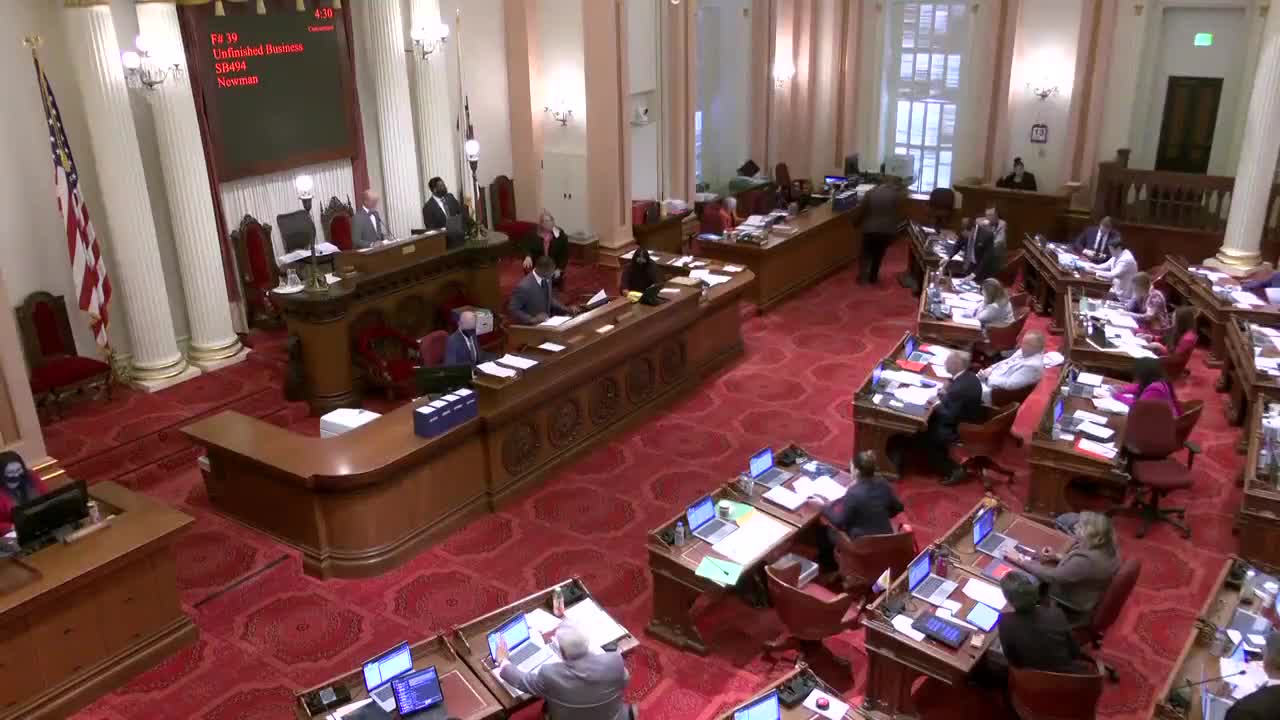 40SEC
Senate Floor
 3MIN
Assembly Floor
 49SEC
Assembly Floor
 9SEC
Assembly Floor
 4MIN
Assembly Standing Committee on Housing and Community Development
 2MIN
Senate Floor
 8MIN
Senate Standing Committee on Housing
Bill Author
Bill Co-Author(s):