AB 1197: Rental passenger vehicles: electronic surveillance technology: renter liability for loss due to theft.
- Session Year: 2025-2026
- House: Assembly
- Latest Version Date: 2025-10-07
Current Status:
Passed
(2025-10-07: Chaptered by Secretary of State - Chapter 449, Statutes of 2025.)
Introduced
In Committee
Awaiting First Chamber Vote
Passed First Chamber
In Committee
Awaiting Second Chamber Vote
Passed Second Chamber
Enacted
Existing law generally governs the transactions between a rental car company, also referred to as a rental company, and its customers, as provided. Existing law prohibits a rental company from using, accessing, or obtaining any information relating to the renters use of the rental vehicle that was obtained using electronic surveillance technology, as defined, except under specified circumstances. Existing law permits a rental company and a renter to limit the responsibilities of a renter in specified events, including loss due to theft of the rented vehicle up to its fair market value, as provided. Existing law establishes, in the situation described in the previous sentence, a presumption that the renter has no liability for loss due to theft if specified conditions are met, including that an authorized driver has possession of the ignition key or establishes that the ignition key was not in the vehicle at the time of the theft, as provided.
This bill would allow a rental company to use geofence technology, as specified, to detect rental vehicle movement in prescribed circumstances. The bill, with respect to the above-described provisions relating to the renters liability for loss due to theft, would revise the presumption that the renter has no liability for loss due to theft to instead apply this presumption if an authorized driver returns the ignition key.
Existing law generally governs the transactions between a rental car company, also referred to as a rental company, and its customers, as provided. Existing law prohibits a rental company from using, accessing, or obtaining any information relating to the renters use of the rental vehicle that was obtained using electronic surveillance technology, as defined, except under specified circumstances. Existing law permits a rental company and a renter to limit the responsibilities of a renter in specified events, including loss due to theft of the rented vehicle up to its fair market value, as provided. Existing law establishes, in the situation described in the previous sentence, a presumption that the renter has no liability for loss due to theft if specified conditions are met, including that an authorized driver has possession of the ignition key or establishes that the ignition key was not in the vehicle at the time of the theft, as provided.
This bill would allow a rental company to use location-based geofence technology, as specified, to detect rental vehicle movement in prescribed circumstances. The bill, with respect to the above-described provisions relating to the renters liability for loss due to theft, would revise the presumption that the renter has no liability for loss due to theft to instead apply this presumption if an authorized driver returns the ignition key.
Existing law generally governs the transactions between a rental car company, also referred to as a rental company, and its customers, as provided. Existing law prohibits a rental company from using, accessing, or obtaining any information relating to the renters use of the rental vehicle that was obtained using electronic surveillance technology, as defined, except under specified circumstances. Existing law defines electronic surveillance technology for these purposes to include, among other things, location-based technologies and to exclude, among other things, systems that are used for prescribed purposes related to repairs and safety, as provided. Existing law permits a rental company and a renter to limit the responsibilities of a renter in specified events, including loss due to theft of the rented vehicle up to its fair market value, as specified, provided the rental company establishes by clear and convincing evidence that the renter or an authorized driver failed to exercise ordinary care while in possession of the vehicle. value, as provided. Existing law establishes, in the situation described in the previous sentence, a presumption that the renter has no liability for loss due to theft if specified conditions are met, including that an authorized driver has possession of the ignition key or establishes that the ignition key was not in the vehicle at the time of the theft, as provided.
This bill would allow a rental company to use location-based technology, as specified, to detect rental vehicle movement in prescribed circumstances. The bill would additionally exclude from the definition of electronic surveillance technology, thereby exempting from the general prohibition on electronic surveillance technology, systems that are used for the purpose of maintaining, managing, and protecting vehicles in the rental car fleet, or otherwise improving a customers experience during the rental car transaction, if specified conditions are met. The bill, with respect to the above-described provisions relating to the renters liability for loss due to theft, would also delete the requirement that the rental company establish the renters or authorized drivers failure to exercise ordinary care by clear and convincing evidence standard, and would revise the presumption that the renter has no liability for loss due to theft to instead apply this presumption if an authorized driver returns the ignition key.
Existing law generally governs the transactions between a rental car company, also referred to as a rental company, and its customers, as provided. Existing law prohibits a rental company from using, accessing, or obtaining any information relating to the renters use of the rental vehicle that was obtained using electronic surveillance technology, except under specified circumstances. Existing law defines electronic surveillance technology for these purposes to include, among other things, location-based technologies and to exclude, among other things, systems that are used for prescribed purposes related to repairs and safety, as provided. Existing law permits a rental company and a renter to limit the responsibilities of a renter in specified events, including loss due to theft of the rented vehicle up to its fair market value, as specified, provided the rental company establishes by clear and convincing evidence that the renter or an authorized driver failed to exercise ordinary care while in possession of the vehicle. Existing law establishes, in the above-described situation, situation described in the previous sentence, a presumption that the renter has no liability for loss due to theft if specified conditions are met, including that an authorized driver has possession of the ignition key or establishes that the ignition key was not in the vehicle at the time of the theft, as provided.
This bill would allow a rental company to use location-based technology, as specified, to detect rental vehicle movement in prescribed circumstances. The bill would additionally exclude from the definition of electronic surveillance technology, thereby exempting from the general prohibition on electronic surveillance technology, systems that are used for the purpose of maintaining, managing, and protecting vehicles in the rental car fleet, or otherwise improving a customers experience during the rental car transaction, if specified conditions are met. The bill, with respect to the above-described provisions relating to the renters liability for loss due to theft, would also delete the requirement that the rental company establish the renters or authorized drivers failure to exercise ordinary care by clear and convincing evidence standard. The bill would also standard, and would revise the presumption that the renter has no liability for loss due to theft to instead apply this presumption if an authorized driver returns the ignition key. The bill, if a renter or authorized driver failed to exercise ordinary care, would also require the rental company to limit any recovery for loss due to theft to the limits of the renters or authorized drivers insurance coverage.
Existing law generally governs the transactions between a rental car company, also referred to as a rental company, and its customers, as provided. Existing law permits a rental company and a renter to limit the responsibilities of a renter in specified events, including loss due to theft of the rented vehicle up to its fair market value, as specified, provided the rental company establishes by clear and convincing evidence that the renter or an authorized driver failed to exercise ordinary care while in possession of the vehicle. Existing law establishes, in the above-described situation, a presumption that the renter has no liability for loss due to theft if specified conditions are met, including that an authorized driver has possession of the ignition key or establishes that the ignition key was not in the vehicle at the time of the theft, as provided.
This bill would delete the requirement that the rental company establish the renters or authorized drivers failure to exercise ordinary care by clear and convincing evidence standard. The bill would also revise the presumption that the renter has no liability for loss due to theft to instead apply this presumption if an authorized driver returns the ignition key. The bill, if a renter or authorized driver failed to exercise ordinary care, would also require the rental company to limit any recovery for loss due to theft to the limits of the renters or authorized drivers insurance coverage.
Existing law, the Consumer Legal Remedies Act, prohibits specified unfair methods of competition and unfair or deceptive acts or practices undertaken by any person in a transaction intended to result or which results in the sale or lease of goods or services to any consumer. This bill would make a nonsubstantive change to these provisions.Existing law, the Consumer Legal Remedies Act, prohibits specified unfair methods of competition and unfair or deceptive acts or practices undertaken by any person in a transaction intended to result or which results in the sale or lease of goods or services to any consumer.
This bill would make a nonsubstantive change to these provisions.
Except as limited by Section 1939.05, a rental company and a renter may agree that the renter will be responsible for no more than all of the following:
(a)Physical or mechanical damage to the rented vehicle up to its fair market value, as determined in the customary market for the sale of that vehicle, resulting from collision regardless of the cause of the damage.
(b)(1)Loss due to theft of the rented vehicle up to its fair market value, as determined in the customary market for the sale of that vehicle, provided that the rental company establishes by clear and convincing evidence that the renter or the authorized driver failed to exercise ordinary care while in possession of the vehicle. In addition, the renter shall be presumed to have no liability for any loss due to theft if both of the following conditions are met:
(A)An authorized driver returns the ignition key furnished by the rental company.
(B)An authorized driver files an official report of the theft with the police or other law enforcement agency within 24 hours of learning of the theft and reasonably cooperates with the rental company and the police or other law enforcement agency in providing information concerning the theft.
(2)The presumption set forth in this subdivision is a presumption affecting the burden of proof which the rental company may rebut by establishing that an authorized driver committed, or aided and abetted the commission of, the theft.
(c)Physical damage to the rented vehicle up to its fair market value, as determined in the customary market for the sale of that vehicle, resulting from vandalism occurring after, or in connection with, the theft of the rented vehicle. However, the renter shall have no liability for any damage due to vandalism if the renter would have no liability for theft pursuant to subdivision (b).
(d)Physical damage to the rented vehicle up to a total of five hundred dollars ($500) resulting from vandalism unrelated to the theft of the rented vehicle.
(e)Actual charges for towing, storage, and impound fees paid by the rental company if the renter is liable for damage or loss.
(f)An administrative charge, which shall include the cost of appraisal and all other costs and expenses incident to the damage, loss, repair, or replacement of the rented vehicle.
SEC. 2.Section 1939.23 of the Civil Code is amended to read:1939.23.(a)A rental company shall not use, access, or obtain any information relating to the renters use of the rental vehicle that was obtained using electronic surveillance technology, except in the following circumstances:
(1)(A)When the equipment is used by the rental company only for the purpose of locating a stolen, abandoned, or missing rental vehicle after one of the following:
(i)The renter or law enforcement has informed the rental company that the vehicle is missing or has been stolen or abandoned.
(ii)If the rental vehicle has not been returned following 24 hours after the contracted return date or by 24 hours following the end of an extension of that return date, the rental company may activate electronic surveillance technology. The rental company shall provide notice of activation of the electronic surveillance technology 24 hours before activation, by telephone and electronically pursuant to Section 1939.22, unless the renter has not provided a telephone number or the renter has not agreed to electronic communication pursuant to Section 1939.22. The rental or lease agreement shall advise the renter that electronic surveillance technology may be activated if the rental vehicle has not been returned within 24 hours after the contracted return date or extension of the return date. The renter shall acknowledge this advisement in the rental or lease agreement by initials. The advisement shall also be made orally to the renter at the time of executing the rental or lease agreement if the transaction is completed in person or by telephone. The advisements are not required to be made to members of the rental companys membership program executing a rental or lease agreement. However, a renter shall be given those advisements upon enrolling in the rental companys membership program.
(iii)Notwithstanding clause (ii), if the rental vehicle has not been returned following one week after the contracted return date or by one week following the end of an extension of that return date.
(iv)The rental company discovers the rental vehicle has been stolen or abandoned, and, if stolen, the rental company shall report the vehicle stolen to law enforcement by filing a stolen vehicle report, unless law enforcement has already informed the rental company that the vehicle is missing or has been stolen or abandoned.
(v)The rental vehicle is the subject of an AMBER Alert issued pursuant to Section 8594 of the Government Code. If the rental company uses the equipment in connection with this provision relating to an AMBER Alert, the rental company shall notify law enforcement that one of the rental companys vehicles is the subject of an AMBER Alert upon becoming aware of the situation, unless law enforcement has already informed the rental company that the vehicle was the subject of an AMBER Alert.
(B)If electronic surveillance technology is activated pursuant to subparagraph (A), a rental company shall maintain a record, in either electronic or written form, of information relevant to the activation of that technology. That information shall include the rental agreement, including the return date, and the date and time the electronic surveillance technology was activated. The record shall also include, if relevant, a record of written or other communication with the renter, including communications regarding extensions of the rental, police reports, or other written communication with law enforcement officials. The record shall be maintained for a period of at least 12 months from the time the record is created and shall be made available upon the renters request. The rental company shall maintain and furnish explanatory codes necessary to read the record. A rental company shall not be required to maintain a record if electronic surveillance technology is activated to recover a rental vehicle that is stolen or missing at a time other than during a rental period.
(2)In response to a specific request from law enforcement pursuant to a subpoena or search warrant.
(3)The rental company uses geofence technology to detect the movement of a rental vehicle in either of the following circumstances:
(A)The rental vehicle is moved outside of the country, if travel outside of the country is not authorized by the rental agreement.
(B)The rental vehicle is moved into an impound or tow yard. The rental company shall notify the renter that the vehicle has been detected within an impound or tow yard. If the vehicle remains within the perimeter of the impound or tow yard for 24 hours after the notification, the vehicle shall be deemed abandoned by the renter.
(b)Subdivision (a) does not prohibit a rental company from equipping rental vehicles with any of the following:
(1)GPS-based technology that provides navigation assistance to the occupants of the rental vehicle, if the rental company does not use, access, or obtain information relating to the renters use of the rental vehicle that was obtained using that technology, except for the purposes of discovering or repairing a defect in the technology and the information may then be used only for that purpose.
(2)Electronic surveillance technology that allows for the remote locking or unlocking of the vehicle at the request of the renter, if the rental company does not use, access, or obtain information relating to the renters use of the rental vehicle that was obtained using that technology, except as necessary to lock or unlock the vehicle.
(3)Electronic surveillance technology that allows the company to provide roadside assistance, such as towing, flat tire, or fuel services, at the request of the renter, if the rental company does not use, access, or obtain information relating to the renters use of the rental vehicle that was obtained using that technology except as necessary to provide the requested roadside assistance.
(c)Subdivision (a) does not prohibit a rental company from obtaining, accessing, or using information from electronic surveillance technology for the sole purpose of determining the date and time the vehicle departs from and is returned to the rental company, and the total mileage driven and the vehicle fuel level of the returned vehicle. The information obtained or accessed from this electronic surveillance technology shall only be used for the purpose described in this subdivision.
(d)A rental company shall not use electronic surveillance technology to track a renter in order to impose fines or surcharges relating to the renters use of the rental vehicle.
Except as limited by Section 1939.05, a rental company and a renter may agree that the renter will be responsible for no more than all of the following:
(a)Physical or mechanical damage to the rented vehicle up to its fair market value, as determined in the customary market for the sale of that vehicle, resulting from collision regardless of the cause of the damage.
(b)(1)Loss due to theft of the rented vehicle up to its fair market value, as determined in the customary market for the sale of that vehicle, provided that the rental company establishes by clear and convincing evidence that the renter or the authorized driver failed to exercise ordinary care while in possession of the vehicle. In addition, the renter shall be presumed to have no liability for any loss due to theft if both of the following conditions are met:
(A)An authorized driver returns the ignition key furnished by the rental company.
(B)An authorized driver files an official report of the theft with the police or other law enforcement agency within 24 hours of learning of the theft and reasonably cooperates with the rental company and the police or other law enforcement agency in providing information concerning the theft.
(2)The presumption set forth in this subdivision is a presumption affecting the burden of proof which the rental company may rebut by establishing that an authorized driver committed, or aided and abetted the commission of, the theft.
(c)Physical damage to the rented vehicle up to its fair market value, as determined in the customary market for the sale of that vehicle, resulting from vandalism occurring after, or in connection with, the theft of the rented vehicle. However, the renter shall have no liability for any damage due to vandalism if the renter would have no liability for theft pursuant to subdivision (b).
(d)Physical damage to the rented vehicle up to a total of five hundred dollars ($500) resulting from vandalism unrelated to the theft of the rented vehicle.
(e)Actual charges for towing, storage, and impound fees paid by the rental company if the renter is liable for damage or loss.
(f)An administrative charge, which shall include the cost of appraisal and all other costs and expenses incident to the damage, loss, repair, or replacement of the rented vehicle.
SEC. 2.Section 1939.23 of the Civil Code is amended to read:1939.23.(a)A rental company shall not use, access, or obtain any information relating to the renters use of the rental vehicle that was obtained using electronic surveillance technology, except in the following circumstances:
(1)(A)When the equipment is used by the rental company only for the purpose of locating a stolen, abandoned, or missing rental vehicle after one of the following:
(i)The renter or law enforcement has informed the rental company that the vehicle is missing or has been stolen or abandoned.
(ii)If the rental vehicle has not been returned following 24 hours after the contracted return date or by 24 hours following the end of an extension of that return date, the rental company may activate electronic surveillance technology. The rental company shall provide notice of activation of the electronic surveillance technology 24 hours before activation, by telephone and electronically pursuant to Section 1939.22, unless the renter has not provided a telephone number or the renter has not agreed to electronic communication pursuant to Section 1939.22. The rental or lease agreement shall advise the renter that electronic surveillance technology may be activated if the rental vehicle has not been returned within 24 hours after the contracted return date or extension of the return date. The renter shall acknowledge this advisement in the rental or lease agreement by initials. The advisement shall also be made orally to the renter at the time of executing the rental or lease agreement if the transaction is completed in person or by telephone. The advisements are not required to be made to members of the rental companys membership program executing a rental or lease agreement. However, a renter shall be given those advisements upon enrolling in the rental companys membership program.
(iii)Notwithstanding clause (ii), if the rental vehicle has not been returned following one week after the contracted return date or by one week following the end of an extension of that return date.
(iv)The rental company discovers the rental vehicle has been stolen or abandoned, and, if stolen, the rental company shall report the vehicle stolen to law enforcement by filing a stolen vehicle report, unless law enforcement has already informed the rental company that the vehicle is missing or has been stolen or abandoned.
(v)The rental vehicle is the subject of an AMBER Alert issued pursuant to Section 8594 of the Government Code. If the rental company uses the equipment in connection with this provision relating to an AMBER Alert, the rental company shall notify law enforcement that one of the rental companys vehicles is the subject of an AMBER Alert upon becoming aware of the situation, unless law enforcement has already informed the rental company that the vehicle was the subject of an AMBER Alert.
(B)If electronic surveillance technology is activated pursuant to subparagraph (A), a rental company shall maintain a record, in either electronic or written form, of information relevant to the activation of that technology. That information shall include the rental agreement, including the return date, and the date and time the electronic surveillance technology was activated. The record shall also include, if relevant, a record of written or other communication with the renter, including communications regarding extensions of the rental, police reports, or other written communication with law enforcement officials. The record shall be maintained for a period of at least 12 months from the time the record is created and shall be made available upon the renters request. The rental company shall maintain and furnish explanatory codes necessary to read the record. A rental company shall not be required to maintain a record if electronic surveillance technology is activated to recover a rental vehicle that is stolen or missing at a time other than during a rental period.
(2)In response to a specific request from law enforcement pursuant to a subpoena or search warrant.
(3)The rental company uses geofence technology to detect the movement of a rental vehicle in either of the following circumstances:
(A)The rental vehicle is moved outside of the country, if travel outside of the country is not authorized by the rental agreement.
(B)The rental vehicle is moved into an impound or tow yard. The rental company shall notify the renter that the vehicle has been detected within an impound or tow yard. If the vehicle remains within the perimeter of the impound or tow yard for 24 hours, hours after the notification, the vehicle shall be deemed abandoned by the renter.
(b)Subdivision (a) does not prohibit a rental company from equipping rental vehicles with any of the following:
(1)GPS-based technology that provides navigation assistance to the occupants of the rental vehicle, if the rental company does not use, access, or obtain information relating to the renters use of the rental vehicle that was obtained using that technology, except for the purposes of discovering or repairing a defect in the technology and the information may then be used only for that purpose.
(2)Electronic surveillance technology that allows for the remote locking or unlocking of the vehicle at the request of the renter, if the rental company does not use, access, or obtain information relating to the renters use of the rental vehicle that was obtained using that technology, except as necessary to lock or unlock the vehicle.
(3)Electronic surveillance technology that allows the company to provide roadside assistance, such as towing, flat tire, or fuel services, at the request of the renter, if the rental company does not use, access, or obtain information relating to the renters use of the rental vehicle that was obtained using that technology except as necessary to provide the requested roadside assistance.
(c)Subdivision (a) does not prohibit a rental company from obtaining, accessing, or using information from electronic surveillance technology for the sole purpose of determining the date and time the vehicle departs from and is returned to the rental company, and the total mileage driven and the vehicle fuel level of the returned vehicle. The information obtained or accessed from this electronic surveillance technology shall only be used for the purpose described in this subdivision.
(d)A rental company shall not use electronic surveillance technology to track a renter in order to impose fines or surcharges relating to the renters use of the rental vehicle.
Except as limited by Section 1939.05, a rental company and a renter may agree that the renter will be responsible for no more than all of the following:
(a)Physical or mechanical damage to the rented vehicle up to its fair market value, as determined in the customary market for the sale of that vehicle, resulting from collision regardless of the cause of the damage.
(b)(1)Loss due to theft of the rented vehicle up to its fair market value, as determined in the customary market for the sale of that vehicle, provided that the rental company establishes by clear and convincing evidence that the renter or the authorized driver failed to exercise ordinary care while in possession of the vehicle. In addition, the renter shall be presumed to have no liability for any loss due to theft if both of the following conditions are met:
(A)An authorized driver returns the ignition key furnished by the rental company.
(B)An authorized driver files an official report of the theft with the police or other law enforcement agency within 24 hours of learning of the theft and reasonably cooperates with the rental company and the police or other law enforcement agency in providing information concerning the theft.
(2)The presumption set forth in this subdivision is a presumption affecting the burden of proof which the rental company may rebut by establishing that an authorized driver committed, or aided and abetted the commission of, the theft.
(c)Physical damage to the rented vehicle up to its fair market value, as determined in the customary market for the sale of that vehicle, resulting from vandalism occurring after, or in connection with, the theft of the rented vehicle. However, the renter shall have no liability for any damage due to vandalism if the renter would have no liability for theft pursuant to subdivision (b).
(d)Physical damage to the rented vehicle up to a total of five hundred dollars ($500) resulting from vandalism unrelated to the theft of the rented vehicle.
(e)Actual charges for towing, storage, and impound fees paid by the rental company if the renter is liable for damage or loss.
(f)An administrative charge, which shall include the cost of appraisal and all other costs and expenses incident to the damage, loss, repair, or replacement of the rented vehicle.
SEC. 2.Section 1939.23 of the Civil Code is amended to read:1939.23.(a)A rental company shall not use, access, or obtain any information relating to the renters use of the rental vehicle that was obtained using electronic surveillance technology, except in the following circumstances:
(1)(A)When the equipment is used by the rental company only for the purpose of locating a stolen, abandoned, or missing rental vehicle after one of the following:
(i)The renter or law enforcement has informed the rental company that the vehicle is missing or has been stolen or abandoned.
(ii)If the rental vehicle has not been returned following 24 hours after the contracted return date or by 24 hours following the end of an extension of that return date, the rental company may activate electronic surveillance technology. The rental company shall provide notice of activation of the electronic surveillance technology 24 hours before activation, by telephone and electronically pursuant to Section 1939.22, unless the renter has not provided a telephone number or the renter has not agreed to electronic communication pursuant to Section 1939.22. The rental or lease agreement shall advise the renter that electronic surveillance technology may be activated if the rental vehicle has not been returned within 24 hours after the contracted return date or extension of the return date. The renter shall acknowledge this advisement in the rental or lease agreement by initials. The advisement shall also be made orally to the renter at the time of executing the rental or lease agreement if the transaction is completed in person or by telephone. The advisements are not required to be made to members of the rental companys membership program executing a rental or lease agreement. However, a renter shall be given those advisements upon enrolling in the rental companys membership program.
(iii)Notwithstanding clause (ii), if the rental vehicle has not been returned following one week after the contracted return date or by one week following the end of an extension of that return date.
(iv)The rental company discovers the rental vehicle has been stolen or abandoned, and, if stolen, the rental company shall report the vehicle stolen to law enforcement by filing a stolen vehicle report, unless law enforcement has already informed the rental company that the vehicle is missing or has been stolen or abandoned.
(v)The rental vehicle is the subject of an AMBER Alert issued pursuant to Section 8594 of the Government Code. If the rental company uses the equipment in connection with this provision relating to an AMBER Alert, the rental company shall notify law enforcement that one of the rental companys vehicles is the subject of an AMBER Alert upon becoming aware of the situation, unless law enforcement has already informed the rental company that the vehicle was the subject of an AMBER Alert.
(B)If electronic surveillance technology is activated pursuant to subparagraph (A), a rental company shall maintain a record, in either electronic or written form, of information relevant to the activation of that technology. That information shall include the rental agreement, including the return date, and the date and time the electronic surveillance technology was activated. The record shall also include, if relevant, a record of written or other communication with the renter, including communications regarding extensions of the rental, police reports, or other written communication with law enforcement officials. The record shall be maintained for a period of at least 12 months from the time the record is created and shall be made available upon the renters request. The rental company shall maintain and furnish explanatory codes necessary to read the record. A rental company shall not be required to maintain a record if electronic surveillance technology is activated to recover a rental vehicle that is stolen or missing at a time other than during a rental period.
(2)In response to a specific request from law enforcement pursuant to a subpoena or search warrant.
(3)The rental company uses location-based technology, including, but not limited to, a geofence or other virtual perimeter, geofence technology to detect the movement of a rental vehicle in either of the following circumstances:
(A)The rental vehicle is moved outside of the country, if travel outside of the country is not authorized by the rental agreement.
(B)The rental vehicle is moved into an impound or tow yard. If the vehicle remains within the perimeter of the impound or tow yard for 24 hours, the vehicle shall be deemed abandoned by the renter.
(b)Subdivision (a) does not prohibit a rental company from equipping rental vehicles with any of the following:
(1)GPS-based technology that provides navigation assistance to the occupants of the rental vehicle, if the rental company does not use, access, or obtain information relating to the renters use of the rental vehicle that was obtained using that technology, except for the purposes of discovering or repairing a defect in the technology and the information may then be used only for that purpose.
(2)Electronic surveillance technology that allows for the remote locking or unlocking of the vehicle at the request of the renter, if the rental company does not use, access, or obtain information relating to the renters use of the rental vehicle that was obtained using that technology, except as necessary to lock or unlock the vehicle.
(3)Electronic surveillance technology that allows the company to provide roadside assistance, such as towing, flat tire, or fuel services, at the request of the renter, if the rental company does not use, access, or obtain information relating to the renters use of the rental vehicle that was obtained using that technology except as necessary to provide the requested roadside assistance.
(c)Subdivision (a) does not prohibit a rental company from obtaining, accessing, or using information from electronic surveillance technology for the sole purpose of determining the date and time the vehicle departs from and is returned to the rental company, and the total mileage driven and the vehicle fuel level of the returned vehicle. The information obtained or accessed from this electronic surveillance technology shall only be used for the purpose described in this subdivision.
(d)A rental company shall not use electronic surveillance technology to track a renter in order to impose fines or surcharges relating to the renters use of the rental vehicle.
Except as limited by Section 1939.05, a rental company and a renter may agree that the renter will be responsible for no more than all of the following:
(a)Physical or mechanical damage to the rented vehicle up to its fair market value, as determined in the customary market for the sale of that vehicle, resulting from collision regardless of the cause of the damage.
(b)(1)Loss due to theft of the rented vehicle up to its fair market value, as determined in the customary market for the sale of that vehicle, provided that the rental company establishes by clear and convincing evidence that the renter or the authorized driver failed to exercise ordinary care while in possession of the vehicle. In addition, the renter shall be presumed to have no liability for any loss due to theft if both of the following conditions are met:
(A)An authorized driver returns the ignition key furnished by the rental company.
(B)An authorized driver files an official report of the theft with the police or other law enforcement agency within 24 hours of learning of the theft and reasonably cooperates with the rental company and the police or other law enforcement agency in providing information concerning the theft.
(2)The presumption set forth in this subdivision is a presumption affecting the burden of proof which the rental company may rebut by establishing that an authorized driver committed, or aided and abetted the commission of, the theft.
(c)Physical damage to the rented vehicle up to its fair market value, as determined in the customary market for the sale of that vehicle, resulting from vandalism occurring after, or in connection with, the theft of the rented vehicle. However, the renter shall have no liability for any damage due to vandalism if the renter would have no liability for theft pursuant to subdivision (b).
(d)Physical damage to the rented vehicle up to a total of five hundred dollars ($500) resulting from vandalism unrelated to the theft of the rented vehicle.
(e)Actual charges for towing, storage, and impound fees paid by the rental company if the renter is liable for damage or loss.
(f)An administrative charge, which shall include the cost of appraisal and all other costs and expenses incident to the damage, loss, repair, or replacement of the rented vehicle.
SEC. 3.SEC. 2.Section 1939.23 of the Civil Code is amended to read:1939.23.(a)A rental company shall not use, access, or obtain any information relating to the renters use of the rental vehicle that was obtained using electronic surveillance technology, except in the following circumstances:
(1)(A)When the equipment is used by the rental company only for the purpose of locating a stolen, abandoned, or missing rental vehicle after one of the following:
(i)The renter or law enforcement has informed the rental company that the vehicle is missing or has been stolen or abandoned.
(ii)If the rental vehicle has not been returned following 24 hours after the contracted return date or by 24 hours following the end of an extension of that return date, the rental company may activate electronic surveillance technology. The rental company shall provide notice of activation of the electronic surveillance technology 24 hours before activation, by telephone and electronically pursuant to Section 1939.22, unless the renter has not provided a telephone number or the renter has not agreed to electronic communication pursuant to Section 1939.22. The rental or lease agreement shall advise the renter that electronic surveillance technology may be activated if the rental vehicle has not been returned within 24 hours after the contracted return date or extension of the return date. The renter shall acknowledge this advisement in the rental or lease agreement by initials. The advisement shall also be made orally to the renter at the time of executing the rental or lease agreement if the transaction is completed in person or by telephone. The advisements are not required to be made to members of the rental companys membership program executing a rental or lease agreement. However, a renter shall be given those advisements upon enrolling in the rental companys membership program.
(iii)Notwithstanding clause (ii), if the rental vehicle has not been returned following one week after the contracted return date or by one week following the end of an extension of that return date.
(iv)The rental company discovers the rental vehicle has been stolen or abandoned, and, if stolen, the rental company shall report the vehicle stolen to law enforcement by filing a stolen vehicle report, unless law enforcement has already informed the rental company that the vehicle is missing or has been stolen or abandoned.
(v)The rental vehicle is the subject of an AMBER Alert issued pursuant to Section 8594 of the Government Code. If the rental company uses the equipment in connection with this provision relating to an AMBER Alert, the rental company shall notify law enforcement that one of the rental companys vehicles is the subject of an AMBER Alert upon becoming aware of the situation, unless law enforcement has already informed the rental company that the vehicle was the subject of an AMBER Alert.
(B)If electronic surveillance technology is activated pursuant to subparagraph (A), a rental company shall maintain a record, in either electronic or written form, of information relevant to the activation of that technology. That information shall include the rental agreement, including the return date, and the date and time the electronic surveillance technology was activated. The record shall also include, if relevant, a record of written or other communication with the renter, including communications regarding extensions of the rental, police reports, or other written communication with law enforcement officials. The record shall be maintained for a period of at least 12 months from the time the record is created and shall be made available upon the renters request. The rental company shall maintain and furnish explanatory codes necessary to read the record. A rental company shall not be required to maintain a record if electronic surveillance technology is activated to recover a rental vehicle that is stolen or missing at a time other than during a rental period.
(2)In response to a specific request from law enforcement pursuant to a subpoena or search warrant.
(3)The rental company uses location-based technology, including, but not limited to, a geofence or other virtual perimeter, to detect the movement of a rental vehicle in either of the following circumstances:
(A)The rental vehicle is moved outside of the country, if travel outside of the country is not authorized by the rental agreement.
(B)The rental vehicle is moved into an impound or tow yard. If the vehicle remains within the perimeter of the impound or tow yard for 24 hours, the vehicle shall be deemed abandoned by the renter.
(b)Subdivision (a) does not prohibit a rental company from equipping rental vehicles with any of the following:
(1)GPS-based technology that provides navigation assistance to the occupants of the rental vehicle, if the rental company does not use, access, or obtain information relating to the renters use of the rental vehicle that was obtained using that technology, except for the purposes of discovering or repairing a defect in the technology and the information may then be used only for that purpose.
(2)Electronic surveillance technology that allows for the remote locking or unlocking of the vehicle at the request of the renter, if the rental company does not use, access, or obtain information relating to the renters use of the rental vehicle that was obtained using that technology, except as necessary to lock or unlock the vehicle.
(3)Electronic surveillance technology that allows the company to provide roadside assistance, such as towing, flat tire, or fuel services, at the request of the renter, if the rental company does not use, access, or obtain information relating to the renters use of the rental vehicle that was obtained using that technology except as necessary to provide the requested roadside assistance.
(c)Subdivision (a) does not prohibit a rental company from obtaining, accessing, or using information from electronic surveillance technology for the sole purpose of determining the date and time the vehicle departs from and is returned to the rental company, and the total mileage driven and the vehicle fuel level of the returned vehicle. The information obtained or accessed from this electronic surveillance technology shall only be used for the purpose described in this subdivision.
(d)A rental company shall not use electronic surveillance technology to track a renter in order to impose fines or surcharges relating to the renters use of the rental vehicle.
For the purpose of this chapter, the following definitions shall apply:
(a)Rental company means a person or entity in the business of renting passenger vehicles to the public.
(b)Renter means any person in a manner obligated under a contract for the lease or hire of a passenger vehicle from a rental company for a period of less than 30 days.
(c)Additional mandatory charges means any separately stated charges that the rental company requires the renter to pay to hire or lease the vehicle for the period of time to which the rental rate applies, which are imposed by a governmental entity and specifically relate to the operation of a rental vehicle business, including, but not limited to, a customer facility charge, airport concession fee, tourism commission assessment, vehicle license recovery fee, or other government-imposed taxes or fees.
(d)Airport concession fee means a charge collected by a rental company from a renter that is the renters proportionate share of the amount paid by the rental company to the owner or operator of an airport for the right or privilege of conducting a vehicle rental business on the airports premises.
(e)Authorized driver means all of the following:
(1)The renter.
(2)The renters spouse, if that person is a licensed driver and satisfies the rental companys minimum age requirement.
(3)The renters employer or coworker, if the employer or coworker is engaged in business activity with the renter, is a licensed driver, and satisfies the rental companys minimum age requirement.
(4)A person expressly listed by the rental company on that renters contract as an authorized driver.
(f)Customer facility charge means any fee, including an alternative fee, required by an airport to be collected by a rental company from a renter pursuant to Section 50474.21 of the Government Code.
(g)Damage waiver means a rental companys agreement not to hold a renter liable for all or any portion of any damage or loss related to the rented vehicle, any loss of use of the rented vehicle, or any storage, impound, towing, or administrative charges.
(h)Electronic surveillance technology means a technological method or system used to observe, monitor, or collect information, including telematics, Global Positioning System (GPS), wireless technology, or location-based technologies. Electronic surveillance technology does not include event data recorders (EDR), sensing and diagnostic modules (SDM), or other systems that are used either: for any of the following purposes:
(1)For the purpose of identifying, diagnosing, or monitoring functions related to the potential need to repair, service, or perform maintenance on the rental vehicle.
(2)As part of the vehicles airbag sensing and diagnostic system in order to capture safety systems-related data for retrieval after a crash has occurred or in the event that the collision sensors are activated to prepare the decisionmaking computer to make the determination to deploy or not to deploy the airbag.
(3)For the purpose of maintaining, managing, and protecting vehicles in the rental car fleet, or otherwise improving a customers experience during the rental car transaction, provided that all of the following conditions are met:
(A)The purpose is clearly and conspicuously disclosed to the renter in the rental agreement.
(B)Use of the information is otherwise permissible under the California Consumer Privacy Act of 2018 (Title 1.81.5 (commencing with Section 1798.100)).
(C)Any personally identifiable information obtained from the rental vehicle is not retained or used after the rental vehicle is returned and the rental has concluded.
(i)Estimated time for replacement means the number of hours of labor, or fraction thereof, needed to replace damaged vehicle parts as set forth in collision damage estimating guides generally used in the vehicle repair business and commonly known as crash books.
(j)Estimated time for repair means a good faith estimate of the reasonable number of hours of labor, or fraction thereof, needed to repair damaged vehicle parts.
(k)Membership program means a service offered by a rental company that permits customers to bypass the rental counter and go directly to the vehicle previously reserved or select an alternate vehicle. A membership program shall meet all of the following requirements:
(1)The renter initiates enrollment by completing an application on which the renter can specify a preference for type of vehicle and acceptance or declination of optional services.
(2)The rental company fully discloses, prior to the enrollees first rental as a participant in the program, all terms and conditions of the rental agreement as well as all required disclosures.
(3)The renter may terminate enrollment at any time.
(4)The rental company fully explains to the renter that designated preferences, as well as acceptance or declination of optional services, may be changed by the renter at any time for the next and future rentals.
(5)An employee is available at the lot where the renter takes possession of the vehicle, to receive any change in the rental agreement from the renter.
(l)Passenger vehicle or vehicle means a passenger vehicle as defined in Section 465 of the Vehicle Code.
(m)Personal vehicle sharing program means a person or entity that for monetary compensation facilitates sharing or renting passenger vehicles to the public, including via a peer-to-peer internet website, application, or other platform that connects a vehicle owner with a vehicle driver to facilitate sharing or renting a vehicle for consideration, and includes a personal vehicle sharing program as defined in Section 11580.24 of the Insurance Code.
(n)Quote means an estimated cost of rental provided by a rental company or a third party to a potential customer that is based on information provided by the potential customer and used to generate an estimated cost of rental, including, but not limited to, potential dates of rental, locations, or classes of vehicle.
(o)Tourism commission assessment means the charge collected by a rental company from a renter that has been established by the California Travel and Tourism Commission pursuant to Section 13995.65 of the Government Code.
(p)Vehicle license fee means the tax imposed pursuant to the Vehicle License Fee Law (Part 5 (commencing with Section 10701) of Division 2 of the Revenue and Taxation Code).
(q)Vehicle registration fee means any fee imposed pursuant to any provision of Chapter 6 (commencing with Section 9101) of Division 3 of the Vehicle Code or any other law that imposes a fee upon the registration of vehicles in this state.
(r)Vehicle license recovery fee means a charge that seeks to recover the amount of any vehicle license fee and vehicle registration fee paid by a rental company for the particular class of vehicle being rented. If imposed, the vehicle license recovery fee shall be separately stated as a single charge in the quote and rental contract.
SECTION 1.SEC. 2.Section 1939.03 of the Civil Code is amended to read:1939.03.Except as limited by Section 1939.05, a rental company and a renter may agree that the renter will be responsible for no more than all of the following:
(a)Physical or mechanical damage to the rented vehicle up to its fair market value, as determined in the customary market for the sale of that vehicle, resulting from collision regardless of the cause of the damage.
(b)(1)Loss due to theft of the rented vehicle up to its fair market value, as determined in the customary market for the sale of that vehicle, provided that the rental company establishes that the renter or the authorized driver failed to exercise ordinary care while in possession of the vehicle. In addition, the renter shall be presumed to have no liability for any loss due to theft if both of the following conditions are met:
(A)An authorized driver returns the ignition key furnished by the rental company.
(B)An authorized driver files an official report of the theft with the police or other law enforcement agency within 24 hours of learning of the theft and reasonably cooperates with the rental company and the police or other law enforcement agency in providing information concerning the theft.
(2)The presumption set forth in this subdivision is a presumption affecting the burden of proof which the rental company may rebut by establishing that an authorized driver committed, or aided and abetted the commission of, the theft.
(3)If the renter or the authorized driver failed to exercise ordinary care, then the rental company shall limit any recovery for loss due to theft to the limits of the protection extended by any applicable insurance coverage of the renter or authorized driver.(c)Physical damage to the rented vehicle up to its fair market value, as determined in the customary market for the sale of that vehicle, resulting from vandalism occurring after, or in connection with, the theft of the rented vehicle. However, the renter shall have no liability for any damage due to vandalism if the renter would have no liability for theft pursuant to subdivision (b).
(d)Physical damage to the rented vehicle up to a total of five hundred dollars ($500) resulting from vandalism unrelated to the theft of the rented vehicle.
(e)Actual charges for towing, storage, and impound fees paid by the rental company if the renter is liable for damage or loss.
(f)An administrative charge, which shall include the cost of appraisal and all other costs and expenses incident to the damage, loss, repair, or replacement of the rented vehicle.
SEC. 3.Section 1939.23 of the Civil Code is amended to read:1939.23.(a)A rental company shall not use, access, or obtain any information relating to the renters use of the rental vehicle that was obtained using electronic surveillance technology, except in the following circumstances:
(1)(A)When the equipment is used by the rental company only for the purpose of locating a stolen, abandoned, or missing rental vehicle after one of the following:
(i)The renter or law enforcement has informed the rental company that the vehicle is missing or has been stolen or abandoned.
(ii)If the rental vehicle has not been returned following 24 hours after the contracted return date or by 24 hours following the end of an extension of that return date, the rental company may activate electronic surveillance technology. The rental company shall provide notice of activation of the electronic surveillance technology 24 hours before activation, by telephone and electronically pursuant to Section 1939.22, unless the renter has not provided a telephone number or the renter has not agreed to electronic communication pursuant to Section 1939.22. The rental or lease agreement shall advise the renter that electronic surveillance technology may be activated if the rental vehicle has not been returned within 24 hours after the contracted return date or extension of the return date. The renter shall acknowledge this advisement in the rental or lease agreement by initials. The advisement shall also be made orally to the renter at the time of executing the rental or lease agreement if the transaction is completed in person or by telephone. The advisements are not required to be made to members of the rental companys membership program executing a rental or lease agreement. However, a renter shall be given those advisements upon enrolling in the rental companys membership program.
(iii)Notwithstanding clause (ii), if the rental vehicle has not been returned following one week after the contracted return date or by one week following the end of an extension of that return date.
(iv)The rental company discovers the rental vehicle has been stolen or abandoned, and, if stolen, the rental company shall report the vehicle stolen to law enforcement by filing a stolen vehicle report, unless law enforcement has already informed the rental company that the vehicle is missing or has been stolen or abandoned.
(v)The rental vehicle is the subject of an AMBER Alert issued pursuant to Section 8594 of the Government Code. If the rental company uses the equipment in connection with this provision relating to an AMBER Alert, the rental company shall notify law enforcement that one of the rental companys vehicles is the subject of an AMBER Alert upon becoming aware of the situation, unless law enforcement has already informed the rental company that the vehicle was the subject of an AMBER Alert.
(B)If electronic surveillance technology is activated pursuant to subparagraph (A), a rental company shall maintain a record, in either electronic or written form, of information relevant to the activation of that technology. That information shall include the rental agreement, including the return date, and the date and time the electronic surveillance technology was activated. The record shall also include, if relevant, a record of written or other communication with the renter, including communications regarding extensions of the rental, police reports, or other written communication with law enforcement officials. The record shall be maintained for a period of at least 12 months from the time the record is created and shall be made available upon the renters request. The rental company shall maintain and furnish explanatory codes necessary to read the record. A rental company shall not be required to maintain a record if electronic surveillance technology is activated to recover a rental vehicle that is stolen or missing at a time other than during a rental period.
(2)In response to a specific request from law enforcement pursuant to a subpoena or search warrant.
(3)The rental company uses location-based technology, including, but not limited to, a geofence or other virtual perimeter, to detect the movement of a rental vehicle in either of the following circumstances:
(A)The rental vehicle is moved outside of the country, if travel outside of the country is not authorized by the rental agreement.
(B)The rental vehicle is moved into an impound or tow yard. If the vehicle remains within the perimeter of the impound or tow yard for 24 hours, the vehicle shall be deemed abandoned by the renter.
(b)Subdivision (a) does not prohibit a rental company from equipping rental vehicles with any of the following:
(1)GPS-based technology that provides navigation assistance to the occupants of the rental vehicle, if the rental company does not use, access, or obtain information relating to the renters use of the rental vehicle that was obtained using that technology, except for the purposes of discovering or repairing a defect in the technology and the information may then be used only for that purpose.
(2)Electronic surveillance technology that allows for the remote locking or unlocking of the vehicle at the request of the renter, if the rental company does not use, access, or obtain information relating to the renters use of the rental vehicle that was obtained using that technology, except as necessary to lock or unlock the vehicle.
(3)Electronic surveillance technology that allows the company to provide roadside assistance, such as towing, flat tire, or fuel services, at the request of the renter, if the rental company does not use, access, or obtain information relating to the renters use of the rental vehicle that was obtained using that technology except as necessary to provide the requested roadside assistance.
(c)Subdivision (a) does not prohibit a rental company from obtaining, accessing, or using information from electronic surveillance technology for the sole purpose of determining the date and time the vehicle departs from and is returned to the rental company, and the total mileage driven and the vehicle fuel level of the returned vehicle. The information obtained or accessed from this electronic surveillance technology shall only be used for the purpose described in this subdivision.
(d)A rental company shall not use electronic surveillance technology to track a renter in order to impose fines or surcharges relating to the renters use of the rental vehicle.
Except as limited by Section 1939.05, a rental company and a renter may agree that the renter will be responsible for no more than all of the following:
(a)Physical or mechanical damage to the rented vehicle up to its fair market value, as determined in the customary market for the sale of that vehicle, resulting from collision regardless of the cause of the damage.
(b)(1)Loss due to theft of the rented vehicle up to its fair market value, as determined in the customary market for the sale of that vehicle, provided that the rental company establishes by clear and convincing evidence that the renter or the authorized driver failed to exercise ordinary care while in possession of the vehicle. In addition, the renter shall be presumed to have no liability for any loss due to theft if (1) an both of the following conditions are met:
(A)An authorized driver has possession of returns the ignition key furnished by the rental company or an authorized driver establishes that the ignition key furnished by the rental company was not in the vehicle at the time of the theft, and (2) an company.
(B)An authorized driver files an official report of the theft with the police or other law enforcement agency within 24 hours of learning of the theft and reasonably cooperates with the rental company and the police or other law enforcement agency in providing information concerning the theft. The
(2)The presumption set forth in this subdivision is a presumption affecting the burden of proof which the rental company may rebut by establishing that an authorized driver committed, or aided and abetted the commission of, the theft.
(3)If the renter or the authorized driver failed to exercise ordinary care, then the rental company shall limit any recovery for loss due to theft to the limits of the protection extended by any applicable insurance coverage of the renter or authorized driver.
(c)Physical damage to the rented vehicle up to its fair market value, as determined in the customary market for the sale of that vehicle, resulting from vandalism occurring after, or in connection with, the theft of the rented vehicle. However, the renter shall have no liability for any damage due to vandalism if the renter would have no liability for theft pursuant to subdivision (b).
(d)Physical damage to the rented vehicle up to a total of five hundred dollars ($500) resulting from vandalism unrelated to the theft of the rented vehicle.
(e)Actual charges for towing, storage, and impound fees paid by the rental company if the renter is liable for damage or loss.
(f)An administrative charge, which shall include the cost of appraisal and all other costs and expenses incident to the damage, loss, repair, or replacement of the rented vehicle.
SECTION 1.Section 1760 of the Civil Code is amended to read:1760.This title shall be liberally construed and applied to promote its underlying purposes, which are to protect consumers against unfair and deceptive business practices and to provide efficient and economical procedures to secure that protection.This title shall be liberally construed and applied to promote its underlying purposes, which are to protect consumers against unfair and deceptive business practices and to provide efficient and economical procedures to secure such that protection.
|
Date
|
Status
|
|---|---|
| Oct 7, 2025 | Chaptered by Secretary of State - Chapter 449, Statutes of 2025. |
| Oct 7, 2025 | Approved by the Governor. |
| Sep 22, 2025 | Enrolled and presented to the Governor at 3 p.m. |
| Sep 10, 2025 | Senate amendments concurred in. To Engrossing and Enrolling. (Ayes 78. Noes 0. Page 3239.). |
| Sep 9, 2025 | In Assembly. Concurrence in Senate amendments pending. |
| Sep 9, 2025 | Read third time. Passed. Ordered to the Assembly. (Ayes 39. Noes 0. Page 2705.). |
| Jul 16, 2025 | Read second time. Ordered to third reading. |
| Jul 15, 2025 | From committee: Do pass. (Ayes 6. Noes 0.) (July 15). |
| Jun 26, 2025 | Read second time and amended. Re-referred to Com. on PUB. S. |
| Jun 25, 2025 | From committee: Amend, and do pass as amended and re-refer to Com. on PUB. S. (Ayes 11. Noes 1.) (June 24). |
| Jun 4, 2025 | Referred to Coms. on JUD. and PUB. S. |
| May 23, 2025 | In Senate. Read first time. To Com. on RLS. for assignment. |
| May 23, 2025 | Read third time. Passed. Ordered to the Senate. (Ayes 73. Noes 0. Page 1649.) |
| May 12, 2025 | Read second time. Ordered to third reading. |
| May 8, 2025 | Read second time and amended. Ordered returned to second reading. |
| May 7, 2025 | From committee: Amend, and do pass as amended. (Ayes 14. Noes 0.) (May 6). |
| Apr 30, 2025 | From committee: Do pass and re-refer to Com. on P. & C.P. (Ayes 11. Noes 0.) (April 29). Re-referred to Com. on P. & C.P. |
| Apr 28, 2025 | Re-referred to Com. on JUD. |
| Apr 24, 2025 | From committee chair, with author's amendments: Amend, and re-refer to Com. on JUD. Read second time and amended. |
| Apr 21, 2025 | Re-referred to Com. on JUD. |
| Apr 21, 2025 | In committee: Set, first hearing. Hearing canceled at the request of author. |
| Apr 10, 2025 | From committee chair, with author's amendments: Amend, and re-refer to Com. on JUD. Read second time and amended. |
| Apr 2, 2025 | In committee: Hearing postponed by committee. |
| Apr 1, 2025 | Re-referred to Com. on JUD. |
| Mar 28, 2025 | Referred to Coms. on JUD. and INS. |
| Mar 28, 2025 | From committee chair, with author's amendments: Amend, and re-refer to Com. on JUD. Read second time and amended. |
| Feb 24, 2025 | Read first time. |
| Feb 22, 2025 | From printer. May be heard in committee March 24. |
| Feb 21, 2025 | Introduced. To print. |
|
Date
|
Description
|
Location
|
Votes
|
|
|---|---|---|---|---|
| Sep 10, 2025 | AB 1197 Calderon Concurrence in Senate Amendments | Assembly Floor |
Passed |
|
| Sep 9, 2025 | Assembly 3rd Reading AB1197 Calderon By Grayson | Senate Floor |
Passed |
|
| Jul 15, 2025 | Do pass | Senate Standing Committee on Public Safety |
Passed |
|
| Jun 24, 2025 | Do pass as amended, but first amend, and re-refer to the Committee on [Public Safety] | Senate Standing Committee on Judiciary |
Passed |
|
| May 23, 2025 | AB 1197 Calderon Assembly Third Reading | Assembly Floor |
Passed |
|
| May 6, 2025 | Do pass as amended. | Assembly Standing Committee on Privacy and Consumer Protection |
Passed |
|
| Apr 29, 2025 | Do pass and be re-referred to the Committee on [Privacy and Consumer Protection] | Assembly Standing Committee on Judiciary |
Passed |
This list shows positions taken on this bill by organizations on the date displayed, which is linked to the original source.
Positions by individuals are not included.
|
Organization
|
Position
|
Date
|
|---|---|---|
| American Car Rental Association | ** Support | |
| California Travel Association | ** Support | |
| CalTravel | ** Support | |
| Consumer Federation Of California | ** Against | |
| Consumers For Auto Reliability And Safety | ** Against | |
| Oakland Privacy | ** Against |
CONCURRENCE IN SENATE AMENDMENTS
CSA1 Bill Id:AB 1197
Author:(Calderon)
As Amended Ver:June 26, 2025
Majority vote
SUMMARY
Clarifies renter liability for theft of a rental vehicle and expands the circumstances under which rental car companies may use geofence technology to recover unreturned or abandoned vehicles.
Major Provisions
- Establishes a presumption that the renter is not liable for theft of a rental car if:
- The ignition key is returned, and
- A police report is filed within 24 hours and the renter reasonably cooperates with law enforcement and the rental company in providing information concerning the theft.
- Specifies that the presumption affects the burden of proof and may be rebutted by showing the renter or authorized driver committed or assisted in the theft.
- Provides that a rental company can use geofence technology to detect the movement of a rental vehicle in either of the following circumstances:
- The rental vehicle is moved outside the country, if travel outside the country is not authorized by the rental agreement.
- The rental vehicle is moved into an impound or tow yard.
- Requires the rental company to notify the renter that the vehicle has been detected within an impound or tow yard.
- Establishes that if a rental vehicle remains within the perimeter of the impound or tow yard for 24 hours after the notification, the vehicle is deemed abandoned by the renter.
Senate Amendments
Require the rental company to notify the renter that the vehicle has been detected within an impound or tow yard.
COMMENTS
The problem of rental car theft. California continues to grapple with high rates of vehicle theft, leading the nation with over 200,000 reported incidents in 2023. While comprehensive data on rental car thefts is limited, industry reports indicate a significant surge in such incidents. Rental car companies estimate that annually there are approximately 400-500 stolen vehicles where the key is not returned to the rental car company. These stolen vehicles are frequently used in the commission of other crimes, including organized retail theft and trafficking. Stolen rental cars are often found severely damaged or abandoned, sometimes even shipped out of the country. According to industry reports, the surge in rental car thefts not only results in substantial financial losses for the companies but also poses serious public safety concerns.
This bill updates California's rental car laws by clarifying renter liability for vehicle theft and modestly expanding the permissible use of electronic surveillance technologies to recover missing vehicles. First, it authorizes rental car companies to use geofence technology to detect the movement of a rental vehicle in two additional circumstances: when a vehicle is moved outside the country without authorization, and when it enters an impound or tow yard. If the vehicle remains at the impound location for 24 hours, it is deemed abandoned. These provisions build upon existing law that limits use of surveillance technology to defined recovery scenarios and require notice to renters. Second, the bill narrows the statutory presumption that a renter is not liable for theft. Under the revised language, the presumption applies only if the authorized driver both returns the ignition key furnished by the rental company and files a police report within 24 hours while reasonably cooperating with the rental company and law enforcement. This replaces current law, which allows the presumption to apply if the renter either returns the key or demonstrates that it was not left in the vehicle.
Electronic surveillance provisions. Under existing law, rental car companies may only activate electronic surveillance technology in narrowly defined circumstances, such as when a vehicle is reported stolen, has not been returned within 24 hours after the agreed-upon return date (with notice to the renter), or in response to a subpoena or law enforcement request. This bill maintains those core restrictions but adds two limited exceptions: it permits the use of geofence technology to detect when a vehicle has been moved outside the country without authorization, and when a vehicle has been moved into an impound or tow yard. If the vehicle remains at the impound location for 24 hours, it is deemed abandoned.
Revisions to a rebuttable presumption that the renter is not liable for theft. This bill modifies the rebuttable presumption in Civil Code Section 1939.03(b) that a renter is not liable for the theft of a rental vehicle. Existing law provides that the renter shall be presumed to have no liability if (1) an authorized driver either has possession of the ignition key furnished by the rental company or can establish that the key was not in the vehicle at the time of the theft, and (2) an authorized driver files an official police report within 24 hours and reasonably cooperates with the rental company and law enforcement. This presumption is defined as one affecting the burden of proof, meaning the burden shifts to the rental company to rebut it by showing that the renter or authorized driver committed or aided and abetted the theft.
This bill modifies the conditions for invoking the presumption by requiring the renter to return the ignition key furnished by the rental company, rather than allowing the alternative showing that the key was not in the vehicle. The requirement to file a timely police report and cooperate remains unchanged, and the bill continues to treat the presumption as one affecting the burden of proof.
The revised language establishes a more clear and objective threshold for applying the presumption, which may assist rental companies in evaluating and documenting theft claims. However, it also limits the availability of the presumption for renters who are unable to return the key due to circumstances beyond their control—such as when a key is stolen along with the vehicle or unintentionally left behind due to the design of modern keyless ignition systems, where a fob may be left in a bag or compartment without affecting operation.
From a policy perspective, the change may enhance predictability and reduce disputes, but it also narrows an important consumer protection that previously accounted for the variability of renter behavior and vehicle technology. While rental companies still bear the burden of overcoming the presumption once triggered, fewer renters may be able to satisfy the initial requirements in order to avail themselves of the presumption.
What happens to a renter who does not return the key? If the presumption under Civil Code Section 1939.03(b) is not triggered—for example, because the renter cannot return the ignition key furnished by the rental company—then the statutory presumption that the renter is not liable for theft does not apply, and the case proceeds under the default standard in the statute. Even without the presumption, the rental company still bears the burden of proving, by clear and convincing evidence, that the renter or authorized driver failed to exercise ordinary care while in possession of the vehicle. This is a high evidentiary standard. They cannot prevail simply because the key is missing. For example, if the key was lost during a mugging, or stolen along with the vehicle despite reasonable precautions, the renter may still avoid liability—so long as the facts show that they acted with ordinary care. But the absence of the presumption means that the factfinder (e.g., a court or arbitrator) starts with a neutral posture, rather than one in the renter's favor.
As introduced, this bill also removed the "clear and convincing evidence" standard, which would have permitted liability to attach upon a showing that the renter or driver simply failed to exercise ordinary care—presumably under a preponderance of the evidence standard, the default standard in civil cases. (Evidence Code Section 115.) By reducing the standard to a preponderance—i.e., more likely than not—the bill would have lowered the threshold for imposing liability on consumers, increasing their financial exposure in borderline cases involving ambiguity or minimal evidence of carelessness. Assembly amendments re-insert the "clear and convincing evidence" standard that serves as a critical consumer protection backstop for renters who are unable to invoke the statutory presumption of non-liability—for example, because they cannot return the ignition key or satisfy the other triggering conditions. In such cases, the renter loses the procedural benefit of the burden-shifting presumption, but the heightened evidentiary standard still functions to guard against unjust or speculative liability claims by the rental company. When the renter cannot trigger the statutory presumption—such as when the key was lost or stolen along with the vehicle—the clear and convincing evidence standard becomes the renter's primary legal shield. It effectively raises the threshold the rental company must meet, ensuring that renters are not held liable based on weak, uncorroborated, or speculative allegations, such as "the key was probably left inside" or "the area seemed risky." In other words, it ensures that rental companies may not impose liability lightly, and must instead prove with substantial, persuasive evidence that the renter failed to act with ordinary care. This preserves a meaningful balance between loss recovery for businesses and protection from overreach for consumers, particularly in a context where the contractual and evidentiary playing fields are often unequal.
According to the Author
Since 2023, California has experienced the most auto thefts in the country. According to the National Insurance Crime Bureau, over 200,000 auto crimes have been reported in our state over the last two years. With these high rates of car theft, rental car fleets are easy targets since car theft rings face limited repercussions. AB 1197 strengthens protections for consumers by limiting their liability and modernizes rental car cost recovery in the event of a theft.
Arguments in Support
CalTravel, the trade advocacy association for the travel and tourism industry in California, explains its support of this measure:
Our membership includes destinations, lodging, amusement parks, transportation companies, and other organizations for whom travel and tourism is important. Travelers infused $156.4 billion into California's economy in 2024, which supported 1.2 million jobs and generated $12.6 billion in local and state tax revenue.
As a state known for our vibrant tourism industry—from coastal destinations and national parks to gateway cities—California depends on a rental car infrastructure that is secure, efficient, and responsive to customer needs. This legislation enables rental car companies to responsibly use location-based technologies to manage and protect their fleets, detect unauthorized movement, and recover stolen vehicles. These tools help ensure that rental cars remain available and in good condition for the millions of travelers who rely on them each year. For these reasons we respectfully urge your support of AB 1197.
Arguments in Opposition
The Consumer Federation of California and the Consumers for Auto Reliability and Safety, oppose the earlier version of this measure, including the striking of the "clear and convincing evidence" standard. As amended in the Assembly, the bill re-inserts that language and should thus assuage those concerns. Nevertheless, the opposition has raised additional concerns about other provisions of the bill in print:
Section [2] of the bill, which amends current Section 1939.23 of the Civil Code, would significantly expand rental car companies' ability to utilize tracking technology on their customers. The provision is supposedly under the guise of protecting against rental cars leaving the country or being taken to an impound lot or tow yards, but the language of the bill is vague enough to all but guarantee virtually unlimited tracking of consumers when they rent a car. This language should be eliminated or, at a bare minimum, significantly narrowed to limit the ability of rental car companies to geo-track consumers.
FISCAL COMMENTS
None
VOTES:
ASM JUDICIARY: 11-0-1
YES: Kalra, Dixon, Bryan, Connolly, Harabedian, Macedo, Pacheco, Papan, Sanchez, Stefani, Zbur
ABS, ABST OR NV: Bauer-Kahan
ASM PRIVACY AND CONSUMER PROTECTION: 14-0-1
YES: Bauer-Kahan, Dixon, Bryan, DeMaio, Irwin, Lowenthal, Macedo, McKinnor, Ortega, Patterson, Pellerin, Petrie-Norris, Ward, Wilson
ABS, ABST OR NV: Wicks
ASSEMBLY FLOOR: 73-0-6
YES: Addis, Aguiar-Curry, Ahrens, Alanis, Alvarez, Arambula, Ávila Farías, Bains, Bauer-Kahan, Bennett, Berman, Boerner, Bonta, Calderon, Caloza, Carrillo, Castillo, Connolly, Davies, DeMaio, Dixon, Elhawary, Ellis, Flora, Fong, Gabriel, Gallagher, Garcia, Gipson, Jeff Gonzalez, Mark González, Hadwick, Haney, Harabedian, Hart, Hoover, Irwin, Jackson, Kalra, Krell, Lackey, Lee, Lowenthal, Macedo, McKinnor, Muratsuchi, Ortega, Pacheco, Papan, Patel, Patterson, Pellerin, Petrie-Norris, Quirk-Silva, Ramos, Ransom, Celeste Rodriguez, Michelle Rodriguez, Rogers, Blanca Rubio, Schiavo, Schultz, Solache, Soria, Stefani, Ta, Tangipa, Valencia, Wallis, Ward, Wilson, Zbur, Rivas
ABS, ABST OR NV: Bryan, Chen, Nguyen, Sanchez, Sharp-Collins, Wicks
UPDATED
VERSION: June 26, 2025
CONSULTANT: Shiran Zohar / JUD. / (916) 319-2334 FN: 0001740
SENATE RULES COMMITTEE Office of Senate Floor Analyses (916) 651-1520 Fax: (916) 327-4478 | AB 1197 |
THIRD READING
Bill No: AB 1197
Author: Calderon (D)
Amended: 6/26/25 in Senate
Vote: 21
SENATE JUDICIARY COMMITTEE: 11-1, 6/24/25
AYES: Umberg, Niello, Allen, Arreguín, Ashby, Caballero, Durazo, Laird, Stern, Weber Pierson, Wiener
NOES: Wahab
NO VOTE RECORDED: Valladares
SENATE PUBLIC SAFETY COMMITTEE: 6-0, 7/15/25
AYES: Arreguín, Seyarto, Caballero, Gonzalez, Pérez, Wiener
ASSEMBLY FLOOR: 73-0, 5/23/25 - See last page for vote
SUBJECT: Rental passenger vehicles: electronic surveillance technology: renter liability for loss due to theft
SOURCE: Author
DIGEST:
This bill expands the authority of rental vehicle companies to use electronic surveillance of rental vehicles and rolls back liability protections for rental vehicle customers in the event a rental vehicle is stolen.
ANALYSIS:
Existing law:
- Provides that, among other rights, all people have an inalienable right to pursue and obtain privacy. (California Constitution (Cal. Const.), art.1, § 1.)
- Governs the obligations arising from rental passenger vehicle transactions. Civil (Civ.) Code § 1939.01 et seq.)
- Prohibits a rental car company from using, accessing, or obtaining any information relating to the renter’s use of the rental vehicle that was obtained using electronic surveillance technology, except in limited circumstances. (Civ. Code § 1939.23(a).)
- Provides that rental car companies are permitted to use electronic surveillance technology in response to a specific request from law enforcement pursuant to a subpoena or search warrant or for the purpose of locating a stolen, abandoned, or missing rental vehicle after one of the following:
- The renter or law enforcement has informed the rental car company that the vehicle is missing or has been stolen or abandoned.
- The rental vehicle has not been returned following 24 hours after the contracted return date or after the end of an extension of that return date.
- The rental car company discovers that the vehicle has been stolen or abandoned and, if stolen, reports the vehicle stolen to law enforcement by filing a stolen vehicle report, unless law enforcement has already informed the rental company that the vehicle is missing or has been stolen or abandoned.
- The rental vehicle is the subject of an AMBER Alert. If the rental company uses the equipment in connection with this provision relating to an AMBER Alert, the rental company shall notify law enforcement that one of the rental company’s vehicles is the subject of an AMBER Alert upon becoming aware of the situation, unless law enforcement has already informed the rental company that the vehicle was the subject of an AMBER Alert. (Civ. Code § 1939.23(a).)
- Requires a rental car company taking advantage of the condition referenced in paragraph 4b above to provide notice of activation of the electronic surveillance technology 24 hours prior to activation, by telephone and electronically, unless the renter has not provided a telephone number or the renter has not agreed to electronic communication. The rental or lease agreement shall advise the renter that electronic surveillance technology may be activated if the rental vehicle has not been returned within 24 hours after the contracted return date or extension of the return date. The renter shall acknowledge this advisement in the rental or lease agreement by initials. The advisement shall also be made orally to the renter at the time of executing the rental or lease agreement, as provided. The advisements are not required to be made to members of the rental company’s membership program executing a rental or lease agreement; however, a renter shall be given those advisements upon enrolling in the rental company’s membership program. (Civ. Code § 1939.23(a).)
- Requires a rental car company to maintain a record of information relevant to the activation of electronic surveillance technology, including information regarding communications with the renter and law enforcement. Existing law specifies that this information shall include the return date, the date and time the electronic surveillance technology was activated, and, if relevant, a record of written or other communication with the renter, including communications regarding extensions of the rental, police reports, or other written communication with law enforcement officials. (Civ. Code § 1939.23(a)(1)(B).)
- Permits a rental company to equip its rental vehicles with certain electronic surveillance technology, but prohibits the rental company from using, accessing, or obtaining any information relating to the renter’s use of the rental vehicle that was obtained using the electronic surveillance technology, except:
- To discover or repair a defect in global positioning systems (GPS)-based technology that provides navigation assistance to the occupants of the rental vehicle.
- To allow for the remote locking or unlocking of a vehicle at the request of the renter.
- To provide roadside assistance, such as towing, flat tire, or fuel services at the request of the renter.
- For the sole purpose of determining the date and time the vehicle departs from or is returned to the rental company, and the total mileage driven and the vehicle fuel level of the returned vehicle. (Civ. Code § 1939.23(b)-(c).)
- Prohibits a rental car company from using electronic surveillance technology to track a renter in order to impose fines or surcharges relating to the renter’s use of the rental vehicle. (Civ. Code § 1939.23(d).)
- Provides that a rental company and renter will be responsible for no more than specified losses and damages. This includes loss due to theft of the rented vehicle up to its fair market value, as determined in the customary market for the sale of that vehicle, provided that the rental company establishes by clear and convincing evidence that the renter or the authorized driver failed to exercise ordinary care while in possession of the vehicle. In addition, the renter shall be presumed to have no liability for any loss due to theft if (1) an authorized driver has possession of the ignition key furnished by the rental company or an authorized driver establishes that the ignition key furnished by the rental company was not in the vehicle at the time of the theft, and (2) an authorized driver files an official report of the theft with the police or other law enforcement agency within 24 hours of learning of the theft and reasonably cooperates with the rental company and the police or other law enforcement agency in providing information concerning the theft. The presumption set forth in this subdivision is a presumption affecting the burden of proof which the rental company may rebut by establishing that an authorized driver committed, or aided and abetted the commission of, the theft. (Civ. Code § 1939.03.)
This bill:
- Allows a rental company to use, access, or obtain information relating to the renter’s use of the rental vehicle that was obtained using electronic surveillance technology, if the rental company uses geofence technology to detect the movement of a rental vehicle in either of the following circumstances:
- The rental vehicle is moved outside of the country, if travel outside of the country is not authorized by the rental agreement.
- The rental vehicle is moved into an impound or tow yard.
- Requires a rental company to notify the renter that the vehicle has been detected within an impound or tow yard.
- Provides that if a vehicle remains within the perimeter of the impound or tow yard for 24 hours after the required notification, the vehicle shall be deemed abandoned by the renter.
- Deletes the presumption in favor of a consumer when determining liability for the theft of a vehicle where the consumer can establish that the ignition key was not in the vehicle at the time of the theft. The presumption is only established if the renter returns the key.
Background
In response to reports that rental car companies were misusing electronic surveillance technology in their vehicles to track the driving habits of renters, the Legislature created clear guidelines for when such technology could be used. Existing protections for renters’ privacy prohibit a rental company’s access to, or use of, information gathered using electronic surveillance technology, except in certain limited situations. This includes in response to a specific request from law enforcement pursuant to a subpoena or search warrant or when the vehicle is missing or stolen. Just last year legislation authorized the use of this technology on unreturned vehicles 24 hours after a rental period has ended.
This bill now authorizes rental companies to use electronic surveillance technology to access information about a renter’s use of the vehicle if it is deploying geofence technology showing the vehicle has moved out of the country or has moved into an impound or tow yard. Currently, in the event a rental car is stolen, a rental company can hold the consumer liable under certain circumstances. However, the law has certain protective but rebuttable presumptions against a consumer’s liability. This bill rolls back one of the conditions affording this protection to consumers when a key is shown to not have been in the vehicle when stolen.
This bill is supported by the California Travel Association. It is opposed by the Consumer Federation of California and Consumers for Auto Reliability and Safety.
Comments
According to the author:
Since 2023, California has experienced the most auto thefts in the country. According to the National Insurance Crime Bureau, over 200,000 auto crimes have been reported in our state over the last two years. Rental car fleets are easy targets, since car theft rings face limited repercussions under current law. AB 1197 modernizes rental car recovery in the event of a theft or unauthorized usage of the vehicle.
This bill again expands the ability for rental companies to use, access, or obtain information relating to the renter’s use of the rental vehicle through surveillance technology. This time this bill allows a rental company to use geofence technology to detect the movement of a rental that is moved outside of the country, if travel outside of the country is not authorized by the rental agreement; and where the rental vehicle is moved into an impound or tow yard.
Some concerns have been raised that this erodes consumers’ privacy rights. The author responds: “It is not the intent of this bill to run counter to consumer protections or existing privacy laws. The language is written so that the use of geo-fencing technology is strictly limited to two circumstances.” The author may wish to consider language that further refines the utilization of geofence technology, which is not defined in this bill. It is unclear if technology currently exists that would provide the location of a vehicle only if it crosses into certain areas and not outside of those zones as would be required under this bill, as it is clear that no collection of location or any other attendant information is permissible unless the vehicle has entered the specified locations or another exception under existing law applies.
FISCAL EFFECT: Appropriation: No Fiscal Com.: No Local: No
SUPPORT: (Verified 7/16/25)
California Travel Association
OPPOSITION: (Verified 7/16/25)
Consumer Federation of California
Consumers for Auto Reliability and Safety
ARGUMENTS IN SUPPORT: The California Travel Association writes:
As a state known for our vibrant tourism industry—from coastal destinations and national parks to gateway cities—California depends on a rental car infrastructure that is secure, efficient, and responsive to customer needs. This legislation enables rental car companies to responsibly use location-based technologies to manage and protect their fleets, detect unauthorized movement, and recover stolen vehicles.
ARGUMENTS IN OPPOSITION: The Consumer Federation of California and Consumers for Auto Reliability and Safety write:
Modern vehicles are so highly technologically advanced that they are being dubbed “smartphones on wheels”. Although such services provide access to drivers’ data to enable customizable features, consumers have very limited control over what happens to their personal information—especially in cases where the car is rented rather than owned. A survey conducted by the non-profit Mozilla Foundation, titled “It’s official: Cars are the worst product category we have ever reviewed for privacy,” draws attention to the lack of control drivers have over the personal data collected by their vehicles. The survey findings indicate that security standards in this area are often unclear, which raises significant concerns given the automotive industry’s past vulnerabilities to hacking. Specifically, after analyzing 25 car brands, researchers identified several problematic practices common among most or all of these brands. These problematic practices include excessive collection of personal data, sharing or selling consumers’ data, and providing limited control to drivers over their personal data. The commodification of consumers’ data is an ongoing concern, and allowing rental car companies access to consumers’ private information significantly erodes decades of privacy protections in California. Instead of adding to existing protections, AB 1197 goes the opposite direction by weakening consumer protections, most importantly consumer privacy protections.
ASSEMBLY FLOOR: 73-0, 5/23/25
AYES: Addis, Aguiar-Curry, Ahrens, Alanis, Alvarez, Arambula, Ávila Farías, Bains, Bauer-Kahan, Bennett, Berman, Boerner, Bonta, Calderon, Caloza, Carrillo, Castillo, Connolly, Davies, DeMaio, Dixon, Elhawary, Ellis, Flora, Fong, Gabriel, Gallagher, Garcia, Gipson, Jeff Gonzalez, Mark González, Hadwick, Haney, Harabedian, Hart, Hoover, Irwin, Jackson, Kalra, Krell, Lackey, Lee, Lowenthal, Macedo, McKinnor, Muratsuchi, Ortega, Pacheco, Papan, Patel, Patterson, Pellerin, Petrie-Norris, Quirk-Silva, Ramos, Ransom, Celeste Rodriguez, Michelle Rodriguez, Rogers, Blanca Rubio, Schiavo, Schultz, Solache, Soria, Stefani, Ta, Tangipa, Valencia, Wallis, Ward, Wilson, Zbur, Rivas
NO VOTE RECORDED: Bryan, Chen, Nguyen, Sanchez, Sharp-Collins, Wicks
Prepared by: Christian Kurpiewski / JUD. / (916) 651-4113
7/16/25 16:22:48
**** END ****
SENATE COMMITTEE ON PUBLIC SAFETY
Senator Jesse Arreguín, Chair
2025 - 2026 Regular
Bill No: AB 1197 Hearing Date: July 15, 2025
Author: | Calderon | ||
Version: | June 26, 2025 | ||
Urgency: | No | Fiscal: | No |
Consultant: | SU | ||
Subject: Rental passenger vehicles: electronic surveillance technology: renter liability for loss due to theft
HISTORY
Source: American Car Rental Association
Prior Legislation: AB 2741 (Haney), Ch. 970, Stats. of 2024
AB 1185 (O’Donnell), not heard in Senate Judiciary, 2018
AB 2169 (Voepel), vetoed, 2018
AB 2620 (Ting), Ch. 344, Stats. of 2018
AB 2051 (O’Donnell), Ch. 183, Stats. of 2016
AB 2840 (Corbett), Ch. 317, Stats. of 2004
Support: California Travel Association
Opposition: Consumer Federation of California; Consumers for Auto Reliability and Safety; Oakland Privacy
Assembly Floor Vote: 73 - 0
PURPOSE
The purpose of this bill is to expand the ability of rental car companies to use electronic surveillance on rental vehicles and to narrow the scope of a consumer protection which establishes a rebuttable presumption that the renter is not liable for the theft.
Existing law creates a presumption that a person who has leased or rented a vehicle and willfully and intentionally fails to return it to its owner within five days after the lease or rental agreement has expired, is presumed to have embezzled the vehicle. (Veh. Code, § 10855.)
Existing law provides that every person guilty of embezzlement is punishable in the manner prescribed for theft of property of the value or kind embezzled. (Pen. Code, § 514.)
Existing law states that theft of a vehicle constitutes grand theft. (Pen. Code, § 487, subd. (d)(1).)
Existing law punishes grand theft of a vehicle by imprisonment in a county jail not exceeding one year, or in the county jail for 16 months, or two or three years pursuant to realignment. (Pen. Code, § 489, subd. (c)(1).)
Existing law creates a presumption that a person renting a vehicle is not liable for any loss due to theft if:
- Either an authorized driver has possession of the ignition key furnished by the rental company; or,
An authorized driver establishes that the ignition key furnished by the rental company was not in the vehicle at the time of the theft; and,
- An authorized driver files an official report of the theft with the police within 24 hours of learning of the theft, and reasonably cooperates with the rental company and law enforcement agency in providing information concerning the theft. (Civ. Code, § 1939.03, subd. (b).)
Existing law provides that the rental company may rebut this presumption by establishing that an authorized driver committed, or aided and abetted the commission of, the theft. (Civ. Code, § 1939.03, subd. (b).)
This bill provides that the first element of establishing the rebuttable presumption that a renter is not liable for theft of a rental vehicle only if an authorized driver returns the ignition key furnished by the rental company.
Existing law provides, pursuant to the California Constitution, that all people are by nature free and independent and have inalienable rights. Among these the fundamental right to privacy. (Cal. Const. art. I, § 1.)
Existing law prohibits a rental car company from using, accessing, or obtaining any information relating to the renter’s use of the rental vehicle that was obtained using electronic surveillance technology, except in limited circumstances. (Civ. Code, § 1939.23, subd. (a).)
Existing law allows rental car companies to use electronic surveillance technology in response to a specific request from law enforcement pursuant to a subpoena or search warrant. (Civ. Code, § 1939.23, subd. (a)(2).)
Existing law allows rental car companies to use electronic surveillance technology for the purpose of locating a stolen, abandoned, or missing rental vehicle after one of the following conditions is met:
- The renter or law enforcement has informed the rental company that the vehicle is missing or has been stolen or abandoned;
- The rental vehicle has not been returned following 24 hours after the contracted return date or 24 hours after the end of an extension of that return date, except as specified;
- The rental car company discovers that the vehicle has been stolen or abandoned and, if stolen, reports the vehicle stolen to law enforcement by filing a stolen vehicle report, unless law enforcement has already informed the rental company that the vehicle is missing or has been stolen or abandoned;
- The rental vehicle is the subject of an AMBER Alert, as defined. (Civ. Code, § 1939.23, subd. (a)(1).)
This bill allows a rental car company to use geofence technology to detect the movement of a rental vehicle in either of the following circumstances:
- The rental vehicle is moved outside of the country, if travel outside of the country is not authorized by the rental agreement.
- The rental vehicle is moved into an impound or tow yard. The rental company shall notify the renter that the vehicle has been detected within an impound or tow yard.
This bill provides that if the rental vehicle remains within the perimeter of an impound or tow yard for 24 hours after the notification, the renter is deemed to have abandoned the vehicle.
COMMENTS
- Need for This Bill
According to the author:
Since 2023, California has experienced the most auto thefts in the country. According to the National Insurance Crime Bureau, over 200,000 auto crimes have been reported in our state over the last two years. Rental car fleets are easy targets, since car theft rings face limited repercussions under current law. AB 1197 modernizes rental car recovery in the event of a theft or unauthorized usage of the vehicle.
- Limitations on GPS Tracking by Rental Car Agencies
The use of GPS tracking technology implicates an individual’s right to privacy. (See e.g. United States v. Jones (2012) 565 U.S. 400, 404 [installation of a GPS tracking device on the undercarriage of a vehicle by law enforcement constitutes a search].) “GPS monitoring generates a precise, comprehensive record of a person's public movements that reflects a wealth of detail about her familial, political, professional, religious, and sexual associations.” (Id. at p. 415, [J. Sotomayor concurring opinion].) Concerns about protecting the privacy of Californians, as well as visitors to California, have grown significantly in recent years. In the aftermath of the Dobbs v. Jackson Women's Health Organization (2022) 597 U.S. 215, holding that there is no fundamental constitutional right to have an abortion, and the subsequent enactment of legislation in other states limiting access to abortion and gender-affirming health care, California has enacted several laws protecting electronic privacy.[1]
Recognizing the importance of the right to privacy, California currently prohibits rental car companies from tracking vehicles with global positioning system (GPS) devices, except in a few narrowly defined situations. (Civ. Code § 1939.23, subd. (a).) A rental car company is prohibited from using, accessing, or obtaining any information relating to a renter’s use of a rental vehicle that was obtained using electronic surveillance technology, except in two circumstances. The
first exception is in direct response to a specific request from law enforcement pursuant to a subpoena or search warrant. (Civ. Code, § 1939.23, subd. (a)(2).) The second is when the equipment is used only for the purpose of locating a stolen, abandoned, or missing rental vehicle, after one of several enumerated conditions are met. (Civ. Code, § 1939.23, subd. (a)(1).) These include: that the rental company has discovered the rental vehicle has been stolen or abandoned, either through the renter, law enforcement, or other means; that the vehicle is the subject of an AMBER Alert; or that the vehicle has not been returned 24 hours after the contracted return date. (Ibid.)
The original statute prohibiting a rental car company from using, accessing or obtaining information relating to the renter's use of the rental vehicle that was obtained using GPS was enacted in 2004. (AB 2804 (Corbett), Ch. 317, Stats. of 2004.)[2] Initially, there was a one week waiting period in order to use GPS to track the vehicle. The law was amended in 2018 to allow a company to use electronic surveillance to track a vehicle when the vehicle has not been returned 72 hours after the contracted return. (AB 2620 (Ting) Ch. 344, Stats. of 2018.) That bill put a sunset on those provisions to allow the Legislature to reconsider them should any issues arise. Just last year legislation shortened the timeline for activating electronic surveillance technology to 24 hours after the scheduled return date and removed the sunset on the provision.. (AB 2741 (Haney), Ch. 970, Stats. of 2024.)
This bill again once amends the limitations allowing the use of surveillance technology by rental car companies by allowing geofence technology to be used to track if a vehicle leaves the country or if a vehicle is moved into an impound or tow yard.
Geofencing involves creating a “virtual perimeter” around a specific location using the location's IP address. Commonly, geofences are defined by drawing a circle around the desired location on Google Maps using the application programming interfaces created during app development. The circle represents the geofence that will trigger a response whenever an authorized device enters or exits that area. (Rahul Awati, "geofencing", TechTarget (December 2022), https://www.techtarget.com/whatis/definition/geofencing [as of July 4, 2025].) These perimeters can range in size from entire states to a single business or building.
It is unclear if all rental car companies currently have the capability to geofence not only all impound and tow yards within California, but also in other states since sometimes individuals drive out of state with their rental car. However, it is certainly possible for rental car companies to develop such a program. But, this raises the question of whether it is possible for a rental car company to know that a vehicle was located within an impound lot or tow yard if it was not already using electronic surveillance to track the vehicle?[3] Does creating this exception swallow the general rule which generally prohibits a rental car company from using electronic surveillance technology to obtain information related to the use of the rental car (i.e. location)? (See Civ. Code, § 1939.23, subd. (a).) Moreover, in the event that an authorized driver believes that the vehicle has been towed or stolen, they would inform the rental car company in which case electronic surveillance technology could be activated under existing law. (See Civ. Code, § 1939.23, subd. (a)(1)(A)(i).)
- Consumer Protections Relating to Theft and Embezzlement
This bill also amends existing law regarding the determination of liability when a rental vehicle is stolen. Currently a renter is presumed to have no liability for any loss due to theft if either (1) an authorized driver has possession of the ignition key furnished by the rental company or (2) an authorized driver establishes that the ignition key furnished by the rental company was not in the vehicle at the time of the theft. In addition, the renter must also have filed a police report reporting the theft within 24 hours of learning the theft occurred and reasonably cooperate with the rental company and law enforcement in providing information concerning the theft. This presumption can be rebutted by the rental company. (Civ. Code, § 1939.03, subd. (b).)
This bill modifies the conditions for invoking the presumption by requiring the renter to physically return the ignition key furnished by the rental company, rather than allowing the alternative showing that the key was not in the vehicle or confirming that the key is in the driver’s possession. The requirement to file a timely police report and cooperate remains unchanged, and the bill continues to treat the presumption as one affecting the burden of proof.
It should be noted that most newer cars are enabled with keyless or remote ignition. The key fob has a signal that is transmitted to the vehicle computer system to allow the owner to start the car with the push of a button or to enter without inserting a physical key. The owner can unlock or start their car by having their key fob near it.
Unfortunately, the new technology is also making cars easier to steal. “The added convenience of being able to start a vehicle without actually being in it is complicated by new advancements in technology being employed by thieves to steal newer cars, according to authorities. Thieves typically take advantage of keyless entry systems by using an aftermarket device – normally about the size of a cell phone or small tablet – to remotely scan for a key fob signal and quickly create a cloned key.” (https://ktla.com/news/consumer-business/southern-california-police-warning-residents-of-increase-in-key-cloner-car-thefts/ [as of June 23, 2025].) According to law enforcement, “Similar devices can plug in underneath a car’s dashboard and download the vehicle’s information, which can then be programmed into a blank key fob by thieves.” (Ibid.; see also https://www.cbsnews.com/losangeles/news/police-warn-residents-about-rise-in-key-cloner-car-thefts-in-san-fernando-valley/ [as of June 23, 2025] [police warning residents of a rise in “key cloner” car thefts in the San Fernando Valley, where thieves have been using electronic devices to replicate key fobs].)
To this end, this committee just approved AB 486 (Lackey) to expand the crime of possession of burglar tools to include to include key programming devices, key duplicating devices, and signal extenders. AB 486 defines “key programming device” or “key duplicating device” as any device with the capability to access a vehicle’s onboard computer to allow additional keys to be made, delete keys, or remotely start the vehicle without the use of any key. A key duplicating device also includes any device with the ability to capture a key code or signal in order to remotely access a vehicle. The bill defines “signal extender” as a key fob amplifier or other device that extends the signal range of a keyless entry car fob to send a coded signal to a receiver in a vehicle to lock, unlock, access a vehicle, start the engine, or interact with other remote commands associated to the vehicle’s onboard computer.
Given the proliferation of the use of signal extenders, key programming devices, key duplicating devices, should the Legislature take away a consumer protection directly related to their use? It is unclear how changing the manner in which renters can invoke the presumption against their liability for the theft will help deter the theft of rental cars.
- Argument in Support
According to the American Car Rental Association:
Vehicle theft, fraud, the commission of crimes in rental vehicles, abandonment and misuse of vehicles, and predatory towing practices are significant issues in California. Additional circumstances frequently arise during the rental of a vehicle, including accidents, citations or vehicle recalls which require timely assistance or recovery of vehicles by rental car companies. Unfortunately, current law makes it difficult to successfully recover rental vehicles quickly and does not contemplate recent technology and changes in privacy laws. This excessively restricts car rental companies in the management of their fleets, their ability to deter criminal activity, and protect our customers’ safety.
AB 1197 would allow rental car companies to use GPS to detect the movement of a rental vehicle outside the country, if not authorized by the rental agreement, or if deemed abandoned in a tow yard for more than 24 hours. Additionally, this bill presumes that a renter has no liability for any loss due to theft if an authorized driver returns the ignition key furnished by the rental company.
AB 2741, Haney (Chaptered 2024) decreases the time that a rental company must wait after the contracted or extended return date before activating electronic surveillance technology to 24 hours, and removes the 24-hour notice requirement prior to activating the electronic surveillance technology. AB 1197 expands on the provisions and concepts of AB 2741, thereby improving the recovery of abandoned, misused, overdue, or stolen vehicles.
- Argument in Opposition
According to the Consumer Federation of California:
This bill weakens consumer protections, particularly consumer privacy protections.
Modern vehicles are so highly technologically advanced that they are being dubbed “smartphones on wheels”. Although such services provide access to drivers' data to enable customizable features, consumers have very limited control over what happens to their personal information—especially in cases where the car is rented rather than owned. A survey conducted by the non-profit Mozilla Foundation, titled “It’s official: Cars are the worst product category we have ever reviewed for privacy," draws attention to the lack of control drivers have over the personal data collected by their vehicles. The survey findings indicate that security standards in this area are often unclear, which raises significant concerns given the automotive industry's past vulnerabilities to hacking. Specifically, after analyzing 25 car brands, researchers identified several problematic practices common among most or all of these brands. These problematic practices include excessive collection of personal data, sharing or selling consumers' data, and providing limited control to drivers over their personal data. The commodification of consumers' data is an ongoing concern, and allowing rental car companies access to consumers' private information significantly erodes decades of privacy protections in California. Instead of adding to existing protections, AB 1197 goes the opposite direction by weakening consumer protections, most importantly consumer privacy protections.
The current version of AB 1197 has two specific significant problems that cause CFC to oppose the bill. In order of importance they are:
- Section 2 of the bill, which amends Section 1939.23 of the Civil Code, directly and confoundingly contradicts itself within subdivision (a) of that code section due to changes being proposed in AB 1197. Specifically, in provision 1939.23(a)(3) language allows for a rental car company to use “geofence technology to detect the movement of a rental vehicle in either of the following circumstances: (A) The rental vehicle is moved outside of the country, if travel outside of the country is not authorized by the rental agreement. (B) The rental vehicle is moved into an impound or tow yard. If the vehicle remains within the perimeter of the impound or tow yard for 24 hours, the vehicle shall be deemed abandoned by the renter.”
This language in 1939.23(a)(3) serves as exceptions to the beginning of subdivision (a) of Section 1939.23, which states clearly that “A rental company shall not use, access, or obtain any information relating to the renter’s use of the rental vehicle that was obtained using electronic surveillance technology”.
The problem with the exception language is that it begs the obvious question as to how a rental car company could possibly know when a car has either left the country (presumably Mexico, since we are dealing with California law here and that is the only international border) or has entered a tow or impound yard unless the rental car company has actually been violating subdivision (a)’s prohibition on using electronic surveillance technology during the rental period of the consumer. The logical tautology makes the mind hurt just thinking about it.
At a policy committee hearing on the bill in the house of origin the contract lobbyist for the rental car industry stated clearly on the record that the rental car industry did not have the technological capability to geofence around all impound and tow yards. Taking him at his word, this means that the only way a rental car company would know if a car entered an impound or tow yard is if the rental car company was tracking the vehicle the whole time, which would automatically mean that 1939.23(a) is being constantly violated by the rental car industry, a stunning admission.
Furthermore, the provision that automatically makes any rental car that has been in a tow or impound yard for more than 24 hours automatically “deemed abandoned by the renter” flies in the face of the reality of how impound and tow yards actually work, which is that they have limited day and hours when they are open and consumers have, for decades, struggled with the additional charges, often over a weekend, from having to pay more to get a car out of an impound or tow lot that was closed.
Overall this provision simply appears to confirm that the rental car industry is tracking consumers constantly, which is to say they appear to be routinely breaking current law. This is bad public policy, internally inconsistent and should be stricken from the bill.
- In Section 1 of the bill, which amends Section 1939.03 of the Civil Code, the bill requires that consumers renting a car do two things in order to get the presumption that they have no liability for any loss of the rental car due to theft. The two things (really three) a consumer must do are: 1) return the ignition key, and 2) file a police report within 24 hours of the theft and (still part of number 2) “reasonably cooperates with the rental company and the police or other law enforcement agency in providing information concerning the theft.” This is a rebuttable presumption that may be challenged by the rental car company.
The main problem with this provision is that it creates a situation where the rental car company is both judge and jury about whether a consumer “reasonably cooperates” with the rental car company. One can imagine that, with a potentially significant amount of money on the line due to a stolen car, the rental car company has a vested interest in finding that a consumer/renter did not reasonably cooperate with the rental car company, and therefore potentially be liable for the loss of the car due to theft. This is a problematic and self-reverential test that should be amended to avoid the kind of self-determination by the rental car industry that is currently in print.
Secondly, this provision raises obvious common sense concerns for reasonable situations where a renter would not be able to return the ignition key to a car. For example, if the key to the rental car was in a purse that was lost or stolen the consumer could not provide to the rental car company the ignition key. Another example is if a consumer is robbed and the ignition key is taken as part of the robbery. There are many more obvious examples that make the practical applicability of this provision, which definitely has high financial stakes for the consumer, deeply problematic.
In summary, CFC and CARS strongly believes that Section 2 of the bill should revert to current law and be deleted in its entirety, while Section 1 of the bill should be substantially amended to avoid the kind of common sense problems that it will dredge up time and time again under the control of the rental car industry.
– END –
For example, AB 1242 (Bauer-Kahan), Chapter 627, Statutes of 2022, protects reproductive digital information handled by companies incorporated or headquartered in California. AB 45 (Bauer-Kahan), currently pending hearing in the Senate Judiciary Committee, would prohibit geofencing near healthcare facilities and expand protections for personally identifiable data collected within them. ↑
The provisions were later reorganized and are currently found in Section 1939.23 of the Civil Code. ↑
As Oakland Privacy’s opposition letter notes: To be clear, there is no way for that technology to be operable without 24/7 locational data being piped in to the rental car company for the entire time the rental car is in use. ↑
Senator Thomas Umberg, Chair
2025-2026 Regular Session
Bill No: AB 1197 (Author:Calderon)
Version: May 8, 2025
Hearing Date: June 24, 2025
Fiscal: No
Urgency: No
Consultant: CK
SUBJECT
Rental passenger vehicles: electronic surveillance technology: renter liability for loss due to theft
DIGEST
This bill expands the authority of rental vehicle companies to use electronic surveillance of rental vehicles and rolls back liability protections for rental vehicle customers in the event a rental vehicle is stolen.
EXECUTIVE SUMMARY
In response to reports that rental car companies were misusing electronic surveillance technology in their vehicles to track the driving habits of renters, the Legislature created clear guidelines for when such technology could be used. Existing protections for renters’ privacy prohibit a rental company’s access to, or use of, information gathered using electronic surveillance technology, except in certain limited situations. This includes in response to a specific request from law enforcement pursuant to a subpoena or search warrant or when the vehicle is missing or stolen. Just last year legislation authorized the use of this technology on unreturned vehicles 24 hours after a rental period has ended. This bill now authorizes rental companies to use electronic surveillance technology to access information about a renter’s use of the vehicle if it is deploying geofence technology showing the vehicle has moved out of the country or has moved into an impound or tow yard. Currently, in the event a rental car is stolen, a rental company can hold the consumer liable under certain circumstances. However, the law has certain protective but rebuttable presumptions against a consumer’s liability. This bill rolls back one of the conditions affording this protection to consumers when a key is shown to not have been in the vehicle when stolen.
This bill is supported by the California Travel Association. It is opposed by the Consumer Federation of California and Consumers for Auto Reliability and Safety. Should the bill pass this Committee, it will then be referred to the Senate Public Safety Committee.
PROPOSED CHANGES TO THE LAW
Existing law:
- Provides that, among other rights, all people have an inalienable right to pursue and obtain privacy. (Cal. Const., art.1, § 1.)
- Governs the obligations arising from rental passenger vehicle transactions. (Civ. Code § 1939.01 et seq.)
- Prohibits a rental car company from using, accessing, or obtaining any information relating to the renter’s use of the rental vehicle that was obtained using electronic surveillance technology, except in limited circumstances. (Civ. Code § 1939.23(a).)
- Provides that rental car companies are permitted to use electronic surveillance technology in response to a specific request from law enforcement pursuant to a subpoena or search warrant or for the purpose of locating a stolen, abandoned, or missing rental vehicle after one of the following:
- The renter or law enforcement has informed the rental car company that the vehicle is missing or has been stolen or abandoned.
- The rental vehicle has not been returned following 24 hours after the contracted return date or after the end of an extension of that return date.
- The rental car company discovers that the vehicle has been stolen or abandoned and, if stolen, reports the vehicle stolen to law enforcement by filing a stolen vehicle report, unless law enforcement has already informed the rental company that the vehicle is missing or has been stolen or abandoned.
- The rental vehicle is the subject of an AMBER Alert. If the rental company uses the equipment in connection with this provision relating to an AMBER Alert, the rental company shall notify law enforcement that one of the rental company’s vehicles is the subject of an AMBER Alert upon becoming aware of the situation, unless law enforcement has already informed the rental company that the vehicle was the subject of an AMBER Alert. (Civ. Code § 1939.23(a).)
- Requires a rental car company taking advantage of the condition referenced in paragraph 4b above to provide notice of activation of the electronic surveillance technology 24 hours prior to activation, by telephone and electronically, unless the renter has not provided a telephone number or the renter has not agreed to electronic communication. The rental or lease agreement shall advise the renter that electronic surveillance technology may be activated if the rental vehicle has not been returned within 24 hours after the contracted return date or extension of the return date. The renter shall acknowledge this advisement in the rental or lease agreement by initials. The advisement shall also be made orally to the renter at the time of executing the rental or lease agreement, as provided. The advisements are not required to be made to members of the rental company’s membership program executing a rental or lease agreement; however, a renter shall be given those advisements upon enrolling in the rental company’s membership program. (Civ. Code § 1939.23(a).)
- Requires a rental car company to maintain a record of information relevant to the activation of electronic surveillance technology, including information regarding communications with the renter and law enforcement. Existing law specifies that this information shall include the return date, the date and time the electronic surveillance technology was activated, and, if relevant, a record of written or other communication with the renter, including communications regarding extensions of the rental, police reports, or other written communication with law enforcement officials. (Civ. Code § 1939.23(a)(1)(B).)
- Permits a rental company to equip its rental vehicles with certain electronic surveillance technology, but prohibits the rental company from using, accessing, or obtaining any information relating to the renter’s use of the rental vehicle that was obtained using the electronic surveillance technology, except:
- To discover or repair a defect in global positioning systems (GPS)-based technology that provides navigation assistance to the occupants of the rental vehicle.
- To allow for the remote locking or unlocking of a vehicle at the request of the renter.
- To provide roadside assistance, such as towing, flat tire, or fuel services at the request of the renter.
- For the sole purpose of determining the date and time the vehicle departs from or is returned to the rental company, and the total mileage driven and the vehicle fuel level of the returned vehicle. (Civ. Code § 1939.23(b)-(c).)
- Prohibits a rental car company from using electronic surveillance technology to track a renter in order to impose fines or surcharges relating to the renter’s use of the rental vehicle. (Civ. Code § 1939.23(d).)
- Provides that a rental company and renter will be responsible for no more than specified losses and damages. This includes loss due to theft of the rented vehicle up to its fair market value, as determined in the customary market for the sale of that vehicle, provided that the rental company establishes by clear and convincing evidence that the renter or the authorized driver failed to exercise ordinary care while in possession of the vehicle. In addition, the renter shall be presumed to have no liability for any loss due to theft if (1) an authorized driver has possession of the ignition key furnished by the rental company or an authorized driver establishes that the ignition key furnished by the rental company was not in the vehicle at the time of the theft, and (2) an authorized driver files an official report of the theft with the police or other law enforcement agency within 24 hours of learning of the theft and reasonably cooperates with the rental company and the police or other law enforcement agency in providing information concerning the theft. The presumption set forth in this subdivision is a presumption affecting the burden of proof which the rental company may rebut by establishing that an authorized driver committed, or aided and abetted the commission of, the theft. (Civ. Code § 1939.03.)
This bill:
- Allows a rental company to use, access, or obtain information relating to the renter’s use of the rental vehicle that was obtained using electronic surveillance technology, if the rental company uses geofence technology to detect the movement of a rental vehicle in either of the following circumstances:
- The rental vehicle is moved outside of the country, if travel outside of the country is not authorized by the rental agreement.
- The rental vehicle is moved into an impound or tow yard.
- Provides that if a vehicle remains within the perimeter of the impound or tow yard for 24 hours, the vehicle shall be deemed abandoned by the renter.
- Deletes the presumption in favor of a consumer when determining liability for the theft of a vehicle where the consumer can establish that the ignition key was not in the vehicle at the time of the theft. The presumption is only established if the renter returns the key.
COMMENTS
Protecting rental car consumers from electronic surveillance
AB 2840 (Corbett, Ch. 317, Stats. 2004) was enacted into law in response to press accounts of rental car companies using electronic surveillance technology, such as global positioning systems (GPS), to monitor the driving habits of renters and thereby violating their privacy rights in the process. Companies used the systems to track renters’ routes and speeds, imposing fees and penalties. AB 2840 created protections for renters’ privacy by prohibiting a rental company’s access to or use of information gathered using electronic surveillance technology except in certain limited situations. It was supported by rental car companies, civil liberties organizations, consumer groups, and the Attorney General. These provisions were later reorganized and are currently found in Section 1939.23 of the Civil Code.
Existing law now provides several narrowly circumscribed exceptions to the general prohibition on electronic surveillance technology use. A rental company is prohibited from using, accessing, or obtaining any information relating to a renter’s use of a rental vehicle that was obtained using electronic surveillance technology, except in two circumstances. The first exception is in direct response to a specific request from law enforcement pursuant to a subpoena or search warrant. The second is when the equipment is used only for the purpose of locating a stolen, abandoned, or missing rental vehicle. This latter exception requires certain conditions, including that the rental company has discovered the rental vehicle has been stolen or abandoned, either through the renter, law enforcement, or other means; that the vehicle is the subject of an AMBER Alert; or that the vehicle has not been returned after the contracted return date or the end of an extension of that date.
Previously, the rental company could only take advantage of this latter exception it the vehicle was not returned one week after the agreed upon date. Concerns were raised that the one-week timeframe in this last exception was too long. In response, AB 2620 (Ting, Ch. 344, Stats. 2018) additionally authorized, until January 1, 2024, electronic surveillance technology to be used by a rental company in circumstances in which the rental vehicle has not been returned within 72 hours after the contract return date or extension of the return date. The sunset was extended to 2028 by AB 1756 (Committee on Judiciary, Ch. 478, Stats. 2023).
While a missed return date should not automatically trigger the rather exceptional power to electronically track the customer’s vehicle, it was found reasonable that after three days, the customer has lost the right to privacy over the vehicle’s whereabouts in the face of the countervailing interest of the rental company locating a vehicle kept so far beyond a contractually agreed-upon return date.
In this Committee’s analysis of AB 2620, it was highlighted that customers’ privacy interests are further buttressed by several consumer protections included in the statute. First, there is a required disclosure in the rental agreement, specifically acknowledged by the renter’s initials, that electronic surveillance of the vehicle under these circumstances may take place. Additionally, to mitigate concerns of this Committee that “renters may still not fully comprehend that surveillance technology will be used,” amendments were agreed to in Committee that further required rental car companies to verbally advise the renter at the time of executing the agreement of this potential electronic surveillance.
Last year, AB 2741 (Haney, Ch. 970, Stats. 2024) loosened these protections. It removed the sunset entirely and lowered the timeline to 24 hours rather than 72 hours. It also removed the requirement to provide a verbal notice in certain circumstances.
Expanding the use of electronic surveillance technology
This bill again expands the ability for rental companies to use, access, or obtain information relating to the renter’s use of the rental vehicle through surveillance technology. This time the bill allows a rental company to use geofence technology to detect the movement of a rental that is moved outside of the country, if travel outside of the country is not authorized by the rental agreement; and where the rental vehicle is moved into an impound or tow yard. Furthermore, if the vehicle remains within the perimeter of the impound or tow yard for 24 hours, the vehicle can be deemed abandoned by the renter, without any outreach to or notice from the renter.
Some concerns have been raised that this erodes consumers’ privacy rights. The author responds: “It is not the intent of the bill to run counter to consumer protections or existing privacy laws. The language is written so that the use of geo-fencing technology is strictly limited to two circumstances.” The author may wish to consider language that further refines the utilization of geofence technology, which is not defined in the bill. It is unclear if technology currently exists that would provide the location of a vehicle only if it crosses into certain areas and not outside of those zones as would be required under the bill, as it is clear that no collection of location or any other attendant information is permissible unless the vehicle has entered the specified locations or another exception under existing law applies.
There are concerns that allowing another level of surveillance of vehicles and the authorization to treat a vehicle as abandoned if geofence technology indicates it is at, for instance, a tow yard, could result in improper attempts to repossess vehicles without a renter’s knowledge. Under the bill, a consumer is not even required to be made aware that the vehicle has been deemed abandoned or that the rental company knows where the vehicle is.
Those concerns are not completely hypothetical. For example, according to numerous news reports, rental car company Hertz has a history of erroneously and negligently reporting rental vehicles as stolen, resulting in hundreds of vehicle renters being accused of stealing vehicles, with many subjected to false arrest, sometimes at gun point. Some were incarcerated for months, when they had done nothing wrong. The incident cited resulted in serious harms for innocent consumers:
For years, the rental car company Hertz falsely accused hundreds of innocent customers of stealing its vehicles — accusations that, for some customers, resulted in arrests, felony charges and jail time.
Now, the company will pay $168 million to settle those claims, Hertz announced Monday.
In total, the settlement will cover 364 people falsely accused of car theft. In a statement, the company said the number represents “more than 95%” of such claims.
. . .
One Hertz customer was driving her rental car in Chicago when she got a flat tire, and she called Hertz to have the car towed, court records state. Months later, she was pulled over for wearing a seatbelt incorrectly when police informed her she had a warrant for her arrest; she was jailed for more than 30 days, she said in a lawsuit.
Another customer in Florida extended her Hertz rental four times — but the car was reported stolen before the end of the extension period in spite of text message communications with a Hertz employee confirming her plans to return it, court records show. She was jailed for 37 days, separated from her two children and missing her nursing school graduation, the suit said.
And a Mississippi man spent more than 6 months in jail after Hertz reported his rental car stolen; he had returned it and paid in full, but the company had failed to inform prosecutors, he said in his suit. He missed a hearing date and was incarcerated for months, the suit states.
Several customers reported in lawsuits that they lost employment opportunities over pending felony charges. Others said they were arrested at gunpoint.
Hertz had initially fought in bankruptcy court to keep the allegations under seal. After a report by CBS News made some incidents public, Hertz responded that vehicles were only reported stolen after “exhaustive attempts to reach the customer.”[1]
In response, the author has agreed to amendments that require a rental company to notify the renter that the vehicle has been detected within an impound or tow yard. The vehicle can be deemed abandoned if the vehicle remains within the impound or tow yard for 24 hours after that notification.
Rolling back liability protections for consumers
This bill also amends another section regarding the determination of liability when a rental vehicle is stolen. Currently a renter is presumed to have no liability for any loss due to theft if (1) an authorized driver has possession of the ignition key furnished by the rental company or (2) an authorized driver establishes that the ignition key furnished by the rental company was not in the vehicle at the time of the theft. The driver must also have filed an official report of the theft with the police or other law enforcement agency within 24 hours of learning of the theft and reasonably cooperate with the rental company and the police or other law enforcement agency in providing information concerning the theft before the presumption applies. The presumption can be rebutted by the rental company.
This bill removes the presumption for where a driver can establish the key was not in the vehicle at the time of the theft. Furthermore, the presumption can only be established if the renter returns the key to the rental company.
The author asserts that consumers are using the existing presumption to steal rental cars, although only anecdotal evidence has been provided:
[T]his bill does not eliminate protections of liability, instead it revises the presumption when the keys are not returned to the rental car companies. The renter of the car still receives the presumption if they return the keys. If the car is stolen and a consumer cannot produce the keys, it is reasonable for the presumption to not apply.
Stakeholder positions
The California Travel Association writes in support:
As a state known for our vibrant tourism industry—from coastal destinations and national parks to gateway cities—California depends on a rental car infrastructure that is secure, efficient, and responsive to customer needs. This legislation enables rental car companies to responsibly use location-based technologies to manage and protect their fleets, detect unauthorized movement, and recover stolen vehicles.
The Consumer Federation of California and Consumers for Auto Reliability and Safety write in joint opposition:
Modern vehicles are so highly technologically advanced that they are being dubbed “smartphones on wheels”. Although such services provide access to drivers’ data to enable customizable features, consumers have very limited control over what happens to their personal information—especially in cases where the car is rented rather than owned. A survey conducted by the non-profit Mozilla Foundation, titled “It’s official: Cars are the worst product category we have ever reviewed for privacy,” draws attention to the lack of control drivers have over the personal data collected by their vehicles. The survey findings indicate that security standards in this area are often unclear, which raises significant concerns given the automotive industry’s past vulnerabilities to hacking. Specifically, after analyzing 25 car brands, researchers identified several problematic practices common among most or all of these brands. These problematic practices include excessive collection of personal data, sharing or selling consumers’ data, and providing limited control to drivers over their personal data. The commodification of consumers’ data is an ongoing concern, and allowing rental car companies access to consumers’ private information significantly erodes decades of privacy protections in California. Instead of adding to existing protections, AB 1197 goes the opposite direction by weakening consumer protections, most importantly consumer privacy protections.
SUPPORT
California Travel Association
OPPOSITION
Consumer Federation of California
Consumers for Auto Reliability and Safety
RELATED LEGISLATION
Pending Legislation: AB 1374 (Berman, 2025) updates the existing pricing transparency law applying to rental vehicle companies to require these companies to provide the total charges estimate for the entire rental, including all taxes and fees imposed by a government, as soon as dates, location, and vehicle type or class for the rental are provided to the rental company or third party. Third parties are also incorporated into the regulatory scheme. AB 1374 is currently pending in this Committee and set for hearing the same date as this bill.
Prior Legislation:
AB 2840 (Corbett, Ch. 317, Stats. 2004) See Comment 1.
AB 2620 (Ting, Ch. 344, Stats. 2018) See Comment 1.
AB 1756 (Committee on Judiciary, Ch. 478, Stats. 2023) See Comment 1.
PRIOR VOTES:
Assembly Floor (Ayes 73, Noes 0)
Assembly Privacy and Consumer Protection Committee (Ayes 14, Noes 0)
Assembly Judiciary Committee (Ayes 11, Noes 0)
**************
Becky Sullivan, Hertz will pay $168 million to customers it falsely accused of stealing its cars (December 6, 2022) NPR, https://www.npr.org/2022/12/06/1140998674/hertz-false-accusation-stealing-cars-settlement [as of June 18, 2025]. ↑
ASSEMBLY THIRD READING
ATR Bill Id:AB 1197
Author:(Calderon)
As Amended Ver:May 8, 2025
Majority vote
SUMMARY
Clarifies renter liability for theft of a rental vehicle and expands the circumstances under which rental car companies may use geofence technology to recover unreturned or abandoned vehicles.
Major Provisions
- Establishes a presumption that the renter is not liable for theft of a rental car if:
- The ignition key is returned, and
- A police report is filed within 24 hours and the renter reasonably cooperates with law enforcement and the rental company in providing information concerning the theft.
- Specifies that the presumption affects the burden of proof and may be rebutted by showing the renter or authorized driver committed or assisted in the theft.
- Provides that a rental company can use geofence technology to detect the movement of a rental vehicle in either of the following circumstances:
- The rental vehicle is moved outside the country, if travel outside the country is not authorized by the rental agreement.
- The rental agreement is moved into an impound or tow yard.
- Establishes that if a rental vehicle remains within the perimeter of the impound or tow yard for 24 hours, the vehicle is deemed abandoned by the renter.
COMMENTS
The problem of rental car theft. California continues to grapple with high rates of vehicle theft, leading the nation with over 200,000 reported incidents in 2023. While comprehensive data on rental car thefts is limited, industry reports indicate a significant surge in such incidents. Rental car companies estimate that annually there are approximately 400-500 stolen vehicles where the key is not returned to the rental car company. These stolen vehicles are frequently used in the commission of other crimes, including organized retail theft and trafficking. Stolen rental cars are often found severely damaged or abandoned, sometimes even shipped out of the country. According to industry reports, the surge in rental car thefts not only results in substantial financial losses for the companies but also poses serious public safety concerns.
This bill updates California's rental car laws by clarifying renter liability for vehicle theft and modestly expanding the permissible use of electronic surveillance technologies to recover missing vehicles. First, it authorizes rental car companies to use geofence technology to detect the movement of a rental vehicle in two additional circumstances: when a vehicle is moved outside the country without authorization, and when it enters an impound or tow yard. If the vehicle remains at the impound location for 24 hours, it is deemed abandoned. These provisions build upon existing law that limits use of surveillance technology to defined recovery scenarios and require notice to renters. Second, the bill narrows the statutory presumption that a renter is not liable for theft. Under the revised language, the presumption applies only if the authorized driver both returns the ignition key furnished by the rental company and files a police report within 24 hours while reasonably cooperating with the rental company and law enforcement. This replaces current law, which allows the presumption to apply if the renter either returns the key or demonstrates that it was not left in the vehicle.
Electronic surveillance provisions. Under existing law, rental car companies may only activate electronic surveillance technology in narrowly defined circumstances, such as when a vehicle is reported stolen, has not been returned within 24 hours after the agreed-upon return date (with notice to the renter), or in response to a subpoena or law enforcement request. This bill maintains those core restrictions but adds two limited exceptions: it permits the use of geofence technology to detect when a vehicle has been moved outside the country without authorization, and when a vehicle has been moved into an impound or tow yard. If the vehicle remains at the impound location for 24 hours, it is deemed abandoned.
Revisions to a rebuttable presumption that the renter is not liable for theft. This bill modifies the rebuttable presumption in Civil Code Section 1939.03(b) that a renter is not liable for the theft of a rental vehicle. Existing law provides that the renter shall be presumed to have no liability if (1) an authorized driver either has possession of the ignition key furnished by the rental company or can establish that the key was not in the vehicle at the time of the theft, and (2) an authorized driver files an official police report within 24 hours and reasonably cooperates with the rental company and law enforcement. This presumption is defined as one affecting the burden of proof, meaning the burden shifts to the rental company to rebut it by showing that the renter or authorized driver committed or aided and abetted the theft.
This bill modifies the conditions for invoking the presumption by requiring the renter to return the ignition key furnished by the rental company, rather than allowing the alternative showing that the key was not in the vehicle. The requirement to file a timely police report and cooperate remains unchanged, and the bill continues to treat the presumption as one affecting the burden of proof.
The revised language establishes a more clear and objective threshold for applying the presumption, which may assist rental companies in evaluating and documenting theft claims. However, it also limits the availability of the presumption for renters who are unable to return the key due to circumstances beyond their control—such as when a key is stolen along with the vehicle or unintentionally left behind due to the design of modern keyless ignition systems, where a fob may be left in a bag or compartment without affecting operation.
From a policy perspective, the change may enhance predictability and reduce disputes, but it also narrows an important consumer protection that previously accounted for the variability of renter behavior and vehicle technology. While rental companies still bear the burden of overcoming the presumption once triggered, fewer renters may be able to satisfy the initial requirements in order to avail themselves of the presumption.
What happens to a renter who does not return the key? If the presumption under Civil Code Section 1939.03(b) is not triggered—for example, because the renter cannot return the ignition key furnished by the rental company—then the statutory presumption that the renter is not liable for theft does not apply, and the case proceeds under the default standard in the statute. Even without the presumption, the rental company still bears the burden of proving, by clear and convincing evidence, that the renter or authorized driver failed to exercise ordinary care while in possession of the vehicle. This is a high evidentiary standard. They cannot prevail simply because the key is missing. For example, if the key was lost during a mugging, or stolen along with the vehicle despite reasonable precautions, the renter may still avoid liability—so long as the facts show that they acted with ordinary care. But the absence of the presumption means that the factfinder (e.g., a court or arbitrator) starts with a neutral posture, rather than one in the renter's favor.
As introduced, this bill also removed the "clear and convincing evidence" standard, which would have permitted liability to attach upon a showing that the renter or driver simply failed to exercise ordinary care—presumably under a preponderance of the evidence standard, the default standard in civil cases. (Evidence Code Section 115.) By reducing the standard to a preponderance—i.e., more likely than not—the bill would have lowered the threshold for imposing liability on consumers, increasing their financial exposure in borderline cases involving ambiguity or minimal evidence of carelessness. Recent amendments re-insert the "clear and convincing evidence" standard that serves as a critical consumer protection backstop for renters who are unable to invoke the statutory presumption of non-liability—for example, because they cannot return the ignition key or satisfy the other triggering conditions. In such cases, the renter loses the procedural benefit of the burden-shifting presumption, but the heightened evidentiary standard still functions to guard against unjust or speculative liability claims by the rental company. When the renter cannot trigger the statutory presumption—such as when the key was lost or stolen along with the vehicle—the clear and convincing evidence standard becomes the renter's primary legal shield. It effectively raises the threshold the rental company must meet, ensuring that renters are not held liable based on weak, uncorroborated, or speculative allegations, such as "the key was probably left inside" or "the area seemed risky." In other words, it ensures that rental companies may not impose liability lightly, and must instead prove with substantial, persuasive evidence that the renter failed to act with ordinary care. This preserves a meaningful balance between loss recovery for businesses and protection from overreach for consumers, particularly in a context where the contractual and evidentiary playing fields are often unequal.
According to the Author
Since 2023, California has experienced the most auto thefts in the country. According to the National Insurance Crime Bureau, over 200,000 auto crimes have been reported in our state over the last two years. With these high rates of car theft, rental car fleets are easy targets since car theft rings face limited repercussions. AB 1197 strengthens protections for consumers by limiting their liability and modernizes rental car cost recovery in the event of a theft.
Arguments in Support
CalTravel, the trade advocacy association for the travel and tourism industry in California, explains its support of this measure:
Our membership includes destinations, lodging, amusement parks, transportation companies, and other organizations for whom travel and tourism is important. Travelers infused $156.4 billion into California's economy in 2024, which supported 1.2 million jobs and generated $12.6 billion in local and state tax revenue.
As a state known for our vibrant tourism industry—from coastal destinations and national parks to gateway cities—California depends on a rental car infrastructure that is secure, efficient, and responsive to customer needs. This legislation enables rental car companies to responsibly use location-based technologies to manage and protect their fleets, detect unauthorized movement, and recover stolen vehicles. These tools help ensure that rental cars remain available and in good condition for the millions of travelers who rely on them each year. For these reasons we respectfully urge your support of AB 1197.
Arguments in Opposition
The Consumer Federation of California and the Consumers for Auto Reliability and Safety, oppose the earlier version of this measure, including the striking of the "clear and convincing evidence" standard. As recently amended, the bill re-inserts that language and should thus assuage those concerns. Nevertheless, the opposition has raised additional concerns about other provisions of the bill in print:
Section [2] of the bill, which amends current Section 1939.23 of the Civil Code, would significantly expand rental car companies' ability to utilize tracking technology on their customers. The provision is supposedly under the guise of protecting against rental cars leaving the country or being taken to an impound lot or tow yards, but the language of the bill is vague enough to all but guarantee virtually unlimited tracking of consumers when they rent a car. This language should be eliminated or, at a bare minimum, significantly narrowed to limit the ability of rental car companies to geo-track consumers.
FISCAL COMMENTS
None
VOTES
ASM JUDICIARY: 11-0-1
YES: Kalra, Dixon, Bryan, Connolly, Harabedian, Macedo, Pacheco, Papan, Sanchez, Stefani, Zbur
ABS, ABST OR NV: Bauer-Kahan
ASM PRIVACY AND CONSUMER PROTECTION: 14-0-1
YES: Bauer-Kahan, Dixon, Bryan, DeMaio, Irwin, Lowenthal, Macedo, McKinnor, Ortega, Patterson, Pellerin, Petrie-Norris, Ward, Wilson
ABS, ABST OR NV: Wicks
UPDATED
VERSION: May 8, 2025
CONSULTANT: Shiran Zohar / JUD. / (916) 319-2334 FN: 0000379
Date of Hearing: May 6, 2025
Fiscal: No
ASSEMBLY COMMITTEE ON PRIVACY AND CONSUMER PROTECTION
Rebecca Bauer-Kahan, Chair
ABPCA Bill Id:AB 1197 (
Author:Calderon) – As Amended Ver:April 24, 2025
PROPOSED AMENDMENTS
SUBJECT: Rental passenger vehicles: electronic surveillance technology: renter liability for loss due to theft
SYNOPSIS
California prohibits rental car companies from using, accessing, or obtaining any information relating to a customer’s use of the rental vehicle that was obtained using electronic surveillance technology, except in a few narrowly defined situations including when the customer fails to return the vehicle within three days of the contracted return date.
This bill, sponsored by the American Car Rental Association, would expand the ability of rental companies to use location surveillance technology in order to make sure that their rental cars are not impounded and do not leave the country without authorization. The bill also narrows a legal presumption that the renter has no liability for loss due to theft by limiting it to circumstances in which the renter returns the key to the rental company – striking language in existing law that additionally entitles renters to this presumption if they can establish that the key was not in the vehicle when it was stolen.
The Committee amendments described in Comment #5 address a concern raised by the opposition that the current language allowing them to use any location surveillance technology for purposes of determining if a car is taken out of the country or is impounded is too broad and potentially allows for constant surveillance. The amendments limit the rental car companies to using geo-fencing technology at the border and around tow and impound yards.
This bill is supported by the California Travel Association and opposed by the Consumer Federation of California and Consumers for Auto Reliability and Safety.
THIS BILL:
- Clarifies a presumption that the renter is not liable for theft of a rental car if:
- The ignition key is returned, and
- A police report is filed within 24 hours and the renter reasonably cooperates with law enforcement and the rental company in providing information concerning the theft.
- Specifies that the presumption affects the burden of proof and may be rebutted by showing the renter or authorized driver committed or assisted in the theft.
- Provides that a rental company can use, access, or obtain information relating to the renter’s use of the rental vehicle using electronic surveillance technology if the rental company uses location-based technology to detect the movement of a rental vehicle in either of the following circumstances:
- The rental vehicle is moved outside the country, if travel outside the country is not authorized by the rental agreement.
- The rental agreement is moved into an impound or tow yard.
- Establishes that if a rental vehicle remains within the perimeter of the impound or tow yard for 24 hours, the vehicle is deemed abandoned by the renter.
EXISTING LAW:
- Provides that, among other rights, all people have an inalienable right to pursue and obtain privacy. (Cal. Const., art.1, § 1.)
- Governs the obligations arising from rental passenger vehicle transactions. (Civ. Code § 1939.01 et seq.)
- Prohibits a rental car company from using, accessing, or obtaining any information relating to the renter’s use of the rental vehicle that was obtained using electronic surveillance technology, except in limited circumstances. (Civ. Code § 1939.23(a).)
- Provides that rental car companies are permitted to use electronic surveillance technology in response to a specific request from law enforcement pursuant to a subpoena or search warrant or for the purpose of locating a stolen, abandoned, or missing rental vehicle after one of the following:
- The renter or law enforcement has informed the rental car company that the vehicle is missing or has been stolen or abandoned.
- The rental vehicle has not been returned following 24 hours after the contracted return date or one week after the end of an extension of that return date.
- The rental car company discovers that the vehicle has been stolen or abandoned and, if stolen, reports the vehicle stolen to law enforcement by filing a stolen vehicle report, unless law enforcement has already informed the rental company that the vehicle is missing or has been stolen or abandoned.
- The rental vehicle is the subject of an AMBER Alert issued pursuant to Section 8594 of the Government Code. If the rental company uses the equipment in connection with this provision relating to an AMBER Alert, the rental company shall notify law enforcement that one of the rental company’s vehicles is the subject of an AMBER Alert upon becoming aware of the situation, unless law enforcement has already informed the rental company that the vehicle was the subject of an AMBER Alert. (Civ. Code § 1939.23(a).)
- Requires a rental car company to maintain a record of information relevant to the activation of electronic surveillance technology, including information regarding communications with the renter and law enforcement. Existing law specifies that this information shall include the return date, the date and time the electronic surveillance technology was activated, and, if relevant, a record of written or other communication with the renter, including communications regarding extensions of the rental, police reports, or other written communication with law enforcement officials. (Civ. Code § 1939.23(a)(1)(B).)
- Permits a rental company to equip its rental vehicles with certain electronic surveillance technology, but prohibits the rental company from using, accessing, or obtaining any information relating to the renter’s use of the rental vehicle that was obtained using the electronic surveillance technology, except:
- To discover or repair a defect in global positioning systems (GPS)-based technology that provides navigation assistance to the occupants of the rental vehicle.
- To allow for the remote locking or unlocking of a vehicle at the request of the renter.
- To provide roadside assistance, such as towing, flat tire, or fuel services at the request of the renter.
- For the sole purpose of determining the date and time the vehicle departs from or is returned to the rental company, and the total mileage driven and the vehicle fuel level of the returned vehicle. (Civ. Code § 1939.23(b)-(c).)
- Prohibits a rental car company from using electronic surveillance technology to track a renter in order to impose fines or surcharges relating to the renter’s use of the rental vehicle. (Civ. Code § 1939.23(d).)
- Provides that the renter may be held liable for loss due to theft of the rental vehicle, up to its fair market value, if the rental company establishes by clear and convincing evidence that the renter or authorized driver failed to exercise ordinary care. (Civil Code § 1939.03(b).)
- Establishes a rebuttable presumption that the renter is not liable for theft if: (1) the ignition key was in the possession of an authorized driver or was not left in the vehicle; and (2) the renter filed a timely police report and reasonably cooperated with the rental company and law enforcement. (Ibid.)
COMMENTS:
1) Author’s statement. According to the author:
Since 2023, California has experienced the most auto thefts in the country. According to the National Insurance Crime Bureau, over 200,000 auto crimes have been reported in our state over the last two years. Rental car fleets are easy targets, since car theft rings face limited repercussions under current law. AB 1197 modernizes rental car recovery in the event of a theft or unauthorized usage of the vehicle.
2) Privacy, automobiles, and electronic surveillance technology. Placed in the state constitution by ballot proposition in 1972, the inalienable right to privacy is guaranteed to all Californians. Consistent with that right, the Legislature has enacted numerous policies intended to safeguard individuals’ privacy, including the surveillance restrictions this bill would amend. After reports of a Connecticut rental company charging customers extra for speeding, California became one of only a handful of states to restrict the practice of using electronic surveillance technology in rental cars.[1]
AB 2840 (Corbett, Ch. 317, Stats. 2004) defined “electronic surveillance technology” to mean a technological method or system used to observe, monitor, or collect information, including telematics, GPS, wireless technology, or location-based technologies, and recognized that despite electronic surveillance technology’s utility to the entities employing it and the populations being surveilled, such technology also may violate an individual’s right to privacy. Since 2004, concerns about protecting the privacy of Californians have grown significantly in an age where the use of surveillance technology has increased at lightning speed.
Since 2012, when General Motors’ OnStar debuted Family Link, a service that allowed remote users to track their family members and receive alerts about where the car goes, this type of remote vehicle location technology has become more sophisticated and common with most new cars offering remote vehicle technology that allows someone with a smart phone app to check a car’s location, including following the movement of the car in real time; track the history of where the car has been driven; lock and unlock the vehicle remotely; turn it on or off; set the car’s climate controls; make the horn honk; and turn on its lights.[2]
In addition to the remote tracking technology used by consumers, vehicles now often contain exterior and interior cameras that can be used to gather information on drivers. In-vehicle cameras serve a variety of functions, ranging from using facial-recognition technology to automatically adjust seat and mirror settings for each driver, to detecting drowsy or distracted drivers and either alerting them or capping vehicle speed. In the United States, all new cars are required to have backup cameras to help drivers avoid accidents, and other countries have already expanded such safety requirements to include in-vehicle, driver-directed sensors and cameras. However, little is known about how data collected by these cameras is stored and used. Meanwhile, most new cars sold in the United States, including all new Fords, GMs, and BMWs, and nearly all Toyotas and Volkswagens, come with built-in internet connections.
Along with this surveillance technology, smartphones that track virtually every movement of their users, both online and in the real world, have become nearly universal. Vehicles as well, have become computers on wheels along with driver assistance systems, large display screens, internet connections, a multitude of ways to sync smartphones, and contain as many as 200 sensors for collecting data. All of this data is being collected, stored, shared, used, and sold by auto manufacturers and third-party vendors.
3) What this bill would do. This bill changes existing law in two respects. First, existing law provides that a rental contract may hold the renter responsible for the fair market value of a stolen vehicle if the rental company establishes by clear and convincing evidence that the renter or authorized driver failed to exercise ordinary care while in possession of the vehicle. Existing law presumes the renter is not liable if an authorized driver (1) has possession of the key or can establish that it was not in the vehicle at the time of the theft, and (2) files an official police report within 24 hours and reasonably cooperates with the rental company and law enforcement. The rental company can rebut this presumption by showing that the renter or authorized driver committed or aided and abetted the theft. This bill changes (1) by making it apply only if an authorized driver returns the key to the rental company.
Second, under existing law, rental companies may activate electronic surveillance technology only in narrowly defined circumstances, such as when a vehicle is reported stolen, has not been returned within 24 hours after the agreed-upon return date (with notice to the renter), or in response to a subpoena or law enforcement request. This bill additionally allows rental companies to use location surveillance technology if the vehicle is moved to an impound yard or has been driven out of the country without authorization.
4) Opposition arguments. The sponsors, the American Rental Car Association, contend that the bill would allow rental car companies to use GPS to detect the movement of a rental vehicle outside the country, if not authorized by the rental agreement, or if deemed abandoned in a tow yard for more than 24 hours. However, the opponents of the bill, Consumer Federation of California and Consumers for Auto Reliability and Safety, argue that the current language allowing the use of surveillance technology is unduly broad and would allow for the constant surveillance of the renters. They note:
[T]he bill, which amends current Section 1939.23 of the Civil Code, would significantly expand rental car companies’ ability to utilize tracking technology on their customers. The provision is supposedly under the guise of protecting against rental cars leaving the country or being taken to an impound lot or tow yards, but the language of the bill is vague enough to all but guarantee virtually unlimited tracking of consumers when they rent a car.
As currently drafted, the bill could allow rental car companies to continuously track their customers under the auspices of ensuring that their cars do not leave the country or end up in an impound lot. The bill authorizes the companies to use “location-based technology, including but not limited to, a geo-fence or other virtual perimeter..,” which would allow companies to use any location surveillance technology they choose, including continuously monitoring the movements of the car. However, the company would still be prohibited under Section 1939.23(a) from using that location data for any other purpose.
5) Amendments. In order to limit the type of technology used and the locations where it can be used, the author has agreed to the following amendments:
1939.23 (a)(3) The rental company uses location-based geofence technology, including, but not limited to, a geofence or other virtual perimeter, to detect the movement of a rental vehicle in either of the following circumstances:
(A) The rental vehicle is moved outside of the country, if travel outside of the country is not authorized by the rental agreement.
(B) The rental vehicle is moved into an impound or tow yard. If the vehicle remains within the perimeter of the impound or tow yard for 24 hours, the vehicle shall be deemed abandoned by the renter.
ARGUMENTS IN SUPPORT: The American Car Rental Association, sponsors of the bill, write in support:
Vehicle theft, fraud, the commission of crimes in rental vehicles, abandonment and misuse of vehicles, and predatory towing practices are significant issues in California. Additional circumstances frequently arise during the rental of a vehicle, including accidents, citations or vehicle recalls which require timely assistance or recovery of vehicles by rental car companies. Unfortunately, current law makes it difficult to successfully recover rental vehicles quickly and does not contemplate recent technology and changes in privacy laws. This excessively restricts car rental companies in the management of their fleets, their ability to deter criminal activity, and protect our customers’ safety.
AB 1197 would allow rental car companies to use GPS to detect the movement of a rental vehicle outside the country, if not authorized by the rental agreement, or if deemed abandoned in a tow yard for more than 24 hours. Additionally, this bill presumes that a renter has no liability for any loss due to theft if an authorized driver returns the ignition key furnished by the rental company.
ARGUMENTS IN OPPOSITION: In opposition to the previous version of the bill, Consumer Federation of California and Consumers for Auto Reliability and Safety argue:
Modern vehicles are so highly technologically advanced that they are being dubbed “smartphones on wheels”. Although such services provide access to drivers' data to enable customizable features, consumers have very limited control over what happens to their personal information—especially in cases where the car is rented rather than owned. A survey conducted by the non-profit Mozilla Foundation, titled "It’s official: Cars are the worst product category we have ever reviewed for privacy," draws attention to the
lack of control drivers have over the personal data collected by their vehicles. The survey findings indicate that security standards in this area are often unclear, which raises significant concerns given the automotive industry's past vulnerabilities to hacking. Specifically, after analyzing 25 car brands, researchers identified several problematic practices common among most or all of these brands. These problematic practices include excessive collection of personal data, sharing or selling consumers' data, and providing limited control to drivers over their personal data. The commodification of consumers' data is an ongoing concern, and allowing rental car companies access to consumers' private information significantly erodes decades of privacy protections in California. Instead of adding to existing protections, AB 1197 goes the opposite direction by weakening consumer protections, most importantly consumer privacy protections.
REGISTERED SUPPORT / OPPOSITION:
Support
American Car Rental Association (ACRA) (Sponsor)
California Travel Association (CALTRAVEL)
Oppose
Consumer Federation of California
Consumers for Auto Reliability and Safety
Analysis Prepared by: Julie Salley / P. & C.P. / (916) 319-2200
See AB 2840 (Corbett, Ch. 317, Stats. 2004). ↑
Hill, Kashmir. “Your Car Is Tracking You. Abusive Partners May Be, Too.” The New York Times (Dec. 31, 2023) available at https://www.nytimes.com/2023/12/31/technology/car-trackers-gps-abuse.html. ↑
Date of Hearing: April 29, 2025
ASSEMBLY COMMITTEE ON JUDICIARY
Ash Kalra, Chair
ABPCA Bill Id:AB 1197
Author:(Calderon) – As Amended Ver:April 24, 2025
SUBJECT: Rental passenger vehicles: electronic surveillance technology: renter liability for loss due to theft
KEY ISSUE: Should California law be amended to revise the presumption of non-liability in rental car theft, and expand the circumstances under which rental car companies may activate electronic surveillance technology to locate vehicles taken out of the country or into impound?
SYNOPSIS
This bill amends California’s rental car liability framework in response to a reported sharp increase in rental vehicle thefts, which often results in substantial losses and delayed recovery. Rental car companies report that thefts frequently involve cases where keys are not returned, and current law makes it difficult to impose liability on renters unless they fail to meet both prongs of a rebuttable presumption—one of which can be satisfied by a renter’s unverified statement that the key was not left in the vehicle. This bill seeks to close that evidentiary gap by narrowing the presumption of non-liability: going forward, renters must return the ignition key in order to trigger the presumption. As recently amended, the bill retains the heightened “clear and convincing evidence” standard that rental companies must meet to prove a renter failed to exercise ordinary care. In addition, the bill expands existing exceptions to California’s privacy protections by allowing rental companies to use location-based tracking technologies to detect unauthorized cross-border travel or movement of a vehicle into an impound or tow yard and remaining there for 24 hours or more. According to the author, these updates are designed to deter theft, aid in the timely recovery of stolen or abandoned rental vehicles, and ensure that liability is fairly apportioned without compromising core consumer privacy protections. This measure is supported by the California Travel Association (CALTRAVEL), and opposed by the Consumer Federation of California and Consumers for Auto Reliability and Safety. Should the bill pass this Committee it would be referred to the Assembly Committee on Privacy & Consumer Protection.
SUMMARY: Clarifies renter liability for theft of a rental vehicle and expands the circumstances under which rental car companies may use location-based surveillance technology to recover unreturned or abandoned vehicles. Specifically, this bill:
- Establishes a presumption that the renter is not liable for theft of a rental car if:
- The ignition key is returned, and
- A police report is filed within 24 hours and the renter reasonably cooperates with law enforcement and the rental company in providing information concerning the theft.
- Specifies that the presumption affects the burden of proof and may be rebutted by showing the renter or authorized driver committed or assisted in the theft.
- Provides that a rental company can use, access, or obtain information relating to the renter’s use of the rental vehicle using electronic surveillance technology if the rental company uses location-based technology to detect the movement of a rental vehicle in either of the following circumstances:
- The rental vehicle is moved outside the country, if travel outside the country is not authorized by the rental agreement.
- The rental agreement is moved into an impound or tow yard.
- Establishes that if a rental vehicle remains within the perimeter of the impound or tow yard for 24 hours, the vehicle is deemed abandoned by the renter.
EXISTING LAW:
- Governs the obligations arising from rental passenger vehicle transactions. (Civil Code Section 1939.01 et seq.)
- Defines “rental company” to mean a person or entity in the business of renting passenger vehicles to the public. (Civil Code Section 1939.01 (a).)
- Defines “renter” to mean any person in a manner obligated under a contract for the lease or hire of a passenger vehicle from a rental company for a period of less than 30 days. (Civil Code Section 1939.01 (b).)
- Defines “electronic surveillance technology” as any technological method or system used to observe, monitor, or collect information, including telematics, Global Positioning System (GPS), wireless technology, or other location-based technologies. (Civil Code Section 1939.01 (h).)
- Authorizes a rental company and a renter to agree that the renter shall be liable for specific categories of damage or loss to the rental vehicle, notwithstanding the general limitations on renter liability set forth in Civil Code Section 1939.05. (Civil Code Section 1939.03.)
- Provides that the renter may be held liable for physical or mechanical damage to the rental vehicle resulting from collision, regardless of the cause, up to the vehicle’s fair market value as determined in the customary market for its sale. (Civil Code Section 1939.03 (a).)
- Provides that the renter may be held liable for loss due to theft of the rental vehicle, up to its fair market value, if the rental company establishes by clear and convincing evidence that the renter or authorized driver failed to exercise ordinary care. (Civil Code Section 1939.03 (b).)
- Establishes a rebuttable presumption that the renter is not liable for theft if: (1) the ignition key was in the possession of an authorized driver or was not left in the vehicle; and (2) the renter filed a timely police report and reasonably cooperated with the rental company and law enforcement. (Ibid.)
- Authorizes renter liability for physical damage resulting from vandalism that occurs after, or in connection with, the theft of the rental vehicle, up to the vehicle’s fair market value, except where the renter is not liable for the theft as provided in 8). (Civil Code Section 1939.03 (c).)
- Limits renter liability for vandalism unrelated to theft to a maximum of five hundred dollars ($500). (Civil Code Section 1939.03 (d).)
- Permits the rental company to recover actual charges incurred for towing, storage, and impound fees if the renter is otherwise liable for the associated damage or loss. (Civil Code Section 1939.03 (e).)
- Allows the rental company to impose an administrative charge to cover the cost of appraisal and other expenses related to the damage, loss, repair, or replacement of the rental vehicle. (Civil Code Section 1939.03 (f).)
- Limits the total amount of a renter’s liability to a rental company for damage to a rental vehicle, as provided. (Civil Code Section 1939.05.)
- Prohibits a rental car company from using, accessing, or obtaining any information relating to the renter’s use of the rental vehicle that was obtained using electronic surveillance technology, except in limited circumstances. (Civil Code Section 1939.23 (a).)
- Provides that rental car companies are permitted to use electronic surveillance technology in response to a specific request from law enforcement pursuant to a subpoena or search warrant or for the purpose of locating a stolen, abandoned, or missing rental vehicle after one of the following:
- The renter or law enforcement has informed the rental car company that the vehicle is missing or has been stolen or abandoned.
- The rental vehicle has not been returned following 72 hours after the contracted return date or one week after the end of an extension of that return date.
- The rental car company discovers that the vehicle has been stolen or abandoned and, if stolen, reports the vehicle stolen to law enforcement by filing a stolen vehicle report, unless law enforcement has already informed the rental company that the vehicle is missing or has been stolen or abandoned.
- The rental vehicle is the subject of an AMBER Alert issued pursuant to Section 8594 of the Government Code. If the rental company uses the equipment in connection with this provision relating to an AMBER Alert, the rental company shall notify law enforcement that one of the rental company’s vehicles is the subject of an AMBER Alert upon becoming aware of the situation, unless law enforcement has already informed the rental company that the vehicle was the subject of an AMBER Alert. (Civil Code Section 1939.23 (a).)
- Requires a rental car company to maintain a record of information relevant to the activation of electronic surveillance technology, including information regarding communications with the renter and law enforcement. Existing law specifies that this information shall include the return date, the date and time the electronic surveillance technology was activated, and, if relevant, a record of written or other communication with the renter, including communications regarding extensions of the rental, police reports, or other written communication with law enforcement officials. (Civil Code Section 1939.23 (a)(1)(B).)
- Permits a rental company to equip its rental vehicles with certain electronic surveillance technology, but prohibits the rental company from using, accessing, or obtaining any information relating to the renter’s use of the rental vehicle that was obtained using the electronic surveillance technology, except:
- To discover or repair a defect in global positioning systems (GPS)-based technology that provides navigation assistance to the occupants of the rental vehicle.
- To allow for the remote locking or unlocking of a vehicle at the request of the renter.
- To provide roadside assistance, such as towing, flat tire, or fuel services at the request of the renter.
- For the sole purpose of determining the date and time the vehicle departs from or is returned to the rental company, and the total mileage driven and the vehicle fuel level of the returned vehicle. (Civil Code Section 1939.23 (b)-(c).)
- Prohibits a rental car company from using electronic surveillance technology to track a renter in order to impose fines or surcharges relating to the renter’s use of the rental vehicle. (Civil Code Section 1939.23 (d).)
- Establishes that except as otherwise provided by law, the burden of proof by a preponderance of the evidence. (Evidence Code Section 115.)
FISCAL EFFECT: As currently in print this bill is keyed non-fiscal.
COMMENTS: The author explains the impetus for this measure:
Since 2023, California has experienced the most auto thefts in the country. According to the National Insurance Crime Bureau, over 200,000 auto crimes have been reported in our state over the last two years. With these high rates of car theft, rental car fleets are easy targets since car theft rings face limited repercussions. AB 1197 strengthens protections for consumers by limiting their liability and modernizes rental car cost recovery in the event of a theft.
The problem of rental car theft. California continues to grapple with high rates of vehicle theft, leading the nation with over 200,000 reported incidents in 2023. While comprehensive data on rental car thefts is limited, industry reports indicate a significant surge in such incidents. Rental car companies estimate that annually there are approximately 400-500 stolen vehicles where the key is not returned to the rental car company. These stolen vehicles are frequently used in the commission of other crimes, including organized retail theft and trafficking. Stolen rental cars are often found severely damaged or abandoned, sometimes even shipped out of the country. According to industry reports, the surge in rental car thefts not only results in substantial financial losses for the companies but also poses serious public safety concerns.
This bill updates California’s rental car laws by clarifying renter liability for vehicle theft and modestly expanding the permissible use of electronic surveillance technologies to recover missing vehicles. First, it authorizes rental car companies to use location-based tracking technologies—such as geofences—to detect the movement of a rental vehicle in two additional circumstances: when a vehicle is moved outside the country without authorization, and when it enters an impound or tow yard. If the vehicle remains at the impound location for 24 hours, it is deemed abandoned. These provisions build upon existing law that limits use of surveillance technology to defined recovery scenarios and require notice to renters. Second, the bill narrows the statutory presumption that a renter is not liable for theft. Under the revised language, the presumption applies only if the authorized driver both returns the ignition key furnished by the rental company and files a police report within 24 hours while reasonably cooperating with the rental company and law enforcement. This replaces current law, which allows the presumption to apply if the renter either returns the key or demonstrates that it was not left in the vehicle.
Electronic surveillance provisions. Under existing law, rental car companies may only activate electronic surveillance technology in narrowly defined circumstances, such as when a vehicle is reported stolen, has not been returned within 24 hours after the agreed-upon return date (with notice to the renter), or in response to a subpoena or law enforcement request. This bill maintains those core restrictions but adds two limited exceptions: it permits the use of location-based technologies to detect when a vehicle has been moved outside the country without authorization, and when a vehicle has been moved into an impound or tow yard. If the vehicle remains at the impound location for 24 hours, it is deemed abandoned. The Assembly Committee on Privacy and Consumer Protection has previously raised concerns, in its deliberations on AB 2741 (Haney, Ch. 970, Stats. 2024), that expansions in surveillance authority—even when limited in scope—can gradually erode consumer privacy protections if not paired with strong constraints on data use, retention, and disclosure. Should the bill advance, these issues are expected to be further reviewed by that Committee.
Revisions to a rebuttable presumption that the renter is not liable for theft. This bill modifies the rebuttable presumption in Civil Code Section 1939.03(b) that a renter is not liable for the theft of a rental vehicle. Existing law provides that the renter shall be presumed to have no liability if (1) an authorized driver either has possession of the ignition key furnished by the rental company or can establish that the key was not in the vehicle at the time of the theft, and (2) an authorized driver files an official police report within 24 hours and reasonably cooperates with the rental company and law enforcement. This presumption is defined as one affecting the burden of proof, meaning the burden shifts to the rental company to rebut it by showing that the renter or authorized driver committed or aided and abetted the theft.
This bill modifies the conditions for invoking the presumption by requiring the renter to return the ignition key furnished by the rental company, rather than allowing the alternative showing that the key was not in the vehicle. The requirement to file a timely police report and cooperate remains unchanged, and the bill continues to treat the presumption as one affecting the burden of proof.
The revised language establishes a more clear and objective threshold for applying the presumption, which may assist rental companies in evaluating and documenting theft claims. However, it also limits the availability of the presumption for renters who are unable to return the key due to circumstances beyond their control—such as when a key is stolen along with the vehicle or unintentionally left behind due to the design of modern keyless ignition systems, where a fob may be left in a bag or compartment without affecting operation.
From a policy perspective, the change may enhance predictability and reduce disputes, but it also narrows an important consumer protection that previously accounted for the variability of renter behavior and vehicle technology. While rental companies still bear the burden of overcoming the presumption once triggered, fewer renters may be able to satisfy the initial requirements in order to avail themselves of the presumption.
What happens to a renter who does not return the key? If the presumption under Civil Code Section 1939.03(b) is not triggered—for example, because the renter cannot return the ignition key furnished by the rental company—then the statutory presumption that the renter is not liable for theft does not apply, and the case proceeds under the default standard in the statute. Even without the presumption, the rental company still bears the burden of proving, by clear and convincing evidence, that the renter or authorized driver failed to exercise ordinary care while in possession of the vehicle. This is a high evidentiary standard. They cannot prevail simply because the key is missing. For example, if the key was lost during a mugging, or stolen along with the vehicle despite reasonable precautions, the renter may still avoid liability—so long as the facts show that they acted with ordinary care. But the absence of the presumption means that the factfinder (e.g., a court or arbitrator) starts with a neutral posture, rather than one in the renter’s favor.
As introduced, this bill also removed the “clear and convincing evidence” standard, which would have permitted liability to attach upon a showing that the renter or driver simply failed to exercise ordinary care—presumably under a preponderance of the evidence standard, the default standard in civil cases. (Evidence Code Section 115.) By reducing the standard to a preponderance—i.e., more likely than not—the bill would have lowered the threshold for imposing liability on consumers, increasing their financial exposure in borderline cases involving ambiguity or minimal evidence of carelessness. Recent amendments re-insert the “clear and convincing evidence” standard that serves as a critical consumer protection backstop for renters who are unable to invoke the statutory presumption of non-liability—for example, because they cannot return the ignition key or satisfy the other triggering conditions. In such cases, the renter loses the procedural benefit of the burden-shifting presumption, but the heightened evidentiary standard still functions to guard against unjust or speculative liability claims by the rental company. When the renter cannot trigger the statutory presumption—such as when the key was lost or stolen along with the vehicle—the clear and convincing evidence standard becomes the renter’s primary legal shield. It effectively raises the threshold the rental company must meet, ensuring that renters are not held liable based on weak, uncorroborated, or speculative allegations, such as “the key was probably left inside” or “the area seemed risky.” In other words, it ensures that rental companies may not impose liability lightly, and must instead prove with substantial, persuasive evidence that the renter failed to act with ordinary care. This preserves a meaningful balance between loss recovery for businesses and protection from overreach for consumers, particularly in a context where the contractual and evidentiary playing fields are often unequal.
ARGUMENTS IN SUPPORT: CalTravel, the trade advocacy association for the travel and tourism industry in California, explains its support of this measure:
Our membership includes destinations, lodging, amusement parks, transportation companies, and other organizations for whom travel and tourism is important. Travelers infused $156.4 billion into California’s economy in 2024, which supported 1.2 million jobs and generated $12.6 billion in local and state tax revenue.
As a state known for our vibrant tourism industry—from coastal destinations and national parks to gateway cities—California depends on a rental car infrastructure that is secure, efficient, and responsive to customer needs. This legislation enables rental car companies to responsibly use location-based technologies to manage and protect their fleets, detect unauthorized movement, and recover stolen vehicles. These tools help ensure that rental cars remain available and in good condition for the millions of travelers who rely on them each year. For these reasons we respectfully urge your support of AB 1197.
ARGUMENTS IN OPPOSITION: The Consumer Federation of California and the Consumers for Auto Reliability and Safety, oppose the earlier version of this measure, including the striking of the “clear and convincing evidence” standard. As recently amended, the bill re-inserts that language and should thus assuage those concerns. Nevertheless, the opposition has raised additional concerns about other provisions of the bill in print:
Section [2] of the bill, which amends current Section 1939.23 of the Civil Code, would significantly expand rental car companies' ability to utilize tracking technology on their customers. The provision is supposedly under the guise of protecting against rental cars leaving the country or being taken to an impound lot or tow yards, but the language of the bill is vague enough to all but guarantee virtually unlimited tracking of consumers when they rent a car. This language should be eliminated or, at a bare minimum, significantly narrowed to limit the ability of rental car companies to geo-track consumers.
REGISTERED SUPPORT / OPPOSITION:
Support
American Car Rental Association
California Travel Association (CALTRAVEL)
Opposition
Consumer Federation of California
Consumers for Auto Reliability and Safety
Analysis Prepared by: Shiran Zohar / JUD. / (916) 319-2334
Discussed in Hearing
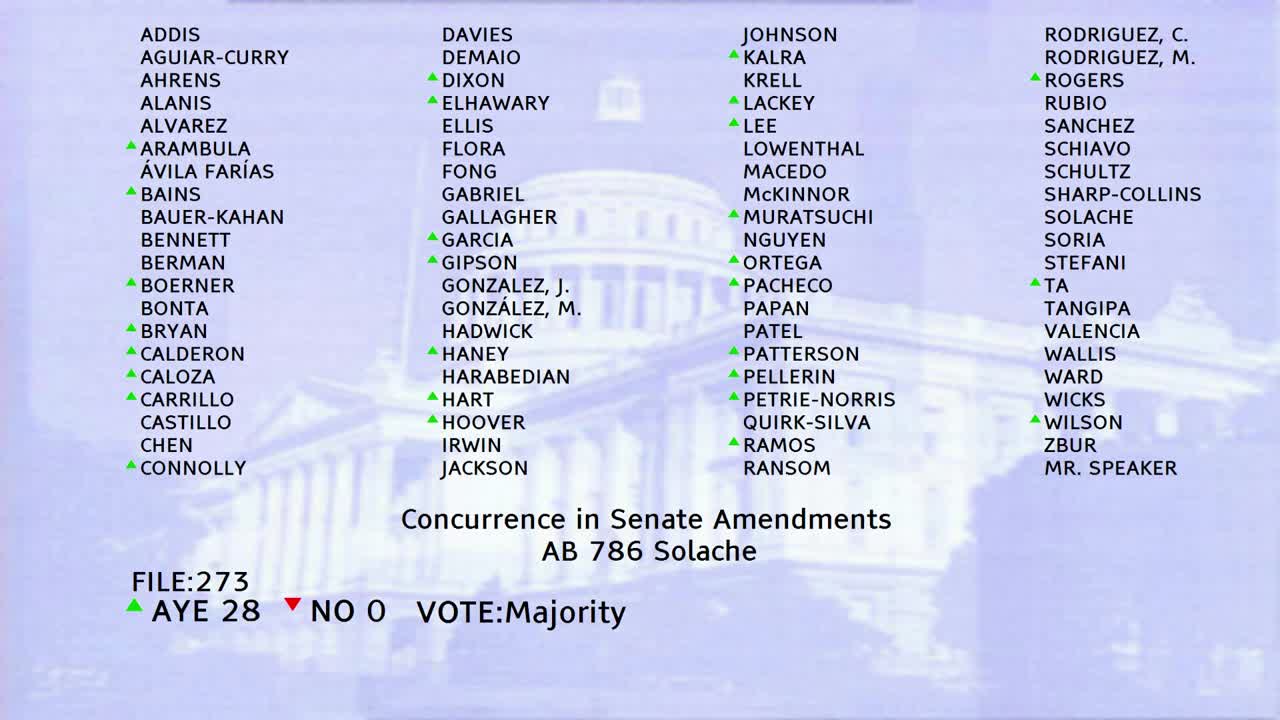 1MIN
Assembly Floor
 3MIN
Senate Floor
 8MIN
Senate Standing Committee on Public Safety
 6MIN
Senate Standing Committee on Judiciary
 1MIN
Assembly Floor
 10MIN
Assembly Standing Committee on Privacy and Consumer Protection
 9MIN
Assembly Standing Committee on Judiciary
Bill Author

Bill Co-Author(s):