AB 2054: Family temporary disability insurance program: covered active duty.
- Session Year: 2025-2026
- House: Assembly
- Latest Version Date: 2026-09-28
Current Status:
Passed
(2026-09-28: Chaptered by Secretary of State - Chapter 729, Statutes of 2026.)
Introduced
In Committee
Awaiting First Chamber Vote
Passed First Chamber
In Committee
Awaiting Second Chamber Vote
Passed Second Chamber
Enacted
What does this bill do?
The bill expands what military service counts as "covered active duty" for California’s family temporary disability insurance, adding training, deployments that aren’t to a foreign country, and state active duty for reserve units including the National Guard. This lets workers seek up to the program’s leave and pay benefits, or claim benefits for a "qualifying exigency" (urgent matters tied to the service member’s duty), when a close family member is serving under those types of duty.
The summary is provided by generative AI which can make mistakes. For original language, please view the details in the table below.
Existing unemployment compensation disability law requires workers to pay contribution rates based on, among other things, wages received in employment and benefit disbursement, for payment into the Unemployment Compensation Disability Fund, a special fund in the State Treasury. That fund is continuously appropriated for the purpose of providing disability benefits and making payment of expenses in administering those provisions.
Existing law, the family temporary disability insurance program, provides up to 8 weeks of wage replacement benefits to workers who take time off work to care for a seriously ill child, spouse, parent, grandparent, grandchild, sibling, or domestic partner, or to bond with a minor child within one year of birth or placement in connection with foster care or adoption, or to participate in a qualifying exigency related to the covered active duty or call to covered active duty of the individuals spouse, domestic partner, child, or parent in the Armed Forces of the United States. Existing law defines covered active duty to mean, with respect to a member of the regular Armed Forces of the United States, duty during the deployment of the member with the regular armed forces to a foreign country and, with respect to a member of the reserve components of the Armed Forces of the United States, duty during the deployment of the member of those reserve components to a foreign country under a federal call or order to active duty.
This bill would, starting upon specified changes to the Employment Development Departments integrated claims management system or on July 1, 2028, whichever occurs sooner, expand the definition of covered active duty to additionally include duty during training, deployment other than deployment to a foreign country, and, with respect to a member of the reserve components of the Armed Forces of the United States, a call or order to state active duty. By authorizing expenditures from the continuously appropriated fund for these expanded purposes, this bill would make an appropriation.
Existing unemployment compensation disability law requires workers to pay contribution rates based on, among other things, wages received in employment and benefit disbursement, for payment into the Unemployment Compensation Disability Fund, a special fund in the State Treasury. That fund is continuously appropriated for the purpose of providing disability benefits and making payment of expenses in administering those provisions.
Existing law, the family temporary disability insurance program, provides up to 8 weeks of wage replacement benefits to workers who take time off work to care for a seriously ill child, spouse, parent, grandparent, grandchild, sibling, or domestic partner, or to bond with a minor child within one year of birth or placement in connection with foster care or adoption, or to participate in a qualifying exigency related to the covered active duty or call to covered active duty of the individuals spouse, domestic partner, child, or parent in the Armed Forces of the United States. Existing law defines covered active duty to mean, with respect to a member of the regular Armed Forces of the United States, duty during the deployment of the member with the regular armed forces to a foreign country and, with respect to a member of the reserve components of the Armed Forces of the United States, duty during the deployment of the member of those reserve components to a foreign country under a federal call or order to active duty.
This bill would would, starting upon specified changes to the Employment Development Departments integrated claims management system or on July 1, 2028, whichever occurs sooner, expand the definition of covered active duty to additionally include duty during training, deployment other than deployment to a foreign country, and, with respect to a member of the reserve components of the Armed Forces of the United States, a call or order to state active duty. By authorizing expenditures from the continuously appropriated fund for these expanded purposes, this bill would make an appropriation.
Existing unemployment compensation disability law requires workers to pay contribution rates based on, among other things, wages received in employment and benefit disbursement, for payment into the Unemployment Compensation Disability Fund, a special fund in the State Treasury. That fund is continuously appropriated for the purpose of providing disability benefits and making payment of expenses in administering those provisions.
Existing law, the family temporary disability insurance program, provides up to 8 weeks of wage replacement benefits to workers who take time off work to care for a seriously ill child, spouse, parent, grandparent, grandchild, sibling, or domestic partner, or to bond with a minor child within one year of birth or placement in connection with foster care or adoption, or to participate in a qualifying exigency related to the covered active duty or call to covered active duty of the individuals spouse, domestic partner, child, or parent in the Armed Forces of the United States. Existing law defines certain terms for these purposes. covered active duty to mean, with respect to a member of the regular Armed Forces of the United States, duty during the deployment of the member with the regular armed forces to a foreign country and, with respect to a member of the reserve components of the Armed Forces of the United States, duty during the deployment of the member of those reserve components to a foreign country under a federal call or order to active duty.
This bill would make a nonsubstantive change to those expand the definition provisions. of covered active duty to additionally include duty during training, deployment other than deployment to a foreign country, and, with respect to a member of the reserve components of the Armed Forces of the United States, a call or order to state active duty. By authorizing expenditures from the continuously appropriated fund for these expanded purposes, this bill would make an appropriation.
Existing law, the family temporary disability insurance program, provides up to 8 weeks of wage replacement benefits to workers who take time off work to care for a seriously ill child, spouse, parent, grandparent, grandchild, sibling, or domestic partner, or to bond with a minor child within one year of birth or placement in connection with foster care or adoption, or to participate in a qualifying exigency related to the covered active duty or call to covered active duty of the individuals spouse, domestic partner, child, or parent in the Armed Forces of the United States. Existing law defines certain terms for these purposes.
This bill would make a nonsubstantive change to those definition provisions.
(a)For the purposes of this chapter:
(1)Covered active duty means, with respect to a member of the regular Armed Forces of the United States, duty during the deployment of the member with the regular armed forces to a foreign country and, with respect to a member of the reserve components of the Armed Forces of the United States, duty during the deployment of the member of those reserve components to a foreign country under a federal call or order to active duty.
(2)Disability benefit period with respect to any individual, means the period of unemployment beginning with the first day an individual establishes a valid claim for family temporary disability insurance benefits to care for a seriously ill family member, to bond with a minor child during the first year after the birth or placement of the child in connection with foster care or adoption, or to participate in a qualifying exigency related to the covered active duty or call to covered active duty of the individuals spouse, domestic partner, child, or parent in the Armed Forces of the United States.
(A)Periods of family care leave for the same care recipient within a 12-month period shall be considered one disability benefit period.
(B)Periods of disability for pregnancy, as defined in Section 2608, and periods of family care leave for bonding associated with the birth of that child shall be considered one disability benefit period.
(b)This section shall remain in effect only until Section 3301.5 is incorporated in the Employment Development Departments integrated claims management system as part of the EDDNext project, or until July 1, 2028, whichever occurs sooner, and as of that date is repealed.
SEC. 2.Section 3302.1 is added to the Unemployment Insurance Code, to read:3302.1.(a)For purposes of this chapter:
(1)Covered active duty means, with respect to a member of the regular Armed Forces of the United States, duty during the deployment or training of the member with the regular armed forces and, with respect to a member of the reserve components of the Armed Forces of the United States, including the National Guard, duty during training or a call or order to federal or state active duty.
(2)Disability benefit period with respect to any individual, means the period of unemployment beginning with the first day an individual establishes a valid claim for family temporary disability insurance benefits to care for a seriously ill family member, to bond with a minor child during the first year after the birth or placement of the child in connection with foster care or adoption, or to participate in a qualifying exigency related to the covered active duty or call to covered active duty of the individuals spouse, domestic partner, child, or parent in the Armed Forces of the United States.
(A)Periods of family care leave for the same care recipient within a 12-month period shall be considered one disability benefit period.
(B)Periods of disability for pregnancy, as defined in Section 2608, and periods of family care leave for bonding associated with the birth of that child shall be considered one disability benefit period.
(b)This section shall become operative when Section 3301.5 is incorporated in the Employment Development Departments integrated claims management system as part of the EDDNext project, or on July 1, 2028, whichever occurs sooner.
(a)For the purposes of this chapter:
(a)(1)Covered active duty means, with respect to a member of the regular Armed Forces of the United States, duty during the deployment or training of the member with the regular armed forces to a foreign country and, with respect to a member of the reserve components of the Armed Forces of the United States, including the National Guard, duty during training or a call or order to federal or state duty during the deployment of the member of those reserve components to a foreign country under a federal call or order to active duty.
(b)(2)Disability benefit period with respect to any individual, means the period of unemployment beginning with the first day an individual establishes a valid claim for family temporary disability insurance benefits to care for a seriously ill family member, to bond with a minor child during the first year after the birth or placement of the child in connection with foster care or adoption, or to participate in a qualifying exigency related to the covered active duty or call to covered active duty of the individuals spouse, domestic partner, child, or parent in the Armed Forces of the United States.
(1)(A)Periods of family care leave for the same care recipient within a 12-month period shall be considered one disability benefit period.
(2)(B)Periods of disability for pregnancy, as defined in Section 2608, and periods of family care leave for bonding associated with the birth of that child shall be considered one disability benefit period.
(b)This section shall remain in effect only until Section 3301.5 is incorporated in the Employment Development Departments integrated claims management system as part of the EDDNext project, or until July 1, 2028, whichever occurs sooner, and as of that date is repealed.
SEC. 2.Section 3302.1 is added to the Unemployment Insurance Code, to read:3302.1.(a)For purposes of this chapter:
(1)Covered active duty means, with respect to a member of the regular Armed Forces of the United States, duty during the deployment or training of the member with the regular armed forces and, with respect to a member of the reserve components of the Armed Forces of the United States, including the National Guard, duty during training or a call or order to federal or state active duty.
(2)Disability benefit period with respect to any individual, means the period of unemployment beginning with the first day an individual establishes a valid claim for family temporary disability insurance benefits to care for a seriously ill family member, to bond with a minor child during the first year after the birth or placement of the child in connection with foster care or adoption, or to participate in a qualifying exigency related to the covered active duty or call to covered active duty of the individuals spouse, domestic partner, child, or parent in the Armed Forces of the United States.
(A)Periods of family care leave for the same care recipient within a 12-month period shall be considered one disability benefit period.
(B)Periods of disability for pregnancy, as defined in Section 2608, and periods of family care leave for bonding associated with the birth of that child shall be considered one disability benefit period.
(b)This section shall become operative when Section 3301.5 is incorporated in the Employment Development Departments integrated claims management system as part of the EDDNext project, or on July 1, 2028, whichever occurs sooner.
(a)For the purposes of this chapter:
(1)(a)Covered active duty means, with respect to a member of the regular Armed Forces of the United States, duty during the deployment or training of the member with the regular armed forces to a foreign country and, with respect to a member of the reserve components of the Armed Forces of the United States, duty during the deployment of the member of those reserve components to a foreign country under a federal call or order to including the National Guard, duty during training or a call or order to federal or state active duty.
(2)(b)Disability benefit period with respect to any individual, means the period of unemployment beginning with the first day an individual establishes a valid claim for family temporary disability insurance benefits to care for a seriously ill family member, to bond with a minor child during the first year after the birth or placement of the child in connection with foster care or adoption, or to participate in a qualifying exigency related to the covered active duty or call to covered active duty of the individuals spouse, domestic partner, child, or parent in the Armed Forces of the United States.
(A)(1)Periods of family care leave for the same care recipient within a 12-month period shall be considered one disability benefit period.
(B)(2)Periods of disability for pregnancy, as defined in Section 2608, and periods of family care leave for bonding associated with the birth of that child shall be considered one disability benefit period.
(b)This section shall become operative on January 1, 2021. REVISIONS: HeadingLine 2.(a)For the purposes of this chapter:
(1)Covered active duty means, with respect to a member of the regular Armed Forces of the United States, duty during the deployment of the member with the regular armed forces to a foreign country and, with respect to a member of the reserve components of the Armed Forces of the United States, duty during the deployment of the member of those reserve components to a foreign country under a federal call or order to active duty.
(2)Disability benefit period with respect to any individual, means the period of unemployment beginning with the first day an individual establishes a valid claim for family temporary disability insurance benefits to care for a seriously ill family member, to bond with a minor child during the first year after the birth or placement of the child in connection with foster care or adoption, or to participate in a qualifying exigency related to the covered active duty or call to covered active duty of the individuals spouse, domestic partner, child, or parent in the Armed Forces of the United States.
(A)Periods of family care leave for the same care recipient within a 12-month period shall be considered one disability benefit period.
(B)Periods of disability for pregnancy, as defined in Section 2608, and periods of family care leave for bonding associated with the birth of that child shall be considered one disability benefit period.
(b)This section shall become operative on January 1, 2021.
|
Date
|
Status
|
|---|---|
| Sep 28, 2026 | Chaptered by Secretary of State - Chapter 729, Statutes of 2026. |
| Sep 28, 2026 | Approved by the Governor. |
| Sep 3, 2026 | Enrolled and presented to the Governor at 4 p.m. |
| Aug 26, 2026 | Senate amendments concurred in. To Engrossing and Enrolling. (Ayes 79. Noes 0.). |
| Aug 26, 2026 | Senate amendments concurred in. To Engrossing and Enrolling. (Ayes 79. Noes 0. Page 6578.). |
| Aug 25, 2026 | In Assembly. Concurrence in Senate amendments pending. |
| Aug 25, 2026 | Read third time. Passed. Ordered to the Assembly. (Ayes 39. Noes 0.). |
| Aug 24, 2026 | Read second time. Ordered to third reading. |
| Aug 20, 2026 | Read third time and amended. Ordered to second reading. |
| Aug 19, 2026 | Ordered to third reading. |
| Aug 19, 2026 | From special consent calendar. |
| Aug 18, 2026 | Ordered to special consent calendar. |
| Aug 13, 2026 | Read second time. Ordered to third reading. |
| Aug 13, 2026 | From committee: Do pass. (Ayes 7. Noes 0.) (August 13). |
| Aug 3, 2026 | In committee: Referred to APPR. suspense file. |
| Jun 23, 2026 | From committee: Do pass and re-refer to Com. on APPR. (Ayes 4. Noes 0.) (June 22). Re-referred to Com. on APPR. |
| Jun 17, 2026 | From committee: Do pass and re-refer to Com. on M. & V.A. (Ayes 5. Noes 0.) (June 17). Re-referred to Com. on M. & V.A. |
| Jun 3, 2026 | Referred to Coms. on L., P.E. & R. and M. & V.A. |
| May 22, 2026 | In Senate. Read first time. To Com. on RLS. for assignment. |
| May 22, 2026 | Read third time. Passed. Ordered to the Senate. (Ayes 73. Noes 0.) |
| May 22, 2026 | Read third time. Passed. Ordered to the Senate. (Ayes 73. Noes 0. Page 5262.) |
| May 18, 2026 | Read second time. Ordered to third reading. |
| May 14, 2026 | From committee: Do pass. (Ayes 15. Noes 0.) (May 14). |
| May 6, 2026 | In committee: Set, first hearing. Referred to APPR. suspense file. |
| Apr 22, 2026 | From committee: Do pass and re-refer to Com. on APPR. with recommendation: To Consent Calendar. (Ayes 16. Noes 0.) (April 22). Re-referred to Com. on APPR. |
| Apr 15, 2026 | From committee: Do pass and re-refer to Com. on INS. (Ayes 8. Noes 0.) (April 14). Re-referred to Com. on INS. |
| Apr 15, 2026 | Coauthors revised. |
| Mar 19, 2026 | Re-referred to Coms. on M. & V.A. and INS. pursuant to Assembly Rule 96. |
| Mar 17, 2026 | Re-referred to Com. on INS. |
| Mar 16, 2026 | Referred to Coms. on INS. and M. & V.A. |
| Mar 16, 2026 | From committee chair, with author's amendments: Amend, and re-refer to Com. on INS. Read second time and amended. |
| Feb 19, 2026 | From printer. May be heard in committee March 21. |
| Feb 18, 2026 | Read first time. To print. |
|
Date
|
Description
|
Location
|
Votes
|
|
|---|---|---|---|---|
| Aug 26, 2026 | AB 2054 Gipson Concurrence in Senate Amendments | Assembly Floor |
Passed |
|
| Aug 25, 2026 | Assembly 3rd Reading AB2054 Gipson et al. By Menjivar | Senate Floor |
Passed |
|
| Aug 13, 2026 | Do pass | Senate Standing Committee on Appropriations |
Passed |
|
| Aug 3, 2026 | Placed on suspense file | Senate Standing Committee on Appropriations |
Passed |
|
| Jun 22, 2026 | Do pass, but first be re-referred to the Committee on [Appropriations] | Senate Standing Committee on Military and Veterans Affairs |
Passed |
|
| Jun 17, 2026 | Do pass, but first be re-referred to the Committee on [Military and Veterans Affairs] | Senate Standing Committee on Labor, Public Employment and Retirement |
Passed |
|
| May 22, 2026 | AB 2054 Gipson Assembly Third Reading | Assembly Floor |
Passed |
|
| May 14, 2026 | Do pass. | Assembly Standing Committee on Appropriations |
Passed |
|
| Apr 22, 2026 | Do pass and be re-referred to the Committee on [Appropriations] with recommendation: To Consent Calendar | Assembly Standing Committee on Insurance |
Passed |
|
| Apr 14, 2026 | Do pass and be re-referred to the Committee on [Insurance] | Assembly Standing Committee on Military and Veterans Affairs |
Passed |
This list shows positions taken on this bill by organizations on the date displayed, which is linked to the original source.
Positions by individuals are not included.
|
Organization
|
Position
|
Date
|
|---|---|---|
| California Association Of County Veterans Service Officers | ** Support | |
| City of Fairfield | ** Support | |
| Department of Defense, U.S. Defense-State Liaison Office, Pacific Southwest Region (Sponsor) | ** Support | |
| Military Services in California | ** Support | |
| Military Services in California, Department of the Navy | ** Support | |
| The Department of Defense | ** Support | |
| The Military Services in California | ** Support | |
| The United States Department of Defense | ** Support | |
| U.S.A. Department of Defense | ** Support | |
| United States Department of Defense | ** Support |
CONCURRENCE IN SENATE AMENDMENTS
CSA1 Bill Id:AB 2054
Author:(Gipson)
As Amended Ver:August 20, 2026
Majority vote
SUMMARY
This bill expands the definition of "covered active duty" for purposes of eligibility for Paid Family Leave (PFL) benefits to include duty during training, domestic deployments, and, for members of the National Guard, calls to state active duty.
Senate Amendments
Delay the implementation of these changes to such time as they are incorporated into EDD’s integrated claims management system as part of the EDDNext project, or on July 1, 2028, whichever occurs sooner.
COMMENTS
The State Disability Insurance (SDI) program, administered by the Employment Development Department (EDD), was created in 1946 to provide monetary benefits to workers unable to work due to non-work-related illness, injury, or pregnancy. The SDI program is financed solely by worker contributions and covers approximately 18 million individuals across the state. In 2004, California was the first state in the nation to implement a Paid Family Leave program (administered as part of SDI) that provides benefits to workers who need to take time off to care for a seriously ill family member, or to bond with a new child either from birth, adoption, or foster care placement. Effective January 1, 2021, the PFL scope was expanded to include employees taking time off work to assist a military family member under covered active duty or call to covered active duty. PFL provides up to eight weeks of wage replacement benefits.
PFL for Military Families. In 2018, the California Legislature passed SB 1123 (Jackson, Chapter 849, Statutes of 2018), which, effective January 1, 2021, expanded the PFL program to extend wage replacement benefits to workers that need time off to participate in a qualifying exigency related to the covered active duty, as defined, or call to covered active duty of the individual’s spouse, domestic partner, child, or parent in the armed forces of the United States, as specified.
As noted above, existing law considers a qualifying exigency to include any of a number of activities resulting from the call to covered active duty, as defined, including attending counseling or support sessions, making childcare or elderly parental care arrangements, attending to financial or legal matters, accompanying the military family member during rest and recuperation leave, and attending specified military events.
California defines "covered active duty" for the purposes of PFL eligibility to include only deployment to a foreign country. Additionally, the existing definition of "covered active duty" with respect to a member of the reserve components of the United States Armed Forces includes only federal calls or orders to deployment overseas. The National Guard, a military reserve organization comprised of reserve components of the Army and Air Force, however, is under dual control of the federal and state governments. In some cases, the National Guard can be deployed to supplement regular armed forces during wars, and in many cases, the National Guard is mobilized by the state to respond to emergencies declared by the Governor, such as natural disasters.
This bill proposes to expand the scope of covered active duty for purposes of PFL eligibility to include domestic deployments and military training to accommodate the needs of military calls to duty.
According to the Author
"Existing law for Paid Family Leave does not fully reflect the realities of modern military service. The current law covers military exigencies related to overseas deployments. This creates gaps in coverage for the families of service members who are activated for stateside missions, ordered to extended training, or mobilized as part of the National Guard or Reserve. These assignments create the same urgent needs for families as overseas deployments, such as arranging childcare and managing financial and legal affairs. The lack of a clear, updated definition of "covered active duty" leads to inconsistent application of the law, administrative confusion, and inequitable treatment of military families, causing financial and logistical stress that can distract service members during critical operations.
This bill remedies this deficiency by adding a clear definition of "covered active duty" to the Unemployment Insurance Code. This new definition specifies that qualifying duty includes not only foreign deployments but also non-foreign deployments, extended training assignments, and activations of the armed forces' reserve components and the National Guard. By modernizing the statutory language, the bill ensures that all military families facing a qualifying military event have uniform and equitable access to the PFL benefits they need, regardless of the location or type of their loved one's service."
Arguments in Support
The Department of Defense states that, "AB 2054 builds on California’s leadership on Paid Family Leave and its expansion to Guard members and reservists activated overseas with its extension to include training, domestic deployment and calls to State Active Duty, writing that this bill address[es] “the operational realities of modern military service, to also apply to families of active-duty and reserve members ordered to extended training and other temporary stateside duties and National Guard members mobilized under Title 10 or Title 32 orders.
These assignments create the same urgent family needs as overseas deployments but often receive inconsistent coverage. By ensuring military family members can manage these disruptions without risking their job or income, AB 2054 provides the peace of mind that translates directly into enhanced mission focus and operational effectiveness."
Arguments in Opposition
None on file.
FISCAL COMMENTS
- EDD indicates that it would incur one-time costs of $1.5 million, and annual costs of $600,000 to implement the provisions of the bill. Cost drivers would include updating documents and automated information technology systems used to administer PFL benefits. EDD notes that due to system design complexities, the bill's operative date (January 1, 2027) is operationally infeasible and may impact the timeline and scope of EDD’s ongoing modernization effort, EDDNext.
- Assuming a 2.3 percent increase in military exigency PFL claims filed effective January 1, 2027, EDD estimates this bill would result in $1.4 million in additional benefits paid annually relative to current (January 2026) benefit projections.
VOTES:
ASM MILITARY AND VETERANS AFFAIRS: 8-0-0
YES: Schiavo, Jeff Gonzalez, Ávila Farías, Carrillo, Davies, Irwin, Quirk-Silva, Valencia
ASM INSURANCE: 16-0-1
YES: Calderon, Wallis, Addis, Alvarez, Ávila Farías, Berman, Ellis, Gipson, Hadwick, Harabedian, Krell, Nguyen, Ortega, Petrie-Norris, Michelle Rodriguez, Valencia
ABS, ABST OR NV: Chen
ASM APPROPRIATIONS: 15-0-0
YES: Wicks, Hoover, Aguiar-Curry, Calderon, Caloza, Dixon, Fong, Mark González, Krell, Pacheco, Pellerin, Sharp-Collins, Solache, Ta, Tangipa
ASSEMBLY FLOOR: 73-0-7
YES: Addis, Aguiar-Curry, Ahrens, Alanis, Alvarez, Ávila Farías, Bains, Bauer-Kahan, Bennett, Berman, Boerner, Bonta, Calderon, Caloza, Carrillo, Castillo, Connolly, Davies, DeMaio, Dixon, Elhawary, Ellis, Flora, Fong, Gallagher, Garcia, Gipson, Jeff Gonzalez, Mark González, Hadwick, Haney, Harabedian, Hart, Hoover, Irwin, Jackson, Johnson, Kalra, Krell, Lackey, Lee, Lowenthal, Macedo, McKinnor, Muratsuchi, Nguyen, Ortega, Pacheco, Papan, Patel, Patterson, Pellerin, Petrie-Norris, Quirk-Silva, Ramos, Ransom, Michelle Rodriguez, Rogers, Blanca Rubio, Sanchez, Schiavo, Schultz, Sharp-Collins, Solache, Soria, Stefani, Tangipa, Valencia, Wallis, Ward, Wilson, Zbur, Rivas
ABS, ABST OR NV: Arambula, Bryan, Chen, Gabriel, Celeste Rodriguez, Ta, Wicks
UPDATED
VERSION: August 20, 2026
CONSULTANT: Christian Burkin / M. & V.A. / (916) 319-3550 FN: 0004198
SENATE RULES COMMITTEE Office of Senate Floor Analyses (916) 651-4171 | AB 2054 |
THIRD READING
Bill No: AB 2054
Author: Gipson (D), et al.
Amended: 8/20/26 in Senate
Vote: 21
SENATE LABOR, PUB. EMP. & RET. COMMITTEE: 5-0, 6/17/26
AYES: Smallwood-Cuevas, Strickland, Cortese, Durazo, Laird
SENATE MILITARY & VETERANS COMMITTEE: 4-0, 6/22/26
AYES: Archuleta, McNerney, Menjivar, Umberg
NO VOTE RECORDED: Grove
SENATE APPROPRIATIONS COMMITTEE: 7-0, 8/13/26
AYES: Cervantes, Seyarto, Cabaldon, Dahle, Grayson, Richardson, Wahab
ASSEMBLY FLOOR: 73-0, 5/22/26 - See last page for vote
SUBJECT: Family temporary disability insurance program: covered active duty
SOURCE: United States Department of Defense
DIGEST:
This bill expands the definition of “covered active duty” for purposes of eligibility for Paid Family Leave (PFL) benefits to include duty during training, domestic deployments, and, for reservists, including members of the National Guard, calls to state active duty.
Senate Floor Amendments of 8/20/26 delay the implementation of these changes to such time as they are incorporated into EDD’s integrated claims management system as part of the EEDNext project, or on July 1, 2028, whichever occurs sooner.
ANALYSIS:
Existing law:
- Establishes the Employment Development Department (EDD) to, among other duties, administer the Unemployment Insurance and Disability Insurance programs. (Unemployment Insurance Code §301)
- Establishes the State Disability Insurance (SDI) program as a partial wage-replacement plan funded through employee payroll deductions that is available (through the Disability Insurance and Paid Family Leave programs) to eligible individuals who are unable to work due to sickness or injury of the employee (including pregnancy), the sickness or injury of a family member, or the birth, adoption, or foster care placement of a new child. (Unemployment Insurance Code §2601-3308)
- Paid Family Leave (PFL) provides eligible employees up to eight weeks of wage replacement benefits within a 12-month period to a worker who needs to take time off work for the following reasons:
- To care for a seriously ill family member or, beginning July 1, 2028, other designated person, as defined;
- To bond with a minor child within one year of the birth or placement of the child in connection with foster care or adoption;
- To participate in a qualifying exigency related to the covered active duty or call to covered active duty of the individual’s spouse, domestic partner, child, or parent in the Armed Forces of the United States. (Unemployment Insurance Code §3301)
- Defines “covered active duty” to mean, with respect to a member of the regular Armed Forces of the United States, duty during the deployment of the member with the regular armed forces to a foreign country and, with respect to a member of the reserve components of the Armed Forces of the United States, duty during the deployment of the member of those reserve components to a foreign country under a federal call or order to active duty.(Unemployment Insurance Code §3302.1)
- Defines “qualifying exigency related to the covered active duty or call to covered active duty of the individual’s spouse, domestic partner, child, or parent in the Armed Forces of the United States” to mean:
- Activities undertaken within seven calendar days from notification of an impending call or order to covered active duty to address any issue that arises from the call or order.
- Attendance at specified events sponsored by the military related to the covered active duty, or family support or assistance programs sponsored or promoted by the military, military service organizations, or the American Red Cross.
- Specified activities related to arranging and managing childcare and school obligations for a minor child or person over the age of 18 that is incapable of self-care because of a disability for whom the individual stands in loco parentis.
- Activities for making specified financial or legal arrangements related to addressing the absence of the individual called or ordered to covered active duty, or related to the receipt of military service benefits.
- Attendance at counseling provided by someone other than a health care provider, provided that the need for counseling arises from the covered active duty or call to covered active duty.
- Accompanying the individual while the individual is on short-term, temporary, rest and recuperation leave during the period of deployment in a foreign country, for not more than 15 days.
- Addressing issues that arise from the death of the individual while on covered active duty status.
- Specified activities related to arranging or managing care for the parent of the individual if the parent is incapable of self-care, as defined.
- Any other activities to address other events that arise out of the covered active duty or call to covered active duty of the individual, provided that the employer and employee agree the leave shall qualify as an exigency, and agree to both the timing and duration of the leave. (Unemployment Insurance Code §3302.2)
This bill:
- For purposes of PFL benefits eligibility, expands the definition of “covered active duty” to additionally include duty during training, domestic deployments (in addition to foreign deployments), and, with respect to a member of the reserve components of the Armed Forces of the United States, including the National Guard, a call or order to state active duty.
- Strikes an obsolete January 1, 2021 operative date on the original provisions for this eligibility.
- Makes these changes effective when they are incorporated into EDD’s integrated claims management system as part of the EEDNext project, or on July 1, 2028, whichever occurs sooner.
Background
The State Disability Insurance program, administered by the EDD, was created in 1946 to provide monetary benefits to workers unable to work due to non-work-related illness, injury, or pregnancy. The SDI program is financed solely by worker contributions and covers approximately 18 million individuals across the state. In 2004, California was the first state in the nation to implement a Paid Family Leave program (administered as part of SDI) that provides benefits to workers who need to take time off to care for a seriously ill family member, or to bond with a new child either from birth, adoption, or foster care placement. Effective January 1, 2021, the PFL scope was expanded to include employees taking time off work to assist a military family member under covered active duty or call to covered active duty. PFL provides up to eight weeks of wage replacement benefits.
In Fiscal Year (FY) 2024-25, California paid out over 300,000 PFL claims, totaling over $2 billion in benefits paid. These claims had an average weekly benefit amount of $996, and an average claim duration of 7.1 weeks. Roughly 85% of PFL claims in FY 2024-25 were for bonding with a new minor child.
PFL for Military Families. In 2018, the California Legislature passed SB 1123 (Jackson, Chapter 849, Statutes of 2018), which, effective January 1, 2021, expanded the PFL program to extend wage replacement benefits to workers that need time off to participate in a qualifying exigency related to the covered active duty, as defined, or call to covered active duty of the individual’s spouse, domestic partner, child, or parent in the armed forces of the United States, as specified.
As noted above, existing law considers a qualifying exigency to include any of a number of activities resulting from the call to covered active duty, as defined, including attending counseling or support sessions, making childcare or elderly parental care arrangements, attending to financial or legal matters, accompanying the military family member during rest and recuperation leave, and attending specified military events.
Nearly 450,000 active-duty military members serve in the Army nationwide, the most of any military branch. The Navy has the second-largest number of active-duty members (about 334,000), followed by the Air Force and Marine Corps. The Coast Guard and Space Force are much smaller, with fewer than 50,000 active-duty members each.[1] Active-duty military members are assigned to work in every state and internationally, although, according to the Defense Manpower Data Center, a large majority are stationed domestically, while only 14% are stationed internationally. California has the most active-duty military, with about 157,500 individuals.[2] In FY 2024-25, qualifying exigency leave for military families comprised 0.03% of PFL claims filed.[3]
California defines “covered active duty” for the purposes of PFL eligibility to include only deployment to a foreign country. Additionally, the existing definition of “covered active duty” with respect to a member of the reserve components of the United States Armed Forces includes only federal calls or orders to deployment overseas. The National Guard, a military reserve organization comprised of reserve components of the Army and Air Force, however, is under dual control of the federal and state governments. In some cases, the National Guard can be deployed to supplement regular armed forces during wars, and in many cases, the National Guard is mobilized by the state to respond to emergencies declared by the Governor, such as natural disasters.
This bill proposes to expand the scope of covered active duty for purposes of PFL eligibility to include domestic deployments and military training to accommodate the needs of military calls to duty.
EDDNext. EDDNext is a multi-year, modernization initiative by the Employment Development Department to overhaul its aging benefit systems and improve user experiences for Unemployment Insurance, Disability Insurance, and the Paid Family Leave programs. The modernization effort aims to transform the customer and employee experience by updating online applications, contact centers, processes, policies, procedures, and forms.
Need for this bill? According to the author:
“Existing law for Paid Family Leave does not fully reflect the realities of modern military service. The current law covers military exigencies related to overseas deployments. This creates gaps in coverage for the families of service members who are activated for stateside missions, ordered to extended training, or mobilized as part of the National Guard or Reserve. These assignments create the same urgent needs for families as overseas deployments, such as arranging childcare and managing financial and legal affairs. The lack of a clear, updated definition of "covered active duty" leads to inconsistent application of the law, administrative confusion, and inequitable treatment of military families, causing financial and logistical stress that can distract service members during critical operations.
This bill remedies this deficiency by adding a clear definition of "covered active duty" to the Unemployment Insurance Code. This new definition specifies that qualifying duty includes not only foreign deployments but also non-foreign deployments, extended training assignments, and activations of the armed forces' reserve components and the National Guard. By modernizing the statutory language, the bill ensures that all military families facing a qualifying military event have uniform and equitable access to the PFL benefits they need, regardless of the location or type of their loved one's service.”
Related/Prior Legislation
SB 590 (Durazo, Chapter 772, Statutes of 2025) expanded, commencing on July 1, 2028, eligibility for benefits under the PFL program to include individuals who take time off work to care for a seriously ill designated person, as defined.
SB 1090 (Durazo, Chapter 876, Statutes of 2024) authorized workers to file a claim for SDI or PFL benefits up to 30 days in advance of the first compensable day of disability and requires EDD to issue payment on those claims within 14 days of receipt or as soon as eligibility begins for the claimant, whichever is later.
SB 951 (Durazo, Chapter 878, Statutes of 2022), revised the formula for the computation of SDI and PFL benefits to increase the wage replacement available to claimants.
SB 1123 (Jackson, Chapter 849, Statutes of 2018) expanded the PFL program to include time off to participate in a qualifying exigency related to covered active duty or call to covered active duty of the individual’s spouse, domestic partner, child, or parent in the armed forces.
[NOTE: Please see the Senate Labor, Public Employment and Retirement Committee analysis on this bill for more background information and information on more prior and related legislation.]
FISCAL EFFECT: Appropriation: Yes Fiscal Com.: Yes Local: No
According to the Senate Appropriations Committee:
- The Employment Development Department (EDD) indicates that it would incur one-time costs of $1.5 million, and annual costs of $600,000 to implement the provisions of the bill (Disability Insurance Fund). Cost drivers would include updating documents and automated information technology systems used to administer PFL benefits. EDD notes that due to system design complexities, the bill’s operative date (January 1, 2027) is operationally infeasible and may impact the timeline and scope of EDD’s ongoing modernization effort, EDDNext.
- Assuming a 2.3 percent increase in military exigency PFL claims filed effective January 1, 2027, EDD estimates this bill would result in $1.4 million in additional benefits paid annually relative to current (January 2026) benefit projections.
SUPPORT: (Verified 8/20/26)
United States Department of Defense (source)
California Association of County Veterans Service Officers
City of Fairfield
Military Services in California, Department of the Navy
OPPOSITION: (Verified 8/20/26)
None received
ARGUMENTS IN SUPPORT: According to the sponsors of the measure, the United States Department of Defense:
“With over 240,000 service members and nearly 90,000 military spouses contributing to California's economy and communities, this bill is a critical investment in both our families’ and the nation's military readiness.
Military readiness depends on service members who can focus entirely on their mission without distraction. However, military life presents unique challenges including deployments, extended training missions, state activations to support disasters and emergencies, and even long-term care for combat-related injuries. When military family members lack adequate leave options, service members deploy knowing their families are under financial and logistical stress, which can create dangerous distractions during high-stakes operations.
California has long been a leader in supporting working families, establishing the nation's first Paid Family Leave (PFL) program and later expanding it to include military exigencies related to overseas deployments. AB 2054 builds on this successful framework by closing critical gaps in the existing law. Specifically, this bill extends PFL eligibility for military exigencies beyond foreign deployments to address the operational realities of modern military service, to also apply to families of active-duty and reserve members ordered to extended training and other temporary stateside duties and National Guard members mobilized under Title 10 or Title 32 orders.”
ASSEMBLY FLOOR: 73-0, 5/22/26
AYES: Addis, Aguiar-Curry, Ahrens, Alanis, Alvarez, Ávila Farías, Bains, Bauer-Kahan, Bennett, Berman, Boerner, Bonta, Calderon, Caloza, Carrillo, Castillo, Connolly, Davies, DeMaio, Dixon, Elhawary, Ellis, Flora, Fong, Gallagher, Garcia, Gipson, Jeff Gonzalez, Mark González, Hadwick, Haney, Harabedian, Hart, Hoover, Irwin, Jackson, Johnson, Kalra, Krell, Lackey, Lee, Lowenthal, Macedo, McKinnor, Muratsuchi, Nguyen, Ortega, Pacheco, Papan, Patel, Patterson, Pellerin, Petrie-Norris, Quirk-Silva, Ramos, Ransom, Michelle Rodriguez, Rogers, Blanca Rubio, Sanchez, Schiavo, Schultz, Sharp-Collins, Solache, Soria, Stefani, Tangipa, Valencia, Wallis, Ward, Wilson, Zbur, Rivas
NO VOTE RECORDED: Arambula, Bryan, Chen, Gabriel, Celeste Rodriguez, Ta, Wicks
Prepared by: Alma Perez-Schwab / L., P.E. & R. / (916) 651-1556
8/24/26 13:34:17
**** END ****
Hatfield, Jenn, “6 facts about the U.S. military,” June 6, 2025. Pew Research Center. https://www.pewresearch.org/short-reads/2025/06/06/6-facts-about-the-us-military/ ↑
Ibid. ↑
Employment Development Department, Paid Family Leave Program Statistics: https://edd.ca.gov/siteassets/files/about_edd/quick-stats/qspfl_pfl_program_statistics.pdf ↑
SENATE RULES COMMITTEE Office of Senate Floor Analyses (916) 651-4171 | AB 2054 |
THIRD READING
Bill No: AB 2054
Author: Gipson (D), et al.
Amended: 3/16/26 in Assembly
Vote: 21
SENATE LABOR, PUB. EMP. & RET. COMMITTEE: 5-0, 6/17/26
AYES: Smallwood-Cuevas, Strickland, Cortese, Durazo, Laird
SENATE MILITARY & VETERANS COMMITTEE: 4-0, 6/22/26
AYES: Archuleta, McNerney, Menjivar, Umberg
NO VOTE RECORDED: Grove
SENATE APPROPRIATIONS COMMITTEE: 7-0, 8/13/26
AYES: Cervantes, Seyarto, Cabaldon, Dahle, Grayson, Richardson, Wahab
ASSEMBLY FLOOR: 73-0, 5/22/26 - See last page for vote
SUBJECT: Family temporary disability insurance program: covered active duty
SOURCE: United States Department of Defense
DIGEST:
This bill expands the definition of “covered active duty” for purposes of eligibility for Paid Family Leave (PFL) benefits to include duty during training, domestic deployments, and, for reservists and members of the National Guard, calls to state active duty.
ANALYSIS:
Existing law:
- Establishes the Employment Development Department (EDD) to, among other duties, administer the Unemployment Insurance and Disability Insurance programs. (Unemployment Insurance Code §301)
- Establishes the State Disability Insurance (SDI) program as a partial wage-replacement plan funded through employee payroll deductions that is available (through the Disability Insurance and Paid Family Leave programs) to eligible individuals who are unable to work due to sickness or injury of the employee (including pregnancy), the sickness or injury of a family member, or the birth, adoption, or foster care placement of a new child. (Unemployment Insurance Code §2601-3308)
- Paid Family Leave (PFL) provides eligible employees up to eight weeks of wage replacement benefits within a 12-month period to worker who need to take time off work for the following reasons:
- To care for a seriously ill family member or, beginning July 1, 2028, other designated person, as defined;
- To bond with a minor child within one year of the birth or placement of the child in connection with foster care or adoption;
- To participate in a qualifying exigency related to the covered active duty or call to covered active duty of the individual’s spouse, domestic partner, child, or parent in the Armed Forces of the United States.(Unemployment Insurance Code §3301)
- Defines “covered active duty” to mean, with respect to a member of the regular Armed Forces of the United States, duty during the deployment of the member with the regular armed forces to a foreign country and, with respect to a member of the reserve components of the Armed Forces of the United States, duty during the deployment of the member of those reserve components to a foreign country under a federal call or order to active duty.(Unemployment Insurance Code §3302.1)
- Defines “qualifying exigency related to the covered active duty or call to covered active duty of the individual’s spouse, domestic partner, child, or parent in the Armed Forces of the United States” to mean:
- Activities undertaken within seven calendar days from notification of an impending call or order to covered active duty to address any issue that arises from the call or order.
- Attendance at specified events sponsored by the military related to the covered active duty, or family support or assistance programs sponsored or promoted by the military, military service organizations, or the American Red Cross.
- Specified activities related to arranging and managing childcare and school obligations for a minor child or person over the age of 18 that is incapable of self-care because of a disability for whom the individual stands in loco parentis.
- Activities for making specified financial or legal arrangements related to addressing the absence of the individual called or ordered to covered active duty, or related to the receipt of military service benefits.
- Attendance at counseling provided by someone other than a health care provider, provided that the need for counseling arises from the covered active duty or call to covered active duty.
- Accompanying the individual while the individual is on short-term, temporary, rest and recuperation leave during the period of deployment in a foreign country, for not more than 15 days.
- Addressing issues that arise from the death of the individual while on covered active duty status.
- Specified activities related to arranging or managing care for the parent of the individual if the parent is incapable of self-care, as defined.
- Any other activities to address other events that arise out of the covered active duty or call to covered active duty of the individual, provided that the employer and employee agree the leave shall qualify as an exigency, and agree to both the timing and duration of the leave. (Unemployment Insurance Code §3302.2)
This bill:
- For purposes of PFL benefits eligibility, expands the definition of “covered active duty” to additionally include duty during training, domestic deployments (in addition to foreign deployments), and, with respect to a member of the reserve components of the Armed Forces of the United States, a call or order to state active duty.
- Strikes an obsolete January 1, 2021 operative date on the original provisions for this eligibility.
Background
The State Disability Insurance program, administered by the EDD, was created in 1946 to provide monetary benefits to workers unable to work due to non-work-related illness, injury, or pregnancy. The SDI program is financed solely by worker contributions and covers approximately 18 million individuals across the state. In 2004, California was the first state in the nation to implement a Paid Family Leave program (administered as part of SDI) that provides benefits to workers who need to take time off to care for a seriously ill family member, or to bond with a new child either from birth, adoption, or foster care placement. Effective January 1, 2021, the PFL scope was expanded to include employees taking time off work to assist a military family member under covered active duty or call to covered active duty. PFL provides up to eight weeks of wage replacement benefits.
SDI and PFL are funded by the proceeds of an employee payroll deduction deposited into the Disability Insurance (DI) Fund. The payroll deduction and maximum benefit amount are determined annually by EDD. As of January 1, 2026, the employee payroll deduction is set at 1.3% of the employee’s wages. In 2022, SB 951 (Durazo, Chapter 878, Statutes of 2022) was adopted to, among other things, revise the formula for determining benefits under both the SDI and PFL programs to provide an increased wage replacement rate ranging from 70-90 percent based on the individual’s wages.
In Fiscal Year (FY) 2024-25, California paid out over 300,000 PFL claims, totaling over $2 billion in benefits paid. These claims had an average weekly benefit amount of $996, and an average claim duration of 7.1 weeks. Roughly 85% of PFL claims in FY 2024-25 were for bonding with a new minor child.
PFL for Military Families. In 2018, the California Legislature passed SB 1123 (Jackson, Chapter 849, Statutes of 2018), which, effective January 1, 2021, expanded the PFL program to extend wage replacement benefits to workers that need time off to participate in a qualifying exigency related to the covered active duty, as defined, or call to covered active duty of the individual’s spouse, domestic partner, child, or parent in the armed forces of the United States, as specified.
As noted above, existing law considers a qualifying exigency to include any of a number of activities resulting from the call to covered active duty, as defined, including attending counseling or support sessions, making childcare or elderly parental care arrangements, attending to financial or legal matters, accompanying the military family member during rest and recuperation leave, and attending specified military events.
Nearly 450,000 active-duty military members serve in the Army nationwide, the most of any military branch. The Navy has the second-largest number of active-duty members (about 334,000), followed by the Air Force and Marine Corps. The Coast Guard and Space Force are much smaller, with fewer than 50,000 active-duty members each.[1] Active-duty military members are assigned to work in every state and internationally, although, according to the Defense Manpower Data Center, a large majority are stationed domestically, while only 14% are stationed internationally. California has the most active-duty military, with about 157,500 individuals.[2] In FY 2024-25, qualifying exigency leave for military families comprised 0.03% of PFL claims filed.[3]
California defines “covered active duty” for the purposes of PFL eligibility to include only deployment to a foreign country. Additionally, the existing definition of “covered active duty” with respect to a member of the reserve components of the United States Armed Forces includes only federal calls or orders to deployment overseas. The National Guard, a military reserve organization comprised of reserve components of the Army and Air Force, however, is under dual control of the federal and state governments. In some cases, the National Guard can be deployed to supplement regular armed forces during wars, and in many cases, the National Guard is mobilized by the state to respond to emergencies declared by the Governor, such as natural disasters.
This bill proposes to expand the scope of covered active duty for purposes of PFL eligibility to include domestic deployments and military training to accommodate the needs of military calls to duty. These changes may significantly expand the number of individuals eligible for PFL, however, the circumstances considered “qualifying exigencies” does not change and remains limited to the military event activities delineated in existing law.
Need for this bill? According to the author:
“Existing law for Paid Family Leave does not fully reflect the realities of modern military service. The current law covers military exigencies related to overseas deployments. This creates gaps in coverage for the families of service members who are activated for stateside missions, ordered to extended training, or mobilized as part of the National Guard or Reserve. These assignments create the same urgent needs for families as overseas deployments, such as arranging childcare and managing financial and legal affairs. The lack of a clear, updated definition of "covered active duty" leads to inconsistent application of the law, administrative confusion, and inequitable treatment of military families, causing financial and logistical stress that can distract service members during critical operations.
AB 2054 remedies this deficiency by adding a clear definition of "covered active duty" to the Unemployment Insurance Code. This new definition specifies that qualifying duty includes not only foreign deployments but also non-foreign deployments, extended training assignments, and activations of the armed forces' reserve components and the National Guard. By modernizing the statutory language, the bill ensures that all military families facing a qualifying military event have uniform and equitable access to the PFL benefits they need, regardless of the location or type of their loved one's service.”
Related/Prior Legislation:
SB 590 (Durazo, Chapter 772, Statutes of 2025) expanded, commencing on July 1, 2028, eligibility for benefits under the PFL program to include individuals who take time off work to care for a seriously ill designated person, as defined.
SB 1090 (Durazo, Chapter 876, Statutes of 2024) authorized workers to file a claim for SDI or PFL benefits up to 30 days in advance of the first compensable day of disability and requires EDD to issue payment on those claims within 14 days of receipt or as soon as eligibility begins for the claimant, whichever is later.
AB 575 (Papan, 2023, Vetoed) would have made changes to the PFL program to extend eligibility to workers who need to take time off work to bond with a minor child within one year of assuming responsibilities of a child in loco parentis and delete restrictions relating to how individuals use their PFL benefits, as specified.
SB 951 (Durazo, Chapter 878, Statutes of 2022), revised the formula for the computation of SDI and PFL benefits to increase the wage replacement available to claimants.
SB 1058 (Durazo, Chapter 317, Statutes of 2022), required EDD to collect demographic data, including race and ethnicity data and sexual orientation and gender identity data, for individuals who claim disability benefits under the SDI and PFL programs.
SB 83 (Committee on Budget and Fiscal Review, Chapter 24, Statutes of 2019), beginning July 1, 2020, extended from six to eight weeks the maximum duration of PFL benefits.
SB 1123 (Jackson, Chapter 849, Statutes of 2018) expanded the PFL program to include time off to participate in a qualifying exigency related to covered active duty or call to covered active duty of the individual’s spouse, domestic partner, child, or parent in the armed forces.
FISCAL EFFECT: Appropriation: Yes Fiscal Com.: Yes Local: No
According to the Senate Appropriations Committee:
- The Employment Development Department (EDD) indicates that it would incur one-time costs of $1.5 million, and annual costs of $600,000 to implement the provisions of the bill (Disability Insurance Fund). Cost drivers would include updating documents and automated information technology systems used to administer PFL benefits. EDD notes that due to system design complexities, the bill’s operative date (January 1, 2027) is operationally infeasible and may impact the timeline and scope of EDD’s ongoing modernization effort, EDDNext.
- Assuming a 2.3 percent increase in military exigency PFL claims filed effective January 1, 2027, EDD estimates this bill would result in $1.4 million in additional benefits paid annually relative to current (January 2026) benefit projections.
SUPPORT: (Verified 8/13/26)
United States Department of Defense (source)
California Association of County Veterans Service Officers
City of Fairfield
Military Services in California, Department of the Navy
OPPOSITION: (Verified 8/13/26)
None received
ARGUMENTS IN SUPPORT: According to the sponsors of the measure, the United States Department of Defense:
“With over 240,000 service members and nearly 90,000 military spouses contributing to California's economy and communities, this bill is a critical investment in both our families’ and the nation's military readiness.
Military readiness depends on service members who can focus entirely on their mission without distraction. However, military life presents unique challenges including deployments, extended training missions, state activations to support disasters and emergencies, and even long-term care for combat-related injuries. When military family members lack adequate leave options, service members deploy knowing their families are under financial and logistical stress, which can create dangerous distractions during high-stakes operations.
California has long been a leader in supporting working families, establishing the nation's first Paid Family Leave (PFL) program and later expanding it to include military exigencies related to overseas deployments. AB 2054 builds on this successful framework by closing critical gaps in the existing law. Specifically, this bill extends PFL eligibility for military exigencies beyond foreign deployments to address the operational realities of modern military service, to also apply to families of active-duty and reserve members ordered to extended training and other temporary stateside duties and National Guard members mobilized under Title 10 or Title 32 orders.”
ASSEMBLY FLOOR: 73-0, 5/22/26
AYES: Addis, Aguiar-Curry, Ahrens, Alanis, Alvarez, Ávila Farías, Bains, Bauer-Kahan, Bennett, Berman, Boerner, Bonta, Calderon, Caloza, Carrillo, Castillo, Connolly, Davies, DeMaio, Dixon, Elhawary, Ellis, Flora, Fong, Gallagher, Garcia, Gipson, Jeff Gonzalez, Mark González, Hadwick, Haney, Harabedian, Hart, Hoover, Irwin, Jackson, Johnson, Kalra, Krell, Lackey, Lee, Lowenthal, Macedo, McKinnor, Muratsuchi, Nguyen, Ortega, Pacheco, Papan, Patel, Patterson, Pellerin, Petrie-Norris, Quirk-Silva, Ramos, Ransom, Michelle Rodriguez, Rogers, Blanca Rubio, Sanchez, Schiavo, Schultz, Sharp-Collins, Solache, Soria, Stefani, Tangipa, Valencia, Wallis, Ward, Wilson, Zbur, Rivas
NO VOTE RECORDED: Arambula, Bryan, Chen, Gabriel, Celeste Rodriguez, Ta, Wicks
Prepared by: Alma Perez-Schwab / L., P.E. & R. / (916) 651-1556
8/15/26 10:27:52
**** END ****
Hatfield, Jenn, “6 facts about the U.S. military,” June 6, 2025. Pew Research Center. https://www.pewresearch.org/short-reads/2025/06/06/6-facts-about-the-us-military/ ↑
Ibid. ↑
Employment Development Department, Paid Family Leave Program Statistics: https://edd.ca.gov/siteassets/files/about_edd/quick-stats/qspfl_pfl_program_statistics.pdf ↑
SENATE COMMITTEE ON
Senator Sabrina Cervantes, Chair
2025 - 2026 Regular Session
AB 2054 (Gipson) - Family temporary disability insurance program: covered active duty
Version: | Policy Vote: |
Urgency: | Mandate: |
Hearing Date: | Consultant: |
Bill Summary:
AB 2054 would expand the definition of “covered active duty” for purposes of eligibility for Paid Family Leave (PFL) benefits to include duty during training, domestic deployments, and, for reservists and members of the National Guard, calls to state active duty.
Fiscal Impact:
- The Employment Development Department (EDD) indicates that it would incur one-time costs of $1.5 million, and annual costs of $600,000 to implement the provisions of the bill (Disability Insurance Fund). Cost drivers would include updating documents and automated information technology systems used to administer PFL benefits. EDD notes that due to system design complexities, the bill’s operative date (January 1, 2027) is operationally infeasible and may impact the timeline and scope of EDD’s ongoing modernization effort, EDDNext.
- Assuming a 2.3 percent increase in military exigency PFL claims filed effective January 1, 2027, EDD estimates this bill would result in $1.4 million in additional benefits paid annually relative to current (January 2026) benefit projections.
Background:
California’s State Disability Insurance (SDI) program, administered by EDD, provides partial wage replacement benefits to workers who are unable to work due to a non-work-related illness, injury, or pregnancy. The program is funded entirely through employee payroll contributions and provides coverage to approximately 18 million California workers.
In 2004, California became the first state in the nation to establish a PFL program as a component of SDI. PFL provides eligible workers with up to eight weeks of partial wage replacement benefits while taking leave to bond with a new child following birth, adoption, or foster care placement or to care for a seriously ill family member. Effective January 1, 2021, the program was expanded by SB 1123 (Jackson, 2018) to provide benefits to employees who take leave for a qualifying military family exigency.
SDI and PFL benefits are paid from the Disability Insurance Fund, which is financed through an employee payroll deduction. Each year, EDD establishes the employee contribution rate and maximum benefit amount needed to maintain the solvency of the fund. Beginning January 1, 2026, the employee contribution rate is 1.3 percent of wages. In addition, SB 951 (Durazo, 2022) revised the benefit calculation methodology for both SDI and PFL, increasing wage replacement rates to between 70 percent and 90 percent of an employee's wages, depending on income.
The PFL program has grown significantly since its inception. In 2024-25, EDD paid more than $2 billion in benefits on more than 300,000 claims. The average weekly benefit was approximately $996, and the average claim duration was 7.1 weeks. Approximately 85 percent of all claims were for bonding with a new child.
Under existing law, employees may receive PFL benefits for a qualifying military family exigency related to the covered active duty or call to covered active duty of a spouse, domestic partner, child, or parent who is a member of the United States Armed Forces. Qualifying exigencies include activities associated with a military deployment, such as arranging childcare or eldercare, addressing financial or legal matters, attending counseling or support services, accompanying a service member during rest and recuperation leave, and attending specified military events.
Military family-related claims represent only a small share of the overall PFL program. In 2024-25, qualifying military exigency claims accounted for approximately 0.03 percent of all PFL claims.
Existing law limits eligibility for military-related PFL benefits to leave associated with "covered active duty," which generally means deployment to a foreign country. For members of the reserve components of the Armed Forces, including the National Guard, eligibility is similarly limited to federal deployment orders. However, the National Guard serves under both federal and state authority and may also be activated by the Governor to respond to state emergencies, including natural disasters.
Proposed Law:
This bill would do the following:
- For purposes of PFL benefits eligibility, expand the definition of “covered active duty” to additionally include duty during training, domestic deployments (in addition to foreign deployments), and, with respect to a member of the reserve components of the Armed Forces of the United States, a call or order to state active duty.
- Strike an obsolete January 1, 2021 operative date on the original provisions for this eligibility.
Related Legislation:
- SB 590 (Durazo, Chapter 772, Statutes of 2025) expanded, commencing on July 1, 2028, eligibility for benefits under the Paid Family Leave program to include individuals who take time off work to care for a seriously ill designated person, as defined.
- SB 1090 (Durazo, Chapter 876, Statutes of 2024) authorized workers to file a claim for SDI or PFL benefits up to 30 days in advance of the first compensable day of disability and requires EDD to issue payment on those claims within 14 days of receipt (per existing law) or as soon as eligibility begins for the claimant, whichever is later.
- AB 575 (Papan, 2023) would have made changes to the PFL program to extend eligibility to workers who need to take time off work to bond with a minor child within one year of assuming responsibilities of a child in loco parentis and delete restrictions relating to how individuals use their PFL benefits, as specified. AB 575 was vetoed by the Governor Newsom.
- SB 951 (Durazo, Chapter 878, Statutes of 2022), revised the formula for the computation of SDI and PFL benefits to increase the wage replacement available to claimants.
- SB 1058 (Durazo, Chapter 317, Statutes of 2022), required EDD to collect demographic data, including race and ethnicity data and sexual orientation and gender identity data, for individuals who claim disability benefits under the SDI and PFL programs.
- SB 83 (Committee on Budget and Fiscal Review, Chapter 24, Statutes of 2019), beginning July 1, 2020, extended from six to eight weeks the maximum duration of PFL benefits.
- SB 1123 (Jackson, Chapter 849, Statutes of 2018) expanded the PFL program to include time off to participate in a qualifying exigency related to covered active duty or call to covered active duty of the individual’s spouse, domestic partner, child, or parent in the armed forces.
-- END --
SENATE COMMITTEE ON MILITARY AND VETERANS AFFAIRS
Senator Bob Archuleta, Chair
2025 - 2026 Regular
Bill No: AB 2054 Hearing Date: 6/22/26
Author: | Gipson | ||
Version: | 3/16/26 | ||
Urgency: | No | Fiscal: | Yes |
Consultant: | Diego Nelson | ||
Subject: Family temporary disability insurance program: covered active duty
DESCRIPTION
Summary:
Expands Paid Family Leave eligibility for military-related qualifying exigency leave by updating the definition of “covered active duty” to include non-foreign deployments, extended training assignments, and, for reserve component members including the National Guard, federal or state active duty.
Existing law:
- Establishes the Employment Development Department to administer the state’s Unemployment Insurance and Disability Insurance programs. (Unemployment Insurance Code § 301)
- Establishes the State Disability Insurance program as a partial wage-replacement program and provides for the payment of disability benefits funded through employee payroll deductions. (Unemployment Insurance Code §§ 2601, 984, 2901, 3001)
- Establishes the family temporary disability insurance program, commonly known as Paid Family Leave, to provide eligible workers with up to eight weeks of wage replacement benefits within a 12-month period. (Unemployment Insurance Code § 3301(a), (d))
- Allows Paid Family Leave benefits when an employee takes time off work to care for a seriously ill child, spouse, parent, grandparent, grandchild, sibling, or domestic partner; to bond with a minor child within one year of birth, adoption, or placement in foster care; or to participate in a qualifying exigency related to the covered active duty or call to covered active duty of the employee’s spouse, domestic partner, child, or parent in the Armed Forces of the United States. (Unemployment Insurance Code §§ 3301(a)(1), 3302(e), 3302(f), 3302.2)
- Defines “covered active duty,” for a member of the regular Armed Forces, as duty during deployment to a foreign country. (Unemployment Insurance Code § 3302.1(a)(1))
- Defines “covered active duty,” for a member of the reserve components of the Armed Forces, as duty during deployment to a foreign country under a federal call or order to active duty. (Unemployment Insurance Code § 3302.1(a)(2))
- Provides that the Unemployment Compensation Disability Fund is continuously appropriated for the payment of disability and Paid Family Leave benefits and for expenses related to administering those programs. (Unemployment Insurance Code § 3012(a))
Existing Federal law:
Federal law allows eligible employees to take unpaid, job-protected leave under the federal Family and Medical Leave Act for qualifying exigencies arising out of a family member’s covered active duty or call to covered active duty in the Armed Forces. This leave may be used to address matters such as short-notice deployment, military events, childcare arrangements, financial and legal arrangements, counseling, rest and recuperation, and post-deployment activities.
This bill:
- Expands “covered active duty” for members of the regular Armed Forces to include duty during training and deployment, including non-foreign deployment.
- Expands “covered active duty” for members of the reserve components of the Armed Forces, including the National Guard, to include duty during training or a call or order to federal or state active duty.
- Allows eligible family members to qualify for Paid Family Leave benefits when they take time off work to participate in a qualifying exigency related to these expanded categories of military service.
- Makes an appropriation by expanding eligibility for benefits paid from the continuously appropriated Unemployment Compensation Disability Fund.
BACKGROUND
California’s Paid Family Leave program provides wage replacement benefits to workers who must take time away from work for specified family-related reasons. The program is part of the State Disability Insurance system and is funded through employee payroll deductions. In 2018, California expanded Paid Family Leave to include military-related qualifying exigency leave. That change recognized that military deployments can create immediate family responsibilities, including arranging childcare, attending military events, handling financial or legal matters, and managing household needs while a service member is away.
However, the current military-related Paid Family Leave framework is limited by the definition of “covered active duty.” Existing law generally focuses on deployment to a foreign country. As a result, families of service members activated for domestic missions, state active duty, or extended training may not qualify for Paid Family Leave benefits, even when the service member’s absence creates the same practical family responsibilities as an overseas deployment.
This issue is particularly relevant for National Guard and reserve families. National Guard and reserve members may be activated quickly for wildfires, disaster response, civil support missions, humanitarian assistance, public safety operations, or other state and federal missions. These activations can require service members to leave home for extended periods, creating childcare, transportation, financial, legal, and household responsibilities for their families.
Military-related absences from civilian employment have increased in recent years, driven in part by increased National Guard activations. These absences can create financial and logistical stress for families regardless of whether the service member is sent overseas, deployed domestically, or ordered to training. As a result, the current definition may lead to inconsistent access to benefits for families experiencing similar disruptions.
Several other states have paid family or medical leave programs that include provisions for military families, including Colorado and Massachusetts, and other states have considered or are considering related legislation. This reflects a broader effort to align family leave policies with the modern use of active, reserve, and National Guard forces.
COMMENT
According to the author: “AB 2054 is about fairness for our military families. Currently, access to paid family leave depends on a narrow definition of active duty, which means some military families are left trying to make ends meet – simply because of how a service member’s duty is classified. When service members are deployed, or called up for training, their families take on additional responsibilities – while rising childcare costs add even more pressure. By modernizing these definitions, AB 2054 ensures our policies reflect today’s military service landscape and deliver the benefits military families have earned”.
This bill updates California’s Paid Family Leave program to better reflect the realities of modern military service by recognizing that training, domestic deployments, and state active duty can create the same family disruptions as overseas deployments. Current law generally limits military-related Paid Family Leave eligibility to a family member’s covered active duty or call to covered active duty, which is largely tied to foreign deployment. That framework does not fully account for the role of National Guard and reserve service members, who are often called away from their families for domestic emergencies, disaster response, training requirements, border missions, civil support operations, or other state and federal duties.
For families, the practical impact of a service member’s absence may be the same regardless of where the mission occurs. A spouse, parent, or other eligible family member may need time away from work to arrange childcare, attend military briefings, handle legal or financial matters, support children, or manage household responsibilities caused by the activation. The author’s office argues that the lack of a clear and updated definition can lead to inconsistent application of the law, administrative confusion, and inequitable treatment of military families.
By expanding the definition of covered active duty, AB 2054 allows eligible family members to access wage replacement benefits when a service member’s activation creates qualifying family needs, regardless of whether the mission occurs overseas or domestically. This change provides more consistent support for military families, particularly National Guard and reserve families, and may also improve military readiness by allowing service members to focus on their duties knowing their families have access to temporary wage replacement during periods of disruption.
POSITIONS
Sponsor: U.S. Defense-State Liaison Office, Pacific Southwest Region
Support: California Association of County Veterans Service Officers
City of Fairfield
Military Services in California
Oppose: None received
-- END --
SENATE COMMITTEE ON LABOR, PUBLIC EMPLOYMENT AND RETIREMENT
Senator Lola Smallwood-Cuevas, Chair
2025 - 2026 Regular
Bill No: AB 2054 Hearing Date: June 17, 2026
Author: | Gipson | ||
Version: | March 16, 2026 | ||
Urgency: | No | Fiscal: | Yes |
Consultant: | Alma Perez-Schwab | ||
SUBJECT: Family temporary disability insurance program: covered active duty
KEY ISSUE
This bill expands the definition of “covered active duty” for purposes of eligibility for Paid Family Leave (PFL) benefits to include duty during training, domestic deployments, and, for reservists and members of the National Guard, calls to state active duty.
ANALYSIS
Existing law:
- Establishes the Employment Development Department (EDD) to, among other duties, administer the Unemployment Insurance and Disability Insurance programs. (Unemployment Insurance Code §301)
- Establishes the State Disability Insurance (SDI) program as a partial wage-replacement plan funded through employee payroll deductions that is available (through the Disability Insurance and Paid Family Leave programs) to eligible individuals who are unable to work due to sickness or injury of the employee (including pregnancy), the sickness or injury of a family member, or the birth, adoption, or foster care placement of a new child. (Unemployment Insurance Code §2601-3308)
- Paid Family Leave (PFL) provides eligible employees up to eight weeks of wage replacement benefits within a 12-month period to worker who need to take time off work for the following reasons:
- To care for a seriously ill family member or, beginning July 1, 2028, other designated person, as defined;
- To bond with a minor child within one year of the birth or placement of the child in connection with foster care or adoption;
- To participate in a qualifying exigency related to the covered active duty or call to covered active duty of the individual’s spouse, domestic partner, child, or parent in the Armed Forces of the United States.
(Unemployment Insurance Code §3301)
- Defines “covered active duty” to mean, with respect to a member of the regular Armed Forces of the United States, duty during the deployment of the member with the regular armed forces to a foreign country and, with respect to a member of the reserve components of the Armed Forces of the United States, duty during the deployment of the member of those reserve components to a foreign country under a federal call or order to active duty.
(Unemployment Insurance Code §3302.1)
- Defines “qualifying exigency related to the covered active duty or call to covered active duty of the individual’s spouse, domestic partner, child, or parent in the Armed Forces of the United States” to mean:
- Activities undertaken within seven calendar days from notification of an impending call or order to covered active duty to address any issue that arises from the call or order.
- Attendance at specified events sponsored by the military related to the covered active duty, or family support or assistance programs sponsored or promoted by the military, military service organizations, or the American Red Cross.
- Specified activities related to arranging and managing childcare and school obligations for a minor child or person over the age of 18 that is incapable of self-care because of a disability for whom the individual stands in loco parentis.
- Activities for making specified financial or legal arrangements related to addressing the absence of the individual called or ordered to covered active duty, or related to the receipt of military service benefits.
- Attendance at counseling provided by someone other than a health care provider, provided that the need for counseling arises from the covered active duty or call to covered active duty.
- Accompanying the individual while the individual is on short-term, temporary, rest and recuperation leave during the period of deployment in a foreign country, for not more than 15 days.
- Addressing issues that arise from the death of the individual while on covered active duty status.
- Specified activities related to arranging or managing care for the parent of the individual if the parent is incapable of self-care, as defined.
- Any other activities to address other events that arise out of the covered active duty or call to covered active duty of the individual, provided that the employer and employee agree the leave shall qualify as an exigency, and agree to both the timing and duration of the leave. (Unemployment Insurance Code §3302.2)
This bill:
- For purposes of PFL benefits eligibility, expands the definition of “covered active duty” to additionally include duty during training, domestic deployments (in addition to foreign deployments), and, with respect to a member of the reserve components of the Armed Forces of the United States, a call or order to state active duty.
- Strikes an obsolete January 1, 2021 operative date on the original provisions for this eligibility.
COMMENTS
1. Background
Paid Family Leave Program
The State Disability Insurance program, administered by the EDD, was created in 1946 to provide monetary benefits to workers unable to work due to non-work-related illness, injury, or pregnancy. The SDI program is financed solely by worker contributions and covers approximately 18 million individuals across the state. In 2004, California was the first state in the nation to implement a Paid Family Leave program (administered as part of SDI) that provides benefits to workers who need to take time off to care for a seriously ill family member, or to bond with a new child either from birth, adoption, or foster care placement. Effective January 1, 2021, the PFL scope was expanded to include employees taking time off work to assist a military family member under covered active duty or call to covered active duty. PFL provides up to eight weeks of wage replacement benefits.
SDI and PFL are funded by the proceeds of an employee payroll deduction deposited into the Disability Insurance (DI) Fund. The payroll deduction and maximum benefit amount are determined annually by EDD. As of January 1, 2026, the employee payroll deduction is set at 1.3% of the employee’s wages. In 2022, SB 951 (Durazo, Chapter 878, Statutes of 2022) was adopted to, among other things, revise the formula for determining benefits under both the SDI and PFL programs to provide an increased wage replacement rate ranging from 70-90 percent based on the individual’s wages.
In Fiscal Year (FY) 2024-25, California paid out over 300,000 PFL claims, totaling over $2 billion in benefits paid. These claims had an average weekly benefit amount of $996, and an average claim duration of 7.1 weeks. Roughly 85% of PFL claims in FY 2024-25 were for bonding with a new minor child.
PFL for Military Families
In 2018, the California Legislature passed SB 1123 (Jackson, Chapter 849, Statutes of 2018), which, effective January 1, 2021, expanded the PFL program to extend wage replacement benefits to workers that need time off to participate in a qualifying exigency related to the covered active duty, as defined, or call to covered active duty of the individual’s spouse, domestic partner, child, or parent in the armed forces of the United States, as specified.
As noted above, existing law considers a qualifying exigency to include any of a number of activities resulting from the call to covered active duty, as defined, including attending counseling or support sessions, making childcare or elderly parental care arrangements, attending to financial or legal matters, accompanying the military family member during rest and recuperation leave, and attending specified military events.
Nearly 450,000 active-duty military members serve in the Army nationwide, the most of any military branch. The Navy has the second-largest number of active-duty members (about 334,000), followed by the Air Force and Marine Corps. The Coast Guard and Space Force are much smaller, with fewer than 50,000 active-duty members each.[1] Active-duty military members are assigned to work in every state and internationally, although, according to the Defense Manpower Data Center, a large majority are stationed domestically, while only 14% are stationed internationally. California has the most active-duty military, with about 157,500 individuals.[2] In FY 2024-25, qualifying exigency leave for military families comprised 0.03% of PFL claims filed.[3]
California defines “covered active duty” for the purposes of PFL eligibility to include only deployment to a foreign country. Additionally, the existing definition of “covered active duty” with respect to a member of the reserve components of the United States Armed Forces includes only federal calls or orders to deployment overseas. The National Guard, a military reserve organization comprised of reserve components of the Army and Air Force, however, is under dual control of the federal and state governments. In some cases, the National Guard can be deployed to supplement regular armed forces during wars, and in many cases, the National Guard is mobilized by the state to respond to emergencies declared by the Governor, such as natural disasters.
This bill proposes to expand the scope of covered active duty for purposes of PFL eligibility to include domestic deployments and military training to accommodate the needs of military calls to duty. These changes may significantly expand the number of individuals eligible for PFL, however, the circumstances considered “qualifying exigencies” does not change and remains limited to the military event activities delineated in existing law.
2. Need for this bill?
According to the author:
“Existing law for Paid Family Leave does not fully reflect the realities of modern military service. The current law covers military exigencies related to overseas deployments. This creates gaps in coverage for the families of service members who are activated for stateside missions, ordered to extended training, or mobilized as part of the National Guard or Reserve. These assignments create the same urgent needs for families as overseas deployments, such as arranging childcare and managing financial and legal affairs. The lack of a clear, updated definition of "covered active duty" leads to inconsistent application of the law, administrative confusion, and inequitable treatment of military families, causing financial and logistical stress that can distract service members during critical operations.
AB 2054 remedies this deficiency by adding a clear definition of "covered active duty" to the Unemployment Insurance Code. This new definition specifies that qualifying duty includes not only foreign deployments but also non-foreign deployments, extended training assignments, and activations of the armed forces' reserve components and the National Guard. By modernizing the statutory language, the bill ensures that all military families facing a qualifying military event have uniform and equitable access to the PFL benefits they need, regardless of the location or type of their loved one's service.”
3. Proponent Arguments:
According to the sponsors of the measure, the United States Department of Defense:
“With over 240,000 service members and nearly 90,000 military spouses contributing to California's economy and communities, this bill is a critical investment in both our families’ and the nation's military readiness.
Military readiness depends on service members who can focus entirely on their mission without distraction. However, military life presents unique challenges including deployments, extended training missions, state activations to support disasters and emergencies, and even long-term care for combat-related injuries. When military family members lack adequate leave options, service members deploy knowing their families are under financial and logistical stress, which can create dangerous distractions during high-stakes operations.
California has long been a leader in supporting working families, establishing the nation's first Paid Family Leave (PFL) program and later expanding it to include military exigencies related to overseas deployments. AB 2054 builds on this successful framework by closing critical gaps in the existing law. Specifically, this bill extends PFL eligibility for military exigencies beyond foreign deployments to address the operational realities of modern military service, to also apply to families of active-duty and reserve members ordered to extended training and other temporary stateside duties and National Guard members mobilized under Title 10 or Title 32 orders.”
4. Opponent Arguments:
None received.
5. Double Referral:
This bill has been double referred and if approved by this Committee today, will be sent to the Senate Military and Veterans Affairs Committee.
6. Prior/Related Legislation:
SB 590 (Durazo, Chapter 772, Statutes of 2025) expanded, commencing on July 1, 2028, eligibility for benefits under the Paid Family Leave program to include individuals who take time off work to care for a seriously ill designated person, as defined.
SB 1090 (Durazo, Chapter 876, Statutes of 2024) authorized workers to file a claim for SDI or PFL benefits up to 30 days in advance of the first compensable day of disability and requires EDD to issue payment on those claims within 14 days of receipt (per existing law) or as soon as eligibility begins for the claimant, whichever is later.
AB 575 (Papan, 2023, Vetoed) would have made changes to the PFL program to extend eligibility to workers who need to take time off work to bond with a minor child within one year of assuming responsibilities of a child in loco parentis and delete restrictions relating to how individuals use their PFL benefits, as specified. AB 575 was vetoed by the Governor who stated, among other things, that this bill “would create pressure on the DI Trust Fund's solvency and adequacy resulting in higher disability contributions paid by employees. In addition, it contains implementation costs not accounted for in the annual budget process.”
SB 951 (Durazo, Chapter 878, Statutes of 2022), revised the formula for the computation of SDI and PFL benefits to increase the wage replacement available to claimants.
SB 1058 (Durazo, Chapter 317, Statutes of 2022), required EDD to collect demographic data, including race and ethnicity data and sexual orientation and gender identity data, for individuals who claim disability benefits under the SDI and PFL programs.
SB 83 (Committee on Budget and Fiscal Review, Chapter 24, Statutes of 2019), beginning July 1, 2020, extended from six to eight weeks the maximum duration of PFL benefits.
SB 1123 (Jackson, Chapter 849, Statutes of 2018) expanded the PFL program to include time off to participate in a qualifying exigency related to covered active duty or call to covered active duty of the individual’s spouse, domestic partner, child, or parent in the armed forces.
SUPPORT
U.S.A. Department of Defense
California Association of County Veterans Service Officers
City of Fairfield
Military Services in California, Department of the Navy
OPPOSITION
None received
-- END --
Hatfield, Jenn, “6 facts about the U.S. military,” June 6, 2025. Pew Research Center. https://www.pewresearch.org/short-reads/2025/06/06/6-facts-about-the-us-military/ ↑
Ibid. ↑
Employment Development Department, Paid Family Leave Program Statistics: https://edd.ca.gov/siteassets/files/about_edd/quick-stats/qspfl_pfl_program_statistics.pdf ↑
ASSEMBLY THIRD READING
ATR Bill Id:AB 2054
Author:(Gipson)
As Amended Ver:March 16, 2026
Majority vote
SUMMARY
Expands the definition of ″covered active duty″ for purposes of eligibility for Paid Family Leave (PFL) benefits to include duty during training, domestic deployments, and, for reservists and members of the National Guard, calls to state active duty.
Major Provisions
COMMENTS
- Paid Family Leave (PFL). The United States is one of only seven countries in the world that lacks a federal policy guaranteeing at least partial wage replacement when taking time off of work to care for a loved one with a serious health condition or to bond with a new child. The other six countries – Papua New Guinea, Nauru, Palau, the Marshall Islands, and the Federated States of Micronesia – have considerably smaller economies. The federal Family Medical Leave Act (FMLA) provides employees of private employers of 50 or more up to 12 weeks job-protected leave for the birth or adoption of a child, for personal illness, or for family caregiving responsibilities, but does not guarantee pay during this time. The California Family Rights Act (CFRA) similarly provides up to 12 weeks of job-protected leave for similar reasons, but extends these protections to private employers of five or more, and all public employers. CFRA leave is also unpaid.
To fill this gap, in 2002, California passed SB 1661 (Kuehl, Ch. 901, Stats. 2002), which made California the first state to establish a PFL program. California′s PFL program is housed within the state s SDI program administered by EDD, and extends disability compensation to individuals who take time off of work to care for a seriously ill child, spouse, parent, domestic partner, or designated person, or to bond with a new minor child.
Because PFL is part of the SDI program, it is funded by the proceeds of an employee payroll deduction deposited into the Disability Insurance (DI) Fund. The payroll deduction and maximum benefit amount are determined annually by EDD. As of January 1, 2026, the employee payroll deduction is set at 1.3% of the employee′s wages. In 2024, California removed the cap on taxable wages for SDI, meaning the 1.3% deduction is applicable to the entirety of the individual′s wages.
For 2026, EDD set the maximum weekly benefit amount at $1,765 per week. This means, depending on the claimant′s typical wages, PFL can entitle the claimant to anywhere from $50 to $1,765 per week. In Fiscal Year (FY) 2024-25, California paid out over 300,000 PFL claims, totaling over $2 billion in benefits paid. These claims had an average weekly benefit amount of $996, and an average claim duration of 7.1 weeks. Roughly 85% of PFL claims in FY 2024-25 were for bonding with a new minor child.
- PFL for military families. In 2008, as part of the National Defense Authorization Act, Congress expanded FMLA leave to include job protection for so-called ″qualifying exigency leave,″ allowing the parent, spouse, or child of a member of the military who has been informed of or called to a foreign deployment to take time off of work to make certain types of arrangements and attend specified events. The qualifying circumstances for military families were further expanded in 2010.
In 2018, the California Legislature passed SB 1123 (Jackson, Ch. 849, Stats. 2018), which expanded the PFL program to include wage replacement while attending to the same immediate needs that arise as a result of having a family member who is in the military deployed overseas. For purposes of PFL, California considers a qualifying exigency to include any of a number of activities resulting from the call to covered active duty, as defined, including attending counseling or support sessions, making childcare or elderly parental care arrangements, attending to financial or legal matters, accompanying the military family member during rest and recuperation leave, and attending specified military events. In FY 2024-25, qualifying exigency leave for military families comprised about 0.03% of PFL claims.
California defines ″covered active duty″ for the purposes of PFL eligibility to include only deployment to a foreign country. As of 2024, however, over 85% of active duty military personnel were stationed domestically. Additionally, the existing definition of ″covered active duty″ for reserve components of the United States Armed Forces includes only federal calls or orders to deployment overseas. The National Guard, a military reserve organization comprised of reserve components of the Army and Air Force, however, is under dual control of the federal and state governments. In some cases, the National Guard can be deployed to supplement regular armed forces during wars, and in many cases, the National Guard is mobilized by the state to respond to emergencies declared by the Governor, such as natural disasters.
The United States Department of Defense, which sponsors the bill, argues:
Military readiness depends on service members who can focus entirely on their mission without distraction. However military life presents unique challenges including deployments, extended training missions, state activations to support disasters and emergencies, and even long-term care for combat-related injuries. When military family members lack adequate leave options, service members deploy knowing their families are under financial and logistical stress, which can create dangerous distractions during high-stakes operations.
California has long been a leader in supporting working families, establishing the nation′s first Paid Family Leave (PFL) program and later expanding it to include military exigencies related to overseas deployments. AB 2054 builds on this successful framework by closing critical gaps in the existing law. Specifically, this bill extends PFL eligibility for military exigencies beyond foreign deployments to address the operational realities of modern military service, to also apply to families of active-duty and reserve members ordered to extended training and other temporary stateside duties and National Guard members mobilized under Title 10 or Title 32 orders.
Because this bill expands the scope of covered active duty to include domestic deployments and military training, it would significantly expand the number of military families that may qualify for PFL at any given time under a qualifying exigency. However, the set of circumstances considered ″qualifying exigencies″ does not change under this bill, and remains limited to activities necessary to make certain types of arrangements or attend certain types of military events. Considering qualifying exigency claims are such a small portion of PFL claims, it is unlikely that this bill would lead to overwhelming or frivolous utilization of the PFL program.
According to the Author
AB 2054 is about fairness for our military families. Currently, access to paid family leave depends on a narrow definition of active duty, which means some military families are left trying to make ends meet – simply because of how a service member′s duty is classified. When service members are deployed, or called up for training, their families take on additional responsibilities – while raising childcare costs add even more pressure. By modernizing these definitions, AB 2054 ensures our policies reflect today′s military service landscape and deliver the benefits military families have earned.
Arguments in Support
The Military Services in California argue in support:
By removing the ″foreign country″ limitation, AB 2054 updates California′s unemployment insurance program to reflect the reality of modern military service. This change ensures the program provides reliable support and alleviates financial stress for military families during any qualifying mobilization or large-scale training exercise, regardless of location. The well-being and readiness of our service members are directly linked to the stability and support of their families. When our military families are secure, our service members can better focus on their critical missions, both at home and abroad. AB 2054 is a commonsense measure that strengthens California′s commitment to its military community by ensuring this support system functions as intended.
Arguments in Opposition
None on file.
FISCAL COMMENTS
According to the Assembly Appropriations Committee:
One-time costs in the millions of dollars and ongoing annual costs of approximately $600,000 to the Employment Development Department (EDD) to update documents and automated information technology systems used in administration of PFL benefits (Disability Insurance Fund). […]
Assuming a 2.3% increase in military exigency PFL claims filed effective January 1, 2027, EDD estimates this bill will result in additional benefits paid of approximately $1.4 million annually when compared to current benefit projections.
VOTES
ASM MILITARY AND VETERANS AFFAIRS: 8-0-0
YES: Schiavo, Jeff Gonzalez, Ávila Farías, Carrillo, Davies, Irwin, Quirk-Silva, Valencia
ASM INSURANCE: 16-0-1
YES: Calderon, Wallis, Addis, Alvarez, Ávila Farías, Berman, Ellis, Gipson, Hadwick, Harabedian, Krell, Nguyen, Ortega, Petrie-Norris, Michelle Rodriguez, Valencia
ABS, ABST OR NV: Chen
ASM APPROPRIATIONS: 15-0-0
YES: Wicks, Hoover, Aguiar-Curry, Calderon, Caloza, Dixon, Fong, Mark González, Krell, Pacheco, Pellerin, Sharp-Collins, Solache, Ta, Tangipa
UPDATED
VERSION: March 16, 2026
CONSULTANT: Landon Klein / INS. / (916) 319-2086 FN: 0002651
Date of Hearing: May 6, 2026
ASSEMBLY COMMITTEE ON APPROPRIATIONS
Buffy Wicks, Chair
ABPCA Bill Id:AB 2054
Author:(Gipson) – As Amended Ver:March 16, 2026
Policy Committee: | Military and Veterans Affairs | Vote: | 8 - 0 |
Insurance | 16 - 0 | ||
|
|
Urgency: No State Mandated Local Program: No Reimbursable: No
SUMMARY:
This bill expands the definition of “covered active duty” for purposes of eligibility for certain Paid Family Leave (PFL) benefits.
Specifically, this bill expands PFL eligibility for military exigency claims to cover duty of a member of the U.S. Armed Forces during training and a domestic deployment and, for a reservist, including a member of the National Guard, a call to active state duty.
FISCAL EFFECT:
One-time costs in the millions of dollars and ongoing annual costs of approximately $600,000 to the Employment Development Department (EDD) to update documents and automated information technology systems used in administration of PFL benefits (Disability Insurance Fund). Due to system design complexities, EDD notes that the January 1, 2027, operative date for this bill’s expansion of the PFL program is operationally infeasible and may impact the timeline and scope of EDD’s ongoing modernization effort, EDDNext.
Assuming a 2.3% increase in military exigency PFL claims filed effective January 1, 2027, EDD estimates this bill will result in additional benefits paid of approximately $1.4 million annually when compared to current benefit projections. Since the worker-funded Unemployment Compensation Disability Fund continuously appropriates such payments, this bill makes an appropriation.
COMMENTS:
- Purpose. According to the author:
AB 2054 is about fairness for our military families. Currently, access to [PFL] depends on a narrow definition of active duty, which means some military families are left trying to make ends meet – simply because of how a service member’s duty is classified. When service members are deployed, or called up for training, their families take on additional responsibilities – while raising childcare costs add even more pressure. By modernizing these definitions, AB 2054 ensures our policies reflect today’s military service landscape and deliver the benefits military families have earned.
This bill is sponsored by the U.S. Department of Defense and supported by other military services and a veterans group.
- PFL Program. PFL was enacted in 2002 as an expansion of the State Disability Insurance (SDI) program, extending disability compensation to individuals who take time off work to care for a seriously ill child, spouse, parent, or domestic partner, or to bond with a new minor child. The SDI program (which includes the PFL program) is financed solely by worker contributions through an employee payroll deduction. The amount withheld from a worker’s paycheck, up to 1.5%, is determined annually by EDD. Beginning January 1, 2025, PFL provides up to eight weeks of 70% to 90% of wage replacement.
SB 1123 (Jackson), Chapter 849, Statutes of 2018, expanded the PFL program to include wage replacement for an individual taking time off work to attend to the immediate needs that arise as a result of having a family member in the military deployed overseas, such as attending counseling or support sessions, making childcare arrangements, and attending to financial or legal matters, among other qualifying exigency needs. This bill expands the definition of “covered active duty” for such claims to include non-overseas duty during training and a domestic deployment and, for a reservist, including a member of the National Guard, a call to active state duty.
- Related Legislation. SB 590 (Durazo), Chapter 772, Statutes of 2025, expands PFL, beginning July 1, 2028, to a person who takes time off work to care for a seriously ill “designated person,” defined as any individual related by blood or whose association with the claimant is the equivalent of a family relationship.
Analysis Prepared by: Irene Ho / APPR. / (916) 319-2081
Date of Hearing: April 22, 2026
ASSEMBLY COMMITTEE ON INSURANCE
Lisa Calderon, Chair
ABPCA Bill Id:AB 2054 (
Author:Gipson) – As Amended Ver:March 16, 2026
SUBJECT: Family temporary disability insurance program: covered active duty
SUMMARY: Expands the definition of “covered active duty” for purposes of eligibility for Paid Family Leave (PFL) benefits to include duty during training, domestic deployments, and, for reservists and members of the National Guard, calls to state active duty.
EXISTING LAW:
- Establishes a State Disability Insurance (SDI) program administered by the Employment Development Department (EDD) for the purpose compensating for the wage loss sustained by any individual who is unable to work due to the employee’s sickness or injury, the sickness or injury of a family member, or the birth, adoption, or foster care placement of a new child, and to reduce to a minimum the suffering caused by unemployment resulting therefrom. (Unemployment Insurance (UI) Code Section 2601, et seq.)
- Provides that statute pertaining to the SDI program shall be construed liberally in aid of its declared purpose to mitigate the evils and burdens that fall on the unemployed worker and their family. (UI Code Sec. 2601)
- Establishes, within the SDI program, a family temporary disability insurance program (i.e. PFL), which provides up to eight weeks of wage replacement benefits to workers who take time off work to care for a seriously ill family member or other designated person with a comparable relationship, to bond with a minor child within one year of the birth or placement of the child in connection with foster care or adoption, or to participate in a qualifying exigency related to the covered active duty or call to covered active duty of the individual’s spouse, domestic partner, child, or parent in the Armed Forces of the United States. (UI Code Sec. 3301(a)(1))
- Pursuant to the PFL program, provides a weekly benefit amount based on the individual’s wages, with a minimum weekly benefit amount of $50 and a maximum weekly benefit amount of $1,765. (UI Code Sec. 3301)
- Defines “covered active duty”, for the purposes of PFL eligibility, to mean, with respect to a member of the regular Armed Forces of the United States, duty during the deployment of the member with the regular armed forces to a foreign country and, with respect to a member of the reserve components of the Armed Forces of the United States, duty during the deployment of the member of those reserve components to a foreign country under a federal call or order to active duty. (UI Code Sec. 3302.1(a)(1))
- Defines “qualifying exigency related to the covered active duty or call to covered active duty of the individual’s spouse, domestic partner, child, or parent in the Armed Forces of the United States” to mean:
- Activities undertaken within seven calendar days from notification of an impending call or order to covered active duty to address any issue that arises from the call or order.
- Attendance at specified events sponsored by the military related to the covered active duty, or family support or assistance programs sponsored or promoted by the military, military service organizations, or the American Red Cross.
- Specified activities related to arranging and managing childcare and school obligations for a minor child or person over the age of 18 that is incapable of self-care because of a disability for whom the individual stands in loco parentis.
- Activities for making specified financial or legal arrangements related to addressing the absence of the individual called or ordered to covered active duty, or related to the receipt of military service benefits.
- Attendance at counseling provided by someone other than a health care provider, provided that the need for counseling arises from the covered active duty or call to covered active duty.
- Accompanying the individual while the individual is on short-term, temporary, rest and recuperation leave during the period of deployment in a foreign country, for not more than 15 days.
- Addressing issues that arise from the death of the individual while on covered active duty status.
- Specified activities related to arranging or managing care for the parent of the individual if the parent is incapable of self-care, as defined.
- Any other activities to address other events that arise out of the covered active duty or call to covered active duty of the individual, provided that the employer and employee agree the leave shall qualify as an exigency, and agree to both the timing and duration of the leave. (UI Code Sec. 3302.2)
FISCAL EFFECT: Unknown.
COMMENTS:
- Purpose. According to the author:
AB 2054 is about fairness for our military families. Currently, access to paid family leave depends on a narrow definition of active duty, which means some military families are left trying to make ends meet – simply because of how a service member’s duty is classified. When service members are deployed, or called up for training, their families take on additional responsibilities – while raising childcare costs add even more pressure. By modernizing these definitions, AB 2054 ensures our policies reflect today’s military service landscape and deliver the benefits military families have earned.
This bill is sponsored by the United States Department of Defense (DOD).
- Paid Family Leave (PFL). The United States is one of only seven countries in the world that lacks a federal policy guaranteeing at least partial wage replacement when taking time off of work to care for a loved one with a serious health condition or to bond with a new child. The other six countries – Papua New Guinea, Nauru, Palau, the Marshall Islands, and the Federated States of Micronesia – have considerably smaller economies. The federal Family Medical Leave Act (FMLA) provides employees of private employers of 50 or more up to 12 weeks job-protected leave for the birth or adoption of a child, for personal illness, or for family caregiving responsibilities, but does not guarantee pay during this time. The California Family Rights Act (CFRA) similarly provides up to 12 weeks of job-protected leave for similar reasons, but extends these protections to private employers of five or more, and all public employers. CFRA leave is also unpaid.
To fill this gap, in 2002, California passed SB 1661 (Kuehl, Ch. 901, Stats. 2002), which made California the first state to establish a PFL program. California’s PFL program is housed within the state’s SDI program administered by EDD, and extends disability compensation to individuals who take time off of work to care for a seriously ill child, spouse, parent, domestic partner, or designated person, or to bond with a new minor child.
Because PFL is part of the SDI program, it is funded by the proceeds of an employee payroll deduction deposited into the Disability Insurance (DI) Fund. The payroll deduction and maximum benefit amount are determined annually by EDD. As of January 1, 2026, the employee payroll deduction is set at 1.3% of the employee’s wages. In 2024, California removed the cap on taxable wages for SDI, meaning the 1.3% deduction is applicable to the entirety of the individual’s wages.
For 2026, EDD set the maximum weekly benefit amount at $1,765 per week. This means, depending on the claimant’s typical wages, PFL can entitle the claimant to anywhere from $50 to $1,765 per week. In Fiscal Year (FY) 2024-25, California paid out over 300,000 PFL claims, totaling over $2 billion in benefits paid. These claims had an average weekly benefit amount of $996, and an average claim duration of 7.1 weeks. Roughly 85% of PFL claims in FY 2024-25 were for bonding with a new minor child.
- PFL for military families. In 2008, as part of the National Defense Authorization Act, Congress expanded FMLA leave to include job protection for so-called “qualifying exigency leave,” allowing the parent, spouse, or child of a member of the military who has been informed of or called to a foreign deployment to take time off of work to make certain types of arrangements and attend specified events. The qualifying circumstances for military families were further expanded in 2010.
In 2018, the California Legislature passed SB 1123 (Jackson, Ch. 849, Stats. 2018), which expanded the PFL program to include wage replacement while attending to the same immediate needs that arise as a result of having a family member who is in the military deployed overseas. For purposes of PFL, California considers a qualifying exigency to include any of a number of activities resulting from the call to covered active duty, as defined, including attending counseling or support sessions, making childcare or elderly parental care arrangements, attending to financial or legal matters, accompanying the military family member during rest and recuperation leave, and attending specified military events. In FY 2024-25, qualifying exigency leave for military families comprised about 0.03% of PFL claims.
California defines “covered active duty” for the purposes of PFL eligibility to include only deployment to a foreign country. As of 2024, however, over 85% of active duty military personnel were stationed domestically. Additionally, the existing definition of “covered active duty” for reserve components of the United States Armed Forces includes only federal calls or orders to deployment overseas. The National Guard, a military reserve organization comprised of reserve components of the Army and Air Force, however, is under dual control of the federal and state governments. In some cases, the National Guard can be deployed to supplement regular armed forces during wars, and in many cases, the National Guard is mobilized by the state to respond to emergencies declared by the Governor, such as natural disasters.
DOD, which sponsors the bill, argues:
Military readiness depends on service members who can focus entirely on their mission without distraction. However military life presents unique challenges including deployments, extended training missions, state activations to support disasters and emergencies, and even long-term care for combat-related injuries. When military family members lack adequate leave options, service members deploy knowing their families are under financial and logistical stress, which can create dangerous distractions during high-stakes operations.
California has long been a leader in supporting working families, establishing the nation’s first Paid Family Leave (PFL) program and later expanding it to include military exigencies related to overseas deployments. AB 2054 builds on this successful framework by closing critical gaps in the existing law. Specifically, this bill extends PFL eligibility for military exigencies beyond foreign deployments to address the operational realities of modern military service, to also apply to families of active-duty and reserve members ordered to extended training and other temporary stateside duties and National Guard members mobilized under Title 10 or Title 32 orders.
Because this bill expands the scope of covered active duty to include domestic deployments and military training, it would significantly expand the number of military families that may qualify for PFL at any given time under a qualifying exigency. However, the set of circumstances considered “qualifying exigencies” does not change under this bill, and remains limited to activities necessary to make certain types of arrangements or attend certain types of military events. Considering qualifying exigency claims are such a small portion of PFL claims, it is unlikely that this bill would lead to overwhelming or frivolous utilization of the PFL program.
- Prior legislation.
SB 590 (Durazo, Ch. 772, Stats. 2025) expanded PFL availability to include those caring for a “designated person” related by blood or whose association with the individual is the equivalent of a family relationship.
SB 1123 (Jackson, Ch. 849, Stats. 2018) see Comment 3.
SB 1661 (Kuehl, Ch. 901, Stats. 2002) see Comment 2.
- Double referral. This bill was double-referred to the Assembly Committee on Military & Veterans Affairs (ACMVA). While ACMVA was the committee of second-referral for this bill, the bill was heard in that committee first due to logistical constraints. It passed out of ACMVA 8-0.
REGISTERED SUPPORT / OPPOSITION:
Support
California Association of County Veterans Service Officers
Military Services in California
U.S. Department of Defense
Opposition
None on file.
Analysis Prepared by: Landon Klein / INS. / (916) 319-2086
Date of Hearing: April 14, 2026
ASSEMBLY COMMITTEE ON MILITARY AND VETERANS AFFAIRS
Pilar Schiavo, Chair
ABPCA Bill Id:AB 2054 (
Author:Gipson) – As Amended Ver:March 16, 2026
SUBJECT: Family temporary disability insurance program: covered active duty.
SUMMARY: Expands the definition of “covered active duty” for U.S. Armed Forces members to include training, deployments within the U.S., and additionally for reservists and members of the National Guard, being called to state active duty, thereby enabling a "designated person" to qualify for Paid Family Leave (PFL) benefits.
EXISTING STATE LAW:
- Establishes the Employment Development Department (EDD) to, among other duties, administer the Unemployment Insurance (UI) and Disability Insurance programs. (UI Code §301)
- Establishes the State Disability Insurance (SDI) program as a partial wage-replacement plan funded through employee payroll deductions that is available (through the Disability Insurance and PFL programs) to eligible individuals who are unable to work due to sickness or injury of the employee (including pregnancy), the sickness or injury of a family member, or the birth, adoption, or foster care placement of a new child. (UI Code §2601-3308)
- Provides eligible employees with up to eight weeks of wage replacement benefits through PFL within a 12-month period to those who need to take time off work for the following reasons:
- To care for a seriously ill family member, as defined;
- To bond with a minor child within one year of the birth or placement of the child in connection with foster care or adoption; or,
- To participate in a qualifying event because of a family member’s military deployment. (UI Code §3301)
- Defines “military member” to means child, spouse, domestic partner, or parent of the employee, where the military member is on covered active duty or call to active duty in the U.S. Armed Forces. (UI Code §3302)
- Defines “covered active duty” to mean the period of duty for a member of the regular U.S. Armed Forces while deployed to a foreign country for members of the reserve components of the U.S. Armed Forces and the National Guard, specifically during their deployment to a foreign country under a federal call or order to active duty. (UI Code §3302.1)
- Defines “family member” to mean a child, parent, grandparent, grandchild, sibling, spouse, or domestic partner. (UI Code §3302)
EXISTING FEDERAL LAW: Allows family of members of the U.S. Armed Forces, National Guard, or Reserves to take unpaid job-protected “Qualifying Exigency Leave” under the federal Family and Medical Leave Act (FMLA) for up to 12 weeks to manage affairs when the service member is deployed to a foreign country. (Title 29 U.S. Code § 2612(a)(1)(E))
FISCAL EFFECT: This bill has not been analyzed by a fiscal committee.
COMMENTS:
- PURPOSE OF THIS BILL. According to the author, “AB 2054 is about fairness for our military families. Currently, access to paid family leave depends on a narrow definition of active duty, which means some military families are left trying to make ends meet – simply because of how a service member’s duty is classified. When service members are deployed, or called up for training, their families take on additional responsibilities – while rising childcare costs add even more pressure. By modernizing these definitions, AB 2054 ensures our policies reflect today’s military service landscape and deliver the benefits military families have earned.”
- BACKGROUND.
- Other States. According to the National Conference of State Legislatures, 13 states and the District of Columbia have enacted mandatory, state-run paid family and medical leave programs. These programs provide paid time off for family caregiving, bonding, and personal serious health issues. An additional 10 states have enacted legislation to create a voluntary paid leave option. These states have created optional paid leave coverage employers can purchase through private insurers. Several states mandate PFL that includes coverage for "qualifying exigencies" related to military deployment or to care for an injured service member. Qualifying exigencies includes short-notice deployment, military events, and arranging alternative childcare.
- Major California National Guard (CalGuard) deployments in 2025. Starting in January 2025, more than 2,500 CalGuard members were deployed for aerial and ground firefighting against historic wildfires in Southern California. Throughout early 2025, CalGuard members, including specialized firefighting crews of the Joint Task Force Rattlesnake were engaged in air and ground firefighting efforts in support of the California Department of Forestry and Fire Protection (Cal FIRE) and Law Enforcement Mutual Aide. Joint Task Force Rattlesnake is made up of over 300 CalGuard members, who work under the direction of Cal FIRE to help fight and prevent fires. In addition, CalGuard deployed two wildland firefighting crews who had been trained in a matter of weeks to relieve and support those already deployed. A total of 1,770 military police and other servicemembers were activated to support law enforcement operations and manning traffic control points.
In June 2025, President Trump ordered approximately 4,000 CalGuard troops to Los Angeles to handle immigration-related protests. In October 2025, Governor Newsom deployed CalGuard on a humanitarian mission to support food banks with logistics, packing, and distribution to prevent food shortages statewide following a federal shutdown that delayed SNAP benefits for 5.5 million residents.
Even though these CalGuard servicemembers were activated quickly and deployed away from their homes, their families did not qualify for PFL because they had not been deployed to another country. Current law fails to adequately address the needs of today's military families. California’s PFL only applies to foreign deployments, excluding many National Guard and reserve members serving domestically. As a result, military-related job disruptions are increasing, with recent statistics showing absences at their highest level in nearly 20 years due to more National Guard activations. These absences pose financial and caregiving challenges, regardless of deployment location.
- SUPPORT. According to the sponsor, the Department of Defense, U.S. Defense-State Liaison Office, Pacific Southwest Region (DoD), California is home to over 240,000 service members and nearly 90,000 military spouses who significantly enhance our economy and communities. The DoD states in support that this bill represents a vital step forward in supporting both our families and the military's readiness. For service members to remain fully focused on their missions without distractions, we must recognize and address the unique challenges posed by military life, such as deployments, extended training missions, and state activations in times of disaster. Additionally, long-term care for combat-related injuries adds to this complexity.
The DoD explains that when military families struggle with insufficient leave options, service members are left to deploy amidst worries about their loved ones facing financial and logistical challenges. These distractions can jeopardize safety during critical operations. California has always been at the forefront of supporting working families, having established the nation’s first PFL program and subsequently expanding it to accommodate military needs linked to overseas deployments.
The DoD argues that this bill seeks to broaden PFL eligibility for military exigencies, extending beyond just foreign deployments to better reflect modern military realities. It will include families of active-duty and reserve service members called for extended training or other temporary duties on U.S. soil, as well as National Guard members mobilized under Title 10 or Title 32 orders.
In conclusion, the DoD highlights that these domestic assignments pose urgent family needs like those of overseas deployments, yet they often lack consistent support. By empowering military family members to navigate these challenges without compromising their employment or income, this bill fosters peace of mind. This, in turn, leads to improved focus and operational effectiveness for our military forces. - DOUBLE REFERRAL. This bill is double referred, upon passage in this Committee, this bill will be referred to the Assembly Committee on Insurance.
- PREVIOUS LEGISLATION.
- SB 590 (Durazo), Chapter 772, Statutes of 2025, expands, commencing on July 1, 2028, eligibility for benefits under the Paid Family Leave program to include individuals who take time off work to care for a seriously ill designated person, as defined.
- SB 1090 (Durazo), Chapter 876, Statutes of 2024, authorizes workers to file a claim for SDI or PFL benefits up to 30 days in advance of the first compensable day of disability and requires EDD to issue payment on those claims within 14 days of receipt (per existing law) or as soon as eligibility begins for the claimant, whichever is later. This change becomes operative when they are incorporated in EDD’s integrated claims management system as part of the EDDNext Project.
- AB 518 (Wicks) of 2023 was nearly identical SB 590 but was amended to address another topic related to the CalFresh program in 2024.
- AB 575 (Papan) of 2023 would have made changes to the PFL program to extend eligibility to workers who need to take time off work to bond with a minor child within one year of assuming responsibilities of a child in loco parentis and delete restrictions relating to how individuals use their PFL benefits, as specified. AB 575 was vetoed by the Governor who stated, among other things, that this bill “would create pressure on the DI Trust Fund's solvency and adequacy resulting in higher disability contributions paid by employees. In addition, it contains implementation costs not accounted for in the annual budget process.”
- AB 1041 (Wicks), Chapter 748, Statutes of 2022, expands the list of individuals for which an employee can take leave under the California Family Rights Act and the Healthy Workplaces, Healthy Families Act of 2014 to include a designated person.
- SB 951 (Durazo), Chapter 878, Statutes of 2022, revises the formula for the computation of SDI and PFL benefits to increase the wage replacement available to claimants.
- SB 1058 (Durazo), Chapter 317, Statutes of 2022, requires EDD to collect demographic data, including race and ethnicity data and sexual orientation and gender identity data, for individuals who claim disability benefits under the SDI and PFL programs.
- SB 83 (Committee on Budget and Fiscal Review), Chapter 24, Statutes of 2019, beginning July 1, 2020, extends from six to eight weeks the maximum duration of PFL benefits individuals may receive.
- SB 1123 (Jackson), Chapter 849, Statutes of 2018, expands the PFL program to include time off to participate in a qualifying exigency related to covered active duty, as defined, or call to covered active duty of the individual’s spouse, domestic partner, child, or parent in the armed forces.
- SB 770 (Jackson), Chapter 350, Statutes of 2013, expands the definition of family to include in-laws, siblings, and grandparents.
REGISTERED SUPPORT / OPPOSITION:
Support
Department of Defense, U.S. Defense-State Liaison Office, Pacific Southwest Region (Sponsor)
Military Services in California
Opposition
None on file.
Analysis Prepared by: Patty Patten / M. & V.A. / (916) 319-3550
Discussed in Hearing
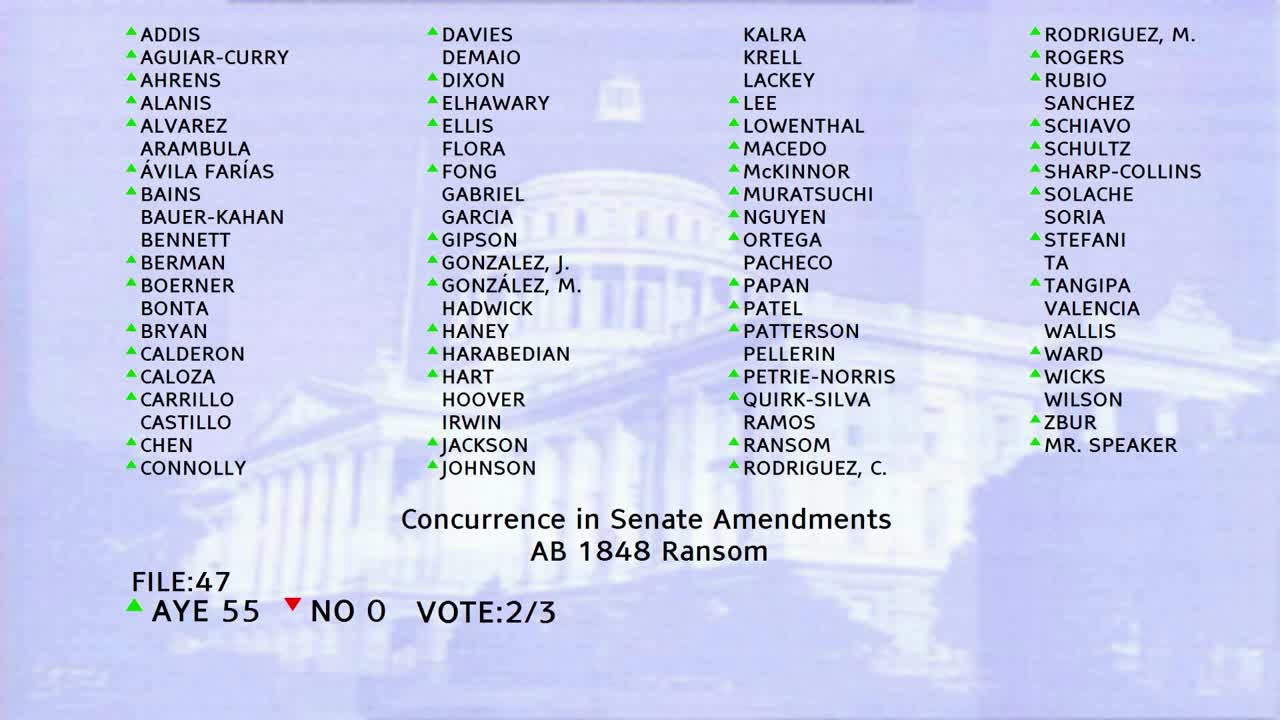 48SEC
Assembly Floor
 57SEC
Senate Floor
 10MIN
Senate Standing Committee on Military and Veterans Affairs
 7MIN
Senate Standing Committee on Labor, Public Employment and Retirement
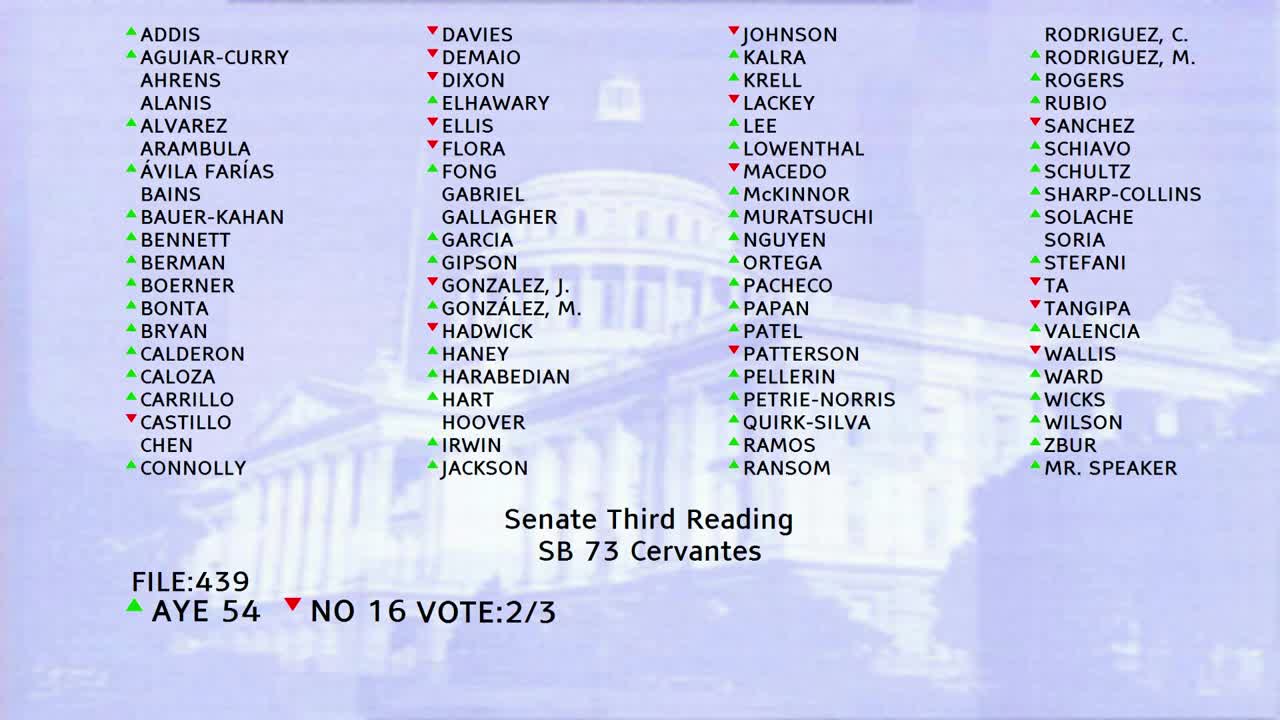 1MIN
Assembly Floor
 9MIN
Assembly Standing Committee on Military and Veterans Affairs
Bill Author