AB 290: California FAIR Plan Association: automatic payments.
- Session Year: 2025-2026
- House: Assembly
- Latest Version Date: 2025-10-09
Current Status:
Passed
(2025-10-09: Chaptered by Secretary of State - Chapter 475, Statutes of 2025.)
Introduced
In Committee
Awaiting First Chamber Vote
Passed First Chamber
In Committee
Awaiting Second Chamber Vote
Passed Second Chamber
Enacted
Existing law establishes the California FAIR Plan Association, a joint reinsurance association in which all insurers licensed to write basic property insurance participate to administer a program for the equitable apportionment of basic property insurance for persons who are unable to obtain that coverage through normal channels. Existing law authorizes cancellation of an insurance policy for nonpayment of premium, and requires an insurer to notify a policyholder at least 10 calendar days before the policy will be canceled for nonpayment.
This bill, on or before April 1, 2026, would require the California FAIR Plan Association to create an automatic payment system and accept automatic payments for premiums from policyholders. The bill would prohibit cancellation or nonrenewal of a FAIR Plan policy solely because the policyholder is not enrolled in automatic payments. The bill would provide a period for the policyholder to pay any outstanding installment premium, in accordance with the existing 10-calendar-day notice requirement.
Existing law establishes the California FAIR Plan Association, a joint reinsurance association in which all insurers licensed to write basic property insurance participate to administer a program for the equitable apportionment of basic property insurance for persons who are unable to obtain that coverage through normal channels. Existing law authorizes cancellation of an insurance policy for nonpayment of premium, and requires an insurer to notify a policyholder at least 10 calendar days before the policy will be canceled for nonpayment.
This bill, on or before April 1, 2026, would require the California FAIR Plan Association to create an automatic payment system and accept automatic payments for premiums from policyholders. The bill would require the amount charged for a policy to remain the same regardless of whether the policyholder opts for automatic payments or another method, but would authorize a reasonable fee for the convenience and increased cost associated with using the automatic payment system. The bill would prohibit cancellation or nonrenewal of a FAIR Plan policy solely because the policyholder is not enrolled in automatic payments. The bill would provide a period for the policyholder to pay any outstanding installment premium, in accordance with the existing 10-calendar-day notice requirement.
Existing law establishes the California FAIR Plan Association, a joint reinsurance association in which all insurers licensed to write basic property insurance participate to administer a program for the equitable apportionment of basic property insurance for persons who are unable to obtain that coverage through normal channels. Existing law authorizes cancellation of an insurance policy for nonpayment of premium, and requires an insurer to notify a policyholder at least 10 business calendar days before the policy will be canceled for nonpayment.
This bill, on or before April 1, 2026, would require the California FAIR Plan Association to create an automatic payment system and accept automatic payments for premiums from policyholders. The bill would prohibit an automatic payment amount from being different than if the policyholder made a payment through another method. require the amount charged for a policy to remain the same regardless of whether the policyholder opts for automatic payments or another method, but would authorize a reasonable fee for the convenience and increased cost associated with using the automatic payment system. The bill would prohibit cancellation or nonrenewal of a FAIR Plan policy solely because the policyholder is not enrolled in automatic payments. The bill would provide a 10-day period for the policyholder to pay any outstanding installment premium. premium, in accordance with the existing 10-calendar-day notice requirement.
Existing law establishes the California FAIR Plan Association, a joint reinsurance association in which all insurers licensed to write basic property insurance participate to administer a program for the equitable apportionment of basic property insurance for persons who are unable to obtain that coverage through normal channels. Existing law authorizes cancellation of an insurance policy for nonpayment of premium, and requires an insurer to notify a policyholder at least 10 business days before the policy will be canceled for nonpayment.
This bill, on or before April 1, 2026, would require the California FAIR Plan Association to create an automatic payment system and accept automatic payments for premiums from policyholders. The bill would prohibit an automatic payment amount from being different than if the policyholder made a payment through another method. The bill would prohibit cancellation or nonrenewal of a FAIR Plan policy solely because the policyholder is not enrolled in automatic payments. The bill would provide a 10-day grace period for the policyholder to pay any outstanding installment premium.
Existing law establishes the California FAIR Plan Association, a joint reinsurance association in which all insurers licensed to write basic property insurance participate to administer a program for the equitable apportionment of basic property insurance for persons who are unable to obtain that coverage through normal channels. Existing law authorizes cancellation of an insurance policy for nonpayment of premium, and requires an insurer to notify a policyholder at least 10 business days before the policy will be canceled for nonpayment.
This bill, on or before April 1, 2026, would require the California FAIR Plan Association to create an automatic payment system and accept automatic payments for premiums from policyholders. The bill would prohibit an automatic payment amount from being different than if the policyholder made a payment through another method. The bill would prohibit cancellation or nonrenewal of a FAIR Plan policy solely because the policyholder is not enrolled in automatic payments, except as specified. payments. The bill would provide a 10-day grace period for the policyholder to pay any outstanding installment premium.
Existing law establishes the California FAIR Plan Association, a joint reinsurance association in which all insurers licensed to write basic property insurance participate to administer a program for the equitable apportionment of basic property insurance for persons who are unable to obtain that coverage through normal channels. Existing law authorizes cancellation of an insurance policy for nonpayment of premium, and requires an insurer to notify a policyholder at least 10 business days before the policy will be canceled for nonpayment.
This bill bill, on or before April 1, 2026, would require the California FAIR Plan Association to create an automatic payment system and accept automatic payments for premiums from policyholders. The bill would prohibit an automatic payment amount from being different than if the policyholder made a payment through another method. The bill would prohibit cancellation or nonrenewal of a FAIR Plan policy solely because the policyholder is not enrolled in automatic payments, except as specified, or because the policyholder failed to confirm a payment when making a one-time payment on the associations internet website, as specified. specified. The bill would provide for a 15-day a 10-day grace period for late premium payments. the policyholder to pay any outstanding installment premium.
Existing law establishes the California FAIR Plan Association, a joint reinsurance association in which all insurers licensed to write basic property insurance participate to administer a program for the equitable apportionment of basic property insurance for persons who are unable to obtain that coverage through normal channels. Existing law authorizes cancellation of an insurance policy for nonpayment of premium, and requires an insurer to notify a policyholder at least 10 business days before the policy will be canceled for nonpayment.
This bill would require the California FAIR Plan Association to create an automatic payment system and accept automatic payments for premiums from policyholders. The bill would prohibit an automatic payment amount from being different than if the policyholder made a payment through another method. The bill would prohibit cancellation or nonrenewal of a FAIR Plan policy solely because the policyholder is not enrolled in automatic payments payments, except as specified, or because the policyholder failed to confirm a payment when making a one-time payment on the associations internet website. website, as specified. The bill would provide for a 15-day grace period for late premium payments.
Existing law establishes the California FAIR Plan Association, a joint reinsurance association in which all insurers licensed to write basic property insurance participate to administer a program for the equitable apportionment of basic property insurance for persons who are unable to obtain that coverage through normal channels. Existing law authorizes cancellation of an insurance policy for nonpayment of premium, and requires an insurer to notify a policyholder at least 10 business days before the policy will be canceled for nonpayment.
This bill would require the California FAIR Plan Association to create an automatic payment system and accept automatic payments for premiums from policyholders. The bill would prohibit an automatic payment amount from being different than if the policyholder made a payment through another method. The bill would prohibit cancellation or nonrenewal of a FAIR Plan policy solely because the policyholder is not enrolled in automatic payments or because the policyholder failed to confirm a payment when making a one-time payment on the associations internet website. The bill would provide for a 15-day grace period for late premium payments.
Existing law requires the State Department of Public Health (department) to license and regulate each health facility, defined to mean a facility, place, or building that is organized, maintained, and operated for the diagnosis, care, prevention, and treatment of human illness, and includes, among others, a general acute care hospital and an acute psychiatric hospital.Existing law, the Unruh Civil Rights Act (Unruh Act), specifies that all persons within the jurisdiction of the state are free and equal, and no matter their sex, race, color, religion, ancestry, national origin, disability, medical condition, genetic information, marital status, sexual orientation, citizenship, primary language, or immigration status are entitled to the full and equal accommodations, advantages, facilities, privileges, or services in all business establishments of every kind.Existing law requires a health facility that maintains and operates an emergency department to provide emergency services and care, as defined, to any person requesting the services or care for any condition in which the person is in danger of loss of life, or serious injury or illness, as specified. Existing law prohibits the provision of emergency services and care from being based on or affected by, among other characteristics, a persons ethnicity, citizenship, age, preexisting medical condition, insurance status, economic status, or a characteristic identified in the Unruh Act, as specified. Existing law requires a hospital to adopt a policy prohibiting discrimination in the provision of emergency services and care, and to prohibit physicians and surgeons who serve on an on-call basis to the hospitals emergency room from refusing to respond to a call, based on the characteristics described above. If a hospital fails to timely adopt the required policies and protocols, in addition to denial or revocation of any of its licenses, existing law subjects the hospital to a fine not to exceed $1,000 for each day after 60 days written notice from the department that the hospitals policies or protocols are inadequate, as specified.This bill would increase the fine for a hospitals failure to adopt the policies and protocols required for the provision of emergency services and care to $1,000,000 per day.Existing law prohibits a hospital, governmental agency, or person from retaliating against, penalizing, or taking other specified actions against a physician or other personnel for reporting in good faith a violation of the requirements governing the provision of emergency services and care, or for refusing to transfer a patient when the physician determines that the transfer or delay caused by the transfer will create a medical hazard to the person, as specified. Existing law subjects a person who violates either of these prohibitions to a civil penalty of no more than $10,000 per violation.This bill would increase the maximum amount of that civil penalty to $1,000,000 per violation.Under existing law, a hospital found by the department to have committed or been responsible for a violation of the requirements governing the provision of emergency services and care is subject to a civil penalty in an amount not to exceed $25,000 for each hospital violation, except as specified. A physician and surgeon found by the Medical Board of California to have committed or been responsible for a violation of those requirements is subject to a civil penalty by the board not to exceed $5,000. Existing law establishes a cumulative maximum limit of $30,000 for civil penalties against hospitals assessed under these provisions and under a specified federal provision governing emergency examination and treatment for emergency medical conditions and women in labor. Existing law requires the department, when determining the amount of a penalty for a hospital violation, to take into account factors including, but not limited to, civil fines that have been imposed for violating the federal provisions. Existing law requires the department to return or credit state penalty amounts to a hospital to ensure that the cumulative maximum limit is not exceeded.This bill would increase the maximum amount of a civil penalty against a hospital or physician and surgeon that violated the above-referenced requirements to $1,000,000, respectively. The bill would delete the provisions requiring the cumulative maximum penalty limit and the requirement that the department consider the above-described civil fines imposed for violating federal provisions.Existing law authorizes a person who suffers personal harm and any medical facility that suffers financial loss resulting from a violation of the requirements relating to the provision of emergency services and care to recover damages, attorneys fees, and other appropriate relief in a civil action against the transferring or receiving hospital, as specified. Existing law also authorizes a person potentially harmed by the emergency services and care provisions or implementing regulations, or the local district attorney or the Attorney General, to bring a civil action to enjoin the violation, as prescribed.This bill additionally would authorize the local district attorney or the Attorney General to bring a civil action against an entity that violates an injunction issued according to the above provisions, as specified. The bill would require a court to award a civil penalty of up to $1,000,000, attorneys fees, and litigation costs to the prevailing party.Existing law requires the State Department of Public Health (department) to license and regulate each health facility, defined to mean a facility, place, or building that is organized, maintained, and operated for the diagnosis, care, prevention, and treatment of human illness, and includes, among others, a general acute care hospital and an acute psychiatric hospital.
Existing law, the Unruh Civil Rights Act (Unruh Act), specifies that all persons within the jurisdiction of the state are free and equal, and no matter their sex, race, color, religion, ancestry, national origin, disability, medical condition, genetic information, marital status, sexual orientation, citizenship, primary language, or immigration status are entitled to the full and equal accommodations, advantages, facilities, privileges, or services in all business establishments of every kind.
Existing law requires a health facility that maintains and operates an emergency department to provide emergency services and care, as defined, to any person requesting the services or care for any condition in which the person is in danger of loss of life, or serious injury or illness, as specified. Existing law prohibits the provision of emergency services and care from being based on or affected by, among other characteristics, a persons ethnicity, citizenship, age, preexisting medical condition, insurance status, economic status, or a characteristic identified in the Unruh Act, as specified. Existing law requires a hospital to adopt a policy prohibiting discrimination in the provision of emergency services and care, and to prohibit physicians and surgeons who serve on an on-call basis to the hospitals emergency room from refusing to respond to a call, based on the characteristics described above. If a hospital fails to timely adopt the required policies and protocols, in addition to denial or revocation of any of its licenses, existing law subjects the hospital to a fine not to exceed $1,000 for each day after 60 days written notice from the department that the hospitals policies or protocols are inadequate, as specified.
This bill would delete citizenship and preexisting medical condition, which are also similarly identified in the Unruh Act, from the list of characteristics prohibited from being considered with respect to the provision of emergency services and care. The bill would increase the fine for a hospitals failure to adopt the policies and protocols required for the provision of emergency services and care to $1,000,000 per day.
Existing law prohibits a hospital, governmental agency, or person from retaliating against, penalizing, or taking other specified actions against a physician or other personnel for reporting in good faith a violation of the requirements governing the provision of emergency services and care, or for refusing to transfer a patient when the physician determines that the transfer or delay caused by the transfer will create a medical hazard to the person, as specified. Existing law subjects a person who violates either of these prohibitions to a civil penalty of no more than $10,000 per violation.
This bill would increase the maximum amount of that civil penalty to $1,000,000 per violation.
Under existing law, a hospital found by the department to have committed or been responsible for a violation of the requirements governing the provision of emergency services and care is subject to a civil penalty in an amount not to exceed $25,000 for each hospital violation, except as specified. A physician and surgeon found by the Medical Board of California to have committed or been responsible for a violation of those requirements is subject to a civil penalty by the board not to exceed $5,000. Existing law establishes a cumulative maximum limit of $30,000 for civil penalties against hospitals assessed under these provisions and under a specified federal provision governing emergency examination and treatment for emergency medical conditions and women in labor. Existing law requires the department, when determining the amount of a penalty for a hospital violation, to take into account factors including, but not limited to, civil fines that have been imposed for violating the federal provisions. Existing law requires the department to return or credit state penalty amounts to a hospital to ensure that the cumulative maximum limit is not exceeded.
This bill would increase the maximum amount of a civil penalty against a hospital or physician and surgeon that violated the above-referenced requirements to $1,000,000, respectively. The bill would delete the provisions requiring the cumulative maximum penalty limit and the requirement that the department consider the above-described civil fines imposed for violating federal provisions.
Existing law authorizes a person who suffers personal harm and any medical facility that suffers financial loss resulting from a violation of the requirements relating to the provision of emergency services and care to recover damages, attorneys fees, and other appropriate relief in a civil action against the transferring or receiving hospital, as specified. Existing law also authorizes a person potentially harmed by the emergency services and care provisions or implementing regulations, or the local district attorney or the Attorney General, to bring a civil action to enjoin the violation, as prescribed.
This bill additionally would authorize the local district attorney or the Attorney General to bring a civil action against an entity that violates an injunction issued according to the above provisions, as specified. The bill would require a court to award a civil penalty of up to $1,000,000, attorneys fees, and litigation costs to the prevailing party.
Existing law requires the State Department of Public Health (department) to license and regulate each health facility, defined to mean a facility, place, or building that is organized, maintained, and operated for the diagnosis, care, prevention, and treatment of human illness, and includes, among others, a general acute care hospital and an acute psychiatric hospital.
Existing law, the Unruh Civil Rights Act (Unruh Act), specifies that all persons within the jurisdiction of the state are free and equal, and no matter their sex, race, color, religion, ancestry, national origin, disability, medical condition, genetic information, marital status, sexual orientation, citizenship, primary language, or immigration status are entitled to the full and equal accommodations, advantages, facilities, privileges, or services in all business establishments of every kind.
Existing law requires a health facility that maintains and operates an emergency department to provide emergency services and care, as defined, to any person requesting the services or care for any condition in which the person is in danger of loss of life, or serious injury or illness, as specified. Existing law prohibits the provision of emergency services and care from being based on or affected by, among other characteristics, a persons ethnicity, citizenship, age, preexisting medical condition, insurance status, economic status, or a characteristic identified in the Unruh Act, as specified. Existing law requires a hospital to adopt a policy prohibiting discrimination in the provision of emergency services and care, and to prohibit physicians and surgeons who serve on an on-call basis to the hospitals emergency room from refusing to respond to a call, based on the characteristics described above. If a hospital fails to timely adopt the required policies and protocols, in addition to denial or revocation of any of its licenses, existing law subjects the hospital to a fine not to exceed $1,000 for each day after 60 days written notice from the department that the hospitals policies or protocols are inadequate, as specified.
This bill would delete citizenship and preexisting medical condition, which are also similarly identified in the Unruh Act, from the list of characteristics prohibited from being considered with respect to the provision of emergency services and care. The bill would increase the fine for a hospitals failure to adopt the policies and protocols required for the provision of emergency services and care to $1,000,000 per day.
Existing law prohibits a hospital, governmental agency, or person from retaliating against, penalizing, or taking other specified actions against a physician or other personnel for reporting in good faith a violation of the requirements governing the provision of emergency services and care, or for refusing to transfer a patient when the physician determines that the transfer or delay caused by the transfer will create a medical hazard to the person, as specified. Existing law subjects a person who violates either of these prohibitions to a civil penalty of no more than $10,000 per violation.
This bill would increase the maximum amount of that civil penalty to $1,000,000 per violation.
Under existing law, a hospital found by the department to have committed or been responsible for a violation of the requirements governing the provision of emergency services and care is subject to a civil penalty in an amount not to exceed $25,000 for each hospital violation, except as specified. A physician and surgeon found by the Medical Board of California to have committed or been responsible for a violation of those requirements is subject to a civil penalty by the board not to exceed $5,000. Existing law establishes a cumulative maximum limit of $30,000 for civil penalties against hospitals assessed under these provisions and under a specified federal provision governing emergency examination and treatment for emergency medical conditions and women in labor. Existing law requires the department, when determining the amount of a penalty for a hospital violation, to take into account factors including, but not limited to, civil fines that have been imposed for violating the federal provisions. Existing law requires the department to return or credit state penalty amounts to a hospital to ensure that the cumulative maximum limit is not exceeded.
This bill would increase the maximum amount of a civil penalty against a hospital or physician and surgeon that violated the above-referenced requirements to $1,000,000, respectively. The bill would delete the provisions requiring the cumulative maximum penalty limit and the requirement that the department consider the above-described civil fines imposed for violating federal provisions.
Existing law authorizes a person who suffers personal harm and any medical facility that suffers financial loss resulting from a violation of the requirements relating to the provision of emergency services and care to recover damages, attorneys fees, and other appropriate relief in a civil action against the transferring or receiving hospital, as specified. Existing law also authorizes a person potentially harmed by the emergency services and care provisions or implementing regulations, or the local district attorney or the Attorney General, to bring a civil action to enjoin the violation, as prescribed.
This bill additionally would authorize the local district attorney or the Attorney General to bring a civil action against an entity that violates an injunction issued according to the above provisions, as specified. The bill would require a court to award a civil penalty of up to $1,000,000, attorneys fees, and litigation costs to the prevailing party.
(a)On or before April 1, 2026, the association shall create an automatic payment system and accept automatic payments for premiums from policyholders.
(b)A policy shall not be canceled or nonrenewed solely because the policyholder is not enrolled in automatic payments.
(c)If a policyholder fails to timely pay any outstanding installment premium, the policyholder shall have a period to pay the outstanding installment premium, in accordance with Section 677.4.
(a)On or before April 1, 2026, the association shall create an automatic payment system and accept automatic payments for premiums from policyholders.
(b)(1)The amount charged by the association to a policyholder for the policy shall remain the same regardless of whether the policyholder opts for automatic payments or another method.(2)Notwithstanding paragraph (1), the association or its vendor may charge a reasonable fee for the convenience and increased cost associated with using the automatic payment system.(c)(b)A policy shall not be canceled or nonrenewed solely because the policyholder is not enrolled in automatic payments.
(d)(c)If a policyholder fails to timely pay any outstanding installment premium, the policyholder shall have a period to pay the outstanding installment premium, in accordance with Section 677.4.
(a)On or before April 1, 2026, the association shall create an automatic payment system and accept automatic payments for premiums from policyholders.
(b)An automatic payment amount charged by the association to a policyholder shall not be different than if the policyholder made a payment through another method.(b)(1)The amount charged by the association to a policyholder for the policy shall remain the same regardless of whether the policyholder opts for automatic payments or another method.
(2)Notwithstanding paragraph (1), the association or its vendor may charge a reasonable fee for the convenience and increased cost associated with using the automatic payment system.
(c)A policy shall not be canceled or nonrenewed solely because the policyholder is not enrolled in automatic payments.
(d)If a policyholder fails to timely pay any outstanding installment premium, the policyholder shall have a 10-day period to pay the outstanding installment premium. premium, in accordance with Section 677.4.
(a)On or before April 1, 2026, the association shall create an automatic payment system and accept automatic payments for premiums from policyholders.
(b)An automatic payment amount charged by the association to a policyholder shall not be different than if the policyholder made a payment through another method.
(c)A policy shall not be canceled or nonrenewed solely because the policyholder is not enrolled in automatic payments.
(d)If a policyholder fails to timely pay any outstanding installment premium, the policyholder shall have a 10-day grace period to pay the outstanding installment premium.
(a)On or before April 1, 2026, the association shall create an automatic payment system and accept automatic payments for premiums from policyholders.
(b)An automatic payment amount charged by the association to a policyholder shall not be different than if the policyholder made a payment through another method.
(c)A policy shall not be canceled or nonrenewed solely because the policyholder is not enrolled in automatic payments, unless the policyholder failed to make the payment within the grace period provided in subdivision (d). payments.
(d)If a policyholder fails to timely pay any outstanding installment premium, the policyholder shall have a 10-day grace period to pay the outstanding installment premium.
(a)The On or before April 1, 2026, the association shall create an automatic payment system and accept automatic payments for premiums from policyholders.
(b)An automatic payment amount charged by the association to a policyholder shall not be different than if the policyholder made a payment through another method.
(c)A policy shall not be canceled or nonrenewed solely because the policyholder is not enrolled in automatic payments, unless the policyholder failed to make the payment within the grace period provided in subdivision (d).
(d)If a policyholder fails to timely pay their any outstanding installment premium, the policyholder shall have a 15-day 10-day grace period to pay the outstanding installment premium.
SEC. 2.Section 10095.9 is added to the Insurance Code, to read:10095.9.(a)A policy shall not be canceled or nonrenewed by the association solely because the policyholder failed to confirm a payment when making a one-time payment on the associations internet website, unless the policyholder failed to make the payment within the grace period provided in subdivision (b).(b)If a policyholder fails to timely pay their premium, the policyholder shall have a 15-day grace period to pay the outstanding premium.(a)The association shall create an automatic payment system and accept automatic payments for premiums from policyholders.
(b)An automatic payment amount charged to a policyholder shall not be different than if the policyholder made a payment through another method.
(c)A policy shall not be canceled or nonrenewed solely because the policyholder is not enrolled in automatic payments or because the policyholder failed to confirm a payment when making a one-time payment on the associations internet website. payments, unless the policyholder failed to make the payment within the grace period provided in subdivision (d).
(d)If a policyholder fails to timely pay their premium, the policyholder shall have a 15-day grace period to pay the outstanding premium.
SEC. 2.Section 10095.9 is added to the Insurance Code, to read:10095.9.(a)A policy shall not be canceled or nonrenewed by the association solely because the policyholder failed to confirm a payment when making a one-time payment on the associations internet website, unless the policyholder failed to make the payment within the grace period provided in subdivision (b).
(b)If a policyholder fails to timely pay their premium, the policyholder shall have a 15-day grace period to pay the outstanding premium.
(a)The association shall create an automatic payment system and accept automatic payments for premiums from policyholders.
(b)An automatic payment amount charged to a policyholder shall not be different than if the policyholder made a payment through another method.
(c)A policy shall not be canceled or nonrenewed solely because the policyholder is not enrolled in automatic payments or because the policyholder failed to confirm a payment when making a one-time payment on the associations internet website.
(d)If a policyholder fails to timely pay their premium, the policyholder shall have a 15-day grace period to pay the outstanding premium.
SECTION 1.Section 1317.3 of the Health and Safety Code is amended to read:1317.3.(a)As a condition of licensure, each hospital shall adopt, in consultation with the medical staff, policies and transfer protocols consistent with this article and its implementing regulations.(b)As a condition of licensure, each hospital shall adopt a policy prohibiting discrimination in the provision of emergency services and care based on ethnicity, citizenship, age, preexisting medical condition, insurance status, economic status, ability to pay for medical services, or any characteristic listed or defined in subdivision (b) or (e) of Section 51 of the Civil Code, except to the extent that a circumstance such as age, sex, preexisting medical condition, or physical or mental disability is medically significant to the provision of appropriate medical care to the patient. Transfer by a hospital of a patient who requires evaluation for involuntary psychiatric treatment, as determined by the receiving hospital or other receiving health facility, based upon the decision of a professional person duly authorized by law to make that decision, shall not constitute discrimination for the purposes of this section, if the transferring hospital has not been designated as an evaluation facility by a county pursuant to Section 5150 of the Welfare and Institutions Code, and if the transfer is in compliance with Section 1317.2.(c)As a condition of licensure, each hospital shall require that physicians and surgeons who serve on an on-call basis to the hospitals emergency room cannot refuse to respond to a call on the basis of the patients ethnicity, citizenship, age, preexisting medical condition, insurance status, economic status, ability to pay for medical services, or any characteristic listed or defined in subdivision (b) or (e) of Section 51 of the Civil Code, except to the extent that a circumstance such as age, sex, preexisting medical condition, or physical or mental disability is medically significant to the provision of appropriate medical care to the patient. If a contract between a physician and surgeon and hospital for the provision of emergency room coverage presently prevents the hospital from imposing those conditions, the conditions shall be included in the contract as soon as is legally permissible. This section does not require a physician to serve on an on-call basis.(d)As a condition of licensure, all hospitals shall inform all persons presented to an emergency room or their representatives if any are present and the person is unable to understand verbal or written communication, both orally and in writing, of the reasons for the transfer or refusal to provide emergency services and care and of the persons right to emergency services and care prior to transfer or discharge without regard to ability to pay. This subdivision does not require notification of the reasons for the transfer in advance of the transfer where a person is unaccompanied and the hospital has made a reasonable effort to locate a representative, and because of the persons physical or mental condition, notification is not possible. All hospitals shall prominently post a sign in their emergency rooms informing the public of their rights. Both the posted sign and written communication concerning the transfer or refusal to provide emergency services and care shall give the address of the department as the governmental agency to contact in the event the person wishes to complain about the hospitals conduct.(e)If a hospital does not timely adopt the policies and protocols required in this article, the hospital, in addition to denial or revocation of any of its licenses, shall be subject to a fine not to exceed one million dollars ($1,000,000) each day after expiration of 60 days written notice from the state department that the hospitals policies or protocols required by this article are inadequate unless the delay is excused by the state department upon a showing of good and sufficient cause by the hospital. The notice shall include a detailed statement of the state departments reasons for its determination and suggested changes to the hospitals protocols that would be acceptable to the state department.SEC. 2.Section 1317.4 of the Health and Safety Code is amended to read:1317.4.(a)All hospitals shall maintain records of each transfer made or received, including the Transfer Summary described in subdivision (f) of Section 1317.2, for a period of three years.(b)All hospitals making or receiving transfers shall file with the state department annual reports on forms prescribed by the department, which shall describe the aggregate number of transfers made and received according to the persons insurance status and reasons for transfers.(c)The receiving hospital, and all physicians, other licensed emergency room health personnel, and certified prehospital emergency personnel at the receiving hospital who know of apparent violations of this article or its implementing regulations shall, and the corresponding personnel at the transferring hospital and the transferring hospital may, report the apparent violations to the state department on a form prescribed by the state department within one week following its occurrence. The state department shall promptly send a copy of the form to the hospital administrator and appropriate medical staff committee of the transferring hospital and the local emergency medical services agency, unless the state department concludes that the complaint does not allege facts requiring further investigation, or is otherwise unmeritorious, or the state department concludes, based upon the circumstances of the case, that its investigation of the allegations would be impeded by disclosure of the form. When two or more persons required to report jointly have knowledge of an apparent violation, a single report may be made by a member of the team selected by mutual agreement in accordance with hospital protocols. Any individual, required to report by this section, who disagrees with the proposed joint report has a right and duty to separately report.A failure to report under this subdivision shall not constitute a violation within the meaning of Section 1290 or 1317.6.(d)A hospital, governmental agency, or person shall not retaliate against, penalize, institute a civil action against, or recover monetary relief from, or otherwise cause any injury to a physician or other personnel for reporting in good faith an apparent violation of this article or its implementing regulations to the state department, hospital, medical staff, or any other interested party or governmental agency.(e)A hospital, governmental agency, or person shall not retaliate against, penalize, institute a civil action against, or recover monetary relief from, or otherwise cause any injury to a physician who refused to transfer a patient when the physician determines, within reasonable medical probability, that the transfer or delay caused by the transfer will create a medical hazard to the person.(f)Any person who violates subdivision (d) or (e) is subject to a civil penalty of no more than one million dollars ($1,000,000) per violation. The remedy specified in this section shall be in addition to any other remedy provided by law.(g)The state department shall on an annual basis publish and provide to the Legislature a statistical summary by county on the extent of economic transfers of emergency patients, the frequency of medically hazardous transfers, the insurance status of the patient populations being transferred and all violations finally determined by the state department describing the nature of the violations, hospitals involved, and the action taken by the state department in response. These summaries shall not reveal the identity of individual persons transferred.(h)Proceedings by the state department to impose a fine under Section 1317.3 or 1317.6, and proceedings by the board to impose a fine under Section 1317.6, shall be conducted as follows:(1)If a hospital desires to contest a proposed fine, the hospital shall within 15 business days after service of the notice of proposed fine notify the director in writing of its intention to contest the proposed fine. If requested by the hospital, the director or the directors designee, shall hold, within 30 business days, an informal conference, at the conclusion of which the director or the directors designee may affirm, modify, or dismiss the proposed fine. If the director or the directors designee affirms, modifies, or dismisses the proposed fine, they shall state with particularity, in writing, the reasons for that action, and shall immediately transmit a copy thereof to the hospital. If the hospital desires to contest a determination made after the informal conference, the hospital shall inform the director in writing within 15 business days after it receives the decision by the director or directors designee. The hospital shall not be required to request an informal conference to contest a proposed fine, as specified in this section. If the hospital fails to notify the director in writing that it intends to protest the proposed fine within the times specified in this subdivision, the proposed fine shall be deemed a final order of the state department and shall not be subject to further administrative review.(2)If a hospital notifies the director that it intends to contest a proposed fine, the director shall immediately notify the Attorney General. Upon notification, the Attorney General shall promptly take all appropriate action to enforce the proposed fine in a court of competent jurisdiction for the county in which the hospital is located.(3)A judicial action to enforce a proposed fine shall be filed by the Attorney General after a hospital notifies the director of its intent to contest the proposed fine. If a judicial proceeding is prosecuted under the provisions of this section, the state department shall have the burden of establishing by a preponderance of the evidence that the alleged facts supporting the proposed fine occurred, that the alleged facts constituted a violation for which a fine may be assessed under Section 1317.3, 1317.4, or 1317.6, and the proposed fine is appropriate. The state department shall also have the burden of establishing by a preponderance of the evidence that the assessment of the proposed fine should be upheld. If a hospital timely notifies the state department of its decision to contest a proposed fine, the fine shall not be due and payable unless and until the judicial proceeding is terminated in favor of the state department.(4)Action brought under the provisions of this section shall be set for trial at the earliest possible date and shall take precedence on the court calendar over all other cases except matters to which equal or superior precedence is specifically granted by law. Times for responsive pleading and for hearing any such proceeding shall be set by the judge of the court with the object of securing a decision as to subject matters at the earliest possible time.(5)If the proposed fine is dismissed or reduced, the state department shall take action immediately to ensure that the public records reflect in a prominent manner that the proposed fine was dismissed or reduced.(6)In lieu of a judicial proceeding, the state department and the hospital may jointly elect to submit the matter to binding arbitration, in which case, the department shall initiate arbitration proceedings. The parties shall agree upon an arbitrator designated by the American Arbitration Association in accordance with the Associations established rules and procedures. The arbitration hearing shall be set within 45 days of the parties joint election, but in no event less than 28 days from the date of selection of an arbitrator. The arbitration hearing may be continued up to 15 days if necessary at the arbitrators discretion. The decision of arbitrator shall be based upon substantive law and shall be binding on all parties, subject to judicial review. This review shall be limited to whether there was substantial evidence to support the decision of the arbitrator.(7)Proceedings by the board to impose a fine under Section 1317.6 shall be conducted in accordance with Chapter 5 (commencing with Section 11500) of Part 1 of Division 3 of Title 2 of the Government Code.SEC. 3.Section 1317.6 of the Health and Safety Code is amended to read:1317.6.(a)Hospitals found by the state department to have committed or to be responsible for a violation of this article or its implementing regulations shall be subject to a civil penalty by the state department in an amount not to exceed one million dollars ($1,000,000) for each hospital violation. In determining the amount of the fine for a hospital violation, the state department shall take into account all of the following:(1)Whether the violation was knowing or unintentional.(2)Whether the violation resulted or was reasonably likely to result in a medical hazard to the patient.(3)The frequency or gravity of the violation.(b)Notwithstanding this section, the director shall refer any alleged violation by a hospital owned and operated by a health care service plan involving a plan member or enrollee to the Department of Managed Health Care unless the director determines the complaint is without reasonable basis. The Department of Managed Health Care shall have sole authority and responsibility to enforce this article with respect to violations involving hospitals owned and operated by health care service plans in their treatment of plan members or enrollees.(c)Physicians and surgeons found by the board to have committed, or to be responsible for, a violation of this article or its implementing regulations shall be subject to any and all penalties that the board may lawfully impose and may be subject to a civil penalty by the board in an amount not to exceed one million dollars ($1,000,000) for each violation.(d)The board may impose fines when it finds any of the following:(1)The violation was knowing or willful.(2)The violation was reasonably likely to result in a medical hazard.(3)There are repeated violations.(e)It is the intent of the Legislature that the state department has primary responsibility for regulating the conduct of hospital emergency departments.(f)Any hospital found by the state department pursuant to procedures established by the state department to have committed a violation of this article or its implementing regulations may have its emergency medical service permit revoked or suspended by the state department.(g)Any administrative or medical personnel who knowingly and intentionally violates any provision of this article, may be charged by the local district attorney with a misdemeanor.(h)Notification of each violation found by the state department of the provisions of this article or its implementing regulations shall be sent by the state department to the Joint Commission for the Accreditation of Hospitals, the state emergency medical services authority, and local emergency medical services agencies.(i)Any person who suffers personal harm and any medical facility that suffers a financial loss as a result of a violation of this article or its implementing regulations may recover, in a civil action against the transferring or receiving hospital, damages, including punitive damages, reasonable attorneys fees, and other appropriate relief. Transferring and receiving hospitals from which inappropriate transfers of persons are made or refused in violation of this article and the regulations adopted hereunder shall be liable for the reasonable charges of the receiving or transferring hospital for providing the services and care that should have been provided. Any person potentially harmed by a violation of this article or its implementing regulations, or the local district attorney or the Attorney General, may bring a civil action against the responsible hospital or administrative or medical personnel, to enjoin the violation, and if the injunction issues, the court shall award reasonable attorneys fees. The provisions of this subdivision are in addition to other civil remedies and do not limit the availability of the other remedies.(j)(1)The local district attorney or the Attorney General may bring a civil action against an entity that violates an injunction issued pursuant to subdivision (h).(2)A court shall award a prevailing plaintiff who brings an action pursuant to paragraph (1) all of the following:(A)A civil penalty of up to one million dollars ($1,000,000) per violation.(B)Reasonable attorneys fees and litigation costs.(3)Each day that an entity violates an injunction issued pursuant to subdivision (h) gives rise to a distinct violation of this section.(4)The provisions of this subdivision are in addition to other civil remedies and do not limit the availability of other remedies.(k)The civil remedies established by this section do not apply to violations of any requirements established by any county or county agency.(a)As a condition of licensure, each hospital shall adopt, in consultation with the medical staff, policies and transfer protocols consistent with this article and its implementing regulations.
(b)As a condition of licensure, each hospital shall adopt a policy prohibiting discrimination in the provision of emergency services and care based on ethnicity, citizenship, age, preexisting medical condition, insurance status, economic status, ability to pay for medical services, or any characteristic listed or defined in subdivision (b) or (e) of Section 51 of the Civil Code, except to the extent that a circumstance such as age, sex, preexisting medical condition, or physical or mental disability is medically significant to the provision of appropriate medical care to the patient. Transfer by a hospital of a patient who requires evaluation for involuntary psychiatric treatment, as determined by the receiving hospital or other receiving health facility, based upon the decision of a professional person duly authorized by law to make that decision, shall not constitute discrimination for the purposes of this section, if the transferring hospital has not been designated as an evaluation facility by a county pursuant to Section 5150 of the Welfare and Institutions Code, and if the transfer is in compliance with Section 1317.2.
(c)As a condition of licensure, each hospital shall require that physicians and surgeons who serve on an on-call basis to the hospitals emergency room cannot refuse to respond to a call on the basis of the patients ethnicity, citizenship, age, preexisting medical condition, insurance status, economic status, ability to pay for medical services, or any characteristic listed or defined in subdivision (b) or (e) of Section 51 of the Civil Code, except to the extent that a circumstance such as age, sex, preexisting medical condition, or physical or mental disability is medically significant to the provision of appropriate medical care to the patient. If a contract between a physician and surgeon and hospital for the provision of emergency room coverage presently prevents the hospital from imposing those conditions, the conditions shall be included in the contract as soon as is legally permissible. This section does not require a physician to serve on an on-call basis.
(d)As a condition of licensure, all hospitals shall inform all persons presented to an emergency room or their representatives if any are present and the person is unable to understand verbal or written communication, both orally and in writing, of the reasons for the transfer or refusal to provide emergency services and care and of the persons right to emergency services and care prior to transfer or discharge without regard to ability to pay. This subdivision does not require notification of the reasons for the transfer in advance of the transfer where a person is unaccompanied and the hospital has made a reasonable effort to locate a representative, and because of the persons physical or mental condition, notification is not possible. All hospitals shall prominently post a sign in their emergency rooms informing the public of their rights. Both the posted sign and written communication concerning the transfer or refusal to provide emergency services and care shall give the address of the department as the governmental agency to contact in the event the person wishes to complain about the hospitals conduct.
(e)If a hospital does not timely adopt the policies and protocols required in this article, the hospital, in addition to denial or revocation of any of its licenses, shall be subject to a fine not to exceed one million dollars ($1,000,000) each day after expiration of 60 days written notice from the state department that the hospitals policies or protocols required by this article are inadequate unless the delay is excused by the state department upon a showing of good and sufficient cause by the hospital. The notice shall include a detailed statement of the state departments reasons for its determination and suggested changes to the hospitals protocols that would be acceptable to the state department.
SEC. 3.SEC. 2.Section 1317.4 of the Health and Safety Code is amended to read:1317.4.(a)All hospitals shall maintain records of each transfer made or received, including the Transfer Summary described in subdivision (f) of Section 1317.2, for a period of three years.
(b)All hospitals making or receiving transfers shall file with the state department annual reports on forms prescribed by the department, which shall describe the aggregate number of transfers made and received according to the persons insurance status and reasons for transfers.
(c)The receiving hospital, and all physicians, other licensed emergency room health personnel, and certified prehospital emergency personnel at the receiving hospital who know of apparent violations of this article or its implementing regulations shall, and the corresponding personnel at the transferring hospital and the transferring hospital may, report the apparent violations to the state department on a form prescribed by the state department within one week following its occurrence. The state department shall promptly send a copy of the form to the hospital administrator and appropriate medical staff committee of the transferring hospital and the local emergency medical services agency, unless the state department concludes that the complaint does not allege facts requiring further investigation, or is otherwise unmeritorious, or the state department concludes, based upon the circumstances of the case, that its investigation of the allegations would be impeded by disclosure of the form. When two or more persons required to report jointly have knowledge of an apparent violation, a single report may be made by a member of the team selected by mutual agreement in accordance with hospital protocols. Any individual, required to report by this section, who disagrees with the proposed joint report has a right and duty to separately report.
A failure to report under this subdivision shall not constitute a violation within the meaning of Section 1290 or 1317.6.
(d)A hospital, governmental agency, or person shall not retaliate against, penalize, institute a civil action against, or recover monetary relief from, or otherwise cause any injury to a physician or other personnel for reporting in good faith an apparent violation of this article or its implementing regulations to the state department, hospital, medical staff, or any other interested party or governmental agency.
(e)A hospital, governmental agency, or person shall not retaliate against, penalize, institute a civil action against, or recover monetary relief from, or otherwise cause any injury to a physician who refused to transfer a patient when the physician determines, within reasonable medical probability, that the transfer or delay caused by the transfer will create a medical hazard to the person.
(f)Any person who violates subdivision (d) or (e) is subject to a civil penalty of no more than one million dollars ($1,000,000) per violation. The remedy specified in this section shall be in addition to any other remedy provided by law.
(g)The state department shall on an annual basis publish and provide to the Legislature a statistical summary by county on the extent of economic transfers of emergency patients, the frequency of medically hazardous transfers, the insurance status of the patient populations being transferred and all violations finally determined by the state department describing the nature of the violations, hospitals involved, and the action taken by the state department in response. These summaries shall not reveal the identity of individual persons transferred.
(h)Proceedings by the state department to impose a fine under Section 1317.3 or 1317.6, and proceedings by the board to impose a fine under Section 1317.6, shall be conducted as follows:
(1)If a hospital desires to contest a proposed fine, the hospital shall within 15 business days after service of the notice of proposed fine notify the director in writing of its intention to contest the proposed fine. If requested by the hospital, the director or the directors designee, shall hold, within 30 business days, an informal conference, at the conclusion of which the director or the directors designee may affirm, modify, or dismiss the proposed fine. If the director or the directors designee affirms, modifies, or dismisses the proposed fine, they shall state with particularity, in writing, the reasons for that action, and shall immediately transmit a copy thereof to the hospital. If the hospital desires to contest a determination made after the informal conference, the hospital shall inform the director in writing within 15 business days after it receives the decision by the director or directors designee. The hospital shall not be required to request an informal conference to contest a proposed fine, as specified in this section. If the hospital fails to notify the director in writing that it intends to protest the proposed fine within the times specified in this subdivision, the proposed fine shall be deemed a final order of the state department and shall not be subject to further administrative review.
(2)If a hospital notifies the director that it intends to contest a proposed fine, the director shall immediately notify the Attorney General. Upon notification, the Attorney General shall promptly take all appropriate action to enforce the proposed fine in a court of competent jurisdiction for the county in which the hospital is located.
(3)A judicial action to enforce a proposed fine shall be filed by the Attorney General after a hospital notifies the director of its intent to contest the proposed fine. If a judicial proceeding is prosecuted under the provisions of this section, the state department shall have the burden of establishing by a preponderance of the evidence that the alleged facts supporting the proposed fine occurred, that the alleged facts constituted a violation for which a fine may be assessed under Section 1317.3, 1317.4, or 1317.6, and the proposed fine is appropriate. The state department shall also have the burden of establishing by a preponderance of the evidence that the assessment of the proposed fine should be upheld. If a hospital timely notifies the state department of its decision to contest a proposed fine, the fine shall not be due and payable unless and until the judicial proceeding is terminated in favor of the state department.
(4)Action brought under the provisions of this section shall be set for trial at the earliest possible date and shall take precedence on the court calendar over all other cases except matters to which equal or superior precedence is specifically granted by law. Times for responsive pleading and for hearing any such proceeding shall be set by the judge of the court with the object of securing a decision as to subject matters at the earliest possible time.
(5)If the proposed fine is dismissed or reduced, the state department shall take action immediately to ensure that the public records reflect in a prominent manner that the proposed fine was dismissed or reduced.
(6)In lieu of a judicial proceeding, the state department and the hospital may jointly elect to submit the matter to binding arbitration, in which case, the department shall initiate arbitration proceedings. The parties shall agree upon an arbitrator designated by the American Arbitration Association in accordance with the Associations established rules and procedures. The arbitration hearing shall be set within 45 days of the parties joint election, but in no event less than 28 days from the date of selection of an arbitrator. The arbitration hearing may be continued up to 15 days if necessary at the arbitrators discretion. The decision of arbitrator shall be based upon substantive law and shall be binding on all parties, subject to judicial review. This review shall be limited to whether there was substantial evidence to support the decision of the arbitrator.
(7)Proceedings by the board to impose a fine under Section 1317.6 shall be conducted in accordance with Chapter 5 (commencing with Section 11500) of Part 1 of Division 3 of Title 2 of the Government Code.
SEC. 4.SEC. 3.Section 1317.6 of the Health and Safety Code is amended to read:1317.6.(a)Hospitals found by the state department to have committed or to be responsible for a violation of this article or its implementing regulations shall be subject to a civil penalty by the state department in an amount not to exceed one million dollars ($1,000,000) for each hospital violation. In determining the amount of the fine for a hospital violation, the state department shall take into account all of the following:
(1)Whether the violation was knowing or unintentional.
(2)Whether the violation resulted or was reasonably likely to result in a medical hazard to the patient.
(3)The frequency or gravity of the violation.
(b)Notwithstanding this section, the director shall refer any alleged violation by a hospital owned and operated by a health care service plan involving a plan member or enrollee to the Department of Managed Health Care unless the director determines the complaint is without reasonable basis. The Department of Managed Health Care shall have sole authority and responsibility to enforce this article with respect to violations involving hospitals owned and operated by health care service plans in their treatment of plan members or enrollees.
(c)Physicians and surgeons found by the board to have committed, or to be responsible for, a violation of this article or its implementing regulations shall be subject to any and all penalties that the board may lawfully impose and may be subject to a civil penalty by the board in an amount not to exceed one million dollars ($1,000,000) for each violation.
(d)The board may impose fines when it finds any of the following:
(1)The violation was knowing or willful.
(2)The violation was reasonably likely to result in a medical hazard.
(3)There are repeated violations.
(e)It is the intent of the Legislature that the state department has primary responsibility for regulating the conduct of hospital emergency departments.
(e)(f)Any hospital found by the state department pursuant to procedures established by the state department to have committed a violation of this article or its implementing regulations may have its emergency medical service permit revoked or suspended by the state department.
(f)(g)Any administrative or medical personnel who knowingly and intentionally violates any provision of this article, may be charged by the local district attorney with a misdemeanor.
(g)(h)Notification of each violation found by the state department of the provisions of this article or its implementing regulations shall be sent by the state department to the Joint Commission for the Accreditation of Hospitals, the state emergency medical services authority, and local emergency medical services agencies.
(h)(i)Any person who suffers personal harm and any medical facility that suffers a financial loss as a result of a violation of this article or its implementing regulations may recover, in a civil action against the transferring or receiving hospital, damages, including punitive damages, reasonable attorneys fees, and other appropriate relief. Transferring and receiving hospitals from which inappropriate transfers of persons are made or refused in violation of this article and the regulations adopted hereunder shall be liable for the reasonable charges of the receiving or transferring hospital for providing the services and care that should have been provided. Any person potentially harmed by a violation of this article or its implementing regulations, or the local district attorney or the Attorney General, may bring a civil action against the responsible hospital or administrative or medical personnel, to enjoin the violation, and if the injunction issues, the court shall award reasonable attorneys fees. The provisions of this subdivision are in addition to other civil remedies and do not limit the availability of the other remedies.
(i)(j)(1)The local district attorney or the Attorney General may bring a civil action against an entity that violates an injunction issued pursuant to subdivision (h).
(2)A court shall award a prevailing plaintiff who brings an action pursuant to paragraph (1) all of the following:
(A)A civil penalty of up to one million dollars ($1,000,000) per violation.
(B)Reasonable attorneys fees and litigation costs.
(3)Each day that an entity violates an injunction issued pursuant to subdivision (h) gives rise to a distinct violation of this section.
(4)The provisions of this subdivision are in addition to other civil remedies and do not limit the availability of other remedies.
(j)(k)The civil remedies established by this section do not apply to violations of any requirements established by any county or county agency.
(a)Emergency services and care shall be provided to any person requesting the services or care, or for whom services or care is requested, for any condition in which the person is in danger of loss of life, or serious injury or illness, at any health facility licensed under this chapter that maintains and operates an emergency department to provide emergency services to the public when the health facility has appropriate facilities and qualified personnel available to provide the services or care.
(b)In no event shall the provision of emergency services and care be based upon, or affected by, the persons ethnicity, citizenship, age, preexisting medical condition, age, insurance status, economic status, ability to pay for medical services, or any other characteristic listed or defined in subdivision (b) or (e) of Section 51 of the Civil Code, except to the extent that a circumstance such as age, sex, preexisting medical condition, or physical or mental disability is medically significant to the provision of appropriate medical care to the patient.
(c)Neither the health facility, its employees, nor any physician and surgeon, dentist, clinical psychologist, or podiatrist shall be liable in any action arising out of a refusal to render emergency services or care if the refusal is based on the determination, exercising reasonable care, that the person is not suffering from an emergency medical condition, or that the health facility does not have the appropriate facilities or qualified personnel available to render those services.
(d)Emergency services and care shall be rendered without first questioning the patient or any other person as to his or her their ability to pay therefor. However, the patient or his or her their legally responsible relative or guardian shall execute an agreement to pay therefor or otherwise supply insurance or credit information promptly after the services are rendered.
(e)If a health facility subject to this chapter does not maintain an emergency department, its employees shall nevertheless exercise reasonable care to determine whether an emergency exists and shall direct the persons seeking emergency care to a nearby facility that can render the needed services, and shall assist the persons seeking emergency care in obtaining the services, including transportation services, in every way reasonable under the circumstances.
(f)A general acute care hospital or acute psychiatric hospital shall not require a person who voluntarily seeks care to be in custody pursuant to Section 5150 of the Welfare and Institutions Code as a condition of accepting a transfer of that person after his or her the persons written consent for treatment and transfer is documented or in the absence of evidence of probable cause for detention, as defined in Section 5150.05 of the Welfare and Institutions Code.
(g)An act or omission of a rescue team established by a health facility licensed under this chapter, or operated by the federal or state government, a county, or by the Regents of the University of California, done or omitted while attempting to resuscitate a person who is in immediate danger of loss of life shall not impose any liability upon the health facility, the officers, members of the staff, nurses, or employees of the health facility, including, but not limited to, the members of the rescue team, or upon the federal or state government or a county, if good faith is exercised.
(h)Rescue team, as used in this section, means a special group of physicians and surgeons, nurses, and employees of a health facility who have been trained in cardiopulmonary resuscitation and have been designated by the health facility to attempt, in cases of emergency, to resuscitate persons who are in immediate danger of loss of life.
(i)This section does not relieve a health facility of any duty otherwise imposed by law upon the health facility for the designation and training of members of a rescue team or for the provision or maintenance of equipment to be used by a rescue team.
SEC. 2.Section 1317.3 of the Health and Safety Code is amended to read:1317.3.(a)As a condition of licensure, each hospital shall adopt, in consultation with the medical staff, policies and transfer protocols consistent with this article and regulations adopted hereunder. its implementing regulations.
(b)As a condition of licensure, each hospital shall adopt a policy prohibiting discrimination in the provision of emergency services and care based on ethnicity, citizenship, age, preexisting medical condition, age, insurance status, economic status, ability to pay for medical services, or any characteristic listed or defined in subdivision (b) or (e) of Section 51 of the Civil Code, except to the extent that a circumstance such as age, sex, preexisting medical condition, or physical or mental disability is medically significant to the provision of appropriate medical care to the patient. Transfer by a hospital of a patient who requires evaluation for involuntary psychiatric treatment, as determined by the receiving hospital or other receiving health facility, based upon the decision of a professional person duly authorized by law to make that decision, shall not constitute discrimination for the purposes of this section, if the transferring hospital has not been designated as an evaluation facility by a county pursuant to Section 5150 of the Welfare and Institutions Code, and if the transfer is in compliance with Section 1317.2.
(c)As a condition of licensure, each hospital shall require that physicians and surgeons who serve on an on-call basis to the hospitals emergency room cannot refuse to respond to a call on the basis of the patients ethnicity, citizenship, age, preexisting medical condition, age, insurance status, economic status, ability to pay for medical services, or any characteristic listed or defined in subdivision (b) or (e) of Section 51 of the Civil Code, except to the extent that a circumstance such as age, sex, preexisting medical condition, or physical or mental disability is medically significant to the provision of appropriate medical care to the patient. If a contract between a physician and surgeon and hospital for the provision of emergency room coverage presently prevents the hospital from imposing those conditions, the conditions shall be included in the contract as soon as is legally permissible. Nothing in this section shall be construed as requiring that any physician serve This section does not require a physician to serve on an on-call basis.
(d)As a condition of licensure, all hospitals shall inform all persons presented to an emergency room or their representatives if any are present and the person is unable to understand verbal or written communication, both orally and in writing, of the reasons for the transfer or refusal to provide emergency services and care and of the persons right to emergency services and care prior to transfer or discharge without regard to ability to pay. Nothing in this subdivision requires This subdivision does not require notification of the reasons for the transfer in advance of the transfer where a person is unaccompanied and the hospital has made a reasonable effort to locate a representative, and because of the persons physical or mental condition, notification is not possible. All hospitals shall prominently post a sign in their emergency rooms informing the public of their rights. Both the posted sign and written communication concerning the transfer or refusal to provide emergency services and care shall give the address of the department as the government governmental agency to contact in the event the person wishes to complain about the hospitals conduct.
(e)If a hospital does not timely adopt the policies and protocols required in this article, the hospital, in addition to denial or revocation of any of its licenses, shall be subject to a fine not to exceed one thousand dollars ($1,000) one million dollars ($1,000,000) each day after expiration of 60 days written notice from the state department that the hospitals policies or protocols required by this article are inadequate unless the delay is excused by the state department upon a showing of good and sufficient cause by the hospital. The notice shall include a detailed statement of the state departments reasons for its determination and suggested changes to the hospitals protocols which that would be acceptable to the state department.
(f)Each hospitals policies and protocols required in or under this article shall be submitted for approval to the state department by December 31, 1988.SEC. 3.Section 1317.4 of the Health and Safety Code is amended to read:1317.4.(a)All hospitals shall maintain records of each transfer made or received, including the Memorandum of Transfer Transfer Summary described in subdivision (f) of Section 1317.2, for a period of three years.
(b)All hospitals making or receiving transfers shall file with the state department annual reports on forms prescribed by the department department, which shall describe the aggregate number of transfers made and received according to the persons insurance status and reasons for transfers.
(c)The receiving hospital, and all physicians, other licensed emergency room health personnel, and certified prehospital emergency personnel at the receiving hospital who know of apparent violations of this article or the regulations adopted hereunder its implementing regulations shall, and the corresponding personnel at the transferring hospital and the transferring hospital may, report the apparent violations to the state department on a form prescribed by the state department within one week following its occurrence. The state department shall promptly send a copy of the form to the hospital administrator and appropriate medical staff committee of the transferring hospital and the local emergency medical services agency, unless the state department concludes that the complaint does not allege facts requiring further investigation, or is otherwise unmeritorious, or the state department concludes, based upon the circumstances of the case, that its investigation of the allegations would be impeded by disclosure of the form. When two or more persons required to report jointly have knowledge of an apparent violation, a single report may be made by a member of the team selected by mutual agreement in accordance with hospital protocols. Any individual, required to report by this section, who disagrees with the proposed joint report has a right and duty to separately report.
A failure to report under this subdivision shall not constitute a violation within the meaning of Section 1290 or 1317.6.
(d)No A hospital, government governmental agency, or person shall not retaliate against, penalize, institute a civil action against, or recover monetary relief from, or otherwise cause any injury to a physician or other personnel for reporting in good faith an apparent violation of this article or the regulations adopted hereunder its implementing regulations to the state department, hospital, medical staff, or any other interested party or government governmental agency.
(e)No A hospital, government governmental agency, or person shall not retaliate against, penalize, institute a civil action against, or recover monetary relief from, or otherwise cause any injury to a physician who refused to transfer a patient when the physician determines, within reasonable medical probability, that the transfer or delay caused by the transfer will create a medical hazard to the person.
(f)Any person who violates subdivision (d) or (e) of Section 1317.4 is subject to a civil money penalty of no more than ten thousand dollars ($10,000) one million dollars ($1,000,000) per violation. The remedy specified in this section shall be in addition to any other remedy provided by law.
(g)The state department shall on an annual basis publish and provide to the Legislature a statistical summary by county on the extent of economic transfers of emergency patients, the frequency of medically hazardous transfers, the insurance status of the patient populations being transferred and all violations finally determined by the state department describing the nature of the violations, hospitals involved, and the action taken by the state department in response. These summaries shall not reveal the identity of individual persons transferred.
(h)Proceedings by the state department to impose a fine under Section 1317.3 or 1317.6, and proceedings by the board to impose a fine under Section 1317.6, shall be conducted as follows:
(1)If a hospital desires to contest a proposed fine, the hospital shall within 15 business days after service of the notice of proposed fine notify the director in writing of its intention to contest the proposed fine. If requested by the hospital, the director or the directors designee, shall hold, within 30 business days, an informal conference, at the conclusion of which he or she the director or the directors designee may affirm, modify, or dismiss the proposed fine. If the director or the directors designee affirms, modifies, or dismisses the proposed fine, he or she they shall state with particularity in writing his or her particularity, in writing, the reasons for that action, and shall immediately transmit a copy thereof to the hospital. If the hospital desires to contest a determination made after the informal conference, the hospital shall inform the director in writing within 15 business days after it receives the decision by the director or directors designee. The hospital shall not be required to request an informal conference to contest a proposed fine, as specified in this section. If the hospital fails to notify the director in writing that it intends to protest the proposed fine within the times specified in this subdivision, the proposed fine shall be deemed a final order of the state department and shall not be subject to further administrative review.
(2)If a hospital notifies the director that it intends to contest a proposed fine, the director shall immediately notify the Attorney General. Upon notification, the Attorney General shall promptly take all appropriate action to enforce the proposed fine in a court of competent jurisdiction for the county in which the hospital is located.
(3)A judicial action to enforce a proposed fine shall be filed by the Attorney General after a hospital notifies the director of its intent to contest the proposed fine. If a judicial proceeding is prosecuted under the provisions of this section, the state department shall have the burden of establishing by a preponderance of the evidence that the alleged facts supporting the proposed fine occurred, that the alleged facts constituted a violation for which a fine may be assessed under Section 1317.3, 1317.4, or 1317.6, and the proposed fine is appropriate. The state department shall also have the burden of establishing by a preponderance of the evidence that the assessment of the proposed fine should be upheld. If a hospital timely notifies the state department of its decision to contest a proposed fine, the fine shall not be due and payable unless and until the judicial proceeding is terminated in favor of the state department.
(4)Action brought under the provisions of this section shall be set for trial at the earliest possible date and shall take precedence on the court calendar over all other cases except matters to which equal or superior precedence is specifically granted by law. Times for responsive pleading and for hearing any such proceeding shall be set by the judge of the court with the object of securing a decision as to subject matters at the earliest possible time.
(5)If the proposed fine is dismissed or reduced, the state department shall take action immediately to ensure that the public records reflect in a prominent manner that the proposed fine was dismissed or reduced.
(6)In lieu of a judicial proceeding, the state department and the hospital may jointly elect to submit the matter to binding arbitration, in which case, the department shall initiate arbitration proceedings. The parties shall agree upon an arbitrator designated by the American Arbitration Association in accordance with the Associations established rules and procedures. The arbitration hearing shall be set within 45 days of the parties joint election, but in no event less than 28 days from the date of selection of an arbitrator. The arbitration hearing may be continued up to 15 days if necessary at the arbitrators discretion. The decision of arbitrator shall be based upon substantive law and shall be binding on all parties, subject to judicial review. This review shall be limited to whether there was substantial evidence to support the decision of the arbitrator.
(7)Proceedings by the board to impose a fine under Section 1317.6 shall be conducted in accordance with Chapter 5 (commencing with Section 11500) of Part 1 of Division 3 of Title 2 of the Government Code.
SEC. 4.Section 1317.6 of the Health and Safety Code is amended to read:1317.6.(a)Hospitals found by the state department to have committed or to be responsible for a violation of this article or the regulations adopted pursuant thereto its implementing regulations shall be subject to a civil penalty by the state department in an amount not to exceed twenty-five thousand dollars ($25,000) one million dollars ($1,000,000) for each hospital violation. In determining the amount of the fine for a hospital violation, the state department shall take into account all of the following:
(1)Whether the violation was knowing or unintentional.
(2)Whether the violation resulted or was reasonably likely to result in a medical hazard to the patient.
(3)The frequency or gravity of the violation.
(4) Other civil fines which have been imposed as a result of the violation under Section 1395 of Title 42 of the United States Code.(b)Notwithstanding this section, the director shall refer any alleged violation by a hospital owned and operated by a health care service plan involving a plan member or enrollee to the Department of Managed Health Care unless the director determines the complaint is without reasonable basis. The Department of Managed Health Care shall have sole authority and responsibility to enforce this article with respect to violations involving hospitals owned and operated by health care service plans in their treatment of plan members or enrollees.
(c)Physicians and surgeons found by the board to have committed, or to be responsible for, a violation of this article or the regulations adopted pursuant thereto its implementing regulations shall be subject to any and all penalties which that the board may lawfully impose and may be subject to a civil penalty by the board in an amount not to exceed five thousand dollars ($5,000) one million dollars ($1,000,000) for each violation. A civil penalty imposed under this subdivision shall not duplicate federal fines, and the board shall credit any federal fine against a civil penalty imposed under this subdivision.
(d)The board may impose fines when it finds any of the following:
(1)The violation was knowing or willful.
(2)The violation was reasonably likely to result in a medical hazard.
(3)There are repeated violations.
(e) It is the intent of the Legislature that the state department has primary responsibility for regulating the conduct of hospital emergency departments and that fines imposed under this section should not be duplicated by additional fines imposed by the federal government as a result of the conduct which constituted a violation of this section. To effectuate the Legislatures intent, the Governor shall inform the Secretary of the federal Department of Health and Human Services of the enactment of this section and request the federal department to credit any penalty assessed under this section against any subsequent civil monetary penalty assessed pursuant to Section 1395dd of Title 42 of the United States Code for the same violation.(f)There shall be a cumulative maximum limit of thirty thousand dollars ($30,000) in fines assessed against hospitals under this article and under Section 1395dd of Title 42 of the United States Code for the same circumstances. To effectuate this cumulative maximum limit, the state department shall do both of the following:(1)As to state fines assessed prior to the final conclusion, including judicial review, if available, of an action against a hospital by the federal Department of Health and Human Services under Section 1395dd of Title 42 of the United States Code (for the same circumstances finally deemed to have been a violation of this article or the regulations adopted hereunder, because of the state department action authorized by this article), remit and return to the hospital within 30 days after conclusion of the federal action, that portion of the state fine necessary to assure that the cumulative maximum limit is not exceeded.(2)Immediately credit against state fines assessed after the final conclusion, including judicial review, if available, of an action against a hospital by the federal Department of Health and Human Services under Section 1395dd of Title 42 of the United States Code, which results in a fine against a hospital (for the same circumstances finally deemed to have been a violation of this article or the regulations adopted hereunder, because of the state department action authorized by this article), the amount of the federal fine, necessary to assure the cumulative maximum limit is not exceeded.(g)(e)Any hospital found by the state department pursuant to procedures established by the state department to have committed a violation of this article or the regulations adopted hereunder its implementing regulations may have its emergency medical service permit revoked or suspended by the state department.
(h)(f)Any administrative or medical personnel who knowingly and intentionally violates any provision of this article, may be charged by the local district attorney with a misdemeanor.
(i)(g)Notification of each violation found by the state department of the provisions of this article or the regulations adopted hereunder its implementing regulations shall be sent by the state department to the Joint Commission for the Accreditation of Hospitals, the state emergency medical services authority, and local emergency medical services agencies.
(j)(h)Any person who suffers personal harm and any medical facility which that suffers a financial loss as a result of a violation of this article or the regulations adopted hereunder its implementing regulations may recover, in a civil action against the transferring or receiving hospital, damages, including punitive damages, reasonable attorneys fees, and other appropriate relief. Transferring and receiving hospitals from which inappropriate transfers of persons are made or refused in violation of this article and the regulations adopted hereunder shall be liable for the reasonable charges of the receiving or transferring hospital for providing the services and care which that should have been provided. Any person potentially harmed by a violation of this article or the regulations adopted hereunder, its implementing regulations, or the local district attorney or the Attorney General, may bring a civil action against the responsible hospital or administrative or medical personnel, to enjoin the violation, and if the injunction issues, the court shall award reasonable attorneys fees. The provisions of this subdivision are in addition to other civil remedies and do not limit the availability of the other remedies.
(i)(1)The local district attorney or the Attorney General may bring a civil action against an entity that violates an injunction issued pursuant to subdivision (h).
(2)A court shall award a prevailing plaintiff who brings an action pursuant to paragraph (1) all of the following:
(A)A civil penalty of up to one million dollars ($1,000,000) per violation.
(B)Reasonable attorneys fees and litigation costs.
(3)Each day that an entity violates an injunction issued pursuant to subdivision (h) gives rise to a distinct violation of this section.
(4)The provisions of this subdivision are in addition to other civil remedies and do not limit the availability of other remedies.
(k)(j)The civil remedies established by this section do not apply to violations of any requirements established by any county or county agency.
|
Date
|
Status
|
|---|---|
| Oct 9, 2025 | Chaptered by Secretary of State - Chapter 475, Statutes of 2025. |
| Oct 9, 2025 | Approved by the Governor. |
| Sep 24, 2025 | Enrolled and presented to the Governor at 3 p.m. |
| Sep 12, 2025 | Senate amendments concurred in. To Engrossing and Enrolling. (Ayes 80. Noes 0. Page 3423.). |
| Sep 12, 2025 | In Assembly. Concurrence in Senate amendments pending. |
| Sep 11, 2025 | Read third time. Passed. Ordered to the Assembly. (Ayes 40. Noes 0. Page 2887.). |
| Sep 8, 2025 | Read second time. Ordered to third reading. |
| Sep 5, 2025 | Read third time and amended. Ordered to second reading. |
| Aug 26, 2025 | Read second time. Ordered to third reading. |
| Aug 25, 2025 | Read third time and amended. Ordered to second reading. |
| Aug 21, 2025 | Ordered to third reading. |
| Aug 21, 2025 | From Consent Calendar. |
| Aug 20, 2025 | Read second time. Ordered to Consent Calendar. |
| Aug 19, 2025 | From committee: Be ordered to second reading file pursuant to Senate Rule 28.8 and ordered to Consent Calendar. |
| Jul 10, 2025 | From committee: Do pass and re-refer to Com. on APPR. with recommendation: To Consent Calendar. (Ayes 7. Noes 0.) (July 9). Re-referred to Com. on APPR. |
| Jul 3, 2025 | From committee chair, with author's amendments: Amend, and re-refer to committee. Read second time, amended, and re-referred to Com. on INS. |
| Jun 17, 2025 | From committee chair, with author's amendments: Amend, and re-refer to committee. Read second time, amended, and re-referred to Com. on INS. |
| Jun 9, 2025 | In committee: Set, first hearing. Hearing canceled at the request of author. |
| May 28, 2025 | Referred to Com. on INS. |
| May 20, 2025 | In Senate. Read first time. To Com. on RLS. for assignment. |
| May 19, 2025 | Read third time. Passed. Ordered to the Senate. (Ayes 75. Noes 0. Page 1602.) |
| May 15, 2025 | Read second time. Ordered to third reading. |
| May 14, 2025 | From committee: Do pass. (Ayes 15. Noes 0.) (May 14). |
| May 5, 2025 | Re-referred to Com. on APPR. |
| May 1, 2025 | Read second time and amended. |
| Apr 30, 2025 | From committee: Amend, and do pass as amended and re-refer to Com. on APPR. (Ayes 16. Noes 0.) (April 30). |
| Apr 22, 2025 | Re-referred to Com. on INS. |
| Apr 21, 2025 | From committee chair, with author's amendments: Amend, and re-refer to Com. on INS. Read second time and amended. |
| Apr 7, 2025 | Re-referred to Com. on INS. pursuant to Assembly Rule 96. |
| Apr 7, 2025 | Re-referred to Com. on HEALTH. |
| Apr 3, 2025 | From committee chair, with author's amendments: Amend, and re-refer to Com. on HEALTH. Read second time and amended. |
| Mar 24, 2025 | In committee: Hearing postponed by committee. |
| Feb 19, 2025 | Re-referred to Com. on HEALTH. |
| Feb 18, 2025 | From committee chair, with author's amendments: Amend, and re-refer to Com. on HEALTH. Read second time and amended. |
| Feb 10, 2025 | Referred to Coms. on HEALTH and JUD. |
| Jan 23, 2025 | From printer. May be heard in committee February 22. |
| Jan 22, 2025 | Read first time. To print. |
|
Date
|
Description
|
Location
|
Votes
|
|
|---|---|---|---|---|
| Sep 12, 2025 | AB 290 Bauer-Kahan Concurrence in Senate Amendments | Assembly Floor |
Passed |
|
| Sep 11, 2025 | Assembly 3rd Reading AB290 Bauer-Kahan et al. By Allen | Senate Floor |
Passed |
|
| Jul 9, 2025 | Do pass, but first be re-referred to the Committee on [Appropriations] with the recommendation: To Consent Calendar | Senate Standing Committee on Insurance |
Passed |
|
| May 19, 2025 | AB 290 Bauer-Kahan Assembly Third Reading | Assembly Floor |
Passed |
|
| May 14, 2025 | Do pass. | Assembly Standing Committee on Appropriations |
Passed |
|
| Apr 30, 2025 | Do pass as amended and be re-referred to the Committee on [Appropriations] | Assembly Standing Committee on Insurance |
Passed |
This list shows positions taken on this bill by organizations on the date displayed, which is linked to the original source.
Positions by individuals are not included.
|
Organization
|
Position
|
Date
|
|---|---|---|
| California Community Foundation | ** Support | |
| California Fair Plan Association | ** Against | |
| California Pan-Ethnic Health Network | ** Support | |
| City of San Marcos | ** Support | |
| Consumer Attorneys Of California | ** Support | |
| Consumer Federation Of California | ** Support | |
| Health Access California | ** Support | |
| Indivisible Ca: Statestrong | ** Support | |
| Reproductive Freedom for All California | ** Support | |
| Ricardo Lara | ** Support | |
| Tri-Valley Cities of Dublin, Livermore, Pleasanton, San Ramon and the Town of Danville | ** Support | |
| United Policyholders | ** Support |
CONCURRENCE IN SENATE AMENDMENTS
CSA1 Bill Id:AB 290
Author:(Bauer-Kahan)
As Amended Ver:September 5, 2025
Majority vote
SUMMARY
Requires, by April 1, 2026, the FAIR Plan to create a system and accept automatic payments for policyholder premiums.
- Prohibits the cancellation or non-renewal of a FAIR Plan policy solely because the policyholder is not enrolled in automatic payments.
- Requires the FAIR Plan to provide a 10-day period for any policyholder to pay an outstanding installment premium, in alignment with existing law.
Senate Amendments
Made clarifying and technical changes.
COMMENTS
The California FAIR Plan – "Fair Access to Insurance Requirements" – is an "association" of all insurance companies licensed by the California Department of Insurance (CDI) that provides basic property and casualty insurance in California. It was created in 1968, following urban disturbances from the Watts Riots in Los Angeles.
Simply stated, the purpose of the FAIR Plan is to be the "insurer of last resort" for "basic" property insurance in the event of a market failure. At inception, that was essentially urban commercial property. Ultimately, it has expanded to include homeowners' insurance anywhere in the state, provided that the insurance "cannot be obtained" in the normal manner in the market. At origination, the FAIR Plan was not intended to compete with the admitted market, but that point is now debatable.
The FAIR Plan was established to ensure that urban property owners, mostly businesses, would have "fair access" to the property insurance necessary to continue to operate in a market that insurers viewed as too risky to cover. That risk evaluation resulted in a substantial market withdrawal by insurers from the urban property market. Despite its initial creation as an urban/business "insurer of last resort," the FAIR Plan expanded to provide coverage in "designated" brush fire regions of the state. It operated fairly well in this manner until the mid-1990's, when, as a consequence of the genuine homeowners' insurance crisis that followed the Northridge earthquake in 1994, the entire state was designated as the appropriate FAIR Plan coverage region. Today, the FAIR Plan covers all parts of California.
FAIR Plan policies are capped at $3.3 million for residential properties and $20 million per structure for commercial properties. These caps were increased by the Insurance Commissioner in 2020 for residential and in 2023 for commercial. Commercial went from $8.4 million per location in 2021, to $20 million per location in 2023, to $20 million per structure subsequently in 2023.
By statute, the FAIR Plan policy is not as broad as traditional homeowners' policies. It is, nonetheless, a fully sound and guaranteed policy that satisfies lenders' security requirements and protects the property against the primary risk factor faced by homeowners, which is [wild]fire. Other coverages are readily available in the market (typically through the purchase of a "difference-in-conditions" or "DIC" policy), which provide wraparound coverage that, coupled with a FAIR Plan policy, result in the same protection provided by a standard homeowner's policy. Because the FAIR Plan's role is to provide coverage when the regular market won't, it is not necessarily the role of the FAIR Plan to provide DIC policies when there is a healthy market for those policies.
According to the Author
"Severe wildfires are becoming more frequent in California, with thousands of homes and millions of acres at risk each year. With this increased risk, it is imperative that stable insurance coverage is accessible for all Californians. AB 290 requires the California FAIR Plan to establish and accept automatic payment systems for policyholders, thus providing safeguards against cancellations or nonrenewals due to missed manual payments. AB 290 further provides grace periods, ensuring policyholders have a chance to fix payment mistakes before coverage is disrupted. By requiring accessible payment options, AB 290 promotes fairness and prevents unintentional lapses in coverage– an essential component in protecting Californians from greater financial distress as the state faces worsening wildfire seasons."
Arguments in Support
According to California's Insurance Commissioner Ricardo Lara, "AB 290 helps prevent unintentional policy lapses due to missed or delayed payments – a common risk for vulnerable policyholders in high-risk fire zones. This bill enhances financial security and ensures continuous coverage, strengthening consumer protections and promoting greater stability within California's insurance safety net."
Arguments in Opposition
None on file.
FISCAL COMMENTS
According to the Assembly Appropriations Committee, costs of approximately $61,000 in fiscal year (FY) 2025-26, $67,000 in FY 2026-27, and $108,000 in FY 2027-28 and annually thereafter to the Department of Insurance to manage consumer outreach regarding automatic payment processing issues (Insurance Fund).
VOTES:
ASM INSURANCE: 16-0-1
YES: Calderon, Wallis, Addis, Alvarez, Ávila Farías, Berman, Chen, Ellis, Gipson, Hadwick, Harabedian, Krell, Nguyen, Petrie-Norris, Michelle Rodriguez, Valencia
ABS, ABST OR NV: Ortega
ASM APPROPRIATIONS: 15-0-0
YES: Wicks, Sanchez, Arambula, Calderon, Caloza, Dixon, Elhawary, Fong, Mark González, Hart, Pacheco, Pellerin, Solache, Ta, Tangipa
ASSEMBLY FLOOR: 75-0-4
YES: Addis, Aguiar-Curry, Ahrens, Alanis, Alvarez, Arambula, Ávila Farías, Bains, Bauer-Kahan, Bennett, Berman, Boerner, Bonta, Bryan, Calderon, Caloza, Carrillo, Castillo, Chen, Connolly, Davies, DeMaio, Elhawary, Ellis, Fong, Gabriel, Gallagher, Garcia, Gipson, Mark González, Hadwick, Haney, Harabedian, Hart, Hoover, Irwin, Jackson, Kalra, Krell, Lackey, Lee, Lowenthal, Macedo, McKinnor, Muratsuchi, Nguyen, Ortega, Pacheco, Patel, Patterson, Pellerin, Petrie-Norris, Quirk-Silva, Ramos, Ransom, Celeste Rodriguez, Michelle Rodriguez, Rogers, Blanca Rubio, Sanchez, Schiavo, Schultz, Sharp-Collins, Solache, Soria, Stefani, Ta, Tangipa, Valencia, Wallis, Ward, Wicks, Wilson, Zbur, Rivas
ABS, ABST OR NV: Dixon, Flora, Jeff Gonzalez, Papan
UPDATED
VERSION: September 5, 2025
CONSULTANT: Kathleen O'Malley / INS. / (916) 319-2086 FN: 0001816
SENATE RULES COMMITTEE Office of Senate Floor Analyses (916) 651-1520 Fax: (916) 327-4478 | AB 290 |
THIRD READING
Bill No: AB 290
Author: Bauer-Kahan (D), et al.
Amended: 9/5/25 in Senate
Vote: 21
SENATE INSURANCE COMMITTEE: 7-0, 7/9/25
AYES: Rubio, Niello, Becker, Caballero, Jones, Padilla, Wahab
SENATE APPROPRIATIONS COMMITTEE: Senate Rule 28.8
ASSEMBLY FLOOR: 75-0, 5/19/25 - See last page for vote
SUBJECT: California FAIR Plan Association: automatic payments
SOURCE: Author
DIGEST:
This bill requires the California FAIR Plan Association (FAIR Plan) to create an automatic payment system for policyholder premiums, and provide a policyholder with a 10-day period, as specified, to pay an outstanding installment premium.
Senate Floor Amendments of 9/5/25 delete premium amount and fee language.
ANALYSIS:
Existing law:
- Establishes the FAIR Plan to assure the stability of the property insurance market, to assure the availability of basic property insurance, as defined, to encourage maximum use of the normal insurance market in obtaining basic property insurance provided by admitted insurers and licensed surplus line brokers.
- Provides, as part of the FAIR Plan, for the equitable distribution among admitted insurers of the responsibility for insuring qualified property for which basic property insurance cannot be obtained through the normal insurance market.
- Specifies that rates for the FAIR Plan shall not be excessive, inadequate, or unfairly discriminatory, shall be actuarially sound so that premiums are adequate to cover expected losses, expenses, and taxes, and shall reflect investment income of the plan.
This bill:
- Requires, by April 1, 2026, the FAIR Plan to create a system and accept automatic payments for policyholder premiums.
- Prohibits the cancellation or non-renewal of a FAIR Plan policy solely because the policyholder is not enrolled in automatic payments.
- Requires the FAIR Plan to provide a 10-day period for any policyholder to pay an outstanding installment premium, in alignment with existing law.
Related/Prior Legislation
AB 226 (Calderon & Alvarez, 2025). Authorizes the California Infrastructure and Economic Development Bank (IBank), upon the request of the FAIR Plan, to issue bonds to finance the costs of claims, to increase liquidity and claims-paying capacity of the FAIR Plan, and to refund bonds previously issued for that purpose. The bill is pending in Senate Appropriations Committee
AB 234 (Calderon, 2025). Requires the Speaker of the Assembly and the Chairperson of the Senate Committee on Rules to serve as non-voting, ex officio members of the governing committee of the FAIR Plan, and would authorize each to name a designee to serve in their place. The bill is pending on the Senate Floor.
SB 1242 (Senate Insurance Committee, Chapter 424, Statutes of 2022). Clarified, among other things, the requirements that an insurer notify a policyholder at least 10 business days before the policy will be canceled for non-payment.
FISCAL EFFECT: Appropriation: No Fiscal Com.: Yes Local: No
SUPPORT: (Verified 9/4/25)
Insurance Commissioner Ricardo Lara / California Department of Insurance
California Community Foundation
City of San Marcos
Consumer Attorneys of California
Consumer Federation of California
Tri-Valley Cities of Dublin, Livermore, Pleasanton, San Ramon, and Town of Danville
United Policyholders
OPPOSITION: (Verified 9/4/25)
None received
ARGUMENTS IN SUPPORT: Supporters state an increasing number of California households are turning to the FAIR Plan for insurance protection, and the entity needs to continue enhancing its operations to meet this growth. Currently, the California FAIR Plan does not provide for or accept automatic payments. A missed payment leads to a lapse in coverage, after which the consumer often is charged a higher premium to put coverage back in place. AB 290 will help prevent unintentional policy lapses due to missed or delayed payments, a common risk for vulnerable policyholders in high-risk fire zones. AB 290 enhances financial security and ensures continuous coverage, strengthening consumer protections and promoting greater stability within California’s insurance safety net.
ASSEMBLY FLOOR: 75-0, 5/19/25
AYES: Addis, Aguiar-Curry, Ahrens, Alanis, Alvarez, Arambula, Ávila Farías, Bains, Bauer-Kahan, Bennett, Berman, Boerner, Bonta, Bryan, Calderon, Caloza, Carrillo, Castillo, Chen, Connolly, Davies, DeMaio, Elhawary, Ellis, Fong, Gabriel, Gallagher, Garcia, Gipson, Mark González, Hadwick, Haney, Harabedian, Hart, Hoover, Irwin, Jackson, Kalra, Krell, Lackey, Lee, Lowenthal, Macedo, McKinnor, Muratsuchi, Nguyen, Ortega, Pacheco, Patel, Patterson, Pellerin, Petrie-Norris, Quirk-Silva, Ramos, Ransom, Celeste Rodriguez, Michelle Rodriguez, Rogers, Blanca Rubio, Sanchez, Schiavo, Schultz, Sharp-Collins, Solache, Soria, Stefani, Ta, Tangipa, Valencia, Wallis, Ward, Wicks, Wilson, Zbur, Rivas
NO VOTE RECORDED: Dixon, Flora, Jeff Gonzalez, Papan
Prepared by: Brandon Seto / INS. / (916) 651-4110
9/8/25 21:08:13
**** END ****
SENATE RULES COMMITTEE Office of Senate Floor Analyses (916) 651-1520 Fax: (916) 327-4478 | AB 290 |
THIRD READING
Bill No: AB 290
Author: Bauer-Kahan (D), et al.
Amended: 8/25/25 in Senate
Vote: 21
SENATE INSURANCE COMMITTEE: 7-0, 7/9/25
AYES: Rubio, Niello, Becker, Caballero, Jones, Padilla, Wahab
SENATE APPROPRIATIONS COMMITTEE: Senate Rule 28.8
ASSEMBLY FLOOR: 75-0, 5/19/25 - See last page for vote
SUBJECT: California FAIR Plan Association: automatic payments
SOURCE: Author
DIGEST:
This bill requires the California FAIR Plan Association (FAIR Plan) to create an automatic payment system for policyholder premiums, and provide a policyholder with a 10-day period, as specified, to pay an outstanding installment premium.
ANALYSIS:
Existing law:
- Establishes the FAIR Plan to assure the stability of the property insurance market, to assure the availability of basic property insurance, as defined, to encourage maximum use of the normal insurance market in obtaining basic property insurance provided by admitted insurers and licensed surplus line brokers.
- Provides, as part of the FAIR Plan, for the equitable distribution among admitted insurers of the responsibility for insuring qualified property for which basic property insurance cannot be obtained through the normal insurance market.
- Specifies that rates for the FAIR Plan shall not be excessive, inadequate, or unfairly discriminatory, shall be actuarially sound so that premiums are adequate to cover expected losses, expenses, and taxes, and shall reflect investment income of the plan.
This bill:
- Requires, by April 1, 2026, the FAIR Plan to create a system and accept automatic payments for policyholder premiums.
- States that with the exception of a reasonable processing fee, an automatic payment amount cannot be different than the amount due if the policyholder utilized another payment method.
- Prohibits the cancellation or non-renewal of a FAIR Plan policy solely because the policyholder is not enrolled in automatic payments.
- Requires the FAIR Plan to provide a 10-day period for any policyholder to pay an outstanding installment premium, in alignment with existing law.
Related/Prior Legislation
AB 226 (Calderon & Alvarez, 2025). Authorizes the California Infrastructure and Economic Development Bank (IBank), upon the request of the FAIR Plan, to issue bonds to finance the costs of claims, to increase liquidity and claims-paying capacity of the FAIR Plan, and to refund bonds previously issued for that purpose. This bill is pending in Senate Appropriations Committee
AB 234 (Calderon, 2025). Requires the Speaker of the Assembly and the Chairperson of the Senate Committee on Rules to serve as non-voting, ex officio members of the governing committee of the FAIR Plan, and would authorize each to name a designee to serve in their place. This bill is pending on the Senate Floor.
SB 1242 (Senate Insurance Committee, Chapter 424, Statutes of 2022). Among other things, clarified the requirements that an insurer notify a policyholder at least 10 business days before the policy will be canceled for non-payment.
FISCAL EFFECT: Appropriation: No Fiscal Com.: Yes Local: No
SUPPORT: (Verified 8/26/25)
Insurance Commissioner Ricardo Lara / California Department of Insurance
California Community Foundation
City of San Marcos
Consumer Attorneys of California
Consumer Federation of California
Tri-Valley Cities of Dublin, Livermore, Pleasanton, San Ramon, and Town of Danville
United Policyholders
OPPOSITION: (Verified 8/26/25)
None received
ARGUMENTS IN SUPPORT:
Supporter’s state:
An increasing number of California households are turning to the FAIR Plan for insurance protection, and the entity needs to continue enhancing its operations to meet this growth. Currently, the California FAIR Plan does not provide for or accept automatic payments. A missed payment leads to a lapse in coverage, after which the consumer often is charged a higher premium to put coverage back in place. AB 290 will help prevent unintentional policy lapses due to missed or delayed payments, a common risk for vulnerable policyholders in high-risk fire zones. AB 290 enhances financial security and ensures continuous coverage, strengthening consumer protections and promoting greater stability within California’s insurance safety net.
ASSEMBLY FLOOR: 75-0, 5/19/25
AYES: Addis, Aguiar-Curry, Ahrens, Alanis, Alvarez, Arambula, Ávila Farías, Bains, Bauer-Kahan, Bennett, Berman, Boerner, Bonta, Bryan, Calderon, Caloza, Carrillo, Castillo, Chen, Connolly, Davies, DeMaio, Elhawary, Ellis, Fong, Gabriel, Gallagher, Garcia, Gipson, Mark González, Hadwick, Haney, Harabedian, Hart, Hoover, Irwin, Jackson, Kalra, Krell, Lackey, Lee, Lowenthal, Macedo, McKinnor, Muratsuchi, Nguyen, Ortega, Pacheco, Patel, Patterson, Pellerin, Petrie-Norris, Quirk-Silva, Ramos, Ransom, Celeste Rodriguez, Michelle Rodriguez, Rogers, Blanca Rubio, Sanchez, Schiavo, Schultz, Sharp-Collins, Solache, Soria, Stefani, Ta, Tangipa, Valencia, Wallis, Ward, Wicks, Wilson, Zbur, Rivas
NO VOTE RECORDED: Dixon, Flora, Jeff Gonzalez, Papan
Prepared by: Brandon Seto / INS. / (916) 651-4110
8/26/25 16:28:06
**** END ****
SENATE RULES COMMITTEE Office of Senate Floor Analyses (916) 651-1520 Fax: (916) 327-4478 | AB 290 |
THIRD READING
Bill No: AB 290
Author: Bauer-Kahan (D), et al.
Amended: 7/3/25 in Senate
Vote: 21
SENATE INSURANCE COMMITTEE: 7-0, 7/9/25
AYES: Rubio, Niello, Becker, Caballero, Jones, Padilla, Wahab
SENATE APPROPRIATIONS COMMITTEE: Senate Rule 28.8
ASSEMBLY FLOOR: 75-0, 5/19/25 - See last page for vote
SUBJECT: California FAIR Plan Association: automatic payments
SOURCE: Author
DIGEST:
This bill requires the California FAIR Plan Association (FAIR Plan) to create an automatic payment system for policyholder premiums, and provide a policyholder with a 10-day period to pay an outstanding installment premium.
ANALYSIS:
Existing law:
- Establishes the FAIR Plan to assure the stability of the property insurance market, to assure the availability of basic property insurance, as defined, to encourage maximum use of the normal insurance market in obtaining basic property insurance provided by admitted insurers and licensed surplus line brokers.
- Provides, as part of the FAIR Plan, for the equitable distribution among admitted insurers of the responsibility for insuring qualified property for which basic property insurance cannot be obtained through the normal insurance market.
- Specifies that rates for the FAIR Plan shall not be excessive, inadequate, or unfairly discriminatory, shall be actuarially sound so that premiums are adequate to cover expected losses, expenses, and taxes, and shall reflect investment income of the plan.
This bill:
- Requires, by April 1, 2026, the FAIR Plan to create a system and accept automatic payments for policyholder premiums.
- States that an automatic payment amount cannot be different than the amount due if the policyholder utilized another payment method.
- Prohibits the cancellation or non-renewal of a FAIR Plan policy solely because the policyholder is not enrolled in automatic payments.
- Requires the FAIR Plan to provide a 10-day period for any policyholder to pay an outstanding installment premium.
Related/Prior Legislation
AB 226 (Calderon & Alvarez, 2025). Authorizes the California Infrastructure and Economic Development Bank (IBank), upon the request of the FAIR Plan, to issue bonds to finance the costs of claims, to increase liquidity and claims-paying capacity of the FAIR Plan, and to refund bonds previously issued for that purpose. This bill is pending in Senate Appropriations Committee
AB 234 (Calderon). Requires the Speaker of the Assembly and the Chairperson of the Senate Committee on Rules to serve as non-voting, ex officio members of the governing committee of the FAIR Plan, and would authorize each to name a designee to serve in their place. This bill is pending on the Senate Floor.
SB 1242 (Senate Insurance Committee, Chapter 424, Statutes of 2022). Among other things, clarified the requirements that an insurer notify a policyholder at least 10 business days before the policy will be canceled for non-payment.
FISCAL EFFECT: Appropriation: No Fiscal Com.: Yes Local: No
SUPPORT: (Verified 8/18/25)
California Community Foundation
City of San Marcos
Consumer Attorneys of California
Consumer Federation of California
Tri-Valley Cities of Dublin, Livermore, Pleasanton, San Ramon, and Town of Danville
United Policyholders
OPPOSITION: (Verified 8/18/25)
None received
ARGUMENTS IN SUPPORT:
Supporter’s state:
An increasing number of California households are turning to the FAIR Plan for insurance protection, and the entity needs to continue enhancing its operations to meet this growth. Currently, the California FAIR Plan does not provide for or accept automatic payments. A missed payment leads to a lapse in coverage, after which the consumer often is charged a higher premium to put coverage back in place. AB 290 will help prevent unintentional policy lapses due to missed or delayed payments, a common risk for vulnerable policyholders in high-risk fire zones. AB 290 enhances financial security and ensures continuous coverage, strengthening consumer protections and promoting greater stability within California’s insurance safety net.
ASSEMBLY FLOOR: 75-0, 5/19/25
AYES: Addis, Aguiar-Curry, Ahrens, Alanis, Alvarez, Arambula, Ávila Farías, Bains, Bauer-Kahan, Bennett, Berman, Boerner, Bonta, Bryan, Calderon, Caloza, Carrillo, Castillo, Chen, Connolly, Davies, DeMaio, Elhawary, Ellis, Fong, Gabriel, Gallagher, Garcia, Gipson, Mark González, Hadwick, Haney, Harabedian, Hart, Hoover, Irwin, Jackson, Kalra, Krell, Lackey, Lee, Lowenthal, Macedo, McKinnor, Muratsuchi, Nguyen, Ortega, Pacheco, Patel, Patterson, Pellerin, Petrie-Norris, Quirk-Silva, Ramos, Ransom, Celeste Rodriguez, Michelle Rodriguez, Rogers, Blanca Rubio, Sanchez, Schiavo, Schultz, Sharp-Collins, Solache, Soria, Stefani, Ta, Tangipa, Valencia, Wallis, Ward, Wicks, Wilson, Zbur, Rivas
NO VOTE RECORDED: Dixon, Flora, Jeff Gonzalez, Papan
Prepared by: Brandon Seto / INS. / (916) 651-4110
8/21/25 16:45:21
**** END ****
SENATE COMMITTEE ON INSURANCE
Senator Susan Rubio, Chair
2025 - 2026 Regular
Bill No: AB 290 Hearing Date: July 9, 2025
Author: | Bauer-Kahan | ||
Version: | July 3, 2025 Amended | ||
Urgency: | No | Fiscal: | Yes |
Consultant: | Brandon Seto | ||
SUBJECT: California FAIR Plan Association: automatic payments
DIGEST:
Requires the California FAIR Plan Association (FAIR Plan) to create an automatic payment system for policyholder premiums, and provide a policyholder with a 10-day period to pay an outstanding installment premium.
ANALYSIS:
Existing law:
- Establishes the FAIR Plan to assure the stability of the property insurance market, to assure the availability of basic property insurance, as defined, to encourage maximum use of the normal insurance market in obtaining basic property insurance provided by admitted insurers and licensed surplus line brokers.
- Provides, as part of the FAIR Plan, for the equitable distribution among admitted insurers of the responsibility for insuring qualified property for which basic property insurance cannot be obtained through the normal insurance market.
- Specifies that rates for the FAIR Plan shall not be excessive, inadequate, or unfairly discriminatory, shall be actuarially sound so that premiums are adequate to cover expected losses, expenses, and taxes, and shall reflect investment income of the plan.
This bill:
- Requires, by April 1, 2026, the FAIR Plan to create a system and accept automatic payments for policyholder premiums.
- States that an automatic payment amount cannot be different than the amount due if the policyholder utilized another payment method.
- Prohibits the cancellation or non-renewal of a FAIR Plan policy solely because the policyholder is not enrolled in automatic payments.
- Requires the FAIR Plan to provide a 10-day period for any policyholder to pay an outstanding installment premium.
Background
According to the Author:
“Severe wildfires are becoming more frequent in California, with thousands of homes and millions of acres at risk each year. With this increased risk, it is imperative that stable insurance coverage is accessible for all Californians. AB 290 requires the California FAIR Plan to establish and accept automatic payment systems for policyholders, thus providing safeguards against cancellations due to missed manual payments. AB 290 further provides grace periods, ensuring policyholders have a chance to fix payment mistakes before coverage is disrupted. By requiring accessible payment options, AB 290 promotes fairness and prevents unintentional lapses in coverage–an essential component in protecting Californians from greater financial distress as the state faces worsening wildfire seasons.”
Related/Prior Legislation
AB 226 (Calderon & Alvarez): Authorizes the California Infrastructure and Economic Development Bank (IBank), upon the request of the FAIR Plan, to issue bonds to finance the costs of claims, to increase liquidity and claims-paying capacity of the FAIR Plan, and to refund bonds previously issued for that purpose. This bill is pending in Senate Appropriations Committee.
AB 234 (Calderon): Requires the Speaker of the Assembly and the Chairperson of the Senate Committee on Rules to serve as non-voting, ex officio members of the governing committee of the FAIR Plan, and would authorize each to name a designee to serve in their place. This bill is pending on the Senate Floor.
SB 1242 (Senate Insurance Committee, Chapter 424, Statutes of 2022): Among other things, clarified the requirements that an insurer notify a policyholder at least 10 business days before the policy will be canceled for non-payment.
ARGUMENTS IN SUPPORT:
Supporters state:
“An increasing number of California households are turning to the FAIR Plan for insurance protection, and the entity needs to continue enhancing its operations to meet this growth. Currently, the California FAIR Plan does not provide for or accept automatic payments. A missed payment leads to a lapse in coverage, after which the consumer often is charged a higher premium to put coverage back in place. AB 290 will help prevent unintentional policy lapses due to missed or delayed payments, a common risk for vulnerable policyholders in high-risk fire zones. AB 290 enhances financial security and ensures continuous coverage, strengthening consumer protections and promoting greater stability within California’s insurance safety net.”
ARGUMENTS IN OPPOSITION:
None received.
SUPPORT:
California Pan-Ethnic Health Network
Consumer Attorneys of California
Consumer Federation of California
Health Access California
Indivisible CA: Statestrong
Reproductive Freedom for All California
United Policyholders
OPPOSITION:
None.
-- END --
ASSEMBLY THIRD READING
ATR Bill Id:AB 290
Author:(Bauer-Kahan)
As Amended Ver:May 1, 2025
Majority vote
SUMMARY
This bill requires the California FAIR Plan Association (FAIR Plan) to accept automatic payments for policyholder premiums and provides a policyholder with a 10-day grace period to pay an outstanding installment premium.
Major Provisions
- Requires, by April 1, 2026, the FAIR Plan to create a system and accept automatic payments for policyholder premiums. The automatic payment amount is prohibited from being different than the amount due if the policyholder utilized another payment method.
- Prohibits the cancellation or non-renewal of a FAIR Plan policy solely because the policyholder is not enrolled in automatic payments, unless the policyholder failed to make the payment within a specified grace period.
- Requires the FAIR Plan to provide a 10-day grace period for a policyholder to pay an outstanding installment premium, regardless of the policyholder's payment method.
COMMENTS
FAIR Plan. The FAIR Plan is a private association of all licensed insurance companies created by the Legislature in 1968 to serve as the "insurer of last resort" for basic property insurance in the event of a market failure. Although originally envisioned to cover urban commercial property following the Watts riots, the FAIR Plan expanded to include homeowners' insurance across the state and, more recently, due to the continued risk of catastrophic wildfires and admitted market withdrawal, expanded to commercial coverage of farms, ranches, and other agricultural businesses. According to the FAIR Plan, as of December 2024, it has more than 516,000 policies in force, reflecting an 11.1% increase since September 2024, and a 115% increase since September 2021.
Payment Methods. The FAIR Plan offers several options for a policyholder to pay premiums. The policyholder may pay the entire annual premium at once, or make three payments over the year or monthly payments, via the FAIR Plan's website or by mail, direct deposit, or credit card. This bill requires the FAIR Plan to set up an automatic payment system and accept automatic payments by April 1, 2026. According to the FAIR Plan, the FAIR Plan is already working to implement an automatic payment option, but the rollout has been slowed due to demands associated with the Southern California fires, among other competing factors.
Grace Period. Existing law requires an insurer to offer a 60-day grace period to a policyholder for non-payment of premiums if the property is located in an area affected by a declared state of emergency. Otherwise, most insurers have their own individual grace period policies that vary by insurer. This bill requires the FAIR Plan to provide a 10-day grace period if a policyholder fails to pay an outstanding installment premium. However, this bill also prohibits the cancellation or non-renewal of a FAIR Plan policy solely because the policyholder is not enrolled in automatic payments, unless the policyholder failed to make the payment within the 10-day grace period. Although this provision intertwines the language, the author intends the 10-day grace period to apply only to outstanding installment premiums, and not non-renewal of a policy.
According to the Author
According to the Author, "Severe wildfires are becoming more frequent in California, with thousands of homes and millions of acres at risk each year. With this increased risk, it is imperative that stable insurance coverage is accessible for all Californians. AB 290 requires the California FAIR Plan to establish and accept automatic payment systems for policyholders, thus providing safeguards against cancellations or nonrenewals due to missed manual payments. AB 290 further provides grace periods, ensuring policyholders have a chance to fix payment mistakes before coverage is disrupted. By requiring accessible payment options, AB 290 promotes fairness and prevents unintentional lapses in coverage– an essential component in protecting Californians from greater financial distress as the state faces worsening wildfire seasons."
Arguments in Support
According to the Consumer Attorneys of California, AB 290 helps prevent unintentional policy lapses due to missed or delayed payments – a common risk for vulnerable policyholders in high-risk fire zones. AB 290 enhances financial security and ensures continuous coverage, strengthening consumer protections and promoting greater stability within California's insurance safety net.
Arguments in Opposition
According to the California FAIR Plan who is oppose unless amended, "it is important to note that the FAIR Plan is already working to implement an automatic payment option….."Thus, the FAIR Plan requests delayed implementation of AB 290.
FISCAL COMMENTS
According to the Assembly Appropriations Committee, costs of approximately $61,000 in fiscal year (FY) 2025-26, $67,000 in FY 2026-27, and $108,000 in FY 2027-28 and annually thereafter to the Department of Insurance to manage consumer outreach regarding automatic payment processing issues (Insurance Fund).
VOTES
ASM INSURANCE: 16-0-1
YES: Calderon, Wallis, Addis, Alvarez, Ávila Farías, Berman, Chen, Ellis, Gipson, Hadwick, Harabedian, Krell, Nguyen, Petrie-Norris, Michelle Rodriguez, Valencia
ABS, ABST OR NV: Ortega
ASM APPROPRIATIONS: 15-0-0
YES: Wicks, Sanchez, Arambula, Calderon, Caloza, Dixon, Elhawary, Fong, Mark González, Hart, Pacheco, Pellerin, Solache, Ta, Tangipa
UPDATED
VERSION: May 1, 2025
CONSULTANT: Kathleen O'Malley / INS. / (916) 319-2086 FN: 0000404
Date of Hearing: May 14, 2025
ASSEMBLY COMMITTEE ON APPROPRIATIONS
Buffy Wicks, Chair
ABPCA Bill Id:AB 290
Author:(Bauer-Kahan) – As Amended Ver:May 1, 2025
Policy Committee: | Insurance | Vote: | 16 - 0 |
|
| ||
|
|
Urgency: No State Mandated Local Program: No Reimbursable: No
SUMMARY:
This bill requires the California FAIR Plan Association (FAIR Plan) to accept automatic payments for policyholder premiums and provides a policyholder with a 10-day grace period to pay an outstanding installment premium.
Specifically, this bill:
- Requires, by April 1, 2026, the FAIR Plan to create a system and accept automatic payments for policyholder premiums. The automatic payment amount is prohibited from being different than the amount due if the policyholder utilized another payment method.
- Prohibits the cancellation or non-renewal of a FAIR Plan policy solely because the policyholder is not enrolled in automatic payments, unless the policyholder failed to make the payment within a specified grace period.
- Requires the FAIR Plan to provide a 10-day grace period for a policyholder to pay an outstanding installment premium, regardless of the policyholder’s payment method.
FISCAL EFFECT:
Costs of approximately $61,000 in fiscal year (FY) 2025-26, $67,000 in FY 2026-27, and $108,000 in FY 2027-28 and annually thereafter to the Department of Insurance to manage consumer outreach regarding automatic payment processing issues (Insurance Fund).
COMMENTS:
- Purpose. According to the author, this bill requires accessible FAIR Plan payment options and “promotes fairness and prevents unintentional lapses in coverage – an essential component in protecting Californians from greater financial distress as the state faces worsening wildfire seasons.”
- Background. FAIR Plan. The FAIR Plan is a private association of all licensed insurance companies created by the Legislature in 1968 to serve as the “insurer of last resort” for basic property insurance in the event of a market failure. Although originally envisioned to cover urban commercial property following the Watts riots, the FAIR Plan expanded to include homeowners’ insurance across the state and, more recently, due to the continued risk of catastrophic wildfires and admitted market withdrawal, expanded to commercial coverage of farms, ranches, and other agricultural businesses. According to the FAIR Plan, as of December 2024, it has more than 516,000 policies in force, reflecting an 11.1% increase since September 2024, and a 115% increase since September 2021. As noted in the Assembly Insurance Committee’s analysis of this bill, “the association was not created to grow to the size it is today…Legislation over the last 5 years has expanded the FAIR Plan in order to absorb those policyholders whom are no longer able to find property insurance in the admitted market.”
Payment Methods. The FAIR Plan offers several options for a policyholder to pay premiums. The policyholder may pay the entire annual premium at once, or make three payments over the year or monthly payments, via the FAIR Plan’s website or by mail, direct deposit, or credit card. This bill requires the FAIR Plan to set up an automatic payment system and accept automatic payments by April 1, 2026. According to the FAIR Plan, the FAIR Plan is already working to implement an automatic payment option, but the rollout has been slowed due to demands associated with the Southern California fires, among other competing factors.
Grace Period. Existing law requires an insurer to offer a 60-day grace period to a policyholder for non-payment of premiums if the property is located in an area affected by a declared state of emergency. Otherwise, most insurers have their own individual grace period policies that vary by insurer. This bill requires the FAIR Plan to provide a 10-day grace period if a policyholder fails to pay an outstanding installment premium. However, this bill also prohibits the cancellation or non-renewal of a FAIR Plan policy solely because the policyholder is not enrolled in automatic payments, unless the policyholder failed to make the payment within the 10-day grace period. Although this provision intertwines the language, the author intends the 10-day grace period to apply only to outstanding installment premiums, and not non-renewal of a policy.
- Support and Opposition. This bill is supported by consumer groups, with the Consumer Attorneys of California arguing, “AB 290 helps prevent unintentional policy lapses due to missed or delayed payments – a common risk for vulnerable policyholders in high-risk fire zones.”
This bill is opposed by the FAIR Plan unless amended to address delayed implementation for the automatic payment system and issues regarding the prohibition on canceling or non-renewing policies. Recent amendments to this bill adopted by the Assembly Insurance Committee imposed an April 1, 2026, implementation date and reduced the grace period to 10 days from 15 days, among other changes in response to the FAIR Plan’s concerns. However, the FAIR Plan remains opposed unless further amended, arguing it is unclear whether this bill prohibits non-renewal of a policy within a 10-day grace period.
Analysis Prepared by: Irene Ho / APPR. / (916) 319-2081
Date of Hearing: April 30, 2025
ASSEMBLY COMMITTEE ON INSURANCE
Lisa Calderon, Chair
ABPCA Bill Id:AB 290 (
Author:Bauer-Kahan) – As Amended Ver:April 21, 2025
SUBJECT: California FAIR Plan Association: automatic payments
SUMMARY: Requires the Fair Access to Insurance Requirements (FAIR) Plan to create an automatic payment system and accept automatic payments for premiums from FAIR Plan policyholders. Specifically, this bill:
- Specifies that an automatic payment charged must be the same as any other payment method.
- Provides that a policy cannot be canceled or nonrenewed solely because the policyholder is not enrolled in automatic payments.
- Provides that a policy cannot be canceled or nonrenewed solely because the policyholder failed to confirm a payment when making a one-time payment on the FAIR Plan’s internet website.
- Allows a 15-day grace period to pay any outstanding premium on a policy.
EXISTING LAW:
- Allows the FAIR Plan, with approval from the Insurance Commissioner, to assess all members in amounts sufficient to operate the facility. (Insurance (Ins.) Code, Section 10094)
- Requires in the event of a state of emergency, as defined in Section 8558 of the Government Code, that an insurer offer a 60-day grace period for payment of premiums for residential property insurance policies covering a property located within the affected area defined in the state of emergency. This section does not require any change to insurer billing practices regarding billing, automatic payment, or cancellation for nonpayment if the insurer reinstates, without a lapse in coverage or late fees, any policy subject to this section that was canceled for nonpayment of premiums, if requested by the insured and upon reasonably timely payment of all premiums due. (Ins. Code, Section 2062)
- States that the FAIR Plan was established to assure stability, to assure the availability, to encourage maximum use, and to provide for equitable distribution among admitted insurers of the responsibility for insuring qualified property for which basic property insurance cannot be obtained through the normal insurance market. (Ins. Code, Section 10090)
- Specifies that rates for the FAIR Plan shall not be excessive, inadequate, or unfairly discriminatory, shall be actuarially sound so that premiums are adequate to cover expected losses, expenses and taxes, and shall reflect investment income of the plan. (Ins. Code, Section 10100.2)
FISCAL EFFECT: Unknown
COMMENTS:
- Purpose of the bill: According to the author, “Severe wildfires are becoming more frequent in California, with thousands of homes and millions of acres at risk each year. With this increased risk, it is imperative that stable insurance coverage is accessible for all Californians. AB 290 requires the California FAIR Plan to establish and accept automatic payment systems for policyholders, thus providing safeguards against cancellations or nonrenewals due to missed manual payments. AB 290 further provides grace periods, ensuring policyholders have a chance to fix payment mistakes before coverage is disrupted. By requiring accessible payment options, AB 290 promotes fairness and prevents unintentional lapses in coverage– an essential component in protecting Californians from greater financial distress as the state faces worsening wildfire seasons.”
- Background: The California FAIR Plan – “Fair Access to Insurance Requirements” – is an “association” of all insurance companies licensed by the California Department of Insurance (CDI) that provides basic property and casualty insurance in California. It was created in 1968, following urban disturbances from the Watts Riots in Los Angeles.
Simply stated, the purpose of the FAIR Plan is to be the “insurer of last resort” for “basic” property insurance in the event of a market failure. At inception, that was essentially urban commercial property. Ultimately, it has expanded to include homeowners’ insurance anywhere in the state, provided that the insurance “cannot be obtained” in the normal manner in the market. At origination, the FAIR Plan was not intended to compete with the admitted market, but that point is now debatable.
The FAIR Plan was established to ensure that urban property owners, mostly businesses, would have “fair access” to the property insurance necessary to continue to operate in a market that insurers viewed as too risky to cover. That risk evaluation resulted in a substantial market withdrawal by insurers from the urban property market. Despite its initial creation as an urban/business “insurer of last resort,” the FAIR Plan expanded to provide coverage in “designated” brush fire regions of the state. It operated fairly well in this manner until the mid-1990’s, when, as a consequence of the genuine homeowners’ insurance crisis that followed the Northridge earthquake in 1994, the entire state was designated as the appropriate FAIR Plan coverage region. Today, the FAIR Plan covers all parts of California.
FAIR Plan policies are capped at $3.3 million for residential properties and $20 million per structure for commercial properties. These caps were increased by the Insurance Commissioner in 2020 for residential and in 2023 for commercial. Commercial went from $8.4 million per location in 2021, to $20 million per location in 2023, to $20 million per structure subsequently in 2023.
By statute, the FAIR Plan policy is not as broad as traditional homeowners’ policies. It is, nonetheless, a fully sound and guaranteed policy that satisfies lenders’ security requirements and protects the property against the primary risk factor faced by homeowners, which is [wild]fire. Other coverages are readily available in the market (typically through the purchase of a “difference-in-conditions” or “DIC” policy), which provide wraparound coverage that, coupled with a FAIR Plan policy, result in the same protection provided by a standard homeowner’s policy. Because the FAIR Plan’s role is to provide coverage when the regular market won’t, it is not necessarily the role of the FAIR Plan to provide DIC policies when there is a healthy market for those policies.
- FAIR Plan Growth: According to the FAIR Plan, as of March 2025, the FAIR Plan’s total exposure, or total potential for loss, is $599 billion, reflecting a 31% increase since September 2024 (prior fiscal year-end) and a 259% increase since September 2021 (Fiscal Year End 2021). Furthermore, as of March 2025, the FAIR Plan’s total number of dwelling and commercial policies is 573,739, reflecting a 23% increase since September 2024 (prior fiscal year-end) and a 139% increase since September 2021 (Fiscal Year End 2021).
Following the Palisades and Eaton fires, the FAIR Plan sought approval in February 2025 to assess their member companies. The FAIR Plan previously requested to assess in 1994. The FAIR Plan requested $1 billion from member companies to ensure solvency and claims-paying capacity.
FAIR Plan growth brings more exposure on several levels, not only more policyholders but also more spotlight. The attention has brought to light many of the weaknesses of the FAIR Plan, one being the outdated payment system. To the FAIR Plan’s credit, the association was not created to grow to the size it is today. The FAIR Plan has had to adjust frequently and continuously due to the demands of CDI and the Legislature. Legislation over the last 5 years has expanded the FAIR Plan in order to absorb those policyholders whom are no longer able to find property insurance in the admitted market meanwhile CDI’s Sustainable Insurance Strategy intention is to depopulate.
- Payment methods and plans: The FAIR Plan offers several options for policyholders to pay premiums. These include: the policyholder paying the entire annual premium, the policyholder making three payments over the year or paying monthly. Policyholders can pay premium payments via the FAIR Plan website, by mail, by direct deposit or by credit card. The FAIR Plan is not currently set up to allow for automatic payments, which this measure will require.
- Grace period: Under existing law, insurers are required to offer a 60-day grace period for nonpayment of premium for policies on property located in areas affected by a declared state of emergency. Most insurers provide grace periods that vary between each insurer. This measure requires the FAIR Plan to provide a 15 day grace period for all policies if a policyholder fails to a make a premium payment.
- Related Legislation: AB 226 (Calderon & Alvarez) establishes the FAIR Plan Stabilization Act, which authorizes the California Infrastructure and Economic Development Bank (IBank), upon the request of the FAIR Plan, to issue bonds to finance the costs of claims, to increase liquidity and claims-paying capacity of the FAIR Plan, and to refund bonds previously issued for that purpose. Pending referral in Senate.
AB 234 (Calderon) requires the Speaker of the Assembly and the Chairperson of the Senate Committee on Rules to serve as nonvoting, ex officio members of the governing committee of the FAIR Plan, and would authorize each to name a designee to serve in their place. Pending referral in Senate.
SB 525 (Jones) expands “basic property insurance” offered through the FAIR Plan to include manufactured homes insurance that is comparable to basic property insurance sold for residential dwellings. Pending on Senate Floor.
- Suggested amends:
- Add delayed implementation date of April 1, 2026.
- Add clarifying language that automatic payments that are charged by the FAIR Plan.
- Add clarifying language that installment payments do not include renewals.
- Reduce grace period from 15 days to 10 days.
- Delete section 2 of the bill.
REGISTERED SUPPORT / OPPOSITION:
Support
Consumer Attorneys of California
Oppose Unless Amended
California Fair Plan Association
Analysis Prepared by: Kathleen O'Malley / INS. / (916) 319-2086
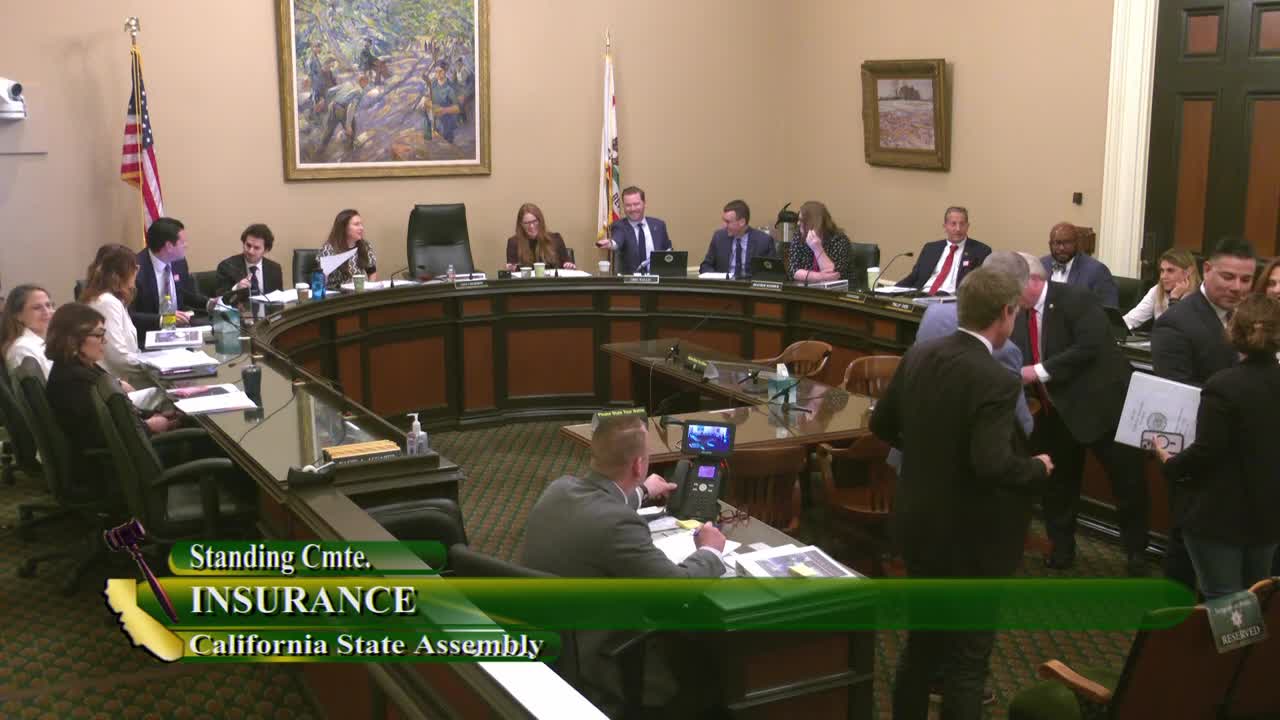
Bill Author