AB 750: Department of Housing and Community Development.
- Session Year: 2025-2026
- House: Assembly
- Latest Version Date: 2026-09-29
Current Status:
Passed
(2026-09-29: Chaptered by Secretary of State - Chapter 789, Statutes of 2026.)
Introduced
In Committee
Awaiting First Chamber Vote
Passed First Chamber
In Committee
Awaiting Second Chamber Vote
Passed Second Chamber
Enacted
Existing law authorizes the Department of Housing and Community Development, upon appropriation, to make loans or grants, or both loans and grants, to rehabilitate, capitalize operating subsidy reserves for, and extend the long-term affordability of department-funded housing projects that have an affordability restriction that has expired, that have an affordability restriction with a remaining term of less than 10 years, or are otherwise at risk of conversion to market-rate housing.
This bill would also authorize the department to make those loans and grants to rehabilitate, capitalize operating subsidy reserves for, and extend the long-term affordability of housing projects that qualify as a challenged development, as defined. The bill would require the department to grant priority for these loans and grants to housing projects that are department funded and have an affordability restriction that has expired or have a remaining term of less than 10 years, or are otherwise at risk for conversion, as defined. The bill would authorize the department to establish separate selection and underwriting standards for these projects and projects that are challenged developments. The bill would require, prior to allocating program funds, the department to evaluate the above-described developments to help inform program guidelines and allocation decisions. The bill would require the department to allocate at least 10% of funds of every round to challenged developments that are not department-funded, as specified.
Existing law authorizes the Department of Housing and Community Development, upon appropriation, to make loans or grants, or both loans and grants, to rehabilitate, capitalize operating subsidy reserves for, and extend the long-term affordability of department-funded housing projects that have an affordability restriction that has expired, that have an affordability restriction with a remaining term of less than 10 years, or are otherwise at risk of conversion to market-rate housing.
This bill would also authorize the department to make those loans and grants to rehabilitate, capitalize operating subsidy reserves for, and extend the long-term affordability of housing projects that qualify as a challenged development, as defined. The bill would require the department to grant priority for these loans and grants to housing projects that are department funded and have an affordability restriction that has expired or have a remaining term of less than 10 years, or are otherwise at risk for conversion. conversion, as defined. The bill would authorize the department to establish separate selection and underwriting standards for these projects and projects that are challenged developments. The bill would require, prior to allocating program funds, the department to evaluate the above-described developments to help inform program guidelines and allocation decisions. The bill would require the department to allocate a certain percentage at least 10% of funds of every round to challenged developments that are not department funded based on relative need and the availability of resources. department-funded, as specified.
Existing law authorizes the Department of Housing and Community Development, upon appropriation, to make loans or grants, or both loans and grants, to rehabilitate, capitalize operating subsidy reserves for, and extend the long-term affordability of department-funded housing projects that have an affordability restriction that has expired, that have an affordability restriction with a remaining term of less than 10 years, or are otherwise at risk of conversion to market-rate housing.
This bill would also authorize the department to make those loans and grants to rehabilitate, capitalize operating subsidy reserves for, and extend the long-term affordability of housing projects that qualify as a challenged development, as defined. The bill would require the department to grant priority for these loans and grants to housing projects that are department funded and have an affordability restriction that has expired or have a remaining term of less than 10 years, or are otherwise at risk for conversion. The bill would require, prior to allocating program funds, the department to evaluate the above-described developments to help inform program guidelines and allocation decisions. The bill would require the department to allocate a certain percentage of funds to challenged developments that are not department funded based on relative need and the availability of resources.
Existing law authorizes the Department of Housing and Community Development, upon appropriation, to make loans or grants, or both loans and grants, to rehabilitate, capitalize operating subsidy reserves for, and extend the long-term affordability of department-funded housing projects that have an affordability restriction that has expired, that have an affordability restriction with a remaining term of less than 10 years, or are otherwise at risk of conversion to market-rate housing.
This bill would also authorize the department to make those loans and grants to rehabilitate, capitalize operating subsidy reserves for, and extend the long-term affordability of housing projects that qualify as a challenged development, as defined. The bill would require the department to grant priority for these loans and grants to housing projects that are department funded and have an affordability restriction that has expired or have a remaining term of less than 10 years, or are otherwise at risk for conversion.
The State Housing Law, among other things, requires the Department of Housing and Community Development to adopt, amend, or repeal rules and regulations for the protection of the health, safety, and general welfare of the occupant and the public relating to specified residential structures, as provided, which apply throughout the state. Existing law requires the housing or building department of every city or county, or the health department if there is no building department, to enforce within its jurisdiction the provisions of the State Housing Law, building standards, and the other rules and regulations adopted by the department pertaining to the maintenance, sanitation, ventilation, use, or occupancy of apartment houses, hotels, or dwellings. Existing law authorizes an officer, employee, or agent of an enforcement agency to enter and inspect any building or premises whenever necessary to secure compliance with, or prevent a violation of, specified law, including the State Housing Law. A violation of the State Housing Law, or of the building standards or rules and regulations adopted pursuant to that law, is a misdemeanor.Existing law requires a city or county that receives a complaint from an occupant of a homeless shelter, as defined, or an agent of an occupant, alleging that a homeless shelter is substandard to inspect the homeless shelter, as specified. Existing law requires a city or county that determines a homeless shelter is substandard to issue a notice to correct the violation to the owner or operator of the homeless shelter, as specified. Existing law makes the owner or operator of a homeless shelter responsible for correcting any violation cited pursuant to these provisions.This bill would require a city or county to additionally perform an annual inspection of every homeless shelter located in its jurisdiction, as prescribed. The bill would authorize the above-described inspection or annual inspection to be announced or unannounced. The bill would require homeless shelters to prominently display notice of an occupants rights, the process for reporting a complaint alleging a homeless shelter is substandard, and prescribed information, including specified contact information. The bill would require the homeless shelter to provide the same notice in writing to new occupants upon intake.Existing law authorizes a city or county to impose additional civil penalties on an owner or operator that fails to correct a violation within the required time period. Existing law prohibits a city or county from awarding or distributing any state funding, as defined, to the owner or operator of a homeless shelter for purposes of operating the homeless shelter if, among other things, the owner or operator fails to correct a violation within the required time period. Existing law also authorizes legal action to enforce the requirements of these provisions, as specified.This bill would entitle a plaintiff who prevails in an above-described legal action to recover reasonable attorneys fees and costs. The bill would additionally authorize the Department of Housing and Community Development to bring a civil action to enforce these provisions.Existing law requires each city and county to annually submit a report that provides specified information relating to inspections of homeless shelters, including a list of owners or operators of homeless shelters who received 3 or more violations within any 6-month period. If there are no outstanding violations or violations corrected during the applicable period, existing law exempts a city or county from submitting that report. Existing law authorizes the Department of Housing and Community Development or the Business, Consumer Services, and Housing Agency to deem an owner or operator of a shelter ineligible for state funding, as defined, for shelter operations based on the information provided in the report.This bill would, instead, require a city or county to submit a report each year, regardless of whether the city or county received any complaints, and to include in its annual report the number of complaints received by the city or county that year, including if the city or county did not receive any complaints. The bill would require the department to withhold state funding from a city or county that fails to comply with its reporting requirements or fails to take action to correct a violation by a homeless shelter.By adding to the duties of local officials with respect to enforcement of the State Housing Law, the violation of which is a crime, this bill would impose a state-mandated local program.The California Constitution requires the state to reimburse local agencies and school districts for certain costs mandated by the state. Statutory provisions establish procedures for making that reimbursement.This bill would provide that with regard to certain mandates no reimbursement is required by this act for a specified reason.With regard to any other mandates, this bill would provide that, if the Commission on State Mandates determines that the bill contains costs so mandated by the state, reimbursement for those costs shall be made pursuant to the statutory provisions noted above.The State Housing Law, among other things, requires the Department of Housing and Community Development to adopt, amend, or repeal rules and regulations for the protection of the health, safety, and general welfare of the occupant and the public relating to specified residential structures, as provided, which apply throughout the state. Existing law requires the housing or building department of every city or county, or the health department if there is no building department, to enforce within its jurisdiction the provisions of the State Housing Law, building standards, and the other rules and regulations adopted by the department pertaining to the maintenance, sanitation, ventilation, use, or occupancy of apartment houses, hotels, or dwellings. Existing law authorizes an officer, employee, or agent of an enforcement agency to enter and inspect any building or premises whenever necessary to secure compliance with, or prevent a violation of, specified law, including the State Housing Law. A violation of the State Housing Law, or of the building standards or rules and regulations adopted pursuant to that law, is a misdemeanor.
Existing law requires a city or county that receives a complaint from an occupant of a homeless shelter, as defined, or an agent of an occupant, alleging that a homeless shelter is substandard to inspect the homeless shelter, as specified. Existing law requires a city or county that determines a homeless shelter is substandard to issue a notice to correct the violation to the owner or operator of the homeless shelter, as specified. Existing law makes the owner or operator of a homeless shelter responsible for correcting any violation cited pursuant to these provisions.
This bill would require a city or county to additionally perform an annual inspection of every homeless shelter located in its jurisdiction. jurisdiction, as prescribed. The bill would authorize the above-described inspection or annual inspection to be announced or unannounced. The bill would require homeless shelters to prominently display notice of an occupants rights, the process for reporting a complaint alleging a homeless shelter is substandard, and prescribed information, including specified contact information. The bill would require the homeless shelter to provide the same notice in writing to new occupants upon intake.
Existing law authorizes a city or county to impose additional civil penalties on an owner or operator that fails to correct a violation within the required time period. Existing law prohibits a city or county from awarding or distributing any state funding, as defined, to the owner or operator of a homeless shelter for purposes of operating the homeless shelter if, among other things, the owner or operator fails to correct a violation within the required time period. Existing law also authorizes legal action to enforce the requirements of these provisions, as specified.
This bill would entitle a plaintiff who prevails in an above-described legal action to recover reasonable attorneys fees and costs. The bill would additionally authorize the Department of Housing and Community Development to bring a civil action to enforce these provisions.
Existing law requires each city and county to annually submit a report that provides specified information relating to inspections of homeless shelters, including a list of owners or operators of homeless shelters who received 3 or more violations within any 6-month period. If there are no outstanding violations or violations corrected during the applicable period, existing law exempts a city or county from submitting that report. Existing law authorizes the Department of Housing and Community Development or the Business, Consumer Services, and Housing Agency to deem an owner or operator of a shelter ineligible for state funding, as defined, for shelter operations based on the information provided in the report.
This bill would, instead, require a city or county to submit a report each year, regardless of whether the city or county received any complaints, and to include in its annual report the number of complaints received by the city or county that year, including if the city or county did not receive any complaints. The bill would require the department to withhold state funding from a city or county that fails to comply with its reporting requirements or fails to take action to correct a violation by a homeless shelter.
By adding to the duties of local officials with respect to enforcement of the State Housing Law, the violation of which is a crime, this bill would impose a state-mandated local program.
The California Constitution requires the state to reimburse local agencies and school districts for certain costs mandated by the state. Statutory provisions establish procedures for making that reimbursement.
This bill would provide that with regard to certain mandates no reimbursement is required by this act for a specified reason.
With regard to any other mandates, this bill would provide that, if the Commission on State Mandates determines that the bill contains costs so mandated by the state, reimbursement for those costs shall be made pursuant to the statutory provisions noted above.
The State Housing Law, among other things, requires the Department of Housing and Community Development to adopt, amend, or repeal rules and regulations for the protection of the health, safety, and general welfare of the occupant and the public relating to specified residential structures, as provided, which apply throughout the state. Existing law requires the housing or building department of every city or county, or the health department if there is no building department, to enforce within its jurisdiction the provisions of the State Housing Law, building standards, and the other rules and regulations adopted by the department pertaining to the maintenance, sanitation, ventilation, use, or occupancy of apartment houses, hotels, or dwellings. Existing law authorizes an officer, employee, or agent of an enforcement agency to enter and inspect any building or premises whenever necessary to secure compliance with, or prevent a violation of, specified law, including the State Housing Law. A violation of the State Housing Law, or of the building standards or rules and regulations adopted pursuant to that law, is a misdemeanor.
Existing law requires a city or county that receives a complaint from an occupant of a homeless shelter, as defined, or an agent of an occupant, alleging that a homeless shelter is substandard to inspect the homeless shelter, as specified. Existing law requires a city or county that determines a homeless shelter is substandard to issue a notice to correct the violation to the owner or operator of the homeless shelter, as specified. Existing law makes the owner or operator of a homeless shelter responsible for correcting any violation cited pursuant to these provisions.
This bill would require a city or county to additionally perform an annual inspection of every homeless shelter located in its jurisdiction. The bill would authorize the above-described inspection or annual inspection to be announced or unannounced. The bill would require homeless shelters to prominently display notice of an occupants rights, the process for reporting a complaint alleging a homeless shelter is substandard, and prescribed information, including specified contact information. The bill would require the homeless shelter to provide the same notice in writing to new occupants upon intake.
Existing law authorizes a city or county to impose additional civil penalties on an owner or operator that fails to correct a violation within the required time period. Existing law prohibits a city or county from awarding or distributing any state funding, as defined, to the owner or operator of a homeless shelter for purposes of operating the homeless shelter if, among other things, the owner or operator fails to correct a violation within the required time period. Existing law also authorizes legal action to enforce the requirements of these provisions, as specified.
This bill would entitle a plaintiff who prevails in an above-described legal action to recover reasonable attorneys fees and costs. The bill would additionally authorize the Department of Housing and Community Development to bring an a civil action to enforce these provisions.
Existing law requires each city and county to annually submit a report that provides specified information relating to inspections of homeless shelters, including a list of owners or operators of homeless shelters who received 3 or more violations within any 6-month period. If there are no outstanding violations or violations corrected during the applicable period, existing law exempts a city or county from submitting that report. Existing law authorizes the Department of Housing and Community Development or the Business, Consumer Services, and Housing Agency to deem an owner or operator of a shelter ineligible for state funding, as defined, for shelter operations based on the information provided in the report.
This bill would, instead, require a city or county to submit a report each year, regardless of whether the city or county received any complaints, and to include in its annual report the number of complaints received by the city or county that year, including if the city or county did not receive any complaints. The bill would require the department to withhold state funding from a city or county that fails to comply with its reporting requirements or fails to take action to correct a violation by a homeless shelter.
By adding to the duties of local officials with respect to enforcement of the State Housing Law, the violation of which is a crime, this bill would impose a state-mandated local program.
The California Constitution requires the state to reimburse local agencies and school districts for certain costs mandated by the state. Statutory provisions establish procedures for making that reimbursement.
This bill would provide that with regard to certain mandates no reimbursement is required by this act for a specified reason.
With regard to any other mandates, this bill would provide that, if the Commission on State Mandates determines that the bill contains costs so mandated by the state, reimbursement for those costs shall be made pursuant to the statutory provisions noted above.
The State Housing Law, among other things, requires the Department of Housing and Community Development to adopt, amend, or repeal rules and regulations for the protection of the health, safety, and general welfare of the occupant and the public relating to specified residential structures, as provided, which apply throughout the state. Existing law requires the housing or building department of every city or county, or the health department if there is no building department, to enforce within its jurisdiction the provisions of the State Housing Law, building standards, and the other rules and regulations adopted by the department pertaining to the maintenance, sanitation, ventilation, use, or occupancy of apartment houses, hotels, or dwellings. Existing law authorizes an officer, employee, or agent of an enforcement agency to enter and inspect any building or premises whenever necessary to secure compliance with, or prevent a violation of, specified law, including the State Housing Law. A violation of the State Housing Law, or of the building standards or rules and regulations adopted pursuant to that law, is a misdemeanor.
Existing law requires a city or county that receives a complaint from an occupant of a homeless shelter, as defined, or an agent of an occupant, alleging that a homeless shelter is substandard to inspect the homeless shelter, as specified. Existing law requires a city or county that determines a homeless shelter is substandard to issue a notice to correct the violation to the owner or operator of the homeless shelter, as specified. Existing law makes the owner or operator of a homeless shelter responsible for correcting any violation cited pursuant to these provisions.
This bill would require a city or county to additionally perform an annual inspection of every homeless shelter located in its jurisdiction. The bill would authorize the above-described inspection or annual inspection to be announced or unannounced. The bill would require homeless shelters to prominently display notice of an occupants rights, the process for reporting a complaint alleging a homeless shelter is substandard, and prescribed information, including specified contact information. The bill would require the homeless shelter to provide the same notice in writing to new occupants upon intake.
Existing law authorizes a city or county to impose additional civil penalties on an owner or operator that fails to correct a violation within the required time period. Existing law prohibits a city or county from awarding or distributing any state funding, as defined, to the owner or operator of a homeless shelter for purposes of operating the homeless shelter if, among other things, the owner or operator fails to correct a violation within the required time period. Existing law also authorizes legal action to enforce the requirements of these provisions, as specified.
This bill would additionally authorize the Department of Housing and Community Development to bring an action to enforce these provisions.
Existing law requires each city and county to annually submit a report that provides specified information relating to inspections of homeless shelters, including a list of owners or operators of homeless shelters who received 3 or more violations within any 6-month period. If there are no outstanding violations or violations corrected during the applicable period, existing law exempts a city or county from submitting that report. Existing law authorizes the Department of Housing and Community Development or the Business, Consumer Services, and Housing Agency to deem an owner or operator of a shelter ineligible for state funding, as defined, for shelter operations based on the information provided in the report.
This bill would, instead, require a city or county to submit a report each year, regardless of whether the city or county received any complaints, and to include in its annual report the number of complaints received by the city or county that year, including if the city or county did not receive any complaints. The bill would require the department to withhold state funding from a city or county that fails to comply with its reporting requirements or fails to take action to correct a violation by a homeless shelter.
By adding to the duties of local officials with respect to enforcement of the State Housing Law, the violation of which is a crime, this bill would impose a state-mandated local program.
The California Constitution requires the state to reimburse local agencies and school districts for certain costs mandated by the state. Statutory provisions establish procedures for making that reimbursement.
This bill would provide that with regard to certain mandates no reimbursement is required by this act for a specified reason.
With regard to any other mandates, this bill would provide that, if the Commission on State Mandates determines that the bill contains costs so mandated by the state, reimbursement for those costs shall be made pursuant to the statutory provisions noted above.
(a)(1)Upon appropriation by the Legislature for purposes of this chapter, the department may make loans or grants, or both loans and grants, to rehabilitate, capitalize operating subsidy or replacement reserves for, and extend the long-term affordability of housing projects that meet either of the following criteria:
(A)The housing project is department funded and has an affordability restriction that has expired or has a remaining term of less than 10 years, or is otherwise at risk of conversion.
(B)The housing project is a challenged development, as defined in subdivision (f).
(2)The department shall grant priority to developments that meet the requirements described in subparagraph (A) of paragraph (1).
(3)The department shall allow developments financed pursuant to this chapter to layer program funds with other federal, state, and local resources.
(4)Prior to allocating program funds, the department shall evaluate and analyze the preservation and rehabilitation needs of department-funded developments that meet the requirements described in subparagraphs (A) and (B) of paragraph (1) to help inform program guidelines and allocation decisions.
(5)The department shall allocate at least 10 percent of funds of every round to challenged developments that are not department funded. The department may allocate a higher percentage of funds to challenged developments that are not department funded depending on overall application demand for and the availability of Portfolio Reinvestment Program resources under this chapter. The department may allocate a portion of the 10 percent to department-funded projects if the number of applications for funding from nondepartment-funded developments is not sufficient.
(6)The department may establish separate selection and underwriting standards for developments that meet the requirements described in subparagraphs (A) and (B) of paragraph (1).
(b)Notwithstanding any other law, if the department makes a loan or grant pursuant to this chapter to a project that has an existing loan issued by the department for a multifamily housing project, the department may additionally approve an extension of the existing loan, the reinstatement of a qualifying unpaid matured loan, the subordination of a loan made by the department to new indebtedness, or an investment of tax credit equity for purposes of funding necessary rehabilitation and extending the affordability of the project without complying with the requirements of Chapter 3.9 (commencing with Section 50560). The department may also forgive some or all of the accrued interest on the existing department loan if necessary to facilitate the departments new rehabilitation loan.
(c)The department may establish loan processing or transaction fees for loans or grants authorized by this chapter, as necessary, in an amount not to exceed the amount necessary to generate sufficient revenue to cover the cost of processing loan transactions under this chapter. However, the department may waive fees to the extent necessary for project feasibility.
(d)The department may charge a monitoring fee in lieu of the required 0.42 percent per annum loan payments required by subdivision (a) of Section 50608. The department may capitalize fees authorized by this subdivision, at its discretion, as necessary to ensure the financial feasibility and long-term affordability of the project. All moneys set aside by the department to capitalize a monitoring fee pursuant to this subdivision shall be deposited in the Housing Rehabilitation Loan Fund and, notwithstanding Section 13340 of the Government Code, are continuously appropriated to the department for the purposes of the default reserve set forth in Section 50609.
(e)The department may adopt guidelines to implement this chapter. Any guidelines adopted pursuant to this section are hereby exempted from the rulemaking provisions of the Administrative Procedure Act (Chapter 3.5 (commencing with Section 11340) of Part 1 of Division 3 of Title 2 of the Government Code).
(f)For purposes of this chapter:
(1)Challenged development means a development that meets all of the following criteria:
(A)The development is at least 15 years old.
(B)The development either:
(i)Serves households of low, very low income, or extremely low income, pursuant to an existing regulatory agreement with a federal, state, county, local, or other governmental agency.
(ii)Is financed under Section 514 or 521 of the National Housing Act of 1949 (42 U.S.C. Sec. 1485).
(C)The development has insufficient access to private or other public resources to complete substantial rehabilitation, as determined by the department.
(D)The development has an affordability restriction that has expired, has a remaining term of less than 10 years, or is otherwise at risk of conversion to unrestricted use.
(2)At risk of conversion may include, but is not limited to, all of the following:
(A)Risk of default, foreclosure, sale, receivership, or other circumstances that could result in the loss of affordability.
(B)Physical obsolescence or significant physical or life safety deficiencies.
(C)Significant vacancy resulting in sustained negative cash flow for three or more consecutive years.
(D)A demonstrated need for financial support to maintain the physical and financial integrity of the property and prevent the loss of affordability.
(a)(1)Upon appropriation by the Legislature for purposes of this chapter, the department may make loans or grants, or both loans and grants, to rehabilitate, capitalize operating subsidy or replacement reserves for, and extend the long-term affordability of housing projects that meet either of the following criteria:
(A)The housing project is department funded and has an affordability restriction that has expired or has a remaining term of less than 10 years, or is otherwise at risk for of conversion.
(B)The housing project is a challenged development, as defined in subdivision (f).
(2)The department shall grant priority to developments that meet the requirements described in subparagraph (A) of paragraph (1).
(3)The department shall allow developments financed pursuant to this chapter to layer program funds with other federal, state, and local resources.
(4)Prior to allocating program funds, the department shall evaluate and analyze the preservation and rehabilitation needs of department-funded developments that meet the requirements described in subparagraphs (A) and (B) of paragraph (1) to help inform program guidelines and allocation decisions.
(5)The department shall allocate a certain percentage of funds to challenged developments that are not department-funded based on relative need and the availability of resources. at least 10 percent of funds of every round to challenged developments that are not department funded. The department may allocate a higher percentage of funds to challenged developments that are not department funded depending on overall application demand for and the availability of Portfolio Reinvestment Program resources under this chapter. The department may allocate a portion of the 10 percent to department-funded projects if the number of applications for funding from nondepartment-funded developments is not sufficient.
(6)The department may establish separate selection and underwriting standards for developments that meet the requirements described in subparagraphs (A) and (B) of paragraph (1).
(b)Notwithstanding any other law, if the department makes a loan or grant pursuant to this chapter to a project that has an existing loan issued by the department for a multifamily housing project, the department may additionally approve an extension of the existing loan, the reinstatement of a qualifying unpaid matured loan, the subordination of a loan made by the department to new indebtedness, or an investment of tax credit equity for purposes of funding necessary rehabilitation and extending the affordability of the project without complying with the requirements of Chapter 3.9 (commencing with Section 50560). The department may also forgive some or all of the accrued interest on the existing department loan if necessary to facilitate the departments new rehabilitation loan.
(c)The department may establish loan processing or transaction fees for loans or grants authorized by this chapter, as necessary, in an amount not to exceed the amount necessary to generate sufficient revenue to cover the cost of processing loan transactions under this chapter. However, the department may waive fees to the extent necessary for project feasibility.
(d)The department may charge a monitoring fee in lieu of the required 0.42 percent per annum loan payments required by subdivision (a) of Section 50608. The department may capitalize fees authorized by this subdivision, at its discretion, as necessary to ensure the financial feasibility and long-term affordability of the project. All moneys set aside by the department to capitalize a monitoring fee pursuant to this subdivision shall be deposited in the Housing Rehabilitation Loan Fund and, notwithstanding Section 13340 of the Government Code, are continuously appropriated to the department for the purposes of the default reserve set forth in Section 50609.
(e)The department may adopt guidelines to implement this chapter. Any guidelines adopted pursuant to this section are hereby exempted from the rulemaking provisions of the Administrative Procedure Act (Chapter 3.5 (commencing with Section 11340) of Part 1 of Division 3 of Title 2 of the Government Code).
(f)For purposes of this chapter, challenged chapter:
(1)Challenged development means a development that meets all of the following criteria:
(1)(A)The development is at least 15 years old.
(2)(B)The development either:
(A)(i)Serves households of low, very low income income, or extremely low income, such that the average maximum household income as restricted, pursuant to an existing regulatory agreement with a federal, state, county, local, or other governmental agency, is not more than 45 percent of the area median gross income, as determined under Section 42 of the Internal Revenue Code, relating to low-income housing credit, adjusted by household size. agency.
(B)(ii)Is financed under Section 514 or 521 of the National Housing Act of 1949 (42 U.S.C. Sec. 1485).
(3)(C)The development has insufficient access to private or other public resources to complete substantial rehabilitation, as determined by the department.
(D)The development has an affordability restriction that has expired, has a remaining term of less than 10 years, or is otherwise at risk of conversion to unrestricted use.
(2)At risk of conversion may include, but is not limited to, all of the following:
(A)Risk of default, foreclosure, sale, receivership, or other circumstances that could result in the loss of affordability.
(B)Physical obsolescence or significant physical or life safety deficiencies.
(C)Significant vacancy resulting in sustained negative cash flow for three or more consecutive years.
(D)A demonstrated need for financial support to maintain the physical and financial integrity of the property and prevent the loss of affordability.
(a)(1)Upon appropriation by the Legislature for purposes of this chapter, the department may make loans or grants, or both loans and grants, to rehabilitate, capitalize operating subsidy or replacement reserves for, and extend the long-term affordability of housing projects that meet either of the following criteria:
(A)The housing project is department funded and has an affordability restriction that has expired or has a remaining term of less than 10 years, or is otherwise at risk for conversion.
(B)The housing project is a challenged development, as defined in subdivision (f).
(2)The department shall grant priority to developments that meet the requirements described in subparagraph (A) of paragraph (1).
(3)The department shall allow developments financed pursuant to this chapter to layer program funds with other federal, state, and local resources.
(4)Prior to allocating program funds, the department shall evaluate and analyze the preservation and rehabilitation needs of department-funded developments that meet the requirements described in subparagraphs (A) and (B) of paragraph (1) to help inform program guidelines and allocation decisions.
(5)The department shall allocate a certain percentage of funds to challenged developments that are not department-funded based on relative need and the availability of resources.
(b)Notwithstanding any other law, if the department makes a loan or grant pursuant to this chapter to a project that has an existing loan issued by the department for a multifamily housing project, the department may additionally approve an extension of the existing loan, the reinstatement of a qualifying unpaid matured loan, the subordination of a loan made by the department to new indebtedness, or an investment of tax credit equity for purposes of funding necessary rehabilitation and extending the affordability of the project without complying with the requirements of Chapter 3.9 (commencing with Section 50560). The department may also forgive some or all of the accrued interest on the existing department loan if necessary to facilitate the departments new rehabilitation loan.
(c)The department may establish loan processing or transaction fees for loans or grants authorized by this chapter, as necessary, in an amount not to exceed the amount necessary to generate sufficient revenue to cover the cost of processing loan transactions under this chapter. However, the department may waive fees to the extent necessary for project feasibility.
(d)The department may charge a monitoring fee in lieu of the required 0.42 percent per annum loan payments required by subdivision (a) of Section 50608. The department may capitalize fees authorized by this subdivision, at its discretion, as necessary to ensure the financial feasibility and long-term affordability of the project. All moneys set aside by the department to capitalize a monitoring fee pursuant to this subdivision shall be deposited in the Housing Rehabilitation Loan Fund and, notwithstanding Section 13340 of the Government Code, are continuously appropriated to the department for the purposes of the default reserve set forth in Section 50609.
(e)The department may adopt guidelines to implement this chapter. Any guidelines adopted pursuant to this section are hereby exempted from the rulemaking provisions of the Administrative Procedure Act (Chapter 3.5 (commencing with Section 11340) of Part 1 of Division 3 of Title 2 of the Government Code).
(f)For purposes of this chapter, challenged development means a development that meets all of the following criteria:
(1)The development is at least 15 years old.
(2)The development either:
(A)Serves households of very low income or extremely low income, such that the average maximum household income as restricted, pursuant to an existing regulatory agreement with a federal, state, county, local, or other governmental agency, is not more than 45 percent of the area median gross income, as determined under Section 42 of the Internal Revenue Code, relating to low-income housing credit, adjusted by household size.
(B)Is financed under Section 514 or 521 of the National Housing Act of 1949 (42 U.S.C. Sec. 1485).
(3)The development has insufficient access to private or other public resources to complete substantial rehabilitation, as determined by the department.
(a)(1)Upon appropriation by the Legislature for purposes of this chapter, the department may make loans or grants, or both loans and grants, to rehabilitate, capitalize operating subsidy or replacement reserves for, and extend the long-term affordability of department-funded housing projects that have meet either of the following criteria:
(A)The housing project is department funded and has an affordability restriction that has expired, that have an affordability restriction with expired or has a remaining term of less than 10 years, or are is otherwise at risk for conversion.
(B)The housing project is a challenged development, as defined in subdivision (f).
(2)The department shall grant priority to developments that meet the requirements described in subparagraph (A) of paragraph (1).
(3)The department shall allow developments financed pursuant to this chapter to layer program funds with other federal, state, and local resources.
(b)Notwithstanding any other law, if the department makes a loan or grant pursuant to this chapter to a project that has an existing loan issued by the department for a multifamily housing project, the department may additionally approve an extension of the existing loan, the reinstatement of a qualifying unpaid matured loan, the subordination of a loan made by the department to new indebtedness, or an investment of tax credit equity for purposes of funding necessary rehabilitation and extending the affordability of the project without complying with the requirements of Chapter 3.9 (commencing with Section 50560). The department may also forgive some or all of the accrued interest on the existing department loan if necessary to facilitate the departments new rehabilitation loan.
(c)The department may establish loan processing or transaction fees for loans or grants authorized by this chapter, as necessary, in an amount not to exceed the amount necessary to generate sufficient revenue to cover the cost of processing loan transactions under this chapter. However, the department may waive fees to the extent necessary for project feasibility.
(d)The department may charge a monitoring fee in lieu of the required 0.42 percent per annum loan payments required by subdivision (a) of Section 50608. The department may capitalize fees authorized by this subdivision, at its discretion, as necessary to ensure the financial feasibility and long-term affordability of the project. All moneys set aside by the department to capitalize a monitoring fee pursuant to this subdivision shall be deposited in the Housing Rehabilitation Loan Fund and, notwithstanding Section 13340 of the Government Code, are continuously appropriated to the department for the purposes of the default reserve set forth in Section 50609.
(e)The department may adopt guidelines to implement this chapter. Any guidelines adopted pursuant to this section are hereby exempted from the rulemaking provisions of the Administrative Procedure Act (Chapter 3.5 (commencing with Section 11340) of Part 1 of Division 3 of Title 2 of the Government Code).
(f)For purposes of this chapter, challenged development means a development that meets all of the following criteria:
(1)The development is at least 15 years old.
(2)The development either:
(A)Serves households of very low income or extremely low income, such that the average maximum household income as restricted, pursuant to an existing regulatory agreement with a federal, state, county, local, or other governmental agency, is not more than 45 percent of the area median gross income, as determined under Section 42 of the Internal Revenue Code, relating to low-income housing credit, adjusted by household size.
(B)Is financed under Section 514 or 521 of the National Housing Act of 1949 (42 U.S.C. Sec. 1485).
(3)The development has insufficient access to private or other public resources to complete substantial rehabilitation, as determined by the department.
SECTION 1.Section 17974.1 of the Health and Safety Code is amended to read:17974.1.(a)Notwithstanding any other provision of this part, a city or county that receives a complaint from an occupant of a homeless shelter, or an agent of an occupant, that alleges a homeless shelter is substandard pursuant to Section 17920.3 shall do all of the following:(1)Inspect the homeless shelter or portion thereof intended for human occupancy that may be substandard pursuant to Section 17920.3.(2)Identify whether the homeless shelter or any portion thereof intended for human occupancy is substandard pursuant to Section 17920.3, as applicable. The documentation shall be included in the inspection report described in subdivision (h).(3)As applicable, advise the owner or operator of a homeless shelter of each violation and of each action that is required to be taken to remedy the violation. The city or county shall schedule a reinspection to verify correction of the violations.(b)Notwithstanding any other provision of this part, and consistent with Section 17970, a city or county shall perform an annual inspection on every homeless shelter located in its jurisdiction to ensure that the homeless shelter is compliant with this part. A city or county conducting an inspection pursuant to this subdivision shall comply with this section, to the extent those provisions are applicable.(c)(1)If, upon inspection, the city or county determines that a homeless shelter is substandard pursuant to Section 17920.3, the city or county shall promptly, but not later than 10 business days after the city or county completes the inspection, issue a notice to correct the violation to the owner or operator of the homeless shelter.(2)In the event that the city or county determines that a violation constitutes an imminent threat to the health and safety of the occupants of the homeless shelter, the notice of violation shall be issued immediately and served on the owner or operator of the homeless shelter.(3)In the event that the city or county determines that deficiencies, violations, or conditions exist at a homeless shelter that are dangerous, hazardous, imminently detrimental to life or health, or otherwise render the homeless shelter unfit for human habitation, the city or county may issue an emergency order directing the owner or operator to take immediate measures to rectify those deficiencies, violations, or conditions.(d)An inspection conducted pursuant to this section may be announced or unannounced.(e)The city or county shall maintain all records on file of each homeless shelter inspection. These records shall be made available to the public for inspection.(f)A city or county shall perform an inspection conducted pursuant to subdivision (a) at least as promptly as that city or county conducts an inspection in response to a request for final inspection pursuant to Section 110 of Part 2 of Division 2 of Chapter 1 of the California Building Code (Part 2 of Title 24 of the California Code of Regulations).(g)Notwithstanding subdivision (a), a city or county is not required to conduct an inspection in response to either of the following:(1)A complaint that does not allege one or more substandard conditions.(2)A complaint submitted by a tenant, resident, or occupant who, within the past 180 days, submitted a complaint about the same property that the chief building inspector or their designee reasonably determined, after inspection, was frivolous or unfounded.(h)A city or county shall provide free, certified copies of an inspection report and citations issued pursuant to this section, if any, to the complaining occupant or their agent. If the inspection reveals a condition potentially affecting multiple occupants, including, but not limited to, conditions relating to the premises, common areas, or structural features, then the city or county shall provide free copies of the inspection report and citations issued to all potentially affected occupants or their agents.(i)A city or county shall not unreasonably refuse to communicate with an occupant or the agent of an occupant regarding any matter covered by this article.(j)A city or county shall conduct an inspection pursuant to this section based on the location of the homeless shelter, in accordance with the following:(1)A city shall conduct an inspection for shelters within the citys jurisdiction.(2)A county shall conduct an inspection for shelters within the countys jurisdiction. (3)A city with a population under 100,000 may partner with its county to conduct an inspection pursuant to this section.SEC. 2.Section 17974.1.5 is added to the Health and Safety Code, to read:17974.1.5.(a)A homeless shelter shall prominently display at the shelter information about an occupants rights and the process for reporting a complaint alleging a homeless shelter is substandard pursuant to Section 17920.3, including the contact information for all of the following:(1)The owner or operator of the homeless shelter.(2)The city or county.(3)The department.(b)A homeless shelter shall provide in writing the notice specified in subdivision (a) to any new occupant during intake.SEC. 3.Section 17974.3 of the Health and Safety Code is amended to read:17974.3.(a)The requirements of this article shall not be construed to impose a mandatory duty pursuant to Section 815.6 of the Government Code, and shall not be construed to affect the availability of any immunity otherwise applicable to the city or county or its employees, including, but not limited to, Sections 818.2, 818.4, 818.6, 820.2, 821, 821.2, and 821.4 of the Government Code.(b)(1)An action to enforce the requirements of this article may be brought pursuant to Section 1085 of the Code of Civil Procedure.(2)A plaintiff who prevails in an action described in paragraph (1) shall be entitled to recover reasonable attorneys fees and costs.(3)Notwithstanding any other law, including any provision of this part authorizing the department to enforce this part by means of administrative enforcement, the department may bring a civil action pursuant to this subdivision in order to enforce this part.(c)For purposes of Section 1085 of the Code of Civil Procedure, the requirements of this article shall be construed as acts that the law specially enjoins, as a duty resulting from an office, trust, or station.SEC. 4.Section 17974.5 of the Health and Safety Code is amended to read:17974.5.(a)Each city and each county shall submit a report annually to the department and the state agency by April 1 of each year that includes all of the following information:(1)The number of complaints received by the city or county, pursuant to Section 17920.3, including if the city or county did not receive any complaints.(2)Any pending uncorrected violations determined by the city or county, pursuant to Section 17974.1.(3)Any determinations by the city or county that conditions exist or existed that make or made the homeless shelter dangerous, hazardous, imminently detrimental to life or health, or otherwise render the homeless shelter unfit for human habitation.(4)A list of any emergency orders issued pursuant to paragraph (3) of subdivision (c) of Section 17974.1.(5)A list of any owners or operators who received three or more violations within any six-month period.(6)Any corrected violations from the prior year.(b)The report submitted pursuant to subdivision (a) shall be submitted in compliance with Section 9795 of the Government Code.(c)If a city or county applies for state funding to support the ongoing operations of a homeless shelter, the city or county shall disclose to the state agency that administers the state funding the status of any unresolved violations pursuant to this article and the names of the homeless shelter owner or operator.(d)The department or the state agency, may, pursuant to the reported information in subdivision (b), deem an owner or operator of a shelter ineligible for state funding for shelter operations.(e)The department shall withhold state funding from a city or county that fails to comply with the reporting requirements in this section or fails to take action to correct a violation of this article by a homeless shelter pursuant to Section 17974.4.SEC. 5.No reimbursement is required by this act pursuant to Section 6 of Article XIIIB of the California Constitution for certain costs that may be incurred by a local agency or school district because, in that regard, this act creates a new crime or infraction, eliminates a crime or infraction, or changes the penalty for a crime or infraction, within the meaning of Section 17556 of the Government Code, or changes the definition of a crime within the meaning of Section 6 of Article XIIIB of the California Constitution.However, if the Commission on State Mandates determines that this act contains other costs mandated by the state, reimbursement to local agencies and school districts for those costs shall be made pursuant to Part 7 (commencing with Section 17500) of Division 4 of Title 2 of the Government Code.(a)Notwithstanding any other provision of this part, a city or county that receives a complaint from an occupant of a homeless shelter, or an agent of an occupant, that alleges a homeless shelter is substandard pursuant to Section 17920.3 shall do all of the following:
(1)Inspect the homeless shelter or portion thereof intended for human occupancy that may be substandard pursuant to Section 17920.3.
(2)Identify whether the homeless shelter or any portion thereof intended for human occupancy is substandard pursuant to Section 17920.3, as applicable. The documentation shall be included in the inspection report described in subdivision (h).
(3)As applicable, advise the owner or operator of a homeless shelter of each violation and of each action that is required to be taken to remedy the violation. The city or county shall schedule a reinspection to verify correction of the violations.
(b)Notwithstanding any other provision of this part, and consistent with Section 17970, a city or county shall perform an annual inspection on every homeless shelter located in its jurisdiction to ensure that the homeless shelter is compliant with this part. A city or county conducting an inspection pursuant to this subdivision shall comply with this section, to the extent those provisions are applicable.
(c)(1)If, upon inspection, the city or county determines that a homeless shelter is substandard pursuant to Section 17920.3, the city or county shall promptly, but not later than 10 business days after the city or county completes the inspection, issue a notice to correct the violation to the owner or operator of the homeless shelter.
(2)In the event that the city or county determines that a violation constitutes an imminent threat to the health and safety of the occupants of the homeless shelter, the notice of violation shall be issued immediately and served on the owner or operator of the homeless shelter.
(3)In the event that the city or county determines that deficiencies, violations, or conditions exist at a homeless shelter that are dangerous, hazardous, imminently detrimental to life or health, or otherwise render the homeless shelter unfit for human habitation, the city or county may issue an emergency order directing the owner or operator to take immediate measures to rectify those deficiencies, violations, or conditions.
(d)An inspection conducted pursuant to this section may be announced or unannounced.
(e)The city or county shall maintain all records on file of each homeless shelter inspection. These records shall be made available to the public for inspection.
(f)A city or county shall perform an inspection conducted pursuant to subdivision (a) at least as promptly as that city or county conducts an inspection in response to a request for final inspection pursuant to Section 110 of Part 2 of Division 2 of Chapter 1 of the California Building Code (Part 2 of Title 24 of the California Code of Regulations).
(g)Notwithstanding subdivision (a), a city or county is not required to conduct an inspection in response to either of the following:
(1)A complaint that does not allege one or more substandard conditions.
(2)A complaint submitted by a tenant, resident, or occupant who, within the past 180 days, submitted a complaint about the same property that the chief building inspector or their designee reasonably determined, after inspection, was frivolous or unfounded.
(h)A city or county shall provide free, certified copies of an inspection report and citations issued pursuant to this section, if any, to the complaining occupant or their agent. If the inspection reveals a condition potentially affecting multiple occupants, including, but not limited to, conditions relating to the premises, common areas, or structural features, then the city or county shall provide free copies of the inspection report and citations issued to all potentially affected occupants or their agents.
(i)A city or county shall not unreasonably refuse to communicate with an occupant or the agent of an occupant regarding any matter covered by this article.
(j)A city or county shall conduct an inspection pursuant to this section based on the location of the homeless shelter, in accordance with the following:
(1)A city shall conduct an inspection for shelters within the citys jurisdiction.
(2)A county shall conduct an inspection for shelters within the countys jurisdiction.
(3)A city with a population under 100,000 may partner with its county to conduct an inspection pursuant to this section.
SEC. 2.Section 17974.1.5 is added to the Health and Safety Code, to read:17974.1.5.(a)A homeless shelter shall prominently display at the shelter information about an occupants rights and the process for reporting a complaint alleging a homeless shelter is substandard pursuant to Section 17920.3, including the contact information for all of the following:
(1)The owner or operator of the homeless shelter.
(2)The city or county.
(3)The department.
(b)A homeless shelter shall provide in writing the notice specified in subdivision (a) to any new occupant during intake.
SEC. 3.Section 17974.3 of the Health and Safety Code is amended to read:17974.3.(a)The requirements of this article shall not be construed to impose a mandatory duty pursuant to Section 815.6 of the Government Code, and shall not be construed to affect the availability of any immunity otherwise applicable to the city or county or its employees, including, but not limited to, Sections 818.2, 818.4, 818.6, 820.2, 821, 821.2, and 821.4 of the Government Code.
(b)(1)An action to enforce the requirements of this article may be brought pursuant to Section 1085 of the Code of Civil Procedure.
(2)A plaintiff who prevails in an action described in paragraph (1) shall be entitled to recover reasonable attorneys fees and costs.
(3)Notwithstanding any other law, including any provision of this part authorizing the department to enforce this part by means of administrative enforcement, the department may bring a civil action pursuant to this subdivision in order to enforce this part.
(c)For purposes of Section 1085 of the Code of Civil Procedure, the requirements of this article shall be construed as acts that the law specially enjoins, as a duty resulting from an office, trust, or station.
SEC. 4.Section 17974.5 of the Health and Safety Code is amended to read:17974.5.(a)Each city and each county shall submit a report annually to the department and the state agency by April 1 of each year that includes all of the following information:
(1)The number of complaints received by the city or county, pursuant to Section 17920.3, including if the city or county did not receive any complaints.
(2)Any pending uncorrected violations determined by the city or county, pursuant to Section 17974.1.
(3)Any determinations by the city or county that conditions exist or existed that make or made the homeless shelter dangerous, hazardous, imminently detrimental to life or health, or otherwise render the homeless shelter unfit for human habitation.
(4)A list of any emergency orders issued pursuant to paragraph (3) of subdivision (c) of Section 17974.1.
(5)A list of any owners or operators who received three or more violations within any six-month period.
(6)Any corrected violations from the prior year.
(b)The report submitted pursuant to subdivision (a) shall be submitted in compliance with Section 9795 of the Government Code.
(c)If a city or county applies for state funding to support the ongoing operations of a homeless shelter, the city or county shall disclose to the state agency that administers the state funding the status of any unresolved violations pursuant to this article and the names of the homeless shelter owner or operator.
(d)The department or the state agency, may, pursuant to the reported information in subdivision (b), deem an owner or operator of a shelter ineligible for state funding for shelter operations.
(e)The department shall withhold state funding from a city or county that fails to comply with the reporting requirements in this section or fails to take action to correct a violation of this article by a homeless shelter pursuant to Section 17974.4.
SEC. 5.No reimbursement is required by this act pursuant to Section 6 of Article XIIIB of the California Constitution for certain costs that may be incurred by a local agency or school district because, in that regard, this act creates a new crime or infraction, eliminates a crime or infraction, or changes the penalty for a crime or infraction, within the meaning of Section 17556 of the Government Code, or changes the definition of a crime within the meaning of Section 6 of Article XIIIB of the California Constitution.
However, if the Commission on State Mandates determines that this act contains other costs mandated by the state, reimbursement to local agencies and school districts for those costs shall be made pursuant to Part 7 (commencing with Section 17500) of Division 4 of Title 2 of the Government Code.
(a)Notwithstanding any other provision of this part, a city or county that receives a complaint from an occupant of a homeless shelter, or an agent of an occupant, that alleges a homeless shelter is substandard pursuant to Section 17920.3 shall do all of the following:
(1)Inspect the homeless shelter or portion thereof intended for human occupancy that may be substandard pursuant to Section 17920.3.
(2)Identify whether the homeless shelter or any portion thereof intended for human occupancy is substandard pursuant to Section 17920.3, as applicable. The documentation shall be included in the inspection report described in subdivision (h).
(3)As applicable, advise the owner or operator of a homeless shelter of each violation and of each action that is required to be taken to remedy the violation. The city or county shall schedule a reinspection to verify correction of the violations.
(b)Notwithstanding any other provision of this part, and consistent with Section 17970, a city or county shall perform an annual inspection on every homeless shelter located in its jurisdiction to ensure that the homeless shelter is compliant with this part. A city or county conducting an inspection pursuant to this subdivision shall comply with this section, to the extent those provisions are applicable.
(c)(1)If, upon inspection, the city or county determines that a homeless shelter is substandard pursuant to Section 17920.3, the city or county shall promptly, but not later than 10 business days after the city or county completes the inspection, issue a notice to correct the violation to the owner or operator of the homeless shelter.
(2)In the event that the city or county determines that a violation constitutes an imminent threat to the health and safety of the occupants of the homeless shelter, the notice of violation shall be issued immediately and served on the owner or operator of the homeless shelter.
(3)In the event that the city or county determines that deficiencies, violations, or conditions exist at a homeless shelter that are dangerous, hazardous, imminently detrimental to life or health, or otherwise render the homeless shelter unfit for human habitation, the city or county may issue an emergency order directing the owner or operator to take immediate measures to rectify those deficiencies, violations, or conditions.
(d)An inspection conducted pursuant to this section may be announced or unannounced.
(e)The city or county shall maintain all records on file of each homeless shelter inspection. These records shall be made available to the public for inspection.
(f)A city or county shall perform an inspection conducted pursuant to subdivision (a) at least as promptly as that city or county conducts an inspection in response to a request for final inspection pursuant to Section 110 of Part 2 of Division 2 of Chapter 1 of the California Building Code (Part 2 of Title 24 of the California Code of Regulations).
(g)Notwithstanding subdivision (a), a city or county is not required to conduct an inspection in response to either of the following:
(1)A complaint that does not allege one or more substandard conditions.
(2)A complaint submitted by a tenant, resident, or occupant who, within the past 180 days, submitted a complaint about the same property that the chief building inspector or their designee reasonably determined, after inspection, was frivolous or unfounded.
(h)A city or county shall provide free, certified copies of an inspection report and citations issued pursuant to this section, if any, to the complaining occupant or their agent. If the inspection reveals a condition potentially affecting multiple occupants, including, but not limited to, conditions relating to the premises, common areas, or structural features, then the city or county shall provide free copies of the inspection report and citations issued to all potentially affected occupants or their agents.
(i)A city or county shall not unreasonably refuse to communicate with an occupant or the agent of an occupant regarding any matter covered by this article.
SEC. 2.Section 17974.1.5 is added to the Health and Safety Code, to read:17974.1.5.(a)A homeless shelter shall prominently display at the shelter information about an occupants rights and the process for reporting a complaint alleging a homeless shelter is substandard pursuant to Section 17920.3, including the contact information for all of the following:
(1)The owner or operator of the homeless shelter.
(2)The city or county.
(3)The department.
(b)A homeless shelter shall provide in writing the notice specified in subdivision (a) to any new occupant during intake.
SEC. 3.Section 17974.3 of the Health and Safety Code is amended to read:17974.3.(a)The requirements of this article shall not be construed to impose a mandatory duty pursuant to Section 815.6 of the Government Code, and shall not be construed to affect the availability of any immunity otherwise applicable to the city or county or its employees, including, but not limited to, Sections 818.2, 818.4, 818.6, 820.2, 821, 821.2, and 821.4 of the Government Code.
(b)(1)An action to enforce the requirements of this article may be brought by the department or pursuant to Section 1085 of the Code of Civil Procedure.
(2)A plaintiff who prevails in an action described in paragraph (1) shall be entitled to recover reasonable attorneys fees and costs.
(3)Notwithstanding any other law, including any provision of this part authorizing the department to enforce this part by means of administrative enforcement, the department may bring a civil action pursuant to this subdivision in order to enforce this part.
(c)For purposes of Section 1085 of the Code of Civil Procedure, the requirements of this article shall be construed as acts that the law specially enjoins, as a duty resulting from an office, trust, or station.
SEC. 4.Section 17974.5 of the Health and Safety Code is amended to read:17974.5.(a)Each city and each county shall submit a report annually to the department and the state agency by April 1 of each year that includes all of the following information:
(1)The number of complaints received by the city or county, pursuant to Section 17920.3, including if the city or county did not receive any complaints.
(2)Any pending uncorrected violations determined by the city or county, pursuant to Section 17974.1.
(3)Any determinations by the city or county that conditions exist or existed that make or made the homeless shelter dangerous, hazardous, imminently detrimental to life or health, or otherwise render the homeless shelter unfit for human habitation.
(4)A list of any emergency orders issued pursuant to paragraph (3) of subdivision (c) of Section 17974.1.
(5)A list of any owners or operators who received three or more violations within any six-month period.
(6)Any corrected violations from the prior year.
(b)The report submitted pursuant to subdivision (a) shall be submitted in compliance with Section 9795 of the Government Code.
(c)If a city or county applies for state funding to support the ongoing operations of a homeless shelter, the city or county shall disclose to the state agency that administers the state funding the status of any unresolved violations pursuant to this article and the names of the homeless shelter owner or operator.
(d)The department or the state agency, may, pursuant to the reported information in subdivision (b), deem an owner or operator of a shelter ineligible for state funding for shelter operations.
(e)The department shall withhold state funding from a city or county that fails to comply with the reporting requirements in this section or fails to take action to correct a violation of this article by a homeless shelter pursuant to Section 17974.4.
SEC. 5.No reimbursement is required by this act pursuant to Section 6 of Article XIIIB of the California Constitution for certain costs that may be incurred by a local agency or school district because, in that regard, this act creates a new crime or infraction, eliminates a crime or infraction, or changes the penalty for a crime or infraction, within the meaning of Section 17556 of the Government Code, or changes the definition of a crime within the meaning of Section 6 of Article XIIIB of the California Constitution.
However, if the Commission on State Mandates determines that this act contains other costs mandated by the state, reimbursement to local agencies and school districts for those costs shall be made pursuant to Part 7 (commencing with Section 17500) of Division 4 of Title 2 of the Government Code.
(a)Notwithstanding any other provision of this part, a city or county that receives a complaint from an occupant of a homeless shelter, or an agent of an occupant, that alleges a homeless shelter is substandard pursuant to Section 17920.3 shall do all of the following:
(1)Inspect the homeless shelter or portion thereof intended for human occupancy that may be substandard pursuant to Section 17920.3.
(2)Identify whether the homeless shelter or any portion thereof intended for human occupancy is substandard pursuant to Section 17920.3, as applicable. The documentation shall be included in the inspection report described in subdivision (f). (h).
(3)As applicable, advise the owner or operator of a homeless shelter of each violation and of each action that is required to be taken to remedy the violation. The city or county shall schedule a reinspection to verify correction of the violations.
(b)Notwithstanding any other provision of this part, and consistent with Section 17970, a city or county shall perform an annual inspection on every homeless shelter located in its jurisdiction to ensure that the homeless shelter is compliant with this part. A city or county conducting an inspection pursuant to this subdivision shall comply with this section, to the extent those provisions are applicable.
(b)(c)(1)If, upon inspection, the city or county determines that a homeless shelter is substandard pursuant to Section 17920.3, the city or county shall promptly, but not later than 10 business days after the city or county completes the inspection, issue a notice to correct the violation to the owner or operator of the homeless shelter.
(2)In the event that the city or county determines that a violation constitutes an imminent threat to the health and safety of the occupants of the homeless shelter, the notice of violation shall be issued immediately and served on the owner or operator of the homeless shelter.
(3)In the event that the city or county determines that deficiencies, violations, or conditions exist at a homeless shelter that are dangerous, hazardous, imminently detrimental to life or health, or otherwise render the homeless shelter unfit for human habitation, the city or county may issue an emergency order directing the owner or operator to take immediate measures to rectify those deficiencies, violations, or conditions.
(d)An inspection conducted pursuant to this section may be announced or unannounced.
(c)(e)The city or county shall maintain all records on file of each homeless shelter inspection. These records shall be made available to the public for inspection.
(d)(f)A city or county shall perform an inspection conducted pursuant to subdivision (a) at least as promptly as that city or county conducts an inspection in response to a request for final inspection pursuant to Section 110 of Part 2 of Division 2 of Chapter 1 of the California Building Code (Part 2 of Title 24 of the California Code of Regulations).
(e)(g)Notwithstanding subdivision (a), a city or county is not required to conduct an inspection in response to either of the following:
(1)A complaint that does not allege one or more substandard conditions.
(2)A complaint submitted by a tenant, resident, or occupant who, within the past 180 days, submitted a complaint about the same property that the chief building inspector or their designee reasonably determined, after inspection, was frivolous or unfounded.
(f)(h)A city or county shall provide free, certified copies of an inspection report and citations issued pursuant to this section, if any, to the complaining occupant or their agent. If the inspection reveals a condition potentially affecting multiple occupants, including, but not limited to, conditions relating to the premises, common areas, or structural features, then the city or county shall provide free copies of the inspection report and citations issued to all potentially affected occupants or their agents.
(g)(i)A city or county shall not unreasonably refuse to communicate with an occupant or the agent of an occupant regarding any matter covered by this article.
SEC. 2.Section 17974.1.5 is added to the Health and Safety Code, to read:17974.1.5.(a)A homeless shelter shall prominently display at the shelter information about an occupants rights and the process for reporting a complaint alleging a homeless shelter is substandard pursuant to Section 17920.3, including the contact information for all of the following:
(1)The owner or operator of the homeless shelter.
(2)The city or county.
(3)The department.
(b)A homeless shelter shall provide in writing the notice specified in subdivision (a) to any new occupant during intake.
SEC. 3.Section 17974.3 of the Health and Safety Code is amended to read:17974.3.(a)The requirements of this article shall not be construed to impose a mandatory duty pursuant to Section 815.6 of the Government Code, and shall not be construed to affect the availability of any immunity otherwise applicable to the city or county or its employees, including, but not limited to, Sections 818.2, 818.4, 818.6, 820.2, 821, 821.2, and 821.4 of the Government Code.
(b)An action to enforce the requirements of this article may be brought by the department or pursuant to Section 1085 of the Code of Civil Procedure.
(c)For purposes of Section 1085 of the Code of Civil Procedure, the requirements of this article shall be construed as acts that the law specially enjoins, as a duty resulting from an office, trust, or station.
SEC. 4.Section 17974.5 of the Health and Safety Code is amended to read:17974.5.(a)(1)Each city and each county shall submit a report annually to the department and the state agency by April 1 of each year that includes all of the following information:
(1)The number of complaints received by the city or county, pursuant to Section 17920.3, including if the city or county did not receive any complaints.
(A)(2)Any pending uncorrected violations determined by the city or county, pursuant to Section 17974.1.
(B)(3)Any determinations by the city or county that conditions exist or existed that make or made the homeless shelter dangerous, hazardous, imminently detrimental to life or health, or otherwise render the homeless shelter unfit for human habitation.
(C)(4)A list of any emergency orders issued pursuant to paragraph (3) of subdivision (c) of Section 17974.1.
(D)(5)A list of any owners or operators who received three or more violations within any six-month period.
(E)(6)Any corrected violations from the prior year.
(2)A city or county shall not be required to submit a report pursuant to paragraph (1) if there are no outstanding violations or any violations corrected during the applicable period.(b)The report submitted pursuant to subdivision (a) shall be submitted in compliance with Section 9795 of the Government Code.
(c)If a city or county applies for state funding to support the ongoing operations of a homeless shelter, the city or county shall disclose to the state agency that administers the state funding the status of any unresolved violations pursuant to this article and the names of the homeless shelter owner or operator.
(d)The department or the state agency, may, pursuant to the reported information in subdivision (b), deem an owner or operator of a shelter ineligible for state funding for shelter operations.
(e)The department shall withhold state funding from a city or county that fails to comply with the reporting requirements in this section or fails to take action to correct a violation of this article by a homeless shelter pursuant to Section 17974.4.
SEC. 5.No reimbursement is required by this act pursuant to Section 6 of Article XIIIB of the California Constitution for certain costs that may be incurred by a local agency or school district because, in that regard, this act creates a new crime or infraction, eliminates a crime or infraction, or changes the penalty for a crime or infraction, within the meaning of Section 17556 of the Government Code, or changes the definition of a crime within the meaning of Section 6 of Article XIIIB of the California Constitution.
However, if the Commission on State Mandates determines that this act contains other costs mandated by the state, reimbursement to local agencies and school districts for those costs shall be made pursuant to Part 7 (commencing with Section 17500) of Division 4 of Title 2 of the Government Code.
REVISIONS: HeadingLine 2.|
Date
|
Status
|
|---|---|
| Sep 29, 2026 | Chaptered by Secretary of State - Chapter 789, Statutes of 2026. |
| Sep 29, 2026 | Approved by the Governor. |
| Sep 4, 2026 | Enrolled and presented to the Governor at 4 p.m. |
| Aug 27, 2026 | Senate amendments concurred in. To Engrossing and Enrolling. (Ayes 76. Noes 0.). |
| Aug 27, 2026 | Senate amendments concurred in. To Engrossing and Enrolling. (Ayes 76. Noes 0. Page 6742.). |
| Aug 27, 2026 | From committee: That the Senate amendments be concurred in. (Ayes 12. Noes 0.) (August 27). |
| Aug 26, 2026 | Re-referred to Com. on H. & C.D. pursuant to Assembly Rule 77.2. |
| Aug 26, 2026 | Joint Rule 62(a), file notice suspended. (Page 6646.) |
| Aug 26, 2026 | Joint Rule 62(a), file notice suspended. |
| Aug 25, 2026 | In Assembly. Concurrence in Senate amendments pending. |
| Aug 25, 2026 | Read third time. Passed. Ordered to the Assembly. (Ayes 38. Noes 0. Page 5778.). |
| Aug 25, 2026 | Read third time. Passed. Ordered to the Assembly. (Ayes 37. Noes 0.). |
| Aug 24, 2026 | Read second time. Ordered to third reading. |
| Aug 20, 2026 | Read third time and amended. Ordered to second reading. |
| Aug 13, 2026 | Read second time. Ordered to third reading. |
| Aug 13, 2026 | From committee: Do pass. (Ayes 5. Noes 0.) (August 13). |
| Aug 3, 2026 | In committee: Referred to APPR. suspense file. |
| Jun 25, 2026 | From committee: Do pass and re-refer to Com. on APPR. (Ayes 9. Noes 0.) (June 24). Re-referred to Com. on APPR. |
| Jun 15, 2026 | From committee chair, with author's amendments: Amend, and re-refer to committee. Read second time, amended, and re-referred to Com. on HOUSING. |
| May 13, 2026 | Re-referred to Com. on HOUSING. |
| Apr 30, 2026 | Withdrawn from committee. |
| Apr 30, 2026 | Re-referred to Com. on RLS. |
| Apr 29, 2026 | From committee chair, with author's amendments: Amend, and re-refer to committee. Read second time, amended, and re-referred to Com. on JUD. |
| Jul 1, 2025 | In committee: Set, first hearing. Hearing canceled at the request of author. |
| Jun 26, 2025 | In committee: Hearing postponed by committee. |
| Jun 25, 2025 | From committee: Do pass and re-refer to Com. on JUD. (Ayes 9. Noes 1.) (June 24). Re-referred to Com. on JUD. |
| Jun 17, 2025 | In committee: Set, first hearing. Hearing canceled at the request of author. |
| Jun 10, 2025 | From committee chair, with author's amendments: Amend, and re-refer to committee. Read second time, amended, and re-referred to Com. on HOUSING. |
| May 28, 2025 | Referred to Coms. on HOUSING and JUD. |
| May 20, 2025 | In Senate. Read first time. To Com. on RLS. for assignment. |
| May 19, 2025 | Read third time. Passed. Ordered to the Senate. (Ayes 67. Noes 1. Page 1591.) |
| May 1, 2025 | Read second time. Ordered to third reading. |
| Apr 30, 2025 | From committee: Do pass. (Ayes 13. Noes 0.) (April 30). |
| Apr 10, 2025 | Re-referred to Com. on APPR. |
| Apr 9, 2025 | Read second time and amended. |
| Apr 8, 2025 | From committee: Amend, and do pass as amended and re-refer to Com. on APPR. (Ayes 10. Noes 0.) (April 8). |
| Mar 27, 2025 | From committee: Do pass and re-refer to Com. on JUD. (Ayes 10. Noes 0.) (March 26). Re-referred to Com. on JUD. |
| Mar 27, 2025 | Coauthors revised. |
| Mar 3, 2025 | Referred to Coms. on H. & C.D. and JUD. |
| Feb 19, 2025 | From printer. May be heard in committee March 21. |
| Feb 18, 2025 | Read first time. To print. |
|
Date
|
Description
|
Location
|
Votes
|
|
|---|---|---|---|---|
| Aug 27, 2026 | AB 750 Quirk-Silva Concurrence in Senate Amendments | Assembly Floor |
Passed |
|
| Aug 27, 2026 | With recommendation: That Senate amendments be concurred in. | Assembly Standing Committee on Housing and Community Development |
Passed |
|
| Aug 25, 2026 | Assembly 3rd Reading AB750 Quirk-Silva et al. By Caballero | Senate Floor |
Passed |
|
| Aug 13, 2026 | Do pass | Senate Standing Committee on Appropriations |
Passed |
|
| Aug 3, 2026 | Placed on suspense file | Senate Standing Committee on Appropriations |
Passed |
|
| Jun 24, 2026 | Do pass, but first be re-referred to the Committee on [Appropriations] | Senate Standing Committee on Housing |
Passed |
|
| Jun 24, 2025 | Do pass, but first be re-referred to the Committee on [Judiciary] | Senate Standing Committee on Housing |
Passed |
|
| May 19, 2025 | AB 750 Quirk-Silva Assembly Third Reading | Assembly Floor |
Passed |
|
| Apr 30, 2025 | Do pass. | Assembly Standing Committee on Appropriations |
Passed |
|
| Apr 8, 2025 | Do pass as amended and be re-referred to the Committee on [Appropriations] | Assembly Standing Committee on Judiciary |
Passed |
|
| Mar 26, 2025 | Do pass and be re-referred to the Committee on [Judiciary] | Assembly Standing Committee on Housing and Community Development |
Passed |
This list shows positions taken on this bill by organizations on the date displayed, which is linked to the original source.
Positions by individuals are not included.
|
Organization
|
Position
|
Date
|
|---|---|---|
| Aclu California Action | ** Support | |
| Aids Healthcare Foundation | ** Support | |
| ALL HOME, A PROJECT OF TIDES CENTER | ** Support | |
| California Building Officials | ** Against | |
| California Coalition for Housing and Survivor Justice | ** Support | |
| California Housing Consortium | ** Support | |
| California Housing Consortium | ** Support | |
| California Housing Partnership | ** Support | |
| California State Association Of Counties | ** Support | |
| Disability Rights California | ** Support | |
| Eden Housing | ** Support | |
| Housing California | ** Support | |
| Housing Trust Silicon Valley | ** Support | |
| LINC Housing | ** Support | |
| Resources for Community Development | ** Support | |
| Southern California Association of Nonprofit Housing | ** Support | |
| Supportive Housing Alliance | ** Support |
Date of Hearing: August 27, 2026
ASSEMBLY COMMITTEE ON HOUSING AND COMMUNITY DEVELOPMENT
Matt Haney, Chair
ABPCA Bill Id:AB 750 (
Author:Quirk-Silva) – As Amended Ver:August 20, 2026
SUBJECT: Department of Housing and Community Development
SUMMARY: Expands eligibility for the Portfolio Reinvestment Program (PRP) administered by the Department of Housing and Community Development (HCD) to include affordable housing developments at-risk of conversion that do not have HCD funding, as specified Specifically, this bill:
- Provides that the following housing development projects are eligible for PRP funding:
- An HCD-funded project that has an affordability restriction that has expired or has a remaining term of less than 10 years or is otherwise at-risk for conversion to market rate.
- A “challenged development,” defined as a housing development project that is at least 15 years old, has insufficient access to private or other public resources to complete substantial rehabilitation, as determined by HCD, and either:
- Serves very low-income or extremely low-income households, with an average maximum household income as restricted by an existing regulatory agreement of up to 45% of area median income (AMI); or,
- Is financed under the federal U.S. Department of Agriculture (USDA) Rural Rental Assistance Program.
- Requires HCD, prior to allocating program funds, to evaluate and analyze the preservation and rehabilitation needs of HCD-funded developments with expiring affordability restrictions to inform program allocation decisions.
- Requires HCD to allocate 10% of funds of every round to to challenged developments that are not HCD funded based on relative need and the availability of resources. Allows HCD to allocate more 10% to challenged developments if there is demand and available funds.
- Requires HCD to prioritize projects outlined in (1)(a).
- Requires HCD to allow PRP-financed developments to layer program funds with other federal, state, and local resources.
- Defines “at risk of conversion” to include, but not limited to, all of the following:
- Risk of default, foreclosure, sale, receivership, or other circumstances that could result in the loss of affordability;
- Physical obsolescence or significant physical or life safety deficiencies;
- Significant vacancy resulting in sustained negative cash flow for three or more consecutive years; and
- A demonstrated need for financial support to maintain the physical and financial integrity of the property and prevent the loss of affordability
EXISTING LAW:
- Authorizes HCD to make loans or grants, or both loans and grants, to rehabilitate, capitalize operating subsidy or replacement reserves for, and extend the long-term affordability of department-funded housing projects that have an affordability restriction that has expired, that have an affordability restriction with a remaining term of less than 10 years, or are otherwise at risk for conversion.
- Provides that if HCD makes a loan or grant to a project that has an existing HCD loan for a multifamily housing project, HCD may approve an extension of the existing loan, the reinstatement of a qualifying unpaid matured loan, the subordination of a loan made the department to new indebtedness, or an investment of tax credit equity for purposes of funding necessary rehabilitation and extending the affordability of the project without complying with the requirements of Chapter 3.9 (commencing with Section 50560).
- Allows HCD to forgive some or all of the accrued interest on the existing department loan if necessary to facilitate the department’s new rehabilitation loan.
- Allows HCD to establish loan processing or transaction fees for loans or grants, as necessary, in an amount not to exceed the amount necessary to generate sufficient revenue to cover the cost of processing loan transactions. However, the department may waive fees to the extent necessary for project feasibility.
- Allows HCD to charge a monitoring fee in lieu of the required 0.42% per annum loan payments.
- Allows HCD to capitalize fees, at its discretion, as necessary to ensure the financial feasibility and long-term affordability of the project. (Health and Safety Code Section 50607)
FISCAL EFFECT: According to Senate Appropriations Committee,
- HCD indicates that expanding the PRP to allow funding for challenged developments would increase the scope of application processing and the overall complexity of the program, requiring the addition of 5.0 PY of new staff at a cost of approximately $1.2 million annually. Staff notes that these costs would only be incurred to the extent additional funding is appropriated for the PRP in the future. (General Fund, potentially bond funds)
- Unknown future cost pressures, likely in the millions to tens of millions annually, to provide additional program funding to accommodate the demand for challenged developments that would be eligible for funding under the program. Staff notes that the bill requires HCD to allocate an unspecified “certain percentage of funds” for challenged developments based on the relative need and availability of resources. (General Fund, potentially bond funds)
COMMENTS:
Author’s Statement: “The source of California’s housing crisis lies in the scarcity of affordable housing, disproportionately affecting low-income families and households. To address this issue, California has developed 500,000 rental homes affordable to low-income families. However, after 15 years or more of occupancy, a considerable number of these developments are in need of significant rehabilitation. Developments with the lowest rents, designed to provide affordable units, are not in a position to leverage debt or tax credits and therefore lack financing options. Without rehabilitation, such challenged developments fall into disrepair, creating health and safety concerns for residents and, ultimately, jeopardizing the loss of precious affordable homes.”
Portfolio Reinvestment Program: The California Housing Partnership estimates that over 32,700 of the existing government-subsidized affordable apartments in California are at risk of conversion to market rate in the next 10 years. Many older HCD-funded affordable multi-family rental housing developments are aging and need additional investments. The affordability restrictions on some properties have expired or are close to expiring, placing these units at risk of converting to market-rate. The Portfolio Reinvestment Program was established through the budget beginning in 2021-22 to provide loans and grants to HCD-funded developments that have expired affordability covenants or have remaining term of 10 years. This program has received $250 million in funding (2021-22 included $300 million, the 2022-23 included $50 million, and the 2023-24 budgeted included $100 million).
This bill would expand the types of developments that can qualify for loans or grants to include developments that do not have HCD loans but are defined as “challenged developments.” A challenged development is defined as a development that is at least 15 years old, serves either extremely low income or very low income residents or has a USDA loan, and HCD determines that development cannot access private funds. HCD would be required to prioritize HCD-funded loans with affordability restrictions that have expired or that are at risk of expiring within 10 years. At least 10% of every round of funding for PRP would be made available to challenged developments. Because these developments have less rental income they are less able to compete for Low Income Housing Tax Credits or other debt.
The Legislature passed SB 417 (Limon and Rivas), Chapter 16, Statues of 2026, a $11.25 billion housing bond for the November 2026 ballot. The bond includes $750 million for PRP.
Arguments in Support: According to the California Housing Consortium, “AB 750 expands PRP to all challenged developments while maintaining a priority for those that have HCD loans and expiring regulatory agreements. The bill defines a challenged development as one with an average affordability of 45% of the area median income or less and insufficient access to private or other public resources to complete substantial rehabilitation. AB 750 will help maintain California’s existing affordable housing stock.
Arguments in Opposition: None on file.
Related Legislation:
AB 1789 (Quirk-Silva) would have expand the types of housing projects that may be funded under the Department of Housing and Community Development’s (HCD’s) Portfolio Reinvestment Program (PRP) to include a “challenged development,” as specified. This bill was held in Senate Appropriations Committee.
REGISTERED SUPPORT / OPPOSITION:
Support
California Housing Consortium (Sponsor)
California Housing Partnership (Sponsor)
Eden Housing
Linc Housing
Resources for Community Development
Supportive Housing Alliance
Opposition
None on file.
Analysis Prepared by: Lisa Engel / H. & C.D. / (916) 319-2085
CONCURRENCE IN SENATE AMENDMENTS
CSA2 Bill Id:AB 750
Author:(Quirk-Silva)
As Amended Ver:August 20, 2026
Majority vote
SUMMARY
Original Committee of Reference: H. & C.D.
Expands eligibility for the Portfolio Reinvestment Program (PRP) administered by the Department of Housing and Community Development (HCD) to include affordable housing developments at-risk of conversion that do not have HCD funding, as specified.
Senate Amendments
Current Committee Recommendation: Concur in Senate amendments
- Delete the contents of the bill.
Expands eligibility for the PRP administered by HCD to include affordable housing developments at-risk of conversion that do not have HCD funding, as specified.
COMMENTS
Portfolio Reinvestment Program: The California Housing Partnership estimates that over 32,700 of the existing government-subsidized affordable apartments in California are at risk of conversion to market rate in the next 10 years. Many older HCD-funded affordable multi-family rental housing developments are aging and need additional investments. The affordability restrictions on some properties have expired or are close to expiring, placing these units at risk of converting to market-rate. The Portfolio Reinvestment Program was established through the budget beginning in 2021-22 to provide loans and grants to HCD-funded developments that have expired affordability covenants or have remaining term of 10 years. This program has received $250 million in funding (2021-22 included $300 million, the 2022-23 included $50 million, and the 2023-24 budgeted included $100 million).
This bill would expand the types of developments that can qualify for loans or grants to include developments that do not have HCD loans but are defined as “challenged developments.” A challenged development is defined as a development that is at least 15 years old, serves either extremely low income or very low income residents or has a USDA loan, and HCD determines that development cannot access private funds. HCD would be required to prioritize HCD-funded loans with affordability restrictions that have expired or that are at risk of expiring within 10 years. At least 10% of every round of funding for PRP would be made available to challenged developments. Because these developments have less rental income they are less able to compete for Low Income Housing Tax Credits or other debt.
The Legislature passed SB 417 (Limon and Rivas), Chapter 16, Statues of 2026, a $11.25 billion housing bond for the November 2026 ballot. The bond includes $750 million for PRP.
According to the Author
“The source of California’s housing crisis lies in the scarcity of affordable housing, disproportionately affecting low-income families and households. To address this issue, California has developed 500,000 rental homes affordable to low-income families. However, after 15 years or more of occupancy, a considerable number of these developments are in need of significant rehabilitation. Developments with the lowest rents, designed to provide affordable units, are not in a position to leverage debt or tax credits and therefore lack financing options. Without rehabilitation, such challenged developments fall into disrepair, creating health and safety concerns for residents and, ultimately, jeopardizing the loss of precious affordable homes.”
Arguments in Support
According to the California Housing Consortium, “AB 750 expands PRP to all challenged developments while maintaining a priority for those that have HCD loans and expiring regulatory agreements. The bill defines a challenged development as one with an average affordability of 45% of the area median income or less and insufficient access to private or other public resources to complete substantial rehabilitation. AB 750 will help maintain California’s existing affordable housing stock.
Arguments in Opposition
None on file.
FISCAL COMMENTS
According to the Senate Appropriations Committee:
HCD indicates that expanding the PRP to allow funding for challenged developments would increase the scope of application processing and the overall complexity of the program, requiring the addition of 5.0 PY of new staff at a cost of approximately $1.2 million annually. Staff notes that these costs would only be incurred to the extent additional funding is appropriated for the PRP in the future. (General Fund, potentially bond funds)
Unknown future cost pressures, likely in the millions to tens of millions annually, to provide additional program funding to accommodate the demand for challenged developments that would be eligible for funding under the program. Staff notes that the bill requires HCD to allocate an unspecified “certain percentage of funds” for challenged developments based on the relative need and availability of resources. (General Fund, potentially bond funds)
VOTES
ASM HOUSING AND COMMUNITY DEVELOPMENT: 10-0-1
YES: Haney, Patterson, Ávila Farías, Caloza, Kalra, Lee, Quirk-Silva, Ta, Wicks, Wilson
ABS, ABST OR NV: Gallagher
ASM JUDICIARY: 10-0-2
YES: Kalra, Wicks, Bryan, Connolly, Harabedian, Pacheco, Papan, Sanchez, Stefani, Zbur
ABS, ABST OR NV: Dixon, Tangipa
ASM APPROPRIATIONS: 13-0-2
YES: Wicks, Sanchez, Arambula, Calderon, Caloza, Elhawary, Fong, Mark González, Hart, Pacheco, Solache, Ta, Alanis
ABS, ABST OR NV: Dixon, Pellerin
ASSEMBLY FLOOR: 67-1-11
YES: Addis, Aguiar-Curry, Ahrens, Alanis, Alvarez, Arambula, Ávila Farías, Bains, Bauer-Kahan, Bennett, Berman, Boerner, Bonta, Bryan, Calderon, Caloza, Carrillo, Chen, Connolly, Davies, Elhawary, Fong, Gabriel, Gallagher, Garcia, Gipson, Mark González, Haney, Harabedian, Hart, Irwin, Jackson, Kalra, Krell, Lackey, Lee, Lowenthal, McKinnor, Muratsuchi, Nguyen, Ortega, Pacheco, Patel, Patterson, Pellerin, Petrie-Norris, Quirk-Silva, Ramos, Ransom, Celeste Rodriguez, Michelle Rodriguez, Rogers, Blanca Rubio, Schiavo, Schultz, Sharp-Collins, Solache, Soria, Stefani, Ta, Valencia, Wallis, Ward, Wicks, Wilson, Zbur, Rivas
NO: DeMaio
ABS, ABST OR NV: Castillo, Dixon, Ellis, Flora, Jeff Gonzalez, Hadwick, Hoover, Macedo, Papan, Sanchez, Tangipa
SENATE FLOOR: 38-0-2
YES: Allen, Alvarado-Gil, Archuleta, Arreguín, Ashby, Becker, Blakespear, Cabaldon, Caballero, Cervantes, Cortese, Dahle, Durazo, Gonzalez, Grayson, Grove, Hurtado, Jones, Laird, Limón, McGuire, McNerney, Menjivar, Niello, Ochoa Bogh, Padilla, Pérez, Reyes, Richardson, Rubio, Smallwood-Cuevas, Stern, Strickland, Umberg, Valladares, Wahab, Weber Pierson, Wiener
ABS, ABST OR NV: Choi, Seyarto
ASM HOUSING AND COMMUNITY DEVELOPMENT: 12-0-0
YES: Haney, Patterson, Ávila Farías, Caloza, Garcia, Kalra, Lee, Quirk-Silva, Ta, Tangipa, Wicks, Wilson
UPDATED
VERSION: August 20, 2026
CONSULTANT: Lisa Engel / H. & C.D. / (916) 319-2085 FN: 0004386
CONCURRENCE IN SENATE AMENDMENTS
CSA1 Bill Id:AB 750
Author:(Quirk-Silva)
As Amended Ver:August 20, 2026
Majority vote
SUMMARY
Expands eligibility for the Portfolio Reinvestment Program (PRP) administered by the Department of Housing and Community Development (HCD) to include affordable housing developments at-risk of conversion that do not have HCD funding, as specified.
Senate Amendments
- Delete the contents of the bill.
Expands eligibility for the PRP administered by HCD to include affordable housing developments at-risk of conversion that do not have HCD funding, as specified.
COMMENTS
Portfolio Reinvestment Program: The California Housing Partnership estimates that over 32,700 of the existing government-subsidized affordable apartments in California are at risk of conversion to market rate in the next 10 years. Many older HCD-funded affordable multi-family rental housing developments are aging and need additional investments. The affordability restrictions on some properties have expired or are close to expiring, placing these units at risk of converting to market-rate. The Portfolio Reinvestment Program was established through the budget beginning in 2021-22 to provide loans and grants to HCD-funded developments that have expired affordability covenants or have remaining term of 10 years. This program has received $250 million in funding (2021-22 included $300 million, the 2022-23 included $50 million, and the 2023-24 budgeted included $100 million).
This bill would expand the types of developments that can qualify for loans or grants to include developments that do not have HCD loans but are defined as "challenged developments." A challenged development is defined as a development that is at least 15 years old, serves either extremely low income or very low income residents or has a United Sates Department of Agriculture (USDA) loan, and HCD determines that development cannot access private funds. HCD would be required to prioritize HCD-funded loans with affordability restrictions that have expired or that are at risk of expiring within 10 years. At least 10% of every round of funding for PRP would be made available to challenged developments. Because these developments have less rental income they are less able to compete for Low Income Housing Tax Credits or other debt.
The Legislature passed SB 417 (Limon and Rivas), Chapter 16, Statues of 2026, a $11.25 billion housing bond for the November 2026 ballot. The bond includes $750 million for PRP.
According to the Author
"The source of California's housing crisis lies in the scarcity of affordable housing, disproportionately affecting low-income families and households. To address this issue, California has developed 500,000 rental homes affordable to low-income families. However, after 15 years or more of occupancy, a considerable number of these developments are in need of significant rehabilitation. Developments with the lowest rents, designed to provide affordable units, are not in a position to leverage debt or tax credits and therefore lack financing options. Without rehabilitation, such challenged developments fall into disrepair, creating health and safety concerns for residents and, ultimately, jeopardizing the loss of precious affordable homes."
Arguments in Support
According to the California Housing Consortium, "AB 750 expands PRP to all challenged developments while maintaining a priority for those that have HCD loans and expiring regulatory agreements. The bill defines a challenged development as one with an average affordability of 45% of the area median income or less and insufficient access to private or other public resources to complete substantial rehabilitation. AB 750 will help maintain California's existing affordable housing stock.
Arguments in Opposition
None on file.
FISCAL COMMENTS
According to the Senate Appropriations Committee:
HCD indicates that expanding the PRP to allow funding for challenged developments would increase the scope of application processing and the overall complexity of the program, requiring the addition of 5.0 per year (PY) of new staff at a cost of approximately $1.2 million annually. Staff notes that these costs would only be incurred to the extent additional funding is appropriated for the PRP in the future. (General Fund, potentially bond funds)
Unknown future cost pressures, likely in the millions to tens of millions annually, to provide additional program funding to accommodate the demand for challenged developments that would be eligible for funding under the program. Staff notes that the bill requires HCD to allocate an unspecified "certain percentage of funds" for challenged developments based on the relative need and availability of resources. (General Fund, potentially bond funds)
VOTES:
ASM HOUSING AND COMMUNITY DEVELOPMENT: 10-0-1
YES: Haney, Patterson, Ávila Farías, Caloza, Kalra, Lee, Quirk-Silva, Ta, Wicks, Wilson
ABS, ABST OR NV: Gallagher
ASM JUDICIARY: 10-0-2
YES: Kalra, Wicks, Bryan, Connolly, Harabedian, Pacheco, Papan, Sanchez, Stefani, Zbur
ABS, ABST OR NV: Dixon, Tangipa
ASM APPROPRIATIONS: 13-0-2
YES: Wicks, Sanchez, Arambula, Calderon, Caloza, Elhawary, Fong, Mark González, Hart, Pacheco, Solache, Ta, Alanis
ABS, ABST OR NV: Dixon, Pellerin
ASSEMBLY FLOOR: 67-1-11
YES: Addis, Aguiar-Curry, Ahrens, Alanis, Alvarez, Arambula, Ávila Farías, Bains, Bauer-Kahan, Bennett, Berman, Boerner, Bonta, Bryan, Calderon, Caloza, Carrillo, Chen, Connolly, Davies, Elhawary, Fong, Gabriel, Gallagher, Garcia, Gipson, Mark González, Haney, Harabedian, Hart, Irwin, Jackson, Kalra, Krell, Lackey, Lee, Lowenthal, McKinnor, Muratsuchi, Nguyen, Ortega, Pacheco, Patel, Patterson, Pellerin, Petrie-Norris, Quirk-Silva, Ramos, Ransom, Celeste Rodriguez, Michelle Rodriguez, Rogers, Blanca Rubio, Schiavo, Schultz, Sharp-Collins, Solache, Soria, Stefani, Ta, Valencia, Wallis, Ward, Wicks, Wilson, Zbur, Rivas
NO: DeMaio
ABS, ABST OR NV: Castillo, Dixon, Ellis, Flora, Jeff Gonzalez, Hadwick, Hoover, Macedo, Papan, Sanchez, Tangipa
UPDATED
VERSION: August 20, 2026
CONSULTANT: Lisa Engel / H. & C.D. / (916) 319-2085 FN: 0004126
SENATE RULES COMMITTEE Office of Senate Floor Analyses (916) 651-4171 | AB 750 |
THIRD READING
Bill No: AB 750
Author: Quirk-Silva (D)
Amended: 8/19/26 in Senate
Vote: 21
SENATE HOUSING COMMITTEE: 9-1, 6/24/25
AYES: Wahab, Arreguín, Caballero, Cortese, Durazo, Gonzalez, Grayson, Ochoa Bogh, Padilla
NOES: Seyarto
NO VOTE RECORDED: Cabaldon
SENATE HOUSING COMMITTEE: 9-0, 6/24/26
AYES: Arreguín, Cabaldon, Caballero, Cortese, Durazo, Gonzalez, Grayson, Ochoa Bogh, Padilla
NO VOTE RECORDED: Seyarto
SENATE APPROPRIATIONS COMMITTEE: 5-0, 8/13/26
AYES: Cervantes, Cabaldon, Grayson, Richardson, Wahab
NO VOTE RECORDED: Seyarto, Dahle
ASSEMBLY FLOOR: 67-1, 5/19/25 - See last page for vote
SUBJECT: Department of Housing and Community Development
SOURCE: California Housing Consortium
California Housing Partnership
DIGEST:
This bill expands eligibility for the Portfolio Reinvestment Program (PRP) under the state Department of Housing and Community Development (HCD).
Senate Floor Amendments of 8/19/26 clarify the definition of “challenged development,” add a definition of “at risk of conversion,” and specify that at least 10% of the PRP funds shall be allocated to challenged projects, as specified.
ANALYSIS:
Existing law:
- Establishes the PRP to provide loans or grants to rehabilitate, capitalize operating subsidy or replacement reserves for, and extend the long-term affordability of, HCD-funded housing projects that:
- Have an affordability restriction that has expired;
- Have an affordability restriction with a remaining term of less than 10 years; or,
- Are otherwise at-risk for conversion to market-rate housing.
- Authorizes HCD, if it makes a loan or grant under PRP to a multifamily housing project that already has an existing HCD loan, to approve an extension of the existing loan, the reinstatement of a qualifying unpaid mature loan, the subordination of a loan made by HCD to new indebtedness, or an investment of tax credit equity for purposes of funding necessary rehabilitation and extending the affordability of the project.
- Authorizes HCD to forgive some or all of the accrued interest on the existing HCD loan if necessary to facilitate the new PRP loan.
- Authorizes HCD to establish loan processing or transaction fees for loans or grants under PRP in an amount, not to exceed the amount necessary to generate sufficient revenue to cover the cost of processing loan transactions. However, HCD may waive fees to the extent necessary for project feasibility.
- Authorizes HCD to charge a monitoring fee in lieu of the 0.42% annual loan payments required under existing law.
- Authorizes HCD to capitalize fees at its discretion as necessary to ensure the financial feasibility and long-term affordability of the project.
This bill:
- Defines “challenged development,” as a housing development project that all of the following:
- At least 15 years old;
- Either serves low-, very low-income or extremely low-income households pursuant to an existing regulatory agreement with a governmental agency; or financed under the federal U.S. Department of Agriculture (USDA) Rural Rental Assistance Program;
- Has insufficient access to private or other public resources to complete substantial rehabilitation, as determined by HCD; and,
- The development has an affordability restriction that has expired, has a remaining term of less than 10 years, or otherwise at risk of conversion to unrestricted use.
- Defines “at risk of conversion” as including, but not limited to, all of the following:
- Risk of default, foreclosure, sale, receivership, or other circumstances that could result in the loss of affordability;
- Physical obsolescence or significant physical or life-safety deficiencies;
- Significant vacancy resulting in sustained negative cash flow for three or more consecutive years; and,
- A demonstrated need for financial support to maintain the physical and financial integrity of the property and prevent the loss of affordability.
- Provides that the following housing development projects are eligible for PRP funding:
- An HCD-funded project that has an affordability restriction that has expired or has a remaining term of less than 10 years, or is otherwise at-risk of conversion to market rate.
- Requires HCD, prior to allocating program funds, to evaluate and analyze the preservation and rehabilitation needs of HCD-funded developments with expiring affordability restrictions to inform program allocation decisions.
- Requires HCD to allocate at least 10% of funds every round to challenged developments that are not HCD-funded. HCD may allocate a higher percentage to challenged developments that are not HCD-funded depending on overall demand and availability of PRP resources, as specified.
- Authorizes HCD to establish separate selection and underwriting standards for developments for projects eligible for PRP funding.
- Requires HCD to allow PRP-financed developments to layer program funds with other federal, state, and local resources.
Comments
Author’s statement. “The source of California’s housing crisis lies in the scarcity of affordable housing, disproportionately affecting low-income families and households. To address this issue, California has developed 500,000 rental homes affordable to low-income families. However, after 15 years or more of occupancy, a considerable number of these developments are in need of significant rehabilitation. Developments with the lowest rents, designed to provide affordable units, are not in a position to leverage debt or tax credits and therefore lack financing options. Without rehabilitation, such challenged developments fall into disrepair, creating health and safety concerns for residents and, ultimately, jeopardizing the loss of precious affordable homes.”
Preservation of housing affordability. Since the 1960s, developers have constructed at least 425,000 units of affordable rental housing in California with the assistance of federal, state, and local subsidies that require owners to maintain rents at affordable levels for specified periods of time. Examples of such subsidy programs include project-based Section 8, Federal Housing (FHA) mortgages, low-income housing tax credits, state housing programs under HCD, and city and county redevelopment funds. The affordability restrictions on assisted units typically last 30 to 55 years, depending on the program. Once affordability obligations expire, owners may preserve the affordability of the units by renewing assistance or by refinancing them with new public subsidies, or they may convert the development to market rate. Under some federal programs, owners can also terminate affordability restrictions early by prepaying the underlying mortgage early or opting out of the rental assistance contract.
The California Housing Partnership (CHP) annually assesses the loss, and the risk of loss, of affordable rental properties that receive public financing. As of April 2024, between 1997 and 2023, California lost 19,249 affordable homes with project-based rental assistance contracts and/or loans from HUD, CalHFA, and HCD, or LIHTC, due to owner decisions to opt out, sell, or allow their developments to convert to market rate. Another 33,910 affordable rental homes – or 6% of the total current supply – are at risk of conversion in the next 10 years, and 7,350 homes may no longer be affordable as soon as next year. Nearly 60% of these at-risk homes serve seniors and people with disabilities, and Los Angeles, San Francisco, San Diego, and Orange Counties account for more than half of all at-risk units (20,351 units).
Preserving affordable housing is a key strategy for protecting the state’s limited affordable housing stock and preventing displacement of lower income tenants. Such preservation typically occurs when these units are purchased by a government entity or nonprofit that then extends the affordability covenants. CHP estimates the average cost to purchase an affordable housing unit and maintain the affordability is $270,000, about half of the cost to build a new affordable housing unit.
Portfolio Reinvestment Program (PRP). The PRP was established in the 2021-22 budget to provide loans and grants to HCD-funded developments that have expired affordability covenants or have a remaining term of 10 years. The program has received a total of $150 million in one-time funding, including $50 million in FY 2022-23 and $100 million in FY 2023-24; no funds currently remain and the Governor’s 2024-25 budget does not propose additional funds.
Expanding a non-funded program. This bill would expand PRP eligibility to include certain “challenged” developments that are at least 15 years old, serve either low-, extremely low-income, or very low-income residents or have a USDA loan, and for which HCD determines that the development is unable to access private funds. As noted above, the PRP is currently unfunded and it is unclear when future funds will be allocated to the program. In addition, this bill requires HCD to prioritize non-challenged projects (e.g., the programs eligible under existing law), meaning that if only limited funding becomes available, challenged projects made eligible under this bill would likely not make the cut. CHP and the California Housing Consortium, co-sponsors of this bill, state that thousands of units of affordable housing without old HCD loans that also need rehabilitation remain unassisted; although the PRP is not currently funded, this bill would ensure that all challenged projects would be eligible whenever funding becomes available.
New funding. SB 417 (Limon/Rivas, Chapter 16, Statutes of 2026) enacts the Veterans and Affordable Housing Bond Act of 2026, which, if adopted by the voters in the statewide election November 2, 2026, would authorize $11.25 billion in general obligation bonds to fund specified housing programs, including $750 million for PRP.
FISCAL EFFECT: Appropriation: No Fiscal Com.: Yes Local: No
According to the Senate Appropriations Committee:
- HCD indicates that expanding the PRP to allow funding for challenged developments would increase the scope of application processing and the overall complexity of the program, requiring the addition of 5.0 PY of new staff at a cost of approximately $1.2 million annually. Staff notes that these costs would only be incurred to the extent additional funding is appropriated for the PRP in the future. (General Fund, potentially bond funds)
- Unknown future cost pressures, likely in the millions to tens of millions annually, to provide additional program funding to accommodate the demand for challenged developments that would be eligible for funding under the program. Staff notes that the bill requires HCD to allocate an unspecified “certain percentage of funds” for challenged developments based on the relative need and availability of resources. (General Fund, potentially bond funds)
SUPPORT: (Verified 8/19/26)
California Housing Consortium (Co-source)
California Housing Partnership (Co-source)
California State Association of Counties
Eden Housing
Housing California
Housing Trust Silicon Valley
Resources for Community Development
Southern California Association of Nonprofit Housing
Supportive Housing Alliance
OPPOSITION: (Verified 8/19/26)
None received
ASSEMBLY FLOOR: 67-1, 5/19/25
AYES: Addis, Aguiar-Curry, Ahrens, Alanis, Alvarez, Arambula, Ávila Farías, Bains, Bauer-Kahan, Bennett, Berman, Boerner, Bonta, Bryan, Calderon, Caloza, Carrillo, Chen, Connolly, Davies, Elhawary, Fong, Gabriel, Gallagher, Garcia, Gipson, Mark González, Haney, Harabedian, Hart, Irwin, Jackson, Kalra, Krell, Lackey, Lee, Lowenthal, McKinnor, Muratsuchi, Nguyen, Ortega, Pacheco, Patel, Patterson, Pellerin, Petrie-Norris, Quirk-Silva, Ramos, Ransom, Celeste Rodriguez, Michelle Rodriguez, Rogers, Blanca Rubio, Schiavo, Schultz, Sharp-Collins, Solache, Soria, Stefani, Ta, Valencia, Wallis, Ward, Wicks, Wilson, Zbur, Rivas
NOES: DeMaio
NO VOTE RECORDED: Castillo, Dixon, Ellis, Flora, Jeff Gonzalez, Hadwick, Hoover, Macedo, Papan, Sanchez, Tangipa
Prepared by: Alison Hughes / HOUSING / (916) 651-4124
8/24/26 13:33:48
**** END ****
SENATE RULES COMMITTEE Office of Senate Floor Analyses (916) 651-4171 | AB 750 |
THIRD READING
Bill No: AB 750
Author: Quirk-Silva (D)
Amended: 6/15/26 in Senate
Vote: 21
SENATE HOUSING COMMITTEE: 9-1, 6/24/25
AYES: Wahab, Arreguín, Caballero, Cortese, Durazo, Gonzalez, Grayson, Ochoa Bogh, Padilla
NOES: Seyarto
NO VOTE RECORDED: Cabaldon
SENATE HOUSING COMMITTEE: 9-0, 6/24/26
AYES: Arreguín, Cabaldon, Caballero, Cortese, Durazo, Gonzalez, Grayson, Ochoa Bogh, Padilla
NO VOTE RECORDED: Seyarto
SENATE APPROPRIATIONS COMMITTEE: 5-0, 8/13/26
AYES: Cervantes, Cabaldon, Grayson, Richardson, Wahab
NO VOTE RECORDED: Seyarto, Dahle
ASSEMBLY FLOOR: 67-1, 5/19/25 - See last page for vote
SUBJECT: Department of Housing and Community Development
SOURCE: California Housing Consortium
California Housing Partnership
DIGEST:
This bill expands eligibility for the Portfolio Reinvestment Program (PRP) under the state Department of Housing and Community Development (HCD).
ANALYSIS:
Existing law:
- Establishes the PRP to provide loans or grants to rehabilitate, capitalize operating subsidy or replacement reserves for, and extend the long-term affordability of, HCD-funded housing projects that:
- Have an affordability restriction that has expired;
- Have an affordability restriction with a remaining term of less than 10 years; or,
- Are otherwise at-risk for conversion to market-rate housing.
- Authorizes HCD, if it makes a loan or grant under PRP to a multifamily housing project that already has an existing HCD loan, to approve an extension of the existing loan, the reinstatement of a qualifying unpaid mature loan, the subordination of a loan made by HCD to new indebtedness, or an investment of tax credit equity for purposes of funding necessary rehabilitation and extending the affordability of the project.
- Authorizes HCD to forgive some or all of the accrued interest on the existing HCD loan if necessary to facilitate the new PRP loan.
- Authorizes HCD to establish loan processing or transaction fees for loans or grants under PRP in an amount, not to exceed the amount necessary to generate sufficient revenue to cover the cost of processing loan transactions. However, HCD may waive fees to the extent necessary for project feasibility.
- Authorizes HCD to charge a monitoring fee in lieu of the 0.42% annual loan payments required under existing law.
- Authorizes HCD to capitalize fees at its discretion as necessary to ensure the financial feasibility and long-term affordability of the project.
This bill:
- Provides that the following housing development projects are eligible for PRP funding:
- An HCD-funded project that has an affordability restriction that has expired or has a remaining term of less than 10 years, or is otherwise at-risk for conversion to market rate.
- A “challenged development,” defined as a housing development project that is at least 15 years old, has insufficient access to private or other public resources to complete substantial rehabilitation, as determined by HCD, and either:
- Serves very low-income or extremely low-income households, with an average maximum household income as restricted by an existing regulatory agreement of up to 45% of area median income (AMI); or,
- Is financed under the federal U.S. Department of Agriculture (USDA) Rural Rental Assistance Program.
- Requires HCD, prior to allocating program funds, to evaluate and analyze the preservation and rehabilitation needs of HCD-funded developments with expiring affordability restrictions to inform program allocation decisions.
- Requires HCD to allocate a certain percentage of funds to challenged developments that are not HCD funded based on relative need and the availability of resources.
- Requires HCD to prioritize projects outlined in (1)(a).
- Requires HCD to allow PRP-financed developments to layer program funds with other federal, state, and local resources.
Comments
- Author’s statement. “The source of California’s housing crisis lies in the scarcity of affordable housing, disproportionately affecting low-income families and households. To address this issue, California has developed 500,000 rental homes affordable to low-income families. However, after 15 years or more of occupancy, a considerable number of these developments are in need of significant rehabilitation. Developments with the lowest rents, designed to provide affordable units, are not in a position to leverage debt or tax credits and therefore lack financing options. Without rehabilitation, such challenged developments fall into disrepair, creating health and safety concerns for residents and, ultimately, jeopardizing the loss of precious affordable homes.”
- Preservation of housing affordability. Since the 1960s, developers have constructed at least 425,000 units of affordable rental housing in California with the assistance of federal, state, and local subsidies that require owners to maintain rents at affordable levels for specified periods of time. Examples of such subsidy programs include project-based Section 8, Federal Housing (FHA) mortgages, low-income housing tax credits, state housing programs under HCD, and city and county redevelopment funds. The affordability restrictions on assisted units typically last 30 to 55 years, depending on the program. Once affordability obligations expire, owners may preserve the affordability of the units by renewing assistance or by refinancing them with new public subsidies, or they may convert the development to market rate. Under some federal programs, owners can also terminate affordability restrictions early by prepaying the underlying mortgage early or opting out of the rental assistance contract.
The California Housing Partnership (CHP) annually assesses the loss, and the risk of loss, of affordable rental properties that receive public financing. As of April 2024, between 1997 and 2023, California lost 19,249 affordable homes with project-based rental assistance contracts and/or loans from HUD, CalHFA, and HCD, or LIHTC, due to owner decisions to opt out, sell, or allow their developments to convert to market rate. Another 33,910 affordable rental homes – or 6% of the total current supply – are at risk of conversion in the next 10 years, and 7,350 homes may no longer be affordable as soon as next year. Nearly 60% of these at-risk homes serve seniors and people with disabilities, and Los Angeles, San Francisco, San Diego, and Orange Counties account for more than half of all at-risk units (20,351 units).
Preserving affordable housing is a key strategy for protecting the state’s limited affordable housing stock and preventing displacement of lower income tenants. Such preservation typically occurs when these units are purchased by a government entity or nonprofit that then extends the affordability covenants. CHP estimates the average cost to purchase an affordable housing unit and maintain the affordability is $270,000, about half of the cost to build a new affordable housing unit.
- Portfolio Reinvestment Program (PRP). The PRP was established in the 2021-22 budget to provide loans and grants to HCD-funded developments that have expired affordability covenants or have a remaining term of 10 years. The program has received a total of $150 million in one-time funding, including $50 million in FY 2022-23 and $100 million in FY 2023-24; no funds currently remain and the Governor’s 2024-25 budget does not propose additional funds.
- Expanding a non-funded program. This bill would expand PRP eligibility to include certain “challenged” developments that are at least 15 years old, serve either extremely low-income or low-income residents or have a USDA loan, and for which HCD determines that the development is unable to access private funds. As noted above, the PRP is currently unfunded and it is unclear when future funds will be allocated to the program. In addition, this bill requires HCD to prioritize non-challenged projects (e.g., the programs eligible under existing law), meaning that if only limited funding becomes available, challenged projects made eligible under this bill would likely not make the cut. CHP and the California Housing Consortium, co-sponsors of this bill, state that thousands of units of affordable housing without old HCD loans that also need rehabilitation remain unassisted; although the PRP is not currently funded, this bill would ensure that all challenged projects would be eligible whenever funding becomes available.
- New funding. SB 417 (Limon/Rivas, Chapter 16, Statutes of 2026) enacts the Veterans and Affordable Housing Bond Act of 2026, which, if adopted by the voters in the statewide election November 2, 2026, would authorize $11.25 billion in general obligation bonds to fund specified housing programs, including $750 million for PRP.
FISCAL EFFECT: Appropriation: No Fiscal Com.: Yes Local: No
According to the Senate Appropriations Committee:
- HCD indicates that expanding the PRP to allow funding for challenged developments would increase the scope of application processing and the overall complexity of the program, requiring the addition of 5.0 PY of new staff at a cost of approximately $1.2 million annually. Staff notes that these costs would only be incurred to the extent additional funding is appropriated for the PRP in the future. (General Fund, potentially bond funds)
- Unknown future cost pressures, likely in the millions to tens of millions annually, to provide additional program funding to accommodate the demand for challenged developments that would be eligible for funding under the program. Staff notes that the bill requires HCD to allocate an unspecified “certain percentage of funds” for challenged developments based on the relative need and availability of resources. (General Fund, potentially bond funds)
SUPPORT: (Verified 8/13/26)
California Housing Consortium (Co-source)
California Housing Partnership (Co-source)
California State Association of Counties
Eden Housing
Housing California
Housing Trust Silicon Valley
Resources for Community Development
Southern California Association of Nonprofit Housing
Supportive Housing Alliance
OPPOSITION: (Verified 8/13/26)
None received
ASSEMBLY FLOOR: 67-1, 5/19/25
AYES: Addis, Aguiar-Curry, Ahrens, Alanis, Alvarez, Arambula, Ávila Farías, Bains, Bauer-Kahan, Bennett, Berman, Boerner, Bonta, Bryan, Calderon, Caloza, Carrillo, Chen, Connolly, Davies, Elhawary, Fong, Gabriel, Gallagher, Garcia, Gipson, Mark González, Haney, Harabedian, Hart, Irwin, Jackson, Kalra, Krell, Lackey, Lee, Lowenthal, McKinnor, Muratsuchi, Nguyen, Ortega, Pacheco, Patel, Patterson, Pellerin, Petrie-Norris, Quirk-Silva, Ramos, Ransom, Celeste Rodriguez, Michelle Rodriguez, Rogers, Blanca Rubio, Schiavo, Schultz, Sharp-Collins, Solache, Soria, Stefani, Ta, Valencia, Wallis, Ward, Wicks, Wilson, Zbur, Rivas
NOES: DeMaio
NO VOTE RECORDED: Castillo, Dixon, Ellis, Flora, Jeff Gonzalez, Hadwick, Hoover, Macedo, Papan, Sanchez, Tangipa
Prepared by: Alison Hughes / HOUSING / (916) 651-4124
8/15/26 10:29:30
**** END ****
SENATE COMMITTEE ON
Senator Sabrina Cervantes, Chair
2025 - 2026 Regular Session
AB 750 (Quirk-Silva) - Department of Housing and Community Development
Version: | Policy Vote: |
Urgency: | Mandate: |
Hearing Date: | Consultant: |
Bill Summary:
AB 750 would expand the types of housing projects that may be funded under the Department of Housing and Community Development’s (HCD’s) Portfolio Reinvestment Program (PRP) to include a “challenged development,” as specified.
Fiscal Impact:
- HCD indicates that expanding the PRP to allow funding for challenged developments would increase the scope of application processing and the overall complexity of the program, requiring the addition of 5.0 PY of new staff at a cost of approximately $1.2 million annually. Staff notes that these costs would only be incurred to the extent additional funding is appropriated for the PRP in the future. (General Fund, potentially bond funds)
- Unknown future cost pressures, likely in the millions to tens of millions annually, to provide additional program funding to accommodate the demand for challenged developments that would be eligible for funding under the program. Staff notes that the bill requires HCD to allocate an unspecified “certain percentage of funds” for challenged developments based on the relative need and availability of resources. (General Fund, potentially bond funds)
Background:
Existing law, as enacted by AB 140 (Budget Committee), Chap. 111/2021, established the PRP to allow HCD, to the extent funds are appropriated by the Legislature, to make loans and/or grants to rehabilitate, capitalize operating subsidy or replacement reserves for, and extend the long-term affordability of HCD-funded housing projects that have an affordability restriction that has a remaining term of less than 10 years or has expired, or are otherwise at risk for conversion to market rate. Under the program, HCD is also authorized to approve an extension of a project’s existing department loan, reinstatement of a qualifying unpaid mature loan, subordination of a department loan to new indebtedness, or an investment of tax credit equity in order to fund necessary rehabilitation and extending the affordability of the project. HCD is also authorized to forgive some or all of an existing department loan to facilitate a PRP rehabilitation loan, establish loan processing or transaction fees to cover its processing costs, charge a monitoring fee in lieu of the required 0.42% loan payments, and capitalize fees as necessary to ensure a project’s financial feasibility and long-term affordability, as specified.
The 2021 Budget Act included a one-time appropriation of $150 million from the General Fund to cover two rounds of funding, including $50 million in the 2022-23 fiscal year, and $100 million in the 2023-24 fiscal year. All previously appropriated PRP funds were allocated by the end of 2024, and no additional funding has been provided for the PRP in recent budget years. Recently enacted legislation, SB 417 (Limon/Rivas), Chap. 16/2026, the Affordable Housing Bond Act of 2026, authorizes the sale of $10 billion in general obligation bonds for various affordable housing programs, upon approval by the voters at the November 3, 2026 general election, and includes an allocation of $750 million for the PRP, upon appropriation by the Legislature.
Proposed Law:
AB 750 would expand the PRP by allowing HCD to make loans and grants to housing projects that are “challenged developments” that meet all of the following criteria:
- The development is at least 15 years old.
- The development is either financed under the federal Rural Rental Assistance Program, or serves households of very-low income or extremely low-income, with an average maximum household income as restricted by a regulatory agreement with a federal, state, county, local or other governmental entity that limits household income to no more than 45% of the area median gross income, as specified.
- The development has insufficient access to private or other public resources to complete substantial rehabilitation, as determined by HCD.
The bill would also require HCD to:
- Grant priority to department-funded projects that meet the current eligibility criteria.
- Explicitly allow developments financed under the PRP to layer program funds with other federal, state, and local resources.
- Evaluate and analyze the preservation and rehabilitation needs of department-funded developments that meet the above criteria, prior to allocating program funds, to help inform program guidelines and allocation decisions.
- Allocate a certain percentage of funds to challenged developments that are not department-funded, based on relative need and availability of resources.
Related Legislation:
SB 417 (Limon), Chap. 16/2026, an urgency measure, enacted the Affordable Housing Bond Act of 2026, authorizing the sale of $10 billion in general obligation bonds for specified affordable housing programs, upon approval by voters at the November 3, 2026 statewide general election. SB 417 includes an allocation of $750 million in funding for the PRP, upon appropriation by the Legislature.
AB 1789 (Quirk-Silva), which was held on this Committee’s Suspense File in 2024, was substantially similar to this bill and would have expanded the types of housing projects that may be funded under the PRP to include a “challenged development,” as specified.
AB 140 (Committee on Budget), Chap. 111/2021, established the PRP to authorize HCD, upon appropriation of funds, to make loans and/or grants to rehabilitate, capitalize operating subsidies, or extend the long-term affordability of department-funded housing projects that have an affordability restriction that has expired, will expire within 10 years, or is otherwise at risk of conversion
Staff Comments:
Affordable housing developments are typically funded using multiple federal, state, and local public subsidies in exchange for recorded covenants that require assisted units to remain affordable to lower-income households for a period of 30-55 years, depending on the programs used to finance the development. Once affordability obligations expire, owners may preserve the affordability of the units by renewing assistance or by refinancing with new public subsidies, or they may convert the development to market rate. Under some federal programs, owners can also terminate affordability restrictions early by prepaying the underlying mortgage early or opting out of the rental assistance contract.
The California Housing Partnership (CHP) annually assesses the loss, and the risk of loss, of affordable rental properties that receive public financing. As of April 2024, between 1997 and 2023, California lost 19,249 affordable homes with project-based rental assistance contracts and/or loans provided through specified federal and state programs due to owner decisions to opt out, sell, or allow their developments to convert to market rate. Another 33,910 affordable rental homes (6% of the total current supply) are at risk of conversion in the next 10 years, and 7,350 homes may no longer be affordable as soon as next year. Nearly 60% of these at-risk homes serve seniors and people with disabilities, and Los Angeles, San Francisco, San Diego, and Orange Counties account for more than half of all at-risk units (20,351 units).
This bill is intended to further the key strategy of preserving affordable housing that may be at risk of conversion to market rate, and prevent displacement of lower income tenants. Staff notes that no funding is currently available under the PRP, but the $10 billion Affordable Housing Bond Act of 2026 will go before the voters at the November 3, 2026 general election. Should that measure pass, $750 million in bond funding will be available for the PHP, upon appropriation by the Legislature.
-- END --
SENATE COMMITTEE ON HOUSING
Senator Jesse Arreguín, Chair
2025 - 2026 Regular
Bill No: AB 750 Hearing Date: 6/24/2026
Author: | Quirk-Silva | ||
Version: | 6/12/2026 Amended | ||
Urgency: | No | Fiscal: | Yes |
Consultant: | Alison Hughes | ||
SUBJECT: Department of Housing and Community Development
DIGEST: This bill expands eligibility for the Portfolio Reinvestment Program (PRP) under the state Department of Housing and Community Development (HCD).
ANALYSIS:
Existing law:
- Establishes the PRP to provide loans or grants to rehabilitate, capitalize operating subsidy or replacement reserves for, and extend the long-term affordability of, HCD-funded housing projects that:
- Have an affordability restriction that has expired;
- Have an affordability restriction with a remaining term of less than 10 years; or,
- Are otherwise at-risk for conversion to market-rate housing.
- Authorizes HCD, if it makes a loan or grant under PRP to a multifamily housing project that already has an existing HCD loan, to approve an extension of the existing loan, the reinstatement of a qualifying unpaid mature loan, the subordination of a loan made by HCD to new indebtedness, or an investment of tax credit equity for purposes of funding necessary rehabilitation and extending the affordability of the project.
- Authorizes HCD to forgive some or all of the accrued interest on the existing HCD loan if necessary to facilitate the new PRP loan.
- Authorizes HCD to establish loan processing or transaction fees for loans or grants under PRP in an amount, not to exceed the amount necessary to generate sufficient revenue to cover the cost of processing loan transactions. However, HCD may waive fees to the extent necessary for project feasibility.
- Authorizes HCD to charge a monitoring fee in lieu of the 0.42% annual loan payments required under existing law.
- Authorizes HCD to capitalize fees at its discretion as necessary to ensure the financial feasibility and long-term affordability of the project.
This bill:
- Provides that the following housing development projects are eligible for PRP funding:
- An HCD-funded project that has an affordability restriction that has expired or has a remaining term of less than 10 years, or is otherwise at-risk for conversion to market rate.
- A “challenged development,” defined as a housing development project that is at least 15 years old, has insufficient access to private or other public resources to complete substantial rehabilitation, as determined by HCD, and either:
- Serves very low-income or extremely low-income households, with an average maximum household income as restricted by an existing regulatory agreement of up to 45% of area median income (AMI); or,
- Is financed under the federal U.S. Department of Agriculture (USDA) Rural Rental Assistance Program.
- Requires HCD, prior to allocating program funds, to evaluate and analyze the preservation and rehabilitation needs of HCD-funded developments with expiring affordability restrictions to inform program allocation decisions.
- Requires HCD to allocate a certain percentage of funds to challenged developments that are not HCD funded based on relative need and the availability of resources.
- Requires HCD to prioritize projects outlined in (1)(a).
- Requires HCD to allow PRP-financed developments to layer program funds with other federal, state, and local resources.
Comments
- Author’s statement. “The source of California’s housing crisis lies in the scarcity of affordable housing, disproportionately affecting low-income families and households. To address this issue, California has developed 500,000 rental homes affordable to low-income families. However, after 15 years or more of occupancy, a considerable number of these developments are in need of significant rehabilitation. Developments with the lowest rents, designed to provide affordable units, are not in a position to leverage debt or tax credits and therefore lack financing options. Without rehabilitation, such challenged developments fall into disrepair, creating health and safety concerns for residents and, ultimately, jeopardizing the loss of precious affordable homes.”
- Preservation of housing affordability. Since the 1960s, developers have constructed at least 425,000 units of affordable rental housing in California with the assistance of federal, state, and local subsidies that require owners to maintain rents at affordable levels for specified periods of time. Examples of such subsidy programs include project-based Section 8, Federal Housing (FHA) mortgages, low-income housing tax credits, state housing programs under HCD, and city and county redevelopment funds. The affordability restrictions on assisted units typically last 30 to 55 years, depending on the program. Once affordability obligations expire, owners may preserve the affordability of the units by renewing assistance or by refinancing them with new public subsidies, or they may convert the development to market rate. Under some federal programs, owners can also terminate affordability restrictions early by prepaying the underlying mortgage early or opting out of the rental assistance contract.
The California Housing Partnership (CHP) annually assesses the loss, and the risk of loss, of affordable rental properties that receive public financing. As of April 2024, between 1997 and 2023, California lost 19,249 affordable homes with project-based rental assistance contracts and/or loans from HUD, CalHFA, and HCD, or LIHTC, due to owner decisions to opt out, sell, or allow their developments to convert to market rate. Another 33,910 affordable rental homes – or 6% of the total current supply – are at risk of conversion in the next 10 years, and 7,350 homes may no longer be affordable as soon as next year. Nearly 60% of these at-risk homes serve seniors and people with disabilities, and Los Angeles, San Francisco, San Diego, and Orange Counties account for more than half of all at-risk units (20,351 units).
Preserving affordable housing is a key strategy for protecting the state’s limited affordable housing stock and preventing displacement of lower income tenants. Such preservation typically occurs when these units are purchased by a government entity or nonprofit that then extends the affordability covenants. CHP estimates the average cost to purchase an affordable housing unit and maintain the affordability is $270,000, about half of the cost to build a new affordable housing unit.
- Portfolio Reinvestment Program (PRP). The PRP was established in the 2021-22 budget to provide loans and grants to HCD-funded developments that have expired affordability covenants or have a remaining term of 10 years. The program has received a total of $150 million in one-time funding, including $50 million in FY 2022-23 and $100 million in FY 2023-24; no funds currently remain and the Governor’s 2024-25 budget does not propose additional funds.
- Expanding a non-funded program. This bill would expand PRP eligibility to include certain “challenged” developments that are at least 15 years old, serve either extremely low-income or low-income residents or have a USDA loan, and for which HCD determines that the development is unable to access private funds. As noted above, the PRP is currently unfunded and it is unclear when future funds will be allocated to the program. In addition, this bill requires HCD to prioritize non-challenged projects (e.g., the programs eligible under existing law), meaning that if only limited funding becomes available, challenged projects made eligible under this bill would likely not make the cut. CHP and the California Housing Consortium, co-sponsors of this bill, state that thousands of units of affordable housing without old HCD loans that also need rehabilitation remain unassisted; although the PRP is not currently funded, this bill would ensure that all challenged projects would be eligible whenever funding becomes available.
- New funding. AB 736 (Wicks, 2026) and SB 417 (Cabaldon) are two $10 billion affordable housing bond bills pending in the Legislature. Both bonds propose $800 million to be invested in the PRP program.
Related/Prior Legislation
AB 736 (Wicks, 2026) — authorizes the Affordable Housing Bond Act of 2026 to place a $10 billion housing bond on the June 2, 2026 primary election ballot to fund production of affordable housing and supportive housing.
SB 417 (Cabaldon, 2026) — authorizes the Affordable Housing Bond Act of 2026 to place a $10 billion bond on the November 3, 2026, ballot to fund affordable multi-family housing and supportive housing
AB 1789 (Quirk Silva, 2024) — would have expanded eligibility for PRP under at HCD.
AB 140 (Committee on Budget, Chapter 111, Statutes of 2021) — established the statutory framework for the PRP.
FISCAL EFFECT: Appropriation: Fiscal Com.: Local:
POSITIONS: (Communicated to the committee before noon on Wednesday, June 17th, 2026.)
SUPPORT:
California Housing Consortium (Co-Sponsor)
California Housing Partnership (Co-Sponsor)
California State Association of Counties (CSAC)
Eden Housing
Housing California
Housing Trust Silicon Valley
Resources for Community Development
Southern California Association of Nonprofit Housing
OPPOSITION:
None received.
-- END --
SENATE COMMITTEE ON HOUSING
Senator Aisha Wahab, Chair
2025 - 2026 Regular
Bill No: AB 750 Hearing Date: 6/24/2025
Author: | Quirk-Silva | ||
Version: | 6/10/2025 Amended | ||
Urgency: | No | Fiscal: | Yes |
Consultant: | Erin Riches | ||
SUBJECT: Homeless shelters: safety regulations
DIGEST: This bill requires cities and counties to perform annual inspections on homeless shelters and strengthens existing rules that cities and counties must follow regarding homeless shelter inspections.
ANALYSIS:
Existing law:
- Requires a local government that receives a complaint from an occupant of a homeless shelter, or an agent of an occupant, that alleges a homeless shelter is substandard, to do all of the following:
- Inspect the homeless shelter that may be substandard.
- Identify whether the homeless shelter is substandard and include documentation in the inspection report.
- Advise the owner or operator of a homeless shelter of each violation and of each action that is required to be taken to remedy the violation. The local government shall schedule a re-inspection to verify correction of the violations.
- Requires a local government, if it determines that a homeless shelter is substandard, to issue a notice to correct the violation to the owner or operator of the homeless shelter no later than 10 business days after the inspection is completed, as follows:
- If the local government determines that the violation constitutes an imminent threat to the health and safety of the occupants of the homeless shelter, the notice of violation shall be issued immediately to the owner or operator of the homeless shelter.
- If the local government determines that deficiencies, violations, or conditions exist that are hazardous, immediately detrimental to life or health, or otherwise render the homeless shelter unfit for human habitation, it may issue an emergency order directly to the owner or operator to take immediate measures to rectify those deficiencies, violations, or conditions.
- Provides that a local government is not required to conduct an inspection if a complaint does not allege one or more substantial conditions or is submitted by a tenant, resident, or occupant, who submitted a complaint within the past 180 days on the same property that an inspection determined to be unfounded.
- Requires a local government to provide free, certified copies of an inspection report and any citations issued to the complaining occupant or their agent. If the inspection reveals a condition potentially affecting multiple occupants, free copies of the inspections report and citations shall be provided to all potentially affected occupants or their agents.
- Requires the owner or operator of a homeless shelter to correct each violation within 30 days of a citation. The local government may grant a 30-day extension to correct a violation. Provides that an owner or operator who fails to meet the timelines to correct a violation may be liable for a civil penalty in an amount determined by the local government for each violation or for each day of a continuing violation.
- Prohibits the local government from awarding or distributing state funding to the owner or operator of a homeless shelter if the local government determines that any of the following exist:
- The owner or operator fails to correct a violation within the required time periods.
- The owner or operator has failed to correct violations in a timely manner on multiple occasions.
- The owner or operator has been cited for a violation that is an imminent threat to the health and safety of the occupants of the homeless shelter and fails to correct the violation or prevent future similar violations.
- Requires a local government to submit an annual report to the Department of Housing and Community Development (HCD) and the Business Consumer Services and Housing Agency (BCSH) by April 1 of each year that includes all of the following information:
- Any pending uncorrected violations.
- Any determination by a local government that conditions exist or existed that make or made the homeless shelter dangerous, hazardous, imminently detrimental to life or health, or otherwise render the homeless shelter unfit for human habitation.
- A list of any emergency orders issued by this bill.
- A list of any owners or operators who received three or more violations within any six-month period.
- Any corrected violations from the prior year.
- Provides that a local government shall not be required to submit a report pursuant to 7) above, if there are no outstanding violations or any violations corrected during the applicable period.
- Requires any local government that applies for state funding to disclose the status of any unresolved violations and the names of the homeless shelter owner or operators.
- Authorizes HCD or BCSH to deem an owner or operator of a shelter ineligible for state funding for shelter operations, pursuant to the information provided in the report under 7) above.
This bill:
- Requires a city or county to perform annual inspections on every homeless shelter in its jurisdiction to ensure that the shelter is compliant with existing law requirements relating to substandard housing. Provides that these inspections may be unannounced.
- Specifies that a city shall conduct an inspection for the shelters within the city’s jurisdiction; a county shall conduct an inspection for the shelters in the county’s jurisdiction; and a city with a population under 100,000 may partner with its county to conduct an inspection.
- Requires a homeless shelter to prominently display information about an occupant’s rights and the process to report a complaint about a substandard shelter, including contact information for the owner or operator of the shelter, the city or county, and HCD. The shelter must also provide this information to any new occupant during intake.
- Provides that a plaintiff who prevails in an action pursuant to this statute shall be entitled to recover reasonable attorney’s fees and costs.
- Authorizes HCD to bring a civil action pursuant to this statute.
- Amends the annual report that each city and county is required to submit to HCD and BCSH as follows:
- Adds the number of complaints received by the city or county of substandard shelters, including if the city or county did not receive any complaints.
- Requires a city or county to submit a report even if there are no outstanding violations, or any violations corrected, during the applicable period.
- Requires HCD to withhold state funding from any city or county that fails to comply with reporting requirements or fails to take action to correct a substandard shelter violation.
Background
Homelessness in California. According to the most recent point in time count, 187,084 people were experiencing homelessness in California—representing 24% of the nation’s homeless population. Two-thirds of the homeless population in California is unsheltered. Nearly half (45%) of all unsheltered people in the US were in California. A lack of affordable housing is the biggest contributor to homelessness. As housing costs continue to rise, rent becomes less affordable for lower-income households, who are forced to live beyond their means (paying more than 30% of income on housing costs) or are pushed out of their homes, leading to rapid increases in homelessness.
Homeless funding. The Homeless Housing Assistance, Assistance, and Prevention Program (HHAPP) was created to provide jurisdictions with one-time grant funds to expand or develop local capacity to address immediate homelessness challenges. Program funds can be used for services for those experiencing homelessness or at risk of homelessness, such as rapid rehousing, operating subsidies, street outreach, services coordination, delivery of permanent and innovative housing solutions, and homelessness prevention. HHAPP was administered by the Interagency Council on Homelessness (Cal-ICH) until July 2024, when it was transferred to HCD. Through HHAPP, the state has invested billions of dollars in shelters. This has more than doubled the number of emergency shelter beds in California, from around 27,000 to 61,000. HHAPP requires grantees to show that these funds result in individuals who are experiencing homelessness, are being moved into housing. However, the state’s lack of affordable housing units has hampered these efforts.
Comments
- Author statement. “AB 750 is about justice, accountability, and human dignity. In California, we believe that everyone, no matter their circumstances, deserves to feel safe and respected. This bill will ensure that our homeless shelters live up to the standards that every resident deserves, because when our community fails to protect the most vulnerable among us, we all fail.”
- State Housing Law. The State Housing Law governs building standards for all new construction in California and was established to assure the availability of affordable housing and uniform statewide code enforcement to protect the health, safety, and general welfare of the public and occupants of housing and accessory buildings, including homeless shelters. It authorizes local governments to perform inspections and identify any building code or health and safety violations, which may result in a fine or imprisonment.
- Uninhabitable shelters. A year-long study by the American Civil Liberties Union (ACLU) of three shelters in Orange County uncovered unsanitary and unsafe conditions. The report is based on first-person visits and more than 70 interviews with residents, staff members, and shelter volunteers at three facilities in Anaheim. The report found that residents were exposed to rain, flooding, and raw sewage; unsanitary shower and restroom facilities; a lack of soap and other cleaning products; infestations of rodents, maggots, and insects; and a lack of temperature control.[1]
A 2024 CalMatters investigation found that only five counties and four cities statewide had submitted the required shelter inspection reports to the state. The investigation found that the annual rate of deaths in shelters statewide between 2018 and mid-2024 was nearly double that of state prisons. It also found that local agencies that hire shelter contractors often fail to follow up on reports of unsafe conditions.[2]
- Code enforcement. Existing law does not require homeless shelters to be inspected on a regular basis. Under existing law, if a local code enforcement agency receives a complaint about a shelter they can inspect; however, residents of a shelter would be unlikely to complain due to fears of being evicted from the shelter. In response to the ACLU study cited above, AB 362 (Quirk-Silva, Chapter 395, Statutes of 2021) requires a local government to respond timely to any legitimate complaints it receives related to substandard homeless shelters. An owner or operator of a homeless shelter must correct the violation or violations within a specified period of time; failure to do could result in additional civil penalties at the discretion of the local government. Further, any owner or operator of a homeless shelter that fails to correct a violation, has had multiple violations within a six-month period, or has been determined to be unfit for human habitation may be deemed ineligible for state funding for shelter operations. Finally, local governments must submit an annual report to HCD and BCSH identifying violations of the state housing law, which may be used to deem a shelter operator ineligible for state funds.
- Protecting shelter inhabitants. As noted above (see Background), the state has invested billions of dollars in shelters across the state through HHAPP. The state thus literally has a vested interest in ensuring that these shelters meet all state law requirements relating to the health, safety, and general welfare of shelter inhabitants. Accordingly, this bill seeks to strengthen current shelter inspections requirements as follows:
- Requiring cities and counties to perform annual inspections on all homeless shelters in their jurisdiction.
- Clarifying that cities and counties are each responsible for inspecting shelters in their respective jurisdictions.
- Requiring shelters to display information about occupants’ rights and the process to file a complaint about a substandard shelter.
- Providing that a plaintiff who prevails in an action pursuant to this bill to recover reasonable attorney’s fees and costs.
- Authorizing HCD to bring a civil action against a substandard shelter.
- Adding a number of requirements to the annual report cities and counties must file with HCD and BCSH and requiring a report to be filed even if no complaints were received.
- Requiring HCD to withhold state homeless funding from any city or county that fails to comply with reporting requirements or fails to take action to correct a substandard shelter violation.
This bill addresses concerns that local governments are not responding in a timely manner to complaints of substandard shelters, by requiring annual inspections and by beefing up shelter reporting requirements to the state. It also, in order to alleviate any confusion and finger-pointing about responsibility, clarifies that cities and counties are each required to conduct inspections in their respective jurisdictions. Finally, it strengthens shelter inspection law by requiring, rather than authorizing, HCD to withhold state homeless funding from cities and counties that fail to report or fail to address substandard shelters.
- Opposition concerns. The California Building Officials (CALBO) state that code enforcement agencies already respond to complaints and that fire departments already conduct annual fire inspections of all structures. CALBO also states that code enforcement agencies would have to charge fees for annual inspections, which could negatively impact shelters’ limited resources.
Moving forward, the author may wish to consider amending this bill to require each city and county to designate the agency responsible for conducting shelter inspections in its jurisdiction, and to include that information in the annual report it submits to HCD and BCSH.
- Double referral. This bill has also been referred to the Judiciary Committee.
Related Prior/Legislation
AB 362 (Chapter 395, Statutes of 2021) – establishes a framework for local governments to conduct annual inspections of homeless shelters, including enforcement measures and additional penalties, as specified.
FISCAL EFFECT: Appropriation: Fiscal Com.: Local:
POSITIONS: (Communicated to the committee before 5:00 p.m. on Wednesday, June 18, 2025.)
SUPPORT:
Aids Healthcare Foundation
All Home, a Project of Tides Center
Disability Rights California
Housing California
OPPOSITION:
California Building Officials (CALBO)
-- END --
Eve Garrow and Julia Devanthery, ACLU Foundation of Southern California, This Place Is Slowly Killing Me, March 2019, aclu_socal_oc_shelters_report.pdf ↑
Lauren Helper, CalMatters, California passed a law to fix unsafe homeless shelters. Officials are ignoring it, July 17, 2024, California’s cities failing to monitor homeless shelters - CalMatters and Lauren Helper, CalMatters, 7 Takeaways from Our Investigation into California Homeless Shelters, February 5, 2025, 7 takeaways from CalMatters’ investigation into homeless shelters ↑
SENATE COMMITTEE ON HOUSING
Senator Aisha Wahab, Chair
2025 - 2026 Regular
Bill No: AB 750 Hearing Date: 6/17/25
Author: | Quirk-Silva | ||
Version: | 06/10/2025 Amended | ||
Urgency: | No | Fiscal: | Yes |
Consultant: | Erin Riches | ||
SUBJECT: Homeless shelters: safety regulations
DIGEST: This bill requires cities and counties to perform annual inspections on homeless shelters and strengthens existing rules that cities and counties must follow regarding homeless shelter inspections.
ANALYSIS:
Existing law:
- Requires a local government that receives a complaint from an occupant of a homeless shelter, or an agent of an occupant, that alleges a homeless shelter is substandard, to do all of the following:
- Inspect the homeless shelter that may be substandard.
- Identify whether the homeless shelter is substandard and include documentation in the inspection report.
- Advise the owner or operator of a homeless shelter of each violation and of each action that is required to be taken to remedy the violation. The local government shall schedule a re-inspection to verify correction of the violations.
- Requires a local government, if it determines that a homeless shelter is substandard, to issue a notice to correct the violation to the owner or operator of the homeless shelter no later than 10 business days after the inspection is completed, as follows:
- If the local government determines that the violation constitutes an imminent threat to the health and safety of the occupants of the homeless shelter, the notice of violation shall be issued immediately to the owner or operator of the homeless shelter.
- If the local government determines that deficiencies, violations, or conditions exist that are hazardous, immediately detrimental to life or health, or otherwise render the homeless shelter unfit for human habitation, it may issue an emergency order directly to the owner or operator to take immediate measures to rectify those deficiencies, violations, or conditions.
- Provides that a local government is not required to conduct an inspection if a complaint does not allege one or more substantial conditions or is submitted by a tenant, resident, or occupant, who submitted a complaint within the past 180 days on the same property that an inspection determined to be unfounded.
- Requires a local government to provide free, certified copies of an inspection report and any citations issued to the complaining occupant or their agent. If the inspection reveals a condition potentially affecting multiple occupants, free copies of the inspections report and citations shall be provided to all potentially affected occupants or their agents.
- Requires the owner or operator of a homeless shelter to correct each violation within 30 days of a citation. The local government may grant a 30-day extension to correct a violation. Provides that an owner or operator who fails to meet the timelines to correct a violation may be liable for a civil penalty in an amount determined by the local government for each violation or for each day of a continuing violation.
- Prohibits the local government from awarding or distributing state funding to the owner or operator of a homeless shelter if the local government determines that any of the following exist:
- The owner or operator fails to correct a violation within the required time periods.
- The owner or operator has failed to correct violations in a timely manner on multiple occasions.
- The owner or operator has been cited for a violation that is an imminent threat to the health and safety of the occupants of the homeless shelter and fails to correct the violation or prevent future similar violations.
- Requires a local government to submit an annual report to the Department of Housing and Community Development (HCD) and the Business Consumer Services and Housing Agency (BCSH) by April 1 of each year that includes all of the following information:
- Any pending uncorrected violations.
- Any determination by a local government that conditions exist or existed that make or made the homeless shelter dangerous, hazardous, imminently detrimental to life or health, or otherwise render the homeless shelter unfit for human habitation.
- A list of any emergency orders issued by this bill.
- A list of any owners or operators who received three or more violations within any six-month period.
- Any corrected violations from the prior year.
- Provides that a local government shall not be required to submit a report pursuant to 7) above, if there are no outstanding violations or any violations corrected during the applicable period.
- Requires any local government that applies for state funding to disclose the status of any unresolved violations and the names of the homeless shelter owner or operators.
- Authorizes HCD or BCSH to deem an owner or operator of a shelter ineligible for state funding for shelter operations, pursuant to the information provided in the report under 7) above.
This bill:
- Requires a city or county to perform annual inspections on every homeless shelter in its jurisdiction to ensure that the shelter is compliant with existing law requirements relating to substandard housing. Provides that these inspections may be unannounced.
- Specifies that a city shall conduct an inspection for the shelters within the city’s jurisdiction; a county shall conduct an inspection for the shelters in the county’s jurisdiction; and a city with a population under 100,000 may partner with its county to conduct an inspection.
- Requires a homeless shelter to prominently display information about an occupant’s rights and the process to report a complaint about a substandard shelter, including contact information for the owner or operator of the shelter, the city or county, and HCD. The shelter must also provide this information to any new occupant during intake.
- Provides that a plaintiff who prevails in an action pursuant to this statute shall be entitled to recover reasonable attorney’s fees and costs.
- Authorizes HCD to bring a civil action pursuant to this statute.
- Amends the annual report that each city and county is required to submit to HCD and BCSH as follows:
- Adds the number of complaints received by the city or county of substandard shelters, including if the city or county did not receive any complaints.
- Requires a city or county to submit a report even if there are no outstanding violations, or any violations corrected, during the applicable period.
- Requires HCD to withhold state funding from any city or county that fails to comply with reporting requirements or fails to take action to correct a substandard shelter violation.
Background
Homelessness in California. According to the most recent point in time count, 187,084 people were experiencing homelessness in California—representing 24% of the nation’s homeless population. Two-thirds of the homeless population in California is unsheltered. Nearly half (45%) of all unsheltered people in the US were in California. A lack of affordable housing is the biggest contributor to homelessness. As housing costs continue to rise, rent becomes less affordable for lower-income households, who are forced to live beyond their means (paying more than 30% of income on housing costs) or are pushed out of their homes, leading to rapid increases in homelessness.
Homeless funding. The Homeless Housing Assistance, Assistance, and Prevention Program (HHAPP) was created to provide jurisdictions with one-time grant funds to expand or develop local capacity to address immediate homelessness challenges. Program funds can be used for services for those experiencing homelessness or at risk of homelessness, such as rapid rehousing, operating subsidies, street outreach, services coordination, delivery of permanent and innovative housing solutions, and homelessness prevention. HHAPP was administered by the Interagency Council on Homelessness (Cal-ICH) until July 2024, when it was transferred to HCD. Through HHAPP, the state has invested billions of dollars in shelters. This has more than doubled the number of emergency shelter beds in California, from around 27,000 to 61,000. HHAPP requires grantees to show that these funds result in individuals who are experiencing homelessness, are being moved into housing. However, the state’s lack of affordable housing units has hampered these efforts.
Comments
- Author statement. “AB 750 is about justice, accountability, and human dignity. In California, we believe that everyone, no matter their circumstances, deserves to feel safe and respected. This bill will ensure that our homeless shelters live up to the standards that every resident deserves, because when our community fails to protect the most vulnerable among us, we all fail.”
- State Housing Law. The State Housing Law governs building standards for all new construction in California and was established to assure the availability of affordable housing and uniform statewide code enforcement to protect the health, safety, and general welfare of the public and occupants of housing and accessory buildings, including homeless shelters. It authorizes local governments to perform inspections and identify any building code or health and safety violations, which may result in a fine or imprisonment.
- Uninhabitable shelters. A year-long study by the American Civil Liberties Union (ACLU) of three shelters in Orange County uncovered unsanitary and unsafe conditions. The report is based on first-person visits and more than 70 interviews with residents, staff members, and shelter volunteers at three facilities in Anaheim. The report found that residents were exposed to rain, flooding, and raw sewage; unsanitary shower and restroom facilities; a lack of soap and other cleaning products; infestations of rodents, maggots, and insects; and a lack of temperature control.[1]
A 2024 CalMatters investigation found that only five counties and four cities statewide had submitted the required shelter inspection reports to the state. The investigation found that the annual rate of deaths in shelters statewide between 2018 and mid-2024 was nearly double that of state prisons. It also found that local agencies that hire shelter contractors often fail to follow up on reports of unsafe conditions.[2]
- Code enforcement. Existing law does not require homeless shelters to be inspected on a regular basis. Under existing law, if a local code enforcement agency receives a complaint about a shelter they can inspect; however, residents of a shelter would be unlikely to complain due to fears of being evicted from the shelter. In response to the ACLU study cited above, AB 362 (Quirk-Silva, Chapter 395, Statutes of 2021) requires a local government to respond timely to any legitimate complaints it receives related to substandard homeless shelters. An owner or operator of a homeless shelter must correct the violation or violations within a specified period of time; failure to do could result in additional civil penalties at the discretion of the local government. Further, any owner or operator of a homeless shelter that fails to correct a violation, has had multiple violations within a six-month period, or has been determined to be unfit for human habitation may be deemed ineligible for state funding for shelter operations. Finally, local governments must submit an annual report to HCD and BCSH identifying violations of the state housing law, which may be used to deem a shelter operator ineligible for state funds.
- Protecting shelter inhabitants. As noted above (see Background), the state has invested billions of dollars in shelters across the state through HHAPP. The state thus literally has a vested interest in ensuring that these shelters meet all state law requirements relating to the health, safety, and general welfare of shelter inhabitants. Accordingly, this bill seeks to strengthen current shelter inspections requirements as follows:
- Requiring cities and counties to perform annual inspections on all homeless shelters in their jurisdiction.
- Clarifying that cities and counties are each responsible for inspecting shelters in their respective jurisdictions.
- Requiring shelters to display information about occupants’ rights and the process to file a complaint about a substandard shelter.
- Providing that a plaintiff who prevails in an action pursuant to this bill to recover reasonable attorney’s fees and costs.
- Authorizing HCD to bring a civil action against a substandard shelter.
- Adding a number of requirements to the annual report cities and counties must file with HCD and BCSH and requiring a report to be filed even if no complaints were received.
- Requiring HCD to withhold state homeless funding from any city or county that fails to comply with reporting requirements or fails to take action to correct a substandard shelter violation.
This bill addresses concerns that local governments are not responding in a timely manner to complaints of substandard shelters, by requiring annual inspections and by beefing up shelter reporting requirements to the state. It also, in order to alleviate any confusion and finger-pointing about responsibility, clarifies that cities and counties are each required to conduct inspections in their respective jurisdictions. Finally, it strengthens shelter inspection law by requiring, rather than authorizing, HCD to withhold state homeless funding from cities and counties that fail to report or fail to address substandard shelters.
- Opposition concerns. The California Building Officials (CALBO) state that code enforcement agencies already respond to complaints and that fire departments already conduct annual fire inspections of all structures. CALBO also states that code enforcement agencies would have to charge fees for annual inspections, which could negatively impact shelters’ limited resources.
- Double referral. This bill has also been referred to the Judiciary Committee.
Related Prior/Legislation
AB 362 (Chapter 395, Statutes of 2021) – establishes a framework for local governments to conduct annual inspections of homeless shelters, including enforcement measures and additional penalties, as specified.
FISCAL EFFECT: Appropriation: Fiscal Com.: Local:
POSITIONS: (Communicated to the committee before 9:00 a.m. on Thursday, June 12, 2025.)
SUPPORT:
Aids Healthcare Foundation
Disability Rights California
Housing California
OPPOSITION:
California Building Officials (CALBO)
-- END --
Eve Garrow and Julia Devanthery, ACLU Foundation of Southern California, This Place Is Slowly Killing Me, March 2019, aclu_socal_oc_shelters_report.pdf ↑
Lauren Helper, CalMatters, California passed a law to fix unsafe homeless shelters. Officials are ignoring it, July 17, 2024, California’s cities failing to monitor homeless shelters - CalMatters and Lauren Helper, CalMatters, 7 Takeaways from Our Investigation into California Homeless Shelters, February 5, 2025, 7 takeaways from CalMatters’ investigation into homeless shelters ↑
ASSEMBLY THIRD READING
ATR Bill Id:AB 750
Author:(Quirk-Silva)
As Amended Ver:April 9, 2025
Majority vote
SUMMARY
Makes changes to existing rules that a city or county must follow regarding inspecting homeless shelters funded by the Homeless Housing, Assistance, and Prevention Program (HHAP).
Major Provisions
- Requires a city or county to conduct an annual inspection of every homeless shelter in its jurisdiction to ensure that the shelter is not substandard. Allows the inspection to be announced or unannounced.
- Requires a homeless shelter to prominently display information about a shelter occupant's rights and process for reporting a complaint alleging a homeless shelter is substandard, including the contact information for all of the following:
- The owner or operator of the homeless shelter;
- The city or county; and
- The Department of Housing and Community Development (HCD).
- Requires a homeless shelter to provide the notice in 2), above, in writing to each occupant during intake.
- Authorizes HCD to take legal action against an owner or operator who fails to meet the timelines to correct a violation under this bill.
- Adds to the existing annual reporting requirement, the number of complaints a city or county receives regarding the habitability of a homeless shelter.
- Requires a city or county to submit a report on any violations of habitability regardless of whether any violations occurred.
- Requires HCD to withhold state funding from a city or county that fails to comply with the reporting requirements for shelters in their jurisdiction or fails to take action to correct a violation if a homelessness shelter is found to be substandard.
- Allows a plaintiff that prevails in enforcing the requirements that shelters cities and counties conduct annual inspections to receive reasonable attorney's fees and costs.
COMMENTS
State Investment in Shelters: Based on the 2024 point in time count, California has the largest homeless population in the nation with nearly 185,000 people experiencing homelessness on any given night. Many of those people, 101,820, are unsheltered, meaning they are living outdoors and not in temporary shelters.
In recent years, in response to the growing population of people experiencing homelessness, especially those who are unsheltered, the state has invested in local efforts to reduce homelessness. From 2018 to 2024, through two programs – the Homeless Emergency Assistance Program (HEAP) and HHAP – the state has invested billions of dollars in flexible funding that can be used for shelters, navigation centers, rental assistance, permanent supportive housing, and services. HCD administers the HHAP program and is responsible for collecting data from Continuums of Care (CoCs), cities, and counties that receive funding on the use of funds.
In response to COVID-19 the federal government provided funding to immediately house people experiencing homelessness at risk of contracting the virus. Project Roomkey reimbursed cities and counties from Federal Emergency Management Agency (FEMA) funds to temporarily house people and Project Homekey provided funding to purchase hotels and motels and master lease housing to house people experiencing homelessness. In March of 2020, the state received $150 million in federal Coronavirus Relief Funds (CRF) that was used to secure hotels, motels, acquire trailers for people experiencing homelessness at greatest risk of COVID.
This bill would require HCD to withhold funding from HHAP from a city or county that fails to submit a report of complaints or violations in a shelter.
Background: A year-long study in 2020 completed by the American Civil Liberties Union (ACLU) of three shelters in Orange County uncovered unsanitary and unsafe conditions. The report was based on first-person visits and more than 70 interviews with residents, staff members, and shelter volunteers at three facilities — the Courtyard and SAFE Place in Santa Ana, and Bridges at Kraemer Place in Anaheim. The report found unsafe and unsanitary conditions in shelters as well as discrimination and abuse. The ACLU recently sued Orange County on behalf of 11 shelter residents, alleging sexual abuse, rampant rodent and bedbug infestations, broken toilets and showers and extreme temperatures at the shelters. In response to this report, AB 362 (Quirk-Silva), Chapter 362, Statutes of 2021 required cities and counties to investigate complaints from homeless shelter occupants and report yearly on any violations. However, local compliance has been lacking.
In February of 2025, CalMatters completed an investigation and found only 5 of California's 58 counties and just 4 of the state's 478 cities have submitted reports as required by law. Violations such as rodent infestations, lack of hot water, and hazardous conditions have been documented, but serious incidents—including deaths, assaults, and sexual abuse—are often omitted.
Through the HHAP program, the state has invested billions of dollars in shelters. This has more than doubled the number of emergency shelter beds in California, from around 27,000 to 61,000. HHAP requires that applicants, big cities, counties and CoCs show that state investments result in people experiencing homelessness being moved into permanent housing. According to data reviewed by CalMatters only 10% of people living in shelters funded by the state have exited shelters into permanent housing. This is in large part because there are not enough affordable housing units to move people into from shelters.
Code Enforcement: Existing law does not require homeless shelters to be inspected on a regular basis. Under existing law, if a local code enforcement agency receives a complaint about a shelter, they are required to inspect. AB 362 (Quirk-Silva) required a local government to respond timely to any legitimate complaints it receives related to substandard homeless shelters. An owner or operator of a homeless shelter must correct the violation or violations within a specified period of time; failure to do could result in additional civil penalties at the discretion of the local government. Further, any owner or operator of a homeless shelter that fails to correct a violation, had multiple violations within a six-month period, or was determined to be unfit for human habitation may be deemed ineligible for state funding for shelter operations. Local governments are required to submit an annual report to HCD and BCSH identifying violations of the state housing law, which may be used to deem a shelter operator ineligible for state funds.
Due to the lack of compliance with the existing reporting requirements and the continued habitably issues in homeless shelters, this bill would require cities and counties to inspect shelters annually. Shelters would be required to prominently display information about an occupant's rights and process for reporting a complaint alleging a homeless shelter is substandard. Shelters would be required to post contact information for the city, county, HCD, and the owner and operator of the shelter for occupants to make complaints. In addition, shelters would be required to post occupants' rights. Finally, HCD would have standing to sue a shelter over a lack of compliance with the law.
According to the Author
"AB 750 is about justice, accountability, and human dignity. In California, we believe that everyone, no matter their circumstances, deserves to feel safe and respected. This bill will ensure that our homeless shelters live up to the standards that every resident deserves, because when our community fails to protect the most vulnerable among us, we all fail."
Arguments in Support
According to the ACLU, "the failure to consistently enforce reporting requirements has left thousands of shelter residents vulnerable. Challenges such as lack of awareness among residents, inconsistent reporting by local governments, and the absence of standardized reporting formats hinder the effectiveness of existing law. This void left shelters, which are often a refuge of last resort for unhoused community members, operating without standards and with little accountability, leading to widespread reports of unsafe and unsanitary conditions."
Arguments in Opposition
The California Building Officials (CALBO) are opposed to this bill, they argue that inspections are available on a complaint basis and yearly inspections are completed by fire departments. CALBO would be required to charge a fee for annual inspections required by this bill.
FISCAL COMMENTS
- HCD estimates minor and absorbable costs to withhold state funding from a city or county that fails to comply with reporting requirements or fails to take action to correct a violation by a homeless shelter.
- Local costs of an unknown amount, but likely minor, to cities and counties to provide an annual report to HCD with specified data. These costs are potentially reimbursable from the state General Fund, subject to a determination by the Commission on State Mandates.
Other mandated local duties related to establishing and administering annual shelter inspections are likely not state-reimbursable because local agencies have the authority to recover costs through inspection fees, civil charges, fines, and liens. Local officials indicate they would likely need to charge a fee for annual inspections.
- Possible future costs to local agencies of an unknown amount to the extent they are sued and lose and must pay a plaintiff’s reasonable attorney's fees and costs. Actual costs will depend on the number of violations and lawsuits filed, the number of suits that settle, and the extent the litigation before an applicant prevails. These costs are not reimbursable by the state.
VOTES
ASM HOUSING AND COMMUNITY DEVELOPMENT: 10-0-1
YES: Haney, Patterson, Ávila Farías, Caloza, Kalra, Lee, Quirk-Silva, Ta, Wicks, Wilson
ABS, ABST OR NV: Gallagher
ASM JUDICIARY: 10-0-2
YES: Kalra, Wicks, Bryan, Connolly, Harabedian, Pacheco, Papan, Sanchez, Stefani, Zbur
ABS, ABST OR NV: Dixon, Tangipa
ASM APPROPRIATIONS: 13-0-2
YES: Wicks, Sanchez, Arambula, Calderon, Caloza, Elhawary, Fong, Mark González, Hart, Pacheco, Solache, Ta, Alanis
ABS, ABST OR NV: Dixon, Pellerin
UPDATED
VERSION: April 9, 2025
CONSULTANT: Lisa Engel / H. & C.D. / (916) 319-2085 FN: 0000310
Date of Hearing: April 30, 2025
ASSEMBLY COMMITTEE ON APPROPRIATIONS
Buffy Wicks, Chair
ABPCA Bill Id:AB 750
Author:(Quirk-Silva) – As Amended Ver:April 9, 2025
Policy Committee: | Housing and Community Development | Vote: | 10 - 0 |
Judiciary | 10 - 0 | ||
|
|
Urgency: No State Mandated Local Program: Yes Reimbursable: Yes
SUMMARY:
This bill strengthens existing laws governing the health and safety of local homeless shelters, clarifies that the Department of Housing and Community Development (HCD) may seek a court order to enforce those laws, and allows any plaintiff (including, but not limited to HCD) who prevails in such a civil action to recover their reasonable attorney’s fees and costs.
Specifically, this bill:
- In addition to complaint-based inspections, requires a city or county to conduct an annual inspection of every homeless shelter in its jurisdiction to ensure that the shelter is not substandard. Allows the inspection to be announced or unannounced.
- Requires a homeless shelter to prominently display information about a shelter occupant’s rights and process for reporting a complaint alleging a homeless shelter is substandard, including the contact information for the owner or operator of the homeless shelter, the city or county, and HCD.
- Requires a homeless shelter to provide the notice in item 2, above, in writing to each occupant during intake.
- Provides that any plaintiff who prevails in a civil action to enforce any of the health and safety laws relevant to the bill is entitled to recover reasonable fees and costs.
- Clarifies that notwithstanding any other law, HCD may bring a civil action to enforce the bill’s provisions.
- Adds to the existing annual reporting requirement the number of complaints a city or county receives regarding the habitability of a homeless shelter.
- Requires a city or county to submit a report on any violations of habitability regardless of whether any violations occurred.
- Requires HCD to withhold state funding from a city or county that fails to comply with the reporting requirements for shelters in their jurisdiction or fails to take action to correct a violation if a homelessness shelter is found to be substandard.
FISCAL EFFECT:
- HCD estimates minor and absorbable costs to withhold state funding from a city or county that fails to comply with reporting requirements or fails to take action to correct a violation by a homeless shelter.
- Local costs of an unknown amount, but likely minor, to cities and counties to provide an annual report to HCD with specified data. These costs are potentially reimbursable from the state General Fund, subject to a determination by the Commission on State Mandates.
Other mandated local duties related to establishing and administering annual shelter inspections are likely not state-reimbursable because local agencies have the authority to recover costs through inspection fees, civil charges, fines, and liens. Local officials indicate they would likely need to charge a fee for annual inspections.
- Possible future costs to local agencies of an unknown amount to the extent they are sued and lose and must pay a plaintiff’s reasonable attorney’s fees and costs. Actual costs will depend on the number of violations and lawsuits filed, the number of suits that settle, and the extent the litigation before an applicant prevails. These costs are not reimbursable by the state.
COMMENTS:
- Purpose. According to the author:
[This bill] is about justice, accountability, and human dignity. In California, we believe that everyone, no matter their circumstances, deserves to feel safe and respected. This bill will ensure that our homeless shelters live up to the standards that every resident deserves, because when our community fails to protect the most vulnerable among us, we all fail.
- Background. Homelessness. Based on the 2024 point in time count, California has the largest homeless population in the nation with nearly 185,000 people experiencing homelessness on any given night. Over 100,000 are unsheltered, meaning they are living outdoors and not in temporary shelters. From 2018 to 2024, through two programs, the Homeless Emergency Assistance Program (HEAP) and the Homelessness Housing, Assistance and Prevention Program (HHAP), the state has invested billions of dollars in flexible funding that may be used for shelters, navigation centers, rental assistance, permanent supportive housing, and services. HCD administers the HHAP program.
Code Enforcement. Existing law, enacted by AB 362 (Quirk-Silva), Chapter 362, Statutes of 2021, requires cities and counties to investigate complaints from homeless shelter occupants and report yearly to HCD and the Business, Consumer Services, and Housing (BCSH) on violations of the state housing law.
If a local code enforcement agency receives a complaint about a shelter, the agency must inspect the shelter, but there is no requirement that homeless shelters be inspected on a regular basis. Existing law requires a local government to respond timely to any legitimate complaints it receives related to substandard homeless shelters and requires an owner or operator of a homeless shelter to correct a violation or violations within a specified period of time. Existing law authorizes a city or county to impose additional civil penalties on an owner or operator of a homeless shelter that fails to correct a violation within the required time period. Existing law also authorizes legal action to enforce these requirements.
In February of 2025, CalMatters completed an investigation and found only five of California’s 58 counties and just four of the state’s 478 cities have submitted reports as required by law, and found that serious incidents—including deaths, assaults, and sexual abuse—were not reported by shelters.
Due to the lack of compliance with the existing reporting requirements and the continued habitably issues in homeless shelters, this bill requires a city or county to inspect shelters annually, in addition to inspecting on a complaint basis, and requires a shelter to prominently display information about an occupant’s rights and the process for reporting a complaint, among other requirements.
This bill also requires a city or county to submit a report each year, regardless of whether the city or county received any complaints, and requires HCD to withhold state funding from a city or county that fails to comply with its reporting requirements or fails to take action to correct a violation by a homeless shelter.
Finally, this bill clarifies that HCD may bring a civil action to enforce homeless shelter safety laws, notwithstanding its ability to do so by means of administrative action, and provides a plaintiff who prevails in a civil action pursuant to these provisions the ability to recover reasonable attorney’s fees and costs.
- Support and Opposition. This bill is supported by ACLU California Action, Disability Rights California, and groups advocating for safe housing. It is opposed by California Building Officials.
Analysis Prepared by: Jennifer Swenson / APPR. / (916) 319-2081
Date of Hearing: April 8, 2025
ASSEMBLY COMMITTEE ON JUDICIARY
Ash Kalra, Chair
ABPCA Bill Id:AB 750
Author:(Quirk-Silva) – As Introduced Ver:February 18, 2025
As Proposed to be Amended
SUBJECT: Homeless shelters: safety regulations
KEY ISSUES:
- Should the power of the Department of Housing and Community Development (HCD) TO seek court enforcement of laws governing the safety and efficacy of local homeless shelters be clarified, notwithstanding HCD’s administrative powers?
- should any plaintiff (including but not limited to hcd) who prevails in a civil action brought to enforce those laws have the ability to recoup their reasonable attorney’s fees and costs?
SYNOPSIS
Based on the 2024 point in time count, California has the largest homeless population in the nation with nearly 185,000 people experiencing homelessness on any given night. In recent years, in response to the growing population of people experiencing homelessness, especially those who are unsheltered, the state has invested billions of dollars in local efforts to reduce homelessness. In response to various reports and audits showing that programs were not efficient and shelters were unsafe and unsanitary, AB 362 (Quirk-Silva), Chap. 362, Stats. of 2021 required cities and counties to investigate complaints from homeless shelter occupants and report yearly on any violations. Despite its good intentions, AB 362 was not a panacea. In February of 2025, CalMatters completed an investigation of shelters and found that serious incidents—including deaths, assaults, and sexual abuse—were not reported by shelters.
This author-sponsored bill, following up on AB 362, seeks to (1) strengthen existing laws governing the health and safety of local homeless shelters; (2) clarify that the Department of Housing and Community Development (HCD) may seek a court order to enforce those laws, notwithstanding its administrative powers; and (3) entitle a plaintiff who prevails in a civil action to enforce the laws the ability to recoup their reasonable attorney’s fees and costs. The author proposes amendments to clarify that HCD may bring a civil action to enforce the law, notwithstanding its ability to administratively enforce the law, and that a prevailing plaintiff can recover reasonable attorney’s fees and costs. The amendments are incorporated into the SUMMARY, below, and explained in the analysis.
The bill is supported by ACLU California Action, Disability Rights California, and groups advocating for safe housing. It is opposed by California Building Officials.
SUMMARY: Strengthens existing laws governing the health and safety of local homeless shelters; clarifies that the Department of Housing and Community Development (HCD) may seek a court order to enforce those laws, notwithstanding its administrative powers; and allows any plaintiff (including but not limited to HCD) who prevails in such a civil action to recover their reasonable attorney’s fees and costs. Specifically, this bill:
- Requires a city or county to conduct an annual inspection of every homeless shelter in its jurisdiction to ensure that the shelter is not substandard. Allows the inspection to be announced or unannounced.
- Requires a homeless shelter to prominently display information about a shelter occupant’s rights and process for reporting a complaint alleging a homeless shelter is substandard, including the contact information for all of the following:
- The owner or operator of the homeless shelter;
- The city or county; and
- The HCD.
- Requires a homeless shelter to provide the notice in 2) in writing to each occupant during intake.
- Provides that any plaintiff who prevails in a civil action to enforce any of the health and safety laws relevant to the bill shall be entitled to recover reasonable fees and costs.
- Clarifies that notwithstanding any other law, including any provision of this part authorizing HCD to enforce this part by means of administrative enforcement, the department may bring a civil action pursuant to this subdivision in order to enforce this part.
- Adds to the existing annual reporting requirement, the number of complaints a city or county receives regarding the habitability of a homeless shelter.
- Requires a city or county to submit a report on any violations of habitability regardless of whether any violations occurred.
- Requires HCD to withhold state funding from a city or county that fails to comply with the reporting requirements for shelters in their jurisdiction or fails to take action to correct a violation if a homelessness shelter is found to be substandard.
EXISTING LAW:
- Requires a local government that receives a complaint from an occupant of a homeless shelter, or an agent of an occupant, that alleges a homeless shelter is substandard, shall do all of the following:
- Inspect the homeless shelter or portion intended for human occupancy that may be substandard;
- Identify whether the homeless shelter or portion intended for human occupancy is substandard and include documentation in the inspection report; and
- Advise the owner or operator of a homeless shelter of each violation and of each action that is required to be taken to remedy the violation. The local government shall schedule a re-inspection to verify correction of the violations. (Health and Safety Code (HSC) Section 17974.1 (a).)
- Requires that if the local government determines that a homeless shelter is substandard, the local government shall promptly, but no later than 10 business days after the inspection is completed, issue a notice to correct the violation to the owner or operator of the homeless shelter as follows:
- If the local government determines that the violation constitutes an imminent threat to the health and safety of the occupants of the homeless shelter, the notice of violation shall be issued immediately and served on the owner or operator of the homeless shelter; and
- If the local government determines that deficiencies, violations, or conditions exist that are hazardous, immediately detrimental to life or health, or otherwise render the homeless shelter unfit for human habitation, it may issue an emergency order directly to the owner or operator to take immediate measures to rectify those deficiencies, violations, or conditions. (Id., at (b).)
- Requires a local government to maintain all records on file of each homeless shelter inspection and made available to the public. (Id., at (c).)
- Requires a local government to perform an inspection at least as promptly as that local government conducts an inspection in response to a request for final inspection. (Id., at (d).)
- Prohibits a local government from conducting an inspection in response to a complaint to either of the following:
- A complaint that does not allege one or more substantial conditions; and
- A complaint submitted by a tenant, resident, or occupant, who, within the past 180 days, submitted a complaint about the same property that the chief building inspector or their designee determined, after inspection, was frivolous or unfounded. (Id., at (e).)
- Requires a local government to provide free, certified copies of an inspection report and citations issued, if any, to the complaining occupant or their agent. If the inspection reveals a condition potentially affecting multiple occupants, including but not limited to, conditions related to the premises, common areas, or structural features, then the local government shall provide free copies of the inspection report and citations issued to all potentially affected occupants or their agents. (Id., at (f).)
- Requires the owner or operator of a homeless shelter to be responsible for the correction of any violations. The owner or operator shall correct each violation within 30 days of receipt of a citation. The local government may grant a 30-day extension to correct a violation. (HSC Section 17974.2.)
- Provides that in addition to existing penalties under the State Housing Law, an owner or operator who fails to meet the timelines to correct a violation may be liable for a civil penalty in an amount determined by the local government for each violation or for each day of a continuing violation. (HSC Section 17974.4 (a).)
- Prohibits the local government from awarding or distributing state funding to the owner or operator of a homeless shelter for purposes of operating a shelter if the local government determines that any of the following exist:
- The owner or operator fails to correct a violation within the time periods specified;
- The owner or operator has failed to correct violations in a timely manner on multiple occasions; and
- The owner or operator has been cited for a violation that is an imminent threat to the health and safety of the occupants of the homeless shelter and the owner or operator fails to make sufficient action to correct the violation or prevent future similar violations. (HSC Section 17974.4 (b).)
- Requires a local government to submit a report annually to HCD and the Business, Consumer Services, and Housing Agency (BCSH) by April 1 of each year that includes all of the following information:
- Any pending uncorrected violations determined by the local government;
- Any determination by a local government that conditions exist or existed that make or made the homeless shelter dangerous, hazardous, imminently detrimental to life or health, or otherwise render the homeless shelter unfit for human habitation;
- A list of any emergency orders issued;
- A list of any owners or operators who received three or more violations within any six-month period; and
- Any corrected violations from the prior year. (HSC Section 17974.5 (a)(1).)
- Provides that a local government shall not be required to submit a report pursuant to 10) if there are no outstanding violations or any violations corrected during the applicable period. (HSC Section 17974.5 (a)(2).)
- Authorizes HCD or BCSH to deem an owner or operator of a shelter ineligible for state funding for shelter operations, pursuant to the information provided in the report under 10) - 11), above. (HSC Section 17974 et al.)
- Provides that a writ of mandate may be issued by any court to any inferior tribunal, corporation, board, or person, to compel the performance of an act which the law specially enjoins, as a duty resulting from an office, trust, or station, or to compel the admission of a party to the use and enjoyment of a right or office to which the party is entitled, and from which the party is unlawfully precluded by that inferior tribunal, corporation, board, or person. (Code of Civil Procedure (CCP) Section 1085 (a).)
- Clarifies that for purposes of the above, the appellate division of the superior court may grant a writ of mandate directed to the superior court in a limited civil case or in a misdemeanor or infraction case. Where the appellate division grants a writ of mandate directed to the superior court, the superior court is an inferior tribunal. (CCP Section 1085 (b).)
- Establishes the Government Claims Act that outlines the process for filing civil legal claims against state and local government entities. (Government Code Section 810 et seq.)
- Requires a claim against a public agency to be presented by the claimant or by a person acting on their behalf to the government entity that includes specified details about the claim. (Government Code Section 910.)
- Requires a claim against a government entity relating to a cause of action for death or for injury to person or to personal property or growing crops must be presented to the government entity not later than six months after the accrual of the cause of action and that a claim relating to any other cause of action must be presented within one year of the accrual of the cause of action. (Government Code Section 911.2.)
- Provides that specified claims do not need to be presented to a government entity before asserting a request for monetary damages. (Government Code Section 905.)
FISCAL EFFECT: As currently in print this bill is keyed fiscal.
COMMENTS: This author-sponsored bill seeks to strengthen existing laws governing the health and safety of local homeless shelters; clarify that the Department of Housing and Community Development (HCD) may seek a court order to enforce those laws, notwithstanding its administrative powers; and entitle a plaintiff who prevails in a civil action to enforce the laws the ability to recoup their reasonable attorney’s fees and costs. According to the author:
AB 750 is about justice, accountability, and human dignity. In California, we believe that everyone, no matter their circumstances, deserves to feel safe and respected. This bill will ensure that our homeless shelters live up to the standards that every resident deserves, because when our community fails to protect the most vulnerable among us, we all fail.
Background regarding California’s ongoing homelessness crisis. Based on the 2024 point in time count, California has the largest homeless population in the nation with nearly 185,000 people experiencing homelessness on any given night. Many of those people, 101,820, are unsheltered, meaning they are living outdoors and not in temporary shelters. In recent years, in response to the growing population of people experiencing homelessness, especially those who are unsheltered, the state has invested billions of dollars in local efforts to reduce homelessness. From 2018 to 2024, through two programs – the Homeless Emergency Assistance Program (HEAP) and the Homeless Housing, Assistance, and Prevention Program (HHAP) – the state has invested billions of dollars in flexible funding that can be used for shelters, navigation centers, rental assistance, permanent supportive housing, and services. The federal government also has provided the state with billions of dollars to address homelessness by means of the Continuum of Care (CoC) Program. According to the U.S. Department of Housing and Urban Development:
The [CoC Program] is designed to promote a community-wide commitment to the goal of ending homelessness; to provide funding for efforts by nonprofit providers, states, Indian Tribes or tribally designated housing entities, . . . and local governments to quickly rehouse homeless individuals, families, persons fleeing domestic violence, dating violence, sexual assault, and stalking, and youth while minimizing the trauma and dislocation caused by homelessness; to promote access to and effective utilization of mainstream programs by homeless individuals and families, and to optimize self-sufficiency among those experiencing homelessness. (See https://www.hud.gov/hud-partners/community-coc.)
HCD administers the HHAP program and is responsible for collecting data from CoCs, cities, and counties that receive funding. Through the HHAP program, the state has invested in local homeless shelters. This has more than doubled the number of emergency shelter beds in California, from around 27,000 to 61,000. HHAP requires that applicants, big cities, counties and CoCs show that state investments result in people experiencing homelessness being moved into permanent housing.
According to the California State Auditor, however, the majority of state-funded programs it audited were not cost-effective and “because the State has not collected sufficient data on the programs’ outcomes. In the absence of this information, the State cannot determine whether these programs represent the best use of its funds.” (California State Auditor, 2023-102.1 Homelessness in California: The State Must Do More to Assess the Cost‑Effectiveness of Its Homelessness Programs (April 9, 2024) available at https://www.auditor.ca.gov/reports/2023-102-1/.)
Legislative efforts to ensure the safety, security, and cost-effectiveness of local homeless shelters. A year-long study in 2020 completed by the American Civil Liberties Union (ACLU) of three shelters in Orange County uncovered unsanitary and unsafe conditions. The report was based on first-person visits and more than 70 interviews with residents, staff members, and shelter volunteers at three facilities in Santa Ana and Anaheim. The report found unsafe and unsanitary conditions in shelters, as well as discrimination and abuse. The ACLU recently sued Orange County on behalf of 11 shelter residents, alleging sexual abuse, rampant rodent and bedbug infestations, broken toilets, broken showers, and extreme temperatures at the shelters. In response to this report, AB 362 (Quirk-Silva), Chap. 362, Stats. of 2021 required cities and counties to investigate complaints from homeless shelter occupants and report yearly on any violations. Despite its good intentions, AB 362 was not a panacea. In February of 2025, CalMatters completed an investigation and found only five of California’s 58 counties and just four of the state’s 478 cities have submitted reports as required by law. Violations such as rodent infestations, lack of hot water, and hazardous conditions have been documented, but serious incidents—including deaths, assaults, and sexual abuse—are often omitted.
The bill. As mentioned above, the bill does three main things. It seeks to (1) strengthen existing laws governing the health and safety of local homeless shelters; (2) clarify that the Department of Housing and Community Development (HCD) may seek a court order to enforce those laws, notwithstanding its administrative powers; and (3) entitle a plaintiff who prevails in a civil action to enforce the laws the ability to recoup their reasonable attorney’s fees and costs. The bill’s provisions that are intended to achieve the first of these goals are explained in detail in the analysis of the bill that was prepared by the Committee on Housing and Community Development, which recently approved the bill by a vote of 10-0-1. The second and third provisions of the bill are in the jurisdiction of this Committee and therefore are the focus of this analysis.
HCD’s ability to bring a civil action. Existing law authorizes a civil action pursuant to CCP Section 1085, seeking a writ of mandate (a court order for the wrongdoer to do or not do something) to enforce laws governing the inspection of homeless shelters, but does not specify who may bring such an action. (HSC Section 17974.3 (b).) The bill seeks to clarify that HCD may bring a civil action pursuant to CCP Section 1085, notwithstanding its ability set forth elsewhere in the law to enforce the laws that ensure safety of homeless shelters by means of administrative action. The bill in print does so by adding “by the department” to HSC Section 17974.3, which could have negative unintended consequences by implying that only the department may bring a civil action because only the department is specifically listed in the statute. In order to alleviate this concern, the author proposes to revert to the general language used in existing law and instead, to add a new paragraph clarifying that HCD may bring a civil action under the law, notwithstanding its ability to administratively enforce those provisions under existing law.
Attorney’s Fees and Costs. Many consumer safety and protection laws authorize the prevailing plaintiff to recoup their expenses – reasonable attorney’s fees and costs – for bringing the action. (See e.g., Civil Code Section 1811.1 [actions to enforce the Unruh Retail Installment Sales Act]; Health and Safety Code Section 24504 [actions to enforce safety standards for infant cribs]; and Government Code Section 6204.4 [actions to enforce the California Public Records Act].) This is a reasonable mechanism to compensate the public (or any other plaintiff acting in the public’s interests) for the time and expense of having to use the courts to enforce these health and safety laws against recalcitrant defendants, especially when private enforcement of such laws serves a public interest. Existing law does not provide a plaintiff who prevails in a civil action pursuant to CCP Section 1085 with the ability to recover their fees and costs. The proposed amendments would do so.
Author’s amendments. In order to address possible unintended consequences of the bill in print and to achieve the goals outlined above, the author proposes the following changes to the bill’s current wording of Section 3:
SEC. 3. Section 17974.3 of the Health and Safety Code is amended to read:
17974.3. (a) The requirements of this article shall not be construed to impose a mandatory duty pursuant to Section 815.6 of the Government Code, and shall not be construed to affect the availability of any immunity otherwise applicable to the city or county or its employees, including, but not limited to, Sections 818.2, 818.4, 818.6, 820.2, 821, 821.2, and 821.4 of the Government Code.
(b) (1) An action to enforce the requirements of this article may be brought by the department or pursuant to Section 1085 of the Code of Civil Procedure:
(2) A plaintiff who prevails in the action shall be entitled to recover reasonable fees and costs.
(3) Notwithstanding any other law, including any provision of this part authorizing the department to enforce this part by means of administrative enforcement, the department may bring a civil action pursuant to this subdivision in order to enforce this part.
(c) For purposes of Section 1085 of the Code of Civil Procedure, the requirements of this article shall be construed as acts that the law specially enjoins, as a duty resulting from an office, trust, or station.
Housing California believes the bill should be further amended to add specific requirements regarding inspections. Housing California says that it “would like to see additional amendments to reduce confusion about when various jurisdictions should conduct inspections of homeless shelters.” Specifically, it believes the bill should clarify when cities must conduct inspections and when counties must conduct inspections in order to avoid undue confusion that could negate the purpose of the bill. Housing California writes that it would be happy to support this bill if the bill were amended as follows:
17974.1. (j) Cities and counties shall conduct inspections based on the location of the homeless shelter. Cities shall conduct an inspection for shelters within city jurisdiction, and counties shall conduct inspections for shelters residing in county jurisdiction. Cities with a population under 100,000 may partner with their counties to conduct these inspections.
Given that these suggestions are outside the jurisdiction of the Committee and their merits cannot therefore be evaluated, the amendments are not incorporated into the amendments that will be taken at this Committee’s hearing. However, the author is encouraged to continue working with all stakeholders, as the bill moves forward, to ensure that the bill is as effective as possible.
ARGUMENTS IN SUPPORT: Disability Rights California writes in support of the bill that, “People with profound needs require high quality care along with safe and sanitary living environments. By strengthening enforcement of California’s health and safety regulations, AB 750 will help ensure that Californians living in homeless shelters are treated with the dignity and respect we all deserve.” The California Coalition for Housing & Survivor Justice writes that it supports the bill because it “would enhance the implementation of AB 362 (2021) by ensuring greater accountability, transparency, and enforcement of health and safety standards across California’s estimated 1,300 homeless shelters.”
ARGUMENTS IN OPPOSITION: California Building Officials, an organization that represents local building officials, writes the following:
Like you, we have witnessed the increase in homeless shelters throughout our communities. As you know, most are operated either by the jurisdiction itself, or by small nonprofit organizations. Current practice includes responding to any complaints, filed concerns, or observed code enforcement violations. Further, local fire departments are expected to conduct annual fire inspections of all structures – which means this practice is already state law.
Further, for building or code enforcement departments to conduct such an inspection, we would have to charge a fee. This effort seems counterintuitive given the limited resources likely available to a homeless shelter – paying for an annual inspection, regardless of need.
AB 750 simply feels unnecessary to our organization. Perhaps “how to respond to an emergency” should be a mandatory posting in all homeless shelters to remind residents and staff alike how to reach out with emergency need or to file a complaint.
REGISTERED SUPPORT / OPPOSITION:
Support
ACLU California Action
Aids Healthcare Foundation
California Coalition for Housing and Survivor Justice
Disability Rights California
Housing California (if amended)
Opposition
California Building Officials
Analysis Prepared by: Alison Merrilees / JUD. / (916) 319-2334
Date of Hearing: March 26, 2025
ASSEMBLY COMMITTEE ON HOUSING AND COMMUNITY DEVELOPMENT
Matt Haney, Chair
ABPCA Bill Id:AB 750 (
Author:Quirk-Silva) – As Introduced Ver:February 18, 2025
SUBJECT: Homeless shelters: safety regulations
SUMMARY: Makes changes to existing rules that a city or county must follow regarding inspecting homeless shelters funded by the Homeless Housing, Assistance, and Prevention Program (HHAP). Specifically, this bill:
- Requires a city or county to conduct an annual inspection of every homeless shelter in its jurisdiction to ensure that the shelter is not substandard. Allows the inspection to be announced or unannounced.
- Requires a homeless shelter to prominently display information about a shelter occupant’s rights and process for reporting a complaint alleging a homeless shelter is substandard, including the contact information for all of the following:
- The owner or operator of the homeless shelter;
- The city or county; and
- The Department of Housing and Community Development (HCD).
- Requires a homeless shelter to provide the notice in 2) in writing to each occupant during intake.
- Authorizes HCD to take legal action against an owner or operator who fails to meet the timelines to correct a violation under this bill.
- Adds to the existing annual reporting requirement, the number of complaints a city or county receives regarding the habitability of a homeless shelter.
- Requires a city or county to submit a report on any violations of habitability regardless of whether any violations occurred.
- Requires HCD to withhold state funding from a city or county that fails to comply with the reporting requirements for shelters in their jurisdiction or fails to take action to correct a violation if a homelessness shelter is found to be substandard.
EXISTING LAW:
- Requires a local government that receives a complaint from an occupant of a homeless shelter, or an agent of an occupant, that alleges a homeless shelter is substandard, shall do all of the following:
- Inspect the homeless shelter or portion intended for human occupancy that may be substandard;
- Identify whether the homeless shelter or portion intended for human occupancy is substandard and include documentation in the inspection report; and
- Advise the owner or operator of a homeless shelter of each violation and of each action that is required to be taken to remedy the violation. The local government shall schedule a re-inspection to verify correction of the violations.
- Requires that if the local government determines that a homeless shelter is substandard, the local government shall promptly, but no later than 10 business days after the inspection is completed, issue a notice to correct the violation to the owner or operator of the homeless shelter as follows:
- If the local government determines that the violation constitutes an imminent threat to the health and safety of the occupants of the homeless shelter, the notice of violation shall be issued immediately and served on the owner or operator of the homeless shelter; and
- If the local government determines that deficiencies, violations, or conditions exist that are hazardous, immediately detrimental to life or health, or otherwise render the homeless shelter unfit for human habitation, it may issue an emergency order directly to the owner or operator to take immediate measures to rectify those deficiencies, violations, or conditions.
- Requires a local government to maintain all records on file of each homeless shelter inspection and made available to the public.
- Requires a local government to perform an inspection at least as promptly as that local government conducts an inspection in response to a request for final inspection.
- Prohibits a local government from conducting an inspection in response to a complaint to either of the following:
- A complaint that does not allege one or more substantial conditions; and
- A complaint submitted by a tenant, resident, or occupant, who, within the past 180 days, submitted a complaint about the same property that the chief building inspector or their designee determined, after inspection, was frivolous or unfounded.
- Requires a local government to provide free, certified copies of an inspection report and citations issued, if any, to the complaining occupant or their agent. If the inspection reveals a condition potentially affecting multiple occupants, including but not limited to, conditions related to the premises, common areas, or structural features, then the local government shall provide free copies of the inspections report and citations issued to all potentially affected occupants or their agents.
- Requires the owner or operator of a homeless shelter to be responsible for the correction of any violations. The owner or operator shall correct each violation within 30 days of receipt of a citation. The local government may grant a 30-day extension to correct a violation.
- Provides that in addition to existing penalties under the State Housing Law, an owner or operator who fails to meet the timelines to correct a violation may be liable for a civil penalty in an amount determined by the local government for each violation or for each day of a continuing violation.
- Prohibits the local government from awarding or distributing state funding to the owner or operator of a homeless shelter for purposes of operating a shelter if the local government determines that any of the following exist:
- The owner or operator fails to correct a violation within the time periods specified;
- The owner or operator has failed to correct violations in a timely manner on multiple occasions; and
- The owner or operator has been cited for a violation that is an imminent threat to the health and safety of the occupants of the homeless shelter and the owner or operator fails to make sufficient action to correct the violation or prevent future similar violations.
- Provides that a local government shall not be required to submit a report pursuant, if there are no outstanding violations or any violations corrected during the applicable period.
- Requires a local government to submit a report annually to HCD and the Business, Consumer Services, and Housing Agency (BCSH) by April 1 of each year that includes all of the following information:
- Any pending uncorrected violations determined by the local government;
- Any determination by a local government that conditions exist or existed that make or made the homeless shelter dangerous, hazardous, imminently detrimental to life or health, or otherwise render the homeless shelter unfit for human habitation;
- A list of any emergency orders issued;
- A list of any owners or operators who received three or more violations within any six-month period; and
- Any corrected violations from the prior year.
- Requires any local government that applies for state funding to support the ongoing operations of homeless shelters to disclose to the state agency that administers the state funding the status of any unresolved violations and the names of the homeless shelter owner or operators.
- Authorizes HCD or BCSH to deem an owner or operator of a shelter ineligible for state funding for shelter operations, pursuant to the information provided in the report under 11) above. (Health and Safety Code Section 17974 et al.)
FISCAL EFFECT: Unknown.
COMMENTS:
Author’s Statement: According to the author, “AB 750 is about justice, accountability, and human dignity. In California, we believe that everyone, no matter their circumstances, deserves to feel safe and respected. This bill will ensure that our homeless shelters live up to the standards that every resident deserves, because when our community fails to protect the most vulnerable among us, we all fail.”
State Investment in Shelters: Based on the 2024 point in time count, California has the largest homeless population in the nation with nearly 185,000 people experiencing homelessness on any given night. Many of those people, 101,820, are unsheltered, meaning they are living outdoors and not in temporary shelters.
In recent years, in response to the growing population of people experiencing homelessness, especially those who are unsheltered, the state has invested in local efforts to reduce homelessness. From 2018 to 2024, through two programs – the Homeless Emergency Assistance Program (HEAP) and HHAP – the state has invested billions of dollars in flexible funding that can be used for shelters, navigation centers, rental assistance, permanent supportive housing, and services. HCD administers the HHAP program and is responsible for collecting data from Continuums of Care (CoCs), cities, and counties that receive funding on the use of funds.
In response to COVID-19 the federal government provided funding to immediately house people experiencing homelessness at risk of contracting the virus. Project Roomkey reimbursed cities and counties from Federal Emergency Management Agency (FEMA) funds to temporarily house people and Project Homekey provided funding to purchase hotels and motels and master lease housing to house people experiencing homelessness. In March of 2020, the state received $150 million in federal Coronavirus Relief Funds (CRF) that was used to secure hotels, motels, acquire trailers for people experiencing homelessness at greatest risk of COVID.
This bill would require HCD to withhold funding from HHAP from a city or county that fails to submit a report of complaints or violations in a shelter.
Background: A year-long study in 2020 completed by the American Civil Liberties Union (ACLU) of three shelters in Orange County uncovered unsanitary and unsafe conditions. The report was based on first-person visits and more than 70 interviews with residents, staff members, and shelter volunteers at three facilities — the Courtyard and SAFE Place in Santa Ana, and Bridges at Kraemer Place in Anaheim. The report found unsafe and unsanitary conditions in shelters as well as discrimination and abuse. The ACLU recently sued Orange County on behalf of 11 shelter residents, alleging sexual abuse, rampant rodent and bedbug infestations, broken toilets and showers and extreme temperatures at the shelters. In response to this report, AB 362 (Quirk-Silva), Chapter 362, Statutes of 2021 required cities and counties to investigate complaints from homeless shelter occupants and report yearly on any violations. However, local compliance has been lacking.
In February of 2025, CalMatters completed an investigation and found only 5 of California’s 58 counties and just 4 of the state’s 478 cities have submitted reports as required by law. Violations such as rodent infestations, lack of hot water, and hazardous conditions have been documented, but serious incidents—including deaths, assaults, and sexual abuse—are often omitted.
Through the HHAP program, the state has invested billions of dollars in shelters. This has more than doubled the number of emergency shelter beds in California, from around 27,000 to 61,000. HHAP requires that applicants, big cities, counties and CoCs show that state investments result in people experiencing homelessness being moved into permanent housing. According to data reviewed by CalMatters only 10% of people living in shelters funded by the state have exited shelters into permanent housing. This is in large part because there are not enough affordable housing units to move people into from shelters.
Code Enforcement: Existing law does not require homeless shelters to be inspected on a regular basis. Under existing law, if a local code enforcement agency receives a complaint about a shelter, they are required to inspect. AB 362 (Quirk-Silva) required a local government to respond timely to any legitimate complaints it receives related to substandard homeless shelters. An owner or operator of a homeless shelter must correct the violation or violations within a specified period of time; failure to do could result in additional civil penalties at the discretion of the local government. Further, any owner or operator of a homeless shelter that fails to correct a violation, had multiple violations within a six-month period, or was determined to be unfit for human habitation may be deemed ineligible for state funding for shelter operations. Local governments are required to submit an annual report to HCD and BCSH identifying violations of the state housing law, which may be used to deem a shelter operator ineligible for state funds.
Due to the lack of compliance with the existing reporting requirements and the continued habitably issues in homeless shelters, this bill would require cities and counties to inspect shelters annually. Shelters would be required to prominently display information about an occupant’s rights and process for reporting a complaint alleging a homeless shelter is substandard. Shelters would be required to post contact information for the city, county, HCD, and the owner and operator of the shelter for occupants to make complaints. In addition, shelters would be required to post occupants’ rights. Finally, HCD would have standing to sue a shelter over a lack of compliance with the law.
Arguments in Support: According to the ACLU, “the failure to consistently enforce reporting requirements has left thousands of shelter residents vulnerable. Challenges such as lack of awareness among residents, inconsistent reporting by local governments, and the absence of standardized reporting formats hinder the effectiveness of existing law. This void left shelters, which are often a refuge of last resort for unhoused community members, operating without standards and with little accountability, leading to widespread reports of unsafe and unsanitary conditions.”
Arguments in Opposition: The California Building Officials (CALBO) are opposed to this bill, they argue that inspections are available on a complaint basis and yearly inspections are completed by fire departments. CALBO would be required to charge a fee for annual inspections required by this bill.
Related Legislation:
AB 362 (Quirk-Silva) Chapter 362, Statutes of 2021: Required cities and counties to investigate complaints from homeless shelter occupants and report yearly on any violations.
Double-referred: This bill was also referred to the Assembly Committee on Judiciary where it will be heard should it pass out of this committee.
REGISTERED SUPPORT / OPPOSITION:
Support
ACLU California Action
AIDS Healthcare Foundation
California Coalition for Housing and Survivor Justice
Disability Rights California
Support If Amended
Housing California
Opposition
California Building Officials
Analysis Prepared by: Lisa Engel / H. & C.D. / (916) 319-2085
Discussed in Hearing
 7MIN
Assembly Standing Committee on Housing and Community Development
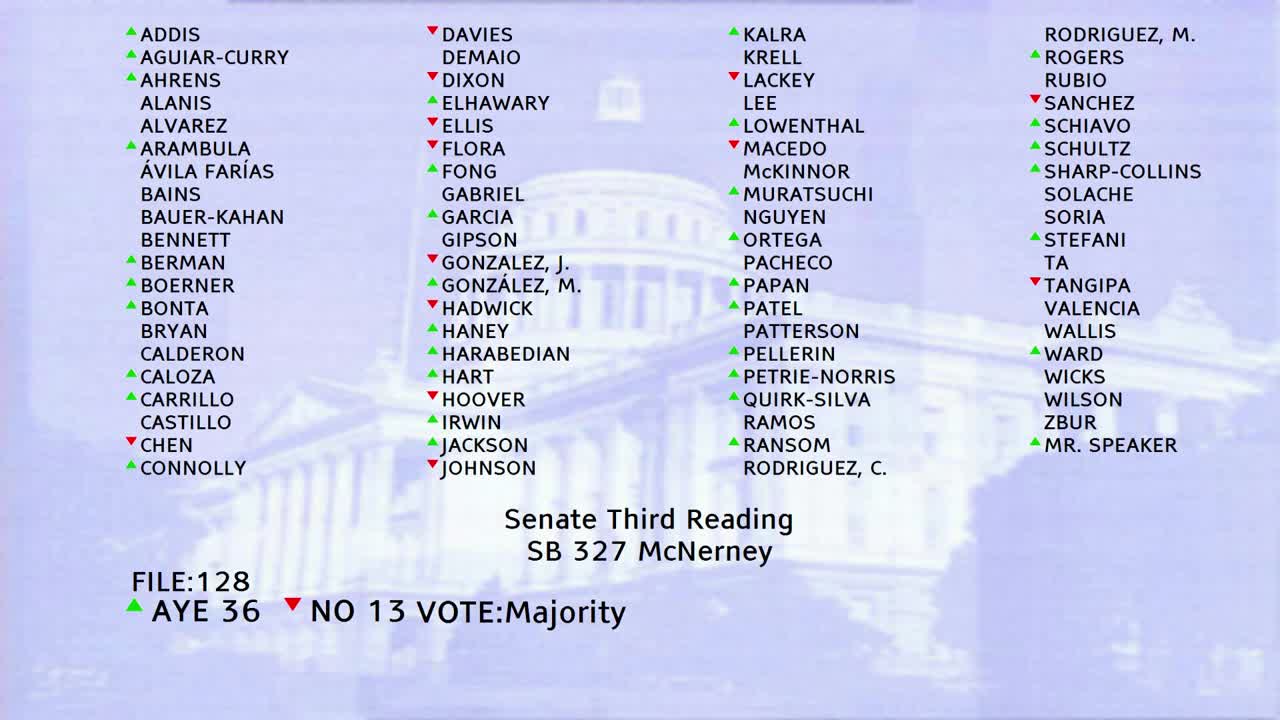 1MIN
Assembly Floor
 3MIN
Senate Floor
 10MIN
Senate Standing Committee on Housing
 7MIN
Senate Standing Committee on Housing
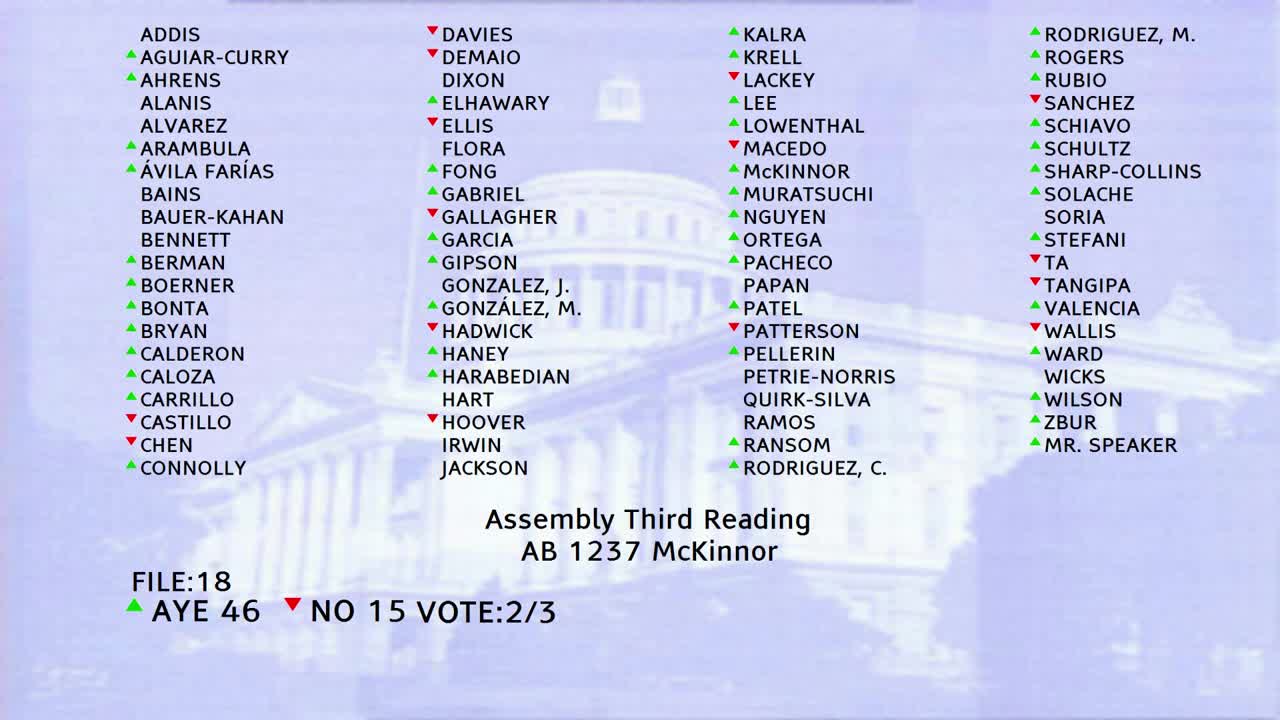 1MIN
Assembly Floor
 3MIN
Assembly Standing Committee on Appropriations
 10MIN
Assembly Standing Committee on Judiciary
Bill Author



