SB 516: Enhanced infrastructure financing districts: California Capital City Downtown Revitalization Act.
- Session Year: 2025-2026
- House: Senate
- Latest Version Date: 2025-10-13
Current Status:
Passed
(2025-10-13: Chaptered by Secretary of State. Chapter 769, Statutes of 2025.)
Introduced
In Committee
Awaiting First Chamber Vote
Passed First Chamber
In Committee
Awaiting Second Chamber Vote
Passed Second Chamber
Enacted
What does this bill do?
This bill creates the California Capital City Downtown Revitalization Act allowing the City or County of Sacramento to form a downtown enhanced infrastructure financing district — a special financing zone that can use shared tax revenue to pay for public projects — covering the area bounded by the Sacramento River, the American River, Broadway, and Alhambra Boulevard. It lets local taxing agencies in Sacramento County choose to join the district and clarifies that, with any required voter approval and an approved plan, such districts may accept and use state funds.
The summary is provided by generative AI which can make mistakes. For original language, please view the details in the table below.
Existing law authorizes the legislative body of a city or a county, defined to include a city and county, to establish an enhanced infrastructure financing district to finance public capital facilities or other specified projects of communitywide significance, as provided. Existing law provides for the preparation of a proposed infrastructure financing plan, as provided, which takes effect upon adoption by the public financing authority of the district following a specified public hearing and protest procedure. Existing law authorizes the infrastructure financing plan to provide for the division of taxes levied on taxable property in the area included within the district, as specified, and authorizes the public financing authority to issue bonds by adopting a resolution containing specified provisions, including a determination of the amount of tax revenue available or estimated to be available for the payment of the principal of, and interest on, the bonds.
This bill would establish the California Capital City Downtown Revitalization Act, and would authorize the City or County of Sacramento to create an enhanced infrastructure financing district within the downtown Sacramento geographic area. The bill would authorize an affected taxing entity located entirely, or in part, in the County of Sacramento to opt in to the district.
Existing law specifies that an enhanced infrastructure financing district is not prohibited from utilizing revenues from additional sources to support its activities if the district obtains voter approval, as applicable, and the infrastructure financing plan is approved.
This bill would additionally specify that a district is not prohibited from utilizing state funds to support its activities if the district obtains voter approval, as applicable, and the infrastructure financing plan is approved. The bill would also specify that the California Capital City Downtown Revitalization District may accept state funds, as provided.
This bill would make legislative findings and declarations as to the necessity of a special statute for the downtown Sacramento geographic area.
This bill would incorporate additional changes to Section 53398.75 of the Government Code proposed by SB 5 to be operative only if this bill and SB 5 are enacted and this bill is enacted last.
Existing law authorizes the legislative body of a city or a county, defined to include a city and county, to establish an enhanced infrastructure financing district to finance public capital facilities or other specified projects of communitywide significance, as provided. Existing law provides for the preparation of a proposed infrastructure financing plan, as provided, which takes effect upon adoption by the public financing authority of the district following a specified public hearing and protest procedure. Existing law authorizes the infrastructure financing plan to provide for the division of taxes levied on taxable property in the area included within the district, as specified, and authorizes the public financing authority to issue bonds by adopting a resolution containing specified provisions, including a determination of the amount of tax revenue available or estimated to be available for the payment of the principal of, and interest on, the bonds.
This bill would establish the California Capital City Downtown Revitalization Act, and would authorize the City or County of Sacramento to create an enhanced infrastructure financing district within the downtown Sacramento geographic area. The bill would authorize an affected taxing entity located entirely, or in part, in the County of Sacramento to opt in to the district.
Existing law specifies that an enhanced infrastructure financing district is not prohibited from utilizing revenues from additional sources to support its activities if the district obtains voter approval, as applicable, and the infrastructure financing plan is approved.
This bill would additionally specify that a district is not prohibited from utilizing state funds to support its activities if the district obtains voter approval, as applicable, and the infrastructure financing plan is approved. The bill would also specify that the California Capital City Downtown Revitalization District may accept state funds, as provided.
This bill would make legislative findings and declarations as to the necessity of a special statute for the downtown Sacramento geographic area.
This bill would incorporate additional changes to Section 53398.75 of the Government Code proposed by SB 5 to be operative only if this bill and SB 5 are enacted and this bill is enacted last.
Existing law authorizes the legislative body of a city or a county, defined to include a city and county, to establish an enhanced infrastructure financing district to finance public capital facilities or other specified projects of communitywide significance, as provided. Existing law provides for the preparation of a proposed infrastructure financing plan, as provided, which takes effect upon adoption by the public financing authority of the district following a specified public hearing and protest procedure. Existing law authorizes the infrastructure financing plan to provide for the division of taxes levied on taxable property in the area included within the district, as specified, and authorizes the public financing authority to issue bonds by adopting a resolution containing specified provisions, including a determination of the amount of tax revenue available or estimated to be available for the payment of the principal of, and interest on, the bonds.
This bill would establish the California Capital City Downtown Revitalization Act, and would authorize the City or County of Sacramento to create an enhanced infrastructure financing district within the downtown Sacramento geographic area. The bill would authorize an affected taxing entity located entirely, or in part, in the County of Sacramento to opt in to the district.
Existing law specifies that an enhanced infrastructure financing district is not prohibited from utilizing revenues from additional sources to support its activities if the district obtains voter approval, as applicable, and the infrastructure financing plan is approved.
This bill would additionally specify that a district is not prohibited from utilizing state funds to support its activities if the district obtains voter approval, as applicable, and the infrastructure financing plan is approved. The bill would also specify that the California Capital City Downtown Revitalization District may accept state funds, as provided.
This bill would make legislative findings and declarations as to the necessity of a special statute for the downtown Sacramento geographic area.
This bill would incorporate additional changes to Section 53398.75 of the Government Code proposed by SB 5 to be operative only if this bill and SB 5 are enacted and this bill is enacted last.
Existing law authorizes the legislative body of a city or a county, defined to include a city and county, to establish an enhanced infrastructure financing district to finance public capital facilities or other specified projects of communitywide significance, as provided. Existing law provides for the preparation of a proposed infrastructure financing plan, as provided, which takes effect upon adoption by the public financing authority of the district following a specified public hearing and protest procedure. Existing law authorizes the infrastructure financing plan to provide for the division of taxes levied on taxable property in the area included within the district, as specified, and authorizes the public financing authority to issue bonds by adopting a resolution containing specified provisions, including a determination of the amount of tax revenue available or estimated to be available for the payment of the principal of, and interest on, the bonds.
This bill, bill would establish the California Capital City Downtown Revitalization Act, and would authorize the City or County of Sacramento to create an enhanced infrastructure financing district within the downtown Sacramento geographic area. The bill would authorize an affected taxing entity located entirely, or in part, in the County of Sacramento to opt in to the district, and would authorize the district to accept state funds. district.
Existing law specifies that an enhanced infrastructure financing district is not prohibited from utilizing revenues from additional sources to support its activities if the district obtains voter approval, as applicable, and the infrastructure financing plan is approved.
This bill would additionally specify that a district is not prohibited from utilizing state funds to support its activities if the district obtains voter approval, as applicable, and the infrastructure financing plan is approved. The bill would also specify that the California Capital City Downtown Revitalization District may accept state funds, as provided.
This bill would make legislative findings and declarations as to the necessity of a special statute for the downtown Sacramento geographic area.
Existing law authorizes the legislative body of a city or a county, defined to include a city and county, to establish an enhanced infrastructure financing district to finance public capital facilities or other specified projects of communitywide significance, as provided. Existing law provides for the preparation of a proposed infrastructure financing plan, as provided, which takes effect upon adoption by the public financing authority of the district following a specified public hearing and protest procedure. Existing law authorizes the infrastructure financing plan to provide for the division of taxes levied on taxable property in the area included within the district, as specified, and authorizes the public financing authority to issue bonds by adopting a resolution containing specified provisions, including a determination of the amount of tax revenue available or estimated to be available for the payment of the principal of, and interest on, the bonds.
This bill, the California Capital City Downtown Revitalization Act, would authorize a city or county the City or County of Sacramento to create an enhanced infrastructure financing district within the downtown Sacramento geographic area to adopt a resolution, at any time before or after the adoption of the infrastructure financing plan, to allocate tax revenues of that entity to the district. The bill would specify that the allocated tax revenues could include local sales and use taxes or transactions and use taxes, if specified conditions are met. area. The bill would authorize an affected taxing entity located entirely, or in part, in the County of Sacramento to opt in to the district, and would authorize the district to accept state funds.
This bill would make legislative findings and declarations as to the necessity of a special statute for the downtown Sacramento geographic area.
Existing law authorizes the legislative body of a city or a county, defined to include a city and county, to establish an enhanced infrastructure financing district to finance public capital facilities or other specified projects of communitywide significance, as provided. Existing law provides for the preparation of a proposed infrastructure financing plan, as provided, which takes effect upon adoption by the public financing authority of the district following a specified public hearing and protest procedure. Existing law authorizes the infrastructure financing plan to provide for the division of taxes levied on taxable property in the area included within the district, as specified, and authorizes the public financing authority to issue bonds by adopting a resolution containing specified provisions, including a determination of the amount of tax revenue available or estimated to be available for the payment of the principal of, and interest on, the bonds.
This bill, the California Capital City Downtown Revitalization Act, would authorize a city or county within the downtown Sacramento geographic area to adopt a resolution, at any time before or after the adoption of the infrastructure financing plan, to allocate tax revenues of that entity to the district. The bill would specify that the allocated tax revenues could include local sales and use taxes or transactions and use taxes, if specified conditions are met.
This bill would make legislative findings and declarations as to the necessity of a special statute for the downtown Sacramento geographic area.
(a)Any infrastructure financing plan may contain a provision that taxes, if any, levied upon taxable property in the area included within the enhanced infrastructure financing district each year by or for the benefit of the State of California, or any affected taxing entity after the effective date of the resolution adopted pursuant to Section 53398.69 to create the district, shall be divided, subject to the provisions of Section 53993, as follows:
(1)That portion of the taxes that would be produced by the rate upon which the tax is levied each year by or for each of the affected taxing entities upon the total sum of the assessed value of the taxable property in the district as shown upon the assessment roll used in connection with the taxation of the property by the affected taxing entity, last equalized prior to the effective date of the resolution adopted pursuant to Section 53398.69 to create the district, shall be allocated to, and when collected shall be paid to, the respective affected taxing entities as taxes by or for the affected taxing entities on all other property are paid.
(2)That portion of the levied taxes each year specified in the adopted infrastructure financing plan for the city or county and each affected taxing entity that has agreed to participate pursuant to Section 53398.68 in excess of the amount specified in paragraph (1) shall be allocated to, and when collected shall be paid into a special fund of, the district for all lawful purposes of the district. Unless and until the total assessed valuation of the taxable property in a district exceeds the total assessed value of the taxable property in the district as shown by the last equalized assessment roll referred to in paragraph (1), all of the taxes levied and collected upon the taxable property in the district shall be paid to the respective affected taxing entities. When the district ceases to exist pursuant to the adopted infrastructure financing plan, all moneys thereafter received from taxes upon the taxable property in the district shall be paid to the respective affected taxing entities as taxes on all other property are paid.
(b)Notwithstanding subdivision (a), where any district boundaries overlap with the boundaries of any former redevelopment project area, any debt or obligation of a district shall be subordinate to any and all enforceable obligations of the former redevelopment agency, as approved by the Oversight Board and the Department of Finance. For the purposes of this chapter, the division of taxes allocated to the district pursuant to subdivision (a) of this section or of subdivision (b) of Section 53396 shall not include any taxes required to be deposited by the county auditor-controller into the Redevelopment Property Tax Trust Fund created pursuant to subdivision (b) of Section 34170.5 of the Health and Safety Code.
(c)The legislative body of the city or county forming the district may choose to dedicate any portion of its net available revenue to the district through the financing plan described in Section 53398.63.
(d)For the purposes of this section, net available revenue means periodic distributions to the city or county from the Redevelopment Property Tax Trust Fund, created pursuant to Section 34170.5 of the Health and Safety Code, that are available to the city or county after all preexisting legal commitments and statutory obligations funded from that revenue are made pursuant to Part 1.85 (commencing with Section 34170) of Division 24 of the Health and Safety Code. Net available revenue shall not include any funds deposited by the county auditor-controller into the Redevelopment Property Tax Trust Fund or funds remaining in the Redevelopment Property Tax Trust Fund prior to distribution. Net available revenues shall not include any moneys payable to a school district that maintains kindergarten and grades 1 to 12, inclusive, community college districts, county office of education, or to the Educational Revenue Augmentation Fund, pursuant to paragraph (4) of subdivision (a) of Section 34183 of the Health and Safety Code.
(e)(1)That portion of any ad valorem property tax revenue annually allocated to a city or county pursuant to Section 97.70 of the Revenue and Taxation Code that is specified in the adopted infrastructure financing plan for the city or county that has agreed to participate pursuant to Section 53398.68, and that corresponds to the increase in the assessed valuation of taxable property shall be allocated to, and, when collected, shall be apportioned to, a special fund of the district for all lawful purposes of the district.
(2)When the district ceases to exist pursuant to the adopted infrastructure financing plan, the revenues described in this subdivision shall be allocated to, and, when collected, shall be apportioned to, the respective city or county.
(f)This section shall not be construed to prevent a district from utilizing revenues from any of the following sources to support its activities provided that the applicable voter approval has been obtained, and the infrastructure financing plan has been approved pursuant to Section 53398.69:
(1)The Improvement Act of 1911 (Division 7 (commencing with Section 5000) of the Streets and Highways Code).
(2)The Municipal Improvement Act of 1913 (Division 12 (commencing with Section 10000) of the Streets and Highways Code).
(3)The Improvement Bond Act of 1915 (Division 10 (commencing with Section 8500) of the Streets and Highways Code).
(4)The Landscaping and Lighting Act of 1972 (Part 2 (commencing with Section 22500) of Division 15 of the Streets and Highways Code).
(5)The Vehicle Parking District Law of 1943 (Part 1 (commencing with Section 31500) of Division 18 of the Streets and Highways Code).
(6)The Parking District Law of 1951 (Part 4 (commencing with Section 35100) of Division 18 of the Streets and Highways Code).
(7)The Park and Playground Act of 1909 (Chapter 7 (commencing with Section 38000) of Part 2 of Division 3 of Title 4 of this code).
(8)The Mello-Roos Community Facilities Act of 1982 (Chapter 2.5 (commencing with Section 53311) of Part 1 of Division 2 of this title).
(9)The Benefit Assessment Act of 1982 (Chapter 6.4 (commencing with Section 54703) of Part 1 of Division 2 of this title).
(10)The so-called facilities benefit assessment levied by the charter city of San Diego or any substantially similar assessment levied for the same purpose by any other charter city pursuant to any ordinance or charter provision.
(11)Any state funds.
SEC. 1.5.Section 53398.75 of the Government Code is amended to read:53398.75.(a)Any infrastructure financing plan may contain a provision that taxes, other than those specified in Section 53398.75.1, if any, levied upon taxable property in the area included within the enhanced infrastructure financing district each year by or for the benefit of the State of California, or any affected taxing entity after the effective date of the resolution adopted pursuant to Section 53398.69 to create the district, shall be divided, subject to the provisions of Section 53993, as follows:
(1)That portion of the taxes that would be produced by the rate upon which the tax is levied each year by or for each of the affected taxing entities upon the total sum of the assessed value of the taxable property in the district as shown upon the assessment roll used in connection with the taxation of the property by the affected taxing entity, last equalized prior to the effective date of the resolution adopted pursuant to Section 53398.69 to create the district, shall be allocated to, and when collected shall be paid to, the respective affected taxing entities as taxes by or for the affected taxing entities on all other property are paid.
(2)That portion of the levied taxes each year specified in the adopted infrastructure financing plan for the city or county and each affected taxing entity that has agreed to participate pursuant to Section 53398.68 in excess of the amount specified in paragraph (1) shall be allocated to, and when collected shall be paid into a special fund of, the district for all lawful purposes of the district. Unless and until the total assessed valuation of the taxable property in a district exceeds the total assessed value of the taxable property in the district as shown by the last equalized assessment roll referred to in paragraph (1), all of the taxes levied and collected upon the taxable property in the district shall be paid to the respective affected taxing entities. When the district ceases to exist pursuant to the adopted infrastructure financing plan, all moneys thereafter received from taxes upon the taxable property in the district shall be paid to the respective affected taxing entities as taxes on all other property are paid.
(b)Notwithstanding subdivision (a), where any district boundaries overlap with the boundaries of any former redevelopment project area, any debt or obligation of a district shall be subordinate to any and all enforceable obligations of the former redevelopment agency, as approved by the Oversight Board and the Department of Finance. For the purposes of this chapter, the division of taxes allocated to the district pursuant to subdivision (a) of this section or of subdivision (b) of Section 53396 shall not include any taxes required to be deposited by the county auditor-controller into the Redevelopment Property Tax Trust Fund created pursuant to subdivision (b) of Section 34170.5 of the Health and Safety Code.
(c)The legislative body of the city or county forming the district may choose to dedicate any portion of its net available revenue to the district through the financing plan described in Section 53398.63.
(d)For the purposes of this section, net available revenue means periodic distributions to the city or county from the Redevelopment Property Tax Trust Fund, created pursuant to Section 34170.5 of the Health and Safety Code, that are available to the city or county after all preexisting legal commitments and statutory obligations funded from that revenue are made pursuant to Part 1.85 (commencing with Section 34170) of Division 24 of the Health and Safety Code. Net available revenue shall not include any funds deposited by the county auditor-controller into the Redevelopment Property Tax Trust Fund or funds remaining in the Redevelopment Property Tax Trust Fund prior to distribution. Net available revenues shall not include any moneys payable to a school district that maintains kindergarten and grades 1 to 12, inclusive, community college district, county office of education, or to the Educational Revenue Augmentation Fund, pursuant to paragraph (4) of subdivision (a) of Section 34183 of the Health and Safety Code.
(e)(1)That portion of any ad valorem property tax revenue annually allocated to a city or county pursuant to Section 97.70 of the Revenue and Taxation Code that is specified in the adopted infrastructure financing plan for the city or county that has agreed to participate pursuant to Section 53398.68, and that corresponds to the increase in the assessed valuation of taxable property shall be allocated to, and, when collected, shall be apportioned to, a special fund of the district for all lawful purposes of the district.
(2)When the district ceases to exist pursuant to the adopted infrastructure financing plan, the revenues described in this subdivision shall be allocated to, and, when collected, shall be apportioned to, the respective city or county.
(f)This section shall not be construed to prevent a district from utilizing revenues from any of the following sources to support its activities provided that the applicable voter approval has been obtained, and the infrastructure financing plan has been approved pursuant to Section 53398.69:
(1)The Improvement Act of 1911 (Division 7 (commencing with Section 5000) of the Streets and Highways Code).
(2)The Municipal Improvement Act of 1913 (Division 12 (commencing with Section 10000) of the Streets and Highways Code).
(3)The Improvement Bond Act of 1915 (Division 10 (commencing with Section 8500) of the Streets and Highways Code).
(4)The Landscaping and Lighting Act of 1972 (Part 2 (commencing with Section 22500) of Division 15 of the Streets and Highways Code).
(5)The Vehicle Parking District Law of 1943 (Part 1 (commencing with Section 31500) of Division 18 of the Streets and Highways Code).
(6)The Parking District Law of 1951 (Part 4 (commencing with Section 35100) of Division 18 of the Streets and Highways Code).
(7)The Park and Playground Act of 1909 (Chapter 7 (commencing with Section 38000) of Part 2 of Division 3 of Title 4 of this code).
(8)The Mello-Roos Community Facilities Act of 1982 (Chapter 2.5 (commencing with Section 53311) of Part 1 of Division 2 of this title).
(9)The Benefit Assessment Act of 1982 (Chapter 6.4 (commencing with Section 54703) of Part 1 of Division 2 of this title).
(10)The so-called facilities benefit assessment levied by the charter city of San Diego or any substantially similar assessment levied for the same purpose by any other charter city pursuant to any ordinance or charter provision.
(11)Any state funds.
SEC. 2.Section 53398.75.8 is added to the Government Code, to read:53398.75.8.(a)This section shall be known, and may be cited, as the California Capital City Downtown Revitalization Act.
(b)The City of Sacramento or the County of Sacramento may create a California Capital City Downtown Revitalization District. Unless explicitly specified otherwise in this section, a California Capital City Downtown Revitalization District is an enhanced infrastructure financing district subject to the provisions of this chapter.
(c)The area to be financed with funds received pursuant to this section is within the downtown Sacramento geographic area, defined by the Sacramento River, the American River, Broadway, and Alhambra Boulevard.
(d)An affected taxing entity located entirely, or in part, in the County of Sacramento may opt in to a California Capital City Downtown Revitalization District pursuant to Section 53398.68.
(e)Upon its creation, a California Capital City Downtown Revitalization District may accept any state funds pursuant to Section 53398.75.
SEC. 3.The Legislature finds and declares that a special statute is necessary and that a general statute cannot be made applicable within the meaning of Section 16 of Article IV of the California Constitution because of the unique needs of the City and County of Sacramento and the downtown Sacramento geographic area.
SEC. 4.Section 1.5 of this bill incorporates amendments to Section 53398.75 of the Government Code proposed by both this bill and Senate Bill 5. That section of this bill shall only become operative if (1) both bills are enacted and become effective on or before January 1, 2026, (2) each bill amends Section 53398.75 of the Government Code, and (3) this bill is enacted after Senate Bill 5, in which case Section 1 of this bill shall not become operative.
(a)Any infrastructure financing plan may contain a provision that taxes, if any, levied upon taxable property in the area included within the enhanced infrastructure financing district each year by or for the benefit of the State of California, or any affected taxing entity after the effective date of the resolution adopted pursuant to Section 53398.69 to create the district, shall be divided, subject to the provisions of Section 53993, as follows:
(1)That portion of the taxes that would be produced by the rate upon which the tax is levied each year by or for each of the affected taxing entities upon the total sum of the assessed value of the taxable property in the district as shown upon the assessment roll used in connection with the taxation of the property by the affected taxing entity, last equalized prior to the effective date of the resolution adopted pursuant to Section 53398.69 to create the district, shall be allocated to, and when collected shall be paid to, the respective affected taxing entities as taxes by or for the affected taxing entities on all other property are paid.
(2)That portion of the levied taxes each year specified in the adopted infrastructure financing plan for the city or county and each affected taxing entity that has agreed to participate pursuant to Section 53398.68 in excess of the amount specified in paragraph (1) shall be allocated to, and when collected shall be paid into a special fund of, the district for all lawful purposes of the district. Unless and until the total assessed valuation of the taxable property in a district exceeds the total assessed value of the taxable property in the district as shown by the last equalized assessment roll referred to in paragraph (1), all of the taxes levied and collected upon the taxable property in the district shall be paid to the respective affected taxing entities. When the district ceases to exist pursuant to the adopted infrastructure financing plan, all moneys thereafter received from taxes upon the taxable property in the district shall be paid to the respective affected taxing entities as taxes on all other property are paid.
(b)Notwithstanding subdivision (a), where any district boundaries overlap with the boundaries of any former redevelopment project area, any debt or obligation of a district shall be subordinate to any and all enforceable obligations of the former redevelopment agency, as approved by the Oversight Board and the Department of Finance. For the purposes of this chapter, the division of taxes allocated to the district pursuant to subdivision (a) of this section or of subdivision (b) of Section 53396 shall not include any taxes required to be deposited by the county auditor-controller into the Redevelopment Property Tax Trust Fund created pursuant to subdivision (b) of Section 34170.5 of the Health and Safety Code.
(c)The legislative body of the city or county forming the district may choose to dedicate any portion of its net available revenue to the district through the financing plan described in Section 53398.63.
(d)For the purposes of this section, net available revenue means periodic distributions to the city or county from the Redevelopment Property Tax Trust Fund, created pursuant to Section 34170.5 of the Health and Safety Code, that are available to the city or county after all preexisting legal commitments and statutory obligations funded from that revenue are made pursuant to Part 1.85 (commencing with Section 34170) of Division 24 of the Health and Safety Code. Net available revenue shall not include any funds deposited by the county auditor-controller into the Redevelopment Property Tax Trust Fund or funds remaining in the Redevelopment Property Tax Trust Fund prior to distribution. Net available revenues shall not include any moneys payable to a school district that maintains kindergarten and grades 1 to 12, inclusive, community college districts, county office of education, or to the Educational Revenue Augmentation Fund, pursuant to paragraph (4) of subdivision (a) of Section 34183 of the Health and Safety Code.
(e)(1)That portion of any ad valorem property tax revenue annually allocated to a city or county pursuant to Section 97.70 of the Revenue and Taxation Code that is specified in the adopted infrastructure financing plan for the city or county that has agreed to participate pursuant to Section 53398.68, and that corresponds to the increase in the assessed valuation of taxable property shall be allocated to, and, when collected, shall be apportioned to, a special fund of the district for all lawful purposes of the district.
(2)When the district ceases to exist pursuant to the adopted infrastructure financing plan, the revenues described in this subdivision shall be allocated to, and, when collected, shall be apportioned to, the respective city or county.
(f)This section shall not be construed to prevent a district from utilizing revenues from any of the following sources to support its activities provided that the applicable voter approval has been obtained, and the infrastructure financing plan has been approved pursuant to Section 53398.69:
(1)The Improvement Act of 1911 (Division 7 (commencing with Section 5000) of the Streets and Highways Code).
(2)The Municipal Improvement Act of 1913 (Division 12 (commencing with Section 10000) of the Streets and Highways Code).
(3)The Improvement Bond Act of 1915 (Division 10 (commencing with Section 8500) of the Streets and Highways Code).
(4)The Landscaping and Lighting Act of 1972 (Part 2 (commencing with Section 22500) of Division 15 of the Streets and Highways Code).
(5)The Vehicle Parking District Law of 1943 (Part 1 (commencing with Section 31500) of Division 18 of the Streets and Highways Code).
(6)The Parking District Law of 1951 (Part 4 (commencing with Section 35100) of Division 18 of the Streets and Highways Code).
(7)The Park and Playground Act of 1909 (Chapter 7 (commencing with Section 38000) of Part 2 of Division 3 of Title 4 of this code).
(8)The Mello-Roos Community Facilities Act of 1982 (Chapter 2.5 (commencing with Section 53311) of Part 1 of Division 2 of this title).
(9)The Benefit Assessment Act of 1982 (Chapter 6.4 (commencing with Section 54703) of Part 1 of Division 2 of this title).
(10)The so-called facilities benefit assessment levied by the charter city of San Diego or any substantially similar assessment levied for the same purpose by any other charter city pursuant to any ordinance or charter provision.
(11)Any state funds.
SEC. 1.5.Section 53398.75 of the Government Code is amended to read:53398.75.(a)Any infrastructure financing plan may contain a provision that taxes, other than those specified in Section 53398.75.1, if any, levied upon taxable property in the area included within the enhanced infrastructure financing district each year by or for the benefit of the State of California, or any affected taxing entity after the effective date of the resolution adopted pursuant to Section 53398.69 to create the district, shall be divided, subject to the provisions of Section 53993, as follows:
(1)That portion of the taxes that would be produced by the rate upon which the tax is levied each year by or for each of the affected taxing entities upon the total sum of the assessed value of the taxable property in the district as shown upon the assessment roll used in connection with the taxation of the property by the affected taxing entity, last equalized prior to the effective date of the resolution adopted pursuant to Section 53398.69 to create the district, shall be allocated to, and when collected shall be paid to, the respective affected taxing entities as taxes by or for the affected taxing entities on all other property are paid.
(2)That portion of the levied taxes each year specified in the adopted infrastructure financing plan for the city or county and each affected taxing entity that has agreed to participate pursuant to Section 53398.68 in excess of the amount specified in paragraph (1) shall be allocated to, and when collected shall be paid into a special fund of, the district for all lawful purposes of the district. Unless and until the total assessed valuation of the taxable property in a district exceeds the total assessed value of the taxable property in the district as shown by the last equalized assessment roll referred to in paragraph (1), all of the taxes levied and collected upon the taxable property in the district shall be paid to the respective affected taxing entities. When the district ceases to exist pursuant to the adopted infrastructure financing plan, all moneys thereafter received from taxes upon the taxable property in the district shall be paid to the respective affected taxing entities as taxes on all other property are paid.
(b)Notwithstanding subdivision (a), where any district boundaries overlap with the boundaries of any former redevelopment project area, any debt or obligation of a district shall be subordinate to any and all enforceable obligations of the former redevelopment agency, as approved by the Oversight Board and the Department of Finance. For the purposes of this chapter, the division of taxes allocated to the district pursuant to subdivision (a) of this section or of subdivision (b) of Section 53396 shall not include any taxes required to be deposited by the county auditor-controller into the Redevelopment Property Tax Trust Fund created pursuant to subdivision (b) of Section 34170.5 of the Health and Safety Code.
(c)The legislative body of the city or county forming the district may choose to dedicate any portion of its net available revenue to the district through the financing plan described in Section 53398.63.
(d)For the purposes of this section, net available revenue means periodic distributions to the city or county from the Redevelopment Property Tax Trust Fund, created pursuant to Section 34170.5 of the Health and Safety Code, that are available to the city or county after all preexisting legal commitments and statutory obligations funded from that revenue are made pursuant to Part 1.85 (commencing with Section 34170) of Division 24 of the Health and Safety Code. Net available revenue shall not include any funds deposited by the county auditor-controller into the Redevelopment Property Tax Trust Fund or funds remaining in the Redevelopment Property Tax Trust Fund prior to distribution. Net available revenues shall not include any moneys payable to a school district that maintains kindergarten and grades 1 to 12, inclusive, community college district, county office of education, or to the Educational Revenue Augmentation Fund, pursuant to paragraph (4) of subdivision (a) of Section 34183 of the Health and Safety Code.
(e)(1)That portion of any ad valorem property tax revenue annually allocated to a city or county pursuant to Section 97.70 of the Revenue and Taxation Code that is specified in the adopted infrastructure financing plan for the city or county that has agreed to participate pursuant to Section 53398.68, and that corresponds to the increase in the assessed valuation of taxable property shall be allocated to, and, when collected, shall be apportioned to, a special fund of the district for all lawful purposes of the district.
(2)When the district ceases to exist pursuant to the adopted infrastructure financing plan, the revenues described in this subdivision shall be allocated to, and, when collected, shall be apportioned to, the respective city or county.
(f)This section shall not be construed to prevent a district from utilizing revenues from any of the following sources to support its activities provided that the applicable voter approval has been obtained, and the infrastructure financing plan has been approved pursuant to Section 53398.69:
(1)The Improvement Act of 1911 (Division 7 (commencing with Section 5000) of the Streets and Highways Code).
(2)The Municipal Improvement Act of 1913 (Division 12 (commencing with Section 10000) of the Streets and Highways Code).
(3)The Improvement Bond Act of 1915 (Division 10 (commencing with Section 8500) of the Streets and Highways Code).
(4)The Landscaping and Lighting Act of 1972 (Part 2 (commencing with Section 22500) of Division 15 of the Streets and Highways Code).
(5)The Vehicle Parking District Law of 1943 (Part 1 (commencing with Section 31500) of Division 18 of the Streets and Highways Code).
(6)The Parking District Law of 1951 (Part 4 (commencing with Section 35100) of Division 18 of the Streets and Highways Code).
(7)The Park and Playground Act of 1909 (Chapter 7 (commencing with Section 38000) of Part 2 of Division 3 of Title 4 of this code).
(8)The Mello-Roos Community Facilities Act of 1982 (Chapter 2.5 (commencing with Section 53311) of Part 1 of Division 2 of this title).
(9)The Benefit Assessment Act of 1982 (Chapter 6.4 (commencing with Section 54703) of Part 1 of Division 2 of this title).
(10)The so-called facilities benefit assessment levied by the charter city of San Diego or any substantially similar assessment levied for the same purpose by any other charter city pursuant to any ordinance or charter provision.
(11)Any state funds.
SEC. 2.Section 53398.75.8 is added to the Government Code, to read:53398.75.8.(a)This section shall be known, and may be cited, as the California Capital City Downtown Revitalization Act.
(b)The City of Sacramento or the County of Sacramento may create a California Capital City Downtown Revitalization District. Unless explicitly specified otherwise in this section, a California Capital City Downtown Revitalization District is an enhanced infrastructure financing district subject to the provisions of this chapter.
(c)The area to be financed with funds received pursuant to this section is within the downtown Sacramento geographic area, defined by the Sacramento River, the American River, Broadway, and Alhambra Boulevard.
(d)An affected taxing entity located entirely, or in part, in the County of Sacramento may opt in to a California Capital City Downtown Revitalization District pursuant to Section 53398.68.
(e)Upon its creation, a California Capital City Downtown Revitalization District may accept any state funds pursuant to Section 53398.75.
SEC. 3.The Legislature finds and declares that a special statute is necessary and that a general statute cannot be made applicable within the meaning of Section 16 of Article IV of the California Constitution because of the unique needs of the City and County of Sacramento and the downtown Sacramento geographic area.
SEC. 4.Section 1.5 of this bill incorporates amendments to Section 53398.75 of the Government Code proposed by both this bill and Senate Bill 5. That section of this bill shall only become operative if (1) both bills are enacted and become effective on or before January 1, 2026, (2) each bill amends Section 53398.75 of the Government Code, and (3) this bill is enacted after Senate Bill 5, in which case Section 1 of this bill shall not become operative.
(a)Any infrastructure financing plan may contain a provision that taxes, if any, levied upon taxable property in the area included within the enhanced infrastructure financing district each year by or for the benefit of the State of California, or any affected taxing entity after the effective date of the resolution adopted pursuant to Section 53398.69 to create the district, shall be divided, subject to the provisions of Section 53993, as follows:
(1)That portion of the taxes that would be produced by the rate upon which the tax is levied each year by or for each of the affected taxing entities upon the total sum of the assessed value of the taxable property in the district as shown upon the assessment roll used in connection with the taxation of the property by the affected taxing entity, last equalized prior to the effective date of the resolution adopted pursuant to Section 53398.69 to create the district, shall be allocated to, and when collected shall be paid to, the respective affected taxing entities as taxes by or for the affected taxing entities on all other property are paid.
(2)That portion of the levied taxes each year specified in the adopted infrastructure financing plan for the city or county and each affected taxing entity that has agreed to participate pursuant to Section 53398.68 in excess of the amount specified in paragraph (1) shall be allocated to, and when collected shall be paid into a special fund of, the district for all lawful purposes of the district. Unless and until the total assessed valuation of the taxable property in a district exceeds the total assessed value of the taxable property in the district as shown by the last equalized assessment roll referred to in paragraph (1), all of the taxes levied and collected upon the taxable property in the district shall be paid to the respective affected taxing entities. When the district ceases to exist pursuant to the adopted infrastructure financing plan, all moneys thereafter received from taxes upon the taxable property in the district shall be paid to the respective affected taxing entities as taxes on all other property are paid.
(b)Notwithstanding subdivision (a), where any district boundaries overlap with the boundaries of any former redevelopment project area, any debt or obligation of a district shall be subordinate to any and all enforceable obligations of the former redevelopment agency, as approved by the Oversight Board and the Department of Finance. For the purposes of this chapter, the division of taxes allocated to the district pursuant to subdivision (a) of this section or of subdivision (b) of Section 53396 shall not include any taxes required to be deposited by the county auditor-controller into the Redevelopment Property Tax Trust Fund created pursuant to subdivision (b) of Section 34170.5 of the Health and Safety Code.
(c)The legislative body of the city or county forming the district may choose to dedicate any portion of its net available revenue to the district through the financing plan described in Section 53398.63.
(d)For the purposes of this section, net available revenue means periodic distributions to the city or county from the Redevelopment Property Tax Trust Fund, created pursuant to Section 34170.5 of the Health and Safety Code, that are available to the city or county after all preexisting legal commitments and statutory obligations funded from that revenue are made pursuant to Part 1.85 (commencing with Section 34170) of Division 24 of the Health and Safety Code. Net available revenue shall not include any funds deposited by the county auditor-controller into the Redevelopment Property Tax Trust Fund or funds remaining in the Redevelopment Property Tax Trust Fund prior to distribution. Net available revenues shall not include any moneys payable to a school district that maintains kindergarten and grades 1 to 12, inclusive, community college districts, county office of education, or to the Educational Revenue Augmentation Fund, pursuant to paragraph (4) of subdivision (a) of Section 34183 of the Health and Safety Code.
(e)(1)That portion of any ad valorem property tax revenue annually allocated to a city or county pursuant to Section 97.70 of the Revenue and Taxation Code that is specified in the adopted infrastructure financing plan for the city or county that has agreed to participate pursuant to Section 53398.68, and that corresponds to the increase in the assessed valuation of taxable property shall be allocated to, and, when collected, shall be apportioned to, a special fund of the district for all lawful purposes of the district.
(2)When the district ceases to exist pursuant to the adopted infrastructure financing plan, the revenues described in this subdivision shall be allocated to, and, when collected, shall be apportioned to, the respective city or county.
(f)This section shall not be construed to prevent a district from utilizing revenues from any of the following sources to support its activities provided that the applicable voter approval has been obtained, and the infrastructure financing plan has been approved pursuant to Section 53398.69:
(1)The Improvement Act of 1911 (Division 7 (commencing with Section 5000) of the Streets and Highways Code).
(2)The Municipal Improvement Act of 1913 (Division 12 (commencing with Section 10000) of the Streets and Highways Code).
(3)The Improvement Bond Act of 1915 (Division 10 (commencing with Section 8500) of the Streets and Highways Code).
(4)The Landscaping and Lighting Act of 1972 (Part 2 (commencing with Section 22500) of Division 15 of the Streets and Highways Code).
(5)The Vehicle Parking District Law of 1943 (Part 1 (commencing with Section 31500) of Division 18 of the Streets and Highways Code).
(6)The Parking District Law of 1951 (Part 4 (commencing with Section 35100) of Division 18 of the Streets and Highways Code).
(7)The Park and Playground Act of 1909 (Chapter 7 (commencing with Section 38000) of Part 2 of Division 3 of Title 4 of this code).
(8)The Mello-Roos Community Facilities Act of 1982 (Chapter 2.5 (commencing with Section 53311) of Part 1 of Division 2 of this title).
(9)The Benefit Assessment Act of 1982 (Chapter 6.4 (commencing with Section 54703) of Part 1 of Division 2 of this title).
(10)The so-called facilities benefit assessment levied by the charter city of San Diego or any substantially similar assessment levied for the same purpose by any other charter city pursuant to any ordinance or charter provision.
(11)Any state funds.
SEC. 1.5.Section 53398.75 of the Government Code is amended to read:53398.75.(a)Any infrastructure financing plan may contain a provision that taxes, other than those specified in Section 53398.75.1, if any, levied upon taxable property in the area included within the enhanced infrastructure financing district each year by or for the benefit of the State of California, or any affected taxing entity after the effective date of the resolution adopted pursuant to Section 53398.69 to create the district, shall be divided, subject to the provisions of Section 53993, as follows:
(1)That portion of the taxes that would be produced by the rate upon which the tax is levied each year by or for each of the affected taxing entities upon the total sum of the assessed value of the taxable property in the district as shown upon the assessment roll used in connection with the taxation of the property by the affected taxing entity, last equalized prior to the effective date of the resolution adopted pursuant to Section 53398.69 to create the district, shall be allocated to, and when collected shall be paid to, the respective affected taxing entities as taxes by or for the affected taxing entities on all other property are paid.
(2)That portion of the levied taxes each year specified in the adopted infrastructure financing plan for the city or county and each affected taxing entity that has agreed to participate pursuant to Section 53398.68 in excess of the amount specified in paragraph (1) shall be allocated to, and when collected shall be paid into a special fund of, the district for all lawful purposes of the district. Unless and until the total assessed valuation of the taxable property in a district exceeds the total assessed value of the taxable property in the district as shown by the last equalized assessment roll referred to in paragraph (1), all of the taxes levied and collected upon the taxable property in the district shall be paid to the respective affected taxing entities. When the district ceases to exist pursuant to the adopted infrastructure financing plan, all moneys thereafter received from taxes upon the taxable property in the district shall be paid to the respective affected taxing entities as taxes on all other property are paid.
(b)Notwithstanding subdivision (a), where any district boundaries overlap with the boundaries of any former redevelopment project area, any debt or obligation of a district shall be subordinate to any and all enforceable obligations of the former redevelopment agency, as approved by the Oversight Board and the Department of Finance. For the purposes of this chapter, the division of taxes allocated to the district pursuant to subdivision (a) of this section or of subdivision (b) of Section 53396 shall not include any taxes required to be deposited by the county auditor-controller into the Redevelopment Property Tax Trust Fund created pursuant to subdivision (b) of Section 34170.5 of the Health and Safety Code.
(c)The legislative body of the city or county forming the district may choose to dedicate any portion of its net available revenue to the district through the financing plan described in Section 53398.63.
(d)For the purposes of this section, net available revenue means periodic distributions to the city or county from the Redevelopment Property Tax Trust Fund, created pursuant to Section 34170.5 of the Health and Safety Code, that are available to the city or county after all preexisting legal commitments and statutory obligations funded from that revenue are made pursuant to Part 1.85 (commencing with Section 34170) of Division 24 of the Health and Safety Code. Net available revenue shall not include any funds deposited by the county auditor-controller into the Redevelopment Property Tax Trust Fund or funds remaining in the Redevelopment Property Tax Trust Fund prior to distribution. Net available revenues shall not include any moneys payable to a school district that maintains kindergarten and grades 1 to 12, inclusive, community college districts, district, county office of education, or to the Educational Revenue Augmentation Fund, pursuant to paragraph (4) of subdivision (a) of Section 34183 of the Health and Safety Code.
(e)(1)That portion of any ad valorem property tax revenue annually allocated to a city or county pursuant to Section 97.70 of the Revenue and Taxation Code that is specified in the adopted infrastructure financing plan for the city or county that has agreed to participate pursuant to Section 53398.68, and that corresponds to the increase in the assessed valuation of taxable property shall be allocated to, and, when collected, shall be apportioned to, a special fund of the district for all lawful purposes of the district.
(2)When the district ceases to exist pursuant to the adopted infrastructure financing plan, the revenues described in this subdivision shall be allocated to, and, when collected, shall be apportioned to, the respective city or county.
(f)This section shall not be construed to prevent a district from utilizing revenues from any of the following sources to support its activities provided that the applicable voter approval has been obtained, and the infrastructure financing plan has been approved pursuant to Section 53398.69:
(1)The Improvement Act of 1911 (Division 7 (commencing with Section 5000) of the Streets and Highways Code).
(2)The Municipal Improvement Act of 1913 (Division 12 (commencing with Section 10000) of the Streets and Highways Code).
(3)The Improvement Bond Act of 1915 (Division 10 (commencing with Section 8500) of the Streets and Highways Code).
(4)The Landscaping and Lighting Act of 1972 (Part 2 (commencing with Section 22500) of Division 15 of the Streets and Highways Code).
(5)The Vehicle Parking District Law of 1943 (Part 1 (commencing with Section 31500) of Division 18 of the Streets and Highways Code).
(6)The Parking District Law of 1951 (Part 4 (commencing with Section 35100) of Division 18 of the Streets and Highways Code).
(7)The Park and Playground Act of 1909 (Chapter 7 (commencing with Section 38000) of Part 2 of Division 3 of Title 4 of this code).
(8)The Mello-Roos Community Facilities Act of 1982 (Chapter 2.5 (commencing with Section 53311) of Part 1 of Division 2 of this title).
(9)The Benefit Assessment Act of 1982 (Chapter 6.4 (commencing with Section 54703) of Part 1 of Division 2 of this title).
(10)The so-called facilities benefit assessment levied by the charter city of San Diego or any substantially similar assessment levied for the same purpose by any other charter city pursuant to any ordinance or charter provision.
(11)Any state funds.
SEC. 2.Section 53398.75.8 is added to the Government Code, to read:53398.75.8.(a)This section shall be known, and may be cited, as the California Capital City Downtown Revitalization Act.
(b)The City of Sacramento or the County of Sacramento may create a California Capital City Downtown Revitalization District. Unless explicitly specified otherwise in this section, a California Capital City Downtown Revitalization District is an enhanced infrastructure financing district subject to the provisions of this chapter.
(c)The area to be financed with funds received pursuant to this section is within the downtown Sacramento geographic area, defined by the Sacramento River, the American River, Broadway, and Alhambra Boulevard.
(d)An affected taxing entity located entirely, or in part, in the County of Sacramento may opt in to a California Capital City Downtown Revitalization District pursuant to Section 53398.68.
(e)Upon its creation, a California Capital City Downtown Revitalization District may accept any state funds pursuant to Section 53398.75.
SEC. 3.The Legislature finds and declares that a special statute is necessary and that a general statute cannot be made applicable within the meaning of Section 16 of Article IV of the California Constitution because of the unique needs of the City and County of Sacramento and the downtown Sacramento geographic area.
SEC. 4.Section 1.5 of this bill incorporates amendments to Section 53398.75 of the Government Code proposed by both this bill and Senate Bill 5. That section of this bill shall only become operative if (1) both bills are enacted and become effective on or before January 1, 2026, (2) each bill amends Section 53398.75 of the Government Code, and (3) this bill is enacted after Senate Bill 5, in which case Section 1 of this bill shall not become operative.
(a)Any infrastructure financing plan may contain a provision that taxes, if any, levied upon taxable property in the area included within the enhanced infrastructure financing district each year by or for the benefit of the State of California, or any affected taxing entity after the effective date of the resolution adopted pursuant to Section 53398.69 to create the district, shall be divided, subject to the provisions of Section 53993, as follows:
(1)That portion of the taxes that would be produced by the rate upon which the tax is levied each year by or for each of the affected taxing entities upon the total sum of the assessed value of the taxable property in the district as shown upon the assessment roll used in connection with the taxation of the property by the affected taxing entity, last equalized prior to the effective date of the resolution adopted pursuant to Section 53398.69 to create the district, shall be allocated to, and when collected shall be paid to, the respective affected taxing entities as taxes by or for the affected taxing entities on all other property are paid.
(2)That portion of the levied taxes each year specified in the adopted infrastructure financing plan for the city or county and each affected taxing entity that has agreed to participate pursuant to Section 53398.68 in excess of the amount specified in paragraph (1) shall be allocated to, and when collected shall be paid into a special fund of, the district for all lawful purposes of the district. Unless and until the total assessed valuation of the taxable property in a district exceeds the total assessed value of the taxable property in the district as shown by the last equalized assessment roll referred to in paragraph (1), all of the taxes levied and collected upon the taxable property in the district shall be paid to the respective affected taxing entities. When the district ceases to exist pursuant to the adopted infrastructure financing plan, all moneys thereafter received from taxes upon the taxable property in the district shall be paid to the respective affected taxing entities as taxes on all other property are paid.
(b)Notwithstanding subdivision (a), where any district boundaries overlap with the boundaries of any former redevelopment project area, any debt or obligation of a district shall be subordinate to any and all enforceable obligations of the former redevelopment agency, as approved by the Oversight Board and the Department of Finance. For the purposes of this chapter, the division of taxes allocated to the district pursuant to subdivision (a) of this section or of subdivision (b) of Section 53396 shall not include any taxes required to be deposited by the county auditor-controller into the Redevelopment Property Tax Trust Fund created pursuant to subdivision (b) of Section 34170.5 of the Health and Safety Code.
(c)The legislative body of the city or county forming the district may choose to dedicate any portion of its net available revenue to the district through the financing plan described in Section 53398.63.
(d)For the purposes of this section, net available revenue means periodic distributions to the city or county from the Redevelopment Property Tax Trust Fund, created pursuant to Section 34170.5 of the Health and Safety Code, that are available to the city or county after all preexisting legal commitments and statutory obligations funded from that revenue are made pursuant to Part 1.85 (commencing with Section 34170) of Division 24 of the Health and Safety Code. Net available revenue shall not include any funds deposited by the county auditor-controller into the Redevelopment Property Tax Trust Fund or funds remaining in the Redevelopment Property Tax Trust Fund prior to distribution. Net available revenues shall not include any moneys payable to a school district that maintains kindergarten and grades 1 to 12, inclusive, community college districts, county office of education, or to the Educational Revenue Augmentation Fund, pursuant to paragraph (4) of subdivision (a) of Section 34183 of the Health and Safety Code.
(e)(1)That portion of any ad valorem property tax revenue annually allocated to a city or county pursuant to Section 97.70 of the Revenue and Taxation Code that is specified in the adopted infrastructure financing plan for the city or county that has agreed to participate pursuant to Section 53398.68, and that corresponds to the increase in the assessed valuation of taxable property shall be allocated to, and, when collected, shall be apportioned to, a special fund of the district for all lawful purposes of the district.
(2)When the district ceases to exist pursuant to the adopted infrastructure financing plan, the revenues described in this subdivision shall be allocated to, and, when collected, shall be apportioned to, the respective city or county.
(f)This section shall not be construed to prevent a district from utilizing revenues from any of the following sources to support its activities provided that the applicable voter approval has been obtained, and the infrastructure financing plan has been approved pursuant to Section 53398.69:
(1)The Improvement Act of 1911 (Division 7 (commencing with Section 5000) of the Streets and Highways Code).
(2)The Municipal Improvement Act of 1913 (Division 12 (commencing with Section 10000) of the Streets and Highways Code).
(3)The Improvement Bond Act of 1915 (Division 10 (commencing with Section 8500) of the Streets and Highways Code).
(4)The Landscaping and Lighting Act of 1972 (Part 2 (commencing with Section 22500) of Division 15 of the Streets and Highways Code).
(5)The Vehicle Parking District Law of 1943 (Part 1 (commencing with Section 31500) of Division 18 of the Streets and Highways Code).
(6)The Parking District Law of 1951 (Part 4 (commencing with Section 35100) of Division 18 of the Streets and Highways Code).
(7)The Park and Playground Act of 1909 (Chapter 7 (commencing with Section 38000) of Part 2 of Division 3 of Title 4 of this code).
(8)The Mello-Roos Community Facilities Act of 1982 (Chapter 2.5 (commencing with Section 53311) of Part 1 of Division 2 of this title).
(9)The Benefit Assessment Act of 1982 (Chapter 6.4 (commencing with Section 54703) of Part 1 of Division 2 of this title).
(10)The so-called facilities benefit assessment levied by the charter city of San Diego or any substantially similar assessment levied for the same purpose by any other charter city pursuant to any ordinance or charter provision.
(11)Any state funds.
SECTION 1.SEC. 2.Section 53398.75.8 is added to the Government Code, to read:53398.75.8.(a)This section shall be known, and may be cited, as the California Capital City Downtown Revitalization Act.
(b)The City of Sacramento or the County of Sacramento may create a California Capital City Downtown Revitalization District. Unless explicitly specified otherwise in this section, a California Capital City Downtown Revitalization District is an enhanced infrastructure financing district subject to the provisions of this chapter.
(c)The area to be financed with funds received pursuant to this section is within the downtown Sacramento geographic area, defined by the Sacramento River, the American River, Broadway, and Alhambra Boulevard.
(d)An affected taxing entity located entirely, or in part, in the County of Sacramento may opt in to a California Capital City Downtown Revitalization District pursuant to Section 53398.68.
(e)Upon its creation, a California Capital City Downtown Revitalization District may accept any state funds. funds pursuant to Section 53398.75.
SEC. 2.SEC. 3.The Legislature finds and declares that a special statute is necessary and that a general statute cannot be made applicable within the meaning of Section 16 of Article IV of the California Constitution because of the unique needs of the City and County of Sacramento and the downtown Sacramento geographic area.
(a)This section shall be known, and may be cited, as the California Capital City Downtown Revitalization Act.
(b)(1)At any time before or after the adoption of the infrastructure financing plan, a city or county may adopt a resolution to allocate tax revenues of that entity to the district, including revenues derived from local sales and use taxes imposed pursuant to the Bradley-Burns Uniform Local Sales and Use Tax Law (Part 1.5 (commencing with Section 7200) of Division 2 of the Revenue and Taxation Code), or transactions and use taxes imposed in accordance with the Transactions and Use Tax Law (Part 1.6 (commencing with Section 7251) of Division 2 of the Revenue and Taxation Code), if all of the following apply:(b)The City of Sacramento or the County of Sacramento may create a California Capital City Downtown Revitalization District. Unless explicitly specified otherwise in this section, a California Capital City Downtown Revitalization District is an enhanced infrastructure financing district subject to the provisions of this chapter.
(A)(c)The area to be financed with funds received pursuant to this section is within the downtown Sacramento geographic area, defined by the Sacramento River, the American River, Broadway, and Alhambra Boulevard.
(B)If the infrastructure financing plan proposes to allocate tax revenues of that entity to the district that are derived from the local sales and use taxes imposed under the Bradley-Burns Uniform Local Sales and Use Tax Law (Part 1.5 (commencing with Section 7200) of Division 2 of the Revenue and Taxation Code) or transactions and use taxes imposed in accordance with the Transactions and Use Tax Law (Part 1.6 (commencing with Section 7251) of Division 2 of the Revenue and Taxation Code), the use of those revenues is consistent with the purposes for which that tax is imposed.(C)If the infrastructure financing plan proposes to allocate tax revenues of that entity to the district that are derived from the local sales and use taxes imposed pursuant to the Bradley-Burns Uniform Local Sales and Use Tax Law (Part 1.5 (commencing with Section 7200) of Division 2 of the Revenue and Taxation Code), the city, county, or city and county has received the consent of any impacted transportation agency that receives tax revenues derived from any tax adopted pursuant to that law, and has ensured that existing or planned transportation operations and capital projects will not be negatively impacted.(2)This section does not authorize a city, county, or city and county to allocate all, or a portion of any sales and use taxes imposed pursuant to the Bradley-Burns Uniform Local Sales and Use Tax Law (Part 1.5 (commencing with Section 7200) of Division 2 of the Revenue and Taxation Code) or transactions and use taxes imposed in accordance with the Transactions and Use Tax Law (Part 1.6 (commencing with Section 7251) of Division 2 of the Revenue and Taxation Code), that was approved by the voters for a special purpose not related to the purposes in paragraph (1).(c)The infrastructure financing plan shall ensure that the requirements of this section are met every 10 years.(d)The adoption of the infrastructure financing plan shall meet the requirements of this chapter.(e)Notwithstanding Article 4 (commencing with Section 53398.77), bonds issued by a district pursuant to this section may be issued without voter approval.(d)An affected taxing entity located entirely, or in part, in the County of Sacramento may opt in to a California Capital City Downtown Revitalization District pursuant to Section 53398.68.
(e)Upon its creation, a California Capital City Downtown Revitalization District may accept any state funds.
SEC. 2.The Legislature finds and declares that a special statute is necessary and that a general statute cannot be made applicable within the meaning of Section 16 of Article IV of the California Constitution because of the unique needs of the City and County of Sacramento and the downtown Sacramento geographic area.
(a)This section shall be known, and may be cited, as the California Capital City Downtown Revitalization Act.
(b)(1)At any time before or after the adoption of the infrastructure financing plan, a city or county may adopt a resolution to allocate tax revenues of that entity to the district, including revenues derived from local sales and use taxes imposed pursuant to the Bradley-Burns Uniform Local Sales and Use Tax Law (Part 1.5 (commencing with Section 7200) of Division 2 of the Revenue and Taxation Code), or transactions and use taxes imposed in accordance with the Transactions and Use Tax Law (Part 1.6 (commencing with Section 7251) of Division 2 of the Revenue and Taxation Code), if all of the following apply:
(A)The area to be financed with funds received pursuant to this section is within the downtown Sacramento geographic area, defined by the Sacramento River, the American River, Broadway, and Alhambra Boulevard.
(B)If the infrastructure financing plan proposes to allocate tax revenues of that entity to the district that are derived from the local sales and use taxes imposed under the Bradley-Burns Uniform Local Sales and Use Tax Law (Part 1.5 (commencing with Section 7200) of Division 2 of the Revenue and Taxation Code) or transactions and use taxes imposed in accordance with the Transactions and Use Tax Law (Part 1.6 (commencing with Section 7251) of Division 2 of the Revenue and Taxation Code), the use of those revenues is consistent with the purposes for which that tax is imposed.
(C)If the infrastructure financing plan proposes to allocate tax revenues of that entity to the district that are derived from the local sales and use taxes imposed pursuant to the Bradley-Burns Uniform Local Sales and Use Tax Law (Part 1.5 (commencing with Section 7200) of Division 2 of the Revenue and Taxation Code), the city, county, or city and county has received the consent of any impacted transportation agency that receives tax revenues derived from any tax adopted pursuant to that law, and has ensured that existing or planned transportation operations and capital projects will not be negatively impacted.
(2)This section does not authorize a city, county, or city and county to allocate all, or a portion of any sales and use taxes imposed pursuant to the Bradley-Burns Uniform Local Sales and Use Tax Law (Part 1.5 (commencing with Section 7200) of Division 2 of the Revenue and Taxation Code) or transactions and use taxes imposed in accordance with the Transactions and Use Tax Law (Part 1.6 (commencing with Section 7251) of Division 2 of the Revenue and Taxation Code), that was approved by the voters for a special purpose not related to the purposes in paragraph (1).
(c)The infrastructure financing plan shall ensure that the requirements of this section are met every 10 years.
(d)The adoption of the infrastructure financing plan shall meet the requirements of this chapter.
(e)Notwithstanding Article 4 (commencing with Section 53398.77), bonds issued by a district pursuant to this section may be issued without voter approval.
SEC. 2.The Legislature finds and declares that a special statute is necessary and that a general statute cannot be made applicable within the meaning of Section 16 of Article IV of the California Constitution because of the unique needs of the downtown Sacramento geographic area.
|
Date
|
Status
|
|---|---|
| Oct 13, 2025 | Chaptered by Secretary of State. Chapter 769, Statutes of 2025. |
| Oct 13, 2025 | Approved by the Governor. |
| Sep 22, 2025 | Enrolled and presented to the Governor at 11 a.m. |
| Sep 10, 2025 | Assembly amendments concurred in. (Ayes 40. Noes 0. Page 2826.) Ordered to engrossing and enrolling. |
| Sep 8, 2025 | In Senate. Concurrence in Assembly amendments pending. |
| Sep 8, 2025 | Read third time. Passed. (Ayes 79. Noes 0. Page 2979.) Ordered to the Senate. |
| Sep 4, 2025 | Read third time and amended. |
| Sep 4, 2025 | Ordered to third reading. |
| Aug 18, 2025 | Read second time. Ordered to third reading. |
| Jul 17, 2025 | Assembly Rule 63 suspended. (Ayes 49. Noes 15. Page 2578.) |
| Jul 17, 2025 | Read second time and amended. Ordered to second reading. |
| Jul 17, 2025 | From committee: Do pass as amended. (Ayes 10. Noes 0.) (July 16). |
| Jun 9, 2025 | Referred to Com. on L. GOV. |
| Jun 4, 2025 | In Assembly. Read first time. Held at Desk. |
| Jun 3, 2025 | Read third time. Passed. (Ayes 38. Noes 0. Page 1470.) Ordered to the Assembly. |
| May 8, 2025 | Read second time. Ordered to third reading. |
| May 7, 2025 | From committee: Do pass. (Ayes 6. Noes 0. Page 1038.) (May 7). |
| Apr 30, 2025 | From committee with author's amendments. Read second time and amended. Re-referred to Com. on L. GOV. |
| Apr 7, 2025 | Set for hearing May 7. |
| Apr 7, 2025 | April 23 hearing postponed by committee. |
| Mar 24, 2025 | Set for hearing April 23. |
| Feb 26, 2025 | Referred to Com. on L. GOV. |
| Feb 20, 2025 | From printer. May be acted upon on or after March 22. |
| Feb 19, 2025 | Introduced. Read first time. To Com. on RLS. for assignment. To print. |
|
Date
|
Description
|
Location
|
Votes
|
|
|---|---|---|---|---|
| Sep 10, 2025 | Unfinished Business SB516 Ashby Concurrence | Senate Floor |
Passed |
|
| Sep 8, 2025 | SB 516 Ashby Senate Third Reading By Haney | Assembly Floor |
Passed |
|
| Jul 16, 2025 | Do pass as amended. | Assembly Standing Committee on Local Government |
Passed |
|
| Jun 3, 2025 | Senate 3rd Reading SB516 Ashby | Senate Floor |
Passed |
|
| May 7, 2025 | Do pass | Senate Standing Committee on Local Government |
Passed |
This list shows positions taken on this bill by organizations on the date displayed, which is linked to the original source.
Positions by individuals are not included.
|
Organization
|
Position
|
Date
|
|---|---|---|
| Cal Asian Chamber of Commerce | ** Support | |
| California Apartment Association | ** Support | |
| California State University, Sacramento | ** Support | |
| City Of Sacramento | ** Support | |
| downtown sacramento partnership | ** Support | |
| Sacramento Metro Chamber of Commerce | ** Support | |
| Visit Sacramento | ** Support |
SENATE RULES COMMITTEE Office of Senate Floor Analyses (916) 651-1520 Fax: (916) 327-4478 | SB 516 |
UNFINISHED BUSINESS
Bill No: SB 516
Author: Ashby (D)
Amended: 9/4/25 in Assembly
Vote: 21
SENATE LOCAL GOVERNMENT COMMITTEE: 6-0, 5/7/25
AYES: Durazo, Choi, Arreguín, Cabaldon, Laird, Wiener
NO VOTE RECORDED: Seyarto
SENATE FLOOR: 38-0, 6/3/25
AYES: Allen, Alvarado-Gil, Archuleta, Arreguín, Ashby, Becker, Blakespear, Cabaldon, Caballero, Cervantes, Choi, Dahle, Durazo, Gonzalez, Grayson, Grove, Hurtado, Jones, Laird, Limón, McGuire, McNerney, Menjivar, Niello, Ochoa Bogh, Padilla, Pérez, Richardson, Rubio, Seyarto, Smallwood-Cuevas, Stern, Strickland, Umberg, Valladares, Wahab, Weber Pierson, Wiener
NO VOTE RECORDED: Cortese, Reyes
ASSEMBLY FLOOR: 79-0, 9/8/25 - See last page for vote
SUBJECT: Enhanced infrastructure financing districts: California Capital City Downtown Revitalization Act
SOURCE: Author
DIGEST:
This bill enacts the California Capital City Downtown Revitalization Act, which creates a new type of enhanced infrastructure financing district (EIFD) specific to Downtown Sacramento.
Assembly Amendments
allow all EIFDs statewide to accept state funds and address chaptering issues with SB 5 (Cabaldon).
ANALYSIS:
Existing law:
- Creates EIFDs and allows them to finance public capital facilities or other specified projects of communitywide significance that provide significant benefits to the district or the surrounding community with an estimated useful life of 15 years or more, including projects that enable communities to adapt to the impacts of climate change.
- Allows, in addition to construction costs, EIFDs to finance planning and design work, displacement of affordable housing residents, defending the district against protests over their formation, and the ongoing or capitalized costs to maintain the projects the district finances.
- Provides that an EIFD is governed by a public financing authority (PFA) with three members of each participating taxing entity’s legislative body and a minimum of two public members. Member agencies can also appoint an alternate member from their legislative body. If at least three taxing entities participate in the district, upon agreement of all taxing entities participating, the district’s governing board can be reduced to one member and one alternate member of each legislative body and a minimum of two public members.
- Requires the PFA to hold public meetings and meet notice requirements to consider an EIFD’s formation, as specified.
This bill:
- Enacts the California Capital City Downtown Revitalization Act, which creates a new type of EIFD specific to Downtown Sacramento.
- Allows the City of Sacramento or the County of Sacramento to create a California Capital City Downtown Revitalization District (downtown district).
- Provides that a downtown district is an EIFD, but must be within the downtown Sacramento geographic area, defined by the Sacramento River, the American River, Broadway, and Alhambra Boulevard.
- Allows affected taxing entities with at least a part in Sacramento County to join a downtown district.
- Allows downtown districts to accept state funds.
Comments
Purpose of this bill. According to the author, “As the Capitol of California, Sacramento has a uniquely high concentration of state-owned buildings and property, particularly within its downtown core. Over 60% of downtown Sacramento’s office space is owned or leased by the state and is therefore exempt from local property taxes. This leaves the city with fewer resources to invest in infrastructure, housing, and public services. SB 516 gives the City and County of Sacramento the ability to establish a special financing district, an EIFD, to reinvest local tax dollars back into the downtown area. Once created, the district would also be eligible for state funding and could issue bonds, providing the city with a flexible tool to move forward on critical projects like housing, transit, and revitalization.”
Necessary? The City and County of Sacramento can already create an EIFD. The only difference between a downtown district and a normal district is that downtown districts include an explicit authorization to receive state funds. However, there is no explicit prohibition against any EIFD receiving state funds. SB 516 could have the unintended consequence of implying that downtown districts are the only EIFDs that can receive state funds. Additionally, many downtowns, and other parts of cities and counties, are in dire need of economic development opportunities. While downtown Sacramento serves a particular purpose in California as the seat of state government, other areas, including those affected by recent wildfires, could also benefit from clear authority to receive state funds. Should the Legislature allow all EIFDs to explicitly receive state funds?
FISCAL EFFECT: Appropriation: No Fiscal Com.: No Local: No
SUPPORT: (Verified 9/8/25)
Cal Asian Chamber of Commerce
California Apartment Association
California State University, Sacramento
City of Sacramento
Downtown Sacramento Partnership
Sacramento Metro Chamber of Commerce
Visit Sacramento
OPPOSITION: (Verified 9/8/25)
AYES: Addis, Aguiar-Curry, Ahrens, Alanis, Alvarez, Arambula, Ávila Farías, Bains, Bauer-Kahan, Bennett, Berman, Boerner, Bonta, Bryan, Calderon, Caloza, Carrillo, Castillo, Chen, Connolly, Davies, DeMaio, Dixon, Elhawary, Ellis, Flora, Fong, Gabriel, Gallagher, Garcia, Gipson, Jeff Gonzalez, Mark González, Hadwick, Haney, Harabedian, Hart, Hoover, Irwin, Jackson, Johnson, Kalra, Krell, Lackey, Lee, Lowenthal, Macedo, McKinnor, Muratsuchi, Ortega, Pacheco, Papan, Patel, Patterson, Pellerin, Petrie-Norris, Quirk-Silva, Ramos, Ransom, Celeste Rodriguez, Michelle Rodriguez, Rogers, Blanca Rubio, Sanchez, Schiavo, Schultz, Sharp-Collins, Solache, Soria, Stefani, Ta, Tangipa, Valencia, Wallis, Ward, Wicks, Wilson, Zbur, Rivas
NOES:
NO VOTE RECORDED: Nguyen
Prepared by: Anton Favorini-Csorba / L. GOV. / (916) 651-4119
9/8/25 19:32:04
SENATE THIRD READING
STR Bill Id:SB 516
Author:(Ashby)
As Amended Ver:September 4, 2025
Majority vote
SUMMARY
Enacts the California Capital City Downtown Revitalization Act, which creates a new type of enhanced infrastructure financing district (EIFD) specific to Downtown Sacramento and specifies that EIFDs are allowed to utilize any state funds to support its activities.
Major Provisions
- Enacts the California Capital City Downtown Revitalization Act within EIFD Law.
- Specifies that the City of Sacramento or the County of Sacramento may create a California Capital City Downtown Revitalization District (downtown district). Unless explicitly specified otherwise in this bill, a district is an EIFD subject to the provisions of EIFD Law.
- Provides that the area to be financed with funds received pursuant to this bill is within the downtown Sacramento geographic area, defined by the Sacramento River, the American River, Broadway, and Alhambra Boulevard.
- Authorizes an affected taxing entity, as defined, located entirely, or in part, in the County of Sacramento to opt in to a downtown district, as specified.
- Provides that upon its creation, a downtown district may accept any state funds, as specified.
- Provides that an EIFD is not prohibited from utilizing any state funds to support its activities, as specified.
- Contains chaptering language to avoid conflicts with SB 5 (Cabaldon).
COMMENTS
- Redevelopment. Article XVI, Section 16 of the California Constitution authorizes the Legislature to provide for the formation of redevelopment agencies (RDAs) to eliminate blight in an area by means of a self-financing schedule that pays for the redevelopment project with tax increment derived from any increase in the assessed value of property within the redevelopment project area (or tax increment). Generally, property tax increment financing involves a local government forming a tax increment financing district to issue bonds and use the bond proceeds to pay project costs within the boundaries of a specified project area. To repay the bonds, the district captures increased property tax revenues that are generated when projects financed by the bonds increase assessed property values within the project area.
To calculate the increased property tax revenues captured by the district, the amount of property tax revenues received by any local government participating in the district is "frozen" at the amount it received from property within a project area prior to the project area's formation. In future years, as the project area's assessed valuation grows above the frozen base, the resulting additional property tax revenues — the so-called property tax "increment" revenues — flow to the tax increment financing district instead of other local governments. After the bonds have been fully repaid using the incremental property tax revenues, the district is dissolved, ending the diversion of tax increment revenues from participating local governments.
Prior to Proposition 13, very few RDAs existed; however, after its passage, RDAs became a source of funding for a variety of local infrastructure activities. Eventually, RDAs were required to set aside 20% of funding generated in a project area to increase the supply of low and moderate income housing in the project areas. At the time RDAs were dissolved, the Controller estimated that statewide, RDAs were obligated to spend $1 billion on affordable housing. At the time of dissolution, over 400 RDAs statewide were diverting 12% of property taxes, over $5.6 billion yearly.
In 2011, facing a severe budget shortfall, the Governor proposed eliminating RDAs in order to deliver more property taxes to other local agencies. Ultimately, the Legislature approved and the Governor signed two measures, ABX1 26 (Blumenfield), Chapter 5 and ABX1 27 (Blumenfield), Chapter 6 that together dissolved RDAs as they existed at the time and created a voluntary redevelopment program on a smaller scale. In response, the California Redevelopment Association (CRA) and the League of California Cities, along with other parties, filed suit challenging the two measures. The Supreme Court denied the petition for peremptory writ of mandate with respect to ABX1 26. However, the Court did grant CRA's petition with respect to ABX1 27. As a result, all RDAs were required to dissolve as of February 1, 2012.
- Attempts to Replace RDAs. After the Supreme Court's 2011 Matosantos decision dissolved all RDAs, legislators enacted several measures creating new tax increment financing tools to pay for local economic development. The Legislature authorized the creation of EIFDs [SB 628 (Beall), Chapter 785, Statutes of 2014] quickly followed by CRIAs [AB 2 (Alejo), Chapter 319, Statutes of 2015]. Similar to EIFDs, CRIAs use tax increment financing to fund infrastructure projects. CRIAs may currently only be formed in economically depressed areas.
The Legislature has also authorized the formation of affordable housing authorities (AHAs), which may use tax increment financing exclusively for rehabilitating and constructing affordable housing and also do not require voter approval to issue bonds [AB 1598 (Mullin), Chapter 764, Statutes of 2017]. SB 961 (Allen), Chapter 559, Statutes of 2018, removed the vote requirement for a subset of EIFDs to issue bonds and required these EIFDs to instead solicit public input, and AB 116 (Ting), Chapter 656, Statutes of 2019, removed the voter requirement for any EIFD to issues bonds in favor of a formal protest process. SB 852 (Dodd), Chapter 266, Statutes of 2022, created climate resilience districts (CRDs), which can also utilize tax-increment financing. CRDs were also given the authority to issue general obligation bonds and impose special taxes. While these entities share fundamental similarities with RDAs in terms of using various forms of tax-increment financing, they differ in two significant aspects, 1) not having access to the school's share of property tax increment, and 2) not automatically including the tax increment of other taxing entities.
- EIFD Governance. To create an EIFD, the legislative body of a city or county must adopt a resolution of intention to establish the EIFD. The resolution must state a time and place for a hearing on the proposal, the proposed district's boundaries, the types of facilities and development to be financed, the need for the district, the goals the district proposes to achieve, and that incremental property tax revenues may be used to finance the EIFD's activities.
An EIFD is governed by a public financing authority (PFA) with three members of each participating taxing entity's legislative body and a minimum of two public members. Member agencies can also appoint an alternate member from their legislative body. If at least three taxing entities participate in the district, they can agree to reduce the district's governing board to one member and one alternate member of each legislative body and a minimum of two public members.
- EIFD Formation and Plan Adoption. The city or county must create the PFA at the same time it adopts the resolution of intention. The PFA then provides public notice and directs an official to prepare an infrastructure financing plan (IFP). This process requires the PFA to make the draft infrastructure financing plan available to the public and to each landowner within the area at least 30 days before noticing the first public meeting. SB 1140 (Caballero), Chapter 599, Statutes of 2024, made a number of changes to EIFD law, including reducing the number of meetings a PFA must hold to consider an EIFD's formation from four to three as follows:
- One meeting to present the IFP to the public and answer questions.
- One public hearing to consider any written and oral comments and take action to modify or reject the IFP.
- If the IFP is not rejected at the first hearing, the PFA must hold a second public hearing where it must hold a protest proceeding to consider IFP adoption.
These meetings must be at least 30 days apart and noticed in an easily identifiable and accessible location on the EIFD's website. The PFA must mail a written notice, within the propose EIFD, of the meeting or public hearing to each landowner, each resident, and each taxing entity at least 10 days before the meeting or public hearing. Before the PFA holds each public meeting or hearing, it must meet certain noticing requirements. All notices must describe the:
- EIFD's boundaries.
- Purpose of the IFP.
- Time, place, and location where people can provide written and oral comments.
To reduce mailing costs, SB 780 (Cortese), Chapter 391, Statutes of 2021, allowed the PFA to consolidate some of the mailing and meeting notice requirements. Under this alternative process, the official responsible mails each landowner, resident, and affected taxing entity a notice at least 40 days prior to the first meeting with: (1) a plan summary, (2) a website where the documents are available, (3) a contact person to receive requests for mailed materials, and, (4) the location and time for the first two public meetings. SB 1140 revised the alternative mailing and noticing process to include all EIFD formation meetings, annual reports, and potential amendments, and required specified information to be included in the notice, as applicable. The PFA must also review the IFP annually and adopt an annual report by June 30 each year, make any amendments to the IFP that are necessary, and prepare an annual independent financial audit.
- Sacramento EIFDs. According to the City and the County of Sacramento, at least three EIFDs have been created in recent years including:
- The Stadium Area EIFD was established by the City of Sacramento on December 10, 2019 to finance certain public infrastructure improvements in support of a new Major League Soccer stadium, including roadway and sewer improvements, a new Regional Transit station, and a paseo for bike and pedestrian access located in or around the Downtown Sacramento Railyards.
- The Aggie Square EIFD was established by the City of Sacramento on April 13, 2021 and was formed to finance certain public infrastructure improvements in support of the Aggie Square Innovation and Research Center. The infrastructure improvements include roadway, storm water, water, and sewer improvements within and surrounding the Project, and affordable housing investments.
- The Metro Air Park EIFD was established near the Sacramento International Airport by the County of Sacramento on April 5, 2022. The public facilities proposed to be financed by the Metro Air Park EIFD are generally described as roadway, freeway, fire station, water system, storm drainage, pump station, light rail, and sewer facilities.
According to the Author
"As the Capitol of California, Sacramento has a uniquely high concentration of state-owned buildings and property, particularly within its downtown core. Over 60% of downtown Sacramento's office space is owned or leased by the state and is therefore exempt from local property taxes. This leaves the city with fewer resources to invest in infrastructure, housing, and public services.
"SB 516 gives the City and County of Sacramento the ability to establish a special financing district, an Enhanced Infrastructure Financing District (EIFD), to reinvest local tax dollars back into the downtown area. Once created, the district would also be eligible for state funding and could issue bonds, providing the city with a flexible tool to move forward on critical projects like housing, transit, and revitalization."
Arguments in Support
According to the sponsor, the Downtown Sacramento Partnership, "In 2022, Sacramento became the first municipality in the state of California to be designated as a pro-housing jurisdiction, yet despite pro-housing policies, the city achieved only 42% of the annual housing production identified by the Regional Housing Needs Allocation (RHNA) in 2024. This legislation will help deliver mid-to-high density housing projects at all levels of affordability at our most location-efficient, transit-oriented locations in the neighborhoods surrounding the State Capitol and will serve as a model for a sustainable livability strategy which may be scaled in urban centers throughout the state.
"Without swift action and multi-jurisdictional participation at state and local levels, downtown Sacramento will miss the moment to lean into significant housing production, economic and educational diversification in its urban core, which must be the future for the capital city's central neighborhood if we are going to create a more sustainable future."
Arguments in Opposition
None on file.
FISCAL COMMENTS
None.
VOTES
SENATE FLOOR: 38-0-2
YES: Allen, Alvarado-Gil, Archuleta, Arreguín, Ashby, Becker, Blakespear, Cabaldon, Caballero, Cervantes, Choi, Dahle, Durazo, Gonzalez, Grayson, Grove, Hurtado, Jones, Laird, Limón, McGuire, McNerney, Menjivar, Niello, Ochoa Bogh, Padilla, Pérez, Richardson, Rubio, Seyarto, Smallwood-Cuevas, Stern, Strickland, Umberg, Valladares, Wahab, Weber Pierson, Wiener
ABS, ABST OR NV: Cortese, Reyes
ASM LOCAL GOVERNMENT: 10-0-0
YES: Carrillo, Ta, Hoover, Pacheco, Ramos, Ransom, Blanca Rubio, Stefani, Ward, Wilson
UPDATED
VERSION: September 4, 2025
CONSULTANT: Jimmy MacDonald / L. GOV. / (916) 319-3958 FN: 0001734
SENATE THIRD READING
STR Bill Id:SB 516
Author:(Ashby)
As Amended Ver:July 17, 2025
Majority vote
SUMMARY
Enacts the California Capital City Downtown Revitalization Act, which creates a new type of enhanced infrastructure financing district (EIFD) specific to Downtown Sacramento.
Major Provisions
- Enacts the California Capital City Downtown Revitalization Act within EIFD Law.
- Specifies that the City of Sacramento or the County of Sacramento may create a California Capital City Downtown Revitalization District (downtown district). Unless explicitly specified otherwise in this bill, a district is an EIFD subject to the provisions of EIFD Law.
- Provides that the area to be financed with funds received pursuant to this bill is within the downtown Sacramento geographic area, defined by the Sacramento River, the American River, Broadway, and Alhambra Boulevard.
- Authorizes an affected taxing entity, as defined, located entirely, or in part, in the County of Sacramento to opt in to a downtown district, as specified.
- Provides that upon its creation, a downtown district may accept any state funds, as specified.
- Provides that an EIFD is not prohibited from utilizing any state funds to support its activities, as specified.
COMMENTS
- Redevelopment. Article XVI, Section 16 of the California Constitution authorizes the Legislature to provide for the formation of redevelopment agencies (RDAs) to eliminate blight in an area by means of a self-financing schedule that pays for the redevelopment project with tax increment derived from any increase in the assessed value of property within the redevelopment project area (or tax increment). Generally, property tax increment financing involves a local government forming a tax increment financing district to issue bonds and use the bond proceeds to pay project costs within the boundaries of a specified project area. To repay the bonds, the district captures increased property tax revenues that are generated when projects financed by the bonds increase assessed property values within the project area.
To calculate the increased property tax revenues captured by the district, the amount of property tax revenues received by any local government participating in the district is "frozen" at the amount it received from property within a project area prior to the project area's formation. In future years, as the project area's assessed valuation grows above the frozen base, the resulting additional property tax revenues — the so-called property tax "increment" revenues — flow to the tax increment financing district instead of other local governments. After the bonds have been fully repaid using the incremental property tax revenues, the district is dissolved, ending the diversion of tax increment revenues from participating local governments.
Prior to Proposition 13, very few RDAs existed; however, after its passage, RDAs became a source of funding for a variety of local infrastructure activities. Eventually, RDAs were required to set aside 20% of funding generated in a project area to increase the supply of low and moderate income housing in the project areas. At the time RDAs were dissolved, the Controller estimated that statewide, RDAs were obligated to spend $1 billion on affordable housing. At the time of dissolution, over 400 RDAs statewide were diverting 12% of property taxes, over $5.6 billion yearly.
In 2011, facing a severe budget shortfall, the Governor proposed eliminating RDAs in order to deliver more property taxes to other local agencies. Ultimately, the Legislature approved and the Governor signed two measures, ABX1 26 (Blumenfield), Chapter 5 and ABX1 27 (Blumenfield), Chapter 6 that together dissolved RDAs as they existed at the time and created a voluntary redevelopment program on a smaller scale. In response, the California Redevelopment Association (CRA) and the League of California Cities, along with other parties, filed suit challenging the two measures. The Supreme Court denied the petition for peremptory writ of mandate with respect to ABX1 26. However, the Court did grant CRA's petition with respect to ABX1 27. As a result, all RDAs were required to dissolve as of February 1, 2012.
- Attempts to Replace RDAs. After the Supreme Court's 2011 Matosantos decision dissolved all RDAs, legislators enacted several measures creating new tax increment financing tools to pay for local economic development. The Legislature authorized the creation of EIFDs [SB 628 (Beall), Chapter 785, Statutes of 2014] quickly followed by CRIAs [AB 2 (Alejo), Chapter 319, Statutes of 2015]. Similar to EIFDs, CRIAs use tax increment financing to fund infrastructure projects. CRIAs may currently only be formed in economically depressed areas.
The Legislature has also authorized the formation of affordable housing authorities (AHAs), which may use tax increment financing exclusively for rehabilitating and constructing affordable housing and also do not require voter approval to issue bonds [AB 1598 (Mullin), Chapter 764, Statutes of 2017]. SB 961 (Allen), Chapter 559, Statutes of 2018, removed the vote requirement for a subset of EIFDs to issue bonds and required these EIFDs to instead solicit public input, and AB 116 (Ting), Chapter 656, Statutes of 2019, removed the voter requirement for any EIFD to issues bonds in favor of a formal protest process. SB 852 (Dodd), Chapter 266, Statutes of 2022, created climate resilience districts (CRDs), which can also utilize tax-increment financing. CRDs were also given the authority to issue general obligation bonds and impose special taxes. While these entities share fundamental similarities with RDAs in terms of using various forms of tax-increment financing, they differ in two significant aspects, 1) not having access to the school's share of property tax increment, and 2) not automatically including the tax increment of other taxing entities.
- EIFD Governance. To create an EIFD, the legislative body of a city or county must adopt a resolution of intention to establish the EIFD. The resolution must state a time and place for a hearing on the proposal, the proposed district's boundaries, the types of facilities and development to be financed, the need for the district, the goals the district proposes to achieve, and that incremental property tax revenues may be used to finance the EIFD's activities.
- An EIFD is governed by a public financing authority (PFA) with three members of each participating taxing entity's legislative body and a minimum of two public members. Member agencies can also appoint an alternate member from their legislative body. If at least three taxing entities participate in the district, they can agree to reduce the district's governing board to one member and one alternate member of each legislative body and a minimum of two public members.
- EIFD Formation and Plan Adoption. The city or county must create the PFA at the same time it adopts the resolution of intention. The PFA then provides public notice and directs an official to prepare an infrastructure financing plan (IFP). This process requires the PFA to make the draft infrastructure financing plan available to the public and to each landowner within the area at least 30 days before noticing the first public meeting. SB 1140 (Caballero), Chapter 599, Statutes of 2024, made a number of changes to EIFD law, including reducing the number of meetings a PFA must hold to consider an EIFD's formation from four to three as follows:
- One meeting to present the IFP to the public and answer questions.
- One public hearing to consider any written and oral comments and take action to modify or reject the IFP.
- If the IFP is not rejected at the first hearing, the PFA must hold a second public hearing where it must hold a protest proceeding to consider IFP adoption.
These meetings must be at least 30 days apart and noticed in an easily identifiable and accessible location on the EIFD's website. The PFA must mail a written notice, within the propose EIFD, of the meeting or public hearing to each landowner, each resident, and each taxing entity at least 10 days before the meeting or public hearing. Before the PFA holds each public meeting or hearing, it must meet certain noticing requirements. All notices must describe the:
- EIFD's boundaries.
- Purpose of the IFP.
- Time, place, and location where people can provide written and oral comments.
To reduce mailing costs, SB 780 (Cortese), Chapter 391, Statutes of 2021, allowed the PFA to consolidate some of the mailing and meeting notice requirements. Under this alternative process, the official responsible mails each landowner, resident, and affected taxing entity a notice at least 40 days prior to the first meeting with: (1) a plan summary, (2) a website where the documents are available, (3) a contact person to receive requests for mailed materials, and, (4) the location and time for the first two public meetings. SB 1140 revised the alternative mailing and noticing process to include all EIFD formation meetings, annual reports, and potential amendments, and required specified information to be included in the notice, as applicable. The PFA must also review the IFP annually and adopt an annual report by June 30 each year, make any amendments to the IFP that are necessary, and prepare an annual independent financial audit.
- Sacramento EIFDs. According to the City and the County of Sacramento, at least three EIFDs have been created in recent years including:
- The Stadium Area EIFD was established by the City of Sacramento on December 10, 2019 to finance certain public infrastructure improvements in support of a new Major League Soccer stadium, including roadway and sewer improvements, a new Regional Transit station, and a paseo for bike and pedestrian access located in or around the Downtown Sacramento Railyards.
- The Aggie Square EIFD was established by the City of Sacramento on April 13, 2021 and was formed to finance certain public infrastructure improvements in support of the Aggie Square Innovation and Research Center. The infrastructure improvements include roadway, storm water, water, and sewer improvements within and surrounding the Project, and affordable housing investments.
- The Metro Air Park EIFD was established near the Sacramento International Airport by the County of Sacramento on April 5, 2022. The public facilities proposed to be financed by the Metro Air Park EIFD are generally described as roadway, freeway, fire station, water system, storm drainage, pump station, light rail, and sewer facilities.
According to the Author
"As the Capitol of California, Sacramento has a uniquely high concentration of state-owned buildings and property, particularly within its downtown core. Over 60% of downtown Sacramento's office space is owned or leased by the state and is therefore exempt from local property taxes. This leaves the city with fewer resources to invest in infrastructure, housing, and public services.
"SB 516 gives the City and County of Sacramento the ability to establish a special financing district, an Enhanced Infrastructure Financing District (EIFD), to reinvest local tax dollars back into the downtown area. Once created, the district would also be eligible for state funding and could issue bonds, providing the city with a flexible tool to move forward on critical projects like housing, transit, and revitalization."
Arguments in Support
According to the sponsor, the Downtown Sacramento Partnership, "In 2022, Sacramento became the first municipality in the state of California to be designated as a pro-housing jurisdiction, yet despite pro-housing policies, the city achieved only 42% of the annual housing production identified by the Regional Housing Needs Allocation (RHNA) in 2024. This legislation will help deliver mid-to-high density housing projects at all levels of affordability at our most location-efficient, transit-oriented locations in the neighborhoods surrounding the State Capitol and will serve as a model for a sustainable livability strategy which may be scaled in urban centers throughout the state.
"Without swift action and multi-jurisdictional participation at state and local levels, downtown Sacramento will miss the moment to lean into significant housing production, economic and educational diversification in its urban core, which must be the future for the capital city's central neighborhood if we are going to create a more sustainable future."
Arguments in Opposition
None on file.
FISCAL COMMENTS
None.
VOTES
SENATE FLOOR: 38-0-2
YES: Allen, Alvarado-Gil, Archuleta, Arreguín, Ashby, Becker, Blakespear, Cabaldon, Caballero, Cervantes, Choi, Dahle, Durazo, Gonzalez, Grayson, Grove, Hurtado, Jones, Laird, Limón, McGuire, McNerney, Menjivar, Niello, Ochoa Bogh, Padilla, Pérez, Richardson, Rubio, Seyarto, Smallwood-Cuevas, Stern, Strickland, Umberg, Valladares, Wahab, Weber Pierson, Wiener
ABS, ABST OR NV: Cortese, Reyes
ASM LOCAL GOVERNMENT: 10-0-0
YES: Carrillo, Ta, Hoover, Pacheco, Ramos, Ransom, Blanca Rubio, Stefani, Ward, Wilson
UPDATED
VERSION: July 17, 2025
CONSULTANT: Jimmy MacDonald / L. GOV. / (916) 319-3958 FN: 0001149
Date of Hearing: July 16, 2025
ASSEMBLY COMMITTEE ON LOCAL GOVERNMENT
Juan Carrillo, Chair
SBPCA Bill Id:SB 516
Author:(Ashby) – As Amended Ver:April 30, 2025
SENATE VOTE: 38-0
SUBJECT: California Capital City Downtown Revitalization Act.
SUMMARY: Enacts the California Capital City Downtown Revitalization Act, which creates a new type of enhanced infrastructure financing district (EIFD) specific to Downtown Sacramento. Specifically, this bill:
- Enacts the California Capital City Downtown Revitalization Act within EIFD Law.
- Specifies that the City of Sacramento or the County of Sacramento may create a California Capital City Downtown Revitalization District (downtown district). Unless explicitly specified otherwise in this bill, a district is an EIFD subject to the provisions of EIFD Law.
- Provides that the area to be financed with funds received pursuant to this bill is within the downtown Sacramento geographic area, defined by the Sacramento River, the American River, Broadway, and Alhambra Boulevard.
- Authorizes an affected taxing entity, as defined, located entirely, or in part, in the County of Sacramento to opt in to a downtown district, as specified.
- Specifies that upon its creation, a downtown district may accept any state funds.
- Finds and declares that a special statute is necessary and that a general statute cannot be made applicable because of the unique needs of the City and County of Sacramento and the downtown Sacramento geographic area.
FISCAL EFFECT: None.
COMMENTS:
- Bill Summary and Author’s Statement. This bill allows the city or county of Sacramento to create a downtown district and specifies that a downtown district is an EIFD subject to EIFD law unless otherwise specified in this bill. This bill also requires the area of a downtown district to be financed with funds received pursuant to the bill to be within the downtown Sacramento geographic area and allows a downtown district to accept any state funds. The Downtown Sacramento Partnership is the sponsor of this bill.
According to the Author, “As the Capitol of California, Sacramento has a uniquely high concentration of state-owned buildings and property, particularly within its downtown core. Over 60% of downtown Sacramento’s office space is owned or leased by the state and is therefore exempt from local property taxes. This leaves the city with fewer resources to invest in infrastructure, housing, and public services.
“SB 516 gives the City and County of Sacramento the ability to establish a special financing district, an Enhanced Infrastructure Financing District (EIFD), to reinvest local tax dollars back into the downtown area. Once created, the district would also be eligible for state funding and could issue bonds, providing the city with a flexible tool to move forward on critical projects like housing, transit, and revitalization.”
- Redevelopment. Article XVI, Section 16 of the California Constitution authorizes the Legislature to provide for the formation of redevelopment agencies (RDAs) to eliminate blight in an area by means of a self-financing schedule that pays for the redevelopment project with tax increment derived from any increase in the assessed value of property within the redevelopment project area (or tax increment). Generally, property tax increment financing involves a local government forming a tax increment financing district to issue bonds and use the bond proceeds to pay project costs within the boundaries of a specified project area. To repay the bonds, the district captures increased property tax revenues that are generated when projects financed by the bonds increase assessed property values within the project area.
To calculate the increased property tax revenues captured by the district, the amount of property tax revenues received by any local government participating in the district is “frozen” at the amount it received from property within a project area prior to the project area’s formation. In future years, as the project area's assessed valuation grows above the frozen base, the resulting additional property tax revenues — the so-called property tax “increment” revenues — flow to the tax increment financing district instead of other local governments. After the bonds have been fully repaid using the incremental property tax revenues, the district is dissolved, ending the diversion of tax increment revenues from participating local governments.
Prior to Proposition 13, very few RDAs existed; however, after its passage, RDAs became a source of funding for a variety of local infrastructure activities. Eventually, RDAs were required to set aside 20% of funding generated in a project area to increase the supply of low and moderate income housing in the project areas. At the time RDAs were dissolved, the Controller estimated that statewide, RDAs were obligated to spend $1 billion on affordable housing. At the time of dissolution, over 400 RDAs statewide were diverting 12% of property taxes, over $5.6 billion yearly.
In 2011, facing a severe budget shortfall, the Governor proposed eliminating RDAs in order to deliver more property taxes to other local agencies. Ultimately, the Legislature approved and the Governor signed two measures, ABX1 26 (Blumenfield), Chapter 5 and ABX1 27 (Blumenfield), Chapter 6 that together dissolved RDAs as they existed at the time and created a voluntary redevelopment program on a smaller scale. In response, the California Redevelopment Association (CRA) and the League of California Cities, along with other parties, filed suit challenging the two measures. The Supreme Court denied the petition for peremptory writ of mandate with respect to ABX1 26. However, the Court did grant CRA's petition with respect to ABX1 27. As a result, all RDAs were required to dissolve as of February 1, 2012.
- Attempts to Replace RDAs. After the Supreme Court’s 2011 Matosantos decision dissolved all RDAs, legislators enacted several measures creating new tax increment financing tools to pay for local economic development. The Legislature authorized the creation of EIFDs [SB 628 (Beall), Chapter 785, Statutes of 2014] quickly followed by CRIAs [AB 2 (Alejo), Chapter 319, Statutes of 2015]. Similar to EIFDs, CRIAs use tax increment financing to fund infrastructure projects. CRIAs may currently only be formed in economically depressed areas.
The Legislature has also authorized the formation of affordable housing authorities (AHAs), which may use tax increment financing exclusively for rehabilitating and constructing affordable housing and also do not require voter approval to issue bonds [AB 1598 (Mullin), Chapter 764, Statutes of 2017]. SB 961 (Allen), Chapter 559, Statutes of 2018, removed the vote requirement for a subset of EIFDs to issue bonds and required these EIFDs to instead solicit public input, and AB 116 (Ting), Chapter 656, Statutes of 2019, removed the voter requirement for any EIFD to issues bonds in favor of a formal protest process. SB 852 (Dodd), Chapter 266, Statutes of 2022, created climate resilience districts (CRDs), which can also utilize tax-increment financing. CRDs were also given the authority to issue general obligation bonds and impose special taxes. While these entities share fundamental similarities with RDAs in terms of using various forms of tax-increment financing, they differ in two significant aspects, 1) not having access to the school’s share of property tax increment, and 2) not automatically including the tax increment of other taxing entities.
- EIFD Governance. To create an EIFD, the legislative body of a city or county must adopt a resolution of intention to establish the EIFD. The resolution must state a time and place for a hearing on the proposal, the proposed district’s boundaries, the types of facilities and development to be financed, the need for the district, the goals the district proposes to achieve, and that incremental property tax revenues may be used to finance the EIFD’s activities.
An EIFD is governed by a public financing authority (PFA) with three members of each participating taxing entity’s legislative body and a minimum of two public members. Member agencies can also appoint an alternate member from their legislative body. If at least three taxing entities participate in the district, they can agree to reduce the district’s governing board to one member and one alternate member of each legislative body and a minimum of two public members. - EIFD Formation and Plan Adoption. The city or county must create the PFA at the same time it adopts the resolution of intention. The PFA then provides public notice and directs an official to prepare an infrastructure financing plan (IFP). This process requires the PFA to make the draft infrastructure financing plan available to the public and to each landowner within the area at least 30 days before noticing the first public meeting. SB 1140 (Caballero), Chapter 599, Statutes of 2024, made a number of changes to EIFD law, including reducing the number of meetings a PFA must hold to consider an EIFD’s formation from four to three as follows:
- One meeting to present the IFP to the public and answer questions.
- One public hearing to consider any written and oral comments and take action to modify or reject the IFP.
- If the IFP is not rejected at the first hearing, the PFA must hold a second public hearing where it must hold a protest proceeding to consider IFP adoption.
- One meeting to present the IFP to the public and answer questions.
These meetings must be at least 30 days apart and noticed in an easily identifiable and accessible location on the EIFD’s website. The PFA must mail a written notice, within the propose EIFD, of the meeting or public hearing to each landowner, each resident, and each taxing entity at least 10 days before the meeting or public hearing. Before the PFA holds each public meeting or hearing, it must meet certain noticing requirements. All notices must describe the:
- EIFD’s boundaries.
- Purpose of the IFP.
- Time, place, and location where people can provide written and oral comments.
- EIFD’s boundaries.
To reduce mailing costs, SB 780 (Cortese), Chapter 391, Statutes of 2021, allowed the PFA to consolidate some of the mailing and meeting notice requirements. Under this alternative process, the official responsible mails each landowner, resident, and affected taxing entity a notice at least 40 days prior to the first meeting with: (1) a plan summary, (2) a website where the documents are available, (3) a contact person to receive requests for mailed materials, and, (4) the location and time for the first two public meetings. SB 1140 revised the alternative mailing and noticing process to include all EIFD formation meetings, annual reports, and potential amendments, and required specified information to be included in the notice, as applicable. The PFA must also review the IFP annually and adopt an annual report by June 30 each year, make any amendments to the IFP that are necessary, and prepare an annual independent financial audit.
- What can EIFDs Finance? EIFDs can finance public capital facilities or other specified projects of communitywide significance that provide significant benefits to the district or the surrounding community with an estimated useful life of 15 years or more. EIFDs may also finance projects that include:
- Highways, interchanges, ramps and bridges, arterial streets, parking facilities, and transit facilities.
- Sewage treatment and water reclamation plants and interceptor pipes.
- Facilities for the collection and treatment of water for urban uses.
- Flood control levees and dams, retention basins, and drainage channels.
- Child care facilities.
- Libraries.
- Parks, recreational facilities, and open space.
- The acquisition, construction, or rehabilitation of housing for persons of very low, low, and moderate income for rent or purchase.
- Acquisition, construction, or repair of commercial structures by the small business occupant of such structures, if such acquisition, construction, or repair is for purposes of fostering economic recovery from the COVID-19 pandemic and of ensuring the long-term economic sustainability of small businesses, among others.
The EIFD must not use bond proceeds to finance maintenance of any kind, and must not finance costs for ongoing operations or providing services.
- Sacramento EIFDs. According to the City and the County of Sacramento, at least three EIFDs have been created in recent years including:
- The Stadium Area EIFD was established by the City of Sacramento on December 10, 2019 to finance certain public infrastructure improvements in support of a new Major League Soccer stadium, including roadway and sewer improvements, a new Regional Transit station, and a paseo for bike and pedestrian access located in or around the Downtown Sacramento Railyards. Along with a territorial expansion of the Stadium Area EIFD, it has been proposed to be renamed the Railyards EIFD.
- The Aggie Square EIFD was established by the City of Sacramento on April 13, 2021 and was formed to finance certain public infrastructure improvements in support of the Aggie Square Innovation and Research Center. The infrastructure improvements include roadway, storm water, water, and sewer improvements within and surrounding the Project, and affordable housing investments.
- The Metro Air Park EIFD was established near the Sacramento International Airport by the County of Sacramento on April 5, 2022. The public facilities proposed to be financed by the Metro Air Park EIFD are generally described as roadway, freeway, fire station, water system, storm drainage, pump station, light rail, and sewer facilities.
- The Stadium Area EIFD was established by the City of Sacramento on December 10, 2019 to finance certain public infrastructure improvements in support of a new Major League Soccer stadium, including roadway and sewer improvements, a new Regional Transit station, and a paseo for bike and pedestrian access located in or around the Downtown Sacramento Railyards. Along with a territorial expansion of the Stadium Area EIFD, it has been proposed to be renamed the Railyards EIFD.
- Policy Consideration. Existing law already allows the City and the County of Sacramento to create an EIFD. The only difference between a downtown district and a normal EIFD is that downtown districts include an explicit authorization to receive state funds. However, there is currently no explicit prohibition against any EIFD receiving state funds. Given that the ability of an EIFD to receive state funds is currently unclear, could this bill have the unintended consequence of implying that downtown districts are the only EIFDs that can receive state funds? The Committee may wish to consider if the specific authorization for EIFDs to receive state funds should apply to all EIFDs instead of a downtown district.
- Committee Amendment. In response to the policy consideration above, the Committee may wish to consider amending the bill to specify that all EIFDs may receive state funds.
- Related Legislation. AB 417 (Carrillo) makes numerous changes to EIFD law and CRIA law. AB 417 is currently on the Senate Floor.
SB 5 (Cabaldon) prohibits EIFDs and CRIAs from including taxes levied upon parcels enrolled in a Williamson Act or farmland security zone contract. SB 5 is pending in this committee.
SB 549 (Allen) removes the authority for a subset of EIFDs to receive sales and use tax revenue and authorizes Los Angeles County to establish a Resilient Rebuilding Authority. SB 549 is pending in this committee.
SB 782 (Perez) creates a subcategory of CRDs to finance disaster recovery efforts. SB 782 is pending in this committee.
- Arguments in Support. According to the sponsor, the Downtown Sacramento Partnership, “In 2022, Sacramento became the first municipality in the state of California to be designated as a pro-housing jurisdiction, yet despite pro-housing policies, the city achieved only 42% of the annual housing production identified by the Regional Housing Needs Allocation (RHNA) in 2024. This legislation will help deliver mid-to-high density housing projects at all levels of affordability at our most location-efficient, transit-oriented locations in the neighborhoods surrounding the State Capitol and will serve as a model for a sustainable livability strategy which may be scaled in urban centers throughout the state.
“Without swift action and multi-jurisdictional participation at state and local levels, downtown Sacramento will miss the moment to lean into significant housing production, economic and educational diversification in its urban core, which must be the future for the capital city’s central neighborhood if we are going to create a more sustainable future.”
- Arguments in Opposition. None on file.
REGISTERED SUPPORT / OPPOSITION:
Support
Downtown Sacramento Partnership [SPONSOR]
Cal Asian Chamber of Commerce (previous version)
City of Sacramento
Sacramento Metro Chamber of Commerce
Visit Sacramento
Opposition
None on file
Analysis Prepared by: Jimmy MacDonald / L. GOV. / (916) 319-3958
SENATE RULES COMMITTEE Office of Senate Floor Analyses (916) 651-1520 Fax: (916) 327-4478 | SB 516 |
THIRD READING
Bill No: SB 516
Author: Ashby (D)
Amended: 4/30/25
Vote: 21
SENATE LOCAL GOVERNMENT COMMITTEE: 6-0, 5/7/25
AYES: Durazo, Choi, Arreguín, Cabaldon, Laird, Wiener
NO VOTE RECORDED: Seyarto
SUBJECT: California Capital City Downtown Revitalization Act
SOURCE: Author
DIGEST:
This bill enacts the California Capital City Downtown Revitalization Act, which creates a new type of enhanced infrastructure financing district specific to Downtown Sacramento.
ANALYSIS:
Existing law:
- Creates enhanced infrastructure financing districts (EIFDs) and allows them to finance public capital facilities or other specified projects of communitywide significance that provide significant benefits to the district or the surrounding community with an estimated useful life of 15 years or more, including projects that enable communities to adapt to the impacts of climate change.
- Allows, in addition to construction costs, EIFDs to finance planning and design work, displacement of affordable housing residents, defending the district against protests over their formation, and the ongoing or capitalized costs to maintain the projects the district finances.
- Provides that an EIFD is governed by a public financing authority (PFA) with three members of each participating taxing entity’s legislative body and a minimum of two public members. Member agencies can also appoint an alternate member from their legislative body. If at least three taxing entities participate in the district, upon agreement of all taxing entities participating, the district’s governing board can be reduced to one member and one alternate member of each legislative body and a minimum of two public members.
- Requires the PFA to hold public meetings and meet notice requirements to consider an EIFD’s formation, as specified.
This bill:
- Enacts the California Capital City Downtown Revitalization Act, which creates a new type of EIFD specific to Downtown Sacramento.
- Allows the City of Sacramento or the County of Sacramento to create a California Capital City Downtown Revitalization District (downtown district).
- Provides that a downtown district is an EIFD, but must be within the downtown Sacramento geographic area, defined by the Sacramento River, the American River, Broadway, and Alhambra Boulevard.
- Allows affected taxing entities with at least a part in Sacramento County to join a downtown district.
- Allows downtown districts to accept state funds.
Comments
Purpose of the bill. According to the author, “As the Capitol of California, Sacramento has a uniquely high concentration of state-owned buildings and property, particularly within its downtown core. Over 60% of downtown Sacramento’s office space is owned or leased by the state and is therefore exempt from local property taxes. This leaves the city with fewer resources to invest in infrastructure, housing, and public services. SB 516 gives the City and County of Sacramento the ability to establish a special financing district, an EIFD, to reinvest local tax dollars back into the downtown area. Once created, the district would also be eligible for state funding and could issue bonds, providing the city with a flexible tool to move forward on critical projects like housing, transit, and revitalization.”
Necessary? The City and County of Sacramento can already create an EIFD. The only difference between a downtown district and a normal district is that downtown districts include an explicit authorization to receive state funds. However, there is no explicit prohibition against any EIFD receiving state funds. SB 516 could have the unintended consequence of implying that downtown districts are the only EIFDs that can receive state funds. Additionally, many downtowns, and other parts of cities and counties, are in dire need of economic development opportunities. While downtown Sacramento serves a particular purpose in California as the seat of state government, other areas, including those affected by recent wildfires, could also benefit from clear authority to receive state funds. Should the Legislature allow all EIFDs to explicitly receive state funds?
FISCAL EFFECT: Appropriation: No Fiscal Com.: No Local: No
SUPPORT: (Verified 5/7/25)
Cal Asian Chamber of Commerce
City of Sacramento
Downtown Sacramento Partnership
Sacramento Metro Chamber of Commerce
OPPOSITION: (Verified 5/7/25)
Prepared by: Jonathan Peterson / L. GOV. / (916) 651-4119
5/9/25 13:49:41
**** END ****
SENATE COMMITTEE ON LOCAL GOVERNMENT
Senator María Elena Durazo, Chair
2025 - 2026 Regular
Bill No: | SB 516 | Hearing Date: | 5/7/25 |
Author: | Ashby | Fiscal: | No |
Version: | 4/30/25 | Consultant: | Peterson |
California Capital City Downtown Revitalization Act
Enacts the California Capital City Downtown Revitalization Act, which creates a new type of enhanced infrastructure financing district specific to Downtown Sacramento.
Background
Enhanced Infrastructure Financing Districts. From the early 1950s until they were dissolved in 2011, California redevelopment agencies (RDAs) used property tax increment financing to pay for economic development projects in blighted areas pursuant to the provisions of the Community Redevelopment Law. Generally, property tax increment financing involves a local government forming a tax increment financing (TIF) district to issue bonds and use the bond proceeds to pay project costs within the boundaries of a specified project area. To repay the bonds, the district captures increased property tax revenues that are generated when projects financed by the bonds increase assessed property values within the project area. To calculate the increased property tax revenues captured by the district, the amount of property tax revenues received by any local agency participating in the district is “frozen” at the amount it received from property within a project area prior to the project area’s formation. In future years, as the project area’s assessed valuation grows above the frozen base, the resulting additional property tax revenues—the so-called property tax “increment” revenues—flows to the TIF district instead of other local agencies. After the bonds have been fully repaid using the incremental property tax revenues, the district is dissolved, ending the diversion of tax increment revenues from participating local agencies.
After RDAs were dissolved in 2011, local officials sought other ways to use TIF to raise the capital they need to fund public works projects. In response, the Legislature enacted SB 628 (Beall, 2014) to allow local officials to create Enhanced Infrastructure Financing Districts (EIFDs), which augment the tax increment financing powers available to local agencies under existing infrastructure financing district statutes. While the Legislature has created other similar financing tools, they have seldom, or never, been used.
EIFDs can finance public capital facilities or other specified projects of communitywide significance that provide significant benefits to the district or the surrounding community with an estimated useful life of 15 years or more. This includes projects that enable communities to adapt to the impacts of climate change, including, but not limited to, higher average temperatures, decreased air and water quality, the spread of infectious and vector-borne diseases, other public health impacts, extreme weather events, sea level rise, flooding, heat waves, wildfires, and drought (AB 733, Berman, 2017). To do this they must follow a specific process for adopting an infrastructure financing plan so that the public is aware of the projects the district intends to finance.
In addition to construction costs, EIFDs can finance: (1) planning and design work, (2) displacement of affordable housing residents, (3) defending the district against protests over existence or plans, and (4) the ongoing or capitalized costs to maintain the projects the district finances. The EIFD must not use bond proceeds to finance maintenance of any kind, and must not finance costs for ongoing operations or providing services.
The author wants to create an EIFD specific to Downtown Sacramento that can receive state funds.
Proposed Law
Senate Bill 516 enacts the California Capital City Downtown Revitalization Act, which creates a new type of EIFD specific to Downtown Sacramento. The measure allows the City of Sacramento or the County of Sacramento to create a California Capital City Downtown Revitalization District (downtown district). The measure provides that a downtown district is an EIFD, but must be within the downtown Sacramento geographic area, defined by the Sacramento River, the American River, Broadway, and Alhambra Boulevard. Affected taxing entities with at least a part in Sacramento County can join a downtown district. Finally, downtown districts can accept state funds.
Comments
1. Purpose of the bill. According to the author, “As the Capitol of California, Sacramento has a uniquely high concentration of state-owned buildings and property, particularly within its downtown core. Over 60% of downtown Sacramento’s office space is owned or leased by the state and is therefore exempt from local property taxes. This leaves the city with fewer resources to invest in infrastructure, housing, and public services.
“SB 516 gives the City and County of Sacramento the ability to establish a special financing district, an Enhanced Infrastructure Financing District (EIFD), to reinvest local tax dollars back into the downtown area. Once created, the district would also be eligible for state funding and could issue bonds, providing the city with a flexible tool to move forward on critical projects like housing, transit, and revitalization.”
2. Necessary? The City and County of Sacramento can already create an EIFD. The only difference between a downtown district and a normal district is that downtown districts include an explicit authorization to receive state funds. However, there is no explicit prohibition against any EIFD receiving state funds. SB 516 could have the unintended consequence of implying that downtown districts are the only EIFDs that can receive state funds. Additionally, many downtowns, and other parts of cities and counties, are in dire need of economic development opportunities. While downtown Sacramento serves a particular purpose in California as the seat of state government, other areas, including those affected by recent wildfires, could also benefit from clear authority to receive state funds. The Committee may wish to consider amending the bill to explicitly allow all EIFDs to receive state funds.
3. Show me the money. While SB 516 makes it clear for downtown districts to receive state funds, the measure does not identify a specific state funding source or include an appropriation. One of SB 961’s (Allen, 2018) requirements was for the Office of Planning and Research, now known as the Office of Land Use and Climate Innovation (LCI), to study on the effectiveness of tax increment financing tools. LCI found that post-redevelopment TIF tools have limited revenue potential to make district formation worthwhile, especially when considering the lengthy formation process. Until a downtown district actually receives state funds, its revenue potential is the same as any other EIFD. Does SB 516 meaningfully address these limitations without including an actual appropriation of state funds?
4. Special legislation. Section 16 of Article Four of the California Constitution prohibits special legislation when a general law can apply. SB 516 contains findings and declarations explaining the need for legislation that applies only to County of Sacramento and City of Sacramento.
5. Related legislation. The Legislature is considering several measures dealing with infrastructure financing districts:
- SB 5 (Cabaldon), which the Committee passed on a 5-2 vote at its April 23rd meeting, prohibits enhanced infrastructure financing districts (EIFDs) and community revitalization and investment authorities (CRIAs) from including taxes levied upon parcels enrolled in a Williamson Act or farmland security zone contract. The measure is currently pending on the Senate Floor.
- SB 549 (Allen) Removes the authority for a subset of enhanced infrastructure financing districts to receive sales and use tax revenue, and no longer requires them to be contiguous. The measure is also scheduled for the Committee’s May 7th meeting.
- SB 782 (Pérez) creates disaster recovery financing districts, which have similar powers to a climate resilience district. The measure is also scheduled for the Committee’s May 7th meeting.
- AB 417 (Carrillo) makes numerous changes to EIFD law and Community Revitalization and Investment Authority (CRIA) law. The measure is awaiting referral in the Senate Rules Committee.
Support and Opposition
(5/2/2025)
Support: Cal Asian Chamber of Commerce
City of Sacramento
Downtown Sacramento Partnership
Sacramento Metro Chamber of Commerce
Opposition: None Submitted
-- END --
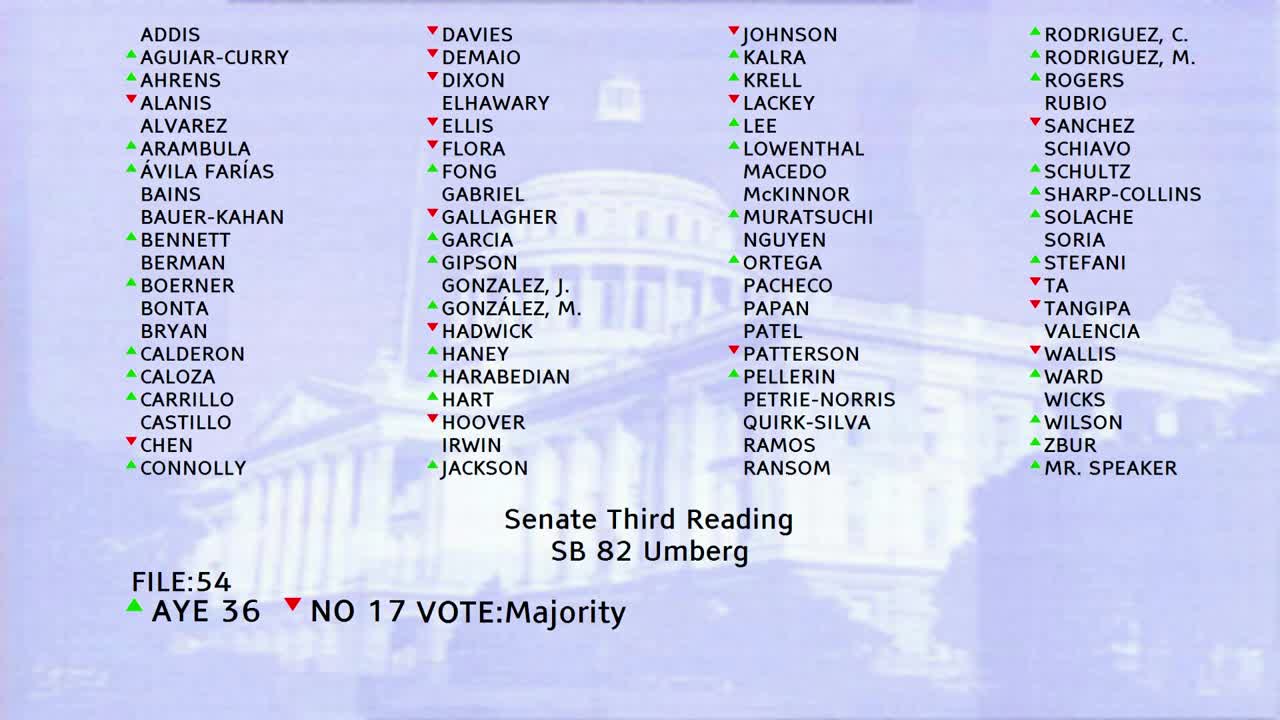

Bill Author

Bill Co-Author(s):