SB 555: Workers’ compensation: average annual earnings.
- Session Year: 2025-2026
- House: Senate
- Latest Version Date: 2026-06-01
Current Status:
In Progress
(2026-06-24: June 24 set for first hearing canceled at the request of author.)
Introduced
In Committee
Awaiting First Chamber Vote
Passed First Chamber
In Committee
Awaiting Second Chamber Vote
Passed Second Chamber
Enacted
Existing law establishes a workers compensation system, administered by the Administrative Director of the Division of Workers Compensation, to compensate an employee for injuries sustained in the course of employment. Existing law provides for temporary disability, permanent total disability, or permanent partial disability benefits, among other benefits, for an injured employee and requires the computation of an injured employees average annual earnings and average weekly earnings for purposes of determining those disability benefits. Existing law requires, for computing average annual earnings for purposes of permanent partial disability indemnity, that average weekly earnings be taken at various amounts, including between $240 and $435 for injuries occurring on or after January 1, 2014, except as specified.
This bill would require, for computing average annual earnings for purposes of permanent partial disability indemnity, that average weekly earnings be taken at between $____ $363 and $____ $658 for injuries occurring on or after January 1, 2027.
Existing law establishes a workers compensation system, administered by the Administrative Director of the Division of Workers Compensation, to compensate an employee for injuries sustained in the course of employment. Existing law provides for temporary disability, permanent total disability, or permanent partial disability benefits, among other benefits, for an injured employee and requires the computation of an injured employees average annual earnings and average weekly earnings for purposes of determining those disability benefits. Existing law requires, for computing average annual earnings for purposes of permanent partial disability indemnity, that average weekly earnings be taken at various amounts, including between $240 and $435 for injuries occurring on or after January 1, 2014, except as specified.
This bill would additionally require that the above-described limits be adjusted by the amount equal to the cost of living adjustment for federal social security benefits for that year, as specified.This bill would require, for computing average annual earnings for purposes of permanent partial disability indemnity, that average weekly earnings be taken at between $____ and $____ for injuries occurring on or after January 1, 2027.
Existing law establishes a workers compensation system, administered by the Administrative Director of the Division of Workers Compensation, to compensate an employee for injuries sustained in the course of employment. Existing law provides for temporary disability, permanent total disability, or permanent partial disability benefits, among other benefits, for an injured employee and requires the computation of an injured employees average annual earnings and average weekly earnings for purposes of determining those disability benefits. Existing law requires, for computing average annual earnings for purposes of permanent partial disability indemnity, that average weekly earnings be taken at various amounts, including between $240 and $435 for injuries occurring on or after January 1, 2014, except as specified.
This bill would additionally require that the above-described limits be adjusted by the amount equal to the cost of living adjustment for federal social security benefits for that year, as specified.
(a)In computing average annual earnings for the purposes of temporary disability indemnity and permanent total disability indemnity only, the average weekly earnings shall be taken at:
(1)Not less than one hundred twenty-six dollars ($126) nor more than two hundred ninety-four dollars ($294), for injuries occurring on or after January 1, 1983.
(2)Not less than one hundred sixty-eight dollars ($168) nor more than three hundred thirty-six dollars ($336), for injuries occurring on or after January 1, 1984.
(3)Not less than one hundred sixty-eight dollars ($168) for permanent total disability, and, for temporary disability, not less than the lesser of one hundred sixty-eight dollars ($168) or 1.5 times the employees average weekly earnings from all employers, but in no event less than one hundred forty-seven dollars ($147), nor more than three hundred ninety-nine dollars ($399), for injuries occurring on or after January 1, 1990.
(4)Not less than one hundred sixty-eight dollars ($168) for permanent total disability, and for temporary disability, not less than the lesser of one hundred eighty-nine dollars ($189) or 1.5 times the employees average weekly earnings from all employers, nor more than five hundred four dollars ($504), for injuries occurring on or after January 1, 1991.
(5)Not less than one hundred sixty-eight dollars ($168) for permanent total disability, and for temporary disability, not less than the lesser of one hundred eighty-nine dollars ($189) or 1.5 times the employees average weekly earnings from all employers, nor more than six hundred nine dollars ($609), for injuries occurring on or after July 1, 1994.
(6)Not less than one hundred sixty-eight dollars ($168) for permanent total disability, and for temporary disability, not less than the lesser of one hundred eighty-nine dollars ($189) or 1.5 times the employees average weekly earnings from all employers, nor more than six hundred seventy-two dollars ($672), for injuries occurring on or after July 1, 1995.
(7)Not less than one hundred sixty-eight dollars ($168) for permanent total disability, and for temporary disability, not less than the lesser of one hundred eighty-nine dollars ($189) or 1.5 times the employees average weekly earnings from all employers, nor more than seven hundred thirty-five dollars ($735), for injuries occurring on or after July 1, 1996.
(8)Not less than one hundred eighty-nine dollars ($189), nor more than nine hundred three dollars ($903), for injuries occurring on or after January 1, 2003.
(9)Not less than one hundred eighty-nine dollars ($189), nor more than one thousand ninety-two dollars ($1,092), for injuries occurring on or after January 1, 2004.
(10)Not less than one hundred eighty-nine dollars ($189), nor more than one thousand two hundred sixty dollars ($1,260), for injuries occurring on or after January 1, 2005. For injuries occurring on or after January 1, 2006, average weekly earnings shall be taken at not less than one hundred eighty-nine dollars ($189), nor more than one thousand two hundred sixty dollars ($1,260) or 1.5 times the state average weekly wage, whichever is greater. Commencing on January 1, 2007, and each January 1 thereafter, the limits specified in this paragraph shall be increased by an amount equal to the percentage increase in the state average weekly wage as compared to the prior year. For purposes of this paragraph, state average weekly wage means the average weekly wage paid by employers to employees covered by unemployment insurance as reported by the United States Department of Labor for California for the 12 months ending March 31 of the calendar year preceding the year in which the injury occurred.
(b)In computing average annual earnings for purposes of permanent partial disability indemnity, except as provided in Section 4659, the average weekly earnings shall be taken at:
(1)Not less than seventy-five dollars ($75), nor more than one hundred ninety-five dollars ($195), for injuries occurring on or after January 1, 1983.
(2)Not less than one hundred five dollars ($105), nor more than two hundred ten dollars ($210), for injuries occurring on or after January 1, 1984.
(3)When the final adjusted permanent disability rating of the injured employee is 15 percent or greater, but not more than 24.75 percent: (A) not less than one hundred five dollars ($105), nor more than two hundred twenty-two dollars ($222), for injuries occurring on or after July 1, 1994; (B) not less than one hundred five dollars ($105), nor more than two hundred thirty-one dollars ($231), for injuries occurring on or after July 1, 1995; (C) not less than one hundred five dollars ($105), nor more than two hundred forty dollars ($240), for injuries occurring on or after July 1, 1996.
(4)When the final adjusted permanent disability rating of the injured employee is 25 percent or greater, not less than one hundred five dollars ($105), nor more than two hundred twenty-two dollars ($222), for injuries occurring on or after January 1, 1991.
(5)When the final adjusted permanent disability rating of the injured employee is 25 percent or greater but not more than 69.75 percent: (A) not less than one hundred five dollars ($105), nor more than two hundred thirty-seven dollars ($237), for injuries occurring on or after July 1, 1994; (B) not less than one hundred five dollars ($105), nor more than two hundred forty-six dollars ($246), for injuries occurring on or after July 1, 1995; and (C) not less than one hundred five dollars ($105), nor more than two hundred fifty-five dollars ($255), for injuries occurring on or after July 1, 1996.
(6)When the final adjusted permanent disability rating of the injured employee is less than 70 percent: (A) not less than one hundred fifty dollars ($150), nor more than two hundred seventy-seven dollars and fifty cents ($277.50), for injuries occurring on or after January 1, 2003; (B) not less than one hundred fifty-seven dollars and fifty cents ($157.50), nor more than three hundred dollars ($300), for injuries occurring on or after January 1, 2004; (C) not less than one hundred fifty-seven dollars and fifty cents ($157.50), nor more than three hundred thirty dollars ($330), for injuries occurring on or after January 1, 2005; and (D) not less than one hundred ninety-five dollars ($195), nor more than three hundred forty-five dollars ($345), for injuries occurring on or after January 1, 2006.
(7)When the final adjusted permanent disability rating of the injured employee is 70 percent or greater, but less than 100 percent: (A) not less than one hundred five dollars ($105), nor more than two hundred fifty-two dollars ($252), for injuries occurring on or after July 1, 1994; (B) not less than one hundred five dollars ($105), nor more than two hundred ninety-seven dollars ($297), for injuries occurring on or after July 1, 1995; (C) not less than one hundred five dollars ($105), nor more than three hundred forty-five dollars ($345), for injuries occurring on or after July 1, 1996; (D) not less than one hundred fifty dollars ($150), nor more than three hundred forty-five dollars ($345), for injuries occurring on or after January 1, 2003; (E) not less than one hundred fifty-seven dollars and fifty cents ($157.50), nor more than three hundred seventy-five dollars ($375), for injuries occurring on or after January 1, 2004; (F) not less than one hundred fifty-seven dollars and fifty cents ($157.50), nor more than four hundred five dollars ($405), for injuries occurring on or after January 1, 2005; and (G) not less than one hundred ninety-five dollars ($195), nor more than four hundred five dollars ($405), for injuries occurring on or after January 1, 2006.
(8)For injuries occurring on or after January 1, 2013:
(A)When the final adjusted permanent disability rating is less than 55 percent, not less than two hundred forty dollars ($240) nor more than three hundred forty-five dollars ($345).
(B)When the final adjusted permanent disability rating is 55 percent or greater but less than 70 percent, not less than two hundred forty dollars ($240) nor more than four hundred five dollars ($405).
(C)When the final adjusted permanent disability rating is 70 percent or greater but less than 100 percent, not less than two hundred forty dollars ($240) nor more than four hundred thirty-five dollars ($435).
(9)For injuries occurring on or after January 1, 2014, not less than two hundred forty dollars ($240) nor more than four hundred thirty-five dollars ($435).
(10)For injuries occurring on or after January 1, 2027, not less than ____ three hundred sixty-three dollars ($____) ($363) nor more than ____ six hundred fifty-eight dollars ($____). ($658).
(c)Between the limits specified in subdivisions (a) and (b), the average weekly earnings, except as provided in Sections 4456 to 4459, shall be arrived at as follows:
(1)Where the employment is for 30 or more hours a week and for five or more working days a week, the average weekly earnings shall be the number of working days a week times the daily earnings at the time of the injury.
(2)Where the employee is working for two or more employers at or about the time of the injury, the average weekly earnings shall be taken as the aggregate of these earnings from all employments computed in terms of one week; but the earnings from employments other than the employment in which the injury occurred shall not be taken at a higher rate than the hourly rate paid at the time of the injury.
(3)If the earnings are at an irregular rate, such as piecework, or on a commission basis, or are specified to be by week, month, or other period, then the average weekly earnings mentioned in subdivision (a) shall be taken as the actual weekly earnings averaged for this period of time, not exceeding one year, as may conveniently be taken to determine an average weekly rate of pay.
(4)Where the employment is for less than 30 hours per week, or where for any reason the foregoing methods of arriving at the average weekly earnings cannot reasonably and fairly be applied, the average weekly earnings shall be taken at 100 percent of the sum which reasonably represents the average weekly earning capacity of the injured employee at the time of the injury, due consideration being given to actual earnings from all sources and employments.
(d)Every computation made pursuant to this section beginning January 1, 1990, shall be made only with reference to temporary disability or the permanent disability resulting from an original injury sustained after January 1, 1990. However, all rights existing under this section on January 1, 1990, shall be continued in force. Except as provided in Section 4661.5, disability indemnity benefits shall be calculated according to the limits in this section in effect on the date of injury and shall remain in effect for the duration of any disability resulting from the injury.
(a)In computing average annual earnings for the purposes of temporary disability indemnity and permanent total disability indemnity only, the average weekly earnings shall be taken at:
(1)Not less than one hundred twenty-six dollars ($126) nor more than two hundred ninety-four dollars ($294), for injuries occurring on or after January 1, 1983.
(2)Not less than one hundred sixty-eight dollars ($168) nor more than three hundred thirty-six dollars ($336), for injuries occurring on or after January 1, 1984.
(3)Not less than one hundred sixty-eight dollars ($168) for permanent total disability, and, for temporary disability, not less than the lesser of one hundred sixty-eight dollars ($168) or 1.5 times the employees average weekly earnings from all employers, but in no event less than one hundred forty-seven dollars ($147), nor more than three hundred ninety-nine dollars ($399), for injuries occurring on or after January 1, 1990.
(4)Not less than one hundred sixty-eight dollars ($168) for permanent total disability, and for temporary disability, not less than the lesser of one hundred eighty-nine dollars ($189) or 1.5 times the employees average weekly earnings from all employers, nor more than five hundred four dollars ($504), for injuries occurring on or after January 1, 1991.
(5)Not less than one hundred sixty-eight dollars ($168) for permanent total disability, and for temporary disability, not less than the lesser of one hundred eighty-nine dollars ($189) or 1.5 times the employees average weekly earnings from all employers, nor more than six hundred nine dollars ($609), for injuries occurring on or after July 1, 1994.
(6)Not less than one hundred sixty-eight dollars ($168) for permanent total disability, and for temporary disability, not less than the lesser of one hundred eighty-nine dollars ($189) or 1.5 times the employees average weekly earnings from all employers, nor more than six hundred seventy-two dollars ($672), for injuries occurring on or after July 1, 1995.
(7)Not less than one hundred sixty-eight dollars ($168) for permanent total disability, and for temporary disability, not less than the lesser of one hundred eighty-nine dollars ($189) or 1.5 times the employees average weekly earnings from all employers, nor more than seven hundred thirty-five dollars ($735), for injuries occurring on or after July 1, 1996.
(8)Not less than one hundred eighty-nine dollars ($189), nor more than nine hundred three dollars ($903), for injuries occurring on or after January 1, 2003.
(9)Not less than one hundred eighty-nine dollars ($189), nor more than one thousand ninety-two dollars ($1,092), for injuries occurring on or after January 1, 2004.
(10)Not less than one hundred eighty-nine dollars ($189), nor more than one thousand two hundred sixty dollars ($1,260), for injuries occurring on or after January 1, 2005. For injuries occurring on or after January 1, 2006, average weekly earnings shall be taken at not less than one hundred eighty-nine dollars ($189), nor more than one thousand two hundred sixty dollars ($1,260) or 1.5 times the state average weekly wage, whichever is greater. Commencing on January 1, 2007, and each January 1 thereafter, the limits specified in this paragraph shall be increased by an amount equal to the percentage increase in the state average weekly wage as compared to the prior year. For purposes of this paragraph, state average weekly wage means the average weekly wage paid by employers to employees covered by unemployment insurance as reported by the United States Department of Labor for California for the 12 months ending March 31 of the calendar year preceding the year in which the injury occurred.
(b)In computing average annual earnings for purposes of permanent partial disability indemnity, except as provided in Section 4659, the average weekly earnings shall be taken at:
(1)Not less than seventy-five dollars ($75), nor more than one hundred ninety-five dollars ($195), for injuries occurring on or after January 1, 1983.
(2)Not less than one hundred five dollars ($105), nor more than two hundred ten dollars ($210), for injuries occurring on or after January 1, 1984.
(3)When the final adjusted permanent disability rating of the injured employee is 15 percent or greater, but not more than 24.75 percent: (A) not less than one hundred five dollars ($105), nor more than two hundred twenty-two dollars ($222), for injuries occurring on or after July 1, 1994; (B) not less than one hundred five dollars ($105), nor more than two hundred thirty-one dollars ($231), for injuries occurring on or after July 1, 1995; (C) not less than one hundred five dollars ($105), nor more than two hundred forty dollars ($240), for injuries occurring on or after July 1, 1996.
(4)When the final adjusted permanent disability rating of the injured employee is 25 percent or greater, not less than one hundred five dollars ($105), nor more than two hundred twenty-two dollars ($222), for injuries occurring on or after January 1, 1991.
(5)When the final adjusted permanent disability rating of the injured employee is 25 percent or greater but not more than 69.75 percent: (A) not less than one hundred five dollars ($105), nor more than two hundred thirty-seven dollars ($237), for injuries occurring on or after July 1, 1994; (B) not less than one hundred five dollars ($105), nor more than two hundred forty-six dollars ($246), for injuries occurring on or after July 1, 1995; and (C) not less than one hundred five dollars ($105), nor more than two hundred fifty-five dollars ($255), for injuries occurring on or after July 1, 1996.
(6)When the final adjusted permanent disability rating of the injured employee is less than 70 percent: (A) not less than one hundred fifty dollars ($150), nor more than two hundred seventy-seven dollars and fifty cents ($277.50), for injuries occurring on or after January 1, 2003; (B) not less than one hundred fifty-seven dollars and fifty cents ($157.50), nor more than three hundred dollars ($300), for injuries occurring on or after January 1, 2004; (C) not less than one hundred fifty-seven dollars and fifty cents ($157.50), nor more than three hundred thirty dollars ($330), for injuries occurring on or after January 1, 2005; and (D) not less than one hundred ninety-five dollars ($195), nor more than three hundred forty-five dollars ($345), for injuries occurring on or after January 1, 2006.
(7)When the final adjusted permanent disability rating of the injured employee is 70 percent or greater, but less than 100 percent: (A) not less than one hundred five dollars ($105), nor more than two hundred fifty-two dollars ($252), for injuries occurring on or after July 1, 1994; (B) not less than one hundred five dollars ($105), nor more than two hundred ninety-seven dollars ($297), for injuries occurring on or after July 1, 1995; (C) not less than one hundred five dollars ($105), nor more than three hundred forty-five dollars ($345), for injuries occurring on or after July 1, 1996; (D) not less than one hundred fifty dollars ($150), nor more than three hundred forty-five dollars ($345), for injuries occurring on or after January 1, 2003; (E) not less than one hundred fifty-seven dollars and fifty cents ($157.50), nor more than three hundred seventy-five dollars ($375), for injuries occurring on or after January 1, 2004; (F) not less than one hundred fifty-seven dollars and fifty cents ($157.50), nor more than four hundred five dollars ($405), for injuries occurring on or after January 1, 2005; and (G) not less than one hundred ninety-five dollars ($195), nor more than four hundred five dollars ($405), for injuries occurring on or after January 1, 2006.
(8)For injuries occurring on or after January 1, 2013:
(A)When the final adjusted permanent disability rating is less than 55 percent, not less than two hundred forty dollars ($240) nor more than three hundred forty-five dollars ($345).
(B)When the final adjusted permanent disability rating is 55 percent or greater but less than 70 percent, not less than two hundred forty dollars ($240) nor more than four hundred five dollars ($405).
(C)When the final adjusted permanent disability rating is 70 percent or greater but less than 100 percent, not less than two hundred forty dollars ($240) nor more than four hundred thirty-five dollars ($435).
(9)(A)For injuries occurring on or after January 1, 2014, not less than two hundred forty dollars ($240) nor more than four hundred thirty-five dollars ($435).
(B)Commencing on January 1, 2026, and each January 1 thereafter, the limits specified in subparagraph (A) shall be adjusted by an amount equal to the cost of living adjustment for social security benefits for that year as published by the social security Administration based on changes in the United States Consumer Price Index, and be applied to the previous years amount in the same manner as social security adjustments are applied.(10)For injuries occurring on or after January 1, 2027, not less than ____ hundred dollars ($____) nor more than ____ hundred dollars ($____).
(c)Between the limits specified in subdivisions (a) and (b), the average weekly earnings, except as provided in Sections 4456 to 4459, shall be arrived at as follows:
(1)Where the employment is for 30 or more hours a week and for five or more working days a week, the average weekly earnings shall be the number of working days a week times the daily earnings at the time of the injury.
(2)Where the employee is working for two or more employers at or about the time of the injury, the average weekly earnings shall be taken as the aggregate of these earnings from all employments computed in terms of one week; but the earnings from employments other than the employment in which the injury occurred shall not be taken at a higher rate than the hourly rate paid at the time of the injury.
(3)If the earnings are at an irregular rate, such as piecework, or on a commission basis, or are specified to be by week, month, or other period, then the average weekly earnings mentioned in subdivision (a) shall be taken as the actual weekly earnings averaged for this period of time, not exceeding one year, as may conveniently be taken to determine an average weekly rate of pay.
(4)Where the employment is for less than 30 hours per week, or where for any reason the foregoing methods of arriving at the average weekly earnings cannot reasonably and fairly be applied, the average weekly earnings shall be taken at 100 percent of the sum which reasonably represents the average weekly earning capacity of the injured employee at the time of the injury, due consideration being given to actual earnings from all sources and employments.
(d)Every computation made pursuant to this section beginning January 1, 1990, shall be made only with reference to temporary disability or the permanent disability resulting from an original injury sustained after January 1, 1990. However, all rights existing under this section on January 1, 1990, shall be continued in force. Except as provided in Section 4661.5, disability indemnity benefits shall be calculated according to the limits in this section in effect on the date of injury and shall remain in effect for the duration of any disability resulting from the injury.
(a)In computing average annual earnings for the purposes of temporary disability indemnity and permanent total disability indemnity only, the average weekly earnings shall be taken at:
(1)Not less than one hundred twenty-six dollars ($126) nor more than two hundred ninety-four dollars ($294), for injuries occurring on or after January 1, 1983.
(2)Not less than one hundred sixty-eight dollars ($168) nor more than three hundred thirty-six dollars ($336), for injuries occurring on or after January 1, 1984.
(3)Not less than one hundred sixty-eight dollars ($168) for permanent total disability, and, for temporary disability, not less than the lesser of one hundred sixty-eight dollars ($168) or 1.5 times the employees average weekly earnings from all employers, but in no event less than one hundred forty-seven dollars ($147), nor more than three hundred ninety-nine dollars ($399), for injuries occurring on or after January 1, 1990.
(4)Not less than one hundred sixty-eight dollars ($168) for permanent total disability, and for temporary disability, not less than the lesser of one hundred eighty-nine dollars ($189) or 1.5 times the employees average weekly earnings from all employers, nor more than five hundred four dollars ($504), for injuries occurring on or after January 1, 1991.
(5)Not less than one hundred sixty-eight dollars ($168) for permanent total disability, and for temporary disability, not less than the lesser of one hundred eighty-nine dollars ($189) or 1.5 times the employees average weekly earnings from all employers, nor more than six hundred nine dollars ($609), for injuries occurring on or after July 1, 1994.
(6)Not less than one hundred sixty-eight dollars ($168) for permanent total disability, and for temporary disability, not less than the lesser of one hundred eighty-nine dollars ($189) or 1.5 times the employees average weekly earnings from all employers, nor more than six hundred seventy-two dollars ($672), for injuries occurring on or after July 1, 1995.
(7)Not less than one hundred sixty-eight dollars ($168) for permanent total disability, and for temporary disability, not less than the lesser of one hundred eighty-nine dollars ($189) or 1.5 times the employees average weekly earnings from all employers, nor more than seven hundred thirty-five dollars ($735), for injuries occurring on or after July 1, 1996.
(8)Not less than one hundred eighty-nine dollars ($189), nor more than nine hundred three dollars ($903), for injuries occurring on or after January 1, 2003.
(9)Not less than one hundred eighty-nine dollars ($189), nor more than one thousand ninety-two dollars ($1,092), for injuries occurring on or after January 1, 2004.
(10)Not less than one hundred eighty-nine dollars ($189), nor more than one thousand two hundred sixty dollars ($1,260), for injuries occurring on or after January 1, 2005. For injuries occurring on or after January 1, 2006, average weekly earnings shall be taken at not less than one hundred eighty-nine dollars ($189), nor more than one thousand two hundred sixty dollars ($1,260) or 1.5 times the state average weekly wage, whichever is greater. Commencing on January 1, 2007, and each January 1 thereafter, the limits specified in this paragraph shall be increased by an amount equal to the percentage increase in the state average weekly wage as compared to the prior year. For purposes of this paragraph, state average weekly wage means the average weekly wage paid by employers to employees covered by unemployment insurance as reported by the United States Department of Labor for California for the 12 months ending March 31 of the calendar year preceding the year in which the injury occurred.
(b)In computing average annual earnings for purposes of permanent partial disability indemnity, except as provided in Section 4659, the average weekly earnings shall be taken at:
(1)Not less than seventy-five dollars ($75), nor more than one hundred ninety-five dollars ($195), for injuries occurring on or after January 1, 1983.
(2)Not less than one hundred five dollars ($105), nor more than two hundred ten dollars ($210), for injuries occurring on or after January 1, 1984.
(3)When the final adjusted permanent disability rating of the injured employee is 15 percent or greater, but not more than 24.75 percent: (A) not less than one hundred five dollars ($105), nor more than two hundred twenty-two dollars ($222), for injuries occurring on or after July 1, 1994; (B) not less than one hundred five dollars ($105), nor more than two hundred thirty-one dollars ($231), for injuries occurring on or after July 1, 1995; (C) not less than one hundred five dollars ($105), nor more than two hundred forty dollars ($240), for injuries occurring on or after July 1, 1996.
(4)When the final adjusted permanent disability rating of the injured employee is 25 percent or greater, not less than one hundred five dollars ($105), nor more than two hundred twenty-two dollars ($222), for injuries occurring on or after January 1, 1991.
(5)When the final adjusted permanent disability rating of the injured employee is 25 percent or greater but not more than 69.75 percent: (A) not less than one hundred five dollars ($105), nor more than two hundred thirty-seven dollars ($237), for injuries occurring on or after July 1, 1994; (B) not less than one hundred five dollars ($105), nor more than two hundred forty-six dollars ($246), for injuries occurring on or after July 1, 1995; and (C) not less than one hundred five dollars ($105), nor more than two hundred fifty-five dollars ($255), for injuries occurring on or after July 1, 1996.
(6)When the final adjusted permanent disability rating of the injured employee is less than 70 percent: (A) not less than one hundred fifty dollars ($150), nor more than two hundred seventy-seven dollars and fifty cents ($277.50), for injuries occurring on or after January 1, 2003; (B) not less than one hundred fifty-seven dollars and fifty cents ($157.50), nor more than three hundred dollars ($300), for injuries occurring on or after January 1, 2004; (C) not less than one hundred fifty-seven dollars and fifty cents ($157.50), nor more than three hundred thirty dollars ($330), for injuries occurring on or after January 1, 2005; and (D) not less than one hundred ninety-five dollars ($195), nor more than three hundred forty-five dollars ($345), for injuries occurring on or after January 1, 2006.
(7)When the final adjusted permanent disability rating of the injured employee is 70 percent or greater, but less than 100 percent: (A) not less than one hundred five dollars ($105), nor more than two hundred fifty-two dollars ($252), for injuries occurring on or after July 1, 1994; (B) not less than one hundred five dollars ($105), nor more than two hundred ninety-seven dollars ($297), for injuries occurring on or after July 1, 1995; (C) not less than one hundred five dollars ($105), nor more than three hundred forty-five dollars ($345), for injuries occurring on or after July 1, 1996; (D) not less than one hundred fifty dollars ($150), nor more than three hundred forty-five dollars ($345), for injuries occurring on or after January 1, 2003; (E) not less than one hundred fifty-seven dollars and fifty cents ($157.50), nor more than three hundred seventy-five dollars ($375), for injuries occurring on or after January 1, 2004; (F) not less than one hundred fifty-seven dollars and fifty cents ($157.50), nor more than four hundred five dollars ($405), for injuries occurring on or after January 1, 2005; and (G) not less than one hundred ninety-five dollars ($195), nor more than four hundred five dollars ($405), for injuries occurring on or after January 1, 2006.
(8)For injuries occurring on or after January 1, 2013:
(A)When the final adjusted permanent disability rating is less than 55 percent, not less than two hundred forty dollars ($240) nor more than three hundred forty-five dollars ($345).
(B)When the final adjusted permanent disability rating is 55 percent or greater but less than 70 percent, not less than two hundred forty dollars ($240) nor more than four hundred five dollars ($405).
(C)When the final adjusted permanent disability rating is 70 percent or greater but less than 100 percent, not less than two hundred forty dollars ($240) nor more than four hundred thirty-five dollars ($435).
(9)(A)For injuries occurring on or after January 1, 2014, not less than two hundred forty dollars ($240) nor more than four hundred thirty-five dollars ($435).
(B)Commencing on January 1, 2026, and each January 1 thereafter, the limits specified in subparagraph (A) shall be adjusted by an amount equal to the cost of living adjustment for social security benefits for that year as published by the social security Administration based on changes in the United States Consumer Price Index, and be applied to the previous years amount in the same manner as social security adjustments are applied.
(c)Between the limits specified in subdivisions (a) and (b), the average weekly earnings, except as provided in Sections 4456 to 4459, shall be arrived at as follows:
(1)Where the employment is for 30 or more hours a week and for five or more working days a week, the average weekly earnings shall be the number of working days a week times the daily earnings at the time of the injury.
(2)Where the employee is working for two or more employers at or about the time of the injury, the average weekly earnings shall be taken as the aggregate of these earnings from all employments computed in terms of one week; but the earnings from employments other than the employment in which the injury occurred shall not be taken at a higher rate than the hourly rate paid at the time of the injury.
(3)If the earnings are at an irregular rate, such as piecework, or on a commission basis, or are specified to be by week, month, or other period, then the average weekly earnings mentioned in subdivision (a) shall be taken as the actual weekly earnings averaged for this period of time, not exceeding one year, as may conveniently be taken to determine an average weekly rate of pay.
(4)Where the employment is for less than 30 hours per week, or where for any reason the foregoing methods of arriving at the average weekly earnings cannot reasonably and fairly be applied, the average weekly earnings shall be taken at 100 percent of the sum which reasonably represents the average weekly earning capacity of the injured employee at the time of his or her the injury, due consideration being given to his or her actual earnings from all sources and employments.
(d)Every computation made pursuant to this section beginning January 1, 1990, shall be made only with reference to temporary disability or the permanent disability resulting from an original injury sustained after January 1, 1990. However, all rights existing under this section on January 1, 1990, shall be continued in force. Except as provided in Section 4661.5, disability indemnity benefits shall be calculated according to the limits in this section in effect on the date of injury and shall remain in effect for the duration of any disability resulting from the injury.
(a)In computing average annual earnings for the purposes of temporary disability indemnity and permanent total disability indemnity only, the average weekly earnings shall be taken at:
(1)Not less than one hundred twenty-six dollars ($126) nor more than two hundred ninety-four dollars ($294), for injuries occurring on or after January 1, 1983.
(2)Not less than one hundred sixty-eight dollars ($168) nor more than three hundred thirty-six dollars ($336), for injuries occurring on or after January 1, 1984.
(3)Not less than one hundred sixty-eight dollars ($168) for permanent total disability, and, for temporary disability, not less than the lesser of one hundred sixty-eight dollars ($168) or 1.5 times the employees average weekly earnings from all employers, but in no event less than one hundred forty-seven dollars ($147), nor more than three hundred ninety-nine dollars ($399), for injuries occurring on or after January 1, 1990.
(4)Not less than one hundred sixty-eight dollars ($168) for permanent total disability, and for temporary disability, not less than the lesser of one hundred eighty-nine dollars ($189) or 1.5 times the employees average weekly earnings from all employers, nor more than five hundred four dollars ($504), for injuries occurring on or after January 1, 1991.
(5)Not less than one hundred sixty-eight dollars ($168) for permanent total disability, and for temporary disability, not less than the lesser of one hundred eighty-nine dollars ($189) or 1.5 times the employees average weekly earnings from all employers, nor more than six hundred nine dollars ($609), for injuries occurring on or after July 1, 1994.
(6)Not less than one hundred sixty-eight dollars ($168) for permanent total disability, and for temporary disability, not less than the lesser of one hundred eighty-nine dollars ($189) or 1.5 times the employees average weekly earnings from all employers, nor more than six hundred seventy-two dollars ($672), for injuries occurring on or after July 1, 1995.
(7)Not less than one hundred sixty-eight dollars ($168) for permanent total disability, and for temporary disability, not less than the lesser of one hundred eighty-nine dollars ($189) or 1.5 times the employees average weekly earnings from all employers, nor more than seven hundred thirty-five dollars ($735), for injuries occurring on or after July 1, 1996.
(8)Not less than one hundred eighty-nine dollars ($189), nor more than nine hundred three dollars ($903), for injuries occurring on or after January 1, 2003.
(9)Not less than one hundred eighty-nine dollars ($189), nor more than one thousand ninety-two dollars ($1,092), for injuries occurring on or after January 1, 2004.
(10)Not less than one hundred eighty-nine dollars ($189), nor more than one thousand two hundred sixty dollars ($1,260), for injuries occurring on or after January 1, 2005. For injuries occurring on or after January 1, 2006, average weekly earnings shall be taken at not less than one hundred eighty-nine dollars ($189), nor more than one thousand two hundred sixty dollars ($1,260) or 1.5 times the state average weekly wage, whichever is greater. Commencing on January 1, 2007, and each January 1 thereafter, the limits specified in this paragraph shall be increased by an amount equal to the percentage increase in the state average weekly wage as compared to the prior year. For purposes of this paragraph, state average weekly wage means the average weekly wage paid by employers to employees covered by unemployment insurance as reported by the United States Department of Labor for California for the 12 months ending March 31 of the calendar year preceding the year in which the injury occurred.
(b)In computing average annual earnings for purposes of permanent partial disability indemnity, except as provided in Section 4659, the average weekly earnings shall be taken at:
(1)Not less than seventy-five dollars ($75), nor more than one hundred ninety-five dollars ($195), for injuries occurring on or after January 1, 1983.
(2)Not less than one hundred five dollars ($105), nor more than two hundred ten dollars ($210), for injuries occurring on or after January 1, 1984.
(3)When the final adjusted permanent disability rating of the injured employee is 15 percent or greater, but not more than 24.75 percent: (A) not less than one hundred five dollars ($105), nor more than two hundred twenty-two dollars ($222), for injuries occurring on or after July 1, 1994; (B) not less than one hundred five dollars ($105), nor more than two hundred thirty-one dollars ($231), for injuries occurring on or after July 1, 1995; (C) not less than one hundred five dollars ($105), nor more than two hundred forty dollars ($240), for injuries occurring on or after July 1, 1996.
(4)When the final adjusted permanent disability rating of the injured employee is 25 percent or greater, not less than one hundred five dollars ($105), nor more than two hundred twenty-two dollars ($222), for injuries occurring on or after January 1, 1991.
(5)When the final adjusted permanent disability rating of the injured employee is 25 percent or greater but not more than 69.75 percent: (A) not less than one hundred five dollars ($105), nor more than two hundred thirty-seven dollars ($237), for injuries occurring on or after July 1, 1994; (B) not less than one hundred five dollars ($105), nor more than two hundred forty-six dollars ($246), for injuries occurring on or after July 1, 1995; and (C) not less than one hundred five dollars ($105), nor more than two hundred fifty-five dollars ($255), for injuries occurring on or after July 1, 1996.
(6)When the final adjusted permanent disability rating of the injured employee is less than 70 percent: (A) not less than one hundred fifty dollars ($150), nor more than two hundred seventy-seven dollars and fifty cents ($277.50), for injuries occurring on or after January 1, 2003; (B) not less than one hundred fifty-seven dollars and fifty cents ($157.50), nor more than three hundred dollars ($300), for injuries occurring on or after January 1, 2004; (C) not less than one hundred fifty-seven dollars and fifty cents ($157.50), nor more than three hundred thirty dollars ($330), for injuries occurring on or after January 1, 2005; and (D) not less than one hundred ninety-five dollars ($195), nor more than three hundred forty-five dollars ($345), for injuries occurring on or after January 1, 2006.
(7)When the final adjusted permanent disability rating of the injured employee is 70 percent or greater, but less than 100 percent: (A) not less than one hundred five dollars ($105), nor more than two hundred fifty-two dollars ($252), for injuries occurring on or after July 1, 1994; (B) not less than one hundred five dollars ($105), nor more than two hundred ninety-seven dollars ($297), for injuries occurring on or after July 1, 1995; (C) not less than one hundred five dollars ($105), nor more than three hundred forty-five dollars ($345), for injuries occurring on or after July 1, 1996; (D) not less than one hundred fifty dollars ($150), nor more than three hundred forty-five dollars ($345), for injuries occurring on or after January 1, 2003; (E) not less than one hundred fifty-seven dollars and fifty cents ($157.50), nor more than three hundred seventy-five dollars ($375), for injuries occurring on or after January 1, 2004; (F) not less than one hundred fifty-seven dollars and fifty cents ($157.50), nor more than four hundred five dollars ($405), for injuries occurring on or after January 1, 2005; and (G) not less than one hundred ninety-five dollars ($195), nor more than four hundred five dollars ($405), for injuries occurring on or after January 1, 2006.
(8)For injuries occurring on or after January 1, 2013:
(A)When the final adjusted permanent disability rating is less than 55 percent, not less than two hundred forty dollars ($240) nor more than three hundred forty-five dollars ($345).
(B)When the final adjusted permanent disability rating is 55 percent or greater but less than 70 percent, not less than two hundred forty dollars ($240) nor more than four hundred five dollars ($405).
(C)When the final adjusted permanent disability rating is 70 percent or greater but less than 100 percent, not less than two hundred forty dollars ($240) nor more than four hundred thirty-five dollars ($435).
(9)(A)For injuries occurring on or after January 1, 2014, not less than two hundred forty dollars ($240) nor more than four hundred thirty-five dollars ($435).
(B)Commencing on January 1, 2026, and each January 1 thereafter, the limits specified in subparagraph (A) shall be adjusted by an amount equal to the cost of living adjustment for social security benefits for that year as published by the social security Administration based on changes in the United States Consumer Price Index, and be applied to the previous years amount in the same manner as social security adjustments are applied.
(c)Between the limits specified in subdivisions (a) and (b), the average weekly earnings, except as provided in Sections 4456 to 4459, shall be arrived at as follows:
(1)Where the employment is for 30 or more hours a week and for five or more working days a week, the average weekly earnings shall be the number of working days a week times the daily earnings at the time of the injury.
(2)Where the employee is working for two or more employers at or about the time of the injury, the average weekly earnings shall be taken as the aggregate of these earnings from all employments computed in terms of one week; but the earnings from employments other than the employment in which the injury occurred shall not be taken at a higher rate than the hourly rate paid at the time of the injury.
(3)If the earnings are at an irregular rate, such as piecework, or on a commission basis, or are specified to be by week, month, or other period, then the average weekly earnings mentioned in subdivision (a) shall be taken as the actual weekly earnings averaged for this period of time, not exceeding one year, as may conveniently be taken to determine an average weekly rate of pay.
(4)Where the employment is for less than 30 hours per week, or where for any reason the foregoing methods of arriving at the average weekly earnings cannot reasonably and fairly be applied, the average weekly earnings shall be taken at 100 percent of the sum which reasonably represents the average weekly earning capacity of the injured employee at the time of his or her injury, due consideration being given to his or her actual earnings from all sources and employments.
(d)Every computation made pursuant to this section beginning January 1, 1990, shall be made only with reference to temporary disability or the permanent disability resulting from an original injury sustained after January 1, 1990. However, all rights existing under this section on January 1, 1990, shall be continued in force. Except as provided in Section 4661.5, disability indemnity benefits shall be calculated according to the limits in this section in effect on the date of injury and shall remain in effect for the duration of any disability resulting from the injury.
|
Date
|
Status
|
|---|---|
| Jun 24, 2026 | June 24 set for first hearing canceled at the request of author. |
| Jun 1, 2026 | From committee with author's amendments. Read second time and amended. Re-referred to Com. on INS. |
| May 4, 2026 | Referred to Com. on INS. |
| Jan 27, 2026 | In Assembly. Read first time. Held at Desk. |
| Jan 27, 2026 | Read third time. Passed. (Ayes 30. Noes 10. Page 3300.) Ordered to the Assembly. |
| Jan 26, 2026 | Read second time. Ordered to third reading. |
| Jan 22, 2026 | Read second time and amended. Ordered to second reading. |
| Jan 22, 2026 | From committee: Do pass as amended. (Ayes 5. Noes 2. Page 3269.) (January 22). |
| Jan 20, 2026 | Set for hearing January 22. |
| May 23, 2025 | May 23 hearing: Held in committee and under submission. |
| May 16, 2025 | Set for hearing May 23. |
| May 5, 2025 | May 5 hearing: Placed on APPR. suspense file. |
| Apr 25, 2025 | Set for hearing May 5. |
| Apr 24, 2025 | April 28 hearing postponed by committee. |
| Apr 22, 2025 | Set for hearing April 28. |
| Apr 21, 2025 | April 21 set for first hearing canceled at the request of author. |
| Apr 10, 2025 | Set for hearing April 21. |
| Apr 9, 2025 | From committee: Do pass and re-refer to Com. on APPR. (Ayes 4. Noes 1. Page 739.) (April 9). Re-referred to Com. on APPR. |
| Apr 1, 2025 | From committee with author's amendments. Read second time and amended. Re-referred to Com. on L., P.E. & R. |
| Mar 26, 2025 | Set for hearing April 9. |
| Mar 5, 2025 | Referred to Com. on L., P.E. & R. |
| Feb 21, 2025 | From printer. May be acted upon on or after March 23. |
| Feb 20, 2025 | Introduced. Read first time. To Com. on RLS. for assignment. To print. |
|
Date
|
Description
|
Location
|
Votes
|
|
|---|---|---|---|---|
| Jan 27, 2026 | Senate 3rd Reading SB555 Caballero et al. | Senate Floor |
Passed |
|
| Jan 22, 2026 | Do pass as amended | Senate Standing Committee on Appropriations |
Passed |
|
| May 5, 2025 | Placed on suspense file | Senate Standing Committee on Appropriations |
Passed |
|
| Apr 9, 2025 | Do pass, but first be re-referred to the Committee on [Appropriations] | Senate Standing Committee on Labor, Public Employment and Retirement |
Passed |
This list shows positions taken on this bill by organizations on the date displayed, which is linked to the original source.
Positions by individuals are not included.
|
Organization
|
Position
|
Date
|
|---|---|---|
| Murrieta Wildomar Chamber of Commerce | ** Against | |
| Acclamation Insurance Management Services | ** Against | |
| Allied Managed Care | ** Against | |
| Almond Alliance | ** Against | |
| American Federation of State, County and Municipal Employees | ** Support | |
| American Property Casualty Insurance Association | ** Against | |
| Brea Chamber of Commerce | ** Against | |
| California Alliance of Family Owned Businesses | ** Against | |
| California Applicants' Attorneys Association | ** Support | |
| California Association Of Joint Powers Authorities | ** Against | |
| California Association Of Psychiatric Technicians | ** Support | |
| California Association Of Winegrape Growers | ** Against | |
| California Attractions And Parks Association | ** Against | |
| California Chamber Of Commerce | ** Against | |
| California Coalition On Workers Compensation | ** Against | |
| California Cotton Ginners & Growers Association | ** Against | |
| California Federation of Labor Unions, Afl-cio | ** Support | |
| California Fresh Fruit Association | ** Against | |
| California Grocers Association | ** Against | |
| California Hotel & Lodging Association | ** Against | |
| California Joint Powers Insurance Authority (Jpia) | ** Against | |
| California League of Food Producers | ** Against | |
| California Manufacturers & Technology Association | ** Against | |
| California Professional Firefighters | ** Support | |
| California Restaurant Association | ** Against | |
| California School Employees Association | ** Support | |
| California State Association Of Counties | ** Against | |
| California Trucking Association | ** Against | |
| Carlsbad Chamber of Commerce | ** Against | |
| Coalition of Small and Disabled Veteran Businesses | ** Against | |
| Corona Chamber of Commerce | ** Against | |
| Dana Point Chamber of Commerce | ** Against | |
| Flasher Barricade Association | ** Against | |
| Garden Grove Chamber Of Commerce | ** Against | |
| Gilroy Chamber of Commerce | ** Against | |
| Greater Bakersfield Chamber of Commerce | ** Against | |
| Greater Coachella Valley Chamber of Commerce | ** Against | |
| Greater Conejo Valley Chamber of Commerce | ** Against | |
| Greater High Desert Chamber of Commerce | ** Against | |
| Greater Modesto Chamber of Commerce | ** Against | |
| Green Industry Co-op | ** Against | |
| International Warehouse Logistics Association | ** Against | |
| LA Canada Flintridge Chamber of Commerce | ** Against | |
| Lake Elsinore Valley Chamber of Commerce | ** Against | |
| Landscape Contractors Insurance Services, Inc. | ** Against | |
| Leading Age California | ** Against | |
| lincoln area chamber of commerce | ** Against | |
| livermore valley chamber of commerce | ** Against | |
| Long Beach Area Chamber of Commerce | ** Against | |
| Los Angeles County Professional Peace Officers Association | ** Support | |
| Mission Viejo Chamber of Commerce | ** Against | |
| NATIONAL FEDERATION OF INDEPENDENT BUSINESS (NFIB) | ** Against | |
| Newport Beach Chamber of Commerce | ** Against | |
| Oceanside Chamber of Commerce | ** Against | |
| Orange County Business Council | ** Against | |
| Palm Desert Area Chamber of Commerce | ** Against | |
| Partners Personnel | ** Against | |
| PUBLIC RISK INNOVATION, SOLUTIONS, AND MANAGEMENT (PRISM) | ** Against | |
| Rancho Cordova Area Chamber | ** Against | |
| Rancho Cucamonga Chamber of Commerce | ** Against | |
| Redondo Beach Chamber of Commerce | ** Against | |
| Roseville Area Chamber Of Commerce | ** Against | |
| Rural County Representatives of California | ** Against | |
| Sacramento Metropolitan Chamber of Commerce | ** Against | |
| Santa Ana Chamber of Commerce | ** Against | |
| Santa Clarita Valley Chamber of Commerce | ** Against | |
| Santa Maria Valley Chamber | ** Against | |
| Santee Chamber of Commerce | ** Against | |
| South Bay Association of Chambers of Commerce | ** Against | |
| Southwest California Legislative Council | ** Against | |
| Temecula Valley Chamber of Commerce | ** Against | |
| Torrance Area Chamber of Commerce | ** Against | |
| Urban Counties of California (UCC) | ** Against | |
| VALLEY INDUSTRY AND COMMERCE ASSOCIATION | ** Against | |
| Ventura Chamber of Commerce | ** Against | |
| Western Tree Nut Association | ** Against | |
| Yorba Linda Chamber of Commerce | ** Against |
Date of Hearing: June 24, 2026
ASSEMBLY COMMITTEE ON INSURANCE
Lisa Calderon, Chair
SBPCA Bill Id:SB 555
Author:(Caballero) – As Amended Ver:June 1, 2026
SENATE VOTE: 30-10
SUBJECT: Workers’ compensation: average annual earnings
SUMMARY: For injuries occurring on or after January 1, 2027, raises the minimum and maximum average weekly earnings, used for the calculation of weekly payments for permanent partial disability (PPD) benefits, from $240 to $363 and from $435 to $658, respectively.
EXISTING LAW:
- Establishes a workers’ compensation system that provides benefits to an employee who suffers from an injury or illness that arises out of, and in the course of, employment, irrespective of fault. This system requires all employers to secure payment of benefits by either securing the consent of the Department of Industrial Relations (DIR) to self-insure or by securing insurance against liability from an insurance company duly authorized by the state. (California Constitution Article XIV, Section 4)
- Provides that the workers’ compensation laws of the state shall be liberally construed by the courts with the purpose of extending their benefits for the protection of persons injured in the course of their employment. (Labor (Lab.) Code Sec. 3202)
- Requires medical treatment that is reasonably required to cure or relieve an injured worker from the effects of the worker’s injury be provided by the employer, as specified. (Lab. Code Sec. 4600)
- Establishes within the workers’ compensation system temporary and permanent benefits, referred to as disability indemnity, which offer wage replacement equal to two-thirds of a specified injured employee’s average weekly earnings for up to 240 weeks while an employee is unable to work due to a workplace illness or injury, and for a specified number of weeks, or for life, if the disability is permanent. (Lab. Code Secs. 4653-4658)
- Provides that, if an injury causes permanent disability, the first payment shall be made within 14 days after the date of last payment of temporary disability indemnity, except as specified, and that payment of permanent disability indemnity subsequent to the first payment shall be made as due every two weeks. (Lab. Code Sec. 4650)
- Provides that, for injuries occurring on or after January 1, 2013, if an injury causes permanent disability, the percentage of disability to total disability shall be determined, and the number of weeks of disability payment shall be computed as specified in an accompanying table at a rate of two-thirds of average weekly earnings. (Lab. Code Sec. 4658(e))
- Provides that, in computing average annual earnings for purposes of permanent partial disability indemnity, for injuries occurring on or after January 1, 2014, the average weekly earnings shall be taken at not less than $240 nor more than $435. (Lab. Code Sec. 4453(b)(9))
FISCAL EFFECT: Unknown.
COMMENTS:
- Purpose. According to the author, “SB 555 will create a benefit cost of living adjustment for workers who have suffered a partial permanent disability while on the job. This adjustment recognizes inflation and cost of living increases. This will allow for the individuals who have suffered a permanently life altering injury to receive benefits that will help sustain them when they may need it most.”
This bill is sponsored by the California Applicants’ Attorneys Association.
- Workers’ compensation, PPD, and average weekly earnings calculations. At its core, the workers’ compensation system relies on a so-called “grand bargain.” If a worker is injured on the job, the employer must pay for the worker’s medical treatment, including monetary benefits if the injury is permanent. In exchange for receiving the guarantee of such treatment, the worker surrenders the right to sue the employer for monetary damages in civil court. All employers are required to secure the payment of workers’ compensation either by receiving approval from DIR to self-insure in accordance with substantial requirements, or by obtaining workers’ compensation insurance coverage from an authorized insurer. The Labor Code explicitly asserts that it is the policy of the state to “vigorously enforce” this law.
PPD is provided when a worker is injured on the job and suffers a permanent disability that does not totally preclude their ability to work. PPD is paid at a rate of two-thirds of the injured worker’s average weekly earnings, continuing for a number of weeks determined based on the percentage of total disability incurred by the worker. However, the calculation of average weekly earnings has both a floor and a ceiling, such that weekly PPD payments have both a minimum and a maximum rate. This means that if the injured worker makes less than the minimum per week, they would be considered to have average weekly earnings equivalent to the minimum for the purposes of calculating PPD payments, and if they make more than the maximum, they would be considered to have average weekly earnings equivalent to that maximum value.
The minimum and maximum average weekly earnings have been subject to one-time increases many times over the past four decades, with the most recent affecting injuries occurring on or after January 1, 2014. That increase established a minimum average weekly earnings of $240 and a maximum of $435. These would be equivalent to annual earnings of $12,480 and $22,620, respectively. A permanently disabled worker would therefore receive biweekly payments of between $320 and $580, equivalent to $8,320 to $15,080 over the course of a year.
SB 555 would increase the average weekly earnings range for PPD for injuries occurring on or after January 1, 2027 to a minimum of $363 and a maximum of $658. This represents a 51.25% increase over the current range, and would correspond to a minimum annual income of $18,876 and a maximum of $34,216, and minimum and maximum weekly PPD payments of $242 and $439, respectively.
According to the California Department of Industrial Relations Consumer Price Index (CPI) Calculator, since 2014, when the previous increase in PPD limits took effect, the CPI, a measure of cost of living among urban consumers, has increased by 49.5% (as of April 2026). The increase proposed by this bill would therefore be equivalent to the change in California CPI plus 1.75%.
A previous version of SB 555 included an annual cost of living adjustment to the PPD average weekly earnings range, that has since been replaced by this one-time increase. That previous version of the bill relied on the cost of living adjustment for social security benefits, published by the Social Security Administration based on changes in the United States CPI, for dictating the annual increase. Since 2014, based on this metric, social security benefits have increased by 37.8%. The one-time increase proposed in this bill would exceed that cost of living increase by 13.45%.
- Overdue or premature? Supporters of the bill argue that an increase to the PPD average weekly earnings range is long overdue, given these considerable increases in cost of living and wages since the previous increase took effect. For instance, in support of the bill, the Los Angeles County Professional Peace Officers Association argues:
This update is long overdue. Public safety officers – deputies, police officers, probation officers, and other peace officers – sustain serious on-the-job injuries at rates far higher than most other occupations. Many of those injuries result in lasting, permanent impairment. For officers who receive a permanent partial disability rating, workers’ compensation PPD benefits are often a critical component of their financial recovery and long-term stability.
Yet the earnings limits used to calculate those benefits have been frozen for over a decade. Since 2014, the costs of housing, medical care, and everyday necessities have risen substantially, while the PPD calculation framework has remained anchored to figures that no longer reflect economic reality.
SB 555 ensures that workers who suffer permanent disabilities due to workplace injuries receive benefits that reflect the actual cost of living.
The California Applicants’ Attorneys Association, who sponsor the bill, add:
While insurance rates for employers over the past 14 years have decreased or remained steady (until this year), and profits for insurance companies have increased, there has been no increase in workers’ compensation benefits since the last “major reform” in 2012.
On the other hand, opponents of the bill argue that while an increase in the PPD rate may be justified, doing so in the absence of countervailing reforms to reduce system costs could threaten the stability of the state’s workers’ compensation system.
A large coalition of organizations representing business and employer interests opposing the bill, including the California Chamber of Commerce (CalChamber), the American Property Casualty Insurance Association, the California Coalition on Workers’ Compensation, the California Trucking Association, the California Restaurant Association, the California Hotel & Lodging Association, and the California State Association of Counties, argues:
While our coalition supports fair and adequate benefits for injured workers, increased permanent disability benefits should be considered only as part of a balanced reform package that improves benefits for injured workers while also addressing the cost pressures, litigation incentives, and system inefficiencies borne by employers. SB 555 addresses only one side of that equation, imposing a 51% increase in the weekly permanent disability benefit amount. We estimate this change will add $1.8 billion to annual employer workers’ compensation costs.
Balance is essential to the long-term health of California workers’ compensation system, which remains one of the most expensive and complex systems in the country. Historically, California workers’ compensation policy has been marked by periods of instability when benefit increases and cost controls were pursued separately rather than through balanced, negotiated reform. Over the last two decades, the most durable reforms have resulted from balanced packages that paired benefit improvements for injured workers with reforms designed to improve predictability, reduce frictional costs, and protect employer affordability.
This proposal comes at a time when workers’ compensation costs are steadily rising for California employers. In 2025, the Insurance Commissioner approved an 8.7 percent increase in the advisory pure premium rate effective September 1, 2025, following years of declining or stable rates. The Workers’ Compensation Insurance Rating Bureau has also submitted a September 1, 2026 regulatory filing proposing an additional 10.4 percent increase. These actions reflect growing concern about rising claim costs, including medical costs, cumulative trauma claims, and allocated loss adjustment expenses.
Staff notes, consistent with the opposition’s argument, that the increase that established the current PPD limits was enacted as part of SB 863 (De Leon, Ch. 363, Stats. 2012). SB 863 also made several major reforms to the California workers’ compensation system, including, among many others, substantial changes to the qualified medical evaluator (QME) process, establishment of the Independent Medical Review (IMR) and Independent Bill Review (IBR) systems, modification of the calculation of permanent disability ratings, and changes to the medical provider network (MPN) structure. All of these reforms dramatically changed the underlying structure of the workers’ compensation system and were agreed upon through extensive stakeholder negotiation over several months. The increase prior to SB 863 was similarly adopted through a major reform effort enacted via AB 749 (Calderon, Ch. 6, Stats. 2002), which, in addition to raising the PPD limits, made over 50 other changes to the workers’ compensation system described by the Assembly Insurance Committee analysis as “cost-saving reforms in the administration of the workers’ compensation system.”
The stability of the workers’ compensation system relies on continued buy-in from both workers and employers with respect to the so-called “grand bargain.” If costs to employers increase too much, or benefits to workers become insufficient, the bargain may no longer remain a viable solution to the problem of assigning fault and establishing recourse for workplace injuries. As such, changes to the workers’ compensation system with the potential to disrupt this balance should arguably be pursued as part of broader reform packages that seek to offset the added costs of increased benefits through improved efficiency elsewhere in the system.
- Prior legislation.
SB 863 (De Leon, Ch. 363, Stats. 2012) See Comment #3.
SB 773 (Florez, 2009) would have increased the maximum average weekly wage used for calculating PPD payments, and would have increased the number of weeks of benefit payments permanently disabled workers would receive for a specified disability rating. This bill was held in the Senate Appropriations Committee.
SB 1717 (Perata, 2008) would have, among other things, revised the formula for computing PPD benefits for injuries occurring on or after January 1, 2009. This bill was vetoed by Governor Schwarzenegger.
SB 936 (Perata, 2007) would have revised the formula for computing PPD benefits for injuries occurring on or after January 1, 2008. This bill was vetoed by Governor Schwarzenegger.
SB 815 (Perata, 2006) would have revised the formula for computing PPD benefits for injuries occurring on or after January 1, 2007. This bill was vetoed by Governor Schwarzenegger.
SB 899 (Poochigian, Ch. 34, Stats. 2004), among other workers’ compensation reforms, established the schedule for the computation of permanent disability benefits, as specified, and provided that this schedule for permanent disability payments would apply to injuries occurring before April 30, 2004 under certain circumstances.
AB 749 (Calderon, Ch. 6, Stats. 2002) See Comment #3.
REGISTERED SUPPORT / OPPOSITION:
Support
California Applicants' Attorneys Association
California Federation of Labor Unions, Afl-cio
California Professional Firefighters
Los Angeles County Professional Peace Officers Association
Oppose
Acclamation Insurance Management Services
Allied Managed Care
Almond Alliance
American Property Casualty Insurance Association
Brea Chamber of Commerce
California Association of Joint Powers Authorities
California Attractions and Parks Association
California Coalition on Workers Compensation
California Cotton Ginners & Growers Association
California Fresh Fruit Association
California Grocers Association
California Hotel & Lodging Association
California Joint Powers Insurance Authority (JPIA)
California League of Food Producers
California Manufacturers & Technology Association
California Restaurant Association
California State Association of Counties
California Trucking Association
Carlsbad Chamber of Commerce
Dana Point Chamber of Commerce
Flasher Barricade Association
Garden Grove Chamber of Commerce
Greater Bakersfield Chamber of Commerce
Greater Coachella Valley Chamber of Commerce
Greater High Desert Chamber of Commerce
Greater Modesto Chamber of Commerce
Green Industry Co-op
International Warehouse Logistics Association
LA Canada Flintridge Chamber of Commerce
Landscape Contractors Insurance Services, INC.
Leading Age California
Lincoln Area Chamber of Commerce
Livermore Valley Chamber of Commerce
Long Beach Area Chamber of Commerce
National Federation of Independent Business (NFIB)
Newport Beach Chamber of Commerce
Oceanside Chamber of Commerce
Palm Desert Area Chamber of Commerce
Partners Personnel
Public Risk Innovation, Solutions, and Management (PRISM)
Rancho Cordova Area Chamber
Redondo Beach Chamber of Commerce
Roseville Area Chamber of Commerce
Rural County Representatives of California
Sacramento Metropolitan Chamber of Commerce
Santa Maria Valley Chamber
South Bay Association of Chambers of Commerce
Southwest California Legislative Council
Temecula Valley Chamber of Commerce
Torrance Area Chamber of Commerce
Urban Counties of California (UCC)
Ventura Chamber of Commerce
Western Tree Nut Association
Yorba Linda Chamber of Commerce
Analysis Prepared by: Landon Klein / INS. / (916) 319-2086
SENATE RULES COMMITTEE Office of Senate Floor Analyses (916) 651-1520 Fax: (916) 327-4478 | SB 555 |
THIRD READING
Bill No: SB 555
Author: Caballero (D), et al.
Amended: 1/22/26
Vote: 21
SENATE LABOR, PUB. EMP. & RET. COMMITTEE: 4-1, 4/9/25
AYES: Smallwood-Cuevas, Cortese, Durazo, Laird
NOES: Strickland
SENATE APPROPRIATIONS COMMITTEE: 5-2, 1/22/26
AYES: Caballero, Cabaldon, Grayson, Richardson, Wahab
NOES: Seyarto, Dahle
SUBJECT: Workers’ compensation: average annual earnings
SOURCE: California Applicants' Attorneys Association
DIGEST:
This bill requires, for injuries occurring on or after January 1, 2027, the permanent partial disability average weekly earnings to be adjusted by an unspecified amount.
ANALYSIS:
- Establishes a comprehensive system of workers' compensation that provides a range of benefits for an employee who suffers from an injury or illness that arises out of and in the course of employment, regardless of fault. This system requires all employers to insure payment of benefits by either securing the consent of the Department of Industrial Relations to self-insure or by obtaining insurance from a company authorized by the state. (Labor Code §§3200-6002)
- Establishes within the workers’ compensation system temporary disability (TD) indemnity, permanent disability (PD) indemnity, and permanent partial disability (PPD) indemnity, which offer wage replacement of a specified injured employee’s average weekly earnings while an employee is unable to work due to a workplace illness or injury. (Labor Code §§4650-4664)
- Requires, for computing average annual earnings for purposes of PPD indemnity, that average weekly earnings be taken at various amounts, including between $240 and $435 for injuries occurring on or after January 1, 2014, except as specified. (Labor Code §4453)
This bill requires, for computing average annual earnings for purposes of permanent partial disability indemnity, that average weekly earnings be taken at between $____ and $____ for injuries occurring on or after January 1, 2027.
Background
Workers’ Compensation Permanent Partial Disability Benefits. Most workers recover from their job injuries, although some may continue to have problems. If a treating doctor tells a worker they will never recover completely or will always be limited in the work they can do, they may have a permanent disability. This means that the worker may be eligible for permanent disability (PD) benefits. Workers do not have to lose their job to be eligible for PD benefits. However, if someone loses income because of a permanent disability, PD benefits may not cover all the income lost.
PD benefits are set by law and are based on the following:
- the date of the worker’s industrial injury, and
- the worker’s impairment level, which means how the injury has affected the individual’s ability to work, as determined by the primary treating physician or doctor who is a qualified medical evaluation (QME)
The impairment level will be expressed as a percentage and is then used in a formula which also includes your age and occupation. For injuries on or after April 19, 2004, and prior to January 1, 2013, the formula also includes diminished future earning capacity. For dates of injury on or after January 1, 2013, PD ratings will no longer consider an injured employee’s future earnings capacity.
A disability evaluator or the judge will calculate this formula and determine how much PD the worker is entitled to receive and their rating. A rating is a percentage that estimates how much the worker’s disability limits the kinds of work they can do or ability to earn a living and determines the amount of their PD benefits. A rating of 100% means a permanent total disability. Ratings of 100% are very rare. A rating between 1% and 99% means a permanent partial disability (PPD).
In 2012, SB 863 (De Leon (Chapter 363, Statutes of 2012)) was enacted as a major, bipartisan reform backed by business and labor groups. The bill made wide-ranging changes to the state’s workers' compensation system, including increased benefits to injured workers and cost-saving efficiencies. SB 863 also revised the method for determining benefits for PPD for injuries occurring on or after January 1, 2014. The current minimum benefit for PPD indemnity is $240 per week and the maximum is $435 per week for injuries occurring on or after January 1, 2014. Individuals who have a PPD are eligible to receive the total amount of PPD benefits spread over a fixed number of weeks.
This bill, SB 555, proposes to adjust what the PPD average weekly earnings will be to compute the average annual earnings – by an unspecified amount – for injuries occurring on or after January 1, 2027. Recent amendments removed the provision that would have adjusted the PPD average weekly earnings by an amount equal to the cost-of-living adjustment (COLA) for social security benefits for that year. The bill currently in print replaced this COLA adjustment with blank spaces as a placeholder. Should this bill move forward, the author and proponents will have to fill in the blank spaces and decide what the minimum and maximum average weekly earnings will be to calculate the average annual earnings for purposes of PPD for injuries on or after January 1, 2027.
Related/Prior Legislation
SB 863 (De Leon, Chapter 363, Statutes of 2012) enacted major reforms to the workers’ compensation system, including revising the method for determining benefits for purposes of permanent partial disability for injuries occurring on or after January 1, 2013, and on or after January 1, 2014.
SB 773 (Florez, 2009) would have, effective on January 1, 2010, increased the maximum average weekly wage that is allowed to be used for the purpose of calculating weekly disability benefit payments. Also, for injuries occurring on or after January 1, 2010, increased the number of weeks of benefit payments to permanently disabled workers for specified percentages of permanent disability. This bill was held in Senate Appropriations Committee.
FISCAL EFFECT: Appropriation: No Fiscal Com.: Yes Local: No
According to the Senate Appropriations Committee:
- Costs to the Department of Industrial Relations would likely be minor and absorbable.
- This bill would result in increased permanent partial disability payment amounts (relative to current law) to the State as a direct employer beginning in 2026-27. The magnitude is currently unknown and would depend on (1) the dollar thresholds ultimately included in the bill, and (2) the future number of new state employees receiving such payments.
SUPPORT: (Verified 1/22/26)
California Applicants' Attorneys Association (Source)
American Federation of State, County and Municipal Employees
California Association of Psychiatric Technicians
California Federation of Labor Unions
California Professional Firefighters
California School Employees Association
OPPOSITION: (Verified 1/22/26)
Acclamation Insurance Management Services
Allied Managed Care
American Property Casualty Insurance Association
Brea Chamber of Commerce
California Alliance of Family Owned Businesses
California Association of Joint Powers Authorities
California Association of Winegrape Growers
California Chamber of Commerce
California Coalition on Workers Compensation
California Grocers Association
California League of Food Producers
Carlsbad Chamber of Commerce
Coalition of Small and Disabled Veteran Businesses
Corona Chamber of Commerce
Flasher Barricade Association
Gilroy Chamber of Commerce
Greater Coachella Valley Chamber of Commerce
Greater Conejo Valley Chamber of Commerce
Greater High Desert Chamber of Commerce
Lake Elsinore Valley Chamber of Commerce
Long Beach Area Chamber of Commerce
Mission Viejo Chamber of Commerce
Murrieta Wildomar Chamber of Commerce
National Federation of Independent Business
Orange County Business Council
Public Risk Innovation, Solutions, and Management
Rancho Cucamonga Chamber of Commerce
Roseville Area Chamber of Commerce
Rural County Representatives of California
Santa Ana Chamber of Commerce
Santa Clarita Valley Chamber of Commerce
Santee Chamber of Commerce
Southwest California Legislative Council
Torrance Area Chamber of Commerce
Valley Industry and Commerce Association
ARGUMENTS IN SUPPORT: According to the California Federation of Labor Unions: “Workers’ compensation insurance is intended to provide a safety net for workers who sustain a debilitating injury on the jobsite, and to ensure that those workers receive some minimum benefits as they deal with the economic, physical, and emotional toll from the injury. Currently, workers’ compensation PPD benefits are based on outdated wage ranges set in 2014, despite California’s average weekly wage increasing by nearly 60% since then. In 2014, the last time PPD benefits were adjusted, the average Social Security monthly benefit was $1,294, and as of 2023, those benefits have increased to an average of $1,825.”
ARGUMENTS IN OPPOSITION: According to the opposition, which includes a coalition of business and insurer groups, including the California Chamber of Commerce: “SB 555 misidentifies permanent disability as wage replacement when a closer look at the complexities of the Workers’ Compensation system in California clarifies that permanent disability is not intended to replace wages and therefore annual increases as proposed are not appropriate. […] Any discussion of increased benefits is better suited for a larger discussion about system reform as was done in prior legislation. […] As a vital element of the Grand Bargain, a reconsideration of the purpose of any individual indemnity benefit or any increase should be part of a larger discussion about broader reform of the Workers’ Compensation System. Substantive changes to the nature of PD benefits must be
balanced by efforts to reduce costs elsewhere within the system. The last major reform (SB 863 in 2012) increased PD benefits and paid for them by reducing frictional costs elsewhere.”
Prepared by: Jazmin Marroquin/ L.P.E. & R. / (916) 651-1556
1/26/26 13:22:02
**** END ****
SENATE COMMITTEE ON
Senator Anna Caballero, Chair
2025 - 2026 Regular Session
SB 555 (Caballero) - Workers’ compensation: average annual earnings
Version: | Policy Vote: |
Urgency: | Mandate: |
Hearing Date: | Consultant: |
Bill Summary:
SB 555 would require permanent partial disability average weekly earnings to be adjusted annually (as specified) for increases in the cost of living.
*********** ANALYSIS ADDENDUM – SUSPENSE FILE ***********
The following information is revised to reflect amendments
adopted by the committee on January 22, 2026
Fiscal Impact:
- Costs to the Department of Industrial Relations would likely be minor and absorbable.
- This bill would result in increased permanent partial disability payment amounts (relative to current law) to the State as a direct employer beginning in 2026-27. The magnitude is currently unknown and would depend on (1) the dollar thresholds ultimately included in the bill, and (2) the future number of new state employees receiving such payments.
Author Amendments:
- Delete current language stating that “Commencing on January 1, 2026, and each January 1 thereafter, the limits specified in subparagraph (A) shall be adjusted by an amount equal to the cost of living adjustment for social security benefits for that year as published by the social security Administration based on changes in the United States Consumer Price Index, and be applied to the previous year’s amount in the same manner as social security adjustments are applied.”
- Insert new language that would “require, for computing average annual earnings for purposes of permanent partial disability indemnity, that average weekly earnings be taken at between $____ and $____ for injuries occurring on or after January 1, 2027.”
-- END --
SENATE COMMITTEE ON APPROPRIATIONS
Senator Anna Caballero, Chair
2025 - 2026 Regular Session
SB 555 (Caballero) - Workers’ compensation: average annual earnings
Version: April 1, 2025 | Policy Vote: L., P.E. & R. 4 - 1 |
Urgency: No | Mandate: No |
Hearing Date: May 5, 2025 | Consultant: Robert Ingenito |
Bill Summary:
SB 555 would require permanent partial disability average weekly earnings to be adjusted annually (as specified) for increases in the cost of living.
Fiscal Impact:
- The Department of Industrial Relations indicates that administrative costs resulting from this bill would be minor and absorbable.
- This bill would result in increased permanent partial disability payment amounts (relative to current law) to the State as a direct employer. The annual magnitude is unknown, and would depend, among other factors, on (1) the future number of new state employees receiving such payments (including any utilization increase beyond what would have occurred absent the bill), and (2) future calculated inflation rates. However, as an order of magnitude, increased annual PPD state payments would likely be in the millions of dollars (General Fund and special funds, see Staff Comments).
Background:
Workers’ compensation is a support system for workers who do not fully recover from an illness or injury sustained from their workplace. California’s workers’ compensation system provides various benefits, including disability benefits, to help employees recover and rehabilitate. Not all workers recover from their job injuries. If a treating doctor tells a worker they will never recover completely, or will always be limited in the work they can do, they may have a permanent disability, potentially making the worker eligible for permanent disability (PD) benefits.
PD benefits are set by law and, and among other things, are based on (1) the date of the worker’s industrial injury, and (2) the worker’s impairment level. The latter summarizes how the injury has affected the individual’s ability to work, as determined by the primary treating physician or doctor who is a qualified medical evaluation (QME). The impairment level is expressed as a percentage, which is then used in a formula along with other factors (including age and occupation).
A disability evaluator will calculate this formula and determine how much PD the worker is entitled to receive and their rating. A rating is a percentage that estimates how much the worker’s disability limits the kinds of work they can do or ability to earn a living, and determines the amount of their PD benefits. A rating of 100 percent (which is rare) means a permanent total disability. A rating between 1 percent and 99 percent reflects a permanent partial disability (PPD).
In 2012, SB 863 (De Leon) made substantial changes to the State’s workers' compensation system. Among other things, it revised the method for determining benefits for PPD for injuries occurring on or after January 1, 2014. The current amount for PPD indemnity ranges from $240 to $435 per week. Individuals who have a PPD are eligible to receive the total amount of PPD benefits spread over a fixed number of weeks.
Social Security Insurance was created in the 1930s to address economic security for the elderly by creating a work-related, contributory system in which workers would provide for their own future economic security through taxes paid while employed. Among other things, the Social Security Act (SSA) created a social insurance program designed to pay retired workers age 65 or older a continuing income after retirement. Social Security benefits to a given retiree are determined by a specified formula, and were not adjusted for inflation until 1950. That year, Congress amended the SSA and first legislated an increase in benefits. In 1972, federal law was changed again to provide automatic, formula-driven increases in benefits to account for price increases. Specifically, beginning in 1975, automatic cost of living adjustments (COLAs) were provided to Social Security benefits using data from the national Consumer Price Index (CPI). With this change in law, beneficiaries do not have to wait for congressional action to increase their benefits and inflation does eat away at Social Security benefits.
Regarding the Social Security benefit inflation-adjustment methodology, CPI data are calculated and released by the Bureau of Labor Statistics (BLS) on a monthly basis. The CPI represents changes in prices of all goods and services purchased for consumption by urban households. User fees (such as water and sewer service) and sales and excise taxes paid by the consumer are also included. Income taxes and investment items (like stocks, bonds, and life insurance) are not included. Prices for the goods and services used to calculate the CPI are collected (1) in 75 urban areas throughout the country, and (2) from about 23,000 retail and service establishments. BLS has classified all expenditure items into more than 200 categories, arranged into eight major groups: food and beverages, housing, apparel, transportation, medical care, recreation, education and communication, and other goods and services.
Consumer Price Indices are available for two population groups: (1) All Urban Consumers (CPI-U), which covers over 90 percent of the total population, and (2) Urban Wage Earners and Clerical Workers (CPI-W), which covers approximately 30 percent of the population. Specifically, the CPI-U includes expenditures by urban wage earners and clerical workers, professional, managerial, and technical workers, the self-employed, short-term workers, the unemployed, retirees and others not in the labor force. The CPI-W includes only expenditures by those in hourly wage earning or clerical jobs. The SSA specifies that COLAs to Social Security payments are based on increases in the CPI-W.
Most recently, the Social Security Administration announced that the statutory inflation adjustment methodology (using CPI-W) produced a 2.5 percent increase in Social Security benefits, effective January 2025. There has been a COLA for Social Security benefits during each of the last ten years, with one exception: 2015.
Proposed Law:
This bill would require, beginning on January 1, 2026, PPD average weekly earnings to be annually adjusted by an amount equal to the COLA for Social Security benefits for that year, as published by the Social Security Administration based on changes in the United States Consumer Price Index (CPI), and applied to the previous year’s amount in the same manner as social security adjustments are applied.
Related Legislation:
- SB 863 (De Leon, Chapter 363, Statutes of 2012) enacted major reforms to the workers’ compensation system, including revising the method for determining benefits for purposes of permanent partial disability for injuries occurring on or after January 1, 2013, and on or after January 1, 2014.
- SB 773 (Florez, 2009) would have, effective on January 1, 2010, increased the maximum average weekly wage that is allowed to be used for the purpose of calculating weekly disability benefit payments. Also, for injuries occurring on or after January 1, 2010, increased the number of weeks of benefit payments to permanently disabled workers for specified percentages of permanent disability. This bill was held under submission on the Suspense File of this Committee.
- SB 1717 (Perata, 2008) would have (1) eliminated the provisions requiring an employer to pay an injured employee a decreased amount of permanent disability benefits if, within 60 days of a disability becoming permanent and stationary, the employer offers the injured employee regular work, modified work, or alternative work, within those specified time periods, regardless of whether the injured employee accepts or rejects the offer, and (2) would also revised the formula for computing those benefits for injuries causing permanent disability, which occur on or after January 1, 2009. The bill was vetoed by Governor Schwarzenegger.
Staff Comments:
As noted above, this bill would increase PPD average weekly earnings by an amount equal to the COLA for Social Security benefits for that year, as published by the Social Security Administration, based on changes in the United States CPI beginning on January 1, 2026. Consequently, PPD average weekly earnings would increase by the same percentage as social security benefits in a given year.
Each state department pays for the PPD of its current and former employees. According to the California Department of Human Resources (CalHR), the 2022-23 amount paid in PPD totaled $222 million, and increased to $231 million in 2023-24. As an order of magnitude, assuming a 3 percent inflation rate, the 2023-24 payment under the bill would have increased by roughly $7 million, $4.8 million of which would have come from the General Fund.
The 2025-26 Governor’s Budget, introduced on January 10th, assumed CPI increases of 2.4 percent in 2024-25, and 2.5 percent in 2025-26. However, this forecast was prepared in November 2024, and economic conditions (including future inflation rates, a key cost driver of the bill) remain highly uncertain.
To the extent that the bill’s higher PPD payments result in a greater utilization rate than would have occurred otherwise, the costs of the bill would be higher. The magnitude is unknown.
As discussed previously, the national CPI that drives the annual increase in Social Security benefits is determined by price changes in 75 urban areas around the nation. Only three of those areas are in California: (1) the nine-county San Francisco Metropolitan Statistical Area (MSA), (2) the five-county Los Angeles MSA, and (3) the San Diego MSA (San Diego County).
-- END --
SENATE COMMITTEE ON LABOR, PUBLIC EMPLOYMENT AND RETIREMENT
Senator Lola Smallwood-Cuevas, Chair
2025 - 2026 Regular
Bill No: SB 555 Hearing Date: April 9, 2025
Author: | Caballero | ||
Version: | April 1, 2025 | ||
Urgency: | No | Fiscal: | Yes |
Consultant: | Jazmin Marroquin | ||
SUBJECT: Workers’ compensation: average annual earnings
KEY ISSUE
This bill requires, beginning on January 1, 2026, the permanent partial disability average weekly earnings to be adjusted by an amount equal to the cost of living adjustment (COLA) for social security benefits for that year, as specified.
ANALYSIS
Existing law:
- Establishes a comprehensive system of workers' compensation that provides a range of benefits for an employee who suffers from an injury or illness that arises out of and in the course of employment, regardless of fault. This system requires all employers to insure payment of benefits by either securing the consent of the Department of Industrial Relations to self-insure or by obtaining insurance from a company authorized by the state. (Labor Code §§3200-6002)
- Establishes within the workers’ compensation system temporary disability indemnity, permanent disability indemnity, and permanent partial disability indemnity, which offer wage replacement of a specified injured employee’s average weekly earnings while an employee is unable to work due to a workplace illness or injury. The current minimum benefit for temporary disability indemnity and permanent total disability indemnity is $252.03 per week and the maximum is $1,680.29 per week.[1] The current minimum benefit for permanent partial disability indemnity is $240 per week and the maximum is $435 per week for injuries occurring on or after January 1, 2014. (Labor Code §4653)
This bill:
- Requires, beginning on January 1, 2026, the permanent partial disability average weekly earnings to be adjusted by an amount equal to the cost of living adjustment (COLA) for social security benefits for that year, as published by the Social Security Administration based on changes in the United States Consumer Price Index (CPI), and applied to the previous year’s amount in the same manner as social security adjustments are applied.
COMMENTS
1. Background:
Workers’ compensation permanent partial disability benefits
Most workers recover from their job injuries, although some may continue to have problems. If a treating doctor tells a worker they will never recover completely or will always be limited in the work they can do, they may have a permanent disability. This means that the worker may be eligible for permanent disability (PD) benefits. Workers do not have to lose their job to be eligible for PD benefits. However, if someone loses income because of a permanent disability, PD benefits may not cover all the income lost.
PD benefits are set by law and are based on the following:
- the date of the worker’s industrial injury, and
- the worker’s impairment level, which means how the injury has affected the individual’s ability to work, as determined by the primary treating physician or doctor who is a qualified medical evaluation (QME)
- the impairment level will be expressed as a percentage, and is then used in a formula which also includes your age and occupation.
- For injuries on or after April 19, 2004, and prior to Jan. 1, 2013, the formula also includes diminished future earning capacity
- For dates of injury on or after Jan. 1, 2013, PD ratings will no longer take into account an injured employee’s future earnings capacity.
- the impairment level will be expressed as a percentage, and is then used in a formula which also includes your age and occupation.
A disability evaluator or the judge will calculate this formula and determine how much PD the worker is entitled to receive and their rating. A rating is a percentage that estimates how much the worker’s disability limits the kinds of work they can do or ability to earn a living, and determines the amount of their PD benefits. A rating of 100 percent means a permanent total disability. Ratings of 100 percent are very rare. A rating between 1 percent and 99 percent means a permanent partial disability (PPD).
In 2012, SB 863 (De Leon, Chapter 363) was enacted as a major, bipartisan reform backed by business and labor groups. This bill made wide-ranging changes to the state’s workers' compensation system, including increased benefits to injured workers and cost-saving efficiencies. SB 863 also revised the method for determining benefits for PPD for injuries occurring on or after January 1, 2014. The current minimum benefit for PPD indemnity is $240 per week and the maximum is $435 per week for injuries occurring on or after January 1, 2014. Individuals who have a PPD are eligible to receive the total amount of PPD benefits spread over a fixed number of weeks.
Federal social security benefits cost-of-living adjustments (COLA)
As a response to the challenges of the Great Depression, social security insurance was created in order address the permanent problem of economic security for the elderly by creating a work-related, contributory system in which workers would provide for their own future economic security through taxes paid while employed. On August 14, 1935, President Roosevelt signed the federal Social Security Act (Act). In addition to several provisions for general welfare, the Act created a social insurance program designed to pay retired workers age 65 or older a continuing income after retirement.
Social Security benefits also have annual increases designed to offset the effects of inflation on fixed incomes. These increases are now known as Cost of Living Allowances or Cost-of-Living Adjustments (COLAs). It was not until 1950 that Congress passed amendments to the SSA and first legislated an increase in benefits. Later, in 1972, the law was changed again to provide, beginning in 1975, automatic annual COLAs based on the annual increase in consumer prices. With this change, beneficiaries do not have to wait for congressional action to increase their benefits and inflation does not drain value from Social Security benefits. The Act specifies a formula for determining each COLA. According to the formula, COLAs are based on increases in the Consumer Price Index for Urban Wage Earners and Clerical Workers (CPI-W). CPI-Ws are calculated on a monthly basis by the Bureau of Labor Statistics.
The Social Security Administration (SSA) announced a 2.5 percent increase in Social Security and Supplemental Security Income (SSI) benefits for more than 72.5 million Americans for 2025.[2] There has been a COLA for social security benefits during the last ten years, with the exception of in 2015:[3]
Year COLA
2015 0.0%
2016 0.3%
2017 2.0%
2018 2.8%
2019 1.6%
2020 1.3%
2021 5.9%
2022 8.7%
2023 3.2%
2024 2.5%
2025 2.5%
This bill, SB 555, proposes to increase the PPD average weekly earnings by an amount equal to the COLA for social security benefits for that year, as published by the SSA, based on changes in the United States CPI beginning on January 1, 2026. This bill would also require the increase to be applied to the previous year’s amount in the same manner as social security adjustments are applied. If this bill becomes law, PPD average weekly earnings would increase by the same amounts equal to the COLA for social security benefits for that year (i.e. 2.5% in 2025).
2. Need for this bill?
According to the author:
“Permanent Partial Disability Benefits have not seen a cost of living adjustment in over 12 years. The rise of inflation has resulted in injured employees who receive these benefits being unable to pay for basic necessities.”
3. Proponent Arguments:
According to the California Federation of Labor Unions:
“Workers’ compensation insurance is intended to provide a safety net for workers who sustain a debilitating injury on the jobsite, and to ensure that those workers receive some minimum benefits as they deal with the economic, physical, and emotional toll from the injury.
Currently, workers’ compensation PPD benefits are based on outdated wage ranges set in 2014, despite California’s average weekly wage increasing by nearly 60% since then. In 2014, the last time PPD benefits were adjusted, the average Social Security monthly benefit was $1,294, and as of 2023, those benefits have increased to an average of $1,825. Social Security recipients receive modest yearly cost-of-living adjustments (COLAs), while PPD benefits have remained stagnant over the same period.
There are an estimated 21,000 PPD claims. Tying these benefits to the Social Security COLA will result in a prospective average increase of $45 per month per recipient, which will be more than offset by the average reduction of $13,356 in workers’ compensation premiums for California employers in the past 10 years. By tying wage calculations to the Social Security Administration’s annual COLA, SB 555 will ensure that injured workers’ benefits keep pace with inflation so workers do not continue experiencing undue hardships while struggling to pay for necessities.”
4. Opponent Arguments:
According to the opposition, which includes a coalition of business and insurer groups, including the California Chamber of Commerce:
“SB 555 misidentifies permanent disability as wage replacement when a closer look at the
complexities of the Workers’ Compensation system in California clarifies that permanent disability is not intended to replace wages and therefore annual increases as proposed are not appropriate. Moreover, instead of streamlining incentives in the Workers’ Compensation system, SB 555’s mandatory cost of living adjustment for permanent disability would substantially increase frictional costs and would result in delays in the resolution and settlement of claims without any showing that a fix was needed. Any discussion of increased benefits is better suited for a larger discussion about system reform as was done in prior legislation. […]
As a vital element of the Grand Bargain, a reconsideration of the purpose of any individual indemnity benefit or any increase should be part of a larger discussion about broader reform of the Workers’ Compensation System. Substantive changes to the nature of PD benefits must be balanced by efforts to reduce costs elsewhere within the system. The last major reform (SB 863 in 2012) increased PD benefits and paid for them by reducing frictional costs elsewhere. […]
Utilizing data on PD payments during 2015-2022, it is estimated that if the PD Ratings Schedule was tied to the CPI, the increased cost of permanent partial disability benefits would be approximately $570 million to $907 million over an 8-year period. Of that, about $193 million to $258 million is the cost to public employers (state plus local). Please note that the data used does not include life pensions or permanent total disability payments – only permanent partial disability payments. […]
This estimate does not incorporate all the costs resulting from SB 555 which as described above could include costs like increased med-legal costs, increased administrative costs, possible delays in settlements due to the incentive to push claims to the following year, and increased use of WCAB and potential increases to salary continuations for public employers.”
5. Prior Legislation:
SB 863 (De Leon, Chapter 363, Statutes of 2012) enacted major reforms to the workers’ compensation system, including revising the method for determining benefits for purposes of permanent partial disability for injuries occurring on or after January 1, 2013, and on or after January 1, 2014.
SB 773 (Florez, 2009) would have, effective on January 1, 2010, increased the maximum average weekly wage that is allowed to be used for the purpose of calculating weekly disability benefit payments. Also, for injuries occurring on or after January 1, 2010, increased the number of weeks of benefit payments to permanently disabled workers for specified percentages of permanent disability. This bill was held in Senate Appropriations Committee.
SB 1717 (Perata, 2008, Vetoed) would have 1) eliminated the provisions requiring an employer to pay an injured employee a decreased amount of permanent disability benefits if, within 60 days of a disability becoming permanent and stationary, the employer offers the injured employee regular work, modified work, or alternative work, within those specified time periods, regardless of whether the injured employee accepts or rejects the offer, and 2) would also revised the formula for computing those benefits for injuries causing permanent disability, which occur on or after January 1, 2009. Governor Schwarzenegger vetoed the bill. In his veto, he stated:
“The workers’ compensation reforms I enacted in 2004 have worked. Costs to employers have decreased and return-to-work rates for injured workers have increased. Our work, however, is not done.
Medical costs in the workers’ compensation system are climbing, leading the Workers’ Compensation Insurance Rating Bureau to recommend a 16 percent increase in premiums starting next year. Given this fact, we must proceed cautiously before adding any other costs to the system. As such, the billion dollar benefit increase proposed by this bill cannot be justified at this time.”
SB 936 (Perata, 2007, Vetoed) would have revised the formula for computing payments for injuries causing permanent disability, which occur on or after January 1, 2008, as specified. Governor Schwarzenegger vetoed the bill. In his veto, he stated:
“In 2004, we enacted historic reforms that replaced a workers’ compensation system fraught with inefficiencies and plagued by litigation with a system centered on objective medical findings and helping injured workers return to work. As a result, rates have dropped over 60 percent, employers have saved billions of dollars, and return-to-work rates have increased.
One of the reasons the reforms have succeeded is the change made to the way we determine a worker’s permanent disability. A highly subjective system that encouraged litigation has been replaced by one that uses objective American Medical Association guidelines as the basis for determining the severity of a worker’s injury.
Some have expressed concerns that this change has reduced benefits too severely. To that end, my Administration has conducted an extensive review of the data from both the new and old disability rating schedules to determine what, if any, changes need to be made to the new system so that injured workers receive appropriate benefits. This bill, on the contrary, arbitrarily doubles the number of weeks a person may be eligible to receive permanent disability benefits. It substantially increase costs for all permanent disability awards regardless of severity and without relying on empirical data to validate the increase. I cannot support making such arbitrary changes to the system we worked so hard to reform.”
SB 815 (Perata, 2006, Vetoed) would have revised the formula for computing payments for injuries causing permanent disability, which occur on or after January 1, 2007, as specified. Governor Schwarzenegger vetoed the bill.
SB 899 (Poochigian, Chapter 34, Statutes of 2004) among other workers’ compensation reforms, established the schedule for the computation of permanent disability benefits, as specified, and provided that this schedule for permanent disability payments also would apply to compensable claims arising before April 30, 2004, under certain circumstances.
SUPPORT
California Applicants’ Attorneys Association (Sponsors)
California Federation of Labor Unions
California Professional Firefighters
OPPOSITION
Acclamation Insurance Management Services
Allied Managed Care
American Property Casualty Insurance Association
California Chamber of Commerce
California Coalition on Workers Compensation
California Grocers Association
California League of Food Producers
Carlsbad Chamber of Commerce
Coalition of Small and Disabled Veteran Businesses
Corona Chamber of Commerce
Flasher Barricade Association
Gilroy Chamber of Commerce
Greater Conejo Valley Chamber of Commerce
Lake Elsinore Valley Chamber of Commerce
National Federation of Independent Business
Public Risk Innovation, Solutions, and Management (PRISM)
Rural County Representatives of California
Santee Chamber of Commerce
Valley Industry and Commerce Association
-- END --
DWC Announces Temporary Total Disability Rates for 2025, State of California Department of Industrial Relations, October 16, 2024, https://www.dir.ca.gov/DIRNews/2024/2024-90.html ↑
Social Security Administration, “Cost-of-Living Adjustment (COLA) Information for 2025,” https://www.ssa.gov/cola/ ↑
Social Security Administration, “Cost-of-Living Adjustment,” https://www.ssa.gov/OACT/COLA/colaseries.html ↑
Discussed in Hearing
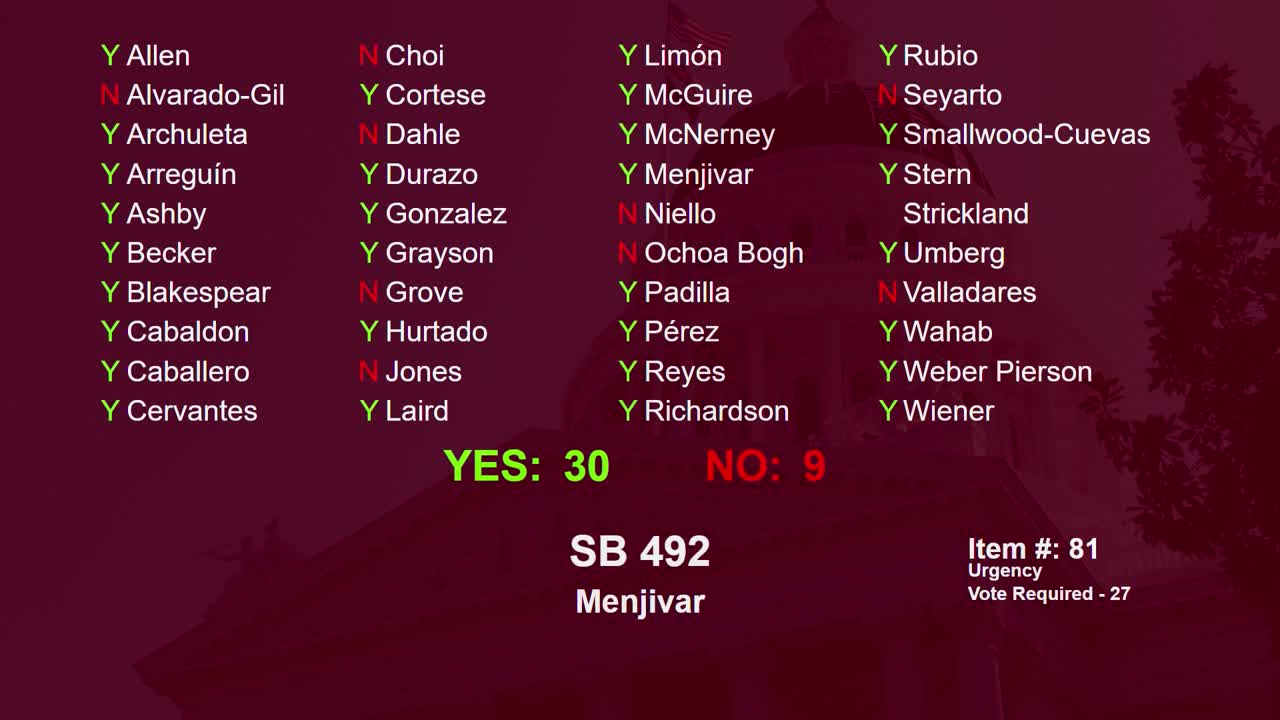 3MIN
Senate Floor
 4SEC
Senate Standing Committee on Appropriations
 9MIN
Senate Standing Committee on Labor, Public Employment and Retirement
Bill Author

Bill Co-Author(s):