SCA 2: Governor: pardons and commutations.
- Session Year: 2025-2026
- House: Senate
- Latest Version Date: 2025-02-10
Current Status:
In Progress
(2026-03-25: From committee: Be adopted and re-refer to Com. on E. & C.A. (Ayes 1. Noes 4.) (March 24). Re-referred to Com. on E. & C.A.)
Introduced
In Committee
Awaiting First Chamber Vote
Passed First Chamber
In Committee
Awaiting Second Chamber Vote
Passed Second Chamber
Enacted
What does this bill do?
This constitutional amendment would bar the Governor from granting a reprieve, pardon, or commutation (a commutation shortens or changes a criminal sentence) to themselves or to certain family members. It covers the Governor’s spouse or domestic partner; parents and parents‑in‑law; grandparents and grandparents‑in‑law; children (including step and adopted), siblings, nieces and nephews, and grandchildren.
The summary is provided by generative AI which can make mistakes. For original language, please view the details in the table below.
The California Constitution authorizes the Governor to grant a reprieve, pardon, or commutation after sentence has been entered, except as specified.
This measure would prohibit the Governor from granting a pardon or commutation to specified relatives.
Resolved by the Senate, the Assembly concurring, That the Legislature of the State of California at its 202526 Regular Session commencing on the second day of December 2024, two-thirds of the membership of each house concurring, hereby proposes to the people of the State of California, that the Constitution of the State be amended as follows:
(a)Subject to application procedures provided by statute, the Governor, on conditions the Governor deems proper, may grant a reprieve, pardon, and commutation, after sentence, except in case of impeachment. The Governor shall report to the Legislature each reprieve, pardon, and commutation granted, stating the pertinent facts and the reasons for granting it. The Governor may not grant a pardon or commutation to a person twice convicted of a felony except on recommendation of the Supreme Court, 4 four judges concurring.
(b)No decision of the parole authority of this State with respect to the granting, denial, revocation, or suspension of parole of a person sentenced to an indeterminate term upon conviction of murder shall become effective for a period of 30 days, during which the Governor may review the decision subject to procedures provided by statute. The Governor may only affirm, modify, or reverse the decision of the parole authority on the basis of the same factors which that the parole authority is required to consider. The Governor shall report to the Legislature each parole decision affirmed, modified, or reversed, stating the pertinent facts and reasons for the action.
(c)The Governor may not grant a reprieve, pardon, or commutation to any of the following individuals:
(1)Themselves.
(2)Their spouse or domestic partner.
(3)Their parents.
(4)The parents of their spouse or domestic partner.
(5)Their grandparents.
(6)The grandparents of their spouse or domestic partner.
(7)Their children, stepchildren, or adopted children of any age.
(8)Their siblings.
(9)Their nieces or nephews.
(10)Their grandchildren.
|
Date
|
Status
|
|---|---|
| Mar 25, 2026 | From committee: Be adopted and re-refer to Com. on E. & C.A. (Ayes 1. Noes 4.) (March 24). Re-referred to Com. on E. & C.A. |
| Mar 25, 2026 | March 24 set for first hearing. Failed passage in committee. (Ayes 6. Noes 0.) Reconsideration granted. |
| Mar 24, 2026 | March 24 set for first hearing. Failed passage in committee. (Ayes 1. Noes 4. Page 3661.) Reconsideration granted. |
| Mar 24, 2026 | March 24 set for first hearing. Failed passage in committee. (Ayes 1. Noes 4.) Reconsideration granted. |
| Mar 10, 2026 | Set for hearing March 24. |
| Jan 5, 2026 | Referred to Coms. on PUB. S. and E. & C.A. |
| Feb 10, 2025 | Introduced. Read first time. To Com. on RLS. for assignment. To print. |
|
Date
|
Description
|
Location
|
Votes
|
|
|---|---|---|---|---|
| Mar 24, 2026 | [03-24-2026] hearing: Motion to Reconsider. [Reconsideration Granted.] | Senate Standing Committee on Public Safety |
Passed |
|
| Mar 24, 2026 | [First] hearing set for [03-25-2026]: Failed passage in Committee. Reconsideration granted | Senate Standing Committee on Public Safety |
Passed |
|
| Mar 24, 2026 | Be adopted, but first be re-referred to the Committee on [Elections and Constitutional Amendments] | Senate Standing Committee on Public Safety |
Failed |
This list shows positions taken on this bill by organizations on the date displayed, which is linked to the original source.
Positions by individuals are not included.
SENATE COMMITTEE ON PUBLIC SAFETY
Senator Jesse Arreguín, Chair
2025 - 2026 Regular
Bill No: SCA 2 Hearing Date: March 24, 2026
Author: | Choi | ||
Version: | February 10, 2025 | ||
Urgency: | No | Fiscal: | Yes |
Consultant: | SJ | ||
Subject: Governor: pardons and commutations
HISTORY
Source: Author
Prior Legislation: AB 2845 (Bonta), Ch. 824, Stats. of 2018
AB 648 (Block), Ch. 437, Stats. of 2011
Support: Unknown
Opposition: None known
PURPOSE
The purpose of this measure is to prohibit the Governor from granting a reprieve, pardon, or commutation to specified relatives.
Existing law authorizes the Governor, on conditions the Governor deems proper, to grant a reprieve, pardon, and commutation, after sentence, except in case of impeachment. Prohibits the Governor from granting a pardon or commutation to a person twice convicted of a felony except on recommendation of the state Supreme Court, four judges concurring. (Cal. Const., art. V, § 8, subd. (a).)
Existing law requires the Governor to report to the Legislature each reprieve, pardon, and commutation granted, stating the pertinent facts and the reasons for granting it. (Cal. Const., art. V, § 8, subd. (a).)
Existing law provides that the general authority to grant reprieves, pardons and commutations of sentence is conferred upon the Governor by Section 8 of Article V of the Constitution of the State of California. (Pen. Code, § 4800.)
Existing law authorizes the Board of Parole Hearings (BPH) to report to the Governor the names of any and all individuals imprisoned in any state prison who, in its judgment, ought to have a commutation of sentence or be pardoned and set at liberty on account of good conduct, or unusual term of sentence, or any other cause, including evidence of intimate partner battering and its effects. (Pen. Code, § 4801, subd. (a).)
Existing law outlines the process for applying for a pardon or commutation. (Pen. Code, §§ 4802, 4802.5.)
Existing law requires the Governor to provide the district attorney of the county of conviction with notice of a person’s intent to apply for a commutation at least 10 days before acting upon an application for a commutation of sentence. Authorizes the district attorney to submit a written recommendation to the Governor for or against commutation of sentence. Requires the district attorney to make reasonable efforts to notify the victim or victims of the crime or crimes related to the application and the victims’ families, and provides that the victim and their family may submit a recommendation to the Governor for or against commutation of sentence. (Pen. Code, § 4805.)
Existing law requires the Governor to submit a written report at the beginning of every regular session of the Legislature to the Legislature that includes each application that was granted for each case of reprieve, pardon, or commutation by the Governor, during the immediately preceding regular session of the Legislature, stating the name of the person convicted, the crime of which the person was convicted, the sentence and its date, the date of the reprieve, pardon, or commutation, and the reason for granting the same. (Pen. Code, § 4807.)
Existing law requires every application for pardon or commutation of sentence to be accompanied by a full statement of any compensation being paid to any person for procuring or assisting in procuring the pardon or commutation or the pardon or commutation must be denied. (Pen. Code, § 4807.2.)
Existing law requires BPH, upon request of the Governor, to investigate and report on all applications for reprieves, pardons, and commutations of sentence and to make recommendations to the Governor on those applications. Requires BPH to examine and consider all applications so referred and all transcripts of judicial proceedings and all affidavits or other documents submitted in connection, and provides that BPH has the power to employ assistants, take testimony, and examine witnesses under oath, and to do any and all things necessary to make a full and complete investigation of and concerning all applications referred to it. (Pen. Code, § 4812, subd. (a).)
Existing law authorizes BPH to make recommendations to the Governor at any time regarding applications for pardon or commutation, and authorizes the Governor to request investigation into candidates for pardon or commutation at any time. (Pen. Code, § 4812, subd. (b).)
Existing law requires BPH to consider expedited review of an application if a petitioner indicates in the application an urgent need for the pardon or commutation, including, but not limited to, a pending deportation order or deportation proceeding. (Pen. Code, § 4812, subd. (c).)
Existing law requires BPH to provide electronic or written notification to an applicant after the board receives the application, and when BPH has issued a recommendation on the application. Specifies that BPH is not required to notify the applicant as to the reasons for its recommendation, which must remain confidential. (Pen. Code, § 4812, subd. (d).)
This measure prohibits the Governor from granting a reprieve, pardon, or commutation to any of the following individuals:
- Themselves.
- Their spouse or domestic partner.
- Their parents.
- The parents of their spouse or domestic partner.
- Their grandparents.
- The grandparents of their spouse or domestic partner.
- Children, stepchildren, or adopted children of any age.
- Their siblings.
- Their nieces or nephews.
- Their grandchildren.
COMMENTS
- Need For This Measure
According to the author:
Although the California State Legislature cannot do anything about limiting presidential pardons at the federal level, California voters can ensure there is a system of checks and balances that limits the pardoning powers of our state’s governor by approving SCA 2. The power to pardon is a serious responsibility that is meant to serve justice, not personal interests. SCA 2 asks California voters to decide if the governor should be prohibited from allowing their own family members to sidestep being held accountable by the justice system.
- Governor’s Clemency Power
Clemency is an umbrella term that encompasses various mechanisms through which an executive can remit the consequences of a crime. Clemency is rooted in English common law and “the historic remedy for preventing miscarriages of justice where judicial process has been exhausted.” (Herrera v. Collins (1993) 506 U.S. 390, 412.) Included in the original state constitution, the Governor’s clemency power is found in Article 8 of the California Constitution which provides that the Governor “may grant a reprieve, pardon, and commutation, after sentence, except in case of impeachment.” (Cal. Const., art. V, § 8, subd. (a).) “[A] reprieve is a temporary stay or deferment of execution of a sentence; a commutation is a permanent reduction in degree or amount of punishment, and a pardon is a permanent and complete termination of penalty and remission of guilt.” (Way v. Superior Court (1977) 74 Cal. App. 3d 165, 176 (Internal citations omitted).)
As noted above, the Governor cannot grant a reprieve, pardon, and commutation for an impeachment. (Cal. Const., art. V, § 8, subd. (a).) Additionally, in the case of “a person twice convicted of a felony,” the Governor must seek approval to grant a pardon or commutation from the state Supreme Court. (Ibid.) The Governor is required to report each reprieve, pardon, and commutation granted to the Legislature annually, stating the facts of the case and the reasons for granting the reprieve, pardon, or commutation (Ibid.)
The use of the gubernatorial clemency power has varied over the decades. Governors Edmund “Pat” Brown, Ronald Reagan, Jerry Brown (during his first term), and George Deukmejian each granted hundreds of pardons. (Kate Mather, Gov. Jerry Brown grants 132 pre-Christmas pardons, commutes 19 sentences
(Dec. 23, 2017) <http://www.latimes.com/politics/la-pol-ca-jerry-brown-christmas-pardons-20171223-story.html>.) That practice changed when Governor Pete Wilson took office in 1991. Between 1991 and 2010, only 28 pardons were granted. (Laurel Rosenhall, Jerry Brown has pardoned more felons than any governor in recent state history (Dec. 30, 2016) <https://www.mercurynews.com/2016/12/30/jerry-brown-has-pardoned-more-felons-than-any-governor-in-recent-state-history/>.)
Governor Brown’s second tenure in office included a return to the consistent use of clemency. He granted over 1,000 pardons and 51 commutations between 2011 and early 2019. (Mather, supra.) Governor Newsom continued this tradition, and has granted a total of 271 pardons, 166 commutations, and 43 reprieves since taking office in January of 2019. (Governor Newsom, Governor Newsom announces multiple clemency actions (Feb. 20, 2026) <https://www.gov.ca.gov/2026/02/20/governor-newsom-announces-multiple-clemency-actions-3/>.)
- Controversies Surrounding Presidential and Gubernatorial Acts of Clemency
The exercise of the President’s clemency power—specifically, the pardon power—has received much attention and been criticized over the years. In the modern era, controversy related to Presidential clemency was limited until President Ford pre-emptively pardoned former President Nixon after the latter resigned during the Watergate scandal. (Carannante, What to Do About the Executive Clemency Power In the Wake of the Clinton Presidency (2003) 47 N.Y.L. Sch. L.Rev. 325, 331.) Since then, each President’s acts of clemency have come under scrutiny and led to some amount of controversy. President Carter granted clemency to all draft evaders of the Vietnam War. (Id. at p. 332.) President Regan pardoned George Steinbrenner, the owner of the New York Yankees, for illegal campaign contributions made during the prior decade. (Ibid.) President George H.W. Bush pardoned several individuals with alleged involvement in the Iran-Contra affair. (Ibid.) President Clinton granted a pardon to his half brother for a drug conviction and his wife’s brother for receiving payment for his help in obtaining pardons. (Id. at p. 336.) President Clinton additionally pardoned two former commodity traders who were indicted in the largest tax evasion case in the country’s history but who never appeared in court because they fled to Switzerland, which refused to extradite them, and renounced their citizenship. (Ibid.) At the time of the pardon, the ex-wife of one of the pardon recipients had pledged over $450,000 to the Clinton presidential library. (Ibid.)
President George W. Bush exercised the clemency power far less than his predecessors but one notable act of clemency was the commutation of Scooter Libby, former chief of staff to Vice President Dick Cheney, who was convicted of obstruction of justice and perjury during an investigation into the leaking of the identity of a CIA officer. (Associated Press, Bush pardons 14 individuals (Nov. 24, 2008) <htpps://www.nbcnews.com/id/wbna27895909>.) President Bush was also the first president to withdraw a pardon after outcry following the announcement that a pardon was going to be granted to a real estate developer convicted of mail and real estate fraud that targeted low-income buyers. (Linzer & LaFleur, Presidential Pardons Heavily Favor Whites (Dec. 3, 2011) <https://www.propublica.org/article/shades-of-mercy-presidential-forgiveness-heavily-favors-whites>.) Among President Obama’s most controversial acts of clemency was the commutation of all but four months of the remaining prison term on the 35-year prison sentence of Chelsea Manning, a former U.S. Army intelligence analyst convicted of leaking military information to WikiLeaks. (Kennedy, President Obama Commutes Chelsea Manning’s Prison Sentence (Jan. 17, 2017) <https://www.npr.org/sections/thetwo-way/2017/01/17/510307055/president-obama-commutes-chelsea-mannings-prison-sentence>.)
President Biden’s decisions to pardon his son, Hunter Buden, as well as preemptively pardon several individuals, including his siblings and their spouses, General Mark Milley, Dr. Anthony Fauci, members of Congress who served on the committee investigating the January 6, 2021 attack on the Capitol, and outspoken critics of incoming President Trump, among others, received widespread media coverage. (Long & Dirker-Richer, Biden has pardoned his son Hunter. What does that mean? (Dec. 2, 2024) <https://apnews.com/article/biden-hunter-biden-pardon-son-9307d6bade834df77c265cae7d3b7c25>; Lipak & Saenz, Biden issues preeemptive pardons for Trump critics and Biden family members (Jan. 20, 2025) <https://www.cnn.com/2025/01/20/politics/joe-biden-preemptive-pardons>.)
Several of President Trump’s acts of clemency during both of his terms have been controversial, including the pardon of former Maricopa County Sheriff Joe Arpaio, the pardons and commutations granted to all of the defendants charged in connection with the January 6, 2021 attack on the U.S. Capitol, and the recent pardon of former Honduran president Juan Orlando Hernandez who was sentenced to 45 years in prison for running his country as a “narco-state,” moving at least 400 tons of cocaine into the U.S. (See Kelly, President Trump Pardons Former Sheriff Joe Arpaio (Aug. 25, 2017) <https://www.npr.org/2017/08/25/545282459/president-trump-pardons-former-sheriff-joe-arpaio>; Dreisbach, Criminal records of Jan. 6 rioters pardoned by Trump include rape, domestic violence (Jan. 30, 2025) <https://www.npr.org/2025/01/30/nx-s1-5276336/donald-trump-jan-6-rape-assault-pardons-rioters>; Kornfield & Davies, Trump pardons major drug traffickers despite his anti-drug rhetoric (Dec. 8, 2025) <https://www.washingtonpost.com/politics/2025/12/07/trump-drugs-pardons-hernandez-venezuela/>.) A New York Times article published earlier this month discussed the industry that has developed with respect to professionals offering their services to help clients obtain a presidential pardon or other acts of clemency:
In all, lobbying firms disclosed receiving payments of nearly $5.2 million last year from clients seeking clemency from Mr. Trump for individual clients — about eight times more than was disclosed in 2024 from people seeking clemency from former President Joseph R. Biden Jr. — according to congressional filings. But that likely reflects only a fraction of the spending by clemency seekers, since most pardon advocates claim that their efforts represent legal work that is exempt from lobbying disclosure laws. (Vogel, Pardon Industry Offers Rich Offenders a Path to Trump (Mar. 6, 2026) <https://www.nytimes.com/2026/03/06/us/politics/schwartz-trump-pardon-industry.html>.)
Gubernatorial acts of clemency have not been without controversy. (See Neuman, When Pardons Become Political Dynamite (Jan. 13, 2012) <https://ww.npr.org/2012/01/13/145179319/when-pardons-become-political-dynamite> (recounting controversial gubernatorial pardons or commutations in Arkansas, Minnesota, and California); Booker, On His Way Out, Kentucky Gov. Matt Bevin Pardons Murderers, Rapists, Hundreds More (Dec. 13, 2019) <https://www.npr.org/2019/12/13/787811560/on-his-way-out-kentucky-gov-matt-bevin-pardons-murderers-rapists-hundreds-more>.)
This measure prohibits a Governor from granting a reprieve, pardon, or commutation to specified individuals, including themself, their spouse, their parents, the parents of their spouse, their siblings, or their children, among others. There have been no reports that the current or past California Governors have granted clemency to relatives.
-- END --
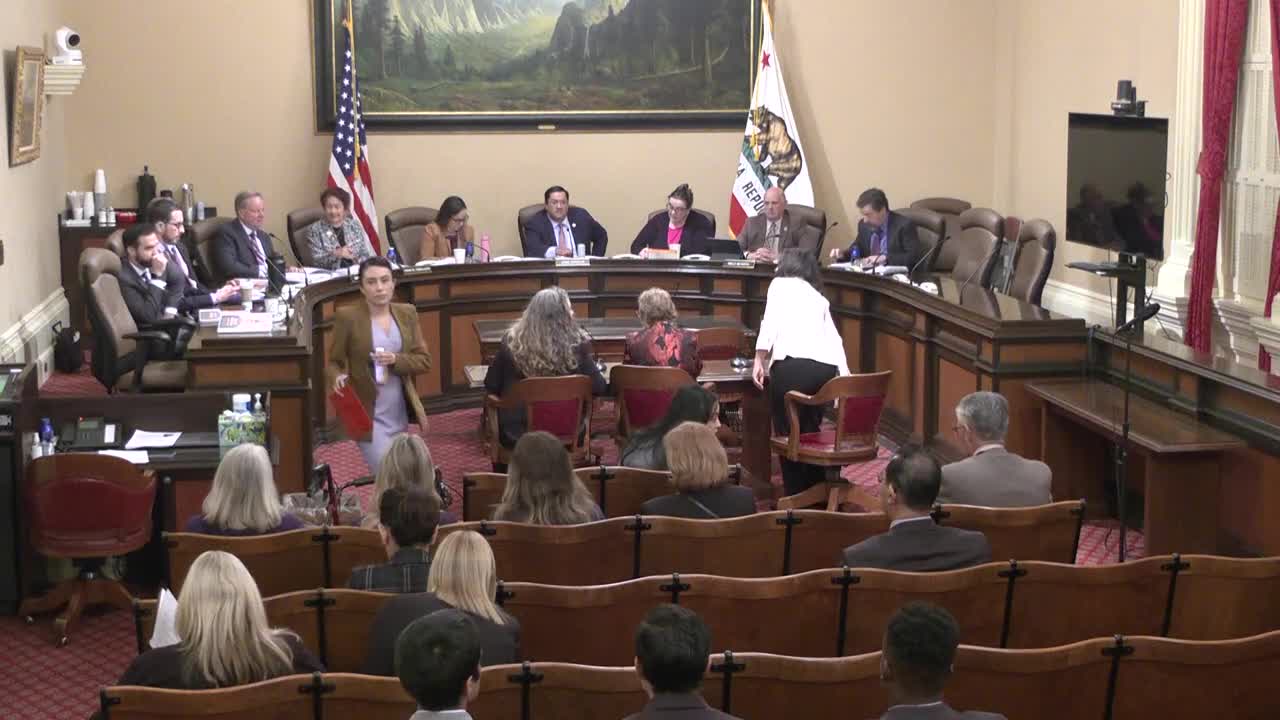
Discussed in Hearing
 11MIN
Senate Standing Committee on Public Safety
Bill Author
Bill Co-Author(s):