AB 2409: Water quality standards: trash: single-use carryout bags.
- Session Year: 2015-2016
- House: Assembly
- Latest Version Date: 2016-02-19
Under the Porter-Cologne Water Quality Control Act, the State Water Resources Control Board and the California regional water quality control boards are the principal state agencies with regulatory authority over water quality. Under the Federal Water Pollution Control Act, each state is required to identify those waters for which prescribed effluent limitations are not stringent enough to implement applicable water quality standards and to establish, with regard to those waters, total maximum daily loads, subject to the approval of the United States Environmental Protection Agency, for certain pollutants at a level necessary to implement those water quality standards.
Existing law, inoperative due to a pending referendum election, would prohibit certain stores from providing a single-use carryout bag to a customer and prohibit those stores from selling or distributing a recycled paper bag to a customer at the point of sale unless the store makes that bag available for purchase, as specified.
This bill would suspend the operation of certain amendments to water quality control plans relating to the total maximum daily load for trash unless the provisions inoperative due to a pending referendum election become effective. This bill would require the state board to revisit and revise water quality control plans to address impaired water quality due to trash if the law pending referendum is defeated at the November 8, 2016, statewide general election.
(a)The amendments to the Water Quality Control Plan for the Ocean Waters of California to Control Trash and Part 1 Trash Provisions of the Water Quality Control Plan for Inland Surface Waters, Enclosed Bays, and Estuaries of California, adopted by the state board on April 7, 2014, are inoperative unless Chapter 850 of the Statutes of 2014 becomes effective.
(b)If Chapter 850 of the Statutes of 2014 is defeated at the November 8, 2016, statewide general election, the state board shall revisit and revise water quality control plans to address impaired water quality due to trash.
|
Date
|
Status
|
|---|---|
| Feb 19, 2016 | Introduced. To print. |
| Feb 21, 2016 | From printer. May be heard in committee March 22. |
| Feb 22, 2016 | Read first time. |
| Mar 8, 2016 | Referred to Com. on E.S. & T.M. |
| Mar 28, 2016 | In committee: Set, first hearing. Hearing canceled at the request of author. |
| Apr 12, 2016 | In committee: Set, second hearing. Failed passage. |
| May 16, 2016 | From committee: Without further action pursuant to Joint Rule 62(a). |
|
Date
|
Description
|
Location
|
Votes
|
|
|---|---|---|---|---|
| Apr 12, 2016 | Do pass and be re-referred to the Committee on [Appropriations] | Assembly Standing Committee on Environmental Safety and Toxic Materials |
Failed |
This list shows positions taken on this bill by organizations on the date displayed, which is linked to the original source.
Positions by individuals are not included.
Date of Hearing: April 12, 2016
ASSEMBLY COMMITTEE ON ENVIRONMENTAL SAFETY AND TOXIC MATERIALS
Luis Alejo, Chair
ABPCA Bill Id:AB 2409 (
Author:Wagner) – As Introduced Ver:February 19, 2016
SUBJECT: Water quality standards: trash: single-use carryout bags
SUMMARY: Invalidates the California Ocean Plan if the state's ban on single use plastic bags is upheld at the 2016 statewide general election. Specifically, this bill:
- Renders the Water Quality Control Plan for California's Ocean Waters to Control Trash and Part 1 Trash Provisions of the Water Quality Control Plan for Inland Surface Waters, Enclosed Bays, and Estuaries of California (ISWEBE Plan) adopted by the State Water Resources Control Board (State Water Board) inoperative unless Senate Bill (SB) 270 (Chapter 850, Statutes of 2014) becomes effective.
- Requires the State Water Board to revisit and revise the aforementioned Water Quality Control Plan to address impaired water quality due to trash if SB 270 is defeated at the November 8, 2016, general election.
EXISTING LAW:
- Prohibits certain retail stores from distributing lightweight, single-use plastic bags after specified dates, establishes requirements for reusable bags, and prohibits stores from distributing reusable bags and recycled paper bags for less than $0.10 per bag. (Public Resources Code (PRC) § 42280, et seq.)
- Requires, until 2020, an operator of a store to establish an at-store recycling program that provides to customers the opportunity to return clean plastic carryout bags to that store. (PRC § 42250, et seq.)
- Requires the Governor of a state or the water pollution control agency of a state to, at least once every three years, hold public hearings for the purpose of reviewing applicable water quality standards and modifying and adopting standards. (Section 303(c)(1) of the federal Clean Water Act)
- Requires the State Water Board to formulate and adopt a water quality control plan for ocean waters of the state known, as the California Ocean Plan, and requires review of that plan every three years. (Water Code § 13170.2)
FISCAL EFFECT: Unknown.
COMMENTS:
Need for the bill: According to the author, "This bill slows implementation of regulations adopted by the State Water Resources Control Board, elements of which may be undone by the voters in November 2016. It would cost California cities upwards of $1 billion to implement these regulations, and cities have already begun expending resources. However, the regulations rely heavily upon SB 270, the Plastic Bag Ban. A referendum on SB 270 was successfully placed on the November 2016 ballot that would undermine, and perhaps render unconstitutional, the regulations. This bill simply seeks to prohibit the implementation once the fate of SB 270 is known. It does not address the merits of the passed regulations. It would simply prohibit implementation if the referendum is successful."
Senate Bill 270: In 2014, the Legislature approved and the Governor enacted SB 270 (Chapter 850, Statutes of 2014), which prohibits stores from making single-use carryout bags available at the point of sale according to specific time frames (January 1, 2015 for grocery stores and large retailers; July 1, 2016 for convenience food stores and food marts). The bill also authorizes stores to make reusable grocery bags, defined as being capable of use 125 times or more, or recycled paper bags available at the point of sale for not less than $0.10.
When signing SB 270, Governor Brown stated, "This bill is a step in the right direction – it reduces the torrent of plastic polluting our beaches, parks and even the vast ocean itself."
Referendum: On February 24, 2015, the California Secretary of State announced the qualification of a ballot measure to repeal California's statewide plastic bag ban established pursuant to SB 270. More than 800,000 signatures of California voters were submitted by The American Progressive Bag Alliance, the industry group that led the referendum on behalf of plastic bag manufacturers and recyclers.
The referendum will be on the November 8, 2016, general election ballot. If successful, the referendum will overturn and invalidate the provisions of SB 270.
Problem with trash: According to the State Water Board, there are 73 water bodies in California listed as having impaired water quality due to the presence of large amounts of trash. Trash discarded on land is frequently transported through storm drains to waterways and the ocean.
The State Water Board’s mandate is to protect beneficial uses of the state’s water resources, and trash threatens virtually all of those uses. Aquatic and marine life can be threatened from ingestion, entanglement, and habitat degradation from trash. Trash can jeopardize public health and safety and poses a hindrance to recreational, navigational, and commercial activities. Additionally, trash can serve as a transport medium for pollutants and act as a vector for invasive species.
California trash policy: The California Ocean Plan was adopted by the State Water Board in 1972 and amended in 1978, 1983, 1988, 1990, 1997, and 2001. The State Water Board is responsible for reviewing the Ocean Plan water quality standards and for modifying and adopting standards in accordance with the federal Clean Water Act and the California Water Code.
On April 7, 2015, the State Water Board approved an Amendment to the Ocean Plan to Control Trash and the ISWEBE Plan. Together, they are collectively termed as 'the Trash Amendments'. The project objective for the Trash Amendments is to provide statewide consistency for the State Water Board's regulatory approach to protect aquatic life and public health beneficial uses, and reduce environmental issues associated with trash in state waters, while focusing limited resources on high trash generating areas. These Trash Amendments will address all water bodies in the state currently listed as “impaired” due to the presence of trash.
The Trash Amendments amend the Ocean Plan and will be incorporated into the ISWEBE Plan to do the following:
- Establish a narrative water quality objective for trash;
- Establish a prohibition on the discharge of trash;
- Provide implementation requirements for permitted storm water and other dischargers;
- Set a time schedule for compliance; and,
- Provide a framework for monitoring and reporting requirements.
Now that the Trash Amendments are adopted, they will be submitted to both the California Office of Administrative Law and the U.S. Environmental Protection Agency for approval in order to become effective. Once effective, the Trash Amendments outline a time schedule for the State Water Boards to implement the Trash Amendments. This includes an 18-month window to incorporate the Trash Amendments into permits.
Is AB 2409 the best approach for reducing plastic in the environment? Every year Californians use billions of plastic grocery bags, many of which become litter and clog our waterways and beaches, and they knowingly cause deleterious impacts to the environment and wildlife. SB 270 compliments the goals of the Trash Amendments and supports the goals of the state to reduce plastic detritus in our environment. If SB 270 is overturned, that will underscore the need to implement the Trash Amendments, which will prevent pollution – including plastic bags – from contaminating our water ways. Therefore, it may not make sense to leverage the enactment of the Trash Amendments on the success or failure of SB 270.
Related legislation: AB 1454 (Wagner, 2015) contained identical language to AB 2409. It was referred to Assembly Water, Parks & Wildlife Committee, but never set for a hearing.
REGISTERED SUPPORT / OPPOSITION:
Support
Association of California Cities-Orange County
Opposition
California Coastkeeper Alliance
California Coastal Protection Network
California League of Conservation Voters
Californians Against Waste
The Center for Oceanic Awareness, Research, and Education (COARE)
Clean Water Action
Green Sangha
Heal the Bay
Natural Resources Defense Council
Ocean Conservancy
Plastic Pollution Coalition
Save The Bay
Seventh Generation Advisors
Sierra Club California
Surfrider Foundation
WeTap
Analysis Prepared by: Paige Brokaw / E.S. & T.M. / (916) 319-3965
Bill Author
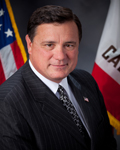
Bill Co-Author(s):